US12192571B2 - Video playback based on an HTML iframe and a headless browser - Google Patents
Video playback based on an HTML iframe and a headless browser Download PDFInfo
- Publication number
- US12192571B2 US12192571B2 US17/947,722 US202217947722A US12192571B2 US 12192571 B2 US12192571 B2 US 12192571B2 US 202217947722 A US202217947722 A US 202217947722A US 12192571 B2 US12192571 B2 US 12192571B2
- Authority
- US
- United States
- Prior art keywords
- video
- video stream
- html iframe
- tag
- html
- Prior art date
- Legal status (The legal status is an assumption and is not a legal conclusion. Google has not performed a legal analysis and makes no representation as to the accuracy of the status listed.)
- Active, expires
Links
Images


Classifications
-
- G—PHYSICS
- G06—COMPUTING OR CALCULATING; COUNTING
- G06F—ELECTRIC DIGITAL DATA PROCESSING
- G06F16/00—Information retrieval; Database structures therefor; File system structures therefor
- G06F16/90—Details of database functions independent of the retrieved data types
- G06F16/95—Retrieval from the web
- G06F16/958—Organisation or management of web site content, e.g. publishing, maintaining pages or automatic linking
-
- H—ELECTRICITY
- H04—ELECTRIC COMMUNICATION TECHNIQUE
- H04N—PICTORIAL COMMUNICATION, e.g. TELEVISION
- H04N21/00—Selective content distribution, e.g. interactive television or video on demand [VOD]
- H04N21/40—Client devices specifically adapted for the reception of or interaction with content, e.g. set-top-box [STB]; Operations thereof
- H04N21/43—Processing of content or additional data, e.g. demultiplexing additional data from a digital video stream; Elementary client operations, e.g. monitoring of home network or synchronising decoder's clock; Client middleware
- H04N21/432—Content retrieval operation from a local storage medium, e.g. hard-disk
- H04N21/4325—Content retrieval operation from a local storage medium, e.g. hard-disk by playing back content from the storage medium
-
- H—ELECTRICITY
- H04—ELECTRIC COMMUNICATION TECHNIQUE
- H04N—PICTORIAL COMMUNICATION, e.g. TELEVISION
- H04N21/00—Selective content distribution, e.g. interactive television or video on demand [VOD]
- H04N21/40—Client devices specifically adapted for the reception of or interaction with content, e.g. set-top-box [STB]; Operations thereof
- H04N21/43—Processing of content or additional data, e.g. demultiplexing additional data from a digital video stream; Elementary client operations, e.g. monitoring of home network or synchronising decoder's clock; Client middleware
- H04N21/44—Processing of video elementary streams, e.g. splicing a video clip retrieved from local storage with an incoming video stream or rendering scenes according to encoded video stream scene graphs
-
- H—ELECTRICITY
- H04—ELECTRIC COMMUNICATION TECHNIQUE
- H04N—PICTORIAL COMMUNICATION, e.g. TELEVISION
- H04N21/00—Selective content distribution, e.g. interactive television or video on demand [VOD]
- H04N21/80—Generation or processing of content or additional data by content creator independently of the distribution process; Content per se
- H04N21/85—Assembly of content; Generation of multimedia applications
- H04N21/858—Linking data to content, e.g. by linking an URL to a video object, by creating a hotspot
- H04N21/8586—Linking data to content, e.g. by linking an URL to a video object, by creating a hotspot by using a URL
Definitions
- the present disclosure relates to video playback, and in particular, video playback via a remote video player.
- a playback control device communicates with a video player in order to facilitate playback of a video stream, sometimes referred to as remote video playback.
- the playback control device and the video player may coordinate video playback via one or more predefined applications. Accordingly, video playback may be constrained by the predefined application(s).
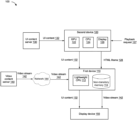
- FIG. 1 is an example of a first video playback architecture in accordance with some embodiments.
- FIG. 2 is an example of a second video playback architecture in accordance with some embodiments.
- FIG. 3 is a timeline representation of first and second devices coordinating video playback in accordance with some embodiments.
- FIG. 4 is an example of a flow diagram of a method of facilitating video playback in accordance with some embodiments.
- Various embodiments include facilitating video playback based on a HyperText Markup Language (HTML) inline frame (iframe) and a headless browser.
- a first device performs video playback, based on a remote playback (e.g., casting) request from a second device.
- the first device e.g., a receiving device
- receives the HTML iframe from the second device e.g., a sending device.
- the HTML iframe is associated with a video tag, which identifies a video stream for video playback.
- the first device includes a communication interface to enable communication with the second device, such as a Bluetooth interface or near-field communication (NFC) interface.
- NFC near-field communication
- the first device executes the HTML iframe via a headless browser, in order to retrieve the video stream.
- the HTML iframe includes the video tag e.g., a portion of text of the HTML iframe corresponds to the video tag.
- the HTML iframe does not include the video tag, such as when the video tag is nested in the HTML iframe.
- the headless browser may run JavaScript to execute the HTML iframe, or may run one or more program libraries to execute the HTML iframe.
- the headless browser runs on a processor of the first device.
- the processor of the first device may be lightweight—e.g., the processor may have lower processing capabilities.
- the first device transmits the video stream to a display device.
- the first device is physically connectable to the display device, such as when the first device is an adapter (e.g., a dongle).
- the first device and the display device are integrated in a common device, such as being integrated in a smart television (TV).
- TV smart television
- a method is performed at a first device including a processor, a non-transitory memory, and a communication interface.
- the method includes receiving, via the communication interface, an HTML iframe from a second device.
- the HTML iframe is associated with a video tag.
- the method includes playing a video stream that is identified by the video tag. Playing the video stream includes executing the HTML iframe via a headless browser in order to retrieve the video stream based on the video tag, and transmitting the video stream to a display device.
- a first device includes a processor, a non-transitory memory, and a communication interface.
- the one or more programs are stored in the non-transitory memory and configured to be executed by the processor and the one or more programs include instructions for performing or causing performance of the operations of any of the methods described herein.
- a non-transitory computer readable storage medium has stored therein instructions which when executed by a processor of a network device, cause the network device to perform or cause performance of the operations of any of the methods described herein.
- a network device includes means for performing or causing performance of the operations of any of the methods described herein.
- an information processing apparatus for use in a network device, includes means for performing or causing performance of the operations of any of the methods described herein.
- a playback control device communicates with a video player in order to facilitate playback of a video stream, such as via a remote video player.
- a user interface displayed on a smartphone enables a user to select a video stream, and the smartphone transmits corresponding playback information to the video player.
- the playback control device and the video player may coordinate video playback via one or more predefined applications, such as a predefined receiver application.
- the predefined application(s) may include a proprietary application program interface (API), such as an application that is customed-defined by a discovery application running on the playback control device. Accordingly, video playback at the video player is constrained by the predefined application(s).
- API application program interface
- the predefined application(s) define a playback control characteristic associated with the video stream (e.g., video size, video resolution, DRM information, ad insertions, etc.), and the video player cannot override the playback control characteristic when playing the video stream.
- a playback control characteristic associated with the video stream e.g., video size, video resolution, DRM information, ad insertions, etc.
- FIG. 1 is an example of a first video playback architecture 100 in accordance with some embodiments.
- the first video playback architecture 100 includes a first device 110 , a second device 120 , a user interface (UI) content server 130 , a video content server 140 , and a display device 150 .
- UI user interface
- the first device 110 and the second device 120 coordinate to facilitate video playback of a video stream 142 at the display device 150 .
- the second device 120 displays, on a display 126 , UI content 132 from the UI content server 130 .
- a user of the second device 120 may provide a playback request 127 to the second device 120 in order to initiate remote video playback.
- the displayed UI content 132 includes a home screen including a ribbon of media objects (e.g., thumbnails of movies and/or television shows), and the user of the second device 120 selects a particular media object.
- the displayed UI content 132 includes an initiate remote video playback affordance, and the playback request 127 selects the initiate remote video playback affordance.
- the second device 120 In response to detecting selection of the initiate remote video playback affordance, the second device 120 initiates a remote video playback operation with respect to a currently selected media object.
- the second device 120 corresponds to a mobile device, such as a smartphone, laptop, tablet, etc.
- the second device 120 may include a graphics processing unit (GPU) 122 to render the UI content 132 for display on the display 126 .
- the second device 120 relays the UI content 132 to the first device 110 , which, in turn, relays the UI content 132 to the display device 150 for display.
- the second device 120 may include a central processing unit (CPU) 124 to perform various operations (e.g., related to remote video playback).
- CPU central processing unit
- the second device 120 in response to receiving the playback request 127 , sends an HTML iframe 128 to the first device 110 .
- the first device 110 may be referred to as a receiving device, and the second device 120 may be referred to as a sending device.
- the HTML iframe 128 is associated with a video tag, which identifies a video stream 142 .
- the HTML iframe 128 includes the video tag.
- the HTML iframe 128 does not include a video tag, such as when the video tag is nested within the HTML iframe 128 .
- the HTML iframe 128 identifies another HTML iframe, which includes the video tag.
- the first device 110 executes, via a headless browser, the HTML iframe 128 in order to retrieve the video stream 142 based on the video tag.
- the first device 110 includes a lightweight CPU 112 that runs the headless browser.
- the lightweight CPU 112 may have lower processing capabilities.
- the lightweight CPU 112 cannot effectively render the UI content 132 or the video stream 142 .
- Executing the HTML, iframe 128 may include the lightweight CPU 112 running JavaScript on the HTML, iframe 128 .
- the first device 110 retrieves the video stream 142 from the video content server 140 via a network 144 .
- the network 144 may correspond to a personal area network (PAN), wired local area network (LAN), wireless local area network (WLAN), wireless wide area networks (WWAN), etc.
- the network 144 corresponds to a content delivery network (CDN).
- the video content server 140 is located at an Internet Service Provider (ISP) that provides internet service to the first device 110 , thereby enabling the video stream 142 to be transmitted to the first device 110 with relatively low latency.
- ISP Internet Service Provider
- the first device 110 transmits the video stream 142 to the display device 150 .
- the first device 110 includes a non-transitory memory 114 , and uses the non-transitory memory 114 to enable more efficient transmission of the video stream 142 to the display device 150 . For example, while receiving the video stream 142 from the video content server 140 , the first device 110 writes a portion of the video stream 142 to the non-transitory memory 114 , and subsequently reads out the portion of the video stream 142 during transmission of the video stream 142 .
- the first device 110 is an adapter that plugs into the display device 150 , such as a dongle plugging into a TV.
- FIG. 1 illustrates the first device 110 as separate from the display device 150
- the first device 110 and the display device 150 are integrated into a common device, such as a TV.
- each of the first device 110 and the display device 150 is a respective hardware component of the TV.
- FIG. 2 is an example of a second video playback architecture 200 in accordance with some embodiments.
- the second video playback architecture 200 includes the first device 110 , the second device 120 , the video content server 140 , and the display device 150 .
- the first device 110 of FIG. 2 is similar to and adapted from the first device 110 of FIG. 1 .
- certain components of the first device 110 of FIG. 2 e.g., headless browser 220
- certain components of the first device 110 of FIG. 2 e.g., video buffering subsystem 232
- Certain features of the second video playback architecture 200 are omitted for the sake of clarity and brevity.
- the first device 110 includes a communication interface 212 that enables communication with the second device 120 .
- the communication interface 212 corresponds to a Bluetooth interface, an NFC interface, and/or the like.
- the first device 110 receives, via the communication interface 212 , the HTML iframe 128 from the second device 120 .
- the first device 110 includes a headless browser 220 that executes the HTML iframe 128 in order to retrieve the video stream 142 .
- executing the HTML iframe 128 includes running JavaScript on the HTML iframe 128 .
- the headless browser uses a program library 222 (e.g., a library of a programming language) to aid in executing the HTML iframe 128 .
- retrieving the video stream 142 includes sending, to the video content server 140 , a video request 216 .
- the video request 216 includes the video tag, which enables the video content server 140 to locate the video stream 142 that is identified by the video tag. Accordingly, in some embodiments, in response to receiving the video request 216 , the video content server 140 sends the video stream 142 to the first device 110 .
- the first device 110 includes a network interface 214 to enable the aforementioned communications with the video content server 140 .
- Examples of the network interface 214 include a Wi-Fi interface, a cellular network interface, etc.
- the first device 110 relays the video stream 142 to the display device 150 , such as is described with reference to FIG. 1 .
- the first device 110 includes a low level video player 230 that prepares the video stream 142 in order to transmit video frames 236 to the display device 150 , as illustrated in FIG. 2 .
- the low level video player 230 performs one or more of decoding the video stream 142 , demuxing the video stream 142 , etc.
- the low level video player 230 includes a video buffering subsystem 232 .
- the video buffer subsystem 232 may be allocated in the non-transitory memory 114 of the first device 110 .
- the video buffering subsystem 232 may buffer portions of the video stream 142 from the video content server 140 , to enable more efficient transmission of the video stream 142 to the display device 150 . More efficient transmission of the video stream 142 may result in smoother display of video at the display device 150 .
- the buffering enables less stalling and lagging related to display of the video stream 142 at the display device 150 .
- each of the first video playback architecture 100 and the second video playback architecture 200 enables greater playback flexibility than other video playback architectures that use predefined applications to coordinate video playback. For example, whereas a predefined application sets limits regarding ad insertion during video playback, execution of the HTML iframe 128 and transmission of the retrieved video stream 142 is not constrained by the limits regarding ad insertion.
- FIG. 3 is a timeline representation 300 of the first device 110 and the second device 120 coordinating video playback in accordance with some embodiments.
- a current time indicator 302 indicates the passage of time, starting at an initial time T 0 .
- the second device 120 receives a playback request—e.g., the playback request 127 of FIG. 1 .
- the playback request is provided by a user of the second device 120 .
- the second device 120 includes a content discovery application to discover accessible content.
- the accessible content may correspond to content that is currently accessible based on a user profile or credentials of the user, such as a video streaming service for which the user has an active account.
- the second device 120 may display UI content of the video streaming service, and the user may select, from the UI content, a particular media object (e.g., movie or TV show) for playback.
- a particular media object e.g., movie or TV show
- the second device 120 when the second device 120 is a smartphone, a finger of the user selects a particular thumbnail in order to provide the playback request to the second device.
- the playback request corresponds to a request to start remote video playback (e.g., start casting).
- the second device 120 displays a remote video playback affordance within a UI of a video streaming application. Selection of the remote video playback affordance by the user triggers the second device 120 to begin remote video playback. For example, the user has selected a video clip to watch, and the second device 120 accordingly begins to display the video clip.
- the user selects the remote video playback affordance, which triggers the second device 120 to begin transmitting the video clip to the display device 150 .
- Transmitting the video clip to another device may enable the display of the second device 120 to be available for other user applications.
- the second device 120 in response to receiving the playback request, sends an HTML iframe 306 to the first device 110 .
- the HTML iframe 306 corresponds to the HTML iframe 128 described with reference to FIGS. 1 and 2 .
- the HTML iframe 306 is associated with a video tag, such as a playable uniform resource locator (URL) indicator or HTML address indicator.
- URL uniform resource locator
- the first device 110 plays a video stream 312 that is identified by the video tag. To that end, as represented by block 308 , the first device 110 executes the HTML iframe 306 via a headless browser in order to retrieve the video stream 312 based on the video tag. To that end, in some embodiments, at a third time T 3 the first device 110 sends a video request 310 to the video content server 140 in order to retrieve the video stream 312 .
- the video request 310 may include the video tag.
- the first device 310 receives the video stream 312 from the video content server 140 at a fourth time T 4 .
- the video stream 312 may be comprised of a plurality of video frames. In some embodiments, the video stream 312 may correspond to an ABR video.
- the first device 110 prepares the video stream 312 to transmit video frames 316 to the display device 150 .
- the video stream preparation system 230 prepares the video stream 312 . Preparing the video stream 312 may include locally buffering the video stream 312 , in order to enable smoother video display at the display device 150 .
- Playing the video stream also includes, at a sixth time T 6 , transmitting the video frames 316 to the display device 150 .
- FIG. 4 is an example of a flow diagram of a method 400 of facilitating video playback in accordance with some embodiments.
- the method 400 or portions thereof is performed by at a first device including a processor, a non-transitory memory, and a communication interface, such as the first device 110 described with reference to FIGS. 1 - 3 .
- the method 400 or portions thereof is performed by a controller that is integrated in a device.
- the method 400 or portions thereof is performed by an apparatus with a processor, a non-transitory memory, and a communication interface.
- the method 400 or portions thereof is performed by a system with a processor, a non-transitory memory, and a communication interface.
- the method 400 includes receiving, via the communication interface, an HTML from a second device.
- the HTML iframe is associated with a video tag, which identifies a video stream.
- the video tag is a playable URL of a video stream.
- the video tag corresponds to an HTML video tag.
- the first device may be referred to as a receiving device, and the second device may be referred to as a sending device.
- sending the HTML iframe is initiated via a playback request.
- the second device 120 receives the playback request 127 from the user of the second device 120 .
- the playback request 127 corresponds to a user selection of a thumbnail preview of a video, which is displayed on the display 126 .
- the playback request 127 corresponds to a user selection of a remote video playback affordance displayed on the display 126 . Selection of the remote video playback affordance triggers the second device 120 to begin transmitting a currently selected video.
- the user of the second device 120 selects a video to be remotely played, and subsequently selects the remote video playback affordance to trigger the transmitting the video to the first device 110 .
- the HTML iframe includes the video tag.
- a portion of the text of the HTML iframe corresponds to a playable URL that identifies the video stream to be played.
- the HTML iframe does not include the video tag.
- the HTML iframe includes a URL indicator that indicates another HTML iframe, which itself includes the video tag.
- the video tag is nested within the HTML iframe.
- the video tag may be nested under any number of layers of the HTML iframe.
- the HTML iframe includes a playback control parameter that is different from the video tag.
- the playback control parameter may define how playback of the video stream should proceed.
- the playback control parameter includes one or more of an advertisement content indicator, a digital rights management (DRM) indicator, a video appearance indicator, etc.
- the advertisement content indicator may indicate information regarding an advertisement to be played before or during playback of the video stream.
- the DRM indicator may indicate copyright or other legal information relating to playback of the video stream.
- the video appearance indicator may indicate an appropriate size or appropriate resolution for playback of the video stream.
- the method 400 includes playing the video stream that is identified by the video tag.
- the first device performing the method 400 includes a video player application.
- the video player application implements the headless browser 220 and optionally implements the video stream preparation system 230 .
- playing the video stream includes executing the HTML iframe via a headless browser, in order to retrieve the video stream based on the video tag.
- the headless browser 220 of the first device 110 executes the HTML iframe 128 , in order to retrieve the video stream 142 .
- executing the HTML iframe 128 includes sending the video request 216 to the video content server 140 .
- the video request 216 may include the video tag.
- the first device 110 receives the video stream 142 from the video content server 140 .
- a headless browser may be characterized as a browser without a graphical user interface. Accordingly, in various embodiments, the first device need not perform a graphical operation (e.g., rendering or driving a display) in order to facilitate video playback.
- the first device 110 includes a lightweight CPU 112 that runs the headless browser, but the lightweight CPU 112 does not have the processing capacity to perform a graphical operation, or is not configured to perform the graphical operation.
- the headless browser does not use a predefined receiver application in order to retrieve the video stream.
- a predefined receiver application is a video playback API. Not using a predefined receiver application is in contrast to other remote video playback systems, in which a sending device and a receiving device coordinate with each other via a predefined sending application (e.g., sender API(s)) and a predefined receiving application (e.g., receiver API(s)), respectively. Accordingly, video playback via the various embodiments disclosed herein is not constrained by the predefined applications.
- executing the HTML iframe includes executing a program library of a programming language.
- the program library includes functionality for executing the HTML iframe.
- the headless browser 220 uses the program library 222 in order to execute the HTML iframe 128 .
- executing the HTML iframe includes executing JavaScript of the HTML iframe.
- the HTML iframe includes JavaScript code (e.g., a JavaScript function), and executing the JavaScript executes the JavaScript code in order to perform the JavaScript Function.
- playing the video stream includes transmitting the video stream to a display device.
- the first device 110 transmits the video stream 142 to the display device 150 for display via the display device 150 .
- the display device may be separate from the first device (as illustrated in FIGS. 1 and 2 ), or the display device may be collocated with the first device.
- the display device and the first device are collocated within a television.
- the video stream is provided according to an ABR protocol, such as Dynamic Adaptive Streaming over HTTP (DASH) or HTTP Live Streaming (HLS).
- the video stream corresponds to Moving Picture Experts Group (MPEG) video, such as MPEG-4 (.mp4).
- MPEG Moving Picture Experts Group
- transmitting the video stream includes preparing the video stream for transmission.
- preparing the video stream includes buffering the video stream in the non-transitory memory, and providing the video stream from the non-transitory memory to the display device.
- the first device 110 may buffer the video stream 142 in the non-transitory memory 114 .
- the first device 110 may buffer the video stream 142 via the video buffering subsystem 232 . Buffering enables smoother display of the video stream at the display device.
- the order of the steps and/or phases can be rearranged and certain steps and/or phases may be omitted entirely.
- the methods described herein are to be understood to be open-ended, such that additional steps and/or phases to those shown and described herein can also be performed.
- the computer system may, in some cases, include multiple distinct computers or computing devices (e.g., physical servers, workstations, storage arrays, etc.) that communicate and interoperate over a network to perform the described functions.
- Each such computing device typically includes a processor (or multiple processors) that executes program instructions or modules stored in a memory or other non-transitory computer-readable storage medium or device.
- the various functions disclosed herein may be implemented in such program instructions, although some or all of the disclosed functions may alternatively be implemented in application-specific circuitry (e.g., ASICs or FPGAs or GP-GPUs) of the computer system. Where the computer system includes multiple computing devices, these devices may be collocated or not collocated.
- the results of the disclosed methods and tasks may be persistently stored by transforming physical storage devices, such as solid-state memory chips and/or magnetic disks, into a different state.
Landscapes
- Engineering & Computer Science (AREA)
- Databases & Information Systems (AREA)
- Multimedia (AREA)
- Signal Processing (AREA)
- Theoretical Computer Science (AREA)
- Data Mining & Analysis (AREA)
- Physics & Mathematics (AREA)
- General Engineering & Computer Science (AREA)
- General Physics & Mathematics (AREA)
- Two-Way Televisions, Distribution Of Moving Picture Or The Like (AREA)
Abstract
Description
Claims (20)
Priority Applications (1)
| Application Number | Priority Date | Filing Date | Title |
|---|---|---|---|
| US17/947,722 US12192571B2 (en) | 2022-09-19 | 2022-09-19 | Video playback based on an HTML iframe and a headless browser |
Applications Claiming Priority (1)
| Application Number | Priority Date | Filing Date | Title |
|---|---|---|---|
| US17/947,722 US12192571B2 (en) | 2022-09-19 | 2022-09-19 | Video playback based on an HTML iframe and a headless browser |
Publications (2)
| Publication Number | Publication Date |
|---|---|
| US20240098333A1 US20240098333A1 (en) | 2024-03-21 |
| US12192571B2 true US12192571B2 (en) | 2025-01-07 |
Family
ID=90243441
Family Applications (1)
| Application Number | Title | Priority Date | Filing Date |
|---|---|---|---|
| US17/947,722 Active 2043-03-29 US12192571B2 (en) | 2022-09-19 | 2022-09-19 | Video playback based on an HTML iframe and a headless browser |
Country Status (1)
| Country | Link |
|---|---|
| US (1) | US12192571B2 (en) |
Families Citing this family (1)
| Publication number | Priority date | Publication date | Assignee | Title |
|---|---|---|---|---|
| US12192571B2 (en) * | 2022-09-19 | 2025-01-07 | Synamedia Limited | Video playback based on an HTML iframe and a headless browser |
Citations (8)
| Publication number | Priority date | Publication date | Assignee | Title |
|---|---|---|---|---|
| US20060277588A1 (en) * | 2005-06-01 | 2006-12-07 | Madison Software Inc. | Method for making a Web-DVD |
| US20130074131A1 (en) * | 2011-09-15 | 2013-03-21 | Milestone Project, Inc. | System and method for integrating and controlling web-based html players in a native context |
| US20130100242A1 (en) * | 2011-10-24 | 2013-04-25 | Microsoft Corporation | Rendering Hardware Accelerated Graphics in a Web Application |
| US9674247B1 (en) * | 2012-06-21 | 2017-06-06 | Google Inc. | Generating manifest files for digital media items |
| US20180146263A1 (en) * | 2016-11-21 | 2018-05-24 | Yieldmo, Inc. | Methods for serving a video advertisement to a user |
| US20200045375A1 (en) * | 2018-07-31 | 2020-02-06 | Salesforce.Com, Inc. | Video playback in a web-application using a resizable and repositionable window |
| US11461430B1 (en) * | 2021-11-10 | 2022-10-04 | Siteimprove A/S | Systems and methods for diagnosing quality issues in websites |
| US20240098333A1 (en) * | 2022-09-19 | 2024-03-21 | Synamedia Limited | Video Playback based on an HTML iframe and a Headless Browser |
-
2022
- 2022-09-19 US US17/947,722 patent/US12192571B2/en active Active
Patent Citations (8)
| Publication number | Priority date | Publication date | Assignee | Title |
|---|---|---|---|---|
| US20060277588A1 (en) * | 2005-06-01 | 2006-12-07 | Madison Software Inc. | Method for making a Web-DVD |
| US20130074131A1 (en) * | 2011-09-15 | 2013-03-21 | Milestone Project, Inc. | System and method for integrating and controlling web-based html players in a native context |
| US20130100242A1 (en) * | 2011-10-24 | 2013-04-25 | Microsoft Corporation | Rendering Hardware Accelerated Graphics in a Web Application |
| US9674247B1 (en) * | 2012-06-21 | 2017-06-06 | Google Inc. | Generating manifest files for digital media items |
| US20180146263A1 (en) * | 2016-11-21 | 2018-05-24 | Yieldmo, Inc. | Methods for serving a video advertisement to a user |
| US20200045375A1 (en) * | 2018-07-31 | 2020-02-06 | Salesforce.Com, Inc. | Video playback in a web-application using a resizable and repositionable window |
| US11461430B1 (en) * | 2021-11-10 | 2022-10-04 | Siteimprove A/S | Systems and methods for diagnosing quality issues in websites |
| US20240098333A1 (en) * | 2022-09-19 | 2024-03-21 | Synamedia Limited | Video Playback based on an HTML iframe and a Headless Browser |
Also Published As
| Publication number | Publication date |
|---|---|
| US20240098333A1 (en) | 2024-03-21 |
Similar Documents
| Publication | Publication Date | Title |
|---|---|---|
| US20220263885A1 (en) | Adaptive media streaming method and apparatus according to decoding performance | |
| US10567809B2 (en) | Selective media playing method and apparatus according to live streaming and recorded streaming | |
| US11392285B2 (en) | Method and a system for performing scrubbing in a video stream | |
| US20100242066A1 (en) | Method of Performing Random Seek Preview for Streaming Video | |
| US20140282262A1 (en) | Devices and methods for providing navigation images associated with adaptive bit rate video content | |
| US11523144B2 (en) | Communication apparatus, communication method, and computer-readable storage medium | |
| CN106797488B (en) | Switch between media streams | |
| US20160294895A1 (en) | Mobile terminal and method for achieving cloud streaming medium file sharing based on dlna | |
| US20110310965A1 (en) | Communication device, communication method, and communication program product | |
| US20170162229A1 (en) | Play method and device | |
| AU2016410930B2 (en) | Online television playing method and apparatus | |
| US10515476B2 (en) | Image fetching for timeline scrubbing of digital media | |
| JP2013106344A (en) | Method of outputting video content from digital media server to digital media renderer, and related media sharing system | |
| US11882168B2 (en) | Methods, systems, and media for delivering manifestless streaming media content | |
| US20210021655A1 (en) | System and method for streaming music on mobile devices | |
| US20160100011A1 (en) | Content processing apparatus and content processing method thereof | |
| US20150172733A1 (en) | Content transmission device, content playback device, content delivery system, control method for content transmission device, control method for content playback device, data structure, control program, and recording medium | |
| US12192571B2 (en) | Video playback based on an HTML iframe and a headless browser | |
| JP6063952B2 (en) | Method for displaying multimedia assets, associated system, media client, and associated media server | |
| US20170272487A1 (en) | User input based adaptive streaming | |
| US11350160B1 (en) | Management of a client device buffer | |
| JP2012039401A (en) | Information processing device, content data determination method and program |
Legal Events
| Date | Code | Title | Description |
|---|---|---|---|
| FEPP | Fee payment procedure |
Free format text: ENTITY STATUS SET TO UNDISCOUNTED (ORIGINAL EVENT CODE: BIG.); ENTITY STATUS OF PATENT OWNER: LARGE ENTITY |
|
| AS | Assignment |
Owner name: SYNAMEDIA LIMITED, UNITED KINGDOM Free format text: ASSIGNMENT OF ASSIGNORS INTEREST;ASSIGNOR:TEREM, AMOTZ;REEL/FRAME:061152/0933 Effective date: 20220911 |
|
| STPP | Information on status: patent application and granting procedure in general |
Free format text: DOCKETED NEW CASE - READY FOR EXAMINATION |
|
| STPP | Information on status: patent application and granting procedure in general |
Free format text: NON FINAL ACTION MAILED |
|
| STPP | Information on status: patent application and granting procedure in general |
Free format text: RESPONSE TO NON-FINAL OFFICE ACTION ENTERED AND FORWARDED TO EXAMINER |
|
| STPP | Information on status: patent application and granting procedure in general |
Free format text: NOTICE OF ALLOWANCE MAILED -- APPLICATION RECEIVED IN OFFICE OF PUBLICATIONS |
|
| STPP | Information on status: patent application and granting procedure in general |
Free format text: PUBLICATIONS -- ISSUE FEE PAYMENT RECEIVED |
|
| STPP | Information on status: patent application and granting procedure in general |
Free format text: PUBLICATIONS -- ISSUE FEE PAYMENT RECEIVED |
|
| STPP | Information on status: patent application and granting procedure in general |
Free format text: PUBLICATIONS -- ISSUE FEE PAYMENT VERIFIED |
|
| STCF | Information on status: patent grant |
Free format text: PATENTED CASE |