US12190899B2 - Apparatus and method for acquiring a plurality of audio signals associated with different sound sources - Google Patents
Apparatus and method for acquiring a plurality of audio signals associated with different sound sources Download PDFInfo
- Publication number
- US12190899B2 US12190899B2 US17/657,600 US202217657600A US12190899B2 US 12190899 B2 US12190899 B2 US 12190899B2 US 202217657600 A US202217657600 A US 202217657600A US 12190899 B2 US12190899 B2 US 12190899B2
- Authority
- US
- United States
- Prior art keywords
- input signal
- delayed
- signal
- scaled version
- delay
- Prior art date
- Legal status (The legal status is an assumption and is not a legal conclusion. Google has not performed a legal analysis and makes no representation as to the accuracy of the status listed.)
- Active, expires
Links
Images




Classifications
-
- G—PHYSICS
- G10—MUSICAL INSTRUMENTS; ACOUSTICS
- G10L—SPEECH ANALYSIS TECHNIQUES OR SPEECH SYNTHESIS; SPEECH RECOGNITION; SPEECH OR VOICE PROCESSING TECHNIQUES; SPEECH OR AUDIO CODING OR DECODING
- G10L21/00—Speech or voice signal processing techniques to produce another audible or non-audible signal, e.g. visual or tactile, in order to modify its quality or its intelligibility
- G10L21/02—Speech enhancement, e.g. noise reduction or echo cancellation
- G10L21/0272—Voice signal separating
-
- G—PHYSICS
- G06—COMPUTING OR CALCULATING; COUNTING
- G06N—COMPUTING ARRANGEMENTS BASED ON SPECIFIC COMPUTATIONAL MODELS
- G06N5/00—Computing arrangements using knowledge-based models
- G06N5/01—Dynamic search techniques; Heuristics; Dynamic trees; Branch-and-bound
-
- G—PHYSICS
- G06—COMPUTING OR CALCULATING; COUNTING
- G06N—COMPUTING ARRANGEMENTS BASED ON SPECIFIC COMPUTATIONAL MODELS
- G06N7/00—Computing arrangements based on specific mathematical models
- G06N7/01—Probabilistic graphical models, e.g. probabilistic networks
-
- H—ELECTRICITY
- H04—ELECTRIC COMMUNICATION TECHNIQUE
- H04M—TELEPHONIC COMMUNICATION
- H04M3/00—Automatic or semi-automatic exchanges
- H04M3/42—Systems providing special services or facilities to subscribers
- H04M3/56—Arrangements for connecting several subscribers to a common circuit, i.e. affording conference facilities
- H04M3/568—Arrangements for connecting several subscribers to a common circuit, i.e. affording conference facilities audio processing specific to telephonic conferencing, e.g. spatial distribution, mixing of participants
Definitions
- An embodiment may have an apparatus for obtaining a plurality of output signals, associated with different sound sources, on the basis of a plurality of input signals, in which signals from the sound sources are combined, wherein the apparatus is configured to combine a first input signal, or a processed version thereof, with a delayed and scaled version of a second input signal, to obtain a first output signal; wherein the apparatus is configured to combine a second input signal, or a processed version thereof, with a delayed and scaled version of the first input signal, to obtain a second output signal; wherein the apparatus is configured to determine, using a random direction optimization: a first scaling value, which is used to obtain the delayed and scaled version of the first input signal; a first delay value, which is used to obtain the delayed and scaled version of the first input signal; a second scaling value, which is used to obtain the delayed and scaled version of the second input signal; and a second delay value, which is used to obtain the delayed and scaled version of the second input signal, wherein the random direction optimization is such that candidate parameters form
- an apparatus e.g. a multichannel or stereo audio source separation apparatus
- the delayed and scaled version [a 0 ⁇ z ⁇ d0 ⁇ M 0 ] of the first input signal [M 0 ], may be combined with the second input signal [M 1 ], is obtained by applying a fractional delay to the first input signal [M 0 ].
- the apparatus may sum a plurality of products [e.g., as in formula (6) or (8)] between:
- the random direction optimization may be such that candidate parameters form a candidates' vector [e.g., with four entries, e.g. corresponding to a 0 , a 1 , d 0 , d 1 ], wherein the vector is iteratively refined [e.g., in different iterations, see also claims 507ff.] by modifying the vector in random directions.
- the random direction optimization may be such that candidate parameters form a candidates' vector [e.g., with four entries, e.g. corresponding to a 0 , a 1 , d 0 , d 1 ], wherein the vector is iteratively refined [e.g., in different iterations, see also below] by modifying the vector in random directions.
- the random direction optimization may be such that a metrics and/or a value indicating the similarity (or dissimilarity) between the first and second output signals is measured, and the first and second output measurements are selected to be those measurements associated to the candidate parameters associated to the value or metrics indicating lowest similarity (or highest dissimilarity).
- At least one of the first and second scaling values and first and second delay values may be obtained by minimizing the mutual information or related measure of the output signals.
- the optimization may be a random direction optimization.
- the metrics may be processed as a Kullback-Leibler divergence.
- the respective element [P i (n)] may be obtained as a fraction between:
- a norm [e.g., 1-norm] associated to the previously obtained values of the first or second output signal [S′ 0 ( . . . n ⁇ 1), S′ 1 ( . . . n ⁇ 1)].
- the respective element [P i (n)] may be obtained by
- the metrics may include a logarithm of a quotient formed on the basis of:
- P 1 (n) is an element associated to the first input signal [e.g., P 1 (n) or element of the first set of normalized magnitude values] and P 2 (n) is an element associated to the second input signal [e.g., element of the second set of normalized magnitude values].
- the apparatus may perform the optimization using a sliding window [e.g., the optimization may take into account TD samples of the last 0.1 s . . . 1.0 s].
- the apparatus may transform, into a frequency domain, information associated to the obtained first and second output signals (S′ 0 , S′ 1 ).
- the apparatus of any of the preceding claims may include at least one of a first microphone (mic 0 ) for obtaining the first input signal [M 0 ] and a second microphone (mic 1 ) for obtaining the second input signal [M 1 ]. [e.g., at a fixed distance]
- An apparatus for teleconferencing may be provided, including the apparatus as above and equipment for transmitting information associated to the obtained first and second output signals (S′ 0 , S′ 1 ).
- the physical signal may include audio signals obtained by different microphones.
- the objective function is a Kullback-Leibler divergence.
- the Kullback-Leibler divergence may be applied to a first and a second sets of normalized magnitude values.
- the objective function may be obtained by summing a plurality of products [e.g., as in formula (6) or (8)] between:
- the objective function may be obtained as
- FIG. 2 a shows a functioning technique according to the present invention
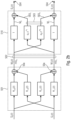
- FIG. 2 b shows a signal block diagram of convulsive mixing and mixing process
- block 510 permits to obtain a plurality ( 504 ) of output signals (S′ 0 , S′ 1 ), associated with different sound sources (source d , source 1 ), on the basis of a plurality ( 502 ) of input signals [e.g. microphone signals][(M 0 , M 1 ), in which signals (S 0 , S 1 ) from the sound sources (source 0 , source 1 ) are (unwantedly) combined ( 501 ).
- input signals e.g. microphone signals][(M 0 , M 1 ), in which signals (S 0 , S 1 ) from the sound sources (source 0 , source 1 ) are (unwantedly) combined ( 501 ).
- KLD Kullback-Leibler Divergence
- FIG. 7 shows an example of block 530 downstream to block 520 of FIG. 5 .
- Block 520 therefore provides P 0 (n) and P 1 (n) ( 522 ), e.g. using the formula (7) as discussed above (other techniques may be used).
- Block 530 (which may be understood as a Kullback-Leibler processor or KL processor) may be adapted to obtain a metrics 532 , which is in this case the Kullback-Leibler Divergence as calculated in formula (8).
- a quotient 702 ′ between P 0 (n) and P 1 (n) is calculated at block 702 .
- a logarithm of the quotient 702 ′ is calculated, hence, obtaining the value 706 ′.
- the logarithm value 706 ′ may be used for scaling the normalized value P 0 at scaling block 710 , hence, obtaining a product 710 ′.
- a quotient 704 ′ is calculated at block 704 .
- the logarithm 708 ′ of the quotient 704 ′ is calculated at block 704 .
- the logarithm value 708 ′ is used for scaling the normalized value at scaling block 712 , hence, obtaining the product 712 ′.
- the values 710 ′ and 712 ′ are combined to each other.
- the combined values 714 ′ are summed with each other and along the sample domain indexes at block 716 .
- the added values 716 ′ may be inverted at block 718 (e.g., scaled by ⁇ 1) to obtain the inverted value 718 ′.
- the value 716 ′ can be understood as a similarity value
- the inverted value 718 ′ can be understood as a dissimilarity value.
- Either the value 716 ′ or the value 718 ′ may be provided as metrics 532 to the optimizer 560 as explained above (value 716 ′ indicating similarity, value 718 ′ indicating dissimilarity).
- the optimizer block 530 may therefore permit to arrive at formula (8), i.e.
- the metrics 532 provides a good estimate of the validity of the scaling values a 0 and a 1 and the delay values d 0 and d 1 .
- the different candidate values for the scaling values a 0 and a 1 and the delay values d 0 and d 1 will be chosen among those candidates, which presents the lowest similarity or highest dissimilarity.
- the optimizer 5 shows a random generator 540 providing a random input 542 to the optimizer 560 ).
- the optimizer 560 may make use of weights through which the candidate values 564 (a 0 , a 1 , d 0 , d 1 ) are scaled (e.g., randomly).
- Initial coefficient weights 562 may be provided, e.g., by default.
- An example of processing of the optimizer 560 is provided and discussed profusely below (“algorithm 1”). Possible correspondences between the lines of the algorithm and elements of FIG. 5 are also shown in FIG. 5 .
- the optimizer 564 outputs a vector 564 of values a 0 , a 1 , d 0 , d 1 , which are subsequently reused at the mixing block 510 for obtaining new values 512 , new normalized values 522 , and new metrics 532 .
- a maximum numbers of iterations may be, for example, a number chosen between 10 and 20.
- the optimizer 560 may be understood as finding the delay and iteration values, which minimize an objective function, which could be, for example, the metrics 532 obtained at block 530 and/or using formulas (6) and (8).
- the candidates' vector (indicated the subsequent values of a 0 , a 1 , d 0 , d 1 ) may be iteratively refined by modifying candidate vectors in random directions. For example, following the random input 542 , different candidate values may be modified by using different weights that vary randomly. Random directions may mean, for example, that while some candidate values are increased, other candidate values are decreased, or vice versa, without a predefined rule. Also the increments of the weights may be random, even though a maximum threshold may be predefined.
- a multi-channel input signal 502 formed by two input channels (e.g., M 0 , M 1 ).
- two input channels e.g., M 0 , M 1 .
- the same examples above also apply also for more than two channels.
- the logarithms may be in any base. It may be imagined that the base discussed above is 10.
- One goal is a system for teleconferencing, for the separation of two speakers, or a speaker and a musical instrument or noise source, in a small office environment, not too far from a stereo microphone, as in available stereo webcams.
- the speakers or sources are assumed to be on opposing (left-right) sides of the stereo microphone.
- To be useful in real time teleconferencing we want it to work online with as low delay as possible. For comparison, in this paper we focus on an offline implementation. Proposed approach works in time domain, using attenuation factors and fractional delays between microphone signals to minimize cross-talk, the principle of a fractional delay and sum beamformer.
- Our system is for applications where we have two microphones and want to separate two audio sources. This could be for instance a teleconferencing scenario with a stereo webcam in an office and two speakers around it, or for hearing aids, where low computational complexity is important.
- a problem that occurs here is a permutation in the sub-bands, the separated sources can appear in different orders in different subbands; and the gain for different sources in different subbands might be different, leading to a modified spectral shape, a spectral flattening. Also we have a signal delay resulting from applying an STFT. It needs the assembly of the signal into blocks, which needs a system delay corresponding to the block size [9, 10].
- FIG. 1 showing a setup of loudspeakers and microphones in the simulation
- s 0 (n) and s 1 (n) as our two time domain sound signals at the time instant (sample index) n, and their z-transforms as S 0 (z) and S 1 (z).
- the two microphone signals (collectively indicated with 502 ) are m 0 (n) and m 1 (n), and their z-transforms are M 0 (z) and M 1 (z) ( FIG. 2 ).
- the Room Impulse Responses (RIRs) from the i's source to the j's microphone are h i,j (n), and their z-transform H i,j (z).
- RIRs Room Impulse Responses
- H 1,1 ⁇ 1 (z) ⁇ H 1,0 (z) and H 0,0 ⁇ 1 (z) ⁇ H 0,1 (z) are now relative room transfer functions.
- FIG. 1 An example is provided here with reference to FIG. 1 : assume two sources in a free field, without any reflections, symmetrically on opposing sides around a stereo microphone pair.
- the sound amplitude shall decay according to the function k/(m i 2 ) with some constant k.
- the fractional delay allpass filter for implementing the delay z d i of eq. (5) plays an important role in our scheme, because it produces an IIR filter out of just a single coefficient, and allows for implementation of a precise fractional delay (where the precise delay is not an integer value), needed for good cross-talk cancellation.
- P(n) and Q(n) are probability distributions of our (unmixed) microphones channels, and n runs over the discrete distributions.
- P i ⁇ ( n ) ⁇ s i ′ ⁇ ( n ) ⁇ ⁇ ⁇ s i ′ ⁇ ⁇ 1 ( 7 )
- n now is the time domain sample index.
- P i (n) has similar properties with that of a probability, namely:
- the algorithm starts with a fixed starting point [1.0, 1.0, 1.0, 1.0], which we found to lead to robust convergence behaviour. Then it perturbs the current point with a vector of uniformly distributed random numbers between ⁇ 0.5 and +0.5 (the random direction), element-wise multiplied with our weight vector (line 10 in Algorithm 1). If this perturbed point has a lower objective function value, we choose it as our next current point, and so on.
- the pseudo code of the optimization algorithm can be seen in Algorithm 1.
- minabskl_i (indicated as negabskl_i in Algorithm 1) is our objective function that computes KLD from the coefficient vector coeffs and the microphone signals in array X.
- the optimization may be performed, or example, at block 560 (see above).
- Algorithm 1 is shown here below.
- the room impulse response simulator based on the image model technique [26, 27] was used to generate room impulse responses.
- the room size have been chosen to be 7 m ⁇ 5 m ⁇ 3 m.
- the microphones were positioned in the middle of the room at [3.475, 2.0, 1.5]m and [3.525, 2.0, 1.5]m, and the sampling frequency was 16 kHz.
- Ten pairs of speech signals were randomly chosen from the whole TIMIT data-set and convolved with the simulated RIRs. For each pair of signals, the simulation was repeated 16 times for random angle positions of the sound sources relatively to microphones, for 4 different distances and 3 reverberation times (RT60).
- the common parameters used in all simulations are given in Table 1 and a visualization of the setup can be seen in FIG. 1 .
- the evaluation of the separation performance was done objectively by computing the Signal-to-Distortion Ratio (SDR) measure [28], as the original speech sources are available, and the computation time. The results are shown in FIG. 3 .
- FIG. 3 shows performance evaluation of BSS algorithms applied to simulated data
- Results show that our system, despite its simplicity, is competitive in its separation performance, but has much lower computational complexity and no system delay. This also enables an online adaption for real time minimum delay applications and for moving sources (like a moving speaker). These properties make AIRES well suited for real time applications on small devices, like hearing aids or small teleconferencing setups.
- a test program of AIRES BSS is available on our GitHub [30].
- Multichannel or stereo audio source separation method and update method for it. It minimizes an objective function (like mutual information), and uses crosstalk reduction by taking the signal from the other channel(s), apply an attenuation factor and a (possible fractional) delay to it, and subtract it from the current channel, for example. It uses the method of “random directions” to update the delay and attenuation coefficients, for example.
- a goal is to separate sources with multiple microphones (here: 2). Different microphones pick up sound with different amplitudes and delays. Discussion below takes into account programming examples in Python. This is for easier understandability, to test if and how algorithms work, and for reproducibility of results, to make algorithms testable and useful for other researchers.
- Each bullet point may be independent from the other ones and may, alone or in combination with other features (e.g. other bullet points), or other features discussed above or below complement or further specify at least some of the examples above and/or below and/or some of the features disclosed in the claims.
- the ear mainly uses 2 effects to estimate the special direction of sound:
- FIG. 2 a A stereo teleconferencing setup. Observe the signal delays between the microphones.
- a - 1 1 1 - a 0 ⁇ z - d 0 - d 1 ⁇ [ 1 a 0 ⁇ z - d 0 a 1 ⁇ z - d 1 1 ]
- FIG. 6 a shows objective functions for an example signal and example coefficients. Observe that the functions have indeed the same minima! “abskl” is Kullback-Leibler on the absolute values of the signal, and is the smoothest.
- FIG. 6 b Used low pass filter, magnitude frequency response.
- the x-axis is the normalized frequency, with 2 ⁇ being the sampling frequency.
- FIG. 6 c Objective functions for the low pass filtered example signal and example coefficients. Observe that the functions now have indeed mainly 1 minimum!
- examples may be implemented in hardware.
- the implementation may be performed using a digital storage medium, for example a floppy disk, a Digital Versatile Disc (DVD), a Blu-Ray Disc, a Compact Disc (CD), a Read-only Memory (ROM), a Programmable Read-only Memory (PROM), an Erasable and Programmable Read-only Memory (EPROM), an Electrically Erasable Programmable Read-Only Memory (EEPROM) or a flash memory, having electronically readable control signals stored thereon, which cooperate (or are capable of cooperating) with a programmable computer system such that the respective method is performed. Therefore, the digital storage medium may be computer readable.
- DVD Digital Versatile Disc
- CD Compact Disc
- ROM Read-only Memory
- PROM Programmable Read-only Memory
- EPROM Erasable and Programmable Read-only Memory
- EEPROM Electrically Erasable Programmable Read-Only Memory
- flash memory having electronically readable control signals stored thereon, which cooperate (or are capable of
- examples may be implemented as a computer program product with program instructions, the program instructions being operative for performing one of the methods when the computer program product runs on a computer.
- the program instructions may for example be stored on a machine readable medium.
- Examples comprise the computer program for performing one of the methods described herein, stored on a machine-readable carrier.
- an example of method is, therefore, a computer program having a program-instructions for performing one of the methods described herein, when the computer program runs on a computer.
- a further example of the methods is, therefore, a data carrier medium (or a digital storage medium, or a computer-readable medium) comprising, recorded thereon, the computer program for performing one of the methods described herein.
- the data carrier medium, the digital storage medium or the recorded medium are tangible and/or non-transitionary, rather than signals which are intangible and transitory.
- a further example comprises a processing unit, for example a computer, or a programmable logic device performing one of the methods described herein.
- a further example comprises a computer having installed thereon the computer program for performing one of the methods described herein.
- a further example comprises an apparatus or a system transferring (for example, electronically or optically) a computer program for performing one of the methods described herein to a receiver.
- the receiver may, for example, be a computer, a mobile device, a memory device or the like.
- the apparatus or system may, for example, comprise a file server for transferring the computer program to the receiver.
- a programmable logic device for example, a field programmable gate array
- a field programmable gate array may cooperate with a microprocessor in order to perform one of the methods described herein.
- the methods may be performed by any appropriate hardware apparatus.
Landscapes
- Engineering & Computer Science (AREA)
- Physics & Mathematics (AREA)
- Theoretical Computer Science (AREA)
- General Physics & Mathematics (AREA)
- Computational Linguistics (AREA)
- Computing Systems (AREA)
- Software Systems (AREA)
- Evolutionary Computation (AREA)
- Multimedia (AREA)
- Mathematical Physics (AREA)
- General Engineering & Computer Science (AREA)
- Data Mining & Analysis (AREA)
- Artificial Intelligence (AREA)
- Signal Processing (AREA)
- Audiology, Speech & Language Pathology (AREA)
- Human Computer Interaction (AREA)
- Health & Medical Sciences (AREA)
- Quality & Reliability (AREA)
- Acoustics & Sound (AREA)
- Pure & Applied Mathematics (AREA)
- Probability & Statistics with Applications (AREA)
- Algebra (AREA)
- Mathematical Optimization (AREA)
- Mathematical Analysis (AREA)
- Computational Mathematics (AREA)
- Circuit For Audible Band Transducer (AREA)
- Stereophonic System (AREA)
Abstract
Description
-
- wherein the apparatus is configured to combine a first input signal [M0], or a processed [e.g. delayed and/or scaled] version thereof, with a delayed and scaled version [a1·z−d1·M1] of a second input signal [e.g. M1] [e.g. by subtracting the delayed and scaled version of the second input signal from the first input signal, e.g. by S′0=M0(z)−a1·z−d1·M1(z)], to obtain a first output signal [S′0];
-
- a first scaling value [a0], which is used to obtain the delayed and scaled version [a0·z−d0·M 0] of the first input signal [M0];
- a first delay value [do], which is used to obtain the delayed and scaled version [a0·z−d0·M 0] of the first input signal [M0];
- a second scaling value [a1], which is used to obtain the delayed and scaled version [a1·z−d1·M1] of the second input signal [M1]; and
- a second delay value [d1], which is used to obtain the delayed and scaled version of the second input signal [a1·z−d1·M1].
-
- a respective element [Pi(n), with i being 0 or 1] of a first set of normalized magnitude values [e.g., as in formula (7)], and
- a logarithm of a quotient formed on the basis of:
- the respective element [P(n) or P1(n)] of the first set of normalized magnitude values; and
- a respective element [Q(n) or Q1(n)] of a second set of normalized magnitude values,
- in order to obtain a value [DKL(P∥Q) or D(P0,P1) in formulas (6) or (8)] describing a similarity [or dissimilarity] between a signal portion [s0′(n)] described by the first set of normalized magnitude values [P0(n), for n=1 to . . . ] and a signal portion [s1′(n)] described by the second set of normalized magnitude values [P1(n), for n=1 to . . . ].
-
- wherein the apparatus is configured to combine a first input signal [M0], or a processed [e.g. delayed and/or scaled] version thereof, with a delayed and scaled version [a1·z−d1·M1] of a second input signal [M1], to obtain a first output signal [S′0], wherein the apparatus is configured to apply a fractional delay [d1] to the second input signal [M1] [wherein the fractional delay (d1) may be indicative of the relationship and/or difference between the delay (e.g. delay represented by H1,0) of the signal (H1,0·S1) arriving at the first microphone (mic0) from the second source (source1) and the delay (e.g. delay represented by H1,1) of the signal (H1,1·S1) arriving at the second microphone (mic1) from the second (source1)][in examples, the fractional delay d1 may be understood as approximating the exponent of the z term of the result of the fraction H1,0(z)/H1,1(z)];
- wherein the apparatus is configured to combine a second input signal [M1], or a processed [e.g. delayed and/or scaled] version thereof, with a delayed and scaled version [a0·z−d0·M0] of the first input signal [M0], to obtain a second output signal [S′1], wherein the apparatus is configured to apply a fractional delay [d0] to the first input signal [M0] [wherein the fractional delay (d0) may be indicative of the relationship and/or difference between the delay (e.g. delay represented by H0,0) of the signal (H0,0·S0) arriving at the first microphone (mic0) from the first source (source0) and the delay (e.g. delay represented by H0,1) of the signal (H0,1·S0) arriving at the second microphone (mic1) from the first source (source0)][in examples, the fractional delay d0 may be understood as approximating the exponent of the z term of the result of the fraction H0,1(z)/H0,0(z)];
- wherein the apparatus is configured to determine, using an optimization:
- a first scaling value [a0], which is used to obtain the delayed and scaled version [a0·z−d0·M0] of the first input signal [M0];
- a first fractional delay value [d0], which is used to obtain the delayed and scaled version [a0·z−d0·M0] of the first input signal [M0];
- a second scaling value [a1], which is used to obtain the delayed and scaled version [a1·z−d1·M1] of the second input signal [M1]; and
- a second fractional delay value [d1], which is used to obtain the delayed and scaled version [a1·z−d1·M1] of the second input signal [M1].
-
- a respective element [Pi(n), with i being 0 or 1] of a first set of normalized magnitude values [e.g., as in formula (7)], and
- a logarithm of a quotient formed on the basis of:
- the respective element [P(n) or Pi(n)] of the first set of normalized magnitude values; and
- a respective element [Q(n) or Q1(n)] of a second set of normalized magnitude values,
- in order to obtain a value [DKL(P∥Q) or D(P0,P1) in formulas (6) or (8)] describing a similarity [or dissimilarity] between a signal portion [s0′(n)] described by the first set of normalized magnitude values [P0(n), for n=1 to . . . ] and a signal portion [s1′(n)] described by the second set of normalized magnitude values [P1(n), for n=1 to . . . ].
-
- wherein the apparatus is configured to combine a first input signal [M0], or a processed [e.g. delayed and/or scaled] version thereof, with a delayed and scaled version [a1·z−d1·M1] of a second input signal [M1] [e.g. by subtracting the delayed and scaled version of the second input signal from the first input signal], to obtain a first output signal [S′0],
- wherein the apparatus is configured to combine a second input signal [M1], or a processed [e.g. delayed and/or scaled] version thereof, with a delayed and scaled version [a0·z−d0·M0] of the first input signal [M0] [e.g. by subtracting the delayed and scaled version of the first input signal from the second input signal], to obtain a second output signal [S′1],
- wherein the apparatus is configured to sum a plurality of products [e.g., as in formula (6) or (8)] between:
- a respective element [Pi(n), with i being 0 or 1] of a first set of normalized magnitude values [e.g., as in formula (7)], and
- a logarithm of a quotient formed on the basis of:
- the respective element [P(n) or P1(n)] of the first set of normalized magnitude values; and
- a respective element [Q(n) or Q1(n)] of a second set of normalized magnitude values,
- in order to obtain a value [DKL(P∥Q) or D(P0,P1) in formulas (6) or (8)] describing a similarity [or dissimilarity] between a signal portion [s0′(n)] described by the first set of normalized magnitude values [P0(n), for n=1 to . . . ] and a signal portion [s1′(n)] described by the second set of normalized magnitude values [P1(n), for n=1 to . . . ].
-
- a first scaling value [a1], which is used to obtain the delayed and scaled version of the first input signal [M0],
- a first delay value [d0], which is used to obtain the delayed and scaled version of the first input signal,
- a second scaling value [a1], which is used to obtain the delayed and scaled version of the second input signal, and
- a second delay value [d1], which is used to obtain the delayed and scaled version of the second input signal, using an optimization [e.g. on the basis of a “modified KLD computation”]
-
- combine the first input signal [M0], or a processed [e.g. delayed and/or scaled] version thereof, with the delayed and scaled version [a1·z−d1·M1] of the second input signal [M1] in the time domain and/or in the z transform or frequency domain;
- combine the second input signal [M1], or a processed [e.g. delayed and/or scaled] version thereof, with the delayed and scaled version [a0·z−d0·M 0] of the first input signal [M0] in the time domain and/or in the z transform or frequency domain.
-
- the signal [S0·H0,0(z)] from the first source [source0] received by the first microphone [mic0]; and
- the signal [S0·H0,1(z)] from the first source [source0] received by the second microphone [mic0].
-
- the signal [S1·H1,1(z)] from the second source [source1] received by the second microphone [mic1]; and
- the signal [S1·H1,0(z)] from the second source [source1] received by the first microphone [mic0].
-
- the amplitude of the signal [S0·H0,0(z)] received by the first microphone [mic0] from the first source [source0]; and
- the amplitude of the signal [S0·H0,1(z)] received by the second microphone [mic1] from the first source [source0].
-
- the amplitude of the signal [S1·H1,1(z)] received by the second microphone [mic1] from the second source [source1]; and
- the amplitude of the signal [S1·H1,0(z)] received by the first microphone [mic0] from the second source [source1].
-
- for each of the first and second signals [M0, M1], a respective element [Pi(n), with i being 0 or 1] of a first set of normalized magnitude values [e.g., as in formula (7)]. [a trick may be: considering the normalized magnitude values of the time domain samples as probability distributions, and after that measuring the metrics (e.g., as the Kullback-Leibler divergence, e.g. as obtained though formula (6) or (8))]
-
- the respective element [P(n) or Pi(n)] of the first set of normalized magnitude values; and
- a respective element [Q(n) or Q1(n)] of a second set of normalized magnitude values,
- in order to obtain a value [DKL(P∥Q) or D(P0,P1) in formulas (6) or (8)] describing a similarity [or dissimilarity] between a signal portion [s0′(n)] described by the first set of normalized magnitude values [P0(n), for n=1 to . . . ] and a signal portion [s1′(n)] described by the second set of normalized magnitude values [Pi(n), for n=1 to . . . ].
wherein P(n) is an element associated to the first input signal [e.g., P1(n) or element of the first set of normalized magnitude values] and Q(n) is an element associated to the second input signal [e.g., P2(n) or element of the second set of normalized magnitude values].
-
- wherein the optimizer is configured to evaluate an objective function associated to a similarity, or dissimilarity, between physical signals, in association to the current candidate vector,
- wherein the optimizer is configured so that, in case the current candidate vector causes the objective function to be reduced with respect to the current best candidate vector, to render, as the new current best candidate vector, the current candidate vector.
-
- a respective element [Pi(n), with i being 0 or 1] of a first set of normalized magnitude values [e.g., as in formula (7)], and
- a logarithm of a quotient formed on the basis of:
- the respective element [P(n) or P1(n)] of the first set of normalized magnitude values; and
- a respective element [Q(n) or Q1(n)] of a second set of normalized magnitude values,
- in order to obtain a value [DKL(P∥Q) or D(P0,P1) in formulas (6) or (8)] describing a similarity [or dissimilarity] between a signal portion [s0′(n)] described by the first set of normalized magnitude values [P0(n), for n=1 to . . . ] and a signal portion [s1′(n)] described by the second set of normalized magnitude values [P1(n), for n=1 to . . . ].
wherein Pi(n) or P(n) is an element associated to the first input signal [e.g., P1(n) or element of the first set of normalized magnitude values] and P2(n) or Q(n) is an element associated to the second input signal.
-
- the method comprising:
- combining a first input signal [M0], or a processed [e.g. delayed and/or scaled] version thereof, with a delayed and scaled version [a1·z−d1·M1] of a second input signal [M1] [e.g. by subtracting the delayed and scaled version of the second input signal from the first input signal, e.g. by S′0=M0(z)−a1·z−d1·M1(z)], to obtain a first output signal [S′0];
- combining a second input signal [M1], or a processed [e.g. delayed and/or scaled] version thereof, with a delayed and scaled version [a0·z−d0·M0] of the first input signal [M0] [e.g. by subtracting the delayed and scaled version of the first input signal from the second input signal, e.g. by S′1=M1(z)−a0·z−d0·M0(z)], to obtain a second output signal [S′1];
- determining, using a random direction optimization [e.g. by performing one of operations defined in other claims, for example; and/or by finding the delay and attenuation values which minimize an objective function, which could be, for example that in formulas (6) and/or (8)]:
- a first scaling value [a0], which is used to obtain the delayed and scaled version [a0*z−d0*M0] of the first input signal [M0];
- a first delay value [d0], which is used to obtain the delayed and scaled version [a0*z−d0*M0] of the first input signal [M0];
- a second scaling value [a1], which is used to obtain the delayed and scaled version [a1*z−d1*M1] of the second input signal [M1]; and
- a second delay value [d1], which is used to obtain the delayed and scaled version of the second input signal [a1*z−d1*M1].
-
- the method including
- combining a first input signal [M0], or a processed [e.g. delayed and/or scaled] version thereof, with a delayed and scaled version [a1*z−d1*M1] of a second input signal [M1], to obtain a first output signal [S′0], wherein the method is configured to apply a fractional delay [d1] to the second input signal [M1] [wherein the fractional delay (d1) may be indicative of the relationship and/or difference between the delay (e.g. delay represented by H1,0) of the signal (H1,0*S1) arriving at the first microphone (mic0) from the second source (source1) and the delay (e.g. delay represented by H1,1) of the signal (H1,1*S1) arriving at the second microphone (mic1) from the second (source1)][in examples, the fractional delay d1 may be understood as approximating the exponent of the z term of the result of the fraction H1,0(z)/H1,1(z)];
-
- determining, using an optimization:
- a first scaling value [a0], which is used to obtain the delayed and scaled version [a0*z−d0*M0] of the first input signal [M0];
- a first fractional delay value [d0], which is used to obtain the delayed and scaled version [a0*z−d0*M0] of the first input signal [M0];
- a second scaling value [a1], which is used to obtain the delayed and scaled version [a1*z−d1*M1] of the second input signal [M1]; and
- a second fractional delay value [d1], which is used to obtain the delayed and scaled version [a1*z−d1*M1] of the second input signal [M1].
- determining, using an optimization:
-
- combining a first input signal [M0], or a processed [e.g. delayed and/or scaled] version thereof, with a delayed and scaled version [a1*z−d1*M1] of a second input signal [M1] [e.g. by subtracting the delayed and scaled version of the second input signal from the first input signal], to obtain a first output signal [S′0],
- combining a second input signal [M1], or a processed [e.g. delayed and/or scaled] version thereof, with a delayed and scaled version [a0*z−d0*M0] of the first input signal [M0] [e.g. by subtracting the delayed and scaled version of the first input signal from the second input signal], to obtain a second output signal [S′1],
- summing a plurality of products [e.g., as in formula (6) or (8)] between:
- a respective element [Pi(n), with i being 0 or 1] of a first set of normalized magnitude values [e.g., as in formula (7)], and
- a logarithm of a quotient formed on the basis of:
- the respective element [P(n) or P1(n)] of the first set of normalized magnitude values; and
- a respective element [Q(n) or Q1(n)] of a second set of normalized magnitude values,
- in order to obtain a value [DKL(P∥Q) or D(P0,P1) in formulas (6) or (8)] describing a similarity [or dissimilarity] between a signal portion [s0′(n)] described by the first set of normalized magnitude values [P0(n), for n=1 to . . . ] and a signal portion [s1′(n)] described by the second set of normalized magnitude values [P1(n), for n=1 to . . . ].
-
- a first output signal S0′(z) (representing the sound S0 collected at microphone mic0 but polished from the crosstalk), which includes at least the two components:
- the input signal M0 and
- a subtractive component 503 1 (which is a delayed and/or scaled version of the signal M1 and which may be being obtained by subjecting the signal M1 to the transfer function −a1·z−d
1 )
- an output signal S1′ (z) (representing the sound S1 collected at microphone mic1 but polished from the crosstalk) which includes:
- the input signal M1 and
- a subtractive component 503 0 (which is a delayed and/or scaled version of the first input signal M0 as obtained at the microphone mic0 and which may be obtained by subjecting the signal M0 to the transfer function −a0·z−d
0 ).
- a first output signal S0′(z) (representing the sound S0 collected at microphone mic0 but polished from the crosstalk), which includes at least the two components:
-
- a first scaling value [a0], e.g., which is used to obtain the delayed and scaled version 503 0 [a0·z−d0·M0] of the first input signal [502, M0];
- a first fractional delay value [d0], e.g., which is used to obtain the delayed and scaled version 503 0[a0·z−d0·M0] of the first input signal [502, M0];
- a second scaling value [a1], e.g., which is used to obtain the delayed and scaled version 503 1 [a1·z−d1·M1] of the second input signal [502, M1]; and
- a second fractional delay value [d1], e.g., which is used to obtain the delayed and scaled version 503 1 [a1·z−d1·M1] of the second input signal [502, M1].
-
- 1. Pi(n)≥0, ∀n
- 2. Σn=0 ∞Pi(n)=1
with i=0,1 (further discussion is provided here below). “∞” is used for mathematical formalism, but can approximated over the considered signal.
In order to arrive at formula (6), e.g. DKL, it could simply be possible to eliminate, from
M(z)=H(z)·S(z) (2)
H i,i −1(z)·H i,j(z)≈a i z −d
where i,j∈{0,1}.
and one relative room transfer function is
the same for the other relative room transfer function. We see that in this simple case the relative room transfer function is indeed 0.825·z−5, exactly an attenuation and a delay. The signal flowchart of convolutive mixing and demixing process can be seen in
2.1. The Fractional Delay Allpass Filter
where D (z) is of order L=[τ], defined as:
The filter d(n) is generated as:
for 0≤n≤(L−1).
2.2. Objective Function
where n now is the time domain sample index. Notice, that Pi(n) has similar properties with that of a probability, namely:
-
- 1. Pi(n)≤0, ∀n.
- 2. Σn=0 ∞Pi(n)=1.
with i=0, 1. Instead of using the Kullback-Leibler Divergence directly, we turn our objective function into a symmetric (distance) function by using the sum DKL(P∥Q)+DKL(Q∥P), because this makes our separation more stable between the two channels. In order to apply minimization instead of maximization, we take its negative value. Hence our resulting objective function D(P0,P1) is
2.3. Optimization
| |
| 1: | procedure OPTIMIZE SEPARATION COEFFICIENTS(X) |
| 2: | INITIALIZATION |
| 3: | X ← convolutive mixture |
| 4: | init_coeffs = [1.0, 1.0, 1.0, 1.0] ← |
| initial guess for separation coefficients | |
| 5: | coeffweights ← weights for random search |
| 6: | coeffs = init_coeffs ← separation coefficients |
| 7: | negabskl_0(coeffs, X) ← calculation of KLD |
| 8: | OPTIMIZATION ROUTINE |
| 9: | loop: |
| 10: | coeffvariation=(random(4)*coeffweights) ← |
| random variation of separation coefficients | |
| 11: | negabskl_l (coeffs+coeffvariation, X) ← |
| calculation of new KLD | |
| 12: | if negabskl_l < negabskl_0 then |
| 13: | negabskl_0 = negabskl_1 |
| 14: | coeffs = coeffs+coeffvariation ← |
| update separation coefficients | |
3. Experimental Results
| TABLE 1 |
| Parameters used in simulation: |
| Room dimensions | 7 m × 5 m × 3 m | ||
| Microphones displacement | 0.05 m | ||
| Reverberation time RT60 | 0.05, 0.1, 0.2 s | ||
| Amount of |
10 random mixes | ||
| Conditions for each mix | 16 random angles × | ||
| 4 distances | |||
-
- (a) RT60=0.05 s
- (b) RT60=0.1 s
- (c) RT60=0.2 s
| TABLE 2 |
| Comparison of average computation time (simulated datasets). |
| BSS | AIRES | TRINICON | ILRMA | AuxIVA |
| Computation | 0.05 s | 23.4 s | 4.4 s | 0.6 s |
| time | ||||
3.2. Real-Life Experiment
| TABLE 3 |
| Comparison of separation performance using |
| Mean Mutual Information (MI, real recordings). |
| BSS | AIRES | TRINICON | ILRMA | AuxIVA |
| Mean MI | 0.5 | 0.47 | 0.52 | 0.52 |
| Mean Computation | 0.22 s | 120.2 s | 7.86 s | 1.5 s |
| time | ||||
-
- 1: A multichannel or stereo source separation method, whose coefficients for the separation are iteratively updated by adding a random update vector, and if this update results in an improved separation, keeping this update for the next iteration; otherwise discard it.
- 2: A method according to
aspect 1 with suitable fixed variances for the random update for each coefficient. - 3: A method according to
aspect - 4: A method according to
aspect
-
- 1) A method of online optimization of parameters, which minimizes an objective function with a multi-dimensional input vector x, by first determining a test vector from a given vicinity space, then update the previous best vector with the search vector, and if the such obtained value of the objective function, this updated vector becomes the new best, otherwise it is discarded.
- 2) Method of
aspect 1, applied to the task of separating N sources in an audio stream of N channels, where coefficient vector consists of delay and attenuation values needed to cancel unwanted sources. - 3) Method of
aspect 2, applied to task of teleconferencing with more than 1 speaker on one or more sites. - 4) Method of
aspect 2, applied to the task of separating audio sources before encoding them with audio encoders. - 5) Method of
aspect 2, applied to the task of separating a speech source from music or noise source(s).
Additional Aspects
-
- Interaural Level Differences (ILD)
- Interaural Time Differences (ITD)
- Music from studio recordings mostly use only level differences (no time differences), called “panning”.
- Signal from stereo Microphones, for instance from stereo webcams, show mainly time differences, and not much level differences.
Stereo Recording with Stereo Microphones - The setup with stereo microphones with time differences.
- Observe: The effect of the sound delays from the finite speed of sound and attenuations can be described by a mixing matrix with delays.
-
- The case with no time differences (panning only) is the easier one
- Normally, Independent Component Analysis is used
- It computes an “unmixing” matrix which produces statistically independent signals.
- Remember: joint entropy of two signals X and Y is H(X, Y)
- The conditional entropy is H(X|Y)
- Statistically independent also means: H(X|Y)=H(X), H(X, Y)=H(X)+H(Y)
- Mutual information: I(X, Y)=H(X, Y)−H(X|Y)−H(Y|X)≥0, for independence it becomes 0
- In general the optimization minimizes this mutual information.
ITD Previous Approach - The ITD case with time differences is more difficult to solve
- The “Minimum Variance Principle” tries to suppress noise from a microphone array
- It estimates a correlation matrix of the microphone channels, and applies a Principle Component Analysis (PCA) or Karhounen-Loeve Transform (KLT).
- This de-correlates the resulting channels.
- The channels with the lowest Eigenvalues are assumed to be noise and set to zero
ITD Previous Approach Example - For our stereo case, we only get 2 channels, and compute and play the signals with the larger and smaller Eigenvalue: python KLT_separation.py
- Observe: The channel with the larger Eigenvalue seem to have the lower frequencies, the other the (weaker) higher frequencies, which are often just noise.
ITD, New Approach - Idea: the unmixing matrix needs signal delays for unmixing, for inverting the mixing matrix
- Important simplification: we assume only a single signal delay path between the microphones for each of the 2 sources.
- In reality there are multiple delays from room reflections, but usually much weaker than the direct path.
Stereo Separation, ITD, New Approach
-
- Hence we need to use non-convex optimization Python has a very powerful non-convex optimization method:
- scipy.optimize.differential_evolution. We call it with coeffs_minimized=opt.differential_evolution(mutualinfocoeffs, bounds, args=(X,),tol=1e−4, disp=True)
Alternative Objective Functions
i runs over the (discrete) distributions. To avoid computing histograms, we simply treat the normalized magnitudes of our time domain samples as a probability distribution as a trick. Since these are dissimilarity measure, they need to be maximized, hence their negative values need to be minimized.
Kullback-Leibler Python Function
-
- def minabsklcoeffs(coeffs,X):
| #computes the normalized magnitude of the channels and then applies |
| #the Kullback-Leibler divergence |
| X_prime=unmixing(coeffs,X) |
| X_abs=np.abs(X_prime) |
| #normalize to sum( )=1, to make it look like a probability: |
| X_abs[:,0]=X_abs[:,0]/np.sum(X_abs[:,0] |
| X_abs[:,1]=X_abs[:,1]/np.sum(X_abs[:,1]) |
| #print(“Kullback-Leibler Divergence calculation”) |
| abskl= np.sum( X_abs[:,0] * np.log((X_abs[:,0]+1e−6) / |
| (X_abs[:,1]+1e−6)) → ) |
| return −abskl |
-
- (here minabsklcoeffs correspondd to minabsk_i in Algorithm 1)
Comparison of Objective Functions
- (here minabsklcoeffs correspondd to minabsk_i in Algorithm 1)
-
- Optimization using mutual information: python
- ICAmutualinfo_puredelay.py
- (this needs ca. 121 slower iterations)
- Optimization using Kullback-Leibler: python ICAabskl_puredelay.py
- (this needs ca. a. 39 faster iterations)
- Listening to the resulting signals confirms that they are really separated enough for intelligibility, where they were not before.
Further Speeding up Optimization
-
- We can now try convex optimization, for instance the method of Conjugate Gradients.
- python ICAabskl_puredelay_lowpass.py
- Observe: The optimization finished successfully almost instantaneously!
- The resulting separation has the same quality as before.
Other Explanations
- [1] A. Hyvärinen, J. Karhunen, and E. Oja, “Independent component analysis.” John Wiley & Sons, 2001.
- [2] G. Evangelista, S. Marchand, M. D. Plumbley, and E. Vincent, “Sound source separation,” in DAFX: Digital Audio Effects, second edition ed. John Wiley and Sons, 2011.
- [3] J. Tariqullah, W. Wang, and D. Wang, “A multistage approach to blind separation of convolutive speech mixtures,” in Speech Communication, 2011, vol. 53, pp. 524-539.
- [4] J. Benesty, J. Chen, and E. A. Habets, “Speech enhancement in the SIFT domain,” in Springer, 2012.
- [5] J. Janský, Z. Koldovský, and N. Ono, “A computationally cheaper method for blind speech separation based on auxiva and incomplete demixing transform,” in IEEE International Workshop on Acoustic Signal Enhancement (IWAENC), Xi'an, China, 2016.
- [6] D. Kitamura, N. Ono, H. Sawada, H. Kameoka, and H. Saruwatari, “Determined blind source separation unifying independent vector analysis and nonnegative matrix factorization,” in IEEE/ACM Trans. ASLP, vol. 24, no. 9, 2016, pp. 1626-1641.
- [7] “Determined blind source separation with independent low-rank matrix analysis,” in Springer, 2018, p. 31.
- [8] H.-C. Wu and J. C. Principe, “Simultaneous diagonalization in the frequency domain (sdif) for source separation,” in Proc. ICA, 1999, pp. 245-250.
- [9] H. Sawada, N. Ono, H. Kameoka, and D. Kitamura, “Blind audio source separation on tensor representation,” in ICASSP, April 2018.
- [10] J. Harris, S. M. Naqvi, J. A. Chambers, and C. Jutten, “Realtime independent vector analysis with student's t source prior for convolutive speech mixtures,” in IEEE International Conference on Acoustics, Speech, and Signal Processing, ICASSP, April 2015.
- [11] H. Buchner, R. Aichner, and W. Kellermann, “Trinicon: A versatile framework for multichannel blind signal processing,” in IEEE International Conference on Acoustics, Speech, and Signal Processing, Montreal, Que., Canada, 2004.
- [12] J. Chua, G. Wang, and W. B. Kleijn, “Convolutive blind source separation with low latency,” in Acoustic Signal Enhancement (IWAENC), IEEE International Workshop, 2016, pp. 1-5.
- [13] W. Kleijn and K. Chua, “Non-iterative impulse response shortening method for system latency reduction,” in Acoustics, Speech and Signal Processing (ICASSP), 2017, pp. 581-585.
- [14] I. Senesnick, “Low-pass filters realizable as all-pass sums: design via a new flat delay filter,” in IEEE Transactions on Circuits and Systems II: Analog and Digital Signal Processing, vol. 46, 1999.
- [15] T. I. Laakso, V. Välimäki, M. Karjalainen, and U. K. Laine, “Splitting the unit delay,” in IEEE Signal Processing Magazine, January 1996.
- [16] M. Brandstein and D. Ward, “Microphone arrays, signal processing techniques and applications,” in Springer, 2001.
- “Beamforming,” http://www.labbookpages.co.uk/audio/beamforming/delaySum.html, accessed: 2019-04-21.
- [18] Benesty, Sondhi, and Huang, “Handbook of speech processing,” in Springer, 2008.
- [19] J. P. Thiran, “Recursive digital filters with maximally flat group delay,” in IEEE Trans. on Circuit Theory, vol. 18, no. 6, November 1971, pp. 659-664.
- [20] S. Das and P. N. Suganthan, “Differential evolution: A survey of the state-of-the-art,” in IEEE Trans. on Evolutionary Computation, February 2011, vol. 15, no. 1, pp. 4-31.
- [21] R. Storn and K. Price, “Differential evolution—a simple and efficient heuristic for global optimization over continuous spaces,” in Journal of Global Optimization. 11 (4), 1997, pp. 341-359.
- [22] “Differential evolution,” http://www1.icsi.berkeley.edu/˜storn/code.html, accessed: 2019-04-21.
- [23] J. Garofolo et al., “Timit acoustic-phonetic continuous speech corpus,” 1993.
- [24] “Microphone array speech processing,” https://github.com/ZitengWang/MASP, accessed: 2019-07-29.
- [25] “Ilrma,” https://github.com/d-kitamura/ILRMA, accessed: 2019-07-29.
- [26] R. B. Stephens and A. E. Bate, Acoustics and Vibrational Physics, London, U. K., 1966.
- [27] J. B. Allen and D. A. Berkley, Image method for efficiently simulating small room acoustics. J. Acoust. Soc. Amer., 1979, vol. 65.
- [28] C. Fevotte, R. Gribonval, and E. Vincent, “Bss eval toolbox user guide,” in Tech. Rep. 1706, IRISA Technical Report 1706, Rennes, France, 2005.
- [29] E. G. Learned-Miller, Entropy and Mutual Information. Department of Computer Science University of Massachusetts, Amherst Amherst, MA 01003, 2013.
- “Comparison of blind source separation techniques,” https://github.com/TUIImenauAMS/Comparison-of-Blind-Source-Separation-techniques, accessed: 2019-07-29.
Claims (25)
Applications Claiming Priority (4)
| Application Number | Priority Date | Filing Date | Title |
|---|---|---|---|
| EP19201575.8 | 2019-10-04 | ||
| EP19201575 | 2019-10-04 | ||
| EP19201575 | 2019-10-04 | ||
| PCT/EP2020/077716 WO2021064204A1 (en) | 2019-10-04 | 2020-10-02 | Source separation |
Related Parent Applications (1)
| Application Number | Title | Priority Date | Filing Date |
|---|---|---|---|
| PCT/EP2020/077716 Continuation WO2021064204A1 (en) | 2019-10-04 | 2020-10-02 | Source separation |
Publications (2)
| Publication Number | Publication Date |
|---|---|
| US20220230652A1 US20220230652A1 (en) | 2022-07-21 |
| US12190899B2 true US12190899B2 (en) | 2025-01-07 |
Family
ID=68158991
Family Applications (1)
| Application Number | Title | Priority Date | Filing Date |
|---|---|---|---|
| US17/657,600 Active 2041-06-18 US12190899B2 (en) | 2019-10-04 | 2022-03-31 | Apparatus and method for acquiring a plurality of audio signals associated with different sound sources |
Country Status (7)
| Country | Link |
|---|---|
| US (1) | US12190899B2 (en) |
| EP (1) | EP4038609B1 (en) |
| JP (1) | JP7373253B2 (en) |
| KR (1) | KR102713017B1 (en) |
| CN (1) | CN114586098B (en) |
| BR (1) | BR112022006331A2 (en) |
| WO (1) | WO2021064204A1 (en) |
Citations (13)
| Publication number | Priority date | Publication date | Assignee | Title |
|---|---|---|---|---|
| US20060233389A1 (en) * | 2003-08-27 | 2006-10-19 | Sony Computer Entertainment Inc. | Methods and apparatus for targeted sound detection and characterization |
| US20060239471A1 (en) * | 2003-08-27 | 2006-10-26 | Sony Computer Entertainment Inc. | Methods and apparatus for targeted sound detection and characterization |
| US20060269073A1 (en) | 2003-08-27 | 2006-11-30 | Mao Xiao D | Methods and apparatuses for capturing an audio signal based on a location of the signal |
| US20070025562A1 (en) * | 2003-08-27 | 2007-02-01 | Sony Computer Entertainment Inc. | Methods and apparatus for targeted sound detection |
| JP2009540378A (en) | 2006-06-14 | 2009-11-19 | シーメンス アウディオローギッシェ テヒニク ゲゼルシャフト ミット ベシュレンクテル ハフツング | Signal separator, method for determining an output signal based on a microphone signal, and computer program |
| US20100241433A1 (en) * | 2006-06-30 | 2010-09-23 | Fraunhofer Gesellschaft Zur Forderung Der Angewandten Forschung E. V. | Audio encoder, audio decoder and audio processor having a dynamically variable warping characteristic |
| US20150086038A1 (en) | 2013-09-24 | 2015-03-26 | Analog Devices, Inc. | Time-frequency directional processing of audio signals |
| US20150156578A1 (en) * | 2012-09-26 | 2015-06-04 | Foundation for Research and Technology - Hellas (F.O.R.T.H) Institute of Computer Science (I.C.S.) | Sound source localization and isolation apparatuses, methods and systems |
| US20160071526A1 (en) * | 2014-09-09 | 2016-03-10 | Analog Devices, Inc. | Acoustic source tracking and selection |
| US20160073198A1 (en) * | 2013-03-20 | 2016-03-10 | Nokia Technologies Oy | Spatial audio apparatus |
| US20160247518A1 (en) * | 2013-11-15 | 2016-08-25 | Huawei Technologies Co., Ltd. | Apparatus and method for improving a perception of a sound signal |
| JP2017032905A (en) | 2015-08-05 | 2017-02-09 | 沖電気工業株式会社 | Sound source separation system, method and program |
| KR20180079975A (en) | 2017-01-03 | 2018-07-11 | 한국전자통신연구원 | Sound source separation method using spatial position of the sound source and non-negative matrix factorization and apparatus performing the method |
-
2020
- 2020-10-02 WO PCT/EP2020/077716 patent/WO2021064204A1/en not_active Ceased
- 2020-10-02 BR BR112022006331A patent/BR112022006331A2/en unknown
- 2020-10-02 JP JP2022520412A patent/JP7373253B2/en active Active
- 2020-10-02 EP EP20781023.5A patent/EP4038609B1/en active Active
- 2020-10-02 KR KR1020227015147A patent/KR102713017B1/en active Active
- 2020-10-02 CN CN202080070200.8A patent/CN114586098B/en active Active
-
2022
- 2022-03-31 US US17/657,600 patent/US12190899B2/en active Active
Patent Citations (15)
| Publication number | Priority date | Publication date | Assignee | Title |
|---|---|---|---|---|
| US20060233389A1 (en) * | 2003-08-27 | 2006-10-19 | Sony Computer Entertainment Inc. | Methods and apparatus for targeted sound detection and characterization |
| US20060239471A1 (en) * | 2003-08-27 | 2006-10-26 | Sony Computer Entertainment Inc. | Methods and apparatus for targeted sound detection and characterization |
| US20060269073A1 (en) | 2003-08-27 | 2006-11-30 | Mao Xiao D | Methods and apparatuses for capturing an audio signal based on a location of the signal |
| US20070025562A1 (en) * | 2003-08-27 | 2007-02-01 | Sony Computer Entertainment Inc. | Methods and apparatus for targeted sound detection |
| JP2009540378A (en) | 2006-06-14 | 2009-11-19 | シーメンス アウディオローギッシェ テヒニク ゲゼルシャフト ミット ベシュレンクテル ハフツング | Signal separator, method for determining an output signal based on a microphone signal, and computer program |
| US20100232621A1 (en) | 2006-06-14 | 2010-09-16 | Robert Aichner | Signal separator, method for determining output signals on the basis of microphone signals, and computer program |
| US20100241433A1 (en) * | 2006-06-30 | 2010-09-23 | Fraunhofer Gesellschaft Zur Forderung Der Angewandten Forschung E. V. | Audio encoder, audio decoder and audio processor having a dynamically variable warping characteristic |
| US20150156578A1 (en) * | 2012-09-26 | 2015-06-04 | Foundation for Research and Technology - Hellas (F.O.R.T.H) Institute of Computer Science (I.C.S.) | Sound source localization and isolation apparatuses, methods and systems |
| US20160073198A1 (en) * | 2013-03-20 | 2016-03-10 | Nokia Technologies Oy | Spatial audio apparatus |
| US20150086038A1 (en) | 2013-09-24 | 2015-03-26 | Analog Devices, Inc. | Time-frequency directional processing of audio signals |
| US9420368B2 (en) * | 2013-09-24 | 2016-08-16 | Analog Devices, Inc. | Time-frequency directional processing of audio signals |
| US20160247518A1 (en) * | 2013-11-15 | 2016-08-25 | Huawei Technologies Co., Ltd. | Apparatus and method for improving a perception of a sound signal |
| US20160071526A1 (en) * | 2014-09-09 | 2016-03-10 | Analog Devices, Inc. | Acoustic source tracking and selection |
| JP2017032905A (en) | 2015-08-05 | 2017-02-09 | 沖電気工業株式会社 | Sound source separation system, method and program |
| KR20180079975A (en) | 2017-01-03 | 2018-07-11 | 한국전자통신연구원 | Sound source separation method using spatial position of the sound source and non-negative matrix factorization and apparatus performing the method |
Non-Patent Citations (29)
| Title |
|---|
| "Beamforming," http://www.labbookpages.co.uk/audio/ beamforming/delaySum.html, accessed: Apr. 21, 2019. 7 pages. |
| "Comparison of blind source separation techniques," https://github.com/TUIlmenauAMS/Comparison-of-Blind-Source-Separation-techniques, accessed: Jul. 29, 2019. 1 page. |
| "Differential evolution," http://www1.icsi.berkeley.edu/˜storn/code.html, accessed: Apr. 21, 2019. 1 page. |
| "Ilrma," https://github.com/d-kitamura/ILRMA, accessed: Jul. 29, 2019. 1 page. |
| "Microphone array speech processing," https://github.com/ZitengWang/MASP, accessed: Jul. 29, 2019. 1 page. |
| Aichner, Robert, et al. "A real-time blind source separation scheme and its application to reverberant and noisy acoustic environments." Signal Processing 86.6 (2006): 1260-1277. (online Oct. 21, 2005) (18 pages). |
| Allen et al. "Image method for efficiently simulating small room acoustics" J. Acoust. Soc. Amer., 1979, vol. 65. 8 pages. |
| Benesty et al. "Speech enhancement in the STFT domain," Jun. 30, 2011. 120 pages. |
| Buchner et al. "Trinicon: A versatile framework for multichannel blind signal processing," in IEEE International Conference on Acoustics, Speech, and Signal Processing, Montreal, Que., Canada, 2004. XP010718333 . 4 pages. |
| Chua et al. "Convolutive blind source separation with low latency," in Acoustic Signal Enhancement (IWAENC), IEEE International Workshop, 2016, pp. 1-5. 5 pages. |
| Erik G. Learned-Miller, "Entropy and Mutual Information". Department of Computer Science University of Massachusetts, Amherst, Amherst, MA 01003, 2013.4 pages. |
| Fevotte et al. "Bss eval toolbox user guide," in Tech. Rep. 1706, IRISA Technical Report 1706, Rennes, France, 2005. 22 pages. |
| G. Evangelista, S. Marchand, M. D. Plumbley, and E. Vincent, "Sound source separation," in DAFX: Digital Audio Effects, second edition ed. John Wiley and Sons, 2011.6 pages. |
| Golokolenko et al. "A Fast Stereo Audio Source Separation for Moving Sources" 2019 53RD Asilomar Conference on Signals, Systems, and Computers, IEEE, (Nov. 3, 2019), pp. 1931-1935. 5 pages. |
| Harris et al. "Realtime independent vector analysis with student's t source prior for convolutive speech mixtures," in IEEE International Conference on Acoustics, Speech, and Signal Processing, ICASSP, Apr. 2015. 6 pages. |
| Hyvärinen et al. "Independent Component Analysis" Mar. 7, 2001. 503 pages. |
| J. Garofolo et al., "Timit acoustic-phonetic continuous speech corpus," 1993. 95 pages. |
| J. P. Thiran, "Recursive digital filters with maximally flat group delay," in IEEE Trans. on Circuit Theory, vol. 18, No. 6, Nov. 1971, pp. 659-664. 6 pages. |
| J. Tariqullah et al. "A multistage approach to blind separation of convolutive speech mixtures," in Speech Communication, 2011, vol. 53, pp. 524-539. 4 pages. |
| Jansky et al. "A computationally cheaper method for blind speech separation based on auxiva and incomplete demixing transform," in IEEE International Workshop on Acoustic Signal Enhancement (IWAENC), Xi'an, China, 2016. 5 pages. |
| Khanagha et al., "Selective tap training of FIR filters for Blind Source Separation of convolutive speech mixtures" 2009 IEEE Symposium on Industrial Electronics and Applications, Kuala Lumpar, Malaysia; Oct. 4-6, 2009. 5 pages. |
| Kitamura et al. "Determined blind source separation unifying independent vector analysis and nonnegative matrix factorization," in IEEE/ACM Trans. ASLP, vol. 24, No. 9, 2016, pp. 1626-1641.16 pages. |
| Kleijn et al. "Non-iterative impulse response shortening method for system latency reduction," in Acoustics, Speech and Signal Processing (ICASSP), 2017, pp. 581-585. 5 pages. |
| Laakso et al. "Splitting the unit delay," in IEEE Signal Processing Magazine, Jan. 1996. 31 pages. |
| S. Das and P. N. Suganthan, "Differential evolution: A survey of the state-of-the-art," in IEEE Trans. on Evolutionary Computation, Feb. 2011, vol. 15, No. 1, pp. 4-31. 42 pages. |
| Sawada et al. "Blind Audio Source Separation on Tensor Representation," in ICASSP, Apr. 16, 2018, Calgary, Canada, 168 pages. |
| Senesnick et al. "Low-pass filters realizable as all-pass sums: design via a new flat delay filter," in IEEE Transactions on Circuits and Systems II: Analog and Digital Signal Processing, vol. 46, 1999. 11 pages. |
| Storn et al. "Differential evolution—a simple and efficient heuristic for global optimization over continuous spaces," in Journal of Global Optimization. 11 (4), 1997, pp. 341-359. 19 pages. |
| Wu et al. "Simultaneous Diagonalization in the Frequency Domain (SDIF) for Source Separation," in Proc. ICA, 1999, pp. 245-250. 6 pages. |
Also Published As
| Publication number | Publication date |
|---|---|
| EP4038609C0 (en) | 2023-07-26 |
| JP2023506354A (en) | 2023-02-16 |
| KR102713017B1 (en) | 2024-10-07 |
| EP4038609B1 (en) | 2023-07-26 |
| CN114586098B (en) | 2026-01-30 |
| JP7373253B2 (en) | 2023-11-02 |
| US20220230652A1 (en) | 2022-07-21 |
| KR20220104690A (en) | 2022-07-26 |
| BR112022006331A2 (en) | 2022-06-28 |
| CN114586098A (en) | 2022-06-03 |
| WO2021064204A1 (en) | 2021-04-08 |
| EP4038609A1 (en) | 2022-08-10 |
Similar Documents
| Publication | Publication Date | Title |
|---|---|---|
| Erdogan et al. | Improved MVDR beamforming using single-channel mask prediction networks | |
| US10818302B2 (en) | Audio source separation | |
| Huang et al. | A blind channel identification-based two-stage approach to separation and dereverberation of speech signals in a reverberant environment | |
| Dietzen et al. | Integrated sidelobe cancellation and linear prediction Kalman filter for joint multi-microphone speech dereverberation, interfering speech cancellation, and noise reduction | |
| Kodrasi et al. | Regularization for partial multichannel equalization for speech dereverberation | |
| Douglas et al. | Convolutive blind separation of speech mixtures using the natural gradient | |
| Braun et al. | A multichannel diffuse power estimator for dereverberation in the presence of multiple sources | |
| Lim et al. | Robust multichannel dereverberation using relaxed multichannel least squares | |
| US11483651B2 (en) | Processing audio signals | |
| Benesty et al. | Signal enhancement with variable span linear filters | |
| Dietzen et al. | Partitioned block frequency domain Kalman filter for multi-channel linear prediction based blind speech dereverberation | |
| US20220230652A1 (en) | Source separation | |
| Yoshioka et al. | Dereverberation by using time-variant nature of speech production system | |
| Lohmann et al. | Dereverberation in acoustic sensor networks using weighted prediction error with microphone-dependent prediction delays | |
| Corey et al. | Delay-performance tradeoffs in causal microphone array processing | |
| Kamo et al. | Importance of switch optimization criterion in switching wpe dereverberation | |
| Golokolenko et al. | A fast stereo audio source separation for moving sources | |
| Golokolenko et al. | The Method of Random Directions Optimization for Stereo Audio Source Separation. | |
| Borowicz | A signal subspace approach to spatio-temporal prediction for multichannel speech enhancement | |
| EP4152321A1 (en) | Apparatus and method for narrowband direction-of-arrival estimation | |
| Brendel | From blind to semi-blind acoustic source separation based on independent component analysis | |
| Li | Indoor Speech Source Localization with Direct-Path Relative Transfer Function | |
| Hu | Cross-relation based blind identification of acoustic SIMO systems and applications | |
| Kavruk | Two stage blind dereverberation based on stochastic models of speech and reverberation | |
| Pu | Speech Dereverberation Based on Multi-Channel Linear Prediction |
Legal Events
| Date | Code | Title | Description |
|---|---|---|---|
| FEPP | Fee payment procedure |
Free format text: ENTITY STATUS SET TO UNDISCOUNTED (ORIGINAL EVENT CODE: BIG.); ENTITY STATUS OF PATENT OWNER: LARGE ENTITY |
|
| STPP | Information on status: patent application and granting procedure in general |
Free format text: DOCKETED NEW CASE - READY FOR EXAMINATION |
|
| AS | Assignment |
Owner name: FRAUNHOFER-GESELLSCHAFT ZUR FOERDERUNG DER ANGEWANDTEN FORSCHUNG E.V., GERMANY Free format text: ASSIGNMENT OF ASSIGNORS INTEREST;ASSIGNOR:SCHULLER, GERALD;REEL/FRAME:060256/0568 Effective date: 20220422 |
|
| AS | Assignment |
Owner name: TECHNISCHE UNIVERSITAET ILMENAU, GERMANY Free format text: ASSIGNMENT OF ASSIGNORS INTEREST;ASSIGNOR:SCHULLER, GERALD;REEL/FRAME:061513/0670 Effective date: 20220422 Owner name: FRAUNHOFER-GESELLSCHAFT ZUR FOERDERUNG DER ANGEWANDTEN FORSCHUNG E.V., GERMANY Free format text: ASSIGNMENT OF ASSIGNORS INTEREST;ASSIGNOR:SCHULLER, GERALD;REEL/FRAME:061513/0670 Effective date: 20220422 |
|
| STPP | Information on status: patent application and granting procedure in general |
Free format text: EX PARTE QUAYLE ACTION MAILED |
|
| STPP | Information on status: patent application and granting procedure in general |
Free format text: RESPONSE TO EX PARTE QUAYLE ACTION ENTERED AND FORWARDED TO EXAMINER |
|
| STPP | Information on status: patent application and granting procedure in general |
Free format text: NOTICE OF ALLOWANCE MAILED -- APPLICATION RECEIVED IN OFFICE OF PUBLICATIONS |
|
| STPP | Information on status: patent application and granting procedure in general |
Free format text: AWAITING TC RESP., ISSUE FEE NOT PAID |
|
| STPP | Information on status: patent application and granting procedure in general |
Free format text: PUBLICATIONS -- ISSUE FEE PAYMENT VERIFIED |
|
| STCF | Information on status: patent grant |
Free format text: PATENTED CASE |