US12187722B2 - Small molecule inhibitors of TEAD transcription factors - Google Patents
Small molecule inhibitors of TEAD transcription factors Download PDFInfo
- Publication number
- US12187722B2 US12187722B2 US17/439,735 US202017439735A US12187722B2 US 12187722 B2 US12187722 B2 US 12187722B2 US 202017439735 A US202017439735 A US 202017439735A US 12187722 B2 US12187722 B2 US 12187722B2
- Authority
- US
- United States
- Prior art keywords
- alkyl
- alkylenyl
- haloalkyl
- halogen
- unsubstituted
- Prior art date
- Legal status (The legal status is an assumption and is not a legal conclusion. Google has not performed a legal analysis and makes no representation as to the accuracy of the status listed.)
- Active, expires
Links
Images


Classifications
-
- C—CHEMISTRY; METALLURGY
- C07—ORGANIC CHEMISTRY
- C07C—ACYCLIC OR CARBOCYCLIC COMPOUNDS
- C07C235/00—Carboxylic acid amides, the carbon skeleton of the acid part being further substituted by oxygen atoms
- C07C235/02—Carboxylic acid amides, the carbon skeleton of the acid part being further substituted by oxygen atoms having carbon atoms of carboxamide groups bound to acyclic carbon atoms and singly-bound oxygen atoms bound to the same carbon skeleton
- C07C235/04—Carboxylic acid amides, the carbon skeleton of the acid part being further substituted by oxygen atoms having carbon atoms of carboxamide groups bound to acyclic carbon atoms and singly-bound oxygen atoms bound to the same carbon skeleton the carbon skeleton being acyclic and saturated
- C07C235/16—Carboxylic acid amides, the carbon skeleton of the acid part being further substituted by oxygen atoms having carbon atoms of carboxamide groups bound to acyclic carbon atoms and singly-bound oxygen atoms bound to the same carbon skeleton the carbon skeleton being acyclic and saturated having the nitrogen atom of at least one of the carboxamide groups bound to a carbon atom of a six-membered aromatic ring
-
- C—CHEMISTRY; METALLURGY
- C07—ORGANIC CHEMISTRY
- C07C—ACYCLIC OR CARBOCYCLIC COMPOUNDS
- C07C211/00—Compounds containing amino groups bound to a carbon skeleton
- C07C211/43—Compounds containing amino groups bound to a carbon skeleton having amino groups bound to carbon atoms of six-membered aromatic rings of the carbon skeleton
- C07C211/54—Compounds containing amino groups bound to a carbon skeleton having amino groups bound to carbon atoms of six-membered aromatic rings of the carbon skeleton having amino groups bound to two or three six-membered aromatic rings
- C07C211/55—Diphenylamines
-
- A—HUMAN NECESSITIES
- A61—MEDICAL OR VETERINARY SCIENCE; HYGIENE
- A61K—PREPARATIONS FOR MEDICAL, DENTAL OR TOILETRY PURPOSES
- A61K31/00—Medicinal preparations containing organic active ingredients
- A61K31/13—Amines
- A61K31/135—Amines having aromatic rings, e.g. ketamine, nortriptyline
- A61K31/136—Amines having aromatic rings, e.g. ketamine, nortriptyline having the amino group directly attached to the aromatic ring, e.g. benzeneamine
-
- A—HUMAN NECESSITIES
- A61—MEDICAL OR VETERINARY SCIENCE; HYGIENE
- A61K—PREPARATIONS FOR MEDICAL, DENTAL OR TOILETRY PURPOSES
- A61K31/00—Medicinal preparations containing organic active ingredients
- A61K31/16—Amides, e.g. hydroxamic acids
- A61K31/165—Amides, e.g. hydroxamic acids having aromatic rings, e.g. colchicine, atenolol, progabide
-
- A—HUMAN NECESSITIES
- A61—MEDICAL OR VETERINARY SCIENCE; HYGIENE
- A61K—PREPARATIONS FOR MEDICAL, DENTAL OR TOILETRY PURPOSES
- A61K31/00—Medicinal preparations containing organic active ingredients
- A61K31/16—Amides, e.g. hydroxamic acids
- A61K31/18—Sulfonamides
-
- A—HUMAN NECESSITIES
- A61—MEDICAL OR VETERINARY SCIENCE; HYGIENE
- A61K—PREPARATIONS FOR MEDICAL, DENTAL OR TOILETRY PURPOSES
- A61K31/00—Medicinal preparations containing organic active ingredients
- A61K31/185—Acids; Anhydrides, halides or salts thereof, e.g. sulfur acids, imidic, hydrazonic or hydroximic acids
- A61K31/19—Carboxylic acids, e.g. valproic acid
- A61K31/195—Carboxylic acids, e.g. valproic acid having an amino group
-
- A—HUMAN NECESSITIES
- A61—MEDICAL OR VETERINARY SCIENCE; HYGIENE
- A61K—PREPARATIONS FOR MEDICAL, DENTAL OR TOILETRY PURPOSES
- A61K31/00—Medicinal preparations containing organic active ingredients
- A61K31/185—Acids; Anhydrides, halides or salts thereof, e.g. sulfur acids, imidic, hydrazonic or hydroximic acids
- A61K31/19—Carboxylic acids, e.g. valproic acid
- A61K31/195—Carboxylic acids, e.g. valproic acid having an amino group
- A61K31/196—Carboxylic acids, e.g. valproic acid having an amino group the amino group being directly attached to a ring, e.g. anthranilic acid, mefenamic acid, diclofenac, chlorambucil
-
- A—HUMAN NECESSITIES
- A61—MEDICAL OR VETERINARY SCIENCE; HYGIENE
- A61K—PREPARATIONS FOR MEDICAL, DENTAL OR TOILETRY PURPOSES
- A61K31/00—Medicinal preparations containing organic active ingredients
- A61K31/21—Esters, e.g. nitroglycerine, selenocyanates
- A61K31/215—Esters, e.g. nitroglycerine, selenocyanates of carboxylic acids
- A61K31/235—Esters, e.g. nitroglycerine, selenocyanates of carboxylic acids having an aromatic ring attached to a carboxyl group
- A61K31/24—Esters, e.g. nitroglycerine, selenocyanates of carboxylic acids having an aromatic ring attached to a carboxyl group having an amino or nitro group
-
- A—HUMAN NECESSITIES
- A61—MEDICAL OR VETERINARY SCIENCE; HYGIENE
- A61K—PREPARATIONS FOR MEDICAL, DENTAL OR TOILETRY PURPOSES
- A61K31/00—Medicinal preparations containing organic active ingredients
- A61K31/33—Heterocyclic compounds
- A61K31/395—Heterocyclic compounds having nitrogen as a ring hetero atom, e.g. guanethidine or rifamycins
- A61K31/397—Heterocyclic compounds having nitrogen as a ring hetero atom, e.g. guanethidine or rifamycins having four-membered rings, e.g. azetidine
-
- A—HUMAN NECESSITIES
- A61—MEDICAL OR VETERINARY SCIENCE; HYGIENE
- A61K—PREPARATIONS FOR MEDICAL, DENTAL OR TOILETRY PURPOSES
- A61K31/00—Medicinal preparations containing organic active ingredients
- A61K31/33—Heterocyclic compounds
- A61K31/395—Heterocyclic compounds having nitrogen as a ring hetero atom, e.g. guanethidine or rifamycins
- A61K31/40—Heterocyclic compounds having nitrogen as a ring hetero atom, e.g. guanethidine or rifamycins having five-membered rings with one nitrogen as the only ring hetero atom, e.g. sulpiride, succinimide, tolmetin, buflomedil
- A61K31/401—Proline; Derivatives thereof, e.g. captopril
-
- A—HUMAN NECESSITIES
- A61—MEDICAL OR VETERINARY SCIENCE; HYGIENE
- A61K—PREPARATIONS FOR MEDICAL, DENTAL OR TOILETRY PURPOSES
- A61K31/00—Medicinal preparations containing organic active ingredients
- A61K31/33—Heterocyclic compounds
- A61K31/395—Heterocyclic compounds having nitrogen as a ring hetero atom, e.g. guanethidine or rifamycins
- A61K31/40—Heterocyclic compounds having nitrogen as a ring hetero atom, e.g. guanethidine or rifamycins having five-membered rings with one nitrogen as the only ring hetero atom, e.g. sulpiride, succinimide, tolmetin, buflomedil
- A61K31/403—Heterocyclic compounds having nitrogen as a ring hetero atom, e.g. guanethidine or rifamycins having five-membered rings with one nitrogen as the only ring hetero atom, e.g. sulpiride, succinimide, tolmetin, buflomedil condensed with carbocyclic rings, e.g. carbazole
- A61K31/404—Indoles, e.g. pindolol
- A61K31/405—Indole-alkanecarboxylic acids; Derivatives thereof, e.g. tryptophan, indomethacin
-
- A—HUMAN NECESSITIES
- A61—MEDICAL OR VETERINARY SCIENCE; HYGIENE
- A61K—PREPARATIONS FOR MEDICAL, DENTAL OR TOILETRY PURPOSES
- A61K31/00—Medicinal preparations containing organic active ingredients
- A61K31/33—Heterocyclic compounds
- A61K31/395—Heterocyclic compounds having nitrogen as a ring hetero atom, e.g. guanethidine or rifamycins
- A61K31/41—Heterocyclic compounds having nitrogen as a ring hetero atom, e.g. guanethidine or rifamycins having five-membered rings with two or more ring hetero atoms, at least one of which being nitrogen, e.g. tetrazole
-
- A—HUMAN NECESSITIES
- A61—MEDICAL OR VETERINARY SCIENCE; HYGIENE
- A61K—PREPARATIONS FOR MEDICAL, DENTAL OR TOILETRY PURPOSES
- A61K31/00—Medicinal preparations containing organic active ingredients
- A61K31/33—Heterocyclic compounds
- A61K31/395—Heterocyclic compounds having nitrogen as a ring hetero atom, e.g. guanethidine or rifamycins
- A61K31/41—Heterocyclic compounds having nitrogen as a ring hetero atom, e.g. guanethidine or rifamycins having five-membered rings with two or more ring hetero atoms, at least one of which being nitrogen, e.g. tetrazole
- A61K31/415—1,2-Diazoles
- A61K31/416—1,2-Diazoles condensed with carbocyclic ring systems, e.g. indazole
-
- A—HUMAN NECESSITIES
- A61—MEDICAL OR VETERINARY SCIENCE; HYGIENE
- A61K—PREPARATIONS FOR MEDICAL, DENTAL OR TOILETRY PURPOSES
- A61K31/00—Medicinal preparations containing organic active ingredients
- A61K31/33—Heterocyclic compounds
- A61K31/395—Heterocyclic compounds having nitrogen as a ring hetero atom, e.g. guanethidine or rifamycins
- A61K31/41—Heterocyclic compounds having nitrogen as a ring hetero atom, e.g. guanethidine or rifamycins having five-membered rings with two or more ring hetero atoms, at least one of which being nitrogen, e.g. tetrazole
- A61K31/4164—1,3-Diazoles
- A61K31/4184—1,3-Diazoles condensed with carbocyclic rings, e.g. benzimidazoles
-
- A—HUMAN NECESSITIES
- A61—MEDICAL OR VETERINARY SCIENCE; HYGIENE
- A61K—PREPARATIONS FOR MEDICAL, DENTAL OR TOILETRY PURPOSES
- A61K31/00—Medicinal preparations containing organic active ingredients
- A61K31/33—Heterocyclic compounds
- A61K31/395—Heterocyclic compounds having nitrogen as a ring hetero atom, e.g. guanethidine or rifamycins
- A61K31/41—Heterocyclic compounds having nitrogen as a ring hetero atom, e.g. guanethidine or rifamycins having five-membered rings with two or more ring hetero atoms, at least one of which being nitrogen, e.g. tetrazole
- A61K31/4196—1,2,4-Triazoles
-
- A—HUMAN NECESSITIES
- A61—MEDICAL OR VETERINARY SCIENCE; HYGIENE
- A61K—PREPARATIONS FOR MEDICAL, DENTAL OR TOILETRY PURPOSES
- A61K31/00—Medicinal preparations containing organic active ingredients
- A61K31/33—Heterocyclic compounds
- A61K31/395—Heterocyclic compounds having nitrogen as a ring hetero atom, e.g. guanethidine or rifamycins
- A61K31/41—Heterocyclic compounds having nitrogen as a ring hetero atom, e.g. guanethidine or rifamycins having five-membered rings with two or more ring hetero atoms, at least one of which being nitrogen, e.g. tetrazole
- A61K31/425—Thiazoles
- A61K31/428—Thiazoles condensed with carbocyclic rings
-
- A—HUMAN NECESSITIES
- A61—MEDICAL OR VETERINARY SCIENCE; HYGIENE
- A61K—PREPARATIONS FOR MEDICAL, DENTAL OR TOILETRY PURPOSES
- A61K31/00—Medicinal preparations containing organic active ingredients
- A61K31/33—Heterocyclic compounds
- A61K31/395—Heterocyclic compounds having nitrogen as a ring hetero atom, e.g. guanethidine or rifamycins
- A61K31/435—Heterocyclic compounds having nitrogen as a ring hetero atom, e.g. guanethidine or rifamycins having six-membered rings with one nitrogen as the only ring hetero atom
- A61K31/44—Non condensed pyridines; Hydrogenated derivatives thereof
-
- A—HUMAN NECESSITIES
- A61—MEDICAL OR VETERINARY SCIENCE; HYGIENE
- A61K—PREPARATIONS FOR MEDICAL, DENTAL OR TOILETRY PURPOSES
- A61K31/00—Medicinal preparations containing organic active ingredients
- A61K31/33—Heterocyclic compounds
- A61K31/395—Heterocyclic compounds having nitrogen as a ring hetero atom, e.g. guanethidine or rifamycins
- A61K31/435—Heterocyclic compounds having nitrogen as a ring hetero atom, e.g. guanethidine or rifamycins having six-membered rings with one nitrogen as the only ring hetero atom
- A61K31/44—Non condensed pyridines; Hydrogenated derivatives thereof
- A61K31/4427—Non condensed pyridines; Hydrogenated derivatives thereof containing further heterocyclic ring systems
- A61K31/4439—Non condensed pyridines; Hydrogenated derivatives thereof containing further heterocyclic ring systems containing a five-membered ring with nitrogen as a ring hetero atom, e.g. omeprazole
-
- A—HUMAN NECESSITIES
- A61—MEDICAL OR VETERINARY SCIENCE; HYGIENE
- A61K—PREPARATIONS FOR MEDICAL, DENTAL OR TOILETRY PURPOSES
- A61K31/00—Medicinal preparations containing organic active ingredients
- A61K31/33—Heterocyclic compounds
- A61K31/395—Heterocyclic compounds having nitrogen as a ring hetero atom, e.g. guanethidine or rifamycins
- A61K31/435—Heterocyclic compounds having nitrogen as a ring hetero atom, e.g. guanethidine or rifamycins having six-membered rings with one nitrogen as the only ring hetero atom
- A61K31/47—Quinolines; Isoquinolines
- A61K31/4704—2-Quinolinones, e.g. carbostyril
-
- A—HUMAN NECESSITIES
- A61—MEDICAL OR VETERINARY SCIENCE; HYGIENE
- A61K—PREPARATIONS FOR MEDICAL, DENTAL OR TOILETRY PURPOSES
- A61K31/00—Medicinal preparations containing organic active ingredients
- A61K31/33—Heterocyclic compounds
- A61K31/395—Heterocyclic compounds having nitrogen as a ring hetero atom, e.g. guanethidine or rifamycins
- A61K31/495—Heterocyclic compounds having nitrogen as a ring hetero atom, e.g. guanethidine or rifamycins having six-membered rings with two or more nitrogen atoms as the only ring heteroatoms, e.g. piperazine or tetrazines
- A61K31/496—Non-condensed piperazines containing further heterocyclic rings, e.g. rifampin, thiothixene or sparfloxacin
-
- A—HUMAN NECESSITIES
- A61—MEDICAL OR VETERINARY SCIENCE; HYGIENE
- A61K—PREPARATIONS FOR MEDICAL, DENTAL OR TOILETRY PURPOSES
- A61K31/00—Medicinal preparations containing organic active ingredients
- A61K31/33—Heterocyclic compounds
- A61K31/395—Heterocyclic compounds having nitrogen as a ring hetero atom, e.g. guanethidine or rifamycins
- A61K31/495—Heterocyclic compounds having nitrogen as a ring hetero atom, e.g. guanethidine or rifamycins having six-membered rings with two or more nitrogen atoms as the only ring heteroatoms, e.g. piperazine or tetrazines
- A61K31/4965—Non-condensed pyrazines
-
- A—HUMAN NECESSITIES
- A61—MEDICAL OR VETERINARY SCIENCE; HYGIENE
- A61K—PREPARATIONS FOR MEDICAL, DENTAL OR TOILETRY PURPOSES
- A61K31/00—Medicinal preparations containing organic active ingredients
- A61K31/33—Heterocyclic compounds
- A61K31/395—Heterocyclic compounds having nitrogen as a ring hetero atom, e.g. guanethidine or rifamycins
- A61K31/495—Heterocyclic compounds having nitrogen as a ring hetero atom, e.g. guanethidine or rifamycins having six-membered rings with two or more nitrogen atoms as the only ring heteroatoms, e.g. piperazine or tetrazines
- A61K31/505—Pyrimidines; Hydrogenated pyrimidines, e.g. trimethoprim
-
- A—HUMAN NECESSITIES
- A61—MEDICAL OR VETERINARY SCIENCE; HYGIENE
- A61P—SPECIFIC THERAPEUTIC ACTIVITY OF CHEMICAL COMPOUNDS OR MEDICINAL PREPARATIONS
- A61P35/00—Antineoplastic agents
-
- C—CHEMISTRY; METALLURGY
- C07—ORGANIC CHEMISTRY
- C07C—ACYCLIC OR CARBOCYCLIC COMPOUNDS
- C07C211/00—Compounds containing amino groups bound to a carbon skeleton
- C07C211/43—Compounds containing amino groups bound to a carbon skeleton having amino groups bound to carbon atoms of six-membered aromatic rings of the carbon skeleton
- C07C211/54—Compounds containing amino groups bound to a carbon skeleton having amino groups bound to carbon atoms of six-membered aromatic rings of the carbon skeleton having amino groups bound to two or three six-membered aromatic rings
- C07C211/56—Compounds containing amino groups bound to a carbon skeleton having amino groups bound to carbon atoms of six-membered aromatic rings of the carbon skeleton having amino groups bound to two or three six-membered aromatic rings the carbon skeleton being further substituted by halogen atoms or by nitro or nitroso groups
-
- C—CHEMISTRY; METALLURGY
- C07—ORGANIC CHEMISTRY
- C07C—ACYCLIC OR CARBOCYCLIC COMPOUNDS
- C07C217/00—Compounds containing amino and etherified hydroxy groups bound to the same carbon skeleton
- C07C217/78—Compounds containing amino and etherified hydroxy groups bound to the same carbon skeleton having amino groups and etherified hydroxy groups bound to carbon atoms of six-membered aromatic rings of the same carbon skeleton
- C07C217/80—Compounds containing amino and etherified hydroxy groups bound to the same carbon skeleton having amino groups and etherified hydroxy groups bound to carbon atoms of six-membered aromatic rings of the same carbon skeleton having amino groups and etherified hydroxy groups bound to carbon atoms of non-condensed six-membered aromatic rings
- C07C217/82—Compounds containing amino and etherified hydroxy groups bound to the same carbon skeleton having amino groups and etherified hydroxy groups bound to carbon atoms of six-membered aromatic rings of the same carbon skeleton having amino groups and etherified hydroxy groups bound to carbon atoms of non-condensed six-membered aromatic rings of the same non-condensed six-membered aromatic ring
- C07C217/92—Compounds containing amino and etherified hydroxy groups bound to the same carbon skeleton having amino groups and etherified hydroxy groups bound to carbon atoms of six-membered aromatic rings of the same carbon skeleton having amino groups and etherified hydroxy groups bound to carbon atoms of non-condensed six-membered aromatic rings of the same non-condensed six-membered aromatic ring the nitrogen atom of at least one of the amino groups being further bound to a carbon atom of a six-membered aromatic ring
-
- C—CHEMISTRY; METALLURGY
- C07—ORGANIC CHEMISTRY
- C07C—ACYCLIC OR CARBOCYCLIC COMPOUNDS
- C07C219/00—Compounds containing amino and esterified hydroxy groups bound to the same carbon skeleton
- C07C219/32—Compounds containing amino and esterified hydroxy groups bound to the same carbon skeleton having amino groups bound to carbon atoms of six-membered aromatic rings and esterified hydroxy groups bound to acyclic carbon atoms or to carbon atoms of rings other than six-membered aromatic rings of the same carbon skeleton
-
- C—CHEMISTRY; METALLURGY
- C07—ORGANIC CHEMISTRY
- C07C—ACYCLIC OR CARBOCYCLIC COMPOUNDS
- C07C219/00—Compounds containing amino and esterified hydroxy groups bound to the same carbon skeleton
- C07C219/34—Compounds containing amino and esterified hydroxy groups bound to the same carbon skeleton having amino groups and esterified hydroxy groups bound to carbon atoms of six-membered aromatic rings of the same carbon skeleton
-
- C—CHEMISTRY; METALLURGY
- C07—ORGANIC CHEMISTRY
- C07C—ACYCLIC OR CARBOCYCLIC COMPOUNDS
- C07C225/00—Compounds containing amino groups and doubly—bound oxygen atoms bound to the same carbon skeleton, at least one of the doubly—bound oxygen atoms not being part of a —CHO group, e.g. amino ketones
- C07C225/22—Compounds containing amino groups and doubly—bound oxygen atoms bound to the same carbon skeleton, at least one of the doubly—bound oxygen atoms not being part of a —CHO group, e.g. amino ketones having amino groups bound to carbon atoms of six-membered aromatic rings of the carbon skeleton
-
- C—CHEMISTRY; METALLURGY
- C07—ORGANIC CHEMISTRY
- C07C—ACYCLIC OR CARBOCYCLIC COMPOUNDS
- C07C229/00—Compounds containing amino and carboxyl groups bound to the same carbon skeleton
- C07C229/40—Compounds containing amino and carboxyl groups bound to the same carbon skeleton having amino groups bound to carbon atoms of at least one six-membered aromatic ring and carboxyl groups bound to acyclic carbon atoms of the same carbon skeleton
- C07C229/44—Compounds containing amino and carboxyl groups bound to the same carbon skeleton having amino groups bound to carbon atoms of at least one six-membered aromatic ring and carboxyl groups bound to acyclic carbon atoms of the same carbon skeleton with carboxyl groups linked to the six-membered aromatic ring, or to the condensed ring system containing that ring, by unsaturated carbon chains
-
- C—CHEMISTRY; METALLURGY
- C07—ORGANIC CHEMISTRY
- C07C—ACYCLIC OR CARBOCYCLIC COMPOUNDS
- C07C229/00—Compounds containing amino and carboxyl groups bound to the same carbon skeleton
- C07C229/46—Compounds containing amino and carboxyl groups bound to the same carbon skeleton having amino or carboxyl groups bound to carbon atoms of rings other than six-membered aromatic rings of the same carbon skeleton
- C07C229/48—Compounds containing amino and carboxyl groups bound to the same carbon skeleton having amino or carboxyl groups bound to carbon atoms of rings other than six-membered aromatic rings of the same carbon skeleton with amino groups and carboxyl groups bound to carbon atoms of the same non-condensed ring
-
- C—CHEMISTRY; METALLURGY
- C07—ORGANIC CHEMISTRY
- C07C—ACYCLIC OR CARBOCYCLIC COMPOUNDS
- C07C229/00—Compounds containing amino and carboxyl groups bound to the same carbon skeleton
- C07C229/52—Compounds containing amino and carboxyl groups bound to the same carbon skeleton having amino and carboxyl groups bound to carbon atoms of six-membered aromatic rings of the same carbon skeleton
- C07C229/54—Compounds containing amino and carboxyl groups bound to the same carbon skeleton having amino and carboxyl groups bound to carbon atoms of six-membered aromatic rings of the same carbon skeleton with amino and carboxyl groups bound to carbon atoms of the same non-condensed six-membered aromatic ring
-
- C—CHEMISTRY; METALLURGY
- C07—ORGANIC CHEMISTRY
- C07C—ACYCLIC OR CARBOCYCLIC COMPOUNDS
- C07C229/00—Compounds containing amino and carboxyl groups bound to the same carbon skeleton
- C07C229/52—Compounds containing amino and carboxyl groups bound to the same carbon skeleton having amino and carboxyl groups bound to carbon atoms of six-membered aromatic rings of the same carbon skeleton
- C07C229/54—Compounds containing amino and carboxyl groups bound to the same carbon skeleton having amino and carboxyl groups bound to carbon atoms of six-membered aromatic rings of the same carbon skeleton with amino and carboxyl groups bound to carbon atoms of the same non-condensed six-membered aromatic ring
- C07C229/56—Compounds containing amino and carboxyl groups bound to the same carbon skeleton having amino and carboxyl groups bound to carbon atoms of six-membered aromatic rings of the same carbon skeleton with amino and carboxyl groups bound to carbon atoms of the same non-condensed six-membered aromatic ring with amino and carboxyl groups bound in ortho-position
- C07C229/58—Compounds containing amino and carboxyl groups bound to the same carbon skeleton having amino and carboxyl groups bound to carbon atoms of six-membered aromatic rings of the same carbon skeleton with amino and carboxyl groups bound to carbon atoms of the same non-condensed six-membered aromatic ring with amino and carboxyl groups bound in ortho-position having the nitrogen atom of at least one of the amino groups further bound to a carbon atom of a six-membered aromatic ring, e.g. N-phenyl-anthranilic acids
-
- C—CHEMISTRY; METALLURGY
- C07—ORGANIC CHEMISTRY
- C07C—ACYCLIC OR CARBOCYCLIC COMPOUNDS
- C07C229/00—Compounds containing amino and carboxyl groups bound to the same carbon skeleton
- C07C229/52—Compounds containing amino and carboxyl groups bound to the same carbon skeleton having amino and carboxyl groups bound to carbon atoms of six-membered aromatic rings of the same carbon skeleton
- C07C229/54—Compounds containing amino and carboxyl groups bound to the same carbon skeleton having amino and carboxyl groups bound to carbon atoms of six-membered aromatic rings of the same carbon skeleton with amino and carboxyl groups bound to carbon atoms of the same non-condensed six-membered aromatic ring
- C07C229/64—Compounds containing amino and carboxyl groups bound to the same carbon skeleton having amino and carboxyl groups bound to carbon atoms of six-membered aromatic rings of the same carbon skeleton with amino and carboxyl groups bound to carbon atoms of the same non-condensed six-membered aromatic ring the carbon skeleton being further substituted by singly-bound oxygen atoms
-
- C—CHEMISTRY; METALLURGY
- C07—ORGANIC CHEMISTRY
- C07C—ACYCLIC OR CARBOCYCLIC COMPOUNDS
- C07C237/00—Carboxylic acid amides, the carbon skeleton of the acid part being further substituted by amino groups
- C07C237/24—Carboxylic acid amides, the carbon skeleton of the acid part being further substituted by amino groups having the carbon atom of at least one of the carboxamide groups bound to a carbon atom of a ring other than a six-membered aromatic ring of the carbon skeleton
-
- C—CHEMISTRY; METALLURGY
- C07—ORGANIC CHEMISTRY
- C07C—ACYCLIC OR CARBOCYCLIC COMPOUNDS
- C07C237/00—Carboxylic acid amides, the carbon skeleton of the acid part being further substituted by amino groups
- C07C237/28—Carboxylic acid amides, the carbon skeleton of the acid part being further substituted by amino groups having the carbon atom of at least one of the carboxamide groups bound to a carbon atom of a non-condensed six-membered aromatic ring of the carbon skeleton
- C07C237/40—Carboxylic acid amides, the carbon skeleton of the acid part being further substituted by amino groups having the carbon atom of at least one of the carboxamide groups bound to a carbon atom of a non-condensed six-membered aromatic ring of the carbon skeleton having the nitrogen atom of the carboxamide group bound to a carbon atom of a six-membered aromatic ring
-
- C—CHEMISTRY; METALLURGY
- C07—ORGANIC CHEMISTRY
- C07C—ACYCLIC OR CARBOCYCLIC COMPOUNDS
- C07C255/00—Carboxylic acid nitriles
- C07C255/49—Carboxylic acid nitriles having cyano groups bound to carbon atoms of six-membered aromatic rings of a carbon skeleton
- C07C255/58—Carboxylic acid nitriles having cyano groups bound to carbon atoms of six-membered aromatic rings of a carbon skeleton containing cyano groups and singly-bound nitrogen atoms, not being further bound to other hetero atoms, bound to the carbon skeleton
-
- C—CHEMISTRY; METALLURGY
- C07—ORGANIC CHEMISTRY
- C07C—ACYCLIC OR CARBOCYCLIC COMPOUNDS
- C07C255/00—Carboxylic acid nitriles
- C07C255/61—Carboxylic acid nitriles containing cyano groups and nitrogen atoms being part of imino groups bound to the same carbon skeleton
-
- C—CHEMISTRY; METALLURGY
- C07—ORGANIC CHEMISTRY
- C07C—ACYCLIC OR CARBOCYCLIC COMPOUNDS
- C07C311/00—Amides of sulfonic acids, i.e. compounds having singly-bound oxygen atoms of sulfo groups replaced by nitrogen atoms, not being part of nitro or nitroso groups
- C07C311/30—Sulfonamides, the carbon skeleton of the acid part being further substituted by singly-bound nitrogen atoms, not being part of nitro or nitroso groups
- C07C311/37—Sulfonamides, the carbon skeleton of the acid part being further substituted by singly-bound nitrogen atoms, not being part of nitro or nitroso groups having the sulfur atom of at least one of the sulfonamide groups bound to a carbon atom of a six-membered aromatic ring
- C07C311/38—Sulfonamides, the carbon skeleton of the acid part being further substituted by singly-bound nitrogen atoms, not being part of nitro or nitroso groups having the sulfur atom of at least one of the sulfonamide groups bound to a carbon atom of a six-membered aromatic ring having sulfur atoms of sulfonamide groups and amino groups bound to carbon atoms of six-membered rings of the same carbon skeleton
- C07C311/39—Sulfonamides, the carbon skeleton of the acid part being further substituted by singly-bound nitrogen atoms, not being part of nitro or nitroso groups having the sulfur atom of at least one of the sulfonamide groups bound to a carbon atom of a six-membered aromatic ring having sulfur atoms of sulfonamide groups and amino groups bound to carbon atoms of six-membered rings of the same carbon skeleton having the nitrogen atom of at least one of the sulfonamide groups bound to hydrogen atoms or to an acyclic carbon atom
- C07C311/41—Sulfonamides, the carbon skeleton of the acid part being further substituted by singly-bound nitrogen atoms, not being part of nitro or nitroso groups having the sulfur atom of at least one of the sulfonamide groups bound to a carbon atom of a six-membered aromatic ring having sulfur atoms of sulfonamide groups and amino groups bound to carbon atoms of six-membered rings of the same carbon skeleton having the nitrogen atom of at least one of the sulfonamide groups bound to hydrogen atoms or to an acyclic carbon atom to an acyclic carbon atom of a hydrocarbon radical substituted by nitrogen atoms, not being part of nitro or nitroso groups
-
- C—CHEMISTRY; METALLURGY
- C07—ORGANIC CHEMISTRY
- C07C—ACYCLIC OR CARBOCYCLIC COMPOUNDS
- C07C311/00—Amides of sulfonic acids, i.e. compounds having singly-bound oxygen atoms of sulfo groups replaced by nitrogen atoms, not being part of nitro or nitroso groups
- C07C311/30—Sulfonamides, the carbon skeleton of the acid part being further substituted by singly-bound nitrogen atoms, not being part of nitro or nitroso groups
- C07C311/37—Sulfonamides, the carbon skeleton of the acid part being further substituted by singly-bound nitrogen atoms, not being part of nitro or nitroso groups having the sulfur atom of at least one of the sulfonamide groups bound to a carbon atom of a six-membered aromatic ring
- C07C311/38—Sulfonamides, the carbon skeleton of the acid part being further substituted by singly-bound nitrogen atoms, not being part of nitro or nitroso groups having the sulfur atom of at least one of the sulfonamide groups bound to a carbon atom of a six-membered aromatic ring having sulfur atoms of sulfonamide groups and amino groups bound to carbon atoms of six-membered rings of the same carbon skeleton
- C07C311/44—Sulfonamides, the carbon skeleton of the acid part being further substituted by singly-bound nitrogen atoms, not being part of nitro or nitroso groups having the sulfur atom of at least one of the sulfonamide groups bound to a carbon atom of a six-membered aromatic ring having sulfur atoms of sulfonamide groups and amino groups bound to carbon atoms of six-membered rings of the same carbon skeleton having the nitrogen atom of at least one of the sulfonamide groups bound to a carbon atom of a six-membered aromatic ring
-
- C—CHEMISTRY; METALLURGY
- C07—ORGANIC CHEMISTRY
- C07C—ACYCLIC OR CARBOCYCLIC COMPOUNDS
- C07C317/00—Sulfones; Sulfoxides
- C07C317/26—Sulfones; Sulfoxides having sulfone or sulfoxide groups and nitrogen atoms, not being part of nitro or nitroso groups, bound to the same carbon skeleton
- C07C317/28—Sulfones; Sulfoxides having sulfone or sulfoxide groups and nitrogen atoms, not being part of nitro or nitroso groups, bound to the same carbon skeleton with sulfone or sulfoxide groups bound to acyclic carbon atoms of the carbon skeleton
-
- C—CHEMISTRY; METALLURGY
- C07—ORGANIC CHEMISTRY
- C07C—ACYCLIC OR CARBOCYCLIC COMPOUNDS
- C07C317/00—Sulfones; Sulfoxides
- C07C317/26—Sulfones; Sulfoxides having sulfone or sulfoxide groups and nitrogen atoms, not being part of nitro or nitroso groups, bound to the same carbon skeleton
- C07C317/32—Sulfones; Sulfoxides having sulfone or sulfoxide groups and nitrogen atoms, not being part of nitro or nitroso groups, bound to the same carbon skeleton with sulfone or sulfoxide groups bound to carbon atoms of six-membered aromatic rings of the carbon skeleton
- C07C317/34—Sulfones; Sulfoxides having sulfone or sulfoxide groups and nitrogen atoms, not being part of nitro or nitroso groups, bound to the same carbon skeleton with sulfone or sulfoxide groups bound to carbon atoms of six-membered aromatic rings of the carbon skeleton having sulfone or sulfoxide groups and amino groups bound to carbon atoms of six-membered aromatic rings being part of the same non-condensed ring or of a condensed ring system containing that ring
- C07C317/36—Sulfones; Sulfoxides having sulfone or sulfoxide groups and nitrogen atoms, not being part of nitro or nitroso groups, bound to the same carbon skeleton with sulfone or sulfoxide groups bound to carbon atoms of six-membered aromatic rings of the carbon skeleton having sulfone or sulfoxide groups and amino groups bound to carbon atoms of six-membered aromatic rings being part of the same non-condensed ring or of a condensed ring system containing that ring with the nitrogen atoms of the amino groups bound to hydrogen atoms or to carbon atoms
-
- C—CHEMISTRY; METALLURGY
- C07—ORGANIC CHEMISTRY
- C07C—ACYCLIC OR CARBOCYCLIC COMPOUNDS
- C07C319/00—Preparation of thiols, sulfides, hydropolysulfides or polysulfides
-
- C—CHEMISTRY; METALLURGY
- C07—ORGANIC CHEMISTRY
- C07C—ACYCLIC OR CARBOCYCLIC COMPOUNDS
- C07C323/00—Thiols, sulfides, hydropolysulfides or polysulfides substituted by halogen, oxygen or nitrogen atoms, or by sulfur atoms not being part of thio groups
- C07C323/50—Thiols, sulfides, hydropolysulfides or polysulfides substituted by halogen, oxygen or nitrogen atoms, or by sulfur atoms not being part of thio groups containing thio groups and carboxyl groups bound to the same carbon skeleton
- C07C323/62—Thiols, sulfides, hydropolysulfides or polysulfides substituted by halogen, oxygen or nitrogen atoms, or by sulfur atoms not being part of thio groups containing thio groups and carboxyl groups bound to the same carbon skeleton having the sulfur atom of at least one of the thio groups bound to a carbon atom of a six-membered aromatic ring of the carbon skeleton
- C07C323/63—Thiols, sulfides, hydropolysulfides or polysulfides substituted by halogen, oxygen or nitrogen atoms, or by sulfur atoms not being part of thio groups containing thio groups and carboxyl groups bound to the same carbon skeleton having the sulfur atom of at least one of the thio groups bound to a carbon atom of a six-membered aromatic ring of the carbon skeleton the carbon skeleton being further substituted by nitrogen atoms, not being part of nitro or nitroso groups
-
- C—CHEMISTRY; METALLURGY
- C07—ORGANIC CHEMISTRY
- C07C—ACYCLIC OR CARBOCYCLIC COMPOUNDS
- C07C381/00—Compounds containing carbon and sulfur and having functional groups not covered by groups C07C301/00 - C07C337/00
-
- C—CHEMISTRY; METALLURGY
- C07—ORGANIC CHEMISTRY
- C07D—HETEROCYCLIC COMPOUNDS
- C07D205/00—Heterocyclic compounds containing four-membered rings with one nitrogen atom as the only ring hetero atom
- C07D205/02—Heterocyclic compounds containing four-membered rings with one nitrogen atom as the only ring hetero atom not condensed with other rings
- C07D205/04—Heterocyclic compounds containing four-membered rings with one nitrogen atom as the only ring hetero atom not condensed with other rings having no double bonds between ring members or between ring members and non-ring members
-
- C—CHEMISTRY; METALLURGY
- C07—ORGANIC CHEMISTRY
- C07D—HETEROCYCLIC COMPOUNDS
- C07D207/00—Heterocyclic compounds containing five-membered rings not condensed with other rings, with one nitrogen atom as the only ring hetero atom
- C07D207/02—Heterocyclic compounds containing five-membered rings not condensed with other rings, with one nitrogen atom as the only ring hetero atom with only hydrogen or carbon atoms directly attached to the ring nitrogen atom
- C07D207/04—Heterocyclic compounds containing five-membered rings not condensed with other rings, with one nitrogen atom as the only ring hetero atom with only hydrogen or carbon atoms directly attached to the ring nitrogen atom having no double bonds between ring members or between ring members and non-ring members
- C07D207/10—Heterocyclic compounds containing five-membered rings not condensed with other rings, with one nitrogen atom as the only ring hetero atom with only hydrogen or carbon atoms directly attached to the ring nitrogen atom having no double bonds between ring members or between ring members and non-ring members with hetero atoms or with carbon atoms having three bonds to hetero atoms with at the most one bond to halogen, e.g. ester or nitrile radicals, directly attached to ring carbon atoms
- C07D207/16—Carbon atoms having three bonds to hetero atoms with at the most one bond to halogen, e.g. ester or nitrile radicals
-
- C—CHEMISTRY; METALLURGY
- C07—ORGANIC CHEMISTRY
- C07D—HETEROCYCLIC COMPOUNDS
- C07D207/00—Heterocyclic compounds containing five-membered rings not condensed with other rings, with one nitrogen atom as the only ring hetero atom
- C07D207/02—Heterocyclic compounds containing five-membered rings not condensed with other rings, with one nitrogen atom as the only ring hetero atom with only hydrogen or carbon atoms directly attached to the ring nitrogen atom
- C07D207/30—Heterocyclic compounds containing five-membered rings not condensed with other rings, with one nitrogen atom as the only ring hetero atom with only hydrogen or carbon atoms directly attached to the ring nitrogen atom having two double bonds between ring members or between ring members and non-ring members
- C07D207/34—Heterocyclic compounds containing five-membered rings not condensed with other rings, with one nitrogen atom as the only ring hetero atom with only hydrogen or carbon atoms directly attached to the ring nitrogen atom having two double bonds between ring members or between ring members and non-ring members with hetero atoms or with carbon atoms having three bonds to hetero atoms with at the most one bond to halogen, e.g. ester or nitrile radicals, directly attached to ring carbon atoms
-
- C—CHEMISTRY; METALLURGY
- C07—ORGANIC CHEMISTRY
- C07D—HETEROCYCLIC COMPOUNDS
- C07D209/00—Heterocyclic compounds containing five-membered rings, condensed with other rings, with one nitrogen atom as the only ring hetero atom
- C07D209/02—Heterocyclic compounds containing five-membered rings, condensed with other rings, with one nitrogen atom as the only ring hetero atom condensed with one carbocyclic ring
- C07D209/04—Indoles; Hydrogenated indoles
- C07D209/08—Indoles; Hydrogenated indoles with only hydrogen atoms or radicals containing only hydrogen and carbon atoms, directly attached to carbon atoms of the hetero ring
-
- C—CHEMISTRY; METALLURGY
- C07—ORGANIC CHEMISTRY
- C07D—HETEROCYCLIC COMPOUNDS
- C07D211/00—Heterocyclic compounds containing hydrogenated pyridine rings, not condensed with other rings
- C07D211/04—Heterocyclic compounds containing hydrogenated pyridine rings, not condensed with other rings with only hydrogen or carbon atoms directly attached to the ring nitrogen atom
- C07D211/06—Heterocyclic compounds containing hydrogenated pyridine rings, not condensed with other rings with only hydrogen or carbon atoms directly attached to the ring nitrogen atom having no double bonds between ring members or between ring members and non-ring members
- C07D211/08—Heterocyclic compounds containing hydrogenated pyridine rings, not condensed with other rings with only hydrogen or carbon atoms directly attached to the ring nitrogen atom having no double bonds between ring members or between ring members and non-ring members with hydrocarbon or substituted hydrocarbon radicals directly attached to ring carbon atoms
- C07D211/18—Heterocyclic compounds containing hydrogenated pyridine rings, not condensed with other rings with only hydrogen or carbon atoms directly attached to the ring nitrogen atom having no double bonds between ring members or between ring members and non-ring members with hydrocarbon or substituted hydrocarbon radicals directly attached to ring carbon atoms with substituted hydrocarbon radicals attached to ring carbon atoms
- C07D211/26—Heterocyclic compounds containing hydrogenated pyridine rings, not condensed with other rings with only hydrogen or carbon atoms directly attached to the ring nitrogen atom having no double bonds between ring members or between ring members and non-ring members with hydrocarbon or substituted hydrocarbon radicals directly attached to ring carbon atoms with substituted hydrocarbon radicals attached to ring carbon atoms with hydrocarbon radicals, substituted by nitrogen atoms
-
- C—CHEMISTRY; METALLURGY
- C07—ORGANIC CHEMISTRY
- C07D—HETEROCYCLIC COMPOUNDS
- C07D211/00—Heterocyclic compounds containing hydrogenated pyridine rings, not condensed with other rings
- C07D211/04—Heterocyclic compounds containing hydrogenated pyridine rings, not condensed with other rings with only hydrogen or carbon atoms directly attached to the ring nitrogen atom
- C07D211/06—Heterocyclic compounds containing hydrogenated pyridine rings, not condensed with other rings with only hydrogen or carbon atoms directly attached to the ring nitrogen atom having no double bonds between ring members or between ring members and non-ring members
- C07D211/36—Heterocyclic compounds containing hydrogenated pyridine rings, not condensed with other rings with only hydrogen or carbon atoms directly attached to the ring nitrogen atom having no double bonds between ring members or between ring members and non-ring members with hetero atoms or with carbon atoms having three bonds to hetero atoms with at the most one bond to halogen, e.g. ester or nitrile radicals, directly attached to ring carbon atoms
- C07D211/60—Carbon atoms having three bonds to hetero atoms with at the most one bond to halogen, e.g. ester or nitrile radicals
-
- C—CHEMISTRY; METALLURGY
- C07—ORGANIC CHEMISTRY
- C07D—HETEROCYCLIC COMPOUNDS
- C07D211/00—Heterocyclic compounds containing hydrogenated pyridine rings, not condensed with other rings
- C07D211/04—Heterocyclic compounds containing hydrogenated pyridine rings, not condensed with other rings with only hydrogen or carbon atoms directly attached to the ring nitrogen atom
- C07D211/06—Heterocyclic compounds containing hydrogenated pyridine rings, not condensed with other rings with only hydrogen or carbon atoms directly attached to the ring nitrogen atom having no double bonds between ring members or between ring members and non-ring members
- C07D211/36—Heterocyclic compounds containing hydrogenated pyridine rings, not condensed with other rings with only hydrogen or carbon atoms directly attached to the ring nitrogen atom having no double bonds between ring members or between ring members and non-ring members with hetero atoms or with carbon atoms having three bonds to hetero atoms with at the most one bond to halogen, e.g. ester or nitrile radicals, directly attached to ring carbon atoms
- C07D211/60—Carbon atoms having three bonds to hetero atoms with at the most one bond to halogen, e.g. ester or nitrile radicals
- C07D211/62—Carbon atoms having three bonds to hetero atoms with at the most one bond to halogen, e.g. ester or nitrile radicals attached in position 4
-
- C—CHEMISTRY; METALLURGY
- C07—ORGANIC CHEMISTRY
- C07D—HETEROCYCLIC COMPOUNDS
- C07D213/00—Heterocyclic compounds containing six-membered rings, not condensed with other rings, with one nitrogen atom as the only ring hetero atom and three or more double bonds between ring members or between ring members and non-ring members
- C07D213/02—Heterocyclic compounds containing six-membered rings, not condensed with other rings, with one nitrogen atom as the only ring hetero atom and three or more double bonds between ring members or between ring members and non-ring members having three double bonds between ring members or between ring members and non-ring members
- C07D213/04—Heterocyclic compounds containing six-membered rings, not condensed with other rings, with one nitrogen atom as the only ring hetero atom and three or more double bonds between ring members or between ring members and non-ring members having three double bonds between ring members or between ring members and non-ring members having no bond between the ring nitrogen atom and a non-ring member or having only hydrogen or carbon atoms directly attached to the ring nitrogen atom
- C07D213/60—Heterocyclic compounds containing six-membered rings, not condensed with other rings, with one nitrogen atom as the only ring hetero atom and three or more double bonds between ring members or between ring members and non-ring members having three double bonds between ring members or between ring members and non-ring members having no bond between the ring nitrogen atom and a non-ring member or having only hydrogen or carbon atoms directly attached to the ring nitrogen atom with hetero atoms or with carbon atoms having three bonds to hetero atoms with at the most one bond to halogen, e.g. ester or nitrile radicals, directly attached to ring carbon atoms
- C07D213/72—Nitrogen atoms
- C07D213/74—Amino or imino radicals substituted by hydrocarbon or substituted hydrocarbon radicals
-
- C—CHEMISTRY; METALLURGY
- C07—ORGANIC CHEMISTRY
- C07D—HETEROCYCLIC COMPOUNDS
- C07D213/00—Heterocyclic compounds containing six-membered rings, not condensed with other rings, with one nitrogen atom as the only ring hetero atom and three or more double bonds between ring members or between ring members and non-ring members
- C07D213/02—Heterocyclic compounds containing six-membered rings, not condensed with other rings, with one nitrogen atom as the only ring hetero atom and three or more double bonds between ring members or between ring members and non-ring members having three double bonds between ring members or between ring members and non-ring members
- C07D213/04—Heterocyclic compounds containing six-membered rings, not condensed with other rings, with one nitrogen atom as the only ring hetero atom and three or more double bonds between ring members or between ring members and non-ring members having three double bonds between ring members or between ring members and non-ring members having no bond between the ring nitrogen atom and a non-ring member or having only hydrogen or carbon atoms directly attached to the ring nitrogen atom
- C07D213/60—Heterocyclic compounds containing six-membered rings, not condensed with other rings, with one nitrogen atom as the only ring hetero atom and three or more double bonds between ring members or between ring members and non-ring members having three double bonds between ring members or between ring members and non-ring members having no bond between the ring nitrogen atom and a non-ring member or having only hydrogen or carbon atoms directly attached to the ring nitrogen atom with hetero atoms or with carbon atoms having three bonds to hetero atoms with at the most one bond to halogen, e.g. ester or nitrile radicals, directly attached to ring carbon atoms
- C07D213/78—Carbon atoms having three bonds to hetero atoms, with at the most one bond to halogen, e.g. ester or nitrile radicals
- C07D213/79—Acids; Esters
-
- C—CHEMISTRY; METALLURGY
- C07—ORGANIC CHEMISTRY
- C07D—HETEROCYCLIC COMPOUNDS
- C07D213/00—Heterocyclic compounds containing six-membered rings, not condensed with other rings, with one nitrogen atom as the only ring hetero atom and three or more double bonds between ring members or between ring members and non-ring members
- C07D213/02—Heterocyclic compounds containing six-membered rings, not condensed with other rings, with one nitrogen atom as the only ring hetero atom and three or more double bonds between ring members or between ring members and non-ring members having three double bonds between ring members or between ring members and non-ring members
- C07D213/04—Heterocyclic compounds containing six-membered rings, not condensed with other rings, with one nitrogen atom as the only ring hetero atom and three or more double bonds between ring members or between ring members and non-ring members having three double bonds between ring members or between ring members and non-ring members having no bond between the ring nitrogen atom and a non-ring member or having only hydrogen or carbon atoms directly attached to the ring nitrogen atom
- C07D213/60—Heterocyclic compounds containing six-membered rings, not condensed with other rings, with one nitrogen atom as the only ring hetero atom and three or more double bonds between ring members or between ring members and non-ring members having three double bonds between ring members or between ring members and non-ring members having no bond between the ring nitrogen atom and a non-ring member or having only hydrogen or carbon atoms directly attached to the ring nitrogen atom with hetero atoms or with carbon atoms having three bonds to hetero atoms with at the most one bond to halogen, e.g. ester or nitrile radicals, directly attached to ring carbon atoms
- C07D213/78—Carbon atoms having three bonds to hetero atoms, with at the most one bond to halogen, e.g. ester or nitrile radicals
- C07D213/79—Acids; Esters
- C07D213/80—Acids; Esters in position 3
-
- C—CHEMISTRY; METALLURGY
- C07—ORGANIC CHEMISTRY
- C07D—HETEROCYCLIC COMPOUNDS
- C07D213/00—Heterocyclic compounds containing six-membered rings, not condensed with other rings, with one nitrogen atom as the only ring hetero atom and three or more double bonds between ring members or between ring members and non-ring members
- C07D213/02—Heterocyclic compounds containing six-membered rings, not condensed with other rings, with one nitrogen atom as the only ring hetero atom and three or more double bonds between ring members or between ring members and non-ring members having three double bonds between ring members or between ring members and non-ring members
- C07D213/04—Heterocyclic compounds containing six-membered rings, not condensed with other rings, with one nitrogen atom as the only ring hetero atom and three or more double bonds between ring members or between ring members and non-ring members having three double bonds between ring members or between ring members and non-ring members having no bond between the ring nitrogen atom and a non-ring member or having only hydrogen or carbon atoms directly attached to the ring nitrogen atom
- C07D213/60—Heterocyclic compounds containing six-membered rings, not condensed with other rings, with one nitrogen atom as the only ring hetero atom and three or more double bonds between ring members or between ring members and non-ring members having three double bonds between ring members or between ring members and non-ring members having no bond between the ring nitrogen atom and a non-ring member or having only hydrogen or carbon atoms directly attached to the ring nitrogen atom with hetero atoms or with carbon atoms having three bonds to hetero atoms with at the most one bond to halogen, e.g. ester or nitrile radicals, directly attached to ring carbon atoms
- C07D213/78—Carbon atoms having three bonds to hetero atoms, with at the most one bond to halogen, e.g. ester or nitrile radicals
- C07D213/81—Amides; Imides
- C07D213/82—Amides; Imides in position 3
-
- C—CHEMISTRY; METALLURGY
- C07—ORGANIC CHEMISTRY
- C07D—HETEROCYCLIC COMPOUNDS
- C07D215/00—Heterocyclic compounds containing quinoline or hydrogenated quinoline ring systems
- C07D215/02—Heterocyclic compounds containing quinoline or hydrogenated quinoline ring systems having no bond between the ring nitrogen atom and a non-ring member or having only hydrogen atoms or carbon atoms directly attached to the ring nitrogen atom
- C07D215/16—Heterocyclic compounds containing quinoline or hydrogenated quinoline ring systems having no bond between the ring nitrogen atom and a non-ring member or having only hydrogen atoms or carbon atoms directly attached to the ring nitrogen atom with hetero atoms or with carbon atoms having three bonds to hetero atoms with at the most one bond to halogen, e.g. ester or nitrile radicals, directly attached to ring carbon atoms
- C07D215/20—Oxygen atoms
- C07D215/22—Oxygen atoms attached in position 2 or 4
- C07D215/227—Oxygen atoms attached in position 2 or 4 only one oxygen atom which is attached in position 2
-
- C—CHEMISTRY; METALLURGY
- C07—ORGANIC CHEMISTRY
- C07D—HETEROCYCLIC COMPOUNDS
- C07D231/00—Heterocyclic compounds containing 1,2-diazole or hydrogenated 1,2-diazole rings
- C07D231/02—Heterocyclic compounds containing 1,2-diazole or hydrogenated 1,2-diazole rings not condensed with other rings
- C07D231/10—Heterocyclic compounds containing 1,2-diazole or hydrogenated 1,2-diazole rings not condensed with other rings having two or three double bonds between ring members or between ring members and non-ring members
- C07D231/14—Heterocyclic compounds containing 1,2-diazole or hydrogenated 1,2-diazole rings not condensed with other rings having two or three double bonds between ring members or between ring members and non-ring members with hetero atoms or with carbon atoms having three bonds to hetero atoms with at the most one bond to halogen, e.g. ester or nitrile radicals, directly attached to ring carbon atoms
-
- C—CHEMISTRY; METALLURGY
- C07—ORGANIC CHEMISTRY
- C07D—HETEROCYCLIC COMPOUNDS
- C07D231/00—Heterocyclic compounds containing 1,2-diazole or hydrogenated 1,2-diazole rings
- C07D231/02—Heterocyclic compounds containing 1,2-diazole or hydrogenated 1,2-diazole rings not condensed with other rings
- C07D231/10—Heterocyclic compounds containing 1,2-diazole or hydrogenated 1,2-diazole rings not condensed with other rings having two or three double bonds between ring members or between ring members and non-ring members
- C07D231/14—Heterocyclic compounds containing 1,2-diazole or hydrogenated 1,2-diazole rings not condensed with other rings having two or three double bonds between ring members or between ring members and non-ring members with hetero atoms or with carbon atoms having three bonds to hetero atoms with at the most one bond to halogen, e.g. ester or nitrile radicals, directly attached to ring carbon atoms
- C07D231/38—Nitrogen atoms
-
- C—CHEMISTRY; METALLURGY
- C07—ORGANIC CHEMISTRY
- C07D—HETEROCYCLIC COMPOUNDS
- C07D231/00—Heterocyclic compounds containing 1,2-diazole or hydrogenated 1,2-diazole rings
- C07D231/54—Heterocyclic compounds containing 1,2-diazole or hydrogenated 1,2-diazole rings condensed with carbocyclic rings or ring systems
- C07D231/56—Benzopyrazoles; Hydrogenated benzopyrazoles
-
- C—CHEMISTRY; METALLURGY
- C07—ORGANIC CHEMISTRY
- C07D—HETEROCYCLIC COMPOUNDS
- C07D233/00—Heterocyclic compounds containing 1,3-diazole or hydrogenated 1,3-diazole rings, not condensed with other rings
- C07D233/54—Heterocyclic compounds containing 1,3-diazole or hydrogenated 1,3-diazole rings, not condensed with other rings having two double bonds between ring members or between ring members and non-ring members
- C07D233/56—Heterocyclic compounds containing 1,3-diazole or hydrogenated 1,3-diazole rings, not condensed with other rings having two double bonds between ring members or between ring members and non-ring members with only hydrogen atoms or radicals containing only hydrogen and carbon atoms, attached to ring carbon atoms
- C07D233/61—Heterocyclic compounds containing 1,3-diazole or hydrogenated 1,3-diazole rings, not condensed with other rings having two double bonds between ring members or between ring members and non-ring members with only hydrogen atoms or radicals containing only hydrogen and carbon atoms, attached to ring carbon atoms with hydrocarbon radicals, substituted by nitrogen atoms not forming part of a nitro radical, attached to ring nitrogen atoms
-
- C—CHEMISTRY; METALLURGY
- C07—ORGANIC CHEMISTRY
- C07D—HETEROCYCLIC COMPOUNDS
- C07D233/00—Heterocyclic compounds containing 1,3-diazole or hydrogenated 1,3-diazole rings, not condensed with other rings
- C07D233/54—Heterocyclic compounds containing 1,3-diazole or hydrogenated 1,3-diazole rings, not condensed with other rings having two double bonds between ring members or between ring members and non-ring members
- C07D233/64—Heterocyclic compounds containing 1,3-diazole or hydrogenated 1,3-diazole rings, not condensed with other rings having two double bonds between ring members or between ring members and non-ring members with substituted hydrocarbon radicals attached to ring carbon atoms, e.g. histidine
-
- C—CHEMISTRY; METALLURGY
- C07—ORGANIC CHEMISTRY
- C07D—HETEROCYCLIC COMPOUNDS
- C07D235/00—Heterocyclic compounds containing 1,3-diazole or hydrogenated 1,3-diazole rings, condensed with other rings
- C07D235/02—Heterocyclic compounds containing 1,3-diazole or hydrogenated 1,3-diazole rings, condensed with other rings condensed with carbocyclic rings or ring systems
- C07D235/04—Benzimidazoles; Hydrogenated benzimidazoles
- C07D235/06—Benzimidazoles; Hydrogenated benzimidazoles with only hydrogen atoms, hydrocarbon or substituted hydrocarbon radicals, directly attached in position 2
-
- C—CHEMISTRY; METALLURGY
- C07—ORGANIC CHEMISTRY
- C07D—HETEROCYCLIC COMPOUNDS
- C07D235/00—Heterocyclic compounds containing 1,3-diazole or hydrogenated 1,3-diazole rings, condensed with other rings
- C07D235/02—Heterocyclic compounds containing 1,3-diazole or hydrogenated 1,3-diazole rings, condensed with other rings condensed with carbocyclic rings or ring systems
- C07D235/04—Benzimidazoles; Hydrogenated benzimidazoles
- C07D235/06—Benzimidazoles; Hydrogenated benzimidazoles with only hydrogen atoms, hydrocarbon or substituted hydrocarbon radicals, directly attached in position 2
- C07D235/08—Radicals containing only hydrogen and carbon atoms
-
- C—CHEMISTRY; METALLURGY
- C07—ORGANIC CHEMISTRY
- C07D—HETEROCYCLIC COMPOUNDS
- C07D235/00—Heterocyclic compounds containing 1,3-diazole or hydrogenated 1,3-diazole rings, condensed with other rings
- C07D235/02—Heterocyclic compounds containing 1,3-diazole or hydrogenated 1,3-diazole rings, condensed with other rings condensed with carbocyclic rings or ring systems
- C07D235/04—Benzimidazoles; Hydrogenated benzimidazoles
- C07D235/18—Benzimidazoles; Hydrogenated benzimidazoles with aryl radicals directly attached in position 2
-
- C—CHEMISTRY; METALLURGY
- C07—ORGANIC CHEMISTRY
- C07D—HETEROCYCLIC COMPOUNDS
- C07D239/00—Heterocyclic compounds containing 1,3-diazine or hydrogenated 1,3-diazine rings
- C07D239/02—Heterocyclic compounds containing 1,3-diazine or hydrogenated 1,3-diazine rings not condensed with other rings
- C07D239/24—Heterocyclic compounds containing 1,3-diazine or hydrogenated 1,3-diazine rings not condensed with other rings having three or more double bonds between ring members or between ring members and non-ring members
- C07D239/28—Heterocyclic compounds containing 1,3-diazine or hydrogenated 1,3-diazine rings not condensed with other rings having three or more double bonds between ring members or between ring members and non-ring members with hetero atoms or with carbon atoms having three bonds to hetero atoms with at the most one bond to halogen, directly attached to ring carbon atoms
- C07D239/32—One oxygen, sulfur or nitrogen atom
- C07D239/42—One nitrogen atom
-
- C—CHEMISTRY; METALLURGY
- C07—ORGANIC CHEMISTRY
- C07D—HETEROCYCLIC COMPOUNDS
- C07D239/00—Heterocyclic compounds containing 1,3-diazine or hydrogenated 1,3-diazine rings
- C07D239/02—Heterocyclic compounds containing 1,3-diazine or hydrogenated 1,3-diazine rings not condensed with other rings
- C07D239/24—Heterocyclic compounds containing 1,3-diazine or hydrogenated 1,3-diazine rings not condensed with other rings having three or more double bonds between ring members or between ring members and non-ring members
- C07D239/28—Heterocyclic compounds containing 1,3-diazine or hydrogenated 1,3-diazine rings not condensed with other rings having three or more double bonds between ring members or between ring members and non-ring members with hetero atoms or with carbon atoms having three bonds to hetero atoms with at the most one bond to halogen, directly attached to ring carbon atoms
- C07D239/46—Two or more oxygen, sulphur or nitrogen atoms
- C07D239/48—Two nitrogen atoms
-
- C—CHEMISTRY; METALLURGY
- C07—ORGANIC CHEMISTRY
- C07D—HETEROCYCLIC COMPOUNDS
- C07D239/00—Heterocyclic compounds containing 1,3-diazine or hydrogenated 1,3-diazine rings
- C07D239/02—Heterocyclic compounds containing 1,3-diazine or hydrogenated 1,3-diazine rings not condensed with other rings
- C07D239/24—Heterocyclic compounds containing 1,3-diazine or hydrogenated 1,3-diazine rings not condensed with other rings having three or more double bonds between ring members or between ring members and non-ring members
- C07D239/28—Heterocyclic compounds containing 1,3-diazine or hydrogenated 1,3-diazine rings not condensed with other rings having three or more double bonds between ring members or between ring members and non-ring members with hetero atoms or with carbon atoms having three bonds to hetero atoms with at the most one bond to halogen, directly attached to ring carbon atoms
- C07D239/46—Two or more oxygen, sulphur or nitrogen atoms
- C07D239/48—Two nitrogen atoms
- C07D239/49—Two nitrogen atoms with an aralkyl radical, or substituted aralkyl radical, attached in position 5, e.g. trimethoprim
-
- C—CHEMISTRY; METALLURGY
- C07—ORGANIC CHEMISTRY
- C07D—HETEROCYCLIC COMPOUNDS
- C07D239/00—Heterocyclic compounds containing 1,3-diazine or hydrogenated 1,3-diazine rings
- C07D239/70—Heterocyclic compounds containing 1,3-diazine or hydrogenated 1,3-diazine rings condensed with carbocyclic rings or ring systems
- C07D239/72—Quinazolines; Hydrogenated quinazolines
- C07D239/86—Quinazolines; Hydrogenated quinazolines with hetero atoms directly attached in position 4
- C07D239/88—Oxygen atoms
-
- C—CHEMISTRY; METALLURGY
- C07—ORGANIC CHEMISTRY
- C07D—HETEROCYCLIC COMPOUNDS
- C07D241/00—Heterocyclic compounds containing 1,4-diazine or hydrogenated 1,4-diazine rings
- C07D241/02—Heterocyclic compounds containing 1,4-diazine or hydrogenated 1,4-diazine rings not condensed with other rings
- C07D241/10—Heterocyclic compounds containing 1,4-diazine or hydrogenated 1,4-diazine rings not condensed with other rings having three double bonds between ring members or between ring members and non-ring members
- C07D241/14—Heterocyclic compounds containing 1,4-diazine or hydrogenated 1,4-diazine rings not condensed with other rings having three double bonds between ring members or between ring members and non-ring members with hetero atoms or with carbon atoms having three bonds to hetero atoms with at the most one bond to halogen, e.g. ester or nitrile radicals, directly attached to ring carbon atoms
- C07D241/20—Nitrogen atoms
-
- C—CHEMISTRY; METALLURGY
- C07—ORGANIC CHEMISTRY
- C07D—HETEROCYCLIC COMPOUNDS
- C07D241/00—Heterocyclic compounds containing 1,4-diazine or hydrogenated 1,4-diazine rings
- C07D241/02—Heterocyclic compounds containing 1,4-diazine or hydrogenated 1,4-diazine rings not condensed with other rings
- C07D241/10—Heterocyclic compounds containing 1,4-diazine or hydrogenated 1,4-diazine rings not condensed with other rings having three double bonds between ring members or between ring members and non-ring members
- C07D241/14—Heterocyclic compounds containing 1,4-diazine or hydrogenated 1,4-diazine rings not condensed with other rings having three double bonds between ring members or between ring members and non-ring members with hetero atoms or with carbon atoms having three bonds to hetero atoms with at the most one bond to halogen, e.g. ester or nitrile radicals, directly attached to ring carbon atoms
- C07D241/24—Carbon atoms having three bonds to hetero atoms with at the most one bond to halogen, e.g. ester or nitrile radicals
- C07D241/26—Carbon atoms having three bonds to hetero atoms with at the most one bond to halogen, e.g. ester or nitrile radicals with nitrogen atoms directly attached to ring carbon atoms
- C07D241/28—Carbon atoms having three bonds to hetero atoms with at the most one bond to halogen, e.g. ester or nitrile radicals with nitrogen atoms directly attached to ring carbon atoms in which said hetero-bound carbon atoms have double bonds to oxygen, sulfur or nitrogen atoms
-
- C—CHEMISTRY; METALLURGY
- C07—ORGANIC CHEMISTRY
- C07D—HETEROCYCLIC COMPOUNDS
- C07D249/00—Heterocyclic compounds containing five-membered rings having three nitrogen atoms as the only ring hetero atoms
- C07D249/02—Heterocyclic compounds containing five-membered rings having three nitrogen atoms as the only ring hetero atoms not condensed with other rings
- C07D249/08—1,2,4-Triazoles; Hydrogenated 1,2,4-triazoles
-
- C—CHEMISTRY; METALLURGY
- C07—ORGANIC CHEMISTRY
- C07D—HETEROCYCLIC COMPOUNDS
- C07D249/00—Heterocyclic compounds containing five-membered rings having three nitrogen atoms as the only ring hetero atoms
- C07D249/02—Heterocyclic compounds containing five-membered rings having three nitrogen atoms as the only ring hetero atoms not condensed with other rings
- C07D249/08—1,2,4-Triazoles; Hydrogenated 1,2,4-triazoles
- C07D249/10—1,2,4-Triazoles; Hydrogenated 1,2,4-triazoles with hetero atoms or with carbon atoms having three bonds to hetero atoms with at the most one bond to halogen, e.g. ester or nitrile radicals, directly attached to ring carbon atoms
-
- C—CHEMISTRY; METALLURGY
- C07—ORGANIC CHEMISTRY
- C07D—HETEROCYCLIC COMPOUNDS
- C07D257/00—Heterocyclic compounds containing rings having four nitrogen atoms as the only ring hetero atoms
- C07D257/02—Heterocyclic compounds containing rings having four nitrogen atoms as the only ring hetero atoms not condensed with other rings
- C07D257/04—Five-membered rings
-
- C—CHEMISTRY; METALLURGY
- C07—ORGANIC CHEMISTRY
- C07D—HETEROCYCLIC COMPOUNDS
- C07D275/00—Heterocyclic compounds containing 1,2-thiazole or hydrogenated 1,2-thiazole rings
- C07D275/04—Heterocyclic compounds containing 1,2-thiazole or hydrogenated 1,2-thiazole rings condensed with carbocyclic rings or ring systems
- C07D275/06—Heterocyclic compounds containing 1,2-thiazole or hydrogenated 1,2-thiazole rings condensed with carbocyclic rings or ring systems with hetero atoms directly attached to the ring sulfur atom
-
- C—CHEMISTRY; METALLURGY
- C07—ORGANIC CHEMISTRY
- C07D—HETEROCYCLIC COMPOUNDS
- C07D277/00—Heterocyclic compounds containing 1,3-thiazole or hydrogenated 1,3-thiazole rings
- C07D277/02—Heterocyclic compounds containing 1,3-thiazole or hydrogenated 1,3-thiazole rings not condensed with other rings
- C07D277/20—Heterocyclic compounds containing 1,3-thiazole or hydrogenated 1,3-thiazole rings not condensed with other rings having two or three double bonds between ring members or between ring members and non-ring members
- C07D277/22—Heterocyclic compounds containing 1,3-thiazole or hydrogenated 1,3-thiazole rings not condensed with other rings having two or three double bonds between ring members or between ring members and non-ring members with only hydrogen atoms, hydrocarbon or substituted hydrocarbon radicals, directly attached to ring carbon atoms
- C07D277/28—Radicals substituted by nitrogen atoms
-
- C—CHEMISTRY; METALLURGY
- C07—ORGANIC CHEMISTRY
- C07D—HETEROCYCLIC COMPOUNDS
- C07D277/00—Heterocyclic compounds containing 1,3-thiazole or hydrogenated 1,3-thiazole rings
- C07D277/02—Heterocyclic compounds containing 1,3-thiazole or hydrogenated 1,3-thiazole rings not condensed with other rings
- C07D277/20—Heterocyclic compounds containing 1,3-thiazole or hydrogenated 1,3-thiazole rings not condensed with other rings having two or three double bonds between ring members or between ring members and non-ring members
- C07D277/32—Heterocyclic compounds containing 1,3-thiazole or hydrogenated 1,3-thiazole rings not condensed with other rings having two or three double bonds between ring members or between ring members and non-ring members with hetero atoms or with carbon atoms having three bonds to hetero atoms with at the most one bond to halogen, e.g. ester or nitrile radicals, directly attached to ring carbon atoms
- C07D277/38—Nitrogen atoms
- C07D277/42—Amino or imino radicals substituted by hydrocarbon or substituted hydrocarbon radicals
-
- C—CHEMISTRY; METALLURGY
- C07—ORGANIC CHEMISTRY
- C07D—HETEROCYCLIC COMPOUNDS
- C07D295/00—Heterocyclic compounds containing polymethylene-imine rings with at least five ring members, 3-azabicyclo [3.2.2] nonane, piperazine, morpholine or thiomorpholine rings, having only hydrogen atoms directly attached to the ring carbon atoms
- C07D295/04—Heterocyclic compounds containing polymethylene-imine rings with at least five ring members, 3-azabicyclo [3.2.2] nonane, piperazine, morpholine or thiomorpholine rings, having only hydrogen atoms directly attached to the ring carbon atoms with substituted hydrocarbon radicals attached to ring nitrogen atoms
- C07D295/08—Heterocyclic compounds containing polymethylene-imine rings with at least five ring members, 3-azabicyclo [3.2.2] nonane, piperazine, morpholine or thiomorpholine rings, having only hydrogen atoms directly attached to the ring carbon atoms with substituted hydrocarbon radicals attached to ring nitrogen atoms substituted by singly bound oxygen or sulfur atoms
- C07D295/084—Heterocyclic compounds containing polymethylene-imine rings with at least five ring members, 3-azabicyclo [3.2.2] nonane, piperazine, morpholine or thiomorpholine rings, having only hydrogen atoms directly attached to the ring carbon atoms with substituted hydrocarbon radicals attached to ring nitrogen atoms substituted by singly bound oxygen or sulfur atoms with the ring nitrogen atoms and the oxygen or sulfur atoms attached to the same carbon chain, which is not interrupted by carbocyclic rings
- C07D295/088—Heterocyclic compounds containing polymethylene-imine rings with at least five ring members, 3-azabicyclo [3.2.2] nonane, piperazine, morpholine or thiomorpholine rings, having only hydrogen atoms directly attached to the ring carbon atoms with substituted hydrocarbon radicals attached to ring nitrogen atoms substituted by singly bound oxygen or sulfur atoms with the ring nitrogen atoms and the oxygen or sulfur atoms attached to the same carbon chain, which is not interrupted by carbocyclic rings to an acyclic saturated chain
-
- C—CHEMISTRY; METALLURGY
- C07—ORGANIC CHEMISTRY
- C07D—HETEROCYCLIC COMPOUNDS
- C07D295/00—Heterocyclic compounds containing polymethylene-imine rings with at least five ring members, 3-azabicyclo [3.2.2] nonane, piperazine, morpholine or thiomorpholine rings, having only hydrogen atoms directly attached to the ring carbon atoms
- C07D295/04—Heterocyclic compounds containing polymethylene-imine rings with at least five ring members, 3-azabicyclo [3.2.2] nonane, piperazine, morpholine or thiomorpholine rings, having only hydrogen atoms directly attached to the ring carbon atoms with substituted hydrocarbon radicals attached to ring nitrogen atoms
- C07D295/12—Heterocyclic compounds containing polymethylene-imine rings with at least five ring members, 3-azabicyclo [3.2.2] nonane, piperazine, morpholine or thiomorpholine rings, having only hydrogen atoms directly attached to the ring carbon atoms with substituted hydrocarbon radicals attached to ring nitrogen atoms substituted by singly or doubly bound nitrogen atoms
- C07D295/135—Heterocyclic compounds containing polymethylene-imine rings with at least five ring members, 3-azabicyclo [3.2.2] nonane, piperazine, morpholine or thiomorpholine rings, having only hydrogen atoms directly attached to the ring carbon atoms with substituted hydrocarbon radicals attached to ring nitrogen atoms substituted by singly or doubly bound nitrogen atoms with the ring nitrogen atoms and the substituent nitrogen atoms separated by carbocyclic rings or by carbon chains interrupted by carbocyclic rings
-
- C—CHEMISTRY; METALLURGY
- C07—ORGANIC CHEMISTRY
- C07D—HETEROCYCLIC COMPOUNDS
- C07D295/00—Heterocyclic compounds containing polymethylene-imine rings with at least five ring members, 3-azabicyclo [3.2.2] nonane, piperazine, morpholine or thiomorpholine rings, having only hydrogen atoms directly attached to the ring carbon atoms
- C07D295/04—Heterocyclic compounds containing polymethylene-imine rings with at least five ring members, 3-azabicyclo [3.2.2] nonane, piperazine, morpholine or thiomorpholine rings, having only hydrogen atoms directly attached to the ring carbon atoms with substituted hydrocarbon radicals attached to ring nitrogen atoms
- C07D295/14—Heterocyclic compounds containing polymethylene-imine rings with at least five ring members, 3-azabicyclo [3.2.2] nonane, piperazine, morpholine or thiomorpholine rings, having only hydrogen atoms directly attached to the ring carbon atoms with substituted hydrocarbon radicals attached to ring nitrogen atoms substituted by carbon atoms having three bonds to hetero atoms with at the most one bond to halogen, e.g. ester or nitrile radicals
- C07D295/155—Heterocyclic compounds containing polymethylene-imine rings with at least five ring members, 3-azabicyclo [3.2.2] nonane, piperazine, morpholine or thiomorpholine rings, having only hydrogen atoms directly attached to the ring carbon atoms with substituted hydrocarbon radicals attached to ring nitrogen atoms substituted by carbon atoms having three bonds to hetero atoms with at the most one bond to halogen, e.g. ester or nitrile radicals with the ring nitrogen atoms and the carbon atoms with three bonds to hetero atoms separated by carbocyclic rings or by carbon chains interrupted by carbocyclic rings
-
- C—CHEMISTRY; METALLURGY
- C07—ORGANIC CHEMISTRY
- C07D—HETEROCYCLIC COMPOUNDS
- C07D309/00—Heterocyclic compounds containing six-membered rings having one oxygen atom as the only ring hetero atom, not condensed with other rings
- C07D309/02—Heterocyclic compounds containing six-membered rings having one oxygen atom as the only ring hetero atom, not condensed with other rings having no double bonds between ring members or between ring members and non-ring members
- C07D309/08—Heterocyclic compounds containing six-membered rings having one oxygen atom as the only ring hetero atom, not condensed with other rings having no double bonds between ring members or between ring members and non-ring members with hetero atoms or with carbon atoms having three bonds to hetero atoms with at the most one bond to halogen, e.g. ester or nitrile radicals, directly attached to ring carbon atoms
- C07D309/14—Nitrogen atoms not forming part of a nitro radical
-
- C—CHEMISTRY; METALLURGY
- C07—ORGANIC CHEMISTRY
- C07D—HETEROCYCLIC COMPOUNDS
- C07D317/00—Heterocyclic compounds containing five-membered rings having two oxygen atoms as the only ring hetero atoms
- C07D317/08—Heterocyclic compounds containing five-membered rings having two oxygen atoms as the only ring hetero atoms having the hetero atoms in positions 1 and 3
- C07D317/10—Heterocyclic compounds containing five-membered rings having two oxygen atoms as the only ring hetero atoms having the hetero atoms in positions 1 and 3 not condensed with other rings
- C07D317/32—Heterocyclic compounds containing five-membered rings having two oxygen atoms as the only ring hetero atoms having the hetero atoms in positions 1 and 3 not condensed with other rings with hetero atoms or with carbon atoms having three bonds to hetero atoms with at the most one bond to halogen, e.g. ester or nitrile radicals, directly attached to ring carbon atoms
-
- C—CHEMISTRY; METALLURGY
- C07—ORGANIC CHEMISTRY
- C07D—HETEROCYCLIC COMPOUNDS
- C07D401/00—Heterocyclic compounds containing two or more hetero rings, having nitrogen atoms as the only ring hetero atoms, at least one ring being a six-membered ring with only one nitrogen atom
- C07D401/02—Heterocyclic compounds containing two or more hetero rings, having nitrogen atoms as the only ring hetero atoms, at least one ring being a six-membered ring with only one nitrogen atom containing two hetero rings
- C07D401/06—Heterocyclic compounds containing two or more hetero rings, having nitrogen atoms as the only ring hetero atoms, at least one ring being a six-membered ring with only one nitrogen atom containing two hetero rings linked by a carbon chain containing only aliphatic carbon atoms
-
- C—CHEMISTRY; METALLURGY
- C07—ORGANIC CHEMISTRY
- C07D—HETEROCYCLIC COMPOUNDS
- C07D401/00—Heterocyclic compounds containing two or more hetero rings, having nitrogen atoms as the only ring hetero atoms, at least one ring being a six-membered ring with only one nitrogen atom
- C07D401/02—Heterocyclic compounds containing two or more hetero rings, having nitrogen atoms as the only ring hetero atoms, at least one ring being a six-membered ring with only one nitrogen atom containing two hetero rings
- C07D401/12—Heterocyclic compounds containing two or more hetero rings, having nitrogen atoms as the only ring hetero atoms, at least one ring being a six-membered ring with only one nitrogen atom containing two hetero rings linked by a chain containing hetero atoms as chain links
-
- C—CHEMISTRY; METALLURGY
- C07—ORGANIC CHEMISTRY
- C07D—HETEROCYCLIC COMPOUNDS
- C07D471/00—Heterocyclic compounds containing nitrogen atoms as the only ring hetero atoms in the condensed system, at least one ring being a six-membered ring with one nitrogen atom, not provided for by groups C07D451/00 - C07D463/00
- C07D471/02—Heterocyclic compounds containing nitrogen atoms as the only ring hetero atoms in the condensed system, at least one ring being a six-membered ring with one nitrogen atom, not provided for by groups C07D451/00 - C07D463/00 in which the condensed system contains two hetero rings
- C07D471/04—Ortho-condensed systems
-
- C—CHEMISTRY; METALLURGY
- C07—ORGANIC CHEMISTRY
- C07D—HETEROCYCLIC COMPOUNDS
- C07D491/00—Heterocyclic compounds containing in the condensed ring system both one or more rings having oxygen atoms as the only ring hetero atoms and one or more rings having nitrogen atoms as the only ring hetero atoms, not provided for by groups C07D451/00 - C07D459/00, C07D463/00, C07D477/00 or C07D489/00
- C07D491/02—Heterocyclic compounds containing in the condensed ring system both one or more rings having oxygen atoms as the only ring hetero atoms and one or more rings having nitrogen atoms as the only ring hetero atoms, not provided for by groups C07D451/00 - C07D459/00, C07D463/00, C07D477/00 or C07D489/00 in which the condensed system contains two hetero rings
- C07D491/10—Spiro-condensed systems
- C07D491/107—Spiro-condensed systems with only one oxygen atom as ring hetero atom in the oxygen-containing ring
-
- C—CHEMISTRY; METALLURGY
- C07—ORGANIC CHEMISTRY
- C07C—ACYCLIC OR CARBOCYCLIC COMPOUNDS
- C07C2601/00—Systems containing only non-condensed rings
- C07C2601/02—Systems containing only non-condensed rings with a three-membered ring
-
- C—CHEMISTRY; METALLURGY
- C07—ORGANIC CHEMISTRY
- C07C—ACYCLIC OR CARBOCYCLIC COMPOUNDS
- C07C2601/00—Systems containing only non-condensed rings
- C07C2601/04—Systems containing only non-condensed rings with a four-membered ring
-
- C—CHEMISTRY; METALLURGY
- C07—ORGANIC CHEMISTRY
- C07C—ACYCLIC OR CARBOCYCLIC COMPOUNDS
- C07C2601/00—Systems containing only non-condensed rings
- C07C2601/06—Systems containing only non-condensed rings with a five-membered ring
- C07C2601/08—Systems containing only non-condensed rings with a five-membered ring the ring being saturated
-
- C—CHEMISTRY; METALLURGY
- C07—ORGANIC CHEMISTRY
- C07C—ACYCLIC OR CARBOCYCLIC COMPOUNDS
- C07C2601/00—Systems containing only non-condensed rings
- C07C2601/06—Systems containing only non-condensed rings with a five-membered ring
- C07C2601/10—Systems containing only non-condensed rings with a five-membered ring the ring being unsaturated
-
- C—CHEMISTRY; METALLURGY
- C07—ORGANIC CHEMISTRY
- C07C—ACYCLIC OR CARBOCYCLIC COMPOUNDS
- C07C2601/00—Systems containing only non-condensed rings
- C07C2601/12—Systems containing only non-condensed rings with a six-membered ring
- C07C2601/14—The ring being saturated
-
- C—CHEMISTRY; METALLURGY
- C07—ORGANIC CHEMISTRY
- C07C—ACYCLIC OR CARBOCYCLIC COMPOUNDS
- C07C2601/00—Systems containing only non-condensed rings
- C07C2601/12—Systems containing only non-condensed rings with a six-membered ring
- C07C2601/16—Systems containing only non-condensed rings with a six-membered ring the ring being unsaturated
-
- C—CHEMISTRY; METALLURGY
- C07—ORGANIC CHEMISTRY
- C07C—ACYCLIC OR CARBOCYCLIC COMPOUNDS
- C07C2601/00—Systems containing only non-condensed rings
- C07C2601/18—Systems containing only non-condensed rings with a ring being at least seven-membered
-
- C—CHEMISTRY; METALLURGY
- C07—ORGANIC CHEMISTRY
- C07C—ACYCLIC OR CARBOCYCLIC COMPOUNDS
- C07C2602/00—Systems containing two condensed rings
- C07C2602/36—Systems containing two condensed rings the rings having more than two atoms in common
- C07C2602/42—Systems containing two condensed rings the rings having more than two atoms in common the bicyclo ring system containing seven carbon atoms
-
- C—CHEMISTRY; METALLURGY
- C07—ORGANIC CHEMISTRY
- C07C—ACYCLIC OR CARBOCYCLIC COMPOUNDS
- C07C2603/00—Systems containing at least three condensed rings
- C07C2603/56—Ring systems containing bridged rings
- C07C2603/58—Ring systems containing bridged rings containing three rings
- C07C2603/60—Ring systems containing bridged rings containing three rings containing at least one ring with less than six members
- C07C2603/66—Ring systems containing bridged rings containing three rings containing at least one ring with less than six members containing five-membered rings
-
- C—CHEMISTRY; METALLURGY
- C07—ORGANIC CHEMISTRY
- C07C—ACYCLIC OR CARBOCYCLIC COMPOUNDS
- C07C2603/00—Systems containing at least three condensed rings
- C07C2603/56—Ring systems containing bridged rings
- C07C2603/58—Ring systems containing bridged rings containing three rings
- C07C2603/70—Ring systems containing bridged rings containing three rings containing only six-membered rings
- C07C2603/74—Adamantanes
Definitions
- the present application is concerned with pharmaceutically useful compounds.
- the disclosure provides new compounds as well as their compositions and methods of use.
- the compounds inhibit the autopalmitoylation of TEAD-transcription factors and are therefore useful in the treatment of diseases related to the activity of TEAD-transcription factors including, e.g., cancers and other diseases.
- Hippo signaling plays key roles in organ size control and tumor suppression.
- the signal transduction involves a core kinase cascade, including MST1/2 and Lats1/2 kinases, leading to YAP/TAZ phosphorylation, cytoplasmic retention and inhibition 3 .
- Physiological or pathological inactivation of these kinases leads to YAP/TAZ dephosphorylation and nuclear accumulation.
- nuclear YAP/TAZ binds to the TEA domain transcription factors (TEAD1-4 in mammals, and Scalloped in Drosophila ) to mediate the target genes expression.
- TEAD-YAP complex regulates normal development of skin, muscle, lung and liver, and are also oncogenic factor amplified in many human cancers.
- TEADs can also bind to Vgll4, which has been implicated as a tumor suppressor by competing with YAP/TAZ for TEADs binding. Therefore, TEADs are essential in regulating the transcriptional output of Hippo pathway. Although targeting TEAD-YAP could be a promising therapeutic approach for diseases with deregulated Hippo pathway, it remains challenging to directly inhibit transcription factors with small molecules. Therefore, understanding the regulation of TEADs might reveal new therapeutic opportunities for drug discovery.
- Post-translational S-palmitoylation attaches a 16-carbon palmitate to the cysteine residue through a reversible thioester bond.
- a large number of palmitoylated proteins have been identified through proteomic studies.
- Dynamic S-palmitoylation plays critical roles regulating the trafficking, membrane localization and functions of many proteins, including Src-family kinases, GTPases, and synaptic adhesion molecules.
- Asp-His-His-Cys (DHHC) family proteins are evolutionarily conserved protein palmitoyl acyltransferases (PATs), mediating enzymatic S-palmitoylation.
- the present disclosure also provides a composition comprising a compound of Formula (I), or a pharmaceutically acceptable salt thereof, and at least one pharmaceutically acceptable carrier.
- the present disclosure also provides methods of treating cancer and other diseases comprising administering to a patient a therapeutically effective amount of a compound of Formula (I), or a pharmaceutically acceptable salt thereof.
- FIG. 1 scheme showing the structures of examples of compounds within the scope of the invention.
- FIG. 2 is a scheme showing the structures of some reference compounds.
- FIG. 3 is a picture showing the result of streptavidin and histidine blots showing the results of assays of the inhibition of TEAD2 in vitro autopalmitoylation by the compounds CP-1, flufenamic acid, CP-41, CP-42, CP-51, CP-52, CP-53, CP-54, CP-55, CP-56, CP-57, and CP-58.
- FIG. 4 is a picture showing the result of streptavidin and histidine blots showing the results of assays of the inhibition of TEAD2 in vitro autopalmitoylation by the compound CP-55 at various concentrations.
- FIG. 5 is a collection of plots showing inhibition of cell proliferation in the 92.1 uveal melanoma cell line, cellosaurus OCM1 cell line, human hepatoma huh7 cell line, SNU398 human liver hepatocellular carcinoma cell line, and the MDA-MB-453 human mammary gland metastatic carcinoma cell line by the compound CP-55 at various concentrations.
- FIG. 6 is collection of plots showing inhibition of gene expression for the CYR61, CTGF and ANKRD1 genes in the huh7 human hepatoma cell line by the compound CP-55 at various time points and concentrations.
- FIG. 7 is a picture showing the result of streptavidin and histidine blots showing the results of assays of the inhibition of TEAD2 in vitro autopalmitoylation by the compound CP-58 at various concentrations.
- FIG. 8 is a plot showing inhibition of cell proliferation in the 92.1 uveal melanoma cell line by the compounds CP-1, CP-52, CP-55 and CP-58 at various concentrations.
- FIG. 9 is a plot showing inhibition of cell proliferation in the huh7 human hepatoma cell line by the compound CP-57 at various concentrations.
- FIG. 10 is a plot showing inhibition of cell proliferation in the huh7 human hepatoma cell line by the compound CP-58 at various concentrations.
- FIG. 11 is a pair of plots showing inhibition of gene expression for the genes CYR61 and CTGF and ANKRD1 genes in the huh7 human hepatoma cell line by the compound CP-58 after 24 h compared to control.
- FIG. 12 is a picture showing the result of streptavidin and histidine blots showing the results of assays of the inhibition of TEAD2 in vitro autopalmitoylation by the compounds CP-1, CP-55, CP-58, CP-59, CP-60, CP-61 and CP-62.
- FIG. 13 is a plot inhibition of cell proliferation in the huh7 human hepatoma cell line by the compounds CP-58, CP-59, CP-60, CP-61 and CP-62 at various concentrations.
- ambient temperature and “room temperature” (abbreviated “r.t.”) refer generally to a temperature, e.g., a reaction temperature, that is about the temperature of the room in which the reaction is carried out, e.g., a temperature from about 20° C. to about 30° C., typically about 25° C.
- TEAD transcription factors are palmitoylated at evolutionarily conserved cysteine residues. It has been found that TEADs undergo PAT-independent autopalmitoylation, under physiological concentrations of palmitoyl-CoA. The crystal structures of the lipid-bound TEADs, and revealed a new ligand-binding site in TEADs. Furthermore, autopalmitoylation plays critical roles in regulating TEAD-YAP association and their physiological functions in vitro and in vivo. Therefore, palmitoylation of TEADs plays important roles in regulating Hippo pathway transcriptional complexes.
- TEAD autopalmitoylation The discovery of a new ligand-binding site in TEADs has allowed the discovery of small molecule inhibitors of TEAD autopalmitoylation. While not being bound by any theory, it is understood that the ligands bind to the palmitate-binding pocket, and inhibit TEAD-YAP interaction, cancer cell proliferation and migration. Therefore, direct inhibition of TEAD autopalmitoylation activities is useful to inhibit these oncogenic transcription factors.
- L 1 is absent.
- L 1 is N(R N ), e.g., NH or NMe.
- L 1 is C(O).
- D is a group of formula (D1).
- D is a group of formula (D2).
- D is a group of formula (D3).
- D is a group of formula (D4).
- D is a group of formula (D5).
- D is a group of formula (D6).
- D is a group of formula (D7).
- a 1 is C(O)R 1 , e.g., C(O)OH.
- a 1 is S(O) 2 R 1 .
- a 1 is NHC(O)R 1 .
- a 1 is NH(C 1-3 alkylene)-C(O)R 1 .
- a 1 is (C 1-3 alkylene)-C(O)R 1 , wherein the (C 1-3 alkylene) group of the (C 1-3 alkylene)-C(O)R 1 group forming A 1 is unsubstituted or substituted by 0, 1, 2, 3, 4 or 5 substituents each independently selected from halogen, OR a1 , NR c1 R d1 , NR a1 (CO)(C 1-6 alkyl), and NR a1 (CO)O(C 1-6 alkyl).
- a 1 is (C 1-3 alkylene)-C(O)R 1 , wherein the (C 1-3 alkylene) group of the (C 1-3 alkylene)-C(O)R 1 group forming A 1 is substituted by NR c1 R d1 , NR a1 (CO)(C 1-6 alkyl), or NR a1 (CO)O(C 1-6 alkyl), e.g., CH 2 CH(NH 2 )C(O)OH.
- a 1 is CN.
- a 1 is NO 2 .
- a 1 is 5-10 membered heteroaryl, 4-10 membered heterocycloalkyl, (C 1-3 alkylene)-5-10 membered heteroaryl, or (C 1-3 alkylene)-4-10 membered heterocycloalkyl that is unsubstituted or substituted by 0, 1, 2, 3, 4 or 5 substituents each independently selected from halogen, OR a1 , SR a1 , C(O)OR a1 , NR c1 R d1 and C(O)NR c1 R d1 .
- a 1 is 5-10 membered heteroaryl, 4-10 membered heterocycloalkyl, CH 2 (5-10 membered heteroaryl), or CH 2 (4-10 membered heterocycloalkyl) that is unsubstituted or substituted by 1, 2, 3, 4 or 5 substituents each independently selected from halogen, OR a1 , SR a1 , C(O)OR a1 , NR c1 R d1 and C(O)NR c1 R d1 .
- a 2 is CR 2 .
- R 2 is H.
- a 2 is N.
- a 3 is CR 3 .
- R 3 is H, C 1-6 alkyl or C 1-6 haloalkyl.
- R 3 is H, methyl or trifluoroethyl.
- R 3 is H.
- a 3 is N.
- a 4 is CR 4 .
- R 4 is H.
- a 4 is N.
- a 5 is CR 5 .
- R 5 is H.
- a 5 is N.
- a 2 is CR 2
- a 3 is CR 3
- a 4 is CR 4
- a 5 is CR 5 .
- a 2 is CR 2
- a 3 is CR 3
- a 4 is CR 4
- a 5 is N.
- D is a group of formula (D4).
- a D41 is CH
- a D41 is C(C 1-6 alkyl).
- a D41 is N.
- a D42 is NH.
- a D42 is NC 1-6 alkyl, e.g., NMe.
- a D42 is CH 2 .
- D is a group of formula (D4) and m is 1.
- D is a group of formula (D4) and m is 2.
- D is a group of formula (D4) and m is 3.
- D is a group of formula (D5).
- D is a group of formula (D5) and m is 1.
- D is a group of formula (D5) and m is 2.
- D is a group of formula (D5) and m is 3.
- D is a group of formula (D6).
- D is a group of formula (D6) and m is 1.
- D is a group of formula (D6) and m is 2.
- D is a group of formula (D6) and m is 3.
- D is a group of formula (D7).
- L 2 is absent.
- L 2 is a group of formula O.
- L 2 is a group of formula N(R N ).
- L 2 is a group of formula C(O).
- L 3 is absent.
- L 3 is a group of formula CH 2 .
- L 3 is a group of formula N(R N ).
- L 3 is a group of formula C(O).
- L 3 is a group of formula C ⁇ C.
- Cy D71 is C 6-10 aryl (e.g., phenyl).
- Cy D71 is C 3-15 cycloalkyl (e.g., cyclopropyl).
- Cy D71 is 5-10 membered heteroaryl (e.g., triazol, pyridine, dihydropyrido[2,1-b]pyrimidin-2-one, 3,4-dihydroquinolin-2-one, benzo[d]isothiazole-1,1-dioxide, 2H-indazole, pyrazole, dioxolane, pyrrole, indole, imidazole, benzimidazole).
- heteroaryl e.g., triazol, pyridine, dihydropyrido[2,1-b]pyrimidin-2-one, 3,4-dihydroquinolin-2-one, benzo[d]isothiazole-1,1-dioxide, 2H-indazole, pyrazole, dioxolane, pyrrole, indole, imidazole, benzimidazole).
- Cy D71 is 4-10 membered heterocycloalkyl (e.g., piperidine, 1,3-dioxolane, indoline, pyrrolidine).
- heterocycloalkyl e.g., piperidine, 1,3-dioxolane, indoline, pyrrolidine.
- the C 6-10 aryl, C 3-15 cycloalkyl, 5-10 membered heteroaryl, or 4-10 membered heterocycloalkyl forming Cy D71 is unsubstituted.
- the C 6-10 aryl, C 3-15 cycloalkyl, 5-10 membered heteroaryl, or 4-10 membered heterocycloalkyl forming Cy D71 is substituted.
- the C 6-10 aryl, C 3-15 cycloalkyl, 5-10 membered heteroaryl, or 4-10 membered heterocycloalkyl forming Cy D71 is substituted by 1, 2, 3, 4 or 5 substituents each independently selected from unsubstituted C 1-6 alkyl, C 2-6 alkenyl, C 2-6 alkynyl, halogen, C 1-6 haloalkyl, CN, OR a1 , SR a1 , NR c1 R d1 , C(O)OR a1 , C(O)NR c1 R d1 , and C 1-6 alkyl or C 2-6 alkenyl that is substituted by 1, 2, or 3 substituents each independently selected from halogen, C 1-6 haloalkyl, CN, OR a1 , SR a1 , C(O)OR a1 , and NR c1 R d1 .
- the C 6-10 aryl, C 3-15 cycloalkyl, 5-10 membered heteroaryl, or 4-10 membered heterocycloalkyl forming Cy D71 is substituted by 0, 1 or 2 substituents selected from Cy D72 , CH 2 Cy D72 , OCy D72 , NHCy D72 , O—C 1-6 alkylene-Cy D72 , N(C 1-6 alkyl)Cy D72 , N(C(O)C 1-6 alkyl)Cy D72 , and C(O)NHCy D72 .
- Cy D72 is C 6-10 aryl (e.g., phenyl).
- Cy D72 is C 3-15 cycloalkyl (e.g., cyclopropyl).
- Cy D72 is 5-10 membered heteroaryl (e.g., triazol, pyridine, dihydropyrido[2,1-b]pyrimidin-2-one, 3,4-dihydroquinolin-2-one, benzo[d]isothiazole-1,1-dioxide, 2H-indazole, pyrazole, dioxolane, pyrrole, indole, imidazole, benzimidazole).
- heteroaryl e.g., triazol, pyridine, dihydropyrido[2,1-b]pyrimidin-2-one, 3,4-dihydroquinolin-2-one, benzo[d]isothiazole-1,1-dioxide, 2H-indazole, pyrazole, dioxolane, pyrrole, indole, imidazole, benzimidazole).
- Cy D72 is 4-10 membered heterocycloalkyl (e.g., piperidine, 1,3-dioxolane, indoline, pyrrolidine).
- heterocycloalkyl e.g., piperidine, 1,3-dioxolane, indoline, pyrrolidine.
- the C 6-10 aryl, C 3-15 cycloalkyl, 5-10 membered heteroaryl, or 4-10 membered heterocycloalkyl forming Cy D72 is unsubstituted.
- the C 6-10 aryl, C 3-15 cycloalkyl, 5-10 membered heteroaryl, or 4-10 membered heterocycloalkyl forming Cy D72 is substituted.
- the C 6-10 aryl, C 3-15 cycloalkyl, 5-10 membered heteroaryl, or 4-10 membered heterocycloalkyl forming Cy D72 is substituted by 0, 1 or 2 substituents selected from C 1-6 alkyl, C 2-6 alkenyl, C 2-6 alkynyl, C 3-15 cycloalkyl, halogen, C 1-6 haloalkyl, CN, OR a1 , SR a1 , NR c1 R d1 , C(O)OR a1 , C(O)NR c1 R d1 , and C 1-6 alkyl that is substituted by 1, 2, or 3 substituents each independently selected from halogen, C 1-6 haloalkyl, CN, OR a1 , SR a1 , C(O)OR a1 , and NR c1 R d1 .
- R 1 is H, C 1-6 alkyl, C 2-6 alkenyl, C 2-6 alkynyl, Cy 1A , OH, OC 1-6 alkyl, OCy 1A , O(C 1-3 alkylenyl)Cy 1A , NH 2 , NHC 1-6 alkyl, N(C 1-6 alkyl) 2 , NHCy 1A , NH(C 1-3 alkylenyl)Cy 1A , N(C 1-6 alkyl)Cy 1A , or N(C 1-6 alkyl)(C 1-3 alkylenyl)Cy 1A .
- R 1 is Cy 1A , OCy 1A , O(C 1-3 alkylenyl)Cy 1A , NHCy 1A NH(C 1-3 alkylenyl)Cy 1A , N(C 1-6 alkyl)Cy 1A , or N(C 1-6 alkyl)(C 1-3 alkylenyl)Cy 1A .
- R 1 is NHCy 1A .
- R 1 is C 1-6 alkyl (e.g., methyl), C 2-6 alkenyl, C 2-6 alkynyl, Cy 1A OH, or OC 1-6 alkyl (e.g., OMe).
- R 1 is OH
- R 1 is a group of one of the following formulae:
- R 1 is a group of one of the following formulae:
- Cy 1A is C 6-10 aryl, e.g., phenyl that is unsubstituted or substituted by 0, 1 or 2 Cy 1B and 0, 1, 2, 3, 4 or 5 substituents each independently selected from unsubstituted C 1-6 alkyl, C 2-6 alkenyl, C 2-6 alkynyl, halogen, C 1-6 haloalkyl, CN, OR a1 , SR a1 , NR c1 R d1 and C 1-6 alkyl that is substituted by 1, 2, or 3 substituents each independently selected from halogen, C 1-6 haloalkyl, CN, OR a1 , SR a1 , and NR c1 R d1 .
- Cy 1A is C 6-10 aryl, e.g., phenyl that is unsubstituted or substituted by 1 Cy 1B and 0, 1, 2, 3, 4 or 5 substituents each independently selected from unsubstituted C 1-6 alkyl, C 2-6 alkenyl, C 2-6 alkynyl, halogen, C 1-6 haloalkyl, CN, OR a1 , SR a1 , NR c1 R d1 and C 1-6 alkyl that is substituted by 1, 2, or 3 substituents each independently selected from halogen, C 1-6 haloalkyl, CN, OR a1 , SR a1 , and NR c1 R d1 .
- Cy 1A is C 6-10 aryl, e.g., phenyl that is unsubstituted or substituted by 1 Cy 1B .
- each Cy 1B is C 3-15 cycloalkyl (e.g., C 3-10 cycloalkyl, e.g., adamantyl, e.g., adamant-1-yl) that is unsubstituted or substituted by 1, 2, 3, 4 or 5 substituents each independently selected from unsubstituted C 1-6 alkyl, C 2-6 alkenyl, C 2-6 alkynyl, halogen, C 1-6 haloalkyl, CN, OR a1 , SR a1 , NR c1 R d1 and C 1-6 alkyl that is substituted by 1, 2, or 3 substituents each independently selected from halogen, C 1-6 haloalkyl, CN, OR a1 , SR a1 , and NR c1 R d1 .
- substituents each independently selected from unsubstituted C 1-6 alkyl, C 2-6 alkenyl, C 2-6 alkyny
- each Cy 1B is unsubstituted C 3-15 cycloalkyl (e.g., C 3-10 cycloalkyl, e.g., adamantyl, e.g., adamant-1-yl).
- Cy 1A is a group of one of the following formulae:
- Cy 1A is a group of one of the following formulae:
- Cy 1A is C 3-15 cycloalkyl (e.g., C 3-10 cycloalkyl, e.g., adamantyl, e.g., adamant-1-yl) that is unsubstituted or substituted by 0, 1 or 2 Cy 1B and 0, 1, 2, 3, 4 or 5 substituents each independently selected from unsubstituted C 1-6 alkyl, C 2-6 alkenyl, C 2-6 alkynyl, halogen, C 1-6 haloalkyl, CN, OR a1 , SR a1 , NR c1 R d1 and C 1-6 alkyl that is substituted by 1, 2, or 3 substituents each independently selected from halogen, C 1-6 haloalkyl, CN, OR a1 , SR a1 , and NR c1 R d1 .
- substituents each independently selected from unsubstituted C 1-6 alkyl, C 2-6 alkenyl
- Cy 1A is C 3-15 cycloalkyl (e.g., C 3-10 cycloalkyl, e.g., adamantyl, e.g., adamant-1-yl) that is unsubstituted or substituted by 1, 2, 3, 4 or 5 substituents each independently selected from unsubstituted C 1-6 alkyl, C 2-6 alkenyl, C 2-6 alkynyl, halogen, C 1-6 haloalkyl, CN, OR a1 , SR a1 , NR c1 R d1 and C 1-6 alkyl that is substituted by 1, 2, or 3 substituents each independently selected from halogen, C 1-6 haloalkyl, CN, OR a1 , SR a1 , and NR c1 R d1
- Cy 1A is unsubstituted C 3-15 cycloalkyl (e.g., C 3-10 cyclo
- Cy 1A is adamantyl, e.g., adamant-1-yl that is unsubstituted or substituted. In some embodiments, Cy 1A is unsubstituted adamantyl, e.g., adamant-1-yl.
- R 7 is H and R 8 is H.
- L 2 is absent.
- L 2 is N(R N ).
- L 2 is C(O).
- R N is H.
- a 6 is CR 6 .
- R 6 is H.
- a 6 is N.
- a 7 is CR 7 .
- R 7 is H.
- R 7 is Cy 7A , OCy 7A , O(C 1-3 alkylenyl)Cy 7A , C(O)OCy 7A , C(O)O(C 1-3 alkylenyl)Cy 7A , NHCy 7A , NH(C 1-3 alkylenyl)Cy 7A , N(C 1-6 alkyl)Cy 7A , N(C 1-6 alkyl)(C 1-3 alkylenyl)Cy 7A ; C(O)NHCy 7A , C(O)NH(C 1-3 alkylenyl)Cy 7A , C(O)N(C 1-6 alkyl)Cy 7A , or C(O)N(C 1-6 alkyl)(C 1-3 alkylenyl)Cy 7A .
- R 7 is Cy 7A , OCy 7A , O(C 1-3 alkylenyl)Cy 7A , NHCy 7A , NH(C 1-3 alkylenyl)Cy 7A , N(C 1-6 alkyl)Cy 7A , or N(C 1-6 alkyl)(C 1-3 alkylenyl)Cy 7A .
- R 7 is N(C(O)C 1-6 alkyl)Cy 7A .
- R 7 is NHCy 7A .
- R 7 is a group of one of the following formulae:
- R 7 is a group of one of the following formulae:
- Cy 7A is C 6-10 aryl, e.g., phenyl that is unsubstituted or substituted by 0, 1 or 2 Cy 7B and 0, 1, 2, 3, 4 or 5 substituents each independently selected from unsubstituted C 1-6 alkyl, C 2-6 alkenyl, C 2-6 alkynyl, halogen, C 1-6 haloalkyl, CN, OR a1 , SR a1 , NR c1 R d1 , and C 1-6 alkyl that is substituted by 1, 2, or 3 substituents each independently selected from halogen, C 1-6 haloalkyl, CN, OR a1 , SR a1 , and NR c1 R d1 .
- Cy 7A is C 6-10 aryl, e.g., phenyl that is unsubstituted or substituted by 1 Cy 7B and 0, 1, 2, 3, 4 or 5 substituents each independently selected from unsubstituted C 1-6 alkyl, C 2-6 alkenyl, C 2-6 alkynyl, halogen, C 1-6 haloalkyl, CN, OR a1 , SR a1 , NR c1 R d1 , and C 1-6 alkyl that is substituted by 1, 2, or 3 substituents each independently selected from halogen, C 1-6 haloalkyl, CN, OR a1 , SR a1 , and NR c1 R d1 .
- Cy 7A is C 6-10 aryl, e.g., phenyl that is unsubstituted or substituted by 1 Cy 7B .
- each Cy 7B is C 3-15 cycloalkyl (e.g., C 3-10 cycloalkyl, e.g., adamantyl, e.g., adamant-1-yl) that is unsubstituted or substituted by 1, 2, 3, 4 or 5 substituents each independently selected from unsubstituted C 1-6 alkyl, C 2-6 alkenyl, C 2-6 alkynyl, halogen, C 1-6 haloalkyl, CN, OR a1 , SR a1 , NR c1 R d1 , and C 1-6 alkyl that is substituted by 1, 2, or 3 substituents each independently selected from halogen, C 1-6 haloalkyl, CN, OR a1 , SR a1 , and NR c1 R d1 .
- substituents each independently selected from unsubstituted C 1-6 alkyl, C 2-6 alkenyl, C 2-6 alky
- each Cy 7B is unsubstituted C 3-15 cycloalkyl (e.g., C 3-10 cycloalkyl, e.g., adamantyl, e.g., adamant-1-yl).
- Cy 7A is a group of one of the following formulae:
- Cy 7A is a group of one of the following formulae:
- Cy 7A is C 3-15 cycloalkyl (e.g., C 3-10 cycloalkyl, e.g., adamantyl, e.g., adamant-1-yl) that is unsubstituted or substituted by 0, 1 or 2 Cy 7B and 0, 1, 2, 3, 4 or 5 substituents each independently selected from unsubstituted C 1-6 alkyl, C 2-6 alkenyl, C 2-6 alkynyl, halogen, C 1-6 haloalkyl, CN, OR a1 , SR a1 , NR c1 R d1 and C 1-6 alkyl that is substituted by 1, 2, or 3 substituents each independently selected from halogen, C 1-6 haloalkyl, CN, OR a1 , SR a1 , and NR c1 R d1 .
- substituents each independently selected from unsubstituted C 1-6 alkyl, C 2-6 alkenyl
- Cy 7A is C 3-15 cycloalkyl (e.g., C 3-10 cycloalkyl, e.g., adamantyl, e.g., adamant-1-yl) that is unsubstituted or substituted by 01, 2, 3, 4 or 5 substituents each independently selected from unsubstituted C 1-6 alkyl, C 2-6 alkenyl, C 2-6 alkynyl, halogen, C 1-6 haloalkyl, CN, OR a1 , SR a1 , NR c1 R d1 and C 1-6 alkyl that is substituted by 1, 2, or 3 substituents each independently selected from halogen, C 1-6 haloalkyl, CN, OR a1 , SR a1 , and NR c1 R d1
- Cy 7A is unsubstituted C 3-15 cycloalkyl (e.g., C 3-10 cycloalkyl, e
- Cy 7A is adamantyl, e.g., adamant-1-yl that is unsubstituted or substituted. In some embodiments, Cy 7A is unsubstituted adamantyl, e.g., adamant-1-yl.
- a 1 is CR 1
- a 2 is CR 2
- a 3 is CR 3
- a 4 is CR 4
- a 5 is CR 5
- a 6 is CR 6
- a 8 is CR 8
- a 9 is CR 9
- a 10 is CR 10 .
- a 1 is CR 1
- a 3 is CR 3
- a 4 is CR 4
- a 5 is N
- a 6 is CR 6
- a 8 is CR 8
- a 9 is CR 9
- a 10 is CR 10 .
- a 7 is N.
- a 8 is CR 8 .
- R 8 is H.
- R 8 is Cy 8A , OCy 8A , O(C 1-3 alkylenyl)Cy 8A , C(O)OCy 8A , C(O)O(C 1-3 alkylenyl)Cy 8A , NHCy 8A , NH(C 1-3 alkylenyl)Cy 8A , N(C 1-6 alkyl)Cy 8A , N(C 1-6 alkyl)(C 1-3 alkylenyl)Cy 8A , C(O)NHCy 8A , C(O)NH(C 1-3 alkylenyl)Cy 8A , C(O)N(C 1-6 alkyl)Cy 8A , or C(O)N(C 1-6 alkyl)(C 1-3 alkylenyl)Cy 8A .
- R 8 is Cy 8A , OCy 8A , O(C 1-3 alkylenyl)Cy 8A , NHCy 8A , NH(C 1-3 alkylenyl)Cy 8A , N(C 1-6 alkyl)Cy 8A , or N(C 1-6 alkyl)(C 1-3 alkylenyl)Cy 8A .
- R 8 is N(Cy 8A ) 2 .
- R 8 is N(C(O)C 1-6 alkyl)Cy 8A .
- R 8 is SO 2 NHCy 8A .
- R 8 is C 1-3 alkylene-C(O)NHCy 8A .
- R 8 is NHCy 8A .
- R 8 is a group of one of the following formulae:
- R 8 is a group of one of the following formulae:
- Cy 8A is C 6-10 aryl, e.g., phenyl that is unsubstituted or substituted by 0, 1 or 2 Cy 8B and 0, 1, 2, 3, 4 or 5 substituents each independently selected from unsubstituted C 1-6 alkyl, C 2-6 alkenyl, C 2-6 alkynyl, halogen, C 1-6 haloalkyl, CN, OR a1 , SR a1 , NR c1 R d1 and C 1-6 alkyl that is substituted by 1, 2, or 3 substituents each independently selected from halogen, C 1-6 haloalkyl, CN, OR a1 , SR a1 , and NR c1 R d1 .
- Cy 8A is C 6-10 aryl, e.g., phenyl that is unsubstituted or substituted by 1 Cy 8B and 0, 1, 2, 3, 4 or 5 substituents each independently selected from unsubstituted C 1-6 alkyl, C 2-6 alkenyl, C 2-6 alkynyl, halogen, C 1-6 haloalkyl, CN, OR a1 , SR a1 , NR c1 R d1 , and C 1-6 alkyl that is substituted by 1, 2, or 3 substituents each independently selected from halogen, C 1-6 haloalkyl, CN, OR a1 , SR a1 , and NR c1 R d1 .
- Cy 8A is C 6-10 aryl, e.g., phenyl that is unsubstituted or substituted by 1 Cy 8B .
- each Cy 8B is C 3-15 cycloalkyl (e.g., C 3-10 cycloalkyl, e.g., adamantyl, e.g., adamant-1-yl) that is unsubstituted or substituted by 1, 2, 3, 4 or 5 substituents each independently selected from unsubstituted C 1-6 alkyl, C 2-6 alkenyl, C 2-6 alkynyl, halogen, C 1-6 haloalkyl, CN, OR a1 , SR a1 , NR c1 R d1 and C 1-6 alkyl that is substituted by 1, 2, or 3 substituents each independently selected from halogen, C 1-6 haloalkyl, CN, OR a1 , SR a1 , and NR c1 R d1 .
- substituents each independently selected from unsubstituted C 1-6 alkyl, C 2-6 alkenyl, C 2-6 alkyny
- each Cy 8B is unsubstituted C 3-15 cycloalkyl (e.g., C 3-10 cycloalkyl, e.g., adamantyl, e.g., adamant-1-yl).
- Cy 8A is a group of one of the following formulae:
- Cy 8A is a group of one of the following formulae:
- Cy 8A is C 3-15 cycloalkyl (e.g., C 3-10 cycloalkyl, e.g., adamantyl, e.g., adamant-1-yl) that is unsubstituted or substituted by 0, 1 or 2 Cy 8B and 0, 1, 2, 3, 4 or 5 substituents each independently selected from unsubstituted C 1-6 alkyl, C 2-6 alkenyl, C 2-6 alkynyl, halogen, C 1-6 haloalkyl, CN, OR a1 , SR a1 , NR c1 R d1 and C 1-6 alkyl that is substituted by 1, 2, or 3 substituents each independently selected from halogen, C 1-6 haloalkyl, CN, OR a1 , SR a1 , and NR c1 R d1 .
- substituents each independently selected from unsubstituted C 1-6 alkyl, C 2-6 alkenyl
- Cy 8A is C 3-15 cycloalkyl (e.g., C 3-10 cycloalkyl, e.g., adamantyl, e.g., adamant-1-yl) that is unsubstituted or substituted by 01, 2, 3, 4 or 5 substituents each independently selected from unsubstituted C 1-6 alkyl, C 2-6 alkenyl, C 2-6 alkynyl, halogen, C 1-6 haloalkyl, CN, OR a1 , SR a1 , NR c1 R d1 and C 1-6 alkyl that is substituted by 1, 2, or 3 substituents each independently selected from halogen, C 1-6 haloalkyl, CN, OR a1 , SR a1 , and NR c1 R d1
- Cy 8A is unsubstituted C 3-15 cycloalkyl (e.g., C 3-10 cycloalkyl, e
- Cy 8A is adamantyl, e.g., adamant-1-yl that is unsubstituted or substituted. In some embodiments, Cy 8A is unsubstituted adamantyl, e.g., adamant-1-yl.
- a 1 is CR 1
- a 2 is CR 2
- a 3 is CR 3
- a 4 is CR 4
- a 5 is CR 5
- a 6 is CR 6
- a 7 is CR 7
- a 8 is CR 8
- a 9 is CR 9
- a 10 is CR 10 .
- a 1 is CR 1
- a 3 is CR 3
- a 4 is CR 4
- a 5 is N
- a 6 is CR 6
- a 7 is CR 7
- a 8 is CR 8
- a 9 is CR 9
- a 10 is CR 10 .
- a 8 is N.
- a 9 is CR 9 .
- R 9 is H, C 1-6 alkyl or C 1-6 haloalkyl.
- R 9 is H, methyl or trifluoroethyl.
- R 9 is H.
- a 9 is N.
- a 10 is CR 10 .
- R 10 is H.
- a 10 is N.
- the compound is a compound of one of the following formulae (I-1) to (I-60):
- R 1 is OH
- R 1 is OC 1-6 alkyl (e.g., OMe).
- R 1 is C 2-6 alkenyl (e.g., vinyl).
- L 7 is NH
- L 8 is NH
- R a1 , R b1 , R c1 and R d1 are each independently selected from H, C 1-6 alkyl, HO—C 1-6 alkylene, C 1-6 alkoxy-C 1-6 alkylene, C 6-10 aryl, C 2-6 alkenyl and C 2-6 alkynyl.
- the compound is a compound of one of the following formulae, or a pharmaceutically acceptable salt thereof:
- the compound is a compound of one of the following formulae, or a pharmaceutically acceptable salt thereof:
- the compounds, or any of the embodiments thereof, can be provided in the form of a composition such as a pharmaceutical composition that includes the compound, or a salt such as a pharmaceutically acceptable salt thereof, and at least one additional agent such as a pharmaceutically acceptable carrier.
- C 1-6 alkyl is specifically intended to individually disclose (without limitation) methyl, ethyl, C 3 alkyl, C 4 alkyl, C 5 alkyl and C 6 alkyl.
- n-membered typically describes the number of ring-forming atoms in a moiety where the number of ring-forming atoms is n.
- piperidinyl is an example of a 6-membered heterocycloalkyl ring
- pyrazolyl is an example of a 5-membered heteroaryl ring
- pyridyl is an example of a 6-membered heteroaryl ring
- 1,2,3,4-tetrahydro-naphthalene is an example of a 10-membered cycloalkyl group.
- a carbocyclic ring e.g., aryl or cycloalkyl
- all of the ring atoms are carbon atoms.
- a heterocyclic ring e.g., heteroaryl or heterocycloalkyl
- one or more of the ring atoms e.g., 1, 2, 3, or 4
- are heteroatoms e.g., nitrogen, oxygen or sulfur
- the remainder e.g., n ⁇ 1, n ⁇ 2, n ⁇ 3, or n ⁇ 4 are carbon atoms.
- each linking substituent include both the forward and backward forms of the linking substituent.
- —NR(CR′R′′) n — includes both —NR(CR′R′′) n — and —(CR′R′′) n NR— and is intended to disclose each of the forms individually.
- the Markush variables listed for that group are understood to be linking groups. For example, if the structure requires a linking group and the Markush group definition for that variable lists “alkyl” or “aryl” then it is understood that the “alkyl” or “aryl” represents a linking alkylene group or arylene group, respectively.
- substituted means that an atom or group of atoms formally replaces hydrogen as a “substituent” attached to another group.
- substituted refers to any level of substitution, e.g., mono-, di-, tri-, tetra- or penta-substitution, where such substitution is permitted.
- the substituents are independently selected, and substitution may be at any chemically accessible position. It is to be understood that substitution at a given atom is limited by valency.
- optionally substituted means unsubstituted or substituted.
- substituted means that a hydrogen atom is removed and replaced by a substituent.
- a single divalent substituent e.g., oxo, can replace two hydrogen atoms.
- Cn-m indicates a range which includes the endpoints, wherein n and m are integers and indicate the number of carbons. Examples include C 1-4 , C 1-6 and the like. Whenever the term is used intended to describe each member included in the group, C n through C m as if each had been explicitly set forth. For example, the term C 1-6 is intended to describe each of the members C 1 , C 2 , C 3 , C 4 , C 5 and C 6 .
- alkyl employed alone or in combination with other terms, refers to a saturated hydrocarbon group that may be straight-chain or branched.
- Cn-m alkyl refers to an alkyl group having n to m carbon atoms.
- An alkyl group formally corresponds to an alkane with one C—H bond replaced by the point of attachment of the alkyl group to the remainder of the compound.
- the alkyl group contains from 1 to 6 carbon atoms, from 1 to 4 carbon atoms, from 1 to 3 carbon atoms, or 1 to 2 carbon atoms.
- alkyl moieties include, but are not limited to, chemical groups such as methyl, ethyl, n-propyl, isopropyl, n-butyl, tert-butyl, isobutyl, sec-butyl; higher homologs such as 2-methyl-1-butyl, n-pentyl, 3-pentyl, n-hexyl, 1,2,2-trimethylpropyl and the like.
- alkenyl employed alone or in combination with other terms, refers to a straight-chain or branched hydrocarbon group corresponding to an alkyl group having one or more double carbon-carbon bonds.
- An alkenyl group formally corresponds to an alkene with one C—H bond replaced by the point of attachment of the alkenyl group to the remainder of the compound.
- Cn-m alkenyl refers to an alkenyl group having n to m carbons.
- the alkenyl moiety contains 2 to 6, 2 to 4, or 2 to 3 carbon atoms.
- Example alkenyl groups include, but are not limited to, ethenyl, n-propenyl, isopropenyl, n-butenyl, sec-butenyl and the like.
- alkynyl employed alone or in combination with other terms, refers to a straight-chain or branched hydrocarbon group corresponding to an alkyl group having one or more triple carbon-carbon bonds.
- An alkynyl group formally corresponds to an alkyne with one C—H bond replaced by the point of attachment of the alkyl group to the remainder of the compound.
- Cn-m alkynyl refers to an alkynyl group having n to m carbons.
- Example alkynyl groups include, but are not limited to, ethynyl, propyn-1-yl, propyn-2-yl and the like.
- the alkynyl moiety contains 2 to 6, 2 to 4, or 2 to 3 carbon atoms.
- alkylene employed alone or in combination with other terms, refers to a divalent alkyl linking group.
- An alkylene group formally corresponds to an alkane with two C—H bond replaced by points of attachment of the alkylene group to the remainder of the compound.
- Cn-m alkylene refers to an alkylene group having n to m carbon atoms.
- alkylene groups include, but are not limited to, ethan-1,2-diyl, propan-1,3-diyl, propan-1,2-diyl, butan-1,4-diyl, butan-1,3-diyl, butan-1,2-diyl, 2-methyl-propan-1,3-diyl and the like.
- alkoxy refers to a group of formula —O-alkyl, wherein the alkyl group is as defined above.
- Cn-m alkoxy refers to an alkoxy group, the alkyl group of which has n to m carbons.
- Example alkoxy groups include methoxy, ethoxy, propoxy (e.g., n-propoxy and isopropoxy), t-butoxy and the like.
- the alkyl group has 1 to 6, 1 to 4, or 1 to 3 carbon atoms.
- halo or “halogen”, used alone or in combination with other terms, refers to fluoro, chloro, bromo and iodo.
- haloalkyl refers to an alkyl group in which one or more of the hydrogen atoms has been replaced by a halogen atom.
- C n-m haloalkyl refers to a C n-m alkyl group having n to m carbon atoms and from at least one up to ⁇ 2(n to m)+1 ⁇ halogen atoms, which may either be the same or different.
- the halogen atoms are fluoro atoms.
- the haloalkyl group has 1 to 6 or 1 to 4 carbon atoms.
- Example haloalkyl groups include CF 3 , C 2 F 5 , CHF 2 , CCl 3 , CHCl 2 , C 2 Cl 5 and the like.
- the haloalkyl group is a fluoroalkyl group.
- haloalkoxy refers to a group of formula —O-haloalkyl, wherein the haloalkyl group is as defined above.
- C n-m haloalkoxy refers to a haloalkoxy group, the haloalkyl group of which has n to m carbons.
- Example haloalkoxy groups include trifluoromethoxy and the like. In some embodiments, the haloalkoxy group has 1 to 6, 1 to 4, or 1 to 3 carbon atoms.
- amino refers to a group of formula —NH 2 .
- carboxylate refers to a group of formula —C( ⁇ O)NH 2 .
- carbonyl employed alone or in combination with other terms, refers to a —C( ⁇ O)— group, which also may be written as C(O).
- carbonyl employed alone or in combination with other terms, refers to a —C( ⁇ O)— group.
- oxo refers to oxygen as a divalent substituent, forming a carbonyl group, or attached to a heteroatom forming a sulfoxide or sulfone group, or an N-oxide group.
- aromatic refers to a carbocycle or heterocycle having one or more polyunsaturated rings having aromatic character (i.e., having (4n+2) delocalized 7r (pi) electrons where n is an integer).
- aryl refers to an aromatic hydrocarbon group, which may be monocyclic or polycyclic (e.g., having 2, 3 or 4 fused rings).
- Cn-m aryl refers to an aryl group having from n to m ring carbon atoms.
- Aryl groups include, e.g., phenyl, naphthyl, indenyl and the like. In some embodiments, aryl groups have from 6 to 10 carbon atoms. In some embodiments, the aryl group is phenyl.
- arylalkylenyl refers to an aryl group, as defined herein, attached to an alkylene group, as defined herein.
- C n-m aryl C o-p alkylenyl refers to an arylalkylenyl group with an aryl group having from n to m ring carbon atoms attached to an alkylene group having from o to p carbon atoms.
- Arylalkylenyl groups include, e.g., benzyl, phenethyl and the like.
- heteroaryl or “heteroaromatic” employed alone or in combination with other terms, refers to a monocyclic or polycyclic aromatic heterocycle having at least one heteroatom ring member selected from sulfur, oxygen and nitrogen.
- the heteroaryl is a 5- or 6-membered monocyclic heteroaryl ring.
- the heteroaryl is 5- to 10-membered C 1-9 heteroaryl, which is monocyclic or bicyclic and which has 1, 2, 3 or 4 heteroatom ring members independently selected from nitrogen, sulfur and oxygen.
- any ring-forming N in a heteroaryl moiety can be an N-oxide.
- the heteroaryl has 5-10 ring atoms including carbon atoms and 1, 2, 3 or 4 heteroatom ring members independently selected from nitrogen, sulfur and oxygen. In some embodiments, the heteroaryl has 5-6 ring atoms and 1, 2, 3, or 4 heteroatom ring members independently selected from nitrogen, sulfur and oxygen. In some embodiments, the heteroaryl has 5-6 ring atoms and 1 or 2 heteroatom ring members independently selected from nitrogen, sulfur and oxygen. In some embodiments, the heteroaryl is a five-membered or six-membered heteroaryl ring.
- Example heteroaryl groups include, but are not limited to, pyridine, pyrimidine, pyrazine, pyridazine, pyrrole, pyrazole, azolyl, oxazole, thiazole, imidazole, furan, thiophene, quinoline, isoquinoline, indole, benzothiophene, benzofuran, benzisoxazole, imidazo[1,2-b]thiazole, imidazo[1,2-b]pyridazine, purine, furopyridine (e.g., furo[3,2-b]pyridine), thienopyridine (e.g. thieno[3,2-b]pyridine) or the like.
- furopyridine e.g., furo[3,2-b]pyridine
- thienopyridine e.g. thieno[3,2-b]pyridine
- a five-membered heteroaryl ring is a heteroaryl group having five ring atoms wherein one or more (e.g., 1, 2, 3 or 4) ring atoms are independently selected from N, O and S.
- Exemplary five-membered ring heteroaryls include thienyl, furyl, pyrrolyl, imidazolyl, thiazolyl, oxazolyl, pyrazolyl, isothiazolyl, isoxazolyl, 1,2,3-triazolyl, tetrazolyl, 1,2,3-thiadiazolyl, 1,2,3-oxadiazolyl, 1,2,4-triazolyl, 1,2,4-thiadiazolyl, 1,2,4-oxadiazolyl, 1,3,4-triazolyl, 1,3,4-thiadiazolyl and 1,3,4-oxadiazolyl.
- a six-membered heteroaryl ring is a heteroaryl group having six ring atoms wherein one or more (e.g., 1, 2 or 3) ring atoms are independently selected from N, O and S.
- Exemplary six-membered ring heteroaryls are pyridyl, pyrazinyl, pyrimidinyl, triazinyl and pyridazinyl.
- heteroarylalkylenyl refers to heteroaryl group, as defined herein, attached to an alkylene group, as defined herein.
- n-m membered heteroaryl C o-p alkylenyl refers to a heteroaryl group having from n to m ring atoms attached to an alkylene group having from o to p carbon atoms.
- Heteroarylalkylenyl groups include, e.g., pyridylmethyl, pyridylethyl and the like.
- cycloalkyl refers to a non-aromatic, saturated, monocyclic, bicyclic or polycyclic hydrocarbon ring system, including cyclized alkyl and alkenyl groups.
- Cn-m cycloalkyl refers to a cycloalkyl that has n to m ring member carbon atoms.
- Cycloalkyl groups can include mono- or polycyclic (e.g., having 2, 3 or 4 fused rings) groups and spirocycles.
- Cycloalkyl groups can have, e.g., 3, 4, 5, 6, 7, 8, 9 or 10 ring-forming carbons (C 3-10 ) or 3, 4, 5, 6 or 7 ring-forming carbons (C 3-7 ).
- the cycloalkyl group has 3 to 6 ring members, 3 to 5 ring members, or 3 to 4 ring members.
- the cycloalkyl group is monocyclic.
- the cycloalkyl group is monocyclic or bicyclic.
- the cycloalkyl group is a C 3-6 monocyclic cycloalkyl group.
- Ring-forming carbon atoms of a cycloalkyl group can be optionally substituted by oxo or sulfido.
- Cycloalkyl groups also include cycloalkylidenes.
- Example cycloalkyl groups include cyclopropyl, cyclobutyl, cyclopentyl, cyclohexyl, cyclopentenyl, cyclohexenyl, cyclohexadienyl, norbornyl, norpinyl, bicyclo[2.1.1]hexanyl, bicyclo[1.1.1]pentanyl, adamantyl and the like.
- cycloalkyl is cyclopropyl, cyclobutyl, cyclopentyl or cyclohexyl.
- moieties that have one or more aromatic rings fused (i.e., having a bond in common with) to the cycloalkyl ring, e.g., benzo or thienyl derivatives of cyclopentane, cyclohexane and the like, for example indanyl or tetrahydronaphthyl.
- a cycloalkyl group containing a fused aromatic ring can be attached through any ring-forming atom including a ring-forming atom of the fused aromatic ring.
- arylalkylenyl refers to a cycloalkyl group, as defined herein, attached to an alkylene group, as defined herein.
- Cn-m cycloalkyl C o-p alkylenyl refers to an cycloalkylalkylenyl group with a cycloalkyl group having from n to m ring carbon atoms attached to an alkylene group having from o to p carbon atoms.
- Cycloalkylalkylenyl groups include, e.g., cyclopropylmethyl, cyclopropylethyl, cyclobutylmethyl, cyclohexylmethyl, and the like.
- heterocycloalkyl refers to non-aromatic ring or ring system, which may optionally contain one or more alkenylene groups as part of the ring structure, which has at least one heteroatom ring member independently selected from nitrogen, sulfur oxygen and phosphorus, and which has 4-10 ring members, 4-7 ring members or 4-6 ring members. Included in heterocycloalkyl are monocyclic 4-, 5-, 6- and 7-membered heterocycloalkyl groups. Heterocycloalkyl groups can include mono- or bicyclic (e.g., having two fused or bridged rings) ring systems.
- the heterocycloalkyl group is a monocyclic group having 1, 2 or 3 heteroatoms independently selected from nitrogen, sulfur and oxygen.
- heterocycloalkyl groups include azetidine, pyrrolidine, piperidine, piperazine, morpholine, thiomorpholine, pyran, azepane, tetrahydropyran, tetrahydrofuran, dihydropyran, dihydrofuran and the like.
- Ring-forming carbon atoms and heteroatoms of a heterocycloalkyl group can be optionally substituted by oxo or sulfido (e.g., C( ⁇ O), S( ⁇ O), C(S) or S( ⁇ O) 2 , etc.) or a nitrogen atom can be quaternized.
- the heterocycloalkyl group can be attached through a ring-forming carbon atom or a ring-forming heteroatom.
- the heterocycloalkyl group contains 0 to 3 double bonds.
- the heterocycloalkyl group contains 0 to 2 double bonds.
- heterocycloalkyl moieties that have one or more aromatic rings fused (i.e., having a bond in common with) to the heterocycloalkyl ring, e.g., benzo or thienyl derivatives of piperidine, morpholine, azepine, etc.
- a heterocycloalkyl group containing a fused aromatic ring can be attached through any ring-forming atom including a ring-forming atom of the fused aromatic ring.
- heterocycloalkyl groups examples include 1, 2, 3, 4-tetrahydroquinoline, dihydrobenzofuran, azetidine, azepane, diazepan (e.g., 1,4-diazepan), pyrrolidine, piperidine, piperazine, morpholine, thiomorpholine, pyran, tetrahydrofuran and di- and tetra-hydropyran.
- heterocycloalkylalkylenyl refers to heterocycloalkyl group, as defined herein, attached to an alkylene group, as defined herein.
- n-m membered heterocycloalkyl C o-p alkylenyl refers to a heterocycloalkyl group having from n to m ring atoms attached to an alkylene group having from o to p carbon atoms.
- Heteroarylalkylenyl groups include, e.g., tetrahydrofurylmethyl.
- the definitions or embodiments refer to specific rings (e.g., an azetidine ring, a pyridine ring, etc.). Unless otherwise indicated, these rings can be attached to any ring member provided that the valency of the atom is not exceeded. For example, an azetidine ring may be attached at any position of the ring, whereas an azetidin-3-yl ring is attached at the 3-position.
- the compounds described herein can be asymmetric (e.g., having one or more stereocenters). All stereoisomers, such as enantiomers and diastereoisomers, are intended unless otherwise indicated.
- Compounds of the present invention that contain asymmetrically substituted carbon atoms can be isolated in optically active or racemic forms. Methods on how to prepare optically active forms from optically inactive starting materials are known in the art, such as by resolution of racemic mixtures or by stereoselective synthesis. Many geometric isomers of olefins, C ⁇ N double bonds and the like can also be present in the compounds described herein, and all such stable isomers are contemplated in the present invention. Cis and trans geometric isomers of the compounds of the present invention are described and may be isolated as a mixture of isomers or as separated isomeric forms.
- Resolution of racemic mixtures of compounds can be carried out by any of numerous methods known in the art.
- One method includes fractional recrystallization using a chiral resolving acid which is an optically active, salt-forming organic acid.
- Suitable resolving agents for fractional recrystallization methods are, e.g., optically active acids, such as the D and L forms of tartaric acid, diacetyltartaric acid, dibenzoyltartaric acid, mandelic acid, malic acid, lactic acid or the various optically active camphorsulfonic acids such as ⁇ -camphorsulfonic acid.
- resolving agents suitable for fractional crystallization methods include stereoisomerically pure forms of ⁇ -methylbenzylamine (e.g., S and R forms, or diastereoisomerically pure forms), 2-phenylglycinol, norephedrine, ephedrine, N-methylephedrine, cyclohexylethylamine, 1,2-diaminocyclohexane and the like.
- Resolution of racemic mixtures can also be carried out by elution on a column packed with an optically active resolving agent (e.g., dinitrobenzoylphenylglycine).
- an optically active resolving agent e.g., dinitrobenzoylphenylglycine
- Suitable elution solvent composition can be determined by one skilled in the art.
- the compounds of the invention have the (R)-configuration. In other embodiments, the compounds have the (S)-configuration. In compounds with more than one chiral centers, each of the chiral centers in the compound may be independently (R) or (S), unless otherwise indicated.
- Tautomeric forms result from the swapping of a single bond with an adjacent double bond together with the concomitant migration of a proton.
- Tautomeric forms include prototropic tautomers which are isomeric protonation states having the same empirical formula and total charge.
- Example prototropic tautomers include ketone-enol pairs, amide-imidic acid pairs, lactam-lactim pairs, enamine-imine pairs, and annular forms where a proton can occupy two or more positions of a heterocyclic system, e.g., 1H- and 3H-imidazole, 1H-, 2H- and 4H-1,2,4-triazole, 1H- and 2H-isoindole and 1H- and 2H-pyrazole.
- Tautomeric forms can be in equilibrium or sterically locked into one form by appropriate substitution.
- Compounds of the invention can also include all isotopes of atoms occurring in the intermediates or final compounds.
- Isotopes include those atoms having the same atomic number but different mass numbers.
- isotopes of hydrogen include tritium and deuterium.
- compound is meant to include all stereoisomers, geometric isomers, tautomers and isotopes of the structures depicted.
- All compounds, and pharmaceutically acceptable salts thereof can be found together with other substances such as water and solvents (e.g., hydrates and solvates) or can be isolated.
- solvents e.g., hydrates and solvates
- the compounds described herein and salts thereof may occur in various forms and may, e.g., take the form of solvates, including hydrates.
- the compounds may be in any solid state form, such as a polymorph or solvate, so unless clearly indicated otherwise, reference in the specification to compounds and salts thereof should be understood as encompassing any solid state form of the compound.
- the compounds of the invention, or salts thereof are substantially isolated.
- substantially isolated is meant that the compound is at least partially or substantially separated from the environment in which it was formed or detected.
- Partial separation can include, e.g., a composition enriched in the compounds of the invention.
- Substantial separation can include compositions containing at least about 50%, at least about 60%, at least about 70%, at least about 80%, at least about 90%, at least about 95%, at least about 97%, or at least about 99% by weight of the compounds of the invention, or salt thereof.
- phrases “pharmaceutically acceptable” is employed herein to refer to those compounds, materials, compositions and/or dosage forms which are, within the scope of sound medical judgment, suitable for use in contact with the tissues of human beings and animals without excessive toxicity, irritation, allergic response, or other problem or complication, commensurate with a reasonable benefit/risk ratio.
- ambient temperature and “room temperature” are understood in the art, and refer generally to a temperature, e.g., a reaction temperature, that is about the temperature of the room in which the reaction is carried out, e.g., a temperature from about 20° C. to about 30° C.
- the present invention also includes salts, particularly pharmaceutically acceptable salts, of the compounds described herein.
- pharmaceutically acceptable salts refers to derivatives of the disclosed compounds wherein the parent compound is modified by converting an existing acid or base moiety to its salt form.
- examples of pharmaceutically acceptable salts include, but are not limited to, mineral or organic acid salts of basic residues such as amines; alkali or organic salts of acidic residues such as carboxylic acids; and the like.
- the pharmaceutically acceptable salts of the present invention include the non-toxic salts of the parent compound formed, e.g., from non-toxic inorganic or organic acids.
- the pharmaceutically acceptable salts of the present invention can be synthesized from the parent compound which contains a basic or acidic moiety by conventional chemical methods.
- such salts can be prepared by reacting the free acid or base forms of these compounds with a stoichiometric amount of the appropriate base or acid in water or in an organic solvent, or in a mixture of the two; generally, non-aqueous media like ether, ethyl acetate, alcohols (e.g., methanol, ethanol, iso-propanol or butanol) or acetonitrile (MeCN) are preferred.
- non-aqueous media like ether, ethyl acetate, alcohols (e.g., methanol, ethanol, iso-propanol or butanol) or acetonitrile (MeCN) are preferred.
- suitable salts are found in Remington's Pharmaceutical Sciences, 17 th Ed., (Mack Publishing Company, Easton, 1985), p. 1418, Berge et al., J. Pharm. Sci., 1977, 66(1), 1-19 and in Stahl et al., Handbook of Pharmaceutical
- the reactions for preparing compounds of the invention can be carried out in suitable solvents which can be readily selected by one of skill in the art of organic synthesis.
- suitable solvents can be substantially non-reactive with the starting materials (reactants), the intermediates or products at the temperatures at which the reactions are carried out, e.g., temperatures which can range from the solvent's freezing temperature to the solvent's boiling temperature.
- a given reaction can be carried out in one solvent or a mixture of more than one solvent.
- suitable solvents for a particular reaction step can be selected by the skilled artisan.
- Preparation of compounds of the invention can involve the protection and deprotection of various chemical groups.
- the need for protection and deprotection, and the selection of appropriate protecting groups, can be readily determined by one skilled in the art.
- the chemistry of protecting groups is described, e.g., in Kocienski, Protecting Groups , (Thieme, 2007); Robertson, Protecting Group Chemistry , (Oxford University Press, 2000); Smith et al., March's Advanced Organic Chemistry: Reactions, Mechanisms, and Structure, 6 th Ed. (Wiley, 2007); Peturssion et al., “Protecting Groups in Carbohydrate Chemistry,” J. Chem. Educ., 1997, 74(11), 1297; and Wuts et al., Protective Groups in Organic Synthesis, 4th Ed., (Wiley, 2006).
- Reactions can be monitored according to any suitable method known in the art.
- product formation can be monitored by spectroscopic means, such as nuclear magnetic resonance spectroscopy (e.g., 1 H or 13 C), infrared spectroscopy, spectrophotometry (e.g., UV-visible), mass spectrometry or by chromatographic methods such as high performance liquid chromatography (HPLC) or thin layer chromatography (TLC).
- spectroscopic means such as nuclear magnetic resonance spectroscopy (e.g., 1 H or 13 C), infrared spectroscopy, spectrophotometry (e.g., UV-visible), mass spectrometry or by chromatographic methods such as high performance liquid chromatography (HPLC) or thin layer chromatography (TLC).
- HPLC high performance liquid chromatography
- TLC thin layer chromatography
- Compounds of Formula (I) can be prepared as shown in Scheme 1 by coupling an aniline of Formula (II) with a compound of formula III, wherein L is a suitable leaving group, which can include halogen, such as bromine or iodine, or a sulfonate group (alkyl or aryl sulfonate, such as methanesulfonate, trifluoromethanesulfonate, benzenesulfonate, p-toluenesulfonate, or naphthalenesulfonate).
- the reaction can be carried out in the presence of a base such as potassium carbonate and a copper salt such as copper (I) iodide or copper (I) oxide.
- the reaction can also be carried out in the presence of a suitable organometallic catalyst, e.g., using Buchwald-Hartwig cross-coupling conditions.
- suitable solvents for the reaction include tetrahydrofuran, 1,4-dioxane, tolune, or 1,2-dichlorobenzene.
- the preferred solvent is 1,2-dichlorobenzene.
- the reaction can typically be performed at a temperature of 0-200° C., e.g., a temperature of 100-150° C.
- Certain compounds of formula (I) may be useful as intermediates in the synthesis of other compounds of formula (I).
- compounds of formula (I) wherein R 1 is OC 1-6 alkyl, OCy 1A , O(C 1-3 alkylenyl)Cy 1A , NHCy 1A NH(C 1-3 alkylenyl)Cy 1A , N(C 1-6 alkyl)Cy 1A , or N(C 1-6 alkyl)(C 1-3 alkylenyl)Cy 1A can be used to synthesize compounds of formula (I) wherein R 1 is OH via hydrolysis of the ester or amide group.
- Compounds of the invention can inhibit the autopalmitoylation of TEAD-transcription factors and, thus, are useful in treating diseases and disorders associated with activity of TEAD-transcription factors.
- any of the compounds of the invention including any of the embodiments thereof, may be used.
- the present disclosure provides methods of treating a TEAD-transcription factor-associated disease or disorder in an individual (e.g., patient) by administering to the individual in need of such treatment a therapeutically effective amount or dose of a compound of Formula (I), or any of the embodiments thereof, or a pharmaceutical composition thereof.
- the present disclosure also provides a compound of Formula (I), or any of the embodiments thereof, or a pharmaceutical composition thereof, for use in treating a TEAD-transcription factor associated disease or disorder.
- a compound of Formula (I), or any of the embodiments thereof, or a pharmaceutical composition thereof in the manufacture of a medicament for treating a TEAD-transcription factor-associated disease or disorder.
- the disease or disorder can be one that is associated with TEAD1, TEAD2, TEAD3, or TEAD4.
- a TEAD-transcription factor-associated disease can include any disease, disorder or condition that is directly or indirectly linked to expression or activity of TEAD-transcription factors, including over-expression and/or abnormal activity levels. Abnormal activity levels can be determined by comparing activity level in normal, healthy tissue or cells with activity level in diseased cells.
- a TEAD-transcription factor-associated disease can also include any disease, disorder or condition that can be prevented, ameliorated, inhibited or cured by modulating TEAD-transcription factor activity. In some embodiments, the disease is characterized by the abnormal activity or expression (e.g., overexpression) of TEAD-transcription factor.
- a TEAD-transcription factor-associated disease can also refer to any disease, disorder or condition wherein modulating the expression or activity TEAD-transcription factor is beneficial.
- TEAD-transcription factor associated diseases that can be treated using the compounds of the invention include cancer.
- the cancers include solid tumors, e.g., prostate cancer, colon cancer, esophageal cancer, endometrial cancer, ovarian cancer, uterine cancer, renal cancer, hepatic cancer, pancreatic cancer, gastric cancer, breast cancer, lung cancer, cancers of the head or neck, thyroid cancer, glioblastoma, sarcoma, bladder cancer, etc.
- TEAD-transcription factor associated diseases include hepatocellular carcinoma, medulloblastoma, cutaneous squamous cell carcinoma, lung cancer, pancreatic cancer, esophagus cancer, liver cancer, colon cancer, melanoma, or uveal melanoma.
- TEAD-transcription factor associated diseases also include hematological cancers, e.g., lymphoma, leukemia such as acute lymphoblastic leukemia (ALL), acute myelogenous leukemia (AML), chronic lymphocytic leukemia (CLL), chronic myelogenous leukemia (CML), diffuse large B-cell lymphoma (DLBCL), mantle cell lymphoma, non-Hodgkin lymphoma (including relapsed non-Hodgkin lymphoma, refractory non-Hodgkin lymphoma and recurrent follicular non-Hodgkin lymphoma), Hodgkin lymphoma and multiple myeloma.
- ALL acute lymphoblastic leukemia
- AML acute myelogenous leukemia
- CLL chronic lymphocytic leukemia
- CML chronic myelogenous leukemia
- DLBCL diffuse large B-cell lymphoma
- the cancer can be a cancer in which abnormally proliferating cells of the cancer express one or more TEADs, for example, a cancer that expresses one or more of TEAD1, TEAD2, TEAD3, and/or TEAD4.
- the method can include testing cancer cells of the individual for expression of one or more TEADs, e.g., one or more of TEAD1, TEAD2, TEAD3, and/or TEAD4, and treating the cancer according to the methods described herein based on the determination that the cancer expresses TEAD1, TEAD2, TEAD3, and/or TEAD4.
- mice refer to any animal, including mammals, preferably mice, rats, other rodents, rabbits, dogs, cats, swine, cattle, sheep, horses, or primates, and most preferably humans.
- terapéuticaally effective amount refers to the amount of active compound or pharmaceutical agent that elicits the biological or medicinal response in a tissue, system, animal, individual or human that is being sought by a researcher, veterinarian, medical doctor or other clinician.
- treating refers to one or more of (1) inhibiting the disease; e.g., inhibiting a disease, condition or disorder in an individual who is experiencing or displaying the pathology or symptomatology of the disease, condition or disorder (i.e., arresting further development of the pathology and/or symptomatology); and (2) ameliorating the disease; e.g., ameliorating a disease, condition or disorder in an individual who is experiencing or displaying the pathology or symptomatology of the disease, condition or disorder (i.e., reversing the pathology and/or symptomatology) such as decreasing the severity of disease.
- treating or treatment includes preventing or reducing the risk of developing the disease; e.g., preventing or reducing the risk of developing a disease, condition or disorder in an individual who may be predisposed to the disease, condition or disorder but does not yet experience or display the pathology or symptomatology of the disease.
- Cancer cell growth and survival can be impacted by multiple signaling pathways. Thus, it is useful to combine different chemotherapeutic agents treat such conditions. Use of combination therapy may reduce the likelihood of drug-resistance arising in a cell population, and/or reduce the toxicity of treatment.
- the compounds can be administered in combination with one or more anti-cancer drugs, such as a chemotherapeutics.
- chemotherapeutics include any of: abarelix, aldesleukin, alemtuzumab, alitretinoin, allopurinol, altretamine, anastrozole, arsenic trioxide, asparaginase, azacitidine, bevacizumab, bexarotene, bleomycin, bortezombi, bortezomib, busulfan intravenous, busulfan oral, calusterone, capecitabine, carboplatin, carmustine, cetuximab, chlorambucil, cisplatin, cladribine, clofarabine, cyclophosphamide, cytarabine, dacarbazine, dactinomycin, dalteparin sodium, dasatinib, daunorubicin, decitabine,
- more than one pharmaceutical agent When more than one pharmaceutical agent is administered to a patient, they can be administered simultaneously, sequentially, or in combination (e.g., for more than two agents).
- the compounds of the invention can be administered in the form of pharmaceutical compositions.
- a composition comprising a compound Formula (I), or a pharmaceutically acceptable salt thereof, or any of the embodiments thereof, and at least one pharmaceutically acceptable carrier.
- These compositions can be prepared in a manner well known in the pharmaceutical art, and can be administered by a variety of routes, depending upon whether local or systemic treatment is indicated and upon the area to be treated.
- Administration may be topical (including transdermal, epidermal, ophthalmic and to mucous membranes including intranasal, vaginal and rectal delivery), pulmonary (e.g., by inhalation or insufflation of powders or aerosols, including by nebulizer; intratracheal or intranasal), oral or parenteral.
- Parenteral administration includes intravenous, intraarterial, subcutaneous, intraperitoneal intramuscular or injection or infusion; or intracranial, e.g., intrathecal or intraventricular, administration.
- Parenteral administration can be in the form of a single bolus dose, or may be, e.g., by a continuous perfusion pump.
- compositions and formulations for topical administration may include transdermal patches, ointments, lotions, creams, gels, drops, suppositories, sprays, liquids and powders.
- Conventional pharmaceutical carriers, aqueous, powder or oily bases, thickeners and the like may be necessary or desirable.
- compositions which contain, as the active ingredient, the compound of the invention or a pharmaceutically acceptable salt thereof, in combination with one or more pharmaceutically acceptable carriers (excipients).
- the composition is suitable for topical administration.
- the active ingredient is typically mixed with an excipient, diluted by an excipient or enclosed within such a carrier in the form of, e.g., a capsule, sachet, paper, or other container.
- the excipient serves as a diluent, it can be a solid, semi-solid, or liquid material, which acts as a vehicle, carrier or medium for the active ingredient.
- compositions can be in the form of tablets, pills, powders, lozenges, sachets, cachets, elixirs, suspensions, emulsions, solutions, syrups, aerosols (as a solid or in a liquid medium), ointments containing, e.g., up to 10% by weight of the active compound, soft and hard gelatin capsules, suppositories, sterile injectable solutions and sterile packaged powders.
- the active compound can be milled to provide the appropriate particle size prior to combining with the other ingredients. If the active compound is substantially insoluble, it can be milled to a particle size of less than 200 mesh. If the active compound is substantially water soluble, the particle size can be adjusted by milling to provide a substantially uniform distribution in the formulation, e.g., about 40 mesh.
- the compounds of the invention may be milled using known milling procedures such as wet milling to obtain a particle size appropriate for tablet formation and for other formulation types.
- Finely divided (nanoparticulate) preparations of the compounds of the invention can be prepared by processes known in the art see, e.g., WO 2002/000196.
- excipients include lactose, dextrose, sucrose, sorbitol, mannitol, starches, gum acacia, calcium phosphate, alginates, tragacanth, gelatin, calcium silicate, microcrystalline cellulose, polyvinylpyrrolidone, cellulose, water, syrup and methyl cellulose.
- the formulations can additionally include: lubricating agents such as talc, magnesium stearate and mineral oil; wetting agents; emulsifying and suspending agents; preserving agents such as methyl- and propylhydroxy-benzoates; sweetening agents; and flavoring agents.
- the compositions of the invention can be formulated so as to provide quick, sustained or delayed release of the active ingredient after administration to the patient by employing procedures known in the art.
- the pharmaceutical composition comprises silicified microcrystalline cellulose (SMCC) and at least one compound described herein, or a pharmaceutically acceptable salt thereof.
- SMCC silicified microcrystalline cellulose
- the silicified microcrystalline cellulose comprises about 98% microcrystalline cellulose and about 2% silicon dioxide w/w.
- the composition is a sustained release composition comprising at least one compound described herein, or a pharmaceutically acceptable salt thereof, and at least one pharmaceutically acceptable carrier.
- the composition comprises at least one compound described herein, or a pharmaceutically acceptable salt thereof, and at least one component selected from microcrystalline cellulose, lactose monohydrate, hydroxypropyl methylcellulose and polyethylene oxide.
- the composition comprises at least one compound described herein, or a pharmaceutically acceptable salt thereof, and microcrystalline cellulose, lactose monohydrate and hydroxypropyl methylcellulose.
- the composition comprises at least one compound described herein, or a pharmaceutically acceptable salt thereof, and microcrystalline cellulose, lactose monohydrate and polyethylene oxide.
- the composition further comprises magnesium stearate or silicon dioxide.
- the microcrystalline cellulose is Avicel PH102TM.
- the lactose monohydrate is Fast-flo 316TM.
- the hydroxypropyl methylcellulose is hydroxypropyl methylcellulose 2208 K4M (e.g., Methocel K4 M PremierTM) and/or hydroxypropyl methylcellulose 2208 K100LV (e.g., Methocel KOOLVTM).
- the polyethylene oxide is polyethylene oxide WSR 1105 (e.g., Polyox WSR 1105TM).
- a wet granulation process is used to produce the composition. In some embodiments, a dry granulation process is used to produce the composition.
- compositions can be formulated in a unit dosage form, each dosage containing from about 5 to about 1,000 mg (1 g), more usually about 100 mg to about 500 mg, of the active ingredient. In some embodiments, each dosage contains about 10 mg of the active ingredient. In some embodiments, each dosage contains about 50 mg of the active ingredient. In some embodiments, each dosage contains about 25 mg of the active ingredient.
- unit dosage forms refers to physically discrete units suitable as unitary dosages for human subjects and other mammals, each unit containing a predetermined quantity of active material calculated to produce the desired therapeutic effect, in association with a suitable pharmaceutical excipient.
- the components used to formulate the pharmaceutical compositions are of high purity and are substantially free of potentially harmful contaminants (e.g., at least National Food grade, generally at least analytical grade, and more typically at least pharmaceutical grade).
- the composition is preferably manufactured or formulated under Good Manufacturing Practice standards as defined in the applicable regulations of the U.S. Food and Drug Administration.
- suitable formulations may be sterile and/or substantially isotonic and/or in full compliance with all Good Manufacturing Practice regulations of the U.S. Food and Drug Administration.
- the active compound may be effective over a wide dosage range and is generally administered in a therapeutically effective amount. It will be understood, however, that the amount of the compound actually administered will usually be determined by a physician, according to the relevant circumstances, including the condition to be treated, the chosen route of administration, the actual compound administered, the age, weight, and response of the individual patient, the severity of the patient's symptoms and the like.
- the therapeutic dosage of a compound of the present invention can vary according to, e.g., the particular use for which the treatment is made, the manner of administration of the compound, the health and condition of the patient, and the judgment of the prescribing physician.
- the proportion or concentration of a compound of the invention in a pharmaceutical composition can vary depending upon a number of factors including dosage, chemical characteristics (e.g., hydrophobicity), and the route of administration.
- the compounds of the invention can be provided in an aqueous physiological buffer solution containing about 0.1 to about 10% w/v of the compound for parenteral administration. Some typical dose ranges are from about 1 ⁇ g/kg to about 1 g/kg of body weight per day.
- the dose range is from about 0.01 mg/kg to about 100 mg/kg of body weight per day.
- the dosage is likely to depend on such variables as the type and extent of progression of the disease or disorder, the overall health status of the particular patient, the relative biological efficacy of the compound selected, formulation of the excipient, and its route of administration. Effective doses can be extrapolated from dose-response curves derived from in vitro or animal model test systems.
- the principal active ingredient is mixed with a pharmaceutical excipient to form a solid preformulation composition containing a homogeneous mixture of a compound of the present invention.
- a solid preformulation composition containing a homogeneous mixture of a compound of the present invention.
- the active ingredient is typically dispersed evenly throughout the composition so that the composition can be readily subdivided into equally effective unit dosage forms such as tablets, pills and capsules.
- This solid preformulation is then subdivided into unit dosage forms of the type described above containing from, e.g., about 0.1 to about 1000 mg of the active ingredient of the present invention.
- the tablets or pills of the present invention can be coated or otherwise compounded to provide a dosage form affording the advantage of prolonged action.
- the tablet or pill can comprise an inner dosage and an outer dosage component, the latter being in the form of an envelope over the former.
- the two components can be separated by an enteric layer which serves to resist disintegration in the stomach and permit the inner component to pass intact into the duodenum or to be delayed in release.
- enteric layers or coatings such materials including a number of polymeric acids and mixtures of polymeric acids with such materials as shellac, cetyl alcohol and cellulose acetate.
- liquid forms in which the compounds and compositions of the present invention can be incorporated for administration orally or by injection include aqueous solutions, suitably flavored syrups, aqueous or oil suspensions, and flavored emulsions with edible oils such as cottonseed oil, sesame oil, coconut oil, or peanut oil, as well as elixirs and similar pharmaceutical vehicles.
- compositions for inhalation or insufflation include solutions and suspensions in pharmaceutically acceptable, aqueous or organic solvents, or mixtures thereof, and powders.
- the liquid or solid compositions may contain suitable pharmaceutically acceptable excipients as described supra.
- the compositions are administered by the oral or nasal respiratory route for local or systemic effect.
- Compositions can be nebulized by use of inert gases. Nebulized solutions may be breathed directly from the nebulizing device or the nebulizing device can be attached to a face mask, tent, or intermittent positive pressure breathing machine. Solution, suspension, or powder compositions can be administered orally or nasally from devices which deliver the formulation in an appropriate manner.
- Topical formulations can contain one or more conventional carriers.
- ointments can contain water and one or more hydrophobic carriers selected from, e.g., liquid paraffin, polyoxyethylene alkyl ether, propylene glycol, white Vaseline, and the like.
- Carrier compositions of creams can be based on water in combination with glycerol and one or more other components, e.g., glycerinemonostearate, PEG-glycerinemonostearate and cetylstearyl alcohol.
- Gels can be formulated using isopropyl alcohol and water, suitably in combination with other components such as, e.g., glycerol, hydroxyethyl cellulose, and the like.
- topical formulations contain at least about 0.1, at least about 0.25, at least about 0.5, at least about 1, at least about 2 or at least about 5 wt % of the compound of the invention.
- the topical formulations can be suitably packaged in tubes of, e.g., 100 g which are optionally associated with instructions for the treatment of the select indication, e.g., psoriasis or other skin condition.
- compositions can be administered to a patient already suffering from a disease in an amount sufficient to cure or at least partially arrest the symptoms of the disease and its complications. Effective doses will depend on the disease condition being treated as well as by the judgment of the attending clinician depending upon factors such as the severity of the disease, the age, weight and general condition of the patient and the like.
- compositions administered to a patient can be in the form of pharmaceutical compositions described above. These compositions can be sterilized by conventional sterilization techniques, or may be sterile filtered. Aqueous solutions can be packaged for use as is, or lyophilized, the lyophilized preparation being combined with a sterile aqueous carrier prior to administration.
- the pH of the compound preparations typically will be between 3 and 11, more preferably from 5 to 9 and most preferably from 7 to 8. It will be understood that use of certain of the foregoing excipients, carriers or stabilizers will result in the formation of pharmaceutical salts.
- the therapeutic dosage of a compound of the present invention can vary according to, e.g., the particular use for which the treatment is made, the manner of administration of the compound, the health and condition of the patient, and the judgment of the prescribing physician.
- the proportion or concentration of a compound of the invention in a pharmaceutical composition can vary depending upon a number of factors including dosage, chemical characteristics (e.g., hydrophobicity), and the route of administration.
- the compounds of the invention can be provided in an aqueous physiological buffer solution containing about 0.1 to about 10% w/v of the compound for parenteral administration. Some typical dose ranges are from about 1 ⁇ g/kg to about 1 g/kg of body weight per day.
- the dose range is from about 0.01 mg/kg to about 100 mg/kg of body weight per day.
- the dosage is likely to depend on such variables as the type and extent of progression of the disease or disorder, the overall health status of the particular patient, the relative biological efficacy of the compound selected, formulation of the excipient, and its route of administration. Effective doses can be extrapolated from dose-response curves derived from in vitro or animal model test systems.
- the compounds of the invention can further be useful in investigations of biological processes in normal and abnormal tissues.
- another aspect of the present invention relates to labeled compounds of the invention (radio-labeled, fluorescent-labeled, etc.) that would be useful not only in imaging techniques but also in assays, both in vitro and in vivo, for localizing and quantitating TEAD transcription factor in tissue samples, including human, and for identifying TEAD transcription factor ligands by inhibition binding of a labeled compound.
- the present invention includes assays that contain such labeled compounds.
- the present invention further includes isotopically-labeled compounds of the invention.
- An “isotopically” or “radio-labeled” compound is a compound of the invention where one or more atoms are replaced or substituted by an atom having an atomic mass or mass number different from the atomic mass or mass number typically found in nature (i.e., naturally occurring).
- Suitable radionuclides that may be incorporated in compounds of the present invention include but are not limited to 3 H (also written as T for tritium), 11 C, 13 C, 14 C, 13 N, 15 N, 15 O, 17 O, 18 O, 18 F, 35 S, 36 Cl, 82 Br, 75 Br, 76 Br, 77 Br, 123 I, 124 I, 125 I and 131 I.
- radionuclide that is incorporated in the instant radio-labeled compounds will depend on the specific application of that radio-labeled compound. For example, for in vitro labeling and competition assays, compounds that incorporate 3 H, 14 C, 82 Br, 125 I, 131 I, 35 S or will generally be most useful. For radio-imaging applications 11 C, 18 F, 125 I, 123 I, 124 I, 131 I, 75 Br, 76 Br or 77 Br will generally be most useful.
- a “radio-labeled” or “labeled compound” is a compound that has incorporated at least one radionuclide.
- the radionuclide is selected from the group consisting of 3 H, 14 C, 125 I, 35 S and 82 Br.
- the compound incorporates 1, 2 or 3 deuterium atoms. Synthetic methods for incorporating radio-isotopes into organic compounds are known in the art.
- a labeled compound of the invention can be used in a screening assay to identify and/or evaluate compounds.
- a newly synthesized or identified compound i.e., test compound
- a test compound which is labeled can be evaluated for its ability to bind a TEAD transcription factor by monitoring its concentration variation when contacting with the TEAD transcription factor, through tracking of the labeling.
- a test compound (labeled) can be evaluated for its ability to reduce binding of another compound which is known to bind to a TEAD transcription factor (i.e., standard compound). Accordingly, the ability of a test compound to compete with the standard compound for binding to the TEAD transcription factor directly correlates to its binding affinity.
- the standard compound is labeled and test compounds are unlabeled. Accordingly, the concentration of the labeled standard compound is monitored in order to evaluate the competition between the standard compound and the test compound, and the relative binding affinity of the test compound is thus ascertained.
- kits useful useful, e.g., in the treatment or prevention of TEAD transcription factor-associated diseases or disorders, such as cancer, which include one or more containers containing a pharmaceutical composition comprising a therapeutically effective amount of a compound of Formula (I), or any of the embodiments thereof.
- kits can further include one or more of various conventional pharmaceutical kit components, such as, e.g., containers with one or more pharmaceutically acceptable carriers, additional containers, etc., as will be readily apparent to those skilled in the art.
- Instructions, either as inserts or as labels, indicating quantities of the components to be administered, guidelines for administration, and/or guidelines for mixing the components, can also be included in the kit.
- MS (Mass Spectral) data provided in the examples were obtained using the following equipment: API 2000 LC/MS/MS/Triple quad; Agilent (1260 infinity) LCMS-SQD 6120/Single quad and Shimadzu LCMS-2020/Single quad.
- Carboxylic acid compounds were prepared by hydrolysis reactions as shown in Schemes 7, 8, 9 and 10, and the experimental procedures described below.
- Carboxylic acid compounds were converted to vinyl ketone compounds as shown in Scheme 11, and the experimental procedures described below.
- Step-b Synthesis of N-(4-((3r,5r,7r)-adamantan-1-yl)-2-chlorophenyl)acetamide (Ib)
- Step-c Synthesis of 4-((3r,5r,7r)-adamantan-1-yl)-2-chloroaniline (Intermediate-1)
- Step-a Synthesis of methyl 2-((5-bromopyrimidin-2-yl)(tert-butoxycarbonyl)amino)benzoate (II.28)
- Step-a Synthesis of ethyl 2-(5-bromo-1H-indazol-1-yl)acetate & ethyl 2-(5-bromo-2H-indazol-2-yl)acetate (IIIa & IIIb)
- Step-a Synthesis of methyl 2-((4-bromophenyl)(methyl)amino)nicotinate (Intermediate-V)
- Step-a Synthesis of methyl 2-((4-((4-((3R,5R)-adamantan-1-yl)phenyl)amino) phenyl) amino) benzoate (Intermediate-VI)
- Reaction mixture was cooled to RT, diluted with ethyl acetate and filtered through celite. The organic layer was adsorbed over silica and purified by flash column chromatography. Desired product was eluted in 5 to 10% ethyl acetate in hexanes. Concentrated in vacuo to afford dark yellow oil (7 g, 57%).
- LC-MS 473, 525, 526 m/z 363.1 (M + H) + 271 VII.76 VII.10
- LC-MS m/z 431.15 (M + H) + 521, 541, 605, 606, 607, 608, VII.77 VII.19
- LC-MS m/z 297.1 (M + H) + .
- This intermediate was prepared according to a similar procedure described for Intermediate-III by using Intermediate-Xb (0.3 g, 0.88 mmol, 1 eq.) and 4-nitropyrazole (0.12 g, 1.06 mmol, 1.2 eq.) to afford title product as an off-white solid (0.3 g, 91M).
- Step-a Synthesis of N1-(4-((3R,5R)-adamantan-1-yl)-2-chlorophenyl)benzene-1,4-diamine (Intermediate-XI)
- LC-MS m/z 360.2 (M + H) + 378 XI.29 VII.20
- LC-MS m/z 319.2 (M + H) + 348 XI.30 VII.19
- LC-MS m/z 319.5 (M + H) + 266 XI.31 VII.1
- LC-MS m/z 387.15 (M + H) + 521, 541, 605, 606, 607, 608, 613, 648 XI.32 VII.74
- LC-MS m/z 267.1 (M + H) + 522, 558 XI.33 VII.75
- LC-MS m/z 281.2 (M + H) + .
- LC-MS m/z 253.2 (M + H) + 557 XI.52 VII.91 LC-MS: m/z 315.2 (M + H) + 560, 579, 580, 614, 619, 620, 621, 625, 627, 628, 629 XI.53 VII.92 LC-MS: m/z 295.2 (M + H) + Also for CP compounds 630, 631, 632, 633, 634, 635, 636, 637, 640, 653, 656, 657, 678, 679 561, 564 XI.54 IX.8 LC-MS: m/z 396.1 (M + H) + .
- Step-a Synthesis of methyl 2-((4-((4-((3r,5r,7r)-adamantan-1-yl)-2-chlorophenyl) amino)phenyl)amino) nicotinate (Intermediate-XII)
- Reaction mixture was cooled to RT, diluted with ethyl acetate and filtered through celite. The organic layer was adsorbed over silica and purified by flash column chromatography. Desired product was eluted in 10% ethyl acetate in hexanes. Concentrated in vacuo to afford yellow solid (5.4 g, 49%).
- Step-c Synthesis of methyl 2-((4-((4-((3r,5r,7r)-adamantan-1-yl)-2-chlorophenyl) amino)cyclohexyl) amino) benzoate (Intermediate-XIII)
- Step-a Synthesis of methyl 2-(4-(4-((3R,5S)-adamantan-1-yl)phenyl)carbamoyl) phenyl) amino)benzoate (Intermediate-XV)
- Step-a Synthesis of N-(4-(N-(4-((3r,5r,7r)-adamantan-1-yl) phenyl)sulfamoyl)phenyl) acetamide (Intermediate-XVI)
- Step-a Synthesis of N-(4-((3r,5r,7r)-adamantan-1-yl)phenyl)-4-aminobenzenesulfonamide (Intermediate-XVII)
- Step-a Synthesis of methyl 2-(4-(N-(4-((3R,5R)-adamantan-1-yl) phenyl)sulfamoyl) phenyl) amino) benzoate (Intermediate-XVIII)
- Step-a Synthesis of phenyl (4-((3r,5r,7r)-adamantan-1-yl)phenyl)carbamate (XIXa)
- Step-b Synthesis of methyl 2-(4-(3-(4-((3R,5R)-adamantan-1-yl) phenyl)ureido)phenyl) amino) nicotinate (Intermediate-XIX)
- Step-a Synthesis of methyl ((4-((4-((3R,5S)-adamantan-1-yl)-2-chlorophenyl) amino)phenyl) carbamoyl) prolinate (XIX.4)
- Step-a Synthesis of methyl 2-((4-((4-((3R,5R)-adamantan-1-yl)phenyl)(methyl) amino) phenyl) (methyl) amino) benzoate (Intermediate-XX)
Landscapes
- Chemical & Material Sciences (AREA)
- Organic Chemistry (AREA)
- Health & Medical Sciences (AREA)
- General Health & Medical Sciences (AREA)
- Veterinary Medicine (AREA)
- Medicinal Chemistry (AREA)
- Public Health (AREA)
- Pharmacology & Pharmacy (AREA)
- Life Sciences & Earth Sciences (AREA)
- Animal Behavior & Ethology (AREA)
- Epidemiology (AREA)
- Chemical Kinetics & Catalysis (AREA)
- Nuclear Medicine, Radiotherapy & Molecular Imaging (AREA)
- General Chemical & Material Sciences (AREA)
- Emergency Medicine (AREA)
- Pharmaceuticals Containing Other Organic And Inorganic Compounds (AREA)
- Acyclic And Carbocyclic Compounds In Medicinal Compositions (AREA)
- Organic Low-Molecular-Weight Compounds And Preparation Thereof (AREA)
- Nitrogen Condensed Heterocyclic Rings (AREA)
- Pyridine Compounds (AREA)
- Plural Heterocyclic Compounds (AREA)
- Pyrrole Compounds (AREA)
Abstract
Description


-
- L1 is absent, or a group of formula N(RN) or C(O);
- D is a group of formula (D1), (D2), (D3), (D4), (D5), (D6) or (D7):

-
- m is 1, 2 or 3;
- A1 is C(O)R1, S(O)2R1, NHC(O)R1, (C1-3 alkylene)-C(O)R1, NH(C1-3 alkylene)-C(O)R1, CN, NO2, 5-10 membered heteroaryl, 4-10 membered heterocycloalkyl, (C1-3 alkylene)-5-10 membered heteroaryl, or (C1-3 alkylene)-4-10 membered heterocycloalkyl, wherein the (C1-3 alkylene) group of the (C1-3 alkylene)-C(O)R1 group forming A1 is unsubstituted or substituted by 1, 2, 3, 4 or 5 substituents each independently selected from halogen, ORa1, NRc1Rd1, NRa1(CO)(C1-6 alkyl), and NRa1(CO)O(C1-6 alkyl); and wherein the 5-10 membered heteroaryl, 4-10 membered heterocycloalkyl, (C1-3 alkylene)-5-10 membered heteroaryl, or (C1-3 alkylene)-4-10 membered heterocycloalkyl forming A1 is unsubstituted or substituted by 1, 2, 3, 4 or 5 substituents each independently selected from halogen, ORa1, SRa1, C(O)ORa1, NRc1Rd1, and C(O)NRc1Rd1;
- L2 is absent, or a group of formula N(RN), O, or C(O);
- L3 is absent or a group of formula CH2, C≡C, N(RN) or C(O);
- each RN is independently H, C1-6 alkyl, C(O)C1-6 alkyl, or C(O)OC1-6 alkyl;
- R1 is H, C1-6 alkyl, C2-6 alkenyl, C2-6 alkynyl, Cy1A, OH, OC1-6 alkyl, OCy1AO(C1-3 alkylenyl)Cy1A, NH2, NHC1-6 alkyl, N(C1-6 alkyl)2, NHCy1A, NH(C1-3 alkylenyl)Cy1A, N(C1-6 alkyl)Cy1A, or N(C1-6 alkyl)(C1-3 alkylenyl)Cy1A, wherein each of the C1-6 alkyl forming R1 is unsubstituted or substituted by 1, 2, 3, 4 or 5 substituents each independently selected from halogen, ORa1, SRa1, and NRc1Rd1;
- Cy1A is C6-10 aryl, C3-15 cycloalkyl, 5-10 membered heteroaryl, or 4-10 membered heterocycloalkyl, wherein each of the C6-10 aryl, C3-15 cycloalkyl, 5-10 membered heteroaryl, or 4-10 membered heterocycloalkyl forming Cy1A is unsubstituted or substituted by 0, 1 or 2 Cy1B and 0, 1, 2, 3, 4 or 5 substituents each independently selected from unsubstituted C1-6 alkyl, C2-6 alkenyl, C2-6 alkynyl, halogen, C1-6 haloalkyl, CN, ORa1, SRa1, NRc1Rd1, and C1-6 alkyl that is substituted by 1, 2, or 3 substituents each independently selected from halogen, C1-6 haloalkyl, CN, ORa1, SRa1, and NRc1Rd1;
- each Cy1B is C6-10 aryl, C3-15 cycloalkyl, 5-10 membered heteroaryl, or 4-10 membered heterocycloalkyl, wherein each of the C6-10 aryl, C3-15 cycloalkyl, 5-10 membered heteroaryl, or 4-10 membered heterocycloalkyl forming Cy1B is unsubstituted or substituted by 1, 2, 3, 4 or 5 substituents each independently selected from unsubstituted C1-6 alkyl, C2-6 alkenyl, C2-6 alkynyl, halogen, C1-6 haloalkyl, CN, ORa1 SRa1, and NRc1Rd1; and C1-6 alkyl that is substituted by 1, 2, or 3 substituents each independently selected from halogen, C1-6 haloalkyl, CN, ORa1, SRa1, and NRc1Rd1;
- A2 is CR2 or N;
- A3 is CR3 or N;
- A4 is CR4 or N;
- A5 is CR5 or N;
- A6 is CR6 or N;
- A7 is CR7 or N;
- A8 is CR8 or N;
- A9 is CR9 or N;
- A10 is CR10 or N;
- AD41 is CH, C(C1-6 alkyl) or N;
- AD42 is CH2, NH or NC1-6 alkyl;
- R2 is H, unsubstituted C1-6 alkyl, C2-6 alkenyl, C2-6 alkynyl, halogen, C1-6 haloalkyl, CN, ORa1, SRa1, NRc1Rd1, C(O)ORa1, C(O)NRc1Rd1 or C1-6 alkyl that is substituted by 1, 2, or 3 substituents each independently selected from halogen, C1-6 haloalkyl, CN, ORa1, SRa1, and NRc1Rd1;
- R3 is H, unsubstituted C1-6 alkyl, C2-6 alkenyl, C2-6 alkynyl, halogen, C1-6 haloalkyl, CN, ORa1, SRa1, NRc1Rd1, C(O)ORa1, C(O)NRc1Rd1 or C1-6 alkyl that is substituted by 1, 2, or 3 substituents each independently selected from halogen, C1-6 haloalkyl, CN, ORa1, SRa1, and NRc1Rd1;
- R4 is H, unsubstituted C1-6 alkyl, C2-6 alkenyl, C2-6 alkynyl, halogen, C1-6 haloalkyl, CN, ORa1, SRa1, NRc1Rd1, C(O)ORa1, C(O)NRc1Rd1 or C1-6 alkyl that is substituted by 1, 2, or 3 substituents each independently selected from halogen, C1-6 haloalkyl, CN, ORa1, SRa1, and NRc1Rd1;
- R5 is H, unsubstituted C1-6 alkyl, C2-6 alkenyl, C2-6 alkynyl, halogen, C1-6 haloalkyl, CN, ORa1, SRa1, NRc1Rd1, C(O)ORa1, C(O)NRc1Rd1 or C1-6 alkyl that is substituted by 1, 2, or 3 substituents each independently selected from halogen, C1-6 haloalkyl, CN, ORa1, SRa1, and NRc1Rd1;
- R6 is H, unsubstituted C1-6 alkyl, C2-6 alkenyl, C2-6 alkynyl, halogen, C1-6 haloalkyl, CN, ORa1, SRa1, S(O)2Rb1, S(O)2NRc1Rd1, NRc1Rd1, C(O)ORa1, C(O)NRc1Rd1, Cy7A, OCy7A, O(C1-3 alkylenyl)Cy7A, C(O)OCy7A, C(O)O(C1-3 alkylenyl)Cy7A, NHCy7ANH(C1-3 alkylenyl)Cy7A, N(C1-6 alkyl)Cy7A, N(C(O)C1-6 alkyl)Cy7A, N(C1-6 alkyl)(C1-3 alkylenyl)Cy7A, C(O)NHCy7A, C(O)NH(C1-3 alkylenyl)Cy7A, C(O)N(C1-6 alkyl)Cy7A, C(O)N(C1-6 alkyl)(C1-3 alkylenyl)Cy7A, or C1-6 alkyl that is substituted by 1, 2, or 3 substituents each independently selected from halogen, C1-6 haloalkyl, CN, ORa1, SRa1, and NRc1Rd1;
- R7 is H, unsubstituted C1-6 alkyl, C2-6 alkenyl, C2-6 alkynyl, halogen, C1-6 haloalkyl, CN, ORa1, SRa1, NRc1Rd1, C(O)ORa1, S(O)2NRc1Rd1, C(O)NRc1Rd1, Cy7A, OCy7A, O(C1-3 alkylenyl)Cy7A, C(O)OCy7A, C(O)O(C1-3 alkylenyl)Cy7A, NHCy7A, NH(C1-3 alkylenyl)Cy7A, N(C1-6 alkyl)Cy7A, N(C(O)C1-6 alkyl)Cy7A, N(C1-6 alkyl)(C1-3 alkylenyl)Cy7A, C(O)NHCy7A, C(O)NH(C1-3 alkylenyl)Cy7A, C(O)N(C1-6 alkyl)Cy7A, C(O)N(C1-6 alkyl)(C1-3 alkylenyl)Cy7A or C1-6 alkyl that is substituted by 1, 2, or 3 substituents each independently selected from halogen, C1-6 haloalkyl, CN, ORa1, SRa1, and NRc1Rd1;
- Cy7A is C6-10 aryl, C3-15 cycloalkyl, 5-10 membered heteroaryl, or 4-10 membered heterocycloalkyl, wherein each of the C6-10 aryl, C3-15 cycloalkyl, 5-10 membered heteroaryl, or 4-10 membered heterocycloalkyl forming Cy7A is unsubstituted or substituted by 0, 1 or 2 substituents selected from Cy7B, OCy7B, NHCy7B, and C(O)NHCy7B, and 0, 1, 2, 3, 4 or 5 substituents each independently selected from unsubstituted C1-6 alkyl, C2-6 alkenyl, C2-6 alkynyl, halogen, C1-6 haloalkyl, CN, ORa1, SRa1, NRc1Rd1, C(O)ORa1, C(O)NRc1Rd1, and C1-6 alkyl that is substituted by 1, 2, or 3 substituents each independently selected from halogen, C1-6 haloalkyl, CN, ORa1, SRa1, and NRc1Rd1;
- each Cy7B is C6-10 aryl, C3-15 cycloalkyl, 5-10 membered heteroaryl, or 4-10 membered heterocycloalkyl, wherein each of the C6-10 aryl, C3-15 cycloalkyl, 5-10 membered heteroaryl, or 4-10 membered heterocycloalkyl forming Cy7B is unsubstituted or substituted by 1, 2, 3, 4 or 5 substituents each independently selected from unsubstituted C1-6 alkyl, C2-6 alkenyl, C2-6 alkynyl, halogen, C1-6 haloalkyl, CN, ORa1, SRa1, NRc1Rd1, C(O)ORa1, C(O)NRc1Rd1, and C1-6 alkyl that is substituted by 1, 2, or 3 substituents each independently selected from halogen, C1-6 haloalkyl, CN, ORa1, SRa1, NRc1Rd1;
- R8 is H, unsubstituted C1-6 alkyl, C2-6 alkenyl, C2-6 alkynyl, halogen, C1-6 haloalkyl, CN, ORa1, S(O)2NRc1Rd1, SRa1, NRc1Rd1, NRc1S(O)2Rb1, C(O)ORa1, C(O)NRc1Rd1, Cy8A, OH, OCy8A, O(C1-3 alkylenyl)Cy8A, C(O)OCy8A, C(O)O(C1-3 alkylenyl)Cy8A, NHCy8A, N(Cy8A)2, NH(C1-3 alkylenyl)Cy8A, N(C1-6 alkyl)Cy8A, N(C(O)C1-6 alkyl)Cy8A, SO2NHCy8A, N(C1-6 alkyl)(C1-3 alkylenyl)Cy8A, C(O)NHCy8A, C1-3 alkylene-C(O)NHCy8A, C(O)NH(C1-3 alkylenyl)Cy8A, C(O)N(C1-6 alkyl)Cy8A, C(O)N(C1-6 alkyl)(C1-3 alkylenyl)Cy8A, or C1-6 alkyl that is substituted by 1, 2, or 3 substituents each independently selected from halogen, C1-6 haloalkyl, CN, ORa1, SRa1, and NRc1Rd1;
- Cy8A is C6-10 aryl, C3-15 cycloalkyl, 5-10 membered heteroaryl, or 4-10 membered heterocycloalkyl, wherein each of the C6-10 aryl, C3-15 cycloalkyl, 5-10 membered heteroaryl, or 4-10 membered heterocycloalkyl forming Cy8A is unsubstituted or substituted by 0, 1 or 2 substituents selected from Cy8B, OCy8B, NHCy8B, and C(O)NHCy8B, and 0, 1, 2, 3, 4 or 5 substituents each independently selected from unsubstituted C1-6 alkyl, C2-6 alkenyl, C2-6 alkynyl, halogen, C1-6 haloalkyl, CN, ORa1, SRa1, NRc1Rd1, C(O)ORa1, C(O)NRc1Rd1, and C1-6 alkyl that is substituted by 1, 2, or 3 substituents each independently selected from halogen, C1-6 haloalkyl, CN, ORa1, SRa1, and NRc1Rd1;
- each Cy8B is C6-10 aryl, C3-15 cycloalkyl, 5-10 membered heteroaryl, or 4-10 membered heterocycloalkyl, wherein each of the C6-10 aryl, C3-15 cycloalkyl, 5-10 membered heteroaryl, or 4-10 membered heterocycloalkyl forming Cy8B is unsubstituted or substituted by 1, 2, 3, 4 or 5 substituents each independently selected from unsubstituted C1-6 alkyl, C2-6 alkenyl, C2-6 alkynyl, halogen, C1-6 haloalkyl, CN, ORa1 SRa1, NRc1Rd1, C(O)ORa1, C(O)NRc1Rd1, and C1-6 alkyl that is substituted by 1, 2, or 3 substituents each independently selected from halogen, C1-6 haloalkyl, CN, ORa1, SRa1, and NRc1Rd1;
- R9 is H, unsubstituted C1-6 alkyl, C2-6 alkenyl, C2-6 alkynyl, halogen, C1-6 haloalkyl, CN, ORa1, SRa1, NRc1Rd1, NRc1C(O)Rb1, C(O)ORa1, C(O)NRc1Rd1, or C1-6 alkyl that is substituted by 1, 2, or 3 substituents each independently selected from halogen, C1-6 haloalkyl, CN, ORa1, SRa1, and NRc1Rd1;
- R10 is H, unsubstituted C1-6 alkyl, C2-6 alkenyl, C2-6 alkynyl, halogen, C1-6 haloalkyl, CN, ORa1, SRa1, NRc1Rd1, C(O)ORa1, C(O)NRc1Rd1, or C1-6 alkyl that is substituted by 1, 2, or 3 substituents each independently selected from halogen, C1-6 haloalkyl, CN, ORa1, SRa1, and NRc1Rd1;
- CyD71 is C6-10 aryl, C3-15 cycloalkyl, 5-14 membered heteroaryl, or 4-10 membered heterocycloalkyl, wherein each of the C6-10 aryl, C3-15 cycloalkyl, 5-10 membered heteroaryl, or 4-10 membered heterocycloalkyl forming CyD71 is unsubstituted or substituted by 0, 1 or 2 substituents selected from CyD72, CH2CyD72, OCyD72, NHCyD72, O—C1-6 alkylene-CyD72, N(C1-6 alkyl)CyD72, N(C(O)C1-6 alkyl)CyD72, and C(O)NHCyD72, and 0, 1, 2, 3, 4 or 5 substituents each independently selected from unsubstituted C1-6 alkyl, C2-6 alkenyl, C2-6 alkynyl, halogen, C1-6 haloalkyl, CN, ORa1, S(hal)5, SRa1, NRc1Rd1, C(O)ORa1, C(O)NRc1Rd1, and C1-6 alkyl or C2-6 alkenyl that is substituted by 1, 2, or 3 substituents each independently selected from halogen, C1-6 haloalkyl, CN, ORa1, SRa1, C(O)ORa1, and NRc1Rd1;
- each CyD72 is C6-10 aryl, C3-15 cycloalkyl, 5-10 membered heteroaryl, or 4-10 membered heterocycloalkyl, wherein each of the C6-10 aryl, C3-15 cycloalkyl, 5-10 membered heteroaryl, or 4-10 membered heterocycloalkyl forming CyD72 is unsubstituted or substituted by 1, 2, 3, 4 or 5 substituents each independently selected from unsubstituted C1-6 alkyl, C2-6 alkenyl, C2-6 alkynyl, C6-10 aryl, C3-15 cycloalkyl, 4-10 membered heterocycloalkyl, halogen, C1-6 haloalkyl, CN, ORa1, SRa1, NRc1Rd1, C(O)ORa1, C(O)NRc1Rd1, and C1-6 alkyl that is substituted by 1, 2, or 3 substituents each independently selected from C6-10 aryl, C3-15 cycloalkyl, 4-10 membered heterocycloalkyl, halogen, C1-6 haloalkyl, CN, ORa1, SRa1, C(O)ORa1, and NRc1Rd1, wherein said C6-10 aryl, C3-15 cycloalkyl, and 4-10 membered heterocycloalkyl are each optionally substituted with 1, 2, or 3 substituents independently selected from C1-6 alkyl, halogen, C1-6 haloalkyl, CN, ORa1, SRa1, NRc1Rd1, C(O)ORa1, and C(O)NRc1Rd1; and
- Ra1, Rb1, Rc1 and Rd1 are each independently selected from H, C1-6 alkyl, C1-6 haloalkyl, HO—C1-6 alkylene, amino-C1-6 alkylene, C1-6 alkylamino-C1-6 alkylene, di(C1-6 alkyl)amino-C1-6 alkylene, C1-6 alkoxy-C1-6 alkylene, C6-10 aryl, C2-6 alkenyl and C2-6 alkynyl; or
- Rc1 and Rd1 together with the nitrogen atom to which they are both attached together form a 4-10 membered unsubstituted heterocycloalkyl ring or a heterocyclic ring that is substituted with 1, 2, or 3 substituents independently selected from C1-6 alkyl, halogen, C1-6 haloalkyl, CN, ORa1, SRa1, NRc1Rd1, C(O)ORa1, and C(O)NRc1Rd1;
- provided:
- L1 is a group of formula N(RN) when L2 is C(O);
- L1 is a group of formula C(O) when L2 is N(RN);
- L2 is absent, or a group of formula N(RN) when L1 is C(O);
- L2 is absent, or a group of formula C(O) when L1 is N(RN);
- AD41 is CH, C(C1-6 alkyl) when AD42 is NH or NC1-6 alkyl;
- AD42 is CH2 when AD41 is NH or NC1-6 alkyl;
- no more than two of A2, A3, A4 and A5 is N;
- no more than two of A6, A7, A8, A9 and A10 is N; and
- either R1 is present and is Cy1A, OCy1A, O(C1-3 alkylenyl)Cy1A, NHCy1A NH(C1-3 alkylenyl)Cy1A, N(C1-6 alkyl)Cy1A, or N(C1-6 alkyl)(C1-3 alkylenyl)Cy1A; or
- R7 is Cy7A, OCy7A, O(C1-3 alkylenyl)Cy7A, C(O)OCy7A, C(O)O(C1-3 alkylenyl)Cy7A, NHCy7A, NH(C1-3 alkylenyl)Cy7A, N(C1-6 alkyl)Cy7A, N(C1-6 alkyl)(C1-3 alkylenyl)Cy7A; C(O)NHCy7A, C(O)NH(C1-3 alkylenyl)Cy7A, C(O)N(C1-6 alkyl)Cy7A, or C(O)N(C1-6 alkyl)(C1-3 alkylenyl)Cy7A, or
- R8 is Cy8A, OCy8A, O(C1-3 alkylenyl)Cy8A, C(O)OCy8A, C(O)O(C1-3 alkylenyl)Cy8A, NHCy8A, NH(C1-3 alkylenyl)Cy8A, N(C1-6 alkyl)Cy8A, N(C1-6 alkyl)(C1-3 alkylenyl)Cy8A, C(O)NHCy8A, C(O)NH(C1-3 alkylenyl)Cy8A, C(O)N(C1-6 alkyl)Cy8A, or C(O)N(C1-6 alkyl)(C1-3 alkylenyl)Cy8A.

-
- or a pharmaceutically acceptable salt thereof, wherein:
- L1 is absent, or a group of formula N(RN) or C(O);
- D is a group of formula (D1), (D2), (D3), (D4), (D5), (D6), or (D7):

-
- m is 1, 2 or 3;
- A1 is C(O)R1, S(O)2R1, NHC(O)R1, (C1-3 alkylene)-C(O)R1, NH(C1-3 alkylene)-C(O)R1, CN, NO2, 5-10 membered heteroaryl, 4-10 membered heterocycloalkyl, (C1-3 alkylene)-5-10 membered heteroaryl, or (C1-3 alkylene)-4-10 membered heterocycloalkyl, wherein the (C1-3 alkylene) group of the (C1-3 alkylene)-C(O)R1 group forming A1 is unsubstituted or substituted by 1, 2, 3, 4 or 5 substituents each independently selected from halogen, ORa1, NRc1Rd1, NRa1(CO)(C1-6 alkyl), and NRa1(CO)O(C1-6 alkyl); and wherein the 5-10 membered heteroaryl, 4-10 membered heterocycloalkyl, (C1-3 alkylene)-5-10 membered heteroaryl, or (C1-3 alkylene)-4-10 membered heterocycloalkyl forming A1 is unsubstituted or substituted by 1, 2, 3, 4 or 5 substituents each independently selected from halogen, ORa1, SRa1, C(O)ORa1, NRc1Rd1 and C(O)NRc1Rd1;
- L2 is absent, or a group of formula N(RN), O, or C(O);
- L3 is absent or a group of formula CH2, C≡C, N(RN) or C(O);
- each RN is independently H, C1-6 alkyl, C(O)C1-6 alkyl, or C(O)OC1-6 alkyl;
- R1 is H, C1-6 alkyl, C2-6 alkenyl, C2-6 alkynyl, Cy1A, OH, OC1-6 alkyl, OCy1A, O(C1-3 alkylenyl)Cy1A, NH2, NHC1-6 alkyl, N(C1-6 alkyl)2, NHCy1A, NH(C1-3 alkylenyl)Cy1A, N(C1-6 alkyl)Cy1A, or N(C1-6 alkyl)(C1-3 alkylenyl)Cy1A, wherein each of the C1-6 alkyl forming R1 is unsubstituted or substituted by 1, 2, 3, 4 or 5 substituents each independently selected from halogen, ORa1, SRa1, and NRc1Rd1;
- Cy1A is C6-10 aryl, C3-15 cycloalkyl, 5-10 membered heteroaryl, or 4-10 membered heterocycloalkyl, wherein each of the C6-10 aryl, C3-15 cycloalkyl, 5-10 membered heteroaryl, or 4-10 membered heterocycloalkyl forming Cy1A is unsubstituted or substituted by 0, 1 or 2 Cy1B and 0, 1, 2, 3, 4 or 5 substituents each independently selected from unsubstituted C1-6 alkyl, C2-6 alkenyl, C2-6 alkynyl, halogen, C1-6 haloalkyl, CN, ORa1, SRa1, NRc1Rd1 and C1-6 alkyl that is substituted by 1, 2, or 3 substituents each independently selected from halogen, C1-6 haloalkyl, CN, ORa1, SRa1, and NRc1Rd1;
- each Cy1B is C6-10 aryl, C3-15 cycloalkyl, 5-10 membered heteroaryl, or 4-10 membered heterocycloalkyl, wherein each of the C6-10 aryl, C3-15 cycloalkyl, 5-10 membered heteroaryl, or 4-10 membered heterocycloalkyl forming Cy1B is unsubstituted or substituted by 1, 2, 3, 4 or 5 substituents each independently selected from unsubstituted C1-6 alkyl, C2-6 alkenyl, C2-6 alkynyl, halogen, C1-6 haloalkyl, CN, ORa1, SRa1, and NRc1Rd1; and C1-6 alkyl that is substituted by 1, 2, or 3 substituents each independently selected from halogen, C1-6 haloalkyl, CN, ORa1, SRa1, and NRc1Rd1;
- A2 is CR2 or N;
- A3 is CR3 or N;
- A4 is CR4 or N;
- A5 is CR5 or N;
- A6 is CR6 or N;
- A7 is CR7 or N;
- A8 is CR8 or N;
- A9 is CR9 or N;
- A10 is CR10 or N;
- AD41 is CH, C(C1-6 alkyl) or N;
- AD42 is CH2, NH or NC1-6 alkyl;
- R2 is H, unsubstituted C1-6 alkyl, C2-6 alkenyl, C2-6 alkynyl, halogen, C1-6 haloalkyl, CN, ORa1, SRa1, NRc1Rd1, C(O)ORa1, C(O)NRc1Rd1 or C1-6 alkyl that is substituted by 1, 2, or 3 substituents each independently selected from halogen, C1-6 haloalkyl, CN, ORa1, SRa1, and NRc1Rd1;
- R3 is H, unsubstituted C1-6 alkyl, C2-6 alkenyl, C2-6 alkynyl, halogen, C1-6 haloalkyl, CN, ORa1, SRa1, NRc1Rd1, C(O)ORa1, C(O)NRc1Rd1 or C1-6 alkyl that is substituted by 1, 2, or 3 substituents each independently selected from halogen, C1-6 haloalkyl, CN, ORa1, SRa1, and NRc1Rd1;
- R4 is H, unsubstituted C1-6 alkyl, C2-6 alkenyl, C2-6 alkynyl, halogen, C1-6 haloalkyl, CN, ORa1, SRa1, NRc1Rd1, C(O)ORa1, C(O)NRc1Rd1 or C1-6 alkyl that is substituted by 1, 2, or 3 substituents each independently selected from halogen, C1-6 haloalkyl, CN, ORa1, SRa1, and NRc1Rd1;
- R5 is H, unsubstituted C1-6 alkyl, C2-6 alkenyl, C2-6 alkynyl, halogen, C1-6 haloalkyl, CN, ORa1, SRa1, NRc1Rd1, C(O)ORa1, C(O)NRc1Rd1 or C1-6 alkyl that is substituted by 1, 2, or 3 substituents each independently selected from halogen, C1-6 haloalkyl, CN, ORa1, SRa1, and NRc1Rd1;
- R6 is H, unsubstituted C1-6 alkyl, C2-6 alkenyl, C2-6 alkynyl, halogen, C1-6 haloalkyl, CN, ORa1, SRa1, NRc1Rd1, C(O)ORa1, C(O)NRc1Rd1 or C1-6 alkyl that is substituted by 1, 2, or 3 substituents each independently selected from halogen, C1-6 haloalkyl, CN, ORa1, SRa1, and NRc1Rd1;
- R7 is H, unsubstituted C1-6 alkyl, C2-6 alkenyl, C2-6 alkynyl, halogen, C1-6 haloalkyl, CN, ORa1, SRa1, NRc1Rd1, C(O)ORa1, C(O)NRc1Rd1, Cy7A, OCy7A, O(C1-3 alkylenyl)Cy7A, C(O)OCy7A, C(O)O(C1-3 alkylenyl)Cy7A, NHCy7A, NH(C1-3 alkylenyl)Cy7A, N(C1-6 alkyl)Cy7A, N(C(O)C1-6 alkyl)Cy7A, N(C1-6 alkyl)(C1-3 alkylenyl)Cy7A, C(O)NHCy7A, C(O)NH(C1-3 alkylenyl)Cy7A, C(O)N(C1-6 alkyl)Cy7A, C(O)N(C1-6 alkyl)(C1-3 alkylenyl)Cy7A or C1-6 alkyl that is substituted by 1, 2, or 3 substituents each independently selected from halogen, C1-6 haloalkyl, CN, ORa1, SRa1, and NRc1Rd1;
- Cy7A is C6-10 aryl, C3-15 cycloalkyl, 5-10 membered heteroaryl, or 4-10 membered heterocycloalkyl, wherein each of the C6-10 aryl, C3-15 cycloalkyl, 5-10 membered heteroaryl, or 4-10 membered heterocycloalkyl forming Cy7A is unsubstituted or substituted by 0, 1 or 2 substituents selected from Cy7B, OCy7B, NHCy7B, and C(O)NHCy7B, and 0, 1, 2, 3, 4 or 5 substituents each independently selected from unsubstituted C1-6 alkyl, C2-6 alkenyl, C2-6 alkynyl, halogen, C1-6 haloalkyl, CN, ORa1, SRa1, NRc1Rd1, C(O)ORa1, C(O)NRc1Rd1, and C1-6 alkyl that is substituted by 1, 2, or 3 substituents each independently selected from halogen, C1-6 haloalkyl, CN, ORa1, SRa1, and NRc1Rd1;
- each Cy7B is C6-10 aryl, C3-15 cycloalkyl, 5-10 membered heteroaryl, or 4-10 membered heterocycloalkyl, wherein each of the C6-10 aryl, C3-15 cycloalkyl, 5-10 membered heteroaryl, or 4-10 membered heterocycloalkyl forming Cy7B is unsubstituted or substituted by 1, 2, 3, 4 or 5 substituents each independently selected from unsubstituted C1-6 alkyl, C2-6 alkenyl, C2-6 alkynyl, halogen, C1-6 haloalkyl, CN, ORa1, SRa1, NRc1Rd1, C(O)ORa1, C(O)NRc1Rd1, and C1-6 alkyl that is substituted by 1, 2, or 3 substituents each independently selected from halogen, C1-6 haloalkyl, CN, ORa1, SRa1, NRc1Rd1;
- R8 is H, unsubstituted C1-6 alkyl, C2-6 alkenyl, C2-6 alkynyl, halogen, C1-6 haloalkyl, CN, ORa1, SRa1, NRc1Rd1, C(O)ORa1, C(O)NRc1Rd1, Cy8A, OH, OCy8A, O(C1-3 alkylenyl)Cy8A, C(O)OCy8A, C(O)O(C1-3 alkylenyl)Cy8A, NHCy8A, N(Cy8A)2, NH(C1-3 alkylenyl)Cy8A, N(C1-6 alkyl)Cy8A, N(C(O)C1-6 alkyl)Cy8A, SO2NHCy8A, N(C1-6 alkyl)(C1-3 alkylenyl)Cy8A, C(O)NHCy8A, C1-3 alkylene-C(O)NHCy8A, C(O)NH(C1-3 alkylenyl)Cy8A, C(O)N(C1-6 alkyl)Cy8A, C(O)N(C1-6 alkyl)(C1-3 alkylenyl)Cy8A, or C1-6 alkyl that is substituted by 1, 2, or 3 substituents each independently selected from halogen, C1-6 haloalkyl, CN, ORa1, SRa1, and NRc1Rd1;
- Cy8A is C6-10 aryl, C3-15 cycloalkyl, 5-10 membered heteroaryl, or 4-10 membered heterocycloalkyl, wherein each of the C6-10 aryl, C3-15 cycloalkyl, 5-10 membered heteroaryl, or 4-10 membered heterocycloalkyl forming Cy8A is unsubstituted or substituted by 0, 1 or 2 substituents selected from Cy8B, OCy8B, NHCy8B, and C(O)NHCy8B, and 0, 1, 2, 3, 4 or 5 substituents each independently selected from unsubstituted C1-6 alkyl, C2-6 alkenyl, C2-6 alkynyl, halogen, C1-6 haloalkyl, CN, ORa1, SRa1, NRc1Rd1, C(O)ORa1, C(O)NRc1Rd1, and C1-6 alkyl that is substituted by 1, 2, or 3 substituents each independently selected from halogen, C1-6 haloalkyl, CN, ORa1, SRa1, and NRc1Rd1;
- each Cy8B is C6-10 aryl, C3-15 cycloalkyl, 5-10 membered heteroaryl, or 4-10 membered heterocycloalkyl, wherein each of the C6-10 aryl, C3-15 cycloalkyl, 5-10 membered heteroaryl, or 4-10 membered heterocycloalkyl forming Cy8B is unsubstituted or substituted by 1, 2, 3, 4 or 5 substituents each independently selected from unsubstituted C1-6 alkyl, C2-6 alkenyl, C2-6 alkynyl, halogen, C1-6 haloalkyl, CN, ORa1, SRa1, NRc1Rd1, C(O)ORa1, C(O)NRc1Rd1, and C1-6 alkyl that is substituted by 1, 2, or 3 substituents each independently selected from halogen, C1-6 haloalkyl, CN, ORa1, SRa1, and NRc1Rd1;
- R9 is H, unsubstituted C1-6 alkyl, C2-6 alkenyl, C2-6 alkynyl, halogen, C1-6 haloalkyl, CN, ORa1, SRa1, NRc1Rd1, C(O)ORa1, C(O)NRc1Rd1, or C1-6 alkyl that is substituted by 1, 2, or 3 substituents each independently selected from halogen, C1-6 haloalkyl, CN, ORa1, SRa1, and NRc1Rd1;
- R10 is H, unsubstituted C1-6 alkyl, C2-6 alkenyl, C2-6 alkynyl, halogen, C1-6 haloalkyl, CN, ORa1, SRa1, NRc1Rd1, C(O)ORa1, C(O)NRc1Rd1, or C1-6 alkyl that is substituted by 1, 2, or 3 substituents each independently selected from halogen, C1-6 haloalkyl, CN, ORa1, SRa1, and NRc1Rd1;
- CyD71 is C6-10 aryl, C3-15 cycloalkyl, 5-14 membered heteroaryl, or 4-10 membered heterocycloalkyl, wherein each of the C6-10 aryl, C3-15 cycloalkyl, 5-10 membered heteroaryl, or 4-10 membered heterocycloalkyl forming CyD71 is unsubstituted or substituted by 0, 1 or 2 substituents selected from CyD72, CH2CyD72, OCyD72, NHCyD72, O—C1-6 alkylene-CyD72, N(C1-6 alkyl)CyD72, N(C(O)C1-6 alkyl)CyD72, and C(O)NHCyD72, and 0, 1, 2, 3, 4 or 5 substituents each independently selected from unsubstituted C1-6 alkyl, C2-6 alkenyl, C2-6 alkynyl, halogen, C1-6 haloalkyl, CN, ORa1, SRa1, NRc1Rd1, C(O)ORa1, C(O)NRc1Rd1, and C1-6 alkyl or C2-6 alkenyl that is substituted by 1, 2, or 3 substituents each independently selected from halogen, C1-6 haloalkyl, CN, ORa1, SRa1, C(O)ORa1, and NRc1Rd1;
- each CyD72 is C6-10 aryl, C3-15 cycloalkyl, 5-10 membered heteroaryl, or 4-10 membered heterocycloalkyl, wherein each of the C6-10 aryl, C3-15 cycloalkyl, 5-10 membered heteroaryl, or 4-10 membered heterocycloalkyl forming CyD72 is unsubstituted or substituted by 1, 2, 3, 4 or 5 substituents each independently selected from unsubstituted C1-6 alkyl, C2-6 alkenyl, C2-6 alkynyl, C3-15 cycloalkyl, halogen, C1-6 haloalkyl, CN, ORa1, SRa1, NRc1Rd1, C(O)ORa1, C(O)NRc1Rd1, and C1-6 alkyl that is substituted by 1, 2, or 3 substituents each independently selected from halogen, C1-6 haloalkyl, CN, ORa1, SRa1, C(O)ORa1, and NRc1Rd1; and
- Ra1, Rb1, Rc1 and Rd1 are each independently selected from H, C1-6 alkyl, HO—C1-6 alkylene, C1-6 alkoxy-C1-6 alkylene, C6-10 aryl, C2-6 alkenyl and C2-6 alkynyl; or
- Rc1 and Rd1 together with the nitrogen atom to which they are both attached together form a 4-10 membered unsubstituted heterocycloalkyl ring;
-
- L1 is a group of formula N(RN) when L2 is C(O);
- L1 is a group of formula C(O) when L2 is N(RN);
- L2 is absent, or a group of formula N(RN) when L1 is C(O);
- L2 is absent, or a group of formula C(O) when L1 is N(RN);
- AD41 is CH, C(C1-6 alkyl) when AD42 is NH or NC1-6 alkyl;
- AD42 is CH2 when AD41 is NH or NC1-6 alkyl;
- no more than two of A2, A3, A4 and A5 is N;
- no more than two of A6, A7, A8, A9 and A10 is N; and
- either R1 is present and is Cy1A, OCy1A, O(C1-3 alkylenyl)Cy1A, NHCy1A NH(C1-3 alkylenyl)Cy1A, N(C1-6 alkyl)Cy1A, or N(C1-6 alkyl)(C1-3 alkylenyl)Cy1A; or
- R7 is Cy7A, OCy7A, O(C1-3 alkylenyl)Cy7A C(O)OCy7A, C(O)O(C1-3 alkylenyl)Cy7A, NHCy7A, NH(C1-3 alkylenyl)Cy7A, N(C1-6 alkyl)Cy7A, N(C1-6 alkyl)(C1-3 alkylenyl)Cy7A; C(O)NHCy7A, C(O)NH(C1-3 alkylenyl)Cy7A, C(O)N(C1-6 alkyl)Cy7A, or C(O)N(C1-6 alkyl)(C1-3 alkylenyl)Cy7A, or
- R8 is Cy8A, OCy8A, O(C1-3 alkylenyl)Cy8A, C(O)OCy8A, C(O)O(C1-3 alkylenyl)Cy8A, NHCy8A, NH(C1-3 alkylenyl)Cy8A, N(C1-6 alkyl)Cy8A, N(C1-6 alkyl)(C1-3 alkylenyl)Cy8A, C(O)NHCy8A, C(O)NH(C1-3 alkylenyl)Cy8A, C(O)N(C1-6 alkyl)Cy8A, or C(O)N(C1-6 alkyl)(C1-3 alkylenyl)Cy8A.

-
- wherein:
- R11 is H, unsubstituted C1-6 alkyl, C2-6 alkenyl, C2-6 alkynyl, halogen, C1-6 haloalkyl, CN, ORa1, SRa1, NRc1Rd1, Cy1B, OH, OCy1B, O(C1-3 alkylenyl)Cy1B, NHCy1B, NH(C1-3 alkylenyl)Cy1B, N(C1-6 alkyl)Cy1B, or N(C1-6 alkyl)(C1-3 alkylenyl)Cy1B, or C1-6 alkyl that is substituted by 1, 2, or 3 substituents each independently selected from halogen, C1-6 haloalkyl, CN, ORa1, SRa1, and NRc1Rd1;
- R12 is H, unsubstituted C1-6 alkyl, C2-6 alkenyl, C2-6 alkynyl, halogen, C1-6 haloalkyl, CN, ORa1, SRa1, NRc1Rd1, Cy1B, OH, OCy1B, O(C1-3 alkylenyl)Cy1B, NHCy1B, NH(C1-3 alkylenyl)Cy1B, N(C1-6 alkyl)Cy1B, or N(C1-6 alkyl)(C1-3 alkylenyl)Cy1B, or C1-6 alkyl that is substituted by 1, 2, or 3 substituents each independently selected from halogen, C1-6 haloalkyl, CN, ORa1, SRa1, and NRc1Rd1;
- R13 is H, unsubstituted C1-6 alkyl, C2-6 alkenyl, C2-6 alkynyl, halogen, C1-6 haloalkyl, CN, ORa1, SRa1, NRc1Rd1, Cy1B, OH, OCy1B, O(C1-3 alkylenyl)Cy1B, NHCy1B, NH(C1-3 alkylenyl)Cy1B, N(C1-6 alkyl)Cy1B, or N(C1-6 alkyl)(C1-3 alkylenyl)Cy1B, or C1-6 alkyl that is substituted by 1, 2, or 3 substituents each independently selected from halogen, C1-6 haloalkyl, CN, ORa1, SRa1, and NRc1Rd1;
- R14 is H, unsubstituted C1-6 alkyl, C2-6 alkenyl, C2-6 alkynyl, halogen, C1-6 haloalkyl, CN, ORa1, SRa1, NRc1Rd1, Cy1B, OH, OCy1B, O(C1-3 alkylenyl)Cy1B, NHCy1B, NH(C1-3 alkylenyl)Cy1B, N(C1-6 alkyl)Cy1B, or N(C1-6 alkyl)(C1-3 alkylenyl)Cy1B, or C1-6 alkyl that is substituted by 1, 2, or 3 substituents each independently selected from halogen, C1-6 haloalkyl, CN, ORa1, SRa1, and NRc1Rd1;
- R15 is H, unsubstituted C1-6 alkyl, C2-6 alkenyl, C2-6 alkynyl, halogen, C1-6 haloalkyl, CN, ORa1, SRa1, NRc1Rd1, Cy1B, OH, OCy1B, O(C1-3 alkylenyl)Cy1B, NHCy1B, NH(C1-3 alkylenyl)Cy1B, N(C1-6 alkyl)Cy1B, or N(C1-6 alkyl)(C1-3 alkylenyl)Cy1B, or C1-6 alkyl that is substituted by 1, 2, or 3 substituents each independently selected from halogen, C1-6 haloalkyl, CN, ORa1, SRa1, and NRc1Rd1;
- R16 is H, unsubstituted C1-6 alkyl, C2-6 alkenyl, C2-6 alkynyl, halogen, C1-6 haloalkyl, CN, ORa1, SRa1, NRc1Rd1, Cy1B, OH, OCy1B, O(C1-3 alkylenyl)Cy1B, NHCy1B, NH(C1-3 alkylenyl)Cy1B, N(C1-6 alkyl)Cy1B, or N(C1-6 alkyl)(C1-3 alkylenyl)Cy1B, or C1-6 alkyl that is substituted by 1, 2, or 3 substituents each independently selected from halogen, C1-6 haloalkyl, CN, ORa1, SRa1, and NRc1Rd1;
- R17 is H, unsubstituted C1-6 alkyl, C2-6 alkenyl, C2-6 alkynyl, halogen, C1-6 haloalkyl, CN, ORa1, SRa1, NRc1Rd1, Cy1B, OH, OCy1B, O(C1-3 alkylenyl)Cy1B, NHCy1B, NH(C1-3 alkylenyl)Cy1B, N(C1-6 alkyl)Cy1B, or N(C1-6 alkyl)(C1-3 alkylenyl)Cy1B, or C1-6 alkyl that is substituted by 1, 2, or 3 substituents each independently selected from halogen, C1-6 haloalkyl, CN, ORa1, SRa1, and NRc1Rd1; and
- R18 is H, unsubstituted C1-6 alkyl, C2-6 alkenyl, C2-6 alkynyl, halogen, C1-6 haloalkyl, CN, ORa1, SRa1, NRc1Rd1, Cy1B, OH, OCy1B, O(C1-3 alkylenyl)Cy1B, NHCy1B, NH(C1-3 alkylenyl)Cy1B, N(C1-6 alkyl)Cy1B, or N(C1-6 alkyl)(C1-3 alkylenyl)Cy1B, or C1-6 alkyl that is substituted by 1, 2, or 3 substituents each independently selected from halogen, C1-6 haloalkyl, CN, ORa1, SRa1, and NRc1Rd1.


-
- wherein
- R11 is H, unsubstituted C1-6 alkyl, C2-6 alkenyl, C2-6 alkynyl, halogen, C1-6 haloalkyl, CN, ORa1, SRa1, NRc1Rd1, Cy1B, OH, OCy1B, O(C1-3 alkylenyl)Cy1B, NHCy1B, NH(C1-3 alkylenyl)Cy1B, N(C1-6 alkyl)Cy1B, or N(C1-6 alkyl)(C1-3 alkylenyl)Cy1B, or C1-6 alkyl that is substituted by 1, 2, or 3 substituents each independently selected from halogen, C1-6 haloalkyl, CN, ORa1, SRa1, and NRc1Rd1;
- R12 is H, unsubstituted C1-6 alkyl, C2-6 alkenyl, C2-6 alkynyl, halogen, C1-6 haloalkyl, CN, ORa1, SRa1, NRc1Rd1, Cy1B, OH, OCy1B, O(C1-3 alkylenyl)Cy1B, NHCy1B, NH(C1-3 alkylenyl)Cy1B, N(C1-6 alkyl)Cy1B, or N(C1-6 alkyl)(C1-3 alkylenyl)Cy1B, or C1-6 alkyl that is substituted by 1, 2, or 3 substituents each independently selected from halogen, C1-6 haloalkyl, CN, ORa1, SRa1, and NRc1Rd1;
- R13 is H, unsubstituted C1-6 alkyl, C2-6 alkenyl, C2-6 alkynyl, halogen, C1-6 haloalkyl, CN, ORa1, SRa1, NRc1Rd1, Cy1B, OH, OCy1B, O(C1-3 alkylenyl)Cy1B, NHCy1B, NH(C1-3 alkylenyl)Cy1B, N(C1-6 alkyl)Cy1B, or N(C1-6 alkyl)(C1-3 alkylenyl)Cy1B, or C1-6 alkyl that is substituted by 1, 2, or 3 substituents each independently selected from halogen, C1-6 haloalkyl, CN, ORa1, SRa1, and NRc1Rd1;
- R14 is H, unsubstituted C1-6 alkyl, C2-6 alkenyl, C2-6 alkynyl, halogen, C1-6 haloalkyl, CN, ORa1, SRa1, NRc1Rd1, Cy1B, OH, OCy1B, O(C1-3 alkylenyl)Cy1B, NHCy1B, NH(C1-3 alkylenyl)Cy1B, N(C1-6 alkyl)Cy1B, or N(C1-6 alkyl)(C1-3 alkylenyl)Cy1B, or C1-6 alkyl that is substituted by 1, 2, or 3 substituents each independently selected from halogen, C1-6 haloalkyl, CN, ORa1, SRa1, and NRc1Rd1;
- R15 is H, unsubstituted C1-6 alkyl, C2-6 alkenyl, C2-6 alkynyl, halogen, C1-6 haloalkyl, CN, ORa1, SRa1, NRc1Rd1, Cy1B, OH, OCy1B, O(C1-3 alkylenyl)Cy1B, NHCy1B, NH(C1-3 alkylenyl)Cy1B, N(C1-6 alkyl)Cy1B, or N(C1-6 alkyl)(C1-3 alkylenyl)Cy1B, or C1-6 alkyl that is substituted by 1, 2, or 3 substituents each independently selected from halogen, C1-6 haloalkyl, CN, ORa1, SRa1, and NRc1Rd1;
- R16 is H, unsubstituted C1-6 alkyl, C2-6 alkenyl, C2-6 alkynyl, halogen, C1-6 haloalkyl, CN, ORa1, SRa1, NRc1Rd1, Cy1B, OH, OCy1B, O(C1-3 alkylenyl)Cy1B, NHCy1B, NH(C1-3 alkylenyl)Cy1B, N(C1-6 alkyl)Cy1B, or N(C1-6 alkyl)(C1-3 alkylenyl)Cy1B, or C1-6 alkyl that is substituted by 1, 2, or 3 substituents each independently selected from halogen, C1-6 haloalkyl, CN, ORa1, SRa1, and NRc1Rd1;
- R17 is H, unsubstituted C1-6 alkyl, C2-6 alkenyl, C2-6 alkynyl, halogen, C1-6 haloalkyl, CN, ORa1, SRa1, NRc1Rd1, Cy1B, OH, OCy1B, O(C1-3 alkylenyl)Cy1B, NHCy1B, NH(C1-3 alkylenyl)Cy1B, N(C1-6 alkyl)Cy1B, or N(C1-6 alkyl)(C1-3 alkylenyl)Cy1B, or C1-6 alkyl that is substituted by 1, 2, or 3 substituents each independently selected from halogen, C1-6 haloalkyl, CN, ORa1, SRa1, and NRc1Rd1; and
- R18 is H, unsubstituted C1-6 alkyl, C2-6 alkenyl, C2-6 alkynyl, halogen, C1-6 haloalkyl, CN, ORa1, SRa1, NRc1Rd1, Cy1B, OH, OCy1B, O(C1-3 alkylenyl)Cy1B, NHCy1B, NH(C1-3 alkylenyl)Cy1B, N(C1-6 alkyl)Cy1B, or N(C1-6 alkyl)(C1-3 alkylenyl)Cy1B, or C1-6 alkyl that is substituted by 1, 2, or 3 substituents each independently selected from halogen, C1-6 haloalkyl, CN, ORa1, SRa1, and NRc1Rd1.

-
- R7 is H, unsubstituted C1-6 alkyl, C2-6 alkenyl, C2-6 alkynyl, halogen, C1-6 haloalkyl, CN, ORa1, SRa1, NRc1Rd1 or C1-6 alkyl that is substituted by 1, 2, or 3 substituents each independently selected from halogen, C1-6 haloalkyl, CN, ORa1, SRa1, and NRc1Rd1; and
- R8 is H, unsubstituted C1-6 alkyl, C2-6 alkenyl, C2-6 alkynyl, halogen, C1-6 haloalkyl, CN, ORa1, SRa1, NRc1Rd1 or C1-6 alkyl that is substituted by 1, 2, or 3 substituents each independently selected from halogen, C1-6 haloalkyl, CN, ORa1, SRa1, and NRc1Rd1.

-
- wherein:
- R71 is H, unsubstituted C1-6 alkyl, C2-6 alkenyl, C2-6 alkynyl, halogen, C1-6 haloalkyl, CN, ORa1, SRa1, NRc1Rd1, Cy7B, OH, OCy7B, O(C1-3 alkylenyl)Cy7B, NHCy7B, NH(C1-3 alkylenyl)Cy7B, N(C1-6 alkyl)Cy7B, or N(C1-6 alkyl)(C1-3 alkylenyl)Cy7B, or C1-6 alkyl that is substituted by 1, 2, or 3 substituents each independently selected from halogen, C1-6 haloalkyl, CN, ORa1, SRa1, and NRc1Rd1;
- R72 is H, unsubstituted C1-6 alkyl, C2-6 alkenyl, C2-6 alkynyl, halogen, C1-6 haloalkyl, CN, ORa1, SRa1, NRc1Rd1, Cy7B, OH, OCy7B, O(C1-3 alkylenyl)Cy7B, NHCy7B, NH(C1-3 alkylenyl)Cy7B, N(C1-6 alkyl)Cy7B, or N(C1-6 alkyl)(C1-3 alkylenyl)Cy7B, or C1-6 alkyl that is substituted by 1, 2, or 3 substituents each independently selected from halogen, C1-6 haloalkyl, CN, ORa1, SRa1, and NRc1Rd1;
- R73 is H, unsubstituted C1-6 alkyl, C2-6 alkenyl, C2-6 alkynyl, halogen, C1-6 haloalkyl, CN, ORa1, SRa1, NRc1Rd1, Cy7B, OH, OCy7B, O(C1-3 alkylenyl)Cy7B, NHCy7B, NH(C1-3 alkylenyl)Cy7B, N(C1-6 alkyl)Cy7B, or N(C1-6 alkyl)(C1-3 alkylenyl)Cy7B, or C1-6 alkyl that is substituted by 1, 2, or 3 substituents each independently selected from halogen, C1-6 haloalkyl, CN, ORa1, SRa1, and NRc1Rd1;
- R74 is H, unsubstituted C1-6 alkyl, C2-6 alkenyl, C2-6 alkynyl, halogen, C1-6 haloalkyl, CN, ORa1, SRa1, NRc1Rd1, Cy7B, OH, OCy7B, O(C1-3 alkylenyl)Cy7B, NHCy7B, NH(C1-3 alkylenyl)Cy7B, N(C1-6 alkyl)Cy7B, or N(C1-6 alkyl)(C1-3 alkylenyl)Cy7B, or C1-6 alkyl that is substituted by 1, 2, or 3 substituents each independently selected from halogen, C1-6 haloalkyl, CN, ORa1, SRa1, and NRc1Rd1;
- R75 is H, unsubstituted C1-6 alkyl, C2-6 alkenyl, C2-6 alkynyl, halogen, C1-6 haloalkyl, CN, ORa1, SRa1, NRc1Rd1, Cy7B, OH, OCy7B, O(C1-3 alkylenyl)Cy7B, NHCy7B, NH(C1-3 alkylenyl)Cy7B, N(C1-6 alkyl)Cy7B, or N(C1-6 alkyl)(C1-3 alkylenyl)Cy7B, or C1-6 alkyl that is substituted by 1, 2, or 3 substituents each independently selected from halogen, C1-6 haloalkyl, CN, ORa1, SRa1, and NRc1Rd1;
- R76 is H, unsubstituted C1-6 alkyl, C2-6 alkenyl, C2-6 alkynyl, halogen, C1-6 haloalkyl, CN, ORa1, SRa1, NRc1Rd1, Cy7B, OH, OCy7B, O(C1-3 alkylenyl)Cy7B, NHCy7B, NH(C1-3 alkylenyl)Cy7B, N(C1-6 alkyl)Cy7B, or N(C1-6 alkyl)(C1-3 alkylenyl)Cy7B, or C1-6 alkyl that is substituted by 1, 2, or 3 substituents each independently selected from halogen, C1-6 haloalkyl, CN, ORa1, SRa1, and NRc1Rd1;
- R77 is H, unsubstituted C1-6 alkyl, C2-6 alkenyl, C2-6 alkynyl, halogen, C1-6 haloalkyl, CN, ORa1, SRa1, NRc1Rd1, Cy7B, OH, OCy7B, O(C1-3 alkylenyl)Cy7B, NHCy7B, NH(C1-3 alkylenyl)Cy7B, N(C1-6 alkyl)Cy7B, or N(C1-6 alkyl)(C1-3 alkylenyl)Cy7B, or C1-6 alkyl that is substituted by 1, 2, or 3 substituents each independently selected from halogen, C1-6 haloalkyl, CN, ORa1, SRa1, and NRc1Rd1; and
- R78 is H, unsubstituted C1-6 alkyl, C2-6 alkenyl, C2-6 alkynyl, halogen, C1-6 haloalkyl, CN, ORa1, SRa1, NRc1Rd1, Cy7B, OH, OCy7B, O(C1-3 alkylenyl)Cy7B, NHCy7B, NH(C1-3 alkylenyl)Cy7B, N(C1-6 alkyl)Cy7B, or N(C1-6 alkyl)(C1-3 alkylenyl)Cy7B, or C1-6 alkyl that is substituted by 1, 2, or 3 substituents each independently selected from halogen, C1-6 haloalkyl, CN, ORa1, SRa1, and NRc1Rd1.


-
- wherein:
- R71 is H, unsubstituted C1-6 alkyl, C2-6 alkenyl, C2-6 alkynyl, halogen, C1-6 haloalkyl, CN, ORa1, SRa1, NRc1Rd1, Cy8B, OH, OCy8B, O(C1-3 alkylenyl)Cy8B, NHCy8B, NH(C1-3 alkylenyl)Cy8B, N(C1-6 alkyl)Cy8B, or N(C1-6 alkyl)(C1-3 alkylenyl)Cy8B, or C1-6 alkyl that is substituted by 1, 2, or 3 substituents each independently selected from halogen, C1-6 haloalkyl, CN, ORa1, SRa1, and NRc1Rd1;
- R72 is H, unsubstituted C1-6 alkyl, C2-6 alkenyl, C2-6 alkynyl, halogen, C1-6 haloalkyl, CN, ORa1, SRa1, NRc1Rd1, Cy8B, OH, OCy8B, O(C1-3 alkylenyl)Cy8B, NHCy8B, NH(C1-3 alkylenyl)Cy8B, N(C1-6 alkyl)Cy8B, or N(C1-6 alkyl)(C1-3 alkylenyl)Cy8B, or C1-6 alkyl that is substituted by 1, 2, or 3 substituents each independently selected from halogen, C1-6 haloalkyl, CN, ORa1, SRa1, and NRc1Rd1;
- R73 is H, unsubstituted C1-6 alkyl, C2-6 alkenyl, C2-6 alkynyl, halogen, C1-6 haloalkyl, CN, ORa1, SRa1, NRc1Rd1, Cy8B, OH, OCy8B, O(C1-3 alkylenyl)Cy8B, NHCy8B, NH(C1-3 alkylenyl)Cy8B, N(C1-6 alkyl)Cy8B, or N(C1-6 alkyl)(C1-3 alkylenyl)Cy8B, or C1-6 alkyl that is substituted by 1, 2, or 3 substituents each independently selected from halogen, C1-6 haloalkyl, CN, ORa1, SRa1, and NRc1Rd1;
- R74 is H, unsubstituted C1-6 alkyl, C2-6 alkenyl, C2-6 alkynyl, halogen, C1-6 haloalkyl, CN, ORa1, SRa1, NRc1Rd1, Cy8B, OH, OCy8B, O(C1-3 alkylenyl)Cy8B, NHCy8B, NH(C1-3 alkylenyl)Cy8B, N(C1-6 alkyl)Cy8B, or N(C1-6 alkyl)(C1-3 alkylenyl)Cy8B, or C1-6 alkyl that is substituted by 1, 2, or 3 substituents each independently selected from halogen, C1-6 haloalkyl, CN, ORa1, SRa1, and NRc1Rd1;
- R75 is H, unsubstituted C1-6 alkyl, C2-6 alkenyl, C2-6 alkynyl, halogen, C1-6 haloalkyl, CN, ORa1, SRa1, NRc1Rd1, Cy8B, OH, OCy8B, O(C1-3 alkylenyl)Cy8B, NHCy8B, NH(C1-3 alkylenyl)Cy8B, N(C1-6 alkyl)Cy8B, or N(C1-6 alkyl)(C1-3 alkylenyl)Cy8B, or C1-6 alkyl that is substituted by 1, 2, or 3 substituents each independently selected from halogen, C1-6 haloalkyl, CN, ORa1, SRa1, and NRc1Rd1;
- R76 is H, unsubstituted C1-6 alkyl, C2-6 alkenyl, C2-6 alkynyl, halogen, C1-6 haloalkyl, CN, ORa1, SRa1, NRc1Rd1, Cy8B, OH, OCy8B, O(C1-3 alkylenyl)Cy8B, NHCy8B, NH(C1-3 alkylenyl)Cy8B, N(C1-6 alkyl)Cy8B, or N(C1-6 alkyl)(C1-3 alkylenyl)Cy8B, or C1-6 alkyl that is substituted by 1, 2, or 3 substituents each independently selected from halogen, C1-6 haloalkyl, CN, ORa1, SRa1, and NRc1Rd1;
- R77 is H, unsubstituted C1-6 alkyl, C2-6 alkenyl, C2-6 alkynyl, halogen, C1-6 haloalkyl, CN, ORa1, SRa1, NRc1Rd1, Cy8B, OH, OCy8B, O(C1-3 alkylenyl)Cy8B, NHCy8B, NH(C1-3 alkylenyl)Cy8B, N(C1-6 alkyl)Cy8B, or N(C1-6 alkyl)(C1-3 alkylenyl)Cy8B, or C1-6 alkyl that is substituted by 1, 2, or 3 substituents each independently selected from halogen, C1-6 haloalkyl, CN, ORa1, SRa1, and NRc1Rd1; and
- R78 is H, unsubstituted C1-6 alkyl, C2-6 alkenyl, C2-6 alkynyl, halogen, C1-6 haloalkyl, CN, ORa1, SRa1, NRc1Rd1, Cy8B, OH, OCy8B, O(C1-3 alkylenyl)Cy8B, NHCy8B, NH(C1-3 alkylenyl)Cy8B, N(C1-6 alkyl)Cy8B, or N(C1-6 alkyl)(C1-3 alkylenyl)Cy8B, or C1-6 alkyl that is substituted by 1, 2, or 3 substituents each independently selected from halogen, C1-6 haloalkyl, CN, ORa1, SRa1, and NRc1Rd1.

-
- R1 is H, unsubstituted C1-6 alkyl, C2-6 alkenyl, C2-6 alkynyl, halogen, C1-6 haloalkyl, CN, ORa1, SRa1, NRc1Rd1 or C1-6 alkyl that is substituted by 1, 2, or 3 substituents each independently selected from halogen, C1-6 haloalkyl, CN, ORa1, SRa1, and NRc1Rd1; and
- R8 is H, unsubstituted C1-6 alkyl, C2-6 alkenyl, C2-6 alkynyl, halogen, C1-6 haloalkyl, CN, ORa1, SRa1, NRc1Rd1 or C1-6 alkyl that is substituted by 1, 2, or 3 substituents each independently selected from halogen, C1-6 haloalkyl, CN, ORa1, SRa1, and NRc1Rd1.

-
- wherein:
- R81 is H, unsubstituted C1-6 alkyl, C2-6 alkenyl, C2-6 alkynyl, halogen, C1-6 haloalkyl, CN, ORa1, SRa1, NRc1Rd1, Cy8A, OH, OCy8A, O(C1-3 alkylenyl)Cy8A, NHCy8A, NH(C1-3 alkylenyl)Cy8A, N(C1-6 alkyl)Cy8A, or N(C1-6 alkyl)(C1-3 alkylenyl)Cy8A, or C1-6 alkyl that is substituted by 1, 2, or 3 substituents each independently selected from halogen, C1-6 haloalkyl, CN, ORa1, SRa1, and NRc1Rd1;
- R82 is H, unsubstituted C1-6 alkyl, C2-6 alkenyl, C2-6 alkynyl, halogen, C1-6 haloalkyl, CN, ORa1, SRa1, NRc1Rd1, Cy8A, OH, OCy8A, O(C1-3 alkylenyl)Cy8A, NHCy8A, NH(C1-3 alkylenyl)Cy8A, N(C1-6 alkyl)Cy8A, or N(C1-6 alkyl)(C1-3 alkylenyl)Cy8A, or C1-6 alkyl that is substituted by 1, 2, or 3 substituents each independently selected from halogen, C1-6 haloalkyl, CN, ORa1, SRa1, and NRc1Rd1;
- R83 is H, unsubstituted C1-6 alkyl, C2-6 alkenyl, C2-6 alkynyl, halogen, C1-6 haloalkyl, CN, ORa1, SRa1, NRc1Rd1, Cy8A, OH, OCy8A, O(C1-3 alkylenyl)Cy8A, NHCy8A, NH(C1-3 alkylenyl)Cy8A, N(C1-6 alkyl)Cy8A, or N(C1-6 alkyl)(C1-3 alkylenyl)Cy8A, or C1-6 alkyl that is substituted by 1, 2, or 3 substituents each independently selected from halogen, C1-6 haloalkyl, CN, ORa1, SRa1, and NRc1Rd1;
- R84 is H, unsubstituted C1-6 alkyl, C2-6 alkenyl, C2-6 alkynyl, halogen, C1-6 haloalkyl, CN, ORa1, SRa1, NRc1Rd1, Cy8A, OH, OCy8A, O(C1-3 alkylenyl)Cy8A, NHCy8A, NH(C1-3 alkylenyl)Cy8A, N(C1-6 alkyl)Cy8A, or N(C1-6 alkyl)(C1-3 alkylenyl)Cy8A, or C1-6 alkyl that is substituted by 1, 2, or 3 substituents each independently selected from halogen, C1-6 haloalkyl, CN, ORa1, SRa1, and NRc1Rd1;
- R85 is H, unsubstituted C1-6 alkyl, C2-6 alkenyl, C2-6 alkynyl, halogen, C1-6 haloalkyl, CN, ORa1, SRa1, NRc1Rd1, Cy8A, OH, OCy8A, O(C1-3 alkylenyl)Cy8A, NHCy8A, NH(C1-3 alkylenyl)Cy8A, N(C1-6 alkyl)Cy8A, or N(C1-6 alkyl)(C1-3 alkylenyl)Cy8A, or C1-6 alkyl that is substituted by 1, 2, or 3 substituents each independently selected from halogen, C1-6 haloalkyl, CN, ORa1, SRa1, and NRc1Rd1;
- R86 is H, unsubstituted C1-6 alkyl, C2-6 alkenyl, C2-6 alkynyl, halogen, C1-6 haloalkyl, CN, ORa1, SRa1, NRc1Rd1, Cy8A, OH, OCy8A, O(C1-3 alkylenyl)Cy8A, NHCy8A, NH(C1-3 alkylenyl)Cy8A, N(C1-6 alkyl)Cy8A, or N(C1-6 alkyl)(C1-3 alkylenyl)Cy8A, or C1-6 alkyl that is substituted by 1, 2, or 3 substituents each independently selected from halogen, C1-6 haloalkyl, CN, ORa1, SRa1, and NRc1Rd1;
- R87 is H, unsubstituted C1-6 alkyl, C2-6 alkenyl, C2-6 alkynyl, halogen, C1-6 haloalkyl, CN, ORa1, SRa1, NRc1Rd1, Cy8A, OH, OCy8A, O(C1-3 alkylenyl)Cy8A, NHCy8A, NH(C1-3 alkylenyl)Cy8A, N(C1-6 alkyl)Cy8A, or N(C1-6 alkyl)(C1-3 alkylenyl)Cy8A, or C1-6 alkyl that is substituted by 1, 2, or 3 substituents each independently selected from halogen, C1-6 haloalkyl, CN, ORa1, SRa1, and NRc1Rd1; and
- R88 is H, unsubstituted C1-6 alkyl, C2-6 alkenyl, C2-6 alkynyl, halogen, C1-6 haloalkyl, CN, ORa1, SRa1, NRc1Rd1, Cy8A, OH, OCy8A, O(C1-3 alkylenyl)Cy8A, NHCy8A, NH(C1-3 alkylenyl)Cy8A, N(C1-6 alkyl)Cy8A, or N(C1-6 alkyl)(C1-3 alkylenyl)Cy8A, or C1-6 alkyl that is substituted by 1, 2, or 3 substituents each independently selected from halogen, C1-6 haloalkyl, CN, ORa1, SRa1, and NRc1Rd1.


-
- wherein:
- R81 is H, unsubstituted C1-6 alkyl, C2-6 alkenyl, C2-6 alkynyl, halogen, C1-6 haloalkyl, CN, ORa1, SRa1, NRc1Rd1, Cy8A, OH, OCy8A, O(C1-3 alkylenyl)Cy8A, NHCy8A, NH(C1-3 alkylenyl)Cy8A, N(C1-6 alkyl)Cy8A, or N(C1-6 alkyl)(C1-3 alkylenyl)Cy8A, or C1-6 alkyl that is substituted by 1, 2, or 3 substituents each independently selected from halogen, C1-6 haloalkyl, CN, ORa1, SRa1, and NRc1Rd1;
- R82 is H, unsubstituted C1-6 alkyl, C2-6 alkenyl, C2-6 alkynyl, halogen, C1-6 haloalkyl, CN, ORa1, SRa1, NRc1Rd1, Cy8A, OH, OCy8A, O(C1-3 alkylenyl)Cy8A, NHCy8A, NH(C1-3 alkylenyl)Cy8A, N(C1-6 alkyl)Cy8A, or N(C1-6 alkyl)(C1-3 alkylenyl)Cy8A, or C1-6 alkyl that is substituted by 1, 2, or 3 substituents each independently selected from halogen, C1-6 haloalkyl, CN, ORa1, SRa1, and NRc1Rd1;
- R83 is H, unsubstituted C1-6 alkyl, C2-6 alkenyl, C2-6 alkynyl, halogen, C1-6 haloalkyl, CN, ORa1, SRa1, NRc1Rd1, Cy8A, OH, OCy8A, O(C1-3 alkylenyl)Cy8A, NHCy8A, NH(C1-3 alkylenyl)Cy8A, N(C1-6 alkyl)Cy8A, or N(C1-6 alkyl)(C1-3 alkylenyl)Cy8A, or C1-6 alkyl that is substituted by 1, 2, or 3 substituents each independently selected from halogen, C1-6 haloalkyl, CN, ORa1, SRa1, and NRc1Rd1;
- R84 is H, unsubstituted C1-6 alkyl, C2-6 alkenyl, C2-6 alkynyl, halogen, C1-6 haloalkyl, CN, ORa1, SRa1, NRc1Rd1, Cy8A, OH, OCy8A, O(C1-3 alkylenyl)Cy8A, NHCy8A, NH(C1-3 alkylenyl)Cy8A, N(C1-6 alkyl)Cy8A, or N(C1-6 alkyl)(C1-3 alkylenyl)Cy8A, or C1-6 alkyl that is substituted by 1, 2, or 3 substituents each independently selected from halogen, C1-6 haloalkyl, CN, ORa1, SRa1, and NRc1Rd1;
- R85 is H, unsubstituted C1-6 alkyl, C2-6 alkenyl, C2-6 alkynyl, halogen, C1-6 haloalkyl, CN, ORa1, SRa1, NRc1Rd1, Cy8A, OH, OCy8A, O(C1-3 alkylenyl)Cy8A, NHCy8A, NH(C1-3 alkylenyl)Cy8A, N(C1-6 alkyl)Cy8A, or N(C1-6 alkyl)(C1-3 alkylenyl)Cy8A, or C1-6 alkyl that is substituted by 1, 2, or 3 substituents each independently selected from halogen, C1-6 haloalkyl, CN, ORa1, SRa1, and NRc1Rd1;
- R86 is H, unsubstituted C1-6 alkyl, C2-6 alkenyl, C2-6 alkynyl, halogen, C1-6 haloalkyl, CN, ORa1, SRa1, NRc1Rd1, Cy8A, OH, OCy8A, O(C1-3 alkylenyl)Cy8A, NHCy8A, NH(C1-3 alkylenyl)Cy8A, N(C1-6 alkyl)Cy8A, or N(C1-6 alkyl)(C1-3 alkylenyl)Cy8A, or C1-6 alkyl that is substituted by 1, 2, or 3 substituents each independently selected from halogen, C1-6 haloalkyl, CN, ORa1, SRa1, and NRc1Rd1;
- R87 is H, unsubstituted C1-6 alkyl, C2-6 alkenyl, C2-6 alkynyl, halogen, C1-6 haloalkyl, CN, ORa1, SRa1, NRc1Rd1, Cy8A, OH, OCy8A, O(C1-3 alkylenyl)Cy8A, NHCy8A, NH(C1-3 alkylenyl)Cy8A, N(C1-6 alkyl)Cy8A, or N(C1-6 alkyl)(C1-3 alkylenyl)Cy8A, or C1-6 alkyl that is substituted by 1, 2, or 3 substituents each independently selected from halogen, C1-6 haloalkyl, CN, ORa1, SRa1, and NRc1Rd1; and
- R88 is H, unsubstituted C1-6 alkyl, C2-6 alkenyl, C2-6 alkynyl, halogen, C1-6 haloalkyl, CN, ORa1, SRa1, NRc1Rd1, Cy8A, OH, OCy8A, O(C1-3 alkylenyl)Cy8A, NHCy8A, NH(C1-3 alkylenyl)Cy8A, N(C1-6 alkyl)Cy8A, or N(C1-6 alkyl)(C1-3 alkylenyl)Cy8A, or C1-6 alkyl that is substituted by 1, 2, or 3 substituents each independently selected from halogen, C1-6 haloalkyl, CN, ORa1, SRa1, and NRc1Rd1.

-
- R1 is H, unsubstituted C1-6 alkyl, C2-6 alkenyl, C2-6 alkynyl, halogen, C1-6 haloalkyl, CN, ORa1, SRa1, NRc1Rd1 or C1-6 alkyl that is substituted by 1, 2, or 3 substituents each independently selected from halogen, C1-6 haloalkyl, CN, ORa1, SRa1, and NRc1Rd1; and
- R7 is H, unsubstituted C1-6 alkyl, C2-6 alkenyl, C2-6 alkynyl, halogen, C1-6 haloalkyl, CN, ORa1, SRa1, NRc1Rd1 or C1-6 alkyl that is substituted by 1, 2, or 3 substituents each independently selected from halogen, C1-6 haloalkyl, CN, ORa1, SRa1, and NRc1Rd1.


-
- wherein:
- R1, R2, R3, R4, R5, R6, R7, R8, R9, R10, RN, A1, A2, A3, A4, A5, A6, A7, A8, A9, A10, Cy1A, Cy1B, Cy7A, Cy7B, Cy8A, Cy8B, L1 and L2, are as defined above for the compounds of formula (I), or any of the embodiments thereof;
- L7 is absent, O, NH or N(C1-6 alkyl);
- L8 is absent, O, NH or N(C1-6 alkyl);
- R11 is H, unsubstituted C1-6 alkyl, C2-6 alkenyl, C2-6 alkynyl, halogen, C1-6 haloalkyl, CN, ORa1, SRa1, NRc1Rd1, Cy1B, OH, OCy1B, O(C1-3 alkylenyl)Cy1B, NHCy1B, NH(C1-3 alkylenyl)Cy1B, N(C1-6 alkyl)Cy1B, or N(C1-6 alkyl)(C1-3 alkylenyl)Cy1B, or C1-6 alkyl that is substituted by 1, 2, or 3 substituents each independently selected from halogen, C1-6 haloalkyl, CN, ORa1, SRa1, and NRc1Rd1;
- R12 is H, unsubstituted C1-6 alkyl, C2-6 alkenyl, C2-6 alkynyl, halogen, C1-6 haloalkyl, CN, ORa1, SRa1, NRc1Rd1, Cy1B, OH, OCy1B, O(C1-3 alkylenyl)Cy1B, NHCy1B, NH(C1-3 alkylenyl)Cy1B, N(C1-6 alkyl)Cy1B, or N(C1-6 alkyl)(C1-3 alkylenyl)Cy1B, or C1-6 alkyl that is substituted by 1, 2, or 3 substituents each independently selected from halogen, C1-6 haloalkyl, CN, ORa1, SRa1, and NRc1Rd1;
- R13 is H, unsubstituted C1-6 alkyl, C2-6 alkenyl, C2-6 alkynyl, halogen, C1-6 haloalkyl, CN, ORa1, SRa1, NRc1Rd1, Cy1B, OH, OCy1B, O(C1-3 alkylenyl)Cy1B, NHCy1B, NH(C1-3 alkylenyl)Cy1B, N(C1-6 alkyl)Cy1B, or N(C1-6 alkyl)(C1-3 alkylenyl)Cy1B, or C1-6 alkyl that is substituted by 1, 2, or 3 substituents each independently selected from halogen, C1-6 haloalkyl, CN, ORa1, SRa1, and NRc1Rd1;
- R14 is H, unsubstituted C1-6 alkyl, C2-6 alkenyl, C2-6 alkynyl, halogen, C1-6 haloalkyl, CN, ORa1, SRa1, NRc1Rd1, Cy1B, OH, OCy1B, O(C1-3 alkylenyl)Cy1B, NHCy1B, NH(C1-3 alkylenyl)Cy1B, N(C1-6 alkyl)Cy1B, or N(C1-6 alkyl)(C1-3 alkylenyl)Cy1B, or C1-6 alkyl that is substituted by 1, 2, or 3 substituents each independently selected from halogen, C1-6 haloalkyl, CN, ORa1, SRa1, and NRc1Rd1;
- R15 is H, unsubstituted C1-6 alkyl, C2-6 alkenyl, C2-6 alkynyl, halogen, C1-6 haloalkyl, CN, ORa1, SRa1, NRc1Rd1, Cy1B, OH, OCy1B, O(C1-3 alkylenyl)Cy1B, NHCy1B, NH(C1-3 alkylenyl)Cy1B, N(C1-6 alkyl)Cy1B, or N(C1-6 alkyl)(C1-3 alkylenyl)Cy1B, or C1-6 alkyl that is substituted by 1, 2, or 3 substituents each independently selected from halogen, C1-6 haloalkyl, CN, ORa1, SRa1, and NRc1Rd1;
- R16 is H, unsubstituted C1-6 alkyl, C2-6 alkenyl, C2-6 alkynyl, halogen, C1-6 haloalkyl, CN, ORa1, SRa1, NRc1Rd1, Cy1B, OH, OCy1B, O(C1-3 alkylenyl)Cy1B, NHCy1B, NH(C1-3 alkylenyl)Cy1B, N(C1-6 alkyl)Cy1B, or N(C1-6 alkyl)(C1-3 alkylenyl)Cy1B, or C1-6 alkyl that is substituted by 1, 2, or 3 substituents each independently selected from halogen, C1-6 haloalkyl, CN, ORa1, SRa1, and NRc1Rd1;
- R17 is H, unsubstituted C1-6 alkyl, C2-6 alkenyl, C2-6 alkynyl, halogen, C1-6 haloalkyl, CN, ORa1, SRa1, NRc1Rd1, Cy1B, OH, OCy1B, O(C1-3 alkylenyl)Cy1B, NHCy1B, NH(C1-3 alkylenyl)Cy1B, N(C1-6 alkyl)Cy1B, or N(C1-6 alkyl)(C1-3 alkylenyl)Cy1B, or C1-6 alkyl that is substituted by 1, 2, or 3 substituents each independently selected from halogen, C1-6 haloalkyl, CN, ORa1, SRa1, and NRc1Rd1;
- R18 is H, unsubstituted C1-6 alkyl, C2-6 alkenyl, C2-6 alkynyl, halogen, C1-6 haloalkyl, CN, ORa1, SRa1, NRc1Rd1, Cy1B, OH, OCy1B, O(C1-3 alkylenyl)Cy1B, NHCy1B, NH(C1-3 alkylenyl)Cy1B, N(C1-6 alkyl)Cy1B, or N(C1-6 alkyl)(C1-3 alkylenyl)Cy1B, or C1-6 alkyl that is substituted by 1, 2, or 3 substituents each independently selected from halogen, C1-6 haloalkyl, CN, ORa1, SRa1, and NRc1Rd1;
- R71 is H, unsubstituted C1-6 alkyl, C2-6 alkenyl, C2-6 alkynyl, halogen, C1-6 haloalkyl, CN, ORa1, SRa1, NRc1Rd1, Cy7B, OH, OCy7B, O(C1-3 alkylenyl)Cy7B, NHCy7B, NH(C1-3 alkylenyl)Cy7B, N(C1-6 alkyl)Cy7B, or N(C1-6 alkyl)(C1-3 alkylenyl)Cy7B, or C1-6 alkyl that is substituted by 1, 2, or 3 substituents each independently selected from halogen, C1-6 haloalkyl, CN, ORa1, SRa1, and NRc1Rd1;
- R72 is H, unsubstituted C1-6 alkyl, C2-6 alkenyl, C2-6 alkynyl, halogen, C1-6 haloalkyl, CN, ORa1, SRa1, NRc1Rd1, Cy7B, OH, OCy7B, O(C1-3 alkylenyl)Cy7B, NHCy7B, NH(C1-3 alkylenyl)Cy7B, N(C1-6 alkyl)Cy7B, or N(C1-6 alkyl)(C1-3 alkylenyl)Cy7B, or C1-6 alkyl that is substituted by 1, 2, or 3 substituents each independently selected from halogen, C1-6 haloalkyl, CN, ORa1, SRa1, and NRc1Rd1;
- R73 is H, unsubstituted C1-6 alkyl, C2-6 alkenyl, C2-6 alkynyl, halogen, C1-6 haloalkyl, CN, ORa1, SRa1, NRc1Rd1, Cy7B, OH, OCy7B, O(C1-3 alkylenyl)Cy7B, NHCy7B, NH(C1-3 alkylenyl)Cy7B, N(C1-6 alkyl)Cy7B, or N(C1-6 alkyl)(C1-3 alkylenyl)Cy7B, or C1-6 alkyl that is substituted by 1, 2, or 3 substituents each independently selected from halogen, C1-6 haloalkyl, CN, ORa1, SRa1, and NRc1Rd1;
- R74 is H, unsubstituted C1-6 alkyl, C2-6 alkenyl, C2-6 alkynyl, halogen, C1-6 haloalkyl, CN, ORa1, SRa1, NRc1Rd1, Cy7B, OH, OCy7B, O(C1-3 alkylenyl)Cy7B, NHCy7B, NH(C1-3 alkylenyl)Cy7B, N(C1-6 alkyl)Cy7B, or N(C1-6 alkyl)(C1-3 alkylenyl)Cy7B, or C1-6 alkyl that is substituted by 1, 2, or 3 substituents each independently selected from halogen, C1-6 haloalkyl, CN, ORa1, SRa1, and NRc1Rd1;
- R75 is H, unsubstituted C1-6 alkyl, C2-6 alkenyl, C2-6 alkynyl, halogen, C1-6 haloalkyl, CN, ORa1, SRa1, NRc1Rd1, Cy7B, OH, OCy7B, O(C1-3 alkylenyl)Cy7B, NHCy7B, NH(C1-3 alkylenyl)Cy7B, N(C1-6 alkyl)Cy7B, or N(C1-6 alkyl)(C1-3 alkylenyl)Cy7B, or C1-6 alkyl that is substituted by 1, 2, or 3 substituents each independently selected from halogen, C1-6 haloalkyl, CN, ORa1, SRa1, and NRc1Rd1;
- R76 is H, unsubstituted C1-6 alkyl, C2-6 alkenyl, C2-6 alkynyl, halogen, C1-6 haloalkyl, CN, ORa1, SRa1, NRc1Rd1, Cy7B, OH, OCy7B, O(C1-3 alkylenyl)Cy7B, NHCy7B, NH(C1-3 alkylenyl)Cy7B, N(C1-6 alkyl)Cy7B, or N(C1-6 alkyl)(C1-3 alkylenyl)Cy7B, or C1-6 alkyl that is substituted by 1, 2, or 3 substituents each independently selected from halogen, C1-6 haloalkyl, CN, ORa1, SRa1, and NRc1Rd1;
- R77 is H, unsubstituted C1-6 alkyl, C2-6 alkenyl, C2-6 alkynyl, halogen, C1-6 haloalkyl, CN, ORa1, SRa1, NRc1Rd1, Cy7B, OH, OCy7B, O(C1-3 alkylenyl)Cy7B, NHCy7B, NH(C1-3 alkylenyl)Cy7B, N(C1-6 alkyl)Cy7B, or N(C1-6 alkyl)(C1-3 alkylenyl)Cy7B, or C1-6 alkyl that is substituted by 1, 2, or 3 substituents each independently selected from halogen, C1-6 haloalkyl, CN, ORa1, SRa1, and NRc1Rd1; and
- R78 is H, unsubstituted C1-6 alkyl, C2-6 alkenyl, C2-6 alkynyl, halogen, C1-6 haloalkyl, CN, ORa1, SRa1, NRc1Rd1, Cy7B, OH, OCy7B, O(C1-3 alkylenyl)Cy7B, NHCy7B, NH(C1-3 alkylenyl)Cy7B, N(C1-6 alkyl)Cy7B, or N(C1-6 alkyl)(C1-3 alkylenyl)Cy7B, or C1-6 alkyl that is substituted by 1, 2, or 3 substituents each independently selected from halogen, C1-6 haloalkyl, CN, ORa1, SRa1, and NRc1Rd1;
- R81 is H, unsubstituted C1-6 alkyl, C2-6 alkenyl, C2-6 alkynyl, halogen, C1-6 haloalkyl, CN, ORa1, SRa1, NRc1Rd1, Cy8B, OH, OCy8B, O(C1-3 alkylenyl)Cy8B, NHCy8B, NH(C1-3 alkylenyl)Cy8B, N(C1-6 alkyl)Cy8B, or N(C1-6 alkyl)(C1-3 alkylenyl)Cy8B, or C1-6 alkyl that is substituted by 1, 2, or 3 substituents each independently selected from halogen, C1-6 haloalkyl, CN, ORa1, SRa1, and NRc1Rd1;
- R82 is H, unsubstituted C1-6 alkyl, C2-6 alkenyl, C2-6 alkynyl, halogen, C1-6 haloalkyl, CN, ORa1, SRa1, NRc1Rd1, Cy8B, OH, OCy8B, O(C1-3 alkylenyl)Cy8B, NHCy8B, NH(C1-3 alkylenyl)Cy8B, N(C1-6 alkyl)Cy8B, or N(C1-6 alkyl)(C1-3 alkylenyl)Cy8B, or C1-6 alkyl that is substituted by 1, 2, or 3 substituents each independently selected from halogen, C1-6 haloalkyl, CN, ORa1, SRa1, and NRc1Rd1;
- R83 is H, unsubstituted C1-6 alkyl, C2-6 alkenyl, C2-6 alkynyl, halogen, C1-6 haloalkyl, CN, ORa1, SRa1, NRc1Rd1, Cy8B, OH, OCy8B, O(C1-3 alkylenyl)Cy8B, NHCy8B, NH(C1-3 alkylenyl)Cy8B, N(C1-6 alkyl)Cy8B, or N(C1-6 alkyl)(C1-3 alkylenyl)Cy8B, or C1-6 alkyl that is substituted by 1, 2, or 3 substituents each independently selected from halogen, C1-6 haloalkyl, CN, ORa1, SRa1, and NRc1Rd1;
- R84 is H, unsubstituted C1-6 alkyl, C2-6 alkenyl, C2-6 alkynyl, halogen, C1-6 haloalkyl, CN, ORa1, SRa1, NRc1Rd1, Cy8B, OH, OCy8B, O(C1-3 alkylenyl)Cy8B, NHCy8B, NH(C1-3 alkylenyl)Cy8B, N(C1-6 alkyl)Cy8B, or N(C1-6 alkyl)(C1-3 alkylenyl)Cy8B, or C1-6 alkyl that is substituted by 1, 2, or 3 substituents each independently selected from halogen, C1-6 haloalkyl, CN, ORa1, SRa1, and NRc1Rd1;
- R85 is H, unsubstituted C1-6 alkyl, C2-6 alkenyl, C2-6 alkynyl, halogen, C1-6 haloalkyl, CN, ORa1, SRa1, NRc1Rd1, Cy8B, OH, OCy8B, O(C1-3 alkylenyl)Cy8B, NHCy8B, NH(C1-3 alkylenyl)Cy8B, N(C1-6 alkyl)Cy8B, or N(C1-6 alkyl)(C1-3 alkylenyl)Cy8B, or C1-6 alkyl that is substituted by 1, 2, or 3 substituents each independently selected from halogen, C1-6 haloalkyl, CN, ORa1, SRa1, and NRc1Rd1;
- R86 is H, unsubstituted C1-6 alkyl, C2-6 alkenyl, C2-6 alkynyl, halogen, C1-6 haloalkyl, CN, ORa1, SRa1, NRc1Rd1, Cy8B, OH, OCy8B, O(C1-3 alkylenyl)Cy8B, NHCy8B, NH(C1-3 alkylenyl)Cy8B, N(C1-6 alkyl)Cy8B, or N(C1-6 alkyl)(C1-3 alkylenyl)Cy8B, or C1-6 alkyl that is substituted by 1, 2, or 3 substituents each independently selected from halogen, C1-6 haloalkyl, CN, ORa1, SRa1, and NRc1Rd1;
- R87 is H, unsubstituted C1-6 alkyl, C2-6 alkenyl, C2-6 alkynyl, halogen, C1-6 haloalkyl, CN, ORa1, SRa1, NRc1Rd1, Cy8B, OH, OCy8B, O(C1-3 alkylenyl)Cy8B, NHCy8B, NH(C1-3 alkylenyl)Cy8B, N(C1-6 alkyl)Cy8B, or N(C1-6 alkyl)(C1-3 alkylenyl)Cy8B, or C1-6 alkyl that is substituted by 1, 2, or 3 substituents each independently selected from halogen, C1-6 haloalkyl, CN, ORa1, SRa1, and NRc1Rd1; and
- R88 is H, unsubstituted C1-6 alkyl, C2-6 alkenyl, C2-6 alkynyl, halogen, C1-6 haloalkyl, CN, ORa1, SRa1, NRc1Rd1, Cy8B, OH, OCy8B, O(C1-3 alkylenyl)Cy8B, NHCy8B, NH(C1-3 alkylenyl)Cy8B, N(C1-6 alkyl)Cy8B, or N(C1-6 alkyl)(C1-3 alkylenyl)Cy8B, or C1-6 alkyl that is substituted by 1, 2, or 3 substituents each independently selected from halogen, C1-6 haloalkyl, CN, ORa1, SRa1, and NRc1Rd1.


| Intermediate | |||
| CP | No. | Structure | Analytical data |
| 396 | Ia.1 |
 |
1H NMR (400 MHz, DMSO-d6) δ 9.80 (s, 1H), 7.47 (d, J = 8.8 Hz, 2H), 7.24 (d, J = 8.8 Hz, 2H), 2.13-2.11 (m, 1H), 2.00 (s, 3H), 1.65 (s, 2H), 1.49-1.32 (m, 8H), 1.17 (s, 2H), 0.84 (s, 6H). LC-MS: m/z 298.2 (M + H)+ |
| Intermediate | |||
| CP | No. | Structure | Analytical data |
| 170 | Ib.1 |
 |
1H NMR (400 MHz, DMSO-d6) δ 8.21-8.19 (m, 1H), 7.53-7.48 (m, 2H), 7.31-7.29 (m, 1H), 2.22 (s, 3H), 2.09 (s, 3H), 1.86 (s, 6H), 1.80-1.60 (m, 6H). LC-MS: m/z 348.0 M + H)+ |
| 396 | Ib.2 |
 |
1H NMR (400 MHz, DMSO-d6) δ 9.42 (s, 1H), 7.58 (d, J = 8.8 Hz, 1H), 7.37 (d, J = 1.6 Hz, 1H), 7.28 (dd, J1 = 2.0 Hz, J2 = 8.4 Hz, 1H), 2.14-2.12 (m, 1H), 2.06 (s, 3H), 1.67 (s, 2H), 1.51-1.32 (m, 8H), 1.18 (s, 2H), 0.85 (s, 6H). LC-MS: m/z 332.2 (M + H)+ |
| Intermediate | |||
| CP | No. | Structure | Analytical data |
| I.1 |
 |
1H NMR (400 MHz, DMSO-d6) δ 6.99 (d, J = 8.3 Hz, 2H), 6.50 (d, J = 8.3 Hz, 1H), 4.76 (s, 2H), 2.01 (bs, 3H), 1.77 (s, 6H), 1.70 (s, 6H). LC-MS: m/z 228.1 (M + H)+ | |
| 295 | I.2 |
 |
1H NMR (400 MHz, DMSO-d6) δ 7.06 (d, J = 8.4 Hz, 2H), 6.63 (d, J = 7.6 Hz, 2H), 6.10-6.00 (bs, 2H), 2.10 (s, 1H), 1.61 (s, 2H), 1.45-1.30 (m, 8H), 1.15 (s, 2H), 0.84 (s, 6H). LC-MS: m/z 256.2 (M + H)+ |
| 396 | I.3 |
 |
1H NMR (400 MHz, DMSO-d6) δ 7.19 (d, J = 2.0 Hz, 1H), 7.11 (dd, J1 = 2.0 Hz, J2 = 8.4 Hz, 1H), 6.91 (d, J = 8.4 Hz, 1H), 2.11-2.10 (m, 1H), 1.61 (s, 2H), 1.46- 1.30 (m, 8H), 1.15 (s, 2H), 0.84 (s, 6H). LC-MS: m/z 290.2 (M + H)+ |
| 170 | I.4 |
 |
1H NMR (400 MHz, DMSO-d6) δ 7.39-7.38 (m, 1H), 7.12-7.09 (m, 1H), 6.74-6.72 (m, 1H), 3.94 (s, 2H), 2.09 (s, 3H), 1.86 (s, 6H), 1.80-1.69 (m, 6H). |
| Intermediate | Literature | |||
| CP | No. | Structure | report | Analytical data |
| 113, 132, 133 | I.5 |
 |
Journal of the American Chemical Society, 2000, vol. 122, 17, p. 4020-4028 | 1H NMR (400 MHz, DMSO-d6) δ 7.21 (d, J = 3.5 Hz, 1H), 7.19 (t, J = 3.4 Hz, 2H), 7.13 (d, J = 1.9 Hz, 2H), 7.10 (dd, J1 = 2.0 Hz, J2 = 8.3 Hz, 1H), 6.84 (d, J = 8.3 Hz, 1H), 5.40 (s, 2H), 2.23 (s, 3H). LC-MS: m/z 218.0 (M + H)+ |
| 115 | I.6 |
 |
Organic Letters, 2012, vol. 14, 20, p. 5306-5309 | 1H NMR (400 MHz, DMSO-d6) δ 7.73-7.69 (m, 1H), 7.50 (t, J = 7.3 Hz, 1H), 7.49 (t, J = 7.9 Hz, 1H), 7.30 (d, J = 5.3 Hz, 1H), 7.22 (d, J = 1.4 Hz, 1H), 7.03 (d, J = 1.0 Hz, 1H), 6.77 (d, J = 8.3 Hz, 1H), 4.11 (s, 2H). LC-MS: m/z 271.9 (M + H)+ |
| 116 | I.7 |
 |
Journal of Medicinal Chemistry, 2012, vol. 55, 8, p. 3923-3933 | 1H NMR (400 MHz, DMSO-d6) δ 7.46 (dd, J1 = 3.0 Hz, J2 = 8.8 Hz, 1H), 7.38-7.34 (m, 1H), 7.24-7.22 (m, 1H), 7.07 (d, J = 2.0 Hz, 2H), 6.61 (d, J = 4.4 Hz, 2H), 5.25 (s, 2H). LC-MS: m/z 221.9 (M + H)+ |
| 118 | I.8 |
 |
Journal of Medicinal Chemistry, 2009, vol. 52, 9, p. 2683-2693 | 1H NMR (400 MHz, DMSO-d6) δ 7.31 (d, J = 1.9 Hz, 1H), 7.28- 7.22 (m, 2H), 7.16 (dd, J1 = 2.5 Hz, J2 = 8.4 Hz, 1H), 7.05 (d, J = 8.3 Hz, 1H), 6.99-6.95 (dt, J1 = 1.0 Hz, J2 = 6.3 Hz, 1H), 6.81 (d, J = 8.3 Hz, 1H), 5.38 (s, 2H), 3.75 (s, 3H). LC-MS: m/z 233.9 (M + H)+ |
| 121 | I.9 |
 |
WO2015/14944, 2015, A1 | 1H NMR (400 MHz, DMSO-d6) δ 7.10-7.05 (m, 3H), 6.93 (d, J = 2.0 Hz, 1H), 6.86 (d, J = 8.3 Hz, 1H), 6.77 (dd, J1 = 1.4 Hz, J2 = 7.8 Hz, 1H), 5.34 (s, 2H), 1.99 (s, 6H). |
| 122 | I.10 |
 |
Journal of Medicinal Chemistry, 2009, vol. 52, 9, p. 2683-2693 | 1H NMR (400 MHz, DMSO-d6) δ 7.51 (d, J = 7.3 Hz, 1H), 7.38- 7.32 (m, 3H), 7.26 (d, J = 2.0 Hz, 1H), 7.12 (dd, J1 = 1.9 Hz, J2 = 8.3 Hz, 1H), 6.85 (d, J = 8.4 Hz, 1H), 5.53 (s, 2H). LC- MS: m/z 238.1 (M + H)+ |
| 126 | I.11 |
 |
Journal of Medicinal Chemistry, 2009, vol. 52, 9, p. 2683-2693 | LC-MS: m/z 232.0 (M + H)+ |
| 140 | I.12 |
 |
WO2012/137181, 2012, A1 | 1H NMR (400 MHz, DMSO-d6) δ 7.19 (t, J = 2.0 Hz, 1H), 7.10 (dd, J1 = 2.0 Hz, J2 = 8.3 Hz, 1H), 6.72 (d, J = 8.3 Hz, 1H), 5.78 (s, 1H), 5.28 (s, 2H), 2.33 (m, 2H), 1.82-1.71 (m, 4H), 0.77- 0.74 (m, 6H). |
| 146 | I.13 |
 |
Journal of Medicinal Chemistry, 2002, vol. 45, 8, p. 1697-1711 | 1H NMR (400 MHz, DMSO-d6) δ 7.47-7.40 (m, 4H), 7.32 (d, J = 1.6 Hz, 1H), 7.25 (d, J = 7.2 Hz, 2H), 7.05 (d, J = 1.2 Hz, 1H), 6.94 (d, J = 8.4 Hz, 2H), 6.41 (d, J = 8.8 Hz, 2H). LC-MS: m/z 236.1 (M + H)+ |
| 178 | I.14 |
 |
U.S. Pat. No. 5,200,550 A1 | 1H NMR (400 MHz, DMSO-d6) δ 12.91 (bs, 1H), 7.93 (t, J = 1.2 Hz, 1H), 7.76 (d, J = 8.0 Hz, 1H), 7.64 (d, J = 8.0 Hz, 1H), 7.44 (t, J = 8.0 Hz, 1H), 2.07 (s, 3H), 1.88 (s, 6H), 1.75 (s, 6H). |
| 177, 191, 200, | I.15 |
 |
Journal of the Chemical Society, Perkin Transactions 2: Physical Organic Chemistry (1972- 1999), 1976, p. 662-668 | 1H NMR (400 MHz, DMSO-d6) δ 7.92 (t, J = 7.8 Hz, 1H), 6.56 (t, J = 2.0 Hz, 1H), 6.49 (d, J = 7.9 Hz, 1H), 6.35 (dd, J1 = 0.9 Hz, J2 = 7.9 Hz, 1H), 4.86 (s, 2H), 2.03 (s, 3H), 1.75 (s, 6H), 1.71 (s, 6H). |
| 193 | I.16 |
 |
Chemistry-A European Journal, 2011, vol. 17, 49, p. 13832-13846 | 1H NMR (400 MHz, DMSO-d6) δ 7.34 (d, J = 7.8 Hz, 1H), 7.24 (t, J = 0.9 Hz, 1H), 7.14 (t, J = 1.0 Hz, 1H), 7.05 (d, J = 1.0 Hz, 1H), 6.91 (d, J = 9.0 Hz, 2H), 6.60 (d, J = 8.3 Hz, 2H), 5.08 (s, 2H), 3.08 (m, 1H), 1.10 (d, J = 6.9 Hz, 6H). |
| 287 | I.17 |
 |
Advanced Synthesis and Catalysis, 2007, vol. 349, 10, p. 1775-1780 | LC-MS: m/z 235.2 (M + H)+ |
| 288 | I.18 |
 |
Journal of Medicinal Chemistry, 1997, vol. 40, 16, p. 2634-2642 | 1H NMR (400 MHz, CDCl3) δ 6.65-6.63 (m, 4H), 3.14 (s, 2H), 3.12 (m, 4H), 1.48 (m, 4H), 1.32 (m, 4H), 0.91 (m, 6H). |
| 292 | I.19 |
 |
Antibiotics Chemotherapy, 1954, vol. 4, p. 150, 152 | 1H NMR (400 MHz, DMSO-d6) δ 7.05 (t, J = 7.3 Hz, 2H), 6.81 (d, J = 6.8 Hz, 2H), 6.60- 6.52 (m, 5H), 5.02 (s, 2H), 3.48 (t, J = 7.8 Hz, 2H), 1.52-1.46 (m, 2H), 1.33-1.27 (m, 2H), 0.86 (t, J = 3.9 Hz, 3H). |
| 291, 328 | I.20 |
 |
WO2008/82003, 2008, A1 | LC-MS: m/z 181.10 (M + H)+ |
| 309 | I.21 |
 |
Organic and Biomolecular Chemistry, 2006, vol. 4, 6, p. 1091- 1096 | 1H NMR (400 MHz, DMSO-d6) δ 7.42-7.35 (m, 4H), 2.05 (s, 3H), 1.84 (s, 6H), 1.73 (s, 6H). LC-MS: m/z 237.1 (M + H)+ |
| 318 | I.22 |
 |
WO2010/125390, 2010, A1 | LC-MS: m/z 284.2 (M- 113)+ Azetidine fragment |
| 338 | I.23 |
 |
Pharmazie, 1981, vol. 36, 6, p. 400- 402 | 1H NMR (400 MHz, DMSO-d6) δ 7.50 (d, J = 8.0 Hz, 2H), 7.02 (s, 1H), 6.49 (d, J = 8.4 Hz, 2H), 5.50 (s, 2H), 2.03 (s, 9H), 1.64 (s, 6H). LC-MS: m/z 271.15 (M + H)+ |
| 203 | I.24 |
 |
Organic Letters, 2007, vol. 9, 26, p. 5397-5400 | 1H NMR (400 MHz, DMSO-d6) δ 8.07-8.05 (m, 1H), 7.94 (s, 1H), 7.61-7.57 (m, 2H), 7.30 (d, J = 7.2 Hz, 1H), 7.28- 7.24 (m, 1H), 7.20-7.16 (m, 2H), 4.20 (s, 2H), 3.11-3.07 (m, 1H), 1.06 (d, J = 6.8 Hz, 6H). |
| 321 | I.25 |
 |
Letters in Organic Chemistry, 2016, vol. 13, 3, p. 171- 176 | 1H NMR (400 MHz, DMSO-d6) δ 9.83 (s, 1H), 7.22-7.21 (m, 1H), 7.12-7.10 (m, 1H), 6.90- 6.88 (m, 1H), 2.03 (s, 3H), 1.79 (s, 6H), 1.71 (s, 6H). |
| 323 | I.26 |
 |
WO2015/51149, 2015, A1 | 1H NMR (400 MHz, DMSO-d6) δ 6.62 (d, J = 8.8 Hz, 2H), 6.48 (d, J = 8.8 Hz, 2H), 4.54 (s, 2H), 3.37 (s, 2H), 1.96 (s, 3H), 1.69-1.59 (m, 12H). |
| 337 | I.27 |
 |
Letters in Organic Chemistry, 2016, vol. 13, 3, p. 171- 176 | 1H NMR (400 MHz, DMSO-d6) δ 7.17 (d, J = 8.8 Hz, 2H), 6.83 (d, J = 8.4 Hz, 2H), 2.98- 2.96 (m, 4H), 2.92-2.88 (m, 1H), 2.81-2.80 (m, 4H), 2.03 (s, 3H), 1.81 (s, 6H), 1.71 (s, 6H). LC-MS: m/z 297.3 (M + H)+ |
| 388 | I.28 |
 |
Antibiotics Chemotherapy, 1954, vol. 4, p. 150, 152 | 1H NMR (400 MHz, DMSO-d6) δ 7.12-7.08 (m, 2H), 6.96 (d, J = 2.0 Hz, 1H), 6.86-6.80 (m, 2H), 6.64-6.58 (m, 3H), 5.30 (s, 2H), 3.50 (t, J = 7.2 Hz, 2H), 1.51- 1.46 (m, 2H), 1.35-1.28 (m, 2H), 0.87 (t, J = 7.2 Hz, 3H). LC-MS: m/z 275.1 (M + H)+ |
| 407, 408 | I.29 |
 |
Tetrahedron, 1988, vol. 44, 7, p. 1893-1904 | 1H NMR (400 MHz, DMSO-d6) δ 7.26-7.24 (m, 4H), 3.66 (s, 2H), 2.05 (s, 3H), 1.84 (s, 6H), 1.73 (s, 6H). LC- MS: m/z 242.2 (M + H)+ |
| 314 | I.30 |
 |
Letters in Organic Chemistry, 2016, vol. 13, 3, p. 171- 176 | 1H NMR (400 MHz, DMSO-d6) δ 9.07 (s, 1H), 7.13-7.11 (m, 2H), 6.68-6.66 (m, 2H), 2.03 (s, 3H), 1.80 (s, 6H), 1.71 (s, 6H). LC-MS: m/z 228.0 (M + H)+ |
| 383 | I.31 |
 |
Letters in Organic Chemistry, 2016, vol. 13, 3, p. 171- 176 | 1H NMR (400 MHz, DMSO-d6) δ 6.87-6.83 (m, 1H), 6.65 (dd, J1 = 2.8 Hz, J2 = 8.8 Hz, 1H), 6.15 (d, J = 8.4 Hz, 1H), 2.08- 2.05 (m, 1H), 1.54 (s, 2H), 1.38-1.29 (m, 8H), 1.11 (s, 2H), 0.82 (s, 6H). LC-MS: m/z 289.05 (M − H)−. |
| 360 | I.32 |
 |
Chemistry-A European Journal, 2011, vol. 17, 49, p. 13832-13846 | 1H NMR (400 MHz, DMSO-d6) δ 10.20 (s, 1H), 7.39 (d, J = 7.9 Hz, 1H), 7.32 (t, J = 7.4 Hz, 1H), 7.19 (t, J = 6.3 Hz, 2H), 7.09 (d, J = 7.3 Hz, 1H), 7.03 (t, J = 8.3 Hz, 2H), 2.99-2.96 (m, 1H), 1.11 (d, J = 6.9 Hz, 6H). LC-MS: m/z 245.1 (M − H)−. |
| 93 | I.33 |
 |
Chemistry-A European Journal, 2011, vol. 17, 49, p. 13832-13846 | LC-MS: m/z 246.0 (M + H)+ |

| Intermediate | |||
| CP | No. | Structure | |
| 52 | II.1 |
 |
LC-MS: m/z 308 (M + H)2+ |
| 127 | II.2 |
 |
1H NMR (400 MHz, DMSO-d6) δ 10.24 (s, 1H), 8.20 (d, J = 5.6 Hz, 1H), 7.89-7.82 (m, 2H), 7.64 (t, J = 8.4 Hz, 1H), 7.27 (t, J = 7.6 Hz, 1H), 6.84 (d, J = 6.0 Hz, 1H), 3.77 (s, 3H). LC-MS: m/z 263.9 (M + H)+ |
| 141 154 | II.3 |
 |
1H NMR (400 MHz, DMSO-d6) δ 10.83 (s, 1H), 8.69 (s, 2H), 8.57 (d, J = 8.4 Hz, 1H), 7.98 (dd, J1 = 1.6 Hz, J2 = 8.0 Hz, 1H), 7.66-7.61 (m, 1H), 7.11 (t, J = 7.6 Hz, 1H), 3.86 (s, 3H). LC-MS: m/z 309.9 (M + H)2+ |
| 142 252 | II.4 |
 |
1H NMR (400 MHz, DMSO-d6) δ 10.34 (s, 1H), 8.35 (d, J = 1.6 Hz, 1H), 8.29-8.26 (m, 2H), 7.94 (dd, J1 = 1.6 Hz, J2 = 7.6 Hz, 1H), 7.60 (t, J = 8.0 Hz, 1H), 7.11 (t, J = 8.0 Hz, 1H), 3.84 (s, 3H). LC-MS: m/z 309.9 (M + H)2+ |
| 144, 152, 155 | II.5 |
 |
1H NMR (400 MHz, DMSO-d6) δ 10.18 (s, 1H), 8.39 (d, J = 8.8 Hz, 1H), 8.30 (d, J = 2.4 Hz, 1H), 7.92 (dd, J1 = 1.2 Hz, J2 = 7.6 Hz, 1H), 7.83 (dd, J1 = 2.4 Hz, J2 = 8.8 Hz, 1H), 7.56 (t, J = 7.2 Hz, 1H), 7.04-6.98 (m, 2H), 3.84 (s, 3H). LC-MS: m/z 308.9 (M + H)2+ |
| 158 | II.6 |
 |
1H NMR (400 MHz, DMSO-d6) δ 8.57 (s, 1H), 7.63 (t, J = 1.5 Hz, 1H), 7.44-7.40 (m, 4H), 7.33-7.30 (m, 1H), 7.06-7.02 (m, 2H), 3.83 (s, 3H). LC- MS: m/z 307.9 (M + H)2+ |
| 175 | II.7 |
 |
1H NMR (400 MHz, DMSO-d6) δ 10.72 (s, 1H), 8.52 (dd, J1 = 2.0 Hz, J2 = 4.8 Hz, 1H), 8.49 (d, J = 9.0 Hz, 1H), 8.39 (d, J =0 2.4 Hz, 1H), 8.34 (dd, J1 = 2.0 Hz, J2 = 8.0 Hz, 1H), 8.0 (dd, J1 = 2.4 Hz, J2 = 8.8 Hz, 1H), 7.06 (dd, J1 = 5.2 Hz, J2 = 8.0 Hz, 1H), 3.91 (s, 3H). LC-MS: m/z 310 (M + H)2+ |
| 194 | II.8 |
 |
1H NMR (400 MHz, DMSO-d6) δ 8.29 (dd, J1 = 1.6 Hz, J2 = 4.4 Hz, 1H), 7.95 (dd, J1 = 2.0 Hz, J2 = 7.2 Hz, 1H), 6.86 (dd, J1 = 5.2 Hz, J2 = 8.0 Hz, 1H), 3.82 (s, 3H), 3.42 (s, 4H), 3.29-3.25 (m, 4H). |
| 200, 233, 241, 247 | II.9 |
 |
1H NMR (400 MHz, DMSO-d6) δ 10.15 (s, 1H), 8.46 (dd, J1 = 1.4 Hz, J2 = 4.9 Hz, 1H), 8.28 (dd, J1 = 1.4 Hz, J2 = 7.8 Hz, 1H), 8.20 (s, 1H), 7.56 (d, J = 7.8 Hz, 1H), 7.27 (t, J = 8.3 Hz, 1H), 7.19 (d, J = 7.8 Hz, 1H), 6.97- 6.94 (m, 1H), 3.91 (s, 3H). LC-MS: m/z 306.9 (M + H)+ |
| 218, 385, 386, 389 | II.10 |
 |
1H NMR (400 MHz, DMSO-d6) δ 10.13 (s, 1H), 8.44 (dd, J1 = 1.6 Hz, J2 = 4.8 Hz, 1H), 8.28 (dd, J1 = 2.0 Hz, J2 = 8.0 Hz, 1H), 7.72 (d, J = 9.2 Hz, 2H), 7.49 (d, J = 8.8 Hz, 2H), 6.95- 6.92 (m, 1H), 3.91 (s, 3H). LC-MS: m/z 307.1 (M + H)+ |
| 223 | II.11 |
 |
1H NMR (400 MHz, DMSO-d6) δ 9.96 (s, 1H), 8.56 (d, J = 1.0 Hz, 2H), 8.01 (s, 1H), 7.66-7.60 (m, 1H), 7.34- 7.29 (m, 2H), 7.06-7.03 (m, 1H). LC- MS: m/z 294.0 (M + H)+ |
| 242 | II.12 |
 |
1H NMR (400 MHz, DMSO-d6) δ 9.98 (s, 1H), 8.28-8.26 (m, 2H), 8.06- 8.04 (m, 1H), 7.92-7.89 (m, 1H), 7.72-7.68 (m, 1H), 7.28 (t, J = 0.8 Hz, 1H). LC-MS: m/z 295.0 (M + H)+ |
| 243 | II.13 |
 |
1H NMR (400 MHz, DMSO-d6) δ 9.67 (s, 1H), 8.3 (m, 2H), 7.59 (d, J = 8.8 Hz, 2H), 7.30 (m, 3H), 7.11 (d, J =8.8 Hz, 2H), 6.72 (d, J = 8.9 Hz, 2H), 3.85 (s, 3H). |
| 251 | II.14 |
 |
1H NMR (400 MHz, DMSO-d6) δ 10.17 (s, 1H), 8.70 (d, J = 1.0 Hz, 1H), 8.38 (d, J = 2.4 Hz, 1H), 8.24 (dd, J1 = 1.9 Hz, J2 = 8.8 Hz, 1H), 7.73 (dd, J1 = 2.4 Hz, J2 = 8.3 Hz, 1H), 7.62-7.56 (m, 1H), 7.01 (t, J = 1.5 Hz, 1H), 6.88 (d, J = 8.8 Hz, 1H). LC-MS: m/z 295.9 (M + H)2+ |
| 254 | II.15 |
 |
1H NMR (400 MHz, DMSO-d6) δ 10.38 (s, 1H), 8.49 (dd, J1 = 1.5 Hz, J2 = 4.4 Hz, 1H), 8.31 (dd, J1 = 1.9 Hz, J2 = 7.8 Hz, 1H), 7.89-7.84 (m, 4H), 7.02-6.99 (m, 1H), 3.92 (s, 3H), 1.54 (s, 9H). |
| 259, 346 | II.16 |
 |
1H NMR (400 MHz, DMSO-d6) δ 9.76 (s, 1H), 7.97 (d, J = 8.8 Hz, 2H), 7.83-7.78 (m, 3H), 7.52 (d, J = 7.3 Hz, 1H), 7.13 (d, J = 8.3 Hz, 1H), 4.37- 4.32 (m, 2H), 1.54 (s, 9H), 1.36 (t, J = 6.8 Hz, 3H). |
| 264 | II.17 |
 |
1H NMR (400 MHz, DMSO-d6) δ 9.16 (s, 1H), 8.15 (dd, J1 = 1.2 Hz, J2 = 5.6 Hz, 1H), 7.69-7.66 (m, 2H), 7.59-7.55 (m, 1H), 7.42-7.39 (m, 2H), 6.82 (d, J = 8.0 Hz, 1H), 6.78-6.75 (m, 1H). LC-MS: m/z 249.0 (M + H)+ |
| 265 | II.18 |
 |
1H NMR (400 MHz, DMSO-d6) δ 9.30 (s, 1H), 8.11 (dd, J1 = 1.2 Hz, J2 = 8.0 Hz, 1H), 7.85 (d, J = 8.8 Hz, 2H), 7.58 (t, J = 6.8 Hz, 1H), 7.47 (d, J = 8.0 Hz, 1H), 7.30 (d, J = 8.8 Hz, 2H), 7.09-7.05 (m, 1H), 1.54 (s, 9H). LC-MS: m/z 313.0 (M − H)− |
| 269 | II.19 |
 |
1H NMR (400 MHz, DMSO-d6) δ 9.95 (s, 1H), 8.56-8.51 (m, 2H), 7.66- 7.64 (m, 2H), 7.54-7.52 (m, 2H), 7.02 (dd J1 = 5.2 Hz, J2 = 8.4 Hz, 1H). |
| 274, 285, | II.20 |
 |
1H NMR (400 MHz, DMSO-d6) δ 9.40 (s, 1H), 7.93 (d, J = 7.8 Hz, 1H), 7.83 (d, J = 8.3 Hz, 2H), 7.53-7.44 (m, 2H), 7.26 (d, J = 8.8 Hz, 2H), 6.98 (t, J = 7.8 Hz, 1H), 3.84 (s, 3H), 1.53 (s, 9H). LC-MS: m/z 328.0 (M + H)+ |
| 302 | II.21 |
 |
1H NMR (400 MHz, DMSO-d6) δ 10.06 (s, 1H), 8.41 (dd, J1 = 2.0 Hz, J2 = 4.9 Hz, 1H), 8.26 (dd, J1 = 1.9 Hz, J2 = 7.8 Hz, 1H), 7.66 (d, J = 8.8 Hz, 2H), 7.21 (d, J = 8.4 Hz, 2H), 6.88 (m, 1H), 3.90 (s, 3H), 3.50 (s, 2H), 1.42 (s, 9H). LC-MS: m/z 343.0 (M + H)+ |
| 303 | II.22 |
 |
1H NMR (400 MHz, DMSO-d6) δ 8.93 (s, 1H), 7.78 (d, J = 8.8 Hz, 2H), 7.73 (s, 1H), 7.55-7.50 (m, 1H), 7.44 (d, J = 4.4 Hz, 2H), 7.09 (d, J = 8.8 Hz, 2H), 3.84 (s, 3H), 1.53 (s, 9H). LC-MS: m/z 328.0 (M + H)+ |
| 327 | II.23 |
 |
1H NMR (400 MHz, DMSO-d6) δ 9.48 (s, 1H), 7.85 (d, J = 8.8 Hz, 2H), 7.74 (t, J = 7.6 Hz, 1H), 7.47-7.42 (m, 3H), 7.05 (d, J = 8.4 Hz, 1H), 4.35- 4.30 (m, 2H), 1.35 (t, J = 7.2 Hz, 3H). LC-MS: m/z 321.0 (M + H)+ |
| 330 | II.24 |
 |
LC-MS: m/z 288.0 (M − 56H)+; t-butyl fragment |
| 333, 408 | II.25 |
 |
1H NMR (400 MHz, DMSO-d6) δ 9.31 (s, 1H), 7.96-7.90 (m, 1H), 7.72 (s, 1H), 7.59-7.57 (m, 1H), 7.50-7.44 (m, 3H), 7.25 (d, J = 8.4 Hz, 1H), 3.82 (s, 3H), 1.50 (s, 9H). LC-MS: m/z 328.2 (M + H)+ |
| 334 | II.26 |
 |
1H NMR (400 MHz, DMSO-d6) δ 7.91 (d, J = 9.3 Hz, 1H), 7.88 (d, J = 8.8 Hz, 2H), 7.69 (t, J = 7.8 Hz, 1H), 7.40 (t, J = 7.8 Hz, 1H), 7.20 (d, J = 8.3 Hz, 1H), 6.93 (d, J = 8.8 Hz, 2H), 3.67 (s, 3H), 1.53 (s, 9H). |
| 347 | II.27 |
 |
1H NMR (400 MHz, DMSO-d6) δ 7.57 (s, 1H), 7.29 (d, J = 8.8 Hz, 2H), 7.21 (d, J = 7.6 Hz, 1H), 7.15-7.12 (m, 2H), 6.97-6.94 (m, 1H), 6.77 (d, J = 8.8 Hz, 2H), 2.17 (s, 3H). LC-MS: m/z 262.0 (M + H)+ |
| 651 | II.28 |
 |
LC-MS: m/z 324.05 (M + H)+ |
| 638 | II.29 |
 |
LC-MS: m/z 310.1 (M + H)+ |

| Intermediate | ||||
| CP | No. | Reactant | Structure | Analytical data |
| 142 | II.29 | II.4 |
 |
LC-MS: m/z 408.9 (M + H)+ |
| 152 | II.30 | II.5 |
 |
LC-MS: m/z 409.9 (M + H)2+ |
| 175 | II.31 | II.7 |
 |
LC-MS: m/z 410.1 (M + H)2+ |
| Intermediate | ||||
| CP | No. | Reactant | Structure | Analytical data |
| 357 | II.32 | Int-II |
 |
LC-MS: m/z 419.1 (M + H)+ |
| 363 | II.33 | I.1 |
 |
1H NMR (400 MHz, DMSO-d6) δ 8.28 (s, 1H), 7.6 (s, 1H), 7.33-7.25 (m, 5H), 7.04 (d, J = 8.8 Hz, 2H), 3.82 (s, 3H), 2.05 (s, 3H), 1.84 (s, 6H), 1.73 (s, 6H). LC-MS: m/z 362.3 (M + H)+ |
| 394 | II.34 |
 |
LC-MS: m/z 329.2 (M + H)+ | |
| 315, 316 | II.35 | I.1 |
 |
LC-MS: m/z 362.3 (M + H)+ |

| Intermediate | |||
| CP | No. | Structure | Analytical data |
| 187 | III.1 |
 |
1H NMR (400 MHz, DMSO-d6) δ 7.49 (d, J = 7.6 Hz, 2H), 7.25 (d, J = 8.0 Hz, 2H), 3.81 (d, J = 13.6 Hz, 1H), 3.58 (s, 3H), 3.49 (d, J = 12.4 Hz, 1H), 3.27 (dd, J1 = 5.2 Hz, J2 = 8.8 Hz, 1H), 2.85-2.80 (m, 1H), 2.38-2.32 (m, 1H), 2.09-2.04 (m, 1H), 1.84-1.71 (m, 3H). |
| 192 | III.2 |
 |
1H NMR (400 MHz, DMSO-d6) δ 7.62 (s, 1H), 7.54 (d, J = 8.8 Hz, 2H), 7.15 (s, 1H), 7.11 (d, J = 8.4 Hz, 2H), 5.58 (s, 2H), 4.25- 4.23 (m, 2H), 2.50 (t, J = 2.0 Hz, 3H). LC- MS: m/z 308.9 (M + H)+ |
| 195 | III.3 |
 |
Proceeded with crude/only TLC reference |
| 197 | III.4 |
 |
1H NMR (400 MHz, DMSO-d6) δ 8.24 (d, J = 9.2 Hz, 1H), 7.88 (dd, J1 = 1.6 Hz, J2 = 10 Hz, 1H), 7.27-7.55 (m, 1H), 7.42-7.34 (m, 1H), 5.26 (d, J = 2.8 Hz, 2H), 4.20-4.14 (m, 2H), 1.25-1.20 (m, 3H). LC-MS: m/z 282.9 (M + H)+ |
| 201 | III.5 |
 |
1H NMR (400 MHz, DMSO-d6) δ 8.65 (s, 1H), 7.98 (s, 1H), 7.56 (d, J = 8.4 Hz, 2H), 7.23 (d, J = 8.4 Hz, 2H), 5.4 (s, 2H). LC-MS: m/z 238 (M + H)+ |
| 202 | III.6 |
 |
1H NMR (400 MHz, DMSO-d6) δ 9.00 (s, 1H), 8.29 (s, 1H), 7.43-7.42 (m, 1H), 7.37- 7.35 (m, 1H), 7.22-7.19 (m, 1H), 5.47 (s, 2H), 2.05 (s, 3H), 1.84 (s, 6H), 1.72 (s, 6H). LC-MS: m/z 372.1 (M + H)+ |
| 210 | III.7 |
 |
1H NMR (400 MHz, DMSO-d6) δ 8.14 (s, 1H), 8.03 (s, 1H), 7.74 (d, J = 8.4 Hz, 1H), 7.29 (dd, J1 = 1.6 Hz, J2 = 8.4 Hz, 1H), 5.38 (s, 2H), 4.14 (q, J = 14 Hz, 2H), 1.20 (t, J = 7.6 Hz, 3H). LC-MS: m/z 285.0 (M + H)2+ |
| 213 | III.8 |
 |
1H NMR (400 MHz, DMSO-d6) δ 8.47 (s, 1H), 7.87 (s, 1H), 7.56-7.54 (dd, J1 = 0.8 Hz, J2 = 6.4 Hz, 2H), 7.22 (d, J = 8.0 Hz, 2H), 5.35 (s, 2H), 4.23-4.18 (m, 2H), 1.26 (t, J = 7.6 Hz, 3H). LC-MS: m/z 309.0 (M + H)+ |
| 214 | III.9 |
 |
LC-MS: m/z 306.0 (M + H)+ |
| 217 | III.10 |
 |
1H NMR (400 MHz, DMSO-d6) δ 7.51-7.49 (dd, J1 = 2.0 Hz, J2 = 6.8 Hz, 2H), 7.29 (t, J = 2.0 Hz, 1H), 7.0 (d, J = 8.0 Hz, 2H), 6.91- 6.9 (dd, J1 = 2.0 Hz, J2 = 4.0 Hz, 1H), 6.20- 6.18 (dd, J1 = 1.2 Hz, J2 = 4.0 Hz, 1H), 5.51 (s, 2H), 4.16-4.11 (m, 2H), 1.12 (t, J = 6.8 Hz, 3H). LC-MS: m/z 308.0 (M + H)+ |
| 219 | III.11 |
 |
1H NMR (400 MHz, DMSO-d6) δ 7.70 (s, 1H), 7.51 (d, J = 2.0 Hz, 1H), 7.36 (s, 1H), 7.18-7.14 (m, 1H), 6.3 (s, 1H), 5.14 (s, 2H), 4.17-4.12 (m, 2H), 1.24-1.19 (m, 3H). LC- MS: m/z 282.1 (M + H)+ |
| 220 | III.12 |
 |
1H NMR (400 MHz, DMSO-d6) δ 8.01 (d, J = 0.8 Hz, 1H), 7.92 (s, 1H), 7.58 (s, 1H), 7.52 (d, J = 6.0 Hz, 1H), 7.34-7.33 (m, 2H), 5.25 (s, 2H), 3.72 (s, 3H). LC-MS: m/z 295.0 (M + H)+ |
| 221 | III.13 |
 |
1H NMR (400 MHz, DMSO-d6) δ 8.19 (s, 1H), 7.71 (d, J = 1.2 Hz, 1H), 7.49-7.47 (dd, J1 = 0.8 Hz, J2 = 7.6 Hz, 1H), 7.37 (s, 1H), 7.3 (t, J = 8.0 Hz, 1H), 7.13 (d, J = 7.6 Hz, 1H), 5.52 (s, 2H), 3.73 (s, 3H). LC-MS: m/z 295.1 (M + H)+ |
| 227 | III.14 |
 |
1H NMR (400 MHz, DMSO-d6) δ 7.74 (d, J = 1.2 Hz, 1H), 7.39-7.37 (m, 2H), 7.23 (dd, J1 = 1.6 Hz, J2 = 8.8 Hz, 1H), 6.45 (d, J = 3.2 Hz, 1H), 5.13 (s, 2H), 4.13 (q, J = 14.4 Hz, 2H), 1.2 (t, J = 7.2 Hz, 3H). LC-MS: m/z 282.0 (M + H)+ |
| 250 | III.15 |
 |
1H NMR (400 MHz, DMSO-d6) δ 7.51 (d, J = 8.3 Hz, 2H), 7.24 (d, J = 8.3 Hz, 2H), 3.57 (s, 3H), 3.43 (s, 2H), 2.75-2.67 (m, 1H), 2.60-2.51 (m, 1H), 2.33-2.32 (m, 1H), 2.17- 2.12 (m, 1H), 2.07-2.05 (m, 1H), 1.79-1.77 (m, 1H), 1.67-1.63 (m, 1H), 1.49-1.39 (m, 2H). LC-MS: m/z 314.0 (M + H)2+ |

| Intermediate | |||
| CP | No. | Structure | Analytical data |
| 178 | IV.1 |
 |
LC-MS: m/z 387.4 (M + H)+ |
| 239 | IV.2 |
 |
1H NMR (400 MHz, DMSO-d6) δ6 13.10 (bs, 1H), 10.63 (s, 1H), 7.58 (d, J = 5.4 Hz, 2H), 7.47 (d, J = 6.8 Hz, 2H), 1.44 (s, 4H). LC-MS: m/z 284.0 (M + H)+ |
| 291 | IV.3 |
 |
LC-MS: m/z 345.0 (M + H)+ |
| 317 | IV.4 |
 |
Proceeded with crude/only TLC reference |
| 328 | IV.5 |
 |
LC-MS: m/z 345.0 (M + H)2+ |

| Intermediate | ||||
| CP | No. | Reactant | Structure | Analytical data |
| 241 | V.1 | II.9 |
 |
1H NMR (400 MHz, DMSO- d6) δ8.49-8.48 (m, 1H), 7.89- 7.87 (m, 1H), 7.21-7.14 (m, 2H), 7.11-7.07 (m, 2H), 6.94- 6.91 (m, 1H), 3.43 (s, 3H), 3.32 (s, 3H). LC-MS: m/z 321.0 (M + H)+ |
| 239 | V.2 | IV.2 |
 |
1H NMR (400 MHz, DMSO- d6) δ 7.6 (d, J = 8.3 Hz, 2H), 7.27 (d, J = 6.8 Hz, 2H), 3.39 (s, 3H), 3.19 (s, 3H), 1.38 (m, 2H), 1.07 (s, 2H). |
| 252 | V.3 | II.4 |
 |
1H NMR (400 MHz, DMSO- d6) δ 8.19 (d, J = 1.6 Hz, 1H), 7.92 (dd, J1 = 1.6 Hz, J2 = 8.0 Hz, 1H), 7.72-7.63 (m, 1H), 7.57 (s, 1H), 7.52-7.47 (m, 2H), 3.62 (s, 3H), 3.30 (s, 3H). LC-MS: m/z 323.9 (M + H)2+ |
| 255 | V.4 | II.20 |
 |
1H NMR (400 MHz, DMSO- d6) δ 7.90-7.80 (m, 1H), 7.80- 7.70 (m, 1H), 7.65 (d, J = 9.6 Hz, 2H), 7.50-7.40 (m, 2H), 6.48 (d, J = 9.2 Hz, 2H), 3.56 (s, 3H), 3.25 (s, 3H), 1.50 (s, 9H). LC-MS: m/z 342.1 (M + H)+ |
| 258 | V.5 | II.15 |
 |
1H NMR (400 MHz, DMSO- d6) δ 8.57 (dd, J1 = 2.0 Hz, J2 = 4.9 Hz, 1H), 8.00 (dd, J1 = 1.9 Hz, J2 = 7.8 Hz, 1H), 7.73 (d, J = 9.3 Hz, 2H), 7.23 (m, 1H), 6.89 (d, J = 8.8 Hz, 2H), 3.45 (s, 3H), 3.32 (s, 3H), 1.52 (s, 9H). |
| 317 | V.6 | IV.4 |
 |
LC-MS: m/z 344.9 (M + H)+2 |
| 353 | V.7 | II.25 |
 |
1H NMR (400 MHz, DMSO- d6) δ 7.79 (d, J = 7.2 Hz, 1H), 7.68 (t, J = 8.0 Hz, 1H), 7.43- 7.36 (m, 2H), 7.25-7.21 (m, 2H), 7.04 (s, 1H), 6.75 (d, J = 6.8 Hz, 1H), 3.54 (s, 3H), 3.22 (s, 3H), 1.49 (s, 9H). LC- MS: m/z 342.1 (M + H)+ |
| 340 | V.8 | Int-IV |
 |
1H NMR (400 MHz, DMSO- d6) δ 7.67 (d, J = 7.6 Hz, 1H), 7.60-7.58 (m, 1H), 7.52 (d, J = 8.0 Hz, 1H), 7.38-7.36 (m, 3H), 7.08 (d, J = 8.0 Hz, 2H), 3.78 (s, 3H), 3.29 (s, 3H). LC- MS: m/z 348.0 (M + H)+ |
| 357 | V.9 | II.32 |
 |
1H NMR (400 MHz, DMSO- d6) δ 7.69 (d, J = 8.0 Hz, 1H), 7.65-7.60 (m, 1H), 7.39-7.30 (m, 3H), 7.15-7.07 (m, 3H), 6.94 (d, J = 8.8 Hz, 2H), 6.76 (d, J = 8.0 Hz, 1H), 6.60 (d, J = 8.8 Hz, 2H), 3.56 (s, 3H), 3.22 (s, 3H), 3.18 (s, 3H), 2.03 (s, 9H), 1.64 (s, 6H). |
| 318 | V.10 | Int-II |
 |
LC-MS: m/z 367.9 (M + H)+ |

| Inter- | ||||
| medi- | ||||
| ate | ||||
| CP | No. | Reactant | Structure | Analytical data |
| 64 | VI.1 | Int-II & Int-I |
 |
1H NMR (400 MHz, DMSO-d6) δ 9.17 (s, 1H), 7.86 (dd, J1 = 2.0 Hz, J2 = 9.8 Hz, 1H), 7.54 (s, 1H), 7.36-7.34 (m, 2H), 7.20 (s, 2H), 7.13 (d, J = 8.8 Hz, 2H), 6.06 (s, 1H), 7.03 (d, J = 4.9 Hz, 1H), 7.01 (s, 1H), 6.72 (t, J = 6.8 Hz, 1H), |
| 3.85 (s, 3H), 2.05 (bs, | ||||
| 3H), 1.84 (bs, 6H), 1.31 | ||||
| (bs, 6H). LC-MS: m/z | ||||
| 487.2 (M + H)+ | ||||
| 93 | VI.2 | Int-II & I.33 |
 |
1H NMR (400 MHz, DMSO-d6) δ 9.22 (s, 1H), 7.89-7.87 (dd, J1 = 2.0 Hz, J2 = 8.4 Hz, 1H), 7.71 (s, 1H), 7.42- 7.23 (m, 6H), 7.21-7.19 (m, 4H), 7.15-7.07 (m, 3H), 6.74 (t, J = 7.3 Hz, 1H), 3.86 (s, 3H), 3.06- 3.02 (m, 1H), 1.14 (d, J = 12.8 Hz, 6H). LC- |
| MS: m/z 471.1 (M + H)+ | ||||
| 113 | VI.3 | Int-II & I.5 |
 |
1H NMR (400 MHz, DMSO-d6) δ 9.22 (s, 1H), 7.89-7.87 (dd, J1 = 1.5 Hz, J2 = 7.9 Hz, 1H), 7.72 (s, 1H), 7.38- 7.37 (m, 2H), 7.29-7.17 (m, 10H), 7.08 (d, J = 8.3 Hz, 1H), 6.75 (d, J = 8.3 Hz, 1H), 3.86 (s, 3H), |
| 2.27 (s, 3H). LC-MS: | ||||
| m/z 442.4 (M + H)+ | ||||
| 115 | VI.4 | Int-II & I.6 |
 |
1H NMR (400 MHz, DMSO-d6) δ 9.40 (s, 1H), 7.96 (d, J = 8.3 Hz, 1H), 7.73 (d, J = 7.9 Hz, 1H), 7.54 (d, J = 7.3 Hz, 1H), 7.48-7.45 (m, 1H), 7.34-7.32 (m, 1H), 7.31 (d, J = 8.8 Hz, 1H), 7.25 (d, J = 3.9 Hz, 1H), 7.24- |
| 7.18 (m, 6H), 7.10 (d, | ||||
| J = 9.3 Hz, 1H), 6.72- | ||||
| 6.68 (m, 1H), 6.18 (s, | ||||
| 1H), 3.91 (s, 3H). LC- | ||||
| MS: m/z 497.1 (M + H)+ | ||||
| 116 | VI.5 | Int-II & I.7 |
 |
1H NMR (400 MHz, DMSO-d6) δ 9.20 (s, 1H), 8.34 (s, 1H), 7.87 (d, J = 6.8 Hz, 1H), 7.51 (dd, J1 = 2.4 Hz, J2 = 8.8 Hz, 1H), 7.45 (t, J = 6.4 Hz, 1H), 7.36 (t, J = 7.3 Hz, 1H), 7.30-7.25 (m, 3H), 7.17 (s, 4H), 7.11 |
| (d, J = 8.8 Hz, 2H), 7.04 | ||||
| (d, J = 8.4 Hz, 1H), 6.73 | ||||
| (t, J = 7.3 Hz, 1H), 3.85 | ||||
| (s, 3H). | ||||
| 118 | VI.6 | Int-II & I.8 |
 |
1H NMR (400 MHz, DMSO-d6) δ 9.22 (s, 1H), 7.89-7.87 (dd, J1 = 1.5 Hz, J2 = 7.9 Hz, 1H), 7.71 (s, 1H), 7.53 (d, J = 1.9 Hz, 1H), 7.41- 7.36 (m, 1H), 7.34-7.29 (dd, J1 = 1.9 Hz, J2 = 8.3 Hz, 3H), 6.24 (d, J = 8.3 Hz, 1H), 7.21-7.15 (m, 4H), 7.09 (t, J = 9.3 Hz, |
| 2H), 7.01 (t, J = 7.4 Hz, | ||||
| 1H), 6.76-6.72 (dd, | ||||
| J1 = = 1.0 Hz, J2 = 8.3 Hz, | ||||
| 1H), 3.86 (s, 3H), 3.79 | ||||
| (s, 3H). LC-MS: m/z | ||||
| 458.3 (M + H)+ | ||||
| 121 | VI.7 | Int-II & I.9 |
 |
1H NMR (400 MHz, DMSO-d6) δ 9.22 (s, 1H), 7.91-7.87 (m, 1H), 7.69 (s, 1H), 7.50 (d, J = 8.8 Hz, 1H), 7.38- 7.36 (m, 1H), 7.30-7.06 (m, 8H), 6.99-6.96 (dd, J1 = 2.0 Hz, J2 = 8.3 Hz, 1H), 6.88-6.80 (m, 1H), |
| 6.74 (t, J = 6.8 Hz, 1H), | ||||
| 3.86 (s, 3H), 2.03 (s, | ||||
| 6H). LC-MS: m/z 457.1 | ||||
| (M + H)+ | ||||
| 122 | VI.8 | Int-II & I.10 |
 |
1H NMR (400 MHz, DMSO-d6) δ 9.24 (s, 1H), 7.88 (d, J = 7.9 Hz, 1H), 7.78 (s, 1H), 7.55 (d, J = 7.3 Hz, 1H), 7.49 (s, 1H), 7.43-7.37 (m, 4H), 7.26 (s, 2H), 7.21 (s, 4H), 7.1 (d, J = 8.3 Hz, 1H), 6.75 (t, J = 7.3 |
| Hz, 1H), 3.86 (s, 3H). | ||||
| LC-MS: m/z 463.1 | ||||
| (M + H)+ | ||||
| 125 | VI.9 | Int-I |
 |
LC-MS: m/z 396.3 (M + H)+ |
| 126 | VI.10 | Int-II & I.11 |
 |
1H NMR (400 MHz, DMSO-d6) δ 9.21 (s, 1H), 7.87 (d, J = 1.5 Hz, 1H), 7.62 (s, 1H), 7.35 (t, J = 6.8 Hz, 1H), 7.29- 7.06 (m, 11H), 6.73 (t, J = 7.3 Hz, 1H), 3.86 (s, 3H), 2.05 (s, 3H), 1.90 (s, 3H). LC-MS: m/z |
| 457.1 (M + H)+ | ||||
| 135 | VI.11 | Int-II |
 |
1H NMR (400 MHz, DMSO-d6) δ 9.39 (s, 1H), 8.26 (s, 1H), 7.99- 7.92 (m, 4H), 7.70 (d, J = 8.4 Hz, 2H), 7.55-7.46 (m, 4H), 7.38-7.33 (m, 2H), 6.89 (t, J = 8.0 Hz, 1H), 3.87 (s, 3H). LC- MS: m/z 387.0 (M + H)+ |
| 140 | VI.12 | Int-II & I.12 |
 |
1H NMR (400 MHz, DMSO-d6) δ 9.19 (s, 1H), 7.87 (d, J = 7.9 Hz, 1H), 7.65 (s, 1H), 7.43 (s, 1H), 7.36 (t, J = 6.8 Hz, 1H), 7.27 (d, J = 6.8 Hz, 1H), 7.19-7.03 (m, 6H), 6.74 (t, J = 7.3 Hz, 1H), 5.92 (s, 1H), 3.85 (s, 3H), 2.35 (m, 2H), 1.75 (m, 4H), 0.99 (m, |
| 6H). LC-MS: m/z 460.3 | ||||
| (M + H)+ | ||||
| 141 | VI.13 | II.28 & Int-I |
 |
1H NMR (400 MHz, DMSO-d6) δ 8.36 (s, 2H), 8.02 (s, 1H), 7.87 (dd, J1 = 1.2 Hz, J2 = 4.8 Hz, 1H), 7.55-7.53 (m, 1H), 7.41-7.38 (m, 2H), 7.24-7.19 (m, 2H), 7.12- 7.10 (m, 1H), 3.74 (s, 3H), 2.05 (s, 3H), 1.82 (s, 6H), 1.72 (s, 6H), |
| 1.34 (s, 9H). | ||||
| 142 | VI.14 | II.29 & Int-I |
 |
1H NMR (400 MHz, DMSO-d6) δ 8.81 (s, 1H), 8.28 (s, 1H), 8.05 (d, J = 1.2 Hz, 1H), 7.87- 7.85 (m, 1H), 7.76 (d, J = 8.4 Hz, 1H), 7.58- 7.54 (m, 1H), 7.41-7.38 (m, 2H), 7.32-7.28 (m, 2H), 3.77 (s, 3H), 2.05 (s, 3H), 1.85 (s, 6H), |
| 1.73 (s, 6H). LC-MS: | ||||
| m/z 589.1 (M + H)+ | ||||
| 144, 152 | VI.15 | II.30 & Int-I |
 |
1H NMR (400 MHz, DMSO-d6) δ 7.96 (d, J = 3.2 Hz, 1H), 7.84 (dd, J1 = 1.2 Hz, J2 = 7.6 Hz, 1H), 7.79 (s, 1H), 7.56 (t, J = 2.0 Hz, 1H), 7.47- 7.46 (m, 1H), 7.41-7.35 (m, 3H), 7.27 (dd, J1 = 1.2 |
| Hz, J2 = 8.0 Hz, 1H), 7.21 | ||||
| (d, J = 2.8 Hz, 1H), 7.15 | ||||
| (d, J = 8.0 Hz, 1H), 3.75 | ||||
| (s, 3H), 2.04 (s, 3H), | ||||
| 1.82 (s, 6H), 1.72 (s, | ||||
| 6H), 1.32 (s, 9H). LC- | ||||
| MS: m/z 588.1 (M + H)+ | ||||
| 158 | VI.16 | II.6 & Int-I |
 |
1H NMR (400 MHz, DMSO-d6) δ 8.17 (s, 1H), 7.37-7.04 (m, 12H), 3.82 (bs, 3H), 2.04 (s, 3H), 1.85 (s, 6H), 1.72 (s, 6H). LC-MS: m/z 487.1 (M + H)+ |
| 170 | VI.17 | I.4 |
 |
1H NMR (400 MHz, DMSO-d6) δ 10.25 (s, 1H), 8.41 (dd, J1 = 2.0 Hz, J2 = 4.4 Hz, 1H), 8.35 (d, J = 8.8 Hz, 1H), 8.30 (dd, J1 = 2.0 Hz, J2 = 8.0 Hz, 1H), 7.56 (d, J = 2.0 Hz, 1H), 7.37 (dd, J1 = 1.6 Hz, J2 = 8.8 Hz, 1H), 6.95 (dd, J1 = 4.4 Hz, J2 = 8.0 Hz, 1H), 3.92 (s, 3H), 2.06 (s, 3H), 1.86 (s, 6H), 1.74 (s, |
| 6H). | ||||
| 173 | VI.18 | Int-I |
 |
1H NMR (400 MHz, DMSO-d6) δ 7.43 (d, J = 10.4 Hz, 2H), 7.32 (d, J = 2.0 Hz, 1H), 7.18- 7.17 (m, 2H), 7.08 (d, J = 8.4 Hz, 2H), 6.93 (d, J = 8.4 Hz, 2H), 4.1 (m, 1H), 3.61 (d, J = 2.4 Hz, |
| 4H), 2.90 (m, 2H), 2.80 | ||||
| (m, 1H), 2.05 (s, 3H), | ||||
| 1.83 (s, 6H), 1.73 (s, | ||||
| 6H), 1.34-1.30 (m, 15H). | ||||
| 175 | VI.19 | II.31 & Int-I |
 |
1H NMR (400 MHz, DMSO-d6) δ 8.55 (d, J = 2.8 Hz, 1H), 8.28 (d, J = 6.0 Hz, 1H), 7.92 (s, 1H), 7.77 (s, 1H), 7.46- 7.42 (m, 3H), 7.36 (d, J = 1.6 Hz, 1H), 7.23 (dd, J1 = 2.0 Hz, J2 = 8.8 Hz, 1H), 7.15 (d, J = 8.4 Hz, 1H), 3.78 (s, 3H), 2.04 |
| (s, 3H), 1.83 (s, 6H), | ||||
| 1.72 (s, 6H), 1.34 (s, | ||||
| 9H). LC-MS: m/z 589.1 | ||||
| (M + H)+ | ||||
| 177 | VI.20 | I.15 |
 |
1H NMR (400 MHz, DMSO-d6) δ 10.06 (s, 1H), 8.41 (dd, J1 = 2.0 Hz, J2 = 4.9 Hz, 1H), 8.26 (dd, J1 = 1.9 Hz, J2 = 7.8 Hz, 1H), 7.68 (d, J = 6.8 Hz, 1H), 7.50 (s, 1H), 7.26 (t, J = 7.8 Hz, 1H), 7.05 (d, J = 7.9 Hz, 1H), |
| 6.88-6.85 (m, 1H), 3.90 | ||||
| (s, 3H), 2.06 (s, 3H), | ||||
| 1.88 (s, 6H), 1.74 (s, | ||||
| 6H). LC-MS: m/z 363.1 | ||||
| (M + H)+ | ||||
| 185 | VI.21 | IIIa & Int-I |
 |
LC-MS: m/z 464.3 (M + H)+ |
| 187 | VI.22 | III.1 & Int-I |
 |
1H NMR (400 MHz, DMSO-d6) δ 7.77 (s, 1H), 7.33 (s, 1H), 7.18 (s, 2H), 7.12 (d, J = 8.4 Hz, 2H), 6.95 (d, J = 8.8 Hz, 2H), 3.78-3.72 (m, 1H), 3.56 (s, 3H), 3.43- 3.39 (m, 1H), 3.25-3.21 (m, 1H), 2.89-2.80 (m, 1H), 2.38-2.32 (m, 1H), |
| 2.09-2.01 (m, 4H), 1.89- | ||||
| 1.81 (m, 7H), 1.82-1.69 | ||||
| (m, 8H). | ||||
| 192 | VI.23 | III.2 & Int-I |
 |
1H NMR (400 MHz, DMSO-d6) δ 7.61 (s, 1H), 7.57 (s, 1H), 7.34 (s, 1H), 7.19 (d, J = 0.8 Hz, 2H), 7.10-7.08 (m, 3H), 6.94 (d, J = 8.4 Hz, 2H), 5.49 (s, 2H), 4.31- 4.25 (m, 2H), 2.04 (s, 3H), 1.83 (s, 6H), 1.72 (s, 6H), 1.28 (t, J = 6.8 |
| Hz, 3H). | ||||
| 197 | VI.24 | III.4 & Int-I |
 |
LC-MS: m/z 464.1 (M + H)+ |
| 199 | VI.25 | IIIb & Int-I |
 |
LC-MS: m/z 464.1 (M + H)+ |
| 200 | VI.26 | II.9 & I.15 |
 |
1H NMR (400 MHz, DMSO-d6) δ 10.09 (s, 1H), 8.38 (t, J = 1.4 Hz, 1H), 8.25 (d, J = 7.8 Hz, 1H), 8.12 (s, 1H), 7.66 (s, 1H), 7.19-7.11 (m, 3H), 7.02 (d, J = 7.8 Hz, 1H), 6.95 (d, J = 7.8 Hz, 1H), 6.89-6.83 (m, 2H), |
| 6.70 (d, J = 7.8 Hz, 1H), | ||||
| 3.89 (s, 3H), 2.04 (s, | ||||
| 3H), 1.75 (s, 6H), 1.72 | ||||
| (s, 6H). LC-MS: m/z | ||||
| 454.3 (M + H)+ | ||||
| 210 | VI.27 | III.7 & Int-I |
 |
1H NMR (400 MHz, DMSO-d6) +67 7.91 (s, 1H), 7.77 (s, 1H), 7.58 (d, J = 8.4 Hz, 1H), 7.37 (d, J = 2.0 Hz, 1H), 7.32 (d, J = 8.8 Hz, 1H), 7.23- 7.21 (m, 1H), 6.99 (s, 1H), 6.92 (d, J = 8.0 Hz, 1H), 5.19 (s, 2H), 4.12 (q, J = 14 Hz, 2H), 2.05 (s, 3H), 1.85 (s, 6H), 1.73 (s, 6H), 1.17 (t, J = 6.8 Hz, 3H). LC-MS: m/z 464.2 (M + H)+ |
| 213 | VI.28 | III.8 & Int-I |
 |
1H NMR (400 MHz, DMSO-d6) δ 8.38 (s, 1H), 7.85 (s, 1H), 7.64 (s, 1H), 7.34 (s, 1H), 7.21 (s, 2H), 7.17 (d, J = 8.4 Hz, 2H), 6.94 (d, J = 8.4 Hz, 2H), 5.24 (s, 2H), 4.23-4.17 (q, J = 3.6 Hz, 2H), 2.04 (s, 3H), 1.83 (s, 6H), 1.72 (s, 6H), 1.25 (t, J = 7.2 Hz, |
| 3H). | ||||
| 214 | VI.29 | III.9 & Int-I |
 |
1H NMR (400 MHz, DMSO-d6) δ 8.69-8.68 (m, 1H), 8.15-8.13 (m, 1H), 7.41-7.39 (m, 2H), 7.30 (d, J = 2.0 Hz, 1H), 7.15-7.14 (m, 2H), 7.12- 7.03 (m, 3H), 6.94-6.89 (m, 1H), 4.34 (s, 2H), 3.83 (s, 3H), 2.03 (s, 3H), 1.81 (s, 6H), 1.71 |
| (s, 6H). LC-MS: m/z | ||||
| 487.2 (M + H)+ | ||||
| 217 | VI.30 | III.10 & Int-I |
 |
1H NMR (400 MHz, DMSO-d6) δ 7.54 (s, 1H), 7.32 (s, 1H), 7.24 (t, J = 2.0 Hz, 1H), 7.17 (s, 2H), 7.01 (d, J = 8.4 Hz, 2H), 6.93 (d, J = 8.0 Hz, 2H), 6.88-6.87 (m, 1H), 6.15-6.14 (m, 1H), 5.43 (s, 2H), 4.20-4.15 (q, J = 7.2 Hz, 2H), 2.04 |
| (s, 3H), 1.82 (s, 6H), | ||||
| 1.72 (s, 6H), 1.23 (t, | ||||
| J = 6.8 Hz, 3H). LC-MS: | ||||
| m/z 489.2 (M + H)+ | ||||
| 218 | VI.31 | Int-V & Int-I |
 |
1H NMR (400 MHz, DMSO-d6) δ 8.36-8.34 (dd, J1 = 2.0 Hz, J2 = 4.8 Hz, 1H), 7.71-7.67 (m, 1H), 7.5 (s, 1H), 7.32 (d, J = 1.6 Hz, 1H), 7.22- 7.19 (dd, J1 = 2.4 Hz, J2 = 8.8 Hz, 1H), 7.12 (d, J = 8.4 Hz, 1H), 6.95- 6.80 (m, 5H), 3.37 (s, |
| 3H), 3.29 (s, 3H), 2.04 | ||||
| (s, 3H), 1.83 (s, 6H), | ||||
| 1.72 (s, 6H). LC-MS: | ||||
| m/z 502.2 (M +H)+ | ||||
| 219 | VI.32 | III.11 & Int-I |
 |
1H NMR (400 MHz, DMSO-d6) δ 7.44 (d, J = 8.0 Hz, 1H), 7.29 (s, 2H), 7.20 (d, J = 2.8 Hz, 1H), 7.09-7.06 (m, 3H), 6.87 (dd, J1 = 1.6 Hz, J2 = 8.4 Hz, 1H), 6.37 (d, J = 2.8 Hz, 1H), 5.11 (s, 2H), 4.16-4.12 (m, 2H), 2.03 (s, 3H), 1.81 (d, |
| J = 2.8 Hz, 6H), 1.71 (s, | ||||
| 6H), 1.19 (t, J = 7.2 Hz, | ||||
| 3H). LC-MS: m/z 463.2 | ||||
| (M + H)+ | ||||
| 220 | VI.33 | III.12 & Int-I |
 |
1H NMR (400 MHz, DMSO-d6) δ 7.93 (d, J = 0.8 Hz, 1H), 7.85 (d, J = 0.8 Hz, 1H), 7.67 (s, 1H), 7.34 (s, 1H), 7.19 (t, J = 7.2 Hz, 3H), 6.89 (d, J = 8.4 Hz, 2H), 6.74 (d, J = 8.0 Hz, 1H), 5.17 (s, 2H), 3.72 (s, 3H), 2.05 (s, 3H), 1.83 (s, |
| 6H), 1.73 (s, 6H). LC- | ||||
| MS: m/z 476.2 (M + H)+ | ||||
| 221 | VI.34 | III.13 & Int-I |
 |
1H NMR (400 MHz, DMSO-d6) δ 8.10 (s, 1H), 7.69 (s, 1H), 7.64 (s, 1H), 7.34 (d, J = 2.0 Hz, 1H), 7.21-7.13 (m, 3H), 6.85 (d, J = 8.4 Hz, 1H), 6.77 (s, 1H), 6.61 (d, J = 8.0 Hz, 1H), 5.45 (s, 2H), 3.73 (s, 3H), |
| 2.05 (s, 3H), 1.84 (s, | ||||
| 6H), 1.73 (s, 6H). LC- | ||||
| MS: m/z 476.3 (M + H)+ | ||||
| 227 | VI.35 | III.14 & Int-I |
 |
LC-MS: m/z 463.2 (M + H)+ |
| 233 | VI.36 | II.9 & Int-I |
 |
1H NMR (400 MHz, DMSO-d6) δ 10.03 (s, 1H), 8.38 (dd, J1 = 2.0 Hz, J2 = 4.9 Hz, 1H), 8.24 (dd, J1 = 2.0 Hz, J2 = 7.8 Hz, 1H), 7.56 (s, 1H), 7.48 (s, 1H), 7.32 (m, 2H), 7.23 (m, 1H), 7.14 (m, 2H), 6.88 (m, 1H), 6.68 (m, 1H), 3.90 (s, |
| 3H), 2.08 (s, 3H), 1.85 | ||||
| (s, 6H), 1.72 (s, 6H). | ||||
| LC-MS: m/z 488.2 | ||||
| (M + H)+ | ||||
| 239 | VI.37 | V.2 & Int-I |
 |
1H NMR (400 MHz, DMSO-d6) δ 7.74 (s, 1H), 7.36 (s, 1H), 7.23 (m, 2H), 7.1 (d, J = 8.8 Hz, 2H), 6.95 (d, J = 8.8 Hz, 2H), 3.41 (s, 3H), 3.15 (s, 3H), 2.05 (bs, 3H), 1.84 (bs, 6H), 1.72 (bs, 6H), 1.3 (m, 2H), 1.05 (m, 2H). LC-MS: |
| m/z 493.2 (M + H)+ | ||||
| 241 | VI.38 | V.1 & Int-I |
 |
1H NMR (400 MHz, DMSO-d6) δ 8.39 (dd, J1 = 2.0 Hz, J2 = 4.8 Hz, 1H), 7.79 (dd, J1 = 2.0 Hz, J2 = 8.0 Hz, 1H), 7.54 (s, 1H), 7.32 (d, J = 2.0 Hz, 1H), 7.25 (d, J = 8.4 Hz, 1H), 7.18 (dd, J1 = 2.0 Hz, J2 = 8.4 Hz, 1H), 7.10 (t, J = 8.0 Hz, |
| 1H), 6.95 (dd, J1 = 3.2 | ||||
| Hz, J2 = 7.6 Hz, 1H), 6.66 | ||||
| (dd, J1 = 2.0 Hz, J2 = 8.4 | ||||
| Hz, 1H), 6.60 (t, J = 2.0 | ||||
| Hz, 1H), 6.46 (dd, | ||||
| J1 = 1.6 Hz, J2 = 7.6 Hz, | ||||
| 1H), 3.39 (s, 3H), 3.31 | ||||
| (s, 3H), 2.04 (s, 3H), | ||||
| 1.82 (s, 6H), 1.72 (s, | ||||
| 6H). LC-MS: m/z 502.1 | ||||
| (M + H)+ | ||||
| 243 | VI.39 | II.13 & Int-I |
 |
1H NMR (400 MHz, DMSO-d6) δ 8.29 (dd, J1 = 2.0 Hz, J2 = 4.9 Hz, 1H), 8.25 (dd, J1 = 2.0 Hz, J2 = 7.3 Hz, 1H), 7.54 (s, 1H), 7.34 (s, 1H), 7.22 (m, 3H), 7.04 (d, J = 9.3 Hz, 2H), 6.99 (d, J = 9.2 Hz, 2H), 3.86 (s, 3H), 2.05 (s, 3H), 1.84 |
| (s, 6H), 1.72 (s, 6H). | ||||
| LC-MS: m/z 489.0 | ||||
| (M + H)+ | ||||
| 245 | VI.40 | Int-V & I.1 |
 |
1H NMR (400 MHz, DMSO-d6) δ 8.33 (dd, J1 = 2.0 Hz, J2 = 4.8 Hz, 1H), 7.97 (s, 1H), 7.65 (dd, J1 = 2.0 Hz, J2 = 7.2 Hz, 1H), 7.2 (d J = 8.8 Hz, 2H), 6.97-6.94 (m, 4H), 6.89-6.82 (m, 3H), 3.35 (s, 3H), 3.27 (s, 3H), 2.04 (s, 3H), 1.82 |
| (s, 6H), 1.72 (s, 6H). | ||||
| LC-MS: m/z 468.1 | ||||
| (M + H)+ | ||||
| 247 | VI.41 | II.9 & I.1 |
 |
1H NMR (400 MHz, DMSO-d6) δ 10.03 (s, 1H), 8.41 (dd, J1 = 2.0 Hz, J2 = 4.4 Hz, 1H), 8.25 (dd, J1 = 1.9 Hz, J2 = 7.8 Hz, 1H), 8.05 (s, 1H), 7.56 (t, J = 2.0 Hz, 1H), 7.24 (d, J = 8.4 Hz, 2H), 7.15 (t, J = 7.8 Hz, 1H), 7.13 (d, J = 7.8 Hz, 2H), 7.06 (d, J = 8.8 Hz, 1H), |
| 6.88 (m, 1H), 6.71 (dd, | ||||
| J1 = 1.5 Hz, J2 = 7.8 Hz, | ||||
| 1H), 3.89 (s, 3H), 2.04 | ||||
| (bs, 3H), 1.84 (s, 6H), | ||||
| 1.73 (s, 6H). | ||||
| 250 | VI.42 | III.15 & Int-I |
 |
1H NMR (400 MHz, DMSO-d6) δ 7.48 (s, 1H), 7.33 (s, 1H), 7.19 (d, J = 1.0 Hz, 2H), 7.12 (d, J = 8.4 Hz, 2H), 6.97 (d, J = 8.0 Hz, 2H), 3.57 (s, 3H), 3.37 (s, 2H), 2.80-2.78 (m, 1H), 2.64- 2.61 (m, 1H), 2.10-1.99 (m, 5H), 1.83-1.72 (m, |
| 14H), 1.63-1.62 (m, 1H), | ||||
| 1.47-1.40 (m, 2H). LC- | ||||
| MS: m/z 493.1 (M + H)+ | ||||
| 252 | VI.43 | V.3 & Int-I |
 |
1H NMR (400 MHz, DMSO-d6) δ 8.04 (s, 1H), 7.94 (d, J = 1.6 Hz, 1H), 7.77 (dd, J1 = 1.2 Hz, J2 = 7.6 Hz, 1H), 7.68-7.64 (m, 2H), 7.48 (d, J = 1.6 Hz, 1H), 7.43- 7.35 (m, 2H), 7.30 (d, J = 2.4 Hz, 1H), 7.18 (dd, J1 = 2.0 Hz, J2 = 8.4 Hz, |
| 1H), 3.55 (s, 3H), 3.31 | ||||
| (s, 3H), 2.04 (s, 3H), | ||||
| 1.82 (s, 6H). LC-MS: | ||||
| m/z 503.1 (M + H)+ | ||||
| 276, 293 | VI.44 | Int-II |
 |
1H NMR (400 MHz, DMSO-d6) δ 9.23 (s, 1H), 8.69 (s, 1H), 7.88 (dd, J1 = 1.4 Hz, J2 = 7.8 Hz, 1H), 7.73 (d, J = 8.8 Hz, 2H), 7.41-7.37 (m, 1H), 7.23-7.17 (m, 4H), 7.10 (d, J = 7.9 Hz, 1H), 7.02 (d, J = 8.8 Hz, 2H), |
| 6.77-6.73 (m, 1H), 3.75 | ||||
| (s, 3H), 1.51 (s, 9H). | ||||
| 277 | VI.45 | Int-II & I.16 |
 |
1H NMR (400 MHz, DMSO-d6) δ 9.18 (s, 1H), 8.24 (s, 1H), 7.87 (dd, J1 = 1.2 Hz, J2 = 7.6 Hz, 1H), 7.40-7.28 (m, 3H), 7.20-7.10 (m, 10H), 7.02 (d, J = 8.4 Hz, 1H), 6.71 (t, J = 7.6 Hz, 1H), 3.85 (s, 3H), 3.11-3.07 (m, 1H), 1.13 (d, J = 2.8 Hz, 6H). LC-MS: m/z |
| 437.1 (M + H)+ | ||||
| 287 | VI.46 | Int-II & I.17 |
 |
1H NMR (400 MHz, DMSO-d6) δ 9.15 (s, 1H), 8.07 (s, 1H), 7.86 (dd, J1 = 1.2 Hz, J2 = 7.6 Hz, 1H), 7.37-7.33 (m, 1H), 7.15-7.06 (m, 3H), 7.04-6.98 (m, 2H), 6.72- 6.68 (m, 1H), 3.85 (s, 3H), 3.40 (s, 3H), 2.36- |
| 2.32 (m, 5H), 1.43-1.30 | ||||
| (m, 5H), 1.29-1.21 (m, | ||||
| 5H), 0.84 (t, J = 7.2 Hz, | ||||
| 6H). LC-MS: m/z 460.1 | ||||
| (M + H)+ | ||||
| 291 | VI.47 | IV.3 & I.1 |
 |
1H NMR (400 MHz, DMSO-d6) δ 8.49 (s, 1H), 7.87 (d, J = 7.2 Hz, 1H), 7.7-7.65 (m, 3H), 7.32-7.28 (m, 3H), 7.17- 7.13 (m, 4H), 3.94 (s, 3H), 3.8 (s, 3H), 2.06 (s, 3H), 1.83 (s, 6H), 1.74 (s, 6H). LC-MS: m/z 492.1 (M + H)+ |
| 292 | VI.48 | Int-II & I.19 |
 |
1H NMR (400 MHz, DMSO-d6) δ 9.16 (s, 1H), 8.11 (s, 1H), 7.86 (dd, J1 = 1.5 Hz, J2 = 7.8 Hz, 1H), 7.33 (t, J = 1.5 Hz, 1H), 7.15-7.07 (m, 8H), 7.02-6.98 (m, 3H), 6.72-6.65 (m, 4H), 3.85 (s, 3H), 3.57 (t, J = 7.3 |
| Hz, 2H), 1.58-1.51 (m, | ||||
| 2H), 1.36-1.30 (m, 2H), | ||||
| 0.88 (t, J = 7.3 Hz, 3H). | ||||
| LC-MS: m/z 466.1 | ||||
| (M + H)+ | ||||
| 295 | VI.49 | Int-II & I.2 |
 |
1H NMR (400 MHz, DMSO-d6) δ 9.14 (s, 1H), 8.02 (s, 1H), 7.86 (dd, J1 = 1.6 Hz, J2 = 8.0 Hz, 1H), 7.35 (t, J = 8.4 Hz, 1H), 7.21 (d, J = 8.8 Hz, 2H), 7.12-7.04 (m, 4H), 7.01-7.69 (m, 3H), 6.69 (t, J = 7.2 Hz, 1H), 3.85 (s, 3H), 2.13-2.12 |
| (m, 1H), 1.66 (s, 2H), | ||||
| 1.50-1.32 (m, 8H), 1.17 | ||||
| (s, 2H), 0.85 (s, 6H). | ||||
| LC-MS: m/z 481.0 | ||||
| (M + H)+ | ||||
| 309 | VI.50 | V.10 & I.21 |
 |
1H NMR (400 MHz, DMSO-d6) δ 7.8 (d, J = 7.6 Hz, 1H), 7.71- 7.61 (m, 1H), 7.44-7.35 (m, 6H), 7.28 (d, J = 8.4 Hz, 2H), 6.50 (d, J = 8.4 Hz, 2H), 3.56 (s, 3H), 3.23 (s, 3H), 2.05 (s, 3H), 1.85 (s, 6H), 1.73 (s, 6H). LC-MS: m/z 476.1 (M + H)+ |
| 317 | VI.51 | V.6 & I.1 |
 |
1H NMR (400 MHz, DMSO-d6) δ 8.49 (s, 1H), 7.84 (d, J = 7.6 Hz, 1H), 7.78-7.71 (m, 3H), 7.35-7.29 (m, 3H), 7.19- 7.13 (m, 4H), 3.91 (s, 3H), 3.89 (s, 3H), 2.06 (s, 3H), 1.86 (s, 6H), 1.74 (s, 6H). LC-MS: m/z 492.3 (M + H)+ |
| 318 | VI.52 | V.10 & I.22 |
 |
1H NMR (400 MHz, DMSO-d6) δ 7.50-7.46 (m, 2H), 7.27 (d, J = 8.8 Hz, 2H), 7.19-7.17 (m, 1H), 7.08 (t, J = 7.6 Hz, 1H), 6.80 (d, J = 8.8 Hz, 2H), 6.64 (d, J = 8.8 Hz, 2H), 6.37 (d, J = 8.8 Hz, |
| 2H), 5.09-5.06 (m, 1H), | ||||
| 4.23-4.20 (m, 2H), 3.64- | ||||
| 3.61 (m, 2H), 3.45 (s, | ||||
| 3H), 3.15 (s, 3H), 2.04 | ||||
| (s, 3H), 1.83 (s, 6H), | ||||
| 1.72 (s, 6H). LC-MS: | ||||
| m/z 523.3 (M + H)+ | ||||
| 323 | VI.53 | Int-II & I.26 |
 |
1H NMR (400 MHz, DMSO-d6) δ 9.11 (s, 1H), 7.86-7.83 (m, 2H), 7.34 (t, J = 7.6 Hz, 1H), 7.07 (d, J = 8.4 Hz, 2H), 7.02 (d, J = 8.8 Hz, 2H), 6.96-6.92 (m, 3H), 6.85 (d, J = 8.8 Hz, 2H), 6.68 (t, J = 7.2 Hz, 1H), 3.85 |
| (s, 3H), 3.48 (s, 2H), | ||||
| 1.99 (s, 3H), 1.74-1.63 | ||||
| (m, 13H). LC-MS: m/z | ||||
| 483.3 (M + H)+ | ||||
| 327 | VI.54 | II.23 & I.16 |
 |
1H NMR (400 MHz, DMSO-d6) δ 9.18 (s, 1H), 8.04 (s, 1H), 7.72- 7.67 (m, 3H), 7.37 (t, J = 6.4 Hz, 2H), 7.29 (t, J = 6.4 Hz, 1H), 7.18 (t, J = 6.8 Hz, 1H), 7.11- 6.97 (m, 8H), 4.34-4.29 (m, 2H), 3.13-3.08 (m, 1H), 1.34 (t, J = 7.2 Hz, 3H), 1.12 (d, J = 6.8 Hz, |
| 6H). LC-MS: m/z 452.3 | ||||
| (M + H)+ | ||||
| 328 | VI.55 | IV.5 & I.1 |
 |
1H NMR (400 MHz, DMSO-d6) δ 6 8.44 (s, 1H), 7.93-7.91 (m, 1H), 7.72-7.67 (m, 1H), 7.45 (t, J = 2.0 Hz, 1H), 7.4 (t, J = 7.6 Hz, 1H), 7.33 (t, J = 8.0 Hz, 1H), 7.28- 7.27 (m, 2H), 7.23-7.17 (m, 2H), 7.12-7.1 (m, 2H), 3.94 (s, 3H), 3.78 (s, 3H), 2.08 (s, 3H), 1.84 (s, 6H), 1.72 (s, |
| 6H). LC-MS: m/z 492.3 | ||||
| (M + H)+ | ||||
| 337 | VI.56 | V.10 & I.27 |
 |
LC-MS: m/z 536.3 (M + H)+ |
| 340 | VI.57 | V.8 & I.1 |
 |
1H NMR (400 MHz, DMSO-d6) δ 8.23 (bs, 1H), 7.70-7.59 (m, 2H), 7.47 (d, J = 7.2 Hz, 1H), 7.4-7.3 (m, 1H), 7.23 (d, J = 8.4 Hz, 2H), 6.99 (d, J = 8.0 Hz, 4H), 6.72 (bs, 2H), 3.73 (s, 3H), 3.28 (s, 3H), 2.04 (s, 3H), |
| 1.83 (s, 6H), 1.72 (s, | ||||
| 6H). LC-MS: m/z 495.3 | ||||
| (M + H)+ | ||||
| 349 | VI.58 | Int-IV & I.4 |
 |
1H NMR (400 MHz, DMSO-d6) δ 11.52 (s, 1H), 8.64 (d, J = 8.3 Hz, 1H), 8.24 (s, 1H), 8.02 (d, J = 8.4 Hz, 1H), 7.80 (d, J = 8.8 Hz, 2H), 7.64- 7.62 (m, 1H), 7.60 (s, 1H), 7.38-7.37 (m, 2H), 7.21-7.19 (m, 1H), 6.95 (d, J = 8.3 Hz, 2H), 3.91 |
| (s, 3H), 2.07 (s, 3H), | ||||
| 1.88 (s, 6H), 1.74 (s, | ||||
| 6H). LC-MS: m/z 561.2 | ||||
| (M + H)2+ | ||||
| 350 | VI.59 | Int-IV & Int-I |
 |
1H NMR (400 MHz, DMSO-d6) δ 11.54 (s, 1H), 8.65-8.63 (dd, J1 = 1.2 Hz, J2 = 8.4 Hz, 1H), 8.35 (s, 1H), 8.01 (d, J = 1.6 Hz, 1H), 7.81 (d, J = 8.8 Hz, 2H), 7.69- 7.64 (m, 1H), 7.45 (d, J = 2.0 Hz, 1H), 7.39 (d, J = 8.4 Hz, 1H), 7.34 (d, |
| J = 2.0 Hz, 1H), 7.22- | ||||
| 7.18 (dd, J1 = 1.2 Hz, | ||||
| J2 = 8.4 Hz, 1H), 6.99 (d, | ||||
| J = 8.8 Hz, 2H), 3.91 (s, | ||||
| 3H), 2.07 (s, 3H), 1.99 | ||||
| (s, 6H), 1.74 (s, 6H). | ||||
| LC-MS: m/z 515.1 | ||||
| (M + H)2+ | ||||
| 361 | VI.60 | Int-IV & I.30 |
 |
1H NMR (400 MHz, DMSO-d6) δ 11.55 (s, 1H), 8.56 (d, J = 8.3 Hz, 1H), 8.02 (d, J = 7.8 Hz, 1H), 7.97 (d, J = 8.8 Hz, 2H), 7.68 (t, J = 7.0 Hz, 1H), 7.44 (d, J = 8.8 Hz, 2H), 7.24 (t, J = 7.0 Hz, 1H), 7.13 (d, J = 8.3 Hz, |
| 2H), 7.07 (d, J = 8.8 Hz, | ||||
| 2H), 3.89 (s, 3H), 2.07 | ||||
| (s, 3H), 1.89 (s, 6H), | ||||
| 1.75 (s, 6H). LC-MS: | ||||
| m/z 482.3 (M + H)1+ | ||||
| 385 | VI.61 | Int-II.10 & I.19 |
 |
LC-MS: m/z 467.3 (M + H)+ |
| 386 | VI.62 | II.10 |
 |
1H NMR (400 MHz, DMSO-d6) δ 10.01 (s, 1H), 8.63 (s, 1H), 8.39 (dd, J1 = 2.0 Hz, J2 = 4.8 Hz, 1H), 8.24 (dd, J1 = 2.0 Hz, J2 = 27.6 Hz, 1H), 7.72 (d, J = 8.4 Hz, 2H), 7.65 (d, J = 8.8 Hz, 2H), 7.16 (d, J = 8.8 Hz, |
| 2H), 6.98 (d, J = 8.8 Hz, | ||||
| 2H), 6.86 (dd, J1 = 4.8 | ||||
| Hz, J2 = 7.6 Hz, 1H), 3.91 | ||||
| (s, 3H), 1.52 (s, 9H). | ||||
| LC-MS: m/z 420.1 | ||||
| (M + H)+ | ||||
| 388 | VI.63 | Int-II & I.28 |
 |
1H NMR (400 MHz, DMSO-d6) δ 9.15 (s, 1H), 7.86 (dd, J1 = 1.2 Hz, J2 = 7.6 Hz, 1H), 7.55 (s, 1H), 7.37-7.26 (m, 1H), 7.25-7.19 (m, 3H), 7.11 (d, J = 8.4 Hz, 2H), 7.04 (d, J = 2.8 Hz, 1H), 7.0-6.96 (m, 3H), 6.91- |
| 6.85 (m, 4H), 6.70 (t, | ||||
| J = 6.8 Hz, 1H), 3.63 (t, | ||||
| J = 7.2 Hz, 3H), 1.56-1.5 | ||||
| (m, 2H), 1.36-1.3 (m, | ||||
| 2H), 0.88 (t, J = 7.2 Hz, | ||||
| 3H). LC-MS: m/z 500.2 | ||||
| (M + H)+ | ||||
| 389 | VI.64 | II.10 & I.28 |
 |
1H NMR (400 MHz, DMSO-d6) δ 9.91 (s, 1H), 8.35 (dd, J1 = 2.0 Hz, J2 = 4.8 Hz, 1H), 8.22 (dd, J1 = 2.0 Hz, J2 = 7.6 Hz, 1H), 7.53 (d, J = 8.8 Hz, 2H), 7.44 (s, 1H), 7.24-7.20 (m, 2H), 7.16 (d, J = 8.8 Hz, 1H), 7.05 |
| (d, J = 2.4 Hz, 1H), 6.99 | ||||
| (d, J = 8.8 Hz, 2H), 3.89 | ||||
| (s, 3H), 3.61 (t, J = 7.2 | ||||
| Hz, 2H), 1.56-1.52 (m, | ||||
| 2H), 1.36-1.30 (m, 2H), | ||||
| 0.88 (t, J = 7.2 Hz, 3H). | ||||
| LC-MS: m/z 501.2 | ||||
| (M + H)+ | ||||
| 127 | VI. 65 | II.2 & Int-I |
 |
1H NMR (400 MHz, DMSO-d6) δ 10.16 (s, 1H), 8.41 (s, 1H), 8.34 (d, J = 8.8 Hz, 1H), 8.05 (d, J = 5.6 Hz, 1H), 7.90 (d, J = 8.0 Hz, 1H), 7.70 (d, J = 8.8 Hz, 1H), 7.43- 7.39 (m, 2H), 7.32-07.30 (m, 1H), 7.08 (t, J = 8.0 Hz, 1H), 6.32 (d, J = 6.0 Hz, 1H), 3.83 (s, 3H), 2.07 (s, 3H), 1.88 (s, 6H), 1.74 (s, 6H). |

| Intermediate | |||
| CP | No. | Structure | |
| 58, 59, 60, 61, 266 | VII.1 |
 |
LC-MS: m/z 415.05 (M − H)−. |
| 62 | VII.2 |
 |
n/a |
| 66, 128, 129, 211 | VII.3 |
 |
LC-MS: m/z 449.1 (M − H)− |
| 67, 275 | VII.4 |
 |
1H NMR (400 MHz, DMSO- d6) δ 9.06 (s, 1H), 8.15 (d, J = 2.8 Hz, 1H), 7.66 (dd, J1 = 2.8 Hz, J2 = 8.8 Hz, 1H), 7.49 (d, J = 8.8 Hz, 2H), 7.23 (d, J = 8.8 Hz, 2H), 6.75 (d, J = 8.8 Hz, 1H), 2.03 (s, 3H), |
| 1.82 (s, 6H), 1.71 (s, 6H). | |||
| 132, 133 | VII.5 |
 |
1H NMR (400 MHz, DMSO- d6) δ 9.00 (s, 1H), 8.10 (d, J = 9.2 Hz, 2H), 7.55-7.50 (m, 2H), 7.37-7.28 (m, 5H), 6.96 (d, J = 9.2 Hz, 2H), 2.28 (s, 3H). LC-MS: m/z 339.5 (M + H)+ |
| 106, 145 | VII.6 |
 |
1H NMR (400 MHz, DMSO- d6) δ 8.34 (s, 1H), 7.76 (d, J = 8.8 Hz, 2H), 7.43 (s, 1H), 7.34-7.33 (m, 2H), 6.87 (d, J = 8.8 Hz, 2H), 4.24 (m, 2H), 2.04 (s, 3H), 1.86 (s, 6H), 1.73 (s, 6H), 1.28 (t, J = 6.8 Hz, 3H). LC-MS: m/z 410.1 (M + H)+ |
| 169 | VII.7 |
 |
LC-MS: m/z 426.2 (M + H)+ |
| 191 | VII.8 |
 |
1H NMR (400 MHz, DMSO- d6) δ 9.25 (s, 1H), 8.09 (d, J = 9.3 Hz, 2H), 7.32 (t, J = 7.8 Hz, 1H), 7.17 (s, 1H), 7.12- 7.07 (m, 2H), 7.03 (d, J = 9.3 Hz, 2H), 2.06 (s, 3H), 1.87 (s, 6H), 1.74 (s, 6H). LC-MS: m/z |
| 349.1 (M + H)+ | |||
| 204, 261 | VII.9 |
 |
LC-MS: m/z 383.0 (M + H)+ |
| 249 | VII.10 |
 |
LC-MS: m/z 397.0 (M + H)+ |
| 271 | VII.11 |
 |
1H NMR (400 MHz, DMSO- d6) δ 8.60 (s, 1H), 8.32 (d, J = 2.8 Hz, 1H), 8.19 (dd, J1 = 2.8 Hz, J2 = 9.2 Hz, 1H), 7.44 (d, J = 8.0 Hz, 2H), 7.24 (d, J = 8.4 Hz, 2H), 6.98 (d, J = 9.2 Hz, 1H), 2.07 (s, 3H), 1.89 (s, 6H), 1.75 (s, 6H). LC- MS: m/z 415.05 (M − H)− |
| 272 | VII.12 |
 |
1H NMR (400 MHz, DMSO- d6) δ 9.86 (s, 1H), 8.18 (d, J = 9.3 Hz, 2H), 8.04 (dd, J1 = 1.4 Hz, J2 = 8.3 Hz, 1H), 7.53-7.45 (m, 2H), 7.23 (s, 2H), 6.96 (t, J = 6.9 Hz, 1H), 3.93 (s, 3H). |
| 289, 311, 379 | VII.13 |
 |
1H NMR (400 MHz, DMSO- d6) δ 8.05 (dd, J1 = 2.0 Hz, J2 = 7.4 Hz, 2H), 7.48 (d, J = 8.4 Hz, 2H), 7.25 (d, J = 8.3 Hz, 2H), 6.74 (dd, J1 = 2.0 Hz, J2 = 7.4 Hz, 2H), 3.36 (s, 3H), 2.80 (s, 3H), 1.89 (s, 6H), 1.75 (s, 6H). LC-MS: m/z 363.1 (M + H)+ |
| 297, 300 | VII.14 |
 |
1H NMR (400 MHz, DMSO- d6) δ 8.75 (s, 1H), 7.58 (t, J = 7.6 Hz, 1H), 7.33-7.27 (m, 3H), 6.83 (d, J = 8.4 Hz, 1H), 6.54 (d, J = 8.8 Hz, 2H), 4.76 (s, 2H), 4.33-4.26 (m, 2H), 1.32 (t, J = 7.6 Hz, 3H). LC-MS: m/z |
| 258.1 (M + H)+ | |||
| 298, 299 | VII.15 |
 |
1H NMR (400 MHz, DMSO- d6) δ 10.58 (s, 1H), 8.55 (dd, J1 = 2.0 Hz, J2 = 4.8 Hz, 1H), 8.35 (dd, J1 = 2.0 Hz, J2 = 7.6 Hz, 1H), 8.24-8.20 (m, 2H), 8.05-8.01 (m, 2H), 7.10 (dd, J1 = 4.4 Hz, J2 = 7.6 Hz, 1H), 3.93 (s, 3H). LC-MS: m/z 274.10 (M + H)+ |
| 319 | VII.16 |
 |
1H NMR (400 MHz, DMSO- d6) δ 9.22 (s, 1H), 8.06 (dd, J1 = 2.0 Hz, J2 = 7.6 Hz, 2H), 7.36 (d, J = 8.4 Hz, 2H), 7.17 (d, J = 8.8 Hz, 2H), 7.00 (d, J = 9.2 Hz, 2H), 2.14 (m, 1H), 1.69 (s, 2H), 1.53-1.36 (m, 8H), 1.19 (s, 2H), 0.86 (s, 6H). LC-MS: m/z 377.1 (M + H)+ |
| 320 | VII.17 |
 |
1H NMR (400 MHz, DMSO- d6) δ 9.40 (s, 1H), 8.07 (d, J = 9.3 Hz, 2H), 7.24 (m, 2H), 7.18 (d, J = 8.8 Hz, 2H), 7.00 (m, 4H), 6.96-6.91 (m, 3H), 3.60 (m, 2H), 1.60 (m, 2H), 1.40-1.35 (m, 2H), 0.88 (t, J = 7.4 Hz, 3H). |
| 338 | VII.18 |
 |
1H NMR (400 MHz, DMSO- d6) δ 9.48 (s, 1H), 8.12 (d, J = 9.2 Hz, 2H), 7.80 (d, J = 8.8 Hz, 2H), 7.46 (s, 1H), 7.24 (d, J = 8.4 Hz, 2H), 7.15 (d, J = 8.8 Hz, 2H), 2.06 (s, 9H), 1.65 (s, 6H). LC-MS: m/z 392.1 (M + H)+ |
| 352 | VII.19 |
 |
LC-MS: m/z 349.1 (M + H)+ |
| 378 | VII.20 |
 |
LC-MS: m/z 349.2 (M + H)+ |
| 271 | VII.21 |
 |
LC-MS: m/z 431.15 (M + H)+ |
| 521, 541, 605, 606, 607, 608, | VII.22 |
 |
LC-MS: m/z 283.1 (M + H)+ |
| 613, | |||
| 648 | |||
| 522, 536, 558 | VII.23 |
 |
LC-MS: m/z 297.2 (M + H)+ |
| 528 | VII.24 |
 |
LC-MS: m/z 339.0 (M − H)− |
| 535 | VII.25 |
 |
1H NMR (400 MHz, DMSO- d6): δ 9.36 (s, 1H), 8.10 (d, J = 9.2 Hz, 2H), 7.42 (d, J = 8.8 Hz, 2H), 7.26 (d, J = 8.8 Hz, 2H), 7.08 (d, J = 9.2 Hz, 2H). |
| 537 | VII.26 |
 |
LC-MS: m/z 367.2 (M + H)+ |
| 538 | VII.27 |
 |
1H NMR (400 MHz, DMSO- d6) δ 9.22 (s, 1H), 8.06 (dd, J1 = 2 Hz & J2 = 7.6 Hz, 2H), 7.22 (d, J = 8.4 Hz, 2H), 7.15 (dd, J1 = 1.6 Hz & J2 = 6.4 Hz, 2H), 6.99 (dd, J1 = 2 Hz & J2 = 7.2 Hz, 2H), 271-2.69 (m, 1H), 2.33 (brs, 1H), 2.27 (brs, |
| 1H), 1.73-1.70 (m, 1H), 1.55- | |||
| 1.46 (m, 4H), 1.35-1.29 (m, | |||
| 2H), 1.16-1.14 (m, 1H). LC- | |||
| MS: m/z 309.1 (M + H)+. | |||
| 542 | VII.28 |
 |
LC-MS: m/z 283.0 (M + H)+ |
| 545 | VII.29 |
 |
LC-MS: m/z 245.1 (M + H)+ |
| 547 | VII.30 |
 |
1H NMR (400 MHz, DMSO- d6): δ 9.08 (s, 1H), 8.03 (d, J = 9.2 Hz, 2H), 7.12 (d, J = 8.8 Hz, 2H), 6.98 (d, J = 8.8 Hz, 2H), 6.87 (d, J = 9.2 Hz, 2H), 3.75-3.73 (m, 4H), 3.10-3.08 (m, 4H). LC-MS: m/z 300.1 (M + H)+. |
| 548 | VII.31 |
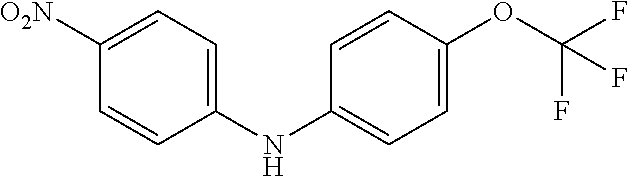 |
1H NMR (400 MHz, DMSO- d6): δ 9.41 (s, 1H), 8.11 (d, J = 9.2 Hz, 2H), 7.38-7.32 (m, 4H), 7.10 (d, J = 9.2 Hz, 2H). LC-MS: m/z 297.1 (M − H)− |
| 549 | VII.32 |
 |
LC-MS: m/z 315.2 (M + H)+ |
| 551 | VII.33 |
 |
LC-MS: m/z 363.1 (M + H)+ |
| 553 | VII.34 |
 |
1H NMR (400 MHz, DMSO- d6): δ 9.17 (s, 1H), 8.06 (d, J = 9.2 Hz, 2H), 7.21 (d, J = 8.8 Hz, 2H), 7.10 (d, J = 8.8 Hz, 2H), 6.92 (d, J = 8.8 Hz, 2H), 4.75 (q, J = 9.2 Hz, 2H). |
| 554, 567 | VII.35 |
 |
LC-MS: m/z 241.2 (M − H)− |
| 555, 556, 574, 583, 584, 552, | VII.36 |
 |
LC-MS: m/z 312.2 (M + H)+ |
| 557, | |||
| 582, | |||
| 593 | |||
| 560, 579, 580, 614, 619, 620, 621, 625, | VII.37 |
 |
LC-MS: m/z 311.1 (M + H)+ |
| 627, | Also for CP compounds 630, 631, | ||
| 628, | 632, 633, 634, 635, 636, 637, 640, | ||
| 629 | 653, 656, 657, 678, 679 | ||
| 563 | VII.38 |
 |
1H NMR (400 MHz, DMSO- d6): δ 9.43 (s, 1H), 8.03 (d, J = 10 Hz, 1H), 7.64 (d, J = 8.8 Hz, 2H), 7.35 (d, J = 8.4 Hz, 2H), 7.08-7.06 (m, 2H), 2.53 (s, 3H). |
| 565 | VII.39 |
 |
LC-MS: m/z 327.0 (M + H)+ |
| 568 | VII.40 |
 |
LC-MS: m/z 328.95 (M − H)− |
| 571 | VII.41 |
 |
LC-MS: m/z 355.1 (M + H)+ |
| 572 | VII.42 |
 |
LC-MS: m/z 298.95 (M − H)−. |
| 573 | VII.43 |
 |
LC-MS: m/z 357.0 (M − H)−. |
| 576 | VII.44 |
 |
LC-MS: m/z 284.0 (M + H)+ |
| 577 | VII.45 |
 |
LC-MS: m/z 323.3 (M + H)+ |
| 578 | VII.46 |
 |
LC-MS: m/z 298.2 (M + H)+ |
| 581 | VII.47 |
 |
LC-MS: m/z 296.0 (M + 2)+ |
| 585 | VII.48 |
 |
LC-MS: m/z 327.1 (M + H)+ |
| 588 | VII.49 |
 |
LC-MS: m/z 289.95 (M + H) |
| 589 | VII.50 |
 |
LC-MS: m/z 315.1 (M − H)− |
| 590 | VII.51 |
 |
LC-MS: m/z 311.1 (M − H)− |
| 592 | VII.52 |
 |
LC-MS: m/z 316.9 (M + H)+ |
| 594 | VII.53 |
 |
LC-MS: m/z 332.1 (M − H) − |
| 595 | VII.54 |
 |
LC-MS: m/z 342.0 (M + H) + |
| 596 | VII.55 |
 |
LC-MS: m/z 335.0 (M + H) + |
| 597 | VII.56 |
 |
LC-MS: m/z 304.2 (M + H)+ |
| 602 | VII.57 |
 |
LC-MS: m/z 320.0 (M + H)+ |
| 609, 652, 673 | VII.58 |
 |
LC-MS: m/z 312.2 (M + H)+ |
| 612 | VII.59 |
 |
LC-MS: m/z 283.0 (M + H)+ |
| 617 | VII.60 |
 |
LC-MS: m/z 315.0 (M − H)− |
| 618 | VII.61 |
 |
Proceeded with crude/TLC reference |
| 622 | VII.62 |
 |
LC-MS: m/z 315.0 (M + H)+ |
| 624 | VII.63 |
 |
LC-MS: m/z 287.0 (M + H)+ |
| 626 | VII.64 |
 |
LC-MS: m/z 337.2 (M + H)+ |
| 641, 661, 662 | VII.65 |
 |
LC-MS: m/z 363.1 (M1H)− |
| 660, 675, 676 | VII.66 |
 |
LC-MS: m/z 397.1 (M − H)− |
| 598, 643, 654, 655 | VII.67 |
 |
LC-MS: m/z 333.1 (M + H)+ |
| 646 | VII.68 |
 |
LC-MS: m/z 327.1 (M + H)+ |
| 647 | VII.69 |
 |
LC-MS: m/z 313.1 (M + H)+ |
| 659 | VII.70 |
 |
LC-MS: m/z 332.1 (M + H)+ |
| 663 | VII.71 |
 |
LC-MS: m/z 338.2 (M + H)+ |
| 671, 680, 681 | VII.72 |
 |
LC-MS: m/z 345.1 (M + H)+ |
| 682, 677 | VII.73 |
 |
LC-MS: m/z 331.1 (M + H)+ |
| Intermediate | ||||
| CP | No. | Reactant | Structure | Analytical data |
| 249 | VII.74 | VII |
 |
LC-MS: m/z 397.0 (M + H)+ |
| 289, 311, 379 | VII.75 | VII.17 |
 |
1H NMR (400 MHz, DMSO-d6) δ 8.05 (dd, J1 = 2.0 Hz, J2 = 7.4 Hz, 2H), 7.48 (d, J = 8.4 Hz, 2H), 7.25 (d, J = 8.3 Hz, 2H), 6.74 (dd, J1 = 2.0 Hz, J2 = 7.4 Hz, 2H), 3.36 (s, 3H), 2.80 (s, 3H), 1.89 (s, 6H), |
| Also for CP compounds 453, 472, | 1.75 (s, 6H). LC-MS: | |||
| 473, 525, 526 | m/z 363.1 (M + H)+ | |||
| 271 | VII.76 | VII.10 |
 |
LC-MS: m/z 431.15 (M + H)+ |
| 521, 541, 605, 606, 607, 608, | VII.77 | VII.19 |
 |
LC-MS: m/z 297.1 (M + H)+. |
| 613, | ||||
| 648 | ||||
| 522, 536, 558 | VII.78 | VII.20 |
 |
LC-MS: m/z 311.1 (M + H)+ |
| 528 | VII.79 | VII.21 |
 |
LC-MS: m/z 355.1 (M + H)+ |
| 535 | VII.80 | VII.22 |
 |
1H NMR (400 MHz, DMSO-d6): δ 8.06 (d, J = 9.2 Hz, 2H), 7.55 (d, J = 8.8 Hz, 2H), 7.36 (d, J = 8.4 Hz, 2H), 6.81 (d, J = 9.2 Hz, 2H), 3.37 (s, 3H). |
| 537 | VII.81 | VII.23 |
 |
LC-MS: m/z 381.2 (M + H)+ |
| 538 | VII.82 | VII.24 |
 |
1H NMR (400 MHz, DMSO-d6): δ 8.03 (dd, J1 = 2.4 Hz & J2 = 7.6 Hz, 2H), 7.33 (d, J = 8.4 Hz, 2H), 7.23-7.20 (m, 2H), 6.72 (dd, J1 = 2 Hz & J2 = 7.6 Hz, 2H), 3.35 (s, 3H), 2.79-2.75 (m, |
| 1H), 2.34-2.31 (m, | ||||
| 2H), 1.76-1.73 (m, | ||||
| 1H), 1.56-1.50 (m, | ||||
| 4H), 1.36-1.16 (m, | ||||
| 3H). LC-MS: m/z | ||||
| 323.2 (M + H)+ | ||||
| 542 | VII.83 | VII.25 |
 |
LC-MS: m/z 297.1 (M + H)+ |
| 545 | VII.84 | VII.26 |
 |
LC-MS: m/z 259.1 (M + H)+ |
| 547 | VII.85 | VII.27 |
 |
1H NMR (400 MHz, DMSO-d6): δ 8.02 (d, J = 9.6 Hz, 2H), 7.16 (d, J = 8.8 Hz, 2H, 7.04 (d, J = 8.8 Hz, 2H), 6.67 (d, J = 9.6 Hz, 2H), 3.76-3.74 (m, 4H), 3.32 (s, 3H), 3.16-3.13 (m, 4H). |
| LC-MS: m/z 314.2 | ||||
| (M + H)+ | ||||
| 548 | VII.86 | VII.28 |
 |
1H NMR (400 MHz, DMSO-d6): δ 8.07 (d, J = 9.2 Hz, 2H), 7.48- 7.45 (m, 4H), 6.81 (d, J = 9.2 Hz, 2H), 3.39 (s, 3H). LC-MS: m/z |
| 313.1 (M + H)+ | ||||
| 549 | VII.87 | VII.29 |
 |
LC-MS: m/z 329.2 (M + H)+. |
| 551 | VII.88 | VII.30 |
 |
LC-MS: m/z 377.3 (M + H)+. |
| 552 | VII.89 | VII.33 |
 |
LC-MS: m/z 345.1 (M + H)+. |
| 553 | VII.90 | VII.31 |
 |
LC-MS: m/z 327.1 (M + H)+. |
| 554, 567 | VII.91 | VII.32 |
 |
LC-MS: m/z 257.2 (M + H)+. |
| 555 | VII.92 | VII.33 |
 |
LC-MS: m/z 312.2 (M + H)+. |
| 556 | VII.93 | VII.33 |
 |
LC-MS: m/z 241.2 (M − H)− |
| 557 | VII.94 | VII.33 |
 |
LC-MS: m/z 312.2 (M + H)+ |
| 560, 579, 580, 614, 619, 620, 621, 625, 627 | VII.95 | VII.34 |
 |
LC-MS: m/z 325.2 (M + H)+ |
| Also for CP compounds 628, 629, | ||||
| 630, 631, 632, 633, 634, 635, 636, | ||||
| 637, 640, 653, 656, 657, 678, 679 | ||||
| 563 | VII.96 | VII.35 |
 |
LC-MS: m/z 311.05 (M + H)+ |
| 565 | VII.97 | VII.36 |
 |
LC-MS: m/z 341.0 (M + H)+ |
| 568 | VII.98 | VII.37 |
 |
1H NMR (400 MHz, DMSO-d6): δ 7.98- 7.94 (m, 1H), 7.31 (d, J = 8.8 Hz, 2H), 7.19 (d, J = 8.8 Hz, 2H), 6.57 (dd, J1 = 2.0 Hz & J2 = 14.8 Hz, 1H), 6.42 (dd, J1 = 2.0 Hz |
| & J2 = 9.2 Hz, 1H), | ||||
| 4.82 (q, J = 8.8 Hz, | ||||
| 2H), 3.34 (s, 3H). | ||||
| 571 | VII.99 | VII.38 |
 |
LC-MS: m/z 369.1 (M + H)+ |
| 572 | VII.100 | VII.39 |
 |
LC-MS: m/z 315.1 (M + H)+ |
| 573 | VII.101 | VII.40 |
 |
LC-MS: m/z 357.0 (M − H)− |
| 574, 583, 584 | VII.102 | VII.33 |
 |
LC-MS: m/z 284.0 (M + H)+ |
| 576 | VII.103 | VII.41 |
 |
LC-MS: m/z 298 (M + H)+ |
| 577 | VII.104 | VII.42 |
 |
LC-MS: m/z 337.2.0 (M + H)+ |
| 578 | VII.105 | VII.43 |
 |
LC-MS: m/z 312.2 (M + H)+ |
| 581 | VII.106 | VII.44 |
 |
LC-MS: m/z 310.1 (M + H)+ |
| 582 | VII.107 | VII.33 |
 |
LC-MS: m/z 324.2 (M + H)+ |
| 585 | VII.108 | VII.45 |
 |
LC-MS: 342.1 m/z (M + H)+ |
| 588 | VII.109 | VII.46 |
 |
LC-MS: m/z 304.1 (M + H)+ |
| 589 | VII.110 | VII.47 |
 |
LC-MS: m/z 331.1 (M − H)− |
| 590 | VII.111 | VII.48 |
 |
LC-MS: m/z 327.1 (M − H)− |
| 592 | VII.112 | VII.49 |
 |
LC-MS: m/z 331.0 (M − H)− |
| 593 | VII.113 | VII.33 |
 |
LC-MS: m/z 337.1 (M + H)+ |
| 594 | VII.114 | VII.50 |
 |
LC-MS: m/z 346.0 (M + H)+ |
| 595 | VII.115 | VII.51 |
 |
LC-MS: m/z 356.1 (M − H)− |
| 597 | VII.116 | VII.53 |
 |
LC-MS: m/z 318.1 (M + H)+ |
| 602 | VII.117 | VII.54 |
 |
LC-MS: m/z 332.0 (M + H)+ |
| 603 | VII.118 | VII.52 |
 |
LC-MS: m/z 377.1 (M + H)+ |
| 609, 652, 673 | VII.119 | VII.55 |
 |
LC-MS: m/z 326.2 (M + H)+ |
| 612 | VII.120 | VII.56 |
 |
LC-MS: m/z 297.0 (M + H)+ |
| 617 | VII.121 | VII.57 |
 |
LC-MS: m/z 331.0 (M + H)+ |
| 618 | VII.122 | VII.58 |
 |
LC-MS: m/z 315.2 (M + H)+ |
| 622 | VII.123 | VII.59 |
 |
LC-MS: m/z 329.0 (M + H)+ |
| 624 | VII.124 | VII.60 |
 |
LC-MS: m/z 301.0 (M + H)+ |
| 626 | VII.125 | VII.61 |
 |
LC-MS: m/z 351.1 (M + H)+ |
| 598, 643, 654, 655 | VII.126 | VII.64 |
 |
LC-MS: m/z 345.1 (M + H)+ |
| 646 | VII.127 | VII.65 |
 |
LC-MS: m/z 340.95 (M + H)+ |
| 647 | VII.128 | VII.66 |
 |
LC-MS: m/z 326.95 (M + H)+ |
| 659 | VII.129 | VII.67 |
 |
LC-MS: m/z 346.1 (M + H)+ |
| 663 | VII.130 | VII.68 |
 |
LC-MS: m/z 352.2 (M + H)+ |
| 671, 681 | VII.131 | VII.69 |
 |
LC-MS: m/z 359.1 (M + H)+ |

| Intermediate | |||
| CP | No. | Structure | Analytical data |
| 366, 367 | VIII.1 |
 |
1H NMR (400 MHz, DMSO-d6) δ 10.43 (s, 1H), 8.80 (s, 1H), 8.47-8.40 (m, 2H), 7.85 (t, J = 7.6 Hz, 1H), 7.51-7.49 (m, 2H), 7.41-7.39 (m, 1H), 2.08 (s, 3H), 1.89 (s, 6H), 1.75 (s, 6H). LC-MS: m/z 411.1 (M + H)+ |
| 373 | VIII.2 |
 |
LC-MS: m/z 411.05 (M + H)+ |
| 395 | VIII.3 |
 |
1H NMR (400 MHz, DMSO-d6) δ 10.53 (s, 1H), 8.79 (t, J = 2.0 Hz, 1H), 8.45-8.39 (m, 2H), 7.84 (t, J = 8.0 Hz, 1H), 7.72-7.69 (m, 2H), 7.25-7.21 (m, 2H), 7.06-7.03 (m, 2H), 6.91- 6.90 (m, 2H), 6.88-6.84 (m, 1H), 3.67 (t, J = 7.2 Hz, 2H), 1.59-1.53 (m, 2H), 1.36-1.29 (m, 2H), 0.88 (t, J = 7.2 Hz, 3H). LC-MS: m/z 390.2 (M + H)+ |
| 339 | VIII.4 |
 |
LC-MS: m/z 405.1 (M + H)+ |
| 586 | VIII.5 |
 |
LC-MS: m/z 309.1 (M − H)− |
| 642 | VIII.6 |
 |
LC-MS: m/z 339.05 (M + H)+ |
| 649 | VIII.7 |
 |
1H NMR (400 MHz, DMSO-d6) δ 10.57 (s, 1H), 8.45 (s, 1H), 7.93 (d, J = 8.0 Hz, 1H), 7.71-7.68 (m, 1H), 7.58 (s, 1H), 7.54-7.44 (m, 3H), 3.86 (s, 3H), 2.38 (s, 3H). |
| 665, 666, 669, 672 | VIII.8 |
 |
LC-MS: m/z 359.1 (M + H)+ |

| Intermediate | ||||
| CP | No. | Reactant | Structure | Analytical data |
| 270, 314 | IX.1 | I.30 |
 |
1H NMR (400 MHz, DMSO-d6) δ 8.24 (d, J = 8.8 Hz, 2H), 7.47 (d, J = 8.8 Hz, 2H), 7.11 (m, 4H), 2.07 (s, 3H), 1.88 (s, 6H), 1.71 (s, 6H). |
| 360 | IX.2 | I.32 |
 |
1H NMR (400 MHz, DMSO-d6) δ 8.31 (d, J = 8.8 Hz, 2H), 7.57 1H), 7.44-7.36 (m, 4H), 7.26 (t, J = 7.3 Hz, 1H), 7.19 (t, J = 8.8 Hz, 3H), 2.99-2.95 (m, 1H), 1.17 (d, J = 6.8 Hz, 6H). |
| 383, 384 529, 531, | IX.3 | I.31 |
 |
1H NMR (400 MHz, DMSO-d6) δ 8.27-8.23 (m, 2H), 7.58 (d, J = 2.0 Hz, 1H), 7.45 (dd, J1 = 2.4 Hz, J2 = 8.8 Hz, 1H), 7.31 (d, J = 8.4 Hz, 1H), 7.09-7.03 (m, 2H), 2.17-2.14 (m, 1H), 1.72 (s, 2H), 1.55-1.36 (m, 8H), 1.20 (s, 2H), 0.87 (s, 6H). |
| 534 | IX.4 |
 |
LC-MS: m/z 419.0 (M + H)+ | |
| 540 | IX.5 |
 |
LC-MS: m/z 576.2 (M + H)+. | |
| 543, 544 | IX-6 |
 |
1H NMR (400 MHz, DMSO-d6) δ 8.35-8.27 (m, 2H), 8.15 (s, 1H), 7.84 (d, J = 8.4 Hz, 2H), 7.24 (d, J = 9.2 Hz, 2H). | |
| 546, 550 | IX.7 |
 |
Proceeded with crude/TLC reference | |
| 561, 564 | IX.8 |
 |
1H NMR (400 MHz, DMSO- d6): δ 8.06 (d, J = 9.2 Hz, 1H), 7.56 (d, J = 1.6 Hz, 1H), 7.44-7.42 (m, 1H), 7.26 (d, J = 8.4 Hz, 1H), 7.04 (d, J = 2 Hz, 1H), 6.81- 6.78 (m, 1H), 2.52 (s, 3H), 2.15 (s, 1H), 1.72-1.19 (m, 12H), 0.86-0.84 (m, 6H). | |
| 566, 591 | IX.9 |
 |
LC-MS: m/z 368.0 (M + 2H)+ | |
| 569, 570 | IX.10 |
 |
Proceeded with crude/TLC reference | |
| 575 | IX.11 |
 |
1H NMR (400 MHz, DMSO- d6): δ 8.29-8.26 (m, 2H), 7.93 (s, 1H), 7.69 (d, J = 8.4 Hz, 1H), 7.50 (d, J = 8.4 Hz, 1H), 7.24- 6.96 (m, 3H). | |
| 587 | IX.12 |
 |
LC-MS: m/z 338.85 (M + H)+ | |
| 599 | IX.13 |
 |
LC-MS: m/z 361.3 (M + H)+ | |
| 600 | IX.14 |
 |
LC-MS: m/z 334.05 (M+)+ | |
| 601 | IX.15 |
 |
LC-MS: m/z 319.0 (M + H)+ | |
| 615 | IX.16 |
 |
LC-MS: m/z 377.0 (M + H)+ | |
| 616 | IX.17 |
 |
LC-MS: m/z 388.0 (M + H)+ | |

| Intermediate | ||||
| CP | No. | Reactant | Structure | Analytical data |
| 226 | XIII.1 |
 |
 |
1H NMR (400 MHz, DMSO-d6) δ 9.02 (s, 1H), 7.44 (s, 1H), 7.39 (s, 1H), 5.63 (s, 2H), 2.05 (s, 3H), 1.85 (d, J = 2.4 Hz, 6H), 1.72 (s, 6H). LC-MS: m/z 373.2 (M + H)+ |
| 228 | XIII.2 |
 |
 |
1H NMR (400 MHz, DMSO-d6) δ 7.47 (dd, J1 = 2.0 Hz, J2 = 8.0 Hz, 1H), 7.42 (d, J = 1.6 Hz, 1H), 7.34-7.33 (m, 2H), 7.25 (d, J = 8.0 Hz, 1H), 7.21 (d, J = 2.0 Hz, 1H), 4.45 (s, 2H), 3.49 (t, J = 8.8 Hz, 2H), 3.07 (t, J = 8.0 Hz, 2H), 2.05 (s, 3H), 1.85 (s, |
| 6H), 1.73 (s, 6H). LC-MS: | ||||
| m/z 423.2 (M + H)+ | ||||
| 240 | XIII.3 |
 |
 |
1H NMR (400 MHz, DMSO-d6) δ 8.39 (d, J = 1.2 Hz, 1H), 7.96 (d, J = 1.6 Hz, 1H), 7.44 (d, J = 2.0 Hz, 1H), 7.36-7.35 (m, 1H), 7.22 (d, J = 8.0 Hz, 1H), 5.39 (s, 2H), 2.05 (s, 3H), 1.84 (d, J = 2.8 Hz, 6H), 1.72 (s, 6H). LC-MS: m/z 372.2 (M + H)+ |
| 194 | XIII.4 | II.8 |
 |
LC-MS: m/z 480.1 (M + H)+ |
| 195 | XIII.5 | III.3 |
 |
LC-MS: m/z 494.1 (M + H)+ |

| Intermediate | ||||
| CP | No. | Reactant | Structure | Analytical data |
| 128 | XI.1 | VII.3 |
 |
LC-MS: m/z 421.1 (M + H)+ |
| 132, 133 | XI.2 | VII.5 |
 |
1H NMR (400 MHz, DMSO- d6) δ 7.25-7.19 (m, 4H), 7.16- 7.14 (m, 1H), 7.06-7.02 (m, 2H), 6.91 (d, J = 8.4 Hz, 2H), 6.78 (d, J = 8.4 Hz, 1H), 6.58 (d, J = 8.4 Hz, 2H), 4.93 (s, 2H), 2.24 (s, 3H). LC-MS: m/z 309.0 (M + H)+ |
| 169 | XI.3 | VII.7 |
 |
1H NMR (400 MHz, DMSO- d6) δ 9.35-8.91 (bs, 1H), 7.80- 7.78 (bs, 1H), 7.62-7.57 (m, 2H), 7.45 (d, J = 2.0 Hz, 1H), 7.35 (dd, J1 = 2.4 Hz, J2 = 8.8 Hz, 1H), 7.01 (d, J = 9.2 Hz, 1H), 2.07 (s, 3H), 1.87 (s, 6H), 1.74 (s, 6H). LC-MS: m/z |
| 354.1 (M + H)+ | ||||
| 191 | XI.4 | VII.8 |
 |
1H NMR (400 MHz, DMSO- d6) δ 7.34 (s, 1H), 7.02-6.98 (m, 1H), 6.80-6.79 (m, 3H), 6.61-6.51 (m, 4H), 4.71 (s, 2H), 2.02 (s, 3H), 1.74 (s, 6H), 1.67 (s, 6H). LC-MS: m/z 319.1 (M + H)+ |
| 203 | XI.5 | I.24 |
 |
1H NMR (400 MHz, DMSO- d6) δ 7.28 (d, J = 7.8 Hz, 1H), 7.21-7.17 (m, 1H), 7.10 (d, J = 3.9 Hz, 2H), 6.88 (t, J = 7.9 Hz, 1H), 6.35 (dd, J1 = 1.5 Hz, J2 = 8.3 Hz, 1H), 6.27 (m, 2H), 4.91 (s, 2H), 3.86 (s, 2H), 3.13 (m, 1H), 1.06 (d, J = 6.9 Hz, |
| 6H). LC-MS: m/z 226.3 | ||||
| (M + H)+ | ||||
| 228 | XI.6 | X.2 |
 |
1H NMR (400 MHz, DMSO- d6) δ 7.38 (d, J = 1.6 Hz, 1H), 7.36-7.30 (m, 2H), 6.69 (d, J = 7.6 Hz, 1H), 5.84 (dd, J1 = 2.0 Hz, J2 = 8.0 Hz, 1H), 5.78 (d, J = 1.2 Hz, 1H), 4.68 (s, 2H), 4.18 (s, 2H), 3.26 (t, J = 8.0 Hz, 2H), 2.75 (t, J = 7.6 Hz, 2H), 2.05 (s, 3H), 1.85 (s, 6H), 1.73 (s, 6H). LC-MS: m/z 393.2 (M + H)+ |
| 204, 237 261 | XI.7 | VII.9 |
 |
1H NMR (400 MHz, DMSO- d6) δ 7.30 (s, 1H), 7.19 (s, 2H), 7.13 (s, 1H), 6.87-6.83 (m, 1H), 6.26 (s, 1H), 6.20 (d, J = 7.8 Hz, 1H), 6.10 (d, J = 7.8 Hz, 1H), 4.92 (s, 2H), 2.04 (s, 3H), 1.83 (s, 6H), 1.72 (s, 6H). LC-MS: m/z 353.1 (M + H)+ |
| 232 | XI.8 | Int-X |
 |
LC-MS: m/z 342.2 (M + H)+ |
| 226 | XI.9 | X.1 |
 |
1H NMR (400 MHz, DMSO- d6) δ 8.08 (s, 1H), 7.37-7.30 (m, 2H), 7.20-7.10 (m, 1H), 5.25 (s, 2H), 5.17 (s, 2H), 2.04 (s, 3H), 1.83 (s, 6H), 1.72 (s, 6H). LC-MS: m/z 343.2 (M + H)+ |
| 240 | XI.10 | X.3 |
 |
1H NMR (400 MHz, DMSO- d6) δ 7.59 (s, 1H), 7.40-7.38 (m, 1H), 7.34-7.32 (m, 1H), 7.15 (d, J = 8.0 Hz, 1H), 6.24 (d, J = 1.2 Hz, 1H), 5.18 (s, 2H), 4.61 (s, 2H), 2.10 (s, 3H), 1.82 (s, 6H), 1.73 (s, 6H). LC- MS: m/z 342.2 (M + H)+ |
| 249 | XI.11 | VII.10 |
 |
LC-MS: m/z 367.1 (M + H)+ |
| 270, 314 | XI.12 | IX.1 |
 |
1H NMR (400 MHz, DMSO- d6) δ 7.26 (d, J = 8.8 Hz, 2H), 6.72 (m, 4H), 6.56 (d, J = 2.0 Hz, 2H), 4.93 (s, 2H), 2.03 (s, 3H), 1.82 (s, 6H), 1.68 (s, 6H). |
| 272 | XI.13 | VII.12 |
 |
1H NMR (400 MHz, DMSO- d6) δ 9.16 (s, 1H), 7.92 (dd, J1 = 1.4 Hz, J2 = 7.8 Hz, 1H), 7.25-7.21 (m, 1H), 7.04 (d, J = 8.3 Hz, 2H), 6.91 (d, J = 8.8 Hz, 1H), 6.70 (d, J = 2.0 Hz, 2H), 6.64-6.60 (m, 1H), 3.89 (s, 3H), 3.62 (s, 2H). |
| 284, 321 | XI.14 | Int-IX |
 |
1H NMR (400 MHz, DMSO- d6) δ 7.40 (s, 1H), 7.23 (d, J = 8.8 Hz, 1H), 6.73 (d, J = 8.3 Hz, 3H), 6.58 (d, J = 8.8 Hz, 2H), 4.97 (s, 2H), 2.03 (bs, 3H), 1.82 (s, 6H), 1.71 (s, 6H). |
| 271, 273 | XI.15 | VII.21 |
 |
1H NMR (400 MHz, DMSO- d6) δ 7.08 (d, J = 8.8 Hz, 2H), 6.92 (d, J = 8.0 Hz, 2H), 6.83 (d, J = 2.4 Hz, 1H), 6.38 (d, J = 9.2 Hz, 2H), 5.59 (s, 2H), 3.00 (s, 2H), 2.02 (s, 3H), 1.78 (s, 6H), 1.70 (s, 6H). |
| 289 311 | XI.16 | VII.13 |
 |
1H NMR (400 MHz, DMSO- d6) δ 7.09 (d, J = 8.8 Hz, 2H), 6.81 (m, 2H), 6.57-6.55 (m, 4H), 4.96 (s, 2H), 3.09 (s, 3H), 2.02 (s, 3H), 1.79 (s, 6H), 1.70 (s, 6H). LC-MS: m/z 333.1 (M + H)+ |
| 298, 299 | XI.17 | VII.15 |
 |
1H NMR (400 MHz, DMSO- d6) δ 9.67 (s, 1H), 8.29 (dd, J1 = 1.6 Hz, J2 = 4.4 Hz, 1H), 8.17 (dd, J1 = 1.6 Hz, J2 = 7.6 Hz, 1H), 7.26-7.22 (m, 2H), 6.73 (dd, J1 = 4.8 Hz, J2 = 8.0 Hz, 1H), 6.57-6.53 (m, 2H), 4.87 (s, 2H), 3.87 (s, 3H). LC- MS: m/z 244.15 (M + H)+ |
| 319 | XI.18 | VII.16 |
 |
1H NMR (400 MHz, DMSO- d6) δ 7.28 (s, 1H), 7.06 (d, J = 8.8 Hz, 2H), 6.78 (d, J = 8.8 Hz, 2H), 6.72 (d, J = 8.8 Hz, 2H), 6.51 (d, J = 8.4 Hz, 2H), 4.68 (s, 2H), 2.10 (bs, 1H), 1.61 (s, 2H), 1.45-1.33 (m, 8H), 1.15 (s, 2H), 0.83 (s, 6H). LC-MS: m/z 347.3 (M + H)+ |
| 320 | XI.19 | VII.17 |
 |
1H NMR (400 MHz, DMSO- d6) δ 7.46 (s, 1H), 7.07 (t, J = 7.9 Hz, 2H), 6.90 (d, J = 8.8 Hz, 2H), 6.83 (m, 4H), 6.57 (m, 5H), 4.74 (s, 2H), 3.52 (t, J = 7.3 Hz, 2H), 1.52 (m, 2H), 1.32 (m, 2H), 0.87 (t, J = 6.9 Hz, 3H). |
| 338 | XI.20 | VII.18 |
 |
1H NMR (400 MHz, DMSO- d6) δ 7.85 (s, 1H), 7.56 (d, J = 8.8 Hz, 2H), 7.08 (s, 1H), 6.84 (d, J = 8.4 Hz, 2H), 6.70 (d, J = 8.0 Hz, 2H), 6.55 (d, J = 8.4 Hz, 2H), 4.84 (s, 2H), 2.04 (s, 9H), 1.64 (s, 6H). LC- MS: m/z 362.3 (M + H)+ |
| 339 | XI.21 | VIII.4 |
 |
1H NMR (400 MHz, DMSO- d6) δ 9.76 (s, 1H), 7.48 (d, J = 8.4 Hz, 2H), 7.25 (d, J = 8.8 Hz, 2H), 7.87 (d, J = 8.0 Hz, 2H), 7.46 (d, J = 8.0 Hz, 2H), 4.82 (s, 2H), 2.69 (t, J = 8.4 Hz, 2H), 2.49-2.46 (m, 2H), 2.04 (s, 3H), 1.82 (s, 6H), 1.72 (s, |
| 6H). LC-MS: m/z 375.3 | ||||
| (M + H)+ | ||||
| 345 | XI.22 | XI.16 |
 |
1H NMR (400 MHz, DMSO- d6) δ 7.09 (d, J = 8.8 Hz, 2H), 6.86 (d, J = 8.3 Hz, 2H), 6.56 (t, J = 9.3 Hz, 4H), 5.27 (d, J = 7.8 Hz, 1H), 3.50-3.49 (m, 1H), 3.10 (s, 3H), 2.02 (s, 3H), 1.79 (s, 6H), 1.71 (s, 6H), 1.13 (d, J = 6.3 Hz, 6H). |
| 358, 359, 376 | XI.23 | Int-VIII |
 |
1H NMR (400 MHz, DMSO- d6) δ 10.06 (s, 1H), 7.66 (d, J = 8.8 Hz, 3H), 7.38-7.28 (m, 3H), 7.15-7.03 (m, 3H), 6.73 (d, J = 6.8 Hz, 1H), 5.28 (s, 2H), 2.05 (s, 3H), 1.85 (s, 6H), 1.73 (s, 6H). |
| 360 | XI.24 | IX.2 |
 |
1H NMR (400 MHz, DMSO- d6) δ 7.41-7.38 (m, 3H), 7.21- 7.12 (m, 3H), 6.84-6.78 (m, 3H), 6.63 (d, J = 8.0 Hz, 2H), 5.06 (s, 2H), 2.96-2.93 (m, 1H), 1.13 (d, J = 8.0 Hz, 6H). LC-MS: m/z 338.1 (M + H)+ |
| 383 | XI.25 | IX.3 |
 |
1H NMR (400 MHz, DMSO- d6) δ 7.39 (d, J = 2.0 Hz, 1H), 7.21 (dd, J1 = 2.4 Hz, J2 = 8.8 Hz, 1H), 6.73-6.71 (m, 3H), 6.57 (d, J = 8.4 Hz, 2H), 4.97 (s, 2H), 2.13-2.11 (m, 1H), 1.65 (s, 2H), 1.49-1.31 (m, 8H), 1.16 (s, 2H), 0.84 (s, 6H). LC- MS: m/z 382.1 (M + H)+ |
| 366, 367 | XI.26 | VIII.1 |
 |
1H NMR (400 MHz, DMSO- d6) δ 9.65 (s, 1H), 7.52 (d, J = 8.4 Hz, 1H), 7.43 (s, 1H), 7.35 (dd, J1 = 1.2 Hz, J2 = 8.0 Hz, 1H), 7.16-7.08 (m, 3H), 6.75 (d, J = 7.6 Hz, 1H), 5.31 (s, 2H), 2.07 (s, 3H), 1.88 (s, 6H), 1.74 (s, 6H). LC-MS: m/z |
| 381.1 (M + H)+ | ||||
| 373 | XI.27 | VIII.2 |
 |
1H NMR (400 MHz, DMSO- d6) δ 10.05 (s, 1H), 7.65 (d, J = 7.6 Hz, 2H), 7.32-7.27 (m, 4H), 7.09 (d, J = 7.6 Hz, 1H), 5.57 (s, 2H), 2.05 (s, 3H), 1.85 (s, 6H), 1.73 (s, 6H). |
| 395 | XI.28 | VIII.3 |
 |
1H NMR (400 MHz, DMSO- d6) δ 10.03 (s, 1H), 7.71-7.67 (m, 2H), 7.19-7.02 (m, 7H), 6.84-6.82 (m, 4H), 5.33 (s, 2H), 3.64 (t, J = 7.2 Hz, 2H), 1.60-1.54 (m, 2H), 1.34-13.2 (m, 2H), 0.88 (t, J = 7.6 Hz, 3H). LC-MS: m/z 360.2 (M + H)+ |
| 378 | XI.29 | VII.20 |
 |
LC-MS: m/z 319.2 (M + H)+ |
| 348 | XI.30 | VII.19 |
 |
LC-MS: m/z 319.5 (M + H)+ |
| 266 | XI.31 | VII.1 |
 |
LC-MS: m/z 387.15 (M + H)+ |
| 521, 541, 605, 606, 607, 608, 613, 648 | XI.32 | VII.74 |
 |
LC-MS: m/z 267.1 (M + H)+ |
| 522, 558 | XI.33 | VII.75 |
 |
LC-MS: m/z 281.2 (M + H)+. |
| 528 | XI.34 | VII.76 |
 |
LC-MS: m/z 325.1 (M + H)+. |
| 535 | XI.35 | VII.77 |
 |
LC-MS: m/z 233.1 (M + H)+. |
| 537 | XI.36 | VII.78 |
 |
LC-MS: m/z 350.2 (M + H)+. |
| 538 | XI.37 | VII.79 |
 |
1H NMR (400 MHz, DMSO-d6): δ 6.95 (d, J = 8.8 Hz, 2H), 6.8 (d, J = 8.4 Hz, 2H), 6.55 (dd, J1 = 5.2 Hz & J2 = 8.4 Hz, 4H), 4.98 (s, 2H), 3.08 (s, 3H), 2.57-2.55 (m, 1H), 2.28 (s, 1H), 2.15 (s, 1H), 1.63-1.41 (m, 4H), 1.35-1.07 (m, 4H). |
| LC-MS: m/z 293.2 (M + H)+. | ||||
| 542 | XI.38 | VII.80 |
 |
LC-MS: m/z 267.1 (M + H)+. |
| 543, 544 | XI.39 | IX.6 |
 |
LC-MS: m/z 288.0 (M + H)+. |
| 545 | XI.40 | VII.81 |
 |
LC-MS: m/z 229.1 (M + H)+. |
| 546 | XI.41 | IX.7 |
 |
LC-MS: m/z 302.1 (M + H)+. |
| 547 | XI.42 | VII.82 |
 |
1H NMR (400 MHz, DMSO-d6): δ 6.80-6.73 (m, 4H), 6.63 (d, J = 8.8 Hz, 2H), 6.53 (d, J = 8.4 Hz, 2H), 4.87 (s, 2H), 3.71-3.69 (m, 4H), 3.05 (s, 3H), 2.95-2.92 (m, 4H). LC-MS: m/z 284.2 (M + H)+. |
| 548 | XI.43 | VII.83 |
 |
1H NMR (400 MHz, DMSO-d6) δ 7.08 (d, J = 8.8 Hz, 2H), 6.86- 6.83 (m, 2H), 6.61-6.58 (m, 4H), 5.08 (s, 2H), 3.13 (s, 3H). LC-MS: m/z 283.1 (M + H)+. |
| 549 | XI.44 | VII.84 |
 |
LC-MS: m/z 299.2 (M + H)+. |
| 550 | XI.45 | IX.7 |
 |
LC-MS: m/z 302.1 (M + H)+. |
| 551 | XI.46 | VII.85 |
 |
LC-MS: m/z 347.3 (M + H)+. |
| 552 | XI.47 | VII.86 |
 |
LC-MS: m/z 317.2 (M + H)+. |
| 553 | XI.48 | VII.87 |
 |
LC-MS: m/z 297.1 (M + H)+. |
| 554 | XI.49 | VII.88 |
 |
LC-MS: m/z 249.1 (M + H)+. |
| 555 | XI.50 | VII.89 |
 |
LC-MS: m/z 282.5 (M + H)+. |
| 556 | XI.51 | VII.90 |
 |
LC-MS: m/z 253.2 (M + H)+ |
| 557 | XI.52 | VII.91 |
 |
LC-MS: m/z 315.2 (M + H)+ |
| 560, 579, 580, 614, 619, 620, 621, 625, 627, 628, 629 | XI.53 | VII.92 |
 |
LC-MS: m/z 295.2 (M + H)+ |
| Also for CP compounds 630, 631, | ||||
| 632, 633, 634, 635, 636, 637, 640, | ||||
| 653, 656, 657, 678, 679 | ||||
| 561, 564 | XI.54 | IX.8 |
 |
LC-MS: m/z 396.1 (M + H)+. |
| 563 | XI.55 | VII.93 |
 |
1H NMR (400 MHz, DMSO-d6): δ 7.38 (d, J = 8.8 Hz, 2H), 6.79- 6.74 (m, 2H), 6.66-6.64 (m, 3H), 4.91 (s, 2H), 3.18 (s, 3H), 2.04 (s, 3H). |
| 565 | XI.56 | VII.94 |
 |
LC-MS: m/z 311.2 (M + H)+. |
| 566 | XI.57 | IX.9 |
 |
procured |
| 568 | XI.58 | VII.95 |
 |
LC-MS: m/z 314.05 (M + H)+. |
| 569, 570 | XI.59 | IX.10 |
 |
LC-MS: m/z 400.2 (M + H)+ |
| 571 | XI.60 | VII.96 |
 |
LC-MS: m/z 339.1 (M + H)+ |
| 572 | XI.61 | VII.97 |
 |
LC-MS: m/z 285.1 (M + H)+ |
| 573 | XI.62 | VII.98 |
 |
1H NMR (400 MHz, DMSO-d6): δ 7.60-7.57 (m, 2H), 6.97-6.93 (m, 1H), 6.82-6.79 (m, 1H), 6.64 (d, J = 9.2 Hz, 2H), 5.25 (s, 2H), 3.20 (s, 3H). |
| 574, 583, 584 | XI.63 | VII.99 |
 |
LC-MS: m/z 295.2 (M + H)+. |
| 575 | XI.64 | IX.11 |
 |
LC-MS: m/z 270.1 (M + H)+. |
| 576 | XI.65 | VII.100 |
 |
LC-MS: m/z 268 (M + H)+ |
| 577 | XI.66 | VII.101 |
 |
LC-MS: m/z 307.2 (M + H)+ |
| 578 | XI.67 | VII.102 |
 |
LC-MS: m/z 282.0 (M + H)+ |
| 581 | XI.68 | VII.103 |
 |
LC-MS: m/z 282.4 (M + H)+ |
| 582 | XI.69 | VII.104 |
 |
LC-MS: m/z 296.15 (M + H)+ |
| 585 | XI.70 | VII.105 |
 |
LC-MS: m/z 311.1 (M + H)+ |
| 586 | XI.71 | VIII.5 |
 |
LC-MS: m/z 279.0 (M − H)− |
| 588 | XI.72 | VII.106 |
 |
LC-MS: m/z 274.1 (M − H)− |
| 589 | XI.73 | VII.107 |
 |
LC-MS: m/z 301.1 (M + H)+ |
| 590 | XI.74 | VII.108 |
 |
LC-MS: m/z 297.2 (M − H)− |
| 592 | XI.75 | VII.109 |
 |
LC-MS: m/z 331.0 (M + H)+ |
| 593 | XI.76 | VII.110 |
 |
LC-MS: m/z 309.3 (M + H)+ |
| 595 | XI.77 | VII.112 |
 |
LC-MS: m/z 326.0 (M + H)+ |
| 596 | XI.78 | VII.52 |
 |
LC-MS: m/z 349.0 (M + H)+ |
| 597 | XI.79 | VII.113 |
 |
LC-MS: m/z 288.1 (M + H)+ |
| 643, 654, 655 | XI.80 | VII.123 |
 |
LC-MS: m/z 282.1 (M + H)+ |
| 599 | XI.81 | IX.13 |
 |
LC-MS: m/z 317.2 (M + H)+ |
| 600 | XI.82 | IX.14 |
 |
LC-MS: m/z 305.0 (M + H)+ |
| 601 | XI.83 | IX.15 |
 |
LC-MS: m/z 289.0 (M + H)+ |
| 603 | XI.84 | VII.115 |
 |
LC-MS: m/z 349.2 (M + H)+ |
| 609, 652, 673, | XI.85 | VII.116 |
 |
LC-MS: m/z 296.2 (M + H)+ |
| 612 | XI.86 | VII.117 |
 |
LC-MS: m/z 267.1 (M + H)+ |
| 615 | XI.87 | IX.16 |
 |
LC-MS: m/z 335.05 (M + H)+ |
| 617 | XI.88 | VII.118 |
 |
LC-MS: m/z 301.0 (M + H)+ |
| 618 | XI.89 | VII.119 |
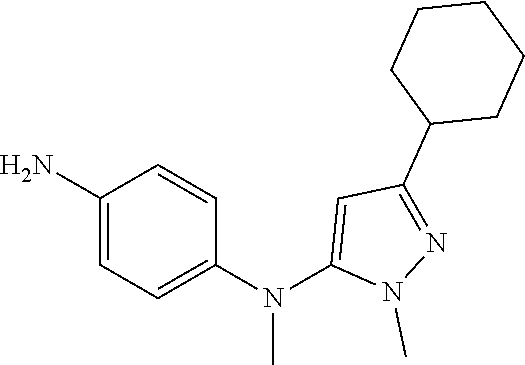 |
LC-MS: m/z 285.2 (M + H)+ |
| 622 | XI.90 | VII.120 |
 |
LC-MS: m/z 299.0 (M + H)+ |
| 624 | XI.91 | VII.121 |
 |
LC-MS: m/z 271.1 (M + H)+ |
| 626 | XI.92 | VII.122 |
 |
LC-MS: m/z 321.30 (M + H)+ |
| 641 | XI.93 | VII.62 |
 |
LC-MS: m/z 335.05 (M + H)+ |
| 642 | XI.94 | VIII.6 |
 |
LC-MS: m/z 309.1 (M + H)+ |
| 646 | XI.95 | VII.124 |
 |
LC-MS: m/z 311.2 (M + H)+ |
| 647 | XI.96 | VII.125 |
 |
LC-MS: m/z 297.1 (M + H)+ |
| 659 | XI.97 | VII.126 |
 |
LC-MS: m/z 316.2 (M + H)+ |
| 660, 675, 676 | XI.98 | VII.63 |
 |
LC-MS: m/z 369.00 (M + H)+ |
| 661, 662 | XI.99 | VII.62 |
 |
LC-MS: m/z 335.05 (M + H)+ |
| 663 | XI.100 | VII.127 |
 |
LC-MS: m/z 322.2 (M + H)+ |
| 665, 666, 669, 672 | XI.101 | VIII.8 |
 |
LC-MS: m/z 329.1 (M + H)+ |
| 671, 681 | XI.102 | VII.128 |
 |
LC-MS: m/z 329.2 (M + H)+ |
| 680 | XI.103 | VII.69 |
 |
LC-MS: m/z 315.1 (M + H)+ |
| 682, 677 | XI.104 | VII.70 |
 |
LC-MS: m/z 301.2 (M + H)+ |

| Inter- | ||||
| mediate | Reac- | |||
| CP | No. | tant | Structure | |
| 57 | XII.1 | VII.1 |
 |
1H NMR (500 MHz, CDCl3) δ 9.45 (s, 1H), 8.01 (s, 1H), 7.45-7.23. (d, 2H), 7.23-7.01 (m, 6H), 6.98-7.01 (d, 2H), 6.94 (s, 1H), 3.93 (s, 3H), 5.99 (s, 1H) 2.21-1.98 (m, 15H) LC-MS: m/z 521.2 (M + H)+ |
| 59 | XII.2 | XI.31 |
 |
1H NMR (500 MHz, DMSO-d6) δ 9.45 (s, 1H), 8.01 (s, 1H), 7.49-7.33. (d, 2H), 7.23-7.01 (m, 5H), 6.91-7.04 (d, 2H), 6.94 (s, 1H), 3.93 (s, 3H), 5.99 (s, 1H) 2.21-1.98 (m, 15H) LC-MS: m/z 522.2 (M + H)+ |
| 60 | XII.3 | XI.31 |
 |
LC-MS: m/z 535.6 (M + H)+ |
| 61 | XII.4 | XI.31 |
 |
LC-MS: m/z 589.2 (M + H)+ |
| 62 | XII.5 |
 |
LC-MS: m/z 539.5 (M + H)+ | |
| 65 | XII.6 |
 |
LC-MS: m/z 468.3 (M + H)+ | |
| 66 | XII.7 | XI.1 |
 |
LC-MS: m/z 556 (M + H)+ |
| 67 | XII.8 | XI.3 |
 |
LC-MS: m/z 489 (M + H)+ |
| 146 | XII.9 | I.13 |
 |
1H NMR (400 MHz, DMSO-d6) δ 9.29 (s, 1H), 7.89 (dd, J1 = 1.6 Hz, J2 = 8.0 Hz, 1H), 7.49-742 (m, 5H), 7.33-7.25 (m, 5H), 7.15-7.13 (m, 3H), 6.94-6.86 (m, 1H), 3.83 (s, 3H). LC-MS: m/z 370.1 (M + H)+ |
| 156 | XII.10 | Int-XI |
 |
1H NMR (400 MHz, DMSO-d6) δ 9.05 (s, 1H), 7.93 (dd, J1 = 1.2 Hz, J2 = 3.6 Hz, 1H), 7.59 (s, 1H), 7.42- 7.34 (m, 3H), 7.21 (s, 2H), 7.13 (d, J = 8.8 Hz, 1H), 7.05 (d, J = 8.8 Hz, 2H), 3.87 (s, 3H), 2.04 (s, 3H), |
| 1.83 (s, 6H), 1.72 (s, | ||||
| 6H). LC-MS: m/z | ||||
| 488.1 (M + H)+ | ||||
| 157 | XII.11 | Int-XI |
 |
1H NMR (400 MHz, DMSO-d6) δ 8.77 (s, 1H), 8.38 (s, 1H), 7.95 (d, J = 5.6 Hz, 1H), 7.63 (d, J = 4.8 Hz, 1H), 7.60 (s, 1H), 7.34 (s, 1H), 7.22 (s, 2H), 7.18 (d, J = 8.8 Hz, 2H), 7.05 (d, J = 8.8 Hz, 2H), 3.89 |
| (s, 3H), 2.05 (s, 3H), | ||||
| 1.83 (s, 6H), 1.72 (s, | ||||
| 6H). LC-MS: m/z | ||||
| 488.1 (M + H)+ | ||||
| 159 | XII.12 | Int-XI |
 |
1H NMR (400 MHz, DMSO-d6) δ 9.96 (s, 1H), 8.88 (s, 1H), 8.69 (s, 1H), 7.58 (s, 1H), 7.50 (d, J = 8.8 Hz, 2H), 7.34 (s, 1H), 7.21 (s, 2H), 7.04 (d, J = 8.8 Hz, 2H), 4.38 (q, 2H), 2.05 (s, 3H), 1.83 (s, 6H), 1.72 (s, |
| 6H), 1.36 (t, J = 7.2 | ||||
| Hz, 3H). LC-MS: m/z | ||||
| 503.2 (M + H)+ | ||||
| 160 | XII.13 | Int-XI |
 |
LC-MS: m/z 489.1 (M + H)+ |
| 163 | XII.14 | Int-XI |
 |
LC-MS: m/z 502.1 (M + H)+ |
| 168 | XII.15 | Int-XI |
 |
1H NMR (400 MHz, DMSO-d6) δ 9.17 (s, 1H), 7.70 (d, J = 8.8 Hz, 2H), 7.66 (d, J = 8.0 Hz, 1H), 7.37 (d, J = 7.2 Hz, 1H), 7.29 (d, J = 2.0 Hz, 1H), 7.26 (s, 1H), 7.14 (dd, J1 = 2.0 Hz, J2 = 8.8 Hz, 1H), 7.04 |
| (t, J = 8.8 Hz, 3H), | ||||
| 6.98 (d, J = 8.4 Hz, | ||||
| 1H), 4.31 (q, 2H), | ||||
| 2.04 (s, 3H), 1.82 (s, | ||||
| 6H), 1.72 (s, 6H), | ||||
| 1.33 (t, J = 6.8 Hz, | ||||
| 3H). LC-MS: m/z | ||||
| 502.2 (M + H)+ | ||||
| 169 | XII.16 | XI.3 |
 |
1H NMR (400 MHz, DMSO-d6) δ 9.73 (s, 1H), 8.35-8.32 (m, 2H), 8.22 (dd, J1 = 1.6 Hz, J2 = 7.6 Hz, 1H), 8.17 (s, 1H), 7.91 (d, J = 8.8 Hz, 1H), 7.85 (dd, J1 = 2.8 Hz, J2 = 9.2 Hz, 1H), 7.34 (d, J = 2.4 Hz, 1H), 7.27 |
| (dd, J1 = 2.4 Hz, J2 = | ||||
| 8.8 Hz, 1H), 6.98 (d, | ||||
| J = 8.8 Hz, 1H), 6.84 | ||||
| (dd, J1 = 4.4 Hz, J2 = | ||||
| 8.0 Hz, 1H), 3.90 (s, | ||||
| 3H), 2.06 (s, 3H), | ||||
| 1.86 (s, 6H), 1.74 (s, | ||||
| 6H). LC-MS: m/z | ||||
| 489.1 (M + H)+ | ||||
| 191 | XII.17 | XI.4 |
 |
1H NMR (400 MHz, DMSO-d6) δ 9.90 (s, 1H), 8.60 (m, 1H), 8.40 (m, 1H), 7.97 (s, 1H), 7.54 (d, J = 8.8 Hz, 2H), 7.13 (m, 1H), 7.03 (m, 3H), 6.81 (m, 3H), 3.92 (s, 3H), 2.05 (s, 3H), 1.84 (s, 6H), 1.73 (s, 6H). LC-MS: m/z 454.1 (M + H)+ |
| 202 236 | XII.18 | XI.8 |
 |
1H NMR (400 MHz, DMSO-d6) δ 9.78 (s, 1H), 8.40 (dd, J1 = 2.0 Hz, J2 = 5.2 Hz, 1H), 8.21 (s, 1H), 8.19- 8.18 (m, 1H), 7.72 (s, 1H), 7.31 (d, J = 1.6 Hz, 1H), 7.29 (d, J = 2.0 Hz, 1H), 6.95 (d, J = 8.4 Hz, 1H), 6.80 (dd, J1 = 4.4 Hz, J2 = 7.2 Hz, 1H), 5.37 |
| (s, 2H), 3.88 (s, 3H), | ||||
| 2.04 (s, 3H), 1.83 (s, | ||||
| 6H), 1.72 (s, 6H). LC- | ||||
| MS: m/z 477.2 | ||||
| (M + H)+ | ||||
| 203 | XII.19 | XI.5 |
 |
1H NMR (400 MHz, DMSO-d6) δ 10.04 (s, 1H), 8.36 (dd, J1 = 2.0 Hz, J2 = 4.9 Hz, 1H), 8.24 (dd, J1 = 2.0 Hz, J2 = 7.8 Hz, 1H), 7.62 (d, J == 1.0 Hz, 1H), 7.36 (s, 1H), |
| 7.30 (d, J = 7.3 Hz, | ||||
| 1H), 7.24-7.11 (m, | ||||
| 4H), 6.88-6.85 (m, | ||||
| 1H), 6.78 (d, J = 7.8 | ||||
| Hz, 1H), 4.06 (s, 2H), | ||||
| 3.88 (s, 3H), 3.17 (m, | ||||
| 1H), 1.15 (d, J = 6.8 | ||||
| Hz, 6H). LC-MS: m/z | ||||
| 361.2 (M + H)+ | ||||
| 204 | XII.20 | XI.7 |
 |
1H NMR (400 MHz, DMSO-d6) δ 10.04 (s, 1H), 8.39 (dd, J1 = 2.0 Hz, J2 = 4.8 Hz, 1H), 8.25 (dd, J1 = 1.6 Hz, J2 = 7.6 Hz, 1H), 7.57 (s, 1H), 7.48 (s, 1H), 7.36-7.31 (m, 2H), 7.24 (dd, J1 = 2.0 Hz, J2 = 8.4 Hz, 1H), 7.15 (d, J = 6.0 Hz, |
| 2H), 6.88 (dd, J1 = 4.8 | ||||
| Hz, J2 = 7.6 Hz, 1H), | ||||
| 6.70-6.68 (m, 1H), | ||||
| 3.89 (s, 3H), 2.05 (s, | ||||
| 3H), 1.85 (s, 6H), | ||||
| 1.73 (s, 6H). LC-MS: | ||||
| m/z 488.3 (M + H)+ | ||||
| 205 | XII.21 | Int-XI |
 |
1H NMR (400 MHz, DMSO-d6) δ 9.68 (s, 1H), 8.43 (s, 1H), 8.35 (s, 1H), 7.68 (d, J = 8.8 Hz, 2H), 7.38 (s, 1H), 7.31 (d, J = 2.0 Hz, 1H), 7.16 (d, J = 2.0 Hz, 1H), 7.12 (d, J = 8.8 Hz, 1H), 7.06 (d, J = 8.8 Hz, |
| 2H), 3.89 (s, 3H), | ||||
| 2.05 (s, 3H), 1.83 (s, | ||||
| 6H), 1.72 (s, 6H). LC- | ||||
| MS: m/z 489.3 | ||||
| (M + H)+ | ||||
| 206 | XII.22 | Int-XI |
 |
1H NMR (400 MHz, DMSO-d6) δ 8.43 (dd, J1 = 2.9 Hz, J2 = 4.4 Hz, 2H), 8.38 (s, 1H), 7.71 (t, J = 2.9 Hz, 1H), 7.20-7.17 (m, 2H), 7.06-7.04 (m, 4H), 3.85 (s, 3H), 2.04 (s, 3H), 1.82 (s, 6H), 1.72 (s, 6H). |
| 207 | XII.23 | Int-XI |
 |
1H NMR (400 MHz, DMSO-d6) δ 8.82 (s, 1H), 8.21 (d, J = 5.4 Hz, 1H), 7.54 (s, 1H), 7.45 (d, J = 2.4 Hz, 1H), 7.34 (s, 1H), 7.20 (s, 2H), 7.11- 7.04 (m, 4H), 6.93- 6.91 (m, 1H), 3.82 (s, 3H), 2.04 (s, 3H), |
| 1.83 (s, 6H), 1.72 (s, | ||||
| 6H). | ||||
| 211, 268 | XII.24 | XI.1 |
 |
LC-MS: m/z 570.2 (M + H)+ |
| 226 | XII.25 | XI.9 |
 |
LC-MS: m/z 478.2 (M + H)+ |
| 228 | XII.26 | XI.6 |
 |
1H NMR (400 MHz, DMSO-d6) δ 9.96 (s, 1H), 8.33 (dd, J1 = 2.0 Hz, J2 = 5.2 Hz, 1H), 8.21 (dd, J1 = 2.0 Hz, J2 = 8.0 Hz, 1H), 7.42- 7.40 (m, 2H), 7.33 (dd, J1 = 1.6 Hz, J2 = 8.0 Hz, 1H), 7.00-6.92 (m, 3H), 6.82 (dd, J1 = 4.8 Hz, J2 = 7.6 Hz, |
| 1H), 4.31 (s, 2H), | ||||
| 3.88 (s, 3H), 3.37 (t, | ||||
| J = 8.0 Hz, 2H), 2.89 | ||||
| (t, J = 8.2 Hz, 2H), | ||||
| 2.05 (s, 3H), 1.85 (d, | ||||
| J = 2.4 Hz, 6H), 1.73 | ||||
| (s, 6H). LC-MS: m/z | ||||
| 528.2 (M + H)+ | ||||
| 240 | XII.27 | XI.10 |
 |
LC-MS: m/z 477.2 (M + H)+ |
| 249 | XII.28 | XI.11 |
 |
1H NMR (400 MHz, DMSO-d6) δ 9.79 (s, 1H), 8.31 (dd, J1 = 2.0 Hz, J2 = 4.8 Hz, 1H), 8.19 (dd, J1 = 2.0 Hz, J2 = 8.0 Hz, 1H), 7.48 (d, J = 2.0 Hz, 1H), 7.43-7.39 (m, 3H), 7.29 (d, J = 8.0 Hz, 1H), 6.77 (dd, J1 = 4.4 Hz, J2 = 8.4 Hz, 1H), |
| 6.52 (d, J = 8.8 Hz, | ||||
| 2H), 3.88 (s, 3H), | ||||
| 3.18 (s, 3H), 2.07 (s, | ||||
| 3H), 1.89 (s, 6H), | ||||
| 1.74 (s, 6H). LC-MS: | ||||
| m/z 502.1 (M + H)+ | ||||
| 261 | XII.29 | XI.7 |
 |
1H NMR (400 MHz, DMSO-d6) δ 9.21 (s, 1H), 7.69 (t, J = 8.0 Hz, 1H), 7.43-7.38 (m, 4H), 7.32 (dd, J1 = 2.0 Hz, J2 = 10.8 Hz, 2H), 7.20 (dd, J1 = 2.0 Hz, J2 = 8.4 Hz, 1H), 7.13 (t, J = 8.0 J = 8.0 Hz, 1H), 6.63 (t, J = 8.4 Hz, 1H), |
| 4.28-4.23 (q, 2H), | ||||
| 2.05 (s, 3H), 1.83 (s, | ||||
| 6H), 1.72 (s, 6H), | ||||
| 1.26 (t, J = 7.2 Hz, | ||||
| 3H). LC-MS: m/z | ||||
| 500.1 (M − H)− | ||||
| 262 | XII.30 | Int-XI |
 |
1H NMR (400 MHz, DMSO-d6) δ 8.99 (s, 1H), 7.56 (t, J = 8.0 Hz, 1H), 7.47 (d, J = 8.8 Hz, 2H), 7.28- 7.23 (m, 2H), 7.13 (dd, J1 = 2.0 Hz, J2 = 8.8 Hz, 1H), 7.11-6.93 (m, 4H), 6.66 (d, |
| J = 8.4 Hz, 1H), 6.58 | ||||
| (d, J = 7.2 Hz, 1H), | ||||
| 2.04 (s, 3H), 1.81 (s, | ||||
| 6H), 1.71 (s, 6H), | ||||
| 1.42 (s, 18H). LC- | ||||
| MS: m/z 645.1 | ||||
| (M + H)+ | ||||
| 263 | XII.31 | XI.1 |
 |
1H NMR (400 MHz, DMSO-d6) δ 11.68 (s, 1H), 9.11 (s, 1H), 8.53 (d, J = 1.6 Hz, 1H), 8.29 (d, J = 2.4 Hz, 1H), 7.61 (s, 1H), 7.55 (s, 1H), 7.51- 7.46 (m, 2H), 7.36 (s, 1H), 7.23 (s, 1H), 3.78 (s, 3H), 1.97 (s, 3H), 1.72-1.61 (m, 13H). LC-MS: m/z 520.2 (M + H)+ |
| 267 | XII.32 | XI.1 |
 |
1H NMR (400 MHz, DMSO-d6) δ 8.84 (s, 1H), 8.56 (dd, J1 = 1.6 Hz, J2 = 6.4 Hz, 2H), 8.12 (s, 1H), 7.91 (d, J = 2.4 Hz, 1H), 7.41 (d, J = 2.0 Hz, 1H), 7.36-7.28 (m, 2H), 6.84 (s, 1H), 6.74 (d, J = 15.6 Hz, 2H), 3.89 (s, 3H), 2.05 (s, 3H), 1.84 (s, 6H), 1.73 (s, |
| 6H). LC-MS: m/z | ||||
| 556.0 (M + H)+ | ||||
| 271 | XII.33 | XI.15 |
 |
1H NMR (400 MHz, DMSO-d6) δ 10.25 (s, 1H), 8.47 (dd, J1 = 2.0 Hz, J2 = 4.8 Hz, 1H), 8.33-8.30 (m, 2H), 7.96 (dd, J1 = 2.4 Hz, J2 = 8.4 Hz, 1H), 7.30 (d, J = 8.4 Hz, 1H), 7.13 (d, J = 8.8 Hz, 2H), 6.98 (dd, J1 = 4.4 Hz, J2 = 7.6 Hz, 1H), 6.45 (d, J = 8.8 |
| Hz, 2H), 3.93 (s, 3H), | ||||
| 3.09 (s, 3H), 2.02 (s, | ||||
| 3H), 1.80 (s, 6H), | ||||
| 1.71 (s, 6H). LC-MS: | ||||
| m/z 536.1 (M + H)+ | ||||
| 273 | XII.34 | XI.15 |
 |
1H NMR (400 MHz, DMSO-d6) δ 9.31 (s, 1H), 7.92 (dd, J1 = 1.2 Hz, J2 = 7.6 Hz, 1H), 7.77-7.74 (m, 1H), 7.61 (d, J = 2.4 Hz, 1H), 7.56 (dd, J1 = 2.4 Hz, J2 = 8.8 Hz, 1H), 7.52-7.46 (m, 2H), 7.36 (d, J = 8.4 Hz, 1H), 7.26 (d, J = 8.0 Hz, 1H), 7.13 (d, |
| J = 8.8 Hz, 1H), 6.94 | ||||
| (t, J = 7.6 Hz, 1H), | ||||
| 6.47 (d, J = 9.2 Hz, | ||||
| 1H), 3.86 (s, 3H), | ||||
| 3.31 (s, 3H), 2.02 (s, | ||||
| 3H), 1.80 (s, 6H), | ||||
| 1.71 (s, 6H). LC-MS: | ||||
| m/z 535.1 (M + H)+ | ||||
| 275 | XII.35 | XI.3 |
 |
1H NMR (400 MHz, CDCl3) δ 9.19 (s, 1H), 8.11 (d, J = 2.4 Hz, 1H), 7.95 (dd, J1 = 1.6 Hz, J2 = 8.4 Hz, 1H), 7.41 (dd, J1 = 2.8 Hz, J2 = 8.8 Hz, 1H), 7.34 (d, J = 8.8 Hz, 2H), 7.30-7.26 (m, |
| 3H), 6.92-6.86 (m, | ||||
| 2H), 6.69 (t, J = 8.0 | ||||
| Hz, 1H), 6.63 (s, 1H), | ||||
| 3.91 (s, 3H), 2.10 (s, | ||||
| 3H), 1.91 (s, 6H), | ||||
| 1.81-1.73 (m, 6H). | ||||
| LC-MS: m/z 454.1 | ||||
| (M + H)+ | ||||
| 284 | XII.36 | XI.14 |
 |
1H NMR (400 MHz, DMSO-d6) δ 9.23 (s, 1H), 7.89 (d, J = 1.9 Hz, 1H), 7.76 (m, 1H), 7.49 (m, 2H), 7.26 (d, J = 8.8 Hz, 2H), 7.10 (m, 2H), 6.97 (d, J = 8.8 Hz, 2H), 6.77 (m, 1H), |
| 3.86 (s, 3H), 2.05 (s, | ||||
| 3H), 1.81 (s, 6H), | ||||
| 1.70 (s, 6H). | ||||
| 289 | XII.37 | XI.16 |
 |
1H NMR (400 MHz, DMSO-d6) δ 7.67- 7.59 (m, 2H), 7.34- 7.27 (m, 2H), 7.12 (d, J = 8.8 Hz, 2H), 6.88 (d, J = 8.8 Hz, 2H), 6.65 (d, J = 8.4 Hz, 2H), 6.55 (d, J = 8.8 Hz, 2H), 4.01-3.95 (m, 2H), 3.71-3.66 |
| (m, 2H), 3.12 (s, 3H), | ||||
| 2.03 (s, 3H), 1.84 (s, | ||||
| 6H), 1.68 (s, 6H), | ||||
| 1.16 (t, J = 6.8 Hz, | ||||
| 3H), 1.07 (t, J = 7.6 | ||||
| Hz, 3H). LC-MS: m/z | ||||
| 509.1 (M + H)+ | ||||
| 290 | XII.38 | XI.16 |
 |
1H NMR (400 MHz, DMSO-d6) δ 9.23 (s, 1H), 7.88 (d, J = 8.4 Hz, 1H), 7.75-7.73 (m, 1H), 7.52-7.46 (m, 1H), 7.42-7.36 (m, 1H), 7.26 (d, J = 8.8 Hz, 2H), 7.15 (d, J = 8.8 Hz, 2H), 7.06 (d, J = 8.4 Hz, 1H), 6.99-6.95 (m, |
| 2H), 6.75-6.71 (m, | ||||
| 1H), 4.33-4.31 (m, | ||||
| 2H), 3.23 (s, 3H), | ||||
| 2.05 (s, 3H), 1.85 (s, | ||||
| 6H), 1.73 (s, 6H), | ||||
| 1.34 (t, J = 6.9 Hz, | ||||
| 3H). LC-MS: m/z | ||||
| 481.0 (M + H)+ | ||||
| 311 | XII.39 | XI.16 |
 |
LC-MS: m/z 482.1 (M + H)+ |
| 314 | XII.40 | XI.12 |
 |
1H NMR (400 MHz, DMSO-d6) δ 10.02 (s, 1H), 8.39 (dd, J1 = 1.9 Hz, J2 = 4.9 Hz, 1H), 6.25 (dd, J1 = 1.9 Hz, J2 = 7.8 Hz, 1H), 7.70 (d, J = 8.8 Hz, 2H), 7.34 (d, J = 8.9 Hz, 2H), 6.99 (d, J = 8.8 Hz, 2H), 6.89- |
| 6.88 (m, 3H), 3.90 (s, | ||||
| 3H), 2.05 (s, 3H), | ||||
| 1.84 (s, 6H), 1.73 (s, | ||||
| 6H). | ||||
| 319 | XII.41 | XI.18 |
 |
1H NMR (400 MHz, DMSO-d6) δ 9.07 (s, 1H), 7.78 (s, 1H), 7.66-7.62 (m, 3H), 7.34 (d, J = 7.6 Hz, 1H), 7.16 (d, J = 8.8 Hz, 2H), 7.01-6.92 (m, 5H), 4.33-4.28 (m, 2H), 2.12 (s, 1H), 1.65 (s, 2H), 1.49- |
| 1.31 (m, 11H), 1.17 | ||||
| (s, 2H), 0.85 (s, 6H). | ||||
| LC-MS: m/z 496.3 | ||||
| (M + H)+ | ||||
| 320 | XII.42 | XI.19 |
 |
1H NMR (400 MHz, DMSO-d6) δ 9.12 (s, 1H), 7.91 (s, 1H), 7.65 (m, 3H), 7.36 (d, J = 6.9 Hz, 1H), 7.11 (t, J = 7.8 Hz, 2H), 7.02 (m, 7H), 6.65 (m, 3H), 4.32 (m, 2H), 3.56 (t, J = 7.3 Hz, 2H), 1.50 (m, 2H), 1.30 (m, 5H), 0.88 (t, J = 7.3 Hz, |
| 3H). | ||||
| 321 | XII.43 | XI.14 |
 |
1H NMR (400 MHz, DMSO-d6) δ 9.34 (s, 1H), 7.85 (d, J = 8.8 Hz, 2H), 7.70 (t, J = 7.4 Hz, 1H),7.47 (d, J = 2.4 Hz, 1H), 7.42 (d, J = 7.4 Hz, 1H), 7.30 (dd, J1 = 2.5 Hz, J2 = 8.8 Hz, 1H), |
| 7.03 (d, J = 8.8 Hz, | ||||
| 1H), 6.92 (m, 3H), | ||||
| 4.32 (m, 2H), 2.05 (s, | ||||
| 3H), 1.85 (s, 6H), | ||||
| 1.72 (s, 6H), 1.33 (t, | ||||
| J = 6.8 Hz, 3H). | ||||
| 322 | XII.44 | XI.16 |
 |
1H NMR (400 MHz, DMSO-d6) δ 8.75 (d, J = 2.4 Hz, 1H), 8.15 (dd, J1 = 2.4 Hz, J2 = 8.8 Hz, 2H), 7.36 (d, J = 8.8 Hz, 2H), 7.15- 7.12 (m, 4H), 7.05 (d, J = 9.2 Hz, 2H), 6.91 (t, J = 6.0 Hz, 3H), 3.85 (s, 6H), 3.28 (s, 3H), 2.06 (s, 3H), 1.87 (s, 6H), 1.74 (s, 6H). LC-MS: m/z 603.3 (M + H)+ |
| 338 | XII.45 | XI.20 |
 |
1H NMR (400 MHz, DMSO-d6) δ 9.21 (s, 1H), 8.27 (s, 1H), 7.75 (d, J = 8.8 Hz, 2H), 7.70-7.63 (m, 3H), 7.38 (t, J = 7.6 Hz, 1H), 7.18 (s, 1H), 7.08 (d, J = 8.4 Hz, |
| 2H), 6.99 (d, J = 8.0 | ||||
| Hz, 1H), 6.91 (d, | ||||
| J = 8.4 Hz, 2H), 4.34- | ||||
| 4.29 (m, 2H), 2.05 (s, | ||||
| 9H), 1.65 (s, 6H), | ||||
| 1.34 (t, J = 7.2 Hz, | ||||
| 3H). LC-MS: m/z | ||||
| 511.3 (M + H)+ | ||||
| 339 | XII.46 | XI.21 |
 |
1H NMR (400 MHz, DMSO-d6) δ 9.80 (s, 1H), 9.25 (s, 1H), 7.88 (d, J = 7.2 Hz, 1H), 7.49 (d, J = 8.8 Hz, 2H), 7.37 (t, J = 8.8 Hz, 1H), 1H NMR (400 MHz, DMSO-d6) δ 7.27- |
| 7.23 (m, 4H), 7.17- | ||||
| 7.12 (m, 3H), 6.76 (t, | ||||
| J = 7.6 Hz, 1H), 3.84 | ||||
| (s, 3H), 3.30 (t, J = 7.2 | ||||
| Hz, 2H), 2.60 (t, | ||||
| J = 7.6 Hz, 2H), 2.04 | ||||
| (s, 3H), 1.82 (s, 6H), | ||||
| 1.72 (s, 6H). LC-MS: | ||||
| m/z 509.3 (M + H)+ | ||||
| 345 | XII.47 | XI.22 |
 |
LC-MS: m/z 509.4 (M + H)+ |
| 352 | XII.48 | XI.30 |
 |
1H NMR (400 MHz, DMSO-d6) δ 8.82 (s, 1H), 8.26 (s, 1H), 8.12 (d, J = 6.8 Hz, 1H), 7.73 (d, J = 7.6 Hz, 1H), 7.60-7.41 (m, 2H), 7.29-7.21 (m, 4H), 7.08 (t, J = 8.8 Hz, 5H), 2.08 (s, 3H), 1.84 (s, 6H), |
| 1.73 (s, 6H). LC-MS: | ||||
| m/z 423.3 (M + H)+ | ||||
| 358 | XII.49 | XI.28 |
 |
1H NMR (400 MHz, DMSO-d6) δ 10.24 (s, 1H), 10.19 (s, 1H), 8.45 (dd, J1 = 2.0 Hz, J2 = 4.8 Hz, 1H), 8.29 (dd, J1 = 2.0 Hz, J2 = 7.6 Hz, 1H), 8.17 (s, 1H), 8.03 (dd, J1 = 1.2 Hz, J2 = 8.0 Hz, 1H), 7.70 (d, J = 8.8 Hz, 2H), 7.60 (d, J = 8.0 Hz, |
| 1H), 7.48 (t, J = 8.0 | ||||
| Hz, 1H), 7.33 (d, | ||||
| J = 8.8 Hz, 2H), 6.94 | ||||
| (dd, J1 = 4.8 Hz, J2 = 8.0 | ||||
| Hz, 1H), 3.92 (s, 3H), | ||||
| 2.06 (s, 3H), 1.86 (d, | ||||
| J = 2.4 Hz, 6H), 1.74 | ||||
| (s, 6H). LC-MS: m/z | ||||
| 482.3 (M + H)+ | ||||
| 359 | XII.50 | XI.28 |
 |
1H NMR (400 MHz, DMSO-d6) δ 10.14 (s, 1H), 8.65 (s, 1H), 7.69-7.67 (m, 3H), 7.61 (s, 1H), 7.45- 7.38 (m, 5H), 7.33- 7.31 (m, 3H), 3.83 (s, 3H), 2.05 (s, 3H), 1.85 (d, J = 2.8 Hz, 6H), 1.73 (s, 6H). LC- MS: m/z 481.2 |
| (M + H)+ | ||||
| 360 | XII.51 | XI.24 |
 |
1H NMR (400 MHz, DMSO-d6) δ 9.26 (s, 1H), 7.90 (d, J = 7.9 Hz, 1H), 7.45 (m, 4H), 7.37-7.07 (m, 9H), 6.79 (t, J = 7.8 Hz, 1H), 3.86 (s, 3H), 2.97 (m, 1H), 1.20 (d, J = 6.9 Hz, 6H). |
| 362 | XII.52 | XI.16 |
 |
1H NMR (400 MHz, DMSO-d6) δ 7.57 (s, 1H), 7.24-7.19 (m, 3H), 7.01 (d, J = 8.8 Hz, 2H), 6.94 (d, J = 8.8 Hz, 2H), 6.83 (d, J = 8.3 Hz, 2H), 6.68 (d, J = 8.3 Hz, 1H), 6.53 (d, J = 8.3 Hz, 1H), 3.75 (s, 6H), 3.19 (s, 3H), 2.04 (s, |
| 3H), 1.82 (s, 6H), | ||||
| 1.72 (s, 6H). | ||||
| 366 | XII.53 | XI.26 |
 |
1H NMR (400 MHz, DMSO-d6) δ 10.24 (s, 1H), 9.96 (s, 1H), 8.45 (dd, J1 = 2.0 Hz, J2 = 4.8 Hz, 1H), 8.30 (dd, J1 = 2.0 Hz, J2 = 7.6 Hz, 1H), 8.23 (s, H), 8.07-8.04 (m, 1H), 7.64 (d, J = 8.0 Hz, 1H), 7.55-7.46 (m, |
| 3H), 7.38 (dd, J1 = 2.4 | ||||
| Hz, J2 = 8.0 Hz, 1H), | ||||
| 6.95 (dd, J1 = 4.8 Hz, | ||||
| J2 = 7.6 Hz, 1H), 3.92 | ||||
| (s, 3H), 2.08 (s, 3H), | ||||
| 1.89 (s, 6H), 1.75 (s, | ||||
| 6H). LC-MS: m/z | ||||
| 516.2 (M + H)+ | ||||
| 367 | XII.54 | XI.26 |
 |
1H NMR (400 MHz, DMSO-d6) δ 10.00 (s, 1H), 9.42 (s, 1H), 7.93 (dd, J1 = 1.6 Hz, J2 = 8.0 Hz, 1H), 7.83 (s, 1H), 7.70-7.60 (m, 1H), 7.51-7.34 (m, 5H), 7.40-7.30 (m, 2H), 6.90-6.86 (m, 1H), 3.87 (s, 3H), |
| 2.07 (s, 3H), 1.88 (d, | ||||
| J = 2.4 Hz, 6H), 1.74 | ||||
| (s, 6H). LC-MS: m/z | ||||
| 515.3 (M + H)+ | ||||
| 373 | XII.55 | XI.27 |
 |
1H NMR (400 MHz, DMSO-d6) δ 10.63 (s, 1H), 10.23 (s, 1H), 9.15 (d, J = 1.6 Hz, 1H), 8.50 (dd, J1 = 2.0 Hz, J2 = 4.8 Hz, 1H), 8.35 (dd, J1 = 2.0 Hz, J2 = 7.6 Hz, 1H), 7.70- 7.67 (m, 3H), 7.63- 7.61 (m, 1H), 7.33 (d, |
| J = 8.8 Hz, 2H), 7.02 | ||||
| (dd, J1 = 4.4 Hz, J2 = 7.6 | ||||
| Hz, 1H), 3.94 (s, 3H), | ||||
| 2.06 (s, 3H), 1.87 (s, | ||||
| 6H), 1.74 (s, 6H). LC- | ||||
| MS: m/z 516.2 | ||||
| (M + H)+ | ||||
| 375 352 | XII.56 | XII.48 |
 |
1H NMR (400 MHz, DMSO-d6) δ 7.71 (s, 1H), 7.16-6.77 (m, 13H), 4.07-4.00 (m, 2H), 2.87 (t, J = 7.6 Hz, 2H), 2.59 (d, J = 8.0 Hz, 2H), 2.04 (s, 3H), 1.81 (s, 6H), 1.69 (s, 6H), 1.15 (t, J = 4.0 Hz, 3H), LC- MS: m/z 495.3 (M + H)+ |
| 376 | XII.57 | XI.28 |
 |
1H NMR (400 MHz, DMSO-d6) δ 10.09 (s, 1H), 7.87 (s, 1H), 7.67 (d, J = 8.8 Hz, 2H), 7.54 (s, 1H), 7.38 (d, J = 18.4 Hz, 1H), 7.34-7.28 (m, 4H), 7.20-7.10 (m, 1H), 7.85 (d, J = 8.0 Hz, 1H), 6.70 (d, J = 8.4 Hz, 1H), 3.78 (s, 3H), 3.72 (s, 3H), |
| 2.06 (s, 3H), 1.86 (d, | ||||
| J = 2.4 Hz, 6H), 1.74 | ||||
| (s, 6H). LC-MS: m/z | ||||
| 511.2 (M + H)+ | ||||
| 377 | XII.58 | XI.30 |
 |
1H NMR (400 MHz, DMSO-d6) δ 8.23 (s, 1H), 7.93 (s, 1H), 7.20 (d, J = 8.8 Hz, 2H), 7.03-6.97 (m, 6H), 6.06 (d, J = 2.0 Hz, 1H), 6.00 (d, J = 2.0 Hz, 1H), 3.74 (s, 3H), 3.73 (s, 3H), 3.67 (s, 3H), 2.04 (s, 3H), 1.82 (s, 6H), 1.72 (s, 6H). LC-MS: m/z 513.3 (M + H)+ |
| 379 | XII.59 | XI.16 |
 |
1H NMR (400 MHz, DMSO-d6) δ 8.82 (s, 1H), 7.36 (d, J = 2.4 Hz, 1H), 7.24 (d, J = 8.8 Hz, 2H), 7.10 (dd, J1 = 2.0 Hz, J2 = 5.2 Hz, 4H), 6.97 (d, J = 8.4 Hz, 2H), 6.90 (d, J = 8.8 Hz, 2H), 3.85 (s, 3H), 3.72 (s, 3H), 3.21 (s, 3H), 2.04 (s, 3H), 1.83 (s, |
| 6H), 1.76 (s, 6H). LC- | ||||
| MS: m/z 497.3 | ||||
| (M + H)+ | ||||
| 380 | XII.60 | XI.30 |
 |
1H NMR (400 MHz, DMSO-d6) δ 9.29 (s, 1H), 8.03 (s, 1H), 7.82 (d, J = 8.8 Hz, 1H), 7.22 (d, J = 6.0 Hz, 2H), 7.13 (d, J = 8.8 Hz, 2H), 7.07 (d, J = 8.8 Hz, 2H), 7.02 (d, J = 8.0 Hz, 2H), 6.41 (d, J = 2.4 Hz, 1H), 6.32 (dd, J1 = 2.4 Hz, J2 = 9.2 Hz, 1H), 3.81 (s, 3H), 3.69 (s, 3H), 2.05 (s, |
| 3H), 1.83 (d, J = 2.8 | ||||
| Hz, 6H), 1.73 (s, 6H). | ||||
| LC-MS: m/z 483.3 | ||||
| (M + H)+ | ||||
| 382 | XII.61 | XI.14 |
 |
1H NMR (400 MHz, DMSO-d6) δ 10.01 (s, 1H), 8.38 (dd, J1 = 2.0 Hz, J2 = 4.9 Hz, 1H), 8.25 (dd, J1 = 1.9 Hz, J2 = 7.8 Hz, 1H), 7.69 (dd, J1 = 2.0 Hz, J2 = 6.8 Hz, 2H), 7.49 (d, J = 2.5 Hz, 1H), |
| 7.32 (dd, J1 = 2.4 Hz, | ||||
| J2 = 8.8 Hz, 1H), 6.98 | ||||
| (d, J = 8.3 Hz, 1H), | ||||
| 6.95 (dd, J1 = 1.9 Hz, | ||||
| J2 = 6.8 Hz, 2H), 6.87 | ||||
| (dd, J1 = 4.4 Hz, J2 = 7.3 | ||||
| Hz, 1H), 3.90 (s, 3H), | ||||
| 2.06 (s, 3H), 1.86 (s, | ||||
| 6H), 1.73 (s, 6H). LC- | ||||
| MS: m/z 489.1 | ||||
| (M + H)+ | ||||
| 383 | XII.62 | XI.25 |
 |
1H NMR (400 MHz, DMSO-d6) δ 9.24 (s, 1H), 7.88 (dd, J1 = 1.6 Hz, J2 = 8.0 Hz, 1H), 7.50 (d, J = 2.4 Hz, 1H), 7.39-7.32 (m, 2H), 7.26 (d, J = 8.8 Hz, 2H), 7.10-7.03 (m, 2H), 6.95 (d, |
| J = 8.8 Hz, 2H), 6.77 | ||||
| (t, J = 8.0 Hz, 1H), | ||||
| 3.85 (s, 3H), 2.16- | ||||
| 2.12 (m, 1H), 1.69 (s, | ||||
| 2H), 1.53-1.35 (m, | ||||
| 8H), 1.18 (s, 2H), | ||||
| 0.86 (s, 6H). | ||||
| 384 | XII.63 | XI.25 |
 |
1H NMR (400 MHz, DMSO-d6) δ 10.02 (s, 1H), 8.38 (dd, J1 = 2.0 Hz, J2 = 4.8 Hz, 1H), 8.25 (dd, J1 = 2.0 Hz, J2 = 7.6 Hz, 1H), 7.70-7.67 (m, 2H), 7.48 (d, J = 2.4 Hz, 1H), 7.33-7.30 (m, |
| 1H), 6.98-6.93 (m, | ||||
| 3H), 6.89-6.86 (m, | ||||
| 1H), 3.90 (s, 3H), | ||||
| 2.14-2.13 (m, 1H), | ||||
| 1.69-1.68 (m, 2H), | ||||
| 1.52-1.35 (m, 8H), | ||||
| 1.18 (s, 2H), 0.86 (s, | ||||
| 6H). | ||||
| 395 | XII.64 | XI.28 |
 |
1H NMR (400 MHz, DMSO-d6) δ 10.17 (s, 1H), 9.41 (s, 1H), 7.92 (dd, J1 = 1.2 Hz, J2 = 7.6 Hz, 1H), 7.8 (s, 1H), 7.69 (d, J = 9.2 Hz, 2H), 7.64 (d, J = 7.6 Hz, 1H), 7.52- 7.44 (m, 3H), 7.31 (d, J = 8.4 Hz, 1H), 7.22- 7.18 (m, 2H), 7.03 (d, J = 8.8 Hz, 2H), 6.89- |
| 6.79 (m, 4H), 3.87 (s, | ||||
| 3H), 3.65 (t, J = 7.6 | ||||
| Hz, 2H), 1.58-1.51 | ||||
| (m, 2H), 1.38-1.30 | ||||
| (m, 2H), 0.88 (t, | ||||
| J = 7.6 Hz, 3H). LC- | ||||
| MS: m/z 494.3 | ||||
| (M + H)+ | ||||
| 398 | XII.65 | XI.28 |
 |
1H NMR (400 MHz, DMSO-d6) δ 10.21- 10.17 (m, 2H), 8.44 (d, J = 2.8 Hz, 1H), 8.27 (dd, J1 = 1.6 Hz, J2 = 8.0 Hz, 1H), 8.15 (s, 1H), 8.01 (d, J = 8.4 Hz, 1H), 7.69 (d, J = 8.8 Hz, 2H), 7.59 (d, J = 8.0 Hz, 1H), 7.46 (t, J = 8.0 Hz, 1H), 7.19 (t, J = 8.4 |
| Hz, 2H), 7.02 (d, | ||||
| J = 8.8 Hz, 2H), 6.92 | ||||
| (dd, J1 = 4.8 Hz, J2 = 8.0 | ||||
| Hz, 1H), 6.85-6.77 | ||||
| (m, 3H), 3.91 (s, 3H), | ||||
| 3.64 (t, J = 7.2 Hz, | ||||
| 2H), 1.55-1.52 (m, | ||||
| 2H), 1.35-1.29 (m, | ||||
| 2H), 0.87 (t, J = 4.8 | ||||
| Hz, 3H). LC-MS: m/z | ||||
| 495.3 (M + H)+ | ||||
| 420 | XII.66 | XI.16 |
 |
1H NMR (400 MHz, DMSO-d6) δ 8.83 (s, 1H), 7.37 (s, 1H), 7.24 (d, J = 8.8 Hz, 2H), 7.12-7.10 (m, 4H), 6.95 (d, J = 8.8 Hz, 2H), 6.90 (d, J = 8.4 Hz, 2H), 4.04 (t, J = 4.4 Hz, 2H), 3.85 (s, 3H), 3.63 (t, |
| J = 4.8 Hz, 2H), 3.30 | ||||
| (s, 3H), 3.21 (s, 3H), | ||||
| 2.04 (s, 3H), 1.83 (d, | ||||
| J = 2.4 Hz, 6H), 1.72 | ||||
| (s, 6H). LC-MS: m/z | ||||
| 541.2 (M + H)+ | ||||
| 270 | XII.67 | XI.12 |
 |
LC-MS: m/z 454.1 (M + H)+ |
| 266 | XII.68 | XI.31 |
 |
LC-MS: m/z 522.1 (M + H)+ |
| 231 | XII.69 | Int-XI |
 |
1H NMR (400 MHz, DMSO-d6) δ 9.90 (s, 1H), 8.52-8.47 (m, 2H), 7.55 (s, 1H), 7.47 (d, J = 8.8 Hz, 2H), 7.34 (s, 1H), 7.20 (s, 2H), 7.03 (d, J = 8.8 Hz, 2H), 6.94- 6.91 (m, 1H), 2.05 (s, 3H), 1.84 (s, 6H), |
| 1.72 (s, 6H). LC-MS: | ||||
| m/z 475.2 (M + H)+ | ||||
| 453 | XII.70 | XI.16 |
 |
1H NMR (400 MHz, DMSO-d6): δ 8.79 (s, 1H), 7.54-7.52 (m, 1H), 7.44-7.42 (m, 1H), 7.28-6.98 (m, 9H), 3.85 (s, 3H), 3.80 (d, J = 2.4 Hz, 2H), 3.37 (s, 3H), 2.04 (s, 3H), 2.00- 1.96 (m, 1H), 1.83 (s, |
| 6H), 1.72 (s, 6H), | ||||
| 0.97 (d, J = 6.4 Hz, | ||||
| 6H). | ||||
| 521 | XII.71 | XI.32 |
 |
LC-MS: m/z 431.2 (M + H)+ |
| 522 | XII.72 | XI.33 |
 |
LC-MS: m/z 445.2 |
| 525 | XII.73 | VII.78 |
 |
LC-MS: m/z 580.4 (M + H)+ |
| 526 | XII.74 | XI.16 |
 |
LC-MS: m/z 554.4 (M + H)+ |
| 528 | XII.75 | XI.34 |
 |
LC-MS: m/z 489.1 (M + H)+ |
| 535 | XII.76 | XI.35 |
 |
LC-MS: m/z 396.1 (M + H)+ |
| 536 | XII.77 | VII.81 |
 |
LC-MS: m/z 488.3 (M + H)+ |
| 537 | XII.78 | XI.36 |
 |
LC-MS: m/z 514.3 (M + H)+ |
| 538 | XII.79 | XI.37 |
 |
LC-MS: m/z 456.3 (M + H)+ |
| 541 | XII.80 | VII.80 |
 |
LC-MS: m/z 402.1 (M + H)+. |
| 542 | XII.81 | XI.38 |
 |
LC-MS: m/z 431.31 (M + H)+ |
| 543 | XII.82 | XI.39 |
 |
LC-MS: m/z 422.1 (M + H)+ |
| 544 | XII.83 | XI.39 |
 |
LC-MS: m/z 452.1 (M + H)+ |
| 545 | XII.84 | XI.40 |
 |
LC-MS: m/z 392.2 (M + H)+ |
| 546 | XII.85 | XI.41 |
 |
LC-MS: m/z 436.2 |
| 547 | XII.86 | XI.42 |
 |
LC-MS: m/z 448.2 (M + H)+. |
| 548 | XII.87 | XI.43 |
 |
LC-MS: m/z 447.1 (M + H)+. |
| 549 | XII.88 | XI.44 |
 |
LC-MS: m/z 463.2 (M + H)+. |
| 550 | XII.89 | XI.45 |
 |
LC-MS: m/z 466.2 (M + H)+ |
| 551 | XII.90 | XI.46 |
 |
LC-MS: m/z 511.4 (M + H)+ |
| 552 | XII.91 | XI.47 |
 |
LC-MS: m/z 481.2 (M + H)+ |
| 553 | XII.92 | XI.48 |
 |
LC-MS: m/z 461.1 (M + H)+. |
| 554 | XII.93 | XI.49 |
 |
LC-MS: m/z 391.3 (M + H)+ |
| 555 | XII.94 | XI.50 |
 |
LC-MS: m/z 446.3 (M + H)+. |
| 556 | XII.95 | XI.51 |
 |
LC-MS: m/z 417.2 (M + H)+ |
| 557 | XII.96 | XI.52 |
 |
LC-MS: m/z 479.2 (M + H)+ |
| 558 | XII.97 | XI.33 |
 |
LC-MS: m/z 416.2 (M + H)+ |
| 559 | XII.98 | XI.31 |
 |
LC-MS: m/z 538.2 (M + H)+ |
| 560 | XII.99 | XI.53 |
 |
LC-MS: m/z 459.3 (M + H)+ |
| 561 | XII.100 | XI.54 |
 |
Proceeded with crude/TLC reference |
| 563 | XII.101 | XI.55 |
 |
LC-MS: m/z 444.1 (M + H)+ |
| 564 | XII.102 | XI.54 |
 |
LC-MS: m/z 515.15 (M + H)+. |
| 565 | XII.103 | XI.56 |
 |
LC-MS: m/z 475.1 (M + H)+. |
| 566 | XII.104 | XI.57 |
 |
LC-MS: m/z 437.2 (M + H)+ |
| 567 | XII.105 | VII.88 |
 |
LC-MS: m/z 391.3 (M + H)+ |
| 568 | XII.106 | XI.58 |
 |
LC-MS: m/z 479.2 (M + H)+ |
| 570 | XII.107 | XI.59 |
 |
LC-MS: m/z 449.3 (M + H)+ |
| 571 | XII.108 | XI.60 |
 |
LC-MS: m/z 503.2 (M + H)+ |
| 572 | XII.109 | XI.61 |
 |
LC-MS: m/z 449.3 (M + H)+ |
| 573 | XII.110 | XI.62 |
 |
LC-MS: m/z 507.1 (M + H)+ |
| 574 | XII.111 | XI.63 |
 |
LC-MS: m/z 459.3 (M + H)+ |
| 575 | XII.112 | XI.64 |
 |
LC-MS: m/z 434.1 (M + H)+ |
| 576 | XII.113 | XI.65 |
 |
LC-MS: m/z 431.55 (M + H)+ |
| 577 | XII.114 | XI.66 |
 |
LC-MS: m/z 469.25 (M − H)+ |
| 578 | XII.115 | XI.67 |
 |
LC-MS: m/z 446.05 (M + H)+ |
| 579 | XII.116 | XI.53 |
 |
LC-MS: m/z 496.05 (M + H)+ |
| 580 | XII.117 | XI.53 |
 |
LC-MS: m/z 512.10 (M + H)+. |
| 581 | XII.118 | XI.68 |
 |
LC-MS: m/z 446.65 (M + H)+ |
| 582 | XII.119 | XI.69 |
 |
1H NMR (400 MHz, DMSO-d6) δ 8.83 (s, 1H), 7.35 (d, J = 2.8 Hz, 1H), 7.15-7.10 (m, 6H), 7.00-6.98 (m, 2H), 6.90-6.87 (m, 2H 3.85 (s, 3H), 3.72 (s, 3H), 3.24- 3.21 (m, 5H), 2.67- 2.58 (m, 6H), 1.85- |
| 1.74 (m, 4H) LC-MS: | ||||
| m/z 459.25 (M + H)+ | ||||
| 585 | XII.120 | XI.70 |
 |
LC-MS: m/z 475.3 (M + H)+ |
| 586 | XII.121 | XI.71 |
 |
LC-MS: m/z 445.0 (M + H)+ |
| 587 | XII.122 | IX.12 |
 |
LC-MS: m/z 418.2 (M + H)+ |
| 588 | XII.123 | XI.72 |
 |
LC-MS: m/z 438.1 (M + H)+ |
| 589 | XII.124 | XI.73 |
 |
LC-MS: m/z 465.2 (M + H)+ |
| 590 | XII.125 | XI.74 |
 |
LC-MS: m/z 461.2 (M + H)+ |
| 591 | XII.126 | IX.9 |
 |
LC-MS: m/z 467.05 (M + H)+ |
| 592 | XII.127 | XI.75 |
 |
LC-MS: m/z 432.2 (M + H)+ |
| 593 | XII.128 | XI.76 |
 |
LC-MS: m/z 472.1 (M + H)+ |
| 594 | XII.129 | VII.111 |
 |
LC-MS: m/z 447.1 (M + H)+ |
| 595 | XII.130 | XI.77 |
 |
LC-MS: m/z 490.1 (M + H)+ |
| 596 | XII.131 | XI.78 |
 |
LC-MS: m/z 448.2 (M + H)+ |
| 597 | XII.132 | XI.79 |
 |
LC-MS: m/z 452.2 (M + H)+ |
| 598 | XII.133 | VII.123 |
 |
LC-MS: m/z 446.05 (M + H)+ |
| 599 | XII.134 | XI.81 |
 |
LC-MS: m/z 481.2 (M + H)+ |
| 600 | XII.135 | XI.82 |
 |
LC-MS: m/z 469.05 (M + H)+ |
| 601 | XII.136 | XI.83 |
 |
LC-MS: m/z 453.9 (M + H)+ |
| 602 | XII.137 | VII.114 |
 |
LC-MS: m/z 433.10 (M + H)+ |
| 603 | XII.138 | XI.84 |
 |
LC-MS: m/z 513.2 (M + H)+ |
| 609 | XII.139 | XI.85 |
 |
LC-MS: m/z 460.3 (M + H)+ |
| 612 | XII.140 | XI.86 |
 |
LC-MS: m/z 431.1 (M + H)+ |
| 613 | XII.141 | XI.32 |
 |
LC-MS: m/z 494.2 (M + H)+ |
| 614 | XII.142 | XI.53 |
 |
LC-MS: m/z 522.2 (M + H)+ |
| 615 | XII.143 | XI.87 |
 |
LC-MS: m/z 511.0 (M + H)+ |
| 616 | XII.144 | IX.18 |
 |
LC-MS: m/z 468.1 (M + H)+ |
| 617 | XII.145 | XI.88 |
 |
LC-MS: m/z 465.1 (M + H)+ |
| 618 | XII.146 | XI.89 |
 |
LC-MS: m/z 449.2 (M + H)+ |
| 619 | XII.147 | XI.53 |
 |
LC-MS: m/z 485.2 (M + H)+ |
| 620 | XII.148 | XI.53 |
 |
LC-MS: m/z 528.2 (M + H)+ |
| 621 | XII.149 | XI.53 |
 |
LC-MS: m/z 528.4 (M + H)+ |
| 622 | XII.150 | XI.90 |
 |
LC-MS: m/z 463.0 (M + H)+ |
| 624 | XII.151 | XI.91 |
 |
LC-MS: m/z 435.1 (M + H)+ |
| 625 | XII.152 | XI.53 |
 |
LC-MS: m/z 447.2 (M + H)+ |
| 626 | XII.153 | XI.92 |
 |
LC-MS: m/z 484.2 (M + H)+ |
| 627 | XII.154 | XI.53 |
 |
LC-MS: m/z 526.3 (M + H)+ |
| 628 | XII.155 | XI.53 |
 |
1H NMR (400 MHz, DMSO-d6) δ 8.90- 8.69 (s, 1H), 7.82- 7.79 (m, 1H), 7.57- 7.42 (m, 2H), 7.39- 7.35 (m, 2H), 7.14- 7.10 (m, 2H), 6.93 (s, 1H), 6.83-6.78 (m, 1H), 6.74 (d, J = 9.2 Hz, 1H), 3.92-3.89 |
| (m, 2H), 3.87 (s, 3H), | ||||
| 3.22 (s, 3H), 2.47- | ||||
| 2.30 (m, 1H), 2.13 (s, | ||||
| 3H), 1.80-1.65 (m, | ||||
| 6H), 1.48-1.18 (m, | ||||
| 8H), 0.96-0.94 (m, | ||||
| 3H). | ||||
| 630 | XII.156 | XI.53 |
 |
1H NMR (400 MHz, DMSO-d6) δ 8.86 (s, 1H), 7.61 (d, J = 2.4 Hz, 1H), 7.15-7.07 (m, 4H), 6.95-6.90 (m, 3H), 6.79 (dd, J1 = 2.8 Hz, J2 = 8.8 Hz, 1H), 6.64 (d, J = 8.0 Hz, 1H), 3.86 (s, 3H), 3.23 (s, 3H), |
| 2.46-2.42 (m, 1H), | ||||
| 2.11 (s, 3H), 1.87- | ||||
| 1.68 (m, 6H), 1.39- | ||||
| 1.30 (m, 5H), 0.87- | ||||
| 0.83 (m, 2H), 0.56- | ||||
| 0.52 (m, 2H). | ||||
| 631 | XII.157 | XI.53 |
 |
1H NMR (400 MHz, DMSO-d6) δ 8.88 (s, 1H), 7.68 (s, 1H), 7.20-7.12 (m, 4H), 6.95-6.92 (m, 3H), 6.80-6.78 (m, 1H), 6.65-6.64 (d, J = 8.4 Hz, 1H), 3.84 (s, 3H), 3.22 (s, 3H), 2.24 (s, 1H), 2.20 (s, 3H), |
| 2.10 (s, 3H), 1.80- | ||||
| 1.77 (m, 6H), 1.39- | ||||
| 1.33 (m, 4H). | ||||
| 632 | XII.158 | XI.53 |
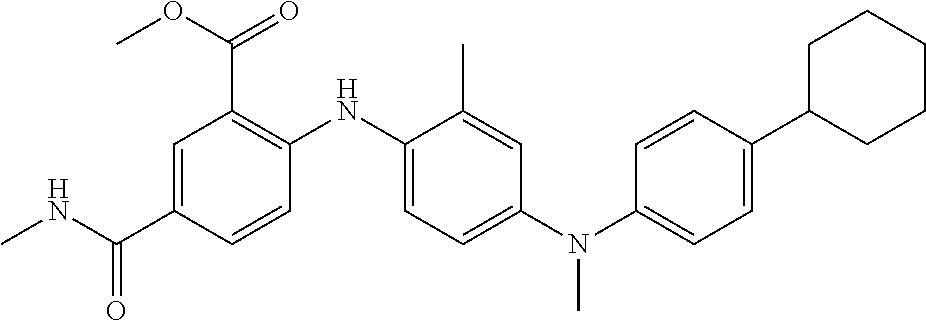 |
LC-MS: m/z 486.3 (M + H)+ |
| 633 | XII.159 | XI.53 |
 |
1H NMR (400 MHz, DMSO-d6) δ 8.70 (s, 1H), 7.36 (d, J = 3.2 Hz, 2H), 7.13-7.10 (m, 3H), 6.93-6.91 (m, 3H), 6.75-6.73 (m, 2H), 4.05-4.00 (m, 1H), 3.86 (s, 3H), 3.56 (s, 2H), 3.22 (s, |
| 3H), 2.12 (s, 3H), | ||||
| 1.79-1.68 (m, 2H), | ||||
| 1.30-1.16 (m, 8H), | ||||
| 0.99 (s, 9H). | ||||
| 634 | XII.160 | XI.53 |
 |
1H NMR (400 MHz, DMSO-d6) δ 8.67 (s, 1H), 7.35 (d, J = 2.8 Hz, 1H), 7.10 (dd, J1 = 2.4 Hz, J2 = 8.4 Hz, 3H), 7.05 (dd, J1 = 3.2 Hz, J2 = 9.2 Hz, 1H), 6.91-6.89 (m, 3H), 6.77 (dd, J1 = 2.4 Hz, J2 = 8.4 |
| Hz, 1H), 6.71 (d, | ||||
| J = 9.2 Hz, 1H), 4.14- | ||||
| 4.10 (m, 1H), 3.83 (s, | ||||
| 3H), 3.20 (s, 3H), | ||||
| 2.45-2.35 (m, 1H), | ||||
| 2.10 (s, 3H), 1.86- | ||||
| 1.67 (m, 7H), 1.50- | ||||
| 1.20 (m, 13H). | ||||
| 635 | XII.161 | XI.53 |
 |
LC-MS: m/z 444.2 (M − 95)+ COCF3 fragment |
| 636 | XII.162 | XI.53 |
 |
LC-MS: m/z 444.20 (M + H)+. |
| 637 | XII.163 | XI.53 |
 |
LC-MS: m/z 568.3 (M + H)+ |
| 640 | XII.164 | XI.53 |
 |
LC-MS: m/z 456.3 (M − H)+ |
| 641 | XII.165 | XI.93 |
 |
LC-MS: m/z 484.1 (M + H)+ |
| 642 | XII.166 | XI.94 |
 |
LC-MS: m/z 458.2 (M + H)+ |
| 643 | XII.167 | XI.81 |
 |
LC-MS: m/z 431.25 (M + H)+ |
| 646 | XII.168 | XI.95 |
 |
LC-MS: m/z 460.2 (M + H)+ |
| 647 | XII.169 | XI.96 |
 |
LC-MS: m/z 446.1 (M + H)+ |
| 648 | XII.170 | XI.32 |
 |
LC-MS: m/z 416.05 (M + H)+ |
| 649 | XII.171 | VIII.7 |
 |
LC-MS: m/z 443.3 (M + H)+ |
| 650 | XII.172 | VII |
 |
LC-MS: m/z 519.2 (M + H)+ |
| 652 | XII.173 | XI.85 |
 |
LC-MS: m/z 445.3 (M + H)+ |
| 654 | XII.174 | XI.80 |
 |
LC-MS: m/z 447.0 (M + H)+ |
| 655 | XII.175 | XI.80 |
 |
LC-MS: m/z 416.2 (M + H)+ |
| 656 | XII.176 | XI.53 |
 |
LC-MS: m/z 522.2 (M + H)+ |
| 659 | XII.177 | XI.97 |
 |
LC-MS: m/z 465.2 (M + H)+ |
| 660 | XII.178 | XI.98 |
 |
LC-MS: m/z 518.1 (M + H)+ |
| 661 | XII.179 | XI.99 |
 |
LC-MS: m/z 499.2 (M − H)+ |
| 662 | XII.180 | XI.99 |
 |
LC-MS: m/z 469.2 (M + H)+ |
| 663 | XII.181 | XI.100 |
 |
LC-MS: m/z 471.2 (M + H)+ |
| 665 | XII.182 | XI.101 |
 |
LC-MS: m/z 464.2 (M + H)+ |
| 666 | XII.183 | XI.101 |
 |
LC-MS: m/z 463.2 (M + H)+ |
| 669 | XII.184 | XI.101 |
 |
LC-MS: m/z 493.2 (M + H)+ |
| 671 | XII.185 | XI.102 |
 |
LC-MS: m/z 556.2 (M + H)+ |
| 672 | XII.186 | XI.101 |
 |
LC-MS: m/z 519.2 (M + H)+ |
| 673 | XII.187 | XI.85 |
 |
LC-MS: m/z 486.25 (M + H)+ |
| 675 | XII.188 | XI.98 |
 |
LC-MS: m/z 534.2 (M + H)+ |
| 676 | XII.189 | XI.98 |
 |
LC-MS: m/z 503.2 (M + H)+ |
| 677 | XII.190 | XI.104 |
 |
LC-MS: m/z 436.1 (M + H)+ |
| 678 | XII.191 | XI.53 |
 |
LC-MS: m/z 537.3 (M + H)+ |
| 680 | XII.192 | XI.103 |
 |
LC-MS: m/z 464.1 (M + H)+ |
| 681 | XII.193 | XI.102 |
 |
LC-MS: m/z 478.2 (M + H)+ |
| 682 | XII.194 | XI.104 |
 |
LC-MS: m/z 450.2 (M + H)+ |

| Interme- | ||||
| diate | Re- | |||
| CP | No. | actant | Structure | Analytical data |
| 102, 103 | XIII.1 | Int-XI |
 |
1H NMR (400 MHz, DMSO-d6) δ 7.27 (s, 1H), 7.02 (dd, J1 = 2.4 Hz, J2 = 8.8 Hz, 1H), 6.98 (d, J = 8.8 Hz, 2H), 6.85 (d, J = 8.8 Hz, 1H), 6.61 (d, J = 8.8 Hz, 2H), 5.74 (s, 1H), 4.15-4.03 (m, 2H), 3.52 (m, 1H), 3.39 (s, 1H), 2.31-2.18 (m, 3H), 2.07 |
| (s, 3H), 1.98-1.92 (m, 1H), | ||||
| 1.84 (s, 6H), 1.81-1.61 (m, | ||||
| 9H), 1.18 (t, J = 7.2 Hz, | ||||
| 3H), 1.12-1.05 (m, 1H). | ||||
| LC-MS: m/z 507.2 (M + H)+ | ||||
| 128, 129 | XIII.2 | XI.1 |
 |
LC-MS: m/z 561.2 (M + H)+ |
| 130 | XIII.3 | Int-I.1 |
 |
LC-MS: m/z 368.2 (M + H)+ |
| 131 | XIII.4 | Int-I.1 |
 |
1H NMR (400 MHz, DMSO-d6) δ 7.02 (d, J = 8.4 Hz, 2H), 6.59 (d, J = 8.8 Hz, 2H), 5.01 (d, J = 9.6 Hz, 1H), 3.98-3.88 (m, 3H), 2.75-2.68 (m, 1H), 2.08 (s, 3H), 2.00- 1.82 (m, 1H), 1.77 (m, 8H), 1.73-1.46 (m, 4H), 1.36-1.23 (m, 2H), 1.07 (t, J = 7.6 Hz, 3H). LC- MS: m/z 382.2 (M + H)+ |
| 136 | XIII.5 | Int-XI |
 |
LC-MS: m/z 507.3 (M + H)+ |
| 162 | XIII.6 | Int-XI |
 |
LC-MS: m/z 608.2 (M + H)+ |
| 172 | XIII.7 | Int-XI |
 |
LC-MS: m/z 594.2 (M + H)+ |
| 244 | XIII.8 | Int-I |
 |
LC-MS: m/z 375.1 (M − 55)+ Boc fragment |
| 248 | XIII.9 | Int-I |
 |
1H NMR (400 MHz, DMSO- d6) δ 7.19 (d, J = 1.9 Hz, 1H), 7.13 (d, J = 8.8 Hz, 1H), 6.76 (d, J = 8.8 Hz, 1H), 4.65-4.63 (m, 1H), 3.61-3.60 (m, 2H), 3.37- 3.36 (m, 1H), 3.15-3.08 (m, 2H), 2.02 (bs, 3H), 1.89-1.88 (m, 1H), 1.73 (s, 6H), 1.70 (s, 6H), 1.63- |
| 1.62 (m, 2H), 1.26 (s, 9H). | ||||
| 244 | XIII.10 | XIII.8 |
 |
1H NMR (400 MHz, DMSO- d6) δ 8.60 (s, 1H), 8.00 (s, 1H), 7.40 (s, 1H), 7.18 (d, J = 2.0 Hz, 1H), 7.11 (dd, J1 = 2.0 Hz, J2 = 8.8 Hz, 1H), 6.63 (d, J = 8.8 Hz, 1H), 4.60 (s, 1H), 3.97-3.89 (bs, 1H), 3.84 (s, 3H), 2.02 |
| (s, 3H), 1.77 (s, 6H), 1.67 | ||||
| (s, 6H). LC-MS: m/z 480.1 | ||||
| (M + H)+ | ||||
| 248 | XIII.11 | XIII.9 |
 |
LC-MS: m/z 494.1 (M + H)+ |
| 567 | XIII.12 | XII.105 |
 |
LC-MS: m/z 460.3 (M + H)+. |

| Interme- | ||||
| diate | ||||
| CP | No. | Reactant | Structure | Analytical data |
| 106, 107, 145, 215 | XIV.1 | VII.6 |
 |
1H NMR (400 MHz, DMSO-d6) δ 12.26 (s, 1H), 8.27 (s, 1H), 7.75 (d, J = 8.8 Hz, 1H), 7.43 (s, 1H), 7.35-7.3 (m, 2H), 6.86 (d, J = 8.9 Hz, 2H), 2.06 (s, 3H), 1.86 (s, 6H), 1.73 (s, 6H). LC- MS: m/z 382.1 (M + H)+ |
| 254, 301 | XIV.2 | II.15 |
 |
1H NMR (400 MHz, DMSO-d6) δ 12.59 (s, 1H), 10.38 (s, 1H), 8.49 (dd, J1 = 1.9 Hz, J2 = 4.4 Hz, 1H), 8.31 (dd, J1 = 2.0 Hz, J2 = 5.8 Hz, 1H), 7.89 (m, 4H), 7.0 (m, 1H), 3.92 (s, 3H). |
| 255 | XIV.3 | V.4 |
 |
1H NMR (400 MHz, DMSO-d6) δ 7.9-7.8 (m, 1H), 7.80-7.70 (m, 1H), 7.64 (d, J = 9.6 Hz, 2H), 7.52-7.40 (m, 2H), 6.47 (d, J = 9.2 Hz, 2H), 3.55 (s, 3H), 3.24 (s, 3H), 1.49 (s, 9H). LC-MS: m/z 286.1 (M + H)+ |
| 258 | XIV.4 | V.5 |
 |
1H NMR (400 MHz, DMSO-d6) δ 8.57 (dd, J1 = 2.0 Hz, J2 = 4.9 Hz, 1H), 8.01 (dd, J1 = 1.4 Hz, J2 = 7.3 Hz, 1H), 7.78 (d, J = 8.8 Hz, 2H), 7.23-7.20 (m, 3H). |
| 259, 346 | XIV.5 | II.16 |
 |
1H NMR (400 MHz, DMSO-d6) δ 12.5 (s, 1H), 9.75 (s, 1H), 7.97 (d, J = 8.8 Hz, 2H), 7.85 (d, J = 8.8 Hz, 2H), 7.79 (m, 1H), 7.53 (d, J = 6.8 Hz, 1H), 7.14 (d, J = 8.3 Hz, 1H), 4.35 (m, 2H), 1.38 (t, J = 2.0 Hz, 3H). |
| 265 | XIV.6 | II.18 |
 |
1H NMR (400 MHz, DMSO-d6) δ 12.64 (s, 1H), 9.29 (s, 1H), 8.11 (dd, J1 = 1.6 Hz, J2 = 8.4 Hz, 1H), 7.89 (d, J = 8.8 Hz, 2H), 7.63-7.58 (m, 1H), 7.50- 7.46 (m, 1H), 7.30 (d, J = 8.8 Hz, 2H), 7.12-7.06 (m, 1H). LC-MS: m/z 257.1 (M − H)−. |
| 293, 294, 276 | XIV.7 | VI.44 |
 |
1H NMR (400 MHz, DMSO-d6) δ 9.23 (s, 1H), 8.68 (s, 1H), 7.89 (d, J = 6.9 Hz, 1H), 7.78 (d, J = 8.8 Hz, 2H), 7.41-7.40 (m, 1H), 7.23-7.20 (m, 4H), 7.11 (d, J = 8.3 Hz, 1H), 7.03 (d, J = 8.8 Hz, 2H), 6.76 (t, J = 7.6 Hz, 1H), 3.86 (s, 3H). |
| 302 | XIV.8 | II.21 |
 |
1H NMR (400 MHz, DMSO-d6) δ 12.2 (s, 1H), 10.05 (s, 1H), 8.41-8.40 (m, 1H), 8.26 (d, J = 7.8 Hz, 2H), 7.64 (d, J = 8.3 Hz, 2H), 7.22 (d, J = 1.9 Hz, 2H), 6.92-6.89 (m, 1H), 3.90 (s, 3H), 3.52 (s, 3H). |
| 303 | XIV.9 | II.22 |
 |
1H NMR (400 MHz, DMSO-d6) δ 12.4 (s, 1H), 8.92 (s, 1H), 7.82 (d, J = 8.8 Hz, 2H), 7.74 (s, 1H), 7.54-7.52 (m, 2H), 7.45-7.44 (m, 2H), 7.09 (d, J = 8.8 Hz, 2H), 3.84 (s, 3H). LC-MS: m/z 272.0 (M + H)+ |
| 315, 316 | XIV.10 | II.35 |
 |
LC-MS: m/z 348.1 (M + H)+ |
| 330 | XIV.11 | II.24 |
 |
1H NMR (400 MHz, DMSO-d6) δ 12.95 (s, 1H), 8.10 (t, J = 7.8 Hz, 1H), 7.99 (d, J = 8.3 Hz, 2H), 7.88 (d, J = 7.4 Hz, 1H), 7.38 (d, J = 8.3 Hz, 1H), 7.26 (d, J = 8.3 Hz, 2H), 3.82 (s, 3H). LC-MS: m/z 274.0 (M + H)+ |
| 333, 341, 395, 408 | XIV.12 | II.25 |
 |
1H NMR (400 MHz, DMSO-d6) δ 13.01 (s, 1H), 9.32 (s, 1H), 7.92-7.90 (m, 1H), 7.77-7.76 (m, 1H), 7.62-7.60 (m, 1H), 7.48- 7.44 (m, 3H), 7.28-7.24 (m, 1H), 6.90-6.86 (m, 1H), 3.89 (s, 3H). LC-MS: m/z 272.1 (M + H)+ |
| 334 | XIV.13 | II.26 |
 |
1H NMR (400 MHz, DMSO-d6) δ 12.79 (s, 1H), 7.93-7.90 (m, 3H), 7.71-7.67 (m, 1H), 7.40 (t, J = 7.6 Hz, 1H), 7.23 (d, J = 8.0 Hz, 1H), 6.93 (d, J = 8.8 Hz, 2H), 3.67 (s, 3H). LC-MS: m/z 273.1 (M + H)+ |
| 353 | XIV.14 | V.7 |
 |
1H NMR (400 MHz, DMSO-d6) δ 12.80 (s, 1H), 7.78 (d, J = 7.2 Hz, 1H), 7.67 (t, J = 7.6 Hz, 1H), 7.42-7.37 (m, 2H), 7.27-7.21 (m, 2H), 7.07 (s, 1H), 6.77 (d, J = 7.2 Hz, 1H), 3.50 (s, 3H), 3.22 (s, 3H). LC-MS: m/z 284.1 (M + H)+ |
| 357 | XIV.15 | V.9 |
 |
LC-MS: m/z 391.2 (M + H)+ |
| 394 | XIV.16 | II.34 |
 |
1H NMR (400 MHz, DMSO-d6) δ 12.97 (s, 1H), 8.45 (dd, J1 = 2.0 Hz, J2 = 4.8 Hz, 1H), 8.34 (t, J = 2.0 Hz, 1H), 8.28 (dd, J1 = 2.0 Hz, J2 = 8.0 Hz, 1H), 7.92-7.90 (m, 1H), 7.62-7.59 (m, 1H), 7.45 (t, J = 8.0 Hz, 1H), 6.94 (dd, J1 = 4.8 Hz, J2 = 7.6 Hz, 1H), 3.91 (s, 3H). LC-MS: m/z 273.1 |
| (M + H)+ | ||||
| 363 | XIV.17 | II.33 |
 |
1H NMR (400 MHz, DMSO-d6) δ 12.81 (s, 1H), 8.25 (s, 1H), 7.60 (s, 1H), 7.33-7.21 (m, 5H), 7.04 (d, J = 8.4 Hz, 2H), 2.04 (s, 3H), 1.84 (s, 6H), 1.72 (s, 6H). LC-MS: m/z 348.1 (M + H)+ |
| 386, 387 | XIV.18 | VI.62 |
 |
1H NMR (400 MHz, DMSO-d6) δ 10.02 (s, 1H), 8.64 (s, 1H), 8.39-8.38 (m, 1H), 8.26-8.24 (m, 1H), 7.76 (d, J = 6.8 Hz, 2H), 7.66-7.63 (m, 2H), 7.18-7.15 (m, 2H), 6.99-6.97 (m, 2H), 6.86 (dd, J1 = 4.8 Hz, J2 = 8.0 Hz, 1H), 3.90 (s, 3H). LC-MS: m/z 364.2 (M + H)+ |
| 638 | XIV.19 | II.29 |
 |
LC-MS: m/z 296.2 (M + H)+ |
| 651 | XIV.20 | II.28 |
 |
LC-MS: m/z 310.05 (M + H)+ |

| Interme- | ||||
| diate | ||||
| CP | No. | Reactant | Structure | Analytical data |
| 71 | XV.1 | Int-XIV & I.4 |
 |
LC-MS: m/z 560.1 (M + H)+ |
| 106 | XV.2 | XIV.1 |
 |
1H NMR (400 MHz, DMSO- d6) δ 8.03 (s, 1H), 7.47-7.4 (m, 3H), 7.33-7.27 (m, 2H), 6.9 (d, J = 8.3 Hz, 2H), 4.46- 4.44 (m, 1H), 3.64-3.61 (m, 5H), 2.32 (m, 1H), 2.05 (s, 3H), 1.85 (s, 9H), 1.73 (s, 6H). LC-MS: m/z 493.2 (M + H)+ |
| 107 | XV.3 | XIV.1 |
 |
1H NMR (400 MHz, DMSO- d6) δ 8.03 (s, 1H), 7.47-7.4 (m, 3H), 7.33-7.27 (m, 2H), 6.9 (d, J = 8.3 Hz, 2H), 4.46- 4.44 (m, 1H), 3.64-3.61 (m, 5H), 2.32 (m, 1H), 2.05 (s, 3H), 1.85 (s, 9H), 1.73 (s, 6H). LC-MS: m/z 493.2 (M + H)+ |
| 109 | XV.4 | Int-XI |
 |
LC-MS: m/z 584.2 (M + H)+ |
| 145 | XV.5 | XIV.1 |
 |
1H NMR (400 MHz, DMSO- d6) δ 7.99 (s, 1H), 7.85 (d, J = 7.8 Hz, 1H), 7.65 (d, J = 8.8 Hz, 2H), 7.39 (s, 1H), 7.29-7.28 (m, 2H), 6.90 (d, J = 8.8 Hz, 2H), 4.60-4.58 (m, 1H), 3.91-3.87 (m, 2H), 3.02-2.98 (m, 1H), 2.05 (s, 3H), 1.97-1.76 (m, 10H), 1.72 (s, 6H), 1.40-1.30 (m, |
| 2H), 0.88 (t, J = 7.2 Hz, 3H). | ||||
| LC-MS: m/z 521.1 (M + H)+ | ||||
| 161 | XV.6 | I.16 |
 |
LC-MS: m/z 381 (M + H)+ |
| 186 | XV.7 | Int-XI |
 |
LC-MS: m/z 539.1 (M + H)+ |
| 212 | XV.8 | XI.1 |
 |
1H NMR (400 MHz, DMSO- d6) δ 10.36 (s, 1H), 8.15 (s, 1H), 7.55 (s, 1H), 7.43 (d, J = 1.2 Hz, 2H), 7.31 (d, J = 0.8 Hz, 2H), 6.94 (s, 1H), 4.88 (d, J = 5.2 Hz, 1H), 4.76 (d, J = 5.2 Hz, 1H), 3.71 (s, 3H), 2.06 (s, 3H), 1.86 (s, 6H), 1.73 (s, 6H), 1.42 (d, J = 3.2 Hz, 6H), LC-MS: m/z 607.2 (M + H)+ |
| 215 | XV.9 | XIV.1 |
 |
LC-MS: m/z 507.3 (M + H)+ |
| 230 | XV.10 | Int-XI |
 |
LC-MS: m/z 536.3 (M + H)+ |
| 254 | XV.11 | XIV.2 |
 |
1H NMR (400 MHz, DMSO- d6) δ δ 10.35 (s, 1H), 10.02 (s, 1H), 8.51 (dd, J1 = 2.0 Hz, J2 = 4.5 Hz, 1H), 8.31 (dd, J1 = 2.0 Hz, J2 = 7.8 Hz, 1H), 7.96 (d, J = 8.8 Hz, 2H), 7.89 (d, J = 8.8 Hz, 2H), 7.69 (d, J = 8.3 Hz, 2H), 7.32 (d, J = 8.8 Hz, 2H), 6.99 (m, 1H), 3.92 (s, |
| 3H), 2.06 (s, 3H), 1.82 (s, | ||||
| 6H), 1.74 (s, 6H). | ||||
| 255 | XV.12 | XIV.3 |
 |
1H NMR (400 MHz, DMSO- d6) δ 9.79 (s, 1H), 7.84 (dd, J1 = 1.2 Hz, J2 = 7.6 Hz, 1H), 7.77 (d, J = 8.8 Hz, 2H), 7.73-7.69 (m, 1H), 7.65 (d, J = 8.8 Hz, 2H), 7.48-7.40 (m, 2H), 7.28 (d, J = 8.8 Hz, 2H), 6.53 (d, J = 8.8 Hz, 2H), 3.57 (s, 3H), 3.27 (s, 3H), 2.05 (s, 3H), |
| 1.85 (s, 6H), 1.73 (s, 6H), | ||||
| LC-MS: m/z 495.1 (M + H)+ | ||||
| 258 | XV.13 | XIV.4 |
 |
1H NMR (400 MHz, DMSO- d6) δ δ 9.98 (s, 1H), 8.5 (m, 1H), 7.97 (d, J = 7.3 Hz, 1H), 7.87 (d, J = 8.3 Hz, 2H), 7.68 (d, J = 8.3 Hz, 2H), 7.3 (d, J = 8.8 Hz, 2H), 7.18-7 (m, 1H), 6.98 (d, J = 8.8 Hz, 2H), 3.48 (s, 3H), 3.32 (s, 3H), 2.05 (s, 3H), 1.83 (s, 6H), 1.73 (s, 6H). |
| 259 | XV.14 | XIV.5 |
 |
1H NMR (400 MHz, DMSO- d6) δ δ 9.99 (s, 1H), 9.7 (s, 1H), 8.01 (d, J = 9.3 Hz, 2H), 7.93 (d, J = 8.8 Hz, 2H), 7.81 (m, 1H), 7.69 (d, J = 8.8 Hz, 2H), 7.52 (d, J = 6.8 Hz, 1H), 7.31 (d, J = 8.8 Hz, 2H), 7.13 (d, J = 8.3 Hz, |
| 1H), 4.35 (m, 2H), 2.06 (s, | ||||
| 3H), 1.87 (s, 6H), 1.74 (s, | ||||
| 6H), 1.38 (t, J = 7.4 Hz, 3H). | ||||
| 272 | XV.15 | XI.13 |
 |
1H NMR (400 MHz, DMSO- d6) δ δ 10.17 (s, 1H), 9.28 (s, 1H), 7.91-7.88 (m, 3H), 7.78 (d, J = 8.8 Hz, 2H), 7.51 (d, J = 8.4 Hz, 2H), 7.42- 7.38 (m, 1H), 7.24 (d, J = 8.8 Hz, 2H), 7.14 (d, J = 8.0 Hz, 1H), 6.66-6.65 (m, 1H), 3.86 (s, 3H), 2.08 (s, 3H), 1.90 (s, 6H), 1.76 (s, 6H). LC-MS: |
| m/z 479.0 (M − H)−. | ||||
| 274 | XV.16 | Int-XIV |
 |
1H NMR (400 MHz, DMSO- d6) δ 9.34 (s, 1H), 7.92 (dd, J1 = 1.5 Hz, J2 = 7.8 Hz, 1H), 7.46 (t, J = 1.5 Hz, 1H), 7.30-7.20 (m, 5H), 6.90-6.86 (m, 1H), 3.89 (s, 3H), 3.40- 3.30 (m, 4H), 1.52-1.49 (m, 4H), 1.12-1.08 (m, 4H), 0.84-0.78 (m, 6H). |
| 285 | XV.17 | Int-XIV |
 |
1H NMR (400 MHz, DMSO- d6) δ δ 9.38 (s, 1H), 7.92 (d, J = 6.8 Hz, 1H), 7.78 (d, J = 8.0 Hz, 2H), 7.50-7.43 (m, 2H), 7.37 (d, J = 8.0 Hz, 1H), 7.27-7.23 (m, 2H), 6.91 (t, J = 7.6 Hz, 1H), 3.85 (s, 3H), 2.07 (s, 9H), 1.66 (s, 6H), 1.66 (s, 6H). LC-MS: m/z 405.1 (M + H)+ |
| 288 | XV.18 | Int-XIV |
 |
1H NMR (400 MHz, DMSO- d6) δ 9.78 (s, 1H), 9.42 (s, 1H), 7.92 (d, J = 6.8 Hz, 3H), 7.52-7.50 (m, 3H), 7.44 (d, J = 7.3 Hz, 1H), 7.31 (d, J = 8.8 Hz, 2H), 6.94 (t, J = 6.8 Hz, 1H), 6.63 (d, J = 9.3 Hz, 2H), 3.86 (s, 3H), 3.23 |
| (t, J = 7.2 Hz, 4H), 1.50-1.45 | ||||
| (m, 4H), 1.34-1.30 (m, 4H), | ||||
| 0.89 (t, J = 7.2 Hz, 6H). | ||||
| 293, 276 | XV.19 | XIV.7 |
 |
1H NMR (400 MHz, DMSO- d6) δ 9.20 (s, 1H), 8.38 (s, 1H), 7.88 (dd, J1 = 1.4 Hz, J2 = 7.8 Hz, 1H), 7.37-7.36 (m, 1H), 7.19-7.16 (m, 6H), 7.05-7.04 (m, 3H), 6.75- 6.71 (m, 1H), 3.85 (s, 3H), 3.32-3.30 (m, 4H), 1.52-1.49 (m, 4H), 1.23-1.22 (m, 4H), |
| 0.85-0.84 (m, 6H). | ||||
| 294 | XV.20 | XIV.7 |
 |
1H NMR (400 MHz, DMSO- d6) δ 9.21 (s, 1H), 8.47 (s, 1H), 7.89-7.87 (dd, J1 = 1.6 Hz, J2 = 7.6 Hz, 1H), 7.68 (d, J = 8.8 Hz, 2H), 7.36 (t, J = 8.4 Hz, 1H), 7.24 (s, 1H), 7.21-7.14 (m, 4H), 7.06 (d, J = 8.0 Hz, 1H), 7.0 (d, J = 8.8 Hz, 2H), 6.74 (t, J = 7.6 Hz, 1H), 3.86 (s, 3H), 2.06 |
| (s, 9H), 1.65 (s, 6H). LC- | ||||
| MS: m/z 496.0 (M + H)+ | ||||
| 297 | XV.21 | VII.14 |
 |
1H NMR (400 MHz, DMSO- d6) δ 10.09 (s, 1H), 9.29 (s, 1H), 7.90 (d, J = 8.3 Hz, 2H), 7.83 (d, J = 6.3 Hz, 2H), 7.72-7.7 (m, 3H), 7.51 (d, J = 8.3 Hz, 2H), 7.40 (d, J = 7.3 Hz, 1H), 7.03 (d, J = 8.3 Hz, 1H), 4.35-4.34 (m, 2H), 2.08 (s, 3H), 1.93 (s, 6H), 1.76 (s, 6H), 1.37 (t, |
| J = 7.4 Hz, 3H). | ||||
| 301 | XV.22 | XIV.2 |
 |
LC-MS: m/z 516.0 (M + H)+ |
| 302 | XV.23 | XIV.8 |
 |
1H NMR (400 MHz, DMSO- d6) δ 10.05 (s, 1H), 10.03 (s, 1H), 8.41-8.40 (m, 1H), 8.26-8.25 (m, 1H), 7.65 (d, J = 8.3 Hz, 2H), 7.52 (d, J = 8.8 Hz, 2H), 7.27-7.26 (m, 4H), 6.88-6.87 (m, 1H), 3.89 (s, 3H), 3.57 (s, 2H), 2.04 (s, 3H), 1.82 (s, 6H), |
| 1.72 (s, 6H). | ||||
| 303 | XV.24 | XIV.9 |
 |
1H NMR (400 MHz, DMSO- d6) δ 9.92 (s, 1H), 8.85 (s, 1H), 7.89 (d, J = 8.0 Hz, 2H), 7.75 (s, 1H), 7.68 (d, J = 8.8 Hz, 2H), 7.51-7.43 (m, 3H), 7.30 (d, J = 8.8 Hz, 2H), 7.15 (d, J = 8.8 Hz, 2H), 3.85 (s, 3H), 2.06 (s, 3H), 1.86 (s, 6H), 1.74 (s, 6H). LC-MS: m/z 481.3 |
| (M + H)+ | ||||
| 313 | XV.25 | Int-XIV |
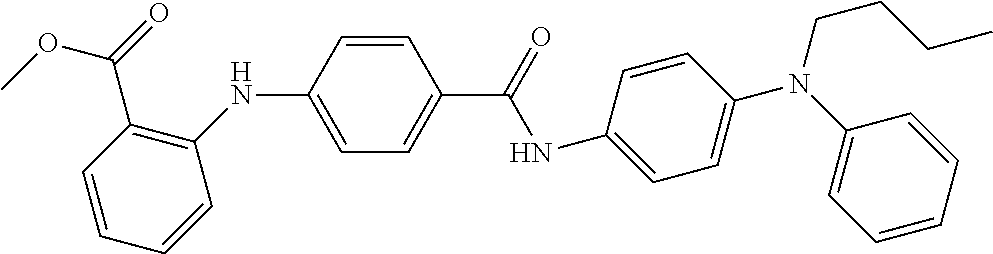 |
1H NMR (400 MHz, DMSO- d6) δ 10.04 (s, 1H), 9.43 (s, 1H), 7.96-7.94 (m, 3H), 7.72 (d, J = 8.8 Hz, 2H), 7.51 (m, 1H), 7.46 (d, J = 7.3 Hz, 1H), 7.34 (d, J = 8.3 Hz, 2H), 7.20 (t, J = 7.4 Hz, 2H), 7.05 (d, J = 8.8 Hz, 2H), |
| 7.93 (t, J = 6.9 Hz, 1H), 6.82 | ||||
| (m, 3H), 3.86 (s, 3H), 3.65 | ||||
| (t, J = 7.3 Hz, 2H), 1.56-1.55 | ||||
| (m, 2H), 1.37-1.36 (m, 2H), | ||||
| 0.88 (t, J = 3.9 Hz, 3H). | ||||
| 315 | XV.26 | XIV.10 |
 |
1H NMR (400 MHz, DMSO- d6) δ 11.53 (s, 1H), 8.66 (d, J = 7.4 Hz, 2H), 8.03 (d, J = 6.8 Hz, 1H), 7.82 (d, J = 8.8 Hz, 2H), 7.66-7.65 (m, 1H), 7.32 (d, J = 8.8 Hz, 2H), 7.21-7.10 (m, 5H), 3.91 (s, 3H), 2.06 (s, 3H), 1.89 (s, 6H), 1.71 (s, 6H). |
| 316 | XV.27 | XIV.10 |
 |
1H NMR (400 MHz, DMSO- d6) δ 10.13 (s, 1H), 8.56 (s, 1H), 8.45 (s, 1H), 8.07 (d, J = 7.8 Hz, 1H), 7.88 (d, J = 8.3 Hz, 2H), 7.66 (d, J = 13 Hz, 1H), 7.47 (t, J = 7.9 Hz, 1H), 7.31 (d, J = 8.3 Hz, 2H), 7.14 (d, J = 8.8 Hz, 2H), 7.08 (d, J = 8.3 Hz, |
| 2H), 3.87 (s, 3H), 2.06 (s, | ||||
| 3H), 1.82 (s, 6H), 1.74 (s, | ||||
| 6H). | ||||
| 324 | XV.28 | XIV.5 |
 |
1H NMR (400 MHz, DMSO- d6) δ 9.47 (s, 1H), 7.75-7.67 (m, 2H), 7.45 (d, J = 7.6 Hz, 1H), 7.26 (d, J = 8.4 Hz, 2H), 7.18 (d, J = 8.4 Hz, 2H), 7.09-7.02 (m, 3H), 6.47 (d, J = 8.8 Hz, 1H), 4.30 (q, J = 6.8 Hz, 2H), 3.33 (s, 3H), 2.01 (s, 3H), 1.8-0 (s, 6H), 1.70 (s, 6H), |
| 1.32 (t, J = 6.8 Hz, 3H). | ||||
| LC-MS: m/z 510.3 | ||||
| (M + H)+ | ||||
| 329 | XV.29 | Int-XIV |
 |
1H NMR (400 MHz, DMSO- d6) δ 10.17 (s, 1H), 9.45 (s, 1H), 7.99-7.93 (m, 3H), 7.83 (d, J = 8.4 Hz, 2H), 7.52- 7.40 (m, 3H), 7.36-7.34 (m, 3H), 7.26-7.21 (m, 3H), 7.13 (d, J = 6.8 Hz, 1H), 7.00- 6.90 (m, 1H), 3.87 (s, 3H), 3.10-3.00 (m, 1H), 1.13 (d, J = 6.8 Hz, 6H). LC-MS: m/z 465.1 (M + H)+ |
| 330 | XV.30 | XIV.11 |
 |
1H NMR (400 MHz, DMSO- d6) δ 10.20 (s, 1H), 8.12- 8.08 (m, 1H), 8.02 (dd, J1 = 2.0 Hz, J2 = 6.8 Hz, 2H), 7.88 (dd, J1 = 4.0 Hz, J2 = 8.0 Hz, 1H), 7.70 (d, J = 8.0 Hz, 2H), 7.40-7.37 (m, 1H), 7.33 (dd, J1 = 0.8 Hz, J2 = 2.0 Hz, 4H), 3.82 (s, 3H), 2.06 (s, 3H), 1.87 (s, 6H), 1.74 (s, |
| 6H). LC-MS: m/z 483.1 | ||||
| (M + H)+ | ||||
| 333 | XV.31 | XIV.13 |
 |
1H NMR (400 MHz, DMSO- d6) δ 10.15 (s, 1H), 9.40 (s, 1H), 7.92 (d, J = 8.0 Hz, 1H), 7.79 (s, 1H), 7.69-7.62 (m, 3H), 7.50-7.46 (m, 3H), 7.33-7.29 (m, 3H), 6.90-6.80 (m, 1H), 3.87 (s, 3H), 2.06 (s, 3H), 1.86 (s, 6H), 1.74 (s, 6H). LC-MS: m/z 481.2 (M + H)+ |
| 334 | XV.32 | XIV.14 |
 |
1H NMR (400 MHz, DMSO- d6) δ 10.08 (s, 1H), 7.96 (d, J = 8.3 Hz, 2H), 7.91 (d, J = 6.8 Hz, 1H), 7.68-7.66 (m, 3H), 7.40-7.37 (m, 1H), 7.32 (d, J = 8.8 Hz, 2H), 7.20 (d, J = 7.8 Hz, 1H), 6.98 (d, J = 8.3 Hz, 2H), 3.70 (s, 3H), 2.06 (s, 3H), 1.86 (s, 6H), 1.74 (s, |
| 6H). LC-MS: m/z 482.3 | ||||
| (M + H)+ | ||||
| 335 | XV.33 | Int-XIV |
 |
1H NMR (400 MHz, DMSO- d6) δ 10.0 (s, 1H), 9.43 (s, 1H), 7.96-7.92 (m, 3H), 7.68 (d, J = 8.8 Hz, 2H), 7.51- 7.49 (m, 1H), 7.44 (d, J = 8.4 Hz, 1H), 7.33-7.29 (m, 4H), 6.95 (t, J = 7.6 Hz, 1H), 3.86 (s, 3H), 2.14 (m, 1H), 1.69 (s, 2H), 1.53-1.33 (m, 8H), 1.19 (s, 2H), 0.86 (s, 6H). LC-MS: m/z 509.3 (M + H)+ |
| 336 | XV.34 | XIV.10 |
 |
LC-MS: m/z 482.2 (M + H)+ |
| 341 | XV.35 | XIV.13 |
 |
1H NMR (400 MHz, DMSO- d6) δ 10.14 (s, 1H), 9.40 (s, 1H), 7.92 (d, J = 8.0 Hz, 1H), 7.80 (s, 1H), 7.68 (d, J = 8.0 Hz, 2H), 7.64 (d, J = 7.2 Hz, 1H), 7.51-7.44 (m, 3H), 7.32-7.30 (m, 3H), 6.87 (t, J = 8.0 Hz, 1H), 3.87 (s, 3H), 2.14 (s, 1H), 1.68 (s, 2H), 1.53-1.33 (m, 8H), 1.19 (s, 2H), 0.86 (s, 6H). LC-MS: m/z 509.3 (M + H)+ |
| 343 | XV.36 | XIV.13 |
 |
1H NMR (400 MHz, DMSO- d6) δ 10.32 (s, 1H), 9.42 (s, 1H), 7.93 (d, J = 8.0 Hz, 1H), 7.84-7.82 (m, 3H), 7.66 (d, J = 6.8 Hz, 1H), 7.54- 7.12 (m, 10H), 6.88 (t, J = 7.20 Hz, 1H), 3.87 (s, 3H), 2.04-2.01 (m, 1H), 1.12 (d, J = 6.8 Hz, 6H). LC-MS: m/z 465.1 (M + H)+ |
| 344 | XV.37 | Int-I.1 |
 |
1H NMR (400 MHz, DMSO- d6) δ 11.64 (s, 1H), 10.36 (s, 1H), 8.53 (dd, J1 = 0.8 Hz, J2 = 8.4 Hz, 1H), 8.14-8.08 (m, 4H), 8.03 (dd, J1 = 1.6 Hz, J2 = 8.0 Hz, 1H), 7.73- 7.71 (m, 3H), 7.36-7.34 (m, 2H), 7.30-7.25 (m, 1H), 3.90 (s, 3H), 2.07 (s, 3H), 1.87 (d, J = 2.4 Hz, 6H), 1.74 (s, 6H). |
| LC-MS: m/z 509.3 (M + H)+ | ||||
| 346 | XV.38 | XIV.5 |
 |
1H NMR (400 MHz, DMSO- d6) δ 9.94 (s, 1H), 9.70 (s, 1H), 8.00 (d, J = 8.8 Hz, 2H), 7.93 (d, J = 8.8 Hz, 2H), 7.79 (t, J = 7.6 Hz, 1H), 7.69 (d, J = 8.8 Hz, 2H), 7.51 (d, J = 7.6 Hz, 1H), 7.30 (d, J = 8.8 Hz, 2H), 7.13 (d, J = 8.0 Hz, 1H), 4.38-4.33 (m, 2H), |
| 2.14 (m, 1H), 1.69 (s, 2H), | ||||
| 1.53-1.33 (m, 11H), 1.19 (s, | ||||
| 2H), 0.86 (s, 6H). LC-MS: | ||||
| m/z 524.3 (M + H)+ | ||||
| 353 | XV.39 | XIV.15 |
 |
LC-MS: m/z 495.1 (M + H)+ |
| 363 | XV.40 | XIV.18 |
 |
1H NMR (400 MHz, DMSO- d6) δ 11.61 (s, 1H), 8.61 (d, J = 8.4 Hz, 1H), 8.38 (s, 1H), 8.02 (d, J = 7.2 Hz, 1H), 7.70-7.63 (m, 2H), 7.42-7.22 (m, 6H), 7.11 (d, J = 8.8 Hz, 2H), 3.90 (s, 3H), 2.05 (s, 3H), 1.85 (s, 6H), 1.73 (s, 6H). LC-MS: m/z 481.2 (M + H)+ |
| 364 | XV.41 | XIV.18 |
 |
1H NMR (400 MHz, DMSO- 10.39 (s, 1H), 8.46 (t, J = 2.0 Hz, 1H), 8.29 (s, 1H), 8.04 (dd, J1 = 0.8 Hz, J2 = 8.0 Hz, 1H), 7.69-7.67 (m, 1H), 7.59 (s, 1H), 7.49 (t, J = 8.0 Hz, 1H), 7.36-7.20 (m, 5H), 7.08 (d, J = 8.8 Hz, 2H), 3.87 (s, 3H), 2.05 (s, 3H), 1.84 (s, 6H), 1.72 (s, 6H). LC-MS: m/z 481.2 (M + H)+ |
| 368 | XV.42 |
 |
LC-MS: m/z 523.3 (M + H)+ | |
| 369 | XV.43 |
 |
LC-MS: m/z 509.2 (M + H)+ | |
| 386 | XV.44 | XIV.19 |
 |
1H NMR (400 MHz, DMSO- d6) δ 9.97 (s, 1H), 8.38 (dd, J1 = 2.0 Hz, J2 = 4.8 Hz, 1H), 8.33 (s, 1H), 8.24 (dd, J1 = 2.0 Hz, J2 = 8.0 Hz, 1H), 7.60 (d, J = 8.8 Hz, 2H), 7.19 (d, J = 8.8 Hz, 2H), 7.13 (d, J = 3.2 Hz, 2H), 6.99 (d, J = 8.8 Hz, 2H), |
| 6.84 (dd, J1 = 2.8 Hz, J2 = | ||||
| 8.0 Hz, 1H), 3.90 (s, 3H), | ||||
| 3.29 (s, 6H), 1.54-1.47 (m, | ||||
| 4H), 1.23-1.20 (m, 4H), | ||||
| 0.85 (s, 6H). LC-MS: m/z | ||||
| 475.3 (M + H)+ | ||||
| 387 | XV.45 | XIV.19 |
 |
1H NMR (400 MHz, DMSO- d6) δ 9.97 (s, 1H), 8.39-8.38 (m, 2H), 8.24 (dd, J1 = 2.0 Hz, J2 = 8.0 Hz, 1H), 7.64 (dd, J1 = 8.4 Hz, J2 = 19.2 Hz, 4H), 7.21 (s, 1H), 7.12 (d, J = 8.8 Hz, 2H), 6.96 (d, J = 8.8 Hz, 2H), 6.84 (dd, J1 = 4.8 Hz, J2 = 8.0 Hz, |
| 1H), 3.90 (s, 3H), 1.99 (s, | ||||
| 10H), 1.65 (s, 6H). LC-MS: | ||||
| m/z 497.3 (M + H)+ | ||||
| 394 | XV.46 | XIV.17 & I.3 |
 |
LC-MS: m/z 544.3 (M + H)+ |
| 407 | XV.47 | Int-XIV & I.29 |
 |
1H NMR (400 MHz, DMSO- d6) δ 9.41 (s, 1H), 8.89 (t, J = 6.0 Hz, 1H), 7.93-7.91 (m, 1H), 7.87 (d, J = 8.8 Hz, 2H), 7.51-7.48 (m, 1H), 7.43-7.40 (m, 1H), 7.33-7.22 (m, 6H), 6.95-6.91 (m, 1H), 4.43 (d, J = 6.0 Hz, 2H), 3.84 (s, 3H), 2.05 (s, 3H), 1.84 (s, 6H), 1.73 (s, 6H), LC-MS: m/z 495.3 (M + H)+ |
| 408 | XV.48 | XIV.13 & I.29 |
 |
1H NMR (400 MHz, DMSO- d6) δ 9.39 (s, 1H), 9.02 (t, J = 6.0 Hz, 1H), 7.95-7.90 (m, 1H), 7.76 (s, 1H), 7.60- 7.55 (m, 1H), 7.45-7.42 (m, 3H), 7.32-7.23 (m, 5H), 6.87-6.83 (m, 1H), 4.42 (d, J = 6.0 Hz, 2H), 3.86 (s, |
| 3H), 2.04 (s, 3H), 1.84 (s, | ||||
| 6H), 1.76 (s, 6H), LC-MS: | ||||
| m/z 495.3 (M + H)+ | ||||
| 638 | XV.49 | XIV.20 |
 |
LC-MS: m/z 429.2 (M + H)+ |
| 651 | XV.50 | XIV.21 |
 |
LC-MS: m/z 443.2 (M + H)+ |
| 664 | XV.51 | XIV.13 |
 |
LC-MS: m/z 429.1 (M + H)+ |

| Inter- | ||||
| mediate | ||||
| CP | No. | Reactant | Structure | Analytical data |
| 372 | XVI.1 | Int-I.1 |
 |
LC-MS: m/z 411.1 (M − H)− |
| 393, 392 | XVI.2 | Int-I |
 |
1H NMR (400 MHz, DMSO-d6) δ 9.73 (s, 1H), 8.80 (dd, J = 1.6 Hz, J2 = 6.4 Hz, 1H), 8.31- 8.30 (m, 1H), 7.71 (d, J = 8.8 Hz, 2H), 7.63 (d, J = 9.2 Hz, 2H), 7.29 (d, J = 2.8 Hz, 1H), 7.26-7.24 |
| (m, 1H), 7.13 (d, J = 8.8 | ||||
| Hz, 1H), 2.08 (s, 3H), | ||||
| 2.04 (s, 3H), 1.78 (s, | ||||
| 6H), 1.66 (s, 6H). | ||||
| LC-MS: m/z 459.1 | ||||
| (M + H)+ | ||||
| 396 & 397 | XVI.3 | Int-I |
 |
1H NMR (400 MHz, DMSO-d6) δ 10.32 (s, 1H), 9.76 (s, 1H), 7.71 (d, J = 8.8 Hz, 2H), 7.62 (d, J = 8.8 Hz, 2H), 7.29 (d, J = 2.0 Hz, 1H), 7.24 (dd, J1 = 2.0 Hz, J2 = 8.4 Hz, 1H), 7.13 (d, J = 8.4 Hz, 1H), 2.11-2.09 (m, 1H), |
| 2.07 (s, 3H), 1.62 (s, 2H), | ||||
| 1.45-1.29 (m, 8H), 1.15 | ||||
| (s, 1H), 0.83 (s, 6H). LC- | ||||
| MS: m/z 485.1 (M + H)+ | ||||
| 342 | XVI.4 |
 |
 |
1H NMR (400 MHz, DMSO-d6) δ 10.4 (s, 1H), 7.84 (d, J = 8.3 Hz, 1H), 7.78 (d, J = 8.3 Hz, 2H), 7.7 (d, J = 8.3 Hz, 2H), 7.56 (t, J = 7.6 Hz, 1H), 7.43 (d, J = 8.0 Hz, 1H), 7.22 (t, J = 7.6 Hz, 1H), 3.8 (s, 3H). LC-MS: m/z 371.95 (M + H)+2. |

| Inter- | ||||
| mediate | ||||
| CP | No. | Reactant | Structure | Analytical data |
| 372 | XVII.1 | XVI.1 |
 |
LC-MS: m/z 383.1 (M + H)+ |
| 392, 393 | XVII.2 | XVI.2 |
 |
1H NMR (400 MHz, DMSO- d6) δ 9.31 (s, 1H), 7.38-7.32 (m, 2H), 7.28 (d, J = 2.0 Hz, 1H), 7.24-7.22 (m, 1H), 7.15 (d, J = 8.8 Hz, 1H), 6.55-6.52 (m, 2H), 5.98 (s, 2H), 2.02 (s, 3H), 1.79 (s, 6H), 1.69 (s, 6H). LC-MS: m/z 417.1 (M + H)+ |
| 396, 397 | XVII.3 | XVI.3 |
 |
1H NMR (400 MHz, DMSO- d6) δ 9.26 (s, 1H), 7.33 (d, J = 8.4 Hz, 2H), 7.27 (s, 1H), 7.22 (d, J = 8.8 Hz, 1H), 7.15 (d, J = 8.4 Hz, 1H), 6.53 (d, J = 8.4 Hz, 2H), 5.96 (s, 2H), 2.1 (m, 1H), 1.61 (s, 2H), 1.45-1.29 (m, 8H), 1.15 (s, 2H), 0.83 (s, 6H). LC-MS: |
| m/z 445.1 (M + H)+ | ||||

| Inter- | ||||
| mediate | ||||
| CP | No. | Reactant | Structure | Analytical data |
| 306 | XVIII.1 | Int- XVII |
 |
1H NMR (400 MHz, DMSO- d6) δ 10.33 (s, 1H), 10.05 (s, 1H), 8.48-8.47 (m, 1H), 8.31- 8.29 (m, 1H), 7.89 (d, J = 8.8 Hz, 2H), 7.69 (d, J = 8.8 Hz, 2H), 7.20 (d, J = 8.8 Hz, 2H), 7.03-6.99 (m, 3H), 3.90 (s, 3H), 1.99 (s, 3H), 1.76 (s, 6H), 1.68 (s, 6H). LC-MS: |
| m/z 518.0 (M + H)+ | ||||
| 312 | XVIII.2 | Int- XVII |
 |
1H NMR (400 MHz, DMSO- d6) δ 9.96 (s, 1H), 9.81 (s, 1H), 7.99 (d, J = 8.8 Hz, 2H), 7.79 (t, J = 8.0 Hz, 1H), 7.63 (d, J = 8.8 Hz, 2H), 7.53 (d, J = 7.2 Hz, 1H), 7.19 (d, J = 8.8 Hz, 2H), 7.11 (d, J = 8.4 Hz, 1H), 7.02 (d, J = 8.4 Hz, 2H), 4.36-4.30 (m, 2H), 1.98 |
| (s, 3H), 1.76 (s, 6H), 1.68 (s, | ||||
| 6H), 1.35 (t, J = 6.8 Hz, 3H). | ||||
| LC-MS: m/z 532.2 (M + H)+ | ||||
| 342 | XVIII.3 | XVI.4 |
 |
1H NMR (400 MHz, DMSO- d6) δ 10.33 (s, 1H), 8.49 (s, 1H), 7.89-8-7.86 (m, 1H), 7.58-7.56 (m, 3H), 7.51-7.49 (m, 1H), 7.43 (s, 1H), 7.34- 7.27 (m, 2H), 7.16-7.12 (m, 1H), 6.81 (d, J = 8.8 Hz, 2H), 3.84 (s, 3H), 2.05 (s, 3H), 1.85 (s, 6H), 1.73 (s, 6H). LC-MS: m/z 551.1 (M + H)+ |
| 372 | XVIII.4 | XVII.1 |
 |
LC-MS: m/z 517.2 (M + H)+ |
| 392 | XVIII.5 | XVII.2 |
 |
1H NMR (400 MHz, DMSO- d6) δ 9.72 (s, 1H), 9.37 (s, 1H), 7.92 (dd, J1 = 1.6 Hz, J2 = 8.0 Hz, 1H), 7.61 (d, J = 9.2 Hz, 2H), 7.55-7.51 (m, 1H), 7.45 (d, J = 7.6 Hz, 1H), 7.32 (d, J = 2.4 Hz, 1H), 7.27- 7.25 (m, 3H), 7.17 (d, J = 8.4 Hz, 1H), 7.04-7.00 (m, 1H), 3.81 (s, 3H), 2.02 (s, 3H), 1.80 (d, J = 2.8 Hz, 6H), 1.70 (s, 6H). |
| 393 | XVIII.6 | XVII.2 |
 |
1H NMR (400 MHz, DMSO- d6) δ 10.38 (s, 1H), 9.72 (s, 1H), 8.49 (dd, J1 = 2.0 Hz, J2 = 4.8 Hz, 1H), 8.31 (dd, J1 = 2.0 Hz, J2 = 7.6 Hz, 1H), 7.92 (d, J = 8.8 Hz, 2H), 7.67 (d, J = 8.8 Hz, 2H), 7.30 (d, J = 2.0 Hz, 1H), 7.25-7.24 (m, 1H), 7.17 (d, J = 8.4 Hz, 1H), 7.02 (dd, J1 = 4.8 Hz, J2 = 7.6 Hz, 1H), 3.91 (s, 3H), 2.01 (s, 3H), 1.79 (s, 6H), 1.69 (s, |
| 6H). LC-MS: m/z 552.2 | ||||
| (M + H)+ | ||||
| 396 | XVIII.7 | XVII.3 |
 |
LC-MS: m/z 577.2 (M + H)− |
| 397 | XVIII.8 | XVII.3 |
 |
1H NMR (400 MHz, DMSO- d6) δ 10.40 (s, 1H), 9.75 (s, 1H), 8.49 (dd, J1 = 2.0 Hz, J2 = 4.8 Hz, 1H), 8.32 (dd, J1 = 1.6 Hz, J2 = 7.6 Hz, 1H), 7.93 (d, J = 8.4 Hz, 2H), 7.65 (d, J = 8.8 Hz, 2H), 7.29-7.24 (m, 2H), 7.16 (d, J = 8.4 Hz, 1H), 7.02 (dd, J1 = 4.8 Hz, J2 = 7.6 Hz, 1H), 3.91 (s, 3H), 2.10-2.09 (m, 1H), 1.62 (s, 2H), 1.45-1.29 (m, 8H), 1.14 |
| (s, 2H), 0.82 (s, 6H). LC-MS: | ||||
| m/z 580.2 (M + H)+ | ||||

| Inter- | ||||
| mediate | ||||
| CP | No. | Reactant | Structure | Analytical data |
| 300 | XIX.1 | VII.14 & Int-I.1 |
 |
1H NMR (400 MHz, DMSO-d6) δ 9.18 (s, 1H), 8.45 (d, J = 13.2 Hz, 2H), 7.73-7.66 (m, 3H), 7.39-7.34 (m, 5H), 7.25 (d, J = 8.4 Hz, 2H), 6.99 (d, J = 8.4 Hz, 1H), 4.35-4.30 (m, 2H), 2.05 (s, 3H), 1.84 (s, 6H), 1.73 (s, 6H), 1.35 (t, J = 7.2 Hz, 3H). LC-MS: m/z |
| 511.1 (M + H)+ | ||||
| 307 | XIX.2 | XI.13 & Int-I.1 |
 |
1H NMR (400 MHz, DMSO-d6) δ 9.21 (s, 1H), 8.61 (s, 1H), 8.52 (s, 1H), 7.88 (d, J = 7.8 Hz, 1H), 7.47 (d, J = 8.3 Hz, 2H), 7.38-7.36 (m, 3H), 7.26 (d, J = 8.8 Hz, 2H), 7.18 (d, J = 8.3 |
| Hz, 2H), 7.05 (d, J = | ||||
| 8.3 Hz, 1H), 6.75- | ||||
| 6.73 (m, 1H), 3.85 | ||||
| (s, 3H), 2.05 (s, 3H), | ||||
| 1.84 (s, 6H), 1.73 (s, | ||||
| 6H). LC-MS: m/z | ||||
| 496.1 (M + H)+ | ||||
| 299 | XIX.3 | XI.17 & Int-I.1 |
 |
LC-MS: m/z 511.1 (M + H)+ |

| Inter- | ||||
| mediate | ||||
| CP | No. | Reactant | Structure | Analytical data |
| 114 | XIX.5 | Int-XI |
 |
1H NMR (400 MHz, DMSO-d6) δ 8.18 (s, 1H), 7.34 (d, J = 8.8 Hz, 2H), 7.28 (d, J = 2.0 Hz, 1H), 7.26 (s, 1H), 7.14 (dd, J1 = 2.0 Hz, J2 = 8.0 Hz, 1H), 7.04 (d, J = 8.8 Hz, 1H), 6.96 (d, J = 9.6 Hz, 2H), 4.37- 4.34 (m, 1H), 3.62 |
| (s, 3H), 3.56-3.46 | ||||
| (m, 2H), 2.21-2.14 | ||||
| (m, 1H), 2.03 (s, | ||||
| 3H), 1.98-1.84 (m, | ||||
| 3H), 1.81 (d, J = 2.4 | ||||
| Hz, 6H), 1.71 (s, | ||||
| 6H). LC-MS: m/z | ||||
| 508.2 (M + H)+ | ||||
| 134 | XIX.6 | XI.2 |
 |
1H NMR (400 MHz, DMSO-d6) δ 8.24 (s, 1H), 7.47 (s, 1H), 7.41 (d, J = 6.8 Hz, 2H), 7.33 (d, J = 1.6 Hz, 1H), 7.28-7.17 (m, 4H), 7.13-7.06 (m, 4H), 4.38-4.35 (m, 1H), 3.76 (s, 3H), 3.63-3.48 (m, 2H), 2.27 (s, 3H), |
| 2.25-2.17 (m, 1H), | ||||
| 1.96-1.84 (m, 3H). | ||||
| LC-MS: m/z 464.1 | ||||
| (M + H)+ | ||||

| Intermediate | ||||
| CP | No. | Reactant | Structure | Analytical data |
| 198 | XX.1 | Int-XII |
 |
1H NMR (400 MHz, DMSO-d6) δ 8.31 (dd, J1 = 2.0 Hz, J2 = 4.8 Hz, 1H), 7.62 (dd, J1 = 2.0 Hz, J2 = 7.2 Hz, 1H), 7.49 (d, J = 2.4 Hz, 1H), 7.41 (dd, J1 = 2.4 Hz, J2 = 8.4 Hz, 1H), 7.26 (d, J = 8.4 Hz, 1H), 6.85-6.80 (m, 3H), 6.42 (d, J = 9.2 Hz, 2H), 3.31 (s, 3H), 3.25 (s, 3H), 3.15 (s, 3H), 2.07 (s, 3H), 1.89 (s, 6H), 1.74 (s, 6H). |
| 233 | XX.2 | VI.36 |
 |
LC-MS: m/z 480.25 (M + H)+ |
| 236 | XX.3 | XII.18 |
 |
1H NMR (400 MHz, DMSO-d6) δ 8.31 (dd, J1 = 2.0 Hz, J2 = 4.9 Hz, 1H), 7.71 (s, 1H), 7.70 (d, J = 1.4 Hz, 1H), 7.39 (d, J = 1.9 Hz, 1H), 7.32 (d, J = 2.0 Hz, 2H), 7.04 (d, J = 8.3 Hz, 1H), 6.88-6.85 (m, 1H), 5.28 (s, 2H), 3.39 (s, 3H), 3.26 (s, 3H), 2.04 (s, 3H), 1.83 (s, 6H), 1.72 (s, 6H). LC-MS: m/z 491.3 (M + H)+ |
| 246 | XX.4 | VI.40 |
 |
1H NMR (400 MHz, DMSO-d6) δ 8.35 (d, J = 3.2 Hz, 1H), 7.69 (d, J = 5.6 Hz, 1H), 7.25 (d, J = 8.4 Hz, 2H), 6.92-6.86 (m, 7H), 3.37 (s, 3H), 3.31 (s, 3H), 3.19 (s, 3H), 2.04 (s, 3H), 1.84 (s, 6H), 1.72 (s, 6H). LC-MS: m/z 482.1 (M + H)+ |
| 247 | XX.5 | VI.41 |
 |
1H NMR (400 MHz, DMSO-d6) δ 8.37 (dd, J1 = 1.9 Hz, J2 = 4.8 Hz, 1H), 7.78 (dd, J1 = 2.0 Hz, J2 = 7.4 Hz, 1H), 7.25 (d, J = 8.3 Hz, 2H), 7.12 (t, J = 7.8 Hz, 1H), 7.00 (d, J = 8.8 Hz, 2H), 6.94-6.90 (m, 1H), 6.56 (dd, J1 = 2.0 Hz, J2 = 8.3 Hz, 1H), 6.51 (dd, J1 = 1.5 Hz, J2 = 7.9 Hz, 1H), 6.40 (t, J = 1.9 Hz, |
| 1H), 3.38 (s, 3H), 3.30 (s, 3H), | ||||
| 3.17 (s, 3H), 2.04 (s, 3H), 1.82 | ||||
| (s, 6H), 1.72 (s, 6H). LC-MS: | ||||
| m/z 482.1 (M + H)+ | ||||
| 260 | XX.6 | Int-XV |
 |
LC-MS: m/z 495.2 (M + H)+ (Obtained acid directly) |
| 266 | XX.7 | XII.68 |
 |
LC-MS: m/z 536.1 (M + H)+ (obtained acid directly) |
| 270 | XX.8 | XII.67 |
 |
LC-MS: m/z 468.1 (M + H)+ |
| 271 | XX.9 | XII.33 |
 |
1H NMR (400 MHz, DMSO-d6) δ 8.52 (dd, J1 = 1.2 Hz, J2 = 4.8 Hz, 1H), 7.93 (dd, J1 = 1.6 Hz, J2 = 7.6 Hz, 1H), 7.30 (d, J = 9.2 Hz, 2H), 7.22 (d, J = 8.4 Hz, 1H), 7.14-7.11 (m, 3H), 6.44 (d, J = 8.8 Hz, 2H), 3.50 (s, 3H), 3.42 (s, 3H), 3.05 (s, 3H), 2.02 (s, 3H), 1.74 (s, 6H), 1.67 (s, 6H). LC-MS: m/z 550.1 (M + H)+ |
| 273 | XX.10 | XII.34 |
 |
1H NMR (400 MHz, DMSO-d6) δ 7.82-7.78 (m, 1H), 7.42-7.38 (m, 1H), 7.46-7.44 (m, 2H), 7.11-7.05 (m, 3H), 6.81-6.78 (m, 2H), 6.38 (d, J = 8.8 Hz, 2H), 3.60 (s, 3H), 3.27 (s, 3H), 3.02 (s, 3H), 2.02 (s, 3H), 1.79 (s, 6H), 1.70 (s, 6H). LC-MS: m/z 549.1 (M + H)+ |
| 275 | XX.11 | XII.35 |
 |
1H NMR (400 MHz, DMSO-d6) δ 7.69 (d, J = 2.8 Hz, 1H), 7.56- 7.52 (m, 2H), 7.32 (d, J = 8.4 Hz, 2H), 7.26 (d, J = 8.0 Hz, 1H), 7.15 (t, J = 6.8 Hz, 1H), 7.10 (d, J = 8.8 Hz, 2H), 6.93 (dd, J1 = 2.8 Hz, J2 = 9.2 Hz, 1H), 6.53 (d, J = 9.2 Hz, 1H), 3.53 (s, 3H), 3.29 (s, 3H), 3.18 (s, 3H), 2.05 (s, 3H), 1.86 (s, |
| 6H), 1.73 (s, 6H). LC-MS: | ||||
| m/z 482.25 (M + H)+ | ||||
| 276 | XX.12 | XV.19 |
 |
1H NMR (400 MHz, DMSO-d6) δ 7.71 (d, J = 6.4 Hz, 1H), 7.63 (t, J = 7.3 Hz, 1H), 7.36 (m, 2H), 7.16 (m, 1H), 7.13 (d, J = 8.8 Hz, 2H), 6.99 (d, J = 8.8 Hz, 2H), 6.62 (m, 4H), 3.57 (s, 3H), 3.28 (m, 4H), 3.25 (s, 3H), 3.18 (s, 3H), 1.50 (m, 4H), 1.23 (m, 4H), 0.86 (m, 6H). |
| 277 | XX.13 | VI.45 |
 |
LC-MS: m/z 451.1 (M + H)+ (obtained acid directly) |
| 286 | XX.14 | XII.36 |
 |
1H NMR (400 MHz, DMSO-d6) δ 7.69 (dd, J1 = 1.6 Hz, J2 = 8.0 Hz, 1H), 7.64-7.60 (m, 1H), 7.43 (d, J = 2.8 Hz, 1H), 7.36- 7.25 (m, 3H), 6.84-6.78 (m, 3H), 6.60 (d, J = 8.8 Hz, 2H), 3.54 (s, 3H), 3.21 (s, 3H), 2.04 (s, 3H), 1.83 (s, 6H), 1.72 (s, |
| 6H). LC-MS: m/z 502.1 | ||||
| (M + H)+ | ||||
| 296 | XX.15 | VI.49 |
 |
1H NMR (400 MHz, DMSO-d6) δ 7.68-7.55 (m, 2H), 7.38-7.05 (m, 4H), 6.95-6.83 (m, 2H), 6.75-6.55 (m, 4H), 3.54 (s, 3H), 3.20 (s, 3H), 3.13 (s, 3H), 2.10 (m, 1H), 1.62 (s, 2H), 1.46- 1.33 (m, 8H), 1.16 (s, 2H), 0.83 (s, 6H). LC-MS: m/z 509.2 (M + H)+ |
| 305 | XX.16 | VI.45 |
 |
1H NMR (400 MHz, DMSO-d6) δ 7.67 (d, J = 7.8 Hz, 1H), 7.63- 7.59 (m, 1H), 7.35 (d, J = 8.4 Hz, 1H), 7.30-7.26 (m, 1H), 7.10 (t, J = 8.0 Hz, 2H), 6.94 (t, J = 8.4 Hz, 4H), 6.73 (d, J = 8.8 Hz, 2H), 6.65-6.60 (m, 5H), 3.56-3.53 (m, 5H), 3.21 (s, 3H), 3.17 (s, 3H), 1.53-1.48 (m, 2H), 1.33-1.28 (m, 2H), 0.87 (t, J = |
| 6.9 Hz, 3H). LC-MS: m/z 494.1 | ||||
| (M + H)+ | ||||
| 310 | XX.17 | Int-XV |
 |
1H NMR (400 MHz, DMSO-d6) δ 9.24 (s, 1H), 7.88 (d, J = 8.0 Hz, 1H), 7.40-7.38 (m, 1H), 7.28-7.19 (m, 5H), 7.09 (d, J = 8.4 Hz, 2H), 7.02 (d, J = 8.4 Hz, 2H), 6.88 (t, J = 7.2 Hz, 1H), 3.90 (s, 3H), 3.34 (s, 3H), 2.02 (s, 3H), 1.81 (s, 6H), 1.70 (s, 6H). LC-MS: m/z 495.1 (M + H)+ |
| 314 | XX.18 | XII.40 |
 |
1H NMR (400 MHz, DMSO-d6) δ 8.39 (dd, J1 = 1.4 Hz, J2 = 4.4 Hz, 1H), 7.44 (dd, J1 = 2.0 Hz, J2 = 7.9 Hz, 1H), 7.35 (d, J = 8.8 Hz, 2H), 7.03 (d, J = 9.3 Hz, 2H), 6.9-6.89 (m, 5H), 3.41 (s, 3H), 3.31 (s, 3H), 2.09 (s, 3H), 1.85 (s, 6H), 1.73 (s, 6H). LC-MS: m/z 469.3 (M + H)+ |
| 325 | XX.19 | XVIII.1 |
 |
LC-MS: m/z 532.2 (M + H)+ |
| 326 | XX.20 | VI.53 |
 |
LC-MS: m/z 511.4 (M + H)+ |
| 355 | XX.21 | XX.19 |
 |
LC-MS: m/z 546.1 (M + H)+ |
| 357 | XX.22 | XIV.16 |
 |
1H NMR (400 MHz, DMSO-d6) δ 7.69 (d, J = 8.0 Hz, 1H), 7.65- 7.60 (m, 1H), 7.39-7.30 (m, 3H), 7.15-7.07 (m, 3H), 6.94 (d, J = 8.8 Hz, 2H), 6.76 (d, J = 8.0 Hz, 1H), 6.60 (d, J = 8.8 Hz, 2H), 3.56 (s, 3H), 3.22 (s, 3H), 3.18 (s, 3H), 2.03 (s, 9H), 1.64 (s, 6H). LC-MS: m/z 524.3 (M + H)+ |
| 360 | XX.23 | XII.51 |
 |
1H NMR (400 MHz, DMSO-d6) δ 7.71 (d, J = 7.8 Hz, 1H), 7.61 (d, J = 7.4 Hz, 1H), 7.43 (d, J = 7.8 Hz, 2H), 7.35-7.30 (m, 3H), 7.21-7.16 (m, 3H), 6.94 (d, J = 8.8 Hz, 2H), 6.86 (d, J = 8.4 Hz, 1H), 6.64 (d, J = 8.8 Hz, 2H), 3.56 (s, 3H), 3.22 (s, 3H), 2.94 (m, 1H), 1.13 (d, J = 6.4 Hz, 6H), LC-MS: m/z 486.2 |
| (M + H)+ | ||||
| 362 | XX.24 | XII.52 |
 |
1H NMR (400 MHz, DMSO-d6) δ 7.45 (t, J = 8.0 Hz, 1H), 7.13 (t, J = 8.4 Hz, 2H), 6.97 (d, J = 8.4 Hz, 1H), 6.91 (d, J = 8.8 Hz, 2H), 6.81 (d, J = 8.0 Hz, 1H), 6.71-6.57 (m, 4H), 3.79 (s, 3H), 3.57 (s, 3H), 3.14 (s, 3H), 3.09 (s, 3H), 2.03 (s, 3H), 1.80 (s, 6H), 1.71 (s, 6H). LC-MS: m/z 511.2 (M + H)+ |
| 587 | XX.25 | XII.122 |
 |
LC-MS: m/z 418.2 (M + H)+ |
| Com- | |||||
| pound | |||||
| No | No | Reactant | | Analytical data | |
| 51 | 1 |
 |
1H NMR (500 MHz, CDCl3) δ 9.45 (s, 1H), 8.01 (s, 1H), 7.5-7.7.30 (m, 2H), 7.2-7.1 (m, 2H), 6.98 (s, 1H), 6.8 (s, 1H), 6.78-6.26 (m, 4H), 5.99 (s, 1H), 3.90 (s, 3H), 2.23- 1.97 (m, 15H) LC-MS: m/z 453.3 (M + H)+ | |
| 54 | 2 |
 |
LC-MS: m/z 453.1 (M + H)+ | |
| 57 | 3 |
 |
1H NMR (500 MHz, CDCl3) δ 9.45 (s, 1H), 8.01 (s, 1H), 7.45-7.23. (d, 2H), 7.23-7.01 (m, 6H), 6.98-7.01 (d, 2H), 6.94 (s, 1H), 3.93 (s, 3H), 5.99 (s, 1H), 2.21-1.98 (m, 15H) LC-MS: m/z 521.6 (M + H)+ | |
| 68 | 4 |
 |
LC-MS: m/z 481.1 (M + H)+ | |
| 70 | 5 |
 |
LC-MS: m/z 561.2 (M + H)2+ | |
| 79 | 6 |
 |
LC-MS: m/z 515.3 (M + H)+ | |
| 85 | 7 | Int-XI |
 |
1H NMR (400 MHz, DMSO- d6) δ 8.17 (s, 1H), 7.58 (dd, J1 = 1.6 Hz, J2 = 8.0 Hz, 1H), 7.44-7.40 (m, 2H), 7.32 (d, J = 2.0 Hz, 1H), 7.20-7.12 (m, 2H), 7.09-7.01 (m, 5H), 6.84 (t, J = 7.2 Hz, 1H), 2.04 (s, 3H), 1.83 (s, 6H), 1.72 (s, 6H). LC-MS: m/z 454.1 (M + H)+ |
| 104 | 8 | Int-XI |
 |
1H NMR (400 MHz, DMSO- d6) δ 9.23 (s, 1H), 7.57 (s, 1H), 7.34 (s, 1H), 7.2 (d, J = 4.8 Hz, 4H), 7.12 (d, J = 8.8 Hz, 2H), 7.03-6.99 (m, 3H), 6.2 (d, J = 8.4 Hz, 1H), 6.05 (d, J = 8.4 Hz, 1H), 2.04 (s, 3H), 1.83 (s, 6H), 1.72 (s, 6H). LC-MS: m/z 489.2 (M + H)+ |
| 201 | 9 | III.5 & Int-1 |
 |
1H NMR (400 MHz, DMSO- d6) δ 8.59 (s, 1H), 7.95 (s, 1H), 7.64 (s, 1H), 7.34 (s, 1H), 7.21 (s, 2H), 7.16 (d J = 8.4 Hz, 2H), 6.94 (d, J = 8.4 Hz, 2H), 5.28 (s, 2H), 2.04 (s, 3H), 1.83 (s, 6H), 1.72 (s, 6H). LC-MS: m/z 350.2 (M + H)+; Triazole fragment |
| 225 | 10 | Int-XI |
 |
1H NMR (500 MHz, CDCl3) δ 8.18-8.17 (m, 1H), 7.49- 7.45 (m, 1H), 7.32 (d, J = 1.6 Hz, 1H), 7.28-7.25 (m, 2H), 7.16-7.09 (m, 4H), 6.76 (d, J = 8.0 Hz, 1H), 6.72-6.69 (m, 1H), 6.40 (s, 1H), 5.93 (s, 1H), 2.09 (s, 3H), 1.87 (s, 6H), 1.80-1.71 (m, 6H). LC- |
| MS: m/z 430.3 (M + H)+ | ||||
| 264 | 11 | |
 |
1H NMR (400 MHz, DMSO- d6) δ 8.71 (d, J = 6.0 Hz, 1H), 8.26 (t, J = 7.2 Hz, 1H), 8.05 (s, 1H), 7.63 (t, J = 6.4 Hz, 1H), 7.42 (d, J = 2.0 Hz, 1H), 7.37 (d, J = 8.4 Hz, 1H), 7.31- 7.29 (m, 1H), 7.19 (d, J = 8.8 Hz, 2H), 7.09 (d, J = 8.8 Hz, 2H), 6.92 (d, J = 8.8 Hz, 1H), 4.96 (t, J = 6.8 Hz, 2H), 3.22 |
| (t, J = 7.2 Hz, 2H), 2.06 (s, | ||||
| 3H), 1.86 (s, 6H), 1.73 (s, | ||||
| 6H). LC-MS: m/z 484.1 (M)+ | ||||
| ion | ||||
| 238 | 12 | XII.28 |
 |
1H NMR (400 MHz, DMSO- d6) δ 9.77 (s, 1H), 8.32-8.27 (m, 2H), 7.48-7.39 (m, 4H), 7.29 (d, J = 8.3 Hz, 1H), 6.83- 6.76 (m, 1H), 6.52 (d, J = 9.3 Hz, 2H), 4.99-4.95 (m, 1H), 4.31 (t, J = 4.9 Hz, 2H), 3.74- 3.71 (m, 2H), 3.18 (s, 3H), 2.07 (s, 3H), 1.89 (s, 6H), 1.74 (s, 6H). LC-MS: m/z 532.2 (M + H)+ |
| 347 | 13 | II.27 & 1.1 |
 |
1H NMR (400 MHz, DMSO- d6) δ 7.69 (s, 1H), 7.15 (d, J = 8.8 Hz, 2H), 7.10 (d, J = 7.2 Hz, 1H), 7.02-6.96 (m, 5H), 6.90 (d, J = 8.8 Hz, 4H), 6.73 (t, J = 7.6 Hz, 1H), 2.19 (s, 3H), 2.03 (s, 3H), 1.82 (s, 6H), 1.72 (s, 6H). LC-MS: m/z 409.3 (M + H)+ |
| 352 | 14 | XII.48 |
 |
1H NMR (400 MHz, DMSO- d6) δ 7.95 (d, J = 16.0 Hz, 1H), 7.86 (s, 1H), 7.79 (s, 1H), 7.68 (dd, J1 = 1.2 Hz, J2 = 8.0 Hz, 1H), 7.267-7.22 (m, 1H), 7.17 (d, J = 8.4 Hz, 2H), 7.09 (d, J = 7.6 Hz, 1H), 6.98 (d, J = 9.2 Hz, 2H), 6.94- 6.85 (m, 5H), 6.49 (d, J = 16.0 Hz, 1H), 4.18 (q, J = 14.0 Hz, 2H), 2.04 (s, 3H), 1.82 (d, J = 2.34 Hz, 6H), 1.72 (s, 6H), |
| 1.25 (t, J = 9.2 Hz, 3H). LC- | ||||
| MS: m/z 493.2 (M + H)+ | ||||
| 375 | 15 | XII.56 |
 |
1H NMR (400 MHz, DMSO- d6) δ 8.24 (s, 1H), 7.31-7.24 (m, 3H), 7.12-6.94 (m, 8H), 6.33 (d, J = 8.0 Hz, 1H), 3.0 (t, J = 6.8 Hz, 2H), 2.68 (t, J = 5.6 Hz, 2H), 2.05 (s, 3H), 1.85 (d, J = 2.8 Hz, 6H), 1.70 (s, 6H). LC-MS: m/z 449.3 (M + H)+ |
| 354 | 16 | XV.14 |
 |
1H NMR (400 MHz, DMSO- d6) δ 9.95 (s, 1H), 9.70 (s, 1H), 8.01 (d, J = 8.8 Hz, 2H), 7.92 (d, J = 8.8 Hz, 2H), 7.81- 7.75 (m, 1H), 7.69 (d, J = 8.4 Hz, 2H), 7.51 (d, J = 7.6 Hz, 1H), 7.31 (d, J = 8.8 Hz, 2H), |
| 7.13 (d, J = 8.0 Hz, 1H), 4.36- | ||||
| 4.35 (m, 2H), 2.06 (s, 3H), | ||||
| 1.86 (s, 6H), 1.74 (s, 6H), | ||||
| 1.38 (t, J = 7.2 Hz, 3H). LC- | ||||
| MS: m/z 496.2 (M + H)+ | ||||
| 381 | 17 | Int-XII |
 |
1H NMR (400 MHz, DMSO- d6) δ 9.93 (s, 1H), 8.37 (dd, J1 = 2.0 Hz, J2 = 4.4 Hz, 1H), 8.22 (dd, J1 = 2.0 Hz, J2 = 7.6 Hz, 1H), 7.55 (d, J = 8.8 Hz, 2H), 7.41 (s, 1H), 7.31 (d, J = 1.6 Hz, 1H), 7.19-7.12 (m, 2H), 7.04 (d, J = 8.8 Hz, 2H), 6.84-6.81 (m, 1H), 3.89 (s, |
| 3H), 2.04 (s, 3H), 1.83 (s, | ||||
| 6H), 1.72 (s, 6H). LC-MS: | ||||
| m/z 488.1 (M + H)+ | ||||
| 351 | 18 | Int-XI |
 |
1H NMR (400 MHz, DMSO- d6) δ 10.76 (s, 1H), 8.45 (d, J = 7.2 Hz, 1H), 8.04 (d, J = 6.8 Hz, 1H), 7.90-7.86 (m, 2H), 7.76 (s, 1H), 7.69 (d, J = 8.8 Hz, 2H), 7.37 (s, 1H), 7.28-7.25 (m, 2H), 7.08 (d, J = 8.4 Hz, 2H), 2.05 (s, 3H), 1.85 (s, 6H), 1.73 (s, 6H). LC-MS: m/z 518.05 (M + H)+ |
| 406 | 19 | I.1 |
 |
1H NMR (400 MHz, DMSO- d6) δ 10.71 (s, H), 8.01 (d, J = 7.6 Hz, 1H), 7.87 (t, J = 8.0 Hz, 1H), 7.77 (d, J = 8.8 Hz, 2H), 7.51-7.45 (m, 3H), 4.00 (s, 3H), 2.07 (s, 3H), 1.88 (s, 6H), 1.74 (s, 6H). LC-MS: m/z 423.2 (M + H)+ |
| 472 | 20 | XI.16 |
 |
1H-NMR (400 MHz, CDCl3): δ 9.43 (s, 1H), 8.10 (s, 1H), 7.89 (d, J = 8.8 Hz, 1H), 7.33 (d, J = 2 Hz, 1H), 7.27 (d, J = 2 Hz, 2H), 7.16 (d, J = 8.4 Hz, 2H), 7.01-6.98 (m, 4H), 6.82 (dd, J1 = 1.6 Hz & J2 = 8.4 Hz, 1H), 3.87 (s, 3H), 3.69 (t, J = 5.2 Hz, 2H), 3.41 (s, 3H), 3.30 (s, 3H), 2.58 (t, J = 5.6 Hz, 2H), 2.08 (s, 3H), 1.90 (s, 6H), 1.72 (s, 6H). LC-MS: m/z 568.3 (M + H)+. |
| 529 | 21 | XI.25 |
 |
1H NMR (400 MHz, DMSO-d6): δ 8.68 (s, 1H), 7.55 (d, J = 8.8 Hz, 2H), 7.48 (d, J = 2.4 Hz, 1H), 7.32 (dd, J1 = 1.6 & J2 = 8 Hz, 2H), 7.09 (d, J = 5.2 Hz, 1H), 7.05-6.99 (m, 3H), 6.93 (d, J = 8.8 Hz, 2H), 2.36 (d, J = 5.2 Hz, 3H), 2.14 (s, 1H), 1.69 (s, 2H), 1.52-1.35 (m, 8H), 1.18 (s, |
| 2H), 0.86 (s, 6H). LC-MS: m/z | ||||
| 424.2 (M + H)+ | ||||
| 531 | 22 | XI.25 |
 |
1H NMR (400 MHz, DMSO-d6): δ 7.75 (d, J = 4.4 Hz, 2H), 7.51-7.47 (m, 2H), 7.34 (dd, J1 = 2 Hz, & J2 = 8.4 Hz, 1H), 7.24 (d, J = 8.4 Hz, 2H), 7.14 (d, J = 8 Hz, 1H), 7.05-6.94 (m, 4H), 3.24 (s, 3H), 2.14 (s, 1H), 1.69 (s, 2H), 1.53-1.33 (m, 8H), 1.18 |
| (s, 2H), 0.86 (s, 6H). LC-MS: | ||||
| m/z 536.2 (M + H)+ | ||||
| 534 | 23 | IX.4 |
 |
1H NMR (400 MHz, DMSO-d6): δ 8.50 (s, 1H), 8.22 (s, 1H), 8.07 (d, J = 8.4 Hz, 1H), 8.02 (s, 1H), 7.77- 7.73 (m, 2H), 7.56 (d, J = 8 Hz, 1H), 7.49 (d, J = 1.2 Hz, 1H), 7.37 (dd, J1 = 2 Hz & J2 = 8.4 Hz, 1H), 7.21 (d, J = 8 Hz, 1H), 7.13 (t, J = 7.6 Hz, 1H), 2.41 (d, J = 4.8 Hz, 3H), |
| 2.06 (s, 3H), 1.88 (s, 6H), | ||||
| 1.74 (s, 6H), LC-MS: m/z | ||||
| 525.2 (M + H)+. | ||||
| 608 | 24 | XI.32 |
 |
1H NMR (400 MHz, DMSO-d6) δ 8.27 (s, 1H), 7.44 (d, J = 8.8 Hz, 2H), 7.33- 7.31 (m, 2H), 7.21 (dd, J1 = 3.2 Hz, J2 = 9.2 Hz, 1H), 7.10 (dd, J1 = 2.0 Hz, J2 = 6.4 Hz, 2H), 6.99 (dd, J1 = 2.4 Hz, J2 = 6.8 Hz, 2H), 6.76 (d, J = 8.8 Hz, 2H), 3.78 (s, 3H), 3.25 (s, 3H). LC-MS: m/z 398.1 (M + H)+. |
| 629 | 25 | XI.53 |
 |
1H NMR (400 MHz, DMSO-d6) δ 7.11-7.07 (m, 4H), 6.87 (s, 1H), 6.83 (d, J = 8.8 Hz, 2H), 6.77 (d, J = 2.4 Hz, 2H), 6.71 (d, J = 8.4 Hz, 1H), 6.53 (s, 1H), 3.75 (s, 3H), 3.18 (s, 3H), 2.05 (s, 3H), 2.49-2.48 (m, 1H), 1.77-1.76 (m, 5H), 1.37-1.32 (m, 5H). LC-MS: m/z 469.3 (M + H)+. |
| 657 | 26 | XI.53 |
 |
1H NMR (400 MHz, DMSO-d6) δ 8.55 (s, 1H), 7.84 (d, J = 2.0 Hz, 1H), 7.64 (dd, J1 = 2.0 Hz, J2 = 9.6 Hz, 1H), 7.25 (d, J = 4.8 Hz, 1H), 7.18 (d, J = 8.4 Hz, 2H), 7.03 (d, J = 8.0 Hz, 3H), 6.86 (d, J = 2.0 Hz, 1H), 6.74 (dd, J1 = 2.4 Hz, J2 = 8.4 Hz, 1H), 6.49 (d, J = 8.8 Hz, 1H), 3.24 (s, 3H), 2.46-2.43 (m, 1H), 2.38 (d, J = 4.8 Hz, 3H), 2.06 |
| (s, 3H), 1.80-1.68 (m, 5H), | ||||
| 1.40-1.29 (m, 5H). LC-MS: | ||||
| m/z 489.2 (M + H)+. | ||||
| 688 | 27 | VII |
 |
1H NMR (400 MHz, DMSO-d6) δ 9.35 (s, 1H), 7.70-7.66 (m, 1H), 7.50-7.48 (m, 2H), 7.38 (s, 1H), 7.31- 7.26 (m, 2H), 7.18-7.15 (m, 1H), 7.21-7.10 (m, 1H), 7.06-7.02 (m, 3H), 2.04 (s, 3H), 1.82 (s, 6H), 1.72 (s, 6H). LC-MS: m/z 455.20 (M + H)+ |
| 694 | 28 | VII |
 |
1H NMR (400 MHz, DMSO-d6) δ 9.32 (s, 1H), 7.72 (t, J = 7.6 Hz, 1H), 7.62 (d, J = 8.4 Hz, 2H), 7.43-7.42 (m, 1H), 7.32-7.30 (m, 2H), 7.17 (d, J = 7.2 Hz, 2H), 7.09 (d, J = 8.4 Hz, 1H), 7.03 (d, J = 8.8 Hz, 2H), 6.94 (d, J = 8.0 Hz, 1H), 2.60 (d, J = 4.4 Hz, |
| 3H), 2.04 (s, 3H), 1.83 (s, 6H), | ||||
| 1.72 (s, 6H). LC-MS: m/z | ||||
| m/z 523.2 (M + H)+ | ||||
| Compound | ||||
| CP | No | Reactant | Structure | Analytical data |
| 86 | 29 | Int-XI |
 |
1H NMR (400 MHz, DMSO-d6) δ 7.20 (d, J = 2.0 Hz, 1H), 7.03 (dd, J1 = 1.6 Hz, J2 = 8.0 Hz, 1H), 6.87 (d, J = 8.8 Hz, 2H), 6.82 (s, 1H), 6.71 (d, J = 8.8 Hz, 1H), 6.60 (d, J = 8.8 Hz, 2H), 5.28 (d, J = 8.4 Hz, 1H), 4.03-4.00 (m, 1H), 3.89-3.81 (m, 2H), 3.11-3.06 (m, 1H), 2.02-1.90 (m, 5H), 1.88-1.78 (m, 8H), 1.73-1.61 (m, 7H), 1.56-1.49 (m, 1H), 0.96 (t, J = 7.2 Hz, 3H). LC-MS: m/z (M + H)+ |
| 87 | 30 | Int-XI |
 |
1H NMR (400 MHz, DMSO-d6) δ (d, J = 2.0 Hz, 1H), 7.03 (dd, J1 = 1.6 Hz, J2 = 8.0 Hz, 1H), 6.89 (d, J = 8.8 Hz, 2H), 6.83 (s, 1H), 6.71 (d, J = 8.8 Hz, 1H), 6.53 (d, J = 8.8 Hz, 2H), 5.55-5.50 (m, 1H), 4.05-4.03 (m, 2H), 3.97-3.91 (m, 1H), 2.69-2.61 (m, 1H), 2.02-1.95 (m, 5H), 1.79 (s, 6H), 1.78-1.68 (m, 9H), 1.54-1.45 (m, 1H), 1.15 (t, J = 7.2 Hz, 3H). LC-MS: m/z 493.2 (M + H)+ |
| 516 | 31 | Compound 257 |
 |
1H-NMR (400 MHz, DMSO-d6): 7.14- 7.02 (m, 5H), 6.91 (d, J = 8.8 Hz, 2H), 6.79-6.76 (m, 1H), 6.71-6.50 (m, 4H), 5.21-5.17 (m, 1H), 4.46 (d, J = 7 Hz, 2H), 3.74 (s, 3H), 3.13 (s, 3H), 2.03 (s, 3H), 1.81-1.79 (m, 6H), 1.72-1.70 (m, 6H). LC-MS: m/z 469.3 (M + H)+. |
| Compound | ||||
| CP | No | Reactant | Structure | Analytical data |
| 231 | 32 | XII.69 |
 |
1H NMR (400 MHz, DMSO-d6) δ 7.60 (s, 1H), 7.55 (d, J = 8.8 Hz, 2H), 7.46 (dd, J1 = 1.2 Hz, J2 = 4.8 Hz, 1H), 7.27 (d, J = 2.0 Hz, 1H), 7.15-7.11 (m, 2H), 7.02-7.00 (m, 3H), 6.87-6.85 (m, 1H), 6.58- 6.56 (m, 1H), 5.00 (s, 2H), 2.03 (s, 3H), 1.81 (s, 6H), 1.71 (s, 6H). LC-MS: m/z 445.2 (M + H)+ |
| Compound | ||||
| CP | No | Reactant | Structure | Analytical data |
| 82 | 33 | I.1 |
 |
1H NMR (400 MHz, DMSO-d6) δ 8.20 (s, 1H), 7.38 (d, J = 8.8 Hz, 2H), 7.20 (d, J = 8.8 Hz, 2H), 4.37-4.34 (m, 1H), 3.60 (s, 3H), 3.56-3.45 (m, 2H), 2.20-2.16 (m, 1H), 2.03 (s, 3H), 1.96-1.92 (m, 3H), 1.83 (d, J = 2.0 Hz, 6H), 1.72 (s, 6H). LC-MS: m/z 383.1 (M + H)+ |

| Com- | ||||
| pound | Reac- | |||
| CP | No | tant | Structure | |
| 52 | 25 |
 |
LC-MS: m/z 439.1 (M + H)+ | |
| 58 | 26 |
 |
LC-MS: m/z 507.2 (M + H)+ | |
| 59 | 27 |
 |
LC-MS: m/z 506.2 (M − H)− | |
| 60 | 28 |
 |
LC-MS: m/z 521.2 (M + H)+ | |
| 61 | 29 |
 |
LC-MS: m/z 575.2 (M + H)+ | |
| 62 | 30 |
 |
LC-MS: m/z 457.2 (M + H)+ | |
| 64 | 31 | VI.1 |
 |
1H NMR (400 MHz, DMSO-d6) δ 12.99 (bs, 1H), 9.48 (s, 1H), 7.86 (d, J = 7.3 Hz, 1H), 7.52 (s, 1H), 7.33 (t, J = 7.4 Hz, 2H), 7.20 (s, 2H), 7.13 (d, J = 8.8 Hz, 2H), 7.05 (d, J = 8.8 Hz, 2H), 7.01 (s, 1H), 6.68 (t, J = 7.4 Hz, 1H), 2.04 (s, 3H), 1.83 (s, 6H), 1.72 (s, 6H). LC-MS: |
| m/z 472.1 (M + H)+ | ||||
| 65 | 32 |
 |
LC-MS: m/z 454.1 (M + H)+ | |
| 66 | 33 |
 |
LC-MS: m/z 539.1 (M − H)− | |
| 67 | 34 |
 |
MLC-MS: m/z 440.2 (M + H)+ | |
| 69 | 35 | Int-XV |
 |
1H NMR (400 MHz, DMSO-d6) δ 13.2 (s, 1H), 10.02 (s, 1H), 9.81 (s, 1H), 7.97-7.94 (m, 3H), 7.69 (d, J = 8.8 Hz, 2H), 7.51-7.43 (m, 2H), 7.35-7.31 (m, 4H), 6.93- 6.89 (m, 1H), 2.06 (s, 3H), 1.87 (s, 6H), 1.74 (s, |
| 6H). LC-MS: m/z 467.1 | ||||
| (M + H)+ | ||||
| 71 | 36 |
 |
LC-MS: m/z 545.1 (M)+ | |
| 80 | 37 |
 |
LC-MS: m/z 501.1 (M − H)+ | |
| 83 | 38 | Com- pound 23 |
 |
1H NMR (400 MHz, DMSO-d6) δ 12.36 (s, 1H), 8.16 (s, 1H), 7.38 (d, J = 8.8 Hz, 2H), 7.19 (d, J = 8.8 Hz, 2H), 4.31- 4.28 (m, 1H), 3.54-3.50 (m, 1H), 3.46-3.40 (m, |
| 1H), 2.16-2.14 (m, 1H), | ||||
| 2.03 (s, 3H), 1.95-1.85 | ||||
| (m, 3H), 1.82 (s, 6H), | ||||
| 1.72 (s, 6H). LC-MS: | ||||
| m/z 369.1 (M + H)+ | ||||
| 88 | 39 | Com- pound 20 |
 |
1H NMR (400 MHz, DMSO-d6) δ 7.21 (d, J = 2.4 Hz, 1H), 7.03 (d, J = 1.6 Hz, 1H), 6.87 (d, J = 8.4 Hz, 2H), 6.83 (s, 1H), 6.75 (d, J = 8.8 Hz, 1H), 6.61 (d, J = 8.8 Hz, 2H), 3.96-3.90 (m, 1H), 2.99- 2.93 (m, 1H), 2.02-1.79 (m, 6H), 1.78-1.69 (m, |
| 7H), 1.70-1.62 (m, 7H), | ||||
| 1.59-1.51 (m, 1H). | ||||
| LC-MS: m/z 465.2 | ||||
| (M + H)+ | ||||
| 89 | 40 | Com- pound 21 |
 |
1H NMR (400 MHz, DMSO-d6) δ 7.21 (d, J = 2.4 Hz, 1H), 7.06 (dd, J1 = 2.0 Hz, J2 = 8.8 Hz, 1H), 6.89 (d, J = 8.8 Hz, 2H), 6.76 (d, J = 8.0 Hz, 1H), 6.56 (d, J = 8.8 Hz, 2H), 3.93-3.91 (m, 1H), 2.61-2.59 (m, 1H), 2.02- 1.97 (m, 5H), 1.78 (s, |
| 6H), 1.75-1.66 (m, 9H), | ||||
| 1.52-1.44 (m, 1H). | ||||
| LC-MS: m/z 465.1 | ||||
| (M + H)+ | ||||
| 93 | 41 | VI.2 |
 |
1H NMR (400 MHz, DMSO-d6) δ 13.00 (bs, 1H), 9.52 (s, 1H), 7.88 (dd, J1 = 1.5 Hz, J2 = 8.3 Hz, 1H), 7.69 (s, 1H), 7.42-7.30 (m, 4H), 7.25 (dd, J1 = 8.3 Hz, J2 = 12.7 Hz, 1H), 7.21-7.07 (m, 8H), 6.71 (t, J = 7.3 Hz, 1H), 3.06-3.02 (m, 1H), |
| 1.14 (d, J = 6.8 Hz, 6H). | ||||
| LC-MS: m/z 457.1 | ||||
| (M + H)+ | ||||
| 98 | 42 | Isomer- 1 of com- |
 |
1H NMR (400 MHz, DMSO-d6) δ 7.21 (d, J = 4.0 Hz, 1H), 7.04 (dd, J1 = 2.0 Hz, J2 = 8.4 Hz, 1H), 6.87 (d, J = 8.8 Hz, 2H), 6.82 (s, 1H), 6.74 (d, J = 8.8 Hz, 1H), 6.60 (d, J = 8.8 Hz, 2H), 3.93- 3.89 (m, 1H), 2.95-2.92 (m, 1H), 2.02 (s, 3H), |
| 1.99-1.93 (m, 1H), 1.88- | ||||
| 1.78 (m, 8H), 1.74-1.63 | ||||
| (m, 7H), 1.57-1.50 (m, | ||||
| 1H), 1.35-1.33 (m, 1H). | ||||
| LC-MS: m/z 465.2 | ||||
| (M + H)+ | ||||
| 99 | 43 | Isomer- 2 of com- |
 |
1H NMR (400 MHz, DMSO-d6) δ 7.20 (d, J = 2.0 Hz, 1H), 7.04 (d, J = 8.8 Hz, 1H), 6.87 (d, J = 8.8 Hz, 2H), 6.82 (s, 1H), 6.75 (d, J = 8.8 Hz, 1H), 6.60 (d, J = 8.8 Hz, 2H), 3.93-3.89 (m, 1H), 2.95-2.92 (m, 1H), 2.02 (s, 3H), 1.99-1.92 (m, |
| 1H), 1.88-1.78 (m, 8H), | ||||
| 1.74-1.63 (m, 7H), 1.57- | ||||
| 1.50 (m, 1H), 1.35-1.33 | ||||
| (m, 1H). LC-MS: m/z | ||||
| 465.2 (M + H)+ | ||||
| 100 | 44 | Isomer- 1 of com- |
 |
1H NMR (400 MHz, DMSO-d6) δ 12.15 (bs, 1H), 7.21 (d, J = 2.4 Hz, 1H), 7.04 (dd, J1 = 2.4 Hz, J2 = 8.8 Hz, 1H), 6.89 (d, J = 8.8 Hz, 2H), 6.83 (s, 1H), 6.74 (d, J = 8.8 Hz, 1H), 6.55 (d, J = 8.8 Hz, 2H), 5.50 (bs, 1H), 3.92 (m, 1H), 2.67-2.57 (m, |
| 1H), 2.02 (s, 3H), 1.99- | ||||
| 1.93 (m, 2H), 1.79 (s, | ||||
| 6H), 1.75-1.68 (m, 9H), | ||||
| 1.50-1.44 (m, 1H). LC- | ||||
| MS: m/z 46.52 (M + H)+ | ||||
| 101 | 45 | Isomer- 2 of com- |
 |
1H NMR (400 MHz, DMSO-d6) δ 12.18 (bs, 1H), 7.21 (d, J = 2.0 Hz, 1H), 7.04 (dd, J1 = 1.6 Hz, J2 = 8.8 Hz, 1H), 6.89 (d, J = 8.8 Hz, 2H), 6.83 (s, 1H), 6.74 (d, J = 8.8 Hz, 1H), 6.55 (d, J = 8.8 Hz, 2H), 5.50 (bs, 1H), 3.93- 3.91 (m, 1H), 2.67-2.57 |
| (m, 1H), 2.02-1.94 (m, | ||||
| 5H), 1.78 (s, 6H), 1.77- | ||||
| 1.68 (m, 8H), 1.49-1.46 | ||||
| (m, 1H). LC-MS: m/z | ||||
| 465.2 (M + H)+ | ||||
| 102 | 46 | XIII.1 |
 |
1H NMR (400 MHz, DMSO-d6) δ 7.21 (d, J = 2.0 Hz, 1H), 7.04 (dd, J1 = 2.4 Hz, J2 = 8.8 Hz, 1H), 6.89 (s, 1H), 6.87 (s, 2H), 6.77 (d, J = 8.0 Hz, 1H), 6.66 (d, J = 8.8 Hz, 2H), 3.87 (s, 1H), 2.62 (m, 1H), 2.02 (s, 3H), 1.91-1.78 (m, 8H), 1.70 (s, 6H), 1.68- 1.42 (m, 4H), 1.41-1.25 |
| (m, 2H). LC-MS: m/z | ||||
| 479.2 (M + H)+ | ||||
| 103 | 47 | XIII.1 |
 |
1H NMR (400 MHz, DMSO-d6) δ 12.00 (bs, 1H), 7.20 (d, J = 2.0 Hz, 1H), 7.03 (d, J = 6.8 Hz, 1H), 6.87 (d, J = 8.8 Hz, 2H), 6.82 (s, 1H), 6.75 (d, J = 8.8 Hz, 1H), 6.57 (d, J = 8.0 Hz, 2H), 5.20 (bs, 1H), 3.40-3.36 (m, 1H), 2.22-2.01 (m, 1H), 2.02 (s, 3H), 1.82-1.78 (m, 2H), 1.78 (s, 6H), |
| 1.70-1.65 (m, 9H), 1.51- | ||||
| 1.42 (m, 1H), 1.38-1.29 | ||||
| (m, 1H), 1.09-1.02 (m, | ||||
| 1H), LC-MS: m/z 479.2 | ||||
| (M + H)+ | ||||
| 106 | 48 | XV.2 |
 |
1H NMR (400 MHz, DMSO-d6) δ 12.4 (bs, 1H), 8.01 (bs, 1H), 7.44- 7.40 (m, 3H), 7.33-7.27 (m, 2H), 6.91 (d, J = 8.3 Hz, 2H), 4.37 (m, 1H), 3.58 (bs, 2H), 2.25-2.22 (m, 1H), 2.05 (s, 3H), 1.85 (s, 9H), 1.73 (s, 6H). LC-MS: m/z 479.2 |
| (M + H)+ | ||||
| 107 | 49 | XV.3 |
 |
1H NMR (400 MHz, DMSO-d6) δ 12.4 (bs, 1H), 7.99 (bs, 1H), 7.42- 7.38 (m, 3H), 7.31-7.25 (m, 2H), 6.89 (d, J = 8.3 Hz, 2H), 4.35 (m, 1H), 3.56 (m, 2H), 2.23-2.20 (m, 1H), 2.03 (s, 3H), 1.83 (s, 9H), 1.71 (s, 6H). LC-MS: m/z 479.2 |
| (M + H)+ | ||||
| 108 | 50 | XIX.4 |
 |
1H NMR (400 MHz, DMSO-d6) δ 12.36 (s, 1H), 8.13 (s, 1H), 7.35 (d, J = 8.8 Hz, 2H), 7.28 (d, J = 2.4 Hz, 1H), 7.25 (s, 1H), 7.14 (dd, J1 = 2.0 Hz, J2 = 8.0 Hz, 1H), 7.04 (d, J = 8.8 Hz, 1H), 6.96 (d, J = 8.8 Hz, 2H), 4.31- 4.29 (m, 1H), 3.56-3.42 (m, 2H), 2.18-2.12 (m, |
| 1H), 2.03 (s, 3H), 1.95- | ||||
| 1.84 (m, 3H), 1.81 (s, | ||||
| 6H), 1.71 (s, 6H). LC- | ||||
| MS: m/z 494.2 (M + H)+ | ||||
| 113 | 51 | VI.3 |
 |
1H NMR (400 MHz, DMSO-d6) δ 12.96 (s, 1H), 9.52 (s, 1H), 7.88 (dd, J1 = 1.5 Hz, J2 = 7.8 Hz, 1H), 7.7 (s, 1H), 7.38-7.34 (m, 2H), 7.30- 7.16 (m, 10H), 7.08 (d, J = 8.3 Hz, 1H), 6.71 (t, J = 7.3 Hz, 1H), 2.27 (s, |
| 3H). LC-MS: m/z 429.1 | ||||
| (M + H)+ | ||||
| 114 | 52 | XIX.5 |
 |
1H NMR (400 MHz, DMSO-d6) δ 12.36 (s, 1H), 8.13 (s, 1H), 7.35 (d, J = 8.8 Hz, 2H), 7.28 (d, J = 2.4 Hz, 1H), 7.25 (s, 1H), 7.14 (dd, J1 = 2.0 Hz, J2 = 8.0 Hz, 1H), 7.04 (d, J = 8.8 Hz, 1H), 6.96 (d, J = 8.8 Hz, 2H), 4.31- 4.29 (m, 1H), 3.56-3.42 (m, 2H), 2.18-2.12 (m, |
| 1H), 2.03 (s, 3H), 1.95- | ||||
| 1.84 (m, 3H), 1.81 (s, | ||||
| 6H), 1.71 (s, 6H). LC- | ||||
| MS: m/z 492.4 (M + H)− | ||||
| 115 | 53 | VI.4 |
 |
1H NMR (400 MHz, DMSO-d6) δ 13.00 (s, 1H), 9.52 (s, 1H), 7.88 (d, J = 7.9 Hz, 1H), 7.82 (d, J = 7.8 Hz, 1H), 7.75- 7.69 (m, 2H), 7.60 (t, J = 7.8 Hz, 1H), 7.44 (d, J = 7.2 Hz, 1H), 7.38-7.25 (m, 2H), 7.23-7.18 (m, 5H), 7.14-7.09 (m, 2H), 6.72 (t, J = 8.0 Hz, 1H). LC-MS: m/z 483.1 |
| (M + H)+ | ||||
| 116 | 54 | VI.5 |
 |
1H NMR (400 MHz, DMSO-d6) δ 13.00 (bs, 1H), 9.49 (s, 1H), 8.32 (s, 1H), 8.87 (dd, J1 = 7.8 Hz, J2 = 7.8 Hz, 1H), 7.88 (d, J = 1.4 Hz, 1H), 7.51 (dd, J1 = 2.4 Hz, J2 = 8.8 Hz, 1H), 7.43 (dd, J1 = 6.4 Hz, J2 = 8.8 Hz, 4H), 7.19- |
| 7.14 (m, 4H), 7.10 (d, | ||||
| J = 8.3 Hz, 2H), 7.04 (d, | ||||
| J = 8.3 Hz, 1H), 6.70 (t, | ||||
| J = 7.9 Hz, 1H). LC-MS: | ||||
| m/z 433.1 (M + H)+ | ||||
| 117 | 55 | VI.5 |
 |
1H NMR (400 MHz, DMSO- d6) δ 12.93 (s, 1H), 9.47 (s, 1H), 8.28 (s, 1H), 7.87 (d, J = 9.3 Hz, 1H), 7.64 (dd, J1 = 5.4 Hz, J2 = 8.3 Hz, 2H), 7.52 (d, J = 8.3 Hz, 2H), 7.33 (t, J = 7.4 Hz, 1H), 7.24 (t, J = 8.8 Hz, 2H), 7.14 (m, 6H), 7.03 (d, J = 8.3 Hz, 1H), |
| 6.70 (t, J = 7.3 Hz, 1H). | ||||
| LC-MS: m/z (M + H)+ | ||||
| 118 | 56 | VI.6 |
 |
1H NMR (400 MHz, DMSO-d6) δ 12.96 (s, 1H), 9.51 (s, 1H), 7.88 (d, J1 = 1.5 Hz, J2 = 8.3 Hz, 1H), 7.69 (s, 1H), 7.53 (d, J = 2.0 Hz, 1H), 7.38-7.29 (m, 4H), 7.24- 7.15 (m, 5H), 7.09 (t, J = 8.4 Hz, 2H), 7.01 (t, |
| J = 7.4 Hz, 1H), 6.71 (t, | ||||
| J = 7.8 Hz, 1H), 3.79 (s, | ||||
| 3H). LC-MS: m/z 445.1 | ||||
| (M + H)+ | ||||
| 121 | 57 | VI.7 |
 |
1H NMR (400 MHz, DMSO-d6) δ 12.95 (s, 1H), 9.53 (s, 1H), 7.89 (d, J = 1.0 Hz, 1H), 7.66 (s, 1H), 7.37-7.23 (m, 2H), 7.21-7.14 (m, 5H), 7.13-7.06 (m, 4H), 6.97 (dd, J1 = 1.4 Hz, J2 = 8.3 Hz, 1H), 6.71 (t, J = 7.3 Hz, 1H), 2.03 (s, 6H). LC-MS: m/z 442.4 (M + H)+ |
| 122 | 58 | VI.8 |
 |
1H NMR (400 MHz, DMSO-d6) δ 12.98 (s, 1H), 9.54 (s, 1H), 7.88 (dd, J1 = 0.9 Hz, J2 = 7.8 Hz, 1H), 7.77 (s, 1H), 7.55 (dd, J1 = 6.8 Hz, J2 = 8.3 Hz, 1H), 7.48 (d, J = 1.5 Hz, 1H), 7.44-7.35 (m, 4H), 7.28-7.25 (m, |
| 2H), 7.23-7.19 (m, 4H), | ||||
| 7.10 (d, J = 8.3 Hz, 1H), | ||||
| 6.72 (t, J = 7.3 Hz, 1H). | ||||
| LC-MS: m/z 449 (M + H)+ | ||||
| 124 | 59 | Int-XII |
 |
1H NMR (400 MHz, DMSO-d6) δ 12.18 (bs, 1H), 8.16-8.13 (m, 2H), 7.62 (d, J = 8.8 Hz, 2H), 7.27 (d, J = 2.0 Hz, 1H), 1H NMR (400 MHz, DMSO-d6) δ 7.22 (s, 1H), 7.13 (dd, J1 = 2.4 Hz, J2 = 8.4 Hz, 1H), 7.04- |
| 7.02 (m, 3H), 6.66 (dd, | ||||
| J1 = 4.8 Hz, J2 = 7.2 Hz, | ||||
| 1H), 2.03 (s, 3H), 1.82 (s, | ||||
| 6H), 1.71 (s, 6H). LC-MS: | ||||
| m/z 474 (M + H)+ | ||||
| 125 | 60 | VI.9 |
 |
1H NMR (400 MHz, DMSO-d6) δ 13.61 (s, 1H), 10.6 (s, 1H), 8.5 (d, J = 8.8 Hz, 1H), 8.4 (dd, J1 = 2.0 Hz, J2 = 4.8 Hz, 1H), 8.28 (dd, J1 = 2.0 Hz, J2 = 8.0 Hz, 1H), 7.4 (d, J = 2.0 Hz, 1H), 7.32 (dd, J1 = 2.0 Hz, J2 = 8.8 Hz, 1H), 6.92 (dd, J1 = 4.4 Hz J2 = 7.2 Hz, 1H), 2.06 (s, |
| 3H), 1.86 (d, J = 2.8 Hz, | ||||
| 6H), 1.7 (s, 6H). LC-MS: | ||||
| m/z 383.0 (M + H)+ | ||||
| 126 | 611 | VI.10 |
 |
1H NMR (400 MHz, DMSO-d6) δ 13.00 (bs, 1H), 9.52 (bs, 1H), 7.87 (dd, J1 = 1.5 Hz, J2 = 7.8 Hz, 1H), 7.59 (s, 1H), 7.35- 7.05 (m, 12H), 6.71 (t, J = 6.9 Hz, 1H), 2.05 (s, 3H), 1.90 (s, 3H). LC-MS: m/z 443.1(M + H)+ |
| 127 | 62 | VI.65 |
 |
1H NMR (400 MHz, DMSO-d6) δ 13.45 (s, 1H), 10.79 (s, 1H), 8.55 (s, 1H), 8.49 (d, J = 8.4 Hz, 1H), 8.04 (d, J = 6.0 Hz, 1H), 7.94 (d, J = 7.2 Hz, 1H), 7.66 (d, J = 8.4 Hz, 1H), 7.41 (d, J = 2.0 Hz, 1H), 7.37-7.32 (m, 2H), 7.02 (t, J = 7.2 Hz, 1H), 6.29 (d, J = 5.2 Hz, |
| 1H), 2.08 (s, 3H), 1.89 (s, | ||||
| 6H), 1.75 (s, 6H). LC-MS: | ||||
| m/z 475.1 (M + H)+ | ||||
| 128 | 63 | XIII.2 |
 |
1H NMR (400 MHz, DMSO-d6) δ 11.9 (bs, 1H), 7.64 (s, 1H), 7.36 (s, 1H), 7.26-7.23 (m, 2H), 6.47 (bs, 1H), 6.40 (d, J = 9.3 Hz, 2H), 6.10 (bs, 1H), 3.91 (m, 1H), 2.94 (m, 1H), 2.05 (bs, 3H), 1.94 (m, 2H), 1.84 (s, 6H), 1.80-1.63 (m, 8H), 1.55-1.50 (m, 2H). LC-MS: m/z 533.2 (M + H)+ |
| 129 | 64 | XIII.2 |
 |
1H NMR (400 MHz, DMSO-d6) δ 12.18 (s, 1H), 7.69 (s, 1H), 7.37 (s, 1H), 7.26 (s, 2H), 7.41- 7.38 (m, 2H), 6.30 (s, 1H), 6.08 (d, J = 6.8 Hz, 1H), 3.92-3.89 (m, 1H), 2.05 (s, 3H), 2.02-1.91 (m, 2H), 1.85 (s, 6H), 1.73 (s, 6H), 1.70-1.60 (m, 2H), 1.52-1.38 (m, 3H). LC-MS: m/z 533.2 (M + H)+ |
| 130 | 65 | XIII.3 |
 |
1H NMR (400 MHz, DMSO-d6) δ 7.0 (d, J = 8.0 Hz, 2H), 6.53 (d, J = 8.4 Hz, 2H), 3.93-3.88 (m, 1H), 2.94-2.64 (m, 1H), 1.99 (bs, 5H), 1.95- 1.77 (m, 2H), 1.75 (bs, 7H), 1.72-1.54 (bs, 7H). LC-MS: m/z 340.1 (M + H)+ |
| 131 | 66 | XIII.4 |
 |
1H NMR (400 MHz, DMSO-d6) δ 7.02 (d, J = 8.8 Hz, 2H), 6.55 (d, J = 8.4 Hz, 2H), 3.74 (bs, 1H), 2.08 (bs, 3H), 2.01- 1.88 (m, 1H), 1.77-1.73 (bs, 6H), 1.70 (bs, 8H), 1.53-1.47 (m, 4H), 1.37- 1.27 (m, 2H). LC-MS: m/z 354.1 (M + H)+ |
| 134 | 67 | XIX.6 |
 |
1H NMR (400 MHz, DMSO-d6) δ 12.37 (bs, 1H), 8.21 (bs, 1H), 7.46- 7.41 (m, 3H), 7.39 (s, 1H), 7.33-7.17 (m, 4H), 7.13-7.06 (m, 4H), 4.3 (d, J = 6.4 Hz, 1H), 3.55-3.47 (m, 2H), 2.25 (s, 3H), 2.19-2.13 (m, 1H), 1.96- 1.88 (m, 3H). LC-MS: m/z 450.1 (M + H)+ |
| 135 | 68 | VI.11 |
 |
1H NMR (400 MHz, DMSO-d6) δ 12.30- 10.99 (bs, 1H), 8.20 (s, 1H), 8.00-7.91 (m, 4H), 7.63 (d, J = 8.8 Hz, 2H), 7.55-7.48 (m, 4H), 7.33- 7.23 (m, 3H), 6.75 (t, J = 7.6 Hz, 1H). LC-MS: m/z 373.3 (M + H)+ |
| 136 | 69 | XIII.5 |
 |
1H NMR (400 MHz, DMSO-d6) δ 7.21 (d, J = 2.0 Hz, 1H), 7.05 (dd, J1 = 2.0 Hz, J2 = 10.8 Hz, 1H), 6.88 (d, J = 8.4 Hz, 2H), 6.83 (s, 1H), 6.76 (d, J = 8.8 Hz, 1H), 6.58 (d, J = 8.4 Hz, 2H), 3.8 (s, 1H), 2.03 (s, 3H), 1.90- |
| 1.83 (m, 1H), 1.80-1.65 | ||||
| (m, 17H), 1.64-1.56 (m, | ||||
| 3H), 1.52-1.41 (m, 3H). | ||||
| LC-MS: m/z 507.3 (M + H)+ | ||||
| 138 | 70 | Int-XIII |
 |
1H NMR (400 MHz, DMSO-d6) δ 12.53 (bs, 1H), 8.81 (s, 1H), 7.79 (d, J = 8.0 Hz, 1H), 7.36- 7.32 (m, 1H), 7.18 (d, J = 2.0 Hz, 1H), 7.12 (d, J = 8.8 Hz, 1H), 6.79-6.74 (m, 2H), 6.52 (d, J = 7.2 Hz, 1H), 4.51 (d, J = 7.2 |
| Hz, 1H), 3.7 (s, 1H), 3.48 | ||||
| (s, 1H), 2.02 (s, 3H), 1.78- | ||||
| 1.7 (m, 18H), 1.58-1.55 (m, | ||||
| 2H). LC-MS: m/z 479.3 | ||||
| (M + H)+ | ||||
| 139 | 71 | Int-XIII |
 |
1H NMR (400 MHz, DMSO-d6) δ 12.53 (s, 1H), 7.78-7.76 (m, 2H), 7.34 (t, J = 8.0 Hz, 1H), 7.17 (d, J = 2.0 Hz, 1H), 7.11 (dd, J1 = 1.2 Hz, J2 = 8.0 Hz, 1H), 6.78-6.73 (m, 2H), 6.54-6.50 (m, 1H), 4.5 (d, J = 8.4 Hz, 1H), 3.4- |
| 3.35 (m, 2H), 2.08-1.98 (m, | ||||
| 7H), 1.78 (s, 6H), 1.7 (s, | ||||
| 6H), 1.47-1.23 (m, 4H). LC- | ||||
| MS: m/z 479.4 (M + H)+ | ||||
| 140 | 72 | VI.12 |
 |
1H NMR (400 MHz, DMSO-d6) δ 13.00 (bs, 1H), 9.49 (bs, 1H), 7.86 (dd, J1 = 1.5 Hz, J2 = 7.9 Hz, 1H), 7.42 (s, 1H), 7.37 (s, 1H), 7.34 (m, 1H), 7.28-7.25 (m, 1H), 7.18-7.04 (m, 6H), 6.70 (t, J = 7.4 Hz, 1H), 5.91 (s, 1H), 2.38-2.32 (m, 2H), |
| 1.91-1.89 (m, 2H), 1.77- | ||||
| 1.74 (m, 2H), 1.05 (m, | ||||
| 6H). LC-MS: m/z 446.3 | ||||
| (M + H)+ | ||||
| 141 | 73 | VI.13 |
 |
1H NMR (400 MHz, DMSO-d6) δ 13.00-12.8 (bs, 1H), 8.34 (s, 2H), 7.90-7.82 (m, 2H), 7.32 (d, J = 10.0 Hz, 2H), 7.26- 7.13 (m, 3H), 6.96 (bs, 1H), 1.98 (s, 3H), 1.83 (d, J = 2.4 Hz, 6H), 1.72 |
| (s, 6H), 1.33 (s, 9H). LC- | ||||
| MS: m/z 575.1 (M + H)+ | ||||
| 142 | 74 | VI.14 |
 |
1H NMR (400 MHz, DMSO-d6) δ 12.91 (bs, 1H), 8.77 (s, 1H), 8.30 (s, 1H), 8.05 (s, 1H), 7.89- 7.86 (m, 1H), 7.77 (d, J = 8.4 Hz, 1H), 7.55-7.51 (m, 1H), 7.38-7.37 (m, 2H), 7.27 (t, J = 2.0 Hz, |
| 2H), 2.05 (s, 3H), 1.85 (s, | ||||
| 6H), 1.73 (s, 6H), 1.33 (s, | ||||
| 9H). LC-MS: m/z 575.1 | ||||
| (M + H)+ | ||||
| 143 | 75 | Int-XI |
 |
1H NMR (400 MHz, DMSO-d6) δ 13.40- 13.00 (bs, 1H), 8.66 (s, 1H), 8.09 (d, J = 2.0 Hz, 1H), 7.76 (s, 1H), 7.37 (d, J = 1.2 Hz, 1H), 7.28- 7.22 (m, 2H), 7.17 (d, J = 7.6 Hz, 2H), 7.06 (d, |
| J = 8.0 Hz, 2H), 6.89 (d, | ||||
| J = 6.8 Hz, 1H), 2.05 (s, | ||||
| 3H), 1.89-1.84 9bs, 6H), | ||||
| 1.73 (s, 6H). LC-MS: | ||||
| m/z 474.1 (M + H)+ | ||||
| 144 | 76 | VI.15 |
 |
1H NMR (400 MHz, DMSO-d6) δ 12.86 (bs, 1H), 7.97 (d, J = 2.8 Hz, 1H), 7.86 (dd, J1 = 1.6 Hz, J2 = 8.0 Hz, 1H), 7.77 (s, 1H), 7.54-7.48 (m, 2H), 7.41-7.33 (m, 3H), 7.21 (d, J = 8.4 Hz, 2H), 7.14 |
| (d, J = 8.4 Hz, 1H), 2.04 | ||||
| (s, 3H), 1.83 (s, 6H), 1.72 | ||||
| (s, 6H), 1.32 (s, 9H). LC- | ||||
| MS: m/z 574.1 (M + H)+ | ||||
| 145 | 77 | XV.5 |
 |
1H NMR (400 MHz, DMSO-d6) δ 11.93 (bs, 1H), 7.99 (s, 1H), 7.83 (bs, 1H), 7.66 (d, J = 8.8 Hz, 2H), 7.40 (s, 1H), 7.29-7.26 (m, 2H), 6.90 (d, J = 8.8 Hz, 2H), 4.54- 4.50 (m, 1H), 2.92-2.90 (m, 1H), 2.08 (bs, 3H), 2.05 (m, 2H), 1.85 (s, 6H), 1.83-1.80 (m, 2H), |
| 1.73 (s, 6H), 1.52-1.49 | ||||
| (m, 2H). LC-MS: m/z | ||||
| (M + H)+ | ||||
| 146 | 78 | XII.9 |
 |
1H NMR (400 MHz, DMSO-d6) δ 13.2 (s, 1H), 9.7 (s, 1H), 7.9 (dd, J1 = 1.6 Hz, J2 = 8.0 Hz, 1H), 7.52-7.39 (m, 5H), 7.34-7.24 (m, 5H), 7.16- 7.13 (m, 3H), 6.82 (t, J = 8.0 Hz, 1H). LC-MS: m/z 356.0 (M + H)+ |
| 148 | 79 |
 |
LC-MS: m/z 467.3 (M + H)+ | |
| 149 | 80 |
 |
LC-MS: m/z 507.2 (M + H)+ | |
| 151 | 81 |
 |
LC-MS: m/z 438.2 (M)+ | |
| 156 | 82 | XII.10 |
 |
1H NMR (400 MHz, DMSO-d6) δ 11.2 (s, 1H), 7.74 (s, 1H), 7.50 (d, J = 8.4 Hz, 1H), 7.4 (s, 1H), 7.31 (d, J = 2.0 Hz, 1H), 7.19-7.03 (m, 7H), 2.05 (s, 3H), 1.83 (s, 6H), 1.72 (s, 6H). LC-MS: m/z 474.1 (M + H)+ |
| 157 | 83 | XII.11 |
 |
1H NMR (400 MHz, DMSO-d6) δ 13.80-13.2 (bs, 1H), 9.50-9.0 (bs, 1H), 8.39 (s, 1H), 7.92 (d, J = 5.2 Hz, 1H), 7.64 (d, J = 4.8 Hz, 1H), 7.55 (s, 1H), 7.34 (s, 1H), 7.21 (s, 2H), 7.14 (d, J = 9.2 Hz, 2H), 7.05 (d, J = 8.8 |
| Hz, 2H), 2.05 (s, 3H), | ||||
| 1.83 (s, 6H), 1.72 (s, 6H). | ||||
| LC-MS: m/z 474.1 (M + H)+ | ||||
| 158 | 84 | VI.16 |
 |
1H NMR (400 MHz, DMSO-d6) δ 12.80 (bs, 1H), 8.13 (s, 1H), 7.53 (s, 1H), 7.28 (s, 4H), 7.15- 7.14 (m, 2H), 7.08-7.04 (m, 5H), 2.04 (s, 3H), 1.82 (s, 6H), 1.72 (s, 6H). LC-MS: m/z 472.1 (M + H)+ |
| 159 | 85 | XII.12 |
 |
1H NMR (400 MHz, DMSO-d6) δ 13.82 (bs, 1H), 10.41 (bs, 1H), 8.83 (bs, 1H), 8.68 (s, 1H), 7.55 (s, 1H), 7.52 (d, J = 8.8 Hz, 2H), 7.33 (d, J = 0.8 Hz, 1H), 7.22-7.17 (m, 2H), 7.04 (d, J = 8.8 Hz, 2H), 2.04 (s, 3H), |
| 1.83 (s, 6H), 1.72 (s, 6H). | ||||
| LC-MS: m/z 475.2 (M + H)+ | ||||
| 160 | 86 | XII.13 |
 |
1H NMR (400 MHz, DMSO-d6) δ 10.17 (s, 1H), 8.37 (d, J = 2.4 Hz, 1H), 8.04 (d, J = 2.0 Hz, 1H), 7.51 (d, J = 8.4 Hz, 2H), 7.47 (s, 1H), 7.32 (d, J = 1.6 Hz, 1H), 7.18- 7.14 (m, 2H), 7.04 (d, J = 8.8 Hz, 2H), 2.04 (s, |
| 3H), 1.83 (s, 6H), 1.72 (s, | ||||
| 6H). LC-MS: m/z 475.2 | ||||
| (M + H)+ | ||||
| 161 | 87 | XV.6 |
 |
1H NMR (400 MHz, DMSO-d6) δ 10.11 (s, 1H), 7.66 (d, J = 8.4 Hz, 2H), 7.41-7.39 (m, 1H), 7.35-7.31 (m, 1H), 7.23- 7.18 (m, 3H), 7.11-7.09 (m, 1H), 3.93 (t, J = 8.8 Hz, 2H), 3.79 (t, J = 7.2 Hz, 2H), 3.62-3.54 (m, 2H), 3.52-3.49 (m, 2H), |
| 3.02-2.95 (m, 1H), 1.10 | ||||
| (d, J = 6.8 Hz, 6H). LC- | ||||
| MS: m/z 353.1 (M + H)+ | ||||
| 162 | 88 | XIII.6 |
 |
1H NMR (400 MHz, DMSO-d6) δ 7.21-7.20 (m, 1H), 7.05-7.02 (m, 1H), 6.89-6.85 (m, 3H), 6.82-6.74 (m, 2H), 6.65- 6.58 (m, 5H), 3.79 (bs, 1H), 3.14-3.11 (m, 1H), 2.92-2.81 (m, 3H), 2.60- 2.56 (m, 1H), 2.34-2.32 |
| (m, 1H), 2.02 (s, 3H), | ||||
| 1.78 (s, 7H), 1.70 (s, 8H). | ||||
| LC-MS: m/z 480.2 | ||||
| (M + H)+ | ||||
| 163 | 89 | XII.14 |
 |
1H NMR (400 MHz, DMSO-d6) δ 13.80 (bs, 1H), 9.12 (s, 1H), 8.23 (d, J = 4.8 Hz, 1H), 7.55 (d, J = 8.4 Hz, 2H), 7.28- 7.27 (m, 3H), 7.13 (d, J = 1.2 Hz, 1H), 7.06-7.03 (m, 4H), 2.04 (s, 3H), 1.82 (s, 6H), 1.71 (s, 6H). |
| LC-MS: m/z 474.3 (M + H)+ | ||||
| 168 | 90 | XII.15 |
 |
1H NMR (400 MHz, DMSO-d6) δ 12.80 (bs, 1H), 9.12 (s, 1H), 7.70- 7.64 (m, 3H), 7.36 (d, J = 7.2 Hz, 1H), 7.29 (d, J = 1.6 Hz, 1H), 7.25 (s, 1H), 7.15 (dd, J1 = 1.2 Hz, J2 = 8.0 Hz, 1H), 7.07- 7.02 (m, 3H), 6.96 (d, |
| J = 8.4 Hz, 1H), 2.04 (s, | ||||
| 3H), 1.82 (s, 6H), 1.72 (s, | ||||
| 6H). LC-MS: m/z 474.3 | ||||
| (M + H)+ | ||||
| 169 | 91 | XII.16 |
 |
1H NMR (400 MHz, DMSO-d6) δ 13.95 (bs, 1H), 13.2 (bs, 1H), 8.35 (d, J = 2.4 Hz, 1H), 8.30 (dd, J1 = 2.0 Hz, J2 = 5.2 Hz, 1H), 8.20 (dd, J1 = 1.6 Hz, J2 = 8.0 Hz, 1H), 8.12 (s, 1H), 7.92 (d, J = 8.8 Hz, 1H), 7.87 (dd, J1 = 2.8 |
| Hz, J2 = 8.8 Hz, 1H), 7.34 | ||||
| (d, J = 2.4 Hz, 1H), 7.26 | ||||
| (dd, J1 = 2.0 Hz, J2 = 8.8 | ||||
| Hz, 1H), 6.98 (d, J = 8.8 | ||||
| Hz, 1H), 6.80 (dd, J1 = 4.8 | ||||
| Hz, J2 = 8.0 Hz, 1H), 2.06 | ||||
| (s, 3H), 1.86 (s, 6H), 1.74 | ||||
| (s, 6H). LC-MS: m/z | ||||
| 475.2 (M + H)+ | ||||
| 170 | 92 | VI.17 |
 |
1H NMR (400 MHz, DMSO-d6) δ 13.59 (bs, 1H), 10.58 (bs, 1H), 8.38-8.37 (m, 1H), 8.36 (s, 1H), 8.27 (dd, J1 = 1.6 Hz, J2 = 7.6 Hz, 1H), 7.55 (d, J = 2.4 Hz, 1H), 7.35 (dd, J1 = 2.4 Hz, J2 = 8.8 Hz, 1H), 6.91 (dd, J1 = 4.8 Hz, J2 = 7.6 Hz, 1H), 2.06 (s, 3H), 1.86 (s, 6H), 1.73 (s, 6H). LC-MS: m/z |
| 428.9 (M + H)+ | ||||
| 172 | 93 | XIII.7 |
 |
1H NMR (400 MHz, DMSO-d6) δ 7.21 (d, J = 1.2 Hz, 1H), 7.04 (d, J = 6.8 Hz, 1H), 6.93-6.88 (m, 3H), 6.77 (d, J = 8.4 Hz, 1H), 6.61 (d, J = 8.4 Hz, 2H), 5.70 (bs, 1H), 4.09 (bs, 1H), 3.30-3.27 (m, 3H), 3.21-3.17 (m, |
| 1H), 2.87-2.84 (m, 1H), | ||||
| 2.67 (m, 1H), 2.02 (s, | ||||
| 3H), 1.78 (s, 6H), 1.70 (s, | ||||
| 6H). LC-MS: m/z 466.3 | ||||
| (M + H)+ | ||||
| 173 | 94 | VI.18 |
 |
1H NMR (400 MHz, DMSO-d6) δ 12.6 (bs, 1H), 7.42 (s, 1H), 7.32 (s, 1H), 7.16 (s, 2H), 7.09 (d, J = 7.6 Hz, 2H), 7.08- 7.00 (m, 1H), 6.93 (d, J = 8.4 Hz, 2H), 4.1 (m, 1H), 2.90 (m, 1H), 2.80 |
| (m, 1H), 2.05 (s, 3H), | ||||
| 1.83 (s, 6H), 1.72 (s, 6H), | ||||
| 1.33 (s, 9H). LC-MS: | ||||
| m/z 523.2 (M − H)+ | ||||
| 174 | 95 | VI.18 & Com- pound 82 |
 |
1H NMR (400 MHz, DMSO-d6) δ 7.49 (s, 1H), 7.33 (s, 1H), 7.19 (s, 1H), 7.11 (d, J = 8.4 Hz, 2H), 6.95 (d, J = 8.0 Hz, 2H), 3.65 (m, 1H), 3.12- 3.10 (m, 1H), 2.90-2.80 (m, 1H), 2.04 (s, 3H), 1.83 (s, 6H), 1.72 (s, 6H). |
| LC-MS: m/z 425.3 (M + H)+ | ||||
| 177 | 96 | VI.20 |
 |
1H NMR (400 MHz, DMSO-d6) δ 13.50 (bs, 1H), 10.41 (bs, 1H), 8.37 (dd, J1 = 1.9 Hz, J2 = 4.9 Hz, 1H), 8.24 (dd, J1 = 2.0 Hz, J2 = 7.8 Hz, 1H), 7.66 (d, J = 7.8 Hz, 1H), 7.50 (s, 1H), 7.25 (t, J = 7.8 Hz, |
| 1H), 7.03 (d, J = 7.8 Hz, | ||||
| 1H), 6.85-6.82 (m, 1H), | ||||
| 2.06 (s, 3H), 1.88 (s, 6H), | ||||
| 1.74 (s, 6H). LC-MS: m/z | ||||
| 349.2 (M + H)+ | ||||
| 178 | 97 | IV.1 |
 |
1H NMR (400 MHz, DMSO-d6) δ 12.5 (bs, 1H), 8.24 (s, 1H), 8.07 (d, J = 6.8 Hz, 1H), 8.01 (s, 0.3 H), 7.84 (m, 0.6H), 7.78-7.73 (m, 2H), 7.51-7.46 (m, 2H), 7.25- 7.19 (m, 1.5H), 2.09 (s, 3H), 1.98 (s, 6H), 1.77 (s, 6H), 1.49 (s, 2H). LC- MS: m/z 373.1 (M + H)+ |
| 182 294 | 98 | XV.20 |
 |
1H NMR (400 MHz, DMSO-d6) δ 12.95 (s, 1H), 9.5 (s, 1H), 8.45 (s, 1H), 7.88 (dd, J1 = 1.6 Hz, J2 = 8.0 Hz, 1H), 7.67 (d, J = 8.8 Hz, 2H), 7.35 (t, J = 1.6 Hz, 1H), 7.23 (s, 1H), 7.20-7.14 (m, 4H), 7.07 (d, J = 8.4 Hz, 1H), |
| 6.99 (d, J = 8.8 Hz, 2H), | ||||
| 6.73-6.69 (m, 1H), 2.06 | ||||
| (s, 9H), 1.65 (s, 6H). LC- | ||||
| MS: m/z 482.1 (M + H)+ | ||||
| 183 | 99 |
 |
LC-MS: m/z 453.3 (M + H)+ | |
| 184 | 100 | Int-XX |
 |
1H NMR (400 MHz, DMSO-d6) δ 12.80 (bs, 1H), 7.75 (dd, J1 = 0.8 Hz, J2 = 7.2 Hz, 1H), 7.58 (t, J = 8.0 Hz, 1H), 7.31 (t, J = 7.6 Hz, 2H), 7.12 (d, J = 8.8 Hz, 2H), 6.90 (d, J = 9.2 Hz, 2H), 6.67 (d, J = 8.8 Hz, 2H), 6.56 (d, J = 8.8 Hz, 2H), 3.18 (s, |
| 3H), 3.13 (s, 3H), 2.02 (s, | ||||
| 3H), 1.80 (s, 6H), 1.71 (s, | ||||
| 6H). LC-MS: m/z 467.3 | ||||
| (M + H)+ | ||||
| 185 | 101 | VI.21 |
 |
1H NMR (400 MHz, DMSO-d6) δ 7.81 (s, 1H), 7.38 (d, J = 8.8 Hz, 1H), 7.32-7.28 (m, 3H), 7.15-7.12 (m, 2H), 6.97 (d, J = 8.8 Hz, 1H), 4.72 (s, 2H), 2.02 (s, 3H), 1.81 (s, 6H), 1.71 (s, 6H). LC- MS: m/z 436.0 (M + H)+ |
| 186 | 102 | XV.7 |
 |
1H NMR (400 MHz, DMSO-d6) δ 11.59-11.3 (bs, 1H), 7.46 (d, J = 8.8 Hz, 2H), 7.39 (s, 1H), 7.30 (d, J = 2.4 Hz, 1H), 7.16 (dd, J1 = 2.0 Hz, J2 = 8.4 Hz, 1H), 7.10 (d, J = 8.0 Hz, 1H), 7.00 (d, J = 8.8 Hz, 2H), 4.47 (d, J = 8.0 Hz, 1H), 4.33 (d, J = 7.2 Hz, 1H), 2.04 (s, 3H), 1.82 (s, 6H), 1.72 (s, |
| 6H), 1.38 (s, 3H), 1.35 (s, | ||||
| 3H), 1.25-1.22 (m, 1H). | ||||
| LC-MS: m/z 525.1 (M + H)+ | ||||
| 187 | 103 | VI.22 |
 |
1H NMR (400 MHz, DMSO-d6) δ 7.66 (s, 1H), 7.36 (s, 1H), 7.26- 7.23 (m, 4H), 6.96 (d, J = 8.4 Hz, 2H), 4.03 (d, J = 13.2 Hz, 1H), 3.83 (d, J = 12.8 Hz, 1H), 3.21- 3.18 (m, 2H), 2.78-2.71 (m, 1H), 2.33-2.32 (m, |
| 1H), 2.15-2.02 (m, 4H), | ||||
| 1.95-1.79 (m, 4H), 1.74- | ||||
| 1.63 (m, 8H). LC-MS: | ||||
| m/z 465.3 (M + H)+ | ||||
| 191 | 104 | XII.17 |
 |
1H NMR (400 MHz, DMSO-d6) δ 13.40 (bs, 1H), 10.20 (s, 1H), 8.34 (dd, J1 = 1.9 Hz, J2 = 4.9 Hz, 1H), 8.22 (dd, J1 = 1.9 Hz, J2 = 7.8 Hz, 1H), 7.95 9bs, 1H0, 7.55 (d, J = 8.8 Hz, 2H), 7.13 (t, J = 7.8 Hz, 1H), 7.05-7.00 (m, 3H), 6.85 (d, J = 7.8 Hz, 1H), 6.83-6.77 (m, 2H), 2.05 (s, 3H), 1.76 (s, 6H), |
| 1.69 (s, 6H). LC-MS: | ||||
| m/z 440.1 (M + H)+ | ||||
| 192 | 105 | VI.23 |
 |
1H NMR (400 MHz, DMSO-d6) δ 7.72 (s, 1H), 7.61 (s, 1H), 7.34 (s, 1H), 7.20 (s, 2H), 7.16- 7.13 (m, 3H), 6.95 (d, J = 8.4 Hz, 2H), 6.89 (s, 1H), 5.07 (s, 2H), 2.05 (s, 3H), 1.83 (s, 6H), 1.72 (s, 6H). LC-MS: m/z 350.2 |
| (M + H)+ | ||||
| 194 | 106 | X.4 |
 |
1H NMR (400 MHz, DMSO-d6) δ 13.0 (s, 1H), 8.26-8.25 (m, 1H), 7.92 (d, J = 7.2 Hz, 1H), 7.44 (d, J = 7.6 Hz, 1H), 7.34-7.31 (m, 2H), 6.84 (dd, J1 = 4.4 Hz, J2 = 7.2 Hz, 1H), 3.57 (s, 2H), 3.33 (m, 8H), 2.05 (s, 2H), 1.85 (s, 6H), 1.73 (s, |
| 6H). LC-MS: m/z 466.1 | ||||
| (M + H)+ | ||||
| 195 | 107 | X.5 |
 |
1H NMR (400 MHz, DMSO-d6) δ 8.56 (dd, J1 = 1.6 Hz, J2 = 4.8 Hz, 1H), 8.18 (d, J = 7.6 Hz, 1H), 7.46 (dd, J1 = 4.8 Hz, J2 = 7.6 Hz, 1H), 7.42- 7.40 (m, 1H), 7.38-7.30 (m, 2H), 4.18 (s, 2H), 3.56 (s, 2H), 2.8 (s, 4H), |
| 2.55-2.54 (m, 4H), 2.04 | ||||
| (s, 3H), 1.84 (s, 6H), 1.72 | ||||
| (s, 6H). LC-MS: m/z 480.1 | ||||
| (M + H)+ | ||||
| 197 | 108 | VI.24 |
 |
1H NMR (400 MHz, DMSO-d6) δ 13.2 (bs, 1.5H), 8.10 (s, 0.4H), 8.03 (s, 1H), 7.52 (d, J = 7.6 Hz, 1H), 7.45-7.40 (m, 2H), 7.31 (m, 2H), 7.17 (s, 1H), 7.14 (s, 2.5 H), 7.04-6.98 (m, 2H), 5.05 (s, 1H), 4.99 (s, 2H), 2.04 (s, 5H), 1.90 (s, 9H), |
| 1.72 (s, 9H). LC-MS: | ||||
| m/z 436.2 (M + H)+ | ||||
| 198 | 109 | XX.1 |
 |
1H NMR (400 MHz, DMSO-d6) δ 12.35 (s, 1H), 8.28 (d, J = 3.2 Hz, 1H), 7.70 (d, J = 5.6 Hz, 1H), 7.47 (d, J = 1.6 Hz, 1H), 7.38 (d, J = 8.4 Hz, 1H), 7.24 (d, J = 8.4 Hz, 1H), 6.84-6.81 (m, 3H), 6.43 (d, J = 8.8 Hz, 2H), 3.3 (s, 3H), 3.13 (s, 3H), 2.06 (s, 3H), 1.88 (s, 6H), |
| 1.74 (s, 6H). | ||||
| LC-MS: m/z 502.2 (M + H)+ | ||||
| 199 | 110 | VI.25 |
 |
1H NMR (400 MHz, DMSO-d6) δ 13.2 (bs, 1H), 8.15 (s, 1H), 7.52 (d, J = 9.2 Hz, 1H), 7.37- 7.31 (m, 2H), 7.19-7.08 (m, 4H), 5.21 (s, 2H), 2.05 (s, 3H), 1.83 (s, 6H), 1.72 (s, 1H). LC-MS: m/z 436.3 (M + H)+ |
| 200 | 111 | VI.26 |
 |
1H NMR (400 MHz, DMSO-d6) δ 13.50 (bs, 1H), 10.40 (s, 1H), 8.36 (dd, J1 = 2.0 Hz, J2 = 4.9 Hz, 1H), 8.23 (dd, J1 = 1.9 Hz, J2 = 7.3 Hz, 1H), 8.11 (s, 1H), 7.66 (s, 1H), 7.19-7.11 (m, 3H), 7.02 |
| (d, J = 8.3 Hz, 1H), 6.95 | ||||
| (d, J = 7.8 Hz, 1H), 6.86- | ||||
| 6.83 (m, 2H), 6.70 (d, | ||||
| J = 7.8 Hz, 1H), 1.98 (s, | ||||
| 3H), 1.85 (s, 6H), 1.68 (s, | ||||
| 6H). LC-MS: m/z 440.3 | ||||
| (M + H)+ | ||||
| 202 | 112 | XII.18 |
 |
1H NMR (400 MHz, DMSO-d6) δ 13.4 (bs, 1H), 10.2 (bs, 1H), 8.33 (d, J = 2.8 Hz, 1H), 8.22 (s, 1H), 8.16 (dd, J1 = 1.2 Hz, J2 = 7.2 Hz, 1H), 7.67 (s, 1H), 7.39 (d, J = 2.0 Hz, 1H), 7.31=7.29 (m, 1H), 6.94 (d, J = 8.4 Hz, 1H), 6.74 (dd, J1 = 5.2 Hz, J2 = 7.6 Hz, 1H), 5.36 (bs, |
| 2H), 2.04 (s, 3H), 1.83 (s, | ||||
| 6H), 1.72 (s, 6H). | ||||
| LC-MS: m/z 463.2 (M + H)+ | ||||
| 203 | 113 | XII.19 |
 |
1H NMR (400 MHz, DMSO-d6) δ 13.54 (s, 1H), 10.40 (s, 1H), 8.32 (dd, J1 = 1.9 Hz, J2 = 4.8 Hz, 1H), 8.23 (dd, J1 = 2.0 Hz, J2 = 7.8 Hz, 1H), 7.61 (d, J = 8.3 Hz, 1H), 7.39 (s, 1H), 7.30 (d, J = 8.3 |
| Hz, 1H), 7.23-7.10 (m, | ||||
| 4H), 6.84 (m, 1H), 6.75 | ||||
| (d, J = 8.0 Hz, 1H), 4.02 | ||||
| (s, 2H), 3.16 (m, 1H), | ||||
| 1.10 (d, J = 6.8 Hz, 6H). | ||||
| LC-MS: m/z 347.2 (M + H)+ | ||||
| 204 | 114 | XII.20 |
 |
1H NMR (400 MHz, DMSO-d6) δ 8.13 (d, J = 7.6 Hz, 2H), 7.48 (s, 1H), 7.42 (s, 1H), 7.33 (d, J = 2.0 Hz, 1H), 7.29 (d, J = 8.4 Hz, 1H), 7.26- 7.21 (m, 3H), 7.09 (t, J = 7.6 Hz, 1H), 6.67 (s, 1H), 6.55 (d, J = 7.6 Hz, 1H), 2.05 (s, 3H), 1.85 (s, 6H), 1.73 (s, 6H). LC-MS: |
| m/z 474.2 (M + H)+ | ||||
| 205 | 115 | XII.21 |
 |
1H NMR (400 MHz, DMSO-d6) δ 13.3 (bs, 1H), 9.63 (s, 1H), 8.41 (s, 1H), 8.33 (s, 1H), 7.70 (d, J = 8.8 Hz, 2H), 7.36 (s, 1H), 7.30 (d, J = 2.4 Hz, 1H), 7.18-7.16 (m, 1H), 7.11 (d, J = 8.4 Hz, 1H), 7.05 (d, J = 9.2 Hz, |
| 2H), 2.05 (s, 3H), 1.83 (s, | ||||
| 6H), 1.72 (s, 6H). LC-MS: | ||||
| m/z 475.2 (M + H)+ | ||||
| 206 | 116 | XII.22 |
 |
1H NMR (400 MHz, DMSO-d6) δ 13.20 (bs, 1H), 8.40 (t, J = 1.9 Hz, 2H), 8.33 (s, 1H), 7.71 (m, 1H), 7.39 (s, 1H), 7.31 (s, 1H), 7.17-7.06 (m, 6H), 2.04 (s, 3H), 1.82 (s, 6H), 1.72 (s, 6H). LC-MS: m/z 474.2 (M + H)+ |
| 207 | 117 | XII.23 |
 |
1H NMR (400 MHz, DMSO-d6) δ 9.96 (s, 1H), 7.99 (d, J = 6.8 Hz, 1H), 7.77 (s, 1H), 7.37 (s, 1H), 7.32 (s, 1H), 7.29- 7.23 (m, 2H), 7.15 (d, J = 8.8 Hz, 2H), 7.06 (d, J = 8.8 Hz, 2H), 6.9 (dd, J1 = 2.5 Hz, J2 = 6.9 Hz, |
| 1H), 2.05 (bs, 3H), 1.84 | ||||
| (s, 6H), 1.73 (s, 6H). | ||||
| LC-MS: m/z 474.2 (M + H)+ | ||||
| 210 | 118 | VI.27 |
 |
1H NMR (400 MHz, DMSO-d6) δ 12.88 (bs, 1H), 7.88 (s, 1H), 7.75 (s, 1H), 7.57 (d, J = 8.8 Hz, 1H), 7.37 (d, J = 1.6 Hz, 1H), 7.31 (d, J = 8.0 Hz, 1H), 7.21 (dd, J1 = 2.0 Hz, J2 = 8.8 Hz, 1H), 7.02 (s, 1H), 6.91 (dd, J1 = 1.6 Hz, J2 = 8.8 Hz, 1H), 5.05 (s, 2H), 2.05 (s, 3H), 1.85 (s, 6H), 1.73 (s, 6H). LC-MS |
| m/z 436.2 (M + H)+ | ||||
| 211 | 119 | XII.24 |
 |
1H NMR (400 MHz, DMSO-d6) δ 12.8 (bs, 1H), 9.5 (bs, 1H), 8.2 (bs, 1H), 7.9 9bs, 1H), 7.7 (bs, 1H), 7.46 (bs, 1H), 7.40 (bs, 2H), 7.30 (bs, 1H), 7.20 (bs, 1H), 7.00 (bs, 1H), 6.82 (bs, 1H), 2.05 (s, 3H), 1.90 (s, 6H), 1.73 (s, 6H). LC-MS: m/z 542.2 (M + H)+ |
| 212 | 120 | XV.8 |
 |
1H NMR (400 MHz, DMSO-d6) δ 13.2 (bs, 1H), 10.16 (bs, 1H), 8.15 (s, 1H), 7.53 (s, 1H), 7.42 (d, J = 6.0 Hz, 2H), 7.32 (s, 2H), 6.92 (s, 1H), 4.71 (d, J = 6.0 Hz, 1H), 4.67 (d, J = 6.0 Hz, 1H), 2.06 (s, 3H), 1.86 (s, 6H), 1.73 (s, 6H), 1.4 (s, 6H). LC-MS: m/z 593.2 (M + H)+ |
| 213 | 121 | VI.28 |
 |
1H NMR (400 MHz, DMSO-d6) δ 12.25 (bs, 1H), 8.29 (s, 1H), 7.79 (s, 1H), 7.63 (s, 1H), 7.40 (s, 1H), 7.22 (s, 2H), 7.19- 7.15 (m, 2H), 6.97-6.92 (m, 2H), 5.23 (s, 2H), 2.05 (s, 3H), 1.83 (s, 6H), 1.72 (s, 6H). LC-MS: m/z 350.2 (M + H)+ |
| 214 | 122 | VI.29 |
 |
1H NMR (400 MHz, DMSO-d6) δ 13.45 (bs, 1H), 8.59 (d, J = 3.6 Hz, 1H), 8.09 (d, J = 6.8 Hz, 1H), 7.36-7.30 (m, 3H), 7.16-7.11 (m, 2H), 7.07 (d, J = 8.4 Hz, 2H), 6.90 (d, J = 7.6 Hz, 2H), 4.39 (s, 2H), 2.03 (s, 3H), 1.81 |
| (s, 6H), 1.71 (s, 6H). LC- | ||||
| MS: m/z 473.2 (M + H)+ | ||||
| 215 | 123 | XV.9 |
 |
1H NMR (400 MHz, DMSO-d6) δ 12.39 (s, 1H), 7.94 (s, 1H), 7.39 (d, J = 2.0 Hz, 1H), 7.33- 7.24 (m, 4H), 6.92 (d, J = 8.8 Hz, 2H), 4.20-3.99 (m, 1H), 3.98-3.62 (m, 1H), 3.10-2.92 (m, 2H), 2.45-2.37 (m, 1H), 2.06 |
| (s, 3H), 2.01-1.97 (m, | ||||
| 1H), 1.85 (s, 6H), 1.73 (s, | ||||
| 6H), 1.69-1.55 (m, 2H), | ||||
| 1.44-1.39 (m, 1H). LC- | ||||
| MS: m/z 493.2 (M + H)+ | ||||
| 217 | 124 | VI.30 |
 |
1H NMR (400 MHz, DMSO-d6) δ 12.15 (bs, 1H), 7.52 (s, 1H), 7.32 (s, 1H), 7.18 (s, 3H), 7.02 (d, J = 8.8 Hz, 2H), 6.93 (d, J = 8.4 Hz, 2H), 6.84- 6.82 (m, 1H), 6.12-6.10 (m, 1H), 5.44 (s, 2H), 2.04 (s, 3H), 1.82 (s, 6H), |
| 1.72 (s, 6H). LC-MS: m/z | ||||
| 461.2 (M + H)+ | ||||
| 218 | 125 | VI.31 |
 |
1H NMR (400 MHz, DMSO-d6) δ 12.41 (s, 1H), 8.33 (dd, J1 = 2.0 Hz, J2 = 4.8 Hz, 1H), 7.75 (dd, J1 = 2.0 Hz, J2 = 7.2 Hz, 1H), 7.42 (s, 1H), 7.31 (s, 1H), 7.17 (s, 2H), 6.94 (d, J = 8.8 Hz, 2H), 6.89- 6.86 (m, 3H), 3.32 (s, |
| 3H), 2.04 (s, 3H), 1.82 (s, | ||||
| 6H), 1.72 (s, 6H). LC-MS: | ||||
| m/z 488.1 (M + H)+ | ||||
| 219 | 126 | VI.32 |
 |
1H NMR (400 MHz, DMSO-d6) δ 12.89 (s, 1H), 7.43 (d, J = 8.4 Hz, 1H), 7.28 (s, 2H), 7.20 (d, J = 3.2 Hz, 1H), 7.09 (S, 3H), 6.86 (dd, J1 = 1.6 Hz, J2 = 8.4 Hz, 1H), 6.36 (d, J = 2.8 Hz, 1H), 4.9 (s, 2H), 2.04 (s, 3H), 1.81 (s, 6H), 1.71 (s, 6H). LC-MS: m/z 435.2 (M + H)+ |
| 220 | 127 | VI.33 |
 |
1H NMR (400 MHz, DMSO-d6) δ 12.00 (bs, 1H), 7.82 (d, J = 6.4 Hz, 2H), 7.67 (s, 1H), 7.34 (s, 1H), 7.21-7.17 (m, 3H), 6.89 (d, J = 5.6 Hz, 2H), 6.74 (d, J = 7.6 Hz, 1H), 5.16 (s, 2H), 2.05 (s, 3H), 1.84 (s, 6H), 1.73 (s, 6H). LC-MS: m/z 462.3 (M + H)+ |
| 221 | 128 | VI.34 |
 |
1H NMR (400 MHz, DMSO-d6) δ 12.75 (bs, 1H), 8.03 (s, 1H), 7.62 (d, J = 2.8 Hz, 2H), 7.33 (d, J = 1.2 Hz, 1H), 7.19- 7.15 (m, 3H), 6.88-6.86 (m, 1H), 6.78 (s, 1H), 6.61-6.56 (m, 1H), 5.46 (s, 2H), 2.05 (s, 3H), 1.84 (s, 6H), 1.73 (s, 6H). LC- MS: m/z 462.2 (M + H)+ |
| 226 | 129 | XII.25 |
 |
1H NMR (400 MHz, DMSO-d6) δ 12.5 (bs, 1H), 8.38 (s, 1H), 8.18 (d, J = 7.6 Hz, 1H), 8.11 (d, J = 3.6 Hz, 1H), 7.41 (d, J = 2.0 Hz, 1H), 7.34 (dd, J1 = 1.6 Hz, J2 = 7.6 Hz, 1H), 7.10 (d, J = 8.0 Hz, 1H), 6.74 (dd, J1 = 4.8 Hz, J2 = 7.2 Hz, 1H), 5.38 (s, 2H), 2.04 (s, 3H), 1.84 |
| (d, J = 2.4 Hz, 6H), 1.69 | ||||
| (s, 6H). LC-MS: m/z | ||||
| 464.2 (M + H)+ | ||||
| 227 | 130 | VI.35 |
 |
1H NMR (400 MHz, DMSO-d6) δ 12.9 (s, 1H), 7.32-7.26 (m, 3H), 7.09- 7.07 (m, 2H), 6.95 (dd, J1 = 2.0 Hz, J2 = 8.4 Hz, 1H), 6.93 (d, J = 7.2 Hz, 1H), 6.35 (d, J = 2.4 Hz, 1H), 4.97 (s, 2H), 2.03 (s, 3H), 1.80 (s, 6H), 1.71 (s, 6H). LC-MS: m/z 435.2 (M + H)+ |
| 228 | 131 | XII.26 |
 |
1H NMR (400 MHz, DMSO-d6) δ 13.4 (bs, 1H), 10.2 (s, 1H), 8.40- 8.30 (m, 2H), 7.40-7.39 (m, 2H), 7.38-7.30 (m, 1H), 699-6.90 (m, 2H), 6.90-6.80 (m, 1H), 6.80- 6.70 (m, 1H), 4.30 (s, 2H), 3.36 (m, 2H), 2.9 (m, 2H), 2.05 (s, 3H), 1.85 (d, J = 2.4 |
| Hz, 6H), 1.73 (s, 6H). LC- | ||||
| MS: m/z 514.2 (M + H) | ||||
| 233 | 132 | XX.2 |
 |
1H NMR (400 MHz, DMSO-d6) δ 12.53 (bs, 1H), 8.35 (dd, J1 = 1.9 Hz, J2 = 4.4 Hz, 1H), 7.83 (dd, J1 = 2.0 Hz, J2 = 7.8 Hz, 1H), 7.43 (d, J = 2.4 Hz, 1H), 7.34 (dd, J1 = 1.9 Hz, J2 = 8.8 Hz, 1H), 7.23 (d, J = 8.4 Hz, 1H), 7.0-6.92 (m, 2H), 6.3 (dd, J1 = 1.9 Hz, J2 = 8.3 Hz, 1H), 6.1 (dd, |
| J1 = 1.9 Hz, J2 = 8.3 Hz, | ||||
| 1H), 6.04 (d, J = 2.5 Hz, | ||||
| 1H), 3.34 (s, 3H), 3.07 (s, | ||||
| 3H), 2.06 (s, 3H), 1.86 (s, | ||||
| 6H), 1.74 (s, 6H). LC-MS: | ||||
| m/z 502.3 (M + H)+ | ||||
| 236 | 133 | XX.3 |
 |
1H NMR (400 MHz, DMSO-d6) δ 12.60 (bs, 1H), 8.30 (dd, J1 = 2.0 Hz, J2 = 4.9 Hz, 1H), 7.82 (dd, J1 = 1.5 Hz, J2 = 7.4 Hz, 1H), 7.71 (s, 1H), 7.38 (d, J = 2.9 Hz, 2H), 7.32 (dd, J1 = 1.9 Hz, J2 = 8.3 Hz, 1H), 6.88 (m, 2H), 5.27 (s, 2H), 3.25 (s, 2H), 2.08 (s, 3H), 1.83 (s, 6H), 1.72 (s, 6H). LC-MS: |
| m/z 477.2 (M + H)+ | ||||
| 240 | 134 | XII.27 |
 |
1H NMR (400 MHz, DMSO-d6) δ 13.82-13.2 (bs, 1H), 10.44 (s, 1H), 8.37 (dd, J1 = 1.6 Hz, J2 = 4.4 Hz, 1H), 8.19 (dd, J1 = 1.6 Hz, J2 = 7.6 Hz, 1H), 7.60 (d, J = 1.6 Hz, 1H), 7.42 (dd, J1 = 1.6 Hz, J2 = 8.0 Hz, 2H), 7.34 (dd, J1 = 2.0 Hz, J2 = 8.4 Hz, 1H), 7.11 (d, J = 8.4 Hz, |
| 1H), 6.78 (dd, J1 = 4.8 Hz, | ||||
| J2 = 8.0 Hz, 1H), 5.26 (s, | ||||
| 2H), 2.04 (s, 3H), 1.82 | ||||
| (d, J = 6.8 Hz, 6H), 1.71 | ||||
| (s, 6H). LC-MS: m/z | ||||
| 463.2 (M + H)+ | ||||
| 241 | 135 | VI.38 |
 |
1H NMR (400 MHz, DMSO-d6) δ 12.61 (s, 1H), 8.39 (dd, J1 = 2.0 Hz, J2 = 4.8 Hz, 1H), 7.89 (dd, J1 = 2.0 Hz, J2 = 7.6 Hz, 1H), 7.46 (s, 1H), 7.29 (dd, J1 = 2.0 Hz, J2 = 8.4 Hz, 2H), 7.16 (dd, J1 = 2.0 Hz, J2 = 8.4 Hz, 1H), 7.07- 6.98 (m, 2H), 6.61 (t, J = 8.4 Hz, 2H), 6.41 (t, |
| J = 1.6 Hz, 1H), 3.36 (s, | ||||
| 3H), 2.04 (s, 3H), 1.82 (s, | ||||
| 6H), 1.72 (s, 6H). LC-MS: | ||||
| m/z 488.1 (M + H)+ | ||||
| 243 | 136 | VI.39 |
 |
1H NMR (400 MHz, DMSO-d6) δ 13.2 (bs, 1H), 8.23 (s, 1H), 8.13 (d, J = 6.9 Hz, 1H), 7.52 (s, 1H), 7.33 (s, 1H), 7.19 (m, 3H), 7.04 (d, J = 8.8 Hz, 2H), 6.98 (d, J = 8.8 Hz, 2H), 2.04 (s, 3H), 1.83 (s, 6H), 1.72 (s, 6H). |
| LC-MS: m/z 475.1 | ||||
| 244 | 137 | XIII.10 |
 |
1H NMR (400 MHz, DMSO-d6) δ 8.59 (dd, J1 = 1.6 Hz, J2 = 4.4 Hz, 1H), 8.22 (dd, J1 = 2.0 Hz, J2 = 8.0 Hz, 1H), 7.49 (dd, J1 = 4.8 Hz, J2 = 8.0 Hz, 1H), 7.20 (d, J = 2.0 Hz, 1H), 7.12 (dd, J1 = 2.4 Hz, J2 = 8.8 Hz, 1H), 6.69 (d, |
| J = 8.8 Hz, 1H), 5.26 (d, | ||||
| J = 7.2 Hz, 1H), 4.45 (s, | ||||
| 2H), 4.24-4.20 (m, 1H), | ||||
| 3.36-3.20 (m 2H), 3.10- | ||||
| 3.02 (m, 2H), 2.36-2.32 | ||||
| (m, 1H), 2.02 (s, 3H), | ||||
| 1.78 (s, 6H), 1.67 (s, 6H). | ||||
| LC-MS: m/z 466.20 | ||||
| (M + H)+ | ||||
| 245 | 138 | VI.40 |
 |
1H NMR (400 MHz, DMSO-d6) δ 12.8-12.0 (bs, 1H), 8.2 (s, 1H), 7.87 (s, 1H), 7.67 (d, J = 5.6 Hz, 1H), 7.17 (d, J = 8.8 Hz, 2H), 6.95-6.89 (m, 4H), 6.85-6.82 (m, 3H), 3.3 (s, 3H), 2.03 (s, 3H), 1.82 (s, 6H), 1.71 (s, 6H). |
| LC-MS: m/z 454.1 | ||||
| (M + H)+ | ||||
| 246 | 139 | XX.4 |
 |
1H NMR (400 MHz, DMSO-d6) δ 12.49 (s, 1H), 8.34 (s, 1H), 7.77- 7.76 (m, 1H), 7.24-7.22 (m, 2H), 6.93-6.87 (m, 7H), 3.19 (s, 3H), 2.04 (s, 3H), 1.83 (s, 6H), 1.72 (s, 6H). LC-MS: m/z 468.1 (M + H)+ |
| 247 | 140 | XX.5 |
 |
1H NMR (400 MHz, DMSO-d6) δ 12.57 (s, 1H), 8.36 (dd, J1 = 2.0 Hz, J2 = 4.9 Hz, 1H), 7.86 (dd, J1 = 1.4 Hz, J2 = 7.3 Hz, 1H), 7.23 (d, J = 8.3 Hz, 2H), 7.09 (d, J = 8.4 Hz, 1H), 6.95 (m, 3H), 6.5 (m, 2H), 6.39 (t, J = 2.4 Hz, 1H), 3.35 (s, 3H), 3.16 (s, 3H), 2.04 (bs, |
| 3H), 1.82 (s, 6H), 1.69 (s, | ||||
| 6H). LC-MS: m/z 468.1 | ||||
| (M + H)+ | ||||
| 248 | 141 | XIII.11 |
 |
1H NMR (400 MHz, DMSO-d6) δ 10.80- 12.80 (bs, 1H), 8.54 (d, J = 3.4 Hz, 1H), 8.14 (d, J = 6.8 Hz, 1H), 7.42 (m, 1H), 7.16 (d, J = 2.4 Hz, 1H), 7.09 (dd, J1 = 1.9 Hz, J2 = 8.3 Hz, 1H), 6.67 (d, J = 8.8 Hz, 1H), 4.87 (d, J = 8.0 Hz, 1H), 4.16 (m, 2H), 3.57 (bs, 1H), 2.98 |
| (d, J = 9.2 Hz, 1H), 2.7 | ||||
| (m, 1H), 2.57 (m, 3H), | ||||
| 2.08 (s, 3H), 1.82-1.77 | ||||
| (m, 9H), 1.73 (m, 7H), | ||||
| 1.58-1.49 (m, 3H). LC- | ||||
| MS: m/z 480.1 (M + H)+ | ||||
| 249 | 142 | XII.28 |
 |
1H NMR (400 MHz, DMSO-d6) δ 13.4 (bs, 1H), 10.6 (bs, 1H), 8.22- 8.21 (m, 1H), 8.16 (dd, J1 = 1.6 Hz, J2 = 7.2 Hz, 1H), 7.47-7.38 (m, 4H), 7.27 (d, J = 8.4 Hz, 1H), 6.72 (dd, J1 = 4.4 Hz, J2 = 7.6 Hz, 1H), 6.52 (d, J = 8.8 Hz, 2H), 3.17 (s, |
| 3H), 2.07 (s, 3H), 1.89 (s, | ||||
| 6H), 1.74 (s, 6H). LC-MS: | ||||
| m/z 487.2 (M + H)+ | ||||
| 250 | 143 | VI.42 |
 |
1H NMR (400 MHz, DMSO-d6) δ 12.80 (s, 1H), 9.80 (s, 1H), 7.88 (s, 1H), 7.39 (d, J = 1.4 Hz, 1H), 7.33-7.27 (m, 4H), 6.98 (d, J = 8.3 Hz, 2H), 4.20-4.17 (bs, 2H), 3.49- 3.42 (m, 1H), 2.85-2.70 (m, 3H), 2.06 (s, 3H), |
| 1.91-1.85 (m, 7H), 1.84- | ||||
| 1.72 (m, 8H), 1.57-1.40 | ||||
| (m, 1H). LC-MS: m/z | ||||
| 479.1 (M + H)+2 | ||||
| 252 | 144 | VI.43 |
 |
1H NMR (400 MHz, DMSO-d6) δ 12.72 (s, 1H), 7.99 (s, 1H), 7.96 (d, J = 1.6 Hz, 1H), 7.80 (dd, J1 = 1.6 Hz, J2 = 7.6 Hz, 1H), 7.68-7.61 (m, 2H), 7.42-7.35 (m, 3H), 7.29 (d, J = 2.0 Hz, 1H), 7.17 (dd, J1 = 2.4 Hz, |
| J2 = 8.8 Hz, 1H), 3.30 (s, | ||||
| 3H), 2.08 (s, 3H), 1.82 (s, | ||||
| 6H), 1.71 (s, 6H). LC-MS: | ||||
| m/z 487.1 (M − H)+ | ||||
| 254 | 145 | XV.11 |
 |
1H NMR (400 MHz, DMSO-d6) δ 13.72 (bs, 1H), 10.74 (bs, 1H), 10.02 (s, 1H), 8.46 (dd, J1 = 1.9 Hz, J2 = 5.0 Hz, 1H), 8.30 (dd, J1 = 2.0 Hz, J2 = 7.8 Hz, 1H), 7.95 (d, J = 8.8 Hz, 2H), 7.88 (d, |
| J = 8.8 Hz, 2H), 7.69 (d, | ||||
| J = 8.8 Hz, 2H), 7.32 (d, | ||||
| J = 8.8 Hz, 2H), 6.96 (m, | ||||
| 1H), 2.06 (s, 3H), 1.87 (s, | ||||
| 6H), 1.74 (s, 6H). LC-MS: | ||||
| m/z 468.1 (M + H)+ | ||||
| 255 | 146 | XV.12 |
 |
1H NMR (400 MHz, DMSO-d6) δ 13.00-12.8 (bs, 1H), 9.77 (s, 1H), 7.85 (d, J = 6.4 Hz, 1H), 7.77 (d, J = 8.8 Hz, 2H), 7.66-7.64 (m, 3H), 7.50- 7.42 (m, 1H), 7.36 (d, J = 8.0 Hz, 1H), 7.28 (d, |
| J = 8.8 Hz, 2H), 6.52 (d, | ||||
| J = 8.8 Hz, 2H), 3.26 (s, | ||||
| 3H), 2.05 (s, 3H), 1.85 (s, | ||||
| 6H), 1.73 (s, 6H). LC-MS: | ||||
| m/z 481.1 (M + H)+ | ||||
| 258 | 147 | XV.13 |
 |
1H NMR (400 MHz, DMSO-d6) δ 9.87 (s, 1H), 8.43 (bs, 1H), 7.95 (d, J = 6.9 Hz, 1H), 7.80 (d, J = 8.8 Hz, 2H), 7.67 (d, J = 8.8 Hz, 2H), 7.29 (d, J = 8.3 Hz, 2H), 7.19 (m, 1H), 6.82 (d, J = 8.3 |
| Hz, 2H), 3.38 (s, 3H), | ||||
| 2.05 (s, 3H), 1.86 (s, 6H), | ||||
| 1.73 (s, 6H). LC-MS: | ||||
| m/z 482.25 (M + H)+ | ||||
| 259 | 148 | XV.14 |
 |
1H NMR (400 MHz, DMSO-d6) δ 13.00 (bs, 1H), 9.93 (s, 1H), 9.71 (s, 1H), 8.03 (d, J = 8.8 Hz, 2H), 7.94 (d, J = 8.8 Hz, 2H), 7.79 (m, 1H), 7.70 (d, J = 8.8 Hz, 2H), 7.51 |
| (d, J = 7.3 Hz, 1H), 7.31 | ||||
| (d, J = 8.8 Hz, 2H), 7.12 | ||||
| (d, J = 8.3 Hz, 1H), 2.06 | ||||
| (s, 3H), 1.83 (s, 6H), 1.74 | ||||
| (s, 6H). LC-MS: m/z 468.20 | ||||
| (M + H)+ | ||||
| 260 | 149 | XX.6 |
 |
1H NMR (400 MHz, DMSO-d6) δ 12.00-11.8 (bs, 1H), 7.65 (d, J = 8.0 Hz, 2H), 7.5 (d, J = 8.4 Hz, 1H), 7.4-7.35 (m, 1H), 7.32-7.2 (m, 1H), 7.25-7.15 (m, 3H), 6.86 (d, J = 8.4 Hz, 2H), 6.42 |
| (bs, 2H), 3.16 (s, 3H), | ||||
| 3.07 (s, 3H), 2.02 (s, 3H), | ||||
| 1.78 (s, 6H), 1.72 (s, 6H). | ||||
| LC-MS: m/z 495.2 (M + H)+ | ||||
| 261 | 150 | XII.29 |
 |
1H NMR (400 MHz, DMSO-d6) δ 10.4 (bs, 1H), 7.62 (t, J = 8.0 Hz, 1H), 7.54 (s, 1H), 7.34-7.31 (m, 3H), 7.24 (dd, J1 = 1.2 Hz, J2 = 8.4 Hz, 1H), 7.17- 7.09 (m, 2H), 7.04 (s, 1H), 6.97 (d, J = 7.2 Hz, 1H), 6.63 (d, J = 8.4 Hz, 1H), 2.05 (s, 3H), 1.84 (s, 6H), 1.73 (s, 6H). LC-MS: m/z 474.1 (M + H)+ |
| 263 | 151 | XII.31 |
 |
1H NMR (400 MHz, DMSO-d6) δ 13.2 (bs, 1H), 11.67 (s, 1H), 9.07 (s, 1H), 8.52 (d, J = 2.0 Hz, 1H), 8.28 (d, J = 2.4 Hz, 1H), 7.60 (s, 1H), 7.51-7.45 (m, 3H), 7.34 (s, 1H), 7.22 (s, 1H), 1.91 (s, 2H), 1.72-1.64 (m, 13H). LC-MS: m/z 506.0 (M + H)+ |
| 266 | 152 | XX.7 |
 |
1H NMR (400 MHz, DMSO-d6) δ 12.8 (bs, 1H), 8.43 (dd, J1 = 2.0 Hz, J2 = 4.4 Hz, 1H), 7.96 (dd, J1 = 2.0 Hz, J2 = 7.6 Hz, 1H), 7.30 (d, J = 8.8 Hz, 2H), 7.08-7.04 (m, 3H), 6.59-6.58 (m, 2H), 6.37 (s, 1H), 3.37 (s, 3H), 3.2 (s, 3H), 2.06 (s, 3H), 1.83 (d, J = 2.4 Hz, 6H), 1.73 (s, 6H). LC-MS: m/z 536.1 (M + H)+ |
| 267 | 153 | XII.32 |
 |
1H NMR (400 MHz, DMSO-d6) δ 13.4 (bs, 1H), 8.83 (s, 1H), 8.54 (dd, J1 = 0.8 Hz, J2 = 12.0 Hz, 2H), 8.14 (s, 1H), 7.91 (s, 1H), 7.41 (d, J = 2.0 Hz, 1H), 7.35-7.28 (m, 2H), 6.84 (s, 1H), 6.73 (d, J = 13.6 Hz, 2H), 2.05 (s, 3H), 1.84 (s, 6H), 1.72 (s, 6H). LC-MS: m/z 542.2 (M + H)+ |
| 268 | 154 | XII.24 |
 |
1H NMR (400 MHz, DMSO-d6) δ 12.80 (bs, 1H), 11.58 (s, 1H), 9.5 (s, 1H), 7.6 (t, J = 7.2 Hz, 2H), 7.49-7.43 (m, 5H), 6.63 (d, J = 8.4 Hz, 1H), 1.99 (s, 3H), 1.72-1.60 (m, 12H). LC-MS: m/z 506.2 (M + H)+ |
| 270 | 155 | XX.8 |
 |
1H NMR (400 MHz, DMSO-d6) δ 12.8 (bs, 1H), 7.80 (m, 1H), 7.60 (m, 1H), 7.29 (m, 4H), 6.83 (t, J = 9.3 Hz, 4H), 6.57 (d, J = 8.8 Hz, 2H), 3.19 (s, 3H), 2.04 (s, 3H), 1.82 (s, 6H), 1.71 (s, 6H). |
| LC-MS: m/z (M + H)+ | ||||
| LC-MS: m/z 454.1 (M + H)+ | ||||
| 271 | 156 | XX.9 |
 |
1H NMR (400 MHz, DMSO-d6) δ 12.91 (s, 1H), 8.52 (dd, J1 = 1.6 Hz, J2 = 4.4 Hz, 1H), 8.03 (dd, J1 = 1.6 Hz, J2 = 7.2 Hz, 1H), 7.21-7.16 (m, 4H), 7.12 (d, J = 8.8 Hz, 2H), 6.44 (d, J = 8.8 Hz, 2H), 3.44 (s, 3H), 3.06 (s, 3H), 2.02 (s, 3H), 1.79 (s, 6H), 1.67 (s, 6H). LC-MS: m/z |
| 536.1 (M + H)+ | ||||
| 272 | 157 | XV.15 |
 |
1H NMR (400 MHz, DMSO-d6) δ 13.00 (bs, 1H), 10.16 (s, 1H), 9.6 (bs, 1H), 7.89 (m, 3H), 7.77 (d, J = 9.3 Hz, 2H), 7.51 (d, J = 8.4 Hz, 2H), 7.38 (m, 1H), 7.23 (d, J = 8.8 Hz, 2H), 7.14 (d, |
| J = 8.8 Hz, 1H), 6.74 (m, | ||||
| 1H), 2.08 (s, 3H), 1.90 (s, | ||||
| 6H), 1.76 (s, 6H). LC-MS: | ||||
| m/z 467.1 (M + H)+ | ||||
| 273 | 158 | XX.10 |
 |
1H NMR (400 MHz, DMSO-d6) δ 12.9 (bs, 1H), 7.85 (dd, J1 = 1.2 Hz, J2 = 8.8 Hz, 1H), 7.70- 7.66 (m, 1H), 7.46-7.39 (m, 2H), 7.10-7.04 (m, 3H), 6.78-6.73 (m, 2H), 6.39 (d, J = 8.8 Hz, 2H), 3.31 (s, 3H), 3.02 (s, 3H), 2.02 (s, 3H), 1.74 (s, 6H), 1.67 (s, 6H). LC-MS: |
| m/z 535.1 (M + H)+ | ||||
| 274 | 159 | XV.16 |
 |
1H NMR (400 MHz, DMSO-d6) δ 13.15 (s, 1H), 9.71 (s, 1H), 7.94- 7.91 (m, 1H), 7.46-7.42 (m, 1H), 7.34-7.25 (m, 5H), 6.85 (t, J = 7.2 Hz, 1H), 1.56-1.48 (m, 5H), 1.33-1.12 (m, 6H), 0.92- 0.74 (m, 7H). LC-MS: m/z 369.1 (M + H)+ |
| 275 | 160 | XX.11 |
 |
1H NMR (400 MHz, DMSO-d6) δ 12.72 (s, 1H), 7.68-7.65 (m, 2H), 7.53 (t, J = 8.4 Hz, 1H), 7.30 (d, J = 8.8 Hz, 2H), 7.26-7.19 (m, 2H), 7.09 (d, J = 8.8 Hz, 2H), 6.88 (dd, J1 = 3.2 Hz, J2 = 8.8 Hz, 1H), 6.55 (d, J = 9.6 Hz, 1H), 3.29 (s, 3H), |
| 3.18 (s, 3H), 2.05 (s, 3H), | ||||
| 1.85 (s, 6H), 1.73 (s, 6H). | ||||
| LC-MS: m/z 468.1 (M + H)+ | ||||
| 276 | 161 | XX.12 |
 |
1H NMR (400 MHz, DMSO-d6) δ 12.79 (s, 1H), 7.79 (dd, J1 = 1.5 Hz, J2 = 7.3 Hz, 1H), 7.62 (t, J = 1.5 Hz, 1H), 7.35 (m, 2H), 7.14 (d, J = 8.8 Hz, 2H), 6.98 (d, J = 8.8 Hz, 2H), 6.63 (d, J = 8.8 Hz, 2H), 6.57 (d, J = 9.3 Hz, 2H), 3.26 (m, 1H), 3.20 |
| (s, 3H), 3.18 (s, 3H), 1.48 | ||||
| (m, 4H), 1.23 (m, 4H), | ||||
| 0.83 (m, 6H). LC-MS: | ||||
| m/z 488.7 (M + H)+ | ||||
| 277 | 162 | XX.13 |
 |
1H NMR (400 MHz, DMSO-d6) δ 12.79 (s, 1H), 7.78 (d, J = 7.6 Hz, 1H), 7.60-7.59 (m, 1H), 7.37-7.25 (m, 4H), 7.17- 7.14 (m, 1H), 7.08-7.00 (m, 5H), 6.72 (d, J = 8.8 Hz, 2H), 6.59 (d, J = 8.8 Hz, 2H), 3.2 (s, 6H), 3.08-3.04 (m, 1H), 1.1 (d, J = 6.8 Hz, 6H). LC-MS: m/z 451.1 (M + H)+ |
| 278 | 163 |
 |
LC-MS: m/z 495.2 (M + H)+ | |
| 279 | 164 |
 |
LC-MS: m/z 523.6 (M + H)+ | |
| 282 | 165 |
 |
LC-MS: m/z 453.1 (M + H)+ | |
| 284 | 166 | XII.36 |
 |
1H NMR (400 MHz, DMSO-d6) δ 11.90 (bs, 1H), 7.88 (d, J = 7.4 Hz, 1H), 7.46 (s, 1H), 7.30 (d, J = 2.4 Hz, 1H), 7.11 (m, 4H), 6.91 (m, 4H), 6.63 (m, 1H), 2.05 (s, 3H), 1.85 (s, 6H), 1.72 (s, |
| 6H). LC-MS: 474.0 | ||||
| (M + H)+ | ||||
| 285 | 167 | XV.17 |
 |
1H NMR (400 MHz, DMSO-d6) δ 13.2 (bs, 1H), 9.90 (bs, 1H), 7.93 (d, J = 8.0 Hz, 1H), 7.77 (d, J = 8.8 Hz, 2H), 7.45- 7.43 (m, 2H), 7.36 (d, J = 7.6 Hz, 1H), 7.30 (d, J = 8.8 Hz, 2H), 6.86 (t, J = 7.2 Hz, 1H), 2.07 (s, |
| 9H), 1.66 (s, 6H). LC- | ||||
| MS: m/z 391.0 (M + H)+ | ||||
| 286 | 168 | XX.14 |
 |
1H NMR (400 MHz, DMSO-d6) δ 12.7 (bs, 1H), 7.75 (dd, J1 = 1.6 Hz, J2 = 8.0 Hz, 1H), 7.61- 7.57 (m, 1H), 7.43 (d, J = 2.0 Hz, 1H), 7.43-7.23 (m, 3H), 6.81 (t, J = 9.2 Hz, 3H), 6.57 (d, J = 8.8 |
| Hz, 2H), 3.19 (s, 3H), | ||||
| 2.04 (s, 3H), 1.83 (s, 6H), | ||||
| 1.72 (s, 6H). LC-MS: m/z | ||||
| 488.0 (M + H)+ | ||||
| 287 | 169 | VI.46 |
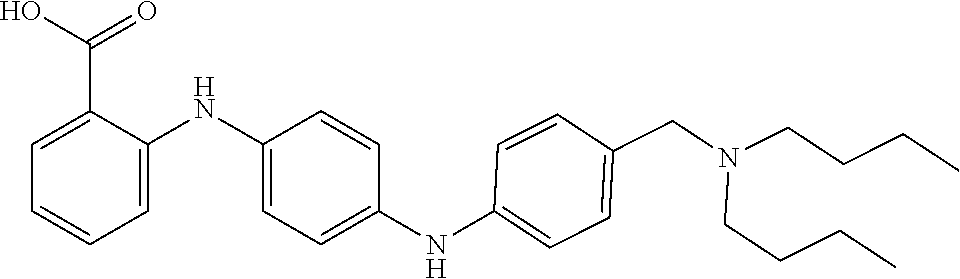 |
1H NMR (400 MHz, DMSO-d6) δ 13.60- 12.00 (bs, 1H), 9.50 (s, 1H), 8.34 (s, 1H), 7.87 (dd, J1 = 1.2 Hz, J2 = 8.0 Hz, 1H), 7.36-7.03 (m, 10H), 6.70 (t, J = 7.2 Hz, 1H), 4.06-4.02 (m, 2H), 2.88-2.83 (m, 3H), 1.68- |
| 1.55 (m, 4H), 1.33-1.10 | ||||
| (m, 5H), 0.89 (t, J = 7.2 | ||||
| Hz, 6H). LC-MS: m/z | ||||
| 444.1 (M + H)+ | ||||
| 288 | 170 | XV.18 |
 |
1H NMR (400 MHz, DMSO-d6) δ 13.2 (bs, 1H), 11.9 (bs, 1H), 10.38 (bs, 1H), 9.8 (s, 1H), 7.96 (m, 4H), 7.7 (bs, 1H), 7.47 (m, 2H), 7.36 (m, 2H), 6.92 (m, 1H), 6.6 (bs, 1H), 3.44 (m, 4H), |
| 1.53 (m, 4H), 1.27 (m, | ||||
| 4H), 0.84 (m, 6H). LC-MS: | ||||
| m/z 460.1 (M + H)+ | ||||
| 289 | 71 | XII.37 |
 |
1H NMR (400 MHz, DMSO-d6) δ 12.85 (bs, 1H), 7.77 (dd, J1 = 1.2 Hz, J2 = 8.0 Hz, 1H), 7.61- 7.57 (m, 1H), 7.35-7.32 (m, 1H), 7.28 (d, J = 8.0 Hz, 1H), 7.13 (d, J = 8.4 Hz, 2H), 6.88 (d, J = 9.6 Hz, 2H), 6.67 (d, J = 8.8 Hz, 2H), 6.55 (d, J = 6.8 |
| Hz, 2H), 3.66-3.61 (m, | ||||
| 2H), 3.13 (s, 3H), 2.03 (s, | ||||
| 3H), 1.79 (s, 6H), 1.71 (s, | ||||
| 6H), 1.13 (t, J = 7.6 Hz, | ||||
| 3H). LC-MS: m/z 481.1 | ||||
| (M + H)+ | ||||
| 290 | 172 | XII.38 |
 |
1H NMR (400 MHz, DMSO-d6) δ 12.8 (bs, 1H), 9.48 (s, 1H), 7.87 (dd, J1 = 1.2 Hz, J2 = 7.6 Hz, 1H), 7.35 (t, J = 6.8 Hz, 1H), 7.26 (d, J = 8.8 Hz, 2H), 7.15 (d, J = 8.8 Hz, 2H), 7.05 (d, J = 8.8 Hz, 1H), 6.99-6.94 (m, 4H), 6.70 (t, J = 7.2 Hz, |
| 1H), 3.23 (s, 3H), 2.05 (s, | ||||
| 3H), 1.84 (s, 6H), 1.78 (s, | ||||
| 6H). LC-MS: m/z 453.1 | ||||
| (M + H)+ | ||||
| 291 | 173 | VI.47 |
 |
1H NMR (400 MHz, DMSO-d6) δ 13.2 (s, 1H), 8.48 (s, 1H), 7.83 (d, J = 7.2 Hz, 1H), 7.70- 7.65 (m, 3H), 7.31-7.25 (m, 3H), 7.16-7.13 (m, 4H), 3.84 (s, 3H), 2.06 (s, 3H), 1.86 (s, 6H), 1.74 (s, 6H). LC-MS: m/z 478.1 (M + H)+ |
| 292 | 174 | VI.48 |
 |
1H NMR (400 MHz, DMSO-d6) δ 12.91 (s, 1H), 9.40 (s, 1H), 8.09 (s, 1H), 7.87 (d, J = 1.4 Hz, 1H), 7.33 (t, J = 6.8 Hz, 1H), 7.15-7.08 (m, 8H), 7.01-6.98 (m, 3H), 6.70- 6.65 (m, 4H), 3.58 (t, J = 7.8 Hz, 2H), 1.58-1.51 (m, 2H), 1.38-1.28 (m, 2H), 0.88 (t, J = 7.3 Hz, 3H), LC-MS: m/z 452.1 |
| (M + H)+ | ||||
| 293 | 175 | XV.19 |
 |
1H NMR (400 MHz, DMSO-d6) δ 12.99 (bs, 1H), 9.50 (bs, 1H), 8.36 (s, 1H), 7.88 (dd, J1 = 1.4 Hz, J2 = 7.8 Hz, 1H), 7.36 (t, 1H), 7.21-7.13 (m, 6H), 7.06-7.01 (m, 3H), 6.70 (t, J = 7.8 Hz, 1H), 3.30 (m, 4H), 1.52-1.49 |
| (m, 4H), 1.23 (m, 4H), | ||||
| 0.86-0.84 (m, 6H). LC- | ||||
| MS: m/z 460.1 (M + H)+ | ||||
| 294 | 176 | XV.20 |
 |
1H NMR (400 MHz, DMSO-d6) δ 12.95 (s, 1H), 9.5 (s, 1H), 8.45 (s, 1H), 7.88 (dd, J1 = 1.6 Hz, J2 = 8.0 Hz, 1H), 7.67 (d, J = 8.8 Hz, 2H), 7.35 (t, J = 1.6 Hz, 1H), 7.23 (s, 1H), 7.20-7.14 (m, 4H), 7.07 (d, J = 8.4 Hz, 1H), |
| 6.99 (d, J = 8.8 Hz, 2H), | ||||
| 6.73-6.69 (m, 1H), 2.06 | ||||
| (s, 9H), 1.65 (s, 6H). LC- | ||||
| MS: m/z 482.1 (M + H)+ | ||||
| 295 | 177 | VI.49 |
 |
1H NMR (400 MHz, DMSO-d6) δ 12.83 (bs, 1H), 9.42 (s, 1H), 7.99 (s, 1H), 7.85 (dd, J1 = 1.6 Hz, J2 = 7.6 Hz, 1H), 7.32 (t, J = 8.8 Hz, 1H), 7.20 (d, J = 8.8 Hz, 2H), 7.11-7.04 (m, 4H), 7.01-6.96 (m, 3H), 6.67 (t, J = 7.6 Hz, 1H), 2.13-2.12 (m, 1H), 1.66 (s, 2H), 1.50-1.32 |
| (m, 8H), 1.17 (s, 2H), | ||||
| 0.85 (s, 6H). LC-MS: | ||||
| m/z 467.1 (M + H)+ | ||||
| 296 | 178 | XX.15 |
 |
1H NMR (400 MHz, DMSO-d6) δ 12.79 (s, 1H), 7.75 (d, J = 8.0 Hz, 1H), 7.58 (t, J = 6.8 Hz, 1H), 7.33-7.29 (m, 2H), 7.11 (d, J = 8.8 Hz, 2H), 6.89 (d, J = 8.8 Hz, 2H), 7.67 (d, J = 8.8 Hz, 2H), 7.01 (d, J = 8.8 Hz, 2H), 3.18 (s, 3H), 3.12 (s, 3H), 2.10 (m, 1H), 1.62 (s, 2H), 1.46-1.30 (m, 8H), 1.16 (s, |
| 2H), 0.83 (s, 6H). LC-MS: | ||||
| m/z 495.1 (M + H)+ | ||||
| 297 | 179 | XV.21 |
 |
1H NMR (400 MHz, DMSO-d6) δ 12.84 (bs, 1H), 10.04 (s, 1H), 9.23 (s, 1H), 7.89 (d, J = 8.3 Hz, 2H), 7.78 (d, J = 8.3 Hz, 2H), 7.67 (m, 3H), 7.51 (d, J = 8.3 Hz, 2H), 7.40 (d, J = 6.8 Hz, 1H), 7.01 (d, J = 8.3 Hz, 1H), |
| 2.08 (s, 3H), 1.91 (s, 6H), | ||||
| 1.76 (s, 6H). LC-MS: m/z | ||||
| 468.0 (M + H)+ | ||||
| 298 | 180 | XI.17 |
 |
1H NMR (400 MHz, DMSO-d6) δ 13.4 (bs, 1H), 10.27 (s, 1H), 8.51 (d, J = 13.6 Hz, 2H), 8.34 (s, 1H), 8.21 (d, J = 6.8 Hz, 1H), 7.58 (d, J = 7.2 Hz, 2H), 7.40-7.35 (m, 4H), 7.25 (d, J = 7.2 Hz, 2H), 6.81 (bs, 1H), 2.04 |
| (s, 3H), 1.84 (s, 6H), 1.73 | ||||
| (s, 6H). LC-MS: m/z 483.1 | ||||
| (M + H)+ | ||||
| 299 | 181 | XIX.3 |
 |
1H NMR (400 MHz, DMSO-d6) δ 13.80- 12.80 (bs, 1H), 10.05 (bs, 1H), 9.86 (s, 1H), 8.25 (d, J = 2.8 Hz, 1H), 8.15 (d, J = 7.2 Hz, 1H), 7.53 (d, J = 8.4 Hz, 2H), 7.34 (d, J = 8.8 Hz, 2H), 7.27 |
| (d, J = 8.0 Hz, 2H), 6.71 | ||||
| (dd, J1 = 4.8 Hz, J2 = 8.0 | ||||
| Hz, 1H), 6.58 (d, J = 8.8 | ||||
| Hz, 2H), 5.85 (bs, 1H), | ||||
| 3.82 (bs, 2H), 2.04 (s, | ||||
| 3H), 1.82 (s, 6H), 1.72 (s, | ||||
| 6H). LC-MS: m/z 497.1 | ||||
| (M + H)+ | ||||
| 300 | 182 | XIX.1 |
 |
1H NMR (400 MHz, DMSO-d6) δ 13.00 (bs, 1H), 9.13 (s, 1H), 8.50 (s, 1H), 8.43 (s, 1H), 7.68 (m, 3H), 7.37 (m, 5H), 7.25 (d, J = 8.3 Hz, 2H), 6.98 (d, J = 8.3 Hz, 1H), 2.05 (s, 3H), 1.76 (s, 6H), 1.73 (s, 6H). LC-MS: m/z |
| 483.1 (M + H)+ | ||||
| 301 | 183 | XV.22 |
 |
1H NMR (400 MHz, DMSO-d6) δ 9.76 (bs, 1H), 8.32 (bs, 1H), 8.25 (m, 1H), 7.95 (d, J = 8.8 Hz, 2H), 7.89 (d, J = 8.8 Hz, 2H), 7.54 (d, J = 8.3 Hz, 1H), 7.45 (s, 1H), 7.37 (m, 1H), 6.86 (m, 1H), 2.07 (s, 3H), 1.88 (s, 6H), 1.74 (s, 6H). LC-MS: |
| m/z 502.0 (M + H)+ | ||||
| 302 | 184 | XV.23 |
 |
1H NMR (400 MHz, DMSO-d6) δ 14.00- 13.00 (bs, 1H), 10.36 (s, 1H), 10.02 (s, 1H), 8.36 (m, 1H), 8.24 (d, J = 7.8 Hz, 1H), 7.65 (d, J = 8.3 Hz, 2H), 7.52 (d, J = 8.8 Hz, 2H), 7.28-7.25 (m, 4H), 6.86-6.83 (m, 1H), |
| 3.56 (s, 2H), 2.03 (s, 3H), | ||||
| 1.82 (s, 6H), 1.71 (s, 6H). | ||||
| LC-MS: m/z 482.1 (M + H)+ | ||||
| 303 | 185 | XV.24 |
 |
1H NMR (400 MHz, DMSO-d6) δ 12.93 (bs, 1H), 9.91 (s, 1H), 8.81 (s, 1H), 7.88 (d, J = 8.8 Hz, 2H), 7.75 (s, 1H), 7.68 (d, J = 8.8 Hz, 2H), 7.48- 7.39 (m, 3H), 7.30 (d, |
| J = 8.8 Hz, 2H), 7.14 (d, | ||||
| J = 8.0 Hz, 2H), 2.05 (s, | ||||
| 3H), 1.86 (s, 6H), 1.73 (s, | ||||
| 6H). LC-MS: m/z 467.1 | ||||
| (M + H)+ | ||||
| 304 | 186 | Int-VI |
 |
1H NMR (400 MHz, DMSO-d6) δ 13.20 (bs, 1H), 9.66 (s, 1H), 7.90 (d, J = 8.4 Hz, 1H), 7.40- 7.38 (m, 3H), 7.26-7.24 (m, 5H), 7.20 (d, J = 8.4 Hz, 2H), 6.82 (t, J = 7.2 Hz, 1H), 2.04 (s, 3H), 1.84 (s, 6H), 1.72 (s, 6H). LC-MS: m/z 507.1 (M + H)+ |
| 305 | 187 | XX.16 |
 |
1H NMR (400 MHz, DMSO-d6) δ 12.80 (s, 1H), 7.75 (m, 1H), 7.59 (t, 1H), 7.32-7.30 (m, 2H), 7.12-7.08 (m, 2H), 6.93 (t, J = 8.3 Hz, 4H), 6.74 (d, J = 8.3 Hz, 2H), 6.64 (d, J = 7.3 Hz, 2H), 6.58 (d, J = 7.8 Hz, 3H), 3.56-3.54 (m, 2H), 3.19 (s, 3H), 3.16 (s, 3H), 1.51-1.49 (m, 2H), 1.33- 1.28 (m, 2H), 0.87 (t, |
| J = 7.3 Hz, 3H), LC-MS: | ||||
| m/z 480.1 (M + H)+ | ||||
| 306 | 188 | XVIII.1 |
 |
1H NMR (400 MHz, DMSO-d6) δ 13.79 (bs, 1H), 10.77 (s, 1H), 10.03 (s, 1H), 8.44-8.43 (m, 1H), 8.28 (dd, J1 = 1.6 Hz, J2 = 8.0 Hz, 1H), 7.89 (d, J = 8.4 Hz, 2H), 7.69 (d, J = 8.8 Hz, 2H), 7.19 (d, |
| J = 8.8 Hz, 2H), 7.03-6.96 | ||||
| (m, 3H), 1.99 (s, 3H), | ||||
| 1.76 (s, 6H), 1.68 (s, 6H). | ||||
| LC-MS: m/z 504.0 (M + H)+ | ||||
| 307 | 189 | XIX.2 |
 |
1H NMR (400 MHz, DMSO-d6) δ 12.95 (bs, 1H), 9.50 (bs, 1H), 8.60 (s, 1H), 8.52 (s, 1H), 7.88 (d, J = 7.9 Hz, 1H), 7.46 (d, J = 8.3 Hz, 2H), 7.36 (m, 3H), 7.26 (d, J = 8.3 Hz, 2H), 7.17 (d, J = 8.8 Hz, 2H), 7.05 (d, J = 8.3 |
| Hz, 1H), 6.70 (t, J = 7.4 | ||||
| Hz, 1H), 2.05 (s, 3H), | ||||
| 1.84 (s, 6H), 1.73 (s, 6H). | ||||
| LC-MS: m/z 482.0 (M + H)+ | ||||
| 308 | 190 | Int- XVIII |
 |
1H NMR (400 MHz, DMSO-d6) δ 13.25 (bs, 1H), 10.02 (s, 1H), 9.75 (s, 1H), 7.92 (d, J = 8.0 Hz, 1H), 7.65 (d, J = 8.4 Hz, 2H), 7.49-7.41 (m, 2H), 7.28 (d, J = 8.4 Hz, 2H), 7.20 (d, J = 8.4 Hz, 2H), 7.02 (d, J = 8.4 Hz, |
| 2H), 6.96 (t, J = 7.2 Hz, | ||||
| 1H), 2.00 (s, 3H), 1.77 (s, | ||||
| 6H), 1.69 (s, 6H). LC-MS: | ||||
| m/z 503.0 (M + H)+ | ||||
| 309 | 191 | VI.50 |
 |
1H NMR (400 MHz, DMSO-d6) δ 12.8 (s, 1H), 7.81 (d, J = 7.2 Hz, 1H), 7.66-7.62 (m, 1H), 7.41-7.32 (m, 6H), 7.27 (d, J = 8.8 Hz, 2H), 6.48 (d, J = 8.0 Hz, 2H), 3.22 (s, 3H), 2.05 (s, 3H), 1.85 (s, 6H), 1.73 (s, 6H). LC- MS: m/z 462.1 (M + H)+ |
| 310 | 192 | XX.17 |
 |
1H NMR (400 MHz, DMSO-d6) δ 13.2 (bs, 1H), 9.8 (bs, 1H), 7.9 (m, 1H), 7.40-7.30 (m, 1H), 7.27 (d, J = 8.4 Hz, 2H), 7.21-7.19 (m, 3H), 7.08 (d, J = 8.4 Hz, 2H), 7.02 (d, J = 8.4 Hz, 2H), 6.90- |
| 6.80 (m, 1H), 3.34 (s, | ||||
| 3H), 2.02 (s, 3H), 1.81 (s, | ||||
| 6H), 1.70 (s, 6H). LC-MS: | ||||
| m/z 481.0 (M + H)+ | ||||
| 311 | 193 | XII.39 |
 |
1H NMR (400 MHz, DMSO-d6) δ 10.40- 10.00 (bs, 1H), 7.57 (t, J = 8.0 Hz, 1H), 7.50-7.40 (m, 2H), 7.28 (d, J = 7.2 Hz, 1H), 7.20 (d, J = 8.8 Hz, 2H), 7.02 (d, J = 8.0 Hz, 2H), 6.95 (d, J = 8.4 Hz, 1H), 6.84 (d, J = 8.8 Hz, 2H), 3.22 (s, 3H), |
| 2.04 (s, 3H), 1.83 (s, 6H), | ||||
| 1.72 (s, 6H). LC-MS: m/z | ||||
| m/z 454.0 (M + H)+ | ||||
| 312 | 194 | XVIII.2 |
 |
1H NMR (400 MHz, DMSO-d6) δ 13.10 (bs, 1H), 9.97 (s, 1H), 9.76 (s, 1H), 7.97 (d, J = 8.8 Hz, 2H), 7.77 (t, J = 7.6 Hz, 1H), 7.64 (d, J = 8.8 Hz, 2H), 7.51 (d, J = 7.2 Hz, 1H), 7.19 (d, J = 8.8 Hz, 2H), 7.08 (d, J = 8.0 Hz, |
| 1H), 7.02 (d, J = 8.4 Hz, | ||||
| 2H), 1.99 (s, 3H), 1.76 (s, | ||||
| 6H), 1.68 (s, 6H). LC-MS: | ||||
| m/z 504.2 (M + H)+ | ||||
| 313 | 195 | XV.25 |
 |
1H NMR (400 MHz, DMSO-d6) δ 9.96 (s, 1H), 7.90 (t, J = 8.8 Hz, 3H), 7.70 (d, J = 8.8 Hz, 2H), 7.35 (m, 1H), 7.23- 7.21 (m, 1H), 7.19-7.15 (m, 4H), 7.02 (d, J = 8.8 Hz, 2H), 6.82-6.76 (m, 4H), 3.63 (t, J = 7.4 Hz, |
| 2H), 1.53-1.51 (m, 2H), | ||||
| 1.35-1.31 (m, 2H), 0.86 | ||||
| (t, J = 7.3 Hz, 3H), LC-MS: | ||||
| m/z 480.2 (M + H)+ | ||||
| 314 | 196 | XX.18 |
 |
1H NMR (400 MHz, DMSO-d6) δ 12.60 (bs, 1H), 8.37 (dd, J1 = 2.0 Hz, J2 = 4.9 Hz, 1H), 7.81 (dd, J1 = 1.9 Hz, J2 = 7.8 Hz, 1H), 7.35 (d, J = 3.4 Hz, 2H), 6.99-6.87 (m, 7H), 3.40 (s, 3H), 2.08 (s, 3H), 1.76 (s, 6H), 1.69 (s, 6H). LC-MS: m/z 455.3 (M + H)+ |
| 315 | 197 | XV.26 |
 |
1H NMR (400 MHz, DMSO-d6) δ 13.6 (bs, 1H), 12.1 (s, 1H), 8.74 (d, J = 8.3 Hz, 1H), 8.64 (s, 1H), 8.05 (d, J = 7.8 Hz, 1H), 7.81 (d, J = 8.4 Hz, 2H), 7.63 (d, J = 7.3 Hz, 1H), 7.32 (d, J = 8.3 Hz, 2H), 7.17-7.05 (m, |
| 5H), 2.06 (bs, 3H), 1.86 | ||||
| (s, 6H), 1.74 (s, 6H). LC- | ||||
| MS: m/z 467.3 (M + H)+ | ||||
| 316 | 198 | XV.27 |
 |
1H NMR (400 MHz, DMSO-d6) δ 12.90 (bs, 1H), 10.10 (s, 1H), 8.55 (s, 1H), 8.40 (s, 1H), 8.04 (d, J = 7.8 Hz, 1H), 7.88 (d, J = 8.3 Hz, 2H), 7.64 (d, J = 7.9 Hz, 1H), 7.44 (t, J = 7.9 Hz, 1H), 7.31 (d, J = 8.3 Hz, 2H), 7.07 |
| (d, J = 8.3 Hz, 2H), 7.02 | ||||
| (d, J = 5.4 Hz, 2H), 2.06 | ||||
| (s, 3H), 1.86 (s, 6H), 1.73 | ||||
| (s, 6H). LC-MS: m/z | ||||
| 467.3 (M + H)+ | ||||
| 317 | 199 | VI.51 |
 |
1H NMR (400 MHz, DMSO-d6) δ 13.80- 12.40 (s, 1H), 8.65 (s, 1H), 7.99 (d, J = 7.2 Hz, 1H), 7.89 (d, J = 7.2 Hz, 1H), 7.78 (d, J = 8.8 Hz, 2H), 7.48 (t, J = 7.6 Hz, 1H), 7.32 (d, J = 8.4 Hz, 2H), 7.20-7.15 (m, 4H), 3.99 (s, 3H), 2.06 (s, 3H), 1.87 (s, 6H), 1.74 (s, 6H). LC-MS: m/z 478.2 (M + H)+ |
| 318 | 200 | VI.52 |
 |
1H NMR (400 MHz, DMSO-d6) δ 12.95 (s, 1H), 7.67 (d, J = 6.4 Hz, 1H), 7.50-7.46 (m, 1H), 7.27 (d, J = 8.8 Hz, 2H), 7.20-7.17 (m, 2H), 6.80 (d, J = 8.8 Hz, 2H), 6.63 (d, J = 8.8 Hz, 2H), 6.37 (d, J = 8.4 Hz, 2H), 5.03- 5.01 (m, 1H), 4.23-4.19 |
| (m, 2H), 3.64-3.61 (m, | ||||
| 2H), 3.14 (s, 3H), 2.04 (s, | ||||
| 3H), 1.83 (s, 6H), 1.72 (s, | ||||
| 6H). LC-MS: m/z 509.3 | ||||
| (M + H)+ | ||||
| 319 | 201 | XII.41 |
 |
1H NMR (400 MHz, DMSO-d6) δ 13.00 (bs, 1H), 9.04 (s, 1H), 7.78 (m, 1H), 7.62 (d, J = 7.2 Hz, 3H), 7.34 (d, J = 6.4 Hz, 1H), 7.16 (d, J = 8.0 Hz, 2H), 7.00-6.92 (m, 5H), 2.12 (m, 1H), 1.65 (s, 2H), 1.49-1.32 (m, |
| 8H), 1.17 (s, 2H), 0.85 (s, | ||||
| 6H). LC-MS: m/z 468.3 | ||||
| (M + H)+ | ||||
| 320 | 202 | XII.42 |
 |
1H NMR (400 MHz, DMSO-d6) δ 12.99 (bs, 1H), 9.07 (s, 1H), 7.90 (s, 1H), 7.64 (m, 3H), 7.36 (d, J = 6.8 Hz, 2H), 7.11 (t, J = 7.9 Hz, 2H), 7.00 (m, 6H), 6.66 (m, 3H), 3.56 (m, 2H), 1.54 (m, 2H), 1.34 (m, 2H), 0.88 (t, J = 7.3 Hz, 3H). LC-MS: m/z 453.3 (M + H)+ |
| 321 | 203 | XII.43 |
 |
1H NMR (400 MHz, DMSO-d6) δ 10.4 (bs, 1H), 7.59 (m, 1H), 7.47 (m, 3H), 7.32 (d, J = 2.4 Hz, 2H), 6.96 (m, 4H), 2.05 (bs, 3H), 1.86 (s, 6H), 1.76 (s, 6H). LC-MS: m/z 475.2 (M + H)+ |
| 322 | 204 | XII.44 |
 |
1H NMR (400 MHz, DMSO-d6) δ 13.50- 12.50 (bs, 2H), 8.72 (d, J = 2.0 Hz, 2H), 8.11 (dd, J1 = 2.0 Hz, J2 = 8.4 Hz, 2H), 7.35 (d, J = 8.0 Hz, 2H), 7.14-7.03 (m, 6H), 6.90 (d, J = 9.2 Hz, 2H), 3.27 (s, 3H), 2.05 (s, 3H), 1.86 (s, 6H), 1.73 (s, 6H). LC-MS: m/z 493.4 |
| 323 | 205 | VI.53 |
 |
1H NMR (400 MHz, DMSO-d6) δ 13.00- 12.80 (bs, 1H), 9.50-9.40 (bs, 1H), 7.84 (d, J = 7.6 Hz, 1H), 7.8 (s, 1H), 7.3 (t, J = 8.0 Hz, 1H), 7.07- 6.83 (m, 9H), 6.65 (t, J = 7.2 Hz, 1H), 3.47 (s, 2H), 1.98 (s, 3H), 1.73-1.62 (m, |
| 12H). LC-MS: m/z 469.2 | ||||
| (M + H)+ | ||||
| 324 | 206 | XV.28 |
 |
1H NMR (400 MHz, DMSO-d6) δ 12.92 (s, 1H), 9.41 (s, 1H), 7.73- J = 7.6 Hz, 1H), 7.26 (d, J = 8.4 Hz, 2H), 7.17 (d, J = 8.8 Hz, 2H), 7.08 (d, J = 8.8 Hz, 2H), 7.0 (d, J = 8.4 Hz, 1H), 3.33 (s, 3H), 2.01 (s, 3H), 1.79 (s, |
| 6H), 1.69 (s, 6H). LC-MS: | ||||
| m/z 482.3 (M + H)+ | ||||
| 325 | 207 | XX.19 |
 |
1H NMR (400 MHz, DMSO-d6) δ 13.85 (bs, 1H), 11.20 (bs, 1H), 8.46 (dd, J1 = 2.0 Hz, J2 = 4.8 Hz, 1H), 8.31 (dd, J1 = 1.6 Hz, J2 = 7.6 Hz, 1H), 7.94 (d, J = 8.8 Hz, 2H), 7.44 (dd, J = 8.8 Hz, 2H), 7.32 (d, J = 8.4 Hz, 2H), 7.05- |
| 6.98 (m, 3H), 3.09 (s, | ||||
| 3H), 2.04 (s, 3H), 1.84 (s, | ||||
| 6H), 1.72 (s, 6H). LC-MS: | ||||
| m/z 518.3 (M + H)+ | ||||
| 326 | 208 | XX.20 |
 |
1H NMR (400 MHz, DMSO-d6) δ 12.89 (bs, 1H), 7.71 (d, J = 7.6 Hz, 1H), 7.55-7.51 (m, 1H), 7.26 (t, J = 7.6 Hz, 2H), 6.81-6.76 (m, 6H), 6.55 (d, J = 9.2 Hz, 2H), 3.50 (s, 2H), 3.16 (s, 3H), 3.05 (s, 3H), 1.97 (s, 3H), 1.69-1.60 (m, 12H). LC-MS: m/z 497.3 (M + H)+ |
| 327 | 209 | VI.54 |
 |
1H NMR (400 MHz, DMSO-d6) δ 7.62-7.60 (m, 3H), 7.39-7.28 (m, 4H), 7.19 (t, J = 7.2 Hz, 1H), 7.12-7.04 (m, 7H), 6.91 (d, J = 8.0 Hz, 2H), 3.11-3.08 (m, 1H), 1.12 (d, J = 6.8 Hz, 6H). LC-MS: m/z 424.2 (M + H)+ |
| 328 | 210 | VI.55 |
 |
1H NMR (400 MHz, DMSO-d6) δ 14.00-13.20 (bs, 1H), 8.50 (s, 1H), 8.02 (d, J = 8.4 Hz, 1H), 7.92 (d, J = 7.2 Hz, 1H), 7.59 (t, J = 8.0 Hz, 1H), 7.51-7.47 (m, 2H), 7.31-7.27 (m, 4H), 7.16 (d, J = 8.4 Hz, 2H), 3.96 (s, 3H), 2.04 (s, 3H), 1.84 (s, 6H), 1.72 (s, 6H). LC-MS: m/z 478.2 (M + H)+ |
| 329 | 211 | XV.29 |
 |
1H NMR (400 MHz, DMSO- d6) δ 10.80-10.20 (bs, 1H), 10.16 (s, 1H), 7.98-7.94 (m, 3H), 7.84 (d, J = 8.4 Hz, 2H), 7.44-7.35 (m, 3H), 7.33-7.24 (m, 3H), 7.21-7.20 (m, 3H), 7.13 (d, J = 7.2 Hz, 1H), 6.90-6.86 (m, 1H), 3.07-3.01 (m, 1H), 1.13 (d, J = 7.2 Hz, |
| 6H). LC-MS: m/z 451.2 | ||||
| (M + H)+ | ||||
| 330 | 212 | XV.30 |
 |
1H NMR (400 MHz, DMSO-d6) δ 13.21 (s, 1H), 10.19 (s, 1H), 8.07 (t, J = 7.8 Hz, 1H), 8.02 (d, J = 8.3 Hz, 2H), 7.85 (d, J = 7.4 Hz, 1H), 7.70 (d, J = 8.3 Hz, 2H), 7.33 |
| (m, 5H), 2.06 (s, 3H), | ||||
| 1.87 (s, 6H), 1.74 (s, 6H). | ||||
| LC-MS: m/z 469.2 (M + H)+ | ||||
| 331 | 213 |
 |
LC-MS: m/z 481.2 (M + H)+ | |
| 333 | 214 | XV.31 |
 |
1H NMR (400 MHz, DMSO-d6) δ 13.17- 13.16 (bs, 1H), 10.17 (s, 1H), 9.77 (s, 1H), 6.93 (dd, J1 = 1.6 Hz, J2 = 8.0 Hz, 1H), 7.79 (s, 1H), 7.69 (d, J = 8.8 Hz, 2H), 7.63-7.62 (m, 1H), 7.49- 7.42 (m, 3H), 7.33-7.29 (m, 3H), 6.85-6.81 (m, 1H), 2.06 (s, 3H), 1.83 (s, 6H), 1.70 (s, 6H). LC-MS: |
| m/z 467.3 (M + H)+ | ||||
| 334 | 215 | XV.32 |
 |
1H NMR (400 MHz, DMSO-d6) δ 12.95 (s, 1H), 10.06 (s, 1H), 7.94 (d, J = 8.3 Hz, 2H), 7.90 (d, J = 7.3 Hz, 1H), 7.68- 7.63 (m, 3H), 7.37 (t, J = 6.8 Hz, 1H), 7.32 (d, J = 8.8 Hz, 2H), 7.16 (d, |
| J = 8.3 Hz, 1H), 6.96 (d, | ||||
| J = 8.3 Hz, 2H), 2.06 (s, | ||||
| 3H), 1.86 (s, 6H), 1.74 (s, | ||||
| 6H). LC-MS: m/z 468.1 | ||||
| (M + H)+ | ||||
| 335 | 216 | XV.33 |
 |
1H NMR (400 MHz, DMSO-d6) δ 12.65 (bs, 1H), 9.91 (s, 1H), 7.93- 7.87 (m, 3H), 7.68 (d, J = 8.8 Hz, 2H), 7.34 (d, J = 8.0 Hz, 1H), 7.29 (d, J = 8.8 Hz, 2H), 7.22-7.16 (m, 3H), 6.74 (t, J = 7.6 Hz, 1H), 2.14-2.13 (m, |
| 1H), 1.69 (s, 2H), 1.53- | ||||
| 1.33 (m, 8H), 0.86 (s, | ||||
| 6H). LC-MS: m/z 495.3 | ||||
| (M + H)+ | ||||
| 336 | 217 |
 |
LC-MS: m/z 468.2 (M + H)+ | |
| 337 | 218 | VI.56 |
 |
1H NMR (400 MHz, DMSO-d6) δ 12.8 (bs, 1H), 7.70 (d, J = 7.6 Hz, 1H), 7.53 (t, J = 8.0 Hz, 1H), 7.26-7.19 (m, 4H), 6.92 (d, J = 8.8 Hz, 2H), 6.85 (d, J = 8.8 Hz, 2H), 6.59 (d, J = 7.2 Hz, 2H), 3.20-3.19 (m, 4H), 3.16 (s, 3H), 3.12-3.11 (m, |
| 4H), 2.04 (s, 3H), 1.82 (s, | ||||
| 6H), 1.72 (s, 6H). LC-MS: | ||||
| m/z 522.3 (M + H)+ | ||||
| 338 | 219 | XII.45 |
 |
1H NMR (400 MHz, DMSO-d6) δ 13.00 (bs, 1H), 9.16 (s, 1H), 8.26 (s, 1H), 7.73 (d, J = 8.4 Hz, 2H), 7.68-7.63 (m, 3H), 7.37 (d, J = 6.8 Hz, 1H), 7.18 (s, 1H), 7.08 (d, J = 8.8 Hz, 2H), 6.98 (d, J = 8.4 Hz, 1H), 6.91 (d, |
| J = 8.4 Hz, 2H), 2.05 (s, | ||||
| 9H), 1.65 (s, 6H). LC-MS: | ||||
| m/483.1z (M + H)+ | ||||
| 339 | 220 | XII.46 |
 |
1H NMR (400 MHz, DMSO-d6) δ 12.0 (s, 1H), 9.81 (s, 1H), 7.86 (d, J = 7.6 Hz, 1H), 7.49 (d, J = 8.4 Hz, 2H), 7.25 (d, J = 8.8 Hz, 2H), 7.13- 7.01 (m, 6H), 6.58 (t, J = 6.8 Hz, 1H), 2.83 (t, |
| J = 7.6 Hz, 2H), 2.56 (t, | ||||
| J = 8.0 Hz, 2H), 2.04 (s, | ||||
| 3H), 1.83 (s, 6H), 1.72 (s, | ||||
| 6H). LC-MS: m/z 495.3 | ||||
| (M + H)+ | ||||
| 340 | 221 | VI.57 |
 |
1H NMR (400 MHz, DMSO-d6) δ 13.0 (bs, 1H), 8.20 (bs, 1H), 7.70- 7.60 (m, 1H), 7.60-7.50 (m, 1H), 7.35-7.31 (m, 2H), 7.23 (d, J = 8.4 Hz, 2H), 7.10-6.97 (m, 4H), 6.71 (bs, 2H), 3.26 (s, 3H), 2.04 (s, 3H), 1.82 (s, |
| 6H), 1.72 (s, 6H). LC-MS: | ||||
| m/z 481.2 (M + H)+ | ||||
| 341 | 222 | XV.35 |
 |
1H NMR (400 MHz, DMSO-d6) δ 13.10 (bs, 1H), 10.14 (s, 1H), 9.88 (bs, 1H), 7.93 (d, J = 7.6 Hz, 1H), 7.79 (s, 1H), 7.68 (d, J = 8.8 Hz, 2H), 7.61 (d, J = 7.6 Hz, 1H), 7.50-7.40 (m, 3H), 7.32- 7.29 (m, 3H), 6.82 (t, J = 7.6 Hz, 1H), 2.14-2.10 (m, 1H), 1.68 (s, 2H), 1.53-1.43 (m, 8H), 1.18 (s, 2H), 0.86 (s, 6H). |
| LC-MS: m/z 495.3 (M + H)+ | ||||
| 342 | 223 | XVIII.3 |
 |
1H NMR (400 MHz, DMSO-d6) δ 13.8 (bs, 1H), 11.0 (bs, 1H), 8.84 (s, 1H), 7.90 (d, J = 7.2 Hz, 1H), 7.59 (d, J = 8.8 Hz, 2H), 7.55-7.48 (m, 2H), 7.43 (s, 1H), 7.33- 7.28 (m, 2H), 7.09 (t, J = 8.0 Hz, 1H), 6.82 (d, J = 8.8 Hz, 2H), 2.05 (s, 3H), 1.85 (s, 6H), 1.73 (s, |
| 6H). LC-MS: m/z 535 | ||||
| (M + H)− | ||||
| 343 | 224 | XV.36 |
 |
1H NMR (400 MHz, DMSO-d6) δ 10.32 (s, 1H), 7.94 (d, J = 7.6 Hz, 1H), 7.84-7.80 (m, 3H), 7.62 (d, J = 7.6 Hz, 1H), 7.52-7.46 (m, 4H), 7.43- 7.31 (m, 2H), 7.27-7.19 (m, 3H), 7.13 (d, J = 8.0 Hz, 1H), 6.82 (t, J = 7.6 Hz, 1H), 3.05-3.01 (m, 1H), 1.13 (d, J = 6.8 Hz, 6H). LC-MS: m/z 451.2 (M + H)+ |
| 344 | 225 | XV.37 |
 |
1H NMR (400 MHz, DMSO-d6) δ 14.00-13.8 (bs, 1H), 12.30 (s, 1H), 10.35 (s, 1H), 8.71 (d, J = 8.0 Hz, 1H), 8.14-8.07 (m, 5H), 7.27-7.67 (m, 3H), 7.35 (d, J = 8.0 Hz, 2H), 7.24 (t, J = 8.0 Hz, 1H), 2.06 (s, 3H), 1.87 (s, 6H), 1.74 (s, 6H). LC- |
| MS: m/z 495.1 (M + H)+ | ||||
| 345 | 226 | XII.47 |
 |
1H NMR (400 MHz, DMSO-d6) δ 13.42 (s, 1H), 7.81 (d, J = 6.9 Hz, 1H), 7.61 (t, J = 7.3 Hz, 1H), 7.41 (t, J = 7.8 Hz, 1H), 7.28 (d, J = 7.9 Hz, 1H), 7.14 (d, J = 8.8 Hz, 2H), 6.86 (d, J = 8.8 Hz, 2H), 6.70 (d, J = 8.3 Hz, 2H), 6.59 (d, J = 8.8 Hz, |
| 2H), 4.25-4.19 (m, 1H), | ||||
| 3.13 (s, 3H), 2.03 (s, 3H), | ||||
| 1.80 (s, 6H), 1.71 (s, 6H), | ||||
| 1.00 (d, J = 6.3 Hz, 6H). | ||||
| LC-MS: m/z 495.3 (M + H)+ | ||||
| 346 | 227 | XV.38 |
 |
1H NMR (400 MHz, DMSO-d6) δ 13.10 (bs, 1H), 9.94 (s, 1H), 9.69 (s, 1H), 8.01 (d, J = 8.8 Hz, 2H), 7.94 (d, J = 8.8 Hz, 2H), 7.78 (t, J = 7.6 Hz, 1H), 7.70 (d, J = 8.8 Hz, 2H), 7.51 (d, J = 7.2 Hz, 1H), 7.30 (d, J = 8.4 Hz, |
| 2H), 7.10 (d, J = 8.0 Hz, | ||||
| 1H), 2.15-2.13 (m, 1H), | ||||
| 1.69 (s, 2H), 1.53-1.33 | ||||
| (m, 8H), 1.19 (s, 2H), | ||||
| 0.86 (s, 6H). LC-MS: m/z | ||||
| 496.2 (M + H)+ | ||||
| 349 | 228 | VI.58 |
 |
1H NMR (400 MHz, DMSO-d6) δ 15.33 (s, 1H), 8.63 (d, J = 8.3 Hz, 1H), 8.04 (s, 1H), 7.99 (d, J = 7.3 Hz, 1H), 7.87 (d, J = 8.3 Hz, 2H), 7.58 (s, 1H), 7.36 (s, 2H), 7.27 (t, J = 7.3 Hz, 1H), 6.96- 6.90 (m, 4H), 2.06 (s, 3H), 1.87 (s, 6H), 1.74 (s, |
| 6H). LC-MS: m/z 545.1 | ||||
| (M + H)− | ||||
| 350 | 229 | VI.59 |
 |
1H NMR (400 MHz, DMSO-d6) δ 13.6 (bs, 1H), 12.02 (s, 1H), 8.73 (d, J = 8.3 Hz, 1H), 8.30 (s, 1H), 8.04 (d, J = 6.8 Hz, 1H), 7.79 (d, J = 8.4 Hz, 2H), 7.64 (d, J = 7.3 Hz, 1H), 7.44 (D, J = 1.5 Hz, 1H), 7.39-7.32 (m, 2H), 7.16 (t, J = 7.8 Hz, |
| 1H), 6.99 (d, J = 8.3 Hz, | ||||
| 2H), 2.07 (s, 3H), 1.87 (s, | ||||
| 6H), 1.74 (s, 6H). LC-MS: | ||||
| m/z 501.1 (M + H)+ | ||||
| 353 | 230 | XV.39 |
 |
1H NMR (400 MHz, DMSO-d6) δ 12.8 (bs, 1H), 10.02 (s, 1H), 7.80 (d, J = 7.6 Hz, 1H), 7.66- 7.61 (m, 3H), 7.41-7.29 (m, 4H), 7.32-7.21 (m, 2H), 7.09 (s, 1H), 6.62 (d, J = 7.2 Hz, 1H), 3.25 (s, 3H), 2.05 (s, 3H), 1.85 (s, 6H), 1.73 (s, 6H). LC- MS: m/z 481.2 (M + H)+ |
| 355 | 231 | XX.21 |
 |
1H NMR (400 MHz, DMSO-d6) δ 13.01 (bs, 1H), 8.57 (d, J = 3.2 Hz, 1H), 8.13-8.11 (m, 1H), 7.34-7.26 (m, 5H), 7.03 (d, J = 8.4 Hz, 2H), 6.80 (d, J = 8.8 Hz, 2H), 3.38 (s, 3H), 3.03 (s, 3H), 2.04 (s, 3H), 1.84 (s, 6H), 1.72 (s, 6H). LC-MS: m/z 532.2 (M + H)+ |
| 356 | 232 |
 |
LC-MS: m/z 493.4 (M − H)+ | |
| 357 | 233 | XX.22 |
 |
1H NMR (400 MHz, DMSO-d6) δ 7.42-7.38 (m, 2H), 7.17-7.15 (m, 1H), 7.11 (t, J = 7.6 Hz, 2H), 7.03-7.01 (m, 3H), 6.87 (d, J = 8.8 Hz, 2H), 6.71-6.69 (m, 1H), 6.51 (d, J = 9.2 Hz, 2H), 3.16 (s, 3H), 3.15 (s, 3H), 2.04 (s, 9H), 1.64 (s, 6H). LC- MS: m/z 510.3 (M + H)+ |
| 358 | 234 | XII.49 |
 |
1H NMR (400 MHz, DMSO-d6) δ 13.68 (s, 1H), 10.58 (s, 1H), 10.19 (s, 1H), 8.43 (dd, J1 = 2.0 Hz, J2 = 4.8 Hz, 1H), 8.28 (dd, J1 = 1.7 Hz, J2 = 7.6 Hz, 1H), 8.14 (s, 1H), 8.06 (d, J = 8.0 Hz, 1H), 7.7 (d, J = 8.4 Hz, 2H), 7.59 (d, J = 7.6 Hz, 1H), |
| 7.47 (t, J = 7.6 Hz, 1H), | ||||
| 7.33 (d, J = 4.8 Hz, 2H), | ||||
| 6.92 (dd, J1 = 4.8 Hz, | ||||
| J2 = 7.6 Hz, 1H), 2.06 (s, | ||||
| 3H), 1.86 (s, 6H), 1.74 (s, | ||||
| 6H). LC-MS: m/z 468.1 | ||||
| (M + H)+ | ||||
| 359 | 235 | XII.50 |
 |
1H NMR (400 MHz, DMSO-d6) δ 12.85 (s, 1H), 10.12 (s, 1H), 8.57 (s, 1H), 7.68-7.61 (m, 4H), 7.45-7.27 (m, 8H), 2.05 (s, 3H), 1.86 (s, 6H), 1.73 (s, 6H). LC-MS: m/z 465.1 (M − H)− |
| 360 | 236 | XX.23 |
 |
1H NMR (400 MHz, DMSO-d6) δ 12.99 (bs, 1H), 7.78 (d, J = 7.9 Hz, 1H), 7.60 (d, J = 7.8 Hz, 1H), 7.43 (d, J = 8.8 Hz, 2H), 7.37-7.31 (m, 3H), 7.23-7.12 (m, 3H), 6.94 (d, J = 8.8 Hz, 2H), 6.87 (d, J = 8.3 Hz, 1H), 6.61 (d, J = 8.8 Hz, 2H), 3.17 |
| (s, 3H), 2.97-2.91 (m, | ||||
| 1H), 1.09 (d, J = 7.3 Hz, | ||||
| 6H), LC-MS: m/z 472.2 | ||||
| (M + H)+ | ||||
| 361 | 237 | VI.60 |
 |
1H NMR (400 MHz, DMSO-d6) δ 13.75 (s, 1H), 12.15 (s, 1H), 8.69 (d, J = 8.3 Hz, 1H), 8.05 (d, J = 8.3 Hz, 1H), 7.96 (d, J = 8.8 Hz, 2H), 7.65 (t, J = 7.3 Hz, 1H), 7.43 (d, J = 8.8 Hz, 2H), 7.20 (t, J = 7.8 Hz, 1H), 7.12 (d, J = 8.8 Hz, 2H), 7.07 (d, J = |
| 8.3 Hz, 2H), 2.07 (s, 3H), | ||||
| 1.88 (s, 6H), 1.74 (s, 6H). | ||||
| LC-MS: m/z 468.1 (M + H)+ | ||||
| 362 | 238 | XX.24 |
 |
1H NMR (400 MHz, DMSO-d6) δ 12.76 (s, 1H), 7.41 (t, J = 8.3 Hz, 1H), 7.12 (d, J = 8.8 Hz, 2H), 7.00 (d, J = 8.3 Hz, 1H), 6.91 (d, J = 8.4 Hz, 2H), 6.76 (d, J = 7.8 Hz, 1H), 6.66 (d, J = 8.3 Hz, 2H), 6.60 (d, J = 8.8 Hz, 2H), 3.82 (s, 3H), 3.13 (s, 3H), 3.09 (s, 3H), 2.02 (s, |
| 3H), 1.80 (s, 6H), 1.71 (s, | ||||
| 6H). LC-MS: m/z 497.3 | ||||
| (M + H)+ | ||||
| 363 | 239 | XV.40 |
 |
1H NMR (400 MHz, DMSO-d6) δ 8.66 (d, J = 8.4 Hz, 1H), 8.29 (s, 1H), 8.02 (dd, J1 = 1.2 Hz, J2 = 7.6 Hz, 2H), 7.65 (s, 1H), 7.44-7.32 (m, 3H), 7.26 (d, J = 8.4 Hz, 2H), 7.20 (d, J = 7.6 Hz, 1H), 7.10-7.04 (m, 2H), 2.05 |
| (s, 3H), 1.85 (s, 6H), 1.73 | ||||
| (s, 6H). LC-MS: m/z 467.3 | ||||
| (M + H)+ | ||||
| 364 | 240 | XV.41 |
 |
1H NMR (400 MHz, DMSO-d6) δ 10.4 (s, 1H), 8.4 (s, 1H), 8.26 (s, 1H), 8.00 (d, J = 9.2 Hz, 1H), 7.66 (d, J = 7.6 Hz, 1H), 7.59 (s, 1H), 7.45 (t, J = 7.6 Hz, 1H), 7.35-7.32 (m, 2H), 7.26 (d, J = 8.8 Hz, 2H), 7.21-7.19 (m, |
| 1H), 7.08 (d, J = 8.8 Hz, | ||||
| 2H), 2.05 (s, 3H), 1.84 (s, | ||||
| 6H), 1.73 (s, 6H). LC-MS: | ||||
| m/z 467.3 (M + H)+ | ||||
| 366 | 241 | XII.53 |
 |
1H NMR (400 MHz, DMSO-d6) δ 13.69 (bs, 1H), 10.61 (s, 1H), 9.99 (s, 1H), 8.42 (dd, J1 = 1.0 Hz, J2 = 4.8 Hz, 1H), 8.28 (dd, J1 = 1.0 Hz, J2 = 7.6 Hz, 1H), 8.20 (s, 1H), 8.09 (d, J = 8.0 Hz, 1H), 7.67 (m, 1H), 7.54-7.46 (m, 3H), 7.39-7.38 (m, |
| 1H), 6.92 (dd, J1 = 4.8 Hz, | ||||
| J2 = 7.6 Hz, 1H), 2.07 (s, | ||||
| 3H), 1.88 (d, J = 2.4 Hz, | ||||
| 6H), 1.71 (s, 6H). LC-MS: | ||||
| 502.2 (M + H)+ | ||||
| 367 | 242 | XII.54 |
 |
1H NMR (400 MHz, DMSO-d6) δ 10.0 (s, 1H), 9.81-9.79 (bs, 1H), 7.93 (dd, J1 = 1.2 Hz, J2 = 7.6 Hz, 1H), 7.82 (s, 1H), 7.65-7.63 (m, 1H), 7.51-7.43 (m, 5H), 7.38- 7.36 (m, 1H), 7.32 (d, J = 8.0 Hz, 1H), 6.86-6.82 (m, 1H), 2.07 (s, 3H), |
| 1.86 (d, J = 2.4 Hz, 6H), | ||||
| 1.74 (s, 6H). LC-MS: | ||||
| m/z 501.1 (M + H)+ | ||||
| 369 | 243 |
 |
LC-MS: m/z 493.4 (M − H)+ | |
| 370 | 244 | Com- pound 14 |
 |
1H NMR (400 MHz, DMSO-d6) δ 8.24 (s, 1H), 7.63 (d, J = 8.0 Hz, 1H), 7.45 (d, J = 8.8 Hz, 1H), 7.53 (d, J = 3.2 Hz, 1H), 7.39 (d, J = 8.8 Hz, 2H), 7.26 (d, J = 8.8 Hz, 2H), 7.19-7.14 (m, 3H), 7.11-7.07 (m, 3H), 6.63 (d, J = 2.4 Hz, 1H), 2.06 (s, 3H), 1.85 (d, J = 2.4 |
| Hz, 6H), 1.73 (s, 6H). | ||||
| LC-MS: m/z 491.3 (M + H)+ | ||||
| 371 | 245 | Com- pound 14 |
 |
1H NMR (400 MHz, DMSO-d6) δ 7.70-7.58 (m, 4H), 7.21-7.14 (m, 3H), 7.07 (d, J = 8.0 Hz, 1H), 6.96 (d, J = 8.8 Hz, 2H), 6.89-6.84 (m, 5H), 6.35 (d, J = 15.6 Hz, 1H), 2.04 (s, 3H), 1.86 (s, 6H), 1.72 (s, 6H). LC-MS: m/z 465.3 (M + H)+ |
| 372 | 246 | XVIII.4 |
 |
1H NMR (400 MHz, DMSO-d6) δ 13.21 (bs, 1H), 10.11 (s, 1H), 9.71 (bs, 1H), 7.92 (dd, J1 = 1.6 Hz, J2 = 8.0 Hz, 1H), 7.53 (s, 1H), 7.49-7.35 (m, 4H), 7.23 (d, J = 8.4 Hz, 2H), 7.07-7.01 (m, 3H), |
| 6.90 (t, J = 7.6 Hz, 1H), | ||||
| 2.00 (s, 3H), 1.76 (s, 6H), | ||||
| 1.68 (s, 6H). LC-MS: | ||||
| m/z 503.2 (M + H)+ | ||||
| 373 | 247 | XII.55 |
 |
1H NMR (400 MHz, DMSO-d6) δ 11.89 (s, 1H), 10.22 (s, 1H), 9.22 (s, 1H), 8.36-8.28 (m, 2H), 7.7-7.51 (m, 4H), 7.33 (d, J = 8.0 Hz, 2H), 6.93 (s, 1H), 2.06 (s, 3H), 1.86 (s, 6H), 1.73 (s, 6H). LC-MS: m/z 502.2 (M + H)+ |
| 376 | 248 | XII.57 |
 |
1H NMR (400 MHz, DMSO-d6) δ 13.00-12.8 (bs, 1H), 10.07 (s, 1H), 8.03 (bs, 1H), 7.66 (d, J = 8.4 Hz, 2H), 7.56 (s, 1H), 7.41 (d, J = 8.0 Hz, 1H), 7.36-7.26 (m, 4H), 7.21 (dd, J1 = 0.8 Hz, J2 = 7.6 Hz, 1H), 6.86 (d, J = 8.0 Hz, 1H), 6.68 (d, J = 8.4 Hz, 1H), 3.79 (s, 3H), 2.06 (s, 3H), 1.85 |
| (d, J = 2.4 Hz, 6H), 1.73 | ||||
| (s, 6H). LC-MS: m/z 497.3 | ||||
| (M + H)+ | ||||
| 377 | 249 | XII.58 |
 |
1H NMR (400 MHz, DMSO-d6) δ 12.16 (s, 1H), 9.12 (s, 1H), 7.99 (s, 1H), 7.21 (d, J = 8.4 Hz, 2H), 7.08-6.98 (m, 6H), 6.07 (d, J = 2.4 Hz, 1H), 6.0 (d, J = 2.4 Hz, 1H), 3.81 (s, 3H), 3.67 (s, 3H), 2.04 (s, 3H), 1.83 (s, 6H), 1.72 (s, 6H). LC-MS: m/z 499.2 (M + H)+ |
| 379 | 250 | XII.59 |
 |
1H NMR (400 MHz, DMSO-d6) δ 13.2 (bs, 1H), 9.2 (bs, 1H), 7.39 (d, J = 2.9 Hz, 1H), 7.22 (d, J = 8.8 Hz, 2H), 7.11 (d, J = 6.3 Hz, 1H), 7.09 (d, J = 5.8 Hz, 2H), 7.03 (dd, J1 = 2.4 Hz, J2 = 8.8 Hz, 1H), 6.97 (d, J = 8.8 Hz, 2H), 6.88 (d, J = 8.8 Hz, 2H), 3.71 (s, 3H), 3.21 (s, 3H), 2.04 (s, 3H), 1.83 (s, 6H), 1.72 (s, 6H). LC-MS: m/z 483.3 (M + H)+ |
| 380 | 251 | XII.60 |
 |
1H NMR (400 MHz, DMSO-d6) δ 9.57 (s, 1H), 8.04 (s, 1H), 7.80 (d, J = 8.8 Hz, 1H), 7.22 (d, J = 8.4 Hz, 2H), 7.12 (d, J = 8.8 Hz, 2H), 7.06 (d, J = 8.8 Hz, 2H), 7.01 (d, J = 8.8 Hz, 2H), 6.41 (d, J = 2.0 Hz, 1H), 6.28 (dd, J1 = 2.4 Hz, J2 = 8.8 Hz, 2H), 3.69 (s, 3H), 2.06 (s, 3H), 1.83 (d, J = 2.0 Hz, 2H), 1.69 (s, 6H). LC-MS: m/z 469.3 (M + H)+ |
| 381 | 252 | XII.61 |
 |
1H NMR (400 MHz, DMSO-d6) δ 13.62 (bs, 1H), 10.36 (s, 1H), 8.36 (dd, J1 = 2.0 Hz, J2 = 4.8 Hz, 1H), 8.24 (dd, J1 = 2.0 Hz, J2 = 8.0 Hz, 1H), 7.71- 7.67 (m, 2H), 7.49 (d, J = 2.0 Hz, 1H), 7.35 (dd, J1 = 2.4 Hz, J2 = 8.8 Hz, |
| JH), 6.98-6.93 (m, 3H), | ||||
| 6.85 (dd, J1 = 4.8 Hz, | ||||
| H2 = 7.6 Hz, 1H), 2.06 (s, | ||||
| 3H), 1.86 (s, 6H), 1.76 (s, | ||||
| 6H). LC-MS: m/z 475.2 | ||||
| (M + H)+ | ||||
| 383 | 253 | XII.62 |
 |
1H NMR (400 MHz, DMSO-d6) δ 13.15 (bs, 1H), 9.65 (bs, 1H), 7.88 (dd, J1 = 1.6 Hz, J2 = 8.0 Hz, 1H), 7.49 (d, J = 2.4 Hz, 1H), 7.37-7.33 (m, 2H), 7.32 (d, J = 2.0 Hz, 2H), 7.09 (d, J = 8.4 Hz, 1H), 7.03 (d, J = 8.8 Hz, 1H), |
| 6.94 (d, J = 8.8 Hz, | ||||
| 2H), 6.74 (t, J = 7.6 Hz, | ||||
| 1H), 2.14 (m, 1H), 1.69 | ||||
| (s, 2H), 1.53-1.32 (m, | ||||
| 8H), 1.18 (s, 2H), 0.86 (s, | ||||
| 6H). LC-MS: m/z 502.2 | ||||
| (M + H)+ | ||||
| 384 | 254 | XII.63 |
 |
1H NMR (400 MHz, DMSO-d6) δ 11.20 (bs, 1H), 8.27-8.26 (m, 1H), 8.20 (dd, J1 = 2.4 Hz, J2 = 7.6 Hz, 1H), 7.72- 7.68 (m, 2H), 7.47 (d, J = 2.4 Hz, 1H), 7.30 (dd, J1 = 2.4 Hz, J2 = 8.8 Hz, 1H), 6.94-6.92 (m, 3H), |
| 6.80-6.77 (m, 1H), 2.14- | ||||
| 2.13 (m, 1H), 1.68 (s, | ||||
| 2H), 1.52-1.23 (m, 8H), | ||||
| 1.18 (s, 2H), 0.85 (s, 6H). | ||||
| LC-MS: m/z 503.3 (M + H)+ | ||||
| 385 | 255 | VI.61 |
 |
1H NMR (400 MHz, DMSO-d6) δ 13.49 (s, 1H), 10.29 (s, 1H), 8.33 (s, 1H), 8.21 (d, J = 6.4 Hz, 1H), 8.08-8.05 (bs, 1H), 7.60-7.52 (bs, 2H), 7.22-6.46 (m, 12H), 3.60- 3.58 (bs, 2H), 1.60-1.54 (bs, 2H), 1.33 (bs, 2H), 0.85 (t, J = 6.8 Hz, 3H). LC-MS: m/z 453.3 (M + H)+ |
| 386 | 256 | XV.44 |
 |
1H NMR (400 MHz, DMSO-d6) δ 13.5 (bs, 1H), 10.42 (bs, 1H), 8.31-8.26 (m, 2H), 8.18 (d, J = 7.6 Hz, 1H), 7.57 (d, J = 8.4 Hz, 2H), 7.16- 7.06 (m, 4H), 6.94 (d, J = 8.4 Hz, 2H), 6.77 (dd, J1 = 4.8 Hz, J2 = 7.6 Hz, 1H), 3.27 (m, 6H), 1.84- 1.45 (m, 4H), 1.30-1.1 |
| (m, 4H), 0.90-0.70 (m, | ||||
| 6H). LC-MS: m/z 461.3 | ||||
| (M + H)+ | ||||
| 387 | 257 | XV.45 |
 |
1H NMR (400 MHz, DMSO-d6) δ 10.34 (s, 1H), 8.50-8.40 (bs, 1H), 8.34-8.25 (m, 2H), 7.66 (d, J = 8.4 Hz, 2H), 7.60 (d, J = 8.4 Hz, 2H), 7.25 (s, 1H), 7.13 (d, J = 8.8 Hz, 2H), 6.97 (d, J = 8.8 Hz, 2H), 6.84 (dd, J1 = 4.8 |
| Hz, J2 = 7.6 Hz, 1H), 2.06 | ||||
| (s, 9H), 1.65 (s, 6H). LC- | ||||
| MS: m/z 483.1 (M + H)+ | ||||
| 388 | 258 | VI.63 |
 |
1H NMR (400 MHz, DMSO-d6) δ 12.9 (s, 1H), 9.46 (s, 1H), 7.85 (dd, J1 = 1.6 Hz, J2 = 8.4 Hz, 1H), 7.52 (s, 1H), 7.34-7.30 (m, 1H), 7.26- 7.18 (m, 3H), 7.11 (d, J = 8.8 Hz, 2H), 7.04 (d, J = 2.4 Hz, 1H), 7.00-6.97 (m, 3H), 6.91-6.84 (m, 4H), 6.67 (t, J = 8.0 Hz, |
| 1H), 3.62 (t, J = 7.2 Hz, | ||||
| 2H), 1.58-1.50 (m, 2H), | ||||
| 1.38-1.29 (m, 2H), 0.88 | ||||
| (t, J = 7.6 Hz, 3H). LC-MS: | ||||
| m/z 486.2 (M + H)+ | ||||
| 389 | 259 | VI.64 |
 |
1H NMR (400 MHz, DMSO-d6) δ 13.24 (s, 1H), 10.2 (s, 1H), 8.32 (s, 1H), 8.22 (d, J = 7.6 Hz, 1H), 7.53 (bs, 2H), 7.22- 6.84 (m, 12H), 3.51 (bs, 2H), 1.54 (s, 2H), 1.34- 1.23 (m, 2H), 0.88 (t, J = 6.8 Hz, 3H). LC-MS: m/z 487.2 (M + H)+ |
| 392 | 260 | XVIII.5 |
 |
1H NMR (400 MHz, DMSO-d6) δ 13.40- 13.20 (bs, 1H), 9.79 (s, 1H), 9.70 (s, 1H), 7.95 (dd, J1 = 1.2 Hz, J2 = 8.0 Hz, 1H), 7.62 (d, J = 8.8 Hz, 2H), 7.52-7.43 (m, 2H), 7.32-7.25 (m, 4H), 7.25-7.20 (m, 1H), 6.99-6.95 (m, 1H), 2.02 (s, 3H), 1.79 (d, J = 2.4 Hz, |
| 6H), 1.67 (s, 6H). LC-MS: | ||||
| m/z 537.2 (M + H)+ | ||||
| 393 | 261 | XVIII.6 |
 |
1H NMR (400 MHz, DMSO-d6) δ 13.8 (bs, 1H), 10.85 (s, 1H), 9.71 (s, 1H), 8.46 (dd, J1 = 2.0 Hz, J2 = 4.8 Hz, 1H), 8.31 (dd, J1 = 1.6 Hz, J2 = 7.6 Hz, 1H), 7.92 (d, J = 8.8 Hz, 2H), 7.66 (d, J = 8.8 Hz, 2H), 7.30 (d, J = 2.0 Hz, 1H), 7.26 (dd, J1 = 2.0 |
| Hz, J2 = 8.4 Hz, 1H), 7.17 | ||||
| (d, J = 8.0 Hz, 1H), 6.99 | ||||
| (dd, J1 = 5.2 Hz, J2 = 8.0 | ||||
| Hz, 1H), 2.02 (s, 3H), | ||||
| 1.79 (s, 6H), 1.66 (s, 6H). | ||||
| LC-MS: m/z 538.0 (M + H)+ | ||||
| 394 | 262 | XV.46 |
 |
1H NMR (400 MHz, DMSO-d6) δ 13.70 (bs, 1H), 10.80 (bs, 1H), 9.94 (s, 1H), 8.40 (dd, J1 = 2.0 Hz, J2 = 4.8 Hz, 1H), 8.27 (dd, J1 = 2.0 Hz, J2 = 7.6 Hz, 1H), 8.20 (s, 1H), 8.07 (d, J = 7.6 Hz, 1H), 7.60 (d, J = 8.0 Hz, 1H), 7.53 (d, J = 8.4 Hz, 1H), |
| 7.49-7.46 (m, 2H), 7.37 | ||||
| (dd, J1 = 2.0, J2 = 8.4 | ||||
| Hz, 1H), 6.90 (dd, J1 = 4.4 | ||||
| Hz, J2 = 7.2 Hz, 1H), 2.16- | ||||
| 2.15 (m, 1H), 1.71 (s, | ||||
| 2H), 1.56-1.34 (m, 8H), | ||||
| 1.20 (s, 2H), 0.87 (s, 6H). | ||||
| LC-MS: m/z 503.2 (M + H)+ | ||||
| 395 | 263 | XII.64 |
 |
1H NMR (400 MHz, DMSO-d6) δ 11.40-11.0 (bs, 1H), 10.17 (s, 1H), 7.92 (d, J = 7.2 Hz, 1H), 7.73-7.69 (m, 3H), 7.51 (d, J = 7.2 Hz, 1H), 7.45- 7.38 (m, 2H), 7.29 (d, J = 2.4 Hz, 2H), 7.22-7.18 (m, 2H), 7.03 (d, J = 8.8 Hz, 2H), 6.86-6.74 (m, |
| 4H), 3.65 (t, J = 7.2 Hz, | ||||
| 2H), 1.56-1.53 (m, 2H), | ||||
| 1.36-1.3 (m, 2H), 0.88 (t, | ||||
| J = 7.6 Hz, 3H). LC-MS: | ||||
| m/z 480.3 (M + H)+ | ||||
| 396 | 264 | XVIII.7 |
 |
1H NMR (400 MHz, DMSO-d6) δ 13.31 (s, 1H), 9.80 (s, 1H), 9.73 (s, 1H), 7.94 (dd, J1 = 1.6 Hz, J2 = 8.0 Hz, 1H), 7.60 (d, J = 8.8 Hz, 2H), 7.52-7.43 (m, 2H), 7.32-7.24 (m, 4H), 7.16 (d, J = 8.4 Hz, 1H), 6.97 (t, J = 7.6 Hz, 1H), 2.11-2.09 (m, 1H), 1.62 (s, 2H), 1.42-1.32 (m, 8H), |
| 1.15 (s, 2H), 0.83 (s, 6H), | ||||
| LC-MS: m/z 565.2 (M + H)+ | ||||
| 397 | 265 | XVIII.8 |
 |
1H NMR (400 MHz, DMSO-d6) δ 13.80 (bs, 1H), 10.80 (s, 1H), 9.69 (s, 1H), 8.46 (dd, J1 = 1.6 Hz, J2 = 4.4 Hz, 1H), 8.30 (dd, J1 = 1.6 Hz, J2 = 7.6 Hz, 1H), 7.92 (d, J = 9.2 Hz, 2H), 7.65 (d, J = 8.8 Hz, 2H), 7.29 (d, J = 2.0 Hz, 1H), 7.25 (dd, J1 = 2.0 Hz, J2 = 8.4 Hz, 1H), 7.16 |
| (d, J = 8.4 Hz, 1H), 6.99 | ||||
| (dd, J1 = 4.8 Hz, J2 = 7.6 | ||||
| Hz, 1H), 2.11-2.09 (m, | ||||
| 1H), 1.62 (s, 2H), 1.46- | ||||
| 1.29 (m, 8H), 1.15 (s, | ||||
| 2H), 0.82 (s, 6H). LC- | ||||
| MS: m/z 566.2 (M + H)+ | ||||
| 398 | 266 | XII.65 |
 |
1H NMR (400 MHz, DMSO-d6) δ 13.7 (s, 1H), 10.61 (s, 1H), 10.22 (s, 1H), 8.43 (dd, J1 = 2.0 Hz, J2 = 4.8 Hz, 1H), 8.28 (dd, J1 = 2.0 Hz, J2 = 7.6 Hz, 1H), 8.14 (s, 1H), 8.05 (s, 1H), 7.71 (d, J = 8.8 Hz, 2H), 7.52 (s, 1H), 7.47 (s, 1H), 7.23-7.21 (m, 2H), |
| 7.04 (d, J = 8.8 Hz, 2H), | ||||
| 6.92-6.80 (m, 4H), 3.66 (t, | ||||
| J = 7.2 Hz, 2H), 1.57-1.53 | ||||
| (m, 2H), 1.36-1.31 (m, 2H), | ||||
| 0.88 (t, J = 7.6 Hz, 3H). | ||||
| LC-MS: m/z 481.2 (M + H)+ | ||||
| 407 | 267 | XV.47 |
 |
1H NMR (400 MHz, DMSO-d6) δ 13.19 (s, 1H), 9.78 (s, 1H), 8.85 (t, J = 5.8 Hz, 1H), 7.93 (dd, J1 = 1.5 Hz, J2 = 8.3 Hz, 1H), 7.87 (d, J = 8.3 Hz, 2H), 7.49-7.40 (m, 2H), 7.32-7.23 (m, 6H), 6.89 (t, J = 6.9 Hz, 1H), 4.43 (d, J = 5.9 Hz, 2H), 2.05 (s, 3H), 1.85 (s, 6H), 1.73 |
| (s, 6H). LC-MS: m/z 481.3 | ||||
| (M + H)+ | ||||
| 408 | 268 | XV.48 |
 |
1H NMR (400 MHz, DMSO-d6) δ 12.00 (bs, 1H), 8.96 (t, J = 5.9 Hz, 1H), 7.91 (d, J = 7.8 Hz, 1H), 7.64 (s, 1H), 7.38- 7.16 (m, 10H), 6.68 (t, J = 7.4 Hz, 1H), 4.41 (d, J = 5.9 Hz, 2H), 2.04 (s, 3H), 1.84 (s, 6H), 1.72 (s, 6H). LC-MS: m/z 481.3 (M + H)+ |
| 420 | 269 | XII.66 |
 |
1H NMR (400 MHz, DMSO- d6) δ 13.2-13.0 (bs, 1H) 9.3- 9.0 (bs, 1H), 7.38 (d, J = 2.8 Hz, 1H), 7.24-7.22 (m, 2H), 7.11-7.05 (m, 4H), 6.98-6.96 (m, 2H), 6.89 (d, J = 9.2 Hz, 2H), 4.04-4.02 (m, 2H), 3.64-3.62 (m, 2H), 3.21 (s, 2H), 2.04 (s, 3H), 1.83 (s, 6H), 1.72 (s, 6H). |
| LC-MS: m/z 572.3 (M + H)+ | ||||
| 453 | 35 | XII.70 |
 |
1H NMR (400 MHz, DMSO-d6): δ 13.10 (s, 1H), 9.12 (s, 1H), 7.37 (d, J = 2.0 Hz, 1H), 7.23 (d, J = 8.4 Hz, 2H), 7.10 (d, J = 9.2 Hz, 2H), 7.05 (dd, J1 = 2.8 Hz, J2 = 9.2 Hz, 2H), 6.97 (d, J = 8.8 Hz, 2H), 6.89 (d, J = 8.8 Hz, 2H), 3.68 (d, J = 6.4 Hz, 2H), 3.21 (s, 3H), 2.04 (s, 3H), 2.01-1.98 (m, 1H), 1.83 (d, J = 2.6 |
| Hz, 6H), 1.72 (s, 6H), | ||||
| 0.97 (d, J = 6.8 Hz, 6H). | ||||
| LC-MS: m/z 525.3 (M + H)+ | ||||
| 473 | 36 | Com- pound 20 |
 |
1H-NMR (400 MHz, DMSO-d6): 12.67 (s, 1H), 10.01 (s, 1H), 9.57 (s, 1H), 7.78 (d, J = 8.8 Hz, 1H), 7.43 (s, 1H), 7.27 (d, J = 8.4 Hz, 2H), 7.15 (d, J = 8.4 Hz, 2H), 7.01-6.95 (m, 5H), 3.57 (t, J = 5.6 Hz, 2H), 3.24 (s, 3H), 3.21 (s, 3H), 2.04 (s, 3H), 1.85 (s, 6H), 1.73 (s, 6H). LC-MS: m/z 554.3 (M + H)+ |
| 521 | 37 | XII.71 |
 |
1H NMR (400 MHz, DMSO-d6): δ 13.20 (bs, 1H), 9.22 (bs, 1H), 7.46 (d, J = 8.8 Hz, 2H), 7.41 (d, J = 2.8 Hz, 1H), 7.29 (d, J = 9.2 Hz, 1H), 7.23- 7.09 (m, 5H), 6.81 (d, J = 8.8 Hz, 2H), 3.74 (s, 3H), 3.27 (s, 3H). LC-MS: m/z 417.2 (M + H)+. |
| 522 | 38 | XII.72 |
 |
1H NMR (400 MHz, DMSO-d6): δ 13.09 (bs, 1H), 9.08 (s, 1H), 7.35 (d, J = 2.8 Hz, 1H), 7.10- 7.02 (m, 6H), 6.94 (d, J = 8.8 Hz, 2H), 6.85 (d, J = 8.8 Hz, 2H), 3.69 (s, 3H), 3.18 (s, 3H), 2.42- 2.39 (m, 1H), 1.76-1.65 (m, 5H), 1.38-1.20 (m, 5H). |
| LC-MS: m/z 431.2 | ||||
| (M + H)+. | ||||
| 525 | 39 | XII.73 |
 |
1H NMR (400 MHz, CDCl3) δ 7.71 (s, 1H), 7.26-7.12 (m, 5H), 6.99 (d, J = 8 Hz, 2H), 6.88- 6.83 (m, 3H), 4.41 (s, 2H), 3.49-3.22 (m, 10H), 2.10-2.07 (m, 7H), 1.89 (s, 5H), 1.79-1.75 (s, 6H). LC-MS: m/z 566.3 (M + H)+. |
| 526 | 40 | XII.74 |
 |
1H NMR (400 MHz, DMSO-d6): δ 7.46 (d, J = 2 Hz, 1H), 7.22 (d, J = 8.4 Hz, 2H), 7.12-7.04 (m, 4H), 6.97 (d, J = 8 Hz, 2H), 6.88 (d, J = 8.4 Hz, 2H), 4.13 (t, J = 5.2 Hz, 2H), 3.2 (s, 3H), 3.06 (s, 2H), 2.55 (s, 6H), 2.04 (s, 3H), 1.83 (s, 6H), 1.72 (s, 6H). LC-MS: m/z 540.3 (M + H)+. |
| 527 | 41 | XII.75 |
 |
1H NMR (400 MHz, DMSO-d6): δ 13.18 (s, 1H), 9.25 (s, 1H), 7.61 (dd, J1 = 2.4 & J2 = 7.6 Hz, 2H), 7.41 (d, J = 3.2 Hz, 1H), 7.30 (d, J = 9.2 Hz, 1H), 7.23-7.16 (m, 4H), 7.09 (dd, J1 = 3.2 Hz, & J2 = 9.2 Hz, 1H), 6.73 (d, J = 9.2 Hz, 2H), 3.74 |
| (s, 3H), 3.27 (s, 3H). LC- | ||||
| MS: m/z 475.1 (M + H)+. | ||||
| 535 | 42 | XII.76 |
 |
1H NMR (400 MHz, DMSO-d6): δ 13.15 (s, 1H), 9.10 (s, 1H), 7.39 (d, J = 3.2 Hz, 1H), 7.23- 7.16 (m, 5H), 7.11-7.07 (m, 3H), 6.81 (dd, J1 = 2.4 Hz, & J2 = 6.8 Hz, 2H), 3.73 (s, 3H), 3.21 (s, 3H). LC-MS: m/z 382.84 (M + H)+ |
| 536 | 43 | XII.77 |
 |
1H NMR (400 MHz, DMSO-d6): δ 7.39 (d, J = 2.8 Hz, 1H), 7.08 (d, J = 8.4 Hz, 5H), 7.03-7.02 (m, 1H), 6.95 (d, J = 8.8 Hz, 2H), 6.85 (d, J = 8.0 Hz, 2H), 4.02 (t, J = 4.0 Hz, 2H), 3.62 (t, J = 4.8 Hz, 2H), 3.30 (s, 3H), 3.19 (s, 3H), 2.46-2.42 |
| (m, 1H), 1.77-1.65 (m, | ||||
| 5H), 1.37-1.23 (m, 5H). | ||||
| LC-MS: m/z 474.3 | ||||
| (M + H)+. | ||||
| 537 | 44 | XII.78 |
 |
1H NMR (400 MHz, DMSO-d6): δ 13.18 (bs, 1H), 8.95 (s, 1H), 7.37- 7.32 (m, 3H), 7.22 (t, J = 9.2 Hz, 1H), 7.08-7.03 (m, 3H), 6.83-6.75 (m, 2H), 6.66 (d, J = 8.4 Hz, 1H), 3.70 (s, 3H), 3.23 (s, 3H), 2.05 (s, 3H), 1.86 (s, 6H), 1.73 (s, 6H). LC-MS: |
| m/z 501.3 (M + H)+. | ||||
| 538 | 45 | XII.79 |
 |
1H NMR (400 MHz, DMSO-d6): δ 11.6-11.2 (bs, 1H), 7.47 (s, 1H), 7.09 (d, J = 8.8 Hz, 1H), 7.04-7.01 (m, 4H), 6.94 (d, J = 8.8 Hz, 2H), 6.81- 6.78 (m, 1H), 6.74 (d, J = 8.4 Hz, 2H), 3.68 (s, 3H), 3.16 (s, 3H), 2.61- 2.59 (m, 1H), 2.29 (s, |
| 1H), 2.19 (s, 1H), 1.66- | ||||
| 1.65 (m, 1H), 1.58-1.51 | ||||
| (m, 3H), 1.44 (d, J = 10 | ||||
| Hz, 1H), 1.31-1.21 (m, | ||||
| 2H), 1.11-1.09 (m, 1H). | ||||
| LC-MS: m/z 443.2 | ||||
| (M + H)+. | ||||
| 541 | 46 | XII.80 |
 |
1H NMR (400 MHz, DMSO-d6): δ 10.48 (s, 1H), 8.39 (dd, J1 = 2.0 Hz & J2 = 4.8 Hz, 1H), 8.27 (dd, J1 = 2 Hz, & J2 = 8.0 Hz, 1H), 7.78 (d, J = 8.8 Hz, 2H), 7.46 (d, J = 8.8 Hz, 2H), 7.21 (d, J = 8.8 Hz, 2H), 6.90-6.87 (m, 1H), 6.82 (d, J = 8.8 Hz, |
| 2H), 3.29 (s, 3H). LC-MS: | ||||
| m/z 388.1 (M + H)+. | ||||
| 542 | 47 | XII.81 |
 |
1H NMR (400 MHz, DMSO-d6): δ 13.10- 12.90 (bs, 1H), 9.02 (s, 1H), 7.23 (d, J = 2.0 Hz, 1H), 7.49 (dd, J1 = 2.0 Hz & J2 = 8.0 Hz, 1H), 7.40 (d, J = 8.8 Hz, 1H), 7.35 (d, J = 2.4 Hz, 2H), 7.05- 6.94 (m, 4H), 6.60 (d, J = 8.8 Hz, 2H), 3.70 (s, |
| 3H), 3.19 (s, 3H). LC-MS: | ||||
| m/z 419.1 (M + H)+. | ||||
| 543 | 48 | XII.82 |
 |
1H NMR (400 MHz, DMSO-d6): δ 13.1 (bs, 1H), 9.63 (s, 1H), 8.03 (d, J = 2 Hz, 1H), 7.92- 7.90 (m, 1H), 7.69 (dd, J1 = 1.6 Hz, & J2 = 8.8 Hz, 1H), 7.40-7.33 (m, 3H), 7.21-7.10 (m, 4H), 6.81- |
| 6.77 (m, 1H). LC-MS: | ||||
| m/z 408 (M + H)+. | ||||
| 544 | 49 | XII.83 |
 |
1H NMR (400 MHz, DMSO-d6): δ 13.22 (bs, 1H), 9.17 (s, 1H), 8.01 (d, J = 2 Hz, 1H), 7.67 (dd, J1 = 1.6 Hz, & J2 = 8.8 Hz, 1H), 7.40 (d, J = 3.2 Hz, 1H), 7.26-7.23 (m, 3H), 7.12-7.07 (m, 4H), |
| 3.73 (s, 3H). LC-MS: m/z | ||||
| 438.0 (M + H)+. | ||||
| 545 | 50 | XII.84 |
 |
1H NMR (400 MHz, DMSO-d6): δ 12.96 (bs, 1H), 8.97 (bs, 1H), 7.33 (d, J = 2.8 Hz, 1H), 7.27 (t, J = 7.8 Hz, 1H), 7.18 (d, J = 8.0 Hz, 1H), 7.12 (d, J = 8.0 Hz, 1H), 7.01- 6.96 (m, 4H), 6.89 (d, J = 8.8 Hz, 1H), 6.33 (d, J = 8.8 Hz, 2H), 3.73 (s, |
| 3H), 3.69 (s, 3H), 3.17 (s, | ||||
| 3H). LC-MS: m/z 379.2 | ||||
| (M + H)+. | ||||
| 546 | 51 | XII.85 |
 |
1H NMR (400 MHz, DMSO-d6): δ 13.03 (s, 1H), 9.54 (s, 1H), 7.88 (d, J = 8 Hz, 1H), 7.42- 7.34 (m, 2H), 7.26-7.20 (m, 3H), 7.09 (d, J = 8.4 Hz, 1H), 7.02 (d, J = 8.4 Hz, 1H), 6.95 (d, J = 8 Hz, |
| 2H), 6.74 (t, J = 7.2 Hz, | ||||
| 1H), 1.80-1.67 (m, 5H), | ||||
| 1.44-1.11 (m, 6H). LC- | ||||
| MS: m/z 422.1 (M + H)+. | ||||
| 547 | 52 | XII.86 |
 |
1H NMR (400 MHz, DMSO-d6): δ 13.0 (s, 1H), 9.1 (s, 1H), 7.35 (d, J = 2.8 Hz, 1H), 7.04-6.91 (m, 8H), 6.79 (d, J = 8.8 Hz, 2H), 3.74-3.70 (m, 7H), 3.17 (s, 3H), 3.06- 3.04 (m, 4H). LC-MS: m/z 434.2 (M + H)+. |
| 548 | 53 | XII.87 |
 |
1H NMR (400 MHz, DMSO-d6): δ 13.2 (s, 1H), 9.2 (s, 1H), 7.39 (d, J = 3.2 Hz, 1H), 7.24-7.09 (m, 8H), 6.84 (d, J = 8.8 Hz, 2H), 3.73 (s, 3H), 3.23 (s, 3H). LC-MS: m/z 433.1 (M + H)+. |
| 549 | 54 | XII.88 |
 |
1H NMR (400 MHz, DMSO-d6): δ 13.15 (bs, 1H), 8.94 (s, 1H), 7.37 (d, J = 2.8 Hz, 1H), 7.24- 7.19 (m, 3H), 7.06-7.03 (m, 3H), 6.82-6.74 (m, 2H), 6.64 (dd, J1 = 2 Hz, & J2 = 8.8 Hz, 1H), 3.70 (s, 3H), 3.23 (s, 3H), 2.46- 2.42 (m, 1H), 1.80-1.68 |
| (m, 5H), 1.40-1.21 (m, | ||||
| 5H). LC-MS: m/z 449.2 | ||||
| (M + H)+. | ||||
| 550 | 55 | XII.89 |
 |
1H NMR (400 MHz, DMSO-d6): δ 13.1 (bs, 1H), 9.1 (bs, 1H), 7.39 (dd, J1 = 2.8 & J2 = 9.2 Hz, 2H), 7.20-7.13 (m, 4H), 7.08-7.05 (m, 1H), 6.98-6.90 (m, 3H), 3.72 (s, 3H), 1.79-1.67 (m, |
| 5H), 1.40-1.33 (m, 5H), | ||||
| one proton merged in | ||||
| DMSO. LC-MS: m/z | ||||
| 452.1 (M + H)+. | ||||
| 551 | 56 | XII.90 |
 |
1H NMR (400 MHz, DMSO-d6): δ 13.07 (bs, 1H), 8.95 (s, 1H), 7.27 (d, J = 3.2 Hz, 1H), 7.23 (dd, J1 = 6.8 Hz & J2 = 8.8 Hz, 2H), 7.13 (d, J = 8.4 Hz, 1H), 7.03 (dd, J1 = 3.2 Hz & J2 = 9.2 Hz, 1H), 6.94-6.89 (m, 3H), 6.82- 6.76 (m, 2H), 3.70 (s, |
| 3H), 3.21 (s, 3H), 3.21 (s, | ||||
| 3H), 1.98 (s, 3H), 1.84 (s, | ||||
| 6H), 1.69 (s, 6H). LC-MS: | ||||
| m/z 497.3 (M + H)+. | ||||
| 552 | 57 | XII.91 |
 |
1H NMR (400 MHz, DMSO-d6): δ 13.1 (s, 1H), 9.11 (s, 1H), 7.38 (d, J = 2.8 Hz, 1H), 7.14- 7.05 (m, 6H), 6.98 (d, J = 8.8 Hz, 2H), 6.86 (d, J = 8 Hz, 2H), 3.71 (s, 3H), 3.20 (s, 3H), 2.67- 2.59 (m, 1H), 2.08-1.83 (m, 6H), 1.66-1.56 (m, 2H). LC-MS: m/z 467.2 |
| (M + H)+. | ||||
| 553 | 58 | XII.92 |
 |
1H NMR (400 MHz, DMSO-d6): δ 13.06 (bs, 1H), 9.07 (bs, 1H), 7.37 (s, 1H), 7.08-7.0 (m, 8H), 6.87 (d, J = 7.6 Hz, 2H), 4.70 (q, J = 8.8 Hz, 2H), 3.71 (s, 3H), 3.19 (s, 3H). LC-MS: m/z 447 (M + H)+. |
| 554 | 59 | XII.93 |
 |
1H NMR (400 MHz, DMSO-d6): δ 13.0 (bs, 1H), 9.1 (bs, 1H), 7.37 (d, J = 2.8 Hz, 1H), 7.11- 7.06 (m, 6H), 6.95-6.85 (m, 4H), 3.71 (s, 3H), 3.19 (s, 3H), 2.23 (s, 3H). LC-MS: m/z 363.1 (M + H)+. |
| 555 | 60 | XII.94 |
 |
1H NMR (400 MHz, DMSO-d6): δ 13.2 (s, 1H), 11.73 (s, 1H), 9.1 (s, 1H), 7.59 (brm, 2H), 7.40-7.12 (brm, 7H), 6.84 (brm, 2H), 3.73 (s, 3H), 3.41-3.25 (brm, 7H), 2.01-1.77 (brm, 5H), 1.53 (brm, 1H). LC-MS: m/z 432.4 (M + H)+. |
| 556 | 61 | XII.95 |
 |
1H NMR (400 MHz, DMSO-d6): δ 13.1 (bs, 1H), 9.12 (bs, 1H), 7.37 (d, J = 3.2 Hz, 1H), 7.13- 7.04 (m, 6H), 6.96 (d, J = 8.8 Hz, 2H), 6.89 (d, J = 8.4 Hz, 2H), 3.71 (s, 3H), 3.45-3.41 (m, 1H), 3.20 (s, 3H), 2.25-2.22 (m, 2H), 2.07-1.91 (m, |
| 3H), 1.82-1.77 (m, 1H). | ||||
| LC-MS: m/z 403.2 | ||||
| (M + H)+. | ||||
| 557 | 62 | XII.96 |
 |
1H NMR (400 MHz, DMSO-d6): δ 13.15 (bs, 1H), 9.18 (bs, 1H), 7.39 (d, J = 2.8 Hz, 1H), 7.30 (d, J = 8.8 Hz, 2H), 7.20- 7.14 (m, 3H), 7.10-7.05 (m, 3H), 6.82 (d, J = 8.8 Hz, 2H), 5.87 (bs, 1H), 3.72 (s, 3H), 3.23 (s, 3H), 2.73-2.61 (m, 4H), 2.18- 2.11 (m, 2H). LC-MS: |
| m/z 465.2 (M + H)+. | ||||
| 558 | 63 | XII.97 |
 |
1H NMR (400 MHz, DMSO-d6): δ 10.24 (bs, 1H), 8.32 (d, J = 2.8 Hz, 1H), 8.21 (d, J = 7.6 Hz, 1H), 7.59 (d, J = 8.8 Hz, 2H), 7.08 (d, J = 8.8 Hz, 2H), 6.98 (d, J = 8.8 Hz, 2H), 6.85-6.78 (m, 3H), 3.21 (s, 3H), 2.40-2.32 (m, 1H), 1.78-1.67 (m, 5H), |
| 1.37-1.23 (m, 5H). LC-MS: | ||||
| m/z 402.3 (M + H)+. | ||||
| 560 | 64 | XII.99 |
 |
1H NMR (400 MHz, DMSO-d6): δ 13.04 (s, 1H), 8.94 (s, 1H), 7.37 (d, J = 2.4 Hz, 1H), 7.13- 7.10 (m, 3H), 7.04-7.01 (m, 1H), 6.92-6.88 (m, 3H), 6.81-6.75 (m, 2H), 3.70 (s, 3H), 3.21 (s, 3H), 2.42-2.40 (m, 1H), 2.12 (s, 3H), 1.78-1.67 (m, |
| 5H), 1.40-1.23 (m, 4H), | ||||
| 1.22 (s, 1H). LC-MS: | ||||
| m/z 445.3 (M + H)+. | ||||
| 561 | 65 | XII.100 |
 |
1H NMR (400 MHz, DMSO-d6): δ 13.0 (s, 1H), 9.39 (s, 1H), 7.87 (dd, J1 = 2 Hz & J2 = 8.0 Hz, 1H), 7.49 (d, J = 2.4 Hz, 1H), 7.36-7.26 (m, 3H), 7.05 (d, J = 8.4 Hz, 1H), 6.97 (d, J = 2.4 Hz, 1H), 6.79-6.68 (m, 3H), 2.16 (s, 3H), 1.69-1.18 |
| (m, 13H), 0.85 (s, 6H). | ||||
| LC-MS: m/z 515.15 | ||||
| (M + H)+. | ||||
| 563 | 66 | XII.101 |
 |
1H NMR (400 MHz, DMSO-d6): δ 13.21 (s, 1H), 9.13 (s, 1H), 7.46 (d, J = 8.8 Hz, 2H), 7.41 (d, J = 2.8 Hz, 1H), 7.32 (d, J = 8.4 Hz, 1H), 7.16 (d, J = 2.4 Hz, 1H), 7.11- 7.04 (m, 3H), 6.83 (d, J = 8.8 Hz, 2H), 3.73 (s, 3H), 3.28 (s, 3H), 2.21 (s, |
| 3H). LC-MS: m/z 431.1 | ||||
| (M + H)+. | ||||
| 564 | 67 | XII.102 |
 |
1H NMR (400 MHz, DMSO-d6) δ 13.1 (s, 1H), 9.0 (s, 1H), 7.48 (d, J = 2.4 Hz, 1H), 7.33 (dd, J1 = 2.0 Hz, J2 = 2.4 Hz, 3H), 7.05-6.94 (m, 3H), 6.81-6.73 (m, 2H), 3.71 (s, 3H), 2.14 (s, 3H), 1.69 (s, 2H), 1.52-1.18 (m, 11H), 0.86-0.84 (m, |
| 6H). LC-MS: m/z 547.2 | ||||
| (M + 2)+ | ||||
| 565 | 68 | XII.103 |
 |
1H NMR (400 MHz, DMSO-d6) δ 13.05 (bs, 1H), 8.91 (s, 1H), 7.36 (d, J = 2.8 Hz, 1H), 7.08 (d, J = 8.4 Hz, 1H), 7.05- 6.95 (m, 5H), 6.81 (s, 1H), 6.71-6.68 (m, 2H), 4.74-4.67 (m, 2H), 3.69 (s, 3H), 3.20 (s, 3H), 2.09 (s, 3H). LC-MS: m/z |
| 461.2 (M + H)+. | ||||
| 566 | 69 | XII.104 |
 |
1H NMR (400 MHz, DMSO-d6) δ 13.06 (s, 1H), 9.45 (s, 1H), 8.03 (d, J = 2.4 Hz, 1H), 7.89- 7.87 (m, 1H), 7.80 (dd, J1 = 2.4 Hz, J2 = 8.8 Hz, 1H), 7.40-7.34 (m, 2H), 7.26-7.20 (m, 2H), 7.10 |
| (d, J = 8.4 Hz, 1H), 6.94 | ||||
| (d, J = 8.4 Hz, 1H), 6.76 | ||||
| (t, J = 7.2 Hz, 1H), 2.58- | ||||
| 2.52 (m, 1H), 1.80-1.68 | ||||
| (m, 5H), 1.46-1.23 (m, | ||||
| 5H). LC-MS: m/z 423.1 | ||||
| (M + H)+. | ||||
| 567 | 70 | XIII.12 |
 |
1H NMR (400 MHz, CDCl3): δ 7.55 (d, J = 3.2 Hz, 1H), 7.33 (d, J = 8.4 Hz, 2H), 7.24 (s, 1H), 7.16-7.14 (m, 2H), 7.08- 7.06 (m, 2H), 7.03-7.0 (m, 1H), 6.76 (d, J = 8.4 Hz, 2H), 4.07 (s, 2H), 3.80 (s, 3H), 3.5 (s, 2H), 3.25 (s, 3H), 2.56 (s, 3H), |
| 2.73 (s, 2H), 1.82 (s, 4H). | ||||
| LC-MS: m/z 446.2 | ||||
| (M + H)+ | ||||
| 568 | 71 | XII.106 |
 |
1H NMR (400 MHz, DMSO-d6): δ 13.15 (s, 1H), 8.9 (s, 1H), 7.36 (d, J = 2.8 Hz, 1H), 7.22-7.02 (m, 6H), 6.76 (d, J = 8.8 Hz, 1H), 6.67 (dd, J1 = 2.4 Hz & J2 = 13.6 Hz, 1H), 6.54 (dd, J1 = 2.4 Hz & J2 = 8.8 Hz, 1H), 4.75 (q, J = 8.8 Hz, 2H), 3.70 (s, |
| 3H), 3.21 (s, 3H). LC-MS: | ||||
| m/z 465.1 (M + H)+. | ||||
| 569 | 72 | XII.107 |
 |
1H NMR (400 MHz, DMSO-d6): δ 13.13 (s, 1H), 9.22 (s, 1H), 7.49- 7.45 (m, 2H), 7.35 (d, J = 2.8 Hz, 1H), 7.27 (dd, J1 = 1.6 & J2 = 8, 1H), 7.15 (d, J = 8.8 Hz, 1H), 7.08 (dd, J1 = 2.8 Hz & J2 = 9.2, 1H), 7.01-6.96 (m, 2H), 6.68 (dd, J1 = 3.2 Hz & J2 = 10, 1H), 3.71 (s, 3H), 2.13 (s, 1H), 1.66 (s, 2H), 1.5-1.3 (m, 8H), 1.17 (s, 2H), 0.88 (s, 6H). LC-MS: m/z 550.2 |
| (M + H)+. | ||||
| 570 | 73 | XII.107 |
 |
1H NMR (400 MHz, DMSO-d6): δ 13.26 (s, 1H), 9.11 (s, 1H), 7.50 (d, J = 2 Hz, 1H), 7.42- 7.34 (m, 3H), 7.11-7.06 (m, 2H), 7.01-6.94 (m, 2H), 6.72 (d, J = 8.8 Hz, 1H), 3.72 (s, 3H), 2.14 (s, 1H), 1.69 (s, 2H), 1.53- 1.33 (m, 8H), 1.23-1.18 (m, 2H), 0.86 (s, 6H). LC-MS: m/z 550.2 |
| (M + H)+ | ||||
| 571 | 74 | XII.108 |
 |
1H NMR (400 MHz, DMSO-d6): δ 13.4 (bs, 1H), 9.14 (s, 1H), 7.62 (d, J = 9.2 Hz, 2H), 7.42 (d, J = 2.4 Hz, 1H), 7.33 (d, J = 8.4 Hz, 1H), 7.18 (d, J = 2 Hz, 1H), 7.12- 7.06 (m, 3H), 6.76 (d, J = 8.8 Hz, 2H), 3.74 (s, 3H), 3.29 (s, 3H), 2.22 (s, |
| 3H). LC-MS: m/z 489.1 | ||||
| (M + H)+. | ||||
| 572 | 75 | XII.109 |
 |
1H NMR (400 MHz, DMSO-d6): δ 13.35 (s, 1H), 9.25 (s, 1H), 7.51 (d, J = 8.8 Hz, 2H), 7.46- 7.41 (m, 2H), 7.23-7.11 (m, 3H), 7.03-7.01 (m, 1H), 6.93 (d, J = 8.8 Hz, 2H), 3.74 (s, 3H), 3.30 (s, 3H). LC-MS: m/z 435.1 (M + H)+. |
| 573 | 76 | XII.110 |
 |
1H NMR (400 MHz, DMSO-d6): δ 13.4 (bs, 1H), 9.27 (s, 1H), 7.65 (d, J = 9.2 Hz, 2H), 7.48- 7.43 (m, 2H), 7.28-7.11 (m, 3H), 7.05 (d, J = 8.4 Hz, 1H), 6.85 (d, J = 9.2 Hz, 2H), 3.75 (s, 3H), 3.30 (s, 3H). LC-MS: m/z 493.1 (M + H)+. |
| 574 | 77 | XII.111 |
 |
1H NMR (400 MHz, DMSO-d6): δ 13.30- 12.80 (bs, 1H), 9.11 (s, 1H), 7.37 (d, J = 2.8 Hz, 1H), 7.15-7.07 (m, 6H), 6.98-6.95 (m, 2H), 6.90- 6.87 (m, 2H), 3.71 (S, 3H), 3.21 (s, 3H), 1.91- 1.88 (m, 1H), 1.80-1.30 (m, 9H), 1.0 (d, J = 6.8 |
| Hz, 3H). LC-MS: m/z | ||||
| 445.3 (M + H)+. | ||||
| 575 | 78 | XII.112 |
 |
1H NMR (400 MHz, DMSO-d6): δ 13.2 (s, 1H), 9.2 (s, 1H), 7.8 (s, 1H), 7.53 (d, J = 8.8 Hz, 1H), 7.40 (d, J = 2.8 Hz, 1H), 7.24-7.20 (m, 3H), 7.16-6.88 (m, 5H), 3.73 (s, 3H). LC-MS: m/z |
| 420.2 (M + H)+. | ||||
| 576 | 79 | XII.113 |
 |
1H NMR (400 MHz, DMSO-d6) δ 13.24 (s, 1H), 9.20 (s, 1H), 8.46 (s, 1H), 7.67 (dd, J1 = 2.0 Hz, J2 = 8.8 Hz, 1H), 7.42 (d, J = 2.8 Hz, 1H), 7.34 (d, J = 8.8 Hz, 1H), 7.24 (m, 4H), 7.12 (dd, J1 = 3.6 Hz, J2 = 9.2 Hz, 1H), 6.49 (d, J = 8.8 Hz, 1H), 3.74 (s, |
| 3H), 3.41 (s, 3H). LC- | ||||
| MS: m/z 471.66 (M + H)+ | ||||
| 577 | 80 | XII.114 |
 |
1H NMR (400 MHz, DMSO-d6) δ 13.1 (s, 1H), 8.90 (s, 1H), 7.37 (d, J = 3.6 Hz, 1H), 7.11 (d, J = 8.4 Hz, 3H), 7.02 (dd, J1 = 3.2 Hz, J2 = 9.2 Hz, 1H), 6.92-6.88 (m, 3H), 6.81-6.75 (m, 2H), 3.70 (s, 3H), 3.21 (s, 3H), 2.67-2.65 (m, 1H), 2.32- |
| 2.31 (m, 1H), 2.22 (s, | ||||
| 1H), 2.11 (s, 3H), 1.71- | ||||
| 1.40 (m, 4H), 1.40-1.11 | ||||
| (m, 4H). LC-MS: m/z | ||||
| 456.15 (M + H)+ | ||||
| 578 | 81 | XII.115 |
 |
1H NMR (400 MHz, DMSO-d6) δ 13.30 (s, 1H), 9.18 (s, 1H), 7.98 (d, J = 2.4 Hz, 1H), 7.56 (d, J = 10 Hz, 2H), 7.41 (d, J = 2.8 Hz, 1H), 7.30- 7.17 (m, 5H), 7.13-7.10 (m, 1H), 3.74 (s, 3H), 3.30 (s, 3H), 1.25-1.21 (m, 7H), 1.10 (s, 4H). |
| LC-MS: m/z 432.3 | ||||
| (M + H)+ | ||||
| 579 | 82 | XII.116 |
 |
1H NMR (400 MHz, DMSO-d6) δ 13.45 (s, 1H), 9.61 (s, 1H), 8.09 (s, 1H), 7.60-7.57 (m, 1H), 7.17 (d, J = 8.4 Hz, 2H), 7.12 (d, J = 8.8 Hz, 1H), 7.01 (d, J = 8.8 Hz, 2H), 6.91 (d, J = 2.4 Hz, 1H), 6.77 (dd, J1 = 2.8 Hz, J2 = 8.8 Hz, 1H), 6.68 (d, |
| J = 9.2 Hz, 1H), 3.24 (s, | ||||
| 3H), 2.46-2.42 (m, 1H), | ||||
| 2.09 (s, 3H), 1.80-1.68 | ||||
| (m, 5H), 1.43-1.23 (m, | ||||
| 5H). LC-MS: m/z 481.10 | ||||
| (M + H)+. | ||||
| 580 | 83 | XII.117 |
 |
1H NMR (400 MHz, DMSO-d6) δ 13.38 (bs, 1H), 9.29 (s, 1H), 7.72 (s, 1H), 7.33 (dd, J1 = 2.4 Hz, J2 = 9.6 Hz, 1H), 7.14 (t, J = 8.4 Hz, 3H), 6.98 (d, J = 8.4 Hz, 2H), 6.91 (d, J = 1.6 Hz, 1H), 6.78 (dd, J1 = 1.6 Hz, J2 = 8.0 Hz, 1H), 6.67 (d, J = 9.2 Hz, |
| 1H), 3.23 (s, 3H), 2.46- | ||||
| 2.42 (m, 1H), 2.10 (s, | ||||
| 3H), 1.79-1.68 (m, 5H), | ||||
| 1.39-1.20 (m, 5H). LC- | ||||
| MS: m/z 498.15 (M + H)+ | ||||
| 581 | 84 | XII.118 |
 |
1H NMR (400 MHz, DMSO-d6) δ 13.28 (s, 1H), 9.20 (s, 1H), 7.85 (s, 1H), 7.67 (s, 1H), 7.42 (d, J = 3.2 Hz, 1H), 7.35- 7.23 (m, 5H), 7.14-7.11 (m, 1H), 6.70 (d, J = 6.70 Hz, 1H), 3.78 (s, 3H), 3.40 (s, 3H), 1.78-1.72 (m, 6H), 1.38-1.32 (m, |
| 5H). LC-MS: m/z 432.60 | ||||
| (M + H)+ | ||||
| 582 | 85 | XII.119 |
 |
1H NMR (400 MHz, DMSO-d6) δ 9.2 (s, 1H), 7.38 (d, J = 3.2 Hz, 1H), 7.15-7.07 (m, 6H), 6.99 (d, J = 8.8 Hz, 2H), 6.88 (d, J = 8.8 Hz, 2H 3.72 (s, 3H), 3.48 (brm, 2H), 3.21 (s, 3H), 3.08-2.99 (brm, 2H), 2.77 (s, 3H), 2.68 (brm, 1H), 2.0-1.8 (brm, |
| 4H). LC-MS? m/z 445.24 | ||||
| (M + H)+. | ||||
| 583 | 86 | Com- pound 319 |
 |
1H NMR (400 MHz, DMSO-d6) δ 13.12 (s, 1H), 9.10 (d, J = 5.2 Hz, 1H), 7.37 (d, J = 3.2 Hz, 1H), 7.15-7.07 (m, 6H), 6.98-6.95 (m, 2H), 6.88 (d, J = 8.8 Hz, 2H), 3.71 (s, 3H), 3.21 (s, 3H), 2.46-2.44 (m, 1H), 1.91- 1.88 (m, 1H), 1.72-1.45 |
| (m, 8H), 1.00 (d, J = 7.2 | ||||
| Hz, 3H). LC-MS: m/z | ||||
| 445.2 (M + H)+ | ||||
| 584 | 87 | Com- pound 319 |
 |
1H NMR (400 MHz, DMSO-d6) δ 13.20- 12.90 (bs, 1H), 9.21-8.95 (bs, 1H), 7.37 (d, J = 2.8 Hz, 1H), 7.11-7.04 (m, 6H), 6.96 (d, J = 8.8 Hz, 2H), 6.87 (d, J = 8.8 Hz, 2H), 3.71 (s, 3H), 3.20 (s, 3H), 2.40-2.32 (m, 1H), 1.80-1.74 (m, 4H), 1.42- |
| 1.35 (m, 3H), 1.10-0.95 | ||||
| (m, 2H), 0.90 (d, J = 6.4 | ||||
| Hz, 3H). LC-MS: m/z | ||||
| 445.3 (M + H)+ | ||||
| 585 | 88 | XII.120 |
 |
1H NMR (400 MHz, DMSO-d6) δ 13.15 (s, 1H), 8.95 (s, 1H), 7.37 (d, J = 3.6 Hz, 1H), 7.24- 7.18 (m, 3H), 7.06-7.03 (m, 3H), 6.82-6.74 (m, 2H), 6.64 (dd, J1 = 2.0 Hz, J2 = 8.4 Hz, 1H), 3.70 (s, 3H), 3.21 (s, 3H), 2.70- 2.67 (m, 1H), 2.33-2.26 |
| (m, 2H), 1.72-1.69 (m, | ||||
| 1H), 1.62-1.42 (m, 4H), | ||||
| 1.40-1.11 (m, 4H). LC- | ||||
| MS: m/z 461.2 (M + H)+ | ||||
| 586 | 89 | XII.121 |
 |
1H NMR (400 MHz, DMSO-d6) δ 13.3 (s, 1H), 10.55 (s, 1H), 9.50- 9.2 (brs, 1H), 8.0 (d, J = 8.4 Hz, 2H), 7.71 (dd, J1 = 8.8 Hz, J2 = 12.8 Hz, 3H), 7.52-7.51 (m, 1H), 7.47-7.33 (m, 4H), 7.14- 7.12 (m, 1H), 3.75 (s, 3H). LC-MS: m/z 431.1 (M + H)+ |
| 587 | 90 | XX.25 |
 |
1H NMR (400 MHz, DMSO-d6) δ 12.5 (s, 1H), 7.45 (d, J = 8.8 Hz, 2H), 7.31 (d, J = 2.8 Hz, 1H), 7.19-7.06 (m, 4H), 6.88 (d, J = 8.8 Hz, 2H), 6.77 (d, J = 8.8 Hz, 2H) 3.79 (s, 3H), 3.25 (s, 3H). LC-MS: m/z 418.2 (M + H)+ |
| 588 | 91 | XII.123 |
 |
1H NMR (400 MHz, DMSO-d6) δ 13.50- 12.90 (brs, 1H), 9.60- 9.10 (brs, 1H), 7.42-7.32 (m, 5H), 7.23 (d, J = 8.8 Hz, 2H)), 7.12 (dd, J1 = 2.8 Hz, J2 = 8.8 Hz, 1H), 3.75 (s, 3H), 3.42 (s, 3H). LC-MS: m/z 424.0 (M + H)+ |
| 589 | 92 | XII.124 |
 |
1H NMR (400 MHz, DMSO-d6) δ 13.2 (s, 1H), 9.09 (brs, 1H), 7.4 (d, J = 3.2 Hz, 1H), 7.32 (m, 1H), 7.25 (d, J = 8.8 Hz, 2H), 7.12-7.00 (m, 5H), 6.86-6.82 (m, 1H), 3.70 (s, 3H), 3.26 (s, 3H). LC-MS: m/z 451.2 (M + H)+ |
| 590 | 93 | XII.125 |
 |
1H NMR (400 MHz, DMSO-d6) δ 13.18 (s, 1H), 9.05 (s, 1H), 7.39 (d, J = 3.2 Hz, 1H), 7.25- 7.19 (m, 3H), 7.08-7.05 (m, 2H), 6.98-6.86 (m, 4H), 3.72 (s, 3H), 3.24 (s, 3H), 2.17 (s, 3H). LC-MS: m/z 447.2 (M + H)+ |
| 591 | 94 | XII.126 |
 |
1H NMR (400 MHz, DMSO-d6) δ 13.20 (bs, 1H), 9.08 (bs, 1H), 7.97 (d, J = 2.8 Hz, 1H), 7.73 (dd, J1 = 3.2 Hz, J2 = 9.2 Hz, 1H), 7.39-7.38 (m, 2H), 7.24-7.17 (m, 2H), 7.07-6.99 (m, 3H), 3.71 |
| (s, 3H), 2.57-2.52 (m, | ||||
| 1H), 1.8-1.68 (m, 5H) | ||||
| 1.43-1.31 (m, 5H). LC- | ||||
| MS: m/z 453.2 (M + H)+ | ||||
| 592 | 95 | XII.127 |
 |
1H NMR (400 MHz, DMSO-d6) δ 13.55- 12.95 (brs, 1H), 9.05 (s, 1H), 8.18 (d, J = 2.4 Hz, 1H), 7.64 (d, J = 8.4 Hz, 2H), 7.54 (dd, J1 = 2.4 Hz, J2 = 8.8 Hz, 1H), 7.39 (d, J = 2.8 Hz, 1H), 7.34 (d, J = 8.4 Hz, 2H), 7.09-7.02 (m, 3H), 3.72 (s, 3H), 3.44 (s, 3H). LC-MS: |
| m/z 481.2 (M + H)+ | ||||
| 593 | 96 | XII.128 |
 |
1H NMR (400 MHz, DMSO-d6) δ 13.11 (s, 1H), 9.20 (s, 1H), 7.37 (d, J = 2.8 Hz, 1H), 7.14- 7.03 (m, 6H), 6.98-6.86 (m, 4H), 3.71 (s, 3H), 3.20 (s, 3H), 2.33-2.32 (m, 1H), 1.58-1.42 (m, 6H), 1.33-1.29 (m, 2H), 0.95-0.93 (m, 6H). LC- MS: m/z 459.3 (M + H)+ |
| 594 | 97 | XII.129 |
 |
1H NMR (400 MHz, DMSO-d6) δ 13.2-13.0 (brs, 1H), 9.0-8.7 (bs, 1H), 8.29 (s, 2H), 7.37 (d, J = 2.8 Hz, 1H), 7.23 (dd, J1 = 8.8 Hz, J2 = 11.6 Hz, 4H), 6.99 (dd, J1 = 3.2 Hz, J2 = 9.6 Hz, 1H), 6.73 (d, J = 8.8 Hz, 1H), 3.69 (s, 3H), 3.44 (s, 3H), |
| 1.81-1.69 (m, 6H), 1.43- | ||||
| 1.35 (m, 5H) LC-MS: | ||||
| m/z 433.2 (M + H)+ | ||||
| 595 | 98 | XII.130 |
 |
1H NMR (400 MHz, DMSO-d6) δ 13.15 (s, 1H), 9.05 (bs, 1H), 8.18 (d, J = 2.8 Hz, 1H), 7.79 (d, J = 9.2 Hz, 2H), 7.63 (dd, J1 = 2.8 Hz, J2 = 8.8 Hz, 1H), 7.40 (t, J = 1.6 Hz, 1H), 7.29 (d, J = 8.8 Hz, 2H), 7.12 (d, J = 9.2 Hz, 1H), 7.09 (d, J = 1.6 |
| Hz, 2H). 3.37 (s, 3H), | ||||
| 3.44 (s, 3H), LC-MS: | ||||
| m/z 476.1 (M + H)+. | ||||
| 596 | 99 | XII.131 |
 |
1H NMR (400 MHz, DMSO-d6) δ 13.2 (s, 1H), 9.0 (s, 1H), 8.09 (d, J = 2.4 Hz, 1H), 7.44 (dd, J1 = 2.8 Hz, J2 = 8.8 Hz, 1H), 7.39-7.37 (m, 5H), 7.02 (dd, J1 = 3.2 Hz, J2 = 9.2 Hz, 1H), 6.88 (d, J = 8.8 Hz, 1H), 6.74 (d, J = 9.6 Hz, 1H), 3.70 (s, |
| 3H), 3.39 (s, 3H). LC-MS: | ||||
| m/z 434.1 (M + H)+ | ||||
| 597 | 100 | XII.132 |
 |
1H NMR (400 MHz, DMSO-d6) δ 9.2 (s, 1H), 7.42-7.38 (m, 3H), 7.33 (d, J = 9.2 Hz, 1H) 7.22 (d, J = 8.8 Hz, 2H), 7.15- 7.12 (m, 1H), 6.39 (s, 1H), 3.84 (s, 3H), 3.48 (s, 3H), 1.98-1.95 (m, 2H), 1.96-1.66 (m, 3H), 1.35- 1.16 (m, 6H). LC-MS: m/z 438.2 (M + H)+ |
| 598 | 101 | XII.133 |
 |
1H NMR (400 MHz, DMSO-d6) δ 13.60-12.80 (brs, 1H), 8.91 (s, 1H), 7.97 (s, 1H), 7.60 (s, 1H), 7.38-7.27 (m, 5H), 7.05 (dd, J1 = 2.8 Hz, J2 = 9.2 Hz, 1H), 6.87 (d, J = 9.2 Hz, 1H), 6.69 (d, J = 8.8 Hz, 1H), 3.71 (s, 3H), 3.42 (s, 3H), 1.75-1.65 |
| (m, 5H), 1.50-1.10 (m, | ||||
| 6H) LC-MS: m/z 432.2 | ||||
| (M + H)+ | ||||
| 599 | 102 | XII.134 |
 |
1H NMR (400 MHz, DMSO-d6) δ 13.15 (bs, 1H), 8.92 (s, 1H), 7.94 (s, 1H), 7.39-7.37 (m, 2H), 7.24-7.17 (m, 2H), 7.08 (s, 1H), 7.01 (dd, J1 = 3.2 Hz, J2 = 9.2 Hz, 1H), 6.57 (d, J = 9.2 Hz, 1H), 3.69 |
| (s, 3H), 2.57-2.53 (m, | ||||
| 1H), 2.19 (s, 3H), 1.81- | ||||
| 1.68 (m, 5H), 1.43-1.33 | ||||
| (m, 5H). LC-MS: m/z | ||||
| 467.1 (M + H)+ | ||||
| 600 | 103 | XII.135 |
 |
1H NMR (400 MHz, DMSO-d6) δ 13.10 (s, 1H), 9.06 (s, 1H), 8.00 (d, J = 2.0 Hz, 1H), 7.77- 7.74 (m, 2H), 7.43 (s, 2H), 7.39 (s, 1H), 7.14 (d, J = 8.0 Hz, 1H), 7.04 (d, J = 9.2 Hz, 2H), 3.72 |
| (s, 3H). LC-MS: m/z | ||||
| 455.0 (M + H)+. | ||||
| 601 | 104 | XII.136 |
 |
1H NMR (400 MHz, DMSO-d6) δ 13.3 (s, 1H), 9.1 (s, 1H), 8.04- 8.01 (m, 2H), 7.80-7.75 (m, 2H), 7.47 (d, J = 8.8 Hz, 1H), 7.40 (s, 1H), 7.10-7.05 (m, 2H), 3.72 (s, 3H). LC-MS: m/z |
| 439.5.1 (M + H)+ | ||||
| 602 | 105 | XII.137 |
 |
1H NMR (400 MHz, DMSO-d6) δ 13.16 (s, 1H), 8.90 (s, 1H), 8.39 (s, 2H), 7.71 (d, J = 8.4 Hz, 2H), 7.62 (d, J = 8.8 Hz, 2H), 7.38 (d, J = 3.2 Hz, 1H), 7.06-7.02 (m, 1H), 6.87-6.83 (m, 1H), 3.71 (s, 3H), 3.55 (s, 3H). LC- MS: m/z 410.10 (M + H)+ |
| 603 | 106 | XII.138 |
 |
1H NMR (400 MHz, DMSO-d6) δ 7.39 (d, J = 2.8 Hz, 2H), 7.13-7.09 (m, 6H), 6.98 (d, J = 8.8 Hz, 2H), 6.86 (d, J = 8.4 Hz, 2H), 3.71 (s, 3H), 3.20 (s, 3H), 2.60-2.40 (m, 1H), 1.76-1.70 (m, 10H). LC-MS: m/z 498.25 (M + H)+ |
| 609 | 107 | XII.139 |
 |
1H NMR (400 MHz, DMSO-d6) δ 13.00 (s, 1H), 8.74 (s, 1H), 7.97 (s, 1H), 7.35 (d, J = 3.2 Hz, 1H), 7.27 (d, J = 8.0 Hz, 2H), 7.21 (d, J = 8.4 Hz, 2H), 6.99 (dd, J1 = 2.8 Hz, J2 = 8.8 Hz, 1H), 6.49 (s, 1H), 6.44 (d, J = 9.6 Hz, 1H), 3.69 (s, 3H), 3.36 (s, |
| 3H), 1.96 (s, 3H), 1.81- | ||||
| 1.69 (m, 5H), 1.43-1.23 | ||||
| (m, 6H). LC-MS: m/z | ||||
| 446.3 (M + H)+. | ||||
| 612 | 108 | XII.140 |
 |
1H NMR (400 MHz, DMSO-d6) δ 13.22 (s, 1H), 9.20 (s, 1H), 7.40 (d, J = 2.8 Hz, 1H), 7.31 (d, J = 9.2 Hz, 1H), 7.23- 7.01 (m, 5H), 6.80 (s, 1H), 6.61 (d, J = 1.2 Hz, 2H), 3.74 (s, 3H), 3.22 (s, 3H). LC-MS: m/z 417.1 (M + H)+. |
| 613 | 109 | XII.141 |
 |
1H NMR (400 MHz, DMSO-d6) δ 13.26 (s, 1H), 9.51 (s, 1H), 9.39 (s, 1H), 7.79 (d, J = 2.0 Hz, 1H), 7.47 (d, J = 8.8 Hz, 2H), 7.33-7.21 (m, 6H), 6.85 (d, J = 8.8 Hz, 2H), 3.30 (s, 3H), 2.91 (s, 3H). LC-MS: m/z 480.1 (M + H)+. |
| 614 | 110 | XII.142 |
 |
1H NMR (400 MHz, DMSO-d6) δ 13.42 (s, 1H), 9.70 (s, 1H), 8.25 (d, J = 2.0 Hz, 1H), 7.62 (dd, J1 = 2.0 Hz, J2 = 8.8 Hz, 1H), 7.22-7.12 (m, 4H), 7.02 (d, J = 8.0 Hz, 2H), 6.90 (d, J = 2.4 Hz, 1H), 6.77 (dd, J1 = 2.4 Hz, J2 = 8.4 Hz, 1H), 6.69 (d, |
| J = 8.8 Hz, 1H), 3.25 (s, | ||||
| 3H), 2.37 (d, J = 5.2 Hz, | ||||
| 3H), 2.10 (s, 3H), 1.80- | ||||
| 1.68 (m, 5H), 1.40-1.23 | ||||
| (m, 6H). LC-MS: 508.2 | ||||
| (M + H)+. | ||||
| 615 | 111 | XII.143 |
 |
1H NMR (400 MHz, DMSO-d6) δ 13.24 (s, 1H), 9.08 (s, 1H), 8.24 (d, J = 2.8 Hz, 1H), 8.03 (d, J = 2.8 Hz, 1H), 7.96- 7.93 (m, 1H), 7.80-7.77 (m, 1H), 7.48 (d, J = 9.2 Hz, 1H), 7.40 (d, J = 2.0 |
| Hz, 1H), 7.20 (d, J = 8.4 | ||||
| Hz, 1H), 7.09-7.08 (m, | ||||
| 2H), 3.73 (s, 3H). LC-MS: | ||||
| m/z 497.0 (M + H)+. | ||||
| 616 | 112 | XII.144 |
 |
1H NMR (400 MHz, DMSO-d6) δ 11.94-11.83 (bs, 1H), 8.41 (s, 2H), 7.50 (d, J = 2.4 Hz, 1H), 7.39 (s, 1H), 7.24 (s, 2H), 7.03 (d, J = 8.8 Hz, 1H), 6.79-6.76 (m, 1H), 3.77 (s, 3H), 3.60-3.50 |
| (m, 1H), 1.91-1.68 (m, | ||||
| 5H), 1.51-1.22 (m, 5H), | ||||
| LC-MS: m/z 454.1 | ||||
| (M + H)+. | ||||
| 617 | 113 | XII.145 |
 |
1H NMR (400 MHz, DMSO-d6) δ 13.70- 12.80 (bs, 1H), 9.80-8.90 (bs, 1H), 7.54-7.51 (m, 1H), 7.42 (d, J = 3.2 Hz, 1H), 7.32 (d, J = 9.2 Hz, 1H), 7.25-7.09 (m, 5H), 6.81 (d, J = 2.4 Hz, 1H), 6.68-6.65 (m, 1H), 3.74 (s, 3H), 3.28 (s, 3H). |
| LC-MS: m/z 451.2 | ||||
| (M + H)+ | ||||
| 618 | 114 | XII.146 |
 |
1H NMR (400 MHz, DMSO-d6) δ 13.40- 12.80 (bs, 1H), 9.30-8.80 (bs, 1H), 7.34 (d, J = 2.8 Hz, 1H), 7.08-6.95 (m, 4H), 6.60-6.58 (m, 2H), 5.89 (s, 1H), 3.69 (s, 3H), 3.43 (s, 3H), 3.16 (s, 3H), 1.91-1.89 (m, 2H), 1.75- 1.72 (m, 3H), 1.37-1.23 (m, 6H). LC-MS: m/z 435.2 (M + H)+ |
| 619 | 115 | XII.147 |
 |
1H NMR (400 MHz, DMSO-d6) δ 13.05 (bs, 1H), 8.96 (s, 1H), 7.54 (d, J = 2.8 Hz, 1H), 7.12- 7.08 (m, 3H), 7.05 (dd, J1 = 2.8 Hz, J2 = 8.8 Hz, 1H), 6.90-6.87 (m, 3H), 6.79-6.72 (m, 2H), 3.78- 3.72 (m, 1H), 3.19 (s, 3H), 2.46-2.40 (m, 1H), |
| 2.10 (s, 3H), 1.76-1.66 | ||||
| (m, 5H), 1.39-1.28 (m, | ||||
| 5H), 0.72-0.70 (m, 2H), | ||||
| 0.69-0.66 (m, 2H). LC- | ||||
| MS: m/z 471.2 (M + H)+. | ||||
| 620 | 116 | XII.148 |
 |
1H NMR (400 MHz, DMSO-d6) δ 8.67 (s, 1H), 7.14-7.04 (m, 4H), 6.92-6.88 (m, 2H), 6.84- 6.75 (m, 5H), 3.84 (d, J = 10.4 Hz, 2H), 3.40- 3.34 (m, 3H), 3.17 (s, 3H), 2.43-2.38 (m, 1H), 2.12 (s, 3H), 1.89-1.65 (m, 6H), 1.35-1.17 (m, |
| 8H). LC-MS: m/z 514.3 | ||||
| (M + H)+. | ||||
| 621 | 117 | XII.149 |
 |
1H NMR (400 MHz, DMSO-d6) δ 13.00- 12.90 (bs, 1H), 8.96 (s, 1H), 7.38 (d, J = 2.8 Hz, 1H), 7.14-7.10 (m, 4H), 6.93-6.88 (m, 3H), 6.81- 6.77 (m, 2H), 3.76-3.71 (m, 4H), 3.21 (s, 3H), 2.96-2.94 (m, 4H), 2.46- 2.39 (m, 1H), 2.12 (s, 3H), 1.78-1.76 (m, 4H), |
| 1.38-1.30 (m, 6H). LC-MS: | ||||
| m/z 499.2 (M + H)+. | ||||
| 622 | 118 | XII.150 |
 |
1H NMR (400 MHz, DMSO-d6) δ 13.20 (s, 1H), 9.20 (s, 1H), 7.46- 7.41 (m, 3H), 7.30 (d, J = 7.2 Hz, 1H), 7.23-7.10 (m, 5H), 6.77 (d, J = 8.8 Hz, 2H), 3.74 (s, 3H), 3.27 (s, 3H), LC-MS: m/z 449.1 (M + H)+ |
| 623 | 119 | XII.153 |
 |
1H NMR (400 MHz, DMSO-d6) δ 13.00 (s, 1H), 9.30 (s, 1H), 7.33- 7.26 (m, 3H), 7.05 (dd, J1 = 2.8 Hz, J2 = 9.2 Hz, 1H), 6.94-6.87 (m, 4H), 6.48 (d, J = 8.8 Hz, 2H), 3.69 (s, 3H), 3.08 (s, 3H), 2.32-2.20 (m, 1H), 1.86- 1.60 (m, 5H), 1.40-1.10 (m, 6H), 0.90-0.82 (m, 2H), 0.60-0.56 (m, 2H). LC-MS: m/z 471.2 (M + H)+. |
| 624 | 120 | XII.151 |
 |
1H NMR (400 MHz, DMSO-d6) δ 13.2-12.8 (bs, 1H), 9.40-8.80 (bs, 1H), 7.36 (d, J = 1.6 Hz, 1H), 7.11 (d, J = 8.8 Hz, 2H), 7.03 (s, 2H), 6.68 (d, J = 8.8 Hz, 2H), 6.63 (s, 1H), 3.70 (s, 3H), 3.59 (s, 3H), 3.22 (s, 3H). LC- MS: m/z 421.2 (M + H)+ |
| 625 | 121 | XII.152 |
 |
1H NMR (400 MHz, DMSO-d6) δ 13.26 (bs, 1H), 9.10 (s, 1H), 7.56 (dd, J1 = 3.2 Hz, J2 = 9.6 Hz, 1H), 7.23-7.22 (m, 1H), 7.14-7.11 (m, 3H), 6.96-6.91 (m, 3H), 6.79 (dd, J1 = 2.8 Hz, J2 = 8.8 Hz, 1H), 6.69-6.65 (m, 1H), 3.32 (s, 3H), 2.49- |
| 2.43 (m, 1H), 2.10 (s, | ||||
| 3H), 1.79-1.67 (m, 5H), | ||||
| 1.38-1.22 (m, 5H). LC- | ||||
| MS: m/z 433.2 (M + H)+. | ||||
| 626 | 122 | XII.153 |
 |
1H NMR (400 MHz, DMSO-d6) δ 13.20 (bs, 1H), 9.30 (s, 1H), 7.38- 7.36 (m, 1H), 7.16 (d, J = 8.4 Hz, 1H), 7.09-7.02 (m, 3H), 6.95 (d, J = 9.2 Hz, 1H), 6.84 (d, J = 8.4 Hz, 2H), 6.78 (dd, J1 = 2.8 Hz, J2 = 8.4 Hz, 1H), 6.65 (d, J = 2.8 Hz, 1H), 3.71 (s, 3H), 3.19 (s, 3H), |
| 2.49-2.43 (m, 1H), 1.83- | ||||
| 1.67 (m, 6H), 1.37-1.21 | ||||
| (m, 5H), 0.86 (dd, J1 = 1.6 | ||||
| Hz, J2 = 8.0 Hz, 2H), | ||||
| 0.57-0.53 (m, 2H). LC- | ||||
| MS: m/z 470.2 (M+)+. | ||||
| 627 | 123 | XII.154 |
 |
1H NMR (400 MHz, DMSO-d6) δ 8.79 (bs, 1H), 7.10-7.08 (m, 3H), 6.92-6.79 (m, 6H), 6.64- 6.62 (m, 1H), 4.69 (s, 4H), 3.88 (s, 4H), 3.19 (s, 3H), 2.46-2.40 (m, 1H), 2.11 (s, 3H), 1.78-1.67 (m, 5H), 1.37-1.29 (m, 5H). LC-MS: m/z 511.25 (M + H)+. |
| 628 | 124 | XII.155 |
 |
1H NMR (400 MHz, DMSO-d6) δ 13.10- 13.00 (bs, 1H), 8.90-9.10 (bs, 1H), 7.36 (d, J = 3.2 Hz, 1H), 7.14-7.10 (m, 3H), 7.02 (dd, J1 = 2.8 Hz, J2 = 9.2 Hz, 1H), 6.93- 6.88 (m, 3H), 6.81-6.74 (m, 2H), 3.89 (t, J = 6.4 Hz, 2H), 3.21 (s, 3H), |
| 2.45-2.30 (m, 1H), 2.12 | ||||
| (s, 3H), 1.78-1.64 (m, | ||||
| 6H), 1.43-1.33 (m, 8H), | ||||
| 0.94 (t, J = 4.4 Hz, 3H). | ||||
| LC-MS: m/z 486.2 | ||||
| (M + H)+. | ||||
| 630 | 125 | XII.156 |
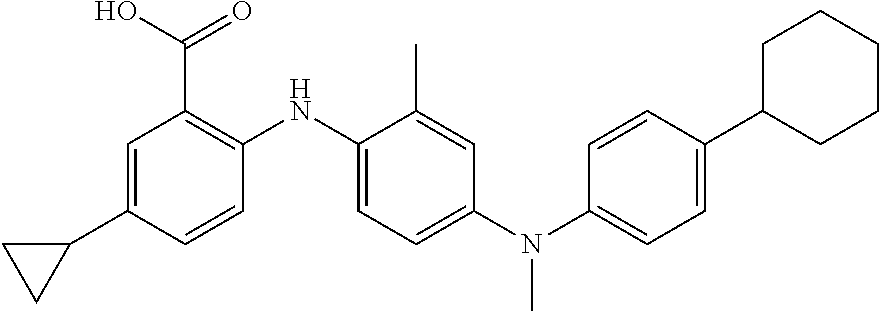 |
1H NMR (400 MHz, DMSO-d6) δ 12.83 (bs, 1H), 9.12 (s, 1H), 7.59 (d, J = 2.0 Hz, 1H), 7.12 (d, J = 8.8 Hz, 3H), 7.05 (dd, J1 = 2.0, J2 = 8.4 Hz, 1H), 6.93-6.91 (m, 3H), 6.79 (dd, J1 = 2.4 Hz, J2 = 8.4 Hz, 1H), 6.65 (d, J = 8.0 Hz, 1H), 3.21 (s, |
| 3H), 2.46-2.42 (m, 1H), | ||||
| 2.10 (s, 3H), 1.92-1.67 | ||||
| (m, 6H), 1.41-1.33 (m, | ||||
| 5H), 0.86-0.82 (m, 2H), | ||||
| 0.54-0.51 (m, 2H). LC-MS: | ||||
| m/z 455.3 (M + H)+. | ||||
| 631 | 126 | XII.157 |
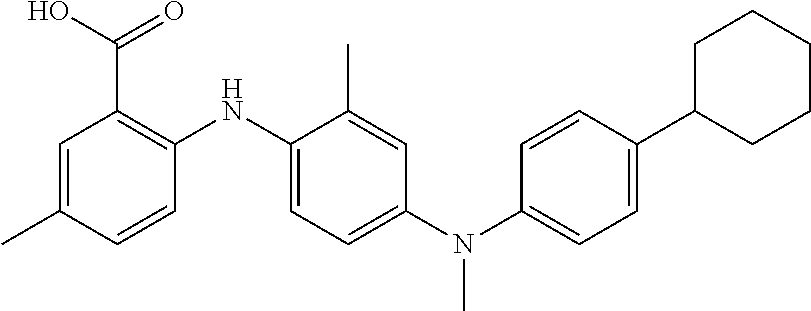 |
1H NMR (400 MHz, DMSO-d6) δ 12.8 (bs, 1H), 9.14 (s, 1H), 7.67 (d, J = 1.6 Hz, 1H), 7.16 7.11 (m, 4H), 6.93-6.91 (m, 3H), 6.81-6.78 (m, 1H), 6.67-6.64 (m, 1H), 3.22 (s, 3H), 2.43 (s, 1H), 2.20 (s, 3H), 2.11 (s, 3H), 1.80-1.68 (m, 5H), 1.38- |
| 1.23 (m, 5H). LC-MS: | ||||
| m/z 429.3 (M + H)+. | ||||
| 632 | 127 | XII.158 |
 |
1H NMR (400 MHz, DMSO-d6) δ 13.2 (bs, 1H), 9.60 (s, 1H), 8.42 (d, J = 2.4 Hz, 1H), 8.24 (d, J = 4.8 Hz, 1H), 7.76 (dd, J1 = 2.0, J2 = 8.8 Hz, 1H), 7.17-7.12 (m, 3H), 6.99 (d, J = 8.4 Hz, 2H), 6.91 (d, J = 2.4 Hz, 1H), 6.78 (dd, J1 = 2.8 Hz, |
| J2 = 8.8 Hz, 1H), 6.62 (d, | ||||
| J = 9.2 Hz, 1H), 3.24 (s, | ||||
| 3H), 2.73 (d, J = 4.8 Hz, | ||||
| 3H), 2.46-2.44 (m, 1H), | ||||
| 2.10 (s, 3H), 1.79-1.68 | ||||
| (m, 5H), 1.39-1.16 (m, | ||||
| 5H). LC-MS: m/z 472.4 | ||||
| (M + H)+. | ||||
| 633 | 128 | XII.159 |
 |
1H NMR (400 MHz, DMSO-d6) δ 13.10- 13.00 (bs, 1H), 8.96 (s, 1H), 7.36 (d, J = 3.2 Hz, 1H), 7.12 (dd, J1 = 4.4 Hz, J2 = 8.4 Hz, 3H), 7.04 (dd, J1 = 4.0 Hz, J2 = 9.2 Hz, 1H), 6.93-6.89 (m, 3H), 6.81-6.74 (m, 2H), 3.48 (s, 2H), 3.21 (s, 3H), |
| 2.33-2.32 (m, 1H), 2.12 | ||||
| (s, 3H), 1.79-1.68 (m, | ||||
| 6H), 1.41-1.17 (m, 4H), | ||||
| 0.99 (s, 9H). LC-MS: | ||||
| m/z 501.4 (M+)+ | ||||
| 634 | 129 | XII.160 |
 |
1H NMR (400 MHz, DMSO-d6) δ 13.10- 12.90 (bs, 1H), 8.95 (s, 1H), 7.38 (d, J = 3.2 Hz, 1H), 7.12 (t, J = 8.0 Hz, 3H), 7.03 (dd, J1 = 2.8 Hz, J2 = 8.8 Hz, 1H), 6.92- 6.89 (m, 3H), 6.80 (dd, J1 = 2.4 Hz, J2 = 8.0 Hz, 1H), 6.74 (d, J = 8.8 Hz, |
| 1H), 4.15-4.09 (m, 1H), | ||||
| 3.21 (s, 3H), 2.45-2.38 | ||||
| (m, 1H), 2.12 (s, 3H), | ||||
| 1.89-1.86 (m, 2H), 1.79- | ||||
| 1.68 (m, 4H), 1.55-1.24 | ||||
| (m, 14H). LC-MS: m/z | ||||
| 512.3 (M+)+. | ||||
| 635 | 130 | XII.161 |
 |
1H NMR (400 MHz, DMSO-d6) δ 13.1 (s, 1H), 9.35 (s, 1H), 8.15 (s, 3H), 7.99 (d, J = 2.0 Hz, 1H), 7.41 (dd, J1 = 2.0 Hz, J2 = 8.8 Hz, 1H), 7.16- 7.09 (m, 3H), 6.97 (d, J = 8.8 Hz, 2H), 6.92 (d, J = 2.4 Hz, 1H), 6.79 (dd, J1 = 2.8 Hz, J2 = 8.8 Hz, |
| 1H), 6.65 (d, J = 8.4 Hz, | ||||
| 1H), 3.92-3.87 (m, 2H), | ||||
| 3.23 (s, 3H), 2.40 (s, 1H), | ||||
| 2.10 (s, 3H), 1.79-1.68 | ||||
| (m, 5H), 1.39-1.22 (m, | ||||
| 5H). LC-MS: m/z 427.2 | ||||
| (M + H)+. | ||||
| 636 | 131 | XII.162 |
 |
1H NMR (400 MHz, DMSO-d6) δ 8.33 (s, 1H), 7.61-7.59 (m, 1H), 7.38 (d, J = 8.4 Hz, 1H), 7.30 (d, J = 7.6 Hz, 1H), 7.11 (d, J = 8.8 Hz, 2H), 6.91-6.88 (m, 3H), 6.80- 6.78 (m, 1H), 6.72 (d, J = 8.0 Hz, 1H), 3.21 (s, 3H), 2.49-2.45 (m, 1H), |
| 2.15 (s, 3H), 1.79-1.67 | ||||
| (m, 5H), 1.38-1.33 (m, | ||||
| 5H). LC-MS: m/z 416.3 | ||||
| (M + H)+. | ||||
| 637 | 132 | XII.163 |
 |
1H NMR (400 MHz, DMSO-d6) δ 9.62-9.50 (bs, 1H), 8.90-8.70 (bs, 1H), 8.02 (d, J = 1.2 Hz, 1H), 7.40 (d, J = 8.0 Hz, 1H), 7.16-7.10 (m, 3H), 6.98-6.91 (m, 3H), 6.79 (dd, J1 = 2.8 Hz, J2 = 8.8 Hz, 1H), 6.67 (d, J = 8.8 Hz, 1H), 3.98 (s, 2H), |
| 3.23 (s, 3H), 2.54 (s, 1H), | ||||
| 2.50 (s, 3H), 2.10 (s, 3H), | ||||
| 1.79-1.68 (m, 5H), 1.39- | ||||
| 1.23 (m, 5H). LC-MS: | ||||
| m/z 456.3 (M − H)+. | ||||
| 638 | 133 | XV.49 |
 |
1H NMR (400 MHz, DMSO-d6) δ 13.00- 12.90 (bs, 1H), 10.12 (s, 1H), 8.57 (s, 1H), 8.40 (t, J = 2.0 Hz, 1H), 8.03 (d, J = 8.4 Hz, 1H), 7.87 (d, J = 8.8 Hz, 2H), 7.63 (d, J = 8.8 Hz, 1H), 7.46 (d, J = 8.0 Hz, 1H), 7.17 (d, J = 8.4 Hz, 2H), 7.11-7.05 (m, 4H), 2.46-2.42 (m, |
| 1H), 1.81-1.78 (m, 5H), | ||||
| 1.42-1.32 (m, 5H). LC-MS: | ||||
| m/z 415.2 (M + H)+. | ||||
| 640 | 134 | XII.164 |
 |
1H NMR (400 MHz, DMSO-d6) δ 8.09 (s, 1H), 7.18 (d, J = 8.4 Hz, 2H), 7.10 (d, J = 8.4 Hz, 2H), 6.92 (d, J = 2.4 Hz, 1H), 6.87 (d, J = 8.4 Hz, 2H), 6.82-6.77 (m, 2H), 3.72 (s, 2H), 3.20 (s, 3H), 2.43 (s, 3H), 2.50 (s, 3H), 2.14 (s, 3H), 1.78-1.67 |
| (m, 5H), 1.40-1.32 (m, | ||||
| 5H). LC-MS: m/z 470.3 | ||||
| (M + H)+. | ||||
| 641 | 135 | XII.165 |
 |
1H NMR (400 MHz, DMSO-d6) δ 8.38 (s, 1H), 7.68-7.64 (m, 1H), 7.37-7.31 (m, 3H), 7.17- 7.03 (M, 6H), 6.78 (s, 1H), 2.46 (s, 1H), 1.79- 1.68 (m, 5H), 1.39-1.16 (m, 5H). LC-MS: m/z 456.1 (M + H)+. |
| 642 | 136 | XII.166 |
 |
1H NMR (400 MHz, DMSO-d6) δ 10.00 (s, 1H), 8.57 (s, 1H), 8.20 (d, J = 8.4 Hz, 1H), 7.82- 7.66 (m, 5H), 7.47 (d, J = 7.6 Hz, 1H), 7.21-7.17 (m, 3H), 2.36 (s, 3H), 1.79-1.69 (m, 5H), 1.44- 1.21 (m, 6H). LC-MS: |
| m/z 430.2 (M + H)+. | ||||
| 643 | 137 | XII.167 |
 |
1H NMR (400 MHz, DMSO-d6) δ 12.80 (s, 1H), 9.06 (s, 1H), 8.67 (d, J = 2.0 Hz, 1H), 7.84 (dd, J1 = 2.8 Hz, J2 = 8.8 Hz, 1H), 7.64 (t, J = 8.0 Hz, 1H), 7.35 (d, J = 6.8 Hz, 1H), 7.23 (d, J = 8.4 Hz, 2H), 7.15 (d, J = 8.4 Hz, 2H), 6.91 (d, J = 8.4 |
| Hz, 1H), 6.58 (d, J = 8.8 | ||||
| Hz, 1H), 3.34 (s, 3H), | ||||
| 1.90-1.69 (m, 5H), 1.42- | ||||
| 1.22 (m, 6H). LC-MS: | ||||
| m/z 403.2 (M + H)+. | ||||
| 646 | 138 | XII.168 |
 |
1H NMR (400 MHz, DMSO-d6) δ 13.20- 12.40 (bs, 1H), 8.32 (s, 1H), 7.60 (t, J = 8.0 Hz, 1H), 7.33-7.28 (m, 2H), 7.05-7.00 (m, 4H), 6.78 (d, J = 2.4 Hz, 1H), 6.71- 6.67 (m, 2H), 4.75-4.68 (m, 2H), 3.20 (s, 3H), |
| 2.13 (s, 3H). LC-MS: m/z | ||||
| 432.2 (M + H)+. | ||||
| 647 | 139 | XII.169 |
 |
1H NMR (400 MHz, DMSO-d6) δ 8.42 (s, 1H), 7.66-7.60 (m, 2H), 7.35 (d, J = 6.4 Hz, 1H), 7.19 (d, J = 8.0 Hz, 2H), 7.05 (d, J = 2.4 Hz, 1H), 6.97-6.85 (m, 4H), 3.25 (s, 3H), 2.21 (s, 3H). LC- MS: m/z 418.05 (M + H)+ |
| 648 | 140 | XII.170 |
 |
1H NMR (400 MHz, DMSO-d6) δ 9.43 (s, 1H), 7.91 (d, J = 9.2 Hz, 2H), 7.74-7.70 (m, 1H), 7.46-7.43 (m, 3H), 7.17 (d, J = 8.8 Hz, 2H), 7.05 (d, J = 8.0 Hz, 1H), 6.78 (d, J = 8.8 Hz, 2H), 3.28 (s, 3H). LC-MS: m/z |
| 388.05 (M + H)+. | ||||
| 649 | 141 | XII.171 |
 |
1H NMR (400 MHz, DMSO-d6) δ 12.80 (bs, 1H), 10.21 (s, 1H), 8.40 (s, 1H), 8.32 (s, 1H), 7.92 (d, J = 8.4 Hz, 1H), 7.63 (d, J = 7.6 Hz, 1H), 7.45- 7.39 (m, 2H), 7.14 (d, J = 8.4 Hz, 2H), 7.05 (d, J = 8.4 Hz, 2H), 6.88 (d, J = 7.2 Hz, 2H), 2.36 (s, 3H), 1.79-1.68 (m, 5H), 1.39-1.23 (m, 6H). LC- |
| MS: m/z 429.2 (M + H)+. | ||||
| 650 | 142 | XII.172 |
 |
1H NMR (400 MHz, DMSO-d6) δ 12.90 (s, 1H), 8.80 (s, 1H), 7.53- 7.50 (m, 4H), 7.27 (d, J = 2.0 Hz, 1H), 7.18 (s, 1H), 7.13-7.11 (m, 1H), 7.01 (d, J = 8.4 Hz, 2H), 6.92 (d, J = 8.8 Hz, 1H), |
| 3.75 (s, 3H), 2.03 (s, 3H), | ||||
| 1.81-1.71 (m, 12H). LC- | ||||
| MS: m/z 506.3 (M + 2H)+. | ||||
| 651 | 143 | XV.50 |
 |
1H NMR (400 MHz, DMSO-d6) δ 13.0 (s, 1H), 10.1 (s, 1H), 8.39 (s, 1H), 8.04 (d, J = 8.0 Hz, 1H), 7.82 (d, J = 1.6 Hz, 1H), 7.72-7.69 (m, 1H), 6.63 (d, J = 7.6 Hz, 1H), 7.55 (s, 1H), 7.46-7.44 (m, 1H), 7.16-7.11 (m, 3H), 7.07 (d, J = 8.8 Hz, 2H), 2.52-2.46 (m, 1H), 2.29 (S, 3H), 1.80-1.68 |
| (m, 5H), 1.40-1.17 (m, | ||||
| 5H), LC-MS: m/z 427.2 | ||||
| (M + H)+. | ||||
| 652 | 144 | XII.173 |
 |
1H NMR (400 MHz, DMSO-d6) δ 8.62 (s, 1H), 8.49 (s, 1H), 7.73- 7.69 (m, 1H), 7.42 (d, J = 7.6 Hz, 1H), 7.36 (d, J = 8.4 Hz, 2H), 7.30 (d, J = 8.4 Hz, 2H), 7.22-7.09 (m, 1H) 6.76 (s, 1H), 3.42 (s, 3H), 2.25 (s, 3H), 1.85-1.70 (m, 5H), 1.45- |
| 1.23 (m, 6H). LC-MS: | ||||
| m/z 417.2 (M + H)+. | ||||
| 654 | 145 | XII.174 |
 |
1H NMR (400 MHz, DMSO-d6) δ 12.90 (s, 1H), 8.76 (s, 1H), 8.52 (d, J = 2.4 Hz, 1H), 7.71- 7.68 (m, 1H), 7.51 (d, J = 9.2 Hz, 1H), 7.23-7.12 (m, 4H), 6.87 (d, J = 9.2 Hz, 1H), 6.58 (d, J = 8.8 Hz, 1H), 3.74 (s, 3H), 3.29 (s, 3H), 2.49-2.47 |
| (m, 1H), 1.81-1.79 (m, | ||||
| 5H), 1.39-1.37 (m, 5H). | ||||
| LC-MS: m/z 431.3 | ||||
| (M − H)+. | ||||
| 655 | 146 | XII.175 |
 |
1H NMR (400 MHz, DMSO-d6) δ 7.70 (d, J = 2.4 Hz, 1H), 7.48-7.47 (m, 2H), 7.37 (dd, J1 = 6.8 Hz, J2 = 7.6 Hz, 1H), 7.27-7.13 (m, 5H), 7.05- 7.03 (m, 1H), 6.70 (d, J = 9.2 Hz, 1H), 3.38 (s, 3H), 2.48-2.47 (m, 1H), |
| 1.79-1.66 (m, 5H), 1.42- | ||||
| 1.10 (m, 6H). LC-MS: | ||||
| m/z 402.5 (M + H)+. | ||||
| 656 | 147 | XII.176 |
 |
1H NMR (400 MHz, DMSO-d6) δ 8.02-7.60 (m, 2H), 7.14 (d, J = 8.4 Hz, 4H), 6.97 (d, J = 8.4 Hz, 2H), 6.80 (d, J = 2.4 Hz, 1H), 6.76-6.74 (m, 1H), 6.40-6.30 (m, 1H), 3.22 (d, J = 8.8 Hz, 3H), 2.40 (s, 3H), 2.14 (s, 3H), 1.89-1.72 (m, 5H), 1.42- 1.31 (m, 6H). LC-MS: |
| m/z 509.2 (M + H)+. | ||||
| 659 | 148 | XII.177 |
 |
1H NMR (400 MHz, DMSO-d6) δ 8.37 (bs, 1H), 7.65 (bs, 1H), 7.55 (t, J = 8.0 Hz, 1H), 7.43 (d, J = 1.6 Hz, 1H), 7.35 (d, J = 8.0 Hz, 2H), 7.30- 7.25 (m, 2H), 6.75 (d, J = 7.6 Hz, 1H), 6.19 (d, J = 8.8 Hz, 1H), 3.29 (s, 3H), 2.45-2.41 (m, 1H), |
| 1.84-1.69 (m, 5H), 1.45- | ||||
| 1.32 (m, 5H). LC-MS: | ||||
| m/z 437.2 (M + H)+. | ||||
| 660 | 149 | XII.178 |
 |
1H NMR (400 MHz, DMSO-d6) δ 10.75 (bs, 1H), 8.03 (s, 1H), 7.66 (t, J = 8.0 Hz, 1H), 7.38-7.32 (m, 3H), 7.23-7.17 (m, 3H), 7.09 (d, J = 7.6 Hz, 1H), 6.72 (s, 1H), 2.45- 2.41 (m, 1H), 1.79-1.67 (m, 5H), 1.43-1.30 (m, 5H). LC-MS: m/z 490.1 (M + H)+. |
| 661 | 150 | XII.179 |
 |
1H NMR (400 MHz, DMSO-d6) δ 8.96 (s, 1H), 8.25 (s, 1H), 7.49 (s, 1H), 7.37-7.34 (m, 2H), 7.16 (d, J = 8.0 Hz, 2H), 7.06 (d, J = 8.0 Hz, 2H), 6.75 (d, J = 8.4 Hz, 1H), 6.65 (s, 1H), 3.69 (s, 3H), 2.46-2.39 (m, 1H), 1.79- 1.68 (m, 5H), 1.39-1.23 (m, 5H). LC-MS: m/z |
| 486.2 (M + H)+. | ||||
| 662 | 151 | XII.180 |
 |
1H NMR (400 MHz, DMSO-d6) δ 12.90 (s, 1H), 8.60 (s, 1H), 8.36 (s, 1H), 7.69 (d, J = 2.0 Hz, 1H), 7.44-7.36 (m, 3H), 7.13 (d, J = 8.4 Hz, 2H), 7.04 (d, J = 8.4 Hz, 2H), 6.98 (s, 1H), 6.66 (d, J = 14.0 Hz, 2H), 1.77- 1.75 (m, 6H), 1.38-1.22 (m, 5H). LC-MS: m/z |
| 469.1 (M + H)+. | ||||
| 663 | 152 | XII.181 |
 |
1H NMR (400 MHz, DMSO-d6) δ 8.08 (s, 1H), 7.62 (t, J = 9.6 Hz, 1H), 7.32-7.24 (m, 3H), 7.17 (d, J = 8.0 Hz, 2H), 6.62 (d, J = 7.2 Hz, 1H), 6.06 (s, 1H), 3.34 (s, 3H), 1.81-1.69 (m, 7H), 1.42- 1.23 (m, 5H), 0.84-0.82 (bs, 2H), 0.44-0.43 (m, |
| 2H). LC-MS: m/z 443.2 | ||||
| (M + H)+. | ||||
| 664 | 153 | XV.51 |
 |
1H NMR (400 MHz, DMSO-d6) δ 13.20 (s, 1H), 10.14 (s, 1H), 9.90 (s, 1H), 7.93 (d, J = 6.8 Hz, 1H), 7.78 (s, 1H), 7.66-7.60 (m, 3H), 7.50- 7.40 (m, 3H), 7.30 (d, J = 4.0 Hz, 1H), 7.18 (d, J = 8.4 Hz, 2H), 6.83 (t, J = 7.2 Hz, 1H), 1.78-1.68 (m, 5H), 1.44-1.23 (m, |
| 6H). LC-MS: m/z 415.2 | ||||
| (M + H)+. | ||||
| 665 | 154 | XII.182 |
 |
1H NMR (400 MHz, DMSO-d6) δ 13.72 (bs, 1H), 10.60 (s, 1H), 9.95 (s, 1H), 8.42 (d, J = 2.8 Hz, 1H), 8.29-8.27 (m, 1H), 8.20 (s, 1H), 8.07 ((d, J = 8.4 Hz, 1H), 7.62 (d, J = 7.2 Hz, 1H), 7.50- 7.46 (m, 2H), 7.38 (s, 1H), 7.24 (d, J = 8.4 Hz, 1H), 6.93-6.90 (m, 1H), |
| 2.49-2.47 (m, 1H), 1.81- | ||||
| 1.69 (m, 5H), 1.43-1.23 | ||||
| (m, 5H). LC-MS: m/z | ||||
| 450.1 (M + H)+. | ||||
| 666 | 155 | XII.183 |
 |
1H NMR (400 MHz, DMSO-d6) δ 13.19 (s, 1H), 9.97 (s, 1H), 9.75 (s, 1H), 7.93 (dd, J1 = 0.8 Hz, J2 = 7.6 Hz, 1H), 7.81 (s, 1H), 7.640 (d, J = 6.0 Hz, 1H), 7.52-7.38 (m, 5H), 7.31 (d, J = 8.4 Hz, 1H), 7.24-7.22 (m, 1H), 6.86- 6.82 (m, 1H), 2.49-2.43 (m, 1H), 1.81-1.68 (m, |
| 5H) 1.46-1.22 (m, 5H). | ||||
| LC-MS: m/z 449.05 | ||||
| (M + H)+. | ||||
| 669 | 156 | XII.184 |
 |
1H NMR (400 MHz, DMSO-d6) δ 13.25 (bs, 1H), 9.91 (s, 1H), 9.29 (bs, 1H), 7.70 (s, 1H), 7.53 (d, J = 8 Hz, 1H), 7.47-7.32 (m, 6H), 7.23 (d, J = 8 Hz, 1H), 7.12 (dd, J1 = 2.8 Hz, J2 = 8.8 Hz, 1H), 3.74 (s, 3H), 2.45-2.41 (m, 1H), 1.81- 1.68 (m, 5H), 1.46-1.31 (m, 5H). LC-MS: m/z 479.2 (M + H)+. |
| 671 | 157 | XII.185 |
 |
1H NMR (400 MHz, DMSO-d6) δ 13.40 (s, 1H), 9.61 (s, 1H), 8.23 (d, J = 2.0 Hz, 1H), 7.60 (dd, J1 = 2.4 Hz, J2 = 9.2 Hz, 1H), 7.44 (s, 1H), 7.30 (s, 2H), 7.21 (d, J = 6.5 Hz, 1H), 7.04 (d, J = 8.8 Hz, 1H), 6.60-6.50 (m, 2H), 6.33 (dd, J1 = 2.8 |
| Hz, J2 = 8.2 Hz, 1H), 3.19 | ||||
| (s, 3H), 2.36 (d, J = 4.8 | ||||
| Hz, 3H), 2.07 (s, 3H), | ||||
| 1.84-1.68 (m, 5H), 1.44- | ||||
| 1.16 (m, 6H). LC-MS: | ||||
| m/z 542.2 (M + H)+. | ||||
| 672 | 158 | XII.186 |
 |
1H NMR (400 MHz, DMSO-d6) δ 9.88 (s, 1H), 7.63 (dd, J1 = 2.8 Hz, J2 = 6.8 Hz, 2H), 7.47 (d, J = 8 Hz, 1H), 7.41-7.33 (m, 3H), 7.29-7.21 (m, 3H), 6.97 (d, J = 7.6 Hz, 1H), 3.80-3.75 (m, 1H), 2.45-2.41 (m, 1H), 1.81- 1.68 (m, 5H), 1.46-1.32 (m, 5H), 0.74-0.73 (m, |
| 2H), 0.64-0.60 (m, 2H). | ||||
| LC-MS: m/z 505.2 | ||||
| (M + H)+. | ||||
| 673 | 159 | XII.187 |
 |
1H NMR (400 MHz, DMSO-d6) δ 8.75-9.00 (bs, 1H), 7.97 (s, 1H), 7.55 (d, J = 2.4 Hz, 1H), 7.26 (d, J = 8.4 Hz, 2H), 7.20 (d, J = 8.4 Hz, 2H), 7.00 (dd, J1 = 2.4 Hz, J2 = 9.2 Hz, 1H), 6.49 (s, 1H), 6.43 (d, J = 9.2 Hz, 1H), 3.78-3.71 (m, 1H), |
| 3.35 (s, 3H), 2.45-2.41 | ||||
| (m, 1H), 1.97 (s, 3H), | ||||
| 1.85-1.69 (m, 5H), 1.46- | ||||
| 1.32 (m, 5H), 0.75-0.70 | ||||
| (m, 2H), 0.65-0.58 (m, | ||||
| 2H). LC-MS: m/z 472.25 | ||||
| (M + H)+. | ||||
| 675 | 160 | XII.188 |
 |
1H NMR (400 MHz, DMSO-d6) δ 8.74 (s, 1H), 7.80 (s, 1H), 7.53 (s, 1H), 7.33-7.09 (m, 5H), 6.05 (s, 1H), 6.57 (d, J = 8.4 Hz, 1H), 3.63 (s, 3H), 2.49-2.47 (m, 1H), 1.80-1.67 (m, 5H), 1.40- 1.33 (m, 5H). LC-MS: m/z 518.1 (M + H)+. |
| 676 | 161 | XII.189 |
 |
1H NMR (400 MHz, DMSO-d6) δ 12.92 (s, 1H), 8.58 (s, 1H), 8.02 (s, 1H), 7.65 (s, 1H), 7.45- 7.29 (m, 5H), 7.17-7.15 (m, 1H), 6.80 (s, 1H), 6.67 (s, 2H), 2.60-2.40 (m, 1H), 1.79-1.67 (m, 5H), 1.36-1.22 (m, 5H). LC-MS: m/z 489.2 (M + H)+. |
| 677 | 162 | XII.190 |
 |
1H NMR (400 MHz, DMSO-d6) δ 13.60 (s, 1H), 10.48 (s, 1H), 8.34- 8.33 (m, 1H), 8.22 (dd, J1 = 2.0 Hz, J2 = 8.0 Hz, 1H), 7.54 (s, 1H), 7.47 (s, 1H), 7.29-7.20 (m, 2H), 7.15-7.09 (m, 3H), 6.83 (dd, J1 = 4.8 Hz, J2 = 7.6 Hz, 1H), 6.65-6.63 (m, 1H), 2.49-2.45 (m, 1H), |
| 1.77-1.67 (m, 5H), 1.42- | ||||
| 1.18 (m, 5H). LC-MS: | ||||
| m/z 422.1 (M + H)+. | ||||
| 678 | 163 | XII.191 |
 |
1H NMR (400 MHz, DMSO-d6) δ 13.2 (s, 1H), 9.70 (s, 1H), 8.18 (d, J = 2.4 Hz, 1H), 7.57 (dd, J1 = 2.4 Hz, J2 = 8.8 Hz, 1H), 7.17-7.12 (m, 3H), 6.99 (d, J = 8.8 Hz, 2H), 6.91 (d, J = 2.4 Hz, 1H), 6.78 (dd, J1 = 2.8 Hz, J2 = 8.4 Hz, 1H), 6.60 (d, |
| J = 8.8 Hz, 1H), 4.40 (bs, | ||||
| 4H), 3.90-3.80 (m, 1H), | ||||
| 3.24 (s, 3H), 2.45-2.42 | ||||
| (m, 1H), 2.10 (s, 3H), | ||||
| 1.79-1.77 (m, 5H), 1.39- | ||||
| 1.34 (m, 5H). LC-MS: | ||||
| m/z 523.3 (M + H)+ | ||||
| 679 | 164 | XII.191 |
 |
1H NMR (400 MHz, DMSO-d6) δ 13.19 (s, 1H), 9.61 (s, 1H), 8.19 (s, 1H), 7.58 (dd, J1 = 1.6 Hz, J2 = 8.8 Hz, 1H), 7.47 (s, 1H), 7.17-7.12 (m, 3H), 7.03-6.98 (m, 3H), 6.91 (s, 1H), 6.78 (dd, J1 = 2.2 Hz, J2 = 8.8 Hz, 1H), 6.62 (d, J = 8.8 Hz, 1H), 4.39- |
| 3.98 (m, 4H), 3.23 (s, | ||||
| 3H), 2.49-2.43 (m, 1H), | ||||
| 2.10 (s, 3H), 1.79-1.68 | ||||
| (m, 6H), 1.42-1.30 (m, | ||||
| 5H). LC-MS: m/z 541.3 | ||||
| (M + H)+ | ||||
| 680 | 165 | XII.192 |
 |
1H NMR (400 MHz, DMSO-d6) δ 8.86 (s, 1H), 7.62-7.56 (m, 2H), 7.33-7.22 (m, 3H), 7.11- 7.02 (m, 2H), 6.96 (d, J = 2.0 Hz, 1H), 6.88-6.83 (m, 1H), 6.41 (d, J = 8.4 Hz, 1H), 2.47-2.42 (m, 1H), 2.09 (s, 3H), 1.81- |
| 1.66 (m, 5H), 1.42-1.22 | ||||
| (m, 5H). LC-MS: m/z | ||||
| 436.2 (M + H)+ | ||||
| 681 | 166 | XII.193 |
 |
1H NMR (400 MHz, DMSO-d6) δ 8.25 (s, 1H), 7.56-7.54 (m, 1H), 7.41 (s, 1H), 7.28-7.23 (m, 3H), 7.15-7.12 (m, 1H), 6.57-6.47 (m, 2H), 6.30 (d, J = 5.6 Hz, 1H), 3.17 (s, 3H), 2.04 (s, 3H), 1.86-1.66 (m, 5H), 1.44- 1.15 (m, 6H). LC-MS: |
| m/z 450.2 (M + H)+ | ||||
| 682 | 167 | XII.194 |
 |
1H NMR (400 MHz, DMSO-d6) δ 10.4 (s, 1H), 7.62-7.55 (m, 2H), 7.32-7.26 (m, 4H), 7.16- 6.95 (m, 5H), 6.61 (d, J = 7.6 Hz, 1H), 2.44-2.32 (m, 1H), 1.84-1.67 (m, 5H), 1.38-1.19 (m, 5H). LC-MS: m/z 422.0 (M + H)+ |
| Com- | ||||
| pound | ||||
| CP | No | Reactant | Structure | Analytical data |
| 72 | 277 | Compound 24 |
 |
LC-MS: m/z 466.1 (M + H)+ |
| 94 | 278 | Int-XI |
 |
1H NMR (400 MHz, DMSO-d6) δ 14.55 (bs, 1H), 10.20 (bs, 1H), 8.72 (bs, 1H), 7.68 (d, J = 8.8 Hz, 2H), 7.49 (s, 1H), 7.32 (d, J = 2.0 Hz, 1H), 7.20-7.15 (m, 2H), 7.02 (d, J = 8.8 Hz, 2H), 2.04 (s, 3H), 1.83 (s, 6H), 1.72 (s, 6H). LC-MS: m/z 448.1 (M + H)+ |
| 111 | 279 | Compound 31 |
 |
1H NMR (400 MHz, DMSO-d6) δ 9.91 (s, 1H), 7.99 (s, 1H), 7.68 (dd, J1 = 1.6 Hz, J2 = 8.0 Hz, 1H), 7.42 (s, 1H), 7.37 (s, 1H), 7.31 (d, J = 2.0 Hz, 1H), 7.29-7.24 (m, 1H), 7.19-7.12 (m, 2H), 7.08-7.02 (m, 5H), 6.68 (t, J = 7.2 Hz, 1H), 2.04 (s, 3H), 1.83 (s, 6H), 1.72 (s, 6H). LC-MS: m/z 472.2 (M + H)+ |
| 112 | 280 | Compound 279 |
 |
1H NMR (400 MHz, DMSO-d6) δ 8.45 (s, 1H), 8.14-8.12 (m, 2H), 7.74-7.70 (m, 1H), 7.51 (t, J = 8.4 Hz, 1H), 7.43-7.38 (m, 4H), 7.33-7.29 (m, 1H), 7.01 (d, J = 8.8 Hz, 2H), 6.98 (d, J = 8.4 Hz, 1H), 2.06 (s, 3H), 1.87 (s, 6H), 1.73 (s, 6H). LC-MS: m/z 482.1 (M + H)+ |
| 120 | 281 | Compound 31 |
 |
1H NMR (400 MHz, DMSO-d6) δ 9.61 (s, 1H), 8.48 (m, 1H), 7.61 (dd, J1 = 1.6 Hz, J2 = 8.0 Hz, 1H), 7.40 (s, 1H), 7.31 (d, J = 2.4 Hz, 1H), 7.26 (t, J = 8.4 Hz, 1H), 7.19-7.01 (m, 7H), 6.74-6.70 (m, 1H), 3.29-3.24 (m, 2H), 2.04 (s, 3H), 1.82 (s, 6H), 1.72 (s, 6H), 1.12 (t, J = 7.2 Hz, 3H). LC-MS: m/z 500.2 (M + H)+ |
| 123 | 282 | Compound 31 |
 |
1H NMR (400 MHz, DMSO-d6) δ 7.41 (s, 1H), 7.29 (d, J = 2.0 Hz, 1H), 7.27 (s, 1H), 7.24-7.21 (m, 1H), 7.18-7.13 (m, 2H), 7.10-7.03 (m, 2H), 6.99 (s, 4H), 6.83 (t, J = 7.2 Hz, 1H), 2.91 (s, 6H), 2.04 (s, 3H), 1.82 (s, 6H), 1.71 (s, 6H). LC-MS: m/z 500.4 (M + H)+ |
| 164 | 283 | Compound 31 |
 |
1H NMR (400 MHz, DMSO-d6) δ 9.62 (s, 1H), 8.45 (s, 1H), 7.59 (dd, J1 = 1.6 Hz, J2 = 8.0 Hz, 1H), 7.40 (s, 1H), 7.31 (d, J = 2.0 Hz, 1H), 7.26 (t, J = 6.8 Hz, 1H), 7.20-7.02 (m, 7H), 6.72 (t, J = 7.6 Hz, 1H), 2.77 (d, J = 5.2 Hz, 3H), 2.04 (s, 3H), 1.83 (s, 6H), 1.72 (s, 6H). LC- MS: m/z 485.2 (M + H)+ |
| 208 | 284 | Compound 92 |
 |
1H NMR (400 MHz, DMSO-d6) δ 9.0 (s, 1H), 7.6 (d, J = 7.3 Hz, 1H), 7.5 (d, J = 8.9 Hz, 2H), 7.29 (d, J = 2.9 Hz, 1H), 7.26 (s, 1H), 7.15 (m, 1H), 7.07-7.01 (m, 3H), 6.79 (t, J = 8.3 Hz, 2H), 2.98 (s, 6H), 2.04 (s, 3H), 1.82 (s, 6H), 1.72 (s, 6H). LC-MS: m/z 501.3 (M + H)+ |
| 209 | 285 | |
 |
1H NMR (400 MHz, DMSO-d6) δ 8.23 (s, 1H), 8.15 (dd, J1 = 2.0 Hz, J2 = 7.6 Hz, 1H), 7.55 (dd, J1 = 2.0 Hz, J2 = 7.6 Hz, 1H), 7.45 (d, J = 8.8 Hz, 2H), 7.29 (s, 2H), 7.16 (dd, J1 = 2.8 Hz, J2 = 8.8 Hz, 1H), 7.07 (d, J = 8.4 Hz, 1H), 7.01 (d, J = 8.8 Hz, 2H), 6.78 (dd, J1 = 4.8 Hz, J2 = 7.2 Hz, 1H), 2.97 (s, 6H), 2.04 (s, 3H), 1.82 (s, 6H), 1.72 (s, 6H). LC- MS: m/z 501.3 (M + H)+ |
| 605 | 168 | Compound 279 |
 |
1H NMR (400 MHz, DMSO-d6) δ 9.35 (s, 1H), 8.08 (s, 1H), 7.51 (bs, 1H), 7.44 (d, J = 8.4 Hz, 2H), 7.30-7.27 (m, 2H), 7.12-7.00 (m, 5H), 6.77 (d, J = 8.8 Hz, 2H), 3.76 (s, 3H), 3.25 (s, 3H). LC- MS: m/z 416.10 (M + H)+. |
| 606 | 169 | Compound 279 |
 |
1H NMR (400 MHz, DMSO-d6) δ 9.06 (s, 1H), 8.49-8.52 (m, 1H), 7.42 (d, J = 8.8 Hz, 2H), 7.28 (d, J = 8.8 Hz, 1H), 7.17 (d, J = 2.4 Hz, 1H), 7.09-7.03 (m, 4H), 7.01-6.96 (m, 1H), 6.74 (d, J = 8.8 Hz, 2H), 3.75 (s, 3H), 3.23 (s, 3H), 2.74 (d, J = 4.8 Hz, 3H). LC-MS: m/z 430.2 (M + H)+. |
| 607 | 170 | Compound 279 |
 |
1H NMR (400 MHz, DMSO-d6) δ 7.42 (d, J = 8.8 Hz, 3H), 7.22 (d, J = 8.8 Hz, 1H), 7.00 (d, J = 8.4 Hz, 2H), 6.97-6.94 (m, 1H), 6.89 (d, J = 8.8 Hz, 2H), 6.81 (d, J = 3.2 Hz, 1H), 6.72 (d, J = 8.8 Hz, 2H), 3.75 (s, 3H), 3.22 (s, 3H), 2.90 (s, 3H), 2.81 (s, 3H). LC-MS: m/z 444.2 (M + H)+. |
| 653 | 171 | XI.53 |
 |
1H NMR (400 MHz, DMSO-d6) δ 9.00 (s, 1H), 8.43 (d, J = 4.8 Hz, 1H), 7.83 (d, J = 8.8 Hz, 1H), 7.22-7.14 (m, 3H), 6.97 (d, J = 8.4 Hz, 2H), 6.87 (d, J = 2.0 Hz, 1H), 6.77-6.75 (m, 2H), 6.56-6.51 (m, 1H), 3.23 (s, 3H), 2.73 (d, J = 4.8 Hz, 3H), 2.45 (d, J = 5.2 Hz, 3H), 2.14 (s, 3H), 1.79-1.68 (m, 5H), 1.44-1.34 (m, 6H). LC-MS: m/z 522.2 (M + H)+ |
| Com- | ||||
| pound | ||||
| CP | No | Reactant | Structure | Analytical data |
| 109 | 286 | XV.4 |
 |
1H NMR (400 MHz, DMSO-d6) δ 9.86 (s, 1H), 7.50 (d, J = 8.8 Hz, 2H), 7.41 (s, 1H), 7.31 (s, 1H), 7.18 (m, 1H), 7.11 (s, 1H), 6.98 (d, J = 4.0 Hz, 2H), 3.74 (m, 1H), 2.95 (t, J = 6.9 Hz, 2H), 2.08 (m, 4H), 1.90 (m, 7H), 1.68 (m, 7H), 1.56-1.48 (m, 1H). LC- MS: m/z 450.2 (M + H)+ |
| 230 | 287 | XV.10 |
 |
1H NMR (400 MHz, DMSO-d6) δ 9.88 (s, 1H), 7.51 (d, J = 8.8 Hz, 2H), 7.38 (s, 1H), 7.30 (d, J = 2.0 Hz, 1H), 7.16-7.14 (m, 1H), 7.1 (d, J = 8.8 Hz, 1H), 6.99 (d, J = 8.8 Hz, 2H), 2.04 (s, 3H), 1.82 (s, 6H), 1.72 (s, 6H), 1.17-1.15 (m, 2H), 0.87-0.84 (m, 2H). LC-MS: m/z 436.2 (M + H)+ |
| 152 | 288 | Compound 77 |
 |
1H NMR (400 MHz, DMSO-d6) δ 13.21 (bs, 1H), 10.60 (bs, 1H), 8.48 (d, J = 8.0 Hz, 1H), 8.08 (d, J = 2.8 Hz, 1H), 7.94 (dd, J1 = 1.6 Hz, J2 = 8.0 Hz, 1H), 7.51-7.44 (m, 3H), 7.31 (d, J = 2.0 Hz, 1H), 7.16 (dd, J1 = 1.6 Hz, J2 = 8.0 Hz, 1H), 6.98 (t, J = 8.4 Hz, 2H), 6.87 (t, J = 8.4 Hz, 1H), 2.04 (s, 3H), 1.82 (s, 6H), 1.72 (s, 6H). LC-MS: m/z 474.3 (M + H)+ |
| 155 | 289 | Compound 288 |
 |
1H NMR (400 MHz, DMSO-d6) δ 8.36 (d, J = 2.4 Hz, 1H), 8.26 (dd, J1 = 1.2 Hz, J2 = 8.0 Hz, 1H), 8.07 (s, 1H), 7.88-7.84 (m, 1H), 7.75-7.70 (m, 2H), 7.56 (d, J = 10 Hz, 1H), 7.51-7.47 (m, 1H), 7.43 (d, J = 2.0 Hz, 1H), 7.32-7.26 (m, 2H), 2.06 (s, 3H), 1.87 (s, 6H), 1.74 (s, 6H). LC-MS: m/z 456.3 (M + H)+ |
| 153 | 290 | Compound 75 |
 |
1H NMR (400 MHz, DMSO-d6) δ 13.21 (bs, 1H), 10.46 (bs, 1H), 8.45 (s, 1H), 8.14 (d, J = 8.0 Hz, 1H), 8.11 (d, J = 8.8 Hz, 1H), 8.04 (s, 1H), 7.94 (dd, J1 = 1.6 Hz, J2 = 8.0 Hz, 1H), 7.78 (d, J = 8.4 Hz, 1H), 7.47 (t, J = 8.4 Hz, 1H), 7.35 (d, J = 2.4 Hz, 1H), 7.26 (dd, J1 = 2.4 Hz, J2 = 8.8 Hz, 1H), 6.87 (t, J = 7.2 Hz, 1H), 2.05 (s, 3H), 1.85 (s, 6H), 1.73 (s, 6H). LC-MS: m/z 475.5 (M + H)+ |
| 154 | 291 | Compound 74 |
 |
1H NMR (400 MHz, DMSO-d6) δ 13.43 (bs, 1H), 11.21 (bs, 1H), 8.82 (d, J = 7.6 Hz, 1H), 8.44 (s, 2H), 8.0 (dd, J1 = 2.0 Hz, J2 = 8.4 Hz, 1H), 7.60-7.54 (m, 2H), 7.32 (d, J = 2.0 Hz, 1H), 7.16 (dd, J1 = 2.4 Hz, J2 = 8.8 Hz, 1H), 7.02-6.95 (m, 2H), 2.04 (s, 3H), 1.82-1.81 (bs, 6H), 1.72 (s, 6H). LC-MS: m/z 475.2 (M + H)+ |
| 175 | 292 | VI.19 |
 |
1H NMR (400 MHz, DMSO-d6) δ 13.65 (bs, 1H), 10.95 (bs, 1H), 8.42 (s, 2H), 8.29 (dd, J1 = 2.0 Hz, J2 = 8.0 Hz, 1H), 8.10 (d, J = 3.2 Hz, 1H), 7.54 (m, 2H), 7.32 (d, J = 2.0 Hz, 1H), 7.16 (dd, J1 = 2.0 Hz, J2 = 8.4 Hz, 1H), 7.02 (d, J = 8.4 Hz, 1H), 6.92 (dd, J1 = 5.2 Hz, J2 = 8.0 Hz, 1H), 2.08 (s, 3H), 1.82 (s, 6H), 1.72 (s, 6H). LC-MS: m/z 475.2 (M + H)+ |
| 540 | 172 | IX.5 |
 |
1H NMR (400 MHz, DMSO-d6): δ 13.38 (s, 1H), 10.75 (s, 1H), 8.36 (d, J = 8.4 Hz, 1H), 8.26 (d, J = 1.6 Hz, 1H), 8.05 (d, J = 1.2 Hz, 1H), 7.97 (dd, J1 = 1.6 Hz & J2 = 8.0 Hz, 1H), 7.55-7.51 (m, 1H), 7.49 (d, J = 2.4 Hz, 1H), 7.38-7.35 (m, 1H), 7.22 (d, J = 8.8 Hz, 1H), 6.97 (t, J = 8 Hz, 1H), 2.06 (s, 3H), 1.88 (s, 6H), 1.74 (s, 6H), LC-MS: m/z 476.2 (M + H)+ |
| 559 | 173 | XII.98 |
 |
1H NMR (400 MHz, DMSO-d6): δ 13.38 (bs, 1H), 11.05 (bs, 1H), 8.36 (d, J = 8.8 Hz, 1H), 8.24 (s, 1H), 8.02 (s, 1H), 7.97 (d, J = 6.8 Hz, 1H), 7.50 (t, J = 7.6 Hz, 1H), 7.41 (d, J = 1.6 Hz, 1H), 7.24-7.17 (m, 2H), 6.95 (t, J = 7.2 Hz, 1H), 2.58-2.52 (m, 1H), 1.81-1.68 (m, 5H), 1.42-1.31 (m, 5H). LC-MS: m/z 424.2 (M + H)+. |

| Compound | ||||
| CP | No | Reactant | Structure | Analytical data |
| 90 | 294 | Int-I.1 |
 |
1H NMR (400 MHz, DMSO-d6) δ 11.80 (bs, 1H), 9.75 (s, 1H), 7.47 (d, J = 8.8 Hz, 2H), 7.23 (d, J = 8.8 Hz, 2H), 3.12-3.08 (m, 1H), 2.93-2.91 (m, 1H), 2.00-1.92 (m, 4H), 1.91-1.75 (m, 16H), 1.72-1.54 (m, 1H). LC-MS: m/z 368.1 (M + H)+ |
| 96 | 295 | Int-XI |
 |
1H NMR (400 MHz, DMSO-d6) δ 11.9 (bs, 1H), 9.71 (bs, 1H), 7.43 (d, J = 8.8 Hz, 2H), 7.33 (s, 1H), 7.30 (d, J = 2.5 Hz, 1H), 7.16-7.14 (m, 1H), 7.08 (m, 1H), 6.97 (d, J = 8.8 Hz, 2H), 3.12-3.08 (m, 1H), 2.94-2.90 (m, 1H), 2.04 (s, 4H), 1.99-1.82 (m, 10H), 1.71 (m, 7H). LC-MS: m/z 493.3 (M + H)+ |
| 105 | 296 | Int-I.1 |
 |
1H NMR (400 MHz, DMSO-d6) δ 7.52 (d, J = 8.8 Hz, 2H), 7.27 (d, J = 8.4 Hz, 2H), 2.72 (t, J = 7.2 Hz, 2H), 2.67-2.63 (m, 2H), 2.05 (s, 3H), 1.79 (d, J = 7.6 Hz, 8H), 1.69 (s, 6H). LC-MS: m/z 366.1 (M + H)+ |
| 110 | 297 | Int-XI |
 |
1H NMR (400 MHz, DMSO-d6) δ 12.9 (bs, 1H), 10.06 (s, 1H), 7.47 (d, J = 8.8 Hz, 2H), 7.42 (s, 1H), 7.30 (d, J = 2.0 Hz, 1H), 7.17-7.10 (m, 2H), 6.98 (d, J = 8.8 Hz, 2H), 2.76 (t, J = 7.6 Hz, 2H), 2.74-2.62 (m, 2H), 2.03 (s, 3H), 1.90-1.86 (m, 2H), 1.81-1.80 (bs, 6H), 1.71 (s, 6H). LC-MS: m/z 491.1 (M + H)+ |
| 132 | 298 | XI.2 |
 |
1H NMR (400 MHz, DMSO-d6) δ 11.83 (s, 1H), 9.74 (s, 1H), 7.54 (s, 1H), 7.5 (d, J = 8.8 Hz, 2H), 7.34 (s, 1H), 7.28-7.15 (m, 4H), 7.13 (s, 2H), 7.09 (d, J = 8.8 Hz, 2H), 3.13-3.09 (m, 1H), 2.96-2.90 (m, 1H), 2.25 (s, 3H), 2.04-1.77 (m, 4H). LC-MS: m/z 449.1 (M + H)+ |
| 133 | 299 | XI.2 |
 |
1H NMR (400 MHz, DMSO-d6) δ 12.85 (bs, 1H), 10.15 (s, 1H), 7.62 (s, 1H), 7.55 (d, J = 8.8 Hz, 2H), 7.35 (d, J = 2.0 Hz, 1H), 7.29-7.11 (m, 8H), 2.80-2.76 (m, 2H), 2.65-2.63 (m, 2H), 2.26 (s, 3H), 1.94-1.88 (m, 2H). LC-MS: m/z 447.1 (M + H)+ |
| 176 | 300 | Int-XI |
 |
1H NMR (400 MHz, DMSO-d6) δ 13.05 (bs, 1H), 10.42 (bs, 1H), 7.46 (d, J = 8.8 Hz, 2H), 7.42 (s, 1H), 7.31 (d, J = 2.0 Hz, 1H), 7.16 (m, 1H), 7.12 (m, 1H), 6.98 (d, J = 8.8 Hz, 2H), 2.04 (s, 3H), 1.82 (s, 6H), 1.72 (s, 6H), 1.41 (s, 4H). LC-MS: m/z 465.3 (M + H)+ |
| 216 | 301 | XI.1 |
 |
1H NMR (400 MHz, DMSO-d6) δ 14.8 (bs, 1H), 8.04 (s, 1H), 7.46 (s, 1H), 7.41 (s, 1H), 7.30 (s, 2H), 7.19 (s, 1H), 6.82 (s, 1H), 2.06 (s, 3H), 1.86 (d, J = 2.4 Hz, 6H), 1.63 (s, 6H), 1.19 (d, J = 5.6 Hz, 2H), 1.10 (d, J = 5.6 Hz, 2H). LC-MS: m/z 533.2 (M + H)+ |
| 229 | 302 | Compound 300 |
 |
1H NMR (400 MHz, DMSO-d6) δ 10.56 (s, 1H), 7.82 (d, J = 4.4 Hz, 1H), 7.47-7.42 (m, 3H), 7.31 (d, J = 2.0 Hz, 1H), 7.19-7.16 (m, 1H), 7.11 (d, J = 8.4 Hz, 1H), 6.98 (d, J = 8.8 Hz, 2H), 2.62 (d, J = 4.4 Hz, 3H), 2.04 (s, 3H), 1.83 (s, 6H), 1.72 (s, 6H), 1.36-1.29 (m, 4H). LC-MS: m/z 478.3 (M + H)+ |
| 237 | 303 | XI.7 |
 |
1H NMR (400 MHz, DMSO-d6) δ 7.53 (s, 1H), 7.34 (d, J = 2.0 Hz, 1H), 7.30 (s, 1H), 7.25-7.22 (m, 2H), 7.11 (t, J = 7.6 Hz, 1H), 7.03 (d, J = 8.0 Hz, 1H), 6.50 (d, J = 8.0 Hz, 1H), 2.05 (s, 3H), 1.84 (s, 6H), 1.73 (s, 6H), 1.34-1.24 (m, 4H). LC-MS: m/z 465.2 (M + H)+ |
| 239 | 304 | VI.37 |
 |
1H NMR (400 MHz, DMSO-d6) δ 12.4 (bs, 1H), 7.7 (s, 1H), 7.36 (s, 1H), 7.23 (s, 2H), 7.14 (d, J = 7.8 Hz, 2H), 6.95 (d, J = 8.3 Hz, 2H), 3.13 (s, 3H), 2.08 (s, 3H), 1.83 (s, 6H), 1.72 (s, 6H), 1.17 (m, 2H), 0.85 (m, 2H). LC-MS: m/z 479.2 (M + H)+ |
| 348 | 305 | XI.30 |
 |
1H NMR (400 MHz, DMSO-d6) δ 12.85 (bs, 1H), 10.11 (bs, 1H), 7.91 (s, 1H), 7.85 (d, J = 8.0 Hz, 1H), 7.64 (t, J = 7.6 Hz, 1H), 7.57-7.52 (m, 4H), 7.19 (d, J = 8.8 Hz, 2H), 7.02-6.96 (m, 4H), 2.04 (s, 3H), 1.83 (s, 6H), 1.73 (s, 6H). LC- MS: m/z 465.2 (M − H)+ |
| 378 | 306 | XI.29 |
 |
1H NMR (400 MHz, DMSO-d6) δ 12.97 (s, 1H), 10.19 (s, 1H), 8.06 (s, 1H), 7.85 (d, J = 7.6 Hz, 1H), 7.63 (t, J = 7.2 Hz, 1H), 7.57-7.50 (m, 3H), 7.21 (d, J = 8.4 Hz, 2H), 7.13-7.10 (m, 2H), 7.04 (d, J = 8.4 Hz, 2H), 6.71 (d, J = 7.2 Hz, 1H), 2.04 (s, 3H), 1.83 (s, 6H), 1.72 (s, 6H). LC-MS: m/z 467.3 (M + H)+ |


| TABLE 1 |
| Activity of Compounds as TEAD Palmitoylation Inhibitors |
| % of inhibition of TEAD2 | ||
| Compound structure | palmitoylation at 10 μM | CMP IC50 (μM) |
 |
50 | |
 |
1025 | |
 |
70 | 5.09 |
 |
5 | |
 |
5 | |
 |
80 | |
 |
20 | |
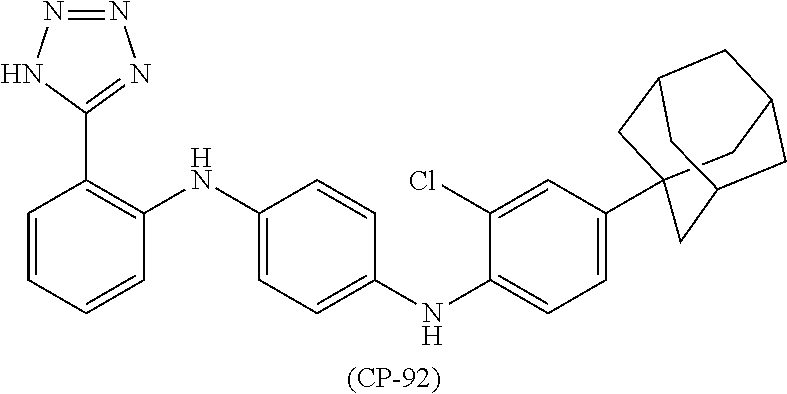 |
20 | |
 |
20 | |
 |
8 | |
 |
80 | |
 |
100 | |
 |
100 | |
| TABLE 2 |
| Activity of Compounds as TEAD2 Palmitoylation Inhibitors |
| % of inhibition of | |||
| Cmpd. | TEAD2 palmitoylation | ||
| CP | No | Structure | at 10 μM or IC50 μM |
| 51 | 1 |
 |
10 |
| 54 | 2 |
 |
0 |
| 57 | 3 |
 |
0 |
| 68 | 4 |
 |
0 |
| 70 | 5 |
 |
0 |
| 79 | 6 |
 |
0 |
| 85 | 7 |
 |
30 |
| 104 | 8 |
 |
NA |
| 201 | 9 |
 |
76 |
| 225 | 10 |
 |
0 |
| 264 | 11 |
 |
0 |
| 238 | 12 |
 |
85 |
| 347 | 13 |
 |
26 |
| 352 | 14 |
 |
0 |
| 375 | 15 |
 |
12 |
| 354 | 16 |
 |
0 |
| 381 | 17 |
 |
7 |
| 351 | 18 |
 |
35 |
| 406 | 19 |
 |
35 |
| 86 | 20 |
 |
NA |
| 87 | 21 |
 |
NA |
| 231 | 22 |
 |
74 |
| 82 | 23 |
 |
|
| 55 | 24 |
 |
56 |
| 52 | 25 |
 |
90 |
| 58 | 26 |
 |
90 |
| 59 | 27 |
 |
90 |
| 60 | 28 |
 |
10 |
| 61 | 29 |
 |
90 |
| 62 | 30 |
 |
91 |
| 64 | 31 |
 |
99, 84, 82, 0.377 μM |
| 65 | 32 |
 |
60 |
| 66 | 33 |
 |
50 |
| 67 | 34 |
 |
14 |
| 69 | 35 |
 |
63, 86 |
| 71 | 36 |
 |
100 |
| 80 | 37 |
 |
30 |
| 83 | 38 |
 |
7 |
| 88 | 39 |
 |
59 |
| 89 | 40 |
 |
43 |
| 93 | 41 |
 |
52 |
| 98 | 42 |
 |
NA |
| 99 | 43 |
 |
|
| 100 | 44 |
 |
NA |
| 101 | 45 |
 |
NA |
| 102 | 46 |
 |
76 |
| 103 | 47 |
 |
83 |
| 106 | 48 |
 |
87 |
| 107 | 49 |
 |
NA |
| 108 | 50 |
 |
0 |
| 113 | 51 |
 |
79 |
| 114 | 52 |
 |
79 |
| 115 | 53 |
 |
5 |
| 116 | 54 |
 |
NA |
| 117 | 55 |
 |
NA |
| 118 | 56 |
 |
0 |
| 121 | 57 |
 |
NA |
| 122 | 58 |
 |
60 |
| 124 | 59 |
 |
99 |
| 125 | 60 |
 |
100 |
| 126 | 61 |
 |
70 |
| 127 | 62 |
 |
65 |
| 128 | 63 |
 |
NA |
| 129 | 64 |
 |
0 |
| 130 | 65 |
 |
74 |
| 131 | 66 |
 |
25 |
| 134 | 67 |
 |
NO |
| 135 | 68 |
 |
YES |
| 136 | 69 |
 |
NO |
| 138 | 70 |
 |
NO |
| 139 | 71 |
 |
YES |
| 140 | 72 |
 |
NO |
| 141 | 73 |
 |
NO |
| 142 | 74 |
 |
31 |
| 143 | 75 |
 |
63 |
| 144 | 76 |
 |
34 |
| 145 | 77 |
 |
52 |
| 146 | 78 |
 |
NO |
| 148 | 79 |
 |
45 |
| 149 | 80 |
 |
40 |
| 151 | 81 |
 |
78 |
| 156 | 82 |
 |
67 |
| 157 | 83 |
 |
65 |
| 158 | 84 |
 |
98 |
| 159 | 85 |
 |
20 |
| 160 | 86 |
 |
54 |
| 161 | 87 |
 |
4 |
| 162 | 88 |
 |
12 |
| 163 | 89 |
 |
90 |
| 168 | 90 |
 |
98, 0.446 μM |
| 169 | 91 |
 |
97 |
| 170 | 92 |
 |
90 |
| 172 | 93 |
 |
72 |
| 173 | 94 |
 |
91 |
| 174 | 95 |
 |
97 |
| 177 | 96 |
 |
96 |
| 178 | 97 |
 |
60 |
| 182 294 | 98 |
 |
89 |
| 183 | 99 |
 |
85 |
| 184 | 100 |
 |
100, 0.207 μM |
| 185 | 101 |
 |
62 |
| 186 | 102 |
 |
77 |
| 187 | 103 |
 |
53 |
| 191 | 104 |
 |
80 |
| 192 | 105 |
 |
96 |
| 194 | 106 |
 |
0 |
| 195 | 107 |
 |
14 |
| 197 | 108 |
 |
86 |
| 198 | 109 |
 |
100, 0.346 μM |
| 199 | 110 |
 |
85 |
| 200 | 111 |
 |
80 |
| 202 | 112 |
 |
100, 0.268 μM |
| 203 | 113 |
 |
100 |
| 204 | 114 |
 |
98 |
| 205 | 115 |
 |
67 |
| 206 | 116 |
 |
91 |
| 207 | 117 |
 |
9 |
| 210 | 118 |
 |
78 |
| 211 | 119 |
 |
100, 0.106 μM |
| 212 | 120 |
 |
79 |
| 213 | 121 |
 |
80 |
| 214 | 122 |
 |
95 |
| 215 | 123 |
 |
88 |
| 217 | 124 |
 |
86 |
| 218 | 125 |
 |
96, 0.771 μM |
| 219 | 126 |
 |
86 |
| 220 | 127 |
 |
27 |
| 221 | 128 |
 |
92 |
| 226 | 129 |
 |
41 |
| 227 | 130 |
 |
100 |
| 228 | 131 |
 |
37 |
| 233 | 132 |
 |
100 |
| 236 | 133 |
 |
93 |
| 240 | 134 |
 |
0 |
| 241 | 135 |
 |
100 |
| 243 | 136 |
 |
99 |
| 244 | 137 |
 |
99 |
| 245 | 138 |
 |
24 |
| 246 | 139 |
 |
95, 0.312 μM |
| 247 | 140 |
 |
99 |
| 248 | 141 |
 |
95 |
| 249 | 142 |
 |
65 |
| 250 | 143 |
 |
22 |
| 252 | 144 |
 |
100 |
| 254 | 145 |
 |
61, 84 |
| 255 | 146 |
 |
64 |
| 258 | 147 |
 |
70 |
| 259 | 148 |
 |
56, 69 |
| 260 | 149 |
 |
40 |
| 261 | 150 |
 |
100 |
| 263 | 151 |
 |
101 |
| 266 | 152 |
 |
102 |
| 267 | 153 |
 |
100 |
| 268 | 154 |
 |
58, 43 |
| 270 | 155 |
 |
99 |
| 271 | 156 |
 |
92 |
| 272 | 157 |
 |
80 |
| 273 | 158 |
 |
100 |
| 274 | 159 |
 |
41 |
| 275 | 160 |
 |
84 |
| 276 | 161 |
 |
17, 43 |
| 277 | 162 |
 |
25, 88 |
| 278 | 163 |
 |
85 |
| 279 | 164 |
 |
20 |
| 282 | 165 |
 |
85 |
| 284 | 166 |
 |
98 |
| 285 | 167 |
 |
43 |
| 286 | 168 |
 |
97, 0.173 μM |
| 287 | 169 |
 |
42 |
| 288 | 170 |
 |
62 |
| 289 | 171 |
 |
75 |
| 290 | 172 |
 |
100 |
| 291 | 173 |
 |
51 |
| 292 | 174 |
 |
85 |
| 293 | 175 |
 |
70 |
| 294 | 176 |
 |
89 |
| 295 | 177 |
 |
56 |
| 296 | 178 |
 |
100, 0.227 μM |
| 297 | 179 |
 |
92, 35 |
| 298 | 180 |
 |
81 |
| 299 | 181 |
 |
49, 41 |
| 300 | 182 |
 |
54 |
| 301 | 183 |
 |
100, 96 |
| 302 | 184 |
 |
71 |
| 303 | 185 |
 |
66, 91 |
| 304 | 186 |
 |
76 |
| 305 | 187 |
 |
57 |
| 306 | 188 |
 |
101 |
| 307 | 189 |
 |
34 |
| 308 | 190 |
 |
85 |
| 309 | 191 |
 |
85 |
| 310 | 192 |
 |
99 |
| 311 | 193 |
 |
86 |
| 312 | 194 |
 |
20 |
| 313 | 195 |
 |
0 |
| 314 | 196 |
 |
100 |
| 315 | 197 |
 |
100 |
| 316 | 198 |
 |
99 |
| 317 | 199 |
 |
6 |
| 318 | 200 |
 |
32 |
| 319 | 201 |
 |
43 |
| 320 | 202 |
 |
49 |
| 321 | 203 |
 |
95 |
| 322 | 204 |
 |
99 |
| 323 | 205 |
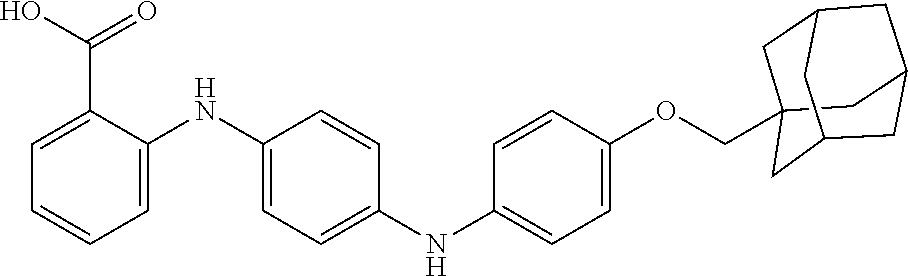 |
74 |
| 324 | 206 |
 |
52 |
| 325 | 207 |
 |
99 |
| 326 | 208 |
 |
100 |
| 327 | 209 |
 |
54 |
| 328 | 210 |
 |
100 |
| 329 | 211 |
 |
67 |
| 330 | 212 |
 |
77 |
| 331 | 213 |
 |
90 |
| 333 | 214 |
 |
88, 73 |
| 334 | 215 |
 |
87 |
| 335 | 216 |
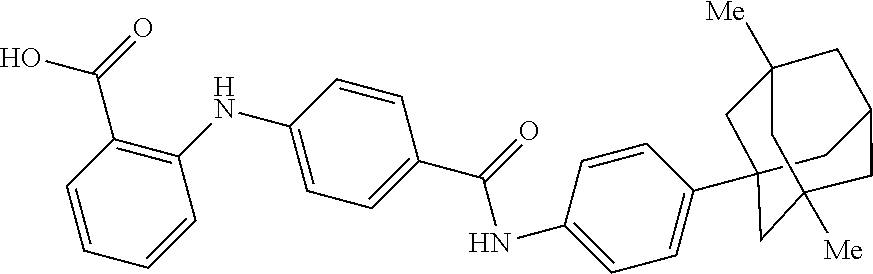 |
89 |
| 336 | 217 |
 |
55 |
| 337 | 218 |
 |
0 |
| 338 | 219 |
 |
0 |
| 339 | 220 |
 |
10 |
| 340 | 221 |
 |
61 |
| 341 | 222 |
 |
45 |
| 342 | 223 |
 |
100 |
| 343 | 224 |
 |
81 |
| 344 | 225 |
 |
84 |
| 345 | 226 |
 |
17 |
| 346 | 227 |
 |
58 |
| 349 | 228 |
 |
89 |
| 350 | 229 |
 |
91 |
| 353 | 230 |
 |
0 |
| 355 | 231 |
 |
0 |
| 356 | 232 |
 |
33 |
| 357 | 233 |
 |
9 |
| 358 | 234 |
 |
64 |
| 359 | 235 |
 |
84 |
| 360 | 236 |
 |
62 |
| 361 | 237 |
 |
93 |
| 362 | 238 |
 |
100 |
| 363 | 239 |
 |
98, 100 |
| 364 | 240 |
 |
62 |
| 366 | 241 |
 |
100 |
| 367 | 242 |
 |
35, 58 |
| 369 | 243 |
 |
67 |
| 370 | 244 |
 |
8 |
| 371 | 245 |
 |
87 |
| 372 | 246 |
 |
99 |
| 373 | 247 |
 |
95 |
| 376 | 248 |
 |
32 |
| 377 | 249 |
 |
1 |
| 379 | 250 |
 |
89, 0.274 μM |
| 380 | 251 |
 |
27 |
| 382 | 252 |
 |
100, 0.053 μM |
| 383 | 253 |
 |
100, 0.099 μM |
| 384 | 254 |
 |
100, 0.297 μM |
| 385 | 255 |
 |
50 |
| 386 | 256 |
 |
46 |
| 387 | 257 |
 |
55 |
| 388 | 258 |
 |
0 |
| 389 | 259 |
 |
83 |
| 392 | 260 |
 |
71 |
| 393 | 261 |
 |
98 |
| 394 | 262 |
 |
85 |
| 395 | 263 |
 |
59 |
| 396 | 264 |
 |
0 |
| 397 | 265 |
 |
78 |
| 398 | 266 |
 |
81 |
| 407 | 267 |
 |
36 |
| 408 | 268 |
 |
10 |
| 420 | 269 |
 |
100 |
| 72 | 270 |
 |
23 |
| 94 | 271 |
 |
NA |
| 111 | 272 |
 |
77 |
| 112 | 273 |
 |
50 |
| 120 | 274 |
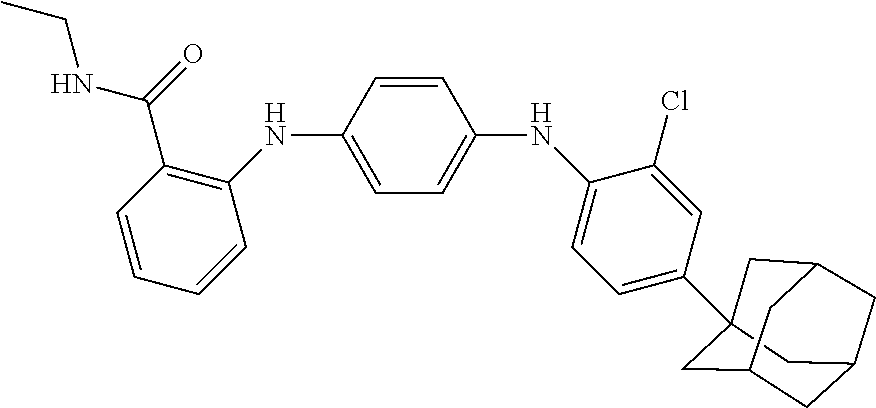 |
50 |
| 123 | 275 |
 |
76 |
| 164 | 276 |
 |
52 |
| 208 | 277 |
 |
0 |
| 209 | 278 |
 |
28 |
| 605 | 429 |
 |
47 |
| 606 | 430 |
 |
63 |
| 607 | 431 |
 |
37 |
| 653 | 432 |
 |
24 |
| 109 | 279 |
 |
NA |
| 230 | 280 |
 |
0 |
| 152 | 281 |
 |
98 |
| 155 | 282 |
 |
14 |
| 153 | 283 |
 |
89, 0.064 μM |
| 154 | 284 |
 |
97 |
| 175 | 285 |
 |
9 |
| 540 | 440 |
 |
75 |
| 559 | 441 |
 |
79 |
| 119 | 286 |
 |
98 |
| 90 | 287 |
 |
17 |
| 96 | 288 |
 |
NA |
| 105 | 289 |
 |
NA |
| 110 | 290 |
 |
99 |
| 132 | 291 |
 |
14 |
| 133 | 292 |
 |
67 |
| 176 | 293 |
 |
86 |
| 216 | 294 |
 |
96 |
| 229 | 295 |
 |
53 |
| 237 | 296 |
 |
88 |
| 239 | 297 |
 |
69 |
| 348 | 298 |
 |
100 |
| 378 | 299 |
 |
97 |
| 453 |
 |
0 | |
| TABLE 3 |
| Activity of Compounds as TEAD2 Palmitoylation Inhibitors |
| % of inhibition | |||
| of TEAD2 | TEAD2 | ||
| palmitoylation | palmitoylation | ||
| CP | Structure | at 10 μM | IC50 |
| CP- 472 |
 |
1 | |
| CP- 473 |
 |
50 | |
| CP- 516 |
 |
20 | |
| CP- 521 |
 |
93 | 1.45 |
| CP- 522 |
 |
96 | 1.53 |
| CP- 525 |
 |
PPT | |
| CP- 526 |
 |
23 | |
| CP- 528 |
 |
76 | 0.38 |
| CP- 529 |
 |
29 | |
| CP- 531 |
 |
20 | |
| CP- 534 |
 |
31 | |
| CP- 535 |
 |
54 | |
| CP- 536 |
 |
84 | |
| CP- 537 |
 |
73 | |
| CP- 538 |
 |
85 | 0.68 |
| CP- 540 |
 |
75 | |
| CP- 541 |
 |
80 | |
| CP- 542 |
 |
49 | |
| CP- 543 |
 |
98 | |
| CP- 544 |
 |
98 | |
| CP- 545 |
 |
6 | |
| CP- 546 |
 |
97 | |
| CP- 547 |
 |
18 | |
| CP- 548 |
 |
86 | 0.45 |
| CP- 549 |
 |
85 | 2.4 |
| CP- 550 |
 |
96 | 0.79 |
| CP- 551 |
 |
91 | 0.002 |
| CP- 552 |
 |
74 | |
| CP- 553 |
 |
100 | 0.59 |
| CP- 554 |
 |
96 | 0.01 |
| CP- 555 |
 |
100 | 0.01 |
| CP- 556 |
 |
61 | |
| CP- 557 |
 |
34 | |
| CP- 558 |
 |
66 | |
| CP- 559 |
 |
79 | |
| CP- 560 |
 |
90 | 0.011 |
| CP- 561 |
 |
90 | |
| CP- 563 |
 |
80 | |
| CP- 564 |
 |
89 | |
| CP- 565 |
 |
100 | 0.51 |
| CP- 566 |
 |
99 | 0.38 |
| CP- 567 |
 |
6 | |
| CP- 568 |
 |
46 | |
| CP- 569 |
 |
59 | |
| CP- 570 |
 |
73 | 0.65 |
| CP- 571 |
 |
94 | 0.36 |
| CP- 572 |
 |
72 | |
| CP- 573 |
 |
74 | |
| CP- 574 |
 |
91 | |
| CP- 575 |
 |
47 | |
| CP- 576 |
 |
42 | |
| CP- 577 |
 |
79 | |
| CP- 578 |
 |
31 | |
| CP- 579 |
 |
61 | |
| CP- 580 |
 |
58 | |
| CP- 581 |
 |
40 | |
| CP- 582 |
 |
0 | |
| CP- 583 |
 |
96 | 0.23 |
| CP- 584 |
 |
85 | 0.21 |
| CP- 585 |
 |
86 | 0.32 |
| CP- 586 |
 |
40 | |
| CP- 587 |
 |
36 | |
| CP- 588 |
 |
36 | |
| CP- 589 |
 |
97 | 1.57 |
| CP- 590 |
 |
96 | 0.22 |
| CP- 591 |
 |
88 | |
| CP- 592 |
 |
40 | |
| CP- 593 |
 |
78 | 0.03 |
| CP- 594 |
 |
46 | |
| CP- 595 |
 |
51 | |
| CP- 596 |
 |
48 | |
| CP- 597 |
 |
63 | |
| CP- 598 |
 |
74 | 0.05 |
| CP- 599 |
 |
57 | |
| CP- 600 |
 |
37 | |
| CP- 601 |
 |
46 | |
| CP- 602 |
 |
5 | |
| CP- 603 |
 |
83 | |
| CP- 605 |
 |
47 | |
| CP- 606 |
 |
63 | |
| CP- 607 |
 |
37 | |
| CP- 608 |
 |
43 | |
| CP- 609 |
 |
54 | |
| CP- 612 |
 |
86 | |
| CP- 613 |
 |
83 | |
| CP- 614 |
 |
83 | |
| CP- 615 |
 |
82 | |
| CP- 616 |
 |
73 | |
| CP- 617 |
 |
76 | |
| CP- 618 |
 |
31 | |
| CP- 619 |
 |
96 | 0.75 |
| CP- 620 |
 |
0 | |
| CP- 621 |
 |
47 | |
| CP- 622 |
 |
94 | |
| CP- 623 |
 |
73 | |
| CP- 624 |
 |
15 | |
| CP- 625 |
 |
87 | |
| CP- 626 |
 |
87 | 0.382 |
| CP- 627 |
 |
51 | |
| CP- 628 |
 |
40 | |
| CP- 629 |
 |
24 | |
| CP- 630 |
 |
39 | |
| CP- 631 |
 |
81 | |
| CP- 632 |
 |
73 | |
| CP- 633 |
 |
25 | |
| CP- 634 |
 |
32 | |
| CP- 635 |
 |
27 | |
| CP- 636 |
 |
68 | |
| CP- 637 |
 |
5 | |
| CP- 638 |
 |
67 | |
| CP- 640 |
 |
20 | |
| CP- 641 |
 |
69 | |
| CP- 642 |
 |
55 | |
| CP- 643 |
 |
89 | |
| CP- 646 |
 |
39 | |
| CP- 647 |
 |
87 | |
| CP- 648 |
 |
89 | |
| CP- 649 |
 |
99 | |
| CP- 650 |
 |
93 | |
| CP- 651 |
 |
85 | |
| CP- 652 |
 |
37 | |
| CP- 653 |
 |
24 | |
| CP- 654 |
 |
36 | |
| CP- 655 |
 |
97 | |
| CP- 656 |
 |
90 | |
| CP- 657 |
 |
18 | |
| CP- 659 |
 |
46 | |
| CP- 660 |
 |
66 | |
| CP- 661 |
 |
77 | |
| CP- 662 |
 |
88 | |
| CP- 663 |
 |
45 | |
| CP- 664 |
 |
50 | |
| CP- 665 |
 |
96 | |
| CP- 666 |
 |
79 | |
| CP- 669 |
 |
75 | |
| CP- 671 |
 |
97 | |
| CP- 672 |
 |
55 | |
| CP- 673 |
 |
15 | |
| CP- 675 |
 |
83 | |
| CP- 676 |
 |
97 | |
| CP- 677 |
 |
96 | |
| CP- 678 |
 |
59 | |
| CP- 679 |
 |
81 | |
| CP- 680 |
 |
52 | |
| CP- 681 |
 |
8 | |
| CP- 682 |
 |
51 | |
| CP- 688 |
 |
17 | |
| CP- 694 |
 |
79 | |
| CP- 644 |
 |
||
Claims (23)


Priority Applications (1)
| Application Number | Priority Date | Filing Date | Title |
|---|---|---|---|
| US17/439,735 US12187722B2 (en) | 2019-03-15 | 2020-03-13 | Small molecule inhibitors of TEAD transcription factors |
Applications Claiming Priority (3)
| Application Number | Priority Date | Filing Date | Title |
|---|---|---|---|
| US201962819347P | 2019-03-15 | 2019-03-15 | |
| PCT/US2020/022757 WO2020190774A1 (en) | 2019-03-15 | 2020-03-13 | Novel small molecule inhibitors of tead transcription factors |
| US17/439,735 US12187722B2 (en) | 2019-03-15 | 2020-03-13 | Small molecule inhibitors of TEAD transcription factors |
Related Parent Applications (1)
| Application Number | Title | Priority Date | Filing Date |
|---|---|---|---|
| PCT/US2020/022757 A-371-Of-International WO2020190774A1 (en) | 2019-03-15 | 2020-03-13 | Novel small molecule inhibitors of tead transcription factors |
Related Child Applications (1)
| Application Number | Title | Priority Date | Filing Date |
|---|---|---|---|
| US18/810,625 Continuation US20250122194A1 (en) | 2019-03-15 | 2024-08-21 | Novel small molecule inhibitors of tead transcription factors |
Publications (2)
| Publication Number | Publication Date |
|---|---|
| US20230113085A1 US20230113085A1 (en) | 2023-04-13 |
| US12187722B2 true US12187722B2 (en) | 2025-01-07 |
Family
ID=72520559
Family Applications (2)
| Application Number | Title | Priority Date | Filing Date |
|---|---|---|---|
| US17/439,735 Active 2040-09-28 US12187722B2 (en) | 2019-03-15 | 2020-03-13 | Small molecule inhibitors of TEAD transcription factors |
| US18/810,625 Pending US20250122194A1 (en) | 2019-03-15 | 2024-08-21 | Novel small molecule inhibitors of tead transcription factors |
Family Applications After (1)
| Application Number | Title | Priority Date | Filing Date |
|---|---|---|---|
| US18/810,625 Pending US20250122194A1 (en) | 2019-03-15 | 2024-08-21 | Novel small molecule inhibitors of tead transcription factors |
Country Status (11)
| Country | Link |
|---|---|
| US (2) | US12187722B2 (en) |
| EP (1) | EP3937943A4 (en) |
| JP (3) | JP2022525186A (en) |
| KR (1) | KR102866499B1 (en) |
| CN (2) | CN119490431A (en) |
| AU (2) | AU2020241258B2 (en) |
| CA (1) | CA3133753A1 (en) |
| IL (1) | IL286352B2 (en) |
| MA (1) | MA55322A (en) |
| MX (2) | MX2021011209A (en) |
| WO (1) | WO2020190774A1 (en) |
Families Citing this family (27)
| Publication number | Priority date | Publication date | Assignee | Title |
|---|---|---|---|---|
| CA3069720A1 (en) | 2017-07-11 | 2019-01-17 | Vertex Pharmaceuticals Incorporated | Carboxamides as modulators of sodium channels |
| WO2020146612A1 (en) | 2019-01-10 | 2020-07-16 | Vertex Pharmaceuticals Incorporated | Esters and carbamates as modulators of sodium channels |
| WO2020146682A1 (en) | 2019-01-10 | 2020-07-16 | Vertex Pharmaceuticals Incorporated | Carboxamides as modulators of sodium channels |
| WO2020208139A1 (en) * | 2019-04-10 | 2020-10-15 | Cellestia Biotech Ag | Inhibitors of notch signalling pathway and use thereof in treatment of cancers |
| WO2020243423A1 (en) | 2019-05-31 | 2020-12-03 | Ikena Oncology, Inc. | Tead inhibitors and uses thereof |
| US11274082B2 (en) | 2019-05-31 | 2022-03-15 | Ikena Oncology, Inc. | Tead inhibitors and uses thereof |
| IL299623A (en) | 2020-07-03 | 2023-03-01 | Wuhan Ll Science & Technology Development Co Ltd | Heterocyclic compound and use thereof |
| US11787775B2 (en) | 2020-07-24 | 2023-10-17 | Genentech, Inc. | Therapeutic compounds and methods of use |
| WO2022120353A1 (en) * | 2020-12-02 | 2022-06-09 | Ikena Oncology, Inc. | Tead inhibitors and uses thereof |
| WO2022120355A1 (en) | 2020-12-02 | 2022-06-09 | Ikena Oncology, Inc. | Tead degraders and uses thereof |
| CA3205726A1 (en) | 2021-01-25 | 2022-07-28 | Alfredo C. Castro | Combination of a 3-(imidazol-4-yl)-4-(amino)-benzenesulfonamide tead inhibitor with an egfr inhibitor and/or mek inhibitor for use in the treatment of lung cancer |
| WO2022221866A1 (en) | 2021-04-16 | 2022-10-20 | Ikena Oncology, Inc. | Mek inhibitors and uses thereof |
| WO2023016562A1 (en) * | 2021-08-12 | 2023-02-16 | 浙江同源康医药股份有限公司 | Polycyclic compound and use thereof |
| WO2023060227A1 (en) | 2021-10-07 | 2023-04-13 | Ikena Oncology, Inc. | Tead inhibitors and uses thereof |
| EP4452948A4 (en) | 2021-12-23 | 2025-12-17 | The Katholieke Univ Leuven | TETRAHYDROBENZOAZEPINONES AND ASSOCIATED ANALOGUES TO INHIBIT YAP/TAZ-TEAD |
| WO2023173053A1 (en) | 2022-03-10 | 2023-09-14 | Ikena Oncology, Inc. | Mek inhibitors and uses thereof |
| WO2023173057A1 (en) | 2022-03-10 | 2023-09-14 | Ikena Oncology, Inc. | Mek inhibitors and uses thereof |
| KR20250040894A (en) | 2022-05-25 | 2025-03-25 | 이케나 온콜로지, 인코포레이티드 | MEK inhibitors and uses thereof |
| CN115181756B (en) * | 2022-08-03 | 2023-06-16 | 四川省医学科学院·四川省人民医院 | Recombinant lentiviral vector, recombinant lentiviral plasmid, cell model and related applications |
| AU2023349151A1 (en) | 2022-09-29 | 2025-04-03 | Insilico Medicine Ip Limited | Tead inhibitors and methods of uses thereof |
| WO2024092116A1 (en) | 2022-10-26 | 2024-05-02 | Ikena Oncology, Inc. | Combination of tead inhibitors and egfr inhibitors and uses thereof |
| CN115850190B (en) * | 2023-01-10 | 2024-09-10 | 四川大学 | 5-Fluorouracil derivative and anti-tumor application thereof |
| CN117986195A (en) * | 2023-01-10 | 2024-05-07 | 四川大学 | A novel heterocyclic compound and its preparation method and use |
| WO2024173761A1 (en) | 2023-02-17 | 2024-08-22 | Ikena Oncology, Inc. | Combinations comprising mek inhibitors for use in the treatment of cancer |
| WO2025083563A1 (en) * | 2023-10-18 | 2025-04-24 | Pillai Universal Llc | Effective therapeutic small-molecule inhibitors for metastatic cancer |
| CN117736100B (en) * | 2023-12-20 | 2025-09-26 | 维思普新材料(苏州)有限公司 | A preparation method of diphenylamine adamantane-type substituent compound |
| CN118146146B (en) * | 2024-05-11 | 2024-07-05 | 北京勤邦科技股份有限公司 | Hapten for detecting flunixin meglumine content and application thereof |
Citations (41)
| Publication number | Priority date | Publication date | Assignee | Title |
|---|---|---|---|---|
| US5200550A (en) | 1989-07-18 | 1993-04-06 | Centre International De Recherces Dermatologiques Galderma (Cird Galderma) | Bi-aromatic esters, a process for their preparation and their use in human or veterinary medicine and in cosmetic compositions |
| EP0776881A1 (en) | 1995-12-01 | 1997-06-04 | Centre International De Recherches Dermatologiques Galderma (C.I.R.D. Galderma) | Bi-aromatic compounds comprising an adamantyl group in para-position, pharmaceutical and cosmetic compositions containing them and their utilization |
| WO1998001132A1 (en) | 1996-07-08 | 1998-01-15 | Centre International De Recherches Dermatologiques Galderma | Apoptosis inducing adamantyl derivatives and their usage as anti-cancer agents |
| CN1187185A (en) | 1995-06-07 | 1998-07-08 | 中国医学科学院药物研究所 | Chalcone retinoids and methods of application thereof |
| US5939462A (en) | 1997-02-14 | 1999-08-17 | Bayer Corporation | NPY5 receptor antagonists and methods for using same |
| WO2002000196A2 (en) | 2000-06-28 | 2002-01-03 | Smithkline Beecham P.L.C. | Wet milling process |
| US6346532B1 (en) | 1997-10-17 | 2002-02-12 | Yamanouchi Pharmaceutical Co., Ltd. | Amide derivatives or salts thereof |
| JP2002249473A (en) | 2000-12-22 | 2002-09-06 | Ishihara Sangyo Kaisha Ltd | Inhibitor of cytokine production containing aniline derivative and/or its salt |
| EP1256341A1 (en) | 2000-02-15 | 2002-11-13 | Teijin Limited | Cancer remedy comprising anthranilic acid derivative as active ingredient |
| EP1344525A1 (en) | 2000-12-22 | 2003-09-17 | Ishihara Sangyo Kaisha, Ltd. | Aniline derivatives or salts thereof and cytokine production inhibitors containing the same |
| WO2003078404A1 (en) | 2002-03-15 | 2003-09-25 | Novartis Ag | Pyrimidine derivatives |
| WO2005118544A2 (en) | 2004-05-18 | 2005-12-15 | Rigel Pharmaceuticals, Inc. | Cycloalkyl substituted pyrimidinediamine compounds and their uses |
| JP2007502260A (en) | 2003-08-15 | 2007-02-08 | ノバルティス アクチエンゲゼルシャフト | 2,4-Pyrimidinediamine useful for the treatment of neoplastic diseases, inflammation and immune disorders |
| WO2008082003A1 (en) | 2006-12-29 | 2008-07-10 | Takeda Pharmaceutical Company Limited | Fused heterocyclic compounds having crf antagonistic activity |
| WO2008147831A1 (en) | 2007-05-23 | 2008-12-04 | Smithkline Beecham Corporation | Anthranilamides |
| US7723369B2 (en) | 2006-01-30 | 2010-05-25 | Transtech Pharma, Inc. | Substituted imidazole derivatives, compositions, and methods of use as PTPase inhibitors |
| WO2010125390A1 (en) | 2009-05-01 | 2010-11-04 | Astrazeneca Ab | Therapeutic agents 713 |
| JP2010538004A (en) | 2007-08-28 | 2010-12-09 | アイアールエム・リミテッド・ライアビリティ・カンパニー | 2-Biphenylamino-4-aminopyrimidine derivatives as kinase inhibitors |
| WO2011002038A1 (en) | 2009-06-30 | 2011-01-06 | 日本ゼオン株式会社 | Novel diarylamine compound, and anti-aging agent, polymer composition, crosslinked rubber product and molded article thereof, and method for producing diarylamine compound |
| WO2011019405A1 (en) | 2009-08-14 | 2011-02-17 | Vertex Pharmaceuticals Incorporated | Pyrimidine compounds as tuberculosis inhibitors |
| US7897605B2 (en) | 2002-11-14 | 2011-03-01 | Cyclacel Limited | Pyrimidine compounds |
| JP2011512413A (en) | 2008-02-19 | 2011-04-21 | グラクソスミスクライン・リミテッド・ライアビリティ・カンパニー | Anilinopyridine as an inhibitor of FAK |
| JP2011524411A (en) | 2008-06-17 | 2011-09-01 | アストラゼネカ アクチボラグ | Pyridine compounds |
| EP2415755A1 (en) | 2009-03-31 | 2012-02-08 | Renascience CO., LTD. | Plasminogen activator inhibitor-1 inhibitor |
| JP2012506876A (en) | 2008-10-27 | 2012-03-22 | グラクソスミスクライン・リミテッド・ライアビリティ・カンパニー | Pyrazolylaminopyridine as an inhibitor of FAK |
| WO2012135641A2 (en) | 2011-03-30 | 2012-10-04 | H. Lee Moffitt Cancer Center And Research Institute | Aurora kinase inhibitors and methods of making and using thereof |
| WO2012130159A1 (en) | 2011-03-31 | 2012-10-04 | 中国人民解放军军事医学科学院毒物药物研究所 | Aminopyridine derivatives and uses thereof |
| WO2012137181A1 (en) | 2011-04-07 | 2012-10-11 | Laboratoire Biodim | Inhibitors of viral replication, their process of preparation and their therapeutical uses |
| JP2013056930A (en) | 2005-11-01 | 2013-03-28 | Targegen Inc | Biaryl meta-pyrimidine inhibitors of kinases |
| WO2015014944A1 (en) | 2013-07-31 | 2015-02-05 | Basf Se | Luminescent diaza- monoaza- and benzimidazole metal carbene complexes for use in electronic devices such as oleds |
| WO2015026990A2 (en) | 2013-08-20 | 2015-02-26 | University Of Washington Through Its Center For Commercialization | Novel and specific inhibitors of cytochrome p450 26 retinoic acid hydrolase |
| WO2015051149A1 (en) | 2013-10-04 | 2015-04-09 | The Trustees Of Columbia University In The City Of New York | Sorafenib analogs and uses thereof |
| EP2990057A1 (en) | 2013-04-15 | 2016-03-02 | Renascience Co., Ltd. | Novel use for pai-1 inhibitor |
| WO2017053706A1 (en) | 2015-09-23 | 2017-03-30 | The General Hospital Corporation | Tead transcription factor autopalmitoylation inhibitors |
| WO2017158190A1 (en) | 2016-03-17 | 2017-09-21 | Ecole polytechnique fédérale de Lausanne (EPFL) | Enhancers of notch signaling and their use in the treatment of cancers and malignancies medicable by upregulation of notch |
| WO2018154118A2 (en) | 2017-02-24 | 2018-08-30 | Reinmueller Viktoria | Novel aromatic compounds |
| WO2018157843A1 (en) | 2017-03-02 | 2018-09-07 | 中国科学院上海药物研究所 | 2-(substituted benzene matrix) aromatic formate fto inhibitor, preparation method therefor, and applications thereof |
| WO2018160138A1 (en) | 2017-03-02 | 2018-09-07 | Aslan Pharmaceuticals Pte Ltd | Dhodh inhibitor for treating haematological cancer |
| CN108524511A (en) | 2017-03-03 | 2018-09-14 | 阿斯兰制药有限公司 | Cancer therapy |
| WO2019027855A1 (en) | 2017-08-02 | 2019-02-07 | Merck Sharp & Dohme Corp. | Novel substituted phenyl compounds as indoleamine 2,3-dioxygenase (ido) inhibitors |
| WO2019165032A1 (en) | 2018-02-21 | 2019-08-29 | The Scripps Research Institute | Agonists of stimulator of interferon genes sting |
Family Cites Families (1)
| Publication number | Priority date | Publication date | Assignee | Title |
|---|---|---|---|---|
| US11186554B2 (en) * | 2017-05-03 | 2021-11-30 | Vivace Therapeutics, Inc. | Non-fused tricyclic compounds |
-
2020
- 2020-03-13 JP JP2021555405A patent/JP2022525186A/en active Pending
- 2020-03-13 MA MA055322A patent/MA55322A/en unknown
- 2020-03-13 EP EP20773621.6A patent/EP3937943A4/en active Pending
- 2020-03-13 CA CA3133753A patent/CA3133753A1/en active Pending
- 2020-03-13 AU AU2020241258A patent/AU2020241258B2/en active Active
- 2020-03-13 CN CN202411510567.3A patent/CN119490431A/en active Pending
- 2020-03-13 CN CN202080035177.9A patent/CN113811300B/en active Active
- 2020-03-13 KR KR1020217032688A patent/KR102866499B1/en active Active
- 2020-03-13 WO PCT/US2020/022757 patent/WO2020190774A1/en not_active Ceased
- 2020-03-13 IL IL286352A patent/IL286352B2/en unknown
- 2020-03-13 MX MX2021011209A patent/MX2021011209A/en unknown
- 2020-03-13 US US17/439,735 patent/US12187722B2/en active Active
-
2021
- 2021-09-14 MX MX2024014142A patent/MX2024014142A/en unknown
-
2023
- 2023-05-02 JP JP2023076091A patent/JP7605892B2/en active Active
-
2024
- 2024-08-21 US US18/810,625 patent/US20250122194A1/en active Pending
- 2024-12-12 JP JP2024218270A patent/JP2025038074A/en active Pending
-
2025
- 2025-12-09 AU AU2025275335A patent/AU2025275335A1/en active Pending
Patent Citations (47)
| Publication number | Priority date | Publication date | Assignee | Title |
|---|---|---|---|---|
| US5200550A (en) | 1989-07-18 | 1993-04-06 | Centre International De Recherces Dermatologiques Galderma (Cird Galderma) | Bi-aromatic esters, a process for their preparation and their use in human or veterinary medicine and in cosmetic compositions |
| CN1187185A (en) | 1995-06-07 | 1998-07-08 | 中国医学科学院药物研究所 | Chalcone retinoids and methods of application thereof |
| EP0776881A1 (en) | 1995-12-01 | 1997-06-04 | Centre International De Recherches Dermatologiques Galderma (C.I.R.D. Galderma) | Bi-aromatic compounds comprising an adamantyl group in para-position, pharmaceutical and cosmetic compositions containing them and their utilization |
| WO1998001132A1 (en) | 1996-07-08 | 1998-01-15 | Centre International De Recherches Dermatologiques Galderma | Apoptosis inducing adamantyl derivatives and their usage as anti-cancer agents |
| US5939462A (en) | 1997-02-14 | 1999-08-17 | Bayer Corporation | NPY5 receptor antagonists and methods for using same |
| US6346532B1 (en) | 1997-10-17 | 2002-02-12 | Yamanouchi Pharmaceutical Co., Ltd. | Amide derivatives or salts thereof |
| EP1256341A1 (en) | 2000-02-15 | 2002-11-13 | Teijin Limited | Cancer remedy comprising anthranilic acid derivative as active ingredient |
| WO2002000196A2 (en) | 2000-06-28 | 2002-01-03 | Smithkline Beecham P.L.C. | Wet milling process |
| JP2002249473A (en) | 2000-12-22 | 2002-09-06 | Ishihara Sangyo Kaisha Ltd | Inhibitor of cytokine production containing aniline derivative and/or its salt |
| EP1344525A1 (en) | 2000-12-22 | 2003-09-17 | Ishihara Sangyo Kaisha, Ltd. | Aniline derivatives or salts thereof and cytokine production inhibitors containing the same |
| WO2003078404A1 (en) | 2002-03-15 | 2003-09-25 | Novartis Ag | Pyrimidine derivatives |
| JP2005527529A (en) | 2002-03-15 | 2005-09-15 | ノバルティス アクチエンゲゼルシャフト | 2,4-Diaminopyrimidine derivative |
| US7897605B2 (en) | 2002-11-14 | 2011-03-01 | Cyclacel Limited | Pyrimidine compounds |
| JP2007502260A (en) | 2003-08-15 | 2007-02-08 | ノバルティス アクチエンゲゼルシャフト | 2,4-Pyrimidinediamine useful for the treatment of neoplastic diseases, inflammation and immune disorders |
| JP2007538092A (en) | 2004-05-18 | 2007-12-27 | ライジェル ファーマシューティカルズ, インコーポレイテッド | Cycloalkyl-substituted pyrimidinediamine compounds and their uses |
| WO2005118544A2 (en) | 2004-05-18 | 2005-12-15 | Rigel Pharmaceuticals, Inc. | Cycloalkyl substituted pyrimidinediamine compounds and their uses |
| JP2013056930A (en) | 2005-11-01 | 2013-03-28 | Targegen Inc | Biaryl meta-pyrimidine inhibitors of kinases |
| US7723369B2 (en) | 2006-01-30 | 2010-05-25 | Transtech Pharma, Inc. | Substituted imidazole derivatives, compositions, and methods of use as PTPase inhibitors |
| WO2008082003A1 (en) | 2006-12-29 | 2008-07-10 | Takeda Pharmaceutical Company Limited | Fused heterocyclic compounds having crf antagonistic activity |
| WO2008147831A1 (en) | 2007-05-23 | 2008-12-04 | Smithkline Beecham Corporation | Anthranilamides |
| JP2010538004A (en) | 2007-08-28 | 2010-12-09 | アイアールエム・リミテッド・ライアビリティ・カンパニー | 2-Biphenylamino-4-aminopyrimidine derivatives as kinase inhibitors |
| JP2011512413A (en) | 2008-02-19 | 2011-04-21 | グラクソスミスクライン・リミテッド・ライアビリティ・カンパニー | Anilinopyridine as an inhibitor of FAK |
| JP2011524411A (en) | 2008-06-17 | 2011-09-01 | アストラゼネカ アクチボラグ | Pyridine compounds |
| JP2012506876A (en) | 2008-10-27 | 2012-03-22 | グラクソスミスクライン・リミテッド・ライアビリティ・カンパニー | Pyrazolylaminopyridine as an inhibitor of FAK |
| EP2415755A1 (en) | 2009-03-31 | 2012-02-08 | Renascience CO., LTD. | Plasminogen activator inhibitor-1 inhibitor |
| WO2010125390A1 (en) | 2009-05-01 | 2010-11-04 | Astrazeneca Ab | Therapeutic agents 713 |
| US8883888B2 (en) | 2009-06-30 | 2014-11-11 | Zeon Corporation | Diarylamine compounds, aging inhibitor, polymer composition, crosslinked rubber product and molded article of the crosslinked product, and method of producing diarylamine compound |
| WO2011002038A1 (en) | 2009-06-30 | 2011-01-06 | 日本ゼオン株式会社 | Novel diarylamine compound, and anti-aging agent, polymer composition, crosslinked rubber product and molded article thereof, and method for producing diarylamine compound |
| WO2011019405A1 (en) | 2009-08-14 | 2011-02-17 | Vertex Pharmaceuticals Incorporated | Pyrimidine compounds as tuberculosis inhibitors |
| JP2013501785A (en) | 2009-08-14 | 2013-01-17 | バーテックス ファーマシューティカルズ インコーポレイテッド | Pyrimidine compounds as tuberculosis inhibitors |
| WO2012135641A2 (en) | 2011-03-30 | 2012-10-04 | H. Lee Moffitt Cancer Center And Research Institute | Aurora kinase inhibitors and methods of making and using thereof |
| WO2012130159A1 (en) | 2011-03-31 | 2012-10-04 | 中国人民解放军军事医学科学院毒物药物研究所 | Aminopyridine derivatives and uses thereof |
| WO2012137181A1 (en) | 2011-04-07 | 2012-10-11 | Laboratoire Biodim | Inhibitors of viral replication, their process of preparation and their therapeutical uses |
| EP2990057A1 (en) | 2013-04-15 | 2016-03-02 | Renascience Co., Ltd. | Novel use for pai-1 inhibitor |
| WO2015014944A1 (en) | 2013-07-31 | 2015-02-05 | Basf Se | Luminescent diaza- monoaza- and benzimidazole metal carbene complexes for use in electronic devices such as oleds |
| WO2015026990A2 (en) | 2013-08-20 | 2015-02-26 | University Of Washington Through Its Center For Commercialization | Novel and specific inhibitors of cytochrome p450 26 retinoic acid hydrolase |
| WO2015051149A1 (en) | 2013-10-04 | 2015-04-09 | The Trustees Of Columbia University In The City Of New York | Sorafenib analogs and uses thereof |
| JP2018528246A (en) | 2015-09-23 | 2018-09-27 | ザ ジェネラル ホスピタル コーポレイション | TEAD transcription factor self palmitoylation inhibitor |
| WO2017053706A1 (en) | 2015-09-23 | 2017-03-30 | The General Hospital Corporation | Tead transcription factor autopalmitoylation inhibitors |
| US10696642B2 (en) | 2015-09-23 | 2020-06-30 | The General Hospital Corporation | TEAD transcription factor autopalmitoylation inhibitors |
| WO2017158190A1 (en) | 2016-03-17 | 2017-09-21 | Ecole polytechnique fédérale de Lausanne (EPFL) | Enhancers of notch signaling and their use in the treatment of cancers and malignancies medicable by upregulation of notch |
| WO2018154118A2 (en) | 2017-02-24 | 2018-08-30 | Reinmueller Viktoria | Novel aromatic compounds |
| WO2018160138A1 (en) | 2017-03-02 | 2018-09-07 | Aslan Pharmaceuticals Pte Ltd | Dhodh inhibitor for treating haematological cancer |
| WO2018157843A1 (en) | 2017-03-02 | 2018-09-07 | 中国科学院上海药物研究所 | 2-(substituted benzene matrix) aromatic formate fto inhibitor, preparation method therefor, and applications thereof |
| CN108524511A (en) | 2017-03-03 | 2018-09-14 | 阿斯兰制药有限公司 | Cancer therapy |
| WO2019027855A1 (en) | 2017-08-02 | 2019-02-07 | Merck Sharp & Dohme Corp. | Novel substituted phenyl compounds as indoleamine 2,3-dioxygenase (ido) inhibitors |
| WO2019165032A1 (en) | 2018-02-21 | 2019-08-29 | The Scripps Research Institute | Agonists of stimulator of interferon genes sting |
Non-Patent Citations (111)
| Title |
|---|
| Bedadurge & Shaikh, "Designing Hypothesis of 2-Substituted-N-[4-(1-methyl-4,5-diphenyl1H-imidazole-2-y1)phenyl] Acetamide Analogs as Anticancer Agents: QSAR Approach," Journal of the Korean Chemical Society, Dec. 2013, 57(6):744-754. |
| Benhaddou et al., Transcription factor TEA.D4 regulates expression of myogenin and the unfolded protein response genes during C2C12 cell differentiation. Cell Death Differ, 2012, 19:220-231. |
| Berge et al., "Pharmaceutical Salts," J. Pharm. Sci., Jan. 1977, 66(1):1-19. |
| Birch et al., "Rationally Designing Safe Anilines: The Challenging Case of 4-Aminobiphenyls," Journal of Medicinal Chemistry, 2012, 55(8):3923-3933. |
| Burns et al., "Simple Palladium(II) Precatalyst for Suzuki-Miyaura Couplings: Efficient Reactions of Benzylic, Aryl, Heteroaryl, and Vinyl Coupling Partners," Organic Letters, 2007, 9(26):5397-5400. |
| Chan et al., "A role for TAZ in migration, invasion, and tumorigenesis of breast cancer cells," Cancer Res, 2008, 68:2592-2598. |
| Chan et al., "Autopalmitoylation of TEAD Proteins Regulates Transcriptional Output of Hippo Pathway," Nat Chem Biol, Apr. 2016, 12:282-289. |
| Chan et al., "Supplemental Information: Autopalmitoylation of TEAD Proteins Regulates Transcriptional Output of Hippo Pathway," Nat Chem Biol, Apr. 2016, 12:282-289. |
| Chandra et al., "The GDI-like solubilizing factor PDEdelta sustains the spatial organization and signalling of Ras family proteins," Nat Cell Biol, 2012, 14:148-158. |
| Chen et al., "Structural basis of YAP recognition by TEAD4 in the hippo pathway," Genes Dev, 2010, 24:290-300. |
| Cheng et al., "An Efficient and Practical Method for Highly Chemoselective Hydrogenation of Nitrobenzylamines to Aminobenzylamine Hydrochlorides," Advanced Synthesis and Catalysis, 2007, 349(10):1775-1780. |
| Davies et al., "Structure-Based Design, Synthesis, and Characterization of Inhibitors of Human and Plasmodium falciparum Dihydroorotate Dehydrogenases," Journal of Medicinal Chemistry, 2009, 52(9):2683-2693. |
| Dong et al., "Exploration of the linkage elements of porcupine antagonists led to potent Wnt signaling pathway inhibitors," Bioorganic & Medicinal Chemistry, 2015, 23(21):6855-6868. |
| Duncan and Gilman, "Autoacylation of G protein alpha subunits," J Biol Chem, 1996, 271: 23594-23600. |
| Dupont et al., "Role of YAP/TAZ in mechanotransduction," Nature, 2011, 474:179-183. |
| EP Extended European Search Report in EP Appln. No. 16849687.5, dated Jul. 22, 2019, 15 pages. |
| EP Office Action in European U.S. Appl. No. 16/849,687, dated Mar. 26, 2020, 3 pages. |
| Extended European Search Report in European Appln. No. 20773621.6, dated Nov. 9, 2022, 17 pages. |
| Faergeman and Knudsen, "Role of long-chain fatty acyl-CoA esters in the regulation of metabolism and in cell signaling," Biochem J, 1997, 323(1):1-12. |
| Féau et al., "Novel flufenamic acid analogues as inhibitors of androgen receptor mediated transcription," ACS Chem Biol., Oct. 2009, 4(10):834-43. |
| Fitamant et al., "YAP Inhibition Restores Hepatocyte Differentiation in Advanced HCC, Leading to Tumor Regression," Cell Reports, 2015, 10(10):1692-1707. |
| Fukata and Fukata, "Protein palmitoylation in neuronal development and synaptic Plasticity," Nat Rev Neurosci, Mar. 2010, 11:161-175. |
| Gamage et al., "Structure—Activity Relationships for the Antileishmanial and Antitrypanosomal Activities of 1'-Substituted 9-Anilinoacridines," Journal of Medicinal Chemistry, 1997, 40(16):2634-2642. |
| Greaves and Chamberlain, "DHHC palmitoyl transferases: substrate interactions and (patho)physiology," Trends Biochem Sci, 2011, 36(5): 245-253. |
| Hang and Linder, "Exploring protein lipidation with chemical biology," Chem Rev, 2011, 111(10):6341-6358. |
| Hannoush, "Profiling cellular myristoylation and palmitoylation using omega-alkynyl fatty acids," Methods Mol Biol, 2012, 800:85-94. |
| Hantschel et al., "A myristoy 1/phosphotyrosine switch regulates c-Ab1," Cell, 2003, 112:845-857. |
| Harvey et al., "The Hippo pathway and human cancer," Nature Reviews Cancer, 2013, 13:246-257. |
| International Preliminary Report on Patentability in International Application No. PCT/US2016/053318, mailed on Apr. 5, 2018. |
| International Preliminary Report on Patentability in International Application No. PCT/US2020/22757, mailed on Sep. 20, 2021, 8 pages. |
| International Search Report and Written Opinion in International Application No. PCT/US2016/053318, mailed Feb. 16, 2017, 10 pages. |
| International Search Report and Written Opinion in International Application No. PCT/US2020/22757, mailed on Aug. 11, 2020, 10 pages. |
| Ismail et al., "Arl2-GTP and Arl3-GTP regulate a GDI-like transport system for farnesylated cargo," Nat Chem Biol, 2011, 7:942-949. |
| Jennings and Linder, "DHHC protein S-acyltransferases use similar ping-pong kinetic mechanisms but display different acyl-CoA specificities," J Biol Chem, 2012, 287:7236-7245. |
| Jiao et al., "A peptide mimicking VGLL4 function acts as a YAP antagonist therapy against gastric cancer," Cancer Cell, 2014, 25:166-180. |
| Johnson and Halder, "The two faces of Hippo: targeting the Hippo pathway for regenerative medicine and cancer treatment," Nature Reviews. Drug Discovery, 2014, 13:63-79. |
| Kagechika et al., "Retinobenzoic acids. 1. Structure-activity relationships of aromatic amides with retinoidal activity," J Med Chem., Nov. 1988, 31(11):2182-92. |
| Kim et al., "cAMP/PKA signalling reinforces the LATS-YAP pathway to fully suppress YAP in response to actin cytoskeletal changes," Embo J, 2013, 32: 1543-1555. |
| Kloetzel et al., "Tuberculostatic Properties of Some Diphenylamines," Antibiotics Chemotherapy, 1954, 4(2):150-154. |
| Koontz et al., "The Hippo effector Yorkie controls normal tissue growth by antagonizing scalloped-mediated default repression," Dev Cell, 2013, 25:388-401. |
| Koperniku et al., "4-(1-Adamantyl)phenylalkylamines with Potential Antiproliferative Activity," Letters in Organic Chemistry, 2016,13(3):171-176. |
| Kummel et al., "Unique self-palmitoylation activity of the transport protein particle component Bet3: a mechanism required for protein stability," PNAS, 2006, 103:12701-12706. |
| Li et al., "Structural insights into the YAP and TEAD complex," Genes & Development, 2010, 24:235-240. |
| Littke et al., "Versatile Catalysts for the Suzuki Cross-Coupling of Arylboronic Acids with Aryl and Vinyl Halides and Triflates under Mild Conditions," Journal of the American Chemical Society, 2000, 122(17):4020-4028. |
| Liu-Chittenden et al., "Genetic and pharmacological disruption of the TEAD-YAP complex suppresses the oncogenic activity of YAP," Genes & Development, 2012, 26:1300-1305. |
| Luo et al., "Design and Synthesis of New Imatinib Analogs Containing Thiazolyl Moiety," Journal of Heterocyclic Chemistry, Nov. 2013, 50(6):1357-1362. |
| Manikrao et al., "Rapid, Economical and Green Solid Oxidation of Sulfides to Sulfones and Their Antimicrobial Evaluation—Part 2," Der Pharma Chennica, 2010, 2(5):76-83. |
| Marighetti et al., "Scaffold Identification of a New Class of Potent and Selective BCRP Inhibitors," ChemMedChem, Apr. 2015, 10(4):742-751. |
| Martin and Cravatt, "Large-scale profiling of protein palmitoylation in mammalian cells," Nat Methods, 2009, 6, 135-138. |
| Menendez and Lupu, "Fatty acid synthase and the lipogenic phenotype in cancer pathogenesis," Nat Rev Cancer, 2007, 7:763-777. |
| Mohseni et al.. "A genetic screen identifies an LKB1-MARK signaling axis controlling the Hippo-YAP pathway," Nat Cell Biol, 2014, 16:108-117. |
| Nagar et al., "Structural basis for the autoinhibition of c-Ab1 tyrosine kinase," Cell, 2003, 112:859-871. |
| NCBI Accession No. 2513683, Database PubChem Compound [Online] Jul. 16, 2005 (Jul. 16, 2005), retrieved from NCBI Database, retrieved from URL <https://pubchem.ncbi.nlm.nih.gov/compound/2513683#section=Substances-by-Category>, 10 pages. |
| NCBI Accession No. 41931789, DATABASE PubChem Compound [Online] May 30, 2009 (May 30, 2009), retrieved from NCBI Database, retrieved from URL <https://pubchem.ncbi.nlm.nih.gov/compound/41931789>, 9 pages. |
| Nguyen et al., "LKB1 tumor suppressor regulates AMP kinase/mTOR-independent cell growth and proliferation via the phosphorylation of Yap," Oncogene, 2013, 32(35):4100-4109. |
| Noland et al., "Palmitoylation of TEAD Transcription Factors is Required for Their Stability and Function in Hippo Pathway Signaling," Structure, 2016, 24:1-8. |
| Office Action in Japanese Appln. No. 2023-076091, dated Jun. 4, 2024, 11 pages (with English translation). |
| Office Action in Korean Appln. No. 10-2021-7032688, dated Feb. 15, 2024, 21 pages (with English translation). |
| Ota and Sasaki "Mammalian Tead proteins regulate cell proliferation and contact inhibition as transcriptional mediators of Hippo signaling," Development, 2008, 135:4059-4069. |
| Pan, "Hippo signaling in organ size control," Genes Dev, 2007, 21:886-897. |
| Pan, "The hippo signaling pathway in development and cancer," Dev Cell, 2010, 19:491-505. |
| Park et al., "Novel TAZ modulators enhance myogenic differentiation and muscle regeneration," Br J Pharmacol, 2014, 171: 4051-4061. |
| Petursson et al., "Protecting Groups in Carbohydrate Chemistry," J. Chem. Educ., 1997, 74(11):1297-1303. |
| Pobbati et al., "Targeting the Central Pocket in Human Transcription Factor TEAD as a Potential Cancer Therapeutic Strategy," Structure, 2015, 23:2076-2086. |
| PubChem CID No. 133453607, "3-fluoro-4-morpholin-4-yl-N-(4-nitrophenyl)aniline," Create Date May 25, 2015, 8 pages. |
| PubChem CID No. 407452, "([1,1'-Biphenyl]-2-y1)(phenyl)methanone," Create Date Mar. 26, 2005, 13 pages. |
| PubChem CID No. 407452, "([1,1'-Biphenyl]-2-y1)(phenyl)methanone," Create date Mar. 26, 2005, modified Dec. 3, 2022, 15 pages. |
| PubChem CID No. 61827415, "2-Methyl-4-(4-nitroanilino)benzoic acid," Create Date Oct. 22, 2012, 7 pages. |
| Remington's Pharmaceutical Sciences, 17th Ed., Mack Publishing Company, Easton, 1985, Chapter 76, p. 1418. |
| Resh, "Trafficking and signaling by fatty-acylated and prenylated proteins," Nat Chem Biol, 2006, 2(11):584-590. |
| Resh, "Use of analogs and inhibitors to study the functional significance of protein palmitoylation," Methods, 2006, 40(2):191-197. |
| Roth et al., "Global analysis of protein palmitoylation in yeast," Cell, 2006, 125(5):1003-1013. |
| SID 47645506, PUBCHEM: Substance Record, Feb. 20, 2008, retrieved on Oct. 24, 2016, retrieved from URL :<https://pubchem.ncbi.nlm.nih.gov/substance/47645506>, 10 pages. |
| Skorobogatyi et al., "5-Arylethynyl-2'-deoxyuridines, compounds active against HSV-1," Organic and Biomolecular Chemistry, 2006, 4(6):1091-1096. |
| Smotrys and Linder, "Palmitoylation of intracellular signaling proteins: regulation and function," Annu Rev Biochem, 2004, 73:559-587. |
| Sorrentino et al., "Metabolic control of YAP and TAZ by the mevalonate pathway," Nat. Cell, Biol., 2014, 16:357-366. |
| Stahl et al., "Handbook of Pharmaceutical Salts: Properties, Selection, and Use," Wiley, 2002, p. 329-350. |
| Stepanov et al., "Synthesis and biological activity of several derivatives of N-[(1-adamantyl)phenyl] anthranilic acid," Pharmaceutical Chemistry Journal, Oct. 1971, 5(10):588-589. |
| STN Accession No. 380572-22-5, Database Registry [Online] Chemical Abstracts Service, Columbus, Ohio, US; Jan. 7, 2002 (Jan. 7, 2002), retrieved from STN Database, 1 page. |
| STN Accession No. 717130-47-7, Database Registry [Online] Chemical Abstracts Service, Columbus, Ohio, US; Jul. 27, 2004 (Jul. 27, 2004), retrieved from STN Database, 1 page. |
| STN Accession No. 831247-17-7, Database Registry [Online] Chemical Abstracts Service, Columbus, Ohio, US; Feb. 15, 2005 (Feb. 15, 2005), retrieved from STN Database, 1 page. |
| STN Accession No. 832687-05-5, Database Registry [Online] Chemical Abstracts Service, Columbus, Ohio, US; Feb. 17, 2005 (Feb. 17, 2005), retrieved from STN Database, 1 page. |
| STN Accession No. 838812-50-3, Database Registry [Online] Chemical Abstracts Service, Columbus, Ohio, US; Feb. 27, 2005 (Feb. 27, 2005), retrieved from STN Database, 1 page. |
| STN Accession No. 896657-58-2, Database Registry [Online] Chemical Abstracts Service, Columbus, Ohio, US; Jul. 28, 2006 (Jul. 28, 2006), retrieved from STN Database, 1 page. |
| STN Accession No. 948157-71-9, Database Registry [Online] Chemical Abstracts Service, Columbus, Ohio, US; Sep. 26, 2007 (Sep. 26, 2007), retrieved from STN Database, 1 page. |
| STN Accession No. 955199-09-4, Database Registry [Online] Chemical Abstracts Service, Columbus, Ohio, US; Nov. 21, 2007 (Nov. 21, 2007), retrieved from STN Database. |
| Testaferri et al., "Structural Effects on the Reactivity of Carbon Radicals in Homolytic Aromatic Substitutions, Part III. Reaction of the 1-Adamantyl Radical with Benzene Derivatives," Journal of the Chemical Society, Perkin Transactions 2: Physical Organic Chemistry, 1976, 6:662-668. |
| Tian et al., "Abstract: Effects of niflumic acid on the proliferation of human hepatoma cells, " Sheng Li Xue Bao, Apr. 2003, 55(2):160-4, 1 page (English Abstract). |
| Tian et al., "Structural and functional analysis of the YAP-binding domain of human TEAD2," PNAS, 2010, 107: 7293-7298. |
| Tseng et al., "N-[(Aryl Substitue Adamantane)Alkyl] 2-Mercaptoacetamidines, Their Corresponding Disulfies and S-Phosphorothioates," Tetrahedron, 1988, 44(7):1893-1904. |
| Turnbull et al., "Structure of palmitoylated BET3: insights into TRAPP complex assembly and membrane localization," Embo J, 2005, 24(5):875-884. |
| Umemiya et al., "Regulation of retinoidal actions by diazepinylbenzoic acids. Retinoid synergists which activate the RXR-RAR heterodimers," J Med Chem., Dec. 1997, 40(26):4222-34. |
| Wagner et al., "Kovalente Bindung von 1-Aminoadamantanderivaten an Proteinantigene nach dem Isothiocyanat-und dem Imidsaureesterverfahren," Pharmazie, 1981, 36(6):400-402 (English Abstract). |
| Wan et al., "Palmitoylated proteins: purification and identification," Nat Protoc, 2007, 2(7):1573-1584. |
| Wang et al., "Potent, Orally Active Heterocycle-Based Combretastatin A-4 Analogues: Synthesis, Structure-Activity Relationship, Pharmacokinetics, and In Vivo Antitumor Activity Evaluation," Journal of Medicinal Chemistry, 2002, 45(8):1697-1711. |
| Wu et al., "Intramolecular Direct C—H Bond Arylation from Aryl Chlorides: a Translation-Metal-Fee Approach for Facile Access of Phenanthridines," Organic Letters, 2012, 14(20):5306-5309. |
| Wu et al., "The TEAD/TEF family protein Scalloped mediates transcriptional output of the Hippo growth-regulatory pathway," Dev Cell, 2008, 14:388-398. |
| Yamaoka et al., "Identification of novel plasminogen activator inhibitor-1 inhibitors with improved or al bioavailability: Structure optimization of N-acylanthranilic acid derivatives," Bioorganic & Medicinal Chemistry Letters, Feb. 2018, 28(4):809-813. |
| Yang et al., "Screening with a novel cell-based assay for TAZ activators identifies a compound that enhances myogenesis in C2C12 cells and facilitates muscle repair in a muscle injury model," Mol Cell Biol, 2014, 34(9):1607-1621. |
| Yang et al., "Submicromolar concentrations of palmitoyl-CoA specifically thioesterify cysteine 244 in glyceraldehyde-3-phosphate dehydrogenase inhibiting enzyme activity: a novel mechanism potentially underlying fatty acid induced insulin resistance," Biochemistry, 2005, 44(35):11903-11912. |
| Yount et al., "Palmitoylome profiling reveals S-palmitoylation-dependent antiviral activity of IFITM3," Nat Chem Biol, 2010, 6(8):610-614. |
| Yurttas et al., "Synthesis and anticancer activity evaluation of N-[4-(2-methylthiazol-4-y1) phenyl] acetamide derivatives containing (benz) azole moiety," Journal of Enzyme Inhibition and Medicinal Chemistry, Apr. 2014, 29(2):175-184. |
| Yurttas et al., "Synthesis and antitumor activity evaluation of new 2-(4-aminophenyl) benzothiazole derivatives bearing different heterocyclic rings," Journal of Enzyme Inhibition and Medicinal Chemistry, Sep. 2014, 30(3):458-465. |
| Zhang et al., "Photoreceptor cGMP phosphodiesterase delta subunit (PDEdelta)functions as a prenyl-binding protein," J Biol Chem, 2004, 279:407-413. |
| Zhang et al., "VGLL4 functions as a new tumor suppressor in lung cancer by negatively regulating the YAP-TEAD transcriptional complex," Cell Res, 2014, 24:331-343. |
| Zhao et al., "TEAD mediates YAP-dependent gene induction and growth control," Genes & Development, 2008, 22:1962-1971. |
| Zheng et al., "2-Bromopalmitate Analogues as Activity-Based Probes to Explore Palmitoyl Acyltransferases," J. Am. Chem. Soc., 2013, 135(19):7082-7085. |
| Zheng et al., "Clickable analogue of cerulenin as chemical probe to explore protein palmitoylation," ACS Chem Biol, 2015, 10:115-121. |
| Zhou et al., "Mst1 and Mst2 maintain hepatocyte quiescence and suppress hepatocellular carcinoma development through inactivation of the Yap1 oncogene," Cancer Cell, 2009, 16(5):425-438. |
| Zhou et al., "Targeting Hippo pathway by specific interruption of YAP-TEAD interaction using cyclic YAP-like peptides," Faseb J, 2015, 29:724-732. |
| Zou et al., "Group 4 Dimethylsilylenebisamido Complexes Bearing the 6-[2-(Diethylboryl)phenyl]pyrid-2-yl Motif: Synthesis and Use in Tandem Ring Opening Metathesis/Vinyl-Insertion Copolymerization of Cyclic Olefins with Ethylene," Chemistry-A European Journal, 2011, 17(49)13832-13846. |
Also Published As
| Publication number | Publication date |
|---|---|
| AU2020241258B2 (en) | 2025-09-11 |
| AU2020241258A1 (en) | 2021-10-07 |
| KR102866499B1 (en) | 2025-10-02 |
| CN113811300A (en) | 2021-12-17 |
| CA3133753A1 (en) | 2020-09-24 |
| MX2024014142A (en) | 2024-12-06 |
| JP2023113615A (en) | 2023-08-16 |
| US20250122194A1 (en) | 2025-04-17 |
| US20230113085A1 (en) | 2023-04-13 |
| MA55322A (en) | 2022-01-19 |
| EP3937943A4 (en) | 2022-12-07 |
| BR112021018303A2 (en) | 2021-11-23 |
| MX2021011209A (en) | 2022-01-19 |
| CN119490431A (en) | 2025-02-21 |
| IL286352A (en) | 2021-10-31 |
| JP2025038074A (en) | 2025-03-18 |
| KR20210143803A (en) | 2021-11-29 |
| JP7605892B2 (en) | 2024-12-24 |
| IL286352B1 (en) | 2025-10-01 |
| CN113811300B (en) | 2024-10-29 |
| JP2022525186A (en) | 2022-05-11 |
| AU2025275335A1 (en) | 2026-01-15 |
| EP3937943A1 (en) | 2022-01-19 |
| IL286352B2 (en) | 2026-02-01 |
| WO2020190774A1 (en) | 2020-09-24 |
Similar Documents
| Publication | Publication Date | Title |
|---|---|---|
| US20250122194A1 (en) | Novel small molecule inhibitors of tead transcription factors | |
| JP7846735B2 (en) | Thyroid hormone receptor beta-agonist compounds | |
| JP2022525186A5 (en) | ||
| ES2641478T3 (en) | 3-Acetylamino-1- (phenyl-heteroaryl-aminocarbonyl or phenyl-heteroaryl-carbonylamino) benzene derivatives for the treatment of hyperproliferative disorders | |
| KR20240159579A (en) | PARG inhibitor | |
| US20200039998A1 (en) | Amine-substituted heterocyclic compounds as ehmt2 inhibitors and methods of use thereof | |
| EP3083631B1 (en) | Wnt pathway modulators | |
| EA034171B1 (en) | Anti-fibrotic pyridinones | |
| CN105392785B (en) | 1,3‑disubstituted cyclopentane derivatives | |
| US11149008B2 (en) | Sulfamide derivatives and preparation method and use thereof | |
| KR20160101065A (en) | Heteroaryl butanoic acid derivatives as lta4h inhibitors | |
| JP2024510935A (en) | Thyroid hormone receptor beta agonist compounds | |
| US20250268903A1 (en) | Rxfp1 agonists | |
| EP4396176A1 (en) | Indole compounds and uses thereof in the treatement of cystic fibrosis | |
| JP2024515828A (en) | Deubiquitinase-Targeting Chimeras and Related Methods | |
| WO2024173234A1 (en) | Inhibitors of parg | |
| US9598381B2 (en) | SMYD2 inhibitors | |
| CA2956464C (en) | Bisamidinium-based inhibitors for the treatment of myotonic dystrophy | |
| JP7028792B2 (en) | Piperidinyl derivative | |
| BR112021018303B1 (en) | Compound that inhibits small molecules of TEAD transcription factors or a pharmaceutically acceptable salt thereof, pharmaceutical composition and use thereof. | |
| WO2025194094A1 (en) | Small molecule modulators of sirt5 and uses thereof | |
| CA3285927A1 (en) | Kif18a inhibitor | |
| NZ717556B2 (en) | Spirocyclic compounds as tryptophan hydroxylase inhibitors |
Legal Events
| Date | Code | Title | Description |
|---|---|---|---|
| FEPP | Fee payment procedure |
Free format text: ENTITY STATUS SET TO UNDISCOUNTED (ORIGINAL EVENT CODE: BIG.); ENTITY STATUS OF PATENT OWNER: SMALL ENTITY |
|
| FEPP | Fee payment procedure |
Free format text: ENTITY STATUS SET TO SMALL (ORIGINAL EVENT CODE: SMAL); ENTITY STATUS OF PATENT OWNER: SMALL ENTITY |
|
| AS | Assignment |
Owner name: AURIGENE DISCOVERY TECHNOLOGIES LIMITED, INDIA Free format text: ASSIGNMENT OF ASSIGNORS INTEREST;ASSIGNORS:MAITI, PRANAB;ABBINENI, CHANDRASEKHAR;TALLURI, KRISHNA CHAITANYA;AND OTHERS;SIGNING DATES FROM 20210101 TO 20210127;REEL/FRAME:059016/0180 Owner name: THE GENERAL HOSPITAL CORPORATION, MASSACHUSETTS Free format text: ASSIGNMENT OF ASSIGNORS INTEREST;ASSIGNOR:AURIGENE DISCOVERY TECHNOLOGIES LIMITED;REEL/FRAME:059016/0369 Effective date: 20210128 Owner name: THE GENERAL HOSPITAL CORPORATION, MASSACHUSETTS Free format text: ASSIGNMENT OF ASSIGNORS INTEREST;ASSIGNORS:WU, XU;JARUGUMILLI, GOPALA KRISHNA;SUN, YANG;SIGNING DATES FROM 20200325 TO 20200330;REEL/FRAME:059016/0267 |
|
| STPP | Information on status: patent application and granting procedure in general |
Free format text: DOCKETED NEW CASE - READY FOR EXAMINATION |
|
| STPP | Information on status: patent application and granting procedure in general |
Free format text: NON FINAL ACTION MAILED |
|
| STPP | Information on status: patent application and granting procedure in general |
Free format text: NON FINAL ACTION MAILED |
|
| STPP | Information on status: patent application and granting procedure in general |
Free format text: RESPONSE TO NON-FINAL OFFICE ACTION ENTERED AND FORWARDED TO EXAMINER |
|
| STPP | Information on status: patent application and granting procedure in general |
Free format text: FINAL REJECTION MAILED |
|
| STPP | Information on status: patent application and granting procedure in general |
Free format text: RESPONSE AFTER FINAL ACTION FORWARDED TO EXAMINER |
|
| STPP | Information on status: patent application and granting procedure in general |
Free format text: ADVISORY ACTION MAILED |
|
| STPP | Information on status: patent application and granting procedure in general |
Free format text: DOCKETED NEW CASE - READY FOR EXAMINATION |
|
| STPP | Information on status: patent application and granting procedure in general |
Free format text: NOTICE OF ALLOWANCE MAILED -- APPLICATION RECEIVED IN OFFICE OF PUBLICATIONS |
|
| STPP | Information on status: patent application and granting procedure in general |
Free format text: PUBLICATIONS -- ISSUE FEE PAYMENT RECEIVED |
|
| STPP | Information on status: patent application and granting procedure in general |
Free format text: PUBLICATIONS -- ISSUE FEE PAYMENT VERIFIED |
|
| STCF | Information on status: patent grant |
Free format text: PATENTED CASE |