US12178024B2 - Cooling system with flow rate regulation - Google Patents

Cooling system with flow rate regulation Download PDF

Info

Publication number
US12178024B2
US12178024B2 US17/675,601 US202217675601A US12178024B2 US 12178024 B2 US12178024 B2 US 12178024B2 US 202217675601 A US202217675601 A US 202217675601A US 12178024 B2 US12178024 B2 US 12178024B2
Authority
US
United States
Prior art keywords
coolant
cooling
temperature
passage
flow rate
Prior art date
Legal status (The legal status is an assumption and is not a legal conclusion. Google has not performed a legal analysis and makes no representation as to the accuracy of the status listed.)
Active, expires
Application number
US17/675,601
Other versions
US20220295675A1 (en
Inventor
Masaaki Katayama
Naoyuki KISHIMOTO
Daisuke Tokozakura
Satoshi Tominaga
Current Assignee (The listed assignees may be inaccurate. Google has not performed a legal analysis and makes no representation or warranty as to the accuracy of the list.)
Toyota Motor Corp
Original Assignee
Toyota Motor Corp
Priority date (The priority date is an assumption and is not a legal conclusion. Google has not performed a legal analysis and makes no representation as to the accuracy of the date listed.)
Filing date
Publication date
Application filed by Toyota Motor Corp filed Critical Toyota Motor Corp
Assigned to TOYOTA JIDOSHA KABUSHIKI KAISHA reassignment TOYOTA JIDOSHA KABUSHIKI KAISHA ASSIGNMENT OF ASSIGNORS INTEREST (SEE DOCUMENT FOR DETAILS). Assignors: KATAYAMA, MASAAKI, TOMINAGA, SATOSHI, KISHIMOTO, NAOYUKI, TOKOZAKURA, DAISUKE
Publication of US20220295675A1 publication Critical patent/US20220295675A1/en
Application granted granted Critical
Publication of US12178024B2 publication Critical patent/US12178024B2/en
Active legal-status Critical Current
Adjusted expiration legal-status Critical

Links

Images

Classifications

    • HELECTRICITY
    • H05ELECTRIC TECHNIQUES NOT OTHERWISE PROVIDED FOR
    • H05KPRINTED CIRCUITS; CASINGS OR CONSTRUCTIONAL DETAILS OF ELECTRIC APPARATUS; MANUFACTURE OF ASSEMBLAGES OF ELECTRICAL COMPONENTS
    • H05K7/00Constructional details common to different types of electric apparatus
    • H05K7/20Modifications to facilitate cooling, ventilating, or heating
    • H05K7/2089Modifications to facilitate cooling, ventilating, or heating for power electronics, e.g. for inverters for controlling motor
    • H05K7/20945Thermal management, e.g. inverter temperature control
    • BPERFORMING OPERATIONS; TRANSPORTING
    • B60VEHICLES IN GENERAL
    • B60LPROPULSION OF ELECTRICALLY-PROPELLED VEHICLES; SUPPLYING ELECTRIC POWER FOR AUXILIARY EQUIPMENT OF ELECTRICALLY-PROPELLED VEHICLES; ELECTRODYNAMIC BRAKE SYSTEMS FOR VEHICLES IN GENERAL; MAGNETIC SUSPENSION OR LEVITATION FOR VEHICLES; MONITORING OPERATING VARIABLES OF ELECTRICALLY-PROPELLED VEHICLES; ELECTRIC SAFETY DEVICES FOR ELECTRICALLY-PROPELLED VEHICLES
    • B60L50/00Electric propulsion with power supplied within the vehicle
    • B60L50/10Electric propulsion with power supplied within the vehicle using propulsion power supplied by engine-driven generators, e.g. generators driven by combustion engines
    • B60L50/16Electric propulsion with power supplied within the vehicle using propulsion power supplied by engine-driven generators, e.g. generators driven by combustion engines with provision for separate direct mechanical propulsion
    • BPERFORMING OPERATIONS; TRANSPORTING
    • B60VEHICLES IN GENERAL
    • B60KARRANGEMENT OR MOUNTING OF PROPULSION UNITS OR OF TRANSMISSIONS IN VEHICLES; ARRANGEMENT OR MOUNTING OF PLURAL DIVERSE PRIME-MOVERS IN VEHICLES; AUXILIARY DRIVES FOR VEHICLES; INSTRUMENTATION OR DASHBOARDS FOR VEHICLES; ARRANGEMENTS IN CONNECTION WITH COOLING, AIR INTAKE, GAS EXHAUST OR FUEL SUPPLY OF PROPULSION UNITS IN VEHICLES
    • B60K1/00Arrangement or mounting of electrical propulsion units
    • BPERFORMING OPERATIONS; TRANSPORTING
    • B60VEHICLES IN GENERAL
    • B60KARRANGEMENT OR MOUNTING OF PROPULSION UNITS OR OF TRANSMISSIONS IN VEHICLES; ARRANGEMENT OR MOUNTING OF PLURAL DIVERSE PRIME-MOVERS IN VEHICLES; AUXILIARY DRIVES FOR VEHICLES; INSTRUMENTATION OR DASHBOARDS FOR VEHICLES; ARRANGEMENTS IN CONNECTION WITH COOLING, AIR INTAKE, GAS EXHAUST OR FUEL SUPPLY OF PROPULSION UNITS IN VEHICLES
    • B60K11/00Arrangement in connection with cooling of propulsion units
    • B60K11/02Arrangement in connection with cooling of propulsion units with liquid cooling
    • BPERFORMING OPERATIONS; TRANSPORTING
    • B60VEHICLES IN GENERAL
    • B60KARRANGEMENT OR MOUNTING OF PROPULSION UNITS OR OF TRANSMISSIONS IN VEHICLES; ARRANGEMENT OR MOUNTING OF PLURAL DIVERSE PRIME-MOVERS IN VEHICLES; AUXILIARY DRIVES FOR VEHICLES; INSTRUMENTATION OR DASHBOARDS FOR VEHICLES; ARRANGEMENTS IN CONNECTION WITH COOLING, AIR INTAKE, GAS EXHAUST OR FUEL SUPPLY OF PROPULSION UNITS IN VEHICLES
    • B60K11/00Arrangement in connection with cooling of propulsion units
    • B60K11/02Arrangement in connection with cooling of propulsion units with liquid cooling
    • B60K11/04Arrangement or mounting of radiators, radiator shutters, or radiator blinds
    • BPERFORMING OPERATIONS; TRANSPORTING
    • B60VEHICLES IN GENERAL
    • B60LPROPULSION OF ELECTRICALLY-PROPELLED VEHICLES; SUPPLYING ELECTRIC POWER FOR AUXILIARY EQUIPMENT OF ELECTRICALLY-PROPELLED VEHICLES; ELECTRODYNAMIC BRAKE SYSTEMS FOR VEHICLES IN GENERAL; MAGNETIC SUSPENSION OR LEVITATION FOR VEHICLES; MONITORING OPERATING VARIABLES OF ELECTRICALLY-PROPELLED VEHICLES; ELECTRIC SAFETY DEVICES FOR ELECTRICALLY-PROPELLED VEHICLES
    • B60L58/00Methods or circuit arrangements for monitoring or controlling batteries or fuel cells, specially adapted for electric vehicles
    • B60L58/10Methods or circuit arrangements for monitoring or controlling batteries or fuel cells, specially adapted for electric vehicles for monitoring or controlling batteries
    • B60L58/24Methods or circuit arrangements for monitoring or controlling batteries or fuel cells, specially adapted for electric vehicles for monitoring or controlling batteries for controlling the temperature of batteries
    • B60L58/26Methods or circuit arrangements for monitoring or controlling batteries or fuel cells, specially adapted for electric vehicles for monitoring or controlling batteries for controlling the temperature of batteries by cooling
    • HELECTRICITY
    • H05ELECTRIC TECHNIQUES NOT OTHERWISE PROVIDED FOR
    • H05KPRINTED CIRCUITS; CASINGS OR CONSTRUCTIONAL DETAILS OF ELECTRIC APPARATUS; MANUFACTURE OF ASSEMBLAGES OF ELECTRICAL COMPONENTS
    • H05K7/00Constructional details common to different types of electric apparatus
    • H05K7/20Modifications to facilitate cooling, ventilating, or heating
    • H05K7/20218Modifications to facilitate cooling, ventilating, or heating using a liquid coolant without phase change in electronic enclosures
    • H05K7/20272Accessories for moving fluid, for expanding fluid, for connecting fluid conduits, for distributing fluid, for removing gas or for preventing leakage, e.g. pumps, tanks or manifolds
    • HELECTRICITY
    • H05ELECTRIC TECHNIQUES NOT OTHERWISE PROVIDED FOR
    • H05KPRINTED CIRCUITS; CASINGS OR CONSTRUCTIONAL DETAILS OF ELECTRIC APPARATUS; MANUFACTURE OF ASSEMBLAGES OF ELECTRICAL COMPONENTS
    • H05K7/00Constructional details common to different types of electric apparatus
    • H05K7/20Modifications to facilitate cooling, ventilating, or heating
    • H05K7/20218Modifications to facilitate cooling, ventilating, or heating using a liquid coolant without phase change in electronic enclosures
    • H05K7/20281Thermal management, e.g. liquid flow control
    • HELECTRICITY
    • H05ELECTRIC TECHNIQUES NOT OTHERWISE PROVIDED FOR
    • H05KPRINTED CIRCUITS; CASINGS OR CONSTRUCTIONAL DETAILS OF ELECTRIC APPARATUS; MANUFACTURE OF ASSEMBLAGES OF ELECTRICAL COMPONENTS
    • H05K7/00Constructional details common to different types of electric apparatus
    • H05K7/20Modifications to facilitate cooling, ventilating, or heating
    • H05K7/20845Modifications to facilitate cooling, ventilating, or heating for automotive electronic casings
    • H05K7/20872Liquid coolant without phase change
    • HELECTRICITY
    • H05ELECTRIC TECHNIQUES NOT OTHERWISE PROVIDED FOR
    • H05KPRINTED CIRCUITS; CASINGS OR CONSTRUCTIONAL DETAILS OF ELECTRIC APPARATUS; MANUFACTURE OF ASSEMBLAGES OF ELECTRICAL COMPONENTS
    • H05K7/00Constructional details common to different types of electric apparatus
    • H05K7/20Modifications to facilitate cooling, ventilating, or heating
    • H05K7/2089Modifications to facilitate cooling, ventilating, or heating for power electronics, e.g. for inverters for controlling motor
    • H05K7/20927Liquid coolant without phase change
    • BPERFORMING OPERATIONS; TRANSPORTING
    • B60VEHICLES IN GENERAL
    • B60KARRANGEMENT OR MOUNTING OF PROPULSION UNITS OR OF TRANSMISSIONS IN VEHICLES; ARRANGEMENT OR MOUNTING OF PLURAL DIVERSE PRIME-MOVERS IN VEHICLES; AUXILIARY DRIVES FOR VEHICLES; INSTRUMENTATION OR DASHBOARDS FOR VEHICLES; ARRANGEMENTS IN CONNECTION WITH COOLING, AIR INTAKE, GAS EXHAUST OR FUEL SUPPLY OF PROPULSION UNITS IN VEHICLES
    • B60K1/00Arrangement or mounting of electrical propulsion units
    • B60K2001/003Arrangement or mounting of electrical propulsion units with means for cooling the electrical propulsion units
    • BPERFORMING OPERATIONS; TRANSPORTING
    • B60VEHICLES IN GENERAL
    • B60KARRANGEMENT OR MOUNTING OF PROPULSION UNITS OR OF TRANSMISSIONS IN VEHICLES; ARRANGEMENT OR MOUNTING OF PLURAL DIVERSE PRIME-MOVERS IN VEHICLES; AUXILIARY DRIVES FOR VEHICLES; INSTRUMENTATION OR DASHBOARDS FOR VEHICLES; ARRANGEMENTS IN CONNECTION WITH COOLING, AIR INTAKE, GAS EXHAUST OR FUEL SUPPLY OF PROPULSION UNITS IN VEHICLES
    • B60K1/00Arrangement or mounting of electrical propulsion units
    • B60K2001/003Arrangement or mounting of electrical propulsion units with means for cooling the electrical propulsion units
    • B60K2001/005Arrangement or mounting of electrical propulsion units with means for cooling the electrical propulsion units the electric storage means
    • BPERFORMING OPERATIONS; TRANSPORTING
    • B60VEHICLES IN GENERAL
    • B60KARRANGEMENT OR MOUNTING OF PROPULSION UNITS OR OF TRANSMISSIONS IN VEHICLES; ARRANGEMENT OR MOUNTING OF PLURAL DIVERSE PRIME-MOVERS IN VEHICLES; AUXILIARY DRIVES FOR VEHICLES; INSTRUMENTATION OR DASHBOARDS FOR VEHICLES; ARRANGEMENTS IN CONNECTION WITH COOLING, AIR INTAKE, GAS EXHAUST OR FUEL SUPPLY OF PROPULSION UNITS IN VEHICLES
    • B60K1/00Arrangement or mounting of electrical propulsion units
    • B60K2001/003Arrangement or mounting of electrical propulsion units with means for cooling the electrical propulsion units
    • B60K2001/006Arrangement or mounting of electrical propulsion units with means for cooling the electrical propulsion units the electric motors

Definitions

  • the disclosure relates to a cooling system.
  • JP 2010-277815 A discloses a technology by which a cooling system of a fuel cell and a cooling system of an electric drive system are combined, and coolant is circulated in both of the cooling systems by the same pump.
  • the disclosure has been accomplished in light of the above problem, and an object thereof is to provide a cooling system in which a temperature increase of a first cooling object due to heat transfer from first coolant to the first cooling object is restrained.
  • a cooling system includes a first cooling passage in which a first cooling object is cooled by first coolant, a flow passage configured to supply the first coolant to a second cooling object from the first cooling passage, a flow rate regulation mechanism configured to regulate a flow rate of the first coolant flowing in the first cooling passage, and a controller configured to control the flow rate regulation mechanism.
  • the controller controls the flow rate regulation mechanism so that the flow rate of the first coolant flowing in the first cooling passage is lower when temperature of the first cooling object is lower than temperature of the first coolant, than the flow rate of the first coolant when the temperature of the first cooling object is equal to or higher than the temperature of the first coolant.
  • the cooling system may include a bypass flow passage configured to allow the first coolant to bypass the first cooling passage and configured to supply the first coolant to the flow passage.
  • the flow rate regulation mechanism may be able to perform selective switching between a first route and a second route.
  • the first route supplies the first coolant to the first cooling passage
  • the second route allows the first coolant to flow into the bypass flow passage and supplies the first coolant into the flow passage.
  • the controller may control the flow rate regulation mechanism so as to switch to the first route when the temperature of the first cooling object is equal to or higher than the temperature of the first coolant, and to the second route when the temperature of the first cooling object is lower than the temperature of the first coolant.
  • the controller may control the flow rate regulation mechanism so as to reduce the flow rate of the first coolant flowing in the first cooling passage as the temperature of the first cooling object is lower.
  • the first cooling object and the second cooling object may generate heat as the first cooling object and the second cooling object are energized.
  • first cooling object and the second cooling object generating heat due to energization are effectively cooled with use of the common first coolant.
  • the second cooling object may be a rotating electrical machine
  • the first cooling object may be a power control unit that controls the rotating electrical machine
  • the first coolant may have insulation property.
  • the first coolant is able to be in direct contact with and cool the first cooling object and the second cooling object.
  • the cooling system may include a second cooling passage in which the first cooling object is cooled with second coolant.
  • the cooling system according to the disclosure has an effect of restraining a temperature increase in the first cooling object due to heat transfer from the first coolant to the first cooling object.
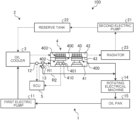
  • FIG. 1 is a schematic view of a structure of a cooling system in a vehicle according to an embodiment
  • FIG. 2 is a flowchart showing an example of switching control for a switching valve conducted by an ECU.
  • the disclosure is not limited to the embodiment.
  • the cooling system in the vehicle according to the embodiment may be applied to, for example, a hybrid vehicle in which an internal combustion engine and a motor are provided as a power source for driving its driving wheels, and an electric vehicle such as an electric car in which a motor is provided as the power source.
  • FIG. 1 is a schematic view of a structure of a cooling system 100 in a vehicle according to the embodiment.
  • the cooling system 100 in the vehicle according to the embodiment includes a first cooling circuit 1 and a second cooling circuit 2 .
  • first cooling circuit 1 first coolant circulates while cooling a power control unit (PCU) 4 that is a first cooling object, and a rotating electrical machine 14 that is a second cooling object.
  • PCU power control unit
  • second cooling circuit 2 second coolant that cools the PCU 4 circulates.
  • An insulating property of the first coolant is higher than that of the second coolant.
  • first coolant for example, liquid insulating coolant with volume resistivity of 10 ⁇ cm or higher and dielectric breakdown voltage of 10 kV or higher may be used.
  • second coolant for example, long life coolant (LLC) may be used.
  • a first electric pump 11 In the first cooling circuit 1 , a first electric pump 11 , an oil cooler 3 , a first temperature sensor 12 , a switching valve 13 , the PCU 4 , the rotating electrical machine 14 , and an oil pan 15 are arranged and connected with each other through piping. As the first electric pump 11 is operated, the first coolant circulates inside the first cooling circuit 1 . Solid line arrows in FIG. 1 represent a route in which the first coolant flows in the first cooling circuit 1 .
  • the switching valve 13 is a switching three-way valve, and selectively switches the route where the first coolant from the oil cooler 3 flows between a first route R 1 and a second route (a bypass flow passage) R 2 .
  • the first route R 1 the first coolant is supplied to the PCU 4 (a first cooling passage 41 described later).
  • the second route R 2 the first coolant bypasses the PCU 4 (the first cooling passage 41 ) and is supplied to a flow passage (piping) that supplies the first coolant to the rotating electrical machine 14 from the PCU 4 (the first cooling passage 41 ).
  • the switching operation of the switching valve 13 is performed with use of a driving mechanism such as an actuator controlled by an ECU 5 mounted on the vehicle.
  • the first coolant circulates inside the first cooling circuit 1 in the order of the first electric pump 11 , the oil cooler 3 , the first temperature sensor 12 , the switching valve 13 , the PCU 4 , the rotating electrical machine 14 , and the oil pan 15 .
  • the first coolant circulates inside the first cooling circuit 1 in the order of the first electric pump 11 , the oil cooler 3 , the first temperature sensor 12 , the switching valve 13 , the rotating electrical machine 14 , and the oil pan 15 .
  • the first coolant does not flow in the PCU 4 .
  • the first temperature sensor 12 that detects temperature T 1 of the first coolant is arranged in the piping between the oil cooler 3 and the switching valve 13 .
  • a second electric pump 21 In the second cooling circuit 2 , a second electric pump 21 , a reserve tank 22 , the oil cooler 3 , the PCU 4 , and a radiator 23 are arranged and connected with each other by piping.
  • the oil cooler 3 arranged in the second cooling circuit 2 is shared by the first cooling circuit 1 , and it is possible to perform heat exchange between the first coolant and the second coolant in the oil cooler 3 .
  • the second cooling circuit 2 as the second electric pump 21 is operated, when it is assumed that the second electric pump 21 is a starting point, the second coolant circulates in the order of the second electric pump 21 , the reserve tank 22 , the oil cooler 3 , the PCU 4 , and the radiator 23 .
  • Broken-line arrows in FIG. 1 represent a route in which the second coolant flows in the second cooling circuit 2 .
  • the PCU 4 is constituted as a power card module 400 having a semiconductor element 401 , and so on are arranged inside a case 40 .
  • the PCU 4 is driven by electric power of a battery mounted on the vehicle, and controls operations of the rotating electrical machine 14 .
  • the rotating electrical machine 14 follows a control signal from the PCU 4 and generates power that drives driving wheels of the vehicle with use of the electric power of the battery.
  • the rotating electrical machine 14 is arranged, for example, below the PCU 4 .
  • the power card module 400 includes a module body part 402 and a heat dissipation member 403 .
  • the module body part 402 is constituted as the semiconductor element 401 is sandwiched by heat transfer members or the like from above and below.
  • the heat dissipation member 403 is provided on top of the module body part 402 , and dissipates heat transferred from the semiconductor element 401 through the heat transfer members.
  • Inside of the case 40 is divided by a partition wall 43 into the first cooling passage 41 and a second cooling passage 42 in the height direction of the power card module 400 .
  • the first cooling passage 41 the module body part 402 is arranged, and the first coolant flows.
  • the heat dissipation member 403 is arranged, and the second coolant flows.
  • the first cooling passage 41 forms a flow passage in which the first coolant flows and cools the module body part 402 of the PCU 4 .
  • An upstream side of the first cooling passage 41 in the flow direction of the first coolant is connected with the switching valve 13 by piping which forms the first route R 1 .
  • a downstream side of the first cooling passage 41 in the flow direction of the first coolant is connected with the rotating electrical machine 14 by piping.
  • the first coolant sent to the first cooling passage 41 flows inside the first cooling passage 41 so as to be in direct contact with the module body part 402 .
  • the first coolant cools the module body part 402 and then the semiconductor element 401 .
  • the first coolant is sent to the rotating electrical machine 14 from the first cooling passage 41 and cools the rotating electrical machine 14 .
  • the first coolant is collected in the oil pan 15 provided below the rotating electrical machine 14 , and then sent to the first electric pump 11 from the oil pan 15 .
  • the second cooling passage 42 forms a flow passage where the second coolant flows and cools the heat dissipation member 403 of the PCU 4 .
  • An upstream side of the second cooling passage 42 in the flow direction of the second coolant is connected with the oil cooler 3 by piping, and a downstream side of the second cooling passage 42 in the flow direction of the second coolant is connected with the radiator 23 by piping.
  • the second electric pump 21 is operated, the second coolant stored in the reserve tank 22 is sent to the second cooling passage 42 after heat is exchanged with the first coolant in the oil cooler 3 .
  • the second coolant sent to the second cooling passage 42 flows inside the second cooling passage 42 so that the second coolant is in direct contact with the heat dissipation member 403 .
  • the second coolant cools the heat dissipation member 403 and then the semiconductor element 401 .
  • the second coolant is sent to the radiator 23 from the second cooling passage 42 .
  • the second coolant is cooled in the radiator 23 as heat exchange is performed between the second coolant and outside air where heat of the second coolant moves to outside air.
  • the cooled second coolant is sent to the second electric pump 21 .
  • Data from various sensors is input to the ECU 5 .
  • the first temperature sensor 12 provided in the piping connecting the oil cooler 3 and the switching valve 13 in the first cooling circuit 1 measures temperature T 1 of the first coolant before the first coolant is sent to the PCU 4 (the first cooling passage 41 ).
  • the data of the measured temperature T 1 of the first coolant is input to the ECU 5 .
  • a second temperature sensor 410 is installed in a portion of the PCU 4 where the second temperature sensor 410 is able to directly monitor if the semiconductor element 401 has reached heat resisting temperature, or a portion where the second temperature sensor 410 is able to indirectly estimate the same.
  • the data of temperature T 2 of the semiconductor element 401 is input to the ECU 5 from the second temperature sensor 410 .
  • the ECU 5 causes the switching valve 13 to switch between the first route R 1 and the second route (the bypass flow passage) R 2 based on the temperature T 1 of the first coolant and the temperature T 2 of the semiconductor element 401 .
  • FIG. 2 is a flowchart showing an example of the switching control of the switching valve 13 performed by the ECU 5 .
  • step S 1 the ECU 5 acquires the temperature T 1 of the first coolant from the first temperature sensor 12 provided in the piping that connects the oil cooler 3 and the switching valve 13 in the first cooling circuit 1 .
  • step S 2 the ECU 5 acquires the temperature T 2 of the semiconductor element 401 from the second temperature sensor 410 provided in the PCU 4 in the first cooling circuit 1 .
  • step S 3 the ECU 5 determines whether or not a relationship of the temperature T 2 of the semiconductor element 401 ⁇ the temperature T 1 of the first coolant is satisfied.
  • the ECU 5 determines that the relationship of the temperature T 2 of the semiconductor element 401 ⁇ the temperature T 1 of the first coolant is satisfied (Yes in step S 3 ), the ECU 5 causes the switching valve 13 to switch the flow passage in which the first coolant flows to the first route R 1 in step S 4 .
  • the first coolant at temperature equal to or lower than the temperature T 2 of the semiconductor element 401 is supplied to the first cooling passage 41 of the PCU 4 .
  • the first coolant is able to cool the semiconductor element 401 .
  • the ECU 5 ends the series of the switching control.
  • the ECU 5 determines that the relationship of the temperature T 2 of the semiconductor element 401 ⁇ the temperature T 1 of the first coolant is not satisfied, in other words, a relationship of the temperature T 2 of the semiconductor element 401 ⁇ the temperature T 1 of the first coolant is satisfied (No in step S 3 ), the ECU 5 causes the switching valve 13 to switch the flow passage in which the first coolant flows to the second route R 2 in step S 5 .
  • the first coolant with temperature higher than that of the semiconductor element 401 is not supplied to the first cooling passage 41 .
  • the first coolant flows in the second route R 2 while bypassing the first cooling passage 41 of the PCU 4 and is supplied to the rotating electrical machine 14 .
  • the ECU 5 ends the series of the switching control.
  • the temperature T 1 of the first coolant and the temperature T 2 of the semiconductor element 401 are not limited to temperature that is actually measured by the first temperature sensor 12 and the second temperature sensor 410 , respectively.
  • estimated temperature of the temperature T 1 of the first coolant and the temperature T 2 of the semiconductor element 401 estimated based on a driving state of the vehicle (the number of revolution and torque of the rotating electrical machine 14 ) with use of a map previously calculated in experiments or the like may be used.
  • the switching valve 13 functions as a flow rate regulation mechanism that regulates a flow rate of the first coolant flowing in the first cooling passage 41 of the PCU 4 as the switching valve 13 selectively switches the route in which the first coolant flows between the first route R 1 and the second route R 2 .
  • the ECU 5 may control opening of the switching valve 13 so that the flow rate of the first coolant flowing in the first cooling passage 41 of the PCU 4 is lower when the temperature T 2 of the semiconductor element 401 is lower than the temperature T 1 of the first coolant than the flow rate of the first coolant when the temperature T 2 of the semiconductor element 401 is equal to or higher than the temperature T 1 of the first coolant.
  • the ECU 5 may control the opening of the switching valve 13 so that, when the temperature T 2 of the semiconductor element 401 is equal to or higher than the temperature T 1 of the first coolant, the flow rate of the first coolant flowing in the first cooling passage 41 of the PCU 4 is reduced as the temperature of the semiconductor element 401 is lower. Thus, it is possible to reduce a pressure drop.
Landscapes

  • Engineering & Computer Science (AREA)
  • Microelectronics & Electronic Packaging (AREA)
  • Mechanical Engineering (AREA)
  • Transportation (AREA)
  • Physics & Mathematics (AREA)
  • Thermal Sciences (AREA)
  • Power Engineering (AREA)
  • Sustainable Energy (AREA)
  • Life Sciences & Earth Sciences (AREA)
  • Sustainable Development (AREA)
  • Chemical & Material Sciences (AREA)
  • Combustion & Propulsion (AREA)
  • Electric Propulsion And Braking For Vehicles (AREA)
  • Cooling, Air Intake And Gas Exhaust, And Fuel Tank Arrangements In Propulsion Units (AREA)

Abstract

A cooling system includes a first cooling passage in which a first cooling object is cooled by first coolant, a flow passage that supplies the first coolant to a second cooling object from the first cooling passage, a flow rate regulation mechanism that regulates a flow rate of the first coolant flowing in the first cooling passage, and a controller that controls the flow rate regulation mechanism. The controller controls the flow rate regulation mechanism so that the flow rate of the first coolant flowing in the first cooling passage is lower when temperature of the first cooling object is lower than temperature of the first coolant, than the flow rate when the temperature of the first cooling object is equal to or higher than the temperature of the first coolant.

Description

CROSS-REFERENCE TO RELATED APPLICATION
This application claims priority to Japanese Patent Application No. 2021-041835 filed on Mar. 15, 2021, incorporated herein by reference in its entirety.
BACKGROUND 1. Technical Field
The disclosure relates to a cooling system.
2. Description of Related Art
Japanese Unexamined Patent Application Publication No. 2010-277815 (JP 2010-277815 A) discloses a technology by which a cooling system of a fuel cell and a cooling system of an electric drive system are combined, and coolant is circulated in both of the cooling systems by the same pump.
SUMMARY
In a cooling system in which a first cooling object and a second cooling object are cooled by common coolant, when temperature of the coolant after one of the first cooling object and the second cooling object is cooled is higher than temperature of the other cooling object, the coolant transfers its heat to the other cooling object even though the coolant was intended to cool the other object, and the temperature of the other cooling object may end up being higher.
The disclosure has been accomplished in light of the above problem, and an object thereof is to provide a cooling system in which a temperature increase of a first cooling object due to heat transfer from first coolant to the first cooling object is restrained.
In order to solve the above-described issue and attain the object, a cooling system according to the disclosure includes a first cooling passage in which a first cooling object is cooled by first coolant, a flow passage configured to supply the first coolant to a second cooling object from the first cooling passage, a flow rate regulation mechanism configured to regulate a flow rate of the first coolant flowing in the first cooling passage, and a controller configured to control the flow rate regulation mechanism. The controller controls the flow rate regulation mechanism so that the flow rate of the first coolant flowing in the first cooling passage is lower when temperature of the first cooling object is lower than temperature of the first coolant, than the flow rate of the first coolant when the temperature of the first cooling object is equal to or higher than the temperature of the first coolant.
Thus, a temperature increase of the first cooling object due to heat transfer from the first coolant to the first cooling object is restrained.
In the forgoing, the cooling system may include a bypass flow passage configured to allow the first coolant to bypass the first cooling passage and configured to supply the first coolant to the flow passage. The flow rate regulation mechanism may be able to perform selective switching between a first route and a second route. The first route supplies the first coolant to the first cooling passage, and the second route allows the first coolant to flow into the bypass flow passage and supplies the first coolant into the flow passage. The controller may control the flow rate regulation mechanism so as to switch to the first route when the temperature of the first cooling object is equal to or higher than the temperature of the first coolant, and to the second route when the temperature of the first cooling object is lower than the temperature of the first coolant.
Thus, it is possible to restrain the first coolant with temperature higher than that of the first cooling object from being supplied to the first cooling passage.
Also, in the foregoing, when the temperature of the first cooling object is equal to or higher than the temperature of the first coolant, the controller may control the flow rate regulation mechanism so as to reduce the flow rate of the first coolant flowing in the first cooling passage as the temperature of the first cooling object is lower.
Thus, it is possible to reduce a pressure drop.
Further, in the foregoing, the first cooling object and the second cooling object may generate heat as the first cooling object and the second cooling object are energized.
Thus, it is possible that the first cooling object and the second cooling object generating heat due to energization are effectively cooled with use of the common first coolant.
Further, in the foregoing, the second cooling object may be a rotating electrical machine, and the first cooling object may be a power control unit that controls the rotating electrical machine.
Thus, it is possible that the power control unit and the rotating electrical machine are effectively cooled with the common first coolant.
Further, in the foregoing, the first coolant may have insulation property.
Thus, the first coolant is able to be in direct contact with and cool the first cooling object and the second cooling object.
Further, in the foregoing, the cooling system may include a second cooling passage in which the first cooling object is cooled with second coolant.
Thus, it is possible to effectively cool the first cooling object with the first coolant and the second coolant.
The cooling system according to the disclosure has an effect of restraining a temperature increase in the first cooling object due to heat transfer from the first coolant to the first cooling object.
BRIEF DESCRIPTION OF THE DRAWINGS
Features, advantages, and technical and industrial significance of exemplary embodiments of the disclosure will be described below with reference to the accompanying drawings, in which like signs denote like elements, and wherein:
FIG. 1 is a schematic view of a structure of a cooling system in a vehicle according to an embodiment; and
FIG. 2 is a flowchart showing an example of switching control for a switching valve conducted by an ECU.
DETAILED DESCRIPTION OF EMBODIMENTS
Hereinafter, an embodiment of a cooling system in a vehicle according to the disclosure is described. The disclosure is not limited to the embodiment. The cooling system in the vehicle according to the embodiment may be applied to, for example, a hybrid vehicle in which an internal combustion engine and a motor are provided as a power source for driving its driving wheels, and an electric vehicle such as an electric car in which a motor is provided as the power source.
FIG. 1 is a schematic view of a structure of a cooling system 100 in a vehicle according to the embodiment. As shown in FIG. 1 , the cooling system 100 in the vehicle according to the embodiment includes a first cooling circuit 1 and a second cooling circuit 2. In the first cooling circuit 1, first coolant circulates while cooling a power control unit (PCU) 4 that is a first cooling object, and a rotating electrical machine 14 that is a second cooling object. In the second cooling circuit 2, second coolant that cools the PCU 4 circulates. An insulating property of the first coolant is higher than that of the second coolant. For the first coolant, for example, liquid insulating coolant with volume resistivity of 10 Ωcm or higher and dielectric breakdown voltage of 10 kV or higher may be used. For the second coolant, for example, long life coolant (LLC) may be used.
In the first cooling circuit 1, a first electric pump 11, an oil cooler 3, a first temperature sensor 12, a switching valve 13, the PCU 4, the rotating electrical machine 14, and an oil pan 15 are arranged and connected with each other through piping. As the first electric pump 11 is operated, the first coolant circulates inside the first cooling circuit 1. Solid line arrows in FIG. 1 represent a route in which the first coolant flows in the first cooling circuit 1.
The switching valve 13 is a switching three-way valve, and selectively switches the route where the first coolant from the oil cooler 3 flows between a first route R1 and a second route (a bypass flow passage) R2. In the first route R1, the first coolant is supplied to the PCU 4 (a first cooling passage 41 described later). In the second route R2, the first coolant bypasses the PCU 4 (the first cooling passage 41) and is supplied to a flow passage (piping) that supplies the first coolant to the rotating electrical machine 14 from the PCU 4 (the first cooling passage 41). The switching operation of the switching valve 13 is performed with use of a driving mechanism such as an actuator controlled by an ECU 5 mounted on the vehicle.
When the route in the first cooling circuit 1 where the first coolant flows is switched to the first route R1 by the switching valve 13, and when it is assumed that the first electric pump 11 is a starting point, the first coolant circulates inside the first cooling circuit 1 in the order of the first electric pump 11, the oil cooler 3, the first temperature sensor 12, the switching valve 13, the PCU 4, the rotating electrical machine 14, and the oil pan 15. Meanwhile, when the route in the first cooling circuit 1 where the first coolant flows is switched to the second route (the bypass flow passage) R2 by the switching valve 13, and when it is assumed that the first electric pump 11 is a starting point, the first coolant circulates inside the first cooling circuit 1 in the order of the first electric pump 11, the oil cooler 3, the first temperature sensor 12, the switching valve 13, the rotating electrical machine 14, and the oil pan 15. As the route in which the first coolant flows in the first cooling circuit 1 is switched to the second route (the bypass flow passage) R2 by the switching valve 13, the first coolant does not flow in the PCU 4.
Also, in the first cooling circuit 1, the first temperature sensor 12 that detects temperature T1 of the first coolant is arranged in the piping between the oil cooler 3 and the switching valve 13.
In the second cooling circuit 2, a second electric pump 21, a reserve tank 22, the oil cooler 3, the PCU 4, and a radiator 23 are arranged and connected with each other by piping. The oil cooler 3 arranged in the second cooling circuit 2 is shared by the first cooling circuit 1, and it is possible to perform heat exchange between the first coolant and the second coolant in the oil cooler 3. In the second cooling circuit 2, as the second electric pump 21 is operated, when it is assumed that the second electric pump 21 is a starting point, the second coolant circulates in the order of the second electric pump 21, the reserve tank 22, the oil cooler 3, the PCU 4, and the radiator 23. Broken-line arrows in FIG. 1 represent a route in which the second coolant flows in the second cooling circuit 2.
The PCU 4 is constituted as a power card module 400 having a semiconductor element 401, and so on are arranged inside a case 40. The PCU 4 is driven by electric power of a battery mounted on the vehicle, and controls operations of the rotating electrical machine 14. The rotating electrical machine 14 follows a control signal from the PCU 4 and generates power that drives driving wheels of the vehicle with use of the electric power of the battery. The rotating electrical machine 14 is arranged, for example, below the PCU 4.
In the PCU 4, the power card module 400 includes a module body part 402 and a heat dissipation member 403. The module body part 402 is constituted as the semiconductor element 401 is sandwiched by heat transfer members or the like from above and below. The heat dissipation member 403 is provided on top of the module body part 402, and dissipates heat transferred from the semiconductor element 401 through the heat transfer members. Inside of the case 40 is divided by a partition wall 43 into the first cooling passage 41 and a second cooling passage 42 in the height direction of the power card module 400. In the first cooling passage 41, the module body part 402 is arranged, and the first coolant flows. In the second cooling passage 42, the heat dissipation member 403 is arranged, and the second coolant flows.
In the first cooling circuit 1, the first cooling passage 41 forms a flow passage in which the first coolant flows and cools the module body part 402 of the PCU 4. An upstream side of the first cooling passage 41 in the flow direction of the first coolant is connected with the switching valve 13 by piping which forms the first route R1. A downstream side of the first cooling passage 41 in the flow direction of the first coolant is connected with the rotating electrical machine 14 by piping. As the first electric pump 11 is operated, the first coolant after heat exchange with the second coolant is performed in the oil cooler 3 flows from the oil cooler 3 in the first route R1 and is sent to the first cooling passage 41 by the switching valve 13. The first coolant sent to the first cooling passage 41 flows inside the first cooling passage 41 so as to be in direct contact with the module body part 402. Thus, the first coolant cools the module body part 402 and then the semiconductor element 401. After the cooling of the module body part 402 is done, the first coolant is sent to the rotating electrical machine 14 from the first cooling passage 41 and cools the rotating electrical machine 14. After the cooling of the rotating electrical machine 14 is done, the first coolant is collected in the oil pan 15 provided below the rotating electrical machine 14, and then sent to the first electric pump 11 from the oil pan 15.
In the second cooling circuit 2, the second cooling passage 42 forms a flow passage where the second coolant flows and cools the heat dissipation member 403 of the PCU 4. An upstream side of the second cooling passage 42 in the flow direction of the second coolant is connected with the oil cooler 3 by piping, and a downstream side of the second cooling passage 42 in the flow direction of the second coolant is connected with the radiator 23 by piping. As the second electric pump 21 is operated, the second coolant stored in the reserve tank 22 is sent to the second cooling passage 42 after heat is exchanged with the first coolant in the oil cooler 3. The second coolant sent to the second cooling passage 42 flows inside the second cooling passage 42 so that the second coolant is in direct contact with the heat dissipation member 403. Thus, the second coolant cools the heat dissipation member 403 and then the semiconductor element 401. After the cooling of the heat dissipation member 403 is done, the second coolant is sent to the radiator 23 from the second cooling passage 42. Then, the second coolant is cooled in the radiator 23 as heat exchange is performed between the second coolant and outside air where heat of the second coolant moves to outside air. Then, the cooled second coolant is sent to the second electric pump 21.
Data from various sensors is input to the ECU 5. In the example shown in FIG. 1 , the first temperature sensor 12 provided in the piping connecting the oil cooler 3 and the switching valve 13 in the first cooling circuit 1 measures temperature T1 of the first coolant before the first coolant is sent to the PCU 4 (the first cooling passage 41). The data of the measured temperature T1 of the first coolant is input to the ECU 5. A second temperature sensor 410 is installed in a portion of the PCU 4 where the second temperature sensor 410 is able to directly monitor if the semiconductor element 401 has reached heat resisting temperature, or a portion where the second temperature sensor 410 is able to indirectly estimate the same. The data of temperature T2 of the semiconductor element 401 is input to the ECU 5 from the second temperature sensor 410.
Then, in the cooling system 100 according to the embodiment, the ECU 5 causes the switching valve 13 to switch between the first route R1 and the second route (the bypass flow passage) R2 based on the temperature T1 of the first coolant and the temperature T2 of the semiconductor element 401.
FIG. 2 is a flowchart showing an example of the switching control of the switching valve 13 performed by the ECU 5.
First of all, in step S1, the ECU 5 acquires the temperature T1 of the first coolant from the first temperature sensor 12 provided in the piping that connects the oil cooler 3 and the switching valve 13 in the first cooling circuit 1. Next, in step S2, the ECU 5 acquires the temperature T2 of the semiconductor element 401 from the second temperature sensor 410 provided in the PCU 4 in the first cooling circuit 1. Next, in step S3, the ECU 5 determines whether or not a relationship of the temperature T2 of the semiconductor element 401≥the temperature T1 of the first coolant is satisfied.
When the ECU 5 determines that the relationship of the temperature T2 of the semiconductor element 401≥the temperature T1 of the first coolant is satisfied (Yes in step S3), the ECU 5 causes the switching valve 13 to switch the flow passage in which the first coolant flows to the first route R1 in step S4. Thus, the first coolant at temperature equal to or lower than the temperature T2 of the semiconductor element 401 is supplied to the first cooling passage 41 of the PCU 4. Thus, the first coolant is able to cool the semiconductor element 401. After the switching to the first route R1 by the switching valve 13 is finished, the ECU 5 ends the series of the switching control.
Meanwhile, when the ECU 5 determines that the relationship of the temperature T2 of the semiconductor element 401≥the temperature T1 of the first coolant is not satisfied, in other words, a relationship of the temperature T2 of the semiconductor element 401<the temperature T1 of the first coolant is satisfied (No in step S3), the ECU 5 causes the switching valve 13 to switch the flow passage in which the first coolant flows to the second route R2 in step S5. Thus, the first coolant with temperature higher than that of the semiconductor element 401 is not supplied to the first cooling passage 41. Instead, the first coolant flows in the second route R2 while bypassing the first cooling passage 41 of the PCU 4 and is supplied to the rotating electrical machine 14. Thus, it is possible to restrain an increase in the temperature T2 of the semiconductor element 401 caused by heat transfer from the first coolant with temperature higher than that of the semiconductor element 401 to the semiconductor element 401. After the switching to the second route R2 by the switching valve 13 is finished, the ECU 5 ends the series of the switching control.
In the cooling system 100 according to the embodiment, the temperature T1 of the first coolant and the temperature T2 of the semiconductor element 401 are not limited to temperature that is actually measured by the first temperature sensor 12 and the second temperature sensor 410, respectively. For example, in the cooling system 100 according to the embodiment, estimated temperature of the temperature T1 of the first coolant and the temperature T2 of the semiconductor element 401 estimated based on a driving state of the vehicle (the number of revolution and torque of the rotating electrical machine 14) with use of a map previously calculated in experiments or the like may be used.
Further, in the cooling system 100 according to the embodiment, the switching valve 13 functions as a flow rate regulation mechanism that regulates a flow rate of the first coolant flowing in the first cooling passage 41 of the PCU 4 as the switching valve 13 selectively switches the route in which the first coolant flows between the first route R1 and the second route R2. Meanwhile, in the cooling system 100 according to the embodiment, the ECU 5 may control opening of the switching valve 13 so that the flow rate of the first coolant flowing in the first cooling passage 41 of the PCU 4 is lower when the temperature T2 of the semiconductor element 401 is lower than the temperature T1 of the first coolant than the flow rate of the first coolant when the temperature T2 of the semiconductor element 401 is equal to or higher than the temperature T1 of the first coolant.
Also, when the ECU 5 controls the opening of the switching valve 13, the ECU 5 may control the opening of the switching valve 13 so that, when the temperature T2 of the semiconductor element 401 is equal to or higher than the temperature T1 of the first coolant, the flow rate of the first coolant flowing in the first cooling passage 41 of the PCU 4 is reduced as the temperature of the semiconductor element 401 is lower. Thus, it is possible to reduce a pressure drop.

Claims (9)

What is claimed is:
1. A cooling system, comprising:
a first cooling passage in which a first cooling object is cooled by first coolant;
a flow passage configured to supply the first coolant to a second cooling object from the first cooling passage;
a first coolant temperature sensor that measures a temperature of the first coolant;
a first cooling object temperature sensor that measures a temperature of the first cooling object;
a flow rate regulation mechanism that includes a switching valve and is configured to regulate a flow rate of the first coolant flowing in the first cooling passage; and
a controller configured to control the flow rate regulation mechanism, wherein:
the controller controls the flow rate regulation mechanism based on the temperature of the first coolant or the temperature of the first cooling object so that the flow rate of the first coolant flowing in the first cooling passage is lower when temperature of the first cooling object is lower than temperature of the first coolant, than the flow rate of the first coolant when the temperature of the first cooling object is equal to or higher than the temperature of the first coolant.
2. The cooling system according to claim 1, comprising a bypass flow passage configured to allow the first coolant to bypass the first cooling passage and configured to supply the first coolant to the flow passage, wherein:
the flow rate regulation mechanism is able to perform selective switching between a first route and a second route, the first route supplying the first coolant to the first cooling passage, and the second route allowing the first coolant to flow into the bypass flow passage and supplying the first coolant into the flow passage; and
the controller controls the flow rate regulation mechanism so as to switch to the first route when the temperature of the first cooling object is equal to or higher than the temperature of the first coolant, and to the second route when the temperature of the first cooling object is lower than that the temperature of the first coolant.
3. The cooling system according to claim 1, wherein, when the temperature of the first cooling object is equal to or higher than the temperature of the first coolant, the controller controls the flow rate regulation mechanism so as to reduce the flow rate of the first coolant flowing in the first cooling passage as the temperature of the first cooling object is reduced.
4. The cooling system according to claim 1, wherein the first cooling object and the second cooling object generate heat as the first cooling object and the second cooling object are energized.
5. The cooling system according to claim 4, wherein:
the second cooling object is a rotating electrical machine; and
the first cooling object is a power control unit that includes a semiconductor element and controls the rotating electrical machine.
6. The cooling system according to claim 1, wherein the first coolant has an insulating property.
7. The cooling system according to claim 1, comprising a second cooling passage in which the first cooling object is cooled by second coolant.
8. The cooling system according to claim 7, wherein the second cooling passage is independent of the first cooling passage.
9. The cooling system according to claim 7, wherein the first cooling object comprises a case having a partition wall that separates the first cooling passage and the second cooling passage.
US17/675,601 2021-03-15 2022-02-18 Cooling system with flow rate regulation Active 2043-04-03 US12178024B2 (en)

Applications Claiming Priority (2)

Application Number Priority Date Filing Date Title
JP2021041835A JP7517211B2 (en) 2021-03-15 2021-03-15 Cooling System
JP2021-041835 2021-03-15

Publications (2)

Publication Number Publication Date
US20220295675A1 US20220295675A1 (en) 2022-09-15
US12178024B2 true US12178024B2 (en) 2024-12-24

Family

ID=83194317

Family Applications (1)

Application Number Title Priority Date Filing Date
US17/675,601 Active 2043-04-03 US12178024B2 (en) 2021-03-15 2022-02-18 Cooling system with flow rate regulation

Country Status (3)

Country Link
US (1) US12178024B2 (en)
JP (1) JP7517211B2 (en)
CN (1) CN115071398A (en)

Families Citing this family (2)

* Cited by examiner, † Cited by third party
Publication number Priority date Publication date Assignee Title
DE102021121555B3 (en) * 2021-08-19 2022-09-22 Schaeffler Technologies AG & Co. KG hydraulic arrangement
CN119126938A (en) * 2023-06-12 2024-12-13 深圳富联富桂精密工业有限公司 Control method of heat dissipation verification device, heat dissipation verification device and system

Citations (6)

* Cited by examiner, † Cited by third party
Publication number Priority date Publication date Assignee Title
US20020127448A1 (en) * 2001-02-20 2002-09-12 Ballard Power Systems Ag System and method for cooling a fuel cell arrangement
JP2010277815A (en) 2009-05-28 2010-12-09 Honda Motor Co Ltd Cooling system for fuel cell vehicle
JP2013256983A (en) 2012-06-12 2013-12-26 Nissan Motor Co Ltd Cooling structure of inverter for vehicle
US20190271258A1 (en) * 2018-03-01 2019-09-05 Nio Usa, Inc. Thermal management coolant valves and pumps modular combination
JP2020080611A (en) 2018-11-13 2020-05-28 株式会社ケーヒン Temperature control system
JP2021037893A (en) 2019-09-04 2021-03-11 日野自動車株式会社 Cooling system

Family Cites Families (8)

* Cited by examiner, † Cited by third party
Publication number Priority date Publication date Assignee Title
JP2007202244A (en) 2006-01-24 2007-08-09 Toyota Motor Corp Cooling system
JP2009126256A (en) 2007-11-21 2009-06-11 Toyota Motor Corp Vehicle cooling device
CN204712858U (en) * 2015-06-29 2015-10-21 上海汽车集团股份有限公司 Cooling system, automobile dynamic system and automobile
WO2019197858A1 (en) * 2018-04-10 2019-10-17 日産自動車株式会社 Cooling method and cooling device of electric motor
KR102614129B1 (en) * 2018-06-08 2023-12-14 현대자동차주식회사 Cooling system and method for electric power system of vehicle
CN109149011B (en) * 2018-09-21 2024-04-16 广州小鹏汽车科技有限公司 BMS thermal management system and control method and device thereof
JP2020147161A (en) * 2019-03-13 2020-09-17 トヨタ自動車株式会社 In-vehicle temperature control device
JP7222321B2 (en) * 2019-06-25 2023-02-15 トヨタ自動車株式会社 vehicle cooling system

Patent Citations (6)

* Cited by examiner, † Cited by third party
Publication number Priority date Publication date Assignee Title
US20020127448A1 (en) * 2001-02-20 2002-09-12 Ballard Power Systems Ag System and method for cooling a fuel cell arrangement
JP2010277815A (en) 2009-05-28 2010-12-09 Honda Motor Co Ltd Cooling system for fuel cell vehicle
JP2013256983A (en) 2012-06-12 2013-12-26 Nissan Motor Co Ltd Cooling structure of inverter for vehicle
US20190271258A1 (en) * 2018-03-01 2019-09-05 Nio Usa, Inc. Thermal management coolant valves and pumps modular combination
JP2020080611A (en) 2018-11-13 2020-05-28 株式会社ケーヒン Temperature control system
JP2021037893A (en) 2019-09-04 2021-03-11 日野自動車株式会社 Cooling system

Also Published As

Publication number Publication date
US20220295675A1 (en) 2022-09-15
JP7517211B2 (en) 2024-07-17
CN115071398A (en) 2022-09-20
JP2022141500A (en) 2022-09-29

Similar Documents

Publication Publication Date Title
CN107554235B (en) Battery coolant loop control
US10293706B2 (en) Battery coolant circuit control
US11342603B2 (en) Thermal management of traction battery based on electric current of traction battery
CN102596603B (en) Heat exchanger arrangement
US10069180B2 (en) Thermoelectric battery cooling system and method
CN109774407B (en) Thermal management system, control method thereof and vehicle
CN103069697B (en) Thermal management module and cooling system with such thermal management module
US11364769B2 (en) Vehicle cabin thermal management system and control methods
US20140062228A1 (en) Thermal management of electric motor in the event of failure of primary cooling system for powertrain on electric vehicle
JP5348063B2 (en) Hybrid vehicle cooling system
JP2012020730A (en) Electrical heating device
US12178024B2 (en) Cooling system with flow rate regulation
JP2013119259A (en) On-board battery temperature regulator
CN111788082B (en) Thermal conditioning system for an electrically driven vehicle and vehicle comprising such a system
JP2010284045A (en) Heat supply device
US10923734B2 (en) Temperature-control arrangement for an electrical energy store
CN109560345B (en) Cooling system for vehicle
JP2000073763A (en) Hybrid vehicle cooling system
CN116198285B (en) Thermal management system, thermal management method, electronic device and vehicle
RU2633109C1 (en) Device for liquid cooling of electric vehicle components
KR101921806B1 (en) Temperature control system for electric car
US20240300289A1 (en) Thermal management system
US20240008221A1 (en) Advanced power electronic circuit for fuel cell vehicles enabling independent cooling of various systems
CN107762612B (en) On-demand cooling of a plurality of converters of an electric machine
CN114940041A (en) Air conditioning system, motor vehicle and method for operating an air conditioning system

Legal Events

Date Code Title Description
FEPP Fee payment procedure

Free format text: ENTITY STATUS SET TO UNDISCOUNTED (ORIGINAL EVENT CODE: BIG.); ENTITY STATUS OF PATENT OWNER: LARGE ENTITY

AS Assignment

Owner name: TOYOTA JIDOSHA KABUSHIKI KAISHA, JAPAN

Free format text: ASSIGNMENT OF ASSIGNORS INTEREST;ASSIGNORS:KATAYAMA, MASAAKI;KISHIMOTO, NAOYUKI;TOKOZAKURA, DAISUKE;AND OTHERS;SIGNING DATES FROM 20211208 TO 20211213;REEL/FRAME:059060/0453

STPP Information on status: patent application and granting procedure in general

Free format text: DOCKETED NEW CASE - READY FOR EXAMINATION

STPP Information on status: patent application and granting procedure in general

Free format text: NON FINAL ACTION MAILED

STPP Information on status: patent application and granting procedure in general

Free format text: RESPONSE TO NON-FINAL OFFICE ACTION ENTERED AND FORWARDED TO EXAMINER

STPP Information on status: patent application and granting procedure in general

Free format text: NOTICE OF ALLOWANCE MAILED -- APPLICATION RECEIVED IN OFFICE OF PUBLICATIONS

STPP Information on status: patent application and granting procedure in general

Free format text: PUBLICATIONS -- ISSUE FEE PAYMENT VERIFIED

STCF Information on status: patent grant

Free format text: PATENTED CASE