US12170223B2 - Method of fabricating redistribution circuit structure - Google Patents
Method of fabricating redistribution circuit structure Download PDFInfo
- Publication number
- US12170223B2 US12170223B2 US18/362,083 US202318362083A US12170223B2 US 12170223 B2 US12170223 B2 US 12170223B2 US 202318362083 A US202318362083 A US 202318362083A US 12170223 B2 US12170223 B2 US 12170223B2
- Authority
- US
- United States
- Prior art keywords
- dielectric layer
- layer
- photosensitive dielectric
- conductive feature
- conductive
- Prior art date
- Legal status (The legal status is an assumption and is not a legal conclusion. Google has not performed a legal analysis and makes no representation as to the accuracy of the status listed.)
- Active
Links
Images




Classifications
-
- H—ELECTRICITY
- H10—SEMICONDUCTOR DEVICES; ELECTRIC SOLID-STATE DEVICES NOT OTHERWISE PROVIDED FOR
- H10W—GENERIC PACKAGES, INTERCONNECTIONS, CONNECTORS OR OTHER CONSTRUCTIONAL DETAILS OF DEVICES COVERED BY CLASS H10
- H10W20/00—Interconnections in chips, wafers or substrates
- H10W20/01—Manufacture or treatment
- H10W20/071—Manufacture or treatment of dielectric parts thereof
-
- H01L21/76898—
-
- H—ELECTRICITY
- H10—SEMICONDUCTOR DEVICES; ELECTRIC SOLID-STATE DEVICES NOT OTHERWISE PROVIDED FOR
- H10P—GENERIC PROCESSES OR APPARATUS FOR THE MANUFACTURE OR TREATMENT OF DEVICES COVERED BY CLASS H10
- H10P72/00—Handling or holding of wafers, substrates or devices during manufacture or treatment thereof
- H10P72/70—Handling or holding of wafers, substrates or devices during manufacture or treatment thereof for supporting or gripping
- H10P72/74—Handling or holding of wafers, substrates or devices during manufacture or treatment thereof for supporting or gripping using temporarily an auxiliary support
-
- H—ELECTRICITY
- H10—SEMICONDUCTOR DEVICES; ELECTRIC SOLID-STATE DEVICES NOT OTHERWISE PROVIDED FOR
- H10W—GENERIC PACKAGES, INTERCONNECTIONS, CONNECTORS OR OTHER CONSTRUCTIONAL DETAILS OF DEVICES COVERED BY CLASS H10
- H10W20/00—Interconnections in chips, wafers or substrates
- H10W20/01—Manufacture or treatment
- H10W20/031—Manufacture or treatment of conductive parts of the interconnections
- H10W20/0698—Local interconnections
-
- H—ELECTRICITY
- H10—SEMICONDUCTOR DEVICES; ELECTRIC SOLID-STATE DEVICES NOT OTHERWISE PROVIDED FOR
- H10W—GENERIC PACKAGES, INTERCONNECTIONS, CONNECTORS OR OTHER CONSTRUCTIONAL DETAILS OF DEVICES COVERED BY CLASS H10
- H10W20/00—Interconnections in chips, wafers or substrates
- H10W20/01—Manufacture or treatment
- H10W20/021—Manufacture or treatment of interconnections within wafers or substrates
- H10W20/023—Manufacture or treatment of interconnections within wafers or substrates the interconnections being through-semiconductor vias
-
- G—PHYSICS
- G03—PHOTOGRAPHY; CINEMATOGRAPHY; ANALOGOUS TECHNIQUES USING WAVES OTHER THAN OPTICAL WAVES; ELECTROGRAPHY; HOLOGRAPHY
- G03F—PHOTOMECHANICAL PRODUCTION OF TEXTURED OR PATTERNED SURFACES, e.g. FOR PRINTING, FOR PROCESSING OF SEMICONDUCTOR DEVICES; MATERIALS THEREFOR; ORIGINALS THEREFOR; APPARATUS SPECIALLY ADAPTED THEREFOR
- G03F7/00—Photomechanical, e.g. photolithographic, production of textured or patterned surfaces, e.g. printing surfaces; Materials therefor, e.g. comprising photoresists; Apparatus specially adapted therefor
- G03F7/16—Coating processes; Apparatus therefor
- G03F7/168—Finishing the coated layer, e.g. drying, baking, soaking
-
- G—PHYSICS
- G03—PHOTOGRAPHY; CINEMATOGRAPHY; ANALOGOUS TECHNIQUES USING WAVES OTHER THAN OPTICAL WAVES; ELECTROGRAPHY; HOLOGRAPHY
- G03F—PHOTOMECHANICAL PRODUCTION OF TEXTURED OR PATTERNED SURFACES, e.g. FOR PRINTING, FOR PROCESSING OF SEMICONDUCTOR DEVICES; MATERIALS THEREFOR; ORIGINALS THEREFOR; APPARATUS SPECIALLY ADAPTED THEREFOR
- G03F7/00—Photomechanical, e.g. photolithographic, production of textured or patterned surfaces, e.g. printing surfaces; Materials therefor, e.g. comprising photoresists; Apparatus specially adapted therefor
- G03F7/20—Exposure; Apparatus therefor
-
- H01L21/563—
-
- H01L21/76873—
-
- H01L21/76885—
-
- H01L23/3171—
-
- H01L23/481—
-
- H01L23/5226—
-
- H01L23/5283—
-
- H01L23/5329—
-
- H01L24/09—
-
- H—ELECTRICITY
- H10—SEMICONDUCTOR DEVICES; ELECTRIC SOLID-STATE DEVICES NOT OTHERWISE PROVIDED FOR
- H10P—GENERIC PROCESSES OR APPARATUS FOR THE MANUFACTURE OR TREATMENT OF DEVICES COVERED BY CLASS H10
- H10P50/00—Etching of wafers, substrates or parts of devices
- H10P50/20—Dry etching; Plasma etching; Reactive-ion etching
- H10P50/28—Dry etching; Plasma etching; Reactive-ion etching of insulating materials
- H10P50/282—Dry etching; Plasma etching; Reactive-ion etching of insulating materials of inorganic materials
-
- H—ELECTRICITY
- H10—SEMICONDUCTOR DEVICES; ELECTRIC SOLID-STATE DEVICES NOT OTHERWISE PROVIDED FOR
- H10W—GENERIC PACKAGES, INTERCONNECTIONS, CONNECTORS OR OTHER CONSTRUCTIONAL DETAILS OF DEVICES COVERED BY CLASS H10
- H10W20/00—Interconnections in chips, wafers or substrates
- H10W20/01—Manufacture or treatment
- H10W20/031—Manufacture or treatment of conductive parts of the interconnections
- H10W20/032—Manufacture or treatment of conductive parts of the interconnections of conductive barrier, adhesion or liner layers
- H10W20/042—Manufacture or treatment of conductive parts of the interconnections of conductive barrier, adhesion or liner layers the barrier, adhesion or liner layers being seed or nucleation layers
- H10W20/043—Manufacture or treatment of conductive parts of the interconnections of conductive barrier, adhesion or liner layers the barrier, adhesion or liner layers being seed or nucleation layers for electroplating
-
- H—ELECTRICITY
- H10—SEMICONDUCTOR DEVICES; ELECTRIC SOLID-STATE DEVICES NOT OTHERWISE PROVIDED FOR
- H10W—GENERIC PACKAGES, INTERCONNECTIONS, CONNECTORS OR OTHER CONSTRUCTIONAL DETAILS OF DEVICES COVERED BY CLASS H10
- H10W20/00—Interconnections in chips, wafers or substrates
- H10W20/01—Manufacture or treatment
- H10W20/031—Manufacture or treatment of conductive parts of the interconnections
- H10W20/063—Manufacture or treatment of conductive parts of the interconnections by forming conductive members before forming protective insulating material
-
- H—ELECTRICITY
- H10—SEMICONDUCTOR DEVICES; ELECTRIC SOLID-STATE DEVICES NOT OTHERWISE PROVIDED FOR
- H10W—GENERIC PACKAGES, INTERCONNECTIONS, CONNECTORS OR OTHER CONSTRUCTIONAL DETAILS OF DEVICES COVERED BY CLASS H10
- H10W20/00—Interconnections in chips, wafers or substrates
- H10W20/01—Manufacture or treatment
- H10W20/071—Manufacture or treatment of dielectric parts thereof
- H10W20/081—Manufacture or treatment of dielectric parts thereof by forming openings in the dielectric parts
- H10W20/084—Manufacture or treatment of dielectric parts thereof by forming openings in the dielectric parts for dual-damascene structures
- H10W20/088—Manufacture or treatment of dielectric parts thereof by forming openings in the dielectric parts for dual-damascene structures involving partial etching of via holes
-
- H—ELECTRICITY
- H10—SEMICONDUCTOR DEVICES; ELECTRIC SOLID-STATE DEVICES NOT OTHERWISE PROVIDED FOR
- H10W—GENERIC PACKAGES, INTERCONNECTIONS, CONNECTORS OR OTHER CONSTRUCTIONAL DETAILS OF DEVICES COVERED BY CLASS H10
- H10W20/00—Interconnections in chips, wafers or substrates
- H10W20/01—Manufacture or treatment
- H10W20/071—Manufacture or treatment of dielectric parts thereof
- H10W20/092—Manufacture or treatment of dielectric parts thereof by smoothing the dielectric parts
-
- H—ELECTRICITY
- H10—SEMICONDUCTOR DEVICES; ELECTRIC SOLID-STATE DEVICES NOT OTHERWISE PROVIDED FOR
- H10W—GENERIC PACKAGES, INTERCONNECTIONS, CONNECTORS OR OTHER CONSTRUCTIONAL DETAILS OF DEVICES COVERED BY CLASS H10
- H10W20/00—Interconnections in chips, wafers or substrates
- H10W20/20—Interconnections within wafers or substrates, e.g. through-silicon vias [TSV]
-
- H—ELECTRICITY
- H10—SEMICONDUCTOR DEVICES; ELECTRIC SOLID-STATE DEVICES NOT OTHERWISE PROVIDED FOR
- H10W—GENERIC PACKAGES, INTERCONNECTIONS, CONNECTORS OR OTHER CONSTRUCTIONAL DETAILS OF DEVICES COVERED BY CLASS H10
- H10W20/00—Interconnections in chips, wafers or substrates
- H10W20/40—Interconnections external to wafers or substrates, e.g. back-end-of-line [BEOL] metallisations or vias connecting to gate electrodes
- H10W20/41—Interconnections external to wafers or substrates, e.g. back-end-of-line [BEOL] metallisations or vias connecting to gate electrodes characterised by their conductive parts
- H10W20/42—Vias, e.g. via plugs
-
- H—ELECTRICITY
- H10—SEMICONDUCTOR DEVICES; ELECTRIC SOLID-STATE DEVICES NOT OTHERWISE PROVIDED FOR
- H10W—GENERIC PACKAGES, INTERCONNECTIONS, CONNECTORS OR OTHER CONSTRUCTIONAL DETAILS OF DEVICES COVERED BY CLASS H10
- H10W20/00—Interconnections in chips, wafers or substrates
- H10W20/40—Interconnections external to wafers or substrates, e.g. back-end-of-line [BEOL] metallisations or vias connecting to gate electrodes
- H10W20/41—Interconnections external to wafers or substrates, e.g. back-end-of-line [BEOL] metallisations or vias connecting to gate electrodes characterised by their conductive parts
- H10W20/435—Cross-sectional shapes or dispositions of interconnections
-
- H—ELECTRICITY
- H10—SEMICONDUCTOR DEVICES; ELECTRIC SOLID-STATE DEVICES NOT OTHERWISE PROVIDED FOR
- H10W—GENERIC PACKAGES, INTERCONNECTIONS, CONNECTORS OR OTHER CONSTRUCTIONAL DETAILS OF DEVICES COVERED BY CLASS H10
- H10W20/00—Interconnections in chips, wafers or substrates
- H10W20/40—Interconnections external to wafers or substrates, e.g. back-end-of-line [BEOL] metallisations or vias connecting to gate electrodes
- H10W20/45—Interconnections external to wafers or substrates, e.g. back-end-of-line [BEOL] metallisations or vias connecting to gate electrodes characterised by their insulating parts
- H10W20/48—Insulating materials thereof
-
- H—ELECTRICITY
- H10—SEMICONDUCTOR DEVICES; ELECTRIC SOLID-STATE DEVICES NOT OTHERWISE PROVIDED FOR
- H10W—GENERIC PACKAGES, INTERCONNECTIONS, CONNECTORS OR OTHER CONSTRUCTIONAL DETAILS OF DEVICES COVERED BY CLASS H10
- H10W70/00—Package substrates; Interposers; Redistribution layers [RDL]
- H10W70/01—Manufacture or treatment
- H10W70/05—Manufacture or treatment of insulating or insulated package substrates, or of interposers, or of redistribution layers
- H10W70/08—Manufacture or treatment of insulating or insulated package substrates, or of interposers, or of redistribution layers by depositing layers on the chip or wafer, e.g. "chip-first" RDLs
- H10W70/09—Manufacture or treatment of insulating or insulated package substrates, or of interposers, or of redistribution layers by depositing layers on the chip or wafer, e.g. "chip-first" RDLs extending onto an encapsulation that laterally surrounds the chip or wafer, e.g. fan-out wafer level package [FOWLP] RDLs
-
- H—ELECTRICITY
- H10—SEMICONDUCTOR DEVICES; ELECTRIC SOLID-STATE DEVICES NOT OTHERWISE PROVIDED FOR
- H10W—GENERIC PACKAGES, INTERCONNECTIONS, CONNECTORS OR OTHER CONSTRUCTIONAL DETAILS OF DEVICES COVERED BY CLASS H10
- H10W70/00—Package substrates; Interposers; Redistribution layers [RDL]
- H10W70/60—Insulating or insulated package substrates; Interposers; Redistribution layers
-
- H—ELECTRICITY
- H10—SEMICONDUCTOR DEVICES; ELECTRIC SOLID-STATE DEVICES NOT OTHERWISE PROVIDED FOR
- H10W—GENERIC PACKAGES, INTERCONNECTIONS, CONNECTORS OR OTHER CONSTRUCTIONAL DETAILS OF DEVICES COVERED BY CLASS H10
- H10W72/00—Interconnections or connectors in packages
- H10W72/90—Bond pads, in general
-
- H—ELECTRICITY
- H10—SEMICONDUCTOR DEVICES; ELECTRIC SOLID-STATE DEVICES NOT OTHERWISE PROVIDED FOR
- H10W—GENERIC PACKAGES, INTERCONNECTIONS, CONNECTORS OR OTHER CONSTRUCTIONAL DETAILS OF DEVICES COVERED BY CLASS H10
- H10W74/00—Encapsulations, e.g. protective coatings
- H10W74/01—Manufacture or treatment
- H10W74/012—Manufacture or treatment of encapsulations on active surfaces of flip-chip devices, e.g. forming underfills
-
- H—ELECTRICITY
- H10—SEMICONDUCTOR DEVICES; ELECTRIC SOLID-STATE DEVICES NOT OTHERWISE PROVIDED FOR
- H10W—GENERIC PACKAGES, INTERCONNECTIONS, CONNECTORS OR OTHER CONSTRUCTIONAL DETAILS OF DEVICES COVERED BY CLASS H10
- H10W74/00—Encapsulations, e.g. protective coatings
- H10W74/10—Encapsulations, e.g. protective coatings characterised by their shape or disposition
- H10W74/131—Encapsulations, e.g. protective coatings characterised by their shape or disposition the semiconductor body being only partially enclosed
- H10W74/137—Encapsulations, e.g. protective coatings characterised by their shape or disposition the semiconductor body being only partially enclosed the encapsulations being directly on the semiconductor body
-
- H—ELECTRICITY
- H10—SEMICONDUCTOR DEVICES; ELECTRIC SOLID-STATE DEVICES NOT OTHERWISE PROVIDED FOR
- H10W—GENERIC PACKAGES, INTERCONNECTIONS, CONNECTORS OR OTHER CONSTRUCTIONAL DETAILS OF DEVICES COVERED BY CLASS H10
- H10W74/00—Encapsulations, e.g. protective coatings
- H10W74/10—Encapsulations, e.g. protective coatings characterised by their shape or disposition
- H10W74/15—Encapsulations, e.g. protective coatings characterised by their shape or disposition on active surfaces of flip-chip devices, e.g. underfills
-
- H01L2224/0231—
-
- H01L2224/02373—
-
- H01L2224/02379—
-
- H01L2224/02381—
-
- H—ELECTRICITY
- H10—SEMICONDUCTOR DEVICES; ELECTRIC SOLID-STATE DEVICES NOT OTHERWISE PROVIDED FOR
- H10P—GENERIC PROCESSES OR APPARATUS FOR THE MANUFACTURE OR TREATMENT OF DEVICES COVERED BY CLASS H10
- H10P72/00—Handling or holding of wafers, substrates or devices during manufacture or treatment thereof
- H10P72/70—Handling or holding of wafers, substrates or devices during manufacture or treatment thereof for supporting or gripping
- H10P72/74—Handling or holding of wafers, substrates or devices during manufacture or treatment thereof for supporting or gripping using temporarily an auxiliary support
- H10P72/7424—Handling or holding of wafers, substrates or devices during manufacture or treatment thereof for supporting or gripping using temporarily an auxiliary support used as a support during the manufacture of self-supporting substrates
-
- H—ELECTRICITY
- H10—SEMICONDUCTOR DEVICES; ELECTRIC SOLID-STATE DEVICES NOT OTHERWISE PROVIDED FOR
- H10P—GENERIC PROCESSES OR APPARATUS FOR THE MANUFACTURE OR TREATMENT OF DEVICES COVERED BY CLASS H10
- H10P72/00—Handling or holding of wafers, substrates or devices during manufacture or treatment thereof
- H10P72/70—Handling or holding of wafers, substrates or devices during manufacture or treatment thereof for supporting or gripping
- H10P72/74—Handling or holding of wafers, substrates or devices during manufacture or treatment thereof for supporting or gripping using temporarily an auxiliary support
- H10P72/743—Handling or holding of wafers, substrates or devices during manufacture or treatment thereof for supporting or gripping using temporarily an auxiliary support used as a support during manufacture of interconnect decals or build up layers
-
- H—ELECTRICITY
- H10—SEMICONDUCTOR DEVICES; ELECTRIC SOLID-STATE DEVICES NOT OTHERWISE PROVIDED FOR
- H10W—GENERIC PACKAGES, INTERCONNECTIONS, CONNECTORS OR OTHER CONSTRUCTIONAL DETAILS OF DEVICES COVERED BY CLASS H10
- H10W70/00—Package substrates; Interposers; Redistribution layers [RDL]
- H10W70/01—Manufacture or treatment
- H10W70/05—Manufacture or treatment of insulating or insulated package substrates, or of interposers, or of redistribution layers
-
- H—ELECTRICITY
- H10—SEMICONDUCTOR DEVICES; ELECTRIC SOLID-STATE DEVICES NOT OTHERWISE PROVIDED FOR
- H10W—GENERIC PACKAGES, INTERCONNECTIONS, CONNECTORS OR OTHER CONSTRUCTIONAL DETAILS OF DEVICES COVERED BY CLASS H10
- H10W70/00—Package substrates; Interposers; Redistribution layers [RDL]
- H10W70/60—Insulating or insulated package substrates; Interposers; Redistribution layers
- H10W70/62—Insulating or insulated package substrates; Interposers; Redistribution layers characterised by their interconnections
- H10W70/65—Shapes or dispositions of interconnections
-
- H—ELECTRICITY
- H10—SEMICONDUCTOR DEVICES; ELECTRIC SOLID-STATE DEVICES NOT OTHERWISE PROVIDED FOR
- H10W—GENERIC PACKAGES, INTERCONNECTIONS, CONNECTORS OR OTHER CONSTRUCTIONAL DETAILS OF DEVICES COVERED BY CLASS H10
- H10W70/00—Package substrates; Interposers; Redistribution layers [RDL]
- H10W70/60—Insulating or insulated package substrates; Interposers; Redistribution layers
- H10W70/62—Insulating or insulated package substrates; Interposers; Redistribution layers characterised by their interconnections
- H10W70/65—Shapes or dispositions of interconnections
- H10W70/652—Cross-sectional shapes
-
- H—ELECTRICITY
- H10—SEMICONDUCTOR DEVICES; ELECTRIC SOLID-STATE DEVICES NOT OTHERWISE PROVIDED FOR
- H10W—GENERIC PACKAGES, INTERCONNECTIONS, CONNECTORS OR OTHER CONSTRUCTIONAL DETAILS OF DEVICES COVERED BY CLASS H10
- H10W70/00—Package substrates; Interposers; Redistribution layers [RDL]
- H10W70/60—Insulating or insulated package substrates; Interposers; Redistribution layers
- H10W70/62—Insulating or insulated package substrates; Interposers; Redistribution layers characterised by their interconnections
- H10W70/65—Shapes or dispositions of interconnections
- H10W70/654—Top-view layouts
- H10W70/655—Fan-out layouts
-
- H—ELECTRICITY
- H10—SEMICONDUCTOR DEVICES; ELECTRIC SOLID-STATE DEVICES NOT OTHERWISE PROVIDED FOR
- H10W—GENERIC PACKAGES, INTERCONNECTIONS, CONNECTORS OR OTHER CONSTRUCTIONAL DETAILS OF DEVICES COVERED BY CLASS H10
- H10W74/00—Encapsulations, e.g. protective coatings
- H10W74/10—Encapsulations, e.g. protective coatings characterised by their shape or disposition
- H10W74/111—Encapsulations, e.g. protective coatings characterised by their shape or disposition the semiconductor body being completely enclosed
- H10W74/114—Encapsulations, e.g. protective coatings characterised by their shape or disposition the semiconductor body being completely enclosed by a substrate and the encapsulations
- H10W74/117—Encapsulations, e.g. protective coatings characterised by their shape or disposition the semiconductor body being completely enclosed by a substrate and the encapsulations the substrate having spherical bumps for external connection
Definitions
- the ultra-high-density (UHD) redistribution circuit structures in the integrated fan-out packages may include copper vias, redistribution wirings and dielectric layers, wherein the planarization of the dielectric layers is accomplished by a chemical mechanical polishing (CMP) process, which increase fabrication costs and impacts the productivity.
- CMP chemical mechanical polishing
- FIGS. 1 through 21 illustrate a process flow for fabricating an integrated fan-out package in accordance with some embodiments of the present disclosure.
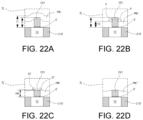
- FIGS. 22 A through 22 D are enlarged views of region X illustrated in FIG. 11 through FIG. 14 in accordance with some embodiments of the present disclosure.
- FIGS. 23 A through 23 D are enlarged views of region X illustrated in FIG. 11 through FIG. 14 in accordance with some alternative embodiments of the present disclosure.
- FIGS. 24 A through 24 B , FIGS. 25 A through 25 D , FIGS. 26 A through 26 C , FIGS. 27 A through 27 D , FIGS. 28 A through 28 D , FIGS. 29 A through 29 C , and FIGS. 30 A through 30 D are cross-sectional views in accordance with various embodiments of the present disclosure.
- first and second features are formed in direct contact
- additional features may be formed between the first and second features, such that the first and second features may not be in direct contact
- present disclosure may repeat reference numerals and/or letters in the various examples. This repetition is for the purpose of simplicity and clarity and does not in itself dictate a relationship between the various embodiments and/or configurations discussed.
- spatially relative terms such as “beneath,” “below,” “lower,” “above,” “upper” and the like, may be used herein for ease of description to describe one element or feature's relationship to another element(s) or feature(s) as illustrated in the figures.
- the spatially relative terms are intended to encompass different orientations of the device in use or operation in addition to the orientation depicted in the figures.
- the apparatus may be otherwise oriented (rotated 90 degrees or at other orientations) and the spatially relative descriptors used herein may likewise be interpreted accordingly.
- testing structures may be included to aid in the verification testing of the 3D packaging or 3DIC devices.
- the testing structures may include, for example, test pads formed in a redistribution layer or on a substrate that allows the testing of the 3D packaging or 3DIC, the use of probes and/or probe cards, and the like.
- the verification testing may be performed on intermediate structures as well as the final structure.
- the structures and methods disclosed herein may be used in conjunction with testing methodologies that incorporate intermediate verification of known good dies to increase the yield and decrease costs.
- FIGS. 1 through 21 illustrate a process flow for fabricating an integrated fan-out package in accordance with some embodiments of the present disclosure.
- FIGS. 22 A through 22 D are enlarged views of region X illustrated in FIG. 11 through FIG. 14 in accordance with some embodiments of the present disclosure.
- a wafer 100 including a plurality of semiconductor dies or integrated circuit components 200 arranged in, for example, an array is provided. Before a wafer dicing process is performed on the wafer 100 , the integrated circuit components 200 of the wafer 100 are connected one another.
- the wafer 100 includes a semiconductor substrate 110 , a plurality of conductive pads 120 formed on the semiconductor substrate 110 , and a passivation layer 130 .
- the passivation layer 130 is formed over the substrate 110 and has a plurality of contact openings 132 such that the conductive pads 120 are partially exposed by the contact openings 132 of the passivation layer 130 .
- the semiconductor substrate 110 may be a silicon substrate including active components (e.g., transistors or the like) and passive components (e.g., resistors, capacitors, inductors or the like) formed therein;
- the conductive pads 120 may be aluminum pads, copper pads or other suitable metal pads;
- the passivation layer 130 may be a silicon oxide layer, a silicon nitride layer, a silicon oxy-nitride layer or a dielectric layer formed by other suitable dielectric materials.
- the wafer 100 may optionally include a post-passivation layer 140 formed over the passivation layer 130 .
- the post-passivation layer 140 covers the passivation layer 130 and has a plurality of contact openings 142 .
- the conductive pads 120 exposed by the contact openings 132 of the passivation 130 are partially exposed by the contact openings 142 of the post passivation layer 140 .
- the post-passivation layer 140 may be a polyimide (PI) layer, a polybenzoxazole (PBO) layer, or a dielectric layer formed by other suitable polymers.
- a plurality of conductive pillars 150 are formed on the conductive pads 120 .
- the conductive pillars 150 are plated on the conductive pads 120 .
- the plating process of conductive pillars 150 is described in detail below.
- a seed layer is sputtered onto the post-passivation layer 140 and the conductive pads 120 exposed by the contact openings 142 .
- a patterned photoresist layer (not shown) is then formed over the seed layer by photolithography, wherein the patterned photoresist layer exposes portions of the seed layer that are corresponding to the conductive pads 120 .
- the wafer 100 including the patterned photoresist layer formed thereon is then immersed into a plating solution of a plating bath such that the conductive pillars 150 are plated on the portions of the seed layer that are corresponding to the conductive pads 120 .
- the patterned photoresist layer is stripped. Thereafter, by using the conductive pillars 150 as a hard mask, portions of the seed layer that are not covered by the conductive pillars 150 may be removed through etching until the post passivation layer 140 is exposed, for example.
- the conductive pillars 150 are plated copper pillars.
- a protection layer 160 is formed on the post passivation layer 140 so as to cover the conductive pillars 150 .
- the protection layer 160 may be a polymer layer having sufficient thickness to encapsulate and protect the conductive pillars 150 .
- the protection layer 160 may be a polybenzoxazole (PBO) layer, a polyimide (PI) layer or other suitable polymers.
- the protection layer 160 may be made of inorganic materials.
- a back side grinding process is performed on the rear surface of the wafer 100 after the protection layer 160 is formed.
- the semiconductor substrate 110 is ground such that a thinned wafer 100 ′ including a thinned semiconductor substrate 110 ′ is formed.
- a wafer dicing process is performed on the thinned wafer 100 ′ such that the integrated circuit components 200 in the wafer 100 ′ are singulated from one another.
- Each of the singulated integrated circuit components 200 includes a semiconductor substrate 110 a , the conductive pads 120 formed on the semiconductor substrate 110 a , a passivation layer 130 a , a post passivation layer 140 a , the conductive pillars 150 , and a protection layer 160 a . As shown in FIG. 4 and FIG.
- the materials and the characteristics of the semiconductor substrate 110 a , the passivation layer 130 a , the post passivation layer 140 a , and the protection layer 160 a are the same as those of the semiconductor substrate 100 , the passivation layer 130 , the post passivation layer 140 , and the protection layer 160 .
- the detailed descriptions of the semiconductor substrate 110 a , the passivation layer 130 a , the post passivation layer 140 a , and the protection layer 160 a are omitted.
- the protection layer 160 and 160 a may protect the conductive pillars 150 of the integrated circuit components 200 .
- the conductive pillars 150 of the integrated circuit components 200 may be protected from being damaged by sequentially performed processes, such as pick-up and placing process of the integrated circuit components 200 , molding process, and so on.
- a carrier C having a de-bonding layer DB and a dielectric layer DI formed thereon is provided, wherein the de-bonding layer DB is between the carrier C and the dielectric layer DI.
- the carrier C is a glass substrate
- the de-bonding layer DB is a light-to-heat conversion (LTHC) release layer formed on the glass substrate
- the dielectric layer DI is a polybenzoxazole (PBO) layer formed on the de-bonding layer DB, for example.
- a plurality of conductive through vias TV are formed on the dielectric layer DI.
- the plurality of conductive through vias TV is formed by photoresist coating, photolithography, plating, and photoresist stripping process.
- the conductive through vias TV include copper posts or other suitable metal post.
- one of the integrated circuit components 200 including the conductive pads 120 , the conductive pillars 150 , and a protection layer 160 a formed thereon is picked and placed on the dielectric layer DI.
- the integrated circuit components 200 is attached or adhered on the dielectric layer DI through a die attach film (DAF), an adhesion paste or the like.
- DAF die attach film
- more than one of the integrated circuit components 200 are picked and placed on the dielectric layer DI, wherein the integrated circuit components 200 placed on the dielectric layer DI may be arranged in an array.
- the conductive through vias TV may be classified into groups. The number of the integrated circuit components 200 is corresponding to the number of the groups of the conductive through vias TV.
- the top surface of the protection layer 160 a is lower than the top surfaces of the conductive through vias TV, and the top surface of the protection layer 160 a is higher than the top surfaces of the conductive pillars 150 , for example.
- the disclosure is not limited thereto.
- the top surface of the protection layer 160 a may be substantially aligned with the top surfaces of the conductive through vias TV, and the top surface of the protection layer 160 a is higher than the top surfaces of the conductive pillars 150 .
- the integrated circuit component 200 is picked and placed on the dielectric layer DI after the formation of the conductive through vias TV.
- the disclosure is not limited thereto.
- the integrated circuit component 200 is picked and placed on the dielectric layer DI before the formation of the conductive through vias TV.
- an insulating material 210 is formed on the dielectric layer DI to cover the integrated circuit component 200 and the conductive through vias TV.
- the insulating material 210 is a molding compound formed by a molding process.
- the conductive pillars 150 and the protection layer 160 a of the integrated circuit component 200 are covered by the insulating material 210 .
- the conductive pillars 150 and the protection layer 160 a of the integrated circuit component 200 are not revealed and are well protected by the insulating material 210 .
- the insulating material 210 includes epoxy or other suitable dielectric materials.
- the insulating material 210 is then ground until the top surfaces of the conductive pillars 150 , the top surfaces of the conductive through vias TV, and the top surface of the protection layer 160 a are exposed.
- the insulating material 210 is ground by a mechanical grinding process and/or a chemical mechanical polishing (CMP) process, thereby forming an insulating encapsulation 210 ′ over the dielectric layer DI as illustrated in FIG. 8 .
- CMP chemical mechanical polishing
- portions of the protection layer 160 a are ground to form a protection layer 160 a ′.
- portions of the conductive through vias TV and portions of the conductive pillars 150 are ground also.
- a redistribution circuit structure electrically connected to the conductive pillars 150 of the integrated circuit component 200 is then formed on the top surfaces of the conductive through vias TV, the top surface of the insulating encapsulation 210 ′, the top surfaces of the conductive pillars 150 , and the top surface of the protection layer 160 a ′.
- the redistribution circuit structure is fabricated to electrically connect with one or more connectors underneath.
- the afore-said connectors may be the conductive pillars 150 of the integrated circuit component 200 and/or the conductive through vias TV embedded in the insulating encapsulation 210 ′.
- the fabrication processes of the redistribution circuit structure is described in accompany with FIGS. 9 through 21 in detail.
- a bottom seed layer S is formed on the top surfaces of the conductive through vias TV, the top surface of the insulating encapsulation 210 ′, the top surfaces of the conductive pillars 150 , and the top surface of the protection layer 160 a ′.
- the bottom seed layer S may be a sputtered Ti/Cu layer and the thickness of the bottom seed layer S may be about 5 angstroms.
- a patterned photoresist layer PR 1 is then formed over the bottom seed layer S through a photolithography process.
- the patterned photoresist layer PR 1 includes a plurality of openings for exposing portions of the bottom seed layer S that are corresponding to the conductive pillars 150 and the conductive through vias TV.
- a plating process is performed on the exposed portions of the bottom seed layer S such that a plurality of first conductive vias CV 1 are formed in the openings defined in the patterned photoresist layer PR 1 .
- the first conductive vias CV 1 may be copper vias
- the height (H) of the first conductive vias CV 1 may range from about 3 micrometers to about 5 micrometers
- the diameter of the first conductive vias CV 1 may range from about 1 micrometer to about 5 micrometers.
- a photosensitive dielectric layer PM 1 is formed to cover the first conductive vias CV 1 and the patterned bottom seed layers S′.
- the height H of the first conductive vias CV 1 may range from about 3 micrometers to about 5 micrometers, and the diameter of the first conductive vias CV 1 may range from about 1 micrometer to about 5 micrometers.
- the material of the photosensitive dielectric layer PM 1 may include positive photoresist material such as photosensitive polyimide or the like.
- the thickness T 1 of the photosensitive dielectric layer PM 1 ranges from about 3.1 micrometers to about 5.5 micrometers, for example.
- Portions of the photosensitive dielectric layer PM 1 which cover the top surfaces of the first conductive vias CV 1 may have thickness ranging from about 0.1 micrometer to about 0.5 micrometer. As shown in FIG. 11 and FIG. 22 A , the photosensitive dielectric layer PM 1 is formed to cover the first conductive vias CV 1 and the patterned bottom seed layers S′, and the photosensitive dielectric layer PM 1 has an undulating top surface.
- a first thinning process is performed to partially remove and thin down the photosensitive dielectric layer PM 1 such that a thinned photosensitive dielectric layer PM 1 ′ with a reduced thickness T 2 is formed.
- the first thinning process may include at least one exposure and development process. Furthermore, after performing the first thinning process, portions of the photosensitive dielectric layer PM 1 (shown in FIG. 11 ) are removed and the first conductive vias CV 1 are revealed.
- an upper portion of the photosensitive dielectric layer PM 1 is irradiated by a light source (e.g., an UV light source) and a lower portion of the photosensitive dielectric layer PM 1 is not irradiated by the light source. Then, the photosensitive dielectric layer PM 1 is developed such that the upper portion of the photosensitive dielectric layer PM 1 is removed and a thinned photosensitive dielectric layer PM 1 ′ (e.g., the remaining lower portion of the photosensitive dielectric layer PM 1 ) is formed.
- the reduction in thickness of the photosensitive dielectric layer PM 1 may be controlled by exposure dose and development time.
- the exposure focus window e.g., depth of focus
- the exposure focus window may be substantially equal to or greater than about 24 micrometers.
- the exposure focus window may range from about ⁇ 12 micrometers to about +12 micrometers.
- the top surfaces of the first conductive vias CV may be revealed and the sidewalls of the first conductive vias CV 1 are partially revealed.
- the upper portion of the photosensitive dielectric layer PM 1 may be exposed to the light source (e.g., an UV light source) and the exposure dose may range from about 200 milli-Joules (mJ) to about 300 mJ.
- the thinned photosensitive dielectric layer PM 1 ′ may have an undulating top surface and the thickness T 2 of the thinned photosensitive dielectric layer PM 1 ′ may range from about 2 micrometers to about 5 micrometers, for example.
- the thinned photosensitive dielectric layer PM 1 ′ may include a plurality of protruding portions P in contact with the sidewalls of the first conductive vias CV. Furthermore, each of the protruding portions P may surround one of the first conductive vias CV, respectively. In some embodiments, the height of the protruding portions P may range from about 0.1 micrometer to about 2 micrometers.
- the conductive vias CV 1 are partially removed and thinned down such that a plurality of steps ST (e.g., a level height offset) are generated between top surfaces of the conductive vias CV 1 and the thinned photosensitive dielectric layer PM 1 ′.
- a plurality of steps ST e.g., a level height offset
- the difference between the height H of the first conductive vias CV 1 illustrated in FIG. 22 A and the height H 1 of the first conductive vias CV 1 illustrated in FIG. 22 C may from about 0.1 micrometers to about 2 micrometers.
- the height difference between the first conductive vias CV 1 and the steps ST may range from about 0.1 micrometers to about 1.5 micrometers.
- the conductive vias CV 1 are partially removed by an etch process, for example.
- the conductive vias CV 1 may be thinned down until the top surfaces of the conductive vias CV 1 are lower than the topmost end of the protruding portions P. Accordingly, the steps ST are generated between top surfaces of the conductive vias CV 1 and the protruding portions P of the thinned photosensitive dielectric layer PM 1 ′.
- the thinned photosensitive dielectric layer PM 1 ′ is partially removed to reduce the overall thickness of the thinned photosensitive dielectric layer PM 1 ′ such that the thinned photosensitive dielectric layer PM 1 ′ is thinned down and the steps ST between the top surfaces of the conductive vias CV and the protruding portions P of the thinned photosensitive dielectric layer PM 1 ′ are minimized or reduced.
- the steps ST between the top surfaces of the conductive vias CV and the protruding portions P are minimized or reduced by an ash process, for example.
- the ash process is performed by a plasma treatment (e.g., CF 4 /O 2 /Ar plasma) performed at the temperature ranging from about 25 Celsius degrees to about 150 Celsius degrees for a duration from about 30 seconds to about 600 seconds. Since the removal rate of the protruding portions P is greater than that of other portions of the thinned photosensitive dielectric layer PM 1 ′ during the dielectric ash process, the protruding portions P are flattened. In some embodiments, the thinned photosensitive dielectric layer PM 1 ′ is partially removed to form a photosensitive dielectric layer PM 1 ′′, wherein the top surface of the photosensitive dielectric layer PM 1 ′′ is slightly lower than the top surfaces of the conductive vias CV.
- a plasma treatment e.g., CF 4 /O 2 /Ar plasma
- the conductive vias CV are embedded in the photosensitive dielectric layer PM 1 ′′.
- the conductive vias CV and the photosensitive dielectric layer PM 1 ′′ fabricated by the processes illustrated in FIGS. 22 C through 22 D are cost effective and may enhance the productivity.
- a first seed layer S 1 is formed to cover the first conductive vias CV 1 and the photosensitive dielectric layer PM 1 ′′.
- the first seed layer S 1 may be a sputtered Ti/Cu layer and the thickness of the first seed layer S 1 may be about 5 angstroms.
- a patterned photoresist layer PR 2 is then formed over the first seed layer S 1 through a photolithography process. Furthermore, the patterned photoresist layer PR 2 includes a plurality of openings for exposing portions of the first seed layer S 1 that are corresponding to the first conductive vias CV.
- a plating process for example, is performed such that a plurality of first redistribution wirings RDL 1 are formed in the openings defined in the patterned photoresist layer PR 2 .
- the first redistribution wirings RDL 1 are formed on portions of the first seed layer S 1 exposed by the openings of the patterned photoresist layer PR 2 .
- the first redistribution wirings RDL 1 may be copper wirings.
- the material of the first redistribution wirings RDL 1 is not limited in the present invention. It is noted that the profile of the conductive vias CV 1 and the photosensitive dielectric layer PM 1 ′′ shown in FIG. 14 is merely for illustration.
- the profile of the conductive vias CV 1 and the photosensitive dielectric layer PM 1 ′′ may be modified.
- the first redistribution wirings RDL 1 may be formed over the conductive vias CV 1 and the photosensitive dielectric layer PM 1 ′′ illustrated in FIGS. 22 D, 23 D, 24 B, 26 C and 29 C .
- the first redistribution wirings RDL 1 may be formed over the conductive vias CV 1 and the photosensitive dielectric layer PM 1 ′′′ illustrated in FIGS. 25 D, 27 D, 28 D and 30 D .
- the first redistribution wirings RDL 1 may be formed over the conductive vias CV 1 and the photosensitive dielectric layer PM 1 ′ illustrated in FIG. 24 B .
- the patterned photoresist layer PR 2 is removed so as to expose the first seed layer S 1 .
- a patterned photoresist layer PR 3 is formed to partially cover the first redistribution wirings RDL 1 .
- the patterned photoresist layer PR 3 includes a plurality of openings for exposing portions of the first redistribution wirings RDL 1 , for example.
- a plating process for example, is then performed such that a plurality of second conductive vias CV 2 are formed on the first redistribution wirings RDL 1 and formed in the openings defined in the patterned photoresist layer PR 3 .
- the second conductive vias CV 2 are directly in contact with the first redistribution wirings RDL 1 .
- the second conductive vias CV 2 may be copper vias, the height (H) of the second conductive vias CV 2 may range from about 3 micrometers to about 5 micrometers, and the diameter of the second conductive vias CV 2 may range from about 0.5 micrometer to about 5 micrometers.
- the patterned photoresist layer PR 3 is removed. Thereafter, by using the first redistribution wirings RDL 1 as a hard mask, portions of the first seed layer S 1 that are not covered by the first redistribution wirings RDL 1 may be removed (e.g., etched) to form a plurality of first patterned seed layers S 1 ′.
- the first patterned seed layers S 1 ′ are covered by the first redistribution wirings RDL 1 and are disposed on the first conductive vias CV 1 and the photosensitive dielectric layer PM 1 ′′.
- a photosensitive dielectric layer PM 2 is then formed to cover the first patterned seed layer S 1 ′, the first redistribution wirings RDL 1 and the second conductive vias CV 2 .
- the first patterned seed layer S 1 ′, the first redistribution wirings RDL 1 and the second conductive vias CV 2 are embedded in the photosensitive dielectric layer PM 2 .
- the material of the photosensitive dielectric layer PM 2 may include positive photoresist material such as photosensitive polyimide or the like.
- the fabrication processes of the photosensitive dielectric layer PM 2 may be similar with the fabrication processes of the photosensitive dielectric layer PM 1 /PM 1 ′/PM 1 ′′ as illustrated in FIGS. 11 through 14 . However, the fabrication processes of the photosensitive dielectric layer PM 2 are not limited thereto.
- a plurality of second patterned seed layers S 2 e.g., sputtered Ti/Cu patterns
- a plurality of second redistribution wirings RDL 2 are formed on the second conductive vias CV 2 and the photosensitive dielectric layer PM 2 .
- the fabrication processes of the second redistribution wirings RDL 2 may be similar with the fabrication processes of the first redistribution wirings RDL 1 as illustrated in FIGS. 15 through 18 .
- the fabrication processes of the second redistribution wirings RDL 2 are not limited thereto.
- a patterned dielectric layer PM 3 having a plurality of via openings is formed on the photosensitive dielectric layer PM 2 so as to cover portions of the second redistribution wirings RDL 2 .
- the patterned dielectric layer PM 3 may be a photosensitive dielectric layer and the photosensitive dielectric layer may be patterned directly by a photolithography process.
- the material of the photosensitive dielectric layer PM 3 may include positive photoresist material such as photosensitive polyimide or the like.
- the patterned dielectric layer PM 3 may be a non-photosensitive dielectric layer and the non-photosensitive dielectric layer may be patterned by photoresist coating, photolithography and etch processes.
- the patterned dielectric layer PM 3 may be a polyimide (PI) layer, a polybenzoxazole (PBO) layer or other suitable dielectric polymers.
- a plurality of third patterned seed layers S 3 (e.g., sputtered Ti/Cu patterns) and a plurality of third redistribution wirings RDL 3 are formed in the via openings of the photosensitive dielectric layer PM 3 .
- the third patterned seed layers S 3 and the third redistribution wirings RDL 3 are electrically connected to the second redistribution wirings RDL 2 through the via openings of the photosensitive dielectric layer PM 3 .
- the third patterned seed layers S 3 and the third redistribution wirings RDL 3 may be formed by following processes.
- a seed layer (not shown) is conformally formed on the patterned dielectric layer PM 3 and portions of the second redistribution wirings RDL 2 exposed by the via openings of the patterned dielectric layer PM 3 .
- a patterned photoresist layer (not shown) is formed on the seed layer, wherein the patterned photoresist layer includes a plurality of openings for exposing portions of the seed layer.
- a plurality of third redistribution wirings RDL 3 are formed (e.g., plated) in the openings of the patterned photoresist layer.
- the third redistribution wirings RDL 3 are formed on the portions of the seed layer exposed by the openings of the patterned photoresist layer.
- the patterned photoresist layer is removed. Thereafter, by using the third redistribution wirings RDL 3 as a hard mask, portions of the seed layer that are not covered by the third redistribution wirings RDL 3 may be removed (e.g., etched) such that the third patterned seed layers S 3 covered by the third redistribution wirings RDL 3 is formed on the second redistribution wirings RDL 2 and the patterned dielectric layer PM 3 , as shown in FIG. 20 .
- the second patterned seed layers S 2 and the second redistribution wirings RDL 2 are formed before forming the patterned dielectric layer PM 3 while the third patterned seed layers S 3 and the third redistribution wirings RDL 3 are formed after forming the patterned dielectric layer PM 3 .
- the fabrication processes of the patterned dielectric layer PM 3 may be different from the fabrication processes of the photosensitive dielectric layers PM 1 ′′ and PM 2 , for example.
- a patterned dielectric layer PM 4 a patterned seed layer S 4 (e.g., a sputtered Ti/Cu layer) and pads P are formed on the third redistribution wirings RDL 3 and the patterned dielectric layer PM 3 .
- the patterned dielectric layer PM 4 may be a photosensitive dielectric layer and the photosensitive dielectric layer may be patterned directly by a photolithography process.
- the material of the photosensitive dielectric layer PM 4 may include positive photoresist material such as photosensitive polyimide or the like.
- the patterned dielectric layer PM 4 may be a non-photosensitive dielectric layer and the non-photosensitive dielectric layer may be patterned by photoresist coating, photolithography and etch processes.
- the patterned dielectric layer PM 4 may be a polyimide (PI) layer, a polybenzoxazole (PBO) layer or other suitable dielectric polymers.
- the fabricating processes of the patterned dielectric layer PM 4 is similar with the fabricating processes of the patterned dielectric layer PM 3 .
- the fabricating processes of the fourth patterned seed layer S 4 and the pads P are similar with the fabricating processes of the third patterned seed layers S 3 and the third redistribution wirings RDL 3 as illustrated in FIG. 20 .
- the patterned dielectric layer PM 4 includes a plurality of via openings formed therein. Furthermore, the pads P are formed on the patterned dielectric layer PM 4 and are electrically connected to the third redistribution wirings RDL 3 through the via openings in the fourth dielectric layer PM 4 .
- the pads P may include a plurality of under-ball metallurgy (UBM) patterns for ball mount and/or a plurality of connection pads for mounting of passive components.
- UBM under-ball metallurgy
- a de-bonding process may be performed to de-bond the resulted structure (e.g., the integrated fan-out package) from the de-bonding layer DB carried by the carrier C.
- the integrated fan-out package may be flipped upside down and the dielectric layer DI may be patterned to reveal the surfaces of the conductive through vias TV.
- an additional semiconductor device e.g., DRAM or the like
- the semiconductor device may be electrically connected to the integrated fan-out package through solder bumps (e.g., C4 bumps, micro-bumps or the like) such that a package-on-package (PoP) structure is fabricated.
- solder bumps e.g., C4 bumps, micro-bumps or the like
- the formation and patterning processes of the dielectric layer DI may be omitted.
- FIGS. 23 A through 23 D are enlarged views of region X illustrated in FIG. 11 through FIG. 14 in accordance with some embodiments of the present disclosure.
- a photosensitive dielectric layer PM 1 is formed to cover the first conductive vias CV 1 and the patterned bottom seed layers S′.
- the height H of the first conductive vias CV 1 may range from about 3 micrometers to about 5 micrometers, and the diameter of the first conductive vias CV 1 may range from about 1 micrometer to about 5 micrometers.
- the material of the photosensitive dielectric layer PM 1 may include positive photoresist material such as photosensitive polyimide or the like.
- the thickness T 1 of the photosensitive dielectric layer PM 1 ranges from about 4 micrometers to about 10 micrometers, for example.
- Portions of the photosensitive dielectric layer PM 1 which cover the top surfaces of the first conductive vias CV may have thickness ranging from about 1 micrometer to about 5 micrometers. As shown in FIG. 11 and FIG. 23 A , the photosensitive dielectric layer PM 1 is formed to cover the first conductive vias CV and the patterned bottom seed layers S′, and the photosensitive dielectric layer PM 1 has an undulating top surface.
- a first thinning process is performed to partially remove and thin down the photosensitive dielectric layer PM 1 such that a thinned photosensitive dielectric layer PM 1 ′ with a reduced thickness T 2 is formed.
- the first thinning process may include at least one exposure and development process. Furthermore, after performing the first thinning process, portions of the photosensitive dielectric layer PM 1 (shown in FIG. 11 ) are removed and the first conductive vias CV 1 are revealed.
- an upper portion of the photosensitive dielectric layer PM 1 is irradiated by a light source (e.g., an UV light source) and a lower portion of the photosensitive dielectric layer PM 1 is not irradiated by the light source. Then, the photosensitive dielectric layer PM 1 is developed such that the upper portion of the photosensitive dielectric layer PM 1 is removed and a thinned photosensitive dielectric layer PM 1 ′ (e.g., the remaining lower portion of the photosensitive dielectric layer PM 1 ) is formed.
- the reduction in thickness of the photosensitive dielectric layer PM 1 may be controlled by exposure dose and development time.
- the exposure focus window e.g., depth of focus
- the exposure focus window may be substantially equal to or greater than about 24 micrometers.
- the exposure focus window may range from about ⁇ 12 micrometers to about +12 micrometers.
- the top surfaces of the first conductive vias CV 1 may be revealed and the sidewalls of the first conductive vias CV 1 are partially revealed.
- the upper portion of the photosensitive dielectric layer PM 1 may be exposed to the light source (e.g., an UV light source) and the exposure dose may range from about 400 mJ to about 900 mJ.
- the thinned photosensitive dielectric layer PM 1 ′ may have an undulating top surface and the thickness T 2 of the thinned photosensitive dielectric layer PM 1 ′ may range from about 2 micrometers to about 5 micrometers, for example. Since the thickness (e.g., thickness T 1 ranging from about 4 micrometers to about 10 micrometers) of the photosensitive dielectric layer PM 1 illustrated in FIG. 23 A is greater than the thickness (e.g., thickness T 1 ranging from about 3.1 micrometers to about 5.5 micrometers) of the photosensitive dielectric layer PM 1 illustrated in FIG.
- the removal amount of the dielectric material of the photosensitive dielectric layer PM 1 illustrated in FIG. 23 A is greater than that of the photosensitive dielectric layer PM 1 illustrated in FIG. 22 A when performing the first thinning process. Accordingly, as compared with the thinned photosensitive dielectric layer PM 1 ′ illustrated in FIG. 22 B , the top surface of the thinned photosensitive dielectric layer PM 1 ′ illustrated in FIG. 23 B is flatter.
- the conductive vias CV 1 are partially removed and thinned down such that a plurality of steps ST (e.g., a level height offset) are generated between top surfaces of the conductive vias CV 1 and the thinned photosensitive dielectric layer PM 1 ′.
- a plurality of steps ST e.g., a level height offset
- the difference between the height H of the first conductive vias CV 1 illustrated in FIG. 23 A and the height H 1 of the first conductive vias CV illustrated in FIG. 23 C may from about 0.1 micrometers to about 2 micrometers.
- the height difference between the first conductive vias CV and the steps ST may range from about 0.1 micrometers to about 1.5 micrometers.
- the conductive vias CV 1 are partially removed by an etch process, for example.
- the conductive vias CV 1 may be thinned down until the top surfaces of the conductive vias CV 1 are lower than the top surface of the thinned photosensitive dielectric layer PM 1 ′. Accordingly, the steps ST are generated between top surfaces of the conductive vias CV 1 and portions of the thinned photosensitive dielectric layer PM 1 ′ in proximity to the conductive vias CV.
- the thinned photosensitive dielectric layer PM 1 ′ is partially removed to reduce the overall thickness of the thinned photosensitive dielectric layer PM 1 ′ such that the thinned photosensitive dielectric layer PM 1 ′ is thinned down and the steps ST between the top surfaces of the conductive vias CV 1 and the top surface of the thinned photosensitive dielectric layer PM 1 ′ are minimized or reduced.
- the steps ST between the top surfaces of the conductive vias CV and the portions which is in proximity to the conductive vias CV are removed by an ash process, for example.
- the ash process is performed by a plasma treatment (e.g., CF 4 /O 2 /Ar plasma) performed under a temperature ranging from about 25 Celsius degrees to about 150 Celsius degrees, and for a duration from about 30 seconds to about 600 seconds. Since the removal rate of the portions in proximity to the conductive vias CV is greater than that of other portions of the thinned photosensitive dielectric layer PM 1 ′ during the dielectric ash process, the steps ST may be eliminated or reduced.
- a plasma treatment e.g., CF 4 /O 2 /Ar plasma
- the thinned photosensitive dielectric layer PM 1 ′ is partially removed to form a photosensitive dielectric layer PM 1 ′′, wherein the top surface of the photosensitive dielectric layer PM 1 ′′ is substantially level with, slightly higher than or slightly lower than the top surfaces of the conductive vias CV.
- the conductive vias CV 1 are embedded in the photosensitive dielectric layer PM 1 ′′.
- the conductive vias CV 1 and the photosensitive dielectric layer PM 1 ′′ fabricated by the processes illustrated in FIGS. 23 C through 23 D are cost effective and may enhance the productivity.
- the processes illustrated in FIG. 15 through FIG. 21 may be performed to fabricate the redistribution circuit structure.
- FIGS. 24 A through 24 B , FIGS. 25 A through 25 D , FIGS. 26 A through 26 C , FIGS. 27 A through 27 D , FIGS. 28 A through 28 D , FIGS. 29 A through 29 C , and FIGS. 30 A through 30 D are cross-sectional views in accordance with various embodiments of the present disclosure.
- a photosensitive dielectric layer PM 1 is formed to cover the first conductive vias CV 1 and the patterned bottom seed layers S′.
- the height H of the first conductive vias CV 1 may range from about 3 micrometers to about 5 micrometers, and the diameter of the first conductive vias CV 1 may range from about 1 micrometer to about 5 micrometers.
- the material of the photosensitive dielectric layer PM 1 may include positive photoresist material such as photosensitive polyimide or the like.
- the thickness of the photosensitive dielectric layer PM 1 ranges from about 4 micrometers to about 10 micrometers, for example.
- Portions of the photosensitive dielectric layer PM 1 which cover the top surfaces of the first conductive vias CV 1 may have thickness ranging from about 1 micrometer to about 5 micrometers. As shown in FIG. 24 A , the photosensitive dielectric layer PM 1 is formed to cover the first conductive vias CV 1 and the patterned bottom seed layers S′, and the photosensitive dielectric layer PM 1 has an undulating top surface.
- a first thinning process is performed to partially remove and thinned down the photosensitive dielectric layer PM 1 such that a thinned photosensitive dielectric layer PM 1 ′ with a reduced thickness (e.g. a thickness ranging from about 3 micrometers to about 5 micrometers) is formed.
- the first thinning process may include at least one exposure and development process. Furthermore, after performing the first thinning process, portions of the photosensitive dielectric layer PM 1 are removed and the first conductive vias CV 1 are revealed.
- an upper portion of the photosensitive dielectric layer PM 1 is irradiated by a light source (e.g., an UV light source) and a lower portion of the photosensitive dielectric layer PM 1 is not irradiated by the light source. Then, the photosensitive dielectric layer PM 1 is developed such that the upper portion of the photosensitive dielectric layer PM 1 is removed and a thinned photosensitive dielectric layer PM 1 ′ (e.g., the remaining lower portion of the photosensitive dielectric layer PM 1 ) is formed.
- the reduction in thickness of the photosensitive dielectric layer PM 1 may be controlled by exposure dose and development time.
- the exposure focus window e.g., depth of focus
- the exposure focus window may be substantially equal to or greater than about 24 micrometers.
- the exposure focus window may range from about ⁇ 12 micrometers to about +12 micrometers.
- the top surfaces of the first conductive vias CV 1 may be revealed.
- the upper portion of the photosensitive dielectric layer PM 1 may be exposed to the light source (e.g., an UV light source) and the exposure dose may range from about 250 mJ to about 500 mJ.
- the thickness of the thinned photosensitive dielectric layer PM 1 ′ may be controlled to be substantially equal to or slightly smaller than the height of the first conductive vias CV 1 , for example.
- the processes illustrated in FIG. 15 through FIG. 21 may be performed to fabricate the redistribution circuit structure.
- a photosensitive dielectric layer PM 1 is formed to cover the first conductive vias CV 1 and the patterned bottom seed layers S′.
- the height of the first conductive vias CV 1 may range from about 3 micrometers to about 5 micrometers, and the diameter of the first conductive vias CV 1 may range from about 1 micrometer to about 5 micrometers.
- the material of the photosensitive dielectric layer PM 1 may include positive photoresist material such as photosensitive polyimide or the like.
- the thickness T 1 of the photosensitive dielectric layer PM 1 ranges from about 3.1 micrometers to about 5.5 micrometers, for example.
- Portions of the photosensitive dielectric layer PM 1 which cover the top surfaces of the first conductive vias CV 1 may have thickness ranging from about 0.1 micrometer to about 0.5 micrometer. As shown in FIG. 25 A , the photosensitive dielectric layer PM 1 is formed to cover the first conductive vias CV 1 and the patterned bottom seed layers S′, and the photosensitive dielectric layer PM 1 has an undulating top surface.
- a first thinning process is performed to partially remove and thin down the photosensitive dielectric layer PM 1 such that a thinned photosensitive dielectric layer PM 1 ′ with a reduced thickness T 2 is formed.
- the first thinning process may include at least one exposure and development process.
- an upper portion of the photosensitive dielectric layer PM 1 is irradiated by a light source (e.g., an UV light source) and a lower portion of the photosensitive dielectric layer PM 1 is not irradiated by the light source. Then, the photosensitive dielectric layer PM 1 is developed such that the upper portion of the photosensitive dielectric layer PM 1 is removed and a thinned photosensitive dielectric layer PM 1 ′ (e.g., the remaining lower portion of the photosensitive dielectric layer PM 1 ) is formed.
- the reduction in thickness of the photosensitive dielectric layer PM 1 may be controlled by exposure dose and development time.
- the exposure focus window e.g., depth of focus
- the exposure focus window may be substantially equal to or greater than about 24 micrometers.
- the exposure focus window may range from about ⁇ 12 micrometers to about +12 micrometers.
- the first conductive vias CV are covered by the thinned photosensitive dielectric layer PM 1 ′.
- the thickness T 2 of the thinned photosensitive dielectric layer PM 1 ′ may be thicker than or substantially equal to that of the first conductive vias CV.
- the upper portion of the photosensitive dielectric layer PM 1 may be exposed to the light source (e.g., an UV light source) and the exposure dose may range from about 100 mJ to about 150 mJ.
- the thinned photosensitive dielectric layer PM 1 ′ may have an undulating top surface and the thickness T 2 of the thinned photosensitive dielectric layer PM 1 ′ may range from about 3.5 micrometers to about 5.25 micrometers, for example.
- a second thinning process is performed to thin down the thinned photosensitive dielectric layer PM 1 ′ until the conductive vias CV are revealed.
- the second thinning process includes a curing process followed by an ash process.
- the curing process is performed to cure the photosensitive dielectric layer PM 1 ′.
- the curing process is performed under a curing temperature ranging from about 150 Celsius degrees to about 250 Celsius degrees and the duration of the curing process ranges from about 0.5 hour to about 2 hours.
- the photosensitive dielectric layer PM 1 ′ may shrink and a cured photosensitive dielectric layer PM 1 ′′ having a reduced thickness (compared to the photosensitive dielectric layer PM 1 ′) is formed.
- the cured photosensitive dielectric layer PM 1 ′′ may be partially removed by ash process to form a photosensitive dielectric layer PM 1 ′′′, wherein the conductive vias CV are revealed by the photosensitive dielectric layer PM 1 ′′′.
- the ash process is performed by a plasma treatment (e.g., CF 4 /O 2 /Ar plasma), the ash process is performed under the temperature ranging from about 25 Celsius degrees to about 150 Celsius degrees, and the duration of the ash process ranges from about 30 seconds to about 600 seconds.
- a plasma treatment e.g., CF 4 /O 2 /Ar plasma
- the processes illustrated in FIG. 15 through FIG. 21 may be performed to fabricate the redistribution circuit structure.
- a photosensitive dielectric layer PM 1 is formed to cover the first conductive vias CV 1 and the patterned bottom seed layers S′.
- the height of the first conductive vias CV 1 may range from about 3 micrometers to about 5 micrometers, and the diameter of the first conductive vias CV 1 may range from about 1 micrometer to about 5 micrometers.
- the material of the photosensitive dielectric layer PM 1 may include positive photoresist material such as photosensitive polyimide or the like.
- the thickness T 1 of the photosensitive dielectric layer PM 1 ranges from about 3.1 micrometers to about 5.5 micrometers, for example.
- Portions of the photosensitive dielectric layer PM 1 which cover the top surfaces of the first conductive vias CV 1 may have thickness ranging from about 0.1 micrometer to about 0.5 micrometer. As shown in FIG. 26 A , the photosensitive dielectric layer PM 1 is formed to cover the first conductive vias CV 1 and the patterned bottom seed layers S′, and the photosensitive dielectric layer PM 1 has an undulating top surface.
- a first thinning process is performed to partially remove and thinned down the photosensitive dielectric layer PM 1 such that a thinned photosensitive dielectric layer PM 1 ′ with a reduced thickness T 2 is formed.
- the first thinning process may include at least one exposure and development process.
- an upper portion of the photosensitive dielectric layer PM 1 is irradiated by a light source (e.g., an UV light source) and a lower portion of the photosensitive dielectric layer PM 1 is not irradiated by the light source. Then, the photosensitive dielectric layer PM 1 is developed such that the upper portion of the photosensitive dielectric layer PM 1 is removed and a thinned photosensitive dielectric layer PM 1 ′ (e.g., the remaining lower portion of the photosensitive dielectric layer PM 1 ) is formed.
- the reduction in thickness of the photosensitive dielectric layer PM 1 may be controlled by exposure dose and development time.
- the exposure focus window e.g., depth of focus
- the exposure focus window may be substantially equal to or greater than about 24 micrometers.
- the exposure focus window may range from about ⁇ 12 micrometers to about +12 micrometers.
- the first conductive vias CV 1 are covered by the thinned photosensitive dielectric layer PM 1 ′.
- the thickness T 2 of the thinned photosensitive dielectric layer PM 1 ′ may be thicker than or substantially equal to that of the first conductive vias CV.
- the upper portion of the photosensitive dielectric layer PM 1 may be exposed to the light source (e.g., an UV light source) and the exposure dose may range from about 100 mJ to about 150 mJ.
- the thinned photosensitive dielectric layer PM 1 ′ may have an undulating top surface and the thickness T 2 of the thinned photosensitive dielectric layer PM 1 ′ may range from about 3.5 micrometers to about 5.25 micrometers, for example.
- a second thinning process is performed to thin down the thinned photosensitive dielectric layer PM 1 ′ until the conductive vias CV 1 are revealed.
- the second thinning process includes an ash process. As illustrated in FIG. 26 C , the photosensitive dielectric layer PM 1 ′ is partially removed by the ash process to form a photosensitive dielectric layer PM 1 ′′, wherein the conductive vias CV 1 are revealed by the photosensitive dielectric layer PM 1 ′′.
- the ash process (e.g., the second thinning process) is performed by a plasma treatment (e.g., CF 4 /O 2 /Ar plasma) performed at a temperature ranging from about 25 Celsius degrees to about 150 Celsius degrees for a duration from about 30 seconds to about 600 seconds.
- a plasma treatment e.g., CF 4 /O 2 /Ar plasma
- the processes illustrated in FIG. 15 through FIG. 21 may be performed to fabricate the redistribution circuit structure.
- a photosensitive dielectric layer PM 1 is formed to cover the first conductive vias CV 1 and the patterned bottom seed layers S′.
- the height of the first conductive vias CV 1 may range from about 3 micrometers to about 5 micrometers, and the diameter of the first conductive vias CV 1 may range from about 1 micrometer to about 5 micrometers.
- the material of the photosensitive dielectric layer PM 1 may include positive photoresist material such as photosensitive polyimide or the like.
- the thickness T 1 of the photosensitive dielectric layer PM 1 ranges from about 3.1 micrometers to about 5.5 micrometers, for example.
- an upper portion of the photosensitive dielectric layer PM 1 is irradiated by a light source (e.g., an UV light source) and a lower portion of the photosensitive dielectric layer PM 1 is not irradiated by the light source. Then, the photosensitive dielectric layer PM 1 is developed such that the upper portion of the photosensitive dielectric layer PM 1 is removed and a thinned photosensitive dielectric layer PM 1 ′ (e.g., the remaining lower portion of the photosensitive dielectric layer PM 1 ) is formed.
- the reduction in thickness of the photosensitive dielectric layer PM 1 may be controlled by exposure dose and development time.
- the exposure focus window e.g., depth of focus
- the exposure focus window may be substantially equal to or greater than about 24 micrometers.
- the exposure focus window may range from about ⁇ 12 micrometers to about +12 micrometers.
- the thinned photosensitive dielectric layer PM 1 ′ may have an undulating top surface and the thickness T 2 of the thinned photosensitive dielectric layer PM 1 ′ may range from about 3.5 micrometers to about 5.25 micrometers, for example.
- a second thinning process is performed to thin down the thinned photosensitive dielectric layer PM 1 ′ until the conductive vias CV are revealed.
- the second thinning process includes a patterning process followed by a curing process.
- a patterning process is performed on the photosensitive dielectric layer PM 1 ′ so as to form a patterned photosensitive dielectric layer PM 1 ′′.
- the conductive vias CV are revealed by the patterned photosensitive dielectric layer PM 1 ′′.
- steps ST are generated between the top surfaces of the conductive vias CV and the top surface of the patterned photosensitive dielectric layer PM 1 ′′.
- the patterned photosensitive dielectric layer PM 1 ′′ may be patterned by a photolithography process, wherein the photo-mask used in the photolithography process may enable the local exposure of the photosensitive dielectric layer PM 1 ′.
- the curing process of the second thinning process may be performed such that the patterned photosensitive dielectric layer PM 1 ′′ shrinks and a cured photosensitive dielectric layer PM 1 ′′′ having a reduced thickness is formed.
- the curing process is performed under the curing temperature ranging from about 150 Celsius degrees to about 250 Celsius degrees for a duration from about 0.5 hour to about 2 hours. Since the curing process causes the shrinkage of the patterned photosensitive dielectric layer PM 1 ′′, the steps ST between the top surfaces of the conductive vias CV and the patterned photosensitive dielectric layer PM 1 ′′ may be minimized accordingly.
- the height difference between the first conductive vias CV and the steps ST may range from about 0.1 micrometers to about 1.5 micrometers.
- FIGS. 28 A through 28 D the fabrication processes as illustrated in FIGS. 28 A through 28 D is similar with those as illustrated in FIGS. 25 A through 25 D except that the photosensitive dielectric layer PM 1 is thicker, the exposure dose for thinning the photosensitive dielectric layer PM 1 is greater, and the top surfaces of the photosensitive dielectric layer PM 1 , PM 1 ′, PM 1 ′′ and PM 1 ′′′ are substantially flat surfaces.
- the photosensitive dielectric layer PM 1 is thicker
- the exposure dose for thinning the photosensitive dielectric layer PM 1 is greater
- the top surfaces of the photosensitive dielectric layer PM 1 , PM 1 ′, PM 1 ′′ and PM 1 ′′′ are substantially flat surfaces.
- the thickness T 1 of the photosensitive dielectric layer PM 1 may range from about 3 micrometers to about 10 micrometers, the thickness T 2 (e.g., about 3.5 micrometers to about 5.25 micrometers) of the thinned photosensitive dielectric layer PM 1 ′ may be slightly thicker than that of the first conductive vias CV 1 , and the exposure dose for thinning the photosensitive dielectric layer PM 1 may range from about 200 mJ to about 450 mJ.
- FIGS. 29 A through 29 C the fabrication processes as illustrated in FIGS. 29 A through 29 C is similar with those as illustrated in FIGS. 26 A through 26 C except that the photosensitive dielectric layer PM 1 is thicker, the exposure dose for thinning the photosensitive dielectric layer PM 1 is greater, and the top surfaces of the photosensitive dielectric layer PM 1 , PM 1 ′ and PM 1 ′′ are substantially flat surfaces.
- the photosensitive dielectric layer PM 1 is thicker
- the exposure dose for thinning the photosensitive dielectric layer PM 1 is greater
- the top surfaces of the photosensitive dielectric layer PM 1 , PM 1 ′ and PM 1 ′′ are substantially flat surfaces.
- the thickness T 1 of the photosensitive dielectric layer PM 1 may range from about 3 micrometers to about 10 micrometers, the thickness T 2 (e.g., about 3.5 micrometers to about 5.25 micrometers) of the thinned photosensitive dielectric layer PM 1 ′ may be slightly thicker than that of the first conductive vias CV, and the exposure dose for thinning the photosensitive dielectric layer PM 1 may range from about 200 mJ to about 450 mJ.
- FIGS. 30 A through 30 D the fabrication processes as illustrated in FIGS. 30 A through 30 D is similar with those as illustrated in FIGS. 27 A through 27 D except that the photosensitive dielectric layer PM 1 is thicker, the exposure dose for thinning the photosensitive dielectric layer PM 1 is greater, and the top surfaces of the photosensitive dielectric layer PM 1 , PM 1 ′ and PM 1 ′′ are substantially flat surfaces.
- the photosensitive dielectric layer PM 1 is thicker
- the exposure dose for thinning the photosensitive dielectric layer PM 1 is greater
- the top surfaces of the photosensitive dielectric layer PM 1 , PM 1 ′ and PM 1 ′′ are substantially flat surfaces.
- the thickness T 1 of the photosensitive dielectric layer PM 1 may range from about 3 micrometers to about 10 micrometers
- the thickness T 2 (e.g., about 3.5 micrometers to about 5.25 micrometers) of the thinned photosensitive dielectric layer PM 1 ′ may slightly thicker than that of the first conductive vias CV 1
- the exposure dose for thinning the photosensitive dielectric layer PM 1 may range from about 200 mJ to about 450 mJ.
- the height difference between the first conductive vias CV 1 and the steps ST illustrated in FIG. 30 C may range from about 0.1 micrometers to about 1.5 micrometers.
- the photosensitive dielectric layer having the conductive vias embedded therein may be formed by at least one exposure and development process, the fabrication processes are cost effective and may enhance the productivity.
- a method of fabricating a redistribution circuit structure including the following steps is provided.
- a conductive via is formed.
- a photosensitive dielectric layer is formed to cover the conductive via.
- the photosensitive dielectric layer is thinned to reveal the conductive via, and thinning the photosensitive dielectric layer is performed at least through an exposure and development process.
- a redistribution wiring is formed on the photosensitive dielectric layer and the revealed conductive via after thinning the photosensitive dielectric layer.
- a method of fabricating a redistribution circuit structure including the following steps is provided.
- a conductive via is formed.
- a photosensitive dielectric layer is formed to cover the conductive via.
- An upper portion of the photosensitive dielectric layer is exposed and developed to form a first thinned photosensitive dielectric layer.
- a thinning process is performed on the first thinned photosensitive dielectric layer to form a second thinned photosensitive dielectric layer, wherein the conductive via is revealed after performing the thinning process.
- a first redistribution wiring is formed on the second thinned photosensitive dielectric layer and the revealed conductive via.
- a method of fabricating a redistribution circuit structure is provided.
- a conductive via is formed.
- a photosensitive dielectric layer is formed to cover the conductive via.
- a first thinning process is performed to thin the photosensitive dielectric layer to form a first thinned photosensitive dielectric layer, wherein the first thinning process comprises at least one exposure and development process.
- a second thinning process is performed to thin the first thinned photosensitive dielectric layer to form a second thinned photosensitive dielectric layer.
- a first redistribution wiring is formed on the second thinned photosensitive dielectric layer and the conductive via.
Landscapes
- Physics & Mathematics (AREA)
- General Physics & Mathematics (AREA)
- Internal Circuitry In Semiconductor Integrated Circuit Devices (AREA)
- Chemical & Material Sciences (AREA)
- Inorganic Chemistry (AREA)
- Production Of Multi-Layered Print Wiring Board (AREA)
Abstract
A method of fabricating a redistribution circuit structure including the following steps is provided. A conductive via is formed. A photosensitive dielectric layer is formed to cover the conductive via. The photosensitive dielectric layer is partially removed to reveal the conductive via at least through an exposure and development process. A redistribution wiring is formed on the photosensitive dielectric layer and the revealed conductive via.
Description
This application is a continuation of U.S. patent application Ser. No. 17/409,010, filed on Aug. 23, 2021, which is a continuation of U.S. patent application Ser. No. 16/415,437, filed on May 17, 2019, which claims the benefit of U.S. Provisional Application No. 62/691,721, filed on Jun. 29, 2018, each application is hereby incorporated herein by reference.
The semiconductor industry has experienced rapid growth due to continuous improvements in the integration density of various electronic components (e.g., transistors, diodes, resistors, capacitors, etc.). For the most part, this improvement in integration density has come from repeated reductions in minimum feature size, which allows more of the smaller components to be integrated into a given area. These smaller electronic components also require smaller packages that utilize less area than previous packages. Some smaller types of packages for semiconductor components include quad flat packages (QFPs), pin grid array (PGA) packages, ball grid array (BGA) packages, and so on.
Currently, integrated fan-out packages are becoming increasingly popular for their compactness. The ultra-high-density (UHD) redistribution circuit structures in the integrated fan-out packages may include copper vias, redistribution wirings and dielectric layers, wherein the planarization of the dielectric layers is accomplished by a chemical mechanical polishing (CMP) process, which increase fabrication costs and impacts the productivity.
Aspects of the present disclosure are best understood from the following detailed description when read with the accompanying figures. It is noted that, in accordance with the standard practice in the industry, various features are not drawn to scale. In fact, the dimensions of the various features may be arbitrarily increased or reduced for clarity of discussion.
The following disclosure provides many different embodiments, or examples, for implementing different features of the provided subject matter. Specific examples of components and arrangements are described below to simplify the present disclosure. These are, of course, merely examples and are not intended to be limiting. For example, the formation of a first feature over or on a second feature in the description that follows may include embodiments in which the first and second features are formed in direct contact, and may also include embodiments in which additional features may be formed between the first and second features, such that the first and second features may not be in direct contact. In addition, the present disclosure may repeat reference numerals and/or letters in the various examples. This repetition is for the purpose of simplicity and clarity and does not in itself dictate a relationship between the various embodiments and/or configurations discussed.
Further, spatially relative terms, such as “beneath,” “below,” “lower,” “above,” “upper” and the like, may be used herein for ease of description to describe one element or feature's relationship to another element(s) or feature(s) as illustrated in the figures. The spatially relative terms are intended to encompass different orientations of the device in use or operation in addition to the orientation depicted in the figures. The apparatus may be otherwise oriented (rotated 90 degrees or at other orientations) and the spatially relative descriptors used herein may likewise be interpreted accordingly.
Other features and processes may also be included. For example, testing structures may be included to aid in the verification testing of the 3D packaging or 3DIC devices. The testing structures may include, for example, test pads formed in a redistribution layer or on a substrate that allows the testing of the 3D packaging or 3DIC, the use of probes and/or probe cards, and the like. The verification testing may be performed on intermediate structures as well as the final structure. Additionally, the structures and methods disclosed herein may be used in conjunction with testing methodologies that incorporate intermediate verification of known good dies to increase the yield and decrease costs.
Referring to FIG. 1 , a wafer 100 including a plurality of semiconductor dies or integrated circuit components 200 arranged in, for example, an array is provided. Before a wafer dicing process is performed on the wafer 100, the integrated circuit components 200 of the wafer 100 are connected one another. In some embodiments, the wafer 100 includes a semiconductor substrate 110, a plurality of conductive pads 120 formed on the semiconductor substrate 110, and a passivation layer 130. The passivation layer 130 is formed over the substrate 110 and has a plurality of contact openings 132 such that the conductive pads 120 are partially exposed by the contact openings 132 of the passivation layer 130. For example, the semiconductor substrate 110 may be a silicon substrate including active components (e.g., transistors or the like) and passive components (e.g., resistors, capacitors, inductors or the like) formed therein; the conductive pads 120 may be aluminum pads, copper pads or other suitable metal pads; and the passivation layer 130 may be a silicon oxide layer, a silicon nitride layer, a silicon oxy-nitride layer or a dielectric layer formed by other suitable dielectric materials.
As shown in FIG. 1 , in some embodiments, the wafer 100 may optionally include a post-passivation layer 140 formed over the passivation layer 130. The post-passivation layer 140 covers the passivation layer 130 and has a plurality of contact openings 142. The conductive pads 120 exposed by the contact openings 132 of the passivation 130 are partially exposed by the contact openings 142 of the post passivation layer 140. For example, the post-passivation layer 140 may be a polyimide (PI) layer, a polybenzoxazole (PBO) layer, or a dielectric layer formed by other suitable polymers.
Referring to FIG. 2 , a plurality of conductive pillars 150 are formed on the conductive pads 120. In some embodiments, the conductive pillars 150 are plated on the conductive pads 120. The plating process of conductive pillars 150 is described in detail below. First, a seed layer is sputtered onto the post-passivation layer 140 and the conductive pads 120 exposed by the contact openings 142. A patterned photoresist layer (not shown) is then formed over the seed layer by photolithography, wherein the patterned photoresist layer exposes portions of the seed layer that are corresponding to the conductive pads 120. The wafer 100 including the patterned photoresist layer formed thereon is then immersed into a plating solution of a plating bath such that the conductive pillars 150 are plated on the portions of the seed layer that are corresponding to the conductive pads 120. After the plated conductive pillars 150 are formed, the patterned photoresist layer is stripped. Thereafter, by using the conductive pillars 150 as a hard mask, portions of the seed layer that are not covered by the conductive pillars 150 may be removed through etching until the post passivation layer 140 is exposed, for example. In some embodiments, the conductive pillars 150 are plated copper pillars.
Referring to FIG. 3 , after the conductive pillars 150 are formed, a protection layer 160 is formed on the post passivation layer 140 so as to cover the conductive pillars 150. In some embodiments, the protection layer 160 may be a polymer layer having sufficient thickness to encapsulate and protect the conductive pillars 150. For example, the protection layer 160 may be a polybenzoxazole (PBO) layer, a polyimide (PI) layer or other suitable polymers. In some alternative embodiments, the protection layer 160 may be made of inorganic materials.
Referring to FIG. 4 , a back side grinding process is performed on the rear surface of the wafer 100 after the protection layer 160 is formed. During the back side grinding process, the semiconductor substrate 110 is ground such that a thinned wafer 100′ including a thinned semiconductor substrate 110′ is formed.
Referring to FIG. 5 , after performing the back side grinding process, a wafer dicing process is performed on the thinned wafer 100′ such that the integrated circuit components 200 in the wafer 100′ are singulated from one another. Each of the singulated integrated circuit components 200 includes a semiconductor substrate 110 a, the conductive pads 120 formed on the semiconductor substrate 110 a, a passivation layer 130 a, a post passivation layer 140 a, the conductive pillars 150, and a protection layer 160 a. As shown in FIG. 4 and FIG. 5 , the materials and the characteristics of the semiconductor substrate 110 a, the passivation layer 130 a, the post passivation layer 140 a, and the protection layer 160 a are the same as those of the semiconductor substrate 100, the passivation layer 130, the post passivation layer 140, and the protection layer 160. Thus, the detailed descriptions of the semiconductor substrate 110 a, the passivation layer 130 a, the post passivation layer 140 a, and the protection layer 160 a are omitted.
As shown in FIG. 4 and FIG. 5 , during the back side grinding and the wafer dicing processes, the protection layer 160 and 160 a may protect the conductive pillars 150 of the integrated circuit components 200. In addition, the conductive pillars 150 of the integrated circuit components 200 may be protected from being damaged by sequentially performed processes, such as pick-up and placing process of the integrated circuit components 200, molding process, and so on.
Referring to FIG. 6 , after the integrated circuit components 200 are singulated from the thinned wafer 100′ (shown in FIG. 4 ), a carrier C having a de-bonding layer DB and a dielectric layer DI formed thereon is provided, wherein the de-bonding layer DB is between the carrier C and the dielectric layer DI. In some embodiments, the carrier C is a glass substrate, the de-bonding layer DB is a light-to-heat conversion (LTHC) release layer formed on the glass substrate, and the dielectric layer DI is a polybenzoxazole (PBO) layer formed on the de-bonding layer DB, for example.
After the carrier C having the de-bonding layer DB and the dielectric layer DI formed thereon is provided, a plurality of conductive through vias TV are formed on the dielectric layer DI. In some embodiments, the plurality of conductive through vias TV is formed by photoresist coating, photolithography, plating, and photoresist stripping process. For example, the conductive through vias TV include copper posts or other suitable metal post.
As shown in FIG. 6 , in some embodiments, one of the integrated circuit components 200 including the conductive pads 120, the conductive pillars 150, and a protection layer 160 a formed thereon is picked and placed on the dielectric layer DI. The integrated circuit components 200 is attached or adhered on the dielectric layer DI through a die attach film (DAF), an adhesion paste or the like. In some alternative embodiments, more than one of the integrated circuit components 200 are picked and placed on the dielectric layer DI, wherein the integrated circuit components 200 placed on the dielectric layer DI may be arranged in an array. When the integrated circuit components 200 placed on the dielectric layer DI are arranged in an array, the conductive through vias TV may be classified into groups. The number of the integrated circuit components 200 is corresponding to the number of the groups of the conductive through vias TV.
As shown in FIG. 6 , the top surface of the protection layer 160 a is lower than the top surfaces of the conductive through vias TV, and the top surface of the protection layer 160 a is higher than the top surfaces of the conductive pillars 150, for example. However, the disclosure is not limited thereto. In some alternative embodiments, the top surface of the protection layer 160 a may be substantially aligned with the top surfaces of the conductive through vias TV, and the top surface of the protection layer 160 a is higher than the top surfaces of the conductive pillars 150.
As shown in FIG. 6 , the integrated circuit component 200 is picked and placed on the dielectric layer DI after the formation of the conductive through vias TV. However, the disclosure is not limited thereto. In some alternative embodiments, the integrated circuit component 200 is picked and placed on the dielectric layer DI before the formation of the conductive through vias TV.
Referring to FIG. 7 , an insulating material 210 is formed on the dielectric layer DI to cover the integrated circuit component 200 and the conductive through vias TV. In some embodiments, the insulating material 210 is a molding compound formed by a molding process. The conductive pillars 150 and the protection layer 160 a of the integrated circuit component 200 are covered by the insulating material 210. In other words, the conductive pillars 150 and the protection layer 160 a of the integrated circuit component 200 are not revealed and are well protected by the insulating material 210. In some embodiments, the insulating material 210 includes epoxy or other suitable dielectric materials.
Referring to FIG. 8 , the insulating material 210 is then ground until the top surfaces of the conductive pillars 150, the top surfaces of the conductive through vias TV, and the top surface of the protection layer 160 a are exposed. In some embodiments, the insulating material 210 is ground by a mechanical grinding process and/or a chemical mechanical polishing (CMP) process, thereby forming an insulating encapsulation 210′ over the dielectric layer DI as illustrated in FIG. 8 . During the grinding process of the insulating material 210, portions of the protection layer 160 a are ground to form a protection layer 160 a′. In some embodiments, during the grinding process of the insulating material 210 and the protection layer 160 a, portions of the conductive through vias TV and portions of the conductive pillars 150 are ground also.
As shown in FIG. 8 , the insulating encapsulation 210′ encapsulates the sidewalls of the integrated circuit component 200, and the insulating encapsulation 210′ is penetrated by the conductive through vias TV. In other words, the integrated circuit component 200 and the conductive through vias TV are embedded in the insulating encapsulation 210′. It is noted that the top surfaces of the conductive through vias TV, the top surface of the insulating encapsulation 210′, and the top surfaces of the conductive pillars 150 are substantially coplanar with the top surface of the protection layer 160 a′.
After forming the insulating encapsulation 210′ and the protection layer 160 a′, a redistribution circuit structure electrically connected to the conductive pillars 150 of the integrated circuit component 200 is then formed on the top surfaces of the conductive through vias TV, the top surface of the insulating encapsulation 210′, the top surfaces of the conductive pillars 150, and the top surface of the protection layer 160 a′. The redistribution circuit structure is fabricated to electrically connect with one or more connectors underneath. Here, the afore-said connectors may be the conductive pillars 150 of the integrated circuit component 200 and/or the conductive through vias TV embedded in the insulating encapsulation 210′. The fabrication processes of the redistribution circuit structure is described in accompany with FIGS. 9 through 21 in detail.
Referring to FIG. 9 , a bottom seed layer S is formed on the top surfaces of the conductive through vias TV, the top surface of the insulating encapsulation 210′, the top surfaces of the conductive pillars 150, and the top surface of the protection layer 160 a′. In some embodiments, the bottom seed layer S may be a sputtered Ti/Cu layer and the thickness of the bottom seed layer S may be about 5 angstroms. A patterned photoresist layer PR1 is then formed over the bottom seed layer S through a photolithography process. The patterned photoresist layer PR1 includes a plurality of openings for exposing portions of the bottom seed layer S that are corresponding to the conductive pillars 150 and the conductive through vias TV.
Referring to FIG. 9 and FIG. 10 , a plating process is performed on the exposed portions of the bottom seed layer S such that a plurality of first conductive vias CV1 are formed in the openings defined in the patterned photoresist layer PR1. In some embodiments, the first conductive vias CV1 may be copper vias, the height (H) of the first conductive vias CV1 may range from about 3 micrometers to about 5 micrometers, and the diameter of the first conductive vias CV1 may range from about 1 micrometer to about 5 micrometers. In some embodiments, the patterned photoresist layer PR1 is formed through photoresist coating and photolithography processes providing in a dimension of the openings defined in the patterned photoresist layer PR1 ranging from about 3 micrometers to about 4 micrometers. For example, the first conductive vias CV1 are bottom-up plated copper vias selectively or exclusively formed on the exposed portions of the bottom seed layer S. Therefore, CMP process is not required after the bottom-up copper vias CV1 are plated in the openings defined in the patterned photoresist layer PR1.
After the first conductive vias CV1 are formed, the patterned photoresist layer PR1 is removed. Thereafter, by using the first conductive vias CV1 as a hard mask, portions of the bottom seed layer S that are not covered by the first conductive vias CV1 may be removed such that patterned bottom seed layers S′ covered by the first conductive vias CV1 are formed on the conductive pillars 150 and the conductive through vias TV. In some embodiments, the bottom seed layer S (shown in FIG. 9 ) may be patterned through an etch process so as to form the patterned bottom seed layers S′ (shown in FIG. 10 ).
Referring to FIG. 11 and FIG. 22A , a photosensitive dielectric layer PM1 is formed to cover the first conductive vias CV1 and the patterned bottom seed layers S′. In some embodiments, the height H of the first conductive vias CV1 may range from about 3 micrometers to about 5 micrometers, and the diameter of the first conductive vias CV1 may range from about 1 micrometer to about 5 micrometers. In some embodiments, the material of the photosensitive dielectric layer PM1 may include positive photoresist material such as photosensitive polyimide or the like. The thickness T1 of the photosensitive dielectric layer PM1 ranges from about 3.1 micrometers to about 5.5 micrometers, for example. Portions of the photosensitive dielectric layer PM1 which cover the top surfaces of the first conductive vias CV1 may have thickness ranging from about 0.1 micrometer to about 0.5 micrometer. As shown in FIG. 11 and FIG. 22A , the photosensitive dielectric layer PM1 is formed to cover the first conductive vias CV1 and the patterned bottom seed layers S′, and the photosensitive dielectric layer PM1 has an undulating top surface.
Referring to FIG. 12 and FIG. 22B , a first thinning process is performed to partially remove and thin down the photosensitive dielectric layer PM1 such that a thinned photosensitive dielectric layer PM1′ with a reduced thickness T2 is formed. In addition, the first thinning process may include at least one exposure and development process. Furthermore, after performing the first thinning process, portions of the photosensitive dielectric layer PM1 (shown in FIG. 11 ) are removed and the first conductive vias CV1 are revealed.
As shown in FIG. 22A and FIG. 22B , during the exposure and development process (e.g., the first thinning process), an upper portion of the photosensitive dielectric layer PM1 is irradiated by a light source (e.g., an UV light source) and a lower portion of the photosensitive dielectric layer PM1 is not irradiated by the light source. Then, the photosensitive dielectric layer PM1 is developed such that the upper portion of the photosensitive dielectric layer PM1 is removed and a thinned photosensitive dielectric layer PM1′ (e.g., the remaining lower portion of the photosensitive dielectric layer PM1) is formed. The reduction in thickness of the photosensitive dielectric layer PM1 may be controlled by exposure dose and development time. In some embodiments, the exposure focus window (e.g., depth of focus) may be substantially equal to or greater than about 24 micrometers. For example, the exposure focus window may range from about −12 micrometers to about +12 micrometers.
After performing the first thinning process (e.g., UV exposure process), the top surfaces of the first conductive vias CV may be revealed and the sidewalls of the first conductive vias CV1 are partially revealed. In some embodiments, during the first thinning process, the upper portion of the photosensitive dielectric layer PM1 may be exposed to the light source (e.g., an UV light source) and the exposure dose may range from about 200 milli-Joules (mJ) to about 300 mJ. Since the exposure dose provided to the upper portion of the photosensitive dielectric layer PM1 may range from about 200 mJ to about 300 mJ, the thinned photosensitive dielectric layer PM1′ may have an undulating top surface and the thickness T2 of the thinned photosensitive dielectric layer PM1′ may range from about 2 micrometers to about 5 micrometers, for example.
As shown in FIG. 12 and FIG. 22B , after performing the first thinning process, the thinned photosensitive dielectric layer PM1′ may include a plurality of protruding portions P in contact with the sidewalls of the first conductive vias CV. Furthermore, each of the protruding portions P may surround one of the first conductive vias CV, respectively. In some embodiments, the height of the protruding portions P may range from about 0.1 micrometer to about 2 micrometers.
Referring to FIG. 13 and FIG. 22C , after performing the first thinning process, the conductive vias CV1 are partially removed and thinned down such that a plurality of steps ST (e.g., a level height offset) are generated between top surfaces of the conductive vias CV1 and the thinned photosensitive dielectric layer PM1′. In some embodiments, the difference between the height H of the first conductive vias CV1 illustrated in FIG. 22A and the height H1 of the first conductive vias CV1 illustrated in FIG. 22C may from about 0.1 micrometers to about 2 micrometers. In some embodiments, the height difference between the first conductive vias CV1 and the steps ST may range from about 0.1 micrometers to about 1.5 micrometers. The conductive vias CV1 are partially removed by an etch process, for example. In some embodiments, the conductive vias CV1 may be thinned down until the top surfaces of the conductive vias CV1 are lower than the topmost end of the protruding portions P. Accordingly, the steps ST are generated between top surfaces of the conductive vias CV1 and the protruding portions P of the thinned photosensitive dielectric layer PM1′.
Referring to FIG. 13 , FIG. 14 , FIG. 22C and FIG. 22D , the thinned photosensitive dielectric layer PM1′ is partially removed to reduce the overall thickness of the thinned photosensitive dielectric layer PM1′ such that the thinned photosensitive dielectric layer PM1′ is thinned down and the steps ST between the top surfaces of the conductive vias CV and the protruding portions P of the thinned photosensitive dielectric layer PM1′ are minimized or reduced. The steps ST between the top surfaces of the conductive vias CV and the protruding portions P are minimized or reduced by an ash process, for example. In some embodiments, the ash process is performed by a plasma treatment (e.g., CF4/O2/Ar plasma) performed at the temperature ranging from about 25 Celsius degrees to about 150 Celsius degrees for a duration from about 30 seconds to about 600 seconds. Since the removal rate of the protruding portions P is greater than that of other portions of the thinned photosensitive dielectric layer PM1′ during the dielectric ash process, the protruding portions P are flattened. In some embodiments, the thinned photosensitive dielectric layer PM1′ is partially removed to form a photosensitive dielectric layer PM1″, wherein the top surface of the photosensitive dielectric layer PM1″ is slightly lower than the top surfaces of the conductive vias CV.
After performing the first thinning process (shown in FIG. 22B ), the via etch process (shown in FIG. 22C ) and the dielectric ash process (shown in FIG. 22D ), the conductive vias CV are embedded in the photosensitive dielectric layer PM1″. Compared to a CMP process, the conductive vias CV and the photosensitive dielectric layer PM1″ fabricated by the processes illustrated in FIGS. 22C through 22D are cost effective and may enhance the productivity.
Referring to FIG. 15 , a first seed layer S1 is formed to cover the first conductive vias CV1 and the photosensitive dielectric layer PM1″. In some embodiments, the first seed layer S1 may be a sputtered Ti/Cu layer and the thickness of the first seed layer S1 may be about 5 angstroms. A patterned photoresist layer PR2 is then formed over the first seed layer S1 through a photolithography process. Furthermore, the patterned photoresist layer PR2 includes a plurality of openings for exposing portions of the first seed layer S1 that are corresponding to the first conductive vias CV.
Referring to FIG. 16 , a plating process, for example, is performed such that a plurality of first redistribution wirings RDL1 are formed in the openings defined in the patterned photoresist layer PR2. The first redistribution wirings RDL1 are formed on portions of the first seed layer S1 exposed by the openings of the patterned photoresist layer PR2. In some embodiments, the first redistribution wirings RDL1 may be copper wirings. However, the material of the first redistribution wirings RDL1 is not limited in the present invention. It is noted that the profile of the conductive vias CV1 and the photosensitive dielectric layer PM1″ shown in FIG. 14 is merely for illustration. The profile of the conductive vias CV1 and the photosensitive dielectric layer PM1″ may be modified. For example, the first redistribution wirings RDL1 may be formed over the conductive vias CV1 and the photosensitive dielectric layer PM1″ illustrated in FIGS. 22D, 23D, 24B, 26C and 29C . As another example, the first redistribution wirings RDL1 may be formed over the conductive vias CV1 and the photosensitive dielectric layer PM1′″ illustrated in FIGS. 25D, 27D, 28D and 30D . As yet another example, the first redistribution wirings RDL1 may be formed over the conductive vias CV1 and the photosensitive dielectric layer PM1′ illustrated in FIG. 24B .
Referring to FIG. 17 and FIG. 18 , after forming the first redistribution wirings RDL1, the patterned photoresist layer PR2 is removed so as to expose the first seed layer S1. After removing the patterned photoresist layer PR2, a patterned photoresist layer PR3 is formed to partially cover the first redistribution wirings RDL1. The patterned photoresist layer PR3 includes a plurality of openings for exposing portions of the first redistribution wirings RDL1, for example. A plating process, for example, is then performed such that a plurality of second conductive vias CV2 are formed on the first redistribution wirings RDL1 and formed in the openings defined in the patterned photoresist layer PR3. The second conductive vias CV2 are directly in contact with the first redistribution wirings RDL1. As shown in FIG. 18 , there is no seed layer between the second conductive vias CV2 and the first redistribution wirings RDL1. In some embodiments, the second conductive vias CV2 may be copper vias, the height (H) of the second conductive vias CV2 may range from about 3 micrometers to about 5 micrometers, and the diameter of the second conductive vias CV2 may range from about 0.5 micrometer to about 5 micrometers.
Referring to FIG. 18 and FIG. 19 , after forming the second conductive vias CV2, the patterned photoresist layer PR3 is removed. Thereafter, by using the first redistribution wirings RDL1 as a hard mask, portions of the first seed layer S1 that are not covered by the first redistribution wirings RDL1 may be removed (e.g., etched) to form a plurality of first patterned seed layers S1′. The first patterned seed layers S1′ are covered by the first redistribution wirings RDL1 and are disposed on the first conductive vias CV1 and the photosensitive dielectric layer PM1″.
A photosensitive dielectric layer PM2 is then formed to cover the first patterned seed layer S1′, the first redistribution wirings RDL1 and the second conductive vias CV2. In other words, the first patterned seed layer S1′, the first redistribution wirings RDL1 and the second conductive vias CV2 are embedded in the photosensitive dielectric layer PM2. In some embodiments, the material of the photosensitive dielectric layer PM2 may include positive photoresist material such as photosensitive polyimide or the like. In some embodiments, the fabrication processes of the photosensitive dielectric layer PM2 may be similar with the fabrication processes of the photosensitive dielectric layer PM1/PM1′/PM1″ as illustrated in FIGS. 11 through 14 . However, the fabrication processes of the photosensitive dielectric layer PM2 are not limited thereto.
After forming the photosensitive dielectric layer PM2, a plurality of second patterned seed layers S2 (e.g., sputtered Ti/Cu patterns) and a plurality of second redistribution wirings RDL2 are formed on the second conductive vias CV2 and the photosensitive dielectric layer PM2. In some embodiments, the fabrication processes of the second redistribution wirings RDL2 may be similar with the fabrication processes of the first redistribution wirings RDL1 as illustrated in FIGS. 15 through 18 . However, the fabrication processes of the second redistribution wirings RDL2 are not limited thereto.
Referring to FIG. 20 , a patterned dielectric layer PM3 having a plurality of via openings is formed on the photosensitive dielectric layer PM2 so as to cover portions of the second redistribution wirings RDL2. In some embodiments, the patterned dielectric layer PM3 may be a photosensitive dielectric layer and the photosensitive dielectric layer may be patterned directly by a photolithography process. For example, the material of the photosensitive dielectric layer PM3 may include positive photoresist material such as photosensitive polyimide or the like. In some alternative embodiments, the patterned dielectric layer PM3 may be a non-photosensitive dielectric layer and the non-photosensitive dielectric layer may be patterned by photoresist coating, photolithography and etch processes. For example, the patterned dielectric layer PM3 may be a polyimide (PI) layer, a polybenzoxazole (PBO) layer or other suitable dielectric polymers.
After forming the patterned dielectric layer PM3, a plurality of third patterned seed layers S3 (e.g., sputtered Ti/Cu patterns) and a plurality of third redistribution wirings RDL3 are formed in the via openings of the photosensitive dielectric layer PM3. In other words, the third patterned seed layers S3 and the third redistribution wirings RDL3 are electrically connected to the second redistribution wirings RDL2 through the via openings of the photosensitive dielectric layer PM3. In some embodiments, the third patterned seed layers S3 and the third redistribution wirings RDL3 may be formed by following processes. First, a seed layer (not shown) is conformally formed on the patterned dielectric layer PM3 and portions of the second redistribution wirings RDL2 exposed by the via openings of the patterned dielectric layer PM3. Then, a patterned photoresist layer (not shown) is formed on the seed layer, wherein the patterned photoresist layer includes a plurality of openings for exposing portions of the seed layer. Thereafter, a plurality of third redistribution wirings RDL3 are formed (e.g., plated) in the openings of the patterned photoresist layer. The third redistribution wirings RDL3 are formed on the portions of the seed layer exposed by the openings of the patterned photoresist layer. After forming the third redistribution wirings RDL3, the patterned photoresist layer is removed. Thereafter, by using the third redistribution wirings RDL3 as a hard mask, portions of the seed layer that are not covered by the third redistribution wirings RDL3 may be removed (e.g., etched) such that the third patterned seed layers S3 covered by the third redistribution wirings RDL3 is formed on the second redistribution wirings RDL2 and the patterned dielectric layer PM3, as shown in FIG. 20 .
It is noted that, the second patterned seed layers S2 and the second redistribution wirings RDL2 are formed before forming the patterned dielectric layer PM3 while the third patterned seed layers S3 and the third redistribution wirings RDL3 are formed after forming the patterned dielectric layer PM3. The fabrication processes of the patterned dielectric layer PM3 may be different from the fabrication processes of the photosensitive dielectric layers PM1″ and PM2, for example.
Referring to FIG. 21 , a patterned dielectric layer PM4, a patterned seed layer S4 (e.g., a sputtered Ti/Cu layer) and pads P are formed on the third redistribution wirings RDL3 and the patterned dielectric layer PM3. In some embodiments, the patterned dielectric layer PM4 may be a photosensitive dielectric layer and the photosensitive dielectric layer may be patterned directly by a photolithography process. For example, the material of the photosensitive dielectric layer PM4 may include positive photoresist material such as photosensitive polyimide or the like. In some alternative embodiments, the patterned dielectric layer PM4 may be a non-photosensitive dielectric layer and the non-photosensitive dielectric layer may be patterned by photoresist coating, photolithography and etch processes. For example, the patterned dielectric layer PM4 may be a polyimide (PI) layer, a polybenzoxazole (PBO) layer or other suitable dielectric polymers. The fabricating processes of the patterned dielectric layer PM4 is similar with the fabricating processes of the patterned dielectric layer PM3. The fabricating processes of the fourth patterned seed layer S4 and the pads P are similar with the fabricating processes of the third patterned seed layers S3 and the third redistribution wirings RDL3 as illustrated in FIG. 20 .
As shown in FIG. 21 , the patterned dielectric layer PM4 includes a plurality of via openings formed therein. Furthermore, the pads P are formed on the patterned dielectric layer PM4 and are electrically connected to the third redistribution wirings RDL3 through the via openings in the fourth dielectric layer PM4. In some embodiments, the pads P may include a plurality of under-ball metallurgy (UBM) patterns for ball mount and/or a plurality of connection pads for mounting of passive components.
After the redistribution circuit structure is formed, as shown in FIG. 21 , a de-bonding process may be performed to de-bond the resulted structure (e.g., the integrated fan-out package) from the de-bonding layer DB carried by the carrier C. In some embodiments, the integrated fan-out package may be flipped upside down and the dielectric layer DI may be patterned to reveal the surfaces of the conductive through vias TV. Then, an additional semiconductor device (e.g., DRAM or the like) may be stacked over the integrated fan-out package and the semiconductor device may be electrically connected to the integrated fan-out package through solder bumps (e.g., C4 bumps, micro-bumps or the like) such that a package-on-package (PoP) structure is fabricated. In some alternative embodiments, the formation and patterning processes of the dielectric layer DI may be omitted.
Referring to FIG. 11 and FIG. 23A , a photosensitive dielectric layer PM1 is formed to cover the first conductive vias CV1 and the patterned bottom seed layers S′. In some embodiments, the height H of the first conductive vias CV1 may range from about 3 micrometers to about 5 micrometers, and the diameter of the first conductive vias CV1 may range from about 1 micrometer to about 5 micrometers. In some embodiments, the material of the photosensitive dielectric layer PM1 may include positive photoresist material such as photosensitive polyimide or the like. The thickness T1 of the photosensitive dielectric layer PM1 ranges from about 4 micrometers to about 10 micrometers, for example. Portions of the photosensitive dielectric layer PM1 which cover the top surfaces of the first conductive vias CV may have thickness ranging from about 1 micrometer to about 5 micrometers. As shown in FIG. 11 and FIG. 23A , the photosensitive dielectric layer PM1 is formed to cover the first conductive vias CV and the patterned bottom seed layers S′, and the photosensitive dielectric layer PM1 has an undulating top surface.
Referring to FIG. 12 and FIG. 23B , a first thinning process is performed to partially remove and thin down the photosensitive dielectric layer PM1 such that a thinned photosensitive dielectric layer PM1′ with a reduced thickness T2 is formed. In addition, the first thinning process may include at least one exposure and development process. Furthermore, after performing the first thinning process, portions of the photosensitive dielectric layer PM1 (shown in FIG. 11 ) are removed and the first conductive vias CV1 are revealed.
As shown in FIG. 23A and FIG. 23B , during the exposure and development process (e.g., the first thinning process), an upper portion of the photosensitive dielectric layer PM1 is irradiated by a light source (e.g., an UV light source) and a lower portion of the photosensitive dielectric layer PM1 is not irradiated by the light source. Then, the photosensitive dielectric layer PM1 is developed such that the upper portion of the photosensitive dielectric layer PM1 is removed and a thinned photosensitive dielectric layer PM1′ (e.g., the remaining lower portion of the photosensitive dielectric layer PM1) is formed. The reduction in thickness of the photosensitive dielectric layer PM1 may be controlled by exposure dose and development time. In some embodiments, the exposure focus window (e.g., depth of focus) may be substantially equal to or greater than about 24 micrometers. For example, the exposure focus window may range from about −12 micrometers to about +12 micrometers.
After performing the first thinning process (e.g., UV exposure process), the top surfaces of the first conductive vias CV1 may be revealed and the sidewalls of the first conductive vias CV1 are partially revealed. In some embodiments, during the first thinning process, the upper portion of the photosensitive dielectric layer PM1 may be exposed to the light source (e.g., an UV light source) and the exposure dose may range from about 400 mJ to about 900 mJ. Since the exposure dose provided to the upper portion of the photosensitive dielectric layer PM1 may range from about 400 mJ to about 900 mJ, the thinned photosensitive dielectric layer PM1′ may have an undulating top surface and the thickness T2 of the thinned photosensitive dielectric layer PM1′ may range from about 2 micrometers to about 5 micrometers, for example. Since the thickness (e.g., thickness T1 ranging from about 4 micrometers to about 10 micrometers) of the photosensitive dielectric layer PM1 illustrated in FIG. 23A is greater than the thickness (e.g., thickness T1 ranging from about 3.1 micrometers to about 5.5 micrometers) of the photosensitive dielectric layer PM1 illustrated in FIG. 22A , the removal amount of the dielectric material of the photosensitive dielectric layer PM1 illustrated in FIG. 23A is greater than that of the photosensitive dielectric layer PM1 illustrated in FIG. 22A when performing the first thinning process. Accordingly, as compared with the thinned photosensitive dielectric layer PM1′ illustrated in FIG. 22B , the top surface of the thinned photosensitive dielectric layer PM1′ illustrated in FIG. 23B is flatter.
Referring to FIG. 13 and FIG. 23C , after performing the first thinning process, the conductive vias CV1 are partially removed and thinned down such that a plurality of steps ST (e.g., a level height offset) are generated between top surfaces of the conductive vias CV1 and the thinned photosensitive dielectric layer PM1′. In some embodiments, the difference between the height H of the first conductive vias CV1 illustrated in FIG. 23A and the height H1 of the first conductive vias CV illustrated in FIG. 23C may from about 0.1 micrometers to about 2 micrometers. In some embodiments, the height difference between the first conductive vias CV and the steps ST may range from about 0.1 micrometers to about 1.5 micrometers. The conductive vias CV1 are partially removed by an etch process, for example. In some embodiments, the conductive vias CV1 may be thinned down until the top surfaces of the conductive vias CV1 are lower than the top surface of the thinned photosensitive dielectric layer PM1′. Accordingly, the steps ST are generated between top surfaces of the conductive vias CV1 and portions of the thinned photosensitive dielectric layer PM1′ in proximity to the conductive vias CV.
Referring to FIG. 13 , FIG. 14 , FIG. 23C and FIG. 23D , the thinned photosensitive dielectric layer PM1′ is partially removed to reduce the overall thickness of the thinned photosensitive dielectric layer PM1′ such that the thinned photosensitive dielectric layer PM1′ is thinned down and the steps ST between the top surfaces of the conductive vias CV1 and the top surface of the thinned photosensitive dielectric layer PM1′ are minimized or reduced. The steps ST between the top surfaces of the conductive vias CV and the portions which is in proximity to the conductive vias CV are removed by an ash process, for example. In some embodiments, the ash process is performed by a plasma treatment (e.g., CF4/O2/Ar plasma) performed under a temperature ranging from about 25 Celsius degrees to about 150 Celsius degrees, and for a duration from about 30 seconds to about 600 seconds. Since the removal rate of the portions in proximity to the conductive vias CV is greater than that of other portions of the thinned photosensitive dielectric layer PM1′ during the dielectric ash process, the steps ST may be eliminated or reduced. In some embodiments, the thinned photosensitive dielectric layer PM1′ is partially removed to form a photosensitive dielectric layer PM1″, wherein the top surface of the photosensitive dielectric layer PM1″ is substantially level with, slightly higher than or slightly lower than the top surfaces of the conductive vias CV.
After performing the first thinning process (shown in FIG. 23B ), the via etch process (shown in FIG. 23C ) and the dielectric ash process (shown in FIG. 23D ), the conductive vias CV1 are embedded in the photosensitive dielectric layer PM1″. Compared to a CMP process, the conductive vias CV1 and the photosensitive dielectric layer PM1″ fabricated by the processes illustrated in FIGS. 23C through 23D are cost effective and may enhance the productivity.
After forming the conductive vias CV1 and the photosensitive dielectric layer PM1″ (shown in FIG. 23D ), the processes illustrated in FIG. 15 through FIG. 21 may be performed to fabricate the redistribution circuit structure.
Referring to FIG. 24A , a photosensitive dielectric layer PM1 is formed to cover the first conductive vias CV1 and the patterned bottom seed layers S′. In some embodiments, the height H of the first conductive vias CV1 may range from about 3 micrometers to about 5 micrometers, and the diameter of the first conductive vias CV1 may range from about 1 micrometer to about 5 micrometers. In some embodiments, the material of the photosensitive dielectric layer PM1 may include positive photoresist material such as photosensitive polyimide or the like. The thickness of the photosensitive dielectric layer PM1 ranges from about 4 micrometers to about 10 micrometers, for example. Portions of the photosensitive dielectric layer PM1 which cover the top surfaces of the first conductive vias CV1 may have thickness ranging from about 1 micrometer to about 5 micrometers. As shown in FIG. 24A , the photosensitive dielectric layer PM1 is formed to cover the first conductive vias CV1 and the patterned bottom seed layers S′, and the photosensitive dielectric layer PM1 has an undulating top surface.
Referring to FIG. 24B , a first thinning process is performed to partially remove and thinned down the photosensitive dielectric layer PM1 such that a thinned photosensitive dielectric layer PM1′ with a reduced thickness (e.g. a thickness ranging from about 3 micrometers to about 5 micrometers) is formed. In addition, the first thinning process may include at least one exposure and development process. Furthermore, after performing the first thinning process, portions of the photosensitive dielectric layer PM1 are removed and the first conductive vias CV1 are revealed.
As shown in FIG. 24A and FIG. 24B , during the exposure and development process (e.g., the first thinning process), an upper portion of the photosensitive dielectric layer PM1 is irradiated by a light source (e.g., an UV light source) and a lower portion of the photosensitive dielectric layer PM1 is not irradiated by the light source. Then, the photosensitive dielectric layer PM1 is developed such that the upper portion of the photosensitive dielectric layer PM1 is removed and a thinned photosensitive dielectric layer PM1′ (e.g., the remaining lower portion of the photosensitive dielectric layer PM1) is formed. The reduction in thickness of the photosensitive dielectric layer PM1 may be controlled by exposure dose and development time. In some embodiments, the exposure focus window (e.g., depth of focus) may be substantially equal to or greater than about 24 micrometers. For example, the exposure focus window may range from about −12 micrometers to about +12 micrometers.
After performing the first thinning process (e.g., UV exposure process), the top surfaces of the first conductive vias CV1 may be revealed. In some embodiments, during the first thinning process, the upper portion of the photosensitive dielectric layer PM1 may be exposed to the light source (e.g., an UV light source) and the exposure dose may range from about 250 mJ to about 500 mJ. Since the exposure dose provided to the upper portion of the photosensitive dielectric layer PM1 ranges from about 250 mJ to about 500 mJ and provides sufficient removal amount of the dielectric material of the photosensitive dielectric layer PM1, the thickness of the thinned photosensitive dielectric layer PM1′ may be controlled to be substantially equal to or slightly smaller than the height of the first conductive vias CV1, for example.
After forming the conductive vias CV1 and the photosensitive dielectric layer PM1′ (shown in FIG. 24B ), the processes illustrated in FIG. 15 through FIG. 21 may be performed to fabricate the redistribution circuit structure.
Referring to FIG. 25A , a photosensitive dielectric layer PM1 is formed to cover the first conductive vias CV1 and the patterned bottom seed layers S′. In some embodiments, the height of the first conductive vias CV1 may range from about 3 micrometers to about 5 micrometers, and the diameter of the first conductive vias CV1 may range from about 1 micrometer to about 5 micrometers. In some embodiments, the material of the photosensitive dielectric layer PM1 may include positive photoresist material such as photosensitive polyimide or the like. The thickness T1 of the photosensitive dielectric layer PM1 ranges from about 3.1 micrometers to about 5.5 micrometers, for example. Portions of the photosensitive dielectric layer PM1 which cover the top surfaces of the first conductive vias CV1 may have thickness ranging from about 0.1 micrometer to about 0.5 micrometer. As shown in FIG. 25A , the photosensitive dielectric layer PM1 is formed to cover the first conductive vias CV1 and the patterned bottom seed layers S′, and the photosensitive dielectric layer PM1 has an undulating top surface.
Referring to FIG. 25B , a first thinning process is performed to partially remove and thin down the photosensitive dielectric layer PM1 such that a thinned photosensitive dielectric layer PM1′ with a reduced thickness T2 is formed. In addition, the first thinning process may include at least one exposure and development process.
As shown in FIG. 25A and FIG. 25B , during the exposure and development process (e.g., the first thinning process), an upper portion of the photosensitive dielectric layer PM1 is irradiated by a light source (e.g., an UV light source) and a lower portion of the photosensitive dielectric layer PM1 is not irradiated by the light source. Then, the photosensitive dielectric layer PM1 is developed such that the upper portion of the photosensitive dielectric layer PM1 is removed and a thinned photosensitive dielectric layer PM1′ (e.g., the remaining lower portion of the photosensitive dielectric layer PM1) is formed. The reduction in thickness of the photosensitive dielectric layer PM1 may be controlled by exposure dose and development time. In some embodiments, the exposure focus window (e.g., depth of focus) may be substantially equal to or greater than about 24 micrometers. For example, the exposure focus window may range from about −12 micrometers to about +12 micrometers.
After performing the first thinning process (e.g., UV exposure process), the first conductive vias CV are covered by the thinned photosensitive dielectric layer PM1′. The thickness T2 of the thinned photosensitive dielectric layer PM1′ may be thicker than or substantially equal to that of the first conductive vias CV. In some embodiments, during the first thinning process, the upper portion of the photosensitive dielectric layer PM1 may be exposed to the light source (e.g., an UV light source) and the exposure dose may range from about 100 mJ to about 150 mJ. Since the exposure dose provided to the upper portion of the photosensitive dielectric layer PM1 may range from about 100 mJ to about 150 mJ, the thinned photosensitive dielectric layer PM1′ may have an undulating top surface and the thickness T2 of the thinned photosensitive dielectric layer PM1′ may range from about 3.5 micrometers to about 5.25 micrometers, for example.
Referring to FIG. 25C and FIG. 25D , a second thinning process is performed to thin down the thinned photosensitive dielectric layer PM1′ until the conductive vias CV are revealed. In some embodiments, the second thinning process includes a curing process followed by an ash process. As illustrated in FIG. 25C , the curing process is performed to cure the photosensitive dielectric layer PM1′. For example, the curing process is performed under a curing temperature ranging from about 150 Celsius degrees to about 250 Celsius degrees and the duration of the curing process ranges from about 0.5 hour to about 2 hours. After performing the curing process of the photosensitive dielectric layer PM1′, the photosensitive dielectric layer PM1′ may shrink and a cured photosensitive dielectric layer PM1″ having a reduced thickness (compared to the photosensitive dielectric layer PM1′) is formed. As illustrated in FIG. 25D , after forming the cured photosensitive dielectric layer PM1″, the cured photosensitive dielectric layer PM1″ may be partially removed by ash process to form a photosensitive dielectric layer PM1′″, wherein the conductive vias CV are revealed by the photosensitive dielectric layer PM1′″. In some embodiments, the ash process is performed by a plasma treatment (e.g., CF4/O2/Ar plasma), the ash process is performed under the temperature ranging from about 25 Celsius degrees to about 150 Celsius degrees, and the duration of the ash process ranges from about 30 seconds to about 600 seconds.
After forming the conductive vias CV1 and the photosensitive dielectric layer PM1′″ (shown in FIG. 25D ), the processes illustrated in FIG. 15 through FIG. 21 may be performed to fabricate the redistribution circuit structure.
Referring to FIG. 26A , a photosensitive dielectric layer PM1 is formed to cover the first conductive vias CV1 and the patterned bottom seed layers S′. In some embodiments, the height of the first conductive vias CV1 may range from about 3 micrometers to about 5 micrometers, and the diameter of the first conductive vias CV1 may range from about 1 micrometer to about 5 micrometers. In some embodiments, the material of the photosensitive dielectric layer PM1 may include positive photoresist material such as photosensitive polyimide or the like. The thickness T1 of the photosensitive dielectric layer PM1 ranges from about 3.1 micrometers to about 5.5 micrometers, for example. Portions of the photosensitive dielectric layer PM1 which cover the top surfaces of the first conductive vias CV1 may have thickness ranging from about 0.1 micrometer to about 0.5 micrometer. As shown in FIG. 26A , the photosensitive dielectric layer PM1 is formed to cover the first conductive vias CV1 and the patterned bottom seed layers S′, and the photosensitive dielectric layer PM1 has an undulating top surface.
Referring to FIG. 26B , a first thinning process is performed to partially remove and thinned down the photosensitive dielectric layer PM1 such that a thinned photosensitive dielectric layer PM1′ with a reduced thickness T2 is formed. In addition, the first thinning process may include at least one exposure and development process.
As shown in FIG. 26A and FIG. 26B , during the exposure and development process (e.g., the first thinning process), an upper portion of the photosensitive dielectric layer PM1 is irradiated by a light source (e.g., an UV light source) and a lower portion of the photosensitive dielectric layer PM1 is not irradiated by the light source. Then, the photosensitive dielectric layer PM1 is developed such that the upper portion of the photosensitive dielectric layer PM1 is removed and a thinned photosensitive dielectric layer PM1′ (e.g., the remaining lower portion of the photosensitive dielectric layer PM1) is formed. The reduction in thickness of the photosensitive dielectric layer PM1 may be controlled by exposure dose and development time. In some embodiments, the exposure focus window (e.g., depth of focus) may be substantially equal to or greater than about 24 micrometers. For example, the exposure focus window may range from about −12 micrometers to about +12 micrometers.
After performing the first thinning process (e.g., UV exposure process), the first conductive vias CV1 are covered by the thinned photosensitive dielectric layer PM1′. The thickness T2 of the thinned photosensitive dielectric layer PM1′ may be thicker than or substantially equal to that of the first conductive vias CV. In some embodiments, during the first thinning process, the upper portion of the photosensitive dielectric layer PM1 may be exposed to the light source (e.g., an UV light source) and the exposure dose may range from about 100 mJ to about 150 mJ. Since the exposure dose provided to the upper portion of the photosensitive dielectric layer PM1 may range from about 100 mJ to about 150 mJ, the thinned photosensitive dielectric layer PM1′ may have an undulating top surface and the thickness T2 of the thinned photosensitive dielectric layer PM1′ may range from about 3.5 micrometers to about 5.25 micrometers, for example.
Referring to FIG. 26C , a second thinning process is performed to thin down the thinned photosensitive dielectric layer PM1′ until the conductive vias CV1 are revealed. In some embodiments, the second thinning process includes an ash process. As illustrated in FIG. 26C , the photosensitive dielectric layer PM1′ is partially removed by the ash process to form a photosensitive dielectric layer PM1″, wherein the conductive vias CV1 are revealed by the photosensitive dielectric layer PM1″. In some embodiments, the ash process (e.g., the second thinning process) is performed by a plasma treatment (e.g., CF4/O2/Ar plasma) performed at a temperature ranging from about 25 Celsius degrees to about 150 Celsius degrees for a duration from about 30 seconds to about 600 seconds.
After forming the conductive vias CV1 and the photosensitive dielectric layer PM1″ (shown in FIG. 26C ), the processes illustrated in FIG. 15 through FIG. 21 may be performed to fabricate the redistribution circuit structure.
Referring to FIG. 27A , a photosensitive dielectric layer PM1 is formed to cover the first conductive vias CV1 and the patterned bottom seed layers S′. In some embodiments, the height of the first conductive vias CV1 may range from about 3 micrometers to about 5 micrometers, and the diameter of the first conductive vias CV1 may range from about 1 micrometer to about 5 micrometers. In some embodiments, the material of the photosensitive dielectric layer PM1 may include positive photoresist material such as photosensitive polyimide or the like. The thickness T1 of the photosensitive dielectric layer PM1 ranges from about 3.1 micrometers to about 5.5 micrometers, for example. Portions of the photosensitive dielectric layer PM1 which cover the top surfaces of the first conductive vias CV1 may have thickness ranging from about 0.1 micrometer to about 0.5 micrometer. As shown in FIG. 27A , the photosensitive dielectric layer PM1 is formed to cover the first conductive vias CV1 and the patterned bottom seed layers S′, and the photosensitive dielectric layer PM1 has an undulating top surface.
Referring to FIG. 27B , a first thinning process is performed to partially remove and thinned down the photosensitive dielectric layer PM1 such that a thinned photosensitive dielectric layer PM1′ with a reduced thickness T2 is formed. In addition, the first thinning process may include at least one exposure and development process.
As shown in FIG. 27A and FIG. 75B , during the exposure and development process (e.g., the first thinning process), an upper portion of the photosensitive dielectric layer PM1 is irradiated by a light source (e.g., an UV light source) and a lower portion of the photosensitive dielectric layer PM1 is not irradiated by the light source. Then, the photosensitive dielectric layer PM1 is developed such that the upper portion of the photosensitive dielectric layer PM1 is removed and a thinned photosensitive dielectric layer PM1′ (e.g., the remaining lower portion of the photosensitive dielectric layer PM1) is formed. The reduction in thickness of the photosensitive dielectric layer PM1 may be controlled by exposure dose and development time. In some embodiments, the exposure focus window (e.g., depth of focus) may be substantially equal to or greater than about 24 micrometers. For example, the exposure focus window may range from about −12 micrometers to about +12 micrometers.
After performing the first thinning process (e.g., UV exposure process), the first conductive vias CV are covered by the thinned photosensitive dielectric layer PM1′. The thickness T2 of the thinned photosensitive dielectric layer PM1′ may be thicker than or substantially equal to that of the first conductive vias CV. In some embodiments, during the first thinning process, the upper portion of the photosensitive dielectric layer PM1 may be exposed to the light source (e.g., an UV light source) and the exposure dose may range from about 100 mJ to about 150 mJ. Since the exposure dose provided to the upper portion of the photosensitive dielectric layer PM1 may range from about 100 mJ to about 150 mJ, the thinned photosensitive dielectric layer PM1′ may have an undulating top surface and the thickness T2 of the thinned photosensitive dielectric layer PM1′ may range from about 3.5 micrometers to about 5.25 micrometers, for example.
Referring to FIG. 27B and FIG. 27C , a second thinning process is performed to thin down the thinned photosensitive dielectric layer PM1′ until the conductive vias CV are revealed. For example, the second thinning process includes a patterning process followed by a curing process. In some embodiments, as illustrated in FIG. 27C , a patterning process is performed on the photosensitive dielectric layer PM1′ so as to form a patterned photosensitive dielectric layer PM1″. The conductive vias CV are revealed by the patterned photosensitive dielectric layer PM1″. After performing the patterning process, steps ST are generated between the top surfaces of the conductive vias CV and the top surface of the patterned photosensitive dielectric layer PM1″. In some embodiments, the patterned photosensitive dielectric layer PM1″ may be patterned by a photolithography process, wherein the photo-mask used in the photolithography process may enable the local exposure of the photosensitive dielectric layer PM1′.
Referring to FIG. 27C and FIG. 27D , after performing the patterning process, the curing process of the second thinning process may be performed such that the patterned photosensitive dielectric layer PM1″ shrinks and a cured photosensitive dielectric layer PM1′″ having a reduced thickness is formed. For example, the curing process is performed under the curing temperature ranging from about 150 Celsius degrees to about 250 Celsius degrees for a duration from about 0.5 hour to about 2 hours. Since the curing process causes the shrinkage of the patterned photosensitive dielectric layer PM1″, the steps ST between the top surfaces of the conductive vias CV and the patterned photosensitive dielectric layer PM1″ may be minimized accordingly. In some embodiments, the height difference between the first conductive vias CV and the steps ST may range from about 0.1 micrometers to about 1.5 micrometers.
After forming the conductive vias CV1 and the photosensitive dielectric layer PM1′″ (shown in FIG. 27D ), the processes illustrated in FIG. 15 through FIG. 21 may be performed to fabricate the redistribution circuit structure.
Referring to FIGS. 28A through 28D , the fabrication processes as illustrated in FIGS. 28A through 28D is similar with those as illustrated in FIGS. 25A through 25D except that the photosensitive dielectric layer PM1 is thicker, the exposure dose for thinning the photosensitive dielectric layer PM1 is greater, and the top surfaces of the photosensitive dielectric layer PM1, PM1′, PM1″ and PM1′″ are substantially flat surfaces. In an embodiment illustrated in FIGS. 28A through 28D , the thickness T1 of the photosensitive dielectric layer PM1 may range from about 3 micrometers to about 10 micrometers, the thickness T2 (e.g., about 3.5 micrometers to about 5.25 micrometers) of the thinned photosensitive dielectric layer PM1′ may be slightly thicker than that of the first conductive vias CV1, and the exposure dose for thinning the photosensitive dielectric layer PM1 may range from about 200 mJ to about 450 mJ.
Referring to FIGS. 29A through 29C , the fabrication processes as illustrated in FIGS. 29A through 29C is similar with those as illustrated in FIGS. 26A through 26C except that the photosensitive dielectric layer PM1 is thicker, the exposure dose for thinning the photosensitive dielectric layer PM1 is greater, and the top surfaces of the photosensitive dielectric layer PM1, PM1′ and PM1″ are substantially flat surfaces. In an embodiment illustrated in FIGS. 29A through 29C , the thickness T1 of the photosensitive dielectric layer PM1 may range from about 3 micrometers to about 10 micrometers, the thickness T2 (e.g., about 3.5 micrometers to about 5.25 micrometers) of the thinned photosensitive dielectric layer PM1′ may be slightly thicker than that of the first conductive vias CV, and the exposure dose for thinning the photosensitive dielectric layer PM1 may range from about 200 mJ to about 450 mJ.
Referring to FIGS. 30A through 30D , the fabrication processes as illustrated in FIGS. 30A through 30D is similar with those as illustrated in FIGS. 27A through 27D except that the photosensitive dielectric layer PM1 is thicker, the exposure dose for thinning the photosensitive dielectric layer PM1 is greater, and the top surfaces of the photosensitive dielectric layer PM1, PM1′ and PM1″ are substantially flat surfaces. In an embodiment illustrated in FIGS. 30A through 30D , the thickness T1 of the photosensitive dielectric layer PM1 may range from about 3 micrometers to about 10 micrometers, the thickness T2 (e.g., about 3.5 micrometers to about 5.25 micrometers) of the thinned photosensitive dielectric layer PM1′ may slightly thicker than that of the first conductive vias CV1, and the exposure dose for thinning the photosensitive dielectric layer PM1 may range from about 200 mJ to about 450 mJ. In some embodiments, the height difference between the first conductive vias CV1 and the steps ST illustrated in FIG. 30C may range from about 0.1 micrometers to about 1.5 micrometers.
In the above-described embodiments, since the photosensitive dielectric layer having the conductive vias embedded therein may be formed by at least one exposure and development process, the fabrication processes are cost effective and may enhance the productivity.
In accordance with some embodiments of the disclosure, a method of fabricating a redistribution circuit structure including the following steps is provided. A conductive via is formed. A photosensitive dielectric layer is formed to cover the conductive via. The photosensitive dielectric layer is thinned to reveal the conductive via, and thinning the photosensitive dielectric layer is performed at least through an exposure and development process. A redistribution wiring is formed on the photosensitive dielectric layer and the revealed conductive via after thinning the photosensitive dielectric layer.
In accordance with some embodiments of the disclosure, a method of fabricating a redistribution circuit structure including the following steps is provided. A conductive via is formed. A photosensitive dielectric layer is formed to cover the conductive via. An upper portion of the photosensitive dielectric layer is exposed and developed to form a first thinned photosensitive dielectric layer. A thinning process is performed on the first thinned photosensitive dielectric layer to form a second thinned photosensitive dielectric layer, wherein the conductive via is revealed after performing the thinning process. A first redistribution wiring is formed on the second thinned photosensitive dielectric layer and the revealed conductive via.
In accordance with some embodiments of the disclosure, a method of fabricating a redistribution circuit structure is provided. A conductive via is formed. A photosensitive dielectric layer is formed to cover the conductive via. A first thinning process is performed to thin the photosensitive dielectric layer to form a first thinned photosensitive dielectric layer, wherein the first thinning process comprises at least one exposure and development process. After performing the first thinning process, a second thinning process is performed to thin the first thinned photosensitive dielectric layer to form a second thinned photosensitive dielectric layer. After performing the second thinning process, a first redistribution wiring is formed on the second thinned photosensitive dielectric layer and the conductive via.
The foregoing outlines features of several embodiments so that those skilled in the art may better understand the aspects of the present disclosure. Those skilled in the art should appreciate that they may readily use the present disclosure as a basis for designing or modifying other processes and structures for carrying out the same purposes and/or achieving the same advantages of the embodiments introduced herein. Those skilled in the art should also realize that such equivalent constructions do not depart from the spirit and scope of the present disclosure, and that they may make various changes, substitutions, and alterations herein without departing from the spirit and scope of the present disclosure.
Claims (20)
1. A method of fabricating a semiconductor device, the method comprising:
forming a first conductive feature over a substrate;
forming a photosensitive material layer over the substrate, the photosensitive material layer covering the first conductive feature;
exposing an upper portion the photosensitive material layer, wherein a lower portion of the photosensitive material layer remains unexposed; and
removing the upper portion of the photosensitive material layer to expose the first conductive feature, wherein the lower portion remains and extends along a lower sidewall of the first conductive feature.
2. The method of claim 1 , further comprising:
after removing the upper portion of the photosensitive material layer, recessing the first conductive feature.
3. The method of claim 2 , wherein recessing the first conductive feature recesses an upper surface of the first conductive feature to below an upper surface of the lower portion.
4. The method of claim 3 , wherein a distance between the upper surface of the first conductive feature and the upper surface of the lower portion is in a range between 0.1 micrometers and about 1.5 micrometers.
5. The method of claim 2 , further comprising:
after recessing the first conductive feature, thinning the lower portion.
6. The method of claim 5 , wherein, after thinning the lower portion, the first conductive feature extends above the lower portion.
7. The method of claim 5 , wherein thinning the lower portion is performed at least in part by a plasma treatment.
8. The method of claim 7 , wherein, after thinning the lower portion, an upper surface of the lower portion slopes away from the substrate.
9. A method of fabricating a semiconductor device, the method comprising:
forming a first conductive feature over a substrate;
forming a photosensitive material layer over the substrate and the first conductive feature, the photosensitive material layer completely covering the first conductive feature;
exposing the photosensitive material layer to form an exposed layer and an unexposed layer, wherein the unexposed layer is between the exposed layer and the substrate, wherein a thickness of the exposed layer is greater than a thickness of the photosensitive material layer over the first conductive feature;
developing the photosensitive material layer to remove the exposed layer; and
forming a conductive line over first conductive feature.
10. The method of claim 9 , further comprising:
after developing, recessing the first conductive feature, wherein after recessing an upper surface of the first conductive feature is below an upper surface of the unexposed layer.
11. The method of claim 10 , further comprising:
after recessing the first conductive feature, thinning the unexposed layer using an ash process.
12. The method of claim 11 , wherein, after thinning the unexposed layer, an entire sidewall of the first conductive feature is covered by the unexposed layer.
13. The method of claim 11 , wherein, after thinning, an upper surface of the unexposed layer extends upward and then downward relative to the substrate as the unexposed layer extends away from the first conductive feature.
14. The method of claim 11 , wherein, after thinning, a thickness of the unexposed layer decreases as the unexposed layer extends away from the first conductive feature.
15. The method of claim 10 , wherein the first conductive feature has a height in a range from 0.1 micrometers to 2 micrometers after recessing.
16. A method of fabricating a semiconductor device, the method comprising:
forming a conductive feature protruding from a substrate;
forming a photosensitive dielectric layer over the conductive feature;
performing at least one blanket exposure and developing process on the photosensitive dielectric layer, wherein the at least one blanket exposure does not expose a lower portion of the photosensitive dielectric layer, the lower portion of the photosensitive dielectric layer remaining after the developing process;
after performing the at least one blanket exposure and developing process, performing a thinning process to thin the lower portion of the photosensitive dielectric layer to form a remaining photosensitive dielectric layer; and
after performing the thinning process, forming a conductive line on the remaining photosensitive dielectric layer and the conductive feature.
17. The method of claim 16 , further comprising thinning the conductive feature prior to performing the thinning process.
18. The method of claim 17 , wherein, after thinning the conductive feature, an upper surface of the conductive feature is recessed below an upper surface of the lower portion of the photosensitive dielectric layer.
19. The method of claim 17 , wherein, after performing the thinning process, the remaining photosensitive dielectric layer completely covers a sidewall of the conductive feature.
20. The method of claim 16 , wherein an upper surface of the remaining photosensitive dielectric layer slopes downward relative to the substrate as the remaining photosensitive dielectric layer approaches the conductive feature.
Priority Applications (2)
| Application Number | Priority Date | Filing Date | Title |
|---|---|---|---|
| US18/362,083 US12170223B2 (en) | 2018-06-29 | 2023-07-31 | Method of fabricating redistribution circuit structure |
| US18/945,942 US20250069951A1 (en) | 2018-06-29 | 2024-11-13 | Method of Fabricating Redistribution Circuit Structure |
Applications Claiming Priority (4)
| Application Number | Priority Date | Filing Date | Title |
|---|---|---|---|
| US201862691721P | 2018-06-29 | 2018-06-29 | |
| US16/415,437 US11101176B2 (en) | 2018-06-29 | 2019-05-17 | Method of fabricating redistribution circuit structure |
| US17/409,010 US11817352B2 (en) | 2018-06-29 | 2021-08-23 | Method of fabricating redistribution circuit structure |
| US18/362,083 US12170223B2 (en) | 2018-06-29 | 2023-07-31 | Method of fabricating redistribution circuit structure |
Related Parent Applications (1)
| Application Number | Title | Priority Date | Filing Date |
|---|---|---|---|
| US17/409,010 Continuation US11817352B2 (en) | 2018-06-29 | 2021-08-23 | Method of fabricating redistribution circuit structure |
Related Child Applications (1)
| Application Number | Title | Priority Date | Filing Date |
|---|---|---|---|
| US18/945,942 Continuation US20250069951A1 (en) | 2018-06-29 | 2024-11-13 | Method of Fabricating Redistribution Circuit Structure |
Publications (2)
| Publication Number | Publication Date |
|---|---|
| US20230377969A1 US20230377969A1 (en) | 2023-11-23 |
| US12170223B2 true US12170223B2 (en) | 2024-12-17 |
Family
ID=68886160
Family Applications (4)
| Application Number | Title | Priority Date | Filing Date |
|---|---|---|---|
| US16/415,437 Active US11101176B2 (en) | 2018-06-29 | 2019-05-17 | Method of fabricating redistribution circuit structure |
| US17/409,010 Active 2039-06-06 US11817352B2 (en) | 2018-06-29 | 2021-08-23 | Method of fabricating redistribution circuit structure |
| US18/362,083 Active US12170223B2 (en) | 2018-06-29 | 2023-07-31 | Method of fabricating redistribution circuit structure |
| US18/945,942 Pending US20250069951A1 (en) | 2018-06-29 | 2024-11-13 | Method of Fabricating Redistribution Circuit Structure |
Family Applications Before (2)
| Application Number | Title | Priority Date | Filing Date |
|---|---|---|---|
| US16/415,437 Active US11101176B2 (en) | 2018-06-29 | 2019-05-17 | Method of fabricating redistribution circuit structure |
| US17/409,010 Active 2039-06-06 US11817352B2 (en) | 2018-06-29 | 2021-08-23 | Method of fabricating redistribution circuit structure |
Family Applications After (1)
| Application Number | Title | Priority Date | Filing Date |
|---|---|---|---|
| US18/945,942 Pending US20250069951A1 (en) | 2018-06-29 | 2024-11-13 | Method of Fabricating Redistribution Circuit Structure |
Country Status (5)
| Country | Link |
|---|---|
| US (4) | US11101176B2 (en) |
| KR (1) | KR102404487B1 (en) |
| CN (1) | CN110660731B (en) |
| DE (1) | DE102019114212A1 (en) |
| TW (1) | TWI721470B (en) |
Families Citing this family (12)
| Publication number | Priority date | Publication date | Assignee | Title |
|---|---|---|---|---|
| US9224674B2 (en) * | 2011-12-15 | 2015-12-29 | Intel Corporation | Packaged semiconductor die with bumpless die-package interface for bumpless build-up layer (BBUL) packages |
| KR102900025B1 (en) * | 2020-08-26 | 2025-12-15 | 삼성전자주식회사 | Semiconductor package |
| CN113990759B (en) * | 2020-12-21 | 2025-07-22 | 矽磐微电子(重庆)有限公司 | Semiconductor packaging method and semiconductor packaging structure |
| US11855017B2 (en) | 2021-01-14 | 2023-12-26 | Taiwan Semiconductor Manufacturing Co., Ltd. | Semiconductor device and method |
| US11756870B2 (en) * | 2021-04-29 | 2023-09-12 | Taiwan Semiconductor Manufacturing Company, Ltd. | Stacked via structure disposed on a conductive pillar of a semiconductor die |
| US12044974B2 (en) * | 2021-05-03 | 2024-07-23 | Samsung Electronics Co., Ltd. | Compositions for removing photoresists and methods of manufacturing semiconductor devices and semiconductor packages using the compositions |
| US11817413B2 (en) * | 2021-08-30 | 2023-11-14 | Taiwan Semiconductor Manufacturing Company, Ltd. | Semiconductor package structure comprising via structure and redistribution layer structure and method for forming the same |
| KR102674846B1 (en) | 2021-11-09 | 2024-06-14 | 주식회사 코윈디에스티 | Redistributed layer process method for using laser beam |
| US12500219B2 (en) | 2021-12-07 | 2025-12-16 | Taiwan Semiconductor Manufacturing Co., Ltd. | Trimming and sawing processes in the formation of wafer-form packages |
| US12394735B2 (en) * | 2022-02-25 | 2025-08-19 | Taiwan Semiconductor Manufacturing Co., Ltd. | Shifting contact pad for reducing stress |
| US12327815B2 (en) * | 2022-08-05 | 2025-06-10 | Taiwan Semiconductor Manufacturing Co., Ltd. | Integrated circuit package and method of forming the same |
| CN118231264A (en) * | 2024-03-12 | 2024-06-21 | 东南大学 | A high-density RDL manufacturing process |
Citations (13)
| Publication number | Priority date | Publication date | Assignee | Title |
|---|---|---|---|---|
| KR970023828A (en) | 1995-10-14 | 1997-05-30 | 김광호 | Planarization Method of Semiconductor Device Using Photoresist Etch Back |
| WO2002008084A1 (en) * | 2000-07-14 | 2002-01-31 | Really Useful Products Limited | Tamperevident container-lid combination |
| KR20020043959A (en) | 2000-12-05 | 2002-06-12 | 박종섭 | A method for manufacturing a capacitor of a semiconductor device |
| US6673698B1 (en) | 2002-01-19 | 2004-01-06 | Megic Corporation | Thin film semiconductor package utilizing a glass substrate with composite polymer/metal interconnect layers |
| US20080237828A1 (en) | 2007-03-30 | 2008-10-02 | Advanced Chip Engineering Technology Inc. | Semiconductor device package with die receiving through-hole and dual build-up layers over both side-surfaces for wlp and method of the same |
| US20120068313A1 (en) | 2010-09-22 | 2012-03-22 | Stats Chippac, Ltd. | Semiconductor device and method of forming conductive TSV with insulating annular ring |
| CN102439719A (en) | 2009-05-14 | 2012-05-02 | 米辑电子股份有限公司 | System-in packages |
| CN103050486A (en) | 2011-10-17 | 2013-04-17 | 台湾积体电路制造股份有限公司 | Process for forming package-on-package structures |
| US20150259194A1 (en) | 2014-03-13 | 2015-09-17 | Stats Chippac, Ltd. | Semiconductor Device and Method of Forming Microelectromechanical Systems (MEMS) Package |
| KR20150106815A (en) | 2014-03-12 | 2015-09-22 | 타이완 세미콘덕터 매뉴팩쳐링 컴퍼니 리미티드 | Packages with through-vias having tapered ends |
| US20150287708A1 (en) | 2008-12-12 | 2015-10-08 | Stats Chippac, Ltd. | Semiconductor Device and Method of Forming a Vertical Interconnect Structure for 3-D FO-WLCSP |
| CN105244307A (en) | 2015-09-01 | 2016-01-13 | 华进半导体封装先导技术研发中心有限公司 | Manufacturing method of fan-out type packaging structure |
| CN107068574A (en) | 2015-10-20 | 2017-08-18 | 台湾积体电路制造股份有限公司 | Semiconductor devices and method |
Family Cites Families (1)
| Publication number | Priority date | Publication date | Assignee | Title |
|---|---|---|---|---|
| AU1908100A (en) * | 1998-11-06 | 2000-05-29 | Molecular Biology Resources, Inc. | Isothermal nucleic acid amplification methods |
-
2019
- 2019-05-17 US US16/415,437 patent/US11101176B2/en active Active
- 2019-05-28 DE DE102019114212.1A patent/DE102019114212A1/en active Pending
- 2019-06-25 TW TW108122221A patent/TWI721470B/en active
- 2019-06-26 KR KR1020190076650A patent/KR102404487B1/en active Active
- 2019-06-28 CN CN201910575998.0A patent/CN110660731B/en active Active
-
2021
- 2021-08-23 US US17/409,010 patent/US11817352B2/en active Active
-
2023
- 2023-07-31 US US18/362,083 patent/US12170223B2/en active Active
-
2024
- 2024-11-13 US US18/945,942 patent/US20250069951A1/en active Pending
Patent Citations (15)
| Publication number | Priority date | Publication date | Assignee | Title |
|---|---|---|---|---|
| KR970023828A (en) | 1995-10-14 | 1997-05-30 | 김광호 | Planarization Method of Semiconductor Device Using Photoresist Etch Back |
| WO2002008084A1 (en) * | 2000-07-14 | 2002-01-31 | Really Useful Products Limited | Tamperevident container-lid combination |
| KR20020043959A (en) | 2000-12-05 | 2002-06-12 | 박종섭 | A method for manufacturing a capacitor of a semiconductor device |
| US6673698B1 (en) | 2002-01-19 | 2004-01-06 | Megic Corporation | Thin film semiconductor package utilizing a glass substrate with composite polymer/metal interconnect layers |
| US20080237828A1 (en) | 2007-03-30 | 2008-10-02 | Advanced Chip Engineering Technology Inc. | Semiconductor device package with die receiving through-hole and dual build-up layers over both side-surfaces for wlp and method of the same |
| US20150287708A1 (en) | 2008-12-12 | 2015-10-08 | Stats Chippac, Ltd. | Semiconductor Device and Method of Forming a Vertical Interconnect Structure for 3-D FO-WLCSP |
| CN102439719A (en) | 2009-05-14 | 2012-05-02 | 米辑电子股份有限公司 | System-in packages |
| US20120068313A1 (en) | 2010-09-22 | 2012-03-22 | Stats Chippac, Ltd. | Semiconductor device and method of forming conductive TSV with insulating annular ring |
| CN103050486A (en) | 2011-10-17 | 2013-04-17 | 台湾积体电路制造股份有限公司 | Process for forming package-on-package structures |
| US20130093078A1 (en) | 2011-10-17 | 2013-04-18 | Taiwan Semiconductor Manufacturing Company, Ltd. | Process for Forming Package-on-Package Structures |
| US8975741B2 (en) | 2011-10-17 | 2015-03-10 | Taiwan Semiconductor Manufacturing Company, Ltd. | Process for forming package-on-package structures |
| KR20150106815A (en) | 2014-03-12 | 2015-09-22 | 타이완 세미콘덕터 매뉴팩쳐링 컴퍼니 리미티드 | Packages with through-vias having tapered ends |
| US20150259194A1 (en) | 2014-03-13 | 2015-09-17 | Stats Chippac, Ltd. | Semiconductor Device and Method of Forming Microelectromechanical Systems (MEMS) Package |
| CN105244307A (en) | 2015-09-01 | 2016-01-13 | 华进半导体封装先导技术研发中心有限公司 | Manufacturing method of fan-out type packaging structure |
| CN107068574A (en) | 2015-10-20 | 2017-08-18 | 台湾积体电路制造股份有限公司 | Semiconductor devices and method |
Also Published As
| Publication number | Publication date |
|---|---|
| TW202015176A (en) | 2020-04-16 |
| DE102019114212A1 (en) | 2020-01-02 |
| US11101176B2 (en) | 2021-08-24 |
| CN110660731B (en) | 2022-04-19 |
| US20200006141A1 (en) | 2020-01-02 |
| KR20200002648A (en) | 2020-01-08 |
| CN110660731A (en) | 2020-01-07 |
| US20250069951A1 (en) | 2025-02-27 |
| KR102404487B1 (en) | 2022-06-07 |
| US11817352B2 (en) | 2023-11-14 |
| TWI721470B (en) | 2021-03-11 |
| US20230377969A1 (en) | 2023-11-23 |
| US20210384075A1 (en) | 2021-12-09 |
Similar Documents
| Publication | Publication Date | Title |
|---|---|---|
| US12170223B2 (en) | Method of fabricating redistribution circuit structure | |
| US20240234299A1 (en) | Stacked via structure | |
| US10037961B2 (en) | Integrated fan-out package and method of fabricating the same | |
| US10074623B2 (en) | Method of fabricating redistribution circuit structure | |
| US10522476B2 (en) | Package structure, integrated fan-out package and method of fabricating the same | |
| US12362309B2 (en) | Package structure | |
| US10134685B1 (en) | Integrated circuit package and method of fabricating the same | |
| US10685896B2 (en) | Integrated circuit package and method of fabricating the same | |
| US20230290650A1 (en) | Package structure and manufacturing method thereof | |
| US12362178B2 (en) | Method for fabricating a chip package | |
| US20170345762A1 (en) | Conductive pattern and integrated fan-out package having the same | |
| US11152273B2 (en) | Conductive structures and redistribution circuit structures | |
| US20220367349A1 (en) | Semiconductor device and method of fabricating the same |
Legal Events
| Date | Code | Title | Description |
|---|---|---|---|
| FEPP | Fee payment procedure |
Free format text: ENTITY STATUS SET TO UNDISCOUNTED (ORIGINAL EVENT CODE: BIG.); ENTITY STATUS OF PATENT OWNER: LARGE ENTITY |
|
| STPP | Information on status: patent application and granting procedure in general |
Free format text: DOCKETED NEW CASE - READY FOR EXAMINATION |
|
| STPP | Information on status: patent application and granting procedure in general |
Free format text: NOTICE OF ALLOWANCE MAILED -- APPLICATION RECEIVED IN OFFICE OF PUBLICATIONS |
|
| STPP | Information on status: patent application and granting procedure in general |
Free format text: PUBLICATIONS -- ISSUE FEE PAYMENT VERIFIED |
|
| STCF | Information on status: patent grant |
Free format text: PATENTED CASE |