US12170099B2 - Systems, apparatus, and methods for encoding telemetry data as audio waveforms - Google Patents
Systems, apparatus, and methods for encoding telemetry data as audio waveforms Download PDFInfo
- Publication number
- US12170099B2 US12170099B2 US17/805,180 US202217805180A US12170099B2 US 12170099 B2 US12170099 B2 US 12170099B2 US 202217805180 A US202217805180 A US 202217805180A US 12170099 B2 US12170099 B2 US 12170099B2
- Authority
- US
- United States
- Prior art keywords
- data
- track
- camera
- telemetry
- audio
- Prior art date
- Legal status (The legal status is an assumption and is not a legal conclusion. Google has not performed a legal analysis and makes no representation as to the accuracy of the status listed.)
- Active, expires
Links
Images


Classifications
-
- G—PHYSICS
- G06—COMPUTING OR CALCULATING; COUNTING
- G06F—ELECTRIC DIGITAL DATA PROCESSING
- G06F3/00—Input arrangements for transferring data to be processed into a form capable of being handled by the computer; Output arrangements for transferring data from processing unit to output unit, e.g. interface arrangements
- G06F3/16—Sound input; Sound output
- G06F3/162—Interface to dedicated audio devices, e.g. audio drivers, interface to CODECs
-
- G—PHYSICS
- G11—INFORMATION STORAGE
- G11B—INFORMATION STORAGE BASED ON RELATIVE MOVEMENT BETWEEN RECORD CARRIER AND TRANSDUCER
- G11B27/00—Editing; Indexing; Addressing; Timing or synchronising; Monitoring; Measuring tape travel
- G11B27/02—Editing, e.g. varying the order of information signals recorded on, or reproduced from, record carriers
- G11B27/031—Electronic editing of digitised analogue information signals, e.g. audio or video signals
-
- G—PHYSICS
- G11—INFORMATION STORAGE
- G11B—INFORMATION STORAGE BASED ON RELATIVE MOVEMENT BETWEEN RECORD CARRIER AND TRANSDUCER
- G11B27/00—Editing; Indexing; Addressing; Timing or synchronising; Monitoring; Measuring tape travel
- G11B27/10—Indexing; Addressing; Timing or synchronising; Measuring tape travel
Definitions
- This disclosure relates generally to the field of action photography. More particularly, the present disclosure relates to systems, computer programs, devices, and methods for capturing and encoding telemetry data for use with multimedia files.
- Action cameras are a relatively recent phenomenon. Unlike traditional photography, action cameras are typically designed to capture immersive footage (e.g., 360° panoramic content). For a variety of reasons, action cameras are typically compact, ruggedized, and designed to require minimal interaction once recording has begun. In most situations, the action camera user cannot control shooting conditions; interesting moments fleetingly occur and often cannot be replicated. As a result, content generated by action cameras often require significant editing; a lot of raw footage may be uninteresting (e.g., the user may be waiting for action to happen), and shots may need to be re-framed (e.g., were captured off-center, etc.).
- Effective cinematography conveys storyline, emotion, excitement, etc. While there are important differences between traditional and action camera footage, ultimately consumers often want the ability to achieve at least some cinema-like production values with their action cameras.
- FIG. 1 a graphical representation of a cinematic video camera capturing footage, useful to illustrate various aspects of the present disclosure.
- FIG. 2 is a graphical representation of an action camera capturing footage, useful to illustrate various aspects of the present disclosure.
- FIG. 3 is a graphical representation of a “piggybacking” configuration, useful to illustrate various aspects of the present disclosure.
- FIG. 4 is a graphical representation of clock drift, useful in explaining various aspects of the present disclosure.
- FIG. 5 is a logical block diagram of an action camera that is rigidly affixed to a second camera, in accordance with the various principles described herein.
- FIG. 6 is a graphical representation of one exemplary format for representing telemetry data as a metadata track, in accordance with the various principles described herein.
- FIG. 7 is a graphical representation of one illustrative M-ary scheme for trellis coded modulation (TCM), in accordance with the various principles described herein.
- FIG. 8 is a graphical representation of one exemplary MPEG-4 file format that may be useful for codec-based transfer, in accordance with the various principles described herein.
- FIG. 9 is a logical block diagram of a source device, useful in conjunction with various aspects of the present disclosure.
- FIG. 10 is a logical block diagram of a sink device, useful in conjunction with various aspects of the present disclosure.
- FIG. 1 is a graphical representation of a cinematic video camera capturing footage, useful to illustrate various aspects of the present disclosure.
- the video camera 102 captures a subject 104 .
- cinematic cameras are typically mounted on stabilizing apparatus (e.g., fixed tripods, camera dollies, camera trucks, stabilizing gimbals, etc.).
- stabilizing apparatus e.g., fixed tripods, camera dollies, camera trucks, stabilizing gimbals, etc.
- most directors use separate boom microphones 103 to capture audio 105 ; in some cases, audio may be captured separately from video (e.g., in a sound studio.)
- the director can capture a stable video track with scratch audio (media file 106 ). Separately, musical scoring, sound effects, and/or dialogue can be recorded under carefully controlled studio conditions (studio audio track 107 ). Later the stable video track and studio audio track can be spliced together in “post” (i.e., after capture/recording) to create a resulting media track 108 .
- the video and audio tracks from multiple different “takes” can be re-arranged, composited, and/or mixed; this enables a director to select the best scenes to tell the story narrative.
- the flexibility of post-processing greatly affects the resulting video and audio tracks; high image quality, cohesive narrative, and crisp audio are the hallmark of cinema quality media.
- FIG. 2 is a graphical representation of an action camera capturing footage, useful to illustrate various aspects of the present disclosure.
- the action camera 202 captures a subject 204 .
- Live audio may be captured by directional microphones that are mounted to the chassis of the action camera.
- the action camera stabilizes the resulting video based on sensed telemetry data.
- in-camera Electronic Image Stabilization uses sensor data (e.g., gyroscope) to determine the movement of the capture device. Then, each frame of video is rotated (tilted) and/or translated (panned) to counteract the sensed motion.
- sensor data e.g., gyroscope
- apparent motion refers to the illusion of an object's motion caused by the relative motion between the capture device and the object.
- the stable video and live audio are encoded into a media file 208 (e.g., an MPEG-4 audio/visual file).
- in-camera stabilization metadata may be included in the media file 208 to enable subsequent post-processing.
- Post-processing may improve, enlarge, and/or modify the stabilized video.
- Such techniques are described in U.S. patent application Ser. No. 17/449,713 entitled “METHODS AND APPARATUS FOR RE-STABILIZING VIDEO IN POST-PROCESSING” filed Oct. 1, 2021, previously incorporated herein by reference in its entirety.
- camera-aware post-processing can reuse portions of the in-camera stabilized videos while providing additional benefits (e.g., the ability to regenerate the original captured videos in post-production and re-stabilize the videos). Camera-aware post-processing can also improve orientation metadata and remove sensor error.
- the telemetry data that can be captured with action cameras may be more useful than its audio/visual media capture.
- an action camera 302 is rigidly attached to another camera (e.g., a cinematic video camera 303 ); this “piggybacking” configuration may be used where the user wants the telemetry track information from the action camera but also desires the “look-and-feel” or other shooting capabilities of a specific camera.
- the telemetry track information can be used in post-processing to enable metadata-based cinematography, production effects, shot selection, and/or other content augmentation. Such techniques are described in U.S. patent application Ser. No.
- the action camera 302 and cinematic video camera 303 both capture the same scene 304 .
- the action camera captures a media data structure 306 that includes an EIS video track, live audio, and telemetry data;
- the cinematic video camera 303 captures a media data structure 308 with an unstable video track and scratch audio.
- the user can post-process the unstable video track using the EIS metadata (e.g., telemetry data) to get their desired video footage and/or to mix in audio effects, time synchronize other aesthetically pleasing effects, etc.
- EIS metadata e.g., telemetry data
- FIG. 4 provides a graphical representation of clock drift, useful in explaining various aspects of the present disclosure.
- the cinematic video camera 402 captures unstable video and scratch audio according to a first clock (CLK1).
- the action camera 404 captures an EIS video track, records live audio, and corresponding telemetry data according to its own clock (CLK2).
- Slight differences in CLK1 and CLK2 result in a relative clock drift over time ( ⁇ CLK). If unchecked, the clock drift will accumulate until the two media streams are perceptibly out-of-sync; this is undesirable.
- LTC Linear Time Code
- the LTC is promulgated by the Society of Motion Picture and Television Engineers (SMPTE) under the standards entitled “Television-Time and Control Code” (Revision of SMPTE 12M-1999, RP 159-1995 and RP 164-1996) and “Television — Transmission of Time Code in the Ancillary Data Space” (Revision of RP 188-1999) published Feb. 7, 2008, incorporated herein by reference in its entirety.
- SMPTE Society of Motion Picture and Television Engineers
- FIG. 5 is a logical block diagram of an action camera 500 that is rigidly affixed to a second camera 550 , in accordance with various aspects of the present disclosure.
- the terms “rigid”, “rigidly affixed”, and their derivatives refer to a physical arrangement of components that does not deform during mechanical stresses (e.g., rotation, translation, etc.) for their intended operation.
- the action camera 500 and the second camera 550 are physically coupled such that the rotations, translations, and/or other mechanical perturbations experienced by the action camera 500 are mechanically transferred to the second camera 550 and vice versa.
- the action camera 500 includes: accelerometer (ACCL 502 ), a gyroscope (GYRO 504 ), a trellis coded modulator (TCM 506 ), and an analog audio output (AUX OUT 508 ).
- the second camera 550 includes: a camera sensor 552 , an image signal processor (ISP 554 ), a codec ( 556 ), an analog audio input (AUX IN 558 ), and removable media 560 . While the illustrated example is presented in the context of a cinema-style video camera and an action camera, it is appreciated that the techniques described herein may be practiced by a variety of other apparatus.
- an action camera may attach to a video drone, a camera dolly or other camera rig, a smart vehicle, etc.
- video and/or audio stream may not be used; in other words, a telemetry-only device could be substituted with equal success.
- a trellis coded modulator combines two separate functions: a convolutional encoder (“trellis code”) and a constellation mapper.
- the trellis code operates at k/k+1 rate; i.e., for every k input bits, k+1 output bits are generated. The output bits are then mapped to symbols for transmission at a carrier frequency.
- the TCM 506 obtains a bit stream of telemetry data and encodes each bit into a 4-ary bit sequence that is mapped to amplitude frequency shift keying (AFSK) symbols for transmission over the AUX OUT 508 .
- AFSK amplitude frequency shift keying
- FIG. 6 illustrates one exemplary format for representing telemetry data as a metadata track.
- the metadata track may be structured using a key, length, value (KLV) data format based on SMPTE 336M, Revision 07M, 2007 and entitled “DATA ENCODING PROTOCOL USING KEY-LENGTH-VALUE” incorporated herein by reference in its entirety.
- KLV key, length, value
- Various other data formats e.g., JSON or XML data
- JSON or XML data may be substituted with equal success, given the contents of the present disclosure.
- the metadata track 600 may include a MetadataTag field 602 (or “key”), a MetadataTypeSize field 604 (or “length”) and one or more information blocks 606 A- 606 N (or “values”).
- the information blocks 606 A- 606 N may be configured as 32-bit aligned values.
- the MetadataTag field 602 may include a 32-bit four-character code (fourCC) configured to identify a metadata sensor, and/or type of metadata sensor (e.g., “ACCL”, “GYRO”, “GRAV”).
- fourCC tag configuration provides for readability of the file by a human as character codes may be easily discerned when, e.g., viewing the multimedia stream using a hex editor tool.
- the field may also include a 7-bit ASCII key to identify the type of metadata contained in the track.
- Certain 7-bit ASCII keys may be reserved for particular types of data; examples may include e.g., device names, device identifiers, flags for indicating nested data, scaling factors (to scale sensor data for presentation with specific units), standardized units (e.g., m/s 2 for acceleration), display units (e.g., a conversion from rad/s to the more common RPM for engine speed), and/or offset information (e.g., time delay, shift, etc.)
- the MetadataTypeSize field 604 may include a 32-bit field for the following components: MetadataItemType field 608 (8-bit); MetadataItemSize field 610 (8-bit), and MetadataItemRepeat field 612 (16-bit).
- the MetadataItemType field 608 may include a single character field that may be used to characterize a format of the information item the within payload (e.g., the smallest unit of the payload).
- a 32-bit floating value may correspond to type “f”
- an 8-bit character string may be characterized by type “c” (where a single character is the smallest unit).
- a three component 16-bit accelerometer payload may be characterized by type “s” (where a single acceleration value is a short integer of 2 bytes), and all three components of acceleration (e.g., x, y, and z values) may use the same MetadataItemType in the metadata record.
- the MetadataItemSize field 610 may include a binary 8-bit integer indicating a number of bytes per metadata item.
- an 8-bit character string of type “c” may correspond to the MetadataItemSize size of 1.
- Three 16-bit accelerometer values of type “s” may correspond to the MetadataItemSize of 6 bytes.
- the MetadataItemRepeat field 612 may include a 2-byte (16 bit) big-endian binary code integer value containing information related to number of items in the payload record (information blocks 606 A- 606 N).
- the number of items in the payload may correspond to e.g., a number of samples (e.g., gravity vector where individual samples may include a single value), and/or number of samples where a given sample may include multiple values (e.g., 3-components of acceleration may correspond to 3 ⁇ 16-bit values forming one payload item).
- Table 1 provides an illustrative set of metadata, useful in conjunction with the various embodiments described herein:
- the telemetry data may be pre-processed into quaternions that describe device motion.
- Quaternion calculations can be efficiently implemented in software to perform rotation and translation operations on image data, also the additional dimensionality of quaternions can prevent/correct certain types of errors/degenerate rotations (e.g., gimble lock); quaternions are often used to perform EIS manipulations (e.g., pan and tilt using matrix operations).
- an image orientation (IORI) quaternion may provide a counter-rotation/translation to a camera orientation (CORI) quaternion—in other words, the IORI represents an image orientation as a vector relative to the camera's orientation. While discussed with reference to quaternions, artisans of ordinary skill in the related art will readily appreciate that the orientation may be expressed in a variety of systems.
- the telemetry data is modulated into an analog audio waveform via the modulator (TCM 506 ).
- Pre-processed telemetry data has an approximate rate of ⁇ 10,000 bits/second (10 Kbps).
- Most audio codecs provide ⁇ 40 Khz of bandwidth; for example, AAC provides 48 KHz of audio once every 24 frames, or about 2000 Hz of bandwidth every frame.
- an 8-ary TCM codec can provide approximately 16 Kbps (e.g.,
- the telemetry track may be converted to a bitstream; each bit of the bitstream is convolutionally encoded into a 4-ary symbol. Each new bit triggers a state transition within the trellis. Notably, not all state transitions are available; for example, symbol “01” may only transition to either “00” or “10”.
- the encoded sequence can be represented as a path traversing the graph. Invalid transitions represent errors; thus, the received sequence of symbols can be decoded by identifying the valid path with the smallest error magnitude (also referred to as “maximum-likelihood soft-decision decoding”).
- each of the symbols is mapped to a constellation.
- the symbols are modulated using a combination of amplitude shift keying and frequency shift keying (AFSK).
- AFSK amplitude shift keying and frequency shift keying
- each set of 4-ary symbols are transmitted as combinations of amplitude (volume) and frequency (tone) symbols.
- the techniques described herein may be broadly extended to any “arity” of constellation (i.e., “arity” and “-ary” refers to the number of symbols in the constellation), e.g., an 8-ary constellation may use 2 amplitudes and 4 frequencies to convey 8 different bits within the same symbol duration, a 16-ary constellation may use 4 amplitudes and 4 frequencies to convey 16 different bits, etc.
- any M-ary shift keying scheme may be substituted with equal success.
- phase shift keying (PSK) techniques cannot be used without phase information.
- PSK phase shift keying
- other device ecosystems that preserve phase information may use PSK variants without limitation.
- phase-based interference from different speaker sources is typically used to create e.g. stereo audio effects.
- codecs that support stereo audio tracks may be able to preserve PSK signaling (or its derivatives). While the foregoing discussion is presented in the context of an AFSK scheme, any hybrid phase shift keying technique may be substituted with equal success. Examples of hybrid phase shift keying systems include without limitation: QPSK, 16 QAM, 64 QAM, etc.
- the AFSK symbols are transmitted from the action camera 500 to the second camera 550 via the AUX OUT 508 and AUX IN 558 interfaces.
- the second camera 550 can operate normally without modification—e.g., telemetry-over-audio can be handled by a wide variety of legacy cameras.
- an audio waveform of varying volumes (amplitude) and tones (frequency) is transmitted via audio cabling (e.g., via a 3.5 mm AUX IN/OUT).
- the second camera 550 captures raw image data via the camera sensor 552 which are demosaiced and color corrected via the image signal processor (ISP 554 ).
- the images are then encoded into video with the audio waveform (i.e., the telemetry-over-audio) by the codec 556 .
- the audio waveform is sampled according to the second camera's clock domain; in other words, the audio waveform representing the telemetry track is time-aligned to the captured video (i.e., a common reference clock).
- the codec 556 encodes the video as an audio/visual (A/V) data structure.
- the A/V data structure may be stored (written) to removable media 560 or transferred off-device via a data/network interface (e.g., Wi-Fi, Ethernet, cellular connectivity, etc.) to a subsequent post-processing apparatus.
- a data/network interface e.g., Wi-Fi, Ethernet, cellular connectivity, etc.
- FIG. 8 depicts one exemplary MPEG-4 file format that may be useful for codec-based transfer.
- the unstable video media chunks 802 and the audio media chunks 804 (which represent encoded telemetry data) that were captured from the second camera 550 are stored (written) in separate tracks of the MPEG-4 data structure.
- the codec 556 may encode the tracks as separate tracks and/or data structures—separate data structures are often more convenient to index and/or parse in special purpose applications.
- the codec 556 may comprise a separate video and audio codec; for example, a hardware codec may only handle video—audio tracks may be encoded in a virtualized software codec.
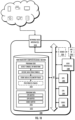
- FIG. 9 is a logical block diagram of a source device 900 , useful in conjunction with various aspects of the present disclosure.
- the source device 900 includes a processor subsystem, a memory subsystem, a sensor subsystem, a user interface subsystem, a network/data interface subsystem, and a bus to connect them.
- telemetry or other data is obtained via the sensor subsystem, the data is encoded to symbols, an analog waveform is generated based on the symbols, and the analog waveform is transmitted over an auxiliary output.
- the source device 900 may be an action camera that captures audio and/or video footage.
- the processor subsystem may read instructions from the memory subsystem and execute them within one or more processors.
- the illustrated processor subsystem includes: an image signal processor (ISP 902 ), a graphics processing unit (GPU 904 ), a central processing unit (CPU 906 ), and a hardware codec 908 .
- the ISP 902 maps captured camera sensor data to a linear color space. ISP operations may include without limitation: demosaicing, color correction, white balance, and/or autoexposure.
- the GPU 904 performs in-device modifications to image data; GPU tasks may be parallelized and/or constrained by real-time budgets.
- combinations of the sensed data can be used to derive translational and/or rotational movements; such derived data may include: camera orientation and/or image orientation quaternions (CORI/IORI 920 ) as well as gravity vectors (GRAV 922 ).
- CORI/IORI 920 camera orientation and/or image orientation quaternions
- GRAV 922 gravity vectors
- the microphone 912 senses acoustic vibrations and converts the vibrations to an electrical signal (via a transducer, condenser, etc.)
- the electrical signal may be further transformed to frequency domain information.
- the gyroscope (GYRO 916 ) measures rotation in one or more dimensions. These measurements may be mathematically converted into a four-dimensional (4D) quaternion to describe the device motion, and electronic image stabilization (EIS) may be used to offset image orientation to counteract device motion (e.g., CORI/IORI 920 ).
- the magnetometer (MAGN 918 ) may provide a magnetic north vector (which may be used to “north lock” video and/or augment location services such as GPS), similarly the accelerometer (ACCL 914 ) may also be used to calculate a gravity vector (GRAV 922 ).
- GYRO 916 the accelerometer
- other implementations may incorporate data from the accelerometer (ACCL 914 ).
- accelerometer data may be used with image information to estimate camera translations using image analysis.
- Other sensor subsystem implementations may multiply, combine, further subdivide, augment, and/or subsume the foregoing functionalities within these or other processing elements.
- two or more cameras may be used to capture panoramic (e.g., wide or 360°) or stereoscopic content.
- two or more microphones may be used to record stereo sound.
- the user interface subsystem may be used to present media to, and/or receive input from, a human user.
- media may include audible, visual, and/or haptic content. Examples include images, QR codes (or similar computer-readable images), videos, sounds, and/or vibration.
- input may be interpreted from touchscreen gestures, button presses, device motion, and/or commands (verbally spoken).
- the user interface subsystem may include physical components (e.g., buttons, keyboards, switches, scroll wheels, etc.) or virtualized components (via a touchscreen).
- the user interface subsystem 924 may include an assortment of a touchscreen, physical buttons, and a microphone.
- the network/data interface subsystem may be used to receive data from, and/or transmit data to, other devices.
- data may be received/transmitted as transitory signals (e.g., electrical signaling over a transmission medium.)
- data maybe received/transmitted as non-transitory symbols (e.g., bits read from non-transitory computer-readable mediums.)
- the network/data interface subsystem may include: wired interfaces, wireless interfaces, and/or removable memory media.
- the network/data interface subsystem 926 may include network interfaces including, but not limited to: Wi-Fi, Bluetooth, Global Positioning System (GPS), USB, and/or Ethernet network interfaces. Additionally, the network/data interface subsystem 926 may include removable media interfaces such as: SD cards (and their derivatives) and/or any other optical/electrical/magnetic media (e.g., MMC cards, CDs, DVDs, tape, etc.)
- the network/data interface subsystem may include a modulator 934 and an analog output 936 .
- the modulator 934 is a trellis coded modulator (TCM) and the analog output is an audio output channel (AUX OUT).
- TCM trellis coded modulator
- AUX OUT audio output channel
- the TCM modulator encodes data as symbols; the symbols are then transmitted as analog electrical signals corresponding to an audio signal via the AUX OUT.
- Any device with an audio input channel (AUX IN) may receive and record the analog electrical signals as audio input (e.g., acoustic vibrations that are represented as an electrical signal).
- the audio input is not explicitly clocked by the source device and may be asynchronously sampled according to the recipient device's clock (e.g., for recording as an audio media track). While the foregoing discussions have been presented in the context of an asynchronous data transfer using amplitude and frequency shift keying (AFSK), other implementations may use other modulation schemes and/or clocking schemes.
- AFSK amplitude and frequency shift keying
- the memory subsystem may be used to store (write) data locally at the source device 900 .
- data may be stored as non-transitory symbols (e.g., bits read from non-transitory computer-readable mediums.)
- the memory subsystem 928 is physically realized as one or more physical memory chips (e.g., NAND/NOR flash) that are logically separated into memory data structures.
- the memory subsystem may be bifurcated into program code 930 and/or program data 932 .
- program code and/or program data may be further organized for dedicated and/or collaborative use.
- the GPU and CPU may share a common memory buffer to facilitate large transfers of data therebetween.
- the codec may have a dedicated memory buffer to avoid resource contention.
- the program code includes non-transitory instructions that when executed by the processor subsystem cause the processor subsystem to perform tasks which may include: calculations, and/or actuation of the sensor subsystem, user interface subsystem, and/or network/data interface subsystem.
- the program code may be statically stored within the source device 900 as firmware.
- the program code may be dynamically stored (and changeable) via software updates.
- software may be subsequently updated by external parties and/or the user, based on various access permissions and procedures.
- the tasks are configured to obtain telemetry data from the sensor subsystem.
- the exemplary embodiments described above are presented in the context of an action camera that captures telemetry data while piggybacked to another camera, however the techniques described herein may be broadly generalized to a variety of other applications and/or implementations with equal success.
- the telemetry data describes the movement of a camera device, and by extension, any rigidly affixed device that has substantially similar movement (after accounting for physical offsets in translation and rotation).
- gyroscope data are sensed and used to derive quaternions that describe a camera's motion (e.g., camera orientation (CORI)).
- the telemetry data may describe the movement and/or relative positioning of the camera to its video feed (after in-camera stabilization); in some such cases, the relative positioning may be provided as an image orientation (IORI).
- IORI image orientation
- the relative difference between the IORI and CORI compensate (counteract) for camera motion; in other words, the telemetry data may be used to infer the in-camera stabilization.
- in-camera stabilization may be used by a post-processor without correction (e.g., to reduce post-processing); in other cases, in-camera stabilization may be used to improve post-processing results.
- Still other variants may include orientation data for other objects; for example, in some implementations, an orientation of a subject of interest (SORI) may be tracked relative to the camera's motion.
- SORI orientation of a subject of interest
- facial recognition software may be used to frame a designated view according to a moving face.
- sensors may be attached to the subject (rather than the camera) to provide more accurate data.
- device movement may be determined from external reference positioning; examples of such techniques may include triangulation (e.g., GPS, GLONASS, etc.), sounding/ranging (sonar, lidar, etc.), image analysis, explicit location data (e.g., provided from another device), and/or any other such technique. More generally, any scheme for receiving, retrieving, generating, or otherwise obtaining telemetry data for one or more devices may be substituted with equal success.
- the camera may have a “telemetry-only” mode that only captures telemetry data and outputs the encoded data as audio.
- Other implementations may allow for switching between telemetry-only, telemetry with full capture, and capture-only mode (without telemetry data).
- the telemetry device may be further controlled by the sink device to e.g., start/stop recording, take readings at a particular rate (e.g., based on the camera frame rate), etc.
- Machine vision often has different considerations than human applications.
- self-driving cars may use telemetry data to capture the car's velocity, acceleration, and/or other orientation information.
- the car's actual orientation is often much more important than the engine (RPM) and/or steering (dangerous situations often involve skidding, hydroplaning, etc. where the car has lost some or all traction).
- RPM engine
- surveillance, industrial, and/or medical imagery may use cameras that are inserted into another object (e.g., endoscopes, etc.) and/or independently move relative to a target of interest. In such applications, audio may be of lesser (or no) importance.
- Providing telemetry data as data-over-audio allows commodity, rather than special-purpose, components to be used to reduce cost.
- telemetry data refers to data that is collected in-situ during media capture.
- any immersive metadata may be substituted with equal success.
- Immersive metadata is more broadly described within U.S. patent application Ser. No. 16/934,628 entitled “METHODS AND APPARATUS FOR METADATA-BASED PROCESSING OF MEDIA CONTENT” filed Jul. 21, 2020, previously incorporated herein by reference in its entirety.
- immersive refers to media that includes multiple sensory modalities from a common temporal or spatial coordinate (e.g., point-of-view and/or time-of-view).
- Immersive media plunges the viewer back into the lived-in experience by exciting multiple senses or modalities of expression, as if the viewer were re-living the experience.
- a car may have a tachometer that produces instantaneous metadata in the form of revolutions per minute (RPM) data-over-audio.
- RPM data may be used in subsequent post-processing visualizations to e.g., add motion blur/redline tinting.
- a user may have a heart rate monitor that produces instantaneous metadata in the form of beats per minute (BPM) data-over-audio.
- BPM data may be used in subsequent post-processing visualizations to e.g., provide lived-in heartbeat audio, etc.
- the tasks are configured to encode the data to symbols by the processing subsystem.
- a “symbol” refers to a discrete mapping of data to another useful representation.
- digital data may be modulated to symbols that are suitable for transmission via a transmission line.
- the symbols may enable robust propagation through a transmission line that introduces noise and/or other distortions.
- the original digital data may later be reconstructed based on the received symbols using symbol detection techniques.
- modulate refers to schemes that modify physical characteristics of a wave function (frequency, amplitude, phase, etc.) into symbols that are suitable for transmission over a transmission line.
- modulation may be performed at a carrier wave frequency or at baseband (e.g., without a carrier frequency).
- Baseband modulation is sufficient for data-over-audio transmission; carrier wave-based variants may be useful for transmission over e.g., radio waves and/or other band-limited media.
- additional layers of data validation, parity, forward error correction, and/or other coding techniques may be used in conjunction with the modulation scheme to improve the signal quality relative to noise/distortion.
- a “transmission line” refers to any transmission media with logical or physical properties that constrain signal propagation. For example, a physical wire may attenuate the amplitude and/or frequency characteristics of an electrical signal. Similarly, air, water, or other acoustic media may attenuate the amplitude and/or frequency characteristics of an acoustic signal.
- the tasks are configured to generate an analog waveform based on the symbols.
- an analog sinusoidal waveform may be generated using an oscillator, amplifier, attenuator, and associated control circuitry.
- the oscillator is typically a crystal oscillator that generates an oscillating waveform based on an applied voltage; increasing voltage may result in faster oscillations, reducing voltage may result in lower oscillations (within a range).
- the amplifier and/or attenuator may modify the amplitudes of frequency components of the oscillation.
- additional filtering may be used to provide other desirable signal-to-noise characteristics e.g., to fit the waveform in the perceptible audio bandwidth (20 Hz-20 KHz), to compensate for environmental effects (e.g., temperature, impedance variation), etc.
- the control logic may be used to adjust the corresponding amplitude, frequency and/or phase to create the desired symbols.
- any suitable analog waveform generation circuitry may be substituted with equal success.
- modulators may include e.g., amplitude shift keying (ASK), frequency shift keying (FSK), phase shift keying (PSK), and any of their hybrids and derivatives.
- ASK amplitude shift keying
- FSK frequency shift keying
- PSK phase shift keying
- any of their hybrids and derivatives include e.g., amplitude shift keying (ASK), frequency shift keying (FSK), phase shift keying (PSK), and any of their hybrids and derivatives.
- AFSK amplitude frequency shift keying
- phase-aware systems may implement hybrid phase shift keying systems include without limitation: QPSK (quadrature phase shift keying), 16 QAM (16-quadrature amplitude modulation), 64 QAM, etc.
- the schemes described herein allow a recipient device to sample the analog waveform according to the recipient's clock; this allows for asynchronous data transfer.
- synchronous refers to systems and operations that have a common (shared) time reference.
- a source and sink device that can transfer symbols according to a common clock are said to be “synchronous” or “synchronized.” Synchronous data transfers can occur without rate matching—e.g., data output is clocked at the same rate as data input.
- the term “asynchronous” refers to systems and operations that have different (independent) clock domains. Asynchronous systems may have lossy/lossless data transfers.
- an asynchronous transfer from a source device maybe sampled according to the sink device's clock domain. Sampling may not preserve a one-to-one mapping of data between endpoints—in other words, large clock discrepancies may result in a different number of input/output symbols. Lossless examples may use e.g., handshakes and/or buffering to ensure that every data sample that was sent, will be correctly received.
- the analog waveform may include symbols to improve and/or compensate for asynchronous transmission.
- a string of symbols may include preamble (before data-over-audio), midamble (within the data-over-audio), and/or postamble (after data-over-audio) which allow the recipient device to correctly align and frame the data-over-audio.
- a cyclic prefix may be used to simplify operation for data frames of repeating known length.
- the sampled analog waveform (including the cyclic prefix (postfix)) can be wrapped in a circular buffer; the cyclic prefix (postfix) can then be trimmed-out to remove arbitrarily shifting timing delay (only the sampled data remains).
- the tasks are configured to transmit the analog waveform via a network/data interface e.g., to an intermediary device.
- the network/data interface is an audio output (AUX OUT) that can transmit an analog electrical signal.
- the AUX OUT is implemented with a 3.5 mm audio plug (tip-sleeve (TS), tip-ring-sleeve (TRS), or tip-ring-ring-sleeve (TRRS)), 1/4′′ audio plug (tip-sleeve (TS), tip-ring-sleeve (TRS)), and/or or phono connectors (RCA component/composite), etc.
- the network/data interface may be a digital interface that fits an adaptor for generating analog electrical signals; for example, a USB interface may be coupled with an audio adaptor to generate AUX OUT signaling.
- the analog waveform is captured, sampled, and recorded by an intermediary device (e.g., another camera device) via electrical signaling (AUX IN/OUT).
- the analog waveform may be acoustically played for other devices to record.
- true acoustic audio (rather than electrical waveforms) may be used where physical connectivity is not feasible.
- the telemetry device(s) may be remote from the video capture device.
- acoustic waves can be linearly superimposed; thus, recorded audio may contain multiple concurrent measurements.
- Acoustic transmission may impose additional signal-to-noise and/or distortion restrictions. For example, fading and/or multipath (echoes) transmission may limit the distinguishable amplitudes.
- modulation techniques may be selected to minimize such effects (e.g., frequency shift keying (FSK)) and/or subsequent signal processing may be used to discard/correct the data (forward error correction (FEC), cyclic redundancy checks (CRC), parity, etc.)
- FEC forward error correction
- CRC cyclic redundancy checks
- parity etc.
- telemetry data as a data-over-audio link
- other techniques for obtaining telemetry data, immersive metadata, etc. may be substituted with equal success.
- the techniques may be broadly applied to any number of cameras and/or capture modalities.
- telemetry data and/or immersive metadata may be recorded by multiple different devices and provided via e.g., different audio channels (e.g., left channel, right channel, front channel, etc.)
- audio channels e.g., left channel, right channel, front channel, etc.
- the sink device 1000 includes a processor subsystem, a memory subsystem, a user interface subsystem, a network/data interface subsystem, and a bus to connect them.
- the sink device obtains an analog waveform and detects symbols in the analog waveform, decodes data from the symbols, and stores the data to a telemetry track (or other media track).
- the telemetry data may additionally be used during a post-processing operation.
- the sink device 1000 may be a smart phone that plays audio and/or video footage.
- Other embodiments of source devices may include without limitation: an action camera, a tablet, a laptop, a television, a workstation, and/or any other sink of data.
- the processor subsystem may read instructions from the memory subsystem and execute them within one or more processors.
- the illustrated processor subsystem includes: a graphics processing unit (GPU 1002 ), a central processing unit (CPU 1004 ), and a codec 1006 .
- GPU 1002 graphics processing unit
- CPU 1004 central processing unit
- codec 1006 codec
- Other processor subsystem implementations may multiply, combine, further subdivide, augment, and/or subsume the foregoing functionalities within these or other processing elements.
- multiple GPUs may be used to perform high complexity image operations in parallel.
- codec functionality may be subsumed with either GPU or CPU operation via software emulation.
- the user interface subsystem may be used to present media to, and/or receive input from, a human user.
- the user interface subsystem may include physical components (e.g., buttons, keyboards, switches, scroll wheels, etc.) or virtualized components (via a touchscreen).
- the user interface subsystem 1008 may include an assortment of a display, touchscreen, physical buttons, speaker(s), and a microphone.
- the network/data interface subsystem may be used to receive data from, and/or transmit data to, other devices.
- the network/data interface subsystem may include: wired interfaces, wireless interfaces, and/or removable memory media.
- the network/data interface subsystem 1010 may include network interfaces including, but not limited to: Wi-Fi, Bluetooth, Global Positioning System (GPS), USB, and/or Ethernet network interfaces. Additionally, the network/data interface subsystem 1010 may include removable media interfaces such as: SD cards (and their derivatives) and/or any other optical/electrical/magnetic media (e.g., MMC cards, CDs, DVDs, tape, etc.)
- the network/data interface subsystem may obtain the telemetry data as a track within a media file.
- the post-processing apparatus may obtain footage from an intermediary device (a cinematic video camera) that includes an audio track with data-over-audio.
- the techniques described herein may be broadly generalized to a variety of other applications and/or implementations with equal success; as but one such example, the sink device may directly sample the audio and generate the audio track itself.
- the sink device 1000 may additionally include a demodulator 1034 and an analog input 1036 .
- the demodulator 1034 is configured to demodulate trellis coded modulation (TCM) and the analog input 1036 is an audio input channel (AUX IN).
- symbol detection may include time alignment.
- Time alignment may be based on known transmission structures; for example, the analog waveform may include preamble, midamble, postambles, and/or cyclic prefixes.
- the transmission structure may clearly delineate the start, the midpoint, or the end of the transmitted data. Still other techniques may incorporate other time information (e.g., user input, external time references, etc.)
Landscapes
- Engineering & Computer Science (AREA)
- Multimedia (AREA)
- Theoretical Computer Science (AREA)
- Health & Medical Sciences (AREA)
- Audiology, Speech & Language Pathology (AREA)
- General Health & Medical Sciences (AREA)
- Human Computer Interaction (AREA)
- Physics & Mathematics (AREA)
- General Engineering & Computer Science (AREA)
- General Physics & Mathematics (AREA)
- Studio Devices (AREA)
Abstract
Description
| TABLE 1 | ||||
| Approximate | ||||
| FourCC | Property | Frequency | Units | Comment |
| ACCL | 3-axis | 200 | m/s2 | Data order (by axis) |
| accelerometer | Z, X, Y | |||
| GYRO | 3-axis | 400 | rad/s | Data order (by axis) |
| gyroscope | Z, X, Y | |||
| MAGN | magnetometer | 24 | μT | Camera pointing |
| direction | ||||
| CORI | Camera | frame | n/a | Quaternions for the |
| ORIentation | rate | camera orientation | ||
| since capture start | ||||
| IORI | Image | frame | n/a | Quaternions for the |
| ORIentation | rate | image orientation | ||
| relative to the camera | ||||
| body | ||||
| GRAY | GRAvity | frame | n/a | Vector for the direction |
| Vector | rate | for gravity | ||
which is more than sufficient bandwidth to provide 16-bit 3-axis updates at 200 Hz for GYRO (e.g.,
or in-camera CORI data. Even higher data rates may be possible using higher order TCM coding; for example, a 16-ary TCM codec can provide 32 Kbps. Notably, the most common AAC encodings provide sufficient bandwidth for bit rates of 128 Kbps, 192 Kbps, and 256 Kbps; thus, TCM telemetry data easily falls within the codec capabilities.
Claims (19)
Priority Applications (1)
| Application Number | Priority Date | Filing Date | Title |
|---|---|---|---|
| US17/805,180 US12170099B2 (en) | 2022-01-28 | 2022-06-02 | Systems, apparatus, and methods for encoding telemetry data as audio waveforms |
Applications Claiming Priority (2)
| Application Number | Priority Date | Filing Date | Title |
|---|---|---|---|
| US202263267292P | 2022-01-28 | 2022-01-28 | |
| US17/805,180 US12170099B2 (en) | 2022-01-28 | 2022-06-02 | Systems, apparatus, and methods for encoding telemetry data as audio waveforms |
Publications (2)
| Publication Number | Publication Date |
|---|---|
| US20230245688A1 US20230245688A1 (en) | 2023-08-03 |
| US12170099B2 true US12170099B2 (en) | 2024-12-17 |
Family
ID=87432433
Family Applications (1)
| Application Number | Title | Priority Date | Filing Date |
|---|---|---|---|
| US17/805,180 Active 2042-06-24 US12170099B2 (en) | 2022-01-28 | 2022-06-02 | Systems, apparatus, and methods for encoding telemetry data as audio waveforms |
Country Status (1)
| Country | Link |
|---|---|
| US (1) | US12170099B2 (en) |
Families Citing this family (4)
| Publication number | Priority date | Publication date | Assignee | Title |
|---|---|---|---|---|
| US11570378B2 (en) | 2020-07-21 | 2023-01-31 | Gopro, Inc. | Methods and apparatus for metadata-based processing of media content |
| US12035044B2 (en) | 2021-10-01 | 2024-07-09 | Gopro, Inc. | Methods and apparatus for re-stabilizing video in post-processing |
| US12262115B2 (en) | 2022-01-28 | 2025-03-25 | Gopro, Inc. | Methods and apparatus for electronic image stabilization based on a lens polynomial |
| US12299934B2 (en) | 2022-07-27 | 2025-05-13 | Gopro, Inc. | Systems, methods, and apparatus for piggyback camera calibration |
Citations (12)
| Publication number | Priority date | Publication date | Assignee | Title |
|---|---|---|---|---|
| US6061408A (en) * | 1999-04-16 | 2000-05-09 | Tiernan Communications, Inc. | Method and apparatus for 45° phase ambiguity resolution for one coded bit per symbol 8PSK modulation |
| US20060109933A1 (en) * | 2004-11-23 | 2006-05-25 | Chin Lee | Methods and apparatus for symmetrical phase-shift keying |
| US20070258707A1 (en) | 2006-05-08 | 2007-11-08 | Ramesh Raskar | Method and apparatus for deblurring images |
| US20080253685A1 (en) | 2007-02-23 | 2008-10-16 | Intellivision Technologies Corporation | Image and video stitching and viewing method and system |
| US20090157746A1 (en) * | 2007-12-13 | 2009-06-18 | Osmose Utilities Services, Inc. | Method For Capturing Utility Equipment Data |
| US20140072056A1 (en) * | 2012-09-07 | 2014-03-13 | Sony Corporation | Combination a/53 and a/153 receiver using a hiho viterbi decoder |
| US20150341536A1 (en) | 2014-05-23 | 2015-11-26 | Mophie, Inc. | Systems and methods for orienting an image |
| US9681111B1 (en) | 2015-10-22 | 2017-06-13 | Gopro, Inc. | Apparatus and methods for embedding metadata into video stream |
| US10681311B1 (en) * | 2017-10-30 | 2020-06-09 | Affective Software, Inc. | Semi-automated, distributed, interactive relationship counseling system |
| US20220030177A1 (en) | 2020-07-21 | 2022-01-27 | Gopro, Inc. | Methods and apparatus for metadata-based processing of media content |
| US20230109047A1 (en) | 2021-10-01 | 2023-04-06 | Gopro, Inc. | Methods and apparatus for re-stabilizing video in post-processing |
| US20230247292A1 (en) | 2022-01-28 | 2023-08-03 | Gopro, Inc. | Methods and apparatus for electronic image stabilization based on a lens polynomial |
-
2022
- 2022-06-02 US US17/805,180 patent/US12170099B2/en active Active
Patent Citations (13)
| Publication number | Priority date | Publication date | Assignee | Title |
|---|---|---|---|---|
| US6061408A (en) * | 1999-04-16 | 2000-05-09 | Tiernan Communications, Inc. | Method and apparatus for 45° phase ambiguity resolution for one coded bit per symbol 8PSK modulation |
| US20060109933A1 (en) * | 2004-11-23 | 2006-05-25 | Chin Lee | Methods and apparatus for symmetrical phase-shift keying |
| US20070258707A1 (en) | 2006-05-08 | 2007-11-08 | Ramesh Raskar | Method and apparatus for deblurring images |
| US20080253685A1 (en) | 2007-02-23 | 2008-10-16 | Intellivision Technologies Corporation | Image and video stitching and viewing method and system |
| US20090157746A1 (en) * | 2007-12-13 | 2009-06-18 | Osmose Utilities Services, Inc. | Method For Capturing Utility Equipment Data |
| US20140072056A1 (en) * | 2012-09-07 | 2014-03-13 | Sony Corporation | Combination a/53 and a/153 receiver using a hiho viterbi decoder |
| US20150341536A1 (en) | 2014-05-23 | 2015-11-26 | Mophie, Inc. | Systems and methods for orienting an image |
| US9681111B1 (en) | 2015-10-22 | 2017-06-13 | Gopro, Inc. | Apparatus and methods for embedding metadata into video stream |
| US10681311B1 (en) * | 2017-10-30 | 2020-06-09 | Affective Software, Inc. | Semi-automated, distributed, interactive relationship counseling system |
| US20220030177A1 (en) | 2020-07-21 | 2022-01-27 | Gopro, Inc. | Methods and apparatus for metadata-based processing of media content |
| US20230144635A1 (en) | 2020-07-21 | 2023-05-11 | Gopro, Inc. | Methods and Apparatus for Metadata-Based Processing of Media Content |
| US20230109047A1 (en) | 2021-10-01 | 2023-04-06 | Gopro, Inc. | Methods and apparatus for re-stabilizing video in post-processing |
| US20230247292A1 (en) | 2022-01-28 | 2023-08-03 | Gopro, Inc. | Methods and apparatus for electronic image stabilization based on a lens polynomial |
Also Published As
| Publication number | Publication date |
|---|---|
| US20230245688A1 (en) | 2023-08-03 |
Similar Documents
| Publication | Publication Date | Title |
|---|---|---|
| US12170099B2 (en) | Systems, apparatus, and methods for encoding telemetry data as audio waveforms | |
| US12126809B2 (en) | Systems and methods for spatially selective video coding | |
| US8773589B2 (en) | Audio/video methods and systems | |
| EP2619761B1 (en) | Enriching digital photographs | |
| US11908111B2 (en) | Image processing including noise reduction | |
| US11490199B2 (en) | Sound recording apparatus, sound system, sound recording method, and carrier means | |
| CN111580765A (en) | Screen projection method, screen projection device, storage medium, screen projection equipment and screen projection equipment | |
| KR102177605B1 (en) | Information processing apparatus, content requesting method, and computer-readable storage medium | |
| JP2023027280A (en) | SOUND DEVICE, IMAGING DEVICE, SOUND SYSTEM, METHOD AND PROGRAM | |
| MX2014008979A (en) | Encoding device and encoding method, and decoding device and decoding method. | |
| US20240273829A1 (en) | Systems and methods for pass-through extended reality (xr) content | |
| US20090136211A1 (en) | Recording apparatus, video camera and position information management method | |
| CN118059469A (en) | Game data transmission and processing method, server and terminal device | |
| CN1913627B (en) | decoding device | |
| EP4513306A1 (en) | Signaling image horizon data | |
| JP4921440B2 (en) | Imaging device | |
| JP2013150039A (en) | Information processing apparatus and information processing method |
Legal Events
| Date | Code | Title | Description |
|---|---|---|---|
| AS | Assignment |
Owner name: GOPRO, INC., CALIFORNIA Free format text: ASSIGNMENT OF ASSIGNORS INTEREST;ASSIGNORS:NEWMAN, DAVID;MCINTOSH, ROBERT;REEL/FRAME:060090/0160 Effective date: 20220531 |
|
| FEPP | Fee payment procedure |
Free format text: ENTITY STATUS SET TO UNDISCOUNTED (ORIGINAL EVENT CODE: BIG.); ENTITY STATUS OF PATENT OWNER: LARGE ENTITY |
|
| STPP | Information on status: patent application and granting procedure in general |
Free format text: NON FINAL ACTION MAILED |
|
| STPP | Information on status: patent application and granting procedure in general |
Free format text: RESPONSE TO NON-FINAL OFFICE ACTION ENTERED AND FORWARDED TO EXAMINER |
|
| STPP | Information on status: patent application and granting procedure in general |
Free format text: NON FINAL ACTION MAILED |
|
| STPP | Information on status: patent application and granting procedure in general |
Free format text: RESPONSE TO NON-FINAL OFFICE ACTION ENTERED AND FORWARDED TO EXAMINER |
|
| STPP | Information on status: patent application and granting procedure in general |
Free format text: NON FINAL ACTION MAILED |
|
| STPP | Information on status: patent application and granting procedure in general |
Free format text: RESPONSE TO NON-FINAL OFFICE ACTION ENTERED AND FORWARDED TO EXAMINER |
|
| STPP | Information on status: patent application and granting procedure in general |
Free format text: FINAL REJECTION MAILED |
|
| STPP | Information on status: patent application and granting procedure in general |
Free format text: NOTICE OF ALLOWANCE MAILED -- APPLICATION RECEIVED IN OFFICE OF PUBLICATIONS |
|
| STPP | Information on status: patent application and granting procedure in general |
Free format text: PUBLICATIONS -- ISSUE FEE PAYMENT VERIFIED |
|
| STCF | Information on status: patent grant |
Free format text: PATENTED CASE |
|
| AS | Assignment |
Owner name: WELLS FARGO BANK, NATIONAL ASSOCIATION, AS AGENT, CALIFORNIA Free format text: SECURITY INTEREST;ASSIGNOR:GOPRO, INC.;REEL/FRAME:072358/0001 Effective date: 20250804 Owner name: FARALLON CAPITAL MANAGEMENT, L.L.C., AS AGENT, CALIFORNIA Free format text: SECURITY INTEREST;ASSIGNOR:GOPRO, INC.;REEL/FRAME:072340/0676 Effective date: 20250804 |