US12159997B2 - Solid battery - Google Patents
Solid battery Download PDFInfo
- Publication number
- US12159997B2 US12159997B2 US17/326,564 US202117326564A US12159997B2 US 12159997 B2 US12159997 B2 US 12159997B2 US 202117326564 A US202117326564 A US 202117326564A US 12159997 B2 US12159997 B2 US 12159997B2
- Authority
- US
- United States
- Prior art keywords
- active material
- layer
- electrode layer
- negative electrode
- sub
- Prior art date
- Legal status (The legal status is an assumption and is not a legal conclusion. Google has not performed a legal analysis and makes no representation as to the accuracy of the status listed.)
- Active, expires
Links
- 239000007787 solid Substances 0.000 title claims abstract description 116
- 239000002245 particle Substances 0.000 claims abstract description 248
- 239000011149 active material Substances 0.000 claims abstract description 188
- 239000007784 solid electrolyte Substances 0.000 claims abstract description 71
- 238000010030 laminating Methods 0.000 claims abstract description 46
- 239000000470 constituent Substances 0.000 claims abstract description 21
- 239000003575 carbonaceous material Substances 0.000 claims description 11
- HBBGRARXTFLTSG-UHFFFAOYSA-N Lithium ion Chemical compound [Li+] HBBGRARXTFLTSG-UHFFFAOYSA-N 0.000 claims description 7
- 229910001416 lithium ion Inorganic materials 0.000 claims description 7
- 239000010410 layer Substances 0.000 description 448
- 238000000034 method Methods 0.000 description 40
- 239000000463 material Substances 0.000 description 36
- 150000002500 ions Chemical class 0.000 description 34
- 238000000926 separation method Methods 0.000 description 31
- 239000011230 binding agent Substances 0.000 description 22
- 239000007773 negative electrode material Substances 0.000 description 21
- 239000007774 positive electrode material Substances 0.000 description 21
- 238000006243 chemical reaction Methods 0.000 description 20
- -1 lithium transition metal Chemical class 0.000 description 20
- 229910052744 lithium Inorganic materials 0.000 description 18
- 239000011521 glass Substances 0.000 description 17
- 239000002003 electrode paste Substances 0.000 description 16
- 238000005245 sintering Methods 0.000 description 16
- 239000002904 solvent Substances 0.000 description 16
- 239000000758 substrate Substances 0.000 description 15
- 239000011241 protective layer Substances 0.000 description 14
- VYPSYNLAJGMNEJ-UHFFFAOYSA-N Silicium dioxide Chemical compound O=[Si]=O VYPSYNLAJGMNEJ-UHFFFAOYSA-N 0.000 description 12
- 239000002243 precursor Substances 0.000 description 11
- 229910052723 transition metal Inorganic materials 0.000 description 11
- PXHVJJICTQNCMI-UHFFFAOYSA-N Nickel Chemical compound [Ni] PXHVJJICTQNCMI-UHFFFAOYSA-N 0.000 description 10
- 229910000147 aluminium phosphate Inorganic materials 0.000 description 10
- 239000004020 conductor Substances 0.000 description 10
- 238000002156 mixing Methods 0.000 description 10
- 239000011368 organic material Substances 0.000 description 10
- NBIIXXVUZAFLBC-UHFFFAOYSA-N phosphoric acid Substances OP(O)(O)=O NBIIXXVUZAFLBC-UHFFFAOYSA-N 0.000 description 10
- BASFCYQUMIYNBI-UHFFFAOYSA-N platinum Chemical compound [Pt] BASFCYQUMIYNBI-UHFFFAOYSA-N 0.000 description 10
- 239000011734 sodium Substances 0.000 description 10
- DGAQECJNVWCQMB-PUAWFVPOSA-M Ilexoside XXIX Chemical compound C[C@@H]1CC[C@@]2(CC[C@@]3(C(=CC[C@H]4[C@]3(CC[C@@H]5[C@@]4(CC[C@@H](C5(C)C)OS(=O)(=O)[O-])C)C)[C@@H]2[C@]1(C)O)C)C(=O)O[C@H]6[C@@H]([C@H]([C@@H]([C@H](O6)CO)O)O)O.[Na+] DGAQECJNVWCQMB-PUAWFVPOSA-M 0.000 description 9
- 238000007599 discharging Methods 0.000 description 9
- 238000010304 firing Methods 0.000 description 9
- 229910052814 silicon oxide Inorganic materials 0.000 description 9
- 229910052708 sodium Inorganic materials 0.000 description 9
- 239000002344 surface layer Substances 0.000 description 9
- KDLHZDBZIXYQEI-UHFFFAOYSA-N Palladium Chemical compound [Pd] KDLHZDBZIXYQEI-UHFFFAOYSA-N 0.000 description 8
- 239000011810 insulating material Substances 0.000 description 8
- 229910052751 metal Inorganic materials 0.000 description 8
- 238000007639 printing Methods 0.000 description 8
- WHXSMMKQMYFTQS-UHFFFAOYSA-N Lithium Chemical compound [Li] WHXSMMKQMYFTQS-UHFFFAOYSA-N 0.000 description 7
- JKWMSGQKBLHBQQ-UHFFFAOYSA-N diboron trioxide Chemical compound O=BOB=O JKWMSGQKBLHBQQ-UHFFFAOYSA-N 0.000 description 7
- 238000009792 diffusion process Methods 0.000 description 7
- 230000001681 protective effect Effects 0.000 description 7
- FKNQFGJONOIPTF-UHFFFAOYSA-N Sodium cation Chemical compound [Na+] FKNQFGJONOIPTF-UHFFFAOYSA-N 0.000 description 6
- 229910052782 aluminium Inorganic materials 0.000 description 6
- 229910052810 boron oxide Inorganic materials 0.000 description 6
- 150000001875 compounds Chemical class 0.000 description 6
- FUJCRWPEOMXPAD-UHFFFAOYSA-N lithium oxide Chemical compound [Li+].[Li+].[O-2] FUJCRWPEOMXPAD-UHFFFAOYSA-N 0.000 description 6
- 229910001947 lithium oxide Inorganic materials 0.000 description 6
- 239000002905 metal composite material Substances 0.000 description 6
- 239000007769 metal material Substances 0.000 description 6
- 229910001415 sodium ion Inorganic materials 0.000 description 6
- 239000000126 substance Substances 0.000 description 6
- 239000010936 titanium Substances 0.000 description 6
- 238000004519 manufacturing process Methods 0.000 description 5
- 239000002861 polymer material Substances 0.000 description 5
- 239000002244 precipitate Substances 0.000 description 5
- 239000002994 raw material Substances 0.000 description 5
- 238000012546 transfer Methods 0.000 description 5
- OKTJSMMVPCPJKN-UHFFFAOYSA-N Carbon Chemical compound [C] OKTJSMMVPCPJKN-UHFFFAOYSA-N 0.000 description 4
- BQCADISMDOOEFD-UHFFFAOYSA-N Silver Chemical compound [Ag] BQCADISMDOOEFD-UHFFFAOYSA-N 0.000 description 4
- XAGFODPZIPBFFR-UHFFFAOYSA-N aluminium Chemical compound [Al] XAGFODPZIPBFFR-UHFFFAOYSA-N 0.000 description 4
- 239000010949 copper Substances 0.000 description 4
- 239000008151 electrolyte solution Substances 0.000 description 4
- 229910052732 germanium Inorganic materials 0.000 description 4
- 239000002241 glass-ceramic Substances 0.000 description 4
- 239000010931 gold Substances 0.000 description 4
- 238000010438 heat treatment Methods 0.000 description 4
- 239000011777 magnesium Substances 0.000 description 4
- 229910052759 nickel Inorganic materials 0.000 description 4
- 229910052697 platinum Inorganic materials 0.000 description 4
- 239000011347 resin Substances 0.000 description 4
- 229920005989 resin Polymers 0.000 description 4
- 238000007650 screen-printing Methods 0.000 description 4
- 229910052709 silver Inorganic materials 0.000 description 4
- 239000004332 silver Substances 0.000 description 4
- 239000011135 tin Substances 0.000 description 4
- 229910052719 titanium Inorganic materials 0.000 description 4
- 230000007704 transition Effects 0.000 description 4
- RYGMFSIKBFXOCR-UHFFFAOYSA-N Copper Chemical compound [Cu] RYGMFSIKBFXOCR-UHFFFAOYSA-N 0.000 description 3
- XEEYBQQBJWHFJM-UHFFFAOYSA-N Iron Chemical compound [Fe] XEEYBQQBJWHFJM-UHFFFAOYSA-N 0.000 description 3
- 229910019142 PO4 Inorganic materials 0.000 description 3
- 229910052581 Si3N4 Inorganic materials 0.000 description 3
- YXFVVABEGXRONW-UHFFFAOYSA-N Toluene Chemical compound CC1=CC=CC=C1 YXFVVABEGXRONW-UHFFFAOYSA-N 0.000 description 3
- 239000000956 alloy Substances 0.000 description 3
- 229910045601 alloy Inorganic materials 0.000 description 3
- 229910010293 ceramic material Inorganic materials 0.000 description 3
- 229910052802 copper Inorganic materials 0.000 description 3
- 239000003792 electrolyte Substances 0.000 description 3
- 229910052733 gallium Inorganic materials 0.000 description 3
- PCHJSUWPFVWCPO-UHFFFAOYSA-N gold Chemical compound [Au] PCHJSUWPFVWCPO-UHFFFAOYSA-N 0.000 description 3
- 229910052737 gold Inorganic materials 0.000 description 3
- 239000010439 graphite Substances 0.000 description 3
- 229910002804 graphite Inorganic materials 0.000 description 3
- 230000007774 longterm Effects 0.000 description 3
- 229910052763 palladium Inorganic materials 0.000 description 3
- 229910052710 silicon Inorganic materials 0.000 description 3
- HQVNEWCFYHHQES-UHFFFAOYSA-N silicon nitride Chemical compound N12[Si]34N5[Si]62N3[Si]51N64 HQVNEWCFYHHQES-UHFFFAOYSA-N 0.000 description 3
- 238000003860 storage Methods 0.000 description 3
- 229910052718 tin Inorganic materials 0.000 description 3
- 239000004925 Acrylic resin Substances 0.000 description 2
- IJGRMHOSHXDMSA-UHFFFAOYSA-N Atomic nitrogen Chemical compound N#N IJGRMHOSHXDMSA-UHFFFAOYSA-N 0.000 description 2
- 238000012935 Averaging Methods 0.000 description 2
- ZOXJGFHDIHLPTG-UHFFFAOYSA-N Boron Chemical compound [B] ZOXJGFHDIHLPTG-UHFFFAOYSA-N 0.000 description 2
- FYYHWMGAXLPEAU-UHFFFAOYSA-N Magnesium Chemical compound [Mg] FYYHWMGAXLPEAU-UHFFFAOYSA-N 0.000 description 2
- 239000002228 NASICON Substances 0.000 description 2
- 229920003171 Poly (ethylene oxide) Polymers 0.000 description 2
- XUIMIQQOPSSXEZ-UHFFFAOYSA-N Silicon Chemical compound [Si] XUIMIQQOPSSXEZ-UHFFFAOYSA-N 0.000 description 2
- UCKMPCXJQFINFW-UHFFFAOYSA-N Sulphide Chemical compound [S-2] UCKMPCXJQFINFW-UHFFFAOYSA-N 0.000 description 2
- ATJFFYVFTNAWJD-UHFFFAOYSA-N Tin Chemical compound [Sn] ATJFFYVFTNAWJD-UHFFFAOYSA-N 0.000 description 2
- RTAQQCXQSZGOHL-UHFFFAOYSA-N Titanium Chemical compound [Ti] RTAQQCXQSZGOHL-UHFFFAOYSA-N 0.000 description 2
- 239000000853 adhesive Substances 0.000 description 2
- 230000001070 adhesive effect Effects 0.000 description 2
- 229910002113 barium titanate Inorganic materials 0.000 description 2
- XBJJRSFLZVLCSE-UHFFFAOYSA-N barium(2+);diborate Chemical compound [Ba+2].[Ba+2].[Ba+2].[O-]B([O-])[O-].[O-]B([O-])[O-] XBJJRSFLZVLCSE-UHFFFAOYSA-N 0.000 description 2
- 229910052797 bismuth Inorganic materials 0.000 description 2
- JCXGWMGPZLAOME-UHFFFAOYSA-N bismuth atom Chemical compound [Bi] JCXGWMGPZLAOME-UHFFFAOYSA-N 0.000 description 2
- 229910052796 boron Inorganic materials 0.000 description 2
- 239000011651 chromium Substances 0.000 description 2
- 229910017052 cobalt Inorganic materials 0.000 description 2
- 239000010941 cobalt Substances 0.000 description 2
- GUTLYIVDDKVIGB-UHFFFAOYSA-N cobalt atom Chemical compound [Co] GUTLYIVDDKVIGB-UHFFFAOYSA-N 0.000 description 2
- 239000002131 composite material Substances 0.000 description 2
- 230000006866 deterioration Effects 0.000 description 2
- 229910001873 dinitrogen Inorganic materials 0.000 description 2
- 230000005611 electricity Effects 0.000 description 2
- GNPVGFCGXDBREM-UHFFFAOYSA-N germanium atom Chemical compound [Ge] GNPVGFCGXDBREM-UHFFFAOYSA-N 0.000 description 2
- 229910021469 graphitizable carbon Inorganic materials 0.000 description 2
- 229910052738 indium Inorganic materials 0.000 description 2
- APFVFJFRJDLVQX-UHFFFAOYSA-N indium atom Chemical compound [In] APFVFJFRJDLVQX-UHFFFAOYSA-N 0.000 description 2
- 229910010272 inorganic material Inorganic materials 0.000 description 2
- 239000011147 inorganic material Substances 0.000 description 2
- 229910052749 magnesium Inorganic materials 0.000 description 2
- 239000011572 manganese Substances 0.000 description 2
- 239000002931 mesocarbon microbead Substances 0.000 description 2
- 239000010955 niobium Substances 0.000 description 2
- 239000003960 organic solvent Substances 0.000 description 2
- TWNQGVIAIRXVLR-UHFFFAOYSA-N oxo(oxoalumanyloxy)alumane Chemical compound O=[Al]O[Al]=O TWNQGVIAIRXVLR-UHFFFAOYSA-N 0.000 description 2
- RVTZCBVAJQQJTK-UHFFFAOYSA-N oxygen(2-);zirconium(4+) Chemical compound [O-2].[O-2].[Zr+4] RVTZCBVAJQQJTK-UHFFFAOYSA-N 0.000 description 2
- 239000000047 product Substances 0.000 description 2
- 238000011160 research Methods 0.000 description 2
- 238000001878 scanning electron micrograph Methods 0.000 description 2
- 239000010703 silicon Substances 0.000 description 2
- HBMJWWWQQXIZIP-UHFFFAOYSA-N silicon carbide Chemical compound [Si+]#[C-] HBMJWWWQQXIZIP-UHFFFAOYSA-N 0.000 description 2
- 229920003051 synthetic elastomer Polymers 0.000 description 2
- 239000005061 synthetic rubber Substances 0.000 description 2
- JBQYATWDVHIOAR-UHFFFAOYSA-N tellanylidenegermanium Chemical compound [Te]=[Ge] JBQYATWDVHIOAR-UHFFFAOYSA-N 0.000 description 2
- 229910052726 zirconium Inorganic materials 0.000 description 2
- 229910001928 zirconium oxide Inorganic materials 0.000 description 2
- DHKHKXVYLBGOIT-UHFFFAOYSA-N 1,1-Diethoxyethane Chemical compound CCOC(C)OCC DHKHKXVYLBGOIT-UHFFFAOYSA-N 0.000 description 1
- 229920000178 Acrylic resin Polymers 0.000 description 1
- PIGFYZPCRLYGLF-UHFFFAOYSA-N Aluminum nitride Chemical compound [Al]#N PIGFYZPCRLYGLF-UHFFFAOYSA-N 0.000 description 1
- 229920002799 BoPET Polymers 0.000 description 1
- BTBUEUYNUDRHOZ-UHFFFAOYSA-N Borate Chemical compound [O-]B([O-])[O-] BTBUEUYNUDRHOZ-UHFFFAOYSA-N 0.000 description 1
- PZNSFCLAULLKQX-UHFFFAOYSA-N Boron nitride Chemical compound N#B PZNSFCLAULLKQX-UHFFFAOYSA-N 0.000 description 1
- DKPFZGUDAPQIHT-UHFFFAOYSA-N Butyl acetate Natural products CCCCOC(C)=O DKPFZGUDAPQIHT-UHFFFAOYSA-N 0.000 description 1
- VYZAMTAEIAYCRO-UHFFFAOYSA-N Chromium Chemical compound [Cr] VYZAMTAEIAYCRO-UHFFFAOYSA-N 0.000 description 1
- MYMOFIZGZYHOMD-UHFFFAOYSA-N Dioxygen Chemical compound O=O MYMOFIZGZYHOMD-UHFFFAOYSA-N 0.000 description 1
- YCKRFDGAMUMZLT-UHFFFAOYSA-N Fluorine atom Chemical compound [F] YCKRFDGAMUMZLT-UHFFFAOYSA-N 0.000 description 1
- GYHNNYVSQQEPJS-UHFFFAOYSA-N Gallium Chemical compound [Ga] GYHNNYVSQQEPJS-UHFFFAOYSA-N 0.000 description 1
- 229910019271 La0.55Li0.35TiO3 Inorganic materials 0.000 description 1
- 229910017574 La2/3-xLi3xTiO3 Inorganic materials 0.000 description 1
- 229910017575 La2/3−xLi3xTiO3 Inorganic materials 0.000 description 1
- 229910000733 Li alloy Inorganic materials 0.000 description 1
- 229910006210 Li1+xAlxTi2-x(PO4)3 Inorganic materials 0.000 description 1
- 229910006212 Li1+xAlxTi2−x(PO4)3 Inorganic materials 0.000 description 1
- 229910003405 Li10GeP2S12 Inorganic materials 0.000 description 1
- 229910009297 Li2S-P2S5 Inorganic materials 0.000 description 1
- 229910009324 Li2S-SiS2-Li3PO4 Inorganic materials 0.000 description 1
- 229910009328 Li2S-SiS2—Li3PO4 Inorganic materials 0.000 description 1
- 229910009228 Li2S—P2S5 Inorganic materials 0.000 description 1
- 229910007295 Li2S—SiS2—Li3PO4 Inorganic materials 0.000 description 1
- 229910012425 Li3Fe2 (PO4)3 Inorganic materials 0.000 description 1
- 229910001367 Li3V2(PO4)3 Inorganic materials 0.000 description 1
- 229910002986 Li4Ti5O12 Inorganic materials 0.000 description 1
- 229910010629 Li6.75La3Zr1.75Nb0.25O12 Inorganic materials 0.000 description 1
- 229910010640 Li6BaLa2Ta2O12 Inorganic materials 0.000 description 1
- 229910002984 Li7La3Zr2O12 Inorganic materials 0.000 description 1
- 229910011201 Li7P3S11 Inorganic materials 0.000 description 1
- 229910032387 LiCoO2 Inorganic materials 0.000 description 1
- 229910011279 LiCoPO4 Inorganic materials 0.000 description 1
- 229910011638 LiCrO2 Inorganic materials 0.000 description 1
- 229910052493 LiFePO4 Inorganic materials 0.000 description 1
- 229910003005 LiNiO2 Inorganic materials 0.000 description 1
- 229910012573 LiSiO Inorganic materials 0.000 description 1
- 229910012404 LiSnO Inorganic materials 0.000 description 1
- 229910012981 LiVO2 Inorganic materials 0.000 description 1
- 229910002097 Lithium manganese(III,IV) oxide Inorganic materials 0.000 description 1
- 229910017244 LixM1O2 Inorganic materials 0.000 description 1
- 229910016080 LixMy(PO4)3 Inorganic materials 0.000 description 1
- 229910013263 LiyM2O4 Inorganic materials 0.000 description 1
- 229910013915 M3PO4 Inorganic materials 0.000 description 1
- PWHULOQIROXLJO-UHFFFAOYSA-N Manganese Chemical compound [Mn] PWHULOQIROXLJO-UHFFFAOYSA-N 0.000 description 1
- 229910019743 Mg2Sn Inorganic materials 0.000 description 1
- ZOKXTWBITQBERF-UHFFFAOYSA-N Molybdenum Chemical compound [Mo] ZOKXTWBITQBERF-UHFFFAOYSA-N 0.000 description 1
- SECXISVLQFMRJM-UHFFFAOYSA-N N-Methylpyrrolidone Chemical compound CN1CCCC1=O SECXISVLQFMRJM-UHFFFAOYSA-N 0.000 description 1
- 239000002033 PVDF binder Substances 0.000 description 1
- 239000004642 Polyimide Substances 0.000 description 1
- 239000004372 Polyvinyl alcohol Substances 0.000 description 1
- KWYUFKZDYYNOTN-UHFFFAOYSA-M Potassium hydroxide Chemical compound [OH-].[K+] KWYUFKZDYYNOTN-UHFFFAOYSA-M 0.000 description 1
- 229910003685 SiB4 Inorganic materials 0.000 description 1
- 229910020221 SiOV Inorganic materials 0.000 description 1
- 229910006826 SnOw Inorganic materials 0.000 description 1
- 229910005792 SnSiO3 Inorganic materials 0.000 description 1
- 229910008479 TiSi2 Inorganic materials 0.000 description 1
- 238000009825 accumulation Methods 0.000 description 1
- 239000011354 acetal resin Substances 0.000 description 1
- WUOACPNHFRMFPN-UHFFFAOYSA-N alpha-terpineol Chemical compound CC1=CCC(C(C)(C)O)CC1 WUOACPNHFRMFPN-UHFFFAOYSA-N 0.000 description 1
- 238000000498 ball milling Methods 0.000 description 1
- JRPBQTZRNDNNOP-UHFFFAOYSA-N barium titanate Chemical compound [Ba+2].[Ba+2].[O-][Ti]([O-])([O-])[O-] JRPBQTZRNDNNOP-UHFFFAOYSA-N 0.000 description 1
- 238000010296 bead milling Methods 0.000 description 1
- DFJQEGUNXWZVAH-UHFFFAOYSA-N bis($l^{2}-silanylidene)titanium Chemical compound [Si]=[Ti]=[Si] DFJQEGUNXWZVAH-UHFFFAOYSA-N 0.000 description 1
- 229910000416 bismuth oxide Inorganic materials 0.000 description 1
- KAMGYJQEWVDJBD-UHFFFAOYSA-N bismuth zinc borate Chemical compound B([O-])([O-])[O-].[Zn+2].[Bi+3] KAMGYJQEWVDJBD-UHFFFAOYSA-N 0.000 description 1
- 229910052793 cadmium Inorganic materials 0.000 description 1
- BDOSMKKIYDKNTQ-UHFFFAOYSA-N cadmium atom Chemical compound [Cd] BDOSMKKIYDKNTQ-UHFFFAOYSA-N 0.000 description 1
- 239000002041 carbon nanotube Substances 0.000 description 1
- 229910021393 carbon nanotube Inorganic materials 0.000 description 1
- 239000012461 cellulose resin Substances 0.000 description 1
- 239000000919 ceramic Substances 0.000 description 1
- 229910052804 chromium Inorganic materials 0.000 description 1
- 238000004891 communication Methods 0.000 description 1
- 238000005520 cutting process Methods 0.000 description 1
- SQIFACVGCPWBQZ-UHFFFAOYSA-N delta-terpineol Natural products CC(C)(O)C1CCC(=C)CC1 SQIFACVGCPWBQZ-UHFFFAOYSA-N 0.000 description 1
- DQUIAMCJEJUUJC-UHFFFAOYSA-N dibismuth;dioxido(oxo)silane Chemical compound [Bi+3].[Bi+3].[O-][Si]([O-])=O.[O-][Si]([O-])=O.[O-][Si]([O-])=O DQUIAMCJEJUUJC-UHFFFAOYSA-N 0.000 description 1
- TYIXMATWDRGMPF-UHFFFAOYSA-N dibismuth;oxygen(2-) Chemical compound [O-2].[O-2].[O-2].[Bi+3].[Bi+3] TYIXMATWDRGMPF-UHFFFAOYSA-N 0.000 description 1
- XUCJHNOBJLKZNU-UHFFFAOYSA-M dilithium;hydroxide Chemical compound [Li+].[Li+].[OH-] XUCJHNOBJLKZNU-UHFFFAOYSA-M 0.000 description 1
- 229910001882 dioxygen Inorganic materials 0.000 description 1
- 239000006185 dispersion Substances 0.000 description 1
- 230000000694 effects Effects 0.000 description 1
- 229920001971 elastomer Polymers 0.000 description 1
- 239000011883 electrode binding agent Substances 0.000 description 1
- 238000004993 emission spectroscopy Methods 0.000 description 1
- 239000011737 fluorine Substances 0.000 description 1
- 229910052731 fluorine Inorganic materials 0.000 description 1
- 239000011888 foil Substances 0.000 description 1
- 239000002223 garnet Substances 0.000 description 1
- 230000005484 gravity Effects 0.000 description 1
- 238000007646 gravure printing Methods 0.000 description 1
- 229910052735 hafnium Inorganic materials 0.000 description 1
- VBJZVLUMGGDVMO-UHFFFAOYSA-N hafnium atom Chemical compound [Hf] VBJZVLUMGGDVMO-UHFFFAOYSA-N 0.000 description 1
- FUZZWVXGSFPDMH-UHFFFAOYSA-N hexanoic acid Chemical compound CCCCCC(O)=O FUZZWVXGSFPDMH-UHFFFAOYSA-N 0.000 description 1
- 239000012535 impurity Substances 0.000 description 1
- 238000009616 inductively coupled plasma Methods 0.000 description 1
- 238000009413 insulation Methods 0.000 description 1
- 238000002955 isolation Methods 0.000 description 1
- 239000011244 liquid electrolyte Substances 0.000 description 1
- 239000001989 lithium alloy Substances 0.000 description 1
- 150000002642 lithium compounds Chemical class 0.000 description 1
- 238000007726 management method Methods 0.000 description 1
- 229910052748 manganese Inorganic materials 0.000 description 1
- 238000001000 micrograph Methods 0.000 description 1
- 239000000203 mixture Substances 0.000 description 1
- 229910052750 molybdenum Inorganic materials 0.000 description 1
- 239000011733 molybdenum Substances 0.000 description 1
- 229910052758 niobium Inorganic materials 0.000 description 1
- GUCVJGMIXFAOAE-UHFFFAOYSA-N niobium atom Chemical compound [Nb] GUCVJGMIXFAOAE-UHFFFAOYSA-N 0.000 description 1
- 239000012811 non-conductive material Substances 0.000 description 1
- 230000000474 nursing effect Effects 0.000 description 1
- NBIIXXVUZAFLBC-UHFFFAOYSA-K phosphate Chemical compound [O-]P([O-])([O-])=O NBIIXXVUZAFLBC-UHFFFAOYSA-K 0.000 description 1
- 239000010452 phosphate Substances 0.000 description 1
- 150000003016 phosphoric acids Chemical class 0.000 description 1
- 229910001392 phosphorus oxide Inorganic materials 0.000 description 1
- 229920000139 polyethylene terephthalate Polymers 0.000 description 1
- 239000005020 polyethylene terephthalate Substances 0.000 description 1
- 229920001721 polyimide Polymers 0.000 description 1
- 229920006324 polyoxymethylene Polymers 0.000 description 1
- 229920005749 polyurethane resin Polymers 0.000 description 1
- 229920002689 polyvinyl acetate Polymers 0.000 description 1
- 239000011118 polyvinyl acetate Substances 0.000 description 1
- 229920002451 polyvinyl alcohol Polymers 0.000 description 1
- 229920002981 polyvinylidene fluoride Polymers 0.000 description 1
- 229940072033 potash Drugs 0.000 description 1
- BWHMMNNQKKPAPP-UHFFFAOYSA-L potassium carbonate Substances [K+].[K+].[O-]C([O-])=O BWHMMNNQKKPAPP-UHFFFAOYSA-L 0.000 description 1
- 235000015320 potassium carbonate Nutrition 0.000 description 1
- CHWRSCGUEQEHOH-UHFFFAOYSA-N potassium oxide Chemical compound [O-2].[K+].[K+] CHWRSCGUEQEHOH-UHFFFAOYSA-N 0.000 description 1
- 229910001950 potassium oxide Inorganic materials 0.000 description 1
- 238000010248 power generation Methods 0.000 description 1
- 238000002360 preparation method Methods 0.000 description 1
- 238000012545 processing Methods 0.000 description 1
- 239000005060 rubber Substances 0.000 description 1
- 239000000523 sample Substances 0.000 description 1
- 239000004576 sand Substances 0.000 description 1
- VSZWPYCFIRKVQL-UHFFFAOYSA-N selanylidenegallium;selenium Chemical compound [Se].[Se]=[Ga].[Se]=[Ga] VSZWPYCFIRKVQL-UHFFFAOYSA-N 0.000 description 1
- 229910010271 silicon carbide Inorganic materials 0.000 description 1
- 239000000377 silicon dioxide Substances 0.000 description 1
- 235000012239 silicon dioxide Nutrition 0.000 description 1
- 239000011856 silicon-based particle Substances 0.000 description 1
- 239000005361 soda-lime glass Substances 0.000 description 1
- KKCBUQHMOMHUOY-UHFFFAOYSA-N sodium oxide Chemical compound [O-2].[Na+].[Na+] KKCBUQHMOMHUOY-UHFFFAOYSA-N 0.000 description 1
- 229910001948 sodium oxide Inorganic materials 0.000 description 1
- 238000000992 sputter etching Methods 0.000 description 1
- 229920003048 styrene butadiene rubber Polymers 0.000 description 1
- 229940116411 terpineol Drugs 0.000 description 1
- VSAISIQCTGDGPU-UHFFFAOYSA-N tetraphosphorus hexaoxide Chemical compound O1P(O2)OP3OP1OP2O3 VSAISIQCTGDGPU-UHFFFAOYSA-N 0.000 description 1
- 229920001187 thermosetting polymer Polymers 0.000 description 1
- BIKXLKXABVUSMH-UHFFFAOYSA-N trizinc;diborate Chemical compound [Zn+2].[Zn+2].[Zn+2].[O-]B([O-])[O-].[O-]B([O-])[O-] BIKXLKXABVUSMH-UHFFFAOYSA-N 0.000 description 1
- 229920002554 vinyl polymer Polymers 0.000 description 1
- 229910052727 yttrium Inorganic materials 0.000 description 1
- VWQVUPCCIRVNHF-UHFFFAOYSA-N yttrium atom Chemical compound [Y] VWQVUPCCIRVNHF-UHFFFAOYSA-N 0.000 description 1
- LRXTYHSAJDENHV-UHFFFAOYSA-H zinc phosphate Chemical compound [Zn+2].[Zn+2].[Zn+2].[O-]P([O-])([O-])=O.[O-]P([O-])([O-])=O LRXTYHSAJDENHV-UHFFFAOYSA-H 0.000 description 1
- 229910000165 zinc phosphate Inorganic materials 0.000 description 1
Images


Classifications
-
- H—ELECTRICITY
- H01—ELECTRIC ELEMENTS
- H01M—PROCESSES OR MEANS, e.g. BATTERIES, FOR THE DIRECT CONVERSION OF CHEMICAL ENERGY INTO ELECTRICAL ENERGY
- H01M4/00—Electrodes
- H01M4/02—Electrodes composed of, or comprising, active material
- H01M4/36—Selection of substances as active materials, active masses, active liquids
- H01M4/58—Selection of substances as active materials, active masses, active liquids of inorganic compounds other than oxides or hydroxides, e.g. sulfides, selenides, tellurides, halogenides or LiCoFy; of polyanionic structures, e.g. phosphates, silicates or borates
- H01M4/583—Carbonaceous material, e.g. graphite-intercalation compounds or CFx
-
- H—ELECTRICITY
- H01—ELECTRIC ELEMENTS
- H01M—PROCESSES OR MEANS, e.g. BATTERIES, FOR THE DIRECT CONVERSION OF CHEMICAL ENERGY INTO ELECTRICAL ENERGY
- H01M10/00—Secondary cells; Manufacture thereof
- H01M10/05—Accumulators with non-aqueous electrolyte
- H01M10/052—Li-accumulators
-
- H—ELECTRICITY
- H01—ELECTRIC ELEMENTS
- H01M—PROCESSES OR MEANS, e.g. BATTERIES, FOR THE DIRECT CONVERSION OF CHEMICAL ENERGY INTO ELECTRICAL ENERGY
- H01M10/00—Secondary cells; Manufacture thereof
- H01M10/05—Accumulators with non-aqueous electrolyte
- H01M10/052—Li-accumulators
- H01M10/0525—Rocking-chair batteries, i.e. batteries with lithium insertion or intercalation in both electrodes; Lithium-ion batteries
-
- H—ELECTRICITY
- H01—ELECTRIC ELEMENTS
- H01M—PROCESSES OR MEANS, e.g. BATTERIES, FOR THE DIRECT CONVERSION OF CHEMICAL ENERGY INTO ELECTRICAL ENERGY
- H01M10/00—Secondary cells; Manufacture thereof
- H01M10/05—Accumulators with non-aqueous electrolyte
- H01M10/056—Accumulators with non-aqueous electrolyte characterised by the materials used as electrolytes, e.g. mixed inorganic/organic electrolytes
- H01M10/0561—Accumulators with non-aqueous electrolyte characterised by the materials used as electrolytes, e.g. mixed inorganic/organic electrolytes the electrolyte being constituted of inorganic materials only
- H01M10/0562—Solid materials
-
- H—ELECTRICITY
- H01—ELECTRIC ELEMENTS
- H01M—PROCESSES OR MEANS, e.g. BATTERIES, FOR THE DIRECT CONVERSION OF CHEMICAL ENERGY INTO ELECTRICAL ENERGY
- H01M10/00—Secondary cells; Manufacture thereof
- H01M10/05—Accumulators with non-aqueous electrolyte
- H01M10/058—Construction or manufacture
- H01M10/0585—Construction or manufacture of accumulators having only flat construction elements, i.e. flat positive electrodes, flat negative electrodes and flat separators
-
- H—ELECTRICITY
- H01—ELECTRIC ELEMENTS
- H01M—PROCESSES OR MEANS, e.g. BATTERIES, FOR THE DIRECT CONVERSION OF CHEMICAL ENERGY INTO ELECTRICAL ENERGY
- H01M4/00—Electrodes
- H01M4/02—Electrodes composed of, or comprising, active material
- H01M4/13—Electrodes for accumulators with non-aqueous electrolyte, e.g. for lithium-accumulators; Processes of manufacture thereof
-
- H—ELECTRICITY
- H01—ELECTRIC ELEMENTS
- H01M—PROCESSES OR MEANS, e.g. BATTERIES, FOR THE DIRECT CONVERSION OF CHEMICAL ENERGY INTO ELECTRICAL ENERGY
- H01M4/00—Electrodes
- H01M4/02—Electrodes composed of, or comprising, active material
- H01M4/13—Electrodes for accumulators with non-aqueous electrolyte, e.g. for lithium-accumulators; Processes of manufacture thereof
- H01M4/133—Electrodes based on carbonaceous material, e.g. graphite-intercalation compounds or CFx
-
- H—ELECTRICITY
- H01—ELECTRIC ELEMENTS
- H01M—PROCESSES OR MEANS, e.g. BATTERIES, FOR THE DIRECT CONVERSION OF CHEMICAL ENERGY INTO ELECTRICAL ENERGY
- H01M4/00—Electrodes
- H01M4/02—Electrodes composed of, or comprising, active material
- H01M4/36—Selection of substances as active materials, active masses, active liquids
- H01M4/362—Composites
- H01M4/366—Composites as layered products
-
- H—ELECTRICITY
- H01—ELECTRIC ELEMENTS
- H01M—PROCESSES OR MEANS, e.g. BATTERIES, FOR THE DIRECT CONVERSION OF CHEMICAL ENERGY INTO ELECTRICAL ENERGY
- H01M4/00—Electrodes
- H01M4/02—Electrodes composed of, or comprising, active material
- H01M4/36—Selection of substances as active materials, active masses, active liquids
- H01M4/58—Selection of substances as active materials, active masses, active liquids of inorganic compounds other than oxides or hydroxides, e.g. sulfides, selenides, tellurides, halogenides or LiCoFy; of polyanionic structures, e.g. phosphates, silicates or borates
- H01M4/583—Carbonaceous material, e.g. graphite-intercalation compounds or CFx
- H01M4/587—Carbonaceous material, e.g. graphite-intercalation compounds or CFx for inserting or intercalating light metals
-
- H—ELECTRICITY
- H01—ELECTRIC ELEMENTS
- H01M—PROCESSES OR MEANS, e.g. BATTERIES, FOR THE DIRECT CONVERSION OF CHEMICAL ENERGY INTO ELECTRICAL ENERGY
- H01M4/00—Electrodes
- H01M4/02—Electrodes composed of, or comprising, active material
- H01M2004/021—Physical characteristics, e.g. porosity, surface area
-
- H—ELECTRICITY
- H01—ELECTRIC ELEMENTS
- H01M—PROCESSES OR MEANS, e.g. BATTERIES, FOR THE DIRECT CONVERSION OF CHEMICAL ENERGY INTO ELECTRICAL ENERGY
- H01M4/00—Electrodes
- H01M4/02—Electrodes composed of, or comprising, active material
- H01M2004/026—Electrodes composed of, or comprising, active material characterised by the polarity
- H01M2004/027—Negative electrodes
-
- H—ELECTRICITY
- H01—ELECTRIC ELEMENTS
- H01M—PROCESSES OR MEANS, e.g. BATTERIES, FOR THE DIRECT CONVERSION OF CHEMICAL ENERGY INTO ELECTRICAL ENERGY
- H01M4/00—Electrodes
- H01M4/02—Electrodes composed of, or comprising, active material
- H01M2004/026—Electrodes composed of, or comprising, active material characterised by the polarity
- H01M2004/028—Positive electrodes
-
- Y—GENERAL TAGGING OF NEW TECHNOLOGICAL DEVELOPMENTS; GENERAL TAGGING OF CROSS-SECTIONAL TECHNOLOGIES SPANNING OVER SEVERAL SECTIONS OF THE IPC; TECHNICAL SUBJECTS COVERED BY FORMER USPC CROSS-REFERENCE ART COLLECTIONS [XRACs] AND DIGESTS
- Y02—TECHNOLOGIES OR APPLICATIONS FOR MITIGATION OR ADAPTATION AGAINST CLIMATE CHANGE
- Y02E—REDUCTION OF GREENHOUSE GAS [GHG] EMISSIONS, RELATED TO ENERGY GENERATION, TRANSMISSION OR DISTRIBUTION
- Y02E60/00—Enabling technologies; Technologies with a potential or indirect contribution to GHG emissions mitigation
- Y02E60/10—Energy storage using batteries
-
- Y—GENERAL TAGGING OF NEW TECHNOLOGICAL DEVELOPMENTS; GENERAL TAGGING OF CROSS-SECTIONAL TECHNOLOGIES SPANNING OVER SEVERAL SECTIONS OF THE IPC; TECHNICAL SUBJECTS COVERED BY FORMER USPC CROSS-REFERENCE ART COLLECTIONS [XRACs] AND DIGESTS
- Y02—TECHNOLOGIES OR APPLICATIONS FOR MITIGATION OR ADAPTATION AGAINST CLIMATE CHANGE
- Y02P—CLIMATE CHANGE MITIGATION TECHNOLOGIES IN THE PRODUCTION OR PROCESSING OF GOODS
- Y02P70/00—Climate change mitigation technologies in the production process for final industrial or consumer products
- Y02P70/50—Manufacturing or production processes characterised by the final manufactured product
Definitions
- the present invention relates to a solid battery. More specifically, the present invention relates to a laminated solid battery in which each layer constituting the battery constituent unit is laminated.
- a secondary battery capable of repeated charging and discharging has been used for various purposes.
- a secondary battery may be used as a power source for electronic devices such as a smartphone and a notebook computer.
- a liquid electrolyte is generally used as a medium for ion transfer that contributes to charging and discharging. That is, a so-called electrolytic solution is used in the secondary battery.
- electrolytic solution is used in the secondary battery.
- safety is generally required in terms of preventing leakage of the electrolytic solution.
- an organic solvent used in the electrolytic solution is a flammable substance, safety is also required in that respect.
- a solid battery generally includes a solid battery laminate including a positive electrode layer, a negative electrode layer, and a solid electrolyte between them (see Patent Document 1).
- a solid battery charging and discharging are performed by a reaction involving the transfer of an ion and an electron in the positive and negative electrode layers, so it is important to improve the conductivity of the ion in the positive and negative electrode layers.
- a solid battery having a good ionic conduction path by using Si particles having a constant particle size as negative electrode active material particles was proposed (see Patent Document 2).
- ions 10 move from a positive electrode layer 40 to a negative electrode layer 50 in a laminating direction.
- the negative electrode layer 50 includes active material particles 20 having a substantially uniform particle size, the difference in ion diffusion distance from the surface layer to the inner layer can be large. Therefore, the reaction of ions 10 can be concentrated around the active material particles 20 on the surface layer of the negative electrode layer 50 on the side close to the positive electrode layer 40 . As a result, the ions 10 do not move to the inner layer of the electrode layer, the reaction proceeds only on the surface layer, and the charge/discharge reaction may become non-uniform.
- the solid battery may not be suitable in terms of charge/discharge reaction.
- the present invention has been made in view of such a problem. That is, a main object of the present invention is to provide a more suitable solid battery from the viewpoint of ionic conductivity in a charge/discharge reaction.
- the inventor of the present application has attempted to solve the above problem by dealing with the problem in a new direction, instead of dealing with it as an extension of the prior art. As a result, the inventor has invented a solid battery that has achieved the above main purpose.
- a solid battery including at least one battery constituent unit including a positive electrode layer, a negative electrode layer, and a solid electrolyte layer interposed between the positive electrode layer and the negative electrode layer along a laminating direction thereof, wherein at least one of the positive electrode layer and the negative electrode layer includes a plurality of sub-active material layers, and at least two of the plurality of sub-active material layers have active material particles with different average particle sizes from each other.
- the solid battery according to the present invention is a more suitable solid battery from the viewpoint of ionic conductivity in the charge/discharge reaction.
- a balance of the charge/discharge reaction of an electrode layer is improved.
- reaction unevenness during charging and discharging can be reduced, rate characteristics can be improved, and precipitates on the surface of the electrode layer can be reduced.
- FIG. 1 is a sectional view schematically showing ionic conduction in the electrode layer in a conventional solid battery.
- FIG. 2 is a sectional view schematically showing ionic conduction in the electrode layer in a solid battery according to an embodiment of the present invention.
- FIG. 3 is a sectional view schematically showing a solid battery according to an embodiment of the present invention.
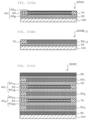
- FIG. 4 is a sectional view schematically showing a different particle size layer including two sub-active material layers in a solid battery according to an embodiment of the present invention.
- FIG. 5 is a sectional view schematically showing a different particle size layer in which a sub-active material layer having a large particle size is interposed between sub-active material layers having a small particle size in a solid battery according to an embodiment of the present invention.
- FIG. 6 is a sectional view schematically showing a different particle size layer in which the particle sizes of the active material particles are gradually different in the laminating direction in a solid battery according to an embodiment of the present invention.
- FIG. 7 is a sectional view schematically showing a different particle size layer in which a plurality of sub-active material layers having a large particle size is interposed between sub-active material layers having a small particle size in a solid battery according to an embodiment of the present invention.
- FIG. 8 is a sectional view schematically showing a solid battery according to an embodiment of the present invention.
- FIG. 9 A and FIG. 9 B are sectional views schematically showing a solid battery according to an embodiment of the present invention.
- FIG. 10 A to FIG. 10 C are sectional views schematically for explaining a method for manufacturing a solid battery according to an embodiment of the present invention.
- the “solid battery” as used in the present invention refers to a battery in which the constituent element composed of a solid in a broad sense, and an all-solid battery in which the component (especially preferably all components) is composed of a solid in a narrow sense.
- the solid battery in the present invention is a laminated solid battery in which the layers forming the battery constituent unit are laminated to each other, and preferably each such layer is composed of a sintered body.
- the “solid battery” includes not only a so-called “secondary battery” capable of repeated charging and discharging, but also a “primary battery” capable of only discharging.
- a “solid battery” is a secondary battery.
- the “secondary battery” is not overly adhered to its name and may also include electrochemical devices such as a power storage device.
- the “planar view” as used in the present description is based on a form in which an object is viewed from above or below along a thickness direction based on a laminating direction of each layer constituting a solid battery. Furthermore, the “sectional view” as used in the present description is based on a form in which an object is viewed from a direction substantially perpendicular to a thickness direction based on a laminating direction of each layer constituting a solid battery (in short, the form when the object is cut out on a plane parallel to the thickness direction).
- the “vertical direction” and “horizontal direction” used directly or indirectly in the present description correspond to the up-down direction and the left-right direction in the drawings, respectively.
- the same reference numeral or symbol shall indicate the same member/part or the same meaning.
- the vertical downward direction that is, the direction in which gravity acts
- the opposite direction corresponds to the “upward direction.”
- the solid battery includes a solid battery laminate including at least one battery constituent unit including a positive electrode layer, a negative electrode layer, and a solid electrolyte interposed between them along the laminating direction thereof.
- a solid battery can be formed by firing each layer that constitutes the solid battery. That is, preferably, the positive electrode layer, the negative electrode layer, the solid electrolyte layer, and the like form a sintered layer. More preferably, each of the positive electrode layer, the negative electrode layer, and the solid electrolyte are fired integrally with each other, and therefore the battery constituent unit forms an integrally sintered body.
- the positive electrode layer is an electrode layer including at least a positive electrode active material (particularly, particles of the positive electrode active material).
- the positive electrode layer may further include a solid electrolyte material and/or a positive electrode current collector layer.
- the positive electrode layer includes a sintered body including at least positive electrode active material particles, a solid electrolyte material, and a positive electrode current collector layer.
- the negative electrode layer is an electrode layer including at least a negative electrode active material (particularly, particles of the negative electrode active material).
- the negative electrode layer may further include a solid electrolyte material and/or a negative electrode current collector layer.
- the negative electrode layer includes a sintered body including at least negative electrode active material particles, a solid electrolyte material, and a negative electrode current collector layer.
- the positive electrode active material and the negative electrode active material are substances involved in the delivery of an electron in a solid battery. Charging and discharging are performed by the transfer (conduction) of ions between the positive electrode layer and the negative electrode layer via the solid electrolyte layer and the transfer of electrons between the positive electrode layer and the negative electrode layer via an external circuit.
- the positive electrode layer and the negative electrode layer are particularly preferably layers that can occlude and release a lithium ion or a sodium ion. That is, it is preferable to use an all-solid secondary battery in which a lithium ion or a sodium ion transfer between the positive electrode layer and the negative electrode layer via the solid electrolyte layer to charge and discharge the battery.
- the positive electrode active material contained in the positive electrode layer is, for example, a lithium-containing compound.
- the kind of the lithium compound is not particularly limited, and examples of the kind include a lithium transition metal composite oxide and/or a lithium transition metal phosphoric acid compound.
- the lithium transition metal composite oxide is a general term for oxides containing lithium and one kind or two or more kinds of transition metallic elements as constituent elements.
- the lithium transition metal phosphoric acid compound is a general term for phosphoric acid compounds containing lithium and one kind or two or more kinds of transition metallic elements as constituent elements.
- the kind of transition metallic element is not particularly limited, and examples of the kind include cobalt (Co), nickel (Ni), manganese (Mn), and/or iron (Fe).
- lithium transition metal composite oxide examples include a compound represented by Li x M1O 2 and Li y M2O 4 , respectively.
- lithium transition metal phosphoric acid compound examples include a compound represented by Li z M3PO 4 .
- M1, M2, and M3 is one kind or two or more kinds of transition metallic elements. The respective values of x, y, and z are optional.
- examples of the lithium transition metal composite oxide include LiCoO 2 , LiNiO 2 , LiVO 2 , LiCrO 2 , and/or LiMn 2 O 4 .
- examples of the lithium transition metal phosphoric acid compound include LiFePO 4 and/or LiCoPO 4 .
- examples of the positive electrode active material that can occlude and release a sodium ion include at least one kind selected from the group consisting of a sodium-containing phosphoric acid compound having a NASICON-type structure, a sodium-containing phosphoric acid compound having an olivine-type structure, a sodium-containing layered oxide, and a sodium-containing material having a spinel-type structure.
- Examples of the negative electrode active material contained in the negative electrode layer include a carbon material, a metallic material, a lithium alloy and/or a lithium-containing compound.
- examples of the carbon material include graphite, easily graphitizable carbon, hardly graphitizable carbon, a meso-carbon microbead (MCMB), and/or highly oriented graphite (HOPG).
- a metallic material is a general term for materials containing one kind or two or more kinds of metallic elements and semi-metallic elements capable of forming an alloy with lithium as constituent elements.
- the metallic material may be a simple substance, an alloy, or a compound. Since the purity of the simple substance described here is not necessarily limited to 100%, the simple substance may contain a trace amount of an impurity.
- Examples of the metallic element and semi-metallic element include silicon (Si), tin (Sn), aluminum (Al), indium (In), magnesium (Mg), boron (B), gallium (Ga), germanium (Ge), lead (Pb), bismuth (Bi), cadmium (Cd), titanium (Ti), chromium (Cr), iron (Fe), niobium (Nb), molybdenum (Mo), silver (Ag), zinc (Zn), hafnium (Hf), zirconium (Zr), yttrium (Y), palladium (Pd), and/or platinum (Pt).
- examples of the metallic material include Si, Sn, SiB 4 , TiSi 2 , SiC, Si 3 N 4 , SiO V (0 ⁇ v ⁇ 2), LiSiO, SnO w (0 ⁇ w ⁇ 2), SnSiO 3 , LiSnO, and/or, Mg 2 Sn.
- lithium-containing compound examples include a lithium transition metal composite oxide.
- the definition of the lithium transition metal composite oxide is as described above.
- examples of the lithium transition metal double oxide include Li 3 V 2 (PO 4 ) 3 , Li 3 Fe 2 (PO 4 ) 3 , and/or Li 4 Ti 5 O 12 .
- Examples of the negative electrode active material that can occlude and release a sodium ion include at least one kind selected from the group consisting of a sodium-containing phosphoric acid compound having a NASICON-type structure, a sodium-containing phosphoric acid compound having an olivine-type structure, and a sodium-containing material having a spinel-type structure.
- the positive electrode layer and/or the negative electrode layer may contain an electron conductive material.
- the electron conductive material contained in the positive electrode layer and/or the negative electrode layer include a carbon material and/or a metal material.
- examples of the carbon material include graphite and/or a carbon nanotube.
- examples of the metal material include copper (Cu), magnesium (Mg), titanium (Ti), iron (Fe), cobalt (Co), nickel (Ni), zinc (Zn), aluminum (Al), germanium (Ge), indium (In), gold (Au), platinum (Pt), silver (Ag), and/or palladium (Pd), and an alloy of two or more of them.
- the positive electrode layer and/or the negative electrode layer may contain a binder.
- the binder include any one kind or two or more kinds of synthetic rubber and a polymer material.
- examples of the synthetic rubber include a styrene-butadiene rubber, a fluorine-based rubber and/or an ethylene propylene diene.
- examples of the polymer material include at least one kind selected from the group consisting of a polyvinylidene fluoride, a polyimide, and an acrylic resin.
- the positive electrode layer and/or the negative electrode layer may contain a sintering aid.
- a sintering aid at least one kind selected from the group consisting of a lithium oxide, a sodium oxide, a potassium oxide, a boron oxide, a silicon oxide, a bismuth oxide, and a phosphorus oxide.
- the thicknesses of the positive electrode layer and the negative electrode layer are not particularly limited and may be, for example, independently 2 ⁇ m to 50 ⁇ m, particularly 5 ⁇ m to 30 ⁇ m.
- the solid electrolyte is a material capable of conducting a lithium ion or a sodium ion.
- the solid electrolyte that forms the battery constituent unit of a solid battery forms a layer in which a lithium ion can be conducted between the positive electrode layer and the negative electrode layer.
- the solid electrolyte may be provided at least between the positive electrode layer and the negative electrode layer. That is, the solid electrolyte may also be present around the positive electrode layer and/or the negative electrode layer so as to protrude from between the positive electrode layer and the negative electrode layer.
- Examples of the specific solid electrolyte include any one kind or two or more kinds of a crystalline solid electrolyte and a glass-ceramic solid electrolyte.
- the crystalline solid electrolyte is a crystalline electrolyte.
- the crystalline solid electrolyte include an inorganic material and/or a polymer material.
- examples of such inorganic material include a sulfide and an oxide.
- examples of the sulfide include Li 2 S—P 2 S 5 , Li 2 S—SiS 2 —Li 3 PO 4 , Li 7 P 3 S 11 , Li 3.25 Ge 0.25 P 0.75 S, and Li 10 GeP 2 S 12 .
- Examples of the oxide include Li x M y (PO 4 ) 3 (1 ⁇ x ⁇ 2, 1 ⁇ y ⁇ 2, M is at least one kind selected from the group consisting of Ti, Ge, Al, Ga, and Zr), Li y La 3 Zr 2 O 12 , Li 6.75 La 3 Zr 1.75 Nb 0.25 O 12 , Li 6 BaLa 2 Ta 2 O 12 , Li 1+x Al x Ti 2-x (PO 4 ) 3 , La 2/3-x Li 3x TiO 3 , L 1.2 Al 0.2 T 1.8 (PO 4 ) 3 , La 0.55 Li 0.35 TiO 3 , and/or Li 7 La 3 Zr 2 O 12 .
- Examples of the polymeric material include a polyethylene oxide (PEO).
- the glass-ceramic solid electrolyte is an electrolyte in which amorphous and crystalline are mixed.
- the glass-ceramic solid electrolyte contains, for example, an oxide containing lithium (Li), silicon (Si), and/or boron (B) as a constituent element, and more specifically, lithium oxide (Li 2 O), silicon oxide (SiO 2 ), and/or boron oxide (B 2 O 3 ).
- the ratio of the content of a lithium oxide to the total content of a lithium oxide, a silicon oxide, and a boron oxide is not particularly limited, and is, for example, 40 mol % to 73 mol %.
- the ratio of the content of a silicon oxide to the total content of a lithium oxide, a silicon oxide, and a boron oxide is not particularly limited, and is, for example, 8 mol % to 40 mol %.
- the ratio of the content of a boron oxide to the total content of a lithium oxide, a silicon oxide, and a boron oxide is not particularly limited, and is, for example, 10 mol % to 50 mol %.
- the glass-ceramic solid electrolyte is analyzed, for example, using inductively coupled plasma emission spectroscopy (ICP-AES).
- Examples of the solid electrolyte in which a sodium ion can be conducted include a sodium-containing phosphoric acid compound having a NASICON structure, an oxide having a perovskite structure, and an oxide having a garnet type or a garnet-like type structure.
- Examples of the sodium-containing phosphoric acid compound having a NASICON structure Na x M y (PO 4 ) 3 (1 ⁇ x ⁇ 2, 1 ⁇ y ⁇ 2, M is at least one kind selected from the group consisting of Ti, Ge, Al, Ga, and Zr).
- the solid electrolyte layer may contain a binder and/or a sintering aid.
- the binder and/or sintering aid contained in the solid electrolyte layer may be selected from, for example, materials similar to the binder and/or sintering aid that may be contained in the positive electrode layer and/or the negative electrode layer.
- the thickness of the solid electrolyte layer is not particularly limited, and may be, for example, 1 ⁇ m to 15 ⁇ m, particularly 1 ⁇ m to 5 ⁇ m.
- the positive electrode current collector material constituting the positive electrode current collector layer and the negative electrode current collector material constituting the negative electrode current collector layer it is preferable to use a material having a large conductance.
- the positive electrode current collector material and the negative electrode current collector material it is preferable to use at least one kind selected from the group consisting of silver, palladium, gold, platinum, aluminum, copper, and nickel.
- Each of the positive electrode current collector layer and the negative electrode current collector layer has an electrical connection part for electrically connecting to the outside and may be connectable to a terminal.
- Each of the positive electrode current collector layer and the negative electrode current collector layer may have a foil form, but from the viewpoint of improving electron conductivity and reducing manufacturing costs by integral sintering, it is preferable to have an integral sintering form.
- the positive electrode current collector layer and the negative electrode current collector layer have the form of a sintered body, each of them may be composed of, for example, a sintered body containing an electron conductive material, a binder, and/or a sintering aid.
- the electron conductive material contained in each of the positive electrode current collector layer and the negative electrode current collector layer may be selected from, for example, materials similar to the electron conductive materials that can be contained in the positive electrode layer and/or the negative electrode layer.
- the binder and/or sintering aid contained in each of the positive electrode current collector layer and the negative electrode current collector layer may be selected from, for example, materials similar to the binder and/or the sintering aid that may be contained in the positive electrode layer and/or the negative electrode layer.
- each of the positive electrode current collector layer and the negative electrode current collector layer is not particularly limited.
- the thickness of each of the positive electrode current collector layer and the negative electrode current collector layer may be 1 ⁇ m to 10 ⁇ m.
- the insulating layer refers to a material that does not conduct electricity in a broad sense, that is, a layer composed of a non-conductive material, and a material composed of an insulating material in a narrow sense.
- the insulating layer may be composed of, for example, a glass material and/or a ceramic material.
- a glass material may be selected.
- the glass material is not particularly limited, but example of the glass material include at least one kind selected from the group consisting of a soda-lime glass, a potash glass, a borate-based glass, a borosilicate-based glass, a barium borate-based glass, a zinc borate-based glass, a barium borate-based glass, a bismuth borosilicate-based glass, a bismuth-zinc borate-based glass, a bismuth silicate-based glass, a phosphate-based glass, an aluminophosphate-based glass, and a zinc phosphate-based glass.
- the ceramic material is not particularly limited, and the example of the ceramic material include at least one kind selected from the group consisting of aluminum oxide (Al 2 O 3 ), boron nitride (BN), silicon dioxide (SiO 2 ), silicon nitride (Si 3 N 4 ), zirconium oxide (ZrO 2 ), aluminum nitride (AlN), silicon carbide (SiC), and barium titanate (BaTiO 3 ).
- the electrode separation part is disposed around the positive electrode layer to separate the positive electrode layer from the negative electrode terminal. Furthermore/alternatively, the electrode separation part is disposed around the negative electrode layer to separate the negative electrode layer from the positive electrode terminal.
- the electrode separation part is not particularly limited, but it preferably includes, for example, a solid electrolyte, and an insulating material.
- the protective layer can generally be formed on the outermost side of the solid battery and is for electrical, physical, and/or chemical protection.
- a material constituting the protective layer it is preferable that the material has excellent insulation properties, durability, and/or moisture resistance and is environmentally safe.
- glass, a ceramic, a thermosetting resin, and/or a photocurable resin it is preferable to use glass, a ceramic, a thermosetting resin, and/or a photocurable resin.
- the solid battery is generally provided with a terminal (for example, an external terminal).
- a terminal for example, an external terminal.
- positive and negative electrode terminals are provided on the side face of the solid battery so as to form a pair.
- the terminal on the positive electrode side connected to the positive electrode layer and the terminal on the negative electrode side connected to the negative electrode layer may be provided so as to form a pair.
- the material of the terminal is not particularly limited and may be at least one kind selected from the group consisting of silver, gold, platinum, aluminum, copper, tin, and nickel.
- the solid battery of the present invention is a solid battery including at least one battery constituent unit including a positive electrode layer, a negative electrode layer, and a solid electrolyte layer interposed between the positive electrode layer and the negative electrode layer along a laminating direction thereof, and the composition of the active material layer in the positive electrode layer and the negative electrode layer is such that at least one of the positive or negative electrode layers includes a plurality of sub-active material layers.
- At least one of the positive or negative electrode layers has a different particle size layer that includes a plurality of sub-active material layers having different average particle sizes among the active material particles.
- the number of sub-active material layers in the different particle size layer is at least two.
- the number of layers of the sub-active material in the single different particle size layer is three or more.
- the “average particle size” as used in the present invention refers to the arithmetic mean diameter of a plurality of active material particles in each sub-active material layer. For example, from the sectional SEM image of each sub-active material layer, the maximum diameter length of each of the 10 or more active material particles in each layer is obtained as the particle size, and the value obtained by arithmetically averaging the particle sizes of the 10 or more active material particles may be defined as the “average particle size”.
- the “sub-active material layer” as used in the present description refers to a layer that is included in the active material layer when the positive or negative electrode layer is viewed as, for example, a single active material layer, and is an element that constitutes the active material layer.
- the solid battery of the present invention When the solid battery of the present invention is charged and discharged, at least one of the positive or negative electrode layers has a different particle size layer, so that the difference in ion diffusion distance from the surface layer to the inner layer of the electrode layer can be substantially reduced.
- the reaction concentration on the surface layer of the electrode layer can be relaxed, and the accumulation of precipitates caused by the reduction of an ion can be reduced. That is, a more desirable solid battery can be obtained by improving the balance of charge/discharge reactions in the laminating direction. Therefore, reaction unevenness during charging and discharging can be reduced, rate characteristics can be improved, and precipitates on the surface of the electrode layer can be reduced. In other words, battery deterioration is suppressed from a long-term perspective due to such desired charging and discharging, and as a result, a solid battery with improved long-term reliability can be obtained.
- the positive electrode layer 40 , a solid electrolyte layer 30 , and the negative electrode layer 50 are provided in this order in the sectional view of the solid battery 500 .
- the solid electrolyte layer 30 is interposed between the positive electrode layer 40 and the negative electrode layer 50 .
- at least one of the positive electrode layer 40 and the negative electrode layer 50 has a different particle size layer including a plurality of sub-active material layers having different average particle sizes among the active material particles.
- such electrode layers include two sub-active material layers having different average particle sizes (that is, a layer including active material particles 20 I having a relatively small average particle size and a layer including active material particles 20 II having a relatively large average particle size) as shown in FIG. 4 .
- sub-active material layers including active material particles 20 I having a relatively small average particle size in the negative electrode layers 50 1 and 50 3 are provided on the positive electrode layers 40 1 and 40 2 sides facing each other in the laminating direction, respectively.
- the negative electrode layers 50 1 and 50 3 in which the different electrode layers are present only on one opposite side in the laminating direction can correspond to the outermost layer in, for example, a solid battery laminate. That is, in the negative electrode layer corresponding to such an outermost layer, the sub-active material layer of the active material particles 20 I having a relatively small average particle size is disposed relatively proximal to the directly opposed positive electrode layer.
- such electrode layers include three sub-active material layers and have a structure in which a sub-active material layer including active material particles 20 II having a relatively large average particle size interposed between two sub-active material layers including active material particles 20 I with a relatively small average particle size in the laminating direction.
- the positive electrode layers 40 1 and 40 2 and the negative electrode layer 50 2 in which different electrode layers are present on both opposite sides thereof in the laminating direction can correspond to, for example, an inner layer other than the outermost layer in the solid battery laminate.
- a sub-active material layer including active material particles having a relatively small average particle size on the side where the different electrode layers facing each other in the laminating direction exist when a sub-active material layer including active material particles having a relatively small average particle size on the side where the different electrode layers facing each other in the laminating direction exist is provided, the gaps between the active material particles can be increased on the surface layer of the different particle size layer, and the diffusion distance of ions can be reduced (see FIG. 2 ). This is because the number of curved paths through which the ion can pass increases in such a surface layer, and the ion can be conducted more linearly. As a result, the difference in the substantial ion diffusion distance from the surface layer to the inner layer of the electrode layer can be reduced, and the balance of the charge/discharge reaction in the laminating direction of the electrode layer can be improved more effectively.
- the present invention is not limited to the different particle size layer having the above structure, and it can be applied to any different particle size layer including a plurality of sub-active material layers having different average particle sizes among the active material particles.
- it can also be applied to a different particle size layer in which a sub-active material layer including active material particles having a relatively large average particle size is provided on a side where different electrode layers face each other in the laminating direction according to the reaction rate of the active material particles used for each sub-active material layer.
- the different particle size layers of the sub-active material layer have the same thickness.
- the different particle size layers of the sub-active material layer have different thicknesses from each other.
- at least one electrode layer (that is, a single electrode layer) of the positive electrode layer or the negative electrode layer is substantially composed of different particle size layers.
- the average particle size of each active material particle of the plurality of sub-active material layers is gradually different in the laminating direction.
- a different particle size layer includes three sub-active material layers having different average particle sizes.
- a sub-active material layer including active material particles 20 I having a relatively small average particle size, a sub-active material layer including active material particles 20 II having a relatively medium particle size, and sub-active material layers including active material particles 20111 having a relatively large average particle size are provided in this order. Based on the exemplary aspect shown in FIG.
- such different particle size layers may be negative electrode layers 50 1 and 50 3 , etc., in which a different electrode layer is present only on one opposite side.
- the sub-active material layers including the active material particles 20 I having a relatively small average particle size in the negative electrode layers 50 1 and 50 3 are provided on the positive electrode layers 40 1 and 40 2 sides facing each other in the laminating direction, respectively.
- a different particle size layer includes the following three kinds of sub-active material layers: a first sub-active material layer including active material particles 20 I having a relatively small average particle size; a second sub-active material layer including active material particles 20 II having a relatively medium particle size; and a third sub-active material layer including active material particles 20111 having a relatively large average particle size.
- such different particle size layer may be positive electrode layers 40 1 and 40 2 , negative electrode layer 50 2 , etc., in which different electrode layers are present on both opposite sides thereof.
- the average particle size of each active material particle of the plurality of sub-active material layers is gradually different in the laminating direction, so that the difference in the substantial ion diffusion distance from the surface layer to the inner layer of the electrode layer can be reduced. Therefore, the ionic conduction in the laminating direction of the electrode layer can be more uniform, and the balance of the charge/discharge reaction in the laminating direction of the electrode layer can be improved more effectively.
- a plurality of sub-active material layers includes active material particles of the same species as each other.
- the reaction rate on the surface of each active material particle can be the same. That is, the ion diffusion distance in the laminating direction can be adjusted only by the average particle size of the active material particles, and the balance of the charge/discharge reaction in the laminating direction of the electrode layer can be improved more effectively.
- the active material particles in the negative electrode layer are particles containing a carbon material. Since the active material particles of the negative electrode layer contain the carbon material, an ion (particularly a lithium ion) can be more preferably supported in the material. Furthermore, since the carbon material has good electron conductivity, it is possible to form a structure in which the negative electrode layer does not have a current collector layer (that is, a current collector-less structure). When the negative electrode layer has a current collector-less structure, the volume ratio of the negative electrode active material particles can be increased, and the energy density of the solid battery can be improved.
- a positive electrode sub-active material layer and a positive electrode current collector layer are laminated in the laminating direction of the positive electrode layer.
- the positive electrode current collector layer is interposed between two positive electrode sub-active material layers.
- the positive electrode layer can have high electron conductivity if a material having low electron conductivity is used as the positive electrode active material.
- the active material particles of the negative electrode layer contain a carbon material, and the positive electrode sub-active material layer and the positive electrode current collector layer are laminated in the laminating direction of the positive electrode layer ( FIG. 8 ).
- the sub-active material layer including the active material particles having the relatively smallest average particle size has an average particle size ratio of 0.05 to 0.7 with respect to the sub-active material layer including active material particles having a relatively largest average particle size.
- the “minimum average particle size” of the active material particles means the average particle size of the sub-active material layer including the active material particles 20 I
- the “maximum average particle size” means the average particle size of the sub-active material layer including the active material particles 20 III.
- the average particle size ratio as described above is 0.05 or more, isolation of active material particles having a relatively small average particle size can be particularly prevented, and the energy density of the solid battery can be further improved. Furthermore, when the average particle size ratio is 0.7 or less, the number of ions diffused through the interparticle gaps of the active material particles can be increased more effectively. Furthermore, when the average particle size ratio is in the range of 0.05 to 0.7, a more suitable difference in ion diffusion distance can be obtained according to the reaction rate in each sub-active material layer, and the balance of charge/discharge reactions in the laminating direction of the electrode layer can be further improved.
- the different particle size layer including a plurality of sub-active material layers having different average particle sizes of the active material particles from each other can be determined from an electron microscope image.
- the structure of such a different particle size layer can be grasped from an image obtained by cutting out a section of the solid battery in the sectional view direction by an ion milling device (manufactured by Hitachi High-Tech Corporation, model number IM4000PLUS) and using a scanning electron microscope (SEM) (manufactured by Hitachi High-Tech Corporation, model number SU-8040).
- the average particle size ratio of the active material particles as used in the present description may refer to a value calculated from the dimension measured from the image obtained by the above method.
- the average particle size of the active material particles can be obtained, for example, as follows. First, a scanning electron microscope (SEM) is used to take a sectional image of a different particle size layer including sub-active material layers having different average particle sizes of the active material particles from each other. Next, 10 active material particles are randomly selected from each sub-active material layer for one image taken, and the maximum diameter length of each of the particles (maximum diameter length on the surface observed in the SEM image) is determined as the particle size. The above processing for determining the particle size is performed on 10 images in each sub-active material layer, and the average particle size is determined by arithmetically averaging the obtained particle sizes of the respective active material particles in each of the sub-active material layers.
- SEM scanning electron microscope
- the minimum average particle size is divided by the maximum average particle size to obtain the average particle size ratio of the minimum average particle size with respect to the maximum average particle size of the active material particles between the plurality of sub-active material layers.
- the solid battery according to the present invention is a laminated solid battery in which each layer constituting the battery constituent unit is laminated and is manufactured by a printing method such as a screen-printing method, a green sheet method using a green sheet, or a composite method thereof. Therefore, each layer constituting the battery constituent unit is composed of a sintered body.
- the positive electrode layer, the negative electrode layer, and the solid electrolyte are integrally sintered with each other. That is, it can be said that the solid battery laminate is a fired integrated product. In such a fired integrated product, at least one of the positive electrode layer and the negative electrode layer is a different particle size layer including a plurality of sub-active material layers having different average particle sizes of the active material particles from each other.
- a positive electrode layer 40 that is, positive electrode layers 40 1 and 40 2
- a negative electrode layer 50 that is, negative electrode layers 50 1 , 50 2 , and 50 3
- a solid electrolyte layer 30 around the positive electrode layer 40 and the negative electrode layer 50 are provided.
- the positive electrode layer 40 1 has a structure in which the current collector layer 60 is interposed between the positive electrode active material layers 40 1A and 40 1B
- the positive electrode layer 40 2 also has a similar structure.
- the negative electrode layer 50 contains a carbon material as active material particles, it has a current collector-less structure that does not include a current collector layer.
- the positive electrode layer 40 and the negative electrode layer 50 extend so as to be terminated at the positive electrode side end face 500 ′A and the negative electrode side end face 500 ′B, respectively. Only the current collector layer 60 extends in the part of the positive electrode layer 40 that terminates at the positive electrode side end face 500 ′A, and an electrode separation part 70 is provided around the periphery thereof.
- the positive electrode layer 40 is formed so as not to be terminated at the negative electrode side end face 500 ′B
- the negative electrode layer 50 is formed so as not to be terminated at the positive electrode side end face 500 ′A.
- the electrode separation parts 70 may be provided between the positive electrode layer 40 and the negative electrode side end face 500 ′B, and between the negative electrode layer 50 and the positive electrode side end face 500 ′A, respectively.
- Each of the positive electrode layers 40 1 and 40 2 and the negative electrode layers 50 1 , 50 2 , and 50 3 may be a different particle size layer including a plurality of sub-active material layers having different average particle sizes of the active material particles from each other.
- Each of the positive electrode active material layers 40 1A , 40 1B , 40 2A , and 40 2B , and the negative electrode layers 50 1 and 50 3 has two sub-active material layers having different average particle sizes as shown in FIG. 4 , respectively.
- the sub-active material layers including the active material particles 20 I having a relatively small average particle size in the positive electrode active material layers 40 1A , 40 1B , 40 2A , and 40 2B are provided on the negative electrode layer 50 side facing each other in the laminating direction (that is, in such a positive electrode active material layer, the sub-active material layer including active material particles having a relatively small average particle size is disposed relatively proximal to the directly opposed negative electrode layer).
- the sub-active material layers including the active material particles 20 I having a relatively small average particle size in the negative electrode layers 50 1 and 50 3 are provided on the positive electrode layer 40 side facing each other in the laminating direction (that is, in such a negative electrode active material layer, the sub-active material layer including the active material particles having a relatively small average particle size is disposed relatively proximal to the directly opposed positive electrode layer).
- the negative electrode layer 50 2 includes three sub-active material layers as shown in FIG. 5 and has a structure in which a sub-active material layer including the active material particles 20 II having a relatively large average particle size interposed between two sub-active material layers including active material particles 20 I with a relatively small average particle size in the laminating direction.
- the solid battery may further include a terminal.
- the solid battery 500 may include a positive electrode terminal 80 A electrically connected to the positive electrode layer 40 at the positive electrode side end face 500 ′A and a negative electrode terminal 80 B electrically connected to the negative electrode layer 50 at the negative electrode side end face 500 ′B.
- the solid battery may further include a protective layer.
- the solid battery 500 may include a protective layer 90 on the outside of the solid battery laminate 500 ′, the positive electrode terminal 80 A, and the negative electrode terminal 80 B so as to be integrated with them.
- the solid battery of the present invention can be manufactured by a printing method such as a screen-printing method, a green sheet method using a green sheet, or a composite method thereof.
- a printing method such as a screen-printing method, a green sheet method using a green sheet, or a composite method thereof.
- the printing method and the green sheet method are adopted for understanding the present invention is described in detail, but the present invention is not limited to the methods.
- a paste having a predetermined structure is formed on a substrate as a support substrate by applying the paste using the printing method.
- a solid battery laminated precursor corresponding to a predetermined solid battery structure can be formed on the substrate by sequentially laminating the printing layers having a predetermined thickness and pattern shape.
- the kind of the pattern forming method is not particularly limited as long as it is a method capable of forming a predetermined pattern, and is, for example, any one kind or two or more kinds of a screen-printing method and a gravure printing method.
- the paste can be prepared by wet blending a predetermined constituent material of each layer appropriately selected from the group consisting of positive electrode active material particles, negative electrode active material particles, an electron conductive material, a solid electrolyte material, a current collector layer material, an insulating material, a binder, and a sintering aid with an organic vehicle in which an organic material is dissolved in a solvent.
- the positive electrode layer paste contains, for example, the positive electrode active material particles, the electron conductive material, the solid electrolyte material, the binder, the sintering aid, the organic material, and the solvent.
- the negative electrode layer paste contains, for example, the negative electrode active material particles, the electron conductive material, the solid electrolyte material, the binder, the sintering aid, the organic material and the solvent.
- the solid electrolyte layer paste contains, for example, the solid electrolyte material, the binder, the sintering aid, the organic material, and the solvent.
- the positive electrode current collector layer paste and the negative electrode current collector layer paste contain, for example, the electron conductive material, the binder, the sintering aid, the organic material, and the solvent, respectively.
- the electrode separation part paste contains, for example, the solid electrolyte material, the insulating material, the binder, the sintering aid, the organic material, and the solvent.
- the protective layer paste contains, for example, the insulating material, the binder, the organic material, and the solvent.
- the insulating layer paste contains, for example, the insulating material, the binder, the organic material, and the solvent.
- the organic material contained in the paste is not particularly limited, but at least one kind of the polymer material selected from the group consisting of a polyvinyl acetal resin, a cellulose resin, a polyacrylic resin, a polyurethane resin, a polyvinyl acetate resin, a polyvinyl alcohol resin, and the like can be used.
- the kind of the solvent is not particularly limited, and includes, for example, any one kind or two or more kinds of organic solvents such as butyl acetate, toluene, terpineol, and N-methyl-pyrrolidone.
- a medium in the wet blending, a medium can be used, and specifically, a ball mill method, a bead mill method, or the like can be used.
- a wet blending method that does not use the media may be used, and a sand mill method, a high-pressure homogenizer method, a kneader dispersion method, or the like can be used.
- the support substrate is not particularly limited as long as it is a support capable of supporting each paste layer, and examples thereof include a release film with release treatment on one surface.
- a substrate composed of a polymer material such as polyethylene terephthalate can be used.
- a substrate that exhibits heat resistance to the firing temperature may be used.
- the applied paste is dried on a hot plate heated to 30° C. or higher and 50° C. or lower to form a positive electrode layer green sheet, a negative electrode layer green sheet, a solid electrolyte green sheet, an insulating layer green sheet and/or a protective layer green sheet having a predetermined shape and thickness, etc. on the substrate (for example, PET film), respectively.
- a hot plate heated to 30° C. or higher and 50° C. or lower to form a positive electrode layer green sheet, a negative electrode layer green sheet, a solid electrolyte green sheet, an insulating layer green sheet and/or a protective layer green sheet having a predetermined shape and thickness, etc.
- the substrate for example, PET film
- each green sheet is peeled off from the substrate.
- the green sheets of each component of one battery constituent unit are sequentially laminated along the laminating direction to form a solid battery laminated precursor.
- a solid electrolyte layer, an insulating layer and/or a protective layer and the like may be provided on the side region of the electrode green sheet by screen printing.
- the solid battery laminated precursor is subjected to firing.
- firing is performed in a nitrogen gas atmosphere containing oxygen gas or in the atmosphere, for example, after removing the organic material at 500° C., by heating in a nitrogen gas atmosphere or in the atmosphere, for example, at 550° C. or higher and 5000° C. or lower.
- the firing may be performed while pressurizing the solid battery laminated precursor in the laminating direction (in some cases, the laminating direction and the direction perpendicular to the laminating direction).
- Such firing is performed to form a solid battery laminate, and finally a desired solid battery is obtained.
- the different particle size layer in the solid battery of the present invention may be formed by any method as long as a plurality of sub-active material layers having different average particle sizes form a laminated structure in the layer.
- the average particle size of the active material particles may be changed from the stage of the raw material paste. That is, a plurality of raw material pastes may be prepared so that each active material particle having a different average particle size forms a laminated structure as a plurality of sub-active material layers. That is, a raw material paste may be prepared for each active material particle having a different average particle size.
- the average particle size of the active material particles contained therein may be changed. That is, the printing layers of the raw material pastes containing the active material particles having different average particle sizes may be sequentially laminated with a predetermined thickness and pattern shape to prepare an electrode layer green sheet corresponding to the predetermined structure. Specifically, the active material particle size and/or the number of times of application of the raw material paste in each printing layer to be laminated may be adjusted to prepare the electrode layer green sheet so as to include a plurality of predetermined sub-active material layers having different particle sizes.
- FIGS. 10 A to 10 C a method for manufacturing a solid battery is described in more detail based on the exemplary aspects shown in FIGS. 10 A to 10 C .
- a step of forming a positive electrode green sheet 200 A, a step of forming a negative electrode green sheet 200 B, a step of forming the solid battery laminate 500 ′, and a step of forming each of a positive electrode terminal 80 A and a negative electrode terminal 80 B are performed.
- a solid electrolyte layer paste is prepared by mixing the solid electrolyte, the solvent, and if necessary, an electrolyte binder, etc. Subsequently, as shown in FIG. 10 A , the solid electrolyte layer paste is applied to one surface of a substrate 100 to form the solid electrolyte layer 30 .
- An electrode separation part paste is prepared by mixing the insulating material, the solvent, and if necessary, an electrode separation binder, etc. Subsequently, the electrode separation part paste is applied to the end of the surface of the solid electrolyte layer 30 using the pattern forming method to form two electrode separation parts 70 .
- a positive electrode paste is prepared by mixing a positive electrode active material, a solvent, and if necessary, a positive electrode active material particle binder, etc.
- a positive electrode active material particle binder etc.
- two kinds of the pastes are prepared using two positive electrode active material particles having different particle sizes.
- the two kinds of positive electrode pastes are applied to the surface of the solid electrolyte layer 30 using a pattern forming method. At this time, first, the positive electrode paste of the positive electrode active material particles having a relatively small particle size is applied, and then the positive electrode paste of the positive electrode active material particles having a relatively large particle size is applied on the applied paste to form the positive electrode sub-active material layer 40 B .
- a positive electrode current collector paste is prepared by mixing a conductive material, a solvent, and if necessary, a positive electrode current collector binder, etc. Subsequently, the positive electrode current collecting paste is applied to the surfaces of the positive electrode sub-active material layer 40 B and the electrode separation part 70 using the pattern forming method to form a positive electrode current collector layer 60 .
- the positive electrode paste and the electrode separation part paste are applied to the surface of the positive electrode current collector layer 60 to form a positive electrode sub-active material layer 40 A and the electrode separation part 70 .
- a positive electrode paste of positive electrode active material particles having a relatively large particle size is applied, and then a positive electrode paste of positive electrode active material particles having a relatively small particle size is applied on the applied paste to form the positive electrode sub-active material layer 40 A .
- the positive electrode layer 40 is formed since the two positive electrode sub-active material layers 40 A and 40 B are laminated on each other with the positive electrode current collector layer 60 interposed between them, the positive electrode layer 40 is formed. Therefore, since the positive electrode layer 40 and the electrode separation part 70 are formed so as to be disposed in the same layer, the positive electrode green sheet 200 A including the positive electrode layer 40 , the solid electrolyte layer 30 , and the electrode separation part 70 can be obtained.
- the solid electrolyte layer 30 is formed on one surface of the substrate 100 by the above procedure.
- the electrode separation part paste is prepared by the same procedure as the above procedure for preparing the electrode separation part paste. Subsequently, the electrode separation part paste is applied to the surface of the solid electrolyte layer 30 to form the electrode separation part 70 using the pattern forming method.
- a negative electrode paste is prepared by mixing the negative electrode active material particles, a solvent, and if necessary, a negative electrode binder, etc.
- the negative electrode paste two kinds of pastes are prepared using two negative electrode active material particles having different particle sizes.
- the two kinds of negative electrode pastes are applied to the surface of the solid electrolyte layer 30 using a pattern forming method. At this time, first, a negative electrode paste of negative electrode active material particles having a relatively small particle size is applied, and then a negative electrode paste of negative electrode active material particles having a relatively large particle size is applied on the applied paste to form the negative electrode layer 50 1 . Therefore, since the negative electrode layer 50 1 and the electrode separation part 70 are formed so as to be disposed in the same layer, a negative electrode green sheet 200 B 1 including the negative electrode layer 50 1 , the solid electrolyte layer 30 , and the electrode separation part 70 can be obtained.
- two kinds of negative electrode pastes are applied to the surface of the solid electrolyte layer 30 using the pattern forming method.
- the negative electrode paste of the negative electrode active material particles having a relatively small particle size is applied, the negative electrode paste of the negative electrode active material particles having a relatively large particle size is applied on the applied paste, and then the negative electrode paste of the negative electrode active material particles having a relatively small particle size is further applied on the applied pastes to form a negative electrode layer 50 2 . Therefore, since the negative electrode layer 50 2 and the electrode separation part 70 are formed so as to be disposed in the same layer, a negative electrode green sheet 200 B 2 including the negative electrode layer 50 2 , the solid electrolyte layer 30 , and the electrode separation part 70 can be obtained.
- a protective paste is prepared by mixing the protective solid electrolyte, the solvent, and if necessary, a protective binder, etc.
- the protective paste is prepared by mixing the protective solid electrolyte, the solvent, the insulating material, and if necessary, the protective binder, etc.
- the protective paste is applied to one surface of the substrate 100 to form the protective layer 90 .
- the solid electrolyte layer paste is applied to the surface of the protective layer 90 to form the solid electrolyte layer 30 .
- the electrode separation part paste is applied to the surface of the solid electrolyte layer 30 to form the electrode separation part 70 using the pattern forming method.
- the two kinds of negative electrode pastes are applied to the surface of the solid electrolyte layer 30 using a pattern forming method. At this time, first, a negative electrode paste of negative electrode active material particles having a relatively large particle size is applied, and then a negative electrode paste of negative electrode active material particles having a relatively small particle size is applied on the surface to form the negative electrode layer 50 3 . As a result, the negative electrode layer 50 3 and the electrode separation part 70 are formed so as to be disposed in the same layer.
- the green sheets 200 A, 200 B 2 , 200 A, and 200 B 1 peeled from the substrate 100 are laminated in this order on the negative electrode layer 50 3 and the electrode separation part 70 .
- the solid electrolyte layer 30 is formed on the negative electrode layer 50 1 and the electrode separation part 70 by the same procedure as the procedure for forming the solid electrolyte layer 30 , and then the protective layer 90 is formed on the solid electrolyte layer 30 by the same procedure as the procedure for forming the protective layer 90 .
- a solid battery laminated precursor 500 Z is formed by peeling off the substrate 100 which is the lowest layer. As a result, the solid battery laminated precursor 500 Z is obtained.
- the solid battery laminated precursor 500 Z is heated.
- the heating temperature is set so that a series of layers constituting the solid battery laminated precursor 500 Z are sintered.
- Other conditions such as heating time can be set optionally.
- the series of layers constituting the solid battery laminated precursor 500 Z are sintered by the heat treatment, and the series of layers are thermocompressed. Therefore, the solid battery laminate 500 ′ is formed.
- a conductive adhesive is used to bond the positive electrode terminal to the solid laminate, and for example, a conductive adhesive is used to bond the negative electrode terminal to the solid laminate.
- a conductive adhesive is used to bond the positive electrode terminal to the solid laminate.
- the solid battery exemplified in FIG. 8 has been mainly described, but the present invention is not necessarily limited to it.
- any solid battery in which the positive electrode layer, the negative electrode layer, and the solid electrolyte layer are included, and at least one of the positive electrode layer and the negative electrode layer is a different particle size layer including a plurality of sub-active material layers having different average particle sizes of the active material particles from each other can be similarly applied.
- the solid battery of the present invention can be used in various fields where storage is expected.
- the solid battery of the present invention can be used in fields of electricity/information/communication in which a mobile device is used (for example, the field of mobile devices such as a mobile phone, a smartphone, a notebook computer, a digital camera, an activity meter, an arm computer, and electronic paper), home/small industrial uses (for example, in the fields of a power tool, a golf cart, and home/nursing/industrial robots), large industrial uses (for example, a forklift, an elevator, and a gantry crane), a field of transportation system (for example, a hybrid vehicle, an electric vehicle, a bus, a train, an electrically power assisted bicycle, and an electric motorcycle), a power system use (for example, various fields of power generation, a road conditioner, a smart grid, and a general household power storage system), a medical use (medical equipment fields such as an earphone hearing aid), a pharmaceutical use (fields such as dose management systems), and an I
Landscapes
- Chemical & Material Sciences (AREA)
- General Chemical & Material Sciences (AREA)
- Chemical Kinetics & Catalysis (AREA)
- Electrochemistry (AREA)
- Engineering & Computer Science (AREA)
- Manufacturing & Machinery (AREA)
- Inorganic Chemistry (AREA)
- Composite Materials (AREA)
- Materials Engineering (AREA)
- General Physics & Mathematics (AREA)
- Condensed Matter Physics & Semiconductors (AREA)
- Physics & Mathematics (AREA)
- Secondary Cells (AREA)
- Battery Electrode And Active Subsutance (AREA)
Abstract
Description
-
- Patent Document 1: Japanese Patent Application Laid-Open No. 2009-181905
- Patent Document 2: Japanese Patent Application Laid-Open No. 2015-049991
-
- 10: Ions
- 10′: Precipitates
- 20: Active material particles
- 30: Solid electrolyte layer
- 40: Positive electrode layer
- 40 1: First positive electrode layer
- 40 1A: Positive electrode sub-active material layer in first positive electrode layer
- 40 2: Second positive electrode layer
- 40 2A: Positive electrode sub-active material layer in second positive electrode layer
- 50: Negative electrode layer
- 50 1: First negative electrode layer
- 50 2: Second negative electrode layer
- 50 3: Third negative electrode layer
- 60: Positive electrode current collector layer
- 70: Electrode separation part
- 80: Terminals
- 80A: Positive electrode terminal
- 80B: Negative electrode terminal
- 90: Protective layer
- 100: Substrate
- 200: Green sheet
- 200A: Positive electrode green sheet
- 200B: Negative electrode green sheet
- 500Z: Solid battery laminated precursor
- 500′: Solid battery laminate
- 500′A: Positive electrode side end face
- 500′B: Negative electrode side end face
- 500: Solid battery
Claims (10)
Applications Claiming Priority (3)
| Application Number | Priority Date | Filing Date | Title |
|---|---|---|---|
| JP2018223844 | 2018-11-29 | ||
| JP2018-223844 | 2018-11-29 | ||
| PCT/JP2019/043923 WO2020110666A1 (en) | 2018-11-29 | 2019-11-08 | Solid-state battery |
Related Parent Applications (1)
| Application Number | Title | Priority Date | Filing Date |
|---|---|---|---|
| PCT/JP2019/043923 Continuation WO2020110666A1 (en) | 2018-11-29 | 2019-11-08 | Solid-state battery |
Publications (2)
| Publication Number | Publication Date |
|---|---|
| US20210280869A1 US20210280869A1 (en) | 2021-09-09 |
| US12159997B2 true US12159997B2 (en) | 2024-12-03 |
Family
ID=70853732
Family Applications (1)
| Application Number | Title | Priority Date | Filing Date |
|---|---|---|---|
| US17/326,564 Active 2041-03-24 US12159997B2 (en) | 2018-11-29 | 2021-05-21 | Solid battery |
Country Status (4)
| Country | Link |
|---|---|
| US (1) | US12159997B2 (en) |
| JP (1) | JP7107389B2 (en) |
| CN (1) | CN113169297B (en) |
| WO (1) | WO2020110666A1 (en) |
Families Citing this family (8)
| Publication number | Priority date | Publication date | Assignee | Title |
|---|---|---|---|---|
| JP7117588B2 (en) * | 2018-12-27 | 2022-08-15 | パナソニックIpマネジメント株式会社 | All-solid-state battery and manufacturing method thereof |
| KR102536366B1 (en) * | 2019-04-24 | 2023-05-23 | 삼성에스디아이 주식회사 | Negative electrode for rechargeable lithium battery, and rechargeable lithium battery including same |
| JP7226264B2 (en) | 2019-11-20 | 2023-02-21 | トヨタ自動車株式会社 | All-solid battery |
| KR102895756B1 (en) | 2020-10-12 | 2025-12-03 | 삼성에스디아이 주식회사 | All Solid secondary battery, and Method for preparing the same |
| KR20220169810A (en) | 2021-06-21 | 2022-12-28 | 삼성전자주식회사 | Composite cathode active material, preparing method thereof, an Cathode including the same, and Secondary battery including the same |
| JP7517273B2 (en) * | 2021-07-02 | 2024-07-17 | トヨタ自動車株式会社 | All-solid-state battery |
| KR20230013567A (en) | 2021-07-19 | 2023-01-26 | 삼성전자주식회사 | Composite cathode active material, preparing method thereof, a cathode including the same, and secondary battery including the same |
| CN114242935A (en) * | 2021-12-16 | 2022-03-25 | 珠海冠宇电池股份有限公司 | Electrode assembly and application thereof |
Citations (12)
| Publication number | Priority date | Publication date | Assignee | Title |
|---|---|---|---|---|
| JPH05159812A (en) | 1991-12-10 | 1993-06-25 | Meidensha Corp | Bipolar electrode for zinc-bromine battery |
| JPH09102321A (en) | 1995-10-03 | 1997-04-15 | Sanyo Electric Co Ltd | Solid electrolyte battery and its manufacture |
| US20080081257A1 (en) * | 2006-08-25 | 2008-04-03 | Ngk Insulators, Ltd. | All-solid battery element |
| JP2009181905A (en) | 2008-01-31 | 2009-08-13 | Ohara Inc | Solid battery and battery pack using the same |
| US20110123866A1 (en) * | 2009-09-03 | 2011-05-26 | Pan Lawrence S | Methods and systems for making electrodes having at least one functional gradient therein and devices resulting therefrom |
| US20110168550A1 (en) * | 2010-01-13 | 2011-07-14 | Applied Materials, Inc. | Graded electrode technologies for high energy lithium-ion batteries |
| US20120328942A1 (en) * | 2010-03-05 | 2012-12-27 | A123 Systems, Inc. | Design and fabrication of electrodes with gradients |
| JP2015049991A (en) | 2013-08-30 | 2015-03-16 | 出光興産株式会社 | Method for producing negative electrode composite |
| KR20170031387A (en) * | 2015-09-11 | 2017-03-21 | 주식회사 엘지화학 | Electrode Comprising Active Material Layers Having Active Material Particles of Different Average Particle Sizes |
| JP2017107826A (en) | 2015-12-11 | 2017-06-15 | 国立大学法人豊橋技術科学大学 | Electrode and method of manufacturing the same, and all-solid-state lithium ion battery |
| US20180076441A1 (en) * | 2016-09-13 | 2018-03-15 | Robert Bosch Gmbh | Electrode having local porosity differences, method for manufacturing such an electrode and for the use thereof |
| US10038193B1 (en) * | 2017-07-28 | 2018-07-31 | EnPower, Inc. | Electrode having an interphase structure |
Family Cites Families (11)
| Publication number | Priority date | Publication date | Assignee | Title |
|---|---|---|---|---|
| JP2007005717A (en) * | 2005-06-27 | 2007-01-11 | Sanyo Electric Co Ltd | Electrochemical element |
| JP2007214174A (en) * | 2006-02-07 | 2007-08-23 | Teijin Ltd | Multilayer electrode and electric double layer capacitor using the same |
| WO2007135790A1 (en) * | 2006-05-23 | 2007-11-29 | Incorporated National University Iwate University | Total solid rechargeable battery |
| JP2009026599A (en) * | 2007-07-19 | 2009-02-05 | Toyota Motor Corp | Positive electrode plate, lithium ion secondary battery, vehicle, and battery-equipped device |
| KR101560471B1 (en) * | 2013-01-25 | 2015-10-15 | 주식회사 엘지화학 | Anode for lithium secondary battery and lithium secondary battery comprising the same |
| KR20150049999A (en) * | 2013-10-31 | 2015-05-08 | 주식회사 엘지화학 | Electrode and electrochemical device including the same |
| US9583786B2 (en) * | 2013-11-26 | 2017-02-28 | Lg Chem, Ltd. | Secondary battery including solid electrolyte layer |
| JP2016072077A (en) * | 2014-09-30 | 2016-05-09 | セイコーエプソン株式会社 | Electrode complex, method for manufacturing electrode complex, and lithium battery |
| KR101810185B1 (en) * | 2015-04-29 | 2017-12-19 | 주식회사 엘지화학 | An electrode for an electrochemical device and a method for manufacturing the same |
| JP2017157529A (en) * | 2016-03-04 | 2017-09-07 | セイコーエプソン株式会社 | Electrode complex, method for producing electrode complex, positive electrode active material layer, and lithium battery |
| JP6945833B2 (en) * | 2016-03-22 | 2021-10-06 | 国立大学法人豊橋技術科学大学 | Electrodes and their manufacturing methods and all-solid-state lithium-ion batteries |
-
2019
- 2019-11-08 WO PCT/JP2019/043923 patent/WO2020110666A1/en not_active Ceased
- 2019-11-08 JP JP2020558277A patent/JP7107389B2/en active Active
- 2019-11-08 CN CN201980078951.1A patent/CN113169297B/en active Active
-
2021
- 2021-05-21 US US17/326,564 patent/US12159997B2/en active Active
Patent Citations (12)
| Publication number | Priority date | Publication date | Assignee | Title |
|---|---|---|---|---|
| JPH05159812A (en) | 1991-12-10 | 1993-06-25 | Meidensha Corp | Bipolar electrode for zinc-bromine battery |
| JPH09102321A (en) | 1995-10-03 | 1997-04-15 | Sanyo Electric Co Ltd | Solid electrolyte battery and its manufacture |
| US20080081257A1 (en) * | 2006-08-25 | 2008-04-03 | Ngk Insulators, Ltd. | All-solid battery element |
| JP2009181905A (en) | 2008-01-31 | 2009-08-13 | Ohara Inc | Solid battery and battery pack using the same |
| US20110123866A1 (en) * | 2009-09-03 | 2011-05-26 | Pan Lawrence S | Methods and systems for making electrodes having at least one functional gradient therein and devices resulting therefrom |
| US20110168550A1 (en) * | 2010-01-13 | 2011-07-14 | Applied Materials, Inc. | Graded electrode technologies for high energy lithium-ion batteries |
| US20120328942A1 (en) * | 2010-03-05 | 2012-12-27 | A123 Systems, Inc. | Design and fabrication of electrodes with gradients |
| JP2015049991A (en) | 2013-08-30 | 2015-03-16 | 出光興産株式会社 | Method for producing negative electrode composite |
| KR20170031387A (en) * | 2015-09-11 | 2017-03-21 | 주식회사 엘지화학 | Electrode Comprising Active Material Layers Having Active Material Particles of Different Average Particle Sizes |
| JP2017107826A (en) | 2015-12-11 | 2017-06-15 | 国立大学法人豊橋技術科学大学 | Electrode and method of manufacturing the same, and all-solid-state lithium ion battery |
| US20180076441A1 (en) * | 2016-09-13 | 2018-03-15 | Robert Bosch Gmbh | Electrode having local porosity differences, method for manufacturing such an electrode and for the use thereof |
| US10038193B1 (en) * | 2017-07-28 | 2018-07-31 | EnPower, Inc. | Electrode having an interphase structure |
Non-Patent Citations (2)
| Title |
|---|
| International Search Report issued for PCT/JP2019/043923, date of mailing Jan. 28, 2020. |
| Written Opinion of the International Search Authority issued for PCT/JP2019/043923, date of mailing Jan. 28, 2020. |
Also Published As
| Publication number | Publication date |
|---|---|
| JP7107389B2 (en) | 2022-07-27 |
| US20210280869A1 (en) | 2021-09-09 |
| WO2020110666A1 (en) | 2020-06-04 |
| CN113169297B (en) | 2024-11-29 |
| JPWO2020110666A1 (en) | 2021-09-27 |
| CN113169297A (en) | 2021-07-23 |
Similar Documents
| Publication | Publication Date | Title |
|---|---|---|
| US20210280869A1 (en) | Solid battery | |
| US12573657B2 (en) | Solid-state battery | |
| US12444772B2 (en) | Solid-state battery | |
| US12107215B2 (en) | Solid-state battery | |
| US12424610B2 (en) | Solid-state battery | |
| US20220302506A1 (en) | Solid-state battery | |
| US12283659B2 (en) | Solid-state battery | |
| JP2021005483A (en) | Solid state battery | |
| CN111868997A (en) | all-solid-state battery | |
| JP7798120B2 (en) | solid state battery | |
| US20220013873A1 (en) | Solid-state battery |
Legal Events
| Date | Code | Title | Description |
|---|---|---|---|
| AS | Assignment |
Owner name: MURATA MANUFACTURING CO., LTD., JAPAN Free format text: ASSIGNMENT OF ASSIGNORS INTEREST;ASSIGNOR:NAKANO, KOICHI;REEL/FRAME:056311/0341 Effective date: 20210518 |
|
| FEPP | Fee payment procedure |
Free format text: ENTITY STATUS SET TO UNDISCOUNTED (ORIGINAL EVENT CODE: BIG.); ENTITY STATUS OF PATENT OWNER: LARGE ENTITY |
|
| STPP | Information on status: patent application and granting procedure in general |
Free format text: DOCKETED NEW CASE - READY FOR EXAMINATION |
|
| STPP | Information on status: patent application and granting procedure in general |
Free format text: NON FINAL ACTION MAILED |
|
| STPP | Information on status: patent application and granting procedure in general |
Free format text: RESPONSE TO NON-FINAL OFFICE ACTION ENTERED AND FORWARDED TO EXAMINER |
|
| STPP | Information on status: patent application and granting procedure in general |
Free format text: FINAL REJECTION MAILED |
|
| STPP | Information on status: patent application and granting procedure in general |
Free format text: ADVISORY ACTION MAILED |
|
| STPP | Information on status: patent application and granting procedure in general |
Free format text: DOCKETED NEW CASE - READY FOR EXAMINATION |
|
| STPP | Information on status: patent application and granting procedure in general |
Free format text: NON FINAL ACTION MAILED |
|
| STPP | Information on status: patent application and granting procedure in general |
Free format text: RESPONSE TO NON-FINAL OFFICE ACTION ENTERED AND FORWARDED TO EXAMINER |
|
| STPP | Information on status: patent application and granting procedure in general |
Free format text: NOTICE OF ALLOWANCE MAILED -- APPLICATION RECEIVED IN OFFICE OF PUBLICATIONS |
|
| STCF | Information on status: patent grant |
Free format text: PATENTED CASE |