US12155003B2 - Method for transferring light-emitting diode and light-emitting base plate - Google Patents
Method for transferring light-emitting diode and light-emitting base plate Download PDFInfo
- Publication number
- US12155003B2 US12155003B2 US17/621,643 US202117621643A US12155003B2 US 12155003 B2 US12155003 B2 US 12155003B2 US 202117621643 A US202117621643 A US 202117621643A US 12155003 B2 US12155003 B2 US 12155003B2
- Authority
- US
- United States
- Prior art keywords
- pad
- test
- transferred
- led
- leds
- Prior art date
- Legal status (The legal status is an assumption and is not a legal conclusion. Google has not performed a legal analysis and makes no representation as to the accuracy of the status listed.)
- Active
Links
Images


Classifications
-
- H—ELECTRICITY
- H10—SEMICONDUCTOR DEVICES; ELECTRIC SOLID-STATE DEVICES NOT OTHERWISE PROVIDED FOR
- H10H—INORGANIC LIGHT-EMITTING SEMICONDUCTOR DEVICES HAVING POTENTIAL BARRIERS
- H10H20/00—Individual inorganic light-emitting semiconductor devices having potential barriers, e.g. light-emitting diodes [LED]
- H10H20/01—Manufacture or treatment
-
- H01L33/005—
-
- H—ELECTRICITY
- H10—SEMICONDUCTOR DEVICES; ELECTRIC SOLID-STATE DEVICES NOT OTHERWISE PROVIDED FOR
- H10H—INORGANIC LIGHT-EMITTING SEMICONDUCTOR DEVICES HAVING POTENTIAL BARRIERS
- H10H20/00—Individual inorganic light-emitting semiconductor devices having potential barriers, e.g. light-emitting diodes [LED]
- H10H20/80—Constructional details
- H10H20/85—Packages
-
- H01L22/14—
-
- H01L22/32—
-
- H01L27/156—
-
- H—ELECTRICITY
- H10—SEMICONDUCTOR DEVICES; ELECTRIC SOLID-STATE DEVICES NOT OTHERWISE PROVIDED FOR
- H10H—INORGANIC LIGHT-EMITTING SEMICONDUCTOR DEVICES HAVING POTENTIAL BARRIERS
- H10H20/00—Individual inorganic light-emitting semiconductor devices having potential barriers, e.g. light-emitting diodes [LED]
- H10H20/01—Manufacture or treatment
- H10H20/011—Manufacture or treatment of bodies, e.g. forming semiconductor layers
- H10H20/018—Bonding of wafers
-
- H—ELECTRICITY
- H10—SEMICONDUCTOR DEVICES; ELECTRIC SOLID-STATE DEVICES NOT OTHERWISE PROVIDED FOR
- H10H—INORGANIC LIGHT-EMITTING SEMICONDUCTOR DEVICES HAVING POTENTIAL BARRIERS
- H10H29/00—Integrated devices, or assemblies of multiple devices, comprising at least one light-emitting semiconductor element covered by group H10H20/00
- H10H29/10—Integrated devices comprising at least one light-emitting semiconductor component covered by group H10H20/00
- H10H29/14—Integrated devices comprising at least one light-emitting semiconductor component covered by group H10H20/00 comprising multiple light-emitting semiconductor components
- H10H29/142—Two-dimensional arrangements, e.g. asymmetric LED layout
-
- H—ELECTRICITY
- H10—SEMICONDUCTOR DEVICES; ELECTRIC SOLID-STATE DEVICES NOT OTHERWISE PROVIDED FOR
- H10P—GENERIC PROCESSES OR APPARATUS FOR THE MANUFACTURE OR TREATMENT OF DEVICES COVERED BY CLASS H10
- H10P72/00—Handling or holding of wafers, substrates or devices during manufacture or treatment thereof
- H10P72/04—Apparatus for manufacture or treatment
- H10P72/0442—Apparatus for placing on an insulating substrate, e.g. tape
-
- H—ELECTRICITY
- H10—SEMICONDUCTOR DEVICES; ELECTRIC SOLID-STATE DEVICES NOT OTHERWISE PROVIDED FOR
- H10P—GENERIC PROCESSES OR APPARATUS FOR THE MANUFACTURE OR TREATMENT OF DEVICES COVERED BY CLASS H10
- H10P74/00—Testing or measuring during manufacture or treatment of wafers, substrates or devices
- H10P74/20—Testing or measuring during manufacture or treatment of wafers, substrates or devices characterised by the properties tested or measured, e.g. structural or electrical properties
- H10P74/207—Electrical properties, e.g. testing or measuring of resistance, deep levels or capacitance-voltage characteristics
-
- H—ELECTRICITY
- H10—SEMICONDUCTOR DEVICES; ELECTRIC SOLID-STATE DEVICES NOT OTHERWISE PROVIDED FOR
- H10P—GENERIC PROCESSES OR APPARATUS FOR THE MANUFACTURE OR TREATMENT OF DEVICES COVERED BY CLASS H10
- H10P74/00—Testing or measuring during manufacture or treatment of wafers, substrates or devices
- H10P74/27—Structural arrangements therefor
- H10P74/273—Interconnections for measuring or testing, e.g. probe pads
-
- H01L2933/0066—
-
- H—ELECTRICITY
- H10—SEMICONDUCTOR DEVICES; ELECTRIC SOLID-STATE DEVICES NOT OTHERWISE PROVIDED FOR
- H10H—INORGANIC LIGHT-EMITTING SEMICONDUCTOR DEVICES HAVING POTENTIAL BARRIERS
- H10H20/00—Individual inorganic light-emitting semiconductor devices having potential barriers, e.g. light-emitting diodes [LED]
- H10H20/01—Manufacture or treatment
- H10H20/036—Manufacture or treatment of packages
-
- H—ELECTRICITY
- H10—SEMICONDUCTOR DEVICES; ELECTRIC SOLID-STATE DEVICES NOT OTHERWISE PROVIDED FOR
- H10H—INORGANIC LIGHT-EMITTING SEMICONDUCTOR DEVICES HAVING POTENTIAL BARRIERS
- H10H20/00—Individual inorganic light-emitting semiconductor devices having potential barriers, e.g. light-emitting diodes [LED]
- H10H20/01—Manufacture or treatment
- H10H20/036—Manufacture or treatment of packages
- H10H20/0364—Manufacture or treatment of packages of interconnections
-
- H—ELECTRICITY
- H10—SEMICONDUCTOR DEVICES; ELECTRIC SOLID-STATE DEVICES NOT OTHERWISE PROVIDED FOR
- H10H—INORGANIC LIGHT-EMITTING SEMICONDUCTOR DEVICES HAVING POTENTIAL BARRIERS
- H10H20/00—Individual inorganic light-emitting semiconductor devices having potential barriers, e.g. light-emitting diodes [LED]
- H10H20/80—Constructional details
- H10H20/85—Packages
- H10H20/852—Encapsulations
-
- H—ELECTRICITY
- H10—SEMICONDUCTOR DEVICES; ELECTRIC SOLID-STATE DEVICES NOT OTHERWISE PROVIDED FOR
- H10H—INORGANIC LIGHT-EMITTING SEMICONDUCTOR DEVICES HAVING POTENTIAL BARRIERS
- H10H20/00—Individual inorganic light-emitting semiconductor devices having potential barriers, e.g. light-emitting diodes [LED]
- H10H20/80—Constructional details
- H10H20/85—Packages
- H10H20/857—Interconnections, e.g. lead-frames, bond wires or solder balls
-
- H—ELECTRICITY
- H10—SEMICONDUCTOR DEVICES; ELECTRIC SOLID-STATE DEVICES NOT OTHERWISE PROVIDED FOR
- H10W—GENERIC PACKAGES, INTERCONNECTIONS, CONNECTORS OR OTHER CONSTRUCTIONAL DETAILS OF DEVICES COVERED BY CLASS H10
- H10W90/00—Package configurations
Definitions
- the present disclosure relates to the field of display technologies, and in particular, to a method for transferring a light-emitting diode (LED) and a light-emitting base plate.
- LED light-emitting diode
- mini-LED mini light-emitting diode
- micro-LED micro light-emitting diode
- a plurality of transfer technologies are currently available for a mass transfer technology route of transferring LEDs to a blue film from an epitaxial growth substrate, arrange the chips on the blue film according to an RGB pixel arrangement scheme, and then transferring the LEDs to a target base plate.
- a laser transfer technology has a low transfer rate, for example, when used for a current mainstream 8 K display.
- the display has hundred million sub-pixels, and even the most efficient infrared laser transfer technology can transfer only about 10 million LEDs per hour.
- the LEDs are irradiated by the high-energy laser during transfer by the laser, the performance of the LEDs may degrade.
- the transfer technology using a traditional die bonder and a needle die bonder has limited transfer accuracy and rate, failing to satisfy the requirements of the mass transfer of the LEDs.
- the seal transfer method has disadvantages, such as high material costs for polydimethylsiloxane (PDMS) and high arrangement costs.
- Embodiments of the present disclosure provide a method for transferring a light-emitting diode (LED) and a light-emitting base plate.
- LED light-emitting diode
- An embodiment of the present disclosure provides a method for transferring an LED, including steps of:
- the target base plate further includes a conductive circuit disposed on the target substrate and connected to the pad sets.
- the step of energizing the plurality of to-be-transferred LEDs includes:
- the conductive circuit includes test pads and test traces.
- the test pads are located in a peripheral area of the target substrate.
- the pad sets are connected to the test pads using the test traces.
- the step of applying the voltage to the conductive circuit includes: applying a voltage to the test pads.
- the to-be-transferred LEDs include a to-be-transferred red LED, a to-be-transferred green LED, and a to-be-transferred blue LED
- the pad sets include a first pad set, a second pad set, and a third pad set
- the test pads include a first test pad, a second test pad, and a third test pad
- the test traces include a first test trace, a second test trace, and a third test trace.
- the first pad set is connected to the first test pad using the first test trace
- the second pad set is connected to the second test pad using the second test trace
- the third pad set is connected to the third test pad using the third test trace.
- the step of connecting the to-be-transferred LEDs to the pad sets in alignment includes: connecting the to-be-transferred red LED to the first pad set in alignment, connecting the to-be-transferred green LED to the second pad set in alignment, and connecting the to-be-transferred blue LED to the third pad set in alignment.
- the step of applying the voltage to the test pads includes: applying a same voltage to the first test pad, the second test pad, and the third test pad to separate the blue film from the to-be-transferred red LED, the to-be-transferred green LED, and the to-be-transferred blue LED.
- the to-be-transferred LEDs include a to-be-transferred red LED, a to-be-transferred green LED, and a to-be-transferred blue LED
- the pad sets include a first pad set, a second pad set, and a third pad set
- the test pads include a first test pad, a second test pad, and a third test pad
- the test traces include a first test trace, a second test trace, and a third test trace.
- the first pad set is connected to the first test pad using the first test trace
- the second pad set is connected to the second test pad using the second test trace
- the third pad set is connected to the third test pad using the third test trace.
- the step of connecting the to-be-transferred LEDs to the pad sets in alignment includes: connecting the to-be-transferred red LED to the first pad set in alignment, connecting the to-be-transferred green LED to the second pad set in alignment, and connecting the to-be-transferred blue LED to the third pad set in alignment.
- the step of applying the voltage to the test pads includes: applying a first voltage V 1 to the first test pad, applying a second voltage V 2 to the second test pad, and applying a third voltage V 3 to the third test pad, wherein V 1 ⁇ V 2 ⁇ V 3 .
- the step of removing the transfer base plate includes moving the transfer base plate in a direction perpendicular to a plane where the target base plate is located.
- the lighted to-be-transferred LEDs are separated from the blue film.
- the step of removing the transfer base plate includes: removing the transfer base plate including the transfer substrate and the blue film.
- the lighted to-be-transferred LEDs are separated from the blue film, and the lightless to-be-transferred LEDs are connected to the blue film.
- the step of removing the transfer base plate includes: removing the transfer base plate including the transfer substrate, the blue film, and the lightless to-be-transferred LEDs.
- conductive contacts are connected to the to-be-transferred LEDs.
- the method further includes: welding the conductive contacts to the corresponding pad sets.
- An embodiment of the present disclosure further provides a method for transferring an LED, including steps of:
- the target base plate further includes a conductive circuit disposed on the target substrate and connected to the pad sets.
- the step of energizing the plurality of to-be-transferred LEDs includes:
- the conductive circuit includes test pads and test traces.
- the test pads are located in a peripheral area of the target substrate.
- the pad sets are connected to the test pads using the test traces.
- the step of applying the voltage to the conductive circuit includes:
- the to-be-transferred LEDs include a to-be-transferred red LED, a to-be-transferred green LED, and a to-be-transferred blue LED.
- the pad sets include a first pad set, a second pad set, and a third pad set
- the test pads include a first test pad, a second test pad, and a third test pad
- the test traces include a first test trace, a second test trace, and a third test trace.
- the first pad set is connected to the first test pad using the first test trace
- the second pad set is connected to the second test pad using the second test trace
- the third pad set is connected to the third test pad using the third test trace.
- the step of connecting the to-be-transferred LEDs to the pad sets in alignment includes:
- the step of applying the voltage to the test pads includes:
- the to-be-transferred LEDs include a to-be-transferred red LED, a to-be-transferred green LED, and a to-be-transferred blue LED.
- the pad sets include a first pad set, a second pad set, and a third pad set
- the test pads include a first test pad, a second test pad, and a third test pad
- the test traces include a first test trace, a second test trace, and a third test trace.
- the first pad set is connected to the first test pad using the first test trace
- the second pad set is connected to the second test pad using the second test trace
- the third pad set is connected to the third test pad using the third test trace.
- the step of connecting the to-be-transferred LEDs to the pad sets in alignment includes:
- the step of applying the voltage to the test pads includes:
- the lighted to-be-transferred LEDs are separated from the blue film.
- the step of removing the transfer base plate includes:
- the lighted to-be-transferred LEDs are separated from the blue film, and the lightless to-be-transferred LEDs are connected to the blue film.
- the step of removing the transfer base plate includes:
- An embodiment of the present disclosure provides a light-emitting base plate, including:
- the to-be-transferred LEDs are energized.
- the LEDs emit light, and a thermal effect occurs.
- temperatures at positions where the blue film is in contact with the to-be-transferred LEDs increase, and continuously increases with the continuous heating, until the glue in the blue film denatures and loses viscosity.
- the acting force between the to-be-transferred LEDs and the blue film disappears and the to-be-transferred LEDs are separated from the blue film. Therefore, after the transfer base plate is removed, the to-be-transferred LEDs are directly separated from the blue film, thereby completing the transfer of the LEDs.
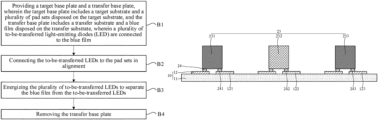
- FIG. 1 is a schematic flowchart of a method for transferring a light-emitting diode (LED) according to the present disclosure.
- FIGS. 2 A to 2 E are schematic diagrams of structures corresponding to steps of the method for transferring an LED shown in FIG. 1 .
- FIG. 3 is a schematic top view of a target base plate in step B 1 of the method for transferring an LED shown in FIG. 1 .
- FIG. 4 is a schematic top view of a target base plate in step B 3 of the method for transferring an LED shown in FIG. 1 .
- FIGS. 5 A and 5 B are schematic diagrams of a process and a structure in the method for transferring an LED shown in FIG. 1 without lightless LEDs.
- FIG. 6 is a schematic diagram of a structure of a light-emitting base plate according to the present disclosure.
- FIG. 7 is a schematic diagram of a structure of a display panel according to the present disclosure.
- the directional terms such as “above” and “below” usually refers to “above” and “below” in actual use or a working state of a device, and specifically refer to drawing directions of the corresponding accompanying drawings; and “inside” and “outside” are relative to the contour of the device.
- the present disclosure provides a method for transferring a light-emitting diode (LED) and a light-emitting base plate. Respective detailed descriptions are provided below. It is to be noted that, a description order of the following embodiments is not construed as a limitation on a preferred order of the embodiments.
- the present disclosure provides a method for transferring an LED.
- the method includes steps of:
- the to-be-transferred LEDs are energized.
- the LEDs emit light, and a thermal effect occurs.
- temperatures at positions where the blue film is in contact with the to-be-transferred LEDs increase, and continuously increases with the continuous heating, until the glue in the blue film denatures and loses viscosity.
- the acting force between the to-be-transferred LEDs and the blue film disappears and the to-be-transferred LEDs are separated from the blue film. Therefore, after the transfer base plate is removed, the to-be-transferred LEDs are directly separated from the blue film, thereby completing the transfer of the LEDs.
- a first embodiment of the present disclosure provides a method for transferring an LED.
- the method includes steps of:
- B 1 Providing a target base plate 10 and a transfer base plate 20 , wherein the target base plate 10 includes a target substrate 11 and a plurality of pad sets 12 disposed on the target substrate 11 , and the transfer base plate 20 includes a transfer substrate 21 and a blue film 22 disposed on the transfer substrate 21 , wherein a plurality of to-be-transferred LEDs 23 are connected to the blue film 22 , as shown in FIG. 2 A .
- the target substrate 11 may be a driving base plate.
- the driving base plate includes thin film transistors (not shown in the figure) configured to drive the LEDs 23 to emit light.
- the pad sets 12 are formed in a process for manufacturing the target substrate 11 .
- Each of the pad sets 12 includes a positive polarity pad and a negative polarity pad (not marked in the figure).
- the positive polarity pad is configured to be connected to a positive pole of the LEDs 23 .
- the negative polarity pad is configured to be connected to a negative pole of the LEDs 23 .
- the pad sets 12 include a first pad set 121 , a second pad set 122 , and a third pad set 123 .
- the transfer base plate 20 is an intermediate carrier during the transfer of the LEDs 23 .
- the transfer substrate 21 may be a sapphire substrate, a gallium arsenide substrate, a silicon substrate, or quartz glass.
- the to-be-transferred LEDs 23 may be mini-LEDs or micro-LEDs.
- the to-be-transferred LEDs 23 include a to-be-transferred red LED 231 , a to-be-transferred green LED 232 , and a to-be-transferred blue LED 233 .
- the to-be-transferred red LED 231 corresponds to the first pad set 121 .
- the to-be-transferred green LED 232 corresponds to the second pad set 122 .
- the to-be-transferred blue LED 233 corresponds to the third pad set 123 .
- Conductive contacts 24 are connected to the to-be-transferred LEDs 23 .
- a material of each conductive contact 24 may include one or more of metals having a low melting point, such as tin, indium, lead, or bismuth.
- the conductive contacts 24 include a first conductive contact 241 , a second conductive contact 242 , and a third conductive contact 243 .
- the first conductive contact 241 is connected to the to-be-transferred red LED 231 .
- the second conductive contact 242 is connected to the to-be-transferred green LED 232 .
- the third conductive contact 243 is connected to the to-be-transferred blue LED 233 .
- the target base plate 10 further includes a conductive circuit 13 disposed on the target substrate 11 .
- the conductive circuit 13 is connected to the pad sets 12 .
- the conductive circuit 13 is configured to be connected to an external power supply to input a voltage to the pad sets 12 .
- the conductive circuit 13 is disconnected from the external power supply.
- the conductive circuit 13 includes test pads 131 and test traces 132 .
- the test pads 131 are located in a peripheral area 111 of the target substrate 11 .
- the pad sets 12 are connected to the test pads 131 using the test traces 132 .
- the test pads 131 and the test traces 132 may be original test circuits in the target base plate 10 , or may be additionally added conductive circuits for energizing the to-be-transferred LEDs 23 during subsequent transfer.
- the test pads 131 and the test traces 132 are the original test circuits in the target base plate 10 . In this way, a new manufacturing process can be avoided.
- the conductive circuit 13 required for the present embodiment can be formed based on the original process. Therefore, the process cost can be reduced.
- the test pads 131 include a first test pad 1311 , a second test pad 1312 , and a third test pad 1313 .
- the test traces 132 include a first test trace 1321 , a second test trace 1322 , and a third test trace 1323 .
- the first pad set 121 is connected to the first test pad 1311 using the first test trace 1321 .
- the second pad set 122 is connected to the second test pad 1312 using the second test trace 1322 .
- the third pad set 123 is connected to the third test pad 1313 using the third test trace 1323 .
- the target substrate 11 has a plurality of first test traces 1321 , a plurality of second test trace 1322 , and a plurality of third test trace 1323 .
- the plurality of first test traces 1321 are connected to one first test pad 1311 .
- the plurality of second test traces 1322 are connected to one second test pad 1312 .
- the plurality of third test traces 1323 are connected to one third test pad 1313 .
- At least one of the target base plate 10 or the transfer base plate 20 is moved to connect the to-be-transferred LEDs 23 to the corresponding pad sets 12 in alignment.
- the connection between the to-be-transferred LEDs 23 and the corresponding pad sets 12 means contact between the to-be-transferred LEDs 23 and the pad sets 12 to achieve conduction.
- the to-be-transferred red LED 231 is connected in alignment to the first pad set 121
- the to-be-transferred green LED 232 is connected in alignment to the second pad set 122
- the to-be-transferred blue LED 233 is connected in alignment to the third pad set 123 .
- B 3 Energizing the plurality of to-be-transferred LEDs 23 to separate the blue film 22 from the to-be-transferred LEDs 23 .
- the external power supply applies a voltage to the conductive circuit 13 .
- the voltage in the conductive circuit 13 is transmitted to the pad sets 12 to cause the to-be-transferred LEDs 23 to emit light.
- the to-be-transferred LEDs 23 generate a thermal effect in the lighted state. Therefore, when the thermal effect is conducted to the blue film 22 , temperatures at positions M where the blue film 22 is in contact with the to-be-transferred LEDs 23 increase, as shown in FIG. 2 B .
- the voltage is continuously applied to the conductive circuit 13 . With the continuous heating, the temperature at the positions M where the blue film 22 is in contact with the lighted to-be-transferred LEDs 23 continuously increase, until glue in the blue film 22 denatures and loses viscosity, as shown in FIG.
- the step of applying the voltage to the conductive circuit 13 includes applying a voltage to the test pads 131 .
- a same voltage is applied to the first test pad 1311 , the second test pad 1312 , and the third test pad 1313 , to separate the blue film 22 from the to-be-transferred red LED 231 , the to-be-transferred green LED 232 , and the to-be-transferred blue LED 233 .
- the same voltage is applied to the first test pad 1311 , the second test pad 1312 , and the third test pad 1313 by the external power supply.
- the to-be-transferred red LED 231 , the to-be-transferred green LED 232 , and the to-be-transferred blue LED 233 emit light. All of the to-be-transferred red LED, the to-be-transferred green LED, and the to-be-transferred blue LED have the thermal effect in a light emitting state.
- temperatures at the positions M where the blue film 22 is in contact with the to-be-transferred red LED 231 , the to-be-transferred green LED 232 , and the to-be-transferred blue LED 233 all increase.
- the voltage is continuously applied to the test pads 131 . With the continuous heating, the temperatures at the positions M where the blue film 22 is in contact with the to-be-transferred red LED 231 , the to-be-transferred green LED 232 , and the to-be-transferred blue LED 233 continuously increase, until the glue in the blue film 22 denatures and loses the viscosity.
- the to-be-transferred red LED 231 , the to-be-transferred green LED 232 , and the to-be-transferred blue LED 233 are separated from the blue film 22 due to the elimination of the acting force between the LEDs and the blue film.
- top view structures of the to-be-transferred LEDs 23 and the pad sets 12 in FIGS. 3 and 4 in the present embodiment are merely exemplary and are used for description of the present embodiment, and should not be understood as a limitation on the present disclosure.
- the transfer base plate 20 including the transfer substrate 21 and the blue film 22 is removed.
- the transfer base plate 20 is moved in a direction Y perpendicular to a plane where the target base plate 10 is located, to avoid an alignment deviation between the to-be-transferred LEDs 23 and the pad sets 12 during separation. Therefore, the alignment accuracy of the LEDs 23 can be improved.
- the transfer base plate 20 may be moved in other directions.
- the transfer base plate 20 may be moved in a direction intersecting the plane where the target base plate 10 is located or in a direction parallel to the transfer base plate 20 , which is not described in detail herein.
- the method further includes welding the conductive contacts 24 to the corresponding pad sets 12 , and removing the conductive circuit 13 to obtain the target base plate 10 having the transferred LED 23 , as shown in FIG. 2 E .
- the conductive contacts 24 are melted by reflow soldering, and the conductive contacts 24 are bonded to the corresponding pad sets 12 .
- the first conductive contact 241 is bonded to the first pad set 121
- the second conductive contact 242 is bonded to the second pad set 122
- the third conductive contact 243 is bonded to the third pad set 123 . Therefore, the transfer of the red LED 231 , the green LED 232 , and the blue LED 233 is completed.
- the to-be-transferred LEDs 23 are disconnected or damaged, that is, the to-be-transferred LEDs are faulty, the to-be-transferred LED 23 cannot be conducted in the energized state. Therefore, the LEDs neither emit light nor generate heat.
- step B 3 when there is a lightless to-be-transferred LED 23 B, in step B 3 , after the plurality of to-be-transferred LEDs 23 are energized, a lighted to-be-transferred LED 23 A is separated from the blue film 22 , and the lightless to-be-transferred LED 23 B is still connected to the blue film 22 .
- a temperature at a position M where the blue film 22 is in contact with the lighted to-be-transferred LED 23 A increases, until a portion 221 where the blue film 22 is in contact with the lighted to-be-transferred LED 23 A loses viscosity to achieve separation. Since a temperature at a position N where the blue film 22 is in contact with the lightless to-be-transferred LED 23 B does not change, the blue film 22 is still connected to the lightless to-be-transferred LED 23 B.
- step B 4 the transfer base plate 20 including the transfer substrate 21 , the blue film 22 , and the lightless to-be-transferred LED 23 B is removed.
- the transfer base plate 20 is moved in the direction Y perpendicular to the plane where the target base plate 10 is located, the lighted to-be-transferred LED 23 A is transferred to the target base plate 10 , and the lightless to-be-transferred LED 23 B is removed with the blue film 22 .
- the lightless to-be-transferred LED 23 B (the faulty LED) can be identified, and during the removal of the transfer base plate 20 , the faulty LED can be directly removed with the blue film 22 . Therefore, an additional separation device for the faulty LED is not required, thereby reducing the technical difficulty and the process costs.
- the identification and the separation of the faulty LED can be achieved during the transfer of the LEDs 23 . Therefore, the transfer efficiency of the LEDs 23 can be greatly enhanced.
- the LEDs 23 transferred to the target base plate 10 are in a lighted state, that is, the LEDs 23 on the target base plate 10 all can emit light normally. All of the LEDs 23 that can emit light normally form a lighted pattern on the target base plate 10 . Therefore, a faulty position (a position corresponding to the faulty LED) on the target base plate 10 can be directly found using the lighted pattern. In this way, when a new LED is required to be filled, the new LED may be directly transferred to the above faulty position in a point-to-point manner. Therefore, a special process of determining the faulty position is not required, thereby greatly reducing the technical difficulty and the process costs.
- the thermal effect generated during the emission of the LEDs 23 causes the blue film 22 to loses the viscosity, so that the blue film is separated from the LEDs 23 to realize the transfer of the LEDs 23 .
- the method for transferring an LED 23 provided in the present embodiment has the following advantages.
- a second embodiment of the present disclosure provides a method for transferring an LED.
- a difference between the method for transferring an LED provided in the second embodiment and the method for transferring an LED provided in the first embodiment lies in the following:
- the step of applying the voltage to the test pads 131 includes applying a first voltage V 1 to the first test pad 1311 , applying a second voltage V 2 to the second test pad 1312 , and applying a third voltage V 3 to the third test pad 1313 , wherein V 1 ⁇ V 2 ⁇ V 3 .
- the red LED 231 , the green LED 232 , and the blue LED 233 have different heating efficiency, that is, the red LED 231 , the green LED 232 , and the blue LED 233 have different current requirements for light emission, different voltages are required to be applied to the red LED, the green LED, and the blue LED for light emission.
- the heating efficiency decrements from the red LED 231 , the green LED 232 , to the blue LED 233 .
- the first voltage V 1 to the red LED 231 , the second voltage V 2 to the green LED 232 , and the third voltage V 3 to the blue LED 233 wherein V 1 ⁇ V 2 ⁇ V 3 , the red LED 231 , the green LED 232 , and the blue LED 233 can emit light within a same time period. Therefore, different rates of separation from the blue film 22 caused by different heating efficiency of the red LED, the green LED, and the blue LED can be avoided. In this way, the transfer rates of the LEDs 23 can be further increased.
- the present disclosure further provides a light-emitting base plate 100 .
- the light-emitting base plate 100 includes a target base plate 10 and a plurality of LEDs 23 .
- the target base plate 10 includes a target substrate 11 and a plurality of pad sets 12 disposed on the target substrate 11 .
- the plurality of LEDs 23 are connected to the plurality of pad sets 12 in a one-to-one correspondence.
- Conductive contacts 24 are connected between the LEDs 23 and the pad sets 12 .
- the pad sets 12 include a first pad set 121 , a second pad set 122 , and a third pad set 123 .
- the LEDs 23 include a red LED 231 , a green LED 232 , and a blue LED 233 .
- the conductive contacts 24 include a first conductive contact 241 , a second conductive contact 242 , and a third conductive contact 243 .
- the red LED 231 is connected to the first pad set 121 using the first conductive contact 241 .
- the green LED 232 is connected to the second pad set 122 using the second conductive contact 242 .
- the blue LED 233 is connected to the third pad set 123 using the third conductive contact 243 .
- the LEDs 23 may be obtained using the method for transferring an LED 23 described in any of the above embodiments.
- the embodiment of the present disclosure further provides a display panel 1000 .
- the display panel 1000 includes a light-emitting base plate 100 and a packaging layer 200 disposed on the light-emitting base plate 100 .
- the light-emitting base plate 100 may be the light-emitting base plate 100 described in the above embodiments.
- For a detailed structure of the light-emitting base plate 100 reference may be made to the description of the above embodiments, which is not repeated herein.
Landscapes
- Led Device Packages (AREA)
Abstract
Description
-
- providing a target base plate and a transfer base plate, wherein the target base plate includes a target substrate and a plurality of pad sets disposed on the target substrate, and the transfer base plate includes a transfer substrate and a blue film disposed on the transfer substrate, wherein a plurality of to-be-transferred LEDs are connected to the blue film;
- connecting the to-be-transferred LEDs to the pad sets in alignment;
- energizing the plurality of to-be-transferred LEDs to separate the blue film from the to-be-transferred LEDs; and
- removing the transfer base plate.
-
- applying a voltage to the conductive circuit, to cause the LEDs to emit light.
-
- providing a target base plate and a transfer base plate, wherein the target base plate includes a target substrate and a plurality of pad sets disposed on the target substrate, and the transfer base plate includes a transfer substrate and a blue film disposed on the transfer substrate, wherein a plurality of to-be-transferred LEDs are connected to the blue film, and conductive contacts are connected to the to-be-transferred LEDs;
- connecting the to-be-transferred LEDs to the pad sets in alignment;
- energizing the plurality of to-be-transferred LEDs to separate the blue film from the to-be-transferred LEDs; and
- moving the transfer base plate in a direction perpendicular to a plane where the target base plate is located; and
- welding the conductive contacts to the corresponding pad sets.
-
- applying a voltage to the conductive circuit, to cause the LEDs to emit light.
-
- applying a voltage to the test pads.
-
- connecting the to-be-transferred red LED to the first pad set in alignment, connecting the to-be-transferred green LED to the second pad set in alignment, and connecting the to-be-transferred blue LED to the third pad set in alignment.
-
- applying a same voltage to the first test pad, the second test pad, and the third test pad to separate the blue film from the to-be-transferred red LED, the to-be-transferred green LED, and the to-be-transferred blue LED.
-
- connecting the to-be-transferred red LED to the first pad set in alignment, connecting the to-be-transferred green LED to the second pad set in alignment, and connecting the to-be-transferred blue LED to the third pad set in alignment.
-
- applying a first voltage V1 to the first test pad, applying a second voltage V2 to the second test pad, and applying a third voltage V3 to the third test pad, wherein V1<V2<V3.
-
- removing the transfer base plate including the transfer substrate and the blue film.
-
- removing the transferring base plate including the transferring substrate, the blue film, and the lightless to-be-transferred LEDs.
-
- a target base plate including a target substrate and a plurality of pad sets disposed on the target substrate; and
- a plurality of light-emitting diodes (LEDs) connected to the plurality of pad sets in a one-to-one correspondence. The LEDs are obtained using the method for transferring an LED described in any of the above embodiments.
-
- B1: Providing a target base plate and a transfer base plate, wherein the target base plate includes a target substrate and a plurality of pad sets disposed on the target substrate, and the transfer base plate includes a transfer substrate and a blue film disposed on the transfer substrate, wherein a plurality of to-be-transferred LEDs are connected to the blue film.
- B2: Connecting the to-be-transferred LEDs to the pad sets in alignment.
- B3: Energizing the plurality of to-be-transferred LEDs to separate the blue film from the to-be-transferred LEDs.
- B4: Removing the transfer base plate.
-
- 1. Compared with a conventional laser transfer technology, in the present embodiment, since laser irradiation is omitted, the risk of performance degradation of the
LEDs 23 caused by laser irradiation can be reduced. In addition, compared with a manner of ablating theblue film 22 by a laser to separate theLEDs 23 for transfer, in the present embodiment, since the transfer is achieved by the thermal effect of theLEDs 23, theLEDs 23 are free of damage. - 2. Compared with a conventional transfer technology using a die bonder and a needle die bonder, in the present embodiment, since the
LEDs 23 can be directly separated from theblue film 22 during the removal of thetransfer base plate 20, there is no alignment deviation during the separation of theLED 23, and therefore there is no poor transfer accuracy. Desirable transfer accuracy can be guaranteed by means of the alignment between theLEDs 23 and the pad sets 12. In addition, in the present embodiment, since all of theLEDs 23 on theblue film 22 can be simultaneously separated from theblue film 22, the transfer of all of theLEDs 23 can be completed at one time. Therefore, the transfer rate can be greatly increased. Therefore, the method for transferring anLED 23 in the present embodiment has high transfer accuracy and a high transfer rate, which can meet the requirements of the mass transfer of theLEDs 23. - 3. Compared with a conventional seal transfer method, in the present embodiment, the transfer of the
LEDs 23 can be realized only using theoriginal test pads 131 and test traces 132 on thetarget base plate 10 without additional instruments and devices. Therefore, the process costs can be greatly reduced. - 4. In the present embodiment, the faulty LED can be identified and separated during the transfer of the
LEDs 23 according to the light emitting states of theLEDs 23 in the energized state. Since the additional separation device for the faulty LED is not required, both the technical difficulty and the process costs can be reduced. - 5. In the present embodiment, for determination of the faulty position of the faulty LED on the
target base plate 10, when anew LED 23 is required to be filled, the faulty position may be directly found using the lighted pattern of theLEDs 23 on thetarget base plate 10 without additional instruments and devices. Therefore, in the present embodiment, the faulty position can be determined during the transfer of theLEDs 23. Since the faulty position can be easily found according to the lighted pattern, both the process costs and the difficulty in determining the faulty position can be reduced.
- 1. Compared with a conventional laser transfer technology, in the present embodiment, since laser irradiation is omitted, the risk of performance degradation of the
Claims (20)
Applications Claiming Priority (3)
| Application Number | Priority Date | Filing Date | Title |
|---|---|---|---|
| CN202111382884.8A CN114141930B (en) | 2021-11-22 | 2021-11-22 | Light emitting diode transfer method, light emitting substrate and display panel |
| CN202111382884.8 | 2021-11-22 | ||
| PCT/CN2021/134491 WO2023087394A1 (en) | 2021-11-22 | 2021-11-30 | Light-emitting diode transfer method and light-emitting base plate |
Publications (2)
| Publication Number | Publication Date |
|---|---|
| US20240055548A1 US20240055548A1 (en) | 2024-02-15 |
| US12155003B2 true US12155003B2 (en) | 2024-11-26 |
Family
ID=80390552
Family Applications (1)
| Application Number | Title | Priority Date | Filing Date |
|---|---|---|---|
| US17/621,643 Active US12155003B2 (en) | 2021-11-22 | 2021-11-30 | Method for transferring light-emitting diode and light-emitting base plate |
Country Status (3)
| Country | Link |
|---|---|
| US (1) | US12155003B2 (en) |
| CN (1) | CN114141930B (en) |
| WO (1) | WO2023087394A1 (en) |
Families Citing this family (3)
| Publication number | Priority date | Publication date | Assignee | Title |
|---|---|---|---|---|
| CN114613886B (en) * | 2022-03-08 | 2025-12-09 | 苏州芯聚半导体有限公司 | Transfer method and display panel |
| CN115241107A (en) * | 2022-09-19 | 2022-10-25 | 深圳市优界科技有限公司 | A grain transfer mechanism |
| CN117080238B (en) * | 2023-08-31 | 2024-08-02 | 惠科股份有限公司 | Substrate for screening micro devices and method for transferring micro devices |
Citations (7)
| Publication number | Priority date | Publication date | Assignee | Title |
|---|---|---|---|---|
| CN109473532A (en) | 2018-11-20 | 2019-03-15 | 合肥京东方光电科技有限公司 | A manufacturing method of a Micro LED display substrate |
| CN109661122A (en) | 2018-11-09 | 2019-04-19 | 华中科技大学 | A selective mass transfer method suitable for miniature light-emitting diodes |
| CN110335844A (en) | 2019-06-17 | 2019-10-15 | 华中科技大学 | A kind of MicroLED flood tide transfer device and method based on selectivity heating degaussing |
| US20190319165A1 (en) * | 2016-11-07 | 2019-10-17 | Goertek. Inc | Micro-led transfer method and manufacturing method |
| US20210005588A1 (en) | 2019-07-04 | 2021-01-07 | Samsung Electronics Co., Ltd. | Micro led display module and method of manufacturing the same |
| CN113345829A (en) | 2021-06-07 | 2021-09-03 | 厦门乾照半导体科技有限公司 | Mass transfer method of micro light-emitting diode, display device and manufacturing method thereof |
| US20210335752A1 (en) | 2018-03-14 | 2021-10-28 | Boe Technology Group Co., Ltd. | Method of transferring a plurality of micro light emitting diodes to a target substrate, array substrate and display apparatus thereof |
-
2021
- 2021-11-22 CN CN202111382884.8A patent/CN114141930B/en active Active
- 2021-11-30 WO PCT/CN2021/134491 patent/WO2023087394A1/en not_active Ceased
- 2021-11-30 US US17/621,643 patent/US12155003B2/en active Active
Patent Citations (7)
| Publication number | Priority date | Publication date | Assignee | Title |
|---|---|---|---|---|
| US20190319165A1 (en) * | 2016-11-07 | 2019-10-17 | Goertek. Inc | Micro-led transfer method and manufacturing method |
| US20210335752A1 (en) | 2018-03-14 | 2021-10-28 | Boe Technology Group Co., Ltd. | Method of transferring a plurality of micro light emitting diodes to a target substrate, array substrate and display apparatus thereof |
| CN109661122A (en) | 2018-11-09 | 2019-04-19 | 华中科技大学 | A selective mass transfer method suitable for miniature light-emitting diodes |
| CN109473532A (en) | 2018-11-20 | 2019-03-15 | 合肥京东方光电科技有限公司 | A manufacturing method of a Micro LED display substrate |
| CN110335844A (en) | 2019-06-17 | 2019-10-15 | 华中科技大学 | A kind of MicroLED flood tide transfer device and method based on selectivity heating degaussing |
| US20210005588A1 (en) | 2019-07-04 | 2021-01-07 | Samsung Electronics Co., Ltd. | Micro led display module and method of manufacturing the same |
| CN113345829A (en) | 2021-06-07 | 2021-09-03 | 厦门乾照半导体科技有限公司 | Mass transfer method of micro light-emitting diode, display device and manufacturing method thereof |
Non-Patent Citations (3)
| Title |
|---|
| Chinese Office Action issued in corresponding Chinese Patent Application No. 202111382884.8 dated Jan. 21, 2024, pp. 1-7. |
| International Search Report in International application No. PCT/CN2021/134491, mailed on Jun. 24, 2022. |
| Written Opinion of the International Search Authority in International application No. PCT/CN2021/134491,mailed on Jun. 24, 2022. |
Also Published As
| Publication number | Publication date |
|---|---|
| WO2023087394A1 (en) | 2023-05-25 |
| US20240055548A1 (en) | 2024-02-15 |
| CN114141930A (en) | 2022-03-04 |
| CN114141930B (en) | 2024-11-01 |
Similar Documents
| Publication | Publication Date | Title |
|---|---|---|
| KR102688372B1 (en) | Light-emitting device and manufacturing method thereof | |
| US10607973B2 (en) | Micro-LED array display devices with CMOS cells | |
| US20240055548A1 (en) | Method for transferring light-emitting diode and light-emitting base plate | |
| CN112018218B (en) | Transfer method of micro-light-emitting diode and manufacturing method of display panel | |
| TWI774713B (en) | Method for fabricating integrated micro led display | |
| TWI710103B (en) | Luminous panel and method of manufacturing such a luminous panel | |
| WO2020248750A1 (en) | Micro led transfer method and display panel | |
| CN108336077A (en) | Pixel array substrate and manufacturing method thereof | |
| CN113424315B (en) | Method for transferring light-emitting element for display and display device | |
| CN110546771A (en) | Micro light emitting diode transfer method, micro light emitting diode device and electronic equipment | |
| CN112531091B (en) | light emitting device | |
| US20210272824A1 (en) | Apparatus for simultaneously transferring micro-devices to target object | |
| WO2024000653A1 (en) | Display panel | |
| TW201904048A (en) | Micro LED display module and manufacturing method thereof including a driving chip block, a LED block, a circuit board and a color layer | |
| CN115732621A (en) | Display panel, display panel preparation method and display device | |
| TWI835978B (en) | Light-emitting device | |
| WO2024045637A1 (en) | Display panel and preparation method therefor | |
| US11948928B2 (en) | Display apparatus and manufacturing method thereof | |
| JP7681437B2 (en) | Display device manufacturing method | |
| CN115547872A (en) | Chip transfer assembly and chip transfer method | |
| US20220231209A1 (en) | Led display | |
| US20220077223A1 (en) | Processes, articles and apparatus that incorporate semiconductor switches and drive circuitry on compound semiconductor chiplets | |
| JP2023005499A (en) | Led chip formation substrate and transfer method of led chip | |
| TW202218537A (en) | Manufacturing method for display device characterized by using a simple method to prevent an LED chip before bonding from a position shift while bonding an LED chip to a circuit structure | |
| CN222365601U (en) | LED array device based on vertical structure LED |
Legal Events
| Date | Code | Title | Description |
|---|---|---|---|
| AS | Assignment |
Owner name: SHENZHEN CHINA STAR OPTOELECTRONICS SEMICONDUCTOR DISPLAY TECHNOLOGY CO., LTD., CHINA Free format text: ASSIGNMENT OF ASSIGNORS INTEREST;ASSIGNOR:SUN, BO;REEL/FRAME:058451/0054 Effective date: 20211215 Owner name: HUIZHOU CHINA STAR OPTOELECTRONICS DISPLAY CO., LTD., CHINA Free format text: ASSIGNMENT OF ASSIGNORS INTEREST;ASSIGNOR:SUN, BO;REEL/FRAME:058451/0054 Effective date: 20211215 |
|
| FEPP | Fee payment procedure |
Free format text: ENTITY STATUS SET TO UNDISCOUNTED (ORIGINAL EVENT CODE: BIG.); ENTITY STATUS OF PATENT OWNER: LARGE ENTITY |
|
| STPP | Information on status: patent application and granting procedure in general |
Free format text: DOCKETED NEW CASE - READY FOR EXAMINATION |
|
| STPP | Information on status: patent application and granting procedure in general |
Free format text: NON FINAL ACTION MAILED |
|
| STPP | Information on status: patent application and granting procedure in general |
Free format text: RESPONSE TO NON-FINAL OFFICE ACTION ENTERED AND FORWARDED TO EXAMINER |
|
| STPP | Information on status: patent application and granting procedure in general |
Free format text: NOTICE OF ALLOWANCE MAILED -- APPLICATION RECEIVED IN OFFICE OF PUBLICATIONS |
|
| STCF | Information on status: patent grant |
Free format text: PATENTED CASE |