US12146087B2 - Compound and organic electroluminescence device - Google Patents
Compound and organic electroluminescence device Download PDFInfo
- Publication number
- US12146087B2 US12146087B2 US16/958,054 US201816958054A US12146087B2 US 12146087 B2 US12146087 B2 US 12146087B2 US 201816958054 A US201816958054 A US 201816958054A US 12146087 B2 US12146087 B2 US 12146087B2
- Authority
- US
- United States
- Prior art keywords
- substituted
- unsubstituted
- formula
- carbon atoms
- group including
- Prior art date
- Legal status (The legal status is an assumption and is not a legal conclusion. Google has not performed a legal analysis and makes no representation as to the accuracy of the status listed.)
- Active, expires
Links
Images


Classifications
-
- C—CHEMISTRY; METALLURGY
- C09—DYES; PAINTS; POLISHES; NATURAL RESINS; ADHESIVES; COMPOSITIONS NOT OTHERWISE PROVIDED FOR; APPLICATIONS OF MATERIALS NOT OTHERWISE PROVIDED FOR
- C09K—MATERIALS FOR MISCELLANEOUS APPLICATIONS, NOT PROVIDED FOR ELSEWHERE
- C09K11/00—Luminescent materials, e.g. electroluminescent or chemiluminescent
- C09K11/06—Luminescent materials, e.g. electroluminescent or chemiluminescent containing organic luminescent materials
-
- C—CHEMISTRY; METALLURGY
- C07—ORGANIC CHEMISTRY
- C07F—ACYCLIC, CARBOCYCLIC OR HETEROCYCLIC COMPOUNDS CONTAINING ELEMENTS OTHER THAN CARBON, HYDROGEN, HALOGEN, OXYGEN, NITROGEN, SULFUR, SELENIUM OR TELLURIUM
- C07F5/00—Compounds containing elements of Groups 3 or 13 of the Periodic Table
- C07F5/02—Boron compounds
-
- H—ELECTRICITY
- H10—SEMICONDUCTOR DEVICES; ELECTRIC SOLID-STATE DEVICES NOT OTHERWISE PROVIDED FOR
- H10K—ORGANIC ELECTRIC SOLID-STATE DEVICES
- H10K85/00—Organic materials used in the body or electrodes of devices covered by this subclass
- H10K85/20—Carbon compounds, e.g. carbon nanotubes or fullerenes
- H10K85/211—Fullerenes, e.g. C60
-
- H—ELECTRICITY
- H10—SEMICONDUCTOR DEVICES; ELECTRIC SOLID-STATE DEVICES NOT OTHERWISE PROVIDED FOR
- H10K—ORGANIC ELECTRIC SOLID-STATE DEVICES
- H10K85/00—Organic materials used in the body or electrodes of devices covered by this subclass
- H10K85/60—Organic compounds having low molecular weight
- H10K85/631—Amine compounds having at least two aryl rest on at least one amine-nitrogen atom, e.g. triphenylamine
-
- H—ELECTRICITY
- H10—SEMICONDUCTOR DEVICES; ELECTRIC SOLID-STATE DEVICES NOT OTHERWISE PROVIDED FOR
- H10K—ORGANIC ELECTRIC SOLID-STATE DEVICES
- H10K85/00—Organic materials used in the body or electrodes of devices covered by this subclass
- H10K85/60—Organic compounds having low molecular weight
- H10K85/649—Aromatic compounds comprising a hetero atom
- H10K85/657—Polycyclic condensed heteroaromatic hydrocarbons
- H10K85/6572—Polycyclic condensed heteroaromatic hydrocarbons comprising only nitrogen in the heteroaromatic polycondensed ring system, e.g. phenanthroline or carbazole
-
- H—ELECTRICITY
- H10—SEMICONDUCTOR DEVICES; ELECTRIC SOLID-STATE DEVICES NOT OTHERWISE PROVIDED FOR
- H10K—ORGANIC ELECTRIC SOLID-STATE DEVICES
- H10K85/00—Organic materials used in the body or electrodes of devices covered by this subclass
- H10K85/60—Organic compounds having low molecular weight
- H10K85/649—Aromatic compounds comprising a hetero atom
- H10K85/657—Polycyclic condensed heteroaromatic hydrocarbons
- H10K85/6574—Polycyclic condensed heteroaromatic hydrocarbons comprising only oxygen in the heteroaromatic polycondensed ring system, e.g. cumarine dyes
-
- H—ELECTRICITY
- H10—SEMICONDUCTOR DEVICES; ELECTRIC SOLID-STATE DEVICES NOT OTHERWISE PROVIDED FOR
- H10K—ORGANIC ELECTRIC SOLID-STATE DEVICES
- H10K85/00—Organic materials used in the body or electrodes of devices covered by this subclass
- H10K85/60—Organic compounds having low molecular weight
- H10K85/649—Aromatic compounds comprising a hetero atom
- H10K85/657—Polycyclic condensed heteroaromatic hydrocarbons
- H10K85/6576—Polycyclic condensed heteroaromatic hydrocarbons comprising only sulfur in the heteroaromatic polycondensed ring system, e.g. benzothiophene
-
- H—ELECTRICITY
- H10—SEMICONDUCTOR DEVICES; ELECTRIC SOLID-STATE DEVICES NOT OTHERWISE PROVIDED FOR
- H10K—ORGANIC ELECTRIC SOLID-STATE DEVICES
- H10K85/00—Organic materials used in the body or electrodes of devices covered by this subclass
- H10K85/60—Organic compounds having low molecular weight
- H10K85/658—Organoboranes
-
- C—CHEMISTRY; METALLURGY
- C09—DYES; PAINTS; POLISHES; NATURAL RESINS; ADHESIVES; COMPOSITIONS NOT OTHERWISE PROVIDED FOR; APPLICATIONS OF MATERIALS NOT OTHERWISE PROVIDED FOR
- C09K—MATERIALS FOR MISCELLANEOUS APPLICATIONS, NOT PROVIDED FOR ELSEWHERE
- C09K2211/00—Chemical nature of organic luminescent or tenebrescent compounds
- C09K2211/10—Non-macromolecular compounds
- C09K2211/1003—Carbocyclic compounds
- C09K2211/1014—Carbocyclic compounds bridged by heteroatoms, e.g. N, P, Si or B
-
- C—CHEMISTRY; METALLURGY
- C09—DYES; PAINTS; POLISHES; NATURAL RESINS; ADHESIVES; COMPOSITIONS NOT OTHERWISE PROVIDED FOR; APPLICATIONS OF MATERIALS NOT OTHERWISE PROVIDED FOR
- C09K—MATERIALS FOR MISCELLANEOUS APPLICATIONS, NOT PROVIDED FOR ELSEWHERE
- C09K2211/00—Chemical nature of organic luminescent or tenebrescent compounds
- C09K2211/10—Non-macromolecular compounds
- C09K2211/1018—Heterocyclic compounds
- C09K2211/1025—Heterocyclic compounds characterised by ligands
- C09K2211/1044—Heterocyclic compounds characterised by ligands containing two nitrogen atoms as heteroatoms
- C09K2211/1055—Heterocyclic compounds characterised by ligands containing two nitrogen atoms as heteroatoms with other heteroatoms
-
- H—ELECTRICITY
- H10—SEMICONDUCTOR DEVICES; ELECTRIC SOLID-STATE DEVICES NOT OTHERWISE PROVIDED FOR
- H10K—ORGANIC ELECTRIC SOLID-STATE DEVICES
- H10K50/00—Organic light-emitting devices
- H10K50/10—OLEDs or polymer light-emitting diodes [PLED]
- H10K50/11—OLEDs or polymer light-emitting diodes [PLED] characterised by the electroluminescent [EL] layers
-
- H—ELECTRICITY
- H10—SEMICONDUCTOR DEVICES; ELECTRIC SOLID-STATE DEVICES NOT OTHERWISE PROVIDED FOR
- H10K—ORGANIC ELECTRIC SOLID-STATE DEVICES
- H10K50/00—Organic light-emitting devices
- H10K50/10—OLEDs or polymer light-emitting diodes [PLED]
- H10K50/14—Carrier transporting layers
- H10K50/15—Hole transporting layers
-
- H—ELECTRICITY
- H10—SEMICONDUCTOR DEVICES; ELECTRIC SOLID-STATE DEVICES NOT OTHERWISE PROVIDED FOR
- H10K—ORGANIC ELECTRIC SOLID-STATE DEVICES
- H10K50/00—Organic light-emitting devices
- H10K50/10—OLEDs or polymer light-emitting diodes [PLED]
- H10K50/14—Carrier transporting layers
- H10K50/16—Electron transporting layers
-
- H—ELECTRICITY
- H10—SEMICONDUCTOR DEVICES; ELECTRIC SOLID-STATE DEVICES NOT OTHERWISE PROVIDED FOR
- H10K—ORGANIC ELECTRIC SOLID-STATE DEVICES
- H10K85/00—Organic materials used in the body or electrodes of devices covered by this subclass
- H10K85/60—Organic compounds having low molecular weight
- H10K85/615—Polycyclic condensed aromatic hydrocarbons, e.g. anthracene
- H10K85/626—Polycyclic condensed aromatic hydrocarbons, e.g. anthracene containing more than one polycyclic condensed aromatic rings, e.g. bis-anthracene
Definitions
- the invention relates to a novel compound and an organic electroluminescence device using the same.
- an organic electroluminescence device When voltage is applied to an organic electroluminescence device (hereinafter, referred to as an organic EL device in several cases), holes and electrons are injected into an emitting layer from an anode and a cathode, respectively. Then, thus injected holes and electrons are recombined in the emitting layer, and excitons are formed therein.
- an organic electroluminescence device hereinafter, referred to as an organic EL device in several cases
- the organic EL device includes the emitting layer between the anode and the cathode. Further, the organic EL device has a stacked structure including an organic layer such as a hole-injecting layer, a hole-transporting layer, an electron-injecting layer, and an electron-transporting layer in several cases.
- an organic layer such as a hole-injecting layer, a hole-transporting layer, an electron-injecting layer, and an electron-transporting layer in several cases.
- Patent Document 1 discloses a compound used as a material for an organic electroluminescence device.
- a material for an organic electroluminescence device containing the compound represented by the formula (1) is provided.
- an organic electroluminescence device containing a cathode, an anode, and at least one organic layer disposed between the cathode and the anode, wherein at least one layer of the at least one organic layer contains the compound represented by the formula (1), is provided.
- an electronic appliance provided with the organic electroluminescence device is provided.
- a novel compound which can be used as a material for an organic electroluminescence device that makes the device to have high luminous efficiency, and an organic electroluminescence device, that exhibits high luminous efficiency using the same can be provided.
- FIG. 1 is a diagram showing a schematic configuration of an embodiment of an organic EL device of the invention.
- FIG. 2 is a diagram showing schematic configuration of another embodiment of an organic EL device of the invention.
- a hydrogen atom means an atom including isotopes different in the number of neutrons, namely, a protium, a deuterium and a tritium.
- the number of “ring carbon atoms” represents the number of carbon atoms among the atoms which forms a subject ring itself of a compound having a structure in which atoms are bonded in a ring form (for example, a monocyclic compound, a fused ring compound, a cross-linked compound, a carbocyclic compound or a heterocyclic compound).
- a compound having a structure in which atoms are bonded in a ring form for example, a monocyclic compound, a fused ring compound, a cross-linked compound, a carbocyclic compound or a heterocyclic compound.
- the carbon contained in the substituent is not included in the number of ring carbon atoms.
- a benzene ring includes 6 ring carbon atoms
- a naphthalene ring includes 10 ring carbon atoms
- a pyridinyl group includes 5 ring carbon atoms
- a furanyl group includes 4 ring carbon atoms.
- the benzene ring or the naphthalene ring is substituted by, for example, an alkyl group as a substituent, the number of carbon atoms of the alkyl group is not included in the number of ring carbon atoms.
- a fluorene ring is bonded with, for example, a fluorene ring as a substituent (including a spirofluorene ring), the number of carbon atoms of the fluorene ring as a substituent is not included in the number of ring carbon atoms.
- the term “the number of ring atoms” represents the number of atoms which forms a subject ring itself of a compound having a structure in which atoms are bonded in a ring form (an example of the structure includes a monocyclic ring, a fused ring and a ring assembly) (an example of the compound includes a monocyclic compound, a fused ring compound, a cross-linked compound, a carbocyclic compound and a heterocyclic compound).
- the atoms that do not form the ring e.g., a hydrogen atom that terminates bonds which are not used to form the ring
- the atoms contained in a substituent where the ring is substituted by the substituent is not included in the number of ring atom.
- a pyridine ring includes 6 ring atoms
- a quinazoline ring includes 10 ring atoms
- a furan ring includes 5 ring atoms.
- Hydrogen atoms are independently bonded with carbon atoms of the pyridine ring or the quinazoline ring or atoms forming the substituent are not included in the number of ring atoms.
- a fluorene ring is bonded with, for example, a fluorene ring as a substituent (including a spirofluorene ring), the number of atoms of the fluorene ring as a substituent is not included in the number of ring atoms.
- a substituted or unsubstituted ZZ group including XX to YY carbon atoms represents the number of carbon atoms when the ZZ group is unsubstituted, and does not include the number of carbon atoms of the substituent when the ZZ group is substituted.
- YY is larger than “XX”, and “XX” and “YY” independently mean an integer of 1 or more.
- a substituted or unsubstituted ZZ group including XX to YY atoms represents the number of atoms when the ZZ group is unsubstituted, and does not include the number of atoms of the substituent when the ZZ group is substituted.
- YY is larger than “XX”, and “XX” and “YY” independently mean an integer of 1 or more.
- substituted in the context of “substituted or unsubstituted” means that a substituent other than a hydrogen atom is bonded.
- unsubstituted in the context of “substituted or unsubstituted” means that a substituent is not bonded and a hydrogen atom is bonded.
- the substituent in the case of “substituted or unsubstituted” is selected from the group consisting of an alkyl group including 1 to 50 carbon atoms, a haloalkyl group including 1 to 50 carbon atoms, an alkenyl group including 2 to 50 carbon atoms, an alkynyl group including 2 to 50 carbon atoms, a cycloalkyl group including 3 to 50 ring carbon atoms, an alkoxy group including 1 to 50 carbon atoms, an alkylthio group including 1 to 50 carbon atoms, an aryloxy group including 6 to 50 ring carbon atoms, an arylthio group including 6 to 50 ring carbon atoms, an aralkyl group including 7 to 50 carbon atoms, —Si(R 41 )(R 42 )(R 43 ), —C( ⁇ O)R 44 , —COOR 45 , —S( ⁇ O
- adjacent arbitrary substituents form a substituted or unsubstituted, saturated or unsaturated ring, or do not form a substituted or unsubstituted, saturated or unsaturated ring.
- To “form a substituted or unsubstituted, saturated or unsaturated ring” is the same as the following description of “substituted or unsubstituted” and “saturated or unsaturated ring.”
- the arbitrary substituent may further have the substituent. Specific examples of the substituent that the arbitrary substituent further has include to the ones same as the arbitrary substituent described above.
- Examples of the unsubstituted alkyl group including 1 to 50 (preferably 1 to 30, more preferably 1 to 18, and even more preferably 1 to 5) carbon atoms include, for example, a methyl group, an ethyl group, a propyl group, an isopropyl group, a n-butyl group, a s-butyl group, an isobutyl group, a t-butyl group, a n-pentyl group, a n-hexyl group, a n-heptyl group, a n-octyl group, and the like.
- Examples of the substituted alkyl group including 1 to 50 include a hydroxymethyl group, a 1-hydroxyethyl group, a 2-hydroxyethyl group, a 2-hydroxyisobutyl group, a 1,2-dihydroxyethyl group, a 1,3-dihydroxyisopropyl group, a 2,3-dihydroxy-t-butyl group, a 1,2,3-trihydroxypropyl group, a chloromethyl group, a 1-chloroethyl group, a 2-chloroethyl group, a 2-dichloroisobuthyl group, a 1,2-dichloroethyl group, a 1,3-dichloroisopropyl group, a 2,3-dichloro-t-butyl group, a 1,2,3-trichloropropyl group, a bromomethyl group, a 1-bromoethyl group
- the substituted or unsubstituted haloalkyl group including 1 to 50 carbon atoms is a group in which one or more of hydrogen atoms of the alkyl group is substituted by a halogen atom.
- a group obtained by substituting one or more halogen atoms in the above-mentioned substituted or unsubstituted alkyl group including 1 to 50 carbon atoms can be given.
- alkenyl group including 2 to 50 (preferably 2 to 30, and more preferably 2 to 18) carbon atoms include, for example, a vinyl group, an allyl group, a 1-butenyl group, a 2-butenyl group, a 3-butenyl group, a 1,3-butanedienyl group, a 1-methylvinyl group, a 1-methylallyl group, a 1,1-dimethylallyl group, a 2-methylally group, a 1,2-dimethylallyl group, and the like.
- an ethynyl group or the like can be given as the unsubstituted alkynyl group including 2 to 50 (preferably 2 to 30, more preferably 2 to 18) carbon atoms.
- Examples of the unsubstituted cycloalkyl group including 3 to 50 include a cyclopropyl group, a cyclobutyl group, a cyclopentyl group, a cyclohexyl group, a 4-methylcyclohexyl group, a 1-adamantyl group, a 2-adamantyl group, a 1-norbornyl group, a 2-norbornyl group, and the like.
- the unsubstituted alkoxy group including 1 to 50 (preferably 1 to 30, more preferably 1 to 18) carbon atoms is represented by —OX.
- X the alkyl group including 1 to 50 carbon atoms mentioned above can be given, for example.
- the unsubstituted alkylthio group including 1 to 50 (preferably 1 to 30, more preferably 1 to 18) carbon atoms is represented by —SX.
- X the alkyl group including 1 to 50 carbon atoms mentioned above can be given, for example.
- aryl group including 6 to 50 (preferably 6 to 30, more preferably 6 to 18) ring carbon atoms, a phenyl group, a p-biphenylyl group, a m-biphenylyl group, an o-biphenylyl group, a p-terphenyl-4-yl group, a p-terphenyl-3-yl group, a p-terphenyl-2-yl group, a m-terphenyl-4-yl group, a m-terphenyl-3-yl group, a m-terphenyl-2-yl group, an o-terphenyl-4-yl group, an o-terphenyl-3-yl group, an o-terphenyl-2-yl group, a 1-naphthyl group, a 2-naphthyl group, an anthryl group, a benzanthryl group, a
- a phenyl group, a biphenyl group, a terphenyl group, a naphthyl group, a phenanthryl group, and a fluorenyl group are preferable, and a phenyl group, a naphthyl group, and a biphenyl group are more preferable.
- substituted aryl group including 6 to 50 (preferably 6 to 30, more preferably 6 to 18) ring carbon atoms, an o-tolyl group, a m-tolyl group, a p-tolyl group, a para-xylyl group, a meta-xylyl group, an ortho-xylyl group, a para-isopropylphenyl group, a meta-isopropylphenyl group, an ortho-isopropylphenyl group, a para-t-butylphenyl group, a meta-t-butylphenyl group, an ortho-t-butylphenyl group, a 3,4,5-trimethylphenyl group, a 9,9-dimethylfluorenyl group, a 9,9-diphenylfluorenyl group, a 9,9′-spirobifluorenyl group, a 9,9-di(4-methylphenyl)fluorenyl group, a 9,9
- substituted or unsubstituted arylene group including 6 to 30 (preferably 6 to 20, more preferably 6 to 18) ring carbon atoms for example, a divalent group derive from the unsubstituted aryl group including 6 to 50 ring carbon atoms and an aromatic hydrocarbon ring constituting the substituted aryl group including 6 to 50 ring carbon atoms exemplified above can be given.
- the substituted or unsubstituted arylene group including 6 to 30 ring carbon atoms is selected, for example, from the group consisting of a substituted or unsubstituted phenylene group represented by the following formulas (L1-1a) to (L1-1c), a substituted or unsubstituted biphenylyl group represented by the following formulas (L1-2a) to (L1-2g), a substituted or unsubstituted dialkylfluorenylene group represented by the following formulas (L1-3a) to (L1-3k), and a substituted or unsubstituted naphthylene group represented by the following formulas (L1-4a) to (L1-4j):
- R a 's are independently an arbitrary substituent.
- R a 's When m is two or more, two or more R a 's may be the same or different. When n is two or more, two or more R a 's may be the same or different. When p is two or more, two or more R a 's may be the same or different. When m is two or more, two or more R a 's are not bonded with each other. When n is two or more, two or more R a 's are not bonded with each other. When p is two or more, two or more R a 's are not bonded with each other.
- m is 0.
- n 0.
- p is 0.
- the unsubstituted aryloxy group including 6 to 50 (preferably 6 to 30, more preferably 6 to 18) ring carbon atoms is represented by —OY.
- Y the aryl group including 6 to 50 ring carbon atoms mentioned above can be given.
- the unsubstituted arylthio group including 6 to 50 (preferably 6 to 30, more preferably 6 to 18) ring carbon atoms is represented by —SY.
- Y the aryl group including 6 to 50 ring carbon atoms mentioned above can be given.
- the unsubstituted aralkyl group including 7 to 50 (preferably 7 to 30, more preferably 7 to 18) carbon atoms includes, for example, a benzyl group, a 1-phenylethyl group, a 2-phenylethyl group, a 1-phenylisopropyl group, a 2-phenylisopropyl group, a phenyl-t-butyl group, an ⁇ -naphthylmethyl group, a 1- ⁇ -naphthylethyl group, a 2- ⁇ -naphthylethyl group, a 1- ⁇ -naphthylisopropyl group, a 2- ⁇ -naphthylisopropyl group, a ⁇ -naphthylmethyl group, a 1- ⁇ -naphthylethyl group, a 2- ⁇ -naphthylethyl group, a 1- ⁇ -naphthy
- the substituted aralkyl group including 7 to 50 (preferably 7 to 30, more preferably 7 to 18) carbon atoms includes, for example, a p-methylbenzyl group, a m-methylbenzyl group, an o-methylbenzyl group, a p-chlorobenzyl group, a m-chlorobenzyl group, an o-chlorobenzyl group, a p-bromobenzyl group, a m-bromobenzyl group, an o-bromobenzyl group, a p-iodobenzyl group, a m-iodobenzyl group, an o-iodobenzyl group, a p-hydroxybenzyl group, a m-hydroxybenzyl group, an o-hydroxybenzyl group, a p-nitrobenzyl group, a m-nitrobenzyl group, an o-nitrobenzyl group, a p-cyano
- the unsubstituted monovalent heterocyclic group including 5 to 50 (preferably 5 to 30, more preferably 5 to 18) ring atoms includes, for example:
- heteroatoms constituting a heterocyclic group examples include heteroatoms such as S, O, and N, and heteroatoms such as Si, Ge, and Se.
- heterocyclic group described in the present specification may be a monocyclic group or a fused ring group.
- the “heterocyclic group” described in the present specification may be an aromatic heterocyclic group or an aliphatic heterocyclic group.
- the substituted monovalent heterocyclic group including 5 to 50 (preferably 5 to 30, more preferably 5 to 18) ring atoms includes, for example:
- substituted or unsubstituted divalent heterocyclic group including 5 to 30 preferably 5 to 20, more preferably 5 to 18 ring atoms
- a divalent group derived from a heterocyclic ring constituting the unsubstituted monovalent heterocyclic group including 5 to 50 ring atoms and the substituted monovalent heterocyclic group including 5 to 50 ring atoms exemplified above can be given.
- substituted or unsubstituted monovalent heterocyclic group including 5 to 50 ring atoms the following groups are included.
- divalent heterocyclic group including 5 to 30 ring atoms groups obtained by making the following groups into divalent groups are also included:
- halogen atom a fluorine atom, a chlorine atom, a bromine atom, an iodine atom or the like can be given.
- R 1 to R 8 is a group represented by the following formula (2)” means that at least one of R 1 to R 8 does not form a substituted or unsubstituted, saturated or unsaturated ring, and the at least one is a group represented by the formula (2).
- the “one pair of adjacent two or more among R 1 to R 11 ” represents, for example, a combination of R 1 and R 2 , R 2 and R 3 , R 3 and R 4 , R 5 and R 6 , R 6 and R 7 , R 1 , R 2 and R 3 , and the like.
- the “saturated or unsaturated ring” means, for example, when the ring is formed by R 1 and R 2 , a ring formed by a carbon atom with which R 1 is bonded, a carbon atom with which R 2 is bonded, and one or more arbitrary elements. Specifically, if the ring is formed by R 1 and R 2 , when an unsaturated ring is formed by a carbon atom with which R 1 is bonded, a carbon atom with which R 2 is bonded, and four carbon atoms, the ring formed by R 1 and R 2 is a benzene ring.
- the “arbitrary element” is preferably a C element, a N element, an O element, and a S element.
- chemical bonding sites that are not involved in the ring formation a ring may be terminated by a hydrogen atom, or the like.
- the number of the “one or more arbitrary element” is preferably 2 or more and 15 or less, more preferably 3 or more and 12 or less, and still more preferably 3 or more and 5 or less arbitrary elements.
- the expression “one or more pairs of adjacent two or more among X to Y form a substituted or unsubstituted, saturated or unsaturated ring, or do not form a substituted or unsubstituted, saturated or unsaturated ring” has the same meanings as when X is replaced with R 1 and Y is replaced with R 11 .
- the compound represented by the formula (1) is represented by the following formula (3).
- the compound represented by the formula (1) is represented by the following formula (4).
- R 1 , R 3 to R 11 which do not form the substituted or unsubstituted, saturated or unsaturated ring R 1 and R 13 are independently a hydrogen atom, a substituted or unsubstituted alkyl group including 1 to 50 carbon atoms, a substituted or unsubstituted aryl group including 6 to 50 ring carbon atoms, a substituted or unsubstituted monovalent heterocyclic group including 5 to 50 ring atoms, or a group represented by the formula (2).
- the compound represented by the formula (1) is represented by the following formula (5).
- R 7 , R 10 , R 12 and R 13 are independently a hydrogen atom, a substituted or unsubstituted alkyl group including 1 to 50 carbon atoms, a substituted or unsubstituted aryl group including 6 to 50 ring carbon atoms, and a substituted or unsubstituted monovalent heterocyclic group including 5 to 50 ring atoms, or a group represented by the formula (2).
- the compound represented by the formula (1) is represented by the following formula (6).
- the compound represented by the formula (1) is represented by the following formula (7).
- HAr is a substituted or unsubstituted monovalent heterocyclic group including 5 to 18 ring atoms.
- the substituent in the case of “substituted or unsubstituted” in the compound represented by the formula (1) is selected from the group consisting of an alkyl group including 1 to 50 carbon atoms, a haloalkyl group including 1 to 50 carbon atoms, an alkenyl group including 2 to 50 carbon atoms, an alkynyl group including 2 to 50 carbon atoms, a cycloalkyl group including 3 to 50 ring carbon atoms, an alkoxy group including 1 to 50 carbon atoms, an alkylthio group including 1 to 50 carbon atoms, an aryloxy group including 6 to 50 ring carbon atoms, an arylthio group including 6 to 50 ring carbon atoms, an aralkyl group including 7 to 50 carbon atoms, —Si(R 41 )(R 42 )(R 43 ), —C( ⁇ O)R 44 , —COOR 45 , —S( ⁇ O) 2 R 46 ,
- the substituent in the case of “substituted or unsubstituted” in the compound represented by the formula (1) is selected from the group consisting of an alkyl group including 1 to 50 carbon atoms, an aryl group including 6 to 50 ring carbon atoms, and a monovalent heterocyclic group including 5 to 50 ring atoms.
- HAr is a substituted or unsubstituted carbazolyl group.
- the compound represented by the formula (1) is useful as a material for an organic EL device.
- a luminous efficiency of the organic EL device can be improved by using the compound represented by the formula (1) as a material for an emitting layer of the organic EL device.
- the material for the organic EL devices according to one aspect of the invention include compound represented by the formula (1).
- An organic EL device comprises: a cathode; an anode; and at least one organic layer disposed between the cathode and the anode, wherein at least one layer of the at least one organic layer comprises the compound represented by the formula (1).
- a luminous efficiency of the organic EL device can be improved by using the compound represented by the formula (1) for a predetermined organic layer, for example, for an emitting layer.
- At least one layer of the at least one organic layer is an emitting layer.
- An organic EL device comprises: a cathode; an anode; and at least one organic layer disposed between the cathode and the anode, wherein at least one layer of the at least one organic layer comprises a dopant material, and wherein the dopant material comprises the compound represented by the formula (1).
- At least one organic layer disposed between the cathode and the anode means that, when one organic layer is present between the cathode and the anode, it refers the one layer; and when two or more organic layers are present between the cathode and the anode, it refers to at least one layer among the plural organic layers.
- At least one layer of the at least one organic layer is an emitting layer means that, when one organic layer is present between the cathode and the anode, the layer is an emitting layer, and when two or more organic layers are present, at least one of the layers is an emitting layer.
- the organic EL device contains a hole-transporting layer between the anode and the emitting layer.
- the organic EL device contains an electron-transporting layer between the cathode and the emitting layer.
- “at least one layer between the emitting layer and the anode” means that, when one organic layer is present between the emitting layer and the anode, it refers to the one layer and when two or more organic layers are present, it refers to at least one layer of the organic layer.
- an organic layer closer to the emitting layer is called as a “hole-transporting layer” and an organic layer closer to the anode is called as a “hole-injecting layer.”
- a “hole-transporting layer” and a “hole-injecting layer” may be one layer, respectively; may be two or more layers, respectively; or one may be one layer and the other may be two or more layers.
- “at least one layer between the emitting layer and the cathode” means that, when one organic layer is present between the emitting layer and the cathode, it refers to the one layer, and when two or more organic layers are present, it refers to at least one layer of the organic layer.
- the organic layer closer to the emitting layer is called as an “electron-transporting layer” and an organic layer closer to the cathode is called as an “electron-injecting layer”.
- An “electron-transporting layer” and an “electron-injecting layer” may be one layer, respectively; may be two or more layers, respectively; or one may be a layer and the other may be two or more layers.
- the emitting layer further comprises a compound represented by the following formula (10) (hereinafter may be referred to as the compound (10)):
- the “one pair of adjacent two or more among R 101 to R 110 ” are, for example, a combination of R 101 and R 102 , R 102 and R 103 , R 103 and R 104 , R 105 and R 106 , R 106 and R 107 , R 107 and R 108 , R 108 and R 109 , R 101 , R 102 and R 103 , and the like.
- the “saturated or unsaturated ring” means, for example, when the ring is formed by R 101 and R 102 , a ring formed by a carbon atom with which R 101 is bonded, a carbon atom with which R 102 is bonded, and one or more arbitrary elements. Specifically, if a ring is formed by R 101 and R 102 , when an unsaturated ring is formed by a carbon atom with which R 101 is bonded, a carbon atom with which R 102 is bonded, and four carbon atoms, the ring formed by R 101 and R 102 is a benzene ring.
- the “arbitrary element” is preferably a C element, a N element, an O element, and a S element.
- chemical bonding sites that do not form a ring may be terminated by a hydrogen atom, or the like.
- the “one or more arbitrary element” is preferably 2 or more and 15 or less, more preferably 3 or more and 12 or less, and further preferably 3 or more and 5 or less arbitrary elements.
- R 101 and R 102 may form a ring, and simultaneously, R 105 and R 106 may form a ring.
- the compound represented by the formula (10) becomes a compound represented by the following formula (10A), for example.
- R 101 to R 110 are independently a hydrogen atom, a substituted or unsubstituted alkyl group including 1 to 50 carbon atoms, a substituted or unsubstituted aryl group including 6 to 50 ring carbon atoms, a substituted or unsubstituted heterocyclic group including 5 to 50 ring or a group represented by the formula (31).
- R 101 to R 110 are independently a hydrogen atom, a substituted or unsubstituted aryl group including 6 to 50 ring carbon atoms, a substituted or unsubstituted heterocyclic group including 5 to 50 ring atoms, or a group represented by the formula (31).
- R 101 to R 110 are independently a hydrogen atom, a substituted or unsubstituted aryl group including 6 to 18 ring carbon atoms, a substituted or unsubstituted heterocyclic group including 5 to 18 ring atoms, or a group represented by the formula (31).
- At least one of R 109 and R 110 is a group represented by the formula (31).
- R 109 and R 110 are independently a group represented by the formula (31).
- the compound (10) is a compound represented by the following formula (10-1).
- R 101 to R 108 , L 101 and Ar 101 are as defined in the formula (10).
- the compound (10) is a compound represented by the following formula (10-2).
- R 101 , R 103 to R 108 , L 101 and Ar 101 are as defined in the formula (10).
- the compound (10) is a compound represented by the following formula (10-3).
- the compound (10) is a compound represented by the following formula (10-4).
- the compound (10) is a compound represented by the following formula (10-4A).
- the compound (10) is a compound represented by the following formula (10-6).
- the compound represented by the formula (10-6) is selected from compounds represented by the following formula (10-6-1) to the following formula (10-6-4).
- the compound represented by the formula (10-6) is a compound represented by the following formula (10-6H).
- the compound represented by the formula (10-6) or (10-6H) is a compound represented by the following formula (10-6Ha).
- the compound represented by the formula (10-6), (10-6H) or (10H-6a) is a compound represented by the following formula (10-6Ha-1) or (10-6Ha-2).
- the compound (10) is a compound represented by the following formula (10-7).
- the compound (10) is a compound represented by the following formula (10-7H).
- the compound (10) is a compound represented by the following formula (10-8).
- the compound represented by the formula (10-8) is a compound represented by the following formula (10-8H).
- one pair among R 66 and R 67 , R 67 and R 68 , and R 68 and R 69 is bonded with each other to form a ring represented by the following formula (10-8-1) or (10-8-2), and R 66 to R 69 which do not form the ring represented by the formula (10-8-1) or (10-8-2) do not form a substituted or unsubstituted, saturated or unsaturated ring:
- the compound (10) is a compound represented by the following formula (10-9).
- the compound (10) is selected from the group consisting of compounds represented by the following formulas (10-10-1) to (10-10-4).
- a content of the compound represented by the formula (1) is preferably 1% by mass or more and 20% by mass or less based on the total mass of the emitting layer.
- a content of the compound represented by the formula (10) is preferably 80% by mass or more and 99% by mass or less based on the total mass of the emitting layer.
- the organic EL device has an organic layer between a pair of electrodes, that are the cathode and the anode.
- the organic layer contains at least one layer composed of an organic compound.
- the organic layer is formed by stacking two or more layers composed of an organic compound.
- the organic layer may further contain an inorganic compound in addition to the organic compound.
- At least one layer of the organic layers is the emitting layer.
- the organic layer may be formed, for example, as one layer of the emitting layer, or may contain other layers which can be adopted in the layer configuration of the organic EL device.
- the layer which can be adopted in the layer configuration of the organic EL device is not particularly limited, but specific examples thereof include a hole-transporting zone provided between the anode and the emitting layer (a hole-transporting layer, a hole-injecting layer, an electron blocking layer, an exciton blocking layer, etc.), an emitting layer, a space layer, and an electron-transporting zone provided between the cathode and the emitting layer (an electrontransporting layer, an electron-injecting layer, a hole blocking layer, etc.).
- the organic EL device according to an aspect of the invention may be, for example, a monochromatic emitting device of a fluorescent or phosphorescent type, or a white emitting device of a fluorescent/phosphorescent hybrid type.
- the organic EL device according to an aspect of the invention may be a simple type containing a single emitting unit or a tandem type containing two or more emitting units.
- the “emitting unit” described in the present specification refers to the smallest unit which contains an organic layer, and at least one of the organic layers is an emitting layer, and emits light by recombination of injected holes and electrons.
- the “emitting layer” described in the present specification is an organic layer having an emitting function.
- the emitting layer is, for example, a phosphorescent emitting layer, a fluorescent emitting layer, or the like, and may be a single layer or two or more layers.
- the emitting unit may be of a layered type having two or more layers of a phosphorescent emitting layer and a fluorescent emitting layer, wherein, for example, a space layer may be provided between the emitting layers to prevent exciton generated in the phosphorescent emitting layer from diffusing into the fluorescent emitting layer.
- the simple type organic EL device includes, for example, a device configuration such as anode/emitting unit/cathode.
- Typical layer configurations of the emitting unit are shown below.
- the layers in parentheses are optional layers.
- the layer configuration of the organic EL device according to an aspect of the invention is not limited thereto.
- a hole-injecting layer be provided between the hole-transporting layer and the anode.
- an electron-injecting layer be provided between the electron-transporting layer and the cathode.
- each of the hole-injecting layer, the hole-transporting layer, the electron-transporting layer, and the electron-injecting layer may be composed of a single layer or two or more layers.
- the two or more phosphorescence emitting layers, and a combination of the phosphorescence emitting layer and the fluorescent emitting layer may be emitting layers which emit mutually different colors.
- the emitting unit (f) may contain hole-transporting layer/first phosphorescent layer (red light emission)/second phosphorescent emitting layer (green light emission)/spacing layer/fluorescent emitting layer (blue light emission)/electron-transporting layer.
- An electron-blocking layer may be provided between each light emitting layer and the hole-transporting layer or the spacing layer. Further, a hole-blocking layer may be provided between each emitting layer and the electron-transporting layer. By providing the electron-blocking layer or the hole-blocking layer, it is possible to confine electrons or holes in the emitting layer, thereby to improve the recombination probability of carriers in the emitting layer, and to improve luminous efficiency.
- a device configuration such as anode/first emitting unit/intermediate layer/second emitting unit/cathode can be given.
- the first emitting unit and the second emitting unit are independently selected from the above-mentioned emitting units, for example.
- the intermediate layer is also generally referred to as an intermediate electrode, an intermediate conductive layer, a charge generating layer, an electron withdrawing layer, a connecting layer, a connector layer, or an intermediate insulating layer.
- the intermediate layer is a layer that supplies electrons to the first emitting unit and holes to the second emitting unit, and can be formed of known materials.
- FIG. 1 shows a schematic view of one example of the layer configuration of the organic EL device.
- An organic EL device 1 has a substrate 2 , an anode 3 , a cathode 4 , and an emitting unit (organic layer) 10 arranged between the anode 3 and the cathode 4 .
- the emitting unit 10 has at least one emitting layer 5 .
- a hole-transporting zone 6 (hole-injecting layer, hole-transporting layer, etc.) may be formed between the emitting layer 5 and the anode 3
- an electron-transporting zone 7 (electron-injecting layer, electron-transporting layer, etc.) may be formed between the emitting layer 5 and the cathode 4
- An electron-blocking layer (not shown) may be provided on the anode 3 side of the emitting layer 5
- a hole-blocking layer (not shown) may be provided on the cathode 4 side of the emitting layer 5 . Due to such a configuration, electrons or holes are confined in the emitting layer 5 , whereby efficiency of formation of excitons in the emitting layer 5 can be further enhanced.
- FIG. 2 shows a schematic view of another example of the layer configuration of the organic EL device.
- the hole-transporting layer in the hole-transporting zone 6 and the electron-transporting layer in the electron-transporting zone 7 of the emitting unit 10 of the organic EL device 1 in FIG. 1 are respectively composed of two layers.
- the hole-transporting zone 6 has a first hole-transporting layer 6 a on the anode side and a second hole-transporting layer 6 b on the cathode side.
- the electron-transporting zone 7 has a first electron-transporting layer 7 a on the anode side and a second hole-transporting layer 7 b on the cathode side.
- the other numerical references since they are the same as those in FIG. 1 , their explanations are omitted.
- the substrate is used as a support of the organic EL device.
- the substrate preferably has a light transmittance of 50% or more in the visible light region with a wavelength of 400 to 700 nm, and a smooth substrate is preferable.
- the material of the substrate include soda-lime glass, aluminosilicate glass, quartz glass, plastic and the like.
- a flexible substrate can be used as a substrate.
- the flexible substrate means a substrate that can be bent (flexible), and examples thereof include a plastic substrate and the like.
- Specific examples of the material for forming the plastic substrate include polycarbonate, polyallylate, polyether sulfone, polypropylene, polyester, polyvinyl fluoride, polyvinyl chloride, polyimide, polyethylene naphthalate and the like.
- an inorganic vapor deposited film can be used.
- the anode for example, it is preferable to use a metal, an alloy, a conductive compound, a mixture thereof or the like having a high work function (specifically, 4.0 eV or more).
- the material of the anode include indium oxide-tin oxide (ITO: Indium Tin Oxide), indium oxide-tin oxide containing silicon or silicon oxide, indium oxide-zinc oxide, indium oxide containing tungsten oxide or zinc oxide, graphene and the like.
- ITO Indium Tin Oxide
- indium oxide-tin oxide containing silicon or silicon oxide indium oxide-zinc oxide
- indium oxide containing tungsten oxide or zinc oxide graphene and the like.
- the anode is normally formed by depositing these materials on the substrate by a sputtering method.
- indium oxide-zinc oxide can be formed by a sputtering method by using a target in which 1 to 10% by mass zinc oxide is added relative to indium oxide.
- indium oxide containing tungsten oxide or zinc oxide can be formed by a sputtering method by using a target in which 0.5 to 5% by mass of tungsten oxide or 0.1 to 1% by mass of zinc oxide is added relative to indium oxide.
- a vacuum deposition method As the other methods for forming the anode, a vacuum deposition method, a coating method, an inkjet method, a spin coating method or the like can be given.
- a coating method When silver paste or the like is used, it is possible to use a coating method, an inkjet method or the like.
- the hole-injecting layer formed in contact with the anode is formed by using a material that allows easy hole injection regardless of the work function of the anode. For this reason, it is possible to use for the anode a common electrode material, e.g. a metal, an alloy, a conductive compound and a mixture thereof.
- a material having a small work function such as alkaline metals such as lithium and cesium; magnesium; alkaline earth metals such as calcium and strontium; alloys containing these metals (for example, magnesium-silver and aluminum-lithium); rare earth metals such as europium and ytterbium; and an alloy containing rare earth metals can also be used for the anode.
- a hole-injecting layer is a layer that contains a substance having high hole-injection property and has a function of injecting holes from the anode to the organic layer.
- the substance having high hole-injection property molybdenum oxide, titanium oxide, vanadium oxide, rhenium oxide, ruthenium oxide, chromium oxide, zirconium oxide, hafnium oxide, tantalum oxide, silver oxide, tungsten oxide, manganese oxide, an aromatic amine compound, an electron-attracting (acceptor) compound or a polymeric compound (oligomer, dendrimer, polymer, etc.) and the like can be given.
- an aromatic amine compound and an acceptor compound are preferable, with an acceptor compound being more preferable.
- an aromatic amine compound 4,4′,4′′-tris(N,N-diphenylamino)triphenylamine (abbreviation: TDATA), 4,4′,4′′-tris[N-(3-methylphenyl)-N-phenylamino] triphenylamine (abbreviation: MTDATA), 4,4′-bis[N-(4-diphenylaminophenyl)-N-phenylamino] biphenyl (abbreviation: DPAB), 4,4′-bis(N- ⁇ 4-[N′-(3-methylphenyl)-N′-phenylamino]phenyl ⁇ -N-phenylamino)biphenyl (abbreviation: DNTPD), 1,3,5-tris[N-(4-diphenylaminophenyl)-N-phenylamino]benzene (abbreviation: DPA3B), 3-[N-(9-phenylcarbazol-3-y
- a heterocyclic derivative having an electron attracting group for example, a quinone derivative having an electron attracting group, an aryl borane derivative, a heteroaryl borane derivative and the like are preferable.
- hexacyanohexaazatriphenylene, 2,3,5,6-tetrafluoro-7,7,8,8-tetracyanoquinodimethane (abbreviation: F4TCNQ), 1,2,3-tris[(cyano)(4-cyano-2,3,5,6-tetrafluorophenyl)methylene]cyclopropane and the like can be given.
- the hole-injecting layer further comprise a matrix material.
- a material known as the material for an organic EL device can be used.
- an electron-donating (donor) compound is preferable.
- the above-mentioned aromatic amine compound can be used.
- the hole-transporting layer is a layer that contains a high hole-transporting property, and has a function of transporting holes from the anode to the organic layer.
- a material having a hole mobility of 10 ⁇ 6 cm 2 /(V ⁇ s) or more is preferable.
- aromatic amine compounds, carbazole derivatives, anthracene derivatives, polymeric compounds, and the like can be given, for example.
- aromatic amine compound examples include 4,4′-bis[N-(1-naphthyl)-N-phenylamino]biphenyl (abbreviation: NPB), N,N′-bis(3-methylphenyl)-N,N′-diphenyl-[1,1′-biphenyl]-4,4′-diamine (abbreviation: TPD), 4-phenyl-4′-(9-phenylfluoren-9-yl)triphenylamine (abbreviation: BAFLP), 4,4′-bis[N-(9,9-dimethylfluoren-2-yl)-N-phenylamino]biphenyl (abbreviation: DFLDPBi), 4,4′, 4′′-tris(N,N-diphenylamino)triphenylamine (abbreviation: TDATA), 4,4′, 4′′-tris[N-(3-methylphenyl)-N-phenylamino]tri
- carbazole derivatives include 4,4′-di(9-carbazolyl)biphenyl (abbreviation: CBP), 9-[4-(9-carbazolyl)phenyl]-10-phenylanthracene (abbreviation: CzPA), 9-phenyl-3-[4-(10-phenyl-9-anthryl)phenyl]-9H-carbazole (abbreviation: PCzPA) and the like.
- CBP 4,4′-di(9-carbazolyl)biphenyl
- CzPA 9-[4-(9-carbazolyl)phenyl]-10-phenylanthracene
- PCzPA 9-phenyl-3-[4-(10-phenyl-9-anthryl)phenyl]-9H-carbazole
- anthracene derivatives include 2-t-butyl-9,10-di(2-naphthyl)anthracene (t-BuDNA), 9,10-di(2-naphthyl)anthracene (DNA), 9,10-diphenylanthracene (DPAnth), and the like.
- polymeric compounds include poly(N-vinylcarbazole) (abbreviation: PVK), poly(4-vinyltriphenylamine) (abbreviation: PVTPA) and the like.
- the hole-transporting layer may be a single layer or may be a stacked layer of two or more layers. In this case, it is preferred that a layer that contains a substance having a larger energy gap among substances having higher hole-transporting property be arranged on a side nearer to the emitting layer.
- the emitting layer is a layer containing a substance having a high emitting property (dopant material).
- dopant material various types of material can be used.
- a fluorescent emitting compound fluorescent dopant
- a phosphorescent emitting compound phosphorescent dopant
- a fluorescent emitting compound is a compound capable of emitting light from the singlet excited state, and an emitting layer containing a fluorescent emitting compound is called as a fluorescent emitting layer.
- a phosphorescent emitting compound is a compound capable of emitting light from the triplet excited state, and an emitting layer containing a phosphorescent emitting compound is called as a phosphorescent emitting layer.
- the emitting layer normally contains a dopant material and a host material that allows the dopant material to emit light efficiently.
- a dopant material is also called as a guest material, an emitter or an emitting material.
- a host material is called a matrix material.
- a single emitting layer may contain two or more dopant materials and two or more host materials. Further, two or more emitting layers may be present.
- a host material combined with the fluorescent dopant is referred to as a “fluorescent host” and a host material combined with the phosphorescent dopant is referred to as the “phosphorescent host.”
- the fluorescent host and the phosphorescent host are not classified only by the molecular structure.
- the phosphorescent host is a material for forming a phosphorescent emitting layer containing a phosphorescent dopant, but it does not mean that it cannot be used as a material for forming a fluorescent emitting layer. The same can be applied to the fluorescent host.
- the emitting layer contain the compound represented by the formula (1) (hereinafter, the compound may be referred to as “the compound (1)”). More preferably, it contains the compound (1) as a dopant material. Further, it is preferred that the compound (1) be contained in the emitting layer as a fluorescent dopant.
- the content of the compound (1) in the emitting layer as the dopant material is not particularly limited, but from the viewpoint of adequate luminescence and concentration quenching, it is preferable, for example, to be 0.1 to 70% by mass, more preferably 0.1 to 30% by mass, more preferably 1 to 30% by mass, still more preferably 1 to 20% by mass, and particularly preferably 1 to 10% by mass.
- a fused polycyclic aromatic derivative, a styrylamine derivative, a fused ring amine derivative, a boron-containing compound, a pyrrole derivative, an indole derivative, and a carbazole derivative can be given, for example.
- a fused ring amine derivative, a boron-containing compound, and a carbazole derivative are preferable.
- fused ring amine derivative a diaminopyrene derivative, a diaminochrysene derivative, a diaminoanthracene derivative, a diaminofluorene derivative, a diaminofluorene derivative with which one or more benzofuro skeletons are fused, and the like can be given.
- boron-containing compound a pyrromethene derivative, a triphenylborane derivative and the like can be given.
- blue fluorescent dopant examples include a pyrene derivatives, a styrylamine derivatives, a chrysene derivative, a fluoranthene derivative, a fluorene derivative, a diamine derivative, a triarylamine derivative, and the like.
- N,N′-bis[4-(9H-carbazol-9-yl)phenyl]-N,N′-diphenylstilbene-4,4′-diamine (abbreviation: YGA2S), 4-(9H-carbazol-9-yl)-4′-(10-phenyl-9-anthryl)triphenylamine (abbreviation: YGAPA), 4-(10-phenyl-9-anthryl)-4′-(9-phenyl-9H-carbazol-3-yl)triphenylamine (abbreviation: PCBAPA) and the like can be given.
- an aromatic amine derivative and the like can be given, for example.
- N-(9,10-diphenyl-2-anthryl)-N,9-diphenyl-9H-carbazol-3-amine abbreviation: 2PCAPA
- N-[9,10-bis(1,1′-biphenyl-2-yl)-2-anthryl]-N,9-diphenyl-9H-carbazol-3-amine abbreviation: 2PCABPhA
- N-(9,10-diphenyl-2-anthryl)-N,N′,N′-triphenyl-1,4-phenylenediamine abbreviation: 2DPAPA
- N-[9,10-bis(1,1′-biphenyl-2-yl)-2-anthryl]-N,N′,N′-triphenyl-1,4-phenylenediamine abbreviation: 2DPABPhA
- red fluorescent dopant a tetracene derivative, a diamine derivative and the like can be given.
- N,N,N′,N′-tetrakis(4-methylphenyl)tetracene-5,11-diamine abbreviation: p-mPhTD
- 7,14-diphenyl-N,N,N′,N′-tetrakis(4-methylphenyl)acenaphtho[1,2-a]fluoranthene-3,10-diamine abbreviation: p-mPhAFD
- p-mPhAFD 7,14-diphenyl-N,N,N′,N′-tetrakis(4-methylphenyl)acenaphtho[1,2-a]fluoranthene-3,10-diamine
- a phosphorescent light-emitting heavy metal complex and a phosphorescent light-emitting rare earth metal complex can be given.
- an iridium complex, an osmium complex, a platinum complex and the like can be given.
- rare earth metal complexes examples include terbium complexes, europium complexes and the like. Specifically, tris(acetylacetonate)(monophenanthroline)terbium(III) (abbreviation: Tb(acac) 3 (Phen)), tris(1,3-diphenyl-1,3-propandionate)(monophenanthroline)europium(III) (abbreviation: Eu(DBM) 3 (Phen)), tris[1-(2-thenoyl)-3,3,3-trifluoroacetonate](monophenanthroline)europium(III) (abbreviation: Eu(TTA) 3 (Phen)) and the like can be given. These rare earth metal complexes are preferable as phosphorescent dopants since rare earth metal ions emit light due to electronic transition between different multiplicity.
- an iridium complex, an osmium complex, a platinum complex, or the like can be given, for example.
- an iridium complex, an osmium complex, a platinum complex, or the like can be given, for example.
- an iridium complex or the like can be given, for example.
- tris(2-phenylpyridinato-N,C2′) iridium(III) (abbreviation: Ir(ppy) 3 ), bis(2-phenylpyridinato-N,C2′)iridium(III) acetylacetonate (abbreviation: Ir(ppy) 2 (acac)), bis(1,2-diphenyl-1H-benzimidazolato)iridium(III) acetylacetonate (abbreviation: Ir(pbi) 2 (acac)), bis(benzo[h]quinolinato)iridium(III) acetylacetonate (abbreviation: Ir(bzq) 2 (acac)) and the like can be given.
- an iridium complex As the red phosphorescent dopant, an iridium complex, a platinum complex, a terbium complex, a europium complex and the like can be given.
- Ir(btp) 2 (acac) bis[2-(2′-benzo[4,5-a]thienyl)pyridinato-N,C3′]iridium(Ill) acetylacetonate
- Ir(btp) 2 (acac) bis(1-phenylisoquinolinato-N,C2′)iridium(Ill) acetylacetonate
- Ir(piq) 2 (acac) bis(1-phenylisoquinolinato-N,C2′)iridium(Ill) acetylacetonate
- Ir(piq) 2 (acac) bis(1-phenylisoquinolinato-N,C2′)iridium(Ill) acety
- metal complexes such as an aluminum complex, a beryllium complex and a zinc complex
- heterocyclic compounds such as an indole derivative, a pyridine derivative, a pyrimidine derivative, a triazine derivative, a quinoline derivative, an isoquinoline derivative, a quinazoline derivative, a dibenzofuran derivative, a dibenzothiophene derivative, an oxadiazole derivative, a benzimidazole derivative, and a phenanthroline derivative
- fused aromatic compounds such as a naphthalene derivative, a triphenylene derivative, a carbazole derivative, an anthracene derivative, a phenanthrene derivative, a pyrene derivative, a chrysene derivative, a naphthacene derivative, and a fluoranthene derivative
- aromatic amine compound such as a triarylamine derivative and fused polycyclic aromatic amine derivatives
- tris(8-quinolinolato)aluminum(III) abbreviation: Alq
- tris(4-methyl-8-quinolinolato)aluminum(III) abbreviation: Almq3
- bis(10-hydroxybenzo[h]quinolinato)beryllium(II) abbreviation: BeBq2
- bis(2-methyl-8-quinolinolato)(4-phenylphenolato)aluminum(III) abbreviation: BAIq
- bis(8-quinolinolato)zinc(II) abbreviation: Znq
- bis[2-(2-benzoxazolyl)phenolato]zinc(II) abbreviation: ZnPBO
- bis[2-(2-benzothiazolyl)phenolate]zinc(II) abbreviation: ZnBTZ
- heterocyclic compounds 2-(4-biphenylyl)-5-(4-tert-butylphenyl)-1,3,4-oxadiazole (abbreviation: PBD), 1,3-bis[5-(p-tert-butylphenyl)-1,3,4-oxadiazol-2-yl]benzene (abbreviation: OXD-7), 3-(4-biphenylyl)-4-phenyl-5-(4-tert-butylphenyl)-1,2,4-triazole (abbreviation: TAZ), 2,2′, 2′′-(1,3,5-benzenetriyl)tris(1-phenyl-1H-benzoimidazole)(abbreviation: TPBI), bathophenanthroline (abbreviation: BPhen), bathocuproine (abbreviation: BCP) and the like can be given.
- PBD 2-(4-biphenylyl)-5-(4-tert-buty
- fused aromatic compounds 9-[4-(10-phenyl-9-anthryl)pheny]-9H-carbazole (abbreviation: CzPA), 3,6-diphenyl-9-[4-(10-phenyl-9-anthryl)pheny]-9H-carbazole (abbreviation: DPCzPA), 9,10-bis(3,5-diphenylphenyl)anthracene (abbreviation: DPPA), 9,10-di(2-naphthyl)anthracene (abbreviation: DNA), 2-tert-butyl-9,10-di(2-naphthyl)anthracene (abbreviation: t-BuDNA), 9,9′-bianthryl (abbreviation: BANT), 9,9′-(stilbene-3,3′-diyl)diphenanthrene (abbreviation: DPNS), 9,9′-(stilbene-4,4′-diyl)
- N,N-diphenyl-9-[4-(10-phenyl-9-anthryl)phenyl]-9H-carbazole-3-amine abbreviation: CzA1PA
- 4-(10-phenyl-9-anthryl)triphenylamine abbreviation: DPhPA
- N,9-diphenyl-N-[4-(10-phenyl-9-anthryl)phenyl]-9H-carbazole-3-amine abbreviation: PCAPA
- N,9-diphenyl-N- ⁇ 4-[4-(10-phenyl-9-anthryl)phenyl]phenyl ⁇ -9H-carbazole-3-amine abbreviation: PCAPBA
- N-(9,10-diphenyl-2-anthryl)-N,9-diphenyl-9H-carbazole-3-amine abbreviation: 2PCAPA
- a compound having a higher singlet energy level as compared with a fluorescent dopant is preferable.
- a heterocyclic compound, a fused aromatic compound and the like can be given.
- the fused aromatic compound an anthracene derivative, a pyrene derivative, a chrysene derivative, a naphthacene derivative and the like are preferable.
- a compound having a higher triplet energy level as compared with a phosphorescent dopant is preferable.
- a metal complex, a heterocyclic compound, a fused aromatic compound and the like can be given.
- an indole derivative, a carbazole derivative, a pyridine derivative, a pyrimidine derivative, a triazine derivative, a quinoline derivative, an isoquinoline derivative, a quinazoline derivative, a dibenzofuran derivative, a dibenzothiophene derivative, a naphthalene derivative, a triphenylene derivative, a phenanthrene derivative, a fluoranthene derivative and the like can be given.
- An electron-transporting layer is a layer that contains a substance having high electron-transporting property.
- a substance having an electron mobility of 10 ⁇ 6 cm 2 /Vs or more is preferable.
- a metal complex, an aromatic heterocyclic compound, an aromatic hydrocarbon compound, a polymeric compound and the like can be given.
- an aluminum complex, a beryllium complex, a zinc complex or the like can be given.
- tris(8-quinolinolato)aluminum(III) abbreviation: Alq
- tris(4-methyl-8-quinolinolato)aluminum abbreviation: Almq3
- bis(10-hydroxybenzo[h]quinolinolato)beryllium abbreviation: BeBq2
- bis(2-methyl-8-quinollinolato)(4-phenylphenolato)aluminum(III) abbreviation: BAlq
- bis(8-quinolinolato)zinc(II) abbreviation: Znq
- bis[2-(2-benzoxazolyl)phenolato]zinc(II) abbreviation: ZnPBO
- bis[2-(2-benzothiazolyl)phenolato]zinc(II) abbreviation: ZnBTZ
- imidazole derivatives such as a benzimidazole derivative, an imidazopyridine derivative and a benzimidazophenanthridine derivative
- azine derivatives such as a pyrimidine derivative and a triazine derivative
- compounds having a nitrogen-containing six-membered ring structure such as a quinoline derivative, an isoquinoline derivative, and a phenanthroline derivative (including one having a phosphine oxide-based substituent on the heterocyclic ring) and the like can be given.
- aromatic hydrocarbon compound an anthracene derivative, afluoranthene derivative and the like can be given, for example.
- polymeric compounds poly[(9,9-dihexylfluoren-2,7-diyl)-co-(pyridine-3,5-diyl)](abbreviation: PF-Py), poly[(9,9-dioctylfluoren-2,7-diyl)-co-(2,2′-bipyridine-6,6′-diyl)] (abbreviation: PF-BPy) and the like can be given.
- PF-Py poly[(9,9-dihexylfluoren-2,7-diyl)-co-(pyridine-3,5-diyl)]
- PF-BPy poly[(9,9-dioctylfluoren-2,7-diyl)-co-(2,2′-bipyridine-6,6′-diyl)]
- the electron-transporting layer may be a single layer, or a stacked layer of two or more layers. In this case, it is preferable to arrange a layer that includes a substance having a larger energy gap, among substances having a high electron-transporting property, on the side nearer to the emitting layer. For example, as shown in FIG. 2 , a configuration including the first electron-transporting layer 7 a on the anode side and the second electron-transporting layer 7 b on the cathode side may be employed.
- the electron-transporting layer may contain a metal such as an alkali metal, magnesium, an alkaline earth metal, or an alloy containing two or more of these metals; a metal compound such as an alkali metal compound such as 8-quinolinolato lithium (abbreviation: Liq), or an alkaline earth metal compound.
- a metal such as an alkali metal, magnesium, an alkaline earth metal, or an alloy containing two or more of these metals
- the content of the metal is not particularly limited, but is preferably from 0.1 to 50% by mass, more preferably from 0.1 to 20% by mass, and further preferably from 1 to 10% by mass.
- the content of the metal compound is preferably 1 to 99% by mass, more preferably from 10 to 90% by mass.
- the electron-transporting layer is composed of two or more layers, a layer on the emitting layer side can be formed only of these metal compounds.
- the electron-injecting layer is a layer that contains a substance that has a high electron-injecting property, and has the function of efficiently injecting electrons from a cathode to an emitting layer.
- the substance that has a high electron-injecting property include an alkali metal, magnesium, an alkaline earth metal, and a compound thereof. Specific examples thereof include lithium, cesium, calcium, lithium fluoride, cesium fluoride, calcium fluoride, lithium oxide, and the like.
- an electron-transporting substance having electron-transporting property in which an alkali metal, magnesium, an alkaline earth metal, or a compound thereof is incorporated, for example, Alq incorporated with magnesium, and the like may also be used.
- a composite material that includes an organic compound and a donor compound may also be used for the electron-injecting layer.
- Such a composite material is excellent in the electron-injecting property and the electron-transporting property since the organic compound receives electrons from the donor compound.
- the organic compound is preferably a material excellent in transporting property of the received electrons, and specifically, for example, a metal complex, an aromatic heterocyclic compound, or the like, which is a substance that has a high electron-transporting property mentioned above, can be used.
- any material capable of donating its electron to the organic compound can be used as the donor compound.
- examples thereof include an alkali metal, magnesium, an alkaline earth metal, a rare earth metal, and the like. Specific examples thereof include lithium, cesium, magnesium, calcium, erbium, ytterbium, and the like. Further, an alkali metal oxide and an alkaline earth metal oxide are preferred, and examples thereof include lithium oxide, calcium oxide, barium oxide, and the like. Lewis bases such as magnesium oxide can also be used. Alternatively, an organic compound such as tetrathiafulvalene (abbreviation: TTF) can be used.
- TTF tetrathiafulvalene
- a metal, an alloy, an electrically conductive compound, a mixture thereof, and the like, each having a small work function (specifically, a work function of 3.8 eV or less) are preferably used.
- the material for a cathode include an alkali metal such as lithium and cesium; magnesium; an alkaline earth metal such as calcium, and strontium; an alloy containing these metals (for example, magnesium-silver, aluminum-lithium); a rare earth metal such as europium and ytterbium; an alloy containing a rare earth metal, and the like.
- the cathode is usually formed by a vacuum vapor deposition or a sputtering method. Further, in the case of using a silver paste or the like, a coating method, an inkjet method, or the like can be employed.
- various electrically conductive materials such as aluminum, silver, ITO, graphene, indium oxide-tin oxide containing silicon or silicon oxide, selected independently from the work function, can be used to form a cathode.
- These electrically conductive materials are made into films using a sputtering method, an inkjet method, a spin coating method, or the like.
- an insulating thin layer may be inserted between a pair of electrodes.
- Examples of materials used for the insulating layer include aluminum oxide, lithium fluoride, lithium oxide, cesium fluoride, cesium oxide, magnesium oxide, magnesium fluoride, calcium oxide, calcium fluoride, aluminum nitride, titanium oxide, silicon oxide, germanium oxide, silicon nitride, boron nitride, molybdenum oxide, ruthenium oxide, vanadium oxide, and the like. A mixture thereof may be used for the insulating layer, and a stacked body of two or more layers that contain these materials can be also used for the insulating layer.
- the spacing layer is a layer provided between the fluorescent emitting layer and the phosphorescent emitting layer in order to prevent diffusion of excitons generated in the phosphorescent emitting layer to the fluorescent emitting layer or in order to adjust the carrier balance.
- the spacing layer can be provided between two or more phosphorescent emitting layers.
- the material used for the spacing layer is preferably a material having both electron-transporting property and hole-transporting property.
- the spacing layer In order to prevent diffusion of the triplet energy in adjacent phosphorescent emitting layers, it is preferred that the spacing layer have a triplet energy of 2.6 eV or more.
- the same materials as those used for the above-mentioned hole-transporting layer can be given.
- An electron-blocking layer, a hole-blocking layer, an exciton (triplet)-blocking layer, or the like may be provided in adjacent to the emitting layer.
- the electron-blocking layer has a function of preventing leakage of electrons from the emitting layer to the hole-transporting layer.
- the hole-blocking layer has a function of preventing leakage of holes from the emitting layer to the electron-transporting layer.
- the exciton-blocking layer has a function of preventing diffusion of excitons generated in the emitting layer to the adjacent layers and confining the excitons within the emitting layer.
- the method for forming each layer of the organic EL device is not particularly limited unless otherwise specified.
- a known film-forming method such as a dry film-forming method, a wet film-forming method or the like can be used.
- Specific examples of the dry film-forming method include a vacuum deposition method, a sputtering method, a plasma method, an ion plating method, and the like.
- Specific examples of the wet film-forming method include various coating methods such as a spin coating method, a dipping method, a flow coating method, an inkjet method, and the like.
- the film thickness of each layer of the organic EL device of the invention is not particularly limited unless otherwise specified. If the film thickness is too small, defects such as pinholes are likely to occur to make it difficult to obtain an enough luminance. If the film thickness is too large, a high driving voltage is required to be applied, leading to a lowering in efficiency. In this respect, the film thickness is usually preferably 0.1 nm to 10 ⁇ m, more preferably 5 nm to 10 ⁇ m, and more preferably 10 nm to 0.2 ⁇ m.
- the electronic appliance according to an aspect of the invention includes the above-described organic EL device according to an aspect of the invention.
- Examples of the electronic appliance include display parts such as an organic EL panel module; display devices of television sets, mobile phones, smart phones, and personal computers, and the like; and emitting devices of alighting device and a vehicle lighting device.
- N-methyl-2-pyrrolidone (200 mL) was added to 3-fluoro-N-phenylaniline (15 g, 80 mmol), 3,6-diphenylcarbazole (25.5 g, 80 mmol), and cesium carbonate (32.5 g, 100 mmol), and the mixture was refluxed for 2 days.
- the organic phase was collected by extracting with ethyl acetate.
- the obtained organic phase was dried with sodium sulfate.
- the solid was removed by filtration, the filtrate was concentrated, and the resulting residue was purified by silica gel column chromatography to obtain a white solid (32 g, 83%,yield).
- 9-(3-bromophenyl)-9H-carbazole 50.0 g, 155 mmol
- 4-t-butylaniline (25.5 g, 171 mmol)
- sodium t-butoxide (44.7 g, 466 mmol)
- tris(dibenzylideneacetone)dipalladium (2.84 g, 3.10 mmol)
- 2,2′-bis(diphenylphosphino)-1,1′-binaphthyl (BINAP) 3.87 g, 6.21 mmol
- the compounds within the scope of the invention can be synthesized by using known alternative reactions or raw materials adopted for the target compound in accordance with the above reaction.
- ITO transparent electrode anode
- ITO transparent electrode
- the glass substrate after being cleaned was mounted onto a substrate holder in a vacuum vapor deposition apparatus.
- Compound HI was deposited on a surface on the side on which the transparent electrode was formed so as to cover the transparent electrode to form a Compound HI film having a thickness of 5 nm. This HI film functions as a hole-injecting layer.
- Compound HT1 was deposited to form an 80 nm-thickness HT1 film on the HI film.
- the HT1 film functions as a first hole-transporting layer.
- Compound HT2 was deposited to form a HT2 film having a thickness of 10 nm on the HT1 film.
- the HT2 film functions as a second hole-transporting layer.
- BH-1 host material
- Compound 1 obtained in Example 1 dopant material
- HT2 film 4% in a proportion (mass ratio) of the Compound 1 to form an emitting layer having a thickness of 25 nm.
- HBL was deposited on the emitting layer to form an electron-transporting layer having a thickness of 10 nm.
- ET as an electron-injecting material was deposited on the electron-transporting layer to form an electron-injecting layer having a thickness of 15 nm.
- LiF was deposited on the electron-injecting layer to form a LiF film having a thickness of 1 nm.
- Metal Al was deposited on the LiF film to form a metal cathode having a thickness of 80 nm.
- the organic EL devices were fabricated and evaluated in the same manner as in Example 11 except that the compounds shown in the following Table 1 were used as dopant materials. The results are shown in Table 1.
- the organic EL devices were fabricated and evaluated in the same manner as in Example 11 except that the compounds shown in the following Table 2 were used as dopant materials. The results are shown in Table 2.
Landscapes
- Chemical & Material Sciences (AREA)
- Engineering & Computer Science (AREA)
- Materials Engineering (AREA)
- Physics & Mathematics (AREA)
- Spectroscopy & Molecular Physics (AREA)
- Organic Chemistry (AREA)
- Nanotechnology (AREA)
- Electroluminescent Light Sources (AREA)
Abstract
Description
-
- [Patent Document 1] WO 2015/102118 A1

-
- wherein in the formula (1),
- one or more pairs of adjacent two or more among R1 to R11 form a substituted or unsubstituted, saturated or unsaturated ring, or do not form a substituted or unsubstituted, saturated or unsaturated ring;
- R1 to R11 which do not form the substituted or unsubstituted, saturated or unsaturated ring, and R12 and R13 are independently a hydrogen atom, a substituted or unsubstituted alkyl group including 1 to 50 carbon atoms, a substituted or unsubstituted haloalkyl group including 1 to 50 carbon atoms, a substituted or unsubstituted alkenyl group including 2 to 50 carbon atoms, a substituted or unsubstituted alkynyl group including 2 to 50 carbon atoms, a substituted or unsubstituted cycloalkyl group including 3 to 50 carbon atoms that form a ring (hereinafter referred to as “ring carbon atoms”), a substituted or unsubstituted alkoxy group including 1 to 50 carbon atoms, a substituted or unsubstituted alkylthio group including 1 to 50 carbon atoms, a substituted or unsubstituted aryloxy group including 6 to 50 ring carbon atoms, a substituted or unsubstituted arylthio group including 6 to 50 ring carbon atoms, a substituted or unsubstituted aralkyl group including 7 to 50 carbon atoms, -Si(R31)(R32)(R33), —C(═O)R34, —COOR35, —N(R36)(R37), a halogen atom, a cyano group, a nitro group, a substituted or unsubstituted aryl group including 6 to 50 ring carbon atoms, a substituted or unsubstituted monovalent heterocyclic group including 5 to 50 atoms that form a ring (hereinafter referred to as “ring atoms”), or a group represented by the following formula (2);
- R31 to R37 are independently a hydrogen atom, a substituted or unsubstituted alkyl group including 1 to 50 carbon atoms, a substituted or unsubstituted aryl group including 6 to 50 ring carbon atoms, or a substituted or unsubstituted monovalent heterocyclic group including 5 to 50 ring atoms;
- when two or more of each of R31 to R37 are present, the two or more of each of R31 to R37 may be the same or different;
- provided that at least one of R1 to R8 is a group represented by the following formula (2); and
- when two or more groups represented by the following formula (2) are present, the two or more groups represented by the following formula (2) may be the same or different:
-L1-HAr (2) - wherein in the formula (2),
- L1 is a single bond, a substituted or unsubstituted arylene group including 6 to 30 ring carbon atoms, or a substituted or unsubstituted divalent heterocyclic group including 5 to 30 ring atoms; and
- HAr is a substituted or unsubstituted monovalent heterocyclic group including 5 to 50 ring atoms.
-
- R41 to R53 are independently a hydrogen atom, an alkyl group including 1 to 50 carbon atoms, an aryl group including 6 to 50 ring carbon atoms, or a monovalent heterocyclic group including 5 to 50 ring atoms; and
- when two or more of each of R4 to R5 are present, the two or more of each of R41 to R53 may be the same or different.


-
- wherein in the formulas (L1-4a) to (L1-4j), (Ra)p is bonded with an arbitrary carbon atom.
-
- Rb's are independently a substituted or unsubstituted alkyl group including 1 to 50 (preferably 1 to 30, more preferably 1 to 18, still more preferably 1 to 5) carbon atoms.
- m are independently an integer of 0 to 4, n are independently an integer of 0 to 3, and p's are independently an integer of 0 to 6.
-
- heterocyclic groups containing a nitrogen atom such as a pyrrolyl group, an imidazolyl group, a pyrazolyl group, a triazolyl group, a tetrazolyl group, an oxazolyl group, an isoxazolyl group, an oxadiazolyl group, a thiazolyl group, an isothiazolyl group, a thiadiazolyl group, a pyridyl group, a pyridazinyl group, a pyrimidinyl group, a pyrazinyl group, a triazinyl group, an indolyl group, an isoindolyl group, an indolizinyl group, a quinolizinyl group, a quinolyl group, an isoquinolyl group, a cinnolyl group, a phthalazinyl group, a quinazolinyl group, a quinoxalinyl group, a benzimidazolyl group, an indazolyl group, a phenanthrolinyl group, a phenanthridinyl group, an acridinyl group, a phenazinyl group, a carbazolyl group, a benzocarbazolyl group, a morpholino group, a phenoxazinyl group, a phenothiazinyl group, an azacarbazolyl group, a diazacarbazolyl group, and the like;
- unsubstituted heterocyclic groups containing an oxygen atom such as a furyl group, an oxazolyl group, an isoxazolyl group, an oxadiazolyl group, a xanthenyl group, a benzofuranyl group, an isobenzofuranyl group, a dibenzofuranyl group, a naphthobenzofuranyl group, a benzoxazolyl group, a benzisoxazolyl group, a phenoxazinyl group, a morpholino group, a dinaphthofuranyl group, an azadibenzofuranyl group, a diazadibenzofuranyl group, an azanaphthobenzofuranyl group, a diazanaphthobenzofuranyl group, and the like;
- unsubstituted heterocyclic groups containing a sulfur atom such as a thienyl group, a thiazolyl group, an isothiazolyl group, a thiadiazolyl group, a benzothiophenyl group, an isobenzothiophenyl group, a dibenzothiophenyl group, a naphthobenzothiophenyl group, a benzothiazolyl group, a benzisothiazolyl group, a phenothiazinyl group, a dinaphthothiophenyl group, an azadibenzothiophenyl group, a diazadibenzothiophenyl group, an azanaphthobenzothiophenyl group, a diazanaphthobenzothiophenyl group, and the like.
-
- substituted heterocyclic groups containing a nitrogen atom such as a (9-phenyl)carbazolyl group, a (9-biphenylyl)carbazolyl group, a (9-phenyl)phenylcarbazolyl group, a (9-naphthyl)carbazolyl group, a diphenylcarbazol-9-yl group, a phenylcarbazol-9-yl group, a methylbenzimidazolyl group, an ethylbenzimidazolyl group, a phenyltriazinyl group, a biphenylyltriazinyl group, a diphenyltriazinyl group, a phenylquinazolinyl group, a biphenylylquinazolinyl group, and the like;
- unsubstituted heterocyclic groups containing an oxygen atom such as a phenyldibenzofuranyl group, a methyldibenzofuranyl group, a t-butyldibenzofuranyl group, a monovalent group formed of spiro[9H-xanthene-9,9′-[9H]fluorene], and the like;
- unsubstituted heterocyclic groups containing a sulfur atom such as a phenyldibenzothiophenyl group; a methyldibenzothiophenyl group, a t-butyldibenzothiophenyl group, a monovalent group derived from spiro[9H-thioxanthene-9,9′-[9H]fluorene], and the like.


-
- wherein in the formulas, X1A to X6A, and Y1A to Y6A are independently an oxygen atom, a sulfur atom, a —NZ— group, or a —NH— group;
- Z is a substituted or unsubstituted aryl group including 6 to 50 ring carbon atoms, a substituted or unsubstituted monovalent heterocyclic group including 5 to 50 ring atoms, or a substituted or unsubstituted alkyl group including 1 to 50 carbon atoms; and
- when two or more Z's are present, the two or more Z's may be the same or different

-
- wherein in the formula (1),
- one or more pairs of adjacent two or more among R1 to R11 form a substituted or unsubstituted, saturated or unsaturated ring, or do not form a substituted or unsubstituted, saturated or unsaturated ring;
- R1 to R11 which do not form the substituted or unsubstituted, saturated or unsaturated ring, and R12 and R13 are independently a hydrogen atom, a substituted or unsubstituted alkyl group including 1 to 50 carbon atoms, a substituted or unsubstituted haloalkyl group including 1 to 50 carbon atoms, a substituted or unsubstituted alkenyl group including 2 to 50 carbon atoms, a substituted or unsubstituted alkynyl group including 2 to 50 carbon atoms, a substituted or unsubstituted cycloalkyl group including 3 to 50 ring carbon atoms, a substituted or unsubstituted alkoxy group including 1 to 50 carbon atoms, a substituted or unsubstituted alkylthio group including 1 to 50 carbon atoms, a substituted or unsubstituted aryloxy group including 6 to 50 ring carbon atoms, a substituted or unsubstituted arylthio group including 6 to 50 ring carbon atoms, a substituted or unsubstituted aralkyl group including 7 to 50 carbon atoms, —Si(R31)(R32)(R33), —C(═O)R34, —COOR3—, —N(R36)(R37), a halogen atom, a cyano group, a nitro group, a substituted or unsubstituted aryl group including 6 to 50 ring carbon atoms, a substituted or unsubstituted monovalent heterocyclic group including 5 to 50 ring atoms, or a group represented by the following formula (2) (for example, R1 and R8 represent a hydrogen atom, a substituted or unsubstituted alkyl group including 1 to 50 carbon atoms, a substituted or unsubstituted haloalkyl group including 1 to 50 carbon atoms, a substituted or unsubstituted alkenyl group including 2 to 50 carbon atoms, a substituted or unsubstituted alkynyl group including 2 to 50 carbon atoms, a substituted or unsubstituted cycloalkyl group including 3 to 50 ring carbon atoms, a substituted or unsubstituted alkoxy group including 1 to 50 carbon atoms, a substituted or unsubstituted alkylthio group including 1 to 50 carbon atoms, a substituted or unsubstituted aryloxy group including 6 to 50 ring carbon atoms, a substituted or unsubstituted arylthio group including 6 to 50 ring carbon atoms, a substituted or unsubstituted aralkyl group including 7 to 50 carbon atoms, -Si(R31)(R32)(R33), —C(═O)R34, —COOR35, —N(R36)(R37), a halogen atom, a cyano group, a nitro group, a substituted or unsubstituted aryl group including 6 to 50 ring carbon atoms, a substituted or unsubstituted monovalent heterocyclic group including 5 to 50 ring atoms, or a group represented by the following formula (2);
- R2 and R7 represent a hydrogen atom, a substituted or unsubstituted alkyl group including 1 to 50 carbon atoms, a substituted or unsubstituted haloalkyl group including 1 to 50 carbon atoms, a substituted or unsubstituted alkenyl group including 2 to 50 carbon atoms, a substituted or unsubstituted alkynyl group including 2 to 50 carbon atoms, a substituted or unsubstituted cycloalkyl group including 3 to 50 ring carbon atoms, a substituted or unsubstituted alkoxy group including 1 to 50 carbon atoms, a substituted or unsubstituted alkylthio group including 1 to 50 carbon atoms, a substituted or unsubstituted aryloxy group including 6 to 50 ring carbon atoms, a substituted or unsubstituted arylthio group including 6 to 50 ring carbon atoms, a substituted or unsubstituted aralkyl group including 7 to 50 carbon atoms, —Si(R31)(R32)(R33), —C(═O)R34, —COOR35, —N(R36)(R37), a halogen atom, a cyano group, a nitro group, a substituted or unsubstituted aryl group including 6 to 50 ring carbon atoms, a substituted or unsubstituted monovalent heterocyclic group including 5 to 50 ring atoms, or a group represented by the following formula (2);
- R3 and R6 represent a hydrogen atom, a substituted or unsubstituted alkyl group including 1 to 50 carbon atoms, a substituted or unsubstituted haloalkyl group including 1 to 50 carbon atoms, a substituted or unsubstituted alkenyl group including 2 to 50 carbon atoms, a substituted or unsubstituted alkynyl group including 2 to 50 carbon atoms, a substituted or unsubstituted cycloalkyl group including 3 to 50 ring carbon atoms, a substituted or unsubstituted alkoxy group including 1 to 50 carbon atoms, a substituted or unsubstituted alkylthio group including 1 to 50 carbon atoms, a substituted or unsubstituted aryloxy group including 6 to 50 ring carbon atoms, a substituted or unsubstituted arylthio group including 6 to 50 ring carbon atoms, a substituted or unsubstituted aralkyl group including 7 to 50 carbon atoms, —Si(R31)(R32)(R33), —C(═O)R34, —COOR35, —N(R36)(R37), a halogen atom, a cyano group, a nitro group, a substituted or unsubstituted aryl group including 6 to 50 ring carbon atoms, a substituted or unsubstituted monovalent heterocyclic group including 5 to 50 ring atoms, or a group represented by the following formula (2);
- R4 and R5 represent a hydrogen atom, a substituted or unsubstituted alkyl group including 1 to 50 carbon atoms, a substituted or unsubstituted haloalkyl group including 1 to 50 carbon atoms, a substituted or unsubstituted alkenyl group including 2 to 50 carbon atoms, a substituted or unsubstituted alkynyl group including 2 to 50 carbon atoms, a substituted or unsubstituted cycloalkyl group including 3 to 50 ring carbon atoms, a substituted or unsubstituted alkoxy group including 1 to 50 carbon atoms, a substituted or unsubstituted alkylthio group including 1 to 50 carbon atoms, a substituted or unsubstituted aryloxy group including 6 to 50 ring carbon atoms, a substituted or unsubstituted arylthio group including 6 to 50 ring carbon atoms, a substituted or unsubstituted aralkyl group including 7 to 50 carbon atoms, —Si(R31)(R32)(R33), —C(═O)R34, —COOR35, —N(R36)(R37), a halogen atom, a cyano group, a nitro group, a substituted or unsubstituted aryl group including 6 to 50 ring carbon atoms, a substituted or unsubstituted monovalent heterocyclic group including 5 to 50 ring atoms, or a group represented by the following formula (2);
- R12 and R13 represent a hydrogen atom, a substituted or unsubstituted alkyl group including 1 to 50 carbon atoms, a substituted or unsubstituted haloalkyl group including 1 to 50 carbon atoms, a substituted or unsubstituted alkenyl group including 2 to 50 carbon atoms, a substituted or unsubstituted alkynyl group including 2 to 50 carbon atoms, a substituted or unsubstituted cycloalkyl group including 3 to 50 ring carbon atoms, a substituted or unsubstituted alkoxy group including 1 to 50 carbon atoms, a substituted or unsubstituted alkylthio group including 1 to 50 carbon atoms, a substituted or unsubstituted aryloxy group including 6 to 50 ring carbon atoms, a substituted or unsubstituted arylthio group including 6 to 50 ring carbon atoms, a substituted or unsubstituted aralkyl group including 7 to 50 carbon atoms, —Si(R31)(R32)(R33), —C(═O)R34, —COOR35, —N(R36)(R37), a halogen atom, a cyano group, a nitro group, a substituted or unsubstituted aryl group including 6 to 50 ring carbon atoms, a substituted or unsubstituted monovalent heterocyclic group including 5 to 50 ring atoms, or a group represented by the following formula (2);
- R9 and R11 represent a hydrogen atom, a substituted or unsubstituted alkyl group including 1 to 50 carbon atoms, a substituted or unsubstituted haloalkyl group including 1 to 50 carbon atoms, a substituted or unsubstituted alkenyl group including 2 to 50 carbon atoms, a substituted or unsubstituted alkynyl group including 2 to 50 carbon atoms, a substituted or unsubstituted cycloalkyl group including 3 to 50 ring carbon atoms, a substituted or unsubstituted alkoxy group including 1 to 50 carbon atoms, a substituted or unsubstituted alkylthio group including 1 to 50 carbon atoms, a substituted or unsubstituted aryloxy group including 6 to 50 ring carbon atoms, a substituted or unsubstituted arylthio group including 6 to 50 ring carbon atoms, a substituted or unsubstituted aralkyl group including 7 to 50 carbon atoms, —Si(R31)(R32)(R33), —C(═O)R34, —COOR35, —N(R36)(R37), a halogen atom, a cyano group, a nitro group, a substituted or unsubstituted aryl group including 6 to 50 ring carbon atoms, a substituted or unsubstituted monovalent heterocyclic group including 5 to 50 ring atoms, or a group represented by the following formula (2);
- R10 represents a hydrogen atom, a substituted or unsubstituted alkyl group including 1 to 50 carbon atoms, a substituted or unsubstituted haloalkyl group including 1 to 50 carbon atoms, a substituted or unsubstituted alkenyl group including 2 to 50 carbon atoms, a substituted or unsubstituted alkynyl group including 2 to 50 carbon atoms, a substituted or unsubstituted cycloalkyl group including 3 to 50 ring carbon atoms, a substituted or unsubstituted alkoxy group including 1 to 50 carbon atoms, a substituted or unsubstituted alkylthio group including 1 to 50 carbon atoms, a substituted or unsubstituted aryloxy group including 6 to 50 ring carbon atoms, a substituted or unsubstituted arylthio group including 6 to 50 ring carbon atoms, a substituted or unsubstituted aralkyl group including 7 to 50 carbon atoms, —Si(R31)(R32)(R33), —C(═O)R34, —COOR35, —N(R36)(R37), a halogen atom, a cyano group, a nitro group, a substituted or unsubstituted aryl group including 6 to 50 ring carbon atoms, a substituted or unsubstituted monovalent heterocyclic group including 5 to 50 ring atoms, or a group represented by the following formula (2));
- R31 to R37 are independently a hydrogen atom, a substituted or unsubstituted alkyl group including 1 to 50 carbon atoms, a substituted or unsubstituted aryl group including 6 to 50 ring carbon atoms, or a substituted or unsubstituted monovalent heterocyclic group including 5 to 50 ring atoms;
- when two or more of each of R31 to R37 are present, the two or more of each of R31 to R37 may be the same or different;
- provided that at least one of R1 to R8 is a group represented by the following formula (2);
- when two or more groups represented by the following formula (2) are present, the two or more groups represented by the following formula (2) may be the same or different:
-L1-HAr (2) - wherein in the formula (2),
- L1 is a single bond, a substituted or unsubstituted arylene group including 6 to 30 ring carbon atoms, or a substituted or unsubstituted divalent heterocyclic group including 5 to 30 ring atoms; and
- HAr is a substituted or unsubstituted monovalent heterocyclic group including 5 to 50 ring atoms.

-
- wherein in the formula (3), R1, R3 to R13, L1 and HAr are as defined in the formula (1).

-
- wherein in the formula (4), R1, R3 to R13 and HAr are as defined in the formula (1).

-
- wherein in the formula (5), R7, R10, R12, R13 and HAr are as defined in the formula (1).

-
- wherein in the formula (6), R2 to R13, L1 and HAr are as defined in the formula (1).

-
- wherein in the formula (7), R2 to R13 and HAr are as defined in the formula (1).
-
- R41 to R53 are independently a hydrogen atom, an alkyl group including 1 to 50 carbon atoms, an aryl group including 6 to 50 ring carbon atoms, or a monovalent heterocyclic group including 5 to 50 ring atoms; and when two or more of each of R41 to R53 are present, the two or more of each of R41 to R53 may be the same or different.


-
- wherein in the formula (10),
- one or more pairs of adjacent two or more among R101 to R110 form a substituted or unsubstituted, saturated or unsaturated ring, or do not form the substituted or unsubstituted, saturated or unsaturated ring;
- R101 to R110 which do not form the substituted or unsubstituted, saturated or unsaturated ring are independently a hydrogen atom, a substituted or unsubstituted alkyl group including 1 to 50 carbon atoms, a substituted or unsubstituted haloalkyl group including 1 to 50 carbon atoms, a substituted or unsubstituted alkenyl group including 2 to 50 carbon atoms, a substituted or unsubstituted alkynyl group including 2 to 50 carbon atoms, a substituted or unsubstituted cycloalkyl group including 3 to 50 ring carbon atoms, a substituted or unsubstituted alkoxy group including 1 to 50 carbon atoms, a substituted or unsubstituted alkylthio group including 1 to 50 carbon atoms, a substituted or unsubstituted aryloxy group including 6 to 50 ring carbon atoms, a substituted or unsubstituted arylthio group including 6 to 50 ring carbon atoms, a substituted or unsubstituted aralkyl group including 7 to 50 carbon atoms, —Si(R121)(R122)(R123), —C(═O)R124, —COOR125, —N(R126)(R127), a halogen atom, a cyano group, a nitro group, a substituted or unsubstituted aryl group including 0.6 to 50 ring carbon atoms, a substituted or unsubstituted monovalent heterocyclic group including 5 to 50 ring atoms, or a group represented by the following formula (31);
- R121 to R127 are independently a hydrogen atom, a substituted or unsubstituted alkyl group including 1 to 50 carbon atoms, a substituted or unsubstituted cycloalkyl group including 3 to 50 ring carbon atoms, a substituted or unsubstituted aryl group including 6 to 50 ring carbon atoms, or a substituted or unsubstituted monovalent heterocyclic group including 5 to 50 ring atoms;
- when two or more of each of R121 to R127 are present, the two or more of each of R121 to R127 may be the same or different;
- provided that at least one of R101 to R110 which do not form the substituted or unsubstituted, saturated or unsaturated ring is a group represented by the following formula (31);
- when two or more of groups represented by the following formula (31) are present, the two or more groups represented by the following formula (31) may be the same or different:
-L101-Ar101 (31) - wherein in the formula (31),
- L101 is a single bond, a substituted or unsubstituted arylene group including 6 to 30 ring carbon atoms, or a substituted or unsubstituted divalent heterocyclic group including 5 to 30 ring atoms; and
- Ar101 is a substituted or unsubstituted aryl group including 6 to 50 ring carbon atoms, or a substituted or unsubstituted monovalent heterocyclic group including 5 to 50 ring atoms.


-
- R101A to R108A are independently a hydrogen atom, or a substituted or unsubstituted aryl group including 6 to 50 ring carbon atoms;
- L101A is a single bond, or a substituted or unsubstituted arylene group including 6 to 30 ring carbon atoms;
- two L101A's may be the same or different;
- Ar101A is a substituted or unsubstituted aryl group including 6 to 50 ring carbon atoms; and
- the two Ar101A's may be the same or different

-
- L101 and Ar101 are as defined in the formula (10);
- R101A to R108A are independently a hydrogen atom, or a substituted or unsubstituted aryl group including 6 to 50 ring carbon atoms;
- X11 is O, S, or N(R61);
- R61 is a hydrogen atom, a substituted or unsubstituted alkyl group including 1 to 50 carbon atoms, or a substituted or unsubstituted aryl group including 6 to 50 ring carbon atoms;
- one of R62 to R69 is bonded with L101;
- one or more pairs of adjacent among R62 to R69 which are not bonded with L101 form a substituted or unsubstituted, saturated or unsaturated ring, or do not form a substituted or unsubstituted, saturated or unsaturated ring; and
- R62 to R69 which are not bonded with L101 and do not form the substituted or unsubstituted, saturated or unsaturated ring are independently a hydrogen atom, a substituted or unsubstituted alkyl group including 1 to 50 carbon atoms, or a substituted or unsubstituted aryl group including 6 to 50 ring carbon atoms.

-
- L101 and Ar101 are as defined in the formula (10);
- R101A to R108A are independently a hydrogen atom or a substituted or unsubstituted aryl group including 6 to 50 ring carbon atoms;
- X11 is O, S, or N(R61);
- R61 is a hydrogen atom, a substituted or unsubstituted alkyl group including 1 to 50 carbon atoms, or a substituted or unsubstituted aryl group including 6 to 50 ring carbon atoms;
- one or more pairs of adjacent two or more among R62 to R69A may form a substituted or unsubstituted, saturated or unsaturated ring, and adjacent two among R62A to R69A form a ring represented by the following formula (10-4A-1); and
- R62A to R69A which do not form a substituted or unsubstituted, saturated or unsaturated ring are independently a hydrogen atom, a substituted or unsubstituted alkyl group including 1 to 50 carbon atoms, or a substituted or unsubstituted aryl group including 6 to 50 ring carbon atoms.

-
- two “*” s are bonded with adjacent two among R62A to R69A;
- one of R70 to R73 is bonded with L101; and
- R70 to R73 which are not bonded with L101 are independently a hydrogen atom, a substituted or unsubstituted alkyl group including 1 to 50 carbon atoms, or a substituted or unsubstituted aryl group including 6 to 50 ring carbon atoms.

-
- L101 and Ar101 are as defined in the formula (10);
- R101A to R108A are as defined in the formula (10-4);
- R66 to R69 are as defined in the formula (10-4); and
- X12 is O or S.

-
- L101 and Ar101 are as defined in the formula (10);
- R101A to R108A are as defined in the formula (10-4);
- R66 to R69 are as defined in the formula (10-4); and
- X12 is O or S.

-
- L101 and Ar101 are as defined in the formula (10);
- R66 to R69 are as defined in the formula (10-4); and
- X12 is O or S.

-
- L101 and Ar101 are as defined in the formula (10); and
- X12 is or S.

-
- L11 and Ar101 are as defined in the formula (10); and
- X12 is O or S.

-
- L101 and Ar101 are as defined in the formula (10);
- R101A to R108A are as defined in the formula (10-4);
- X11 is as defined in the formula (10-4);
- R62 to R69 are as defined in the formula (10-4); and
- provided that one pair among R66 and R67, R67 and R68, and R68 and R69 is bonded with each other to form a substituted or unsubstituted, saturated or unsaturated ring.

-
- L101 and Ar101 are as defined in the formula (10);
- X11 is as defined in the formula (10-4);
- R62 to R69 are as defined in the formula (10-4); and provided that one pair among R66 and R67, R67 and R68, and R68 and R69 is bonded with each other to form a substituted or unsubstituted, saturated or unsaturated ring.

-
- L101 and Ar101 are as defined in the formula (10);
- R101A to R108A are as defined in the formula (10-4);
- X12 is O or S;
- R66 to R69 are as defined in the formula (10-4); and
- provided that one pair among R66 and R67, R67 and R68, and R68 and R69 is bonded with each other to form a substituted or unsubstituted, saturated or unsaturated ring.

-
- L101 and Ar101 are as defined in the formula (10);
- R66 to R69 are as defined in the formula (10-4);
- provided that one pair among R66 and R67, R67 and R68, and R68 and R69 is bonded with each other to form a substituted or unsubstituted, saturated or unsaturated ring;
- preferably, one pair among R66 and R67, R67 and R68, or R68 and R69 is bonded with each other to form an unsubstituted benzene ring; and
- X12 is O or S.

-
- wherein in the formulas (10-8-1) and (10-8-2),
- two “*” s are respectively bonded with one pair of R66 and R67, R67 and R68, and R68 and R69;
- R80 to R83 are independently a hydrogen atom, a substituted or unsubstituted alkyl group including 1 to 50 carbon atoms, or a substituted or unsubstituted aryl group including 6 to 50 ring carbon atoms; and
- X13 is O or S.

-
- L101 and Ar101 are as defined in the formula (10);
- R101A to R108A are as defined in the formula (10-4);
- R66 to R69 are as defined in the formula (10-4);
- provided that R66 and R67, R67 and R68, and R69 and R67 are not bonded with each other to form a substituted or unsubstituted, saturated or unsaturated ring; and
- X2 is O or S.


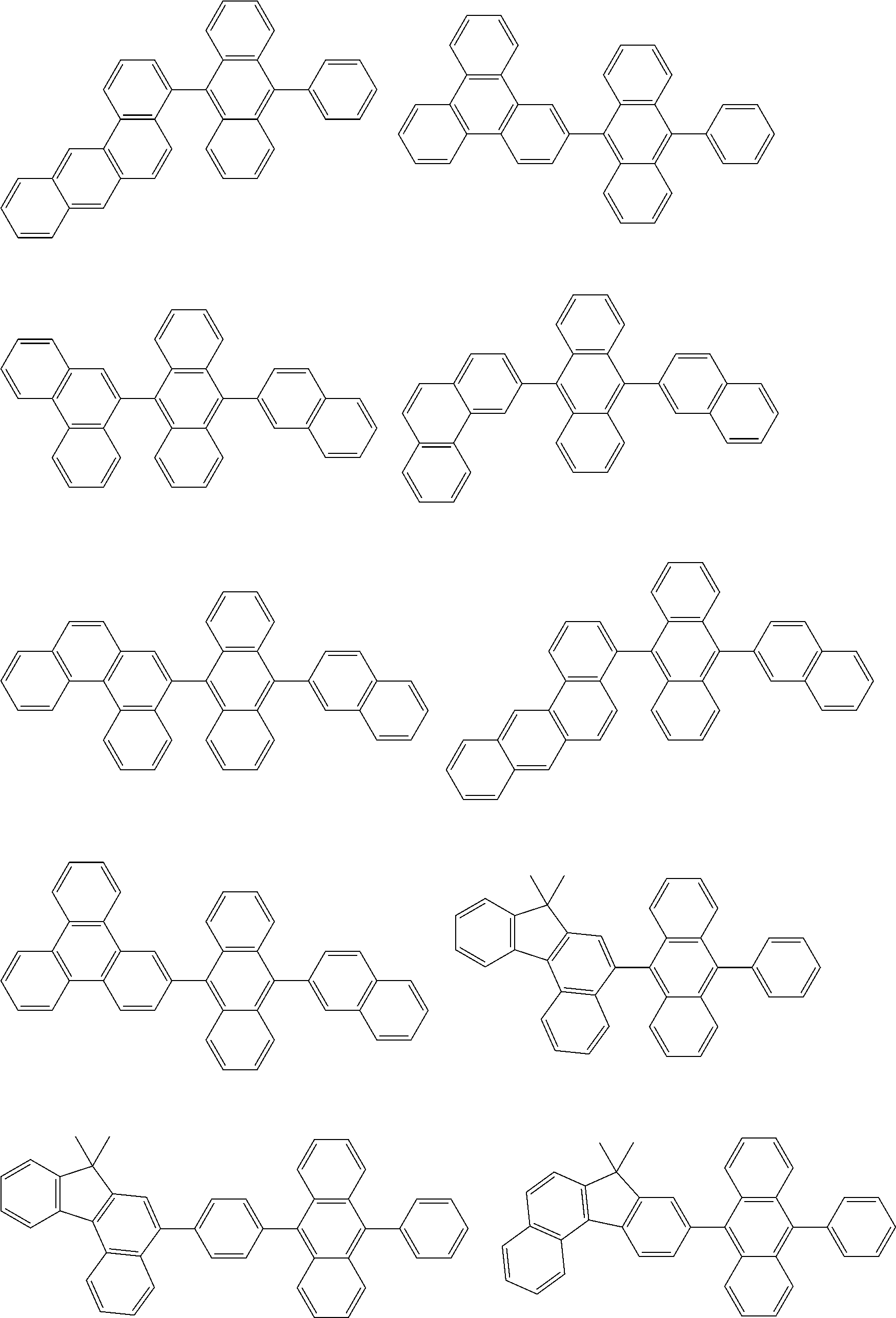


-
- (a) (hole-injecting layer/) hole-transporting layer/fluorescent emitting layer (/electron-transporting layer/electron-injecting layer)
- (b) (hole-injecting layer/) hole-transporting layer/phosphorescent emitting layer (/electron-transporting layer/electron-injecting layer)
- (c) (hole-injecting layer/) hole-transporting layer/first fluorescent emitting layer/second fluorescent emitting layer (/electron-transporting layer/electron-injecting layer)
- (d) (hole-injecting layer/) hole-transporting layer/first phosphorescent emitting layer/second phosphorescent emitting layer (/electron-transporting layer/electron-injecting layer)
- (e) (hole-injecting layer/) hole-transporting layer/phosphorescent emitting layer/spacing layer/fluorescent emitting layer (/electron-transporting layer/electron-injecting layer)
- (f) (hole-injecting layer/) hole-transporting layer/first phosphorescent emitting layer/second phosphorescent emitting layer/spacing layer/fluorescent emitting layer (/electron-transporting layer/electron-injecting layer)
- (g) (hole-injecting layer/) hole-transporting layer/first phosphorescent layer/spacing layer/second phosphorescent emitting layer/spacing layer/fluorescent emitting layer (/electron-transporting layer/electron-injecting layer)
- (h) (hole-injecting layer/) hole-transporting layer/phosphorescent emitting layer/spacing layer/first fluorescent emitting layer/second fluorescent emitting layer (/electron-transporting layer/electron-injecting layer)
- (i) (hole-injecting layer/) hole-transporting layer/electron-blocking layer/fluorescent emitting layer (/electron-transporting layer/electron-injecting layer)
- (j) (hole-injecting layer/) hole-transporting layer/electron-blocking layer/phosphorescent emitting layer (/electron-transporting layer/electron-injecting layer)
- (k) (hole-injecting layer/) hole-transporting layer/exciton-blocking layer/fluorescent emitting layer (/electron-transporting layer/electron-injecting layer)
- (l) (hole-injecting layer/) hole-transporting layer/exciton-blocking layer/phosphorescent emitting layer (/electron-transporting layer/electron-injecting layer)
- (m) (hole-injecting layer) first hole-transporting layer/second hole-transporting layer/fluorescent emitting layer (/electron-transporting layer/electron-injecting layer)
- (n) (hole-injecting layer) first hole-transporting layer/second hole-transporting layer/fluorescent emitting layer (/first electron-transporting layer/second electron-transporting layer/electron-injecting layer)
- (o) (hole-injecting layer) first hole-transporting layer/second hole-transporting layer/phosphorescent emitting layer (/electron-transporting layer/electron-injecting layer)
- (p) (hole-injecting layer) first hole-transporting layer/second hole-transporting layer/phosphorescent emitting layer (/first electron-transporting layer/second electron-transporting layer/electron-injecting layer)
- (q) (hole-injecting layer,) hole-transporting layer/fluorescent emitting layer/hole-blocking layer (/electron-transporting layer/electron-injecting layer)
- (r) (hole-injecting layer) hole-transporting layer/phosphorescent emitting layer/hole-blocking layer (/electron-transporting layer/electron-injecting layer)
- (s) (hole-injecting layer,) hole-transporting layer/fluorescent emitting layer/exciton-blocking layer (/electron-transporting layer/electron-injecting layer)
- (t) (hole-injecting layer,) hole-transporting layer/phosphorescent emitting layer/exciton-blocking layer (/electron-transporting layer/electron-injecting layer)


(Evaluation of Organic EL Device)

| TABLE 1 | ||||
| Dopant material | EQE (%) | |||
| Example 11 | Compound 1 | 7.8 | ||
| Example 12 | |
8.0 | ||
| Comp. Ex. 1 | Comparative | 6.1 | ||
| Compound 1 | ||||


| TABLE 2 | ||||
| Dopant material | EQE (%) | |||
| Example 13 | | 8.8 | ||
| Example 14 | Compound 4 | 9.1 | ||
| Example 15 | | 8.8 | ||
| Example 16 | | 8.8 | ||
| Example 17 | Compound 7 | 8 8 | ||
| Comp. Ex. 11 | Comparative | 6.1 | ||
| Compound 1 | ||||
| Comp. Ex. 12 | Comparative | 8.0 | ||
| | ||||
Claims (24)

L1-HAr (2)


-L101-Ar101 (31)


Applications Claiming Priority (3)
| Application Number | Priority Date | Filing Date | Title |
|---|---|---|---|
| JP2017-253215 | 2017-12-28 | ||
| JP2017253215 | 2017-12-28 | ||
| PCT/JP2018/048602 WO2019132040A1 (en) | 2017-12-28 | 2018-12-28 | Novel compound and organic electroluminescence element |
Publications (2)
| Publication Number | Publication Date |
|---|---|
| US20210062078A1 US20210062078A1 (en) | 2021-03-04 |
| US12146087B2 true US12146087B2 (en) | 2024-11-19 |
Family
ID=67067608
Family Applications (1)
| Application Number | Title | Priority Date | Filing Date |
|---|---|---|---|
| US16/958,054 Active 2040-03-02 US12146087B2 (en) | 2017-12-28 | 2018-12-28 | Compound and organic electroluminescence device |
Country Status (2)
| Country | Link |
|---|---|
| US (1) | US12146087B2 (en) |
| WO (1) | WO2019132040A1 (en) |
Families Citing this family (50)
| Publication number | Priority date | Publication date | Assignee | Title |
|---|---|---|---|---|
| WO2020054676A1 (en) * | 2018-09-10 | 2020-03-19 | 学校法人関西学院 | Organic electroluminescent element |
| US20200111962A1 (en) * | 2018-10-03 | 2020-04-09 | Idemitsu Kosan Co., Ltd. | Organic electroluminescence device and electronic apparatus provided with the same |
| WO2020105990A1 (en) * | 2018-11-19 | 2020-05-28 | 에스에프씨 주식회사 | Novel boron compound and organic light-emitting device comprising same |
| CN113227083A (en) | 2018-11-30 | 2021-08-06 | 出光兴产株式会社 | Compound, material for organic electroluminescent element, and electronic device |
| KR102725258B1 (en) * | 2018-12-18 | 2024-11-04 | 삼성디스플레이 주식회사 | Organic light emitting device comprising heterocyclic compound with B and N |
| US12048242B2 (en) | 2019-05-31 | 2024-07-23 | Idemitsu Kosan Co., Ltd. | Compound, material for organic electroluminescent elements, organic electroluminescent element, and electronic device |
| US12435099B2 (en) | 2019-07-25 | 2025-10-07 | Samsung Display Co., Ltd. | Organic molecules for optoelectronic devices |
| CN113727985B (en) * | 2019-09-10 | 2024-04-16 | 株式会社Lg化学 | Compound and organic light emitting device comprising the same |
| WO2021107741A1 (en) * | 2019-11-29 | 2021-06-03 | 주식회사 엘지화학 | Organic light-emitting element |
| KR20210067844A (en) * | 2019-11-29 | 2021-06-08 | 주식회사 엘지화학 | Compound and organic light emitting device comprising same |
| CN112898325B (en) * | 2019-12-03 | 2024-11-26 | 北京鼎材科技有限公司 | A compound and its application, and an organic electroluminescent device containing the same |
| CN112898323B (en) * | 2019-12-03 | 2025-05-16 | 北京鼎材科技有限公司 | A compound and its application, and an organic electroluminescent device containing the same |
| US20230157169A1 (en) * | 2019-12-10 | 2023-05-18 | Samsung Display Co., Ltd. | Organic molecules for optoelectronic devices |
| CN112500298B (en) * | 2019-12-27 | 2022-03-04 | 陕西莱特光电材料股份有限公司 | Arylamine compound and organic electroluminescent device |
| CN115461347A (en) * | 2020-04-22 | 2022-12-09 | 三星显示有限公司 | Organic molecules for optoelectronic devices |
| KR102876673B1 (en) | 2020-09-18 | 2025-10-28 | 삼성디스플레이 주식회사 | Light emitting device and polycyclic compound for light emitting device |
| KR102773827B1 (en) * | 2020-11-16 | 2025-02-26 | 주식회사 엘지화학 | Anthracene compound and organic light emitting device comprising same |
| KR102712783B1 (en) * | 2021-01-04 | 2024-10-02 | 주식회사 엘지화학 | Novel compound and organic light emitting device comprising the same |
| CN116420440A (en) * | 2021-01-04 | 2023-07-11 | 株式会社Lg化学 | Novel compounds and organic light-emitting devices containing them |
| EP4265625B1 (en) * | 2021-03-09 | 2025-01-29 | Lg Chem, Ltd. | Novel compound and organic light emitting device comprising same |
| KR102749489B1 (en) * | 2021-03-09 | 2024-12-31 | 주식회사 엘지화학 | Novel compound and organic light emitting device comprising the same |
| KR102858771B1 (en) * | 2021-03-09 | 2025-09-10 | 주식회사 엘지화학 | Novel compound and organic light emitting device comprising the same |
| KR102914864B1 (en) | 2021-03-17 | 2026-01-19 | 삼성디스플레이 주식회사 | Light emitting device including heterocyclic compound and electronic apparatus including the light emitting device |
| KR102494350B1 (en) * | 2021-07-27 | 2023-02-07 | 주식회사 로오딘 | Organic light emitting diode |
| KR102494358B1 (en) * | 2021-08-10 | 2023-02-07 | 주식회사 로오딘 | High efficiency energy down conversion system |
| JP2024531145A (en) * | 2021-08-10 | 2024-08-29 | ローディン カンパニー リミテッド | Highly efficient energy down-conversion system |
| KR102951877B1 (en) | 2021-09-17 | 2026-04-14 | 삼성디스플레이 주식회사 | Light emitting device |
| EP4151697A1 (en) | 2021-09-17 | 2023-03-22 | Idemitsu Kosan Co., Ltd. | Compound and an organic electroluminescence device comprising the compound |
| KR20240075872A (en) | 2021-09-28 | 2024-05-29 | 메르크 파텐트 게엠베하 | Materials for Electronic Devices |
| WO2023052275A1 (en) | 2021-09-28 | 2023-04-06 | Merck Patent Gmbh | Materials for electronic devices |
| KR20240075888A (en) | 2021-09-28 | 2024-05-29 | 메르크 파텐트 게엠베하 | Materials for Electronic Devices |
| WO2023052313A1 (en) | 2021-09-28 | 2023-04-06 | Merck Patent Gmbh | Materials for electronic devices |
| WO2023104285A1 (en) * | 2021-12-07 | 2023-06-15 | Huawei Technologies Co., Ltd. | Boron doped polycyclic aromatic hydrocarbon emitting compound (b-pah) and method of synthesizing b-pah |
| EP4199130A1 (en) * | 2021-12-15 | 2023-06-21 | Idemitsu Kosan Co.,Ltd. | An organic electroluminescence device comprising a light emitting layer comprising three different compounds and an electronic equipment comprising said organic electroluminescence device |
| WO2024013004A1 (en) | 2022-07-11 | 2024-01-18 | Merck Patent Gmbh | Materials for electronic devices |
| CN119894911A (en) | 2022-07-14 | 2025-04-25 | 出光兴产株式会社 | Compound and organic electroluminescent device comprising the same |
| KR20250124370A (en) | 2022-12-19 | 2025-08-19 | 메르크 파텐트 게엠베하 | Materials for electronic devices |
| KR20260015809A (en) | 2023-04-20 | 2026-02-03 | 메르크 파텐트 게엠베하 | Materials for electronic devices |
| WO2024240725A1 (en) | 2023-05-25 | 2024-11-28 | Merck Patent Gmbh | Tris[1,2,4]triazolo[1,5-a:1',5'-c:1'',5''-e][1,3,5]triazine derivatives for use in organic electroluminescent devices |
| EP4497802A1 (en) | 2023-07-25 | 2025-01-29 | Idemitsu Kosan Co., Ltd | Compound and an organic electroluminescence device comprising the compound |
| KR20260044229A (en) | 2023-07-27 | 2026-04-01 | 메르크 파텐트 게엠베하 | Materials for organic light-emitting devices and organic sensors |
| CN121773745A (en) | 2023-08-30 | 2026-03-31 | 默克专利有限公司 | Material for organic light emitting device |
| CN121753521A (en) | 2023-08-30 | 2026-03-27 | 默克专利有限公司 | Material for organic light emitting device |
| CN121753522A (en) | 2023-08-30 | 2026-03-27 | 默克专利有限公司 | Material for organic light emitting device |
| WO2025132551A1 (en) | 2023-12-22 | 2025-06-26 | Merck Patent Gmbh | Materials for electronic devices |
| WO2025195961A1 (en) | 2024-03-19 | 2025-09-25 | Merck Patent Gmbh | Organic light-emitting devices |
| WO2025210013A1 (en) | 2024-04-04 | 2025-10-09 | Merck Patent Gmbh | Compounds for electronic devices, in particular compounds for oleds |
| WO2026008710A1 (en) | 2024-07-05 | 2026-01-08 | Merck Patent Gmbh | Cyclic silicon compounds for organic electroluminescent devices |
| WO2026041632A1 (en) | 2024-08-21 | 2026-02-26 | Merck Patent Gmbh | Heterocyclic materials for organic light-emitting devices |
| WO2026073855A1 (en) | 2024-10-01 | 2026-04-09 | Merck Patent Gmbh | Silicon compounds for organic electroluminescent devices |
Citations (86)
| Publication number | Priority date | Publication date | Assignee | Title |
|---|---|---|---|---|
| WO2015102118A1 (en) | 2014-02-18 | 2015-07-09 | 学校法人関西学院 | Polycyclic aromatic compound |
| US20150325800A1 (en) * | 2013-03-15 | 2015-11-12 | Idemitsu Kosan Co., Ltd. | Anthracene derivative and organic electroluminescence element using same |
| WO2016152418A1 (en) * | 2015-03-25 | 2016-09-29 | 学校法人関西学院 | Polycyclic aromatic compound and light emission layer-forming composition |
| WO2017092508A1 (en) | 2015-12-04 | 2017-06-08 | 广州华睿光电材料有限公司 | D-a type compound and application thereof |
| WO2017188111A1 (en) | 2016-04-26 | 2017-11-02 | 学校法人関西学院 | Organic electroluminescent element |
| WO2017195669A1 (en) | 2016-05-13 | 2017-11-16 | コニカミノルタ株式会社 | Organic electroluminescence element material, organic electroluminescence element, display apparatus and illumination apparatus |
| CN107501311A (en) | 2017-07-14 | 2017-12-22 | 瑞声科技(南京)有限公司 | Electroluminescent organic material and its luminescent device |
| JP2018043984A (en) | 2016-09-07 | 2018-03-22 | 学校法人関西学院 | Polycyclic aromatic compound |
| KR20180046851A (en) | 2016-10-28 | 2018-05-09 | 가꼬우 호징 관세이 가쿠잉 | Boronic acid or boronic acid ester, or method for producing polycyclic aromatic compound or oligomer of polycyclic aromatic compound using same |
| WO2018095394A1 (en) | 2016-11-23 | 2018-05-31 | 广州华睿光电材料有限公司 | Organic mixture, composition, organic electronic device and application |
| CN108358905A (en) | 2018-03-28 | 2018-08-03 | 上海天马有机发光显示技术有限公司 | A kind of compound, luminescent material and device, display device |
| WO2018146894A1 (en) | 2017-02-09 | 2018-08-16 | 学校法人関西学院 | Organic electric field light-emitting element |
| WO2018181188A1 (en) | 2017-03-31 | 2018-10-04 | 出光興産株式会社 | Organic electroluminescence element and electronic device |
| WO2018186396A1 (en) | 2017-04-03 | 2018-10-11 | 出光興産株式会社 | Organic electroluminescence element and electronic apparatus |
| WO2018186374A1 (en) | 2017-04-03 | 2018-10-11 | 出光興産株式会社 | Organic electroluminescent element and electronic device |
| US20180301629A1 (en) | 2015-03-24 | 2018-10-18 | Kwansei Gakuin Educational Foundation | Organic electroluminescent element |
| WO2018203666A1 (en) | 2017-05-02 | 2018-11-08 | 주식회사 엘지화학 | Novel compound and organic light emitting device using same |
| WO2018216990A1 (en) | 2017-05-22 | 2018-11-29 | 머티어리얼사이언스 주식회사 | Organic compound and organic electroluminescent element comprising same |
| US20190058124A1 (en) | 2016-02-10 | 2019-02-21 | Kwansei Gakuin Educational Fondation | Delayed fluorescence organic electroluminescent element |
| WO2019059611A1 (en) | 2017-09-19 | 2019-03-28 | 주식회사 엘지화학 | Organic light emitting element |
| US20190115538A1 (en) | 2017-10-16 | 2019-04-18 | Samsung Display Co., Ltd. | Organic light-emitting device and flat display apparatus including the same |
| KR101990818B1 (en) | 2018-05-04 | 2019-06-19 | 머티어리얼사이언스 주식회사 | Organic electroluminescent device |
| WO2019120125A1 (en) | 2017-12-21 | 2019-06-27 | 广州华睿光电材料有限公司 | Composition for preparing organic electronic device, organic electronic device and application thereof |
| WO2019132028A1 (en) | 2017-12-28 | 2019-07-04 | 出光興産株式会社 | Novel compound and organic electroluminescent element |
| US20190214579A1 (en) | 2017-12-28 | 2019-07-11 | Idemitsu Kosan Co., Ltd. | Novel compound and organic electroluminescence device |
| US20190229277A1 (en) | 2018-01-24 | 2019-07-25 | Kwansei Gakuin Educational Foundation | Organic electroluminescent element |
| US10374166B2 (en) | 2014-02-18 | 2019-08-06 | Kwansei Gakuin Educational Foundation | Polycyclic aromatic compound |
| WO2019163625A1 (en) | 2018-02-23 | 2019-08-29 | コニカミノルタ株式会社 | Composition for electronic devices, ink for electronic devices, and method for producing electronic device |
| US20190280209A1 (en) | 2018-03-08 | 2019-09-12 | Jnc Corporation | Organic electroluminescent element |
| WO2019194298A1 (en) | 2018-04-05 | 2019-10-10 | 出光興産株式会社 | Organic electroluminescence element and electronic device |
| US20190312207A1 (en) | 2017-02-16 | 2019-10-10 | Kwansei Gakuin Educational Foundation | Organic electroluminescent element |
| WO2019197904A1 (en) | 2018-04-11 | 2019-10-17 | Nanoco Technologies Ltd | Top-emitting printed display with quantum dots and thermally activated delayed fluorescence molecules |
| US20190341571A1 (en) | 2018-05-04 | 2019-11-07 | Cynora Gmbh | Organic electroluminescent device emitting blue light |
| WO2019218969A1 (en) | 2018-05-14 | 2019-11-21 | 江苏三月光电科技有限公司 | Electroluminescent device based on exciplex system with boron-containing organic compounds |
| WO2019218968A1 (en) | 2018-05-14 | 2019-11-21 | 江苏三月光电科技有限公司 | Electroluminescent device based on boron-containing organic compound |
| WO2019218971A1 (en) | 2018-05-14 | 2019-11-21 | 江苏三月光电科技有限公司 | Organic electroluminescent component with exciplex serving as main body material |
| WO2019221545A1 (en) | 2018-05-17 | 2019-11-21 | 주식회사 엘지화학 | Organic light emitting diode |
| US20190372023A1 (en) | 2017-02-09 | 2019-12-05 | Kwansei Gakuin Education Foundation | Organic electroluminescent element |
| WO2019235475A1 (en) | 2018-06-04 | 2019-12-12 | 出光興産株式会社 | Organic electroluminescent element and electronic device |
| KR20190138477A (en) | 2018-06-05 | 2019-12-13 | 에스에프씨 주식회사 | organic light-emitting diode with High efficiency and low voltage |
| KR20190139492A (en) | 2018-06-08 | 2019-12-18 | 에스에프씨 주식회사 | organic light-emitting diode with High efficiency |
| WO2019240462A1 (en) | 2018-06-11 | 2019-12-19 | 주식회사 엘지화학 | Organic light-emitting device |
| WO2019240464A1 (en) | 2018-06-11 | 2019-12-19 | 주식회사 엘지화학 | Organic light-emitting device |
| US20190393419A1 (en) | 2018-06-20 | 2019-12-26 | Kwansei Gakuin Educational Foundation | Organic electroluminescent element |
| US20200020867A1 (en) | 2018-07-13 | 2020-01-16 | Universal Display Corporation | Organic electroluminescent materials and devices |
| US20200028084A1 (en) | 2018-07-19 | 2020-01-23 | Lg Display Co., Ltd. | Organic electroluminescent device |
| US20200035921A1 (en) | 2017-03-31 | 2020-01-30 | Kyushu University, National University Corporation | Organic semiconductor laser element |
| WO2020022751A1 (en) | 2018-07-24 | 2020-01-30 | 머티어리얼사이언스 주식회사 | Organic electroluminescent device |
| US20200052212A1 (en) | 2017-04-03 | 2020-02-13 | Idemitsu Kosan Co., Ltd. | Organic electroluminescent element and electronic device |
| WO2020034805A1 (en) | 2018-08-15 | 2020-02-20 | 江苏三月光电科技有限公司 | Exciplex and excimer system-based organic electroluminescent device |
| US20200058874A1 (en) | 2018-08-17 | 2020-02-20 | Lg Display Co., Ltd. | Organic electroluminescence device |
| WO2020036197A1 (en) | 2018-08-15 | 2020-02-20 | 出光興産株式会社 | Organic electroluminescent element and electronic device using same |
| WO2020039930A1 (en) | 2018-08-23 | 2020-02-27 | 国立大学法人九州大学 | Organic light emitting element, composition and membrane |
| WO2020040298A1 (en) | 2018-08-23 | 2020-02-27 | 学校法人関西学院 | Organic electroluminescent element, display device, illumination device, luminescent layer forming composition, and compound |
| WO2020040514A1 (en) | 2018-08-20 | 2020-02-27 | 주식회사 엘지화학 | Organic light emitting diode |
| WO2020054676A1 (en) | 2018-09-10 | 2020-03-19 | 学校法人関西学院 | Organic electroluminescent element |
| US20200098991A1 (en) | 2018-09-21 | 2020-03-26 | Samsung Display Co., Ltd. | Organic light-emitting device and apparatus including organic light-emitting device |
| US20200111962A1 (en) | 2018-10-03 | 2020-04-09 | Idemitsu Kosan Co., Ltd. | Organic electroluminescence device and electronic apparatus provided with the same |
| WO2020076108A1 (en) | 2018-10-12 | 2020-04-16 | 주식회사 엘지화학 | Organic light-emitting device |
| WO2020075760A1 (en) | 2018-10-09 | 2020-04-16 | 出光興産株式会社 | Organic electroluminescence element and electronic device using same |
| WO2020076109A1 (en) | 2018-10-12 | 2020-04-16 | 주식회사 엘지화학 | Organic light-emitting device |
| WO2020075757A1 (en) | 2018-10-09 | 2020-04-16 | 出光興産株式会社 | Organic electroluminescence element and electronic device using same |
| WO2020075759A1 (en) | 2018-10-09 | 2020-04-16 | 出光興産株式会社 | Organic electroluminescence element and electronic device using same |
| WO2020075758A1 (en) | 2018-10-09 | 2020-04-16 | 出光興産株式会社 | Organic electroluminescence element and electronic device using same |
| WO2020080416A1 (en) | 2018-10-16 | 2020-04-23 | 出光興産株式会社 | Organic electroluminescence element and electronic device |
| WO2020080417A1 (en) | 2018-10-16 | 2020-04-23 | 出光興産株式会社 | Organic electroluminescent element and electronic device |
| WO2020085829A1 (en) | 2018-10-26 | 2020-04-30 | Rohm And Haas Electronic Materials Korea Ltd. | A plurality of light-emitting materials and organic electroluminescent device comprising the same |
| US20200144512A1 (en) | 2018-07-13 | 2020-05-07 | Universal Display Corporation | Organic electroluminescent materials and devices |
| US20200144503A1 (en) | 2018-11-06 | 2020-05-07 | Samsung Display Co., Ltd. | Organic electroluminescence device and polycyclic compound for organic electroluminescence device |
| WO2020096012A1 (en) | 2018-11-07 | 2020-05-14 | 出光興産株式会社 | Organic electroluminescent element and electronic appliance including same |
| WO2020101001A1 (en) | 2018-11-15 | 2020-05-22 | 学校法人関西学院 | Organic electroluminescence element, display device, and lighting device |
| WO2020109269A1 (en) | 2018-11-29 | 2020-06-04 | Merck Patent Gmbh | Electronic device |
| US20200176680A1 (en) | 2017-08-17 | 2020-06-04 | Kwansei Gakuin Educational Foundation | Organic electroluminescent element |
| US20200176684A1 (en) | 2018-11-29 | 2020-06-04 | Samsung Display Co., Ltd. | Organic electroluminescence device and polycyclic compound for organic electroluminescence device |
| WO2020108899A1 (en) | 2018-11-29 | 2020-06-04 | Merck Patent Gmbh | Electronic device |
| WO2020117026A1 (en) | 2018-12-07 | 2020-06-11 | 주식회사 엘지화학 | Organic light-emitting diode |
| WO2020116561A1 (en) | 2018-12-05 | 2020-06-11 | 出光興産株式会社 | Organic electroluminescence element and electronic apparatus |
| US20200185632A1 (en) | 2018-12-11 | 2020-06-11 | Lg Display Co., Ltd. | Organic light emitting diode and organic light emitting device having the same |
| US20200203610A1 (en) | 2018-08-31 | 2020-06-25 | Kunshan Go-Visionox Opto-Electronics Co., Ltd | Organic electroluminescent device and preparation method and display apparatus thereof |
| US20200203652A1 (en) | 2018-08-31 | 2020-06-25 | Kunshan Go-Visionox Opto-Electronics Co., Ltd | Organic electroluminescence device, preparation method thereof and display apparatus |
| US20200203617A1 (en) | 2018-08-31 | 2020-06-25 | Kunshan Go-Visionox Opto-Electronics Co., Ltd | Organic electroluminescent device, preparation method thereof and display apparatus |
| US20200203651A1 (en) | 2018-08-31 | 2020-06-25 | Kunshan Go-Visionox Opto-Electronics Co., Ltd | Organic electroluminescence device, preparation method thereof and display apparatus |
| US20200266350A1 (en) | 2017-06-30 | 2020-08-20 | Kwansei Gakuin Educational Foundation | Organic electroluminescent element |
| US10763441B2 (en) | 2018-10-09 | 2020-09-01 | Idemitsu Kosan Co., Ltd. | Organic electroluminescence device and electronic apparatus provided with the same |
| US10763444B2 (en) | 2018-10-09 | 2020-09-01 | Idemitsu Kosan Co., Ltd. | Organic electroluminescence device and electronic apparatus provided with the same |
| US20210043841A1 (en) | 2017-09-29 | 2021-02-11 | Valiant Co., Ltd. | Boron-containing organic light-emitting diode device and preparation method thereof |
-
2018
- 2018-12-28 WO PCT/JP2018/048602 patent/WO2019132040A1/en not_active Ceased
- 2018-12-28 US US16/958,054 patent/US12146087B2/en active Active
Patent Citations (92)
| Publication number | Priority date | Publication date | Assignee | Title |
|---|---|---|---|---|
| US20150325800A1 (en) * | 2013-03-15 | 2015-11-12 | Idemitsu Kosan Co., Ltd. | Anthracene derivative and organic electroluminescence element using same |
| WO2015102118A1 (en) | 2014-02-18 | 2015-07-09 | 学校法人関西学院 | Polycyclic aromatic compound |
| US10374166B2 (en) | 2014-02-18 | 2019-08-06 | Kwansei Gakuin Educational Foundation | Polycyclic aromatic compound |
| US20180301629A1 (en) | 2015-03-24 | 2018-10-18 | Kwansei Gakuin Educational Foundation | Organic electroluminescent element |
| US20180094000A1 (en) * | 2015-03-25 | 2018-04-05 | Kwansei Gakuin Educational Foundation | Polycyclic aromatic compound and light emission layer-forming composition |
| WO2016152418A1 (en) * | 2015-03-25 | 2016-09-29 | 学校法人関西学院 | Polycyclic aromatic compound and light emission layer-forming composition |
| WO2017092508A1 (en) | 2015-12-04 | 2017-06-08 | 广州华睿光电材料有限公司 | D-a type compound and application thereof |
| US20190058124A1 (en) | 2016-02-10 | 2019-02-21 | Kwansei Gakuin Educational Fondation | Delayed fluorescence organic electroluminescent element |
| WO2017188111A1 (en) | 2016-04-26 | 2017-11-02 | 学校法人関西学院 | Organic electroluminescent element |
| US20190207112A1 (en) | 2016-04-26 | 2019-07-04 | Kwansei Gakuin Educational Foundation | Organic electroluminescent element |
| WO2017195669A1 (en) | 2016-05-13 | 2017-11-16 | コニカミノルタ株式会社 | Organic electroluminescence element material, organic electroluminescence element, display apparatus and illumination apparatus |
| JP2018043984A (en) | 2016-09-07 | 2018-03-22 | 学校法人関西学院 | Polycyclic aromatic compound |
| KR20180046851A (en) | 2016-10-28 | 2018-05-09 | 가꼬우 호징 관세이 가쿠잉 | Boronic acid or boronic acid ester, or method for producing polycyclic aromatic compound or oligomer of polycyclic aromatic compound using same |
| US20190378982A1 (en) | 2016-11-23 | 2019-12-12 | Guangzhou Chinaray Optoelectronic Materials Ltd. | Organic mixture, composition, organic electronic device and application |
| WO2018095394A1 (en) | 2016-11-23 | 2018-05-31 | 广州华睿光电材料有限公司 | Organic mixture, composition, organic electronic device and application |
| WO2018146894A1 (en) | 2017-02-09 | 2018-08-16 | 学校法人関西学院 | Organic electric field light-emitting element |
| US20190372023A1 (en) | 2017-02-09 | 2019-12-05 | Kwansei Gakuin Education Foundation | Organic electroluminescent element |
| US20190312207A1 (en) | 2017-02-16 | 2019-10-10 | Kwansei Gakuin Educational Foundation | Organic electroluminescent element |
| US20200035921A1 (en) | 2017-03-31 | 2020-01-30 | Kyushu University, National University Corporation | Organic semiconductor laser element |
| US20200035922A1 (en) | 2017-03-31 | 2020-01-30 | Idemitsu Kosan Co., Ltd. | Organic electroluminescence element and electronic device |
| WO2018181188A1 (en) | 2017-03-31 | 2018-10-04 | 出光興産株式会社 | Organic electroluminescence element and electronic device |
| WO2018186396A1 (en) | 2017-04-03 | 2018-10-11 | 出光興産株式会社 | Organic electroluminescence element and electronic apparatus |
| WO2018186374A1 (en) | 2017-04-03 | 2018-10-11 | 出光興産株式会社 | Organic electroluminescent element and electronic device |
| US20200052212A1 (en) | 2017-04-03 | 2020-02-13 | Idemitsu Kosan Co., Ltd. | Organic electroluminescent element and electronic device |
| WO2018203666A1 (en) | 2017-05-02 | 2018-11-08 | 주식회사 엘지화학 | Novel compound and organic light emitting device using same |
| KR101976556B1 (en) | 2017-05-22 | 2019-05-09 | 머티어리얼사이언스 주식회사 | Organic compound and organic electroluminescent device comprising the same |
| WO2018216990A1 (en) | 2017-05-22 | 2018-11-29 | 머티어리얼사이언스 주식회사 | Organic compound and organic electroluminescent element comprising same |
| US20200176679A1 (en) | 2017-05-22 | 2020-06-04 | Material Science Co., Ltd. | Organic compound and organic electroluminescent device comprising the same |
| US20200266350A1 (en) | 2017-06-30 | 2020-08-20 | Kwansei Gakuin Educational Foundation | Organic electroluminescent element |
| CN107501311A (en) | 2017-07-14 | 2017-12-22 | 瑞声科技(南京)有限公司 | Electroluminescent organic material and its luminescent device |
| US20200176680A1 (en) | 2017-08-17 | 2020-06-04 | Kwansei Gakuin Educational Foundation | Organic electroluminescent element |
| WO2019059611A1 (en) | 2017-09-19 | 2019-03-28 | 주식회사 엘지화학 | Organic light emitting element |
| US20210043841A1 (en) | 2017-09-29 | 2021-02-11 | Valiant Co., Ltd. | Boron-containing organic light-emitting diode device and preparation method thereof |
| US20190115538A1 (en) | 2017-10-16 | 2019-04-18 | Samsung Display Co., Ltd. | Organic light-emitting device and flat display apparatus including the same |
| WO2019120125A1 (en) | 2017-12-21 | 2019-06-27 | 广州华睿光电材料有限公司 | Composition for preparing organic electronic device, organic electronic device and application thereof |
| WO2019132028A1 (en) | 2017-12-28 | 2019-07-04 | 出光興産株式会社 | Novel compound and organic electroluminescent element |
| US20190214579A1 (en) | 2017-12-28 | 2019-07-11 | Idemitsu Kosan Co., Ltd. | Novel compound and organic electroluminescence device |
| US20190229277A1 (en) | 2018-01-24 | 2019-07-25 | Kwansei Gakuin Educational Foundation | Organic electroluminescent element |
| WO2019163625A1 (en) | 2018-02-23 | 2019-08-29 | コニカミノルタ株式会社 | Composition for electronic devices, ink for electronic devices, and method for producing electronic device |
| US20190280209A1 (en) | 2018-03-08 | 2019-09-12 | Jnc Corporation | Organic electroluminescent element |
| CN108358905A (en) | 2018-03-28 | 2018-08-03 | 上海天马有机发光显示技术有限公司 | A kind of compound, luminescent material and device, display device |
| WO2019194298A1 (en) | 2018-04-05 | 2019-10-10 | 出光興産株式会社 | Organic electroluminescence element and electronic device |
| WO2019197904A1 (en) | 2018-04-11 | 2019-10-17 | Nanoco Technologies Ltd | Top-emitting printed display with quantum dots and thermally activated delayed fluorescence molecules |
| US20190341571A1 (en) | 2018-05-04 | 2019-11-07 | Cynora Gmbh | Organic electroluminescent device emitting blue light |
| KR101990818B1 (en) | 2018-05-04 | 2019-06-19 | 머티어리얼사이언스 주식회사 | Organic electroluminescent device |
| WO2019218969A1 (en) | 2018-05-14 | 2019-11-21 | 江苏三月光电科技有限公司 | Electroluminescent device based on exciplex system with boron-containing organic compounds |
| WO2019218971A1 (en) | 2018-05-14 | 2019-11-21 | 江苏三月光电科技有限公司 | Organic electroluminescent component with exciplex serving as main body material |
| WO2019218968A1 (en) | 2018-05-14 | 2019-11-21 | 江苏三月光电科技有限公司 | Electroluminescent device based on boron-containing organic compound |
| WO2019221545A1 (en) | 2018-05-17 | 2019-11-21 | 주식회사 엘지화학 | Organic light emitting diode |
| WO2019235475A1 (en) | 2018-06-04 | 2019-12-12 | 出光興産株式会社 | Organic electroluminescent element and electronic device |
| KR20190138477A (en) | 2018-06-05 | 2019-12-13 | 에스에프씨 주식회사 | organic light-emitting diode with High efficiency and low voltage |
| KR20190139492A (en) | 2018-06-08 | 2019-12-18 | 에스에프씨 주식회사 | organic light-emitting diode with High efficiency |
| WO2019240464A1 (en) | 2018-06-11 | 2019-12-19 | 주식회사 엘지화학 | Organic light-emitting device |
| WO2019240462A1 (en) | 2018-06-11 | 2019-12-19 | 주식회사 엘지화학 | Organic light-emitting device |
| US20190393419A1 (en) | 2018-06-20 | 2019-12-26 | Kwansei Gakuin Educational Foundation | Organic electroluminescent element |
| US20200144512A1 (en) | 2018-07-13 | 2020-05-07 | Universal Display Corporation | Organic electroluminescent materials and devices |
| US20200020867A1 (en) | 2018-07-13 | 2020-01-16 | Universal Display Corporation | Organic electroluminescent materials and devices |
| US20200028084A1 (en) | 2018-07-19 | 2020-01-23 | Lg Display Co., Ltd. | Organic electroluminescent device |
| WO2020022751A1 (en) | 2018-07-24 | 2020-01-30 | 머티어리얼사이언스 주식회사 | Organic electroluminescent device |
| WO2020034805A1 (en) | 2018-08-15 | 2020-02-20 | 江苏三月光电科技有限公司 | Exciplex and excimer system-based organic electroluminescent device |
| WO2020036197A1 (en) | 2018-08-15 | 2020-02-20 | 出光興産株式会社 | Organic electroluminescent element and electronic device using same |
| US20200058874A1 (en) | 2018-08-17 | 2020-02-20 | Lg Display Co., Ltd. | Organic electroluminescence device |
| WO2020040514A1 (en) | 2018-08-20 | 2020-02-27 | 주식회사 엘지화학 | Organic light emitting diode |
| WO2020039930A1 (en) | 2018-08-23 | 2020-02-27 | 国立大学法人九州大学 | Organic light emitting element, composition and membrane |
| WO2020040298A1 (en) | 2018-08-23 | 2020-02-27 | 学校法人関西学院 | Organic electroluminescent element, display device, illumination device, luminescent layer forming composition, and compound |
| US20200203651A1 (en) | 2018-08-31 | 2020-06-25 | Kunshan Go-Visionox Opto-Electronics Co., Ltd | Organic electroluminescence device, preparation method thereof and display apparatus |
| US20200203617A1 (en) | 2018-08-31 | 2020-06-25 | Kunshan Go-Visionox Opto-Electronics Co., Ltd | Organic electroluminescent device, preparation method thereof and display apparatus |
| US20200203610A1 (en) | 2018-08-31 | 2020-06-25 | Kunshan Go-Visionox Opto-Electronics Co., Ltd | Organic electroluminescent device and preparation method and display apparatus thereof |
| US20200203652A1 (en) | 2018-08-31 | 2020-06-25 | Kunshan Go-Visionox Opto-Electronics Co., Ltd | Organic electroluminescence device, preparation method thereof and display apparatus |
| WO2020054676A1 (en) | 2018-09-10 | 2020-03-19 | 学校法人関西学院 | Organic electroluminescent element |
| US20200098991A1 (en) | 2018-09-21 | 2020-03-26 | Samsung Display Co., Ltd. | Organic light-emitting device and apparatus including organic light-emitting device |
| US20200111962A1 (en) | 2018-10-03 | 2020-04-09 | Idemitsu Kosan Co., Ltd. | Organic electroluminescence device and electronic apparatus provided with the same |
| WO2020075759A1 (en) | 2018-10-09 | 2020-04-16 | 出光興産株式会社 | Organic electroluminescence element and electronic device using same |
| US10763444B2 (en) | 2018-10-09 | 2020-09-01 | Idemitsu Kosan Co., Ltd. | Organic electroluminescence device and electronic apparatus provided with the same |
| US10763441B2 (en) | 2018-10-09 | 2020-09-01 | Idemitsu Kosan Co., Ltd. | Organic electroluminescence device and electronic apparatus provided with the same |
| WO2020075758A1 (en) | 2018-10-09 | 2020-04-16 | 出光興産株式会社 | Organic electroluminescence element and electronic device using same |
| WO2020075757A1 (en) | 2018-10-09 | 2020-04-16 | 出光興産株式会社 | Organic electroluminescence element and electronic device using same |
| WO2020075760A1 (en) | 2018-10-09 | 2020-04-16 | 出光興産株式会社 | Organic electroluminescence element and electronic device using same |
| WO2020076109A1 (en) | 2018-10-12 | 2020-04-16 | 주식회사 엘지화학 | Organic light-emitting device |
| WO2020076108A1 (en) | 2018-10-12 | 2020-04-16 | 주식회사 엘지화학 | Organic light-emitting device |
| WO2020080417A1 (en) | 2018-10-16 | 2020-04-23 | 出光興産株式会社 | Organic electroluminescent element and electronic device |
| WO2020080416A1 (en) | 2018-10-16 | 2020-04-23 | 出光興産株式会社 | Organic electroluminescence element and electronic device |
| WO2020085829A1 (en) | 2018-10-26 | 2020-04-30 | Rohm And Haas Electronic Materials Korea Ltd. | A plurality of light-emitting materials and organic electroluminescent device comprising the same |
| US20200144503A1 (en) | 2018-11-06 | 2020-05-07 | Samsung Display Co., Ltd. | Organic electroluminescence device and polycyclic compound for organic electroluminescence device |
| WO2020096012A1 (en) | 2018-11-07 | 2020-05-14 | 出光興産株式会社 | Organic electroluminescent element and electronic appliance including same |
| WO2020101001A1 (en) | 2018-11-15 | 2020-05-22 | 学校法人関西学院 | Organic electroluminescence element, display device, and lighting device |
| WO2020108899A1 (en) | 2018-11-29 | 2020-06-04 | Merck Patent Gmbh | Electronic device |
| US20200176684A1 (en) | 2018-11-29 | 2020-06-04 | Samsung Display Co., Ltd. | Organic electroluminescence device and polycyclic compound for organic electroluminescence device |
| WO2020109269A1 (en) | 2018-11-29 | 2020-06-04 | Merck Patent Gmbh | Electronic device |
| WO2020116561A1 (en) | 2018-12-05 | 2020-06-11 | 出光興産株式会社 | Organic electroluminescence element and electronic apparatus |
| WO2020117026A1 (en) | 2018-12-07 | 2020-06-11 | 주식회사 엘지화학 | Organic light-emitting diode |
| US20200185632A1 (en) | 2018-12-11 | 2020-06-11 | Lg Display Co., Ltd. | Organic light emitting diode and organic light emitting device having the same |
Non-Patent Citations (7)
| Title |
|---|
| Escande et al., Chem. Commun., 2015, 51, 6257-6274. (Year: 2015). * |
| Gao, Y. et al., Realizing performance improvement of blue thermally activated delayed fluorescence molecule DABNA by introducing substituents on the para-position of born atom, Chemical Physics Letters, Apr. 17, 2018, vol. 701, pp. 98-102, ISSN: 0009-2614, DOI: 10.1016/j.cplett.2018.04.036. |
| Huang, Jianhua, and Yuqing Li. "BN embedded polycyclic π-conjugated systems: Synthesis, optoelectronic properties, and photovoltaic applications." Frontiers in chemistry 6 (2018): 341. (Year: 2018). * |
| International Preliminary Report on Patentability with Written Opinion dated Jun. 30, 2020 for corresponding International Patent Application No. PCT/JP2018/048602. |
| International Search Report dated Feb. 12, 2019 for corresponding International Patent Application No. PCT/JP2018/048602. |
| Translation of WO 2015/102118 A1 (publication date: Jul. 2015). (Year: 2015). * |
| Wang, J. Y., & Pei, J. (2016). BN-embedded aromatics for optoelectronic applications. Chinese Chemical Letters, 27(8), 1139-1146. (Year: 2016). * |
Also Published As
| Publication number | Publication date |
|---|---|
| WO2019132040A1 (en) | 2019-07-04 |
| US20210062078A1 (en) | 2021-03-04 |
Similar Documents
| Publication | Publication Date | Title |
|---|---|---|
| US11342512B2 (en) | Compounds for organic electroluminescence device | |
| US12262634B2 (en) | Organic electroluminescence device and novel compound | |
| US11557730B2 (en) | Organic electroluminescence device and novel compound | |
| US20210062078A1 (en) | Novel compound and organic electroluminescence device | |
| US11482675B1 (en) | Organic electroluminescence device and electronic apparatus | |
| US11139437B2 (en) | Compound and organic electroluminescence device | |
| US20250160208A1 (en) | Organic electroluminescence device and electronic apparatus provided with the same | |
| US12356850B2 (en) | Compound, and organic electroluminescence device and electronic apparatus using the same | |
| US12615959B2 (en) | Organic electroluminescence device and electronic apparatus provided with the same | |
| US12133462B2 (en) | Organic electroluminescence device and electronic apparatus equipped with the same | |
| US20240300978A1 (en) | Novel Compound and Organic Electroluminescence Device Using the Same | |
| JP2019119680A (en) | Novel compound and organic electroluminescence device | |
| US8987462B2 (en) | Compound and organic light-emitting device comprising the same | |
| US20230262999A1 (en) | Compound, material for organic electroluminescent elements, organic electroluminescent element, and electronic device | |
| US20200377513A1 (en) | Novel compound and organic electroluminescence device | |
| US20230422606A1 (en) | Compound, material for organic electroluminescent element, organic electroluminescent element, and electronic device | |
| US20230006136A1 (en) | Compound, organic electroluminescent element material, organic electroluminescent element, and electronic device | |
| US20220324804A1 (en) | Compound, material for organic electroluminescent elements, organic electroluminescent element, and electronic device | |
| US20240315131A1 (en) | Compound, organic electroluminescent element material, organic electroluminescent element, and electronic device | |
| US20230180597A1 (en) | Compound, material for organic electroluminescent elements, organic electroluminescent element, and electronic device | |
| US20230389347A1 (en) | Compound, material for organic electroluminescent elements, organic electroluminescent element, and electronic device |
Legal Events
| Date | Code | Title | Description |
|---|---|---|---|
| FEPP | Fee payment procedure |
Free format text: ENTITY STATUS SET TO UNDISCOUNTED (ORIGINAL EVENT CODE: BIG.); ENTITY STATUS OF PATENT OWNER: LARGE ENTITY |
|
| AS | Assignment |
Owner name: IDEMITSU KOSAN CO.,LTD., JAPAN Free format text: ASSIGNMENT OF ASSIGNORS INTEREST;ASSIGNORS:KATO, TOMOKI;SEDA, KEITA;TAKAHASHI, RYOTA;AND OTHERS;SIGNING DATES FROM 20200818 TO 20201028;REEL/FRAME:054408/0535 |
|
| STPP | Information on status: patent application and granting procedure in general |
Free format text: APPLICATION DISPATCHED FROM PREEXAM, NOT YET DOCKETED |
|
| STPP | Information on status: patent application and granting procedure in general |
Free format text: DOCKETED NEW CASE - READY FOR EXAMINATION |
|
| STPP | Information on status: patent application and granting procedure in general |
Free format text: NON FINAL ACTION MAILED |
|
| STPP | Information on status: patent application and granting procedure in general |
Free format text: FINAL REJECTION MAILED |
|
| STPP | Information on status: patent application and granting procedure in general |
Free format text: DOCKETED NEW CASE - READY FOR EXAMINATION |
|
| STPP | Information on status: patent application and granting procedure in general |
Free format text: NON FINAL ACTION MAILED |
|
| STPP | Information on status: patent application and granting procedure in general |
Free format text: RESPONSE TO NON-FINAL OFFICE ACTION ENTERED AND FORWARDED TO EXAMINER |
|
| STPP | Information on status: patent application and granting procedure in general |
Free format text: FINAL REJECTION MAILED |
|
| STPP | Information on status: patent application and granting procedure in general |
Free format text: RESPONSE AFTER FINAL ACTION FORWARDED TO EXAMINER |
|
| STPP | Information on status: patent application and granting procedure in general |
Free format text: NOTICE OF ALLOWANCE MAILED -- APPLICATION RECEIVED IN OFFICE OF PUBLICATIONS |
|
| ZAAB | Notice of allowance mailed |
Free format text: ORIGINAL CODE: MN/=. |
|
| STPP | Information on status: patent application and granting procedure in general |
Free format text: NOTICE OF ALLOWANCE MAILED -- APPLICATION RECEIVED IN OFFICE OF PUBLICATIONS |
|
| STPP | Information on status: patent application and granting procedure in general |
Free format text: PUBLICATIONS -- ISSUE FEE PAYMENT VERIFIED |
|
| STCF | Information on status: patent grant |
Free format text: PATENTED CASE |
|
| CC | Certificate of correction |