US12137036B2 - System, method and computer-readable medium for quality prediction - Google Patents
System, method and computer-readable medium for quality prediction Download PDFInfo
- Publication number
- US12137036B2 US12137036B2 US17/941,721 US202217941721A US12137036B2 US 12137036 B2 US12137036 B2 US 12137036B2 US 202217941721 A US202217941721 A US 202217941721A US 12137036 B2 US12137036 B2 US 12137036B2
- Authority
- US
- United States
- Prior art keywords
- endpoint
- parameter
- values
- prediction
- machine learning
- Prior art date
- Legal status (The legal status is an assumption and is not a legal conclusion. Google has not performed a legal analysis and makes no representation as to the accuracy of the status listed.)
- Active, expires
Links
Images




Classifications
-
- G—PHYSICS
- G06—COMPUTING OR CALCULATING; COUNTING
- G06Q—INFORMATION AND COMMUNICATION TECHNOLOGY [ICT] SPECIALLY ADAPTED FOR ADMINISTRATIVE, COMMERCIAL, FINANCIAL, MANAGERIAL OR SUPERVISORY PURPOSES; SYSTEMS OR METHODS SPECIALLY ADAPTED FOR ADMINISTRATIVE, COMMERCIAL, FINANCIAL, MANAGERIAL OR SUPERVISORY PURPOSES, NOT OTHERWISE PROVIDED FOR
- G06Q10/00—Administration; Management
- G06Q10/04—Forecasting or optimisation specially adapted for administrative or management purposes, e.g. linear programming or "cutting stock problem"
-
- H—ELECTRICITY
- H04—ELECTRIC COMMUNICATION TECHNIQUE
- H04L—TRANSMISSION OF DIGITAL INFORMATION, e.g. TELEGRAPHIC COMMUNICATION
- H04L41/00—Arrangements for maintenance, administration or management of data switching networks, e.g. of packet switching networks
- H04L41/14—Network analysis or design
- H04L41/147—Network analysis or design for predicting network behaviour
-
- H—ELECTRICITY
- H04—ELECTRIC COMMUNICATION TECHNIQUE
- H04L—TRANSMISSION OF DIGITAL INFORMATION, e.g. TELEGRAPHIC COMMUNICATION
- H04L43/00—Arrangements for monitoring or testing data switching networks
- H04L43/08—Monitoring or testing based on specific metrics, e.g. QoS, energy consumption or environmental parameters
- H04L43/0852—Delays
-
- G—PHYSICS
- G06—COMPUTING OR CALCULATING; COUNTING
- G06N—COMPUTING ARRANGEMENTS BASED ON SPECIFIC COMPUTATIONAL MODELS
- G06N3/00—Computing arrangements based on biological models
- G06N3/02—Neural networks
- G06N3/04—Architecture, e.g. interconnection topology
- G06N3/042—Knowledge-based neural networks; Logical representations of neural networks
-
- G—PHYSICS
- G06—COMPUTING OR CALCULATING; COUNTING
- G06N—COMPUTING ARRANGEMENTS BASED ON SPECIFIC COMPUTATIONAL MODELS
- G06N3/00—Computing arrangements based on biological models
- G06N3/02—Neural networks
- G06N3/04—Architecture, e.g. interconnection topology
- G06N3/045—Combinations of networks
- G06N3/0455—Auto-encoder networks; Encoder-decoder networks
-
- G—PHYSICS
- G06—COMPUTING OR CALCULATING; COUNTING
- G06N—COMPUTING ARRANGEMENTS BASED ON SPECIFIC COMPUTATIONAL MODELS
- G06N3/00—Computing arrangements based on biological models
- G06N3/02—Neural networks
- G06N3/04—Architecture, e.g. interconnection topology
- G06N3/0464—Convolutional networks [CNN, ConvNet]
-
- G—PHYSICS
- G06—COMPUTING OR CALCULATING; COUNTING
- G06N—COMPUTING ARRANGEMENTS BASED ON SPECIFIC COMPUTATIONAL MODELS
- G06N3/00—Computing arrangements based on biological models
- G06N3/02—Neural networks
- G06N3/08—Learning methods
-
- H—ELECTRICITY
- H04—ELECTRIC COMMUNICATION TECHNIQUE
- H04L—TRANSMISSION OF DIGITAL INFORMATION, e.g. TELEGRAPHIC COMMUNICATION
- H04L41/00—Arrangements for maintenance, administration or management of data switching networks, e.g. of packet switching networks
- H04L41/16—Arrangements for maintenance, administration or management of data switching networks, e.g. of packet switching networks using machine learning or artificial intelligence
Definitions
- the present disclosure relates to quality prediction and, more particularly, to quality prediction for a server.
- Realtime data sharing on the Internet has become popular in our daily life.
- There are various platforms or providers providing the service of live streaming data such as live streaming video, and the competition is fierce.
- live streaming platform becomes popular and is accessed by more and more users, it is important to manage the server and keep the service quality stable.
- a method is a method for quality prediction being executed by one or a plurality of computers, and includes: obtaining values of a parameter of a first endpoint, obtaining values of a parameter of a second endpoint, and generating a prediction of the parameter of the first endpoint according to the values of the parameter of the first endpoint and the values of the parameter of the second endpoint.
- the prediction includes probability distribution information of the parameter of the first endpoint at a timing in the future.
- a system is a system for quality prediction that includes one or a plurality of computer processors, and the one or plurality of computer processors execute a machine-readable instruction to perform: obtaining values of a parameter of a first endpoint, obtaining values of a parameter of a second endpoint, and generating a prediction of the parameter of the first endpoint according to the values of the parameter of the first endpoint and the values of the parameter of the second endpoint.
- the prediction includes probability distribution information of the parameter of the first endpoint at a Liming in the future.
- a computer-readable medium is a non-transitory computer-readable medium including a program for quality prediction, and the program causes one or a plurality of computers to execute: obtaining values of a parameter of a first endpoint, obtaining values of a parameter of a second endpoint, and generating a prediction of the parameter of the first endpoint according to the values of the parameter of the first endpoint and the values of the parameter of the second endpoint.
- the prediction includes probability distribution information of the parameter of the first endpoint at a Liming in the future.
- FIG. 1 shows a schematic configuration of a communication system according to some embodiments of the present disclosure.
- FIG. 2 shows an exemplary block diagram of a server and a kubernetes cluster in accordance with some embodiments of the present disclosure.
- FIG. 3 shows an exemplary machine learning model in accordance with some embodiments of the present disclosure.
- FIG. 4 shows an exemplary flow chart illustrating a method of server management in accordance with some embodiments of the present disclosure.
- FIG. 5 shows an example of the endpoint data table 310 .
- FIG. 6 shows an example of the system data table 312 .
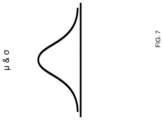
- FIG. 7 shows an example of a prediction result for an endpoint stored in the prediction table 314 .
- FIG. 8 shows an example of the threshold table 316 .
- FIG. 9 shows an exemplary block diagram of a backend system 35 of the communication system 1 in accordance with some embodiments of the present disclosure.
- parameters such as query per second (QPS) or bandwidth are used to predict issues that are of more direct concern, such as latency.
- QPS query per second
- bandwidth are used to predict issues that are of more direct concern, such as latency.
- the present disclosure discloses methods and systems to predict statuses of endpoints by incorporating cross impacts between different endpoints.
- the present disclosure discloses methods and systems to predict an issue with past behaviors of the issue itself, which is more direct and can lead to more precise results.
- the issue of concern is latency of an endpoint.
- FIG. 1 shows a schematic configuration of a communication system according to some embodiments of the present disclosure.
- the communication system 1 may provide a live streaming service with interaction via a content.
- content refers to a digital content that can be played on a computer device.
- the communication system 1 enables a user to participate in real-time interaction with other users on-line.
- the communication system 1 includes a plurality of user terminals 10 , a backend server 30 , and a streaming server 40 .
- the user terminals 10 , the backend server 30 and the streaming server 40 are connected via a network 90 , which may be the Internet, for example.
- the backend server 30 may be a server for synchronizing interaction between the user terminals and/or the streaming server 40 .
- the backend server 30 may be referred to as the server of an application (APP) provider.
- APP application
- the streaming server 40 is a server for handling or providing streaming data or video data.
- the backend server 30 and the streaming server 40 may be independent servers.
- the backend server 30 and the streaming server 40 may be integrated into one server.
- the user terminals 10 are client devices for the live streaming service.
- the user terminal 10 may be referred to as viewer, streamer, anchor, podcaster, audience, listener or the like.
- Each of the user terminal 10 , the backend server 30 , and the streaming server 40 is an example of an information-processing device.
- the streaming may be live streaming or video replay.
- the streaming may be audio streaming and/or video streaming.
- the streaming may include contents such as online shopping, talk shows, talent shows, entertainment events, sports events, music videos, movies, comedy, concerts or the like.
- FIG. 9 shows an exemplary block diagram of a backend system 35 of the communication system 1 in accordance with some embodiments of the present disclosure.
- the backend system 35 monitors the latencies of a plurality of endpoints (APIs or servers) and sends an operator a warning message regarding a specific endpoint if predicted results of latency of the specific endpoint satisfy a warning condition.
- the backend system 35 comprises a plurality of endpoints EP1, EP2, EP3, . . . , a server 300 and an operator device 36 .
- Each endpoint generates time-series latency data and transmits the generated time-series latency data to the server 300 via a network.
- the model 306 receives the generated time-series latency data from the plurality of the endpoints EP1, EP2, EP3, . . . .
- the model 306 processes the received data and generates a probability density function for the latency of each of the plurality of endpoints. For example, the model 306 generates a probability density function for the latency of endpoint EP1, a probability density function for the latency of endpoint EP2, and a probability density function for the latency of endpoint EP3. In the process in the model 306 , the latency data from different endpoints are correlated with each other.
- the risk assessing unit 308 of the server 300 receives the probability density functions of the latencies of the plurality of endpoints from the model 306 .
- the risk assessing unit 308 determines whether, for each of the endpoints, the prediction result or the probability density function for the respective endpoint satisfies the warning condition or not. If the warning condition is satisfied for a specific endpoint, the risk assessing unit 308 generates a warning message regarding the specific endpoint and sends the warning message to the operator device 36 via a network. The operator 37 watches the warning message on the operator device 36 and will take an appropriate action on the specific endpoint.
- FIG. 2 shows an exemplary block diagram of the server 300 and a kubernetes cluster in accordance with some embodiments of the present disclosure.
- the server 300 includes an endpoint monitor 302 , a system monitor 304 , the machine learning model 306 , the risk assessing unit 308 , an endpoint data table 310 , a system data table 312 , a prediction table 314 and a threshold table 316 .
- the server 300 communicates with a kubernetes cluster 500 outside the server 300 .
- the kubernetes cluster includes various pods 502 .
- Kubernetes or a kubernetes cluster is an open-source container orchestration system for automating software deployment, scaling, and management.
- a kubernetes cluster includes various pods which are virtual spaces or virtual machines allocated for running an application provided by a server, such as a live streaming application.
- virtual spaces or virtual machines configured to run the live streaming platform provided by the server 300 could be deployed within the server 300 .
- virtual spaces or virtual machines configured to run the live streaming platform provided by the server 300 could be deployed on other services such as AWS Fargate, Azure Container Instances or Google Cloud Run.
- the endpoint monitor 302 is configured to receive information or parameters of endpoints of the live streaming service.
- the information may include latencies of endpoints.
- the information is received from the kubernetes cluster 500 .
- an endpoint corresponds to an application programming interface (API) of the live streaming service.
- API application programming interface
- live streaming service there could be various endpoints.
- a comment endpoint may correspond to the comment feature in a chat room.
- a gift endpoint may correspond to the gift sending feature in a chat room.
- An event endpoint may correspond to the event associated with a live streaming program.
- the system monitor 304 is configured to monitor or receive system parameters of the server 300 or the kubernetes cluster 500 .
- the parameters may include the number of pods (or pod amount) allocated in the kubernetes cluster 500 for running or supporting the live streaming service.
- pods allocated for the live streaming service are pods allocated for (or corresponding to) the endpoints of the live streaming service. In some embodiments, more pods allocated to the endpoints means lower latencies for the endpoints.
- the machine learning model 306 is configured to predict states of endpoints, such as latencies of endpoints.
- the machine learning model 306 may be trained by historical data of the endpoints, such as historical latency values of the endpoints.
- the machine learning model 306 may be trained by historical data of the pod numbers, such as historical pod amounts corresponding to the endpoints.
- the machine learning model 306 takes time series latency data of endpoints and the pod amount information as input (for example, past 30 minutes data of latency and pod amount), and delivers prediction of latencies of the endpoints as output.
- the prediction may include probability distribution information of the latency of an endpoint in a future timing.
- the probability distribution information may include or may be probability density function or probability distribution function of the latency of an endpoint in a future timing, such as, 10 minutes later.
- a probability density function may be expressed or defined by a mean and a variance.
- a probability density function may conform to a normal distribution.
- the risk assessing unit 308 is configured to calculate the probability of risk for an endpoint. For example, the risk assessing unit 308 calculates a probability of outage for an endpoint according to a predetermined threshold value (latency value) and the probability density function of the latency of the endpoint.
- the threshold value of latency can be determined such that high probability of outage may occur for the endpoint to reach the latency value.
- the endpoint data table 310 is configured to store data monitored or received by the endpoint monitor 302 .
- the data may be the time series latency values of each endpoint.
- the system data table 312 is configured to store data monitored or received by the system monitor 304 .
- the data may be pod numbers or pod amount information.
- the prediction table 314 is configured to store prediction results generated by the machine learning model 306 .
- the result may include mean, variance (or standard deviation) and distribution information (such as normal distribution or gaussian distribution).
- the threshold table 316 is configured to store predetermined threshold values for the endpoints.
- the threshold values may be latency values. Threshold values may be determined by the operator of the live streaming system based on experience or experiments.
- FIG. 3 shows an exemplary machine learning model in accordance with some embodiments of the present disclosure.
- the machine learning model 600 may be applied as the machine learning model 306 in FIG. 2 .
- the machine learning model 600 includes an autoencoder 602 , a transformer model 604 and a neural network layer 606 .
- the input to the machine learning model 600 are latency data of endpoints and pod number data.
- the time series latency data of each endpoint is input into the autoencoder 602 .
- the time series latency data includes latency values (expressed in time series) for each endpoint for a period of time.
- the pod number data may include the total pod number corresponding to (or allocated to) the total endpoints (for example, total live streaming endpoints).
- the pod number data may include the pod numbers corresponding to (or allocated to) different endpoint groups.
- An endpoint group may contain several endpoints corresponding to the same service or the same feature. An endpoint group may be referred to as a service group in some embodiments.
- the autoencoder 602 is configured to extract a trend portion, a seasonal portion (or periodical portion) and a noise portion from the latency data of the endpoints.
- the trend portion and the seasonal portion of the latency data are one output of the machine learning model 600 .
- the autoencoder 602 is configured to remove noise data from the latency data, and deliver the “noise removed” latency data as output.
- the trend portion, the seasonal portion and the noise portion extracted from the latency data are taken as input into the transformer model 604 .
- the autoencoder 602 is a variational autoencoder.
- the noise portion of the latency data may be an anomaly portion or an outlier portion of the latency data.
- the autoencoder 602 is configured to extract information in the latent space from the latency data of each endpoint.
- the noise portion is defined as (original latency data ⁇ (trend portion+seasonal portion)).
- the transformer model 604 is configured to extract temporal relationships or temporal correlations between the latency data of different endpoints. Due to the noise separation/extraction with the autoencoder 602 , the transformer model 604 can extract the temporal relationships between the latency data of different endpoints with higher precision. Due to the noise separation/extraction with the autoencoder 602 , the transformer model 604 can learn the relationships between de-noised terms and noise-signal terms from all endpoints. In some embodiments, the transformer model 604 includes a deep learning algorithm. In some embodiments, the output of the transformer model 604 includes a sequence, and the number of elements in the sequence is the same as the number of the endpoints.
- the output of the transformer model 604 and the pod number data enters a concatenation calculation.
- the Output of the concatenation calculation is then input into a neural network layer 606 .
- the neural network layer 606 is configured to deliver probability distribution information of latency of the endpoints (or for each endpoint).
- the probability distribution information of latency of each endpoint includes the probability density function (PDF) of latency of each endpoint.
- the neural network layer 606 is a fully connected neural network.
- loss L 1 and loss L 2 there are two loss functions, loss L 1 and loss L 2 , utilized in the training phase of the machine learning model 600 .
- Loss L 1 takes the latency data of endpoints, which are the input of the autoencoder 602 , as the ground truth data. Loss L 1 takes the trend and seasonal portions of the latency data as input. Loss L 1 calculates the difference between the [latency data] and the [trend data and seasonal data of the latency data]. Therefore, loss L 1 corresponds to the noise term of the latency data, which is delivered by the autoencoder 602 . Loss L 1 is configured to let the machine learning model 600 (or the autoencoder 602 ) learn to adjust itself to minimize the noise term generated by the autoencoder 602 .
- Loss L 1 is configured to let the machine learning model 600 (or the autoencoder 602 ) learn to adjust itself to maximize the trend and seasonal portions of the latency data generated by the autoencoder 602 . Therefore, the output of the autoencoder 602 (which is the input of the transformer model 604 ) can approach (or represent) the essential nature (or true nature) of the latency data without being biased by noise. That can help the transformer model 604 to deliver more precise temporal relationships between different endpoints.
- Loss L 2 takes subsequent latency data of endpoints, which are actual latency data subsequent to the latency data input into the autoencoder 602 , as the ground truth data. Loss L 2 takes the probability density functions of latency as input. Loss L 2 is configured to let the machine learning model 600 learn to adjust itself (such as to adjust the mean and variance) to maximize the probability density function corresponding to the actual latency value for each endpoint.
- mixture density networks are utilized to transform the maximization process into a minimization process, by incorporating minus log calculation of the probability density function.
- the result of loss LA and the result of loss L 2 are summed up and then input to the machine learning model 600 as a feedback (or back-propagation) for the self learning or parameter adjustment of the machine learning model 600 .
- the summation calculation here that is, giving the same weight to loss L 1 and loss L 2
- the autoencoder noise term is usually much greater than the MDN loss term (for example, for endpoints utilized in live streaming scenarios)
- the machine learning model 600 (or the autoencoder 602 ) will learn to remove noise of the latency data as soon as possible. Therefore, the transformer model 604 can deliver the temporal relationships between latencies of different endpoints in a fast and precise manner.
- the calculations described above may be performed by calculating units within the server 300 .
- a graph convolutional network (GCN) model can be incorporated into the machine learning model.
- the output of the autoencoder can be input into the GCN model, and the output of the GCN model can be input into the transformer model.
- the GCN model is configured to learn spatial relationships or spatial correlations between latency data of different endpoints.
- the machine learning model can detect the correlation between gift api latency and comment api latency. That may further increase the speed and/or precision of the prediction.
- FIG. 4 shows an exemplary flow chart illustrating a method of server management in accordance with some embodiments of the present disclosure.
- the server could be, for example, the server 300 shown in FIG. 2 .
- step S 400 the server 300 obtains latency data or latency values of each endpoint.
- the process could be performed by the endpoint monitor 302 .
- the endpoints may correspond to a live streaming service.
- step S 402 the server 300 obtains pod number data (or pod amount information) corresponding to the endpoints.
- the process could be performed by the system monitor 304 .
- step S 404 the latency data and the pod number data are input into the machine learning model 306 .
- the process could be performed by a controller within the server 300 .
- step S 406 the machine learning model 306 generates the prediction of latency for each endpoint.
- the prediction may include probability distribution information of latency for each endpoint (or probability density function of latency for each endpoint) in a future timing.
- a latency threshold value is determined for each endpoint.
- the threshold values may be determined by operators according to experiences or experiments.
- the threshold values may be determined by artificial intelligence or another machine learning model according to historical correlation data between latency value and outage for each endpoint.
- step S 410 probability of outage for each endpoint is calculated according to the threshold value and the probability distribution information of latency.
- the process could be performed by the risk assessing unit 306 .
- the result of step S 410 could be utilized in subsequent server managing procedures such as precautions to alleviate the burden/loading of a specific endpoint.
- FIG. 5 shows an example of the endpoint data table 310 .
- endpoint EP1 is monitored to have the time series latency value sequence [60 ms, 150 ms, 400 ms, . . . ], and endpoint EP2 is monitored to have the time series latency value sequence [1000 ms, 1300 ms, 780 ms, . . . ].
- FIG. 6 shows an example of the system data table 312 .
- endpoints EP1 and EP2 belong to service group G 1 , and are allocated with or correspond to 8 pod numbers.
- Endpoints EP3 belongs to service group G 2 , and is allocated with or corresponds to 6 pod numbers.
- Endpoints EP4, EP5 and EP6 belong to service group G 3 , and are allocated with or correspond to 10 pod numbers.
- FIG. 7 shows an example of a prediction result for an endpoint stored in the prediction table 314 .
- the prediction result includes a probability density function with its mean ( ⁇ ) and standard deviation ( ⁇ ) specified.
- FIG. 8 shows an example of the threshold table 316 .
- endpoint EP1 is set to have the latency threshold value 700 ms
- endpoint EP2 is set to have the latency threshold value 1500 ms.
- the present disclosure discloses improved methods and systems for quality prediction for the endpoints by considering cross impacts between different endpoints with machine learning models.
- the present disclosure discloses methods and systems to predict an issue of concern with past behaviors of the issue itself, which is more direct and can lead to more precise results.
- the issue of concern is latency of an endpoint.
- the issue of concern could be other parameters or metrics of a live streaming platform.
- endpoints that are more sensitive to user experience may be given higher weights in the machine learning model. For example, endpoints of gift sending and/or money depositing may be given higher weights in the machine learning model. That can lead to more practical prediction results in terms of user experience.
- the autoencoder in the machine learning model could be a deformational autoencoder (NVAE).
- NVAE and MDN both possess inherent Bayesian nature and can further improve the prediction accuracy.
- processing and procedures described in the present disclosure may be realized by software, hardware, or any combination of these in addition to what was explicitly described.
- the processing and procedures described in the specification may be realized by implementing a logic corresponding to the processing and procedures in a medium such as an integrated circuit, a volatile memory, a non-volatile memory, a non-transitory computer-readable medium and a magnetic disk.
- the processing and procedures described in the specification can be implemented as a computer program corresponding to the processing and procedures, and can be executed by various kinds of computers.
- system or method described in the above embodiments may be integrated into programs stored in a computer-readable non-transitory medium such as a solid state memory device, an optical disk storage device, or a magnetic disk storage device.
- programs may be downloaded from a server via the Internet and be executed by processors.
Landscapes
- Engineering & Computer Science (AREA)
- Computer Networks & Wireless Communication (AREA)
- Signal Processing (AREA)
- Business, Economics & Management (AREA)
- Environmental & Geological Engineering (AREA)
- Human Resources & Organizations (AREA)
- Economics (AREA)
- Strategic Management (AREA)
- Artificial Intelligence (AREA)
- Medical Informatics (AREA)
- Evolutionary Computation (AREA)
- Databases & Information Systems (AREA)
- Computer Vision & Pattern Recognition (AREA)
- Software Systems (AREA)
- Entrepreneurship & Innovation (AREA)
- Physics & Mathematics (AREA)
- Development Economics (AREA)
- Marketing (AREA)
- Operations Research (AREA)
- Quality & Reliability (AREA)
- Tourism & Hospitality (AREA)
- Game Theory and Decision Science (AREA)
- General Business, Economics & Management (AREA)
- General Physics & Mathematics (AREA)
- Theoretical Computer Science (AREA)
- Management, Administration, Business Operations System, And Electronic Commerce (AREA)
- Data Exchanges In Wide-Area Networks (AREA)
- Two-Way Televisions, Distribution Of Moving Picture Or The Like (AREA)
Abstract
Description
| LIST OF |
| 1 | |
|
| 10 | |
|
| 30 | |
|
| 40 | |
|
| 90 | |
|
| 300 | |
|
| 302 | Endpoint monitor | |
| 304 | |
|
| 306 | |
|
| 308 | |
|
| 310 | Endpoint data table | |
| 312 | System data table | |
| 314 | Prediction table | |
| 316 | Threshold table | |
| 500 | |
|
| 502 | |
|
| 600 | |
|
| 602 | |
|
| 604 | |
|
| 606 | Neural network layer | |
| L1, L2 | Loss | |
| S400, S402, S404, | Step | |
| S406 S408, S410 | ||
| EP1, EP2, EP3, | Endpoint | |
| EP4, EP5, EP6 | ||
| G1, G2, G3 | Service group | |
Claims (6)
Applications Claiming Priority (2)
| Application Number | Priority Date | Filing Date | Title |
|---|---|---|---|
| JP2022094472A JP7233664B1 (en) | 2022-06-10 | 2022-06-10 | Systems, methods, and computer readable media for quality prediction |
| JP2022-094472 | 2022-06-10 |
Publications (2)
| Publication Number | Publication Date |
|---|---|
| US20230403205A1 US20230403205A1 (en) | 2023-12-14 |
| US12137036B2 true US12137036B2 (en) | 2024-11-05 |
Family
ID=85460134
Family Applications (1)
| Application Number | Title | Priority Date | Filing Date |
|---|---|---|---|
| US17/941,721 Active 2042-09-09 US12137036B2 (en) | 2022-06-10 | 2022-09-09 | System, method and computer-readable medium for quality prediction |
Country Status (2)
| Country | Link |
|---|---|
| US (1) | US12137036B2 (en) |
| JP (2) | JP7233664B1 (en) |
Families Citing this family (1)
| Publication number | Priority date | Publication date | Assignee | Title |
|---|---|---|---|---|
| JP7525137B1 (en) * | 2024-02-22 | 2024-07-30 | Siシナジーテクノロジー株式会社 | Trained autoencoder, trained autoencoder generation method, non-stationary sound detection method, non-stationary sound detection device, and computer program |
Citations (9)
| Publication number | Priority date | Publication date | Assignee | Title |
|---|---|---|---|---|
| US20120202538A1 (en) * | 2011-02-09 | 2012-08-09 | Nokia Corporation | Forecasting of dynamic environmental parameters to optimize operation of a wireless communication system |
| US20190334786A1 (en) * | 2018-04-30 | 2019-10-31 | Hewlett Packard Enterprise Development Lp | Predicting Workload Patterns in a Data Storage Network |
| US20190385045A1 (en) | 2018-06-14 | 2019-12-19 | Dell Products L.P. | Systems And Methods For Generalized Adaptive Storage Endpoint Prediction |
| US20210014301A1 (en) * | 2020-09-25 | 2021-01-14 | Intel Corporation | Methods and apparatus to select a location of execution of a computation |
| US20220210028A1 (en) * | 2019-05-15 | 2022-06-30 | Fu Zhou University | Cloud software service resource allocation method based on qos model self-correctio |
| US20220268827A1 (en) * | 2021-02-24 | 2022-08-25 | Mitsubishi Electric Research Laboratories, Inc. | Distribution Fault Location Using Graph Neural Network with both Node and Link Attributes |
| US20220303331A1 (en) * | 2019-08-08 | 2022-09-22 | Intel Corporation | Link performance prediction and media streaming technologies |
| US20220413993A1 (en) * | 2021-06-29 | 2022-12-29 | Cox Communications, Inc. | Anomaly detection of firmware revisions in a network |
| US20230153602A1 (en) * | 2021-11-15 | 2023-05-18 | Capital One Services, Llc | Cascading meta learner to enhance functionalities of machine learning models |
Family Cites Families (4)
| Publication number | Priority date | Publication date | Assignee | Title |
|---|---|---|---|---|
| US11095527B2 (en) | 2017-03-16 | 2021-08-17 | Nec Corporation | Delay prediction device, delay prediction system, delay prediction method, and recording medium |
| JP7276432B2 (en) | 2019-04-26 | 2023-05-18 | 日本電信電話株式会社 | Communication system and terminal |
| US11159408B2 (en) | 2019-06-25 | 2021-10-26 | Intel Corporation | Link performance prediction technologies |
| WO2022044121A1 (en) | 2020-08-25 | 2022-03-03 | 日本電信電話株式会社 | Resource quantity estimation device, resource quantity estimation method, and program |
-
2022
- 2022-06-10 JP JP2022094472A patent/JP7233664B1/en active Active
- 2022-09-09 US US17/941,721 patent/US12137036B2/en active Active
-
2023
- 2023-02-14 JP JP2023020584A patent/JP2023181074A/en active Pending
Patent Citations (9)
| Publication number | Priority date | Publication date | Assignee | Title |
|---|---|---|---|---|
| US20120202538A1 (en) * | 2011-02-09 | 2012-08-09 | Nokia Corporation | Forecasting of dynamic environmental parameters to optimize operation of a wireless communication system |
| US20190334786A1 (en) * | 2018-04-30 | 2019-10-31 | Hewlett Packard Enterprise Development Lp | Predicting Workload Patterns in a Data Storage Network |
| US20190385045A1 (en) | 2018-06-14 | 2019-12-19 | Dell Products L.P. | Systems And Methods For Generalized Adaptive Storage Endpoint Prediction |
| US20220210028A1 (en) * | 2019-05-15 | 2022-06-30 | Fu Zhou University | Cloud software service resource allocation method based on qos model self-correctio |
| US20220303331A1 (en) * | 2019-08-08 | 2022-09-22 | Intel Corporation | Link performance prediction and media streaming technologies |
| US20210014301A1 (en) * | 2020-09-25 | 2021-01-14 | Intel Corporation | Methods and apparatus to select a location of execution of a computation |
| US20220268827A1 (en) * | 2021-02-24 | 2022-08-25 | Mitsubishi Electric Research Laboratories, Inc. | Distribution Fault Location Using Graph Neural Network with both Node and Link Attributes |
| US20220413993A1 (en) * | 2021-06-29 | 2022-12-29 | Cox Communications, Inc. | Anomaly detection of firmware revisions in a network |
| US20230153602A1 (en) * | 2021-11-15 | 2023-05-18 | Capital One Services, Llc | Cascading meta learner to enhance functionalities of machine learning models |
Non-Patent Citations (1)
| Title |
|---|
| Notification of Reasons for Refusal dated Oct. 4, 2022 issued in corresponding Japanese Patent Application No. 2022-094472 with English translation (6 pgs.). |
Also Published As
| Publication number | Publication date |
|---|---|
| JP2023181074A (en) | 2023-12-21 |
| US20230403205A1 (en) | 2023-12-14 |
| JP2023180842A (en) | 2023-12-21 |
| JP7233664B1 (en) | 2023-03-07 |
Similar Documents
| Publication | Publication Date | Title |
|---|---|---|
| US11960509B2 (en) | Feedback loop content recommendation | |
| US12208333B2 (en) | Flexible computer gaming based on machine learning | |
| US12134033B2 (en) | Server load prediction and advanced performance measures | |
| EP2999527B1 (en) | Game availability in a remote gaming environment | |
| US11171876B2 (en) | Predicting wait time for new session initiation during increased data traffic latency | |
| US20230117649A1 (en) | Automatic Transaction Processing Failover | |
| CN116248603B (en) | Traffic scheduling method, device, equipment and storage medium | |
| US11741148B2 (en) | Methods and systems for personalized screen content optimization | |
| Zhang et al. | Livesmart: A qos-guaranteed cost-minimum framework of viewer scheduling for crowdsourced live streaming | |
| US12137036B2 (en) | System, method and computer-readable medium for quality prediction | |
| US12430569B2 (en) | Systems and methods for providing media content recommendations | |
| Dinaki et al. | Boosted metaheuristic algorithms for QoE-aware server selection in multiplayer cloud gaming | |
| CN117563222A (en) | Game operation methods, adjustment methods, devices, electronic equipment and media | |
| US20230269432A1 (en) | System, method and computer-readable medium for recommending streaming data | |
| US12107935B2 (en) | System, method and computer-readable medium for notification | |
| US20250203138A1 (en) | Systems and methods for managing streaming resource consumption | |
| US20240078534A1 (en) | Virtual experience subscriptions using a virtual currency | |
| US20120110587A1 (en) | Methods and apparatuses for accumulating and distributing processing power | |
| CN119052330A (en) | Data pushing method, device and equipment in target community and storage medium | |
| CN121120173A (en) | Methods, apparatuses, electronic devices, computer-readable storage media, and computer program products for processing recommendation information | |
| CN117808099A (en) | Request processing method, request processing device, electronic equipment and storage medium |
Legal Events
| Date | Code | Title | Description |
|---|---|---|---|
| AS | Assignment |
Owner name: 17LIVE JAPAN INC., JAPAN Free format text: ASSIGNMENT OF ASSIGNORS INTEREST;ASSIGNORS:CHEN, LI-HAN;LIU, JIN-WEI;CHEN, YI-HSIUNG;AND OTHERS;SIGNING DATES FROM 20220905 TO 20220908;REEL/FRAME:061050/0026 |
|
| FEPP | Fee payment procedure |
Free format text: ENTITY STATUS SET TO UNDISCOUNTED (ORIGINAL EVENT CODE: BIG.); ENTITY STATUS OF PATENT OWNER: LARGE ENTITY |
|
| STPP | Information on status: patent application and granting procedure in general |
Free format text: FINAL REJECTION MAILED |
|
| STPP | Information on status: patent application and granting procedure in general |
Free format text: RESPONSE AFTER FINAL ACTION FORWARDED TO EXAMINER |
|
| STPP | Information on status: patent application and granting procedure in general |
Free format text: ADVISORY ACTION MAILED |
|
| STPP | Information on status: patent application and granting procedure in general |
Free format text: DOCKETED NEW CASE - READY FOR EXAMINATION |
|
| AS | Assignment |
Owner name: 17LIVE JAPAN INC., JAPAN Free format text: CHANGE OF ASSIGNEE ADDRESS;ASSIGNOR:17LIVE JAPAN INC.;REEL/FRAME:067126/0303 Effective date: 20240209 |
|
| STPP | Information on status: patent application and granting procedure in general |
Free format text: NON FINAL ACTION MAILED |
|
| STPP | Information on status: patent application and granting procedure in general |
Free format text: NOTICE OF ALLOWANCE MAILED -- APPLICATION RECEIVED IN OFFICE OF PUBLICATIONS |
|
| ZAAB | Notice of allowance mailed |
Free format text: ORIGINAL CODE: MN/=. |
|
| STPP | Information on status: patent application and granting procedure in general |
Free format text: PUBLICATIONS -- ISSUE FEE PAYMENT VERIFIED |
|
| STCF | Information on status: patent grant |
Free format text: PATENTED CASE |