US12127473B2 - Di-, tri- and tetraphenylindane derivates and their use in organic electronics - Google Patents
Di-, tri- and tetraphenylindane derivates and their use in organic electronics Download PDFInfo
- Publication number
- US12127473B2 US12127473B2 US17/292,221 US201917292221A US12127473B2 US 12127473 B2 US12127473 B2 US 12127473B2 US 201917292221 A US201917292221 A US 201917292221A US 12127473 B2 US12127473 B2 US 12127473B2
- Authority
- US
- United States
- Prior art keywords
- groups
- different
- hydrogen
- formula
- trp
- Prior art date
- Legal status (The legal status is an assumption and is not a legal conclusion. Google has not performed a legal analysis and makes no representation as to the accuracy of the status listed.)
- Active, expires
Links
Classifications
-
- C—CHEMISTRY; METALLURGY
- C09—DYES; PAINTS; POLISHES; NATURAL RESINS; ADHESIVES; COMPOSITIONS NOT OTHERWISE PROVIDED FOR; APPLICATIONS OF MATERIALS NOT OTHERWISE PROVIDED FOR
- C09K—MATERIALS FOR MISCELLANEOUS APPLICATIONS, NOT PROVIDED FOR ELSEWHERE
- C09K11/00—Luminescent materials, e.g. electroluminescent or chemiluminescent
- C09K11/06—Luminescent materials, e.g. electroluminescent or chemiluminescent containing organic luminescent materials
-
- C—CHEMISTRY; METALLURGY
- C07—ORGANIC CHEMISTRY
- C07C—ACYCLIC OR CARBOCYCLIC COMPOUNDS
- C07C211/00—Compounds containing amino groups bound to a carbon skeleton
- C07C211/43—Compounds containing amino groups bound to a carbon skeleton having amino groups bound to carbon atoms of six-membered aromatic rings of the carbon skeleton
- C07C211/44—Compounds containing amino groups bound to a carbon skeleton having amino groups bound to carbon atoms of six-membered aromatic rings of the carbon skeleton having amino groups bound to only one six-membered aromatic ring
- C07C211/45—Monoamines
-
- C—CHEMISTRY; METALLURGY
- C07—ORGANIC CHEMISTRY
- C07C—ACYCLIC OR CARBOCYCLIC COMPOUNDS
- C07C209/00—Preparation of compounds containing amino groups bound to a carbon skeleton
- C07C209/30—Preparation of compounds containing amino groups bound to a carbon skeleton by reduction of nitrogen-to-oxygen or nitrogen-to-nitrogen bonds
- C07C209/32—Preparation of compounds containing amino groups bound to a carbon skeleton by reduction of nitrogen-to-oxygen or nitrogen-to-nitrogen bonds by reduction of nitro groups
- C07C209/36—Preparation of compounds containing amino groups bound to a carbon skeleton by reduction of nitrogen-to-oxygen or nitrogen-to-nitrogen bonds by reduction of nitro groups by reduction of nitro groups bound to carbon atoms of six-membered aromatic rings in presence of hydrogen-containing gases and a catalyst
-
- C—CHEMISTRY; METALLURGY
- C07—ORGANIC CHEMISTRY
- C07C—ACYCLIC OR CARBOCYCLIC COMPOUNDS
- C07C209/00—Preparation of compounds containing amino groups bound to a carbon skeleton
- C07C209/60—Preparation of compounds containing amino groups bound to a carbon skeleton by condensation or addition reactions, e.g. Mannich reaction, addition of ammonia or amines to alkenes or to alkynes or addition of compounds containing an active hydrogen atom to Schiff's bases, quinone imines, or aziranes
-
- C—CHEMISTRY; METALLURGY
- C07—ORGANIC CHEMISTRY
- C07C—ACYCLIC OR CARBOCYCLIC COMPOUNDS
- C07C209/00—Preparation of compounds containing amino groups bound to a carbon skeleton
- C07C209/62—Preparation of compounds containing amino groups bound to a carbon skeleton by cleaving carbon-to-nitrogen, sulfur-to-nitrogen, or phosphorus-to-nitrogen bonds, e.g. hydrolysis of amides, N-dealkylation of amines or quaternary ammonium compounds
-
- C—CHEMISTRY; METALLURGY
- C07—ORGANIC CHEMISTRY
- C07C—ACYCLIC OR CARBOCYCLIC COMPOUNDS
- C07C209/00—Preparation of compounds containing amino groups bound to a carbon skeleton
- C07C209/68—Preparation of compounds containing amino groups bound to a carbon skeleton from amines, by reactions not involving amino groups, e.g. reduction of unsaturated amines, aromatisation, or substitution of the carbon skeleton
-
- C—CHEMISTRY; METALLURGY
- C07—ORGANIC CHEMISTRY
- C07C—ACYCLIC OR CARBOCYCLIC COMPOUNDS
- C07C209/00—Preparation of compounds containing amino groups bound to a carbon skeleton
- C07C209/82—Purification; Separation; Stabilisation; Use of additives
- C07C209/90—Stabilisation; Use of additives
-
- C—CHEMISTRY; METALLURGY
- C07—ORGANIC CHEMISTRY
- C07C—ACYCLIC OR CARBOCYCLIC COMPOUNDS
- C07C211/00—Compounds containing amino groups bound to a carbon skeleton
- C07C211/43—Compounds containing amino groups bound to a carbon skeleton having amino groups bound to carbon atoms of six-membered aromatic rings of the carbon skeleton
- C07C211/44—Compounds containing amino groups bound to a carbon skeleton having amino groups bound to carbon atoms of six-membered aromatic rings of the carbon skeleton having amino groups bound to only one six-membered aromatic ring
- C07C211/49—Compounds containing amino groups bound to a carbon skeleton having amino groups bound to carbon atoms of six-membered aromatic rings of the carbon skeleton having amino groups bound to only one six-membered aromatic ring having at least two amino groups bound to the carbon skeleton
-
- C—CHEMISTRY; METALLURGY
- C07—ORGANIC CHEMISTRY
- C07C—ACYCLIC OR CARBOCYCLIC COMPOUNDS
- C07C211/00—Compounds containing amino groups bound to a carbon skeleton
- C07C211/43—Compounds containing amino groups bound to a carbon skeleton having amino groups bound to carbon atoms of six-membered aromatic rings of the carbon skeleton
- C07C211/44—Compounds containing amino groups bound to a carbon skeleton having amino groups bound to carbon atoms of six-membered aromatic rings of the carbon skeleton having amino groups bound to only one six-membered aromatic ring
- C07C211/49—Compounds containing amino groups bound to a carbon skeleton having amino groups bound to carbon atoms of six-membered aromatic rings of the carbon skeleton having amino groups bound to only one six-membered aromatic ring having at least two amino groups bound to the carbon skeleton
- C07C211/50—Compounds containing amino groups bound to a carbon skeleton having amino groups bound to carbon atoms of six-membered aromatic rings of the carbon skeleton having amino groups bound to only one six-membered aromatic ring having at least two amino groups bound to the carbon skeleton with at least two amino groups bound to carbon atoms of six-membered aromatic rings of the carbon skeleton
-
- C—CHEMISTRY; METALLURGY
- C07—ORGANIC CHEMISTRY
- C07C—ACYCLIC OR CARBOCYCLIC COMPOUNDS
- C07C211/00—Compounds containing amino groups bound to a carbon skeleton
- C07C211/43—Compounds containing amino groups bound to a carbon skeleton having amino groups bound to carbon atoms of six-membered aromatic rings of the carbon skeleton
- C07C211/54—Compounds containing amino groups bound to a carbon skeleton having amino groups bound to carbon atoms of six-membered aromatic rings of the carbon skeleton having amino groups bound to two or three six-membered aromatic rings
-
- C—CHEMISTRY; METALLURGY
- C07—ORGANIC CHEMISTRY
- C07C—ACYCLIC OR CARBOCYCLIC COMPOUNDS
- C07C211/00—Compounds containing amino groups bound to a carbon skeleton
- C07C211/43—Compounds containing amino groups bound to a carbon skeleton having amino groups bound to carbon atoms of six-membered aromatic rings of the carbon skeleton
- C07C211/57—Compounds containing amino groups bound to a carbon skeleton having amino groups bound to carbon atoms of six-membered aromatic rings of the carbon skeleton having amino groups bound to carbon atoms of six-membered aromatic rings being part of condensed ring systems of the carbon skeleton
-
- C—CHEMISTRY; METALLURGY
- C07—ORGANIC CHEMISTRY
- C07C—ACYCLIC OR CARBOCYCLIC COMPOUNDS
- C07C211/00—Compounds containing amino groups bound to a carbon skeleton
- C07C211/43—Compounds containing amino groups bound to a carbon skeleton having amino groups bound to carbon atoms of six-membered aromatic rings of the carbon skeleton
- C07C211/57—Compounds containing amino groups bound to a carbon skeleton having amino groups bound to carbon atoms of six-membered aromatic rings of the carbon skeleton having amino groups bound to carbon atoms of six-membered aromatic rings being part of condensed ring systems of the carbon skeleton
- C07C211/60—Compounds containing amino groups bound to a carbon skeleton having amino groups bound to carbon atoms of six-membered aromatic rings of the carbon skeleton having amino groups bound to carbon atoms of six-membered aromatic rings being part of condensed ring systems of the carbon skeleton containing a ring other than a six-membered aromatic ring forming part of at least one of the condensed ring systems
-
- C—CHEMISTRY; METALLURGY
- C07—ORGANIC CHEMISTRY
- C07C—ACYCLIC OR CARBOCYCLIC COMPOUNDS
- C07C211/00—Compounds containing amino groups bound to a carbon skeleton
- C07C211/43—Compounds containing amino groups bound to a carbon skeleton having amino groups bound to carbon atoms of six-membered aromatic rings of the carbon skeleton
- C07C211/57—Compounds containing amino groups bound to a carbon skeleton having amino groups bound to carbon atoms of six-membered aromatic rings of the carbon skeleton having amino groups bound to carbon atoms of six-membered aromatic rings being part of condensed ring systems of the carbon skeleton
- C07C211/61—Compounds containing amino groups bound to a carbon skeleton having amino groups bound to carbon atoms of six-membered aromatic rings of the carbon skeleton having amino groups bound to carbon atoms of six-membered aromatic rings being part of condensed ring systems of the carbon skeleton with at least one of the condensed ring systems formed by three or more rings
-
- C—CHEMISTRY; METALLURGY
- C07—ORGANIC CHEMISTRY
- C07C—ACYCLIC OR CARBOCYCLIC COMPOUNDS
- C07C213/00—Preparation of compounds containing amino and hydroxy, amino and etherified hydroxy or amino and esterified hydroxy groups bound to the same carbon skeleton
- C07C213/02—Preparation of compounds containing amino and hydroxy, amino and etherified hydroxy or amino and esterified hydroxy groups bound to the same carbon skeleton by reactions involving the formation of amino groups from compounds containing hydroxy groups or etherified or esterified hydroxy groups
-
- C—CHEMISTRY; METALLURGY
- C07—ORGANIC CHEMISTRY
- C07C—ACYCLIC OR CARBOCYCLIC COMPOUNDS
- C07C217/00—Compounds containing amino and etherified hydroxy groups bound to the same carbon skeleton
- C07C217/78—Compounds containing amino and etherified hydroxy groups bound to the same carbon skeleton having amino groups and etherified hydroxy groups bound to carbon atoms of six-membered aromatic rings of the same carbon skeleton
- C07C217/80—Compounds containing amino and etherified hydroxy groups bound to the same carbon skeleton having amino groups and etherified hydroxy groups bound to carbon atoms of six-membered aromatic rings of the same carbon skeleton having amino groups and etherified hydroxy groups bound to carbon atoms of non-condensed six-membered aromatic rings
- C07C217/82—Compounds containing amino and etherified hydroxy groups bound to the same carbon skeleton having amino groups and etherified hydroxy groups bound to carbon atoms of six-membered aromatic rings of the same carbon skeleton having amino groups and etherified hydroxy groups bound to carbon atoms of non-condensed six-membered aromatic rings of the same non-condensed six-membered aromatic ring
- C07C217/92—Compounds containing amino and etherified hydroxy groups bound to the same carbon skeleton having amino groups and etherified hydroxy groups bound to carbon atoms of six-membered aromatic rings of the same carbon skeleton having amino groups and etherified hydroxy groups bound to carbon atoms of non-condensed six-membered aromatic rings of the same non-condensed six-membered aromatic ring the nitrogen atom of at least one of the amino groups being further bound to a carbon atom of a six-membered aromatic ring
-
- H—ELECTRICITY
- H10—SEMICONDUCTOR DEVICES; ELECTRIC SOLID-STATE DEVICES NOT OTHERWISE PROVIDED FOR
- H10K—ORGANIC ELECTRIC SOLID-STATE DEVICES
- H10K30/00—Organic devices sensitive to infrared radiation, light, electromagnetic radiation of shorter wavelength or corpuscular radiation
- H10K30/80—Constructional details
-
- H—ELECTRICITY
- H10—SEMICONDUCTOR DEVICES; ELECTRIC SOLID-STATE DEVICES NOT OTHERWISE PROVIDED FOR
- H10K—ORGANIC ELECTRIC SOLID-STATE DEVICES
- H10K50/00—Organic light-emitting devices
- H10K50/10—OLEDs or polymer light-emitting diodes [PLED]
- H10K50/14—Carrier transporting layers
- H10K50/15—Hole transporting layers
-
- H—ELECTRICITY
- H10—SEMICONDUCTOR DEVICES; ELECTRIC SOLID-STATE DEVICES NOT OTHERWISE PROVIDED FOR
- H10K—ORGANIC ELECTRIC SOLID-STATE DEVICES
- H10K50/00—Organic light-emitting devices
- H10K50/10—OLEDs or polymer light-emitting diodes [PLED]
- H10K50/18—Carrier blocking layers
- H10K50/181—Electron blocking layers
-
- H—ELECTRICITY
- H10—SEMICONDUCTOR DEVICES; ELECTRIC SOLID-STATE DEVICES NOT OTHERWISE PROVIDED FOR
- H10K—ORGANIC ELECTRIC SOLID-STATE DEVICES
- H10K85/00—Organic materials used in the body or electrodes of devices covered by this subclass
- H10K85/60—Organic compounds having low molecular weight
- H10K85/631—Amine compounds having at least two aryl rest on at least one amine-nitrogen atom, e.g. triphenylamine
-
- H—ELECTRICITY
- H10—SEMICONDUCTOR DEVICES; ELECTRIC SOLID-STATE DEVICES NOT OTHERWISE PROVIDED FOR
- H10K—ORGANIC ELECTRIC SOLID-STATE DEVICES
- H10K85/00—Organic materials used in the body or electrodes of devices covered by this subclass
- H10K85/60—Organic compounds having low molecular weight
- H10K85/631—Amine compounds having at least two aryl rest on at least one amine-nitrogen atom, e.g. triphenylamine
- H10K85/633—Amine compounds having at least two aryl rest on at least one amine-nitrogen atom, e.g. triphenylamine comprising polycyclic condensed aromatic hydrocarbons as substituents on the nitrogen atom
-
- C—CHEMISTRY; METALLURGY
- C07—ORGANIC CHEMISTRY
- C07B—GENERAL METHODS OF ORGANIC CHEMISTRY; APPARATUS THEREFOR
- C07B2200/00—Indexing scheme relating to specific properties of organic compounds
- C07B2200/07—Optical isomers
-
- C—CHEMISTRY; METALLURGY
- C07—ORGANIC CHEMISTRY
- C07C—ACYCLIC OR CARBOCYCLIC COMPOUNDS
- C07C2602/00—Systems containing two condensed rings
- C07C2602/02—Systems containing two condensed rings the rings having only two atoms in common
- C07C2602/04—One of the condensed rings being a six-membered aromatic ring
- C07C2602/08—One of the condensed rings being a six-membered aromatic ring the other ring being five-membered, e.g. indane
-
- C—CHEMISTRY; METALLURGY
- C07—ORGANIC CHEMISTRY
- C07C—ACYCLIC OR CARBOCYCLIC COMPOUNDS
- C07C2602/00—Systems containing two condensed rings
- C07C2602/02—Systems containing two condensed rings the rings having only two atoms in common
- C07C2602/14—All rings being cycloaliphatic
- C07C2602/24—All rings being cycloaliphatic the ring system containing nine carbon atoms, e.g. perhydroindane
-
- C—CHEMISTRY; METALLURGY
- C07—ORGANIC CHEMISTRY
- C07C—ACYCLIC OR CARBOCYCLIC COMPOUNDS
- C07C2603/00—Systems containing at least three condensed rings
- C07C2603/02—Ortho- or ortho- and peri-condensed systems
- C07C2603/04—Ortho- or ortho- and peri-condensed systems containing three rings
- C07C2603/06—Ortho- or ortho- and peri-condensed systems containing three rings containing at least one ring with less than six ring members
- C07C2603/10—Ortho- or ortho- and peri-condensed systems containing three rings containing at least one ring with less than six ring members containing five-membered rings
- C07C2603/12—Ortho- or ortho- and peri-condensed systems containing three rings containing at least one ring with less than six ring members containing five-membered rings only one five-membered ring
- C07C2603/18—Fluorenes; Hydrogenated fluorenes
-
- C—CHEMISTRY; METALLURGY
- C09—DYES; PAINTS; POLISHES; NATURAL RESINS; ADHESIVES; COMPOSITIONS NOT OTHERWISE PROVIDED FOR; APPLICATIONS OF MATERIALS NOT OTHERWISE PROVIDED FOR
- C09K—MATERIALS FOR MISCELLANEOUS APPLICATIONS, NOT PROVIDED FOR ELSEWHERE
- C09K2211/00—Chemical nature of organic luminescent or tenebrescent compounds
- C09K2211/10—Non-macromolecular compounds
- C09K2211/1003—Carbocyclic compounds
- C09K2211/1007—Non-condensed systems
-
- C—CHEMISTRY; METALLURGY
- C09—DYES; PAINTS; POLISHES; NATURAL RESINS; ADHESIVES; COMPOSITIONS NOT OTHERWISE PROVIDED FOR; APPLICATIONS OF MATERIALS NOT OTHERWISE PROVIDED FOR
- C09K—MATERIALS FOR MISCELLANEOUS APPLICATIONS, NOT PROVIDED FOR ELSEWHERE
- C09K2211/00—Chemical nature of organic luminescent or tenebrescent compounds
- C09K2211/10—Non-macromolecular compounds
- C09K2211/1003—Carbocyclic compounds
- C09K2211/1011—Condensed systems
-
- C—CHEMISTRY; METALLURGY
- C09—DYES; PAINTS; POLISHES; NATURAL RESINS; ADHESIVES; COMPOSITIONS NOT OTHERWISE PROVIDED FOR; APPLICATIONS OF MATERIALS NOT OTHERWISE PROVIDED FOR
- C09K—MATERIALS FOR MISCELLANEOUS APPLICATIONS, NOT PROVIDED FOR ELSEWHERE
- C09K2211/00—Chemical nature of organic luminescent or tenebrescent compounds
- C09K2211/10—Non-macromolecular compounds
- C09K2211/1003—Carbocyclic compounds
- C09K2211/1014—Carbocyclic compounds bridged by heteroatoms, e.g. N, P, Si or B
-
- C—CHEMISTRY; METALLURGY
- C09—DYES; PAINTS; POLISHES; NATURAL RESINS; ADHESIVES; COMPOSITIONS NOT OTHERWISE PROVIDED FOR; APPLICATIONS OF MATERIALS NOT OTHERWISE PROVIDED FOR
- C09K—MATERIALS FOR MISCELLANEOUS APPLICATIONS, NOT PROVIDED FOR ELSEWHERE
- C09K2211/00—Chemical nature of organic luminescent or tenebrescent compounds
- C09K2211/14—Macromolecular compounds
- C09K2211/1408—Carbocyclic compounds
- C09K2211/1416—Condensed systems
-
- C—CHEMISTRY; METALLURGY
- C09—DYES; PAINTS; POLISHES; NATURAL RESINS; ADHESIVES; COMPOSITIONS NOT OTHERWISE PROVIDED FOR; APPLICATIONS OF MATERIALS NOT OTHERWISE PROVIDED FOR
- C09K—MATERIALS FOR MISCELLANEOUS APPLICATIONS, NOT PROVIDED FOR ELSEWHERE
- C09K2211/00—Chemical nature of organic luminescent or tenebrescent compounds
- C09K2211/14—Macromolecular compounds
- C09K2211/1408—Carbocyclic compounds
- C09K2211/1425—Non-condensed systems
-
- H—ELECTRICITY
- H10—SEMICONDUCTOR DEVICES; ELECTRIC SOLID-STATE DEVICES NOT OTHERWISE PROVIDED FOR
- H10K—ORGANIC ELECTRIC SOLID-STATE DEVICES
- H10K10/00—Organic devices specially adapted for rectifying, amplifying, oscillating or switching; Organic capacitors or resistors having potential barriers
- H10K10/40—Organic transistors
- H10K10/46—Field-effect transistors, e.g. organic thin-film transistors [OTFT]
- H10K10/462—Insulated gate field-effect transistors [IGFETs]
- H10K10/484—Insulated gate field-effect transistors [IGFETs] characterised by the channel regions
-
- H—ELECTRICITY
- H10—SEMICONDUCTOR DEVICES; ELECTRIC SOLID-STATE DEVICES NOT OTHERWISE PROVIDED FOR
- H10K—ORGANIC ELECTRIC SOLID-STATE DEVICES
- H10K2101/00—Properties of the organic materials covered by group H10K85/00
- H10K2101/10—Triplet emission
-
- H—ELECTRICITY
- H10—SEMICONDUCTOR DEVICES; ELECTRIC SOLID-STATE DEVICES NOT OTHERWISE PROVIDED FOR
- H10K—ORGANIC ELECTRIC SOLID-STATE DEVICES
- H10K30/00—Organic devices sensitive to infrared radiation, light, electromagnetic radiation of shorter wavelength or corpuscular radiation
- H10K30/30—Organic devices sensitive to infrared radiation, light, electromagnetic radiation of shorter wavelength or corpuscular radiation comprising bulk heterojunctions, e.g. interpenetrating networks of donor and acceptor material domains
-
- H—ELECTRICITY
- H10—SEMICONDUCTOR DEVICES; ELECTRIC SOLID-STATE DEVICES NOT OTHERWISE PROVIDED FOR
- H10K—ORGANIC ELECTRIC SOLID-STATE DEVICES
- H10K30/00—Organic devices sensitive to infrared radiation, light, electromagnetic radiation of shorter wavelength or corpuscular radiation
- H10K30/50—Photovoltaic [PV] devices
-
- H—ELECTRICITY
- H10—SEMICONDUCTOR DEVICES; ELECTRIC SOLID-STATE DEVICES NOT OTHERWISE PROVIDED FOR
- H10K—ORGANIC ELECTRIC SOLID-STATE DEVICES
- H10K50/00—Organic light-emitting devices
- H10K50/10—OLEDs or polymer light-emitting diodes [PLED]
- H10K50/11—OLEDs or polymer light-emitting diodes [PLED] characterised by the electroluminescent [EL] layers
-
- H—ELECTRICITY
- H10—SEMICONDUCTOR DEVICES; ELECTRIC SOLID-STATE DEVICES NOT OTHERWISE PROVIDED FOR
- H10K—ORGANIC ELECTRIC SOLID-STATE DEVICES
- H10K50/00—Organic light-emitting devices
- H10K50/10—OLEDs or polymer light-emitting diodes [PLED]
- H10K50/18—Carrier blocking layers
-
- H—ELECTRICITY
- H10—SEMICONDUCTOR DEVICES; ELECTRIC SOLID-STATE DEVICES NOT OTHERWISE PROVIDED FOR
- H10K—ORGANIC ELECTRIC SOLID-STATE DEVICES
- H10K85/00—Organic materials used in the body or electrodes of devices covered by this subclass
- H10K85/60—Organic compounds having low molecular weight
- H10K85/615—Polycyclic condensed aromatic hydrocarbons, e.g. anthracene
-
- H—ELECTRICITY
- H10—SEMICONDUCTOR DEVICES; ELECTRIC SOLID-STATE DEVICES NOT OTHERWISE PROVIDED FOR
- H10K—ORGANIC ELECTRIC SOLID-STATE DEVICES
- H10K85/00—Organic materials used in the body or electrodes of devices covered by this subclass
- H10K85/60—Organic compounds having low molecular weight
- H10K85/615—Polycyclic condensed aromatic hydrocarbons, e.g. anthracene
- H10K85/626—Polycyclic condensed aromatic hydrocarbons, e.g. anthracene containing more than one polycyclic condensed aromatic rings, e.g. bis-anthracene
-
- Y—GENERAL TAGGING OF NEW TECHNOLOGICAL DEVELOPMENTS; GENERAL TAGGING OF CROSS-SECTIONAL TECHNOLOGIES SPANNING OVER SEVERAL SECTIONS OF THE IPC; TECHNICAL SUBJECTS COVERED BY FORMER USPC CROSS-REFERENCE ART COLLECTIONS [XRACs] AND DIGESTS
- Y02—TECHNOLOGIES OR APPLICATIONS FOR MITIGATION OR ADAPTATION AGAINST CLIMATE CHANGE
- Y02E—REDUCTION OF GREENHOUSE GAS [GHG] EMISSIONS, RELATED TO ENERGY GENERATION, TRANSMISSION OR DISTRIBUTION
- Y02E10/00—Energy generation through renewable energy sources
- Y02E10/50—Photovoltaic [PV] energy
- Y02E10/549—Organic PV cells
Definitions
- the present invention relates to di-, tri- and tetraphenylindane derivatives bearing at least one primary amino group and the corresponding diarylamino indanes and to methods for their preparation.
- the invention further relates to the use of the di-, tri- and tetraphenylindane derivatives bearing at least one primary amino group as intermediates for the synthesis of the corresponding diarylamino indanes and valuable component for the chemical synthesis.
- the invention further relates to the use of the diarylamino indane derivatives in organic electronics, in particular as hole transport material (HTM) or electron blocking material (EBM).
- HTM hole transport material
- EBM electron blocking material
- Organic electronics is concerned principally with the development, characterization and application of new materials and manufacturing processes for the production of electronic components based on organic small molecules or polymers with desirable electronic properties. These include in particular organic field-effect transistors (OFETs), like organic thin-film transistors (OTFTs), organic electroluminescent devices, like organic light-emitting diodes (OLEDs), organic solar cells (OSCs), e.g.
- OFETs organic field-effect transistors
- OFTs organic thin-film transistors
- OLEDs organic light-emitting diodes
- OSCs organic solar cells
- organic semiconductors have advantages over classical inorganic semiconductors, for example a better substrate compatibility and a better processability of the semiconductor components based on them. They allow inter alia processing on flexible substrates and enable their interface orbital energies to be adjusted to the particular application sector. Great potential for development is ascribed to organic field-effect transistors, for example in memory elements and integrated optoelectronic devices.
- OLEDs Organic light-emitting diodes
- OLEDs exploit the property of materials of emitting light when they are excited by electrical current. Even today, OLEDs are particularly of interest as alternatives to liquid-crystal displays for producing flat visual display units. Owing to the very compact design and the intrinsically lower power consumption, devices which comprise OLEDs are suitable especially for mobile applications, for example for applications in cellphones, laptops, etc.
- Organic photovoltaics denotes the direct conversion of radiative energy, principally solar energy, to electrical energy using organic components.
- the light does not directly generate free charge carriers in organic solar cells, but rather excitons are formed first, i.e. electrically neutral excited states in the form of electron-hole pairs.
- excitons can be separated at suitable photoactive interfaces (organic donor-acceptor interfaces or interfaces to an inorganic semiconductor).
- suitable photoactive interfaces organic donor-acceptor interfaces or interfaces to an inorganic semiconductor.
- excitons which have been generated in the volume of the organic material can diffuse to this photoactive interface.
- the diffusion of excitons to the active interface thus plays a critical role in organic solar cells.
- materials which have maximum transport widths and high mobilities for light-induced excited states (high exciton diffusion lengths) and which are thus advantageously suitable for use as an active material in so-called excitonic solar cells.
- DSSCs dye-sensitized solar cells
- DSSCs have several advantages compared to silicon-based solar cells such as lower production and material costs because an inexpensive metal oxide semiconductor such as titanium dioxide can be used without the necessity of a high degree of purity. Other advantages include their flexibility, transparency and light weight.
- the construction of a DSSC is generally based on a transparent substrate (e.g. glass), which is coated with a transparent conductive layer, the working electrode.
- An n-conductive metal oxide is generally applied to this electrode or in the vicinity thereof, for example a nanoporous TiO 2 layer.
- a monolayer of a light-sensitive dye for example a ruthenium complex or an organic dye, is typically adsorbed, which can be converted to an excited state by light absorption.
- the function of the DSSC is based on the fact that light is absorbed by the dye, and electrons are transferred from the excited dye to the n-semiconductive metal oxide semiconductor and migrate thereon to the anode.
- liquid DSSCs In liquid DSSCs the area between the two electrodes is filled with a redox electrolyte, for example a solution of iodine (I 2 ) and lithium iodide (LiI), which ensures that a photocurrent can be collected at the front and back contacts of the solar cell.
- a redox electrolyte for example a solution of iodine (I 2 ) and lithium iodide (LiI)
- I 2 iodine
- LiI lithium iodide
- PSCs Perovskite-sensitized solar cells
- Photoconductivity is an optical and electrical phenomenon in which a material becomes electrically conductive due to the absorption of electromagnetic radiation such as visible light, ultraviolet light, infrared light, or gamma radiation.
- An organic photoconductor (OPC) is one of the components in an electrophotographic (EP) printer.
- a latent image which is a surface charge pattern, is created on the OPC prior to contact with a development system containing charged marking particles. This is accomplished by uniformly charging the OPC surface, followed by selective illumination that locally generates opposite charges which then move to the surface and locally neutralize deposited charges.
- the OPC frequently has two layers: an inner layer for generating charges (charge generation layer—CGL) and an outer layer containing molecular moieties for facilitating charge movement (charge transport layer—CTL).
- CGL charge generation layer
- CTL charge transport layer
- EP3511316 describes arylamine compounds and organic electroluminescent elements comprising them.
- WO 2017/036573 describes triphenyl-substituted aminofluorene derivatives and their use as hole transport material in organic electroluminescent devices (OLEDs).
- EP 3085693 describes phenyl substituted aminofluorene derivates and their use in organic electronic devices.
- the compounds are used in an electronic device, preferably selected from organic electroluminescent devices, organic integrated circuits, organic field-effect transistors, organic thin-film transistors, organic light-emitting transistors, organic solar cells, organic dye-sensitised solar cells, organic optical detectors, organic photoreceptors, organic field-quench devices, light-emitting electrochemical cells, organic laser diodes and organic plasmon emitting devices, in particular in an organic electroluminescent device.
- organic electroluminescent devices organic integrated circuits, organic field-effect transistors, organic thin-film transistors, organic light-emitting transistors, organic solar cells, organic dye-sensitised solar cells, organic optical detectors, organic photoreceptors, organic field-quench devices, light-emitting electrochemical cells, organic laser diodes and organic plasmon emitting devices, in particular in an organic electroluminescent device.
- the indane derivatives of the invention are advantageously suitable as hole conductors (p-semiconductors, electron donors) in organic photovoltaics. They are especially suitable as hole transport material (HTM) or electron blocking material (EBM).
- HTM hole transport material
- EBM electron blocking material
- the present invention relates to a compound of the general formula (I)
- a further special embodiment are diarylamine compounds represented by the formula (I) above, wherein each X is independently selected from groups of the formulae -A-(NAr 2 ).
- a further aspect relates to the use of a compound of the general formula (I) as defined above in the Summary and below in the Detailed Description or of a composition comprising at least two different compounds of the general formula (I) as defined above in the Summary and below in the Detailed Description
- Yet another aspect of the invention relates to an organic field-effect transistor comprising a substrate having at least one gate structure, a source electrode and a drain electrode and at least one compound of the formula (I) as defined above in the Summary and below in the Detailed Description or of a composition comprising at least two different compounds of the general formula (I) as defined above in the Summary and below in the Detailed Description as a semiconductor material.
- Yet another aspect of the invention relates to a substrate comprising a plurality of organic field-effect transistors, at least some of the field-effect transistors comprising at least one compound of the formula (I) as defined above in the Summary and below in the Detailed Description or of a composition comprising at least two different compounds of the general formula (I) as defined above.
- Yet another aspect of the invention relates to a semiconductor unit comprising at least one substrate as defined above.
- an electroluminescent arrangement comprising an upper electrode, a lower electrode, wherein at least one of said electrodes is transparent, an electroluminescent layer and optionally an auxiliary layer, wherein the electroluminescent arrangement comprises at least one compound of the formula (I) as defined above in the Summary and below in the Detailed Description or of a composition comprising at least two different compounds of the general formula (I) as defined above in the Summary and below in the Detailed Description, preferably in a hole-transporting layer or electron blocking layer.
- an organic solar cell comprising: a cathode, an anode, one or more photoactive region comprising at least one donor material and at least one acceptor material in separate layers or in form of a bulk heterojunction layer, optionally at least one further layer selected from exciton blocking layers, electron conducting layers, hole transport layers, wherein the organic solar cell comprises at least one compound of the formula (I) as defined above in the Summary and below in the Detailed Description or of a composition comprising at least two different compounds of the general formula (I) as defined above in the Summary and below in the Detailed Description.
- Yet another aspect of the present invention relates to processes for preparing compounds of the formula (I).
- the present invention relates to compounds of the formula (I),
- R A is C 1 -C 6 -alkyl or C 3 -C 8 -cycloalkyl and R B is C 1 -C 6 -alkyl or C 3 -C 8 -cycloalkyl. These compounds are also referred to as compounds (I-DP).
- the present invention also relates to compounds of the formula (I), wherein R A is C 1 -C 6 -alkyl or C 3 -C 8 -cycloalkyl and R B is a group (RB-I). These compounds are also referred to as compounds (I-TRP).
- the present invention also relates to compounds of the formula (I), wherein R A is a group (RA-I) and R B is a group (RB-I).
- the compounds of formula (I) may have one or more centers of chirality, in which case they may be present as mixtures of enantiomers or diastereomers but also in the form of the pure enantiomers or pure diastereomers.
- the invention provides achiral compounds of the formula (I) as well as chiral compounds of formula (I) including the pure enantiomers or pure diastereomers of the compounds of formula (I), and their mixtures and the use according to the invention of the achiral compounds of formula (I) as well as the chiral compounds of formula (I) including pure enantiomers or pure diastereomers of the compound of formula (I) or its mixtures.
- the compound of formula (I) can be obtained in enantiomerically enriched form and diastereomerically enriched form, respectively, or in pure form by standard methods known in the art, which includes e.g. chiral separation or by preparing the compounds of formula (I) by using an appropriate chiral indane compound as starting material.
- Suitable compounds of the formula (I) also include all possible regioisomers and mixtures thereof.
- the compounds of formula (I) are indane derivatives which are indicated herein also as 2,3-dihydro-1H-indene derivatives.
- a methyl group may be indicated as a solid line.
- the solid lines at position 9 of 9,9-dimethylfluorene depicted below signify the two methyl groups.
- halogen denotes in each case fluorine, bromine, chlorine or iodine, particularly chlorine, bromide or iodine.
- halo denotes in each case fluoro, chloro, bromo or iodo.
- C n -C m -alkyl refers to a branched or unbranched saturated hydrocarbon group having n to m carbon atoms, e.g., 1 to 2 (“C 1 -C 2 -alkyl”), 1 to 4 (“C 1 -C 4 -alkyl”) or 1 to 6 (“C 1 -C 6 -alkyl”).
- C 1 -C 2 -Alkyl is methyl or ethyl.
- C 1 -C 4 -alkyl are, in addition to those mentioned for C 1 -C 2 -alkyl, propyl, isopropyl, butyl, 1-methylpropyl (sec-butyl), 2-methylpropyl (isobutyl) or 1,1-dimethylethyl (tert-butyl).
- C 1 -C 5 -alkyl are, in addition to those mentioned for C 1 -C 4 -alkyl, pentyl, 1-methylbutyl, 2-methylbutyl, 3-methylbutyl, 2,2-dimethylpropyl, 1-ethylpropyl, 1,1-dimethylpropyl, 1,2-dimethylpropyl, hexyl, 1-methylpentyl, 2-methylpentyl, 3-methylpentyl, 4-methylpentyl, 1,1-dimethylbutyl, 1,2-dimethylbutyl, 1,3-dimethylbutyl, 2,2-dimethylbutyl, 2,3-dimethylbutyl, 3,3-dimethylbutyl, 1-ethylbutyl, 2-ethylbutyl, 1,1,2-trimethylpropyl, 1,2,2-trimethylpropyl, 1-ethyl-1-methylpropyl, or 1-ethyl-2-methyl propyl.
- CH 2 -(C 6 -C 10 -aryl) denotes benzyl, 1-naphthylmethyl or 2-naphthylmethyl.
- C n -C m -alkoxy refers to straight-chain or branched alkyl groups having n to m carbon atoms, e.g. 1 to 2 carbon atoms or 1 to 4 carbon atoms or 1 to 6 carbon atoms (as mentioned above) attached via an oxygen atom at any bond in the alkyl group to the remainder of the molecule.
- C 1 -C 2 -Alkoxy is methoxy or ethoxy.
- C 1 -C 4 -alkoxy are, in addition to those mentioned for C 1 -C 2 -alkoxy, n-propoxy, 1-methylethoxy (isopropoxy), butoxy, 1-methylpropoxy (sec-butoxy), 2-methylpropoxy (isobutoxy) or 1,1-dimethylethoxy (tert-butoxy).
- C 1 -C 6 -alkoxy are, in addition to those mentioned for C 1 -C 4 -alkoxy, pentoxy, 1-methylbutoxy, 2-methylbutoxy, 3-methylbutoxy, 1,1-dimethylpropoxy, 1,2-dimethylpropoxy, 2,2-dimethylpropoxy, 1-ethylpropoxy, hexoxy, 1-methylpentoxy, 2-methylpentoxy, 3-methylpentoxy, 4-methylpentoxy, 1,1-dimethylbutoxy, 1,2-dimethylbutoxy, 1,3-dimethylbutoxy, 2,2-dimethylbutoxy, 2,3-dimethylbutoxy, 3,3-dimethylbutoxy, 1-ethylbutoxy, 2-ethylbutoxy, 1,1,2-trimethylpropoxy, 1,2,2-trimethylpropoxy, 1-ethyl-1-methylpropoxy or 1-ethyl-2-methylpropoxy.
- C n -C m -cycloalkyl refers to a monocyclic n- to m-membered saturated cycloaliphatic radical having, e.g. 3 to 8 carbon atoms.
- Examples for C 3 -C 8 -cycloalkyl are cyclopropyl, cyclobutyl, cyclopentyl, cyclohexyl, cycloheptyl and cyclooctyl.
- C n -C m -cycloalkoxy refers to a monocyclic n- to m-membered saturated cycloaliphatic radical, e.g. C 3 -C 8 -cycloalkyl (as mentioned above) bonded through O linkage to the skeleton.
- aryl refers to monocyclic, bicyclic, tricyclic and tetracyclic aromatic hydrocarbon radicals with 6 to 18 ring carbon atoms, in which the rings are all condensed (fused) or two of the aromatic rings may also be joined to one another by a chemical bond and a divalent radical selected from —CH 2 —, —O—, —S— or —N(H)—.
- Examples include phenyl, naphthyl, anthracenyl, phenanthrenyl, fluorenyl, dibenzofuranyl (dibenzofuryl), dibenzothienyl, carbazolyl, 11H-benzo[b]fluorenyl, naphtho[2,3-b]benzofuryl, naphtho[2,3-b]benzothienyl and 5H-benzo[b]carbazolyl.
- Aryl may be substituted at one, two, three, four, more than four or all substitutable positions.
- Suitable substituents are in general C 1 -C 6 -alkyl, C 1 -C 6 -alkoxy, carbazol-9-yl (N-bound carbazolyl), which is unsubstituted or substituted by C 1 -C 4 -alkyl, C 1 -C 4 -alkoxy and phenyl, wherein phenyl on its part may be substituted by 1, 2, 3 or 4 different or identical substituents selected from C 1 -C 4 -alkyl and C 1 -C 4 -alkoxy.
- suitable substituents attached at aryl are in general also diphenylamino, C 5 -C 8 -cycloalkyl, phenyl, biphenylyl, terphenylyl, naphthyl, anthracenyl and phenanthryl, wherein each of the cyclic rings in the 8 last-mentioned groups are unsubstituted or substituted by 1, 2, 3, 4 or 5 different or identical substituents selected from C 1 -C 4 -alkyl, C 1 -C 4 -alkoxy and carbazol-9-yl which is unsubstituted or substituted by C 1 -C 4 -alkyl, C 1 -C 4 -alkoxy and phenyl, wherein phenyl on its part may be substituted by 1, 2, 3 or 4 different or identical substituents selected from C 1 -C 4 -alkyl and C 1 -C 4 -alkoxy.
- two substituents bonded to the same carbon atom of fluorenyl or 11H-benzo[b]fluorenyl, together may form an alkylene group (CH 2 ), with r being 4, 5, 6 or 7 thus forming a 5- to 8-membered saturated carbocycle, in which 1 or 2 hydrogen atoms in this group may be replaced by a group C 1 -C 4 -alkyl or C 1 -C 4 -alkoxy or two substituents bonded to the same carbon atom of fluorenyl or 11H-benzo[b]fluorenyl together may form an alkylene group (CH 2 ), with r being 4, 5, 6 or 7 thus forming a 5- to 8-membered saturated carbocycle, which may be benz-annelated with one or two benzene groups, where the benzene ring(s) is (are) optionally substituted by 1, 2, 3 or 4 identical or different C 1 -C 4 -alkyl or C 1 -C 4
- a non-hydrogen radical is in the place of hydrogen radical of any substitutable atom of the moiety. If there are more than one substitution on a moiety, each non-hydrogen radical may be identical or different (unless otherwise stated).
- Preferred compounds according to the invention are compounds of the formula (I), wherein R A is C 1 -C 4 -alkyl, C 5 -C 8 -cycloalkyl or a group of the formula (RA-I). More preferably, R A is methyl or a group of the formula (RA-I).
- R B is C 1 -C 4 -alkyl, C 5 -C 8 -cycloalkyl or a group of the formula (RB-I). More preferably, R B is methyl or a group of the formula (RB-I).
- each X is -A-N H 2 or -A-NAr 2 . In an alternative embodiment, in formula (I) each X is individually selected from groups -A-NAr 2 .
- the group A is a divalent phenylene group. Irrespectively of its occurrence, A is selected from the group consisting of the groups of the formulae (A1), (A2) and (A3),
- each group A is a divalent phenylene group as defined above. In a more specific embodiment, each group A is a divalent phenylene group and all groups A have the same meaning.
- R a , R b , R c , R d and R e are each hydrogen.
- at least one of the radicals R a , R b , R c , R d and R e is different from hydrogen and the remaining radicals R a , R b , R c , R d and R e , if present, are each hydrogen.
- R a , R b , R c , R d and R e are methoxy or methyl and the remaining R a , R b , R c , R d and R e , if present, are each hydrogen.
- the group A is a chemical bond.
- the compounds of the formula (I) more preference is given to those compounds of formula (I), (I.DP), (I.TRP) and (I.TEP), wherein each group A is a chemical bond.
- Preferred compounds of formulae (I), (I.DP), (I.TRP) and (I.TEP), wherein X is -A-NH 2 include the compounds of formulae (I.DP-MAH-1), (I.DP-MAH-2), (I.DP-DAH-1), (I.DP-DAH-2), (I.DP-DAH-3), (I.DP-TRAH-1), (I.TRP-MAH-1), (I.TRP-MAH-2), (I.TRP-MAH-3), (I.TRP-DAH-1), (I.TRP-DAH-2), (I.TRP-DAH-3), (I.TRP-TEAH-1), (I.TRP-TEAH-2), (I.TRP-TEAH-3), (I.TEP-MAH-1), (I.TEP-MAH-2), (I.TEP-DAH-1), (I.TEP-DAH-2), (I.TEP-DAH-3), (I.TEP-DAH-4):
- each of the groups A is preferably a chemical bond.
- each of the groups A is preferably a chemical bond.
- Preferred compounds of formulae (I), (I.DP), (I.TRP) and (I.TEP) include the compounds of formulae (I.DP-MA-1), (I.DP-MA-2), (I.DP-DA-1), (I.DP-DA-2), (I.DP-DA-3), (I.DP-TRA-1), (I.TRP-MA-1), (I.TRP-MA-2), (I.TRP-MA-3), (I.TRP-DA-1), (I.TRP-DA-2), (I.TRP-DA-3), (I.TRP-TEA-1), (I.TRP-TEA-2), (I.TRP-TEA-3), (I.TEP-MA-1), (I.TEP-MA-2), (I.TEP-DA-3), (I.TEP-MA-1), (I.TEP-MA-2), (I.TEP-DA-1), (I.TEP-DA-2), (I.TEP-DA-3 and (I.TEP-DA-4)
- preferred compounds of formula (I), wherein X is -A-NAr 2 include the compounds of formulae (I.DP-TEA-1), (I.TRP-DA-4), (I.TRP-DA-5) and I.TRP-TRA-1,
- each of the groups A is preferably a chemical bond.
- each of the groups A is preferably a chemical bond.
- 0 or 1 of the p Y groups is different from hydrogen.
- 0 or 1 of the q Y groups is different from hydrogen.
- 0 or 1 of the r Y groups is different from hydrogen.
- 0 or 1 of the s Y groups is different from hydrogen.
- 0 or 1 of the t Y groups is different from hydrogen.
- each Ar irrespectively of its occurrence, is selected from
- group Ar include the following radicals of the formulae (AR-I) to (AR-XLV)
- each radical R 1 , R 2 , R 3 , R 4 , R 5 , R 6 , R 7 , R 8 , R 9 , R 10 , R 11 , R 12 , R 13 , R 14 , R 15 , R 16 , R 17 , R 18 and R 19 is preferably selected from hydrogen, C 1 -C 2 -alkyl, C 1 -C 2 -alkoxy and carbazol-9-yl which may be substituted by 1 or 2 substitu
- each radical R 1 , R 2 , R 3 , R 4 , R 5 , R 6 , R 7 , R 8 , R 9 , R 10 , R 11 , R 12 , R 13 , R 14 , R 15 , R 16 , R 17 , R 18 and R 19 is selected from hydrogen, methyl, methoxy and carbazol-9-yl which is unsubstituted or substituted by 1 or 2 identical or different substituents selected from methyl, methoxy, phenyl, tolyl, xylyl, mesityl and anisyl.
- the groups Ar of the above-mentioned formulae (AR-I) to (AR-XLV) which are bonded to the nitrogen atom can be combined with one another as desired.
- group Ar include phenyl, 2-methylphenyl, 3-methylphenyl, 4-methylphenyl, 2,4-dimethylphenyl, 2,6-dimethylphenyl, 3,5-dimethylphenyl, 2,4,6-trimethylphenyl, 2-methoxyphenyl, 3-methoxyphenyl, 4-methoxyphenyl, 3,4-dimethoxyphenyl; 2-phenylphenyl, 3-phenylphenyl, 4-phenylphenyl, 4-(o-tolyl)phenyl, 4-(m-tolyl)phenyl, 4-(p-tolyl)phenyl, 4-(2,6-dimethylphenyl)phenyl, 1-methyl-4-phenyl-phenyl, 2-methyl-4-phenyl-phenyl, 3-methyl-4-phenyl-phenyl, 2,6-dimethyl-4-phenyl-phenyl, 3-methyl-4-(o-tolyl)phenyl, 3-methyl-4-(o-tolyl)
- # denotes the bonding site to the nitrogen atom.
- 2 groups Ar together with the nitrogen atom to which they are attached form a N-bound carbazolyl, which is unsubstituted or substituted by one or more, e.g. one, two, three, four or more than four substituents R Ar3 , wherein R Ar3 is as defined above.
- R Ar3 is phenyl, 2-methylphenyl, 3-methylphenyl, 4-methylphenyl.
- Particular examples include carbazol-9-yl, 3-phenylcarbazol-9-yl, 3-(o-tolyl)carbazol-9-yl, 3-(m-tolyl)carbazol-9-yl), 3-(p-tolyl)carbazol-9-yl, 3-(o-anisyl)carbazol-9-yl, 3-(m-anisyl)carbazol-9-yl), 3-(p-anisyl)carbazol-9-yl, 3,6-diphenylcarbazol-9-yl, 3,6-bis(o-tolyl)carbazol-9-yl, 3,6-bis(m-tolyl)carbazoly-9-yl, 3,6-bis(p-tolyl)carbazol-9-yl, 3,6-bis(o-anisyl)carbazol-9-yl, 3,6-bis(m-anisyl)carbazoly-9-yl, 3,6-bis(p-anisyl)carbazol-9-y
- the group —NAr 2 irrespectively of its occurrence is selected from the formulae (A-1) to (A-97) listed in table A below.
- the group —NAr 2 irrespectively of its occurrence, is selected from the groups of the formulae (1) to (51)
- Examples of preferred compounds are the compounds of the formulae (I.DP-MA-1-1), (I.DP-MA-2-1), (I.DP-DA-1-1), (I.DP-DA-2-1), (I.DP-DA-3-1), (I.DP-TRA-1-1), (I.DP-TEA-1-1), (I.TRP-MA-1), (I.TRP-MA-2-1), (I.TRP-MA-3-1), (I.TRP-DA-1-1), (I.TRP-DA-2-1), (I.TRP-DA-3-1), (I.TRP-DA-4-1), (I.TRP-DA-5-1), (I.TRP.TRA-1-1) (I.TRP-TEA-1-1), (I.TRP-TEA-2-1), (I.TRP-TEA-3-1), (I.TEP-MA-1-1), (I.TEP-MA-2-1), (I.TEP-DA-1-1), (I.TEP-DA-2-1), (I.TEP-DA-3-1) and (I.TEP-
- each group (—NAr 2 ), irrespectively of its occurrence, is selected from the groups of the formulae (A-1) to (A-97) listed in Table A, especially from the groups of the formulae (1) to (51).
- the compounds of formulae I.DP-MA-1-1); (I.TRP-MA-1-1); (I.TRP-MA-2-1); (I.DP-DA-1-1); (I.DP-DA-2-1); (I.DP-DA-3-1); (I.TRP-DA-1); (I.TRP-DA-3-1); (I.TRP-DA-4-1); (I.TRP-DA-5-1); I.TRP-TRA-1-1); (I.DP-TEA-1-1), (I.TRP-TEA-1-1) and (I.TRP-TA-3-1).
- the compounds of the formula (I) are selected from the compounds specified in the examples.
- the compounds of the invention of the formula (I) and the starting materials used to prepare them can be prepared in analogy to known processes of organic chemistry as described in literature.
- the compounds of the formula (I) may be prepared by various routes.
- the compounds of formula (I) can advantageously be prepared by the methods described below or and in the synthesis descriptions of the working examples, or by standard methods of organic chemistry.
- the substituents, variables and indices are as defined above for formula (I), if not otherwise specified.
- the present invention provides processes for preparing compounds of formula (I) wherein X is —N—Ar 2 employing compounds of formula (I) wherein X is —NH 2 .
- the compounds of the formula (I), wherein X is —NH 2 are in the following also referred to as compounds of formulae (V), (Va), (Vb), (Vc), (Vd), (Ve), (Vf), (Vg) and (Vh), respectively.
- Compounds of the formula (I) can be obtained via the dityl (diphenylmethyl)/trityl (triphenylmethyl) route or via the dimerization route of an alpha olefin as described hereinbelow.
- Compounds of formula (I.DP) can also be obtained via the Grignard route as described hereinbelow.
- a further aspect of the present invention relates to a process for the preparation of a compound of the formula (I), referred to as compound of the formula (I-MA-1)
- the compound of the formula (IV) can be obtained from the reaction of an alphaolefin compound of the formula (II) with a dityl or trityl compound of the formula (III) in the presence of a Lewis acid.
- Suitable Lewis acids include BF 3 *OEt 2 , BCl 3 , BBr 3 , ZnCl 2 , ZnBr 2 , Zn(Otf) 2 , MgCl 2 , MgBr 2 , tin (IV) chloride, magnesium trifluorosulfonate, FeCl 3 and AlCl 3 .
- the compound of the formula (IV) can be obtained from the reaction of the alpha-olefin compound of the formula (II) with a salt of the compound of formula (III).
- This salt can be obtained from the reaction of the compound of formula (III) with a Lewis acid, for example the Lewis acid as described above.
- the reaction can be performed in analogy to the procedure described in Eur. J. Org. Chem. 2002, 22, 3850-3854 and J. Org. Chem. 1983, 48, 1159-1165.
- the starting material of formula (II) is either commercially available or can be prepared according to a standard procedure, for example by treating an appropriate ketone with an ylide generated from a phosphonium salt in the sense of a Wittig reaction, for example in analogy to the process described in J. Org. Chem., 2015, 80, 11388.
- the starting material of the formula (III) is either commercially available or can be prepared according to a standard procedure, for example by treating an appropriate ketone with an appropriate phenyl or methyl magnesium chloride or bromide in the sense of a Grignard reaction, followed by the conversion of the alcohol into for example the chloride or bromide by standard procedure with for example thionyl chloride or bromide.
- the compound of the formula (V) can be obtained from the reaction of the compound of formula (IV) with an alkali metal salt of a hexaalkyldisilazide of the formula M-N(Si(R′) 3 ) 2 , where M is an alkali metal and R′ may be the same or a different C 1 -C 6 -alkyl, especially lithium bis(trimethylsilyl)amide in the presence of a palladium catalyst and subsequent hydrolysis.
- a suitable palladium catalyst is tris(dibenzylideneacetone)dipalladium(0) or palladium(II) chloride, optionally in the presence of a tri(substituted)phosphine, e.g. a triarylphosphine such as triphenylphosphine or tritolylphosphine, tri(cyclo)alkylphosphine such as tris-n-butylphosphine, tris(tert-butyl)phosphine, tris(cyclohexylphosphine), 2-(dicyclohexylphosphino)biphenyl or 1,1′-bis(diphenylphosphino)ferrocene.
- a tri(substituted)phosphine e.g. a triarylphosphine such as triphenylphosphine or tritolylphosphine, tri(cyclo)alkylphosphine such as tris
- the reaction of compound (IV) with the alkalimetal hexaalkyldisilazide can be performed by analogy to a Buchwald-Hartig coupling.
- the alkalimetal hexaalkyldisilazide is commercially available or can be generated in-situ from the corresponding amine by a strong base such an alkalimetal alkoxide, e.g. potassium tert-butanolate, or an alkalimetal hydride such as lithium hydride, sodium hydride and the like.
- Removal of the trialkylsilyl group is simply achieved by aqueous work-up, preferably under acidic conditions, such as aqueous hydrochloric acid, sulfuric acid etc, or using fluoride sources such as HF, KF, ammonium fluoride or HF-pyridine.
- acidic conditions such as aqueous hydrochloric acid, sulfuric acid etc, or using fluoride sources such as HF, KF, ammonium fluoride or HF-pyridine.
- the compound of the formula (IV) is subjected to a copper promoted amidation with an amide of the formula (VIII)
- R 20 is preferably linear C 1 -C 10 -alkyl or branched C 3 -C 10 -alkyl.
- the amide of formula (VIII) is pivalamide.
- the amination process can be carried out in the sense of a Goldberg type reaction using a copper catalyst, such as a copper(I) compound.
- Suitable copper(I) compounds are copper(I) oxide, copper(I) bromide or copper(I) iodide, in particular copper(I) iodide.
- the amount of copper(I) compound is typically in the range from 5 to 20 mol %, based on the amount of compound of formula (IV).
- the reaction usually is carried out in the presence of a ligand such as dimethylethylenediame (dmeda) or 1,2-cyclohexanediamine.
- a ligand such as dimethylethylenediame (dmeda) or 1,2-cyclohexanediamine.
- the ligand is typically present in the range from 0.01 to 300 mol %, based on the amount of the catalyst.
- the reaction is carried out in an inert, aprotic solvent such as an ether, e.g. dimethoxyethane or dioxane or an amide, e.g. dimethylformamide or N-methylpyrrolidone, or an aromatic solvent, e.g. toluene.
- the reaction is carried out in the presence of a base.
- Suitable bases are alkalimetal carbonates, in particular potassium carbonate, or alkalimetal phosphates such as potassium carbonate.
- the reaction is carried out under an inert atmosphere in the temperature range of 60-180° C.
- the amide (IX) can be hydrolyzed under basic or acidic conditions.
- Suitable basic conditions are for example a treatment of the amide (IX) with an alkalimetal hydroxide such as KOH or NaOH in an alcohol followed by addition of water.
- Suitable alcohols are for example C 1 -C 4 -alkanols such as n-butanol.
- Suitable acidic conditions are for example a treatment of the amide (IX) with an aqueous acid such as a mineral acid, e.g. sulfuric acid, hydrochloric acid, nitric acid or phosphoric acid, or with hydrobromic acid or hydroiodic acid.
- Suitable palladium catalyst or catalyst precursors are for example palladium(0) bis(dibenzylideneacetone) (Pd(dba) 2 ), tris-(dibenzylideneacetone)dipalladium(0) (Pd 2 (dba) 3 ), [1,1-bis(diphenylphosphino)-ferrocene]dichloropalladium(I I) (PdCl 2 (dppf)), palladium chloride (PdCl 2 ), bis(acetonitrile)palladium chloride (Pd(ACN) 2 Cl 2 ), [1,3-bis(2,6-diisopropylphenyl)imidazol-2-ylidene](3-chloropyridyl)
- the catalyst is palladium acetate, Pd(dba) 2 or Pd 2 (dba) 3 .
- the reaction is usually carried out in the presence of a ligand.
- the ligand is any molecule capable of coordinating to the palladium precursor and facilitating the Buchwald-Hartwig reaction, preferably an dialkylbiarylphosphines or tri-tert-butyl phosphine.
- dialkylbiarylphosphine ligands examples include 2-dicyclohexylphosphino-2′-(N,N-dimethylamino)biphenyl (DavePhos), 2-dicyclohexylphosphino-2′,4′,6′-triisopropylbiphenyl (Xphos), 2-dicyclohexylphosphino-2′,6′-dimethoxybiphenyl (Sphos), 2-di-tert-butylphosphino-2′,4′,6′-triisopropylbiphenyl (tBuXPhos), (2-biphenyl)dicyclohexylphosphine, 2-(dicyclohexylphosphino)biphenyl (CyJohnPhos), (2-biphenyl)di-tert-butylphosphine (JohnPhos), 2-dicyclohexyl-phosphino-2′,6′
- the reaction is performed in the presence of a base such as an alkali alkoxide, earth alkali alkoxide, alkali carbonate or earth alkali carbonate, alkali metal amide or trialkyl amine.
- a base such as an alkali alkoxide, earth alkali alkoxide, alkali carbonate or earth alkali carbonate, alkali metal amide or trialkyl amine.
- the base is sodium tert-butoxide, cesium carbonate, lithium bis(trimethylsilyl)amide, sodium bis(trimethylsilyl)amide, potassium bis(trimethylsilyl)amide, lithium diisopropylamide or lithium dicyclohexylamide.
- the base is sodium tert-butoxide.
- the reaction is generally carried out in a solvent.
- suitable solvents are for example aliphatic hydrocarbons, such as pentane, hexane, cyclohexane and petroleum ether, aromatic hydrocarbons, such as toluene, o-, m- and p-xylene, ethers, such as diisopropyl ether, tert-butyl methyl ether, dioxane, anisole and tetrahydrofuran and dimethoxyethane, amide such as dimethylformamide or N-methylpyrrolidone.
- the reaction temperature generally ranges between 50° and 130° C.
- the reactions generally are run under an inert atmosphere (e.g. under dry nitrogen or argon).
- step d1) the compound of the formula (IV) from step a1) can be subjected to an amination reaction with one aromatic amine of formula (VII). Suitable reaction conditions are described above in step c1).
- the intermediate compounds of formula (V) correspond to compounds of the formula (I), wherein X is NH 2 . These compounds are novel and also subject of this invention as well as the process for preparing them.
- a further aspect of the present invention relates to a process for the preparation of a compound of the formula (I), referred to as compound of the formula (I-MA-2)
- Step a1a) can be performed in analogy to step a1); step b1a) can be performed in analogy to step b1), step c1a) can be performed in analogy to step c1) and step d1a) can be performed in analogy to step d1).
- the intermediate compounds of formula (Va) correspond to compounds of the formula (I), wherein X is NH 2 and R A and R B are as defined above. These compounds are novel and also subject of this invention as well as the process for preparing them.
- construction of the 1,3-diphenylindane core present in the compounds of formula (I.DP) can also be achieved, for example, by a copper(I)-catalyzed 1,4-addition of a phenyl Grignard reagent of formula (XI) to an enone compound of formula (X) using catalysts which comprise complexes of copper (I) compounds.
- the resulting ketone compound of formula (XII) is transformed into an alcohol of formula (XIII) using an alkyl Grignard reagent of the formula (XIV).
- Compound (XIII) is then treated with an acid such as trifluoroacetic acid to afford the compound of formula (IVa).
- (Y) p , (Y) q′ and (Y) r are as defined above, R A is C 1 -C 6 -alkyl, especially methyl, R B is C 1 -C 6 -alkyl, especially methyl, X is Cl or Br, X* is Cl or Br, Z a is Cl or Br.
- a further aspect of to present invention relates to a process for the preparation of a compound of the formula (I), referred to as compound of the formula (I-DA-1)
- Step a2) can be performed in analogy to step a1).
- Step b2) can be performed in analogy to step b1).
- Step c2) can be performed in analogy to step c1), it being possible to use different aromatic compounds of the formula (VI).
- Step d2) can be performed in analogy to step di), it being possible to use different aromatic compounds of the formula (VI).
- the intermediate compounds of formula (Vb) correspond to compounds of the formula (I), wherein X is NH 2 and R A and R B are as defined above. These compounds are novel and also subject of this invention as well as a process for preparing them.
- construction of the 1,3-diphenylindane core present in the compounds of formula (I.DP) can also be achieved, for example, by a copper(I)-catalyzed 1,4-addition of a phenyl Grignard reagent of formula (XVI) to an enone compound of formula (XV) using catalysts which comprise complexes of copper (I) compounds.
- the resulting ketone compound of formula (XVII) is transformed into an alcohol of formula (XVIII) using an alkyl Grignard reagent of the formula (XIX).
- Compound (XVIII) is then treated with an acid such as trifluoroacetic acid to afford the compound of formula (IVb).
- a further aspect of the present invention relates to a process for the preparation of a compound of the formula (I), referred to as compound of the formula (I-DA-2)
- Step e2) can be performed in analogy to step a1).
- Step f2) can be performed in analogy to step b1).
- Step g2) can be performed in analogy to step c1), it being possible to use different aromatic compounds of the formula (VI).
- Step h2) can be performed in analogy to step di), it being possible to use different aromatic compounds of the formula (VI).
- the intermediate compounds of formula (Vc) correspond to compounds of the formula (I), wherein X is NH 2 , R A is as defined above and R B is a group (RB-I). These compounds are novel and also subject of this invention as well as a process for preparing them.
- a further aspect of the present invention relates to a process for the preparation of a compound of the formula (I), referred to as compound of the formula (I.DP-TRA-1)
- Step a3) can be performed in analogy to step a1).
- Step b3) can be performed in analogy to step b1).
- Step c3) can be performed in analogy to step c1), it being possible to use different aromatic compounds of the formula (VI).
- Step d3) can be performed in analogy to step d1), it being possible to use different aromatic compounds of the formula (VI).
- the intermediate compounds of formula (Vd) correspond to compound of the formula (I), wherein X is NH 2 , R A is methyl and R B is methyl.
- a further aspect of the present invention is a process for the preparation of a compound of the formula (I), referred to as compounds of the formula (I.TRP-TEA-2)
- Step a4) can be performed in analogy to step a1).
- Step b4) can be performed in analogy to step b1).
- Step c4) can be performed in analogy to step c1), it being possible to use different aromatic compounds of the formula (VI).
- Step d4) can be performed in analogy to step di), it being possible to use different aromatic compounds of the formula (VI).
- the intermediate compounds of formula (Ve) correspond to compounds of the formula (I), wherein X is NH 2 , R A is methyl and R B is a group (RB-I). These compounds are novel and also subject of this invention as well as a process for preparing them.
- a further aspect of the present invention relates to a process for the preparation of a compound of the formula (I.DP-TEA-1-1)
- Step e4) can be performed in analogy to step a1).
- Step f4) can be performed in analogy to step b1).
- Step g4) can be performed in analogy to step c1), it being possible to use different aromatic compounds of the formula (VI).
- Step h4) can be performed in analogy to step d1), it being possible to use different aromatic compounds of the formula (VI).
- a further aspect of the present invention relates to a process for the preparation of a compound of the formula (I), referred to as compound of the formula (I.TRP-DA-1)
- the dimerization can be carried out in the presence of an acidic catalyst.
- Suitable catalysts are for example polyphosphoric acid, sulfuric acid, methanesulfuric acid, hydrochloric acid, trifluoracetic acid, p-toluenesulfonic acid, acidic ion exchangers and acidic montmorillonite-containing earths, preferably trifluoroacetic acid.
- the acid catalyst is generally used as solvent so that is present in large excess but the reaction can also be carried out in the presence of a solvent.
- Suitable solvents are for example nonpolar solvents, especially hydrocarbon solvents.
- the reaction is generally carried out at a temperature in the range of 40 to 120° C.
- Step d-ii) can be performed in analogy to step b2); step d-iii) can be performed in analogy to step c2) and step d-iv) can be performed in analogy to step d2).
- the intermediate compounds of formula (Vg) correspond to a compound of the formula (I), wherein X is NH 2 , R A is methyl and R B is a group (RB-I)
- a further aspect of the present invention relates to a process for the preparation of a compound of the formula (I.TRP-TEA-1)
- Step d-v) can be performed in analogy to step d-i); step d-vi) can be performed in analogy to step b2); step d-vii) can be performed in analogy to step c2) and step d-viii) can be performed in analogy to step d2).
- the intermediate compounds of formula (Vh) correspond to a compound of the formula (I), wherein X is NH 2 , R A is methyl and R B is a group (RB-I).
- Compounds of formula (IVi) can be prepared by a dimerization of a 1,1-diphenylethene compound of the formulae (IIh) and (IIh*).
- the substituents Y, Z a and the indices p, q, r and s are defined as in compound of formula (Ivi).
- the dimerisation can be carried out as outlined in step d-v) above.
- the reactions generally are run under an inert atmosphere (e.g. under dry nitrogen or argon).
- an inert atmosphere e.g. under dry nitrogen or argon.
- the compounds of formula (I) including their regioisomers and their precursors in the synthesis processes can be prepared by the methods described above. If individual compounds can not be prepared via the above-described routes, they can be prepared by derivatization of other compounds (I) or the respective precursor or by customary modifications of the synthesis routes described.
- reaction mixtures are worked up in the customary manner, for example by mixing with water, separating the phases, and, if appropriate, purifying the crude products by chromatography, for example on alumina or on silica gel. If the end products are obtained as solids, they may be purified by recrystallization or sublimation.
- the compounds according to the invention are in particular suitable for use in an electronic device.
- An electronic device here is taken to mean a device which comprises at least one layer which comprises at least one organic compound.
- the present invention therefore furthermore relates to the use of the compounds of formulae (I), (I.DP), (I.TRP), (I.TEP), (I.DP-MA-1), (I.DP-MA-2), (I.DP-DA-1), (I.DP-DA-2), (I.DP-DA-3), (I.DP-TRA-1), (I.DP-TEA-1), (I.TRP-MA-1), (I.TRP-MA-2), (I.TRP-MA-3), (I.TRP-DA-1), (I.TRP-DA-2), (I.TRP-DA-3), (I.TRP-DA-4), (I.TRP-DA-5), (I.TRP.TRA-1), (I.TRP-TEA-1), (I.TRP-TEA-2), (I.TRP-TEA-3), (I.TEP-MA-1), (I.TEP-MA-2), (I.TEP-DA-1), (I.TEP-DA-2), (I.TEP-DA-3), (I.TE
- HTM hole transport material
- EL organic electroluminescent
- the compounds according to the invention may be employed as the sole HTM or in combination with at least one further HTM.
- Suitable further hole transport materials are well-known in the art.
- Preferred hole transport materials for combination are spiro-OMeTAD, 2,2′,7,7′-tetrakis-(N,N′-di-4-methoxy-3,5-dimethylphenylamine)-9,9′-spirofluorene, tris(p-anisyl)amine, N,N,N′,N′-tetrakis(4-methoxyphenyl)-1,1′-biphenyl-4,4′-diamine, 2,7-bis[N,N-bis(4-methoxy-phenyl)amino]-9,9-spirobifluorene, poly(3-hexylthiophene) (P3HT), poly(3,4-ethylenedioxythiophene)-poly(styrenesulfonate) (
- Suitable additives are pyridine compounds such as tert-butylpyridine, imidazoles as disclosed in WO2013/026563, claims 1 to 15 and disclosed on pages 15 to 17 or polymer additives such as poly(4-vinylpyridine) or its copolymer with e.g. vinylstyrene or alkylmethacrylate.
- pyridine compounds such as tert-butylpyridine, imidazoles as disclosed in WO2013/026563, claims 1 to 15 and disclosed on pages 15 to 17 or polymer additives such as poly(4-vinylpyridine) or its copolymer with e.g. vinylstyrene or alkylmethacrylate.
- a preferred pyridine compound is tert-butylpyridine.
- the compounds according to the invention used as the HTMs may be combined with lithium salts as described in Phys. Chem., Chem. Phys, 2013, 15, 1572-2579.
- the compounds according to the invention used as HTMs may be combined with a p-dopant such as N(C 6 H 5 Br) 3 , SbCl 6 , V 2 O 5 , MoO 3 , WO 3 , Re 2 O 3 , F 4 -TCNQ (tetrafluoro-tetracyanoquinodimethane), HAT-CN (1,4,5,8,9,11-hexaazatri-phenylene-hexacarbonitrile) F6-TCNNQ (1,3,4,5,7,8-hexafluorotetracyanonaphtho-quinodimethane, obtainable from Novaled), NDP-9 (a p-dopant obtainable from Novaled) or Co complex salts.
- Suitable dopants are described in Chem. Mater., 2013, 25, 2986-2990 or J. Am. Chem. Soc, 2011, 133, 18042.
- suitable [3]-radialenes as described in EP 2 180 029 A1 can be applied.
- the invention furthermore relates to an electroluminescent arrangement comprising an upper electrode, a lower electrode, wherein at least one of said electrodes is transparent, an electroluminescent layer and optionally an auxiliary layer, wherein the electroluminescent arrangement comprises at least one compound of the formula (I).
- an electroluminescent arrangement comprising an upper electrode, a lower electrode, wherein at least one of said electrodes is transparent, an electroluminescent layer and optionally an auxiliary layer, wherein the electroluminescent arrangement comprises at least one compound of the formula (I).
- the invention furthermore relates to an electroluminescent arrangement in form of an organic light-emitting diode (OLED).
- an electron blocking layer is disposed adjacent to an emissive layer. Blocking layers may be used to reduce the number of charge carriers (electrons or holes) and/or excitons that leave the emissive layer.
- An electron blocking layer may be disposed between emissive layer and an hole transport layer, to block electrons from leaving emissive layer in the direction of hole transport layer.
- a hole blocking layer may be disposed between emissive layer and electron transport layer, to block holes from leaving emissive layer in the direction of electron transport layer.
- the OLEDs can be employed for various applications, for example for monochromatic or polychromatic displays, for lighting applications or for medical and/or cosmetic applications, for example in phototherapy.
- the organic electroluminescent device particularly in form of an OLED, comprises a cathode, an anode and at least one emitting layer. Apart from these layers, it may also comprise further layers, for example in each case one or more hole-injection layers, hole-transport layers, hole-blocking layers, electron-transport layers, electron-injection layers, exciton-blocking layers, electron-blocking layers and/or charge-generation layers. Interlayers, which have, for example, an exciton-blocking function, may likewise be introduced between two emitting layers. However, it should be noted that each of these layers does not necessarily have to be present.
- the organic electroluminescent device here may comprise one emitting layer or a plurality of emitting layers. If a plurality of emission layers is present, these preferably have in total a plurality of emission maxima between 380 nm and 750 nm, resulting overall in white emission, i.e. various emitting compounds which are able to fluoresce or phosphoresce are used in the emitting layers. Particular preference is given to systems having three emitting layers, where the three layers exhibit blue, green and orange or red emission (for the basic structure see, for example, WO 2005/011013). It is possible here for all emitting layers to be fluorescent or for all emitting layers to be phosphorescent or for one or more emitting layers to be fluorescent and one or more other layers to be phosphorescent.
- the compound according to the invention in accordance with the embodiments indicated above can be employed here in different layers, depending on the precise structure. Preference is given to an organic electroluminescent device comprising a compound of the formula (I) or the preferred embodiments as hole-transport material in a hole-transport or hole-injection or electron-blocking layer or as matrix material for fluorescent or phosphorescent emitters, in particular for phosphorescent emitters.
- the preferred embodiments indicated above also apply to the use of the materials in organic electronic devices.
- the compound of the formula (I) or the preferred embodiments is employed as hole-transport or hole-injection material in a hole-transport or hole-injection layer.
- the emitting layer here can be fluorescent or phosphorescent.
- a hole-injection layer generally is a layer which facilitates electron injection from the anode to the organic layer.
- the hole-injection layer can be situated directly adjacent to the anode.
- a hole-transport layer transports the holes from the anode to the emitting layer and is located between a hole-injection layer and an emitting layer.
- doped hole transport layers can be employed.
- the architecture of actual OLEDs often improves quantum efficiency by using a graded heterojunction.
- the composition of hole and electron-transport materials varies continuously within the emissive layer with a dopant emitter.
- the graded heterojunction architecture combines the benefits of both conventional architectures by improving charge injection while simultaneously balancing charge transport within the emissive region.
- the compounds of the formula (I) or the preferred embodiments thereof are employed in an electron-blocking layer.
- An electron-blocking layer may be used to reduce the number of charge carriers (electrons) that leave the emissive layer.
- An electron-blocking layer usually is a layer which is directly adjacent to an emitting layer on the anode side.
- An electron blocking layer may be disposed between emissive layer and hole transport layer to block electrons from leaving the emissive layer in the direction of hole transport layer.
- the compound of the formula (I) or the preferred embodiments thereof are particularly preferably employed in a hole-transport layer or electron blocking layer.
- the compound of the formula (I) or the preferred embodiments thereof are employed as matrix material for a fluorescent or phosphorescent compound, in particular for a phosphorescent compound, in an emitting layer.
- the organic electroluminescent device here may comprise one emitting layer or a plurality of emitting layers, where at least one emitting layer comprises at least one compound according to the invention as matrix material.
- the compound of the formula (I) or the preferred embodiments thereof are employed as matrix material for an emitting compound in an emitting layer, it is preferably employed in combination with one or more phosphorescent materials (triplet emitters).
- Phosphorescence in the sense of this invention is taken to mean the luminescence from an excited state having a spin multiplicity>1, in particular from an excited triplet state.
- all luminescent complexes containing transition metals or lanthanoids, in particular all luminescent iridium, platinum and copper complexes are to be regarded as phosphorescent compounds.
- the mixture comprising the compound of the formula (I) or the preferred embodiments and the emitting compound comprises between 99.9 and 1% by weight, preferably between 99 and 10% by weight, particularly preferably between 97 and 60% by weight, in particular between 95 and 80% by weight, of the compound of the formula (I) or the preferred embodiments, based on the entire mixture comprising emitter and the compound of the formula (I).
- the mixture comprises between 0.1 and 99% by weight, preferably between 1 and 90% by weight, particularly preferably between 3 and 40% by weight, in particular between 5 and 20% by weight, of the emitter, based on the entire mixture comprising emitter and the compound of the formula (I).
- the present invention again furthermore relates to an organic field-effect transistor comprising a substrate having at least one gate structure, a source electrode and a drain electrode and at least one compound of the formula (I) above as a semiconductor material.
- the preferences stated above likewise apply to the organic field-effect transistor.
- the present invention again furthermore relates to a substrate comprising a plurality of organic field-effect transistors, at least some of the field-effect transistors comprising at least one compound of the formula (I).
- a substrate comprising a plurality of organic field-effect transistors, at least some of the field-effect transistors comprising at least one compound of the formula (I).
- the preferences stated above likewise apply to the substrate.
- the invention furthermore relates to a semiconductor unit comprising at least one substrate as defined above.
- a further object of the invention is the use of at least one compound of the general formula (I) as defined above in organic solar cells (OSCs).
- the compounds of the general formula (I) are used in particular as a hole transport material or electron blocking material in organic solar cells.
- Organic solar cells generally have a layer structure and generally comprise at least the following layers: anode, photoactive layer and cathode. These layers are generally applied to a substrate suitable for this purpose.
- the structure of organic solar cells is described, for example, in US 2005/0098726 and US 2005/0224905.
- the invention provides an organic solar cell which comprises a substrate with at least one cathode and at least one anode, and at least one compound of the general formula (I) as defined above as a material of at least one of the layers.
- the organic solar cell of the invention comprises at least one photoactive region.
- a photoactive region may comprise two layers, each of which has a homogeneous composition and forms a flat donor-acceptor heterojunction.
- a photoactive region may also comprise a mixed layer and form a donor-acceptor heterojunction in the form of a donor-acceptor bulk heterojunction.
- the invention also refers to an organic solar cell, comprising:
- the heterojunction can have a flat configuration (see: Two layer organic photovoltaic cell, C. W. Tang, Appl. Phys. Lett., 48 (2), 183-185 (1986) or N. Karl, A. Bauer, J. Holzäpfel, J. Tanner, M. Möbus, F. Stölzle, Mol. Cryst. Liq. Cryst., 252, 243-258 (1994).
- the heterojunction can be a bulk heterojunction, also referred to as an interpenetrating donor-acceptor network.
- Organic photovoltaic cells with a bulk heterojunction are described, for example, by C. J. Brabec, N. S. Sariciftci, J. C. Hummelen in Adv. Funct. Mater., 11 (1), 15 (2001) or by J. Xue, B. P. Rand, S. Uchida and S. R. Forrest in J. Appl. Phys. 98, 124903 (2005).
- Tandem cells are described, for example, by P. Peumans, A. Yakimov, S. R. Forrest in J. Appl. Phys, 93 (7), 3693-3723 (2003).
- a tandem cell consists of two or more than two subcells.
- a single subcell, some of the subcells or all subcells may have photoactive donor-acceptor heterojunctions.
- Each donor-acceptor-heterojunction may be in the form of a flat heterojunction or in the form of a bulk heterojunction.
- the subcells which form the tandem cell may be connected in parallel or in series. There is preferably an additional recombination layer in each case between the individual subcells.
- the individual subcells have the same polarity, i.e. generally either only cells with normal structure or only cells with inverse structure are combined with one another.
- Suitable substrates for organic solar cells are, for example, oxidic materials, polymers and combinations thereof.
- Preferred oxidic materials are selected from glass, ceramic, SiO 2 , quartz, etc.
- Preferred polymers are selected from polyethylene terephthalates, polyolefins (such as polyethylene and polypropylene), polyesters, fluoropolymers, polyamides, polyurethanes, polyalkyl (meth)acrylates, polystyrenes, polyvinyl chlorides and mixtures and composites.
- Suitable electrodes are in principle semiconductors, metal alloys, semiconductor alloys and combinations thereof.
- Preferred metals are those of groups 2, 8, 9, 10, 11 or 13 of the periodic table, e.g. Pt, Au, Ag, Cu, Al, In, Mg or Ca.
- Preferred semiconductors are, for example, doped Si, doped Ge, indium tin oxide (ITO), fluorinated tin oxide (FTO), gallium indium tin oxide (GITO), zinc indium tin oxide (ZITO), etc.
- Preferred metal alloys are for example alloys based on Pt, Au, Ag, Cu, etc.
- the material used for the electrode facing the light is preferably a material at least partly transparent to the incident light.
- This preferably includes electrodes which have glass and/or a transparent polymer as a carrier material.
- the electrical contact connection is generally effected by means of metal layers and/or transparent conductive oxides (TCOs). These preferably include ITO, doped ITO, FTO (fluorine doped tin oxide), AZO (aluminum doped tin oxide), ZnO, TiO 2 , Ag, Au, Pt.
- the material used for the electrode facing away from the light is a material which at least partly reflects the incident light.
- the organic solar cells according to the invention are present as an individual cell with flat heterojunction and normal structure.
- the cell has the following structure:
- the organic solar cells according to the invention are present as an individual cell with a flat heterojunction and inverse structure.
- the cell has the following structure:
- the organic solar cells according to the invention are present as an individual cell with normal structure and have a bulk heterojunction.
- the cell has the following structure:
- the organic solar cells according are present as an individual cell with inverse structure and have a bulk heterojunction.
- donor-acceptor heterojunctions examples are a donor-acceptor double layer with a flat heterojunction, or the heterojunction is configured as a hybrid planar-mixed heterojunction or gradient bulk heterojunction or annealed bulk heterojunction.
- the production of a hybrid planar-mixed heterojunction is described in Adv. Mater. 17, 66-70 (2005).
- mixed heterojunction layers which were formed by simultaneous evaporation of acceptor and donor material are present between homogeneous donor and acceptor material.
- the donor-acceptor-heterojunction is in the form of a gradient bulk heterojunction. In the mixed layers composed of donor and acceptor materials, the donor-acceptor ratio changes gradually.
- the donor-acceptor-heterojunction is configured as an annealed bulk heterojunction; see, for example, Nature 425, 158-162, 2003.
- the process for producing such a solar cell comprises an annealing step before or after the metal deposition. As a result of the annealing, donor and acceptor materials can separate, which leads to more extended percolation paths.
- a further object of the invention is the use of at least one compound of the general formula (I), (I.DP), (I.TRP), (I.TEP), (I.DP-MA-1), (I.DP-MA-2), (I.DP-DA-1), (I.DP-DA-2), (I.DP-DA-3), (I.DP-TRA-1), (I.DP-TEA-1), (I.TRP-MA-1), (I.TRP-MA-2), (I.TRP-MA-3), (I.TRP-DA-1), (I.TRP-DA-2), (I.TRP-DA-3), (I.TRP-DA-4), (I.TRP-DA-5), (I.TRP.TRA-1), (I.TRP-TEA-1), (I.TRP-TEA-2), (I.TRP-TEA-3), (I.TEP-MA-1), (I.TEP-MA-2), (I.TEP-DA-1), (I.TEP-DA-2), (I.TEP-DA-3), (I.
- the compounds of the invention i.e. at least one compound of formula (I), (I.DP), (I.TRP), (I.TEP), (I.DP-MA-1), (I.DP-MA-2), (I.DP-DA-1), (I.DP-DA-2), (I.DP-DA-3), (I.DP-TRA-1), (I.DP-TEA-1), (I.TRP-MA-1), (I.TRP-MA-2), (I.TRP-MA-3), (I.TRP-DA-1), (I.TRP-DA-2), (I.TRP-DA-3), (I.TRP-DA-4), (I.TRP-DA-5), (I.TRP.TRA-1), (I.TRP-TEA-1), (I.TRP-TEA-2), (I.TRP-TEA-3), (I.TEP-MA-1), (I.TEP-MA-2), (I.TEP-DA-1), (I.TEP-DA-2), (I.TEP-DA-3), (I.TEP
- the compounds of the invention are then preferably employed in a photosensitized nanoparticle layer comprising a sensitizing dye or a perovskite and at least one compound of the general formula (I) according to the invention.
- the compounds of the invention are employed in a DSSC.
- the construction of a DSSC is generally based on a transparent substrate, which is coated with a transparent conductive layer, the working electrode.
- An n-conductive metal oxide is generally applied to this electrode or in the vicinity thereof, for example a nanoporous TiO 2 layer of approximately 2 to 20 ⁇ m thickness.
- a monolayer of a light-sensitive dye is typically adsorbed, which can be converted to an excited state by light absorption.
- This layer which carries the light-sensitive dye is generally referred to as the light absorbing layer of the DSSC.
- the counter electrode may optionally have a catalytic layer of a metal, for example platinum, with a thickness of a few ⁇ m.
- Suitable are in principle all sensitizing dyes, as long as the LUMO energy state is marginally above the conduction bandedge of the photoelectrode to be sensitized.
- Examples of dyes are disclosed in Nanoenergy, de Souza, Flavio Leandro, Leite, Edson Roberto (Eds.), Springer, ISBN 978-3-642-31736-1, pages 58 to 74 or black dyes as described in U.S. Pat. No. 8,383,553.
- Preferred dyes are described in WO 2015049031 A1 which is incorporated herein by reference.
- the compounds of the invention are employed in a Perovskite solar cell.
- Suitable Perovskites for Perovskite solar cells (PSCs) are known in the art.
- the perovskite material comprised in the devices according to the invention may be part of the charge transport layer but may also be part of another layer or scaffold within the device.
- Suitable perovskite materials may comprise two halides corresponding to formula Xa p-X Xb(x), wherein Xa and Xb are each independently selected from Cl, Br, or I, and x is greater than 0 and less than 3.
- Suitable pervoskite materials are also disclosed in WO 2013/171517, claims 52 to 71 and claims 72 to 79 , which is entirely incorporated herein by reference.
- Suitable pervoskite materials are CsSnI 3 , CH 3 NH 3 PbI 2 Cl, CH 3 NH 3 PbI 3 , CH 3 NH 3 Pb(I 1-x Br x ) 3 , CH 3 NH 3 SnI 2 Cl, CH 3 NH 3 SnI 3 or CH 3 NH 3 Sn(I 1-x Br x ) 3 , with 0 ⁇ x ⁇ 1.
- Preferred perovskite materials are disclosed in WO 2013/171517 on page 18, lines 5 to 17.
- the perovskite is usually selected from CH 3 NH 3 PbBrI 2 , CH 3 NH 3 PbBrCl 2 , CH 3 NH 3 PbIBr 2 , CH 3 NH 3 PbICl 2 , CH 3 NH 3 SnF 2 Br, CH 3 NH 3 SnF 2 I and (H 2 N ⁇ CH—NH 2 )PbI 3z Br 3(1-z) , wherein z is greater than 0 and less than 1.
- the charge transport layer according to the invention as described before or the device according to the invention as described before or below may furthermore comprise an insulator such as alumina as described in Michael M. Lee et al, Science, 338, 643, 2012.
- the charge transport layer according to the invention or the device according to the invention as described before or below may furthermore comprise semiconductor oxide nanoparticles.
- the charge transport layer according to the invention or the device according to the invention preferably comprises semiconductor oxide nanoparticles.
- the semiconductor is based on material selected from the group of Si, TiO 2 , SnO 2 , Fe 2 O 3 , WO 3 , ZnO, Nb 2 O 5 , CdS, ZnS, PbS, Bi 2 S 3 , CdSe, GaP, InP, GaAs, CdTe, CuInS 2 , and/or CuInSe 2 .
- the charge transport layer according to the invention as described before is present on a glass support or plastic or metal foil, optionally together with a dense layer of TiO 2 .
- the support is conductive.
- the present invention furthermore relates to a electronic device or optoelectronic device comprising a charge transport layer as described or preferably described before.
- the invention relates furthermore to a solid-state dye-sensitized solar cell comprising a charge transport layer as described or preferably described before.
- Suitable device structures according to the invention comprising further a mixed halide perovskite are described in WO 2013/171517, claims 52 to 71 and claims 72 to 79 , which is entirely incorporated herein by reference.
- Suitable device structures according to the invention comprising further a dielectric scaffold together with perovskite material are described in WO 2013/171518, claims 1 to 90 or WO 2013/171520, claims 1 to 94 which are entirely incorporated herein by reference.
- Suitable device structures according to the invention comprising further a semiconductor and a perovskite material are described in WO 2014/020499, claims 1 and 3 to 14 , which is entirely incorporated herein by reference
- the surface-increasing scaffold structure described therein comprises nanoparticles which are applied and/or fixed on a support layer, e.g. porous TiO 2 .
- Suitable device structures according to the invention comprising a planar heterojunction are described in WO 2014/045021, claims 1 to 39 , which is entirely incorporated herein by reference.
- Such a device is characterized in having a thin film of a light-absorbing or light-emitting perovskite disposed between n-type (electron conducting) and p-type (hole-conducting) layers.
- the thin film is a compact thin film.
- the invention relates to a method of preparing an electrochemical device and/or optoelectronic device as described or preferably described before, the method comprising the steps of:
- NDP-9, NHT-18, Novaled n-dopant can be purchased from Novaled AG, Germany
- NPB for N,N′-bis(naphthalen-1-yl)-N,N′-bis(phenyl)benzidine, can be purchased from Sensient, Germany
- OMe for methoxy
- Pd(dba) 2 for palladium(0) bis(dibenzylideneacetone);
- Pd 2 (dba) 3 for tris(dibenzylideneacetone)dipalladium(0)
- RuPhos for 2-dicyclohexylphosphino-2′,6′-diisopropoxybiphenyl
- SPhos for 2-dicyclohexyl-phosphino-2′,6′-dimethoxybiphenyl
- TDSF for 1,3,5-triazine,2,4-diphenyl-6-(9,9′-spiro-b/[9H-fluoren]-2-yl
- Room temperature means a temperature range of from ca. 20 to 25° C.
- Over night means a time period in the range of from 14 to 20 h.
- the reaction mixture was refluxed, and the forming water was azeotropically removed by a Dean-Stark trap. After the water removal was completed, the solvent was evaporated and the crude product was crystallized from ethanol to obtain the title compound as a yellow solid (30.3 g, 61%; purity (GC): 97.7%).
- Diasteromer 1 13 C NMR (75 MHz, CD 2 Cl 2 ) ⁇ 150.84 (q), 149.51 (q), 148.88 (q), 148.58 (q), 147.13 (q), 131.14 (p), 131.03 (p), 129.10 (p) (p), 128.61 (p), 128.40 (p), 128.18 (p), 127.65 (p), 127.52 (p), 127.36 (p), 126.73 (p), 126.12 (p), 125.74 (p), 120.09 (q), 61.43 (s), 61.08 (q), 51.68 (q), 29.57 (t).
- Diasteromer 2 13 C NMR (75 MHz, CD 2 Cl 2 ) ⁇ 151.04 (q), 149.68 (q), 148.84 (q), 148.55 (q), 147.47 (q), 131.51 (p), 131.18 (p), 129.10 (p), 128.39 (p), 128.24 (p), 128.21 (p), 127.67 (p), 127.52 (p), 127.39 (p), 126.41 (p), 126.15 (p), 125.72 (p), 120.46 (q), 61.60 (s), 61.15 (q), 51.72 (q), 29.51 (t).
- the product was crystallized by the addition of 1.5 L of iso-propanol to the residue.
- the reaction flask was rinsed with 250 mL of iso-propanol, with witch the filter cake was washed.
- the reaction flask was further washed with 500 mL with a 35:65 v/v mixture of iso-propanol and n-heptane.
- the wet product was re-suspended twice in 250 mL 35:65 v/v of iso-propanol/heptane and finally dried at 40° C./5 mbar to give 295.1 g of an off-white product.
- 1,3-dibromo-5-(1-phenylvinyl)benzene (11.2 g, 33.1 mmol) was dissolved in a mixture of 100 mL of chlorobenzene and 100 mL of trifluoroacetic acid. The reaction was held at reflux temperature for 7 days, then cooled to room temperature and poured into 200 mL of water. The organic layer was separated and washed with 20% aqueous sodium hydroxide solution. The organic layer was separated, dried over anhydrous Na 2 SO 4 and filtered. The solvent from the filtrate was removed and the crude title compound was obtained as amber oil, which was purified by column chromatography (silica gel, heptane). A white crystalline solid (3.15 g, 28%) was finally obtained by crystallization from acetone.
- Dypnone ((E)-1,3-diphenylbut-2-en-1-one), 99.0 g (0.445 mol) was dissolved in 150 mL of anhydrous THF under an inert atmosphere. Then 1.83 g (8.91 mmol, 2 mol-%) of copper(I) bromide dimethyl sulfide complex was added. The mixture was cooled to ⁇ 10° C. and 530 mL (1.2 eq.) of 4-chlorophenylmagnesium bromide (1 M in THF) was slowly added such that the internal temperature was maintained between ⁇ 20 and 0° C. After complete addition, the reaction mixture was stirred for an additional 10 minutes at 0° C.
- the reaction mixture was then quenched by pouring it into a mixture of 600 g of ice and 200 mL of aqueous HCl (32% by weight).
- the organic layer was separated, and washed with a 1:1:1 (volumes) mixture of aqueous HCl (32% by weight), saturated brine and water.
- the organic layer was separated, stirred with 10 g of NaHCO 3 , dried over anhydrous Na 2 SO 4 and filtered over silica gel. The solvent was removed.
- the crude title compound was then purified by bulb-to-bulb distillation (185 to 190° C.; 0.001 mbar) to afford a yellow oil (74.8 g; yield: 50%; purity: 87% (GC)).
- the reaction mixture was then cooled to room temperature, and then poured onto a mixture of 400 g of ice and 100 mL of aqueous HCl (32% by weight).
- the organic layer was separated and washed with a mixture of saturated brine, aqueous HCl (32% by weight) and water, followed by washing with 20% aqueous NaOH solution.
- the organic layer was dried over anhydrous Na 2 SO 4 , filtered and concentrated to yield the title compound (74 g; yield: 95%) as yellow oil.
- the product was obtained as a 1:1 mixture of diasteromers as indicated by 1 H-NMR.
- the reaction mixture was then quenched by pouring it into a mixture of 600 g of ice and 200 mL of aqueous HCl (32% by weight).
- the reaction flask was rinsed with approximately 10% aqueous HCl and toluene.
- the organic layer was washed with a 1:1:1 (by volume) mixture of aqueous HCl (32% by weight), saturated brine and water.
- the organic layer was neutralized by stirring it with 10 g of NaHCO 3 . It was then dried over anhydrous Na 2 SO 4 and filtered over silica gel. The filtrate was concentrated to yield the crude product as a honey-like oil.
- the title product spontaneously crystallized.
- the title product was filtered off, washed twice with heptane and dried to yield 145 g (88%) of a beige solid (100% purity by GC).
- the reaction mixture was poured into a mixture of 400 g of ice and 100 mL of aqueous HCl (32% by weight). The organic layer was separated, washed with a mixture of saturated brine, aqueous HCl (32% by weight) and water, followed by a washing with 20% aqueous NaOH. The organic phase was dried over anhydrous Na 2 SO 4 . Removal of the solvent gave the title compound (150 g “quant.”) as a yellow oil which was used in the next step without further purification. The title compound was obtained as a 1:1 mixture of diastereomers as indicated by 1 H-NMR.
- Cis-isomer 13 C NMR (101 MHz, CDCl 3 ): ⁇ 149.94 (q), 149.52 (q), 149.09 (q), 147.93 (q), 131.09 (q), 128.12 (p), 127.83 (p), 127.75 (p), 127.41 (p), 127.35 (p), 126.58 (p), 125.51 (p), 125.30 (p), 124.99 (p), 60.91 (s), 51.10 (q), 50.71 (q), 30.76 (t), 30.69 (t).
- Cis-isomer 13 C NMR (101 MHz, CDCl3): ⁇ 149.39 (q), 147.70 (q), 131.31 (q), 128.05 (p), 127.88 (q), 127.59 (p), 125.13 (p), 60.79 (s), 50.72 (q), 30.69 (t).
- the organic phase was separated, washed with saturated NaHCO 3 solution, followed by 40% sodium bisulfite solution in order to remove traces of bromine.
- the organic phase was separated, dried over anhydrous Na 2 SO 4 and filtered. The solvent was removed.
- the obtained yellow oil was crystallized from heptane.
- the solid was filtered off and washed with heptane. After drying, 3.15 g (77%) of a yellowish solid was obtained with a GC purity of 95%.
- the aryl halide, the mono- or di-arylamine and sodium tert-butanolate were suspended in toluene (ca. 15 mL/mmol aryl halide).
- toluene ca. 15 mL/mmol aryl halide.
- the catalyst Pd 2 (dba) 3 or Pd(OAc) 2 and the appropriate ligand (RuPhos or SPhos) under an inert atmosphere.
- the reaction mixture was heated at reflux for 16 hours.
- aqueous ammonium chloride solution (ca. 20%, 10 ml/mmol product) was added to the reaction mixture.
- the resulting emulsion was filtered through a filter layer made up of Celite, which has been slurried up in ethyl acetate. Later, the Celite pad was washed with ethyl acetate (ca. 15 mL/mmol). From the filtrate, after separation of the layers, the organic layer was washed subsequently with water (10 mL/mmol), saturated sodium chloride solution (10 mL/mmol), and then dried with anhydrous sodium sulfate. Filtration and removal of the solvent from the filtrate gave the crude product which was purified further as described for the corresponding examples.
- aqueous ascorbic acid solution (5%, ca.ca. 10 ml/mmol) was added to the reaction mixture.
- the resulting emulsion was filtered through a Celite pad which has been made up as described in Workup A, and subsequently washed with ethyl acetate (ca. 15 mL/mmol). From the filtrate, the organic layer was washed subsequently with water (10 mL/mmol), saturated sodium chloride solution (10 mL/mmol), and then dried with anhydrous sodium sulfate. Filtration and removal of the solvent from the filtrate gave the crude product which was purified further as described for the corresponding examples.
- silica gel (ca. 2 g/mmol) was added to the reaction mixture. The suspension was stirred, until it appears to be homogenous. It was then filtered over a pad of silica gel which was then washed with about the same volume of toluene as the volume of the column. After removal of the solvent from the combined filtrates, the product was purified further as described for the corresponding examples.
- the crude product was dissolved in n-butanol and treated with 0.25 g of 85% potassium hydroxide at reflux temperature for 2.5 h. It was then cooled to 70° C. and water was added. After 10 minutes, the layers had separated. This process was repeated and then the organic layer was partitioned between 30 mL of t-butyl methyl ether and 5 mL of water. The organic layer was washed with water and saturated brine, dried over sodium sulfate and evaporated to dryness. The title product was obtained as brown foam, which solidified after cooling to room temperature. Purity 48.1% (HPLC at 220 nm).
- This material (4.02 g) was further purified by vacuum zone sublimation (10 ⁇ 6 -10 ⁇ 7 mbar, 160-230° C.) to give the title compound as a yellowish solid.
- the fraction with the highest purity was 3.76 g of the title product in 99.9% purity (HPLC at 340 nm). T g : 107.9° C.
- the crude compound was recrystallized from a 1:6 (v/v) mixture of acetone/iso-propanol to give 6.55 g of the title compound; purity 99.0% (HPLC at 340 nm). Upon reduction of the mother liquor to ca. one third of its volume, an additional crop of the title product was obtained. (2.45 g, purity 96.7% (HPLC at 340 nm). Total yield: 91%.
- the crude compound was crystallized from a 1:1 (v/v) mixture of ethyl acetate and iso-propanol. It was filtered off and washed with a 3:2 (v/v) mixture of ethyl acetate and iso-propanol and then with isopropanol to give 6.07 g (55%) of the title compound; purity 96.5% (93:4% cis/trans ratio; HPLC at 340 nm).
- the resulting suspension was filtered over a layered pad consisting of silica gel/Celite, which was subsequently washed twice with iso-propanol.
- the filtrate was evaporated to dryness and the crude product re-dissolved in dichloromethane. Residual insoluble matter was removed by filtration over a short plug of Celite.
- ITO indium tin oxide
- sample geometry A having a length of trench of 188 mm
- sample geometry B having a length of trench of 146 mm
Landscapes
- Chemical & Material Sciences (AREA)
- Organic Chemistry (AREA)
- Physics & Mathematics (AREA)
- Engineering & Computer Science (AREA)
- Materials Engineering (AREA)
- Chemical Kinetics & Catalysis (AREA)
- Spectroscopy & Molecular Physics (AREA)
- Electromagnetism (AREA)
- Optics & Photonics (AREA)
- Organic Low-Molecular-Weight Compounds And Preparation Thereof (AREA)
- Low-Molecular Organic Synthesis Reactions Using Catalysts (AREA)
- Electroluminescent Light Sources (AREA)
- Photovoltaic Devices (AREA)
Abstract
Description

wherein
-
- Ar is an aromatic ring system;
- Ar1, Ar2 are an aromatic or heteroaromatic ring system having 6 to 60 C atoms;
- R are selected from the group consisting of H, D, F, Cl, Br, I, CN, Si(R2)3, a straight-chain alkyl, alkoxy or thioalkyl group having 1 to 40 C atoms or a branched or cyclic alkyl, alkoxy or thioalkyl group having 3 to 40 C atoms, an aromatic or heteroaromatic ring system having 6 to 60 C atoms or an aralkyl group having 5 to 60 aromatic ring atoms,
- m is 0, 1, 2 or 3;
- n is on each occurrence, identically or differently, 0, 1, 2, 3 or 4;
- p is 0, 1 or 2.

and mixtures thereof,
wherein
-
- RA is C1-C6-alkyl, C3-C8-cycloalkyl or a group of the formula (RA-I)

-
- RB is C1-C6-alkyl, C3-C8-cycloalkyl or a group of the formula (RB-I)

-
- # denotes the bonding site to the remainder of the molecule;
- X is independently on each occurrence selected from groups of the formulae-A-NH2 and -A-(NAr2), wherein
- A is independently on each occurrence a chemical bond or phenylene which is unsubstituted or substituted by 1, 2, 3 or 4 substituents independently selected from the group consisting of C1-C6 alkyl and C1-C6-alkoxy;
- Ar is independently on each occurrence selected from in each case unsubstituted or substituted aryl, wherein two groups Ar bound to the same nitrogen atom may together with the nitrogen atom also form a fused ring system having 3 or more than 3 unsubstituted or substituted rings;
- Y is independently on each occurrence selected from hydrogen, C1-C6-alkyl, C1-C6-alkoxy, C3-C8-cycloalkyl, C1-C6-cycloalkoxy, phenyl and phenoxy, wherein each of the cyclic rings in the four last-mentioned groups are unsubstituted or substituted by 1, 2 or 3 C1-C6-alkyl groups;
- k is 0, 1 or 2; l is 0, 1 or 2; m is 0, 1 or 2; n is 0, 1 or 2; o is 0, 1 or 2;
- with the proviso that the sum of k, l, m, n and o is 1, 2, 3 or 4;
- p is 2, 3 or 4, wherein 0, 1, 2, 3 or 4 of the p Y groups are different from hydrogen;
- q is 3, 4 or 5, wherein 0, 1, 2, 3, 4 or 5 of the q Y groups are different from hydrogen;
- r is 3, 4 or 5, wherein 0, 1, 2, 3, 4 or 5 of the r Y groups are different from hydrogen;
- s is 3, 4 or 5, wherein 0, 1, 2, 3, 4 or 5 of the s Y groups are different from hydrogen;
- t is 3, 4 or 5, wherein 0, 1, 2, 3, 4 or 5 of the t Y groups are different from hydrogen;
- the sum of k and p is 4; the sum of q and l is 5; the sum of m and r is 5; the sum of s and n is 5; and the sum of o and t is 5.
-
- as a hole transport material (HTM) in organic electronics;
- as an electron blocking material (EBM) in organic electronics;
- as a semiconductor material in organic field-effect transistors (OFETs), in particular in thin-film transistors (TFTs);
- in organic solar cells (OSCs), solid-state dye sensitized solar cells (DSSCs) or Perovskite solar cells, in particular as a hole transport material in organic solar cells, as replacement of the liquid electrolyte in dye sensitized solar cells, as a hole transport material in Perovskite solar cells;
- in organic light-emitting diodes (OLEDs), in particular for displays on electronic devices and lighting;
- for electrophotography, in particular as photoconductive material in an organic photoconductor (OPC);
- for organic optical detectors, organic photoreceptors, organic field-quench devices (O-FQDs), light-emitting electrochemical cells (LECs) and organic laser diodes.
-
- The compounds of the formula (I) are characterized by a good thermal stability and environmental stability. Most compounds (I) have a high glass transition temperature. They are usually sublimable, can be purified by fractional sublimation and allow the fabrication of devices by physical vapor deposition.
- The compounds of the formula (I) are in particular suitable as organic semiconductors. They function generally as p-semiconductors. Preferred applications of the compounds (I) are as hole transport material (HTM) or electron blocking material (EBM).
- OFETs, in particular OTFTs produced from the compounds of the formula (I) are characterized by at least one of the following properties: a high charge transport mobility, a high on/off ratio, low threshold voltages and air stability. The compounds of the invention allow the formation of well-ordered thin films. OTFTs usually show well-defined linear- and saturation-regime output characteristics.
- The compounds of the formula (I) further have good properties in OPV (organic photovoltaic) applications. They allow that the excited states (excitons) generated by the absorbed photons can be passed on over very large distances, i.e. they have good exciton diffusion lengths. The invention further allows providing compounds of the formula (I), where the size of the semiconductor band gap is adjusted to very effectively utilize the solar light.
- The processes of the invention allow a very effective and economic synthesis of a great variety of compounds of the formula (I). Thus, it is possible to easily provide a compound (I) with optimized properties for the intended use.

wherein RA is C1-C6-alkyl or C3-C8-cycloalkyl and RB is C1-C6-alkyl or C3-C8-cycloalkyl. These compounds are also referred to as compounds (I-DP). The present invention also relates to compounds of the formula (I), wherein RA is C1-C6-alkyl or C3-C8-cycloalkyl and RB is a group (RB-I). These compounds are also referred to as compounds (I-TRP). The present invention also relates to compounds of the formula (I), wherein RA is a group (RA-I) and RB is a group (RB-I). These compounds are also referred to as compounds (I-TEP). In the compounds of the formulae (I-DP), (I-TRP) and (I-TEP) the radicals (X)k, (X)l, (X)m, (Y)p, (Y)q, (Y)r, if present (X)n, (X)o, (Y)s and (Y)t are as described in the Summary and below in the Detailed Description of the Invention.


In the compounds of the formulae (I.DP), (I.TRP) and (I.TEP), X, Y, k, l, m, n, o, p, q, r, s and t are as defined above in the Summary and below in the Detailed Description.

wherein
-
- # are the bonding sites to the benzene ring and the nitrogen atom, respectively; and
- Ra, Rb, Rc, Rd and Re if present, are each independently selected from hydrogen, straight-chain and branched C1-C4-alkyl or straight-chain and branched C1-C4-alkoxy.


-
- wherein the radicals Y and A are as defined herein;
- where in formula (I.DP-MAH-1):
- p is 4, wherein 0, 1, 2, 3 or 4 of the p Y groups are different from hydrogen;
- q is 5, wherein 0, 1, 2, 3, 4 or 5 of the q Y groups are different from hydrogen;
- r is 4, wherein 0, 1, 2, 3 or 4 of the r Y groups are different from hydrogen;
- where in formula (I.DP-MAH-2):
- p is 3, wherein 0, 1, 2 or 3 of the p Y groups are different from hydrogen;
- q is 5, wherein 0, 1, 2, 3, 4 or 5 of the q Y groups are different from hydrogen;
- r is 5, wherein 0, 1, 2, 3, 4 or 5 of the r Y groups are different from hydrogen;
- where in formula (I.DP-DAH-1):
- p is 4, wherein 0, 1, 2, 3 or 4 of the p Y groups are different from hydrogen;
- q is 4, wherein 0, 1, 2, 3, or 4 of the q Y groups are different from hydrogen;
- r is 4, wherein 0, 1, 2, 3 or 4 of the r Y groups are different from hydrogen;
- where in formula (I.DP-DAH-2):
- p is 3, wherein 0, 1, 2 or 3 of the p Y groups are different from hydrogen;
- q is 4, wherein 0, 1, 2, 3 or 4 of the q Y groups are different from hydrogen;
- r is 5, wherein 0, 1, 2, 3, 4 or 5 of the r Y groups are different from hydrogen;
- where in formula (I.DP-DAH-3):
- p is 3, wherein 0, 1, 2 or 3 of the p Y groups are different from hydrogen;
- q is 4, wherein 0, 1, 2, 3 or 4 of the q Y groups are different from hydrogen;
- r is 5, wherein 0, 1, 2, 3, 4 or 5 of the r Y groups are different from hydrogen;
- where in formula (I.DP-TRAH-1):
- p is 3, wherein 0, 1, 2 or 3 of the p Y groups are different from hydrogen;
- q is 4, wherein 0, 1, 2, 3 or 4 of the q Y groups are different from hydrogen;
- r is 4, wherein 0, 1, 2, 3 or 4 of the r Y groups are different from hydrogen;
- where in formula (I.TRP-MAH-1):
- p is 4, wherein 0, 1, 2, 3 or 4 of the p Y groups are different from hydrogen;
- q is 4, wherein 0, 1, 2, 3 or 4 of the q Y groups are different from hydrogen;
- r is 5, wherein 0, 1, 2, 3, 4 or 5 of the r Y groups are different from hydrogen;
- s is 5, wherein 0, 1, 2, 3, 4 or 5 of the s Y groups are different from hydrogen;
- where in formula (I.TRP-MAH-2):
- p is 4, wherein 0, 1, 2, 3 or 4 of the p Y groups are different from hydrogen;
- q is 5, wherein 0, 1, 2, 3, 4 or 5 of the q Y groups are different from hydrogen;
- r is 4, wherein 0, 1, 2, 3 or 4 of the r Y groups are different from hydrogen;
- s is 5, wherein 0, 1, 2, 3, 4 or 5 of the s Y groups are different from hydrogen;
- where in formula (I.TRP-MAH-3):
- p is 3, wherein 0, 1, 2 or 3 of the p Y groups are different from hydrogen;
- q is 5, wherein 0, 1, 2, 3, 4 or 5 of the q Y groups are different from hydrogen;
- r is 5, wherein 0, 1, 2, 3, 4 or 5 of the r Y groups are different from hydrogen;
- s is 5, wherein 0, 1, 2, 3, 4 or 5 of the s Y groups are different from hydrogen;
- where in formula (I.TRP-DAH-1):
- p is 4, wherein 0, 1, 2, 3 or 4 of the p Y groups are different from hydrogen;
- q is 4, wherein 0, 1, 2, 3 or 4 of the q Y groups are different from hydrogen;
- r is 4, wherein 0, 1, 2, 3 or 4 of the r Y groups are different from hydrogen;
- s is 5, wherein 0, 1, 2, 3, 4 or 5 of the s Y groups are different from hydrogen;
- where in formula (I.TRP-DAH-2):
- p is 3, wherein 0, 1, 2 or 3 of the p Y groups are different from hydrogen;
- q is 5, wherein 0, 1, 2, 3, 4 or 5 of the q Y groups are different from hydrogen;
- r is 4, wherein 0, 1, 2, 3 or 4 of the r Y groups are different from hydrogen;
- s is 5, wherein 0, 1, 2, 3, 4 or 5 of the s Y groups are different from hydrogen;
- where in formula (I.TRP-DAH-3):
- p is 3, wherein 0, 1, 2 or 3 of the p Y groups are different from hydrogen;
- q is 4, wherein 0, 1, 2, 3 or 4 of the q Y groups are different from hydrogen;
- r is 5, wherein 0, 1, 2, 3, 4 or 5 of the r Y groups are different from hydrogen;
- s is 5, wherein 0, 1, 2, 3, 4 or 5 of the s Y groups are different from hydrogen;
- where in formula (I.TRP-TEAH-1):
- p is 3, wherein 0, 1, 2 or 3 of the p Y groups are different from hydrogen;
- q is 4, wherein 0, 1, 2, 3 or 4 of the q Y groups are different from hydrogen;
- r is 4, wherein 0, 1, 2, 3 or 4 of the r Y groups are different from hydrogen;
- s is 4, wherein 0, 1, 2, 3 or 4 of the s Y groups are different from hydrogen;
- where in formula (I.TRP-TEAH-2):
- p is 2, wherein 0, 1 or 2 of the p Y groups are different from hydrogen;
- q is 5, wherein 0, 1, 2, 3, 4 or 5 of the q Y groups are different from hydrogen;
- r is 3, wherein 0, 1, 2 or 3 of the r Y groups are different from hydrogen;
- s is 5, wherein 0, 1, 2, 3, 4 or 5 of the s Y groups are different from hydrogen;
- where in formula (I.TRP-TEAH-3):
- p is 4, wherein 0, 1, 2, 3 or 4 of the p Y groups are different from hydrogen;
- q is 3, wherein 0, 1, 2 or 3 of the q Y groups are different from hydrogen;
- r is 3, wherein 0, 1, 2 or 3 of the r Y groups are different from hydrogen;
- s is 5, wherein 0, 1, 2, 3, 4 or 5 of the s Y groups are different from hydrogen;
- where in formula (I.TEP-MAH-1):
- p is 4, wherein 0, 1, 2, 3 or 4 of the p Y groups are different from hydrogen;
- q is 4, wherein 0, 1, 2, 3 or 4 of the q Y groups are different from hydrogen;
- r is 5, wherein 0, 1, 2, 3, 4 or 5 of the r Y groups are different from hydrogen;
- s is 5, wherein 0, 1, 2, 3, 4 or 5 of the s Y groups are different from hydrogen;
- t is 5, wherein 0, 1, 2, 3, 4 or 5 of the t Y groups are different from hydrogen;
- where in formula (I.TEP-MAH-2):
- p is 3, wherein 0, 1, 2 or 3 of the p Y groups are different from hydrogen;
- q is 5, wherein 0, 1, 2, 3, 4 or 5 of the q Y groups are different from hydrogen;
- r is 5, wherein 0, 1, 2, 3, 4 or 5 of the r Y groups are different from hydrogen;
- s is 5, wherein 0, 1, 2, 3, 4 or 5 of the s Y groups are different from hydrogen;
- t is 5, wherein 0, 1, 2, 3, 4 or 5 of the t Y groups are different from hydrogen;
- where in formula (I.TEP-DAH-1):
- p is 4, wherein 0, 1, 2, 3 or 4 of the p Y groups are different from hydrogen;
- q is 5, wherein 0, 1, 2, 3, 4 or 5 of the q Y groups are different from hydrogen;
- r is 4, wherein 0, 1, 2, 3 or 4 of the r Y groups are different from hydrogen;
- s is 4, wherein 0, 1, 2, 3 or 4 of the s Y groups are different from hydrogen;
- t is 5, wherein 0, 1, 2, 3, 4 or 5 of the t Y groups are different from hydrogen;
- where in formula (I.TEP-DAH-2):
- p is 4, wherein 0, 1, 2, 3 or 4 of the p Y groups are different from hydrogen;
- q is 4, wherein 0, 1, 2, 3 or 4 of the q Y groups are different from hydrogen;
- r is 4, wherein 0, 1, 2, 3 or 4 of the r Y groups are different from hydrogen;
- s is 5, wherein 0, 1, 2, 3, 4 or 5 of the s Y groups are different from hydrogen;
- t is 5, wherein 0, 1, 2, 3, 4 or 5 of the t Y groups are different from hydrogen;
- where in formula (I.TEP-DAH-3):
- p is 3, wherein 0, 1, 2 or 3 of the p Y groups are different from hydrogen;
- q is 5, wherein 0, 1, 2, 3, 4 or 5 of the q Y groups are different from hydrogen;
- r is 4, wherein 0, 1, 2, 3 or 4 of the r Y groups are different from hydrogen;
- s is 5, wherein 0, 1, 2, 3, 4 or 5 of the s Y groups are different from hydrogen;
- t is 5, wherein 0, 1, 2, 3, 4 or 5 of the t Y groups are different from hydrogen;
- where in formula (I.TEP-DAH-4):
- p is 3, wherein 0, 1, 2 or 3 of the p Y groups are different from hydrogen;
- q is 5, wherein 0, 1, 2, 3, 4 or 5 of the q Y groups are different from hydrogen;
- r is 4, wherein 0, 1, 2, 3 or 4 of the r Y groups are different from hydrogen;
- s is 5, wherein 0, 1, 2, 3, 4 or 5 of the s Y groups are different from hydrogen;
- t is 5, wherein 0, 1, 2, 3, 4 or 5 of the t Y groups are different from hydrogen.

-
- where in formula (I.DP-TEA-1)
- p is 4, wherein 0, 1, 2, 3 or 4 of the p Y groups are different from hydrogen;
- q is 3, wherein 0, 1, 2 or 3 of the q Y groups are different from hydrogen;
- r is 3, wherein 0, 1, 2 or 3 of the r Y groups are different from hydrogen;
- where in formula (I.TRP-TRAH-1):
- p is 4, wherein 0, 1, 2, 3 or 4 of the p Y groups are different from hydrogen;
- q is 4, wherein 0, 1, 2, 3 or 4 of the q Y groups are different from hydrogen;
- r is 4, wherein 0, 1, 2, 3 or 4 of the r Y groups are different from hydrogen;
- s is 4, wherein 0, 1, 2, 3 or 4 of the s Y groups are different from hydrogen;
- where in formula (I.TRP-DAH-4):
- p is 3, wherein 0, 1, 2 or 3 of the p Y groups are different from hydrogen;
- q is 4, wherein 0, 1, 2, 3 or 4 of the q Y groups are different from hydrogen;
- r is 5, wherein 0, 1, 2, 3, 4 or 5 of the r Y groups are different from hydrogen;
- s is 5, wherein 0, 1, 2, 3, 4 or 5 of the s Y groups are different from hydrogen;
- where in formula (I.TRP-DAH-5):
- p is 4, wherein 0, 1, 2, 3 or 4 of the p Y groups are different from hydrogen;
- q is 5, wherein 0, 1, 2, 3, 4 or 5 of the q Y groups are different from hydrogen;
- r is 4, wherein 0, 1, 2, 3 or 4 of the r Y groups are different from hydrogen;
- s is 4, wherein 0, 1, 2, 3 or 4 of the s Y groups are different from hydrogen.


-
- wherein Y, A and Ar are defined as herein;
- where in formula (I.DP-MA-1):
- p is 4, wherein 0, 1, 2, 3 or 4 of the p Y groups are different from hydrogen;
- q is 5, wherein 0, 1, 2, 3, 4 or 5 of the q Y groups are different from hydrogen;
- r is 4, wherein 0, 1, 2, 3 or 4 of the r Y groups are different from hydrogen;
- where in formula (I.DP-MA-2):
- p is 3, wherein 0, 1, 2 or 3 of the p Y groups are different from hydrogen;
- q is 5, wherein 0, 1, 2, 3, 4 or 5 of the q Y groups are different from hydrogen;
- r is 5, wherein 0, 1, 2, 3, 4 or 5 of the r Y groups are different from hydrogen;
- where in formula (I.DP-DA-1):
- p is 4, wherein 0, 1, 2, 3 or 4 of the p Y groups are different from hydrogen;
- q is 4, wherein 0, 1, 2, 3, or 4 of the q Y groups are different from hydrogen;
- r is 4, wherein 0, 1, 2, 3 or 4 of the r Y groups are different from hydrogen;
- where in formula (I.DP-DA-2):
- p is 3, wherein 0, 1, 2 or 3 of the p Y groups are different from hydrogen;
- q is 4, wherein 0, 1, 2, 3 or 4 of the q Y groups are different from hydrogen;
- r is 5, wherein 0, 1, 2, 3, 4 or 5 of the r Y groups are different from hydrogen;
- where in formula (I.DP-DA-3):
- p is 3, wherein 0, 1, 2 or 3 of the p Y groups are different from hydrogen;
- q is 4, wherein 0, 1, 2, 3 or 4 of the q Y groups are different from hydrogen;
- r is 5, wherein 0, 1, 2, 3, 4 or 5 of the r Y groups are different from hydrogen;
- where in formula (I.DP-TRA-1):
- p is 3, wherein 0, 1, 2 or 3 of the p Y groups are different from hydrogen;
- q is 4, wherein 0, 1, 2, 3 or 4 of the q Y groups are different from hydrogen;
- r is 4, wherein 0, 1, 2, 3 or 4 of the r Y groups are different from hydrogen;
- where in formula (I.TRP-MA-1):
- p is 4, wherein 0, 1, 2, 3 or 4 of the p Y groups are different from hydrogen;
- q is 4, wherein 0, 1, 2, 3 or 4 of the q Y groups are different from hydrogen;
- r is 5, wherein 0, 1, 2, 3, 4 or 5 of the r Y groups are different from hydrogen;
- s is 5, wherein 0, 1, 2, 3, 4 or 5 of the s Y groups are different from hydrogen;
- where in formula (I.TRP-MA-2):
- p is 4, wherein 0, 1, 2, 3 or 4 of the p Y groups are different from hydrogen;
- q is 5, wherein 0, 1, 2, 3, 4 or 5 of the q Y groups are different from hydrogen;
- r is 4, wherein 0, 1, 2, 3 or 4 of the r Y groups are different from hydrogen;
- s is 5, wherein 0, 1, 2, 3, 4 or 5 of the s Y groups are different from hydrogen;
- where in formula (I.TRP-MA-3):
- p is 3, wherein 0, 1, 2 or 3 of the p Y groups are different from hydrogen;
- q is 5, wherein 0, 1, 2, 3, 4 or 5 of the q Y groups are different from hydrogen;
- r is 5, wherein 0, 1, 2, 3, 4 or 5 of the r Y groups are different from hydrogen;
- s is 5, wherein 0, 1, 2, 3, 4 or 5 of the s Y groups are different from hydrogen;
- where in formula (I.TRP-DA-1):
- p is 4, wherein 0, 1, 2, 3 or 4 of the p Y groups are different from hydrogen;
- q is 4, wherein 0, 1, 2, 3 or 4 of the q Y groups are different from hydrogen;
- r is 4, wherein 0, 1, 2, 3 or 4 of the r Y groups are different from hydrogen;
- s is 5, wherein 0, 1, 2, 3, 4 or 5 of the s Y groups are different from hydrogen;
- where in formula (I.TRP-DA-2):
- p is 3, wherein 0, 1, 2 or 3 of the p Y groups are different from hydrogen;
- q is 5, wherein 0, 1, 2, 3, 4 or 5 of the q Y groups are different from hydrogen;
- r is 4, wherein 0, 1, 2, 3 or 4 of the r Y groups are different from hydrogen;
- s is 5, wherein 0, 1, 2, 3, 4 or 5 of the s Y groups are different from hydrogen;
- where in formula (I.TRP-DA-3):
- p is 3, wherein 0, 1, 2 or 3 of the p Y groups are different from hydrogen;
- q is 4, wherein 0, 1, 2, 3 or 4 of the q Y groups are different from hydrogen;
- r is 5, wherein 0, 1, 2, 3, 4 or 5 of the r Y groups are different from hydrogen;
- s is 5, wherein 0, 1, 2, 3, 4 or 5 of the s Y groups are different from hydrogen;
- where in formula (I.TRP-TEA-1):
- p is 3, wherein 0, 1, 2, or 3 of the p Y groups are different from hydrogen;
- q is 4, wherein 0, 1, 2, 3 or 4 of the q Y groups are different from hydrogen;
- r is 4, wherein 0, 1, 2, 3 or 4 of the r Y groups are different from hydrogen;
- s is 4, wherein 0, 1, 2, 3 or 4 of the s Y groups are different from hydrogen;
- where in formula (I.TRP-TEA-2):
- p is 2, wherein 0, 1 or 2 of the p Y groups are different from hydrogen;
- q is 5, wherein 0, 1, 2, 3, 4 or 5 of the q Y groups are different from hydrogen;
- r is 3, wherein 0, 1, 2 or 3 of the r Y groups are different from hydrogen;
- s is 5, wherein 0, 1, 2, 3, 4 or 5 of the s Y groups are different from hydrogen;
- where in formula (I.TRP-TEA-3):
- p is 4, wherein 0, 1, 2, 3 or 4 of the p Y groups are different from hydrogen;
- q is 3, wherein 0, 1, 2 or 3 of the q Y groups are different from hydrogen;
- r is 3, wherein 0, 1, 2 or 3 of the r Y groups are different from hydrogen;
- s is 5, wherein 0, 1, 2, 3, 4 or 5 of the s Y groups are different from hydrogen;
- where in formula (I.TEP-MA-1):
- p is 4, wherein 0, 1, 2, 3 or 4 of the p Y groups are different from hydrogen;
- q is 4, wherein 0, 1, 2, 3 or 4 of the q Y groups are different from hydrogen;
- r is 5, wherein 0, 1, 2, 3, 4 or 5 of the r Y groups are different from hydrogen;
- s is 5, wherein 0, 1, 2, 3, 4 or 5 of the s Y groups are different from hydrogen;
- t is 5, wherein 0, 1, 2, 3, 4 or 5 of the t Y groups are different from hydrogen;
- where in formula (I.TEP-MA-2):
- p is 3, wherein 0, 1, 2 or 3 of the p Y groups are different from hydrogen;
- q is 5, wherein 0, 1, 2, 3, 4 or 5 of the q Y groups are different from hydrogen;
- r is 5, wherein 0, 1, 2, 3, 4 or 5 of the r Y groups are different from hydrogen;
- s is 5, wherein 0, 1, 2, 3, 4 or 5 of the s Y groups are different from hydrogen;
- t is 5, wherein 0, 1, 2, 3, 4 or 5 of the t Y groups are different from hydrogen;
- where in formula (I.TEP-DA-1):
- p is 4, wherein 0, 1, 2, 3 or 4 of the p Y groups are different from hydrogen;
- q is 5, wherein 0, 1, 2, 3, 4 or 5 of the q Y groups are different from hydrogen;
- r is 4, wherein 0, 1, 2, 3 or 4 of the r Y groups are different from hydrogen;
- s is 4, wherein 0, 1, 2, 3 or 4 of the s Y groups are different from hydrogen;
- t is 5, wherein 0, 1, 2, 3, 4 or 5 of the t Y groups are different from hydrogen;
- where in formula (I.TEP-DA-2):
- p is 4, wherein 0, 1, 2, 3 or 4 of the p Y groups are different from hydrogen;
- q is 4, wherein 0, 1, 2, 3 or 4 of the q Y groups are different from hydrogen;
- r is 4, wherein 0, 1, 2, 3 or 4 of the r Y groups are different from hydrogen;
- s is 5, wherein 0, 1, 2, 3, 4 or 5 of the s Y groups are different from hydrogen;
- t is 5, wherein 0, 1, 2, 3, 4 or 5 of the t Y groups are different from hydrogen;
- where in formula (I.TEP-DA-3):
- p is 3, wherein 0, 1, 2 or 3 of the p Y groups are different from hydrogen;
- q is 5, wherein 0, 1, 2, 3, 4 or 5 of the q Y groups are different from hydrogen;
- r is 4, wherein 0, 1, 2, 3 or 4 of the r Y groups are different from hydrogen;
- s is 5, wherein 0, 1, 2, 3, 4 or 5 of the s Y groups are different from hydrogen;
- t is 5, wherein 0, 1, 2, 3, 4 or 5 of the t Y groups are different from hydrogen;
- where in formula (I.TEP-DA-4):
- p is 3, wherein 0, 1, 2 or 3 of the p Y groups are different from hydrogen;
- q is 5, wherein 0, 1, 2, 3, 4 or 5 of the q Y groups are different from hydrogen;
- r is 4, wherein 0, 1, 2, 3 or 4 of the r Y groups are different from hydrogen;
- s is 5, wherein 0, 1, 2, 3, 4 or 5 of the s Y groups are different from hydrogen;
- t is 5, wherein 0, 1, 2, 3, 4 or 5 of the t Y groups are different from hydrogen.

-
- where in formula (I.DP-TEA-1):
- p is 4, wherein 0, 1, 2, 3 or 4 of the p Y groups are different from hydrogen;
- q is 3, wherein 0, 1, 2 or 3 of the q Y groups are different from hydrogen;
- r is 3, wherein 0, 1, 2 or 3 of the r Y groups are different from hydrogen;
- where in formula (I.TRP-DA-4):
- p is 3, wherein 0, 1, 2 or 3 of the p Y groups are different from hydrogen;
- q is 4, wherein 0, 1, 2, 3 or 4 of the q Y groups are different from hydrogen;
- r is 5, wherein 0, 1, 2, 3, 4 or 5 of the r Y groups are different from hydrogen;
- s is 5, wherein 0, 1, 2, 3, 4 or 5 of the s Y groups are different from hydrogen;
- where in formula (I.TRP-DA-5):
- p is 4, wherein 0, 1, 2, 3 or 4 of the p Y groups are different from hydrogen;
- q is 5, wherein 0, 1, 2, 3, 4 or 5 of the q Y groups are different from hydrogen;
- r is 4, wherein 0, 1, 2, 3 or 4 of the r Y groups are different from hydrogen;
- s is 4, wherein 0, 1, 2, 3 or 4 of the s Y groups are different from hydrogen;
- where in formula (I.TRP-TRA-1):
- p is 4, wherein 0, 1, 2, 3 or 4 of the p Y groups are different from hydrogen;
- q is 4, wherein 0, 1, 2, 3 or 4 of the q Y groups are different from hydrogen;
- r is 4, wherein 0, 1, 2, 3 or 4 of the r Y groups are different from hydrogen;
- s is 4, wherein 0, 1, 2, 3 or 4 of the s Y groups are different from hydrogen.
-
- phenyl, biphenylyl, terphenylyl, quaterphenylyl, wherein phenyl, biphenylyl, terphenylyl and quaterphenylyl are unsubstituted or substituted by one or more substituents RAr1;
- naphthyl, anthracenyl, phenanthryl, fluorenyl, spirofluorenyl, C-bound carbazolyl, dibenzofuranyl and dibenzothiophenyl, wherein naphthyl, phenanthryl, fluorenyl, spirofluorenyl, C-bound carbazolyl, dibenzofuranyl and dibenzothiophenyl are unsubstituted or substituted by one or more substituents RAr2; or
- 2 groups Ar together with the nitrogen atom to which they are attached may form an N-bound carbazolyl, which is unsubstituted or substituted by one or more substituents RAr3;
- wherein
- each RAr1 is independently selected from
- C1-C6-alkyl, C1-C6-alkoxy, carbazol-9-yl, wherein carbazol-9-yl may be substituted by 1, 2, 3 or 4 substituents selected from C1-C4-alkyl, C1-C4-alkoxy and phenyl, wherein phenyl may be substituted by 1, 2, 3 or 4 different or identical substituents selected from C1-C4-alkyl and C1-C4-alkoxy, diphenylamino, C5-C8-cycloalkyl and naphthyl, wherein each of the cyclic rings in the three last-mentioned groups are unsubstituted or substituted by 1, 2, 3 or 4 different or identical substituents selected from C1-C4-alkyl, C1-C4-alkoxy and carbazol-9-yl, wherein carbazol-9-yl may be substituted by 1, 2, 3 or 4 different or identical substituents selected from C1-C4-alkyl, C1-C4-alkoxy and phenyl, wherein phenyl may be substituted by 1, 2, 3 or 4 different or identical substituents selected from C1-C4-alkyl and C1-C4-alkoxy,
- and two radicals RAr1 which are bound to adjacent carbon atoms together with the carbon atoms to which they are bound may form a saturated 5-membered heterocycle having 2 non-adjacent oxygen atoms as ring members which is unsubstituted or substituted by 1 or 2 radicals selected from C1-C4-alkyl;
- each RAr2 is independently selected from
- C1-C6-alkyl, C1-C6-alkoxy, carbazol-9-yl, wherein carbazol-9-yl may be substituted by 1, 2, 3 or 4 substituents selected from C1-C4-alkyl, C1-C4-alkoxy and phenyl, wherein phenyl may be substituted by 1, 2, 3 or 4 different or identical substituents selected from C1-C4-alkyl and C1-C4-alkoxy, diphenylamino, C5-C8-cycloalkyl and phenyl, wherein each of the cyclic rings in the three last-mentioned groups are unsubstituted or substituted by 1, 2, 3 or 4 different or identical substituents selected from C1-C4-alkyl, C1-C4-alkoxy and carbazol-9-yl, wherein carbazol-9-yl may be substituted by 1, 2, 3 or 4 different or identical substituents selected from C1-C4-alkyl, C1-C4-alkoxy and phenyl, wherein phenyl may be substituted by 1, 2, 3 or 4 different or identical substituents selected from C1-C4-alkyl and C1-C4-alkoxy,
- two radicals RAr2 which are bound to adjacent carbon atoms together with the carbon atoms to which they are bound may form a saturated 5-membered heterocycle having 2 non-adjacent oxygen atoms as ring members which is unsubstituted or substituted by 1 or 2 radicals selected from C1-C4-alkyl and,
- in addition, in the case of fluorenyl, two geminal radicals RAr2 may form an alkylene group (CH2), with r being 4, 5, 6 or 7, where 1 or 2 hydrogen atoms in this group may be replaced by a methyl group or a methoxy group; and
- each RAr3 is independently selected from C1-C6-alkyl, C1-C6-alkoxy, diphenylamino and phenyl, wherein each of the cyclic rings in the two last-mentioned groups are unsubstituted or substituted by 1, 2, 3 or 4 different or identical substituents selected from C1-C4-alkyl and C1-C4-alkoxy.


-
- wherein
- # in each case denotes the bonding site to the nitrogen atom;
- in formulae AR-I, AR-II, AR-III, AR-IV, AR-V, AR-VI, AR-VII, AR-VIII, AR-IX, AR-X, AR-XI, AR-XII, AR-XIII, AR-XIV, AR-XV, AR-XVI, AR-XVII, AR-XVIII, AR-XIX, AR-XX, AR-XXI, AR-XXII, AR-XXIII and Ar-XXIV:
- R1, R2, R3, R4, R5, R6, R7, R8, R9, R10, R11, R12, R13, R14, R15, R16, R17, R18 and R19, if present, independently of one another, are selected from hydrogen, straight-chain or branched C1-C4-alkyl, straight-chain or branched C1-C4-alkoxy and carbazol-9-yl, wherein carbazol-9-yl may be substituted by 1, 2, 3 or 4 different or identical substituents selected from C1-C4-alkyl, C1-C4-alkoxy, phenyl, tolyl, xylyl, mesityl and anisyl;
- in formulae AR-XXV, AR-XXVI, AR-XXVII, AR-XXVIII, AR-XXIX, AR-XXX, AR-XXXI, AR-XXXII, AR-XXXIII, AR-XXXIV, AR-XXXV, AR-XXXVI, AR-XXXVII, AR-XXXVIII, AR-XXXIX, AR-XL, AR-XLI, AR-XLII, AR-XLIII, AR-XLIV and AR-XLV:
- R1, R2, R3, R4, R5, R6, R7, R8, R9, R9a, R9b, R10, R11, R12, R13, R14, R15 and R16, if present, independently of one another, are selected from hydrogen, straight-chain or branched C1-C4-alkyl, straight-chain or branched C1-C4-alkoxy, carbazol-9-yl and phenyl, wherein carbazol-9-yl and phenyl are unsubstituted or substituted by 1, 2 or 3 different or identical substituents selected from C1-C4-alkyl, C1-C4-alkoxy, phenyl, tolyl, xylyl and mesityl and,
- in addition, R9a and R9b in formulae AR-XXV, AR-XXVI and AR-XXVII together may form an alkylene group (CH2), with r being 4, 5 or 6 where 1 or 2 hydrogen atoms in this group may be replaced by a methyl or methoxy group.

wherein # denotes the bonding site to the nitrogen atom.
| TABLE A | |
 |
A-1 |
 |
A-2 |
 |
A-3 |
 |
A-4 |
 |
A-5 |
 |
A-6 |
 |
A-7 |
 |
A-8 |
 |
A-9 |
 |
A-10 |
 |
A-11 |
 |
A-12 |
 |
A-13 |
 |
A-14 |
 |
A-15 |
 |
A-16 |
 |
A-17 |
 |
A-18 |
 |
A-19 |
 |
A-20 |
 |
A-21 |
 |
A-22 |
 |
A-23 |
 |
A-24 |
 |
A-25 |
 |
A-26 |
 |
A-27 |
 |
A-28 |
 |
A-29 |
 |
A-30 |
 |
A-31 |
 |
A-32 |
 |
A-33 |
 |
A-34 |
 |
A-35 |
 |
A-36 |
 |
A-37 |
 |
A-38 |
 |
A-39 |
 |
A-40 |
 |
A-41 |
 |
A-42 |
 |
A-43 |
 |
A-44 |
 |
A-45 |
 |
A-46 |
 |
A-47 |
 |
A-48 |
 |
A-49 |
 |
A-50 |
 |
A-51 |
 |
A-52 |
 |
A-53 |
 |
A-54 |
 |
A-55 |
 |
A-56 |
 |
A-57 |
 |
A-58 |
 |
A-59 |
 |
A-60 |
 |
A-61 |
 |
A-62 |
 |
A-63 |
 |
A-64 |
 |
A-65 |
 |
A-66 |
 |
A-67 |
 |
A-68 |
 |
A-69 |
 |
A-70 |
 |
A-71 |
 |
A-72 |
 |
A-73 |
 |
A-74 |
 |
A-75 |
 |
A-76 |
 |
A-77 |
 |
A-78 |
 |
A-79 |
 |
A-80 |
 |
A-81 |
 |
A-82 |
 |
A-83 |
 |
A-84 |
 |
A-85 |
 |
A-86 |
 |
A-87 |
 |
A-88 |
 |
A-89 |
 |
A-90 |
 |
A-91 |
 |
A-92 |
 |
A-93 |
 |
A-94 |
 |
A-95 |
 |
A-96 |
 |
A-97 |
| # denotes the bonding site to the remainder of the molecule. | |


-
- wherein
- # denotes the bonding side to the remainder of the compound.


wherein each group (—NAr2), irrespectively of its occurrence, is selected from the groups of the formulae (A-1) to (A-97) listed in Table A, especially from the groups of the formulae (1) to (51). Among these, more preference is given to the compounds of formulae (I.DP-MA-1-1); (I.TRP-MA-1-1); (I.TRP-MA-2-1); (I.DP-DA-1-1); (I.DP-DA-2-1); (I.DP-DA-3-1); (I.TRP-DA-1-1); (I.TRP-DA-3-1); (I.TRP-DA-4-1); (I.TRP-DA-5-1); I.TRP-TRA-1-1); (I.DP-TEA-1-1), (I.TRP-TEA-1-1) and (I.TRP-TA-3-1).

-
- wherein
- each Ar is independently defined as above;
- each Y is independently as defined above;
- RA and RB are as defined above;
- p is 4, wherein 0, 1, 2, 3 or 4 of the p Y groups are different from hydrogen;
- q is 5, wherein 0, 1, 2, 3, 4 or 5 of the q Y groups are different from hydrogen;
- r is 4, wherein 0, 1, 2, 3 or 4 of the r Y groups are different from hydrogen;
- comprising the steps
- a1) reacting an ethene compound of the formula (II) with a compound of the formula (III) or a salt thereof

-
-
- in which
- An is Cl or Br; and
- Za is F, Cl, Br, I, CH3SO3, CF3SO3, CH3-C6H4—SO3, C6H5—SO3, c2N—C6H4SO3, CF3(CF2)3SO3, NHCOC(CH3)3, NHCOCH3, NHSO2C6H5, NHSO2C6H4CH3 or NO2;
- to give a compound of the formula (IV)
-

-
- b1) converting the compound of the formula (IV) from step a1) to an amine compound of the formula (V)

-
- c1) subjecting the amine compound of the formula (V) to an arylation reaction with one aromatic compound of formula (VI)
Ar—Zb (VI)- wherein
- Zb is selected from F, Cl, Br, I, CH3SO3, CF3SO3, CH3—O6H4—SO3, C6H5—SO3, O2N—C6H4—SO3 or CF3(CF2)3SO3;
- in the presence of a palladium complex catalyst and a base to give the compound of the formula (I-MA-1);
- or
- d1) subjecting the compound of the formula (IV) from step a1) to an amination reaction with one aromatic amine of formula (VII)
Ar2NH (VII)- in the presence of a palladium complex catalyst and a base to give the compound of the formula (I-MA-1).
Step a1)
- in the presence of a palladium complex catalyst and a base to give the compound of the formula (I-MA-1).
- c1) subjecting the amine compound of the formula (V) to an arylation reaction with one aromatic compound of formula (VI)

-
- in which
- R20 is hydrogen, C1-C10-alkyl, C3-C8-cycloalkyl or CH2-(C6-C10-aryl);
- to give a amide of the formula (IX)

-
- and the amide of the formula (IX) is subjected to a hydrolysis to give the compound of formula (V).

-
- wherein
- each Ar is independently defined as above;
- each Y is independently as defined above;
- RA and RB are as defined above;
- p is 4, wherein 0, 1, 2, 3 or 4 of the p Y groups are different from hydrogen;
- q is 4, wherein 0, 1, 2, 3 or 4 of the q Y groups are different from hydrogen;
- r is 5, wherein 0, 1, 2, 3, 4 or 5 of the r Y groups are different from hydrogen;
- comprising the steps
- a1a) reacting an ethene compound of the formula (IIa) with a compound of the formula (IIIa) or a salt thereof

-
-
- in which
- An is Cl or Br; and
- Za is F, Cl, Br, I, CH3SO3, CF3SO3, CH3-C6H4—SO3, C6H5—SO3, O2N-C6H4SO3, CF3(CF2)3SO3, NHCOC(CH3)3, NHCOCH3, NHSO2C6H5, NHSO2C6H4CH3 or NO2;
- to give a compound of the formula (IVa)
-

-
- b1a) converting the compound of the formula (IVa) from step a1a) to an amine compound of the formula (Va)

-
- c1a) subjecting the amine compound of the formula (Va) to an arylation reaction with one aromatic compound of formula (VI)
Ar—Zb (VI)- wherein
- Zb is selected from F, Cl, Br, I, CH3SO3, CF3SO3, CH3—O6H4—SO3, C6H5—SO3, O2N—C6H4—SO3 or CF3(CF2)3SO3;
- in the presence of a palladium complex catalyst and a base to give the compound of the formula (I-MA-2);
- or
- d1a) subjecting the compound of the formula (IVa) from step a1a) to an amination reaction with one aromatic amine of formula (VII)
Ar2NH (VII)- in the presence of a palladium complex catalyst and a base to give the compound of the formula (I-MA-2).
- c1a) subjecting the amine compound of the formula (Va) to an arylation reaction with one aromatic compound of formula (VI)

In Scheme A, (Y)p, (Y)q′ and (Y)r are as defined above, RA is C1-C6-alkyl, especially methyl, RB is C1-C6-alkyl, especially methyl, X is Cl or Br, X* is Cl or Br, Za is Cl or Br.

-
- wherein
- each Ar is independently defined as above;
- each Y is independently as defined above;
- RA and RB are as defined above;
- p is 4, wherein 0, 1, 2, 3 or 4 of the p Y groups are different from hydrogen;
- q is 4, wherein 0, 1, 2, 3 or 4 of the q Y groups are different from hydrogen;
- r is 4, wherein 0, 1, 2, 3 or 4 of the r Y groups are different from hydrogen;
- comprising the steps
- a2) reacting an ethene compound of the formula (II) with a compound of the formula (IIIb) or a salt thereof

-
-
- in which
- An is Cl or Br; and
- Za is F, Cl, Br, I, CH3SO3, CF3SO3, CH3-C6H4—SO3, C6H5—SO3, O2N-C6H4SO3, CF3(CF2)3SO3, NHCOC(CH3)3, NHCOCH3, NHSO2C6H5, NHSO2C6H4CH3 or NO2;
- Zaa is F, Cl, Br, I, CH3SO3, CF3SO3, CH3-C6H4—SO3, C6H5—SO3, O2N-C6H4SO3, CF3(CF2)3SO3, NHCOC(CH3)3, NHCOCH3, NHSO2C6H5, NHSO2C6H4CH3 or NO2;
- to give a compound of the formula (IVb)
-

-
- b2) converting the compound of the formula (IVb) from step a2) to a diamine compound of the formula (Vb)

-
- c2) subjecting the amine compound of the formula (Vb) to an arylation reaction with at least one aromatic compound of formula (VI)
Ar—Zb (VI)- wherein
- Zb is selected from F, Cl, Br, I, CH3SO3, CF3SO3, CH3—O6H4—SO3, O6H5—SO3, O2N-C6H4—SO3 or CF3(CF2)3SO3;
- in the presence of a palladium complex catalyst and a base to give the compound of the formula (I-DA-1);
- or
- d2) subjecting the compound of the formula (IVb) from step a2) to an amination reaction with at least one aromatic amine of formula (VII)
Ar2NH (VII)- in the presence of a palladium complex catalyst and a base to give the compound of the formula (I-DA-1).
- c2) subjecting the amine compound of the formula (Vb) to an arylation reaction with at least one aromatic compound of formula (VI)

In Scheme B, (Y)p, (Y)q′ and (Y)1 are as defined above, RA is C1-C6-alkyl, especially methyl, RB is C1-C6-alkyl, especially methyl, X is Cl or Br, X* is Cl or Br, Za is Cl or Br, Zaa is Cl or Br.

-
- wherein
- each Ar is independently defined as above;
- each Y is independently as defined above;
- RA is as defined above;
- p is 4, wherein 0, 1, 2, 3 or 4 of the p Y groups are different from hydrogen;
- q is 5, wherein 0, 1, 2, 3, 4 or 5 of the q Y groups are different from hydrogen;
- r is 4, wherein 0, 1, 2, 3 or 4 of the r Y groups are different from hydrogen;
- s is 4, wherein 0, 1, 2, 3 or 4 of the s Y groups are different from hydrogen;
- comprising the steps
- e2) reacting an ethene compound of the formula (IIb) with a compound of the formula (III) or a salt thereof

-
-
- in which
- An is Cl or Br; and
- each Za is selected from F, Cl, Br, I, CH3SO3, CF3SO3, CH3-C6H4—SO3, C6H5—SO3, O2N-C6H4SO3, CF3(CF2)3SO3, NHCOC(CH3)3, NHCOCH3, NHSO2C6H5, NHSO2C6H4CH3 or NO2;
- to give a compound of the formula (IVc)
-

-
- f2) converting the compound of the formula (IVc) from step e2) to a diamine compound of the formula (Vc)

-
- g2) subjecting the amine compound of the formula (Vc) to an arylation reaction with at least one aromatic compound of formula (VI)
Ar—Zb (VI)- wherein
- Zb is selected from F, Cl, Br, I, CH3SO3, CF3SO3, CH3—O6H4—SO3, C6H5—SO3, O2N-C6H4—SO3 or CF3(CF2)3SO3;
- in the presence of a palladium complex catalyst and a base to give the compound of the formula (I-DA-2);
- or
- h2) subjecting the compound of the formula (IVc) from step e2) to an amination reaction with at least one aromatic amine of formula (VII)
Ar2NH (VII)- in the presence of a palladium complex catalyst and a base to give the compound of the formula (I-DA-2).
- g2) subjecting the amine compound of the formula (Vc) to an arylation reaction with at least one aromatic compound of formula (VI)

-
- wherein
- each Ar is independently defined as above;
- each Y is independently as defined above;
- p is 3, wherein 0, 1, 2 or 3 of the p Y groups are different from hydrogen;
- q is 4, wherein 0, 1, 2, 3 or 4 of the q Y groups are different from hydrogen; and
- r is 4, wherein 0, 1, 2, 3 or 4 of the r Y groups are different from hydrogen;
- comprising the steps
- a3) reacting an ethene compound of the formula (IIc) with a compound of the formula (IIIc) or a salt thereof

-
-
- in which
- An is Cl or Br;
- Za is F, Cl, Br, I, CH3SO3, CF3SO3, CH3-C6H4—SO3, C6H5—SO3, O2N-C6H4SO3, CF3(CF2)3SO3, NHCOC(CH3)3, NHCOCH3, NHSO2C6H5, NHSO2C6H4CH3 or NO2; and
- each Zaa is selected from F, Cl, Br, I, CH3SO3, CF3SO3, CH3-C6H4—SO3, C6H5—SO3, O2N-C6H4SO3, CF3(CF2)3SO3, NHCOC(CH3)3, NHCOCH3, NHSO2C6H5, NHSO2C6H4CH3 or NO2;
- to give a compound of the formula (IVd)
-

-
- b3) converting the compound of the formula (IVd) from step a3) to a triamine compound of the formula (Vd)

-
- c3) subjecting the amine compound of the formula (Vd) to an arylation reaction with at least one aromatic compound of formula (VI)
Ar—Zb (VI)- wherein
- Zb is selected from F, Cl, Br, I, CH3SO3, CF3SO3, CH3—O6H4—SO3, C6H5—SO3, O2N-C6H4—SO3 or CF3(CF2)3SO3;
- in the presence of a palladium complex catalyst and a base to give the compound of the formula (I.DP-TRA-1);
- or
- d3) subjecting the compound of the formula (IVd) from step a3) to an amination reaction with at least one aromatic amine of formula (VII)
Ar2NH (VII)- in the presence of a palladium complex catalyst and a base to give the compound of the formula (I.DP-TRA-1).
- c3) subjecting the amine compound of the formula (Vd) to an arylation reaction with at least one aromatic compound of formula (VI)

-
- wherein
- each Ar is independently defined as above;
- each Y is independently as defined above;
- p is 2, wherein 0, 1 or 2 of the p Y groups are different from hydrogen;
- q is 5, wherein 0, 1, 2, 3, 4 or 5 of the q Y groups are different from hydrogen;
- r is 3, wherein 0, 1, 2 or 3 of the r Y groups are different from hydrogen;
- s is 5, wherein 0, 1, 2, 3, 4 or 5 of the s Y groups are different from hydrogen;
- comprising the steps
- a4) reacting an ethene compound of the formula (IId) with a compound of the formula (IIId) or a salt thereof

-
-
- in which
- An is Cl or Br;
- each Za is selected from F, Cl, Br, I, CH3SO3, CF3SO3, CH3-C6H4—SO3, C6H5—SO3, O2N-C6H4SO3, CF3(CF2)3SO3, NHCOC(CH3)3, NHCOCH3, NHSO2C6H5, NHSO2C6H4CH3 or NO2; and
- each Zaa is selected from F, Cl, Br, I, CH3SO3, CF3SO3, CH3-C6H4—SO3, C6H5—SO3, O2N-C6H4SO3, CF3(CF2)3SO3, NHCOC(CH3)3, NHCOCH3, NHSO2C6H5, NHSO2C6H4CH3 or NO2;
- to give a compound of the formula (IVe)
-

-
- b4) converting the compound of the formula (IVe) from step a4) to a tetraamine compound of the formula (Ve)

-
- c4) subjecting the amine compound of the formula (Ve) to an arylation reaction with at least one aromatic compound of formula (VI)
Ar—Zb (VI)- wherein
- Zb is selected from F, Cl, Br, I, CH3SO3, CF3SO3, CH3—C6H4—SO3, C6H5—SO3, O2N-C6H4—SO3 or CF3(CF2)3SO3;
- in the presence of a palladium complex catalyst and a base to give the compound of the formula (I.TRP-TEA-2);
- or
- d4) subjecting the compound of the formula (IVe) from step a4) to an amination reaction with at least one aromatic amine of formula (VII)
Ar2NH (VII)- in the presence of a palladium complex catalyst and a base to give the compound of the formula (I.TRP-TEA-2).
- c4) subjecting the amine compound of the formula (Ve) to an arylation reaction with at least one aromatic compound of formula (VI)

-
- wherein
- each Ar is independently defined as above;
- each Y is independently as defined above;
- p is 4, wherein 0, 1, 2, 3 or 4 of the p Y groups are different from hydrogen;
- q is 3, wherein 0, 1, 2 or 3 of the q Y groups are different from hydrogen;
- r is 3, wherein 0, 1, 2 or 3 of the r Y groups are different from hydrogen;
- comprising the steps
- e4) reacting an ethene compound of the formula (IIe) with a compound of the formula (IIIf) or a salt thereof

-
-
- in which
- An is Cl or Br;
- to give a compound of the formula (IVf)
-

-
- f4) converting the compound of the formula (IVf) from step e4) to a tetraamine compound of the formula (Vf)

-
- g4) subjecting the amine compound of the formula (Vf) to an arylation reaction with at least one aromatic compound of formula (VI)
Ar—Zb (VI)- wherein
- Zb is selected from F, Cl, Br, I, CH3SO3, CF3SO3, CH3—O6H4—SO3, C6H5—SO3, O2N-C6H4—SO3 or CF3(CF2)3SO3;
- in the presence of a palladium complex catalyst and a base to give the compound of the formula (I.DP-TEA-1);
- or
- h4) subjecting the compound of the formula (IVf) from step e4) to an amination reaction with at least one aromatic amine of formula (VII)
Ar2NH (VII)- in the presence of a palladium complex catalyst and a base to give the compound of the formula (I.DP-TEA-1).
- g4) subjecting the amine compound of the formula (Vf) to an arylation reaction with at least one aromatic compound of formula (VI)

-
- wherein
- each Ar is independently defined as above;
- each Y is independently as defined above;
- p is 4, wherein 0, 1, 2, 3 or 4 of the p Y groups are different from hydrogen;
- q is 4, wherein 0, 1, 2, 3 or 4 of the q Y groups are different from hydrogen;
- r is 4, wherein 0, 1, 2, 3 or 4 of the r Y groups are different from hydrogen;
- s is 5, wherein 0, 1, 2, 3, 4 or 5 of the s Y groups are different from hydrogen;
- d-i) dimerization of a 1,1-diphenylethene compound of formula (IIf)

-
-
- wherein
- (Y)p has the same meaning as (Y)s and (Y)q has the same meaning as (Y)r;
- each Za is independently selected from F, Cl, Br, I, CH3SO3, CF3SO3, CH3-C6H4SO3, C6H5SO3, O2NC6H4SO3, CF3(CF2)3SO3, NHCOC(CH3)3, NHCOCH3, NHSO2C6H5, NHSO2C6H4CH3 or NO2;
- to yield a compound of formula (IVg)
-

-
- d-ii) subjecting the compound of the formula (IVg) from step d-i) to an amination to give a compound of the formula (Vg)

-
- d-iii) subjecting the amine compound of the formula (Vg) to an arylation reaction with at least one aromatic compound of formula (VI)
Ar—Zb (VI)- wherein
- Zb is selected from F, Cl, Br, I, CH3SO3, CF3SO3, CH3—O6H4—SO3, C6H5—SO3, O2N-C6H4—SO3 or CF3(CF2)3SO3;
- in the presence of a palladium complex catalyst and a base to give the compound of the formula (I.TRP-DA-1);
- or
- d-iv) subjecting the compound of the formula (IVg) from step d-i) to an amination reaction with at least one aromatic amine of formula (VII)
Ar2NH (VII)- in the presence of a palladium complex catalyst and a base to give the compound of the formula (I.TRP-DA-1).
Step d-i)
- in the presence of a palladium complex catalyst and a base to give the compound of the formula (I.TRP-DA-1).
- d-iii) subjecting the amine compound of the formula (Vg) to an arylation reaction with at least one aromatic compound of formula (VI)

-
- wherein
- each Ar is independently defined as above;
- each Y is independently as defined above;
- p is 3, wherein 0, 1, 2 or 3 of the p Y groups are different from hydrogen;
- q is 4, wherein 0, 1, 2, 3 or 4 of the q Y groups are different from hydrogen;
- r is 4, wherein 0, 1, 2, 3 or 4 of the r Y groups are different from hydrogen;
- s is 4, wherein 0, 1, 2, 3 or 4 of the s Y groups are different from hydrogen;
- d-v) dimerization of a 1,1-diphenylethene compound of formula (IIg)

-
-
- wherein
- (Y)p has the same meaning as (Y)s and (Y)q has the same meaning as (Y)r
- each Za is independently selected from F, Cl, Br, I, CH3SO3, CF3SO3, CH3-C6H4SO3, C6H5SO3, O2NC6H4SO3, CF3(CF2)3SO3, NHCOC(CH3)3, NHCOCH3, NHSO2C6H5, NHSO2C6H4CH3 or NO2;
- to yield a compound of formula (IVh)
-

-
- d-vi) subjecting the compound of the formula (IVh) from step d-v) to an amination to give a compound of the formula (Vh)

-
- d-vii) subjecting the amine compound of the formula (Vh) to an arylation reaction with at least one aromatic compound of formula (VI)
Ar—Zb (VI)- wherein
- Zb is selected from F, Cl, Br, I, CH3SO3, CF3SO3, CH3—O6H4—SO3, C6H5—SO3, O2N-C6H4—SO3 or CF3(CF2)3SO3;
- in the presence of a palladium complex catalyst and a base to give the compound of the formula (I.TRP-TEA-1)
- or
- d-viii) subjecting the compound of the formula (IVh) from step d-v) to an amination reaction with at least one aromatic amine of formula (VII)
Ar2NH (VII)- in the presence of a palladium complex catalyst and a base to give the compound of the formula (I.TRP-TEA-1).
- d-vii) subjecting the amine compound of the formula (Vh) to an arylation reaction with at least one aromatic compound of formula (VI)

-
- wherein
- each Za is independently selected from F, Cl, Br, I, CH3SO3, CF3SO3, CH3—C6H4SO3, C6H5SO3, O2NC6H4SO3, CF3(CF2)3SO3, NHCOC(CH3)3, NHCOCH3, NHSO2C6H5, NHSO2C6H4CH3 or NO2;
- each Y is independently as defined above;
- p is 4, wherein 0, 1, 2, 3 or 4 of the p Y groups are different from hydrogen;
- q is 3, wherein 0, 1, 2 or 3 of the q Y groups are different from hydrogen;
- r is 3, wherein 0, 1, 2 or 3 of the r Y groups are different from hydrogen;
- s is 5, wherein 0, 1, 2, 3, 4 or 5 of the s Y groups are different from hydrogen.

-
- as a hole transport material (HTM) in organic electronics,
- as an electron blocking material (EBM) in organic electronics,
- as a semiconductor material in organic field-effect transistors (OFETs), in particular in thin-film transistors (TFTs),
- in organic solar cells (OSCs), solid-state dye sensitized solar cells (DSSCs) or Perovskite solar cells, in particular as a hole transport material in organic solar cells, as replacement of the liquid electrolyte in dye sensitized solar cells, as a hole transport material in Perovskite solar cells,
- in organic light-emitting diodes (OLEDs), in particular for displays on electronic devices and lighting,
- for electrophotography, in particular as photoconductive material in an organic photoconductor (OPC),
- for organic optical detectors, organic photoreceptors, organic field-quench devices (O-FQDs), light-emitting electrochemical cells (LECs) and organic laser diodes.
-
- a cathode,
- an anode,
- one or more photoactive regions comprising at least one donor material and at least one acceptor material in separate layers or in form of a bulk heterojunction layer,
- optionally at least one further layer selected from exciton blocking layers, electron conducting layers, hole transport layers,
wherein the organic solar cell comprises at least one compound of the formula (I) as defined above or of a composition comprising at least two different compounds of the general formula (I) as defined above.
-
- an at least partly transparent conductive layer (top electrode, anode)
- a hole-conducting layer (hole transport layer, HTL)
- a layer which comprises a donor material
- a layer which comprises an acceptor material
- an exciton-blocking and/or electron-conducting layer
- a second conductive layer (back electrode, cathode)
-
- an at least partly transparent conductive layer (cathode)
- an exciton-blocking and/or electron-conducting layer
- a layer which comprises an acceptor material
- a layer which comprises a donor material
- a hole-conducting layer (hole transport layer, HTL)
- a second conductive layer (back electrode, anode)
-
- an at least partly transparent conductive layer (anode)
- a hole-conducting layer (hole transport layer, HTL)
- a mixed layer which comprises a donor material and an acceptor material, which form a donor-acceptor heterojunction in the form of a bulk heterojunction
- an electron-conducting layer
- an exciton-blocking and/or electron-conducting layer
- a second conductive layer (back electrode, cathode)
-
- providing a first and a second electrode;
- providing a charge transport layer according to the invention as described before. There are no restrictions per se with respect to the choice of the first and second electrode. The substrate may be rigid or flexible.
| TABLE I | |||||
| Sample | 1% Doping | 3% Doping | 5% Doping | 10% Doping | |
| Geometry | compound | sigma [S/cm] | sigma [S/cm] | sigma [S/cm] | sigma [S/cm] |
| A | example 3 | 8.7E−06 | 4.0E−05 | 8.5E−05 | — |
| example 4 | 1.2E−05 | 2.4E−05 | 3.3E−05 | — | |
| example 6 | 4.2E−06 | 7.8E−06 | 9.4E−06 | — | |
| example 7 | 9.6E−07 | — | 8.2E−06 | — | |
| example 8 | 3.6E−07 | 1.6E−06 | 2.0E−06 | — | |
| example 9 | 4.5E−06 | 1.5E−05 | 2.6E−05 | — | |
| example 11 | 1.6E−07 | 1.6E−06 | 5.7E−06 | 6.0E−06 | |
| B | example 3 | 8.7E−06 | 4.3E−05 | 8.9E−05 | |
| example 4 | 1.2E−05 | 2.3E−05 | 3.3E−05 | ||
| example 6 | 4.2E−06 | 7.5E−06 | 9.4E−06 | ||
| example 7 | 7.4E−07 | — | 8.1E−06 | ||
| example 8 | 4.3E−07 | 1.7E−06 | 2.0E−06 | — | |
| example 9 | 5.0E−06 | 1.5E−05 | 2.6E−05 | — | |
Claims (12)


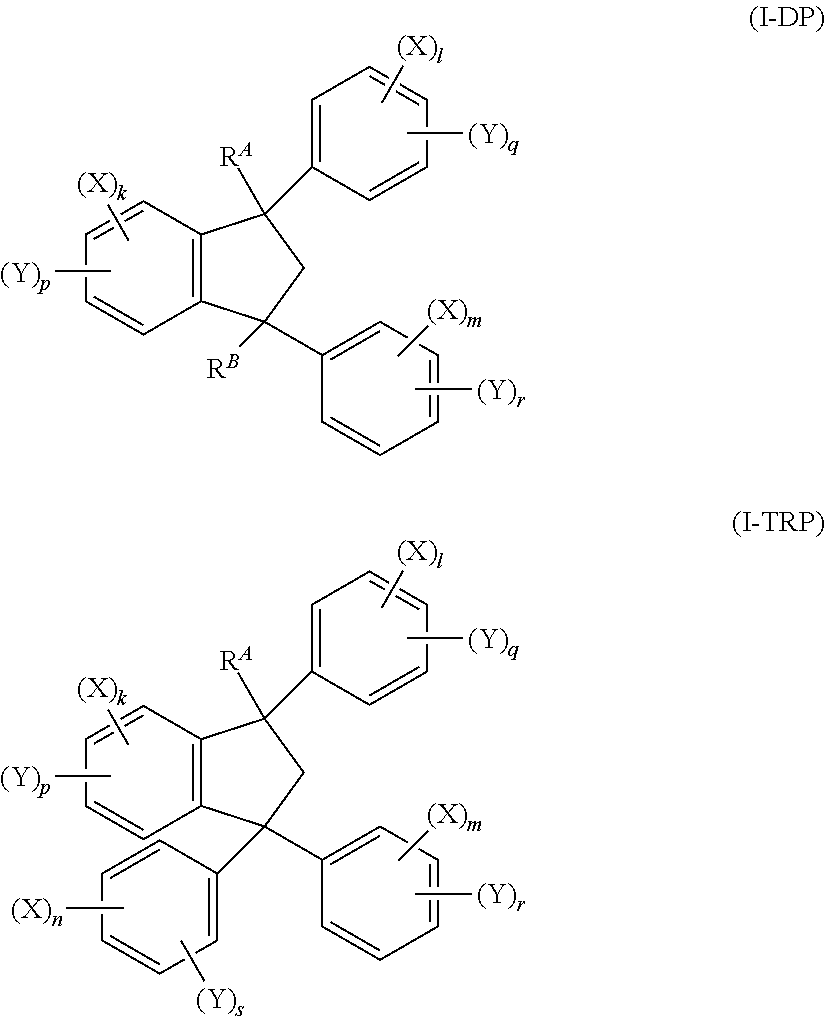


Applications Claiming Priority (4)
| Application Number | Priority Date | Filing Date | Title |
|---|---|---|---|
| EP18205503.8 | 2018-11-09 | ||
| EP18205503.8A EP3650438A1 (en) | 2018-11-09 | 2018-11-09 | Di-, tri- and tetraphenylindane derivatives and their use in organic electronics |
| EP18205503 | 2018-11-09 | ||
| PCT/EP2019/080695 WO2020094847A1 (en) | 2018-11-09 | 2019-11-08 | Di-, tri- and tetraphenylindane derivatives and their use in organic electronics |
Publications (2)
| Publication Number | Publication Date |
|---|---|
| US20220006020A1 US20220006020A1 (en) | 2022-01-06 |
| US12127473B2 true US12127473B2 (en) | 2024-10-22 |
Family
ID=64559429
Family Applications (1)
| Application Number | Title | Priority Date | Filing Date |
|---|---|---|---|
| US17/292,221 Active 2041-08-14 US12127473B2 (en) | 2018-11-09 | 2019-11-08 | Di-, tri- and tetraphenylindane derivates and their use in organic electronics |
Country Status (7)
| Country | Link |
|---|---|
| US (1) | US12127473B2 (en) |
| EP (2) | EP3650438A1 (en) |
| JP (1) | JP7489977B2 (en) |
| KR (1) | KR102940000B1 (en) |
| CN (1) | CN113365976A (en) |
| TW (1) | TWI856036B (en) |
| WO (1) | WO2020094847A1 (en) |
Families Citing this family (6)
| Publication number | Priority date | Publication date | Assignee | Title |
|---|---|---|---|---|
| US20240247004A1 (en) | 2021-03-10 | 2024-07-25 | Credoxys GmbH | New cerium (iv) complexes and their use in organic electronics |
| EP4426679A1 (en) | 2021-11-04 | 2024-09-11 | Dottikon Es Holding Ag | Spiro-(indane-fluorene) type compounds and their use in organic electronics |
| CN114436848B (en) * | 2021-12-30 | 2024-03-22 | 山东华夏神舟新材料有限公司 | Synthesis method of 5 (6) -amino-1- (4-aminophenyl) -1, 3-trimethylindane |
| CN116096109B (en) * | 2023-01-19 | 2026-03-10 | 西安电子科技大学 | Perovskite solar cell module and preparation method thereof |
| WO2024160820A1 (en) | 2023-01-31 | 2024-08-08 | Credoxys GmbH | Cerium-diketonate complexes and use thereof in organic electronics |
| EP4716436A1 (en) | 2024-09-19 | 2026-03-25 | CREDOXYS GmbH | Oled display comprising cerium-diketonate complexes and method to produce such an oled display |
Citations (10)
| Publication number | Priority date | Publication date | Assignee | Title |
|---|---|---|---|---|
| EP0138766A2 (en) * | 1983-10-07 | 1985-04-24 | Ciba-Geigy Ag | Process for the preparation of substituted 1-phenyl indanes |
| JP2012025731A (en) | 2010-06-22 | 2012-02-09 | Tosoh Corp | Amine compound, its manufacturing method, and its application |
| JP2012140517A (en) * | 2010-12-28 | 2012-07-26 | Adeka Corp | Novel polyamic acid, novel polyimide and novel diamine compound |
| EP3085693A1 (en) | 2015-04-20 | 2016-10-26 | Solvay SA | Novel 3,6-disubstituted fluorene derivatives |
| WO2017036573A1 (en) | 2015-08-28 | 2017-03-09 | Merck Patent Gmbh | Compounds for electronic devices |
| CN108218763A (en) | 2016-12-15 | 2018-06-29 | 阜阳欣奕华材料科技有限公司 | A kind of phenyl indene compounds, organic electroluminescence device and display device |
| CN108218721A (en) | 2016-12-15 | 2018-06-29 | 阜阳欣奕华材料科技有限公司 | A kind of phenyl indene compounds, organic electroluminescence device and display device |
| CN108456142A (en) | 2018-02-08 | 2018-08-28 | 王美妮 | Phenyl indene compounds, organic electroluminescence device and display device |
| CN108456159A (en) | 2018-02-08 | 2018-08-28 | 王美妮 | Phenyl indene compounds, organic electroluminescence device and display device |
| US20200075862A1 (en) | 2017-05-12 | 2020-03-05 | Dottikon Es Holding Ag | Indane derivatives and their use in organic electronics |
Family Cites Families (16)
| Publication number | Priority date | Publication date | Assignee | Title |
|---|---|---|---|---|
| US4530264A (en) * | 1983-06-30 | 1985-07-23 | Illinois Tool Works Inc. | Carrier cutting wheel |
| DE10333232A1 (en) | 2003-07-21 | 2007-10-11 | Merck Patent Gmbh | Organic electroluminescent element |
| US7592539B2 (en) | 2003-11-07 | 2009-09-22 | The Trustees Of Princeton University | Solid state photosensitive devices which employ isolated photosynthetic complexes |
| US20050224905A1 (en) | 2004-04-13 | 2005-10-13 | Forrest Stephen R | High efficiency organic photovoltaic cells employing hybridized mixed-planar heterojunctions |
| US8383553B2 (en) | 2007-10-26 | 2013-02-26 | Merck Patent Gmbh | Dyes |
| EP2180029B1 (en) | 2008-10-23 | 2011-07-27 | Novaled AG | Radialene compounds and their use |
| DE102010045405A1 (en) | 2010-09-15 | 2012-03-15 | Merck Patent Gmbh | Materials for organic electroluminescent devices |
| WO2013026563A1 (en) | 2011-08-25 | 2013-02-28 | Merck Patent Gmbh | Additives for dye-sensitized solar cells |
| GB201208793D0 (en) | 2012-05-18 | 2012-07-04 | Isis Innovation | Optoelectronic device |
| PL2850627T3 (en) | 2012-05-18 | 2016-10-31 | Optoelectronic device comprising porous scaffold material and perovskites | |
| EP2850669B1 (en) | 2012-05-18 | 2016-02-24 | Isis Innovation Limited | Photovoltaic device comprising perovskites |
| EP2693503A1 (en) | 2012-08-03 | 2014-02-05 | Ecole Polytechnique Fédérale de Lausanne (EPFL) | Organo metal halide perovskite heterojunction solar cell and fabrication thereof |
| AU2013319979B2 (en) | 2012-09-18 | 2016-08-25 | Oxford Photovoltaics Limited | Optoelectronic device |
| US20140175383A1 (en) * | 2012-12-20 | 2014-06-26 | Luminescence Technology Corporation | Indenotriphenylene derivatives and organic light emitting device using the same |
| EP3052470A1 (en) | 2013-10-02 | 2016-08-10 | Merck Patent GmbH | Hole transport material |
| EP3511316B1 (en) | 2016-09-09 | 2022-03-09 | Hodogaya Chemical Co., Ltd. | N2,n2,n2',n2'-tetrakis([1,1'-biphenyl]-4-yl)-[1,1'-biphenyl]-2,2'-diamine derivatives and related compounds for use in electroluminescent devices |
-
2018
- 2018-11-09 EP EP18205503.8A patent/EP3650438A1/en not_active Withdrawn
-
2019
- 2019-11-08 JP JP2021524271A patent/JP7489977B2/en active Active
- 2019-11-08 US US17/292,221 patent/US12127473B2/en active Active
- 2019-11-08 WO PCT/EP2019/080695 patent/WO2020094847A1/en not_active Ceased
- 2019-11-08 CN CN201980088408.XA patent/CN113365976A/en active Pending
- 2019-11-08 KR KR1020217017225A patent/KR102940000B1/en active Active
- 2019-11-08 EP EP19797757.2A patent/EP3877357A1/en active Pending
- 2019-11-11 TW TW108140836A patent/TWI856036B/en active
Patent Citations (10)
| Publication number | Priority date | Publication date | Assignee | Title |
|---|---|---|---|---|
| EP0138766A2 (en) * | 1983-10-07 | 1985-04-24 | Ciba-Geigy Ag | Process for the preparation of substituted 1-phenyl indanes |
| JP2012025731A (en) | 2010-06-22 | 2012-02-09 | Tosoh Corp | Amine compound, its manufacturing method, and its application |
| JP2012140517A (en) * | 2010-12-28 | 2012-07-26 | Adeka Corp | Novel polyamic acid, novel polyimide and novel diamine compound |
| EP3085693A1 (en) | 2015-04-20 | 2016-10-26 | Solvay SA | Novel 3,6-disubstituted fluorene derivatives |
| WO2017036573A1 (en) | 2015-08-28 | 2017-03-09 | Merck Patent Gmbh | Compounds for electronic devices |
| CN108218763A (en) | 2016-12-15 | 2018-06-29 | 阜阳欣奕华材料科技有限公司 | A kind of phenyl indene compounds, organic electroluminescence device and display device |
| CN108218721A (en) | 2016-12-15 | 2018-06-29 | 阜阳欣奕华材料科技有限公司 | A kind of phenyl indene compounds, organic electroluminescence device and display device |
| US20200075862A1 (en) | 2017-05-12 | 2020-03-05 | Dottikon Es Holding Ag | Indane derivatives and their use in organic electronics |
| CN108456142A (en) | 2018-02-08 | 2018-08-28 | 王美妮 | Phenyl indene compounds, organic electroluminescence device and display device |
| CN108456159A (en) | 2018-02-08 | 2018-08-28 | 王美妮 | Phenyl indene compounds, organic electroluminescence device and display device |
Also Published As
| Publication number | Publication date |
|---|---|
| KR20210091738A (en) | 2021-07-22 |
| TWI856036B (en) | 2024-09-21 |
| EP3650438A1 (en) | 2020-05-13 |
| JP2022509585A (en) | 2022-01-21 |
| CN113365976A (en) | 2021-09-07 |
| JP7489977B2 (en) | 2024-05-24 |
| US20220006020A1 (en) | 2022-01-06 |
| WO2020094847A1 (en) | 2020-05-14 |
| TW202043187A (en) | 2020-12-01 |
| KR102940000B1 (en) | 2026-03-17 |
| EP3877357A1 (en) | 2021-09-15 |
Similar Documents
| Publication | Publication Date | Title |
|---|---|---|
| EP3621946B1 (en) | Indane derivatives and their use in organic electronics | |
| US12127473B2 (en) | Di-, tri- and tetraphenylindane derivates and their use in organic electronics | |
| EP3243822B1 (en) | Selenophene derivatives and organic photoelectric device, image sensor and electronic device including the same | |
| EP3026722B1 (en) | Compound for organic photoelectric device and organic photoelectric device, image sensor, and electronic device including the same | |
| US20220285630A1 (en) | Organic photoelectric conversion element | |
| EP3041060B1 (en) | Image sensor, and electronic device including the same | |
| EP3018723A1 (en) | Compound for organic photoelectric device and organic photoelectric device image sensor, and electronic device including the same | |
| JP6449434B2 (en) | Heterocyclic compounds or salts thereof, and electronic devices containing them | |
| TW202334079A (en) | Spiro-(indane-fluorene) type compounds and their use in organic electronics | |
| EP4024484B1 (en) | Composition for photoelectric device, and photoelectric device, image sensor, and electronic device including the same | |
| US20120298203A1 (en) | Dibenzofluoranthene compound and organic thin-film solar cell using same | |
| EP3401305A1 (en) | Indane derivatives and their use in organic electronics | |
| US20210246134A1 (en) | Compound and photoelectric device, image sensor, and electronic device including the same | |
| CN115703747A (en) | Organic compounds with spirofluorene structure for light-emitting devices, organic electroluminescent devices | |
| WO2023247416A1 (en) | Tetraarylbenzidine type compounds and their use in organic electronics | |
| TWI611594B (en) | Photoelectric conversion element, photographic element, photo sensor |
Legal Events
| Date | Code | Title | Description |
|---|---|---|---|
| FEPP | Fee payment procedure |
Free format text: ENTITY STATUS SET TO UNDISCOUNTED (ORIGINAL EVENT CODE: BIG.); ENTITY STATUS OF PATENT OWNER: LARGE ENTITY |
|
| STPP | Information on status: patent application and granting procedure in general |
Free format text: APPLICATION UNDERGOING PREEXAM PROCESSING |
|
| AS | Assignment |
Owner name: DOTTIKON ES HOLDING AG, SWITZERLAND Free format text: ASSIGNMENT OF ASSIGNORS INTEREST;ASSIGNORS:DOROK, SASCHA;PAPMEYER, MARCUS;FLECK, CARSTEN;AND OTHERS;SIGNING DATES FROM 20210512 TO 20210525;REEL/FRAME:057081/0276 |
|
| STPP | Information on status: patent application and granting procedure in general |
Free format text: DOCKETED NEW CASE - READY FOR EXAMINATION |
|
| STPP | Information on status: patent application and granting procedure in general |
Free format text: NON FINAL ACTION MAILED |
|
| STPP | Information on status: patent application and granting procedure in general |
Free format text: RESPONSE TO NON-FINAL OFFICE ACTION ENTERED AND FORWARDED TO EXAMINER |
|
| STPP | Information on status: patent application and granting procedure in general |
Free format text: NON FINAL ACTION MAILED |
|
| STPP | Information on status: patent application and granting procedure in general |
Free format text: RESPONSE TO NON-FINAL OFFICE ACTION ENTERED AND FORWARDED TO EXAMINER |
|
| STPP | Information on status: patent application and granting procedure in general |
Free format text: NOTICE OF ALLOWANCE MAILED -- APPLICATION RECEIVED IN OFFICE OF PUBLICATIONS |
|
| ZAAB | Notice of allowance mailed |
Free format text: ORIGINAL CODE: MN/=. |
|
| STPP | Information on status: patent application and granting procedure in general |
Free format text: PUBLICATIONS -- ISSUE FEE PAYMENT RECEIVED |
|
| STPP | Information on status: patent application and granting procedure in general |
Free format text: PUBLICATIONS -- ISSUE FEE PAYMENT VERIFIED |
|
| STCF | Information on status: patent grant |
Free format text: PATENTED CASE |