US12122952B2 - Inorganic nanoparticle composition, light-emitting device, method of manufacturing light-emitting device, and electronic apparatus including light-emitting device - Google Patents
Inorganic nanoparticle composition, light-emitting device, method of manufacturing light-emitting device, and electronic apparatus including light-emitting device Download PDFInfo
- Publication number
- US12122952B2 US12122952B2 US17/448,820 US202117448820A US12122952B2 US 12122952 B2 US12122952 B2 US 12122952B2 US 202117448820 A US202117448820 A US 202117448820A US 12122952 B2 US12122952 B2 US 12122952B2
- Authority
- US
- United States
- Prior art keywords
- group
- substituted
- unsubstituted
- light
- emitting device
- Prior art date
- Legal status (The legal status is an assumption and is not a legal conclusion. Google has not performed a legal analysis and makes no representation as to the accuracy of the status listed.)
- Active, expires
Links
Images



Classifications
-
- C—CHEMISTRY; METALLURGY
- C09—DYES; PAINTS; POLISHES; NATURAL RESINS; ADHESIVES; COMPOSITIONS NOT OTHERWISE PROVIDED FOR; APPLICATIONS OF MATERIALS NOT OTHERWISE PROVIDED FOR
- C09C—TREATMENT OF INORGANIC MATERIALS, OTHER THAN FIBROUS FILLERS, TO ENHANCE THEIR PIGMENTING OR FILLING PROPERTIES ; PREPARATION OF CARBON BLACK ; PREPARATION OF INORGANIC MATERIALS WHICH ARE NO SINGLE CHEMICAL COMPOUNDS AND WHICH ARE MAINLY USED AS PIGMENTS OR FILLERS
- C09C3/00—Treatment in general of inorganic materials, other than fibrous fillers, to enhance their pigmenting or filling properties
- C09C3/08—Treatment with low-molecular-weight non-polymer organic compounds
-
- C—CHEMISTRY; METALLURGY
- C09—DYES; PAINTS; POLISHES; NATURAL RESINS; ADHESIVES; COMPOSITIONS NOT OTHERWISE PROVIDED FOR; APPLICATIONS OF MATERIALS NOT OTHERWISE PROVIDED FOR
- C09K—MATERIALS FOR MISCELLANEOUS APPLICATIONS, NOT PROVIDED FOR ELSEWHERE
- C09K11/00—Luminescent materials, e.g. electroluminescent or chemiluminescent
- C09K11/02—Use of particular materials as binders, particle coatings or suspension media therefor
-
- C—CHEMISTRY; METALLURGY
- C09—DYES; PAINTS; POLISHES; NATURAL RESINS; ADHESIVES; COMPOSITIONS NOT OTHERWISE PROVIDED FOR; APPLICATIONS OF MATERIALS NOT OTHERWISE PROVIDED FOR
- C09C—TREATMENT OF INORGANIC MATERIALS, OTHER THAN FIBROUS FILLERS, TO ENHANCE THEIR PIGMENTING OR FILLING PROPERTIES ; PREPARATION OF CARBON BLACK ; PREPARATION OF INORGANIC MATERIALS WHICH ARE NO SINGLE CHEMICAL COMPOUNDS AND WHICH ARE MAINLY USED AS PIGMENTS OR FILLERS
- C09C1/00—Treatment of specific inorganic materials other than fibrous fillers; Preparation of carbon black
- C09C1/04—Compounds of zinc
- C09C1/043—Zinc oxide
-
- C—CHEMISTRY; METALLURGY
- C09—DYES; PAINTS; POLISHES; NATURAL RESINS; ADHESIVES; COMPOSITIONS NOT OTHERWISE PROVIDED FOR; APPLICATIONS OF MATERIALS NOT OTHERWISE PROVIDED FOR
- C09D—COATING COMPOSITIONS, e.g. PAINTS, VARNISHES OR LACQUERS; FILLING PASTES; CHEMICAL PAINT OR INK REMOVERS; INKS; CORRECTING FLUIDS; WOODSTAINS; PASTES OR SOLIDS FOR COLOURING OR PRINTING; USE OF MATERIALS THEREFOR
- C09D1/00—Coating compositions, e.g. paints, varnishes or lacquers, based on inorganic substances
-
- C—CHEMISTRY; METALLURGY
- C09—DYES; PAINTS; POLISHES; NATURAL RESINS; ADHESIVES; COMPOSITIONS NOT OTHERWISE PROVIDED FOR; APPLICATIONS OF MATERIALS NOT OTHERWISE PROVIDED FOR
- C09D—COATING COMPOSITIONS, e.g. PAINTS, VARNISHES OR LACQUERS; FILLING PASTES; CHEMICAL PAINT OR INK REMOVERS; INKS; CORRECTING FLUIDS; WOODSTAINS; PASTES OR SOLIDS FOR COLOURING OR PRINTING; USE OF MATERIALS THEREFOR
- C09D7/00—Features of coating compositions, not provided for in group C09D5/00; Processes for incorporating ingredients in coating compositions
- C09D7/20—Diluents or solvents
-
- C—CHEMISTRY; METALLURGY
- C09—DYES; PAINTS; POLISHES; NATURAL RESINS; ADHESIVES; COMPOSITIONS NOT OTHERWISE PROVIDED FOR; APPLICATIONS OF MATERIALS NOT OTHERWISE PROVIDED FOR
- C09K—MATERIALS FOR MISCELLANEOUS APPLICATIONS, NOT PROVIDED FOR ELSEWHERE
- C09K11/00—Luminescent materials, e.g. electroluminescent or chemiluminescent
- C09K11/08—Luminescent materials, e.g. electroluminescent or chemiluminescent containing inorganic luminescent materials
- C09K11/54—Luminescent materials, e.g. electroluminescent or chemiluminescent containing inorganic luminescent materials containing zinc or cadmium
-
- C—CHEMISTRY; METALLURGY
- C09—DYES; PAINTS; POLISHES; NATURAL RESINS; ADHESIVES; COMPOSITIONS NOT OTHERWISE PROVIDED FOR; APPLICATIONS OF MATERIALS NOT OTHERWISE PROVIDED FOR
- C09K—MATERIALS FOR MISCELLANEOUS APPLICATIONS, NOT PROVIDED FOR ELSEWHERE
- C09K11/00—Luminescent materials, e.g. electroluminescent or chemiluminescent
- C09K11/08—Luminescent materials, e.g. electroluminescent or chemiluminescent containing inorganic luminescent materials
- C09K11/56—Luminescent materials, e.g. electroluminescent or chemiluminescent containing inorganic luminescent materials containing sulfur
- C09K11/562—Chalcogenides
- C09K11/565—Chalcogenides with zinc cadmium
-
- C—CHEMISTRY; METALLURGY
- C09—DYES; PAINTS; POLISHES; NATURAL RESINS; ADHESIVES; COMPOSITIONS NOT OTHERWISE PROVIDED FOR; APPLICATIONS OF MATERIALS NOT OTHERWISE PROVIDED FOR
- C09K—MATERIALS FOR MISCELLANEOUS APPLICATIONS, NOT PROVIDED FOR ELSEWHERE
- C09K11/00—Luminescent materials, e.g. electroluminescent or chemiluminescent
- C09K11/08—Luminescent materials, e.g. electroluminescent or chemiluminescent containing inorganic luminescent materials
- C09K11/62—Luminescent materials, e.g. electroluminescent or chemiluminescent containing inorganic luminescent materials containing gallium, indium or thallium
-
- C—CHEMISTRY; METALLURGY
- C09—DYES; PAINTS; POLISHES; NATURAL RESINS; ADHESIVES; COMPOSITIONS NOT OTHERWISE PROVIDED FOR; APPLICATIONS OF MATERIALS NOT OTHERWISE PROVIDED FOR
- C09K—MATERIALS FOR MISCELLANEOUS APPLICATIONS, NOT PROVIDED FOR ELSEWHERE
- C09K11/00—Luminescent materials, e.g. electroluminescent or chemiluminescent
- C09K11/08—Luminescent materials, e.g. electroluminescent or chemiluminescent containing inorganic luminescent materials
- C09K11/88—Luminescent materials, e.g. electroluminescent or chemiluminescent containing inorganic luminescent materials containing selenium, tellurium or unspecified chalcogen elements
- C09K11/881—Chalcogenides
- C09K11/883—Chalcogenides with zinc or cadmium
-
- H—ELECTRICITY
- H10—SEMICONDUCTOR DEVICES; ELECTRIC SOLID-STATE DEVICES NOT OTHERWISE PROVIDED FOR
- H10K—ORGANIC ELECTRIC SOLID-STATE DEVICES
- H10K50/00—Organic light-emitting devices
- H10K50/10—OLEDs or polymer light-emitting diodes [PLED]
- H10K50/14—Carrier transporting layers
- H10K50/16—Electron transporting layers
-
- H—ELECTRICITY
- H10—SEMICONDUCTOR DEVICES; ELECTRIC SOLID-STATE DEVICES NOT OTHERWISE PROVIDED FOR
- H10K—ORGANIC ELECTRIC SOLID-STATE DEVICES
- H10K50/00—Organic light-emitting devices
- H10K50/80—Constructional details
- H10K50/805—Electrodes
- H10K50/82—Cathodes
- H10K50/828—Transparent cathodes, e.g. comprising thin metal layers
-
- H—ELECTRICITY
- H10—SEMICONDUCTOR DEVICES; ELECTRIC SOLID-STATE DEVICES NOT OTHERWISE PROVIDED FOR
- H10K—ORGANIC ELECTRIC SOLID-STATE DEVICES
- H10K71/00—Manufacture or treatment specially adapted for the organic devices covered by this subclass
- H10K71/10—Deposition of organic active material
- H10K71/12—Deposition of organic active material using liquid deposition, e.g. spin coating
- H10K71/13—Deposition of organic active material using liquid deposition, e.g. spin coating using printing techniques, e.g. ink-jet printing or screen printing
- H10K71/135—Deposition of organic active material using liquid deposition, e.g. spin coating using printing techniques, e.g. ink-jet printing or screen printing using ink-jet printing
-
- H—ELECTRICITY
- H10—SEMICONDUCTOR DEVICES; ELECTRIC SOLID-STATE DEVICES NOT OTHERWISE PROVIDED FOR
- H10K—ORGANIC ELECTRIC SOLID-STATE DEVICES
- H10K71/00—Manufacture or treatment specially adapted for the organic devices covered by this subclass
- H10K71/10—Deposition of organic active material
- H10K71/12—Deposition of organic active material using liquid deposition, e.g. spin coating
- H10K71/15—Deposition of organic active material using liquid deposition, e.g. spin coating characterised by the solvent used
-
- B—PERFORMING OPERATIONS; TRANSPORTING
- B82—NANOTECHNOLOGY
- B82Y—SPECIFIC USES OR APPLICATIONS OF NANOSTRUCTURES; MEASUREMENT OR ANALYSIS OF NANOSTRUCTURES; MANUFACTURE OR TREATMENT OF NANOSTRUCTURES
- B82Y20/00—Nanooptics, e.g. quantum optics or photonic crystals
-
- B—PERFORMING OPERATIONS; TRANSPORTING
- B82—NANOTECHNOLOGY
- B82Y—SPECIFIC USES OR APPLICATIONS OF NANOSTRUCTURES; MEASUREMENT OR ANALYSIS OF NANOSTRUCTURES; MANUFACTURE OR TREATMENT OF NANOSTRUCTURES
- B82Y30/00—Nanotechnology for materials or surface science, e.g. nanocomposites
-
- B—PERFORMING OPERATIONS; TRANSPORTING
- B82—NANOTECHNOLOGY
- B82Y—SPECIFIC USES OR APPLICATIONS OF NANOSTRUCTURES; MEASUREMENT OR ANALYSIS OF NANOSTRUCTURES; MANUFACTURE OR TREATMENT OF NANOSTRUCTURES
- B82Y40/00—Manufacture or treatment of nanostructures
-
- H—ELECTRICITY
- H10—SEMICONDUCTOR DEVICES; ELECTRIC SOLID-STATE DEVICES NOT OTHERWISE PROVIDED FOR
- H10K—ORGANIC ELECTRIC SOLID-STATE DEVICES
- H10K2101/00—Properties of the organic materials covered by group H10K85/00
- H10K2101/10—Triplet emission
-
- H—ELECTRICITY
- H10—SEMICONDUCTOR DEVICES; ELECTRIC SOLID-STATE DEVICES NOT OTHERWISE PROVIDED FOR
- H10K—ORGANIC ELECTRIC SOLID-STATE DEVICES
- H10K2102/00—Constructional details relating to the organic devices covered by this subclass
-
- H—ELECTRICITY
- H10—SEMICONDUCTOR DEVICES; ELECTRIC SOLID-STATE DEVICES NOT OTHERWISE PROVIDED FOR
- H10K—ORGANIC ELECTRIC SOLID-STATE DEVICES
- H10K2102/00—Constructional details relating to the organic devices covered by this subclass
- H10K2102/301—Details of OLEDs
- H10K2102/331—Nanoparticles used in non-emissive layers, e.g. in packaging layer
-
- H—ELECTRICITY
- H10—SEMICONDUCTOR DEVICES; ELECTRIC SOLID-STATE DEVICES NOT OTHERWISE PROVIDED FOR
- H10K—ORGANIC ELECTRIC SOLID-STATE DEVICES
- H10K50/00—Organic light-emitting devices
- H10K50/10—OLEDs or polymer light-emitting diodes [PLED]
- H10K50/11—OLEDs or polymer light-emitting diodes [PLED] characterised by the electroluminescent [EL] layers
-
- H—ELECTRICITY
- H10—SEMICONDUCTOR DEVICES; ELECTRIC SOLID-STATE DEVICES NOT OTHERWISE PROVIDED FOR
- H10K—ORGANIC ELECTRIC SOLID-STATE DEVICES
- H10K50/00—Organic light-emitting devices
- H10K50/10—OLEDs or polymer light-emitting diodes [PLED]
- H10K50/11—OLEDs or polymer light-emitting diodes [PLED] characterised by the electroluminescent [EL] layers
- H10K50/115—OLEDs or polymer light-emitting diodes [PLED] characterised by the electroluminescent [EL] layers comprising active inorganic nanostructures, e.g. luminescent quantum dots
-
- H—ELECTRICITY
- H10—SEMICONDUCTOR DEVICES; ELECTRIC SOLID-STATE DEVICES NOT OTHERWISE PROVIDED FOR
- H10K—ORGANIC ELECTRIC SOLID-STATE DEVICES
- H10K71/00—Manufacture or treatment specially adapted for the organic devices covered by this subclass
Definitions
- One or more aspects of embodiments of the present disclosure relate to an inorganic nanoparticle composition, a light-emitting device, a method of manufacturing the light-emitting device, and an electronic apparatus including the light-emitting device.
- Light-emitting devices are devices that convert electrical energy into light energy.
- Non-limiting examples of such light-emitting devices include organic light-emitting devices that utilize organic materials as a light-emitting material, quantum dot light-emitting devices that utilize quantum dots as a light-emitting material, and/or the like.
- An example light-emitting device includes a first electrode, a hole transport region, an emission layer, an electron transport region, and a second electrode, which are sequentially stacked. Holes provided from the first electrode may move toward the emission layer through the hole transport region, and electrons provided from the second electrode may move toward the emission layer through the electron transport region. The holes and the electrons may recombine in the emission layer to produce excitons. These excitons may transition from an excited state to a ground state to thereby generate light.
- One or more aspects of embodiments of the present disclosure are directed toward an inorganic nanoparticle composition, a light-emitting device, a method of manufacturing the light-emitting device, and an electronic apparatus including the light-emitting device.
- a light-emitting device is formed utilizing the inorganic nanoparticle composition, orthogonality at an interface between adjacent layers may be improved, and thus, the processing efficiency may be improved.
- One or more embodiments of the present disclosure provide an inorganic nanoparticle composition including an inorganic nanoparticle and a highly fluorinated solvent, wherein the inorganic nanoparticle may include an inorganic material and a fluorine-containing (F-containing) charge-transporting organic ligand.
- the inorganic nanoparticle may include an inorganic material and a fluorine-containing (F-containing) charge-transporting organic ligand.
- One or more embodiments of the present disclosure provide a light-emitting device including a first electrode, a second electrode facing the first electrode, an interlayer located between the first electrode and the second electrode and including an emission layer,
- the interlayer may include an electron transport region located between the emission layer and the second electrode, the electron transport region may include an inorganic nanoparticle and a highly fluorinated solvent.
- One or more embodiments of the present disclosure provide a method of manufacturing a light-emitting device may include forming at least one layer in an electron transport region by providing the inorganic nanoparticle composition on an emission layer on a first electrode, and providing a second electrode on the emission layer.
- One or more embodiments of the present disclosure provide an electronic apparatus including the light-emitting device.
- FIG. 1 is a schematic cross-sectional view of a light-emitting device according to an embodiment
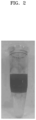
- FIG. 2 is a photographic image demonstrating orthogonality in an inorganic nanoparticle composition according to one or more embodiments.
- FIG. 3 is a graph of wavelength (nanometers, nm) versus intensity (arbitrary unit, a.u.) in the overlaid emission spectra for the light-emitting devices of Example 1 and Comparative Example 2.
- the expression “at least one of a, b or c”, “at least one selected from a, b, and c”, or the like indicates only a, only b, only c, both (e.g., simultaneously) a and b, both (e.g., simultaneously) a and c, both (e.g., simultaneously) b and c, all of a, b, and c, or variations thereof.
- a layer, region, or component when referred to as being “on” or “onto” another layer, region, or component, it may be directly or indirectly formed over the other layer, region, or component. For example, for example, intervening layers, regions, or components may be present. When an element is referred to as being “directly on,” “directly connected to,” or “directly coupled to” another element, there are no intervening elements present.
- room temperature refers to a temperature of about 25° C.
- a nanoparticle composition according to one or more embodiments may include an inorganic nanoparticle and a highly fluorinated solvent, wherein the inorganic nanoparticle may include an inorganic material and a fluorine-containing (F-containing) charge-transporting organic ligand.
- the inorganic nanoparticle may include an inorganic material, and the inorganic material may include: an oxide, a nitride, a sulfide, or an oxynitride of zinc (Zn), molybdenum (Mo), tungsten (W), nickel (Ni), magnesium (Mg), zirconium (Zr), tin (Sn), tantalum (Ta), hafnium (Hf), aluminum (Al), titanium (Ti), or barium (Ba); or any combination thereof.
- the inorganic nanoparticle may include zinc oxide (ZnO), molybdenum oxide (MoO 3 ), tungsten oxide (WO 3 ), nickel oxide (NiO), zinc magnesium oxide (ZnMgO), zinc aluminum oxide (ZnAlO), titanium dioxide (TiO 2 ), magnesium oxide (MgO), zirconium oxide (ZrO 2 ), tin oxide (SnO), tin dioxide (SnO 2 ), tantalum oxide (Ta 2 O 3 ), hafnium oxide (HfO 3 ), aluminum oxide (Al 2 O 3 ), zirconium silicon oxide (ZrSiO 4 ), barium titanium oxide (BaTiO 3 ), barium zirconium oxide (BaZrO 3 ), or any combination thereof.
- the inorganic material may be selected from ZnO, MoO 3 , WoO 3 , and NiO.
- the inorganic nanoparticle may further include a doping material (e.g., dopant).
- the doping material may include lithium (Li), sodium (Na), potassium (K), rubidium (Rb), cesium (Cs), beryllium (Be), magnesium (Mg), calcium (Ca), strontium (Sr), barium (Ba), copper (Cu), aluminum (Al), gallium (Ga), indium (In), silicon (Si), or any combination thereof.
- the inorganic material may be doped with the doping material in a form of a metal ion.
- the inorganic nanoparticle may include:
- a ZnO nanoparticle, a MoO 3 nanoparticle, a WoO 3 nanoparticle, or a NiO nanoparticle an inorganic material, for example an intrinsic or undoped inorganic material
- a ZnO nanoparticle, a MoO 3 nanoparticle, a WoO 3 nanoparticle, or a NiO nanoparticle each further including Li, Na, K, Rb, Cs, Be, Mg, Ca, Sr, Ba, Cu, Al, Ga, In, Si, or any combination thereof (a doping material).
- the inorganic nanoparticle may provide excellent or suitable charge mobility.
- an average diameter of the inorganic nanoparticle may be in a range of about 3 nanometers (nm) to about 15 nm. When the average diameter of the inorganic nanoparticle is within this range, charge mobility and external light extraction efficiency of the light-emitting device may be improved.
- the inorganic nanoparticle may have a structure in which the inorganic material is capped with the F-containing charge-transporting organic ligand.
- the F-containing charge-transporting organic ligand may be a compound represented by Formula 1 or a salt represented by Formula 2:
- ring Het 1 may be a ⁇ electron-depleted nitrogen-containing C 1 -C 60 cyclic group
- L 1 and L 2 may each independently be selected from a substituted or unsubstituted C 3 -C 10 cycloalkylene group, a substituted or unsubstituted C 1 -C 10 heterocycloalkylene group, a substituted or unsubstituted C 3 -C 10 cycloalkenylene group, a substituted or unsubstituted C 1 -C 10 heterocycloalkenylene group, a substituted or unsubstituted C 6 -C 60 arylene group, a substituted or unsubstituted C 1 -C 60 heteroarylene group, a substituted or unsubstituted divalent non-aromatic condensed polycyclic group, and a substituted or unsubstituted divalent non-aromatic condensed heteropolycyclic group,
- a1 and a2 may each independently be an integer from 0 to 5, and when a1 is 2 or greater, at least two L 1 (s) may be identical to or different from each other, and when a2 is 2 or greater, at least two L 2 (s) may be identical to or different from each other,
- Y 1 may be —OH, —COOH, —NH 2 , or —SH,
- R 1 to R 4 may each independently be hydrogen, deuterium, —F, —Cl, —Br, —I, a substituted or unsubstituted C 1 -C 60 alkyl group, a substituted or unsubstituted C 2 -C 60 alkenyl group, a substituted or unsubstituted C 2 -C 60 alkynyl group, a substituted or unsubstituted C 1 -C 60 alkoxy group, a substituted or unsubstituted C 3 -C 10 cycloalkyl group, a substituted or unsubstituted C 1 -C 10 heterocycloalkyl group, a substituted or unsubstituted C 3 -C 10 cycloalkenyl group, a substituted or unsubstituted C 1 -C 10 heterocycloalkenyl group, a substituted or unsubstituted C 6 -C 60 aryl group, a substituted or un
- At least one of the b1 R 1 (s) may be —F or a fluorine-containing group
- b1 may be an integer from 1 to 20, and when b1 is 2 or greater, at least two R 1 (s) may be identical to or different from each other.
- the ⁇ electron-depleted nitrogen-containing C 1 -C 60 cyclic group may be i) a first ring, ii) a condensed ring in which at least two first rings are condensed, or iii) a condensed ring in which at least two second rings are condensed,
- the first ring may be a furan group, a thiophene group, a pyrrole group, a silole group, an oxazole group, an isoxazole group, an oxadiazole group, an isoxadiazole group, oxatriazole group, an isoxatriazole group, a thiazole group, an isothiazole group, a thiadiazole group, an isothiadiazole group, a thiatriazole group, an isothiatriazole group, a pyrazole group, an imidazole group, a triazole group, a tetrazole group, an azasilole group, a diazasilole group, a triazasilole group, a pyridine group, a pyrimidine group, a pyrazine group, a pyridazine group, or a triazine group, and
- the second ring may be a cyclopentane group, a cyclohexane group, a cyclopentadiene group, a cyclohexene group, a benzene group, a furan group, a thiophene group, a pyrrole group, a silole group, an indene group, a benzofuran group, a benzothiophene group, an indole group, or a benzosilole group.
- the ⁇ electron-depleted nitrogen-containing C 1 -C 60 cyclic group unsubstituted or substituted with at least one R 1 may be an azaindole group, an azaindene group, an azabenzosilole group, an azabenzothiophene group, an azabenzofuran group, an azacarbazole group, an azafluorene group, an azadibenzosilole group, an azadibenzothiophene group, an azadibenzoselenophene group, a pyridine group, a pyrimidine group, a pyrazine group, a pyridazine group, a triazine group, a quinoline group, an isoquinoline group, a quinoxaline group, a quinazoline group, a phenanthroline group, an acridine group, a pyrazole group, an imidazole group,
- the F-containing group may be an organic group substituted with at least one —F.
- the F-containing group may be a C 1 -C 60 alkyl group substituted with at least one —F, a C 2 -C 60 alkenyl group substituted with at least one —F, a C 2 -C 60 alkynyl group substituted with at least one —F, a C 1 -C 60 alkoxy group substituted with at least one —F, a C 3 -C 10 cycloalkyl group substituted with at least one —F, a C 1 -C 10 heterocycloalkyl group substituted with at least one —F, a C 3 -C 10 cycloalkenyl group substituted with at least one —F, a C 1 -C 10 heterocycloalkenyl group substituted with at least one —F, a C 6 -C 60 aryl group substituted with at least one —F, a C 6 -C 60 aryloxy group substituted with at least one —F, a C 6 -C 60
- the F-containing group may be further substituted with: deuterium (—D), —F, —Cl, —Br, —I, a hydroxyl group, a cyano group, or a nitro group;
- Q 1 to Q 3 , Q 11 to Q 13 , Q 21 to Q 23 , and Q 31 to Q 33 may each independently be the same as described below.
- the F-containing charge-transporting organic ligand may be a compound represented by Formula 1-1 or a salt represented by Formula 2-1 or Formula 2-2:
- X 1 to X 3 may each independently be C(R 10 ) or N,
- At least one of X 1 to X 3 may be N,
- Y 1 may be —OH, —COOH, —NH 2 , or —SH,
- n1 may be an integer from 0 to 20,
- R 10 to R 24 may each independently be hydrogen, deuterium, —F, —Cl, —Br, —I, a substituted or unsubstituted C 1 -C 60 alkyl group, a substituted or unsubstituted C 2 -C 60 alkenyl group, a substituted or unsubstituted C 2 -C 60 alkynyl group, a substituted or unsubstituted C 1 -C 60 alkoxy group, a substituted or unsubstituted C 3 -C 10 cycloalkyl group, a substituted or unsubstituted C 1 -C 10 heterocycloalkyl group, a substituted or unsubstituted C 3 -C 10 cycloalkenyl group, a substituted or unsubstituted C 1 -C 10 heterocycloalkenyl group, a substituted or unsubstituted C 6 -C 60 aryl group, a substituted or un
- R 11 to R 24 may be —F or a C 1 -C 20 fluoroalkyl group.
- the C 1 -C 20 fluoroalkyl group may be a C 1 -C 20 alkyl group substituted with at least one —F.
- At least one of R 11 to R 24 may be —F or a C 1 -C 20 perfluoroalkyl group, for example, a C 1 -C 20 alkyl group in which all hydrogen atoms are substituted with —F.
- the inorganic nanoparticle may have excellent charge transportability.
- the F-containing charge-transporting organic ligand is applied to a light-emitting device, migration of holes and electrons may be facilitated, thus improving efficiency of the light-emitting device.
- R 11 to R 24 may be identical to each other, and R 11 to R 24 may each be —F or a C 1 -C 20 fluoroalkyl group.
- R 11 to R 24 may each be —F.
- R 11 to R 24 may each be —(CF 2 ) n2 CF 3 (wherein n2 may be an integer from 0 to 10).
- the F-containing charge-transporting organic ligand may cover at least a portion of a surface of the inorganic material.
- the highly fluorinated solvent may include chlorofluorocarbon (CFC), perfluorocarbon (PFC), hydrofluorocarbon (HFC), hydrofluoroolefin (HFO), hydrochlorofluorocarbon (HCFC), hydrochlorofluoroolefin (HCFO), hydrofluoroether (HFE), perfluoropolyether (PFPE), or any combination thereof.
- CFC chlorofluorocarbon
- PFC perfluorocarbon
- HFC hydrofluorocarbon
- HFO hydrofluoroolefin
- HCFC hydrochlorofluorocarbon
- HCFO hydrochlorofluoroolefin
- HFE hydrofluoroether
- PFPE perfluoropolyether
- the content of the inorganic nanoparticle in the inorganic nanoparticle composition may be in a range of about 1 percent by weight (wt %) to about 40 wt %, for example, about 1 wt % to about 30 wt %, for example, about 2 wt % to about 20 wt %, or for example, about 3 wt % to about 10 wt %.
- the inorganic nanoparticle composition may be suitable in terms of charge mobility for applying to a light-emitting device.
- the content of the highly fluorinated solvent in the inorganic nanoparticle composition may be in a range of about 60 wt % to about 99 wt %, for example, about 70 wt % to about 98 wt %, or for example, about 80 wt % to about 95 wt %.
- the inorganic nanoparticle composition may have a high melting point.
- the inorganic nanoparticle composition may be advantageously utilized for an inkjet process, and mixing and/or deterioration of materials at an interface between adjacent layers may be prevented or reduced during thin film formation.
- the inorganic nanoparticle composition may have a melting point of 150° C. or greater. In some embodiments, the inorganic nanoparticle composition may have a melting point of 200° C. or greater.
- the inorganic nanoparticle composition may have a viscosity in a range of about 1 centipoise (cP) to about 10 cP.
- the inorganic nanoparticle composition may be suitably utilized in formation of at least one layer in an interlayer of a light-emitting device by utilizing a solution process.
- the inorganic nanoparticle composition may have a surface tension in a range of about 10 dynes/cm to about 40 dynes/cm. When the surface tension of the inorganic nanoparticle composition is within this range, the inorganic nanoparticle composition may be suitably utilized in formation of at least one layer in an interlayer of a light-emitting device by utilizing a solution process.
- the inorganic nanoparticle composition When the inorganic nanoparticle composition according to one or more embodiments has a high melting point, stain generation while drying may be reduced, and mixing and/or deterioration of materials at an interface between adjacent layers may be prevented or reduced during thin film formation.
- the inorganic nanoparticle composition may be utilized advantageously in an inkjet process, and the efficiency may be improved.
- a light-emitting device may include: a first electrode; a second electrode facing the first electrode; and an interlayer located between the first electrode and the second electrode and including an emission layer,
- the interlayer may include an electron transport region located between the emission layer and the second electrode,
- At least a portion of the electron transport region may be formed by utilizing an inorganic nanoparticle composition including an inorganic nanoparticle and a highly fluorinated solvent, and
- the inorganic nanoparticle may include an inorganic material and a F-containing charge-transporting organic ligand.
- the electron transport region may include an electron transport layer, wherein the electron transport layer may be in direct contact with the emission layer and may be formed by utilizing the inorganic nanoparticle composition.
- the first electrode may be an anode
- the second electrode may be a cathode
- the light-emitting device may further include a hole transport region located between the first electrode and the emission layer,
- the hole transport region may include a hole injection layer, a hole transport layer, an emission auxiliary layer, an electron blocking layer, or a combination thereof.
- the second electrode may be a transparent electrode having a light transmittance of 50 percent (%) or higher, based on light in a range of a visible light wavelengths.
- the light-emitting device may include a capping layer located outside the first electrode and/or outside the second electrode.
- the light-emitting device may further include at least one of a first capping layer located outside a first electrode or a second capping layer located outside a second electrode, and at least one of the first capping layer or the second capping layer may include the compound represented by Formula 1.
- the first capping layer and the second capping layer may respectively be understood by referring to the descriptions of the first capping layer and the second capping layer provided herein.
- the light-emitting device may include:
- a first capping layer located outside the first electrode and including the compound represented by Formula 1;
- a second capping layer located outside the second electrode and including the compound represented by Formula 1;
- the first capping layer and the second capping layer e.g., simultaneously.
- an electronic apparatus may include the light-emitting device.
- the electronic apparatus may further include a thin-film transistor.
- the electronic apparatus may further include a thin-film transistor including a source electrode and drain electrode, and a first electrode of the light-emitting device may be electrically connected to the source electrode or the drain electrode.
- the electronic apparatus may further include a color filter, a color-conversion layer, a touchscreen layer, a polarization layer, or any combination thereof. The electronic apparatus may be understood by referring to the description of the electronic apparatus provided herein.
- a light-emitting device 10 shown in FIG. 1 may include a first electrode 110 , an emission layer 153 , an electron transport region 155 , and a second electrode 190 .
- a substrate may be additionally located under the first electrode 110 and/or above the second electrode 190 .
- the substrate may be a glass substrate and/or a plastic substrate.
- the substrate may be a flexible substrate including plastic having excellent heat resistance and/or durability, for example, polyimide, polyethylene terephthalate (PET), polycarbonate, polyethylene naphthalate, polyarylate (PAR), polyetherimide, or any combination thereof.
- the organic light-emitting device may be a bottom emission organic light-emitting device or a top emission organic light-emitting device, depending on the position of the substrate.
- the first electrode 110 may be formed by depositing or sputtering, on the substrate, a material for forming the first electrode 110 .
- a high work function material that may easily inject holes may be utilized.
- the first electrode 110 may be a reflective electrode, a semi-transmissive electrode, or a transmissive electrode.
- a material for forming the first electrode 110 may be indium tin oxide (ITO), indium zinc oxide (IZO), tin oxide (SnO 2 ), zinc oxide (ZnO), or any combination thereof.
- magnesium (Mg) silver (Ag), aluminum (Al), aluminum-lithium (Al—Li), calcium (Ca), magnesium-indium (Mg—In), magnesium-silver (Mg-Ag), or any combination thereof may be utilized as a material for forming the first electrode 110 .
- the first electrode 110 may have a single-layered structure including (e.g., consisting of) a single layer, or a multi-layered structure including two or more layers. In some embodiments, the first electrode 110 may have a triple-layered structure of ITO/Ag/ITO.
- the light-emitting device may include: i) at least two emitting units sequentially stacked between the first electrode 110 and the second electrode 190 ; and ii) a charge-generation layer located between the at least two emitting units.
- the light-emitting device 10 may be a tandem light-emitting device.
- a hole transport region may be further included between the first electrode 110 and the emission layer 153 .
- the hole transport region may have i) a single-layered structure including (e.g., consisting of) a single layer including (e.g., consisting of) a single material, ii) a single-layered structure including (e.g., consisting of) a single layer including a plurality of different materials, or iii) a multi-layered structure having a plurality of layers including a plurality of different materials.
- the hole transport region may include a hole injection layer, a hole transport layer, an emission auxiliary layer, an electron blocking layer, or a combination thereof.
- the hole transport region may have a multi-layered structure, (e.g., a hole injection layer/hole transport layer structure, a hole injection layer/hole transport layer/emission auxiliary layer structure, a hole injection layer/emission auxiliary layer structure, a hole transport layer/emission auxiliary layer structure, or a hole injection layer/hole transport layer/electron blocking layer structure), wherein the constituting layers of each structure are sequentially stacked on the first electrode 110 in each stated order.
- a multi-layered structure e.g., a hole injection layer/hole transport layer structure, a hole injection layer/hole transport layer/emission auxiliary layer structure, a hole injection layer/emission auxiliary layer structure, or a hole injection layer/hole transport layer/electron blocking layer structure
- the hole transport region may include a compound represented by Formula 201, a compound represented by Formula 202, or any combination thereof:
- L 201 to L 204 may each independently be a C 3 -C 60 carbocyclic group unsubstituted or substituted with at least one R 10a or a C 1 -C 60 heterocyclic group unsubstituted or substituted with at least one R 10a ,
- L 205 may be *—O—*′, *—S—*′, *—N(Q 201 )-*′, a C 1 -C 20 alkylene group unsubstituted or substituted with at least one R 10a , a C 2 -C 20 alkenylene group unsubstituted or substituted with at least one R 10a , a C 3 -C 60 carbocyclic group unsubstituted or substituted with at least one R 10a , or a C 1 -C 60 heterocyclic group unsubstituted or substituted with at least one R 10a ,
- xa1 to xa4 may each independently be an integer from 0 to 5
- xa5 may be an integer from 1 to 10,
- R 201 to R 204 and Q 201 may each independently be a C 3 -C 60 carbocyclic group unsubstituted or substituted with at least one R 10a or a C 1 -C 60 heterocyclic group unsubstituted or substituted with at least one R 10a ,
- R 201 and R 202 may optionally be bound to each other via a single bond, a C 1 -C 5 alkylene group unsubstituted or substituted with at least one R 10a , or a C 2 -C 5 alkenylene group unsubstituted or substituted with at least one R 10a to form a C 8 -C 60 polycyclic group (e.g., a carbazole group or the like) unsubstituted or substituted with at least one R 10a (e.g., Compound HT16 described herein),
- R 203 and R 204 may optionally be bound to each other via a single bond, a C 1 -C 5 alkylene group unsubstituted or substituted with at least one R 10a , or a C 2 -C 5 alkenylene group unsubstituted or substituted with at least one R 10a to form a C 8 -C 60 polycyclic group unsubstituted or substituted with at least one R 10a , and
- na1 may be an integer from 1 to 4.
- the compounds represented by Formulae 201 and 202 may each include at least one of the groups represented by Formulae CY201 to CY217:
- R 10b and R 10c may each independently be understood by referring to the description of R 10a provided herein, ring CY 201 to ring CY 204 may each independently be a C 3 -C 20 carbocyclic group or a C 1 -C 20 heterocyclic group, and at least one hydrogen in Formulae CY201 to CY217 may be unsubstituted or substituted with R 10a .
- ring CY 201 to ring CY 204 may each independently be a benzene group, a naphthalene group, a phenanthrene group, or an anthracene group.
- the compounds represented by Formulae 201 and 202 may each include at least one of the groups represented by Formulae CY201 to CY203:
- the compound represented by Formula 201 may include at least one of the groups represented by Formulae CY201 to CY203 and at least one of the groups represented by Formulae CY204 to CY217.
- xa1 may be 1
- R 201 may be a group represented by any one of Formulae CY201 to CY203
- xa2 may be 0
- R 202 may be a group represented by Formulae CY204 to CY207.
- the compounds represented by Formulae 201 and 202 may each not include groups represented by Formulae CY201 to CY203:
- the compounds represented by Formula 201 and 202 may each not include groups represented by Formulae CY201 to CY203, and include at least one of the groups represented by Formulae CY204 to CY217.
- the compounds represented by Formulae 201 and 202 may each not include groups represented by Formulae CY201 to CY217:
- the hole transport region may include one of Compounds HT1 to HT44, m-MTDATA, TDATA, 2-TNATA, NPB (NPD), ⁇ -NPB, TPD, spiro-TPD, spiro-NPB, methylated-NPB, TAPC, HMTPD, 4,4′,4′′-tris(N-carbazolyl)triphenylamine (TCTA), polyaniline/dodecylbenzene sulfonic acid (PANI/DBSA), poly(3,4-ethylene dioxythiophene)/poly(4-styrene sulfonate) (PEDOT/PSS), polyaniline/camphor sulfonic acid (PANI/CSA), polyaniline/poly(4-styrene sulfonate) (PANI/PSS), or any combination thereof:
- the thickness of the hole transport region may be in a range of about 50 (Angstroms) ⁇ to about 10,000 ⁇ , and in some embodiments, about 100 ⁇ to about 4,000 ⁇ .
- the thickness of the hole injection layer may be in a range of about 100 ⁇ to about 9,000 ⁇ , and in some embodiments, about 100 ⁇ to about 1,000 ⁇ , and the thickness of the hole transport layer may be in a range of about 50 ⁇ to about 2,000 ⁇ , and in some embodiments, about 100 ⁇ to about 1,500 ⁇ .
- excellent hole transport characteristics may be obtained without a substantial increase in driving voltage.
- the emission auxiliary layer may increase the light emission efficiency of the device by compensating for an optical resonance distance of the wavelength of light emitted by an emission layer.
- the electron blocking layer may prevent or reduce leakage of electrons to a hole transport region from the emission layer. Materials that may be included in the hole transport region may also be included in an emission auxiliary layer and an electron blocking layer.
- the hole transport region may include a charge generating material as well as the aforementioned materials to improve the conductive properties of the hole transport region.
- the charge generating material may be substantially homogeneously or non-homogeneously dispersed (for example, as a single layer including (e.g., consisting of) charge generating material) in the hole transport region.
- the charge generating material may include, for example, a p-dopant.
- a lowest unoccupied molecular orbital (LUMO) energy level of the p-dopant may be ⁇ 3.5 eV or less.
- the p-dopant may include a quinone derivative, a cyano group-containing compound, a compound including elements EL1 and EL2, or any combination thereof.
- Non-limiting examples of the quinone derivative include TCNQ, F4-TCNQ, and/or the like.
- Non-limiting examples of the cyano group-containing compound include HAT-CN, a compound represented by Formula 221, and/or the like:
- R 221 to R 223 may each independently be a C 3 -C 60 carbocyclic group unsubstituted or substituted with at least one R 10a or a C 1 -C 60 heterocyclic group unsubstituted or substituted with at least one R 10a , and
- R 221 to R 223 may each independently be: a C 3 -C 60 carbocyclic group or a C 1 -C 60 heterocyclic group, substituted with a cyano group; —F; —Cl; —Br; —I; a C 1 -C 20 alkyl group substituted with a cyano group, —F, —Cl, —Br, —I, or any combination thereof; or any combination thereof.
- element EL1 may be metal, metalloid, or a combination thereof
- element EL2 may be non-metal, metalloid, or a combination thereof.
- Non-limiting examples of the metal may include: an alkali metal (e.g., lithium (Li), sodium (Na), potassium (K), rubidium (Rb), cesium (Cs), and/or the like); an alkaline earth metal (e.g., beryllium (Be), magnesium (Mg), calcium (Ca), strontium (Sr), barium (Ba), and/or the like); a transition metal (e.g., titanium (Ti), zirconium (Zr), hafnium (Hf), vanadium (V), niobium (Nb), tantalum (Ta), chromium (Cr), molybdenum (Mo), tungsten (W), manganese (Mn), technetium (Tc), rhenium (Re), iron (Fe), ruthenium (Ru), osmium (Os), cobalt (Co), rhodium (Rh), iridium (Ir), nickel (Ni), palladium (Pd
- Non-limiting examples of the metalloid include silicon (Si), antimony (Sb), tellurium (Te), and/or the like.
- Non-limiting examples of the non-metal include oxygen (O), halogen (e.g., F, Cl, Br, I, and/or the like), and/or the like.
- the compound including elements EL1 and EL2 may include a metal oxide, a metal halide (e.g., a metal fluoride, a metal chloride, a metal bromide, a metal iodide, and/or the like), a metalloid halide (e.g., a metalloid fluoride, a metalloid chloride, a metalloid bromide, a metalloid iodide, and/or the like), a metal telluride, or any combination thereof.
- a metal oxide e.g., a metal fluoride, a metal chloride, a metal bromide, a metal iodide, and/or the like
- a metalloid halide e.g., a metalloid fluoride, a metalloid chloride, a metalloid bromide, a metalloid iodide, and/or the like
- a metal telluride e.g., a metal oxide, a metal halide (
- Non-limiting examples of the metal oxide may include a tungsten oxide (e.g., WO, W 2 O 3 , WO 2 , WO 3 , W 2 O 5 , and/or the like), a vanadium oxide (e.g., VO, V 2 O 3 , VO 2 , V 2 O 5 , and/or the like), a molybdenum oxide (MoO, Mo 2 O 3 , MoO 2 , MoO 3 , Mo 2 O 5 , and/or the like), a rhenium oxide (e.g., ReO 3 , and/or the like), and/or the like.
- tungsten oxide e.g., WO, W 2 O 3 , WO 2 , WO 3 , W 2 O 5 , and/or the like
- a vanadium oxide e.g., VO, V 2 O 3 , VO 2 , V 2 O 5 , and/or the like
- Non-limiting examples of the metal halide include an alkali metal halide, an alkaline earth metal halide, a transition metal halide, a post-transition metal halide, a lanthanide metal halide, and/or the like.
- Non-limiting examples of the alkali metal halide include LiF, NaF, KF, RbF, CsF, LiCl, NaCl, KCl, RbCl, CsCl, LiBr, NaBr, KBr, RbBr, CsBr, LiI, NaI, KI, RbI, CsI, and/or the like.
- Non-limiting examples of the alkaline earth metal halide include BeF 2 , MgF 2 , CaF 2 , SrF 2 , BaF 2 , BeCl 2 , MgCl 2 , CaCl 2 , SrCl 2 , BaCl 2 , BeBr 2 , MgBr 2 , CaBr 2 , SrBr 2 , BaBr 2 , BeI 2 , MgI 2 , CaI 2 , SrI 2 , BaI 2 , and/or the like.
- Non-limiting examples of the transition metal halide include a titanium halide (e.g., TiF 4 , TiCl 4 , TiBr 4 , TiI 4 , and/or the like), a zirconium halide (e.g., ZrF 4 , ZrCl 4 , ZrBr 4 , ZrI 4 , and/or the like), a hafnium halide (e.g., HfF 4 , HfCl 4 , HfBr 4 , Hfl 4 , and/or the like), a vanadium halide (e.g., VF 3 , VCl 3 , VBr 3 , VI 3 , and/or the like), a niobium halide (e.g., NbF 3 , NbCl 3 , NbBr 3 , NbI 3 , and/or the like), a tantalum halide (e.g., TaF 3 ,
- Non-limiting examples of the post-transition metal halide include a zinc halide (e.g., ZnF 2 , ZnCl 2 , ZnBr 2 , ZnI 2 , and/or the like), an indium halide (e.g., InI 3 and/or the like), a tin halide (e.g., SnI 2 and/or the like), and/or the like.
- a zinc halide e.g., ZnF 2 , ZnCl 2 , ZnBr 2 , ZnI 2 , and/or the like
- an indium halide e.g., InI 3 and/or the like
- a tin halide e.g., SnI 2 and/or the like
- Non-limiting examples of the lanthanide metal halide include YbF, YbF 2 , YbF 3 , SmF 3 , YbCl, YbCl 2 , YbCl 3 , SmCl 3 , YbBr, YbBr 2 , YbBr 3 , SmBr 3 , YbI, YbI 2 , YbI 3 , SmI 3 , and/or the like.
- Non-limiting examples of the metalloid halide include an antimony halide (e.g., SbCl 5 and/or the like), and/or the like.
- Non-limiting examples of the metal telluride include an alkali metal telluride (e.g., Li 2 Te, Na 2 Te, K 2 Te, Rb 2 Te, Cs 2 Te, and/or the like), an alkaline earth metal telluride (e.g., BeTe, MgTe, CaTe, SrTe, BaTe, and/or the like), a transition metal telluride (e.g., TiTe 2 , ZrTe 2 , HfTe 2 , V 2 Te 3 , Nb 2 Te 3 , Ta 2 Te 3 , Cr 2 Te 3 , Mo 2 Te 3 , W 2 Te 3 , MnTe, TcTe, ReTe, FeTe, RuTe, OsTe, CoTe, RhTe, IrTe, NiTe, PdTe, PtTe, Cu 2 Te, CuTe, Ag 2 Te, AgTe, Au 2 Te, and/or the like), a post-transition metal tell
- the emission layer may include a host and a dopant.
- the dopant may be a phosphorescent dopant, a fluorescent dopant, or any combination thereof.
- the amount of the dopant in the emission layer may be in a range of about 0.01 parts to about 15 parts by weight based on 100 parts by weight of the host.
- the emission layer 153 may include quantum dots (e.g., a plurality of quantum dots).
- a thickness of the emission layer 153 including quantum dots may be in a range of about 7 nm to about 100 nm, or for example, about 15 nm to about 50 nm. When the thickness is within any of these ranges, the light-emitting device may have excellent luminescence efficiency and/or lifespan due to suitable control of pores that may be generated in the quantum dot arrangement.
- the emission layer may include a delayed fluorescence material.
- the delayed fluorescence material may serve as a host or a dopant in the emission layer.
- the thickness of the emission layer may be in a range of about 100 ⁇ to about 1,000 ⁇ , and in some embodiments, about 200 ⁇ to about 600 ⁇ . When the thickness of the emission layer is within any of these ranges, improved luminescence characteristics may be obtained without a substantial increase in driving voltage.
- the emission layer 153 may be patterned into a red emission layer, a green emission layer, and/or a blue emission layer, according to a sub-pixel.
- the emission layer may have a stacked structure.
- the stacked structure may include two or more layers selected from a red emission layer, a green emission layer, and a blue emission layer.
- the two or more layers may be in direct contact with each other.
- the two or more layers may be separated from each other.
- the emission layer may include two or more materials.
- the two or more materials may include a red light-emitting material, a green light-emitting material, or a blue light-emitting material.
- the two or more materials may be mixed with each other in a single layer.
- the two or more materials mixed with each other in the single layer may be to emit white light.
- the host may include a compound represented by Formula 301: Formula 301 [Ar 301 ] xb11 -[(L 301 ) xb1 -R 301 ] xb21 ,
- Ar 301 may be selected from a substituted or unsubstituted C 5 -C 60 carbocyclic group and a substituted or unsubstituted C 1 -C 60 heterocyclic group,
- xb11 may be 1, 2, or 3,
- L 301 may be a substituted or unsubstituted C 3 -C 10 cycloalkylene group, a substituted or unsubstituted C 1 -C 10 heterocycloalkylene group, a substituted or unsubstituted C 3 -C 10 cycloalkenylene group, a substituted or unsubstituted C 1 -C 10 heterocycloalkenylene group, a substituted or unsubstituted C 6 -C 60 arylene group, a substituted or unsubstituted C 1 -C 60 heteroarylene group, a substituted or unsubstituted divalent non-aromatic condensed polycyclic group, or a substituted or unsubstituted divalent non-aromatic condensed heteropolycyclic group,
- xb1 may be 0, 1, 2, 3, 4, or 5
- R 301 may be deuterium, —F, —Cl, —Br, —I, a hydroxyl group, a cyano group, a nitro group, a substituted or unsubstituted C 1 -C 60 alkyl group, a substituted or unsubstituted C 2 -C 60 alkenyl group, a substituted or unsubstituted C 2 -C 60 alkynyl group, a substituted or unsubstituted C 1 -C 60 alkoxy group, a substituted or unsubstituted C 3 -C 10 cycloalkyl group, a substituted or unsubstituted C 1 -C 10 heterocycloalkyl group, a substituted or unsubstituted C 3 -C 10 cycloalkenyl group, a substituted or unsubstituted C 1 -C 10 heterocycloalkenyl group, a substituted or unsubstituted C 6
- xb21 may be 1, 2, 3, 4, or 5, and
- Q 301 to Q 303 may each independently be the same as described in connection with Q 11 .
- the at least two Ar 301 (S) may be bound via a single bond.
- the host may include a compound represented by Formula 301-1, a compound represented by Formula 301-2, or any combination thereof:
- ring A 301 to ring A 304 may each independently be a C 5 -C 60 carbocyclic group or a C 1 -C 60 heterocyclic group,
- X 301 may be O, S, N-[(L 304 ) xb4 -R 304 ], C(R 304 )(R 305 ), or Si(R 304 )(R 305 ),
- xb22 and xb23 may each independently be 0, 1, or 2
- L 301 , xb1, and R 301 may each independently be the same as described above,
- L 302 to L 304 may each independently be the same as described in connection with L 301 ,
- xb2 to xb4 may each independently be the same as described in connection with xb1, and
- R 302 to R 305 and R 311 to R 314 may each independently be the same as described in connection with R 301 .
- the host may include an alkaline earth metal complex.
- the host may include a Be complex (e.g., Compound H55) or a Mg complex.
- the host may be a Zn complex, or any combination thereof.
- Ar 301 and L 301 may each independently be a C 3 -C 60 carbocyclic group unsubstituted or substituted with at least one R 10a , or a C 1 -C 60 heterocyclic group unsubstituted or substituted with at least one R 10a ,
- xb11 may be 1, 2, or 3,
- xb1 may be an integer from 0 to 5
- R 301 may be hydrogen, deuterium, —F, —Cl, —Br, —I, a hydroxyl group, a cyano group, a nitro group, a C 1 -C 60 alkyl group unsubstituted or substituted with at least one R 10a , a C 2 -C 60 alkenyl group unsubstituted or substituted with at least one R 10a , a C 2 -C 60 alkynyl group unsubstituted or substituted with at least one R 10a , a C 1 -C 60 alkoxy group unsubstituted or substituted with at least one R 10a , a C 3 -C 60 carbocyclic group unsubstituted or substituted with at least one R 10a , a C 1 -C 60 heterocyclic group unsubstituted or substituted with at least one R 10a , —Si(O 301 )(O 302 )(O 303
- xb21 may be an integer from 1 to 5
- Q 301 to Q 303 may each independently be the same as described in connection with Q 11 .
- the at least two Ar 301 (S) may be bound via a single bond.
- the host may include a compound represented by Formula 301-1, a compound represented by Formula 301-2, or any combination thereof:
- ring A 301 to ring A 304 may each independently be a C 3 -C 60 carbocyclic group unsubstituted or substituted with at least one R 10a or a C 1 -C 60 heterocyclic group unsubstituted or substituted with at least one R 10a ,
- X 301 may be O, S, N-[(L 304 ) xb4 -R 304 ], C(R 304 )(R 305 ), or Si(R 304 )(R 305 ),
- xb22 and xb23 may each independently be 0, 1, or 2
- L 301 , xb1, and R 301 may each independently be the same as described above,
- L 302 to L 304 may each independently be the same as described in connection with L 301 ,
- xb2 to xb4 may each independently be the same as described in connection with xb1, and
- R 302 to R 305 and R 311 to R 314 may independently be the same as described in connection with R 301 .
- the host may include an alkaline earth metal complex.
- the host may include a Be complex (e.g., Compound H55) or a Mg complex.
- the host may be a Zn complex, or any combination thereof.
- the host may include one of Compounds H1 to H124, 9,10-di(2-naphthyl)anthracene (ADN), 2-methyl-9,10-bis(naphthalen-2-yl)anthracene (MADN), 9,10-di-(2-naphthyl)-2-t-butyl-anthracene (TBADN), 4,4′-bis(N-carbazolyl)-1,1′-biphenyl (CBP), 1,3-di-9-carbazolyl benzene (mCP), 1,3,5-tri(carbazol-9-yl)benzene (TCP), or any combination thereof:
- the phosphorescent dopant may include at least one transition metal as a center metal.
- the phosphorescent dopant may include a monodentate ligand, a bidentate ligand, a tridentate ligand, a tetradentate ligand, a pentadentate ligand, a hexadentate ligand, or any combination thereof.
- the phosphorescent dopant may be electrically neutral.
- the phosphorescent dopant may include an organometallic complex represented by Formula 401:
- M may be transition metal (e.g., iridium (Ir), platinum (Pt), palladium (Pd), osmium (Os), titanium (Ti), gold (Au), hafnium (Hf), europium (Eu), terbium (Tb), rhodium (Rh), rhenium (Re), or thulium (Tm)),
- transition metal e.g., iridium (Ir), platinum (Pt), palladium (Pd), osmium (Os), titanium (Ti), gold (Au), hafnium (Hf), europium (Eu), terbium (Tb), rhodium (Rh), rhenium (Re), or thulium (Tm)
- transition metal e.g., iridium (Ir), platinum (Pt), palladium (Pd), osmium (Os), titanium (Ti), gold (Au), hafnium (Hf), euro
- L 401 may be a ligand represented by Formula 402, and xc1 may be 1, 2, or 3, and when xc1 is 2 or greater, at least two L 401 (s) may be identical to or different from each other,
- L 402 may be an organic ligand, and xc2 may be an integer from 0 to 4, and when xc2 is 2 or greater, at least two L 402 (s) may be identical to or different from each other,
- X 401 and X 402 may each independently be nitrogen or carbon
- ring A 401 and ring A 402 may each independently be a C 3 -C 60 carbocyclic group or a C 1 -C 60 heterocyclic group,
- X 403 and X 404 may each independently be a chemical bond (e.g., a covalent bond or a coordinate bond), O, S, N(Q 413 ), B(Q 413 ), P(Q 413 ), C(Q 413 )(Q 414 ), or Si(Q 413 )(Q 414 ),
- Q 411 to Q 414 may each independently be the same as described in connection with Q 11 ,
- R 401 and R 402 may each independently be hydrogen, deuterium, —F, —Cl, —Br, —I, a hydroxyl group, a cyano group, a nitro group, a C 1 -C 20 alkyl group unsubstituted or substituted with at least one R 10a , a C 1 -C 20 alkoxy group unsubstituted or substituted with at least one R 10a , a C 3 -C 60 carbocyclic group unsubstituted or substituted with at least one R 10a , a C 1 -C 60 heterocyclic group unsubstituted or substituted with at least one R 10a , —Si(Q 401 )(Q 402 )(Q 403 ), —N(Q 401 )(Q 402 ), —B(Q 401 )(Q 402 ), —C( ⁇ O)(Q 401 ), —S( ⁇ O) 2 (Q 401
- Q 401 to Q 403 may each independently be the same as described in connection with Q 11 ,
- xc11 and xc12 may each independently be an integer from 0 to 10, and
- * and *′ in Formula 402 each indicate a binding site to M in Formula 401.
- X 401 may be nitrogen
- X 402 may be carbon
- X 401 and X 402 may both (e.g., simultaneously) be nitrogen.
- two ring A 401 (s) of at least two L 401 (s) may optionally be bound via T 402 as a linking group, or two ring A 402 (s) may optionally be bound via T 403 as a linking group (see Compounds PD1 to PD4 and PD7).
- T 402 and T 403 may each independently be the same as described in connection with T 401 .
- L 402 in Formula 401 may be any suitable organic ligand.
- L 402 may be a halogen group, a diketone group (e.g., an acetylacetonate group), a carboxylic acid group (e.g., a picolinate group), —C( ⁇ O), an isonitrile group, —CN, or a phosphorus group (e.g., a phosphine group or a phosphite group).
- the phosphorescent dopant may be, for example, one of Compounds PD1 to PD25 or any combination thereof:
- the fluorescent dopant may include an amine group-containing compound, a styryl group-containing compound, or any combination thereof.
- the fluorescent dopant may include a compound represented by Formula 501:
- Ar 501 , L 501 to L 503 , R 501 , and R 502 may each independently be a C 3 -C 60 carbocyclic group unsubstituted or substituted with at least one R 10a or a C 1 -C 60 heterocyclic group unsubstituted or substituted with at least one R 10a ,
- xd1 to xd3 may each independently be 0, 1, 2, or 3, and
- xd4 may be 1, 2, 3, 4, 5, or 6.
- Ar 501 may include a condensed ring group (e.g., an anthracene group, a chrysene group, or a pyrene group) in which at least three monocyclic groups are condensed.
- a condensed ring group e.g., an anthracene group, a chrysene group, or a pyrene group
- the fluorescent dopant may include one of Compounds FD1 to FD36, DPVBi, DPAVBi, or any combination thereof:
- the emission layer may include a delayed fluorescence material.
- the delayed fluorescence material described herein may be any suitable compound to emit delayed fluorescence according to a delayed fluorescence emission mechanism.
- the delayed fluorescence material included in the emission layer may serve as a host or a dopant, depending on the types (kinds) of other materials included in the emission layer.
- a difference between a triplet energy level (eV) of the delayed fluorescence material and a singlet energy level (eV) of the delayed fluorescence material may be about 0 eV or greater and about 0.5 eV or smaller.
- eV triplet energy level
- eV singlet energy level
- the delayed fluorescence material may include: i) a material including at least one electron donor (e.g., a ⁇ electron-rich C 3 -C 60 cyclic group (such as a carbazole group and/or the like)) and at least one electron acceptor (e.g., a sulfoxide group, a cyano group, a ⁇ electron-deficient nitrogen-containing C 1 -C 60 cyclic group, and/or the like), ii) a material including a C 8 -C 60 polycyclic group including at least two cyclic groups condensed to each other with a shared boron (B) atom, and/or the like.
- a material including at least one electron donor e.g., a ⁇ electron-rich C 3 -C 60 cyclic group (such as a carbazole group and/or the like)
- at least one electron acceptor e.g., a sulfoxide group, a cyano group, a ⁇ electron
- Non-limiting examples of the delayed fluorescence material may include at least one of Compounds DF1 to DF9:
- the emission layer 153 may include quantum dots.
- the emission layer 153 may further include a matrix material, in addition to quantum dots.
- the emission layer 153 may include quantum dots and a matrix material, and quantum dots may be dispersed in the matrix material.
- quantum dot refers to a crystal of a semiconductor compound and may include any suitable material capable of emitting one or more suitable emission wavelengths according to the size of the crystal.
- the wet chemical process is a method of growing a quantum dot particle crystal by mixing a precursor material with an organic solvent.
- the organic solvent may naturally serve as a dispersant coordinated on the surface of the quantum dot crystal and may control the growth of the crystal.
- the wet chemical method may be easier than a vapor deposition process (such as the metal organic chemical vapor deposition (MOCVD) and/or the molecular beam epitaxy (MBE) process).
- MOCVD metal organic chemical vapor deposition
- MBE molecular beam epitaxy
- the growth of quantum dot particles may be controlled with a lower manufacturing cost.
- the quantum dot may include a group III-VI semiconductor compound; a group II-VI semiconductor compound; a group III-V semiconductor compound; a group III-VI semiconductor compound; a group I-III-VI semiconductor compound; a group IV-VI semiconductor compound; a group IV element or semiconductor compound; or any combination thereof.
- Non-limiting examples of the group III-VI semiconductor compound include a binary compound (such as In 2 S 3 ); a ternary compound (such as AgInS), AgInS 2 , CuInS, and/or CuInS 2 ; or any combination thereof.
- Non-limiting examples of the group II-VI semiconductor compound include a binary compound (such as CdS, CdSe, CdTe, ZnS, ZnSe, ZnTe, ZnO, HgS, HgSe, HgTe, MgSe, and/or MgS); a ternary compound (such as CdSeS, CdSeTe, CdSTe, ZnSeS, ZnSeTe, ZnSTe, HgSeS, HgSeTe, HgSTe, CdZnS, CdZnSe, CdZnTe, CdHgS, CdHgSe, CdHgTe, HgZnS, HgZnSe, HgZnTe, MgZnSe, or MgZnS; a quaternary compound such as CdZnSeS, CdZnSeTe, CdZnSTe, CdHgSe
- Non-limiting examples of the group III-V semiconductor compound include a binary compound (such as GaN, GaP, GaAs, GaSb, AlN, AlP, AlAs, AlSb, InN, InP, InAs, and/or InSb); a ternary compound (such as GaNP, GaNAs, GaNSb, GaPAs, GaPSb, AlNP, AlNAs, AlNSb, AlPAs, AlPSb, InGaP, InNP, InAlP, InNAs, InNSb, InPAs, and/or InPSb); a quaternary compound (such as GaAlNP, GaAlNAs, GaAlNSb, GaAlPAs, GaAlPSb, GaInNP, GaInNAs, GaInNSb, GaInPAs, GaInPSb, InAlNP, InAlNAs, InAlNSb, InAlPAs, and/or InAlPSb); or any combination thereof.
- a binary compound such as GaN
- the group III-V semiconductor compound may further include a group II (e.g., IIB) element.
- group II element include InZnP, InGaZnP, InAIZnP, and/or the like.
- Non-limiting examples of the group III-VI semiconductor compound include a binary compound (such as In 2 S 3 , GaS, GaSe, Ga 2 Se 3 , GaTe, InS, InSe, In 2 Se 3 , InTe, and/or the like); a ternary compound (such as InGaS 3 , InGaSe 3 , and/or the like); or any combination thereof.
- a binary compound such as In 2 S 3 , GaS, GaSe, Ga 2 Se 3 , GaTe, InS, InSe, In 2 Se 3 , InTe, and/or the like
- a ternary compound such as InGaS 3 , InGaSe 3 , and/or the like
- Non-limiting examples of the group I-III-VI semiconductor compound include a ternary compound (such as AgInS, AgInS 2 , CuInS, CuInS 2 , CuGaO 2 , AgGaO 2 , AgAlO 2 , and/or any combination thereof).
- Non-limiting examples of the group IV-VI semiconductor compound include a binary compound (such as SnS, SnSe, SnTe, PbS, PbSe, and/or PbTe); a ternary compound (such as SnSeS, SnSeTe, SnSTe, PbSeS, PbSeTe, PbSTe, SnPbS, SnPbSe, and/or SnPbTe); a quaternary compound (such as SnPbSSe, SnPbSeTe, and/or SnPbSTe); or any combination thereof.
- a binary compound such as SnS, SnSe, SnTe, PbS, PbSe, and/or PbTe
- a ternary compound such as SnSeS, SnSeTe, SnSTe, PbSeS, PbSeTe, and/or SnPbTe
- the group IV element or semiconductor compound may be a single element compound (such as Si and/or Ge); a binary compound (such as SiC and/or SiGe); or any combination thereof.
- Individual elements included in the multi-element compound may be present in the quantum dot particle at a substantially uniform or non-uniform concentration.
- the quantum dot may have a single (e.g., unitary) structure in which the concentration of each element included in the quantum dot is substantially uniform, or a core-shell double structure.
- materials included in the core may be different from materials included in the shell.
- the shell of the quantum dot may serve as a protective layer for preventing or reducing chemical denaturation of the core to maintain semiconductor characteristics, and/or as a charging layer for imparting electrophoretic characteristics to the quantum dot.
- the shell may have a monolayer structure or a multilayer structure.
- An interface between a core and a shell may have a concentration gradient where a concentration of elements present in the shell decreases toward the core.
- Non-limiting examples of the shell of the quantum dot include a metal oxide, a nonmetal oxide, a semiconductor compound, and/or a combination thereof.
- Non-limiting examples of the metal oxide and the nonmetal oxide may include: a binary compound (such as SiO 2 , Al 2 O 3 , TiO 2 , ZnO, MnO, Mn 2 O 3 , Mn 3 O 4 , CuO, FeO, Fe 2 O 3 , Fe 3 O 4 , CoO, Co 3 O 4 , and/or NiO); a ternary compound (such as MgAl 2 O 4 , CoFe 2 O 4 , NiFe 2 O 4 , and/or CoMn 2 O 4 ); and/or any combination thereof.
- Non-limiting examples of the semiconductor compound include a group III-VI semiconductor compound; a group II-VI semiconductor compound; a group III-V semiconductor compound; a group III-VI semiconductor compound; a group I-III-VI semiconductor compound; a group IV-VI semiconductor compound; or any combination thereof.
- the semiconductor compound may be CdS, CdSe, CdTe, ZnS, ZnSe, ZnTe, ZnSeS, ZnTeS, GaAs, GaP, GaSb, HgS, HgSe, HgTe, InAs, InP, InGaP, InSb, AlAs, AlP, AlSb, or any combination thereof.
- the quantum dot may have a spectral full width of half maximum (FWHM) of an emission wavelength of about 45 nm or less, about 40 nm or less, or about 30 nm or less.
- FWHM spectral full width of half maximum
- color purity and/or color reproducibility may be improved.
- an optical viewing angle may be improved.
- the quantum dot may be a spherical, pyramidal, multi-arm, and/or cubic nanoparticle, nanotube, nanowire, nanofiber, and/or nanoplate particle.
- the energy band gap may also be adjusted, thereby obtaining light of various suitable wavelengths in the quantum dot emission layer.
- quantum dots of various suitable sizes a light-emitting device to emit light of various suitable wavelengths may be realized.
- the size of the quantum dot may be selected such that the quantum dot may be to emit red, green, and/or blue light.
- the size of the quantum dot may be selected such that the quantum dot may be to emit white light by combining one or more suitable light of colors.
- the quantum dot may have: a single structure having components and a composition that are homogeneous; or a composite structure (such as a core-shell structure or a gradient structure).
- the shell in the core-shell structure may be a single shell having components and a composition that are homogeneous, or a multi-shell structure having at least two layers having different components and/or compositions.
- the materials constituting the core and the shell in the core-shell structure may each be selected from the semiconductor compounds described.
- the quantum dot may include a group III-V semiconductor compound.
- the quantum dot may include In.
- the quantum dot may include In and P.
- the quantum dot may include a group III-V semiconductor compound and a group II-VI semiconductor compound.
- the quantum dot may have a core-shell structure, and the core may be a group III-V semiconductor compound, and the shell may be a group II-VI semiconductor compound.
- the quantum dot may have a core-shell structure
- the core may be GaN, GaP, GaAs, GaSb, AlN, AlP, AlAs, AlSb, InN, InP, InAs, InSb, GaNP, GaNAs, GaNSb, GaPAs, GaPSb, AlNP, AlNAs, AlNSb, AlPAs, AlPSb, InGaP, InAlP, InNP, InNAs, InNSb, InPAs, InPSb, GaAlNP GaAlNAs, GaAlNSb, GaAlPAs, GaAlPSb, GaInNP, GaInNAs, GaInNSb, GaInPAs, GaInPSb, InAlNP, InAlNAs, InAlNSb, InAlPAs, InAlPSb, or any combination thereof
- the shell may be CdS, CdSe, CdTe, ZnS, ZnSe, ZnTe, Zn
- the quantum dot may have a core-shell structure
- the core may be CdSe, CdS, ZnS, ZnSe, CdTe, CdSeTe, CdZnS, PbSe, AgInZnS, ZnO, InN, InP, InAs, InSb, InGaP, or any combination thereof
- the shell may be CdSe, ZnSe, ZnS, ZnSeS ZnTe, CdTe, PbS, TiO, SrSe, HgSe, or any combination thereof.
- the quantum dot may be a InP/ZnS or InP/ZnSeS core-shell quantum dot.
- the average diameter of the quantum dot may be in a range of about 1 nm to about 20 nm, for example, about 1 nm to about 15 nm, or for example, about 1 nm to about 10 nm.
- a ratio of a radius of the core to a radius of the shell may be in a range of about 2:8 to about 8:2, for example, about 3:7 to about 7:3, or for example, about 4:6 to about 6:4.
- the matrix material may include a polymer material that may serve as a matrix in which the quantum dots are dispersed.
- Electron Transport Region 155
- the electron transport region 155 may be located between the emission layer 153 and the second electrode 190 .
- the electron transport region 155 may serve to transfer electrons injected from the second electrode 190 to the emission layer 153 .
- the electron transport region may have i) a single-layered structure including (e.g., consisting of) a single layer including (e.g., consisting of) a single material, ii) a single-layered structure including (e.g., consisting of) a single layer including a plurality of different materials, or iii) a multi-layered structure having a plurality of layers including a plurality of different materials.
- the electron transport region may include at least one selected from a buffer layer, a hole blocking layer, an electron control layer, an electron transport layer, and an electron injection layer, but embodiments are not limited thereto.
- the electron transport region may have an electron transport layer/electron injection layer structure, a hole blocking layer/electron transport layer/electron injection layer structure, an electron control layer/electron transport layer/electron injection layer structure, or a buffer layer/electron transport layer/electron injection layer structure, wherein the constituting layers of each structure are sequentially stacked on the emission layer in each stated order, but embodiments are not limited thereto.
- the electron transport region 155 may include an inorganic nanoparticle.
- At least a portion of the electron transport region may be formed by utilizing an inorganic nanoparticle composition including an inorganic nanoparticle and a highly fluorinated solvent.
- At least a portion of the electron transport region may include the inorganic nanoparticle and the highly fluorinated solvent that may remain in forming at least a portion of the electron transport region.
- the inorganic nanoparticle and the highly fluorinated solvent may each be understood by referring to the descriptions of the inorganic nanoparticle and the highly fluorinated solvent provided herein.
- At least a portion of the electron transport region may be formed by utilizing the inorganic nanoparticle composition, and mixing and/or deterioration of materials at an interface between an area including the inorganic nanoparticle and another area (e.g., an emission layer and/or the like) that may be adjacent thereto may be prevented or reduced, and the inorganic nanoparticle composition may be suitably utilized in an inkjet process.
- another area e.g., an emission layer and/or the like
- the light-emitting device may have excellent luminescence efficiency and/or lifespan.
- the electron transport region may include the electron transport layer, and
- the electron transport layer may be in direct contact with the emission layer and may be formed by utilizing the inorganic nanoparticle composition.
- the electron transport layer adjacent to the emission layer may be formed by utilizing the inorganic nanoparticle composition
- material mixing and/or deterioration at an interface between an area including the inorganic nanoparticle and the emission layer that may be adjacent with the area may be prevented or reduced, and the inorganic nanoparticle composition may be suitably utilized in an inkjet process.
- the thickness of the electron transport layer may be in a range of about 100 ⁇ to about 1,000 ⁇ , and in some embodiments, about 150 ⁇ to about 500 ⁇ . When the thickness of the electron transport layer is within any of these ranges, excellent charge transporting characteristics may be obtained without a substantial increase in driving voltage.
- the electron transport region (e.g., a buffer layer, a hole blocking layer, an electron control layer, or an electron transport layer in the electron transport region) may include a metal-free compound including at least one ⁇ electron-deficient nitrogen-containing C 1 -C 60 cyclic group.
- the electron transport region may include a compound represented by Formula 601: Formula 601 [Ar 601 ] xe11 -[(L 601 ) xe1 -R 601 ] xe21 ,
- Ar 601 and L 601 may each independently be a C 3 -C 60 carbocyclic group unsubstituted or substituted with at least one R 10a or a C 1 -C 60 heterocyclic group unsubstituted or substituted with at least one R 10a ,
- xe11 may be 1, 2, or 3,
- xe1 may be 0, 1, 2, 3, 4, or 5
- R 601 may be a C 3 -C 60 carbocyclic group unsubstituted or substituted with at least one R 10a , a C 1 -C 60 heterocyclic group unsubstituted or substituted with at least one R 10a , —Si(O 601 )(O 602 )(O 603 ), —C( ⁇ O)(Q 601 ), —S( ⁇ O) 2 (Q 601 ), or —P( ⁇ O)(Q 601 )(Q 602 ),
- Q 601 to Q 603 may each be understood by referring to the description of Q 11 provided herein,
- xe21 may be 1, 2, 3, 4, or 5, and
- Ar 601 , L 601 , or R 601 may independently be a ⁇ electron-deficient nitrogen-containing C 1 -C 60 cyclic group unsubstituted or substituted with at least one R 10a .
- the electron transport region may include a compound represented by Formula 601-1:
- X 614 may be N or C(R 614 ), X 615 may be N or C(R 615 ), X 616 may be N or C(R 616 ), at least one selected from X 614 to X 616 may be N,
- L 611 to L 613 may each be understood by referring to the description of L 601 provided herein,
- xe611 to xe613 may each be understood by referring to the description of xe1 provided herein,
- R 611 to R 613 may each be understood by referring to the description of R 601 provided herein, and
- R 614 to R 616 may each independently be hydrogen, deuterium, —F, —Cl, —Br, —I, a hydroxyl group, a cyano group, a nitro group, a C 1 -C 20 alkyl group, a C 1 -C 20 alkoxy group, a C 3 -C 60 carbocyclic group unsubstituted or substituted with at least one R 10a , or a C 1 -C 60 heterocyclic group unsubstituted or substituted with at least one R 10a .
- xe1 and xe611 to xe613 may each independently be 0, 1, or 2.
- the electron transport region may include one of Compounds ET1 to ET45, 2,9-dimethyl-4,7-diphenyl-1, 10-phenanthroline (BCP), 4,7-diphenyl-1,10-phenanthroline (Bphen), Alq3, BAlq, TAZ, NTAZ, or any combination thereof:
- the thickness of the electron transport region may be in a range of about 100 ⁇ to about 5,000 ⁇ , and in some embodiments, about 160 ⁇ to about 4,000 ⁇ .
- the thicknesses of the buffer layer, the hole blocking layer, or the electron control layer may each independently be in a range of about 20 ⁇ to about 1,000 ⁇ , for example, about 30 ⁇ to about 300 ⁇ , and the thickness of the electron transport layer may be in a range of about 100 ⁇ to about 1,000 ⁇ , for example, about 150 ⁇ to about 500 ⁇ .
- excellent electron transport characteristics may be obtained without a substantial increase in driving voltage.
- the electron transport region (for example, the electron transport layer in the electron transport region) may further include, in addition to the materials described above, a metal-containing material.
- the metal-containing material may include an alkali metal complex, an alkaline earth metal complex, or any combination thereof.
- the metal ion of the alkali metal complex may be a lithium (Li) ion, a sodium (Na) ion, a potassium (K) ion, a rubidium (Rb) ion, or a cesium (Cs) ion.
- the metal ion of the alkaline earth metal complex may be a beryllium (Be) ion, a magnesium (Mg) ion, a calcium (Ca) ion, a strontium (Sr) ion, or a barium (Ba) ion.
- Each ligand coordinated with the metal ion of the alkali metal complex and the alkaline earth metal complex may independently be hydroxyquinoline, hydroxyisoquinoline, hydroxybenzoquinoline, hydroxyacridine, hydroxyphenanthridine, hydroxyphenyloxazole, hydroxyphenylthiazole, hydroxyphenyloxadiazole, hydroxyphenylthiadiazole, hydroxyphenylpyridine, hydroxyphenylbenzimidazole, hydroxyphenylbenzothiazole, bipyridine, phenanthroline, cyclopentadiene, or any combination thereof.
- the metal-containing material may include a Li complex.
- the Li complex may include, e.g., Compound ET-D1 (LiQ) or Compound ET-D2:
- the electron transport region may include an electron injection layer to facilitate injection of electrons from the second electrode 190 .
- the electron injection layer may be in direct contact with the second electrode 190 .
- the electron injection layer may have i) a single-layered structure including (e.g., consisting of) a single layer including (e.g., consisting of) a single material, ii) a single-layered structure including (e.g., consisting of) a single layer including a plurality of different materials, or iii) a multi-layered structure having a plurality of layers including a plurality of different materials.
- the electron injection layer may include an alkali metal, an alkaline earth metal, a rare earth metal, an alkali metal-containing compound, an alkaline earth metal-containing compound, a rare earth metal-containing compound, an alkali metal complex, an alkaline earth metal complex, a rare earth metal complex, or any combination thereof.
- the alkali metal may be Li, Na, K, Rb, Cs or any combination thereof.
- the alkaline earth metal may be Mg, Ca, Sr, Ba, or any combination thereof.
- the rare earth metal may be Sc, Y, Ce, Tb, Yb, Gd, or any combination thereof.
- the alkali metal-containing compound, the alkaline earth metal-containing compound, and the rare earth metal-containing compound may each respectively be an oxide, a halide (e.g., a fluoride, a chloride, a bromide, or an iodide), a telluride, or any combination thereof of the alkali metal, the alkaline earth metal, and the rare earth metal.
- a halide e.g., a fluoride, a chloride, a bromide, or an iodide
- telluride e.g., a telluride
- the alkali metal-containing compound may be an alkali metal oxide (such as Li 2 O, Cs 2 O, and/or K 2 O), an alkali metal halide (such as LiF, NaF, CsF, KF, LiI, NaI, CsI, and/or KI), or any combination thereof.
- the alkaline earth-metal-containing compound may include an alkaline earth-metal oxide, (such as BaO, SrO, CaO, Ba x Sr 1-x O (wherein x is a real number that satisfying 0 ⁇ x ⁇ 1), and/or Ba x Ca 1-x O (wherein x is a real number that satisfying 0 ⁇ x ⁇ 1)).
- the rare earth metal-containing compound may include YbF 3 , ScF 3 , Sc 2 O 3 , Y 2 O 3 , Ce 2 O 3 , GdF 3 , TbF 3 , YbI 3 , ScI 3 , TbI 3 , or any combination thereof.
- the rare earth metal-containing compound may include a lanthanide metal telluride.
- Non-limiting examples of the lanthanide metal telluride include LaTe, CeTe, PrTe, NdTe, PmTe, SmTe, EuTe, GdTe, TbTe, DyTe, HoTe, ErTe, TmTe, YbTe, LuTe, La 2 Te 3 , Ce 2 Te 3 , Pr 2 Te 3 , Nd 2 Te 3 , Pm 2 Te 3 , Sm 2 Te 3 , Eu 2 Te 3 , Gd 2 Te 3 , Tb 2 Te 3 , Dy 2 Te 3 , Ho 2 Te 3 , Er 2 Te 3 , Tm 2 Te 3 , Yb 2 Te 3 , Lu 2 Te 3 , and/or the like.
- the alkali metal complex, the alkaline earth metal complex, and the rare earth metal complex may include: i) an ion of the alkali metal, alkaline earth metal, and rare earth metal described above, respectively, and ii) a ligand bound to the metal ion, e.g., hydroxyquinoline, hydroxyisoquinoline, hydroxybenzoquinoline, hydroxyacridine, hydroxyphenanthridine, hydroxyphenyloxazole, hydroxyphenylthiazole, hydroxydiphenyloxadiazole, hydroxydiphenylthiadiazole, hydroxyphenylpyridine, hydroxyphenylbenzimidazole, hydroxyphenylbenzothiazole, bipyridine, phenanthroline, cyclopentadiene, or any combination thereof.
- a ligand bound to the metal ion e.g., hydroxyquinoline, hydroxyisoquinoline, hydroxybenzoquinoline, hydroxyacridine, hydroxyphenanthr
- the electron injection layer may include (e.g., consist of) an alkali metal, an alkaline earth metal, a rare earth metal, an alkali metal-containing compound, an alkaline earth metal-containing compound, a rare earth metal-containing compound, an alkali metal complex, an alkaline earth metal complex, a rare earth metal complex, or any combination thereof.
- the electron injection layer may further include an organic material (e.g., a compound represented by Formula 601).
- the electron injection layer may include (e.g., consist of) i) an alkali metal-containing compound (e.g., alkali metal halide), or ii) a) an alkali metal-containing compound (e.g., alkali metal halide); and b) an alkali metal, an alkaline earth metal, a rare earth metal, or any combination thereof.
- the electron injection layer may be a KI:Yb co-deposition layer, a RbI:Yb co-deposition layer, and/or the like.
- the alkali metal, the alkaline earth metal, the rare earth metal, the alkali metal-containing compound, the alkaline earth metal-containing compound, the rare earth metal-containing compound, the alkali metal complex, the alkaline earth metal complex, the rare earth metal complex, or combination thereof may be substantially homogeneously or non-homogeneously dispersed in a matrix including the organic material.
- the thickness of the electron injection layer may be in a range of about 1 ⁇ to about 100 ⁇ , and in some embodiments, about 3 ⁇ to about 90 ⁇ . When the thickness of the electron injection layer is within any of these ranges, excellent electron injection characteristics may be obtained without a substantial increase in driving voltage.
- a portion of the electron transport region 155 may not include carbon.
- the electron transport region 155 may include an electron injection layer, and the electron injection layer may not include an organic material.
- the second electrode 190 may be on the electron transport region 155 .
- the second electrode 190 may be a cathode that is an electron injection electrode.
- a material for forming the second electrode 190 may be a material having a low work function, for example, a metal, an alloy, an electrically conductive compound, or any combination thereof.
- the second electrode 190 may include lithium (Li), silver (Ag), magnesium (Mg), aluminum (AI), aluminum-lithium (Al—Li), calcium (Ca), magnesium-indium (Mg—In), magnesium-silver (Mg-Ag), ytterbium (Yb), silver-ytterbium (Ag-Yb), ITO, IZO, or any combination thereof.
- the second electrode 190 may include an alkali metal, a rare earth metal, or any combination thereof, in addition to Ag, Al, Mg, Ca, Sr, Ba, In, or any combination thereof.
- the alkali metal may be Li, Na, K, Rb, Cs or any combination thereof.
- the rare earth metal may be Sc, Y, Ce, Tb, Yb, Gd, or any combination thereof.
- the second electrode 190 may be a transparent electrode, a semi-transparent electrode, or a reflective electrode.
- the second electrode 190 may be a transparent electrode having a light transmittance of 50 percent (%) or higher (e.g., 60% or higher, 65% or higher, 70% or higher, 75% or higher, 80% or higher, 85% or higher, 90% or higher, or 95% or higher), based on light in a range of a visible light wavelengths (e.g., light having a maximum emission wavelength in a range of about 400 nm to about 700 nm). Accordingly, the light-emitting device 10 including the second electrode 190 may be a top emission light-emitting device having excellent luminescence efficiency and/or lifespan.
- the second electrode 190 may have a single-layered structure, or a multi-layered structure including two or more layers.
- the thickness of the second electrode 190 may be, for example, in a range of about 10 nm to about 1,000 nm, or for example, about 100 nm to about 300 nm.
- a first capping layer may be located outside the first electrode 110 , and/or a second capping layer may be located outside the second electrode 190 .
- the light-emitting device 10 may have a structure in which the first capping layer, the first electrode 110 , the emission layer 153 , the electron transport region 155 , and the second electrode 190 are sequentially stacked in this stated order, a structure in which the first electrode 110 , the emission layer 153 , the electron transport region 155 , the second electrode 190 , and the second capping layer are sequentially stacked in this stated order, or a structure in which the first capping layer, the first electrode 110 , the emission layer 153 , the electron transport region 155 , the second electrode 190 , and the second capping layer are sequentially stacked in this stated order.
- light emitted from the emission layer 153 may pass through the first electrode 110 (which may be a semi-transparent electrode or a transparent electrode) and through the first capping layer to the outside.
- light emitted from the emission layer 153 may pass through the second electrode 190 (which may be a semi-transparent electrode or a transparent electrode) and through the second capping layer to the outside.
- the first capping layer and/or the second capping layer may improve the external luminescence efficiency of the device based on the principle of constructive interference. Accordingly, the optical extraction efficiency of the light-emitting device 10 may be increased, thus improving luminescence efficiency of the light-emitting device 10 .
- the first capping layer and the second capping layer may each include a material having a refractive index of 1.6 or higher (at 589 nm).
- the first capping layer and the second capping layer may each independently be an organic capping layer including an organic material, an inorganic capping layer including an inorganic material, or a composite capping layer including an organic material and an inorganic material.
- At least one of the first capping layer or the second capping layer may each independently include a carbocyclic compound, a heterocyclic compound, an amine group-containing compound, a porphyrin derivative, a phthalocyanine derivative, a naphthalocyanine derivative, an alkali metal complex, an alkaline earth metal complex, or any combination thereof.
- the carbocyclic compound, the heterocyclic compound, and the amine group-containing compound may each optionally be substituted with a substituent of O, N, S, Se, Si, F, Cl, Br, I, or any combination thereof.
- At least one of the first capping layer or the second capping layer may each independently include an amine group-containing compound.
- At least one of the first capping layer or the second capping layer may each independently include the compound represented by Formula 201, the compound represented by Formula 202, or any combination thereof.
- At least one of the first capping layer or the second capping layer may each independently include one of Compounds HT28 to HT33, one of Compounds CP1 to CP6, ⁇ -NPB, or any combination thereof:
- the light-emitting device 10 may be included in one or more suitable electronic apparatuses.
- an electronic apparatus including the light-emitting device 10 may be an emission apparatus or an authentication apparatus.
- the electronic apparatus may further include, in addition to the light-emitting device, i) a color filter, ii) a color-conversion layer, or iii) a color filter and a color-conversion layer.
- the color filter and/or the color-conversion layer may be disposed on at least one traveling direction of light emitted from the light-emitting device.
- light emitted from the light-emitting device may be blue light or white light.
- the light-emitting device may be understood by referring to the descriptions provided herein.
- the color-conversion layer may include quantum dots.
- the quantum dot may be, for example, the quantum dot described herein.
- the electronic apparatus may include a first substrate.
- the first substrate may include a plurality of sub-pixel areas
- the color filter may include a plurality of color filter areas respectively corresponding to the plurality of sub-pixel areas
- the color-conversion layer may include a plurality of color-conversion areas respectively corresponding to the plurality of sub-pixel areas.
- a pixel defining film may be located between the plurality of sub-pixel areas to define each sub-pixel area.
- the color filter may further include a plurality of color filter areas and light-blocking patterns between the plurality of color filter areas
- the color-conversion layer may further include a plurality of color-conversion areas and light-blocking patterns between the plurality of color-conversion areas.
- the plurality of color filter areas may include: a first area to emit first color light; a second area to emit second color light; and/or a third area to emit third color light, and the first color light, the second color light, and/or the third color light may have different maximum emission wavelengths.
- the first color light may be red light
- the second color light may be green light
- the third color light may be blue light.
- the plurality of color filter areas (or the plurality of color-conversion areas) may each include quantum dots.
- the first area may include red quantum dots
- the second area may include green quantum dots
- the third area may not include any quantum dot.
- the quantum dot may be understood by referring to the description of the quantum dot provided herein.
- the first area, the second area, and/or the third area may each further include an emitter.
- the light-emitting device may be to emit first light
- the first area may be to absorb the first light to emit 1-1 color light
- the second area may be to absorb the first light to emit 2-1 color light
- the third area may be to absorb the first light to emit 3-1 color light.
- the 1-1 color light, the 2-1 color light, and the 3-1 color light may each have a different maximum emission wavelength.
- the first light may be blue light
- the 1-1 color light may be red light
- the 2-1 color light may be green light
- the 3-1 light may be blue light.
- the electronic apparatus may further include a thin-film transistor, in addition to the light-emitting device.
- the thin-film transistor may include a source electrode, a drain electrode, and an activation layer, wherein one of the source electrode or the drain electrode may be electrically connected to one of the first electrode or the second electrode of the light-emitting device.
- the thin-film transistor may further include a gate electrode, a gate insulating film, and/or the like.
- the electronic apparatus may further include an encapsulation unit for sealing the light-emitting device.
- the encapsulation unit may be located between the color filter and/or the color-conversion layer and the light-emitting device.
- the encapsulation unit may allow light to pass to the outside from the light-emitting device and may prevent or reduce permeation of air and/or moisture to the light-emitting device at the same time (e.g., simultaneously).
- the encapsulation unit may be a sealing substrate including a transparent glass and/or a plastic substrate.
- the encapsulation unit may be a thin-film encapsulating layer including at least one of an organic layer or an inorganic layer. When the encapsulation unit is a thin film encapsulating layer, the electronic apparatus may be flexible.
- one or more suitable functional layers may be disposed on the encapsulation unit depending on the use of an electronic apparatus.
- the functional layer include a touch screen layer, a polarization layer, and/or the like.
- the touch screen layer may be a resistive touch screen layer, a capacitive touch screen layer, or an infrared beam touch screen layer.
- the authentication apparatus may be, for example, a biometric authentication apparatus that identifies an individual according biometric information (e.g., a fingertip, a pupil, and/or the like).
- the light-emitting apparatus may be utilized in one or more suitable displays, light sources, and/or the like.
- the authentication apparatus may be, for example, a biometric authentication apparatus that identifies an individual according biometric information (e.g., a fingertip, a pupil, and/or the like).
- the authentication apparatus may further include a biometric information collecting unit, in addition to the light-emitting device described above.
- the electronic apparatus may be applicable to one or more suitable displays, an optical source, lighting, a personal computer (e.g., a mobile personal computer), a cellphone, a digital camera, an electronic note, an electronic dictionary, an electronic game console, a medical device (e.g., an electronic thermometer, a blood pressure meter, a glucometer, a pulse measuring device, a pulse wave measuring device, an electrocardiograph recorder, an ultrasonic diagnosis device, an endoscope display device), a fish finder, various suitable measurement devices, gauges (e.g., gauges of an automobile, an airplane, a ship), and/or a projector.
- a personal computer e.g., a mobile personal computer
- a cellphone e.g., a digital camera, an electronic note, an electronic dictionary, an electronic game console
- a medical device e.g., an electronic thermometer, a blood pressure meter, a glucometer, a pulse measuring device, a pulse wave measuring device, an electrocardiograph record
- a method of manufacturing a light-emitting device includes: providing an emission layer on a first electrode; forming at least one layer in an electron transport region by providing the inorganic nanoparticle composition according to embodiments of the present disclosure on the emission layer; and providing a second electrode on the emission layer.
- the forming of at least one layer in the electron transport region is performed by utilizing an inkjet printing method.
- C 3 -C 60 carbocyclic group refers to a cyclic group including (e.g., consisting of) carbon atoms only and having 3 to 60 carbon atoms.
- C 1 -C 60 heterocyclic group refers to a cyclic group having 1 to 60 carbon atoms in addition to a heteroatom other than carbon atoms.
- the C 3 -C 60 carbocyclic group and the C 1 -C 60 heterocyclic group may each be a monocyclic group including (e.g., consisting of) one ring or a polycyclic group in which at least two rings are condensed.
- the number of ring-forming atoms in the C 1 -C 60 heterocyclic group may be in a range of 3 to 61.
- cyclic group as utilized herein may include the C 3 -C 60 carbocyclic group and the C 1 -C 60 heterocyclic group.
- ⁇ electron-rich C 3 -C 60 cyclic group refers to a cyclic group having 3 to 60 carbon atoms and not including *—N ⁇ *′ as a ring-forming moiety.
- ⁇ electron-deficient nitrogen-containing C 1 -C 60 cyclic group refers to a heterocyclic group having 1 to 60 carbon atoms and *—N ⁇ *′ as a ring-forming moiety.
- the C 3 -C 60 carbocyclic group may be i) a T1 group (defined below) or ii) a group in which at least two T1 groups are condensed (for example, a cyclopentadiene group, an adamantane group, a norbornane group, a benzene group, a pentalene group, a naphthalene group, an azulene group, an indacene group, an acenaphthylene group, a phenalene group, a phenanthrene group, an anthracene group, a fluoranthene group, a triphenylene group, a pyrene group, a chrysene group, a perylene group, a pentaphene group, a heptalene group, a naphthacene group, a picene group, a hexacene group, a pentacene group, a
- the C 1 -C 60 heterocyclic group may be i) a T2 group (defined below), ii) a group in which at least two T2 groups are condensed, or iii) a group in which at least one T2 group is condensed with at least one T1 group (for example, a pyrrole group, a thiophene group, a furan group, an indole group, a benzoindole group, a naphthoindole group, an isoindole group, a benzoisoindole group, a naphthoisoindole group, a benzosilole group, a benzothiophene group, a benzofuran group, a carbazole group, a dibenzosilole group, a dibenzothiophene group, a dibenzofuran group, an indenocarbazole group, an indolocarbazole group, a benzof
- the ⁇ electron-rich C 3 -C 60 cyclic group may be i) a T1 group, ii) a condensed group in which at least two T1 groups are condensed, iii) a T3 group (defined below), iv) a condensed group in which at least two T3 groups are condensed, or v) a condensed group in which at least one T3 group is condensed with at least one T1 group (for example, a C 3 -C 60 carbocyclic group, a pyrrole group, a thiophene group, a furan group, an indole group, a benzoindole group, a naphthoindole group, an isoindole group, a benzoisoindole group, a naphthoisoindole group, a benzosilole group, a benzothiophene group, a benzofuran group, a carbazole
- the T2 group may be a furan group, a thiophene group, a 1H-pyrrole group, a silole group, a borole group, a 2H-pyrrole group, a 3H-pyrrole group, an imidazole group, a pyrazole group, a triazole group, a tetrazole group, an oxazole group, an isoxazole group, an oxadiazole group, a thiazole group, an isothiazole group, a thiadiazole group, an azasilole group, an azaborole group, a pyridine group, a pyrimidine group, a pyrazine group, a pyridazine group, a triazine group, or a tetrazine group,
- the T3 group may be a furan group, a thiophene group, a 1H-pyrrole group, a silole group, or a borole group, and
- the T4 group may be a 2H-pyrrole group, a 3H-pyrrole group, an imidazole group, a pyrazole group, a triazole group, a tetrazole group, an oxazole group, an isoxazole group, an oxadiazole group, a thiazole group, an isothiazole group, a thiadiazole group, an azasilole group, an azaborole group, a pyridine group, a pyrimidine group, a pyrazine group, a pyridazine group, a triazine group, or a tetrazine group.
- a “benzene group” may be a benzo group, a phenyl group, a phenylene group, and/or the like, and this may be understood by one of ordinary skill in the art, depending on the structure of the formula including the “benzene group”.
- Non-limiting examples of the monovalent C 3 -C 60 carbocyclic group and the monovalent C 1 -C 60 heterocyclic group include a C 3 -C 10 cycloalkyl group, a C 1 -C 10 heterocycloalkyl group, a C 3 -C 10 cycloalkenyl group, a C 1 -C 10 heterocycloalkenyl group, a C 6 -C 60 aryl group, a C 1 -C 60 heteroaryl group, a monovalent non-aromatic condensed polycyclic group, and/or a monovalent non-aromatic condensed heteropolycyclic group.
- C 1 -C 60 alkyl group may refer to a linear or branched aliphatic hydrocarbon monovalent group having 1 to 60 carbon atoms, and non-limiting examples thereof include a methyl group, an ethyl group, an n-propyl group, an iso-propyl group, an n-butyl group, a sec-butyl group, an isobutyl group, a tert-butyl group, an n-pentyl group, a tert-pentyl group, a neopentyl group, an isopentyl group, a sec-pentyl group, a 3-pentyl group, a sec-isopentyl group, an n-hexyl group, an iso-hexyl group, a sec-hexyl group, a tert-hexyl group, an n-heptyl group, an iso-heptyl group,
- C 2 -C 60 alkenyl group refers to a monovalent hydrocarbon group having at least one carbon-carbon double bond in the middle or at the terminus of the C 2 -C 60 alkyl group. Non-limiting examples thereof include an ethenyl group, a propenyl group, and/or a butenyl group.
- C 2 -C 60 alkenylene group refers to a divalent group having substantially the same structure as the C 2 -C 60 alkenyl group.
- C 2 -C 60 alkynyl group refers to a monovalent hydrocarbon group having at least one carbon-carbon triple bond in the middle or at the terminus of the C 2 -C 60 alkyl group. Non-limiting examples thereof include an ethynyl group and/or a propynyl group.
- C 2 -C 60 alkynylene group refers to a divalent group having substantially the same structure as the C 2 -C 60 alkynyl group.
- C 1 -C 60 alkoxy group refers to a monovalent group represented by —OA 101 (wherein A 101 is a C 1 -C 60 alkyl group).
- a 101 is a C 1 -C 60 alkyl group.
- Non-limiting examples thereof include a methoxy group, an ethoxy group, and/or an isopropyloxy group.
- C 3 -C 10 cycloalkyl group refers to a monovalent saturated hydrocarbon monocyclic group including 3 to 10 carbon atoms.
- Non-limiting examples of the C 3 -C 10 cycloalkyl group include a cyclopropyl group, a cyclobutyl group, a cyclopentyl group, a cyclohexyl group, a cycloheptyl group, a cyclooctyl group, an adamantanyl group, a norbornanyl (bicyclo[2.2.1]heptyl) group, a bicyclo[1.1.1]pentyl group, a bicyclo[2.1.1]hexyl group, and/or a bicyclo[2.2.2]octyl group.
- C 3 -C 10 cycloalkylene group refers to a divalent group having substantially the same structure as the C 3 -C 10 cycloalkyl
- C 1 -C 10 heterocycloalkyl group refers to a monovalent cyclic group including at least one heteroatom other than carbon atoms as a ring-forming atom and having 1 to 10 carbon atoms. Non-limiting examples thereof include a 1,2,3,4-oxatriazolidinyl group, a tetrahydrofuranyl group, and/or a tetrahydrothiophenyl group.
- C 1 -C 10 heterocycloalkylene group refers to a divalent group having substantially the same structure as the C 1 -C 10 heterocycloalkyl group.
- C 3 -C 10 cycloalkenyl group refers to a monovalent cyclic group that has 3 to 10 carbon atoms and at least one carbon-carbon double bond in its ring, and is not aromatic. Non-limiting examples thereof include a cyclopentenyl group, a cyclohexenyl group, and/or a cycloheptenyl group.
- C 3 -C 10 cycloalkenylene group refers to a divalent group having substantially the same structure as the C 3 -C 10 cycloalkenyl group.
- C 6 -C 60 aryl group refers to a monovalent group having a carbocyclic aromatic system having 6 to 60 carbon atoms.
- C 6 -C 60 arylene group refers to a divalent group having a carbocyclic aromatic system having 6 to 60 carbon atoms.
- Non-limiting examples of the C 6 -C 60 aryl group include a phenyl group, a pentalenyl group, a naphthyl group, an azulenyl group, an indacenyl group, an acenaphthyl group, a phenalenyl group, a phenanthrenyl group, an anthracenyl group, a fluoranthenyl group, a triphenylenyl group, a pyrenyl group, a chrysenyl group, a perylenyl group, a pentaphenyl group, a heptalenyl group, a naphthacenyl group, a picenyl group, a hexacenyl group, a pentacenyl group, a rubicenyl group, a coronenyl group, and/or an ovalenyl group.
- a phenyl group a pen
- C 1 -C 60 heteroaryl group refers to a monovalent group having a heterocyclic aromatic system further including at least one heteroatom other than carbon atoms as a ring-forming atom and 1 to 60 carbon atoms.
- C 1 -C 60 heteroarylene group refers to a divalent group having a heterocyclic aromatic system further including at least one heteroatom other than carbon atoms as a ring-forming atom and 1 to 60 carbon atoms.
- Non-limiting examples of the C 1 -C 60 heteroaryl group include a pyrrolyl group, a pyridinyl group, a pyrimidinyl group, a pyrazinyl group, a pyridazinyl group, a triazinyl group, a quinolinyl group, a benzoquinolinyl group, an isoquinolinyl group, a benzoisoquinolinyl group, a quinoxalinyl group, a benzoquinoxalinyl group, a quinazolinyl group, a benzoquinazolinyl group, a cinnolinyl group, a carbazolyl group, a phenanthrolinyl group, a phthalazinyl group, and/or a naphthyridinyl group.
- the C 1 -C 60 heteroaryl group and the C 1 -C 60 heteroarylene group each independently include two or more rings
- the term “monovalent non-aromatic condensed polycyclic group” as used herein refers to a monovalent group that has two or more rings condensed and only carbon atoms as ring forming atoms (e.g., 8 to 60 carbon atoms), wherein the entire molecular structure is non-aromatic (e.g., the structure when considered in its entirety is not aromatic).
- Non-limiting examples of the monovalent non-aromatic condensed polycyclic group include an indenyl group, a fluorenyl group, a spiro-bifluorenyl group, a benzofluorenyl group, an indenophenanthrenyl group, and/or an indenoanthracenyl group.
- divalent non-aromatic condensed polycyclic group refers to a divalent group having substantially the same structure as the monovalent non-aromatic condensed polycyclic group.
- monovalent non-aromatic condensed heteropolycyclic group refers to a monovalent group that has two or more condensed rings and at least one heteroatom other than carbon atoms (e.g., 1 to 60 carbon atoms), as a ring-forming atom, wherein the entire molecular structure is non-aromatic (e.g., the structure when considered in its entirety is not aromatic).
- Non-limiting examples of the monovalent non-aromatic condensed heteropolycyclic group include a thiophenyl group, a furanyl group, an indolyl group, a benzoindolyl group, a naphthoindolyl group, an isoindolyl group, a benzoisoindolyl group, a naphthoisoindolyl group, a benzosilolyl group, a benzothiophenyl group, a benzofuranyl group, a dibenzosilolyl group, a dibenzothiophenyl group, a dibenzofuranyl group, an azacarbazolyl group, an azafluorenyl group, an azadibenzosilolyl group, an azadibenzothiophenyl group, an azadibenzofuranyl group, a pyrazolyl group, an imidazolyl group, a
- C 6 -C 60 aryloxy group indicates —OA 102 (wherein A 102 is a C 6 -C 60 aryl group), and a C 6 -C 60 arylthio group as used herein indicates —SA 103 (wherein A 103 is a C 6 -C 60 aryl group).
- C 1 -C 60 heteroaryloxy group indicates —OA 104 (wherein A 104 is a C 1 -C 60 heteroaryl group).
- C 1 -C 60 heteroarylthio group indicates —SA 105 (wherein A 105 is a C 1 -C 60 heteroaryl group).
- R 10a as used herein may be:
- Q 1 to Q 3 , Q 11 to Q 13 , Q 21 to Q 23 , and Q 31 to Q 33 may each independently be hydrogen; deuterium; —F; —C 1 ; —Br; —I; a hydroxyl group; a cyano group; a nitro group; a C 1 -C 60 alkyl group; a C 2 -C 60 alkenyl group; a C 2 -C 60 alkynyl group; a C 1 -C 60 alkoxy group; or a C 3 -C 60 carbocyclic group or a C 1 -C 60 heterocyclic group, each unsubstituted or substituted with deuterium, —F, a cyano group, a C 1 -C 60 alkyl group, a C 1 -C 60 alkoxy group, a phenyl group, a biphenyl group, or any combination thereof.
- heteroatom refers to any atom other than a carbon atom.
- Non-limiting examples of the heteroatom may include O, S, N, P, Si, B, Ge, Se, and/or any combination thereof.
- Ph refers to a phenyl group.
- Me refers to a methyl group.
- Et refers to an ethyl group.
- tert-Bu or “Bu t ” as used herein refers to a tert-butyl group.
- OMe refers to a methoxy group.
- biphenyl group refers to a phenyl group substituted with a phenyl group.
- the “biphenyl group” may be a substituted phenyl group having a C 6 -C 60 aryl group as a substituent.
- terphenyl group refers to a phenyl group substituted with a biphenyl group.
- the “terphenyl group” may be a substituted phenyl group having a C 6 -C 60 aryl group substituted with a C 6 -C 60 aryl group as a substituent.
- Trimethyloxonium tetrafluoroborate ((CH 3 ) 3 OBF 4 ) was capped on a surface of inorganic nanoparticles, and then, a highly fluorinated solvent (FC-770, 3M Company) was dispersed thereto to thereby prepare an inorganic nanoparticle composition.
- FIG. 2 is an image in which a dispersion of quantum dots in a nonpolar organic solvent, and the prepared inorganic nanoparticle composition, are contained in one vessel.
- the upper portion of the vessel is the solution in which quantum dots are dispersed
- the lower portion is the inorganic nanoparticle composition. Because the quantum dots dispersed in the nonpolar organic solvent do not mix with the inorganic nanoparticle composition of the highly fluorinated solvent, when the inorganic nanoparticle composition is utilized in formation of the light-emitting device, orthogonality at the interface between adjacent layers may be obtained.
- a composition of Comparative Preparation Example 2 was prepared in substantially the same manner as in Preparation Example 1, except that a nonpolar organic solvent was utilized instead of the highly fluorinated solvent, and octylamine(octylamine, C 8 H 19 N) was utilized as a ligand of an inorganic nanoparticle.
- a composition of Comparative Preparation Example 3 was prepared in substantially the same manner as in Preparation Example 1, except that a nonpolar organic solvent was utilized instead of the highly fluorinated solvent, and the inorganic nanoparticle did not include a ligand.
- NG The inorganic nanoparticle was not dissolved in the solvent.
- the damage to the inkjet head may be identified by overall observation of problem occurrence upon liquid drop discharge, for example, damage that may be observed with the naked eye, detection of residual components (viscous complexes, coating components, and/or the like) in the inkjet head from analysis of discharged liquid drops, nozzle blockage, change in liquid drop straightness, satellite generation, and/or the like.
- the inorganic nanoparticle composition of Preparation Example 1 may have excellent solubility and may have little effects on the inkjet head.
- the inorganic nanoparticle composition was found to be suitable for use in a wet process.
- a glass substrate on which ITO were deposited was cut to a size of 50 millimeters (mm) ⁇ 50 mm ⁇ 0.7 mm, sonicated in isopropyl alcohol and pure water for 5 minutes in each solvent, cleaned with ultraviolet rays for 30 minutes, and then cleaned with ozone, and the glass substrate was mounted on a vacuum deposition apparatus.
- PEDOT:PSS was spin-coated on the ITO electrode and dried to form a hole injection layer having a thickness of 40 nm
- TFB was spin-coated on the hole injection layer and dried to form a hole transport layer having a thickness of 40 nm.
- a composition including InP/ZnSe/ZnS core-shell quantum dots (having an average diameter in a range of 3 nm to 8 nm) was spin-coated on the hole transport layer as quantum dots at a coating rate of 3,500 rotations per minute (rpm), followed by natural drying at room temperature for 5 minutes. Then, the layer was dried for 30 minutes at a temperature of 150° C. to thereby form a QD emission layer having a thickness of 30 nm.
- a composition including perfluoropolyether and a ZnO inorganic nanoparticle surface-treated with (CH 3 ) 3 O(BF 4 ) as a charge-transporting ligand was spin-coated on the QD emission layer, followed by natural drying, to form an electron transport layer having a thickness of 40 nm. Subsequently, Ag was deposited on the electron transport layer to form a cathode having a thickness of 150 nm, thereby completing the manufacture of a light-emitting device.
- a light-emitting device was manufactured in substantially the same manner as in Example 1, except that an inorganic nanoparticle not including a ligand was utilized in forming an electron transport layer, and an alcohol-based solvent was utilized instead of a solvent including perfluoropolyether.
- a light-emitting device was manufactured in substantially the same manner as in Example 1, except that a ZnO inorganic nanoparticle surface-treated with an octylamine ligand was utilized in forming an electron transport layer, and a nonpolar organic solvent was utilized instead of perfluoropolyether.
- the driving voltage (V) and luminescence efficiency (cd/A) of the light-emitting devices manufactured in Example 1 and Comparative Examples 1 and 2 were measured by utilizing a Keithley source-measure unit (SMU) 236 and a luminance meter PR650. The results thereof in relative values are shown in Table 2. In some embodiments, the damage of the QD emission layer was identified. The results thereof are shown in Table 2. In some embodiments, emission spectra of the light-emitting devices of Example 1 and Comparative Example 2 are shown in FIG. 3 . X indicates that the QD emission layer is not damaged; and O indicates that the QD emission layer is damaged.
- the light-emitting device of Example 1 had a low driving voltage and excellent luminescence efficiency, as compared with the light-emitting device of Comparative Example 1.
- the light-emitting device of Example 1 was excellent in luminescence efficiency, as compared with the light-emitting device of Comparative Example 2.
- the light-emitting device of Comparative Example 2 had a low driving voltage, as compared with the light-emitting device of Example 1. This low driving voltage may result from damage to the QD emission layer during manufacture of the light-emitting device. As shown in FIG. 3 , the light-emitting device of Comparative Example 2 was found to emit light in a wavelength range of about 420 nm to about 450 nm, indicative of emission from the charge transport layer due to the damage to the QD emission layer.
- any numerical range recited herein is intended to include all sub-ranges of the same numerical precision subsumed within the recited range.
- a range of “1.0 to 10.0” is intended to include all subranges between (and including) the recited minimum value of 1.0 and the recited maximum value of 10.0, that is, having a minimum value equal to or greater than 1.0 and a maximum value equal to or less than 10.0, such as, for example, 2.4 to 7.6.
- Any maximum numerical limitation recited herein is intended to include all lower numerical limitations subsumed therein and any minimum numerical limitation recited in this specification is intended to include all higher numerical limitations subsumed therein. Accordingly, Applicant reserves the right to amend this specification, including the claims, to expressly recite any sub-range subsumed within the ranges expressly recited herein.
Landscapes
- Chemical & Material Sciences (AREA)
- Engineering & Computer Science (AREA)
- Organic Chemistry (AREA)
- Materials Engineering (AREA)
- Inorganic Chemistry (AREA)
- Manufacturing & Machinery (AREA)
- Life Sciences & Earth Sciences (AREA)
- Physics & Mathematics (AREA)
- Optics & Photonics (AREA)
- Wood Science & Technology (AREA)
- Nanotechnology (AREA)
- Biophysics (AREA)
- Crystallography & Structural Chemistry (AREA)
- Electroluminescent Light Sources (AREA)
Abstract
Description


[Ar301]xb11-[(L301)xb1-R301]xb21,


Phosphorescent Dopant in


Fluorescent Dopant in


Delayed Fluorescence Material


[Ar601]xe11-[(L601)xe1-R601]xe21,


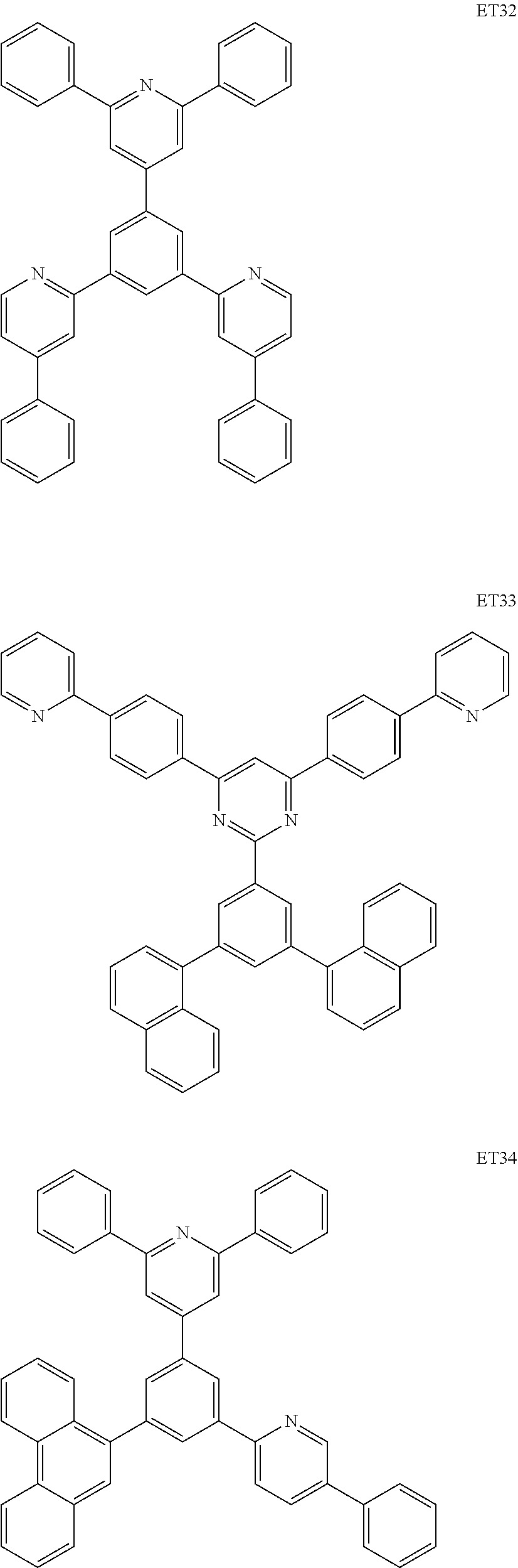


Electronic Apparatus
| TABLE 1 | ||||
| Ligand in | ||||
| inorganic | Effects on | |||
| Composition | Solvent | nanoparticle | Solubility | inkjet head |
| Preparation | Highly | (CH3)3O(BF4) | OK | OK |
| Example 1 | fluorinated | |||
| solvent | ||||
| Comparative | Alcohol-based | — | OK | NG |
| Preparation | solvent | |||
| Example 1 | ||||
| Comparative | Nonpolar | octylamine | OK | OK |
| Preparation | organic solvent | |||
| Example 2 | ||||
| Comparative | Nonpolar | — | NG | NG |
| Preparation | organic solvent | |||
| Example 3 | ||||
| TABLE 2 | ||||||
| Driving | Luminescence | QD | ||||
| Ligand of | voltage | efficiency | emission | |||
| Inorganic | inorganic | (relative | (relative | layer | ||
| nanoparticle | Solvent | nanoparticle | value, %) | value, %) | Damage | |
| Example 1 | ZnO | Perfluoropolyether | (CH3)3O(BF4) | 100 | 100 | X |
| nanoparticle | Including | |||||
| Comparative | Alcohol-based | — | 103 | 87 | X | |
| Example 1 | solvent | |||||
| Comparative | Nonpolar organic | Octylamine | 90 | 31 | O | |
| Example 2 | solvent | |||||
Claims (18)


Applications Claiming Priority (2)
| Application Number | Priority Date | Filing Date | Title |
|---|---|---|---|
| KR10-2020-0127398 | 2020-09-29 | ||
| KR1020200127398A KR20220044229A (en) | 2020-09-29 | 2020-09-29 | Inorganic nano particle composition, light emitting device, method for manufacturing the same, and electronic apparatus including the same |
Publications (2)
| Publication Number | Publication Date |
|---|---|
| US20220098484A1 US20220098484A1 (en) | 2022-03-31 |
| US12122952B2 true US12122952B2 (en) | 2024-10-22 |
Family
ID=80821078
Family Applications (1)
| Application Number | Title | Priority Date | Filing Date |
|---|---|---|---|
| US17/448,820 Active 2042-06-04 US12122952B2 (en) | 2020-09-29 | 2021-09-24 | Inorganic nanoparticle composition, light-emitting device, method of manufacturing light-emitting device, and electronic apparatus including light-emitting device |
Country Status (3)
| Country | Link |
|---|---|
| US (1) | US12122952B2 (en) |
| KR (1) | KR20220044229A (en) |
| CN (1) | CN114335366A (en) |
Families Citing this family (3)
| Publication number | Priority date | Publication date | Assignee | Title |
|---|---|---|---|---|
| US11987746B2 (en) * | 2019-07-02 | 2024-05-21 | Halliburton Energy Services, Inc. | Ionic liquid corrosion inhibitors |
| CN118265424A (en) * | 2022-12-28 | 2024-06-28 | Tcl科技集团股份有限公司 | Composite material and preparation method thereof, light-emitting device, and display device |
| KR102905201B1 (en) * | 2024-01-29 | 2025-12-31 | 삼성디스플레이 주식회사 | Ink composition, light emitting device, and method of manufacturing the light emitting element |
Citations (7)
| Publication number | Priority date | Publication date | Assignee | Title |
|---|---|---|---|---|
| KR20120038472A (en) | 2009-07-07 | 2012-04-23 | 유니버시티 오브 플로리다 리서치 파운데이션, 인크. | Stable and all solution processable quantum dot light-emitting diodes |
| KR20130047943A (en) | 2011-11-01 | 2013-05-09 | 엘지디스플레이 주식회사 | Quantum dot light emitting display device and method for fabricating the same |
| US20150062687A1 (en) * | 2012-04-10 | 2015-03-05 | The Regents Of The University Of California | Nanocrystal-polymer nanocomposite electrochromic device |
| KR20150041477A (en) | 2013-10-08 | 2015-04-16 | 인하대학교 산학협력단 | Method of preparing light emitting quantum dot using solution process and light emitting device using the same |
| KR20160033520A (en) | 2014-09-18 | 2016-03-28 | 홍익대학교 산학협력단 | Quantum dot-light-emitting devices comprising alloyed nanoparticle electron transport layer and method for fabricating the same |
| KR101740429B1 (en) | 2010-09-15 | 2017-05-26 | 삼성전자주식회사 | Quantum dot comprising resonant surface ligands, and organoelectroluminescent device and solar cell employing the same |
| US20180151817A1 (en) | 2016-11-25 | 2018-05-31 | Samsung Electronics Co., Ltd. | Light emitting device and display device including quantum dot |
-
2020
- 2020-09-29 KR KR1020200127398A patent/KR20220044229A/en active Pending
-
2021
- 2021-09-24 US US17/448,820 patent/US12122952B2/en active Active
- 2021-09-27 CN CN202111134486.4A patent/CN114335366A/en active Pending
Patent Citations (9)
| Publication number | Priority date | Publication date | Assignee | Title |
|---|---|---|---|---|
| KR20120038472A (en) | 2009-07-07 | 2012-04-23 | 유니버시티 오브 플로리다 리서치 파운데이션, 인크. | Stable and all solution processable quantum dot light-emitting diodes |
| US9054330B2 (en) | 2009-07-07 | 2015-06-09 | University Of Florida Research Foundation, Inc. | Stable and all solution processable quantum dot light-emitting diodes |
| KR101740429B1 (en) | 2010-09-15 | 2017-05-26 | 삼성전자주식회사 | Quantum dot comprising resonant surface ligands, and organoelectroluminescent device and solar cell employing the same |
| KR20130047943A (en) | 2011-11-01 | 2013-05-09 | 엘지디스플레이 주식회사 | Quantum dot light emitting display device and method for fabricating the same |
| US20150062687A1 (en) * | 2012-04-10 | 2015-03-05 | The Regents Of The University Of California | Nanocrystal-polymer nanocomposite electrochromic device |
| KR20150041477A (en) | 2013-10-08 | 2015-04-16 | 인하대학교 산학협력단 | Method of preparing light emitting quantum dot using solution process and light emitting device using the same |
| KR20160033520A (en) | 2014-09-18 | 2016-03-28 | 홍익대학교 산학협력단 | Quantum dot-light-emitting devices comprising alloyed nanoparticle electron transport layer and method for fabricating the same |
| US20180151817A1 (en) | 2016-11-25 | 2018-05-31 | Samsung Electronics Co., Ltd. | Light emitting device and display device including quantum dot |
| KR20180059363A (en) | 2016-11-25 | 2018-06-04 | 삼성전자주식회사 | Light emitting device and display device including quantum dot |
Non-Patent Citations (1)
| Title |
|---|
| Machine translation of KR2015-0041477A , 20 pages. (Year: 2015). * |
Also Published As
| Publication number | Publication date |
|---|---|
| CN114335366A (en) | 2022-04-12 |
| KR20220044229A (en) | 2022-04-07 |
| US20220098484A1 (en) | 2022-03-31 |
Similar Documents
| Publication | Publication Date | Title |
|---|---|---|
| US12563968B2 (en) | Organic light-emitting device and electronic apparatus including the same | |
| US20220246856A1 (en) | Light-emitting diode and electronic device including the same | |
| US12122952B2 (en) | Inorganic nanoparticle composition, light-emitting device, method of manufacturing light-emitting device, and electronic apparatus including light-emitting device | |
| US12577457B2 (en) | Nanoparticle ink composition, light-emitting device, and method of manufacturing the light-emitting device | |
| US20260020495A1 (en) | Light-emitting device and electronic apparatus comprising light-emitting device | |
| US20230268467A1 (en) | Light-emitting device and electronic apparatus including light-emitting device | |
| US12358883B2 (en) | Light-emitting device and electronic apparatus including the same | |
| US12297365B2 (en) | Composition for forming light-emitting device, method of manufacturing light-emitting device using the composition, and light-emitting device manufactured using the method | |
| US12295253B2 (en) | Light-emitting device and electronic apparatus including same | |
| US12396362B2 (en) | Organic light-emitting device and apparatus including the same | |
| US11950499B2 (en) | Light-emitting device comprising first and second capping layers and electronic apparatus including the same | |
| US11832467B2 (en) | Light-emitting device and electronic apparatus including the same | |
| US20240414932A1 (en) | Composition for manufacturing light-emitting device, light-emitting device manufactured by the same, and method of manufacturing the light-emitting device | |
| US20220037606A1 (en) | Light-emitting device and electronic apparatus including the same | |
| US20250072200A1 (en) | Method of manufacturing light-emitting device and light-emitting device manufactured thereby | |
| US20230217676A1 (en) | Light-emitting device and electronic apparatus including the same | |
| US20230217812A1 (en) | Light-emitting device and electronic apparatus including the same | |
| US20230165022A1 (en) | Light-emitting device and electronic apparatus including the same | |
| US12559477B2 (en) | Light-emitting device including heterocyclic compound and electronic apparatus including the light-emitting device | |
| US12486421B2 (en) | Ink composition for light-emitting device and light emitting device manufactured using same | |
| US12356792B2 (en) | Light-emitting device and electronic apparatus including the same | |
| US20230284523A1 (en) | Light-emitting device and electronic apparatus including light-emitting device | |
| US12349534B2 (en) | Light-emitting device and electronic apparatus including the same | |
| US20220285633A1 (en) | Light-emitting device and electronic apparatus including the same | |
| US20220216419A1 (en) | Light-emitting device and electronic apparatus including the same |
Legal Events
| Date | Code | Title | Description |
|---|---|---|---|
| AS | Assignment |
Owner name: SAMSUNG DISPLAY CO., LTD., KOREA, REPUBLIC OF Free format text: ASSIGNMENT OF ASSIGNORS INTEREST;ASSIGNORS:PARK, MYOUNGJIN;JUNG, YUNKU;KIM, JONGHOON;AND OTHERS;SIGNING DATES FROM 20210402 TO 20210924;REEL/FRAME:057602/0164 |
|
| FEPP | Fee payment procedure |
Free format text: ENTITY STATUS SET TO UNDISCOUNTED (ORIGINAL EVENT CODE: BIG.); ENTITY STATUS OF PATENT OWNER: LARGE ENTITY |
|
| STPP | Information on status: patent application and granting procedure in general |
Free format text: DOCKETED NEW CASE - READY FOR EXAMINATION |
|
| STPP | Information on status: patent application and granting procedure in general |
Free format text: NON FINAL ACTION MAILED |
|
| STPP | Information on status: patent application and granting procedure in general |
Free format text: RESPONSE TO NON-FINAL OFFICE ACTION ENTERED AND FORWARDED TO EXAMINER |
|
| STPP | Information on status: patent application and granting procedure in general |
Free format text: NON FINAL ACTION MAILED |
|
| STPP | Information on status: patent application and granting procedure in general |
Free format text: RESPONSE TO NON-FINAL OFFICE ACTION ENTERED AND FORWARDED TO EXAMINER |
|
| STPP | Information on status: patent application and granting procedure in general |
Free format text: NOTICE OF ALLOWANCE MAILED -- APPLICATION RECEIVED IN OFFICE OF PUBLICATIONS |
|
| ZAAA | Notice of allowance and fees due |
Free format text: ORIGINAL CODE: NOA |
|
| ZAAB | Notice of allowance mailed |
Free format text: ORIGINAL CODE: MN/=. |
|
| STPP | Information on status: patent application and granting procedure in general |
Free format text: PUBLICATIONS -- ISSUE FEE PAYMENT VERIFIED |
|
| STCF | Information on status: patent grant |
Free format text: PATENTED CASE |