US12117728B2 - Resist composition and patterning process - Google Patents

Resist composition and patterning process Download PDF

Info

Publication number
US12117728B2
US12117728B2 US17/342,701 US202117342701A US12117728B2 US 12117728 B2 US12117728 B2 US 12117728B2 US 202117342701 A US202117342701 A US 202117342701A US 12117728 B2 US12117728 B2 US 12117728B2
Authority
US
United States
Prior art keywords
group
bond
resist composition
moiety
ring
Prior art date
Legal status (The legal status is an assumption and is not a legal conclusion. Google has not performed a legal analysis and makes no representation as to the accuracy of the status listed.)
Active, expires
Application number
US17/342,701
Other versions
US20210405528A1 (en
Inventor
Jun Hatakeyama
Current Assignee (The listed assignees may be inaccurate. Google has not performed a legal analysis and makes no representation or warranty as to the accuracy of the list.)
Shin Etsu Chemical Co Ltd
Original Assignee
Shin Etsu Chemical Co Ltd
Priority date (The priority date is an assumption and is not a legal conclusion. Google has not performed a legal analysis and makes no representation as to the accuracy of the date listed.)
Filing date
Publication date
Application filed by Shin Etsu Chemical Co Ltd filed Critical Shin Etsu Chemical Co Ltd
Assigned to SHIN-ETSU CHEMICAL CO., LTD. reassignment SHIN-ETSU CHEMICAL CO., LTD. ASSIGNMENT OF ASSIGNORS INTEREST (SEE DOCUMENT FOR DETAILS). Assignors: HATAKEYAMA, JUN
Publication of US20210405528A1 publication Critical patent/US20210405528A1/en
Application granted granted Critical
Publication of US12117728B2 publication Critical patent/US12117728B2/en
Active legal-status Critical Current
Adjusted expiration legal-status Critical

Links

Classifications

    • GPHYSICS
    • G03PHOTOGRAPHY; CINEMATOGRAPHY; ANALOGOUS TECHNIQUES USING WAVES OTHER THAN OPTICAL WAVES; ELECTROGRAPHY; HOLOGRAPHY
    • G03FPHOTOMECHANICAL PRODUCTION OF TEXTURED OR PATTERNED SURFACES, e.g. FOR PRINTING, FOR PROCESSING OF SEMICONDUCTOR DEVICES; MATERIALS THEREFOR; ORIGINALS THEREFOR; APPARATUS SPECIALLY ADAPTED THEREFOR
    • G03F7/00Photomechanical, e.g. photolithographic, production of textured or patterned surfaces, e.g. printing surfaces; Materials therefor, e.g. comprising photoresists; Apparatus specially adapted therefor
    • G03F7/004Photosensitive materials
    • CCHEMISTRY; METALLURGY
    • C07ORGANIC CHEMISTRY
    • C07CACYCLIC OR CARBOCYCLIC COMPOUNDS
    • C07C381/00Compounds containing carbon and sulfur and having functional groups not covered by groups C07C301/00 - C07C337/00
    • C07C381/12Sulfonium compounds
    • CCHEMISTRY; METALLURGY
    • C08ORGANIC MACROMOLECULAR COMPOUNDS; THEIR PREPARATION OR CHEMICAL WORKING-UP; COMPOSITIONS BASED THEREON
    • C08FMACROMOLECULAR COMPOUNDS OBTAINED BY REACTIONS ONLY INVOLVING CARBON-TO-CARBON UNSATURATED BONDS
    • C08F212/00Copolymers of compounds having one or more unsaturated aliphatic radicals, each having only one carbon-to-carbon double bond, and at least one being terminated by an aromatic carbocyclic ring
    • C08F212/02Monomers containing only one unsaturated aliphatic radical
    • C08F212/04Monomers containing only one unsaturated aliphatic radical containing one ring
    • C08F212/14Monomers containing only one unsaturated aliphatic radical containing one ring substituted by heteroatoms or groups containing heteroatoms
    • C08F212/22Oxygen
    • CCHEMISTRY; METALLURGY
    • C08ORGANIC MACROMOLECULAR COMPOUNDS; THEIR PREPARATION OR CHEMICAL WORKING-UP; COMPOSITIONS BASED THEREON
    • C08FMACROMOLECULAR COMPOUNDS OBTAINED BY REACTIONS ONLY INVOLVING CARBON-TO-CARBON UNSATURATED BONDS
    • C08F212/00Copolymers of compounds having one or more unsaturated aliphatic radicals, each having only one carbon-to-carbon double bond, and at least one being terminated by an aromatic carbocyclic ring
    • C08F212/02Monomers containing only one unsaturated aliphatic radical
    • C08F212/04Monomers containing only one unsaturated aliphatic radical containing one ring
    • C08F212/14Monomers containing only one unsaturated aliphatic radical containing one ring substituted by heteroatoms or groups containing heteroatoms
    • C08F212/22Oxygen
    • C08F212/24Phenols or alcohols
    • CCHEMISTRY; METALLURGY
    • C08ORGANIC MACROMOLECULAR COMPOUNDS; THEIR PREPARATION OR CHEMICAL WORKING-UP; COMPOSITIONS BASED THEREON
    • C08FMACROMOLECULAR COMPOUNDS OBTAINED BY REACTIONS ONLY INVOLVING CARBON-TO-CARBON UNSATURATED BONDS
    • C08F220/00Copolymers of compounds having one or more unsaturated aliphatic radicals, each having only one carbon-to-carbon double bond, and only one being terminated by only one carboxyl radical or a salt, anhydride ester, amide, imide or nitrile thereof
    • C08F220/02Monocarboxylic acids having less than ten carbon atoms; Derivatives thereof
    • C08F220/10Esters
    • C08F220/12Esters of monohydric alcohols or phenols
    • C08F220/16Esters of monohydric alcohols or phenols of phenols or of alcohols containing two or more carbon atoms
    • C08F220/18Esters of monohydric alcohols or phenols of phenols or of alcohols containing two or more carbon atoms with acrylic or methacrylic acids
    • C08F220/1802C2-(meth)acrylate, e.g. ethyl (meth)acrylate
    • CCHEMISTRY; METALLURGY
    • C08ORGANIC MACROMOLECULAR COMPOUNDS; THEIR PREPARATION OR CHEMICAL WORKING-UP; COMPOSITIONS BASED THEREON
    • C08FMACROMOLECULAR COMPOUNDS OBTAINED BY REACTIONS ONLY INVOLVING CARBON-TO-CARBON UNSATURATED BONDS
    • C08F220/00Copolymers of compounds having one or more unsaturated aliphatic radicals, each having only one carbon-to-carbon double bond, and only one being terminated by only one carboxyl radical or a salt, anhydride ester, amide, imide or nitrile thereof
    • C08F220/02Monocarboxylic acids having less than ten carbon atoms; Derivatives thereof
    • C08F220/10Esters
    • C08F220/12Esters of monohydric alcohols or phenols
    • C08F220/16Esters of monohydric alcohols or phenols of phenols or of alcohols containing two or more carbon atoms
    • C08F220/18Esters of monohydric alcohols or phenols of phenols or of alcohols containing two or more carbon atoms with acrylic or methacrylic acids
    • C08F220/1806C6-(meth)acrylate, e.g. (cyclo)hexyl (meth)acrylate or phenyl (meth)acrylate
    • CCHEMISTRY; METALLURGY
    • C09DYES; PAINTS; POLISHES; NATURAL RESINS; ADHESIVES; COMPOSITIONS NOT OTHERWISE PROVIDED FOR; APPLICATIONS OF MATERIALS NOT OTHERWISE PROVIDED FOR
    • C09DCOATING COMPOSITIONS, e.g. PAINTS, VARNISHES OR LACQUERS; FILLING PASTES; CHEMICAL PAINT OR INK REMOVERS; INKS; CORRECTING FLUIDS; WOODSTAINS; PASTES OR SOLIDS FOR COLOURING OR PRINTING; USE OF MATERIALS THEREFOR
    • C09D125/00Coating compositions based on homopolymers or copolymers of compounds having one or more unsaturated aliphatic radicals, each having only one carbon-to-carbon double bond, and at least one being terminated by an aromatic carbocyclic ring; Coating compositions based on derivatives of such polymers
    • C09D125/18Homopolymers or copolymers of aromatic monomers containing elements other than carbon and hydrogen
    • CCHEMISTRY; METALLURGY
    • C09DYES; PAINTS; POLISHES; NATURAL RESINS; ADHESIVES; COMPOSITIONS NOT OTHERWISE PROVIDED FOR; APPLICATIONS OF MATERIALS NOT OTHERWISE PROVIDED FOR
    • C09DCOATING COMPOSITIONS, e.g. PAINTS, VARNISHES OR LACQUERS; FILLING PASTES; CHEMICAL PAINT OR INK REMOVERS; INKS; CORRECTING FLUIDS; WOODSTAINS; PASTES OR SOLIDS FOR COLOURING OR PRINTING; USE OF MATERIALS THEREFOR
    • C09D133/00Coating compositions based on homopolymers or copolymers of compounds having one or more unsaturated aliphatic radicals, each having only one carbon-to-carbon double bond, and at least one being terminated by only one carboxyl radical, or of salts, anhydrides, esters, amides, imides, or nitriles thereof; Coating compositions based on derivatives of such polymers
    • C09D133/04Homopolymers or copolymers of esters
    • C09D133/06Homopolymers or copolymers of esters of esters containing only carbon, hydrogen and oxygen, the oxygen atom being present only as part of the carboxyl radical
    • C09D133/08Homopolymers or copolymers of acrylic acid esters
    • GPHYSICS
    • G03PHOTOGRAPHY; CINEMATOGRAPHY; ANALOGOUS TECHNIQUES USING WAVES OTHER THAN OPTICAL WAVES; ELECTROGRAPHY; HOLOGRAPHY
    • G03FPHOTOMECHANICAL PRODUCTION OF TEXTURED OR PATTERNED SURFACES, e.g. FOR PRINTING, FOR PROCESSING OF SEMICONDUCTOR DEVICES; MATERIALS THEREFOR; ORIGINALS THEREFOR; APPARATUS SPECIALLY ADAPTED THEREFOR
    • G03F7/00Photomechanical, e.g. photolithographic, production of textured or patterned surfaces, e.g. printing surfaces; Materials therefor, e.g. comprising photoresists; Apparatus specially adapted therefor
    • G03F7/004Photosensitive materials
    • G03F7/0045Photosensitive materials with organic non-macromolecular light-sensitive compounds not otherwise provided for, e.g. dissolution inhibitors
    • GPHYSICS
    • G03PHOTOGRAPHY; CINEMATOGRAPHY; ANALOGOUS TECHNIQUES USING WAVES OTHER THAN OPTICAL WAVES; ELECTROGRAPHY; HOLOGRAPHY
    • G03FPHOTOMECHANICAL PRODUCTION OF TEXTURED OR PATTERNED SURFACES, e.g. FOR PRINTING, FOR PROCESSING OF SEMICONDUCTOR DEVICES; MATERIALS THEREFOR; ORIGINALS THEREFOR; APPARATUS SPECIALLY ADAPTED THEREFOR
    • G03F7/00Photomechanical, e.g. photolithographic, production of textured or patterned surfaces, e.g. printing surfaces; Materials therefor, e.g. comprising photoresists; Apparatus specially adapted therefor
    • G03F7/004Photosensitive materials
    • G03F7/0046Photosensitive materials with perfluoro compounds, e.g. for dry lithography
    • GPHYSICS
    • G03PHOTOGRAPHY; CINEMATOGRAPHY; ANALOGOUS TECHNIQUES USING WAVES OTHER THAN OPTICAL WAVES; ELECTROGRAPHY; HOLOGRAPHY
    • G03FPHOTOMECHANICAL PRODUCTION OF TEXTURED OR PATTERNED SURFACES, e.g. FOR PRINTING, FOR PROCESSING OF SEMICONDUCTOR DEVICES; MATERIALS THEREFOR; ORIGINALS THEREFOR; APPARATUS SPECIALLY ADAPTED THEREFOR
    • G03F7/00Photomechanical, e.g. photolithographic, production of textured or patterned surfaces, e.g. printing surfaces; Materials therefor, e.g. comprising photoresists; Apparatus specially adapted therefor
    • G03F7/004Photosensitive materials
    • G03F7/038Macromolecular compounds which are rendered insoluble or differentially wettable
    • G03F7/0382Macromolecular compounds which are rendered insoluble or differentially wettable the macromolecular compound being present in a chemically amplified negative photoresist composition
    • GPHYSICS
    • G03PHOTOGRAPHY; CINEMATOGRAPHY; ANALOGOUS TECHNIQUES USING WAVES OTHER THAN OPTICAL WAVES; ELECTROGRAPHY; HOLOGRAPHY
    • G03FPHOTOMECHANICAL PRODUCTION OF TEXTURED OR PATTERNED SURFACES, e.g. FOR PRINTING, FOR PROCESSING OF SEMICONDUCTOR DEVICES; MATERIALS THEREFOR; ORIGINALS THEREFOR; APPARATUS SPECIALLY ADAPTED THEREFOR
    • G03F7/00Photomechanical, e.g. photolithographic, production of textured or patterned surfaces, e.g. printing surfaces; Materials therefor, e.g. comprising photoresists; Apparatus specially adapted therefor
    • G03F7/004Photosensitive materials
    • G03F7/039Macromolecular compounds which are photodegradable, e.g. positive electron resists
    • G03F7/0392Macromolecular compounds which are photodegradable, e.g. positive electron resists the macromolecular compound being present in a chemically amplified positive photoresist composition
    • GPHYSICS
    • G03PHOTOGRAPHY; CINEMATOGRAPHY; ANALOGOUS TECHNIQUES USING WAVES OTHER THAN OPTICAL WAVES; ELECTROGRAPHY; HOLOGRAPHY
    • G03FPHOTOMECHANICAL PRODUCTION OF TEXTURED OR PATTERNED SURFACES, e.g. FOR PRINTING, FOR PROCESSING OF SEMICONDUCTOR DEVICES; MATERIALS THEREFOR; ORIGINALS THEREFOR; APPARATUS SPECIALLY ADAPTED THEREFOR
    • G03F7/00Photomechanical, e.g. photolithographic, production of textured or patterned surfaces, e.g. printing surfaces; Materials therefor, e.g. comprising photoresists; Apparatus specially adapted therefor
    • G03F7/004Photosensitive materials
    • G03F7/039Macromolecular compounds which are photodegradable, e.g. positive electron resists
    • G03F7/0392Macromolecular compounds which are photodegradable, e.g. positive electron resists the macromolecular compound being present in a chemically amplified positive photoresist composition
    • G03F7/0397Macromolecular compounds which are photodegradable, e.g. positive electron resists the macromolecular compound being present in a chemically amplified positive photoresist composition the macromolecular compound having an alicyclic moiety in a side chain
    • GPHYSICS
    • G03PHOTOGRAPHY; CINEMATOGRAPHY; ANALOGOUS TECHNIQUES USING WAVES OTHER THAN OPTICAL WAVES; ELECTROGRAPHY; HOLOGRAPHY
    • G03FPHOTOMECHANICAL PRODUCTION OF TEXTURED OR PATTERNED SURFACES, e.g. FOR PRINTING, FOR PROCESSING OF SEMICONDUCTOR DEVICES; MATERIALS THEREFOR; ORIGINALS THEREFOR; APPARATUS SPECIALLY ADAPTED THEREFOR
    • G03F7/00Photomechanical, e.g. photolithographic, production of textured or patterned surfaces, e.g. printing surfaces; Materials therefor, e.g. comprising photoresists; Apparatus specially adapted therefor
    • G03F7/20Exposure; Apparatus therefor
    • G03F7/2002Exposure; Apparatus therefor with visible light or UV light, through an original having an opaque pattern on a transparent support, e.g. film printing, projection printing; by reflection of visible or UV light from an original such as a printed image
    • G03F7/2004Exposure; Apparatus therefor with visible light or UV light, through an original having an opaque pattern on a transparent support, e.g. film printing, projection printing; by reflection of visible or UV light from an original such as a printed image characterised by the use of a particular light source, e.g. fluorescent lamps or deep UV light
    • GPHYSICS
    • G03PHOTOGRAPHY; CINEMATOGRAPHY; ANALOGOUS TECHNIQUES USING WAVES OTHER THAN OPTICAL WAVES; ELECTROGRAPHY; HOLOGRAPHY
    • G03FPHOTOMECHANICAL PRODUCTION OF TEXTURED OR PATTERNED SURFACES, e.g. FOR PRINTING, FOR PROCESSING OF SEMICONDUCTOR DEVICES; MATERIALS THEREFOR; ORIGINALS THEREFOR; APPARATUS SPECIALLY ADAPTED THEREFOR
    • G03F7/00Photomechanical, e.g. photolithographic, production of textured or patterned surfaces, e.g. printing surfaces; Materials therefor, e.g. comprising photoresists; Apparatus specially adapted therefor
    • G03F7/26Processing photosensitive materials; Apparatus therefor

Definitions

  • Chemically amplified resist compositions comprising an acid generator capable of generating an acid upon exposure to light or EB include chemically amplified positive resist compositions wherein deprotection reaction takes place under the action of acid and chemically amplified negative resist compositions wherein polarity switch or crosslinking reaction takes place under the action of acid.
  • Quenchers are often added to these resist compositions for the purpose of controlling the diffusion of the acid to unexposed region to improve the contrast. The addition of quenchers is fully effective to this purpose. A number of amine quenchers were proposed as disclosed in Patent Documents 1 to 3.
  • deprotection reaction takes place when a photoacid generator capable of generating a sulfonic acid having fluorine substituted at ⁇ -position (referred to “ ⁇ -fluorinated sulfonic acid”) is used, but not when an acid generator capable of generating to a sulfonic acid not having fluorine substituted at ⁇ -position (referred to “ ⁇ -non-fluorinated sulfonic acid”) or carboxylic acid is used.
  • a sulfonium or iodonium salt capable of generating an ⁇ -fluorinated sulfonic acid is combined with a sulfonium or iodonium salt capable of generating an ⁇ -non-fluorinated sulfonic acid, the sulfonium or iodonium salt capable of generating an ⁇ -non-fluorinated sulfonic acid undergoes ion exchange with the ⁇ -fluorinated sulfonic acid.
  • Patent Document 4 discloses a resist material comprising a sulfonium or iodonium salt capable of generating carboxylic acid as a quencher.
  • quenchers of sulfonium and iodonimn salt type are photo-decomposable.
  • the amount of quencher in the exposed region is reduced. Since acid is generated in the exposed region, the reduced amount of quencher leads to a relatively increased concentration of acid and hence, an improved contrast.
  • the acid diffusion in the exposed region is not suppressed, indicating the difficulty of acid diffusion control.
  • Patent Documents 5 and 6 disclose resist compositions comprising iodine-substituted aniline compounds. Since the aniline compounds have a low basicity and a low acid-capturing capability, their acid diffusion control is not enough. There is a need for a quencher having improved acid diffusion control, high absorbance, and high sensitizing effect.
  • Non-Patent Document 1 points out that a variation in number of photons, i.e., shot noise causes a variation in size. It is also believed that not only a variation in photon number, but also the uneven distribution of components in a resist film causes a variation in size.
  • Non-Patent Document 2 proposes to develop a resist material comprising uniform components.
  • Patent Document 1 JP-A 2001-194776
  • Patent Document 2 JP-A 2002-226470
  • Patent Document 3 JP-A 2002-363148
  • Patent Document 4 WO 2008/066011
  • Patent Document 5 JP-A 2013-083957
  • Patent Document 6 JP-A 2018-097356
  • Non-Patent Document 1 SPIE Vol. 3331, p 531 (1998)
  • Non-Patent Document 2 SPIE Vol. 9776, p 97760V-1 (2016)
  • a quencher capable of reducing the LWR of line patterns or improving the CDU of hole patterns and increasing sensitivity.
  • An object of the invention is to provide a resist composition which exhibits a high sensitivity and a reduced LWR or improved CDU, independent of whether it is of positive tone or negative tone; and a pattern forming process using the same.
  • the inventor has found that using a salt compound obtained from a specific nitrogen-containing compound having an iodine or bromine-substituted hydrocarbyl group (exclusive of iodine or bromine-substituted aromatic ring) and a compound having a 1,1,1,3,3,3-hexafluoro-2-propanol group as the quencher, a resist material having a reduced LWR, improved CDU, high contrast, improved resolution, and wide process margin is obtainable.
  • the invention provides a resist composition
  • a resist composition comprising a base polymer and a quencher, the quencher comprising a salt compound obtained from a nitrogen-containing compound having an iodine or bromine-substituted hydrocarbyl group, exclusive of iodine or bromine-substituted aromatic ring, bonded to the nitrogen atom via an ester bond-containing group and a compound having a 1,1,1,3,3,3-hexafluoro-2-propanol group.
  • the salt compound has the formula (A).
  • k is an integer of 1 to 3
  • m 1 is 1 or 2
  • m 2 is an integer of 1 to 3
  • n is an integer of 1 to 4.
  • X BI is iodine or bromine.
  • R ah is a C 1 -C 20 (k+1)-valent aliphatic hydrocarbon group which may contain at least one moiety selected from ether bond, carbonyl, ester bond, amide bond, sultone ring, lactam ring, carbonate, halogen exclusive of iodine, C 6 -C 12 aryl, hydroxyl, and carboxyl.
  • X 1 is a single bond, ether bond, ester bond, amide bond, carbonyl group, or carbonate group.
  • R 1 is a single bond or a C 1 -C 20 (m 1 +1)-valent hydrocarbon group which may contain an ether bond, ester bond or hydroxyl moiety.
  • R 2 is a single bond or a C 1 -C 20 (m 2 +1)-valent hydrocarbon group which may contain at least one moiety selected from ether bond, carbonyl, ester bond, amide bond, sultone ring, lactam ring, carbonate, halogen exclusive of iodine, hydroxyl, and carboxyl.
  • R 3 is hydrogen, nitro, C 1 -C 20 hydrocarbyl group or C 2 -C 20 hydrocarbyloxycarbonyl group, the hydrocarbyl group or the hydrocarbyl moiety of the hydrocarbyloxycarbonyl group may contain at least one moiety selected from hydroxyl, carboxyl, thiol, ether bond, ester bond, sulfonyl, nitro, cyano, halogen, and amino.
  • two groups R 3 may bond together to form a ring with the nitrogen atom to which they are attached, the ring optionally containing a double bond, oxygen, sulfur or nitrogen, or R 3 and R 1 may bond together to form a ring with the nitrogen atom to which they are attached, the ring optionally containing a double bond, oxygen, sulfur or nitrogen.
  • R 4 is trifluoromethyl, a C 2 -C 21 hydrocarbylcarbonyl group or C 2 -C 21 hydrocarbyloxycarbonyl group, the hydrocarbyl moiety of the hydrocarbylcarbonyl group or hydrocarbyloxycarbonyl group may contain at least one moiety selected from ether bond, ester bond, thiol, cyano, nitro, hydroxyl, sultone, sulfonate bond, amide bond, and halogen.
  • the resist composition may further comprise an acid generator capable of generating a sulfonic acid, imide acid or methide acid, an organic solvent, and/or a surfactant.
  • the base polymer comprises recurring units having the formula (a1) or recurring units having the formula (a2):
  • R A is each independently hydrogen or methyl
  • R 11 and R 12 are each independently an acid labile group
  • Y 1 is a single bond, phenylene, naphthylene, or a C 1 -C 12 linking group containing an ester bond and/or lactone ring
  • Y 2 is a single bond or ester bond.
  • the resist composition is typically a chemically amplified positive resist composition.
  • the base polymer is free of an acid labile group.
  • the resist composition is typically a chemically amplified negative resist composition.
  • the base polymer comprises recurring units of at least one type selected from recurring units having the formulae (f1) to (f3).
  • R A is each independently hydrogen or methyl.
  • Z 1 is a single bond, a C 1 -C 6 aliphatic hydrocarbylene group, phenylene group, naphthylene group, or C 7 -C 18 group obtained by combining the foregoing, or —O—Z 11 —, —C( ⁇ O)—O—Z 11 — or —C( ⁇ O)—NH—Z 11 —, wherein Z 11 is a C 1 -C 6 aliphatic hydrocarbylene group, phenylene group, naphthylene group, or C 7 -C 18 group obtained by combining the foregoing, which may contain a carbonyl moiety, ester bond, ether bond or hydroxyl moiety.
  • Z 2 is a single bond, —Z 21 —C( ⁇ O)—O—, —Z 21 —O— or —Z 21 —O—C( ⁇ O)—, wherein Z 21 is a C 1 -C 12 saturated hydrocarbylene group which may contain a carbonyl moiety, ester bond or ether bond.
  • Z 3 is a single bond, methylene, ethylene, phenylene, fluorinated phenylene, —O—Z 31 —, —C( ⁇ O)—O—Z 31 —, or —C( ⁇ O)—NH—Z 31 —, wherein Z 31 is a C 1 -C 6 aliphatic hydrocarbylene group, phenylene group, fluorinated phenylene group, or trifluoromethyl-substituted phenylene group, which may contain a carbonyl moiety, ester bond, ether bond or hydroxyl moiety.
  • R 21 to R 28 are each independently halogen or a C 1 -C 20 hydrocarbyl group which may contain a heteroatom, a pair of R 23 and R 24 or R 26 and R 27 may bond together to form a ring with the sulfur atom to which they are attached.
  • R HF is hydrogen or trifluoromethyl.
  • M ⁇ is a non-nucleophilic counter ion.
  • the invention provides a pattern forming process comprising the steps of applying the resist composition defined above to form a resist film on a substrate, exposing the resist film to high-energy radiation, and developing the exposed resist film in a developer.
  • the high-energy radiation is ArF excimer laser of wavelength 193 nm, KrF excimer laser of wavelength 248 nm, EB, or EUV of wavelength 3 to 15 nm.
  • the salt compound having formula (A) is highly absorptive to EUV and has a sensitizing effect. Since iodine or bromine has a large atomic weight, the salt compound is highly effective for suppressing acid diffusion. Furthermore, the salt compound lacks photosensitivity so that it is not decomposed even in the exposed region. Therefore, the acid diffusion control ability is high in the exposed region, and a pattern film thickness loss in alkaline developer is suppressed. By virtue of the repulsive effect of fluorine, the quencher in the form of a salt with the compound having a 1,1,1,3,3,3-hexafluoro-2-propanol group is uniformly distributed in the resist film. A resist composition having a high sensitivity, low LWR and improved CDU is thus designed.
  • Cn-Cm means a group containing from to m carbon atoms per group.
  • group and “moiety” are interchangeable.
  • the iodine or bromine-substituted compound is also referred to as iodized or brominated compound.
  • the broken line designates a valence bond, and Me stands for methyl and Ac for acetyl.
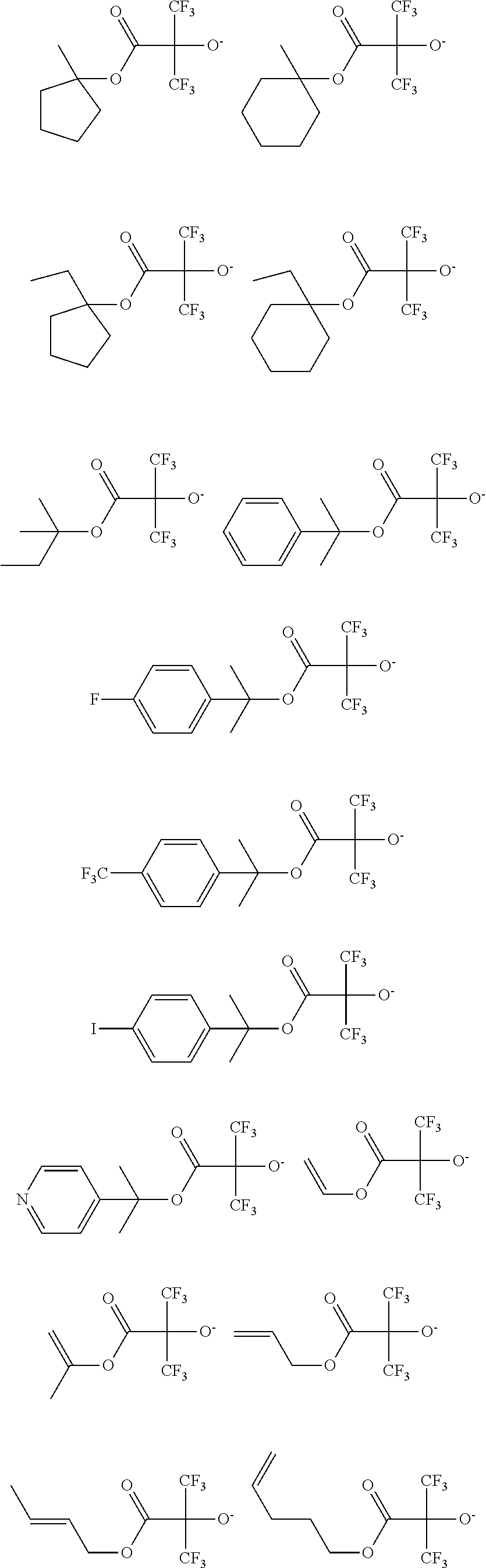
  • the resist composition of the invention is defined as comprising a base polymer and a quencher, the quencher comprising a salt compound obtained from a nitrogen-containing compound having an iodized or brominated hydrocarbyl group, exclusive of iodized or brominated aromatic ring, bonded to the nitrogen atom via an ester bond-containing group and a compound having a 1,1,1,3,3,3-hexafluoro-2-propanol group.
  • the salt compound is referred to as “salt compound A,” hereinafter.
  • the salt compound A preferably has the following formula (A).
  • k is an integer of 1 to 3
  • m 1 is 1 or 2
  • m 2 is an integer of 1 to 3
  • n is an integer of 1 to 4.
  • X BI is iodine or bromine.
  • R ah is a C 1 -C 20 (k+1)-valent aliphatic hydrocarbon group which may contain at least one moiety selected from ether bond, carbonyl, ester bond, amide bond, sultone ring, lactam ring, carbonate, halogen exclusive of iodine, C 6 -C 12 aryl, hydroxyl, and carboxyl.
  • the aliphatic hydrocarbon group R ah may be saturated or unsaturated and straight, branched or cyclic.
  • alkanediyl groups such as methanediyl, ethane-1,1-diyl, ethane-1,2-diyl, propane-1,1-diyl, propane-1,2-diyl, propane-1,3-diyl, propane-2,2-diyl, butane-1,1-diyl, butane-1,2-diyl, butane-1,3-diyl, butane-2,3-diyl, butane-1,4-diyl, 1,1-dimethylethane-1,2-diyl, pentane-1,5-diyl, 2-methylbutane-1,2-diyl, hexane-1,6-diyl, heptane-1,7-diyl, octane-1,8-d
  • Suitable C 6 -C 12 aryl groups include phenyl, tolyl, xylyl, 1-naphthyl and 2-naphthyl.
  • X 1 is a single bond, ether bond, ester bond, amide bond, carbonyl group, or carbonate group.
  • R 1 is a single bond or a C 1 -C 20 (m 1 +1)-valent hydrocarbon group which may contain an ether bond, ester bond or hydroxyl moiety.
  • R 2 is a single bond or a C 1 -C 20 (m 2 +1)-valent hydrocarbon group which may contain at least one moiety selected from ether bond, carbonyl, ester bond, amide bond, sultone ring, lactam ring, carbonate, halogen exclusive of iodine, hydroxyl, and carboxyl.
  • the (m 1 +1)-valent hydrocarbon group represented by R 1 is a group obtained by removing (m 1 +1) number of hydrogen atoms from a C 1 -C 20 hydrocarbon.
  • the (m 2 +1)-valent hydrocarbon group represented by R 2 is a group obtained by removing (m 2 +1) number of hydrogen atoms from a C 1 -C 20 hydrocarbon.
  • the hydrocarbon may be saturated or unsaturated and straight, branched or cyclic.
  • alkanes such as methane, ethane, propane, butane, 2-methylpropane, pentane, 2-methylbutane, hexane, heptane, octane, nonane, decane, undecane, dodecane; cyclic saturated hydrocarbons such as cyclopropane, cyclobutane, cyclopentane, cyclohexane, norbornane, adamantane; alkenes such as ethylene, propene, 1-butene, 2-butene, 2-methylpropene; cyclic unsaturated hydrocarbons such as cyclohexene and norbornene; aromatic hydrocarbons such as benzene, naphthalene, toluene, xylene, anthracene; and substituted forms of the foregoing hydrocarbons in which some or all of the hydrogen atoms are substituted by hydrocarbyl groups.
  • alkanes such as me
  • R 3 is hydrogen, nitro, a C 1 -C 20 hydrocarbyl group or C 2 -C 20 hydrocarbyloxycarbonyl group.
  • the hydrocarbyl group or the hydrocarbyl moiety of the hydrocarbyloxycarbonyl group may be saturated or unsaturated and straight, branched or cyclic.
  • Examples thereof include C 1 -C 20 alkyl groups such as methyl, ethyl, n-propyl, isopropyl, n-butyl, isobutyl, sec-butyl, tert-butyl, n-pentyl, n-hexyl, n-octyl, n-nonyl, n-decyl, undecyl, dodecyl, tridecyl, tetradecyl, pentadecyl, heptadecyl, octadecyl, nonadecyl and icosyl; C 3 -C 20 cyclic saturated hydrocarbyl groups such as cyclopropyl, cyclopentyl, cyclohexyl, cyclopropylmethyl, 4-methylcyclohexyl, cyclohexylmethyl, norbornyl, adamantyl; C 2 -C 20 alken
  • the hydrocarbyl group or the hydrocarbyl moiety of the hydrocarbyloxycarbonyl group may contain at least one moiety selected from hydroxyl, carboxyl, thiol, ether bond, ester bond, sulfonyl, nitro, cyano, halogen, and amino.
  • two groups R 3 may bond together to form a ring with the nitrogen atom to which they are attached, the ring may contain a double bond, oxygen, sulfur or nitrogen; or R 3 and R 1 may bond together to form a ring with the nitrogen atom to which they are attached, the ring may contain a double bond, oxygen, sulfur or nitrogen.
  • R 4 is trifluoromethyl, a C 2 -C 21 hydrocarbylcarbonyl group or C 2 -C 21 hydrocarbyloxycarbonyl group.
  • the hydrocarbyl moiety of the hydrocarbylcarbonyl or hydrocarbyloxycarbonyl group may contain at least one moiety selected from ether bond, ester bond, thiol, cyano, nitro, hydroxyl, sultone, sulfonate bond, amide bond, and halogen.
  • the hydrocarbyl moiety of the hydrocarbylcarbonyl or hydrocarbyloxycarbonyl group may be saturated or unsaturated and straight, branched or cyclic.
  • Examples thereof include C 1 -C 20 alkyl groups such as methyl, ethyl, n-propyl, isopropyl, n-butyl, isobutyl, sec-butyl, tert-butyl, n-pentyl, isopentyl, sec-pentyl, 3-pentyl, tert-pentyl, neopentyl, n-hexyl, n-octyl, n-nonyl, n-decyl, undecyl, dodecyl, tridecyl, tetradecyl, pentadecyl, heptadecyl, octadecyl, nonadecyl and icosyl; C 3
  • the salt compound A may be synthesized, for example, by neutralization reaction of a nitrogen-containing compound having an iodized or brominated hydrocarbyl group (exclusive of iodized or brominated aromatic ring) with a compound having a 1,1,1,3,3,3-hexafluoro-2-propanol group (abbreviated as “HFA group”). It is acceptable that the nitrogen-containing compound and the compound having HFA group are added during preparation of a resist composition and neutralization reaction takes place therein so that the resist composition may eventually contain salt compound A.
  • the neutralization reaction is most preferably carried out under the conditions that the nitrogen-containing compound and the compound having HFA group are in a molar ratio of 1:1 although either one of the compounds may be in excess.
  • the salt compound A functions as a quencher having a sensitizing effect in a resist composition. While conventional quenchers reduce LWR or improve CDU by controlling acid diffusion to reduce sensitivity, salt compound A has an acid diffusion controlling effect due to the amino group and the iodine or bromine atoms with a large atomic weight and a sensitivity-increasing effect due to the sensitizing effect of plural EUV-absorptive iodine or bromine atoms. Since the HFA group contains six fluorine atoms, the repulsion effect thereof prevents the quencher from agglomerating together. This enables to distribute the quencher uniformly and to make the diffusion distance of acid uniform on a nanometer level, leading to improvements in LWR and CDU of resist patterns.
  • salt compound A is preferably present in an amount of 0.001 to 50 parts by weight, more preferably 0.01 to 40 parts by weight per 100 parts by weight of the base polymer, as viewed from sensitivity and acid diffusion suppressing effect.
  • salt compound A is not decomposed upon exposure. It is thus effective for suppressing acid diffusion in the exposed region.
  • the base polymer comprises recurring units containing an acid labile group, preferably recurring units having the formula (a1) or recurring units having the formula (a2). These units are simply referred to as recurring units (a1) and (a2).
  • R A is each independently hydrogen or methyl.
  • R 11 and R 12 are each independently an acid labile group.
  • R 11 and R 12 may be the same or different.
  • Y 1 is a single bond, phenylene or naphthylene group, or C 1 -C 12 linking group containing at least one moiety selected from ester bond and lactone ring.
  • Y 2 is a single bond or ester bond.
  • R A and R 11 are as defined above.
  • R A and R 12 are as defined above.
  • the acid labile groups represented by R 1 and R 12 in formulae (a1) and (a2) may be selected from a variety of such groups, for example, those groups described in JP-A 2013-080033 (U.S. Pat. No. 8,574,817) and JP-A 2013-083821 (U.S. Pat. No. 8,846,303).
  • Typical of the acid labile group are groups of the following formulae (AL-1) to (AL-3).
  • R L1 and R L2 are each independently a C 1 -C 40 hydrocarbyl group which may contain a heteroatom such as oxygen, sulfur, nitrogen or fluorine.
  • the hydrocarbyl group may be saturated or unsaturated and straight, branched or cyclic.
  • C 1 -C 40 saturated hydrocarbyl groups are preferred, and C 1 -C 20 saturated hydrocarbyl groups are more preferred.
  • a is an integer of 0 to 10, preferably 1 to 5.
  • R L3 and R L4 are each independently hydrogen or a C 1 -C 20 hydrocarbyl group which may contain a heteroatom such as oxygen, sulfur, nitrogen or fluorine.
  • the hydrocarbyl group may be saturated or unsaturated and straight, branched or cyclic.
  • C 1 -C 20 saturated hydrocarbyl groups are preferred. Any two of R, R L3 and R L4 may bond together to form a C 3 -C 20 ring with the carbon atom or carbon and oxygen atoms to which they are attached.
  • the ring preferably contains 4 to 16 carbon atoms and is typically alicyclic.
  • R L5 , R L6 and R L7 are each independently a C 1 -C 20 hydrocarbyl group which may contain a heteroatom such as oxygen, sulfur, nitrogen or fluorine.
  • the hydrocarbyl group may be saturated or unsaturated and straight, branched or cyclic.
  • C 1 -C 20 saturated hydrocarbyl groups are preferred. Any two of R L5 , R L6 and R L7 may bond together to form a C 3 -C 20 ring with the carbon atom to which they are attached.
  • the ring preferably contains 4 to 16 carbon atoms and is typically alicyclic.
  • the base polymer may further comprise recurring units (b) having a phenolic hydroxyl group as an adhesive group.
  • recurring units (b) having a phenolic hydroxyl group as an adhesive group.
  • suitable monomers from which recurring units (b) are derived are given below, but not limited thereto.
  • R A is as defined above.
  • recurring units (c) having another adhesive group selected from hydroxyl group (other than the foregoing phenolic hydroxyl), lactone ring, sultone ring, ether bond, ester bond, sulfonate bond, carbonyl group, sulfonyl group, cyano group, and carboxyl group may also be incorporated in the base polymer.
  • suitable monomers from which recurring units (c) are derived are given below, but not limited thereto.
  • R A is as defined above.
  • the base polymer may further comprise recurring units (d) derived from indene, benzofuran, benzothiophene, acenaphthylene, chromone, coumarin, and norbornadiene, or derivatives thereof. Suitable monomers are exemplified below.
  • recurring units (e) may be incorporated in the base polymer, which are derived from styrene, vinylnaphthalene, vinylanthracene, vinylpyrene, methyleneindene, vinylpyridine, or vinylcarbazole.
  • recurring units (f) derived from an onium salt having a polymerizable unsaturated bond may be incorporated in the base polymer.
  • the base polymer may comprise recurring units of at least one type selected from recurring units having formulae (f1), (f2) and (f3). These units are simply referred to as recurring units (f1), (f2) and (f3), which may be used alone or in combination of two or more types.
  • R A is independently hydrogen or methyl.
  • Z 1 is a single bond, C 1 -C 6 aliphatic hydrocarbylene group, phenylene group, naphthylene group, or C 7 -C 18 group obtained by combining the foregoing, —O—Z 11 —, —C( ⁇ O)—O—Z 11 —, or —C( ⁇ O)—NH—Z 11 —.
  • Z 11 is a C 1 -C 6 aliphatic hydrocarbylene group, phenylene group, naphthylene group, or C 7 -C 18 group obtained by combining the foregoing, which may contain a carbonyl moiety, ester bond, ether bond or hydroxyl moiety.
  • Z 2 is a single bond, —Z 21 —C( ⁇ O)—O—, —Z 21 —O— or —Z 21 —O—C( ⁇ O)—.
  • Z 21 is a C 1 -C 12 saturated hydrocarbylene group which may contain a carbonyl moiety, ester bond or ether bond.
  • Z 3 is a single bond, methylene, ethylene, phenylene, fluorinated phenylene, —O—Z 31 —, —C( ⁇ O)—O—Z 31 —, or —C( ⁇ O)—NH—Z 31 —.
  • Z 31 is a C 1 -C 6 aliphatic hydrocarbylene group, phenylene group, fluorinated phenylene group, or trifluoromethyl-substituted phenylene group, which may contain a carbonyl moiety, ester bond, ether bond or hydroxyl moiety.
  • the aliphatic hydrocarbylene groups Z 11 and Z 31 may be saturated or unsaturated and straight, branched or cyclic.
  • the saturated hydrocarbylene group Z 21 may be straight, branched or cyclic.
  • R 21 to R 28 are each independently halogen or a C 1 -C 20 hydrocarbyl group which may contain a heteroatom.
  • the hydrocarbyl group may be saturated or unsaturated and straight, branched or cyclic. Examples thereof are as will be exemplified later for R 101 to R 105 in formulae (1-1) and (1-2).
  • a pair of R 23 and R 24 , or R 26 and R 27 may bond together to form a ring with the sulfur atom to which they are attached.
  • Examples of the ring are as will be exemplified later for the ring that R 101 and R 102 in formula (1-1), taken together, form with the sulfur atom to which they are attached.
  • R HF is hydrogen or trifluoromethyl.
  • M ⁇ is a non-nucleophilic counter ion.
  • the non-nucleophilic counter ion include halide ions such as chloride and bromide ions; fluoroalkylsulfonate ions such as triflate, 1,1,1-trifluoroethanesulfonate, and nonafluorobutanesulfonate; arylsulfonate ions such as tosylate, benzenesulfonate, 4-fluorobenzenesulfonate, and 1,2,3,4,5-pentafluorobenzenesulfonate; alkylsulfonate ions such as mesylate and butanesulfonate; imide ions such as bis(trifluoromethylsulfonyl)imide, bis(perfluoroethylsulfonyl)imide and bis(perfluorobutylsulfonyl)imide; meth
  • sulfonate ions having fluorine substituted at ⁇ -position as represented by the formula (f1-1) and sulfonate ions having fluorine substituted at ⁇ -position and trifluoromethyl at ⁇ -position as represented by the formula (f1-2).
  • R 31 is hydrogen, or a C 1 -C 20 hydrocarbyl group which may contain an ether bond, ester bond, carbonyl moiety, lactone ring, or fluorine atom.
  • the hydrocarbyl group may be saturated or unsaturated and straight, branched or cyclic. Examples of the hydrocarbyl group are as will be exemplified later for R 111 in formula (1A′).
  • R 32 is hydrogen, or a C 1 -C 30 hydrocarbyl group or C 2 -C 30 hydrocarbylcarbonyl group, which may contain an ether bond, ester bond, carbonyl moiety or lactone ring.
  • the hydrocarbyl group and hydrocarbyl moiety in the hydrocarbylcarbonyl group may be saturated or unsaturated and straight, branched or cyclic. Examples of the hydrocarbyl group are as will be exemplified later for R 111 in formula (1A′).
  • R A is as defined above.
  • R A is as defined above.
  • R A is as defined above.
  • the attachment of an acid generator to the polymer main chain is effective in restraining acid diffusion, thereby preventing a reduction of resolution due to blur by acid diffusion. Also, LWR or CDU is improved since the acid generator is uniformly distributed.
  • a base polymer containing recurring units (f) i.e., polymer-bound acid generator is used, the blending of an acid generator of addition type (to be described later) may be omitted.
  • the base polymer for formulating the positive resist composition comprises recurring units (a1) or (a2) having an acid labile group as essential component and additional recurring units (b), (c), (d), (e), and (f) as optional components.
  • a fraction of units (a1), (a2), (b), (c), (d), (e), and (f) is: preferably 0 ⁇ a1 ⁇ 1.0, 0 ⁇ a2 ⁇ 1.0, 0 ⁇ a1+a2 ⁇ 1.0, 0 ⁇ b ⁇ 0.9, 0 ⁇ c ⁇ 0.9, 0 ⁇ d ⁇ 0.8, 0 ⁇ e ⁇ 0.8, and 0 ⁇ f ⁇ 0.5; more preferably 0 ⁇ a1 ⁇ 0.9, 0 ⁇ a2 ⁇ 0.9, 0.1 ⁇ a1+a2 ⁇ 0.9, 0 ⁇ b ⁇ 0.8, 0 ⁇ c ⁇ 0.8, 0 ⁇ d ⁇ 0.7, 0 ⁇ e ⁇ 0.7, and 0 ⁇ f ⁇ 0.4; and even more preferably 0 ⁇ a1 ⁇ 0.8, 0 ⁇ a2 ⁇ 0.8, 0.1 ⁇ a1+a2 ⁇ 0.8, 0
  • an acid labile group is not necessarily essential.
  • the base polymer comprises recurring units (b), and optionally recurring units (c), (d), (e), and/or (f).
  • a fraction of these units is: preferably 0 ⁇ b ⁇ 1.0, 0 ⁇ c ⁇ 0.9, 0 ⁇ d ⁇ 0.8, 0 ⁇ e ⁇ 0.8, and 0 ⁇ f ⁇ 0.5; more preferably 0.2 ⁇ b ⁇ 1.0, 0 ⁇ c ⁇ 0.8, 0 ⁇ d ⁇ 0.7, 0 ⁇ e ⁇ 0.7, and 0 ⁇ f ⁇ 0.4; and even more preferably 0.3 ⁇ b ⁇ 1.0, 0 ⁇ c ⁇ 0.75, 0 ⁇ d ⁇ 0.6, 0 ⁇ e ⁇ 0.6, and 0 ⁇ f ⁇ 0.3.
  • polymerization initiator examples include 2,2′-azobisisobutyronitrile (AIBN), 2,2′-azobis(2,4-dimethylvaleronitrile), dimethyl 2,2-azobis(2-methylpropionate), benzoyl peroxide, and lauroyl peroxide.
  • AIBN 2,2′-azobisisobutyronitrile
  • 2,2′-azobis(2,4-dimethylvaleronitrile) dimethyl 2,2-azobis(2-methylpropionate
  • benzoyl peroxide benzoyl peroxide
  • lauroyl peroxide lauroyl peroxide.
  • the reaction temperature is 50 to 80° C. and the reaction time is 2 to 100 hours, more preferably 5 to 20 hours.
  • the hydroxyl group may be replaced by an acetal group susceptible to deprotection with acid, typically ethoxyethoxy, prior to polymerization, and the polymerization be followed by deprotection with weak acid and water.
  • the hydroxyl group may be replaced by an acetyl, formyl, pivaloyl or similar group prior to polymerization, and the polymerization be followed by alkaline hydrolysis.
  • hydroxystyrene or hydroxyvinylnaphthalene is copolymerized
  • an alternative method is possible. Specifically, acetoxystyrene or acetoxyvinylnaphthalene is used instead of hydroxystyrene or hydroxyvinylnaphthalene, and after polymerization, the acetoxy group is deprotected by alkaline hydrolysis, for thereby converting the polymer product to hydroxystyrene or hydroxyvinylnaphthalene.
  • a base such as aqueous ammonia or triethylamine may be used.
  • the reaction temperature is ⁇ 20° C. to 100° C., more preferably 0° C. to 60° C.
  • the reaction time is 0.2 to 100 hours, more preferably 0.5 to 20 hours.
  • the base polymer should preferably have a weight average molecular weight (Mw) in the range of 1,000 to 500,000, and more preferably 2,000 to 30,000, as measured by GPC versus polystyrene standards using tetrahydrofuran (THF) solvent. With too low a Mw, the resist composition may become less heat resistant. A polymer with too high a Mw may lose alkaline solubility and give rise to a footing phenomenon after pattern formation.
  • Mw weight average molecular weight
  • the base polymer should preferably have a narrow dispersity (Mw/Mn) of 1.0 to 2.0, especially 1.0 to 1.5, in order to provide a resist composition suitable for micropatterning to a small feature size.
  • the resist composition may comprise an acid generator capable of generating a strong acid (referred to as acid generator of addition type, hereinafter).
  • acid generator of addition type referred to as acid generator of addition type, hereinafter.
  • strong acid refers to a compound having a sufficient acidity to induce deprotection reaction of an acid labile group on the base polymer in the case of a chemically amplified positive resist composition, or a compound having a sufficient acidity to induce acid-catalyzed polarity switch reaction or crosslinking reaction in the case of a chemically amplified negative resist composition.
  • the inclusion of such an acid generator ensures that salt compound A functions as a quencher and the inventive resist composition functions as a chemically amplified positive or negative resist composition.
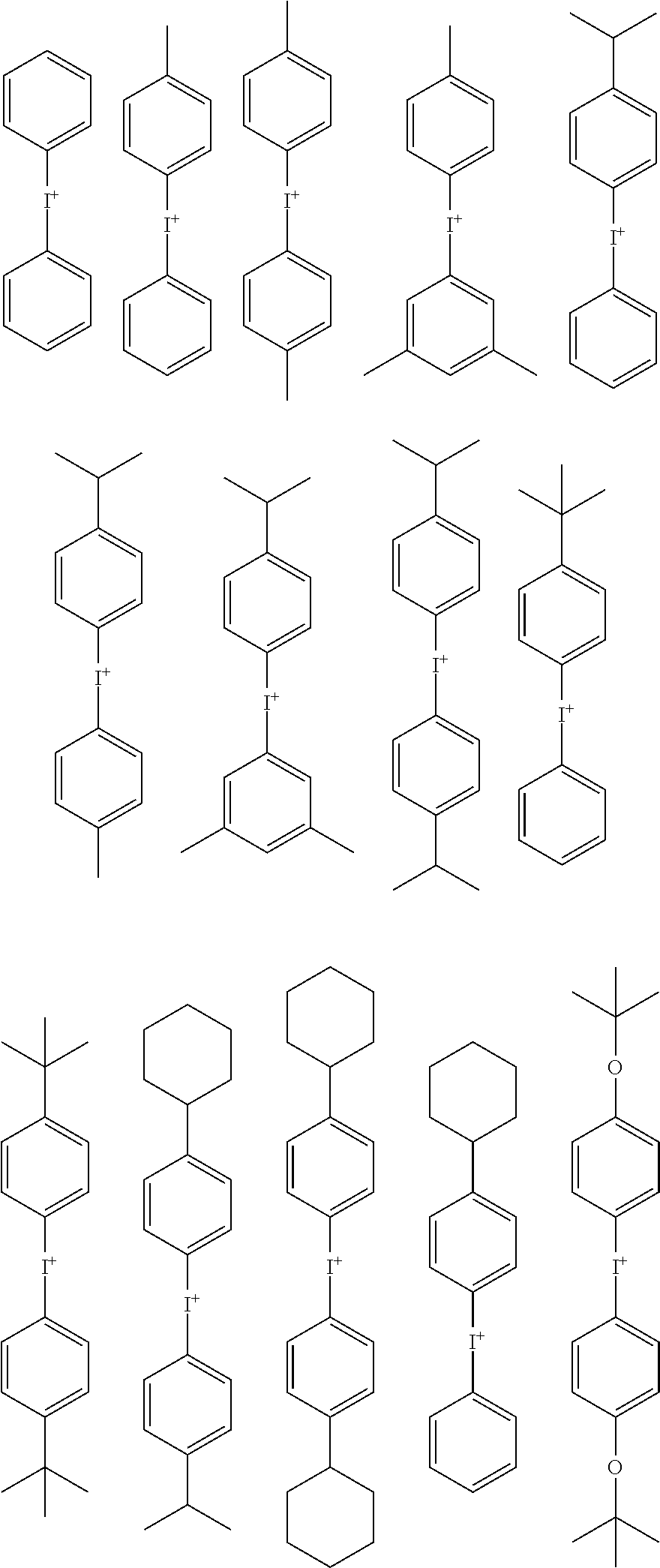
  • sulfonium salts having the formula (1-1) and iodonium salts having the formula (1-2) are also preferred.
  • Suitable halogen atoms include fluorine, chlorine, bromine and iodine.
  • the C 1 -C 20 hydrocarbyl group represented by R 101 to R 105 may be saturated or unsaturated and straight, branched or cyclic. Examples thereof include C 1 -C 20 alkyl groups such as methyl, ethyl, n-propyl, isopropyl, n-butyl, isobutyl, sec-butyl, tert-butyl, n-pentyl, n-hexyl, n-octyl, n-nonyl, n-decyl, undecyl, dodecyl, tridecyl, tetradecyl, pentadecyl, heptadecyl, octadecyl, nonadecyl and icosyl; C 3 -C 20 cyclic saturated hydrocarbyl groups such as cyclopropyl, cyclopentyl, cyclohexyl, cyclopropylmethyl,
  • substituted forms of the foregoing groups in which some or all of the hydrogen atoms are substituted by a moiety containing a heteroatom such as oxygen, sulfur, nitrogen or halogen, or some carbon is replaced by a moiety containing a heteroatom such as oxygen, sulfur or nitrogen, so that the group may contain a hydroxyl moiety, cyano moiety, carbonyl moiety, ether bond, ester bond, sulfonic acid ester bond, carbonate moiety, lactone ring, sultone ring, carboxylic anhydride or haloalkyl moiety.
  • a pair of R 101 and R 102 may bond together to form a ring with the sulfur atom to which they are attached.
  • Preferred are those rings of the structure shown below.
  • the broken line denotes a point of attachment to R 103 .
  • Xa ⁇ is an anion of the following formula (1A), (1B), (1C) or (1D).
  • R fa is fluorine or a C 1 -C 40 hydrocarbyl group which may contain a heteroatom.
  • the hydrocarbyl group may be saturated or unsaturated and straight, branched or cyclic. Examples thereof are as will be exemplified later for hydrocarbyl group R 111 in formula (1A′).
  • R HF is hydrogen or trifluoromethyl, preferably trifluoromethyl.
  • R 111 is a C 1 -C 38 hydrocarbyl group which may contain a heteroatom. Suitable heteroatoms include oxygen, nitrogen, sulfur and halogen, with oxygen being preferred. Of the hydrocarbyl groups, those of 6 to 30 carbon atoms are preferred because a high resolution is available in fine pattern formation.
  • the hydrocarbyl group R 111 may be saturated or unsaturated and straight, branched or cyclic.
  • Suitable hydrocarbyl groups include C 1 -C 38 alkyl groups such as methyl, ethyl, propyl, isopropyl, butyl, isobutyl, sec-butyl, tert-butyl, pentyl, neopentyl, hexyl, heptyl, 2-ethylhexyl, nonyl, undecyl, tridecyl, pentadecyl, heptadecyl, icosanyl; C 3 -C 38 cyclic saturated hydrocarbyl groups such as cyclopentyl, cyclohexyl, 1-adamantyl, 2-adamantyl, 1-adamantylmethyl, norbornyl, norbornylmethyl, tricyclodecanyl, tetracyclododecanyl, tetracyclododecanylnethyl, dicyclohexylmethyl; C 2 -C 38
  • R fb1 and R fb2 are each independently fluorine or a C 1 -C 40 hydrocarbyl group which may contain a heteroatom.
  • the hydrocarbyl group may be saturated or unsaturated and straight, branched or cyclic. Suitable hydrocarbyl groups are as exemplified above for R 111 in formula (1A′).
  • R fb1 and R fb2 each are fluorine or a straight C 1 -C 4 fluorinated alkyl group.
  • a pair of R fb1 and R fb2 may bond together to form a ring with the linkage (—CF 2 —SO 2 —N—SO 2 —CF 2 —) to which they are attached, and the ring-forming pair is preferably a fluorinated ethylene or fluorinated propylene group.
  • R fc1 , R fc2 and R fc3 are each independently fluorine or a C 1 -C 40 hydrocarbyl group which may contain a heteroatom.
  • the hydrocarbyl group may be saturated or unsaturated and straight, branched or cyclic. Suitable hydrocarbyl groups are as exemplified above for R 111 in formula (1A′).
  • R fc1 , R fc2 and R fc3 each are fluorine or a straight C 1 -C 4 fluorinated alkyl group.
  • a pair of R fc1 and R fc2 may bond together to form a ring with the linkage (—CF 2 —SO 2 —C ⁇ —SO 2 —CF 2 —) to which they are attached, and the ring-forming pair is preferably a fluorinated ethylene or fluorinated propylene group.
  • R fd is a C 1 -C 40 hydrocarbyl group which may contain a heteroatom.
  • the hydrocarbyl group may be saturated or unsaturated and straight, branched or cyclic. Suitable hydrocarbyl groups are as exemplified above for R 111 .
  • the compound having the anion of formula (1D) has a sufficient acid strength to cleave acid labile groups in the base polymer because it is free of fluorine at ⁇ -position of sulfo group, but has two trifluoromethyl groups at ⁇ -position. Thus the compound is a useful PAG.
  • R 201 and R 202 are each independently halogen or a C 1 -C 30 hydrocarbyl group which may contain a heteroatom.
  • R 203 is a C 1 -C 30 hydrocarbylene group which may contain a heteroatom. Any two of R 201 , R 202 and R 203 may bond together to form a ring with the sulfur atom to which they are attached. Exemplary rings are the same as described above for the ring that R 101 and R 102 in formula (1-1), taken together, form with the sulfur atom to which they are attached.
  • the hydrocarbyl groups R 201 and R 202 may be saturated or unsaturated and straight, branched or cyclic. Examples thereof include C 1 -C 30 alkyl groups such as methyl, ethyl, propyl, isopropyl, n-butyl, sec-butyl, tert-butyl, n-pentyl, tert-pentyl, n-hexyl, n-octyl, 2-ethylhexyl, n-nonyl, and n-decyl; C 3 -C 30 cyclic saturated hydrocarbyl groups such as cyclopentyl, cyclohexyl, cyclopentylmethyl, cyclopentylethyl, cyclopentylbutyl, cyclohexylmethyl, cyclohexylethyl, cyclohexylbutyl, norbornyl, oxanorbornyl, tricycl
  • some or all of the hydrogen atoms may be substituted by a moiety containing a heteroatom such as oxygen, sulfur, nitrogen or halogen, or some carbon may be replaced by a moiety containing a heteroatom such as oxygen, sulfur or nitrogen, so that the group may contain a hydroxyl, cyano, carbonyl, ether bond, ester bond, sulfonic acid ester bond, carbonate moiety, lactone ring, sultone ring, carboxylic anhydride or haloalkyl moiety.
  • some or all of the hydrogen atoms may be substituted by a moiety containing a heteroatom such as oxygen, sulfur, nitrogen or halogen, or some carbon may be replaced by a moiety containing a heteroatom such as oxygen, sulfur or nitrogen, so that the group may contain a hydroxyl, cyano, carbonyl, ether bond, ester bond, sulfonic acid ester bond, carbonate, lactone ring, sultone ring, carboxylic anhydride or haloalkyl moiety.
  • oxygen is preferred.
  • L A is a single bond, ether bond or a C 1 -C 20 hydrocarbylene group which may contain a heteroatom.
  • the hydrocarbylene group may be saturated or unsaturated and straight, branched or cyclic. Examples thereof are as exemplified above for R 203 .
  • X A , X B , X C and X D are each independently hydrogen, fluorine or trifluoromethyl, with the proviso that at least one of X A , X B , X C and X D is fluorine or trifluoromethyl.
  • L A is as defined above.
  • R HF is hydrogen or trifluoromethyl, preferably trifluoromethyl.
  • R 301 , R 302 and R 303 are each independently hydrogen or a C 1 -C 20 hydrocarbyl group which may contain a heteroatom.
  • the hydrocarbyl group may be saturated or unsaturated and straight, branched or cyclic. Examples thereof are as exemplified above for R 111 in formula (1A′).
  • the subscripts x and y are each independently an integer of 0 to 5, and z is an integer of 0 to 4.
  • Examples of the PAG having formula (2) are as exemplified for the PAG having formula (2) in JP-A 2017-026980.
  • sulfonium and iodonium salts having an anion containing an iodized or brominated aromatic ring are useful PAGs. These salts typically have the formulae (3-1) and (3-2).
  • p is an integer of 1 to 3; q is an integer of 1 to 5, and r is an integer of 0 to 3, meeting 1 ⁇ q+r ⁇ 5.
  • q is 1, 2 or 3, more preferably 2 or 3, and r is 0, 1 or 2.
  • X BI is iodine or bromine, and groups X BI may be identical or different when p and/or q is 2 or more.
  • L 1 is a single bond, ether bond, ester bond, or a C 1 -C 6 saturated hydrocarbylene group which may contain an ether bond or ester bond.
  • the saturated hydrocarbylene group may be straight, branched or cyclic.
  • R 401 is hydroxyl, carboxyl, fluorine, chlorine, bromine, amino or a C 1 -C 20 saturated hydrocarbyl group, C 1 -C 20 saturated hydrocarbyloxy group, C 2 -C 20 saturated hydrocarbylcarbonyl, C 2 -C 20 saturated hydrocarbyloxycarbonyl group, C 2 -C 20 saturated hydrocarbylcarbonyloxy or C 1 -C 20 saturated hydrocarbylsulfonyloxy group, which may contain fluorine, chlorine, bromine, hydroxyl, amino or ether bond, or —N(R 401A )(R 401B ), —N(R 401C )—C( ⁇ O)—R 401D or —N(R 401C )—C( ⁇ O)—O—R 401D .
  • R 401A and R 401B are each independently hydrogen or a C 1 -C 6 saturated hydrocarbyl group.
  • R 401C is hydrogen or a C 1 -C 6 saturated hydrocarbyl group which may contain halogen, hydroxyl, C 1 -C 6 saturated hydrocarbyloxy, C 2 -C 6 saturated hydrocarbylcarbonyl or C 2 -C 6 saturated hydrocarbylcarbonyloxy moiety.
  • R 401D is a C 1 -C 16 aliphatic hydrocarbyl group, C 6 -C 14 aryl group or C 7 -C 15 aralkyl group, which may contain halogen, hydroxyl, a C 1 -C 6 saturated hydrocarbyloxy, C 2 -C 6 saturated hydrocarbylcarbonyl, or C 2 -C 6 saturated hydrocarbylcarbonyloxy moiety.
  • the aliphatic hydrocarbyl group may be saturated or unsaturated and straight, branched or cyclic.
  • the saturated hydrocarbyl, saturated hydrocarbyloxy, saturated hydrocarbyloxycarbonyl, saturated hydrocarbylcarbonyl and saturated hydrocarbylcarbonyloxy groups may be straight, branched or cyclic.
  • groups R 401 may be identical or different.
  • R 401 is preferably selected from hydroxyl, —N(R 401C )—C( ⁇ O)—R 401D , —N(R 401C )—C( ⁇ O)—O—R 401D , fluorine, chlorine, bromine, methyl, and methoxy.
  • Rf 1 to Rf 4 are each independently hydrogen, fluorine or trifluoromethyl, at least one thereof being fluorine or trifluoromethyl. Also Rf 1 and Rf 2 , taken together, may form a carbonyl group. Most preferably both Rf 3 and Rf 4 are fluorine.
  • R 402 to R 116 are each independently halogen or a C 1 -C 20 hydrocarbyl group which may contain a heteroatom.
  • the hydrocarbyl group may be saturated or unsaturated and straight, branched or cyclic. Examples thereof are as exemplified above for the hydrocarbyl groups R 101 to R 105 in formulae (1-1) and (1-2).
  • some or all of the hydrogen atoms may be substituted by hydroxyl, carboxyl, halogen, cyano, nitro, mercapto, sultone, sulfone, or sulfonium salt-containing moiety; or some carbon may be replaced by an ether bond, ester bond, carbonyl, amide bond, carbonate or sulfonic acid ester bond.
  • a pair of R 402 and R 43 may bond together to form a ring with the sulfur atom to which they are attached. Examples of the ring are as exemplified above for the ring that R 101 and R 102 in formula (1-1), taken together, form with the sulfur atom to which they are attached.
  • the cation in the sulfonium salt having formula (3-1) is as exemplified above for the cation in the sulfonium salt having formula (1-1).
  • the cation in the iodonium salt having formula (3-2) is as exemplified above for the cation in the iodonium salt having formula (1-2).
  • the resist composition contains the acid generator of addition type
  • its content is preferably 0.1 to 50 parts by weight, and more preferably 1 to 40 parts by weight per 100 parts by weight of the base polymer.
  • the resist composition functions as a chemically amplified resist composition.
  • organic solvent may be added to the resist composition.
  • the organic solvent used herein is not particularly limited as long as the foregoing and other components are soluble therein. Examples of the organic solvent are described in JP-A 2008-111103, paragraphs [0144]-[0145] (U.S. Pat. No. 7,537,880).
  • Exemplary solvents include ketones such as cyclohexanone, cyclopentanone, methyl-2-n-pentyl ketone and 2-heptanone; alcohols such as 3-methoxybutanol, 3-methyl-3-methoxybutanol, 1-methoxy-2-propanol, 1-ethoxy-2-propanol, and diacetone alcohol (DAA); ethers such as propylene glycol monomethyl ether (PGME), ethylene glycol monomethyl ether, propylene glycol monoethyl ether, ethylene glycol monoethyl ether, propylene glycol dimethyl ether, and diethylene glycol dimethyl ether; esters such as propylene glycol monomethyl ether acetate (PGMEA), propylene glycol monoethyl ether acetate, ethyl lactate, ethyl pyruvate, butyl acetate, methyl 3-methoxypropionate, ethyl 3-ethoxy
  • the organic solvent is preferably added in an amount of 100 to 10,000 parts, and more preferably 200 to 8,000 parts by weight per 100 parts by weight of the base polymer.
  • a surfactant such as a surfactant, dissolution inhibitor, crosslinker, and quencher other than salt compound A may be blended in any desired combination to formulate a chemically amplified positive or negative resist composition.
  • This positive or negative resist composition has a very high sensitivity in that the dissolution rate in developer of the base polymer in exposed areas is accelerated by catalytic reaction.
  • the resist film has a high dissolution contrast, resolution, exposure latitude, and process adaptability, and provides a good pattern profile after exposure, and minimal proximity bias because of restrained acid diffusion.
  • the other quencher is typically selected from conventional basic compounds.
  • Conventional basic compounds include primary, secondary, and tertiary aliphatic amines, mixed amines, aromatic amines, heterocyclic amines, nitrogen-containing compounds with carboxyl group, nitrogen-containing compounds with sulfonyl group, nitrogen-containing compounds with hydroxyl group, nitrogen-containing compounds with hydroxyphenyl group, alcoholic nitrogen-containing compounds, amide derivatives, imide derivatives, and carbamate derivatives.
  • primary, secondary, and tertiary amine compounds specifically amine compounds having a hydroxyl group, ether bond, ester bond, lactone ring, cyano group, or sulfonic acid ester bond as described in JP-A 2008-111103, paragraphs [0146]-[0164], and compounds having a carbamate group as described in JP 3790649.
  • Addition of a basic compound may be effective for further suppressing the diffusion rate of acid in the resist film or correcting the pattern profile.
  • Onium salts such as sulfonium salts, iodonium salts and ammonium salts of sulfonic acids which are not fluorinated at ⁇ -position as described in U.S. Pat. No. 8,795,942 (JP-A 2008-158339) and similar onium salts of carboxylic acid may also be used as the other quencher. While an ⁇ -fluorinated sulfonic acid, imide acid, and methide acid are necessary to deprotect the acid labile group of carboxylic acid ester, an ⁇ -non-fluorinated sulfonic acid and a carboxylic acid are released by salt exchange with an ⁇ -non-fluorinated onium salt.
  • An ⁇ -non-fluorinated sulfonic acid and a carboxylic acid function as a quencher because they do not induce deprotection reaction.
  • the quencher of onium salt type is photo-decomposed to lose its quencher function so that the acid may turn more active, leading to an improved contrast.
  • salt compound A has a very high acid diffusion controlling effect not only in the unexposed region, but also in the exposed region, it is less effective for improving contrast.
  • salt compound A By combining salt compound A with a quencher of onium salt type, low acid diffusion and high contrast can be achieved in good balance.
  • quenchers of polymer type as described in U.S. Pat. No. 7,598,016 (JP-A 2008-239918).
  • the polymeric quencher segregates at the resist surface after coating and thus enhances the rectangularity of resist pattern.
  • the polymeric quencher is also effective for preventing a film thickness loss of resist pattern or rounding of pattern top.
  • the other quencher is preferably added in an amount of 0 to 5 parts, more preferably 0 to 4 parts by weight per 100 parts by weight of the base polymer.
  • the other quencher may be used alone or in admixture.
  • Exemplary surfactants are described in JP-A 2008-111103, paragraphs [0165]-[0166]. Inclusion of a surfactant may improve or control the coating characteristics of the resist composition. While the surfactant may be used alone or in admixture, it is preferably added in an amount of 0.0001 to 10 parts by weight per 100 parts by weight of the base polymer.
  • the dissolution inhibitor which can be used herein is a compound having at least two phenolic hydroxyl groups on the molecule, in which an average of from 0 to 100 mol % of all the hydrogen atoms on the phenolic hydroxyl groups are replaced by acid labile groups or a compound having at least one carboxyl group on the molecule, in which an average of 50 to 100 mol % of all the hydrogen atoms on the carboxyl groups are replaced by acid labile groups, both the compounds having a molecular weight of 100 to 1,000, and preferably 150 to 800.
  • Typical are bisphenol A, trisphenol, phenolphthalein, cresol novolac, naphthalenecarboxylic acid, adamantanecarboxylic acid, and cholic acid derivatives in which the hydrogen atom on the hydroxyl or carboxyl group is replaced by an acid labile group, as described in U.S. Pat. No. 7,771,914 (JP-A 2008-122932, paragraphs [0155]-[0178]).
  • the dissolution inhibitor is preferably added in an amount of 0 to 50 parts, more preferably 5 to 40 parts by weight per 100 parts by weight of the base polymer.
  • the dissolution inhibitor may be used alone or in admixture.
  • a negative pattern may be formed by adding a crosslinker to reduce the dissolution rate of a resist film in exposed area.
  • Suitable crosslinkers include epoxy compounds, melamine compounds, guanamine compounds, glycoluril compounds and urea compounds having substituted thereon at least one group selected from among methylol, alkoxymethyl and acyloxymethyl groups, isocyanate compounds, azide compounds, and compounds having a double bond such as an alkenyloxy group. These compounds may be used as an additive or introduced into a polymer side chain as a pendant. Hydroxy-containing compounds may also be used as the crosslinker.
  • epoxy compound examples include tris(2,3-epoxypropyl) isocyanurate, trimethylolmethane triglycidyl ether, trimethylolpropane triglycidyl ether, and triethylolethane triglycidyl ether.
  • the melamine compound examples include hexamethylol melamine, hexamethoxymethyl melamine, hexamethylol melamine compounds having 1 to 6 methylol groups methoxymethylated and mixtures thereof, hexamethoxyethyl melamine, hexaacyloxymethyl melamine, hexamethylol melamine compounds having 1 to 6 methylol groups acyloxymethylated and mixtures thereof.
  • guanamine compound examples include tetramethylol guanamine, tetramethoxymethyl guanamine, tetramethylol guanamine compounds having 1 to 4 methylol groups methoxymethylated and mixtures thereof, tetramethoxyethyl guanamine, tetraacyloxyguanamine, tetramethylol guanamine compounds having 1 to 4 methylol groups acyloxymethylated and mixtures thereof.
  • glycoluril compound examples include tetramethylol glycoluril, tetramethoxyglycoluril, tetramethoxymethyl glycoluril, tetramethylol glycoluril compounds having 1 to 4 methylol groups methoxymethylated and mixtures thereof, tetramethylol glycoluril compounds having 1 to 4 methylol groups acyloxymethylated and mixtures thereof.
  • urea compound include tetramethylol urea, tetramethoxymethyl urea, tetramethylol urea compounds having 1 to 4 methylol groups methoxymethylated and mixtures thereof, and tetramethoxyethyl urea.
  • Suitable isocyanate compounds include tolylene diisocyanate, diphenylmethane diisocyanate, hexamethylene diisocyanate and cyclohexane diisocyanate.
  • Suitable azide compounds include 1,1′-biphenyl-4,4′-bisazide, 4,4′-methylidenebisazide, and 4,4′-oxybisazide.
  • alkenyloxy group-containing compound examples include ethylene glycol divinyl ether, triethylene glycol divinyl ether, 1,2-propanediol divinyl ether, 1,4-butanediol divinyl ether, tetramethylene glycol divinyl ether, neopentyl glycol divinyl ether, trimethylol propane trivinyl ether, hexanediol divinyl ether, 1,4-cyclohexanediol divinyl ether, pentaerythritol trivinyl ether, pentaerythritol tetravinyl ether, sorbitol tetravinyl ether, sorbitol pentavinyl ether, and trimethylol propane trivinyl ether.
  • the crosslinker is preferably added in an amount of 0.1 to 50 parts, more preferably 1 to 40 parts by weight per 100 parts by weight of the base polymer.
  • the crosslinker may be used alone or in admixture.
  • a water repellency improver may also be added for improving the water repellency on surface of a resist film.
  • the water repellency improver may be used in the topcoatless immersion lithography.
  • Suitable water repellency improvers include polymers having a fluoroalkyl group and polymers having a specific structure with a 1,1,1,3,3,3-hexafluoro-2-propanol residue and are described in JP-A 2007-297590 and JP-A 2008-111103, for example.
  • the water repellency improver to be added to the resist composition should be soluble in the alkaline developer and organic solvent developer.
  • the water repellency improver of specific structure with a 1,1,1,3,3,3-hexafluoro-2-propanol residue is well soluble in the developer.
  • a polymer having an amino group or amine salt copolymerized as recurring units may serve as the water repellent additive and is effective for preventing evaporation of acid during PEB, thus preventing any hole pattern opening failure after development.
  • An appropriate amount of the water repellency improver is 0 to 20 parts, more preferably 0.5 to 10 parts by weight per 100 parts by weight of the base polymer.
  • the water repellency improver may be used alone or in admixture.
  • an acetylene alcohol may be blended in the resist composition. Suitable acetylene alcohols are described in JP-A 2008-122932, paragraphs [0179]-[0182]. An appropriate amount of the acetylene alcohol blended is 0 to 5 parts by weight per 100 parts by weight of the base polymer. The acetylene alcohol may be used alone or in admixture.
  • the resist composition is used in the fabrication of various integrated circuits. Pattern formation using the resist composition may be performed by well-known lithography processes. The process generally involves the steps of applying the resist composition to form a resist film on a substrate, exposing the resist film to high-energy radiation, and developing the exposed resist film in a developer. If necessary, any additional steps may be added.
  • the resist composition is first applied onto a substrate on which an integrated circuit is to be formed (e.g., Si, SiO 2 , SiN, SiON, TiN, WSi, BPSG, SOG, or organic antireflective coating) or a substrate on which a mask circuit is to be formed (e.g., Cr, CrO, CrON, MoSi 2 , or SiO 2 ) by a suitable coating technique such as spin coating, roll coating, flow coating, dipping, spraying or doctor coating.
  • the coating is prebaked on a hot plate at a temperature of 60 to 150° C. for 10 seconds to 30 minutes, preferably at 80 to 120° C. for 30 seconds to 20 minutes.
  • the resulting resist film is generally 0.01 to 2 ⁇ m thick.
  • the resist film is then exposed to a desired pattern of high-energy radiation such as UV, deep-UV, EB, EUV of wavelength 3 to 15 nm, x-ray, soft x-ray, excimer laser light, ⁇ -ray or synchrotron radiation.
  • high-energy radiation such as UV, deep-UV, EUV, x-ray, soft x-ray, excimer laser light, ⁇ -ray or synchrotron radiation.
  • the resist film is exposed thereto directly or through a mask having a desired pattern in a dose of preferably about 1 to 200 mJ/cm 2 , more preferably about 10 to 100 mJ/cm 2 .
  • the resist film is exposed thereto directly or through a mask having a desired pattern in a dose of preferably about 0.1 to 100 ⁇ C/cm 2 , more preferably about 0.5 to 50 ⁇ C/cm 2 .
  • inventive resist composition is suited in micropatterning using KrF excimer laser, ArF excimer laser, EB, EUV, x-ray, soft x-ray, ⁇ -ray or synchrotron radiation, especially in micropatterning using EB or EUV.
  • the resist film may be baked (PEB) on a hot plate or in an oven at 60 to 150° C. for 10 seconds to 30 minutes, preferably at 80 to 120° C. for 30 seconds to 20 minutes.
  • PEB baked
  • the resist film is developed in a developer in the form of an aqueous base solution for 3 seconds to 3 minutes, preferably 5 seconds to 2 minutes by conventional techniques such as dip, puddle and spray techniques.
  • a typical developer is a 0.1 to 10 wt %, preferably 2 to 5 wt/o aqueous solution of tetramethylammonium hydroxide (TMAH), tetraethylammonium hydroxide (TEAH), tetrapropylammonium hydroxide (TPAH), or tetrabutylammonium hydroxide (TBAH).
  • TMAH tetramethylammonium hydroxide
  • TEAH tetraethylammonium hydroxide
  • TPAH tetrapropylammonium hydroxide
  • TBAH tetrabutylammonium hydroxide
  • the resist film in the exposed area is dissolved in the developer whereas the resist film in the unexposed area is not dissolved. In this
  • a negative pattern may be formed via organic solvent development using a positive resist composition comprising a base polymer having an acid labile group.
  • the developer used herein is preferably selected from among 2-octanone, 2-nonanone, 2-heptanone, 3-heptanone, 4-heptanone, 2-hexanone, 3-hexanone, diisobutyl ketone, methylcyclohexanone, acetophenone, methylacetophenone, propyl acetate, butyl acetate, isobutyl acetate, pentyl acetate, butenyl acetate, isopentyl acetate, propyl formate, butyl formate, isobutyl formate, pentyl formate, isopentyl formate, methyl valerate, methyl pentenoate, methyl crotonate, ethyl crotonate, methyl propionate, ethyl propionate, ethy
  • the resist film is rinsed.
  • a solvent which is miscible with the developer and does not dissolve the resist film is preferred.
  • Suitable solvents include alcohols of 3 to 10 carbon atoms, ether compounds of 8 to 12 carbon atoms, alkanes, alkenes, and alkynes of 6 to 12 carbon atoms, and aromatic solvents.
  • suitable alcohols of 3 to 10 carbon atoms include n-propyl alcohol, isopropyl alcohol, 1-butyl alcohol, 2-butyl alcohol, isobutyl alcohol, tert-butyl alcohol, 1-pentanol, 2-pentanol, 3-pentanol, tert-pentyl alcohol, neopentyl alcohol, 2-methyl-1-butanol, 3-methyl-1-butanol, 3-methyl-3-pentanol, cyclopentanol, 1-hexanol, 2-hexanol, 3-hexanol, 2,3-dimethyl-2-butanol, 3,3-dimethyl-1-butanol, 3,3-dimethyl-2-butanol, 2-ethyl-1-butanol, 2-methyl-1-pentanol, 2-methyl-2-pentanol, 2-methyl-3-pentanol, 3-methyl-1-pentanol, 3-methyl-2-pentanol, 3-
  • Suitable ether compounds of 8 to 12 carbon atoms include di-n-butyl ether, diisobutyl ether, di-sec-butyl ether, di-n-pentyl ether, diisopentyl ether, di-sec-pentyl ether, di-tert-pentyl ether, and di-n-hexyl ether.
  • Suitable alkanes of 6 to 12 carbon atoms include hexane, heptane, octane, nonane, decane, undecane, dodecane, methylcyclopentane, dimethylcyclopentane, cyclohexane, methylcyclohexane, dimethylcyclohexane, cycloheptane, cyclooctane, and cyclononane.
  • Suitable alkenes of 6 to 12 carbon atoms include hexene, heptene, octene, cyclohexene, methylcyclohexene, dimethylcyclohexene, cycloheptene, and cyclooctene.
  • Suitable alkynes of 6 to 12 carbon atoms include hexyne, heptyne, and octyne.
  • Suitable aromatic solvents include toluene, xylene, ethylbenzene, isopropylbenzene, tert-butylbenzene and mesitylene. The solvents may be used alone or in admixture.
  • Rinsing is effective for minimizing the risks of resist pattern collapse and defect formation. However, rinsing is not essential. If rinsing is omitted, the amount of solvent used may be reduced.
  • a hole or trench pattern after development may be shrunk by the thermal flow, RELACS® or DSA process.
  • a hole pattern is shrunk by coating a shrink agent thereto, and baking such that the shrink agent may undergo crosslinking at the resist surface as a result of the acid catalyst diffusing from the resist layer during bake, and the shrink agent may attach to the sidewall of the hole pattern.
  • the bake is preferably at a temperature of 70 to 180° C., more preferably 80 to 170° C., for a time of 10 to 300 seconds. The extra shrink agent is stripped and the hole pattern is shrunk.
  • Quenchers Q-1 to Q-35, an amine compound (designated Amine-1) and a HFA group-containing compound (designated HFA-1) used in resist compositions have the structure shown below.
  • Each of base polymers P-1 to P-4 was prepared by combining suitable monomers, effecting copolymerization reaction thereof in tetrahydrofuran (THF) solvent, pouring the reaction solution into methanol for crystallization, repeatedly washing with hexane, isolation, and drying.
  • THF tetrahydrofuran
  • the resulting polymer was analyzed for composition by 1H-NMR spectroscopy, and for Mw and Mw/Mn by GPC versus polystyrene standards using THE solvent.
  • Resist compositions were prepared by dissolving various components in a solvent in accordance with the recipe shown in Tables 1 to 4, and filtering through a filter having a pore size of 0.2 ⁇ m.
  • the resist compositions of Examples 1 to 23, 25 to 40 and Comparative Examples 1 to 6 are of positive tone, and the resist compositions of Example 24 and Comparative Example 7 are of negative tone.
  • Each of the resist compositions in Tables 1 to 4 was spin coated on a silicon substrate having a 20-nm coating of silicon-containing spin-on hard mask SHB-A940 (Shin-Etsu Chemical Co., Ltd., Si content 43 wt %) and prebaked on a hotplate at 100° C. for 60 seconds to form a resist film of 50 nm thick.
  • SHB-A940 Silicon-containing spin-on hard mask
  • the resist film was baked (PEB) on a hotplate at the temperature shown in Tables 1 to 4 for 60 seconds and developed in a 2.38 wt % TMAH aqueous solution for 30 seconds to form a hole pattern having a size of 22 nm in Examples 1 to 23, 25 to 45 and Comparative Examples 1 to 6 and a dot pattern having a size of 22 nm in Example 24 and Comparative Example 7.
  • the resist pattern was observed under CD-SEM (CG-5000, Hitachi High-Technologies Corp.). The exposure dose that provides a hole or dot pattern having a size of 22 nm is reported as sensitivity. The size of 50 holes or dots was measured, from which a 3-fold value (3a) of standard deviation (a) was computed and reported as size variation or CDU.
  • the resist composition is shown in Tables 1 to 4 together with the sensitivity and CDU of EUV lithography.

Landscapes

  • Physics & Mathematics (AREA)
  • Chemical & Material Sciences (AREA)
  • Spectroscopy & Molecular Physics (AREA)
  • General Physics & Mathematics (AREA)
  • Organic Chemistry (AREA)
  • Health & Medical Sciences (AREA)
  • Medicinal Chemistry (AREA)
  • Polymers & Plastics (AREA)
  • Chemical Kinetics & Catalysis (AREA)
  • Emergency Medicine (AREA)
  • Life Sciences & Earth Sciences (AREA)
  • Engineering & Computer Science (AREA)
  • Materials Engineering (AREA)
  • Wood Science & Technology (AREA)
  • Materials For Photolithography (AREA)
  • Exposure And Positioning Against Photoresist Photosensitive Materials (AREA)
  • Addition Polymer Or Copolymer, Post-Treatments, Or Chemical Modifications (AREA)

Abstract

A resist composition is provided comprising a base polymer and a quencher comprising a salt compound obtained from a nitrogen-containing compound having an iodine or bromine-substituted hydrocarbyl group (exclusive of iodine or bromine-substituted aromatic ring) bonded to the nitrogen atom via an ester bond-containing group and a compound having a 1,1,1,3,3,3-hexafluoro-2-propanol group. The resist composition has a high sensitivity and forms a pattern with improved LWR or CDU, independent of whether it is of positive or negative tone.

Description

CROSS-REFERENCE TO RELATED APPLICATION
This non-provisional application claims priority under 35 U.S.C. § 119(a) on Patent Application No. 2020-105175 filed in Japan on Jun. 18, 2020, the entire contents of which are hereby incorporated by reference.
TECHNICAL FIELD
This invention relates to a resist composition and a pattern forming process.
BACKGROUND ART
To meet the demand for higher integration density and operating speed of LSIs, the effort to reduce the pattern rule is in rapid progress. In particular, the enlargement of the logic memory market to comply with the wide-spread use of smart phones drives forward the miniaturization technology. As the advanced miniaturization technology, manufacturing of microelectronic devices at the 10-nm node by double patterning of the ArF immersion lithography has been implemented in a mass scale. Manufacturing of 7-nm node devices as the next generation by the double patterning technology is approaching to the verge of high-volume application. The candidate for 5-nm node devices as the next generation but one is EUV lithography.
As the pattern feature size is reduced, approaching to the diffraction limit of light, light contrast lowers. In the case of positive resist film, a lowering of light contrast leads to reductions of resolution and focus margin of hole and trench patterns. For preventing any influence of a reduction of resolution of resist pattern due to a lowering of light contrast, an attempt is made to enhance the dissolution contrast of resist film.
Chemically amplified resist compositions comprising an acid generator capable of generating an acid upon exposure to light or EB include chemically amplified positive resist compositions wherein deprotection reaction takes place under the action of acid and chemically amplified negative resist compositions wherein polarity switch or crosslinking reaction takes place under the action of acid. Quenchers are often added to these resist compositions for the purpose of controlling the diffusion of the acid to unexposed region to improve the contrast. The addition of quenchers is fully effective to this purpose. A number of amine quenchers were proposed as disclosed in Patent Documents 1 to 3.
With respect to the acid labile group used in (meth)acrylate polymers for the ArF lithography resist material, deprotection reaction takes place when a photoacid generator capable of generating a sulfonic acid having fluorine substituted at α-position (referred to “α-fluorinated sulfonic acid”) is used, but not when an acid generator capable of generating to a sulfonic acid not having fluorine substituted at α-position (referred to “α-non-fluorinated sulfonic acid”) or carboxylic acid is used. If a sulfonium or iodonium salt capable of generating an α-fluorinated sulfonic acid is combined with a sulfonium or iodonium salt capable of generating an α-non-fluorinated sulfonic acid, the sulfonium or iodonium salt capable of generating an α-non-fluorinated sulfonic acid undergoes ion exchange with the α-fluorinated sulfonic acid. Through the ion exchange, the α-fluorinated sulfonic acid thus generated by light exposure is converted back to the sulfonium or iodonium salt while the sulfonium or iodonium salt of an α-non-fluorinated sulfonic acid or carboxylic acid functions as a quencher. Patent Document 4 discloses a resist material comprising a sulfonium or iodonium salt capable of generating carboxylic acid as a quencher.
Like photoacid generators, quenchers of sulfonium and iodonimn salt type are photo-decomposable. Thus, the amount of quencher in the exposed region is reduced. Since acid is generated in the exposed region, the reduced amount of quencher leads to a relatively increased concentration of acid and hence, an improved contrast. However, the acid diffusion in the exposed region is not suppressed, indicating the difficulty of acid diffusion control.
Patent Documents 5 and 6 disclose resist compositions comprising iodine-substituted aniline compounds. Since the aniline compounds have a low basicity and a low acid-capturing capability, their acid diffusion control is not enough. There is a need for a quencher having improved acid diffusion control, high absorbance, and high sensitizing effect.
It is believed that the number of photons absorbed in a resist film upon EUV exposure is 1/14 of that of ArF excimer laser exposure. Non-Patent Document 1 points out that a variation in number of photons, i.e., shot noise causes a variation in size. It is also believed that not only a variation in photon number, but also the uneven distribution of components in a resist film causes a variation in size. Non-Patent Document 2 proposes to develop a resist material comprising uniform components.
CITATION LIST
Patent Document 1: JP-A 2001-194776
Patent Document 2: JP-A 2002-226470
Patent Document 3: JP-A 2002-363148
Patent Document 4: WO 2008/066011
Patent Document 5: JP-A 2013-083957
Patent Document 6: JP-A 2018-097356
Non-Patent Document 1: SPIE Vol. 3331, p 531 (1998)
Non-Patent Document 2: SPIE Vol. 9776, p 97760V-1 (2016)
DISCLOSURE OF INVENTION
For the acid-catalyzed chemically amplified resist material, it is desired to develop a quencher capable of reducing the LWR of line patterns or improving the CDU of hole patterns and increasing sensitivity.
An object of the invention is to provide a resist composition which exhibits a high sensitivity and a reduced LWR or improved CDU, independent of whether it is of positive tone or negative tone; and a pattern forming process using the same.
The inventor has found that using a salt compound obtained from a specific nitrogen-containing compound having an iodine or bromine-substituted hydrocarbyl group (exclusive of iodine or bromine-substituted aromatic ring) and a compound having a 1,1,1,3,3,3-hexafluoro-2-propanol group as the quencher, a resist material having a reduced LWR, improved CDU, high contrast, improved resolution, and wide process margin is obtainable.
In one aspect, the invention provides a resist composition comprising a base polymer and a quencher, the quencher comprising a salt compound obtained from a nitrogen-containing compound having an iodine or bromine-substituted hydrocarbyl group, exclusive of iodine or bromine-substituted aromatic ring, bonded to the nitrogen atom via an ester bond-containing group and a compound having a 1,1,1,3,3,3-hexafluoro-2-propanol group.
Preferably, the salt compound has the formula (A).
Figure US12117728-20241015-C00001

Herein k is an integer of 1 to 3, m1 is 1 or 2, m2 is an integer of 1 to 3, n is an integer of 1 to 4. XBI is iodine or bromine. Rah is a C1-C20 (k+1)-valent aliphatic hydrocarbon group which may contain at least one moiety selected from ether bond, carbonyl, ester bond, amide bond, sultone ring, lactam ring, carbonate, halogen exclusive of iodine, C6-C12 aryl, hydroxyl, and carboxyl. X1 is a single bond, ether bond, ester bond, amide bond, carbonyl group, or carbonate group. R1 is a single bond or a C1-C20 (m1+1)-valent hydrocarbon group which may contain an ether bond, ester bond or hydroxyl moiety. R2 is a single bond or a C1-C20 (m2+1)-valent hydrocarbon group which may contain at least one moiety selected from ether bond, carbonyl, ester bond, amide bond, sultone ring, lactam ring, carbonate, halogen exclusive of iodine, hydroxyl, and carboxyl. R3 is hydrogen, nitro, C1-C20 hydrocarbyl group or C2-C20 hydrocarbyloxycarbonyl group, the hydrocarbyl group or the hydrocarbyl moiety of the hydrocarbyloxycarbonyl group may contain at least one moiety selected from hydroxyl, carboxyl, thiol, ether bond, ester bond, sulfonyl, nitro, cyano, halogen, and amino. In case of n=1, two groups R3 may bond together to form a ring with the nitrogen atom to which they are attached, the ring optionally containing a double bond, oxygen, sulfur or nitrogen, or R3 and R1 may bond together to form a ring with the nitrogen atom to which they are attached, the ring optionally containing a double bond, oxygen, sulfur or nitrogen. R4 is trifluoromethyl, a C2-C21 hydrocarbylcarbonyl group or C2-C21 hydrocarbyloxycarbonyl group, the hydrocarbyl moiety of the hydrocarbylcarbonyl group or hydrocarbyloxycarbonyl group may contain at least one moiety selected from ether bond, ester bond, thiol, cyano, nitro, hydroxyl, sultone, sulfonate bond, amide bond, and halogen.
The resist composition may further comprise an acid generator capable of generating a sulfonic acid, imide acid or methide acid, an organic solvent, and/or a surfactant.
In a preferred embodiment, the base polymer comprises recurring units having the formula (a1) or recurring units having the formula (a2):
Figure US12117728-20241015-C00002

wherein RA is each independently hydrogen or methyl, R11 and R12 are each independently an acid labile group, Y1 is a single bond, phenylene, naphthylene, or a C1-C12 linking group containing an ester bond and/or lactone ring, and Y2 is a single bond or ester bond.
The resist composition is typically a chemically amplified positive resist composition.
In another preferred embodiment, the base polymer is free of an acid labile group.
The resist composition is typically a chemically amplified negative resist composition.
In a preferred embodiment, the base polymer comprises recurring units of at least one type selected from recurring units having the formulae (f1) to (f3).
Figure US12117728-20241015-C00003

Herein RA is each independently hydrogen or methyl. Z1 is a single bond, a C1-C6 aliphatic hydrocarbylene group, phenylene group, naphthylene group, or C7-C18 group obtained by combining the foregoing, or —O—Z11—, —C(═O)—O—Z11— or —C(═O)—NH—Z11—, wherein Z11 is a C1-C6 aliphatic hydrocarbylene group, phenylene group, naphthylene group, or C7-C18 group obtained by combining the foregoing, which may contain a carbonyl moiety, ester bond, ether bond or hydroxyl moiety. Z2 is a single bond, —Z21—C(═O)—O—, —Z21—O— or —Z21—O—C(═O)—, wherein Z21 is a C1-C12 saturated hydrocarbylene group which may contain a carbonyl moiety, ester bond or ether bond. Z3 is a single bond, methylene, ethylene, phenylene, fluorinated phenylene, —O—Z31—, —C(═O)—O—Z31—, or —C(═O)—NH—Z31—, wherein Z31 is a C1-C6 aliphatic hydrocarbylene group, phenylene group, fluorinated phenylene group, or trifluoromethyl-substituted phenylene group, which may contain a carbonyl moiety, ester bond, ether bond or hydroxyl moiety. R21 to R28 are each independently halogen or a C1-C20 hydrocarbyl group which may contain a heteroatom, a pair of R23 and R24 or R26 and R27 may bond together to form a ring with the sulfur atom to which they are attached. RHF is hydrogen or trifluoromethyl. M is a non-nucleophilic counter ion.
In another aspect, the invention provides a pattern forming process comprising the steps of applying the resist composition defined above to form a resist film on a substrate, exposing the resist film to high-energy radiation, and developing the exposed resist film in a developer.
Preferably, the high-energy radiation is ArF excimer laser of wavelength 193 nm, KrF excimer laser of wavelength 248 nm, EB, or EUV of wavelength 3 to 15 nm.
Advantageous Effects of Invention
Since iodine or bromine is contained, the salt compound having formula (A) is highly absorptive to EUV and has a sensitizing effect. Since iodine or bromine has a large atomic weight, the salt compound is highly effective for suppressing acid diffusion. Furthermore, the salt compound lacks photosensitivity so that it is not decomposed even in the exposed region. Therefore, the acid diffusion control ability is high in the exposed region, and a pattern film thickness loss in alkaline developer is suppressed. By virtue of the repulsive effect of fluorine, the quencher in the form of a salt with the compound having a 1,1,1,3,3,3-hexafluoro-2-propanol group is uniformly distributed in the resist film. A resist composition having a high sensitivity, low LWR and improved CDU is thus designed.
DESCRIPTION OF EMBODIMENTS
As used herein, the singular forms “a,” “an” and “the” include plural referents unless the context clearly dictates otherwise. The notation (Cn-Cm) means a group containing from to m carbon atoms per group. The term “group” and “moiety” are interchangeable. The iodine or bromine-substituted compound is also referred to as iodized or brominated compound. In chemical formulae, the broken line designates a valence bond, and Me stands for methyl and Ac for acetyl.
The abbreviations and acronyms have the following meaning.
    • EB: electron beam
    • EUV: extreme ultraviolet
    • Mw: weight average molecular weight
    • Mn: number average molecular weight
    • Mw/Mn: molecular weight dispersity
    • GPC: gel permeation chromatography
    • PEB: post-exposure bake
    • PAG: photoacid generator
    • LWR: line width roughness
    • CDU: critical dimension uniformity
      Resist Composition
The resist composition of the invention is defined as comprising a base polymer and a quencher, the quencher comprising a salt compound obtained from a nitrogen-containing compound having an iodized or brominated hydrocarbyl group, exclusive of iodized or brominated aromatic ring, bonded to the nitrogen atom via an ester bond-containing group and a compound having a 1,1,1,3,3,3-hexafluoro-2-propanol group. The salt compound is referred to as “salt compound A,” hereinafter.
Salt Compound A
The salt compound A preferably has the following formula (A).
Figure US12117728-20241015-C00004
In formula (A), k is an integer of 1 to 3, m1 is 1 or 2, m2 is an integer of 1 to 3, and n is an integer of 1 to 4.
XBI is iodine or bromine.
Rah is a C1-C20 (k+1)-valent aliphatic hydrocarbon group which may contain at least one moiety selected from ether bond, carbonyl, ester bond, amide bond, sultone ring, lactam ring, carbonate, halogen exclusive of iodine, C6-C12 aryl, hydroxyl, and carboxyl.
The aliphatic hydrocarbon group Rah may be saturated or unsaturated and straight, branched or cyclic. Examples thereof include alkanediyl groups such as methanediyl, ethane-1,1-diyl, ethane-1,2-diyl, propane-1,1-diyl, propane-1,2-diyl, propane-1,3-diyl, propane-2,2-diyl, butane-1,1-diyl, butane-1,2-diyl, butane-1,3-diyl, butane-2,3-diyl, butane-1,4-diyl, 1,1-dimethylethane-1,2-diyl, pentane-1,5-diyl, 2-methylbutane-1,2-diyl, hexane-1,6-diyl, heptane-1,7-diyl, octane-1,8-diyl, nonane-1,9-diyl, decane-1,10-diyl, undecane-1,11-diyl, dodecane-1,12-diyl; cycloalkanediyl groups such as cyclopropane-1,1-diyl, cyclopropane-1,2-diyl, cyclobutane-1,1-diyl, cyclobutane-1,2-diyl, cyclobutane-1,3-diyl, cyclopentane-1,1-diyl, cyclopentane-1,2-diyl, cyclopentane-1,3-diyl, cyclohexane-1,1-diyl, cyclohexane-1,2-diyl, cyclohexane-1,3-diyl, cyclohexane-1,4-diyl; polycyclic saturated hydrocarbylene group such as norbornane-2,3-diyl and norbornane-2,6-diyl; alkenediyl groups such as 2-propene-1,1-diyl; alkynediyl groups such as 2-propyne-1,1-diyl; cycloalkenediyl groups such as 2-cyclohexene-1,2-diyl, 2-cyclohexene-1,3-diyl, 3-cyclohexene-1,2-diyl; polycyclic unsaturated hydrocarbylene groups such as 5-norbornene-2,3-diyl; cyclic aliphatic hydrocarbylene-substituted alkanediyl groups such as cyclopentylmethanediyl, cyclohexylmethanediyl, 2-cyclopentenylnethanediyl, 3-cyclopentenylnethanediyl, 2-cyclohexenylmethanediyl, 3-cyclohexenyhnethanediyl; and tri- or tetravalent groups obtained by removing one or two hydrogen atoms from the foregoing groups.
Suitable C6-C12 aryl groups include phenyl, tolyl, xylyl, 1-naphthyl and 2-naphthyl.
In formula (A), X1 is a single bond, ether bond, ester bond, amide bond, carbonyl group, or carbonate group.
In formula (A), R1 is a single bond or a C1-C20 (m1+1)-valent hydrocarbon group which may contain an ether bond, ester bond or hydroxyl moiety. R2 is a single bond or a C1-C20 (m2+1)-valent hydrocarbon group which may contain at least one moiety selected from ether bond, carbonyl, ester bond, amide bond, sultone ring, lactam ring, carbonate, halogen exclusive of iodine, hydroxyl, and carboxyl.
The (m1+1)-valent hydrocarbon group represented by R1 is a group obtained by removing (m1+1) number of hydrogen atoms from a C1-C20 hydrocarbon. The (m2+1)-valent hydrocarbon group represented by R2 is a group obtained by removing (m2+1) number of hydrogen atoms from a C1-C20 hydrocarbon. The hydrocarbon may be saturated or unsaturated and straight, branched or cyclic. Examples thereof include alkanes such as methane, ethane, propane, butane, 2-methylpropane, pentane, 2-methylbutane, hexane, heptane, octane, nonane, decane, undecane, dodecane; cyclic saturated hydrocarbons such as cyclopropane, cyclobutane, cyclopentane, cyclohexane, norbornane, adamantane; alkenes such as ethylene, propene, 1-butene, 2-butene, 2-methylpropene; cyclic unsaturated hydrocarbons such as cyclohexene and norbornene; aromatic hydrocarbons such as benzene, naphthalene, toluene, xylene, anthracene; and substituted forms of the foregoing hydrocarbons in which some or all of the hydrogen atoms are substituted by hydrocarbyl groups.
In formula (A), R3 is hydrogen, nitro, a C1-C20 hydrocarbyl group or C2-C20 hydrocarbyloxycarbonyl group. The hydrocarbyl group or the hydrocarbyl moiety of the hydrocarbyloxycarbonyl group may be saturated or unsaturated and straight, branched or cyclic. Examples thereof include C1-C20 alkyl groups such as methyl, ethyl, n-propyl, isopropyl, n-butyl, isobutyl, sec-butyl, tert-butyl, n-pentyl, n-hexyl, n-octyl, n-nonyl, n-decyl, undecyl, dodecyl, tridecyl, tetradecyl, pentadecyl, heptadecyl, octadecyl, nonadecyl and icosyl; C3-C20 cyclic saturated hydrocarbyl groups such as cyclopropyl, cyclopentyl, cyclohexyl, cyclopropylmethyl, 4-methylcyclohexyl, cyclohexylmethyl, norbornyl, adamantyl; C2-C20 alkenyl groups such as vinyl, propenyl, butenyl and hexenyl; C2-C20 cyclic unsaturated aliphatic hydrocarbyl groups such as cyclohexenyl and norbornenyl; C2-C20 alkynyl groups such as ethynyl, propynyl and butynyl; C6-C20 aryl groups such as phenyl, methylphenyl, ethylphenyl, n-propylphenyl, isopropylphenyl, n-butylphenyl, isobutylphenyl, sec-butylphenyl, tert-butylphenyl, naphthyl, methylnaphthyl, ethylnaphthyl, n-propylnaphthyl, isopropylnaphthyl, n-butylnaphthyl, isobutylnaphthyl, sec-butylnaphthyl, tert-butylnaphthyl; C7-C20 aralkyl groups such as benzyl and phenethyl; and combinations thereof such as 2-cyclohexylethynyl and 2-phenylethynyl. The hydrocarbyl group or the hydrocarbyl moiety of the hydrocarbyloxycarbonyl group may contain at least one moiety selected from hydroxyl, carboxyl, thiol, ether bond, ester bond, sulfonyl, nitro, cyano, halogen, and amino.
In case of n=1, two groups R3 may bond together to form a ring with the nitrogen atom to which they are attached, the ring may contain a double bond, oxygen, sulfur or nitrogen; or R3 and R1 may bond together to form a ring with the nitrogen atom to which they are attached, the ring may contain a double bond, oxygen, sulfur or nitrogen.
Examples of the cation of salt compound A are shown below, but not limited thereto.
Figure US12117728-20241015-C00005
Figure US12117728-20241015-C00006
Figure US12117728-20241015-C00007
Figure US12117728-20241015-C00008
Figure US12117728-20241015-C00009
Figure US12117728-20241015-C00010
Figure US12117728-20241015-C00011
Figure US12117728-20241015-C00012
Figure US12117728-20241015-C00013
Figure US12117728-20241015-C00014
Figure US12117728-20241015-C00015
Figure US12117728-20241015-C00016
Figure US12117728-20241015-C00017
Figure US12117728-20241015-C00018
Figure US12117728-20241015-C00019
Figure US12117728-20241015-C00020
Figure US12117728-20241015-C00021
Figure US12117728-20241015-C00022
Figure US12117728-20241015-C00023
Figure US12117728-20241015-C00024
Figure US12117728-20241015-C00025
Figure US12117728-20241015-C00026
Figure US12117728-20241015-C00027
Figure US12117728-20241015-C00028
Figure US12117728-20241015-C00029
Figure US12117728-20241015-C00030
Figure US12117728-20241015-C00031
Figure US12117728-20241015-C00032
Figure US12117728-20241015-C00033
Figure US12117728-20241015-C00034
Figure US12117728-20241015-C00035
Figure US12117728-20241015-C00036
Figure US12117728-20241015-C00037
Figure US12117728-20241015-C00038
Figure US12117728-20241015-C00039
Figure US12117728-20241015-C00040
Figure US12117728-20241015-C00041
Figure US12117728-20241015-C00042
Figure US12117728-20241015-C00043
Figure US12117728-20241015-C00044
Figure US12117728-20241015-C00045
Figure US12117728-20241015-C00046
Figure US12117728-20241015-C00047
Figure US12117728-20241015-C00048
Figure US12117728-20241015-C00049
Figure US12117728-20241015-C00050
Figure US12117728-20241015-C00051
Figure US12117728-20241015-C00052
Figure US12117728-20241015-C00053
Figure US12117728-20241015-C00054
Figure US12117728-20241015-C00055
Figure US12117728-20241015-C00056
Figure US12117728-20241015-C00057
Figure US12117728-20241015-C00058
Figure US12117728-20241015-C00059
Figure US12117728-20241015-C00060
Figure US12117728-20241015-C00061
Figure US12117728-20241015-C00062
Figure US12117728-20241015-C00063
Figure US12117728-20241015-C00064
In formula (A), R4 is trifluoromethyl, a C2-C21 hydrocarbylcarbonyl group or C2-C21 hydrocarbyloxycarbonyl group. The hydrocarbyl moiety of the hydrocarbylcarbonyl or hydrocarbyloxycarbonyl group may contain at least one moiety selected from ether bond, ester bond, thiol, cyano, nitro, hydroxyl, sultone, sulfonate bond, amide bond, and halogen.
The hydrocarbyl moiety of the hydrocarbylcarbonyl or hydrocarbyloxycarbonyl group may be saturated or unsaturated and straight, branched or cyclic. Examples thereof include C1-C20 alkyl groups such as methyl, ethyl, n-propyl, isopropyl, n-butyl, isobutyl, sec-butyl, tert-butyl, n-pentyl, isopentyl, sec-pentyl, 3-pentyl, tert-pentyl, neopentyl, n-hexyl, n-octyl, n-nonyl, n-decyl, undecyl, dodecyl, tridecyl, tetradecyl, pentadecyl, heptadecyl, octadecyl, nonadecyl and icosyl; C3-C20 cyclic saturated hydrocarbyl groups such as cyclopropyl, cyclobutyl, cyclopentyl, cyclohexyl, adamantyl, norbornyl, cyclopropylmethyl, cyclopropylethyl, cyclobutylmethyl, cyclobutylethyl, cyclopentylmethyl, cyclopentylethyl, cyclohexyhnethyl, cyclohexylethyl, methylcyclopropyl, methylcyclobutyl, methylcyclopentyl, methylcyclohexyl, ethylcyclopropyl, ethylcyclobutyl, ethylcyclopentyl, ethylcyclohexyl, isopropylcyclopropyl, isopropylcyclopentyl, tert-butylcyclopropyl, tert-butylcylopentyl; C2-C20 alkenyl groups such as vinyl, 1-propenyl, 2-propenyl, butenyl, pentenyl, hexenyl, heptenyl, nonenyl, decenyl, undecenyl, dodecenyl, tridecenyl, tetradecenyl, pentadecenyl, hexadecenyl, heptadecenyl, octadecenyl, nonadecenyl, icosenyl; C2-C20 alkynyl groups such as ethynyl, propynyl, butynyl, pentynyl, hexynyl, heptynyl, octynyl, nonynyl, decynyl, undecynyl, dodecynyl, tridecynyl, tetradecynyl, pentadecynyl, hexadecynyl, heptadecynyl, octadecynyl, nonadecynyl, icosynyl; C3-C20 cyclic unsaturated aliphatic hydrocarbyl groups such as cyclopentenyl, cyclohexenyl, methylcyclopentenyl, methylcyclohexenyl, ethylcyclopentenyl, ethylcyclohexenyl, norbornenyl; C6-C20 aryl groups such as phenyl, methylphenyl, ethylphenyl, n-propylphenyl, isopropylphenyl, n-butylphenyl, isobutylphenyl, sec-butylphenyl, tert-butylphenyl, naphthyl, methylnaphthyl, ethylnaphthyl, n-propylnaphthyl, isopropylnaphthyl, n-butylnaphthyl, isobutylnaphthyl, sec-butylnaphthyl, tert-butylnaphthyl; C7-C20 aralkyl groups such as benzyl, phenethyl, phenylpropyl, phenylbutyl, 1-naphthylmethyl, 2-naphthylmethyl, 9-fluorenylmethyl, 1-naphthylethyl, 2-naphthylethyl, 9-fluorenylethyl; and combinations thereof.
Examples of the anion of salt compound A are shown below, but not limited thereto.
Figure US12117728-20241015-C00065
Figure US12117728-20241015-C00066
Figure US12117728-20241015-C00067
Figure US12117728-20241015-C00068
Figure US12117728-20241015-C00069
Figure US12117728-20241015-C00070
Figure US12117728-20241015-C00071
Figure US12117728-20241015-C00072
Figure US12117728-20241015-C00073
Figure US12117728-20241015-C00074
Figure US12117728-20241015-C00075
Figure US12117728-20241015-C00076
Figure US12117728-20241015-C00077
Figure US12117728-20241015-C00078
Figure US12117728-20241015-C00079
Figure US12117728-20241015-C00080
Figure US12117728-20241015-C00081
Figure US12117728-20241015-C00082
Figure US12117728-20241015-C00083
Figure US12117728-20241015-C00084
Figure US12117728-20241015-C00085
Figure US12117728-20241015-C00086
The salt compound A may be synthesized, for example, by neutralization reaction of a nitrogen-containing compound having an iodized or brominated hydrocarbyl group (exclusive of iodized or brominated aromatic ring) with a compound having a 1,1,1,3,3,3-hexafluoro-2-propanol group (abbreviated as “HFA group”). It is acceptable that the nitrogen-containing compound and the compound having HFA group are added during preparation of a resist composition and neutralization reaction takes place therein so that the resist composition may eventually contain salt compound A. The neutralization reaction is most preferably carried out under the conditions that the nitrogen-containing compound and the compound having HFA group are in a molar ratio of 1:1 although either one of the compounds may be in excess.
The salt compound A functions as a quencher having a sensitizing effect in a resist composition. While conventional quenchers reduce LWR or improve CDU by controlling acid diffusion to reduce sensitivity, salt compound A has an acid diffusion controlling effect due to the amino group and the iodine or bromine atoms with a large atomic weight and a sensitivity-increasing effect due to the sensitizing effect of plural EUV-absorptive iodine or bromine atoms. Since the HFA group contains six fluorine atoms, the repulsion effect thereof prevents the quencher from agglomerating together. This enables to distribute the quencher uniformly and to make the diffusion distance of acid uniform on a nanometer level, leading to improvements in LWR and CDU of resist patterns.
In the resist composition, salt compound A is preferably present in an amount of 0.001 to 50 parts by weight, more preferably 0.01 to 40 parts by weight per 100 parts by weight of the base polymer, as viewed from sensitivity and acid diffusion suppressing effect.
For lack of photosensitivity, salt compound A is not decomposed upon exposure. It is thus effective for suppressing acid diffusion in the exposed region.
Base Polymer
Where the resist composition is of positive tone, the base polymer comprises recurring units containing an acid labile group, preferably recurring units having the formula (a1) or recurring units having the formula (a2). These units are simply referred to as recurring units (a1) and (a2).
Figure US12117728-20241015-C00087
In formulae (a1) and (a2), RA is each independently hydrogen or methyl. R11 and R12 are each independently an acid labile group. When the base polymer contains both recurring units (a1) and (a2), R11 and R12 may be the same or different. Y1 is a single bond, phenylene or naphthylene group, or C1-C12 linking group containing at least one moiety selected from ester bond and lactone ring. Y2 is a single bond or ester bond.
Examples of the monomer from which the recurring units (a1) are derived are shown below, but not limited thereto. RA and R11 are as defined above.
Figure US12117728-20241015-C00088
Figure US12117728-20241015-C00089
Examples of the monomer from which the recurring units (a2) are derived are shown below, but not limited thereto. RA and R12 are as defined above.
Figure US12117728-20241015-C00090
The acid labile groups represented by R1 and R12 in formulae (a1) and (a2) may be selected from a variety of such groups, for example, those groups described in JP-A 2013-080033 (U.S. Pat. No. 8,574,817) and JP-A 2013-083821 (U.S. Pat. No. 8,846,303).
Typical of the acid labile group are groups of the following formulae (AL-1) to (AL-3).
Figure US12117728-20241015-C00091
In formulae (AL-1) and (AL-2), RL1 and RL2 are each independently a C1-C40 hydrocarbyl group which may contain a heteroatom such as oxygen, sulfur, nitrogen or fluorine. The hydrocarbyl group may be saturated or unsaturated and straight, branched or cyclic. Inter alia, C1-C40 saturated hydrocarbyl groups are preferred, and C1-C20 saturated hydrocarbyl groups are more preferred.
In formula (AL-1), “a” is an integer of 0 to 10, preferably 1 to 5.
In formula (AL-2), RL3 and RL4 are each independently hydrogen or a C1-C20 hydrocarbyl group which may contain a heteroatom such as oxygen, sulfur, nitrogen or fluorine. The hydrocarbyl group may be saturated or unsaturated and straight, branched or cyclic. Inter alia, C1-C20 saturated hydrocarbyl groups are preferred. Any two of R, RL3 and RL4 may bond together to form a C3-C20 ring with the carbon atom or carbon and oxygen atoms to which they are attached. The ring preferably contains 4 to 16 carbon atoms and is typically alicyclic.
In formula (AL-3), RL5, RL6 and RL7 are each independently a C1-C20 hydrocarbyl group which may contain a heteroatom such as oxygen, sulfur, nitrogen or fluorine. The hydrocarbyl group may be saturated or unsaturated and straight, branched or cyclic. Inter alia, C1-C20 saturated hydrocarbyl groups are preferred. Any two of RL5, RL6 and RL7 may bond together to form a C3-C20 ring with the carbon atom to which they are attached. The ring preferably contains 4 to 16 carbon atoms and is typically alicyclic.
The base polymer may further comprise recurring units (b) having a phenolic hydroxyl group as an adhesive group. Examples of suitable monomers from which recurring units (b) are derived are given below, but not limited thereto. Herein RA is as defined above.
Figure US12117728-20241015-C00092
Further, recurring units (c) having another adhesive group selected from hydroxyl group (other than the foregoing phenolic hydroxyl), lactone ring, sultone ring, ether bond, ester bond, sulfonate bond, carbonyl group, sulfonyl group, cyano group, and carboxyl group may also be incorporated in the base polymer. Examples of suitable monomers from which recurring units (c) are derived are given below, but not limited thereto. Herein RA is as defined above.
Figure US12117728-20241015-C00093
Figure US12117728-20241015-C00094
Figure US12117728-20241015-C00095
Figure US12117728-20241015-C00096
Figure US12117728-20241015-C00097
Figure US12117728-20241015-C00098
Figure US12117728-20241015-C00099
Figure US12117728-20241015-C00100
Figure US12117728-20241015-C00101
Figure US12117728-20241015-C00102
Figure US12117728-20241015-C00103
Figure US12117728-20241015-C00104
Figure US12117728-20241015-C00105
Figure US12117728-20241015-C00106
Figure US12117728-20241015-C00107
In another preferred embodiment, the base polymer may further comprise recurring units (d) derived from indene, benzofuran, benzothiophene, acenaphthylene, chromone, coumarin, and norbornadiene, or derivatives thereof. Suitable monomers are exemplified below.
Figure US12117728-20241015-C00108
Furthermore, recurring units (e) may be incorporated in the base polymer, which are derived from styrene, vinylnaphthalene, vinylanthracene, vinylpyrene, methyleneindene, vinylpyridine, or vinylcarbazole.
In a further embodiment, recurring units (f) derived from an onium salt having a polymerizable unsaturated bond may be incorporated in the base polymer. Specifically, the base polymer may comprise recurring units of at least one type selected from recurring units having formulae (f1), (f2) and (f3). These units are simply referred to as recurring units (f1), (f2) and (f3), which may be used alone or in combination of two or more types.
Figure US12117728-20241015-C00109
In formulae (f1) to (f3), RA is independently hydrogen or methyl. Z1 is a single bond, C1-C6 aliphatic hydrocarbylene group, phenylene group, naphthylene group, or C7-C18 group obtained by combining the foregoing, —O—Z11—, —C(═O)—O—Z11—, or —C(═O)—NH—Z11—. Z11 is a C1-C6 aliphatic hydrocarbylene group, phenylene group, naphthylene group, or C7-C18 group obtained by combining the foregoing, which may contain a carbonyl moiety, ester bond, ether bond or hydroxyl moiety. Z2 is a single bond, —Z21—C(═O)—O—, —Z21—O— or —Z21—O—C(═O)—. Z21 is a C1-C12 saturated hydrocarbylene group which may contain a carbonyl moiety, ester bond or ether bond. Z3 is a single bond, methylene, ethylene, phenylene, fluorinated phenylene, —O—Z31—, —C(═O)—O—Z31—, or —C(═O)—NH—Z31—. Z31 is a C1-C6 aliphatic hydrocarbylene group, phenylene group, fluorinated phenylene group, or trifluoromethyl-substituted phenylene group, which may contain a carbonyl moiety, ester bond, ether bond or hydroxyl moiety. The aliphatic hydrocarbylene groups Z11 and Z31 may be saturated or unsaturated and straight, branched or cyclic. The saturated hydrocarbylene group Z21 may be straight, branched or cyclic.
In formulae (f1) to (f3), R21 to R28 are each independently halogen or a C1-C20 hydrocarbyl group which may contain a heteroatom. The hydrocarbyl group may be saturated or unsaturated and straight, branched or cyclic. Examples thereof are as will be exemplified later for R101 to R105 in formulae (1-1) and (1-2).
A pair of R23 and R24, or R26 and R27 may bond together to form a ring with the sulfur atom to which they are attached. Examples of the ring are as will be exemplified later for the ring that R101 and R102 in formula (1-1), taken together, form with the sulfur atom to which they are attached.
In formula (f2), RHF is hydrogen or trifluoromethyl.
In formula (f1), M is a non-nucleophilic counter ion. Examples of the non-nucleophilic counter ion include halide ions such as chloride and bromide ions; fluoroalkylsulfonate ions such as triflate, 1,1,1-trifluoroethanesulfonate, and nonafluorobutanesulfonate; arylsulfonate ions such as tosylate, benzenesulfonate, 4-fluorobenzenesulfonate, and 1,2,3,4,5-pentafluorobenzenesulfonate; alkylsulfonate ions such as mesylate and butanesulfonate; imide ions such as bis(trifluoromethylsulfonyl)imide, bis(perfluoroethylsulfonyl)imide and bis(perfluorobutylsulfonyl)imide; methide ions such as tris(trifluoromethylsulfonyl)methide and tris(perfluoroethylsulfonyl)methide.
Also included are sulfonate ions having fluorine substituted at α-position as represented by the formula (f1-1) and sulfonate ions having fluorine substituted at α-position and trifluoromethyl at β-position as represented by the formula (f1-2).
Figure US12117728-20241015-C00110
In formula (f1-1), R31 is hydrogen, or a C1-C20 hydrocarbyl group which may contain an ether bond, ester bond, carbonyl moiety, lactone ring, or fluorine atom. The hydrocarbyl group may be saturated or unsaturated and straight, branched or cyclic. Examples of the hydrocarbyl group are as will be exemplified later for R111 in formula (1A′).
In formula (f1-2), R32 is hydrogen, or a C1-C30 hydrocarbyl group or C2-C30 hydrocarbylcarbonyl group, which may contain an ether bond, ester bond, carbonyl moiety or lactone ring. The hydrocarbyl group and hydrocarbyl moiety in the hydrocarbylcarbonyl group may be saturated or unsaturated and straight, branched or cyclic. Examples of the hydrocarbyl group are as will be exemplified later for R111 in formula (1A′).
Examples of the cation in the monomer from which recurring unit (f1) is derived are shown below, but not limited thereto. RA is as defined above.
Figure US12117728-20241015-C00111
Figure US12117728-20241015-C00112
Figure US12117728-20241015-C00113
Examples of the cation in the monomer from which recurring unit (f2) or (f3) is derived are as will be exemplified later for the cation in the sulfonium salt having formula (1-1).
Examples of the anion in the monomer from which recurring unit (f2) is derived are shown below, but not limited thereto. RA is as defined above.
Figure US12117728-20241015-C00114
Figure US12117728-20241015-C00115
Figure US12117728-20241015-C00116
Examples of the anion in the monomer from which recurring unit (f3) is derived are shown below, but not limited thereto. RA is as defined above.
Figure US12117728-20241015-C00117
Figure US12117728-20241015-C00118
The attachment of an acid generator to the polymer main chain is effective in restraining acid diffusion, thereby preventing a reduction of resolution due to blur by acid diffusion. Also, LWR or CDU is improved since the acid generator is uniformly distributed. Where a base polymer containing recurring units (f), i.e., polymer-bound acid generator is used, the blending of an acid generator of addition type (to be described later) may be omitted.
The base polymer for formulating the positive resist composition comprises recurring units (a1) or (a2) having an acid labile group as essential component and additional recurring units (b), (c), (d), (e), and (f) as optional components. A fraction of units (a1), (a2), (b), (c), (d), (e), and (f) is: preferably 0≤a1<1.0, 0≤a2<1.0, 0<a1+a2<1.0, 0≤b≤0.9, 0≤c≤0.9, 0≤d≤0.8, 0≤e≤0.8, and 0≤f<0.5; more preferably 0≤a1≤0.9, 0≤a2≤0.9, 0.1≤a1+a2≤0.9, 0≤b≤0.8, 0≤c≤0.8, 0≤d≤0.7, 0≤e≤0.7, and 0≤f≤0.4; and even more preferably 0≤a1≤0.8, 0≤a2≤0.8, 0.1≤a1+a2≤0.8, 0≤b≤0.75, 0≤c≤0.75, 0≤d≤0.6, 0≤e≤0.6, and 0≤f≤0.3. Notably, f=f1+f2+f3, meaning that unit (f) is at least one of units (f1) to (f3), and a1+a2+b+c+d+e+f=1.0.
For the base polymer for formulating the negative resist composition, an acid labile group is not necessarily essential. The base polymer comprises recurring units (b), and optionally recurring units (c), (d), (e), and/or (f). A fraction of these units is: preferably 0<b≤1.0, 0≤c≤0.9, 0≤d≤0.8, 0≤e≤0.8, and 0≤f≤0.5; more preferably 0.2≤b≤1.0, 0≤c≤0.8, 0≤d≤0.7, 0≤e≤0.7, and 0≤f≤0.4; and even more preferably 0.3≤b≤1.0, 0≤c≤0.75, 0≤d≤0.6, 0≤e≤0.6, and 0≤f≤0.3. Notably, f=f1+f2+f3, meaning that unit (f) is at least one of units (f1) to (f3), and b+c+d+e+f=1.0.
The base polymer may be synthesized by any desired methods, for example, by dissolving one or more monomers selected from the monomers corresponding to the foregoing recurring units in an organic solvent, adding a radical polymerization initiator thereto, and heating for polymerization. Examples of the organic solvent which can be used for polymerization include toluene, benzene, tetrahydrofuran (THF), diethyl ether, and dioxane. Examples of the polymerization initiator used herein include 2,2′-azobisisobutyronitrile (AIBN), 2,2′-azobis(2,4-dimethylvaleronitrile), dimethyl 2,2-azobis(2-methylpropionate), benzoyl peroxide, and lauroyl peroxide. Preferably, the reaction temperature is 50 to 80° C. and the reaction time is 2 to 100 hours, more preferably 5 to 20 hours.
Where a monomer having a hydroxyl group is copolymerized, the hydroxyl group may be replaced by an acetal group susceptible to deprotection with acid, typically ethoxyethoxy, prior to polymerization, and the polymerization be followed by deprotection with weak acid and water. Alternatively, the hydroxyl group may be replaced by an acetyl, formyl, pivaloyl or similar group prior to polymerization, and the polymerization be followed by alkaline hydrolysis.
When hydroxystyrene or hydroxyvinylnaphthalene is copolymerized, an alternative method is possible. Specifically, acetoxystyrene or acetoxyvinylnaphthalene is used instead of hydroxystyrene or hydroxyvinylnaphthalene, and after polymerization, the acetoxy group is deprotected by alkaline hydrolysis, for thereby converting the polymer product to hydroxystyrene or hydroxyvinylnaphthalene. For alkaline hydrolysis, a base such as aqueous ammonia or triethylamine may be used. Preferably the reaction temperature is −20° C. to 100° C., more preferably 0° C. to 60° C., and the reaction time is 0.2 to 100 hours, more preferably 0.5 to 20 hours.
The base polymer should preferably have a weight average molecular weight (Mw) in the range of 1,000 to 500,000, and more preferably 2,000 to 30,000, as measured by GPC versus polystyrene standards using tetrahydrofuran (THF) solvent. With too low a Mw, the resist composition may become less heat resistant. A polymer with too high a Mw may lose alkaline solubility and give rise to a footing phenomenon after pattern formation.
If a base polymer has a wide molecular weight distribution or dispersity (Mw/Mn), which indicates the presence of lower and higher molecular weight polymer fractions, there is a possibility that foreign matter is left on the pattern or the pattern profile is degraded. The influences of Mw and Mw/Mn become stronger as the pattern rule becomes finer. Therefore, the base polymer should preferably have a narrow dispersity (Mw/Mn) of 1.0 to 2.0, especially 1.0 to 1.5, in order to provide a resist composition suitable for micropatterning to a small feature size.
It is understood that a blend of two or more polymers which differ in compositional ratio, Mw or Mw/Mn is acceptable.
Acid Generator
The resist composition may comprise an acid generator capable of generating a strong acid (referred to as acid generator of addition type, hereinafter). As used herein, the term “strong acid” refers to a compound having a sufficient acidity to induce deprotection reaction of an acid labile group on the base polymer in the case of a chemically amplified positive resist composition, or a compound having a sufficient acidity to induce acid-catalyzed polarity switch reaction or crosslinking reaction in the case of a chemically amplified negative resist composition. The inclusion of such an acid generator ensures that salt compound A functions as a quencher and the inventive resist composition functions as a chemically amplified positive or negative resist composition.
The acid generator is typically a compound (PAG) capable of generating an acid upon exposure to actinic ray or radiation. Although the PAG used herein may be any compound capable of generating an acid upon exposure to high-energy radiation, those compounds capable of generating sulfonic acid, imide acid (imidic acid) or methide acid are preferred. Suitable PAGs include sulfonium salts, iodonium salts, sulfonyldiazomethane, N-sulfonyloxyimide, and oxime-O-sulfonate acid generators. Exemplary PAGs are described in JP-A 2008-111103, paragraphs [0122]-[0142] (U.S. Pat. No. 7,537,880).
As the PAG used herein, sulfonium salts having the formula (1-1) and iodonium salts having the formula (1-2) are also preferred.
Figure US12117728-20241015-C00119
In formulae (1-1) and (1-2), R101 to R105 are each independently halogen or a C1-C20 hydrocarbyl group which may contain a heteroatom.
Suitable halogen atoms include fluorine, chlorine, bromine and iodine.
The C1-C20 hydrocarbyl group represented by R101 to R105 may be saturated or unsaturated and straight, branched or cyclic. Examples thereof include C1-C20 alkyl groups such as methyl, ethyl, n-propyl, isopropyl, n-butyl, isobutyl, sec-butyl, tert-butyl, n-pentyl, n-hexyl, n-octyl, n-nonyl, n-decyl, undecyl, dodecyl, tridecyl, tetradecyl, pentadecyl, heptadecyl, octadecyl, nonadecyl and icosyl; C3-C20 cyclic saturated hydrocarbyl groups such as cyclopropyl, cyclopentyl, cyclohexyl, cyclopropylmethyl, 4-methylcyclohexyl, cyclohexylmethyl, norbornyl and adamantyl; C2-C20 alkenyl groups such as vinyl, propenyl, butenyl and hexenyl; C2-C20 alkynyl groups such as ethynyl, propynyl and butynyl; C3-C20 cyclic unsaturated aliphatic hydrocarbyl groups such as cyclohexenyl and norbornenyl; C6-C20 aryl groups such as phenyl, methylphenyl, ethylphenyl, n-propylphenyl, isopropylphenyl, n-butylphenyl, isobutylphenyl, sec-butylphenyl, tert-butylphenyl, naphthyl, methylnaphthyl, ethylnaphthyl, n-propylnaphthyl, isopropylnaphthyl, n-butylnaphthyl, isobutylnaphthyl, sec-butylnaphthyl and tert-butylnaphthyl; C7-C20 aralkyl groups such as benzyl and phenethyl; and combinations thereof.
Also included are substituted forms of the foregoing groups in which some or all of the hydrogen atoms are substituted by a moiety containing a heteroatom such as oxygen, sulfur, nitrogen or halogen, or some carbon is replaced by a moiety containing a heteroatom such as oxygen, sulfur or nitrogen, so that the group may contain a hydroxyl moiety, cyano moiety, carbonyl moiety, ether bond, ester bond, sulfonic acid ester bond, carbonate moiety, lactone ring, sultone ring, carboxylic anhydride or haloalkyl moiety.
A pair of R101 and R102 may bond together to form a ring with the sulfur atom to which they are attached. Preferred are those rings of the structure shown below.
Figure US12117728-20241015-C00120
Herein, the broken line denotes a point of attachment to R103.
Examples of the cation in the sulfonium salt having formula (1-1) are shown below, but not limited thereto.
Figure US12117728-20241015-C00121
Figure US12117728-20241015-C00122
Figure US12117728-20241015-C00123
Figure US12117728-20241015-C00124
Figure US12117728-20241015-C00125
Figure US12117728-20241015-C00126
Figure US12117728-20241015-C00127
Figure US12117728-20241015-C00128
Figure US12117728-20241015-C00129
Figure US12117728-20241015-C00130
Figure US12117728-20241015-C00131
Figure US12117728-20241015-C00132
Figure US12117728-20241015-C00133
Figure US12117728-20241015-C00134
Figure US12117728-20241015-C00135
Figure US12117728-20241015-C00136
Figure US12117728-20241015-C00137
Figure US12117728-20241015-C00138
Figure US12117728-20241015-C00139
Figure US12117728-20241015-C00140
Figure US12117728-20241015-C00141
Figure US12117728-20241015-C00142
Figure US12117728-20241015-C00143
Figure US12117728-20241015-C00144
Figure US12117728-20241015-C00145
Figure US12117728-20241015-C00146
Figure US12117728-20241015-C00147
Figure US12117728-20241015-C00148
Figure US12117728-20241015-C00149
Figure US12117728-20241015-C00150
Examples of the cation in the iodonium salt having formula (1-2) are shown below, but not limited thereto.
Figure US12117728-20241015-C00151
Figure US12117728-20241015-C00152
Figure US12117728-20241015-C00153
In formulae (1-1) and (1-2), Xa is an anion of the following formula (1A), (1B), (1C) or (1D).
Figure US12117728-20241015-C00154
In formula (1A), Rfa is fluorine or a C1-C40 hydrocarbyl group which may contain a heteroatom. The hydrocarbyl group may be saturated or unsaturated and straight, branched or cyclic. Examples thereof are as will be exemplified later for hydrocarbyl group R111 in formula (1A′).
Of the anions of formula (1A), a structure having formula (1A′) is preferred.
Figure US12117728-20241015-C00155
In formula (1A′), RHF is hydrogen or trifluoromethyl, preferably trifluoromethyl.
R111 is a C1-C38 hydrocarbyl group which may contain a heteroatom. Suitable heteroatoms include oxygen, nitrogen, sulfur and halogen, with oxygen being preferred. Of the hydrocarbyl groups, those of 6 to 30 carbon atoms are preferred because a high resolution is available in fine pattern formation. The hydrocarbyl group R111 may be saturated or unsaturated and straight, branched or cyclic. Suitable hydrocarbyl groups include C1-C38 alkyl groups such as methyl, ethyl, propyl, isopropyl, butyl, isobutyl, sec-butyl, tert-butyl, pentyl, neopentyl, hexyl, heptyl, 2-ethylhexyl, nonyl, undecyl, tridecyl, pentadecyl, heptadecyl, icosanyl; C3-C38 cyclic saturated hydrocarbyl groups such as cyclopentyl, cyclohexyl, 1-adamantyl, 2-adamantyl, 1-adamantylmethyl, norbornyl, norbornylmethyl, tricyclodecanyl, tetracyclododecanyl, tetracyclododecanylnethyl, dicyclohexylmethyl; C2-C38 unsaturated aliphatic hydrocarbyl groups such as allyl and 3-cyclohexenyl; C6-C38 aryl groups such as phenyl, 1-naphthyl, 2-naphthyl; C7-C38 aralkyl groups such as benzyl and diphenylmethyl; and combinations thereof.
In these groups, some or all of the hydrogen atoms may be substituted by a moiety containing a heteroatom such as oxygen, sulfur, nitrogen or halogen, or some carbon may be replaced by a moiety containing a heteroatom such as oxygen, sulfur or nitrogen, so that the group may contain a hydroxyl, cyano, carbonyl, ether bond, ester bond, sulfonic acid ester bond, carbonate, lactone ring, sultone ring, carboxylic anhydride or haloalkyl moiety. Examples of the heteroatom-containing hydrocarbyl group include tetrahydrofuryl, methoxymethyl, ethoxymethyl, methylthiomethyl, acetamidomethyl, trifluoroethyl, (2-methoxyethoxy)methyl, acetoxymethyl, 2-carboxy-1-cyclohexyl, 2-oxopropyl, 4-oxo-1-adamantyl, and 3-oxocyclohexyl.
With respect to the synthesis of the sulfonium salt having an anion of formula (1A′), reference is made to JP-A 2007-145797, JP-A 2008-106045, JP-A 2009-007327, and JP-A 2009-258695. Also useful are the sulfonium salts described in JP-A 2010-215608, JP-A 2012-041320, JP-A 2012-106986, and JP-A 2012-153644.
Examples of the anion having formula (1A) are shown below, but not limited thereto.
Figure US12117728-20241015-C00156
Figure US12117728-20241015-C00157
In formula (1B), Rfb1 and Rfb2 are each independently fluorine or a C1-C40 hydrocarbyl group which may contain a heteroatom. The hydrocarbyl group may be saturated or unsaturated and straight, branched or cyclic. Suitable hydrocarbyl groups are as exemplified above for R111 in formula (1A′). Preferably Rfb1 and Rfb2 each are fluorine or a straight C1-C4 fluorinated alkyl group. A pair of Rfb1 and Rfb2 may bond together to form a ring with the linkage (—CF2—SO2—N—SO2—CF2—) to which they are attached, and the ring-forming pair is preferably a fluorinated ethylene or fluorinated propylene group.
In formula (1C), Rfc1, Rfc2 and Rfc3 are each independently fluorine or a C1-C40 hydrocarbyl group which may contain a heteroatom. The hydrocarbyl group may be saturated or unsaturated and straight, branched or cyclic. Suitable hydrocarbyl groups are as exemplified above for R111 in formula (1A′). Preferably Rfc1, Rfc2 and Rfc3 each are fluorine or a straight C1-C4 fluorinated alkyl group. A pair of Rfc1 and Rfc2 may bond together to form a ring with the linkage (—CF2—SO2—C—SO2—CF2—) to which they are attached, and the ring-forming pair is preferably a fluorinated ethylene or fluorinated propylene group.
In formula (1D), Rfd is a C1-C40 hydrocarbyl group which may contain a heteroatom. The hydrocarbyl group may be saturated or unsaturated and straight, branched or cyclic. Suitable hydrocarbyl groups are as exemplified above for R111.
With respect to the synthesis of the sulfonium salt having an anion of formula (1D), reference is made to JP-A 2010-215608 and JP-A 2014-133723.
Examples of the anion having formula (1D) are shown below, but not limited thereto.
Figure US12117728-20241015-C00158
Figure US12117728-20241015-C00159
The compound having the anion of formula (1D) has a sufficient acid strength to cleave acid labile groups in the base polymer because it is free of fluorine at α-position of sulfo group, but has two trifluoromethyl groups at β-position. Thus the compound is a useful PAG.
Also compounds having the formula (2) are useful as the PAG.
Figure US12117728-20241015-C00160
In formula (2), R201 and R202 are each independently halogen or a C1-C30 hydrocarbyl group which may contain a heteroatom. R203 is a C1-C30 hydrocarbylene group which may contain a heteroatom. Any two of R201, R202 and R203 may bond together to form a ring with the sulfur atom to which they are attached. Exemplary rings are the same as described above for the ring that R101 and R102 in formula (1-1), taken together, form with the sulfur atom to which they are attached.
The hydrocarbyl groups R201 and R202 may be saturated or unsaturated and straight, branched or cyclic. Examples thereof include C1-C30 alkyl groups such as methyl, ethyl, propyl, isopropyl, n-butyl, sec-butyl, tert-butyl, n-pentyl, tert-pentyl, n-hexyl, n-octyl, 2-ethylhexyl, n-nonyl, and n-decyl; C3-C30 cyclic saturated hydrocarbyl groups such as cyclopentyl, cyclohexyl, cyclopentylmethyl, cyclopentylethyl, cyclopentylbutyl, cyclohexylmethyl, cyclohexylethyl, cyclohexylbutyl, norbornyl, oxanorbornyl, tricyclo[5.2.1.02,6]decanyl, and adamantyl; C6-C30 aryl groups such as phenyl, methylphenyl, ethylphenyl, n-propylphenyl, isopropylphenyl, n-butylphenyl, isobutylphenyl, sec-butylphenyl, tert-butylphenyl, naphthyl, methylnaphthyl, ethylnaphthyl, n-propylnaphthyl, isopropylnaphthyl, n-butylnaphthyl, isobutylnaphthyl, sec-butylnaphthyl, tert-butyhnaphthyl, and anthracenyl; and combinations thereof. In these groups, some or all of the hydrogen atoms may be substituted by a moiety containing a heteroatom such as oxygen, sulfur, nitrogen or halogen, or some carbon may be replaced by a moiety containing a heteroatom such as oxygen, sulfur or nitrogen, so that the group may contain a hydroxyl, cyano, carbonyl, ether bond, ester bond, sulfonic acid ester bond, carbonate moiety, lactone ring, sultone ring, carboxylic anhydride or haloalkyl moiety.
The hydrocarbylene group R203 may be saturated or unsaturated and straight, branched or cyclic. Examples thereof include C1-C30 alkanediyl groups such as methanediyl, ethane-1,1-diyl, ethane-1,2-diyl, propane-1,3-diyl, butane-1,4-diyl, pentane-1,5-diyl, hexane-1,6-diyl, heptane-1,7-diyl, octane-1,8-diyl, nonane-1,9-diyl, decane-1,10-diyl, undecane-1,11-diyl, dodecane-1,12-diyl, tridecane-1,13-diyl, tetradecane-1,14-diyl, pentadecane-1,15-diyl, hexadecane-1,16-diyl, and heptadecane-1,17-diyl; C3-C30 cyclic saturated hydrocarbylene groups such as cyclopentanediyl, cyclohexanediyl, norbornanediyl and adamantanediyl; C6-C30 arylene groups such as phenylene, methylphenylene, ethylphenylene, n-propylphenylene, isopropylphenylene, n-butylphenylene, isobutylphenylene, sec-butylphenylene, tert-butylphenylene, naphthylene, methylnaphthylene, ethylnaphthylene, n-propylnaphthylene, isopropylnaphthylene, n-butylnaphthylene, isobutylnaphthylene, sec-butylnaphthylene and tert-butylnaphthylene; and combinations thereof. In these groups, some or all of the hydrogen atoms may be substituted by a moiety containing a heteroatom such as oxygen, sulfur, nitrogen or halogen, or some carbon may be replaced by a moiety containing a heteroatom such as oxygen, sulfur or nitrogen, so that the group may contain a hydroxyl, cyano, carbonyl, ether bond, ester bond, sulfonic acid ester bond, carbonate, lactone ring, sultone ring, carboxylic anhydride or haloalkyl moiety. Of the heteroatoms, oxygen is preferred.
In formula (2), LA is a single bond, ether bond or a C1-C20 hydrocarbylene group which may contain a heteroatom. The hydrocarbylene group may be saturated or unsaturated and straight, branched or cyclic. Examples thereof are as exemplified above for R203.
In formula (2), XA, XB, XC and XD are each independently hydrogen, fluorine or trifluoromethyl, with the proviso that at least one of XA, XB, XC and XD is fluorine or trifluoromethyl.
In formula (2), d is an integer of 0 to 3.
Of the PAGs having formula (2), those having formula (2′) are preferred.
Figure US12117728-20241015-C00161
In formula (2′), LA is as defined above. RHF is hydrogen or trifluoromethyl, preferably trifluoromethyl. R301, R302 and R303 are each independently hydrogen or a C1-C20 hydrocarbyl group which may contain a heteroatom. The hydrocarbyl group may be saturated or unsaturated and straight, branched or cyclic. Examples thereof are as exemplified above for R111 in formula (1A′). The subscripts x and y are each independently an integer of 0 to 5, and z is an integer of 0 to 4.
Examples of the PAG having formula (2) are as exemplified for the PAG having formula (2) in JP-A 2017-026980.
Of the foregoing PAGs, those having an anion of formula (1A′) or (1D) are especially preferred because of reduced acid diffusion and high solubility in the solvent. Also those having formula (2′) are especially preferred because of extremely reduced acid diffusion.
Also sulfonium and iodonium salts having an anion containing an iodized or brominated aromatic ring are useful PAGs. These salts typically have the formulae (3-1) and (3-2).
Figure US12117728-20241015-C00162
In formulae (3-1) and (3-2), p is an integer of 1 to 3; q is an integer of 1 to 5, and r is an integer of 0 to 3, meeting 1≤q+r≤5. Preferably, q is 1, 2 or 3, more preferably 2 or 3, and r is 0, 1 or 2.
In formulae (3-1) and (3-2), XBI is iodine or bromine, and groups XBI may be identical or different when p and/or q is 2 or more.
L1 is a single bond, ether bond, ester bond, or a C1-C6 saturated hydrocarbylene group which may contain an ether bond or ester bond. The saturated hydrocarbylene group may be straight, branched or cyclic.
L2 is a single bond or a C1-C20 divalent linking group in case of p=1, and a C1-C20 (p+1)-valent linking group in case of p=2 or 3, the linking group optionally containing oxygen, sulfur or nitrogen.
R401 is hydroxyl, carboxyl, fluorine, chlorine, bromine, amino or a C1-C20 saturated hydrocarbyl group, C1-C20 saturated hydrocarbyloxy group, C2-C20 saturated hydrocarbylcarbonyl, C2-C20 saturated hydrocarbyloxycarbonyl group, C2-C20 saturated hydrocarbylcarbonyloxy or C1-C20 saturated hydrocarbylsulfonyloxy group, which may contain fluorine, chlorine, bromine, hydroxyl, amino or ether bond, or —N(R401A)(R401B), —N(R401C)—C(═O)—R401D or —N(R401C)—C(═O)—O—R401D. R401A and R401B are each independently hydrogen or a C1-C6 saturated hydrocarbyl group. R401C is hydrogen or a C1-C6 saturated hydrocarbyl group which may contain halogen, hydroxyl, C1-C6 saturated hydrocarbyloxy, C2-C6 saturated hydrocarbylcarbonyl or C2-C6 saturated hydrocarbylcarbonyloxy moiety. R401D is a C1-C16 aliphatic hydrocarbyl group, C6-C14 aryl group or C7-C15 aralkyl group, which may contain halogen, hydroxyl, a C1-C6 saturated hydrocarbyloxy, C2-C6 saturated hydrocarbylcarbonyl, or C2-C6 saturated hydrocarbylcarbonyloxy moiety. The aliphatic hydrocarbyl group may be saturated or unsaturated and straight, branched or cyclic. The saturated hydrocarbyl, saturated hydrocarbyloxy, saturated hydrocarbyloxycarbonyl, saturated hydrocarbylcarbonyl and saturated hydrocarbylcarbonyloxy groups may be straight, branched or cyclic. When p and/or r is 2 or more, groups R401 may be identical or different.
Inter alia, R401 is preferably selected from hydroxyl, —N(R401C)—C(═O)—R401D, —N(R401C)—C(═O)—O—R401D, fluorine, chlorine, bromine, methyl, and methoxy.
In formulae (3-1) and (3-2), Rf1 to Rf4 are each independently hydrogen, fluorine or trifluoromethyl, at least one thereof being fluorine or trifluoromethyl. Also Rf1 and Rf2, taken together, may form a carbonyl group. Most preferably both Rf3 and Rf4 are fluorine.
In formulae (3-1) and (3-2), R402 to R116 are each independently halogen or a C1-C20 hydrocarbyl group which may contain a heteroatom. The hydrocarbyl group may be saturated or unsaturated and straight, branched or cyclic. Examples thereof are as exemplified above for the hydrocarbyl groups R101 to R105 in formulae (1-1) and (1-2). In these groups, some or all of the hydrogen atoms may be substituted by hydroxyl, carboxyl, halogen, cyano, nitro, mercapto, sultone, sulfone, or sulfonium salt-containing moiety; or some carbon may be replaced by an ether bond, ester bond, carbonyl, amide bond, carbonate or sulfonic acid ester bond. A pair of R402 and R43 may bond together to form a ring with the sulfur atom to which they are attached. Examples of the ring are as exemplified above for the ring that R101 and R102 in formula (1-1), taken together, form with the sulfur atom to which they are attached.
The cation in the sulfonium salt having formula (3-1) is as exemplified above for the cation in the sulfonium salt having formula (1-1). The cation in the iodonium salt having formula (3-2) is as exemplified above for the cation in the iodonium salt having formula (1-2).
Examples of the anion in the onium salt having formula (3-1) or (3-2) are shown below, but not limited thereto. Herein XBI is as defined above.
Figure US12117728-20241015-C00163
Figure US12117728-20241015-C00164
Figure US12117728-20241015-C00165
Figure US12117728-20241015-C00166
Figure US12117728-20241015-C00167
Figure US12117728-20241015-C00168
Figure US12117728-20241015-C00169
Figure US12117728-20241015-C00170
Figure US12117728-20241015-C00171
Figure US12117728-20241015-C00172
Figure US12117728-20241015-C00173
Figure US12117728-20241015-C00174
Figure US12117728-20241015-C00175
Figure US12117728-20241015-C00176
Figure US12117728-20241015-C00177
Figure US12117728-20241015-C00178
Figure US12117728-20241015-C00179
Figure US12117728-20241015-C00180
Figure US12117728-20241015-C00181
Figure US12117728-20241015-C00182
Figure US12117728-20241015-C00183
Figure US12117728-20241015-C00184
Figure US12117728-20241015-C00185
Figure US12117728-20241015-C00186
Figure US12117728-20241015-C00187
Figure US12117728-20241015-C00188
Figure US12117728-20241015-C00189
Figure US12117728-20241015-C00190
Figure US12117728-20241015-C00191
Figure US12117728-20241015-C00192
Figure US12117728-20241015-C00193
Figure US12117728-20241015-C00194
Figure US12117728-20241015-C00195
Figure US12117728-20241015-C00196
Figure US12117728-20241015-C00197
Figure US12117728-20241015-C00198
Figure US12117728-20241015-C00199
Figure US12117728-20241015-C00200
Figure US12117728-20241015-C00201
Figure US12117728-20241015-C00202
Figure US12117728-20241015-C00203
Figure US12117728-20241015-C00204
Figure US12117728-20241015-C00205
Figure US12117728-20241015-C00206
Figure US12117728-20241015-C00207
Figure US12117728-20241015-C00208
Figure US12117728-20241015-C00209
Figure US12117728-20241015-C00210
Figure US12117728-20241015-C00211
Figure US12117728-20241015-C00212
Figure US12117728-20241015-C00213
Figure US12117728-20241015-C00214
Figure US12117728-20241015-C00215
Figure US12117728-20241015-C00216
Figure US12117728-20241015-C00217
Figure US12117728-20241015-C00218
Figure US12117728-20241015-C00219
Figure US12117728-20241015-C00220
Figure US12117728-20241015-C00221
When the resist composition contains the acid generator of addition type, its content is preferably 0.1 to 50 parts by weight, and more preferably 1 to 40 parts by weight per 100 parts by weight of the base polymer. When the base polymer contains recurring units (f) and/or the resist composition contains the acid generator of addition type, the resist composition functions as a chemically amplified resist composition.
Organic Solvent
An organic solvent may be added to the resist composition. The organic solvent used herein is not particularly limited as long as the foregoing and other components are soluble therein. Examples of the organic solvent are described in JP-A 2008-111103, paragraphs [0144]-[0145] (U.S. Pat. No. 7,537,880). Exemplary solvents include ketones such as cyclohexanone, cyclopentanone, methyl-2-n-pentyl ketone and 2-heptanone; alcohols such as 3-methoxybutanol, 3-methyl-3-methoxybutanol, 1-methoxy-2-propanol, 1-ethoxy-2-propanol, and diacetone alcohol (DAA); ethers such as propylene glycol monomethyl ether (PGME), ethylene glycol monomethyl ether, propylene glycol monoethyl ether, ethylene glycol monoethyl ether, propylene glycol dimethyl ether, and diethylene glycol dimethyl ether; esters such as propylene glycol monomethyl ether acetate (PGMEA), propylene glycol monoethyl ether acetate, ethyl lactate, ethyl pyruvate, butyl acetate, methyl 3-methoxypropionate, ethyl 3-ethoxypropionate, tert-butyl acetate, tert-butyl propionate, and propylene glycol mono-tert-butyl ether acetate; and lactones such as γ-butyrolactone, which may be used alone or in admixture.
The organic solvent is preferably added in an amount of 100 to 10,000 parts, and more preferably 200 to 8,000 parts by weight per 100 parts by weight of the base polymer.
Other Components
With the foregoing components, other components such as a surfactant, dissolution inhibitor, crosslinker, and quencher other than salt compound A may be blended in any desired combination to formulate a chemically amplified positive or negative resist composition. This positive or negative resist composition has a very high sensitivity in that the dissolution rate in developer of the base polymer in exposed areas is accelerated by catalytic reaction. In addition, the resist film has a high dissolution contrast, resolution, exposure latitude, and process adaptability, and provides a good pattern profile after exposure, and minimal proximity bias because of restrained acid diffusion. By virtue of these advantages, the composition is fully useful in commercial application and suited as a pattern-forming material for the fabrication of VLSIs.
The other quencher is typically selected from conventional basic compounds. Conventional basic compounds include primary, secondary, and tertiary aliphatic amines, mixed amines, aromatic amines, heterocyclic amines, nitrogen-containing compounds with carboxyl group, nitrogen-containing compounds with sulfonyl group, nitrogen-containing compounds with hydroxyl group, nitrogen-containing compounds with hydroxyphenyl group, alcoholic nitrogen-containing compounds, amide derivatives, imide derivatives, and carbamate derivatives. Also included are primary, secondary, and tertiary amine compounds, specifically amine compounds having a hydroxyl group, ether bond, ester bond, lactone ring, cyano group, or sulfonic acid ester bond as described in JP-A 2008-111103, paragraphs [0146]-[0164], and compounds having a carbamate group as described in JP 3790649. Addition of a basic compound may be effective for further suppressing the diffusion rate of acid in the resist film or correcting the pattern profile.
Onium salts such as sulfonium salts, iodonium salts and ammonium salts of sulfonic acids which are not fluorinated at α-position as described in U.S. Pat. No. 8,795,942 (JP-A 2008-158339) and similar onium salts of carboxylic acid may also be used as the other quencher. While an α-fluorinated sulfonic acid, imide acid, and methide acid are necessary to deprotect the acid labile group of carboxylic acid ester, an α-non-fluorinated sulfonic acid and a carboxylic acid are released by salt exchange with an α-non-fluorinated onium salt. An α-non-fluorinated sulfonic acid and a carboxylic acid function as a quencher because they do not induce deprotection reaction. In the exposed region, the quencher of onium salt type is photo-decomposed to lose its quencher function so that the acid may turn more active, leading to an improved contrast.
While salt compound A has a very high acid diffusion controlling effect not only in the unexposed region, but also in the exposed region, it is less effective for improving contrast. By combining salt compound A with a quencher of onium salt type, low acid diffusion and high contrast can be achieved in good balance.
Also useful are quenchers of polymer type as described in U.S. Pat. No. 7,598,016 (JP-A 2008-239918). The polymeric quencher segregates at the resist surface after coating and thus enhances the rectangularity of resist pattern. When a protective film is applied as is often the case in the immersion lithography, the polymeric quencher is also effective for preventing a film thickness loss of resist pattern or rounding of pattern top.
The other quencher is preferably added in an amount of 0 to 5 parts, more preferably 0 to 4 parts by weight per 100 parts by weight of the base polymer. The other quencher may be used alone or in admixture.
Exemplary surfactants are described in JP-A 2008-111103, paragraphs [0165]-[0166]. Inclusion of a surfactant may improve or control the coating characteristics of the resist composition. While the surfactant may be used alone or in admixture, it is preferably added in an amount of 0.0001 to 10 parts by weight per 100 parts by weight of the base polymer.
In the case of positive resist compositions, inclusion of a dissolution inhibitor may lead to an increased difference in dissolution rate between exposed and unexposed areas and a further improvement in resolution. The dissolution inhibitor which can be used herein is a compound having at least two phenolic hydroxyl groups on the molecule, in which an average of from 0 to 100 mol % of all the hydrogen atoms on the phenolic hydroxyl groups are replaced by acid labile groups or a compound having at least one carboxyl group on the molecule, in which an average of 50 to 100 mol % of all the hydrogen atoms on the carboxyl groups are replaced by acid labile groups, both the compounds having a molecular weight of 100 to 1,000, and preferably 150 to 800. Typical are bisphenol A, trisphenol, phenolphthalein, cresol novolac, naphthalenecarboxylic acid, adamantanecarboxylic acid, and cholic acid derivatives in which the hydrogen atom on the hydroxyl or carboxyl group is replaced by an acid labile group, as described in U.S. Pat. No. 7,771,914 (JP-A 2008-122932, paragraphs [0155]-[0178]).
In the positive resist composition, the dissolution inhibitor is preferably added in an amount of 0 to 50 parts, more preferably 5 to 40 parts by weight per 100 parts by weight of the base polymer. The dissolution inhibitor may be used alone or in admixture.
In the case of negative resist compositions, a negative pattern may be formed by adding a crosslinker to reduce the dissolution rate of a resist film in exposed area. Suitable crosslinkers include epoxy compounds, melamine compounds, guanamine compounds, glycoluril compounds and urea compounds having substituted thereon at least one group selected from among methylol, alkoxymethyl and acyloxymethyl groups, isocyanate compounds, azide compounds, and compounds having a double bond such as an alkenyloxy group. These compounds may be used as an additive or introduced into a polymer side chain as a pendant. Hydroxy-containing compounds may also be used as the crosslinker.
Examples of the epoxy compound include tris(2,3-epoxypropyl) isocyanurate, trimethylolmethane triglycidyl ether, trimethylolpropane triglycidyl ether, and triethylolethane triglycidyl ether. Examples of the melamine compound include hexamethylol melamine, hexamethoxymethyl melamine, hexamethylol melamine compounds having 1 to 6 methylol groups methoxymethylated and mixtures thereof, hexamethoxyethyl melamine, hexaacyloxymethyl melamine, hexamethylol melamine compounds having 1 to 6 methylol groups acyloxymethylated and mixtures thereof. Examples of the guanamine compound include tetramethylol guanamine, tetramethoxymethyl guanamine, tetramethylol guanamine compounds having 1 to 4 methylol groups methoxymethylated and mixtures thereof, tetramethoxyethyl guanamine, tetraacyloxyguanamine, tetramethylol guanamine compounds having 1 to 4 methylol groups acyloxymethylated and mixtures thereof. Examples of the glycoluril compound include tetramethylol glycoluril, tetramethoxyglycoluril, tetramethoxymethyl glycoluril, tetramethylol glycoluril compounds having 1 to 4 methylol groups methoxymethylated and mixtures thereof, tetramethylol glycoluril compounds having 1 to 4 methylol groups acyloxymethylated and mixtures thereof. Examples of the urea compound include tetramethylol urea, tetramethoxymethyl urea, tetramethylol urea compounds having 1 to 4 methylol groups methoxymethylated and mixtures thereof, and tetramethoxyethyl urea.
Suitable isocyanate compounds include tolylene diisocyanate, diphenylmethane diisocyanate, hexamethylene diisocyanate and cyclohexane diisocyanate. Suitable azide compounds include 1,1′-biphenyl-4,4′-bisazide, 4,4′-methylidenebisazide, and 4,4′-oxybisazide. Examples of the alkenyloxy group-containing compound include ethylene glycol divinyl ether, triethylene glycol divinyl ether, 1,2-propanediol divinyl ether, 1,4-butanediol divinyl ether, tetramethylene glycol divinyl ether, neopentyl glycol divinyl ether, trimethylol propane trivinyl ether, hexanediol divinyl ether, 1,4-cyclohexanediol divinyl ether, pentaerythritol trivinyl ether, pentaerythritol tetravinyl ether, sorbitol tetravinyl ether, sorbitol pentavinyl ether, and trimethylol propane trivinyl ether.
In the negative resist composition, the crosslinker is preferably added in an amount of 0.1 to 50 parts, more preferably 1 to 40 parts by weight per 100 parts by weight of the base polymer. The crosslinker may be used alone or in admixture.
To the resist composition, a water repellency improver may also be added for improving the water repellency on surface of a resist film. The water repellency improver may be used in the topcoatless immersion lithography. Suitable water repellency improvers include polymers having a fluoroalkyl group and polymers having a specific structure with a 1,1,1,3,3,3-hexafluoro-2-propanol residue and are described in JP-A 2007-297590 and JP-A 2008-111103, for example. The water repellency improver to be added to the resist composition should be soluble in the alkaline developer and organic solvent developer. The water repellency improver of specific structure with a 1,1,1,3,3,3-hexafluoro-2-propanol residue is well soluble in the developer. A polymer having an amino group or amine salt copolymerized as recurring units may serve as the water repellent additive and is effective for preventing evaporation of acid during PEB, thus preventing any hole pattern opening failure after development. An appropriate amount of the water repellency improver is 0 to 20 parts, more preferably 0.5 to 10 parts by weight per 100 parts by weight of the base polymer. The water repellency improver may be used alone or in admixture.
Also, an acetylene alcohol may be blended in the resist composition. Suitable acetylene alcohols are described in JP-A 2008-122932, paragraphs [0179]-[0182]. An appropriate amount of the acetylene alcohol blended is 0 to 5 parts by weight per 100 parts by weight of the base polymer. The acetylene alcohol may be used alone or in admixture.
Pattern Forming Process
The resist composition is used in the fabrication of various integrated circuits. Pattern formation using the resist composition may be performed by well-known lithography processes. The process generally involves the steps of applying the resist composition to form a resist film on a substrate, exposing the resist film to high-energy radiation, and developing the exposed resist film in a developer. If necessary, any additional steps may be added.
Specifically, the resist composition is first applied onto a substrate on which an integrated circuit is to be formed (e.g., Si, SiO2, SiN, SiON, TiN, WSi, BPSG, SOG, or organic antireflective coating) or a substrate on which a mask circuit is to be formed (e.g., Cr, CrO, CrON, MoSi2, or SiO2) by a suitable coating technique such as spin coating, roll coating, flow coating, dipping, spraying or doctor coating. The coating is prebaked on a hot plate at a temperature of 60 to 150° C. for 10 seconds to 30 minutes, preferably at 80 to 120° C. for 30 seconds to 20 minutes. The resulting resist film is generally 0.01 to 2 μm thick.
The resist film is then exposed to a desired pattern of high-energy radiation such as UV, deep-UV, EB, EUV of wavelength 3 to 15 nm, x-ray, soft x-ray, excimer laser light, γ-ray or synchrotron radiation. When UV, deep-UV, EUV, x-ray, soft x-ray, excimer laser light, γ-ray or synchrotron radiation is used as the high-energy radiation, the resist film is exposed thereto directly or through a mask having a desired pattern in a dose of preferably about 1 to 200 mJ/cm2, more preferably about 10 to 100 mJ/cm2. When EB is used as the high-energy radiation, the resist film is exposed thereto directly or through a mask having a desired pattern in a dose of preferably about 0.1 to 100 μC/cm2, more preferably about 0.5 to 50 μC/cm2. It is appreciated that the inventive resist composition is suited in micropatterning using KrF excimer laser, ArF excimer laser, EB, EUV, x-ray, soft x-ray, γ-ray or synchrotron radiation, especially in micropatterning using EB or EUV.
After the exposure, the resist film may be baked (PEB) on a hot plate or in an oven at 60 to 150° C. for 10 seconds to 30 minutes, preferably at 80 to 120° C. for 30 seconds to 20 minutes.
After the exposure or PEB, the resist film is developed in a developer in the form of an aqueous base solution for 3 seconds to 3 minutes, preferably 5 seconds to 2 minutes by conventional techniques such as dip, puddle and spray techniques. A typical developer is a 0.1 to 10 wt %, preferably 2 to 5 wt/o aqueous solution of tetramethylammonium hydroxide (TMAH), tetraethylammonium hydroxide (TEAH), tetrapropylammonium hydroxide (TPAH), or tetrabutylammonium hydroxide (TBAH). In the case of positive resist, the resist film in the exposed area is dissolved in the developer whereas the resist film in the unexposed area is not dissolved. In this way, the desired positive pattern is formed on the substrate. Inversely in the case of negative resist, the exposed area of resist film is insolubilized whereas the unexposed area is dissolved in the developer.
In an alternative embodiment, a negative pattern may be formed via organic solvent development using a positive resist composition comprising a base polymer having an acid labile group. The developer used herein is preferably selected from among 2-octanone, 2-nonanone, 2-heptanone, 3-heptanone, 4-heptanone, 2-hexanone, 3-hexanone, diisobutyl ketone, methylcyclohexanone, acetophenone, methylacetophenone, propyl acetate, butyl acetate, isobutyl acetate, pentyl acetate, butenyl acetate, isopentyl acetate, propyl formate, butyl formate, isobutyl formate, pentyl formate, isopentyl formate, methyl valerate, methyl pentenoate, methyl crotonate, ethyl crotonate, methyl propionate, ethyl propionate, ethyl 3-ethoxypropionate, methyl lactate, ethyl lactate, propyl lactate, butyl lactate, isobutyl lactate, pentyl lactate, isopentyl lactate, methyl 2-hydroxyisobutyrate, ethyl 2-hydroxyisobutyrate, methyl benzoate, ethyl benzoate, phenyl acetate, benzyl acetate, methyl phenylacetate, benzyl formate, phenylethyl formate, methyl 3-phenylpropionate, benzyl propionate, ethyl phenylacetate, and 2-phenylethyl acetate, and mixtures thereof.
At the end of development, the resist film is rinsed. As the rinsing liquid, a solvent which is miscible with the developer and does not dissolve the resist film is preferred. Suitable solvents include alcohols of 3 to 10 carbon atoms, ether compounds of 8 to 12 carbon atoms, alkanes, alkenes, and alkynes of 6 to 12 carbon atoms, and aromatic solvents. Specifically, suitable alcohols of 3 to 10 carbon atoms include n-propyl alcohol, isopropyl alcohol, 1-butyl alcohol, 2-butyl alcohol, isobutyl alcohol, tert-butyl alcohol, 1-pentanol, 2-pentanol, 3-pentanol, tert-pentyl alcohol, neopentyl alcohol, 2-methyl-1-butanol, 3-methyl-1-butanol, 3-methyl-3-pentanol, cyclopentanol, 1-hexanol, 2-hexanol, 3-hexanol, 2,3-dimethyl-2-butanol, 3,3-dimethyl-1-butanol, 3,3-dimethyl-2-butanol, 2-ethyl-1-butanol, 2-methyl-1-pentanol, 2-methyl-2-pentanol, 2-methyl-3-pentanol, 3-methyl-1-pentanol, 3-methyl-2-pentanol, 3-methyl-3-pentanol, 4-methyl-1-pentanol, 4-methyl-2-pentanol, 4-methyl-3-pentanol, cyclohexanol, and 1-octanol. Suitable ether compounds of 8 to 12 carbon atoms include di-n-butyl ether, diisobutyl ether, di-sec-butyl ether, di-n-pentyl ether, diisopentyl ether, di-sec-pentyl ether, di-tert-pentyl ether, and di-n-hexyl ether. Suitable alkanes of 6 to 12 carbon atoms include hexane, heptane, octane, nonane, decane, undecane, dodecane, methylcyclopentane, dimethylcyclopentane, cyclohexane, methylcyclohexane, dimethylcyclohexane, cycloheptane, cyclooctane, and cyclononane. Suitable alkenes of 6 to 12 carbon atoms include hexene, heptene, octene, cyclohexene, methylcyclohexene, dimethylcyclohexene, cycloheptene, and cyclooctene. Suitable alkynes of 6 to 12 carbon atoms include hexyne, heptyne, and octyne. Suitable aromatic solvents include toluene, xylene, ethylbenzene, isopropylbenzene, tert-butylbenzene and mesitylene. The solvents may be used alone or in admixture.
Rinsing is effective for minimizing the risks of resist pattern collapse and defect formation. However, rinsing is not essential. If rinsing is omitted, the amount of solvent used may be reduced.
A hole or trench pattern after development may be shrunk by the thermal flow, RELACS® or DSA process. A hole pattern is shrunk by coating a shrink agent thereto, and baking such that the shrink agent may undergo crosslinking at the resist surface as a result of the acid catalyst diffusing from the resist layer during bake, and the shrink agent may attach to the sidewall of the hole pattern. The bake is preferably at a temperature of 70 to 180° C., more preferably 80 to 170° C., for a time of 10 to 300 seconds. The extra shrink agent is stripped and the hole pattern is shrunk.
EXAMPLES
Examples of the invention are given below by way of illustration and not by way of limitation. The abbreviation “pbw” is parts by weight.
Quenchers Q-1 to Q-35, an amine compound (designated Amine-1) and a HFA group-containing compound (designated HFA-1) used in resist compositions have the structure shown below.
Figure US12117728-20241015-C00222
Figure US12117728-20241015-C00223
Figure US12117728-20241015-C00224
Figure US12117728-20241015-C00225
Figure US12117728-20241015-C00226
Figure US12117728-20241015-C00227
Figure US12117728-20241015-C00228
Figure US12117728-20241015-C00229
Figure US12117728-20241015-C00230
Synthesis Example
Synthesis of Base Polymers P-1 to P-4
Each of base polymers P-1 to P-4 was prepared by combining suitable monomers, effecting copolymerization reaction thereof in tetrahydrofuran (THF) solvent, pouring the reaction solution into methanol for crystallization, repeatedly washing with hexane, isolation, and drying. The resulting polymer was analyzed for composition by 1H-NMR spectroscopy, and for Mw and Mw/Mn by GPC versus polystyrene standards using THE solvent.
P-1 Mw = 8,600 Mw/Mn = 1.73
Figure US12117728-20241015-C00231
P-2 Mw = 8,800 Mw/Mn = 1.88
Figure US12117728-20241015-C00232
P-3 Mw = 7,600 Mw/Mn = 1.73
Figure US12117728-20241015-C00233
Figure US12117728-20241015-C00234
P-4 Mw = 6,900 MW/Mn = 1.62
Figure US12117728-20241015-C00235
Examples 1 to 45 and Comparative Examples 1 to 7
(1) Preparation of Resist Compositions
Resist compositions were prepared by dissolving various components in a solvent in accordance with the recipe shown in Tables 1 to 4, and filtering through a filter having a pore size of 0.2 μm. The resist compositions of Examples 1 to 23, 25 to 40 and Comparative Examples 1 to 6 are of positive tone, and the resist compositions of Example 24 and Comparative Example 7 are of negative tone.
The components in Tables 1 to 4 are as identified below.
Organic Solvent:
PGMEA (propylene glycol monomethyl ether acetate)
DAA (diacetone alcohol)
ACID Generators: PAG-1 to PAG-6 of the Following Structural Formulae
Figure US12117728-20241015-C00236
Figure US12117728-20241015-C00237

Comparative Quenchers cQ-1 to cQ-7 of the Following Structural Formulae
Figure US12117728-20241015-C00238

Blend Quenchers bQ-1 and bQ-2 of the Following Structural Formulae
Figure US12117728-20241015-C00239

(2) Evaluation by EUV Lithography
Each of the resist compositions in Tables 1 to 4 was spin coated on a silicon substrate having a 20-nm coating of silicon-containing spin-on hard mask SHB-A940 (Shin-Etsu Chemical Co., Ltd., Si content 43 wt %) and prebaked on a hotplate at 100° C. for 60 seconds to form a resist film of 50 nm thick. Using an EUV scanner NXE3300 (ASML, NA 0.33, a 0.9/0.6, quadrupole illumination), the resist film was exposed to EUV through a mask bearing a hole pattern at a pitch 44 nm (on-wafer size) and +20% bias. The resist film was baked (PEB) on a hotplate at the temperature shown in Tables 1 to 4 for 60 seconds and developed in a 2.38 wt % TMAH aqueous solution for 30 seconds to form a hole pattern having a size of 22 nm in Examples 1 to 23, 25 to 45 and Comparative Examples 1 to 6 and a dot pattern having a size of 22 nm in Example 24 and Comparative Example 7.
The resist pattern was observed under CD-SEM (CG-5000, Hitachi High-Technologies Corp.). The exposure dose that provides a hole or dot pattern having a size of 22 nm is reported as sensitivity. The size of 50 holes or dots was measured, from which a 3-fold value (3a) of standard deviation (a) was computed and reported as size variation or CDU.
The resist composition is shown in Tables 1 to 4 together with the sensitivity and CDU of EUV lithography.
TABLE 1
Polymer Acid generator Quencher Organic solvent PEB temp. Sensitivity CDU
(pbw) (pbw) (pbw) (pbw) (° C.) (mJ/cm2) (nm)
Example 1 P-1 PAG-1 Q-1 PGMEA (3,000) 85 37 3.4
(100) (30) (5.51) DAA (500)
2 P-1 PAG-2 Q-2 PGMEA (3,000) 85 36 3.3
(100) (30) (6.11) DAA (500)
3 P-1 PAG-2 Q-3 PGMBA (3,000) 85 35 3.2
(100) (30) (7.61) DAA (500)
4 P-1 PAG-2 Q-4 PGMEA (3,000) 85 29 3.4
(100) (30) (9.30) DAA (500)
5 P-1 PAG-2 Q-5 PGMEA (3,000) 85 38 3.4
(100) (30) (6.77) DAA (500)
6 P-1 PAG-2 Q-6 PGMEA (3,000) 85 35 3.5
(100) (30) (5.59) DAA (500)
7 P-1 PAG-2 Q-7 PGMEA (3,000) 85 37 3.4
(100) (30) (6.58) DAA (500)
8 P-1 PAG-2 Q-8 PGMEA (3,000) 85 35 3.2
(100) (30) (10.96) DAA (500)
9 P-1 PAG-2 Q-9 PGMEA (3,000) 85 37 3.4
(100) (30) (8.19) DAA (500)
10 P-1 PAG-2 Q-10 PGMEA (3,000) 85 38 3.3
(100) (30) (6.05) DAA (500)
11 P-1 PAG-2 Q-11 PGMEA (3,000) 85 37 3.4
(100) (30) (6.41) DAA (500)
12 P-1 PAG-2 Q-12 PGMEA (3,000) 85 35 3.5
(100) (30) (7.59) DAA (500)
13 P-1 PAG-2 Q-13 PGMEA (3,000) 85 35 3.6
(100) (30) (6.77) DAA (500)
14 P-1 PAG-2 Q-14 PGMEA (3,000) 85 36 3.2
(100) (30) (7.97) DAA (500)
15 P-1 PAG-2 Q-15 PGMEA (3,000) 85 34 3.4
(100) (30) (6.76) DAA (500)
16 P-1 PAG-2 Q-16 PGMEA (3,000) 85 37 3.4
(100) (30) (7.63) DAA (500)
17 P-1 PAG-2 Q-17 PGMEA (3,000) 85 36 3.1
(100) (30) (7.76) DAA (500)
18 P-2 Q-7 PGMEA (3,000) 90 36 3.1
(100) (6.58) DAA (500)
19 P-3 Q-7 PGMEA (3,000) 90 33 3.4
(100) (6.58) DAA (500)
20 P-3 PAG-3 Q-7 PGMEA (3,000) 90 34 3.3
(100) (4) (6.58) DAA (500)
TABLE 2
Polymer Acid generator Quencher Organic solvent PEB temp. Sensitivity CDU
(pbw) (pbw) (pbw) (pbw) (° C.) (mJ/cm2) (nm)
Example 21 P-3 PAG-4 Q-7 PGMEA (3,000) 90 35 3.4
(100) (4) (6.58) DAA (500)
22 P-3 PAG-5 Q-7 PGMEA (3,000) 90 32 3.5
(100) (4) (6.58) DAA (500)
23 P-3 PAG-6 Q-7 PGMEA (3,000) 90 33 3.4
(100) (4) (6.58) DAA (500)
24 P-4 PAG-2 Q-7 PGMEA (3,000) 110 37 4.0
(100) (30) (6.58) DAA (500)
25 P-1 PAG-2 Q-18 PGMEA (3,000) 85 36 3.4
(100) (30) (8.79) DAA (500)
26 P-1 PAG-2 Q-19 PGMEA (3,000) 85 34 3.4
(100) (30) (5.91) DAA (500)
27 P-1 PAG-2 Q-20 PGMEA (3,000) 85 35 3.2
(100) (30) (6.19) DAA (500)
28 P-1 PAG-2 Q-21 PGMEA (3,000) 85 37 3.4
(100) (30) (6.33) DAA (500)
29 P-1 PAG-2 Q-22 PGMEA (3,000) 85 37 3.1
(100) (30) (5.23) DAA (500)
30 P-1 PAG-2 Q-23 PGMEA (3,000) 85 34 3.2
(100) (30) (5.79) DAA (500)
31 P-1 PAG-2 Q-24 PGMEA (3,000) 85 34 3.3
(100) (30) (9.74) DAA (500)
32 P-1 PAG-2 Q-25 PGMEA (3,000) 85 36 3.3
(100) (30) (5.35) DAA (500)
33 P-1 PAG-2 Q-26 PGMEA (3,000) 85 38 3.4
(100) (30) (5.49) DAA (500)
34 P-1 PAG-2 Q-27 PGMEA (3,000) 85 37 3.4
(100) (30) (5.63) DAA (500)
35 P-1 PAG-2 Q-28 PGMEA (3,000) 85 35 3.5
(100) (30) (5.83) DAA (500)
36 P-1 PAG-2 Q-29 PGMEA (3,000) 85 37 3.4
(100) (30) (6.27) DAA(500)
37 P-1 PAG-2 Q-30 PGMEA (3,000) 85 36 3.3
(100) (30) (5.51) DAA (500)
38 P-1 PAG-2 Amine-1 (3.87) PGMEA (3,000) 85 33 3.3
(100) (30) HFA-1 (2.26) DAA (500)
39 P-1 PAG-2 Q-7 (2.19) PGMEA (3,000) 85 33 2.7
(100) (30) bQ-1 (3.30) DAA (500)
40 P-1 PAG-2 Q-7 (2.19) PGMEA (3,000) 85 33 2.8
(100) (30) bQ-2 (3.30) DAA (500)
TABLE 3
Polymer Acid generator Quencher Organic solvent PEB temp. Sensitivity CDU
(pbw) (pbw) (pbw) (pbw) (° C.) (mJ/cm2) (nm)
Example 41 P-1 PAG-2 Q-31 PGMEA (3,000) 85 37 3.5
(100) (30) (5.99) DAA (500)
42 P-1 PAG-2 Q-32 PGMEA (3,000) 85 34 3.4
(100) (30) (6.03) DAA (500)
43 P-1 PAG-2 Q-33 PGMEA (3,000) 85 33 3.3
(100) (30) (6.53) DAA (500)
44 P-1 PAG-2 Q-34 PGMEA (3,000) 85 35 3.1
(100) (30) (7.63) DAA (500)
45 P-1 PAG-2 Q-35 PGMEA (3,000) 85 34 3.1
(100) (30) (7.80) DAA (500)
TABLE 4
Polymer Acid generator Quencher Organic solvent PEB temp. Sensitivity CDU
(pbw) (pbw) (pbw) (pbw) (° C.) (mJ/cm2) (nm)
Comparative 1 P-1 PAG-2 cQ-1 PGMEA (3,000) 85 37 4.5
Example (100) (30) (2.64) DAA (500)
2 P-1 PAG-2 cQ-2 PGMEA (3,000) 85 38 4.2
(100) (30) (3.13) DAA (500)
3 P-1 PAG-2 cQ-3 PGMEA (3,000) 85 36 4.3
(100) (30) (5.50) DAA (500)
4 P-1 PAG-2 cQ-4 PGMEA (3,000) 85 39 4.3
(100) (30) (4.42) DAA (500)
5 P-1 PAG-2 cQ-5 PGMEA (3,000) 85 37 4.0
(100) (30) (3.88) DAA (500)
6 P-1 PAG-2 cQ-6 PGMEA (3,000) 85 36 4.0
(100) (30) (4.00) DAA (500)
7 P-4 PAG-1 cQ-7 PGMEA (3,000) 110 44 5.1
(100) (20) (3.63) DAA (500)
It is evident from Tables 1 to 4 that the inventive resist compositions comprising salt compound A exhibit a high sensitivity and improved CDU.
Japanese Patent Application No. 2020-105175 is incorporated herein by reference.
Although some preferred embodiments have been described, many modifications and variations may be made thereto in light of the above teachings. It is therefore to be understood that the invention may be practiced otherwise than as specifically described without departing from the scope of the appended claims.

Claims (13)

The invention claimed is:
1. A resist composition comprising a base polymer and a quencher,
said quencher comprising a salt compound obtained from a nitrogen-containing compound having an iodine or bromine-substituted hydrocarbyl group, exclusive of iodine or bromine-substituted aromatic ring, bonded to the nitrogen atom via an ester bond-containing group and a compound having a 1,1,1,3,3,3-hexafluoro-2-propanol group.
2. The resist composition of claim 1 wherein said salt compound has the formula (A):
Figure US12117728-20241015-C00240
wherein k is an integer of 1 to 3, m1 is 1 or 2, m2 is an integer of 1 to 3, n is an integer of 1 to 4,
XBI is iodine or bromine,
Rah is a C1-C20 (k+1)-valent aliphatic hydrocarbon group which may contain at least one moiety selected from ether bond, carbonyl, ester bond, amide bond, sultone ring, lactam ring, carbonate, halogen exclusive of iodine, C6-C12 aryl, hydroxyl, and carboxyl,
X1 is a single bond, ether bond, ester bond, amide bond, carbonyl group, or carbonate group,
R1 is a single bond or a C1-C20 (m1+1)-valent hydrocarbon group which may contain an ether bond, ester bond or hydroxyl moiety,
R2 is a single bond or a C1-C20 (m2+1)-valent hydrocarbon group which may contain at least one moiety selected from ether bond, carbonyl, ester bond, amide bond, sultone ring, lactam ring, carbonate, halogen exclusive of iodine, hydroxyl, and carboxyl,
R3 is hydrogen, nitro, C1-C20 hydrocarbyl group or C2-C20 hydrocarbyloxycarbonyl group, the hydrocarbyl group or the hydrocarbyl moiety of the hydrocarbyloxycarbonyl group may contain at least one moiety selected from hydroxyl, carboxyl, thiol, ether bond, ester bond, sulfonyl, nitro, cyano, halogen, and amino, in case of n=1, two groups R3 may bond together to form a ring with the nitrogen atom to which they are attached, the ring optionally containing a double bond, oxygen, sulfur or nitrogen, or R3 and R1 may bond together to form a ring with the nitrogen atom to which they are attached, the ring optionally containing a double bond, oxygen, sulfur or nitrogen,
R4 is trifluoromethyl, a C2-C21 hydrocarbylcarbonyl group or C2-C21 hydrocarbyloxycarbonyl group, the hydrocarbyl moiety of the hydrocarbylcarbonyl group or hydrocarbyloxycarbonyl group may contain at least one moiety selected from ether bond, ester bond, thiol, cyano, nitro, hydroxyl, sultone, sulfonate bond, amide bond, and halogen.
3. The resist composition of claim 1, further comprising an acid generator capable of generating a sulfonic acid, imide acid or methide acid.
4. The resist composition of claim 1, further comprising an organic solvent.
5. The resist composition of claim 1 wherein the base polymer comprises recurring units having the formula (a1) or recurring units having the formula (a2):
Figure US12117728-20241015-C00241
wherein RA is each independently hydrogen or methyl, R11 and R12 are each independently an acid labile group, Y1 is a single bond, phenylene, naphthylene, or a C1-C12 linking group containing an ester bond and/or lactone ring, and Y2 is a single bond or ester bond.
6. The resist composition of claim 5 which is a chemically amplified positive resist composition.
7. The resist composition of claim 1 wherein the base polymer is free of an acid labile group.
8. The resist composition of claim 7 which is a chemically amplified negative resist composition.
9. The resist composition of claim 1, further comprising a surfactant.
10. The resist composition of claim 1 wherein the base polymer comprises recurring to units of at least one type selected from recurring units having the formulae (f1) to (f3):
Figure US12117728-20241015-C00242
wherein RA is each independently hydrogen or methyl,
Z1 is a single bond, a C1-C6 aliphatic hydrocarbylene group, phenylene group, naphthylene group, or C7-C18 group obtained by combining the foregoing, or —O—Z11—, —C(═O)—O—Z11— or —C(═O)—NH—Z11—, Z11 is a C1-C6 aliphatic hydrocarbylene group, phenylene group, naphthylene group, or C7-C18 group obtained by combining the foregoing, which may contain a carbonyl moiety, ester bond, ether bond or hydroxyl moiety,
Z2 is a single bond, —Z21—C(═O)—O—, —Z21—O— or —Z21—O—C(═O)—, Z21 is a C1-C12 saturated hydrocarbylene group which may contain a carbonyl moiety, ester bond or ether bond,
Z3 is a single bond, methylene, ethylene, phenylene, fluorinated phenylene, —O—Z31—, —C(═O)—O—Z31—, or —C(═O)—NH—Z31—, Z31 is a C1-C6 aliphatic hydrocarbylene group, phenylene group, fluorinated phenylene group, or trifluoromethyl-substituted phenylene group, which may contain a carbonyl moiety, ester bond, ether bond or hydroxyl moiety,
R21 to R28 are each independently halogen or a C1-C20 hydrocarbyl group which may contain a heteroatom, a pair of R23 and R24 or R26 and R27 may bond together to form a ring with the sulfur atom to which they are attached,
RHF is hydrogen or trifluoromethyl, and
M is a non-nucleophilic counter ion.
11. A pattern forming process comprising the steps of applying the resist composition of claim 1 to form a resist film on a substrate, exposing the resist film to high-energy radiation, and developing the exposed resist film in a developer.
12. The process of claim 11 wherein the high-energy radiation is ArF excimer laser of wavelength 193 nm or KrF excimer laser of wavelength 248 nm.
13. The process of claim 11 wherein the high-energy radiation is EB or EUV of wavelength 3 to 15 nm.
US17/342,701 2020-06-18 2021-06-09 Resist composition and patterning process Active 2043-04-17 US12117728B2 (en)

Applications Claiming Priority (2)

Application Number Priority Date Filing Date Title
JP2020105175 2020-06-18
JP2020-105175 2020-06-18

Publications (2)

Publication Number Publication Date
US20210405528A1 US20210405528A1 (en) 2021-12-30
US12117728B2 true US12117728B2 (en) 2024-10-15

Family

ID=79031811

Family Applications (1)

Application Number Title Priority Date Filing Date
US17/342,701 Active 2043-04-17 US12117728B2 (en) 2020-06-18 2021-06-09 Resist composition and patterning process

Country Status (4)

Country Link
US (1) US12117728B2 (en)
JP (1) JP7537368B2 (en)
KR (1) KR102588938B1 (en)
TW (1) TWI773380B (en)

Families Citing this family (3)

* Cited by examiner, † Cited by third party
Publication number Priority date Publication date Assignee Title
JP7494805B2 (en) * 2020-06-25 2024-06-04 信越化学工業株式会社 Chemically amplified resist material and pattern formation method
JP7714438B2 (en) * 2020-11-12 2025-07-29 住友化学株式会社 Salt, acid generator, resist composition and method for producing resist pattern
JP7683539B2 (en) * 2022-05-12 2025-05-27 信越化学工業株式会社 Resist composition and pattern forming method

Citations (20)

* Cited by examiner, † Cited by third party
Publication number Priority date Publication date Assignee Title
JP2001166476A (en) 1999-12-10 2001-06-22 Shin Etsu Chem Co Ltd Resist material
JP2001194776A (en) 1999-10-29 2001-07-19 Shin Etsu Chem Co Ltd Resist composition
JP2002226470A (en) 2000-11-29 2002-08-14 Shin Etsu Chem Co Ltd Amine compound, resist material and pattern forming method
JP2002363148A (en) 2001-05-31 2002-12-18 Shin Etsu Chem Co Ltd Basic compound, resist material and pattern forming method
WO2008066011A1 (en) 2006-11-28 2008-06-05 Jsr Corporation Positive radiation-sensitive resin composition and pattern forming method
WO2012063840A1 (en) 2010-11-09 2012-05-18 Jsr株式会社 Radiation-sensitive resin composition, pattern forming method, and acid diffusion regulator
JP2012137729A (en) 2010-12-07 2012-07-19 Shin Etsu Chem Co Ltd Basic compound, chemically amplified resist material and pattern forming method
JP2013083957A (en) 2011-09-28 2013-05-09 Sumitomo Chemical Co Ltd Resist composition and method of manufacturing resist pattern
US20140120470A1 (en) 2012-10-31 2014-05-01 Rohm And Haas Electronic Materials Llc Photoresists comprising ionic compound
JP2018036644A (en) 2016-08-30 2018-03-08 東友ファインケム株式会社Dongwoo Fine−Chem Co., Ltd. Colored photosensitive resin composition, color filter, and image display apparatus having the same
JP2018097356A (en) 2016-12-14 2018-06-21 住友化学株式会社 Resist composition and method for producing resist pattern
US20210048748A1 (en) 2019-08-14 2021-02-18 Shin-Etsu Chemical Co., Ltd. Resist composition and patterning process
US20210302838A1 (en) * 2020-03-18 2021-09-30 Shin-Etsu Chemical Co., Ltd. Resist composition and pattern forming process
US11187980B2 (en) 2018-08-29 2021-11-30 Shin-Etsu Chemical Co., Ltd. Resist composition and patterning process
US11281101B2 (en) 2019-01-29 2022-03-22 Shin-Etsu Chemical Co., Ltd. Resist composition and patterning process
US11415887B2 (en) 2019-02-27 2022-08-16 Shin-Etsu Chemical Co., Ltd. Resist composition and patterning process
US20220260909A1 (en) 2021-02-17 2022-08-18 Shin-Etsu Chemical Co., Ltd. Negative resist composition and pattern forming process
US11460773B2 (en) 2019-01-25 2022-10-04 Shin-Etsu Chemical Co., Ltd. Resist composition and patterning process
US11644753B2 (en) * 2020-06-25 2023-05-09 Shin-Etsu Chemical Co., Ltd. Resist composition and patterning process
US11835859B2 (en) * 2020-06-18 2023-12-05 Shin-Etsu Chemical Co., Ltd. Resist composition and patterning process

Family Cites Families (10)

* Cited by examiner, † Cited by third party
Publication number Priority date Publication date Assignee Title
KR101057605B1 (en) * 2006-06-28 2011-08-18 도오꾜오까고오교 가부시끼가이샤 Photosensitive resin composition and pattern formation method
JP5884521B2 (en) * 2011-02-09 2016-03-15 信越化学工業株式会社 Pattern formation method
US20150346599A1 (en) * 2014-05-29 2015-12-03 Rohm And Haas Electronic Materials Llc Photo-destroyable quencher and associated photoresist composition, and device-forming method
JP6583126B2 (en) * 2016-04-28 2019-10-02 信越化学工業株式会社 Novel carboxylic acid onium salt, chemically amplified resist composition, and pattern forming method
JP7081118B2 (en) 2016-11-18 2022-06-07 信越化学工業株式会社 Chemically amplified resist material and pattern forming method
JP6973265B2 (en) * 2018-04-20 2021-11-24 信越化学工業株式会社 Resist material and pattern forming method
JP7156199B2 (en) * 2018-08-09 2022-10-19 信越化学工業株式会社 Resist material and pattern forming method
JP7147707B2 (en) * 2018-08-09 2022-10-05 信越化学工業株式会社 Chemically amplified resist material and pattern forming method
JP7365110B2 (en) * 2018-09-11 2023-10-19 信越化学工業株式会社 Iodonium salt, resist composition, and pattern forming method
JP7099418B2 (en) * 2018-09-18 2022-07-12 信越化学工業株式会社 Resist material and pattern forming method

Patent Citations (21)

* Cited by examiner, † Cited by third party
Publication number Priority date Publication date Assignee Title
JP2001194776A (en) 1999-10-29 2001-07-19 Shin Etsu Chem Co Ltd Resist composition
JP2001166476A (en) 1999-12-10 2001-06-22 Shin Etsu Chem Co Ltd Resist material
JP2002226470A (en) 2000-11-29 2002-08-14 Shin Etsu Chem Co Ltd Amine compound, resist material and pattern forming method
JP2002363148A (en) 2001-05-31 2002-12-18 Shin Etsu Chem Co Ltd Basic compound, resist material and pattern forming method
WO2008066011A1 (en) 2006-11-28 2008-06-05 Jsr Corporation Positive radiation-sensitive resin composition and pattern forming method
WO2012063840A1 (en) 2010-11-09 2012-05-18 Jsr株式会社 Radiation-sensitive resin composition, pattern forming method, and acid diffusion regulator
JP2012137729A (en) 2010-12-07 2012-07-19 Shin Etsu Chem Co Ltd Basic compound, chemically amplified resist material and pattern forming method
US8921026B2 (en) 2010-12-07 2014-12-30 Shin-Etsu Chemical Co., Ltd. Basic compound, chemically amplified resist composition, and patterning process
JP2013083957A (en) 2011-09-28 2013-05-09 Sumitomo Chemical Co Ltd Resist composition and method of manufacturing resist pattern
US20140120470A1 (en) 2012-10-31 2014-05-01 Rohm And Haas Electronic Materials Llc Photoresists comprising ionic compound
JP2018036644A (en) 2016-08-30 2018-03-08 東友ファインケム株式会社Dongwoo Fine−Chem Co., Ltd. Colored photosensitive resin composition, color filter, and image display apparatus having the same
JP2018097356A (en) 2016-12-14 2018-06-21 住友化学株式会社 Resist composition and method for producing resist pattern
US11187980B2 (en) 2018-08-29 2021-11-30 Shin-Etsu Chemical Co., Ltd. Resist composition and patterning process
US11460773B2 (en) 2019-01-25 2022-10-04 Shin-Etsu Chemical Co., Ltd. Resist composition and patterning process
US11281101B2 (en) 2019-01-29 2022-03-22 Shin-Etsu Chemical Co., Ltd. Resist composition and patterning process
US11415887B2 (en) 2019-02-27 2022-08-16 Shin-Etsu Chemical Co., Ltd. Resist composition and patterning process
US20210048748A1 (en) 2019-08-14 2021-02-18 Shin-Etsu Chemical Co., Ltd. Resist composition and patterning process
US20210302838A1 (en) * 2020-03-18 2021-09-30 Shin-Etsu Chemical Co., Ltd. Resist composition and pattern forming process
US11835859B2 (en) * 2020-06-18 2023-12-05 Shin-Etsu Chemical Co., Ltd. Resist composition and patterning process
US11644753B2 (en) * 2020-06-25 2023-05-09 Shin-Etsu Chemical Co., Ltd. Resist composition and patterning process
US20220260909A1 (en) 2021-02-17 2022-08-18 Shin-Etsu Chemical Co., Ltd. Negative resist composition and pattern forming process

Non-Patent Citations (3)

* Cited by examiner, † Cited by third party
Title
Hutchinson, "The Shot Noise Impact on Resist Roughness in EUV Lithography" SPIE, 1998, vol. 3331, pp. 531-536, (7 pages).
Lio, "EUV Resists: What's Next?", SPIE, 2016, vol. 9776, pp. 97760V-1-97760V-14, (14 pages).
Notice of Allowance dated Oct. 26, 2022, issued in U.S. Appl. No. 17/212,275 (12 pages).

Also Published As

Publication number Publication date
TW202215150A (en) 2022-04-16
KR20210156772A (en) 2021-12-27
US20210405528A1 (en) 2021-12-30
TWI773380B (en) 2022-08-01
KR102588938B1 (en) 2023-10-12
JP7537368B2 (en) 2024-08-21
JP2022000688A (en) 2022-01-04

Similar Documents

Publication Publication Date Title
US11493843B2 (en) Resist composition and patterning process
US11204553B2 (en) Chemically amplified resist composition and patterning process
US11644753B2 (en) Resist composition and patterning process
US11846884B2 (en) Chemically amplified resist composition and patterning process
US11720019B2 (en) Resist composition and pattern forming process
US20200192222A1 (en) Resist composition and patterning process
US11460773B2 (en) Resist composition and patterning process
US11480875B2 (en) Resist composition and patterning process
US12072628B2 (en) Resist composition and pattern forming process
US11835859B2 (en) Resist composition and patterning process
US12001139B2 (en) Resist composition and patterning process
US11829067B2 (en) Resist composition and patterning process
US20230152692A1 (en) Chemically amplified resist composition and patterning process
US12117728B2 (en) Resist composition and patterning process
US12523932B2 (en) Resist composition and pattern forming process
US20240310727A1 (en) Resist composition and pattern forming process
US12411407B2 (en) Resist composition and patterning process
US20230288801A1 (en) Resist composition and pattern forming process
US20210033969A1 (en) Chemically amplified resist composition and patterning process
US11782343B2 (en) Resist composition and patterning process
US11822245B2 (en) Resist composition and pattern forming process
US12449730B2 (en) Resist composition and patterning process
US20240310725A1 (en) Resist composition and pattern forming process
US20230393463A1 (en) Resist composition and pattern forming process
US11269253B2 (en) Resist composition and patterning process

Legal Events

Date Code Title Description
FEPP Fee payment procedure

Free format text: ENTITY STATUS SET TO UNDISCOUNTED (ORIGINAL EVENT CODE: BIG.); ENTITY STATUS OF PATENT OWNER: LARGE ENTITY

STPP Information on status: patent application and granting procedure in general

Free format text: DOCKETED NEW CASE - READY FOR EXAMINATION

STPP Information on status: patent application and granting procedure in general

Free format text: NON FINAL ACTION MAILED

STPP Information on status: patent application and granting procedure in general

Free format text: RESPONSE TO NON-FINAL OFFICE ACTION ENTERED AND FORWARDED TO EXAMINER

STPP Information on status: patent application and granting procedure in general

Free format text: NOTICE OF ALLOWANCE MAILED -- APPLICATION RECEIVED IN OFFICE OF PUBLICATIONS

ZAAB Notice of allowance mailed

Free format text: ORIGINAL CODE: MN/=.

STPP Information on status: patent application and granting procedure in general

Free format text: PUBLICATIONS -- ISSUE FEE PAYMENT VERIFIED

STCF Information on status: patent grant

Free format text: PATENTED CASE