US12114561B2 - Plurality of light-emitting materials and organic electroluminescent device comprising the same - Google Patents

Plurality of light-emitting materials and organic electroluminescent device comprising the same Download PDF

Info

Publication number
US12114561B2
US12114561B2 US17/287,953 US201917287953A US12114561B2 US 12114561 B2 US12114561 B2 US 12114561B2 US 201917287953 A US201917287953 A US 201917287953A US 12114561 B2 US12114561 B2 US 12114561B2
Authority
US
United States
Prior art keywords
substituted
unsubstituted
alkyl
membered
arylsilyl
Prior art date
Legal status (The legal status is an assumption and is not a legal conclusion. Google has not performed a legal analysis and makes no representation as to the accuracy of the status listed.)
Active, expires
Application number
US17/287,953
Other versions
US20220006019A1 (en
Inventor
Chi-Sik Kim
Soo-yong Lee
Seung-Hoon Yoo
Dong-Hyung Lee
Tae-Jin Lee
Current Assignee (The listed assignees may be inaccurate. Google has not performed a legal analysis and makes no representation or warranty as to the accuracy of the list.)
DuPont Specialty Materials Korea Ltd
Original Assignee
Rohm and Haas Electronic Materials Korea Ltd
Priority date (The priority date is an assumption and is not a legal conclusion. Google has not performed a legal analysis and makes no representation as to the accuracy of the date listed.)
Filing date
Publication date
Application filed by Rohm and Haas Electronic Materials Korea Ltd filed Critical Rohm and Haas Electronic Materials Korea Ltd
Priority claimed from PCT/KR2019/014106 external-priority patent/WO2020085829A1/en
Publication of US20220006019A1 publication Critical patent/US20220006019A1/en
Assigned to ROHM AND HAAS ELECTRONIC MATERIALS KOREA LTD. reassignment ROHM AND HAAS ELECTRONIC MATERIALS KOREA LTD. ASSIGNMENT OF ASSIGNORS INTEREST (SEE DOCUMENT FOR DETAILS). Assignors: KIM, CHI-SIK, LEE, DONG-HYUNG, LEE, SOO-YONG, LEE, TAE-JIN, YOO, SEUNG-HOON
Application granted granted Critical
Publication of US12114561B2 publication Critical patent/US12114561B2/en
Assigned to DUPONT SPECIALTY MATERIALS KOREA LTD reassignment DUPONT SPECIALTY MATERIALS KOREA LTD CHANGE OF NAME (SEE DOCUMENT FOR DETAILS). Assignors: ROHM & HAAS ELECTRONIC MATERIALS KOREA LTD
Active legal-status Critical Current
Adjusted expiration legal-status Critical

Links

Classifications

    • CCHEMISTRY; METALLURGY
    • C09DYES; PAINTS; POLISHES; NATURAL RESINS; ADHESIVES; COMPOSITIONS NOT OTHERWISE PROVIDED FOR; APPLICATIONS OF MATERIALS NOT OTHERWISE PROVIDED FOR
    • C09KMATERIALS FOR MISCELLANEOUS APPLICATIONS, NOT PROVIDED FOR ELSEWHERE
    • C09K11/00Luminescent, e.g. electroluminescent, chemiluminescent materials
    • C09K11/06Luminescent, e.g. electroluminescent, chemiluminescent materials containing organic luminescent materials
    • HELECTRICITY
    • H10SEMICONDUCTOR DEVICES; ELECTRIC SOLID-STATE DEVICES NOT OTHERWISE PROVIDED FOR
    • H10KORGANIC ELECTRIC SOLID-STATE DEVICES
    • H10K50/00Organic light-emitting devices
    • H10K50/10OLEDs or polymer light-emitting diodes [PLED]
    • H10K50/11OLEDs or polymer light-emitting diodes [PLED] characterised by the electroluminescent [EL] layers
    • HELECTRICITY
    • H10SEMICONDUCTOR DEVICES; ELECTRIC SOLID-STATE DEVICES NOT OTHERWISE PROVIDED FOR
    • H10KORGANIC ELECTRIC SOLID-STATE DEVICES
    • H10K85/00Organic materials used in the body or electrodes of devices covered by this subclass
    • H10K85/60Organic compounds having low molecular weight
    • H10K85/615Polycyclic condensed aromatic hydrocarbons, e.g. anthracene
    • HELECTRICITY
    • H10SEMICONDUCTOR DEVICES; ELECTRIC SOLID-STATE DEVICES NOT OTHERWISE PROVIDED FOR
    • H10KORGANIC ELECTRIC SOLID-STATE DEVICES
    • H10K85/00Organic materials used in the body or electrodes of devices covered by this subclass
    • H10K85/60Organic compounds having low molecular weight
    • H10K85/615Polycyclic condensed aromatic hydrocarbons, e.g. anthracene
    • H10K85/622Polycyclic condensed aromatic hydrocarbons, e.g. anthracene containing four rings, e.g. pyrene
    • HELECTRICITY
    • H10SEMICONDUCTOR DEVICES; ELECTRIC SOLID-STATE DEVICES NOT OTHERWISE PROVIDED FOR
    • H10KORGANIC ELECTRIC SOLID-STATE DEVICES
    • H10K85/00Organic materials used in the body or electrodes of devices covered by this subclass
    • H10K85/60Organic compounds having low molecular weight
    • H10K85/615Polycyclic condensed aromatic hydrocarbons, e.g. anthracene
    • H10K85/624Polycyclic condensed aromatic hydrocarbons, e.g. anthracene containing six or more rings
    • HELECTRICITY
    • H10SEMICONDUCTOR DEVICES; ELECTRIC SOLID-STATE DEVICES NOT OTHERWISE PROVIDED FOR
    • H10KORGANIC ELECTRIC SOLID-STATE DEVICES
    • H10K85/00Organic materials used in the body or electrodes of devices covered by this subclass
    • H10K85/60Organic compounds having low molecular weight
    • H10K85/615Polycyclic condensed aromatic hydrocarbons, e.g. anthracene
    • H10K85/626Polycyclic condensed aromatic hydrocarbons, e.g. anthracene containing more than one polycyclic condensed aromatic rings, e.g. bis-anthracene
    • HELECTRICITY
    • H10SEMICONDUCTOR DEVICES; ELECTRIC SOLID-STATE DEVICES NOT OTHERWISE PROVIDED FOR
    • H10KORGANIC ELECTRIC SOLID-STATE DEVICES
    • H10K85/00Organic materials used in the body or electrodes of devices covered by this subclass
    • H10K85/60Organic compounds having low molecular weight
    • H10K85/631Amine compounds having at least two aryl rest on at least one amine-nitrogen atom, e.g. triphenylamine
    • HELECTRICITY
    • H10SEMICONDUCTOR DEVICES; ELECTRIC SOLID-STATE DEVICES NOT OTHERWISE PROVIDED FOR
    • H10KORGANIC ELECTRIC SOLID-STATE DEVICES
    • H10K85/00Organic materials used in the body or electrodes of devices covered by this subclass
    • H10K85/60Organic compounds having low molecular weight
    • H10K85/631Amine compounds having at least two aryl rest on at least one amine-nitrogen atom, e.g. triphenylamine
    • H10K85/636Amine compounds having at least two aryl rest on at least one amine-nitrogen atom, e.g. triphenylamine comprising heteroaromatic hydrocarbons as substituents on the nitrogen atom
    • HELECTRICITY
    • H10SEMICONDUCTOR DEVICES; ELECTRIC SOLID-STATE DEVICES NOT OTHERWISE PROVIDED FOR
    • H10KORGANIC ELECTRIC SOLID-STATE DEVICES
    • H10K85/00Organic materials used in the body or electrodes of devices covered by this subclass
    • H10K85/60Organic compounds having low molecular weight
    • H10K85/649Aromatic compounds comprising a hetero atom
    • H10K85/653Aromatic compounds comprising a hetero atom comprising only oxygen as heteroatom
    • HELECTRICITY
    • H10SEMICONDUCTOR DEVICES; ELECTRIC SOLID-STATE DEVICES NOT OTHERWISE PROVIDED FOR
    • H10KORGANIC ELECTRIC SOLID-STATE DEVICES
    • H10K85/00Organic materials used in the body or electrodes of devices covered by this subclass
    • H10K85/60Organic compounds having low molecular weight
    • H10K85/649Aromatic compounds comprising a hetero atom
    • H10K85/657Polycyclic condensed heteroaromatic hydrocarbons
    • H10K85/6572Polycyclic condensed heteroaromatic hydrocarbons comprising only nitrogen in the heteroaromatic polycondensed ring system, e.g. phenanthroline or carbazole
    • HELECTRICITY
    • H10SEMICONDUCTOR DEVICES; ELECTRIC SOLID-STATE DEVICES NOT OTHERWISE PROVIDED FOR
    • H10KORGANIC ELECTRIC SOLID-STATE DEVICES
    • H10K85/00Organic materials used in the body or electrodes of devices covered by this subclass
    • H10K85/60Organic compounds having low molecular weight
    • H10K85/649Aromatic compounds comprising a hetero atom
    • H10K85/657Polycyclic condensed heteroaromatic hydrocarbons
    • H10K85/6574Polycyclic condensed heteroaromatic hydrocarbons comprising only oxygen in the heteroaromatic polycondensed ring system, e.g. cumarine dyes
    • HELECTRICITY
    • H10SEMICONDUCTOR DEVICES; ELECTRIC SOLID-STATE DEVICES NOT OTHERWISE PROVIDED FOR
    • H10KORGANIC ELECTRIC SOLID-STATE DEVICES
    • H10K85/00Organic materials used in the body or electrodes of devices covered by this subclass
    • H10K85/60Organic compounds having low molecular weight
    • H10K85/649Aromatic compounds comprising a hetero atom
    • H10K85/657Polycyclic condensed heteroaromatic hydrocarbons
    • H10K85/6576Polycyclic condensed heteroaromatic hydrocarbons comprising only sulfur in the heteroaromatic polycondensed ring system, e.g. benzothiophene
    • HELECTRICITY
    • H10SEMICONDUCTOR DEVICES; ELECTRIC SOLID-STATE DEVICES NOT OTHERWISE PROVIDED FOR
    • H10KORGANIC ELECTRIC SOLID-STATE DEVICES
    • H10K85/00Organic materials used in the body or electrodes of devices covered by this subclass
    • H10K85/60Organic compounds having low molecular weight
    • H10K85/658Organoboranes
    • CCHEMISTRY; METALLURGY
    • C09DYES; PAINTS; POLISHES; NATURAL RESINS; ADHESIVES; COMPOSITIONS NOT OTHERWISE PROVIDED FOR; APPLICATIONS OF MATERIALS NOT OTHERWISE PROVIDED FOR
    • C09KMATERIALS FOR MISCELLANEOUS APPLICATIONS, NOT PROVIDED FOR ELSEWHERE
    • C09K2211/00Chemical nature of organic luminescent or tenebrescent compounds
    • C09K2211/10Non-macromolecular compounds
    • C09K2211/1003Carbocyclic compounds
    • C09K2211/1011Condensed systems
    • CCHEMISTRY; METALLURGY
    • C09DYES; PAINTS; POLISHES; NATURAL RESINS; ADHESIVES; COMPOSITIONS NOT OTHERWISE PROVIDED FOR; APPLICATIONS OF MATERIALS NOT OTHERWISE PROVIDED FOR
    • C09KMATERIALS FOR MISCELLANEOUS APPLICATIONS, NOT PROVIDED FOR ELSEWHERE
    • C09K2211/00Chemical nature of organic luminescent or tenebrescent compounds
    • C09K2211/10Non-macromolecular compounds
    • C09K2211/1018Heterocyclic compounds
    • C09K2211/1025Heterocyclic compounds characterised by ligands
    • C09K2211/1088Heterocyclic compounds characterised by ligands containing oxygen as the only heteroatom
    • HELECTRICITY
    • H10SEMICONDUCTOR DEVICES; ELECTRIC SOLID-STATE DEVICES NOT OTHERWISE PROVIDED FOR
    • H10KORGANIC ELECTRIC SOLID-STATE DEVICES
    • H10K50/00Organic light-emitting devices
    • H10K50/10OLEDs or polymer light-emitting diodes [PLED]
    • H10K50/14Carrier transporting layers
    • H10K50/15Hole transporting layers

Definitions

  • the present disclosure relates to a plurality of light-emitting materials and an organic electroluminescent device comprising the same.
  • An electroluminescent device is a self-light-emitting display device which has advantages in that it provides a wider viewing angle, a greater contrast ratio, and a faster response time.
  • the first organic EL device was developed by Eastman Kodak in 1987, by using small aromatic diamine molecules and aluminum complexes as materials for forming a light-emitting layer (see Appl. Phys. Lett. 51, 913, 1987).
  • An organic electroluminescent device changes electric energy into light by applying electricity to an organic electroluminescent material, and commonly comprises an anode, a cathode, and an organic layer formed between the two electrodes.
  • the organic layer of the OLED may comprise a hole injection layer, a hole transport layer, a hole auxiliary layer, a light-emitting auxiliary layer, an electron blocking layer, a light-emitting layer, an electron buffer layer, a hole blocking layer, an electron transport layer, an electron injection layer, etc., if necessary.
  • the materials used in the organic layer can be classified into a hole injection material, a hole transport material, a hole auxiliary material, a light-emitting auxiliary material, an electron blocking material, a light-emitting material (including a host material and a dopant material), an electron buffer material, a hole blocking material, an electron transport material, an electron injection material, etc., depending on their functions.
  • a hole injection material a hole transport material, a hole auxiliary material, a light-emitting auxiliary material, an electron blocking material, a light-emitting material (including a host material and a dopant material), an electron buffer material, a hole blocking material, an electron transport material, an electron injection material, etc.
  • holes from the anode and electrons from the cathode are injected into a light-emitting layer by the application of electric voltage, and excitons having high energy are produced by the recombination of the holes and electrons.
  • the organic light-emitting compound moves into an excited state by the
  • materials such as ADN and DPVBi are used as host materials, and materials such as aromatic amine-based compounds, copper phthalocyanine compounds, carbazole-based derivatives, perylene-based derivatives, coumarin-based derivatives, pyrene-based derivatives are used as dopant materials, but it is difficult to obtain a deep blue with high color purity, and as the wavelength becomes shorter, the light emission lifetime becomes shorter.
  • Korean Patent Appl. Laid-Open No. 2017-0130434 A discloses a combination of anthracene derivatives and boron derivatives. However, the development for improving performances of an OLED is still required.
  • the objective of the present disclosure is to provide an organic electroluminescent device having longer lifetime properties.
  • the present inventors found that the above objective can be achieved by a plurality of light-emitting materials comprising at least one of first compounds and at least one of second compounds, wherein the first compound is represented by the following formula 1, and the second compound is represented by the following formula 2:
  • L 1 and L 2 each independently, represent a single bond, a substituted or unsubstituted (C6-C30)arylene, or a substituted or unsubstituted (5- to 30-membered)heteroarylene;
  • Ar 1 and Ar 2 each independently, represent a substituted or unsubstituted (C6-C30)aryl, or a substituted or unsubstituted (5- to 30-membered)heteroaryl;
  • R 1 to R 8 each independently, represent hydrogen, deuterium, a halogen, a cyano a substituted or unsubstituted (C1-C30)alkyl, a substituted or unsubstituted (C6-C30)aryl, a substituted or unsubstituted (3- to 30-membered)heteroaryl, a substituted or unsubstituted (C3-C30)cycloalkyl, a substituted or unsubstituted (C1-C30)alkoxy, a substituted or unsubstituted tri(C1-C30)alkylsilyl, a substituted or unsubstituted di(C1-C30)alkyl(C6-C30)arylsilyl, a substituted or unsubstituted (C1-C30)alkyldi(C6-C30)arylsilyl, a substituted or unsubstituted tri(C6-
  • D n represents n hydrogens are replaced with deuterium
  • n an integer of 8 or more
  • ring A, ring B, and ring C each independently, represent a substituted or unsubstituted (C6-C30)aryl, or a substituted or unsubstituted (3- to 50-membered)heteroaryl;
  • Y 1 represents B
  • X 1 and X 2 each independently, represent NR;
  • R represents hydrogen, deuterium, a halogen, a cyano, a substituted or unsubstituted (C1-C30)alkyl, a substituted or unsubstituted (C6-C30)aryl, a substituted or unsubstituted (3- to 30-membered)heteroaryl, a substituted or unsubstituted (C3-C30)cycloalkyl, a substituted or unsubstituted (C1-C30)alkoxy, a substituted or unsubstituted tri(C1-C30)alkylsilyl, a substituted or unsubstituted di(C1-C30)alkyl(C6-C30)arylsilyl, a substituted or unsubstituted (C1-C30)alkyldi(C6-C30)arylsilyl, a substituted or unsubstituted tri(C6-C30)arylsily
  • an organic electroluminescent compound in the present disclosure means a compound that may be used in an organic electroluminescent device. If necessary, the organic electroluminescent compound may be comprised in any layers constituting an organic electroluminescent device.
  • an organic electroluminescent material in the present disclosure means a material that may be used in an organic electroluminescent device, and may comprise at least one compound. If necessary, the organic electroluminescent material may be comprised in any layers constituting an organic electroluminescent device.
  • the organic electroluminescent material may be a hole injection material, a hole transport material, a hole auxiliary material, a light-emitting auxiliary material, an electron blocking material, a light-emitting material (including a host material and a dopant material), an electron buffer material, a hole blocking material, an electron transport material, an electron injection material, etc.
  • a plurality of light-emitting materials in the present disclosure means a host material(s) and/or a dopant material(s), comprising a combination of at least two compounds, which may be comprised in any light-emitting layer constituting an organic electroluminescent device. It may mean both a material before being comprised in an organic electroluminescent device (for example, before vapor deposition) and a material after being comprised in an organic electroluminescent device (for example, after vapor deposition).
  • the plurality of light-emitting materials of the present disclosure may be a combination of one or more host materials and one or more dopant materials, and may optionally further include a conventional material comprised in organic electroluminescent materials.
  • the two or more compounds comprised in the plurality of light-emitting materials of the present disclosure may be included in one light-emitting layer or may be respectively included in different light-emitting layers by means of the methods used in the art.
  • the two or more compounds may be mixture-evaporated or co-evaporated, or individually deposited.
  • (C1-C30)alkyl is meant to be a linear or branched alkyl having 1 to 30 carbon atoms constituting the chain, in which the number of carbon atoms is preferably 1 to 20, and more preferably 1 to 10.
  • the above alkyl may include methyl, ethyl, n-propyl, isopropyl, n-butyl, isobutyl, tert-butyl, etc.
  • (C3-C30)cycloalkyl is meant to be a mono- or polycyclic hydrocarbon having 3 to 30 ring backbone carbon atoms, in which the number of carbon atoms is preferably 3 to 20, and more preferably 3 to 7.
  • the above cycloalkyl may include cyclopropyl, cyclobutyl, cyclopentyl, cyclohexyl, etc.
  • (C6-C30)aryl(ene) is meant to be a monocyclic or fused ring radical derived from an aromatic hydrocarbon having 6 to 30 ring backbone carbon atoms.
  • the above aryl(ene) may be partially saturated, and may comprise a spiro structure.
  • the number of ring backbone carbon atoms is preferably 6 to 20, and more preferably 6 to 15.
  • the above aryl may include phenyl, biphenyl, terphenyl, naphthyl, binaphthyl, phenylnaphthyl, naphthylphenyl, fluorenyl, phenylfluorenyl, diphenylfluorenyl, benzofluorenyl, diphenylbenzofluorenyl, dibenzofluorenyl, phenanthrenyl, benzophenanthrenyl, phenylphenanthrenyl, anthracenyl, indenyl, triphenylenyl, pyrenyl, tetracenyl, perylenyl, chrysenyl, naphthacenyl, fluoranthenyl, spirobifluorenyl, spiro[fluorene-benzofluoren]yl, etc.
  • the aryl may include phenyl, 1-naphthyl, 2-naphthyl, 1-anthryl, 2-anthryl, 9-anthryl, benzanthryl, 1-phenanthryl, 2-phenanthryl, 3-phenanthryl, 4-phenanthryl, 9-phenanthryl, naphthacenyl, pyrenyl, 1-chrysenyl, 2-chrysenyl, 3-chrysenyl, 4-chrysenyl, 5-chrysenyl, 6-chrysenyl, benzo[c]phenanthryl, benzo[g]chrysenyl, 1-triphenylenyl, 2-triphenylenyl, 3-triphenylenyl, 4-triphenylenyl, 1-fluorenyl, 2-fluorenyl, 3-fluorenyl, 4-fluorenyl, 9-fluorenyl, benzofluorenyl, dibenzofluoren
  • (3- to 50-membered)heteroaryl(ene) is an aryl(ene) having 3 to 50 ring backbone atoms, in which the number of ring backbone atoms is preferably 5 to 25, and including at least one, preferably 1 to 4 heteroatoms selected from the group consisting of B, N, O, S, Si, and P.
  • the above heteroaryl(ene) may be a monocyclic ring, or a fused ring condensed with at least one benzene ring; may be partially saturated; may be one formed by linking at least one heteroaryl or aryl group to a heteroaryl group via a single bond(s); and may comprise a spiro structure.
  • the above heteroaryl may include a monocyclic ring-type heteroaryl such as furyl, thiophenyl, pyrrolyl, imidazolyl, pyrazolyl, thiazolyl, thiadiazolyl, isothiazolyl, isoxazolyl, oxazolyl, oxadiazolyl, triazinyl, tetrazinyl, triazolyl, tetrazolyl, furazanyl, pyridyl, pyrazinyl, pyrimidinyl, pyridazinyl, etc., and a fused ring-type heteroaryl such as benzofuranyl, benzothiophenyl, isobenzofuranyl, dibenzofuranyl, dibenzothiophenyl, benzimidazolyl, benzothiazolyl, benzoisothiazolyl, benzoisoxazolyl, benzoxazolyl, isoindo
  • the heteroaryl may include 1-pyrrolyl, 2-pyrrolyl, 3-pyrrolyl, pyrazinyl, 2-pyridyl, 2-pyrimidinyl, 4-pyrimidinyl, 5-pyrimidinyl, 6-pyrimidinyl, 1,2,3-triazin-4-yl, 1,2,4-triazin-3-yl, 1,3,5-triazin-2-yl, 1-imidazolyl, 2-imidazolyl, 1-pyrazolyl, 1-indolidinyl, 2-indolidinyl, 3-indolidinyl, 5-indolidinyl, 6-indolidinyl, 7-indolidinyl, 8-indolidinyl, 2-imidazopyridyl, 3-imidazopyridyl, 5-imidazopyridyl, 6-imidazopyridyl, 7-imidazopyridyl, 8-imidazopyridyl, 3-pyridyl, 5-imidazopyr
  • ortho indicates that two substituents are adjacent to each other, and for example, when two substituents in a benzene derivative occupy positions 1 and 2, it is called an ortho position.
  • Meta indicates that two substituents are at positions 1 and 3, and for example, when two substituents in a benzene derivative occupy positions 1 and 3, it is called a meta position.
  • Para indicates that two substituents are at positions 1 and 4, and for example, when two substituents in a benzene derivative occupy positions 1 and 4, it is called a para position.
  • a ring formed by a linkage of adjacent substituents means that at least two adjacent substituents are linked to or fused with each other to form a substituted or unsubstituted mono- or polycyclic (3- to 30-membered) alicyclic or aromatic ring, or the combination thereof; preferably, a substituted or unsubstituted mono- or polycyclic (5- to 25-membered) alicyclic or aromatic ring, or the combination thereof; more preferably, a substituted or unsubstituted mono- or polycyclic (5- to 18-membered) alicyclic or aromatic ring, or the combination thereof.
  • the ring may contain at least one heteroatom selected from B, N, O, S, Si, and P, preferably at least one heteroatom selected from N, O, and S.
  • substituted in the expression “substituted or unsubstituted” means that a hydrogen atom in a certain functional group is replaced with another atom or another functional group, i.e., a substituent.
  • the substituents are at least one selected from the group consisting of deuterium; a (C1-C20)alkyl; a (5- to 20-membered)heteroaryl unsubstituted or substituted with a (C1-C20)alkyl(s); a (C6-C25)aryl unsubstituted or substituted with at least one of a (C1-C20)alkyl(s), a (5- to 20-membered)heteroaryl(s) and a di(C6-C25)arylamino(s); and a mono- or di-(C6-C25)arylamino unsubstituted or substituted with at least one of a (C1-C20)alkyl(s), a (5- to 25-membered)heteroaryl(s) and a di(C6-C25)arylamino(s).
  • the substituents are at least one selected from the group consisting of deuterium; a (C1-C10)alkyl; a (5- to 20-membered)heteroaryl unsubstituted or substituted with a (C1-C10)alkyl(s); a (C6-C18)aryl unsubstituted or substituted with at least one of a (C1-C10)alkyl(s), a (5- to 20-membered)heteroaryl(s) and a di(C6-C18)arylamino(s); and a mono- or di-(C6-C18)arylamino unsubstituted or substituted with at least one of a (C1-C10)alkyl(s), a (5- to 20-membered)heteroaryl(s) and a di(C6-C18)arylamino(s).
  • the substituents may be at least one selected from the group consisting of a methyl; tert-butyl; a phenyl unsubstituted or substituted with at least one of a carbazolyl(s), a dibenzofuranyl(s), a methyl(s), a diphenylamino(s), a phenoxazinyl(s), a phenothiazinyl(s), and an acridinyl(s) substituted with a methyl(s); a biphenyl; a terphenyls a triphenylenyl; a carbazolyl; a phenoxazinyl; a phenothiazinyl; an acridinyl substituted with a methyl(s); a xanthenyl substituted with a methyl(s); a diphenylamino unsubstituted or substituted with a methyl(s)
  • the heteroaryl, the heteroarylene, and the heterocycloalkyl may contain at least one heteroatom selected from B, N, O, S, Si, and P.
  • the heteroatom may be bonded to at least one selected from the group consisting of hydrogen; deuterium, a halogen, a cyano, a substituted or unsubstituted (C1-C30)alkyl, a substituted or unsubstituted (C6-C30)aryl, a substituted or unsubstituted (3- to 30-membered)heteroaryl, a substituted or unsubstituted (C3-C30)cycloalkyl, a substituted or unsubstituted (C1-C30)alkoxy, a substituted or unsubstituted tri(C1-C30)alkylsilyl, a substituted or unsubstituted di(C1-C30)alkyl(C6-C30)ary
  • a plurality of light-emitting materials comprises at least one first compound represented by formula 1 and at least one second compound represented by formula 2.
  • the present disclosure provides an organic electroluminescent device exhibiting a long lifetime by comprising the plurality of light-emitting materials in at least one organic layer, for example, at least one light-emitting layer of the organic electroluminescent device.
  • the first compound and the second compound may be used together in the light-emitting layer to increase charge mobility and stability, thereby improving device efficiency such as external quantum efficiency and lifetime properties.
  • the present disclosure provides a host/dopant combination, i.e., a combination of the host compound represented by formula 1 and the dopant compound represented by formula 2. Also, the present disclosure provides an organic electroluminescent device comprising the host/dopant combination.
  • the light-emitting material includes at least one anthracene derivative represented by formula 1.
  • the compound represented by formula 1 may be a fluorescent host, for example, it may be a blue light-emitting fluorescent host.
  • L 1 and L 2 each independently, represent a single bond, a substituted or unsubstituted (C6-C30)arylene, or a substituted or unsubstituted (5- to 30-membered)heteroarylene.
  • L 1 and L 2 each independently, represent a single bond, a substituted or unsubstituted (C6-C25)arylene, or a substituted or unsubstituted (5- to 25-membered)heteroarylene. More preferably.
  • L 1 and L 2 each independently, represent a single bond, a substituted or unsubstituted (C6-C18)arylene, or a substituted or unsubstituted (5- to 18-membered)heteroarylene.
  • L 1 and L 2 each independently, may represent a single bond, or any one selected from the following Group 1.
  • Z represents O, S, NR 101 , CR 102 R 103 , or SiR 104 R 105 .
  • Z may represent O, S, or NR 101 ;
  • R 101 to R 105 each independently, represent a substituted or unsubstituted (C1-C30)alkyl, a substituted or unsubstituted (C6-C30)aryl, or a substituted or unsubstituted (3- to 30-membered)heteroaryl, or may be linked to an adjacent substituent to form a ring(s).
  • R 101 to R 105 each independently, may represent a substituted or unsubstituted (C1-C10)alkyl, a substituted or unsubstituted (C6-C25)aryl, or a substituted or unsubstituted (5- to 25-membered)heteroaryl.
  • R 101 to R 105 each independently, may represent a substituted or unsubstituted (C1-C4)alkyl, a substituted or unsubstituted (C6-C18)aryl, or a substituted or unsubstituted (5- to 18-membered)heteroaryl.
  • R 101 may represent a phenyl.
  • two *'s represent a bonding site with anthracene backbone, and a bonding site with Ar 1 or Ar 2 , respectively.
  • L 1 and L 2 each independently, may represent a single bond, a phenylene, a naphthylene, a biphenylene, a phenanthrenylene, or a benzofluorenylene substituted with a methyl(s).
  • Ar 1 and Ar 2 each independently, represent a substituted or unsubstituted (C6-C30)aryl, or a substituted or unsubstituted (5- to 30-membered)heteroaryl.
  • Ar 1 and Ar 2 each independently, represent a substituted or unsubstituted (C6-C25)aryl, or a substituted or unsubstituted (5- to 25-membered)heteroaryl.
  • An and Ar 2 each independently, represent a substituted or unsubstituted (C6-C25)aryl, or a substituted or unsubstituted (5- to 20-membered)heteroaryl.
  • Ar 1 and Ar 2 each independently, represent any one selected from the following Group 2.
  • A, G, E, and M each independently, represent O, S, NR 106 , CR 107 R 108 , or SiR 109 R 110 .
  • A may represent O or CR 107 R 108 ;
  • E may represent O or S;
  • G and M each independently, may represent O, S, or NR 106 .
  • R 106 to R 110 each independently, represent a substituted or unsubstituted (C1-C30)alkyl, a substituted or unsubstituted (C6-C30)aryl, or a substituted or unsubstituted (3- to 30-membered)heteroaryl; or may be linked to an adjacent substituent to form a ring(s).
  • R 106 to R 110 each independently, represent a substituted or unsubstituted (C1-C10)alkyl, a substituted or unsubstituted (C6-C25)aryl, or a substituted or unsubstituted (5- to 25-membered)heteroaryl.
  • R 106 to R 110 each independently, represent an unsubstituted (C1-C4)alkyl, an unsubstituted (C6-C18)aryl, or an unsubstituted (5- to 18-membered)heteroaryl.
  • R 106 to R 110 each independently, may represent an unsubstituted methyl, an unsubstituted naphthyl, or an unsubstituted phenyl.
  • * represents a bonding site with anthracene backbone, or L 1 or L 2 .
  • Ar 1 and Ar 2 each independently, may represent a substituted or unsubstituted phenyl, a substituted or unsubstituted naphthyl, a substituted or unsubstituted m-biphenyl, a substituted or unsubstituted p-biphenyl, a substituted or unsubstituted terphenyl, a substituted or unsubstituted triphenylenyl, a substituted or unsubstituted phenanthrenyl, a substituted or unsubstituted fluorenyl, a substituted or unsubstituted benzofluorenyl, a substituted or unsubstituted spirobifluorenyl, a substituted or unsubstituted indenofluorenyl, a substituted or unsubstituted furanyl, a substituted or unsubstituted benzofuranyl, a substituted
  • R 1 to R 8 each independently, represent hydrogen, deuterium, a halogen, a cyano, a substituted or unsubstituted (C1-C30)alkyl, a substituted or unsubstituted (C6-C30)aryl, a substituted or unsubstituted (3- to 30-membered)heteroaryl, a substituted or unsubstituted (C3-C30)cycloalkyl, a substituted or unsubstituted (C1-C30)alkoxy, a substituted or unsubstituted tri(C1-C30)alkylsilyl, a substituted or unsubstituted di(C1-C30)alkyl(C6-C30)arylsilyl, a substituted or unsubstituted (C1-C30)alkyldi(C6-C30)arylsilyl, a substituted or unsubstituted tri
  • R 1 to R 8 each independently, may represent hydrogen, deuterium, a halogen, a cyano, or a substituted or unsubstituted (C1-C10)alkyl. More preferably, R 1 to R 8 , each independently, may represent hydrogen, deuterium, a halogen; a cyano, or a substituted or unsubstituted (C1-C4)alkyl.
  • D n represents that n hydrogens are replaced with deuterium; and n represents an integer of 8 or more; preferably an integer of 10 or more, and more preferably an integer of 15 or more.
  • the upper limit of n is determined by the number of hydrogens that can be substituted in each compound. When being deuterated to the number of the lower limit or more, the bond dissociation energy related to deuteration may increase to exhibit improved lifetime properties.
  • At least four of R 1 to R 8 represent deuterium
  • Anthracene generally is most reactive at positions 9 and 10 due to resonance.
  • most fluorescent blue hosts have substituents at positions 9 and 10 of an anthracene.
  • the next most reactive sites are positions 1, 4, 5 and 8. These positions are susceptible to the following intermolecular cyclization under various reaction conditions. Therefore, although not intended to be limited by theory, if the reactivities of positions 1, 4, 5 and 8 of anthracene are reduced by replacing hydrogen of positions 1, 4, 5 and 8 with deuterium, the lifetime of the fluorescent blue host may be increased.
  • At least four of R 1 to R 8 represent deuterium, L 2 represents a single bond, and A 2 represents a naphthyl unsubstituted or substituted with deuterium or a (C6-C30)aryl.
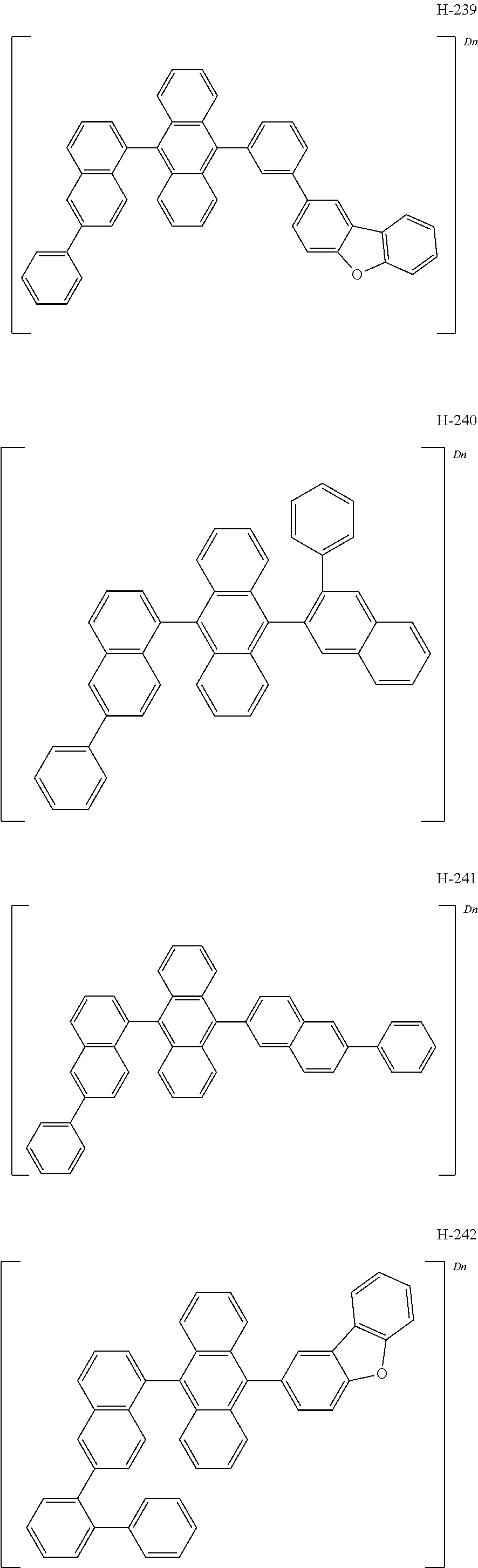
  • the compound represented by formula 1 may be specifically exemplified by the following compounds, but is not limited thereto
  • the light-emitting material comprises at least one amine derivative represented by formula 2.
  • the compound represented by formula 2 may be a fluorescent dopant, e.g., a fluorescent blue dopant.
  • ring A, ring B, and ring C each independently, represent a substituted or unsubstituted (C6-C30)aryl, or a substituted or unsubstituted (3- to 50-membered)heteroaryl.
  • ring A, ring B, and ring C each independently, represent a substituted or unsubstituted (C6-C25)aryl, or a substituted or unsubstituted (5- to 40-membered)heteroaryl.
  • ring A represents a substituted or unsubstituted (C6-C18)aryl
  • ring B and ring C each independently, represent a substituted or unsubstituted (C6-C18)aryl, or a substituted or unsubstituted (5- to 36-membered)heteroaryl.
  • ring A may represent a substituted or unsubstituted benzene ring, an unsubstituted naphthalene ring, or an unsubstituted terphenyl ring.
  • the substituents of the substituted benzene ring may be at least one selected from the group consisting of deuterium; a methyl unsubstituted or substituted with at least one deuterium; tert-butyl; a diphenylamino unsubstituted or substituted with at least one of deuterium, a methyl(s) and a tert-phenyl(s); a phenylnaphthylamino; a dinaphthylamino; a substituted or unsubstituted phenyl; a naphthyl; a biphenyl; a terphenyl; a triphenylenyl; a carbazolyl; a phenoxazinyl; a phenothiazinyl; a dimethylacridinyl; and a dimethylxantenyl, in which the substituents of the substituted phenyl may be at least one of deuter
  • ring B and ring C each independently, may represent a substituted or unsubstituted benzene ring, an unsubstituted naphthalene ring, an unsubstituted biphenyl ring, an unsubstituted dibenzothiophene ring, an unsubstituted dibenzofuran ring, a carbazole ring substituted with at least one of a phenyl(s) and a diphenylamino(s), a boron- and nitrogen-containing (21-membered)hetero ring substituted with at least one of a methyl(s) and a phenyl(s), a boron- and nitrogen-containing (25-membered)hetero ring substituted with a phenyl(s), or a boron- and nitrogen-containing (36-membered)hetero ring substituted with a methyl(s).
  • the substituents of the substituted benzene ring may be at least one selected from the group consisting of deuterium, a methyl, tert-butyl, a phenyl, a substituted or unsubstituted diphenylamino, a phenylnaphthylamino, and a phenylamino substituted with a phenylcarbazolyl(s) or a dibenzofuranyl(s).
  • the substituents of the substituted diphenylamino may be a methyl(s) and/or a diphenylamino(s).
  • Y 1 represents B; and X 1 and each independently, represent NR.
  • R represents hydrogen, deuterium, a halogen, a cyano, a substituted or unsubstituted (C1-C30)alkyl, a substituted or unsubstituted (C6-C30)aryl, a substituted or unsubstituted (3- to 30-membered)heteroaryl, a substituted or unsubstituted (C3-C30)cycloalkyl, a substituted or unsubstituted (C1-C30)alkoxy, a substituted or unsubstituted tri(C1-C30)alkylsilyl, a substituted or unsubstituted di(C1-C30)alkyl(C6-C30)arylsilyl, a substituted or unsubstituted (C1-C30)alkyldi(C6-C30)arylsilyl, a substitute
  • R represents hydrogen, deuterium, a substituted or unsubstituted (C1-C20)alkyl, a substituted or unsubstituted (C6-C25)aryl, or a substituted or unsubstituted (3- to 25-membered)heteroaryl; or R may be linked to at least one of ring A, ring B, and ring C to form a ring(s).
  • R represents hydrogen, deuterium, an unsubstituted (C1-C10)alkyl, a (C6-C18)aryl unsubstituted or substituted with at least one of a (C1-C10)alkyl(s) and a di(C6-C18)arylamino(s), or a (5- to 20-membered)heteroaryl substituted with a (C6-C18)aryl(s); or R may be linked to at least one of ring A, ring B, and ring C to form a ring(s).
  • R may represent hydrogen, deuterium, a methyl, a phenyl unsubstituted or substituted with a methyl(s) and/or a tort-butyl(s), a naphthyl, a biphenyl unsubstituted or substituted with a diphenylamino(s), a triphenylenyl, or a carbazolyl substituted with a phenyl(s), or R may be linked to at least one of ring A, ring B, and ring C to form a ring(s).
  • the formula 2 may be represented by the following formula 2-1.
  • Y 1 , X 1 , and X 2 are each as defined in formula 2; and R 21 to R 31 , each independently, represent hydrogen, deuterium, a halogen, a cyano, a substituted or unsubstituted (C1-C30)alkyl, a substituted or unsubstituted (C6-C30)aryl, a substituted or unsubstituted (3- to 30-membered)heteroaryl, a substituted or unsubstituted (C3-C30)cycloalkyl, a substituted or unsubstituted (C1-C30)alkoxy, a substituted or unsubstituted tri(C1-C30)alkylsilyl, a substituted or unsubstituted di(C1-C30)alkyl(C6-C30)arylsilyl, a substituted or unsubstituted (C1-C30)alkyl
  • R 21 to R 31 each independently, represent hydrogen, deuterium, a substituted or unsubstituted (C1-C20)alkyl, a substituted or unsubstituted (C6-C25)aryl, a substituted or unsubstituted (5- to 20-membered)heteroaryl, or a substituted or unsubstituted mono- or di-(C6-C25)arylamino; or may be linked to an adjacent substituent to form a ring(s).
  • R 21 to R 31 each independently, represent hydrogen; deuterium; an unsubstituted (C1-C10)alkyl; a (C6-C18)aryl unsubstituted or substituted with at least one of a (C1-C10)alkyl(s), a (13- to 18-membered)heteroaryl(s), and a di(C6-C18)arylamino(s); a (5- to 18-membered)heteroaryl unsubstituted or substituted with a (C1-C10)alkyl(s); or a mono- or di-(C6-C18)arylamino unsubstituted or substituted with at least one of a (C1-C10)alkyl(s), a di(C6-C18)arylamino(s), and a (13- to 20-membered)heteroaryl(s); or may be linked to an adjacent substituent to
  • R 21 to R 31 may represent hydrogen, methyl, a tert-butyl, a substituted or unsubstituted phenyl, a biphenyl, a terphenyl, a triphenylenyl, a carbazolyl, a phenoxazinyl, a phenothiazinyl, a dimethylacridinyl, a dimethylxantenyl, a diphenylamino unsubstituted or substituted with a methyl(s) or a diphenylamino(s), a phenylnaphthylamino, a dibiphenylamino, a phenylamine substituted with a phenylcarbazolyl(s) and/or a dibenzofuranyl(s), or a (17- to 21-membered)heteroaryl substituted with a methyl(s) and/or a
  • the substituents of the substituted phenyl may be at least one of a methyl(s), a carbazolyl(s), a dibenzofuranyl(s), a diphenylamino(s), a phenoxazinyl(s), a phenothiazinyl(s) and a dimethylacridinyl(s).
  • the compound represented by formula 2 may be specifically exemplified by the following compounds, but is not limited thereto.
  • D2 to D5 represent that 2 to 5 hydrogens are replaced with deuterium, respectively.
  • D5 means that the five substituents are deuterium.
  • the compound represented by formula 1 may be represented by the following formula 1-1.
  • an organic electroluminescent compound represented by the following formula 1-1 may be provided.
  • L 1 represents a single bond, a substituted or unsubstituted (C6-C30)arylene, or a substituted or unsubstituted (5- to 30-membered)heteroarylene.
  • L 1 represents a single bond, a substituted or unsubstituted (C6-C25)arylene, or a substituted or unsubstituted (5- to 25-membered)heteroarylene.
  • L 1 represents a single bond, or an unsubstituted (C6-C18)arylene.
  • L 1 represents a single bond, a phenylene, a naphthylene, or a biphenylene.
  • Ar 1 represents a substituted or unsubstituted (C6-C30)aryl, or a substituted or unsubstituted (5- to 30-membered)heteroaryl. According to one embodiment of the present disclosure, Ar 1 represents a substituted or unsubstituted (C6-C25)aryl, or a substituted or unsubstituted (5- to 25-membered)heteroaryl.
  • Ar 1 represents a (C6-C25)aryl unsubstituted or substituted with a (C1-C10)alkyl(s) and/or a (C6-C18)aryl(s), or a (5- to 20-membered)heteroaryl unsubstituted or substituted with a (C6-C18)aryl(s),
  • Ar 1 may represent a phenyl, a naphthyl, a biphenyl, a dimethylfluorenyl, a diphenylfluorenyl, a phenylfluorenyl, a phenanthrenyl, a dimethylbenzofluorenyl, a diphenylbenzofluorenyl, a terphenyl, a triphenylenyl, a spirobifluorenyl, a dibenzofuranyl, a dibenzothiophenyl, a
  • Ar 3 and Ar 4 each independently, represent hydrogen, deuterium, a substituted or unsubstituted (C6-C30)aryl, or a substituted or unsubstituted (5- to 30-membered)heteroaryl, with a proviso that Ar 3 and Ar 4 are not simultaneously hydrogen.
  • any one of Ar 3 and Ar 4 may represent hydrogen or deuterium, and the other of Ar 3 and Ar 4 may represent a substituted or unsubstituted (C6-C30)aryl, or a substituted or unsubstituted (5- to 30-membered)heteroaryl.
  • one of Ar 3 and Ar 4 may represent a substituted or unsubstituted (C6-C25)aryl, or a substituted or unsubstituted (5- to 25-membered)heteroaryl, According to another embodiment of the present disclosure, any, one of Ar 3 and Ar 4 may represent an unsubstituted (C6-C18)aryl, or an unsubstituted (5- to 20-membered)heteroaryl.
  • any one of Ar 3 and Ar 4 may represent a phenyl, a naphthyl, a biphenyl, a phenanthrenyl, a naphthylphenyl, a dibenzofuranyl, or a dibenzothiophenyl.
  • R 1 to R 13 each independently, represent hydrogen, deuterium, a halogen, a cyano, a substituted or unsubstituted (C1-C30)alkyl, a substituted or unsubstituted (C6-C30)aryl, a substituted or unsubstituted (3- to 30-membered)heteroaryl, a substituted or unsubstituted (C3-C30)cycloalkyl, a substituted or unsubstituted (C1-C30)alkoxy, a substituted or unsubstituted tri(C1-C30)alkylsilyl, a substituted or unsubstituted di(C1-C30)alkyl(C6-C30)arylsilyl, a substituted or unsubstituted (C1-C30)alkyldi(C6-C30)arylsilyl, a substituted or unsubstituted or unsubstit
  • D n represents that n hydrogens are replaced with deuterium; and n represents an integer of 8 or more. At least four of R 1 to R 8 may represent deuterium.
  • the upper limit of n is determined by the number of hydrogens that can be substituted in each compound.
  • n represents an integer of 10 or more, and more preferably, an integer of 15 or more.
  • the compound represented by formula 1-1 may be specifically exemplified by the following compounds, but is not limited thereto.
  • a compound represented by formula 1-1 may be used alone or in combination of two or more in the organic electroluminescent device.
  • a plurality of light-emitting materials according to one embodiment of the present disclosure comprises at least one of first compounds and at least one of second compounds, wherein the first compound is represented by formula 1-1, and the second compound is represented by formula 2.
  • the compound represented by formula 1 according to the present disclosure may be prepared by a synthetic method known to one skilled in the art.
  • the non-deuterated analogues of the compound represented by formula 1 can be prepared by known coupling and substitution reactions.
  • the non-deuterated analogues of the compound represented by formula 1-1 can be prepared by referring to Korean Patent Appl. Laid-Open No. 2015-0010016 (published on Jan. 28, 2015), but is not limited thereto.
  • the compound of formula 1 may be prepared in a similar manner by using deuterated precursor materials, or more generally may be prepared by treating the non-deuterated compound with a deuterated solvent or D6-benzene in the presence of an H/D exchange catalyst such as a Lewis acid, e.g., aluminum trichloride or ethyl aluminum chloride.
  • an H/D exchange catalyst such as a Lewis acid, e.g., aluminum trichloride or ethyl aluminum chloride.
  • the degree of deuteration can be controlled by changing the reaction conditions such as the reaction temperature.
  • the number of n in formula 1 can be controlled by adjusting the reaction temperature and time, the equivalent of the acid, etc.
  • the compound represented by formula 2 according to the present disclosure may be prepared by a synthetic method known to one skilled in the art.
  • the compound represented by formula 2 can be prepared by referring to Korean Patent No. 1876763 (published on Jul. 11, 2018), Japanese Patent No. 5935199 (published on May 20, 2016), and Korean Patent Appl. Laid-Open No. 2017-0130434 (published on Nov. 28, 2017), but is not limited thereto.
  • the organic electroluminescent device comprises a first electrode, a second electrode, and at least one organic layer between the first and second electrodes.
  • the organic layer may comprise a light-emitting layer, and the light-emitting layer may include a light-emitting material(s) comprising at least one first compound represented by formula 1, and at least one second compound represented by formula 2.
  • the light-emitting layer may include the organic electroluminescent compound represented by formula 1-1, and the organic electroluminescent compound may be comprised in the light-emitting layer.
  • the host compound represented by formula 1 and the dopant compound represented by formula 2 may be included in the same organic layer, or may be included in different organic layers, respectively.
  • the organic electroluminescent device may comprise an anode, a cathode, and at least one organic layer between the two electrodes, in which the organic layer may comprise a light-emitting layer, and a hole transport zone disposed between the anode and the light-emitting layer.
  • the light-emitting layer may comprise a plurality of light-emitting materials, and the plurality of light-emitting materials may comprise at least one of first compounds and at least one of second compounds, wherein the first compound is represented by formula 1, and the second compound is represented by formula 2.
  • the hole transport zone may comprise a compound represented by the following formula 3.
  • the first compound may be represented by formula 1-1.
  • the hole transport zone may comprise at least one of a hole injection layer, a first hole transport layer, a second hole transport layer, an electron blocking layer, a hole auxiliary layer, and a charge generation layer.
  • the hole transport zone may comprise a hole transport layer(s) and a hole auxiliary layer(s).
  • X 3 represents NR 101 , O, S, or CR 102 R 103 , Y 3 , Z 3 and R 101 , each independently, represent hydrogen, deuterium, a halogen, a cyano, a substituted or unsubstituted (C1-C30)alkyl, a substituted or unsubstituted (C6-C30)aryl, a substituted or unsubstituted (3- to 30-membered)heteroaryl, a substituted or unsubstituted (C3-C30)cycloalkyl, a substituted or unsubstituted (C1-C30)alkoxy, a substituted or unsubstituted tri(C1-C30)alkylsilyl, a substituted or unsubstituted di(C1-C30)alkyl(C6-C30)arylsilyl, a substituted or unsubstituted (C1-C30)alkyl,
  • the compound represented by formula 3 according to the present disclosure may be prepared by a synthetic method known to one skilled in the art. Specifically, the compound represented by formula 3 may be prepared by C—C coupling or C—N coupling.
  • the light-emitting layer is a layer comprising a host(s) and a dopant(s) from which light is emitted, and can be a single layer or a multi-layer in which two or more layers are stacked.
  • the host mainly has a function of promoting recombination of electrons and holes and confining excitons in the light-emitting layer
  • the dopant has a function of efficiently emitting light of excitons obtained by recombination.
  • the dopant compound of the light-emitting layer may be doped to less than 25% by weight, preferably less than 17% by weight based on the total amount of the host and dopant compounds.
  • the first and second electrodes may be an anode, and the other may be a cathode.
  • the second electrode may be a transflective electrode or a reflective electrode, and may be a top emission type, a bottom emission type, or a both-sides emission type, depending on the materials.
  • the organic layer may comprise at least one light-emitting layer, and may further comprise at least one layer selected from a hole injection layer, a hole transport layer, a hole auxiliary layer, a light-emitting auxiliary layer, an electron transport layer, an electron injection layer, an interlayer, a hole blocking layer, an electron blocking layer, and an electron buffer layer.
  • the organic layer may further comprise an amine-based compound and/or an azine-based compound in addition to the light-emitting material(s) of the present disclosure.
  • the hole injection layer, the hole transport layer, the hole auxiliary layer, the light-emitting layer, the light-emitting auxiliary layer, and/or the electron blocking layer may comprise an amine-based compound, e.g., an arylamine-based compound, a styrylarylamine-based compound, etc., as a hole injection material, a hole transport material, a hole auxiliary material, a light-emitting material, a light-emitting auxiliary material, and/or an electron blocking material.
  • the electron transport layer, the electron injection layer, the electron buffer layer, and/or the hole blocking layer may comprise an azine-based compound as an electron transport material, an electron injection material, an electron buffer material, and/or a hole blocking material.
  • the organic layer may further comprise at least one metal selected from the group consisting of metals of Group 1, metals of Group 2, transition metals of the 4 th period, transition metals of the 5 th period, lanthanides and organic metals of d-transition elements of the Periodic Table, or at least one complex compound comprising said metal.
  • a hole injection layer, a hole transport layer, or an electron blocking layer, or a combination thereof may be used between the anode and the light-emitting layer.
  • the hole injection layer may be multilayers in order to lower the hole injection barrier (or hole injection voltage) from the anode to the hole transport layer or the electron blocking layer, wherein each of the multilayers may use two compounds simultaneously.
  • the electron blocking layer may be located between the hole transport layer (or the hole injection layer) and the light-emitting layer, and may block the overflow of electrons from the light-emitting layer to trap the excitons in the light-emitting layer to prevent light leakage.
  • the hole transport layer or the electron blocking layer may be multilayers, wherein each of the multilayers may use a plurality of compounds.
  • An electron buffer layer, a hole blocking layer, an electron transport layer, or an electron injection layer, or a combination thereof may be used between the light-emitting layer and the cathode.
  • the electron buffer layer may be multilayers in order to control the injection of the electrons and improve the interfacial properties between the light-emitting layer and the electron injection layer, wherein each of the multilayers may use two compounds simultaneously.
  • the hole blocking layer or the electron transport layer may also be multilayers, wherein each of the multilayers may use a plurality of compounds.
  • a light-emitting auxiliary layer may be placed between the anode and the light-emitting layer, or between the cathode and the light-emitting layer.
  • the light-emitting auxiliary layer When the light-emitting auxiliary layer is placed between the anode and the light-emitting layer, it can be used for promoting the hole injection and/or the hole transport, or for preventing the overflow of electrons.
  • the light-emitting auxiliary layer is placed between the cathode and the light-emitting layer, it can be used for promoting the electron injection and/or the electron transport, or for preventing the overflow of holes.
  • the hole auxiliary layer may be placed between the hole transport layer (or hole injection layer) and the light-emitting layer, and may be effective to promote or block the hole transport rate (or the hole injection rate), thereby enabling the charge balance to be controlled.
  • the hole transport layer which is further included, may be used as a hole auxiliary layer or an electron blocking layer.
  • the light-emitting auxiliary layer, the hole auxiliary layer or the electron blocking layer may have an effect of improving the efficiency and/or the lifetime of the organic electroluminescent device.
  • a surface layer may be preferably placed on an inner surface(s) of one or both electrodes.
  • a chalcogenide (including oxides) layer of silicon or aluminum is preferably placed on an anode surface of an electroluminescent medium layer
  • a metal halide layer or a metal oxide layer is preferably placed on a cathode surface of an electroluminescent medium layer.
  • Such a surface layer may provide operation stability for the organic electroluminescent device.
  • the chalcogenide includes SiO X (1 ⁇ X ⁇ 2), AlO X (1 ⁇ X ⁇ 1.5), SiON, SiAlON, etc.;
  • the metal halide includes LiF, CaF 2 , a rare earth metal fluoride, etc.; and the metal oxide includes Cs 2 O, Li 2 O, MgO, SrO, BaO, CaO, etc.
  • a mixed region of an electron transport compound and a reductive dopant, or a mixed region of a hole transport compound and an oxidative dopant is preferably placed on at least one surface of a pair of electrodes.
  • the electron transport compound is reduced to an anion, and thus it becomes easier to inject and transport electrons from the mixed region to an electroluminescent medium.
  • the hole transport compound is oxidized to a cation, and thus it becomes easier to inject and transport holes from the mixed region to the electroluminescent medium.
  • the oxidative dopant includes various Lewis acids and acceptor compounds; and the reductive dopant includes alkali metals, alkali metal compounds, alkaline earth metals, rare-earth metals, and mixtures thereof.
  • a reductive dopant layer may be used as a charge-generating layer to prepare an organic electroluminescent device having two or more light-emitting layers and emitting white light.
  • the white organic electroluminescent device for example, a side-by-side structure or a stacking structure depending on the arrangement of R (red), G (green) or YG (yellow green), and B (blue) light emitting parts, or a color conversion material (CCM) method, etc.
  • the plurality of light-emitting materials of the present disclosure may also be applied to such white organic electroluminescent device.
  • the plurality of light-emitting materials according to one embodiment of the present disclosure may also be applied to the organic electroluminescent device comprising a QD (quantum dot).
  • QD quantum dot
  • the present disclosure may provide a display system by using a plurality of light-emitting materials according to one embodiment of the present disclosure. That is, it is possible to produce a display system or a lighting system by using the compounds of the present disclosure. Specifically, it is possible to produce a display system, e.g., a display system for smartphones, tablets, notebooks, PCs, TVs, or cars, or a lighting system, e.g., an outdoor or indoor lighting system, by using the compounds of the present disclosure.
  • a display system e.g., a display system for smartphones, tablets, notebooks, PCs, TVs, or cars
  • a lighting system e.g., an outdoor or indoor lighting system
  • dry film-forming methods such as vacuum evaporation, sputtering, plasma and ion plating methods, or wet film-forming methods such as ink jet printing, nozzle printing, slot coating, spin coating, dip coating, and flow coating methods may be used.
  • a wet film-forming method a thin film may be formed by dissolving or diffusing materials forming each layer into any suitable solvent such as ethanol, chloroform, tetrahydrofuran, dioxane, etc.
  • the solvent may be any solvent where the materials forming each layer can be dissolved or diffused, and where there are no problems in film-formation capability.
  • the dopant and host compounds of the present disclosure may be co-evaporated or mixture-evaporated.
  • the co-evaporation is a mixed deposition method in which two or more isomer materials are placed in a respective individual crucible source and a current is applied to both cells at the same time to evaporate the materials.
  • the mixture-evaporation is a mixed deposition method in which two or more isomer materials are mixed in one crucible source before evaporating them, and a current is applied to the cell to evaporate the materials.
  • a blue light-emitting OLED was produced using the organic electroluminescent compound according to the present disclosure, as follows: A transparent electrode indium tin oxide (ITO) thin film (10 ⁇ /sq) on a glass substrate for an OLED (GEOMATEC CO., LTD., Japan) was subjected to an ultrasonic washing with acetone, ethanol and distilled water, sequentially, and then was stored in isopropanol.
  • the ITO substrate was mounted on a substrate holder of a vacuum vapor deposition apparatus.
  • Compound HI-1 was introduced into a cell of the vacuum vapor deposition apparatus, and the pressure in the chamber of the apparatus was then controlled to 10 ⁇ 6 torr.
  • compound HI-2 was introduced into another cell of the vacuum vapor deposition apparatus and was evaporated by applying an electric current to the cell, thereby forming a second hole injection layer having a thickness of 5 nm on the first hole injection layer.
  • Compound HT-1 was then introduced into another cell of the vacuum vapor deposition apparatus and was evaporated by applying an electric current to the cell, thereby forming a first hole transport layer having a thickness of 20 nm on the second hole injection layer.
  • Compound HT-2 was then introduced into another cell of the vacuum vapor deposition apparatus and was evaporated by applying an electric current to the cell, thereby forming a second hole transport layer having a thickness of 5 nm on the first hole transport layer.
  • a light-emitting layer was formed thereon as follows: Compound H-260 was introduced into a cell of the vacuum vapor deposition apparatus as a host and compound BD-1 was introduced into another cell as a dopant. The two materials were evaporated and the dopant was deposited in a doping amount of 2 wt % based on the total amount of the host and dopant to form a light-emitting layer having a thickness of 20 nm on the second hole transport layer.
  • compound ET-1 and compound EI-1 were evaporated at a rate of 1:1 in two other cells to deposit an electron transport layer having a thickness of 35 nm on the light-emitting layer.
  • an Al cathode having a thickness of 80 nm was deposited on the electron injection layer by another vacuum vapor deposition apparatus.
  • an OLED was produced.
  • An OLED was produced in the same manner as in Device Example 1, except that the compound shown in Table 1 was used instead of compound H-260 as the host material of the light-emitting layer.
  • An OLED was produced in the same manner as in Device Example 1, except that the compound shown in Table 1 was used instead of compound H-260 as the host material of the light-emitting layer.
  • Table 1 shows the minimum time taken to be reduced from 100% to 90% of the luminance (lifetime; T90) based on a luminance of 2,000 nit of the OLEO produced above.
  • An OLEO was produced using the light-emitting material according to the present disclosure, as follows: A transparent electrode indium tin oxide (ITO) thin film (10 ⁇ /sq) on a glass substrate for an OLED (GEOMATEC CO., LTD., Japan) was subjected to an ultrasonic washing with acetone, ethanol and distilled water, sequentially, and then was stored in isopropanol.
  • the ITO substrate was mounted on a substrate holder of a vacuum vapor deposition apparatus.
  • Compound HT-1 was introduced into a cell of the vacuum vapor deposition apparatus, compound HI-3 was introduced into another cell, and the pressure in the chamber of the apparatus was then controlled to 10 ⁇ 6 torr.
  • compound HI-3 was deposited in a doping amount of 3 wt % based on the total amount of compound HT-1 and compound HI-3 to form a hole injection layer having a thickness of 10 nm on the ITO substrate.
  • compound HT-1 was introduced into a cell of the vacuum vapor deposition apparatus and was evaporated by applying an electric current to the cell, thereby forming a first hole transport layer having a thickness of 75 nm on the hole injection layer.
  • Compound HT-3 was then introduced into another cell of the vacuum vapor deposition apparatus and was evaporated by applying an electric current to the cell, thereby forming a second hole transport layer having a thickness of 5 nm on the first hole transport layer.
  • a light-emitting layer was formed thereon as follows: Compound H-11 was introduced into one cell of the vacuum vapor deposition apparatus as a host and compound BD-1 was introduced into another cell as a dopant. The two materials were evaporated and the dopant was deposited in a doping amount of 2 wt % based on the total amount of the host and dopant to form a light-emitting layer having a thickness of 20 nm on the second hole transport layer. Next, compound ET-2 was deposited as a hole blocking layer having a thickness of 5 nm.
  • compound ET-1 and compound EI-1 were evaporated at a rate of 1:1 in two other cells to deposit an electron transport layer having a thickness of 30 nm.
  • an Al cathode having a thickness of 80 nm was deposited on the electron injection layer by another vacuum vapor deposition apparatus.
  • an OLED was produced.
  • the minimum time taken to be reduced from 100% to 90% of the luminance based on a luminance of 2,000 nit was approximately 148 hours.
  • An OLED was produced in the same manner as in Device Example 5, except that compound H-128 was used as a host material of the light-emitting layer. As a result, the minimum time taken to be reduced from 100% to 90% of the luminance based on a luminance of 2,000 nit was approximately 195 hours.
  • an OLED comprising the compound according to the present disclosure as a plurality of light-emitting materials has improved lifetime properties compared to an OLED using a conventional compound.
  • the lifetime of a blue organic electroluminescent device can be improved significantly by comprising the compound represented by formula 1-1 of the present disclosure.

Landscapes

  • Chemical & Material Sciences (AREA)
  • Engineering & Computer Science (AREA)
  • Materials Engineering (AREA)
  • Physics & Mathematics (AREA)
  • Spectroscopy & Molecular Physics (AREA)
  • Organic Chemistry (AREA)
  • Optics & Photonics (AREA)
  • Electroluminescent Light Sources (AREA)

Abstract

The present disclosure relates to a plurality of light-emitting materials comprising at least one of first compounds and at least one of second compounds, wherein the first compound is represented by formula 1, and the second compound is represented by formula 2, and an organic electroluminescent device having improved lifetime properties can be provided by comprising the plurality of light-emitting materials.

Description

TECHNICAL FIELD
The present disclosure relates to a plurality of light-emitting materials and an organic electroluminescent device comprising the same.
BACKGROUND ART
An electroluminescent device (EL device) is a self-light-emitting display device which has advantages in that it provides a wider viewing angle, a greater contrast ratio, and a faster response time. The first organic EL device was developed by Eastman Kodak in 1987, by using small aromatic diamine molecules and aluminum complexes as materials for forming a light-emitting layer (see Appl. Phys. Lett. 51, 913, 1987).
An organic electroluminescent device (OLED) changes electric energy into light by applying electricity to an organic electroluminescent material, and commonly comprises an anode, a cathode, and an organic layer formed between the two electrodes. The organic layer of the OLED may comprise a hole injection layer, a hole transport layer, a hole auxiliary layer, a light-emitting auxiliary layer, an electron blocking layer, a light-emitting layer, an electron buffer layer, a hole blocking layer, an electron transport layer, an electron injection layer, etc., if necessary. The materials used in the organic layer can be classified into a hole injection material, a hole transport material, a hole auxiliary material, a light-emitting auxiliary material, an electron blocking material, a light-emitting material (including a host material and a dopant material), an electron buffer material, a hole blocking material, an electron transport material, an electron injection material, etc., depending on their functions. In the OLED, holes from the anode and electrons from the cathode are injected into a light-emitting layer by the application of electric voltage, and excitons having high energy are produced by the recombination of the holes and electrons. The organic light-emitting compound moves into an excited state by the energy and emits light from an energy when the organic light-emitting compound returns to the ground state from the excited state.
Recently, as displays have become large-scale, there is a need for light-emitting materials capable of exhibiting more delicate and vivid colors. Particularly, in the case of blue light-emitting materials, materials such as ADN and DPVBi are used as host materials, and materials such as aromatic amine-based compounds, copper phthalocyanine compounds, carbazole-based derivatives, perylene-based derivatives, coumarin-based derivatives, pyrene-based derivatives are used as dopant materials, but it is difficult to obtain a deep blue with high color purity, and as the wavelength becomes shorter, the light emission lifetime becomes shorter.
Accordingly, in order to implement a full color display, there is a demand for the development of a deep blue light-emitting material having a long lifetime and development of other organic materials having energy levels matched with the blue light-emitting material.
Korean Patent Appl. Laid-Open No. 2017-0130434 A discloses a combination of anthracene derivatives and boron derivatives. However, the development for improving performances of an OLED is still required.
DISCLOSURE OF INVENTION Technical Problem
The objective of the present disclosure is to provide an organic electroluminescent device having longer lifetime properties.
Solution to Problem
As a result of intensive studies to solve the technical problem above, the present inventors found that the above objective can be achieved by a plurality of light-emitting materials comprising at least one of first compounds and at least one of second compounds, wherein the first compound is represented by the following formula 1, and the second compound is represented by the following formula 2:
Figure US12114561-20241008-C00001
wherein,
L1 and L2, each independently, represent a single bond, a substituted or unsubstituted (C6-C30)arylene, or a substituted or unsubstituted (5- to 30-membered)heteroarylene;
Ar1 and Ar2, each independently, represent a substituted or unsubstituted (C6-C30)aryl, or a substituted or unsubstituted (5- to 30-membered)heteroaryl;
R1 to R8, each independently, represent hydrogen, deuterium, a halogen, a cyano a substituted or unsubstituted (C1-C30)alkyl, a substituted or unsubstituted (C6-C30)aryl, a substituted or unsubstituted (3- to 30-membered)heteroaryl, a substituted or unsubstituted (C3-C30)cycloalkyl, a substituted or unsubstituted (C1-C30)alkoxy, a substituted or unsubstituted tri(C1-C30)alkylsilyl, a substituted or unsubstituted di(C1-C30)alkyl(C6-C30)arylsilyl, a substituted or unsubstituted (C1-C30)alkyldi(C6-C30)arylsilyl, a substituted or unsubstituted tri(C6-C30)arylsilyl, a substituted or unsubstituted mono- or di-(C1-C30)alkylamino, a substituted or unsubstituted mono- or di-(C6-C30)arylamino, or a substituted or unsubstituted (C1-C30)alkyl(C6-C30)arylamino.
Dn represents n hydrogens are replaced with deuterium; and
n represents an integer of 8 or more;
Figure US12114561-20241008-C00002
wherein,
ring A, ring B, and ring C, each independently, represent a substituted or unsubstituted (C6-C30)aryl, or a substituted or unsubstituted (3- to 50-membered)heteroaryl;
Y1 represents B;
X1 and X2, each independently, represent NR; and
R represents hydrogen, deuterium, a halogen, a cyano, a substituted or unsubstituted (C1-C30)alkyl, a substituted or unsubstituted (C6-C30)aryl, a substituted or unsubstituted (3- to 30-membered)heteroaryl, a substituted or unsubstituted (C3-C30)cycloalkyl, a substituted or unsubstituted (C1-C30)alkoxy, a substituted or unsubstituted tri(C1-C30)alkylsilyl, a substituted or unsubstituted di(C1-C30)alkyl(C6-C30)arylsilyl, a substituted or unsubstituted (C1-C30)alkyldi(C6-C30)arylsilyl, a substituted or unsubstituted tri(C6-C30)arylsilyl, a substituted or unsubstituted mono- or di-(C1-C30)alkylamino, a substituted or unsubstituted mono- or di-(C6-C30)arylamino, or a substituted or unsubstituted (C1-C30)alkyl(C6-C30)arylamino; or R may be linked to at least one of ring A, ring B, and ring C to form a ring(s).
Advantageous Effects of Invention
By comprising the plurality of light-emitting materials according to the present disclosure, it is possible to provide an organic electroluminescent device having improved lifetime properties.
MODE FOR THE INVENTION
Hereinafter, the present disclosure will be described in detail. However, the following description is intended to explain the disclosure, and is not meant in any way to restrict the scope of the disclosure.
The term “an organic electroluminescent compound” in the present disclosure means a compound that may be used in an organic electroluminescent device. If necessary, the organic electroluminescent compound may be comprised in any layers constituting an organic electroluminescent device.
The term “an organic electroluminescent material” in the present disclosure means a material that may be used in an organic electroluminescent device, and may comprise at least one compound. If necessary, the organic electroluminescent material may be comprised in any layers constituting an organic electroluminescent device. For example, the organic electroluminescent material may be a hole injection material, a hole transport material, a hole auxiliary material, a light-emitting auxiliary material, an electron blocking material, a light-emitting material (including a host material and a dopant material), an electron buffer material, a hole blocking material, an electron transport material, an electron injection material, etc.
The term “a plurality of light-emitting materials” in the present disclosure means a host material(s) and/or a dopant material(s), comprising a combination of at least two compounds, which may be comprised in any light-emitting layer constituting an organic electroluminescent device. It may mean both a material before being comprised in an organic electroluminescent device (for example, before vapor deposition) and a material after being comprised in an organic electroluminescent device (for example, after vapor deposition). For example, the plurality of light-emitting materials of the present disclosure may be a combination of one or more host materials and one or more dopant materials, and may optionally further include a conventional material comprised in organic electroluminescent materials. The two or more compounds comprised in the plurality of light-emitting materials of the present disclosure may be included in one light-emitting layer or may be respectively included in different light-emitting layers by means of the methods used in the art. For example, the two or more compounds may be mixture-evaporated or co-evaporated, or individually deposited.
Herein, the term “(C1-C30)alkyl” is meant to be a linear or branched alkyl having 1 to 30 carbon atoms constituting the chain, in which the number of carbon atoms is preferably 1 to 20, and more preferably 1 to 10. The above alkyl may include methyl, ethyl, n-propyl, isopropyl, n-butyl, isobutyl, tert-butyl, etc. The term “(C3-C30)cycloalkyl” is meant to be a mono- or polycyclic hydrocarbon having 3 to 30 ring backbone carbon atoms, in which the number of carbon atoms is preferably 3 to 20, and more preferably 3 to 7. The above cycloalkyl may include cyclopropyl, cyclobutyl, cyclopentyl, cyclohexyl, etc. The term “(C6-C30)aryl(ene)” is meant to be a monocyclic or fused ring radical derived from an aromatic hydrocarbon having 6 to 30 ring backbone carbon atoms. The above aryl(ene) may be partially saturated, and may comprise a spiro structure. The number of ring backbone carbon atoms is preferably 6 to 20, and more preferably 6 to 15. The above aryl may include phenyl, biphenyl, terphenyl, naphthyl, binaphthyl, phenylnaphthyl, naphthylphenyl, fluorenyl, phenylfluorenyl, diphenylfluorenyl, benzofluorenyl, diphenylbenzofluorenyl, dibenzofluorenyl, phenanthrenyl, benzophenanthrenyl, phenylphenanthrenyl, anthracenyl, indenyl, triphenylenyl, pyrenyl, tetracenyl, perylenyl, chrysenyl, naphthacenyl, fluoranthenyl, spirobifluorenyl, spiro[fluorene-benzofluoren]yl, etc. More specifically, the aryl may include phenyl, 1-naphthyl, 2-naphthyl, 1-anthryl, 2-anthryl, 9-anthryl, benzanthryl, 1-phenanthryl, 2-phenanthryl, 3-phenanthryl, 4-phenanthryl, 9-phenanthryl, naphthacenyl, pyrenyl, 1-chrysenyl, 2-chrysenyl, 3-chrysenyl, 4-chrysenyl, 5-chrysenyl, 6-chrysenyl, benzo[c]phenanthryl, benzo[g]chrysenyl, 1-triphenylenyl, 2-triphenylenyl, 3-triphenylenyl, 4-triphenylenyl, 1-fluorenyl, 2-fluorenyl, 3-fluorenyl, 4-fluorenyl, 9-fluorenyl, benzofluorenyl, dibenzofluorenyl, 2-biphenylyl, 3-biphenylyl, 4-biphenylyl, o-terphenyl, m-terphenyl-4-yl, m-terphenyl-3-yl, m-terphenyl-2-yl, p-terphenyl-4-yl, p-terphenyl-3-yl, p-terphenyl-2-yl, m-quaterphenyl, 3-fluoranthenyl, 4-fluoranthenyl, 8-fluoranthenyl, 9-fluoranthenyl, benzofluoranthenyl, o-tolyl, m-tolyl, p-tolyl, 2,3-xylyl, 3,4-xylyl, mesityl, o-cumenyl, m-cumenyl, p-cumenyl, p-tert-butylphenyl, p-(2-phenylpropyl)phenyl, 4′-methylbiphenylyl, tert-butyl-p-terphenyl-4-yl, 9,9-dimethyl-1-fluorenyl, 9,9-dimethyl-2-fluorenyl, 9,9-dimethyl-3-fluorenyl, 9,9-dimethyl-4-fluorenyl, 9,9-diphenyl-1-fluorenyl, 9,9-diphenyl-2-fluorenyl, 9,9-diphenyl-3-fluorenyl, 9,9-diphenyl-4-fluorenyl, etc.
The term “(3- to 50-membered)heteroaryl(ene)” is an aryl(ene) having 3 to 50 ring backbone atoms, in which the number of ring backbone atoms is preferably 5 to 25, and including at least one, preferably 1 to 4 heteroatoms selected from the group consisting of B, N, O, S, Si, and P. The above heteroaryl(ene) may be a monocyclic ring, or a fused ring condensed with at least one benzene ring; may be partially saturated; may be one formed by linking at least one heteroaryl or aryl group to a heteroaryl group via a single bond(s); and may comprise a spiro structure. The above heteroaryl may include a monocyclic ring-type heteroaryl such as furyl, thiophenyl, pyrrolyl, imidazolyl, pyrazolyl, thiazolyl, thiadiazolyl, isothiazolyl, isoxazolyl, oxazolyl, oxadiazolyl, triazinyl, tetrazinyl, triazolyl, tetrazolyl, furazanyl, pyridyl, pyrazinyl, pyrimidinyl, pyridazinyl, etc., and a fused ring-type heteroaryl such as benzofuranyl, benzothiophenyl, isobenzofuranyl, dibenzofuranyl, dibenzothiophenyl, benzimidazolyl, benzothiazolyl, benzoisothiazolyl, benzoisoxazolyl, benzoxazolyl, isoindolyl, indolyl, benzoindolyl, indazolyl, benzothiadiazolyl, quinolyl, isoquinolyl, cinnolinyl, quinazolinyl, quinoxalinyl, carbazolyl, benzocarbazolyl, dibenzocarbazolyl, phenoxazinyl, phenanthridinyl, benzodioxolyl, etc. More specifically, the heteroaryl may include 1-pyrrolyl, 2-pyrrolyl, 3-pyrrolyl, pyrazinyl, 2-pyridyl, 2-pyrimidinyl, 4-pyrimidinyl, 5-pyrimidinyl, 6-pyrimidinyl, 1,2,3-triazin-4-yl, 1,2,4-triazin-3-yl, 1,3,5-triazin-2-yl, 1-imidazolyl, 2-imidazolyl, 1-pyrazolyl, 1-indolidinyl, 2-indolidinyl, 3-indolidinyl, 5-indolidinyl, 6-indolidinyl, 7-indolidinyl, 8-indolidinyl, 2-imidazopyridyl, 3-imidazopyridyl, 5-imidazopyridyl, 6-imidazopyridyl, 7-imidazopyridyl, 8-imidazopyridyl, 3-pyridyl, 4-pyridyl, 1-indolyl, 2-indolyl, 3-indolyl, 4-indolyl, 5-indolyl, 6-indolyl, 7-indolyl, 1-isoindolyl, 2-isoindolyl, 3-isoindolyl, 4-isoindolyl, 5-isoindolyl, 6-isoindolyl, 7-isoindolyl, 2-furyl, 3-furyl, 2-benzofuranyl, 3-benzofuranyl, 4-benzofuranyl, 5-benzofuranyl, 6-benzofuranyl, 7-benzofuranyl, 1-isobenzofuranyl, 3-isobenzofuranyl, 4-isobenzofuranyl, 5-isobenzofuranyl, 6-isobenzofuranyl, 7-isobenzofuranyl, 2-quinolyl, 3-quinolyl, 4-quinolyl, 5-quinolyl, 6-quinolyl, 7-quinolyl, 8-quinolyl, 1-isoquinolyl, 3-isoquinolyl, 4-isoquinolyl, 5-isoquinolyl, 6-isoquinolyl, 7-isoquinolyl, 8-isoquinolyl, 2-quinoxalinyl, 5-quinoxalinyl, 6-quinoxalinyl, 1-carbazolyl, 2-carbazolyl, 3-carbazolyl, 4-carbazolyl, 9-carbazolyl, azacarbazolyl-1-yl, azacarbazolyl-2-yl, azacarbazolyl-3-yl, azacarbazolyl-4-yl, azacarbazolyl-5-yl, azacarbazolyl-6-yl, azacarbazolyl-7-yl, azacarbazolyl-8-yl, azacarbazolyl-9-yl, 1-phenanthridinyl, 2-phenanthridinyl, 3-phenanthridinyl, 4-phenanthridinyl, 6-phenanthridinyl, 7-phenanthridinyl, 8-phenanthridinyl, 9-phenanthridinyl, 10-phenanthridinyl, 1-acridinyl, 2-acridinyl, 3-acridinyl, 4-acridinyl, 9-acridinyl, 2-oxazolyl, 4-oxazolyl, 5-oxazolyl, 2-oxadiazolyl, 5-oxadiazolyl, 3-furazanyl, 2-thienyl, 3-thienyl, 2-methylpyrrol-1-yl, 2-methylpyrrol-3-yl, 2-methylpyrrol-4-yl, 2-methylpyrrol-5-yl, 3-methylpyrrol-1-yl, 3-methylpyrrol-2-yl, 3-methylpyrrol-4-yl, 3-methylpyrrol-5-yl, 2-Cert-butylpyrrol-4-yl, 3-(2-phenylpropyl)pyrrol-1-yl, 2-methyl-1-indolyl, 4-methyl-1-indolyl, 2-methyl-3-indolyl, 4-methyl-3-indolyl, 2-Cert-butyl-1-indolyl, 4-tort-butyl-1-indolyl, 2-tert-butyl-3-indolyl, 4-tert-butyl-3-indolyl, 1-dibenzofuranyl, 2-dibenzofuranyl, 3-dibenzofuranyl, 4-dibenzofuranyl, 1-dibenzothiophenyl, 2-dibenzothiophenyl, 3-dibenzothiophenyl, 4-dibenzothiophenyl, 1-silafluorenyl, 2-silafluorenyl, 3-silafluorenyl, 4-silafluorenyl, 1-germafluorenyl, 2-germafluorenyl, 3-germafluorenyl, 4-germafluorenyl, etc. “Halogen” includes F, Cl, Br, and I.
In addition, “ortho (o-),” “meta (m-)” and “para (p-)” are prefixes, which represent the relative positions of substituents, respectively. Ortho indicates that two substituents are adjacent to each other, and for example, when two substituents in a benzene derivative occupy positions 1 and 2, it is called an ortho position. Meta indicates that two substituents are at positions 1 and 3, and for example, when two substituents in a benzene derivative occupy positions 1 and 3, it is called a meta position. Para indicates that two substituents are at positions 1 and 4, and for example, when two substituents in a benzene derivative occupy positions 1 and 4, it is called a para position.
In the formulas of the present disclosure, a ring formed by a linkage of adjacent substituents means that at least two adjacent substituents are linked to or fused with each other to form a substituted or unsubstituted mono- or polycyclic (3- to 30-membered) alicyclic or aromatic ring, or the combination thereof; preferably, a substituted or unsubstituted mono- or polycyclic (5- to 25-membered) alicyclic or aromatic ring, or the combination thereof; more preferably, a substituted or unsubstituted mono- or polycyclic (5- to 18-membered) alicyclic or aromatic ring, or the combination thereof. Also, the ring may contain at least one heteroatom selected from B, N, O, S, Si, and P, preferably at least one heteroatom selected from N, O, and S.
Herein, “substituted” in the expression “substituted or unsubstituted” means that a hydrogen atom in a certain functional group is replaced with another atom or another functional group, i.e., a substituent. In the present disclosure, the substituents of the substituted alkyl, the substituted aryl(ene), the substituted heteroaryl(ene), the substituted cycloalkyl, the substituted alkoxy, the substituted trialkylsilyl, the substituted dialkylarylsilyl, the substituted alkyldiarylsilyl, the substituted triarylsilyl, the substituted mono- or di-alkylamino, the substituted mono- or di-arylamino, and the substituted alkylarylamino, each independently, are at least one selected from the group consisting of deuterium; a halogen; a cyano; a carboxyl; a nitro; a hydroxyl; a (C1-C30)alkyl; a halo(C1-C30)alkyl; a (C2-C30)alkenyl; a (C2-C30)alkynyl; a (C1-C30)alkoxy; a (C1-C30)alkylthio; a (C3-C30)cycloalkyl; a (C3-C30)cycloalkenyl; a (3- to 7-membered)heterocycloalkyl; a (C6-C30)aryloxy; a (C6-C30)arylthio; a (5- to 30-membered)heteroaryl unsubstituted or substituted with at least one of a (C1-C30)alkyl(s), a (C6-C30)aryl(s) and a di(C6-C30)arylamino(s); a (C6-C30)aryl unsubstituted or substituted with at least one of a (C1-C30)alkyl(s), a (5- to 30-membered)heteroaryl(s) and a di(C6-C30)arylamino(s); a tri(C1-C30)alkylsilyl; a tri(C6-C30)arylsilyl; a di(C1-C30)alkyl(C6-C30)arylsilyl; a (C1-C30)alkyldi(C6-C30)arylsilyl; an amino; a mono- or di-(C1-C30)alkylamino; a mono- or di-(C6-C30)arylamino unsubstituted or substituted with at least one of a (C1-C30)alkyl(s), a (5- to 30-membered)heteroaryl(s) and a di(C6-C30)arylamino(s); a (C1-C30)alkyl(C6-C30)arylamino; a (C1-C30)alkylcarbonyl; a (C1-C30)alkoxycarbonyl; a (C6-C30)arylcarbonyl; a di(C6-C30)arylboronyl; a di(C1-C30)alkylboronyl; a (C1-C30)alkyl(C6-C30)arylboronyl; a (C6-C30)aryl(C1-C30)alkyl; and a (C1-C30)alkyl(C6-C30)aryl. According to one embodiment of the present disclosure, the substituents, each independently, are at least one selected from the group consisting of deuterium; a (C1-C20)alkyl; a (5- to 20-membered)heteroaryl unsubstituted or substituted with a (C1-C20)alkyl(s); a (C6-C25)aryl unsubstituted or substituted with at least one of a (C1-C20)alkyl(s), a (5- to 20-membered)heteroaryl(s) and a di(C6-C25)arylamino(s); and a mono- or di-(C6-C25)arylamino unsubstituted or substituted with at least one of a (C1-C20)alkyl(s), a (5- to 25-membered)heteroaryl(s) and a di(C6-C25)arylamino(s). According to another embodiment of the present disclosure, the substituents, each independently, are at least one selected from the group consisting of deuterium; a (C1-C10)alkyl; a (5- to 20-membered)heteroaryl unsubstituted or substituted with a (C1-C10)alkyl(s); a (C6-C18)aryl unsubstituted or substituted with at least one of a (C1-C10)alkyl(s), a (5- to 20-membered)heteroaryl(s) and a di(C6-C18)arylamino(s); and a mono- or di-(C6-C18)arylamino unsubstituted or substituted with at least one of a (C1-C10)alkyl(s), a (5- to 20-membered)heteroaryl(s) and a di(C6-C18)arylamino(s). For example, the substituents, each independently, may be at least one selected from the group consisting of a methyl; tert-butyl; a phenyl unsubstituted or substituted with at least one of a carbazolyl(s), a dibenzofuranyl(s), a methyl(s), a diphenylamino(s), a phenoxazinyl(s), a phenothiazinyl(s), and an acridinyl(s) substituted with a methyl(s); a biphenyl; a terphenyls a triphenylenyl; a carbazolyl; a phenoxazinyl; a phenothiazinyl; an acridinyl substituted with a methyl(s); a xanthenyl substituted with a methyl(s); a diphenylamino unsubstituted or substituted with a methyl(s) and/or a diphenylamino(s); a phenylnaphthylamino; and a phenylamine substituted with a phenylcarbazolyl(s) and/or a dibenzofuranyl(s).
Herein, the heteroaryl, the heteroarylene, and the heterocycloalkyl, each independently, may contain at least one heteroatom selected from B, N, O, S, Si, and P. Also, the heteroatom may be bonded to at least one selected from the group consisting of hydrogen; deuterium, a halogen, a cyano, a substituted or unsubstituted (C1-C30)alkyl, a substituted or unsubstituted (C6-C30)aryl, a substituted or unsubstituted (3- to 30-membered)heteroaryl, a substituted or unsubstituted (C3-C30)cycloalkyl, a substituted or unsubstituted (C1-C30)alkoxy, a substituted or unsubstituted tri(C1-C30)alkylsilyl, a substituted or unsubstituted di(C1-C30)alkyl(C6-C30)arylsilyl, a substituted or unsubstituted (C1-C30)alkyldi(C6-C30)arylsilyl, a substituted or unsubstituted tri(C6-C30)arylsilyl, a substituted or unsubstituted mono- or di-(C1-C30)alkylamino, a substituted or unsubstituted mono- or di-(C6-C30)arylamino, and a substituted or unsubstituted (C1-C30)alkyl(C6-C30)arylamino.
Hereinafter, a plurality of light-emitting materials according to one embodiment will be explained.
A plurality of light-emitting materials according to one embodiment comprises at least one first compound represented by formula 1 and at least one second compound represented by formula 2. Specifically, the present disclosure provides an organic electroluminescent device exhibiting a long lifetime by comprising the plurality of light-emitting materials in at least one organic layer, for example, at least one light-emitting layer of the organic electroluminescent device. More specifically, the first compound and the second compound may be used together in the light-emitting layer to increase charge mobility and stability, thereby improving device efficiency such as external quantum efficiency and lifetime properties.
According to one embodiment, the present disclosure provides a host/dopant combination, i.e., a combination of the host compound represented by formula 1 and the dopant compound represented by formula 2. Also, the present disclosure provides an organic electroluminescent device comprising the host/dopant combination.
The light-emitting material according to one embodiment includes at least one anthracene derivative represented by formula 1. For example, the compound represented by formula 1 may be a fluorescent host, for example, it may be a blue light-emitting fluorescent host.
In formula 1, L1 and L2, each independently, represent a single bond, a substituted or unsubstituted (C6-C30)arylene, or a substituted or unsubstituted (5- to 30-membered)heteroarylene. Preferably, L1 and L2, each independently, represent a single bond, a substituted or unsubstituted (C6-C25)arylene, or a substituted or unsubstituted (5- to 25-membered)heteroarylene. More preferably. L1 and L2, each independently, represent a single bond, a substituted or unsubstituted (C6-C18)arylene, or a substituted or unsubstituted (5- to 18-membered)heteroarylene.
According to one embodiment of the present disclosure, L1 and L2, each independently, may represent a single bond, or any one selected from the following Group 1.
Figure US12114561-20241008-C00003
In Group 1, Z represents O, S, NR101, CR102R103, or SiR104R105. Preferably, Z may represent O, S, or NR101;
In Group 1, R101 to R105, each independently, represent a substituted or unsubstituted (C1-C30)alkyl, a substituted or unsubstituted (C6-C30)aryl, or a substituted or unsubstituted (3- to 30-membered)heteroaryl, or may be linked to an adjacent substituent to form a ring(s). Preferably, R101 to R105, each independently, may represent a substituted or unsubstituted (C1-C10)alkyl, a substituted or unsubstituted (C6-C25)aryl, or a substituted or unsubstituted (5- to 25-membered)heteroaryl. More preferably, R101 to R105, each independently, may represent a substituted or unsubstituted (C1-C4)alkyl, a substituted or unsubstituted (C6-C18)aryl, or a substituted or unsubstituted (5- to 18-membered)heteroaryl. For example, R101 may represent a phenyl.
In any one of Group 1, two *'s represent a bonding site with anthracene backbone, and a bonding site with Ar1 or Ar2, respectively.
For example, L1 and L2, each independently, may represent a single bond, a phenylene, a naphthylene, a biphenylene, a phenanthrenylene, or a benzofluorenylene substituted with a methyl(s).
In formula 1, Ar1 and Ar2, each independently, represent a substituted or unsubstituted (C6-C30)aryl, or a substituted or unsubstituted (5- to 30-membered)heteroaryl. Preferably, Ar1 and Ar2, each independently, represent a substituted or unsubstituted (C6-C25)aryl, or a substituted or unsubstituted (5- to 25-membered)heteroaryl. More preferably, An and Ar2, each independently, represent a substituted or unsubstituted (C6-C25)aryl, or a substituted or unsubstituted (5- to 20-membered)heteroaryl.
According to one embodiment of the present disclosure, Ar1 and Ar2, each independently, represent any one selected from the following Group 2.
Figure US12114561-20241008-C00004
Figure US12114561-20241008-C00005
Figure US12114561-20241008-C00006
Figure US12114561-20241008-C00007
Figure US12114561-20241008-C00008
Figure US12114561-20241008-C00009
Figure US12114561-20241008-C00010
Figure US12114561-20241008-C00011
In Group 2, A, G, E, and M, each independently, represent O, S, NR106, CR107R108, or SiR109R110. For example, A may represent O or CR107R108; E may represent O or S; and G and M, each independently, may represent O, S, or NR106.
R106 to R110, each independently, represent a substituted or unsubstituted (C1-C30)alkyl, a substituted or unsubstituted (C6-C30)aryl, or a substituted or unsubstituted (3- to 30-membered)heteroaryl; or may be linked to an adjacent substituent to form a ring(s). Preferably, R106 to R110, each independently, represent a substituted or unsubstituted (C1-C10)alkyl, a substituted or unsubstituted (C6-C25)aryl, or a substituted or unsubstituted (5- to 25-membered)heteroaryl. More preferably, R106 to R110, each independently, represent an unsubstituted (C1-C4)alkyl, an unsubstituted (C6-C18)aryl, or an unsubstituted (5- to 18-membered)heteroaryl. For example, R106 to R110, each independently, may represent an unsubstituted methyl, an unsubstituted naphthyl, or an unsubstituted phenyl.
In Group 2, * represents a bonding site with anthracene backbone, or L1 or L2.
For example, Ar1 and Ar2, each independently, may represent a substituted or unsubstituted phenyl, a substituted or unsubstituted naphthyl, a substituted or unsubstituted m-biphenyl, a substituted or unsubstituted p-biphenyl, a substituted or unsubstituted terphenyl, a substituted or unsubstituted triphenylenyl, a substituted or unsubstituted phenanthrenyl, a substituted or unsubstituted fluorenyl, a substituted or unsubstituted benzofluorenyl, a substituted or unsubstituted spirobifluorenyl, a substituted or unsubstituted indenofluorenyl, a substituted or unsubstituted furanyl, a substituted or unsubstituted benzofuranyl, a substituted or unsubstituted dibenzofuranyl, a substituted or unsubstituted benzonaphthofuranyl, a substituted or unsubstituted dinaphthofuranyl, a substituted or unsubstituted dibenzothiophenyl, a substituted or unsubstituted benzonaphthothiophenyl, a substituted or unsubstituted benzocarbazolyl, a substituted or unsubstituted benzofurocarbazolyl, a substituted or unsubstituted benzothienocarbazolyl; a substituted or unsubstituted benzobisbenzofuranyl, a substituted or unsubstituted oxathiaindenofluorenyl, a substituted or unsubstituted dibenzocarbazolyl, a substituted or unsubstituted benzobisbenzothiophenyl, a substituted or unsubstituted carbazolyl, a substituted or unsubstituted indolocarbazolyl, a substituted or unsubstituted benzoxazolyl, a substituted or unsubstituted benzothiazolyl, or a substituted or unsubstituted naphthothiazolyl.
In formula 1, R1 to R8, each independently, represent hydrogen, deuterium, a halogen, a cyano, a substituted or unsubstituted (C1-C30)alkyl, a substituted or unsubstituted (C6-C30)aryl, a substituted or unsubstituted (3- to 30-membered)heteroaryl, a substituted or unsubstituted (C3-C30)cycloalkyl, a substituted or unsubstituted (C1-C30)alkoxy, a substituted or unsubstituted tri(C1-C30)alkylsilyl, a substituted or unsubstituted di(C1-C30)alkyl(C6-C30)arylsilyl, a substituted or unsubstituted (C1-C30)alkyldi(C6-C30)arylsilyl, a substituted or unsubstituted tri(C6-C30)arylsilyl, a substituted or unsubstituted mono- or di-(C1-C30)alkylamino, a substituted or unsubstituted mono- or di-(C6-C30)arylamino, or a substituted or unsubstituted (C1-C30)alkyl(C6-C30)arylamino. Preferably, R1 to R8, each independently, may represent hydrogen, deuterium, a halogen, a cyano, or a substituted or unsubstituted (C1-C10)alkyl. More preferably, R1 to R8, each independently, may represent hydrogen, deuterium, a halogen; a cyano, or a substituted or unsubstituted (C1-C4)alkyl.
In formula 1, Dn represents that n hydrogens are replaced with deuterium; and n represents an integer of 8 or more; preferably an integer of 10 or more, and more preferably an integer of 15 or more. The upper limit of n is determined by the number of hydrogens that can be substituted in each compound. When being deuterated to the number of the lower limit or more, the bond dissociation energy related to deuteration may increase to exhibit improved lifetime properties.
According to one embodiment of the present disclosure, at least four of R1 to R8 represent deuterium, Anthracene generally is most reactive at positions 9 and 10 due to resonance. For this reason, most fluorescent blue hosts have substituents at positions 9 and 10 of an anthracene. In an anthracene, the next most reactive sites are positions 1, 4, 5 and 8. These positions are susceptible to the following intermolecular cyclization under various reaction conditions. Therefore, although not intended to be limited by theory, if the reactivities of positions 1, 4, 5 and 8 of anthracene are reduced by replacing hydrogen of positions 1, 4, 5 and 8 with deuterium, the lifetime of the fluorescent blue host may be increased.
Figure US12114561-20241008-C00012
According to one embodiment of the present disclosure, at least four of R1 to R8 represent deuterium, L2 represents a single bond, and A2 represents a naphthyl unsubstituted or substituted with deuterium or a (C6-C30)aryl.
According to one embodiment of the present disclosure, the compound represented by formula 1 may be specifically exemplified by the following compounds, but is not limited thereto
Figure US12114561-20241008-C00013
Figure US12114561-20241008-C00014
Figure US12114561-20241008-C00015
Figure US12114561-20241008-C00016
Figure US12114561-20241008-C00017
Figure US12114561-20241008-C00018
Figure US12114561-20241008-C00019
Figure US12114561-20241008-C00020
Figure US12114561-20241008-C00021
Figure US12114561-20241008-C00022
Figure US12114561-20241008-C00023
Figure US12114561-20241008-C00024
Figure US12114561-20241008-C00025
Figure US12114561-20241008-C00026
Figure US12114561-20241008-C00027
Figure US12114561-20241008-C00028
Figure US12114561-20241008-C00029
Figure US12114561-20241008-C00030
Figure US12114561-20241008-C00031
Figure US12114561-20241008-C00032
Figure US12114561-20241008-C00033
Figure US12114561-20241008-C00034
Figure US12114561-20241008-C00035
Figure US12114561-20241008-C00036
Figure US12114561-20241008-C00037
Figure US12114561-20241008-C00038
Figure US12114561-20241008-C00039
Figure US12114561-20241008-C00040
Figure US12114561-20241008-C00041
Figure US12114561-20241008-C00042
Figure US12114561-20241008-C00043
Figure US12114561-20241008-C00044
Figure US12114561-20241008-C00045
Figure US12114561-20241008-C00046
Figure US12114561-20241008-C00047
Figure US12114561-20241008-C00048
Figure US12114561-20241008-C00049
Figure US12114561-20241008-C00050
Figure US12114561-20241008-C00051
Figure US12114561-20241008-C00052
Figure US12114561-20241008-C00053
Figure US12114561-20241008-C00054
Figure US12114561-20241008-C00055
Figure US12114561-20241008-C00056
Figure US12114561-20241008-C00057
Figure US12114561-20241008-C00058
Figure US12114561-20241008-C00059
Figure US12114561-20241008-C00060
Figure US12114561-20241008-C00061
Figure US12114561-20241008-C00062
Figure US12114561-20241008-C00063
Figure US12114561-20241008-C00064
Figure US12114561-20241008-C00065
Figure US12114561-20241008-C00066
Figure US12114561-20241008-C00067
Figure US12114561-20241008-C00068
Figure US12114561-20241008-C00069
Figure US12114561-20241008-C00070
Figure US12114561-20241008-C00071
Figure US12114561-20241008-C00072
Figure US12114561-20241008-C00073
Figure US12114561-20241008-C00074
Figure US12114561-20241008-C00075
Figure US12114561-20241008-C00076
Figure US12114561-20241008-C00077
The light-emitting material according to one embodiment comprises at least one amine derivative represented by formula 2. For example, the compound represented by formula 2 may be a fluorescent dopant, e.g., a fluorescent blue dopant.
In formula 2, ring A, ring B, and ring C, each independently, represent a substituted or unsubstituted (C6-C30)aryl, or a substituted or unsubstituted (3- to 50-membered)heteroaryl. According to one embodiment of the present disclosure, ring A, ring B, and ring C, each independently, represent a substituted or unsubstituted (C6-C25)aryl, or a substituted or unsubstituted (5- to 40-membered)heteroaryl. According to another embodiment of the present disclosure, ring A represents a substituted or unsubstituted (C6-C18)aryl; and ring B and ring C, each independently, represent a substituted or unsubstituted (C6-C18)aryl, or a substituted or unsubstituted (5- to 36-membered)heteroaryl. For example, ring A may represent a substituted or unsubstituted benzene ring, an unsubstituted naphthalene ring, or an unsubstituted terphenyl ring. The substituents of the substituted benzene ring may be at least one selected from the group consisting of deuterium; a methyl unsubstituted or substituted with at least one deuterium; tert-butyl; a diphenylamino unsubstituted or substituted with at least one of deuterium, a methyl(s) and a tert-phenyl(s); a phenylnaphthylamino; a dinaphthylamino; a substituted or unsubstituted phenyl; a naphthyl; a biphenyl; a terphenyl; a triphenylenyl; a carbazolyl; a phenoxazinyl; a phenothiazinyl; a dimethylacridinyl; and a dimethylxantenyl, in which the substituents of the substituted phenyl may be at least one of deuterium, a methyl(s), a carbazolyl(s), a dibenzofuranyl(s), a diphenylamino(s), a phenoxazinyl(s), a phenothiazinyl(s) and a dimethylacridinyl(s). For example, ring B and ring C, each independently, may represent a substituted or unsubstituted benzene ring, an unsubstituted naphthalene ring, an unsubstituted biphenyl ring, an unsubstituted dibenzothiophene ring, an unsubstituted dibenzofuran ring, a carbazole ring substituted with at least one of a phenyl(s) and a diphenylamino(s), a boron- and nitrogen-containing (21-membered)hetero ring substituted with at least one of a methyl(s) and a phenyl(s), a boron- and nitrogen-containing (25-membered)hetero ring substituted with a phenyl(s), or a boron- and nitrogen-containing (36-membered)hetero ring substituted with a methyl(s). The substituents of the substituted benzene ring may be at least one selected from the group consisting of deuterium, a methyl, tert-butyl, a phenyl, a substituted or unsubstituted diphenylamino, a phenylnaphthylamino, and a phenylamino substituted with a phenylcarbazolyl(s) or a dibenzofuranyl(s). The substituents of the substituted diphenylamino may be a methyl(s) and/or a diphenylamino(s).
In formula 2, Y1 represents B; and X1 and each independently, represent NR. R represents hydrogen, deuterium, a halogen, a cyano, a substituted or unsubstituted (C1-C30)alkyl, a substituted or unsubstituted (C6-C30)aryl, a substituted or unsubstituted (3- to 30-membered)heteroaryl, a substituted or unsubstituted (C3-C30)cycloalkyl, a substituted or unsubstituted (C1-C30)alkoxy, a substituted or unsubstituted tri(C1-C30)alkylsilyl, a substituted or unsubstituted di(C1-C30)alkyl(C6-C30)arylsilyl, a substituted or unsubstituted (C1-C30)alkyldi(C6-C30)arylsilyl, a substituted or unsubstituted tri(C6-C30)arylsilyl, a substituted or unsubstituted mono- or di-(C1-C30)alkylamino, a substituted or unsubstituted mono- or di-(C6-C30)arylamino, or a substituted or unsubstituted (C1-C30)alkyl(C6-C30)arylamino; or R may be linked to at least one of ring A, ring B, and ring C to form a ring(s). According to one embodiment of the present disclosure, R represents hydrogen, deuterium, a substituted or unsubstituted (C1-C20)alkyl, a substituted or unsubstituted (C6-C25)aryl, or a substituted or unsubstituted (3- to 25-membered)heteroaryl; or R may be linked to at least one of ring A, ring B, and ring C to form a ring(s). According to another embodiment of the present disclosure, R represents hydrogen, deuterium, an unsubstituted (C1-C10)alkyl, a (C6-C18)aryl unsubstituted or substituted with at least one of a (C1-C10)alkyl(s) and a di(C6-C18)arylamino(s), or a (5- to 20-membered)heteroaryl substituted with a (C6-C18)aryl(s); or R may be linked to at least one of ring A, ring B, and ring C to form a ring(s). For example, R may represent hydrogen, deuterium, a methyl, a phenyl unsubstituted or substituted with a methyl(s) and/or a tort-butyl(s), a naphthyl, a biphenyl unsubstituted or substituted with a diphenylamino(s), a triphenylenyl, or a carbazolyl substituted with a phenyl(s), or R may be linked to at least one of ring A, ring B, and ring C to form a ring(s).
According to one embodiment of the present disclosure; the formula 2 may be represented by the following formula 2-1.
Figure US12114561-20241008-C00078
In formula 2-1, Y1, X1, and X2, are each as defined in formula 2; and R21 to R31, each independently, represent hydrogen, deuterium, a halogen, a cyano, a substituted or unsubstituted (C1-C30)alkyl, a substituted or unsubstituted (C6-C30)aryl, a substituted or unsubstituted (3- to 30-membered)heteroaryl, a substituted or unsubstituted (C3-C30)cycloalkyl, a substituted or unsubstituted (C1-C30)alkoxy, a substituted or unsubstituted tri(C1-C30)alkylsilyl, a substituted or unsubstituted di(C1-C30)alkyl(C6-C30)arylsilyl, a substituted or unsubstituted (C1-C30)alkyldi(C6-C30)arylsilyl, a substituted or unsubstituted tri(C6-C30)arylsilyl, a substituted or unsubstituted mono- or di-(C1-C30)alkylamino, a substituted or unsubstituted mono- or di-(C6-C30)arylamino, or a substituted or unsubstituted (C1-C30)alkyl(C6-C30)arylamino; or may be linked to an adjacent substituent to form a ring(s). According to one embodiment of the present disclosure, R21 to R31, each independently, represent hydrogen, deuterium, a substituted or unsubstituted (C1-C20)alkyl, a substituted or unsubstituted (C6-C25)aryl, a substituted or unsubstituted (5- to 20-membered)heteroaryl, or a substituted or unsubstituted mono- or di-(C6-C25)arylamino; or may be linked to an adjacent substituent to form a ring(s). According to another embodiment of the present disclosure, R21 to R31, each independently, represent hydrogen; deuterium; an unsubstituted (C1-C10)alkyl; a (C6-C18)aryl unsubstituted or substituted with at least one of a (C1-C10)alkyl(s), a (13- to 18-membered)heteroaryl(s), and a di(C6-C18)arylamino(s); a (5- to 18-membered)heteroaryl unsubstituted or substituted with a (C1-C10)alkyl(s); or a mono- or di-(C6-C18)arylamino unsubstituted or substituted with at least one of a (C1-C10)alkyl(s), a di(C6-C18)arylamino(s), and a (13- to 20-membered)heteroaryl(s); or may be linked to an adjacent substituent to form a ring(s). For example, R21 to R31, each independently, may represent hydrogen, methyl, a tert-butyl, a substituted or unsubstituted phenyl, a biphenyl, a terphenyl, a triphenylenyl, a carbazolyl, a phenoxazinyl, a phenothiazinyl, a dimethylacridinyl, a dimethylxantenyl, a diphenylamino unsubstituted or substituted with a methyl(s) or a diphenylamino(s), a phenylnaphthylamino, a dibiphenylamino, a phenylamine substituted with a phenylcarbazolyl(s) and/or a dibenzofuranyl(s), or a (17- to 21-membered)heteroaryl substituted with a methyl(s) and/or a phenyl(s); or may be linked to an adjacent substituent to form a benzene ring(s), an indole ring(s) substituted with a phenyl(s) and/or a diphenylamino(s), a benzofuran ring(s), a benzothiophene ring(s), or a (19-membered)hetero ring(s) substituted with a methyl(s). The substituents of the substituted phenyl may be at least one of a methyl(s), a carbazolyl(s), a dibenzofuranyl(s), a diphenylamino(s), a phenoxazinyl(s), a phenothiazinyl(s) and a dimethylacridinyl(s).
According to one embodiment of the present disclosure, the compound represented by formula 2 may be specifically exemplified by the following compounds, but is not limited thereto.
Figure US12114561-20241008-C00079
Figure US12114561-20241008-C00080
Figure US12114561-20241008-C00081
Figure US12114561-20241008-C00082
Figure US12114561-20241008-C00083
Figure US12114561-20241008-C00084
Figure US12114561-20241008-C00085
Figure US12114561-20241008-C00086
Figure US12114561-20241008-C00087
Figure US12114561-20241008-C00088
Figure US12114561-20241008-C00089
Figure US12114561-20241008-C00090
Figure US12114561-20241008-C00091
Figure US12114561-20241008-C00092
Figure US12114561-20241008-C00093
Figure US12114561-20241008-C00094
Figure US12114561-20241008-C00095
Figure US12114561-20241008-C00096
Figure US12114561-20241008-C00097
Figure US12114561-20241008-C00098
Figure US12114561-20241008-C00099
Figure US12114561-20241008-C00100
Figure US12114561-20241008-C00101
Figure US12114561-20241008-C00102
Figure US12114561-20241008-C00103
Figure US12114561-20241008-C00104
Figure US12114561-20241008-C00105
Figure US12114561-20241008-C00106
Figure US12114561-20241008-C00107
Figure US12114561-20241008-C00108
Figure US12114561-20241008-C00109
Figure US12114561-20241008-C00110
Figure US12114561-20241008-C00111
Figure US12114561-20241008-C00112
Figure US12114561-20241008-C00113
Figure US12114561-20241008-C00114
Figure US12114561-20241008-C00115
Figure US12114561-20241008-C00116
Figure US12114561-20241008-C00117
Figure US12114561-20241008-C00118
Figure US12114561-20241008-C00119
Figure US12114561-20241008-C00120
Figure US12114561-20241008-C00121
Figure US12114561-20241008-C00122
Figure US12114561-20241008-C00123
Figure US12114561-20241008-C00124
Figure US12114561-20241008-C00125
Figure US12114561-20241008-C00126
Figure US12114561-20241008-C00127
Figure US12114561-20241008-C00128
Figure US12114561-20241008-C00129
In the compounds above, D2 to D5 represent that 2 to 5 hydrogens are replaced with deuterium, respectively. For example, D5 means that the five substituents are deuterium.
According to one embodiment of the present disclosure, the compound represented by formula 1 may be represented by the following formula 1-1. In addition, according to one embodiment of the present disclosure, an organic electroluminescent compound represented by the following formula 1-1 may be provided.
Figure US12114561-20241008-C00130
In formula 1-1, L1 represents a single bond, a substituted or unsubstituted (C6-C30)arylene, or a substituted or unsubstituted (5- to 30-membered)heteroarylene. According to one embodiment of the present disclosure, L1 represents a single bond, a substituted or unsubstituted (C6-C25)arylene, or a substituted or unsubstituted (5- to 25-membered)heteroarylene. According to another embodiment of the present disclosure, L1 represents a single bond, or an unsubstituted (C6-C18)arylene. For example, L1 represents a single bond, a phenylene, a naphthylene, or a biphenylene.
In formula 1-1, Ar1 represents a substituted or unsubstituted (C6-C30)aryl, or a substituted or unsubstituted (5- to 30-membered)heteroaryl. According to one embodiment of the present disclosure, Ar1 represents a substituted or unsubstituted (C6-C25)aryl, or a substituted or unsubstituted (5- to 25-membered)heteroaryl. According to another embodiment of the present disclosure, Ar1 represents a (C6-C25)aryl unsubstituted or substituted with a (C1-C10)alkyl(s) and/or a (C6-C18)aryl(s), or a (5- to 20-membered)heteroaryl unsubstituted or substituted with a (C6-C18)aryl(s), For example, Ar1 may represent a phenyl, a naphthyl, a biphenyl, a dimethylfluorenyl, a diphenylfluorenyl, a phenylfluorenyl, a phenanthrenyl, a dimethylbenzofluorenyl, a diphenylbenzofluorenyl, a terphenyl, a triphenylenyl, a spirobifluorenyl, a dibenzofuranyl, a dibenzothiophenyl, a carbazolyl, a phenylcarbazolyl, a benzonaphthofuranyl, or a benzonaphthothiophenyl.
In formula 1-1, Ar3 and Ar4, each independently, represent hydrogen, deuterium, a substituted or unsubstituted (C6-C30)aryl, or a substituted or unsubstituted (5- to 30-membered)heteroaryl, with a proviso that Ar3 and Ar4 are not simultaneously hydrogen. According to one embodiment of the present disclosure, any one of Ar3 and Ar4 may represent hydrogen or deuterium, and the other of Ar3 and Ar4 may represent a substituted or unsubstituted (C6-C30)aryl, or a substituted or unsubstituted (5- to 30-membered)heteroaryl. According to another embodiment of the present disclosure, one of Ar3 and Ar4 may represent a substituted or unsubstituted (C6-C25)aryl, or a substituted or unsubstituted (5- to 25-membered)heteroaryl, According to another embodiment of the present disclosure, any, one of Ar3 and Ar4 may represent an unsubstituted (C6-C18)aryl, or an unsubstituted (5- to 20-membered)heteroaryl. For example, any one of Ar3 and Ar4 may represent a phenyl, a naphthyl, a biphenyl, a phenanthrenyl, a naphthylphenyl, a dibenzofuranyl, or a dibenzothiophenyl.
In formula 1-1, R1 to R13, each independently, represent hydrogen, deuterium, a halogen, a cyano, a substituted or unsubstituted (C1-C30)alkyl, a substituted or unsubstituted (C6-C30)aryl, a substituted or unsubstituted (3- to 30-membered)heteroaryl, a substituted or unsubstituted (C3-C30)cycloalkyl, a substituted or unsubstituted (C1-C30)alkoxy, a substituted or unsubstituted tri(C1-C30)alkylsilyl, a substituted or unsubstituted di(C1-C30)alkyl(C6-C30)arylsilyl, a substituted or unsubstituted (C1-C30)alkyldi(C6-C30)arylsilyl, a substituted or unsubstituted tri(C6-C30)arylsilyl, a substituted or unsubstituted mono- or di-(C1-C30)alkylamino, a substituted or unsubstituted mono- or di-(C6-C30)arylamino, or a substituted or unsubstituted (C1-C30)alkyl(C6-C30)arylamino. For example, R1 to R13, each independently, may represent hydrogen or deuterium.
In formula 1-1, Dn represents that n hydrogens are replaced with deuterium; and n represents an integer of 8 or more. At least four of R1 to R8 may represent deuterium. The upper limit of n is determined by the number of hydrogens that can be substituted in each compound. Preferably, n represents an integer of 10 or more, and more preferably, an integer of 15 or more. When being deuterated to the number of the lower limit or more, the bond dissociation energy related to deuteration may increase to exhibit improved lifetime properties.
The compound represented by formula 1-1 may be specifically exemplified by the following compounds, but is not limited thereto.
Figure US12114561-20241008-C00131
Figure US12114561-20241008-C00132
Figure US12114561-20241008-C00133
Figure US12114561-20241008-C00134
Figure US12114561-20241008-C00135
Figure US12114561-20241008-C00136
Figure US12114561-20241008-C00137
Figure US12114561-20241008-C00138
Figure US12114561-20241008-C00139
Figure US12114561-20241008-C00140
Figure US12114561-20241008-C00141
Figure US12114561-20241008-C00142
Figure US12114561-20241008-C00143
Figure US12114561-20241008-C00144
Figure US12114561-20241008-C00145
Figure US12114561-20241008-C00146
Figure US12114561-20241008-C00147
Figure US12114561-20241008-C00148
Figure US12114561-20241008-C00149
Figure US12114561-20241008-C00150
Figure US12114561-20241008-C00151
Figure US12114561-20241008-C00152
Figure US12114561-20241008-C00153
Figure US12114561-20241008-C00154
Figure US12114561-20241008-C00155
Figure US12114561-20241008-C00156
Figure US12114561-20241008-C00157
Figure US12114561-20241008-C00158
Figure US12114561-20241008-C00159
Figure US12114561-20241008-C00160
Figure US12114561-20241008-C00161
Figure US12114561-20241008-C00162
Figure US12114561-20241008-C00163
Figure US12114561-20241008-C00164
Figure US12114561-20241008-C00165
Figure US12114561-20241008-C00166
Figure US12114561-20241008-C00167
Figure US12114561-20241008-C00168
Figure US12114561-20241008-C00169
Figure US12114561-20241008-C00170
Figure US12114561-20241008-C00171
A compound represented by formula 1-1 may be used alone or in combination of two or more in the organic electroluminescent device.
A plurality of light-emitting materials according to one embodiment of the present disclosure comprises at least one of first compounds and at least one of second compounds, wherein the first compound is represented by formula 1-1, and the second compound is represented by formula 2.
The compound represented by formula 1 according to the present disclosure may be prepared by a synthetic method known to one skilled in the art. Specifically, the non-deuterated analogues of the compound represented by formula 1 can be prepared by known coupling and substitution reactions. For example, the non-deuterated analogues of the compound represented by formula 1-1 can be prepared by referring to Korean Patent Appl. Laid-Open No. 2015-0010016 (published on Jan. 28, 2015), but is not limited thereto. Also, the compound of formula 1 may be prepared in a similar manner by using deuterated precursor materials, or more generally may be prepared by treating the non-deuterated compound with a deuterated solvent or D6-benzene in the presence of an H/D exchange catalyst such as a Lewis acid, e.g., aluminum trichloride or ethyl aluminum chloride. In addition, the degree of deuteration can be controlled by changing the reaction conditions such as the reaction temperature. For example, the number of n in formula 1 can be controlled by adjusting the reaction temperature and time, the equivalent of the acid, etc.
The compound represented by formula 2 according to the present disclosure may be prepared by a synthetic method known to one skilled in the art. For example, the compound represented by formula 2 can be prepared by referring to Korean Patent No. 1876763 (published on Jul. 11, 2018), Japanese Patent No. 5935199 (published on May 20, 2016), and Korean Patent Appl. Laid-Open No. 2017-0130434 (published on Nov. 28, 2017), but is not limited thereto.
Hereinafter, an organic electroluminescent device comprising the aforementioned plurality of light-emitting materials will be described.
The organic electroluminescent device according to one embodiment of the present disclosure comprises a first electrode, a second electrode, and at least one organic layer between the first and second electrodes. The organic layer may comprise a light-emitting layer, and the light-emitting layer may include a light-emitting material(s) comprising at least one first compound represented by formula 1, and at least one second compound represented by formula 2. According to one embodiment of the present disclosure, the light-emitting layer may include the organic electroluminescent compound represented by formula 1-1, and the organic electroluminescent compound may be comprised in the light-emitting layer.
According to one embodiment, the host compound represented by formula 1 and the dopant compound represented by formula 2 may be included in the same organic layer, or may be included in different organic layers, respectively.
The organic electroluminescent device according to one embodiment of the present disclosure may comprise an anode, a cathode, and at least one organic layer between the two electrodes, in which the organic layer may comprise a light-emitting layer, and a hole transport zone disposed between the anode and the light-emitting layer. The light-emitting layer may comprise a plurality of light-emitting materials, and the plurality of light-emitting materials may comprise at least one of first compounds and at least one of second compounds, wherein the first compound is represented by formula 1, and the second compound is represented by formula 2. The hole transport zone may comprise a compound represented by the following formula 3. The first compound may be represented by formula 1-1. The hole transport zone may comprise at least one of a hole injection layer, a first hole transport layer, a second hole transport layer, an electron blocking layer, a hole auxiliary layer, and a charge generation layer. For example, the hole transport zone may comprise a hole transport layer(s) and a hole auxiliary layer(s).
Figure US12114561-20241008-C00172
In formula 3, X3 represents NR101, O, S, or CR102R103, Y3, Z3 and R101, each independently, represent hydrogen, deuterium, a halogen, a cyano, a substituted or unsubstituted (C1-C30)alkyl, a substituted or unsubstituted (C6-C30)aryl, a substituted or unsubstituted (3- to 30-membered)heteroaryl, a substituted or unsubstituted (C3-C30)cycloalkyl, a substituted or unsubstituted (C1-C30)alkoxy, a substituted or unsubstituted tri(C1-C30)alkylsilyl, a substituted or unsubstituted di(C1-C30)alkyl(C6-C30)arylsilyl, a substituted or unsubstituted (C1-C30)alkyldi(C6-C30)arylsilyl, a substituted or unsubstituted tri(C6-C30)arylsilyl, a substituted or unsubstituted mono- or di-(C1-C30)alkylamino, a substituted or unsubstituted mono- or di-(C6-C30)arylamino, or a substituted or unsubstituted (C1-C30)alkyl(C6-C30)arylamino; and R102 and R103, each independently, represent hydrogen, deuterium, a halogen, a cyano, a substituted or unsubstituted (C1-C30)alkyl, a substituted or unsubstituted (C6-C30)aryl, a substituted or unsubstituted (3- to 30-membered)heteroaryl, a substituted or unsubstituted (C3-C30)cycloalkyl, a substituted or unsubstituted (C1-C30)alkoxy, a substituted or unsubstituted tri(C1-C30)alkylsilyl, a substituted or unsubstituted di(C1-C30)alkyl(C6-C30)arylsilyl, a substituted or unsubstituted (C1-C30)alkyldi(C6-C30)arylsilyl, a substituted or unsubstituted tri(C6-C30)arylsilyl, a substituted or unsubstituted mono- or di-(C1-C30)alkylamino, a substituted or unsubstituted mono- or di-(C6-C30)arylamino, or a substituted or unsubstituted (C1-C30)alkyl(C6-C30)arylamino; or R102 and R103 may be linked to each other to form a ring(s).
The compound represented by formula 3 according to the present disclosure may be prepared by a synthetic method known to one skilled in the art. Specifically, the compound represented by formula 3 may be prepared by C—C coupling or C—N coupling.
The light-emitting layer is a layer comprising a host(s) and a dopant(s) from which light is emitted, and can be a single layer or a multi-layer in which two or more layers are stacked. Here, the host mainly has a function of promoting recombination of electrons and holes and confining excitons in the light-emitting layer, and the dopant has a function of efficiently emitting light of excitons obtained by recombination. The dopant compound of the light-emitting layer may be doped to less than 25% by weight, preferably less than 17% by weight based on the total amount of the host and dopant compounds.
One of the first and second electrodes may be an anode, and the other may be a cathode. The second electrode may be a transflective electrode or a reflective electrode, and may be a top emission type, a bottom emission type, or a both-sides emission type, depending on the materials. The organic layer may comprise at least one light-emitting layer, and may further comprise at least one layer selected from a hole injection layer, a hole transport layer, a hole auxiliary layer, a light-emitting auxiliary layer, an electron transport layer, an electron injection layer, an interlayer, a hole blocking layer, an electron blocking layer, and an electron buffer layer.
The organic layer may further comprise an amine-based compound and/or an azine-based compound in addition to the light-emitting material(s) of the present disclosure. Specifically, the hole injection layer, the hole transport layer, the hole auxiliary layer, the light-emitting layer, the light-emitting auxiliary layer, and/or the electron blocking layer may comprise an amine-based compound, e.g., an arylamine-based compound, a styrylarylamine-based compound, etc., as a hole injection material, a hole transport material, a hole auxiliary material, a light-emitting material, a light-emitting auxiliary material, and/or an electron blocking material. In addition, the electron transport layer, the electron injection layer, the electron buffer layer, and/or the hole blocking layer may comprise an azine-based compound as an electron transport material, an electron injection material, an electron buffer material, and/or a hole blocking material.
In addition, the organic layer may further comprise at least one metal selected from the group consisting of metals of Group 1, metals of Group 2, transition metals of the 4th period, transition metals of the 5th period, lanthanides and organic metals of d-transition elements of the Periodic Table, or at least one complex compound comprising said metal.
A hole injection layer, a hole transport layer, or an electron blocking layer, or a combination thereof may be used between the anode and the light-emitting layer. The hole injection layer may be multilayers in order to lower the hole injection barrier (or hole injection voltage) from the anode to the hole transport layer or the electron blocking layer, wherein each of the multilayers may use two compounds simultaneously. The electron blocking layer may be located between the hole transport layer (or the hole injection layer) and the light-emitting layer, and may block the overflow of electrons from the light-emitting layer to trap the excitons in the light-emitting layer to prevent light leakage. The hole transport layer or the electron blocking layer may be multilayers, wherein each of the multilayers may use a plurality of compounds.
An electron buffer layer, a hole blocking layer, an electron transport layer, or an electron injection layer, or a combination thereof may be used between the light-emitting layer and the cathode. The electron buffer layer may be multilayers in order to control the injection of the electrons and improve the interfacial properties between the light-emitting layer and the electron injection layer, wherein each of the multilayers may use two compounds simultaneously. The hole blocking layer or the electron transport layer may also be multilayers, wherein each of the multilayers may use a plurality of compounds.
A light-emitting auxiliary layer may be placed between the anode and the light-emitting layer, or between the cathode and the light-emitting layer. When the light-emitting auxiliary layer is placed between the anode and the light-emitting layer, it can be used for promoting the hole injection and/or the hole transport, or for preventing the overflow of electrons. When the light-emitting auxiliary layer is placed between the cathode and the light-emitting layer, it can be used for promoting the electron injection and/or the electron transport, or for preventing the overflow of holes.
In addition, the hole auxiliary layer may be placed between the hole transport layer (or hole injection layer) and the light-emitting layer, and may be effective to promote or block the hole transport rate (or the hole injection rate), thereby enabling the charge balance to be controlled. When an organic electroluminescent device includes two or more hole transport layers, the hole transport layer, which is further included, may be used as a hole auxiliary layer or an electron blocking layer. The light-emitting auxiliary layer, the hole auxiliary layer or the electron blocking layer may have an effect of improving the efficiency and/or the lifetime of the organic electroluminescent device.
In the organic electroluminescent device of the present disclosure, at least one layer selected from a chalcogenide layer, a metal halide layer and a metal oxide layer (hereinafter, “a surface layer”) may be preferably placed on an inner surface(s) of one or both electrodes. Specifically, a chalcogenide (including oxides) layer of silicon or aluminum is preferably placed on an anode surface of an electroluminescent medium layer, and a metal halide layer or a metal oxide layer is preferably placed on a cathode surface of an electroluminescent medium layer. Such a surface layer may provide operation stability for the organic electroluminescent device. Preferably, the chalcogenide includes SiOX (1≤X≤2), AlOX (1≤X≤1.5), SiON, SiAlON, etc.; the metal halide includes LiF, CaF2, a rare earth metal fluoride, etc.; and the metal oxide includes Cs2O, Li2O, MgO, SrO, BaO, CaO, etc.
In the organic electroluminescent device of the present disclosure, a mixed region of an electron transport compound and a reductive dopant, or a mixed region of a hole transport compound and an oxidative dopant is preferably placed on at least one surface of a pair of electrodes. In this case, the electron transport compound is reduced to an anion, and thus it becomes easier to inject and transport electrons from the mixed region to an electroluminescent medium. Further, the hole transport compound is oxidized to a cation, and thus it becomes easier to inject and transport holes from the mixed region to the electroluminescent medium. Preferably, the oxidative dopant includes various Lewis acids and acceptor compounds; and the reductive dopant includes alkali metals, alkali metal compounds, alkaline earth metals, rare-earth metals, and mixtures thereof. A reductive dopant layer may be used as a charge-generating layer to prepare an organic electroluminescent device having two or more light-emitting layers and emitting white light.
Various structures have been proposed for the white organic electroluminescent device, for example, a side-by-side structure or a stacking structure depending on the arrangement of R (red), G (green) or YG (yellow green), and B (blue) light emitting parts, or a color conversion material (CCM) method, etc. The plurality of light-emitting materials of the present disclosure may also be applied to such white organic electroluminescent device.
The plurality of light-emitting materials according to one embodiment of the present disclosure may also be applied to the organic electroluminescent device comprising a QD (quantum dot).
The present disclosure may provide a display system by using a plurality of light-emitting materials according to one embodiment of the present disclosure. That is, it is possible to produce a display system or a lighting system by using the compounds of the present disclosure. Specifically, it is possible to produce a display system, e.g., a display system for smartphones, tablets, notebooks, PCs, TVs, or cars, or a lighting system, e.g., an outdoor or indoor lighting system, by using the compounds of the present disclosure.
In order to form each layer of the organic electroluminescent device of the present disclosure, dry film-forming methods such as vacuum evaporation, sputtering, plasma and ion plating methods, or wet film-forming methods such as ink jet printing, nozzle printing, slot coating, spin coating, dip coating, and flow coating methods may be used. When using a wet film-forming method, a thin film may be formed by dissolving or diffusing materials forming each layer into any suitable solvent such as ethanol, chloroform, tetrahydrofuran, dioxane, etc. The solvent may be any solvent where the materials forming each layer can be dissolved or diffused, and where there are no problems in film-formation capability.
The dopant and host compounds of the present disclosure may be co-evaporated or mixture-evaporated. The co-evaporation is a mixed deposition method in which two or more isomer materials are placed in a respective individual crucible source and a current is applied to both cells at the same time to evaporate the materials. The mixture-evaporation is a mixed deposition method in which two or more isomer materials are mixed in one crucible source before evaporating them, and a current is applied to the cell to evaporate the materials.
Hereinafter, the preparation method of the compound according to the present disclosure and the properties thereof will be explained in detail. However, the present disclosure is not limited to the following examples.
Example 1: Preparation of Compound H-13
Figure US12114561-20241008-C00173
In a flask, 7 g of compound BH-4 (15.34 mmol) and 210 r L of benzene-D6 were added and heated to dissolve all of compound BH-4. The reaction product was cooled to 40° C., and 7 mL of triflic acid (79.29 mmol) was added. The mixture was stirred at 40° C. for 3 hours and 30 minutes, and then 14 mL of heavy water were added. The mixture was stirred for 10 minutes, and then neutralized with K3PO4 aqueous solution. The organic layer was extracted with dichloromethane, and residual moisture was removed using magnesium sulfate. The obtained organic layer was distilled under reduced pressure and separated by column chromatography to obtain 1.5 g of compound H-13 (yield: 41.3%).
MW M.P.
H-13 478.3 241° C.
Example 2: Preparation of Compound H-58
Figure US12114561-20241008-C00174
In a flask, 0.5 g of compound BH-3 (8.3 mmol) and 100 mL of benzene-D6 were added and heated to dissolve all of compound BH-3. The reaction product was cooled to room temperature, and 4.4 mL of triflic acid (49.8 mmol) were added. The mixture was stirred for 2 hours and 30 minutes, and then 20 mL of heavy water were added. The mixture was stirred for 10 minutes, and then neutralized with K3PO4 aqueous solution. The organic layer was extracted with dichloromethane, and residual moisture was removed using magnesium sulfate. The obtained organic layer was distilled under reduced pressure and separated by column chromatography to obtain 1.5 g of compound H-58 (yield: 41.3%).
MW M.P.
H-58 437.61 279.2° C.
Example 3: Preparation of Compound H-128
Figure US12114561-20241008-C00175
In a flask, 5 g of compound BH-5 (8.58 mmol) and 150 mL of benzene-D6 were added and heated to dissolve all of compound BH-5. The reaction product was cooled to 40° C., and 5 mL of triflic acid (56.50 mmol) were added. The mixture was stirred at 40° C. for 3 hours, and then 10 mL of heavy water were added. The mixture was stirred for 10 minutes, and then neutralized with K3PO4 aqueous solution. The organic layer was extracted with dichloromethane, and residual moisture was removed using magnesium sulfate. The obtained organic layer was distilled under reduced pressure and separated by column chromatography to obtain 3.5 g of compound H-128 (yield: 66.8%).
MW M.P.
H-128 610.75 262° C.
Example 4: Preparation of Compound H-22
Figure US12114561-20241008-C00176
In a flask, 7 g of compound BH-6 (13.82 mmol) and 210 mL of benzene-D6 were added and heated to dissolve all of compound BH-6. The reaction product was cooled to 40° C., and 5 mL of triflic acid (79.11 mmol) were added. The mixture was stirred at 40° C. for 3 hours, and then 14 mL of heavy water were added. The mixture was stirred for 10 minutes, and then neutralized with K3PO4 aqueous solution. The organic layer was extracted with dichloromethane, and residual moisture was removed using magnesium sulfate. The obtained organic layer was distilled under reduced pressure and separated by column chromatography to obtain 1.8 g of compound M-22 (yield: 24.5%).
MW M.P.
H-22 531.2 598° C.
Example 5: Preparation of Compound H-76
Figure US12114561-20241008-C00177
In a flask, 9.1 g of compound BH-9 (16.64 mmol) and 333 mL of benzene-D6 were added and heated to dissolve all of compound BH-9. The reaction product was cooled to 40° C., and 9.1 mL of triflic acid (102.84 mmol) were added. The mixture was stirred at 40° C. for 3 hours, and then 18.2 mL of heavy water were added. The mixture was stirred for 10 minutes, and then neutralized with K3PO4 aqueous solution. The organic layer was extracted with dichloromethane, and residual moisture was removed using magnesium sulfate. The obtained organic layer was distilled under reduced pressure and separated by column chromatography to obtain 5.1 g of compound H-76 (yield: 53.6%).
MW M.P.
H-76 531.2 269° C.
Example 6: Preparation of Compound H-11
Figure US12114561-20241008-C00178
In a flask, 15 g of compound BH-1 (29.60 mmol) and 900 mL of benzene-D6 were added and heated to 70° C. to dissolve all of compound BH-1. 12 mL of triflic acid (135.1 mmol) were added to a liquid composition in which compound BH-1 was completely dissolved, and the mixture was stirred at 70° C. for 3 hours. 15 mL of heavy water were added thereto, and stirred for 10 minutes. The mixture was neutralized with K3PO4 aqueous solution. The organic layer was extracted with dichloromethane, and residual moisture was removed using magnesium sulfate. The obtained organic layer was distilled under reduced pressure and separated by column chromatography to obtain 12.6 g of compound H-11 (yield: 80.3%).
MW M.P.
H-11 530.6 274° C.
Hereinafter, a method of producing an OLED comprising the compound according to the present disclosure and the properties thereof will be explained in detail. However, the following examples merely illustrate the properties of an OLED according to the present disclosure in detail, but the present disclosure is not limited to the following examples.
Device Example 1: Producing an OLEO Using the Compound According to the Present Disclosure
A blue light-emitting OLED was produced using the organic electroluminescent compound according to the present disclosure, as follows: A transparent electrode indium tin oxide (ITO) thin film (10 Ω/sq) on a glass substrate for an OLED (GEOMATEC CO., LTD., Japan) was subjected to an ultrasonic washing with acetone, ethanol and distilled water, sequentially, and then was stored in isopropanol. The ITO substrate was mounted on a substrate holder of a vacuum vapor deposition apparatus. Compound HI-1 was introduced into a cell of the vacuum vapor deposition apparatus, and the pressure in the chamber of the apparatus was then controlled to 10−6 torr. Thereafter, an electric current was applied to the cell to evaporate the above-introduced material, thereby forming a first hole injection layer having a thickness of 60 nm on the ITO substrate. Next, compound HI-2 was introduced into another cell of the vacuum vapor deposition apparatus and was evaporated by applying an electric current to the cell, thereby forming a second hole injection layer having a thickness of 5 nm on the first hole injection layer. Compound HT-1 was then introduced into another cell of the vacuum vapor deposition apparatus and was evaporated by applying an electric current to the cell, thereby forming a first hole transport layer having a thickness of 20 nm on the second hole injection layer. Compound HT-2 was then introduced into another cell of the vacuum vapor deposition apparatus and was evaporated by applying an electric current to the cell, thereby forming a second hole transport layer having a thickness of 5 nm on the first hole transport layer. After forming the hole injection layers and the hole transport layers, a light-emitting layer was formed thereon as follows: Compound H-260 was introduced into a cell of the vacuum vapor deposition apparatus as a host and compound BD-1 was introduced into another cell as a dopant. The two materials were evaporated and the dopant was deposited in a doping amount of 2 wt % based on the total amount of the host and dopant to form a light-emitting layer having a thickness of 20 nm on the second hole transport layer. Next, compound ET-1 and compound EI-1 were evaporated at a rate of 1:1 in two other cells to deposit an electron transport layer having a thickness of 35 nm on the light-emitting layer. After depositing compound EI-1 as an electron injection layer having a thickness of 2 nm on the electron transport layer, an Al cathode having a thickness of 80 nm was deposited on the electron injection layer by another vacuum vapor deposition apparatus. Thus, an OLED was produced.
Device Examples 2 to 4: Producing an OLED Using the Compound According to the Present Disclosure
An OLED was produced in the same manner as in Device Example 1, except that the compound shown in Table 1 was used instead of compound H-260 as the host material of the light-emitting layer.
Comparative Examples 1 to 4: Producing an OLED Using a Conventional Compound
An OLED was produced in the same manner as in Device Example 1, except that the compound shown in Table 1 was used instead of compound H-260 as the host material of the light-emitting layer.
Table 1 shows the minimum time taken to be reduced from 100% to 90% of the luminance (lifetime; T90) based on a luminance of 2,000 nit of the OLEO produced above.
TABLE 1
Host T90 [hr]
Device Example 1 H-260 131
Device Example 2 H-58 145
Device Example 3 H-13 134
Device Example 4 H-22 156
Comparative Example 1 BH-1 78
Comparative Example 2 BH-2 80
Comparative Example 3 BH-3 90
Comparative Example 4 BH-4 88
Device Example 5: Producing an OLED Using the Compound According to the Present Disclosure
An OLEO was produced using the light-emitting material according to the present disclosure, as follows: A transparent electrode indium tin oxide (ITO) thin film (10 Ω/sq) on a glass substrate for an OLED (GEOMATEC CO., LTD., Japan) was subjected to an ultrasonic washing with acetone, ethanol and distilled water, sequentially, and then was stored in isopropanol. The ITO substrate was mounted on a substrate holder of a vacuum vapor deposition apparatus. Compound HT-1 was introduced into a cell of the vacuum vapor deposition apparatus, compound HI-3 was introduced into another cell, and the pressure in the chamber of the apparatus was then controlled to 10−6 torr. The two materials were evaporated and compound HI-3 was deposited in a doping amount of 3 wt % based on the total amount of compound HT-1 and compound HI-3 to form a hole injection layer having a thickness of 10 nm on the ITO substrate. Next, compound HT-1 was introduced into a cell of the vacuum vapor deposition apparatus and was evaporated by applying an electric current to the cell, thereby forming a first hole transport layer having a thickness of 75 nm on the hole injection layer. Compound HT-3 was then introduced into another cell of the vacuum vapor deposition apparatus and was evaporated by applying an electric current to the cell, thereby forming a second hole transport layer having a thickness of 5 nm on the first hole transport layer. After forming the hole injection layer and the hole transport layers; a light-emitting layer was formed thereon as follows: Compound H-11 was introduced into one cell of the vacuum vapor deposition apparatus as a host and compound BD-1 was introduced into another cell as a dopant. The two materials were evaporated and the dopant was deposited in a doping amount of 2 wt % based on the total amount of the host and dopant to form a light-emitting layer having a thickness of 20 nm on the second hole transport layer. Next, compound ET-2 was deposited as a hole blocking layer having a thickness of 5 nm. Subsequently, compound ET-1 and compound EI-1 were evaporated at a rate of 1:1 in two other cells to deposit an electron transport layer having a thickness of 30 nm. After depositing compound EI-1 as an electron injection layer having a thickness of 2 nm on the electron transport layer, an Al cathode having a thickness of 80 nm was deposited on the electron injection layer by another vacuum vapor deposition apparatus. Thus, an OLED was produced.
As a result, the minimum time taken to be reduced from 100% to 90% of the luminance based on a luminance of 2,000 nit was approximately 148 hours.
Device Example 6: Producing an OLED Using the Compound According to the Present Disclosure
An OLED was produced in the same manner as in Device Example 5, except that compound H-128 was used as a host material of the light-emitting layer. As a result, the minimum time taken to be reduced from 100% to 90% of the luminance based on a luminance of 2,000 nit was approximately 195 hours.
From the Device Examples and the Comparative Examples, it can be seen that an OLED comprising the compound according to the present disclosure as a plurality of light-emitting materials has improved lifetime properties compared to an OLED using a conventional compound. In particular, the lifetime of a blue organic electroluminescent device can be improved significantly by comprising the compound represented by formula 1-1 of the present disclosure.
The compounds used in the Device Examples and the Comparative Examples are as follows.
Figure US12114561-20241008-C00179
Figure US12114561-20241008-C00180
Figure US12114561-20241008-C00181
Figure US12114561-20241008-C00182
Figure US12114561-20241008-C00183
Figure US12114561-20241008-C00184

Claims (18)

The invention claimed is:
1. A plurality of light-emitting materials comprising at least one of first compound and at least one of second compound, wherein the first compound is represented by the following formula 1:
Figure US12114561-20241008-C00185
wherein,
L1 and L2, each independently, represent a single bond, a substituted or unsubstituted (C6-C30)arylene, or a substituted or unsubstituted (5- to 30-membered)heteroarylene;
Ar1 and Ar2, each independently, represent a substituted or unsubstituted (C6-C30)aryl, or a substituted or unsubstituted (5- to 30-membered)heteroaryl;
R1 to R8, each independently, represent hydrogen, deuterium, a halogen, a cyano, a substituted or unsubstituted (C1-C30)alkyl, a substituted or unsubstituted (C6-C30)aryl, a substituted or unsubstituted (3- to 30-membered)heteroaryl, a substituted or unsubstituted (C3-C30)cycloalkyl, a substituted or unsubstituted (C1-C30)alkoxy, a substituted or unsubstituted tri(C1-C30)alkylsilyl, a substituted or unsubstituted di(C1-C30)alkyl(C6-C30)arylsilyl, a substituted or unsubstituted (C1-C30)alkyldi(C6-C30)arylsilyl, a substituted or unsubstituted tri(C6-C30)arylsilyl, a substituted or unsubstituted mono- or di-(C1-C30)alkylamino, a substituted or unsubstituted mono- or di-(C6-C30)arylamino, or a substituted or unsubstituted (C1-C30)alkyl(C6-C30)arylamino;
Dn represents that n hydrogens are replaced with deuterium;
n represents an integer of 8 or more; and
the second compound is represented by the following formula 2:
Figure US12114561-20241008-C00186
wherein,
ring A, ring B, and ring C, each independently, represent a substituted or unsubstituted (C6-C30)aryl, or a substituted or unsubstituted (3- to 50-membered)heteroaryl;
Y1 represents B;
X1 and X2, each independently, represent NR; and
R represents hydrogen, deuterium, a halogen, a cyano, a substituted or unsubstituted (C1-C30)alkyl, a substituted or unsubstituted (C6-C30)aryl, a substituted or unsubstituted (3- to 30-membered)heteroaryl, a substituted or unsubstituted (C3-C30)cycloalkyl, a substituted or unsubstituted (C1-C30)alkoxy, a substituted or unsubstituted tri(C1-C30)alkylsilyl, a substituted or unsubstituted di(C1-C30)alkyl(C6-C30)arylsilyl, a substituted or unsubstituted (C1-C30)alkyldi(C6-C30)arylsilyl, a substituted or unsubstituted tri(C6-C30)arylsilyl, a substituted or unsubstituted mono- or di-(C1-C30)alkylamino, a substituted or unsubstituted mono- or di-(C6-C30)arylamino, or a substituted or unsubstituted (C1-C30)alkyl(C6-C30)arylamino; or R may be linked to at least one of ring A, ring B and ring C to form a ring(s).
2. The plurality of light-emitting materials according to claim 1, wherein the substituent of the substituted alkyl, the substituted aryl(ene), the substituted heteroaryl(ene), the substituted cycloalkyl, the substituted alkoxy, the substituted trialkylsilyl, the substituted dialkylarylsilyl, the substituted alkyldiarylsilyl, the substituted triarylsilyl, the substituted mono- or di-alkylamino, the substituted mono- or di-arylamino, or the substituted alkylarylamino, each independently, is at least one selected from the group consisting of deuterium; a halogen; a cyano; a carboxyl; a nitro; a hydroxyl; a (C1-C30)alkyl; a halo(C1-C30)alkyl; a (C2-C30)alkenyl; a (C2-C30)alkynyl; a (C1-C30)alkoxy; a (C1-C30)alkylthio; a (C3-C30)cycloalkyl; a (C3-C30)cycloalkenyl; a (3- to 7-membered)heterocycloalkyl; a (C6-C30)aryloxy; a (C6-C30)arylthio; a (5- to 30-membered)heteroaryl unsubstituted or substituted with at least one of a (C1-C30)alkyl(s), a (C6-C30)aryl(s) and a di(C6-C30)arylamino(s); a (C6-C30)aryl unsubstituted or substituted with at least one of a (C1-C30)alkyl(s), a (5- to 30-membered)heteroaryl(s) and a di(C6-C30)arylamino(s); a tri(C1-C30)alkylsilyl; a tri(C6-C30)arylsilyl; a di(C1-C30)alkyl(C6-C30)arylsilyl; a (C1-C30)alkyldi(C6-C30)arylsilyl; an amino; a mono- or di-(C1-C30)alkylamino; a mono- or di-(C6-C30)arylamino unsubstituted or substituted with at least one of a (C1-C30)alkyl(s), a (5- to 30-membered)heteroaryl(s) and a di(C6-C30)arylamino(s); a (C1-C30)alkyl(C6-C30)arylamino; a (C1-C30)alkylcarbonyl; a (C1-C30)alkoxycarbonyl; a (C6-C30)arylcarbonyl; a di(C6-C30)arylboronyl; a di(C1-C30)alkylboronyl; a (C1-C30)alkyl(C6-C30)arylboronyl; a (C6-C30)aryl(C1-C30)alkyl; and a (C1-C30)alkyl(C6-C30)aryl.
3. The plurality of light-emitting materials according to claim 1, wherein L1 and L2 in the formula 1, each independently, represent a single bond, or any one selected from the following Group 1:
Figure US12114561-20241008-C00187
wherein,
Z represents O, S, NR101, CR102R103, or SiR104R105;
R101 to R105, each independently, represent a substituted or unsubstituted (C1-C30)alkyl, a substituted or unsubstituted (C6-C30)aryl, or a substituted or unsubstituted (3- to 30-membered)heteroaryl; or may be linked to an adjacent substituent to form a ring(s); and
two *'s in any one of Group 1 represent a bonding site with anthracene backbone, and a bonding site with Ar1 or Ar2, respectively.
4. The plurality of light-emitting materials according to claim 1, wherein Ar1 and Ar2 in the formula 1, each independently, represent any one selected from the following Group 2:
Figure US12114561-20241008-C00188
Figure US12114561-20241008-C00189
Figure US12114561-20241008-C00190
Figure US12114561-20241008-C00191
Figure US12114561-20241008-C00192
Figure US12114561-20241008-C00193
Figure US12114561-20241008-C00194
Figure US12114561-20241008-C00195
wherein,
A, G, E, and M, each independently, represent O, S, NR106, CR107R108, or SiR109R110;
R106 to R110, each independently, represent a substituted or unsubstituted (C1-C30)alkyl, a substituted or unsubstituted (C6-C30)aryl, or a substituted or unsubstituted (3- to 30-membered)heteroaryl; or may be linked to an adjacent substituent to form a ring(s); and
* represents a bonding site with anthracene backbone, L1 or L2.
5. The plurality of light-emitting materials according to claim 1, wherein at least four of R1 to R8 in formula 1 represent deuterium.
6. The plurality of light-emitting materials according to claim 5, wherein L2 represents a single bond, and Ar2 represents a naphthyl unsubstituted or substituted with deuterium or a (C6-C30)aryl(s).
7. The plurality of light-emitting materials according to claim 1, wherein the formula 1 is represented by the following formula 1-1:
Figure US12114561-20241008-C00196
wherein, L1 represents a single bond, a substituted or unsubstituted (C6-C30)arylene, or a substituted or unsubstituted (5- to 30-membered)heteroarylene;
Ar1 represents a substituted or unsubstituted (C6-C30)aryl, or a substituted or unsubstituted (5- to 30-membered)heteroaryl;
Ar3 and Ar4, each independently, represent hydrogen, deuterium, a substituted or unsubstituted (C6-C30)aryl, or a substituted or unsubstituted (5- to 30-membered)heteroaryl, with a proviso that Ar3 and Ar4 are not simultaneously hydrogen;
R1 to R13, each independently, represent hydrogen, deuterium, a halogen, a cyano, a substituted or unsubstituted (C1-C30)alkyl, a substituted or unsubstituted (C6-C30)aryl, a substituted or unsubstituted (3- to 30-membered)heteroaryl, a substituted or unsubstituted (C3-C30)cycloalkyl, a substituted or unsubstituted (C1-C30)alkoxy, a substituted or unsubstituted tri(C1-C30)alkylsilyl, a substituted or unsubstituted di(C1-C30)alkyl(C6-C30)arylsilyl, a substituted or unsubstituted (C1-C30)alkyldi(C6-C30)arylsilyl, a substituted or unsubstituted tri(C6-C30)arylsilyl, a substituted or unsubstituted mono- or di-(C1-C30)alkylamino, a substituted or unsubstituted mono- or di-(C6-C30)arylamino, or a substituted or unsubstituted (C1-C30)alkyl(C6-C30)arylamino;
Dn represents that n hydrogens are replaced with deuterium; and
n represents an integer of 8 or more.
8. The plurality of light-emitting materials according to claim 1, wherein the formula 2 is represented by the following formula 2-1:
Figure US12114561-20241008-C00197
wherein,
Y1, X1, and X2, are each as defined in claim 1; and
R21 to R31, each independently, represent hydrogen, deuterium, a halogen, a cyano, a substituted or unsubstituted (C1-C30)alkyl, a substituted or unsubstituted (C6-C30)aryl, a substituted or unsubstituted (3- to 30-membered)heteroaryl, a substituted or unsubstituted (C3-C30)cycloalkyl, a substituted or unsubstituted (C1-C30)alkoxy, a substituted or unsubstituted tri(C1-C30)alkylsilyl, a substituted or unsubstituted di(C1-C30)alkyl(C6-C30)arylsilyl, a substituted or unsubstituted (C1-C30)alkyldi(C6-C30)arylsilyl, a substituted or unsubstituted tri(C6-C30)arylsilyl, a substituted or unsubstituted mono- or di-(C1-C30)alkylamino, a substituted or unsubstituted mono- or di-(C6-C30)arylamino, or a substituted or unsubstituted (C1-C30)alkyl(C6-C30)arylamino; or may be linked to an adjacent substituent to form a ring(s).
9. The plurality of light-emitting materials according to claim 1, wherein the compound represented by formula 1 is selected from the group consisting of the following compounds:
Figure US12114561-20241008-C00198
Figure US12114561-20241008-C00199
Figure US12114561-20241008-C00200
Figure US12114561-20241008-C00201
Figure US12114561-20241008-C00202
Figure US12114561-20241008-C00203
Figure US12114561-20241008-C00204
Figure US12114561-20241008-C00205
Figure US12114561-20241008-C00206
Figure US12114561-20241008-C00207
Figure US12114561-20241008-C00208
Figure US12114561-20241008-C00209
Figure US12114561-20241008-C00210
Figure US12114561-20241008-C00211
Figure US12114561-20241008-C00212
Figure US12114561-20241008-C00213
Figure US12114561-20241008-C00214
Figure US12114561-20241008-C00215
Figure US12114561-20241008-C00216
Figure US12114561-20241008-C00217
Figure US12114561-20241008-C00218
Figure US12114561-20241008-C00219
Figure US12114561-20241008-C00220
Figure US12114561-20241008-C00221
Figure US12114561-20241008-C00222
Figure US12114561-20241008-C00223
Figure US12114561-20241008-C00224
Figure US12114561-20241008-C00225
Figure US12114561-20241008-C00226
Figure US12114561-20241008-C00227
Figure US12114561-20241008-C00228
Figure US12114561-20241008-C00229
Figure US12114561-20241008-C00230
Figure US12114561-20241008-C00231
Figure US12114561-20241008-C00232
Figure US12114561-20241008-C00233
Figure US12114561-20241008-C00234
Figure US12114561-20241008-C00235
Figure US12114561-20241008-C00236
Figure US12114561-20241008-C00237
Figure US12114561-20241008-C00238
Figure US12114561-20241008-C00239
Figure US12114561-20241008-C00240
Figure US12114561-20241008-C00241
Figure US12114561-20241008-C00242
Figure US12114561-20241008-C00243
Figure US12114561-20241008-C00244
Figure US12114561-20241008-C00245
Figure US12114561-20241008-C00246
Figure US12114561-20241008-C00247
Figure US12114561-20241008-C00248
Figure US12114561-20241008-C00249
Figure US12114561-20241008-C00250
Figure US12114561-20241008-C00251
Figure US12114561-20241008-C00252
Figure US12114561-20241008-C00253
Figure US12114561-20241008-C00254
Figure US12114561-20241008-C00255
Figure US12114561-20241008-C00256
Figure US12114561-20241008-C00257
Figure US12114561-20241008-C00258
Figure US12114561-20241008-C00259
Figure US12114561-20241008-C00260
10. The plurality of light-emitting materials according to claim 1, wherein the compound represented by formula 2 is selected from the group consisting of the following compounds:
Figure US12114561-20241008-C00261
Figure US12114561-20241008-C00262
Figure US12114561-20241008-C00263
Figure US12114561-20241008-C00264
Figure US12114561-20241008-C00265
Figure US12114561-20241008-C00266
Figure US12114561-20241008-C00267
Figure US12114561-20241008-C00268
Figure US12114561-20241008-C00269
Figure US12114561-20241008-C00270
Figure US12114561-20241008-C00271
Figure US12114561-20241008-C00272
Figure US12114561-20241008-C00273
Figure US12114561-20241008-C00274
Figure US12114561-20241008-C00275
Figure US12114561-20241008-C00276
Figure US12114561-20241008-C00277
Figure US12114561-20241008-C00278
Figure US12114561-20241008-C00279
Figure US12114561-20241008-C00280
Figure US12114561-20241008-C00281
Figure US12114561-20241008-C00282
Figure US12114561-20241008-C00283
Figure US12114561-20241008-C00284
Figure US12114561-20241008-C00285
Figure US12114561-20241008-C00286
Figure US12114561-20241008-C00287
Figure US12114561-20241008-C00288
Figure US12114561-20241008-C00289
Figure US12114561-20241008-C00290
Figure US12114561-20241008-C00291
Figure US12114561-20241008-C00292
Figure US12114561-20241008-C00293
Figure US12114561-20241008-C00294
Figure US12114561-20241008-C00295
Figure US12114561-20241008-C00296
wherein, D2 to D5 represent that 2 to 5 hydrogens are replaced with deuterium, respectively.
11. The plurality of light-emitting materials according to claim 1, wherein the compound represented by formula 1 is a host material, and the compound represented by formula 2 is a dopant material.
12. An organic electroluminescent device comprising an anode, a cathode, and an organic layer(s) between the anode and the cathode, wherein the organic layer comprises at least one light-emitting layer, and the light-emitting layer comprises the plurality of light-emitting materials according to claim 1 or 7.
13. The organic electroluminescent device according to claim 12, wherein the organic layer comprises a hole transport zone disposed between the anode and the light-emitting layer, and the hole transport zone comprises a compound represented by the following formula 3:
Figure US12114561-20241008-C00297
wherein,
X3 represents NR101, O, S, or CR102R103;
Y3, Z3 and R101, each independently, represent hydrogen, deuterium, a halogen, a cyano, a substituted or unsubstituted (C1-C30)alkyl, a substituted or unsubstituted (C6-C30)aryl, a substituted or unsubstituted (3- to 30-membered)heteroaryl, a substituted or unsubstituted (C3-C30)cycloalkyl, a substituted or unsubstituted (C1-C30)alkoxy, a substituted or unsubstituted tri(C1-C30)alkylsilyl, a substituted or unsubstituted di(C1-C30)alkyl(C6-C30)arylsilyl, a substituted or unsubstituted (C1-C30)alkyldi(C6-C30)arylsilyl, a substituted or unsubstituted tri(C6-C30)arylsilyl, a substituted or unsubstituted mono- or di-(C1-C30)alkylamino, a substituted or unsubstituted mono- or di-(C6-C30)arylamino, or a substituted or unsubstituted (C1-C30)alkyl(C6-C30)arylamino; and
R102 and R103, each independently, represent hydrogen, deuterium, a halogen, a cyano, a substituted or unsubstituted (C1-C30)alkyl, a substituted or unsubstituted (C6-C30)aryl, a substituted or unsubstituted (3- to 30-membered)heteroaryl, a substituted or unsubstituted (C3-C30)cycloalkyl, a substituted or unsubstituted (C1-C30)alkoxy, a substituted or unsubstituted tri(C1-C30)alkylsilyl, a substituted or unsubstituted di(C1-C30)alkyl(C6-C30)arylsilyl, a substituted or unsubstituted (C1-C30)alkyldi(C6-C30)arylsilyl, a substituted or unsubstituted tri(C6-C30)arylsilyl, a substituted or unsubstituted mono- or di-(C1-C30)alkylamino, a substituted or unsubstituted mono- or di-(C6-C30)arylamino, or a substituted or unsubstituted (C1-C30)alkyl(C6-C30)arylamino; or R102 and R103 may be linked to each other to form a ring(s).
14. An organic electroluminescent compound represented by the following formula 1-1:
Figure US12114561-20241008-C00298
wherein,
L1 represents a single bond, a substituted or unsubstituted (C6-C30)arylene, or a substituted or unsubstituted (5- to 30-membered)heteroarylene;
Ar1 represents a substituted or unsubstituted (C6-C30)aryl, or a substituted or unsubstituted (5- to 30-membered)heteroaryl;
Ar3 and Ar4, each independently, represent hydrogen, deuterium, a substituted or unsubstituted (C6-C30)aryl, or a substituted or unsubstituted (5- to 30-membered)heteroaryl, with a proviso that Ar3 and Ar4 are not simultaneously hydrogen;
R1 to R13, each independently, represent hydrogen, deuterium, a halogen, a cyano, a substituted or unsubstituted (C1-C30)alkyl, a substituted or unsubstituted (C6-C30)aryl, a substituted or unsubstituted (3- to 30-membered)heteroaryl, a substituted or unsubstituted (C3-C30)cycloalkyl, a substituted or unsubstituted (C1-C30)alkoxy, a substituted or unsubstituted tri(C1-C30)alkylsilyl, a substituted or unsubstituted di(C1-C30)alkyl(C6-C30)arylsilyl, a substituted or unsubstituted (C1-C30)alkyldi(C6-C30)arylsilyl, a substituted or unsubstituted tri(C6-C30)arylsilyl, a substituted or unsubstituted mono- or di-(C1-C30)alkylamino, a substituted or unsubstituted mono- or di-(C6-C30)arylamino, or a substituted or unsubstituted (C1-C30)alkyl(C6-C30)arylamino;
Dn represents that n hydrogens are replaced with deuterium; and
n represents an integer of 8 or more.
15. The organic electroluminescent compound according to claim 14, wherein at least four of R1 to R8 represent deuterium.
16. The organic electroluminescent compound according to claim 14, wherein the compound represented by formula 1-1 is selected from the group consisting of the following compounds:
Figure US12114561-20241008-C00299
Figure US12114561-20241008-C00300
Figure US12114561-20241008-C00301
Figure US12114561-20241008-C00302
Figure US12114561-20241008-C00303
Figure US12114561-20241008-C00304
Figure US12114561-20241008-C00305
Figure US12114561-20241008-C00306
Figure US12114561-20241008-C00307
Figure US12114561-20241008-C00308
Figure US12114561-20241008-C00309
Figure US12114561-20241008-C00310
Figure US12114561-20241008-C00311
Figure US12114561-20241008-C00312
Figure US12114561-20241008-C00313
Figure US12114561-20241008-C00314
Figure US12114561-20241008-C00315
Figure US12114561-20241008-C00316
Figure US12114561-20241008-C00317
Figure US12114561-20241008-C00318
Figure US12114561-20241008-C00319
Figure US12114561-20241008-C00320
Figure US12114561-20241008-C00321
Figure US12114561-20241008-C00322
Figure US12114561-20241008-C00323
Figure US12114561-20241008-C00324
Figure US12114561-20241008-C00325
Figure US12114561-20241008-C00326
Figure US12114561-20241008-C00327
Figure US12114561-20241008-C00328
Figure US12114561-20241008-C00329
Figure US12114561-20241008-C00330
Figure US12114561-20241008-C00331
Figure US12114561-20241008-C00332
Figure US12114561-20241008-C00333
Figure US12114561-20241008-C00334
Figure US12114561-20241008-C00335
Figure US12114561-20241008-C00336
Figure US12114561-20241008-C00337
Figure US12114561-20241008-C00338
Figure US12114561-20241008-C00339
Figure US12114561-20241008-C00340
17. An organic electroluminescent device comprising the organic electroluminescent compound according to claim 14.
18. The organic electroluminescent device according to claim 17, wherein the organic electroluminescent compound is comprised in a light-emitting layer.
US17/287,953 2018-10-26 2019-10-25 Plurality of light-emitting materials and organic electroluminescent device comprising the same Active 2041-05-02 US12114561B2 (en)

Applications Claiming Priority (5)

Application Number Priority Date Filing Date Title
KR20180129372 2018-10-26
KR10-2018-0129372 2018-10-26
KR1020190132811A KR20200047400A (en) 2018-10-26 2019-10-24 A plurality of light-emitting materials and organic electroluminescent device comprising the same
KR10-2019-0132811 2019-10-24
PCT/KR2019/014106 WO2020085829A1 (en) 2018-10-26 2019-10-25 A plurality of light-emitting materials and organic electroluminescent device comprising the same

Publications (2)

Publication Number Publication Date
US20220006019A1 US20220006019A1 (en) 2022-01-06
US12114561B2 true US12114561B2 (en) 2024-10-08

Family

ID=70733218

Family Applications (1)

Application Number Title Priority Date Filing Date
US17/287,953 Active 2041-05-02 US12114561B2 (en) 2018-10-26 2019-10-25 Plurality of light-emitting materials and organic electroluminescent device comprising the same

Country Status (5)

Country Link
US (1) US12114561B2 (en)
JP (1) JP2022504957A (en)
KR (3) KR20200047400A (en)
CN (1) CN112930382A (en)
DE (1) DE112019004831T5 (en)

Cited By (2)

* Cited by examiner, † Cited by third party
Publication number Priority date Publication date Assignee Title
US20220384733A1 (en) * 2019-11-29 2022-12-01 Lg Chem, Ltd. Organic light emitting device
US12439821B2 (en) 2019-07-08 2025-10-07 Samsung Display Co., Ltd. Light emitting device and fused polycyclic compound for light emitting device

Families Citing this family (42)

* Cited by examiner, † Cited by third party
Publication number Priority date Publication date Assignee Title
WO2020080714A1 (en) * 2018-10-16 2020-04-23 주식회사 엘지화학 Organic compound and organic light-emitting device comprising same
KR20210096630A (en) * 2018-11-29 2021-08-05 메르크 파텐트 게엠베하 electronic device
EP3887378A1 (en) * 2018-11-29 2021-10-06 Merck Patent GmbH Electronic device
KR102733724B1 (en) * 2018-12-28 2024-11-22 엘지디스플레이 주식회사 Organic light emitting diode and organic light emitting device having thereof
CN113287211A (en) * 2019-01-18 2021-08-20 株式会社Lg化学 Organic light emitting device
KR20200140744A (en) * 2019-06-07 2020-12-16 가꼬우 호징 관세이 가쿠잉 Amino-substituted polycyclic aromatic compounds
KR102786853B1 (en) * 2019-07-08 2025-03-28 삼성디스플레이 주식회사 Organic electroluminescence device and fused polycyclic compound for organic electroluminescence device
CN113454092B (en) 2019-07-31 2024-06-14 株式会社Lg化学 Compound and organic light-emitting device containing the same
KR102441140B1 (en) * 2019-11-29 2022-09-07 주식회사 엘지화학 organic light emitting device
CN112341482B (en) * 2019-12-27 2024-01-09 广东聚华印刷显示技术有限公司 Organic compound, polymer, mixture, composition and electronic device
KR20210108214A (en) * 2020-02-25 2021-09-02 롬엔드하스전자재료코리아유한회사 Organic electroluminescent compound and organic electroluminescent device comprising the same
CN111647009B (en) * 2020-06-02 2023-04-07 苏州久显新材料有限公司 Boron-containing compound and electronic device thereof
KR102895074B1 (en) * 2020-07-02 2025-12-02 주식회사 엘지화학 Novel compound and organic light emitting device comprising the same
US12096687B2 (en) 2020-07-22 2024-09-17 Rohm And Haas Electronic Materials Korea Ltd. Plurality of light-emitting materials, organic electroluminescent compound, and organic electroluminescent device comprising the same
KR102859888B1 (en) * 2020-08-05 2025-09-15 주식회사 엘지화학 Composition, and electronic device and organic light emitting device
US20230292609A1 (en) * 2020-09-01 2023-09-14 Lg Chem, Ltd. Organic light emitting device
KR102906612B1 (en) 2020-10-08 2025-12-30 삼성전자주식회사 Organic light emitting device
KR102849800B1 (en) * 2020-11-26 2025-08-22 주식회사 엘지화학 Compound and organic light emitting device comprising same
EP4011872A1 (en) 2020-12-08 2022-06-15 SFC Co., Ltd. Organic electroluminescent compound and organic electroluminescent device including the same
KR102716879B1 (en) * 2020-12-09 2024-10-14 주식회사 엘지화학 Organic light emitting device
KR102712782B1 (en) * 2021-01-04 2024-09-30 주식회사 엘지화학 Novel compound and organic light emitting device comprising the same
KR20220119909A (en) 2021-02-22 2022-08-30 삼성전자주식회사 Heterocyclic compound, organic light emitting device including the same and electronic apparatus including the organic light emitting device
WO2022183900A1 (en) * 2021-03-01 2022-09-09 北京大学深圳研究生院 Organic light-emitting device having thermally activated delayed fluorescent material as light-emitting layer material
CN113072570B (en) * 2021-03-01 2022-11-22 北京大学深圳研究生院 Thermally activated delayed red light fluorescent material, organic electroluminescent device and display device
JPWO2022185897A1 (en) * 2021-03-03 2022-09-09
WO2022191583A1 (en) 2021-03-08 2022-09-15 에스에프씨 주식회사 Organic light-emitting device
KR102645771B1 (en) * 2021-06-02 2024-03-11 에스에프씨 주식회사 Organic light-emitting compound and organic light-emitting device comprising the same
CN113336782B (en) * 2021-06-22 2022-10-14 吉林大学 Green light narrow spectrum three-coordination boron luminescent compound containing carbazole skeleton, preparation method and application thereof
KR20230025537A (en) * 2021-08-05 2023-02-22 에스에프씨 주식회사 organic light-emitting device comprising the same
CN113651841B (en) * 2021-08-13 2022-12-27 深圳大学 Multiple resonance type thermal activation delayed fluorescence material with spatial three-dimensional structure, electronic device and application thereof
TWI868457B (en) * 2021-09-01 2025-01-01 南韓商Lg 化學股份有限公司 Compound and organic light emitting device including the same
CN113788852A (en) * 2021-09-03 2021-12-14 清华大学 Luminescent material, application thereof and organic electroluminescent device comprising luminescent material
CN116178405B (en) * 2021-11-26 2025-05-16 广州华睿光电材料有限公司 Organic compound, and mixture, composition and organic electronic device comprising same
CN114171692B (en) * 2021-11-26 2023-09-01 昆山国显光电有限公司 Organic electroluminescent device and display device
KR20230094213A (en) * 2021-12-20 2023-06-28 에스에프씨 주식회사 Novel Organic light emitting diode comprising two light emission layer
KR20230107423A (en) * 2022-01-07 2023-07-17 삼성디스플레이 주식회사 Light emitting element and polycyclic compound for the same
CN116444549A (en) * 2022-07-19 2023-07-18 广东阿格蕾雅光电材料有限公司 Organic electroluminescent material and application thereof
CN120282970A (en) * 2022-11-15 2025-07-08 浙江光昊光电科技有限公司 Benzophenanthrene-containing organic compound and application thereof in organic photoelectric device
KR20240081414A (en) * 2022-11-30 2024-06-07 주식회사 엘지화학 Compound and organic light emitting device
KR20240082232A (en) * 2022-11-30 2024-06-10 주식회사 엘지화학 Compound and organic light emitting device
KR20240082800A (en) * 2022-12-02 2024-06-11 주식회사 엘지화학 Compound and organic light emitting device
CN115768226B (en) * 2023-01-05 2023-08-11 季华恒烨(佛山)电子材料有限公司 Organic electroluminescent device and application thereof

Citations (10)

* Cited by examiner, † Cited by third party
Publication number Priority date Publication date Assignee Title
KR20100069216A (en) 2008-12-16 2010-06-24 주식회사 두산 Deuterated anthracene derivative and organic light emitting device comprising the same
US20100187983A1 (en) 2008-12-22 2010-07-29 E. I. Du Pont De Nemours And Company Deuterated compounds for luminescent applications
US20110285274A1 (en) 2010-05-18 2011-11-24 Samsung Mobile Display Co., Ltd. Organic material and organic light emitting diode display using same
KR20140095725A (en) 2013-01-25 2014-08-04 에스에프씨 주식회사 Organic light-emitting diode including aryl substituted antracene derivatives
KR20150102735A (en) 2014-02-28 2015-09-07 머티어리얼사이언스 주식회사 Organic electroluminescent device
US20180301629A1 (en) * 2015-03-24 2018-10-18 Kwansei Gakuin Educational Foundation Organic electroluminescent element
US20190207112A1 (en) 2016-04-26 2019-07-04 Kwansei Gakuin Educational Foundation Organic electroluminescent element
US20190237673A1 (en) 2016-07-20 2019-08-01 E I Du Pont De Nemours And Company Electroactive materials
US10374166B2 (en) 2014-02-18 2019-08-06 Kwansei Gakuin Educational Foundation Polycyclic aromatic compound
US20210053998A1 (en) 2018-07-24 2021-02-25 Material Science Co., Ltd. Organic electroluminescent element

Patent Citations (10)

* Cited by examiner, † Cited by third party
Publication number Priority date Publication date Assignee Title
KR20100069216A (en) 2008-12-16 2010-06-24 주식회사 두산 Deuterated anthracene derivative and organic light emitting device comprising the same
US20100187983A1 (en) 2008-12-22 2010-07-29 E. I. Du Pont De Nemours And Company Deuterated compounds for luminescent applications
US20110285274A1 (en) 2010-05-18 2011-11-24 Samsung Mobile Display Co., Ltd. Organic material and organic light emitting diode display using same
KR20140095725A (en) 2013-01-25 2014-08-04 에스에프씨 주식회사 Organic light-emitting diode including aryl substituted antracene derivatives
US10374166B2 (en) 2014-02-18 2019-08-06 Kwansei Gakuin Educational Foundation Polycyclic aromatic compound
KR20150102735A (en) 2014-02-28 2015-09-07 머티어리얼사이언스 주식회사 Organic electroluminescent device
US20180301629A1 (en) * 2015-03-24 2018-10-18 Kwansei Gakuin Educational Foundation Organic electroluminescent element
US20190207112A1 (en) 2016-04-26 2019-07-04 Kwansei Gakuin Educational Foundation Organic electroluminescent element
US20190237673A1 (en) 2016-07-20 2019-08-01 E I Du Pont De Nemours And Company Electroactive materials
US20210053998A1 (en) 2018-07-24 2021-02-25 Material Science Co., Ltd. Organic electroluminescent element

Non-Patent Citations (2)

* Cited by examiner, † Cited by third party
Title
Notification of Third Party Observation from KIPO for Korea patent application No. 10-2019-0132811; Application Date: Oct. 24, 2019.
Search Report from JPO for Japanese application No. 2021-520587; Application Date: Oct. 25, 2019.

Cited By (2)

* Cited by examiner, † Cited by third party
Publication number Priority date Publication date Assignee Title
US12439821B2 (en) 2019-07-08 2025-10-07 Samsung Display Co., Ltd. Light emitting device and fused polycyclic compound for light emitting device
US20220384733A1 (en) * 2019-11-29 2022-12-01 Lg Chem, Ltd. Organic light emitting device

Also Published As

Publication number Publication date
KR20250034068A (en) 2025-03-10
KR20250158730A (en) 2025-11-06
CN112930382A (en) 2021-06-08
DE112019004831T5 (en) 2021-06-10
KR20200047400A (en) 2020-05-07
JP2022504957A (en) 2022-01-13
US20220006019A1 (en) 2022-01-06

Similar Documents

Publication Publication Date Title
US12114561B2 (en) Plurality of light-emitting materials and organic electroluminescent device comprising the same
US12096687B2 (en) Plurality of light-emitting materials, organic electroluminescent compound, and organic electroluminescent device comprising the same
US20250257261A1 (en) Plurality of light-emitting material and organic electroluminescent device comprising the same
US20210043848A1 (en) Composition material for organic electroluminescent device, plurality of host materials, and organic electroluminescent device comprising the same
US20240067618A1 (en) Organic electroluminescent compound and organic electroluminescent device comprising the same
US20240237511A1 (en) Plurality of organic electroluminescent materials and organic electroluminescent device comprising the same
US20210202849A1 (en) Plurality of host materials and organic electroluminescent device comprising the same
US20220255017A1 (en) Organic electroluminescent compound and organic electroluminescent device comprising the same
US11557728B2 (en) Organic electroluminescent compound and organic electroluminescent device comprising the same
US20220077406A1 (en) Organic electroluminescent device
US20220231229A1 (en) Organic electroluminescent compound, a plurality of host materials, and organic electroluminescent device comprising the same
US20240101892A1 (en) Organic electroluminescent compound and organic electroluminescent device comprising the same
US20240260466A1 (en) Plurality of host materials and organic electroluminescent device comprising the same
US20230117383A1 (en) Plurality of host materials, organic electroluminescent compound, and organic electroluminescent device comprising the same
US20230019297A1 (en) Plurality of host materials and organic electroluminescent device comprising the same
US20230002332A1 (en) Organic electroluminescent compound, a plurality of host materials, and organic electroluminescent device comprising the same
US20230157168A1 (en) Plurality of host materials, organic electroluminescent compound, and organic electroluminescent device comprising the same
US20230006147A1 (en) Plurality of host materials, organic electroluminescent compound and organic electroluminescent device comprising the same
US20220041615A1 (en) Organic electroluminescent compound and organic electroluminescent device comprising the same
US11653562B2 (en) Organic electroluminescent compound and organic electroluminescent device comprising the same
US20230225197A1 (en) Organic electroluminescent compound and organic electroluminescent device comprising the same
US20230157165A1 (en) Organic electroluminescent compound, a plurality of host materials and organic electroluminescent device comprising the same
US11793075B2 (en) Plurality of host materials and organic electroluminescent device comprising the same
US12234219B2 (en) Organic electroluminescent compound, a plurality of host materials, and organic electroluminescent device comprising the same
US20240114778A1 (en) Organic electroluminescent compound, a plurality of host materials, and organic electroluminescent device comprising the same

Legal Events

Date Code Title Description
FEPP Fee payment procedure

Free format text: ENTITY STATUS SET TO UNDISCOUNTED (ORIGINAL EVENT CODE: BIG.); ENTITY STATUS OF PATENT OWNER: LARGE ENTITY

STPP Information on status: patent application and granting procedure in general

Free format text: DOCKETED NEW CASE - READY FOR EXAMINATION

STPP Information on status: patent application and granting procedure in general

Free format text: NON FINAL ACTION MAILED

STPP Information on status: patent application and granting procedure in general

Free format text: RESPONSE TO NON-FINAL OFFICE ACTION ENTERED AND FORWARDED TO EXAMINER

STPP Information on status: patent application and granting procedure in general

Free format text: NOTICE OF ALLOWANCE MAILED -- APPLICATION RECEIVED IN OFFICE OF PUBLICATIONS

AS Assignment

Owner name: ROHM AND HAAS ELECTRONIC MATERIALS KOREA LTD., KOREA, REPUBLIC OF

Free format text: ASSIGNMENT OF ASSIGNORS INTEREST;ASSIGNORS:KIM, CHI-SIK;YOO, SEUNG-HOON;LEE, TAE-JIN;AND OTHERS;REEL/FRAME:068052/0296

Effective date: 20191118

STPP Information on status: patent application and granting procedure in general

Free format text: PUBLICATIONS -- ISSUE FEE PAYMENT RECEIVED

STPP Information on status: patent application and granting procedure in general

Free format text: PUBLICATIONS -- ISSUE FEE PAYMENT VERIFIED

STCF Information on status: patent grant

Free format text: PATENTED CASE

AS Assignment

Owner name: DUPONT SPECIALTY MATERIALS KOREA LTD, KOREA, REPUBLIC OF

Free format text: CHANGE OF NAME;ASSIGNOR:ROHM & HAAS ELECTRONIC MATERIALS KOREA LTD;REEL/FRAME:069185/0438

Effective date: 20240320