US12110177B2 - Carrier system - Google Patents
Carrier system Download PDFInfo
- Publication number
- US12110177B2 US12110177B2 US17/045,787 US201917045787A US12110177B2 US 12110177 B2 US12110177 B2 US 12110177B2 US 201917045787 A US201917045787 A US 201917045787A US 12110177 B2 US12110177 B2 US 12110177B2
- Authority
- US
- United States
- Prior art keywords
- track
- transport
- branch
- control
- controller
- Prior art date
- Legal status (The legal status is an assumption and is not a legal conclusion. Google has not performed a legal analysis and makes no representation as to the accuracy of the status listed.)
- Active, expires
Links
Images




Classifications
-
- H—ELECTRICITY
- H10—SEMICONDUCTOR DEVICES; ELECTRIC SOLID-STATE DEVICES NOT OTHERWISE PROVIDED FOR
- H10P—GENERIC PROCESSES OR APPARATUS FOR THE MANUFACTURE OR TREATMENT OF DEVICES COVERED BY CLASS H10
- H10P72/00—Handling or holding of wafers, substrates or devices during manufacture or treatment thereof
- H10P72/06—Apparatus for monitoring, sorting, marking, testing or measuring
- H10P72/0612—Production flow monitoring, e.g. for increasing throughput
-
- B—PERFORMING OPERATIONS; TRANSPORTING
- B65—CONVEYING; PACKING; STORING; HANDLING THIN OR FILAMENTARY MATERIAL
- B65G—TRANSPORT OR STORAGE DEVICES, e.g. CONVEYORS FOR LOADING OR TIPPING, SHOP CONVEYOR SYSTEMS OR PNEUMATIC TUBE CONVEYORS
- B65G1/00—Storing articles, individually or in orderly arrangement, in warehouses or magazines
- B65G1/02—Storage devices
- B65G1/04—Storage devices mechanical
- B65G1/0492—Storage devices mechanical with cars adapted to travel in storage aisles
-
- B—PERFORMING OPERATIONS; TRANSPORTING
- B65—CONVEYING; PACKING; STORING; HANDLING THIN OR FILAMENTARY MATERIAL
- B65G—TRANSPORT OR STORAGE DEVICES, e.g. CONVEYORS FOR LOADING OR TIPPING, SHOP CONVEYOR SYSTEMS OR PNEUMATIC TUBE CONVEYORS
- B65G1/00—Storing articles, individually or in orderly arrangement, in warehouses or magazines
- B65G1/02—Storage devices
- B65G1/04—Storage devices mechanical
- B65G1/0457—Storage devices mechanical with suspended load carriers
-
- G—PHYSICS
- G05—CONTROLLING; REGULATING
- G05D—SYSTEMS FOR CONTROLLING OR REGULATING NON-ELECTRIC VARIABLES
- G05D1/00—Control of position, course, altitude or attitude of land, water, air or space vehicles, e.g. using automatic pilots
- G05D1/02—Control of position or course in two dimensions
- G05D1/021—Control of position or course in two dimensions specially adapted to land vehicles
- G05D1/0212—Control of position or course in two dimensions specially adapted to land vehicles with means for defining a desired trajectory
- G05D1/0225—Control of position or course in two dimensions specially adapted to land vehicles with means for defining a desired trajectory involving docking at a fixed facility, e.g. base station or loading bay
-
- G—PHYSICS
- G05—CONTROLLING; REGULATING
- G05D—SYSTEMS FOR CONTROLLING OR REGULATING NON-ELECTRIC VARIABLES
- G05D1/00—Control of position, course, altitude or attitude of land, water, air or space vehicles, e.g. using automatic pilots
- G05D1/02—Control of position or course in two dimensions
- G05D1/021—Control of position or course in two dimensions specially adapted to land vehicles
- G05D1/0227—Control of position or course in two dimensions specially adapted to land vehicles using mechanical sensing means, e.g. for sensing treated area
- G05D1/0229—Control of position or course in two dimensions specially adapted to land vehicles using mechanical sensing means, e.g. for sensing treated area in combination with fixed guiding means
-
- G—PHYSICS
- G05—CONTROLLING; REGULATING
- G05D—SYSTEMS FOR CONTROLLING OR REGULATING NON-ELECTRIC VARIABLES
- G05D1/00—Control of position, course, altitude or attitude of land, water, air or space vehicles, e.g. using automatic pilots
- G05D1/02—Control of position or course in two dimensions
- G05D1/021—Control of position or course in two dimensions specially adapted to land vehicles
- G05D1/0287—Control of position or course in two dimensions specially adapted to land vehicles involving a plurality of land vehicles, e.g. fleet or convoy travelling
- G05D1/0289—Control of position or course in two dimensions specially adapted to land vehicles involving a plurality of land vehicles, e.g. fleet or convoy travelling with means for avoiding collisions between vehicles
-
- G—PHYSICS
- G05—CONTROLLING; REGULATING
- G05D—SYSTEMS FOR CONTROLLING OR REGULATING NON-ELECTRIC VARIABLES
- G05D1/00—Control of position, course, altitude or attitude of land, water, air or space vehicles, e.g. using automatic pilots
- G05D1/02—Control of position or course in two dimensions
- G05D1/021—Control of position or course in two dimensions specially adapted to land vehicles
- G05D1/0287—Control of position or course in two dimensions specially adapted to land vehicles involving a plurality of land vehicles, e.g. fleet or convoy travelling
- G05D1/0291—Fleet control
- G05D1/0297—Fleet control by controlling means in a control room
-
- G—PHYSICS
- G05—CONTROLLING; REGULATING
- G05D—SYSTEMS FOR CONTROLLING OR REGULATING NON-ELECTRIC VARIABLES
- G05D1/00—Control of position, course, altitude or attitude of land, water, air or space vehicles, e.g. using automatic pilots
- G05D1/60—Intended control result
- G05D1/69—Coordinated control of the position or course of two or more vehicles
- G05D1/693—Coordinated control of the position or course of two or more vehicles for avoiding collisions between vehicles
-
- H—ELECTRICITY
- H10—SEMICONDUCTOR DEVICES; ELECTRIC SOLID-STATE DEVICES NOT OTHERWISE PROVIDED FOR
- H10P—GENERIC PROCESSES OR APPARATUS FOR THE MANUFACTURE OR TREATMENT OF DEVICES COVERED BY CLASS H10
- H10P72/00—Handling or holding of wafers, substrates or devices during manufacture or treatment thereof
- H10P72/30—Handling or holding of wafers, substrates or devices during manufacture or treatment thereof for conveying, e.g. between different workstations
- H10P72/32—Handling or holding of wafers, substrates or devices during manufacture or treatment thereof for conveying, e.g. between different workstations between different workstations
- H10P72/3202—Mechanical details, e.g. rollers or belts
-
- H—ELECTRICITY
- H10—SEMICONDUCTOR DEVICES; ELECTRIC SOLID-STATE DEVICES NOT OTHERWISE PROVIDED FOR
- H10P—GENERIC PROCESSES OR APPARATUS FOR THE MANUFACTURE OR TREATMENT OF DEVICES COVERED BY CLASS H10
- H10P72/00—Handling or holding of wafers, substrates or devices during manufacture or treatment thereof
- H10P72/30—Handling or holding of wafers, substrates or devices during manufacture or treatment thereof for conveying, e.g. between different workstations
- H10P72/32—Handling or holding of wafers, substrates or devices during manufacture or treatment thereof for conveying, e.g. between different workstations between different workstations
- H10P72/3208—Changing the direction of the conveying path
-
- H—ELECTRICITY
- H10—SEMICONDUCTOR DEVICES; ELECTRIC SOLID-STATE DEVICES NOT OTHERWISE PROVIDED FOR
- H10P—GENERIC PROCESSES OR APPARATUS FOR THE MANUFACTURE OR TREATMENT OF DEVICES COVERED BY CLASS H10
- H10P72/00—Handling or holding of wafers, substrates or devices during manufacture or treatment thereof
- H10P72/30—Handling or holding of wafers, substrates or devices during manufacture or treatment thereof for conveying, e.g. between different workstations
- H10P72/32—Handling or holding of wafers, substrates or devices during manufacture or treatment thereof for conveying, e.g. between different workstations between different workstations
- H10P72/3214—Handling or holding of wafers, substrates or devices during manufacture or treatment thereof for conveying, e.g. between different workstations between different workstations by means of a cart or a vehicle
-
- H—ELECTRICITY
- H10—SEMICONDUCTOR DEVICES; ELECTRIC SOLID-STATE DEVICES NOT OTHERWISE PROVIDED FOR
- H10P—GENERIC PROCESSES OR APPARATUS FOR THE MANUFACTURE OR TREATMENT OF DEVICES COVERED BY CLASS H10
- H10P72/00—Handling or holding of wafers, substrates or devices during manufacture or treatment thereof
- H10P72/30—Handling or holding of wafers, substrates or devices during manufacture or treatment thereof for conveying, e.g. between different workstations
- H10P72/32—Handling or holding of wafers, substrates or devices during manufacture or treatment thereof for conveying, e.g. between different workstations between different workstations
- H10P72/3221—Overhead conveying
-
- B—PERFORMING OPERATIONS; TRANSPORTING
- B61—RAILWAYS
- B61L—GUIDING RAILWAY TRAFFIC; ENSURING THE SAFETY OF RAILWAY TRAFFIC
- B61L27/00—Central railway traffic control systems; Trackside control; Communication systems specially adapted therefor
- B61L27/20—Trackside control of safe travel of vehicle or train, e.g. braking curve calculation
-
- B—PERFORMING OPERATIONS; TRANSPORTING
- B65—CONVEYING; PACKING; STORING; HANDLING THIN OR FILAMENTARY MATERIAL
- B65G—TRANSPORT OR STORAGE DEVICES, e.g. CONVEYORS FOR LOADING OR TIPPING, SHOP CONVEYOR SYSTEMS OR PNEUMATIC TUBE CONVEYORS
- B65G2201/00—Indexing codes relating to handling devices, e.g. conveyors, characterised by the type of product or load being conveyed or handled
- B65G2201/02—Articles
- B65G2201/0297—Wafer cassette
-
- B—PERFORMING OPERATIONS; TRANSPORTING
- B65—CONVEYING; PACKING; STORING; HANDLING THIN OR FILAMENTARY MATERIAL
- B65G—TRANSPORT OR STORAGE DEVICES, e.g. CONVEYORS FOR LOADING OR TIPPING, SHOP CONVEYOR SYSTEMS OR PNEUMATIC TUBE CONVEYORS
- B65G47/00—Article or material-handling devices associated with conveyors; Methods employing such devices
- B65G47/52—Devices for transferring articles or materials between conveyors i.e. discharging or feeding devices
- B65G47/60—Devices for transferring articles or materials between conveyors i.e. discharging or feeding devices to or from conveyors of the suspended, e.g. trolley, type
- B65G47/61—Devices for transferring articles or materials between conveyors i.e. discharging or feeding devices to or from conveyors of the suspended, e.g. trolley, type for articles
Definitions
- One aspect of the present invention relates to a transport system.
- a transport system including a plurality of transport vehicles configured to travel along a track and a controller configured to control the transport vehicles has been known.
- a technique related to such a transport system for example, Japanese Unexamined Patent Publication No. 2009-214974 describes a system in which a transport command is assigned to each traveling vehicle (transport vehicle) from the controller to convey, deliver, and receive an article (load).
- Preferred embodiments of the present invention provide transport systems that each improve an efficiency of conveying loads.
- a transport system is a transport system including: a plurality of transport vehicles that travel along a track and convey a load; and a controller configured or programmed to control traveling of the transport vehicles.
- the track includes a first main track, a plurality of junction points on the first main track and spaced apart from each other, and a plurality of branch tracks each connected to the first main track via the junction points different from one another. The respective junction points are spaced apart from each other on the first main track.
- a stop position corresponding to a delivery port for each transport vehicle to deliver and receive a load is provided on each of the branch tracks.
- the controller controls the respective transport vehicles stopping at the stop positions corresponding to the respective delivery ports of the branch tracks to control a transport vehicle on a downstream branch track to start simultaneously with or before a transport vehicle on an upstream branch track.
- This transport system includes the branch tracks each including the stop position corresponding to the delivery port, and the branch tracks merge into the first main track. Accordingly, the transport vehicles are able to travel in a distributed manner to perform delivery and reception of loads. Furthermore, the start timing of a transport vehicle on a downstream branch track preferably is simultaneous with or earlier than the start timing of a transport vehicle on an upstream branch track. Accordingly, the transport vehicles are able to enter the first main track without being stopped as much as possible by utilizing positioning of the respective junction points that are physically spaced apart from each other. Thus, the efficiency of conveying loads is improved.
- the controller may be configured or programmed to control the respective transport vehicles, which arrive at the stop positions corresponding to the respective delivery ports of the branch tracks at different timings, to control a transport vehicle arriving earlier to wait to start until a transport vehicle arriving later arrives.
- the respective transport vehicles stop simultaneously or substantially simultaneously at the respective stop positions of the branch tracks.
- the track may further include a second main track and a plurality of branch points on the second main track and spaced apart from each other.
- the respective branch tracks may be connected to the second main track via the branch points different from one another.
- the controller may perform entering control of controlling the respective transport vehicles traveling on the second main track to enter the respective branch tracks sequentially in order from downstream to upstream. By this control, the transport vehicles area able to be distributed on the branch tracks, and the respective transport vehicles arrive at the respective stop positions of the branch tracks at the same or substantially the same timing.
- the controller may perform the entering control for each transport vehicle group including transport vehicles the number of which corresponds to the number of the branch tracks.
- the entering control is able to be performed with relatively simple logic.
- the controller may be configured or programmed to determine a delivery port as a destination for a transport vehicle traveling in a specified section upstream of each branch point on the second main track.
- a situation in which the total number of the transport vehicles increases or decreases due to some circumstances may occur.
- this situation is not able to be handled appropriately, which may result in the row of the transport vehicles becoming disordered.
- the delivery port as a destination is determined for a transport vehicle traveling in the specified section of the second main track, even if the above-described situation has occurred, the delivery port as a destination is able to be easily determined accordingly.
- the row of the transport vehicles is able to be prevented from becoming disordered, and the efficiency of conveying loads is able to be significantly increased.
- the controller may result in the respective transport vehicles stopping at the stop positions corresponding to the respective delivery ports of the branch tracks to start at timing repeated at regular intervals for each of the branch tracks.
- each transport vehicle that has stopped starts at the corresponding timing even without being loaded.
- a higher priority is assigned to traveling of the transport vehicles. Accordingly, a higher priority is able to be provided to increase of the number of deliveries and receptions of loads during a system operation period. Thus, the efficiency of conveying loads is improved.
- the track may include a circuit track along which the transport vehicles travel in circles.
- the controller may be configured or programmed to control the transport vehicles to travel along the circuit track to provide circling distances or circling periods of time that are the same or substantially the same. Accordingly, the row of the transport vehicles is able to be prevented from becoming disordered, and the efficiency of conveying loads is improved.
- transport systems that are able to significantly increase an efficiency of conveying loads are provided.
- FIG. 1 is a plan view showing a transport system according to a preferred embodiment of the present invention.
- FIG. 2 is a side view showing a transport vehicle of a transport system according to a preferred embodiment of the present invention.
- FIG. 3 is a plan view of a transport system according to a preferred embodiment of the present invention in a first building.
- FIG. 4 is a plan view showing a transport system according to a preferred embodiment of the present invention in a second building.
- FIG. 5 A is a plan view showing a track of a transport system according to a preferred embodiment in the first building.
- FIG. 5 B is a plan view showing a track of a transport system according to a preferred embodiment of the present invention in the second building.
- FIG. 6 A is a plan view showing an example of operation of a transport system according to a preferred embodiment of the present invention.
- FIG. 6 B is a plan view showing a continuation of FIG. 6 A .
- FIG. 7 A is a plan view showing a continuation of FIG. 6 B .
- FIG. 7 B is a plan view showing a continuation of FIG. 7 A .
- FIG. 8 A is a plan view showing a continuation of FIG. 7 B .
- FIG. 8 B is a plan view showing a continuation of FIG. 8 A .
- FIG. 9 A is a plan view showing a continuation of FIG. 8 B .
- FIG. 9 B is a plan view showing a continuation of FIG. 9 A .
- FIG. 10 A is a plan view showing a continuation of FIG. 9 B .
- FIG. 10 B is a plan view showing a continuation of FIG. 10 A .
- FIG. 11 is a plan view showing a continuation of FIG. 10 B .
- FIG. 12 A is a plan view showing an example of operation when loading operation is not able be completed in a transport system according to a preferred embodiment of the present invention.
- FIG. 12 B is a plan view showing a continuation of FIG. 12 A .
- a transport system 1 is a system to perform transport between two points in which a source and a destination are patterned.
- the transport system 1 performs inter-building transport of delivering and receiving loads L between a first building F 1 and a second building F 2 .
- the loads L are containers that each store a plurality of semiconductor wafers, for example, and may be glass substrates and general portions, for example.
- the transport system 1 includes a plurality of transport vehicles 10 and a controller 20 . Each transport vehicle 10 travels along a track 3 to convey a load L. The transport vehicle 10 is able to transfer the load L.
- the transport vehicle 10 is an overhead traveling automated guided transport vehicle.
- the transport vehicle 10 is also called, for example, a carriage (transport carriage), an overhead traveling vehicle (overhead traveling carriage), or a traveling vehicle (traveling carriage).
- the number of transport vehicles 10 that the transport system 1 includes may be about 50, for example, which depends on the quantity of a desired or required transport and transport distance.
- each transport vehicle 10 includes a traveling carriage 144 , a power-supply carriage 145 to receive power supply from the track 3 , a ⁇ drive 147 , and a cross-feeder 146 to feed a portion of the transport vehicle 10 lower than the cross-feeder 146 laterally with respect to the track 3 .
- the ⁇ drive 147 turns a lifting driver 148 in a horizontal plane to control the attitude of a load L.
- the lifting driver 148 raises and lowers a lifting platform 149 holding the load L to deliver and receive the load L to and from a delivery port 4 .
- the lifting platform 149 holds with a chuck a flange 120 of an upper portion of the load L.
- the cross-feeder 146 and the ⁇ drive 147 do not have to be provided.
- the track 3 is installed on a ceiling, for example.
- the track 3 is supported by posts 141 .
- the track 3 is a predetermined travel path along which the transport vehicles 10 travel.
- the track 3 is a one-way travel path.
- the traveling direction (advancing direction) of each transport vehicle 10 on the track 3 is set to be one direction, and traveling in the opposite direction is prohibited.
- the track 3 has a closed track layout that is not affected by outside of the track 3 .
- the terms “upstream” and “downstream” correspond to “upstream” and “downstream” in the traveling direction of the transport vehicle 10 , respectively.
- the track 3 includes a first main track 31 , a second main track 32 , four first branch tracks (branch tracks) 33 a , 33 b , 33 c , 33 d that diverge from the second main track 32 and merge into the first main track 31 , and four second branch tracks 34 a , 34 b , 34 c , 34 d that diverge from the first main track 31 and merge into the second main track 32 .
- the first main track 31 and the second main track 32 are tracks extending within and between the first building F 1 and the second building F 2 .
- the lengths of the first main track 31 and the second main track 32 are each 200 meters, for example.
- the first main track 31 and the second main track 32 are surrounded and enclosed by a wall (not shown).
- the first branch tracks 33 a to 33 d are located in the first building F 1 .
- the first branch tracks 33 a to 33 d extend straight or substantially straight and in parallel or substantially in parallel.
- the first branch tracks 33 a to 33 d are provided in a comb shape between the first main track 31 and the second main track 32 that extend parallel or substantially parallel.
- the first branch tracks 33 a to 33 d are located upstream of the first main track 31 (downstream of the second main track 32 ) in this order.
- the second branch tracks 34 a to 34 d are located in the second building F 2 .
- the second branch tracks 34 a to 34 d extend straight or substantially straight and in parallel or substantially in parallel.
- the second branch tracks 34 a to 34 d are provided in a comb shape between the first main track 31 and the second main track 32 that extend parallel or substantially parallel.
- the second branch tracks 34 a to 34 d are located upstream of the second main track 32 (downstream of the first main track 31 ) in this order.
- respective locations where the first branch tracks 33 a to 33 d merge into the first main track 31 are junction points 35 a , 35 b , 35 c , 35 d .
- the respective first branch tracks 33 a to 33 d are connected to the first main track 31 via the respective junction points 35 a , 35 b , 35 c , 35 d .
- the track 3 has the junction points 35 a to 35 d that are a plurality of junction points provided on the first main track 31 and spaced apart from each other.
- the first branch tracks 33 a to 33 d are connected to the first main track 31 via the junction points 35 a to 35 d that are different from one another, respectively.
- the junction points 35 a to 35 d are spaced apart from each other at predetermined distances on the first main track 31 .
- Respective locations where the first branch tracks 33 a to 33 d diverge from the second main track 32 are branch points 36 a , 36 b , 36 c , 36 d .
- the respective first branch tracks 33 a to 33 d are connected to the second main track 32 via the respective branch points 36 a , 36 b , 36 c , 36 d .
- the track 3 has the branch points 36 a to 36 d as a plurality of branch points that are provided on the second main track 32 and spaced apart from each other.
- the first branch tracks 33 a to 33 d are connected to the second main track 32 via the branch points 36 a to 36 d different from one another, respectively.
- the branch points 36 a to 36 d are spaced apart from each other at predetermined distances on the second main track 32 .
- junction points mean locations where branch tracks are connected to a main track.
- the “junction points” are locations where the branch tracks reach the main track.
- the “junction points” are connecting points of the branch tracks for entry therefrom into the main track.
- the “branch points” are locations where branch tracks are connected to a main track.
- the “branch points” are locations where the main track reaches the branch tracks.
- the “branch points” are connecting points of the branch tracks for entry thereinto from the main track.
- respective locations where the second branch tracks 34 a to 34 d merge into the second main track 32 are junction points 37 a , 37 b , 37 c , 37 d .
- the respective second branch tracks 34 a to 34 d are connected to the second main track 32 via the respective junction points 37 a , 37 b , 37 c , 37 d .
- the track 3 has the junction points 37 a to 37 d as a plurality of junction points that are provided on the second main track 32 and spaced apart from each other.
- the second branch tracks 34 a to 34 d are connected to the second main track 32 via the junction points 37 a to 37 d different from one another, respectively.
- the junction points 37 a to 37 d are spaced apart from each other at predetermined distances on the second main track 32 .
- Respective locations where the second branch tracks 34 a to 34 d diverge from the first main track 31 are branch points 38 a , 38 b , 38 c , 38 d .
- the respective second branch tracks 34 a to 34 d are connected to the first main track 31 via the respective branch points 38 a , 38 b , 38 c , 38 d .
- the track 3 has the branch points 38 a to 38 d as a plurality of branch points that are provided on the first main track 31 and spaced apart from each other.
- the second branch tracks 34 a to 34 d are connected to the first main track 31 via the branch points 38 a to 38 d different from one another, respectively.
- the branch points 38 a to 38 d are spaced apart from each other at predetermined distances on the first main track 31 .
- the first main track 31 , the second main track 32 , the first branch tracks 33 a to 33 d , and the second branch tracks 34 a to 34 d define circuit tracks along which the transport vehicles 10 travel in circles.
- the track 3 includes a stand-by track W on which, for example, a transport vehicle 10 having a problem or a backup transport vehicle 10 is kept on standby.
- the track 3 also includes a short-cut track S connecting directly between the first main track 31 and the second main track 32 .
- each of the first branch tracks 33 a to 33 d and the second branch tracks 34 a to 34 d has a stop position corresponding to a delivery port 4 to and from which a transport vehicle 10 delivers and receives a load L.
- Each delivery port 4 has an unloading port 41 and a loading port 42 .
- the delivery port 4 is provided above a conveyor C to convey loads L.
- the conveyor C is located below the track 3 .
- the conveyor C extends and passes through the respective delivery ports 4 of the first branch tracks 33 a to 33 d .
- the conveyor C includes a conveyor 43 and a conveyor 44 .
- the unloading port 41 is a port to unload a load L from a transport vehicle 10 . At the unloading port 41 , before the subsequent transport vehicle 10 arrives after a load L has been put thereon, this load L is conveyed out.
- the unloading port 41 is located upstream of the loading port 42 at a predetermined spacing. In other words, the loading port 42 is located downstream of the unloading port 41 at the predetermined spacing.
- the unloading port 41 is provided above the conveyor 43 .
- the conveyor 43 conveys a load L unloaded onto the unloading port 41 to an automated warehouse (not shown), for example.
- the loading port 42 is a port to unload a load L onto a transport vehicle 10 .
- the loading port 42 is able to convey a load L into a port in a span when a plurality of transport vehicles 10 continuously arrive.
- the unloading port 42 is provided above the conveyor 44 .
- the conveyor 44 conveys a load L to be loaded on the loading port 42 from the automated warehouse (not shown), for example.
- the delivery port 4 may be displaced toward upstream or downstream in the transport direction of the transport vehicle 10 from a transport surface of the conveyor C to not stop transport of loads L by the conveyor C.
- the unloading port 41 and the loading port 42 are not limited to particular ones, and various known types of ports may be included.
- the specification, mechanism, configuration, or the like of the conveyors 43 , 44 are not limited to particular ones, and various known types of conveyors may be included.
- the controller 20 preferably is an electronic controller including a central processing unit (CPU), a read only memory (ROM), and a random access memory (RAM).
- the controller 20 may be implemented as, for example, software provided by a program stored in the ROM that is loaded into the RAM to be executed by the CPU.
- the controller 20 may be implemented as hardware, for example, an electronic circuit.
- the controller 20 is configured or programmed to communicate with the transport vehicles 10 to control traveling of the transport vehicles 10 .
- the controller 20 performs starting control described below on the respective transport vehicles 10 stopping at stop positions corresponding to the respective delivery ports 4 of the first branch track 33 a to 33 d (herein, stop positions corresponding to the loading ports 42 , and the same applies, hereinafter).
- a transport vehicle 10 stopping on a downstream first branch track of the first branch tracks 33 a to 33 d is controlled to start simultaneously with or before a transport vehicle 10 stopping on an upstream first branch track thereof.
- downstream first branch track and upstream first branch track mean that, among any two of the first branch tracks 33 a to 33 d , one on the downstream side belongs to the former and the other on the upstream side belongs to the latter.
- a transport vehicle 10 stopping on the first branch track 33 d is controlled to start simultaneously with or before a transport vehicle 10 stopping on the first branch track 33 c .
- the transport vehicle 10 stopping on the first branch track 33 c is controlled to start simultaneously with or before a transport vehicle 10 stopping on the first branch track 33 b .
- the transport vehicle 10 stopping on the first branch track 33 b is controlled to start simultaneously with or before a transport vehicle 10 stopping on the first branch track 33 a.
- each transport vehicle 10 that has stopped is controlled to start (forcedly start) at timing repeated at regular intervals for each of the first branch tracks 33 a to 33 d regardless of whether a load L is loaded.
- a pitch timer starts counting down from a reference pitch time.
- the reference pitch time may be a fixed value that is set in advance, or may be a variable value.
- the time axes of the respective pitch timers of the first branch tracks 33 a to 33 d are shifted, and a transport vehicle 10 stopping on a downstream first branch track starts earlier.
- a time limit may be set to assign a load L to each transport vehicle 10 stopping at the stop position corresponding to each loading port 42 .
- loading operation is able to be reliably completed before the time of forced start.
- the controller 20 performs, on the respective transport vehicles 10 that arrive at the stop positions corresponding to the respective delivery ports 4 of the first branch tracks 33 a to 33 d at different timings, stand-by control to cause a transport vehicle 10 arriving earlier to wait to start until a transport vehicle 10 arriving later arrives.
- stand-by control by setting the above-described reference pitch time of the starting control to a length for transport vehicles 10 to stop on all of the first branch tracks 33 a to 33 d at the same or substantially the same time, the transport vehicle 10 arriving earlier is controlled to wait to start until the transport vehicle 10 arriving later arrives.
- the controller 20 performs entering control to cause the respective transport vehicles 10 traveling on the second main track to enter the respective first branch tracks 33 a to 33 d sequentially in the order from downstream to upstream. Specifically, in the entering control, a transport vehicle 10 is controlled to enter the first branch track 33 a , a subsequent transport vehicle 10 is controlled to enter the first branch track 33 b , a subsequent transport vehicle 10 is controlled to enter the first branch track 33 c , a subsequent transport vehicle 10 is controlled to enter the first branch track 33 d , and then such entries of transport vehicle 10 are repeated.
- destination-determining control of determining (guiding) a destination is performed on a transport vehicle 10 traveling in a specified section R upstream of the respective branch points 36 a to 36 d on the second main track 32 .
- the specified section R is a straight or substantially straight section adjacent to or in a vicinity of the respective branch points 36 a to 36 d .
- the specified section R is not limited to a particular one if it is located upstream of the respective branch points 36 a to 36 d .
- a delivery port 4 (herein, any one unloading port 41 in the first branch tracks 33 a to 33 d ) as a destination in an already-received transport command is determined.
- the already-received transport command is a command received when a load L has been assigned at this loading port 42 in the second branch tracks 34 a to 34 d , and includes at least a command to control the transport vehicle 10 to travel to the specified section R.
- the controller 20 performs virtual coupling control of performing the starting control, the stand-by control, and the entering control described above for each transport vehicle group including four transport vehicles 10 the number of which corresponds to that of the first branch tracks 33 a to 33 d.
- the controller 20 performs controls the same as or similar to the above-described controls, which are the starting control, the stand-by control, the entering control, the destination-determining control, and the virtual coupling control described above also on transport vehicles 10 that enter the second branch tracks 34 a to 34 d shown in FIG. 4 and are going to exit therefrom.
- the controller 20 controls a plurality of transport vehicles 10 to travel along the circuit tracks (the first main track 31 , the second main track 32 , the first branch tracks 33 a to 33 d , and the second branch tracks 34 a to 34 d ), and their circling distances or their circling periods of time become the same or substantially the same.
- the controller 20 controls a transport vehicle 10 that has been controlled to enter the first branch track 33 d to enter the second branch track 34 a , controls a transport vehicle 10 that has been controlled to enter the first branch track 33 c to enter the second branch track 34 b , controls a transport vehicle 10 that has been controlled to enter the first branch track 33 b to enter the second branch track 34 c , and controls a transport vehicle 10 that has been controlled to enter the first branch track 33 a to enter the second branch track 34 d .
- the controller 20 controls the transport vehicle 10 that has been controlled to enter the second branch track 34 d to enter the first branch track 33 a , controls the transport vehicle 10 that has been controlled to enter the second branch track 34 c to enter the first branch track 33 b , controls the transport vehicle 10 that has been controlled to enter the second branch track 34 b to enter the first branch track 33 c , and controls the transport vehicle 10 that has been controlled to enter the second branch track 34 a to enter the first branch track 33 d.
- the following describes one example of controls performed by the controller 20 with reference to FIGS. 6 A and 6 B to FIG. 11 .
- traveling of transport vehicles 10 on the track 3 in the first building F 1 will be described for convenience in description, and description of traveling of transport vehicle 10 in the second building F 2 is omitted.
- a transport vehicle group including four transport vehicles 10 a to 10 d is shown, and the other transport vehicles 10 are omitted.
- a transport vehicle 10 that a load L overlaps designates a state of being loaded with the load L.
- a transport vehicle 10 that a load L does not overlap indicates an empty state of not being loaded with a load L.
- a transport vehicle 10 filled with light gray indicates a state of being assigned with a transport command.
- the transport vehicles 10 a to 10 d travel on the track 3 in this order.
- the transport vehicle 10 a traveling on the second main track 32 is controlled to enter the first branch track 33 a by the entering control.
- the destination-determining control is performed to determine that the destination is the unloading port 41 of the first branch track 33 a .
- the transport vehicle 10 a is controlled to travel toward the determined destination, and the transport vehicle 10 a is controlled to enter the first branch track 33 a .
- the transport vehicles 10 b to 10 d traveling on the second main track 32 are controlled to enter the first branch tracks 33 b to 33 d in this order by the entering control.
- the respective transport vehicles 10 a to 10 d are controlled to stop sequentially at the stop positions corresponding to the respective unloading ports 41 of the first branch tracks 33 a to 33 d .
- the loads L of the transport vehicles 10 a to 10 d are unloaded onto the respective unloading ports 41 .
- the transport vehicles 10 a to 10 d are controlled to move sequentially to the respective loading ports 42 , and the transport vehicles 10 a to 10 d are controlled to stop sequentially at the stop positions corresponding to the respective loading ports 42 . Movement from the unloading ports 41 to the loading ports 42 is able to be performed by known general travel control. For example, when a transport vehicle 10 that is a previous vehicle of the transport vehicle 10 a and has stopped at the stop position of the loading port 42 starts, the transport vehicle 10 a is controlled to move accordingly.
- loads L are assigned to the respective transport vehicles 10 a to 10 d that have stopped at the stop positions corresponding to the respective loading ports 42 .
- transport commands including commands to control the transport vehicles 10 to travel to the specified section R in the second building F 2 (see FIG. 4 ) are assigned.
- the assigned loads L are loaded onto the respective transport vehicles 10 a to 10 d that have stopped.
- the transport vehicle 10 d stopping on the first branch track 33 d is controlled to start before the transport vehicle 10 c stopping on the first branch track 33 c .
- the transport vehicle 10 c stopping on the first branch track 33 c is controlled to start before the transport vehicle 10 b stopping on the first branch track 33 b .
- the transport vehicle 10 b stopping on the first branch track 33 b is controlled to start before the transport vehicle 10 a stopping on the first branch track 33 a .
- the transport vehicle 10 a stopping on the first branch track 33 a is controlled to start after the transport vehicles 10 b to 10 d have started.
- the pitch timer repeats counting down from the reference pitch time to zero. The counting down is repeated such that the count of the pitch timer becomes zero earlier in the order of the first branch tracks 33 d , 33 c , 33 b , and 33 a .
- each transport vehicle 10 stopping at the corresponding stop position is controlled to start forcedly.
- the transport vehicles 10 d , 10 c , 10 b , 10 a stopping are controlled to start in this order.
- the counts of the pitch timers in the first branch tracks 33 a , 33 b may be set to become zero at the same or substantially the same timing.
- the transport vehicles 10 a , 10 b stopping at the stop positions of the first branch tracks 33 a , 33 b are controlled to start simultaneously or substantially simultaneously.
- the counts of the pitch timers in the first branch tracks 33 b , 33 c may be set to become zero at the same or substantially the same timing.
- the transport vehicles 10 b , 10 c stopping at the stop positions of the first branch tracks 33 b , 33 c are controlled to start simultaneously or substantially simultaneously.
- the counts of the pitch timers in the first branch tracks 33 c , 33 d may be set to become zero at the same or substantially the same timing.
- the transport vehicles 10 c , 10 d stopping at the stop positions of the first branch tracks 33 c , 33 d are controlled to start simultaneously or substantially simultaneously.
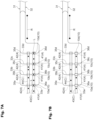
- FIGS. 12 A and 12 B include plan views showing an example of operation when loading operation is not able to be completed.
- FIG. 12 A for example, if a time to load onto the transport vehicle 10 d has been determined to exceed a time limit, loading operation onto the transport vehicle 10 d is determined as not being able to be completed, and the transport vehicle 10 is left empty without assigning a load L to the transport vehicle 10 d .
- FIG. 12 B when the count of the pitch timer has reached zero, the transport vehicle 10 d is controlled to start even without being loaded.
- the transport system 1 includes the first branch tracks 33 a to 33 d each having a stop position corresponding to the delivery port 4 , and these first branch tracks 33 a to 33 d merge into the first main track 31 .
- the transport system 1 also includes the second branch tracks 34 a to 34 d each having a stop position corresponding to the delivery port 4 , and these second branch tracks 34 a to 34 b merge into the second main track 32 . Accordingly, a plurality of transport vehicles 10 is able to travel in a distributed manner to perform delivery and reception of loads L.
- the start timing of a transport vehicle 10 on a downstream branch track of the first branch tracks 33 a to 33 d is set simultaneous with or earlier than the start timing of a transport vehicle 10 on an upstream branch track of the first branch track 33 a to 33 d .
- the transport vehicles 10 are able to be controlled to enter the first main track 31 without being stopped as much as possible.
- the start timing of a transport vehicle 10 on a downstream branch track of the second branch tracks 34 a to 34 d is set simultaneous with or earlier than the start timing of a transport vehicle 10 on an upstream branch track of the second branch tracks 34 a to 34 d .
- the transport vehicles 10 are able to be controlled to enter the second main track 32 without being stopped as much as possible. Accordingly, with the transport system 1 , the efficiency of conveying loads L is improved.
- the respective transport vehicles 10 arriving at the stop positions corresponding to the respective delivery ports 4 at different timings are controlled, and a transport vehicle 10 arriving earlier is controlled to wait to start until a transport vehicle 10 arriving later arrives.
- a situation in which the respective transport vehicles 10 stop simultaneously or substantially simultaneously at the respective stop positions is able to be reliably provided.
- the above-described starting control is able to be easily performed.
- the respective branch points 36 a to 36 d of the first branch tracks 33 a to 33 d are spaced apart from each other on the second main track 32 .
- the respective transport vehicles 10 traveling on the second main track 32 are controlled to enter the respective first branch tracks 33 a to 33 d sequentially in the order from downstream to upstream.
- the transport vehicles 10 are able to be distributed on the first branch tracks 33 a to 33 d , and the respective transport vehicles 10 arrive at the respective stop positions of the first branch tracks 33 a to 33 d at the same or substantially the same timing.
- Branch traveling in which one certain transport vehicle 10 branches off from the second main track 32 is able to be prevented from hindering branch traveling in which another transport vehicle 10 branches off from the second main track 32 .
- the above-described starting control is able to be smoothly operated.
- the waiting time for the above-described stand-by control is reduced.
- the respective branch points 38 a to 38 d of the second branch tracks 34 a to 34 d are spaced apart from each other on the first main track 31 .
- the respective transport vehicles 10 traveling on the first main track 31 are controlled to enter the respective second branch tracks 34 a to 34 d sequentially in the order from downstream to upstream.
- the transport vehicles 10 are able to be distributed on the second branch tracks 34 a to 34 d , and the respective transport vehicles 10 arrive at the respective stop positions of the second branch tracks 34 a to 34 d at the same or substantially the same timing.
- Branch traveling in which one certain transport vehicle 10 branches off from the first main track 31 is able to be prevented from hindering branch traveling in which another transport vehicle 10 branches off from the first main track 31 .
- the above-described starting control is able to be smoothly operated.
- the waiting time for the above-described stand-by control is reduced.
- the entering control for entry into the first branch tracks 33 a to 33 d is performed for each transport vehicle group including transport vehicles 10 the number of which corresponds to the number of the first branch tracks 33 a to 33 d .
- the entering control for entry into the second branch tracks 34 a to 34 d is performed for each transport vehicle group including transport vehicles 10 the number of which corresponds to the number of the second branch tracks 34 a to 34 d . Accordingly, the entering control is able to be performed with relatively simple logic.
- a situation in which the total number of the transport vehicles 10 increases or decreases due to some circumstances may occur.
- this situation is not able to be handled appropriately, which may result in the row of the traveling transport vehicles 10 becoming disordered.
- the delivery port 4 as a destination is determined for a transport vehicle 10 traveling in the specified section R.
- the row of the transport vehicles 10 is able to be prevented from becoming disordered, traffic jam of the transport vehicles 10 is able to be prevented from occurring, and the efficiency of conveying loads L is improved.
- the respective transport vehicles 10 stopping at the stop positions corresponding to the respective delivery ports 4 are controlled to start at timing repeated at regular intervals for each of the first branch tracks 33 a to 33 d and the second branch tracks 34 a to 34 d (when the count of the pitch timer has reached zero).
- each transport vehicle 10 that has stopped starts at the corresponding timing even without being loaded.
- a higher priority is assigned to traveling of the transport vehicles 10 . Accordingly, a higher priority is able to be provided to increase of the number of deliveries and receptions of loads L during a system operation period, and the limiting value of transport amount is able to be increased. Thus, the efficiency of conveying loads L is improved.
- the track 3 includes the circuit tracks (the first main track 31 , the second main track 32 , the first branch tracks 33 a to 33 d , and the second branch tracks 34 a to 34 d ) along which the transport vehicles 10 travel in circles.
- the transport vehicles 10 are controlled to travel along the circuit tracks, and their circling distances or their circling periods of time become the same or substantially the same. Accordingly, in comparison with the case in which the circling distances or the circling periods of time of the transport vehicles 10 are different, the row of the transport vehicles 10 is able to be prevented from becoming disordered. Traffic jam of the transport vehicles 10 is able to be prevented from occurring.
- the efficiency of conveying loads L is improved.
- the transport system 1 is able to perform control to unload the transport vehicles 10 simultaneously or substantially simultaneously in parallel and to load the transport vehicles 10 simultaneously or substantially simultaneously in parallel.
- the transport vehicles 10 are able to be controlled with relatively simple logic.
- the transport system 1 in comparison with a transport system that communicates by polling communication, the time required for communication is reduced.
- the track 3 includes four first branch tracks 33 a , 33 b , 33 c , 33 d .
- the number of the first branch tracks may be two, may be three, or may be five or more.
- the track 3 also includes four second branch tracks 34 a , 34 b , 34 c , 34 d .
- the number of the second branch tracks may be two, may be three, or may be five or more.
- the destination-determining control of determining a destination for a transport vehicle 10 traveling in the specified section R is performed. However, the destination-determining control does not have to be performed, and a delivery port 4 as a destination may be determined at any timing.
- the stand-by control of controlling a transport vehicle 10 arriving at a stop position earlier to wait to start is performed. However, the stand-by control does not have to be performed.
- the entering control of controlling transport vehicles 10 to enter the first branch tracks 33 a to 33 d and the second branch tracks 34 a to 34 d sequentially in the order from downstream to upstream is performed. However, the entering control does not have to be performed.
- the virtual coupling control of performing control for each transport vehicle group including a plurality of transport vehicles 10 is performed. However, the virtual coupling control does not have to be performed.
Landscapes
- Engineering & Computer Science (AREA)
- Radar, Positioning & Navigation (AREA)
- Remote Sensing (AREA)
- Automation & Control Theory (AREA)
- Aviation & Aerospace Engineering (AREA)
- Physics & Mathematics (AREA)
- General Physics & Mathematics (AREA)
- Mechanical Engineering (AREA)
- Control Of Position, Course, Altitude, Or Attitude Of Moving Bodies (AREA)
- Train Traffic Observation, Control, And Security (AREA)
- Centrifugal Separators (AREA)
Abstract
Description
Claims (16)
Applications Claiming Priority (3)
| Application Number | Priority Date | Filing Date | Title |
|---|---|---|---|
| JP2018088283 | 2018-05-01 | ||
| JP2018-088283 | 2018-05-01 | ||
| PCT/JP2019/003247 WO2019211933A1 (en) | 2018-05-01 | 2019-01-30 | Carrier system |
Publications (2)
| Publication Number | Publication Date |
|---|---|
| US20210155406A1 US20210155406A1 (en) | 2021-05-27 |
| US12110177B2 true US12110177B2 (en) | 2024-10-08 |
Family
ID=68386016
Family Applications (1)
| Application Number | Title | Priority Date | Filing Date |
|---|---|---|---|
| US17/045,787 Active 2041-12-02 US12110177B2 (en) | 2018-05-01 | 2019-01-30 | Carrier system |
Country Status (8)
| Country | Link |
|---|---|
| US (1) | US12110177B2 (en) |
| EP (1) | EP3789266B1 (en) |
| JP (1) | JP6935846B2 (en) |
| KR (1) | KR102389724B1 (en) |
| CN (1) | CN111788106B (en) |
| SG (1) | SG11202010020PA (en) |
| TW (1) | TWI801571B (en) |
| WO (1) | WO2019211933A1 (en) |
Families Citing this family (7)
| Publication number | Priority date | Publication date | Assignee | Title |
|---|---|---|---|---|
| CN109017885B (en) * | 2018-08-17 | 2023-06-06 | 湖南大学 | A method and system for dynamic automatic train reorganization |
| JP7283456B2 (en) * | 2020-09-09 | 2023-05-30 | 株式会社ダイフク | Goods transport equipment |
| US12515878B2 (en) * | 2020-12-16 | 2026-01-06 | Murata Machinery, Ltd. | Transport system |
| JP7556376B2 (en) * | 2022-05-20 | 2024-09-26 | 株式会社ダイフク | Goods handling equipment |
| JP7841590B2 (en) * | 2022-06-06 | 2026-04-07 | 村田機械株式会社 | Conveying system |
| EP4492179A1 (en) * | 2022-06-06 | 2025-01-15 | Murata Machinery, Ltd. | Conveyance system |
| KR102786789B1 (en) * | 2023-07-17 | 2025-03-28 | 주식회사 에스에프에이 | Transport Vehicle Control System and Transport Vehicle Control Method of the Same |
Citations (11)
| Publication number | Priority date | Publication date | Assignee | Title |
|---|---|---|---|---|
| JPS6329813A (en) | 1986-07-23 | 1988-02-08 | Hitachi Ltd | Traffic control system for carrier car at confluence point |
| US4817750A (en) | 1986-05-09 | 1989-04-04 | 501 Daifuku Co., Ltd. | Running control system for conveyor cart |
| JPH01133801A (en) | 1987-11-16 | 1989-05-25 | Murata Mach Ltd | Article storing equipment |
| US20070193859A1 (en) * | 2006-02-21 | 2007-08-23 | Asyst Shinko, Inc. | Transport apparatus |
| JP2009214974A (en) | 2008-03-10 | 2009-09-24 | Murata Mach Ltd | Traveling vehicle system |
| US20110178657A1 (en) * | 2008-09-26 | 2011-07-21 | Murata Machinery, Ltd. | Guided vehicle system |
| US20120004767A1 (en) * | 2009-03-03 | 2012-01-05 | Murata Machinery, Ltd. | Transportation system |
| US20140172223A1 (en) * | 2012-12-18 | 2014-06-19 | Christopher John Murphy | Method of material handling with automatic guided vehicles |
| US20150260535A1 (en) * | 2014-03-13 | 2015-09-17 | Kabushiki Kaisha Toshiba | Automatic traveling vehicle system, control method and program |
| US20180122671A1 (en) * | 2016-10-28 | 2018-05-03 | Daifuku Co., Ltd. | Article Transport Facility |
| US20180275681A1 (en) * | 2017-03-27 | 2018-09-27 | Clearpath Robotics, Inc. | Systems and methods for flexible manufacturing using self-driving vehicles |
Family Cites Families (21)
| Publication number | Priority date | Publication date | Assignee | Title |
|---|---|---|---|---|
| JPH05181527A (en) * | 1991-12-27 | 1993-07-23 | Mitsubishi Electric Corp | Automatic carrier |
| JP3206314B2 (en) * | 1994-08-04 | 2001-09-10 | 株式会社明電舎 | Autonomous driving method for automatic guided vehicles |
| JP2763759B2 (en) * | 1995-12-25 | 1998-06-11 | 西川化成株式会社 | Assembly line system |
| JP3461711B2 (en) * | 1998-02-24 | 2003-10-27 | 日産ディーゼル工業株式会社 | Operation control system for automatic guided vehicles |
| JP3864556B2 (en) * | 1998-05-14 | 2007-01-10 | 株式会社豊田自動織機 | Delivery management device |
| JP2000276230A (en) * | 1999-03-29 | 2000-10-06 | Hitachi Kiden Kogyo Ltd | Transport system |
| US6516239B1 (en) * | 1999-08-03 | 2003-02-04 | Honda Of Canada Incorporated | Assembly line control system |
| JP4483055B2 (en) * | 2000-09-14 | 2010-06-16 | 株式会社ダイフク | Transport equipment |
| JP4048029B2 (en) * | 2001-02-02 | 2008-02-13 | 株式会社ダイフク | Method for controlling merging of articles |
| JP2007257154A (en) * | 2006-03-22 | 2007-10-04 | Asyst Shinko Inc | Transport vehicle management device, transport vehicle management system, transport vehicle management method, and transport vehicle management program |
| WO2009142051A1 (en) * | 2008-05-22 | 2009-11-26 | 村田機械株式会社 | Traveling vehicle system and method for controlling traveling by traveling vehicle system |
| KR101463250B1 (en) * | 2008-05-26 | 2014-11-18 | 주식회사 포스코 | How to drive a vehicle in an auto-driving vehicle system |
| JP5830282B2 (en) * | 2011-06-30 | 2015-12-09 | 株式会社岡村製作所 | Article conveying device |
| JP2013035670A (en) | 2011-08-09 | 2013-02-21 | Murata Machinery Ltd | Guided vehicle system |
| JP5454554B2 (en) | 2011-11-11 | 2014-03-26 | 株式会社デンソー | Transport system and control method thereof |
| US9845192B2 (en) * | 2014-06-04 | 2017-12-19 | Murata Machinery, Ltd. | Transport vehicle system and transport method |
| KR102069778B1 (en) * | 2015-08-14 | 2020-01-23 | 무라다기카이가부시끼가이샤 | Carrier system |
| KR102394712B1 (en) * | 2015-09-09 | 2022-05-04 | 삼성전자주식회사 | Transporting system, transporting unit included therein |
| JP6520797B2 (en) * | 2016-04-11 | 2019-05-29 | 株式会社ダイフク | Goods transport equipment |
| JP6620707B2 (en) * | 2016-09-09 | 2019-12-18 | 株式会社ダイフク | Goods transport equipment |
| CN107748950A (en) * | 2017-09-25 | 2018-03-02 | 河南森源电气股份有限公司 | A kind of AGV dispatching methods of single major trunk roads |
-
2019
- 2019-01-30 CN CN201980016432.2A patent/CN111788106B/en active Active
- 2019-01-30 JP JP2020517019A patent/JP6935846B2/en active Active
- 2019-01-30 KR KR1020207025659A patent/KR102389724B1/en active Active
- 2019-01-30 SG SG11202010020PA patent/SG11202010020PA/en unknown
- 2019-01-30 EP EP19796612.0A patent/EP3789266B1/en active Active
- 2019-01-30 US US17/045,787 patent/US12110177B2/en active Active
- 2019-01-30 WO PCT/JP2019/003247 patent/WO2019211933A1/en not_active Ceased
- 2019-04-29 TW TW108114866A patent/TWI801571B/en active
Patent Citations (11)
| Publication number | Priority date | Publication date | Assignee | Title |
|---|---|---|---|---|
| US4817750A (en) | 1986-05-09 | 1989-04-04 | 501 Daifuku Co., Ltd. | Running control system for conveyor cart |
| JPS6329813A (en) | 1986-07-23 | 1988-02-08 | Hitachi Ltd | Traffic control system for carrier car at confluence point |
| JPH01133801A (en) | 1987-11-16 | 1989-05-25 | Murata Mach Ltd | Article storing equipment |
| US20070193859A1 (en) * | 2006-02-21 | 2007-08-23 | Asyst Shinko, Inc. | Transport apparatus |
| JP2009214974A (en) | 2008-03-10 | 2009-09-24 | Murata Mach Ltd | Traveling vehicle system |
| US20110178657A1 (en) * | 2008-09-26 | 2011-07-21 | Murata Machinery, Ltd. | Guided vehicle system |
| US20120004767A1 (en) * | 2009-03-03 | 2012-01-05 | Murata Machinery, Ltd. | Transportation system |
| US20140172223A1 (en) * | 2012-12-18 | 2014-06-19 | Christopher John Murphy | Method of material handling with automatic guided vehicles |
| US20150260535A1 (en) * | 2014-03-13 | 2015-09-17 | Kabushiki Kaisha Toshiba | Automatic traveling vehicle system, control method and program |
| US20180122671A1 (en) * | 2016-10-28 | 2018-05-03 | Daifuku Co., Ltd. | Article Transport Facility |
| US20180275681A1 (en) * | 2017-03-27 | 2018-09-27 | Clearpath Robotics, Inc. | Systems and methods for flexible manufacturing using self-driving vehicles |
Also Published As
| Publication number | Publication date |
|---|---|
| US20210155406A1 (en) | 2021-05-27 |
| SG11202010020PA (en) | 2020-11-27 |
| TW201945267A (en) | 2019-12-01 |
| JP6935846B2 (en) | 2021-09-15 |
| KR20200116999A (en) | 2020-10-13 |
| TWI801571B (en) | 2023-05-11 |
| CN111788106B (en) | 2022-07-26 |
| EP3789266A4 (en) | 2022-01-26 |
| JPWO2019211933A1 (en) | 2021-02-12 |
| CN111788106A (en) | 2020-10-16 |
| KR102389724B1 (en) | 2022-04-21 |
| EP3789266B1 (en) | 2023-03-01 |
| WO2019211933A1 (en) | 2019-11-07 |
| EP3789266A1 (en) | 2021-03-10 |
Similar Documents
| Publication | Publication Date | Title |
|---|---|---|
| US12110177B2 (en) | Carrier system | |
| KR102586754B1 (en) | Transport vehicle system | |
| US12187548B2 (en) | Article transport facility | |
| US11791186B2 (en) | Conveyance system | |
| CN108352349A (en) | Transport system and carrying method | |
| JP7790565B2 (en) | Transport System | |
| CN119096211A (en) | Handling system | |
| JP7501474B2 (en) | Item storage facilities | |
| JP4389225B2 (en) | Transport system | |
| US11217092B2 (en) | Transport vehicle system | |
| JP2004283994A (en) | Transfer control system | |
| JP2002110766A (en) | Transfer system and transfer method |
Legal Events
| Date | Code | Title | Description |
|---|---|---|---|
| AS | Assignment |
Owner name: MURATA MACHINERY, LTD., JAPAN Free format text: ASSIGNMENT OF ASSIGNORS INTEREST;ASSIGNORS:ITO, NAOHISA;AOKI, EIJIRO;SIGNING DATES FROM 20200928 TO 20201001;REEL/FRAME:053994/0672 |
|
| FEPP | Fee payment procedure |
Free format text: ENTITY STATUS SET TO UNDISCOUNTED (ORIGINAL EVENT CODE: BIG.); ENTITY STATUS OF PATENT OWNER: LARGE ENTITY |
|
| STPP | Information on status: patent application and granting procedure in general |
Free format text: APPLICATION DISPATCHED FROM PREEXAM, NOT YET DOCKETED |
|
| STPP | Information on status: patent application and granting procedure in general |
Free format text: DOCKETED NEW CASE - READY FOR EXAMINATION |
|
| STPP | Information on status: patent application and granting procedure in general |
Free format text: NON FINAL ACTION MAILED |
|
| STPP | Information on status: patent application and granting procedure in general |
Free format text: RESPONSE TO NON-FINAL OFFICE ACTION ENTERED AND FORWARDED TO EXAMINER |
|
| STPP | Information on status: patent application and granting procedure in general |
Free format text: FINAL REJECTION MAILED |
|
| STPP | Information on status: patent application and granting procedure in general |
Free format text: RESPONSE AFTER FINAL ACTION FORWARDED TO EXAMINER |
|
| STPP | Information on status: patent application and granting procedure in general |
Free format text: NOTICE OF ALLOWANCE MAILED -- APPLICATION RECEIVED IN OFFICE OF PUBLICATIONS |
|
| ZAAA | Notice of allowance and fees due |
Free format text: ORIGINAL CODE: NOA |
|
| ZAAB | Notice of allowance mailed |
Free format text: ORIGINAL CODE: MN/=. |
|
| STPP | Information on status: patent application and granting procedure in general |
Free format text: PUBLICATIONS -- ISSUE FEE PAYMENT VERIFIED |
|
| STCF | Information on status: patent grant |
Free format text: PATENTED CASE |