US12098143B2 - Organic molecules for optoelectronic devices - Google Patents
Organic molecules for optoelectronic devices Download PDFInfo
- Publication number
- US12098143B2 US12098143B2 US17/265,771 US201917265771A US12098143B2 US 12098143 B2 US12098143 B2 US 12098143B2 US 201917265771 A US201917265771 A US 201917265771A US 12098143 B2 US12098143 B2 US 12098143B2
- Authority
- US
- United States
- Prior art keywords
- optionally substituted
- substituents
- organic
- group
- deuterium
- Prior art date
- Legal status (The legal status is an assumption and is not a legal conclusion. Google has not performed a legal analysis and makes no representation as to the accuracy of the status listed.)
- Active, expires
Links
Images


Classifications
-
- C—CHEMISTRY; METALLURGY
- C09—DYES; PAINTS; POLISHES; NATURAL RESINS; ADHESIVES; COMPOSITIONS NOT OTHERWISE PROVIDED FOR; APPLICATIONS OF MATERIALS NOT OTHERWISE PROVIDED FOR
- C09K—MATERIALS FOR MISCELLANEOUS APPLICATIONS, NOT PROVIDED FOR ELSEWHERE
- C09K11/00—Luminescent materials, e.g. electroluminescent or chemiluminescent
- C09K11/06—Luminescent materials, e.g. electroluminescent or chemiluminescent containing organic luminescent materials
-
- C—CHEMISTRY; METALLURGY
- C07—ORGANIC CHEMISTRY
- C07D—HETEROCYCLIC COMPOUNDS
- C07D403/00—Heterocyclic compounds containing two or more hetero rings, having nitrogen atoms as the only ring hetero atoms, not provided for by group C07D401/00
- C07D403/14—Heterocyclic compounds containing two or more hetero rings, having nitrogen atoms as the only ring hetero atoms, not provided for by group C07D401/00 containing three or more hetero rings
-
- H—ELECTRICITY
- H10—SEMICONDUCTOR DEVICES; ELECTRIC SOLID-STATE DEVICES NOT OTHERWISE PROVIDED FOR
- H10K—ORGANIC ELECTRIC SOLID-STATE DEVICES
- H10K85/00—Organic materials used in the body or electrodes of devices covered by this subclass
- H10K85/60—Organic compounds having low molecular weight
- H10K85/649—Aromatic compounds comprising a hetero atom
- H10K85/654—Aromatic compounds comprising a hetero atom comprising only nitrogen as heteroatom
-
- H—ELECTRICITY
- H10—SEMICONDUCTOR DEVICES; ELECTRIC SOLID-STATE DEVICES NOT OTHERWISE PROVIDED FOR
- H10K—ORGANIC ELECTRIC SOLID-STATE DEVICES
- H10K85/00—Organic materials used in the body or electrodes of devices covered by this subclass
- H10K85/60—Organic compounds having low molecular weight
- H10K85/649—Aromatic compounds comprising a hetero atom
- H10K85/657—Polycyclic condensed heteroaromatic hydrocarbons
- H10K85/6572—Polycyclic condensed heteroaromatic hydrocarbons comprising only nitrogen in the heteroaromatic polycondensed ring system, e.g. phenanthroline or carbazole
-
- H—ELECTRICITY
- H10—SEMICONDUCTOR DEVICES; ELECTRIC SOLID-STATE DEVICES NOT OTHERWISE PROVIDED FOR
- H10K—ORGANIC ELECTRIC SOLID-STATE DEVICES
- H10K2101/00—Properties of the organic materials covered by group H10K85/00
- H10K2101/20—Delayed fluorescence emission
-
- H—ELECTRICITY
- H10—SEMICONDUCTOR DEVICES; ELECTRIC SOLID-STATE DEVICES NOT OTHERWISE PROVIDED FOR
- H10K—ORGANIC ELECTRIC SOLID-STATE DEVICES
- H10K50/00—Organic light-emitting devices
- H10K50/10—OLEDs or polymer light-emitting diodes [PLED]
- H10K50/11—OLEDs or polymer light-emitting diodes [PLED] characterised by the electroluminescent [EL] layers
-
- Y—GENERAL TAGGING OF NEW TECHNOLOGICAL DEVELOPMENTS; GENERAL TAGGING OF CROSS-SECTIONAL TECHNOLOGIES SPANNING OVER SEVERAL SECTIONS OF THE IPC; TECHNICAL SUBJECTS COVERED BY FORMER USPC CROSS-REFERENCE ART COLLECTIONS [XRACs] AND DIGESTS
- Y02—TECHNOLOGIES OR APPLICATIONS FOR MITIGATION OR ADAPTATION AGAINST CLIMATE CHANGE
- Y02E—REDUCTION OF GREENHOUSE GAS [GHG] EMISSIONS, RELATED TO ENERGY GENERATION, TRANSMISSION OR DISTRIBUTION
- Y02E10/00—Energy generation through renewable energy sources
- Y02E10/50—Photovoltaic [PV] energy
- Y02E10/549—Organic PV cells
Definitions
- the invention relates to light-emitting organic molecules and their use in organic light-emitting diodes (OLEDs) and in other optoelectronic devices.
- FIG. 1 is an emission spectrum of example 1 (10% by weight) in PMMA.
- FIG. 2 is an emission spectrum of example 2 (10% by weight) in PMMA.
- FIG. 3 is an emission spectrum of example 3 (10% by weight) in PMMA.
- FIG. 4 is an emission spectrum of example 4 (10% by weight) in PMMA.
- the object of the present invention is to provide molecules which are suitable for use in optoelectronic devices.
- the organic molecules are purely organic molecules, i.e. they do not contain any metal ions in contrast to metal complexes known for use in organic optoelectronic devices. Therefore, according to the present invention, it is preferred that the organic molecules are free of metal atoms or metal ions.
- the pure organic molecules may, however, include metalloids, in particular, B and Si or Sn, Se, and Ge.
- the organic molecules exhibit emission maxima in the blue, sky-blue or green spectral range.
- the organic molecules exhibit in particular emission maxima between 420 nm and 520 nm, preferably between 440 nm and 495 nm, more preferably between 450 nm and 470 nm.
- the photoluminescence quantum yields of the organic molecules according to the invention are, in particular, 70% or more.
- the molecules according to the invention exhibit in particular thermally activated delayed fluorescence (TADF).
- TADF thermally activated delayed fluorescence
- organic light-emitting molecules according to the invention comprise or consist of
- R Py is at each occurrence independently from another selected from the group consisting of hydrogen
- R 1 is at each occurrence independently from another selected from the group consisting of hydrogen,
- R a , R 3 and R 4 is at each occurrence independently from another selected from the group consisting of hydrogen,
- R a , R 3 and R 4 is at each occurrence independently from another selected to be a mono- or polycyclic, aliphatic, aromatic and/or benzo-fused ring system together with one or more of the other R a , R 3 , R 4 or R 5 within the organic molecule; it is preferred for R a , R 3 and R 4 to form the mono- or polycyclic, aliphatic, aromatic and/or benzo-fused ring system with an immediately ring-adjacent substituent R a , R 3 , R 4 or R 5 .
- R a , R 3 and R 4 forming the mono- or polycyclic, aliphatic, aromatic and/or benzo-fused ring system described above include at least one or more aromatic rings.
- Mono- or polycyclic, aliphatic, aromatic and/or benzo-fused ring system as described above may itself have substituents R 5 .
- R 5 is at each occurrence independently from another selected from the group consisting of hydrogen,
- R 6 is at each occurrence independently from another selected from the group consisting of hydrogen,
- one or more of the substituents R a , R 3 , R 4 and/or R 5 independently from each other, form a mono- or polycyclic, aliphatic, aromatic and/or benzo-fused ring system with one or more other substituents R a , R 3 , R 4 and/or R 5 .
- exactly one kind of substituent (T, V or W) selected from the group consisting of T, V and W is at each occurrence the binding site of a single bond linking the first chemical moiety to one of the three second chemical moieties, and at least one ring member Q is N.
- the three second chemical moieties are identical. In other embodiments, two of the three second chemical moieties are identical and the third chemical moiety is different from the other two. In some embodiments, all three second chemical moieties are different from each other.
- the three carbazole moieties are identical.
- two of the three carbazole moieties are identical (including the substituents that are present on the carbazole moieties) and the third carbazole moiety is different thereto (i.e. carries different substituents than the other two carbazole moieties).
- all three carbazole moieties are different (i.e. each carbazole moiety is distinguishable from each of the other two carbazole moieties by its substituents, wherein a carbazole moiety may also have H as a substituent).
- the organic molecules according to the invention comprise or consist of a first chemical moiety comprising or consisting of a structure of Formula I-Y,
- exactly one Q is N and one Q is C—R Py .
- R Py is hydrogen
- Q is N at each occurrence.
- the three second chemical moieties each individually might be the same or different from each other.
- the one second chemical moiety attached to Y is different to the other two second chemical moieties, which are identical to each other.
- R 1 is at each occurrence independently from another selected from the group consisting of H, methyl and phenyl (Ph).
- R 1 is H.
- R Tz is at each occurrence independently from another selected from the group consisting of hydrogen
- R Tz is Ph, which is optionally substituted with one or more substituents independently from each other selected from the group consisting of Me, i Pr, t Bu, CN, CF 3 , and Ph.
- R Tz is Ph.
- R 1 , R Py and R Tz are at each occurrence independently from another selected from the group consisting of H and phenyl.
- R 1 and R Py are H at each occurrence and R Tz is phenyl at each occurrence which is optionally substituted with one or more substituents independently from each other selected from the group consisting of Me, i Pr, t Bu, CN, CF 3 , and Ph.
- R 1 and R Py is H at each occurrence and R Tz is phenyl at each occurrence.
- T represents at each occurrence the binding site of a single bond linking the first chemical moiety and one of the three second chemical moieties.
- W represents at each occurrence the binding site of a single bond linking the first chemical moiety and one of the three second chemical moieties.
- V represents at each occurrence the binding site of a single bond linking the first chemical moiety and one of the three second chemical moieties.
- the three second chemical moieties each individually from each other comprise or consist of a structure of Formula IIa:
- R a is at each occurrence independently from another selected from the group consisting of hydrogen
- R a is at each occurrence independently from another selected from the group consisting of
- At least one of the three second chemical moieties i.e. one, two or three second chemical moieties, comprise or consist of a structure of Formula IIb, a structure of Formula IIb-2, a structure of Formula IIb-3 or a structure of Formula IIb-4:
- At least one of the three second chemical moieties comprises or consist of a structure of Formula IIc, a structure of Formula IIc-2, a structure of Formula IIc-3 or a structure of Formula IIc-4:
- R b is at each occurrence independently from another selected from the group consisting of
- R b is at each occurrence independently from another selected from the group consisting of
- the one of the three second chemical moieties attached to the binding site Y is selected from the group consisting of:
- At least two of the three second chemical moieties comprise or consist of a structure of Formula III,
- the second chemical moiety attached to Y comprises or consist of Formula IIa:
- the second chemical moiety attached to Y comprises or consist of Formula IIa:
- the organic molecules according to the invention comprise or consist of a structure of Formula I-YY:
- the organic molecules according to the invention comprise or consist of a first chemical moiety comprising or consisting of a structure of Formula I-YY and R Tz is phenyl at each occurrence which is optionally substituted with one or more substituents independently from each other selected from the group consisting of Me, i Pr, t Bu, CN, CF 3 , and Ph.
- the organic molecules according to the invention comprise or consist of a first chemical moiety comprising or consisting of a structure of Formula I-YY and R Tz is phenyl at each occurrence.
- the organic molecules according to the invention comprise or consist of a first chemical moiety comprising or consisting of a structure of Formula I-YYY,
- the organic molecules comprise or consist of a structure of Formula III-11, Formula III-12 and Formula III-13:
- the organic molecules comprise or consist of a structure of Formula III-11, Formula III-12 and Formula III-13, wherein R Tz is phenyl.
- the organic molecules comprise or consist of a structure Formula III-11.
- the organic molecules comprise or consist of a structure Formula III-11, wherein R Tz is phenyl at each occurrence, which is optionally substituted with one or more substituents independently from each other selected from the group consisting of Me, i Pr, t Bu, CN, CF 3 , and Ph.
- the organic molecules comprise or consist of a structure Formula III-11, wherein R Tz is phenyl at each occurrence.
- the organic molecules comprise or consist of a structure of Formula III-21, Formula III-22 and Formula III-23:
- the organic molecules comprise or consist of a structure of Formula III-21, Formula III-22 and Formula III-23, wherein R Tz is phenyl.
- the organic molecules comprise or consist of a structure Formula III-21.
- the organic molecules comprise or consist of a structure Formula III-21, wherein R Tz is phenyl at each occurrence, which is optionally substituted with one or more substituents independently from each other selected from the group consisting of Me, i Pr, t Bu, CN, CF 3 , and Ph.
- the organic molecules comprise or consist of a structure Formula III-21, wherein R Tz is phenyl at each occurrence.
- the organic molecules comprise or consist of a structure of Formula III-31, Formula III-32 and Formula III-33:
- the organic molecules comprise or consist of a structure of Formula III-31, Formula III-32 and Formula III-33, wherein R Tz is phenyl.
- the organic molecules comprise or consist of a structure Formula III-31.
- the organic molecules comprise or consist of a structure Formula III-31, wherein R Tz is phenyl at each occurrence, which is optionally substituted with one or more substituents independently from each other selected from the group consisting of Me, i Pr, t Bu, CN, CF 3 , and Ph.
- the organic molecules comprise or consist of a structure Formula III-31, wherein R Tz is phenyl at each occurrence.
- the organic molecules comprise or consist of a structure of Formula IIIa-1 to Formula IIIa-3:
- the organic molecules comprise or consist of a structure of Formula IIIa-1 to Formula IIIa-3, wherein R Tz is phenyl.
- the organic molecules comprise or consist of a structure Formula IIIa-1.
- the organic molecules comprise or consist of a structure Formula IIIa-1, wherein R Tz is phenyl at each occurrence, which is optionally substituted with one or more substituents independently from each other selected from the group consisting of Me, i Pr, t Bu, CN, CF 3 , and Ph.
- the organic molecules comprise or consist of a structure Formula IIIa-1, wherein R Tz is phenyl at each occurrence.
- the organic molecules comprise or consist of a structure of Formula IIIb-1 to Formula IIIb-3:
- the organic molecules comprise or consist of a structure of Formula IIIb-1 to Formula IIIb-3, wherein R Tz is phenyl.
- the organic molecules comprise or consist of a structure Formula IIIb-1.
- the organic molecules comprise or consist of a structure Formula IIIb-1, wherein R Tz is phenyl at each occurrence, which is optionally substituted with one or more substituents independently from each other selected from the group consisting of Me, i Pr, t Bu, CN, CF 3 , and Ph.
- the organic molecules comprise or consist of a structure Formula IIIb-1, wherein R Tz is phenyl at each occurrence.
- the organic molecules comprise or consist of a structure of Formula IV-11, Formula IV-12 and Formula IV-13:
- the organic molecules comprise or consist of a structure of Formula IV-11, Formula IV-12 and Formula IV-13, wherein R Tz is phenyl.
- the organic molecules comprise or consist of a structure Formula IV-11.
- the organic molecules comprise or consist of a structure Formula IV-11, wherein R Tz is phenyl at each occurrence, which is optionally substituted with one or more substituents independently from each other selected from the group consisting of Me, i Pr, t Bu, CN, CF 3 , and Ph.
- the organic molecules comprise or consist of a structure Formula IV-11, wherein R Tz is phenyl at each occurrence.
- the organic molecules comprise or consist of a structure of Formula IV-21, Formula IV-22 and Formula IV-23:
- the organic molecules comprise or consist of a structure of Formula IV-21, Formula IV-22 and Formula IV-23, wherein R Tz is phenyl.
- the organic molecules comprise or consist of a structure Formula IV-21.
- the organic molecules comprise or consist of a structure Formula IV-21, wherein R Tz is phenyl at each occurrence, which is optionally substituted with one or more substituents independently from each other selected from the group consisting of Me, i Pr, t Bu, CN, CF 3 , and Ph.
- the organic molecules comprise or consist of a structure Formula IV-21, wherein R Tz is phenyl at each occurrence.
- the organic molecules comprise or consist of a structure of Formula IV-31.
- the organic molecules comprise or consist of a structure of Formula IV-31, Formula IV-32 and Formula IV-33, wherein R Tz is phenyl.
- the organic molecules comprise or consist of a structure Formula IV-31.
- the organic molecules comprise or consist of a structure Formula IV-31, wherein R Tz is phenyl at each occurrence, which is optionally substituted with one or more substituents independently from each other selected from the group consisting of Me, i Pr, t Bu, CN, CF 3 , and Ph.
- the organic molecules comprise or consist of a structure Formula IV-31, wherein R Tz is phenyl at each occurrence.
- the organic molecules comprise or consist of a structure of Formula IVa-1 to Formula IVa-3:
- the organic molecules comprise or consist of a structure of Formula IVa-1 to Formula IVa-3, wherein R Tz is phenyl.
- the organic molecules comprise or consist of a structure Formula IVa-1.
- the organic molecules comprise or consist of a structure Formula IVa-1, wherein R Tz is phenyl at each occurrence, which is optionally substituted with one or more substituents independently from each other selected from the group consisting of Me, i Pr, t Bu, CN, CF 3 , and Ph.
- the organic molecules comprise or consist of a structure Formula IVa-1, wherein R Tz is phenyl at each occurrence.
- the organic molecules comprise or consist of a structure of Formula IVb-1 to Formula IVb-3:
- the organic molecules comprise or consist of a structure of Formula IVb-1 to Formula IVb-3, wherein R Tz is phenyl.
- the organic molecules comprise or consist of a structure Formula IVb-1.
- the organic molecules comprise or consist of a structure Formula IVb-1, wherein R Tz is phenyl at each occurrence, which is optionally substituted with one or more substituents independently from each other selected from the group consisting of Me, i Pr, t Bu, CN, CF 3 , and Ph.
- the organic molecules comprise or consist of a structure Formula IVb-1, wherein R Tz is phenyl at each occurrence.
- the organic molecules comprise or consist of a structure of Formula V-11, Formula V-12 and Formula V-13:
- the organic molecules comprise or consist of a structure of Formula V-11, Formula V-12 and Formula V-13, wherein R Tz is phenyl.
- the organic molecules comprise or consist of a structure Formula V-11.
- the organic molecules comprise or consist of a structure Formula V-11, wherein R Tz is phenyl at each occurrence, which is optionally substituted with one or more substituents independently from each other selected from the group consisting of Me, i Pr, t Bu, CN, CF 3 , and Ph.
- the organic molecules comprise or consist of a structure Formula V-11, wherein R Tz is phenyl at each occurrence.
- the organic molecules comprise or consist of a structure of Formula V-21, Formula V-22 and Formula V-23:
- the organic molecules comprise or consist of a structure of Formula V-21, Formula V-22 and Formula V-23, wherein R Tz is phenyl.
- the organic molecules comprise or consist of a structure Formula V-21.
- the organic molecules comprise or consist of a structure Formula V-21, wherein R Tz is phenyl at each occurrence, which is optionally substituted with one or more substituents independently from each other selected from the group consisting of Me, i Pr, t Bu, CN, CF 3 , and Ph.
- the organic molecules comprise or consist of a structure Formula V-21, wherein R Tz is phenyl at each occurrence.
- the organic molecules comprise or consist of a structure of Formula V-31, Formula V-32 and Formula V-33:
- the organic molecules comprise or consist of a structure of Formula V-31, Formula V-32 and Formula V-33, wherein R Tz is phenyl.
- the organic molecules comprise or consist of a structure Formula V-31.
- the organic molecules comprise or consist of a structure Formula V-31, wherein R Tz is phenyl at each occurrence, which is optionally substituted with one or more substituents independently from each other selected from the group consisting of Me, i Pr, t Bu, CN, CF 3 , and Ph.
- the organic molecules comprise or consist of a structure Formula V-31, wherein R Tz is phenyl at each occurrence.
- the organic molecules comprise or consist of a structure of Formula Va-1 to Formula Va-3:
- the organic molecules comprise or consist of a structure of Formula Va-1 to Formula Va-3, wherein R Tz is phenyl.
- the organic molecules comprise or consist of a structure Formula Va-1.
- the organic molecules comprise or consist of a structure Formula Va-1, wherein R Tz is phenyl at each occurrence, which is optionally substituted with one or more substituents independently from each other selected from the group consisting of Me, i Pr, t Bu, CN, CF 3 , and Ph.
- the organic molecules comprise or consist of a structure Formula Va-1, wherein R Tz is phenyl at each occurrence.
- the organic molecules comprise or consist of a structure of Formula Vb-1 to Formula Vb-3:
- the organic molecules comprise or consist of a structure of Formula Vb-1 to Formula Vb-3, wherein R Tz is phenyl.
- the organic molecules comprise or consist of a structure Formula Vb-1.
- the organic molecules comprise or consist of a structure Formula Vb-1, wherein R Tz is phenyl at each occurrence, which is optionally substituted with one or more substituents independently from each other selected from the group consisting of Me, i Pr, t Bu, CN, CF 3 , and Ph.
- the organic molecules comprise or consist of a structure Formula Vb-1, wherein R Tz is phenyl at each occurrence.
- R c is at each occurrence independently from another selected from the group consisting of
- R c is at each occurrence independently from another selected from the group consisting of
- V is R 1 , wherein R 1 is preferably selected from the group consisting of H, methyl and phenyl.
- Y in subgroup ⁇ is one of the three second chemical moieties comprising or consisting of a structure of Formula IIa.
- organic molecule of subgroup ⁇ includes the substituent R T , wherein R T is R 1 .
- R Py is hydrogen
- R Tz is preferably Ph, which is optionally substituted with one or more substituents independently from each other selected from the group consisting of Me, i Pr, t Bu, CN, CF 3 , and Ph.
- T is preferably one of the three second chemical moieties at each occurrence.
- Chemical molecules of subgroup ⁇ as described herein provide an emission maximum in the blue/green-range and provide a high photoluminescence quantum yield (PLQY).
- V and W is R 1 at each occurrence, wherein R 1 is selected from the group consisting of hydrogen, deuterium and C 1 -C 5 -alkyl, wherein one or more hydrogen atoms are optionally substituted by deuterium.
- R Tz is Ph, which is optionally substituted with one or more substituents independently from each other selected from the group consisting of Me, i Pr, t Bu, CN, CF 3 , and Ph.
- R Tz is Ph at each occurrence.
- the second chemical moiety attached to Y comprises or consist of Formula IIa:
- the second chemical moiety attached to Y comprises or consist of Formula IIa, wherein exactly two immediately ring-adjacent R a form a mono- or polycyclic, aliphatic, aromatic and/or benzo-fused ring system.
- the organic substances of subgroup ⁇ show an even more increased photoluminescence quantum yield compared to comparable organic molecules of the state of the art and provide an emission maximum in the blue/green-range.
- Z is preferred for Z to be a direct bond in at least one of the three second chemical moieties.
- subgroup ⁇ it is preferred for the one second chemical moiety attached to the binding site Y to be different to the two further second chemical moieties, which are identical to each other.
- the second chemical moiety attached to Y comprises or consist of Formula IIa:
- the second chemical moiety attached to Y comprises or consist of Formula IIa, wherein exactly two immediately ring-adjacent R a form a mono- or polycyclic, aliphatic, aromatic and/or benzo-fused ring system, and the other two of the three second chemical moieties comprise or consist of a structure of Formula III.
- Z is especially preferred for Z to be a direct bond in all of the three chemical moieties of the organic molecule of the invention.
- subgroup ⁇ it is preferred for the one second chemical moiety attached to the binding site Y to be different to the two further second chemical moieties, which are identical to each other.
- Chemical molecules of the above subgroups ⁇ and ⁇ hereby provide an emission maximum in the blue/green-range and further increase the photoluminescence quantum yield (PLQY).
- both of the two of the three second chemical moieties, which are not attached to the binding site Y it is additionally most preferred for both of the two of the three second chemical moieties, which are not attached to the binding site Y, to have an identical structure.
- the beneficial effects of an emission maximum in the blue/green-range and a high photoluminescence quantum yield (PLQY) can be further enhanced.
- aryl and “aromatic” may be understood in the broadest sense as any mono-, bi- or polycyclic aromatic moieties. Accordingly, an aryl group contains 6 to 60 aromatic ring atoms, and a heteroaryl group contains 5 to 60 aromatic ring atoms, of which at least one is a heteroatom. Notwithstanding, throughout the application the number of aromatic ring atoms may be given as subscripted number in the definition of certain substituents. In particular, the heteroaromatic ring includes one to three heteroatoms.
- heteroaryl and “heteroaromatic” may be understood in the broadest sense as any mono-, bi- or polycyclic hetero-aromatic moieties that include at least one heteroatom.
- the heteroatoms may at each occurrence be the same or different and be individually selected from the group consisting of N, O and S.
- arylene refers to a divalent substituent that bears two binding sites to other molecular structures and thereby serving as a linker structure.
- a group in the exemplary embodiments is defined differently from the definitions given here, for example, the number of aromatic ring atoms or number of heteroatoms differs from the given definition, the definition in the exemplary embodiments is to be applied.
- a condensed (annulated) aromatic or heteroaromatic polycycle is built of two or more single aromatic or heteroaromatic cycles, which formed the polycycle via a condensation reaction.
- aryl group or heteroaryl group comprises groups which can be bound via any position of the aromatic or heteroaromatic group, derived from benzene, naphthaline, anthracene, phenanthrene, pyrene, dihydropyrene, chrysene, perylene, fluoranthene, benzanthracene, benzphenanthrene, tetracene, pentacene, benzpyrene, furan, benzofuran, isobenzofuran, dibenzofuran, thiophene, benzothiophene, isobenzothiophene, dibenzothiophene; pyrrole, indole, isoindole, carbazole, pyridine, quinoline, isoquinoline, acridine, phenanthridine, benzo-5,6-quinoline, benzo-6,7-quinoline, benzo-7,8-quinoline, phen
- cyclic group may be understood in the broadest sense as any mono-, bi- or polycyclic moieties.
- alkyl group may be understood in the broadest sense as any linear, branched, or cyclic alkyl substituent.
- the term alkyl comprises the substituents methyl (Me), ethyl (Et), n-propyl ( n Pr), i-propyl ( i Pr), cyclopropyl, n-butyl ( n Bu), i-butyl ( i Bu), s-butyl ( t Bu), t-butyl (tBu), cyclobutyl, 2-methylbutyl, n-pentyl, s-pentyl, t-pentyl, 2-pentyl, neo-pentyl, cyclopentyl, n-hexyl, s-hexyl, t-hexyl, 2-hexyl, 3-hexyl, neo-hexyl, cyclohexyl, 1-methylcycl
- alkenyl comprises linear, branched, and cyclic alkenyl substituents.
- alkenyl group exemplarily comprises the substituents ethenyl, propenyl, butenyl, pentenyl, cyclopentenyl, hexenyl, cyclohexenyl, heptenyl, cycloheptenyl, octenyl, cyclooctenyl or cyclooctadienyl.
- alkynyl comprises linear, branched, and cyclic alkynyl substituents.
- alkynyl group exemplarily comprises ethynyl, propynyl, butynyl, pentynyl, hexynyl, heptynyl or octynyl.
- alkoxy comprises linear, branched, and cyclic alkoxy substituents.
- alkoxy group exemplarily comprises methoxy, ethoxy, n-propoxy, i-propoxy, n-butoxy, i-butoxy, s-butoxy, t-butoxy and 2-methylbutoxy.
- thioalkoxy comprises linear, branched, and cyclic thioalkoxy substituents, in which the O of the exemplarily alkoxy groups is replaced by S.
- halogen and “halo” may be understood in the broadest sense as being preferably fluorine, chlorine, bromine or iodine.
- the organic molecules according to the invention have an excited state lifetime of not more than 150 ⁇ s, of not more than 100 ⁇ s, in particular of not more than 50 ⁇ s, more preferably of not more than 10 ⁇ s or not more than 7 ⁇ s in a film of poly(methyl methacrylate) (PMMA) with 10% by weight of organic molecule at room temperature.
- PMMA poly(methyl methacrylate)
- the organic molecules according to the invention represent thermally-activated delayed fluorescence (TADF) emitters, which exhibit a ⁇ E ST value, which corresponds to the energy difference between the first excited singlet state (S1) and the first excited triplet state (T1), of less than 5000 cm ⁇ 1 , preferably less than 3000 cm ⁇ 1 , more preferably less than 1500 cm ⁇ 1 , even more preferably less than 1000 cm ⁇ 1 or even less than 500 cm ⁇ 1 .
- TADF thermally-activated delayed fluorescence
- the organic molecules according to the invention have an emission peak in the visible or nearest ultraviolet range, i.e., in the range of a wavelength of from 380 to 800 nm, with a full width at half maximum of less than 0.50 eV, preferably less than 0.48 eV, more preferably less than 0.45 eV, even more preferably less than 0.43 eV or even less than 0.40 eV in a film of poly(methyl methacrylate) (PMMA) with 10% by weight of organic molecule at room temperature.
- PMMA poly(methyl methacrylate)
- the organic molecules according to the invention have a “blue material index” (BMI), calculated by dividing the photoluminescence quantum yield (PLQY) in % by the CIEy color coordinate of the emitted light, of more than 150, in particular more than 200, preferably more than 250, more preferably of more than 300 or even more than 500.
- BMI blue material index
- the organic molecules according to the invention have a highest occupied molecular orbital with the energy E HOMO , which is higher in energy than ⁇ 6.2 eV, preferably higher in energy than ⁇ 6.1 eV and even more preferably higher in energy than ⁇ 6.0 eV or even ⁇ 5.9 eV.
- Orbital and excited state energies can be determined either by means of experimental methods or by calculations employing quantum-chemical methods, in particular density functional theory calculations.
- the energy of the highest occupied molecular orbital E HOMO is determined by methods known to the person skilled in the art from cyclic voltammetry measurements with an accuracy of 0.1 eV.
- the energy of the lowest unoccupied molecular orbital E LUMO is determined as the onset of the absorption spectrum.
- the onset of an absorption spectrum is determined by computing the intersection of the tangent to the absorption spectrum with the x-axis.
- the tangent to the absorption spectrum is set at the low-energy side of the absorption band and at the point at half maximum of the maximum intensity of the absorption spectrum.
- the energy of the first excited triplet state T1 is determined from the onset of the emission spectrum at low temperature, typically at 77 K.
- the phosphorescence is usually visible in a steady-state spectrum in 2-Me-THF.
- the triplet energy can thus be determined as the onset of the phosphorescence spectrum.
- the energy of the first excited triplet state T1 is determined from the onset of the delayed emission spectrum at 77 K, if not otherwise stated measured in a film of) PMMA with 10% by weight of emitter.
- the energy of the first excited singlet state S1 is determined from the onset of the emission spectrum, if not otherwise stated measured in a film of PMMA with 10% by weight of host or emitter compound.
- the onset of an emission spectrum is determined by computing the intersection of the tangent to the emission spectrum with the x-axis.
- the tangent to the emission spectrum is set at the high-energy side of the emission band, i.e., where the emission band rises by going from higher energy values to lower energy values, and at the point at half maximum of the maximum intensity of the emission spectrum.
- a further aspect of the invention relates to a process for synthesizing organic molecules according to the invention (with an optional subsequent reaction), wherein 5-bromo-1,3-dichloro-2-fluorobenzene is used as a reactant:
- An alternative synthesis route comprises the introduction of a nitrogen heterocycle via copper- or palladium-catalyzed coupling to an aryl halide or to an aryl pseudohalide, preferably an aryl bromide, an aryl iodide, aryl triflate, or an aryl tosylate.
- typical conditions include the use of a base, such as tribasic potassium phosphate or sodium hydride, for example, in an aprotic polar solvent, such as dimethyl sulfoxide (DMSO) or N,N-dimethylformamide (DMF), for example.
- a base such as tribasic potassium phosphate or sodium hydride
- an aprotic polar solvent such as dimethyl sulfoxide (DMSO) or N,N-dimethylformamide (DMF), for example.
- a further aspect of the invention relates to the use of an organic molecule according to the invention as a luminescent emitter or as an absorber, and/or as host material and/or as electron transport material, and/or as hole injection material, and/or as hole blocking material in an optoelectronic device.
- the optoelectronic device may be understood in the broadest sense as any device based on organic materials that is suitable for emitting light in the visible or nearest ultraviolet (UV) range, i.e., in the range of a wavelength of from 380 to 800 nm. More preferably, the optoelectronic device may be able to emit light in the visible range, i.e., of from 400 to 800 nm.
- UV visible or nearest ultraviolet
- the optoelectronic device is more particularly selected from the group consisting of:
- the optoelectronic device is a device selected from the group consisting of an organic light emitting diode (OLED), a light emitting electrochemical cell (LEC), and a light-emitting transistor.
- OLED organic light emitting diode
- LEC light emitting electrochemical cell
- the fraction of the organic molecule according to the invention in the emission layer in an optoelectronic device, more particularly in OLEDs is 1% to 99% by weight, more particularly 5% to 80% by weight. In an alternative embodiment, the proportion of the organic molecule in the emission layer is 100% by weight.
- the light-emitting layer comprises not only the organic molecules according to the invention but also a host material whose triplet (T1) and singlet (S1) energy levels are energetically higher than the triplet (T1) and singlet (S1) energy levels of the organic molecule.
- a further aspect of the invention relates to a composition
- a composition comprising or consisting of:
- the light-emitting layer comprises (or (essentially) consists of) a composition comprising or consisting of:
- the light-emitting layer EML comprises (or (essentially) consists of) a composition comprising or consisting of:
- energy can be transferred from the host compound H to the one or more organic molecules according to the invention, in particular transferred from the first excited triplet state T1(H) of the host compound H to the first excited triplet state T1(E) of the one or more organic molecules according to the invention and/or from the first excited singlet state S1(H) of the host compound H to the first excited singlet state S1(E) of the one or more organic molecules according to the invention.
- the light-emitting layer EML comprises (or (essentially) consists of) a composition comprising or consisting of:
- the host compound H has a highest occupied molecular orbital HOMO(H) having an energy E HOMO (H) in the range of from ⁇ 5 to ⁇ 6.5 eV and the at least one further host compound D has a highest occupied molecular orbital HOMO(D) having an energy E HOMO (D), wherein E HOMO (H)>E HOMO (D).
- the host compound H has a lowest unoccupied molecular orbital LUMO(H) having an energy E LUMO (H) and the at least one further host compound D has a lowest unoccupied molecular orbital LUMO(D) having an energy E LUMO (D), wherein E LUMO (H)>E LUMO (D).
- the host compound H has a highest occupied molecular orbital HOMO(H) having an energy E HOMO (H) and a lowest unoccupied molecular orbital LUMO(H) having an energy E LUMO (H), and
- the invention relates to an optoelectronic device comprising an organic molecule or a composition of the type described here, more particularly in the form of a device selected from the group consisting of organic light-emitting diode (OLED), light-emitting electrochemical cell, OLED sensor, more particularly gas and vapour sensors not hermetically externally shielded, organic diode, organic solar cell, organic transistor, organic field-effect transistor, organic laser and down-conversion element.
- OLED organic light-emitting diode
- OLED sensor more particularly gas and vapour sensors not hermetically externally shielded
- organic diode organic solar cell
- organic transistor organic field-effect transistor
- organic laser and down-conversion element organic laser and down-conversion element
- the optoelectronic device is a device selected from the group consisting of an organic light emitting diode (OLED), a light emitting electrochemical cell (LEC), and a light-emitting transistor.
- OLED organic light emitting diode
- LEC light emitting electrochemical cell
- the organic molecule according to the invention is used as emission material in a light-emitting layer EML.
- the light-emitting layer EML consists of the composition according to the invention described here.
- the optoelectronic device when the optoelectronic device is an OLED, it may exhibit the following layer structure:
- the optoelectronic device optionally comprises one or more protective layers protecting the device from damaging exposure to harmful species in the environment including, for example, moisture, vapor and/or gases.
- the optoelectronic device is an OLED, which exhibits the following inverted layer structure:
- the OLED with an inverted layer structure comprises each layer, selected from the group consisting of HIL, HTL, EBL, HBL, ETL and EIL, only optionally, different layers may be merged and the OLED may comprise more than one layer of each layer types defined above.
- the optoelectronic device is an OLED, which may exhibit stacked architecture.
- this architecture contrary to the typical arrangement, where the OLEDs are placed side by side, the individual units are stacked on top of each other.
- Blended light may be generated with OLEDs exhibiting a stacked architecture, in particular white light may be generated by stacking blue, green and red OLEDs.
- the OLED exhibiting a stacked architecture may optionally comprise a charge generation layer (CGL), which is typically located between two OLED subunits and typically consists of a n-doped and p-doped layer with the n-doped layer of one CGL being typically located closer to the anode layer.
- CGL charge generation layer
- the optoelectronic device is an OLED, which comprises two or more emission layers between anode and cathode.
- this so-called tandem OLED comprises three emission layers, wherein one emission layer emits red light, one emission layer emits green light and one emission layer emits blue light, and optionally may comprise further layers such as charge generation layers, blocking or transporting layers between the individual emission layers.
- the emission layers are adjacently stacked.
- the tandem OLED comprises a charge generation layer between each two emission layers.
- adjacent emission layers or emission layers separated by a charge generation layer may be merged.
- the substrate may be formed by any material or composition of materials. Most frequently, glass slides are used as substrates. Alternatively, thin metal layers (e.g., copper, gold, silver or aluminum films) or plastic films or slides may be used. This may allow a higher degree of flexibility.
- the anode layer A is mostly composed of materials allowing to obtain an (essentially) transparent film. As at least one of both electrodes should be (essentially) transparent in order to allow light emission from the OLED, either the anode layer A or the cathode layer C is transparent.
- the anode layer A comprises a large content or even consists of transparent conductive oxides (TCOs).
- Such anode layer A may exemplarily comprise indium tin oxide, aluminum zinc oxide, fluorine doped tin oxide, indium zinc oxide, PbO, SnO, zirconium oxide, molybdenum oxide, vanadium oxide, wolfram oxide, graphite, doped Si, doped Ge, doped GaAs, doped polyaniline, doped polypyrrol and/or doped polythiophene.
- the anode layer A (essentially) consists of indium tin oxide (ITO) (e.g., (InO3)0.9(SnO2)0.1).
- ITO indium tin oxide
- TCOs transparent conductive oxides
- HIL hole injection layer
- the HIL may facilitate the injection of quasi charge carriers (i.e., holes) in that the transport of the quasi charge carriers from the TCO to the hole transport layer (HTL) is facilitated.
- the hole injection layer may comprise poly-3,4-ethylendioxy thiophene (PEDOT), polystyrene sulfonate (PSS), MoO 2 , V 2 O 5 , CuPC or CuI, in particular a mixture of PEDOT and PSS.
- the hole injection layer (HIL) may also prevent the diffusion of metals from the anode layer A into the hole transport layer (HTL).
- the HIL may exemplarily comprise PEDOT:PSS (poly-3,4-ethylendioxy thiophene:polystyrene sulfonate), PEDOT (poly-3,4-ethylendioxy thiophene), mMTDATA (4,4′,4′′-tris[phenyl(m-tolyl)amino]triphenylamine), Spiro-TAD (2,2′,7,7′-tetrakis(n,n-diphenylamino)-9,9′-spirobifluorene), DNTPD (N1,N1′-(biphenyl-4,4′-diyl)bis(N1-phenyl-N4,N4-di-m-tolylbenzene-1,4-diamine), NPB (N,N′-nis-(1-naphthalenyl)-N,N′-bis-phenyl-(1,1′-biphenyl)-4
- HTL hole transport layer
- any hole transport compound may be used.
- electron-rich heteroaromatic compounds such as triarylamines and/or carbazoles may be used as hole transport compound.
- the HTL may decrease the energy barrier between the anode layer A and the light-emitting layer EML.
- the hole transport layer (HTL) may also be an electron blocking layer (EBL).
- EBL electron blocking layer
- hole transport compounds bear comparably high energy levels of their triplet states T1.
- the hole transport layer may comprise a star-shaped heterocycle such as tris(4-carbazoyl-9-ylphenyl)amine (TCTA), poly-TPD (poly(4-butylphenyl-diphenyl-amine)), [alpha]-NPD (poly(4-butylphenyl-diphenyl-amine)), TAPC (4,4′-cyclohexyliden-bis[N,N-bis(4-methylphenyl)benzenamine]), 2-TNATA (4,4′,4′′-tris[2-naphthyl(phenyl)amino]triphenylamine), Spiro-TAD, DNTPD, NPB, NPNPB, MeO-TPD, HAT-CN and/or TrisPcz (9,9′-diphenyl-6-(9-phenyl-9H-carbazol-3-yl)-9H,9′H-3,3′-bicarbazole).
- TCTA tris(4-
- the HTL may comprise a p-doped layer, which may be composed of an inorganic or organic dopant in an organic hole-transporting matrix.
- Transition metal oxides such as vanadium oxide, molybdenum oxide or tungsten oxide may exemplarily be used as inorganic dopant.
- Tetrafluorotetracyanoquinodimethane (F4-TCNQ), copper-pentafluorobenzoate (Cu(I)pFBz) or transition metal complexes may exemplarily be used as organic dopant.
- the EBL may exemplarily comprise mCP (1,3-bis(carbazol-9-yl)benzene), TCTA, 2-TNATA, mCBP (3,3-di(9H-carbazol-9-yl)biphenyl), SiMCP (3,5-Di(9H-carbazol-9-yl)phenyl]triphenylsilane), DPEPO, tris-Pcz, CzSi (9-(4-tert-Butylphenyl)-3,6-bis(triphenylsilyl)-9H-carbazole), and/or DCB (N,N′-dicarbazolyl-1,4-dimethylbenzene).
- the light-emitting layer EML Adjacent to the hole transport layer (HTL), typically, the light-emitting layer EML is located.
- the light-emitting layer EML comprises at least one light emitting molecule.
- the EML comprises at least one light emitting molecule according to the invention.
- the light-emitting layer comprises only the organic molecules according to the invention.
- the EML additionally comprises one or more host material.
- the host material is selected from CBP (4,4′-Bis-(N-carbazolyl)-biphenyl), mCP, mCBP Sif87 (dibenzo[b,d]thiophen-2-yltriphenylsilane), CzSi, SimCP ([3,5-Di(9H-carbazol-9-yl)phenyl]triphenylsilane), Sif88 (dibenzo[b,d]thiophen-2-yl)diphenylsilane), DPEPO (bis[2-(diphenylphosphino)phenyl] ether oxide), 9-[3-(dibenzofuran-2-yl)phenyl]-9H-carbazole, 9-[3-(dibenzofuran-2-yl)phenyl]-9H-carbazole, 9-[3-(dibenzothiophen-2-yl)phenyl]-9H-carbazole, 9-[3,
- the EML comprises a so-called mixed-host system with at least one hole-dominant host and one electron-dominant host.
- the EML comprises exactly one light emitting molecule according to the invention and a mixed-host system comprising T2T as electron-dominant host and a host selected from CBP, mCP, mCBP, 9-[3-(dibenzofuran-2-yl)phenyl]-9H-carbazole, 9-[3-(dibenzofuran-2-yl)phenyl]-9H-carbazole, 9-[3-(dibenzothiophen-2-yl)phenyl]-9H-carbazole, 9-[3,5-bis(2-dibenzofuranyl)phenyl]-9H-carbazole and 9-[3,5-bis(2-dibenzothiophenyl)phenyl]-9H-carbazole as hole-dominant host.
- the EML comprises 50-80% by weight, preferably 60-75% by weight of a host selected from CBP, mCP, mCBP, 9-[3-(dibenzofuran-2-yl)phenyl]-9H-carbazole, 9-[3-(dibenzofuran-2-yl)phenyl]-9H-carbazole, 9-[3-(dibenzothiophen-2-yl)phenyl]-9H-carbazole, 9-[3,5-bis(2-dibenzofuranyl)phenyl]-9H-carbazole and 9-[3,5-bis(2-dibenzothiophenyl)phenyl]-9H-carbazole; 10-45% by weight, preferably 15-30% by weight of T2T and 5-40% by weight, preferably 10-30% by weight of light emitting molecule according to the invention.
- a host selected from CBP, mCP, mCBP
- an electron transport layer Adjacent to the light-emitting layer EML an electron transport layer (ETL) may be located.
- ETL electron transport layer
- any electron transporter may be used.
- compounds poor of electrons such as, e.g., benzimidazoles, pyridines, triazoles, oxadiazoles (e.g., 1,3,4-oxadiazole), phosphinoxides and sulfone, may be used.
- An electron transporter may also be a star-shaped heterocycle such as 1,3,5-tri(1-phenyl-1H-benzo[d]imidazol-2-yl)phenyl (TPBi).
- the ETL may comprise NBphen (2,9-bis(naphthalen-2-yl)-4,7-diphenyl-1,10-phenanthroline), Alq3 (Aluminum-tris(8-hydroxyquinoline)), TSPO1 (diphenyl-4-triphenylsilylphenyl-phosphinoxide), BPyTP2 (2,7-di(2,2′-bipyridin-5-yl)triphenyle), Sif87 (dibenzo[b,d]thiophen-2-yltriphenylsilane), Sif88 (dibenzo[b,d]thiophen-2-yl)diphenylsilane), BmPyPhB (1,3-bis[3,5-di(pyridin-3-yl)phenyl]benzene) and/or BTB (4,4′-bis-[2-(4,6-diphenyl-1,3,5-triazinyl)]-1,1′-biphenyl
- a cathode layer C Adjacent to the electron transport layer (ETL), a cathode layer C may be located.
- the cathode layer C may comprise or may consist of a metal (e.g., Al, Au, Ag, Pt, Cu, Zn, Ni, Fe, Pb, LiF, Ca, Ba, Mg, In, W, or Pd) or a metal alloy.
- the cathode layer may also consist of (essentially) non-transparent metals such as Mg, Ca or Al.
- the cathode layer C may also comprise graphite and or carbon nanotubes (CNTs).
- the cathode layer C may also consist of nanoscalic silver wires.
- An OLED may further, optionally, comprise a protection layer between the electron transport layer (ETL) and the cathode layer C (which may be designated as electron injection layer (EIL)).
- This layer may comprise lithium fluoride, cesium fluoride, silver, Liq (8-hydroxyquinolinolatolithium), Li 2 O, BaF 2 , MgO and/or NaF.
- the electron transport layer (ETL) and/or a hole blocking layer (HBL) may comprise one or more host compounds.
- the light-emitting layer EML may further comprise one or more further emitter molecule F.
- an emitter molecule F may be any emitter molecule known in the art.
- an emitter molecule F is a molecule with a structure differing from the structure of the molecules according to the invention.
- the emitter molecule F may optionally be a TADF emitter.
- the emitter molecule F may optionally be a fluorescent and/or phosphorescent emitter molecule which is able to shift the emission spectrum and/or the absorption spectrum of the light-emitting layer EML.
- the triplet and/or singlet excitons may be transferred from the emitter molecule according to the invention to the emitter molecule F before relaxing to the ground state S0 by emitting light typically red-shifted in comparison to the light emitted by emitter molecule E.
- the emitter molecule F may also provoke two-photon effects (i.e., the absorption of two photons of half the energy of the absorption maximum).
- an optoelectronic device may exemplarily be an essentially white optoelectronic device.
- white optoelectronic device may comprise at least one (deep) blue emitter molecule and one or more emitter molecules emitting green and/or red light. Then, there may also optionally be energy transmittance between two or more molecules as described above.
- the designation of the colors of emitted and/or absorbed light is as follows:
- a deep blue emitter has an emission maximum in the range of from >420 to 480 nm
- a sky blue emitter has an emission maximum in the range of from >480 to 500 nm
- a green emitter has an emission maximum in a range of from >500 to 560 nm
- a red emitter has an emission maximum in a range of from >620 to 800 nm.
- a deep blue emitter may preferably have an emission maximum of below 480 nm, more preferably below 470 nm, even more preferably below 465 nm or even below 460 nm. It will typically be above 420 nm, preferably above 430 nm, more preferably above 440 nm or even above 450 nm.
- a further aspect of the present invention relates to an OLED, which exhibits an external quantum efficiency at 1000 cd/m2 of more than 8%, more preferably of more than 10%, more preferably of more than 13%, even more preferably of more than 15% or even more than 20% and/or exhibits an emission maximum between 420 nm and 500 nm, preferably between 430 nm and 490 nm, more preferably between 440 nm and 480 nm, even more preferably between 450 nm and 470 nm and/or exhibits a LT80 value at 500 cd/m2 of more than 100 h, preferably more than 200 h, more preferably more than 400 h, even more preferably more than 750 h or even more than 1000 h.
- a further aspect of the present invention relates to an OLED, whose emission exhibits a CIEy color coordinate of less than 0.45, preferably less than 0.30, more preferably less than 0.20 or even more preferably less than 0.15 or even less than 0.10.
- a further aspect of the present invention relates to an OLED, which emits light at a distinct color point.
- the OLED emits light with a narrow emission band (small full width at half maximum (FWHM)).
- FWHM full width at half maximum
- the OLED according to the invention emits light with a FWHM of the main emission peak of less than 0.50 eV, preferably less than 0.48 eV, more preferably less than 0.45 eV, even more preferably less than 0.43 eV or even less than 0.40 eV.
- UHD Ultra High Definition
- typically top-emitting (top-electrode is transparent) devices are used, whereas test devices as used throughout the present application represent bottom-emitting devices (bottom-electrode and substrate are transparent).
- the CIEy color coordinate of a blue device can be reduced by up to a factor of two, when changing from a bottom- to a top-emitting device, while the CIEx remains nearly unchanged (Okinaka et al. (2015), 22.1 : Invited Paper: New Fluorescent Blue Host Materials for Achieving Low Voltage in OLEDs, SID Symposium Digest of Technical Papers, 46; doi:10.1002/sdtp.10480).
- a further aspect of the present invention relates to an OLED, whose emission exhibits a CIEx color coordinate of between 0.02 and 0.30, preferably between 0.03 and 0.25, more preferably between 0.05 and 0.20 or even more preferably between 0.08 and 0.18 or even between 0.10 and 0.15 and/or a CIEy color coordinate of between 0.00 and 0.45, preferably between 0.01 and 0.30, more preferably between 0.02 and 0.20 or even more preferably between 0.03 and 0.15 or even between 0.04 and 0.10.
- the invention relates to a method for producing an optoelectronic component.
- an organic molecule of the invention is used.
- the optoelectronic device in particular the OLED according to the present invention can be produced by any means of vapor deposition and/or liquid processing. Accordingly, at least one layer is
- the methods used to produce the optoelectronic device, in particular the OLED according to the present invention are known in the art.
- the different layers are individually and successively deposited on a suitable substrate by means of subsequent deposition processes.
- the individual layers may be deposited using the same or differing deposition methods.
- Vapor deposition processes exemplarily comprise thermal (co)evaporation, chemical vapor deposition and physical vapor deposition.
- an AMOLED backplane is used as substrate.
- the individual layer may be processed from solutions or dispersions employing adequate solvents.
- Solution deposition process exemplarily comprise spin coating, dip coating and jet printing.
- Liquid processing may optionally be carried out in an inert atmosphere (e.g., in a nitrogen atmosphere) and the solvent may optionally be completely or partially removed by means known in the state of the art.
- E1 (1.00 equivalents), E2 (1.15 equivalents), Pd(dppf)Cl 2 (0.05 equivalents) and potassium acetate (2.50 equivalents) are stirred under nitrogen atmosphere in a mixture of dioxane and water (10:1) at 110° C. until completion of the reaction (monitoring with GC/MS, usually finished within 4-24 h). Active carbon and Celite are added to the reaction mixture and stirred at 100° C. for 10 minutes. Subsequently, the mixture is hot filtered and concentrated under reduced pressure. The residue is dissolved in dichloromethane and washed with water and brine. The organic phase is dried with MgSO 4 , filtrated and reduced under reduced pressure. The obtained crude product is purified via recrystallization using toluene as solvent, giving E3 as solid.
- E5 (1.00 equivalents), E6 (1.20 equivalents) and tribasic potassium phosphate (2.50 equivalents) are stirred under nitrogen atmosphere in DMSO at 120° C. until completion of the reaction (monitoring with GC/MS, usually finished within 4-16 h).
- the reaction mixture is cooled to rt. Subsequently, the reaction mixture is poured into brine and the resulting precipitate is filtered. The residue is dissolved in dichloromethane and washed with brine, dried over MgSO 4 and the solvent evaporated under reduced pressure.
- the obtained crude product is purified via flash chromatography or recrystallization, giving E7 as solid.
- the donor molecule D-H or E5 is a 3,6-substituted carbazole (e.g., 3,6-dimethylcarbazole, 3,6-diphenylcarbazole, 3,6-di-tert-butylcarbazole), a 2,7-substituted carbazole (e.g., 2,7-dimethylcarbazole, 2,7-diphenylcarbazole, 2,7-di-tert-butylcarbazole), a 1,8-substituted carbazole (e.g., 1,8-dimethylcarbazole, 1,8-diphenylcarbazole, 1,8-di-tert-butylcarbazole), a 1-substituted carbazole (e.g., 1-methylcarbazole, 1-phenylcarbazole, 1-tert-butylcarbazole), a 2-substituted carbazole (e.g., 2-methyl
- halogen-substituted carbazole particularly 3-bromocarbazole
- D-H or E5 Exemplarily a halogen-substituted carbazole, particularly 3-bromocarbazole, can be used as D-H or E5.
- a boronic acid ester functional group or boronic acid functional group may be exemplarily introduced at the position of the one or more halogen substituents, which was introduced via D-H or E5, to yield the corresponding carbazol-3-ylboronic acid ester or carbazol-3-ylboronic acid, e.g., via the reaction with bis(pinacolato)diboron (CAS No. 73183-34-3).
- one or more substituents R a may be introduced in place of the boronic acid ester group or the boronic acid group via a coupling reaction with the corresponding halogenated reactant R a -Hal, preferably R a —Cl and R a —Br.
- one or more substituents R a may be introduced at the position of the one or more halogen substituents, which was introduced via D-H, via the reaction with a boronic acid of the substituent R a [R a —B(OH) 2 ] or a corresponding boronic acid ester.
- Cyclic voltammograms are measured from solutions having concentration of 10 ⁇ 3 mol/l of the organic molecules in dichloromethane or a suitable solvent and a suitable supporting electrolyte (e.g. 0.1 mol/l of tetrabutylammonium hexafluorophosphate).
- the measurements are conducted at room temperature under nitrogen atmosphere with a three-electrode assembly (Working and counter electrodes: Pt wire, reference electrode: Pt wire) and calibrated using FeCp 2 /FeCp 2 + as internal standard.
- the HOMO data was corrected using ferrocene as internal standard against SCE.
- BP86 BP86 functional and the resolution of identity approach (RI).
- Excitation energies are calculated using the (BP86) optimized structures employing Time-Dependent DFT (TD-DFT) methods.
- Orbital and excited state energies are calculated with the B3LYP functional.
- Def2-SVP basis sets and a m4-grid for numerical integration are used.
- the Turbomole program package is used for all calculations.
- Steady-state emission spectroscopy is measured by a Horiba Scientific, Modell FluoroMax-4 equipped with a 150 W Xenon-Arc lamp, excitation- and emissions monochromators and a Hamamatsu R928 photomultiplier and a time-correlated single-photon counting option. Emissions and excitation spectra are corrected using standard correction fits.
- Excited state lifetimes are determined employing the same system using the TCSPC method with FM-2013 equipment and a Horiba Yvon TCSPC hub.
- Data analysis is done using the software suite DataStation and DAS6 analysis software. The fit is specified using the chi-squared-test.
- Emission maxima are given in nm, quantum yields CD in % and CIE coordinates as x,y values.
- PLQY is determined using the following protocol:
- Optoelectronic devices such as OLED devices, comprising organic molecules according to the invention can be produced via vacuum-deposition methods. If a layer contains more than one compound, the weight-percentage of one or more compounds is given in %. The total weight-percentage values amount to 100%, thus if a value is not given, the fraction of this compound equals to the difference between the given values and 100%.
- the not fully optimized OLEDs are characterized using standard methods and measuring electroluminescence spectra, the external quantum efficiency (in %) in dependency on the intensity, calculated using the light detected by the photodiode, and the current.
- the OLED device lifetime is extracted from the change of the luminance during operation at constant current density.
- the LT50 value corresponds to the time, where the measured luminance decreased to 50% of the initial luminance
- analogously LT80 corresponds to the time point, at which the measured luminance decreased to 80% of the initial luminance, LT 95 to the time point, at which the measured luminance decreased to 95% of the initial luminance etc.
- Accelerated lifetime measurements are performed (e.g. applying increased current densities).
- Exemplarily LT80 values at 500 cd/m 2 are determined using the following equation:
- HPLC-MS analysis is performed on an HPLC by Agilent (1100 series) with MS-detector (Thermo LTQ XL).
- Exemplary a typical HPLC method is as follows: a reverse phase column 4.6 mm ⁇ 150 mm, particle size 3.5 ⁇ m from Agilent (ZORBAX Eclipse Plus 95 ⁇ C18, 4.6 ⁇ 150 mm, 3.5 ⁇ m HPLC column) is used in the HPLC. The HPLC-MS measurements are performed at room temperature (rt) following gradients
- Ionization of the probe is performed using an APCI (atmospheric pressure chemical ionization) source either in positive (APCI+) or negative (APCI ⁇ ) ionization mode.
- APCI atmospheric pressure chemical ionization
- Example 1 was synthesized in a 5-step synthesis according to
- FIG. 1 depicts the emission spectrum of example 1 (10% by weight in PMMA).
- the emission maximum ( ⁇ max ) is at 458 nm.
- the photoluminescence quantum yield (PLQY) is 67%, the full width at half maximum (FWHM) is 0.42 eV.
- the resulting CIE x coordinate is determined at 0.15 and the CIE y coordinate at 0.16.
- Example 2 was synthesized in a 5-step synthesis according to
- FIG. 2 depicts the emission spectrum of example 2 (10% by weight in PMMA).
- the emission maximum ( ⁇ max ) is at 466 nm.
- the photoluminescence quantum yield (PLQY) is 68%, the full width at half maximum (FWHM) is 0.40 eV.
- the resulting CIE x coordinate is determined at 0.15 and the CIE y coordinate at 0.19.
- Example 3 was synthesized in a 5-step synthesis according to
- FIG. 3 depicts the emission spectrum of example 3 (10% by weight in PMMA).
- the emission maximum ( ⁇ max ) is at 461 nm.
- the photoluminescence quantum yield (PLQY) is 70%, the full width at half maximum (FWHM) is 0.41 eV.
- the resulting CIE x coordinate is determined at 0.16 and the CIE y coordinate at 0.17.
- Example 4 was synthesized in a 5-step synthesis according to
- FIG. 4 depicts the emission spectrum of example 4 (10% by weight in PMMA).
- the emission maximum ( ⁇ max ) is at 453 nm.
- the photoluminescence quantum yield (PLQY) is 68%, the full width at half maximum (FWHM) is 0.44 eV.
- the resulting CIE x coordinate is determined at 0.16 and the CIE y coordinate at 0.15.
Landscapes
- Chemical & Material Sciences (AREA)
- Organic Chemistry (AREA)
- Engineering & Computer Science (AREA)
- Materials Engineering (AREA)
- Physics & Mathematics (AREA)
- Spectroscopy & Molecular Physics (AREA)
- Electroluminescent Light Sources (AREA)
Abstract
-
- one first chemical moiety with a structure of Formula I,

and
-
- three second chemical moieties, each independently from another with a structure of Formula II,

-
- wherein
- the first chemical moiety is linked to each of the three second chemical moieties via a single bond.
Description
-
- one first chemical moiety comprising or consisting of a structure of Formula I,

-
- and
- three second chemical moieties, each independently from another comprising or consisting of a structure of Formula II,

-
- wherein the first chemical moiety is linked to each of the three second chemical moieties via a single bond;
- wherein
- Y is the binding site of a single bond linking the first chemical moiety to one of the three second chemical moieties;
- T, V, W is selected from the group consisting of the binding site of a single bond linking the first chemical moiety to one of the three second chemical moieties, and R1;
- Z is at each occurrence independently from another selected from the group consisting of a direct bond, CR3R4, C═CR3R4, C═O, C═NR3, NR3, O, SiR3R4, S, S(O) and S(O)2;
- # represents the binding site of a single bond linking the first chemical moiety to the second chemical moiety;
- Q is selected from the group consisting of N and C—RPy;
- RTz is at each occurrence independently from another selected from the group consisting of hydrogen,
- deuterium,
- C1-C5-alkyl,
- wherein one or more hydrogen atoms are optionally substituted by deuterium;
- C2-C8-alkenyl,
- wherein one or more hydrogen atoms are optionally substituted by deuterium;
- C2-C8-alkynyl,
- wherein one or more hydrogen atoms are optionally substituted by deuterium;
- C6-C18-aryl,
- which is optionally substituted with one or more substituents R5; and
- C3-C17-heteroaryl,
- which is optionally substituted with one or more substituents R5;
-
- deuterium,
- C1-C5-alkyl,
- wherein one or more hydrogen atoms are optionally substituted by deuterium;
- C2-C8-alkenyl,
- wherein one or more hydrogen atoms are optionally substituted by deuterium;
- C2-C8-alkynyl,
- wherein one or more hydrogen atoms are optionally substituted by deuterium;
- C6-C18-aryl,
- which is optionally substituted with one or more substituents R6; and
- C3-C17-heteroaryl,
- which is optionally substituted with one or more substituents R6;
-
- deuterium,
- C1-C5-alkyl,
- wherein one or more hydrogen atoms are optionally substituted by deuterium;
- C2-C8-alkenyl,
- wherein one or more hydrogen atoms are optionally substituted by deuterium;
- C2-C8-alkynyl,
- wherein one or more hydrogen atoms are optionally substituted by deuterium; and
- C6-C18-aryl,
- which is optionally substituted with one or more substituents independently from another selected from the group consisting of
- C1-C5-alkyl,
- wherein optionally one or more hydrogen atoms are independently from each other substituted by deuterium, CN, CF3, or F;
- C1-C5-alkyl,
- and
- C6-C18-aryl,
- which is optionally substituted with one or more C1-C5-alkyl substituents;
- C6-C18-aryl,
- which is optionally substituted with one or more substituents independently from another selected from the group consisting of
-
- deuterium,
- N(R5)2,
- OR5,
- Si(R5)3,
- B(OR5)2,
- OSO2R5,
- CF3,
- CN,
- F,
- Br,
- I,
- C1-C40-alkyl,
- which is optionally substituted with one or more substituents R5 and wherein one or more non-adjacent CH2-groups are optionally substituted by R5C═CR5, C≡C, Si(R5)2, Ge(R5)2, Sn(R5)2, C═O, C═S, C═Se, C═NR5, P(═O)(R5), SO, SO2, NR5, O, S or CONR5;
- C1-C40-alkoxy,
- which is optionally substituted with one or more substituents R5 and
- wherein one or more non-adjacent CH2-groups are optionally substituted by R5C═CR5, C≡C, Si(R5)2, Ge(R5)2, Sn(R5)2, C═O, C═S, C═Se, C═NR5, P(═O)(R5), SO, SO2, NR5, O, S or CONR5;
- C1-C40-thioalkoxy,
- which is optionally substituted with one or more substituents R5 and
- wherein one or more non-adjacent CH2-groups are optionally substituted by R5C═CR5, C≡C, Si(R5)2, Ge(R5)2, Sn(R5)2, C═O, C═S, C═Se, C═NR5, P(═O)(R5), SO, SO2, NR5, O, S or CONR5;
- C2-C40-alkenyl,
- which is optionally substituted with one or more substituents R5 and
- wherein one or more non-adjacent CH2-groups are optionally substituted by R5C═CR5, C≡C, Si(R5)2, Ge(R5)2, Sn(R5)2, C═O, C═S, C═Se, C═NR5, P(═O)(R5), SO, SO2, NR5, O, S or CONR5;
- C2-C40-alkynyl,
- which is optionally substituted with one or more substituents R5 and
- wherein one or more non-adjacent CH2-groups are optionally substituted by R5C═CR5, C≡C, Si(R5)2, Ge(R5)2, Sn(R5)2, C═O, C═S, C═Se, C═NR5, P(═O)(R5), SO, SO2, NR5, O, S or CONR5;
- C6-C60-aryl,
- which is optionally substituted with one or more substituents R5; and
- C3-C57-heteroaryl,
- which is optionally substituted with one or more substituents R5; and
- a mono- or polycyclic, aliphatic, aromatic and/or benzo-fused ring system formed by ring-closure with one or more of the other substituents selected from the group consisting of Ra, R3, R4 and R5;
-
- deuterium,
- N(R6)2,
- OR6,
- Si(R6)3,
- B(OR6)2,
- OSO2R6,
- CF3,
- CN,
- F,
- Br,
- I,
- C1-C40-alkyl,
- which is optionally substituted with one or more substituents R6 and
- wherein one or more non-adjacent CH2-groups are optionally substituted by R6C═CR6, C≡C, Si(R6)2, Ge(R6)2, Sn(R6)2, C═O, C═S, C═Se, C═NR6, P(═O)(R6), SO, SO2, NR6, O, S or CONR6;
- C1-C40-alkoxy,
- which is optionally substituted with one or more substituents R6 and
- wherein one or more non-adjacent CH2-groups are optionally substituted by R6C═CR6, C≡C, Si(R6)2, Ge(R6)2, Sn(R6)2, C═O, C═S, C═Se, C═NR6, P(═O)(R6), SO, SO2, NR6, O, S or CONR6;
- C1-C40-thioalkoxy,
- which is optionally substituted with one or more substituents R6 and
- wherein one or more non-adjacent CH2-groups are optionally substituted by R6C═CR6, C≡C, Si(R6)2, Ge(R6)2, Sn(R6)2, C═O, C═S, C═Se, C═NR6, P(═O)(R6), SO, SO2, NR6, O, S or CONR6;
- C2-C40-alkenyl,
- which is optionally substituted with one or more substituents R6 and
- wherein one or more non-adjacent CH2-groups are optionally substituted by R6C═CR6, C≡C, Si(R6)2, Ge(R6)2, Sn(R6)2, C═O, C═S, C═Se, C═NR6, P(═O)(R6), SO, SO2, NR6, O, S or CONR6;
- C2-C40-alkynyl,
- which is optionally substituted with one or more substituents R6 and
- wherein one or more non-adjacent CH2-groups are optionally substituted by R6C═CR6, C≡C, Si(R6)2, Ge(R6)2, Sn(R6)2, C═O, C═S, C═Se, C═NR6, P(═O)(R6), SO, SO2, NR6, O, S or CONR6;
- C6-C60-aryl,
- which is optionally substituted with one or more substituents R6;
- C3-C57-heteroaryl,
- which is optionally substituted with one or more substituents R6; and
- a mono- or polycyclic, aliphatic, aromatic and/or benzo-fused ring system formed by ring-closure with one or more of the other substituents selected from the group consisting of Ra, R3, R4 and R5;
-
- deuterium,
- OPh,
- CF3,
- CN,
- F,
- C1-C5-alkyl,
- wherein optionally one or more hydrogen atoms are independently from each other substituted by deuterium, CN, CF3, or F;
- C1-C5-alkoxy,
- wherein optionally one or more hydrogen atoms are independently from each other substituted by deuterium, CN, CF3, or F;
- C1-C5-thioalkoxy,
- wherein optionally one or more hydrogen atoms are independently from each other substituted by deuterium, CN, CF3, or F;
- C2-C5-alkenyl,
- wherein optionally one or more hydrogen atoms are independently from each other substituted by deuterium, CN, CF3, or F;
- C2-C5-alkynyl,
- wherein optionally one or more hydrogen atoms are independently from each other substituted by deuterium, CN, CF3, or F;
- C6-C18-aryl,
- which is optionally substituted with one or more C1-C5-alkyl substituents;
- C3-C17-heteroaryl,
- which is optionally substituted with one or more C1-C5-alkyl substituents;
- N(C6-C18-aryl)2;
- N(C3-C17-heteroaryl)2; and
- N(C3-C17-heteroaryl)(C6-C18-aryl).

-
- wherein Y, R1, RTz are defined as above,
- T# is R1 or is the binding site of a single bond linking the first chemical moiety to one of the three second chemical moieties,
- W# is R1 or is the binding site of a single bond linking the first chemical moiety to one of the three second chemical moieties,
- exactly one kind of substituent (T# or W#) selected from the group consisting of T# and W# represents at each occurrence the binding site of a single bond linking the first chemical moiety.
-
- deuterium,
- C1-C5-alkyl,
- wherein one or more hydrogen atoms are optionally substituted by deuterium;
- C2-C8-alkenyl,
- wherein one or more hydrogen atoms are optionally substituted by deuterium;
- C2-C8-alkynyl,
- wherein one or more hydrogen atoms are optionally substituted by deuterium;
- C6-C18-aryl,
- which is optionally substituted with one or more substituents R6; and
- C3-C17-heteroaryl,
- which is optionally substituted with one or more substituents R6;

wherein # and Ra are defined as above.
-
- Me,
- iPr,
- tBu
- CN,
- CF3,
- Ph, which is optionally substituted with one or more substituents independently from each other selected from the group consisting of Me, iPr, tBu, CN, CF3, and Ph,
- pyridinyl, which is optionally substituted with one or more substituents independently from each other selected from the group consisting of Me, iPr, tBu, CN, CF3, and Ph,
- pyrimidinyl, which is optionally substituted with one or more substituents independently from each other selected from the group consisting of Me, iPr, tBu, CN, CF3, and Ph,
- carbazolyl, which is optionally substituted with one or more substituents independently from each other selected from the group consisting of Me, iPr, tBu, CN, CF3, and Ph,
- triazinyl, which is optionally substituted with one or more substituents independently from each other selected from the group consisting of Me, iPr, tBu, CN, CF3, and Ph,
- and N(Ph)2.
-
- hydrogen,
- Me,
- iPr,
- tBu,
- CN,
- CF3,
- Ph, which is optionally substituted with one or more substituents independently from each other selected from the group consisting of Me, iPr, tBu, CN, CF3, and Ph,
- pyridinyl, which is optionally substituted with one or more substituents independently from each other selected from the group consisting of Me, iPr, tBu, CN, CF3, and Ph,
- pyrimidinyl, which is optionally substituted with one or more substituents independently from each other selected from the group consisting of Me, iPr, tBu, CN, CF3, and Ph, and
- triazinyl, which is optionally substituted with one or more substituents independently from each other selected from the group consisting of Me, iPr, tBu, CN, CF3, and Ph.

-
- wherein
- Rb is at each occurrence independently from another selected from the group consisting of deuterium,
- N(R5)2,
- OR5,
- Si(R5)3,
- B(OR5)2,
- OSO2R5,
- CF3,
- CN,
- F,
- Br,
- I,
- C1-C40-alkyl,
- which is optionally substituted with one or more substituents R5 and
- wherein one or more non-adjacent CH2-groups are optionally substituted by R5C═CR5, C≡C, Si(R5)2, Ge(R5)2, Sn(R5)2, C═O, C═S, C═Se, C═NR5, P(═O)(R5), SO, SO2, NR5, O, S or CONR5;
- C1-C40-alkoxy,
- which is optionally substituted with one or more substituents R5 and
- wherein one or more non-adjacent CH2-groups are optionally substituted by R5C═CR5, C≡C, Si(R5)2, Ge(R5)2, Sn(R5)2, C═O, C═S, C═Se, C═NR5, P(═O)(R5), SO, SO2, NR5, O, S or CONR5;
- C1-C40-thioalkoxy,
- which is optionally substituted with one or more substituents R5 and
- wherein one or more non-adjacent CH2-groups are optionally substituted by R5C═CR5, C≡C, Si(R5)2, Ge(R5)2, Sn(R5)2, C═O, C═S, C═Se, C═NR5, P(═O)(R5), SO, SO2, NR5, O, S or CONR5;
- C2-C40-alkenyl,
- which is optionally substituted with one or more substituents R5 and
- wherein one or more non-adjacent CH2-groups are optionally substituted by R5C═CR5, C≡C, Si(R5)2, Ge(R5)2, Sn(R5)2, C═O, C═S, C═Se, C═NR5, P(═O)(R5), SO, SO2, NR5, O, S or CONR5;
- C2-C40-alkynyl,
- which is optionally substituted with one or more substituents R5 and
- wherein one or more non-adjacent CH2-groups are optionally substituted by R5C═CR5, C≡C, Si(R5)2, Ge(R5)2, Sn(R5)2, C═O, C═S, C═Se, C═NR5, P(═O)(R5), SO, SO2, NR5, O, S or CONR5;
- C6-C60-aryl,
- which is optionally substituted with one or more substituents R5; and
- C3-C57-heteroaryl,
- which is optionally substituted with one or more substituents R5.

wherein the aforementioned definitions apply.
-
- Me,
- iPr,
- tBu,
- CN,
- CF3,
- Ph, which is optionally substituted with one or more substituents independently from each other selected from the group consisting of Me, iPr, tBu, CN, CF3, and Ph,
- pyridinyl, which is optionally substituted with one or more substituents independently from each other selected from the group consisting of Me, iPr, tBu, CN, CF3, and Ph,
- pyrimidinyl, which is optionally substituted with one or more substituents independently from each other selected from the group consisting of Me, iPr, tBu, CN, CF3, and Ph,
- carbazolyl, which is optionally substituted with one or more substituents independently from each other selected from the group consisting of Me, iPr, tBu, CN, CF3, and Ph,
- triazinyl, which is optionally substituted with one or more substituents independently from each other selected from the group consisting of Me, iPr, tBu, CN, CF3, and Ph,
- and N(Ph)2.
-
- Me,
- iPr,
- tBu
- CN,
- CF3,
- Ph, which is optionally substituted with one or more substituents independently from each other selected from the group consisting of Me, iPr, tBu, CN, CF3, and Ph,
- pyridinyl, which is optionally substituted with one or more substituents independently from each other selected from the group consisting of Me, iPr, Bu, CN, CF3, and Ph,
- pyrimidinyl, which is optionally substituted with one or more substituents independently from each other selected from the group consisting of Me, iPr, Bu, CN, CF3, and Ph, and
- triazinyl, which is optionally substituted with one or more substituents independently from each other selected from the group consisting of Me, iPr, Bu, CN, CF3, and Ph.

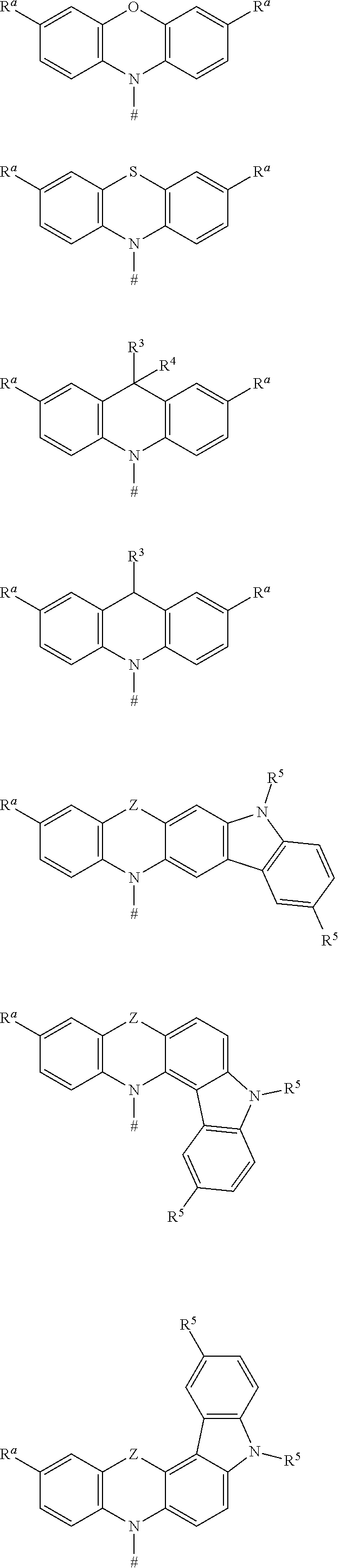


wherein for #, Z, Ra, R3, R4 and R5, the aforementioned definitions apply.


wherein for #, Z, Ra, R3, R4 and R5, the aforementioned definitions apply.

wherein for # the aforementioned definitions apply.

wherein the other two of the three second chemical moieties comprise or consist of a structure of Formula III:


-
- wherein ring-adjacent substituents Ra form a mono- or polycyclic, aliphatic, aromatic and/or benzo-fused ring system with each other, in particular wherein exactly two immediately ring-adjacent substituents Ra form a mono- or polycyclic, aliphatic, aromatic and/or benzo-fused ring system and
- wherein the other two of the three second chemical moieties comprise or consist of a structure of Formula III:


wherein any one of the aforementioned definitions apply.

wherein any one of the aforementioned definitions applies.

-
- wherein
- Rc is at each occurrence independently from another selected from the group consisting of
- Me,
- iPr,
- tBu.
- Ph, which is optionally substituted with one or more substituents independently from each other selected from the group consisting of Me, iPr, tBu, CN, CF3, and Ph,
- pyridinyl, which is optionally substituted with one or more substituents independently from each other selected from the group consisting of Me, iPr, tBu, CN, CF3, and Ph,
- pyrimidinyl, which is optionally substituted with one or more substituents independently from each other selected from the group consisting of Me, iPr, tBu, CN, CF3, and Ph,
- carbazolyl, which is optionally substituted with one or more substituents independently from each other selected from the group consisting of Me, iPr, tBu, CN, CF3, and Ph,
- triazinyl, which is optionally substituted with one or more substituents independently from each other selected from the group consisting of Me, iPr, tBu, CN, CF3, and Ph,
- and N(Ph)2.

wherein any one of the aforementioned definitions apply.

wherein any one of the aforementioned definitions apply.

-
- wherein
- Rc is at each occurrence independently from another selected from the group consisting of
- Me,
- iPr,
- tBu,
- Ph, which is optionally substituted with one or more substituents independently from each other selected from the group consisting of Me, iPr, tBu, CN, CF3, and Ph,
- pyridinyl, which is optionally substituted with one or more substituents independently from each other selected from the group consisting of Me, iPr, tBu, CN, CF3, and Ph,
- pyrimidinyl, which is optionally substituted with one or more substituents independently from each other selected from the group consisting of Me, iPr, tBu, CN, CF3, and Ph,
- carbazolyl, which is optionally substituted with one or more substituents independently from each other selected from the group consisting of Me, iPr, tBu, CN, CF3, and Ph,
- triazinyl, which is optionally substituted with one or more substituents independently from each other selected from the group consisting of Me, iPr, tBu, CN, CF3, and Ph,
- and N(Ph)2.

wherein the aforementioned definitions apply.

wherein any one of the aforementioned definitions apply.

wherein any one of the aforementioned definitions apply.

wherein any one of the aforementioned definitions apply.

wherein the aforementioned definitions apply.

wherein the aforementioned definitions apply.

wherein any one of the aforementioned definitions apply.

wherein any one of the aforementioned definitions apply.

wherein any one of the aforementioned definitions apply.

wherein the aforementioned definitions apply.

wherein the aforementioned definitions apply.
-
- Me,
- iPr,
- tBu
- CN,
- CF3,
- Ph, which is optionally substituted with one or more substituents independently from each other selected from the group consisting of Me, iPr, tBu, CN, CF3, and Ph,
- pyridinyl, which is optionally substituted with one or more substituents independently from each other selected from the group consisting of Me, iPr, tBu, CN, CF3, and Ph,
- pyrimidinyl, which is optionally substituted with one or more substituents independently from each other selected from the group consisting of Me, iPr, tBu, CN, CF3, and Ph, and
- triazinyl, which is optionally substituted with one or more substituents independently from each other selected from the group consisting of Me, iPr, tBu, CN, CF3, and Ph.
-
- Me,
- iPr,
- tBu,
- Ph, which is optionally substituted with one or more substituents independently from each other selected from the group consisting of Me, iPr, tBu, CN, CF3 and Ph; and
- triazinyl, which is optionally substituted with one or more substituents independently from each other selected from the group consisting of Me, iPr, tBu, CN, CF3 and Ph.

wherein the other two of the three second chemical moieties comprise or consist of a structure of Formula III:


wherein the other two of the three second chemical moieties comprise or consist of a structure of Formula III:


-
- organic light-emitting diodes (OLEDs),
- light-emitting electrochemical cells,
- OLED sensors, especially in gas and vapour sensors not hermetically externally shielded,
- organic diodes,
- organic solar cells,
- organic transistors,
- organic field-effect transistors,
- organic lasers and
- down-conversion elements.
-
- (a) at least one organic molecule according to the invention, in particular in the form of an emitter and/or a host, and
- (b) one or more emitter and/or host materials, which differ from the organic molecule according to the invention and
- (c) optional one or more dyes and/or one or more solvents.
-
- (a) at least one organic molecule according to the invention, in particular in the form of an emitter and/or a host, and
- (b) one or more emitter and/or host materials, which differ from the organic molecule according to the invention and
- (c) optional one or more dyes and/or one or more solvents.
-
- (i) 1-50% by weight, preferably 5-40% by weight, in particular 10-30% by weight, of one or more organic molecules according to the invention;
- (ii) 5-99% by weight, preferably 30-94.9% by weight, in particular 40-89% by weight, of at least one host compound H; and
- (iii) optionally 0-94% by weight, preferably 0.1-65% by weight, in particular 1-50% by weight, of at least one further host compound D with a structure differing from the structure of the molecules according to the invention; and
- (iv) optionally 0-94% by weight, preferably 0-65% by weight, in particular 0-50% by weight, of a solvent; and
- (v) optionally 0-30% by weight, in particular 0-20% by weight, preferably 0-5% by weight, of at least one further emitter molecule F with a structure differing from the structure of the molecules according to the invention.
-
- (i) 1-50% by weight, preferably 5-40% by weight, in particular 10-30% by weight, of one organic molecule according to the invention;
- (ii) 5-99% by weight, preferably 30-94.9% by weight, in particular 40-89% by weight, of one host compound H; and
- (iii) optionally 0-94% by weight, preferably 0.1-65% by weight, in particular 1-50% by weight, of at least one further host compound D with a structure differing from the structure of the molecules according to the invention; and
- (iv) optionally 0-94% by weight, preferably 0-65% by weight, in particular 0-50% by weight, of a solvent; and
- (v) optionally 0-30% by weight, in particular 0-20% by weight, preferably 0-5% by weight, of at least one further emitter molecule F with a structure differing from the structure of the molecules according to the invention.
-
- the at least one further host compound D has a highest occupied molecular orbital HOMO(D) having an energy EHOMO(D) and a lowest unoccupied molecular orbital LUMO(D) having an energy ELUMO(D).
- the organic molecule according to the invention has a highest occupied molecular orbital HOMO(E) having an energy EHOMO(E) and a lowest unoccupied molecular orbital LUMO(E) having an energy ELUMO(E),
wherein - EHOMO(H)>EHOMO(D) and the difference between the energy level of the highest occupied molecular orbital HOMO(E) of organic molecule according to the invention (EHOMO(E)) and the energy level of the highest occupied molecular orbital HOMO(H) of the host compound H (EHOMO(H)) is between −0.5 eV and 0.5 eV, more preferably between −0.3 eV and 0.3 eV, even more preferably between −0.2 eV and 0.2 eV or even between −0.1 eV and 0.1 eV; and ELUMO(H)>ELUMO(D) and the difference between the energy level of the lowest unoccupied molecular orbital LUMO(E) of organic molecule according to the invention (ELUMO(E)) and the lowest unoccupied molecular orbital LUMO(D) of the at least one further host compound D (ELUMO(D)) is between −0.5 eV and 0.5 eV, more preferably between −0.3 eV and 0.3 eV, even more preferably between −0.2 eV and 0.2 eV or even between −0.1 eV and 0.1 eV.
| 1. | substrate |
| 2. | anode layer A |
| 3. | hole injection layer, HIL |
| 4. | hole transport layer, HTL |
| 5. | electron blocking layer, EBL |
| 6. | emitting layer, EML |
| 7. | hole blocking layer, HBL |
| 8. | electron transport layer, ETL |
| 9. | electron injection layer, EIL |
| 10. | cathode layer, |
wherein the OLED comprises each layer, selected from the group consisting of HIL, HTL, EBL, HBL, ETL and EIL, only optionally, different layers may be merged and the OLED may comprise more than one layer of each layer type defined above.
| 1. | substrate |
| 2. | cathode layer |
| 3. | electron injection layer, EIL |
| 4. | electron transport layer, ETL |
| 5. | hole blocking layer, HBL |
| 6. | emitting layer, B |
| 7. | electron blocking layer, EBL |
| 8. | hole transport layer, HTL |
| 9. | hole injection layer, HIL |
| 10. | anode layer A |
-
- violet: wavelength range of >380-420 nm;
- deep blue: wavelength range of >420-480 nm;
- sky blue: wavelength range of >480-500 nm;
- green: wavelength range of >500-560 nm;
- yellow: wavelength range of >560-580 nm;
- orange: wavelength range of >580-620 nm;
- red: wavelength range of >620-800 nm.
-
- prepared by means of a sublimation process,
- prepared by means of an organic vapor phase deposition process,
- prepared by means of a carrier gas sublimation process,
- solution processed or printed.


General Procedure for Synthesis AAV1:


-
- Sample pretreatment: Spin-coating
- Apparatus: Spin150, SPS euro.
- The sample concentration is 10 mg/ml, dissolved in a suitable solvent.
- Program: 1) 3 s at 400 U/min; 20 s at 1000 U/min at 1000 Upm/s. 3) 10 s at 4000 U/min at 1000 Upm/s. After coating, the films are tried at 70° C. for 1 min.
Photoluminescence Spectroscopy and TCSPC (Time-Correlated Single-Photon Counting)
-
- NanoLED 370 (wavelength: 371 nm, puls duration: 1.1 ns)
- NanoLED 290 (wavelength: 294 nm, puls duration: <1 ns)
- SpectraLED 310 (wavelength: 314 nm)
- SpectraLED 355 (wavelength: 355 nm).
-
- 1) Quality assurance: Anthracene in ethanol (known concentration) is used as reference
- 2) Excitation wavelength: the absorption maximum of the organic molecule is determined and the molecule is excited using this wavelength
- 3) Measurement
- Quantum yields are measured for sample of solutions or films under nitrogen atmosphere. The yield is calculated using the equation:
-
-
- wherein nphoton denotes the photon count and Int. the intensity.
Production and Characterization of Optoelectronic Devices
- wherein nphoton denotes the photon count and Int. the intensity.
-
wherein L0 denotes the initial luminance at the applied current density.
| Flow rate | time | |||
| [ml/min] | [min] | A[%] | B[%] | C[%] |
| 2.5 | 0 | 40 | 50 | 10 |
| 2.5 | 5 | 40 | 50 | 10 |
| 2.5 | 25 | 10 | 20 | 70 |
| 2.5 | 35 | 10 | 20 | 70 |
| 2.5 | 35.01 | 40 | 50 | 10 |
| 2.5 | 40.01 | 40 | 50 | 10 |
| 2.5 | 41.01 | 40 | 50 | 10 |
using the following solvent mixtures:
| Solvent A: | H2O (90%) | MeCN (10%) |
| Solvent B: | H2O (10%) | MeCN (90%) |
| Solvent C: | THF (50%) | MeCN (50%) |

-
- AAV1 (yield 78%), wherein 5-bromo-1,3-chloro-2-fluorobenzene (CAS 17318-08-0) was used as reactant,
- AAV2 (yield 59%), wherein 4-chloro-2,6-diphenylpyrimidin (CAS 29509-91-9) was used as reactant E2,
- AAV3 (yield 83%),
- AAV5 (yield 77%), wherein 9-(2-bromophenyl)-9H-carbazole (CAS 902518-11-0) was used as reactant E7 and
- AAV6 (yield 70%), wherein 5H-benzofuro[3,2-c]carbazole (CAS 1199616-66-4) was used as corresponding donor molecule.
HPLC-LCMS:
| Molecular | Retention | m/z | m/z | ||
| Formula | Time | calculated | found | ||
| C76H47N5O | 18.91 min | 1046.24 | 1046.55 | ||

-
- AAV1 (yield 78%), wherein 5-bromo-1,3-chloro-2-fluorobenzene (CAS 17318-08-0) was used as reactant,
- AAV2 (yield 59%), wherein 4-chloro-2,6-diphenylpyrimidin (CAS 29509-91-9) was used as reactant E2,
- AAV3 (yield 83%),
- AAV5 (yield 77%), wherein 9-(2-bromophenyl)-9H-carbazole (CAS 902518-11-0) was used as reactant E7 and
- AAV6 (yield 86%), wherein 3,6-diphenyl-9H-carbazole (CAS 56525-79-2) was used as corresponding donor molecule.
HPLC-LCMS:
| Molecular | Retention | m/z | m/z | ||
| Formula | Time | calculated | found | ||
| C82H53N5 | 19.23 min | 1108.36 | 1108.60 | ||

-
- AAV1 (yield 78%), wherein 5-bromo-1,3-chloro-2-fluorobenzene (CAS 17318-08-0) was used as reactant,
- AAV2 (yield 65%), wherein 2-chloro-4,6-diphenylpyrimidin (CAS 2915-16-4) was used as reactant E2,
- AAV3 (yield 78%),
- AAV5 (yield 75%), wherein 9-(2-bromophenyl)-9H-carbazole (CAS 902518-11-0) was used as reactant E7 and
- AAV6 (yield 74%), wherein 5,7-dihydro-5-phenyl-Indolo[2,3-b]carbazole (CAS 1448296-00-1) was used as corresponding donor molecule.
HPLC-LCMS:
| Molecular | Retention | m/z | m/z | ||
| Formula | Time | calculated | found | ||
| C82H52N6 | 21.01 min | 1121.36 | 1121.58 | ||

-
- AAV1 (yield 78%), wherein 5-bromo-1,3-chloro-2-fluorobenzene (CAS 17318-08-0) was used as reactant,
- AAV2 (yield 65%), wherein 2-chloro-4,6-diphenylpyrimidin (CAS 2915-16-4) was used as reactant E2,
- AAV3 (yield 78%),
- AAV5 (yield 75%), wherein 9-(2-bromophenyl)-9H-carbazole (CAS 902518-11-0) was used as reactant E7 and
- AAV6 (yield 40%), wherein 9-phenyl-9H,9′H-[3,3′]bicarbazolyl (CAS 1060735-14-9) was used as corresponding donor molecule.
HPLC-LCMS:
| Molecular | Retention | m/z | m/z | ||
| Formula | Time | calculated | found | ||
| C88H56N6 | 25.60 min | 1197.45 | 1197.41 | ||


Claims (20)


Applications Claiming Priority (3)
| Application Number | Priority Date | Filing Date | Title |
|---|---|---|---|
| DE102018121119.8 | 2018-08-29 | ||
| DE102018121119 | 2018-08-29 | ||
| PCT/EP2019/071718 WO2020043482A1 (en) | 2018-08-29 | 2019-08-13 | Organic molecules for optoelectronic devices |
Publications (2)
| Publication Number | Publication Date |
|---|---|
| US20210317108A1 US20210317108A1 (en) | 2021-10-14 |
| US12098143B2 true US12098143B2 (en) | 2024-09-24 |
Family
ID=67902485
Family Applications (1)
| Application Number | Title | Priority Date | Filing Date |
|---|---|---|---|
| US17/265,771 Active 2041-12-16 US12098143B2 (en) | 2018-08-29 | 2019-08-13 | Organic molecules for optoelectronic devices |
Country Status (3)
| Country | Link |
|---|---|
| US (1) | US12098143B2 (en) |
| EP (1) | EP3844160B1 (en) |
| WO (1) | WO2020043482A1 (en) |
Families Citing this family (1)
| Publication number | Priority date | Publication date | Assignee | Title |
|---|---|---|---|---|
| KR20200138532A (en) * | 2019-05-30 | 2020-12-10 | 삼성전자주식회사 | A Condensed cyclic compound, organic light emitting device including the same, and electronic device including the same |
Citations (11)
| Publication number | Priority date | Publication date | Assignee | Title |
|---|---|---|---|---|
| WO2005076669A1 (en) | 2004-02-09 | 2005-08-18 | Idemitsu Kosan Co., Ltd. | Organic electroluminescent device |
| US20120126692A1 (en) * | 2009-07-31 | 2012-05-24 | Fujifilm Corporation | Organic electroluminescence device |
| WO2015175678A1 (en) | 2014-05-14 | 2015-11-19 | President And Fellows Of Harvard College | Organic light-emitting diode materials |
| EP3113239A1 (en) | 2015-07-03 | 2017-01-04 | cynora GmbH | Organic molecules for use in organic optoelectronic devices |
| KR20180015794A (en) | 2016-08-03 | 2018-02-14 | 삼성디스플레이 주식회사 | Aromatic compound and organic electroluminescence device including the same |
| US20180170914A1 (en) | 2015-05-08 | 2018-06-21 | Konica Minolta, Inc. | Ii(pi)-conjugated compound, organic electroluminescence element material, light-emitting material, light-emitting thin film, organic electroluminescence element, display device, and illumination device |
| US20190115544A1 (en) * | 2017-10-16 | 2019-04-18 | Cynora Gmbh | Organic molecules for use in optoelectronic devices |
| US20190284174A1 (en) * | 2018-03-16 | 2019-09-19 | Cynora Gmbh | Organic molecules for optoelectronic devices |
| US10541371B2 (en) * | 2016-01-25 | 2020-01-21 | Samsung Display Co., Ltd. | Carbazole-based compound and organic light emitting device including the same |
| US20200119286A1 (en) * | 2018-10-15 | 2020-04-16 | Cynora Gmbh | Organic electroluminescent device emitting blue light |
| US20200358002A1 (en) * | 2017-11-21 | 2020-11-12 | Cynora Gmbh | Organic molecules for use in optoelectronic devices |
-
2019
- 2019-08-13 US US17/265,771 patent/US12098143B2/en active Active
- 2019-08-13 WO PCT/EP2019/071718 patent/WO2020043482A1/en not_active Ceased
- 2019-08-13 EP EP19765657.2A patent/EP3844160B1/en active Active
Patent Citations (11)
| Publication number | Priority date | Publication date | Assignee | Title |
|---|---|---|---|---|
| WO2005076669A1 (en) | 2004-02-09 | 2005-08-18 | Idemitsu Kosan Co., Ltd. | Organic electroluminescent device |
| US20120126692A1 (en) * | 2009-07-31 | 2012-05-24 | Fujifilm Corporation | Organic electroluminescence device |
| WO2015175678A1 (en) | 2014-05-14 | 2015-11-19 | President And Fellows Of Harvard College | Organic light-emitting diode materials |
| US20180170914A1 (en) | 2015-05-08 | 2018-06-21 | Konica Minolta, Inc. | Ii(pi)-conjugated compound, organic electroluminescence element material, light-emitting material, light-emitting thin film, organic electroluminescence element, display device, and illumination device |
| EP3113239A1 (en) | 2015-07-03 | 2017-01-04 | cynora GmbH | Organic molecules for use in organic optoelectronic devices |
| US10541371B2 (en) * | 2016-01-25 | 2020-01-21 | Samsung Display Co., Ltd. | Carbazole-based compound and organic light emitting device including the same |
| KR20180015794A (en) | 2016-08-03 | 2018-02-14 | 삼성디스플레이 주식회사 | Aromatic compound and organic electroluminescence device including the same |
| US20190115544A1 (en) * | 2017-10-16 | 2019-04-18 | Cynora Gmbh | Organic molecules for use in optoelectronic devices |
| US20200358002A1 (en) * | 2017-11-21 | 2020-11-12 | Cynora Gmbh | Organic molecules for use in optoelectronic devices |
| US20190284174A1 (en) * | 2018-03-16 | 2019-09-19 | Cynora Gmbh | Organic molecules for optoelectronic devices |
| US20200119286A1 (en) * | 2018-10-15 | 2020-04-16 | Cynora Gmbh | Organic electroluminescent device emitting blue light |
Non-Patent Citations (3)
| Title |
|---|
| Jae-Ryung Cha et al., "Effect of increasing electron donor units for high efficiency blue thermally activated delayed fluorescence", Dyes and Pigments, Jan. 2017, vol. 140, pp. 399-406. |
| Michael Y. Wong et al., "Purely organic thermally activated delayed fluorescence material for organic light-emitting diodes", Advanced Materials, Mar. 2017, vol. 29, No. 2, 54 pages. |
| Serevi{hacek over (c)}ius, Tomas, et al. "Enhanced electroluminescence based on thermally activated delayed fluorescence from a carbazole-triazine derivative." Physical Chemistry Chemical Physics 15.38 (2013): 15850-15855. (Year: 2013). * |
Also Published As
| Publication number | Publication date |
|---|---|
| US20210317108A1 (en) | 2021-10-14 |
| EP3844160A1 (en) | 2021-07-07 |
| EP3844160B1 (en) | 2022-11-09 |
| WO2020043482A1 (en) | 2020-03-05 |
Similar Documents
| Publication | Publication Date | Title |
|---|---|---|
| US10981930B2 (en) | Organic molecules for use in optoelectronic devices | |
| US12312338B2 (en) | Organic molecules for use in optoelectronic devices | |
| US11718608B2 (en) | Organic molecules for use in optoelectronic devices | |
| US12378226B2 (en) | Organic molecules for use in optoelectronic devices | |
| US11021473B2 (en) | Organic molecules for use in organic optoelectronic devices | |
| US10919880B2 (en) | Organic molecules, in particular for use in optoelectronic devices | |
| US11161836B2 (en) | Organic molecules for optoelectronic devices | |
| US12221435B2 (en) | Organic molecules, in particular for use in optoelectronic devices | |
| US10998504B2 (en) | Organic molecules for use in optoelectronic devices | |
| US12421192B2 (en) | Organic molecules for use in optoelectronic devices | |
| US11600783B2 (en) | Organic molecules for use in optoelectronic devices | |
| US11957049B2 (en) | Organic molecules, in particular for use in optoelectronic devices | |
| US11834437B2 (en) | Organic molecules for optoelectronic devices | |
| US20200354380A1 (en) | Organic molecules for optoelectronic devices | |
| US12486449B2 (en) | Organic molecules for use in organic optoelectronic devices | |
| US20210139457A1 (en) | Organic molecules for use in organic optoelectronic devices | |
| US10978646B2 (en) | Organic molecules for use in optoelectronic devices | |
| US11597719B2 (en) | Organic molecules for use in organic optoelectronic devices | |
| US11393984B2 (en) | Organic molecules for use in organic optoelectronic devices | |
| US20230301186A1 (en) | Organic triazine containing molecules for use in optoelectronic devices | |
| US11104645B2 (en) | Organic molecules for use in optoelectronic devices | |
| US12035623B2 (en) | Organic molecules for optoelectronic devices | |
| EP3844160B1 (en) | Organic molecules for optoelectronic devices | |
| US11882765B2 (en) | Organic molecules for optoelectronic devices | |
| US20230389424A1 (en) | Organic molecules for optoelectronic devices |
Legal Events
| Date | Code | Title | Description |
|---|---|---|---|
| FEPP | Fee payment procedure |
Free format text: ENTITY STATUS SET TO UNDISCOUNTED (ORIGINAL EVENT CODE: BIG.); ENTITY STATUS OF PATENT OWNER: LARGE ENTITY |
|
| AS | Assignment |
Owner name: CYNORA GMBH, GERMANY Free format text: ASSIGNMENT OF ASSIGNORS INTEREST;ASSIGNORS:FRIEDRICHS, JAN-SIMON;ZINK, DANIEL;SIGNING DATES FROM 20210113 TO 20210118;REEL/FRAME:055215/0159 |
|
| FEPP | Fee payment procedure |
Free format text: ENTITY STATUS SET TO SMALL (ORIGINAL EVENT CODE: SMAL); ENTITY STATUS OF PATENT OWNER: LARGE ENTITY |
|
| STPP | Information on status: patent application and granting procedure in general |
Free format text: DOCKETED NEW CASE - READY FOR EXAMINATION |
|
| AS | Assignment |
Owner name: SAMSUNG DISPLAY CO., LTD., KOREA, REPUBLIC OF Free format text: ASSIGNMENT OF ASSIGNORS INTEREST;ASSIGNOR:CYNORA GMBH;REEL/FRAME:060329/0712 Effective date: 20220527 |
|
| FEPP | Fee payment procedure |
Free format text: ENTITY STATUS SET TO UNDISCOUNTED (ORIGINAL EVENT CODE: BIG.); ENTITY STATUS OF PATENT OWNER: LARGE ENTITY |
|
| STPP | Information on status: patent application and granting procedure in general |
Free format text: NON FINAL ACTION MAILED |
|
| STPP | Information on status: patent application and granting procedure in general |
Free format text: RESPONSE TO NON-FINAL OFFICE ACTION ENTERED AND FORWARDED TO EXAMINER |
|
| STPP | Information on status: patent application and granting procedure in general |
Free format text: NOTICE OF ALLOWANCE MAILED -- APPLICATION RECEIVED IN OFFICE OF PUBLICATIONS |
|
| STCF | Information on status: patent grant |
Free format text: PATENTED CASE |