US12095225B2 - DML driver - Google Patents

DML driver Download PDF

Info

Publication number
US12095225B2
US12095225B2 US17/431,071 US202017431071A US12095225B2 US 12095225 B2 US12095225 B2 US 12095225B2 US 202017431071 A US202017431071 A US 202017431071A US 12095225 B2 US12095225 B2 US 12095225B2
Authority
US
United States
Prior art keywords
transistor
driver
inductor
dml
drain
Prior art date
Legal status (The legal status is an assumption and is not a legal conclusion. Google has not performed a legal analysis and makes no representation as to the accuracy of the status listed.)
Active, expires
Application number
US17/431,071
Other versions
US20220059987A1 (en
Inventor
Toshiki KISHI
Munehiko Nagatani
Hideyuki Nosaka
Current Assignee (The listed assignees may be inaccurate. Google has not performed a legal analysis and makes no representation or warranty as to the accuracy of the list.)
NTT Inc
Original Assignee
Nippon Telegraph and Telephone Corp
Priority date (The priority date is an assumption and is not a legal conclusion. Google has not performed a legal analysis and makes no representation as to the accuracy of the date listed.)
Filing date
Publication date
Application filed by Nippon Telegraph and Telephone Corp filed Critical Nippon Telegraph and Telephone Corp
Assigned to NIPPON TELEGRAPH AND TELEPHONE CORPORATION reassignment NIPPON TELEGRAPH AND TELEPHONE CORPORATION ASSIGNMENT OF ASSIGNORS INTEREST (SEE DOCUMENT FOR DETAILS). Assignors: NAGATANI, MUNEHIKO, NOSAKA, HIDEYUKI, KISHI, Toshiki
Publication of US20220059987A1 publication Critical patent/US20220059987A1/en
Application granted granted Critical
Publication of US12095225B2 publication Critical patent/US12095225B2/en
Active legal-status Critical Current
Adjusted expiration legal-status Critical

Links

Images

Classifications

    • HELECTRICITY
    • H01ELECTRIC ELEMENTS
    • H01SDEVICES USING THE PROCESS OF LIGHT AMPLIFICATION BY STIMULATED EMISSION OF RADIATION [LASER] TO AMPLIFY OR GENERATE LIGHT; DEVICES USING STIMULATED EMISSION OF ELECTROMAGNETIC RADIATION IN WAVE RANGES OTHER THAN OPTICAL
    • H01S5/00Semiconductor lasers
    • H01S5/04Processes or apparatus for excitation, e.g. pumping, e.g. by electron beams
    • H01S5/042Electrical excitation ; Circuits therefor
    • H01S5/0427Electrical excitation ; Circuits therefor for applying modulation to the laser
    • HELECTRICITY
    • H01ELECTRIC ELEMENTS
    • H01SDEVICES USING THE PROCESS OF LIGHT AMPLIFICATION BY STIMULATED EMISSION OF RADIATION [LASER] TO AMPLIFY OR GENERATE LIGHT; DEVICES USING STIMULATED EMISSION OF ELECTROMAGNETIC RADIATION IN WAVE RANGES OTHER THAN OPTICAL
    • H01S5/00Semiconductor lasers
    • H01S5/06Arrangements for controlling the laser output parameters, e.g. by operating on the active medium
    • H01S5/062Arrangements for controlling the laser output parameters, e.g. by operating on the active medium by varying the potential of the electrodes
    • H01S5/06209Arrangements for controlling the laser output parameters, e.g. by operating on the active medium by varying the potential of the electrodes in single-section lasers
    • H01S5/06213Amplitude modulation
    • HELECTRICITY
    • H01ELECTRIC ELEMENTS
    • H01SDEVICES USING THE PROCESS OF LIGHT AMPLIFICATION BY STIMULATED EMISSION OF RADIATION [LASER] TO AMPLIFY OR GENERATE LIGHT; DEVICES USING STIMULATED EMISSION OF ELECTROMAGNETIC RADIATION IN WAVE RANGES OTHER THAN OPTICAL
    • H01S5/00Semiconductor lasers
    • H01S5/06Arrangements for controlling the laser output parameters, e.g. by operating on the active medium
    • H01S5/062Arrangements for controlling the laser output parameters, e.g. by operating on the active medium by varying the potential of the electrodes
    • H01S5/06226Modulation at ultra-high frequencies
    • HELECTRICITY
    • H03ELECTRONIC CIRCUITRY
    • H03FAMPLIFIERS
    • H03F1/00Details of amplifiers with only discharge tubes, only semiconductor devices or only unspecified devices as amplifying elements
    • H03F1/42Modifications of amplifiers to extend the bandwidth
    • H03F1/48Modifications of amplifiers to extend the bandwidth of aperiodic amplifiers
    • HELECTRICITY
    • H03ELECTRONIC CIRCUITRY
    • H03FAMPLIFIERS
    • H03F3/00Amplifiers with only discharge tubes or only semiconductor devices as amplifying elements
    • H03F3/68Combinations of amplifiers, e.g. multi-channel amplifiers for stereophonics
    • HELECTRICITY
    • H04ELECTRIC COMMUNICATION TECHNIQUE
    • H04BTRANSMISSION
    • H04B10/00Transmission systems employing electromagnetic waves other than radio-waves, e.g. infrared, visible or ultraviolet light, or employing corpuscular radiation, e.g. quantum communication
    • H04B10/50Transmitters
    • H04B10/516Details of coding or modulation

Definitions

  • the present invention relates to a DML driver which drives a directly modulated laser (DML).
  • DML directly modulated laser
  • FIG. 9 ( a ) shows electrical-to-optical (EO) response characteristics of a laser diode (LD: Laser Diode) and FIG. 9 ( b ) shows group delay characteristics of the LD.
  • EO electrical-to-optical
  • FIG. 9 ( b ) shows group delay characteristics of the LD.
  • group delay near a relaxation oscillation frequency f r is increased due to the f r of the LD, even when in the driver which drives such an LD, a frequency band is improved by employing a simple frequency peaking technique, a problem arises in that the group delay is further increased.
  • Non-Patent Literature 1 A. Moto, T. Ikagawa, S. Sato, Y. Yamasaki, Y. Onishi, and K. Tanaka, “A low power quad 25.78-Gbit/s 2.5 V laser diode driver using shunt-driving in 0.18 ⁇ m SiGe-BiCMOS”, Compound Semiconductor Integrated Circuit Symposium, 2013.
  • An object of the present invention is to provide a DML driver which is capable of improving a band of EO response characteristics while inhibiting group delay near a relaxation oscillation frequency of an LD.
  • a DML driver of embodiments of the present invention includes: a post driver which supplies a driving current to a laser diode; and a pre-driver which drives the post driver in response to an inputted modulated signal, and the pre-driver has: a first transistor to whose gate or base the modulated signal is inputted; a first resistor whose one end is connected to a first power supply voltage; a first inductor whose one end is connected to another end of the first resistor and whose another end is connected to a drain or a collector of the first transistor; a second inductor whose one end is connected the drain or the collector of the first transistor and whose another end is connected to an input terminal of the post driver; a third inductor whose one end is connected to a source or an emitter of the first transistor and whose another end is connected to a second power supply voltage; and a capacitor whose one end is connected to the source or the emitter of the first transistor and whose another end is connected to the second power supply voltage.
  • the pre-driver further includes a second resistor which is inserted between the source or the emitter of the first transistor and the one end of the third inductor as well as the one end of the capacitor.
  • the pre-driver further includes a second resistor which is inserted between the source or the emitter of the first transistor and the one end of the third inductor.
  • the pre-driver further includes a second transistor which is inserted between a connection point of the first and second inductors and the drain or the collector of the first transistor, to whose gate or base a bias voltage is inputted, whose drain or collector is connected to the connection point of the first and second inductors, and whose source or emitter is connected to the drain or the collector of the first transistor.
  • a first transistor in a pre-driver, is provided with a first resistor, first to third inductors, and a capacitor, whereby a peaking function which improves a band can be added to a DML driver while group delay near a relaxation oscillation frequency of a laser diode is inhibited, and it is made possible to inhibit the group delay near the relaxation oscillation frequency and to further improve a band of EO response characteristics.
  • FIG. 1 is a circuit diagram showing a configuration of a DML driver according to a first embodiment of the present invention.
  • FIG. 2 is a diagram showing parasitic capacitances of a post driver and a pre-driver in FIG. 1 .
  • FIG. 3 shows graphs showing ideal characteristics of the first embodiment of the present invention.
  • FIG. 4 shows a graph for explaining effect of the DML driver according to the first embodiment of the present invention.
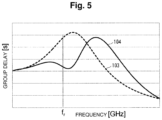
  • FIG. 5 shows a graph for explaining effect of the DML driver according to the first embodiment of the present invention.
  • FIG. 6 is a circuit diagram showing a configuration of a DML driver according to a second embodiment of the present invention.
  • FIG. 7 is a circuit diagram showing a configuration of a DML driver according to a third embodiment of the present invention.
  • FIG. 8 is a circuit diagram showing a configuration of a DML driver according to a fourth embodiment of the present invention.
  • FIG. 9 shows graphs showing EO response characteristics and group delay characteristics of an LD.
  • FIG. 1 is a circuit diagram showing a configuration of a DML driver according to a first embodiment of the present invention.
  • the DML driver in the present embodiment includes a post driver 2 which supplies a driving current I LD to an LD 1 and a pre-driver 3 which drives the post driver 2 in response to an inputted modulated signal Vin.
  • the post driver 2 includes a transistor (not shown) and is a driver capable of driving the LD 1 .
  • a driver circuit having any configuration is applicable to the post driver 2 .
  • the pre-driver 3 has a peaking function to improve a band while group delay near a relaxation oscillation frequency f r of the LD 1 is inhibited.
  • the pre-driver 3 includes an NMOS transistor M 1 , a load resistor R D , a peaking inductor L 1 , a group delay inhibition inductor L X , and a peaking capacitor C.
  • the NMOS transistor M 1 is an NMOS to whose gate a modulated signal Vin is inputted.
  • the load resistor R D is a load resistor whose one end is connected to a power supply voltage Vdd (first power supply voltage).
  • One end of the peaking inductor L 1 is connected to another end of the load resistor R D and another end of the peaking inductor L 1 is connected to a drain of the transistor M 1 .
  • One end of the L 2 is connected to the drain of the transistor M 1 and another end of the L 2 is connected to an input terminal of the post driver 2 .
  • One end of the group delay inhibition inductor L X is connected to a source of the transistor M 1 and another end of the group delay inhibition inductor L X is connected to a ground voltage GND (a second power supply voltage lower than the first power supply voltage).
  • One end of the peaking capacitor C X is connected to the source of the transistor M 1 and another end of the peaking capacitor C X is connected to a ground voltage GND.
  • FIG. 2 is a diagram showing parasitic capacitances of the post driver 2 and the pre-driver 3 shown in FIG. 1 .
  • a mark C 1 indicates a parasitic capacitance of the transistor M 1 and a mark C 2 indicates a parasitic capacitance of a transistor (not shown) of an input part of the post driver 2 .
  • the parasitic capacitance C 1 is a drain-source parasitic capacitance
  • the parasitic capacitance C 1 is a collector-emitter parasitic capacitance.
  • a gain A v of the pre-driver 3 can be represented by the following Expression (1).
  • a mark s in the Expression (1) is a Laplace operator.
  • a part 30 in FIG. 2 which includes the load resistor R D and the peaking inductors L 1 and L 2 constitutes a peaking function part.
  • the larger values of the load resistor R D and the peaking inductors L 1 and L 2 are, the larger a peaking amount is.
  • the smaller the parasitic capacitances C 1 and C 2 are, the larger the peaking amount is.
  • a part 31 in FIG. 2 which includes the inductor L x constitutes a group delay inhibition function part.
  • a peak of a group delay amount near the relaxation oscillation frequency f r of the LD 1 can be inhibited by the inductor L x .
  • a part 32 in FIG. 2 which includes the peaking capacitor C x constitutes a peaking function part in a high band.
  • a decrease in the group delay amount of the LD 1 in the high band and a decrease in a group delay amount of the inductor L x can be inhibited by the peaking capacitor C x .
  • FIG. 3 shows graphs showing ideal characteristics of the present embodiment.
  • 100 shows EO response characteristics of the LD 1 as a single body
  • 101 shows EO response characteristics of a combination of the DML driver of the present embodiment and the LD 1
  • 102 shows response characteristics of an injection current (driving current) I LD to the LD 1 .
  • 103 shows group delay characteristics of the LD 1 as the single body
  • 104 shows group delay characteristics of the combination of the DML driver of the present embodiment and the LD 1 .
  • the response characteristics of the injection current I LD are made up of characteristics in the individual configurations of the peaking function parts 30 and 32 and the group delay inhibition function part 31 shown in FIG. 2 .
  • 105 is a portion where improvement effect by the peaking function part 30 and the group delay inhibition function part 31 is exhibited and 106 is a portion where improvement effect by the peaking function parts 30 and 32 is exhibited.
  • the group delay inhibition function part 31 performs compensation to deal with a resonant-state peak of the EO response characteristics of the LD 1 as the single body, thereby inhibiting the group delay.
  • the peaking function parts 30 and 32 have a peaking function by inductance and a peaking function by capacitance, respectively. As shown in FIG. 3 , improving a band of the EO response characteristics by the peaking function parts 30 and 32 and the group delay inhibition function part 31 without increasing the resonant-state peak of the EO response characteristics can be expected, and inhibiting the group delay can be expected.
  • FIG. 4 shows a graph for explaining effect of the present embodiment, the graph showing a simulation result of the EO response characteristics of the LD 1 as the single body and a simulation result of the EO response characteristics of the combination of the DML driver of the present embodiment and the LD 1 .
  • 100 shows the EO response characteristics of the LD 1 as the single body
  • 101 shows the EO response characteristics of the combination of the DML driver of the present embodiment and the LD 1 .
  • the band of the EO response characteristics can be improved by using the DML driver of the present embodiment without increasing the resonant-state peak, as compared with the EO response characteristics of the LD 1 as the single body.
  • FIG. 5 shows a graph for explaining effect of the present embodiment, the graph showing a simulation result of the group delay characteristics of the LD 1 as the single body and a simulation result of the group delay characteristics of the combination of the DML driver of the present embodiment and the LD 1 .
  • 103 shows the group delay characteristics of the LD 1 as the single body
  • 104 shows the group delay characteristics of the combination of the DML driver of the present embodiment and the LD 1 . It is seen from FIG. 5 that although the group delay characteristics shown therein are slightly different from the ideal characteristics shown in FIG.
  • a peak of a group delay amount near the relaxation oscillation frequency f r of the LD 1 can be inhibited by using the DML driver of embodiments of the present invention with respect to the group delay characteristics of the LD 1 as the single body and a maximum value of a group delay amount also as to the whole frequency band can be reduced.
  • FIG. 6 is a circuit diagram showing a configuration of a DML driver according to the second embodiment of the present invention, and in FIG. 6 , the same components as those in FIG. 1 are denoted by the same reference signs.
  • the DML driver of the present embodiment includes a post driver 2 and a pre-driver 3 a.
  • a resistor R x is inserted between the source of the transistor M 1 of the pre-driver 3 of the first embodiment and one end of the inductor L x of the pre-driver 3 thereof as well as one end of the capacitor C x of the pre-driver 3 thereof. In this way, in the present embodiment, a linearization function can be added to the pre-driver 3 a .
  • the post driver 2 also has the linearization function, even when a signal Vin inputted to the pre-driver 3 a is a signal, such as a four level pulse amplitude modulation (PAM4) signal and a discrete multitone (DMT) signal, for which linearity is required, it is made possible to drive an LD 1 .
  • a signal Vin inputted to the pre-driver 3 a is a signal, such as a four level pulse amplitude modulation (PAM4) signal and a discrete multitone (DMT) signal, for which linearity is required, it is made possible to drive an LD 1 .
  • PAM4 pulse amplitude modulation
  • DMT discrete multitone
  • FIG. 7 is a circuit diagram showing a configuration of a DML driver according to the third embodiment of the present invention, and in FIG. 7 , the same components as those in FIG. 1 are denoted by the same reference signs.
  • the DML driver of the present embodiment includes a post driver 2 and a pre-driver 3 b.
  • a resistor R x is inserted between the source of the transistor M 1 of the pre-driver 3 of the first embodiment and one end of the inductor L x of the pre-driver 3 thereof.
  • impedance added to the source of the transistor M 1 can be lowered in a high band and a gain of the driver can be increased, thereby enabling a frequency band to be improved.
  • FIG. 8 is a circuit diagram showing a configuration of a DML driver according to the fourth embodiment of the present invention, and in FIG. 8 , the same components as those in FIG. 1 are denoted by the same reference signs.
  • the DML driver of the present embodiment includes a post driver 2 and a pre-driver 3 c.
  • an NMOS transistor M 2 to whose gate a DC bias voltage Vb is inputted, whose drain is connected to a connection point of inductors L 1 and L 2 , and whose source is connected to the drain of the transistor M 1 , is inserted to the pre-driver 3 of the first embodiment. It is desirable that the bias voltage Vb is set in such a way that the transistors M 1 and M 2 operate in a saturated region.
  • bipolar transistor may be used.
  • the gate in the above description, it is only required for the gate to be replaced with a base, for the drain to be replaced with a collector, and for the source to be replaced with an emitter.
  • Embodiments of the present invention are applicable to technology which directly modulates optical output of a laser diode.

Landscapes

  • Physics & Mathematics (AREA)
  • Electromagnetism (AREA)
  • Condensed Matter Physics & Semiconductors (AREA)
  • General Physics & Mathematics (AREA)
  • Optics & Photonics (AREA)
  • Engineering & Computer Science (AREA)
  • Power Engineering (AREA)
  • Computer Networks & Wireless Communication (AREA)
  • Signal Processing (AREA)
  • Semiconductor Lasers (AREA)
  • Amplifiers (AREA)
  • Optical Communication System (AREA)

Abstract

The DML driver includes: a post driver which supplies a driving current to the LD; and a pre-driver which drives the post driver in response to a modulated signal. The pre-driver has a transistor, a peaking inductor, a peaking inductor, a group delay inhibition inductor, and a peaking capacitor.

Description

CROSS-REFERENCE TO RELATED APPLICATIONS
This application is a national phase entry of PCT Application No. PCT/JP2020/010768, filed on Mar. 12, 2020, which claims priority to Japanese Application No. 2019-058142 filed on Mar. 26, 2019, which applications are hereby incorporated herein by reference.
TECHNICAL FIELD
The present invention relates to a DML driver which drives a directly modulated laser (DML).
BACKGROUND
In recent years, owing to marked development of social networking service (SNS), a traffic volume of communications all over the world has been increasing year after year. From now on, owing to development of Internet of things (Iot) and cloud computing technology, a further increase in the traffic volume has been anticipated, and in order to support an enormous traffic volume, enlarging a communication capacity inside and outside a data center has been demanded. In accordance with the enlargement of the capacity, standardization of standards of 10 GbE and 40 GbE of Ethernet (a registered trademark) which is a main standard constituent of a network has been presently completed, and standardization of 100 GbE which aims further enlargement of the capacity is going to be nearly completed. For the purpose of application to the 100 GbE, from a view point of a reduction in power consumption, a driver which uses a DML has been attracting attention (refer to Non-Patent Literature 1).
FIG. 9(a) shows electrical-to-optical (EO) response characteristics of a laser diode (LD: Laser Diode) and FIG. 9(b) shows group delay characteristics of the LD. As shown in FIG. 9 , since group delay near a relaxation oscillation frequency fr is increased due to the fr of the LD, even when in the driver which drives such an LD, a frequency band is improved by employing a simple frequency peaking technique, a problem arises in that the group delay is further increased.
CITATION LIST Non-Patent Literature
Non-Patent Literature 1: A. Moto, T. Ikagawa, S. Sato, Y. Yamasaki, Y. Onishi, and K. Tanaka, “A low power quad 25.78-Gbit/s 2.5 V laser diode driver using shunt-driving in 0.18 μm SiGe-BiCMOS”, Compound Semiconductor Integrated Circuit Symposium, 2013.
SUMMARY Technical Problem
In order to solve the above-mentioned problem, embodiments of the present invention have been made. An object of the present invention is to provide a DML driver which is capable of improving a band of EO response characteristics while inhibiting group delay near a relaxation oscillation frequency of an LD.
Means for Solving the Problem
A DML driver of embodiments of the present invention includes: a post driver which supplies a driving current to a laser diode; and a pre-driver which drives the post driver in response to an inputted modulated signal, and the pre-driver has: a first transistor to whose gate or base the modulated signal is inputted; a first resistor whose one end is connected to a first power supply voltage; a first inductor whose one end is connected to another end of the first resistor and whose another end is connected to a drain or a collector of the first transistor; a second inductor whose one end is connected the drain or the collector of the first transistor and whose another end is connected to an input terminal of the post driver; a third inductor whose one end is connected to a source or an emitter of the first transistor and whose another end is connected to a second power supply voltage; and a capacitor whose one end is connected to the source or the emitter of the first transistor and whose another end is connected to the second power supply voltage.
In addition, in one configuration example of the DML driver of embodiments of the present invention, the pre-driver further includes a second resistor which is inserted between the source or the emitter of the first transistor and the one end of the third inductor as well as the one end of the capacitor.
In addition, in one configuration example of the DML driver of embodiments of the present invention, the pre-driver further includes a second resistor which is inserted between the source or the emitter of the first transistor and the one end of the third inductor.
In addition, in one configuration example of the DML driver of embodiments of the present invention, the pre-driver further includes a second transistor which is inserted between a connection point of the first and second inductors and the drain or the collector of the first transistor, to whose gate or base a bias voltage is inputted, whose drain or collector is connected to the connection point of the first and second inductors, and whose source or emitter is connected to the drain or the collector of the first transistor.
EFFECTS OF EMBODIMENTS OF THE INVENTION
According to embodiments of the present invention, in a pre-driver, a first transistor is provided with a first resistor, first to third inductors, and a capacitor, whereby a peaking function which improves a band can be added to a DML driver while group delay near a relaxation oscillation frequency of a laser diode is inhibited, and it is made possible to inhibit the group delay near the relaxation oscillation frequency and to further improve a band of EO response characteristics.
BRIEF DESCRIPTION OF THE DRAWINGS
FIG. 1 is a circuit diagram showing a configuration of a DML driver according to a first embodiment of the present invention.
FIG. 2 is a diagram showing parasitic capacitances of a post driver and a pre-driver in FIG. 1 .
FIG. 3 shows graphs showing ideal characteristics of the first embodiment of the present invention.
FIG. 4 shows a graph for explaining effect of the DML driver according to the first embodiment of the present invention.
FIG. 5 shows a graph for explaining effect of the DML driver according to the first embodiment of the present invention.
FIG. 6 is a circuit diagram showing a configuration of a DML driver according to a second embodiment of the present invention.
FIG. 7 is a circuit diagram showing a configuration of a DML driver according to a third embodiment of the present invention.
FIG. 8 is a circuit diagram showing a configuration of a DML driver according to a fourth embodiment of the present invention.
FIG. 9 shows graphs showing EO response characteristics and group delay characteristics of an LD.
DETAILED DESCRIPTION OF ILLUSTRATIVE EMBODIMENTS First Embodiment
Hereinafter, with reference to the accompanying drawings, embodiments of the present invention will be described. FIG. 1 is a circuit diagram showing a configuration of a DML driver according to a first embodiment of the present invention. The DML driver in the present embodiment includes a post driver 2 which supplies a driving current ILD to an LD 1 and a pre-driver 3 which drives the post driver 2 in response to an inputted modulated signal Vin.
The post driver 2 includes a transistor (not shown) and is a driver capable of driving the LD 1. In embodiments of the present invention, a driver circuit having any configuration is applicable to the post driver 2.
The pre-driver 3 has a peaking function to improve a band while group delay near a relaxation oscillation frequency fr of the LD 1 is inhibited. Specifically, the pre-driver 3 includes an NMOS transistor M1, a load resistor RD, a peaking inductor L1, a group delay inhibition inductor LX, and a peaking capacitor C. The NMOS transistor M1 is an NMOS to whose gate a modulated signal Vin is inputted. The load resistor RD is a load resistor whose one end is connected to a power supply voltage Vdd (first power supply voltage). One end of the peaking inductor L1 is connected to another end of the load resistor RD and another end of the peaking inductor L1 is connected to a drain of the transistor M1. One end of the L2 is connected to the drain of the transistor M1 and another end of the L2 is connected to an input terminal of the post driver 2. One end of the group delay inhibition inductor LX is connected to a source of the transistor M1 and another end of the group delay inhibition inductor LX is connected to a ground voltage GND (a second power supply voltage lower than the first power supply voltage). One end of the peaking capacitor CX is connected to the source of the transistor M1 and another end of the peaking capacitor CX is connected to a ground voltage GND.
FIG. 2 is a diagram showing parasitic capacitances of the post driver 2 and the pre-driver 3 shown in FIG. 1 . A mark C1 indicates a parasitic capacitance of the transistor M1 and a mark C2 indicates a parasitic capacitance of a transistor (not shown) of an input part of the post driver 2. In a case where the transistor M1 is an FET, the parasitic capacitance C1 is a drain-source parasitic capacitance, and in a case where the transistor M1 is a bipolar transistor, the parasitic capacitance C1 is a collector-emitter parasitic capacitance. In a case where a transconductance of the transistor M1 is defined as gm, a gain Av of the pre-driver 3 can be represented by the following Expression (1).
Math . 1 A v ( s ) = C x s + 1 L x s C 2 s + 1 L 2 s + 1 C 1 s + 1 R D + L 1 s g m ( 1 )
A mark s in the Expression (1) is a Laplace operator. A part 30 in FIG. 2 which includes the load resistor RD and the peaking inductors L1 and L2 constitutes a peaking function part. In the peaking function part 30, the larger values of the load resistor RD and the peaking inductors L1 and L2 are, the larger a peaking amount is. In addition, the smaller the parasitic capacitances C1 and C2 are, the larger the peaking amount is.
A part 31 in FIG. 2 which includes the inductor Lx constitutes a group delay inhibition function part. A peak of a group delay amount near the relaxation oscillation frequency fr of the LD 1 can be inhibited by the inductor Lx.
A part 32 in FIG. 2 which includes the peaking capacitor Cx constitutes a peaking function part in a high band. A decrease in the group delay amount of the LD1 in the high band and a decrease in a group delay amount of the inductor Lx can be inhibited by the peaking capacitor Cx.
FIG. 3 shows graphs showing ideal characteristics of the present embodiment. In FIG. 3(a), 100 shows EO response characteristics of the LD 1 as a single body, 101 shows EO response characteristics of a combination of the DML driver of the present embodiment and the LD 1, and 102 shows response characteristics of an injection current (driving current) ILD to the LD 1. In addition, in FIG. 3(b), 103 shows group delay characteristics of the LD 1 as the single body and 104 shows group delay characteristics of the combination of the DML driver of the present embodiment and the LD 1.
In FIG. 3(a), the response characteristics of the injection current ILD are made up of characteristics in the individual configurations of the peaking function parts 30 and 32 and the group delay inhibition function part 31 shown in FIG. 2 . In FIG. 3(a), 105 is a portion where improvement effect by the peaking function part 30 and the group delay inhibition function part 31 is exhibited and 106 is a portion where improvement effect by the peaking function parts 30 and 32 is exhibited.
The group delay inhibition function part 31 performs compensation to deal with a resonant-state peak of the EO response characteristics of the LD 1 as the single body, thereby inhibiting the group delay. In addition, the peaking function parts 30 and 32 have a peaking function by inductance and a peaking function by capacitance, respectively. As shown in FIG. 3 , improving a band of the EO response characteristics by the peaking function parts 30 and 32 and the group delay inhibition function part 31 without increasing the resonant-state peak of the EO response characteristics can be expected, and inhibiting the group delay can be expected.
FIG. 4 shows a graph for explaining effect of the present embodiment, the graph showing a simulation result of the EO response characteristics of the LD 1 as the single body and a simulation result of the EO response characteristics of the combination of the DML driver of the present embodiment and the LD 1. As in FIG. 3, 100 shows the EO response characteristics of the LD 1 as the single body and 101 shows the EO response characteristics of the combination of the DML driver of the present embodiment and the LD 1. It is seen from FIG. 4 that although the EO response characteristics shown therein are slightly different from the ideal characteristics shown in FIG. 3(a), the band of the EO response characteristics can be improved by using the DML driver of the present embodiment without increasing the resonant-state peak, as compared with the EO response characteristics of the LD 1 as the single body.
FIG. 5 shows a graph for explaining effect of the present embodiment, the graph showing a simulation result of the group delay characteristics of the LD 1 as the single body and a simulation result of the group delay characteristics of the combination of the DML driver of the present embodiment and the LD 1. As in FIG. 3, 103 shows the group delay characteristics of the LD 1 as the single body and 104 shows the group delay characteristics of the combination of the DML driver of the present embodiment and the LD 1. It is seen from FIG. 5 that although the group delay characteristics shown therein are slightly different from the ideal characteristics shown in FIG. 3(b), a peak of a group delay amount near the relaxation oscillation frequency fr of the LD 1 can be inhibited by using the DML driver of embodiments of the present invention with respect to the group delay characteristics of the LD 1 as the single body and a maximum value of a group delay amount also as to the whole frequency band can be reduced.
Second Embodiment
Next, a second embodiment of the present invention will be described. FIG. 6 is a circuit diagram showing a configuration of a DML driver according to the second embodiment of the present invention, and in FIG. 6 , the same components as those in FIG. 1 are denoted by the same reference signs. The DML driver of the present embodiment includes a post driver 2 and a pre-driver 3 a.
In the pre-driver 3 a of the present embodiment, a resistor Rx is inserted between the source of the transistor M1 of the pre-driver 3 of the first embodiment and one end of the inductor Lx of the pre-driver 3 thereof as well as one end of the capacitor Cx of the pre-driver 3 thereof. In this way, in the present embodiment, a linearization function can be added to the pre-driver 3 a. In a case where the post driver 2 also has the linearization function, even when a signal Vin inputted to the pre-driver 3 a is a signal, such as a four level pulse amplitude modulation (PAM4) signal and a discrete multitone (DMT) signal, for which linearity is required, it is made possible to drive an LD 1.
Third Embodiment
Next, a third embodiment of the present invention will be described. FIG. 7 is a circuit diagram showing a configuration of a DML driver according to the third embodiment of the present invention, and in FIG. 7 , the same components as those in FIG. 1 are denoted by the same reference signs. The DML driver of the present embodiment includes a post driver 2 and a pre-driver 3 b.
In the pre-driver 3 b of the present embodiment, a resistor Rx is inserted between the source of the transistor M1 of the pre-driver 3 of the first embodiment and one end of the inductor Lx of the pre-driver 3 thereof. In the present embodiment, as compared with the configuration of the second embodiment, impedance added to the source of the transistor M1 can be lowered in a high band and a gain of the driver can be increased, thereby enabling a frequency band to be improved.
Fourth Embodiment
Next, a fourth embodiment of the present invention will be described. FIG. 8 is a circuit diagram showing a configuration of a DML driver according to the fourth embodiment of the present invention, and in FIG. 8 , the same components as those in FIG. 1 are denoted by the same reference signs. The DML driver of the present embodiment includes a post driver 2 and a pre-driver 3 c.
In the pre-driver 3 c of the present embodiment, an NMOS transistor M2, to whose gate a DC bias voltage Vb is inputted, whose drain is connected to a connection point of inductors L1 and L2, and whose source is connected to the drain of the transistor M1, is inserted to the pre-driver 3 of the first embodiment. It is desirable that the bias voltage Vb is set in such a way that the transistors M1 and M2 operate in a saturated region.
Since in the present embodiment, by connecting the transistors M1 and M2 in a cascode manner, mirror effect in the transistor M1 can be inhibited, frequency characteristics of the DML driver can be further improved.
Note that although in the first to fourth embodiments, the example in which the FET is used as each of the transistors M1 and M2 is shown, a bipolar transistor may be used. In a case where the bipolar transistor is used, in the above description, it is only required for the gate to be replaced with a base, for the drain to be replaced with a collector, and for the source to be replaced with an emitter.
INDUSTRIAL APPLICABILITY
Embodiments of the present invention are applicable to technology which directly modulates optical output of a laser diode.
REFERENCE SIGNS LIST
    • 1 Laser diode
    • 2 Post driver
    • 3, 3 a, 3 b, 3 c Pre-driver
    • M1, M2 Transistor
    • RD, Rx Resistor
    • L1, L2, Lx Inductor
    • Cx Capacitor
    • 30, 32 Peaking function part
    • 31 Group delay inhibition function part.

Claims (8)

The invention claimed is:
1. A DML driver comprising:
a post driver configured to supply a driving current to a laser diode; and
a pre-driver configured to drive the post driver in response to an inputted modulated signal, the pre-driver including:
a first transistor, wherein the inputted modulated signal is configured to be input into a gate of the first transistor or a base of the first transistor;
a first resistor, wherein a first end of the first resistor is connected to a first power supply voltage;
a first inductor, wherein a first end of the first inductor is connected to a second end of the first resistor, wherein a second end of the first inductor is connected to a drain of the first transistor or a collector of the first transistor;
a second inductor, wherein a first end of the second inductor is connected to the drain of the first transistor or the collector of the first transistor, wherein a second end of the second inductor is connected to an input terminal of the post driver;
a third inductor, wherein a first end of the third inductor is connected to a source of the first transistor or an emitter of the first transistor, wherein a second end of the third inductor is connected to a second power supply voltage; and
a capacitor, wherein a first end of the capacitor is connected to the source of the first transistor or the emitter of the first transistor, wherein a second end of the capacitor is connected to the second power supply voltage.
2. The DML driver according to claim 1, wherein the pre-driver further includes a second resistor between the source of the first transistor or the emitter of the first transistor and the first end of the third inductor as well as the first end of the capacitor.
3. The DML driver according to claim 1, wherein the pre-driver further includes a second resistor between the source of the first transistor and the second end of the third inductor or between the emitter of the first transistor and the second end of the third inductor.
4. The DML driver according to claim 1, wherein the pre-driver further includes a second transistor between a connection point and the drain of the first transistor or between the connection point and the collector of the first transistor, wherein the connection point is of the first inductor and the second inductor, wherein a bias voltage is configured to be input to the a gate of the second transistor or a base of the second transistor, wherein a drain of the second transistor or a collector of the second transistor is connected to the connection point, and wherein a source of the second transistor or an emitter of the second transistor is connected to the drain of the first transistor or the collector of the first transistor.
5. A method comprising:
supplying, by a post driver of a DML driver, a driving current to a laser diode; and
driving, by a pre-driver of the DML driver, the post driver in response to an inputted modulated signal, the pre-driver including:
a first transistor, wherein the inputted modulated signal is input into a gate of the first transistor or a base of the first transistor;
a first resistor, wherein a first end of the first resistor is connected to a first power supply voltage;
a first inductor, wherein a first end of the first inductor is connected to a second end of the first resistor, wherein a second end of the first inductor is connected to a drain of the first transistor or a collector of the first transistor;
a second inductor, wherein a first end of the second inductor is connected to the drain of the first transistor or the collector of the first transistor, wherein a second end of the second inductor is connected to an input terminal of the post driver;
a third inductor, wherein a first end of the third inductor is connected to a source of the first transistor or an emitter of the first transistor, wherein a second end of the third inductor is connected to a second power supply voltage; and
a capacitor, wherein a first end of the capacitor is connected to the source of the first transistor or the emitter of the first transistor, wherein a second end of the capacitor is connected to the second power supply voltage.
6. The method according to claim 5, wherein the pre-driver further includes a second resistor between the source of the first transistor or the emitter of the first transistor and the first end of the third inductor as well as the first end of the capacitor.
7. The method according to claim 5, wherein the pre-driver further includes a second resistor between the source of the first transistor and the second end of the third inductor or between the emitter of the first transistor and the second end of the third inductor.
8. The method according to claim 5, wherein the pre-driver further includes a second transistor between a connection point and the drain of the first transistor or between the connection point and the collector of the first transistor, wherein the connection point is of the first inductor and the second inductor, wherein a bias voltage is configured to be input to the a gate of the second transistor or a base of the second transistor, wherein a drain of the second transistor or a collector of the second transistor is connected to the connection point, and wherein a source of the second transistor or an emitter of the second transistor is connected to the drain of the first transistor or the collector of the first transistor.
US17/431,071 2019-03-26 2020-03-12 DML driver Active 2041-12-14 US12095225B2 (en)

Applications Claiming Priority (3)

Application Number Priority Date Filing Date Title
JP2019-058142 2019-03-26
JP2019058142A JP7215282B2 (en) 2019-03-26 2019-03-26 DML driver
PCT/JP2020/010768 WO2020195886A1 (en) 2019-03-26 2020-03-12 Dml driver

Publications (2)

Publication Number Publication Date
US20220059987A1 US20220059987A1 (en) 2022-02-24
US12095225B2 true US12095225B2 (en) 2024-09-17

Family

ID=72609340

Family Applications (1)

Application Number Title Priority Date Filing Date
US17/431,071 Active 2041-12-14 US12095225B2 (en) 2019-03-26 2020-03-12 DML driver

Country Status (3)

Country Link
US (1) US12095225B2 (en)
JP (1) JP7215282B2 (en)
WO (1) WO2020195886A1 (en)

Cited By (1)

* Cited by examiner, † Cited by third party
Publication number Priority date Publication date Assignee Title
US20230170668A1 (en) * 2020-04-07 2023-06-01 Nippon Telegraph And Telephone Corporation DML Driver

Families Citing this family (8)

* Cited by examiner, † Cited by third party
Publication number Priority date Publication date Assignee Title
JP7634694B2 (en) * 2021-09-03 2025-02-21 日本電信電話株式会社 DML Driver
JP7634695B2 (en) * 2021-09-03 2025-02-21 日本電信電話株式会社 DML Driver
JP7754294B2 (en) * 2022-04-11 2025-10-15 Ntt株式会社 DML Driver
WO2024180714A1 (en) * 2023-03-01 2024-09-06 日本電信電話株式会社 Dml driver
JPWO2024209616A1 (en) * 2023-04-06 2024-10-10
WO2025027684A1 (en) * 2023-07-28 2025-02-06 日本電信電話株式会社 Driver circuit
WO2025215734A1 (en) * 2024-04-09 2025-10-16 Ntt株式会社 Dml driver
WO2025243358A1 (en) * 2024-05-20 2025-11-27 Ntt株式会社 Multistage amplifier

Citations (5)

* Cited by examiner, † Cited by third party
Publication number Priority date Publication date Assignee Title
US20100092184A1 (en) * 2008-10-09 2010-04-15 Finisar Corporation Active Linear Amplifier Inside Transmitter Module
US8571079B1 (en) * 2012-05-29 2013-10-29 Maxim Integrated Products, Inc. Average-power control loops and methods through laser supply voltage closed-loop control
US20140233594A1 (en) * 2012-01-25 2014-08-21 Fujikura Ltd. Dc-coupled laser drive circuit and method for driving laser diode device
US20140294026A1 (en) * 2013-03-27 2014-10-02 Electronics And Telecommunications Research Institute Laser diode driving apparatus for optical communication
US20160141833A1 (en) * 2014-11-13 2016-05-19 Sumitomo Electric Industries, Ltd. Laser driver for driving laser diode

Family Cites Families (11)

* Cited by examiner, † Cited by third party
Publication number Priority date Publication date Assignee Title
US4945542A (en) * 1989-05-31 1990-07-31 Massachusetts Institute Of Technology Laser diode modulator
US7646988B2 (en) * 2006-08-04 2010-01-12 Finisar Corporation Linear amplifier for use with laser driver signal
JP2009111168A (en) * 2007-10-30 2009-05-21 Sumitomo Electric Ind Ltd Semiconductor laser drive circuit
JP2013106010A (en) * 2011-11-16 2013-05-30 Fujitsu Ltd Driving circuit and optical transmitter
US9590741B2 (en) * 2015-02-25 2017-03-07 Fujitsu Limited Current-mode driver
JP2017028043A (en) * 2015-07-21 2017-02-02 住友電気工業株式会社 Laser drive circuit
JP2017157708A (en) * 2016-03-02 2017-09-07 住友電気工業株式会社 Semiconductor laser diode drive circuit and optical transmitter including the same
JP2017191812A (en) * 2016-04-11 2017-10-19 日本電信電話株式会社 driver
CN109891690B (en) * 2016-10-20 2021-02-05 日本电信电话株式会社 Direct modulation laser driving circuit
JP6849515B2 (en) * 2017-04-24 2021-03-24 日本電信電話株式会社 DML driver
JP2018206954A (en) * 2017-06-05 2018-12-27 住友電気工業株式会社 Driving circuit

Patent Citations (5)

* Cited by examiner, † Cited by third party
Publication number Priority date Publication date Assignee Title
US20100092184A1 (en) * 2008-10-09 2010-04-15 Finisar Corporation Active Linear Amplifier Inside Transmitter Module
US20140233594A1 (en) * 2012-01-25 2014-08-21 Fujikura Ltd. Dc-coupled laser drive circuit and method for driving laser diode device
US8571079B1 (en) * 2012-05-29 2013-10-29 Maxim Integrated Products, Inc. Average-power control loops and methods through laser supply voltage closed-loop control
US20140294026A1 (en) * 2013-03-27 2014-10-02 Electronics And Telecommunications Research Institute Laser diode driving apparatus for optical communication
US20160141833A1 (en) * 2014-11-13 2016-05-19 Sumitomo Electric Industries, Ltd. Laser driver for driving laser diode

Non-Patent Citations (1)

* Cited by examiner, † Cited by third party
Title
Moto et al., "A Low Power Quad 25.78-Gbit/s 2.5 V Laser Diode Driver Using Shunt-Driving in 0.18 μm SiGe—BiCMOS," IEEE, 2013, 4 pages.

Cited By (1)

* Cited by examiner, † Cited by third party
Publication number Priority date Publication date Assignee Title
US20230170668A1 (en) * 2020-04-07 2023-06-01 Nippon Telegraph And Telephone Corporation DML Driver

Also Published As

Publication number Publication date
WO2020195886A1 (en) 2020-10-01
US20220059987A1 (en) 2022-02-24
JP7215282B2 (en) 2023-01-31
JP2020161594A (en) 2020-10-01

Similar Documents

Publication Publication Date Title
US12095225B2 (en) DML driver
US8704601B2 (en) Class E power amplifier
US11784609B2 (en) Power amplifier circuit
US20130121356A1 (en) Driver circuit and optical transmitter
JPWO2018074410A1 (en) Direct modulation laser drive circuit
JP2014207651A (en) Radio frequency amplifier circuit and power amplifier module
JPH09260957A (en) Semiconductor amplifier circuit
US20230170668A1 (en) DML Driver
EP3396857A1 (en) Method for improving linearity of radio frequency power amplifier, compensation circuit and communication terminal
Knochenhauer et al. A Compact, Low-Power 40-GBit/s Modulator Driver With 6-V Differential Output Swing in 0.25-$\mu $ m SiGe BiCMOS
US20250007240A1 (en) Dml driver
JPWO2018179088A1 (en) Current reuse type field effect transistor amplifier
US20040258114A1 (en) System and method for using an output transformer for laser diode drivers
US20240372320A1 (en) Dml driver
KR101882610B1 (en) Current reuse field effect transistor amplifier
US20130195133A1 (en) Driver circuit for laser diode outputting pre-emphasized signal
US10613560B2 (en) Buffer stage and control circuit
US7339433B2 (en) Differential amplifier stage
KR20150135085A (en) Linearizer
CN112214061A (en) Bias circuit
JPH1188065A (en) Semiconductor amplifier circuit
JP2021090168A (en) Power amplifier circuit
Cordell A MOSFETPowerAmplifier with ErrorCorrection
WO2020188649A1 (en) Amplifier circuit
JP2018206954A (en) Driving circuit

Legal Events

Date Code Title Description
AS Assignment

Owner name: NIPPON TELEGRAPH AND TELEPHONE CORPORATION, JAPAN

Free format text: ASSIGNMENT OF ASSIGNORS INTEREST;ASSIGNORS:KISHI, TOSHIKI;NAGATANI, MUNEHIKO;NOSAKA, HIDEYUKI;SIGNING DATES FROM 20210407 TO 20210512;REEL/FRAME:057175/0821

FEPP Fee payment procedure

Free format text: ENTITY STATUS SET TO UNDISCOUNTED (ORIGINAL EVENT CODE: BIG.); ENTITY STATUS OF PATENT OWNER: LARGE ENTITY

STPP Information on status: patent application and granting procedure in general

Free format text: DOCKETED NEW CASE - READY FOR EXAMINATION

STPP Information on status: patent application and granting procedure in general

Free format text: NOTICE OF ALLOWANCE MAILED -- APPLICATION RECEIVED IN OFFICE OF PUBLICATIONS

STPP Information on status: patent application and granting procedure in general

Free format text: PUBLICATIONS -- ISSUE FEE PAYMENT VERIFIED

STCF Information on status: patent grant

Free format text: PATENTED CASE