US12088365B2 - EIRP control method, communications apparatus, and communications system - Google Patents
EIRP control method, communications apparatus, and communications system Download PDFInfo
- Publication number
- US12088365B2 US12088365B2 US17/897,510 US202217897510A US12088365B2 US 12088365 B2 US12088365 B2 US 12088365B2 US 202217897510 A US202217897510 A US 202217897510A US 12088365 B2 US12088365 B2 US 12088365B2
- Authority
- US
- United States
- Prior art keywords
- spatial grid
- spatial
- beams
- power
- plane angle
- Prior art date
- Legal status (The legal status is an assumption and is not a legal conclusion. Google has not performed a legal analysis and makes no representation as to the accuracy of the status listed.)
- Active, expires
Links
Images




Classifications
-
- H—ELECTRICITY
- H04—ELECTRIC COMMUNICATION TECHNIQUE
- H04B—TRANSMISSION
- H04B7/00—Radio transmission systems, i.e. using radiation field
- H04B7/02—Diversity systems; Multi-antenna system, i.e. transmission or reception using multiple antennas
- H04B7/04—Diversity systems; Multi-antenna system, i.e. transmission or reception using multiple antennas using two or more spaced independent antennas
- H04B7/06—Diversity systems; Multi-antenna system, i.e. transmission or reception using multiple antennas using two or more spaced independent antennas at the transmitting station
-
- H—ELECTRICITY
- H04—ELECTRIC COMMUNICATION TECHNIQUE
- H04B—TRANSMISSION
- H04B17/00—Monitoring; Testing
- H04B17/10—Monitoring; Testing of transmitters
- H04B17/101—Monitoring; Testing of transmitters for measurement of specific parameters of the transmitter or components thereof
- H04B17/102—Power radiated at antenna
-
- H—ELECTRICITY
- H04—ELECTRIC COMMUNICATION TECHNIQUE
- H04B—TRANSMISSION
- H04B7/00—Radio transmission systems, i.e. using radiation field
- H04B7/02—Diversity systems; Multi-antenna system, i.e. transmission or reception using multiple antennas
- H04B7/04—Diversity systems; Multi-antenna system, i.e. transmission or reception using multiple antennas using two or more spaced independent antennas
- H04B7/0413—MIMO systems
- H04B7/0426—Power distribution
- H04B7/043—Power distribution using best eigenmode, e.g. beam forming or beam steering
-
- H—ELECTRICITY
- H04—ELECTRIC COMMUNICATION TECHNIQUE
- H04B—TRANSMISSION
- H04B17/00—Monitoring; Testing
- H04B17/10—Monitoring; Testing of transmitters
- H04B17/101—Monitoring; Testing of transmitters for measurement of specific parameters of the transmitter or components thereof
-
- H—ELECTRICITY
- H04—ELECTRIC COMMUNICATION TECHNIQUE
- H04B—TRANSMISSION
- H04B7/00—Radio transmission systems, i.e. using radiation field
- H04B7/02—Diversity systems; Multi-antenna system, i.e. transmission or reception using multiple antennas
- H04B7/04—Diversity systems; Multi-antenna system, i.e. transmission or reception using multiple antennas using two or more spaced independent antennas
- H04B7/0413—MIMO systems
- H04B7/0452—Multi-user MIMO systems
-
- H—ELECTRICITY
- H04—ELECTRIC COMMUNICATION TECHNIQUE
- H04W—WIRELESS COMMUNICATION NETWORKS
- H04W52/00—Power management, e.g. Transmission Power Control [TPC] or power classes
- H04W52/04—Transmission power control [TPC]
- H04W52/30—Transmission power control [TPC] using constraints in the total amount of available transmission power
- H04W52/36—Transmission power control [TPC] using constraints in the total amount of available transmission power with a discrete range or set of values, e.g. step size, ramping or offsets
- H04W52/367—Power values between minimum and maximum limits, e.g. dynamic range
-
- H—ELECTRICITY
- H04—ELECTRIC COMMUNICATION TECHNIQUE
- H04W—WIRELESS COMMUNICATION NETWORKS
- H04W52/00—Power management, e.g. Transmission Power Control [TPC] or power classes
- H04W52/04—Transmission power control [TPC]
- H04W52/38—TPC being performed in particular situations
- H04W52/42—TPC being performed in particular situations in systems with time, space, frequency or polarisation diversity
-
- H—ELECTRICITY
- H04—ELECTRIC COMMUNICATION TECHNIQUE
- H04W—WIRELESS COMMUNICATION NETWORKS
- H04W72/00—Local resource management
- H04W72/04—Wireless resource allocation
- H04W72/044—Wireless resource allocation based on the type of the allocated resource
- H04W72/0473—Wireless resource allocation based on the type of the allocated resource the resource being transmission power
-
- H—ELECTRICITY
- H04—ELECTRIC COMMUNICATION TECHNIQUE
- H04W—WIRELESS COMMUNICATION NETWORKS
- H04W72/00—Local resource management
- H04W72/50—Allocation or scheduling criteria for wireless resources
- H04W72/54—Allocation or scheduling criteria for wireless resources based on quality criteria
- H04W72/543—Allocation or scheduling criteria for wireless resources based on quality criteria based on requested quality, e.g. QoS
Definitions
- This application relates to the field of wireless communications technologies, and in particular, to an EIRP control method, a communications apparatus, and a communications system.
- an access network device can communicate with a plurality of terminals on a same time-frequency resource in a spatial multiplexing manner. This greatly increases a capacity of a communications system.
- a power and an antenna gain of the access network device using the MIMO technology are larger than those of a conventional access network device.
- Each country/organization has its own requirement on an EMF strength. How to control an EMF strength of the access network device, to meet the EMF strength requirement of each country/organization is an urgent problem to be resolved.
- Embodiments of this application provide an EIRP control method, a communications apparatus, and a communications system, to control an EIRP of an access network device, so that an EMF strength of the access network device satisfies an EMF strength requirement of each country/organization.
- an embodiment of this application provides an EIRP control method.
- the EIRP control method may be applied to an access network device or a chip in an access network device, for example, may be performed by a baseband processing unit (eg. baseband unit, BBU) or a chip in a BBU.
- BBU baseband processing unit
- the method includes: determining an EIRP threshold E n of a spatial grid X n , where E n is related to a safety distance R n of X n , n is any integer from 0 to N ⁇ 1.
- N is a quantity of spatial grids, and N is greater than or equal to 1;
- the EIRP of the plurality of beams in X n may be understood as a total EIRP of the plurality of beams in X n .
- An EIRP of the access network device may be controlled at a granularity of a spatial grid, to control an EMF strength of the access network device.
- E n is related to R n of X n includes:
- EIRP thresholds of the two spatial grids are also different.
- An EIRP of a spatial grid may be flexibly controlled based on an EIRP threshold of the spatial grid, to avoid MIMO performance deterioration caused by limiting EIRPs in all spatial directions based on a safety distance in a specific spatial direction. According to this solution, MIMO performance can be maintained when a local EMF requirement is satisfied.
- a is 4n
- b is 1
- c is 2.
- a horizontal plane angle range of X n is from a minimum horizontal plane angle ⁇ n min to a maximum horizontal plane angle ⁇ n max
- a vertical plane angle range of X n is from a minimum vertical plane angle ⁇ n min to a maximum vertical plane angle ⁇ n Max .
- an antenna gain corresponding to a horizontal plane angle ⁇ n 1 and a vertical plane angle ⁇ n 1 (which may be represented as ( ⁇ n 1 , ⁇ n 1 )) is G n 1
- an antenna gain corresponding to a horizontal plane angle ⁇ n 2 and a vertical plane angle ⁇ n 2 (which may be represented as ( ⁇ 2 n , ⁇ n 2 )) is G n 2
- a difference between G n 1 and G n 2 is less than or equal to a difference threshold
- a difference between antenna gains in two directions in the spatial grid is not excessively large, so that the EIRP of the spatial grid can be subsequently controlled.
- the EIRP of the spatial grid can be controlled by controlling a power of the spatial grid.
- ⁇ x max ⁇ x min ⁇ y max ⁇ y min
- ⁇ x max ⁇ x min ⁇ y min ⁇ y min
- x is an integer from 0 to N ⁇ 1
- y is an integer from 0 to N ⁇ 1
- x is not equal to y.
- Lengths of horizontal plane angle ranges of spatial grids are the same, and lengths of vertical plane angle ranges of the spatial grids are the same, so that several spatial grids can be relatively simply determined.
- ⁇ x max ⁇ x max ⁇ y max ⁇ y min when N is greater than or equal to 2, ⁇ x max ⁇ x max ⁇ y max ⁇ y min , or ⁇ x max ⁇ x min ⁇ y max ⁇ y min , where x is an integer from 0 to N ⁇ 1, y is an integer from 0 to N ⁇ 1, and x is not equal to y.
- Lengths of horizontal plane angle ranges of spatial grids are different, or lengths of vertical plane angle ranges of the spatial grids are different, and a difference between antenna gains in two spatial directions in the spatial grid is not excessively large, so that a relatively small quantity of spatial grids can be determined. This reduces algorithm complexity.
- R n is a safety distance corresponding to a horizontal plane angle ⁇ n d and a vertical plane angle ⁇ n d , where ⁇ n d is a value from ⁇ n min to ⁇ n max , and ⁇ n d is a value from ⁇ n min to ⁇ n max .
- the horizontal plane angle ⁇ n d and the vertical plane angle ⁇ n d indicate a spatial direction in the spatial grid X n , and the spatial direction may be determined by ( ⁇ n d , ⁇ n d ).
- the method further includes:
- the mapping power of the plurality of beams in X n may be understood as a total mapping power of the plurality of beams in X n .
- an antenna gain of each spatial grid may be determined, and a mapping power of the plurality of beams in the spatial grid may be controlled, so that an EIRP of the spatial grid does not exceed an EIRP threshold.
- the controlling a mapping power of the plurality of beams in X n , so that the EIRP of X n does not exceed E n includes:
- the mapping power of the plurality of beams in X n includes an instantaneous mapping power of the plurality of beams in X n .
- the instantaneous mapping power of the plurality of beams in X n may be understood as an instantaneous total mapping power of the plurality of beams in X n .
- an EMF strength of the plurality of beams in the spatial grid X n does not exceed the EMF strength threshold at any moment. This ensures that radiation of deployment of the access network device 11 is controlled within a specific range at any moment, so that the deployment of the access network device 11 satisfies a local requirement.
- the mapping power of the plurality of beams in X n includes an average mapping power of the plurality of beams in X n in a time period T, where the average mapping power of the plurality of beams in X n in the time period T is an average value of instantaneous mapping powers of the plurality of beams in X n in the time period T.
- the average mapping power of the plurality of beams in X n may be understood as an average total mapping power of the plurality of beams in X n .
- Non-ionizing radiation in an EMF may affect an organism in an accumulative time period.
- an average EMF strength in a time period may be controlled to not exceed the threshold, so that deployment of the access network device 11 satisfies a local requirement.
- the time period T includes a moment t 1 , and an instantaneous mapping power of the plurality of beams in X n at the moment t 1 is greater than P n .
- the instantaneous mapping power of the plurality of beams in the spatial grid X n may be greater than the power threshold, so that performance of the access network device 11 at some moments can be improved. However, the average mapping power is less than or equal to the power threshold, so that the deployment of the access network device 11 satisfies the local requirement, and does not cause a radiation hazard to an organism.
- the time period T includes a moment t 2 , and an instantaneous mapping power of the plurality of beams in X n at the moment t 2 is less than or equal to P n .
- the instantaneous mapping power of the plurality of beams in the spatial grid X n may be greater than the power threshold, or may be less than or equal to the power threshold, provided that the average mapping power is less than or equal to the power threshold.
- G n is an antenna gain corresponding to a horizontal plane angle ⁇ n g and a vertical plane angle ⁇ n g (which may be represented as ( ⁇ n g , ⁇ n g )), where ⁇ n g is a value from ⁇ n min to ⁇ n max and ⁇ n g is a value from ⁇ n min to ⁇ n max .
- the instantaneous mapping power of the plurality of beams in X n includes an instantaneous mapping power that is of the plurality of beams and that is corresponding to a horizontal plane angle ⁇ n p1 and a vertical plane angle ⁇ n p1 (which may be represented as ( ⁇ n p1 , ⁇ n p1 )), where ⁇ n p1 is a value from ⁇ n min to ⁇ n max , and ⁇ n p1 is a value from ⁇ n min to ⁇ n max .
- the average mapping power of the plurality of beams in X n in T includes an average mapping power that is of the plurality of beams in T and that is corresponding to a horizontal plane angle ⁇ n p2 and a vertical plane angle ⁇ n p2 (which may be represented as ( ⁇ n p2 , ⁇ n p2 )), where ⁇ n p2 is a value from ⁇ n min to ⁇ n max , and ⁇ n p1 is a value from ⁇ n min to ⁇ n max ; and
- the instantaneous mapping power of the plurality of beams in X n includes an instantaneous mapping power that is of the plurality of beams and that is corresponding to the horizontal plane angle ⁇ n p2 and the vertical plane angle ⁇ n p2 .
- the method further includes:
- a power of one or more of the plurality of beams may be reduced, to control the mapping power of the plurality of beams in the spatial grid.
- the at least one beam is at least one beam that is in the plurality of beams and whose mapping power in X n is greater than a mapping power threshold.
- a power of a beam that contributes more to the mapping power of the spatial grid is reduced, so that the mapping power of the spatial grid may be effectively reduced.
- the method further includes:
- the mapping power of the plurality of beams in X n may include the instantaneous mapping power of the plurality of beams in X n and/or the average mapping power of the plurality of beams in X n .
- the network management system can display the mapping power of the plurality of beams in the spatial grid, to help a user obtain a status of the mapping power of the spatial grid.
- the access network device can transmit a plurality of beams at an ideal power.
- the structure of the antenna includes a distance between elements and/or a quantity of elements.
- any two of ( ⁇ n d , ⁇ n d ), ( ⁇ n 2 , ⁇ n 1 ), ( ⁇ n 2 , ⁇ n 2 ), ( ⁇ n g , ⁇ n g ), ( ⁇ n p1 , ⁇ n p1 ), and ( ⁇ n p2 , ⁇ n p2 ) may be the same or different.
- an embodiment of this application provides a method. On a basis of the method in the first aspect, the method further includes: transmitting the plurality of beams.
- a BBU of an access network device or a chip in a BBU may perform the method in the first aspect.
- a remote radio unit (RRU) and an antenna in the access network device may transmit the plurality of beams.
- an embodiment of this application provides a communications apparatus.
- the communications apparatus includes a processor, the processor is coupled to a memory, the memory is configured to store a computer program or instructions, and the processor is configured to execute the computer program or the instructions in the memory, to enable the communications apparatus to perform the method in the first aspect.
- the communications apparatus further includes the memory.
- the communications apparatus may be an access network device or a chip in an access network device, for example, a BBU or a chip in a BBU.
- an embodiment of this application provides a communications apparatus.
- the communications apparatus further includes an antenna, and the antenna is configured to send the plurality of beams.
- the communications apparatus may further include an RRU.
- an embodiment of this application provides a computer storage medium.
- the storage medium is configured to store a computer program or instructions.
- the program When the program is run on a computer, the computer is enabled to perform the method in the first aspect or the second aspect.
- an embodiment of this application provides a computer program product.
- the program product includes a program. When the program is run, the method in the first aspect or the second aspect is performed.
- FIG. 2 is a schematic diagram of a structure of an access network device according to an embodiment of this application.
- FIG. 3 is a schematic diagram of an EIRP control method according to an embodiment of this application.
- FIG. 4 is a schematic diagram of a coordinate system:
- FIG. 5 is a schematic diagram of a spatial grid determining method
- FIG. 6 a is a schematic diagram of horizontal plane antenna gains and vertical plane antenna gains:
- FIG. 6 b is a schematic diagram of even grid division
- FIG. 7 a is a schematic diagram of a method for determining an EIRP threshold of a spatial grid
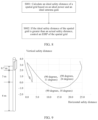
- FIG. 7 b is a schematic diagram of a horizontal safety distance and a vertical safety distance
- FIG. 8 is a schematic diagram of determining whether EIRP control needs to be performed in a spatial grid
- FIG. 9 is a schematic diagram of an ideal safety distance
- FIG. 10 is a schematic diagram of a plurality of beams
- FIG. 11 is a schematic diagram of a mapping power of a beam m in a spatial grid X n ;
- FIG. 12 is a schematic diagram of a communications apparatus 1200 .
- FIG. 13 is a schematic diagram of a communications apparatus 1300 .
- An embodiment of the present invention provides a communications system.
- the communications system includes an access network device and at least one terminal, and the at least one terminal may perform wireless communication with the access network device.
- FIG. 1 is a schematic diagram of a communications system according to an embodiment of this application.
- an access network device 11 and a terminal 12 may perform wireless communication
- the access network device 11 and a terminal 13 may perform wireless communication.
- the access network device and the terminals included in the communications system shown in FIG. 1 are merely implementations.
- a type and a quantity of network elements included in the communications system, and a connection relationship between the network elements are not limited thereto.
- a communications system in the embodiments of this application may be a communications system supporting a fourth generation (4G) access technology, for example, a long term evolution (LTE) access technology.
- the communications system may be a communications system supporting a fifth generation (5G) access technology, for example, a new radio (NR) access technology.
- the communications system may be a communications system supporting a third generation (3G) access technology, for example, a universal mobile telecommunications system (UMTS) access technology.
- the communications system may be a communications system supporting a plurality of wireless technologies, for example, a communications system supporting an LTE technology and an NR technology.
- the communications system may further be applicable to a future-oriented communications technology.
- An access network device in the embodiments of this application may be a device that is on an access network side and that is configured to support a terminal in accessing a communications system, for example, may be a base transceiver station (BTS) or a base station controller (BSC) in a communications system supporting a 2G access technology, a NodeB (NodeB) or a radio network controller (RNC) in a communications system supporting a 3G access technology, an evolved NodeB (eNB) in a communications system supporting a 4G access technology, or a next generation NodeB (gNB), a transmission reception point (TRP), a relay node (relay node), or an access point (AP) in a communications system supporting a 5G access technology.
- BTS base transceiver station
- BSC base station controller
- NodeB NodeB
- RNC radio network controller
- eNB evolved NodeB
- gNB next generation NodeB
- TRP transmission reception point
- relay node relay node
- a terminal in the embodiments of this application may be a device that provides a user with voice or data connectivity.
- the terminal may also be referred to as user equipment (UE), a mobile station, a subscriber unit, a station, or terminal equipment (TE).
- the terminal may be a cellular phone, a personal digital assistant (PDA), a wireless modem, a handheld device, a laptop computer, a cordless phone, a wireless local loop (WLL) station, a tablet computer, or the like.
- PDA personal digital assistant
- WLL wireless local loop
- a device that can access a communications system that can communicate with a network side of a communications system, or that can communicate with another object through a communications system
- the terminal in the embodiments of this application, for example, a terminal and a vehicle in intelligent transportation, a household device in a smart household, an electricity meter reading instrument in a smart grid, a voltage monitoring instrument, an environment monitoring instrument, a video surveillance instrument in an intelligent security network, or a cash register.
- the terminal may communicate with an access network device, for example, the access network device 11 .
- FIG. 2 is a schematic diagram of a structure of an access network device.
- a structure of the access network device 11 refer to the structure shown in FIG. 2 .
- the access network device includes at least one processor 1111 , at least one memory 1112 , at least one transceiver 1113 , at least one network interface 1114 , and one or more antennas 1115 .
- the processor 1111 , the memory 1112 , the transceiver 1113 , and the network interface 1114 are connected, for example, via a bus.
- the antenna 1115 is connected to the transceiver 1113 .
- the network interface 1114 is configured to connect the access network device and another communications device via a communications link.
- the access network device is connected to a core network element via an S I interface.
- the connection may include various types of interfaces, transmission lines, buses, or the like. This is not limited in the embodiments.
- a processor such as the processor I 111 may include at least one of the following types: a general-purpose central processing unit (CPU), a digital signal processor (DSP), a microprocessor, an application-specific integrated circuit (ASIC), a microcontroller unit (MCU), a field programmable gate array (FPGA), or an integrated circuit configured to implement a logical operation.
- the processor 1111 may be a single-core (e.g.single-CPU) processor or a multi-core (e.g.multi-CPU) processor.
- the at least one processor 1111 may be integrated into one chip or located on a plurality of different chips.
- a memory such as the memory 1112 may include at least one of the following types: a read-only memory (ROM) or another type of static storage device that can store static information and instructions, a random access memory (RAM) or another type of dynamic storage device that can store information and instructions, or an electrically erasable programmable read-only memory (EEPROM).
- ROM read-only memory
- RAM random access memory
- EEPROM electrically erasable programmable read-only memory
- the memory may alternatively be a compact disc read-only memory (CD-ROM) or another compact disc storage, an optical disc storage (including a compact disc, a laser disc, an optical disc, a digital versatile disc, a Blu-ray disc, and the like), a magnetic disk storage medium or another magnetic storage device, or any other medium that can be configured to carry or store expected program code in a form of instructions or a data structure and that can be accessed by a computer.
- CD-ROM compact disc read-only memory
- an optical disc storage including a compact disc, a laser disc, an optical disc, a digital versatile disc, a Blu-ray disc, and the like
- a magnetic disk storage medium or another magnetic storage device or any other medium that can be configured to carry or store expected program code in a form of instructions or a data structure and that can be accessed by a computer.
- the memory is not limited thereto.
- the memory 1112 may exist independently, and is connected to the processor 1111 .
- the memory 1112 may alternatively be integrated with the processor 1111 , for example, integrated into a chip.
- the memory 1112 can store program code for performing the technical solutions in the embodiments of this application, and the processor 1111 controls execution of the program code.
- Various types of executed computer program code may also be considered as drivers of the processor 1111 .
- the processor 1111 is configured to execute the computer program code stored in the memory 1112 , to implement the technical solutions in the embodiments of this application.
- the transceiver 1113 may be configured to support receiving or sending of a radio frequency signal between the access network device and a terminal, and the transceiver 1113 may be connected to the antenna 1115 . Specifically, the one or more antennas 1115 may receive a radio frequency signal.
- the transceiver 1113 may be configured to: receive the radio frequency signal from the antenna, convert the radio frequency signal into a digital baseband signal or a digital intermediate frequency signal, and provide the digital baseband signal or the digital intermediate frequency signal for the processor 1111 , so that the processor 1111 further processes the digital baseband signal or the digital intermediate frequency signal, for example, performs demodulation processing and decoding processing.
- the transceiver 1113 may be configured to: receive a modulated digital baseband signal or digital intermediate frequency signal from the processor 1111 , convert the modulated digital baseband signal or digital intermediate frequency signal into a radio frequency signal, and send the radio frequency signal via the one or more antennas 1115 .
- the transceiver 1113 may selectively perform one or more levels of frequency down-mixing processing and analog-to-digital conversion processing on the radio frequency signal to obtain the digital baseband signal or the digital intermediate frequency signal.
- a sequence of the frequency down-mixing processing and the analog-to-digital conversion processing is adjustable.
- the transceiver 1113 may selectively perform one or more levels of frequency up-mixing processing and digital-to-analog conversion processing on the modulated digital baseband signal or digital intermediate frequency signal to obtain the radio frequency signal.
- a sequence of the frequency up-mixing processing and the digital-to-analog conversion processing is adjustable.
- the digital baseband signal and the digital intermediate frequency signal may be collectively referred to as digital signals.
- the transceiver may be referred to as a transceiver circuit, a transceiver unit, a transceiver component, a sending circuit, a sending unit, a sending component, or the like.
- the processor 1111 and the memory 1112 may be located in a BBU
- the transceiver 1113 may be located in an RRU
- the access network device 11 may include the BBU, the RRU, and the antenna.
- the access network device 11 may send data to the terminal 12 to a terminal 27 in an electromagnetic field (EMF) by using an electromagnetic wave.
- NIR Non-ionizing radiation
- electromagnetic radiation of ultraviolet, light, infrared, and radio waves, and mechanical waves such as infrasonic and ultrasonic waves do not ionize atoms and molecules.
- the hazard of the NIR to the organism mainly includes a thermal effect, a non-thermal effect, and an accumulative effect.
- ICNIRP non-ionizing radiation protection
- Table 1 shows EMF strength requirements of a plurality of countries/organizations.
- an EMF strength is represented by using a power spectral density, and a unit of the power spectral density is w/m 2 .
- the power spectral density may be understood as an incident plane wave power density.
- the EMF strength may be represented by using another unit. This is not limited in the embodiments of this application.
- the EMF strength may be represented by using an electric field strength, and a unit of the electric field strength is V/m; or the EMF strength may be represented by using a current strength, and a unit of the current strength is A/m.
- the power spectral density in Table 1 refers to a maximum value of the power spectral density; and when a measured power spectral density is less than the value shown in Table 1, the EMF strength requirement is satisfied.
- a frequency (f) range is from 0.4G to 2G
- a power spectral density is f/200 w/m 2
- a frequency range is above 2G
- a power spectral density is 10 w/m 2 .
- Some countries of the European Union have special requirements: For example, a power spectral density of Switzerland is 0.042 w/m 2 , a power spectral density of Italy and Tru is 0.095 w/m 2 , and a power spectral density of Belgium and Luxembourg is 0.0238 w/m 2 .
- the Chinese mainland has a special requirement, that is, uses the GB8702B standard: When a frequency range is from 0.03G to 3G, a power spectral density is 0.4 w/m 2 ; when a frequency range is from 3G to 15G, a power spectral density is f/7500 w/m 2 ; when a frequency range is from 15G to 30G, a power spectral density is 2 w/m 2 .
- a frequency range is from 0.03G to 3G
- a power spectral density is 0.4 w/m 2
- a power spectral density is f/7500 w/m 2
- a power spectral density is 2 w/m 2 .
- a power spectral density may be calculated according to the following formula:
- S P * G 4 ⁇ ⁇ ⁇ R 2 , ( formula ⁇ 1 ) where S is a power spectral density of a test point, P is an input power of an antenna port, G is an antenna gain, and R is a distance from an antenna to the test point.
- P*G may be referred to as an equivalent isotropically radiated power (EIRP).
- a safety distance R that satisfies a power spectral density of a country or region that deploys an access network device may be obtained based on a power spectral density requirement of the country or region, an input power P of an antenna port of the access network device, and an antenna gain G.
- the safety distance R may be obtained according to the following formula:
- R P ⁇ G 4 ⁇ ⁇ ⁇ S , ( formula ⁇ 2 ) where S is the power spectral density requirement, P is the input power of the antenna port, and G is the antenna gain.
- S the power spectral density requirement
- P the input power of the antenna port
- G the antenna gain.
- a safety distance in the multi-frequency scenario may be obtained based on a safety distance of each frequency. For example, if there are n frequencies, a safety distance R i of a frequency i may be calculated, and then the safety multi-frequency scenario is calculated according to the following formula:
- the access network device and the terminal may communicate with each other by using the MIMO technology, and dozens or even hundreds of antennas may be deployed on the access network device 11 , so that the access network device 11 can communicate with at least one terminal on a same time-frequency resource in a spatial multiplexing manner.
- the MIMO technology may be applied to various standards, for example, LTE or NR.
- a transmit power and an antenna gain of an access network device using the MIMO technology are greater than those of a conventional access network device. Consequently, when the MIMO access network device is deployed, a safety distance of the MIMO access network device is larger than that of the conventional access network device.
- the MIMO access network device may be deployed on an existing site.
- the existing site only an EMF strength requirement of a frequency of the existing site is considered, and a geographical environment around the existing site is already determined. Consequently, a distance between the existing site and a surrounding building may not satisfy the safety distance required by the MIMO access network device.
- a safety distance of the existing site is 14 m, and a school is established 15 m away from the existing site in a specific direction.
- the safety distance of the MIMO access network device is 19.98 m, and if the MIMO access network device is deployed at a position of the existing site, an EMF strength at a position of the school that is deployed 15 m away from the site in the specific direction does not satisfy the requirement.
- a site on which the MIMO access network device is deployed may be reselected. Consequently, costs of site deployment are relatively large, and a periodicity of the site deployment is longer.
- a power of the MIMO access network device may be reduced based on the safety distance of the existing site. For example, if the safety distance of the existing site is 14 m, it is required in the ICNIRP guidelines that a power spectral density be 10 w/m 2 , and G be 24 dBi. In this case,
- the embodiments of this application provide a solution for controlling an EIRP.
- space is divided into several spatial grids, and an EIRP of each spatial grid may be controlled, at a granularity of a spatial grid, to not exceed an EIRP threshold of the spatial grid, so that deployment of a MIMO access network device satisfies an EMF strength requirement specified by each country/region.
- FIG. 3 shows an EIRP control method according to this application. The method may be performed by the access network device 11 or a chip in the access network device 11 . As shown in FIG. 3 :
- E n is related to a safety distance R n of the spatial grid X n .
- n is any integer from 0 to N ⁇ 1
- N is a quantity of spatial grids, and N is greater than or equal to 1.
- the spatial grid X n may be understood as a concept of an angle domain, and the spatial grid X n may include one or more spatial directions.
- a spatial direction may be determined based on a horizontal plane angle and a vertical plane angle.
- a horizontal plane angle of a spatial direction may be understood as an angle of the spatial direction on a horizontal plane
- a vertical plane angle of a spatial direction may be understood as an angle of the spatial direction on a vertical plane.
- the spatial grid X n may include a plurality of spatial directions in an angle range, and the angle range includes a horizontal plane angle range and a vertical plane angle range. It may be understood that the spatial grid X n may be determined based on the horizontal plane angle range and the vertical plane angle range.
- the horizontal plane angle range of the spatial grid X n may be understood as an angle range of the spatial grid X n on the horizontal plane
- the vertical plane angle range of the spatial grid X n may be understood as an angle range of the spatial grid X n on the vertical plane.
- the horizontal plane angle range of the spatial grid X n is from a minimum horizontal plane angle ⁇ n min to a maximum horizontal plane angle ⁇ n max
- the vertical plane angle range of the spatial grid X n is from a minimum vertical plane angle ⁇ n min to a maximum vertical plane angle on ⁇ n max
- the spatial grid X n may include all spatial directions in the horizontal plane angle range from ⁇ n in to ⁇ n max and the vertical plane angle range from ⁇ n min to ⁇ n max .
- ⁇ n min to ⁇ n max are continuous, and ⁇ n in to ⁇ n max are continuous. It should be noted that the horizontal plane angle range or the vertical plane angle range may be discontinuous.
- FIG. 4 is a schematic diagram of a coordinate system.
- an origin of the coordinate system may be a position of an antenna, for example, a center point of the antenna, a bottom end of the antenna, or another position in the antenna.
- the coordinate system includes three coordinate axes: an x-axis, a y-axis, and a z-axis, where a plane formed by the x-axis and the y-axis may be referred to as a horizontal plane, and a plane formed by the y-axis and the z-axis may be referred to as a vertical plane.
- an angle between a projection of a spatial direction on the horizontal plane and the x-axis may be referred to as a horizontal plane angle
- an angle between a projection of a spatial direction on the vertical plane and the z-axis may be referred to as a vertical plane angle
- FIG. 4 is merely an implementation, and the horizontal plane angle and the vertical plane angle may be represented in another manner.
- an angle between a projection of a spatial direction on the horizontal plane and the y-axis may be referred to as the horizontal plane angle
- an angle between a projection of a spatial direction on the vertical plane and the y-axis may be referred to as the vertical plane angle.
- the coordinate system in FIG. 4 is also an implementation.
- the coordinate system may be represented in another manner.
- Positions of the x-axis, the y-axis, and the z-axis may be interchanged, or directions of the x-axis, the y-axis, and the z-axis may be respectively the same as or opposite to directions of the x-axis, the y-axis, and the z-axis in FIG. 4 .
- a spatial direction directed from the origin may be determined based on a horizontal plane angle and a vertical plane angle.
- a horizontal plane angle of a spatial direction 1 is ⁇ n 1
- a vertical plane angle of the spatial direction 1 is ⁇ n 1
- the spatial direction 1 may be represented as ( ⁇ n 1 , ⁇ n 1 ).
- a horizontal plane angle of a spatial direction 2 is ⁇ n 2
- a vertical plane angle of the spatial direction 2 is ⁇ n 1
- the spatial direction 2 may be represented as ( ⁇ n 2 , ⁇ n 2 ).
- the spatial grid X n may include all spatial directions directed to a curved surface, and all the spatial directions directed to the curved surface satisfies the horizontal plane angle range from ⁇ n min to ⁇ n max and the vertical plane angle range from ⁇ n min to ⁇ n max .
- the spatial grid X n includes the spatial direction 1 ( ⁇ n 1 , ⁇ n 1 ) and the spatial direction 2 ( ⁇ n 2 , ⁇ n 2 ).
- ⁇ n min may be equal to ⁇ n max .
- a projection of the spatial grid X n on the horizontal plane is one spatial direction.
- ⁇ n min may be equal to ⁇ n max .
- a projection of the spatial grid X n on the vertical plane is one spatial direction.
- ⁇ n min may be equal to ⁇ n max and ⁇ n min may be equal to ⁇ n max .
- a projection of the spatial grid X n on the horizontal plane is one spatial direction and a projection of the spatial grid X n on the vertical plane is also one spatial direction.
- the spatial grid X n is one spatial direction
- a horizontal plane angle of the spatial direction is ⁇ n min
- a vertical plane angle of the spatial direction is ⁇ n min .
- N may be an integer greater than or equal to 1.
- one spatial grid X n may be corresponding to one safety distance R n and one EIRP threshold E n .
- the safety distance R n may be understood as a required distance between an antenna and an organism in the spatial grid X n .
- the safety distance R n may be a required distance between the antenna and a person.
- the safety distance R n may be a distance between the antenna and a nearest building.
- the safety distance R n may be determined by an operator or a certain organization, or the safety distance R n may be a distance that is measured in the spatial grid X n based on an actual geographical environment and that is between the antenna and a person or between the antenna and a nearest building.
- the safety distance R n of the spatial grid X n may be determined based on a horizontal safety distance of the spatial grid X n and a vertical safety distance of the spatial grid X n , where the horizontal safety distance of the spatial grid X n may be a projection of the safety distance R n of the spatial grid X n on the horizontal plane, and the vertical safety distance of the spatial grid X n may be a projection of the safety distance R n of the spatial grid X n on the vertical plane.
- E n is related to the safety distance R n of the spatial grid X n . It may be understood that when R n takes different values, E n also takes different values.
- safety distances of spatial grids may be the same or different.
- N is greater than or equal to 2
- a safety distance R i of a spatial grid X i is different from a safety distance R j of a spatial grid X j
- an EIRP threshold E i of the spatial grid X i is different from an EIRP threshold E j of the spatial grid X j
- i and j each are an integer from 0 to N ⁇ 1, and i is not equal to j.
- the EIRP threshold E 0 of the spatial grid X 0 is different from the EIRP threshold E 1 of the spatial grid X 1 .
- E n a*S b *R n c (formula 5), where a, b, and c are positive numbers. For example, a is 4n, b is 1, and c is 2.
- a s1 represents a side lobe suppression value
- a represents a downtilt
- ⁇ bw represents a vertical half-power beamwidth
- ⁇ represents a reflection coefficient
- the EIRP threshold of the spatial grid X n may be derived based on the EMF strength threshold S of the spatial grid X n , and then a total EIRP of the spatial grid X n is controlled based on the EIRP threshold. This can relatively reliably ensure that deployment of the access network device 11 satisfies an EMF strength requirement.
- the EIRP may be flexibly controlled based on a local requirement, to ensure the deployment of the access network device 11 and provide communication for the public.
- an EMF strength threshold of each frequency may be first determined, and then an EIRP of each frequency is controlled.
- the spatial grid X n may include a plurality of spatial directions, there may be one safety distance in each spatial direction, and safety distances in the spatial directions may be the same or different.
- a safety distance in the spatial direction 1 is R n .
- the safety distance of the spatial grid X n may be a safety distance in one of the plurality of spatial directions.
- the safety distance of the spatial grid X n may be a largest safety distance in a plurality of safety distances in the plurality of spatial directions, or may be a smallest safety distance in a plurality of safety distances in the plurality of spatial directions, or may be a safety distance in any one of the plurality of spatial directions.
- the horizontal plane angle range of the spatial grid X n is from ⁇ n min to ⁇ n max
- the vertical plane angle range of the spatial grid X n is from ⁇ n min ⁇ n max
- the safety distance R n may be a safety distance corresponding to a horizontal plane angle ⁇ n d and a vertical plane angle ⁇ n d , where ⁇ n d is a value from ⁇ n min to ⁇ n max , and ⁇ n d is a value from ⁇ n min to ⁇ n max .
- ( ⁇ n d , ⁇ n d ) may be a spatial direction of the spatial grid X n .
- a safety distance in the spatial direction ( ⁇ n d , ⁇ n d ) is the largest.
- a safety distance in the spatial direction ( ⁇ n d , ⁇ n d ) is the smallest.
- ( ⁇ n d , ⁇ n d ) may be any spatial direction of the spatial grid X n .
- the safety distance of the spatial grid X n may be obtained based on a safety distance in each of a plurality of spatial directions (where the plurality of spatial directions herein may be all or some spatial directions included in the spatial grid X n ).
- the safety distance of the spatial grid X n may be calculated based on the safety distance in each of the plurality of spatial directions in a specific calculation manner, and the calculation manner may be an averaging calculation manner or another calculation manner.
- an average value of safety distances in the spatial directions may be calculated, to obtain the safety distance of the spatial grid X n .
- averaging in this embodiment of this application may be arithmetic averaging, geometric averaging, square averaging, harmonic averaging, weighted averaging, or the like.
- the determining an EIRP threshold E n of a spatial grid X n may include: receiving the EIRP threshold E n of the spatial grid X n , for example, receiving the EIRP threshold of the spatial grid X n from a network management system.
- the network management system may calculate the EIRP threshold E n of the spatial grid X n , or the network management system may obtain the EIRP threshold E n of the spatial grid X n from the operator or the certain organization.
- the processor 1111 may receive the EIRP threshold E n of the spatial grid X n from the network management system, and the memory 1112 may store the EIRP threshold E n of the spatial grid X n .
- the determining an EIRP threshold E n of a spatial grid X n may include: determining the EIRP threshold E n of the spatial grid X n through calculation.
- the EIRP threshold E n of the spatial grid X n may be obtained based on the safety distance R n of the spatial grid X n .
- the processor 1111 may calculate the EIRP threshold E n of the spatial grid X n , or the processor 1111 may receive the EIRP threshold E n of the spatial grid X n via the network interface 1114 .
- the memory 1112 may store the EIRP threshold E n . the horizontal plane angle range, the vertical plane angle range, the safety distance R n , and the like of the spatial grid X n .
- an EIRP of each spatial grid may be flexibly adjusted based on a safety distance of each spatial grid, to avoid MIMO performance deterioration caused by limiting EIRPs in all spatial directions based on a safety distance in a specific spatial direction. According to this solution. MIMO performance can be maintained when the local EMF requirement is satisfied.
- the plurality of beams may include beams covering different terminals, and the beams covering the terminals may use a same time-frequency resource or different time-frequency resources. For example, when a distance between two terminals is relatively long, beams covering the two terminals may occupy a same time-frequency resource; when a distance between two terminals is relatively short, beams covering the two terminals may occupy different time-frequency resources.
- the total EIRP of the plurality of beams in the spatial grid X n may be understood as an EIRP of the spatial grid X n under a joint action of the plurality of beams, or may be understood as an EIRP that is of the spatial grid X n and that is obtained through integration or combination of EIRPs of the plurality of beams.
- each beam contributes to the EIRP of the spatial grid X n
- the total EIRP of the plurality of beams in the spatial grid X n may be obtained based on an EIRP contribution of each beam to the spatial grid X n .
- the total EIRP of the plurality of beams in the spatial grid X n may be obtained in a summation manner, a product manner, a weighted summation manner, a weighted product manner, an accumulation manner, or another calculation manner based on the EIRP contribution of each beam to the spatial grid X n . This is not limited in this embodiment of this application.
- the processor 1111 may control the total EIRP of the plurality of beams in the spatial grid X n to be less than or equal to the EIRP threshold E n .
- the total EIRP of the plurality of beams in the spatial grid X n may be determined based on a total mapping power of the plurality of beams in the spatial grid X n and/or an antenna gain of the spatial grid X n .
- the following first describes the total mapping power of the plurality of beams in the spatial grid X n and the antenna gain of the spatial grid X n .
- a power obtained by mapping a power of the beam to the spatial grid X n may be referred to as a mapping power of the beam in the spatial grid X n .
- a mapping power of each beam in the spatial grid X n may be obtained, and then the total mapping power of the plurality of beams in the spatial grid X n is obtained based on the mapping power of each beam in the spatial grid X n .
- a sum of mapping powers of the plurality of beams in the spatial grid X n may be calculated, to obtain the total mapping power of the plurality of beams in the spatial grid X n .
- the spatial grid X n may include a plurality of spatial directions
- total mapping powers of the plurality of beams in the spatial directions of the spatial grid X n may be the same or different.
- the total mapping power of the plurality of beams in the spatial grid X n may be a total mapping power of the plurality of beams in one spatial direction of the spatial grid X n .
- the total mapping power of the plurality of beams in the spatial grid X n may be a largest total mapping power in a plurality of total mapping powers obtained after powers of the plurality of beams are mapped to each of spatial directions (where the spatial directions may be all or some spatial directions included in the spatial grid X n ) of the spatial grid X n ; or may be a smallest total mapping power in a plurality of total mapping powers obtained after powers of the plurality of beams are mapped to each of spatial directions of the spatial grid X n ; or may be a total mapping power of the plurality of beams in any spatial direction of the spatial grid X n .
- the total mapping power of the plurality of beams in the spatial grid X n may be a total mapping power that is of the plurality of beams and that is corresponding to a horizontal plane angle ⁇ n p1 and a vertical plane angle ⁇ n p1 , where ⁇ n p1 is a value from ⁇ n min to ⁇ n max , and ⁇ n p1 is a value from ⁇ n min to ⁇ n max .
- ( ⁇ n p1 , ⁇ n p1 ) may be a spatial direction of the spatial grid X n .
- a total mapping power in the spatial direction ( ⁇ n p1 , ⁇ n p1 ) is the largest.
- a total mapping power in the spatial direction ( ⁇ n p1 , ⁇ n p1 ) is the smallest.
- ( ⁇ n p1 , ⁇ n p1 ) may be any spatial direction of the spatial grid X n .
- the total mapping power of the plurality of beams in the spatial grid X n may be obtained based on the total mapping powers of the plurality of beams in the spatial directions of the spatial grid X n .
- the total mapping power of the plurality of beams in the spatial grid X n may be obtained based on the total mapping power of the plurality of beams in each of the plurality of spatial directions of the spatial grid X n , for example, in an averaging manner or another calculation manner.
- the total mapping power of the plurality of beams in each spatial direction of the spatial grid X n may be calculated, to obtain the plurality of total mapping powers in the plurality of spatial directions, and then an average value of the plurality of total mapping powers is calculated, to obtain the total mapping power of the spatial grid X n .
- the antenna gain of the spatial grid X n may be determined.
- the structure of the antenna for transmitting the plurality of beams may include one or more of a quantity of antenna arrays, a quantity of antenna elements in each antenna array, an arrangement manner of antenna elements in each antenna array, a distance between antenna elements, and another manner. Structures of some antennas for transmitting a plurality of beams are already determined after delivery. However, for some antennas, structures of the antennas for transmitting a plurality of beams may still be flexibly adjusted after delivery, the structures of the antennas for transmitting a plurality of beams may be determined, and then an antenna gain in each spatial direction is determined.
- the spatial grid X n may include a plurality of spatial directions, there is an antenna gain of the plurality of beams in each spatial direction of the spatial grid X n , and antenna gains of the plurality of beams in the spatial directions of the spatial grid X n may be the same or different.
- the antenna gain of the plurality of beams in the spatial grid X n may be an antenna gain of the plurality of beams in one spatial direction of the spatial grid X n .
- the antenna gain of the plurality of beams in the spatial grid X n may be a largest antenna gain in antenna gains of the plurality of beams in spatial directions (where the spatial directions may be all or some spatial directions included in the spatial grid X n ); or may be a smallest antenna gain in antenna gains of the plurality of beams in spatial directions; or may be an antenna gain of the plurality of beams in any spatial direction of the spatial grid X n .
- the antenna gain of the plurality of beams in the spatial grid X n may be an antenna gain that is of the plurality of beams and that is corresponding to a horizontal plane angle ⁇ n g and a vertical plane angle ⁇ n g , where ⁇ n g is a value from ⁇ n min to ⁇ n max , and ⁇ n g is a value from ⁇ n min to ⁇ n max .
- ( ⁇ n g , ⁇ n g ) may be a spatial direction of the spatial grid X n .
- an antenna gain in the spatial direction ( ⁇ n g , ⁇ n g ) is the largest.
- an antenna gain in the spatial direction ( ⁇ n g , ⁇ n g ) is the smallest.
- ( ⁇ n g , ⁇ n g ) may be any spatial direction of the spatial grid X n .
- the antenna gain of the plurality of beams in the spatial grid X n may be obtained based on the antenna gains of the plurality of beams in the spatial directions of the spatial grid X n .
- the antenna gain of the plurality of beams in the spatial grid X n may be obtained based on the antenna gain of the plurality of beams in each of the plurality of spatial directions of the spatial grid X n , for example, in an averaging manner, a weighted manner, or another calculation manner.
- the antenna gain of the plurality of beams in each spatial direction of the spatial grid X n may be calculated, to obtain the plurality of antenna gains in the plurality of spatial directions, and then an average value of the plurality of antenna gains is calculated, to obtain the antenna gain of the spatial grid X n .
- the total mapping power of the spatial grid X n may be controlled, so that the total EIRP of the spatial grid X n does not exceed E n .
- the antenna gain G n of the spatial grid X n may be determined, and the total mapping power of the plurality of beams in the spatial grid X n is controlled to be less than or equal to a power threshold P n , where P n is obtained based on E n and G n , for example,
- the antenna gain in each spatial direction may be determined.
- the power threshold P n of the spatial grid X n may be obtained based on the EIRP threshold E n and the antenna gain G n of the spatial grid X n , for example,
- the total mapping power of the plurality of beams in the spatial grid X n is controlled, so that the total mapping power of the spatial grid X n is less than or equal to the power threshold P n , and the total EIRP of the plurality of beams in the spatial grid X n may be less than or equal to the EIRP threshold E n .
- the total mapping power of the plurality of beams in the spatial grid X n may be an instantaneous total mapping power or an average total mapping power of the plurality of beams in the spatial grid X n .
- the instantaneous total mapping power of the plurality of beams in the spatial grid X n may be controlled to be less than or equal to the power threshold P n .
- the instantaneous total mapping power of the plurality of beams in the spatial grid X n may be an instantaneous total mapping power of the plurality of beams in one spatial direction of the spatial grid X n , for example, may be an instantaneous total mapping power in ( ⁇ n p1 , ⁇ n p1 ).
- the instantaneous total mapping power of the plurality of beams in the spatial grid X n may be obtained based on instantaneous total mapping powers of the plurality of beams in spatial directions.
- For related content refer to the foregoing related content of the total mapping power of the plurality of beams in the spatial grid X n .
- a total EIRP of the plurality of beams in the spatial grid X n does not exceed the EIRP threshold E n at any moment, so that an EMF strength of the plurality of beams in the spatial grid X n does not exceed the EMF strength threshold at any moment.
- an average total mapping power of the plurality of beams in the spatial grid X n in a time period T may be controlled, so that the average total mapping power of the spatial grid X n is less than or equal to the power threshold P n .
- a length of the time period T may be six minutes.
- the average total mapping power of the plurality of beams in the spatial grid X n in the time period T may be an average total mapping power of the plurality of beams in one spatial direction of the spatial grid X n in the time period T, for example, may be an average total mapping power in ( ⁇ n p2 , ⁇ n p2 ), where ⁇ n p2 is a value from ⁇ n min to ⁇ n max , and ⁇ n p2 is a value from ⁇ n min to ⁇ n max .
- ⁇ n p2 may be different from ⁇ n p1
- ⁇ n p2 is different from ⁇ n p1 .
- the average total mapping power of the plurality of beams in the spatial grid X n is an average value of instantaneous total mapping powers of the plurality of beams in the spatial grid X n .
- the average total mapping power of the plurality of beams in the spatial grid X n in the time period T is an average value of instantaneous total mapping powers of the plurality of beams in the spatial grid X n in the time period T.
- the instantaneous total mapping power of the plurality of beams in the spatial grid X n may be obtained based on instantaneous total mapping powers of the plurality of beams in spatial directions.
- mapping power of the plurality of beams in the spatial grid X n refer to the foregoing related content of the mapping power of the plurality of beams in the spatial grid X n .
- the instantaneous total mapping power of the plurality of beams in the spatial grid X n may be an instantaneous total mapping power in ( ⁇ n p2 , ⁇ n p2 ).
- an instantaneous total mapping power in ( ⁇ n p2 , ⁇ n p2 ) are obtained, and then an average value of the plurality of instantaneous total mapping powers in ( ⁇ n p2 , ⁇ n p2 ) is calculated, to obtain the average total mapping power of the plurality of beams in the spatial grid X n in the time period T.
- sampling time points may be selected. For example, a plurality of sampling time points are selected in the time period T, instantaneous total mapping powers of the plurality of beams in the spatial grid X n at these sampling time points are separately obtained, and then the average total mapping power of the plurality of beams in the spatial grid X n is obtained.
- a quantity of the sampling time points may be determined based on a capability of the access network device 11 . This is not limited in this embodiment of this application.
- MIMO beams are time-related.
- a spatial direction of a beam at a specific moment may be determined based on a position of a terminal. At different moments, directions of a plurality of beams may be different. Therefore, a total mapping power of a spatial grid may vary with time, and a power of the spatial grid X n may be relatively accurately estimated by calculating the average total mapping power of the spatial grid X n .
- non-ionizing radiation in an EMF may affect an organism in an accumulative time period. For example, according to the ICNIRP guidelines, whether the deployment of the access network device 11 satisfies the requirement is determined based on an average EMF strength within six minutes. The average total mapping power of the plurality of beams in the spatial grid X n is controlled to be less than or equal to the power threshold P n . Therefore, an average EMF strength in a time period may be controlled to not exceed the threshold, so that the deployment of the access network device 11 satisfies the local requirement.
- an instantaneous total mapping power of the plurality of beams in the spatial grid X n at a moment may be greater than or equal to the power threshold P n
- an instantaneous total mapping power of the plurality of beams in the spatial grid X n at another moment may be less than or equal to the power threshold P n .
- the average total mapping power of the plurality of beams in the spatial grid X n is less than or equal to the power threshold P n .
- the time period T includes a moment t 1 and a moment t 2 , where an instantaneous total mapping power of the plurality of beams in the spatial grid X n at the moment 11 is greater than the power threshold P n , and an instantaneous total mapping power of the plurality of beams in the spatial grid X n at the moment t 2 is less than or equal to the power threshold P n .
- the access network device 11 may predict, by using T as a sliding time window and based on the power threshold P n and instantaneous total mapping powers of the spatial grid X n at several moments in the time period T, a instantaneous total mapping power of the spatial grid X n at a next moment. Therefore, the instantaneous total mapping power of the spatial grid X n at the next moment is controlled to be less than a predicted value, to achieve an objective that the average total mapping power of the spatial grid X n is less than or equal to the power threshold P n .
- the average total mapping power of the plurality of beams in the spatial grid X n is controlled to be less than or equal to the power threshold P n . Therefore, an instantaneous total mapping power of the plurality of beams in the spatial grid X n may be greater than the power threshold, so that performance of the access network device 11 at some moments can be improved.
- the deployment of the access network device 11 satisfies the local requirement and does not cause a radiation hazard to an organism, and performance of the access network device 11 can be maintained and user experience is improved.
- this embodiment of this application provides the following implementation manners.
- a power of at least one of the plurality of beams may be controlled to be less than a beam power threshold. Therefore, a contribution that the at least one beam makes to a mapping power in the spatial grid X n is reduced, so that the total mapping power of the spatial grid X n is less than or equal to the power threshold P n .
- the at least one beam may be at least one beam that is in the plurality of beams and whose mapping power in the spatial grid X n is greater than a mapping power threshold.
- the mapping power that is in the spatial grid X n and that is greater than the mapping power threshold may be an instantaneous mapping power (for example, at a moment in the time period T) in the spatial grid X n , or may be an average mapping power (for example, may be an average mapping power in the spatial grid X n in the time period T) in the spatial grid X n .
- a power of a beam that makes a greatest contribution to the mapping power of the spatial grid X n is reduced. Therefore, the total mapping power of the spatial grid X n may be effectively reduced, so that the total mapping power of the spatial grid X n is less than or equal to the power threshold P n .
- the at least one beam may include a data channel beam.
- a power of the data channel beam is reduced while a power of a control channel beam is not reduced, so that performance of terminal access can be ensured.
- the at least one beam may include a data channel beam and a broadcast channel beam.
- the antenna gain of the spatial grid X n may be controlled, so that the total EIRP of the spatial grid X n does not exceed E n .
- the antenna gain of the spatial grid X n may be:
- the antenna gain of the plurality of beams in X n may be adjusted by controlling the structure of the antenna for transmitting the plurality of beams, where the structure of the antenna for transmitting the plurality of beams may include one or more of a quantity of antenna arrays, a quantity of antenna elements in each antenna array, an arrangement manner of antenna elements in each antenna array, and a distance between antenna elements.
- the access network device 11 may transmit a plurality of beams, for example, may transmit a plurality of beams based on a transmit power that can be supported by hardware, and an EIRP of the spatial grid X n is controlled to not exceed E n by controlling a structure of an antenna for transmitting the plurality of beams.
- the processor 1111 of the access network device 11 may indicate to change a structure of the antenna 1115 , so as to adjust an antenna gain of the plurality of beams in X n .
- the total mapping power and the antenna gain of the spatial grid X n may be controlled, so that the total EIRP of the spatial grid X n does not exceed E n .
- both the total mapping power and the antenna gain of the spatial grid X n may be controlled, provided that the total EIRP of the spatial grid X n obtained based on the total mapping power and the antenna gain of the spatial grid X n does not exceed E n .
- values of the total mapping power and the antenna gain of the spatial grid X n are not limited, or adjustment ratios of the total mapping power and the antenna gain of the spatial grid X n are not limited.
- For how to control the total mapping power and the antenna gain of the grid X n refer to content in the application manner 1 and the application manner 2.
- the total EIRP of the spatial grid X n is controlled to be less than or equal to E n . Because there is a relationship, for example, a direct proportion relationship, between the total EIRP of the spatial grid X n and an electric field strength of the spatial grid X n , the electric field strength of the spatial grid X n may satisfy the local EMF requirement.
- step S 302 may be performed by the processor 1111 in the access network device 11 .
- the memory 1112 may store data that appears when the processor 1111 performs S 302 , for example, the instantaneous total mapping power or the average total mapping power.
- the method in FIG. 3 may further include: transmitting the plurality of beams.
- this step may be performed by the transceiver 1113 and/or the antenna 1115 in the access network device 11 .
- FIG. 5 is a schematic diagram of a spatial grid determining method. The following further describes, with reference to FIG. 5 , how to determine a spatial grid.
- the method in FIG. 5 may be performed by the access network device 11 or a chip in the access network device 11 .
- n is any integer from 0 to N ⁇ 1
- N is a quantity of spatial grids, and N is greater than or equal to 1.
- the angle range herein may include a horizontal plane angle range and/or a vertical plane angle range.
- the access network device 11 may group spatial directions included in a horizontal plane angle range and a vertical plane angle range into N spatial grids, where the horizontal plane angle range may be 0 to 360 degrees, or may be a part of the horizontal plane angle range from 0 to 360 degrees, and the vertical plane angle range may be 0 to 36) degrees, or may be a part of the vertical plane angle range from 0 to 360 degrees.
- the horizontal plane angle range may be 0 to 360 degrees
- the vertical plane angle range may be 0 to 360 degrees
- the horizontal plane angle range and the vertical plane angle range may be a horizontal plane angle range and a vertical plane angle range that include a spatial direction in which an EMF strength needs to be controlled.
- an antenna gain in each spatial direction may be simulated.
- the access network device 11 may determine that an EMF strength needs to be controlled in a spatial direction in which an antenna gain satisfies a condition.
- the condition may be that the antenna gain exceeds a threshold.
- an EMF strength at a position that is in the spatial direction and that satisfies a safety distance required by an operator may be relatively high.
- an antenna gain corresponding to a horizontal plane angle and a vertical plane angle does not exceed the threshold, even when a power in a spatial direction corresponding to the horizontal plane angle and the vertical plane angle is not controlled, where the power is, for example, an ideal power, for example, 200 w, an EMF strength at a position that is in the spatial direction and that satisfies the safety distance required by the operator does not exceed an EMF strength threshold.
- a horizontal plane angle range and a vertical plane angle range that include a spatial direction in which an antenna gain satisfies the condition are determined, so that an angle range of a spatial grid can be narrowed down, and algorithm complexity can be reduced.
- antenna gains in spatial directions may be represented by using values, a table, a graph, or the like, and content in FIG. 6 a constitutes no limitation.
- FIG. 6 a is a schematic diagram of horizontal plane antenna gains and vertical plane antenna gains.
- a schematic diagram on the left side in FIG. 6 a may represent antenna gains on a horizontal plane, and a schematic diagram on the right side in FIG. 6 a may represent antenna gains on a vertical plane.
- an angular coordinate represents a horizontal plane angle, for example, 0 degrees, 30 degrees, or 60 degrees.
- a concentric circle indicates a difference from a maximum antenna gain. For example, if the maximum antenna gain is 24 dBi, concentric circles from inside to outside respectively indicate: 30 dB smaller than the maximum antenna gain, 20 dB smaller than the maximum antenna gain, 10 dB smaller than the maximum antenna gain, and equal to the maximum antenna gain, that is, the concentric circles from inside to outside respectively indicate antenna gains ⁇ 6 dBi, 4 dBi, 14 dBi, and 24 dBi.
- a black thick line represents an envelope of the antenna gains on the horizontal plane, and each point on a solid line corresponds to an angle and an antenna gain on the horizontal plane. For example, an antenna gain corresponding to a horizontal plane angle of 90 degrees is 24 dBi.
- an angular coordinate represents a vertical plane angle, for example, 0 degrees, 30 degrees, or 60 degrees.
- a concentric circle indicates a difference from a maximum antenna gain. For example, if the maximum antenna gain is 24 dBi, concentric circles from inside to outside respectively indicate: 30 dB smaller than the maximum antenna gain, 20 dB smaller than the maximum antenna gain, 10 dB smaller than the maximum antenna gain, and equal to the maximum antenna gain, that is, the concentric circles from inside to outside respectively indicate antenna gains ⁇ 6 dBi, 4 dBi, 14 dBi, and 24 dBi.
- a black thick line represents an envelope of the antenna gains on the vertical plane, and each point on a solid line corresponds to an angle and an antenna gain on the vertical plane. For example, an antenna gain corresponding to a vertical plane angle of 90 degrees is 24 dBi.
- an antenna gain may reach a threshold, for example, 24 dBi.
- the access network device 11 may determine that an antenna gain in a spatial direction included in a horizontal plane angle range from 35 degrees to 155 degrees and a vertical plane angle range from 75 degrees to 205 degrees is close to 24 dBi.
- the horizontal plane angle range from 35 degrees to 155 degrees and the vertical plane angle range from 75 degrees to 205 degrees are the horizontal plane angle range and the vertical plane angle range that include a spatial direction in which an EMF strength needs to be controlled.
- a horizontal plane angle range and a vertical plane angle range that include a spatial direction in which an EIRP strength needs to be controlled may be obtained based on a geographical environment of the access network device 11 .
- the access network device 11 may receive, from an operator, the horizontal plane angle range and the vertical plane angle range that include a spatial direction in which an EIRP strength needs to be controlled.
- the horizontal plane angle range and the vertical plane angle range that include a spatial direction in which an EIRP strength needs to be controlled may be calculated based on an ideal power and an ideal antenna gain of the access network device 11 .
- the horizontal plane angle range and the vertical plane angle range that include a spatial direction in which an EIRP strength needs to be controlled may be determined with reference to both the implementation 1 and the implementation 2.
- the horizontal plane angle range and the vertical plane angle range that include a spatial direction in which an EIRP strength needs to be controlled may be determined by obtaining an intersection or a union of the horizontal plane angle range and the vertical plane angle range that are determined in the implementation 1 and that include a spatial direction in which an EIRP strength needs to be controlled, and the horizontal plane angle range and the vertical plane angle range that are determined in the implementation 2 and that include a spatial direction in which an EIRP strength needs to be controlled.
- S 501 may be performed by the processor 1111 in the access network device 11 .
- the access network device 11 may perform the spatial grid division.
- N may be an integer greater than or equal to 1.
- a plurality of spatial directions included in a spatial grid do not overlap a plurality of spatial directions included in another spatial grid.
- any one of a plurality of spatial directions included in a spatial grid may be different from a plurality of spatial directions included in another spatial grid.
- a spatial direction may be uniquely grouped into a spatial grid, to facilitate control of an EIRP of the spatial grid.
- the division when the spatial grid division is performed, the division may be performed in an even manner or in an uneven manner.
- the even manner may be understood as: Lengths of horizontal plane angle ranges of spatial grids are the same, and lengths of vertical plane angle ranges of the spatial grids are the same.
- a horizontal plane angle range of a spatial grid X x is from ⁇ x min to ⁇ x max
- a vertical plane angle range of the spatial grid X x is from ⁇ x min to ⁇ x max
- a horizontal plane angle range of a spatial grid X y is from ⁇ y min to ⁇ y max
- a vertical plane angle range of the spatial grid X y is from ⁇ y min to ⁇ y max
- ⁇ x max ⁇ x min ⁇ y max ⁇ y min
- ⁇ x max ⁇ x min ⁇ y min ⁇ y min
- ⁇ x max ⁇ x min ⁇ y min ⁇ y min
- x is an integer from 0 to N ⁇ 1
- y is an integer from 0 to N ⁇ 1
- x is not equal to y.
- FIG. 6 b is a schematic diagram of even grid division.
- a length of a horizontal plane angle range of each spatial grid is 20 dB
- a length of a vertical plane angle range of each spatial grid is 10 dB.
- the spatial grid division may be relatively simply performed by determining a length of a horizontal plane angle range of each spatial grid and a length of a vertical plane angle range of each spatial grid.
- the uneven manner may be understood as: Lengths of horizontal plane angle ranges of spatial grids are different, or lengths of vertical plane angle ranges of the spatial grids are different.
- a horizontal plane angle range of a spatial grid X n is from ⁇ x min to ⁇ x max
- a vertical plane angle range of the spatial grid X x is from ⁇ x min to ⁇ x max
- a horizontal plane angle range of a spatial grid X y is from ⁇ y min to ⁇ y max
- a vertical plane angle range of the spatial grid X y is from ⁇ y min to ⁇ y max
- ⁇ x max ⁇ x max ⁇ y max ⁇ y min or ⁇ x max ⁇ x min ⁇ y max ⁇ y min
- x is an integer from 0 to N ⁇ 1
- y is an integer from 0 to N ⁇ 1
- x is not equal to y.
- a difference between antenna gains in two spatial directions of the spatial grid may be less than or equal to a difference threshold.
- an antenna gain in each spatial direction may be determined.
- antenna gains in a plurality of spatial directions of a spatial grid X n may satisfy a specific condition.
- a difference between antenna gains in any two spatial directions of the spatial grid may be less than or equal to the difference threshold.
- Two spatial directions are selected in the spatial grid X n .
- an antenna gain in a spatial direction 1 ( ⁇ n 1 , ⁇ n 1 ) is G n 1
- an antenna gain in a spatial direction 2 ( ⁇ n 2 , ⁇ n 2 ) is G n 2
- a difference between G n 1 and G n 2 is less than or equal to the difference threshold, where ⁇ n 1 and ⁇ n 2 each are a value from ⁇ n min to ⁇ n max , ⁇ n 1 and ⁇ n 2 each are a value from ⁇ n min to ⁇ n max , and ⁇ n 1 is not equal to ⁇ n 2 , or ⁇ n 1 is not equal to ⁇ n 2 .
- the difference threshold is 3 dB.
- antenna gains in any two spatial directions of the spatial grid is controlled to be not excessively large. Therefore, antenna gains in all spatial directions of the spatial grid may be relatively close, so that an EIRP of the plurality of beams in the spatial grid is controlled by controlling a total mapping power of the plurality of beams in the spatial grid.
- the difference between the antenna gains in any two spatial directions of the spatial grid is enabled to be less than or equal to the difference threshold, so that a quantity of spatial grids is enabled to be as small as possible when the EIRP of the spatial grid is controlled, thereby reducing algorithm complexity.
- S 501 may be performed by the processor 1111 in the access network device 11 , and the memory 1112 may store horizontal plane angle ranges and vertical plane angle ranges of the N spatial grids.
- the access network device 11 may not first determine the angle range and then divide the angle range into several grids, but the access network device 11 may directly determine several spatial grids, for example, the access network device 11 obtains, from the operator or a certain organization, one or more spatial directions in which an EIRP strength needs to be controlled, and selects a horizontal plane angle range and a vertical plane angle range near the one or more spatial directions, to determine the several spatial grids.
- FIG. 7 a is a schematic diagram of a method for determining an EIRP threshold of a spatial grid. Mutual reference may be made to content of the method and content in S 301 . As shown in FIG. 7 a:
- the access network device 11 determines a safety distance of a spatial grid.
- the access network device 11 may receive the safety distance of the spatial grid from an operator.
- a safety distance of each spatial grid may be received, and safety distances of the spatial grids may be the same or different.
- only one safety distance may be received, and each spatial grid needs to satisfy the safety distance.
- the operator may select a smallest safety distance from the safety distances of the spatial grids, and send the smallest safety distance to the access network device 11 .
- the processor 1111 receives the safety distance of the spatial grid via the network interface 1114 .
- the access network device 11 may receive, from the operator, a distribution status of a building in the spatial grid, to determine the safety distance of the spatial grid. For example, the operator may first determine a position of the building in the spatial grid, for example, longitude and latitude of the building, or use a spatial coordinate system to indicate a position of the building; and the operator may send the position of the building in the spatial grid to the access network device 11 . Then, the access network device 11 may calculate the safety distance of the spatial grid based on the position of the building in the spatial grid.
- the processor 1111 receives the distribution status of the building in the spatial grid via the network interface 1114 , and then the processor 1111 may calculate the safety distance of the spatial grid based on the position of the building in the spatial grid.
- the access network device 11 may obtain a horizontal safety distance and a vertical safety distance of the spatial grid from the operator, and then obtain the safety distance of the spatial grid based on the horizontal safety distance and the vertical safety distance of the spatial grid.
- the horizontal safety distance may be a projection of the safety distance of the spatial grid on a horizontal plane
- the vertical safety distance may be a projection of the safety distance of the spatial grid on a vertical plane.
- the operator may determine that the horizontal safety distance is A and the vertical safety distance is B.
- Each spatial grid needs to satisfy an EMF strength limitation corresponding to the horizontal safety distance A and the vertical safety distance B.
- FIG. 7 b is a schematic diagram of a horizontal safety distance and a vertical safety distance.
- a bottom end of an antenna is used as an origin of a coordinate system.
- an EMF strength does not need to be controlled above the antenna, and a cylinder is drawn based on A and B, where a radius of the cylinder is A, a height of the cylinder is C+B, and C is a height of the antenna.
- a distance between the bottom end of the antenna and an intersection point of a spatial direction in a spatial grid and a surface of the cylinder is a safety distance of the spatial grid.
- a horizontal plane angle range of a spatial grid X n is from ⁇ n min to ⁇ n max
- a vertical plane angle range of the spatial grid X n is from ⁇ n min to ⁇ n max
- a safety distance R n of the spatial grid X n may be a safety distance corresponding to a horizontal plane angle ⁇ n d and a vertical plane angle ⁇ n d , where ⁇ n d is a value from ⁇ n min to ⁇ n max , and ⁇ n d is a value from ⁇ n min to ⁇ n max .
- R n is a distance between the bottom end of the antenna and an intersection point of ( ⁇ n d , ⁇ n d ) and the surface of the cylinder.
- a distance between the bottom end of the antenna and an intersection point of a spatial direction in each spatial grid and the surface of the cylinder may be separately determined.
- the access network device 11 determines an equivalent isotropically radiated power EIRP threshold of the spatial grid.
- the processor 1111 may perform calculation according to the foregoing formula 5.
- the access network device 11 may directly obtain the equivalent isotropically radiated power EIRP threshold of the spatial grid from the operator, or another manner of obtaining the equivalent isotropically radiated power EIRP threshold of the spatial grid is used. This is not limited in this embodiment of this application.
- EIRP control needs to be performed in the spatial grid.
- EIRP control is performed in the spatial grid; when EIRP control does not need to be performed in the spatial grid, EIRP control may not be performed. Therefore, the access network device 11 may transmit a beam based on an ideal power and an ideal antenna gain. This can ensure performance of the access network device 11 .
- FIG. 8 is a schematic diagram of determining whether EIRP control needs to be performed in a spatial grid. It should be noted that the solution in FIG. 8 is optional, and the access network device 11 may directly perform EIRP control in the spatial grid without performing the determining step in FIG. 8 .
- S 801 Calculate an ideal safety distance of the spatial grid based on an ideal power and an ideal antenna gain.
- the ideal power herein may be understood as a maximum transmit power of the access network device 11 without power control; or may be understood as a transmit power supported by hardware of the access network device 11 ; or may be understood as a transmit power that is expected to be used by the access network device 11 without considering an EMF strength.
- the ideal antenna gain herein may be understood as a maximum antenna gain that can be supported by an antenna when the access network device 11 does not control an antenna gain, or may be understood as an antenna gain supported by the hardware of the access network device 11 ; or may be understood as an antenna gain that is expected to be used by the access network device 11 without considering an EMF strength.
- the ideal power of the access network device 11 is 200 w
- the ideal antenna gain of the access network device 11 is an antenna gain of a structure of the antenna.
- the ideal safety distance of the spatial grid may be a distance from the antenna in a spatial direction of the spatial grid.
- R may be calculated according to the foregoing formula:
- R P ⁇ G 4 ⁇ ⁇ ⁇ S , ( formula ⁇ 2 ) where S is a power spectral density requirement, P is an input power of an antenna port, and G is an antenna gain.
- the processor 1111 may perform S 801 .
- the actual safety distance of the spatial grid may be understood as a safety distance that needs to be satisfied in the spatial grid based on a requirement of an operator and/or a certain organization.
- the actual safety distance of the spatial grid refer to related content in S 301 and S 701 . It should be noted that, to distinguish from the ideal safety distance of the spatial grid herein, the term “actual safety distance of the spatial grid” is used for description herein.
- the access network device 11 may compare values of the ideal safety distance and the actual safety distance of the spatial grid. When the ideal safety distance of the spatial grid is less than or equal to the actual safety distance of the spatial grid, it indicates that when the access network device 11 transmits the beam based on the ideal power and the ideal antenna gain, an EMF strength that is in the spatial grid and that is at a position that satisfies the actual safety distance does not exceed an EMF strength threshold. In this case, the EIRP of the spatial grid does not need to be limited.
- the ideal safety distance of the spatial grid When the ideal safety distance of the spatial grid is greater than the actual safety distance of the spatial grid, it indicates that when the access network device 11 transmits the beam based on the ideal power and the ideal antenna gain, an EMF strength that is in the spatial grid and that is at a position that satisfies the actual safety distance exceeds the EMF strength threshold. In this case, the EIRP of the spatial grid needs to be limited.
- the access network device 11 may compare the ideal safety distance of the spatial grid with the actual safety distance of the spatial grid.
- the access network device 11 may obtain an ideal horizontal safety distance of the spatial grid X n and an ideal vertical safety distance of the spatial grid based on the ideal safety distance of the spatial grid, and then compare the ideal horizontal safety distance of the spatial grid with an actual horizontal safety distance of the spatial grid and compare the ideal vertical safety distance of the spatial grid with an actual vertical safety distance of the spatial grid.
- the ideal horizontal safety distance of the spatial grid X n is greater than the actual horizontal safety distance of the spatial grid
- the ideal vertical safety distance of the spatial grid is greater than the actual vertical safety distance of the spatial grid
- the EIRP of the spatial grid is controlled.
- the access network device 11 may not determine the actual safety distance of the spatial grid, and may first compare the ideal horizontal safety distance of the spatial grid with the actual horizontal safety distance of the spatial grid and compare the ideal vertical safety distance of the spatial grid with the actual vertical safety distance of the spatial grid.
- the access network device 11 determines the actual safety distance of the spatial grid based on S 701 .
- the access network device 11 may determine whether the ideal safety distance of the spatial grid falls outside the cylinder, for example, may determine whether the ideal safety distance of the spatial grid is greater than a distance between the bottom end of the antenna and an intersection point of a spatial direction in the spatial grid and the surface of the cylinder, or may determine whether the horizontal safety distance of the spatial grid is greater than A and whether the vertical safety distance of the spatial grid is greater than B.
- FIG. 9 is a schematic diagram of an ideal safety distance.
- a horizontal axis represents horizontal safety distances
- a vertical axis represents vertical safety distances
- a start point of the horizontal axis is a horizontal position of an antenna
- a start point of the vertical axis is a position of a rooftop.
- each point may represent a spatial direction (for example, a horizontal plane angle of each spatial direction is 90 degrees, and a vertical plane angle of each spatial direction is different), and each spatial direction corresponds to an ideal horizontal safety distance and an ideal vertical safety distance.
- EIRP control needs to be performed in a spatial grid included in spatial directions corresponding to the horizontal plane angle of 90 degrees and the vertical plane angle range from 11 degrees to 24 degrees. For example, EIRP control is performed in the spatial grid based on the actual vertical safety distance of 3.7 m.
- S 802 may be performed by the processor 1111 .
- the following describes how to obtain the total mapping power of the plurality of beams in the spatial grid in S 302 .
- FIG. 10 is a schematic diagram of a plurality of beams. As shown in FIG. 10 , it is assumed that there are a total of R RBGs in a time-frequency resource, and there may be M r beams (for example, the beams may respectively cover M r terminals, and may be referred to as M r streams) in RBG r , where r is an integer from 0 to R ⁇ 1, and quantities of beams in the RBGs may be different, that is, two of M 0 , M 1 , M 2 , . . . , and M r may be the same or different.
- FIG. 11 is a schematic diagram of a mapping power of a beam m in a spatial grid X n .
- the beam m is a beam of the plurality of beams.
- a projection of W dm on W n may be represented as ⁇ W dm H W n ⁇
- the mapping power of the beam m in the spatial grid X n may be represented as ⁇ W dm H W n ⁇ 2 , where W dm is a weight of the beam m, W dm is a vector of K*1.
- W dm H is a transpose of W dm
- W n is a weight of the spatial grid X n
- W n is a vector of K*1.
- a mapping power of each of the plurality of beams in the spatial grid X n may be obtained, and then the total mapping power of the plurality of beams in the spatial grid X n is obtained based on the mapping power of each beam in the spatial grid X n .
- a sum of mapping powers of the beams in the spatial grid X n is calculated, to obtain the total mapping power of the plurality of beams in the spatial grid X n .
- another manner such as a weighted summation manner, may be used to obtain the mapping power of the plurality of beams in the spatial grid X n based on the mapping power of each beam in the spatial grid X n . This is not limited in this embodiment of this application.
- P n is the total mapping power of the plurality of beams in the spatial grid X n
- W dm is a weight of the beam m
- W dm is a vector of K*1
- W dm H is a transpose of W dm
- m is an integer from 0 to M ⁇ 1
- M is a quantity of beams in one RBG
- R is a quantity of RBGs
- W n is a weight of the spatial grid X n
- W n is a vector of K*1.
- normalization may be further performed based on the foregoing formula 7, to obtain the following formula:
- formula 7 and the formula 8 may alternatively have other variations. This is not limited in this embodiment of this application.
- a MIMO beam is different from a conventional beam.
- a relatively wide beam is formed in space, energy is relatively centralized, and a power in each spatial direction is the same.
- the power in each spatial direction may be a maximum power.
- several slender beams may be formed in space, energy is not centralized, and a power of each beam cannot reach a maximum power.
- the maximum power may be evenly distributed to M*N beams.
- a mapping power of the spatial grid X n can be relatively objectively estimated based on the mapping power of the plurality of beams in the spatial grid X n .
- FIG. 12 is a schematic diagram of the communications apparatus 1200 . As shown in FIG. 12 :
- the communications apparatus 1200 includes a processing unit 1201 and a communications unit 1202 .
- the communications apparatus 1200 further includes a storage unit 1203 .
- the processing unit 1201 , the communications unit 1202 , and the storage unit 1203 are connected via a communications bus.
- the processing unit 1201 may be a unit having a processing function, and is configured to control the communications apparatus 1200 to perform a method or an action.
- the processing unit 1201 may include one or more processors.
- the storage unit 1203 may be a unit having a storage function.
- the storage unit 1203 may include one or more memories, and the memory may be a component configured to store a program or data in one or more devices or circuits.
- the storage unit 1203 may exist independently, and is connected to the processing unit 1201 via the communications bus.
- the storage unit may alternatively be integrated with the processing unit 1201 .
- the communications unit 1202 may be a unit having a transceiver function, and is configured to communicate with another communications device.
- the communications apparatus 1200 may be used in a communications device, a circuit, a hardware assembly, or a chip.
- the communications apparatus 1200 may be the access network device in the embodiments of this application, for example, the access network device 11 .
- a schematic diagram of the access network device 11 may be shown in FIG. 2 .
- the communications unit 1202 of the apparatus 1200 may include an antenna and a transceiver, for example, the antenna 1115 and the transceiver 1113 in FIG. 2 .
- the communications unit 1202 of the apparatus 1200 may include a network interface, for example, the network interface 1112 in FIG. 2 .
- the communications apparatus 1200 may be a chip in the access network device in the embodiments of this application, for example, a chip in the access network device 11 .
- the communications unit 1202 may be an input or output interface, a pin, a circuit, or the like.
- the storage unit may store computer-executable instructions of a method on an access network device side, so that the processing unit 1201 performs the method performed by the access network device 11 in the foregoing embodiments.
- the storage unit 1203 may be a register, a cache, a RAM, or the like, and the storage unit 1203 may be integrated with the processing unit 1201 .
- the storage unit 1203 may be a ROM or another type of static storage device that can store static information and instructions, and the storage unit 1203 may be independent of the processing unit 1201 .
- a transceiver may be integrated into the communications apparatus 1200 .
- a transceiver is integrated into the communications unit 1202 .
- the communications apparatus 1200 may perform the method performed by the access network device, for example, the method performed by the access network device 11 .
- the processing unit 1201 may perform related actions such as calculation, determining, and obtaining in the method performed by the access network device 11 .
- the storage unit 1203 may perform an action of storing data and/or instructions in the method performed by the access network device 11 .
- the communications unit 1202 may perform an action of sending and/or receiving data, an action of interacting with another communications device, an action of interacting with another unit in the access network device 11 , and the like in the method performed by the access network device 11 .
- the processing unit 1201 may determine an EIRP threshold E n of a spatial grid X n , and control a total EIRP of a plurality of beams in the spatial grid X n , so that the total EIRP is less than or equal to the EIRP threshold E n .
- the communications unit 1202 transmits a plurality of beams; when the communications apparatus 1200 is the chip in the access network device, the communications unit 1202 may indicate the transceiver and/or the antenna to transmit a plurality of beams, for example, the communications unit 1202 may send data of the plurality of beams to the transceiver and/or the antenna, and the transceiver and/or the antenna transmit/transmits the plurality of beams based on the data of the plurality of beams.
- the processing unit 1201 may determine a safety distance R n of the spatial grid X n , and determine the EIRP threshold E n of the spatial grid X n based on the safety distance R n of the spatial grid X n .
- the processing unit 1201 may determine a horizontal plane angle range and a vertical plane angle range of the spatial grid X n .
- the processing unit 1201 may perform division into one or more spatial grids.
- the processing unit 1201 may control a total mapping power of the plurality of beams in the spatial grid X n and/or an antenna gain of the spatial grid X n , so that the total EIRP of the spatial grid X n does not exceed the EIRP threshold E n .
- the processing unit 1201 may obtain the total mapping power of the plurality of beams in the spatial grid X n .
- the processing unit 1201 may control a power of at least one of the plurality of beams, for example, control the power of the at least one beam in a manner such as controlling a weight of the at least one beam.
- the processing unit 1201 may further control the antenna gain of the spatial grid X n .
- the processing unit 1201 may control a structure of an antenna, for example, the processing unit 1201 may indicate to adjust the structure of the antenna, to control the antenna gain of the spatial grid X n .
- the processing unit 1201 , the communications unit 1202 , and the storage unit 1203 may perform other actions in the method performed by the access network device 11 .
- the processing unit 1201 , the communications unit 1202 , and the storage unit 1203 may perform other actions in the method performed by the access network device 11 .
- the foregoing method refer to the foregoing method.
- FIG. 13 is a schematic diagram of another communications apparatus 1300 according to an embodiment of this application. As shown in FIG. 13 , the communications apparatus 1300 may include a determining unit 1301 and a control unit 1302 .
- the determining unit 1301 is configured to determine an EIRP threshold E n of a spatial grid X n , where the EIRP threshold E n is related to a safety distance R n of the spatial grid X n , n is any integer from 0 to N ⁇ 1, N is a quantity of spatial grids, and N is a positive integer greater than or equal to 1.
- the control unit 1302 is configured to control a total EIRP of a plurality of beams in the spatial grid X n , so that the total EIRP is less than or equal to the EIRP threshold E n .
- control unit 1302 is further configured to control a total mapping power of the plurality of beams in the spatial grid X n , so that the total EIRP of the spatial grid X n does not exceed the EIRP threshold E n .
- the determining unit 1301 may be configured to determine an antenna gain G n of X n ; and the control unit 1302 may be configured to control the total mapping power of the plurality of beams in the spatial grid X n to be less than or equal to a power threshold P n , where P n is obtained based on E n and G n .
- control unit 1302 may be configured to control a power of at least one of the plurality of beams to be less than a beam power threshold, so that the total mapping power of the plurality of beams in the spatial grid X n is less than or equal to P n .
- control unit 1302 may be configured to: control the antenna gain of the plurality of beams in X n , so that the EIRP of X n does not exceed E n ; or control the antenna gain and the power of the plurality of beams in X n , so that the EIRP of X n does not exceed E n .
- the communications apparatus 1300 may further include a sending unit 1303 , and the sending unit 1303 is configured to send the total mapping power of the plurality of beams in the spatial grid X n to a network management system.
- the communications apparatus 1300 may perform another step in the foregoing method, and reference may be made to content in FIG. 3 to FIG. 11 .
- the foregoing method relates to a terminal, and may be performed by a module or a unit in the terminal.
- the terminal may have a module or a unit corresponding to the method.
- a memory in the terminal may store computer instructions and data, and a processor may execute the computer instructions and the data to perform the foregoing method.
- the method in the embodiments of this application may be performed by one or more modules or units, and one or more of the modules or units may be implemented by using software, hardware, or a combination thereof.
- a processor may be configured to execute the program instructions to implement the foregoing method procedures.
- the processor may include but is not limited to at least one of the following computing devices that run various types of software: a central processing unit (CPU), a microprocessor, a digital signal processor (DSP), a microcontroller unit (MCU), an artificial intelligence processor, or the like.
- Each computing device may include one or more cores configured to perform an operation or processing by executing software instructions.
- the processor may be an independent semiconductor chip, or may be integrated with another circuit to form a semiconductor chip.
- the processor and another circuit may form an SoC (system-on-a-chip).
- the processor may be integrated into an ASIC as a built-in processor of the ASIC, and the ASIC integrated with the processor may be independently packaged or may be packaged with another circuit.
- the processor may further include a necessary hardware accelerator, for example, a field programmable gate array (FPGA), a PLD (programmable logic device), or a logic circuit that implements a dedicated logic operation.
- FPGA field programmable gate array
- PLD programmable logic device
- the hardware may be any one or any combination of a CPU, a microprocessor, a DSP, an MCU, an artificial intelligence processor, an ASIC, an SoC, an FPGA, a PLD, a dedicated digital circuit, a hardware accelerator, or a non-integrated discrete component, and the hardware may run necessary software or does not depend on software, to perform the foregoing method procedures.
- An embodiment of this application further provides a computer-readable storage medium.
- the method described in the foregoing embodiment may be completely or partially implemented by using software, hardware, firmware, or any combination thereof. If the method is implemented in software, the functions used as one or more instructions or code may be stored or transmitted on the computer-readable medium.
- the computer-readable medium may include a computer storage medium and a communications medium, and may further include any medium that can transfer a computer program from one place to another.
- the storage medium may be any target medium that can be accessed by a computer.
- the computer-readable medium may include a RAM, a ROM, an EEPROM, a CD-ROM or another optical disc storage, a magnetic disk storage or another magnetic storage device, or any other medium that is used to carry or store required program code in a form of instructions or a data structure and that may be accessed by the computer.
- any connection is properly referred to as a computer-readable medium.
- a coaxial cable, an optical fiber cable, a twisted pair, a digital subscriber line (DSL), or wireless technologies are used to transmit software from a website, a server, or another remote source
- the coaxial cable, the optical fiber cable, the twisted pair, the DSL, or the wireless technologies such as infrared, radio, and microwave are included in a definition of the medium.
- Magnetic disks and optical discs used in this specification include a compact disk (CD), a laser disk, an optical disc, a digital versatile disc (DVD), a floppy disk, and a Blu-ray disc.
- the magnetic disks usually magnetically reproduce data, and the optical discs optically reproduce data by using laser light.
- the foregoing combination should also be included within the scope of the computer-readable medium.
- An embodiment of this application further provides a computer program product.
- the method described in the foregoing embodiment may be completely or partially implemented by using software, hardware, firmware, or any combination thereof.
- the method When the method is implemented in software, the method may be completely or partially implemented in a form of a computer program product.
- the computer program product includes one or more computer instructions. When the computer program instructions are loaded and executed on a computer, the procedures or functions described in the foregoing method embodiment are completely or partially generated.
- the foregoing computer may be a general-purpose computer, a dedicated computer, a computer network, a network device, user equipment, or another programmable apparatus.
- sequence numbers of the foregoing processes do not mean execution sequences in the embodiments of the present invention.
- the execution sequences of the processes should be determined based on functions and internal logic of the processes, and should not be construed as any limitation on the implementation processes of the embodiments of the present invention.
Landscapes
- Engineering & Computer Science (AREA)
- Computer Networks & Wireless Communication (AREA)
- Signal Processing (AREA)
- Quality & Reliability (AREA)
- Physics & Mathematics (AREA)
- Electromagnetism (AREA)
- Power Engineering (AREA)
- Mobile Radio Communication Systems (AREA)
Abstract
Description
-
- controlling a mapping power of the plurality of beams in Xn, so that the EIRP of Xn does not exceed En.
-
- determining an antenna gain Gn of Xn; and
- controlling the mapping power of the plurality of beams in X to be less than or equal to a power threshold Pn, where Pn is obtained based on En and Gn.
-
- controlling a power of at least one of the plurality of beams to be less than a beam power threshold, so that the mapping power of the plurality of beams in Xn is less than or equal to Pn.
-
- sending, to a network management system, the mapping power of the plurality of beams in Xn.
-
- controlling the antenna gain of Xn, so that the EIRP of Xn does not exceed En.
-
- controlling a mapping power and an antenna gain of the plurality of beams in Xn, so that the EIRP of Xn does not exceed En.
-
- adjusting the antenna gain of the plurality of beams in Xn by controlling a structure of an antenna for transmitting the plurality of beams.
| Frequency | Power spectral density | ||
| Region/Country | Standards compliance | range | (w/m2) |
| European | Most countries | 0.4 G-2 G | f/200 |
| Union | Refer to the ICNIRP guidelines | Above 2 |
10 |
| Some countries | For example, Switzerland: 0.042; Italy | |
| Special requirements | and Poland: 0.095; Belgium and | |
| Luxembourg: 0.0238 |
| Asia Pacific | Chinese mainland | 0.03 G-3 G | 0.4 |
| Special requirement: GB8702B | 3 G-15 G | f/7500 | |
| standard | 15 G-30 |
2 |
| Australia |
Similar to the ICNIRP guidelines | |
| Hong Kong and New Zealand | / | |
| Refer to the ICNIRP guidelines | ||
| Japan | Looser than the ICNIRP guidelines | |
| Radio Law Enforcement | ||
| Regulations |
| North America | United States of America (FCC | 0.3 G-1.5 G | f/150 |
| and Latin | 47CFR) | 1.5 G-100 |
10 |
| America | Brazil | / |
| Refer to the ICNIRP guidelines | ||
| Middle East | Israel and Turkey | / |
| Refer to the ICNIRP guidelines | ||
where S is a power spectral density of a test point, P is an input power of an antenna port, G is an antenna gain, and R is a distance from an antenna to the test point. P*G may be referred to as an equivalent isotropically radiated power (EIRP).
where S is the power spectral density requirement, P is the input power of the antenna port, and G is the antenna gain. For example, if a MIMO access network device uses a 3.5G frequency band, it is required in the ICNIRP guidelines that a power spectral density be 10 w/m2, P be 200 w, and G be 24 dBi. In this case,
and the power of the MIMO access network device is reduced to 98 w. Consequently, MIMO performance deteriorates.
E n=4π*S′*R n 2/(1+γ)2; or
E n=4π*S 1 *R n 2/(1+γ)2 /A st; or
E n=4π*S 1 *R n 2/(1+γ)2/sin2(α+1.129θbw).
The total mapping power of the plurality of beams in the spatial grid Xn is controlled, so that the total mapping power of the spatial grid Xn is less than or equal to the power threshold Pn, and the total EIRP of the plurality of beams in the spatial grid Xn may be less than or equal to the EIRP threshold En.
where S is a power spectral density requirement, P is an input power of an antenna port, and G is an antenna gain.
P n=Σr=1 RΣm=1 M ∥W dm H W n∥2 (formula 7).
Claims (20)
Priority Applications (1)
| Application Number | Priority Date | Filing Date | Title |
|---|---|---|---|
| US17/897,510 US12088365B2 (en) | 2019-01-22 | 2022-08-29 | EIRP control method, communications apparatus, and communications system |
Applications Claiming Priority (5)
| Application Number | Priority Date | Filing Date | Title |
|---|---|---|---|
| CN201910059033.6 | 2019-01-22 | ||
| CN201910059033.6A CN111464219B (en) | 2019-01-22 | 2019-01-22 | Method, communication device and communication system for controlling Equivalent Isotropic Radiated Power (EIRP) |
| PCT/CN2020/073823 WO2020151748A1 (en) | 2019-01-22 | 2020-01-22 | Method for controlling eirp, communication device, and communication system |
| US17/380,807 US11456783B2 (en) | 2019-01-22 | 2021-07-20 | EIRP control method, communications apparatus, and communications system |
| US17/897,510 US12088365B2 (en) | 2019-01-22 | 2022-08-29 | EIRP control method, communications apparatus, and communications system |
Related Parent Applications (2)
| Application Number | Title | Priority Date | Filing Date |
|---|---|---|---|
| PCT/CN2020/073823 Continuation WO2020151748A1 (en) | 2019-01-22 | 2020-01-22 | Method for controlling eirp, communication device, and communication system |
| US17/380,807 Continuation US11456783B2 (en) | 2019-01-22 | 2021-07-20 | EIRP control method, communications apparatus, and communications system |
Publications (2)
| Publication Number | Publication Date |
|---|---|
| US20230075467A1 US20230075467A1 (en) | 2023-03-09 |
| US12088365B2 true US12088365B2 (en) | 2024-09-10 |
Family
ID=71679876
Family Applications (2)
| Application Number | Title | Priority Date | Filing Date |
|---|---|---|---|
| US17/380,807 Active US11456783B2 (en) | 2019-01-22 | 2021-07-20 | EIRP control method, communications apparatus, and communications system |
| US17/897,510 Active 2040-01-22 US12088365B2 (en) | 2019-01-22 | 2022-08-29 | EIRP control method, communications apparatus, and communications system |
Family Applications Before (1)
| Application Number | Title | Priority Date | Filing Date |
|---|---|---|---|
| US17/380,807 Active US11456783B2 (en) | 2019-01-22 | 2021-07-20 | EIRP control method, communications apparatus, and communications system |
Country Status (6)
| Country | Link |
|---|---|
| US (2) | US11456783B2 (en) |
| EP (1) | EP3905430A4 (en) |
| CN (1) | CN111464219B (en) |
| AU (1) | AU2020212219B2 (en) |
| CA (1) | CA3127254C (en) |
| WO (1) | WO2020151748A1 (en) |
Families Citing this family (6)
| Publication number | Priority date | Publication date | Assignee | Title |
|---|---|---|---|---|
| CN110727633A (en) * | 2019-09-17 | 2020-01-24 | 广东高云半导体科技股份有限公司 | Edge artificial intelligence computing system framework based on SoC FPGA |
| CN111163372A (en) * | 2019-12-28 | 2020-05-15 | Oppo广东移动通信有限公司 | Network device |
| CN114339963B (en) * | 2020-09-29 | 2024-05-03 | 华为技术有限公司 | Method and device for controlling transmitting power |
| CN114828184B (en) * | 2021-01-22 | 2026-02-06 | 维沃移动通信有限公司 | Signal transmitting power control method and related equipment |
| CN115696542A (en) * | 2021-07-31 | 2023-02-03 | 华为技术有限公司 | Power control method and communication device |
| US12464469B2 (en) | 2023-03-29 | 2025-11-04 | Cisco Technology, Inc. | Transmitter effective isotropic radiated power improvement by directional gain calculation based on client position |
Citations (11)
| Publication number | Priority date | Publication date | Assignee | Title |
|---|---|---|---|---|
| US20020140597A1 (en) * | 2001-03-30 | 2002-10-03 | Taylor David W. A. | Method and apparatus for detecting a moving object through a barrier |
| CN1527633A (en) | 2003-09-25 | 2004-09-08 | 大唐移动通信设备有限公司 | Method and device for predicting wave propagation loss to configure mobile communication network |
| US20070046539A1 (en) | 2005-08-31 | 2007-03-01 | Tzero Technologies, Inc. | Average EIRP control of multiple antenna transmission signals |
| CN102017465A (en) | 2008-05-08 | 2011-04-13 | 三星电子株式会社 | Apparatus and method for enquiring channel condition information in cognitive radio wireless communication system |
| US20140235287A1 (en) | 2013-02-15 | 2014-08-21 | Alexander Maltsev | Apparatus, system and method of transmit power control for wireless communication |
| CN104396157A (en) | 2012-04-16 | 2015-03-04 | 高通股份有限公司 | Systems and methods using space-time block codes |
| US20150215029A1 (en) | 2014-01-27 | 2015-07-30 | Peter Lemme | System and method for communicating via a satellite in an inclined geosynchronous orbit |
| WO2017059892A1 (en) | 2015-10-07 | 2017-04-13 | Nokia Solutions And Networks Oy | Techniques to reduce radiated power for mimo wireless systems |
| WO2018056876A1 (en) | 2016-09-23 | 2018-03-29 | Telefonaktiebolaget Lm Ericsson (Publ) | Network node and method therein for for determining a beam to be transmitted for at least a first user equipment |
| WO2018064009A1 (en) | 2016-09-28 | 2018-04-05 | Idac Holding, Inc. | Uplink power control |
| CN108432153A (en) | 2015-10-23 | 2018-08-21 | 新生组织网络有限公司 | Method and apparatus for controlling equivalent isotropically radiated power |
-
2019
- 2019-01-22 CN CN201910059033.6A patent/CN111464219B/en active Active
-
2020
- 2020-01-22 CA CA3127254A patent/CA3127254C/en active Active
- 2020-01-22 WO PCT/CN2020/073823 patent/WO2020151748A1/en not_active Ceased
- 2020-01-22 AU AU2020212219A patent/AU2020212219B2/en active Active
- 2020-01-22 EP EP20744967.9A patent/EP3905430A4/en active Pending
-
2021
- 2021-07-20 US US17/380,807 patent/US11456783B2/en active Active
-
2022
- 2022-08-29 US US17/897,510 patent/US12088365B2/en active Active
Patent Citations (14)
| Publication number | Priority date | Publication date | Assignee | Title |
|---|---|---|---|---|
| US20020140597A1 (en) * | 2001-03-30 | 2002-10-03 | Taylor David W. A. | Method and apparatus for detecting a moving object through a barrier |
| CN1527633A (en) | 2003-09-25 | 2004-09-08 | 大唐移动通信设备有限公司 | Method and device for predicting wave propagation loss to configure mobile communication network |
| US20070046539A1 (en) | 2005-08-31 | 2007-03-01 | Tzero Technologies, Inc. | Average EIRP control of multiple antenna transmission signals |
| CN101283525A (en) | 2005-08-31 | 2008-10-08 | 提捷洛技术股份有限公司 | Average EIRP Control of Multi-antenna Transmitted Signals |
| CN102017465A (en) | 2008-05-08 | 2011-04-13 | 三星电子株式会社 | Apparatus and method for enquiring channel condition information in cognitive radio wireless communication system |
| CN104396157A (en) | 2012-04-16 | 2015-03-04 | 高通股份有限公司 | Systems and methods using space-time block codes |
| US20140235287A1 (en) | 2013-02-15 | 2014-08-21 | Alexander Maltsev | Apparatus, system and method of transmit power control for wireless communication |
| US20150215029A1 (en) | 2014-01-27 | 2015-07-30 | Peter Lemme | System and method for communicating via a satellite in an inclined geosynchronous orbit |
| WO2017059892A1 (en) | 2015-10-07 | 2017-04-13 | Nokia Solutions And Networks Oy | Techniques to reduce radiated power for mimo wireless systems |
| CN108432153A (en) | 2015-10-23 | 2018-08-21 | 新生组织网络有限公司 | Method and apparatus for controlling equivalent isotropically radiated power |
| WO2018056876A1 (en) | 2016-09-23 | 2018-03-29 | Telefonaktiebolaget Lm Ericsson (Publ) | Network node and method therein for for determining a beam to be transmitted for at least a first user equipment |
| US11223408B2 (en) | 2016-09-23 | 2022-01-11 | Telefonaktiebolaget Lm Ericsson (Publ) | Network node and method therein for determining a beam to be transmitted for at least a first user equipment |
| WO2018064009A1 (en) | 2016-09-28 | 2018-04-05 | Idac Holding, Inc. | Uplink power control |
| US20200037254A1 (en) * | 2016-09-28 | 2020-01-30 | Idac Holdings, Inc. | Uplink Power Control |
Non-Patent Citations (4)
| Title |
|---|
| Extended European Search Report issued in European Application No. 20744967.9 on Feb. 9, 2022, 7 pages. |
| Office Action issued in Chinese Application No. 201910059033.6 on Apr. 7, 2021, 16 pages (with English translation). |
| PCT International Search Report and Written Opinion issued in International Application No. PCT/CN2020/073823 on Apr. 21, 2020, 15 pages (with English translation). |
| Wu, "Differentiation of Antenna Radiated Power and Related Units—Analysis of Concepts of Erp/eirp and dBd/dBi," China Academic Journal Electronic Publishing House, Oct. 2008, 7 pages (with English translation). |
Also Published As
| Publication number | Publication date |
|---|---|
| CN111464219B (en) | 2022-04-22 |
| CN111464219A (en) | 2020-07-28 |
| US20230075467A1 (en) | 2023-03-09 |
| AU2020212219B2 (en) | 2023-06-15 |
| AU2020212219A1 (en) | 2021-08-19 |
| CA3127254A1 (en) | 2020-07-30 |
| US20210351815A1 (en) | 2021-11-11 |
| EP3905430A1 (en) | 2021-11-03 |
| EP3905430A4 (en) | 2022-03-09 |
| CA3127254C (en) | 2024-04-16 |
| WO2020151748A1 (en) | 2020-07-30 |
| US11456783B2 (en) | 2022-09-27 |
Similar Documents
| Publication | Publication Date | Title |
|---|---|---|
| US12088365B2 (en) | EIRP control method, communications apparatus, and communications system | |
| US11115073B2 (en) | Method and device for decreasing electromagnetic radiation specific absorption rate | |
| US11108477B2 (en) | Method and apparatus for determining broadcast beam weighted value in wireless communications system | |
| CN110661559B (en) | Beam selection method, device and storage medium | |
| US20210274513A1 (en) | Uplink determining method and apparatus | |
| WO2017167503A1 (en) | Dynamic time division duplex interference mitigation in a wireless network | |
| WO2020010527A1 (en) | Beamforming method and device, base station, and storage medium | |
| WO2018145529A1 (en) | Data transmission method and device | |
| EP3910984A1 (en) | Method for processing broadcast beam and communication device | |
| CN115399006A (en) | Multi-carrier communication method, terminal equipment and network equipment | |
| CN118075760B (en) | Unlicensed spectrum access method and system based on coexistence of new generation radio and WiFi | |
| CN114828036B (en) | Interference management method, device and storage medium | |
| US20250159535A1 (en) | Communication method and apparatus | |
| US20250055523A1 (en) | Array grouping–based communication method and communication apparatus | |
| CN114828102A (en) | Interference management method, device and storage medium | |
| CN112788612B (en) | Beam processing method, device and storage medium | |
| Walkenhorst | Test environments for 5G millimeter-wave devices | |
| WO2023010957A1 (en) | Power control method and communication apparatus | |
| CN117792455A (en) | Reflective devices, communications equipment and systems | |
| Bechta et al. | Impact of effective antenna pattern on millimeter wave system performance in real propagation environment | |
| CN116438858B (en) | Method for configuring transmitting power and terminal equipment | |
| US12082120B2 (en) | Communication control method, control station, and communication control program | |
| Li et al. | Experiments of a polarization-controlled active antenna to enhance BAN on-body link in human dynamic channels | |
| Maham | Outage Probability of Opportunistic Self-Backhauled Millimeter Wave Mobile Networks | |
| WO2023061198A1 (en) | Communication method and apparatus |
Legal Events
| Date | Code | Title | Description |
|---|---|---|---|
| FEPP | Fee payment procedure |
Free format text: ENTITY STATUS SET TO UNDISCOUNTED (ORIGINAL EVENT CODE: BIG.); ENTITY STATUS OF PATENT OWNER: LARGE ENTITY |
|
| STPP | Information on status: patent application and granting procedure in general |
Free format text: DOCKETED NEW CASE - READY FOR EXAMINATION |
|
| STPP | Information on status: patent application and granting procedure in general |
Free format text: NON FINAL ACTION MAILED |
|
| AS | Assignment |
Owner name: HUAWEI TECHNOLOGIES CO., LTD., CHINA Free format text: ASSIGNMENT OF ASSIGNORS INTEREST;ASSIGNORS:ZHENG, XIAOJUN;GUO, JIANG;CHEN, WEI;AND OTHERS;SIGNING DATES FROM 20210909 TO 20220726;REEL/FRAME:065928/0786 |
|
| STPP | Information on status: patent application and granting procedure in general |
Free format text: RESPONSE TO NON-FINAL OFFICE ACTION ENTERED AND FORWARDED TO EXAMINER |
|
| STPP | Information on status: patent application and granting procedure in general |
Free format text: FINAL REJECTION MAILED |
|
| STPP | Information on status: patent application and granting procedure in general |
Free format text: RESPONSE AFTER FINAL ACTION FORWARDED TO EXAMINER |
|
| STPP | Information on status: patent application and granting procedure in general |
Free format text: ADVISORY ACTION MAILED |
|
| STPP | Information on status: patent application and granting procedure in general |
Free format text: DOCKETED NEW CASE - READY FOR EXAMINATION |
|
| STPP | Information on status: patent application and granting procedure in general |
Free format text: NOTICE OF ALLOWANCE MAILED -- APPLICATION RECEIVED IN OFFICE OF PUBLICATIONS |
|
| STPP | Information on status: patent application and granting procedure in general |
Free format text: PUBLICATIONS -- ISSUE FEE PAYMENT RECEIVED |
|
| STPP | Information on status: patent application and granting procedure in general |
Free format text: PUBLICATIONS -- ISSUE FEE PAYMENT VERIFIED |
|
| STCF | Information on status: patent grant |
Free format text: PATENTED CASE |
|
| CC | Certificate of correction |