US1208321A - Photographic camera. - Google Patents
Photographic camera. Download PDFInfo
- Publication number
- US1208321A US1208321A US6339915A US6339915A US1208321A US 1208321 A US1208321 A US 1208321A US 6339915 A US6339915 A US 6339915A US 6339915 A US6339915 A US 6339915A US 1208321 A US1208321 A US 1208321A
- Authority
- US
- United States
- Prior art keywords
- tab
- sensitized
- camera
- film
- light
- Prior art date
- Legal status (The legal status is an assumption and is not a legal conclusion. Google has not performed a legal analysis and makes no representation as to the accuracy of the status listed.)
- Expired - Lifetime
Links
- 239000000463 material Substances 0.000 description 4
- 230000001235 sensitizing effect Effects 0.000 description 3
- 239000000853 adhesive Substances 0.000 description 2
- 230000001070 adhesive effect Effects 0.000 description 2
- 239000000839 emulsion Substances 0.000 description 2
- IOVCWXUNBOPUCH-UHFFFAOYSA-M Nitrite anion Chemical compound [O-]N=O IOVCWXUNBOPUCH-UHFFFAOYSA-M 0.000 description 1
- BQCADISMDOOEFD-UHFFFAOYSA-N Silver Chemical compound [Ag] BQCADISMDOOEFD-UHFFFAOYSA-N 0.000 description 1
- 229910052729 chemical element Inorganic materials 0.000 description 1
- 238000010276 construction Methods 0.000 description 1
- 238000007688 edging Methods 0.000 description 1
- 150000002500 ions Chemical class 0.000 description 1
- 238000004519 manufacturing process Methods 0.000 description 1
- 230000004048 modification Effects 0.000 description 1
- 238000012986 modification Methods 0.000 description 1
- RWPGFSMJFRPDDP-UHFFFAOYSA-L potassium metabisulfite Chemical compound [K+].[K+].[O-]S(=O)S([O-])(=O)=O RWPGFSMJFRPDDP-UHFFFAOYSA-L 0.000 description 1
- 229940043349 potassium metabisulfite Drugs 0.000 description 1
- 235000010263 potassium metabisulphite Nutrition 0.000 description 1
- 238000012797 qualification Methods 0.000 description 1
- 230000001105 regulatory effect Effects 0.000 description 1
- 229910052709 silver Inorganic materials 0.000 description 1
- 239000004332 silver Substances 0.000 description 1
- ADZWSOLPGZMUMY-UHFFFAOYSA-M silver bromide Chemical compound [Ag]Br ADZWSOLPGZMUMY-UHFFFAOYSA-M 0.000 description 1
Images

Classifications
-
- G—PHYSICS
- G03—PHOTOGRAPHY; CINEMATOGRAPHY; ANALOGOUS TECHNIQUES USING WAVES OTHER THAN OPTICAL WAVES; ELECTROGRAPHY; HOLOGRAPHY
- G03B—APPARATUS OR ARRANGEMENTS FOR TAKING PHOTOGRAPHS OR FOR PROJECTING OR VIEWING THEM; APPARATUS OR ARRANGEMENTS EMPLOYING ANALOGOUS TECHNIQUES USING WAVES OTHER THAN OPTICAL WAVES; ACCESSORIES THEREFOR
- G03B7/00—Control of exposure by setting shutters, diaphragms or filters, separately or conjointly
- G03B7/02—Control effected by setting a graduated member on the camera in accordance with indication or reading afforded by a light meter, which may be either separate from or built into camera body
Definitions
- My invention relates to photographic cameras and in some of its aspects constitutes a form of camera which is broadly covered by my co-pending application Serial No. 19,113, filed April 5, 1915.
- This portion of my invention relates to that class of cameras that employ film packs, there being a plurality of films each constituting a nega-' tive producing element and each provided with its light shielding cover or backing paper to protect its neighbor when in unexposed position within the camera casing, with the qualification that the first film of the series is protected by a safety cover that is not coupled with any film but which is to be pulled in order that the first film may be exposed, while the backing strip for the last film of the series protects this last film and other films as well from light that might enter the camera at other than the lens opening.
- These backing strips or light shields are, for the sake of uniformity, all provided with sensitized testing portions for measuring actinic light value, the safety cover also having such a sensitized portion.
- These sensitized portions are desirably provided upon tabs that constitute continuations of the backing strips or covers. Whenever a backing strip or cover is moved to expose the succeeding film or'negative producing ele ment the sensitized portion thereon is brought to a position in which it is exposed to the action of light or in which it may be adjusted to be so exposed to determine the duration to which the negative producing element newly uncovered within the camera is to be exposed.
- the time taken by the sensitized testing portion in changing its tint to a standard or master tint enables the user to determine the duration of exposure for the film or negative producing element and to this end there is employed an adjustable calculating device or table which guides the user in regulating the exposure.
- the tabs are of the same material of which the backing strips or light shields are made, each light shield having a tab that is integrally formed therewith.
- the sensitized testing portion may be pasted upon the backing paper of which'the tabs and light shields are made but I prefer to sensitize this paper itself so that no additional paperneed be applied thereto.
- WVhile I have employed sensitized backing paper in cameras of the film pack type I do not wish this feature of my invention to be limited to the sensitizing of backing paper or material in cameras of the film pack type.
- each tab is provided with parts of a calculating table that are to be relatively adjusted by the camerauser: Initially these parts of the calculating table are in fixed relation but after the tab is fully withdrawn from the camera casing these parts of the calculating table may be separated along a. weakened line intervening between them to permit of their relative adjustment, it being understood that each tab is torn from the backing strip coupled therewith after the tab has been fully withdrawn from the camera casing.
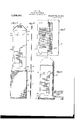
- FIG. 1 is a view in elevation, partially in section, of a camera embracing the invention
- Fig. 2 is a rear view ofthe camera
- Fig. 3 is a view on line 3 3 of Fig. 2
- Fig. 4 shows a film or negative producing element and its backing strip or light shield and the tab continuation of such shield
- Fig. 5 is an edge view of the structure shown in Fig. 1
- Fig. 6 illustrates a modification of the part of the arrangement illustrated in Fig. 4
- Fig. 7 shows the two parts of the calculating table in relatively adjustable relation.
- the sensitized elements that are to form the photographic negatives are preferably embodied in a plurality of films leach con- Each film ispasted at one end only to the light shield 2 by means of an adhesive strip 8. Each light shield 2 isextended at 4.- to oonstltute a pulling tab.
- Each tab is normally mainly concealed within the camera casing 5, relatively small portionsof the tabs projecting from the camera casing as illustrated at 6 in Fig. 3.
- the base portions of the tabs, those portions which are adjacent the negative producing elements or films, are passed over the curled end of a spring plate 7 as indicated in Fig. 3, this spring plate carrying spring fingers 8 that press upon a backing plate 9 that holds-the register with the opening'13 (margined by v This coatin suitable light excluding material) through which the tabs extend.
- each tab is provided with a sensitized testing portion 14 that is pasted on its outer end but which is normally protected from the light by having the outer end of the tab folded along the line 15, the outer end of the tab having edgings 16 of adhesive material which enable theouter end of the tab to be pasted down upon the balance of the tab so that the sensitized testing portion is concealed, the position occupied by the outer end of the tab when pasted down being indicated by dotted lines at the upper end'of Fig. 4.
- I desirably coat the portion 17 (this portion constituting a foundation for the sensitized surface) with an emulsion of silver bromid. is thereafter treatedwith a so lution of s dium nitrite or solution of potassium metabisulfite to cause the silver emulsion to turn to the standard tint when in Fig. 2.
- the sensitized testing portions are initially a definite shade of yellow, these testing portions, in changing tint, assuming the greenish tint which is the standard tint provided at 18.
- the sensitized testing portion 14 or 17 (according to the form of the invention employed) is eX-- posed to the action of actinic light, such sensitized portion being desirably closely approached to the standard tint 18, as indicated in Fig. '2, in the testing operation.
- the number of seconds or minutes required to bring the tintof the changeable tint sensitized area 14 or 17 to be the same shade as the tint defined by the master tint18 measures the actinic light value and the duration of the picture taking exposure is governed accordingto this value thus determined in the testing operation and also according to the size of the lens aperture which is selected in the photographic operation as will be understoodby those familiar with the art,
- each tab is provided with a calculating table which is printed or otherwise placed thereupon for convenience of the user.
- the table includes one column 19 which embraces descriptions of the subjects most commonly photographed and a list of various lens stops, and another column 20 which embraces a list of exposure periods in seconds and second fractions.
- the subjects in the left hand column 19 may be modified and their number varied as desired and the time divisions in the -right hand column may be changed and altered in number to suit the convenience-and needs of the users.
- a photographic camera of the film packtype including negative producing elements arranged in a pack each of these elements having a sensitized portion coupled therewith for testing actinic light value.
- a photographic camera of the film pack type including negative producing elements; and light shields therefor provided with sensitized portions for testing actiniclight value.
- a photographic camera of the film pack type including negative producing elements; and light shields therefor provided with pulling tabs which'in turn are provided with sensitized portions for testing actinic light value.
Landscapes
- Physics & Mathematics (AREA)
- General Physics & Mathematics (AREA)
- Structure And Mechanism Of Cameras (AREA)
Description
H.-L. IDE.
PHOTOGRAPHIC CAMERA.
APPLICATION FILED NOV. 26. m5.
Patented Dec. 12, 1916.
2 SHEETSSHEET 1.
2 1Uu i filui l H. L. IDE.
PHOTOGRAPHIC CAMERA.
APPLICATION FILED NOV. 26, I915. 1,208,321 Patented Dec. 12,1916.
2 SHEETS-SHEET 2.
rai
UNITED. STATES PATENT OFFICE.
HABRY L. IDE, 0]! SPRINGFIELD, ILLINOIS, ASSIGNOR 0F ONE-HALF '10 ROY W. IDE, OF SPRINGFIELD, ILLINOIS.
PHQTOGBAPHIC CAMERA.
Specification of Letters Patent.
Patented Dec. 12, 1916.
Application filed November 26; 1915. Serial No. 63,399.
To all whom it may concern:
Be it known that I, HARRY L. Ion, citizen of the United States, residing at-Springfield, in the .county of Sangamon and State of Illinois, have invented a certain new and useful Improvement in Photographic Cameras, of which the following is a full, clear, concise, and exact description, reference beinghad to the accompanying drawings, forming a part of this specification.
My invention relates to photographic cameras and in some of its aspects constitutes a form of camera which is broadly covered by my co-pending application Serial No. 19,113, filed April 5, 1915. This portion of my invention relates to that class of cameras that employ film packs, there being a plurality of films each constituting a nega-' tive producing element and each provided with its light shielding cover or backing paper to protect its neighbor when in unexposed position within the camera casing, with the qualification that the first film of the series is protected by a safety cover that is not coupled with any film but which is to be pulled in order that the first film may be exposed, while the backing strip for the last film of the series protects this last film and other films as well from light that might enter the camera at other than the lens opening. These backing strips or light shields are, for the sake of uniformity, all provided with sensitized testing portions for measuring actinic light value, the safety cover also having such a sensitized portion. These sensitized portions are desirably provided upon tabs that constitute continuations of the backing strips or covers. Whenever a backing strip or cover is moved to expose the succeeding film or'negative producing ele ment the sensitized portion thereon is brought to a position in which it is exposed to the action of light or in which it may be adjusted to be so exposed to determine the duration to which the negative producing element newly uncovered within the camera is to be exposed. The time taken by the sensitized testing portion in changing its tint to a standard or master tint enables the user to determine the duration of exposure for the film or negative producing element and to this end there is employed an adjustable calculating device or table which guides the user in regulating the exposure.
In th p eferred embodiment of the invention the tabs are of the same material of which the backing strips or light shields are made, each light shield having a tab that is integrally formed therewith. The sensitized testing portion may be pasted upon the backing paper of which'the tabs and light shields are made but I prefer to sensitize this paper itself so that no additional paperneed be applied thereto.
WVhile I have employed sensitized backing paper in cameras of the film pack type I do not wish this feature of my invention to be limited to the sensitizing of backing paper or material in cameras of the film pack type.
In accordance with another feature of my invention each tab is provided with parts of a calculating table that are to be relatively adjusted by the camerauser: Initially these parts of the calculating table are in fixed relation but after the tab is fully withdrawn from the camera casing these parts of the calculating table may be separated along a. weakened line intervening between them to permit of their relative adjustment, it being understood that each tab is torn from the backing strip coupled therewith after the tab has been fully withdrawn from the camera casing.
I will explain my invention more fully by reference to the accompanying drawings in which- Figure 1 is a view in elevation, partially in section, of a camera embracing the invention; Fig. 2 is a rear view ofthe camera; Fig. 3 is a view on line 3 3 of Fig. 2; Fig. 4 shows a film or negative producing element and its backing strip or light shield and the tab continuation of such shield; Fig. 5 is an edge view of the structure shown in Fig. 1; Fig. 6 illustrates a modification of the part of the arrangement illustrated in Fig. 4; and Fig. 7 shows the two parts of the calculating table in relatively adjustable relation.
Like parts are indicated by similar characters of reference throughout the different figures.
The sensitized elements that are to form the photographic negatives are preferably embodied in a plurality of films leach con- Each film ispasted at one end only to the light shield 2 by means of an adhesive strip 8. Each light shield 2 isextended at 4.- to oonstltute a pulling tab. Each tab is normally mainly concealed within the camera casing 5, relatively small portionsof the tabs projecting from the camera casing as illustrated at 6 in Fig. 3. The base portions of the tabs, those portions which are adjacent the negative producing elements or films, are passed over the curled end of a spring plate 7 as indicated in Fig. 3, this spring plate carrying spring fingers 8 that press upon a backing plate 9 that holds-the register with the opening'13 (margined by v This coatin suitable light excluding material) through which the tabs extend.
In the form of the invention illustrated in Figs. 3, 4 and 5 each tab is provided with a sensitized testing portion 14 that is pasted on its outer end but which is normally protected from the light by having the outer end of the tab folded along the line 15, the outer end of the tab having edgings 16 of adhesive material which enable theouter end of the tab to be pasted down upon the balance of the tab so that the sensitized testing portion is concealed, the position occupied by the outer end of the tab when pasted down being indicated by dotted lines at the upper end'of Fig. 4. I prefer, however, to employ the arrangement shown in Fig. 6 where a longitudinal edge of the. backing paper, in this instance the longitudinal edge of the tab continuation of the backing paper,
is itself sensitized as indicated at 17 in Fig.
6. For convenience of manufacture this sensitizing is continued throughout the length of the tab. While it may be true that the outerend of the testing portion 17 may become prematurely acted upon by the light .unless the tab be folded over at its outer end,
yet this would be immaterial since the user of the camera would be instructed to employ the portion. of the sensitized part 17 nearer the cover or shield 2, this part of the sensitized surface of theltab being normally well within the camera casing so as to be protected until required. 1
In sensitizing the backing paper of which the light shields 2 are made,-at 17, I desirably coat the portion 17 (this portion constituting a foundation for the sensitized surface) with an emulsion of silver bromid. is thereafter treatedwith a so lution of s dium nitrite or solution of potassium metabisulfite to cause the silver emulsion to turn to the standard tint when in Fig. 2.
The sensitized testing portions are initially a definite shade of yellow, these testing portions, in changing tint, assuming the greenish tint which is the standard tint provided at 18. Before a new picture is taken either'the safety cover or the light shield 2 coupled with the previously exposed film is drawn from in front ofthe film to be eX- posed by pulling upon the tab 4 belonging to the shield or cover that is to be removed,
such tab being withdrawn until the'line 12 registers with the opening 13 in the camera. When the tab is thus Withdrawn the sensitized testing portion 14 or 17 (according to the form of the invention employed) is eX-- posed to the action of actinic light, such sensitized portion being desirably closely approached to the standard tint 18, as indicated in Fig. '2, in the testing operation.
The number of seconds or minutes required to bring the tintof the changeable tint sensitized area 14 or 17 to be the same shade as the tint defined by the master tint18 measures the actinic light value and the duration of the picture taking exposure is governed accordingto this value thus determined in the testing operation and also according to the size of the lens aperture which is selected in the photographic operation as will be understoodby those familiar with the art,
I there being devices upon the market which will guide the user in determining the duration of exposure with differing sizes of lens openings after the actinic light value has been determined. I
In accordance with the remaining feature of my invention, each tab is provided with a calculating table which is printed or otherwise placed thereupon for convenience of the user. In the form of the invention shown the table includes one column 19 which embraces descriptions of the subjects most commonly photographed and a list of various lens stops, and another column 20 which embraces a list of exposure periods in seconds and second fractions. The subjects in the left hand column 19 may be modified and their number varied as desired and the time divisions in the -right hand column may be changed and altered in number to suit the convenience-and needs of the users. .In the form of table illustrated the two columns are to be relatively adjustable longitudinally of each other as will be well understood by those skilled in the art and in order that the user may conveniently use the table the line 21 which separates the columns 19 and 20 is weakened or entirely out through so that when the tab is torn off along the line 12 the portions of the tab By way of a specific example illustrated in Fig. 7-, let it be assumed that it took six seconds to turn the testing portion 14 or 17 to the shade of the master tint 18 and that the subject to be photographed is an open landscape. The title of the subject Open Landscape is placed in register with the figure 6 in'column 20. The user will exercise his own judgmentin selecting the stop, the stops being listed below the subjects in column 19. Assuming that it is stop F 11 the exposure would be one-twenty-hfth of a second since F '11 in column 19 registers with 1/25 in column 20.
While I have herein shown and particularly described the preferred embodiment of my invention I do not wish to be limited to the precise details of construction shown as changes may readily be made without departing from the spirit of my invention, but
Having thus described' my invention I claim as new and desire to secure by Letters Patent the following 1. A photographic camera of the film packtype including negative producing elements arranged in a pack each of these elements having a sensitized portion coupled therewith for testing actinic light value.
2; A photographic camera of the film pack type including negative producing elements; and light shields therefor provided with sensitized portions for testing actiniclight value.
3. A photographic camera of the film pack type including negative producing elements; and light shields therefor provided with pulling tabs which'in turn are provided with sensitized portions for testing actinic light value.
In witness whereof, I hereunto subscribe my name this twenty-fourth day of No- HARRY L. IDE.
vember A. 1)., 1915.
Witnesses:
G. L. GRAGG, ETTA L. Wnl'rit.
Priority Applications (1)
| Application Number | Priority Date | Filing Date | Title |
|---|---|---|---|
| US6339915A US1208321A (en) | 1915-11-26 | 1915-11-26 | Photographic camera. |
Applications Claiming Priority (1)
| Application Number | Priority Date | Filing Date | Title |
|---|---|---|---|
| US6339915A US1208321A (en) | 1915-11-26 | 1915-11-26 | Photographic camera. |
Publications (1)
| Publication Number | Publication Date |
|---|---|
| US1208321A true US1208321A (en) | 1916-12-12 |
Family
ID=3276232
Family Applications (1)
| Application Number | Title | Priority Date | Filing Date |
|---|---|---|---|
| US6339915A Expired - Lifetime US1208321A (en) | 1915-11-26 | 1915-11-26 | Photographic camera. |
Country Status (1)
| Country | Link |
|---|---|
| US (1) | US1208321A (en) |
Cited By (1)
| Publication number | Priority date | Publication date | Assignee | Title |
|---|---|---|---|---|
| US2488434A (en) * | 1945-08-30 | 1949-11-15 | Verneur E Pratt | Pad of sensitized paper |
-
1915
- 1915-11-26 US US6339915A patent/US1208321A/en not_active Expired - Lifetime
Cited By (1)
| Publication number | Priority date | Publication date | Assignee | Title |
|---|---|---|---|---|
| US2488434A (en) * | 1945-08-30 | 1949-11-15 | Verneur E Pratt | Pad of sensitized paper |
Similar Documents
| Publication | Publication Date | Title |
|---|---|---|
| US2184007A (en) | Transparency mount | |
| US2714844A (en) | Memoranda fixture for camera carrying cases | |
| JPH0527397A (en) | Film assembly with previously exposed film | |
| US1543065A (en) | Method of masking photographic film while exposure is being made | |
| US3086862A (en) | Roll film for photographic cameras | |
| US1835743A (en) | Sound picture system | |
| US1818528A (en) | Photographic printing device | |
| US2609294A (en) | Cinematographic matte | |
| US2436966A (en) | Photographic exposure meter | |
| US2347749A (en) | Photographic apparatus | |
| US783613A (en) | Photographic-film package for color photography. | |
| US1825598A (en) | Process for producing combined sound and picture films | |
| US1511042A (en) | Method of identifying documents | |
| US3124997A (en) | figure | |
| US1629104A (en) | Make-up frame for X-ray photography | |
| US1359245A (en) | Photographic apparatus | |
| US1865186A (en) | Color photography | |
| US1195187A (en) | Film-camera | |
| US1238506A (en) | Method of and device for designating photographic exposures. | |
| US1873927A (en) | Folding camera | |
| US2538666A (en) | Carrier for photographic sensitized sheet material | |
| US2074890A (en) | Photographic pack | |
| US1590770A (en) | Device for photographing titles upon cinematographic films | |
| US1376032A (en) | Means for autographing sensitive photographic material | |
| US1478278A (en) | Apparatus for making moving portraits |