US12077837B2 - Heat-resistant aluminum powder material - Google Patents

Heat-resistant aluminum powder material Download PDF

Info

Publication number
US12077837B2
US12077837B2 US17/850,730 US202217850730A US12077837B2 US 12077837 B2 US12077837 B2 US 12077837B2 US 202217850730 A US202217850730 A US 202217850730A US 12077837 B2 US12077837 B2 US 12077837B2
Authority
US
United States
Prior art keywords
manganese
iron
strength
group
aluminum alloy
Prior art date
Legal status (The legal status is an assumption and is not a legal conclusion. Google has not performed a legal analysis and makes no representation as to the accuracy of the status listed.)
Active
Application number
US17/850,730
Other versions
US20220325384A1 (en
Inventor
Viktor Khrist'yanovich MANN
Aleksandr Yur'evich KROKHIN
Dmitrij Konstantinovich Ryabov
Roman Olegovich Vakhromov
Vladimir Aleksandrovich Korolev
Ivan Yur'evich Mikhajlov
Aleksandr Gareginovich Seferyan
Current Assignee (The listed assignees may be inaccurate. Google has not performed a legal analysis and makes no representation or warranty as to the accuracy of the list.)
Rusal Engineering and Technological Center LLC
Original Assignee
Rusal Engineering and Technological Center LLC
Priority date (The priority date is an assumption and is not a legal conclusion. Google has not performed a legal analysis and makes no representation as to the accuracy of the date listed.)
Filing date
Publication date
Application filed by Rusal Engineering and Technological Center LLC filed Critical Rusal Engineering and Technological Center LLC
Publication of US20220325384A1 publication Critical patent/US20220325384A1/en
Assigned to OBSHCHESTVO S OGRANICHENNOY OTVETSTVENNOST'YU "OBEDINENNAYA KOMPANIYA RUSAL INZHENERNO-TEKHNOLOGICHESKIY TSENTR" reassignment OBSHCHESTVO S OGRANICHENNOY OTVETSTVENNOST'YU "OBEDINENNAYA KOMPANIYA RUSAL INZHENERNO-TEKHNOLOGICHESKIY TSENTR" ASSIGNMENT OF ASSIGNORS INTEREST (SEE DOCUMENT FOR DETAILS). Assignors: KOROLEV, VLADIMIR ALEKSANDROVICH, KROKHIN, Aleksandr Yur'evich, MANN, Viktor Khrist'yanovich, MIKHAJLOV, Ivan Yur'evich, RYABOV, DMITRIJ KONSTANTINOVICH, SEFERYAN, Aleksandr Gareginovich, VAKHROMOV, ROMAN OLEGOVICH
Application granted granted Critical
Publication of US12077837B2 publication Critical patent/US12077837B2/en
Active legal-status Critical Current
Anticipated expiration legal-status Critical

Links

Images

Classifications

    • CCHEMISTRY; METALLURGY
    • C22METALLURGY; FERROUS OR NON-FERROUS ALLOYS; TREATMENT OF ALLOYS OR NON-FERROUS METALS
    • C22CALLOYS
    • C22C1/00Making non-ferrous alloys
    • C22C1/04Making non-ferrous alloys by powder metallurgy
    • BPERFORMING OPERATIONS; TRANSPORTING
    • B22CASTING; POWDER METALLURGY
    • B22FWORKING METALLIC POWDER; MANUFACTURE OF ARTICLES FROM METALLIC POWDER; MAKING METALLIC POWDER; APPARATUS OR DEVICES SPECIALLY ADAPTED FOR METALLIC POWDER
    • B22F1/00Metallic powder; Treatment of metallic powder, e.g. to facilitate working or to improve properties
    • B22F1/05Metallic powder characterised by the size or surface area of the particles
    • B22F1/052Metallic powder characterised by the size or surface area of the particles characterised by a mixture of particles of different sizes or by the particle size distribution
    • BPERFORMING OPERATIONS; TRANSPORTING
    • B22CASTING; POWDER METALLURGY
    • B22FWORKING METALLIC POWDER; MANUFACTURE OF ARTICLES FROM METALLIC POWDER; MAKING METALLIC POWDER; APPARATUS OR DEVICES SPECIALLY ADAPTED FOR METALLIC POWDER
    • B22F9/00Making metallic powder or suspensions thereof
    • B22F9/02Making metallic powder or suspensions thereof using physical processes
    • B22F9/06Making metallic powder or suspensions thereof using physical processes starting from liquid material
    • B22F9/08Making metallic powder or suspensions thereof using physical processes starting from liquid material by casting, e.g. through sieves or in water, by atomising or spraying
    • B22F9/082Making metallic powder or suspensions thereof using physical processes starting from liquid material by casting, e.g. through sieves or in water, by atomising or spraying atomising using a fluid
    • BPERFORMING OPERATIONS; TRANSPORTING
    • B33ADDITIVE MANUFACTURING TECHNOLOGY
    • B33YADDITIVE MANUFACTURING, i.e. MANUFACTURING OF THREE-DIMENSIONAL [3D] OBJECTS BY ADDITIVE DEPOSITION, ADDITIVE AGGLOMERATION OR ADDITIVE LAYERING, e.g. BY 3D PRINTING, STEREOLITHOGRAPHY OR SELECTIVE LASER SINTERING
    • B33Y70/00Materials specially adapted for additive manufacturing
    • BPERFORMING OPERATIONS; TRANSPORTING
    • B33ADDITIVE MANUFACTURING TECHNOLOGY
    • B33YADDITIVE MANUFACTURING, i.e. MANUFACTURING OF THREE-DIMENSIONAL [3D] OBJECTS BY ADDITIVE DEPOSITION, ADDITIVE AGGLOMERATION OR ADDITIVE LAYERING, e.g. BY 3D PRINTING, STEREOLITHOGRAPHY OR SELECTIVE LASER SINTERING
    • B33Y80/00Products made by additive manufacturing
    • CCHEMISTRY; METALLURGY
    • C22METALLURGY; FERROUS OR NON-FERROUS ALLOYS; TREATMENT OF ALLOYS OR NON-FERROUS METALS
    • C22CALLOYS
    • C22C1/00Making non-ferrous alloys
    • C22C1/02Making non-ferrous alloys by melting
    • C22C1/03Making non-ferrous alloys by melting using master alloys
    • CCHEMISTRY; METALLURGY
    • C22METALLURGY; FERROUS OR NON-FERROUS ALLOYS; TREATMENT OF ALLOYS OR NON-FERROUS METALS
    • C22CALLOYS
    • C22C21/00Alloys based on aluminium
    • BPERFORMING OPERATIONS; TRANSPORTING
    • B22CASTING; POWDER METALLURGY
    • B22FWORKING METALLIC POWDER; MANUFACTURE OF ARTICLES FROM METALLIC POWDER; MAKING METALLIC POWDER; APPARATUS OR DEVICES SPECIALLY ADAPTED FOR METALLIC POWDER
    • B22F10/00Additive manufacturing of workpieces or articles from metallic powder
    • B22F10/20Direct sintering or melting
    • B22F10/28Powder bed fusion, e.g. selective laser melting [SLM] or electron beam melting [EBM]
    • BPERFORMING OPERATIONS; TRANSPORTING
    • B22CASTING; POWDER METALLURGY
    • B22FWORKING METALLIC POWDER; MANUFACTURE OF ARTICLES FROM METALLIC POWDER; MAKING METALLIC POWDER; APPARATUS OR DEVICES SPECIALLY ADAPTED FOR METALLIC POWDER
    • B22F2301/00Metallic composition of the powder or its coating
    • B22F2301/05Light metals
    • B22F2301/052Aluminium
    • BPERFORMING OPERATIONS; TRANSPORTING
    • B22CASTING; POWDER METALLURGY
    • B22FWORKING METALLIC POWDER; MANUFACTURE OF ARTICLES FROM METALLIC POWDER; MAKING METALLIC POWDER; APPARATUS OR DEVICES SPECIALLY ADAPTED FOR METALLIC POWDER
    • B22F2304/00Physical aspects of the powder
    • B22F2304/10Micron size particles, i.e. above 1 micrometer up to 500 micrometer
    • BPERFORMING OPERATIONS; TRANSPORTING
    • B22CASTING; POWDER METALLURGY
    • B22FWORKING METALLIC POWDER; MANUFACTURE OF ARTICLES FROM METALLIC POWDER; MAKING METALLIC POWDER; APPARATUS OR DEVICES SPECIALLY ADAPTED FOR METALLIC POWDER
    • B22F2999/00Aspects linked to processes or compositions used in powder metallurgy
    • YGENERAL TAGGING OF NEW TECHNOLOGICAL DEVELOPMENTS; GENERAL TAGGING OF CROSS-SECTIONAL TECHNOLOGIES SPANNING OVER SEVERAL SECTIONS OF THE IPC; TECHNICAL SUBJECTS COVERED BY FORMER USPC CROSS-REFERENCE ART COLLECTIONS [XRACs] AND DIGESTS
    • Y02TECHNOLOGIES OR APPLICATIONS FOR MITIGATION OR ADAPTATION AGAINST CLIMATE CHANGE
    • Y02PCLIMATE CHANGE MITIGATION TECHNOLOGIES IN THE PRODUCTION OR PROCESSING OF GOODS
    • Y02P10/00Technologies related to metal processing
    • Y02P10/25Process efficiency

Definitions

  • the invention relates to the field of metallurgy, namely, to the material based on aluminum alloy and the powder made from it, to be used for the manufacture of parts with additive technologies.
  • Additive technologies or technologies of layer-by-layer fusion, are currently an advanced field of digital manufacturing for 3D-printing.
  • Several types of additive technologies are known, each of which is used for different production purposes.
  • these technologies are used to manufacture metal parts in aerospace engineering to create especially robust products.
  • the main advantages are the speed and precision of manufacturing, saving of feedstock and low amount of waste.
  • Some additive technologies use metal powders as feedstock to manufacture various parts. At the same time, individual parts of some products of machine-building and engine-building industries become heated in the process of operation, which makes it necessary to use materials with increased heat resistance characteristics.
  • 3D printing of aluminum powder is a layer-by-layer fused deposition of material upon itself combined with a high-rate cooling. This leads to the necessity of using materials, which have good casting characteristics, which are not prone to the formation of hot cracks, and which have a good ductility in the solid-liquid state.
  • AlSi10Mg in the form of powder, for example, see https://www.3dsystems.hu/content/pdf/3D-Systems_Laserform_AlSi10Mg(A)_DATASHEET_A4-us_2018.03.20_ WEB.pdf
  • the alloy may contain 9-11% of silicon and 0.2-0.5% of magnesium.
  • the presence of silicon in the composition ensures good casting characteristics and the absence of hot cracks, which results in the formation of a high-quality structure during the printing process, while the addition of magnesium increases the strength.
  • the level of mechanical properties of the material after internal stress relief annealing does not exceed 320 MPa.
  • the increase in the operating temperature considerably reduces the strength, which does not allow using this material for long periods of time at elevated temperatures.
  • the balance is aluminum.
  • the alloy has satisfactory casting properties and is weldable; its main alloying element is copper, which in the course of ageing forms Al 2 Cu-type dispersoids, which are effective strengtheners.
  • this alloy requires quenching and subsequent artificial ageing to ensure maximum performance. At the same time, the temperatures exceeding 250° C. considerably reduce the strength of the material due to coagulation of strengthening phases, which prevents its long-term use in structures at 250° C. temperature. Besides, this alloy may be used in printing with additive technologies, but it is prone to the formation of hot cracks during the printing; for example, see https://www.wlt.de/lim/Proceedings/Stick/PDF/Contribution146_final.pdf.
  • the balance is aluminum.
  • This alloy due to a large amount of transition metals like nickel, iron and manganese, forms intermetallic compounds with high thermal stability, and additional alloying with elements like zirconium and chromium enables an additional increase in strength by forming dispersoids during thermal treatment.
  • the high content of silicon in the material and the general over-alloying do not allow using this alloy for printing because of the high content of intermetallic phases that lead to a drastic decrease in ductility and cause the formation of cracks during printing due to high internal stresses.
  • the alloy has good casting characteristics and high strength at elevated temperatures; however, it has low strength at room temperature due to the absence of small dispersoids that prevent the movement of dislocations during deformation.
  • the rest of the elements do not exceed 0.05%, and the total content of trace elements must not exceed 0.15%, the balance is aluminum.
  • the material Due to the presence of eutectic-forming elements (manganese and nickel) in its composition, the material has good casting characteristics and low tendency to hot cracks; also, these phases are thermally stable and are not prone to strong coagulation over time.
  • the disadvantage of the alloy is its low strength due to a low concentration of elements that form dispersoids during the annealing (ageing) process, and its high specific gravity due to a large amount of heavy alloying elements, which reduces the specific characteristics of the finished parts.
  • Nickel 1 to 6 Manganese 1 to 5 Zirconium 0.1 to 0.4 Vanadium 0.1 to 1 Tungsten and/or molybdenum 0.1 to 1.0 Iron Up to 2 (optional) Titanium Up to 1 (optional) Magnesium Up to 2 (optional) Silicon Up to 0.5 (optional) Copper Up to 0.5 (optional) Zinc Up to 0.5 (optional)
  • the remainder is aluminum and unavoidable impurity elements (the volume of impurity elements not exceeding 1%).
  • the balance is aluminum.
  • the alloy is characterised by increased strength, high workability during casting or brazing, and has a low rate of strength degradation with increasing temperature.
  • the low content of alloying materials does not ensure an increased strength due to the absence of a sufficient quantity of intermetallic phases of cast origin and dispersoids.
  • the technical objective of this invention is the development of a new heat-resistant aluminum material to be used in the form of powder for manufacturing of parts using additive technologies, which has good processability when printed and has increased strength characteristics (ultimate tensile strength of no less than 350 MPa) at room temperature after printing, without any significant decrease in strength after annealing to relieve internal stresses. Also, the material must retain its performance properties at the temperature of up to 300-350° C.
  • FIG. 1 Powder particles from the claimed alloy, produced by atomisation of the melt in the gas flow as per Example 1.
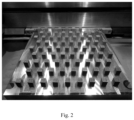
  • FIG. 2 Printed cubes on a platform.
  • FIG. 3 Images of the material structure in an optical microscope (A, B, C, D, E, F).
  • the introduction of nickel and manganese into the alloy ensures a sufficient processibility of the material during printing due to the formation of eutectic phases like Al 3 Ni or Al 16 Mn 3 Ni at high manganese content.
  • the high content of eutectic phases in the material ensures a sufficient fluidity and resistance to the formation of hot cracks during printing and rapid crystallisation.
  • the phases that form during the solidification have high thermal stability and retain the structure and strength of the material at elevated temperatures.
  • the manganese also forms a supersaturated solid solution in the aluminum, which can decompose with a slight increase in strength.
  • the introduction of iron leads to additional strengthening at elevated temperature due to the formation of many intermetallic phases.
  • the nickel content has been increased to form a larger number of phases which, considering the high rates of solidification characteristic of additive technologies, are formed in a compact manner that enables the preservation of the ductility indicators with a simultaneous increase in the strength characteristics at an elevated temperature.
  • the addition of zirconium in the specified amount is necessary to reduce the grain size due to the known modification effect; also, considering the variable solubility of zirconium in aluminum, during further heat treatment, dispersoids of the Al 3 Zr type will be formed ensuring additional strengthening at the room temperature, which allows retaining the strength characteristics of the material in the process of annealing. Due to their high stability, these dispersoids retain their sizes at the working temperatures of up to 350° C.
  • the upper limit of the range is associated with the fact that an additional increase in the concentration of zirconium raises the temperature of complete melting above 950° C., which will require extra costs for heating and overheating the melt before atomizing the powders.
  • the introduction of iron in the specified range ensures the presence of Al 9 FeNi-type spherical particles in the structure, which do not deteriorate the ductility characteristics while ensuring a low rate of strength weakening with increasing temperature. Moreover, the iron does not worsen the hot-tearing characteristics of the material, which allows retaining sufficient processability during printing.
  • the condition for the ratio of the content of nickel, iron and manganese in the alloy must be Ni>Mn+Fe, which provides the most optimal combination of strength and ductility properties of the material for printing.
  • the content of manganese and iron is exceeded, the material has reduced values of the relative elongation and yield stress due to the formation of too many intermetallic phases based on iron and manganese, which do not ensure an effective strengthening.
  • Cerium is introduced to partially eliminate the negative effect of iron as cerium can dissolve in iron-containing phases or form a ternary phase with iron with a more favourable morphology, which in the process of printing is likely to form along the boundaries of the grains.
  • the presence of cerium in the composition reduces the rate of phase coagulation, thus increasing the thermal stability of the structure.
  • the elements from the group of copper, magnesium and zinc dissolve well in the aluminum matrix at elevated temperature and room temperature and tend to form oversaturated solid solutions during quick solidification; in small concentrations, these elements ensure solid solution strengthening of the aluminum matrix. This effect persists regardless of the heating and thermal treatment of the material, and the content of the elements was chosen to not exceed too much the equilibrium concentration of the element in the aluminum at room temperature. The increased content of these elements leads to an extension of the crystallisation interval and to crack formation during the printing process.
  • the elements from the group of silicon and calcium form additional eutectic phases, which increases the processibility during printing; also, due to a low density, these elements reduce the density of the material, which leads to an increase in the specific strength properties.
  • chromium has been also excluded, as the higher concentration of zirconium ensures a more efficient strengthening than chromium-based intermetallides or chromium-based intermetallic phases. Also, the increased content of zirconium excludes the necessity of an additional introduction of elements, such as molybdenum or tungsten, which, in contrast to zirconium, reduce the ductility properties of the material.
  • the powders of aluminum alloys of various compositions in accordance with Table 1 were produced by gas atomisation technique.
  • the melt was prepared in a gas-heated furnace.
  • aluminum of grade A8 as per GOST 11069-2001, magnesium of grade MG90 as per GOST 804-93, copper of grade M1 as per GOST 859-2001, silicon of grade 4001 as per GOST 2169-69, Mn80F20 and Ni80F20 alloy tablets, and binary master alloys of the rest of the elements were used.
  • the alloy was overheated to the temperature of at least 100° C. higher in relation to the equilibrium liquidus and then atomised in nitrogen with the addition of oxygen in an amount not exceeding 0.8% to ensure controlled oxidation.
  • the photographs of the powder taken with a scanning electron microscope (SEM) are shown in FIG. 1 .
  • the room-temperature tensile tests of the samples grown parallel to the building direction were conducted in accordance with the requirements of GOST 1497.
  • Thermal treatment annealing for internal stress relief
  • the powders from aluminum alloys that have a chemical composition shown in Table 4 were produced using the technology described in the previous example, with high purity argon used instead of the nitrogen.
  • the main difference between the alloys is in the ratio of nickel, manganese, and iron.
  • EOS M290 3D printer was used for the selective laser melting process. To reduce the residual stresses after printing, annealing was carried out at 300° C. Cubes with the dimensions 10 ⁇ 10 ⁇ 10 mm 3 were used as samples to determine the porosity ( FIG. 2 ), and cylinders from which samples were cut out to perform tensile tests in accordance with the requirements of GOST 1497. The porosity was determined using microsections after they had been polished using a colloid mixture without chemical etching.
  • Table 5 shows the results of tensile tests at room temperature after annealing for each alloy.
  • the powder with chemical composition according to Table 6 The powder was produced by atomising at the temperature that was 80 degrees higher than the liquidus temperature in the environment of nitrogen with the addition of 0.3% of oxygen. The powder was screened to separate the fraction of +15 ⁇ 63 ⁇ m.
  • EOS M290 3D printer was used for the selective laser melting process.
  • the printing process was carried out in the argon environment, the speed of the laser beam scanning of the powder surface was 400 to 1200 mm/s with the laser power of 280 to 320 W.
  • the maximum layer thickness was 45 ⁇ m.
  • the products used were 24 cylinders with a diameter of 12 to 30 mm and a length of 80 mm.
  • the manufactured products were machined to obtain the geometry of the samples for the tensile test to comply with the requirements of GOST 1497 (for tests at room temperature) and GOST 9651 (for tests at elevated temperatures). Before the machining, the products had been annealed to relieve the internal stresses during printing related to higher (more than 1000 K/s) cooling rates after melting with the laser beam.
  • the results of the tensile tests are shown in Table 7.
  • the proposed material has a low rate of strength degradation when heated, which is related to the presence of an optimal quantity of hard-melting thermally stable phases in its structure, as well as to good processability during printing, which allows printing products with a minimum number of defects in the form of pores and without hot cracks.
  • the powder preferably has particle size distribution within 10 to 150 ⁇ m, the most preferably, within 10 to 63 ⁇ m.
  • the powder can be produced by gas atomisation in the environment of nitrogen or argon and by gas atomisation in the environment of nitrogen or argon with an addition of oxygen in the amount of 0.1 to 0.8 wt %.
  • Also claimed is a method of manufacturing of products using the additive technologies characterised in that it uses the proposed aluminum powder material.
  • the claim also includes a product from aluminum alloy powder containing nickel, manganese, iron, zirconium, additionally containing at least one element from the group: copper, magnesium, zinc, as well as at least one element from the group: silicon, calcium, with the following composition (wt. %):
  • the indicated product from aluminum powder alloy is manufactured at solidification rate of no less than 1000 K/s, and has the ultimate tensile strength of at least 370 MPa at room temperature after printing or stress relief annealing.

Landscapes

  • Chemical & Material Sciences (AREA)
  • Engineering & Computer Science (AREA)
  • Materials Engineering (AREA)
  • Mechanical Engineering (AREA)
  • Metallurgy (AREA)
  • Organic Chemistry (AREA)
  • Manufacturing & Machinery (AREA)
  • Powder Metallurgy (AREA)
  • Printing Plates And Materials Therefor (AREA)
  • Manufacture Of Metal Powder And Suspensions Thereof (AREA)

Abstract

The invention relates to the field of metallurgy, namely to new heat-resistant aluminum alloys used in additive technologies. The alloy includes nickel, manganese, iron, zirconium, cerium, at least one element selected from the group: copper, magnesium, zinc, and at least one element selected from the group: silicon, calcium, where Ni>Mn+Fe, one or more eutectic phases of the type of Al3Ni, Al16Mn3Ni, Al9FeNi, which are thermally stable, and dispersoids of the Al3Zr type, which ensure an ultimate strength of a resulting product of at least 370 MPa. The technical effect is the development of an aluminum material used in the form of a powder, which has good processability when printing and increased strength characteristics at room temperature after printing, without a significant decrease in strength after annealing.

Description

CROSS-REFERENCE TO RELATED APPLICATIONS
This application is a continuation of and claims priority to PCT application No. PCT/RU2020/050339 filed Nov. 23, 2020, which itself claims priority to Russian Patent Application No. 2019144429 filed Dec. 27, 2019 all of which are incorporated herein by reference in their entirety for all purposes.
TECHNICAL FIELD
The invention relates to the field of metallurgy, namely, to the material based on aluminum alloy and the powder made from it, to be used for the manufacture of parts with additive technologies.
Additive technologies, or technologies of layer-by-layer fusion, are currently an advanced field of digital manufacturing for 3D-printing. Several types of additive technologies are known, each of which is used for different production purposes. For example, these technologies are used to manufacture metal parts in aerospace engineering to create especially robust products. The main advantages are the speed and precision of manufacturing, saving of feedstock and low amount of waste.
Some additive technologies use metal powders as feedstock to manufacture various parts. At the same time, individual parts of some products of machine-building and engine-building industries become heated in the process of operation, which makes it necessary to use materials with increased heat resistance characteristics.
3D printing of aluminum powder is a layer-by-layer fused deposition of material upon itself combined with a high-rate cooling. This leads to the necessity of using materials, which have good casting characteristics, which are not prone to the formation of hot cracks, and which have a good ductility in the solid-liquid state.
The most widespread aluminum alloy that is used in additive technologies is AlSi10Mg in the form of powder, for example, see https://www.3dsystems.hu/content/pdf/3D-Systems_Laserform_AlSi10Mg(A)_DATASHEET_A4-us_2018.03.20_ WEB.pdf
The alloy may contain 9-11% of silicon and 0.2-0.5% of magnesium.
The presence of silicon in the composition ensures good casting characteristics and the absence of hot cracks, which results in the formation of a high-quality structure during the printing process, while the addition of magnesium increases the strength. In such a case, the level of mechanical properties of the material after internal stress relief annealing does not exceed 320 MPa. The increase in the operating temperature considerably reduces the strength, which does not allow using this material for long periods of time at elevated temperatures.
There is a known aluminum alloy 2219 with an increased heat-resistance, for example, see, that comprises the following components (wt. %):
Copper 5.8 to 6.8
Manganese 0.2 to 0.4
Zirconium  0.1 to 0.25
Iron  up to 0.3
Silicon  up to 0.2
Vanadium 0.05 to 0.15
Titanium 0.02 to 0.1 
Zinc  up to 0.1
Magnesium up to 0.02
Impurity elements up to 0.15
The balance is aluminum.
The alloy has satisfactory casting properties and is weldable; its main alloying element is copper, which in the course of ageing forms Al2Cu-type dispersoids, which are effective strengtheners.
Due to this, this alloy requires quenching and subsequent artificial ageing to ensure maximum performance. At the same time, the temperatures exceeding 250° C. considerably reduce the strength of the material due to coagulation of strengthening phases, which prevents its long-term use in structures at 250° C. temperature. Besides, this alloy may be used in printing with additive technologies, but it is prone to the formation of hot cracks during the printing; for example, see https://www.wlt.de/lim/Proceedings/Stick/PDF/Contribution146_final.pdf.
There is a known aluminum material with increased heat-resistance characteristics (patent JP3845035, Nov. 15, 2006), which is used as a powder with the particle size of 20 to 90 μm in conventional powder metallurgy applications, and which comprises components with the following mass fractions (wt. %):
Silicon 10 to 30
Iron 1 to 5
Nickel 2 to 8
Copper 0.2 to 5
Magnesium 0.2 to 5
At least one element from the group containing:
Manganese 0.1 to 2
Zirconium 0.2 to 2
Chromium 0.05 to 0.4
Where the Fe/Ni ratio is within 1:1.25 to 1:1.2.
The balance is aluminum.
This alloy, due to a large amount of transition metals like nickel, iron and manganese, forms intermetallic compounds with high thermal stability, and additional alloying with elements like zirconium and chromium enables an additional increase in strength by forming dispersoids during thermal treatment. At the same time, the high content of silicon in the material and the general over-alloying do not allow using this alloy for printing because of the high content of intermetallic phases that lead to a drastic decrease in ductility and cause the formation of cracks during printing due to high internal stresses.
There is a known aluminum alloy with good strength at high temperature, which contains 0.1 to 2.5 wt % of manganese and 5.5 to 7.0 wt % of nickel, the balance being aluminum and unavoidable impurity elements (JPH02295640, Dec. 6, 1990).
The alloy has good casting characteristics and high strength at elevated temperatures; however, it has low strength at room temperature due to the absence of small dispersoids that prevent the movement of dislocations during deformation.
There is a known aluminum casting alloy (WO 2010083245, Jul. 22, 2010) that has good casting characteristics and high decorative properties, which comprises the following components (wt. %):
Nickel 6.6 to 8.0
Manganese 0.5 to 3.5
Iron/Silicon 0 to 0.25 each
Copper/Zinc/Magnesium 0 to 0.5 each
Titanium/Zirconium/Scandium 0 to 0.2 each
Boron/Carbon may be added in the quantity not exceeding 0.1%.
The rest of the elements do not exceed 0.05%, and the total content of trace elements must not exceed 0.15%, the balance is aluminum.
Due to the presence of eutectic-forming elements (manganese and nickel) in its composition, the material has good casting characteristics and low tendency to hot cracks; also, these phases are thermally stable and are not prone to strong coagulation over time. The disadvantage of the alloy is its low strength due to a low concentration of elements that form dispersoids during the annealing (ageing) process, and its high specific gravity due to a large amount of heavy alloying elements, which reduces the specific characteristics of the finished parts.
There is a known aluminum alloy that has good casting characteristics and high operating temperature (WO 2015144387, Oct. 1, 2015), which comprises the following components (wt. %):
Nickel 1 to 6
Manganese 1 to 5
Zirconium 0.1 to 0.4
Vanadium 0.1 to 1
Tungsten and/or molybdenum 0.1 to 1.0
Iron Up to 2 (optional)
Titanium Up to 1 (optional)
Magnesium Up to 2 (optional)
Silicon Up to 0.5 (optional)
Copper Up to 0.5 (optional)
Zinc Up to 0.5 (optional)
Transition metals from the group: strontium, scandium, lanthanum, yttrium, hafnium, niobium, tantalum and/or chromium-up to 5% (optionally).
The remainder is aluminum and unavoidable impurity elements (the volume of impurity elements not exceeding 1%).
Due to the formation of a large number of eutectic phases, the material has good casting characteristics, and the introduction of metals from among tungsten, molybdenum and transition metals forms high strength at increased temperatures. However, a considerable disadvantage is an excessive amount of those elements, which leads to a loss of ductility, which will not allow printing of the material with a proper quality because of high internal stresses. Moreover, such elements as tungsten, molybdenum, scandium are quite expensive, which increases the cost of the finished product significantly.
The closest to the claimed solution is the invention according to the published application JPH04107236 (A) Apr. 8, 1992, C22C 21/00, which discloses a heat-resistant aluminum alloy comprising components with the following mass fractions (wt. %):
Manganese 1.5 to 2.5
Nickel 0.5 to 3.0
Iron 0.2 to 0.8
Silicon 0.2 to 0.8
Copper 0.4 to 1.0
Magnesium 0 to 0.3
Boron 0.0005 to 0.005
Chromium 0.05 to 0.25
Zirconium 0.05 to 0.25
The balance is aluminum.
The alloy is characterised by increased strength, high workability during casting or brazing, and has a low rate of strength degradation with increasing temperature. However, the low content of alloying materials does not ensure an increased strength due to the absence of a sufficient quantity of intermetallic phases of cast origin and dispersoids.
BRIEF DESCRIPTION OF THE INVENTION
The technical objective of this invention is the development of a new heat-resistant aluminum material to be used in the form of powder for manufacturing of parts using additive technologies, which has good processability when printed and has increased strength characteristics (ultimate tensile strength of no less than 350 MPa) at room temperature after printing, without any significant decrease in strength after annealing to relieve internal stresses. Also, the material must retain its performance properties at the temperature of up to 300-350° C.
The technical result is the solution of the set problem and the achievement of the indicated advantages.
To solve the set problem and achieve the indicated advantages, a new heat-resistant aluminum alloy with the following component content (wt. %) is proposed.
Nickel 2.5 to 5.5
Manganese 1.0 to 3.5
Iron 0.15 to 2.0
Zirconium 0.2 to 1.0
Cerium 0.05 to 0.4
At least one element 0.05 to 1.5 in total
from the group comprising
Copper, magnesium, zinc
And at least one element 0.1 to 2.0 in total
from the group comprising
Silicon, calcium
Aluminum and unavoidable impurities balance.
In addition, it is of particular advantage to maintain the following ratio of the contents of nickel, manganese and iron in the alloy:
Ni>Mn+Fe
BRIEF DESCRIPTION OF THE DRAWINGS
The drawings show:
FIG. 1 . Powder particles from the claimed alloy, produced by atomisation of the melt in the gas flow as per Example 1.
FIG. 2 . Printed cubes on a platform.
FIG. 3 . Images of the material structure in an optical microscope (A, B, C, D, E, F).
DETAILED DESCRIPTION OF THE INVENTION
The introduction of nickel and manganese into the alloy ensures a sufficient processibility of the material during printing due to the formation of eutectic phases like Al3Ni or Al16Mn3Ni at high manganese content. The high content of eutectic phases in the material ensures a sufficient fluidity and resistance to the formation of hot cracks during printing and rapid crystallisation. Also, the phases that form during the solidification have high thermal stability and retain the structure and strength of the material at elevated temperatures. At high cooling rates, the manganese also forms a supersaturated solid solution in the aluminum, which can decompose with a slight increase in strength. The introduction of iron leads to additional strengthening at elevated temperature due to the formation of many intermetallic phases. The nickel content has been increased to form a larger number of phases which, considering the high rates of solidification characteristic of additive technologies, are formed in a compact manner that enables the preservation of the ductility indicators with a simultaneous increase in the strength characteristics at an elevated temperature. The addition of zirconium in the specified amount is necessary to reduce the grain size due to the known modification effect; also, considering the variable solubility of zirconium in aluminum, during further heat treatment, dispersoids of the Al3Zr type will be formed ensuring additional strengthening at the room temperature, which allows retaining the strength characteristics of the material in the process of annealing. Due to their high stability, these dispersoids retain their sizes at the working temperatures of up to 350° C. The upper limit of the range is associated with the fact that an additional increase in the concentration of zirconium raises the temperature of complete melting above 950° C., which will require extra costs for heating and overheating the melt before atomizing the powders.
The introduction of iron in the specified range ensures the presence of Al9FeNi-type spherical particles in the structure, which do not deteriorate the ductility characteristics while ensuring a low rate of strength weakening with increasing temperature. Moreover, the iron does not worsen the hot-tearing characteristics of the material, which allows retaining sufficient processability during printing.
The condition for the ratio of the content of nickel, iron and manganese in the alloy must be Ni>Mn+Fe, which provides the most optimal combination of strength and ductility properties of the material for printing. When the content of manganese and iron is exceeded, the material has reduced values of the relative elongation and yield stress due to the formation of too many intermetallic phases based on iron and manganese, which do not ensure an effective strengthening.
Cerium is introduced to partially eliminate the negative effect of iron as cerium can dissolve in iron-containing phases or form a ternary phase with iron with a more favourable morphology, which in the process of printing is likely to form along the boundaries of the grains. Herein, the presence of cerium in the composition reduces the rate of phase coagulation, thus increasing the thermal stability of the structure.
The elements from the group of copper, magnesium and zinc dissolve well in the aluminum matrix at elevated temperature and room temperature and tend to form oversaturated solid solutions during quick solidification; in small concentrations, these elements ensure solid solution strengthening of the aluminum matrix. This effect persists regardless of the heating and thermal treatment of the material, and the content of the elements was chosen to not exceed too much the equilibrium concentration of the element in the aluminum at room temperature. The increased content of these elements leads to an extension of the crystallisation interval and to crack formation during the printing process.
The elements from the group of silicon and calcium form additional eutectic phases, which increases the processibility during printing; also, due to a low density, these elements reduce the density of the material, which leads to an increase in the specific strength properties.
The addition of boron has been excluded from the composition of the alloy, as at high temperatures of melt preparation boron reacts with zirconium forming hard-melting borides that reduce the concentration of zirconium in the solid solution. Moreover, these borides remain in a solid state at atomisation temperatures, which reduces the quality of the powders.
The addition of chromium has been also excluded, as the higher concentration of zirconium ensures a more efficient strengthening than chromium-based intermetallides or chromium-based intermetallic phases. Also, the increased content of zirconium excludes the necessity of an additional introduction of elements, such as molybdenum or tungsten, which, in contrast to zirconium, reduce the ductility properties of the material.
EXAMPLES OF EMBODIMENTS OF THE INVENTION Example 1
The powders of aluminum alloys of various compositions in accordance with Table 1 were produced by gas atomisation technique.
The melt was prepared in a gas-heated furnace. For preparation, aluminum of grade A8 as per GOST 11069-2001, magnesium of grade MG90 as per GOST 804-93, copper of grade M1 as per GOST 859-2001, silicon of grade 4001 as per GOST 2169-69, Mn80F20 and Ni80F20 alloy tablets, and binary master alloys of the rest of the elements were used.
After the melt preparation and control of its chemical composition, the alloy was overheated to the temperature of at least 100° C. higher in relation to the equilibrium liquidus and then atomised in nitrogen with the addition of oxygen in an amount not exceeding 0.8% to ensure controlled oxidation.
The resulting powders were screened to separate the fraction of D50=40±3 μm. The photographs of the powder taken with a scanning electron microscope (SEM) are shown in FIG. 1 .
Selective laser melting of the powder was conducted in an argon environment using EOS M290 (https://www.eos.info/eos-m290). For the tests, cylinders were printed with the length of 80 mm and diameter of 12 mm, which were subsequently machined.
TABLE 1
No Al Mn Ni Fe Zr Ce Cu Mg Zn Si Ca Cr B
1 Base 1.5 3.9 2.0 0.8 0.1 0.05 0.5 0.5
2 2.0 5.0 1.5 1.0 0.05 1.5 1.2 0.4
3 3.0 4.2 1.0 0.5 0.15 1.0  0.5 0.5
4 3.5 5.5 0.15 0.6 0.28  0.05 0.1
5 1.4 2.5 1.0 0.2 0.4 0.4 0.05 2.0
6 1.0 4.0 0.5 0.5 0.2 0.1 0.1 0.1
Prototype 2.1 2.1 0.5 0.12 0.8 0.03 0.4 0.12 0.001
The room-temperature tensile tests of the samples grown parallel to the building direction were conducted in accordance with the requirements of GOST 1497. Thermal treatment (annealing for internal stress relief) was conducted in the furnace with forced air circulation at temperatures between 250° C. and 300° C., which are typical for aluminum alloys.
The results of elongation tests after printing are shown in Table 2, and those after annealing are shown in Table 3.
TABLE 2
Tensile Yield Elongation,
No strength, MPa strength, MPa %
1 453 355 5.1
2 462 350 4.3
3 450 329 4.7
4 481 357 4.2
5 402 305 6.2
6 420 338 5.8
Prototype 368 246 6.5
TABLE 3
Annealing, 250° C./3 h Annealing, 300° C./3 h
Tensile Yield Tensile Yield
strength, strength, Elongation, strength, strength, Elongation,
No MPa MPa % MPa MPa %
1 450 341 5.8 456 350 5.9
2 458 346 4.6 463 352 5.1
3 448 321 5.1 459 332 5.8
4 479 350 4.1 477 367 4.7
5 397 300 7.4 410 309 8.0
6 421 308 5.9 432 314 6.1
Prototype 345 218 6.8 342 220 7.2
From comparing the tables, it is evident that in the specified ranges the proposed material has increased strength characteristics immediately after the printing, as well as a low tendency for strength degradation during annealing to relieve the internal stress.
Example 2
The powders from aluminum alloys that have a chemical composition shown in Table 4 were produced using the technology described in the previous example, with high purity argon used instead of the nitrogen. The main difference between the alloys is in the ratio of nickel, manganese, and iron.
TABLE 4
No Al Mn Ni Fe Ce Zr Cu Mg Si Ca ΣMn + Fe Ni/ΣMn + Fe
A Base 2.6 3.2 0.5 0.12 0.3 0.10 0.05 0.11 0.15 3.1 1.03
B 2.0 3.3 0.9 0.1 0.32 0.12 0.05 0.11 0.15 2.9 1.14
C 3.5 4.9 1.0 0.11 0.35 0.12 0.05 0.11 0.15 4.5 1.09
D 3.0 4.9 1.8 0.11 0.31 0.12 0.05 0.11 0.15 4.8 1.02
E 2.4 3.2 1.2 0.12 0.34 0.12 0.05 0.11 0.15 3.6 0.89
F 3.2 4.8 1.7 0.1 0.32 0.11 0.05 0.11 0.15 4.9 0.98
EOS M290 3D printer was used for the selective laser melting process. To reduce the residual stresses after printing, annealing was carried out at 300° C. Cubes with the dimensions 10×10×10 mm3 were used as samples to determine the porosity (FIG. 2 ), and cylinders from which samples were cut out to perform tensile tests in accordance with the requirements of GOST 1497. The porosity was determined using microsections after they had been polished using a colloid mixture without chemical etching.
Images of the structure are shown in FIG. 3 . As can be seen from the images, regardless of the ratio, the porosity of the material is 0.09 to 0.21 vol. % without hot cracks in the structure.
Also, Table 5 shows the results of tensile tests at room temperature after annealing for each alloy.
TABLE 5
Tensile Yield
strength, strength, Elongation, Porosity
No MPa MPa % vol. %
A 448 334 6.1 0.14
B 439 320 5.7 0.13
C 461 337 5.0 0.16
D 469 349 5.2 0.09
E 447 312 4.1 0.21
F 473 316 3.7 0.16
From the analysis of Table 5, it follows that when the sum of the elements of manganese and iron is greater than the content of nickel, the material is characterised by 25-40% reduction of the indicators of relative elongation, which is indirect evidence of a reduced ductility of the material. A more brittle material performs worse in the conditions of alternating loads, which is undesirable for the performance of the printed product. Moreover, with an increase in iron and manganese content, the yield strength is reduced by 10%. These effects are explained by the changes in the ratio of phases in the material. An increase in the concentration of iron and manganese leads to the formation of additional phases, which, due to their quantity, reduce the ductility indicators. Also, phases with manganese and iron can bind small amounts of nickel, which leads to the formation of phases with a lower strengthening effect than a phase of the Al3Ni type.
In this regard, it would be of particular advantage to fulfil the condition that the nickel content must be higher than the sum of the iron and manganese content.
Example 3
The powder with chemical composition according to Table 6. The powder was produced by atomising at the temperature that was 80 degrees higher than the liquidus temperature in the environment of nitrogen with the addition of 0.3% of oxygen. The powder was screened to separate the fraction of +15\−63 μm.
TABLE 6
Al Mn Ni Fe Ce Zr Cu Mg Zn Si Ca
Base 1.9 3.6 0.7 0.2 0.28 0.3 0.2 0.1 0.3 0.2
EOS M290 3D printer was used for the selective laser melting process. The printing process was carried out in the argon environment, the speed of the laser beam scanning of the powder surface was 400 to 1200 mm/s with the laser power of 280 to 320 W. The maximum layer thickness was 45 μm. The products used were 24 cylinders with a diameter of 12 to 30 mm and a length of 80 mm. At the end of the printing process, the manufactured products were machined to obtain the geometry of the samples for the tensile test to comply with the requirements of GOST 1497 (for tests at room temperature) and GOST 9651 (for tests at elevated temperatures). Before the machining, the products had been annealed to relieve the internal stresses during printing related to higher (more than 1000 K/s) cooling rates after melting with the laser beam. The results of the tensile tests are shown in Table 7.
TABLE 7
Test Tensile Yield Elongation,
temperature, K strength, MPa strength, MPa %
298 442 325 5.3
373 397 308 7.3
473 345 292 10.0
523 308 266 12.5
623 212 131 15.2
From the results of the tests, it is evident that the proposed material has a low rate of strength degradation when heated, which is related to the presence of an optimal quantity of hard-melting thermally stable phases in its structure, as well as to good processability during printing, which allows printing products with a minimum number of defects in the form of pores and without hot cracks.
In accordance with the provided description and examples, the scope of legal protection is sought for the following subject matter:
Aluminum alloy powder containing nickel, manganese, iron, zirconium, characterised in that it additionally contains at least one element from the group: copper, magnesium, zinc, as well as at least one element from the group: silicon, calcium, with the following composition (wt. %):
Nickel 2.5 to 5.5
Manganese 1.0 to 3.5
Iron 0.15 to 2.0
Zirconium 0.2 to 1.0
Cerium 0.05 to 0.4
at least one element from the group comprising:
Copper, magnesium, zinc 0.05 to 1.5 in total
And at least one element 0.1 to 2.0 in total
from the group comprising
Silicon, calcium
Aluminum and unavoidable impurities remainder,
wherein the content of nickel, manganese and iron in the alloy satisfies the condition Ni>Mn+Fe, which ensures the optimum combination of the strength and ductility properties of the material for printing.
The powder preferably has particle size distribution within 10 to 150 μm, the most preferably, within 10 to 63 μm. The powder can be produced by gas atomisation in the environment of nitrogen or argon and by gas atomisation in the environment of nitrogen or argon with an addition of oxygen in the amount of 0.1 to 0.8 wt %.
Also claimed is a method of manufacturing of products using the additive technologies characterised in that it uses the proposed aluminum powder material.
The claim also includes a product from aluminum alloy powder containing nickel, manganese, iron, zirconium, additionally containing at least one element from the group: copper, magnesium, zinc, as well as at least one element from the group: silicon, calcium, with the following composition (wt. %):
Nickel 2.5 to 5.5
Manganese 1.0 to 3.5
Iron 0.15 to 2.0
Zirconium 0.2 to 1.0
Cerium 0.05 to 0.4
at least one element from the group comprising:
Copper, magnesium, zinc 0.05 to 1.5 in total
And at least one element 0.1 to 2.0 in total
from the group comprising
Silicon, calcium
Aluminum and unavoidable impurities balance,
wherein the content of nickel, manganese and iron in the alloy satisfies the condition Ni>Mn+Fe, which ensures the optimum combination of the strength and ductility properties of the material for printing.
It is reasonable that the indicated product from aluminum powder alloy is manufactured at solidification rate of no less than 1000 K/s, and has the ultimate tensile strength of at least 370 MPa at room temperature after printing or stress relief annealing.
Claims (1)

The invention claimed is:
1. An aluminum alloy powder for manufacturing products using additive technologies, the aluminum alloy powder containing nickel, manganese, iron, zirconium, and cerium, the aluminum alloy powder comprising:
at least one element selected from the group: copper and zinc, and
at least one element selected from the group: silicon and calcium, wherein the aluminum alloy powder composition comprises in wt. %:
nickel 2.5 to 5.5 manganese 1.0 to 3.5 iron 0.15 to 2.0  zirconium 0.2 to 1.0 cerium 0.05 to 0.4 
at least one element selected from the group comprising:
copper and zinc 0.05 to 1.5 in total and at least one element selected from the group comprising: silicon and calcium  0.1 to 2.0 in total aluminum and impurities remainder,
wherein:
the content of nickel, manganese, and iron meet the condition Ni>Mn+Fe in the composition,
the aluminum alloy powder according to the composition contains an eutectic phase including Al16Mn3Ni or Al9FeNi, or a combination of both Al16Mn3Ni and Al9FeNi, which are thermally stable, and
the aluminum alloy powder further comprises dispersoids of an Al3Zr type, the dispersoids enabling a tensile strength of at least 370 MPa in a resulting product generated using the aluminum alloy powder after printing or annealing to relieve internal stresses of the resulting product.
US17/850,730 2019-12-27 2022-06-27 Heat-resistant aluminum powder material Active US12077837B2 (en)

Applications Claiming Priority (4)

Application Number Priority Date Filing Date Title
RU2019144429A RU2730821C1 (en) 2019-12-27 2019-12-27 Heat resistant aluminum powder material
RURU2019144429 2019-12-27
RU2019144429 2019-12-27
PCT/RU2020/050339 WO2021133227A1 (en) 2019-12-27 2020-11-23 Heat-resistant powdered aluminium material

Related Parent Applications (1)

Application Number Title Priority Date Filing Date
PCT/RU2020/050339 Continuation WO2021133227A1 (en) 2019-12-27 2020-11-23 Heat-resistant powdered aluminium material

Publications (2)

Publication Number Publication Date
US20220325384A1 US20220325384A1 (en) 2022-10-13
US12077837B2 true US12077837B2 (en) 2024-09-03

Family

ID=72237813

Family Applications (1)

Application Number Title Priority Date Filing Date
US17/850,730 Active US12077837B2 (en) 2019-12-27 2022-06-27 Heat-resistant aluminum powder material

Country Status (7)

Country Link
US (1) US12077837B2 (en)
EP (1) EP4083244B1 (en)
JP (1) JP7500726B2 (en)
CN (1) CN114829643A (en)
CA (1) CA3162961C (en)
RU (1) RU2730821C1 (en)
WO (1) WO2021133227A1 (en)

Families Citing this family (10)

* Cited by examiner, † Cited by third party
Publication number Priority date Publication date Assignee Title
WO2022216380A2 (en) * 2021-02-26 2022-10-13 NanoAL LLC Al-ni-fe-zr based alloys for high temperature applications
RU2754258C1 (en) * 2021-03-16 2021-08-31 Федеральное государственное бюджетное учреждение науки Институт химии твердого тела Уральского отделения Российской академии наук Method for producing aluminum-based powder for 3d printing
CN113528901B (en) * 2021-07-20 2022-03-29 重庆增隆新材料科技有限公司 Heat-resistant aluminum alloy spherical powder material for additive manufacturing and preparation method thereof
CN115213424B (en) * 2022-06-17 2023-06-16 广州湘龙高新材料科技股份有限公司 3D printing method for high-elastic zinc alloy
CN115852207A (en) * 2022-10-25 2023-03-28 安徽中科春谷激光产业技术研究院有限公司 Additively manufactured heat-resistant aluminum alloy material for high-power automobile engine and preparation method thereof
JP2026504246A (en) * 2022-12-12 2026-02-04 オブシュチェストボ・エス・オグラニチェノイ・オトベツトベノスティウ“インスティテュート・レグキフ・マテリアロフ・アイ・テクノロジー” Aluminum materials for additive technology and products made from these materials
CN117210722B (en) * 2023-06-26 2025-07-18 中南大学 Additive manufacturing multi-component heat-resistant Al-Fe-Ni-Mn-Cr-Zr alloy and preparation method thereof
CN117626060B (en) * 2023-10-23 2025-01-24 中南大学 A heat-resistant, high-strength, rare-earth-reinforced aluminum alloy formula and preparation method for 3D printing
CN117778823B (en) * 2024-01-02 2025-06-10 季华实验室 High-strength heat-resistant aluminum alloy and preparation method thereof
CN120138453B (en) * 2025-03-19 2025-09-26 天津大学 Additive manufacturing Al-Cu-X eutectic phase reinforced aluminum alloy material

Citations (13)

* Cited by examiner, † Cited by third party
Publication number Priority date Publication date Assignee Title
US3989548A (en) 1973-05-17 1976-11-02 Alcan Research And Development Limited Aluminum alloy products and methods of preparation
GB1479429A (en) 1973-05-17 1977-07-13 Alcan Res & Dev Aluminium alloy products and method for making same
JPS53102210A (en) 1976-12-17 1978-09-06 Aluminum Co Of America Aluminummbased powder alloy
JPH04107236A (en) 1990-08-24 1992-04-08 Nippon Light Metal Co Ltd Aluminum alloy excellent in heat resistance and brazability
RU2215055C2 (en) 2001-12-17 2003-10-27 Федеральное государственное унитарное предприятие "Всероссийский научно-исследовательский институт авиационных материалов" Aluminum-based alloy and product therefrom
US20160258042A1 (en) * 2015-03-06 2016-09-08 NanoAl LLC. High Temperature Creep Resistant Aluminum Superalloys
WO2017077137A2 (en) 2015-11-06 2017-05-11 Innomaq 21, S.L. Method for the economic manufacturing of metallic parts
WO2018119283A1 (en) 2016-12-21 2018-06-28 Arconic Inc. Aluminum alloy products having fine eutectic-type structures, and methods for making the same
CN108582920A (en) 2018-05-07 2018-09-28 苏州弗士曼精密机械有限公司 A kind of corrosion resistant metal product
RU2673593C1 (en) 2017-05-30 2018-11-28 Общество с ограниченной ответственностью "Объединенная Компания РУСАЛ Инженерно-технологический центр" High-strength aluminium-based alloy
CN109280820A (en) 2018-10-26 2019-01-29 中国航发北京航空材料研究院 A kind of high-strength aluminum alloy for additive manufacturing and preparation method of powder thereof
WO2019155180A1 (en) 2018-07-09 2019-08-15 C-Tec Constellium Technology Center Process for manufacturing aluminium alloy parts
US20210129270A1 (en) * 2019-10-30 2021-05-06 Ryan R. Dehoff Aluminum-cerium-nickel alloys for additive manufacturing

Family Cites Families (4)

* Cited by examiner, † Cited by third party
Publication number Priority date Publication date Assignee Title
JPH0593205A (en) * 1991-10-01 1993-04-16 Hitachi Ltd Production of aluminum sintered alloy part
JP2008255461A (en) 2007-04-09 2008-10-23 Kyoto Univ Intermetallic compound-dispersed Al material and method for producing the same
JP6794100B2 (en) 2015-09-28 2020-12-02 東洋アルミニウム株式会社 Aluminum particle swarm and its manufacturing method
JP6393008B1 (en) 2017-04-27 2018-09-19 株式会社コイワイ High-strength aluminum alloy laminated molded body and method for producing the same

Patent Citations (15)

* Cited by examiner, † Cited by third party
Publication number Priority date Publication date Assignee Title
US3989548A (en) 1973-05-17 1976-11-02 Alcan Research And Development Limited Aluminum alloy products and methods of preparation
GB1479429A (en) 1973-05-17 1977-07-13 Alcan Res & Dev Aluminium alloy products and method for making same
JPS53102210A (en) 1976-12-17 1978-09-06 Aluminum Co Of America Aluminummbased powder alloy
JPH04107236A (en) 1990-08-24 1992-04-08 Nippon Light Metal Co Ltd Aluminum alloy excellent in heat resistance and brazability
RU2215055C2 (en) 2001-12-17 2003-10-27 Федеральное государственное унитарное предприятие "Всероссийский научно-исследовательский институт авиационных материалов" Aluminum-based alloy and product therefrom
US20160258042A1 (en) * 2015-03-06 2016-09-08 NanoAl LLC. High Temperature Creep Resistant Aluminum Superalloys
WO2017077137A2 (en) 2015-11-06 2017-05-11 Innomaq 21, S.L. Method for the economic manufacturing of metallic parts
WO2018119283A1 (en) 2016-12-21 2018-06-28 Arconic Inc. Aluminum alloy products having fine eutectic-type structures, and methods for making the same
CN110035848A (en) 2016-12-21 2019-07-19 奥科宁克公司 Aluminum alloy product with fine eutectic structure and manufacturing method thereof
RU2673593C1 (en) 2017-05-30 2018-11-28 Общество с ограниченной ответственностью "Объединенная Компания РУСАЛ Инженерно-технологический центр" High-strength aluminium-based alloy
US11180831B2 (en) * 2017-05-30 2021-11-23 Obshchestvo S Ogranichennoy Otvetstvennost'Yu “Obedinennaya Kompaniya Rusal Inzhenerno-Tekhnologicheskiy Tsentr” High-strength aluminium-based alloy
CN108582920A (en) 2018-05-07 2018-09-28 苏州弗士曼精密机械有限公司 A kind of corrosion resistant metal product
WO2019155180A1 (en) 2018-07-09 2019-08-15 C-Tec Constellium Technology Center Process for manufacturing aluminium alloy parts
CN109280820A (en) 2018-10-26 2019-01-29 中国航发北京航空材料研究院 A kind of high-strength aluminum alloy for additive manufacturing and preparation method of powder thereof
US20210129270A1 (en) * 2019-10-30 2021-05-06 Ryan R. Dehoff Aluminum-cerium-nickel alloys for additive manufacturing

Non-Patent Citations (4)

* Cited by examiner, † Cited by third party
Title
First Office Action dated Mar. 3, 2023 in connection with Chinese Application No. 202080084777.4, 4 pages.
International Search Report and Written Opinion dated Mar. 15, 2021 in connection with International Application No. PCT/RU2020/050339, 13 pages.
Search Report dated Apr. 13, 2020 in connection with Russian patent application No. 2019144429, 2 pages.
Search Report dated Mar. 1, 2023 in connection with Chinese Application No. 202080084777.4, 3 pages.

Also Published As

Publication number Publication date
US20220325384A1 (en) 2022-10-13
CA3162961A1 (en) 2021-07-01
WO2021133227A1 (en) 2021-07-01
EP4083244A1 (en) 2022-11-02
EP4083244B1 (en) 2025-10-22
CN114829643A (en) 2022-07-29
JP2023507928A (en) 2023-02-28
CA3162961C (en) 2024-10-22
RU2730821C1 (en) 2020-08-26
JP7500726B2 (en) 2024-06-17

Similar Documents

Publication Publication Date Title
US12077837B2 (en) Heat-resistant aluminum powder material
US11603583B2 (en) Ribbons and powders from high strength corrosion resistant aluminum alloys
US20170120386A1 (en) Aluminum alloy products, and methods of making the same
WO2018198534A1 (en) High-strength aluminum alloy laminated molding and production method therefor
JP6880203B2 (en) Aluminum alloy for additional manufacturing technology
WO2018009359A1 (en) Ribbons and powders from high strength corrosion resistant aluminum alloys
US12209297B2 (en) Powder aluminum material
JP2021507088A5 (en)
JP5111005B2 (en) Manufacturing method of high fatigue strength Al alloy
US20210291270A1 (en) Powdered Aluminum Material
JP2007092117A (en) High strength and low specific gravity aluminum alloy
JP4764094B2 (en) Heat-resistant Al-based alloy
KR20230124691A (en) Powder material with high thermal conductivity
JP3987471B2 (en) Al alloy material
RU2742098C1 (en) Heat-resistant corrosion-resistant aluminium powder material and article made therefrom
JP4704720B2 (en) Heat-resistant Al-based alloy with excellent high-temperature fatigue properties
JP4704722B2 (en) Heat-resistant Al-based alloy with excellent wear resistance and workability
JP4699786B2 (en) Al-based alloy with excellent workability and heat resistance
JP4064917B2 (en) Al-based alloy with excellent heat resistance and wear resistance
WO2025100263A1 (en) Aluminum alloy molded body and method for producing same
WO2025053148A1 (en) Ni-based alloy powder for additive manufacturing and method for manufacturing ni-based alloy molding
JP2026504246A (en) Aluminum materials for additive technology and products made from these materials
CN120026203A (en) A light and high-strength FCC/B2 eutectic multi-principal alloy induced by interstitial carbon and preparation method thereof
JP2006274352A (en) HEAT RESISTANT Al BASED ALLOY HAVING EXCELLENT ABRASION RESISTANCE AND RIGIDITY

Legal Events

Date Code Title Description
FEPP Fee payment procedure

Free format text: ENTITY STATUS SET TO UNDISCOUNTED (ORIGINAL EVENT CODE: BIG.); ENTITY STATUS OF PATENT OWNER: LARGE ENTITY

STPP Information on status: patent application and granting procedure in general

Free format text: DOCKETED NEW CASE - READY FOR EXAMINATION

AS Assignment

Owner name: OBSHCHESTVO S OGRANICHENNOY OTVETSTVENNOST'YU "OBEDINENNAYA KOMPANIYA RUSAL INZHENERNO-TEKHNOLOGICHESKIY TSENTR", RUSSIAN FEDERATION

Free format text: ASSIGNMENT OF ASSIGNORS INTEREST;ASSIGNORS:MANN, VIKTOR KHRIST'YANOVICH;KROKHIN, ALEKSANDR YUR'EVICH;RYABOV, DMITRIJ KONSTANTINOVICH;AND OTHERS;REEL/FRAME:063051/0085

Effective date: 20220713

STPP Information on status: patent application and granting procedure in general

Free format text: NON FINAL ACTION MAILED

STPP Information on status: patent application and granting procedure in general

Free format text: RESPONSE TO NON-FINAL OFFICE ACTION ENTERED AND FORWARDED TO EXAMINER

STPP Information on status: patent application and granting procedure in general

Free format text: FINAL REJECTION MAILED

STPP Information on status: patent application and granting procedure in general

Free format text: DOCKETED NEW CASE - READY FOR EXAMINATION

STPP Information on status: patent application and granting procedure in general

Free format text: NOTICE OF ALLOWANCE MAILED -- APPLICATION RECEIVED IN OFFICE OF PUBLICATIONS

ZAAA Notice of allowance and fees due

Free format text: ORIGINAL CODE: NOA

ZAAB Notice of allowance mailed

Free format text: ORIGINAL CODE: MN/=.

STPP Information on status: patent application and granting procedure in general

Free format text: PUBLICATIONS -- ISSUE FEE PAYMENT VERIFIED

STPP Information on status: patent application and granting procedure in general

Free format text: PUBLICATIONS -- ISSUE FEE PAYMENT VERIFIED

STCF Information on status: patent grant

Free format text: PATENTED CASE