US12077526B2 - Isoindolinone inhibitors of the MDM2-P53 interaction and process for making them - Google Patents
Isoindolinone inhibitors of the MDM2-P53 interaction and process for making them Download PDFInfo
- Publication number
- US12077526B2 US12077526B2 US18/159,452 US202318159452A US12077526B2 US 12077526 B2 US12077526 B2 US 12077526B2 US 202318159452 A US202318159452 A US 202318159452A US 12077526 B2 US12077526 B2 US 12077526B2
- Authority
- US
- United States
- Prior art keywords
- alkyl
- ring members
- formula
- heterocyclic group
- compound
- Prior art date
- Legal status (The legal status is an assumption and is not a legal conclusion. Google has not performed a legal analysis and makes no representation as to the accuracy of the status listed.)
- Active
Links
Images


Classifications
-
- C—CHEMISTRY; METALLURGY
- C07—ORGANIC CHEMISTRY
- C07D—HETEROCYCLIC COMPOUNDS
- C07D405/00—Heterocyclic compounds containing both one or more hetero rings having oxygen atoms as the only ring hetero atoms, and one or more rings having nitrogen as the only ring hetero atom
- C07D405/02—Heterocyclic compounds containing both one or more hetero rings having oxygen atoms as the only ring hetero atoms, and one or more rings having nitrogen as the only ring hetero atom containing two hetero rings
- C07D405/06—Heterocyclic compounds containing both one or more hetero rings having oxygen atoms as the only ring hetero atoms, and one or more rings having nitrogen as the only ring hetero atom containing two hetero rings linked by a carbon chain containing only aliphatic carbon atoms
-
- A—HUMAN NECESSITIES
- A61—MEDICAL OR VETERINARY SCIENCE; HYGIENE
- A61K—PREPARATIONS FOR MEDICAL, DENTAL OR TOILETRY PURPOSES
- A61K31/00—Medicinal preparations containing organic active ingredients
- A61K31/33—Heterocyclic compounds
- A61K31/395—Heterocyclic compounds having nitrogen as a ring hetero atom, e.g. guanethidine or rifamycins
- A61K31/40—Heterocyclic compounds having nitrogen as a ring hetero atom, e.g. guanethidine or rifamycins having five-membered rings with one nitrogen as the only ring hetero atom, e.g. sulpiride, succinimide, tolmetin, buflomedil
- A61K31/403—Heterocyclic compounds having nitrogen as a ring hetero atom, e.g. guanethidine or rifamycins having five-membered rings with one nitrogen as the only ring hetero atom, e.g. sulpiride, succinimide, tolmetin, buflomedil condensed with carbocyclic rings, e.g. carbazole
- A61K31/4035—Isoindoles, e.g. phthalimide
-
- A—HUMAN NECESSITIES
- A61—MEDICAL OR VETERINARY SCIENCE; HYGIENE
- A61P—SPECIFIC THERAPEUTIC ACTIVITY OF CHEMICAL COMPOUNDS OR MEDICINAL PREPARATIONS
- A61P35/00—Antineoplastic agents
-
- C—CHEMISTRY; METALLURGY
- C07—ORGANIC CHEMISTRY
- C07B—GENERAL METHODS OF ORGANIC CHEMISTRY; APPARATUS THEREFOR
- C07B2200/00—Indexing scheme relating to specific properties of organic compounds
- C07B2200/13—Crystalline forms, e.g. polymorphs
Definitions
- the invention relates to processes for preparing isoindolin-1-one derivatives, and in particular processes for preparing (2S,3S)-3-(4-chlorophenyl)-3-[(1R)-1-(4-chlorophenyl)-7-fluoro-5-[(1S)-1-hydroxy-1-(oxan-4-yl)propyl]-1-methoxy-3-oxo-2,3-dihydro-1H-isoindol-2-yl]-2-methylpropanoic acid and crystalline forms of the compound (2S,3S)-3-(4-chlorophenyl)-3-[(1R)-1-(4-chlorophenyl)-7-fluoro-5-[(1S)-1-hydroxy-1-(oxan-4-yl)propyl]-1-methoxy-3-oxo-2,3-dihydro-1H-isoindol-2-yl]-2-methylpropanoic acid and its salts.
- Isoindoline compounds are disclosed in our earlier international patent applications PCT/GB2016/053042 and PCT/GB2016/053041 filed 29 Sep. 2016 claiming priority from United Kingdom patent application numbers 1517216.6 and 1517217.4 filed 29 Sep. 2015, the contents of all of which are incorporated herein by reference in their entirety.
- the transformation-related protein 53 (TP53) gene encodes a 53 KDa protein—p53.
- the tumour suppressor protein p53 reacts to cellular stresses, such as hypoxia, DNA damage and oncogenic activation, via a number of posttranslational modifications including phosphorylation, acetylation and methylation, and acts as a signalling node in the diverse pathways that become activated.
- p53 has additional roles in other physiological processes, including autophagy, cell adhesion, cell metabolism, fertility, and stem cell aging and development.
- Phosphorylation of p53, resulting from activation of kinases including ATM, CHK1 and 2, and DNA-PK results in a stabilised and transcriptionally active form of the protein, thus producing a range of gene products.
- the responses to p53 activation include apoptosis, survival, cell-cycle arrest, DNA-repair, angiogenesis, invasion and autoregulation.
- the apoptotic pathway may be favoured due to the loss of tumour suppressor proteins and associated cell cycle checkpoint controls, coupled with oncogenic stress.
- p53 is known to initiate transcription of a number of genes which govern progression through the cell cycle, the initiation of DNA repair and programmed cell death. This provides a mechanism for the tumour suppressor role of p53 evidenced through genetic studies.
- the activity of p53 is negatively and tightly regulated by a binding interaction with the MDM2 protein, the transcription of which is itself directly regulated by p53.
- p53 is inactivated when its transactivation domain is bound by the MDM2 protein. Once inactivated the functions of p53 are repressed and the p53-MDM2 complex becomes a target for ubiquitinylation.
- Inactivation of p53 by a range of mechanisms is a frequent causal event in the development and progression of cancer. These include inactivation by mutation, targeting by oncogenic viruses and, in a significant proportion of cases, amplification and/or an elevated rate of transcription of the MDM2 gene resulting in overexpression or increased activation of the MDM2 protein.
- Gene amplification of MDM2 giving rise to overexpression of MDM2 protein has been observed in tumour samples taken from common sporadic cancers. Overall, around 10% of tumours had MDM2 amplification, with the highest incidence found in hepatocellular carcinoma (44%), lung (15%), sarcomas and osteosarcomas (28%), and Hodgkin disease (67%) (Danovi et al., Mol. Cell.
- MDM2 ⁇ / ⁇ knockout mice are embryonically lethal around the time of implantation. Lethality is rescued in the double knockout for Mdm2 and Trp53.
- MDM2 inhibits the activity of p53 directly, by binding to and occluding the p53 transactivation domain, and by promoting the proteosomal destruction of the complex, through its E3-ubiquitin ligase activity.
- MDM2 is a transcriptional target of p53, and so the two proteins are linked in an autoregulatory feedback loop, ensuring that p53 activation is transient.
- p14ARF directly interacts with MDM2 and leads to up-regulation of p53 transcriptional response.
- MDMX shows strong amino acid sequence and structural homology to MDM2, neither protein can substitute for loss of the other; MDMX null mice die in utero, whereas MDM2 knockout is lethal during early embryogenesis, however both can be rescued by p53 knockout, demonstrating p53-dependence of the lethality. MDMX also binds p53 and inhibits p53-dependent transcription, but unlike MDM2 it is not transcriptionally activated by p53 and so does not form the same autoregulatory loop. Furthermore, MDMX has neither E3 ubiquitin ligase activity nor a nuclear localisation signal, however it is believed to contribute to p53 degradation by forming heterodimers with MDM2 and contributing to MDM2 stabilisation.
- MDM2-p53 inhibition The therapeutic rationale for MDM2-p53 inhibition is that a potent inhibitor of the protein-protein interaction will liberate p53 from the repressive control of MDM2, and activate p53 mediated cell death in the tumour.
- selectivity is envisioned to result from p53 sensing preexisting DNA-damage or oncogenic activation signals that had previously been blocked by the action of MDM2 at normal or overexpressed levels.
- p53 activation is anticipated to result in activation of non-apoptotic pathways and if anything a protective growth inhibition response.
- the non-genotoxic mechanism of action for MDM2-p53 inhibitors they are suitable for the treatment of cancer in particular in the pediatric population.
- Cancers where there is a high level of MDM2 amplification include liposarcoma (88%), soft tissue sarcoma (20%), osteosarcoma (16%) oesophageal cancer (13%), and certain paediatric malignancies including B-cell malignancies.
- the present invention describes a novel series of compounds which selectively inhibit the MDM2-p53 interaction and which have anticancer activity.
- the invention provides novel processes for preparing 1-methoxyisoindolines, and in particular (2S,3S)-3-(4-chlorophenyl)-3-[(1R)-1-(4-chlorophenyl)-7-fluoro-5-[(1S)-1-hydroxy-1-(oxan-4-yl)propyl]-1-methoxy-3-oxo-2,3-dihydro-1H-isoindol-2-yl]-2-methylpropanoic acid, and intermediates useful in the synthesis of that compound.
- the invention also provides novel crystalline forms of the compound (2S,3S)-3-(4-chlorophenyl)-3-[(1R)-1-(4-chlorophenyl)-7-fluoro-5-[(1S)-1-hydroxy-1-(oxan-4-yl)propyl]-1-methoxy-3-oxo-2,3-dihydro-1H-isoindol-2-yl]-2-methylpropanoic acid and its salts.
- the invention a process for preparing a 1-methoxyisoindoline of formula (1°):
- the invention provides a process for preparing a 1-methoxyisoindoline which is (2S,3S)-3-(4-chlorophenyl)-3-[(1R)-1-(4-chlorophenyl)-7-fluoro-5-[(1S)-1-hydroxy-1-(oxan-4-yl)propyl]-1-methoxy-3-oxo-2,3-dihydro-1H-isoindol-2-yl]-2-methylpropanoic acid (3′):
- the invention provides a process for preparing a 1-methoxyisoindoline which is (2S,3S)-3-(4-chlorophenyl)-3-[1-(4-chlorophenyl)-7-fluoro-5-[(1S)-1-hydroxy-1-(oxan-4-yl)propyl]-1-methoxy-3-oxo-2,3-dihydro-1H-isoindol-2-yl]-2-methylpropanoic acid:
- the invention provides a process for preparing an amine of formula (7):
- the invention provides a process for preparing a 1-methoxyisoindoline which is (2S,3S)-3-(4-chlorophenyl)-3-[1-(4-chlorophenyl)-7-fluoro-5-[(1S)-1-hydroxy-1-(oxan-4-yl)propyl]-1-methoxy-3-oxo-2,3-dihydro-1H-isoindol-2-yl]-2-methylpropanoic acid (3):
- the invention provides a process for preparing a 1-methoxyisoindoline which is (2S,3S)-3-(4-chlorophenyl)-3-[1-(4-chlorophenyl)-7-fluoro-5-[(1S)-1-hydroxy-1-(oxan-4-yl)propyl]-1-methoxy-3-oxo-2,3-dihydro-1H-isoindol-2-yl]-2-methylpropanoic acid (3):
- the invention provides a novel compound which is compound (4′), (4′′), (5), (18), (19), (21), (22), (23), (24), (25), (26a), (26b) or (27) as defined herein.
- the invention provides a crystalline form of (2S,3S)-3-(4-chlorophenyl)-3-[(1R)-1-(4-chlorophenyl)-7-fluoro-5-[(1S)-1-hydroxy-1-(oxan-4-yl)propyl]-1-methoxy-3-oxo-2,3-dihydro-1H-isoindol-2-yl]-2-methylpropanoic acid having:
- the invention provides a crystalline form of (2S,3S)-3-(4-chlorophenyl)-3-[(1R)-1-(4-chlorophenyl)-7-fluoro-5-[(1S)-1-hydroxy-1-(oxan-4-yl)propyl]-1-methoxy-3-oxo-2,3-dihydro-1H-isoindol-2-yl]-2-methylpropanoic acid which exhibits an exothermic peak at 266-267° C. (e.g. 266.61° C.) when subjected to DSC.
- references to any compounds herein in all sections of this document include references to all other sub-formula, sub-groups, embodiments and examples as defined herein.
- “Potency” is a measure of drug activity expressed in terms of the amount required to produce an effect of given intensity. A highly potent drug evokes a larger response at low concentrations. Potency is proportional to affinity and efficacy. Affinity is the ability of the drug to bind to a receptor. Efficacy is the relationship between receptor occupancy and the ability to initiate a response at the molecular, cellular, tissue or system level.
- Antagonist refers to a type of receptor ligand or drug that blocks or dampens agonist-mediated biological responses. Antagonists have affinity but no agonistic efficacy for their cognate receptors, and binding will disrupt the interaction and inhibit the function of any ligand (e.g. endogenous ligands or substrates, an agonist or inverse agonist) at receptors.
- ligand e.g. endogenous ligands or substrates, an agonist or inverse agonist
- the antagonism may arise directly or indirectly, and may be mediated by any mechanism and at any physiological level. As a result, antagonism of ligands may under different circumstances manifest itself in functionally different ways.
- Antagonists mediate their effects by binding to the active site or to allosteric sites on receptors, or they may interact at unique binding sites not normally involved in the biological regulation of the receptor's activity. Antagonist activity may be reversible or irreversible depending on the longevity of the antagonist-receptor complex, which, in turn, depends on the nature of antagonist receptor binding.
- the term “mediated”, as used e.g. in conjunction with MDM2/p53 as described herein (and applied for example to various physiological processes, diseases, states, conditions, therapies, treatments or interventions) is intended to operate limitatively so that the various processes, diseases, states, conditions, treatments and interventions to which the term is applied are those in which the protein plays a biological role.
- the biological role played by the protein may be direct or indirect and may be necessary and/or sufficient for the manifestation of the symptoms of the disease, state or condition (or its aetiology or progression).
- the protein function and in particular aberrant levels of function, e.g.
- a disease state or condition mediated by a protein includes the development of resistance to any particular cancer drug or treatment.
- treatment in the context of treating a condition i.e. state, disorder or disease, pertains generally to treatment and therapy, whether for a human or an animal (e.g. in veterinary applications), in which some desired therapeutic effect is achieved, for example, the inhibition of the progress of the condition, and includes a reduction in the rate of progress, a halt in the rate of progress, amelioration of the condition, diminishment or alleviation of at least one symptom associated or caused by the condition being treated and cure of the condition.
- treatment can be diminishment of one or several symptoms of a disorder or complete eradication of a disorder.
- prophylaxis i.e. use of a compound as prophylactic measure
- a condition i.e. state, disorder or disease
- prophylaxis or prevention pertains generally to the prophylaxis or prevention, whether for a human or an animal (e.g. in veterinary applications), in which some desired preventative effect is achieved, for example, in preventing occurrence of a disease or guarding from a disease.
- Prophylaxis includes complete and total blocking of all symptoms of a disorder for an indefinite period of time, the mere slowing of the onset of one or several symptoms of the disease, or making the disease less likely to occur.
- references to the prophylaxis or treatment of a disease state or condition such as cancer include within their scope alleviating or reducing the incidence e.g. of cancer.
- the combinations of the invention may produce a therapeutically efficacious effect relative to the therapeutic effect of the individual compounds/agents when administered separately.
- efficacious includes advantageous effects such as additivity, synergism, reduced side effects, reduced toxicity, increased time to disease progression, increased time of survival, sensitization or resensitization of one agent to another, or improved response rate.
- an efficacious effect may allow for lower doses of each or either component to be administered to a patient, thereby decreasing the toxicity of chemotherapy, whilst producing and/or maintaining the same therapeutic effect.
- a “synergistic” effect in the present context refers to a therapeutic effect produced by the combination which is larger than the sum of the therapeutic effects of the agents of the combination when presented individually.
- an “additive” effect in the present context refers to a therapeutic effect produced by the combination which is larger than the therapeutic effect of any of the agents of the combination when presented individually.
- the term “response rate” as used herein refers, in the case of a solid tumour, to the extent of reduction in the size of the tumour at a given time point, for example 12 weeks. Thus, for example, a 50% response rate means a reduction in tumour size of 50%.
- References herein to a “clinical response” refer to response rates of 50% or greater.
- a “partial response” is defined herein as being a response rate of less than 50%.
- the term “combination”, as applied to two or more compounds and/or agents, is intended to define material in which the two or more agents are associated.
- the terms “combined” and “combining” in this context are to be interpreted accordingly.
- association of the two or more compounds/agents in a combination may be physical or non-physical.
- Examples of physically associated combined compounds/agents include:
- non-physically associated combined compounds/agents examples include:
- references to “combination therapy”, “combinations” and the use of compounds/agents “in combination” in this application may refer to compounds/agents that are administered as part of the same overall treatment regimen.
- the posology of each of the two or more compounds/agents may differ: each may be administered at the same time or at different times. It will therefore be appreciated that the compounds/agents of the combination may be administered sequentially (e.g. before or after) or simultaneously, either in the same pharmaceutical formulation (i.e. together), or in different pharmaceutical formulations (i.e. separately).
- the term “pharmaceutical kit” defines an array of one or more unit doses of a pharmaceutical composition together with dosing means (e.g. measuring device) and/or delivery means (e.g. inhaler or syringe), optionally all contained within common outer packaging.
- dosing means e.g. measuring device
- delivery means e.g. inhaler or syringe
- the individual compounds/agents may unitary or non-unitary formulations.
- the unit dose(s) may be contained within a blister pack.
- the pharmaceutical kit may optionally further comprise instructions for use.
- the term “pharmaceutical pack” defines an array of one or more unit doses of a pharmaceutical composition, optionally contained within common outer packaging.
- the individual compounds/agents may unitary or non-unitary formulations.
- the unit dose(s) may be contained within a blister pack.
- the pharmaceutical pack may optionally further comprise instructions for use.
- C x-y refers to the number of carbon atoms in a given group.
- a C 1-6 alkyl group contains from 1 to 6 carbon atoms
- a C 3-6 cycloalkyl group contains from 3 to 6 carbon atoms
- a C 1-4 alkoxy group contains from 1 to 4 carbon atoms, and so on.
- halo or ‘halogen’ as used herein refers to fluorine, chlorine, bromine or iodine, in particular fluorine or chlorine.
- Each and every hydrogen in the compound includes all isotopes of hydrogen, in particular 1 H and 2 H (deuterium).
- C 1-4 alkyl refers to a linear or branched saturated hydrocarbon group containing from 1 to 4 carbon atoms respectively.
- Examples of such groups include methyl, ethyl, n-propyl, isopropyl, n-butyl, isobutyl, sec-butyl, tert butyl and the like.
- C 2-4 alkenyl’ or ‘C 2-6 alkenyl’ as used herein as a group or part of a group refers to a linear or branched hydrocarbon group containing from 2 to 4, or 2 to 6 carbon atoms, respectively, and containing a carbon carbon double bond.
- groups include C 3-4 alkenyl or C 3-6 alkenyl groups, such as ethenyl (vinyl), 1-propenyl, 2-propenyl (allyl), isopropenyl, butenyl, buta-1,4-dienyl, pentenyl, and hexenyl.
- C 2-4 alkynyl or ‘C 2-6 alkynyl’ as used herein as a group or part of a group refers to a linear or branched hydrocarbon group having from 2 to 4 or 2 to 6 carbon atoms, respectively, and containing a carbon carbon triple bond.
- groups include C 3-4 alkynyl or C 3-6 alkynyl groups such as ethynyl and 2 propynyl (propargyl) groups.
- C 1-4 alkoxy as used herein as a group or part of a group refers to an —O—C 1-4 alkyl group wherein C 1-4 alkyl is as defined herein. Examples of such groups include methoxy, ethoxy, propoxy, butoxy, and the like.
- C 3-6 cycloalkyl refers to a saturated monocyclic hydrocarbon ring of 3 to 6 carbon atoms. Examples of such groups include cyclopropyl, cyclobutyl, cyclopentyl or cyclohexyl and the like.
- C 3-6 cycloalkenyl refers to a partially saturated monocyclic hydrocarbon ring of 3 to 6 carbon atoms having one or more (usually one) carbon carbon double bond(s). Examples of such groups include cyclopentenyl, cyclohexenyl, and cyclohexadienyl.
- hydroxyC 1-4 alkyl refers to a C 1-4 alkyl group as defined herein wherein one or more (e.g. 1, 2 or 3) than one hydrogen atom is replaced with a hydroxyl group.
- the term ‘hydroxyC 1-4 alkyl’ therefore includes monohydroxyC 1-4 alkyl, and also polyhydroxyC 1-4 alkyl. There may be one, two, three or more hydrogen atoms replaced with a hydroxyl group, so the hydroxyC 1-4 alkyl may have one, two, three or more hydroxyl groups. Examples of such groups include hydroxymethyl, hydroxyethyl, hydroxypropyl and the like.
- haloC 1-4 alkyl as used herein as a group or part of a group refers to a C 1-4 alkyl group as defined herein wherein one or more (e.g. 1, 2 or 3) than one hydrogen atom is replaced with a halogen.
- haloC 1-4 alkyl therefore includes monohaloC 1-4 alkyl and also polyhaloC 1-4 alkyl.
- haloC 1-4 alkyl may have one, two, three or more halogens.
- groups include fluoroethyl, fluoromethyl, difluoromethyl, trifluoromethyl or trifluoroethyl and the like.
- haloC 1-4 alkoxy refers to a —O—C 1-4 alkyl group as defined herein wherein one or more (e.g. 1, 2 or 3) than one hydrogen atom is replaced with a halogen.
- the terms ‘haloC 1-4 alkoxy’ therefore include monohaloC 1-4 alkoxy, and also polyhaloC 1-4 alkoxy. There may be one, two, three or more hydrogen atoms replaced with a halogen, so the haloC 1-4 alkoxy may have one, two, three or more halogens. Examples of such groups include fluoroethyloxy, difluoromethoxy or trifluoromethoxy and the like.
- heterocyclyl group as used herein shall, unless the context indicates otherwise, include both aromatic and non-aromatic ring systems.
- heterocyclyl group include within their scope aromatic, non-aromatic, unsaturated, partially saturated and saturated heterocyclyl ring systems.
- such groups may be monocyclic or bicyclic (including fused, spiro and bridged bicyclic groups) and may contain, for example, 3 to 12 ring members, more usually 5 to 10 ring members.
- Reference to 4 to 7 ring members includes 4, 5, 6 or 7 atoms in the ring and reference to 4 to 6 ring members include 4, 5, or 6 atoms in the ring.
- Examples of monocyclic groups are groups containing 3, 4, 5, 6, 7 and 8 ring members, more usually 3 to 7, or 4 to 7 and preferably 5, 6 or 7 ring members, more preferably 5 or 6 ring members.
- Examples of bicyclic groups are those containing 8, 9, 10, 11 and 12 ring members, and more usually 9 or 10 ring members.
- the heterocyclyl groups can be heteroaryl groups having from 5 to 12 ring members, more usually from 5 to 10 ring members. Where reference is made herein to a heterocyclyl group, the heterocyclyl ring can, unless the context indicates otherwise, be optionally substituted i.e. unsubstituted or substituted, by one or more (e.g. 1, 2, 3, or 4 in particular one or two) substituents as defined herein.
- the heterocyclyl group can be, for example, a five membered or six membered monocyclic ring or a bicyclic structure formed from fused five and six membered rings or two fused six membered rings, or two fused five membered rings.
- Each ring may contain up to five heteroatoms particularly selected from nitrogen, sulfur and oxygen and oxidised forms of nitrogen or sulfur.
- the heterocyclyl ring will contain up to 4 heteroatoms, more particularly up to 3 heteroatoms, more usually up to 2, for example a single heteroatom.
- the heterocyclyl ring will contain one or two heteroatoms selected from N, O, S and oxidised forms of N or S.
- the heterocyclyl ring contains at least one ring nitrogen atom.
- the nitrogen atoms in the heterocyclyl rings can be basic, as in the case of an imidazole or pyridine, or essentially non-basic as in the case of an indole or pyrrole nitrogen.
- the number of basic nitrogen atoms present in the heterocyclyl group, including any amino group substituents of the ring, will be less than five.
- the heterocyclyl groups can be attached via a carbon atom or a heteroatom (e.g. nitrogen). Equally the heterocyclyl groups can be substituted on a carbon atom or on a heteroatom (e.g. nitrogen).
- Examples of five membered aromatic heterocyclyl groups include but are not limited to pyrrolyl, furanyl, thienyl, imidazolyl, furazanyl, oxazolyl, oxadiazolyl, oxatriazolyl, isoxazolyl, thiazolyl, thiadiazolyl, isothiazolyl, pyrazolyl, triazolyl and tetrazolyl groups.
- Examples of six membered aromatic heterocyclic groups include but are not limited to pyridinyl, pyrazinyl, pyridazinyl, pyrimidinyl and triazinyl.
- heteroaryl is used herein to denote a heterocyclyl group having aromatic character.
- heteroaryl embraces polycyclic (e.g. bicyclic) ring systems wherein one or more rings are non-aromatic, provided that at least one ring is aromatic. In such polycyclic systems, the group may be attached by the aromatic ring, or by a non-aromatic ring.
- heteroaryl groups are monocyclic and bicyclic groups containing from five to twelve ring members, and more usually from five to ten ring members.
- Examples of five membered heteroaryl groups include but are not limited to pyrrole, furan, thiophene, imidazole, furazan, oxazole, oxadiazole, oxatriazole, isoxazole, thiazole, thiadiazole, isothiazole, pyrazole, triazole and tetrazole groups.
- Examples of six membered heteroaryl groups include but are not limited to pyridine, pyrazine, pyridazine, pyrimidine and triazine.
- a bicyclic heteroaryl group may be, for example, a group selected from:
- bicyclic heteroaryl groups containing a five membered ring fused to another five membered ring include but are not limited to imidazothiazole (e.g. imidazo[2,1-b]thiazole) and imidazoimidazole (e.g. imidazo[1,2-a]imidazole).
- imidazothiazole e.g. imidazo[2,1-b]thiazole
- imidazoimidazole e.g. imidazo[1,2-a]imidazole
- bicyclic heteroaryl groups containing a six membered ring fused to a five membered ring include but are not limited to benzofuran, benzothiophene, benzimidazole, benzoxazole, isobenzoxazole, benzisoxazole, benzothiazole, benzisothiazole, isobenzofuran, indole, isoindole, indolizine, indoline, isoindoline, purine (e.g., adenine, guanine), indazole, pyrazolopyrimidine (e.g. pyrazolo[1,5-a]pyrimidine), triazolopyrimidine (e.g. [1,2,4]triazolo[1,5-a]pyrimidine), benzodioxole, imidazopyridine and pyrazolopyridine (e.g. pyrazolo[1,5-a]pyridine) groups.
- bicyclic heteroaryl groups containing two fused six membered rings include but are not limited to quinoline, isoquinoline, chroman, thiochroman, isochroman, chromene, isochromene, benzodioxan, quinolizine, benzoxazine, pyridopyridine, quinoxaline, quinazoline, cinnoline, phthalazine, naphthyridine and pteridine groups.
- polycyclic heteroaryl groups containing an aromatic ring and a non-aromatic ring examples include, tetrahydroisoquinoline, tetrahydroquinoline, dihydrobenzthiophene, dihydrobenzofuran, 2,3-dihydro-benzo[1,4]dioxine, benzo[1,3]dioxole, 4,5,6,7-tetrahydrobenzofuran, tetrahydrotriazolopyrazine (e.g.
- a nitrogen-containing heteroaryl ring must contain at least one ring nitrogen atom.
- the nitrogen-containing heteroaryl ring can be N-linked or C-linked. Each ring may, in addition, contain up to about four other heteroatoms particularly selected from nitrogen, sulfur and oxygen. Particularly the heteroaryl ring will contain up to 3 heteroatoms, for example 1, 2 or 3, more usually up to 2 nitrogens, for example a single nitrogen.
- the nitrogen atoms in the heteroaryl rings can be basic, as in the case of an imidazole or pyridine, or essentially non-basic as in the case of an indole or pyrrole nitrogen. In general the number of basic nitrogen atoms present in the heteroaryl group, including any amino group substituents of the ring, will be less than five.
- nitrogen-containing heteroaryl groups include, but are not limited to, monocyclic groups such as pyridyl, pyrrolyl, imidazolyl, oxazolyl, oxadiazolyl, thiadiazolyl, oxatriazolyl, isoxazolyl, thiazolyl, isothiazolyl, furazanyl, pyrazolyl, pyrazinyl, pyrimidinyl, pyridazinyl, triazinyl, triazolyl (e.g., 1,2,3-triazolyl, 1,2,4-triazolyl), tetrazolyl, and bicyclic groups such as quinolinyl, isoquinolinyl, benzimidazolyl, benzoxazolyl, benzisoxazole, benzothiazolyl and benzisothiazole, indolyl, 3H-indolyl, isoindolyl, indoli
- nitrogen-containing polycyclic heteroaryl groups containing an aromatic ring and a non-aromatic ring examples include tetrahydroisoquinolinyl, tetrahydroquinolinyl, and indolinyl.
- non-aromatic embraces, unless the context indicates otherwise, unsaturated ring systems without aromatic character, partially saturated and saturated heterocyclyl ring systems.
- unsaturated and partially saturated refer to rings wherein the ring structure(s) contains atoms sharing more than one valence bond i.e. the ring contains at least one multiple bond e.g. a C ⁇ C, C ⁇ C or N ⁇ C bond.
- saturated refers to rings where there are no multiple bonds between ring atoms.
- Saturated heterocyclyl groups include piperidinyl, morpholinyl, and thiomorpholinyl.
- Partially saturated heterocyclyl groups include pyrazolinyl, for example pyrazolin-2-yl and pyrazolin-3-yl.
- non-aromatic heterocyclyl groups are groups having from 3 to 12 ring members, more usually 5 to 10 ring members. Such groups can be monocyclic or bicyclic, for example, have 3 to 7 ring members in particular 4 to 6 ring members. Such groups particularly have from 1 to 5 or 1 to 4 heteroatom ring members (more usually 1, 2, or 3 heteroatom ring members), usually selected from nitrogen, oxygen and sulfur and oxidised forms thereof.
- the heterocyclyl groups can contain, for example, cyclic ether moieties (e.g. as in tetrahydrofuran and dioxane), cyclic thioether moieties (e.g.
- cyclic amine moieties e.g. as in pyrrolidine
- cyclic amide moieties e.g. as in pyrrolidone
- cyclic thioamides e.g. as in pyrrolidone
- cyclic thioesters e.g. as in imidazolidin-2-one
- cyclic ester moieties e.g. as in butyrolactone
- cyclic sulfones e.g. as in sulfolane and sulfolene
- cyclic sulfoxides cyclic sulfonamides and combinations thereof (e.g. thiomorpholine).
- Particular examples include morpholinyl, piperidinyl (e.g. piperidin-1-yl, piperidin-2-yl, piperidin-3-yl and piperidin-4-yl), piperidinonyl, pyrrolidinyl (e.g.
- oxan-4-yl imidazolinyl, imidazolidinonyl, oxazolinyl, thiazolinyl, pyrazolin-2-yl, pyrazolidinyl, piperazinonyl, piperazinyl, and N-alkyl piperazines such as N-methyl piperazinyl.
- typical non-aromatic heterocyclyl groups include saturated groups such as piperidinyl, pyrrolidinyl, azetidinyl, morpholinyl, piperazinyl and N-alkyl piperazines such as N-methyl piperazinyl.
- tetrahydropyran which may also be referred to as “tetrahydropyran” or tetrahydropyranyl”.
- the ring In a nitrogen-containing non-aromatic heterocyclyl ring the ring must contain at least one ring nitrogen atom.
- the nitrogen-containing heterocyclyl ring can be N-linked or C-linked.
- the heterocylic groups can contain, for example, cyclic amine moieties (e.g. as in pyrrolidinyl), cyclic amides (such as a pyrrolidinonyl, piperidinonyl or caprolactamyl), cyclic sulfonamides (such as an isothiazolidinyl 1,1-dioxide, [1,2]thiazinanyl 1,1-dioxide or [1,2]thiazepanyl 1,1-dioxide) and combinations thereof.
- nitrogen-containing non-aromatic heterocyclyl groups include aziridinyl, morpholinyl, thiomorpholinyl, piperidinyl (e.g. piperidin-1-yl, piperidin-2yl, piperidin-3-yl and piperidin-4-yl), pyrrolidinyl; (e.g.
- the heterocyclyl groups can be polycyclic fused ring systems or bridged ring systems such as the oxa- and aza analogues of bicycloalkanes, tricycloalkanes (e.g. adamantane and oxa-adamantane).
- fused and bridged ring systems see Advanced Organic Chemistry, by Jerry March, 4th Edition, Wiley Interscience, pages 131-133, 1992.
- the cyclic group contains a certain number of heteroatom ring members, e.g. as in the phrase “a 5 or 6 membered ring containing 0, 1 or 2 nitrogen ring members”, this is to be taken as meaning that apart from the certain number of heteroatom ring members specified, the remaining ring members are carbon atoms.
- the compound of formula (1°) may contain saturated cyclic groups that can be joined to the rest of the molecule by one or more bonds.
- these bonds (or two of these bonds) can be made to the same atom (usually a carbon atom) of the ring or different atoms of the ring. Where the bonds are made to the same atom of the ring, this results in a cyclic group with a single atom (usually a quaternary carbon) bound to two groups.
- the compound of formula (1°) includes a cyclic group that group may either be linked to the rest of the molecule by a bond or the cyclic group and the rest of the molecule can have an atom in common e.g. a spiro compound.
- the heterocyclyl group can each be unsubstituted or substituted by one or more (e.g. 1, 2 or 3) substituent groups.
- heterocyclyl or carbocyclyl groups can be unsubstituted or substituted by 1, 2, 3 or 4 substituents and particularly it is unsubstituted or has 1, 2 or 3 substituents as defined herein.
- the cyclic group is saturated there may be 2 substituents joined to the same carbon (where the substituents are the same so called geminal or ‘gem’ disubstitution).
- a combination of substituents is permissible only if such as combination results in a stable or chemically feasible compound (i.e. one that is not substantially altered when kept at 40° C. or less for at least a week).
- the various functional groups and substituents making up the compounds of the invention are particularly chosen such that the molecular weight of the compound of the invention does not exceed 1000. More usually, the molecular weight of the compound will be less than 750, for example less than 700, or less than 650, or less than 600, or less than 550. More particularly, the molecular weight is less than 525 and, for example, is 500 or less.
- the invention provides process for preparing compounds of formula (1°):
- R 1 , R 2 , R 4 , R 5 , Q, a, m and n are as defined herein.
- the compounds of formula (1°) include a stereocentre at the position indicated (referred to herein as (3)) and are chiral non-racemic.
- the compounds of formula (1°) are compounds of the formula (1°′) and have the stereochemistry shown by the hashed and solid wedged bonds:
- At least 55% e.g. at least 60%, 65%, 70%, 75%, 80%, 85%, 90% or 95%) of the compound of the formula (1° is present as the shown stereoisomer.
- 97% e.g. 99%
- more e.g. substantially all
- the compounds may also include one or more further chiral centres (e.g. in the —CR 6 R 7 OH group and/or in the —CHR 2 group).
- the compound of formula (1°) has an enantiomeric excess of at least 10% (e.g. at least 20%, 40%, 60%, 80%, 85%, 90% or 95%). In one general embodiment, the compound of formula (1°) has an enantiomeric excess of 97% (e.g. 99%) or more.
- the process is for making a compound of formula (1°), (1), (4′), (5), (18), (19), (21), (22), (23), (24), (25), (26a), (26b) or (27) with at least 10% (e.g. at least 20%, 40%, 60%, 80%, 85%, 90% or 95%) stereoisomeric purity.
- isoindolin-1-one ring is numbered as followed:
- the group cyc can be:
- cyc is phenyl
- the invention provides a process for preparing a 1-methoxyisoindoline of formula (1):
- n is 1, 2 or 3. In one embodiment n is 1 or 2. In another embodiment n is 1.
- R 1 When n is 2 or 3 (i.e. the phenyl group bonded to —CHR 2 — group is substituted with more than one R 1 ) the substituents R 1 may be the same or different (i.e. are independently selected from the definitions of R 1 ).
- R 1 is independently selected from hydroxy, halogen, nitro, nitrile, C 1-4 alkyl, haloC 1-4 alkyl, hydroxyC 1-4 alkyl, C 2-6 alkenyl, C 1-4 alkoxy, haloC 1-4 alkoxy, C 2-4 alkynyl, —(CH 2 )—CO 2 H, —(CH 2 )—CO 2 C 1-4 alkyl, —(CH 2 ) v —CON(C 1-4 alkyl) 2 , —P( ⁇ O)(R x ) 2 , —S(O) d —R x , —S(O) d -heterocyclic group with 3 to 6 ring members and —S(O) d —N(R 8 ) 2 .
- R 1 is independently selected from halogen, hydroxy, nitrile, C 1-4 alkyl, C 2-4 alkynyl, or C 1-4 alkoxy, for example R 1 is independently selected from chloro, hydroxy, nitrile, methyl or methoxy.
- R 1 is independently selected from halogen (e.g. chloro), C 1-4 alkyl (e.g. methyl), C 1-4 alkoxy (e.g. methoxy), —O 0,1 —(CR x R y ) v —CO 2 H (e.g. —CO 2 H, —(CH 2 )—CO 2 H, —(C(CH 3 ) 2 )—CO 2 H, or —O(CH 2 )—CO 2 H) or —S(O) d —R x (e.g. SO 2 CH 3 ).
- halogen e.g. chloro
- C 1-4 alkyl e.g. methyl
- C 1-4 alkoxy e.g. methoxy
- —O 0,1 —(CR x R y ) v —CO 2 H e.g. —CO 2 H, —(CH 2 )—CO 2 H, —(C(CH 3 ) 2 )—CO 2
- R 1 is O 0,1 —(CR x R y ) v —CO 2 H in particular —CO 2 H, —(CH 2 )—CO 2 H, —(C(CH 3 ) 2 )—CO 2 H, or —O(CH 2 )—CO 2 H), such as —(C(CH 3 ) 2 )—CO 2 H.
- R 1 is chloro or nitrile, in particular chloro.
- R 1 is nitro (e.g. p-NO 2 ).
- R 1 is nitro at the ortho or meta position.
- R 1 is independently selected from hydroxy, halogen, nitrile, C 1-4 alkyl, haloC 1-4 alkyl, hydroxyC 1-4 alkyl, C 2-6 alkenyl, C 1-4 alkoxy, haloC 1-4 alkoxy, C 2-4 alkynyl, —(CH 2 )—CO 2 H, —(CH 2 ) v —CO 2 C 1-4 alkyl, —(CH 2 ) CON(C 1-4 alkyl) 2 , —P( ⁇ O)(R x ) 2 , —S(O) d —C 1-6 alkyl, —S(O) d -heterocyclic group with 3 to 6 ring members and —S(O) d —N(R 8 ) 2 .
- n is 1 and R 1 is chloro or nitrile.
- n is 1 and R 1 is chloro.
- n is 1 and R 1 is nitrile.
- n is 1 and R 1 is halogen (e.g. Cl or F), nitrile, C 1-4 alkoxy (e.g. —OCH 3 ) or C 1-4 alkyl (e.g. —CH 3 ).
- halogen e.g. Cl or F
- nitrile e.g. —OCH 3
- C 1-4 alkyl e.g. —CH 3
- R 1 is —S(O) d —C 1-6 alkyl, or —S(O) d -heterocyclic group with 3 to 6 ring members and —S(O) d —N(R 8 ) 2 .
- R 1 is —S—C 1-6 alkyl, —S(O)—C 1-6 alkyl, —S(O) 2 —C 1-6 alkyl, —S(O) d -heterocyclic group with 3 to 6 ring members or —S(O) d —N(C 1-6 alkyl) 2 .
- R 1 is —S—CH 3 , —S(O)—CH 3 , —S(O) 2 —CH 3 , or —S(O) 2 -morpholinyl.
- one or more R 1 is —SO 2 CH 3 , or —SO 2 -heterocyclic group with 6 ring members e.g. —SO 2 -(morpholinyl), in particular —SO 2 -(1-morpholinyl).
- R 1 is o-(—S(O) d —C 1-4 alkyl) or o-(—S(O) d -heterocyclic group with 3 to 6 ring members). In one embodiment, R 1 is o-S—C 1-4 alkyl, o-(—S(O) d —C 1-4 alkyl) or o-(—S(O) d -heterocyclic group with 3 to 6 ring members). In one embodiment, R 1 is o-(—S(O) 2 —CH 3 )
- R 1 is —(CH 2 ) u —CO 2 H. In one embodiment, R 1 is —CO 2 H. In one embodiment, R 1 is —(CH 2 ) u —CO 2 H at the meta or para position. In one embodiment, R 1 is —(CH 2 ) u —CO 2 H at the ortho position.
- R 1 is independently selected from hydroxy, halogen, nitrile, C 1-4 alkyl, haloC 1-4 alkyl, hydroxyC 1-4 alkyl, C 2-6 alkenyl, C 1-4 alkoxy, haloC 1-4 alkoxy, C 2-4 alkynyl, —(CH 2 ) v —CO 2 C 1-4 alkyl, —(CH 2 ))CON(C 1-4 alkyl) 2 , —P( ⁇ O)(R x ) 2 , —S(O) d —C 1-6 alkyl, —S(O) d -heterocyclic group with 3 to 6 ring members and —S(O) d —N(R 8 ) 2 .
- n is 2.
- the phenyl group is substituted with (i) o-(—S(O) d —C 1-4 alkyl) or o-(—S(O) d -heterocyclic group with 3 to 6 ring members) and (ii) halogen (e.g. Cl or F), nitrile, or C 1-4 alkyl, in particular chloro, nitrile or methyl.
- halogen e.g. Cl or F
- n is 2 and R 1 is (i) —SO 2 CH 3 and (ii) chloro.
- n 2 and R 1 is (i) —SO 2 CH 3 and (ii) chloro, nitrile or methyl.
- n is 2 and R 1 is (i) —CO 2 H and (ii) chloro.
- n 2 and R 1 is (i) —CO 2 H and (ii) chloro, or nitrile.
- n 2
- the phenyl group bonded to —CHR 2 — is substituted with (i) hydroxyl and (ii) halogen (e.g. Cl or F), or nitrile, in particular chloro, or nitrile.
- halogen e.g. Cl or F
- the phenyl group bonded to —CHR 2 — and R 1 form a group:
- R 1 is halogen (for example chloro), nitrile or C 1-4 alkyl (for example —CH 3 ) and R x is C 1-4 alkyl (for example —CH 3 ).
- the phenyl group bonded to —CHR 2 — and R 1 form a group:
- R 1 is C 1-4 alkyl (for example —CH 3 ) and R x is C 1-4 alkyl (for example —CH 3 ).
- the phenyl group is substituted with (i) o-OH or o-CH 2 OH and (ii) halogen (e.g. Cl or F), nitrile, or C 1-4 alkyl, in particular chloro, or nitrile.
- halogen e.g. Cl or F
- nitrile or C 1-4 alkyl, in particular chloro, or nitrile.
- the phenyl group is substituted with (i) hydroxy and (ii) halogen (e.g. Cl or F) or nitrile, in particular chloro or nitrile.
- the phenyl group is substituted with (i) o-hydroxy and (ii) p-Cl or p-CN (e.g. p-Cl).
- n is 2 and R 1 is fluorine (e.g. at the ortho and para positions of the phenyl group).
- R 1 is halogen (e.g. Cl or F), C 1-4 alkynyl (e.g. —C ⁇ CH), nitrile, —(CH 2 ) v COOH (e.g. —COOH) or SO 2 C 1-4 alkyl (e.g. SO 2 CH 3 ) and n is 1 or 2.
- halogen e.g. Cl or F
- C 1-4 alkynyl e.g. —C ⁇ CH
- nitrile e.g. —(CH 2 ) v COOH (e.g. —COOH) or SO 2 C 1-4 alkyl (e.g. SO 2 CH 3 ) and n is 1 or 2.
- R 1 is halogen (e.g. Cl), C 1-4 alkynyl (e.g. —C ⁇ CH), nitrile, hydroxyC 1-4 alkyl (e.g. CH 2 OH), —(CH 2 ) v COOH (e.g. —COOH), —S(O) d —C 1-4 alkyl (e.g. SCH 3 , SOCH 3 , or SO 2 CH 3 ), —SO 2 -(1-morpholinyl) or —P( ⁇ O)(R x ) 2 , (e.g. —P( ⁇ O)(CH 3 ) 2 ).
- halogen e.g. Cl
- C 1-4 alkynyl e.g. —C ⁇ CH
- nitrile e.g. CH 2 OH
- —(CH 2 ) v COOH e.g. —COOH
- —S(O) d —C 1-4 alkyl e.
- n is 1 and R 1 is Cl (e.g. p-Cl), CN (e.g. p-CN), or C 2-4 alkynyl (e.g. p-Cl alkynyl), or n is 2 and (i) R 1 is p-Cl, o-CH 2 OH; (ii) p-CN, o-CH 2 OH; or (iii) p-Cl, o-COOH, (iv) p-Cl, o-SCH 3 , (v) p-Cl, o-S(O)CH 3 , (vi) p-Cl, o-SO 2 CH 3 , (vii) p-Cl, o-SO 2 -(1-morpholinyl), or (viii) p-Cl, o-P(O)(CH 3 ) 2 .
- R 1 is Cl (e.g. p-Cl), CN (e.g. p-CN), or C
- n is 1 and R 1 is Cl (e.g. p-Cl), CN (e.g. p-CN), or C 2-4 alkynyl (e.g. p-Cl alkynyl).
- n is 2 and (i) R 1 is p-Cl, o-CH 2 OH; (ii) p-CN, o-CH 2 OH; or (iii) p-Cl, o-COOH, (iv) p-Cl, o-SCH 3 , (v) p-Cl, o-S(O)CH 3 , (vi) p-Cl, o-SO 2 CH 3 , (vii) p-Cl, o-SO 2 -(1-morpholinyl), or (viii) p-Cl, o-P(O)(CH 3 ) 2 .
- n is 1 and R 1 is —Cl, —CN or —OMe (e.g. p-Cl, p-CN or p-OMe). In one embodiment n is 1 and R 1 is —Cl or —CN (e.g. p-Cl or p-CN).
- n is 2.
- n typically the phenyl group is substituted at the o- and p-positions.
- R 1 is substituted by a p-chloro and either o-(—S(O) d —C 1-4 alkyl) or o-(—S(O) d -heterocyclic group with 3 to 6 ring members).
- n is 2 and R 1 is o-CO 2 H and p-chloro.
- n is 2 and R 1 is o-CO 2 H and p-nitrile.
- n is 2 and R 1 is o-CH 2 OH and p-chloro.
- n is 2 and R 1 is o-CH 2 OH and p-nitrile.
- n is 2 and R 1 is o-OH and p-chloro.
- n 2 and R 1 is o-OH and p-nitrile.
- n is 2 and R 1 is o-SO 2 CH 3 and p-chloro.
- n 2 and R 1 is —SO 2 -(1-morpholinyl) and p-chloro.
- R 1 is —O 0,1 (CR x R y ) v COOH (e.g. —COOH, —CH 2 COOH, —OCH 2 COOH or —C(CH 3 ) 2 COOH
- n is 2 and R 1 is p-Cl and o-O 0,1 (CR x R y ) v COOH (e.g. —COOH, —CH 2 COOH, —OCH 2 COOH or —C(CH 3 ) 2 COOH).
- R 1 is halogen (e.g. Cl), hydroxyalkyl (e.g. —CH 2 OH), C 1-4 alkynyl (e.g. —C ⁇ CH), nitrile, —O 0,1 (CR x R y ) v COOH (e.g. —COOH, —CH 2 COOH, —OCH 2 COOH or —C(CH 3 ) 2 COOH) or —SO 2 C 1-4 alkyl (e.g. —SO 2 CH 3 ) and n is 1 or 2.
- halogen e.g. Cl
- hydroxyalkyl e.g. —CH 2 OH
- C 1-4 alkynyl e.g. —C ⁇ CH
- nitrile e.g. —O 0,1 (CR x R y ) v COOH (e.g. —COOH, —CH 2 COOH, —OCH 2 COOH or —C(CH 3 ) 2 COOH
- R 1 is halogen (e.g. Cl), hydroxyalkyl (e.g. —CH 2 OH), C 1-4 alkynyl (e.g. —C ⁇ CH), nitrile, —(CH 2 ) v COOH (e.g. —COOH) or —SO 2 C 1-4 alkyl (e.g. —SO 2 CH 3 ) and n is 1 or 2.
- halogen e.g. Cl
- hydroxyalkyl e.g. —CH 2 OH
- C 1-4 alkynyl e.g. —C ⁇ CH
- nitrile e.g. —(CH 2 ) v COOH (e.g. —COOH) or —SO 2 C 1-4 alkyl (e.g. —SO 2 CH 3 ) and n is 1 or 2.
- R 1 is independently selected from hydroxy, halogen, nitrile, C 1-4 alkyl, haloC 1-4 alkyl, hydroxyC 1-4 alkyl, C 2-6 alkenyl, C 1-4 alkoxy, haloC 1-4 alkoxy, C 2-4 alkynyl, —(CH 2 ) v —CO 2 H, —O 0,1 —(CR x R y ) v —CO 2 C 1-4 alkyl (e.g.
- n 2
- one R 1 is —O 0,1 —(CR x R y ) v —CO 2 C 1-4 alkyl, o-(—S(O) d —C 1-4 alkyl) or o-(—S(O) d -heterocyclic group with 3 to 6 ring members) and one R 1 is halogen (e.g. Cl or F), nitrile, or C 1-4 alkyl, in particular chloro, nitrile or methyl.
- halogen e.g. Cl or F
- n 2
- one R 1 is o-(—S(O) d —C 1-4 alkyl) or o-(—S(O) d -heterocyclic group with 3 to 6 ring members) and one R 1 is halogen (e.g. Cl or F), nitrile, or C 1-4 alkyl, in particular chloro, nitrile or methyl.
- halogen e.g. Cl or F
- n 2
- R 1 is —O 0,1 —(CR x R y ) v —CO 2 C 1-4 alkyl
- one R 1 is halogen (e.g. Cl or F), nitrile, or C 1-4 alkyl, in particular chloro, nitrile or methyl, such as chloro.
- R 2 is selected from hydrogen, C 1-4 alkyl, C 2-6 alkenyl, hydroxyC 1-4 alkyl, —(CR x R y ) u —CO 2 H, —(CR x R y ) u —CONR x R y , —(CR x R y ) u —CO 2 R 10 wherein R 10 is selected from C 1-7 alkyl, C 1-7 alkeneyl, C 1-7 haloalkyl, triC 1-7 alkylsilyl-C 1-7 alkyl, C 5-20 aryl and C 5-20 aryl-C 1-7 alkyl.
- R 2 is selected from —(CR x R y ) u —CO 2 R 10 and R 10 is an acid protecting group.
- R 2 is selected from —(CR x R y ) u —CO 2 R 10 and R 10 is selected from C 1-7 alkyl, C 1-7 alkeneyl, C 1-7 haloalkyl, triC 1-7 alkylsilyl-C 1-7 alkyl, C 5-20 aryl and C 5-20 aryl-C 1-7 alkyl.
- R 2 is selected from
- R 10 is selected from C 1-7 alkyl, C 1-7 alkeneyl, C 1-7 haloalkyl, triC 1-7 alkylsilyl-C 1-7 alkyl, C 5-20 aryl and C 5-20 aryl-C 1-7 alkyl.
- R 2 is selected from
- R 10 is an acid protecting group
- R 2 is selected from —(CR x R y ) u —CO 2 R 10 wherein R 10 is selected from C 1-7 alkyl, C 1-7 alkeneyl C 1-7 haloalkyl, triC 1-7 alkylsilyl-C 1-7 alkyl, C 5-20 aryl and C 5-20 aryl-C 1-7 alkyl.
- R 10 is C 1-7 alkyl, for example C 1-4 alkyl (e.g. methyl, t-butyl).
- R 10 is C 1-7 alkeneyl, for example C 1-4 alkeneyl (e.g. —CH 2 CH ⁇ CH 2 ).
- R 10 is C 1-7 trihaloalkyl, for example C 1-4 trihaloalkyl (e.g. —CF 3 , —CCl 13 ).
- R 10 is triC 1-7 alkylsilyl-C 1-7 alkyl (e.g —CH 2 CH 2 Si(CH 3 ) 3 ).
- R 10 is selected from C 5-20 aryl-C 1-7 alkyl (e.g., benzyl, nitrobenzyl, para-methoxybenzyl).
- R 10 is selected from C 5-20 aryl (e.g. phenyl).
- R 10 is selected from methyl, t-butyl, —CH 2 CH ⁇ CH 2 , —CF 3 , —CCl 3 , —CH 2 CH 2 Si(CH 3 ) 3 , phenyl, benzyl, nitrobenzyl, para-methoxybenzyl.
- R 10 is selected from —CH 2 CH ⁇ CH 2 , —CH 2 CH 2 Si(CH 3 ) 3 , and phenyl.
- R 2 is selected from
- R 10 is selected from —CH 2 CH ⁇ CH 2 , —CH 2 CH 2 Si(CH 3 ) 3 , and phenyl.
- u is selected from 0, 1, or 2. In one embodiment u is selected from 0 or 1.
- R 2 is selected from hydrogen, C 1-4 alkyl, C 2-6 alkenyl, hydroxyC 1-4 alkyl and —(CR x R y ) u —CO 2 H. In one embodiment, R 2 is selected from hydrogen, C 1-4 alkyl, hydroxyC 1-4 alkyl and —(CR x R y ) u —CO 2 H. In one embodiment, R 2 is selected from hydrogen, C 1-4 alkyl, C 2-6 alkenyl, and hydroxyC 1-4 alkyl. In another embodiment R 2 is selected from hydrogen and —(CH 2 ) u —CO 2 H (e.g. —CH 2 —CO 2 H).
- R 2 is hydrogen, C 1-4 alkyl (e.g. —CH 3 ), hydroxyC 1-4 alkyl (e.g. CH 2 OH) or —(CH 2 ) u COOH (e.g. —COOH, —CH 2 COOH, —CH 2 CH 2 —CO 2 H, —(CH(CH 3 ))—CO 2 H or —(C(CH 3 ) 2 —CO 2 H, such as —COOH, —CH 2 COOH, —CH 2 CH 2 —CO 2 H, or —(CH(CH 3 ))—CO 2 H).
- C 1-4 alkyl e.g. —CH 3
- hydroxyC 1-4 alkyl e.g. CH 2 OH
- —(CH 2 ) u COOH e.g. —COOH, —CH 2 COOH, —CH 2 CH 2 —CO 2 H, —(CH(CH 3 ))—CO 2 H or —(C(CH 3
- R 2 is selected from hydrogen, C 1-4 alkyl, C 2-6 alkenyl, and hydroxyC 1-4 alkyl.
- R 2 is hydrogen, C 1-4 alkyl (e.g. —CH 3 ), hydroxyC 1-4 alkyl (e.g. CH 2 OH) or —(CH 2 ) u COOH (e.g. —CH 2 COOH).
- R 2 is selected from hydrogen, —CH 3 , —CH 2 OH, and —CH 2 CO 2 H.
- R 2 is selected from hydrogen, —CH 3 , —CH 2 OH, —CH ⁇ CH 2 and —CH(OH)CH 2 OH.
- R 2 is selected from hydrogen, —CH 3 , —CH 2 OH, and —CH 2 CO 2 H.
- R 2 is hydrogen or C 1-4 alkyl (e.g. —CH 3 or —CH 2 CH 3 ).
- R 2 is selected from hydrogen, —CH 3 and —CH 2 CH 3 . In one embodiment, R 2 is selected from hydrogen and methyl.
- R 2 is selected from hydrogen and —(R x R y ) u —CO 2 H (e.g. —COOH, —CH 2 COOH, —CH 2 CH 2 —CO 2 H, —(CH(CH 3 ))—CO 2 H and —(C(CH 3 ) 2 —CO 2 H).
- R 2 is —(R x R y ) u COOH (e.g. —CH 2 COOH, —CH 2 CH 2 —CO 2 H, —(CH(CH 3 ))—CO 2 H (e.g.
- R 2 is hydrogen, C 1-4 alkyl (e.g. —CH 3 ) or —(CH 2 ) u COOH (e.g. —CH 2 COOH, —CH 2 CH 2 —CO 2 H or —(CH(CH 3 ))—CO 2 H).
- R 2 is hydrogen, C 1-4 alkyl (e.g. —CH 3 ) or —(CH 2 ) u COOH (e.g. —CH 2 COOH).
- R 2 is —(CR x R y ) u —CO 2 H (e.g. —CH 2 —CO 2 H).
- R 2 is selected from —(CH(CH 3 ))—CO 2 H and —(C(CH 3 ) 2 —CO 2 H) (e.g.
- the general formula (1°) and all subformulae cover both individual diastereoisomers and mixtures of the diastereoisomers which are related as epimers at the —CHR 2 — group.
- the compound of formula I is diastereoisomer 1A or a tautomer or a solvate or a pharmaceutically acceptable salt thereof.
- the compound of formula I is diastereoisomer 1B or a tautomer or a solvate or a pharmaceutically acceptable salt thereof.
- the compound is diastereoisomer 1A and R 2 is selected from:
- the compound is diastereoisomer 1A and R 2 is selected from:
- R 2 is selected from hydrogen and —(R x R y ) u —CO 2 H (e.g. —COOH, —CH 2 COOH, —CH 2 CH 2 —CO 2 H, —(CH(CH 3 ))—CO 2 H and —(C(CH 3 ) 2 —CO 2 H),
- R 2 is selected from hydrogen and —(CH 2 ) u —CO 2 H (e.g. —CH 2 —CO 2 H).
- the compound is diastereoisomer 1A and R 2 is selected from:
- the compound is diastereoisomer 1B and R 2 is selected from:
- the compound is diastereoisomer 1B and R 2 is selected from:
- R 2 is selected from hydrogen and —(CH 2 ) u —CO 2 H (e.g. —CH 2 —CO 2 H).
- the compound is diastereoisomer 1B and R 2 is selected from:
- R 2 is selected from hydrogen and —(R x R y ) u —CO 2 H (e.g. —COOH, —CH 2 COOH, —CH 2 CH 2 —CO 2 H, —(CH(CH 3 ))—CO 2 H and —(C(CH 3 ) 2 —CO 2 H),
- R 2 is selected from C 1-4 alkyl, hydroxyC 1-4 alkyl, —(CH 2 ) u —CO 2 H, —(CH 2 ) u —CO 2 C 1-4 alkyl, and —(CH 2 ) w —CONR x R y (in particular —CH 2 —CO 2 H) and the compound is diastereoisomer 1A.
- R 2 is selected from C 1-4 alkyl, hydroxyC 1-4 alkyl, —(CH 2 ) u —CO 2 H, —(CH 2 ) u —CO 2 C 1-4 alkyl, and —(CH 2 ) u —CONR x R y (in particular —CH 2 —CO 2 H) and the compound is diastereoisomer 1B.
- R 2 is hydroxyC 1-4 alkyl (e.g. —CH 2 OH) and the compound is diastereoisomer 1A.
- R 2 is —(CH 2 ) u —CO 2 H (e.g. —CH 2 —CO 2 H) and the compound is diastereoisomer 1A.
- R 2 and the hydrogen on the carbon to which it is attached are 2 H (i.e. deuterium).
- a is 0, 1, 2 or 3.
- the phenyl group of the isoindolin-1-one may have 0, 1, 2 or 3 substituents R 4 .
- a is 0 or 1. In another embodiment a is 0. In another embodiment a is 1.
- R 4 When a is 2 or 3 (i.e. the phenyl group of the isoindolin-1-one is substituted with more than one R 4 ) the substituents R 4 may be the same or different (i.e. are independently selected from the definitions of R 4 ).
- a is 1 and the substituent R 4 is at the 4-position of the isoindolin-1-one, and the compound of formula (1°) is a compound of formula (Ir) or a tautomer or a solvate or a pharmaceutically acceptable salt thereof:
- R 4 is independently selected from halogen, nitrile, C 1-4 alkyl, haloC 1-4 alkyl, C 1-4 alkoxy and haloC 1-4 alkoxy.
- R 4 is halogen. In one embodiment, R 4 is fluoro or chloro. In another embodiment, R 4 is fluoro.
- a is 1, the substituent R 4 is at the 4-position of the isoindolin-1-one, and R 4 is F and the compound of formula (1°) is a compound of formula (Is) or a tautomer or a solvate or a pharmaceutically acceptable salt thereof:
- a is 0, and the compound of formula (1°) is a compound of formula (It) or a tautomer or a solvate or a pharmaceutically acceptable salt thereof:
- R 4 is C 1-4 alkyl (e.g. —CH 3 ), or halogen (e.g. F or Cl) and a is 1.
- a is 0 and R 4 is absent (i.e. hydrogen).
- a is 0 or 1 and R 4 is halogen (e.g. fluorine).
- n 1 or 2.
- the phenyl group may have 1 or 2 substituents R 5 .
- m is 1 and the phenyl group has one substituent.
- R 5 may be attached at the ortho (or o-), meta (or m-) or para (or p-) position of the phenyl group, wherein the position is defined relative to the point of attachment of the phenyl group to the 3-position of the isoindolin-1-one ring.
- R 5 When m is 2 (i.e. the phenyl group is substituted with more than one R 5 ) the substituents R 5 may be the same or different (i.e. are independently selected from the definitions of R 5 ).
- m is 1 and the substituent R 4 is at the p-position of the phenyl group, and the compound of formula (1°) is a compound of formula (Iu) or a tautomer or a solvate or a pharmaceutically acceptable salt thereof:
- R 5 is independently selected from halogen, nitrile, C 1-4 alkyl, haloC 1-4 alkyl, C 1-4 alkoxy and haloC 1-4 alkoxy.
- R 5 is halogen, C 1-4 alkyl, haloC 1-4 alkyl or C 1-4 alkoxy. In another embodiment R 5 is halogen (e.g. chloro).
- R 5 is halogen (e.g. Cl or F), C 1-4 alkyl (e.g. —CH 2 CH 3 ), nitrile, haloC 1-4 alkyl (e.g. —CF 3 , or —CF 2 CH 3 ), or haloC 1-4 alkoxy (e.g. —OCF 3 ), and m is 1 or 2.
- halogen e.g. Cl or F
- C 1-4 alkyl e.g. —CH 2 CH 3
- nitrile haloC 1-4 alkyl
- haloC 1-4 alkyl e.g. —CF 3 , or —CF 2 CH 3
- haloC 1-4 alkoxy e.g. —OCF 3
- m is 1 and R 5 is selected from halogen, nitrile, C 1-4 alkyl, haloC 1-4 alkyl, C 1-4 alkoxy and haloC 1-4 alkoxy.
- Q is selected from —C(OH)R 6 R 7 , —C( ⁇ O)R 7 , halogen (e.g. —F, —Cl, —Br, —I) and OTf.
- halogen e.g. —F, —Cl, —Br, —I
- Q is —C(OH)R 6 R 7 .
- Q is —C( ⁇ O)R 7 .
- Q is a leaving group, for example a leaving group suitable for use in a palladium coupling reaction, such as halogen (e.g. —F, —Cl, —Br, —I) or OTf.
- halogen e.g. —F, —Cl, —Br, —I
- OTf OTf
- Q is halogen (e.g. —F, —Cl, —Br, —I).
- Q is OTf.
- R 6 and R 7 are independently selected from hydrogen, C 1-6 alkyl, haloC 1-6 alkyl, C 2-6 alkenyl, C 2-6 alkynyl, hydroxy, hydroxyC 1-6 alkyl, —COOC 1-6 alkyl, —(CH 2 ) j —O—C 1-6 alkyl, —(CH 2 )—O-(hydroxyC 1-6 alkyl), —C 1-6 alkyl-NR x R y , —(CR x R y ) p —CONR x R y , —(CR x R y ) p —NR x COR y , —(CR x R y ) p —O—CH 2 —CONR x R y , heterocyclic group with 3 to 7 ring members, —CH 2 -heterocyclic group with 3 to 7 ring members, —CH 2 —O-heterocyclic group with 3 to 7 ring members
- R 7 is a cycloalkyl, cycloalkenyl or heterocyclic group optionally substituted by one or more R z selected from C 1-6 alkyl (e.g. methyl), C 1-6 alkoxy (e.g. methoxy) and —C( ⁇ O)C 1-6 alkyl (e.g. —C( ⁇ O)CH 3 ).
- R 7 is a cycloalkyl or cycloalkenyl group optionally substituted by one or more R z groups wherein R z is hydroxy.
- R 6 and R 7 may be the same or different.
- R 6 and R 7 are different and the compound is diastereoisomer 2A or a tautomer or a solvate or a pharmaceutically acceptable salt thereof.
- R 6 and R 7 are different and the compound is diastereoisomer 2B or a tautomer or a solvate or a pharmaceutically acceptable salt thereof.
- R 6 is methyl and the compound of formula (1°) is a compound of formula (Iv) or a tautomer or a solvate or a pharmaceutically acceptable salt thereof:
- R 6 is ethyl and the compound of formula (1°) is a compound of formula (Iv′) or a tautomer or a solvate or a pharmaceutically acceptable salt thereof:
- R 7 is selected from C 1-6 alkyl or haloC 1-6 alkyl. In one embodiment R 7 is a C 3-6 cycloalkyl (e.g. cyclopropyl, cyclobutyl or cyclohexyl) optionally substituted by one or more R z groups (e.g. —OH).
- R z groups e.g. —OH
- R 7 is selected from C 1-6 alkyl, hydroxyC 1-6 alkyl, —(CH 2 ) j —O—C 1-6 alkyl, —(CH 2 ) j —O-(hydroxyC 1-6 alkyl), —C 1-6 alkyl-NR x R y (e.g.
- heterocyclic group with 3 to 7 ring members —CH 2 -heterocyclic group with 3 to 7 ring members, —CH 2 —NH-heterocyclic group with 3 to 7 ring members, —CH 2 —N(C 1-6 alkyl)-heterocyclic group with 3 to 7 ring members, —C( ⁇ O)NH-heterocyclic group with 3 to 7 ring members, C 3-8 cycloalkyl, and —CH 2 —C 3-8 cycloalkyl, wherein said cycloalkyl or heterocyclic groups may be optionally substituted by one or more R z groups, and wherein in each instance the heterocyclic group comprises one or more (e.g. 1, 2, or 3) heteroatoms selected from N, O, S and oxidised forms thereof
- R 7 is selected from C 1-6 alkyl, hydroxyC 1-6 alkyl, —(CH 2 ) j —O—C 1-6 alkyl, —(CH 2 )—O-(hydroxyC 1-6 alkyl), —C 1-6 alkyl-N(H) e (C 1-4 alkyl) 2-e , heterocyclic group with 3 to 7 ring members, —CH 2 -heterocyclic group with 3 to 7 ring members, —C( ⁇ O)NH-heterocyclic group with 3 to 7 ring members, C 3-8 cycloalkyl, and —CH 2 —C 3-8 cycloalkyl, wherein said cycloalkyl or heterocyclic groups may be optionally substituted by one or more R z groups, and wherein in each instance the heterocyclic group comprises one or more (e.g. 1, 2, or 3) heteroatoms selected from N, O, S and oxidised forms thereof.
- the heterocyclic group comprises one or more (e.
- R 7 is selected from heterocyclic group with 3 to 7 ring members, —CH 2 -heterocyclic group with 3 to 7 ring members, —C( ⁇ O)NH-heterocyclic group with 3 to 7 ring members, C 3-8 cycloalkyl, and —CH 2 —C 3-8 cycloalkyl, wherein said cycloalkyl or heterocyclic groups may be optionally substituted by one or more R z groups, and wherein in each instance the heterocyclic group comprises one or more (e.g. 1, 2, or 3) heteroatoms selected from N, O, S and oxidised forms thereof.
- R 7 is selected from heterocyclic group with 3 to 7 ring members and —CH 2 -heterocyclic group with 3 to 7 ring members, wherein said heterocyclic groups may be optionally substituted by one or more R z groups, and wherein in each instance the heterocyclic group comprises one or more (e.g. 1, or 2) heteroatoms selected from N, O, S and oxidised forms thereof.
- the heterocyclic group is saturated.
- R 7 is saturated heterocyclic group with 3 to 6 ring members or —CH 2 -(saturated heterocyclic group with 3 to 6 ring members) such as wherein the heterocyclic group is selected from oxetanyl, oxanyl, piperidinyl, piperazinyl, morpholinyl, pyrrolidinyl, imidazolinyl, azetidinyl, thiomorpolinyl, such as oxanyl, piperdinyl or piperazinyl.
- R 7 is selected from saturated heterocyclic group with 3 to 6 ring members and —CH 2 -saturated heterocyclic group with 3 to 6 ring members, wherein said heterocyclic groups may be optionally substituted by one or more R z groups, and wherein in each instance the heterocyclic group comprises one or more (e.g. 1, 2, or 3) heteroatoms selected from N, O, S.
- R 7 is selected from a nitrogen containing saturated heterocyclic group with 3 to 6 ring member and —CH 2 -(nitrogen containing saturated heterocyclic group with 3 to 6 ring members), wherein said heterocyclic groups may be optionally substituted by one or more R z groups, and wherein the heterocyclic group may optionally contain one or more (e.g. 1, 2, or 3) additional heteroatoms selected from N, O, S.
- R 7 is nitrogen containing saturated heterocyclic group with 3 to 7 ring members or —CH 2 -(nitrogen containing saturated heterocyclic group with 3 to 7 ring members), wherein said nitrogen containing saturated heterocyclic groups may be optionally substituted by one or more R z groups and wherein the nitrogen containing saturated heterocyclic group may optionally contain one or more (e.g. 1, 2, or 3) additional heteroatoms selected from N, O, S.
- the nitrogen containing saturated heterocyclic group with 3 to 7 ring members is selected from piperidinyl, piperazinyl, morpholinyl, pyrrolidinyl, imidazolinyl, azetidinyl, thiomorpolinyl, such as piperdinyl or piperazinyl.
- R 7 is nitrogen containing aromatic heterocyclic group with 3 to 6 ring members or —CH 2 -(nitrogen containing aromatic heterocyclic group with 3 to 6 ring members), wherein said heterocyclic groups may be optionally substituted by one or more R z groups and wherein the heterocyclic group may optionally contain one or more (e.g. 1, 2, or 3) additional heteroatoms selected from N, O, S.
- R 7 is nitrogen containing aromatic heterocyclic group with 3 to 6 ring members, wherein said heterocyclic group may be unsubstituted or substituted by one or more R z groups, for example selected from halogen (e.g. fluorine), C 1-6 alkyl (e.g. methyl), C 1-6 alkoxy (e.g. methoxy), and —C( ⁇ O)C 1-6 alkyl (e.g. —C( ⁇ O)CH 3 ).
- halogen e.g. fluorine
- C 1-6 alkyl e.g. methyl
- C 1-6 alkoxy e.g. methoxy
- —C( ⁇ O)C 1-6 alkyl e.g. —C( ⁇ O)CH 3
- R 7 is oxygen containing aromatic heterocyclic group with 3 to 6 ring members or —CH 2 -(oxygen containing aromatic heterocyclic group with 3 to 6 ring members), wherein said heterocyclic groups may be optionally substituted by one or more R z groups and wherein the heterocyclic group may optionally contain one or more (e.g. 1, 2, or 3) additional heteroatoms selected from N, O, S.
- R 7 is oxygen containing aromatic heterocyclic group with 3 to 6 ring members, wherein said heterocyclic group may be unsubstituted or substituted by one or more R z groups, for example R z groups selected from halogen (e.g. fluorine), C 1-6 alkyl (e.g. methyl), C 1-6 alkoxy (e.g. methoxy), and —C( ⁇ O)C 1-6 alkyl (e.g. —C( ⁇ O)CH 3 ).
- R z groups selected from halogen (e.g. fluorine), C 1-6 alkyl (e.g. methyl), C 1-6 alkoxy (e.g. methoxy), and —C( ⁇ O)C 1-6 alkyl (e.g. —C( ⁇ O)CH 3 ).
- R 7 is selected from heterocyclyl groups containing 5 or 6 ring members optionally substituted by one or more R z .
- R 7 is selected from aromatic heterocyclyl groups containing 5 ring members optionally substituted by one or more R z .
- R 7 is selected from an aromatic nitrogen containing (e.g. diaza) heteterocyclyl group containing 5 ring members optionally substituted by one or more R z .
- R 7 is pyrazolyl (e.g. pyrazol-4-yl or pyrazol-3-yl).
- R 7 is selected from a saturated heteterocyclyl group containing 6 ring members optionally substituted by one or more R z . In one embodiment R 7 is selected from a saturated oxygen or nitrogen containing heteterocyclyl group containing 6 ring members optionally substituted by one or more R z .
- R 7 is selected from oxanyl, piperidinyl, pyrazolyl or imidazolyl optionally substituted by one or more R z . In one embodiment R 7 is selected from oxanyl, piperidinyl, pyrazolyl or imidazolyl optionally substituted by one or more R z , where R z is selected from halo (e.g. —F) or C 1-4 alkyl (e.g. methyl).
- R 7 is selected from oxanyl (also known as tetrahydropyranyl) or piperidinyl optionally substituted by one or more R z .
- R 7 is selected from oxanyl or piperidinyl unsubstituted or substituted by one or more R z , where R z is selected from halo (e.g. —F) or C 1-4 alkyl (e.g. methyl), in particular halo (e.g. —F).
- R 7 is C 3-8 cycloalkyl such as C 3-6 cycloalkyl (e.g. cyclobutyl or cyclohexyl) optionally substituted by one or more R z , for example where R z is hydroxy.
- R 7 is cyclohexyl optionally substituted by one or more hydroxy.
- R 7 is cyclohexyl optionally substituted by one or more hydroxyl, in the trans stereochemistry (e.g. trans-4-hydroxycyclohexane).
- R 7 is selected from —CH 2 —NH-heterocyclic group with 3 to 7 ring members (e.g. —CH 2 —NH-oxanyl and —CH 2 —N(C 1-6 alkyl)-heterocyclic group with 3 to 7 ring members (e.g. —CH 2 NCH 3 -(piperidinyl) optionally substituted by one or more R z groups (e.g. methyl, —COCH 3 ).
- ring members e.g. —CH 2 —NH-oxanyl and —CH 2 —N(C 1-6 alkyl)-heterocyclic group with 3 to 7 ring members (e.g. —CH 2 NCH 3 -(piperidinyl) optionally substituted by one or more R z groups (e.g. methyl, —COCH 3 ).
- R 7 is —(CR x R y ) p —CONR x R y or —C( ⁇ O)NH-heterocyclic group with 3 to 7 ring members. In one embodiment, R 7 is —C( ⁇ O)NH-heterocyclic group with 4 to 6 ring members (e.g. piperidinyl, pyrazolyl, or azetidinyl).
- R 7 is —(CR x R y ) p —CONR x R y . In one embodiment R 7 is —(CR x R y ) p —CONH(C 1-4 alkyl), in particular —(CO)NHCH 3 , —(CO)NHCH 2 CH 3 or —(CO)NH(CH(CH 3 ) 2 ).
- R 7 is —C( ⁇ O)NH-heterocyclic group with 3 to 7 ring members (e.g. —C( ⁇ O)NH-piperidinyl, —C( ⁇ O)NH-azetidinyl or —C( ⁇ O)NH-pyrazolyl) optionally substituted by one or more R z groups (e.g. methyl, —COCH 3 ).
- ring members e.g. —C( ⁇ O)NH-piperidinyl, —C( ⁇ O)NH-azetidinyl or —C( ⁇ O)NH-pyrazolyl
- R z groups e.g. methyl, —COCH 3
- R 7 is —C 1-6 alkyl-NR x R y (e.g. —C 1-6 alkyl-N(H) e (C 1-4 alkyl) 2-e ). In one embodiment R 7 is —CH 2 NH 2 , —CH 2 NHCH 3 , or —CH 2 N(CH 3 ) 2 . In one embodiment R 7 is —C 1-6 alkyl-NR x R y wherein R x is C 3-8 cycloalkyl. In one embodiment R 7 is —C 1-2 alkyl-NH—C 3-6 cycloalkyl (e.g. —CH 2 —NH-cyclopropyl).
- R 7 is —C 1-6 alkyl-NR x R y wherein the R x and R y groups, together with the nitrogen atom to which they are attached, can join to form a C 3-6 cycloalkyl or heterocyclyl group with 3 to 6 ring members. In one embodiment, R x and R y together form a saturated heterocyclyl group with 3 to 6 ring members e.g. piperazinyl.
- R 7 is —C 1-6 alkyl-NR x R y , wherein the R x and R y groups, together with the nitrogen atom to which they are attached, join to form a C 3-6 cycloalkyl or saturated heterocyclyl group with 3 to 6 ring members which may be optionally fused to an aromatic heterocyclyl group of 3 to 5 ring members.
- R 7 is —C 1-6 alkyl-NR x R y , wherein the R x and R y groups, together with the nitrogen atom to which they are attached, join to form a saturated heterocyclyl group with 3 to 6 ring members which is fused to an aromatic heterocyclyl group of 3 to 5 ring members.
- R z is independently selected from halogen, nitro, nitrile, C 1-6 alkyl, haloC 1-6 alkyl, C 2-6 alkenyl, C 2-6 alkynyl, ⁇ O, hydroxy, hydroxyC 1-6 alkyl, C 1-6 alkoxy, —(CH 2 ) k —O—C 1-6 alkyl, hydroxyC 1-6 alkoxy, —C( ⁇ O)C 1-6 alkyl, —C( ⁇ O)C 1-6 alkyl-OH, —C( ⁇ O)C 1-6 alkyl-N(H) e (C 1-4 alkyl) 2-e , —C( ⁇ O)N(H) e (C 1-4 alkyl) 2-e , —(CH 2 ) r CO 2 C 1-6 alkyl, —(CH 2 ) r —CO 2 H, —N(H) e (C 1-4 alkyl) 2-e , —C 1-6 alkyl-
- R z is independently selected from halogen (e.g. fluorine), C 1-6 alkyl (e.g. methyl), C 1-6 alkoxy (e.g. methoxy), and —C( ⁇ O)C 1-6 alkyl (e.g. —C( ⁇ O)CH 3 ).
- halogen e.g. fluorine
- C 1-6 alkyl e.g. methyl
- C 1-6 alkoxy e.g. methoxy
- —C( ⁇ O)C 1-6 alkyl e.g. —C( ⁇ O)CH 3
- R z is independently selected from C 1-6 alkyl (e.g. methyl), C 1-6 alkoxy (e.g. methoxy), and —C( ⁇ O)C 1-6 alkyl (e.g. —C( ⁇ O)CH 3 ).
- R 7 is C 1-6 alkyl (e.g. methyl or ethyl), haloC 1-6 alkyl (e.g. trifluoromethyl), C 2-6 alkenyl (e.g. C 2 alkenyl), hydroxyC 1-6 alkyl (e.g. —CH 2 OH, —CH 2 CH 2 OH), —C 1-6 alkyl-NR x R y (e.g. —CH 2 NH 2 , —CH 2 NHCH 3 , —CH 2 N(CH 3 ) 2 , or —CH 2 —NH-cyclopropyl), —(CR x R y ) p —CONR x R y (e.g.
- C 1-6 alkyl e.g. methyl or ethyl
- haloC 1-6 alkyl e.g. trifluoromethyl
- C 2-6 alkenyl e.g. C 2 alkenyl
- —(CO)NHCH 3 —(CO)NHCH 2 CH 3 , —(CO)NHCH 2 CH 2 NH 2 or —(CO)NH(CH(CH 3 ) 2 ), —(CH 2 ); —O—C 1-6 alkyl (e.g. —CH 2 OCH 3 , —CH 2 OCH 2 CH 3 or —CH 2 OCD 3 ), —(CR x R y ) p —NR x COR y (e.g. —CH 2 NHCOCH 3 ), —(CR x R y ) p —O—CH 2 —CONR x R y (e.g.
- R z groups for example selected from C 1-6 alkyl (e.g. methyl), C 1-6 alkoxy (e.g. methoxy) and —C( ⁇ O)C 1-6 alkyl (e.g. —C( ⁇ O)CH 3 )).
- R 6 is methyl or ethyl and R 7 is C 1-6 alkyl (e.g.
- heterocyclic group comprises one or more (e.g. 1, 2, or 3) heteroatoms selected from N, O, S and oxidised forms and may be optionally substituted by one or more R z groups selected from C 1-6 alkyl (e.g. methyl), C 1-6 alkoxy (e.g. methoxy) and —C( ⁇ O)C 1-6 alkyl (e.g. —C( ⁇ O)CH 3 ).
- R 6 is selected from hydrogen, C 1-6 alkyl (e.g. —CH 3 , —CH 2 CH 3 or —CH 2 CH 2 CH 3 ), C 2-6 alkenyl (e.g. —CH ⁇ CH 2 ) and haloC 1-6 alkyl (e.g. —CF 3 ).
- C 1-6 alkyl e.g. —CH 3 , —CH 2 CH 3 or —CH 2 CH 2 CH 3
- C 2-6 alkenyl e.g. —CH ⁇ CH 2
- haloC 1-6 alkyl e.g. —CF 3
- R 6 is selected from hydrogen or C 1-6 alkyl (e.g. —CH 3 or —CH 2 CH 3 ).
- R 7 is C 1-6 alkyl (e.g. —CH 3 or —CH 2 CH 3 ), hydroxyC 1-6 alkyl (e.g. —CH 2 OH), —C 1-6 alkyl-NR x R y (e.g. —CH 2 N(CH 3 ) 2 ), —(CR x R y ) p —CONR x R y (e.g. —C( ⁇ O)N(CH 3 ) 2 or —C( ⁇ O)NHCH 3 or
- —(CH 2 ) j —O—C 1-6 alkyl e.g. —CH 2 OCH 3
- C 3-8 cycloalkyl e.g. cyclobutyl or cyclohexyl
- heterocyclic group with 3 to 7 ring members e.g.
- the heterocyclic group may be optionally substituted by one or more R z groups selected from C 1-6 alkyl (e.g. methyl), hydroxy, halogen (e.g. fluoro), —C( ⁇ O)C 1-6 alkyl (e.g. —C( ⁇ O)C(CH 3 ) 3 ), —(CH 2 ) r —CO 2 H (e.g. —CH 2 COOH or CH 2 CH 2 COOH or —(CH 2 ) r —CO 2 C 1-6 alkyl (e.g. CH 2 CH 2 COOCH 3 ).
- C 1-6 alkyl e.g. methyl
- hydroxy halogen (e.g. fluoro)
- —C( ⁇ O)C 1-6 alkyl e.g. —C( ⁇ O)C(CH 3 ) 3
- —(CH 2 ) r —CO 2 H e.g. —CH 2 COOH or CH 2 CH 2 COOH or —(
- R 7 is C 1-6 alkyl (e.g. methyl or ethyl), haloC 1-6 alkyl (e.g. trifluoromethyl), C 2-6 alkenyl (e.g. C 2 alkenyl), hydroxyC 1-6 alkyl (e.g. —CH 2 OH, —CH 2 CH 2 OH), —C 1-6 alkyl-NR x R y (e.g. —CH 2 NH 2 , —CH 2 NHCH 3 , —CH 2 N(CH 3 ) 2 , or —CH 2 —NH-cyclopropyl), —(CR x R y ) p —CONR x R y (e.g.
- C 1-6 alkyl e.g. methyl or ethyl
- haloC 1-6 alkyl e.g. trifluoromethyl
- C 2-6 alkenyl e.g. C 2 alkenyl
- R z groups for example selected from C 1-6 alkyl (e.g. methyl), C 1-6 alkoxy (e.g. methoxy) and —C( ⁇ O)C 1-6 alkyl (e.g. —C( ⁇ O)CH 3 )).
- R 6 is methyl or ethyl and R 7 is C 1-6 alkyl (e.g.
- heterocyclic group comprises one or more (e.g. 1, 2, or 3) heteroatoms selected from N, O, S and oxidised forms and may be optionally substituted by one or more R z groups selected from C 1-6 alkyl (e.g. methyl), C 1-6 alkoxy (e.g. methoxy) and —C( ⁇ O)C 1-6 alkyl (e.g. —C( ⁇ O)CH 3 ).
- R 6 is selected from hydrogen or C 1-6 alkyl (e.g. —CH 3 or —CH 2 CH 3 ).
- R 7 is C 1-6 alkyl (e.g. —CH 3 or —CH 2 CH 3 ), hydroxyC 1-6 alkyl (e.g. —CH 2 OH o), —C 1-6 alkyl-NR x R y (e.g. —CH 2 N(CH 3 ) 2 ), —(CR x R y ) p —CONR x R y (e.g. —C( ⁇ O)N(CH 3 ) 2 or
- (CH 2 ) j O—C 1-6 alkyl (e.g. —CH 2 OCH 3 ), heterocyclic group with 3 to 7 ring members e.g.
- the heterocyclic group may be optionally substituted by one or more R z groups selected from C 1-6 alkyl (e.g. methyl).
- R 7 is a heterocyclic group with 3 to 7 ring members optionally substituted by one or more R z groups e.g.
- R 7 is a heterocyclic group with 3 to 7 ring members optionally substituted by one or more R z groups e.g.
- R 7 is a —CH 2 -heterocyclic group with 3 to 7 ring members optionally substituted by by one or more R z groups e.g.
- R 7 is selected from:
- R 7 is selected from:
- R 6 is hydrogen or C 1-6 alkyl. In one embodiment, R 6 is C 1-6 alkyl. In one embodiment, R 6 is methyl or ethyl. In one embodiment, R 6 is ethyl.
- R 6 is C 1-6 alkyl (such as methyl or ethyl e.g. methyl) and R 7 is selected from hydroxyC 1-6 alkyl and —(CH 2 )—O—C 1-6 alkyl, In one embodiment, R 6 is methyl and R 7 is selected from methyl, —CH 2 —OH and —CH 2 —OCH 3 . In one embodiment R 6 is methyl and R 7 is methyl, ethyl, or propyl.
- R 6 is methyl and R 7 is methyl.
- R 6 is C 1-6 alkyl or haloC 1-6 alkyl (e.g. methyl, -monofluoromethyl, trifluoromethyl or ethyl).
- R 6 is C 3-8 cycloalkyl such as C 3-6 cycloalkyl (e.g. cyclopropyl).
- R 6 is C 1-6 alkyl (such as methyl or ethyl e.g. ethyl) and R 7 is selected from:
- R 6 is C 1-6 alkyl (such as methyl or ethyl e.g. ethyl) and R 7 is selected from:
- R 7 is:
- R 6 is C 1-6 alkyl (such as methyl or ethyl e.g. methyl) and R 7 is oxanyl
- the compound of formula (1°) is a compound of formula (Iw):
- R z is hydrogen or fluorine.
- R 7 is imidazolyl and the compound of formula (1°) is a compound of formula (Ix) or a tautomer or a solvate or a pharmaceutically acceptable salt thereof:
- R 7 is N-methyl piperidinyl and the compound of formula (1°) is a compound of formula (Ix′) or a tautomer or a solvate or a pharmaceutically acceptable salt thereof:
- R 7 is 4-fluoro-1-methylpiperidin-4-yl and the compound of formula (1°) is a compound of formula (Ix′′) or a tautomer or a solvate or a pharmaceutically acceptable salt thereof:
- R 7 is pyrazolyl optionally substituted by one or more R z groups (e.g. methyl). In one embodiment, R 7 is N-methylpyrazol-3-yl or N-methylpyrazol-4-yl.
- R 7 is selected from methyl, oxanyl, pyrazolyl, imidazolyl, piperidinyl, and cyclohexyl wherein said cycloalkyl and heterocyclic groups are optionally substituted by one or more R z groups (e.g. methyl, fluorine, or hydroxyl).
- R 7 is selected from piperidinyl optionally substituted by one or more R z groups (e.g. methyl, fluorine, or hydroxyl, in particular methyl and fluorine).
- R z groups e.g. methyl, fluorine, or hydroxyl, in particular methyl and fluorine.
- the compound of formula (1°) is a compound of formula (Ix) and R 6 is C 1-4 alkyl.
- R 6 is C 1-6 alkyl (e.g. —CH 3 , —CH 2 CH 3 or —CH 2 CH 2 CH 3 such as methyl or ethyl e.g. ethyl) and R 7 is a heterocyclic group with 3 to 7 ring members optionally substituted by one or more R z groups.
- R 6 is C 1-6 alkyl (e.g. —CH 3 , —CH 2 CH 3 or —CH 2 CH 2 CH 3 such as methyl or ethyl e.g. ethyl) and R 7 is imidazolyl optionally substituted by one or more R z groups (e.g. methyl imidazolyl).
- R 6 is C 1-6 alkyl (e.g. —CH 3 , —CH 2 CH 3 or —CH 2 CH 2 CH 3 such as methyl or ethyl e.g. ethyl) and R 7 is piperidinyl optionally substituted by one or more R z groups (e.g. methyl piperidinyl).
- R 6 is C 1-6 alkyl (e.g. —CH 3 , —CH 2 CH 3 or —CH 2 CH 2 CH 3 such as methyl or ethyl e.g. ethyl) and R 7 is C 1-4 alkyl, hydroxylC 1-4 alkyl, methoxyC 1-4 alkyl, a heterocyclic group with 5 or 6 ring members or C 3-6 cycloalkyl, wherein the heterocyclic group or C 3-6 cycloalkyl group is optionally substituted by one or more R z (e.g. methyl, halogen (such as fluorine), C( ⁇ O)Me, or —OH).
- R z e.g. methyl, halogen (such as fluorine), C( ⁇ O)Me, or —OH.
- R 6 is C 1-6 alkyl (e.g. —CH 3 , —CH 2 CH 3 or —CH 2 CH 2 CH 3 such as methyl or ethyl e.g. ethyl) and R 7 is methyl, ethyl, hydroxylmethyl, hydroxyethyl, methoxymethyl, piperidinyl, oxanyl, imidazolyl, pyrazolyl, cyclobutyl, cyclohexyl, optionally substituted by one or more R z (e.g. methyl, halogen (such as fluorine), C( ⁇ O)Me, or —OH).
- R z e.g. methyl, halogen (such as fluorine), C( ⁇ O)Me, or —OH.
- R 6 and R 7 are both the same. In one embodiment, R 6 and R 7 are both methyl, and the compound of formula (1°) is a compound of formula (Iy) or a tautomer or a solvate or a pharmaceutically acceptable salt thereof:
- the group —CR 6 R 7 OH is other than —C(CH 3 ) 2 OH.
- R 7 is selected from the group consisting of:
- R 7 is selected from the group consisting of:
- R z is independently selected from halogen, nitro, nitrile, C 1-6 alkyl, haloC 1-6 alkyl, C 2-6 alkenyl, C 2-6 alkynyl, ⁇ O, hydroxy, hydroxyC 1-6 alkyl, C 1-6 alkoxy, —(CH 2 ) k —O—C 1-6 alkyl, hydroxyC 1-6 alkoxy, —C( ⁇ O)C 1-6 alkyl, —C( ⁇ O)C 1-6 alkyl-OH, —C( ⁇ O)C 1-6 alkyl-N(H) e (C 1-4 alkyl) 2-e , —C( ⁇ O)N(H) e (C 1-4 alkyl) 2-e , —(CH 2 ) k —CO 2 C 1-6 alkyl, —(CH 2 ) r —CO 2 H, —NH(C 1-4 alkyl), —N(C 1-4 alkyl) 2 ,
- R z is independently selected from halogen, nitro, nitrile, C 1-6 alkyl, haloC 1-6 alkyl, C 2-6 alkenyl, C 2-6 alkynyl, ⁇ O, hydroxy, hydroxyC 1-6 alkyl, C 1-6 alkoxy, —(CH 2 ) k —O—C 1-6 alkyl, hydroxyC 1-6 alkoxy, —C( ⁇ O)C 1-6 alkyl, —C( ⁇ O)C 1-6 alkyl-OH, —C( ⁇ O)C 1-6 alkyl-N(H) e (C 1-4 alkyl) 2-e , —C( ⁇ O)N(H) e (C 1-4 alkyl) 2-e , —(CH 2 ) r CO 2 C 1-6 alkyl, —(CH 2 ) r —CO 2 H, —C 1-6 alkyl-N(H) e (C 1-4 alkyl) 2-e ,
- R z is independently selected from halogen, nitro, nitrile, C 1-6 alkyl, haloC 1-6 alkyl, C 2-6 alkenyl, C 2-6 alkynyl, ⁇ O, hydroxy, hydroxyC 1-6 alkyl, C 1-6 alkoxy, —(CH 2 ) k —O—C 1-6 alkyl, hydroxyC 1-6 alkoxy, —C( ⁇ O)C 1-6 alkyl, —C( ⁇ O)C 1-6 alkyl-OH, —C( ⁇ O)C 1-6 alkyl-N(H) e (C 1-4 alkyl) 2-e , —C( ⁇ O)N(H) e (C 1-4 alkyl) 2-e , —(CH 2 ) r CO 2 C 1-6 alkyl, —(CH 2 ) r —CO 2 H, —N(H) e (C 1-4 alkyl)
- the compound of formulae (1°) is a compound of formulae (II) or a tautomer or a solvate or a pharmaceutically acceptable salt thereof:
- R 1 , R 2 , R 4 , R 5 , R 6 , R 7 , a, and m are as defined herein.
- R 1 is chloro, nitrile, methyl or methoxy. In one embodiment, R 1 is hydroxy or hydroxyC 1-4 alkyl (e.g. hydroxyl).
- R 1 is O 0,1 (CR x R y ) v COOH (e.g. —COOH, —CH 2 COOH, —OCH 2 COOH or —C(CH 3 ) 2 COOH.
- R 1 is chloro or nitrile and the compound of formula (II) is a compound of formula (IIa) or (IIb) or a tautomer or a solvate or a pharmaceutically acceptable salt thereof:
- R 1 is —SO 2 —R x .
- R x is —SO 2 —C 1-4 alkyl, for example —SO 2 —CH 3 or —SO 2 -heterocyclic group with 5 to 6 ring members (e.g. —SO 2 -morpholinyl, typically —SO 2 -(1-morpholinyl).
- R 1 is hydroxy or hydroxyC 1-4 alkyl (e.g. —CH 2 OH or —OH).
- R 6 is methyl or ethyl
- the compound of formula (1°) is a compound of formula (IIIa) or (IIIb) or a tautomer or a solvate or a pharmaceutically acceptable salt thereof:
- R 1 , R 2 , R 4 , R 5 , R 7 , a, and m are as defined herein.
- a is 1 and the compound of formula (1°) is a compound of formula (IVa) or a tautomer or a solvate or a pharmaceutically acceptable salt thereof:
- R 1 , R 2 , R 4 , R 5 , R 7 , a and m are as defined herein.
- the compound of formula (1°) is a compound of formula (IVb) or a tautomer or a solvate or a pharmaceutically acceptable salt thereof:
- R 1 , R 2 , R 4 , R 5 , R 7 , a, and m are as defined herein.
- R 4 is F and the compound of formula (IVa) is a compound of formula (V) or a tautomer or a solvate or a pharmaceutically acceptable salt thereof:
- R 1 , R 2 , R 5 , R 7 , and m are as defined herein.
- m is 1 and the substituent R 4 is at the 4-position of the phenyl group
- the compound of formula (1°) is a compound of formula (VI) or a tautomer or a solvate or a pharmaceutically acceptable salt thereof:
- R 5 is chloro and the compound of formula (VI) is a compound of formula (VIa) or a tautomer or a solvate or a pharmaceutically acceptable salt thereof:
- R 2 is selected from hydrogen and —(R x R y ) u —CO 2 H (e.g. —COOH, —CH 2 COOH, —CH 2 CH 2 —CO 2 H, —(CH(CH 3 ))—CO 2 H and —(C(CH 3 ) 2 —CO 2 H).
- R 2 is selected from —(CH(CH 3 ))—CO 2 H and —(C(CH 3 ) 2 —CO 2 H).
- R 2 is selected from —(CH(CH 3 ))—CO 2 H and —(C(CH 3 ) 2 —CO 2 H) (e.g. CO 2 H or —(C(CH 3 ) 2 —CO 2 H.
- the invention provides a process for preparing a compound of formula (1°) or a tautomer or a solvate or a pharmaceutically acceptable salt thereof wherein:
- the invention provides a process for preparing a compound of formula (1°) or a tautomer or a solvate or a pharmaceutically acceptable salt thereof, wherein:
- the invention provides a process for preparing a compound of formula (1°) or a tautomer or a solvate or a pharmaceutically acceptable salt thereof, wherein:
- the invention provides a process for preparing a process for preparing a compound of formula (1°) or a tautomer or a solvate or a pharmaceutically acceptable salt thereof, wherein:
- the invention provides a process for preparing a compound of formula (1°) or a tautomer or a solvate or a pharmaceutically acceptable salt thereof, wherein:
- the invention provides a process for preparing a compound of formula (1°) or a tautomer or a solvate or a pharmaceutically acceptable salt thereof, wherein:
- —(CH 2 ) j —O—C 1-6 alkyl e.g. —CH 2 OCH 3
- C 3-8 cycloalkyl e.g. cyclobutyl or cyclohexyl
- heterocyclic group with 3 to 7 ring members e.g.
- the heterocyclic group may be optionally substituted by one or more R z groups selected from C 1-6 alkyl (e.g. methyl), hydroxy, halogen (e.g. fluoro), —C( ⁇ O)C 1-6 alkyl (e.g. —C( ⁇ O)C(CH 3 ) 3 ), —(CH 2 ) r —CO 2 H (e.g. —CH 2 COOH or CH 2 CH 2 COOH or —(CH 2 ) r —CO 2 C 1-6 alkyl (e.g. CH 2 CH 2 COOCH 3 ).
- C 1-6 alkyl e.g. methyl
- hydroxy halogen (e.g. fluoro)
- —C( ⁇ O)C 1-6 alkyl e.g. —C( ⁇ O)C(CH 3 ) 3
- —(CH 2 ) r —CO 2 H e.g. —CH 2 COOH or CH 2 CH 2 COOH or —(
- the invention provides a process for preparing a compound of formula (1°) or a tautomer or a solvate or a pharmaceutically acceptable salt thereof, wherein:
- heterocyclic group with 3 to 7 ring members e.g.
- R 7 comprises a heterocyclic group
- the heterocyclic group may be optionally substituted by one or more R z groups selected from C 1-6 alkyl (e.g. methyl).
- R 7 is a heterocyclic group with 3 to 7 ring members e.g.
- the heterocyclic group may be R 7 is a heterocyclic group with 3 to 7 ring members optionally substituted by one or more R z groups e.g.
- the heterocyclic group may be R 7 is a heterocyclic group with 3 to 7 ring members optionally substituted by one or more R z groups e.g.
- the invention provides a process for preparing a compound of formula (1°) or a tautomer or a solvate or a pharmaceutically acceptable salt thereof, wherein:
- the invention provides a process for preparing a compound of formula (1°) or a tautomer or a solvate or a pharmaceutically acceptable salt thereof, wherein:
- the invention provides a process for preparing a compound of formula (1°) or a tautomer or a solvate or a pharmaceutically acceptable salt thereof, wherein:
- the invention provides a process for preparing a compound of formula (1°) or a tautomer or a solvate or a pharmaceutically acceptable salt thereof, wherein:
- cyc is Het
- the invention provides a process for preparing a 1-methoxyisoindoline of formula (1 x ):
- Het which is pyridinyl, pyrimidinyl, pyrazinyl or pyridazinyl, or an N-oxide thereof;
- Het is pyridinyl, pyrimidinyl, pyrazinyl or pyridazinyl, or an N-oxide thereof.
- Het is pyridinyl, pyrimidinyl or pyridazinyl, or an N-oxide thereof.
- Het is pyridinyl or pyrimidinyl, or an N-oxide thereof. In one embodiment Het is pyridinyl or pyrimidinyl. In one embodiment, Het is optionally substituted pyrimidin-2-yl.
- the point of attachment of the Het group is at the 2-position of the Het group and the Het is pyridin-2-yl, pyrimidin-2-yl, or pyridazin-2yl.
- the Het ring is attached to the rest of the molecule by a carbon atom adjacent to a nitrogen atom in the Het ring.
- Het is pyridinyl.
- Het may be pyridin-2-yl and the compound of formula (1°) is a compound of formula (Ia) or a tautomer or a solvate or a pharmaceutically acceptable salt thereof, or pyridin-3-yl and the compound of formula (1°) is a compound of formula (Ib) or a tautomer or a solvate or a pharmaceutically acceptable salt thereof:
- Het is N-oxide pyridinyl.
- Het may be N-oxide pyridin-2-yl and the compound of formula (1°) is a compound of formula (Ia′) or a tautomer or a solvate or a pharmaceutically acceptable salt thereof:
- Het is pyrimidinyl.
- Het may be pyrimidin-2-yl and the compound of formula (1°) is a compound of formula (Ic) or a tautomer or a solvate or a pharmaceutically acceptable salt thereof:
- the compound of formula (1°) can be pyridin-2-yl or pyrimidin-2-yl and the compound of formula (1°) is a compound of formula (Id) or a tautomer or a solvate or a pharmaceutically acceptable salt thereof:
- L is CR 1 , CH or N.
- L is CH or N.
- Het is pyrid-2-yl or pyrimidin-2-yl.
- Het is selected from the group consisting of (dashed line represents connection to carbon atom bound to CHR 2 group):
- Het is selected from the group consisting of (dashed line represents connection to carbon atom bound to CHR 2 group):
- n is 1, 2 or 3. In one embodiment n is 1 or 2. In another embodiment n is 1.
- R 1 When n is 2 or 3 (i.e. the Het group is substituted with more than one R 1 ) the substituents R 1 may be the same or different (i.e. are independently selected from the definitions of R 1 ).
- R 1 is independently selected from hydroxy, halogen, nitro, nitrile, C 1-4 alkyl, haloC 1-4 alkyl, hydroxyC 1-4 alkyl, C 2-6 alkenyl, C 1-4 alkoxy, haloC 1-4 alkoxy, C 2-4 alkynyl, —(CR x R y ) v —CO 2 H, —(CR x R y ) v —CO 2 C 1-4 alkyl, —(CR x R y ) v —CON(C 1-4 alkyl) 2 , —P( ⁇ O)(R x ) 2 , —S(O) d —R x , —S(O)d-heterocyclic group with 3 to 6 ring members and —S(O) d —N(R 8 ) 2 .
- R 1 is attached to a carbon atom and is independently selected from hydroxy, halogen, nitro, nitrile, C 1-4 alkyl, haloC 1-4 alkyl, hydroxyC 1-4 alkyl, C 2-6 alkenyl, C 1-4 alkoxy, haloC 1-4 alkoxy, C 2-4 alkynyl, —(CR x R y ) v —CO 2 C 1-4 alkyl, —(CR x R y ) v —CON(C 1-4 alkyl) 2 , —P( ⁇ O)(R x ) 2 , —S(O)d-R x , —S(O)d-heterocyclic group with 3 to 6 ring members and —S(O) d —N(R 8 ) 2 ;
- R 1 is independently selected from halogen, hydroxy, nitrile, C 1-4 alkyl, C 2-4 alkynyl, or C 1-4 alkoxy, for example R 1 is independently selected from fluoro, chloro, hydroxy, nitrile, methyl or methoxy.
- R 1 is independently selected from halogen (e.g. chloro), C 1-4 alkyl (e.g. methyl), C 1-4 alkoxy (e.g. methoxy), —O 0,1 —(CR x R y ) v —CO 2 H (e.g. —CO 2 H, —(CH 2 )—CO 2 H, —(C(CH 3 ) 2 )—CO 2 H, or —O(CH 2 )—CO 2 H) or —S(O) d —R x (e.g. SO 2 CH 3 ).
- halogen e.g. chloro
- C 1-4 alkyl e.g. methyl
- C 1-4 alkoxy e.g. methoxy
- —O 0,1 —(CR x R y ) v —CO 2 H e.g. —CO 2 H, —(CH 2 )—CO 2 H, —(C(CH 3 ) 2 )—CO 2
- R 1 is O 0,1 —(CR x R y ) v —CO 2 H in particular —CO 2 H, —(CH 2 )—CO 2 H, —(C(CH 3 ) 2 )—CO 2 H, or —O(CH 2 )—CO 2 H), such as —(C(CH 3 ) 2 )—CO 2 H.
- R 1 is chloro or nitrile, in particular chloro.
- R 1 is nitro (i.e. p-NO 2 ).
- R 1 is nitro at the ortho or meta position.
- n is 1 and R 1 is chloro or nitrile.
- n is 1 and R 1 is chloro.
- n is 1 and R 1 is nitrile.
- n is 1 and R 1 is halogen (e.g. Cl or F), nitrile, C 1-4 alkoxy (e.g. —OCH 3 ) or C 1-4 alkyl (e.g. CH 3 ).
- halogen e.g. Cl or F
- nitrile e.g. —OCH 3
- C 1-4 alkyl e.g. CH 3
- n is 2.
- the Het group is substituted with (i) o-(—S(O) d —C 1-4 alkyl) or o-(—S(O) d -heterocyclic group with 3 to 6 ring members) and (ii) halogen (e.g. Cl or F), nitrile, or C 1-4 alkyl, in particular chloro, nitrile or methyl.
- halogen e.g. Cl or F
- one or more R 1 is —SO 2 CH 3 , or —SO 2 -heterocyclic group with 6 ring members e.g. —SO 2 -(morpholinyl), in particular —SO 2 -(1-morpholinyl).
- R 1 is o-(—S(O) d —C 1-4 alkyl) or o-(—S(O) d -heterocyclic group with 3 to 6 ring members).
- n is 2 and R 1 is (i) —SO 2 CH 3 and (ii) chloro.
- n 2 and R 1 is (i) —SO 2 CH 3 and (ii) chloro, nitrile or methyl.
- Het and R 1 form a group:
- R 1 is halogen (for example chloro), nitrile or C 1-4 alkyl (for example —CH 3 ) and R x is C 1-4 alkyl (for example —CH 3 ).
- Het and R 1 form a group:
- R 1 is C 1-4 alkyl (for example —CH 3 ) and R x is C 1-4 alkyl (for example —CH 3 ).
- the Het group is substituted with (i) o-OH or o-CH 2 OH and (ii) halogen (e.g. Cl or F), nitrile, or C 1-4 alkyl, in particular chloro, or nitrile.
- halogen e.g. Cl or F
- nitrile or C 1-4 alkyl, in particular chloro, or nitrile.
- the Het group is substituted with (i) hydroxy and (ii) halogen (e.g. Cl or F) or nitrile, in particular chloro or nitrile.
- the Het group is substituted with (i) o-hydroxy and (ii) p-Cl or p-CN (e.g. p-Cl).
- n 2 and R 1 is fluorine (e.g. at the ortho and para positions of the Het group).
- R 1 is halogen (e.g. Cl or F), C 1-4 alkynyl (e.g. —C ⁇ CH), nitrile, —(CH 2 ) v COOH (e.g. —COOH) or —SO 2 C 1-4 alkyl (e.g. SO 2 CH 3 ) and n is 1 or 2.
- halogen e.g. Cl or F
- C 1-4 alkynyl e.g. —C ⁇ CH
- nitrile e.g. —(CH 2 ) v COOH (e.g. —COOH) or —SO 2 C 1-4 alkyl (e.g. SO 2 CH 3 ) and n is 1 or 2.
- n is 1 and R 1 is Cl (e.g. p-Cl), CN (e.g. p-CN), F e.g. (p-F), CH 3 (e.g. p-CH 3 ), or OCH 3 (p-OCH 3 ), or n is 2 and (i) R 1 is p-F; o-F, or (ii) p-CH 3 ; o-OCH 3 ; or (iii) p-Cl, o-SO 2 CH 3 or (iv) p-Cl, o-OH.
- Cl e.g. p-Cl
- CN e.g. p-CN
- F e.g. (p-F)
- CH 3 e.g. p-CH 3
- OCH 3 p-OCH 3
- n is 2 and (i) R 1 is p-F; o-F, or (ii) p-CH 3 ; o-OCH 3 ; or
- n is 1 and R 1 is Cl (e.g. p-Cl), CN (e.g. p-CN), F e.g. (p-F), CH 3 (e.g. p-CH 3 ), or OCH 3 (p-OCH 3 ).
- Cl e.g. p-Cl
- CN e.g. p-CN
- F e.g. (p-F)
- CH 3 e.g. p-CH 3
- OCH 3 p-OCH 3
- n is 2 and (i) R 1 is p-F; o-F, or (ii) p-CH 3 ; o-OCH 3 ; or (iii) p-Cl, o-SO 2 CH 3 or (iv) p-Cl, o-OH.
- n 2 and R 1 is p-Cl and o-OH.
- R 1 is —O 0,1 (CR x R y ) v COOH (e.g. —COOH, —CH 2 COOH, —OCH 2 COOH or —C(CH 3 ) 2 COOH).
- n is 2 and R 1 is p-Cl and o-O 0,1 (CR x R y ) v COOH (e.g. —COOH, —CH 2 COOH, —OCH 2 COOH or —O—C(CH 3 ) 2 COOH).
- n is 1 and R 1 is —Cl, —CN, —OMe, —O 0,1 (CR x R y ) v COOH (e.g. —COOH) or C 1-4 alkyl (e.g. —CH 3 ) (e.g. p-Cl, p-CN or p-OMe).
- n is 1 and R 1 is —Cl or —CN (e.g. p-Cl or p-CN).
- n is 1 and R 1 is —Cl, —CN or —OMe (e.g. p-Cl, p-CN or p-OMe). In one embodiment n is 1 and R 1 is —Cl or —CN (e.g. p-Cl or p-CN).
- R 1 is independently selected from hydroxy, halogen (e.g. chlorine), nitrile, C 1-4 alkyl (e.g. methyl), C 1-4 alkoxy (e.g. methoxy), and —O 0,1 —(CR x R y ) v —CO 2 H (e.g. —CO 2 H).
- halogen e.g. chlorine
- nitrile e.g. methyl
- C 1-4 alkoxy e.g. methoxy
- —O 0,1 —(CR x R y ) v —CO 2 H e.g. —CO 2 H.
- R 1 is O 0,1 —(CR x R y ) v —CO 2 H in particular —CO 2 H, —(CH 2 )—CO 2 H, —(C(CH 3 ) 2 )—CO 2 H, or —O(CH 2 )—CO 2 H), such as —CO 2 H.
- R 2 is selected from hydrogen, C 1-4 alkyl, C 2-6 alkenyl, hydroxyC 1-4 alkyl, —(CR x R y ) u —CO 2 H, —(CR x R y ) u —CO 2 C 1-4 alkyl, and —(CR x R y ) u —CONR x R y .
- u is selected from 0, 1, or 2. In one embodiment u is selected from 0 or 1.
- R 2 is selected from hydrogen, C 1-4 alkyl, C 2-6 alkenyl, hydroxyC 1-4 alkyl and —(CR x R y ) u —CO 2 H. In one embodiment, R 2 is selected from hydrogen, C 1-4 alkyl, hydroxyC 1-4 alkyl and —(CR x R y ) u —CO 2 H. In one embodiment, R 2 is selected from hydrogen, C 1-4 alkyl, C 2-6 alkenyl, and hydroxyC 1-4 alkyl. In another embodiment R 2 is selected from hydrogen and —(CH 2 ) u —CO 2 H (e.g. —CH 2 —CO 2 H).
- R 2 is hydrogen, C 1-4 alkyl (e.g. —CH 3 ), hydroxyC 1-4 alkyl (e.g. CH 2 OH) or —(CH 2 ) u COOH (e.g. —COOH, —CH 2 COOH, —CH 2 CH 2 —CO 2 H, —(CH(CH 3 ))—CO 2 H or —(C(CH 3 ) 2 —CO 2 H, such as —COOH, —CH 2 COOH, —CH 2 CH 2 —CO 2 H, or —(CH(CH 3 ))—CO 2 H).
- C 1-4 alkyl e.g. —CH 3
- hydroxyC 1-4 alkyl e.g. CH 2 OH
- —(CH 2 ) u COOH e.g. —COOH, —CH 2 COOH, —CH 2 CH 2 —CO 2 H, —(CH(CH 3 ))—CO 2 H or —(C(CH 3
- R 2 is selected from hydrogen, C 1-4 alkyl, C 2-6 alkenyl, and hydroxyC 1-4 alkyl.
- R 2 is hydrogen, C 1-4 alkyl (e.g. —CH 3 ), hydroxyC 1-4 alkyl (e.g. CH 2 OH) or —(CH 2 ) u COOH (e.g. —CH 2 COOH).
- R 2 is selected from hydrogen, —CH 3 , —CH 2 OH, and —CH(OH)CH 2 OH.
- R 2 is selected from hydrogen, —CH 3 , —CH 2 OH, —CH ⁇ CH 2 and —CH(OH)CH 2 OH.
- R 2 is selected from hydrogen, —CH 3 , —CH 2 OH, and —CH 2 CO 2 H.
- R 2 is hydrogen or C 1-4 alkyl (e.g. —CH 3 or —CH 2 CH 3 ).
- R 2 is selected from hydrogen, —CH 3 and —CH 2 CH 3 . In one embodiment, R 2 is selected from hydrogen and methyl.
- R 2 is selected from hydrogen and —(R x R y ) u —CO 2 H (e.g. —COOH, —CH 2 COOH, —CH 2 CH 2 —CO 2 H, —(CH(CH 3 ))—CO 2 H and —(C(CH 3 ) 2 —CO 2 H).
- R 2 is —(R x R y ) u COOH (e.g. —CH 2 COOH, —CH 2 CH 2 —CO 2 H, —(CH(CH 3 ))—CO 2 H (e.g.
- R 2 is hydrogen, C 1-4 alkyl (e.g. —CH 3 ) or —(CH 2 ) u COOH (e.g. —CH 2 COOH, —CH 2 CH 2 —CO 2 H or —(CH(CH 3 ))—CO 2 H).
- R 2 is hydrogen, C 1-4 alkyl (e.g. —CH 3 ) or —(CH 2 ) u COOH (e.g. —CH 2 COOH).
- R 2 is —(CR x R y ) u —CO 2 H (e.g. —CH 2 —CO 2 H).
- R 2 is selected from —(CH(CH 3 ))—CO 2 H and —(C(CH 3 ) 2 —CO 2 H) (e.g.
- R 2 is hydrogen and the compound of formula (1°) is a compound of formula (Ie) or a tautomer or a solvate or a pharmaceutically acceptable salt thereof:
- the general formula (1°) and all subformulae cover both individual diastereoisomers and mixtures of the diastereoisomers which are related as epimers at the —CHR 2 — group.
- the compound of formula I is diastereoisomer 1A or a tautomer or a solvate or a pharmaceutically acceptable salt thereof.
- the compound of formula I is diastereoisomer 1B or a tautomer or a solvate or a pharmaceutically acceptable salt thereof.
- the compound is diastereoisomer 1A and R 2 is selected from:
- the compound is diastereoisomer 1A and R 2 is selected from:
- R 2 is selected from hydrogen and —(R x R y ) u —CO 2 H (e.g. —COOH, —CH 2 COOH, —CH 2 CH 2 —CO 2 H, —(CH(CH 3 ))—CO 2 H and —(C(CH 3 ) 2 —CO 2 H),
- R 2 is selected from hydrogen and —(CH 2 ) u —CO 2 H (e.g. —CH 2 —CO 2 H).
- the compound is diastereoisomer 1A and R 2 is selected from:
- the compound is diastereoisomer 1B and R 2 is selected from:
- R 2 is selected from hydrogen and —(CH 2 ) u —CO 2 H (e.g. —CH 2 —CO 2 H).
- the compound is diastereoisomer 1B and R 2 is selected from:
- R 2 is selected from hydrogen and —(R x R y ) u —CO 2 H (e.g. —COOH, —CH 2 COOH, —CH 2 CH 2 —CO 2 H, —(CH(CH 3 ))—CO 2 H and —(C(CH 3 ) 2 —CO 2 H),
- R 2 is selected from C 1-4 alkyl, hydroxyC 1-4 alkyl, —(CH 2 ) u —CO 2 H, —(CH 2 ) u —CO 2 C 1-4 alkyl, and —(CH 2 ) w —CONR x R y (in particular —CH 2 —CO 2 H) and the compound is diastereoisomer 1A.
- R 2 is selected from C 1-4 alkyl, hydroxyC 1-4 alkyl, —(CH 2 ) u —CO 2 H, —(CH 2 ) u —CO 2 C 1-4 alkyl, and —(CH 2 ) u —CONR x R y (in particular —CH 2 —CO 2 H) and the compound is diastereoisomer 1B.
- R 2 is hydroxyC 1-4 alkyl (e.g. —CH 2 OH) and the compound is diastereoisomer 1A.
- R 2 is —(CH 2 ) u —CO 2 H (e.g. —CH 2 —CO 2 H) and the compound is diastereoisomer 1A.
- R 2 and the hydrogen on the carbon to which it is attached are 2 H (i.e. deuterium).
- a is 0, 1, 2 or 3.
- the phenyl group of the isoindolin-1-one may have 0, 1, 2 or 3 substituents R 4 .
- a is 0 or 1. In another embodiment a is 0. In another embodiment a is 1.
- R 4 When a is 2 or 3 (i.e. the phenyl group of the isoindolin-1-one is substituted with more than one R 4 ) the substituents R 4 may be the same or different (i.e. are independently selected from the definitions of R 4 ).
- a is 1 and the substituent R 4 is at the 4-position of the isoindolin-1-one, and the compound of formula (1°) is a compound of formula (Ir) or a tautomer or a solvate or a pharmaceutically acceptable salt thereof:
- R 4 is independently selected from halogen, nitrile, C 1-4 alkyl, haloC 1-4 alkyl, C 1-4 alkoxy and haloC 1-4 alkoxy.
- R 4 is halogen. In one embodiment, R 4 is fluoro or chloro. In another embodiment, R 4 is fluoro.
- a is 1, the substituent R 4 is at the 4-position of the isoindolin-1-one, and R 4 is F and the compound of formula (1°) is a compound of formula (Is) or a tautomer or a solvate or a pharmaceutically acceptable salt thereof:
- R 4 is C 1-4 alkyl (e.g. —CH 3 ), or halogen (e.g. F or Cl) and a is 1.
- a is 0 and R 4 is absent (i.e. hydrogen).
- a is 0 or 1 and R 4 is halogen (e.g. fluorine).
- n 1 or 2.
- the phenyl group may have 1 or 2 substituents R 5 .
- m is 1 and the phenyl group has one substituent.
- R 5 may be attached at the ortho (or o-), meta (or m-) or para (or p-) position of the phenyl group, wherein the position is defined relative to the point of attachment of the phenyl group to the 3-position of the isoindolin-1-one ring.
- R 5 When m is 2 (i.e. the phenyl group is substituted with more than one R 5 ) the substituents R 5 may be the same or different (i.e. are independently selected from the definitions of R 5 ).
- m is 1 and the substituent R 4 is at the p-position of the phenyl group, and the compound of formula (1°) is a compound of formula (Iu) or a tautomer or a solvate or a pharmaceutically acceptable salt thereof:
- R 5 is independently selected from halogen, nitrile, C 1-4 alkyl, haloC 1-4 alkyl, C 1-4 alkoxy and haloC 1-4 alkoxy.
- R 5 is halogen, C 1-4 alkyl, haloC 1-4 alkyl or C 1-4 alkoxy. In another embodiment R 5 is halogen (e.g. chloro).
- R 5 is halogen (e.g. Cl or F), C 1-4 alkyl (e.g. —CH 2 CH 3 ), nitrile, haloC 1-4 alkyl (e.g. —CF 3 , or —CF 2 CH 3 ), or haloC 1-4 alkoxy (e.g. —OCF 3 ), and m is 1 or 2.
- halogen e.g. Cl or F
- C 1-4 alkyl e.g. —CH 2 CH 3
- nitrile haloC 1-4 alkyl
- haloC 1-4 alkyl e.g. —CF 3 , or —CF 2 CH 3
- haloC 1-4 alkoxy e.g. —OCF 3
- m is 1 and R 5 is selected from halogen, nitrile, C 1-4 alkyl, haloC 1-4 alkyl, C 1-4 alkoxy and haloC 1-4 alkoxy.
- Q is selected from —C(OH)R 6 R 7 , —C( ⁇ O)R 7 , halogen (e.g. —F, —C, —Br, —I) and OTf.
- halogen e.g. —F, —C, —Br, —I
- Q is —C(OH)R 6 R 7 .
- Q is —C( ⁇ O)R 7 .
- Q is halogen (e.g. —F, —C, —Br, —I).
- Q is OTf.
- R 6 and R 7 are independently selected from hydrogen, C 1-6 alkyl, haloC 1-6 alkyl, C 2-6 alkenyl, C 2-6 alkynyl, hydroxy, hydroxyC 1-6 alkyl, —COOC 1-6 alkyl, —(CH 2 ); —O—C 1-6 alkyl, —(CH 2 ); —O-(hydroxyC 1-6 alkyl), —C 1-6 alkyl-NR x R y , —(CR x R y ) p —CONR x R y , —(CR x R y ) p —NR x COR y , —(CR x R y ) p —O—CH 2 —CONR x R y , heterocyclic group with 3 to 7 ring members, —CH 2 -heterocyclic group with 3 to 7 ring members, —CH 2 —O-heterocyclic group with 3 to 7 ring members,
- R 6 and R 7 are independently selected from hydrogen, C 1-6 alkyl, haloC 1-6 alkyl, C 2-6 alkenyl, C 2-6 alkynyl, hydroxy, hydroxyC 1-6 alkyl, —COOC 1-6 alkyl, —(CH 2 ); —O—C 1-6 alkyl, —(CH 2 )—O-(hydroxyC 1-6 alkyl), —C 1-6 alkyl-NR x R y , —(CR x R y ) p —CONR x R y , —(CR x R y ) p —NR x COR y , —(CR x R y ) p —O—CH 2 —CONR x R y , heterocyclic group with 3 to 7 ring members, —CH 2 -heterocyclic group with 3 to 7 ring members, —CH 2 —O-heterocyclic group with 3 to 7 ring members,
- R 7 is a cycloalkyl, cycloalkenyl or heterocyclic group optionally substituted by one or more R z selected from C 1-6 alkyl (e.g. methyl), C 1-6 alkoxy (e.g. methoxy) and —C( ⁇ O)C 1-6 alkyl (e.g. —C( ⁇ O)CH 3 ).
- R 7 is a cycloalkyl or cycloalkenyl group optionally substituted by one or more R z groups wherein R z is hydroxy.
- R 6 and R 7 may be the same or different.
- R 6 and R 7 are different and the compound is diastereoisomer 2A or a tautomer or a solvate or a pharmaceutically acceptable salt thereof.
- R 6 and R 7 are different and the compound is diastereoisomer 2B or a tautomer or a solvate or a pharmaceutically acceptable salt thereof.
- R 6 is methyl and the compound of formula (1°) is a compound of formula (Iv) or a tautomer or a solvate or a pharmaceutically acceptable salt thereof:
- R 6 is ethyl and the compound of formula (1°) is a compound of formula (Iv′) or a tautomer or a solvate or a pharmaceutically acceptable salt thereof:
- R 7 is selected from C 1-6 alkyl or haloC 1-6 alkyl. In one embodiment R 7 is a C 3-6 cycloalkyl (e.g. cyclopropyl, cyclobutyl or cyclohexyl) optionally substituted by one or more R z groups (e.g. —OH).
- R z groups e.g. —OH
- R 7 is selected from C 1-6 alkyl, hydroxyC 1-6 alkyl, —(CH 2 ) j —O—C 1-6 alkyl, —(CH 2 ) j —O-(hydroxyC 1-6 alkyl), —C 1-6 alkyl-NR x R y (e.g.
- heterocyclic group with 3 to 7 ring members —CH 2 -heterocyclic group with 3 to 7 ring members, —CH 2 —NH-heterocyclic group with 3 to 7 ring members, —CH 2 —N(C 1-6 alkyl)-heterocyclic group with 3 to 7 ring members, —C( ⁇ O)NH-heterocyclic group with 3 to 7 ring members, C 3-8 cycloalkyl, and —CH 2 —C 3-8 cycloalkyl, wherein said cycloalkyl or heterocyclic groups may be optionally substituted by one or more R z groups, and wherein in each instance the heterocyclic group comprises one or more (e.g. 1, 2, or 3) heteroatoms selected from N, O, S and oxidised forms thereof
- R 7 is selected from C 1-6 alkyl, hydroxyC 1-6 alkyl, —(CH 2 ) j —O—C 1-6 alkyl, —(CH 2 ); —O-(hydroxyC 1-6 alkyl), —C 1-6 alkyl-N(H) e (C 1-4 alkyl) 2-e , heterocyclic group with 3 to 7 ring members, —CH 2 -heterocyclic group with 3 to 7 ring members, —CH 2 —NH-heterocyclic group with 3 to 7 ring members, —CH 2 —N(C 1-6 alkyl)-heterocyclic group with 3 to 7 ring members, —C( ⁇ O)NH-heterocyclic group with 3 to 7 ring members, C 3-8 cycloalkyl, and —CH 2 —C 3-8 cycloalkyl, wherein said cycloalkyl or heterocyclic groups may be optionally substituted by one or more R z groups,
- R 7 is selected from heterocyclic group with 3 to 7 ring members, —CH 2 -heterocyclic group with 3 to 7 ring members, —CH 2 —NH-heterocyclic group with 3 to 7 ring members, —CH 2 —N(CH 3 )-heterocyclic group with 3 to 7 ring members, —C( ⁇ O)NH-heterocyclic group with 3 to 7 ring members, C 3-6 cycloalkyl, and —CH 2 —C 3-6 cycloalkyl, wherein said cycloalkyl or heterocyclic groups may be optionally substituted by one or more R z groups, and wherein in each instance the heterocyclic group comprises one or more (e.g. 1, 2, or 3) heteroatoms selected from N, O, S and oxidised forms thereof.
- the heterocyclic group comprises one or more (e.g. 1, 2, or 3) heteroatoms selected from N, O, S and oxidised forms thereof.
- R 7 is selected from heterocyclic group with 3 to 7 ring members and —CH 2 -heterocyclic group with 3 to 7 ring members, wherein said heterocyclic groups may be optionally substituted by one or more R z groups, and wherein in each instance the heterocyclic group comprises one or more (e.g. 1, or 2) heteroatoms selected from N, O, S and oxidised forms thereof.
- the heterocyclic group is saturated.
- R 7 is saturated heterocyclic group with 3 to 6 ring members or —CH 2 -(saturated heterocyclic group with 3 to 6 ring members) such as wherein the heterocyclic group is selected from oxetanyl, oxanyl, piperidinyl, piperazinyl, morpholinyl, pyrrolidinyl, imidazolinyl, azetidinyl, thiomorpolinyl, such as oxanyl, piperdinyl or piperazinyl.
- R 7 is selected from saturated heterocyclic group with 3 to 6 ring members and —CH 2 -saturated heterocyclic group with 3 to 6 ring members, wherein said heterocyclic groups may be optionally substituted by one or more R z groups, and wherein in each instance the heterocyclic group comprises one or more (e.g. 1, 2, or 3) heteroatoms selected from N, O, S.
- R 7 is selected from a nitrogen containing saturated heterocyclic group with 3 to 6 ring member and —CH 2 -(nitrogen containing saturated heterocyclic group with 3 to 6 ring members), wherein said heterocyclic groups may be optionally substituted by one or more R z groups, and wherein the heterocyclic group may optionally contain one or more (e.g. 1, 2, or 3) additional heteroatoms selected from N, O, S.
- R 7 is nitrogen containing saturated heterocyclic group with 3 to 7 ring members or —CH 2 -(nitrogen containing saturated heterocyclic group with 3 to 7 ring members), wherein said nitrogen containing saturated heterocyclic groups may be optionally substituted by one or more R z groups and wherein the nitrogen containing saturated heterocyclic group may optionally contain one or more (e.g. 1, 2, or 3) additional heteroatoms selected from N, O, S.
- the nitrogen containing saturated heterocyclic group with 3 to 7 ring members is selected from piperidinyl, piperazinyl, morpholinyl, pyrrolidinyl, imidazolinyl, azetidinyl, thiomorpolinyl, such as piperdinyl or piperazinyl.
- R 7 is nitrogen containing aromatic heterocyclic group with 3 to 6 ring members or —CH 2 -(nitrogen containing aromatic heterocyclic group with 3 to 6 ring members), wherein said heterocyclic groups may be optionally substituted by one or more R z groups and wherein the heterocyclic group may optionally contain one or more (e.g. 1, 2, or 3) additional heteroatoms selected from N, O, S.
- R 7 is nitrogen containing aromatic heterocyclic group with 3 to 6 ring members, wherein said heterocyclic group may be unsubstituted or substituted by one or more R z groups, for example selected from halogen (e.g. fluorine), C 1-6 alkyl (e.g. methyl), C 1-6 alkoxy (e.g. methoxy), and —C( ⁇ O)C 1-6 alkyl (e.g. —C( ⁇ O)CH 3 ).
- halogen e.g. fluorine
- C 1-6 alkyl e.g. methyl
- C 1-6 alkoxy e.g. methoxy
- —C( ⁇ O)C 1-6 alkyl e.g. —C( ⁇ O)CH 3
- R 7 is oxygen containing aromatic heterocyclic group with 3 to 6 ring members or —CH 2 -(oxygen containing aromatic heterocyclic group with 3 to 6 ring members), wherein said heterocyclic groups may be optionally substituted by one or more R z groups and wherein the heterocyclic group may optionally contain one or more (e.g. 1, 2, or 3) additional heteroatoms selected from N, O, S.
- R 7 is oxygen containing aromatic heterocyclic group with 3 to 6 ring members, wherein said heterocyclic group may be unsubstituted or substituted by one or more R z groups, for example R z groups selected from halogen (e.g. fluorine), C 1-6 alkyl (e.g. methyl), C 1-6 alkoxy (e.g. methoxy), and —C( ⁇ O)C 1-6 alkyl (e.g. —C( ⁇ O)CH 3 ).
- R z groups selected from halogen (e.g. fluorine), C 1-6 alkyl (e.g. methyl), C 1-6 alkoxy (e.g. methoxy), and —C( ⁇ O)C 1-6 alkyl (e.g. —C( ⁇ O)CH 3 ).
- R 7 is selected from heterocyclyl groups containing 5 or 6 ring members optionally substituted by one or more R z .
- R 7 is selected from aromatic heterocyclyl groups containing 5 ring members optionally substituted by one or more R z .
- R 7 is selected from an aromatic nitrogen containing (e.g. diaza) heteterocyclyl group containing 5 ring members optionally substituted by one or more R z .
- R 7 is pyrazolyl (e.g. pyrazol-4-yl or pyrazol-3-yl).
- R 7 is selected from a saturated heteterocyclyl group containing 6 ring members optionally substituted by one or more R z . In one embodiment R 7 is selected from a saturated oxygen or nitrogen containing heteterocyclyl group containing 6 ring members optionally substituted by one or more R z .
- R 7 is selected from oxanyl, piperidinyl, pyrazolyl or imidazolyl optionally substituted by one or more R z . In one embodiment R 7 is selected from oxanyl, piperidinyl, pyrazolyl or imidazolyl optionally substituted by one or more R z , where R z is selected from halo (e.g. —F) or C 1-4 alkyl (e.g. methyl).
- R 7 is selected from oxanyl (also known as tetrahydropyranyl) or piperidinyl optionally substituted by one or more R z .
- R 7 is selected from oxanyl or piperidinyl unsubstituted or substituted by one or more R z , where R z is selected from halo (e.g. —F) or C 1-4 alkyl (e.g. methyl), in particular halo (e.g. —F).
- R 7 is C 3-8 cycloalkyl such as C 3-6 cycloalkyl (e.g. cyclobutyl or cyclohexyl) optionally substituted by one or more R z , for example where R z is hydroxy.
- R 7 is cyclohexyl optionally substituted by one or more hydroxy.
- R 7 is cyclohexyl optionally substituted by one or more hydroxyl, in the trans stereochemistry (e.g. trans-4-hydroxycyclohexane).
- R 7 is selected from —CH 2 —NH-heterocyclic group with 3 to 7 ring members (e.g. —CH 2 —NH-oxanyl and —CH 2 —N(C 1-6 alkyl)-heterocyclic group with 3 to 7 ring members (e.g. —CH 2 NCH 3 -(piperidinyl) optionally substituted by one or more R z groups (e.g. methyl, —COCH 3 ).
- ring members e.g. —CH 2 —NH-oxanyl and —CH 2 —N(C 1-6 alkyl)-heterocyclic group with 3 to 7 ring members (e.g. —CH 2 NCH 3 -(piperidinyl) optionally substituted by one or more R z groups (e.g. methyl, —COCH 3 ).
- R 7 is —(CR x R y ) p —CONR x R y or —C( ⁇ O)NH-heterocyclic group with 3 to 7 ring members. In one embodiment, R 7 is —C( ⁇ O)NH-heterocyclic group with 4 to 6 ring members (e.g. piperidinyl, pyrazolyl, or azetidinyl).
- R 7 is —(CR x R y ) p —CONR x R y . In one embodiment R 7 is —(CR x R y ) p —CONH(C 1-4 alkyl), in particular —(CO)NHCH 3 , —(CO)NHCH 2 CH 3 or —(CO)NH(CH(CH 3 ) 2 ).
- R 7 is —C( ⁇ O)NH-heterocyclic group with 3 to 7 ring members (e.g. —C( ⁇ O)NH-piperidinyl, —C( ⁇ O)NH-azetidinyl or —C( ⁇ O)NH-pyrazolyl) optionally substituted by one or more R z groups (e.g. methyl, —COCH 3 ).
- ring members e.g. —C( ⁇ O)NH-piperidinyl, —C( ⁇ O)NH-azetidinyl or —C( ⁇ O)NH-pyrazolyl
- R z groups e.g. methyl, —COCH 3
- R 7 is —C 1-6 alkyl-NR x R y (e.g. —C 1-6 alkyl-N(H) e (C 1-4 alkyl) 2-e ). In one embodiment R 7 is —CH 2 NH 2 , —CH 2 NHCH 3 , or —CH 2 N(CH 3 ) 2 . In one embodiment R 7 is —C 1-6 alkyl-NR x R y wherein R x is C 3-8 cycloalkyl. In one embodiment R 7 is —C 1-2 alkyl-NH—C 3-6 cycloalkyl (e.g. —CH 2 —NH-cyclopropyl).
- R 7 is —C 1-6 alkyl-NR x R y wherein the R x and R y groups, together with the nitrogen atom to which they are attached, can join to form a C 3-6 cycloalkyl or heterocyclyl group with 3 to 6 ring members. In one embodiment, R x and R y together form a saturated heterocyclyl group with 3 to 6 ring members e.g. piperazinyl.
- R 7 is —C 1-6 alkyl-NR x R y , wherein the R x and R y groups, together with the nitrogen atom to which they are attached, join to form a C 3-8 cycloalkyl or saturated heterocyclyl group with 3 to 6 ring members which may be optionally fused to an aromatic heterocyclyl group of 3 to 5 ring members.
- R 7 is —C 1-6 alkyl-NR x R y , wherein the R x and R y groups, together with the nitrogen atom to which they are attached, join to form a saturated heterocyclyl group with 3 to 6 ring members which is fused to an aromatic heterocyclyl group of 3 to 5 ring members.
- R z is independently selected from halogen, nitro, nitrile, C 1-6 alkyl, haloC 1-6 alkyl, C 2-6 alkenyl, C 2-6 alkynyl, ⁇ O, hydroxy, hydroxyC 1-6 alkyl, C 1-6 alkoxy, —(CH 2 ) k —O—C 1-6 alkyl, hydroxyC 1-6 alkoxy, —C( ⁇ O)C 1-6 alkyl, —C( ⁇ O)C 1-6 alkyl-OH, —C( ⁇ O)C 1-6 alkyl-N(H) e (C 1-4 alkyl) 2-e , —C( ⁇ O)N(H) e (C 1-4 alkyl) 2-e , —(CH 2 ) r —CO 2 C 1-6 alkyl, —(CH 2 ) r —CO 2 H, —N(H) e (C 1-4 alkyl) 2-e , —C 1-6 alky
- R z is independently selected from halogen (e.g. fluorine), C 1-6 alkyl (e.g. methyl), C 1-6 alkoxy (e.g. methoxy), and —C( ⁇ O)C 1-6 alkyl (e.g. —C( ⁇ O)CH 3 ).
- halogen e.g. fluorine
- C 1-6 alkyl e.g. methyl
- C 1-6 alkoxy e.g. methoxy
- —C( ⁇ O)C 1-6 alkyl e.g. —C( ⁇ O)CH 3
- R z is independently selected from C 1-6 alkyl (e.g. methyl), C 1-6 alkoxy (e.g. methoxy), and —C( ⁇ O)C 1-6 alkyl (e.g. —C( ⁇ O)CH 3 ).
- R 7 is C 1-6 alkyl (e.g. methyl or ethyl), haloC 1-6 alkyl (e.g. trifluoromethyl), C 2-6 alkenyl (e.g. C 2 alkenyl), hydroxyC 1-6 alkyl (e.g. —CH 2 OH, —CH 2 CH 2 OH), —C 1-6 alkyl-NR x R y (e.g. —CH 2 NH 2 , —CH 2 NHCH 3 , —CH 2 N(CH 3 ) 2 , or —CH 2 —NH-cyclopropyl), —(CR x R y ) p —CONR x R y (e.g.
- C 1-6 alkyl e.g. methyl or ethyl
- haloC 1-6 alkyl e.g. trifluoromethyl
- C 2-6 alkenyl e.g. C 2 alkenyl
- —(CO)NHCH 3 —(CO)NHCH 2 CH 3 , —(CO)NHCH 2 CH 2 NH 2 or —(CO)NH(CH(CH 3 ) 2 ), —(CH 2 ); —O—C 1-6 alkyl (e.g. —CH 2 OCH 3 , —CH 2 OCH 2 CH 3 or —CH 2 OCD 3 ), —(CR x R y ) p —NR x COR y (e.g. —CH 2 NHCOCH 3 ), —(CR x R y ) p —O—CH 2 —CONR x R y (e.g.
- R z groups for example selected from C 1-6 alkyl (e.g. methyl), C 1-6 alkoxy (e.g. methoxy) and —C( ⁇ O)C 1-6 alkyl (e.g. —C( ⁇ O)CH 3 )).
- R 6 is methyl or ethyl and R 7 is C 1-6 alkyl (e.g.
- heterocyclic group comprises one or more (e.g. 1, 2, or 3) heteroatoms selected from N, O, S and oxidised forms and may be optionally substituted by one or more R z groups selected from C 1-6 alkyl (e.g. methyl), C 1-6 alkoxy (e.g. methoxy) and —C( ⁇ O)C 1-6 alkyl (e.g. —C( ⁇ O)CH 3 ).
- R 6 is selected from hydrogen, C 1-6 alkyl (e.g. —CH 3 , —CH 2 CH 3 or —CH 2 CH 2 CH 3 ), C 2-6 alkenyl (e.g. —CH ⁇ CH 2 ) and haloC 1-6 alkyl (e.g. —CF 3 ).
- C 1-6 alkyl e.g. —CH 3 , —CH 2 CH 3 or —CH 2 CH 2 CH 3
- C 2-6 alkenyl e.g. —CH ⁇ CH 2
- haloC 1-6 alkyl e.g. —CF 3
- R 6 is selected from hydrogen, C 1-6 alkyl (e.g. —CH 3 or —CH 2 CH 3 ), C 2-6 alkenyl (e.g. —CH ⁇ CH 2 ) and haloC 1-6 alkyl (e.g. —CF 3 ).
- R 7 is C 1-6 alkyl (e.g. —CH 3 or —CH 2 CH 3 ), C 3-8 cycloalkyl (e.g. cyclopropyl, cyclobutyl or cyclohexyl), C 2-6 alkenyl (e.g. —CH ⁇ CH 2 ), haloC 1-6 alkyl (e.g. —CF 3 ), hydroxyC 1-6 alkyl (e.g. —CH 2 OH or —CH 2 CH 2 OH), —C 1-6 alkyl-NR x R y (e.g.
- the heterocyclic group may be optionally substituted by one or more R z groups selected from C 1-6 alkyl (e.g. methyl), hydroxyalkyl (e.g. —CH 2 CH 2 OH), halogen (e.g. fluoro), ⁇ O, C 1-6 alkoxy (e.g. methoxy), —C( ⁇ O)C 1-6 alkyl (e.g. —C( ⁇ O)CH 3 ), —C( ⁇ O)hydroxyC 1-6 alkyl (e.g. —C( ⁇ O)CH 2 OH), heterocyclyl group with 3 to 6 ring members (e.g. oxetanyl or pyrimidinyl), and —S(O) d —C 1-4 alkyl wherein d is selected from 0, 1 and 2 (e.g. —SO 2 —CH 3 ).
- R z groups selected from C 1-6 alkyl (e.g. methyl), hydroxyalkyl (e.g. —
- R 7 is C 1-6 alkyl (e.g. —CH 3 or —CH 2 CH 3 ), C 3-8 cycloalkyl (e.g. cyclopropyl, cyclobutyl or cyclohexyl), C 2-6 alkenyl (e.g. —CH ⁇ CH 2 ), haloC 1-6 alkyl (e.g. —CF 3 ), hydroxyC 1-6 alkyl (e.g. —CH 2 OH or —CH 2 CH 2 OH), —C 1-6 alkyl-NR x R y (e.g.
- the heterocyclic group may be optionally substituted by one or more R z groups selected from C 1-6 alkyl (e.g. methyl), halogen (e.g. fluoro), ⁇ O, C 1-6 alkoxy (e.g. methoxy), —C( ⁇ O)C 1-6 alkyl (e.g. —C( ⁇ O)CH 3 ), —C( ⁇ O)hydroxyC 1-6 alkyl (e.g. —C( ⁇ O)CH 2 OH), heterocyclyl group with 3 to 6 ring members (e.g. pyrimidinyl), and —S(O) d —C 1-4 alkyl wherein d is selected from 0, 1 and 2 (e.g. —SO 2 —CH 3 ).
- R z groups selected from C 1-6 alkyl (e.g. methyl), halogen (e.g. fluoro), ⁇ O, C 1-6 alkoxy (e.g. methoxy), —C( ⁇ O)C
- R 7 is a heterocyclic group with 3 to 7 ring members optionally substituted by one or more R z groups e.g.
- R 7 is a heterocyclic group with 3 to 7 ring members optionally substituted by one or more R z groups e.g.
- R 7 is a —CH 2 -heterocyclic group with 3 to 7 ring members optionally substituted by by one or more R z groups e.g.
- R 7 is selected from:
- R 7 is selected from:
- R 7 is selected from:
- R 7 is selected from:
- R 6 is hydrogen or C 1-6 alkyl (such as —CH 3 , —CH 2 CH 3 or —CH 2 CH 2 CH 3 , e.g. —CH 3 or —CH 2 CH 3 ). In one embodiment, R 6 is C 1-6 alkyl. In one embodiment, R 6 is methyl or ethyl. In one embodiment, R 6 is ethyl.
- R 6 is C 1-6 alkyl (such as methyl or ethyl e.g. methyl) and R 7 is selected from hydroxyC 1-6 alkyl and —(CH 2 )—O—C 1-6 alkyl, In one embodiment, R 6 is methyl and R 7 is selected from methyl, —CH 2 —OH and —CH 2 —OCH 3 . In one embodiment R 6 is methyl and R 7 is methyl, ethyl, or propyl.
- R 6 is methyl and R 7 is methyl.
- R 6 is C 1-6 alkyl or haloC 1-6 alkyl (e.g. methyl, monofluoromethyl, trifluoromethyl or ethyl).
- R 6 is C 3-8 cycloalkyl such as C 3-6 cycloalkyl (e.g. cyclopropyl).
- R 6 is C 1-6 alkyl (e.g. —CH 3 , —CH 2 CH 3 or —CH 2 CH 2 CH 3 such as methyl or ethyl e.g. ethyl) and R 7 is selected from:
- R 6 is C 1-6 alkyl (e.g. —CH 3 , —CH 2 CH 3 or —CH 2 CH 2 CH 3 such as methyl or ethyl e.g. ethyl) and R 7 is selected from:
- R 7 is:
- R 7 is:
- R 6 is C 1-6 alkyl (e.g. —CH 3 , —CH 2 CH 3 or —CH 2 CH 2 CH 3 ) such as methyl or ethyl e.g. methyl) and R 7 is oxanyl, and the compound of formula (1°) is a compound of formula (Iw):
- R z is hydrogen or fluorine.
- R 7 is imidazolyl and the compound of formula (1°) is a compound of formula (Ix) or a tautomer or a solvate or a pharmaceutically acceptable salt thereof:
- R 7 is N-methyl piperidinyl and the compound of formula (1°) is a compound of formula (Ix′) or a tautomer or a solvate or a pharmaceutically acceptable salt thereof:
- R 7 is 4-fluoro-1-methylpiperidin-4-yl and the compound of formula (1°) is a compound of formula (Ix′′) or a tautomer or a solvate or a pharmaceutically acceptable salt thereof:
- R 7 is pyrazolyl optionally substituted by one or more R z groups (e.g. methyl). In one embodiment, R 7 is N-methylpyrazol-3-yl or N-methylpyrazol-4-yl.
- R 7 is selected from methyl, oxanyl, pyrazolyl, imidazolyl, piperidinyl, and cyclohexyl wherein said cycloalkyl and heterocyclic groups are optionally substituted by one or more R z groups (e.g. methyl, fluorine, or hydroxyl).
- R 7 is selected from piperidinyl optionally substituted by one or more R z groups (e.g. methyl, fluorine, or hydroxyl, in particular methyl and fluorine).
- R z groups e.g. methyl, fluorine, or hydroxyl, in particular methyl and fluorine.
- the compound of formula (1°) is a compound of formula (Ix) and R 6 is C 1-4 alkyl.
- R 6 is C 1-6 alkyl (e.g. —CH 3 , —CH 2 CH 3 or —CH 2 CH 2 CH 3 such as methyl or ethyl e.g. ethyl) and R 7 is a heterocyclic group with 3 to 7 ring members optionally substituted by one or more R z groups.
- R 6 is C 1-6 alkyl (e.g. —CH 3 , —CH 2 CH 3 or —CH 2 CH 2 CH 3 such as methyl or ethyl e.g. ethyl) and R 7 is imidazolyl optionally substituted by one or more R z groups (e.g. methyl imidazolyl).
- R 6 is C 1-6 alkyl (e.g. —CH 3 , —CH 2 CH 3 or —CH 2 CH 2 CH 3 such as methyl or ethyl e.g. ethyl) and R 7 is piperidinyl optionally substituted by one or more R z groups (e.g. methyl piperidinyl).
- R 6 is C 1-6 alkyl (e.g. —CH 3 , —CH 2 CH 3 or —CH 2 CH 2 CH 3 such as methyl or ethyl e.g. ethyl) and R 7 is C 1-4 alkyl, hydroxylC 1-4 alkyl, methoxyC 1-4 alkyl, a heterocyclic group with 5 or 6 ring members or C 3-6 cycloalkyl, wherein the heterocyclic group or C 3-6 cycloalkyl group is optionally substituted by one or more R z (e.g. methyl, halogen (such as fluorine), C( ⁇ O)Me, or —OH).
- R z e.g. methyl, halogen (such as fluorine), C( ⁇ O)Me, or —OH.
- R 6 is C 1-6 alkyl (e.g. —CH 3 , —CH 2 CH 3 or —CH 2 CH 2 CH 3 such as methyl or ethyl e.g. ethyl) and R 7 is methyl, ethyl, hydroxylmethyl, hydroxyethyl, methoxymethyl, piperidinyl, oxanyl, imidazolyl, pyrazolyl, cyclobutyl, cyclohexyl, optionally substituted by one or more R z (e.g. methyl, halogen (such as fluorine), C( ⁇ O)Me, or —OH).
- R z e.g. methyl, halogen (such as fluorine), C( ⁇ O)Me, or —OH.
- R 6 and R 7 are both the same. In one embodiment, R 6 and R 7 are both methyl, and the compound of formula (1°) is a compound of formula (Iy) or a tautomer or a solvate or a pharmaceutically acceptable salt thereof:
- the group —CR 6 R 7 OH is other than —C(CH 3 ) 2 OH.
- R 7 is selected from the group consisting of:
- R z is independently selected from halogen, nitro, nitrile, C 1-6 alkyl, haloC 1-6 alkyl, C 2-6 alkenyl, C 2-6 alkynyl, ⁇ O, hydroxy, hydroxyC 1-6 alkyl, C 1-6 alkoxy, —(CH 2 ) k —O—C 1-6 alkyl, hydroxyC 1-6 alkoxy, —C( ⁇ O)C 1-6 alkyl, —C( ⁇ O)C 1-6 alkyl-OH, —C( ⁇ O)C 1-6 alkyl-N(H) e (C 1-6 alkyl) 2-e , —C( ⁇ O)N(H) e (C 1-6 alkyl) 2-e , —(CH 2 ) k —CO 2 C 1-6 alkyl, —(CH 2 ) r —CO 2 H, —NH(C 1-6 alkyl), —N(C 1-6 alkyl) 2 ,
- R z is independently selected from halogen, nitro, nitrile, C 1-6 alkyl, haloC 1-6 alkyl, C 2-6 alkenyl, C 2-6 alkynyl, ⁇ O, hydroxy, hydroxyC 1-6 alkyl, C 1-6 alkoxy, —(CH 2 ) k —O—C 1-6 alkyl, hydroxyC 1-6 alkoxy, —C( ⁇ O)C 1-6 alkyl, —C( ⁇ O)C 1-6 alkyl-OH, —C( ⁇ O)C 1-6 alkyl-N(H) e (C 1-4 alkyl) 2-e , —C( ⁇ O)N(H) e (C 1-4 alkyl) 2-e , —(CH 2 ) r —CO 2 C 1-6 alkyl, —(CH 2 ) r —CO 2 H, —C 1-6 alkyl-N(H) e (C 1-4 alkyl) 2-e
- R z is independently selected from halogen, nitro, nitrile, C 1-6 alkyl, haloC 1-6 alkyl, C 2-6 alkenyl, C 2-6 alkynyl, ⁇ O, hydroxy, hydroxyC 1-6 alkyl, C 1-6 alkoxy, —(CH 2 ) k —O—C 1-6 alkyl, hydroxyC 1-6 alkoxy, —C( ⁇ O)C 1-6 alkyl, —C( ⁇ O)C 1-6 alkyl-OH, —C( ⁇ O)C 1-6 alkyl-N(H) e (C 1-4 alkyl) 2-e , —C( ⁇ O)N(H) e (C 1-4 alkyl) 2-e , —(CH 2 ) r CO 2 C 1-6 alkyl, —(CH 2 ) r —CO 2 H, —N(H) e (C 1-4 alkyl)
- the compound of formulae (1°) is a compound of formulae (II) or a tautomer or a solvate or a pharmaceutically acceptable salt thereof:
- L is CR 1 , CH or N and R 1 , R 2 , R 4 , R 5 , R 6 , R 7 , a, and m are as defined herein.
- L is CH.
- L is N.
- L is CR 1 such as C—OH or C-hydroxyC 1-4 alkyl (e.g. C—OH or C—CH 2 OH).
- R 1 is chloro, nitrile, methyl or methoxy. In one embodiment, R 1 is hydroxy or hydroxyC 1-4 alkyl (e.g. hydroxyl).
- R 1 is O 0,1 (CR x R y ) v COOH (e.g. —COOH, —CH 2 COOH, —OCH 2 COOH or —C(CH 3 ) 2 COOH.
- R 1 is chloro or nitrile and the compound of formula (II) is a compound of formula (IIa) or (IIb) or a tautomer or a solvate or a pharmaceutically acceptable salt thereof:
- R 1 , R 2 , R 4 , R 5 , R 7 , and m are as defined herein.
- R 6 is methyl or ethyl
- the compound of formula (II) is a compound of formula (IIIa) or (IIIb) or a tautomer or a solvate or a pharmaceutically acceptable salt thereof:
- R 1 , R 2 , R 4 , R 5 , R 7 , and m are as defined herein.
- R 1 , R 2 , R 4 , R 5 , R 7 , a, and m are as defined herein.
- a is 1 and the compound of formula (II) is a compound of formula (IVa) or a tautomer or a solvate or a pharmaceutically acceptable salt thereof:
- R 1 , R 2 , R 4 , R 5 , R 7 , and m are as defined herein.
- the compound of formula (II) is a compound of formula (IVb) or a tautomer or a solvate or a pharmaceutically acceptable salt thereof:
- R 1 , R 2 , R 4 , R 5 , R 7 , and m are as defined herein.
- R 4 is F and the compound of formula (1°) is a compound of formula (V) or a tautomer or a solvate or a pharmaceutically acceptable salt thereof:
- R 1 , R 2 , R 5 , R 7 , and m are as defined herein.
- m is 1 and the substituent R 4 is at the 4-position of the phenyl group
- the compound of formula (II) is a compound of formula (VI) or a tautomer or a solvate or a pharmaceutically acceptable salt thereof:
- R 5 is chloro and the compound of formula (VI) is a compound of formula (VIa) or a tautomer or a solvate or a pharmaceutically acceptable salt thereof:
- the invention provides a process for preparing a compound of formula (1°) or a tautomer or a solvate or a pharmaceutically acceptable salt thereof wherein:
- the invention provides a process for preparing a compound of formula (1°) or a tautomer or a solvate or a pharmaceutically acceptable salt thereof, wherein:
- the invention provides a process for preparing a compound of formula (1°) or a tautomer or a solvate or a pharmaceutically acceptable salt thereof, wherein:
- the invention provides a process for preparing a compound of formula (1°) or a tautomer or a solvate or a pharmaceutically acceptable salt thereof, wherein:
- the invention provides a process for preparing a compound of formula (1°) or a tautomer or a solvate or a pharmaceutically acceptable salt thereof, wherein:
- the invention provides a process for preparing a compound of formula (1°) or a tautomer or a solvate or a pharmaceutically acceptable salt thereof, wherein:
- the invention provides a process for preparing a compound of formula (1°) or a tautomer or a solvate or a pharmaceutically acceptable salt thereof, wherein:
- R 7 is a heterocyclic group with 3 to 7 ring members e.g.
- R 7 is a heterocyclic group with 3 to 7 ring members optionally substituted by one or more R z groups e.g.
- the invention provides a process for preparing a compound of formula(1°) or a tautomer or a solvate or a pharmaceutically acceptable salt thereof, wherein:
- R 7 is a heterocyclic group with 3 to 7 ring members e.g.
- R 7 is a heterocyclic group with 3 to 7 ring members optionally substituted by one or more R z groups e.g.
- the invention provides a process for preparing a compound of formula (1°) or a tautomer or a solvate or a pharmaceutically acceptable salt thereof, wherein:
- the invention provides a process for preparing a compound of formula (1°) or a tautomer or a solvate or a pharmaceutically acceptable salt thereof, wherein:
- the invention relates to processes for preparing a 1-methoxyisoindoline of formula (1°):
- cyc is phenyl or a heterocyclic group Het which is pyridinyl, pyrimidinyl, pyrazinyl or pyridazinyl, or an N-oxide thereof;
- R 4 and R 5 are independently selected from halogen, nitrile, C 1-4 alkyl, haloC 1-4 alkyl, C 1-4 alkoxy and haloC 1-4 alkoxy;
- the invention relates to a process for preparing a 1-methoxyisoindoline according to claim 1 , wherein the compound of formula (1°) is a compound of formula (1):
- the invention provides a process for preparing a compound of formula (1)
- R 1 is independently selected from hydroxy, halogen, nitro, nitrile, C 1-4 alkyl, haloC 1-4 alkyl, hydroxyC 1-4 alkyl, C 2-6 alkenyl, C 1-4 alkoxy, haloC 1-4 alkoxy, C 2-4 alkynyl, —O 0,1 —(CR x R y ) v —CO 2 H, —(CR x R y ) v —CO 2 C 1-4 alkyl, —(CR x R y ) v —CON(C 1-4 alkyl) 2 , —P( ⁇ O)(R x ) 2 , —S(O) d —R x , —S(O) d -heterocyclic group with 3 to 6 ring members and —S(O) d —N(R 8 ) 2 ;
- the process of the invention can provide a product in which the proportion of the following desired stereoisomer is increased:
- the invention provides a process for preparing a 1-methoxyisoindoline wherein Q is —C(OH)R 6 R 7 .
- the invention provides a process for preparing a 1-methoxyisoindoline wherein Q is —C( ⁇ O)R 7 .
- the process may comprise a subsequent step in which Q is converted from a group —C( ⁇ O)R 7 into a group —C(OH)R 6 R 7 by reaction with an organometallic reagent of the formula R 6 M where M is a metal (for example a Grignard reagent of the formula R 6 MgBr or an organozinc reagent of the formula Zn(R 6 ) 2 ).
- an organometallic reagent of the formula R 6 M where M is a metal for example a Grignard reagent of the formula R 6 MgBr or an organozinc reagent of the formula Zn(R 6 ) 2 ).
- the invention provides a process for preparing a 1-methoxyisoindoline wherein Q is halogen (e.g. —F, —Cl, —Br, —I).
- Q is halogen (e.g. —F, —Cl, —Br, —I).
- the process may comprise subsequent steps in which Q is converted from:
- the compounds wherein Q is —OTf can be prepared from the corresponding compounds in which Q is —OC 1-4 alkyl and —OH.
- R 2 is selected from hydrogen, C 1-4 alkyl, C 2-6 alkenyl, hydroxyC 1-4 alkyl, —(CR x R y ) u —CO 2 H, —(CR x R y ) u —CONR x R y , —(CR x R y ) u —CO 2 R 10 wherein R 10 is selected from C 1-7 alkyl, C 1-7 alkeneyl, C 1-7 haloalkyl, triC 1-7 alkylsilyl-C 1-7 alkyl, C 5-20 aryl and C 5-20 aryl-C 1-7 alkyl (for example —CHCH 3 CO 2 C 1-4 alkyl, —CHCH 3 CO 2 CH 2 CH ⁇ CH 2 , —CHCH 3 CO 2 CH 2 CH 2 Si(C 1-4 alkyl) 3 , and —CHCH 3 —CO 2 phenyl
- R 2 is selected from —(CR x R y ) u —CO 2 R 10 , wherein R 10 is selected from C 1-7 alkyl, C 1-7 alkeneyl, C 1-7 haloalkyl, triC 1-7 alkylsilyl-C 1-7 alkyl, C 5-20 aryl and C 5-20 aryl-C 1-7 alkyl.
- R 2 is selected from
- R 10 is selected from C 1-7 alkyl, C 1-7 alkeneyl, C 1-7 haloalkyl, triC 1-7 alkylsilyl-C 1-7 alkyl, C 5-20 aryl and C 5-20 aryl-C 1-7 alkyl.
- R 2 is selected from —(CR x R y ) u —CO 2 R 10 wherein R 10 is selected from C 1-7 alkyl, C 1-7 alkeneyl C 1-7 haloalkyl, triC 1-7 alkylsilyl-C 1-7 alkyl, C 5-20 aryl and C 5-20 aryl-C 1-7 alkyl.
- R 10 is C 1-7 alkyl, for example C 1-4 alkyl (e.g. methyl, t-butyl).
- R 10 is C 1-7 alkeneyl, for example C 1-4 alkeneyl (e.g. —CH 2 CH ⁇ CH 2 ).
- R 10 is C 1-7 trihaloalkyl, for example C 1-4 trihaloalkyl (e.g. —CF 3 , —CCl 3 ).
- R 10 is triC 1-7 alkylsilyl-C 1-7 alkyl (e.g —CH 2 CH 2 Si(CH 3 ) 3 ).
- R 10 is selected from C 5-20 aryl-C 1-7 alkyl (e.g., benzyl, nitrobenzyl, para-methoxybenzyl).
- R 10 is selected from C 5-20 aryl (e.g. phenyl).
- R 10 is selected from methyl, t-butyl, —CH 2 CH ⁇ CH 2 , —CF 3 , —CCl 3 , —CH 2 CH 2 Si(CH 3 ) 3 , phenyl, benzyl, nitrobenzyl, para-methoxybenzyl.
- R 10 is selected from —CH 2 CH ⁇ CH 2 , —CH 2 CH 2 Si(CH 3 ) 3 , and phenyl.
- R 2 is selected from
- R 10 is selected from —CH 2 CH ⁇ CH 2 , —CH 2 CH 2 Si(CH 3 ) 3 , and phenyl.
- u is selected from 0, 1, or 2. In one embodiment u is selected from 0 or 1.
- R 2 can be selected from —CH 2 CH ⁇ CH 2 , —CH 2 CH 2 Si(CH 3 ) 3 and -Ph e.g. —CH 2 CH ⁇ CH 2 .
- the process preferable comprises a subsequent de-esterification step in which R 10 is converted to hydrogen.
- R 2 is selected from —(CR x R y ) u —CO 2 C 1-4 alkyl, —(CR x R y ) u —CO 2 CH 2 CH ⁇ CH 2 , —(CR x R y ) u —CO 2 CH 2 CH 2 Si(C 1-4 alkyl) 3 , and —(CR x R y ) u —CO 2 C 6 aryl
- the de-esterification step provides a group R 2 which is —(CR x R y ) u —CO 2 H.
- R 2 is selected from —(CH(CH 3 ))—CO 2 C 1-4 alkyl, —(CH(CH 3 ))—CO 2 CH 2 CH ⁇ CH 2 , —(CH(CH 3 ))—CO 2 CH 2 CH 2 Si(C 1-4 alkyl) 3 (e.g. CO 2 CH 2 CH 2 Si(CH 3 ) 3 ) and —(CH(CH 3 ))—CO 2 C 6 ary
- the de-esterification step provides a group R 2 which is —(CH(CH 3 ))—CO 2 H.
- the de-esterification step provides a group R 2 which is
- R 2 is —(CH(CH 3 ))—CO 2 CH 2 CH ⁇ CH 2
- the de-esterification step can be promoted using a Pd catalyst, for example Pd(Ph 3 ) 4 .
- R 2 is CO 2 CH 2 CH 2 Si(CH 3 ) 3
- the de-esterification step can be promoted using a source of fluoride, e.g. TBAF.
- R 2 is CO 2 Ph
- the de-esterification step can be promoted by hydrolysis, particularly basic hydrolysis, for example using LiOH or NaOH.
- the substituents on the compounds of formula (1°), (2°), (1) and (2) (and any subformulae thereof) can be any of the substituents disclosed in the general disclosure of the compounds hereinabove.
- the invention provides a process for preparing a 1-methoxyisoindoline wherein R 1 is p-Cl and n is 1.
- the invention provides a process for preparing a 1-methoxyisoindoline wherein R 5 is p-Cl and m is 1.
- the invention provides a process for preparing a 1-methoxyisoindoline wherein R 4 is 4-F and a is 1.
- the product is a 1-methoxyisoindoline of formula (3)
- the product is a 1-methoxyisoindoline which is predominantly the stereoisomer of formula (1°′):
- the product may be greater than 50%, 60%, 70%, 80%, 90%, 95%, 97%, 98%, or 99% of the desired stereoisomer, and less than 50%, 40%, 30%, 20%, 10%, 5%, 3%, 2%, or 1% of the stereoisomer:
- the product is a 1-methoxyisoindoline which is predominantly the stereoisomer of formula (1′):
- the product may be greater than 50%, 60%, 70%, 80%, 90%, 95%, 97%, 98%, or 99% of the desired stereoisomer, and less than 50%, 40%, 30%, 20%, 10%, 5%, 3%, 2%, or 1% of the other stereoisomer:
- the product is a 1-methoxyisoindoline which is predominantly the stereoisomer of formula (3′):
- the product may be greater than 50%, 60%, 70%, 80%, 90%, 95%, 97%, 98%, or 99% of the desired stereoisomer, and less than 50%, 40%, 30%, 20%, 10%, 5%, 3%, 2%, or 1% of the other stereoisomer:
- the product of the process directly obtained following the methylation step is predominantly the stereoisomer of formula (1°′), (1′) or (3′).
- the product may be greater than 50%, 60%, 70%, 80%, 90%, 95%, 97%, 98%, or 99% of the desired stereoisomer (1°′), (1′) or (3′), and less than 50%, 40%, 30%, 20%, 10%, 5%, 3%, 2%, or 1% of the other stereoisomer:
- the process comprises an additional step, at any stage, in which the compound of formula 1 is resolved to increase the proportion of the stereoisomer of formula (1°′), (1′) or (3′).
- the compound can be resolved by any standard method known the person skilled in the art.
- the compound of formula (1°′), (1′) or (3′) can be resolved by crystallisation (possibly after first forming a derivative of the compound) or chromatography (for example supercritical fluid chromatography).
- the invention provides a process, comprising a further step, at any stage, in which the compound of formula (1°), (1) or (3) is resolved to increase the proportion of the stereoisomer of formula (1°′), (1′) or (3′).
- the product may be greater than 50%, 60%, 70%, 80%, 90%, 95%, 97%, 98%, or 99% of the desired stereoisomer (1°′), (1′) or (3′), and less than 50%, 40%, 30%, 20%, 10%, 5%, 3%, 2%, or 1% of the other stereoisomer.
- the invention provides a process for preparing a 1-methoxyisoindoline which is (2S,3S)-3-(4-chlorophenyl)-3-[1-(4-chlorophenyl)-7-fluoro-5-[(1S)-1-hydroxy-1-(oxan-4-yl)propyl]-1-methoxy-3-oxo-2,3-dihydro-1H-isoindol-2-yl]-2-methylpropanoic acid:
- R 10 is selected from C 1-7 alkyl, C 1-7 alkeneyl, C 1-7 haloalkyl, triC 1-7 alkylsilyl-C 1-7 alkyl, C 5-20 aryl and C 5-20 aryl-C 1-7 alkyl;
- R 10 include —CH 2 CH ⁇ CH 2 , —CH 2 CH 2 Si(CH 3 ) 3 , and phenyl.
- the de-esterification may be performed using catalytic Pd (e.g. Pd(PPh 3 ), and K 2 CO 3 in methanol).
- catalytic Pd e.g. Pd(PPh 3 ), and K 2 CO 3 in methanol.
- the de-esterification may be performed using fluoride (e.g. CsF in DMF or TBAF in methanol).
- fluoride e.g. CsF in DMF or TBAF in methanol.
- the de-esterification may be performed using basic hydrolysis (e.g. LiOH in THF/water).
- the compound of formula (4) can be prepared by taking a compound of formula (6):
- the compound of formula (6) can prepared from a compound of formula (6′):
- the resolution of compound (6′′) may take place by crystallisation of a pair of diastereomeric salts, for example salts formed by reaction with a chiral non-racemic amine.
- esterification and hydrolysis steps can be performed using conditions known to the skilled person.
- the C 1-4 alkyl group is a methyl i.e. the compounds of formula (6′′) and (6′′′) are the methyl esters.
- the ester of formula (6′′) can be prepared by reacting the acid of formula (6) with methyl iodide, for example methyl iodide, K 2 CO 3 in DMF.
- the ester of formula (6′′) can be resolved, for example by chromotography, to provide a product which may be greater than 50%, 60%, 70%, 80%, 90%, 95%, 97%, 98%, or 99% of the desired stereoisomer, and less than 50%, 40%, 30%, 20%, 10%, 5%, 3%, 2%, or 1% of the other stereoisomer:
- Hydrolysis of the ester to provide the compound of formula (6) can be performed, for example, by basic hydrolysis (e.g. LiOH in THE/methanol/water).
- the compound of formula (6′) can be prepared from a compound of formula (8):
- the process comprising the step of reacting the compound of formula (8) with an organometallic reagent of the formula EtM where M is a metal-containing residue (for example a Grignard reagent of the formula EtMgBr or an organozinc reagent of the formula ZnEt 2 ) for example ZnEt 2 and EtLi.
- an organometallic reagent of the formula EtM where M is a metal-containing residue for example a Grignard reagent of the formula EtMgBr or an organozinc reagent of the formula ZnEt 2
- ZnEt 2 and EtLi for example ZnEt 2 and EtLi.
- the compound of formula (8) can be prepared starting from a compound of formula (9):
- Hal is a halogen (e.g., —F, —Cl, —Br, —I, for example —Br)
- X and Y are independently selected from H and C 1-4 alkyl (e.g. —CH 3 , —CH 2 CH 3 ), or X and Y together form a C 1-5 alkylene chain, optionally substituted by 1-3 C 1-4 alkyl groups (e.g. —C(CH 3 ) 2 C(CH 3 ) 2 — and —CH 2 C(CH 3 ) 2 CH 2 —) or 1-2 oxo groups, and wherein 1-2 carbon atoms of the alkylene chain can be replaced by —NCH 3 — (e.g. —OC—CH 2 N(CH 3 )CH 2 CO—);
- M is a metal, for example Na or K, in particular K,
- the process for preparing the compound of formula (8) is novel, and the invention provides this process for use in a method for preparing (2S,3S)-3-(4-chlorophenyl)-3-[(1R)-1-(4-chlorophenyl)-7-fluoro-5-[(1S)-1-hydroxy-1-(oxan-4-yl)propyl]-1-methoxy-3-oxo-2,3-dihydro-1H-isoindol-2-yl]-2-methylpropanoic acid, and also the invention provides this method per se.
- R 10 is:
- ester (17) can be prepared by reacting acid (17) with allyl bromide.
- ester (17) can be prepared by coupling acid (17) with the alcohols HO—CH 2 CH 2 Si(CH 3 ) 3 or PhOH, for example using DCC and DMAP.
- the Boc group can be removed by hydrolysis e.g. acid hydrolysis.
- the process for preparing the amine of formula (7) is novel, and the invention provides this process for use in a method for preparing (2S,3S)-3-(4-chlorophenyl)-3-[(1R)-1-(4-chlorophenyl)-7-fluoro-5-[(1S)-1-hydroxy-1-(oxan-4-yl)propyl]-1-methoxy-3-oxo-2,3-dihydro-1H-isoindol-2-yl]-2-methylpropanoic acid, and the invention also provides this method per se.
- the invention provides a process for preparing a 1-methoxyisoindoline which is (2S,3S)-3-(4-chlorophenyl)-3-[1-(4-chlorophenyl)-7-fluoro-5-[(1S)-1-hydroxy-1-(oxan-4-yl)propyl]-1-methoxy-3-oxo-2,3-dihydro-1H-isoindol-2-yl]-2-methylpropanoic acid (3):
- R 10 is selected from C 1-7 alkyl, C 1-7 haloalkyl, triC 1-7 alkylsilyl-C 1-7 alkyl, C 5-20 aryl and C 5-20 aryl-C 1-7 alkyl;
- the term resolution includes a process which increases the proportion of the epimer or diastereoisomer (3′).
- R 10 is selected from —CH 2 CH 2 Si(CH 3 ) 3 and phenyl, for example —CH 2 CH 2 Si(CH 3 ) 3 .
- R 10 When R 10 is a silicon protecting group, it can be removed using a fluoride source.
- a fluoride source In particular, TBAF in an appropriate organic solvent (DCM, THF, DMF) or CsF in an appropriate solvent (DMF, NMP, DMSO).
- DCM, THF, DMF organic solvent
- DMF, NMP, DMSO organic solvent
- CsF in DMF e.g. at 60° C.
- the compound of formula (4′) can be prepared by taking a compound of the formula (4):
- R 10 is selected from C 1-7 alkyl, C 1-7 alkeneyl, C 1-7 haloalkyl, triC 1-7 alkylsilyl-C 1-7 alkyl, C 5-20 aryl and C 5-20 aryl-C 1-7 alkyl; and reacting the compound of formula (4) with a methylating agent in the presence of a base.
- the process for preparing the compound of formula (4′) is novel, and the invention provides this process for use in a method for preparing (2S,3S)-3-(4-chlorophenyl)-3-[(1R)-1-(4-chlorophenyl)-7-fluoro-5-[(1S)-1-hydroxy-1-(oxan-4-yl)propyl]-1-methoxy-3-oxo-2,3-dihydro-1H-isoindol-2-yl]-2-methylpropanoic acid, and the invention also provides this method per se.
- the methylation takes place using a strong base at a low temperature.
- the conversion can take place with retention of stereochemistry and the process involves taking a compound of formula
- R 10 is selected from C 1-7 alkyl, C 1-7 alkeneyl, C 1-7 haloalkyl, triC 1-7 alkylsilyl-C 1-7 alkyl, C 5-20 aryl and C 5-20 aryl-C 1-7 alkyl; and reacting the compound with a methylating agent in the presence of a base to give a compound of the formula:
- the degree of epimerisation also varies depending on the temperature.
- the least epimerisation occurs at lower temperatures. Therefore, in one embodiment of the invention, the methylation step takes place at a temperature which is below 0° C., ⁇ 10° C., ⁇ 20° C., ⁇ 30° C., ⁇ 40° C. or ⁇ 50° C., preferably between ⁇ 50° C. and ⁇ 78° C. e.g. ⁇ 70° C.
- undesired epimerisation is minimised by the use of a low temperature.
- This process is highly advantageous, because the diastereomeric purity of the starting material is retained in the product and potentially no subsequent resolution step is required.
- the base is selected from BuLi, tBuLi, sec-BuLi, LDA, LHMDS, NaHMDS, KHMDS, LTMP, LiOtBu and KotBu
- the base has a lithium counteraction.
- the diastereoselectivity is improved when using a lithium base relative to a sodium base and a potassium base (Li>Na>K).
- the base is n-BuLi, hexylLi, LiOtBu, e.g. LiOtBu.
- the solvent is an organic solvent e.g. an ethereal solvent.
- the methylating agent is MeOTf or methyl fluorosulfonate.
- the base is added to a mixture of the compound of the formula (4′) and the methylating agent.
- the compound of formula (4) is prepared by taking a compound of formula (6):
- the skilled person is familiar with reactions involving the coupling of an acid and an amine.
- the coupling step takes place in the presence of HATU and EDC.
- the solvent is CH 2 Cl 2
- the reaction is a crystallisation-induced dynamic resolution which gives a product of formula (4) which is predominantly the shown diastereoisomer:
- R 10 is trimethylsilylethyl.
- the diastereomeric purity can be increased further by recrystallisation, for example recrystallization from MeOH/water, optionally using seeding.
- the process for preparing the compound of formula (4) is novel, and the invention provides this process for use in a method for preparing (2S,3S)-3-(4-chlorophenyl)-3-[(1R)-1-(4-chlorophenyl)-7-fluoro-5-[(1S)-1-hydroxy-1-(oxan-4-yl)propyl]-1-methoxy-3-oxo-2,3-dihydro-1H-isoindol-2-yl]-2-methylpropanoic acid, and the invention also provides this method per se.
- the compound of formula (6) is prepared by taking a compound of formula (6′):
- the desired diastereoisomer can be separated by crystallisation.
- the chiral-non-racemic base is an amine, for example bis[(1S)-1-phenylethyl]amine.
- the process for preparing the compound of formula (6) is novel, and the invention provides this process for use in a method for preparing (2S,3S)-3-(4-chlorophenyl)-3-[(1R)-1-(4-chlorophenyl)-7-fluoro-5-[(1S)-1-hydroxy-1-(oxan-4-yl)propyl]-1-methoxy-3-oxo-2,3-dihydro-1H-isoindol-2-yl]-2-methylpropanoic acid, and the invention also provides this method per se.
- the compound of formula (6) is prepared by taking a compound of formula (28):
- R 11 is hydrogen, C 1-7 alkyl, C 1-7 alkeneyl, C 1-7 haloalkyl, triC 1-7 alkylsilyl-C 1-7 alkyl, C 5-20 aryl and C 5-20 aryl-C 1-7 alkyl (e.g. —CH 2 CH ⁇ CH 2 , —CH 2 CH 2 Si(CH 3 ) 3 , and phenyl) and reacting the compound of formula (28) with a compound of the formula (29) in the presence of a base:
- X —OC 1-4 alkyl (e.g. —OCH 3 , —OCH 2 CH 3 ), halogen (e.g. —Cl), —N(OCH 3 )CH 3 , —OC 1-4 haloalkyl (e.g. —OCH 2 CF 3 ), 2-thiopyridine or 2-pyrrolyl), and then converting the —OSi(C 1-4 alkyl) 3 group to an —OH group by removing the silicon-based protecting group and when R 11 is other than hydrogen de-esterification to convert R 11 to hydrogen.
- halogen e.g. —Cl
- —N(OCH 3 )CH 3 e.g. —OC 1-4 haloalkyl
- 2-thiopyridine or 2-pyrrolyl 2-thiopyridine or 2-pyrrolyl
- the step of converting the —OSi(C 1-4 ) 3 group to an —OH group takes place using an acid, for example HCl, TFA, H 3 PO 4 , or H 2 SO 4 e.g. H 3 PO 4 .
- a source of fluoride can be used e.g TBAF or CsF.
- R 11 is hydrogen and the base is added in greater than one equivalent, for example greater than 1.5, 1.7, 1.8 or 1.9 equivalents, relative to the compound of formula (6′), e.g. in two equivalents.
- R 11 is hydrogen the compound has a further acidic hydrogen and so an extra equivalent of base is required.
- the base is LDA, LHMDS, LTMP, BuLi, HexLi, sec-BuLi or tBuLi, for example n-BuLi, Hexl-Li, sec-BuLi or LiTMP.
- an additive is also included, for example TMEDA and LiCl.
- the solvent is ethereal.
- the reaction takes place at low temperature, for example between ⁇ 50° C. and ⁇ 70° C.
- X is Cl
- the step of treating the compound of formula (6′) with a base takes place by adding the compound of formula (6′) to a solution of the base.
- reaction can be performed using a base which is secBuLi in the presence of TMEDA in THE and wherein the compound of formula (29) is 4-chlorobenzoic acid methyl ester.
- reaction can be performed using a base which is LiTMP in THE and wherein the compound of formula (29) is 4-chlorobenzoic acid ethyl ester.
- reaction can be performed using a base which is BuLi, hexyl-Li or sec-BuLi in THE and wherein the compound of formula (29) is 4-chlorobenzoic acid ethyl ester.
- reaction can be performed using a base which is n-BuLi, hexyl-Li or sec-BuLi in THE and wherein the compound of formula (29) is 4-chlorobenzoyl chloride.
- the reaction can be performed using a base which is n-BuLi or HexLi in THE and wherein the compound of formula (29) is 4-chlorobenzoyl chloride, and the temperature is ⁇ 50° C. to ⁇ 70° C.
- the base is n-BuLi or HexLi
- the compound of formula (29) is 4-chlorobenzoyl chloride
- R 11 is H.
- the Reaction is Performed by Adding the Compound of Formula (28) to a Solution of the Base.
- the compound of formula (6) is prepared by taking a compound of formula (30):
- R 11 is hydrogen, C 1-7 alkyl, C 1-7 alkeneyl, C 1-7 haloalkyl, triC 1-7 alkylsilyl-C 1-7 alkyl, C 5-20 aryl and C 5-20 aryl-C 1-7 alkyl (e.g. —CH 2 CH ⁇ CH 2 , —CH 2 CH 2 Si(CH 3 ) 3 , and phenyl) and treating the compound of formula (6) with a base, and then adding a compound of the formula (31):
- R 11 is hydrogen, C 1-7 alkyl, C 1-7 alkeneyl, C 1-7 haloalkyl, triC 1-7 alkylsilyl-C 1-7 alkyl, C 5-20 aryl and C 5-20 aryl-C 1-7 alkyl (e.g. —CH 2 CH ⁇ CH 2 , —CH 2 CH 2 Si(CH 3 ) 3 , and phenyl)
- the processes for preparing the compound of formula (6′) are novel, and the invention provides these processes for use in a method for preparing (2S,3S)-3-(4-chlorophenyl)-3-[(1R)-1-(4-chlorophenyl)-7-fluoro-5-[(1S)-1-hydroxy-1-(oxan-4-yl)propyl]-1-methoxy-3-oxo-2,3-dihydro-1H-isoindol-2-yl]-2-methylpropanoic acid, and the invention also provides these methods per se.
- the compound of formula (28) is prepared by reacting a compound of formula (33)
- This step represents a protection of an alcohol with a silicon-based protecting group, which usual conditions fall within the common general knowledge.
- any suitable de-esterification conditions can be used to convert R 11 to hydrogen, for example an alkyl ester can be hydrolysed using acid e.g., HCl or TFA, for example TFA.
- the compound of formula (33) is prepared by reacting a compound of formula (34) and a compound of formula (35) in the presence of a base:
- R 11 when R 11 is other than hydrogen, optionally de-esterification to convert R 11 to hydrogen.
- the base is BuLi, HexLi or tBuLi.
- the solvent is an ethereal solvent (e.g. 2-MeTHF, THF, or hexane, and when R 11 is other than hydrogen, optionally de-esterification to convert R 11 to hydrogen.
- An additive e.g. LiCl (for example at 0.5-1 mol equivalents) can be added.
- the base is added to a mixture of the compounds of formula (34) and (35).
- any suitable de-esterification conditions can be used to convert R 11 to hydrogen, for example an alkyl ester can be hydrolysed using acid e.g. HCl or TFA, for example TFA.
- R 11 is C 1-4 alkyl e.g. t-Bu.
- the compound of formula (35) is prepared by reacting a compound of (36)
- X —OC 1-4 alkyl (e.g. —OCH 3 , —OCH 2 CH 3 ), halogen (e.g. —Cl), —N(OCH 3 )CH 3 , —OC 1-4 haloalkyl (e.g. —OCH 2 CF 3 ), 2-thiopyridine or 2-pyrrolyl), with an alcohol of formula R 11 OH or an alkoxide of the formula R 11 OM wherein M is Li, Na or Li, wherein in turn the compound of formula (36) is prepared by reacting an acid of formula (37) with a chlorinating agent:
- the chlorinating agent is SO 2 Cl 2 or COCl 2 , for example COCl 2 .
- the alcohol is chosen to give the desired ester of formula (35).
- R 11 is t-Bu and the compound of formula (36) is reacted with an alkoxide of the formula LiOt-Bu.
- the invention provides a process for preparing a 1-methoxyisoindoline which is (2S,3S)-3-(4-chlorophenyl)-3-[1-(4-chlorophenyl)-7-fluoro-5-[(1S)-1-hydroxy-1-(oxan-4-yl)propyl]-1-methoxy-3-oxo-2,3-dihydro-1H-isoindol-2-yl]-2-methylpropanoic acid (3):
- R 10 is selected from C 1-7 alkyl, C 1-7 haloalkyl, triC 1-7 alkylsilyl-C 1-7 alkyl, C 5-20 aryl and C 5-20 aryl-C 1-7 alkyl; and
- the removal of the silicon protecting group can be performed using a source of fluoride (e.g. TBAF).
- a source of fluoride e.g. TBAF
- R 10 is triC 1-7 alkylsilyl-C 1-7 alkyl, for example —CH 2 CH 2 Si(CH 3 ) 3 , and the de-esterification and de-protection can be performed in one step using a source of fluoride (e.g. TBAF).
- a source of fluoride e.g. TBAF
- the invention provides a process for preparing a 1-methoxyisoindoline which is (2S,3S)-3-(4-chlorophenyl)-3-[1-(4-chlorophenyl)-7-fluoro-5-[1-hydroxy-1-(oxan-4-yl)propyl]-1-methoxy-3-oxo-2,3-dihydro-1H-isoindol-2-yl]-2-methylpropanoic acid (3′′):
- the ketone of formula (18) may be prepared by de-esterifying a compound of the formula (19):
- R 10 is selected from C 1-7 alkyl, C 1-7 alkeneyl, C 1-7 haloalkyl, triC 1-7 alkylsilyl-C 1-7 alkyl, C 5-20 aryl and C 5-20 aryl-C 1-7 alkyl (e.g. —CH 2 CH ⁇ CH 2 , —CH 2 CH 2 Si(CH 3 ) 3 , and phenyl).
- the compound of the formula (19) may be prepared by:
- the compound of formula (21) may be prepared by taking a compound of formula (8):
- the invention provides a process for preparing a 1-methoxyisoindoline which is (2S,3S)-3-(4-chlorophenyl)-3-[1-(4-chlorophenyl)-7-fluoro-5-[1-hydroxy-1-(oxan-4-yl)propyl]-1-methoxy-3-oxo-2,3-dihydro-1H-isoindol-2-yl]-2-methylpropanoic acid:
Landscapes
- Chemical & Material Sciences (AREA)
- Organic Chemistry (AREA)
- Health & Medical Sciences (AREA)
- Veterinary Medicine (AREA)
- General Health & Medical Sciences (AREA)
- Medicinal Chemistry (AREA)
- Public Health (AREA)
- Pharmacology & Pharmacy (AREA)
- Life Sciences & Earth Sciences (AREA)
- Animal Behavior & Ethology (AREA)
- General Chemical & Material Sciences (AREA)
- Nuclear Medicine, Radiotherapy & Molecular Imaging (AREA)
- Chemical Kinetics & Catalysis (AREA)
- Epidemiology (AREA)
- Pharmaceuticals Containing Other Organic And Inorganic Compounds (AREA)
- Indole Compounds (AREA)
- Plural Heterocyclic Compounds (AREA)
Abstract
Description

-
- or a tautomer or a solvate or a salt thereof,
- the process comprising taking a compound of the formula (2°)

-
- wherein cyc is phenyl or a heterocyclic group Het which is pyridinyl, pyrimidinyl, pyrazinyl or pyridazinyl, or an N-oxide thereof;
- R1 is independently selected from hydroxy, halogen, nitro, nitrile, C1-4alkyl, haloC1-4alkyl, hydroxyC1-4alkyl, C2-6alkenyl, C1-4alkoxy, haloC1-4alkoxy, C2-4alkynyl, —O0,1—(CRxRy)v—CO2H, —(CRxRy)v—CO2C1-4alkyl, —(CRxRy)v—CON(C1-4alkyl)2, —P(═O)(Rx)2, —S(O)d—Rx, —S(O)d-heterocyclic group with 3 to 6 ring members and —S(O)d—N(R8)2, wherein when cyc is Het then R1 is attached to a carbon atom;
- R2 is selected from hydrogen, C1-4alkyl, C2-6alkenyl, hydroxyC1-4alkyl, —(CRxRy)u—CO2H, —(CRxRy)u—CONRxRy, —(CRxRy)u—CO2R10 wherein R10 is selected from C1-7 alkyl, C1-7 alkenyl, C1-7 haloalkyl, triC1-7 alkylsilyl-C1-7alkyl, C5-20 aryl and C5-20 aryl-C1-7 alkyl;
- R4 and R5 are independently selected from halogen, nitrile, C1-4 alkyl, haloC1-4alkyl, C1-4alkoxy and haloC1-4alkoxy;
- Q is selected from —C(OH)R6R7, —C(═O)R7, halogen (e.g. —F, —Cl, —Br, —I) and —OTf;
- R6 and R7 are independently selected from hydrogen, C1-6alkyl, haloC1-6alkyl, C2-6alkenyl, C2-6alkynyl, hydroxy, hydroxyC1-6alkyl, —COOC1-6alkyl, —(CH2)j—O—C1-6alkyl, —(CH2)j—O-(hydroxyC1-6alkyl), —C1-6alkyl-NRxRy, —(CRxRy)p—CONRxRy, —(CRxRy)p—NRxCORy, —(CRxRy)p—O—CH2—CONRxRy, heterocyclic group with 3 to 7 ring members, —CH2-heterocyclic group with 3 to 7 ring members, —CH2—O-heterocyclic group with 3 to 7 ring members, —CH2—NH-heterocyclic group with 3 to 7 ring members, —CH2—N(C1-6alkyl)-heterocyclic group with 3 to 7 ring members, —C(═O)NH-heterocyclic group with 3 to 7 ring members, C3-8cycloalkyl, —CH2—C3-8cycloalkyl, —CH2—O—C3-8cycloalkyl, and C3-8cycloalkenyl, wherein said cycloalkyl, cycloalkenyl or heterocyclic groups may be optionally substituted by one or more Rz groups, and wherein in each instance the heterocyclic group comprises one or more (e.g. 1, 2, or 3) heteroatoms selected from N, O, S and oxidised forms thereof;
- or, when Q is —C(OH)R6R7, the R6 and R7 groups, together with the carbon atom to which they are attached, can join to form a C3-6cycloalkyl or heterocyclyl group with 3 to 6 ring members, wherein the heterocyclic group comprises one or more (e.g. 1, 2, or 3) heteroatoms selected from N, O, S and oxidised forms thereof, and wherein said C3-8cycloalkyl and heterocyclyl groups may be optionally substituted by one or more Rz groups;
- R8 is selected from hydrogen, C1-6alkyl, haloC1-6alkyl, hydroxyC1-6alkyl, —(CH2)k—O—C1-6alkyl, —(CH2)k—O-(hydroxyC1-6alkyl), hydroxyC1-6alkoxy, —(CH2)k—CO2C1-6alkyl, —(CH2)k—CO2H, —C1-6alkyl-N(H)e(C1-4alkyl)2-e, —(CH2)j—C3-8cycloalkyl and —(CH2)j—C3-8cycloalkenyl;
- Rx and Ry are independently selected from hydrogen, halogen, nitro, nitrile, C1-6alkyl, haloC1-6alkyl, C2-6alkenyl, C2-6alkynyl, hydroxy, hydroxyC1-6alkyl, C1-6alkoxy, —(CH2)k—O—C1-6alkyl, hydroxyC1-6alkoxy, —COOC1-6alkyl, —N(H)e(C1-4alkyl)2-e, —C1-6alkyl-N(H)e(C1-4alkyl)2-e, —(CH2)k—C(═O)N(H)e(C1-4alkyl)2-e, C3-8cycloalkyl and C3-8cycloalkenyl;
- or the Rx and Ry groups, together with the carbon or nitrogen atom to which they are attached, can join to form a C3-6cycloalkyl or saturated heterocyclyl group with 3 to 6 ring members which may be optionally fused to an aromatic heterocyclyl group of 3 to 5 ring members;
- or when on a carbon atom the Rx and Ry groups can join together to form a ═CH2 group; Rz is independently selected from halogen, nitro, nitrile, C1-6alkyl, haloC1-6alkyl, C2-6alkenyl, C2-6alkynyl, ═O, hydroxy, hydroxyC1-6alkyl, C1-6alkoxy, —(CH2)k—O—C1-6alkyl, hydroxyC1-6alkoxy, —C(═O)C1-6alkyl, —C(═O)C1-6alkyl-OH, —C(═O)C1-6alkyl-N(H)e(C1-4alkyl)2-e, —C(═O)N(H)e(C1-4alkyl)2-e, —(CH2)rCO2C1-6alkyl, —(CH2)rCO2H, —N(H)e(C1-4alkyl)2-e, —C1-6alkyl-N(H)e(C1-4alkyl)2-e, heterocyclyl group with 3 to 6 ring members, heterocyclyl group with 3 to 6 ring members substituted by —C(═O)C1-4alkyl, heterocyclyl group with 3 to 6 ring members substituted by —C(═O)OC1-4alkyl, heterocyclyl group with 3 to 6 ring members substituted by —C(═O)N(H)e(C1-4alkyl)2-e, —C(═O)heterocyclyl group with 3 to 6 ring members, C3-8cycloalkyl and C3-8cycloalkenyl, wherein if R7 is pyridine then Rz is other then —NH2;
- a, j, d, e, n, r and p are independently selected from 0, 1 and 2;
- k and m are independently selected from 1 and 2;
- u is selected from 0, 1, 2 and 3; and
- v and w are independently selected from 0 and 1;
- and reacting the compound of formula (2°) with a methylating agent in the presence of a base.

-
- or a tautomer or a solvate or a pharmaceutically acceptable salt thereof,
- the process comprising the process according to the first aspect of the invention.

-
- or a tautomer or a solvate or a pharmaceutically acceptable salt thereof, the process comprising:
- (i) taking a compound of the formula (4)

-
- wherein R10 is selected from C1-7 alkyl, C1-7 alkeneyl, C1-7 haloalkyl, triC1-7 alkylsilyl-C1-7alkyl, C5-20 aryl and C5-20 aryl-C1-7 alkyl;
- and reacting the compound of formula (4) with a methylating agent in the presence of a base to give a compound of formula (5):

and
-
- (ii) then a de-esterification step to convert the group R10 to hydrogen and provide (2S,3S)-3-(4-chlorophenyl)-3-[1-(4-chlorophenyl)-7-fluoro-5-[(1S)-1-hydroxy-1-(oxan-4-yl)propyl]-1-methoxy-3-oxo-2,3-dihydro-1H-isoindol-2-yl]-2-methylpropanoic acid (3):

-
- or a tautomer or a solvate or a pharmaceutically acceptable salt thereof; and
- (iii) optionally, a further step in which the compound of formula (3) is resolved to increase the proportion of the stereoisomer which is (2S,3S)-3-(4-chlorophenyl)-3-[(1R)-1-(4-chlorophenyl)-7-fluoro-5-[(1S)-1-hydroxy-1-(oxan-4-yl)propyl]-1-methoxy-3-oxo-2,3-dihydro-1H-isoindol-2-yl]-2-methylpropanoic acid of formula (3′)

-
- or a tautomer or a solvate or a pharmaceutically acceptable salt thereof.

-
- the process starting from an aldehyde of formula (12):

-
- the process comprising the steps of:
- (i) reacting the aldehyde of formula (12) with H2NBoc and PhSO2Na to give a compound of formula (13):

-
- (ii) an elimination reaction on the compound of formula (13) in the presence of a base to give an imine of formula (14):

-
- (iii) an imino-aldol reaction catalysed by (S)-proline between imine (14) and propan-2-al to give an aldehyde of formula (15):

-
- (iii) oxidation of aldehyde (15) to provide acid (16):

-
- (iii) conversion of acid (16) to provide ester (17):

-
- (iv) and then removal of the Boc protecting group to give the amine of formula (7).

-
- or a tautomer or a solvate or a pharmaceutically acceptable salt thereof,
- the process comprising the step of de-esterifying a compound of the formula:

-
- wherein R10 is selected from C1-7 alkyl, C1-7 haloalkyl, triC1-7 alkylsilyl-C1-7alkyl, C5-20 aryl and C5-20 aryl-C1-7 alkyl;
- to provide (2S,3S)-3-(4-chlorophenyl)-3-[1-(4-chlorophenyl)-7-fluoro-5-[(1S)-1-hydroxy-1-(oxan-4-yl)propyl]-1-methoxy-3-oxo-2,3-dihydro-1H-isoindol-2-yl]-2-methylpropanoic acid or a tautomer or a solvate or a pharmaceutically acceptable salt thereof; and
- optionally, a further step in which the compound of formula (3) is resolved to increase the proportion of the stereoisomer which is (2S,3S)-3-(4-chlorophenyl)-3-[(1R)-1-(4-chlorophenyl)-7-fluoro-5-[(1S)-1-hydroxy-1-(oxan-4-yl)propyl]-1-methoxy-3-oxo-2,3-dihydro-1H-isoindol-2-yl]-2-methylpropanoic acid of formula (3′)

-
- or a tautomer or a solvate or a pharmaceutically acceptable salt thereof.

-
- or a tautomer or a solvate or a pharmaceutically acceptable salt thereof,
- the process comprising the step of, in any order:
- (i) de-esterifying a compound of the formula (4″):

-
- wherein R10 is selected from C1-7 alkyl, C1-7 haloalkyl, triC1-7 alkylsilyl-C1-7alkyl, C5-20 aryl and C5-20 aryl-C1-7 alkyl; and
- (ii) removing the —Si(C1-4alkyl)3 protecting group from the alcohol
- to provide (2S,3S)-3-(4-chlorophenyl)-3-[(1-(4-chlorophenyl)-7-fluoro-5-[(1S)-1-hydroxy-1-(oxan-4-yl)propyl]-1-methoxy-3-oxo-2,3-dihydro-1H-isoindol-2-yl]-2-methylpropanoic acid or a tautomer or a solvate or a pharmaceutically acceptable salt thereof; and
- optionally, a further step in which the compound of formula (3) is resolved to increase the proportion of the stereoisomer which is (2S,3S)-3-(4-chlorophenyl)-3-[(1R)-1-(4-chlorophenyl)-7-fluoro-5-[(1S)-1-hydroxy-1-(oxan-4-yl)propyl]-1-methoxy-3-oxo-2,3-dihydro-1H-isoindol-2-yl]-2-methylpropanoic acid of formula (3′)

-
- or a tautomer or a solvate or a pharmaceutically acceptable salt thereof.
-
- (a) an X-ray powder diffraction pattern characterised by peaks at diffraction angles 15.1, 15.5, 15.8 and 22.3 degrees 2θ (±0.2 degrees 2θ); or
- (b) interplanar spacings of 3.99, 5.62, 5.71 and 5.87 Å.
-
- compositions (e.g. unitary formulations) comprising the two or more compounds/agents in admixture (for example within the same unit dose);
- compositions comprising material in which the two or more compounds/agents are chemically/physicochemically linked (for example by crosslinking, molecular agglomeration or binding to a common vehicle moiety);
- compositions comprising material in which the two or more compounds/agents are chemically/physicochemically co-packaged (for example, disposed on or within lipid vesicles, particles (e.g. micro- or nanoparticles) or emulsion droplets);
- pharmaceutical kits, pharmaceutical packs or patient packs in which the two or more compounds/agents are co-packaged or co-presented (e.g. as part of an array of unit doses);
-
- material (e.g. a non-unitary formulation) comprising at least one of the two or more compounds/agents together with instructions for the extemporaneous association of the at least one compound to form a physical association of the two or more compounds/agents;
- material (e.g. a non-unitary formulation) comprising at least one of the two or more compounds/agents together with instructions for combination therapy with the two or more compounds/agents;
- material comprising at least one of the two or more compounds/agents together with instructions for administration to a patient population in which the other(s) of the two or more compounds/agents have been (or are being) administered;
- material comprising at least one of the two or more compounds/agents in an amount or in a form which is specifically adapted for use in combination with the other(s) of the two or more compounds/agents.
-
- a) a benzene ring fused to a 5- or 6-membered ring containing 1, 2 or 3 ring heteroatoms;
- b) a pyridine ring fused to a 5- or 6-membered ring containing 0, 1, 2 or 3 ring heteroatoms;
- c) a pyrimidine ring fused to a 5- or 6-membered ring containing 0, 1 or 2 ring heteroatoms;
- d) a pyrrole ring fused to a 5- or 6-membered ring containing 0, 1, 2 or 3 ring heteroatoms;
- e) a pyrazole ring fused to a 5- or 6-membered ring containing 0, 1 or 2 ring heteroatoms;
- f) an imidazole ring fused to a 5- or 6-membered ring containing 0, 1 or 2 ring heteroatoms;
- g) an oxazole ring fused to a 5- or 6-membered ring containing 0, 1 or 2 ring heteroatoms;
- h) an isoxazole ring fused to a 5- or 6-membered ring containing 0, 1 or 2 ring heteroatoms;
- i) a thiazole ring fused to a 5- or 6-membered ring containing 0, 1 or 2 ring heteroatoms;
- j) an isothiazole ring fused to a 5- or 6-membered ring containing 0, 1 or 2 ring heteroatoms;
- k) a thiophene ring fused to a 5- or 6-membered ring containing 0, 1, 2 or 3 ring heteroatoms;
- l) a furan ring fused to a 5- or 6-membered ring containing 0, 1, 2 or 3 ring heteroatoms;
- m) a cyclohexyl ring fused to a 5- or 6-membered ring containing 1, 2 or 3 ring heteroatoms; and
- n) a cyclopentyl ring fused to a 5- or 6-membered ring containing 1, 2 or 3 ring heteroatoms.

which may also be referred to as “tetrahydropyran” or tetrahydropyranyl”.

or a tautomer or a solvate or a pharmaceutically acceptable salt thereof, wherein R1, R2, R4, R5, Q, a, m and n are as defined herein.


-
- (i) phenyl; or
- (ii) a heterocyclic group Het which is pyridinyl, pyrimidinyl, pyrazinyl or pyridazinyl, or an N-oxide thereof.
Compounds Wherein Cyc is Phenyl

-
- or a tautomer or a solvate or a salt thereof,
- the process comprising taking a compound of the formula (2)

-
- wherein R1 is independently selected from hydroxy, halogen, nitro, nitrile, C1-4alkyl, haloC1-4alkyl, hydroxyC1-4alkyl, C2-5alkenyl, C1-4alkoxy, haloC1-4alkoxy, C2-4alkynyl, —O0,1—(CRxRy)v—CO2H, —(CRxRy)v—CO2C1-4alkyl, —(CRxRy)v—CON(C1-4alkyl)2, —P(═O)(Rx)2, —S(O)d—Rx, —S(O)d-heterocyclic group with 3 to 6 ring members and —S(O)d—N(R8)2;
- R2 is selected from hydrogen, C1-4alkyl, C2-6alkenyl, hydroxyC1-4alkyl, —(CRxRy)u—CO2H, —(CRxRy)u—CONRxRy, —(CRxRy)u—CO2R10 wherein R10 is selected from C1-7 alkyl, C1-7 haloalkyl, triC1-7 alkylsilyl-C1-7alkyl, C5-20 aryl and C5-20 aryl-C1-7 alkyl;
- R4 and R5 are independently selected from halogen, nitrile, C1-4 alkyl, haloC1-4alkyl, C1-4alkoxy and haloC1-4alkoxy;
- Q is selected from —C(OH)R6R7, —C(═O)R7, halogen (e.g. —F, —Cl, —Br, —I) and —OTf;
- R6 and R7 are independently selected from hydrogen, C1-6alkyl, haloC1-6alkyl, C2-6alkenyl, C2-6alkynyl, hydroxy, hydroxyC1-6alkyl, —COOC1-6alkyl, —(CH2)j—O—C1-6alkyl, —(CH2)j—O-(hydroxyC1-6alkyl), —C1-6alkyl-NRxRy, —(CRxRy)p—CONRxRy, —(CRxRy)p—NRxCORy, —(CRxRy)p—O—CH2—CONRxRy, heterocyclic group with 3 to 7 ring members, —CH2-heterocyclic group with 3 to 7 ring members, —CH2—O-heterocyclic group with 3 to 7 ring members, —CH2—NH-heterocyclic group with 3 to 7 ring members, —CH2—N(C1-6alkyl)-heterocyclic group with 3 to 7 ring members, —C(═O)NH-heterocyclic group with 3 to 7 ring members, C3-8cycloalkyl, —CH2—C3-8cycloalkyl, —CH2—O—C3-8cycloalkyl, and C3-8cycloalkenyl, wherein said cycloalkyl, cycloalkenyl or heterocyclic groups may be optionally substituted by one or more Rz groups, and wherein in each instance the heterocyclic group comprises one or more (e.g. 1, 2, or 3) heteroatoms selected from N, O, S and oxidised forms thereof;
- or, when Q is —C(OH)R6R7, the R6 and R7 groups, together with the carbon atom to which they are attached, can join to form a C3-6cycloalkyl or heterocyclyl group with 3 to 6 ring members, wherein the heterocyclic group comprises one or more (e.g. 1, 2, or 3) heteroatoms selected from N, O, S and oxidised forms thereof, and wherein said C3-6cycloalkyl and heterocyclyl groups may be optionally substituted by one or more Rz groups;
- R8 is selected from hydrogen, C1-6alkyl, haloC1-6alkyl, hydroxyC1-6alkyl, —(CH2)k—O—C1-6alkyl, —(CH2)k—O-(hydroxyC1-6alkyl), hydroxyC1-6alkoxy, —(CH2)k—CO2C1-6alkyl, —(CH2)k—CO2H, —C1-6alkyl-N(H)e(C1-4alkyl)2-e, —(CH2)j—C3-8cycloalkyl and —(CH2)j—C3-6cycloalkenyl;
- Rx and Ry are independently selected from hydrogen, halogen, nitro, nitrile, C1-6alkyl, haloC1-6alkyl, C2-6alkenyl, C2-6alkynyl, hydroxy, hydroxyC1-6alkyl, C1-6alkoxy, —(CH2)k—O—C1-6alkyl, hydroxyC1-6alkoxy, —COOC1-6alkyl, —N(H)e(C1-4alkyl)2-e, —C1-6alkyl-N(H)e(C1-4alkyl)2-e, —(CH2)k—C(═O)N(H)e(C1-4alkyl)2-e, C3-8cycloalkyl and C3-8cycloalkenyl;
- or the Rx and Ry groups, together with the carbon or nitrogen atom to which they are attached, can join to form a C3-6cycloalkyl or saturated heterocyclyl group with 3 to 6 ring members which may be optionally fused to an aromatic heterocyclyl group of 3 to 5 ring members;
- or when on a carbon atom the Rx and Ry groups can join together to form a ═CH2 group; Rz is independently selected from halogen, nitro, nitrile, C1-6alkyl, haloC1-6alkyl, C2-6alkenyl, C2-6alkynyl, ═O, hydroxy, hydroxyC1-6alkyl, C1-6alkoxy, —(CH2)k—O—C1-6alkyl, hydroxyC1-6alkoxy, —C(═O)C1-6alkyl, —C(═O)C1-6alkyl-OH, —C(═O)C1-6alkyl-N(H)e(C1-4alkyl)2-e, —C(═O)N(H)e(C1-4alkyl)2-e, —(CH2)rCO2C1-6alkyl, —(CH2)rCO2H, —N(H)e(C1-4alkyl)2-e, —C1-6alkyl-N(H)e(C1-4alkyl)2-e, heterocyclyl group with 3 to 6 ring members, heterocyclyl group with 3 to 6 ring members substituted by —C(═O)C1-4alkyl, heterocyclyl group with 3 to 6 ring members substituted by —C(═O)OC1-4alkyl, heterocyclyl group with 3 to 6 ring members substituted by —C(═O)N(H)e(C1-4alkyl)2-e, —C(═O)heterocyclyl group with 3 to 6 ring members, C3-8cycloalkyl and C3-8cycloalkenyl, wherein if R7 is pyridine then Rz is other then —NH2;
- a, j, d, e, n, r and p are independently selected from 0, 1 and 2;
- k and m are independently selected from 1 and 2;
- u is selected from 0, 1, 2 and 3; and
- v and w are independently selected from 0 and 1;
- and reacting the compound of formula (2) with a methylating agent in the presence of a base.
R1 and n - R1 is the substituent(s) on the phenyl group bonded to —CHR2—.
- n is 0, 1, 2 or 3. In other words, the phenyl group bonded to —CHR2— group may have 0, 1, 2 or 3 substituents R1.
-
- R1 may be attached at the ortho (or o-), meta (or m-) or para (or p-) position of the phenyl group, wherein the position is defined relative to the point of attachment of the phenyl group to the group —CHR2—.
- R1 is independently selected from hydroxy, halogen, nitro, nitrile, C1-4alkyl, haloC1-4alkyl, hydroxyC1-4alkyl, C2-6alkenyl, C1-4alkoxy, haloC1-4alkoxy, C2-4alkynyl, —O0,1—(CRxRy)v—CO2H, —(CRxRy)v—CO2C1-4alkyl, —(CH2)—CON(C1-4alkyl)2, —P(═O)(Rx)2, —S(O)d—Rx, —S(O)d-heterocyclic group with 3 to 6 ring members and —S(O)d—N(R8)2.
- R1 is independently selected from hydroxy, halogen, nitro, nitrile, C1-4alkyl, haloC1-4alkyl, hydroxyC1-4alkyl, C2-6alkenyl, C1-4alkoxy, haloC1-4alkoxy, C2-4alkynyl, —O0,1—(CH2)—CO2H, —(CH2)—CO2C1-4alkyl, —(CH2)—CON(C1-4alkyl)2, —P(═O)(Rx)2, —S(O)d—Rx, —S(O)d-heterocyclic group with 3 to 6 ring members and —S(O)d—N(R8)2.

wherein in particular, R1 is halogen (for example chloro), nitrile or C1-4alkyl (for example —CH3) and Rx is C1-4alkyl (for example —CH3).


wherein R10 is selected from C1-7 alkyl, C1-7 alkeneyl, C1-7 haloalkyl, triC1-7 alkylsilyl-C1-7alkyl, C5-20 aryl and C5-20 aryl-C1-7 alkyl.

wherein R10 is an acid protecting group.

wherein R10 is selected from —CH2CH═CH2, —CH2CH2Si(CH3)3, and phenyl.

or —(C(CH3)2—CO2H).

or —(C(CH3)2—CO2H.

-
- i. C1-4 alkyl, C2-6alkenyl, hydroxyC1-4alkyl, —(RxRy)u—CO2H (e.g. —COOH, —CH2COOH, —CH2CH2—CO2H, —(CH(CH3))—CO2H and —(C(CH3)2—CO2H), —(CH2)u—CO2C1-4alkyl, and —(CH2)u—CONRxRy; or
- ii. C1-4alkyl, C2-6alkenyl, and hydroxyC1-4alkyl.
-
- i. C1-4 alkyl, C2-6alkenyl, hydroxyC1-4alkyl, —(CH2)u—CO2H, —(CH2)u—CO2C1-4alkyl, and —(CH2)u—CONRxRy; or
- ii. C1-4alkyl, C2-6alkenyl, and hydroxyC1-4alkyl.
-
- i. —CH3, —CH2OH, —CH═CH2 and —CH(OH)CH2OH; or
- ii. C1-4 alkyl (e.g. —CH3 or —CH2CH3); or
- iii. —CH3 and —CH2CH3.
-
- i. C1-4 alkyl, C2-6alkenyl, hydroxyC1-4alkyl, —(RxRy)u—CO2H (e.g. —COOH, —CH2COOH, —CH2CH2—CO2H, —(CH(CH3))—CO2H and —(C(CH3)2—CO2H), —(CH2)u—CO2C1-4alkyl, and —(CH2)u—CONRxRy; or
- ii. C1-4alkyl, C2-6alkenyl, and hydroxyC1-4alkyl.
-
- i. C1-4 alkyl, C2-6alkenyl, hydroxyC1-4alkyl, —(CH2)u—CO2H, —(CH2)u—CO2C1-4alkyl, and —(CH2)u—CONRxRy; or
- ii. C1-4alkyl, C2-6alkenyl, and hydroxyC1-4alkyl.
-
- i. —CH3, —CH2OH, —CH═CH2 and —CH(OH)CH2OH; or
- ii. C1-4 alkyl (e.g. —CH3 or —CH2CH3); or
- iii. —CH3 and —CH2CH3.


-
- R6 and R7 are independently selected from hydrogen, C1-6alkyl, haloC1-6alkyl, C2-6alkenyl, C2-6alkynyl, hydroxy, hydroxyC1-6alkyl, —COOC1-6alkyl, —(CH2)j—O—C1-6alkyl, —(CH2)j—O-(hydroxyC1-6alkyl), —C1-6alkyl-NRxRy, —(CRxRy)p—CONRxRy, —(CRxRy)p—NRxCORy, —(CRxRy)p—O—CH2—CONRxRy, heterocyclic group with 3 to 7 ring members, —CH2-heterocyclic group with 3 to 7 ring members, —CH2—O-heterocyclic group with 3 to 7 ring members, —CH2—NH-heterocyclic group with 3 to 7 ring members, —CH2—N(C1-6alkyl)-heterocyclic group with 3 to 7 ring members, —C(═O)NH-heterocyclic group with 3 to 7 ring members, C3-8cycloalkyl, —CH2—C3-8cycloalkyl, —CH2—O—C3-8cycloalkyl, and C3-8cycloalkenyl, wherein said cycloalkyl, cycloalkenyl or heterocyclic groups may be optionally substituted by one or more Rz groups, and wherein in each instance the heterocyclic group comprises one or more (e.g. 1, 2, or 3) heteroatoms selected from N, O, S and oxidised forms thereof;
- or, when Q is —C(OH)R6R7, the R6 and R7 groups, together with the carbon atom to which they are attached, can join to form a C3-6cycloalkyl or heterocyclyl group with 3 to 6 ring members, wherein the heterocyclic group comprises one or more (e.g. 1, 2, or 3) heteroatoms selected from N, O, S and oxidised forms thereof, and wherein said C3-6cycloalkyl and heterocyclyl groups may be optionally substituted by one or more Rz groups;
- Rx and Ry are independently selected from hydrogen, halogen, nitro, nitrile, C1-6alkyl, haloC1-6alkyl, C2-6alkenyl, C2-6alkynyl, hydroxy, hydroxyC1-6alkyl, C1-6alkoxy, —(CH2)k—O—C1-6alkyl, hydroxyC1-6alkoxy, —COOC1-6alkyl, —N(H)e(C1-4alkyl)2-e, —C1-6alkyl-N(H)e(C1-4alkyl)2-e, —(CH2)k—C(═O)N(H)e(C1-4alkyl)2-e, C3-8cycloalkyl and C3-8cycloalkenyl;
- or, when Q is —C(OH)R6R7, the Rx and Ry groups, together with the carbon or nitrogen atom to which they are attached, can join to form a C3-6cycloalkyl or saturated heterocyclyl group with 3 to 6 ring members which may be optionally fused to an aromatic heterocyclyl group of 3 to 5 ring members; or when on a carbon atom the Rx and Ry groups can join together to form a ═CH2 group;
- Rz is independently selected from halogen, nitro, nitrile, C1-6alkyl, haloC1-6alkyl, C2-6alkenyl, C2-6alkynyl, ═O, hydroxy, hydroxyC1-6alkyl, C1-6alkoxy, —(CH2)k—O—C1-6alkyl, hydroxyC1-6alkoxy, —C(═O)C1-6alkyl, —C(═O)C1-6alkyl-OH, —C(═O)C1-6alkyl-N(H)e(C1-4alkyl)2-e, —C(═O)N(H)e(C1-4alkyl)2-e, —(CH2)rCO2C1-6alkyl, —(CH2)rCO2H, —N(H)e(C1-4alkyl)2-e, —C1-6alkyl-N(H)e(C1-4alkyl)2-e, heterocyclyl group with 3 to 6 ring members, heterocyclyl group with 3 to 6 ring members substituted by —C(═O)C1-4alkyl, heterocyclyl group with 3 to 6 ring members substituted by —C(═O)OC1-4alkyl, heterocyclyl group with 3 to 6 ring members substituted by —C(═O)N(H)e(C1-4alkyl)2-e, —C(═O)heterocyclyl group with 3 to 6 ring members, C3-8cycloalkyl and C3-8cycloalkenyl, wherein if R7 is pyridine then Rz is other then —NH2;
- j, e, r and p are independently selected from 0, 1 and 2; and
- k is selected from 1 and 2.


—(CH2)j—O—C1-6alkyl (e.g. —CH2OCH3), C3-8cycloalkyl (e.g. cyclobutyl or cyclohexyl), heterocyclic group with 3 to 7 ring members e.g.

or —CH2-heterocyclic group with 3 to 7 ring members e.g.

wherein when the moiety R7 comprises a heterocyclic or cycloalkyl group, the heterocyclic group may be optionally substituted by one or more Rz groups selected from C1-6alkyl (e.g. methyl), hydroxy, halogen (e.g. fluoro), —C(═O)C1-6alkyl (e.g. —C(═O)C(CH3)3), —(CH2)r—CO2H (e.g. —CH2COOH or CH2CH2COOH or —(CH2)r—CO2C1-6alkyl (e.g. CH2CH2COOCH3).


or —CH2-heterocyclic group with 3 to 7 ring members e.g.

wherein when the moiety R7 comprises a heterocyclic group, the heterocyclic group may be optionally substituted by one or more Rz groups selected from C1-6alkyl (e.g. methyl).


wherein R1, R2, R4, R5, R6, R7, a, and m are as defined herein.

wherein R2, R4, R5, R7, and m are as defined herein. In one embodiment, R1 is —SO2—Rx. In particular, Rx is —SO2—C1-4alkyl, for example —SO2—CH3 or —SO2-heterocyclic group with 5 to 6 ring members (e.g. —SO2-morpholinyl, typically —SO2-(1-morpholinyl). In another embodiment In one embodiment, R1 is hydroxy or hydroxyC1-4alkyl (e.g. —CH2OH or —OH).

wherein R1, R2, R4, R5, R7, a, and m are as defined herein.

wherein R1, R2, R4, R5, R7, a and m are as defined herein.

wherein R1, R2, R4, R5, R7, a, and m are as defined herein.

wherein R1, R2, R5, R7, and m are as defined herein.


-
- R1 is independently selected from hydroxy, halogen, nitro, nitrile, C1-4alkyl, haloC1-4alkyl, hydroxyC1-4alkyl, C2-6alkenyl, C1-4alkoxy, haloC1-4alkoxy, and C2-4alkynyl;
- R2 is selected from hydrogen, C1-4 alkyl, C2-6alkenyl, hydroxyC1-4alkyl and —CH2CO2H;
- R4 and R5 are independently selected from halogen, nitrile, C1-4alkyl, haloC1-4alkyl, C1-4alkoxy and haloC1-4alkoxy;
- R6 and R7 are independently selected from hydrogen, C1-6alkyl, haloC1-6alkyl, C2-6alkenyl, C2-6alkynyl, hydroxy, hydroxyC1-6alkyl, —COOC1-6alkyl, heterocyclic group with 3 to 7 ring members, —CH2-heterocyclic group with 3 to 7 ring members, —CH2—O-heterocyclic group with 3 to 7 ring members, —CH2—NH-heterocyclic group with 3 to 7 ring members, —CH2—N(C1-6alkyl)-heterocyclic group with 3 to 7 ring members, —C(═O)NH-heterocyclic group with 3 to 7 ring members, C3-8cycloalkyl, —CH2—C3-8cycloalkyl, —CH2—O—C3-8cycloalkyl, and C3-8cycloalkenyl, wherein said cycloalkyl, cycloalkenyl or heterocyclic groups may be optionally substituted by one or more Rz groups, and wherein in each instance the heterocyclic group comprises one or more (e.g. 1, 2, or 3) heteroatoms selected from N, O, S and oxidised forms thereof;
- Rx and Ry are independently selected from hydrogen, halogen, nitro, nitrile, C1-6alkyl, haloC1-6alkyl, C2-6alkenyl, C2-6alkynyl, hydroxy, hydroxyC1-6alkyl, C1-6alkoxy, —(CH2)k—O—C1-6alkyl, hydroxyC1-6alkoxy, —COOC1-6alkyl, —N(H)e(C1-4alkyl)2-e, —C1-6alkyl-N(H)e(C1-4alkyl)2-e, —(CH2)k—C(═O)N(H)e(C1-4alkyl)2-e C3-8cycloalkyl and C3-8cycloalkenyl;
- Rz is independently selected from halogen, nitro, nitrile, C1-6alkyl, haloC1-6alkyl, C2-6alkenyl, C2-6alkynyl, ═O, hydroxy, hydroxyC1-6alkyl, C1-6alkoxy, —(CH2)k—O—C1-6alkyl, hydroxyC1-6alkoxy, —C(═O)C1-6alkyl, —C(═O)C1-6alkyl-OH, —C(═O)C1-6alkyl-N(H)e(C1-4alkyl)2-e, —C(═O)N(H)e(C1-4alkyl)2-e, —(CH2)rCO2C1-6alkyl, —(CH2)rCO2H, —N(H)e(C1-4alkyl)2-e, —C1-6alkyl-N(H)e(C1-4alkyl)2-e, heterocyclyl group with 3 to 6 ring members, heterocyclyl group with 3 to 6 ring members substituted by —C(═O)C1-4alkyl, heterocyclyl group with 3 to 6 ring members substituted by —C(═O)OC1-4alkyl, heterocyclyl group with 3 to 6 ring members substituted by —C(═O)N(H)e(C1-4alkyl)2-e, —C(═O)heterocyclyl group with 3 to 6 ring members, C3-8cycloalkyl and C3-8cycloalkenyl;
- n, e, r and j are independently selected from 0, 1 and 2;
- k and m are independently selected from 1 and 2; and
- v and a are independently selected from 0 and 1.
-
- R1 is independently selected from hydroxy, halogen, nitro, nitrile and C1-4alkyl;
- R2 is selected from hydrogen, C1-4 alkyl, C2-6alkenyl, hydroxyC1-4alkyl and —CH2CO2H;
- R4 and R5 are independently selected from halogen, nitrile and C1-4 alkyl;
- R6 is selected from hydrogen, C1-6alkyl, haloC1-6alkyl, C2-6alkenyl, and C2-6alkynyl;
- R7 is selected from hydrogen, C1-6alkyl, haloC1-6alkyl, C2-6alkenyl, C2-6alkynyl, hydroxy, hydroxyC1-6alkyl, —COOC1-6alkyl, heterocyclic group with 3 to 7 ring members, —CH2-heterocyclic group with 3 to 7 ring members, —CH2—O-heterocyclic group with 3 to 7 ring members, —CH2—NH-heterocyclic group with 3 to 7 ring members, —CH2—N(C1-6alkyl)-heterocyclic group with 3 to 7 ring members, —C(═O)NH-heterocyclic group with 3 to 7 ring members, C3-8cycloalkyl, —CH2—C3-8cycloalkyl, —CH2—O—C3-8cycloalkyl, and C3-8cycloalkenyl, wherein said cycloalkyl, cycloalkenyl or heterocyclic groups may be optionally substituted by one or more Rz groups, and wherein in each instance the heterocyclic group comprises one or more (e.g. 1, 2, or 3) heteroatoms selected from N, O, S and oxidised forms thereof;
- Rx and Ry are independently selected from hydrogen, halogen, nitro, nitrile, C1-6alkyl, haloC1-6alkyl, C2-6alkenyl, C2-6alkynyl, hydroxy, hydroxyC1-6alkyl, C1-6alkoxy, —(CH2)k—O—C1-6alkyl, hydroxyC1-6alkoxy, —COOC1-6alkyl, —N(H)e(C1-4alkyl)2-e, —C1-6alkyl-N(H)e(C1-4alkyl)2-e, —(CH2)k—C(═O)N(H)e(C1-4alkyl)2-e, C3-8cycloalkyl and C3-8cycloalkenyl;
- Rz is independently selected from halogen, nitro, nitrile, C1-6alkyl, haloC1-6alkyl, C2-6alkenyl, C2-6alkynyl, ═O, hydroxy, hydroxyC1-6alkyl, C1-6alkoxy, —(CH2)k—O—C1-6alkyl, hydroxyC1-6alkoxy, —C(═O)C1-6alkyl, —C(═O)C1-6alkyl-OH, —C(═O)C1-6alkyl-N(H)e(C1-4alkyl)2-e, —C(═O)N(H)e(C1-4alkyl)2-e, —(CH2)rCO2C1-6alkyl, —(CH2)rCO2H, —N(H)e(C1-4alkyl)2-e, —C1-6alkyl-N(H)e(C1-4alkyl)2-e, heterocyclyl group with 3 to 6 ring members, heterocyclyl group with 3 to 6 ring members substituted by —C(═O)C1-4alkyl, heterocyclyl group with 3 to 6 ring members substituted by —C(═O)OC1-4alkyl, heterocyclyl group with 3 to 6 ring members substituted by —C(═O)N(H)e(C1-4alkyl)2-e, —C(═O)heterocyclyl group with 3 to 6 ring members, C3-8cycloalkyl and C3-8cycloalkenyl;
- n, e, r and j are independently selected from 0, 1 and 2;
- k and m are independently selected from 1 and 2; and
- v and a are independently selected from 0 and 1.
-
- R1 is independently selected from hydroxy, halogen, nitro, nitrile and C1-4alkyl;
- R2 is selected from hydrogen, C1-4 alkyl, C2-6alkenyl, hydroxyC1-4alkyl and —CH2CO2H;
- R4 and R5 are independently selected from halogen, nitrile and C1-4 alkyl;
- R5 is selected from hydrogen and C1-6alkyl;
- R7 is selected from heterocyclic group with 3 to 7 ring members, —CH2-heterocyclic group with 3 to 7 ring members, C3-8cycloalkyl, and —CH2—C3-8cycloalkyl, wherein said cycloalkyl or heterocyclic groups may be optionally substituted by one or more Rz groups, and wherein in each instance the heterocyclic group comprises one or more (e.g. 1, 2, or 3) heteroatoms selected from N, O, S and oxidised forms thereof;
- Rx and Ry are independently selected from hydrogen and C1-6alkyl;
- Rz is independently selected from halogen, nitro, nitrile, C1-6alkyl, haloC1-6alkyl, C2-6alkenyl, hydroxy, hydroxyC1-6alkyl, C1-6alkoxy, —C(═O)C1-6alkyl, and —N(H)e(C1-4alkyl)2-e;
- n and e are independently selected from 0, 1 and 2
- m is selected from 1 and 2; and
- a is selected from 0 and 1.
-
- R1 is independently selected from halogen, hydroxy and nitrile;
- R2 is selected from hydrogen, C1-4 alkyl and —CH2CO2H;
- R4 and R5 are independently selected from halogen;
- R6 is selected from hydrogen and C1-6alkyl;
- R7 is selected from heterocyclic group with 3 to 7 ring members, —CH2-heterocyclic group with 3 to 7 ring members, C3-8cycloalkyl, and —CH2—C3-8cycloalkyl, wherein said cycloalkyl, cycloalkenyl or heterocyclic groups may be optionally substituted by one or more Rz groups, and wherein in each instance the heterocyclic group comprises one or more (e.g. 1, 2, or 3) heteroatoms selected from N, O, S and oxidised forms thereof;
- Rx and Ry are independently selected from hydrogen and C1-6alkyl;
- Rz is independently selected from halogen, nitro, nitrile, and C1-6alkyl;
- n is 1 and m is 1; and
- a is selected from 0 and 1.
-
- R1 is independently selected from halogen, hydroxy and nitrile;
- R2 is selected from hydrogen, C1-4 alkyl and —CH2CO2H;
- R4 and R5 are independently selected from halogen;
- R6 is selected from hydrogen and C1-6alkyl;
- R7 is a heterocyclic group with 3 to 7 ring members optionally substituted by one or more Rz groups;
- Rx and Ry are independently selected from hydrogen and C1-6alkyl;
- Rz is independently selected from halogen and C1-6alkyl; and
- n is, 1 and m is 1; and
- a is 1.
-
- R1 is halogen (e.g. Cl), C1-4alkynyl (e.g. —C≡CH), nitrile, hydroxyC1-4alkyl (e.g. CH2OH), —O0,1(CRxRy)vCOOH (e.g. —COOH, —CH2COOH, —OCH2COOH or —C(CH3)2COOH, —S(O)d—C1-4alkyl (e.g. SCH3, SOCH3, or SO2CH3), —SO2-(1-morpholinyl) or —P(═O)(Rx)2, (e.g. —P(═O)(CH3)2);
- n is 1 or 2;
- R2 is hydrogen, C1-4 alkyl (e.g. —CH3), hydroxyC1-4alkyl (e.g. CH2OH) or —(CH2)uCOOH (e.g. —CH2COOH, —CH2CH2—CO2H or —(CH(CH3))—CO2H);
- R4 is halogen (e.g. F);
- a is 0 or 1;
- R5 is halogen (e.g. Cl);
- m is 1;
- R6 is hydrogen or C1-6alkyl (e.g. —CH3 or —CH2CH3);
- R7 is C1-6alkyl (e.g. —CH3 or —CH2CH3), hydroxyC1-6alkyl (e.g. —CH2OH), —C1-6alkyl-NRxRy (e.g. —CH2N(CH3)2), —(CRxRy)p—CONRxRy(e.g. —C(═O)N(CH3)2 or —C(═O)NHCH3 or

—(CH2)j—O—C1-6alkyl (e.g. —CH2OCH3), C3-8cycloalkyl (e.g. cyclobutyl or cyclohexyl), heterocyclic group with 3 to 7 ring members e.g.

or —CH2-heterocyclic group with 3 to 7 ring members e.g.

wherein when the moiety R7 comprises a heterocyclic or cycloalkyl group, the heterocyclic group may be optionally substituted by one or more Rz groups selected from C1-6alkyl (e.g. methyl), hydroxy, halogen (e.g. fluoro), —C(═O)C1-6alkyl (e.g. —C(═O)C(CH3)3), —(CH2)r—CO2H (e.g. —CH2COOH or CH2CH2COOH or —(CH2)r—CO2C1-6alkyl (e.g. CH2CH2COOCH3).
-
- R1 is halogen (e.g. Cl), C1-4alkynyl (e.g. —C≡CH), nitrile, hydroxyC1-4alkyl (e.g. CH2OH), —(CH2)vCOOH (e.g. —COOH), —S(O)d—C1-4alkyl (e.g. SCH3, SOCH3, or SO2CH3), —SO2-(1-morpholinyl) or —P(═O)(Rx)2, (e.g. —P(═O)(CH3)2);
- n is 1 or 2;
- R2 is hydrogen, C1-4 alkyl (e.g. —CH3), hydroxyC1-4alkyl (e.g. CH2OH) or —(CH2)uCOOH (e.g. —CH2COOH);
- R4 is halogen (e.g. F);
- a is 0 or 1;
- R5 is halogen (e.g. Cl);
- m is 1;
- R6 is hydrogen or C1-6alkyl (e.g. —CH3 or —CH2CH3);
- R7 is C1-6alkyl (e.g. —CH3), hydroxyC1-6alkyl (e.g. —CH2OH), —(CH2)j—O—C1-6alkyl (e.g. —CH2OCH3), —C1-6alkyl-NRxRy (e.g. —CH2N(CH3)2), —(CRxRy)p—CONRxRy(e.g. —C(═O)N(CH3)2 or —C(═O)NHCH3) or

heterocyclic group with 3 to 7 ring members e.g.

or —CH2-heterocyclic group with 3 to 7 ring members e.g.

wherein when R7 comprises a heterocyclic group, the heterocyclic group may be optionally substituted by one or more Rz groups selected from C1-6alkyl (e.g. methyl).


or a —CH2-heterocyclic group with 3 to 7 ring members optionally substituted by one or more Rz groups e.g.


or a —CH2-heterocyclic group with 3 to 7 ring members optionally substituted by one or more Rz groups e.g.

-
- R1 is —Cl, —CN, —OH or —OCH3;
- n is 1;
- R2 is hydrogen;
- a is 0 or 1 and R4 is halogen (e.g. fluorine);
- R5 is halogen (e.g. Cl);
- m is 1;
- R6 is C1-4alkyl (e.g. methyl or ethyl);
- R7 is C1-4alkyl (e.g. methyl or ethyl), hydroxylC1-4alkyl (e.g. hydroxylmethyl or hydroxyethyl), methoxyC1-4alkyl (e.g. methoxymethyl), a heterocyclic group with 5 or 6 ring members (e.g. piperidinyl, oxanyl, imidazolyl or pyrazolyl) or C3-6cycloalkyl (e.g. cyclobutyl or cyclohexyl) wherein said heterocyclic group with 5 or 6 ring members and C3-6cycloalkyl groups may be optionally substituted with one or two Rz groups independently selected from methyl, halogen (such as fluorine), —C(═O)Me, and —OH.
-
- R1 is —Cl, —CN, —OH or —OCH3;
- n is 1;
- R2 is hydrogen or —(CH2)u—CO2H wherein u is independently selected from 0 and 1;
- a is 0 or 1 and R4 is halogen (e.g. fluorine);
- R5 is halogen (e.g. Cl);
- m is 1;
- R6 is C1-4alkyl (e.g. methyl or ethyl);
- R7 is C1-4alkyl (e.g. methyl or ethyl), hydroxylC1-4alkyl (e.g. hydroxylmethyl or hydroxyethyl), methoxyC1-4alkyl (e.g. methoxymethyl), a heterocyclic group with 5 or 6 ring members (e.g. piperidinyl, oxanyl, imidazolyl or pyrazolyl) or C3-6cycloalkyl (e.g. cyclobutyl or cyclohexyl);
- wherein said heterocyclic group with 5 or 6 ring members and C3-6cycloalkyl groups may be optionally substituted with one or two Rz groups independently selected from methyl, halogen (such as fluorine), —C(═O)Me, and —OH.
-
- R1 is halogen (e.g. Cl) or nitrile;
- n is 1;
- R2 is hydrogen or —(CH2)uCOOH (e.g. —CH2COOH);
- R4 is halogen (e.g. F);
- a is 0 or 1;
- R5 is halogen (e.g. Cl);
- m is 1;
- R6 is hydrogen or C1-6alkyl (e.g. —CH3 or —CH2CH3);
- R7 is C1-4alkyl (e.g. methyl), hydroxylC1-4alkyl (e.g. hydroxylmethyl), methoxyC1-4alkyl (e.g. methoxymethyl), a heterocyclic group with 5 or 6 ring members (e.g. piperidinyl, oxanyl, imidazolyl or pyrazolyl));
- wherein said heterocyclic group with 5 or 6 ring members may be optionally substituted with one or two Rz groups independently selected from C1-4alkyl (e.g. methyl).
-
- R1 is halogen (e.g. Cl), nitrile, O0,1(CRxRy)vCOOH (e.g. —COOH, —CH2COOH, —OCH2COOH or —C(CH3)2COOH;
- n is 1 or 2;
- R2 is selected from hydrogen and —(RxRy)u—CO2H (e.g. —COOH, —CH2COOH, —CH2CH2—CO2H, —(CH(CH3))—CO2H and —(C(CH3)2—CO2H).
- R4 is halogen (e.g. F);
- R5 is halogen (e.g. Cl);
- m is 1;
- R6 is hydrogen or C1-6alkyl (e.g. —CH3 or —CH2CH3);
- R7 is C1-4alkyl (e.g. methyl), hydroxylC1-4alkyl (e.g. hydroxylmethyl), methoxyC1-4alkyl (e.g. methoxymethyl), a heterocyclic group with 5 or 6 ring members (e.g. piperidinyl, oxanyl, imidazolyl or pyrazolyl));
- wherein said heterocyclic group with 5 or 6 ring members may be optionally substituted with one or two Rz groups independently selected from C1-4alkyl (e.g. methyl).

or a tautomer or a solvate or a salt thereof,
-
- the process comprising taking a compound of the formula (2y)

wherein Het which is pyridinyl, pyrimidinyl, pyrazinyl or pyridazinyl, or an N-oxide thereof;
-
- R1 is attached to a carbon atom and is independently selected from hydroxy, halogen, nitro, nitrile, C1-4alkyl, haloC1-4alkyl, hydroxyC1-4alkyl, C2-6alkenyl, C1-4alkoxy, haloC1-4alkoxy, C2-4alkynyl, —O0,1—(CRxRy)v—CO2H, —(CRxRy)v—CO2C1-4alkyl, —(CRxRy)v—CON(C1-4alkyl)2, —P(═O)(Rx)2, —S(O)d—Rx, —S(O)d-heterocyclic group with 3 to 6 ring members and —S(O)d—N(R8)2;
- wherein R1 is independently selected from hydroxy, halogen, nitro, nitrile, C1-4alkyl, haloC1-4alkyl, hydroxyC1-4alkyl, C2-6alkenyl, C1-4alkoxy, haloC1-4alkoxy, C2-4alkynyl, —O0,1—(CRxRy)v—CO2H, —(CRxRy)v—CO2C1-4alkyl, —(CRxRy)v—CON(C1-4alkyl)2, —P(═O)(Rx)2, —S(O)d—Rx, —S(O)d-heterocyclic group with 3 to 6 ring members and —S(O)d—N(R8)2;
- R2 is selected from hydrogen, C1-4 alkyl, C2-6alkenyl, hydroxyC1-4alkyl, —(CRxRy)u—CO2H, —(CRxRy)u—CONRxRy, —(CRxRy)u—CO2R10 wherein R10 is selected from C1-7 alkyl, C1-7 haloalkyl, triC1-7 alkylsilyl-C1-7alkyl, C5-20 aryl and C5-20 aryl-C1-7 alkyl;
- R4 and R5 are independently selected from halogen, nitrile, C1-4 alkyl, haloC1-4alkyl, C1-4alkoxy and haloC1-4alkoxy;
- Q is selected from —C(OH)R6R7, —C(═O)R7, halogen (e.g. —F, —Cl, —Br, —I) and —OTf;
- R6 and R7 are independently selected from hydrogen, C1-6alkyl, haloC1-6alkyl, C2-6alkenyl, C2-6alkynyl, hydroxy, hydroxyC1-6alkyl, —COOC1-6alkyl, —(CH2)j—O—C1-6alkyl, —(CH2)j—O-(hydroxyC1-6alkyl), —C1-6alkyl-NRxRy, —(CRxRy)p—CONRxRy, —(CRxRy)p—NRxCORy, —(CRxRy)p—O—CH2—CONRxRy, heterocyclic group with 3 to 7 ring members, —CH2-heterocyclic group with 3 to 7 ring members, —CH2—O-heterocyclic group with 3 to 7 ring members, —CH2—NH-heterocyclic group with 3 to 7 ring members, —CH2—N(C1-6alkyl)-heterocyclic group with 3 to 7 ring members, —C(═O)NH-heterocyclic group with 3 to 7 ring members, C3-8cycloalkyl, —CH2—C3-8cycloalkyl, —CH2—O—C3-8cycloalkyl, and C3-8cycloalkenyl, wherein said cycloalkyl, cycloalkenyl or heterocyclic groups may be optionally substituted by one or more Rz groups, and wherein in each instance the heterocyclic group comprises one or more (e.g. 1, 2, or 3) heteroatoms selected from N, O, S and oxidised forms thereof;
- or, when Q is —C(OH)R6R7, the R6 and R7 groups, together with the carbon atom to which they are attached, can join to form a C3-6cycloalkyl or heterocyclyl group with 3 to 6 ring members, wherein the heterocyclic group comprises one or more (e.g. 1, 2, or 3) heteroatoms selected from N, O, S and oxidised forms thereof, and wherein said C3-8cycloalkyl and heterocyclyl groups may be optionally substituted by one or more Rz groups;
- R8 is selected from hydrogen, C1-6alkyl, haloC1-6alkyl, hydroxyC1-6alkyl, —(CH2)k—O—C1-6alkyl, —(CH2)k—O-(hydroxyC1-6alkyl), hydroxyC1-6alkoxy, —(CH2)k—CO2C1-6alkyl, —(CH2)k—CO2H, —C1-6alkyl-N(H)e(C1-4alkyl)2-e, —(CH2)j—C3-8cycloalkyl and —(CH2)j—C3-8cycloalkenyl;
- Rx and Ry are independently selected from hydrogen, halogen, nitro, nitrile, C1-6alkyl, haloC1-6alkyl, C2-6alkenyl, C2-6alkynyl, hydroxy, hydroxyC1-6alkyl, C1-6alkoxy, —(CH2)k—O—C1-6alkyl, hydroxyC1-6alkoxy, —COOC1-6alkyl, —N(H)e(C1-4alkyl)2-e, —C1-6alkyl-N(H)e(C1-4alkyl)2-e, —(CH2)k—C(═O)N(H)e(C1-4alkyl)2-e, C3-8cycloalkyl and C3-8cycloalkenyl;
- or the Rx and Ry groups, together with the carbon or nitrogen atom to which they are attached, can join to form a C3-6cycloalkyl or saturated heterocyclyl group with 3 to 6 ring members which may be optionally fused to an aromatic heterocyclyl group of 3 to 5 ring members;
- or when on a carbon atom the Rx and Ry groups can join together to form a ═CH2 group; Rz is independently selected from halogen, nitro, nitrile, C1-6alkyl, haloC1-6alkyl, C2-6alkenyl, C2-6alkynyl, ═O, hydroxy, hydroxyC1-6alkyl, C1-6alkoxy, —(CH2)k—O—C1-6alkyl, hydroxyC1-6alkoxy, —C(═O)C1-6alkyl, —C(═O)C1-6alkyl-OH, —C(═O)C1-6alkyl-N(H)e(C1-4alkyl)2-e, —C(═O)N(H)e(C1-4alkyl)2-e, —(CH2)rCO2C1-6alkyl, —(CH2)rCO2H, —N(H)e(C1-4alkyl)2-e, —C1-6alkyl-N(H)e(C1-4alkyl)2-e, heterocyclyl group with 3 to 6 ring members, heterocyclyl group with 3 to 6 ring members substituted by —C(═O)C1-4alkyl, heterocyclyl group with 3 to 6 ring members substituted by —C(═O)OC1-4alkyl, heterocyclyl group with 3 to 6 ring members substituted by —C(═O)N(H)e(C1-4alkyl)2-e, —C(═O)heterocyclyl group with 3 to 6 ring members, C3-8cycloalkyl and C3-8cycloalkenyl, wherein if R7 is pyridine then Rz is other then —NH2;
- a, j, d, e, n, r and p are independently selected from 0, 1 and 2;
- k and m are independently selected from 1 and 2;
- u is selected from 0, 1, 2 and 3; and
- v and w are independently selected from 0 and 1;
- and reacting the compound of formula (2) with a methylating agent in the presence of a base.
Het


wherein L is CR1, CH or N. In one embodiment of formula (Ic) L is CH or N.


R1 and n
-
- R1 is the substituent(s) on the Het group. R1 is attached to a carbon atom (not a nitrogen atom) of the Het group.
- n is 0, 1, 2 or 3. In other words, the Het group may have 0, 1, 2 or 3 substituents R1.
-
- R1 may be attached to a carbon atom at the ortho (or o-), meta (or m-) or para (or p-) position of the 6-membered Het group, wherein the position is defined relative to the point of attachment of the 6-membered Het group to the group —CHR2—.
- R1 is independently selected from hydroxy, halogen, nitro, nitrile, C1-4alkyl, haloC1-4alkyl, hydroxyC1-4alkyl, C2-6alkenyl, C1-4alkoxy, haloC1-4alkoxy, C2-4alkynyl, —O0,1—(CRxRy)v—CO2H, —(CRxRy)v—CO2C1-4alkyl, —(CRxRy)v—CON(C1-4alkyl)2, —P(═O)(Rx)2, —S(O)d—Rx, —S(O)d-heterocyclic group with 3 to 6 ring members and —S(O)d—N(R8)2.

wherein in particular, R1 is halogen (for example chloro), nitrile or C1-4alkyl (for example —CH3) and Rx is C1-4alkyl (for example —CH3).

wherein in particular, R1 is C1-4alkyl (for example —CH3) and Rx is C1-4alkyl (for example —CH3).

or —(C(CH3)2—CO2H).

or —(C(CH3)2—CO2H.


-
- i. C1-4 alkyl, C2-6alkenyl, hydroxyC1-4alkyl, —(RxRy)u—CO2H (e.g. —COOH, —CH2COOH, —CH2CH2—CO2H, —(CH(CH3))—CO2H and —(C(CH3)2—CO2H), —(CH2)u—CO2C1-4alkyl, and —(CH2)u—CONRxRy; or
- ii. C1-4alkyl, C2-6alkenyl, and hydroxyC1-4alkyl.
-
- i. C1-4 alkyl, C2-6alkenyl, hydroxyC1-4alkyl, —(CH2)u—CO2H, —(CH2)u—CO2C1-4alkyl, and —(CH2)u—CONRxRy; or
- ii. C1-4alkyl, C2-6alkenyl, and hydroxyC1-4alkyl.
-
- iv. —CH3, —CH2OH, —CH═CH2 and —CH(OH)CH2OH; or
- v. C1-4 alkyl (e.g. —CH3 or —CH2CH3); or
- vi. —CH3 and —CH2CH3.
-
- i. C1-4 alkyl, C2-6alkenyl, hydroxyC1-4alkyl, —(RxRy)u—CO2H (e.g. —COOH, —CH2COOH, —CH2CH2—CO2H, —(CH(CH3))—CO2H and —(C(CH3)2—CO2H), —(CH2)u—CO2C1-4alkyl, and —(CH2)u—CONRxRy; or
- ii. C1-4alkyl, C2-6alkenyl, and hydroxyC1-4alkyl.
-
- i. C1-4 alkyl, C2-6alkenyl, hydroxyC1-4alkyl, —(CH2)u—CO2H, —(CH2)u—CO2C1-4alkyl, and —(CH2)u—CONRxRy; or
- ii. C1-4alkyl, C2-6alkenyl, and hydroxyC1-4alkyl.
-
- iv. —CH3, —CH2OH, —CH═CH2 and —CH(OH)CH2OH; or
- v. C1-4 alkyl (e.g. —CH3 or —CH2CH3); or
- vi. —CH3 and —CH2CH3.


-
- or the R6 and R7 groups, together with the carbon atom to which they are attached, can join to form a C3-6cycloalkyl or heterocyclyl group with 3 to 6 ring members, wherein the heterocyclic group comprises one or more (e.g. 1, 2, or 3) heteroatoms selected from N, O, S and oxidised forms thereof, and wherein said C3-6cycloalkyl and heterocyclyl groups may be optionally substituted by one or more Rz groups;
- Rx and Ry are independently selected from hydrogen, halogen, nitro, nitrile, C1-6alkyl, haloC1-6alkyl, C2-6alkenyl, C2-6alkynyl, hydroxy, hydroxyC1-6alkyl, C1-6alkoxy, —(CH2)k—O—C1-6alkyl, hydroxyC1-6alkoxy, —COOC1-6alkyl, —N(H)e(C1-4alkyl)2-e, —C1-6alkyl-N(H)e(C1-4alkyl)2-e, —(CH2)k—C(═O)N(H)e(C1-4alkyl)2-e, C3-8cycloalkyl and C3-8cycloalkenyl;
- or the Rx and Ry groups, together with the carbon or nitrogen atom to which they are attached, can join to form a C3-6cycloalkyl or saturated heterocyclyl group with 3 to 6 ring members which may be optionally fused to an aromatic heterocyclyl group of 3 to 5 ring members;
- or when on a carbon atom the Rx and Ry groups can join together to form a ═CH2 group;
- Rz is independently selected from halogen, nitro, nitrile, C1-6alkyl, haloC1-6alkyl, C2-6alkenyl, C2-6alkynyl, ═O, hydroxy, hydroxyC1-6alkyl, C1-6alkoxy, —(CH2)k—O—C1-6alkyl, hydroxyC1-6alkoxy, —C(═O)C1-6alkyl, —C(═O)C1-6alkyl-OH, —C(═O)C1-6alkyl-N(H)e(C1-4alkyl)2-e, —C(═O)N(H)e(C1-4alkyl)2-e, —(CH2)rCO2C1-6alkyl, —(CH2)rCO2H, —N(H)e(C1-4alkyl)2-e, —C1-6alkyl-N(H)e(C1-4alkyl)2-e, heterocyclyl group with 3 to 6 ring members, heterocyclyl group with 3 to 6 ring members substituted by —C(═O)C1-4alkyl, heterocyclyl group with 3 to 6 ring members substituted by —C(═O)OC1-4alkyl, heterocyclyl group with 3 to 6 ring members substituted by —C(═O)N(H)e(C1-4alkyl)2-e, —C(═O)heterocyclyl group with 3 to 6 ring members, C3-8cycloalkyl and C3-8cycloalkenyl, wherein if R7 is pyridine then Rz is other then —NH2;
- j, e, r and p are independently selected from 0, 1 and 2; and
- k is selected from 1 and 2.


or —CH2-heterocyclic group with 3 to 7 ring members e.g.

wherein when the moiety R7 comprises a heterocyclic group, the heterocyclic group may be optionally substituted by one or more Rz groups selected from C1-6alkyl (e.g. methyl), hydroxyalkyl (e.g. —CH2CH2OH), halogen (e.g. fluoro), ═O, C1-6alkoxy (e.g. methoxy), —C(═O)C1-6alkyl (e.g. —C(═O)CH3), —C(═O)hydroxyC1-6alkyl (e.g. —C(═O)CH2OH), heterocyclyl group with 3 to 6 ring members (e.g. oxetanyl or pyrimidinyl), and —S(O)d—C1-4alkyl wherein d is selected from 0, 1 and 2 (e.g. —SO2—CH3).

or —CH2-heterocyclic group with 3 to 7 ring members e.g.

wherein when the moiety R7 comprises a heterocyclic group, the heterocyclic group may be optionally substituted by one or more Rz groups selected from C1-6 alkyl (e.g. methyl), halogen (e.g. fluoro), ═O, C1-6 alkoxy (e.g. methoxy), —C(═O)C1-6 alkyl (e.g. —C(═O)CH3), —C(═O)hydroxyC1-6 alkyl (e.g. —C(═O)CH2OH), heterocyclyl group with 3 to 6 ring members (e.g. pyrimidinyl), and —S(O)d—C1-4alkyl wherein d is selected from 0, 1 and 2 (e.g. —SO2—CH3).


wherein L is CR1, CH or N and R1, R2, R4, R5, R6, R7, a, and m are as defined herein. In one embodiment L is CH. In one embodiment L is N. In one embodiment L is CR1 such as C—OH or C-hydroxyC1-4alkyl (e.g. C—OH or C—CH2OH).

wherein R1, R2, R4, R5, R7, and m are as defined herein.

wherein R1, R2, R4, R5, R7, and m are as defined herein.

wherein R1, R2, R4, R5, R7, a, and m are as defined herein.

wherein R1, R2, R4, R5, R7, and m are as defined herein.

wherein R1, R2, R4, R5, R7, and m are as defined herein.

wherein R1, R2, R5, R7, and m are as defined herein.


-
- Het is pyridinyl, pyrimidinyl, or pyridazinyl, or an N-oxide thereof
- R1 is attached to a carbon atom and is independently selected from hydroxy, halogen, nitro, nitrile, C1-4alkyl, haloC1-4alkyl, hydroxyC1-4alkyl, C2-6alkenyl, C1-4alkoxy, haloC1-4alkoxy, and C2-4alkynyl;
- R2 is selected from hydrogen, C1-4 alkyl, C2-6alkenyl, hydroxyC1-4alkyl and —CH2CO2H;
- R4 and R5 are independently selected from halogen, nitrile, C1-4alkyl, haloC1-4alkyl, C1-4alkoxy and haloC1-4alkoxy;
- R6 and R7 are independently selected from hydrogen, C1-6alkyl, haloC1-6alkyl, C2-6alkenyl, C2-6alkynyl, hydroxy, hydroxyC1-6alkyl, —COOC1-6alkyl, heterocyclic group with 3 to 7 ring members, —CH2-heterocyclic group with 3 to 7 ring members, —CH2—O-heterocyclic group with 3 to 7 ring members, —CH2—NH-heterocyclic group with 3 to 7 ring members, —CH2—N(C1-6alkyl)-heterocyclic group with 3 to 7 ring members, —C(═O)NH-heterocyclic group with 3 to 7 ring members, C3-8cycloalkyl, —CH2—C3-8cycloalkyl, —CH2—O—C3-8cycloalkyl, and C3-8cycloalkenyl, wherein said cycloalkyl, cycloalkenyl or heterocyclic groups may be optionally substituted by one or more Rz groups, and wherein in each instance the heterocyclic group comprises one or more (e.g. 1, 2, or 3) heteroatoms selected from N, O, S and oxidised forms thereof;
- Rz is independently selected from halogen, nitro, nitrile, C1-6alkyl, haloC1-6alkyl, C2-6alkenyl, C2-6alkynyl, ═O, hydroxy, hydroxyC1-6alkyl, C1-6alkoxy, —(CH2)k—O—C1-6alkyl, hydroxyC1-6alkoxy, —C(═O)C1-6alkyl, —C(═O)C1-6alkyl-OH, —C(═O)C1-6alkyl-N(H)e(C1-4alkyl)2-e, —C(═O)N(H)e(C1-4alkyl)2-e, —(CH2)rCO2C1-6alkyl, —(CH2)rCO2H, —N(H)e(C1-4alkyl)2-e, —C1-6alkyl-N(H)e(C1-4alkyl)2-e, heterocyclyl group with 3 to 6 ring members, heterocyclyl group with 3 to 6 ring members substituted by —C(═O)C1-4alkyl, heterocyclyl group with 3 to 6 ring members substituted by —C(═O)OC1-4alkyl, heterocyclyl group with 3 to 6 ring members substituted by —C(═O)N(H)e(C1-4alkyl)2-e, —C(═O)heterocyclyl group with 3 to 6 ring members, C3-8cycloalkyl and C3-8cycloalkenyl;
- n, e, r and j are independently selected from 0, 1 and 2;
- k and m are independently selected from 1 and 2; and
- v and a are independently selected from 0 and 1.
-
- Het is pyridinyl or pyrimidinyl;
- R1 is attached to a carbon atom and is independently selected from hydroxy, halogen, nitro, nitrile and C1-4alkyl;
- R2 is selected from hydrogen, C1-4 alkyl, C2-6alkenyl, hydroxyC1-4alkyl and —CH2CO2H;
- R4 and R5 are independently selected from halogen, nitrile and C1-4 alkyl;
- R6 is selected from hydrogen, C1-6alkyl, haloC1-6alkyl, C2-6alkenyl, and C2-6alkynyl;
- R7 is selected from hydrogen, C1-6alkyl, haloC1-6alkyl, C2-6alkenyl, C2-6alkynyl, hydroxy, hydroxyC1-6alkyl, —COOC1-6alkyl, heterocyclic group with 3 to 7 ring members, —CH2-heterocyclic group with 3 to 7 ring members, —CH2—O-heterocyclic group with 3 to 7 ring members, —CH2—NH-heterocyclic group with 3 to 7 ring members, —CH2—N(C1-6alkyl)-heterocyclic group with 3 to 7 ring members, —C(═O)NH-heterocyclic group with 3 to 7 ring members, C3-8cycloalkyl, —CH2—C3-8cycloalkyl, —CH2—O—C3-8cycloalkyl, and C3-8cycloalkenyl, wherein said cycloalkyl, cycloalkenyl or heterocyclic groups may be optionally substituted by one or more Rz groups, and wherein in each instance the heterocyclic group comprises one or more (e.g. 1, 2, or 3) heteroatoms selected from N, O, S and oxidised forms thereof;
- Rz is independently selected from halogen, nitro, nitrile, C1-6alkyl, haloC1-6alkyl, C2-6alkenyl, C2-6alkynyl, ═O, hydroxy, hydroxyC1-6alkyl, C1-6alkoxy, —(CH2)k—O—C1-6alkyl, hydroxyC1-6alkoxy, —C(═O)C1-6alkyl, —C(═O)C1-6alkyl-OH, —C(═O)C1-6alkyl-N(H)e(C1-4alkyl)2-e, —C(═O)N(H)e(C1-4alkyl)2-e, —(CH2)rCO2C1-6alkyl, —(CH2)rCO2H, —N(H)e(C1-4alkyl)2-e, —C1-6alkyl-N(H)e(C1-4alkyl)2-e, heterocyclyl group with 3 to 6 ring members, heterocyclyl group with 3 to 6 ring members substituted by —C(═O)C1-4alkyl, heterocyclyl group with 3 to 6 ring members substituted by —C(═O)OC1-4alkyl, heterocyclyl group with 3 to 6 ring members substituted by —C(═O)N(H)e(C1-4alkyl)2-e, —C(═O)heterocyclyl group with 3 to 6 ring members, C3-8cycloalkyl and C3-8cycloalkenyl;
- n, e, r and j are independently selected from 0, 1 and 2;
- k and m are independently selected from 1 and 2; and
- v and a are independently selected from 0 and 1.
-
- Het is pyridinyl or pyrimidinyl
- R1 is attached to a carbon atom and is independently selected from hydroxy, halogen, nitro, nitrile and C1-4alkyl;
- R2 is selected from hydrogen, C1-4 alkyl, C2-6alkenyl, hydroxyC1-4alkyl and —CH2CO2H;
- R4 and R5 are independently selected from halogen, nitrile and C1-4 alkyl;
- R6 is selected from hydrogen and C1-6alkyl;
- R7 is selected from heterocyclic group with 3 to 7 ring members, —CH2-heterocyclic group with 3 to 7 ring members, C3-8cycloalkyl, and —CH2—C3-8cycloalkyl, wherein said cycloalkyl or heterocyclic groups may be optionally substituted by one or more Rz groups, and wherein in each instance the heterocyclic group comprises one or more (e.g. 1, 2, or 3) heteroatoms selected from N, O, S and oxidised forms thereof;
- Rz is independently selected from halogen, nitro, nitrile, C1-6alkyl, haloC1-6alkyl, C2-6alkenyl, hydroxy, hydroxyC1-6alkyl, C1-6alkoxy, —C(═O)C1-6alkyl, and —N(H)e(C1-4alkyl)2-e;
- n and e are independently selected from 0, 1 and 2;
- m is selected from 1 and 2; and
- a is selected from 0 and 1.
-
- Het is pyridinyl or pyrimidinyl
- R1 is attached to a carbon atom and is independently selected from halogen, hydroxy and nitrile;
- R2 is selected from hydrogen, C1-4 alkyl and —CH2CO2H;
- R4 and R5 are independently selected from halogen;
- R6 is selected from hydrogen and C1-6alkyl;
- R7 is selected from heterocyclic group with 3 to 7 ring members, —CH2-heterocyclic group with 3 to 7 ring members, C3-8cycloalkyl, and —CH2—C3-8cycloalkyl, wherein said cycloalkyl, cycloalkenyl or heterocyclic groups may be optionally substituted by one or more Rz groups, and wherein in each instance the heterocyclic group comprises one or more (e.g. 1, 2, or 3) heteroatoms selected from N, O, S and oxidised forms thereof;
- Rz is independently selected from halogen, nitro, nitrile, and C1-6alkyl;
- n is 1 and m is 1; and
- a is selected from 0 and 1.
-
- Het is pyridinyl or pyrimidinyl
- R1 is attached to a carbon atom and is independently selected from halogen, hydroxy and nitrile;
- R2 is selected from hydrogen, C1-4 alkyl and —CH2CO2H;
- R4 and R5 are independently selected from halogen;
- R6 is selected from hydrogen and C1-6alkyl;
- R7 is a heterocyclic group with 3 to 7 ring members optionally substituted by one or more Rz groups;
- Rz is independently selected from halogen and C1-6alkyl;
- n is, 1 and m is 1 and
- a is 1.
-
- Het is pyridinyl or pyrimidinyl
- R1 is attached to a carbon atom and is independently selected from halogen, hydroxy and nitrile;
- R2 is selected from hydrogen, C1-4 alkyl and —CH2CO2H;
- R4 and R5 are independently selected from halogen;
- R6 is selected from hydrogen and C1-6alkyl;
- R7 is a heterocyclic group with 3 to 7 ring members optionally substituted by one or more Rz groups;
- Rz is independently selected from halogen and C1-6alkyl;
- n is, 1 and m is 1 and
- a is 1.
-
- Het is pyridinyl, pyrimidinyl, or pyridazinyl, or an N-oxide thereof;
- R1 is halogen (e.g. Cl), nitrile, hydroxy, C1-4alkoxy (e.g. —OCH3), C1-4alkyl (e.g. CH3) or —S(O)d—C1-4alkyl;
- n is 1 or 2;
- R2 is selected from hydrogen, C1-4 alkyl (e.g. —CH3), hydroxyC1-4alkyl (e.g. —CH2OH or —CH(OH)CH2OH), —CH2CO2H and C2-6alkenyl (e.g. —CH═CH2);
- R4 is C1-4 alkyl (e.g. —CH3), or halogen (e.g. F or Cl);
- a is 0 or 1;
- R5 is halogen (e.g. Cl or F), C1-4 alkyl (e.g. —CH2CH3), nitrile, haloC1-4alkyl (e.g. —CF3, or —CF2CH3), or haloC1-4alkoxy (e.g. —OCF3);
- m is 1 or 2;
- R6 is hydrogen, C1-6alkyl (e.g. —CH3 or —CH2CH3), C2-6alkenyl (e.g. —CH═CH2) and haloC1-6alkyl (e.g. —CF3 or —CH2F);
- R7 is C1-6alkyl (e.g. —CH3 or —CH2CH3), C3-8cycloalkyl (e.g. cyclopropyl, cyclobutyl or cyclohexyl), C2-6alkenyl (e.g. —CH═CH2), haloC1-6alkyl (e.g. —CF3), hydroxyC1-6alkyl (e.g. —CH2OH or —CH2CH2OH), —C1-6alkyl-NRxRy(e.g. —CH2NH2, —CH2N(CH3)2, —CH2NHCH3, or —CH2NH(cyclopropyl)), —(CRxRy)p—CONRxRy(e.g. —C(═O)NHCH3, —(CO)NHCH2CH3, —(CO)NHCH2CH2NH2, —C(═O)NH(CH(CH3)2)), or —(CH2); —O—C1-6alkyl (e.g. —CH2OCH3, —CH2OCH2CH3 or —CH2OCD3), —(CRxRy)p—NRxCORy (e.g. —CH2NHC(═O)CH3), —(CRxRy)p—O—CH2—CONRxRy(e.g. —CH2OCH2C(═O)N(CH3)2), —(CH2); —O-(hydroxyC1-6alkyl) (e.g. —CH2OCH2CH2OH), heterocyclic group with 3 to 7 ring members e.g.
- (point of attachment represented by dashed bond):

-
- or —CH2-heterocyclic group with 3 to 7 ring members e.g.
- (point of attachment represented by dashed bond)

-
- wherein when the moiety R7 comprises a heterocyclic group, the heterocyclic group may be optionally substituted by one or more Rz groups selected from C1-6alkyl (e.g. methyl), hydroxyalkyl (e.g. —CH2CH2OH), halogen (e.g. fluoro), ═O, C1-6alkoxy (e.g. methoxy), —C(═O)C1-6alkyl (e.g. —C(═O)CH3), —C(═O)hydroxyC1-6alkyl (e.g. —C(═O)CH2OH), heterocyclyl group with 3 to 6 ring members (e.g. oxetanyl or pyrimidinyl), and —S(O)d—C1-4alkyl wherein d is selected from 0, 1 and 2 (e.g. —SO2—CH3).


or a —CH2-heterocyclic group with 3 to 7 ring members optionally substituted by one or more Rz groups e.g.

-
- Het is pyridinyl, pyrimidinyl, or pyridazinyl, or an N-oxide thereof;
- R1 is halogen (e.g. Cl), nitrile, hydroxy, C1-4alkoxy (e.g. —OCH3), C1-4alkyl (e.g. CH3) or —S(O)d—C1-4alkyl;
- n is 1 or 2;
- R2 is selected from hydrogen, C1-4 alkyl (e.g. —CH3), hydroxyC1-4alkyl (e.g. —CH2OH or —CH(OH)CH2OH), —CH2CO2H and C2-6 alkenyl (e.g. —CH═CH2);
- R4 is C1-4 alkyl (e.g. —CH3), or halogen (e.g. F or Cl);
- a is 0 or 1;
- R5 is halogen (e.g. Cl or F), C1-4 alkyl (e.g. —CH2CH3), nitrile, haloC1-4alkyl (e.g. —CF3, or —CF2CH3), or haloC1-4alkoxy (e.g. —OCF3);
- m is 1 or 2;
- R6 is hydrogen, C1-6alkyl (e.g. —CH3 or —CH2CH3), C2-6alkenyl (e.g. —CH═CH2) and haloC1-6alkyl (e.g. —CF3 or —CH2F);
- R7 is C1-6alkyl (e.g. —CH3 or —CH2CH3), C3-8cycloalkyl (e.g. cyclopropyl, cyclobutyl or cyclohexyl), C2-6alkenyl (e.g. —CH═CH2), haloC1-6alkyl (e.g. —CF3), hydroxyC1-6alkyl (e.g. —CH2OH or —CH2CH2OH), —C1-6alkyl-NRxRy(e.g. —CH2NH2, —CH2N(CH3)2, —CH2NHCH3, or —CH2NH(cyclopropyl)), —(CRxRy)p—CONRxRy(e.g. —C(═O)NHCH3, —(CO)NHCH2CH3, —(CO)NHCH2CH2NH2, —C(═O)NH(CH(CH3)2)), or —(CH2); —O—C1-6alkyl (e.g. —CH2OCH3, —CH2OCH2CH3 or —CH2OCD3), —(CRxRy)p—NRxCORy (e.g. —CH2NHC(═O)CH3), —(CRxRy)p—O—CH2—CONRxRy(e.g. —CH2OCH2C(═O)N(CH3)2), —(CH2); —O-(hydroxyC1-6alkyl) (e.g. —CH2OCH2CH2OH), heterocyclic group with 3 to 7 ring members e.g.
- (point of attachment represented by dashed bond):

-
- or —CH2-heterocyclic group with 3 to 7 ring members e.g.
- (point of attachment represented by dashed bond)

-
- wherein when R7 comprises a heterocyclic group, the heterocyclic group may be optionally substituted by one or more Rz groups selected from C1-6alkyl (e.g. methyl), halogen (e.g. fluoro), ═O, C1-6alkoxy (e.g. methoxy), —C(═O)C1-6alkyl (e.g. —C(═O)CH3), —C(═O)hydroxyC1-6alkyl (e.g. —C(═O)CH2OH), heterocyclyl group with 3 to 6 ring members (e.g. pyrimidinyl), and —S(O)d—C1-4alkyl wherein d is selected from 0, 1 and 2 (e.g. —SO2—CH3).


or a —CH2-heterocyclic group with 3 to 7 ring members optionally substituted by one or more Rz groups e.g.


-
- Het is pyridin-2-yl or pyrimidin-2-yl;
- R1 is —Cl, —CN, —OH or —OMe;
- n is 1;
- R2 is hydrogen;
- a is 0 or 1 and R4 is halogen (e.g. fluorine);
- R5 is halogen (e.g. Cl);
- m is 1;
- R6 is C1-4alkyl (e.g. methyl or ethyl);
- R7 is C1-4alkyl (e.g. methyl or ethyl), hydroxylC1-4alkyl (e.g. hydroxylmethyl or hydroxyethyl), methoxyC1-4alkyl (e.g. methoxymethyl), a heterocyclic group with 5 or 6 ring members (e.g. piperidinyl, oxanyl, imidazolyl or pyrazolyl) or C3-6cycloalkyl (e.g. cyclobutyl or cyclohexyl) wherein said heterocyclic group with 5 or 6 ring members and C3-6cycloalkyl groups may be optionally substituted with one or two Rz groups independently selected from methyl, halogen (such as fluorine), —C(═O)Me, and —OH.
-
- Het is pyridin-2-yl or pyrimidin-2-yl;
- R1 is —Cl, —CN, —OH or —OMe;
- n is 1;
- R2 is hydrogen;
- R5 is halogen (e.g. Cl);
- m is 1;
- R6 is C1-4alkyl (e.g. methyl or ethyl);
- R7 is C1-4alkyl (e.g. methyl or ethyl), hydroxylC1-4alkyl (e.g. hydroxylmethyl or hydroxyethyl), methoxyC1-4alkyl (e.g. methoxymethyl), a heterocyclic group with 5 or 6 ring members (e.g. piperidinyl, oxanyl, imidazolyl or pyrazolyl) or C3-6cycloalkyl (e.g. cyclobutyl or cyclohexyl) wherein said heterocyclic group with 5 or 6 ring members and C3-6cycloalkyl groups may be optionally substituted with one or two Rz groups independently selected from methyl, halogen (such as fluorine), —C(═O)Me, and —OH.

or a tautomer or a solvate or a salt thereof,
-
- the process comprising taking a compound of the formula (2°)

wherein cyc is phenyl or a heterocyclic group Het which is pyridinyl, pyrimidinyl, pyrazinyl or pyridazinyl, or an N-oxide thereof;
-
- R1 is independently selected from hydroxy, halogen, nitro, nitrile, C1-4alkyl, haloC1-4alkyl, hydroxyC1-4alkyl, C2-6alkenyl, C1-4alkoxy, haloC1-4alkoxy, C2-4alkynyl, —O0,1—(CRxRy)v—CO2H, —(CRxRy)v—CO2C1-4alkyl, —(CRxRy)v—CON(C1-4alkyl)2, —P(═O)(Rx)2, —S(O)d—Rx, —S(O)d-heterocyclic group with 3 to 6 ring members and —S(O)d—N(R8)2, wherein when cyc is Het then R1 is attached to a carbon atom;
- R2 is selected from hydrogen, C1-4 alkyl, C2-6alkenyl, hydroxyC1-4alkyl, —(CRxRy)u—CO2H, —(CRxRy)u—CONRxRy, —(CRxRy)u—CO2R10 wherein R10 is selected from C1-7 alkyl, C1-7 alkeneyl, C1-7 haloalkyl, triC1-7 alkylsilyl-C1-7alkyl, C5-20 aryl and C5-20 aryl-C1-7 alkyl.
-
- Q is selected from —C(OH)R6R7, —C(═O)R7, halogen (e.g. —F, —Cl, —Br, —I) and —OTf;
- R6 and R7 are independently selected from hydrogen, C1-6alkyl, haloC1-6alkyl, C2-6alkenyl, C2-6alkynyl, hydroxy, hydroxyC1-6alkyl, —COOC1-6alkyl, —(CH2); —O—C1-6alkyl, —(CH2); —O-(hydroxyC1-6alkyl), —C1-6alkyl-NRxRy, —(CRxRy)p—CONRxRy, —(CRxRy)p—NRxCORy, —(CRxRy)p—O—CH2—CONRxRy, heterocyclic group with 3 to 7 ring members, —CH2-heterocyclic group with 3 to 7 ring members, —CH2—O-heterocyclic group with 3 to 7 ring members, —CH2—NH-heterocyclic group with 3 to 7 ring members, —CH2—N(C1-6alkyl)-heterocyclic group with 3 to 7 ring members, —C(═O)NH-heterocyclic group with 3 to 7 ring members, C3-8cycloalkyl, —CH2—C3-8cycloalkyl, —CH2—O—C3-8cycloalkyl, and C3-8cycloalkenyl, wherein said cycloalkyl, cycloalkenyl or heterocyclic groups may be optionally substituted by one or more Rz groups, and wherein in each instance the heterocyclic group comprises one or more (e.g. 1, 2, or 3) heteroatoms selected from N, O, S and oxidised forms thereof;
- or, when Q is —C(OH)R6R7, the R6 and R7 groups, together with the carbon atom to which they are attached, can join to form a C3-6cycloalkyl or heterocyclyl group with 3 to 6 ring members, wherein the heterocyclic group comprises one or more (e.g. 1, 2, or 3) heteroatoms selected from N, O, S and oxidised forms thereof, and wherein said C3-6cycloalkyl and heterocyclyl groups may be optionally substituted by one or more Rz groups;
- Ra is selected from hydrogen, C1-6alkyl, haloC1-6alkyl, hydroxyC1-6alkyl, —(CH2)k—O—C1-6alkyl, —(CH2)k—O-(hydroxyC1-6alkyl), hydroxyC1-6alkoxy, —(CH2)k—CO2C1-6alkyl, —(CH2)k—CO2H, —C1-6alkyl-N(H)e(C1-4alkyl)2-e, —(CH2)j—C3-8cycloalkyl and —(CH2)j—C3-8cycloalkenyl;
- Rx and Ry are independently selected from hydrogen, halogen, nitro, nitrile, C1-6alkyl, haloC1-6alkyl, C2-6alkenyl, C2-6alkynyl, hydroxy, hydroxyC1-6alkyl, C1-6alkoxy, —(CH2)k—O—C1-6alkyl, hydroxyC1-6alkoxy, —COOC1-6alkyl, —N(H)e(C1-4alkyl)2-e, —C1-6alkyl-N(H)e(C1-4alkyl)2-e, —(CH2)k—C(═O)N(H)e(C1-4alkyl)2-e, C3-8cycloalkyl and C3-8cycloalkenyl;
- or the Rx and Ry groups, together with the carbon or nitrogen atom to which they are attached, can join to form a C3-6cycloalkyl or saturated heterocyclyl group with 3 to 6 ring members which may be optionally fused to an aromatic heterocyclyl group of 3 to 5 ring members;
- or when on a carbon atom the Rx and Ry groups can join together to form a ═CH2 group; Rz is independently selected from halogen, nitro, nitrile, C1-6alkyl, haloC1-6alkyl, C2-6alkenyl, C2-6alkynyl, ═O, hydroxy, hydroxyC1-6alkyl, C1-6alkoxy, —(CH2)k—O—C1-6alkyl, hydroxyC1-6alkoxy, —C(═O)C1-6alkyl, —C(═O)C1-6alkyl-OH, —C(═O)C1-6alkyl-N(H)e(C1-4alkyl)2-e, —C(═O)N(H)e(C1-4alkyl)2-e, —(CH2)rCO2C1-6alkyl, —(CH2)rCO2H, —N(H)e(C1-4alkyl)2-e, —C1-6alkyl-N(H)e(C1-4alkyl)2-e, heterocyclyl group with 3 to 6 ring members, heterocyclyl group with 3 to 6 ring members substituted by —C(═O)C1-4alkyl, heterocyclyl group with 3 to 6 ring members substituted by —C(═O)OC1-4alkyl, heterocyclyl group with 3 to 6 ring members substituted by —C(═O)N(H)e(C1-4alkyl)2-e, —C(═O)heterocyclyl group with 3 to 6 ring members, C3-8cycloalkyl and C3-8cycloalkenyl, wherein if R7 is pyridine then Rz is other then —NH2;
- a, j, d, e, n, r and p are independently selected from 0, 1 and 2;
- k and m are independently selected from 1 and 2;
- u is selected from 0, 1, 2 and 3; and
- v and w are independently selected from 0 and 1;
- and reacting the compound of formula (2°) with a methylating agent in the presence of a base.

or a tautomer or a solvate or a salt thereof,
-
- and the compound of formula (2°) is a compound of formula (2):


or a tautomer or a solvate or a salt thereof,
-
- the process comprising taking a compound of the formula (2)

wherein R1 is independently selected from hydroxy, halogen, nitro, nitrile, C1-4alkyl, haloC1-4alkyl, hydroxyC1-4alkyl, C2-6alkenyl, C1-4alkoxy, haloC1-4alkoxy, C2-4alkynyl, —O0,1—(CRxRy)v—CO2H, —(CRxRy)v—CO2C1-4alkyl, —(CRxRy)v—CON(C1-4alkyl)2, —P(═O)(Rx)2, —S(O)d—Rx, —S(O)d-heterocyclic group with 3 to 6 ring members and —S(O)d—N(R8)2;
-
- R2 is selected from hydrogen, C1-4 alkyl, C2-6alkenyl, hydroxyC1-4alkyl, —(CRxRy)u—CO2H, —(CRxRy)u—CONRxRy, —(CRxRy)u—CO2R10 wherein R10 is selected from C1-7 alkyl, C1-7 alkeneyl, C1-7 haloalkyl, triC1-7 alkylsilyl-C1-7alkyl, C5-20 aryl and C5-20 aryl-C1-7 alkyl;
- R4 and R5 are independently selected from halogen, nitrile, C1-4alkyl, haloC1-4alkyl, C1-4alkoxy and haloC1-4alkoxy;
- Q is selected from —C(OH)R6R7, —C(═O)R7, halogen (e.g. —F, —Cl, —Br, −1) and —OTf;
- R6 and R7 are independently selected from hydrogen, C1-6alkyl, haloC1-6alkyl, C2-6alkenyl, C2-6alkynyl, hydroxy, hydroxyC1-6alkyl, —COOC1-6alkyl, —(CH2); —O—C1-6alkyl, —(CH2)j—O-(hydroxyC1-6alkyl), —C1-6alkyl-NRxRy, —(CRxRy)p—CONRxRy, —(CRxRy)p—NRxCORy, —(CRxRy)p—O—CH2—CONRxRy, heterocyclic group with 3 to 7 ring members, —CH2-heterocyclic group with 3 to 7 ring members, —CH2—O-heterocyclic group with 3 to 7 ring members, —CH2—NH-heterocyclic group with 3 to 7 ring members, —CH2—N(C1-6alkyl)-heterocyclic group with 3 to 7 ring members, —C(═O)NH-heterocyclic group with 3 to 7 ring members, C3-8cycloalkyl, —CH2—C3-8cycloalkyl, —CH2—O—C3-8cycloalkyl, and C3-8cycloalkenyl, wherein said cycloalkyl, cycloalkenyl or heterocyclic groups may be optionally substituted by one or more Rz groups, and wherein in each instance the heterocyclic group comprises one or more (e.g. 1, 2, or 3) heteroatoms selected from N, O, S and oxidised forms thereof;
- or, when Q is —C(OH)R6R7, the R6 and R7 groups, together with the carbon atom to which they are attached, can join to form a C3-6cycloalkyl or heterocyclyl group with 3 to 6 ring members, wherein the heterocyclic group comprises one or more (e.g. 1, 2, or 3) heteroatoms selected from N, O, S and oxidised forms thereof, and wherein said C3-6cycloalkyl and heterocyclyl groups may be optionally substituted by one or more Rz groups;
- R8 is selected from hydrogen, C1-6alkyl, haloC1-6alkyl, hydroxyC1-6alkyl, —(CH2)k—O—C1-6alkyl, —(CH2)k—O-(hydroxyC1-6alkyl), hydroxyC1-6alkoxy, —(CH2)k—CO2C1-6alkyl, —(CH2)k—CO2H, —C1-6alkyl-N(H)e(C1-4alkyl)2-e, —(CH2)j—C3-8cycloalkyl and —(CH2)j—C3-8cycloalkenyl;
- Rx and Ry are independently selected from hydrogen, halogen, nitro, nitrile, C1-6alkyl, haloC1-6alkyl, C2-6alkenyl, C2-6alkynyl, hydroxy, hydroxyC1-6alkyl, C1-6alkoxy, —(CH2)k—O—C1-6alkyl, hydroxyC1-6alkoxy, —COOC1-6alkyl, —N(H)e(C1-4alkyl)2-e, —C1-6alkyl-N(H)e(C1-4alkyl)2-e, —(CH2)k—C(═O)N(H)e(C1-4alkyl)2-e, C3-8cycloalkyl and C3-8cycloalkenyl;
- or the Rx and Ry groups, together with the carbon or nitrogen atom to which they are attached, can join to form a C3-6cycloalkyl or saturated heterocyclyl group with 3 to 6 ring members which may be optionally fused to an aromatic heterocyclyl group of 3 to 5 ring members;
- or when on a carbon atom the Rx and Ry groups can join together to form a ═CH2 group; Rz is independently selected from halogen, nitro, nitrile, C1-6alkyl, haloC1-6alkyl, C2-6alkenyl, C2-6alkynyl, ═O, hydroxy, hydroxyC1-6alkyl, C1-6alkoxy, —(CH2)k—O—C1-6alkyl, hydroxyC1-6alkoxy, —C(═O)C1-6alkyl, —C(═O)C1-6alkyl-OH, —C(═O)C1-6alkyl-N(H)e(C1-4alkyl)2-e, —C(═O)N(H)e(C1-4alkyl)2-e, —(CH2)rCO2C1-6alkyl, —(CH2)rCO2H, —N(H)e(C1-4alkyl)2-e, —C1-6alkyl-N(H)e(C1-4alkyl)2-e, heterocyclyl group with 3 to 6 ring members, heterocyclyl group with 3 to 6 ring members substituted by —C(═O)C1-4alkyl, heterocyclyl group with 3 to 6 ring members substituted by —C(═O)OC1-4alkyl, heterocyclyl group with 3 to 6 ring members substituted by —C(═O)N(H)e(C1-4alkyl)2-e, —C(═O)heterocyclyl group with 3 to 6 ring members, C3-8cycloalkyl and C3-8cycloalkenyl, wherein if R7 is pyridine then Rz is other then —NH2;
- a, j, d, e, n, r and p are independently selected from 0, 1 and 2;
- k and m are independently selected from 1 and 2;
- u is selected from 0, 1, 2 and 3; and
- v and w are independently selected from 0 and 1;
- and reacting the compound of formula (2) with a methylating agent in the presence of a base.

Q
-
- halogen (e.g. —Br) or —OTf into a group

-
- by a boronylation reaction, for example using bis(pinacolato)diboron, potassium acetate and a palladium catalyst (e.g Pd(dppf)Cl2 complexed with dichloromethane);
- a group

-
- into a group —B(OH)2, for example using NalO4; then
- a group —B(OH)2 to a group —C(═CH)R7 by reaction with a electrophile of the formula CH2═CR7-LG, wherein LG is an appropriate leaving group (e.g. —OTf or —Br);
- a group —C(═CH)R7 into a group

-
- by oxidation (e.g. by a peracid such as mCPBA); and
- a group

-
- into a group —C(OH)R6R7 by reaction with an organometallic reagent of the formula RqM where M is a metal (for example a Grignard reagent of the formula RqBr or an organolithium reagent of the formula LiRq, in each case in the presence of a Cu(I) salt, such as CuI), wherein R6 Is —CH2Rq.

wherein R10 is selected from C1-7 alkyl, C1-7 alkeneyl, C1-7 haloalkyl, triC1-7 alkylsilyl-C1-7alkyl, C5-20 aryl and C5-20 aryl-C1-7 alkyl.

wherein R10 is selected from —CH2CH═CH2, —CH2CH2Si(CH3)3, and phenyl.
-
- (i) —(CH(CH3))—CO2C1-4alkyl, —(CH(CH3))—CO2CH2CH═CH2, —(CH(CH3))—CO2CH2CH2Si(C1-4alkyl)3 and —(CH(CH3))—CO2 phenyl;
- (ii) —C(CH3)2—CO2C1-4alkyl, —(C(CH3)2—CO2CH2CH═CH2, —C(CH3)2—CO2CH2CH2Si(C1-4alkyl)3 and —C(CH3)2—CO2C phenyl; and

-
- wherein R10 is selected from —C1-4alkyl, —CH2CH═CH2, —CH2CH2Si(C1-4alkyl)3 and C6phenyl.

the de-esterification step provides a group R2 which is


Stereochemistry


or a tautomer or a solvate or a pharmaceutically acceptable salt thereof, the process comprising:
-
- (i) taking a compound of the formula (4)

wherein R10 is selected from C1-7 alkyl, C1-7 alkeneyl, C1-7 haloalkyl, triC1-7 alkylsilyl-C1-7alkyl, C5-20 aryl and C5-20 aryl-C1-7 alkyl;
-
- and reacting the compound of formula (4) with a methylating agent in the presence of a base to give a compound of formula (5):

-
- (ii) then a de-esterification step to convert the group R10 to hydrogen and provide (2S,3S)-3-(4-chlorophenyl)-3-[(1-(4-chlorophenyl)-7-fluoro-5-[(1S)-1-hydroxy-1-(oxan-4-yl)propyl]-1-methoxy-3-oxo-2,3-dihydro-1H-isoindol-2-yl]-2-methylpropanoic acid (3):

or a tautomer or a solvate or a pharmaceutically acceptable salt thereof; and
-
- (iii) optionally, a further step in which the compound of formula (3) is resolved (for example by crystallisation or chromatography e.g supercritical fluid chromatography) to increase the proportion of the stereoisomer which is (2S,3S)-3-(4-chlorophenyl)-3-[(1R)-1-(4-chlorophenyl)-7-fluoro-5-[(1S)-1-hydroxy-1-(oxan-4-yl)propyl]-1-methoxy-3-oxo-2,3-dihydro-1H-isoindol-2-yl]-2-methylpropanoic acid of formula (3′)

or a tautomer or a solvate or a pharmaceutically acceptable salt thereof.

and coupling the compound of formula (6) with an amine of formula (7):


-
- the process comprising the steps of:
- (i) esterifying the compound of formula (6′) to provide an ester of formula (6″):

-
- (ii) resolving the compound of formula (6″) to provide an ester of formula (6′″), for example resolving by crystallisation or chromatography:

-
- (ii) hydrolysing the ester of formula (6′″) to provide the compound of formula (6).


the process comprising the step of reacting the compound of formula (8) with an organometallic reagent of the formula EtM where M is a metal-containing residue (for example a Grignard reagent of the formula EtMgBr or an organozinc reagent of the formula ZnEt2) for example ZnEt2 and EtLi.

wherein Hal is a halogen (e.g., —F, —Cl, —Br, —I, for example —Br)
-
- the process comprising the steps of:
- (i) esterifying the compound of formula (9) to give a compound of formula (10):

-
- (ii) borylating the compound of formula (9) to give a compound of formula (11a) or (11b):

wherein X and Y are independently selected from H and C1-4 alkyl (e.g. —CH3, —CH2CH3), or X and Y together form a C1-5 alkylene chain, optionally substituted by 1-3 C1-4 alkyl groups (e.g. —C(CH3)2C(CH3)2— and —CH2C(CH3)2CH2—) or 1-2 oxo groups, and wherein 1-2 carbon atoms of the alkylene chain can be replaced by —NCH3— (e.g. —OC—CH2N(CH3)CH2CO—);

where M is a metal, for example Na or K, in particular K,
-
- (iii) coupling the compound of formula (11a) or (11b) with a compound of (11c):

wherein LG is a leaving group (for example a benzenethiol optionally substituted by 1 to 3 C1-4 alkyl groups e.g. 4-methylbenzenethiol) in the presence of a palladium catalyst (e.g. Pd2(dba)3), a copper (I) salt such as ((thiophene-2-carbonyl)oxy)copper, and a phosphite (e.g. triethylphosphite); to give a compound of formula (8).

can be prepared using a process starting from an aldehyde of formula (12):

the process comprising the steps of:
-
- (i) reacting the aldehyde of formula (12) with H2NBoc and PhSO2Na to give a compound of formula (13):

-
- (ii) an elimination reaction on the compound of formula (13) in the presence of a base (e.g. a carbonate, for example potassium carbonate) to give an imine of formula (14):

-
- (iii) an imino-aldol reaction catalysed by (S)-proline between imine (14) and propan-2-al to give an aldehyde of formula (15):

-
- (iii) oxidation of aldehyde (15) to provide acid (16):

-
- (iii) conversion of acid (16) to provide ester (17):

-
- (iv) and then removal of the Boc protecting group to give the amine of formula (7).
-
- —CH2CH═CH2;
- —CH2CH2Si(CH3)3; and
- -Ph.

or a tautomer or a solvate or a pharmaceutically acceptable salt thereof,
-
- the process comprising the step of de-esterifying a compound of the formula:

wherein R10 is selected from C1-7 alkyl, C1-7 haloalkyl, triC1-7 alkylsilyl-C1-7alkyl, C5-20 aryl and C5-20 aryl-C1-7 alkyl;
-
- to provide (2S,3S)-3-(4-chlorophenyl)-3-[(1R)-1-(4-chlorophenyl)-7-fluoro-5-[1-hydroxy-1-(oxan-4-yl)propyl]-1-methoxy-3-oxo-2,3-dihydro-1H-isoindol-2-yl]-2-methylpropanoic acid or a tautomer or a solvate or a pharmaceutically acceptable salt thereof; and
- optionally, a further step in which the compound of formula (3) is resolved (for example by crystallisation or chromatography e.g supercritical fluid chromatography) to increase the proportion of the stereoisomer which is (2S,3S)-3-(4-chlorophenyl)-3-[(1R)-1-(4-chlorophenyl)-7-fluoro-5-[(1S)-1-hydroxy-1-(oxan-4-yl)propyl]-1-methoxy-3-oxo-2,3-dihydro-1H-isoindol-2-yl]-2-methylpropanoic acid of formula (3′)

or a tautomer or a solvate or a pharmaceutically acceptable salt thereof.

wherein R10 is selected from C1-7 alkyl, C1-7 alkeneyl, C1-7 haloalkyl, triC1-7 alkylsilyl-C1-7alkyl, C5-20 aryl and C5-20 aryl-C1-7 alkyl; and reacting the compound of formula (4) with a methylating agent in the presence of a base.

wherein R10 is selected from C1-7 alkyl, C1-7 alkeneyl, C1-7 haloalkyl, triC1-7 alkylsilyl-C1-7alkyl, C5-20 aryl and C5-20 aryl-C1-7 alkyl; and reacting the compound with a methylating agent in the presence of a base to give a compound of the formula:

-
- the base is selected from n-BuLi, t-BuLi, sec-BuLi, LDA, LHMDS, NaHMDS, KHMDS, LTMP, LiOtBu or KOtBu;
- the methylating agent is selected from MeOTf and methylfluorosulfonate; and
- the step of reacting with the methylating agent takes place in an ethereal solvent.

and coupling the compound of formula (6) with an amine of formula (7):


and resolving the compound of formula (6′) using a chiral-non-racemic base.


wherein R11 is hydrogen, C1-7 alkyl, C1-7 alkeneyl, C1-7 haloalkyl, triC1-7 alkylsilyl-C1-7alkyl, C5-20 aryl and C5-20 aryl-C1-7 alkyl (e.g. —CH2CH═CH2, —CH2CH2Si(CH3)3, and phenyl) and reacting the compound of formula (28) with a compound of the formula (29) in the presence of a base:

wherein X=—OC1-4alkyl (e.g. —OCH3, —OCH2CH3), halogen (e.g. —Cl), —N(OCH3)CH3, —OC1-4haloalkyl (e.g. —OCH2CF3), 2-thiopyridine or 2-pyrrolyl),
and then converting the —OSi(C1-4alkyl)3 group to an —OH group by removing the silicon-based protecting group and when R11 is other than hydrogen de-esterification to convert R11 to hydrogen.

and treating the compound of formula (30) with an oxidising agent, for example KMnO4, and then converting the —OSi(C1-4alkyl)3 group to an —OH group by removing the silicon protecting group.
-
- (i) taking a compound of formula (28):

wherein R11 is hydrogen, C1-7 alkyl, C1-7 alkeneyl, C1-7 haloalkyl, triC1-7 alkylsilyl-C1-7alkyl, C5-20 aryl and C5-20 aryl-C1-7 alkyl (e.g. —CH2CH═CH2, —CH2CH2Si(CH3)3, and phenyl)
and treating the compound of formula (6) with a base, and then adding a compound of the formula (31):

or
-
- (ii) taking a compound of formula (28):

wherein R11 is hydrogen, C1-7 alkyl, C1-7 alkeneyl, C1-7 haloalkyl, triC1-7 alkylsilyl-C1-7alkyl, C5-20 aryl and C5-20 aryl-C1-7 alkyl (e.g. —CH2CH═CH2, —CH2CH2Si(CH3)3, and phenyl)
-
- and reacting the compound of formula (28) with iodine in the presence of a base to give a compound of formula (32):

and treating the compound of formula (32) with a base, and then adding a compound of the formula (31):


with (C1-4alkyl)3Si-T, wherein T is Cl or —OTf, wherein R11 is hydrogen, C1-7 alkyl, C1-7 alkeneyl, C1-7 haloalkyl, triC1-7 alkylsilyl-C1-7alkyl, C5-20 aryl and C5-20 aryl-C1-7 alkyl (e.g. —CH2CH═CH2, —CH2CH2Si(CH3)3, and phenyl),
-
- and when R11 is other than hydrogen, optionally de-esterification to convert R11 to hydrogen.

and when R11 is other than hydrogen, optionally de-esterification to convert R11 to hydrogen.

wherein X=—OC1-4alkyl (e.g. —OCH3, —OCH2CH3), halogen (e.g. —Cl), —N(OCH3)CH3, —OC1-4haloalkyl (e.g. —OCH2CF3), 2-thiopyridine or 2-pyrrolyl), with an alcohol of formula R11OH or an alkoxide of the formula R11OM wherein M is Li, Na or Li, wherein in turn the compound of formula (36) is prepared by reacting an acid of formula (37) with a chlorinating agent:


or a tautomer or a solvate or a pharmaceutically acceptable salt thereof,
-
- the process comprising the step of, in any order:
- (i) de-esterifying a compound of the formula (4″):

wherein R10 is selected from C1-7 alkyl, C1-7 haloalkyl, triC1-7 alkylsilyl-C1-7alkyl, C5-20 aryl and C5-20 aryl-C1-7 alkyl; and
-
- (ii) removing the —Si(C1-4alkyl)3 protecting group from the alcohol
- to provide (2S,3S)-3-(4-chlorophenyl)-3-[(1R)-1-(4-chlorophenyl)-7-fluoro-5-[1-hydroxy-1-(oxan-4-yl)propyl]-1-methoxy-3-oxo-2,3-dihydro-1H-isoindol-2-yl]-2-methylpropanoic acid or a tautomer or a solvate or a pharmaceutically acceptable salt thereof; and
- optionally, a further step in which the compound of formula (3) is resolved to increase the proportion of the stereoisomer which is (2S,3S)-3-(4-chlorophenyl)-3-[(1R)-1-(4-chlorophenyl)-7-fluoro-5-[(1S)-1-hydroxy-1-(oxan-4-yl)propyl]-1-methoxy-3-oxo-2,3-dihydro-1H-isoindol-2-yl]-2-methylpropanoic acid of formula (3′)

or a tautomer or a solvate or a pharmaceutically acceptable salt thereof.

or a tautomer or a solvate or a pharmaceutically acceptable salt thereof,
-
- the process starting from a ketone of formula (18):

-
- the process comprising reacting the ketone of formula (18) with an organometallic reagent of the formula EtM where M is a metal-containing residue (for example a Grignard reagent of the formula EtMgBr or an organozinc reagent of the formula Zn(Et)2),
- to provide (2S,3S)-3-(4-chlorophenyl)-3-[(1R)-1-(4-chlorophenyl)-7-fluoro-5-[1-hydroxy-1-(oxan-4-yl)propyl]-1-methoxy-3-oxo-2,3-dihydro-1H-isoindol-2-yl]-2-methylpropanoic acid or a tautomer or a solvate or a pharmaceutically acceptable salt thereof; and
- optionally, a further step in which the compound of formula (3) is resolved (for example by crystallisation or chromatography e.g supercritical fluid chromatography) to increase the proportion of the stereoisomer which is (2S,3S)-3-(4-chlorophenyl)-3-[(1R)-1-(4-chlorophenyl)-7-fluoro-5-[(1S)-1-hydroxy-1-(oxan-4-yl)propyl]-1-methoxy-3-oxo-2,3-dihydro-1H-isoindol-2-yl]-2-methylpropanoic acid of formula (3′)

or a tautomer or a solvate or a pharmaceutically acceptable salt thereof.

wherein R10 is selected from C1-7 alkyl, C1-7 alkeneyl, C1-7 haloalkyl, triC1-7 alkylsilyl-C1-7alkyl, C5-20 aryl and C5-20 aryl-C1-7 alkyl (e.g. —CH2CH═CH2, —CH2CH2Si(CH3)3, and phenyl).
-
- (i) taking a compound of the formula (21)

and reacting the compound of formula (21) with a methylating agent in the presence of a base; and
-
- (ii) optionally, a further step in which the compound of formula (19) is resolved (for example by crystallisation or chromatography e.g supercritical fluid chromatography) to increase the proportion of the following stereoisomer (19′)


and coupling the compound of formula (8) with an amine of formula (7):


or a tautomer or a solvate or a pharmaceutically acceptable salt thereof, the process comprising:
-
- (i) taking an epoxide compound of the formula (22)

and reacting the epoxide of formula (22) with an organometallic of the formula MMe, wherein M is a metal (for example CuI/MeLi), to give a compound of formula (3″), and
-
- (ii) optionally, a further step in which the compound of formula (3″) is resolved to increase the proportion of the stereoisomer which is (2S,3S)-3-(4-chlorophenyl)-3-[(1R)-1-(4-chlorophenyl)-7-fluoro-5-[(1S)-1-hydroxy-1-(oxan-4-yl)propyl]-1-methoxy-3-oxo-2,3-dihydro-1H-isoindol-2-yl]-2-methylpropanoic acid of formula (3′)

or a tautomer or a solvate or a pharmaceutically acceptable salt thereof.

for example using a peracid such as m-CPBA.

wherein R10 is selected from C1-7 alkyl, C1-7 alkeneyl, C1-7 haloalkyl, triC1-7 alkylsilyl-C1-7alkyl, C5-20 aryl and C5-20 aryl-C1-7 alkyl (e.g. —CH2CH═CH2, —CH2CH2Si(CH3)3, and phenyl).

wherein Hal is a halogen (e.g., —F, —Cl, —Br, —I, for example —Br)
the process comprising the steps of:
-
- (i) borylating the compound of formula (25) to give a compound of formula (26a) or (26b):

wherein X and Y are independently selected from H and C1-4 alkyl (e.g. —CH3, —CH2CH3), or X and Y together form a C1-5 alkylene chain, optionally substituted by 1-3 C1-4 alkyl groups (e.g. —C(CH3)2C(CH3)2— and —CH2C(CH3)2CH2—) or 1-2 oxo groups, and wherein 1-2 carbon atoms of the alkylene chain can be replaced by —NCH3— (e.g. —OC—CH2N(CH3)CH2CO—),

where M is a metal, for example Na or K, in particular K,
-
- (iii) coupling the compound of formula (26a) or (26b) with a compound of (26c):

wherein LG is a leaving group (e.g. Hal or triflate) in the presence of a palladium catalyst (e.g. Pd(PPh3)4) and a base (e.g. potassium phosphate);
-
- to give a compound of formula (24).

wherein Hal is a halogen (e.g., —F, —Cl, —Br, —I, for example —Br)
-
- and reacting the compound of formula (27) with a methylating agent in the presence of a base,
- and, optionally, a further step in which the compound of formula (25) is resolved (for example by crystallisation or chromatography e.g supercritical fluid chromatography) to increase the proportion of the following stereoisomer (25′)

wherein Hal is a halogen (e.g., —F, —Cl, —Br, —I, for example —Br)

and coupling the compound of formula (9) with an amine of formula (7):

The Methylation Step
-
- (i) the base is added to a mixture of the compound of the formula (2°) and the methylating agent; or
- (ii) the methylating agent is added to a mixture of the compound of the formula (2°) and the base.
-
- the base is selected from K2CO3, Cs2CO3, NaOH, LiOH and KOH;
- the methylating agent is selected from MeI and Me2SO4; and
- the step of reacting with the methylating agent takes place in an organic solvent, for example an aprotic solvent e.g. acetone, DMF, dichloromethane, or mixtures thereof.
-
- the base is Cs2CO3;
- the methylating agent is MeI; and
- the step of reacting with the methylating takes place in an organic solvent, for example an aprotic solvent e.g. acetone, dichloromethane, or mixtures thereof.


-
- the base is selected from 1,8-bis(dimethylamino)naphthalene,N,N,N′,N′-tetramethyl-1,8-naphthalenediamine (i.e. proton sponge), lutidine and 2,6-di-tert-butylpyridine;
- the methylating agent is selected from Me3OBF4, MeOTf and (MeO)2CHBF4; and
- the step of reacting with the methylating agent takes place in an organic solvent, for example an aprotic solvent e.g. THF, 1,4-dioxane, dichloromethane or mixtures thereof.
-
- the base is 1,8-bis(dimethylamino)naphthalene,N,N,N′,N′-tetramethyl-1,8-naphthalenediamine (i.e. proton sponge);
- the methylating agent is Me3OBF4; and
- the step of reacting with the methylating agent takes place in an organic solvent, for example an aprotic solvent e.g. dichloromethane.
-
- the base is selected from n-BuLi, t-BuLi, sec-BuLi, LDA, LHMDS, NaHMDS, KHMDS, LTMP, LiOtBu or KOtBu;
- the methylating agent is selected from MeOTf and methylfluorosulfonate; and
- the step of reacting with the methylating agent takes place in an ethereal solvent.


or a tautomer or a solvate or a pharmaceutically acceptable salt thereof, and the compound of formula (2°) is a compound of formula (2°′):

and
-
- the base is selected from 1,8-bis(dimethylamino)naphthalene,N,N,N′,N′-tetramethyl-1,8-naphthalenediamine (i.e. proton sponge), lutidine and 2,6-di-tert-butylpyridine;
- the methylating agent is selected from Me3OBF4, MeOTf and (MeO)2CHBF4; and
- the step of reacting with the methylating agent takes place in an organic solvent, for example an aprotic solvent e.g. THF, 1,4-dioxane, dichloromethane or mixtures thereof; or
- the base is selected from n-BuLi, t-BuLi, sec-BuLi, LDA, LHMDS, NaHMDS, KHMDS, LTMP, LiOtBu or KOtBu;
- the methylating agent is selected from MeOTf and methylfluorosulfonate; and
- the step of reacting with the methylating agent takes place in an ethereal solvent.


The Crystallisation-Induced Dynamic Resolution

or a tautomer or a solvate or a pharmaceutically acceptable salt thereof, wherein R1, R2, R4, R5, Q, a, m and n are as defined herein,
-
- wherein a compound of formula (T) is reacted with a compound of formula (U):


and the reaction gives a product of formula which is predominantly the shown diastereoisomer:


wherein R10 is as defined herein.

Salts


Stereoisomers

-
- (a) an X-ray powder diffraction pattern characterised by peaks at diffraction angles 15.1, 15.5, 15.8 and 22.3 degrees 26 (±0.2 degrees 2θ); or
- (b) interplanar spacings of 3.99, 5.62, 5.71 and 5.87 Å.
-
- (a) an X-ray powder diffraction pattern characterised by peaks at diffraction angles 11.3, 15.1, 15.5, 15.8, 17.2, 20.8, 22.3 and 28.6 degrees 26 (±0.2 degrees 2θ); or
- (b) interplanar spacings at 3.12, 3.99, 4.27, 5.17, 5.62, 5.71, 5.87 and 7.85 Å.
-
- will be more soluble
- will have better stability (e.g. improved shelf life);
- will have better thermal stability;
- will have advantages for production;
- will have improved solubility in aqueous solution;
- will have better physicochemical properties;
- may have improved anti-cancer activity; and
- may have an improved therapeutic index.
-
- C1-7alkyl (e.g., -Me, -Et, -nPr, -iPr, -nBu, -sBu, -iBu, -tBu);
- C1-7aminoalkyl (e.g., aminoethyl; 2-(N,N-diethylamino)ethyl; 2-(4-morpholino)ethyl); and acyloxy-C1-7alkyl (e.g., acyloxymethyl; acyloxyethyl; pivaloyloxymethyl; acetoxymethyl; 1-acetoxyethyl; 1-(1-methoxy-1-methyl)ethyl-carbonxyloxyethyl; 1-(benzoyloxy)ethyl; isopropoxy-carbonyloxymethyl; 1-isopropoxy-carbonyloxyethyl; cyclohexyl-carbonyloxymethyl; 1-cyclohexyl-carbonyloxyethyl; cyclohexyloxy-carbonyloxymethyl; 1-cyclohexyloxy-carbonyloxyethyl; (4-oxanyloxy) carbonyloxymethyl; 1-(4-oxanyloxy)carbonyloxyethyl; (4-oxanyl)carbonyloxymethyl; and 1-(4-tetrahydropyranyl)carbonyloxyethyl).
-
- protection of reactive functions,
- deprotection of reactive functions,
- halogenation,
- dehalogenation,
- dealkylation,
- alkylation or arylation of amine, aniline, alcohol and phenol,
- Mitsunobu reaction on hydroxyl groups,
- cycloaddition reactions on appropriate groups,
- reduction of nitro, esters, cyano, aldehydes,
- transition metal-catalyzed coupling reactions,
- acylation,
- sulfonylation/introduction of sulfonyl groups,
- saponification/hydrolysis of ester groups,
- amidification or transesterification of ester groups,
- esterification or amidification of carboxylic groups,
- halogen exchange,
- nucleophilic substitution with amine, thiol or alcohol,
- reductive amination,
- oxime formation on carbonyl and hydroxylamine groups,
- S-oxidation,
- N-oxidation,
- salification.
-
- (i) Superior potency;
- (ii) Superior in vivo efficacy
- (iii) Superior PK;
- (iv) Superior metabolic stability;
- (v) Superior oral bioavailability; and
- (vi) Superior physiochemical properties.
Superior Potency and In Vivo Efficacy
-
- Topoisomerase I inhibitors
- Antimetabolites
- Tubulin targeting agents
- DNA binder and topoisomerase II inhibitors
- Alkylating Agents
- Monoclonal Antibodies.
- Anti-Hormones
- Signal Transduction Inhibitors
- Proteasome Inhibitors
- DNA methyl transferase inhibitors
- Cytokines and retinoids
- Chromatin targeted therapies
- Radiotherapy, and,
- Other therapeutic or prophylactic agents.
-
- (i) Platinum compounds, for example cisplatin (optionally combined with amifostine), carboplatin or oxaliplatin;
- (ii) Taxane compounds, for example paclitaxel, paclitaxel protein bound particles (Abraxane™) docetaxel, cabazitaxel or larotaxel;
- (iii) Topoisomerase I inhibitors, for example camptothecin compounds, for example camptothecin, irinotecan(CPT11), SN-38, or topotecan;
- (iv) Topoisomerase II inhibitors, for example anti-tumour epipodophyllotoxins or podophyllotoxin derivatives for example etoposide, or teniposide;
- (v) Vinca alkaloids, for example vinblastine, vincristine, liposomal vincristine (Onco-TCS), vinorelbine, vindesine, vinflunine or vinvesir;
- (vi) Nucleoside derivatives, for example 5-fluorouracil (5-FU, optionally in combination with leucovorin), gemcitabine, capecitabine, tegafur, UFT, S1, cladribine, cytarabine (Ara-C, cytosine arabinoside), fludarabine, clofarabine, or nelarabine;
- (vii) Antimetabolites, for example clofarabine, aminopterin, or methotrexate, azacitidine, cytarabine, floxuridine, pentostatin, thioguanine, thiopurine, 6-mercaptopurine, or hydroxyurea (hydroxycarbamide);
- (viii) Alkylating agents, such as nitrogen mustards or nitrosourea, for example cyclophosphamide, chlorambucil, carmustine (BCNU), bendamustine, thiotepa, melphalan, treosulfan, lomustine (CCNU), altretamine, busulfan, dacarbazine, estramustine, fotemustine, ifosfamide (optionally in combination with mesna), pipobroman, procarbazine, streptozocin, temozolomide, uracil, mechlorethamine, methylcyclohexylchloroethylnitrosurea, or nimustine (ACNU);
- (ix) Anthracyclines, anthracenediones and related drugs, for example daunorubicin, doxorubicin (optionally in combination with dexrazoxane), liposomal formulations of doxorubicin (eg. Caelyx™, Myocet™, Doxil™), idarubicin, mitoxantrone, epirubicin, amsacrine, or valrubicin;
- (x) Epothilones, for example ixabepilone, patupilone, BMS-310705, KOS-862 and ZK-EPO, epothilone A, epothilone B, desoxyepothilone B (also known as epothilone D or KOS-862), aza-epothilone B (also known as BMS-247550), aulimalide, isolaulimalide, or luetherobin;
- (xi) DNA methyl transferase inhibitors, for example temozolomide, azacytidine, or decitabine;
- (xii) Antifolates, for example methotrexate, pemetrexed disodium, or raltitrexed;
- (xiii) Cytotoxic antibiotics, for example antinomycin D, bleomycin, mitomycin C, dactinomycin, carminomycin, daunomycin, levamisole, plicamycin, or mithramycin;
- (xiv) Tubulin-binding agents, for example combrestatin, colchicines or nocodazole;
- (xv) Signal Transduction inhibitors such as Kinase inhibitors for example receptor tyrosine kinase inhibitors (e.g. EGFR (epithelial growth factor receptor) inhibitors, VEGFR (vascular endothelial growth factor receptor) inhibitors, PDGFR (platelet-derived growth factor receptor) inhibitors, Axl inhibitors, MTKI (multi target kinase inhibitors), Raf inhibitors, ROCK inhibitors, mTOR inhibitors, MEK inhibitors or PI3K Inhibitors) for example imatinib mesylate, erlotinib, gefitinib, dasatinib, lapatinib, dovotinib, axitinib, nilotinib, vandetanib, vatalinib, pazopanib, sorafenib, sunitinib, temsirolimus, everolimus (RAD 001), vemurafenib (PLX4032 or RG7204), dabrafenib, encorafenib, selumetinib (AZD6244), trametinib (GSK121120212), dactolisib (BEZ235), buparlisib (BKM-120; NVP-BKM-120), BYL719, copanlisib (BAY-80-6946), ZSTK-474, CUDC-907, apitolisib (GDC-0980; RG-7422), pictilisib (pictrelisib, GDC-0941, RG-7321), GDC-0032, GDC-0068, GSK-2636771, idelalisib (formerly CAL-101, GS 1101, GS-1101), MLN1117 (INK1117), MLN0128 (INK128), IPI-145 (INK1197), LY-3023414, ipatasertib, afuresertib, MK-2206, MK-8156, LY-3023414, LY294002, SF1126 or PI-103, sonolisib (PX-866), or AT13148.
- (xvi) Aurora kinase inhibitors for example AT9283, barasertib (AZD1152), TAK-901, MK0457 (VX680), cenisertib (R-763), danusertib (PHA-739358), alisertib (MLN-8237), or MP-470; (xvii) CDK inhibitors for example AT7519, roscovitine, seliciclib, alvocidib (flavopiridol), dinaciclib (SCH-727965), 7-hydroxy-staurosporine (UCN-01), JNJ-7706621, BMS-387032 (a.k.a. SNS-032), PHA533533, ZK-304709, or AZD-5438 and including CDK4 inhibitors such as palbociclib (PD332991) and ribociclib (LEE-011);
- (xviii) PKA/B inhibitors and PKB (akt) pathway inhibitors for example AT13148, AZ-5363, Semaphore, SF1126 and MTOR inhibitors such as rapamycin analogues, AP23841 and AP23573, calmodulin inhibitors (forkhead translocation inhibitors), API-2/TCN (triciribine), RX-0201, enzastaurin HCl (LY317615), NL-71-101, SR-13668, PX-316, or KRX-0401 (perifosine/NSC 639966);
- (xix) Hsp90 inhibitors for example onalespib (AT13387), herbimycin, geldanamycin (GA), 17-allylamino-17-desmethoxygeldanamycin (17-AAG) e.g. NSC-330507, Kos-953 and CNF-1010, 17-dimethylaminoethylamino-17-demethoxygeldanamycin hydrochloride (17-DMAG) e.g. NSC-707545 and Kos-1022, NVP-AUY922 (VER-52296), NVP-BEP800, CNF-2024 (B11B-021 an oral purine), ganetespib (STA-9090), SNX-5422 (SC-102112) or IPI-504;
- (xx) Monoclonal Antibodies (unconjugated or conjugated to radioisotopes, toxins or other agents), antibody derivatives and related agents, such as anti-CD, anti-VEGFR, anti-HER2 or anti-EGFR antibodies, for example rituximab (CD20), ofatumumab (CD20), ibritumomab tiuxetan (CD20), GA101 (CD20), tositumomab (CD20), epratuzumab (CD22), lintuzumab (CD33), gemtuzumab ozogamicin (CD33), alemtuzumab (CD52), galiximab (CD80), trastuzumab (HER2 antibody), pertuzumab (HER2), trastuzumab-DM1 (HER2), ertumaxomab (HER2 and CD3), cetuximab (EGFR), panitumumab (EGFR), necitumumab (EGFR), nimotuzumab (EGFR), bevacizumab (VEGF), catumaxumab (EpCAM and CD3), abagovomab (CA125), farletuzumab (folate receptor), elotuzumab (CS1), denosumab (RANK ligand), figitumumab (IGF1R), CP751,871 (IGF1R), mapatumumab (TRAIL receptor), metMAB (met), mitumomab (GD3 ganglioside), naptumomab estafenatox (5T4), or siltuximab (IL6) or immunomodulating agents such as CTLA-4 blocking antibodies and/or antibodies against PD-1 and PD-L1 and/or PD-L2 for example ipilimumab (CTLA4), MK-3475 (pembrolizumab, formerly lambrolizumab, anti-PD-1), nivolumab (a anti-PD-1), BMS-936559 (anti-PD-L1), MPDL320A, AMP-514 or MED14736 (anti-PD-L1), or tremelimumab (formerly ticilimumab, CP-675,206, anti-CTLA-4);
- (xxi) Estrogen receptor antagonists or selective estrogen receptor modulators (SERMs) or inhibitors of estrogen synthesis, for example tamoxifen, fulvestrant, toremifene, droloxifene, faslodex, or raloxifene;
- (xxii) Aromatase inhibitors and related drugs, such as exemestane, anastrozole, letrazole, testolactone aminoglutethimide, mitotane or vorozole;
- (xxiii) Antiandrogens (i.e. androgen receptor antagonists) and related agents for example bicalutamide, nilutamide, flutamide, cyproterone, or ketoconazole;
- (xxiv) Hormones and analogues thereof such as medroxyprogesterone, diethylstilbestrol (a.k.a. diethylstilboestrol) or octreotide;
- (xxv) Steroids for example dromostanolone propionate, megestrol acetate, nandrolone (decanoate, phenpropionate), fluoxymestrone or gossypol,
- (xxvi) Steroidal cytochrome P450 17alpha-hydroxylase-17,20-lyase inhibitor (CYP17), e.g. abiraterone;
- (xxvii) Gonadotropin releasing hormone agonists or antagonists (GnRAs) for example abarelix, goserelin acetate, histrelin acetate, leuprolide acetate, triptorelin, buserelin, or deslorelin; (xxviii) Glucocorticoids, for example prednisone, prednisolone, dexamethasone;
- (xxix) Differentiating agents, such as retinoids, rexinoids, vitamin D or retinoic acid and retinoic acid metabolism blocking agents (RAMBA) for example accutane, alitretinoin, bexarotene, or tretinoin;
- (xxx) Farnesyltransferase inhibitors for example tipifarnib;
- (xxxi) Chromatin targeted therapies such as histone deacetylase (HDAC) inhibitors for example sodium butyrate, suberoylanilide hydroxamide acid (SAHA), depsipeptide (FR 901228), dacinostat (NVP-LAQ824), R306465/JNJ-16241199, JNJ-26481585, trichostatin A, vorinostat, chlamydocin, A-173, JNJ-MGCD-0103, PXD-101, or apicidin;
- (xxxii) Drugs targeting the ubiquitin-proteasome pathway including proteasome Inhibitors for example bortezomib, carfilzomib, CEP-18770, MLN-9708, or ONX-0912; NEDD8 inhibitors; HDM2 antagonist and deubiquitinases (DUBs);
- (xxxiii) Photodynamic drugs for example porfimer sodium or temoporfin;
- (xxxiv) Marine organism-derived anticancer agents such as trabectidin;
- (xxxv) Radiolabelled drugs for radioimmunotherapy for example with a beta particle-emitting isotope (e.g., Iodine-131, Yittrium-90) or an alpha particle-emitting isotope (e.g., Bismuth-213 or Actinium-225) for example ibritumomab or Iodine tositumomab or alpha radium 223;
- (xxxvi) Telomerase inhibitors for example telomestatin;
- (xxxvii) Matrix metalloproteinase inhibitors for example batimastat, marimastat, prinostat or metastat;
- (xxxviii) Recombinant interferons (such as interferon-γ and interferon α) and interleukins (e.g. interleukin 2), for example aldesleukin, denileukin diftitox, interferon alfa 2a, interferon alfa 2b, or peginterferon alfa 2b;
- (xxxix) Selective immunoresponse modulators for example thalidomide, or lenalidomide;
- (xl) Therapeutic Vaccines such as sipuleucel-T (Provenge) or OncoVex;
- (xli) Cytokine-activating agents include Picibanil, Romurtide, Sizofiran, Virulizin, or Thymosin;
- (xlii) Arsenic trioxide;
- (xliii) Inhibitors of G-protein coupled receptors (GPCR) for example atrasentan;
- (xliv) Enzymes such as L-asparaginase, pegaspargase, rasburicase, or pegademase;
- (xlv) DNA repair inhibitors such as PARP inhibitors for example, olaparib, velaparib, iniparib, INO-1001, AG-014699, or ONO-2231;
- (xlvi) Agonists of Death receptor (e.g. TNF-related apoptosis inducing ligand (TRAIL) receptor), such as mapatumumab (formerly HGS-ETR1), conatumumab (formerly AMG 655), PR095780, lexatumumab, dulanermin, CS-1008, apomab or recombinant TRAIL ligands such as recombinant Human TRAIL/Apo2 Ligand;
- (xlvii) Immunotherapies such as immune checkpoint inhibitors; cancer vaccines and CAR-T cell therapy;
- (xlviii) Regulators of Cell death (apoptosis) including Bcl-2 (B-cell lymphoma 2) antagonists such as venetoclax (ABT-199 or GDC-0199), ABT-737, ABT-263, TW-37, sabutoclax, obatoclax, and MIM1 and IAP antagonists including LCL-161 (Novartis), Debio-1143 (Debiopharma/Ascenta), AZD5582, Birinapant/TL-32711 (TetraLogic), CUDC-427/GDC-0917/RG-7459 (Genentech), JP1201 (Joyant), T-3256336 (Takeda), GDC-0152 (Genentech) or HGS-1029/AEG-40826 (HGS/Aegera);
- (xlix) Prophylactic agents (adjuncts); i.e. agents that reduce or alleviate some of the side effects associated with chemotherapy agents, for example
- anti-emetic agents,
- agents that prevent or decrease the duration of chemotherapy-associated neutropenia and prevent complications that arise from reduced levels of platelets, red blood cells or white blood cells, for example interleukin-11 (e.g. oprelvekin), erythropoietin (EPO) and analogues thereof (e.g. darbepoetin alfa), colony-stimulating factor analogs such as granulocyte macrophage-colony stimulating factor (GM-CSF) (e.g. sargramostim), and granulocyte-colony stimulating factor (G-CSF) and analogues thereof (e.g. filgrastim, pegfilgrastim),
- agents that inhibit bone resorption such as denosumab or bisphosphonates e.g. zoledronate, zoledronic acid, pamidronate and ibandronate,
- agents that suppress inflammatory responses such as dexamethasone, prednisone, and prednisolone,
- agents used to reduce blood levels of growth hormone and IGF-I (and other hormones) in patients with acromegaly or other rare hormone-producing tumours, such as synthetic forms of the hormone somatostatin e.g. octreotide acetate,
- antidote to drugs that decrease levels of folic acid such as leucovorin, or folinic acid,
- agents for pain e.g. opiates such as morphine, diamorphine and fentanyl,
- non-steroidal anti-inflammatory drugs (NSAID) such as COX-2 inhibitors for example celecoxib, etoricoxib and lumiracoxib,
- agents for mucositis e.g. palifermin,
- agents for the treatment of side-effects including anorexia, cachexia, oedema or thromoembolic episodes, such as megestrol acetate.
-
- AcOH acetic acid
- Boc tert-butyloxycarbonyl
- BuLi butyllithium
- DAST diethylaminosulfur trifluoride
- DCM dichloromethane
- DMF N,N-dimethylformamide
- DMSO dimethyl sulfoxide
- EDC 1-ethyl-3-(3-dimethylaminopropyl)carbodiimide
- Et3N trimethylamine
- EtOAc ethyl acetate
- EtOH ethanol
- Et2O diethyl ether
- HATU 2-(7-aza-1H-benzotriazole-1-yl)-1,1,3,3-tetramethyluronium
- hexafluorophosphate)
- HCl hydrochloric acid
- HOAc acetic acid
- HOAt 1-hydroxyazabenzotriazole
- HOBt 1-hydroxybenzotriazole
- HPLC high pressure liquid chromatography
- IPA isopropyl alcohol
- LiOtBu lithium tert-butoxide
- MeCN acetonitrile
- MTBE methyl ter-butylether
- MeOH methanol
- MeOTf methyl trifluoromethanesulfonate
- mins. minutes
- MS mass spectrometry
- MW microwave
- NMP N-methyl-2-pyrrolidinone
- NMR nuclear magnetic resonance spectroscopy
- Pd2(dba)3 tris(dibenzylideneacetone)dipalladium (o)
- Pd(OAc)2 palladium (2) acetate
- Pd(PPh3)4 tetrakis(triphenylphosphine)palladium (0)
- petrol petroleum ether fraction with boiling point range 40-60° C.
- RT room temperature
- SiO2 silica
- TBME methyl tert-butyl ether
- TEA triethylamine
- TFA trifluoroacetic acid
- THE tetrahydrofuran
- TMSOTf trimethylsilyl trifluoromethanesulfonate
- UV ultraviolet
Column Chromatography
-
- HPLC System: Agilent 1200 series SL
- Mass Spec Detector: Agilent 6140 single quadrupole
- Second Detector: Agilent 1200 MWD SL
Agilent MS Running Conditions: - Capillary voltage: 3000V on ES pos (2700V on ES Neg)
- Fragmentor/Gain: 190 on ES pos (160 on ES neg)
- Gain: 1
- Drying gas flow: 12.0 L/min
- Gas Temperature: 345° C.
- Nebuliser Pressure: 60 psig
- Scan Range: 125-800 amu
- Ionisation Mode: ElectroSpray Positive-Negative switching
Shimadzu Nexera LC-MS System - HPLC System: Shimadzu SIL-30AC autosampler/2× Shimadzu LC-30AD pumps
- Mass Spec Detector: Shimadzu LCMS-2020 single quadrupole MS
- Second Detector: Shimadzu SPD-M20A diode array detector
Shimadzu MS Running Conditions: - Qarray DC voltage: 20V on ES Pos (—20V on ES Neg)
- Drying gas flow: 20.0 L/min
- DL Temperature: 300° C.
- Heat Block Temperature: 350° C.
- Nebulising Gas Flow: 1.5 L/min
- Scan Range: 100-750 amu
- Ionisation Mode: ElectroSpray Positive-Negative switching
Mass Directed Purification LC-MS System
-
- 2767 Dual Loop Autosampler/Fraction Collector
- 2525 preparative pump
- CFO (column fluidic organiser) for column selection
- RMA (Waters reagent manager) as make up pump
- Waters ZQ Mass Spectrometer
- Waters 2996 Photo Diode Array detector
- Waters ZQ Mass Spectrometer
Software: - Masslynx 4.1
Waters MS Running Conditions: - Capillary voltage: 3.5 kV (3.2 kV on ES Negative)
- Cone voltage: 25 V
- Source Temperature: 120° C.
- Multiplier: 500 V
- Scan Range: 125-800 amu
- Ionisation Mode: ElectroSpray Positive or
- ElectroSpray Negative
Aqilent 1100 LC-MS Preparative System:
Hardware:
- ElectroSpray Negative
- Autosampler: 1100 series “prepALS”
- Pump: 1100 series “PrepPump” for preparative flow gradient and 1100 series “QuatPump” for pumping modifier in prep flow
- UV detector: 1100 series “MWD” Multi Wavelength Detector
- MS detector: 1100 series “LC-MSD VL”
- Fraction Collector: 2דPrep-FC”
- Make Up pump: “Waters RMA”
- Agilent Active Splitter
Software: - Chemstation: Chem32
Agilent MS Running Conditions: - Capillary voltage: 4000 V (3500 V on ES Negative)
- Fragmentor/Gain: 150/1
- Drying gas flow: 13.0 L/min
- Gas Temperature: 350° C.
- Nebuliser Pressure: 50 psig
- Scan Range: 125-800 amu
- Ionisation Mode: ElectroSpray Positive or
- ElectroSpray Negative
-
- Prop-2-en-1-yl (2S,3S)-3-(4-chlorophenyl)-3-[(11R)-1-(4-chlorophenyl)-7-fluoro-1-hydroxy-5-[(1S)-1-hydroxy-1-(oxan-4-yl)propyl]-3-oxo-2,3-dihydro-1H-isoindol-2-yl]-2-methylpropanoate (75%)
- Prop-2-en-1-yl (2S,3S)-3-(4-chlorophenyl)-3-[(1S)-1-(4-chlorophenyl)-7-fluoro-1-hydroxy-5-[(1S)-1-hydroxy-1-(oxan-4-yl)propyl]-3-oxo-2,3-dihydro-1H-isoindol-2-yl]-2-methylpropanoate (25%)
- Making a diastereoisomeric ration (dr)=3:1.

Where the 1R isomer represents the major component, this is written as:


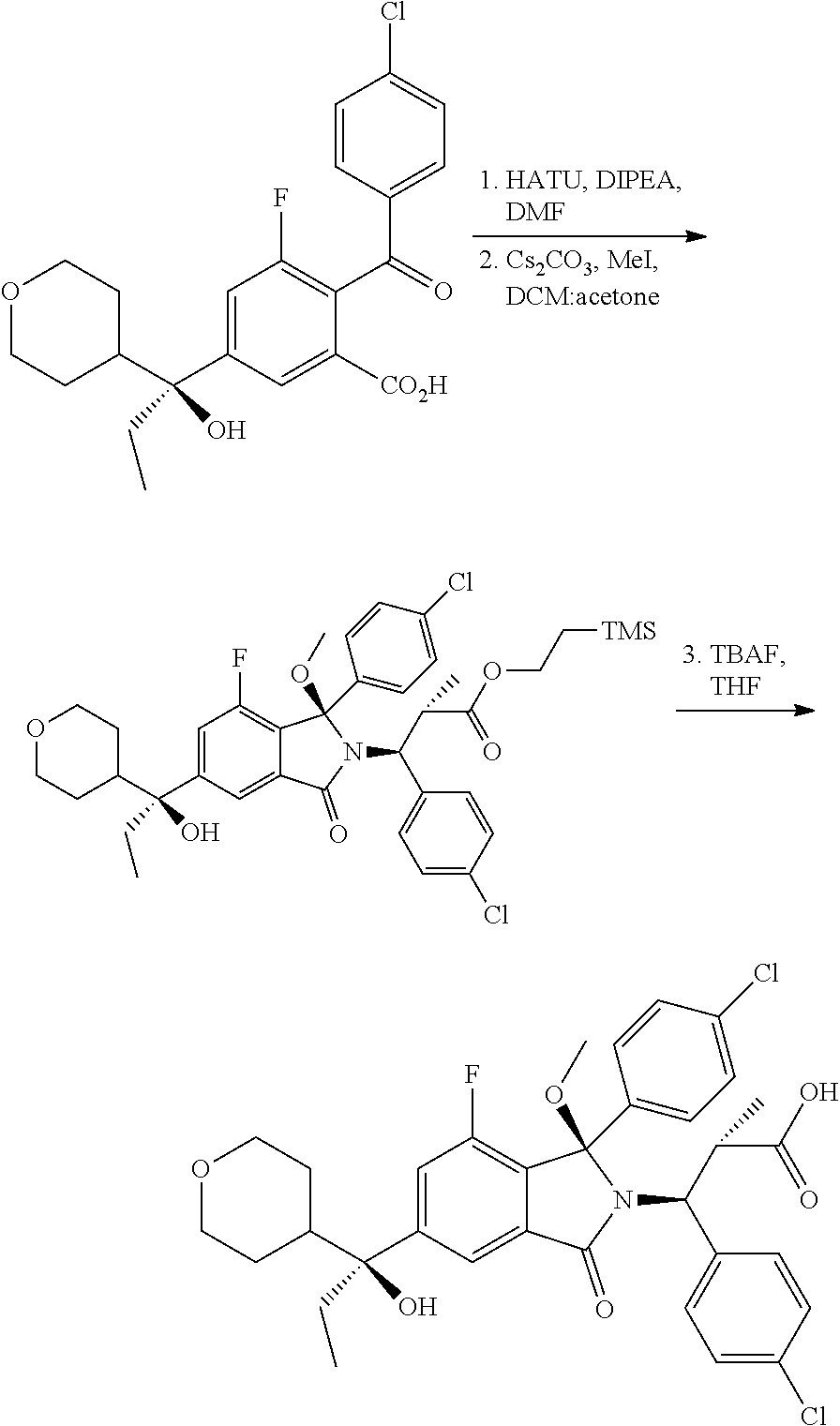


-
- 2-(trimethylsilyl)ethyl (2S,3S)-3-(4-chlorophenyl)-3-[(1R)-1-(4-chlorophenyl)-7-fluoro-5-[(1S)-1-hydroxy-1-(oxan-4-yl)propyl]-1-methoxy-3-oxo-2,3-dihydro-1H-isoindol-2-yl]-2-methylpropanoate (retention time=3.09 min)
- 2-(trimethylsilyl)ethyl (2S,3S)-3-(4-chlorophenyl)-3-[(1R)-1-(4-chlorophenyl)-7-fluoro-5-[(1R)-1-hydroxy-1-(oxan-4-yl)propyl]-1-methoxy-3-oxo-2,3-dihydro-1H-isoindol-2-yl]-2-methylpropanoate (retention time=3.63 min)
- 2-(trimethylsilyl)ethyl (2S,3S)-3-(4-chlorophenyl)-3-[(1R)-1-(4-chlorophenyl)-7-fluoro-5-[(1S)-1-hydroxy-1-(oxan-4-yl)propyl]-1-methoxy-3-oxo-2,3-dihydro-1H-isoindol-2-yl]-2-methylpropanoate can then be deprotected to give (2S,3S)-3-(4-chlorophenyl)-3-[(1R)-1-(4-chlorophenyl)-7-fluoro-5-[(1S)-1-hydroxy-1-(oxan-4-yl)propyl]-1-methoxy-3-oxo-2,3-dihydro-1H-isoindol-2-yl]-2-methylpropanoic acid using procedures similar to those for, described above.


-
- Column: ChiralPak IC-3 3 μcolumn 4.6×150 mm
- Column Temp: 270
- Eluent: Heptane/IPA 80: 20 with 0.1% TFA
- Flow rate: 1.0 mL/min@254 nm
- Retention Desired (S) enantiomer; RT=4.60 mins. Undesired (R) enantiomer), RT=5.83 mins


| TABLE 1 | ||||
| Pos. [º2Th.] | Height [cts] | FWHM [º2Th.] | d-spacing [Å] | Rel. Int. [%] |
| 5.5324 | 119.60 | 0.4093 | 15.97459 | 3.19 |
| 8.0939 | 363.89 | 0.0768 | 10.92389 | 9.72 |
| 8.7670 | 654.55 | 0.0768 | 10.08658 | 17.48 |
| 10.0983 | 1123.93 | 0.0768 | 8.75963 | 30.02 |
| 11.0597 | 867.75 | 0.0768 | 8.00021 | 23.18 |
| 11.2706 | 1141.77 | 0.1023 | 7.85102 | 30.50 |
| 11.7674 | 80.69 | 0.1535 | 7.52066 | 2.16 |
| 13.5705 | 1039.22 | 0.1023 | 6.52514 | 27.76 |
| 14.2250 | 333.44 | 0.0768 | 6.22639 | 8.91 |
| 15.1034 | 2704.30 | 0.1279 | 5.86616 | 72.24 |
| 15.5082 | 3743.65 | 0.1279 | 5.71395 | 100.00 |
| 15.7699 | 2649.88 | 0.1023 | 5.61973 | 70.78 |
| 16.1290 | 684.97 | 0.1023 | 5.49539 | 18.30 |
| 16.5503 | 413.16 | 0.1023 | 5.35644 | 11.04 |
| 17.1682 | 1577.31 | 0.1279 | 5.16504 | 42.13 |
| 17.6278 | 246.51 | 0.1023 | 5.03138 | 6.58 |
| 18.1385 | 279.01 | 0.1023 | 4.89085 | 7.45 |
| 18.8833 | 723.33 | 0.1279 | 4.69961 | 19.32 |
| 19.1793 | 179.94 | 0.0768 | 4.62773 | 4.81 |
| 19.6727 | 256.37 | 0.1279 | 4.51276 | 6.85 |
| 20.3698 | 132.83 | 0.1023 | 4.35988 | 3.55 |
| 20.8132 | 2330.35 | 0.1279 | 4.26799 | 62.25 |
| 21.4724 | 496.23 | 0.1279 | 4.13844 | 13.26 |
| 22.2644 | 2823.66 | 0.2303 | 3.99297 | 75.43 |
| 23.2042 | 254.87 | 0.1023 | 3.83333 | 6.81 |
| 23.9443 | 465.26 | 0.1279 | 3.71650 | 12.43 |
| 24.5109 | 196.57 | 0.1023 | 3.63186 | 5.25 |
| 24.9654 | 105.69 | 0.1279 | 3.56676 | 2.82 |
| 25.4394 | 438.68 | 0.1023 | 3.50137 | 11.72 |
| 25.8370 | 351.04 | 0.1023 | 3.44839 | 9.38 |
| 26.5691 | 327.59 | 0.1535 | 3.35500 | 8.75 |
| 26.9367 | 637.86 | 0.1791 | 3.31004 | 17.04 |
| 27.3570 | 1012.15 | 0.1279 | 3.26015 | 27.04 |
| 28.2316 | 985.61 | 0.1535 | 3.16110 | 26.33 |
| 28.6372 | 1599.45 | 0.1535 | 3.11725 | 42.72 |
| 29.2407 | 315.65 | 0.1535 | 3.05427 | 8.43 |
| 29.9430 | 289.99 | 0.1791 | 2.98422 | 7.75 |
| 30.6433 | 463.31 | 0.1535 | 2.91759 | 12.38 |
| 31.2365 | 165.53 | 0.1279 | 2.86353 | 4.42 |
| 31.5627 | 201.49 | 0.1279 | 2.83467 | 5.38 |
| 32.1380 | 66.90 | 0.1535 | 2.78523 | 1.79 |
| 33.5238 | 129.51 | 0.2047 | 2.67320 | 3.46 |
| 33.7620 | 120.56 | 0.1535 | 2.65488 | 3.22 |
| 34.4905 | 171.78 | 0.1279 | 2.60045 | 4.59 |


| TABLE 3 |
| biological data obtained from assays as described herein for (2S,3S)-3-(4-chlorophenyl)-3- |
| [(1R)-1-(4-chlorophenyl)-7-fluoro-5-[(1S)-1-hydroxy-1-(oxan-4-yl)propyl]-1-methoxy-3- |
| oxo-2,3-dihydro-1H-isoindol-2-yl]-2-methylpropanoic acid |
| SJSA-1 IC50 | SJSA1 IC50 | SN40R2 IC50 | SN40R2 IC50 | ||
| Patent | MDM2 IC50 | (μM) | (μM) | (μM) | (μM) |
| Example | (μM) | (ProtocolA) | (Protocol B) | (Protocol A) | (Protocol B) |
| 1 | 80%@0.0010 | 0.023 | 0.027 | 23 | 55% at 10 |
Claims (22)


Priority Applications (2)
| Application Number | Priority Date | Filing Date | Title |
|---|---|---|---|
| US18/159,452 US12077526B2 (en) | 2017-03-28 | 2023-01-25 | Isoindolinone inhibitors of the MDM2-P53 interaction and process for making them |
| US18/785,847 US20250074900A1 (en) | 2017-03-28 | 2024-07-26 | Isoindolinone inhibitors of the mdm2-p53 interaction and process for making them |
Applications Claiming Priority (6)
| Application Number | Priority Date | Filing Date | Title |
|---|---|---|---|
| GB1704965.1 | 2017-03-28 | ||
| GB1704965 | 2017-03-28 | ||
| GBGB1704965.1A GB201704965D0 (en) | 2017-03-28 | 2017-03-28 | Pharmaceutical compounds |
| PCT/GB2018/050845 WO2018178691A1 (en) | 2017-03-28 | 2018-03-28 | Isoindolinone inhibitors of the mdm2-p53 interaction and process for making them |
| US201916498207A | 2019-09-26 | 2019-09-26 | |
| US18/159,452 US12077526B2 (en) | 2017-03-28 | 2023-01-25 | Isoindolinone inhibitors of the MDM2-P53 interaction and process for making them |
Related Parent Applications (2)
| Application Number | Title | Priority Date | Filing Date |
|---|---|---|---|
| PCT/GB2018/050845 Division WO2018178691A1 (en) | 2017-03-28 | 2018-03-28 | Isoindolinone inhibitors of the mdm2-p53 interaction and process for making them |
| US16/498,207 Division US11603367B2 (en) | 2017-03-28 | 2018-03-28 | Isoindolinone inhibitors of the MDM2-P53 interaction and process for making them |
Related Child Applications (1)
| Application Number | Title | Priority Date | Filing Date |
|---|---|---|---|
| US18/785,847 Division US20250074900A1 (en) | 2017-03-28 | 2024-07-26 | Isoindolinone inhibitors of the mdm2-p53 interaction and process for making them |
Publications (2)
| Publication Number | Publication Date |
|---|---|
| US20230278989A1 US20230278989A1 (en) | 2023-09-07 |
| US12077526B2 true US12077526B2 (en) | 2024-09-03 |
Family
ID=58687834
Family Applications (3)
| Application Number | Title | Priority Date | Filing Date |
|---|---|---|---|
| US16/498,207 Active US11603367B2 (en) | 2017-03-28 | 2018-03-28 | Isoindolinone inhibitors of the MDM2-P53 interaction and process for making them |
| US18/159,452 Active US12077526B2 (en) | 2017-03-28 | 2023-01-25 | Isoindolinone inhibitors of the MDM2-P53 interaction and process for making them |
| US18/785,847 Pending US20250074900A1 (en) | 2017-03-28 | 2024-07-26 | Isoindolinone inhibitors of the mdm2-p53 interaction and process for making them |
Family Applications Before (1)
| Application Number | Title | Priority Date | Filing Date |
|---|---|---|---|
| US16/498,207 Active US11603367B2 (en) | 2017-03-28 | 2018-03-28 | Isoindolinone inhibitors of the MDM2-P53 interaction and process for making them |
Family Applications After (1)
| Application Number | Title | Priority Date | Filing Date |
|---|---|---|---|
| US18/785,847 Pending US20250074900A1 (en) | 2017-03-28 | 2024-07-26 | Isoindolinone inhibitors of the mdm2-p53 interaction and process for making them |
Country Status (7)
| Country | Link |
|---|---|
| US (3) | US11603367B2 (en) |
| EP (1) | EP3601272A1 (en) |
| JP (1) | JP7495790B2 (en) |
| KR (1) | KR102673967B1 (en) |
| CN (1) | CN110678462B (en) |
| GB (1) | GB201704965D0 (en) |
| WO (1) | WO2018178691A1 (en) |
Cited By (1)
| Publication number | Priority date | Publication date | Assignee | Title |
|---|---|---|---|---|
| US20240293364A1 (en) * | 2021-03-04 | 2024-09-05 | Otsuka Pharmaceutical Co., Ltd. | Biomarkers for cancer therapy using mdm2 antagonists |
Families Citing this family (10)
| Publication number | Priority date | Publication date | Assignee | Title |
|---|---|---|---|---|
| GB201517217D0 (en) | 2015-09-29 | 2015-11-11 | Astex Therapeutics Ltd And Cancer Res Technology Ltd | Pharmaceutical compounds |
| GB201704966D0 (en) | 2017-03-28 | 2017-05-10 | Astex Therapeutics Ltd | Pharmaceutical compounds |
| GB201704965D0 (en) * | 2017-03-28 | 2017-05-10 | Astex Therapeutics Ltd | Pharmaceutical compounds |
| CN113453678A (en) * | 2018-11-26 | 2021-09-28 | 德彪药业国际股份公司 | Combination therapy for HIV infection |
| CN109897069B (en) * | 2019-02-12 | 2021-08-20 | 华东师范大学 | A kind of 3,3-disubstituted indolinone and derivative thereof and its synthetic method and application |
| CN110845288B (en) * | 2019-11-28 | 2022-07-19 | 浙江工业大学 | Asymmetric synthesis method of chiral beta-amino aldehyde compound |
| GB201919219D0 (en) | 2019-12-23 | 2020-02-05 | Otsuka Pharma Co Ltd | Cancer biomarkers |
| CN111057128B (en) * | 2019-12-25 | 2023-05-16 | 哈尔滨师范大学 | Sulfur-containing isoindolone cyclic peptide derivative and preparation method thereof |
| EP4204812A2 (en) | 2020-08-27 | 2023-07-05 | Otsuka Pharmaceutical Co., Ltd. | Biomarkers for cancer therapy using mdm2 antagonists |
| TW202540077A (en) * | 2023-11-16 | 2025-10-16 | 日商大塚製藥股份有限公司 | Processes for making intermediates for isoindolinone inhibitors of the mdm2-p53 interaction having anticancer activity |
Citations (67)
| Publication number | Priority date | Publication date | Assignee | Title |
|---|---|---|---|---|
| CH374071A (en) | 1959-04-30 | 1963-12-31 | Geigy Ag J R | Process for the preparation of new isoindoline derivatives |
| US3466298A (en) | 1967-03-14 | 1969-09-09 | American Home Prod | Process for the preparation of 2-(2-aminoethyl)isoindolines |
| GB1325065A (en) | 1970-02-12 | 1973-08-01 | American Home Prod | Imidazoline derivatives |
| DE2313227A1 (en) | 1972-03-16 | 1973-09-27 | Rhone Poulenc Sa | NEW ISOINDOLINE DERIVATIVES, THEIR MANUFACTURING AND THE MEDICAL COMPOSITIONS THAT CONTAIN THEM |
| US3763178A (en) | 1968-09-05 | 1973-10-02 | American Home Prod | Imidazolinyl phenyl carbonyl acid addition salts and related compounds |
| US4001271A (en) | 1973-02-08 | 1977-01-04 | Rhone-Poulenc S.A. | 3-(isopropyl amino alkoxy)-2-phenyl-isoindolin-1-ones |
| US4200759A (en) | 1978-07-20 | 1980-04-29 | Delmar Chemicals, Limited | Preparation of imidazo[2,1-a]isoindole compounds |
| US4244966A (en) | 1979-09-24 | 1981-01-13 | American Home Products Corporation | 1,3-Dihydro-3-(2-hydroxy-, 2-bromo- or 2-chloroethyl)-2H-isoindol-1-one derivatives |
| GB1601701A (en) | 1977-07-22 | 1981-11-04 | Delmar Chem | Production of heterocyclic benzamide compounds |
| US4312809A (en) | 1980-10-31 | 1982-01-26 | E. R. Squibb & Sons, Inc. | Lactam derivatives of mercaptoacylamino acids |
| US4331600A (en) | 1980-10-31 | 1982-05-25 | Usv Pharmaceutical Corporation | Intermediates for the synthesis of phthalimidines |
| US4505921A (en) | 1982-09-23 | 1985-03-19 | Adir, S.A.R.L. | Sulfonylurea compounds and their use in treating diabetes |
| EP0461079A2 (en) | 1990-06-07 | 1991-12-11 | Sandoz Ltd. | Substituted phthalides and heterocyclic phthalides |
| WO1997032846A1 (en) | 1996-03-08 | 1997-09-12 | Pharmacia & Upjohn Company | Hydroxamic acid derivatives for use with the treatment of diseases related to connective tissue degradation |
| WO1999042444A1 (en) | 1998-02-21 | 1999-08-26 | Aventis Pharma Deutschland Gmbh | Substituted isoindolones and their use as cyclic gmp modulators in medicaments |
| WO2001032928A2 (en) | 1999-11-05 | 2001-05-10 | Phase-1 Molecular Toxicology | Methods of determining individual hypersensitivity to an agent |
| EP1199306A1 (en) | 1999-07-26 | 2002-04-24 | Banyu Pharmaceutical Co., Ltd. | Biarylurea derivatives |
| WO2003051359A1 (en) | 2001-12-18 | 2003-06-26 | F.Hoffmann-La Roche Ag | Cis-2,4,5- triphenyl-imidazolines and their use in the treatment of tumors |
| WO2003101450A1 (en) | 2002-06-03 | 2003-12-11 | Aventis Pharma Deutschland Gmbh | N- ((3-oxo2, 3-dihydro-1h-isoindol-1-yl) acetyl) guanidine derivatives as nhe-1 inhibitors for the treatment of infarction and angina pectoris |
| JP2004217591A (en) | 2003-01-16 | 2004-08-05 | Dai Ichi Seiyaku Co Ltd | Method for producing cis-selective fluorocyclopropane derivative |
| US20050004207A1 (en) | 2001-07-16 | 2005-01-06 | Alexander Straub | Substituted isoindoles and the use thereof |
| WO2005021532A1 (en) | 2003-08-25 | 2005-03-10 | Amgen Inc | Substituted 2,3-dihydro-1h-isoindol-1-one derivatives and methods of use |
| EP1566378A1 (en) | 2002-11-26 | 2005-08-24 | Maruishi Pharmaceutical Co., Ltd. | Isoindoline derivative |
| JP2005255660A (en) | 2004-03-10 | 2005-09-22 | Katsuhiko Tomooka | Polyfunctional group-containing lactams and method for producing the same |
| WO2005095341A1 (en) | 2004-03-30 | 2005-10-13 | Kyowa Hakko Kogyo Co., Ltd. | Nitrogen-containing heterocyclic compound |
| WO2006020879A1 (en) | 2004-08-13 | 2006-02-23 | Astrazeneca Ab | Isoindolone compounds and their use as metabotropic glutamate receptor potentiators |
| WO2006024837A1 (en) | 2004-09-02 | 2006-03-09 | Cancer Research Technology Limited | Isoindolin-1-one derivatives |
| WO2006091646A2 (en) | 2005-02-22 | 2006-08-31 | The Regents Of The University Of Michigan | Small molecule inhibitors of mdm2 and uses thereof |
| US20060264473A1 (en) | 2005-05-02 | 2006-11-23 | Vladimir Khazak | Isoindolone compounds, compositions containing the same, and methods of use thereof for the treatment of viral infections related to the etiology of cancer |
| WO2007021309A1 (en) | 2005-08-12 | 2007-02-22 | Astrazeneca Ab | Substituted isoindolones and their use as metabotropic glutamate receptor potentiators |
| WO2008024892A2 (en) | 2006-08-24 | 2008-02-28 | Bristol-Myers Squibb Company | Cyclic 11-beta hydroxysteroid dehydrogenase type i inhibitors |
| WO2008117061A2 (en) | 2007-03-28 | 2008-10-02 | Sterix Limited | Tetrahydroisoquinolines as tumour growth inhibitors |
| WO2008151184A1 (en) | 2007-06-03 | 2008-12-11 | Vanderbilt University | Benzamide mglur5 positive allosteric modulators and methods of making and using same |
| EP2108642A1 (en) | 2006-10-17 | 2009-10-14 | Kyowa Hakko Kirin Co., Ltd. | Jak inhibitor |
| WO2009156735A2 (en) | 2008-06-25 | 2009-12-30 | Cancer Research Technology Limited | New therapeutic agents |
| WO2010031713A1 (en) | 2008-09-18 | 2010-03-25 | F. Hoffmann-La Roche Ag | Substituted pyrrolidine-2-carboxamides |
| WO2011060049A2 (en) | 2009-11-12 | 2011-05-19 | The Regents Of The University Of Michigan | Spiro-oxindole mdm2 antagonists |
| WO2011076786A1 (en) | 2009-12-22 | 2011-06-30 | Novartis Ag | Substituted isoquinolinones and quinazolinones |
| WO2011098398A1 (en) | 2010-02-09 | 2011-08-18 | F. Hoffmann-La Roche Ag | Substituted pyrrolidine-2-carboxamides |
| JP2011526260A (en) | 2008-07-03 | 2011-10-06 | メルク パテント ゲゼルシャフト ミット ベシュレンクテル ハフツング | Pyrrolopyridinylpyrimidin-2-ylamine derivatives |
| WO2011153509A1 (en) | 2010-06-04 | 2011-12-08 | Amgen Inc. | Piperidinone derivatives as mdm2 inhibitors for the treatment of cancer |
| US20120264738A1 (en) | 2011-03-10 | 2012-10-18 | Yuuichi Sugimoto | Dispiropyrrolidine derivatives |
| WO2012175520A1 (en) | 2011-06-20 | 2012-12-27 | Novartis Ag | Hydroxy substituted isoquinolinone derivatives |
| WO2012175487A1 (en) | 2011-06-20 | 2012-12-27 | Novartis Ag | Cyclohexyl isoquinolinone compounds |
| WO2013033176A1 (en) | 2011-08-30 | 2013-03-07 | Astex Pharmaceuticals, Inc. | Decitabine derivative formulations |
| WO2013111105A1 (en) | 2012-01-26 | 2013-08-01 | Novartis Ag | Imidazopyrrolidinone compounds |
| KR20130088577A (en) | 2012-01-31 | 2013-08-08 | 울산대학교 산학협력단 | Synthetic method for isoindoline derivatives using rhodium catalyst |
| WO2013120835A1 (en) | 2012-02-13 | 2013-08-22 | AbbVie Deutschland GmbH & Co. KG | Isoindoline derivatives, pharmaceutical compositions containing them, and their use in therapy |
| WO2014070948A1 (en) | 2012-10-30 | 2014-05-08 | Mei Pharma, Inc. | Combination therapies |
| WO2014134355A1 (en) | 2013-03-01 | 2014-09-04 | Astex Pharmaceuticals, Inc. | Drug combinations |
| WO2015000945A1 (en) | 2013-07-03 | 2015-01-08 | F. Hoffmann-La Roche Ag | Mrna-based gene expression for personalizing patient cancer therapy with an mdm2 antagonist |
| WO2015108175A1 (en) | 2014-01-14 | 2015-07-23 | Daiichi Sankyo Company, Limited | Gene signatures associated with sensitivity to mdm2 inhibitors |
| WO2015161032A1 (en) | 2014-04-17 | 2015-10-22 | The Regents Of The University Of Michigan | Mdm2 inhibitors and therapeutic methods using the same |
| WO2016056673A1 (en) | 2014-10-09 | 2016-04-14 | Daiichi Sankyo Company, Limited | Algorithms for gene signature-based predictor of sensitivity to mdm2 inhibitors |
| WO2016059241A2 (en) | 2014-10-17 | 2016-04-21 | Biomirna Holdings Ltd. | Lung cancer diagnostics and therapeutics with mir-660 |
| WO2017004538A1 (en) | 2015-07-02 | 2017-01-05 | Otsuka Pharmaceutical Co., Ltd. | Lyophilized pharmaceutical compositions |
| WO2017055859A1 (en) | 2015-09-29 | 2017-04-06 | Astex Therapeutics Limited | Isoindolinone inhibitors of the mdm2-p53 interaction having anticancer activity |
| WO2017055860A1 (en) | 2015-09-29 | 2017-04-06 | Astex Therapeutics Limited | Isoindolinone inhibitors of the mdm2-p53 interaction having anticancer activity |
| WO2017068412A1 (en) | 2015-10-21 | 2017-04-27 | Otsuka Pharmaceutical Co., Ltd. | Benzolactam compounds as protein kinase inhibitors |
| WO2017087607A1 (en) | 2015-11-19 | 2017-05-26 | Chemocentryx, Inc. | Modulators of chemokine receptors |
| WO2018178679A1 (en) | 2017-03-28 | 2018-10-04 | Astex Therapeutics Limited | Combination of isoindolinone derivatives with sgi-110 |
| US20200040403A1 (en) | 2018-07-27 | 2020-02-06 | Ottawa Hospital Research Institute | Treatment of acute myeloid leukemia |
| WO2020169073A1 (en) | 2019-02-24 | 2020-08-27 | Ascentage Pharma (Suzhou) Co., Ltd. | Treatment methods and biomarkers for mdm2 inhibitors |
| US20210101887A1 (en) | 2017-03-28 | 2021-04-08 | Astex Therapeutics Limited | Isoindolinone inhibitors of the mdm2-p53 interaction and process for making them |
| WO2021130682A2 (en) | 2019-12-23 | 2021-07-01 | Otsuka Pharmaceutical Co., Ltd. | Biomarkers for cancer therapy using mdm2 antagonists |
| WO2022043930A2 (en) | 2020-08-27 | 2022-03-03 | Otsuka Pharmaceutical Co., Ltd. | Biomarkers for cancer therapy using mdm2 antagonists |
| WO2022185260A1 (en) | 2021-03-04 | 2022-09-09 | Otsuka Pharmaceutical Co., Ltd. | Biomarkers for cancer therapy using mdm2 antagonists |
-
2017
- 2017-03-28 GB GBGB1704965.1A patent/GB201704965D0/en not_active Ceased
-
2018
- 2018-03-28 CN CN201880022720.4A patent/CN110678462B/en active Active
- 2018-03-28 WO PCT/GB2018/050845 patent/WO2018178691A1/en not_active Ceased
- 2018-03-28 EP EP18715926.4A patent/EP3601272A1/en active Pending
- 2018-03-28 JP JP2019552594A patent/JP7495790B2/en active Active
- 2018-03-28 US US16/498,207 patent/US11603367B2/en active Active
- 2018-03-28 KR KR1020197030377A patent/KR102673967B1/en active Active
-
2023
- 2023-01-25 US US18/159,452 patent/US12077526B2/en active Active
-
2024
- 2024-07-26 US US18/785,847 patent/US20250074900A1/en active Pending
Patent Citations (91)
| Publication number | Priority date | Publication date | Assignee | Title |
|---|---|---|---|---|
| CH374071A (en) | 1959-04-30 | 1963-12-31 | Geigy Ag J R | Process for the preparation of new isoindoline derivatives |
| US3466298A (en) | 1967-03-14 | 1969-09-09 | American Home Prod | Process for the preparation of 2-(2-aminoethyl)isoindolines |
| US3763178A (en) | 1968-09-05 | 1973-10-02 | American Home Prod | Imidazolinyl phenyl carbonyl acid addition salts and related compounds |
| GB1325065A (en) | 1970-02-12 | 1973-08-01 | American Home Prod | Imidazoline derivatives |
| DE2313227A1 (en) | 1972-03-16 | 1973-09-27 | Rhone Poulenc Sa | NEW ISOINDOLINE DERIVATIVES, THEIR MANUFACTURING AND THE MEDICAL COMPOSITIONS THAT CONTAIN THEM |
| US3898232A (en) | 1972-03-16 | 1975-08-05 | Rhone Poulenc Sa | Isoindolin-1-one derivatives |
| US4001271A (en) | 1973-02-08 | 1977-01-04 | Rhone-Poulenc S.A. | 3-(isopropyl amino alkoxy)-2-phenyl-isoindolin-1-ones |
| GB1601701A (en) | 1977-07-22 | 1981-11-04 | Delmar Chem | Production of heterocyclic benzamide compounds |
| US4200759A (en) | 1978-07-20 | 1980-04-29 | Delmar Chemicals, Limited | Preparation of imidazo[2,1-a]isoindole compounds |
| US4244966A (en) | 1979-09-24 | 1981-01-13 | American Home Products Corporation | 1,3-Dihydro-3-(2-hydroxy-, 2-bromo- or 2-chloroethyl)-2H-isoindol-1-one derivatives |
| US4312809A (en) | 1980-10-31 | 1982-01-26 | E. R. Squibb & Sons, Inc. | Lactam derivatives of mercaptoacylamino acids |
| US4331600A (en) | 1980-10-31 | 1982-05-25 | Usv Pharmaceutical Corporation | Intermediates for the synthesis of phthalimidines |
| US4505921A (en) | 1982-09-23 | 1985-03-19 | Adir, S.A.R.L. | Sulfonylurea compounds and their use in treating diabetes |
| EP0461079A2 (en) | 1990-06-07 | 1991-12-11 | Sandoz Ltd. | Substituted phthalides and heterocyclic phthalides |
| WO1997032846A1 (en) | 1996-03-08 | 1997-09-12 | Pharmacia & Upjohn Company | Hydroxamic acid derivatives for use with the treatment of diseases related to connective tissue degradation |
| JP2000506163A (en) | 1996-03-08 | 2000-05-23 | ファルマシア・アンド・アップジョン・カンパニー | Novel hydroxamic acid derivatives useful for treating diseases associated with connective tissue degradation |
| WO1999042444A1 (en) | 1998-02-21 | 1999-08-26 | Aventis Pharma Deutschland Gmbh | Substituted isoindolones and their use as cyclic gmp modulators in medicaments |
| US6344468B1 (en) | 1998-02-21 | 2002-02-05 | Aventis Pharma Deutschland Gmbh | Substituted isoindolones and their use as cyclic GMP modulators in medicaments |
| EP1199306A1 (en) | 1999-07-26 | 2002-04-24 | Banyu Pharmaceutical Co., Ltd. | Biarylurea derivatives |
| WO2001032928A2 (en) | 1999-11-05 | 2001-05-10 | Phase-1 Molecular Toxicology | Methods of determining individual hypersensitivity to an agent |
| US20050004207A1 (en) | 2001-07-16 | 2005-01-06 | Alexander Straub | Substituted isoindoles and the use thereof |
| WO2003051359A1 (en) | 2001-12-18 | 2003-06-26 | F.Hoffmann-La Roche Ag | Cis-2,4,5- triphenyl-imidazolines and their use in the treatment of tumors |
| WO2003101450A1 (en) | 2002-06-03 | 2003-12-11 | Aventis Pharma Deutschland Gmbh | N- ((3-oxo2, 3-dihydro-1h-isoindol-1-yl) acetyl) guanidine derivatives as nhe-1 inhibitors for the treatment of infarction and angina pectoris |
| EP1566378A1 (en) | 2002-11-26 | 2005-08-24 | Maruishi Pharmaceutical Co., Ltd. | Isoindoline derivative |
| JP2004217591A (en) | 2003-01-16 | 2004-08-05 | Dai Ichi Seiyaku Co Ltd | Method for producing cis-selective fluorocyclopropane derivative |
| WO2005021532A1 (en) | 2003-08-25 | 2005-03-10 | Amgen Inc | Substituted 2,3-dihydro-1h-isoindol-1-one derivatives and methods of use |
| JP2005255660A (en) | 2004-03-10 | 2005-09-22 | Katsuhiko Tomooka | Polyfunctional group-containing lactams and method for producing the same |
| WO2005095341A1 (en) | 2004-03-30 | 2005-10-13 | Kyowa Hakko Kogyo Co., Ltd. | Nitrogen-containing heterocyclic compound |
| WO2006020879A1 (en) | 2004-08-13 | 2006-02-23 | Astrazeneca Ab | Isoindolone compounds and their use as metabotropic glutamate receptor potentiators |
| US8258175B2 (en) | 2004-09-02 | 2012-09-04 | Cancer Research Technology Limited | Isoindolin-1-one derivatives |
| WO2006024837A1 (en) | 2004-09-02 | 2006-03-09 | Cancer Research Technology Limited | Isoindolin-1-one derivatives |
| WO2006091646A2 (en) | 2005-02-22 | 2006-08-31 | The Regents Of The University Of Michigan | Small molecule inhibitors of mdm2 and uses thereof |
| US20060264473A1 (en) | 2005-05-02 | 2006-11-23 | Vladimir Khazak | Isoindolone compounds, compositions containing the same, and methods of use thereof for the treatment of viral infections related to the etiology of cancer |
| WO2007021309A1 (en) | 2005-08-12 | 2007-02-22 | Astrazeneca Ab | Substituted isoindolones and their use as metabotropic glutamate receptor potentiators |
| WO2008024892A2 (en) | 2006-08-24 | 2008-02-28 | Bristol-Myers Squibb Company | Cyclic 11-beta hydroxysteroid dehydrogenase type i inhibitors |
| EP2108642A1 (en) | 2006-10-17 | 2009-10-14 | Kyowa Hakko Kirin Co., Ltd. | Jak inhibitor |
| WO2008117061A2 (en) | 2007-03-28 | 2008-10-02 | Sterix Limited | Tetrahydroisoquinolines as tumour growth inhibitors |
| WO2008151184A1 (en) | 2007-06-03 | 2008-12-11 | Vanderbilt University | Benzamide mglur5 positive allosteric modulators and methods of making and using same |
| US10414726B2 (en) | 2008-06-25 | 2019-09-17 | Cancer Research Technology Limited | Therapeutic agents |
| WO2009156735A2 (en) | 2008-06-25 | 2009-12-30 | Cancer Research Technology Limited | New therapeutic agents |
| US20140194486A1 (en) | 2008-06-25 | 2014-07-10 | Cancer Research Technology Limited | Therapeutic agents |
| US9358222B2 (en) | 2008-06-25 | 2016-06-07 | Cancer Research Technology Limited | Therapeutic agents |
| US20160355478A1 (en) | 2008-06-25 | 2016-12-08 | Cancer Research Technology Limited | Therapeutic agents |
| US20180118684A1 (en) | 2008-06-25 | 2018-05-03 | Cancer Research Technology Limited | Therapeutic agents |
| US8618158B2 (en) | 2008-06-25 | 2013-12-31 | Cancer Research Technology Limited | Therapeutic agents |
| JP2011526260A (en) | 2008-07-03 | 2011-10-06 | メルク パテント ゲゼルシャフト ミット ベシュレンクテル ハフツング | Pyrrolopyridinylpyrimidin-2-ylamine derivatives |
| WO2010031713A1 (en) | 2008-09-18 | 2010-03-25 | F. Hoffmann-La Roche Ag | Substituted pyrrolidine-2-carboxamides |
| WO2011060049A2 (en) | 2009-11-12 | 2011-05-19 | The Regents Of The University Of Michigan | Spiro-oxindole mdm2 antagonists |
| WO2011076786A1 (en) | 2009-12-22 | 2011-06-30 | Novartis Ag | Substituted isoquinolinones and quinazolinones |
| WO2011098398A1 (en) | 2010-02-09 | 2011-08-18 | F. Hoffmann-La Roche Ag | Substituted pyrrolidine-2-carboxamides |
| WO2011153509A1 (en) | 2010-06-04 | 2011-12-08 | Amgen Inc. | Piperidinone derivatives as mdm2 inhibitors for the treatment of cancer |
| US20120264738A1 (en) | 2011-03-10 | 2012-10-18 | Yuuichi Sugimoto | Dispiropyrrolidine derivatives |
| WO2012175520A1 (en) | 2011-06-20 | 2012-12-27 | Novartis Ag | Hydroxy substituted isoquinolinone derivatives |
| WO2012175487A1 (en) | 2011-06-20 | 2012-12-27 | Novartis Ag | Cyclohexyl isoquinolinone compounds |
| WO2013033176A1 (en) | 2011-08-30 | 2013-03-07 | Astex Pharmaceuticals, Inc. | Decitabine derivative formulations |
| WO2013111105A1 (en) | 2012-01-26 | 2013-08-01 | Novartis Ag | Imidazopyrrolidinone compounds |
| KR20130088577A (en) | 2012-01-31 | 2013-08-08 | 울산대학교 산학협력단 | Synthetic method for isoindoline derivatives using rhodium catalyst |
| WO2013120835A1 (en) | 2012-02-13 | 2013-08-22 | AbbVie Deutschland GmbH & Co. KG | Isoindoline derivatives, pharmaceutical compositions containing them, and their use in therapy |
| WO2014070948A1 (en) | 2012-10-30 | 2014-05-08 | Mei Pharma, Inc. | Combination therapies |
| WO2014134355A1 (en) | 2013-03-01 | 2014-09-04 | Astex Pharmaceuticals, Inc. | Drug combinations |
| WO2015000945A1 (en) | 2013-07-03 | 2015-01-08 | F. Hoffmann-La Roche Ag | Mrna-based gene expression for personalizing patient cancer therapy with an mdm2 antagonist |
| WO2015108175A1 (en) | 2014-01-14 | 2015-07-23 | Daiichi Sankyo Company, Limited | Gene signatures associated with sensitivity to mdm2 inhibitors |
| WO2015161032A1 (en) | 2014-04-17 | 2015-10-22 | The Regents Of The University Of Michigan | Mdm2 inhibitors and therapeutic methods using the same |
| WO2016056673A1 (en) | 2014-10-09 | 2016-04-14 | Daiichi Sankyo Company, Limited | Algorithms for gene signature-based predictor of sensitivity to mdm2 inhibitors |
| WO2016059241A2 (en) | 2014-10-17 | 2016-04-21 | Biomirna Holdings Ltd. | Lung cancer diagnostics and therapeutics with mir-660 |
| WO2017004538A1 (en) | 2015-07-02 | 2017-01-05 | Otsuka Pharmaceutical Co., Ltd. | Lyophilized pharmaceutical compositions |
| US20190055215A1 (en) | 2015-09-29 | 2019-02-21 | Astex Therapeutics Limited | Isoindolinone inhibitors of the mdm2-p53 interaction having anticancer activity |
| US20220106287A1 (en) | 2015-09-29 | 2022-04-07 | Astex Therapeutics Limited | Isoindolinone inhibitors of the mdm2-p53 interaction having anticancer activity |
| US20190016708A1 (en) | 2015-09-29 | 2019-01-17 | Astex Therapeutics Limited | Isoindolinone inhibitors of the mdm2-p53 interaction having anticancer activity |
| WO2017055860A1 (en) | 2015-09-29 | 2017-04-06 | Astex Therapeutics Limited | Isoindolinone inhibitors of the mdm2-p53 interaction having anticancer activity |
| WO2017055859A1 (en) | 2015-09-29 | 2017-04-06 | Astex Therapeutics Limited | Isoindolinone inhibitors of the mdm2-p53 interaction having anticancer activity |
| US10526311B2 (en) | 2015-09-29 | 2020-01-07 | Astex Therapeutics Limited | Isoindolinone inhibitors of the MDM2-P53 interaction having anticancer activity |
| US10544132B2 (en) | 2015-09-29 | 2020-01-28 | Astex Therapeutics Limited | Isoindolinone inhibitors of the MDM2-p53 interaction having anticancer activity |
| US11261171B1 (en) | 2015-09-29 | 2022-03-01 | Astex Therapeutics Limited | Isoindolinone inhibitors of the MDM2-P53 interaction having anticancer activity |
| US20200079761A1 (en) | 2015-09-29 | 2020-03-12 | Astex Therapeutics Limited | Isoindolinone inhibitors of the mdm2-p53 interaction having anticancer activity |
| US20210276984A1 (en) | 2015-09-29 | 2021-09-09 | Astex Therapeutics Limited | Isoindolinone inhibitors of the mdm2-p53 interaction having anticancer activity |
| US10981898B2 (en) | 2015-09-29 | 2021-04-20 | Astex Therapeutics Limited | Isoindolinone inhibitors of the MDM2-p53 interaction having anticancer activity |
| WO2017068412A1 (en) | 2015-10-21 | 2017-04-27 | Otsuka Pharmaceutical Co., Ltd. | Benzolactam compounds as protein kinase inhibitors |
| WO2017087607A1 (en) | 2015-11-19 | 2017-05-26 | Chemocentryx, Inc. | Modulators of chemokine receptors |
| US20210101887A1 (en) | 2017-03-28 | 2021-04-08 | Astex Therapeutics Limited | Isoindolinone inhibitors of the mdm2-p53 interaction and process for making them |
| US20200207711A1 (en) | 2017-03-28 | 2020-07-02 | Astex Therapeutics Limited | Combination of isoindolinone derivatives with sgi-110 |
| US11236047B2 (en) | 2017-03-28 | 2022-02-01 | Astex Therapeutics Limited | Combination of isoindolinone derivatives with SGI-110 |
| WO2018178679A1 (en) | 2017-03-28 | 2018-10-04 | Astex Therapeutics Limited | Combination of isoindolinone derivatives with sgi-110 |
| US11603367B2 (en) | 2017-03-28 | 2023-03-14 | Astex Therapeutics Limited | Isoindolinone inhibitors of the MDM2-P53 interaction and process for making them |
| US20200040403A1 (en) | 2018-07-27 | 2020-02-06 | Ottawa Hospital Research Institute | Treatment of acute myeloid leukemia |
| WO2020169073A1 (en) | 2019-02-24 | 2020-08-27 | Ascentage Pharma (Suzhou) Co., Ltd. | Treatment methods and biomarkers for mdm2 inhibitors |
| WO2021130682A2 (en) | 2019-12-23 | 2021-07-01 | Otsuka Pharmaceutical Co., Ltd. | Biomarkers for cancer therapy using mdm2 antagonists |
| US20230338337A1 (en) | 2019-12-23 | 2023-10-26 | Otsuka Pharmaceutical Co., Ltd. | Biomarkers for cancer therapy using mdm2 antagonists |
| WO2022043930A2 (en) | 2020-08-27 | 2022-03-03 | Otsuka Pharmaceutical Co., Ltd. | Biomarkers for cancer therapy using mdm2 antagonists |
| US20230313313A1 (en) | 2020-08-27 | 2023-10-05 | Otsuka Pharmaceutical Co., Ltd. | Biomarkers for cancer therapy using mdm2 antagonists |
| WO2022185260A1 (en) | 2021-03-04 | 2022-09-09 | Otsuka Pharmaceutical Co., Ltd. | Biomarkers for cancer therapy using mdm2 antagonists |
Non-Patent Citations (89)
| Title |
|---|
| {hacek over (Z)}ulenko, V. N., Gor{hacek over (s)}kov, G. I. "Farmakologiâ (English: "Pharmacology")", 2008, pp. 34-35. |
| "Malaâ medicinskaâ ènciklopediâ (Small encyclopedia of medicine)", vol. 5, Moscow: "Medicina", 1996, p. 90-96. |
| Ahmed, M., et al., Preparation of Some Isoindolo[2,1-f]phenanthridine Derivatives, J. Chem. Soc., Perkins Trans. 1, pp. 601-605 (1977). |
| Andreef, Michael, et al. A multi-centre, open-label, Phase I Study of Single Agent RG7112, A First In Class P53-MDM2 Antagonist Blood, vol. 116, No. 21, Nov. 2010, p. 657 (year: 2010). |
| Bartfeld, H.D., et al., 3-Oxo-Isoindole, Tetrahedron Letters, No. 10, pp. 757-760 (1970). |
| Beanlands, D.S., et al., Therapeutic Trial Of A New Oral Diuretic, Canadian Medical Association Journal, vol. 84, pp. 91-95 (1961). |
| Belikov V. G., "Farmacevti{hacek over (c)}eskaâ himiâ (Pharmaceutical chemistry)", Chapter 2.6, M.: MEDpress-inform, 2007, pp. 27-29. |
| Belikov, V.G. "Farmatsevticheskaya khimiya" (English: "Pharmaceutical Chemistry"),Chapter 2.2., Moscow, Publishing house "Vysshaya shkola", 1993, pp. 43-47. |
| Cancer [online, medline], [retrieved on Jul. 6, 2007], Retrieved from the internet, URL http://www.nlm.nih.gov/medlineplus/cancer.html. |
| Cancer [online, wikipedia], [retrieved on Jul. 6, 2007], Retrieved from the internet, URL http://en.wikipedia.org/wiki/Cancer. |
| Caplus 95:150329 record for Lencbergs, I., et al., 3-Hydroxy-3-(α-aminobenzyl)-2-substituted 1-isoindolinones, Latvijas PSR Zinatnu Akademijas Vestis, Kimijas Serija (1981), (3), 335-40. |
| Chander, et al., Skp2B attenuates p53 function by inhibiting prohibitin, EMBO reports vol. 11, No. 3, 2010. |
| Charlesworth, E.H., et al., Fluoranthene studies. III. A synthesis of 3-bromo-6-nitrofluorenone, Canadian Journal of Chemistry, vol. 46, No. 3, pp. 463-465 (1968). |
| Chene, P., et al., A Small Synthetic Peptide, which Inhibits the p53-hdm2 Interaction, Stimulates the p53 Pathway in Tumour Cell Lines, J. Molecular Biology, vol. 299, pp. 245-253 (2000). |
| Crane et al., Nutlin-3a: A Potential Therapeutic Opportunity for TP53 Wild-Type Ovarian Carcinomas, PLOS ONE 10(8): e0135101 2015. |
| Croisy-Delcey, M., et al., Dipheyl Quinolines and Isoquinolines: Synthesis and Primary Biological Evaluation, Bioorganic and Medicinal Chemistry, vol. 8, pp. 2629-2641 (2000). |
| Donehower, L.A., et al., Mice deficient for p53 are developmentally normal but susceptible to spontaneous tumours, Nature, vol. 356, pp. 215-221 (1992). |
| Dong, X., et al., OSAR Models for isoindolinone-based p53-MDM2 Interaction Inhibitors Using Linear and Non-linear Statistical Methods, Chem Biol Drug Des, vol. 79, pp. 691-702 (2012). |
| Durnov, L. A., Goldobenko, G. V., ,,Detskaâ onkologiâ (Pediatric oncology), Moscow: "Medicina", 2002, p. 139. |
| Dyson, G., May P. "Chemistry of Synthetic Drugs", Moscow, Publishing house "Mir", 1964, pp. 12-19. |
| Encyclopedic Dictionary of Chemistry, Moscow, Soviet Encyclopedia, 1983, pp. 130-131. |
| Epsztajn, J., et al., Application of Organolithium and Related Reagents in Synthesis. Part 23: Synthetic Strategies Based on ortho-Aromatic Metallation. Synthesis of 4b-Arylisoindolo[2,1-α]quinolone derivatives, Tetrahedron, vol. 56 pp. 4837-4844 (2000). |
| Esfandiari, Armen et al., "Chemical Inhibition of Wild-Type p53-Induced Phosphatase 1 (WIP1/PPM1D) by GSK2830371 Potentiates the Sensitivity to MDM2 Inhibitors in a p53-Dependent Manner," Molecular Cancer Therapeutics, Feb. 1, 2016, pp. 379-391. |
| Ferrari et al., U.S. Appl. No. 18/548,522, filed Aug. 31, 2023. |
| Ghosh, M., et al., Overexpression of Mdm2 and MdmX Fusion Proteins Alters p53 Mediated Transactivation, Ubiquitination, and Degradation, American Chemical Society, Biochemistry, vol. 42, pp. 2291-2299 (2003). |
| Golik, U., The Synthesis of some 2,4-Benzodiazepin-1-ones, Potent C.N.S. Agents (I), Journal of Heterocyclic Chemistry, vol. 12, No. 5, pp. 903-908 (1975). |
| Golub, T.R., et al., Molecular Classification of Cancer: Class Discovery and Class Prediction by Gene Expression Monitoring, Science, vol. 286, pp. 531-537 (1999). |
| Great Britain Search Report for GB1704965.1, dated Jan. 15, 2018, 5 pp. |
| Griffiths, J., et al., Model Studies for Damage to Nucleic Acids Mediated by Thiyl Radicals, Tetrahedron, vol. 48, No. 26, pp. 5543-5556 (1992). |
| Grigoreva, T.A., et al., "Proapoptotic modification of substituted isoindolinones as MDM2-p53 inhibitors", Bioorganic & Medicinal Chemistry Letters, vol. 27, pp. 5197-5202 (2017). |
| Hardcastle, I.R., et al., "Isoindolinone Inhibitors of the Murine Double Minute 2 (MDM2)-p53 Protein-Protein Interaction: Structure-Activity Studies Leading to Improved Potency", Journal of Medicinal Chemistry, vol. 54, pp. 1233-1243 (2011). |
| Hardcastle, I.R., et al., Small-Molecule Inhibitors of the MDM2-p53 Protein-Protein Interaction Based on an Isoindolinone Scaffold, Journal of Medicinal Chemistry (2006), 49(21), 6209-6221. |
| Harkevi{hacek over (c)}, D. A., "Farmakologiâ (English: "Pharmacology")", 10th edition, 2010, pp. 72-74. |
| Huang et al., Drugging the undruggables: exploring the ubiquitin system for drug development; Cell Res, 26, 4, 2016, 484-498. |
| Inaba, M., et al., Reversal of Resistance to Vincristine in P388 Leukemia by Various Polycyclic Clinical Drugs, with a Special Emphasis on Quinacrine, Cancer Research, vol. 48, No. 8, pp. 2064-2067 (1988). |
| International Search Report for PCT/GB2018/050845, dated Jun. 11, 2018, 16 pp. |
| Iorio et al., A Landscape of Pharmacogenomic Interactions in Cancer, 2016, Cell 166, 740-754. |
| Ito, Y., et al., Solid-State and Solution Photolyses of Tetracyanobenzene with Benzyl Cyanlides or Benzyl Alcohols, Tetrahedron, vol. 56, pp. 7139-7152 (2000). |
| Jeay et al., "A distinct p53 target gene set predicts for response to the selective p53 HDM2 inhibitor NVP-CGM097", Elife, 2015, pp. 1-23. |
| Ji et al., p53 Rescue through HDM2 Antagonism Suppresses Melanoma Growth and Potentiates MEK Inhibition, Journal of Investigative Dermatology (2012) vol. 132, 356-364. |
| Khimicheskaya entsiklopediya (Chemical Encyclopedia), vol. 1, Bol'shaya Rossiyskaya Entsiklopediya, Moscow, 1998. |
| Kitagawa et al., Skp2 Suppresses p53-Dependent Apoptosis by Inhibiting p300, Molecular Cell 29, 217-231, 2008. |
| Kitching, M.S., et al., Synthesis of 3-Alkoxy- and 3-Alkylamino-2-alky1-3-arylisoindolinones, Synlett, vol. 81, pp. 997-999 (1999). |
| Knijnenburg et al., 2018, Cell Reports 23, 239-254. |
| Kobayashi et al., "Nutlin-3A Suppresses poly (ADP-ribose) polymerase 1 by mechanisms different from conventional PARP1 suppressors in a human breast cancer cell line", Oncotarget 2020, vol. 11, No. 1B, pp. 1653-1665. |
| Kojima et al., "Pharmacological activation of wild-type p53 in the therapy of leukemia" Experiment AL Hematalogy, vol. 44, 2016, pp. 791-798. |
| Kojima et al., MDM2 antagonists induce p53-dependent apoptosis in AML: implications for leukemia therapy, Blood, 2005, vol. 106(9), pp. 3150-3159. |
| Körmendy, K., Über Reaktionen In Polyaminsynthesen Mit Phthaliminoakjylhaloiden, I., Acta Chimica Academiae Scientiarum Hungaricae, pp. 255-264 (1958). |
| Lakoma, A. et al., "The MDM2 small-molecule inhibitor RG7388 leads to potent tumor inhibition in P53 Wild-Type Neuroblastoma."Cell Death Discovery, vol. 1 no. 1, Aug. 2015, pp. 1-9. |
| Lala, P.K., et al., Role of nitric oxide in tumor progression: Lessons from experimental tumors, Cancer and Metastasis Reviews, vol. 17, No. 1, pp. 91-106 (1998). |
| Lane, D.P., p53, guardian of the genome, Nature, vol. 358, pp. 15-16 (1992). |
| Levine, A.J., p53, the Cellular Gatekeeper for Growth and Division, Cell, vol. 88, pp. 323-331 (1997). |
| Liebl, R., et al., Notiz zur Synthese von 3-[Aklyl(aryl)thio]isoindolinonen aus 2-Formylbenzoesäure-methylester, Liebigs Ann. Chem., pp. 1093-1094 (1985). |
| Liu et al., "Targeting IFN/STATI Pathway as a Promising Strategy to Overcome Radioresistance", Oncotargets and Therapy, vol. 13, 2020, pp. 6037-6050. |
| Lu, Min and Ronald Hoffman, "P53 as a Target in Myeloproliferative Neoplasms" Oncotarget, vol. 3, No. 10, Oct. 2012, pp. 1052-1053, Year 2012. |
| Maŝkovskij M. D., "Lekarstvennye sredstva (Medicaments)", 14th edition, vol. 1, 2011, p. 11. |
| Mohammad, Ramzi M., et al. "An MDM2 Antagonist (MI-319) Restores P53 functions and Increases the Life Span of Orally Treated Follicular Lymphoma Bearing Animals." Molecular Cancer, vol. 8, No. 1, Dec. 2009, p. 115. BioMed Central, 2009. |
| Momand, J. et al., "The MDM2 gene amplification database", Nucleic Acids Research. 1998, vol. 26, pp. 3453-3459. |
| Mondal, C., et al., Comparative validated molecular modeling of p53-HDM2 inhibitors as antiproliferative agents, European Journal of Medicinal Chemistry, vol. 90, pp. 860-875 (2015). |
| Mvekananda Bhatt, M., et al., Aspects of Tautomerism. Part V. † Solvent, Substituent, and Steric Effects on the Ring-Chain Tautomerism of o-Benzoylbenzamides, Journal of the Chemical Society, Perkin Transactions II, pp. 1160-1166 (1973). |
| Nag., S. et al., "Targeting MDM2-p53 Interaction for Cancer Therapy: Are We There Yet?," Curr Med Chem. 2014, 21(5), pp. 553-574. |
| Nguyen et al., "Reviving the guardian of the genome: Small molecule activators of p53 ", Pharmacology & Therapeutics, vol. 178, 2017, pp. 92-108. |
| Nikitin, K. V., et al., Synthesis of 5-alkyl- and 5-aryl-1,5-dihydro-2H-pyrrol-2-ones via coupling of 5-chloro-1,5-dihydro-2H-pyrrol-2-ones with organometallic compounds, Can. J. Chem., vol. 78, pp. 1285-1288 (2000). |
| Oliner, J.D., et al., Amplification of a gene encoding a p53-associated protein in human sarcomas, Nature, vol. 358, pp. 80-83 (1992). |
| Park, J.S., et al., Noble 2-[3(Cyclopentyloxy)-4-Methoxyphenyl]-1-Isoindolinone Derivatives. Part I; Synthesis and SAR Studies for the Inhibition of TNF-α Production, Arch. Pharma. Res., vol. 24, No. 5, pp. 367-370 (2001). |
| Petrovskij, B. V., "Bol'{hacek over (s)}aâ medicinskaâ ènciklopediâ (Big encyclopedia of medicine)", 1981, vol. 16, p. 452-463. |
| Pokrovskij V. I. [ed.]: "Malaâ medizinskaâ enziklopediâ [Concise medical encyclopedia]", Moscow: "Medizina", 1996, vol. 4, p. 84-85. |
| Prodrug [online, wikipedia], [retrieved on Mar. 11, 2007], Retrieved from the internet, URL http://en.wikipedia.org/wiki/Prodrugs. |
| Rebek, Jr., J., et al., Olefin Epoxidation with α-Substituted Hydroperoxides, J. Am. Chem. Soc., vol. 102, pp. 5602-5605 (1980). |
| Riedinger, C., et al., "Analysis of Chemical Shift Changes Reveals the Binding Modes of Isoindolinone Inhibitors of the MDM2-p53 Interaction", Journal of the American Chemical Society, vol. 130, No. 47, pp. 16038-16044 (2008). |
| Riedinger, C., et al., Understanding Small-Molecule Binding to MDM2: Insights into Structural Effects of Isoindolinone Inhibitors from NMR Spectroscopy, Chem Biol Drug Des, vol. 77, pp. 301-308 (2011). |
| Schon, O., et al., Molecular Mechanism of the Interaction between MDM2 and p53, Journal of Molecular Biology, vol. 323, pp. 491-501 (2002). |
| STN 1972:419475 (CAPLUS) record for Valters, R., et al., Ring-chain transformations involving the carbonyl group. XI. Acid chlorides and amides of 2-benzoyl-3-,4-, 5-, and 6-nitrobenzoic acids, Rizh. Politekh. Inst., Riga, USSR, Latvijas PSR Zinatnu Akademijas Vestis, Kimijas Serija, vol. 1, pp. 61-65 (1972). |
| Suzuki, T., et al., Novel Chemoselective Desulfurization of γ-Phenylthio-Substituted Aromatic Lactams: Application to the Synthesis of Isoindolobenzazepine Alkaloid, Lennoxamine, Synlett, No. 20, pp. 3407-3410 (2006). |
| Tagawa et al., Human Gene Therapy, vol. 26 (10), Abstracts supplement, abstract: P014, 2016, Inhibited interaction between p53 and Mdm2 enhances p53-mediated cytotoxic activities on INK4A/ARF defective mesothelioma. |
| Tagawa et al., Molecular Therapy, vol. 24, Supplement 1, Abstract 211., 2016, Combination of Forced Transduction of P53 and an Agent That Blocks MDM2-p53 Interactions Produces Synergistic Cytotoxicity on Mesothelioma Defective of the INK4A/ARF Region. |
| Toledo, F., et al., Regulating the p53 pathway: in vitro hypotheses, in vivo veritas, Nature Reviews Cancer, vol. 6, pp. 909-923 (2006). |
| Topliss, J.G., et al., Antihypertensive Agents. III. 3-Hydroxy-3-phenylphthalimidines, Journal of Medicinal Chemistry, vol. 7, pp. 453-456 (1964). |
| Truitt, P., et al., 3-Phenylphthalimidines, New Compounds, J. Med. Chem., vol. 8, pp. 731-732 (1965). |
| Usov, V.A., et al., Formation of Isoquinolones and Isoindolones in the Oxidation of 2-Aryl-1-phenylamino-3-phenyliminoindenes, Chemistry of Heterocyclic Compounds (Khimiya Geterotsiklicheskikh Soedinenil), vol. 5, No. 4, pp. 474-477 (1969). |
| Uy et al., Phase 1 study of the MDM2 antagonist RO6839921 in patients with acute myeloid leukemia, Investigational New Drugs, 2020, vol. 38, pp. 1430-1441. |
| Vassilev, L.T., et al., In Vivo Activation of the p53 Pathway by Small-Molecule Antagonists of MDM2, Science, vol. 303, pp. 844-848 (2004). |
| Watson, A.F., et al., MDM2-p53 protein-protein interactions inhibitors: A-ring substituted isoindolinones, Bioorganic & Medicinal Chemistry Letters, vol. 21, pp. 5916-5919 (2011). |
| Yang et al., "Practical Proline-Catalyzed Asymmetric Mannich Reaction of Aldehydes with N-Boc-Imines," Nature Protocols, vol. 2, No. 8, 2007, pp. 1937-1942. |
| Ying, H., et al., The Docking Based 3D-QSAR Studies on Isoindolinone Derived Inhibitors of p53-MDM2 Binding, Letters in Drug Design & Discovery, vol. 11, pp. 50-58 (2014). |
| Zanjirband et al., "Combination treatment with rucaparib (Rubraca) and MDM2 inhibitors, Nutlin-3 and RG7388, has synergistic and dose reduction potential in ovarian cancer", Oncotarget 2017, vol. 8, No. 41, pp. 69779-69796. |
| Zanjirband et al., "Pre-clinical efficacy and synergistic potential of the MDM2-p53 antagonists, Nutlin-3 and RG7388, as single agents and in combined treatment with cisplatin in ovarian cancer", Oncotarget, vol. 7, 2016, pp. 40115-40134. |
| Zhang, Xiaoling et al., "Degradation of MDM2 by the Interaction Between Berberine and DAXX Leads to Potent Apoptosis in MDM2-Overexpressing Cancer Cells," Cancer Research, Therapeutics, Targets and Chemical Biology, Oct. 8, 2010, pp. 9895-9904. |
| Zhao et al., Implications of Genetic and Epigenetic Alterations of CDKN2A (p16INK4a) in Cancer, EBioMedicine 8 (2016) 30-39. |
Cited By (1)
| Publication number | Priority date | Publication date | Assignee | Title |
|---|---|---|---|---|
| US20240293364A1 (en) * | 2021-03-04 | 2024-09-05 | Otsuka Pharmaceutical Co., Ltd. | Biomarkers for cancer therapy using mdm2 antagonists |
Also Published As
| Publication number | Publication date |
|---|---|
| JP7495790B2 (en) | 2024-06-05 |
| EP3601272A1 (en) | 2020-02-05 |
| WO2018178691A1 (en) | 2018-10-04 |
| US20230278989A1 (en) | 2023-09-07 |
| KR20190133190A (en) | 2019-12-02 |
| KR102673967B1 (en) | 2024-06-12 |
| GB201704965D0 (en) | 2017-05-10 |
| US11603367B2 (en) | 2023-03-14 |
| CN110678462B (en) | 2024-10-29 |
| US20210101887A1 (en) | 2021-04-08 |
| JP2020515546A (en) | 2020-05-28 |
| CN110678462A (en) | 2020-01-10 |
| US20250074900A1 (en) | 2025-03-06 |
Similar Documents
| Publication | Publication Date | Title |
|---|---|---|
| US12077526B2 (en) | Isoindolinone inhibitors of the MDM2-P53 interaction and process for making them | |
| US12071429B2 (en) | Isoindolinone inhibitors of the MDM2-P53 interaction having anticancer activity | |
| US11261171B1 (en) | Isoindolinone inhibitors of the MDM2-P53 interaction having anticancer activity | |
| HK40082646A (en) | Intermediates of isoindolinone inhibitors of the mdm2-p53 interaction having anticancer activity | |
| RU2794333C1 (en) | Isoindolinone inhibitors of mdm2-p53 interaction with anti-cancer activity | |
| HK40088238A (en) | Isoindolinone inhibitors of the mdm2-p53 interaction having anticancer activity | |
| HK1250715B (en) | Isoindolinone inhibitors of the mdm2-p53 interaction having anticancer activity |
Legal Events
| Date | Code | Title | Description |
|---|---|---|---|
| FEPP | Fee payment procedure |
Free format text: ENTITY STATUS SET TO UNDISCOUNTED (ORIGINAL EVENT CODE: BIG.); ENTITY STATUS OF PATENT OWNER: LARGE ENTITY |
|
| AS | Assignment |
Owner name: CANCER RESEARCH TECHNOLOGY LIMITED, GREAT BRITAIN Free format text: ASSIGNMENT OF ASSIGNORS INTEREST;ASSIGNOR:ASTEX THERAPEUTICS LIMITED;REEL/FRAME:062601/0492 Effective date: 20180327 Owner name: ASTEX THERAPEUTICS LIMITED, GREAT BRITAIN Free format text: ASSIGNMENT OF ASSIGNORS INTEREST;ASSIGNOR:ASTEX THERAPEUTICS LIMITED;REEL/FRAME:062601/0492 Effective date: 20180327 Owner name: CHARLES RIVER DISCOVERY RESEARCH SERVICES UK LIMITED, GREAT BRITAIN Free format text: ASSIGNMENT OF ASSIGNORS INTEREST;ASSIGNORS:HIRST, KIM LOUISE;LEMASSON, ISABELLE ANNE;NASH, DAVID JOHN;AND OTHERS;SIGNING DATES FROM 20180309 TO 20180513;REEL/FRAME:062600/0984 Owner name: ASTEX THERAPEUTICS LIMITED, GREAT BRITAIN Free format text: ASSIGNMENT OF ASSIGNORS INTEREST;ASSIGNOR:SYGNATURE DISCOVERY LIMITED;REEL/FRAME:062601/0348 Effective date: 20180322 Owner name: SYGNATURE DISCOVERY LIMITED, GREAT BRITAIN Free format text: ASSIGNMENT OF ASSIGNORS INTEREST;ASSIGNORS:BURNS, ALAN RICHARD;COUSIN, DAVID;DEXTER, HANNAH LOUISE;AND OTHERS;SIGNING DATES FROM 20180322 TO 20180326;REEL/FRAME:062601/0326 Owner name: ASTEX THERAPEUTICS LIMITED, GREAT BRITAIN Free format text: ASSIGNMENT OF ASSIGNORS INTEREST;ASSIGNOR:PHARMARON UK LIMITED;REEL/FRAME:062601/0267 Effective date: 20180320 Owner name: PHARMARON UK LIMITED, GREAT BRITAIN Free format text: ASSIGNMENT OF ASSIGNORS INTEREST;ASSIGNORS:DUMAS, AARON MICHAEL;BISHOP, BRIAN CHRISTOPHER;PARRY-JONES, DAVID;AND OTHERS;SIGNING DATES FROM 20180320 TO 20180322;REEL/FRAME:062601/0255 Owner name: ASTEX THERAPEUTICS LIMITED, GREAT BRITAIN Free format text: ASSIGNMENT OF ASSIGNORS INTEREST;ASSIGNOR:CHARLES RIVER DISCOVERY RESEARCH SERVICES UK LIMITED;REEL/FRAME:062601/0030 Effective date: 20180312 Owner name: ASTEX THERAPEUTICS LIMITED, GREAT BRITAIN Free format text: ASSIGNMENT OF ASSIGNORS INTEREST;ASSIGNORS:DIXON, DARREN JAMES;GAUNT, MATTHEW JAMES;HOWARD, STEVEN;AND OTHERS;SIGNING DATES FROM 20180308 TO 20180326;REEL/FRAME:062601/0121 |
|
| STPP | Information on status: patent application and granting procedure in general |
Free format text: NON FINAL ACTION MAILED |
|
| STPP | Information on status: patent application and granting procedure in general |
Free format text: RESPONSE TO NON-FINAL OFFICE ACTION ENTERED AND FORWARDED TO EXAMINER |
|
| STPP | Information on status: patent application and granting procedure in general |
Free format text: NON FINAL ACTION MAILED |
|
| STPP | Information on status: patent application and granting procedure in general |
Free format text: RESPONSE TO NON-FINAL OFFICE ACTION ENTERED AND FORWARDED TO EXAMINER |
|
| STPP | Information on status: patent application and granting procedure in general |
Free format text: NOTICE OF ALLOWANCE MAILED -- APPLICATION RECEIVED IN OFFICE OF PUBLICATIONS |
|
| STPP | Information on status: patent application and granting procedure in general |
Free format text: PUBLICATIONS -- ISSUE FEE PAYMENT VERIFIED |
|
| STCF | Information on status: patent grant |
Free format text: PATENTED CASE |
|
| CC | Certificate of correction | ||
| CC | Certificate of correction |