US12075694B2 - Composition, organic optoelectronic device and display device - Google Patents
Composition, organic optoelectronic device and display device Download PDFInfo
- Publication number
- US12075694B2 US12075694B2 US17/047,445 US201917047445A US12075694B2 US 12075694 B2 US12075694 B2 US 12075694B2 US 201917047445 A US201917047445 A US 201917047445A US 12075694 B2 US12075694 B2 US 12075694B2
- Authority
- US
- United States
- Prior art keywords
- substituted
- unsubstituted
- group
- chemical formula
- independently
- Prior art date
- Legal status (The legal status is an assumption and is not a legal conclusion. Google has not performed a legal analysis and makes no representation as to the accuracy of the status listed.)
- Active, expires
Links
Images


Classifications
-
- H—ELECTRICITY
- H10—SEMICONDUCTOR DEVICES; ELECTRIC SOLID-STATE DEVICES NOT OTHERWISE PROVIDED FOR
- H10K—ORGANIC ELECTRIC SOLID-STATE DEVICES
- H10K85/00—Organic materials used in the body or electrodes of devices covered by this subclass
- H10K85/60—Organic compounds having low molecular weight
- H10K85/649—Aromatic compounds comprising a hetero atom
- H10K85/657—Polycyclic condensed heteroaromatic hydrocarbons
-
- C—CHEMISTRY; METALLURGY
- C07—ORGANIC CHEMISTRY
- C07D—HETEROCYCLIC COMPOUNDS
- C07D209/00—Heterocyclic compounds containing five-membered rings, condensed with other rings, with one nitrogen atom as the only ring hetero atom
- C07D209/56—Ring systems containing three or more rings
- C07D209/80—[b, c]- or [b, d]-condensed
-
- C—CHEMISTRY; METALLURGY
- C07—ORGANIC CHEMISTRY
- C07D—HETEROCYCLIC COMPOUNDS
- C07D403/00—Heterocyclic compounds containing two or more hetero rings, having nitrogen atoms as the only ring hetero atoms, not provided for by group C07D401/00
- C07D403/02—Heterocyclic compounds containing two or more hetero rings, having nitrogen atoms as the only ring hetero atoms, not provided for by group C07D401/00 containing two hetero rings
- C07D403/10—Heterocyclic compounds containing two or more hetero rings, having nitrogen atoms as the only ring hetero atoms, not provided for by group C07D401/00 containing two hetero rings linked by a carbon chain containing aromatic rings
-
- C—CHEMISTRY; METALLURGY
- C07—ORGANIC CHEMISTRY
- C07D—HETEROCYCLIC COMPOUNDS
- C07D405/00—Heterocyclic compounds containing both one or more hetero rings having oxygen atoms as the only ring hetero atoms, and one or more rings having nitrogen as the only ring hetero atom
- C07D405/02—Heterocyclic compounds containing both one or more hetero rings having oxygen atoms as the only ring hetero atoms, and one or more rings having nitrogen as the only ring hetero atom containing two hetero rings
- C07D405/12—Heterocyclic compounds containing both one or more hetero rings having oxygen atoms as the only ring hetero atoms, and one or more rings having nitrogen as the only ring hetero atom containing two hetero rings linked by a chain containing hetero atoms as chain links
-
- C—CHEMISTRY; METALLURGY
- C07—ORGANIC CHEMISTRY
- C07D—HETEROCYCLIC COMPOUNDS
- C07D405/00—Heterocyclic compounds containing both one or more hetero rings having oxygen atoms as the only ring hetero atoms, and one or more rings having nitrogen as the only ring hetero atom
- C07D405/14—Heterocyclic compounds containing both one or more hetero rings having oxygen atoms as the only ring hetero atoms, and one or more rings having nitrogen as the only ring hetero atom containing three or more hetero rings
-
- H—ELECTRICITY
- H10—SEMICONDUCTOR DEVICES; ELECTRIC SOLID-STATE DEVICES NOT OTHERWISE PROVIDED FOR
- H10K—ORGANIC ELECTRIC SOLID-STATE DEVICES
- H10K50/00—Organic light-emitting devices
- H10K50/10—OLEDs or polymer light-emitting diodes [PLED]
- H10K50/11—OLEDs or polymer light-emitting diodes [PLED] characterised by the electroluminescent [EL] layers
- H10K50/12—OLEDs or polymer light-emitting diodes [PLED] characterised by the electroluminescent [EL] layers comprising dopants
-
- H—ELECTRICITY
- H10—SEMICONDUCTOR DEVICES; ELECTRIC SOLID-STATE DEVICES NOT OTHERWISE PROVIDED FOR
- H10K—ORGANIC ELECTRIC SOLID-STATE DEVICES
- H10K85/00—Organic materials used in the body or electrodes of devices covered by this subclass
- H10K85/60—Organic compounds having low molecular weight
- H10K85/615—Polycyclic condensed aromatic hydrocarbons, e.g. anthracene
-
- H—ELECTRICITY
- H10—SEMICONDUCTOR DEVICES; ELECTRIC SOLID-STATE DEVICES NOT OTHERWISE PROVIDED FOR
- H10K—ORGANIC ELECTRIC SOLID-STATE DEVICES
- H10K85/00—Organic materials used in the body or electrodes of devices covered by this subclass
- H10K85/60—Organic compounds having low molecular weight
- H10K85/631—Amine compounds having at least two aryl rest on at least one amine-nitrogen atom, e.g. triphenylamine
- H10K85/636—Amine compounds having at least two aryl rest on at least one amine-nitrogen atom, e.g. triphenylamine comprising heteroaromatic hydrocarbons as substituents on the nitrogen atom
-
- H—ELECTRICITY
- H10—SEMICONDUCTOR DEVICES; ELECTRIC SOLID-STATE DEVICES NOT OTHERWISE PROVIDED FOR
- H10K—ORGANIC ELECTRIC SOLID-STATE DEVICES
- H10K85/00—Organic materials used in the body or electrodes of devices covered by this subclass
- H10K85/60—Organic compounds having low molecular weight
- H10K85/649—Aromatic compounds comprising a hetero atom
- H10K85/654—Aromatic compounds comprising a hetero atom comprising only nitrogen as heteroatom
-
- H—ELECTRICITY
- H10—SEMICONDUCTOR DEVICES; ELECTRIC SOLID-STATE DEVICES NOT OTHERWISE PROVIDED FOR
- H10K—ORGANIC ELECTRIC SOLID-STATE DEVICES
- H10K85/00—Organic materials used in the body or electrodes of devices covered by this subclass
- H10K85/60—Organic compounds having low molecular weight
- H10K85/649—Aromatic compounds comprising a hetero atom
- H10K85/657—Polycyclic condensed heteroaromatic hydrocarbons
- H10K85/6572—Polycyclic condensed heteroaromatic hydrocarbons comprising only nitrogen in the heteroaromatic polycondensed ring system, e.g. phenanthroline or carbazole
-
- H—ELECTRICITY
- H10—SEMICONDUCTOR DEVICES; ELECTRIC SOLID-STATE DEVICES NOT OTHERWISE PROVIDED FOR
- H10K—ORGANIC ELECTRIC SOLID-STATE DEVICES
- H10K85/00—Organic materials used in the body or electrodes of devices covered by this subclass
- H10K85/60—Organic compounds having low molecular weight
- H10K85/649—Aromatic compounds comprising a hetero atom
- H10K85/657—Polycyclic condensed heteroaromatic hydrocarbons
- H10K85/6574—Polycyclic condensed heteroaromatic hydrocarbons comprising only oxygen in the heteroaromatic polycondensed ring system, e.g. cumarine dyes
-
- H—ELECTRICITY
- H10—SEMICONDUCTOR DEVICES; ELECTRIC SOLID-STATE DEVICES NOT OTHERWISE PROVIDED FOR
- H10K—ORGANIC ELECTRIC SOLID-STATE DEVICES
- H10K2101/00—Properties of the organic materials covered by group H10K85/00
- H10K2101/10—Triplet emission
-
- H—ELECTRICITY
- H10—SEMICONDUCTOR DEVICES; ELECTRIC SOLID-STATE DEVICES NOT OTHERWISE PROVIDED FOR
- H10K—ORGANIC ELECTRIC SOLID-STATE DEVICES
- H10K2101/00—Properties of the organic materials covered by group H10K85/00
- H10K2101/90—Multiple hosts in the emissive layer
-
- H—ELECTRICITY
- H10—SEMICONDUCTOR DEVICES; ELECTRIC SOLID-STATE DEVICES NOT OTHERWISE PROVIDED FOR
- H10K—ORGANIC ELECTRIC SOLID-STATE DEVICES
- H10K50/00—Organic light-emitting devices
- H10K50/10—OLEDs or polymer light-emitting diodes [PLED]
- H10K50/11—OLEDs or polymer light-emitting diodes [PLED] characterised by the electroluminescent [EL] layers
-
- H—ELECTRICITY
- H10—SEMICONDUCTOR DEVICES; ELECTRIC SOLID-STATE DEVICES NOT OTHERWISE PROVIDED FOR
- H10K—ORGANIC ELECTRIC SOLID-STATE DEVICES
- H10K85/00—Organic materials used in the body or electrodes of devices covered by this subclass
- H10K85/30—Coordination compounds
- H10K85/341—Transition metal complexes, e.g. Ru(II)polypyridine complexes
- H10K85/342—Transition metal complexes, e.g. Ru(II)polypyridine complexes comprising iridium
-
- Y—GENERAL TAGGING OF NEW TECHNOLOGICAL DEVELOPMENTS; GENERAL TAGGING OF CROSS-SECTIONAL TECHNOLOGIES SPANNING OVER SEVERAL SECTIONS OF THE IPC; TECHNICAL SUBJECTS COVERED BY FORMER USPC CROSS-REFERENCE ART COLLECTIONS [XRACs] AND DIGESTS
- Y02—TECHNOLOGIES OR APPLICATIONS FOR MITIGATION OR ADAPTATION AGAINST CLIMATE CHANGE
- Y02E—REDUCTION OF GREENHOUSE GAS [GHG] EMISSIONS, RELATED TO ENERGY GENERATION, TRANSMISSION OR DISTRIBUTION
- Y02E10/00—Energy generation through renewable energy sources
- Y02E10/50—Photovoltaic [PV] energy
- Y02E10/549—Organic PV cells
Definitions
- a composition, an organic optoelectronic device, and a display device are disclosed.
- An organic optoelectronic device is a device that converts electrical energy into photoenergy, and vice versa.
- An organic optoelectronic device may be classified as follows in accordance with its driving principles.
- One is a photoelectric device where excitons are generated by photoenergy, separated into electrons and holes, and are transferred to different electrodes to generate electrical energy
- the other is a light emitting device where a voltage or a current is supplied to an electrode to generate photoenergy from electrical energy.
- Examples of the organic optoelectronic device may be an organic photoelectric device, an organic light emitting diode, an organic solar cell, and an organic photo conductor drum.
- organic light emitting diode (OLED) has recently drawn attention due to an increase in demand for flat panel displays.
- the organic light emitting diode converts electrical energy into light by applying current to an organic light emitting material and Performance of an organic light emitting diode may be affected by organic materials disposed between electrodes.
- An embodiment provides a composition capable of realizing an organic optoelectronic device having high efficiency and a long life-span.
- Another embodiment provides an organic optoelectronic device including the composition.
- Yet another embodiment provides a display device including the organic optoelectronic device.
- a composition includes a first compound represented by a combination of Chemical Formula 1 and Chemical Formula 2 and a second compound represented by Chemical Formula 3.
- an organic optoelectronic device includes an anode and a cathode facing each other, and at least one organic layer disposed between the anode and the cathode, wherein the organic layer includes the composition.
- a display device including the organic optoelectronic device is provided.
- An organic optoelectronic device having high efficiency and a long life-span may be realized.
- FIGS. 1 and 2 are cross-sectional views showing organic light emitting diodes according to embodiments.
- substituted refers to replacement of at least one hydrogen of a substituent or a compound by deuterium, a halogen, a hydroxyl group, an amino group, a substituted or unsubstituted C1 to C30 amine group, a nitro group, a substituted or unsubstituted C1 to C40 silyl group, a C1 to C30 alkyl group, a C1 to C10 alkylsilyl group, a C6 to C30 arylsilyl group, a C3 to C30 cycloalkyl group, a C3 to C30 heterocycloalkyl group, a C6 to C30 aryl group, a C2 to C30 heteroaryl group, a C1 to C20 alkoxy group, a C1 to C10 trifluoroalkyl group, a cyano group, or a combination thereof.
- the “substituted” refers to replacement of at least one hydrogen of a substituent or a compound by deuterium, a C1 to C30 alkyl group, a C1 to C10 alkylsilyl group, a C6 to C30 arylsilyl group, a C3 to C30 cycloalkyl group, a C3 to C30 heterocycloalkyl group, a C6 to C30 aryl group, or a C2 to C30 heteroaryl group.
- the “substituted” refers to replacement of at least one hydrogen of a substituent or a compound by deuterium, a C1 to C20 alkyl group, a C6 to C30 aryl group, or a C2 to C30 heteroaryl group.
- the “substituted” refers to replacement of at least one hydrogen of a substituent or a compound by deuterium, a C1 to C5 alkyl group, a C6 to C18 aryl group, a pyridinyl group, quinolinyl group, an isoquinolinyl group, a dibenzofuranyl group, a dibenzothiophenyl group, or a carbazolyl group.
- the “substituted” refers to replacement of at least one hydrogen of a substituent or a compound by deuterium, a C1 to C5 alkyl group, a C6 to C18 aryl group, a dibenzofuranyl group, or a dibenzothiophenyl group.
- the “substituted” refers to replacement of at least one hydrogen of a substituent or a compound by deuterium, a methyl group, an ethyl group, a propanyl group, a butyl group, a phenyl group, a biphenyl group, a terphenyl group, a naphthyl group, a triphenylene group, a dibenzofuranyl group, or a dibenzothiophenyl group.
- hetero refers to one including one to three heteroatoms selected from N, O, S, P, and Si, and remaining carbons in one functional group.
- aryl group refers to a group including at least one hydrocarbon aromatic moiety, and all the elements of the hydrocarbon aromatic moiety have p-orbitals which form conjugation, for example a phenyl group, a naphthyl group, and the like, two or more hydrocarbon aromatic moieties may be linked by a sigma bond and may be, for example a biphenyl group, a terphenyl group, a quaterphenyl group, and the like, and two or more hydrocarbon aromatic moieties are fused directly or indirectly to provide a non-aromatic fused ring, for example a fluorenyl group.
- the aryl group may include a monocyclic, polycyclic or fused ring polycyclic (i.e., rings sharing adjacent pairs of carbon atoms) functional group.
- heterocyclic group is a generic concept of a heteroaryl group, and may include at least one heteroatom selected from N, O, S, P, and Si instead of carbon (C) in a cyclic compound such as an aryl group, a cycloalkyl group, a fused ring thereof, or a combination thereof.
- a cyclic compound such as an aryl group, a cycloalkyl group, a fused ring thereof, or a combination thereof.
- the heterocyclic group is a fused ring, the entire ring or each ring of the heterocyclic group may include one or more heteroatoms.
- heteroaryl group may refer to an aryl group including at least one heteroatom selected from N, O, S, P, and Si. Two or more heteroaryl groups are linked by a sigma bond directly, or when the heteroaryl group includes two or more rings, the two or more rings may be fused. When the heteroaryl group is a fused ring, each ring may include one to three heteroatoms.
- the substituted or unsubstituted C6 to C30 aryl group may be a substituted or unsubstituted phenyl group, a substituted or unsubstituted naphthyl group, a substituted or unsubstituted anthracenyl group, a substituted or unsubstituted phenanthrenyl group, a substituted or unsubstituted naphthacenyl group, a substituted or unsubstituted pyrenyl group, a substituted or unsubstituted biphenyl group, a substituted or unsubstituted p-terphenyl group, a substituted or unsubstituted m-terphenyl group, a substituted or unsubstituted o-terphenyl group, a substituted or unsubstituted chrysenyl group, a substituted or unsubstituted triphenylene group, a substituted or unsubsti
- the substituted or unsubstituted C2 to C30 heterocyclic group may be a substituted or unsubstituted furanyl group, a substituted or unsubstituted thiophenyl group, a substituted or unsubstituted pyrrolyl group, a substituted or unsubstituted pyrazolyl group, a substituted or unsubstituted imidazolyl group, a substituted or unsubstituted triazolyl group, a substituted or unsubstituted oxazolyl group, a substituted or unsubstituted thiazolyl group, a substituted or unsubstituted oxadiazolyl group, a substituted or unsubstituted thiadiazolyl group, a substituted or unsubstituted pyridyl group, a substituted or unsubstituted pyrimidinyl group, a substituted or unsubstituted pyr
- hole characteristics refer to an ability to donate an electron to form a hole when an electric field is applied and that a hole formed in the anode may be easily injected into the light emitting layer and transported in the light emitting layer due to conductive characteristics according to a highest occupied molecular orbital (HOMO) level.
- HOMO highest occupied molecular orbital
- electron characteristics refer to an ability to accept an electron when an electric field is applied and that electron formed in the cathode may be easily injected into the light emitting layer and transported in the light emitting layer due to conductive characteristics according to a lowest unoccupied molecular orbital (LUMO) level.
- LUMO lowest unoccupied molecular orbital
- a composition for an organic optoelectronic device includes a first compound having hole characteristics and a second compound having electron characteristics.
- the first compound is represented by a combination of Chemical Formula 1 and Chemical Formula 2.
- the first compound has a structure where benzocarbazole is substituted with amine, thereby a HOMO electron cloud is expanded from amine into the benzocarbazole, and thus hole injection and transport characteristics may be improved due to high HOMO energy.
- benzocarbazole has relatively high HOMO energy compared with bicarbazole and indolocarbazole, a device having a low driving voltage may be realized due to the structure where benzocarbazole is substituted with amine.
- bicarbazole and the indolocarbazole are not appropriate as a red host due to high T1 energy, but the structure where benzocarbazole is substituted with amine has a desirable T1 energy as a red host. Accordingly, a device including the compound according to the present invention may realize high efficiency/long life-span characteristics.
- the second compound may be included with the second compound to balance holes and electrons and thereby a driving voltage including the same may be lowered.
- R b and R c may independently be a substituted or unsubstituted phenyl group, a substituted or unsubstituted biphenyl group, a substituted or unsubstituted anthracenyl group, a substituted or unsubstituted naphthyl group, a substituted or unsubstituted phenanthrenyl group, a substituted or unsubstituted triphenylene group, a substituted or unsubstituted fluorenyl group, a substituted or unsubstituted carbazolyl group, a substituted or unsubstituted dibenzofuranyl group, or a substituted or unsubstituted dibenzothiophenyl group.
- R b and R c may independently be a substituted or unsubstituted, phenyl group, a substituted or unsubstituted p-biphenyl group, or a substituted or unsubstituted fluorenyl group, wherein the substituent may be a phenyl group, a naphthyl group, an anthracenyl group, a phenanthrenyl group, triphenylene group, a carbazolyl group, a dibenzofuranyl group, or a dibenzothiophenyl group.
- Ar 1 may independently be a substituted or unsubstituted C6 to C20 aryl group or a substituted or unsubstituted C2 to C20 heterocyclic group.
- Ar 1 may be a substituted or unsubstituted phenyl group, a substituted or unsubstituted biphenyl group, a substituted or unsubstituted terphenyl group, a substituted or unsubstituted naphthyl group, a substituted or unsubstituted anthracenyl group, a substituted or unsubstituted phenanthrenyl group, a substituted or unsubstituted triphenylene group, a substituted or unsubstituted fluorenyl group, a substituted or unsubstituted dibenzofuranyl group, a substituted or unsubstituted dibenzothiophenyl group, a substituted or unsubstituted carbazolyl group, or a combination thereof.
- Ar 1 may be a substituted or unsubstituted phenyl group, a substituted or unsubstituted biphenyl group, a substituted or unsubstituted naphthyl group, a substituted or unsubstituted dibenzofuranyl group, a substituted or unsubstituted dibenzothiophenyl group, or a substituted or unsubstituted carbazolyl group, but is not limited thereto.
- L a and L 1 to L 4 may independently be a single bond or a substituted or unsubstituted C6 to C20 arylene group.
- L a and L 1 to L 4 may independently be a single bond, a substituted or unsubstituted phenylene group, a substituted or unsubstituted biphenylene group, a substituted or unsubstituted terphenylene group, or a substituted or unsubstituted naphthylene group.
- L a and L 1 to L 4 may independently be a single bond, a substituted or unsubstituted m-phenylene group, a substituted or unsubstituted p-phenylene group, a substituted or unsubstituted o-phenylene group, a substituted or unsubstituted m-biphenylene group, a substituted or unsubstituted p-biphenylene group, a substituted or unsubstituted o-biphenylene group, a substituted or unsubstituted m-terphenylene group, a substituted or unsubstituted p-terphenylene group, or a substituted or unsubstituted o-terphenylene group.
- substituted may refer to for example replacement of at least one hydrogen by deuterium, a C1 to C20 alkyl group, a C6 to C20 aryl group, a halogen, a cyano group, or a combination thereof, but is not limited thereto.
- R a and R 1 to R 4 may independently be hydrogen, deuterium, a cyano group, a substituted or unsubstituted C1 to C10 alkyl group, a substituted or unsubstituted C6 to C20 aryl group, a substituted or unsubstituted C2 to C20 heterocyclic group, or the group represented by Chemical Formula A.
- R a and R 1 to R 4 may independently be hydrogen or the group represented by Chemical Formula A, but is not limited thereto.
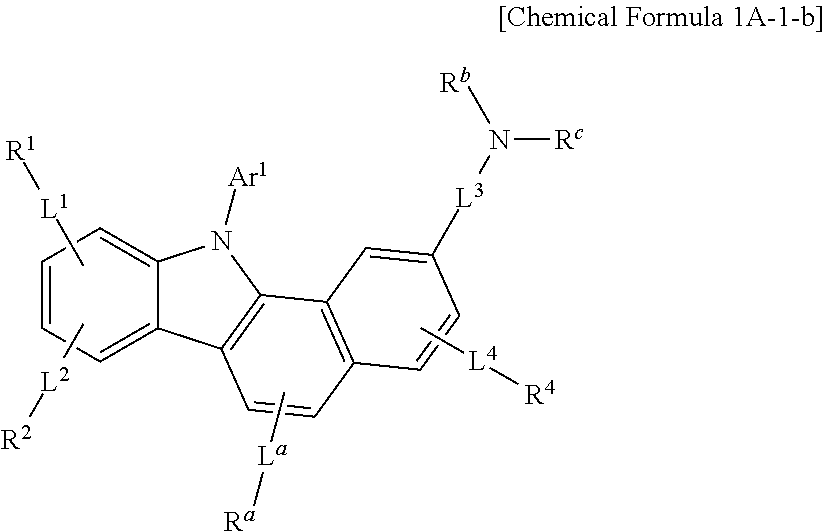
- the first compound may be for example represented by one of Chemical Formula 1A to Chemical Formula 1C according to a fusion position of Chemical Formula 1 and Chemical Formula 2.
- Chemical Formula 1A may be represented by one of Chemical Formula 1A-1 to Chemical Formula 1A-3 according to a substitution position of the group represented by Chemical Formula A.
- Chemical Formula 1A-1 may be represented by one of Chemical Formula 1A-1-a to Chemical Formula 1A-1-d according to a specific substitution position of the group represented by Chemical Formula A.
- Chemical Formula 1A-1 may be represented by Chemical Formula 1A-1-b or Chemical Formula 1A-1-c.
- Chemical Formula 1A-2 may be represented by Chemical Formula 1A-2-a or Chemical Formula 1A-2-b according to a specific substitution position of the group represented by Chemical Formula A.
- Chemical Formula 1A-2 may be represented by Chemical Formula 1A-2-a.
- Chemical Formula 1A-3 may be represented by one of Chemical Formula 1A-3-a to Chemical Formula 1A-3-d according to a specific substitution position of the group represented by Chemical Formula A.
- Chemical Formula 1A-3 may be represented by Chemical Formula 1A-3-b or Chemical Formula 1A-3-c.
- Chemical Formula 1B may be represented by one of Chemical Formula 1B-1 to Chemical Formula 1B-3 according to a substitution position of the group represented by Chemical Formula A.
- Chemical Formula 1B-1 may be represented by one of Chemical Formula 1B-1-a to Chemical Formula 1B-1-d according to a specific substitution position of the group represented by Chemical Formula A.
- Chemical Formula 1B-2 may be represented by Chemical Formula 1B-2-a or Chemical Formula 1B-2-b according to a specific substitution position of the group represented by Chemical Formula A.
- Chemical Formula 1B-3 may be represented by one of Chemical Formula 1B-3-a to Chemical Formula 1B-3-d according to a specific substitution position of the group represented by Chemical Formula A.
- Chemical Formula 1B-3 may be represented by Chemical Formula 1B-3-b.
- Chemical Formula 1C may be represented by one of Chemical Formula 1C-1 to Chemical Formula 1C-3 according to a substitution position of the group represented by Chemical Formula A.
- Chemical Formula 1C-1 may be represented by one of Chemical Formula 1C-1-a to Chemical Formula 1C-1-d according to a specific substitution position of the group represented by Chemical Formula A.
- Chemical Formula 1C-1 may be represented by Chemical Formula 1C-1-b.
- Chemical Formula 1C-2 may be represented by one of Chemical Formula 1C-2-a or Chemical Formula 1C-2-b according to a specific substitution position of the group represented by Chemical Formula A.
- Chemical Formula 1C-3 be represented by one of Chemical Formula 1C-3-a to Chemical Formula 1C-3-d according to a specific substitution position of the group represented by Chemical Formula A.
- Chemical Formula 1C-3 may be represented by Chemical Formula 1C-3-b.
- the first compound may be represented by Chemical Formula 1A, and specifically Chemical Formula 1A-1, for example Chemical Formula 1A-1-b.
- the first compound may be for example one of compounds of Group 1, but is not limited thereto.
- the second compound is represented by Chemical Formula 3.
- the second compound is a compound capable of accepting both holes and electrons when an electric field is applied, that is, a compound having bipolar characteristics, and specifically, may have an effect of improving the glass transition temperature relative to the molecular weight and ensure heat resistance due to the carbazol core represented by Formula 3 substituted with a ring including at least one nitrogen, for example a pyrimidine or triazine.
- the second compound has fast and stable electron transport characteristics, thus may match a balance of holes and electrons by being included with the first compound having fast and stable hole transport characteristics, and may lower a driving voltage of an organic optoelectronic device including the same.
- L 5 to L 9 may independently be a single bond, a substituted or unsubstituted C6 to C20 arylene group, or a substituted or unsubstituted C2 to C20 heterocyclic group.
- L 5 to L 9 may independently be a single bond, a substituted or unsubstituted phenylene group, a substituted or unsubstituted biphenylene group, a substituted or unsubstituted terphenylene group, a substituted or unsubstituted naphthylene group, a substituted or unsubstituted dibenzofuranyl group, a substituted or unsubstituted dibenzothiophenyl group, a substituted or unsubstituted fused dibenzofuranyl group, a substituted or unsubstituted fused dibenzothiophenyl group, or a combination thereof.
- L 5 to L 9 may independently be a single bond, a substituted or unsubstituted m-phenylene group, a substituted or unsubstituted p-phenylene group, a substituted or unsubstituted biphenylene group, or a substituted or unsubstituted terphenylene group.
- Ar 2 may be a substituted or unsubstituted phenyl group, a substituted or unsubstituted biphenyl group, a substituted or unsubstituted terphenyl group, a substituted or unsubstituted naphthyl group, a substituted or unsubstituted anthracenyl group, a substituted or unsubstituted phenanthrenyl group, a substituted or unsubstituted triphenylene group, a substituted or unsubstituted fluorenyl group, the group represented by Chemical Formula B, or a combination thereof.
- Ar 2 may be a substituted or unsubstituted phenyl group, a substituted or unsubstituted biphenyl group, a substituted or unsubstituted naphthyl group, a substituted or unsubstituted fluorenyl group, or the group represented by Chemical Formula B, but is not limited thereto.
- R 5 to R 8 may independently be hydrogen, deuterium, a cyano group, a substituted or unsubstituted phenyl group, a substituted or unsubstituted biphenyl group, a substituted or unsubstituted terphenyl group, a substituted or unsubstituted naphthyl group, a substituted or unsubstituted anthracenyl group, a substituted or unsubstituted phenanthrenyl group, a substituted or unsubstituted triphenylene group, a substituted or unsubstituted fluorenyl group, a substituted or unsubstituted dibenzofuranyl group, a substituted or unsubstituted dibenzothiophenyl group, the group represented by Chemical Formula B, or a combination thereof.
- R 5 to R 8 may independently be hydrogen, deuterium, a cyano group, a substituted or unsubstituted phenyl group, a substituted or unsubstituted biphenyl group, a substituted or unsubstituted terphenyl group, a substituted or unsubstituted naphthyl group, a substituted or unsubstituted dibenzofuranyl group, a substituted or unsubstituted dibenzothiophenyl group or the group represented by Chemical Formula B, but is not limited thereto.
- the second compound may be represented by one of, for example Chemical Formula 2A to Chemical Formula 2L according to a binding position of the group represented by Chemical Formula B.
- L b may independently be a single bond, a substituted or unsubstituted C6 to C20 arylene group, a substituted or unsubstituted C2 to C20 heterocyclic group, or a combination thereof,
- L b may independently be a single bond, a substituted or unsubstituted m-phenylene group, or a substituted or unsubstituted p-phenylene group, but is not limited thereto.
- R d may independently be hydrogen, deuterium, a cyano group, a substituted or unsubstituted C1 to C20 alkyl group, a substituted or unsubstituted C6 to C20 aryl group, a substituted or unsubstituted C2 to C20 heterocyclic group, or a combination thereof,
- R d may independently be hydrogen, deuterium, a cyano group, a substituted or unsubstituted phenyl group, a substituted or unsubstituted m-biphenyl group, a substituted or unsubstituted p-biphenyl group, a substituted or unsubstituted triphenylene group, a substituted or unsubstituted fluorenyl group, a substituted or unsubstituted dibenzofuranyl group, or a substituted or unsubstituted dibenzothiophenyl group, but is not limited thereto.
- R d is independently present or adjacent groups thereof are linked with each other to form a substituted or unsubstituted monocyclic or polycyclic ring, or a substituted or unsubstituted aromatic monocyclic or polycyclic heteroring.
- At least two of Z 1 to Z 5 may be N and R d may independently be present.
- the group represented by Chemical Formula B may be a substituted or unsubstituted pyrimidinyl group or a substituted or unsubstituted triazinyl group.
- Z 1 and Z 3 may be N and Z 2 , Z 4 , and Z 5 may independently be C-L b -R d ;
- Z 3 and Z 5 may be N and Z 1 , Z 2 , and Z 4 may independently be C-L b -R d ; or
- Z 2 and Z 4 may be N and Z 1 , Z 3 , and Z 5 may independently be C-L b -R d .
- L b and R d are the same as described above.
- Z 1 , Z 3 , and Z 5 may be N and Z 2 and Z 4 may independently be C-L b -R d .
- L b and R d are the same as described above.
- At least one of Z 1 to Z 5 may be N and R d is linked with each other to form a substituted or unsubstituted aromatic monocyclic ring or a substituted or unsubstituted aromatic monocyclic heteroring.
- the group represented by Chemical Formula B may be a substituted or unsubstituted quinolinyl group, a substituted or unsubstituted isoquinolinyl group, a substituted or unsubstituted quinoxalinyl group, a substituted or unsubstituted quinazolinyl group, or a substituted or unsubstituted naphthyridinyl group.
- Z 3 and Z 4 may independently be C—R d , adjacent R d 's are linked with each other to form a benzene ring, and one of Z 1 , Z 2 , and Z 5 may be N.
- Z 3 and Z 4 may independently be C—R d , adjacent R d 's are linked with each other to form a benzene ring, and two of Z 1 , Z 2 , and Z 5 may be N.
- Z 3 and Z 4 may independently be C—R d , adjacent R d 's are linked with each other to form a benzene ring, and each of Z 1 , Z 2 , and Z 5 may be N.
- Chemical Formula B may be represented by one of Chemical Formulae B-1 to B-7, but is not limited thereto.
- the group represented by Chemical Formula B may be a substituted or unsubstituted pyrimidinyl group, a substituted or unsubstituted triazinyl group, a substituted or unsubstituted quinoxalinyl group, a substituted or unsubstituted quinazolinyl group, or a substituted or unsubstituted naphthyridinyl group.
- Chemical Formula B may be one of substituents of Group I.
- Chemical Formula 2A may be represented by one of Chemical Formula 2A-1 to Chemical Formula 2A-4 according to a specific binding position of the group represented by Chemical Formula B.
- Chemical Formula 2C may be represented by one of Chemical Formula 2C-1 to Chemical Formula 2C-4 according to a specific binding position of the group represented by Chemical Formula B.
- L 5 to L 9 , R 6 to R 8 , Z 1 a to Z 5a and Z 1b to Z 5b are the same as described above.
- the second compound may be represented by one of Chemical Formula 2B, Chemical Formula 2C, Chemical Formula 2D, Chemical Formula 2E, and Chemical Formula 2F, for example Chemical Formula 2B or Chemical Formula 2F.
- the second compound may be for example one of compounds of Group 2, but is not limited thereto.
- the first compound and the second compound may be for example included in a weight ratio of 1:99 to 99:1.
- a desirable weight ratio may be adjusted using a hole transport capability of the first compound and an electron transport capability of the second compound to realize bipolar characteristics and thus to improve efficiency and life-span.
- they may be for example included in a weight ratio of about 10:90 to 90:10, about 20:80 to 80:20, about 30:70 to 70:30, about 40:60 to 60:40, or about 50:50.
- they may be included in a weight ratio of about 50:50 to 60:40, for example, about 50:50 or about 60:40.
- composition according to an example embodiment of the present invention may include a compound represented by Chemical Formula 1A-1-b as a first compound and a compound represented by Chemical Formula 2B or Chemical Formula 2F as a second compound.
- Ar 1 may be a substituted or unsubstituted phenyl group, a substituted or unsubstituted biphenyl group, a substituted or unsubstituted terphenyl group, a substituted or unsubstituted naphthyl group, a substituted or unsubstituted anthracenyl group, a substituted or unsubstituted phenanthrenyl group, a substituted or unsubstituted triphenylene group, a substituted or unsubstituted fluorenyl group, a substituted or unsubstituted dibenzofuranyl group, a substituted or unsubstituted dibenzothiophenyl group, a substituted or unsubstituted carbazolyl group, or a combination thereof, L a and L 1 to L 4 may independently be a single bond, a substituted or unsubstituted phenylene group
- L 5 to L 9 may independently be a single bond, a substituted or unsubstituted phenylene group, a substituted or unsubstituted biphenylene group, a substituted or unsubstituted terphenylene group, or a substituted or unsubstituted naphthylene group
- R 5 to R 8 , R e , R f , and R g may independently be hydrogen, deuterium, a substituted or unsubstituted C1 to C30 alkyl group, a substituted or unsubstituted C6 to C30 aryl group, a substituted or unsubstituted C2 to C30 heterocyclic group, a substituted or unsubstituted silyl group, a substituted or unsubstituted amine group, a halogen, a cyano group, or a combination thereof.
- Z 1 to Z 5 may independently be N or C-L b -R d , at least two of Z 1 to Z 5 may be N, L b may independently be a single bond, or a substituted or unsubstituted C6 to C20 arylene group, and R d may independently be a substituted or unsubstituted phenyl group, a substituted or unsubstituted biphenyl group, a substituted or unsubstituted terphenyl group, a substituted or unsubstituted anthracenyl group, a substituted or unsubstituted naphthyl group, a substituted or unsubstituted phenanthrenyl group, a substituted or unsubstituted triphenylene group, a substituted or unsubstituted fluorenyl group, a substituted or unsubstituted carbazolyl group, a substituted or unsubstituted dibenzofuranyl
- the composition may further include at least one compound in addition to the first compound and the second compound.
- the composition may further include a dopant.
- the dopant may be for example a phosphorescent dopant, for example a red, green, or blue phosphorescent dopant, for example a red phosphorescent dopant.
- the dopant is a material mixed in a small amount with the first compound and the second compound to cause light emission and generally a material such as a metal complex that emits light by multiple excitations into a triplet or more.
- the dopant may be, for example an inorganic, organic, or organic/inorganic compound, and one or more kinds thereof may be used.
- Examples of the dopant may be a phosphorescent dopant and examples of the phosphorescent dopant may be an organic metal compound including Ir, Pt, Os, Ti, Zr, Hf, Eu, Tb, Tm, Fe, Co, Ni, Ru, Rh, Pd, or a combination thereof.
- the phosphorescent dopant may be, for example a compound represented by Chemical Formula Z, but is not limited thereto. L 10 MX [Chemical Formula Z]
- M is a metal
- L 10 and X are the same or different, and are a ligand to form a complex compound with M.
- the M may be for example Ir, Pt, Os, Ti, Zr, Hf, Eu, Tb, Tm, Fe, Co, Ni, Ru, Rh, Pd, or a combination thereof, and the L 10 and X may be, for example a bidentate ligand.
- the composition may be formed by a dry film formation method such as chemical vapor deposition (CVD).
- CVD chemical vapor deposition
- the organic optoelectronic device may be any device to convert electrical energy into photoenergy and vice versa without particular limitation, and may be for example an organic photoelectric device, an organic light emitting diode, an organic solar cell, and an organic photo conductor drum.
- FIGS. 1 and 2 are cross-sectional views showing organic light emitting diodes according to embodiments.
- an organic optoelectronic device 100 includes an anode 120 and a cathode 110 and facing each other and an organic layer 105 disposed between the anode 120 and the cathode 110 .
- the anode 120 may be made of a conductor having a large work function to help hole injection, and may be for example a metal, a metal oxide and/or a conductive polymer.
- the anode 120 may be, for example a metal such as nickel, platinum, vanadium, chromium, copper, zinc, gold, and the like or an alloy thereof; metal oxide such as zinc oxide, indium oxide, indium tin oxide (ITO), indium zinc oxide (IZO), and the like; a combination of metal and oxide such as ZnO and Al or SnO 2 and Sb; a conductive polymer such as poly(3-methylthiophene), poly(3,4-(ethylene-1,2-dioxy)thiophene) (PEDOT), polypyrrole, and polyaniline, but is not limited thereto.
- a metal such as nickel, platinum, vanadium, chromium, copper, zinc, gold, and the like or an alloy thereof
- metal oxide such as zinc oxide, indium oxide, indium
- the cathode 110 may be made of a conductor having a small work function to help electron injection, and may be for example a metal, a metal oxide and/or a conductive polymer.
- the cathode 110 may be for example a metal such as magnesium, calcium, sodium, potassium, titanium, indium, yttrium, lithium, gadolinium, aluminum silver, tin, lead, cesium, barium, and the like or an alloy thereof; a multi-layer structure material such as LiF/Al, LiO 2 /Al, LiF/Ca, LiF/Al and BaF 2 /Ca, but is not limited thereto.
- the organic layer 105 includes a light emitting layer 130 including the composition.
- the light emitting layer 130 may include for example the composition.
- the composition may be for example a red light emitting composition.
- the light emitting layer 130 may include for example the first compound and the second compound as a phosphorescent host.
- an organic light emitting diode 200 further includes a hole auxiliary layer 140 in addition to the light emitting layer 130 .
- the hole auxiliary layer 140 may further increase hole injection and/or hole mobility while blocking electrons between the anode 120 and the light emitting layer 130 .
- the hole auxiliary layer 140 may include for example at least one of a hole transport layer, a hole injection layer, and/or an electron blocking layer.
- the hole auxiliary layer 140 may include for example at least one of compounds of Group D.
- the hole auxiliary layer 140 may include a hole transport layer between the anode 120 and the light emitting layer 130 and a hole transport auxiliary layer between the light emitting layer 130 and the hole transport layer, and at least one of compounds of Group D may be included in the hole transport auxiliary layer.
- an organic light emitting diode may further include an electron transport layer, an electron injection layer, or a hole injection layer as the organic layer 105 .
- the organic light emitting diodes 100 and 200 may be manufactured by forming an anode or a cathode on a substrate, forming an organic layer using a dry film formation method such as a vacuum deposition method (evaporation), sputtering, plasma plating, and ion plating, and forming a cathode or an anode thereon.
- a dry film formation method such as a vacuum deposition method (evaporation), sputtering, plasma plating, and ion plating, and forming a cathode or an anode thereon.
- the organic light emitting diode may be applied to an organic light emitting display device.
- Phenylhydrazine hydrochloride (70.0 g, 484.1 mmol) and 7-bromo-3,4-dihydro-2H-naphthalen-1-one (108.9 g, 484.1 mmol) were put in a round-bottomed flask and then, dissolved in ethanol (1200 ml). 60 mL of hydrochloric acid was slowly added in a dropwise fashion thereto at room temperature, and the obtained mixture was stirred at 90° C. for 12 hours. When a reaction was complete, the solvent was removed therefrom under a reduced pressure, and an extract was obtained therefrom by using an excessive amount of EA. After removing the organic solvent under a reduced pressure, the extract was stirred in a small amount of methanol and then, filtered to obtain 95.2 g of Intermediate A-2-1 (66%).
- Compound A-3 was synthesized according to the same method as the d) of Synthesis Example 1 by using Intermediate A-3-3 and bis-biphenyl-4-yl-amine in an equivalent ratio of 1:1.
- Compound A-5 was synthesized according to the same method as the d) of Synthesis Example 1 by using Intermediate A-5-4 and bis-biphenyl-4-yl-amine in an equivalent ratio of 1:1.
- Compound A-7 was synthesized according to the same method as the d) of Synthesis Example 1 by using Intermediate A-7-3 and bis-biphenyl-4-yl-amine in an equivalent ratio of 1:1.
- Compound A-8 was synthesized according to the same method as the d) of Synthesis Example 1 by using Intermediate A-8-3 and bis-biphenyl-4-yl-amine in an equivalent ratio of 1:1.
- Compound A-11 was synthesized according to the same method as the d) of Synthesis Example 1 by using Intermediate A-11-2 and Intermediate A-2-3 in an equivalent ratio of 1:1.
- Compound A-12 was synthesized according to the same method as the d) of Synthesis Example 1 by using Intermediate A-3-3 and Intermediate A-11-2 in an equivalent ratio of 1:1.
- Compound A-29 was synthesized according to the same method as the d) of Synthesis Example 1 by using Intermediate A-29-1 and Intermediate A-2-3 in an equivalent ratio of 1:1.
- Compound A-51 was synthesized according to the same method as the d of Synthesis Example 1 by using Intermediate A-51-1 and bis-biphenyl-4-yl-amine in an equivalent ratio of 1:1.
- 1,4-Dibromo-2-nitro-benzene (30.0 g, 106.8 mmol), 2-naphthalene boronic acid (18.4 g, 106.8 mmol), K 2 CO 3 (29.5 g, 213.6 mmol), and Pd(PPh 3 ) 4 (3.7 g, 3.2 mmol) were put in a round-bottomed flask and then, dissolved in 300 mL of tetrahydrofuran and 150 mL of distilled water, and the solution was stirred at 80° C. for 12 hours. When a reaction was complete, an aqueous layer was removed, and the rest thereof was treated through column chromatography to obtain 27.0 g of Intermediate A-65-1 (77%).
- 3-Bromocarbazole 35 g, 142 mmol was dissolved in 0.5 L of tetrahydrofuran (THF) in a 1 L round-bottomed flask, phenyl boronic acid (17.3 g, 142 mmol) and tetrakis(triphenylphosphine)palladium (8.2 g, 7.1 mmol) were added thereto, and the mixture was stirred. Subsequently, potassium carbonate (49.1 g, 356 mmol) saturated in water was added thereto, and the obtained mixture was heated and refluxed at 80° C. for 12 hours.
- THF tetrahydrofuran
- Comparative Compound 1 was synthesized according to c) of Comparative Synthesis Example by using Intermediate 1-5 and Intermediate of 1-(4-bromophenyl)-4-phenylbenzene.
- Comparative Compound 2 was synthesized according to e) of Comparative Synthesis Example 1 by using Intermediate 2-1 and Intermediate 2-2.
- Comparative Compound 3 was synthesized according to the same method as e) of Comparative Synthesis Example 1 by using Intermediate 3-2 and 2-(4-chlorophenyl)naphthalene.
- ITO indium tin oxide
- a solvent such as isopropyl alcohol, acetone, methanol, and the like
- This obtained ITO transparent electrode was used as an anode
- Compound A was vacuum-deposited on the ITO substrate to form a 700 ⁇ -thick hole injection layer
- Compound B was deposited to be 50 ⁇ thick on the injection layer
- Compound C was deposited to be 1020 ⁇ thick to form a hole transport layer.
- a 400 ⁇ -thick hole transport auxiliary layer was formed by depositing Compound C-1.
- a 400 ⁇ -thick light emitting layer was formed by vacuum-depositing Compounds A-2 and B-42 as a host simultaneously and 2 wt % of [Ir(piq) 2 acac] as a dopant.
- Compound A-2 and Compound B-42 were used in a weight ratio of 6:4, and their ratio in the following Examples was separately provided.
- a 300 ⁇ -thick electron transport layer was formed by simultaneously vacuum-depositing the compound D and Liq in a ratio of 1:1, and on the electron transport layer, Liq and A1 were sequentially vacuum-deposited to be 15 ⁇ thick and 1200 ⁇ thick, manufacturing an organic light emitting diode.
- the organic light emitting diode had a five-layered organic thin layer, and specifically the following structure.
- Each organic light emitting diode was manufactured according to the same method as Example 1 except that compositions are changed as shown in Tables 1 to 5.
- the obtained organic light emitting diodes were measured regarding a current value flowing in the unit device, while increasing the voltage from 0 V to 10 V using a current-voltage meter (Keithley 2400), and the measured current value was divided by area to provide the results.
- Luminance was measured by using a luminance meter (Minolta Cs-1000 ⁇ ), while the voltage of the organic light emitting diodes was increased from 0 V to 10 V.
- T 97 life-span ratio (%) ⁇ [ T 97 ( h ) of Example (applying a first compound as a first host)]/[ T 97 ( h ) of Comparative Example (applying a comparative compound as a first host)] ⁇ 100
- a driving voltage of each diode was measured using a current-voltage meter (Keithley 2400) at 15 mA/cm 2 .
- a relative comparison value of Example (applying a first compound as a first host) and Comparative Example (applying a comparative compound as a first host) applying the same second host is calculated.
- Driving voltage ratio (%) ⁇ [Driving voltage ( V ) of Example (applying a first compound as a first host)]/[Driving voltage ( V ) of Comparative Example (applying a comparative compound as a first host)] ⁇ 100
- organic light emitting diodes according to Examples 1 to 6 exhibited remarkably improved driving voltage, and life-span compared with those of Comparative Examples 1 to 5.
Landscapes
- Chemical & Material Sciences (AREA)
- Organic Chemistry (AREA)
- Physics & Mathematics (AREA)
- Spectroscopy & Molecular Physics (AREA)
- Engineering & Computer Science (AREA)
- Materials Engineering (AREA)
- Optics & Photonics (AREA)
- Electroluminescent Light Sources (AREA)
- Photovoltaic Devices (AREA)
Abstract
Description

-
- Ar1 is a substituted or unsubstituted C6 to C30 aryl group, a substituted or unsubstituted C2 to C30 heterocyclic group, or a combination thereof,
- adjacent two of a1* to a4* are linked with b1* and b2*, respectively,
- remaining two of a1* to a4* not being linked with b1* and b2* are independently C-La-Ra,
- La and L1 to L4 are independently a single bond, a substituted or unsubstituted C6 to C20 arylene group, a substituted or unsubstituted C2 to C20 heterocyclic group, or a combination thereof,
- Ra and R1 to R4 are independently hydrogen, deuterium, a cyano group, a substituted or unsubstituted amine group, a substituted or unsubstituted C1 to C30 alkyl group, a substituted or unsubstituted C6 to C30 aryl group, a substituted or unsubstituted C2 to C30 heterocyclic group, or a combination thereof, and
- at least one of Ra and R1 to R4 is a group represented by Chemical Formula A,

-
- wherein, in Chemical Formula A,
- Rb and Rc are independently a substituted or unsubstituted C6 to C30 aryl group, a substituted or unsubstituted C2 to C30 heterocyclic group, or a combination thereof, and
- * is a linking point with La and L1 to L4;

-
- wherein, in Chemical Formula 3,
- L5 to L9 are independently a single bond, a substituted or unsubstituted C6 to C20 arylene group, a substituted or unsubstituted C2 to C20 heterocyclic group, or a combination thereof,
- Ar2 is a substituted or unsubstituted C6 to C30 aryl group, a substituted or unsubstituted C2 to C30 heterocyclic group, or a combination thereof,
- R5 to R8 are independently hydrogen, deuterium, a substituted or unsubstituted C1 to C30 alkyl group, a substituted or unsubstituted C6 to C30 aryl group, a substituted or unsubstituted C2 to C30 heterocyclic group, a substituted or unsubstituted silyl group, a substituted or unsubstituted amine group, a halogen, a cyano group, or a combination thereof,
- R5 to R8 are independently present or adjacent groups thereof are linked with each other to form a substituted or unsubstituted aromatic monocyclic or polycyclic ring, and
- at least one of Ar2 and R5 to R8 is a group represented by Chemical Formula B,

-
- wherein, in Chemical Formula B,
- Z1 to Z5 are independently N or C-Lb-Rd,
- at least one of Z1 to Z5 is N,
- wherein Lb is independently a single bond, a substituted or unsubstituted C6 to C20 arylene group, a substituted or unsubstituted C2 to C20 heterocyclic group, or a combination thereof,
- Rd is independently hydrogen, deuterium, a substituted or unsubstituted C1 to C30 alkyl group, a substituted or unsubstituted C6 to C30 aryl group, a substituted or unsubstituted C2 to C30 heterocyclic group, a substituted or unsubstituted silyl group, a substituted or unsubstituted amine group, a halogen, a cyano group, or a combination thereof,
- Rd is independently present or adjacent groups thereof are linked with each other to form a substituted or unsubstituted aromatic monocyclic or polycyclic ring, or a substituted or unsubstituted aromatic monocyclic or polycyclic heteroring, and
- * is a linking point with L5 to L9.
-
- 100, 200: organic light emitting diode
- 105: organic layer
- 110: cathode
- 120: anode
- 130: light emitting layer
- 140: hole auxiliary layer

-
- Ar1 is a substituted or unsubstituted C6 to C30 aryl group, a substituted or unsubstituted C2 to C30 heterocyclic group, or a combination thereof,
- adjacent two of a1* to a4* are linked with b1* and b2*, respectively,
- remaining two of a1* to a4* not being linked with b1* and b2* are independently C-La-Ra,
- La and L1 to L4 are independently a single bond, a substituted or unsubstituted C6 to C20 arylene group, a substituted or unsubstituted C2 to C20 heterocyclic group, or a combination thereof,
- Ra and R1 to R4 are independently hydrogen, deuterium, a cyano group, a substituted or unsubstituted amine group, a substituted or unsubstituted C1 to C30 alkyl group, a substituted or unsubstituted C6 to C30 aryl group, a substituted or unsubstituted C2 to C30 heterocyclic group, or a combination thereof, and
- at least one of Ra and R1 to R4 is a group represented by Chemical Formula A,

-
- wherein, in Chemical Formula A,
- Rb and Rc are independently a substituted or unsubstituted C6 to C30 aryl group, a substituted or unsubstituted C2 to C30 heterocyclic group, or a combination thereof, and
- * is a linking point with La and L1 to L4;


-
- L5 to L9 are independently a single bond, a substituted or unsubstituted C6 to C20 arylene group, a substituted or unsubstituted C2 to C20 heterocyclic group, or a combination thereof,
- Ar2 is a substituted or unsubstituted C6 to C30 aryl group, a substituted or unsubstituted C2 to C30 heterocyclic group, or a combination thereof,
- R5 to R$ are independently hydrogen, deuterium, a substituted or unsubstituted C1 to C30 alkyl group, a substituted or unsubstituted C6 to C30 aryl group, a substituted or unsubstituted C2 to C30 heterocyclic group, a substituted or unsubstituted silyl group, a substituted or unsubstituted amine group, a halogen, a cyano group, or a combination thereof,
- R5 to R8 are independently present or adjacent groups thereof are linked with each other to form a substituted or unsubstituted aromatic monocyclic or polycyclic ring,
- at least one of Ar2 and R5 to R8 is a group represented by Chemical Formula B,

-
- wherein, in Chemical Formula B,
- Z1 to Z5 are independently N or C-Lb-Rd,
- at least one of Z1 to Z5 is N,
- wherein Lb is independently a single bond, a substituted or unsubstituted C6 to C20 arylene group, a substituted or unsubstituted C2 to C20 heterocyclic group, or a combination thereof,
- Rd is independently hydrogen, deuterium, a substituted or unsubstituted C1 to C30 alkyl group, a substituted or unsubstituted C6 to C30 aryl group, a substituted or unsubstituted C2 to C30 heterocyclic group, a substituted or unsubstituted silyl group, a substituted or unsubstituted amine group, a halogen, a cyano group, or a combination thereof,
- Rd is independently present or adjacent groups thereof are linked with each other to form a substituted or unsubstituted aromatic monocyclic or polycyclic ring, or a substituted or unsubstituted aromatic monocyclic or polycyclic heteroring, and
- * is a linking point with L5 to L9.


-
- Re, Rf, Rg, Rh, Ri, and Rj are the same as R5 to R8,
- Z1a to Z5a are the same as Z1 to Z5, and
- Z1b to Z5b are the same as Z1 to Z5.
-
- for example Lb may independently be a single bond, a substituted or unsubstituted phenylene group, a substituted or unsubstituted biphenylene group, a substituted or unsubstituted terphenylene group, a substituted or unsubstituted fluorenylene group, a substituted or unsubstituted dibenzofuranylene group, or a substituted or unsubstituted dibenzothiophenylene group.
-
- for example, Rd may independently be hydrogen, deuterium, a cyano group, a substituted or unsubstituted phenyl group, a substituted or unsubstituted biphenyl group, a substituted or unsubstituted naphthyl group, a substituted or unsubstituted terphenyl group, a substituted or unsubstituted anthracenyl group, a substituted or unsubstituted phenanthrene group, a substituted or unsubstituted triphenylene group, a substituted or unsubstituted fluorenyl group, a substituted or unsubstituted carbazolyl group, a substituted or unsubstituted dibenzofuranyl group, or a substituted or unsubstituted dibenzothiophenyl group.

-
- Lb1 to Lb5 and Lc1 and Lc2 are the same as Lb, and
- Rd1 to Rd5, Rk1, and Rk2 are the same as Rd.


L10MX [Chemical Formula Z]


-
- Compound A: N4,N4′-diphenyl-N4,N4′-bis(9-phenyl-9H-carbazol-3-yl)biphenyl-4,4′-diamine
- Compound B: 1,4,5,8,9,11-hexaazatriphenylene-hexacarbonitrile (HAT-CN)
- Compound C: N-(biphenyl-4-yl)-9,9-dimethyl-N-(4-(9-phenyl-9H-carbazol-3-yl)phenyl)-9H-fluoren-2-amine
- Compound C-1: N,N-di([1,1′-biphenyl]-4-yl)-7,7-dimethyl-7H-fluoreno[4,3-b]benzofuran-10-amine
- Compound D: 8-(4-(4,6-di(naphthalen-2-yl)-1,3,5-triazin-2-yl)phenyl)quinoline
T97 life-span ratio (%)={[T97 (h) of Example (applying a first compound as a first host)]/[T97 (h) of Comparative Example (applying a comparative compound as a first host)]}×100
Driving voltage ratio (%)={[Driving voltage (V) of Example (applying a first compound as a first host)]/[Driving voltage (V) of Comparative Example (applying a comparative compound as a first host)]}×100
| TABLE 1 | |||||||
| First host: | T97 | ||||||
| Second | Driving | life- | |||||
| host | Driving | voltage | span | ||||
| First | Second | ratio | voltage | ratio | ratio | ||
| host | host | (wt:wt) | Color | (V) | (%) | (%) | |
| Example 1 | A-2 | B-42 | 6:4 | red | 3.91 | 95 | 656 |
| Comparative | Comparative | B-42 | 6:4 | red | 4.10 | 100 | 100 |
| Example 1 | Compound 2 | ||||||
| TABLE 2 | |||||||
| First host: | T97 | ||||||
| Second | Driving | life- | |||||
| host | Driving | voltage | span | ||||
| First | Second | ratio | voltage | ratio | ratio | ||
| host | host | (wt:wt) | Color | (V) | (%) | (%) | |
| Example 2 | A-2 | B-8 | 6:4 | red | 3.88 | 91 | 379 |
| Example 3 | A-11 | B-8 | 6:4 | red | 3.67 | 86 | 957 |
| Comparative | Comparative | B-8 | 6:4 | red | 4.26 | 100 | 100 |
| Example 2 | Compound 1 | ||||||
| TABLE 3 | |||||||
| First host: | T97 | ||||||
| Second | Driving | life- | |||||
| host | Driving | voltage | span | ||||
| First | Second | ratio | voltage | ratio | ratio | ||
| host | host | (wt:wt) | Color | (V) | (%) | (%) | |
| Example 4 | A-2 | B-12 | 6:4 | red | 3.81 | 92 | 208 |
| Comparative | Comparative | B-12 | 6:4 | red | 4.13 | 100 | 100 |
| Example 3 | Compound 3 | ||||||
| TABLE 4 | |||||||
| First host: | T97 | ||||||
| Second | Driving | life- | |||||
| host | Driving | voltage | span | ||||
| First | Second | ratio | voltage | ratio | ratio | ||
| host | host | (wt:wt) | Color | (V) | (%) | (%) | |
| Example 5 | A-2 | B-25 | 5:5 | red | 3.79 | 93 | 425 |
| Comparative | Comparative | B-25 | 5:5 | red | 4.08 | 100 | 100 |
| Example 4 | Compound 1 | ||||||
| TABLE 5 | |||||||
| First host: | T97 | ||||||
| Second | Driving | life- | |||||
| host | Driving | voltage | span | ||||
| First | Second | ratio | voltage | ratio | ratio | ||
| host | host | (wt:wt) | Color | (V) | (%) | (%) | |
| Example 6 | A-2 | B-55 | 5:5 | red | 3.66 | 87 | 123 |
| Comparative | Comparative | B-55 | 5:5 | red | 4.20 | 100 | 100 |
| Example 5 | Compound 1 | ||||||
Claims (17)



Applications Claiming Priority (3)
| Application Number | Priority Date | Filing Date | Title |
|---|---|---|---|
| KR10-2018-0046910 | 2018-04-23 | ||
| KR1020180046910A KR20190123138A (en) | 2018-04-23 | 2018-04-23 | Composition and organic optoelectronic device and display device |
| PCT/KR2019/003444 WO2019208937A1 (en) | 2018-04-23 | 2019-03-25 | Composition, organic optoelectronic device and display device |
Related Parent Applications (1)
| Application Number | Title | Priority Date | Filing Date |
|---|---|---|---|
| PCT/KR2019/003444 A-371-Of-International WO2019208937A1 (en) | 2018-04-23 | 2019-03-25 | Composition, organic optoelectronic device and display device |
Related Child Applications (1)
| Application Number | Title | Priority Date | Filing Date |
|---|---|---|---|
| US18/753,505 Continuation US12543495B2 (en) | 2018-04-23 | 2024-06-25 | Composition, organic optoelectronic device and display device |
Publications (2)
| Publication Number | Publication Date |
|---|---|
| US20210119136A1 US20210119136A1 (en) | 2021-04-22 |
| US12075694B2 true US12075694B2 (en) | 2024-08-27 |
Family
ID=68295701
Family Applications (2)
| Application Number | Title | Priority Date | Filing Date |
|---|---|---|---|
| US17/047,445 Active 2041-07-17 US12075694B2 (en) | 2018-04-23 | 2019-03-25 | Composition, organic optoelectronic device and display device |
| US18/753,505 Active US12543495B2 (en) | 2018-04-23 | 2024-06-25 | Composition, organic optoelectronic device and display device |
Family Applications After (1)
| Application Number | Title | Priority Date | Filing Date |
|---|---|---|---|
| US18/753,505 Active US12543495B2 (en) | 2018-04-23 | 2024-06-25 | Composition, organic optoelectronic device and display device |
Country Status (5)
| Country | Link |
|---|---|
| US (2) | US12075694B2 (en) |
| KR (4) | KR20190123138A (en) |
| CN (1) | CN112041998B (en) |
| TW (1) | TWI712589B (en) |
| WO (1) | WO2019208937A1 (en) |
Families Citing this family (6)
| Publication number | Priority date | Publication date | Assignee | Title |
|---|---|---|---|---|
| CN113678274B9 (en) * | 2019-11-11 | 2023-10-24 | 株式会社Lg化学 | organic light emitting devices |
| WO2021096331A1 (en) * | 2019-11-11 | 2021-05-20 | 주식회사 엘지화학 | Organic light-emitting diode |
| KR102689559B1 (en) * | 2020-06-08 | 2024-07-26 | 삼성에스디아이 주식회사 | Composition for organic optoelectronic device, organic optoelectronic device and display device |
| KR102689560B1 (en) * | 2020-07-17 | 2024-07-26 | 삼성에스디아이 주식회사 | Composition for organic optoelectronic device, organic optoelectronic device and display device |
| KR102671850B1 (en) * | 2020-08-10 | 2024-05-31 | 삼성에스디아이 주식회사 | Composition for organic optoelectronic device, organic optoelectronic device and display device |
| CN115073428B (en) * | 2022-07-29 | 2024-06-28 | 阜阳欣奕华材料科技有限公司 | Triazine composition and preparation method and application thereof |
Citations (11)
| Publication number | Priority date | Publication date | Assignee | Title |
|---|---|---|---|---|
| JPH11144866A (en) | 1997-11-05 | 1999-05-28 | Toray Ind Inc | Light emitting element |
| WO2010021524A2 (en) | 2008-08-22 | 2010-02-25 | 주식회사 엘지화학 | Material for organic electronic device, and organic electronic device using the same |
| TW201229202A (en) | 2010-11-16 | 2012-07-16 | Rohm & Haas Elect Mat | Novel compound for organic electronic material and organic electroluminescent device using the same |
| KR20150004099A (en) | 2013-07-02 | 2015-01-12 | 덕산하이메탈(주) | An organic electronic element comprising a layer for improving light efficiency, and an electronic device comprising the same |
| KR20160029721A (en) | 2014-09-05 | 2016-03-15 | 주식회사 엘지화학 | Multicyclic compound including nitrogen and organic electronic device using the same |
| KR20170096767A (en) | 2016-02-17 | 2017-08-25 | 주식회사 엘지화학 | Hetero-cyclic compound and organic light emitting device comprising the same |
| KR20170101577A (en) | 2016-02-29 | 2017-09-06 | 주식회사 엘지화학 | Nitrogen-containing compound and organic electronic device using the same |
| WO2017179875A1 (en) | 2016-04-14 | 2017-10-19 | 덕산네오룩스 주식회사 | Compound for organic electronic element, organic electronic element using same, and electronic device thereof |
| WO2017188597A1 (en) | 2016-04-29 | 2017-11-02 | 주식회사 두산 | Organic compound and organic electroluminescent device comprising same |
| WO2018004095A1 (en) | 2016-06-29 | 2018-01-04 | 삼성에스디아이 주식회사 | Compound for organic optoelectronic device, composition for organic optoelectronic device, organic optoelectronic device and display apparatus |
| KR20180032496A (en) | 2016-09-22 | 2018-03-30 | 롬엔드하스전자재료코리아유한회사 | Organic Electroluminescent Device Comprising an Electron Buffer Layer and an Electron Transport Layer |
Family Cites Families (1)
| Publication number | Priority date | Publication date | Assignee | Title |
|---|---|---|---|---|
| KR20120081539A (en) * | 2011-01-11 | 2012-07-19 | (주)씨에스엘쏠라 | Organic light compound and organic light device using the same |
-
2018
- 2018-04-23 KR KR1020180046910A patent/KR20190123138A/en not_active Ceased
-
2019
- 2019-03-25 WO PCT/KR2019/003444 patent/WO2019208937A1/en not_active Ceased
- 2019-03-25 US US17/047,445 patent/US12075694B2/en active Active
- 2019-03-25 CN CN201980027696.8A patent/CN112041998B/en active Active
- 2019-04-19 TW TW108113860A patent/TWI712589B/en active
-
2021
- 2021-06-03 KR KR1020210072011A patent/KR102464924B1/en active Active
-
2022
- 2022-04-29 KR KR1020220053710A patent/KR102636058B1/en active Active
- 2022-04-29 KR KR1020220053709A patent/KR102636056B1/en active Active
-
2024
- 2024-06-25 US US18/753,505 patent/US12543495B2/en active Active
Patent Citations (16)
| Publication number | Priority date | Publication date | Assignee | Title |
|---|---|---|---|---|
| JPH11144866A (en) | 1997-11-05 | 1999-05-28 | Toray Ind Inc | Light emitting element |
| WO2010021524A2 (en) | 2008-08-22 | 2010-02-25 | 주식회사 엘지화학 | Material for organic electronic device, and organic electronic device using the same |
| KR101074193B1 (en) | 2008-08-22 | 2011-10-14 | 주식회사 엘지화학 | Organic electronic device material and organic electronic device using the same |
| TW201229202A (en) | 2010-11-16 | 2012-07-16 | Rohm & Haas Elect Mat | Novel compound for organic electronic material and organic electroluminescent device using the same |
| KR20150004099A (en) | 2013-07-02 | 2015-01-12 | 덕산하이메탈(주) | An organic electronic element comprising a layer for improving light efficiency, and an electronic device comprising the same |
| KR101804630B1 (en) | 2014-09-05 | 2017-12-05 | 주식회사 엘지화학 | Multicyclic compound including nitrogen and organic electronic device using the same |
| KR20160029721A (en) | 2014-09-05 | 2016-03-15 | 주식회사 엘지화학 | Multicyclic compound including nitrogen and organic electronic device using the same |
| KR20170096767A (en) | 2016-02-17 | 2017-08-25 | 주식회사 엘지화학 | Hetero-cyclic compound and organic light emitting device comprising the same |
| KR20170101577A (en) | 2016-02-29 | 2017-09-06 | 주식회사 엘지화학 | Nitrogen-containing compound and organic electronic device using the same |
| WO2017179875A1 (en) | 2016-04-14 | 2017-10-19 | 덕산네오룩스 주식회사 | Compound for organic electronic element, organic electronic element using same, and electronic device thereof |
| KR20170117775A (en) | 2016-04-14 | 2017-10-24 | 덕산네오룩스 주식회사 | Compound for organic electronic element, organic electronic element using the same, and an electronic device thereof |
| WO2017188597A1 (en) | 2016-04-29 | 2017-11-02 | 주식회사 두산 | Organic compound and organic electroluminescent device comprising same |
| KR20170123955A (en) | 2016-04-29 | 2017-11-09 | 주식회사 두산 | Organic compounds and organic electro luminescence device comprising the same |
| WO2018004095A1 (en) | 2016-06-29 | 2018-01-04 | 삼성에스디아이 주식회사 | Compound for organic optoelectronic device, composition for organic optoelectronic device, organic optoelectronic device and display apparatus |
| US20190165281A1 (en) | 2016-06-29 | 2019-05-30 | Samsung Sdi Co., Ltd. | Compound for organic optoelectronic device, composition for organic optoelectronic device, organic optoelectronic device and display apparatus |
| KR20180032496A (en) | 2016-09-22 | 2018-03-30 | 롬엔드하스전자재료코리아유한회사 | Organic Electroluminescent Device Comprising an Electron Buffer Layer and an Electron Transport Layer |
Non-Patent Citations (2)
| Title |
|---|
| Chinese Office action dated Jun. 26, 2024. |
| International Search Report dated Jun. 24, 2019 for PCT/KR2019/003444. |
Also Published As
| Publication number | Publication date |
|---|---|
| US20210119136A1 (en) | 2021-04-22 |
| KR102464924B1 (en) | 2022-11-07 |
| KR20220062247A (en) | 2022-05-16 |
| US20240357924A1 (en) | 2024-10-24 |
| WO2019208937A1 (en) | 2019-10-31 |
| KR20190123138A (en) | 2019-10-31 |
| CN112041998B (en) | 2025-02-11 |
| KR20220062246A (en) | 2022-05-16 |
| US12543495B2 (en) | 2026-02-03 |
| KR102636056B1 (en) | 2024-02-08 |
| TW201943699A (en) | 2019-11-16 |
| CN112041998A (en) | 2020-12-04 |
| KR20210070257A (en) | 2021-06-14 |
| TWI712589B (en) | 2020-12-11 |
| KR102636058B1 (en) | 2024-02-08 |
Similar Documents
| Publication | Publication Date | Title |
|---|---|---|
| US20220069226A1 (en) | Composition for organic optoelectronic element, organic optoelectronic element, and display device | |
| US20190312215A1 (en) | Composition and organic optoelectronic device and display device | |
| US11696498B2 (en) | Compound for an organic optoelectronic device, organic optoelectronic device, and display device using the same | |
| US12543495B2 (en) | Composition, organic optoelectronic device and display device | |
| US20220069229A1 (en) | Compound for organic optoelectronic device, composition for organic optoelectronic device and organic optoelectronic device and display device | |
| US20190198775A1 (en) | Composition and organic optoelectronic device and display device | |
| US12490652B2 (en) | Organic optoelectronic device and display device | |
| US10873033B2 (en) | Organic compound, composition, organic optoelectronic diode, and display device | |
| US11605782B2 (en) | Organic optoelectronic device and display device | |
| US11450806B2 (en) | Composition for organic optoelectronic element, organic optoelectronic element, and display device | |
| US20180155325A1 (en) | Compound for organic optoelectronic device, composition for organic optoelectronic device and organic optoelectronic device and display device | |
| US12122777B2 (en) | Compound for organic optoelectronic device, composition for organic optoelectronic device, organic optoelectronic device, and display device | |
| US20210111350A1 (en) | Phosphorescent host composition, organic optoelectronic diode, and display device | |
| US11362281B2 (en) | Compound for organic optoelectronic diode, composition for organic optoelectronic diode, organic optoelectronic diode, and display apparatus | |
| US20210070706A1 (en) | Composition, organic optoelectronic device, and display device | |
| US20200111967A1 (en) | Composition for organic optoelectronic device and organic optoelectronic device and display device | |
| US12302751B2 (en) | Composition for organic optoelectronic device, organic optoelectronic device, and display device | |
| US12108657B2 (en) | Compound for organic optoelectronic device, composition for organic optoelectronic device, organic optoelectronic device and display device | |
| US20200075866A1 (en) | Composition for organic optoelectronic device and organic optoelectronic device and display device | |
| US20200144508A1 (en) | Organic optoelectronic device and display device | |
| US11659765B2 (en) | Composition for organic optoelectronic element, organic optoelectronic element, and display device | |
| US10516114B2 (en) | Compound for organic optoelectric device, composition for organic optoelectric device and organic optoelectric device and display device | |
| US12127474B2 (en) | Compound for organic optoelectronic device, composition for organic optoelectronic device, organic optoelectronic device, and display device | |
| US12133460B2 (en) | Compound for organic optoelectronic device, composition for organic optoelectronic device, organic optoelectronic device and display device | |
| US20230039779A1 (en) | Composition for organic optoelectronic device, organic optoelectronic device and display device |
Legal Events
| Date | Code | Title | Description |
|---|---|---|---|
| AS | Assignment |
Owner name: SAMSUNG SDI CO., LTD., KOREA, REPUBLIC OF Free format text: ASSIGNMENT OF ASSIGNORS INTEREST;ASSIGNORS:WON, JONGWOO;KANG, DONG MIN;KIM, JUN SEOK;AND OTHERS;REEL/FRAME:054075/0122 Effective date: 20201006 Owner name: SAMSUNG ELECTRONICS CO., LTD., KOREA, REPUBLIC OF Free format text: ASSIGNMENT OF ASSIGNORS INTEREST;ASSIGNORS:WON, JONGWOO;KANG, DONG MIN;KIM, JUN SEOK;AND OTHERS;REEL/FRAME:054075/0122 Effective date: 20201006 |
|
| FEPP | Fee payment procedure |
Free format text: ENTITY STATUS SET TO UNDISCOUNTED (ORIGINAL EVENT CODE: BIG.); ENTITY STATUS OF PATENT OWNER: LARGE ENTITY |
|
| STPP | Information on status: patent application and granting procedure in general |
Free format text: APPLICATION DISPATCHED FROM PREEXAM, NOT YET DOCKETED |
|
| STPP | Information on status: patent application and granting procedure in general |
Free format text: DOCKETED NEW CASE - READY FOR EXAMINATION |
|
| STPP | Information on status: patent application and granting procedure in general |
Free format text: NON FINAL ACTION MAILED |
|
| STPP | Information on status: patent application and granting procedure in general |
Free format text: RESPONSE TO NON-FINAL OFFICE ACTION ENTERED AND FORWARDED TO EXAMINER |
|
| STPP | Information on status: patent application and granting procedure in general |
Free format text: NOTICE OF ALLOWANCE MAILED -- APPLICATION RECEIVED IN OFFICE OF PUBLICATIONS |
|
| ZAAA | Notice of allowance and fees due |
Free format text: ORIGINAL CODE: NOA |
|
| ZAAB | Notice of allowance mailed |
Free format text: ORIGINAL CODE: MN/=. |
|
| STPP | Information on status: patent application and granting procedure in general |
Free format text: PUBLICATIONS -- ISSUE FEE PAYMENT VERIFIED |
|
| STCF | Information on status: patent grant |
Free format text: PATENTED CASE |
|
| STPP | Information on status: patent application and granting procedure in general |
Free format text: PUBLICATIONS -- ISSUE FEE PAYMENT VERIFIED |
|
| STCF | Information on status: patent grant |
Free format text: PATENTED CASE |