US12070506B2 - Steroids and antibody-conjugates thereof - Google Patents
Steroids and antibody-conjugates thereof Download PDFInfo
- Publication number
- US12070506B2 US12070506B2 US16/243,020 US201916243020A US12070506B2 US 12070506 B2 US12070506 B2 US 12070506B2 US 201916243020 A US201916243020 A US 201916243020A US 12070506 B2 US12070506 B2 US 12070506B2
- Authority
- US
- United States
- Prior art keywords
- alkylene
- formula
- attached
- compound
- iii
- Prior art date
- Legal status (The legal status is an assumption and is not a legal conclusion. Google has not performed a legal analysis and makes no representation as to the accuracy of the status listed.)
- Active, expires
Links
Images


Classifications
-
- C—CHEMISTRY; METALLURGY
- C07—ORGANIC CHEMISTRY
- C07J—STEROIDS
- C07J71/00—Steroids in which the cyclopenta(a)hydrophenanthrene skeleton is condensed with a heterocyclic ring
- C07J71/0005—Oxygen-containing hetero ring
- C07J71/0026—Oxygen-containing hetero ring cyclic ketals
- C07J71/0031—Oxygen-containing hetero ring cyclic ketals at positions 16, 17
-
- A—HUMAN NECESSITIES
- A61—MEDICAL OR VETERINARY SCIENCE; HYGIENE
- A61K—PREPARATIONS FOR MEDICAL, DENTAL OR TOILETRY PURPOSES
- A61K47/00—Medicinal preparations characterised by the non-active ingredients used, e.g. carriers or inert additives; Targeting or modifying agents chemically bound to the active ingredient
- A61K47/50—Medicinal preparations characterised by the non-active ingredients used, e.g. carriers or inert additives; Targeting or modifying agents chemically bound to the active ingredient the non-active ingredient being chemically bound to the active ingredient, e.g. polymer-drug conjugates
- A61K47/51—Medicinal preparations characterised by the non-active ingredients used, e.g. carriers or inert additives; Targeting or modifying agents chemically bound to the active ingredient the non-active ingredient being chemically bound to the active ingredient, e.g. polymer-drug conjugates the non-active ingredient being a modifying agent
- A61K47/54—Medicinal preparations characterised by the non-active ingredients used, e.g. carriers or inert additives; Targeting or modifying agents chemically bound to the active ingredient the non-active ingredient being chemically bound to the active ingredient, e.g. polymer-drug conjugates the non-active ingredient being a modifying agent the modifying agent being an organic compound
- A61K47/545—Heterocyclic compounds
-
- A—HUMAN NECESSITIES
- A61—MEDICAL OR VETERINARY SCIENCE; HYGIENE
- A61K—PREPARATIONS FOR MEDICAL, DENTAL OR TOILETRY PURPOSES
- A61K31/00—Medicinal preparations containing organic active ingredients
- A61K31/66—Phosphorus compounds
- A61K31/683—Diesters of a phosphorus acid with two hydroxy compounds, e.g. phosphatidylinositols
- A61K31/685—Diesters of a phosphorus acid with two hydroxy compounds, e.g. phosphatidylinositols one of the hydroxy compounds having nitrogen atoms, e.g. phosphatidylserine, lecithin
-
- A—HUMAN NECESSITIES
- A61—MEDICAL OR VETERINARY SCIENCE; HYGIENE
- A61K—PREPARATIONS FOR MEDICAL, DENTAL OR TOILETRY PURPOSES
- A61K31/00—Medicinal preparations containing organic active ingredients
- A61K31/56—Compounds containing cyclopenta[a]hydrophenanthrene ring systems; Derivatives thereof, e.g. steroids
- A61K31/58—Compounds containing cyclopenta[a]hydrophenanthrene ring systems; Derivatives thereof, e.g. steroids containing heterocyclic rings, e.g. danazol, stanozolol, pancuronium or digitogenin
-
- A—HUMAN NECESSITIES
- A61—MEDICAL OR VETERINARY SCIENCE; HYGIENE
- A61K—PREPARATIONS FOR MEDICAL, DENTAL OR TOILETRY PURPOSES
- A61K31/00—Medicinal preparations containing organic active ingredients
- A61K31/70—Carbohydrates; Sugars; Derivatives thereof
- A61K31/7042—Compounds having saccharide radicals and heterocyclic rings
- A61K31/7048—Compounds having saccharide radicals and heterocyclic rings having oxygen as a ring hetero atom, e.g. leucoglucosan, hesperidin, erythromycin, nystatin, digitoxin or digoxin
-
- A—HUMAN NECESSITIES
- A61—MEDICAL OR VETERINARY SCIENCE; HYGIENE
- A61K—PREPARATIONS FOR MEDICAL, DENTAL OR TOILETRY PURPOSES
- A61K47/00—Medicinal preparations characterised by the non-active ingredients used, e.g. carriers or inert additives; Targeting or modifying agents chemically bound to the active ingredient
- A61K47/50—Medicinal preparations characterised by the non-active ingredients used, e.g. carriers or inert additives; Targeting or modifying agents chemically bound to the active ingredient the non-active ingredient being chemically bound to the active ingredient, e.g. polymer-drug conjugates
- A61K47/51—Medicinal preparations characterised by the non-active ingredients used, e.g. carriers or inert additives; Targeting or modifying agents chemically bound to the active ingredient the non-active ingredient being chemically bound to the active ingredient, e.g. polymer-drug conjugates the non-active ingredient being a modifying agent
- A61K47/54—Medicinal preparations characterised by the non-active ingredients used, e.g. carriers or inert additives; Targeting or modifying agents chemically bound to the active ingredient the non-active ingredient being chemically bound to the active ingredient, e.g. polymer-drug conjugates the non-active ingredient being a modifying agent the modifying agent being an organic compound
- A61K47/542—Carboxylic acids, e.g. a fatty acid or an amino acid
-
- A—HUMAN NECESSITIES
- A61—MEDICAL OR VETERINARY SCIENCE; HYGIENE
- A61K—PREPARATIONS FOR MEDICAL, DENTAL OR TOILETRY PURPOSES
- A61K47/00—Medicinal preparations characterised by the non-active ingredients used, e.g. carriers or inert additives; Targeting or modifying agents chemically bound to the active ingredient
- A61K47/50—Medicinal preparations characterised by the non-active ingredients used, e.g. carriers or inert additives; Targeting or modifying agents chemically bound to the active ingredient the non-active ingredient being chemically bound to the active ingredient, e.g. polymer-drug conjugates
- A61K47/51—Medicinal preparations characterised by the non-active ingredients used, e.g. carriers or inert additives; Targeting or modifying agents chemically bound to the active ingredient the non-active ingredient being chemically bound to the active ingredient, e.g. polymer-drug conjugates the non-active ingredient being a modifying agent
- A61K47/54—Medicinal preparations characterised by the non-active ingredients used, e.g. carriers or inert additives; Targeting or modifying agents chemically bound to the active ingredient the non-active ingredient being chemically bound to the active ingredient, e.g. polymer-drug conjugates the non-active ingredient being a modifying agent the modifying agent being an organic compound
- A61K47/549—Sugars, nucleosides, nucleotides or nucleic acids
-
- A—HUMAN NECESSITIES
- A61—MEDICAL OR VETERINARY SCIENCE; HYGIENE
- A61K—PREPARATIONS FOR MEDICAL, DENTAL OR TOILETRY PURPOSES
- A61K47/00—Medicinal preparations characterised by the non-active ingredients used, e.g. carriers or inert additives; Targeting or modifying agents chemically bound to the active ingredient
- A61K47/50—Medicinal preparations characterised by the non-active ingredients used, e.g. carriers or inert additives; Targeting or modifying agents chemically bound to the active ingredient the non-active ingredient being chemically bound to the active ingredient, e.g. polymer-drug conjugates
- A61K47/51—Medicinal preparations characterised by the non-active ingredients used, e.g. carriers or inert additives; Targeting or modifying agents chemically bound to the active ingredient the non-active ingredient being chemically bound to the active ingredient, e.g. polymer-drug conjugates the non-active ingredient being a modifying agent
- A61K47/68—Medicinal preparations characterised by the non-active ingredients used, e.g. carriers or inert additives; Targeting or modifying agents chemically bound to the active ingredient the non-active ingredient being chemically bound to the active ingredient, e.g. polymer-drug conjugates the non-active ingredient being a modifying agent the modifying agent being an antibody, an immunoglobulin or a fragment thereof, e.g. an Fc-fragment
- A61K47/6801—Drug-antibody or immunoglobulin conjugates defined by the pharmacologically or therapeutically active agent
- A61K47/6803—Drugs conjugated to an antibody or immunoglobulin, e.g. cisplatin-antibody conjugates
-
- A—HUMAN NECESSITIES
- A61—MEDICAL OR VETERINARY SCIENCE; HYGIENE
- A61K—PREPARATIONS FOR MEDICAL, DENTAL OR TOILETRY PURPOSES
- A61K47/00—Medicinal preparations characterised by the non-active ingredients used, e.g. carriers or inert additives; Targeting or modifying agents chemically bound to the active ingredient
- A61K47/50—Medicinal preparations characterised by the non-active ingredients used, e.g. carriers or inert additives; Targeting or modifying agents chemically bound to the active ingredient the non-active ingredient being chemically bound to the active ingredient, e.g. polymer-drug conjugates
- A61K47/51—Medicinal preparations characterised by the non-active ingredients used, e.g. carriers or inert additives; Targeting or modifying agents chemically bound to the active ingredient the non-active ingredient being chemically bound to the active ingredient, e.g. polymer-drug conjugates the non-active ingredient being a modifying agent
- A61K47/68—Medicinal preparations characterised by the non-active ingredients used, e.g. carriers or inert additives; Targeting or modifying agents chemically bound to the active ingredient the non-active ingredient being chemically bound to the active ingredient, e.g. polymer-drug conjugates the non-active ingredient being a modifying agent the modifying agent being an antibody, an immunoglobulin or a fragment thereof, e.g. an Fc-fragment
- A61K47/6835—Medicinal preparations characterised by the non-active ingredients used, e.g. carriers or inert additives; Targeting or modifying agents chemically bound to the active ingredient the non-active ingredient being chemically bound to the active ingredient, e.g. polymer-drug conjugates the non-active ingredient being a modifying agent the modifying agent being an antibody, an immunoglobulin or a fragment thereof, e.g. an Fc-fragment the modifying agent being an antibody or an immunoglobulin bearing at least one antigen-binding site
- A61K47/6849—Medicinal preparations characterised by the non-active ingredients used, e.g. carriers or inert additives; Targeting or modifying agents chemically bound to the active ingredient the non-active ingredient being chemically bound to the active ingredient, e.g. polymer-drug conjugates the non-active ingredient being a modifying agent the modifying agent being an antibody, an immunoglobulin or a fragment thereof, e.g. an Fc-fragment the modifying agent being an antibody or an immunoglobulin bearing at least one antigen-binding site the antibody targeting a receptor, a cell surface antigen or a cell surface determinant
-
- A—HUMAN NECESSITIES
- A61—MEDICAL OR VETERINARY SCIENCE; HYGIENE
- A61K—PREPARATIONS FOR MEDICAL, DENTAL OR TOILETRY PURPOSES
- A61K47/00—Medicinal preparations characterised by the non-active ingredients used, e.g. carriers or inert additives; Targeting or modifying agents chemically bound to the active ingredient
- A61K47/50—Medicinal preparations characterised by the non-active ingredients used, e.g. carriers or inert additives; Targeting or modifying agents chemically bound to the active ingredient the non-active ingredient being chemically bound to the active ingredient, e.g. polymer-drug conjugates
- A61K47/51—Medicinal preparations characterised by the non-active ingredients used, e.g. carriers or inert additives; Targeting or modifying agents chemically bound to the active ingredient the non-active ingredient being chemically bound to the active ingredient, e.g. polymer-drug conjugates the non-active ingredient being a modifying agent
- A61K47/68—Medicinal preparations characterised by the non-active ingredients used, e.g. carriers or inert additives; Targeting or modifying agents chemically bound to the active ingredient the non-active ingredient being chemically bound to the active ingredient, e.g. polymer-drug conjugates the non-active ingredient being a modifying agent the modifying agent being an antibody, an immunoglobulin or a fragment thereof, e.g. an Fc-fragment
- A61K47/6835—Medicinal preparations characterised by the non-active ingredients used, e.g. carriers or inert additives; Targeting or modifying agents chemically bound to the active ingredient the non-active ingredient being chemically bound to the active ingredient, e.g. polymer-drug conjugates the non-active ingredient being a modifying agent the modifying agent being an antibody, an immunoglobulin or a fragment thereof, e.g. an Fc-fragment the modifying agent being an antibody or an immunoglobulin bearing at least one antigen-binding site
- A61K47/6851—Medicinal preparations characterised by the non-active ingredients used, e.g. carriers or inert additives; Targeting or modifying agents chemically bound to the active ingredient the non-active ingredient being chemically bound to the active ingredient, e.g. polymer-drug conjugates the non-active ingredient being a modifying agent the modifying agent being an antibody, an immunoglobulin or a fragment thereof, e.g. an Fc-fragment the modifying agent being an antibody or an immunoglobulin bearing at least one antigen-binding site the antibody targeting a determinant of a tumour cell
- A61K47/6855—Medicinal preparations characterised by the non-active ingredients used, e.g. carriers or inert additives; Targeting or modifying agents chemically bound to the active ingredient the non-active ingredient being chemically bound to the active ingredient, e.g. polymer-drug conjugates the non-active ingredient being a modifying agent the modifying agent being an antibody, an immunoglobulin or a fragment thereof, e.g. an Fc-fragment the modifying agent being an antibody or an immunoglobulin bearing at least one antigen-binding site the antibody targeting a determinant of a tumour cell the tumour determinant being from breast cancer cell
-
- A—HUMAN NECESSITIES
- A61—MEDICAL OR VETERINARY SCIENCE; HYGIENE
- A61K—PREPARATIONS FOR MEDICAL, DENTAL OR TOILETRY PURPOSES
- A61K47/00—Medicinal preparations characterised by the non-active ingredients used, e.g. carriers or inert additives; Targeting or modifying agents chemically bound to the active ingredient
- A61K47/50—Medicinal preparations characterised by the non-active ingredients used, e.g. carriers or inert additives; Targeting or modifying agents chemically bound to the active ingredient the non-active ingredient being chemically bound to the active ingredient, e.g. polymer-drug conjugates
- A61K47/51—Medicinal preparations characterised by the non-active ingredients used, e.g. carriers or inert additives; Targeting or modifying agents chemically bound to the active ingredient the non-active ingredient being chemically bound to the active ingredient, e.g. polymer-drug conjugates the non-active ingredient being a modifying agent
- A61K47/68—Medicinal preparations characterised by the non-active ingredients used, e.g. carriers or inert additives; Targeting or modifying agents chemically bound to the active ingredient the non-active ingredient being chemically bound to the active ingredient, e.g. polymer-drug conjugates the non-active ingredient being a modifying agent the modifying agent being an antibody, an immunoglobulin or a fragment thereof, e.g. an Fc-fragment
- A61K47/6889—Conjugates wherein the antibody being the modifying agent and wherein the linker, binder or spacer confers particular properties to the conjugates, e.g. peptidic enzyme-labile linkers or acid-labile linkers, providing for an acid-labile immuno conjugate wherein the drug may be released from its antibody conjugated part in an acidic, e.g. tumoural or environment
-
- C—CHEMISTRY; METALLURGY
- C07—ORGANIC CHEMISTRY
- C07K—PEPTIDES
- C07K16/00—Immunoglobulins [IG], e.g. monoclonal or polyclonal antibodies
- C07K16/18—Immunoglobulins [IG], e.g. monoclonal or polyclonal antibodies against material from animals or humans
- C07K16/28—Immunoglobulins [IG], e.g. monoclonal or polyclonal antibodies against material from animals or humans against receptors, cell surface antigens or cell surface determinants
- C07K16/2866—Immunoglobulins [IG], e.g. monoclonal or polyclonal antibodies against material from animals or humans against receptors, cell surface antigens or cell surface determinants against receptors for cytokines, lymphokines, interferons
-
- C—CHEMISTRY; METALLURGY
- C07—ORGANIC CHEMISTRY
- C07K—PEPTIDES
- C07K16/00—Immunoglobulins [IG], e.g. monoclonal or polyclonal antibodies
- C07K16/18—Immunoglobulins [IG], e.g. monoclonal or polyclonal antibodies against material from animals or humans
- C07K16/28—Immunoglobulins [IG], e.g. monoclonal or polyclonal antibodies against material from animals or humans against receptors, cell surface antigens or cell surface determinants
- C07K16/2896—Immunoglobulins [IG], e.g. monoclonal or polyclonal antibodies against material from animals or humans against receptors, cell surface antigens or cell surface determinants against molecules with a "CD"-designation, not provided for elsewhere
-
- C—CHEMISTRY; METALLURGY
- C07—ORGANIC CHEMISTRY
- C07K—PEPTIDES
- C07K16/00—Immunoglobulins [IG], e.g. monoclonal or polyclonal antibodies
- C07K16/18—Immunoglobulins [IG], e.g. monoclonal or polyclonal antibodies against material from animals or humans
- C07K16/32—Immunoglobulins [IG], e.g. monoclonal or polyclonal antibodies against material from animals or humans against translation products of oncogenes
-
- C—CHEMISTRY; METALLURGY
- C07—ORGANIC CHEMISTRY
- C07K—PEPTIDES
- C07K2317/00—Immunoglobulins specific features
- C07K2317/40—Immunoglobulins specific features characterized by post-translational modification
- C07K2317/41—Glycosylation, sialylation, or fucosylation
Definitions
- steroids e.g. antibody conjugates thereof
- methods for treating diseases, disorders, and conditions comprising administering the steroids and conjugates.
- ADCs Antibody-drug conjugates
- ADCETRIS® Bostolic vedotin
- KADCYLA® ado-trastuzumab emtansine
- Glucocorticoids are small molecule steroids that bind to glucocorticoid receptors (GRs) and are utilized in anti-inflammatory and immunosuppressive therapies.
- GRs glucocorticoid receptors
- Glucocorticoid treatments are compromised by toxicities to most organ systems.
- novel glucocorticoids as well as novel therapies that minimize the side effects arising from glucocorticoid administration, particularly those arising from activating glucocorticoid receptors in non-target cells.
- the instant disclosure provides solutions to the aforementioned needs as well as other unmet needs in the field to which the instant disclosure pertains. Included in the instant disclosure are antibody-drug conjugates comprising glucocorticoid payloads.
- a first aspect is directed to a Compound of Formula (III):
- a second aspect is directed to a Compound according to Formula (I):
- a third aspect is directed to a Compound of Formula (II):
- compositions comprising the Compound of Formula (I), Formula I-P, Formula I-P-1, Formula (III-P), Formula III-P-1, Formula (3000), or Formula (III) and a pharmaceutically acceptable carrier, diluent, and/or excipient.
- Another aspect is directed to methods useful for the treatment of various diseases, disorders, or conditions comprising administering a Compound of Formula I, Formula I-P, Formula I-P-1, Formula (III-P), Formula III-P-1, Formula (3000), or Formula (III) or administering a pharmaceutical composition comprising a Compound of Formula I, Formula I-P, Formula I-P-1, Formula (III-P), Formula III-P-1, Formula (3000), or Formula (III) and a pharmaceutically acceptable carrier, diluent, and/or excipient.
- FIGS. 1 A, 1 B, and 1 C, and 2 show GR activation of steroid-ADCs as tested in Example 7.
- FIG. 3 shows Scheme 1. Synthesis of Spacer-Budesonide 1c-1e, 1g-1i, and 1j-1l.
- alkyl refers to a monovalent and saturated hydrocarbon radical moiety. Unless specified otherwise, Alkyl is unsubstituted and can be linear, branched, or cyclic, i.e., cycloalkyl. Alkyl includes, but is not limited to, those having 1-20 carbon atoms, i.e., C 1-20 alkyl; 1-12 carbon atoms, i.e., C 1-12 alkyl; 1-8 carbon atoms, i.e., C 1-8 alkyl; 1-6 carbon atoms, i.e., C 1-6 alkyl; and 1-3 carbon atoms, i.e., C 1-3 alkyl.
- Cycloalkyl which is a subset of alkyl includes, but is not limited to, groups having 3-20 carbon atoms, i.e., C 3-20 alkyl; 3-12 carbon atoms, i.e., C 3-12 alkyl; 3-10 carbon atoms, i.e., C 3-10 alkyl; 3-8 carbon atoms, i.e., C 3-8 alkyl; and 3-6 carbon atoms, i.e., C 3-6 alkyl.
- alkyl moieties include, but are not limited to methyl, ethyl, n-propyl, i-propyl, n-butyl, s-butyl, t-butyl, i-butyl, a pentyl moiety, a hexyl moiety, cyclopropyl, cyclobutyl, cyclopentyl, and cyclohexyl.
- Alkylene is divalent alkyl, as defined herein.
- Aminoalkyl as used herein, means an alkyl group substituted with one or two —NH 2 groups.
- alkenyl refers to a monovalent hydrocarbon radical moiety containing at least two carbon atoms and one or more non-aromatic carbon-carbon double bonds. Alkenyl is unsubstituted, unless specified otherwise, and can be linear, branched, or cyclic.
- Alkenyl includes, but is not limited to, those having 2-20 carbon atoms, i.e., C 2-20 alkenyl; 2-12 carbon atoms, i.e., C 2-12 alkenyl; 2-8 carbon atoms, i.e., C 2-8 alkenyl; 2-6 carbon atoms, i.e., C 2-6 alkenyl; and 2-4 carbon atoms, i.e., C 2-4 alkenyl.
- Cycloalkenyl which is a subset of alkenyl includes, but is not limited to, groups having 3-20 carbon atoms, i.e., C 3-20 alkenyl; 3-12 carbon atoms, i.e., C 3-12 alkenyl; 3-10 carbon atoms, i.e., C 3-10 alkenyl; 3-8 carbon atoms, i.e., C 3-8 alkenyl; and 3-6 carbon atoms, i.e., C 3-6 alkenyl.
- alkenyl moieties include, but are not limited to vinyl, propenyl, butenyl, and cyclohexenyl.
- Alkenylene is divalent alkenyl, as defined herein.
- alkynyl refers to a monovalent hydrocarbon radical moiety containing at least two carbon atoms and one or more carbon-carbon triple bonds. Alkynyl is unsubstituted, unless specified otherwise, and can be linear, branched, or cyclic.
- Alkynyl includes, but is not limited to, those having 2-20 carbon atoms, i.e., C 2-20 alkynyl; 2-12 carbon atoms, i.e., C 2-12 alkynyl; 2-8 carbon atoms, i.e., C 2-8 alkynyl; 2-6 carbon atoms, i.e., C 2-6 alkynyl; and 2-4 carbon atoms, i.e., C 2-4 alkynyl.
- Cycloalkynyl which is a subset of alkynyl includes, but is not limited to, groups having 3-20 carbon atoms, i.e., C 3-20 alkynyl; 3-12 carbon atoms, i.e., C 3-12 alkynyl; 3-10 carbon atoms, i.e., C 3-10 alkynyl; 3-8 carbon atoms, i.e., C 3-8 alkynyl; and 3-6 carbon atoms, i.e., C 3-6 alkynyl.
- alkynyl moieties include, but are not limited to ethynyl, propynyl, and butynyl.
- Alkynylene is divalent alkynyl, as defined herein.
- alkoxy refers to a monovalent and saturated hydrocarbon radical moiety wherein the hydrocarbon includes a single bond to an oxygen atom and wherein the radical is localized on the oxygen atom, e.g., CH 3 CH 2 —O for ethoxy.
- Alkoxy substituents bond to the compound which they substitute through this oxygen atom of the alkoxy substituent. Alkoxy is unsubstituted, unless specified otherwise, and can be linear, branched, or cyclic, i.e., cycloalkoxy.
- Alkoxy includes, but is not limited to, those having 1-20 carbon atoms, i.e., C 1-20 alkoxy; 1-12 carbon atoms, i.e., C 1-12 alkoxy; 1-8 carbon atoms, i.e., C 1-8 alkoxy; 1-6 carbon atoms, i.e., C 1-6 alkoxy; and 1-3 carbon atoms, i.e., C 1-3 alkoxy.
- Cycloalkoxy which is a subset of alkoxy includes, but is not limited to, groups having 3-20 carbon atoms, i.e., C 3-20 alkoxy; 3-12 carbon atoms, i.e., C 3-12 alkoxy; 3-10 carbon atoms, i.e., C 3-10 alkoxy; 3-8 carbon atoms, i.e., C 3-8 alkoxy; and 3-6 carbon atoms, i.e., C 3-6 alkoxy.
- alkoxy moieties include, but are not limited to methoxy, ethoxy, n-propoxy, i-propoxy, n-butoxy, s-butoxy, t-butoxy, i-butoxy, a pentyloxy moiety, a hexyloxy moiety, cyclopropyloxy, cyclobutyloxy, cyclopentyloxy, and cyclohexyloxy.
- aryl refers to a monovalent moiety that is a radical of a monocyclic or polycyclic ring system comprising at least one aromatic ring wherein the ring atoms are carbon atoms. Aryl is optionally substituted. When aryl is monocyclic, aryl is phenyl. When aryl is polycyclic, e.g., bicyclic or tricyclic, at least one of the rings is aromatic and the other rings may be aromatic or partially unsaturated.
- aryl moieties include, but are not limited to those having 6 to 20 ring carbon atoms, i.e., C 6-20 aryl; 6 to 15 ring carbon atoms, i.e., C 6-15 aryl, and 6 to 10 ring carbon atoms, i.e., C 6-10 aryl.
- aryl moieties include, but are limited to phenyl, naphthyl, tetrahydronaphthyl, fluorenyl, azulenyl, anthryl, phenanthryl, and pyrenyl.
- arylene refers to a divalent aryl group, as defined herein. In some embodiments the arylene is optionally substituted on one of the carbons which does not provide a point of attachment to the rest of the molecule. In some embodiments, the arylene is not optionally substituted. In some embodiments, the arylene is phenylene. In some embodiments, the arylene is
- the arylene is
- arylalkyl refers to an monovalent moiety that is a radical of an alkyl compound, wherein the alkyl compound is substituted with an aryl substituent, i.e., the aromatic compound includes a single bond to an alkyl group and wherein the radical is localized on the alkyl group.
- An arylalkyl group bonds to the illustrated chemical structure via the alkyl group.
- arylalkyl includes benzyl, phenyleth-1-yl, and phenyleth-2-yl, and the like. Unless otherwise, arylalkyl is unsubstituted. However, when substituted, arylalkyl, i.e., the aryl group and/or the alkyl group, is substituted as disclosed herein. Examples of arylalkyl include, but are not limited to, benzyl.
- haloalkyl refers to alkyl, as defined herein, wherein the alkyl includes at least one substituent selected from a halogen, e.g., F, Cl, Br, or I. In some embodiments, the alkyl is substituted with 1, 2, 3, or 4 halo atoms which are independently selected.
- haloalkoxy refers to alkoxy, as defined above, wherein the alkoxy includes at least one substituent selected from a halogen, e.g., F, Cl, Br, or I.
- heteroalkyl refers to an alkyl in which one or more carbon atoms are replaced by heteroatoms.
- heteroalkenyl refers to an alkenyl in which one or more carbon atoms are replaced by heteroatoms.
- heteroalkynyl refers to an alkynyl in which one or more carbon atoms are replaced by heteroatoms. Suitable heteroatoms include, but are not limited to, nitrogen, oxygen, and sulfur atoms, which are independently selected. Heteroalkyl is unsubstituted, unless otherwise specified.
- heteroalkyl moieties include, but are not limited to, aminoalkyl, sulfonylalkyl, sulfinylalkyl.
- heteroalkyl moieties also include, but are not limited to, methylamino, methylsulfonyl, and methylsulfinyl.
- heteroaryl refers to a monovalent moiety that is a radical of an aromatic compound wherein the ring atoms contain carbon atoms and at least one oxygen, sulfur, nitrogen, or phosphorus atom.
- Heteroaryl includes monocyclic, fused bicyclic, or fused tricyclic radicals, wherein the ring comprising a monocyclic radical is aromatic and wherein at least one of the fused rings comprising a bicyclic or tricyclic radical is aromatic.
- Fused bicyclic radical includes bridged ring systems. Examples of heteroaryl moieties include, but are not limited to those having 5 to 20 ring atoms; 5 to 15 ring atoms; and 5 to 10 ring atoms.
- Heteroaryl is optionally substituted.
- the heteroaryl ring comprises 1, 2, 3, or 4 (in some embodiments, 1, 2, or 3; in some embodiments 1 or 2; in some embodiments 1) oxygen, sulfur, nitrogen, and/or phosphorus atoms, which are independently selected.
- heteroaryl is 1,2,4-triazolyl, 1,3,5-triazolyl, phthalimidyl, pyridinyl, pyrrolyl, imidazolyl, thienyl, furanyl, indolyl, 2,3-dihydro-1H-indolyl (including, for example, 2,3-dihydro-1H-indol-2-yl or 2,3-dihydro-1H-indol-5-yl, and the like), isoindolyl, indolinyl, isoindolinyl, benzimidazolyl, benzodioxol-4-yl, benzofuranyl, cinnolinyl, indolizinyl, naphthyridin-3-yl, phthalazin-3-yl, phthalazin-4-yl, pteridinyl, purinyl, quinazolinyl, quinoxalinyl, t
- heteroarylene refers to a divalent heteroaryl, as defined herein.
- the heteroarylene is optionally substituted on one of the carbons or substitutable nitrogens which does not provide a point of attachment to the rest of the molecule.
- the heteroarylene is not optionally substituted.
- the heteroarylene is pyridin-diyl.
- heterocycloalkyl refers to a cycloalkyl, as defined above in “alkyl,” in which one or more carbon atoms are replaced by heteroatoms, which are independently selected. Suitable heteroatoms include, but are not limited to, nitrogen, oxygen, and sulfur atoms. Unless specified otherwise heterocycloalkyl is unsubstituted.
- heterocycloalkyl moieties include, but are not limited to, morpholinyl, piperidinyl, tetrahydropyranyl, pyrrolidinyl, imidazolidinyl, oxazolidinyl, thiazolidinyl, dioxolanyl, dithiolanyl, oxanyl, or thianyl.
- hydroxyalkylene refers to alkylene, as defined herein, wherein the alkylene includes at least one hydroxy. In some embodiments, the alkylene is substituted with 1, 2, 3, or 4 hydroxy atoms.
- N-containing heterocycloalkyl refers to a cycloalkyl, as defined above in “alkyl,” in which one or more carbon atoms are replaced by heteroatoms and wherein at least one heteroatom is a nitrogen atom. Suitable heteroatoms, which are independently selected, in addition to nitrogen, include, but are not limited to oxygen and sulfur atoms. N-containing heterocycloalkyl is optionally substituted. Examples of N-containing heterocycloalkyl moieties include, but are not limited to, morpholinyl, piperidinyl, pyrrolidinyl, imidazolidinyl, oxazolidinyl, or thiazolidinyl.
- optionally substituted when used to describe a radical moiety (e.g., optionally substituted arylene, optionally substituted heteroarylene, optionally substituted aryl, optionally substituted heteroaryl, optionally substituted alkyl, and optionally substituted arylalkyl) means that such moiety is optionally bonded to one or more substituents on any substitutable atom in the moiety.
- substituents include, but are not limited to halo, cyano, nitro, haloalkyl, azido, epoxy, optionally substituted heteroaryl, optionally substituted heterocycloalkyl,
- R A , R B , and R c are, independently at each occurrence, a hydrogen atom, alkyl, alkenyl, alkynyl, aryl, alkylaryl, arylalkyl, heteroalkyl, heteroaryl, or heterocycloalkyl, or R A and R B , together with the atoms to which they are bonded, form a saturated or unsaturated heterocyclic ring (i.e. heterocycloalkyl or heteroaryl), wherein the ring is optionally substituted and wherein, in addition to the nitrogen ring atom, one or more ring atoms is optionally a heteroatom independently selected from nitrogen, oxygen, sulfur, and phosphorous.
- a radical moiety when a radical moiety is optionally substituted with an optionally substituted heteroaryl, optionally substituted heterocycloalkyl, or optionally substituted saturated or unsaturated heterocyclic ring (i.e. heterocycloalkyl or heteroaryl), the substituents on the optionally substituted heteroaryl, optionally substituted heterocycloalkyl, or optionally substituted saturated or unsaturated heterocyclic ring (i.e. heterocycloalkyl or heteroaryl), if they are substituted, are not substituted with substituents which are further optionally substituted with additional substituents.
- the substituent bonded to the group is unsubstituted unless otherwise specified, i.e. optionally substituted arylene as a substituent is not further substituted with a substituted arylene.
- binding agent refers to any protein-based or peptide-based molecule capable of binding with specificity to a given binding partner.
- the binding agent is an antibody, or an antigen binding fragment thereof.
- the binding agent is not albumin.
- amide synthesis conditions refers to reaction conditions suitable facilitate the formation of an amide, e.g., by the reaction of a carboxylic acid, activated carboxylic acid, or acyl halide with an amine.
- amide synthesis conditions refers to reaction conditions suitable to facilitate the formation of an amide bond between a carboxylic acid and an amine.
- the carboxylic acid is first converted to an activated carboxylic acid before the activated carboxylic acid reacts with an amine to form an amide.
- Suitable conditions to effect the formation of an amide include, but are not limited to, those utilizing reagents to effect the reaction between a carboxylic acid an amine, including, but not limited to, dicyclohexylcarbodiimide (DCC), diisopropylcarbodiimide (DIC), (benzotriazol-1-yloxy)tris(dimethylamino)phosphonium hexafluorophosphate (BOP), (benzotriazol-1-yloxy)tripyrrolidinophosphonium hexafluorophosphate (PyBOP), (7-azabenzotriazol-1-yloxy)tripyrrolidinophosphonium hexafluorophosphate (PyAOP), bromotripyrrolidinophosphonium hexafluorophosphate (PyBrOP), O-(benzotriazol-1-yl)-N,N,N′,N′-tetramethyluronium hexaflu
- terapéuticaally effective amount refers to an amount (of a compound) that is sufficient to provide a therapeutic benefit to a patient in the treatment or management of a disease or disorder, or to delay or minimize one or more symptoms associated with the disease or disorder.
- “pharmaceutically acceptable salt” refers to any salt suitable for administration to a patient. Suitable salts include, but are not limited to, those disclosed in. Berge et al., “Pharmaceutical Salts”, J. Pharm. Sci., 1977, 66:1, incorporated herein by reference.
- salts include, but are not limited to, acid-derived, base-derived, organic, inorganic, amine, and alkali or alkaline earth metal salts, including but not limited to calcium salts, magnesium salts, potassium salts, sodium salts, salts of hydrochloric acid, hydrobromic acid, sulfuric acid, nitric acid, phosphoric acid, acetic acid, propionic acid, glycolic acid, pyruvic acid, oxalic acid, maleic acid, malonic acid, succinic acid, fumaric acid, tartaric acid, citric acid, benzoic acid, cinnamic acid, mandelic acid, methanesulfonic acid, ethanesulfonic acid, p-toluenesulfonic acid, and salicylic acid, and the like.
- cyclic group e.g., aromatic, heteroaromatic, fused ring, and saturated or unsaturated cycloalkyl or heterocycloalkyl
- substituents bonded to a cyclic group are meant to indicate, unless specified otherwise, that the cyclic group may be substituted with that substituent at any ring position in the cyclic group or on any ring in the fused ring group, according to techniques set forth herein or which are known in the field to which the instant disclosure pertains.
- subscript q is an integer selected from 0 to 4, inclusive and in which the positions of substituent R 1 are described generically, i.e., not directly attached to any vertex of the bond line structure, i.e., specific ring carbon atom, includes the following, non-limiting examples of, groups in which the substituent R 1 is bonded to a specific ring carbon atom:
- Such suitable reactive groups include, but are not limited to, strained alkynes, e.g., those suitable for strain-promoted alkyne-azide cycloadditions (SPAAC), cycloalkynes, e.g., cyclooctynes, benzannulated alkynes, and alkynes capable of undergoing 1,3 cycloaddition reactions with azides in the absence of copper catalysts.
- Suitable alkynes also include, but are not limited to, DIBAC (where the —C(O)CH 2 CH 2 C(O)— portion of DIBAC moiety is covered by L 2 ), DIBO (where the —O— portion of DIBO moiety is covered by L 2 ), BARAC (where the
- BARAC moiety is covered by L 2 ), DIFO (where the —O— portion is covered by L 2 ), substituted alkynes, e.g., fluorinated alkynes, aza-cycloalkynes, BCN, and derivatives thereof.
- Linker-payloads comprising such reactive groups are useful for conjugating antibodies that have been functionalized with azido groups.
- Such functionalized antibodies include antibodies functionalized with azido-polyethylene glycol groups.
- such functionalized antibody is derived by reacting an antibody comprising at least one glutamine residue, e.g., heavy chain Q295 (EU numbering), with a compound according to the formula H 2 N-LL-N 3 , wherein LL is a divalent polyethylene glycol group, in the presence of the enzyme transglutaminase.
- glutamine residue e.g., heavy chain Q295 (EU numbering)
- LL is a divalent polyethylene glycol group
- the reactive group (RG) is an alkyne, e.g.,
- the reactive group is an alkyne, e.g.,
- the reactive group is an alkyne, e.g.,
- the reactive group is a functional group, e.g.,
- Ab refers to an antibody or antigen-binding fragment thereof and S refers to the S atom on a cysteine residue through which the functional group bonds to the Ab.
- the reactive group is a functional group, e.g.,
- Ab refers to an antibody or antigen-binding fragment thereof and N refers to the N atom on a lysine residue through which the functional group bonds to the Ab.
- the phrase “reactive group residue” refers to a product of the reaction of a functional group in the linker moiety with the reactive portion of a binding agent (BA), including the product of click chemistry.
- the reactive group residue is formed by the reaction of a reactive group on an amino acid of the binding agent, and is attached to the binding agent (e.g. antibody) and to the connecting linker.
- the reactive group residue is a group which comprises 1,2,3-tetrazole, i.e. is formed by the reaction of an alkyne with an azide.
- the reactive group residue is
- S refers to the S atom on a cysteine residue through which (a) bonds to the Ab, and which is formed by the reaction of
- the reactive group residue is
- N refers to the N atom on a lysine residue, and which is formed by the reaction of a functional group, e.g.,
- the linker -L- comprises and L 1 is the reactive group residue according to the following moiety:
- linker -L-comprises and L 1 is the reactive group residue according to the following moiety:
- linker -L- comprises and L 1 is the reactive group residue according to the following moiety:
- linker -L- comprises and L 1 is the reactive group residue according to the following moiety:
- linker -L- comprises and L 1 is the reactive group residue according to the following moiety:
- linker -L-comprises and L 1 is the reactive group residue according to the following moiety:
- the bond to the lysine of the antibody or antigen-binding fragment thereof is direct or via a linker.
- the binding agent is modified with an azide to facilitate linkage to linker -L- or L 1 to form the reactive group residue.
- connecting linker refers to divalent groups which are cleavable or non-cleavable.
- Cleavable linkers are linkers that are cleaved by intracellular metabolism following internalization, e.g., cleavage via hydrolysis, reduction, or enzymatic reaction.
- Non-cleavable linkers are linkers that release an attached payload via lysosomal degradation of the antibody following internalization.
- Suitable connecting linkers include, but are not limited to, acid-labile linkers, hydrolysis-labile linkers, enzymatically cleavable linkers, reduction labile linkers, and non-cleavable linkers.
- Suitable linkers also include, but are not limited to, those that are or comprise glucuronides, succinimide-thioethers, polyethylene glycol (PEG) units, hydrazones, mal-caproyl units, disulfide units (e.g., —S—S—, —S—C(R 1b R 2b )-, wherein R 1b and R 2b are independently hydrogen or hydrocarbyl), carbamate units, para-amino-benzyl units (PAB), phosphate units, e.g., mono-, bis-, or tris-phosphate units, and peptide units, e.g., peptide units containing two, three four, five, six, seven, eight, or more amino acid residues, including but not limited to valine-citrulline residue units.
- PEG polyethylene glycol
- R 1b and R 2b are independently hydrogen or hydrocarbyl
- PEG polyethylene glycol
- R 1b and R 2b are independently hydrogen or hydrocar
- L 2 means a —(CH 2 ) 5 —C(O)— group.
- L 2 comprises cyclodextrin (CD).
- L 2 comprises —C(O)CH 2 CH 2 C(O)—, —C(O)CH 2 CH 2 CH 2 C(O)—, —OCH 2 C(O)—, —O—, or
- self-immolative linker in (L 3 ) refers to any such group known to those of skill in the art.
- the self-immolative group is p-aminobenzyl (PAB), i.e.
- Useful derivatives include p-aminobenzoyloxy, i.e.
- PABC p-aminobenzyloxycarbonyl
- a self-immolative group is capable of carrying out a chemical reaction which releases the remaining atoms of a linker from a payload.
- Steroids suitable for the conjugates described herein include budesonide and prodrugs thereof, budesonide analogs or derivatives (including fluorinated analogs and derivatives) and prodrugs thereof, and steroids listed in Table A and prodrugs thereof.
- the antibody-drug conjugates release budesonide, a prodrug of budesonide, a budesonide analog or derivative (including fluorinated analogs and derivatives), a prodrug of a budesonide analog or derivative (including fluorinated analogs and derivatives), a steroid in Table A, or a prodrug of a steroid in Table A, after binding the antibody's target antigen.
- the following compounds are linked to BA of the Compound of Formula (III), Formula (III-P), Formula III-P-1, or (3000) through the hydroxy of the —C(O)CH 2 OH group, i.e. by —C(O)CH 2 —O—SP-L-, or through the hydroxy of Mapracorat, i.e. by -O-SP-L-; or are linked to RG of the Compound of Formula (II), Formula (II-P), Formula II-P-1, or (2000) through the hydroxy of the —C(O)CH 2 OH group, i.e.
- the Compound of Formula (3000) or Formula (2000) comprises a prodrug of a steroid in Table A, where SP is —C(O)—C 1 -C 10 -alkylene-C(O)—, —CO—(O)—N(C 1-6 alkyl)-C 1 -C 10 -alkylene-X 1b - where X 1b is attached to L in Formula (3000) or (L 3 ) 0-1 in Formula (2000), —C(O)—N(H)—(C 1 -C 10 -alkylene)-X 1b - where X 1b is attached to L in Formula (3000) or (L 3 ) 0-1 in Formula (2000),
- N is attached to L in Formula (3000) or (L 3 ) 0-1 in Formula (2000), —(C 1 -C 10 -alkylene)-NR 50 C(O)—(C 1 -C 10 -alkylene)-NR 50a - where NR 50a is attached to L in Formula (3000) or (L 3 ) 0-1 in Formula (2000), —C(O)—(C 1 -C 10 -alkylene)-NR 50 C(O)—(C 1 -C 10 -alkylene)-NR 50a - where NR 50a is attached to L in Formula (3000) or (L 3 ) 0-1 in Formula (2000) and where each C 1 -C 10 -alkylene is independently optionally substituted with one or more hydroxy, —C(O)—N(R 5 )—(C 1 -C 10 -alkylene)-C(O)NH-X 2 - where X 2 is attached to L in Formula (3000) or (L 3 ) 0
- R 4 is alkyl.
- R 4 is not cycloalkyl.
- R 4 is linear or branched alkyl.
- R 4 is aryl.
- R 4 is arylalkyl.
- R 4 is N-containing heterocycloalkyl.
- R 4 is alkyl such as, but not limited to, methyl, ethyl, propyl, butyl, pentyl, hexyl, heptyl, octyl, or nonyl.
- R 4 is methyl. In some embodiments, R 4 is ethyl. In some embodiments, R 4 is n-propyl. In some embodiments, R 4 is i-propyl. In some embodiments, R 4 is n-butyl. In some embodiments, R 4 is i-butyl. In some embodiments, R 4 is t-butyl. In some embodiments, R 4 is sec-butyl. In some embodiments, R 4 is pentyl. In some embodiments, R 4 is hexyl. In some embodiments, R 4 is heptyl. In some embodiments, R 4 is octyl, or nonyl.
- R 4 is aryl such as but not limited to phenyl, phenol, or naphthyl. In some embodiments, R 4 is phenyl. In some embodiments, R 4 is naphthyl. In some embodiments, R 4 is heteroaryl—such as but not limited to thienyl. In some embodiments, R 4 is arylalkyl—such as but not limited to benzyl. In some embodiments, R 4 is N-containing heterocycloalkyl such as but not limited to piperidinyl. In some embodiments of Formula (I), both R x are hydrogen. In some embodiments of Formula (I), both R x are fluoro.
- R x are fluoro and R 3 is —(C 1 -C 10 -alkylene)-NR 50 C(O)—(C 1 -C 10 -alkylene)-NR 50a R 50b or —C(O)R Z and R Z is NR 16 R 16a or —(C 1 -C 10 -alkylene)-NR 50 C(O)—(C 1 -C 10 -alkylene)-NR 50a R 50b where each C 1 -C 10 -alkylene is independently optionally substituted with one or more hydroxy.
- both R x are hydrogen and R 3 is —C(O)R Z .
- R Z is —C 4-10 -alkylene-C(O)OH.
- R Z is —C 4-6 -alkylene-C(O)OH.
- R Z is —C 4 -alkylene-C(O)OH.
- R Z is —C 5 -alkylene-C(O)OH. In some or any embodiments of Formula (I), (I-P), or (I-P-1), R Z is —C 6 -alkylene-C(O)OH. In some or any embodiments of Formula (I), (I-P), or (I-P-1), R Z is NR 15 R 15a . In some or any embodiments of Formula (I), (I-P), or (I-P-1), R 15 is H or C 1-3 -alkyl and R 15a is —(C 1-3 -alkylene)-C(O)NHNH 2 .
- R 15 is H or methyl and R 15a is —(C 1-3 -alkylene)-C(O)NHNH 2 . In some or any embodiments of Formula (I), (I-P), or (I-P-1), R 15 is H and R 15a is —(C 1-3 -alkylene)-C(O)NHNH 2 . In some or any embodiments of Formula (I), (I-P), or (I-P-1), R 15 is methyl and R 15a is —(C 1-3 -alkylene)-C(O)NHNH 2 .
- R 15 is H and R 15a is —(C 1 -alkylene)-C(O)NHNH 2 . In some or any embodiments of Formula (I), (I-P), or (I-P-1), R 15 is methyl and R 15a is —(C 1 -alkylene)-C(O)NHNH 2 . In some or any embodiments of Formula (I), R 15 is H or C 1 -C 6 alkyl and R 15a is —(C 1 -C 10 -alkylene)-SH.
- R 15 is H or C 1 -C 3 alkyl and R 15a is —(C 1 -C 10 -alkylene)-SH. In some or any embodiments of Formula (I), R 15 is H or CH 3 and R 15a is —(C 1 -C 10 -alkylene)-SH. In some or any embodiments of Formula (I), R Z is —(C 1 -C 10 -alkylene)-NR 50 C(O)—(C 1 -C 10 -alkylene)-NR 50a R 50b where each C 1 -C 10 -alkylene is independently optionally substituted with one or more hydroxy.
- R Z is -(branched C 1 -C 6 -alkylene)-NR 50 C(O)—(C 1 -C 6 -hydroxy-alkylene)-NR 50a R 50b . In some or any embodiments of Formula (I), R Z is -(branched C 1 -C 6 -alkylene)-NR 50 C(O)—(C 1 -C 6 -alkylene)-NR 50a R 50b .
- both R x are fluoro and R 3 is —C(O)R Z .
- R Z is
- R Z is —C 4-10 -alkylene-C(O)OH. In some or any embodiments of Formula (I), R Z is —C 4-6 -alkylene-C(O)OH. In some or any embodiments of Formula (I), R Z is —C 4 -alkylene-C(O)OH. In some or any embodiments of Formula (I), R Z is —C 5 -alkylene-C(O)OH. In some or any embodiments of Formula (I), R Z is —C 6 -alkylene-C(O)OH. In some or any embodiments of Formula (I), R Z is NR 16 R 16a .
- R 16 is H or C 1-3 -alkyl and R 16a is —(C 1-3 -alkylene)-C(O)NHNH 2 . In some or any embodiments of Formula (I), R 16 is H or methyl and R 16a is —(C 1-3 -alkylene)-C(O)NHNH 2 . In some or any embodiments of Formula (I), R 16 is H and R 16a is —(C 1-3 -alkylene)-C(O)NHNH 2 . In some or any embodiments of Formula (I), R 16 is methyl and R 16a is —(C 1-3 -alkylene)-C(O)NHNH 2 .
- R 16 is H and R 16a is —(C 1 alkylene)-C(O)NHNH 2 . In some or any embodiments of Formula (I), R 16 is methyl and R 16a is —(C 1 -alkylene)-C(O)NHNH 2 . In some or any embodiments of Formula (I), R 16 is H or C 1 -C 6 alkyl and R 16a is —(C 1 -C 10 -alkylene)-SH. In some or any embodiments of Formula (I), R 16 is H or C 1 -C 3 alkyl and R 16a is —(C 1 -C 10 -alkylene)-SH.
- R 16 is H or CH 3 and R 16a is —(C 1 -C 10 -alkylene)-SH. In some or any embodiments of Formula (I), R 16 is H or C 1 -C 6 alkyl and R 16a is —(C 1 -C 10 -alkylene)-NH 2 . In some or any embodiments of Formula (I), R 16 is H or C 1 -C 3 alkyl and R 16a is —(C 1 -C 10 -alkylene)-NH 2 . In some or any embodiments of Formula (I), R 16 is H or CH 3 and R 16a is —(C 1 -C 10 -alkylene)-NH 2 .
- R 16 is H or C 1 -C 6 alkyl and R 16a is —(C 1 -C 10 -alkylene)-NH(C 1-6 alkyl). In some or any embodiments of Formula (I), R 16 is H or C 1 -C 3 alkyl and R 16a is —(C 1 -C 10 -alkylene)-NH(C 1-6 alkyl). In some or any embodiments of Formula (I), R 16 is H or CH 3 and R 16a is —(C 1 -C 10 -alkylene)-NH(C 1-6 alkyl).
- R Z is —(C 1 -C 10 -alkylene)-NR 50 C(O)—(C 1 -C 10 -alkylene)-NR 50a R 50b where each C 1 -C 10 -alkylene is independently optionally substituted with one or more hydroxy.
- R Z is -(branched C 1 -C 6 -alkylene)-NR 50 C(O)—(C 1 -C 6 -hydroxy-alkylene)-NR 50a R 50b .
- R Z is -(branched C 1 -C 6 -alkylene)-NR 50 C(O)—(C 1 -C 6 -alkylene)-NR 50a R 50b .
- both R x are hydrogen and R 3 is —(C 1 -C 10 -alkylene)-NR 50 C(O)—(C 1 -C 10 -alkylene)-NR 50a R 50b .
- R 3 is —(C 1 -C 6 -alkylene)-NR 50 C(O)—(C 1 -C 6 -alkylene)-NR 50a R 50b .
- R 3 is —(C 1 -C 3 -alkylene)-NR 50 C(O)—(C 1 -C 3 -alkylene)-NR 50a R 50b . In some or any embodiments of Formula (I), (I-P), or (I-P-1), R 3 is -(linear C 1 -C 3 -alkylene)-NR 50 C(O)-(linear C 1 -C 3 -alkylene)-NR 50a R 50b .
- both R x are fluoro and R 3 is —(C 1 -C 10 -alkylene)-NR 50 C(O)—(C 1 -C 10 -alkylene)-NR 50a R 50b .
- R 3 is —(C 1 -C 6 -alkylene)-NR 50 C(O)—(C 1 -C 6 -alkylene)-NR 50a R 50b .
- R 3 is —(C 1 -C 3 -alkylene)-NR 50 C(O)—(C 1 -C 3 -alkylene)-NR 50a R 50b .
- R 3 is -(linear C 1 -C 3 -alkylene)-NR 50 C(O)-(linear C 1 -C 3 -alkylene)-NR 50a R 50b .
- both R x are hydrogen and R 3 is
- m is 0. In some embodiments of Formula (I), (I-P), or (I-P-1), m is 1. In some embodiments of Formula (I), (I-P), or (I-P-1), m is 1 and R f is —H or —OH. In some embodiments of Formula (I), (I-P), or (I-P-1), m is 1.
- m is 1 and one of R c , R d , R e , and R f is —CH 2 OR g and the others are independently —H, —OH, hydroxyalkyl, —C(O)OH, or —CH 2 OR g , where each R g is independently —(C 1-6 -alkylene)-C(O)OH or —(C 1-6 -alkylene)-C(O)O(alkyl).
- m is 1 and R c is —CH 2 OR g and the others are independently —H, —OH, or hydroxyalkyl.
- m is 1 and one of R c , R d , R e , and R f is hydroxyalkyl and the others are —H.
- m is 1 and R c is hydroxyalkyl, and R d , R e , and R f are —H.
- both R x are fluoro and R 3 is
- m is 0. In some embodiments of Formula (I), m is 1. In some embodiments of Formula (I), m is 1 and R f is —H or —OH. In some embodiments of Formula (I), m is 1.
- m is 1 and one of R c , R d , R e , and R f is —CH 2 OR g and the others are independently —H, —OH, hydroxyalkyl, —C(O)OH, or —CH 2 OR g , where each R g is independently —(C 1-6 -alkylene)-C(O)OH or —(C 1-6 -alkylene)-C(O)O(alkyl).
- m is 1 and R c is —CH 2 OR g and the others are independently —H, —OH, or hydroxyalkyl.
- m is 1 and one of R c , R d , R e , and R f is hydroxyalkyl and the others are —H. In some embodiments of Formula (I), m is 1 and R e is hydroxyalkyl, and R d , R e , and R f are —H.
- both R x are fluoro and R 3 is
- Budesonide-spacer Compound No. Structure 1a (Budesonide) 1c 1d 1e 1g 1h 1i 1j 1k 1l 1m 100 101a 101b 101c 101d 102c 102d 102e 102f 103a 103b 104a 104b 105a 106a 107a or a stereoisomer or mixture of stereoisomers thereof, and optionally a pharmaceutically acceptable salt, solvate, or stereoisomer thereof.
- R:S mixture is about 1:1, about 2:1, about 3:1, about 4:1, about 5:1, about 6:1, about 7:1, about 8:1, about 9:1, or about 10:1.
- a compound of formula 1d, 1e, 1g, or 1h, or a pharmaceutically acceptable salt, solvate, or stereoisomer thereof provided is a compound of formula 1d, 1e, 1g, or 1h, or a pharmaceutically acceptable salt, solvate, or stereoisomer thereof.
- the n-propyl of the compounds of formula 1d, 1e, 1g, 1h, 101a, 101b, 101c, 101d, 102c, 102d, 102e, 102f, 103a, 103b, 104a, and 104b is in the R-configuration. In some embodiments, the n-propyl of the compounds of formula 1d, 1e, 1g, 1h, 101a, 101b, 101c, 101d, 102c, 102d, 102e, 102f, 103a, 103b, 104a, and 104b is in the S-configuration.
- the n-propyl of the compounds of formula 1d, 1e, 1g, 1h, 101a, 101b, 101c, 101d, 102c, 102d, 102e, 102f, 103a, 103b, 104a, and 104b is a mixture of the R- and S-configurations.
- the n-propyl of the compounds of formula 1d, 1e, 1g, 1h, 101a, 101b, 101c, 101d, 102c, 102d, 102e, 102f, 103a, 103b, 104a, and 104b is a mixture of the R- and S-configurations, wherein the R:S mixture is about 1:1, about 2:1, about 3:1, about 4:1, about 5:1, about 6:1, about 7:1, about 8:1, about 9:1, or about 10:1.
- conjugates of the steroids described herein include proteins, e.g., antibodies or antigen-binding fragments thereof, that are covalently linked, e.g., via the -L- and -L 1 -L 2 -(L 3 ) 0-1 -described herein, to the compounds described in Section B above.
- R 4 is alkyl.
- R 4 is not cycloalkyl.
- R 4 is linear or branched alkyl.
- R 4 is aryl.
- R 4 is arylalkyl.
- R 4 is N-containing heterocycloalkyl.
- R 4 is alkyl such as, but not limited to, methyl, ethyl, propyl, butyl, pentyl, hexyl, heptyl, octyl, or nonyl.
- R 4 is methyl. In some embodiments, R 4 is ethyl. In some embodiments, R 4 is n-propyl. In some embodiments, R 4 is i-propyl. In some embodiments, R 4 is n-butyl. In some embodiments, R 4 is i-butyl. In some embodiments, R 4 is t-butyl. In some embodiments, R 4 is sec-butyl. In some embodiments, R 4 is pentyl. In some embodiments, R 4 is hexyl. In some embodiments, R 4 is heptyl. In some embodiments, R 4 is octyl, or nonyl.
- R 4 is aryl such as but not limited to phenyl, phenol, or naphthyl. In some embodiments, R 4 is phenyl. In some embodiments, R 4 is naphthyl. In some embodiments, R 4 is heteroaryl—such as but not limited to thienyl. In some embodiments, R 4 is arylalkyl—such as but not limited to benzyl. In some embodiments, R 4 is N-containing heterocycloalkyl such as but not limited to piperidinyl. In some or any embodiments, both R x are hydrogen. In some or any embodiments, both R x are fluoro. In some embodiments, R 4 is in the R-configuration.
- R 4 is in the S-configuration. In some embodiments, R 4 is a mixture of the R- and S-configurations. In some embodiments, R 4 is a mixture of the R- and S-configurations, wherein the R:S mixture is about 1:1, about 2:1, about 3:1, about 4:1, about 5:1, about 6:1, about 7:1, about 8:1, about 9:1, or about 10:1.
- set forth herein is a compound of Formula (III), (III-P), or (III-P-1), where both R x are hydrogen and SP is —C(O)—C 1 -C 10 -alkylene-C(O)—.
- set forth herein is a compound of Formula (III), (III-P), or (III-P-1), where SP is —C(O)—C 2 -C 5 -alkylene-C(O)—.
- set forth herein is a compound of Formula (III), (III-P), or (III-P-1), where SP is —C(O)—CH 2 CH 2 —C(O)—.
- set forth herein is a compound of Formula (III), where both R x are fluoro and SP is —C(O)—C 1 -C 10 -alkylene-C(O)—. In some embodiments, set forth herein is a compound of Formula (III), where SP is —C(O)—C 2 -C 5 -alkylene-C(O)—. In some embodiments, set forth herein is a compound of Formula (II), where SP is —C(O)—CH 2 CH 2 —C(O)—.
- set forth herein is a compound of Formula (III), (III-P), or (III-P-1), where both R x are hydrogen and SP is —C(O)—N(C 1-6 alkyl)-C 1 -C 10 -alkylene-X 1 - where X 1 is attached to L 3 in Formula (III), (III-P), or (III-P-1).
- set forth herein is a compound of Formula (III), (III-P), or (III-P-1), where SP is —C(O)—N(C 1-3 alkyl)-C 1 -C 10 -alkylene-X 1 - where X 1 is attached to L 3 in Formula (III), (III-P), or (III-P-1).
- set forth herein is a compound of Formula (III), (III-P), or (III-P-1), where X 1 is —N(C 1-3 alkyl)-.
- set forth herein is a compound of Formula (III), (III-P), or (III-P-1), where SP is —C(O)—N(C 1-3 alkyl)-C 2 -C 5 -alkylene-X 1 —.
- set forth herein is a compound of Formula (III), (III-P), or (III-P-1), where SP is —C(O)—N(C 1-3 alkyl)-CH 2 CH 2 -X 1 —.
- set forth herein is a compound of Formula (III), (III-P), or (III-P-1), where SP is —C(O)—N(CH 3 )-C 2 -C 5 -alkylene-N(CH 3 )—.
- set forth herein is a compound of Formula (III), (III-P), or (III-P-1), where SP is —C(O)—N(CH 3 )—CH 2 CH 2 —N(CH 3 )—.
- set forth herein is a compound of Formula (III), where both R x are fluoro and SP is —C(O)—N(C 1-6 alkyl)-C 1 -C 10 -alkylene-X 1b - where X 1b is attached to L 3 in Formula (III) or —C(O)—N(H)—(C 1 -C 10 -alkylene)-X 1b - where X 1b is attached to L in Formula (III).
- set forth herein is a compound of Formula (III), where SP is —C(O)—N(H)—C 1 -C 10 -alkylene-X 1b - where X 1b is attached to L 3 in Formula (III).
- set forth herein is a compound of Formula (III), where SP is —C(O)—N(H)—C 1 -C 6 -alkylene-X 1b - where X 1b is attached to L 3 in Formula (III). In some embodiments, set forth herein is a compound of Formula (III), where SP is —C(O)—N(H)—C 1 -C 3 -alkylene-X 1b - where X 1b is attached to L 3 in Formula (III). In some embodiments, set forth herein is a compound of Formula (III), where SP is —C(O)—N(H)—CH 2 CH 2 -X 1b —.
- set forth herein is a compound of Formula (III), where SP is —C(O)—N(H)—C 2 -C 5 -alkylene-N(CH 3 )—. In some embodiments, set forth herein is a compound of Formula (III), where SP is —C(O)—N(H)—C 2 -C 5 -alkylene-N(CH 2 CH 3 )—. In some embodiments, set forth herein is a compound of Formula (III), where SP is —C(O)—N(H)—CH 2 CH 2 —N(CH 3 )—.
- set forth herein is a compound of Formula (III), where both R x are fluoro and SP is —C(O)—N(C 1-6 alkyl)-C 1 -C 10 -alkylene-X 1b - where X 1b is attached to L 3 in Formula (III).
- set forth herein is a compound of Formula (III), where SP is —C(O)—N(C 1-3 alkyl)-C 1 -C 6 -alkylene-X 1b - where X 1b is attached to L 3 in Formula (III).
- set forth herein is a compound of Formula (III), where SP is —C(O)—N(C 1-3 alkyl)-C 1 -C 3 -alkylene-X 1b - where X 1b is attached to L 3 in Formula (III).
- set forth herein is a compound of Formula (III), where X 1b is —N(C 1-3 alkyl)-.
- set forth herein is a compound of Formula (III), where SP is —C(O)—N(C 1-3 alkyl)-C 2 -C 5 -alkylene-X 1b —.
- set forth herein is a compound of Formula (III), where SP is —C(O)—N(C 1-3 alkyl)-CH 2 CH 2 -X 1b —. In some embodiments, set forth herein is a compound of Formula (III), where SP is —C(O)—N(CH 3 )—C 2 -C 5 -alkylene-N(CH 3 )—. In some embodiments, set forth herein is a compound of Formula (III), where SP is —C(O)—N(CH 2 CH 3 )—C 2 -C 5 -alkylene-N(CH 2 CH 3 )—. In some embodiments, set forth herein is a compound of Formula (III), where SP is —C(O)—N(CH 3 )—CH 2 CH 2 —N(CH 3 )—.
- set forth herein is a compound of Formula (III), where both R x are fluoro and SP is
- set forth herein is a compound of Formula (III), where both R x are hydrogen and SP is —C(O)—N(H)—(C 1 -C 10 -alkylene)-S— where S is attached to L in Formula (III), or —C(O)—N(C 1-6 alkyl)-(C 1 -C 10 -alkylene)-S— where S is attached to L in Formula (III).
- set forth herein is a compound of Formula (III), where SP is —C(O)—N(H)—(C 1 -C 6 -alkylene)-S— where S is attached to L in Formula (III), or —C(O)—N(C 1-3 alkyl)-(C 1 -C 6 -alkylene)-S— where S is attached to L in Formula (III).
- set forth herein is a compound of Formula (III), where SP is —C(O)—N(H)—(C 1 -C 10 -alkylene)-S— where S is attached to L in Formula (III).
- set forth herein is a compound of Formula (III), where SP is —C(O)—N(H)—(C 1 -C 6 -alkylene)-S— where S is attached to L in Formula (III).
- set forth herein is a compound of Formula (III), where SP is —C(O)—N(C 1-6 alkyl)-(C 1 -C 10 -alkylene)-S— where S is attached to L in Formula (III).
- set forth herein is a compound of Formula (III), where SP is —C(O)—N(C 1-3 alkyl)-(C 1 -C 6 -alkylene)-S— where S is attached to L in Formula (III).
- set forth herein is a compound of Formula (III), where both R x are fluoro and SP is —C(O)—N(H)—(C 1 -C 10 -alkylene)-S— where S is attached to L in Formula (III), or —C(O)—N(C 1-6 alkyl)-(C 1 -C 10 -alkylene)-S— where S is attached to L in Formula (III).
- set forth herein is a compound of Formula (III), where SP is —C(O)—N(H)—(C 1 -C 6 -alkylene)-S— where S is attached to L in Formula (III), or —C(O)—N(C 1-3 alkyl)-(C 1 -C 6 -alkylene)-S— where S is attached to L in Formula (III).
- set forth herein is a compound of Formula (III), where SP is —C(O)—N(H)—(C 1 -C 10 -alkylene)-S— where S is attached to L in Formula (III).
- set forth herein is a compound of Formula (III), where SP is —C(O)—N(H)—(C 1 -C 6 -alkylene)-S— where S is attached to L in Formula (III).
- set forth herein is a compound of Formula (III), where SP is —C(O)—N(C 1-6 alkyl)-(C 1 -C 10 -alkylene)-S— where S is attached to L in Formula (III).
- set forth herein is a compound of Formula (III), where SP is —C(O)—N(C 1-3 alkyl)-(C 1 -C 6 -alkylene)-S— where S is attached to L in Formula (III).
- set forth herein is a compound of Formula (III), where both R x are hydrogen and SP is —(C 1 -C 10 -alkylene)-NR 50 C(O)—(C 1 -C 10 -alkylene)-NR 50a where NR 50a is attached to L in Formula (III).
- SP is —(C 1 -C 6 -alkylene)-NR 50 C(O)—(C 1 -C 6 -alkylene)-NR 50a —.
- SP is —(C 1 -C 3 -alkylene)-NR 50 C(O)—(C 1 -C 3 -alkylene)-NR 50a -. In some or any embodiments of Formula (III), SP is -(linear C 1 -C 3 -alkylene)-NR 50 C(O)-(linear C 1 -C 3 -alkylene)-NR 50a —.
- set forth herein is a compound of Formula (III), where both R x are fluoro and SP is —(C 1 -C 10 -alkylene)-NR 50 C(O)—(C 1 -C 10 -alkylene)-NR 50a - where NR 50a is attached to L in Formula (III).
- SP is —(C 1 -C 6 -alkylene)-NR 50 C(O)—(C 1 -C 6 -alkylene)-NR 50a —.
- SP is —(C 1 -C 3 -alkylene)-NR 50 C(O)—(C 1 -C 3 -alkylene)-NR 50a -. In some or any embodiments of Formula (III), SP is -(linear C 1 -C 3 -alkylene)-NR 50 C(O)-(linear C 1 -C 3 -alkylene)-NR 50a —.
- set forth herein is a compound of Formula (III), where both R x are hydrogen and SP is —C(O)—(C 1 -C 10 -alkylene)-NR 50 C(O)—(C 1 -C 10 -alkylene)-NR 50a - where NR 50a - is attached to L in Formula (III) and where each C 1 -C 10 -alkylene is independently optionally substituted with one or more hydroxy.
- SP is -(branched C 1 -C 6 -alkylene)-NR 50 C(O)—(C 1 -C 6 -hydroxy-alkylene)-NR 50a —.
- SP is -(branched C 1 -C 6 -alkylene)-NR 50 C(O)—(C 1 -C 6 -alkylene)-NR 50a —.
- set forth herein is a compound of Formula (III), where both R x are fluoro and SP is —C(O)—(C 1 -C 10 -alkylene)-NR 50 C(O)—(C 1 -C 10 -alkylene)-NR 50a - where NR 50a - is attached to L in Formula (III) and where each C 1 -C 10 -alkylene is independently optionally substituted with one or more hydroxy.
- SP is -(branched C 1 -C 6 -alkylene)-NR 50 C(O)—(C 1 -C 6 -hydroxy-alkylene)-NR 50a —.
- SP is -(branched C 1 -C 6 -alkylene)-NR 50 C(O)—(C 1 -C 6 -alkylene)-NR 50a —.
- set forth herein is a compound of Formula (III), where both R x are hydrogen and SP is —C(O)—N(R 5 )—C 1 -C 10 -alkylene-C(O)NH-X 2 - where X 2 is attached to L 3 in Formula (III).
- set forth herein is a compound of Formula (III), where SP is —C(O)—N(R 5 )-C 1 -C 5 -alkylene-C(O)NH—NH—.
- set forth herein is a compound of Formula (III), where SP is —C(O)—N(R 5 )—CH 2 —C(O)NH—NH—.
- set forth herein is a compound of Formula (III), where R 5 is H or alkyl.
- set forth herein is a compound of Formula (III), where R 5 is H or CH 3 .
- set forth herein is a compound of Formula (III), where both R x are fluoro and SP is —C(O)—N(R 5 )-C 1 -C 10 -alkylene-C(O)NH-X 2 - where X 2 is attached to L 3 in Formula (III).
- set forth herein is a compound of Formula (III), where SP is —C(O)—N(R 5 )-C 1 -C 5 -alkylene-C(O)NH—NH—.
- set forth herein is a compound of Formula (III), where SP is —C(O)—N(R 5 )—CH 2 —C(O)NH—NH—.
- set forth herein is a compound of Formula (III), where R 5 is H or alkyl.
- set forth herein is a compound of Formula (III), where R 5 is H or CH 3 .
- set forth herein is a compound of Formula (III), (III-P), or (III-P-1), where both R x are hydrogen and SP is
- X 3 is —CH 2 —.
- set forth herein is a compound of Formula (III), (III-P), or (III-P-1), where SP is
- X 3 is —CH 2 —O—(C 1 -C 10 -alkylene)-C(O)— where the C(O) is attached to X 4 .
- set forth herein is a compound of Formula (III), (III-P), or (III-P-1), where SP is
- set forth herein is a compound of Formula (III), (III-P), or (III-P-1), where R d , R e , and R f are independently —H, —OH, hydroxyalkyl, alkoxycarbonyl, —C(O)OH, or —CH 2 OR g , where each R g is independently —CH 2 C(O)OH or —CH 2 C(O)O(alkyl).
- R d and R e are independently —H or —OH.
- X 3 is —CH 2 —O—(C 1 -C 10 -alkylene)-C(O)— where the C(O) is attached to X 4 , m is 1, and R d , R e , and R f are —H.
- X 3 is —CH 2 —O—(C 1 -C 10 -alkylene)-C(O)— where the C(O) is attached to X 4 , m is 1, and R d , R e , and R f are —H.
- z is 17. In some other embodiments, z is 18. In certain embodiments, z is 19. In some other embodiments, z is 20. In some other embodiments, z is 21. In some other embodiments, z is 22. In some other embodiments, z is 23. In some other embodiments, z is 24. In some other embodiments, z is 25. In some other embodiments, z is 26. In some other embodiments, z is 27. In some other embodiments, z is 28. In some other embodiments, z is 29. In some other embodiments, z is 30. In some embodiments, z is an integer selected from 1-15, inclusive. In certain embodiments, z is selected from 1-10. In certain embodiments, z is selected from 1-5. In certain embodiments, z is selected from 2-5. In certain embodiments, z is selected from 2-4.
- -L- or -L 1 -L 2 -(L 3 ) 0-1 - in Formula (III), (III-P), or (III-P-1) refers to any divalent group or moiety that links, connects, or bonds a binding agent (e.g., an antibody or an antigen-binding fragment thereof) with a payload compound set forth herein (e.g., steroid).
- a binding agent e.g., an antibody or an antigen-binding fragment thereof
- a payload compound set forth herein e.g., steroid
- suitable -L- and -L 1 -L 2 -(L 3 ) 0-1 - for the antibody conjugates described herein are those that are sufficiently stable to exploit the circulating half-life of the antibody and, at the same time, capable of releasing its payload after antigen-mediated internalization of the conjugate.
- Linkers can be cleavable or non-cleavable.
- Cleavable linkers are linkers that are cleaved by intracellular metabolism following internalization, e.g., cleavage via hydrolysis, reduction, or enzymatic reaction.
- Non-cleavable linkers are linkers that release an attached payload via lysosomal degradation of the antibody following internalization.
- Suitable linkers include, but are not limited to, acid-labile linkers, hydrolysis-labile linkers, enzymatically cleavable linkers, reduction labile linkers, self-immolative linkers, and non-cleavable linkers.
- Suitable linkers also include, but are not limited to, those that are or comprise glucuronides, succinimide-thioethers, polyethylene glycol (PEG) units, carbamates, hydrazones, mal-caproyl units, disulfide units (e.g., —S—S—, —S—S—C(R 1b )(R 2b )-, wherein R 1b and R 2b are independently hydrogen or hydrocarbyl), para-amino-benzyl (PAB) units, phosphate units, e.g., mono-, bis-, and tris-phosphate units, peptides, e.g., peptide units containing two, three, four, five, six, seven, eight, or more amino acid units, including but not limited to valine-citrulline units, valine-alanine units, valine-arginine units, valine-lysine units, -lysine-valine-citrulline units, and -lysine
- -L- and -L 1 -L 2 -(L 3 ) 0-1 - are derived from the reaction of a “reactive group” (RG) of Formula (II) (and embodiments thereof) with a reactive portion of an antibody.
- the linking group is any divalent moiety that bridges BA to the payload.
- the linking group may also be any trivalent moiety that bridges BA, the payload, and a cyclodextrin moiety.
- -L- and -L 1 -L 2 -(L 3 ) 0-1 - are trivalent and includes a cyclodextrin moiety bonded to a trivalent group (e.g., a lysine residue) in the linking group.
- -L- and -L 1 -L 2 -(L 3 ) 0-1 - contain a reactive group residue, which is a functional group or moiety that reacts with a reactive portion of an antibody, modified antibody, or antigen binding fragment thereof.
- CD is, independently in each instance, absent or a cyclodextrin residue, wherein at least one CD is present, subscript a is an integer selected from 0 to 5, inclusive; in these examples, subscript a is 0, 1, 2, 3, 4, or 5. In some embodiments, subscript a is 0. In some embodiments, subscript a is 1. In some embodiments, subscript a is 2. In some embodiments, subscript a is 3. In some embodiments, subscript a is 4. In some embodiments, subscript a is 5.
- any one of AA 4 or AA 5 comprises, independently in each instance, an amino acid selected from alanine, valine, leucine, isoleucine, methionine, tryptophan, phenylalanine, proline, serine, threonine, cysteine, tyrosine, asparagine, glutamine, aspartic acid, glutamic acid, lysine, arginine, histidine, or citrulline, a derivative thereof, or a combination thereof.
- an amino acid selected from alanine, valine, leucine, isoleucine, methionine, tryptophan, phenylalanine, proline, serine, threonine, cysteine, tyrosine, asparagine, glutamine, aspartic acid, glutamic acid, lysine, arginine, histidine, or citrulline, a derivative thereof, or a combination thereof.
- AA 4 is an amino acid selected from alanine, valine, leucine, isoleucine, methionine, tryptophan, phenylalanine, proline, glycine, serine, threonine, cysteine, tyrosine, asparagine, glutamine, aspartic acid, glutamic acid, lysine, arginine, histidine, or citrulline, a derivative thereof, or a combination thereof.
- AA 4 is lysine or a derivative of lysine.
- AA 4 is lysine.
- AA 4 is D-lysine.
- AA 4 is L-lysine.
- the AA 5 is a di-peptide residue. In certain embodiments, the AA 5 is valine-citrulline. In some embodiments, the AA 5 is citrulline-valine. In some embodiments, the AA 5 is valine-alanine. In some embodiments, the AA 5 is alanine-valine. In some embodiments, the AA 5 is valine-glycine. In some embodiments, the AA 5 is glycine-valine. In certain embodiments, the AA 5 is a tri-peptide residue. In some embodiments, the AA 5 is glutamate-valine-citrulline. In some embodiments, the AA 5 is glutamine-valine-citrulline.
- the AA 5 is lysine-valine-alanine. In some embodiments, the AA 5 is lysine-valine-citrulline. In some embodiments, the AA 5 is glutamate-valine-citrulline. In some embodiments, the AA 5 is a tetra-peptide residue. In some embodiments, the AA 5 is glycine-glycine-phenylalanine-glycine. In some embodiments, the AA 5 is a tetra-peptide residue. In some embodiments, the AA 5 is glycine-glycine-glycine-glycine.
- reactive group residue is derived from the reaction of RG with a cysteine or lysine residue of an antibody or antigen-binding fragment thereof.
- reactive group residue is derived from a click chemistry reaction.
- L 1 is derived from a 1,3 cycloaddition reaction between an alkyne and an azide.
- Non-limiting examples of such reactive group residues include those derived from strained alkynes, e.g., those suitable for strain-promoted alkyne-azide cycloadditions (SPAAC), cycloalkynes, e.g., cyclooctynes, benzannulated alkynes, and alkynes capable of undergoing 1,3 cycloaddition reactions with azides in the absence of copper catalysts.
- strained alkynes e.g., those suitable for strain-promoted alkyne-azide cycloadditions (SPAAC)
- cycloalkynes e.g., cyclooctynes, benzannulated alkynes, and alkynes capable of undergoing 1,3 cycloaddition reactions with azides in the absence of copper catalysts.
- Suitable Lis also include, but are not limited to moieties derived from DIBAC (where the —C(O)CH 2 CH 2 C(O)— portion of DIBAC moiety is covered by L 2 ), DIBO (where the —O— portion of DIBO moiety is covered by L 2 ), BARAC (where the
- L 2 portion of BARAC moiety is covered by L 2 ), substituted alkynes, e.g., fluorinated alkynes, aza-cycloalkynes, BCN, and derivatives thereof.
- Conjugates containing such reactive group residues can be derived from antibodies that have been functionalized with azido groups.
- Such functionalized antibodies include antibodies functionalized with azido-polyethylene glycol groups.
- such functionalized antibody is derived by reacting an antibody comprising at least one glutamine residue with a compound according to the formula H 2 N-LL-N 3 , wherein LL is a divalent polyethylene glycol group, in the presence of the enzyme transglutaminase, e.g., microbial transglutaminase.
- Suitable glutamine residues of an antibody include Q295, or those derived by insertion or mutation, e.g., N297Q mutation.
- BA of the conjugates described herein is an antibody or an antigen-binding fragment thereof. In some embodiments, the conjugates described herein are derived from azido-functionalized antibodies. In certain embodiments, BA of the conjugates described herein is:
- Ab is an antibody or antigen-binding fragment thereof
- n is an integer selected from 1 to 10, inclusive
- z is the number of linker payload moieties
- z is 3.
- z is 2 or 4, i.e., the conjugate comprises 2 or 4 linker payload moieties.
- -L- and -L 1 -L 2 -L 3 - are a divalent moiety of Formula (L A ); -L 1 -(SP 1 ) q -(A) z -(NR a ) s -(B) t -(CH 2 ) u -(O) v -(SP 2 ) w - (L A );
- -L- and -L 1 -L 2 -(L 3 ) 0-1 - are a trivalent moiety of Formula (L B ); -L 1 -(SP 1 ) q -(A) z -(NR a ) s -(B) t -(CH 2 ) u -(O) v -(SP 2 ) w - (L B );
- the cyclodextrin (CD) is bonded directly to an amino acid residue, such as a lysine amino acid residue. This means that the CD is one bond position away from the lysine amino acid covalent linker.
- the covalent linker is also bonded directly to a payload moiety. This means that the covalent linker is one bond position away from a payload such as, but not limited to a steroid payload set forth herein.
- the covalent linker is also bonded directly to a CD moiety. This means that the covalent linker is one bond position away from a CD, such as the CD(s) set forth herein.
- the covalent linker is a lysine amino acid or a derivative thereof.
- the CD is bonded indirectly to a covalent linker in a linking group (e.g., L, -L 2 -(L 3 ) 0-1 -, and -L 1 -L 2 -(L 3 ) 0-1 ).
- a linking group e.g., L, -L 2 -(L 3 ) 0-1 -, and -L 1 -L 2 -(L 3 ) 0-1 .
- the CD is more than one bond position away from the covalent linker.
- the CD is bonded through another moiety to the covalent linker.
- the CD may be bonded to a maleimide group which is bonded to a polyethylene glycol group which is bonded to the covalent linker.
- the covalent linker is also bonded indirectly to a payload moiety.
- the covalent linker is more than one bond position away from a payload such as, but not limited to a steroid payload set forth herein.
- the covalent linker is bonded through another moiety to the payload.
- the covalent linker may be bonded to a dipeptide, such as but not limited to Val-Ala or Val-Cit, which may be bonded to para-amino benzoyl which may be bonded to the payload.
- the covalent linker is also bonded indirectly to a cyclodextrin moiety. This means that the covalent linker is more than one bond position away from a cyclodextrin, such as the cyclodextrins set forth herein.
- the covalent linker is bonded through another moiety to the cyclodextrin.
- the covalent linker may be bonded to a polyethylene glycol group which may be bonded to reactive group which may be bonded to the cyclodextrin.
- the covalent linker is a lysine amino acid or a derivative thereof.
- -L- and -L 1 -L 2 -(L 3 ) 0-1 - are -L 1 -(SP 1 ) q -(A) z -. In some embodiments, -L- and -L 1 -L 2 -(L 3 ) 0-1 - are -L 1 -(SP 1 ) q -(A) 2 -. In some embodiments, -L- and -L 1 -L 2 -(L 3 ) 0-1 - are a moiety of Formula (L A1 )
- R AA1 and R AA2 are each, independently, amino acid side chains.
- SP 1 is a divalent polyethylene glycol group and L 1 is a 1,3-cycloaddition reaction product of the reaction between an alkyne and an azide.
- -L- and -L 1 -L 2 -(L 3 ) 0-1 - are -L 1 -(SP 1 ) q -(A) z -. In some embodiments, -L- and -L 1 -L 2 -(L 3 ) 0-1 - are -L 1 -(SP 1 ) q -(A) 2 -. In some embodiments, -L- and -L 1 -L 2 -(L 3 ) 0-1 - are a moiety of Formula (L B1 )
- R AA1 and R AA2 are each, independently, amino acid side chains.
- R AA3 is an amino acid side chain that is bonded directly or indirectly to a cyclodextrin moiety.
- SP 1 is a divalent polyethylene glycol group and L 1 is a 1,3-cycloaddition reaction product of the reaction between an alkyne and an azide.
- -L- or -L 1 -L 2 -L 3 - has the following structure: -L 1 -(SP 1 ) q -Z 1 -Z 2 -Z 3 0-1 - wherein:
- the dipeptide is valine-citrulline or valine alanine.
- the tripeptide is glutamate-valine-citrulline.
- the tetrapeptide is glycine-glycine-phenylalanine-glycine.
- L 1 is derived from a click-chemistry reactive group. In some embodiments, L 1 is:
- L 1 is selected from a group which reacts with a cysteine or lysine residue on an antibody or an antigen-binding fragment thereof. In some embodiments, L 1 is
- L 1 is a bond to cysteine of a binding agent, e.g., antibody.
- L 1 is a bond to cysteine of a binding agent, e.g., antibody.
- SP 1 is selected from:
- SP 1 is N-(2-aminoethyl)-2-aminoethyl-N-(2-aminoethyl)-2-aminoethyl-N-(2-aminoethyl)-2-aminoethyl-N-(2-aminoethyl)-2-aminoethyl-N-(2-aminoethyl)-2-aminoethyl
- SP 1 is
- SP 1 is
- SP 1 is
- SP 1 is
- subscripts a, b, and c are independently, in each instance, an integer selected from 1 to 20, inclusive.
- R AA3 is selected from
- R AA3 is selected from
- SP 1 is selected from:
- SP 1 is N-(2-aminoethyl)-2-aminoethyl-N-(2-aminoethyl)-2-aminoethyl-N-(2-aminoethyl)-2-aminoethyl-N-(2-aminoethyl)-2-aminoethyl-N-(2-aminoethyl)-2-aminoethyl
- SP 1 is N-(2-aminoethyl)-2-aminoethyl-N-(2-aminoethyl)-2-aminoethyl-N-(2-aminoethyl)-2-aminoethyl-N-(2-aminoethyl)-2-aminoethyl-N-(2-aminoethyl)-2-aminoethyl
- SP 1 is N-(2-aminoethyl)-2-aminoethyl-N-(2-aminoethyl)-2-aminoethyl-N-(2-aminoethyl)-2-aminoethyl-N-(2-aminoethyl)-2-aminoethyl-N-(2-aminoethyl)-2-aminoethyl
- SP 1 is N-(2-aminoethyl)-2-aminoethyl-N-(2-aminoethyl)-2-aminoethyl-N-(2-aminoethyl)-2-aminoethyl-N-(2-aminoethyl)-2-aminoethyl-N-(2-aminoethyl)-2-aminoethyl
- SP 1 is N-(2-aminoethyl)-2-aminoethyl-N-(2-aminoethyl)-2-aminoethyl-N-(2-aminoethyl)-2-aminoethyl-N-(2-aminoethyl)-2-aminoethyl-N-(2-aminoethyl)-2-aminoethyl
- SP 1 is N-(2-aminoethyl)-2-aminoethyl-N-(2-aminoethyl)-2-aminoethyl-N-(2-aminoethyl)-2-aminoethyl-N-(2-aminoethyl)-2-aminoethyl-N-(2-aminoethyl)-2-aminoethyl
- SP 1 is N-(2-aminoethyl)-2-aminoethyl-N-(2-aminoethyl)-2-aminoethyl-N-(2-aminoethyl)-2-aminoethyl-N-(2-aminoethyl)-2-aminoethyl-N-(2-aminoethyl)-2-aminoethyl
- SP 1 is N-(2-aminoethyl)-2-aminoethyl-N-(2-aminoethyl)-2-aminoethyl-N-(2-aminoethyl)-2-aminoethyl-N-(2-aminoethyl)-2-aminoethyl-N-(2-aminoethyl)-2-aminoethyl
- SP 1 is N-(2-aminoethyl)-2-aminoethyl-N-(2-aminoethyl)-2-aminoethyl-N-(2-aminoethyl)-2-aminoethyl-N-(2-aminoethyl)-2-aminoethyl-N-(2-aminoethyl)-2-aminoethyl
- SP 1 is N-(2-aminoethyl)-2-aminoethyl-N-(2-aminoethyl)-2-aminoethyl-N-(2-aminoethyl)-2-aminoethyl-N-(2-aminoethyl)-2-aminoethyl-N-(2-aminoethyl)-2-aminoethyl
- SP 1 is N-(2-aminoethyl)-2-aminoethyl-N-(2-aminoethyl)-2-aminoethyl-N-(2-aminoethyl)-2-aminoethyl-N-(2-aminoethyl)-2-aminoethyl-N-(2-aminoethyl)-2-aminoethyl
- SP 1 is N-(2-aminoethyl)-2-aminoethyl-N-(2-aminoethyl)-2-aminoethyl-N-(2-aminoethyl)-2-aminoethyl-N-(2-aminoethyl)-2-aminoethyl-N-(2-aminoethyl)-2-aminoethyl
- -L 1 -L 2 - comprise:
- b, c, and d are independently, in each instance, an integer selected from 1 to 20, inclusive.
- subscripts b, c, and d are independently, in each instance, an integer selected from 1 to 6, inclusive.
- —SP 1 is selected from:
- A is a peptide selected from valine-citrulline, citrulline-valine, lysine-phenylalanine, phenylalanine-lysine, valine-asparagine, asparagine-valine, threonine-asparagine, asparagine-threonine, serine-asparagine, asparagine-serine, phenylalanine-asparagine, asparagine-phenylalanine, leucine-asparagine, asparagine-leucine, isoleucine-asparagine, asparagine-isoleucine, glycine-asparagine, asparagine-glycine, glutamic acid-asparagine, asparagine-glutamic acid, citrulline-asparagine, asparagine-citrulline, alanine-asparagine, or asparagine-alanine.
- A is valine-citrulline or citrulline-valine.
- A is valine-alanine or alanine-valine.
- A is lysine-valine-alanine or alanine-valine-lysine.
- A is lysine-valine-citrulline or citrulline-valine-lysine.
- A is glutamate-valine-citrulline or citrulline-valine-glutamate.
- A is valine
- A is alanine
- A is citrulline
- A is N-(2-aminoethyl)-2-aminoethyl-N-(2-aminoethyl)-2-aminoethyl-N-(2-aminoethyl)-2-aminoethyl-N-(2-aminoethyl)-2-aminoethyl-N-(2-aminoethyl)-2-aminoethyl-N-phenyl
- R AA1 is an amino acid side chain
- R AA2 is an amino acid side chain
- A is N-(2-aminoethyl)-2-aminoethyl-N-(2-aminoethyl)-2-aminoethyl-N-(2-aminoethyl)-2-aminoethyl-N-(2-aminoethyl)-2-aminoethyl-N-(2-aminoethyl)-2-aminoethyl-N-phenyl
- R AA1 is an amino acid side chain
- R AA2 is an amino acid side chain
- R AA3 is an amino acid side chain that is bonded directly or indirectly to a cyclodextrin moiety.
- A is N-(2-aminoethyl)-2-aminoethyl-N-(2-aminoethyl)-2-aminoethyl-N-(2-aminoethyl)-2-aminoethyl-N-(2-aminoethyl)-2-aminoethyl-N-(2-aminoethyl)-2-aminoethyl-N-phenyl
- A is N-(2-aminoethyl)-2-aminoethyl-N-(2-aminoethyl)-2-aminoethyl-N-(2-aminoethyl)-2-aminoethyl-N-(2-aminoethyl)-2-aminoethyl-N-(2-aminoethyl)-2-aminoethyl-N-phenyl
- A is N-(2-aminoethyl)-2-aminoethyl-N-(2-aminoethyl)-2-aminoethyl-N-(2-aminoethyl)-2-aminoethyl-N-(2-aminoethyl)-2-aminoethyl-N-(2-aminoethyl)-2-aminoethyl-N-phenyl
- A is N-(2-aminoethyl)-2-aminoethyl-N-(2-aminoethyl)-2-aminoethyl-N-(2-aminoethyl)-2-aminoethyl-N-(2-aminoethyl)-2-aminoethyl-N-(2-aminoethyl)-2-aminoethyl-N-phenyl
- CD is, independently in each instance, selected from
- the CD is
- the CD is
- the CD is
- the CD is
- the CD is
- the CD is
- A is N-(2-aminoethyl)-2-aminoethyl-N-(2-aminoethyl)-2-aminoethyl-N-(2-aminoethyl)-2-aminoethyl-N-(2-aminoethyl)-2-aminoethyl-N-(2-aminoethyl)-2-aminoethyl-N-phenyl
- R a is H
- R a is alkyl
- R a is methyl, ethyl, n-propyl, i-propyl, n-butyl, t-butyl, i-butyl, or pentyl.
- B is aryl
- B is phenyl
- B is phenyl or pyridinyl.
- B is:
- R 10 is alkyl, alkenyl, alkynyl, alkoxy, aryl, alkylaryl, arylalkyl, halo, haloalkyl, haloalkoxy, heteroaryl, heterocycloalkyl, hydroxyl, cyano, nitro,
- NR a R b or azido.
- subscripts p and m are independently, in each instance, selected from an integer selected from 0 to 4, inclusive.
- B is:
- R 1 is, independently at each occurrence, alkyl, alkoxy, haloalkyl, or halo. In some embodiments, R 1 is alkyl. In some embodiments, R 1 is alkoxy. In some embodiments, R 1 is haloalkyl. In some embodiments, R 1 is halo.
- the —(NR a ) s -(B) t -(CH 2 ) u -(O) v -(SP 2 ) w is:
- one or more enhancement groups can be linked to the side chain of any amino acid in L or L 1 -L 2 -(L 3 ) 0-1 .
- Useful amino acids for linking enhancement groups include lysine, asparagine, aspartate, glutamine, glutamate, and citrulline.
- the link to the enhancement group can be a direct bond to the amino acid side chain, or the link can be indirect via a spacer and/or reactive group.
- Useful spacers and reactive groups include any described herein.
- the enhancement group can be any group deemed useful by those of skill in the art.
- the enhancement group can be any group that imparts a beneficial effect to the compound, payload, linker payload, or antibody conjugate including, but not limited to, biological, biochemical, synthetic, solubilizing, imaging, detecting, and reactivity effects, and the like.
- the enhancement group is a hydrophilic group.
- the enhancement group is a cyclodextrin.
- the enhancement group is an alkyl, heteroalkyl, alkylenyl, heteroalkylenyl sulfonic acid, heteroalkylenyl taurine, heteroalkylenyl phosphoric acid or phosphate, heteroalkylenyl amine (e.g., quaternary amine), or heteroalkylenyl sugar.
- sugars include, without limitation, monosaccharides, disaccharides, and polysaccharides. Exemplary monosaccharides include glucose, ribose, deoxyribose, xylose, arabinose, mannose, galactose, fructose. and the like.
- sugars include sugar acids such as glucuronic acid, further including conjugated forms such as glucuronides (i.e., via glucuronidation).
- exemplary disaccharides include maltose, sucrose, lactose, lactulose, trehalose, and the like.
- Exemplary polysaccharides include amylose, amylopectin, glycogen, inulin, cellulose, and the like.
- the cyclodextrin can be any cyclodextrin known to those of skill. In certain embodiments, the cyclodextrin is alpha cyclodextrin, beta cyclodextrin, or gamma cyclodextrin, or mixtures thereof.
- the cyclodextrin is alpha cyclodextrin. In certain embodiments, the cyclodextrin is beta cyclodextrin. In certain embodiments, the cyclodextrin is gamma cyclodextrin. In certain embodiments, the enhancement group is capable of improving solubility of the remainder of the conjugate.
- the enhancement group is an alkyl, heteroalkyl, alkylenyl, heteroalkylenyl sulfonic acid, heteroalkylenyl taurine, heteroalkylenyl phosphoric acid or phosphate, heteroalkylenyl amine (e.g., quaternary amine), or heteroalkylenyl sugar.
- sugars include, without limitation, monosaccharides, disaccharides, and polysaccharides. Exemplary monosaccharides include glucose, ribose, deoxyribose, xylose, arabinose, mannose, galactose, fructose. and the like.
- sugars include sugar acids such as glucuronic acid, further including conjugated forms such as glucuronides (i.e., via glucuronidation).
- exemplary disaccharides include maltose, sucrose, lactose, lactulose, trehalose, and the like.
- Exemplary polysaccharides include amylose, amylopectin, glycogen, inulin, cellulose, and the like.
- the cyclodextrin can be any cyclodextrin known to those of skill. In certain embodiments, the cyclodextrin is alpha cyclodextrin, beta cyclodextrin, or gamma cyclodextrin, or mixtures thereof.
- the cyclodextrin is alpha cyclodextrin. In certain embodiments, the cyclodextrin is beta cyclodextrin. In certain embodiments, the cyclodextrin is gamma cyclodextrin. In certain embodiments, the enhancement group is capable of improving solubility of the remainder of the conjugate. In certain embodiments, the alkyl, heteroalkyl, alkylenyl, or heteroalkylenyl sulfonic acid is substituted or non-substituted.
- the alkyl, heteroalkyl, alkylenyl, or heteroalkylenyl sulfonic acid is —(CH 2 ) 1-5 SO 3 H, —(CH 2 ) n —NH—(CH 2 ) 1-5 SO 3 H, —(CH 2 ) n —C(O)NH—(CH 2 ) 1-5 SO 3 H, —(CH 2 CH 2 O) m —C(O)NH—(CH 2 ) 1-5 SO 3 H, —(CH 2 ) n —N((CH 2 ) 1-5 C(O)NH(CH 2 ) 1-5 SO 3 H) 2 , —(CH 2 ) n —C(O)N((CH 2 ) 1-5 C(O)NH(CH 2 ) 1-5 SO 3 H) 2 , or —(CH 2 CH 2 O) m —C(O)N((CH 2 ) 1-5 C(O)NH(CH 2 ) 1-5 SO 3 H) 2
- the alkyl or alkylenyl sulfonic acid is —(CH 2 ) 1-5 SO 3 H.
- the heteroalkyl or heteroalkylenyl sulfonic acid is —(CH 2 ) n —NH—(CH 2 ) 1-5 SO 3 H, wherein n is 1, 2, 3, 4, or 5.
- the alkyl, heteroalkyl, alkylenyl, or heteroalkylenyl sulfonic acid is —(CH 2 ) n —C(O)NH—(CH 2 ) 1-5 SO 3 H, wherein n is 1, 2, 3, 4, or 5.
- the alkyl, heteroalkyl, alkylenyl, or heteroalkylenyl sulfonic acid is —(CH 2 CH 2 O) m —C(O)NH—(CH 2 ) 1-5 SO 3 H, wherein m is 1, 2, 3, 4, or 5.
- the alkyl, heteroalkyl, alkylenyl, or heteroalkylenyl sulfonic acid is —(CH 2 ) n —N((CH 2 ) 1-5 C(O)NH(CH 2 ) 1-5 SO 3 H) 2 , wherein n is 1, 2, 3, 4, or 5.
- the alkyl, heteroalkyl, alkylenyl, or heteroalkylenyl sulfonic acid is —(CH 2 ) n —C(O)N((CH 2 ) 1-5 C(O)NH(CH 2 ) 1-5 SO 3 H) 2 , wherein n is 1, 2, 3, 4, or 5.
- the alkyl, heteroalkyl, alkylenyl, or heteroalkylenyl sulfonic acid is —(CH 2 CH 2 O) m —C(O)N((CH 2 ) 1-5 C(O)NH(CH 2 ) 1-5 SO 3 H) 2 , wherein m is 1, 2, 3, 4, or 5.
- antibody-drug conjugates comprising an antibody or an antigen-binding fragment thereof conjugated to a compound selected from Table 1.
- the compound is according to formula 1d, 1e, 1g, or 1h.
- antibody-drug conjugates of formula Ab-L-SP-D or BA-L-SP-D where D is a budesonide prodrug or a prodrug of a budesonide analog or derivative (including fluorinated analogs and derivatives), and where Ab, BA, L, and SP are as defined in any embodiment described herein.
- SP is a moiety capable of releasing D or
- the bond between L and SP is cleaved to release a steroid prodrug, i.e. H-SP-D or
- R:S mixture is about 1:1, about 2:1, about 3:1, about 4:1, about 5:1, about 6:1, about 7:1, about 8:1, about 9:1, or about 10:1.
- Ab is a monoclonal antibody, polyclonal antibody, antibody fragment, or bispecific antibody
- R is C 2-4 -alkylene
- n is an integer selected from 2 to 4, inclusive.
- R:S mixture is about 1:1, about 2:1, about 3:1, about 4:1, about 5:1, about 6:1, about 7:1, about 8:1, about 9:1, or about 10:1.
- BA is an antibody and z is an integer selected from 1-30, inclusive. In some embodiments, z is an integer selected from 1 to 4, inclusive. In some embodiments, z is 4. In some embodiments, z is 2.
- Suitable binding agents for any of the conjugates provided in the instant disclosure include, but are not limited to, antibodies, lymphokines, hormones, growth factors, viral receptors, interleukins, or any other cell binding or peptide binding molecules or substances.
- the binding agent is an antibody.
- antibody means any antigen-binding molecule or molecular complex comprising at least one complementarity determining region (CDR) that specifically binds to or interacts with a particular antigen.
- CDR complementarity determining region
- antibody includes immunoglobulin molecules comprising four polypeptide chains, two heavy (H) chains and two light (L) chains inter-connected by disulfide bonds, as well as multimers thereof (e.g., IgM).
- Each heavy chain comprises a heavy chain variable region (abbreviated herein as HCVR or V H ) and a heavy chain constant region.
- the heavy chain constant region comprises three domains, C H 1, C H 2 and C H 3.
- Each light chain comprises a light chain variable region (abbreviated herein as LCVR or V L ) and a light chain constant region.
- the light chain constant region comprises one domain (C L 1).
- the V H and V L regions can be further subdivided into regions of hypervariability, termed complementarity determining regions (CDRs), interspersed with regions that are more conserved, termed framework regions (FR).
- CDRs complementarity determining regions
- FR framework regions
- Each V H and V L is composed of three CDRs and four FRs, arranged from amino-terminus to carboxy-terminus in the following order: FR1, CDR1, FR2, CDR2, FR3, CDR3, FR4.
- the FRs of the antibody may be identical to the human germline sequences, or may be naturally or artificially modified.
- An amino acid consensus sequence may be defined based on a side-by-side analysis of two or more CDRs.
- antibody also includes antigen-binding fragments of full antibody molecules.
- antigen-binding portion of an antibody, “antigen-binding fragment” of an antibody, and the like, as used herein, include any naturally occurring, enzymatically obtainable, synthetic, or genetically engineered polypeptide or glycoprotein that specifically binds an antigen to form a complex.
- Antigen-binding fragments of an antibody may be derived, e.g., from full antibody molecules using any suitable standard techniques such as proteolytic digestion or recombinant genetic engineering techniques involving the manipulation and expression of DNA encoding antibody variable and optionally constant domains.
- DNA is known and/or is readily available from, e.g., commercial sources, DNA libraries (including, e.g., phage-antibody libraries), or can be synthesized.
- the DNA may be sequenced and manipulated chemically or by using molecular biology techniques, for example, to arrange one or more variable and/or constant domains into a suitable configuration, or to introduce codons, create cysteine residues, modify, add or delete amino acids, etc.
- the amino acid sequence of an antibody can be numbered using any known numbering schemes, including those described by Kabat et al., (“Kabat” numbering scheme); Al-Lazikani et al., 1997 , J. Mol. Biol., 273:927-948 (“Chothia” numbering scheme); MacCallum et al., 1996 , J. Mol. Biol. 262:732-745 (“Contact” numbering scheme); Lefranc et al., Dev. Comp. Immunol., 2003, 27:55-77 (“IMGT” numbering scheme); and Honegge and Pluckthun, J. Mol. Biol., 2001, 309:657-70 (“AHo” numbering scheme).
- Kabat et al. (“Kabat” numbering scheme); Al-Lazikani et al., 1997 , J. Mol. Biol., 273:927-948 (“Chothia” numbering scheme); MacCallum et al., 1996 , J. Mol.
- the numbering scheme used herein is the Kabat numbering scheme.
- the “EU numbering scheme” is generally used when referring to a residue in an antibody heavy chain constant region (e.g., as reported in Kabat et al., supra).
- selection of a numbering scheme is not intended to imply differences in sequences where they do not exist, and one of skill in the art can readily confirm a sequence position by examining the amino acid sequence of one or more antibodies.
- the BA antibody is a functionalized antibody having the following structure:
- R is alkylene, alkenylene, or alkynylene. In some embodiments, R is alkylene. In some embodiments, R is C 2-4 -alkylene. In certain embodiments, R is ethylene. In certain embodiments, n is 3. In certain embodiments, z is 2 or 4.
- the BA antibody is not an anti-PSMA antibody or an anti-CD70 antibody.
- BA antigen-binding fragments include: (i) Fab fragments; (ii) F(ab′)2 fragments; (iii) Fd fragments; (iv) Fv fragments; (v) single-chain Fv (scFv) molecules; (vi) dAb fragments; and (vii) minimal recognition units consisting of the amino acid residues that mimic the hypervariable region of an antibody (e.g., an isolated complementarity determining region (CDR) such as a CDR3 peptide), or a constrained FR3-CDR3-FR4 peptide.
- CDR complementarity determining region
- engineered molecules such as domain-specific antibodies, single domain antibodies, camelid antibodies (V H H fragments), domain-deleted antibodies, chimeric antibodies, CDR-grafted antibodies, diabodies, triabodies, tetrabodies, minibodies, nanobodies (e.g. monovalent nanobodies, bivalent nanobodies, etc.), small modular immunopharmaceuticals (SMIPs), and shark variable IgNAR domains, are also encompassed within the expression “antigen-binding fragment,” as used herein.
- an antigen-binding fragment of an antibody will typically comprise at least one variable domain.
- the variable domain may be of any size or amino acid composition and will generally comprise at least one CDR which is adjacent to or in frame with one or more framework sequences.
- the V H and V L domains may be situated relative to one another in any suitable arrangement.
- the variable region may be dimeric and contain V H -V H , V H -V L or V L -V L dimers.
- the antigen-binding fragment of an antibody may contain a monomeric V H or V L domain.
- an antigen-binding fragment of an antibody may contain at least one variable domain covalently linked to at least one constant domain.
- variable and constant domains that may be found within an antigen-binding fragment of an antibody of the present disclosure include: (i) V H -C H 1; (ii) V H -C H 2; (iii) V H -C H 3; (iv) V H -C H 1-C H 2; (v) V H -C H 1-C H 2-C H 3; (vi) V H -C H 2-C H 3; (vii) V H -C L ; (viii) V L -C H 1; (ix) V L -C H 2; (x) V L -C H 3; (xi) V L -C H 1-C H 2; (xii) V L -C H 1-C H 2-C H 3; (xiii) V L -C H 2-C H 3; and (xiv) V L
- variable and constant domains may be either directly linked to one another or may be linked by a full or partial hinge or linker region.
- a hinge region may consist of at least 2 (e.g., 5, 10, 15, 20, 40, 60 or more) amino acids which result in a flexible or semi-flexible linkage between adjacent variable and/or constant domains in a single polypeptide molecule.
- an antigen-binding fragment of an antibody of the present disclosure may comprise a homo-dimer or hetero-dimer (or other multimer) of any of the variable and constant domain configurations listed above in non-covalent association with one another and/or with one or more monomeric V H or V L domain (e.g., by disulfide bond(s)).
- antigen-binding fragments may be monospecific or multispecific (e.g., bispecific).
- a multispecific antigen-binding fragment of an antibody will typically comprise at least two different variable domains, wherein each variable domain is capable of specifically binding to a separate antigen or to a different epitope on the same antigen.
- Any multispecific antibody format, including the exemplary bispecific antibody formats disclosed herein, may be adapted for use in the context of an antigen-binding fragment of an antibody of the present disclosure using routine techniques available in the art.
- the antibodies of the present disclosure may function through complement-dependent cytotoxicity (CDC) or antibody-dependent cell-mediated cytotoxicity (ADCC).
- CDC complement-dependent cytotoxicity
- ADCC antibody-dependent cell-mediated cytotoxicity
- FcRs Fc receptors
- NK Natural Killer
- the constant region of an antibody is important in the ability of an antibody to fix complement and mediate cell-dependent cytotoxicity.
- the isotype of an antibody may be selected on the basis of whether it is desirable for the antibody to mediate cytotoxicity.
- the antibodies useful for the compounds herein include human antibodies.
- the term “human antibody,” as used herein, is intended to include antibodies having variable and constant regions derived from human germline immunoglobulin sequences.
- the human antibodies can include amino acid residues not encoded by human germline immunoglobulin sequences (e.g., mutations introduced by random or site-specific mutagenesis in vitro or by somatic mutation in vivo), for example in the CDRs and in particular CDR3.
- the term “human antibody,” as used herein is not intended to include antibodies in which CDR sequences derived from the germline of another mammalian species, such as a mouse, have been grafted onto human framework sequences.
- the term “human antibody” does not include naturally occurring molecules that normally exist without modification or human intervention/manipulation, in a naturally occurring, unmodified living organism.
- the antibodies can, in some embodiments, be recombinant human antibodies.
- the term “recombinant human antibody,” as used herein, is intended to include all human antibodies that are prepared, expressed, created or isolated by recombinant means, such as antibodies expressed using a recombinant expression vector transfected into a host cell (described further below), antibodies isolated from a recombinant, combinatorial human antibody library (described further below), antibodies isolated from an animal (e.g., a mouse) that is transgenic for human immunoglobulin genes (see e.g., Taylor et al. (1992) Nucl. Acids Res.
- Such recombinant human antibodies have variable and constant regions derived from human germline immunoglobulin sequences. In certain embodiments, however, such recombinant human antibodies are subjected to in vitro mutagenesis (or, when an animal transgenic for human Ig sequences is used, in vivo somatic mutagenesis) and thus the amino acid sequences of the V H and V L regions of the recombinant antibodies are sequences that, while derived from and related to human germline V H and V L sequences, may not naturally exist within the human antibody germline repertoire in vivo.
- an immunoglobulin molecule comprises a stable four chain construct of approximately 150-160 kDa in which the dimers are held together by an interchain heavy chain disulfide bond.
- the dimers are not linked via inter-chain disulfide bonds and a molecule of about 75-80 kDa is formed composed of a covalently coupled light and heavy chain (half-antibody).
- the frequency of appearance of the second form in various intact IgG isotypes is due to, but not limited to, structural differences associated with the hinge region isotype of the antibody.
- a single amino acid substitution in the hinge region of the human IgG4 hinge can significantly reduce the appearance of the second form (Angal et al. (1993) Molecular Immunology 30:105) to levels typically observed using a human IgG1 hinge.
- the instant disclosure encompasses antibodies having one or more mutations in the hinge, C H 2 or C H 3 region which may be desirable, for example, in production, to improve the yield of the desired antibody form.
- the antibodies useful for the compounds herein can be isolated antibodies.
- An “isolated antibody,” as used herein, means an antibody that has been identified and separated and/or recovered from at least one component of its natural environment. For example, an antibody that has been separated or removed from at least one component of an organism, or from a tissue or cell in which the antibody naturally exists or is naturally produced, is an “isolated antibody” for purposes of the instant disclosure.
- An isolated antibody also includes an antibody in situ within a recombinant cell. Isolated antibodies are antibodies that have been subjected to at least one purification or isolation step. According to certain embodiments, an isolated antibody may be substantially free of other cellular material and/or chemicals.
- the antibodies useful for the compounds disclosed herein may comprise one or more amino acid substitutions, insertions and/or deletions in the framework and/or CDR regions of the heavy and light chain variable domains as compared to the corresponding germline sequences from which the antibodies were derived. Such mutations can be readily ascertained by comparing the amino acid sequences disclosed herein to germline sequences available from, for example, public antibody sequence databases.
- the present disclosure includes antibodies, and antigen-binding fragments thereof, which are derived from any of the amino acid sequences disclosed herein, wherein one or more amino acids within one or more framework and/or CDR regions are mutated to the corresponding residue(s) of the germline sequence from which the antibody was derived, or to the corresponding residue(s) of another human germline sequence, or to a conservative amino acid substitution of the corresponding germline residue(s) (such sequence changes are referred to herein collectively as “germline mutations”).
- germline mutations such sequence changes are referred to herein collectively as “germline mutations”.
- all of the framework and/or CDR residues within the V H and/or V L domains are mutated back to the residues found in the original germline sequence from which the antibody was derived.
- only certain residues are mutated back to the original germline sequence, e.g., only the mutated residues found within the first 8 amino acids of FR1 or within the last 8 amino acids of FR4, or only the mutated residues found within CDR1, CDR2 or CDR3.
- one or more of the framework and/or CDR residue(s) are mutated to the corresponding residue(s) of a different germline sequence (i.e., a germline sequence that is different from the germline sequence from which the antibody was originally derived).
- the antibodies of the present disclosure may contain any combination of two or more germline mutations within the framework and/or CDR regions, e.g., wherein certain individual residues are mutated to the corresponding residue of a particular germline sequence while certain other residues that differ from the original germline sequence are maintained or are mutated to the corresponding residue of a different germline sequence.
- antibodies and antigen-binding fragments that contain one or more germline mutations can be easily tested for one or more desired property such as, improved binding specificity, increased binding affinity, improved or enhanced antagonistic or agonistic biological properties (as the case may be), reduced immunogenicity, etc.
- the antibody is a monoclonal antibody, polyclonal antibody, antibody fragment (Fab, Fab′, and F(ab)2, minibody, diabody, tribody, and the like), or bispecific antibody.
- Antibodies herein can be humanized using methods described in U.S. Pat. No. 6,596,541 and US Publication No. 2012/0096572, each incorporated by reference in their entirety.
- the binding agent binds to an antigen binding partner that is a polypeptide and may be a transmembrane molecule (e.g., receptor) or a growth factor that might be glycosylated or phosphorylated.
- an antigen binding partner that is a polypeptide and may be a transmembrane molecule (e.g., receptor) or a growth factor that might be glycosylated or phosphorylated.
- Suitable targets to which the binding agent binds include any target/antigen to which selective delivery of a steroid is desirable.
- the binding agent is an antibody, modified antibody, or antigen binding fragment there of that binds a target selected from: AXL, BAFFR, BCMA, BCR-list components, BDCA2, BDCA4, BTLA, BTNL2 BTNL3, BTNL8, BTNL9, C10orf54, CCR1, CCR3, CCR4, CCR5, CCR6, CCR7, CCR9, CCR10, CD11c, CD137, CD138, CD14, CD168, CD177, CD19, CD20, CD209, CD209L, CD22, CD226, CD248, CD25, CD27, CD274, CD276, CD28, CD30, CD300A, CD33, CD37, CD38, CD4, CD40, CD44, CD45, CD46, CD47, CD48, CD5, CD52, CD55, CD56, CD59, CD62E, CD68
- the binding agent is adalimumab or infliximab. In some embodiments, the binding agent is alemtuzumab, muromonab, rituximab, tosituzumab, or agonistic antibodies (where immune stimulation might be part of the intended mechanism of action).
- prolactin receptor refers to the human prolactin receptor, comprising the amino acid sequence as set forth in SEQ ID NO:404 of WO2015026907, which is incorporated by reference herein in its entirety.
- PRLR includes both monomeric and multimeric PRLR molecules.
- monomeric human PRLR means a PRLR protein or portion thereof that does not contain or possess any multimerizing domains and that exists under normal conditions as a single PRLR molecule without a direct physical connection to another PRLR molecule.
- An exemplary monomeric PRLR molecule is the molecule referred to herein as “hPRLR.mmh” comprising the amino acid sequence of SEQ ID NO:401 of WO2015026907 (see, e.g., Example 3 of WO2015026907).
- the expression “dimeric human PRLR” means a construct comprising two PRLR molecules connected to one another through a linker, covalent bond, non-covalent bond, or through a multimerizing domain such as an antibody Fc domain.
- An exemplary dimeric PRLR molecule is the molecule referred to herein as “hPRLR.mFc” comprising the amino acid sequence of SEQ ID NO:402 of WO2015026907 (see, e.g., Example 3 of WO2015026907).
- Exemplary anti-PRLR antibodies are listed in Table 1 of WO2015026907 sets forth the amino acid sequence identifiers—or a substantially similar sequence thereof having at least 90%, at least 95%, at least 98% or at least 99% sequence identity thereto—of the heavy chain variable regions (HCVRs), light chain variable regions (LCVRs), heavy chain complementarity determining regions (HCDR1, HCDR2 and HCDR3), and light chain complementarity determining regions (LCDR1, LCDR2 and LCDR3) of the exemplary anti-PRLR antibodies.
- HCVRs heavy chain variable regions
- LCVRs light chain variable regions
- HCDR1, HCDR2 and HCDR3 heavy chain complementarity determining regions
- LCDR1, LCDR2 and LCDR3 light chain complementarity determining regions
- Table 2 of WO2015026907 sets forth the nucleic acid sequence identifiers—or a substantially similar sequence thereof having at least 90%, at least 95%, at least 98% or at least 99% sequence identity thereto—of the HCVRs, LCVRs, HCDR1, HCDR2 HCDR3, LCDR1, LCDR2, and LCDR3 of the exemplary anti-PRLR antibodies.
- an anti-PRLR antibody comprises a heavy chain complementarity determining region (HCDR)-1 comprising SEQ ID NO: 17; an HCDR2 comprising SEQ ID NO: 19; an HCDR3 comprising SEQ ID NO: 20; a light chain complementarity determining region (LCDR)-1 comprising SEQ ID NO: 22; an LCDR2 comprising SEQ ID NO: 23; and an LCDR3 comprising SEQ ID NO: 24.
- HCDR heavy chain complementarity determining region
- LCDR3 light chain complementarity determining region
- an anti-PRLR antibody comprises a heavy chain variable region (HCVR) comprising SEQ ID NO: 17 and a light chain variable region (LCVR) comprising SEQ ID NO: 21.
- the anti-PRLR antibody can be prepared by site-directed mutagenesis to insert a glutamine residue at a site without resulting in disabled antibody function or binding.
- the anti-PRLR antibody can comprise an Asn297Gln (N297Q) mutation.
- Such antibodies having an N297Q mutation can also contain one or more additional naturally occurring glutamine residues in their variable regions, which can be accessible to transglutaminase and therefore capable of conjugation to a payload or a linker-payload (Table B).
- BA is an antibody, or antigen binding fragment thereof, that binds PRLR. In any of the compound or conjugate embodiments provided, BA is an antibody or antigen-binding fragment thereof, and conjugation is through at least one Q295 residue. In any of the compound or conjugate embodiments provided, BA is an antibody or antigen-binding fragment thereof, and conjugation is through two Q295 residues. In any of the compound or conjugate embodiments provided, BA is a N297Q antibody or antigen-binding fragment thereof. In any of the compound or conjugate embodiments provided, BA is a N297Q antibody or antigen-binding fragment thereof, and conjugation is through at least one Q295 and at least one Q297 residue.
- BA is a N297Q antibody or antigen-binding fragment thereof, and conjugation is through two Q295 residues and two Q297 residues.
- numbering is according to the EU numbering system.
- BA is an anti-MSR1 antibody.
- BA is the anti-MSR1 antibody H1H21234N.
- BA is the anti-MSR1 antibody H1H21234N N297Q.
- BA is an anti-MSR1 antibody comprising an HCVR according to SEQ ID NO:2 and an LCVR according to SEQ ID NO:10.
- BA is an anti-MSRa antibody comprising one, two, three, four, five, or six of HCDR1, HCDR2, HCDR3, LCDR1, LCDR2, and LCDR3 according to SEQ ID NOS: 4, 6, 8, 12, 14, and 16, respectively.
- the HCVR is encoded by SEQ ID NO: 1.
- the LCVR is encoded by SEQ ID NO: 9.
- one, two, three, four, five, or six of HCDR1, HCDR2, HCDR3, LCDR1, LCDR2, and LCDR3 are encoded by the polynucleotide sequences SEQ ID NOS: 3, 5, 7, 11, 13, and 15, respectively.
- N297Q indicates that one or more residues 297 are mutated from asparagine (N) to glutamine (Q).
- each residue 297 is mutated to Q.
- numbering is according to the EU numbering system.
- z is from 1 to 4.
- z is 1, 2, 3, or 4.
- z is 2.
- z is 4.
- the binding agent e.g., antibody or antigen-binding molecule
- Exemplary amino acid attachments that can be used in the context of this aspect of the disclosure include, e.g., lysine (see, e.g., U.S. Pat. No. 5,208,020; US 2010/0129314; Hollander et al., Bioconjugate Chem., 2008, 19:358-361; WO 2005/089808; U.S. Pat. No.
- cysteine see, e.g., US 2007/0258987; WO 2013/055993; WO 2013/055990; WO 2013/053873; WO 2013/053872; WO 2011/130598; US 2013/0101546; and U.S. Pat. No. 7,750,116
- selenocysteine see, e.g., WO 2008/122039; and Hofer et al., Proc. Natl. Acad. Sci., USA, 2008, 105:12451-12456
- formyl glycine see, e.g., Carrico et al., Nat. Chem.
- Linkers can be conjugated via glutamine via transglutaminase-based chemo-enzymatic conjugation (see, e.g., Dennler et al., Bioconjugate Chem. 2014, 25, 569-578).
- Linkers can also be conjugated to an antigen-binding protein via attachment to carbohydrates (see, e.g., US 2008/0305497, WO 2014/065661, and Ryan et al., Food & Agriculture Immunol., 2001, 13:127-130) and disulfide linkers (see, e.g., WO 2013/085925, WO 2010/010324, WO 2011/018611, WO 2014/197854, and Shaunak et al., Nat. Chem. Biol., 2006, 2:312-313).
- the binding agent is an antibody, and the antibody is bonded to the linker through a lysine residue. In some embodiments, the antibody is bonded to the linker through a cysteine residue.
- BA is an anti-PRLR antibody.
- BA is the anti-PRLR antibody H1H6958N.
- BA is the anti-PRLR antibody H1H6958N N297Q.
- BA is an anti-PRLR antibody comprising an HCVR according to SEQ ID NO:17 and an LCVR according to SEQ ID NO:21.
- BA is an anti-PRLR antibody comprising one, two, three, four, five, or six of HCDR1, HCDR2, HCDR3, LCDR1, LCDR2, and LCDR3 according to SEQ ID NOS:18, 19, 20, 22, 23, and 24, respectively.
- N297Q indicates that one or more residues 297 are mutated from asparagine (N) to glutamine (Q). Preferably, each residue 297 is mutated to Q.
- numbering is according to the EU numbering system. In certain embodiments of this paragraph, k is from 1 to 4. In certain embodiments, k is 1, 2, 3, or 4. In certain embodiments, k is 4.
- the conjugates described herein can be synthesized by coupling the linker-payloads described herein with a binding agent, e.g., antibody under standard conjugation conditions (see, e.g., Drug Deliv. 2016 June; 23(5):1662-6 ; AAPS Journal , Vol. 17, No. 2, March 2015; and Int. J. Mol. Sci. 2016, 17, 561, the entireties of which are incorporated herein by reference).
- Linker-payloads are synthetic intermediates comprising the payload of interest and linking moiety that ultimately serves as the moiety (or portion thereof) that connects the binding agent with the payload.
- Linker-payloads comprise a reactive group that reacts with the binding agent to form the conjugates described herein.
- the antibody can be coupled to a linker-payload via one or more cysteine, lysine, or other residue of the antibody.
- Linker payloads can be coupled to cysteine residues, for example, by subjecting the antibody to a reducing agent, e.g., dithiotheritol, to cleave the disulfide bonds of the antibody, optionally purifying the reduced antibody, e.g., by gel filtration, and subsequently reacting the antibody with a linker-payload containing a reactive moiety, e.g., a maleimido group.
- Suitable solvents include, but are not limited to water, DMA, DMF, and DMSO.
- Linker-payloads containing a reactive group can be coupled to lysine residues.
- Suitable solvents include, but are not limited to water, DMA, DMF, and DMSO.
- Conjugates can be purified using known protein techniques, including, for example, size exclusion chromatography, dialysis, and ultrafiltration/diafiltration.
- linker-steroids according to Formula (2000), RG-L 2 -(L 3 ) 0-1 -SP-D or a pharmaceutically acceptable salt, solvate, stereoisomer, or derivative thereof, which are useful in the preparation of antibody-drug conjugates, wherein D is selected from
- linker-steroids according to Formula (II),
- RG, L 2 , L 3 , SP, R 4 , and R x are as defined herein.
- the compound of Formula (II-P) is set forth below:
- the compound of Formula (II-P-1) is set forth below:
- set forth herein is a compound of Formula (II), where both R x are hydrogen. In some or any embodiments, both R x are fluoro.
- R 4 is alkyl.
- R 4 is not cycloalkyl.
- R 4 is linear or branched alkyl.
- R 4 is aryl.
- R 4 is arylalkyl.
- R 4 is N-containing heterocycloalkyl.
- R 4 is alkyl such as, but not limited to, methyl, ethyl, propyl, butyl, pentyl, hexyl, heptyl, octyl, or nonyl.
- R 4 is methyl. In some embodiments, R 4 is ethyl. In some embodiments, R 4 is n-propyl. In some embodiments, R 4 is i-propyl. In some embodiments, R 4 is n-butyl. In some embodiments, R 4 is i-butyl. In some embodiments, R 4 is t-butyl. In some embodiments, R 4 is sec-butyl. In some embodiments, R 4 is pentyl. In some embodiments, R 4 is hexyl. In some embodiments, R 4 is heptyl. In some embodiments, R 4 is octyl, or nonyl.
- R 4 is aryl such as but not limited to phenyl, phenol, or naphthyl. In some embodiments, R 4 is phenyl. In some embodiments, R 4 is naphthyl. In some embodiments, R 4 is heteroaryl—such as but not limited to thienyl. In some embodiments, R 4 is arylalkyl—such as but not limited to benzyl. In some embodiments, R 4 is N-containing heterocycloalkyl such as but not limited to piperidinyl. In some embodiments, set forth herein is a compound of Formula (II), where both R x are hydrogen. In some or any embodiments, both R x are fluoro.
- R 4 is in the R-configuration. In some embodiments, R 4 is in the S-configuration. In some embodiments, R 4 is a mixture of the R- and S-configurations. In some embodiments, R 4 is a mixture of the R- and S-configurations, wherein the R:S mixture is about 1:1, about 2:1, about 3:1, about 4:1, about 5:1, about 6:1, about 7:1, about 8:1, about 9:1, or about 10:1.
- set forth herein is a compound of Formula (II), (II-P), or (II-P-1), where both R x are hydrogen and SP is —C(O)—C 1 -C 10 -alkylene-C(O)—.
- set forth herein is a compound of Formula (II), (II-P), or (II-P-1), where SP is —C(O)—C 2 -C 5 -alkylene-C(O)—.
- set forth herein is a compound of Formula (II), (II-P), or (II-P-1), where SP is —C(O)—CH 2 CH 2 —C(O)—.
- set forth herein is a compound of Formula (II), (II-P), or (II-P-1), where both R x are fluoro and SP is —C(O)—C 1 -C 10 -alkylene-C(O)—.
- set forth herein is a compound of Formula (II), (II-P), or (II-P-1), where SP is —C(O)—C 2 -C 5 -alkylene-C(O)—.
- set forth herein is a compound of Formula (II), (II-P), or (II-P-1), where SP is —C(O)—CH 2 CH 2 —C(O)—.
- set forth herein is a compound of Formula (II), (II-P), or (II-P-1), where both R x are hydrogen and SP is —C(O)—N(C 1-6 alkyl)-C 1 -C 10 -alkylene-X 1 - where X 1 is attached to L 3 in Formula (II), (II-P), or (II-P-1).
- set forth herein is a compound of Formula (II), (II-P), or (II-P-1), where SP is —C(O)—N(C 1-3 alkyl)-C 1 -C 10 -alkylene-X 1 - where X 1 is attached to L 3 in Formula (II), (II-P), or (II-P-1).
- set forth herein is a compound of Formula (II), (II-P), or (II-P-1), where X 1 is —N(C 1-3 alkyl)-.
- set forth herein is a compound of Formula (II), (II-P), or (II-P-1), where SP is —C(O)—N(C 1-3 alkyl)-C 2 -C 5 -alkylene-X 1 —.
- set forth herein is a compound of Formula (II), (II-P), or (II-P-1), where SP is —C(O)—N(C 1-3 alkyl)-CH 2 CH 2 -X 1 —.
- set forth herein is a compound of Formula (II), (II-P), or (II-P-1), where SP is —C(O)—N(CH 3 )—C 2 -C 5 -alkylene-N(CH 3 )—.
- set forth herein is a compound of Formula (II), (II-P), or (II-P-1), where SP is —C(O)—N(CH 3 )—CH 2 CH 2 —N(CH 3 )—.
- set forth herein is a compound of Formula (II), where both R x are fluoro and SP is —C(O)—N(C 1-6 alkyl)-C 1 -C 10 -alkylene-X 1b - where X 1b is attached to L 3 in Formula (II) or —C(O)—N(H)—(C 1 -C 10 -alkylene)-X 1b - where X 1b is attached to L 3 in Formula (II) in Formula (II).
- set forth herein is a compound of Formula (II), where SP is —C(O)—N(H)—C 1 -C 10 -alkylene-X 1b - where X 1b is attached to L 3 in Formula (II).
- set forth herein is a compound of Formula (II), where SP is —C(O)—N(H)—C 1 -C 6 -alkylene-X 1b - where X 1b is attached to L 3 in Formula (II).
- set forth herein is a compound of Formula (II), where SP is —C(O)—N(H)—C 1 -C 3 -alkylene-X 1b - where X 1b is attached to L 3 in Formula (II).
- set forth herein is a compound of Formula (II), where SP is —C(O)—N(H)—CH 2 CH 2 -X 1b —.
- set forth herein is a compound of Formula (II), where SP is —C(O)—N(H)—C 2 -C 5 -alkylene-N(CH 3 )—.
- set forth herein is a compound of Formula (II), where SP is —C(O)—N(H)—C 2 -C 5 -alkylene-N(CH 2 CH 3 )—. In some embodiments, set forth herein is a compound of Formula (II), where SP is —C(O)—N(H)—CH 2 CH 2 —N(CH 3 )—.
- set forth herein is a compound of Formula (II), where both R x are fluoro and SP is —C(O)—N(C 1-6 alkyl)-C 1 -C 10 -alkylene-X 1b - where X 1b is attached to L 3 in Formula (II).
- set forth herein is a compound of Formula (II), where SP is —C(O)—N(C 1-3 alkyl)-C 1 -C 6 -alkylene-X 1b - where X 1b is attached to L 3 in Formula (II).
- set forth herein is a compound of Formula (II), where SP is —C(O)—N(C 1-3 alkyl)-C 1 -C 3 -alkylene-X 1b - where X 1b is attached to L 3 in Formula (II).
- set forth herein is a compound of Formula (II), where X 1b is —N(C 1-3 alkyl)-.
- set forth herein is a compound of Formula (II), where SP is —C(O)—N(C 1-3 alkyl)-C 2 -C 5 -alkylene-X 1b —.
- set forth herein is a compound of Formula (II), where SP is —C(O)—N(C 1-3 alkyl)-CH 2 CH 2 -X 1b —. In some embodiments, set forth herein is a compound of Formula (II), where SP is —C(O)—N(CH 3 )—C 2 -C 5 -alkylene-N(CH 3 )—. In some embodiments, set forth herein is a compound of Formula (II), where SP is —C(O)—N(CH 2 CH 3 )-C 2 -C 5 -alkylene-N(CH 2 CH 3 )—. In some embodiments, set forth herein is a compound of Formula (II), where SP is —C(O)—N(CH 3 )—CH 2 CH 2 —N(CH 3 )—.
- set forth herein is a compound of Formula (II), where both R x are fluoro and SP is
- set forth herein is a compound of Formula (II), where both R x are hydrogen and SP is —C(O)—N(H)—(C 1 -C 10 -alkylene)-S— where S is attached to L 3 in Formula (II) in Formula (II), or —C(O)—N(C 1-6 alkyl)-(C 1 -C 10 -alkylene)-S— where S is attached to L 3 in Formula (II).
- set forth herein is a compound of Formula (II), where SP is —C(O)—N(H)—(C 1 -C 6 -alkylene)-S— where S is attached to L 3 in Formula (II), or —C(O)—N(C 1-3 alkyl)-(C 1 -C 6 -alkylene)-S— where S is attached to L 3 in Formula (II).
- set forth herein is a compound of Formula (II), where SP is —C(O)—N(H)—(C 1 -C 10 -alkylene)-S— where S is attached to L 3 in Formula (II).
- set forth herein is a compound of Formula (II), where SP is —C(O)—N(H)—(C 1 -C 6 -alkylene)-S— where S is attached to L 3 in Formula (II).
- set forth herein is a compound of Formula (II), where SP is —C(O)—N(C 1-6 alkyl)-(C 1 -C 10 -alkylene)-S— where S is attached to L 3 in Formula (II).
- set forth herein is a compound of Formula (II), where SP is —C(O)—N(C 1-3 alkyl)-(C 1 -C 6 -alkylene)-S— where S is attached to L 3 in Formula (II).
- set forth herein is a compound of Formula (II), where both R x are fluoro and SP is —C(O)—N(H)—(C 1 -C 10 -alkylene)-S— where S is attached to L 3 in Formula (II), or —C(O)—N(C 1-6 alkyl)-(C 1 -C 10 -alkylene)-S— where S is attached to L 3 in Formula (II) in Formula (II).
- set forth herein is a compound of Formula (II), where SP is —C(O)—N(H)—(C 1 -C 6 -alkylene)-S— where S is attached to L 3 in Formula (II), or —C(O)—N(C 1-3 alkyl)-(C 1 -C 6 -alkylene)-S— where S is attached to L 3 in Formula (II).
- set forth herein is a compound of Formula (II), where SP is —C(O)—N(H)—(C 1 -C 10 -alkylene)-S— where S is attached to L 3 in Formula (II).
- set forth herein is a compound of Formula (II), where SP is —C(O)—N(H)—(C 1 -C 6 -alkylene)-S— where S is attached to L 3 in Formula (II).
- set forth herein is a compound of Formula (II), where SP is —C(O)—N(C 1-6 alkyl)-(C 1 -C 10 -alkylene)-S— where S is attached to L 3 in Formula (II).
- set forth herein is a compound of Formula (II), where SP is —C(O)—N(C 1-3 alkyl)-(C 1 -C 6 -alkylene)-S— where S is attached to L 3 in Formula (II).
- set forth herein is a compound of Formula (II), where both R x are hydrogen and SP is —(C 1 -C 10 -alkylene)-NR 50 C(O)—(C 1 -C 10 -alkylene)-NR 50a where NR 50a is attached to L 3 in Formula (II).
- SP is —(C 1 -C 6 -alkylene)-NR 50 C(O)—(C 1 -C 6 -alkylene)-NR 50a —.
- SP is —(C 1 -C 3 -alkylene)-NR 50 C(O)—(C 1 -C 3 -alkylene)-NR 50a -. In some or any embodiments of Formula (II), SP is -(linear C 1 -C 3 -alkylene)-NR 50 C(O)-(linear C 1 -C 3 -alkylene)-NR 50a —.
- set forth herein is a compound of Formula (II), where both R x are fluoro and SP is —(C 1 -C 10 -alkylene)-NR 50 C(O)—(C 1 -C 10 -alkylene)-NR 50a - where NR 50a is attached to L 3 in Formula (II).
- SP is —(C 1 -C 6 -alkylene)-NR 50 C(O)—(C 1 -C 6 -alkylene)-NR 50a -.
- SP is —(C 1 -C 3 -alkylene)-NR 50 C(O)—(C 1 -C 3 -alkylene)-NR 50a -. In some or any embodiments of Formula (II), SP is -(linear C 1 -C 3 -alkylene)-NR 50 C(O)-(linear C 1 -C 3 -alkylene)-NR 50a —.
- set forth herein is a compound of Formula (II), where both R x are hydrogen and SP is —C(O)—(C 1 -C 10 -alkylene)-NR 50 C(O)—(C 1 -C 10 -alkylene)-NR 50a - where NR 50a - is attached to L 3 in Formula (II) and where each C 1 -C 10 -alkylene is independently optionally substituted with one or more hydroxy.
- SP is -(branched C 1 -C 6 -alkylene)-NR 50 C(O)—(C 1 -C 6 -hydroxy-alkylene)-NR 50a —.
- SP is -(branched C 1 -C 6 -alkylene)-NR 50 C(O)—(C 1 -C 6 -alkylene)-NR 50a —.
- set forth herein is a compound of Formula (II), where both R x are fluoro and SP is —C(O)—(C 1 -C 10 -alkylene)-NR 50 C(O)—(C 1 -C 10 -alkylene)-NR 50a - where NR 50a - is attached to L 3 in Formula (II) and where each C 1 -C 10 -alkylene is independently optionally substituted with one or more hydroxy.
- SP is -(branched C 1 -C 6 -alkylene)-NR 50 C(O)—(C 1 -C 6 -hydroxy-alkylene)-NR 50a —.
- SP is -(branched C 1 -C 6 -alkylene)-NR 50 C(O)—(C 1 -C 6 -alkylene)-NR 50a —.
- set forth herein is a compound of Formula (II), (II-P), or (II-P-1), where both R x are hydrogen and SP is —C(O)—N(R 5 )—C 1 -C 10 -alkylene-C(O)NH-X 2 - where X 2 is attached to L 3 in Formula (II), (II-P), or (II-P-1).
- set forth herein is a compound of Formula (II), (II-P), or (II-P-1), where SP is —C(O)—N(R 5 )-C 1 -C 5 -alkylene-C(O)NH—NH—.
- set forth herein is a compound of Formula (II), (II-P), or (II-P-1), where SP is —C(O)—N(R 5 )-CH 2 —C(O)NH—NH—.
- set forth herein is a compound of Formula (II), (II-P), or (II-P-1), where R 5 is H or alkyl.
- set forth herein is a compound of Formula (II), (II-P), or (II-P-1), where R 5 is H or CH 3 .
- set forth herein is a compound of Formula (II), (II-P), or (II-P-1), where both R x are fluoro and SP is —C(O)—N(R 5 )—C 1 -C 10 -alkylene-C(O)NH-X 2 - where X 2 is attached to L 3 in Formula (II).
- set forth herein is a compound of Formula (II), (II-P), or (II-P-1), where SP is —C(O)—N(R 5 )—C 1 -C 5 -alkylene-C(O)NH—NH—.
- set forth herein is a compound of Formula (II), (II-P), or (II-P-1), where SP is —C(O)—N(R 5 )—CH 2 —C(O)NH—NH—.
- set forth herein is a compound of Formula (II), (II-P), or (II-P-1), where R 5 is H or alkyl.
- set forth herein is a compound of Formula (II), (II-P), or (II-P-1), where R 5 is H or CH 3 .
- set forth herein is a compound of Formula (II), (II-P), or (II-P-1), where both R x are hydrogen and SP is
- X 3 is —CH 2 —.
- set forth herein is a compound of Formula (II), (II-P), or (II-P-1), where SP is
- X 3 is —CH 2 —O—(C 1 -C 10 -alkylene)-C(O)— where the C(O) is attached to X 4 .
- set forth herein is a compound of Formula (II), (II-P), or (II-P-1), where SP is
- set forth herein is a compound of Formula (II), (II-P), or (II-P-1), where R d , R e , and R f are independently —H, —OH, hydroxyalkyl, alkoxycarbonyl, —C(O)OH, or —CH 2 OR g , where each R g is independently —CH 2 C(O)OH or —CH 2 C(O)O(alkyl).
- R d and R e are independently —H or —OH.
- set forth herein is a compound of Formula (II), (II-P), or (II-P-1), where m is 0. In some embodiments, set forth herein is a compound of Formula (II), (II-P), or (II-P-1), where m is 1. In some embodiments, set forth herein is a compound of Formula (II), (II-P), or (II-P-1), where m is 1 and R f is —H or —OH.
- X 3 is —CH 2 —O—(C 1 -C 10 -alkylene)-C(O)— where the C(O) is attached to X 4 , m is 1, and R d , R e , and R f are —H.
- X 3 is —CH 2 —O—(C 1 -C 10 -alkylene)-C(O)— where the C(O) is attached to X 4 , m is 1, and R d , R e , and R f are —H.
- set forth herein is a compound of Formula (II), (II-P), or (II-P-1), where RG is a reactive group selected from
- set forth herein is a compound of Formula (II), (II-P), or (II-P-1), where RG is
- set forth herein is a compound of Formula (II), (II-P), or (II-P-1), where RG is
- set forth herein is a compound of Formula (II), (II-P), or (II-P-1), where RG is
- set forth herein is a compound of Formula (II), (II-P), or (II-P-1), where RG is
- -L 2 -(L 3 ) 0-1 - in Formula (II), (II-P), or (II-P-1) refers to any divalent group or moiety that links, connects, or bonds a reactive group (RG in Formula (II), (II-P), or (II-P-1) with a payload compound set forth herein (e.g., steroid).
- a payload compound set forth herein e.g., steroid
- suitable -L 2 -(L 3 ) 0-1 - are those that are sufficiently stable to exploit the circulating half-life of the antibody and, at the same time, capable of releasing its payload after antigen-mediated internalization of the conjugate.
- Cleavable linkers are linkers that are cleaved by intracellular metabolism following internalization, e.g., cleavage via hydrolysis, reduction, or enzymatic reaction.
- Non-cleavable linkers are linkers that release an attached payload via lysosomal degradation of the antibody following internalization.
- Suitable linkers include, but are not limited to, acid-labile linkers, hydrolysis-labile linkers, enzymatically cleavable linkers, reduction labile linkers, self-immolative linkers, and non-cleavable linkers.
- Suitable linkers also include, but are not limited to, those that are or comprise glucuronides, succinimide-thioethers, polyethylene glycol (PEG) units, carbamates, hydrazones, mal-caproyl units, disulfide units (e.g., —S—S—, —S—S—C(R 1b )(R 2b )-, wherein R 1b and R 2b are independently hydrogen or hydrocarbyl), para-amino-benzyl (PAB) units, phosphate units, e.g., mono-, bis-, and tris-phosphate units, peptides, e.g., peptide units containing two, three, four, five, six, seven, eight, or more amino acid units, including but not limited to valine-citrulline units, valine-alanine units, valine-arginine units, valine-lysine units, -lysine-valine-citrulline units, and -lysine
- -L 2 -(L 3 ) 0-1 - is trivalent and includes a cyclodextrin moiety bonded to a trivalent group (e.g., a lysine residue) in -L 2 -(L 3 ) 0-1 -.
- L 3 is present. In some embodiments, L 3 is not present.
- a Compound of Formula (II), (II-P), or (II-P-1), where -L 2 -(L 3 ) 0-1 - comprise
- NH group is attached to L 2 , when SP is —C(O)—C 1 -C 10 -alkylene-C(O)—.
- SP is —C(O)—C 1 -C 10 -alkylene-C(O)—.
- L 3 is
- NH group is attached to L 2 , when SP is —C(O)—N(C 1-3 alkyl)-C 1 -C 10 -alkylene-X 1 - or —C(O)—N(R 5 )-C 1 -C 10 -alkylene-C(O)NH-X 2 —.
- SP is —C(O)—N(C 1-3 alkyl)-C 1 -C 10 -alkylene-X 1 - or —C(O)—N(R 5 )-C 1 -C 10 -alkylene-C(O)NH-X 2 —.
- L 3 is not present when SP is
- Binding agents e.g., antibodies
- the linker-payload comprises a reactive group, e.g., alkyne that is capable of undergoing a 1,3 cycloaddition reaction with an azide.
- suitable reactive groups include, but are not limited to, strained alkynes, e.g., those suitable for strain-promoted alkyne-azide cycloadditions (SPAAC), cycloalkynes, e.g., cyclooctynes, benzannulated alkynes, and alkynes capable of undergoing 1,3 cycloaddition reactions with azides in the absence of copper catalysts.
- Suitable alkynes also include, but are not limited to, DIBAC, DIBO, BARAC, DIFO, substituted alkynes, e.g., fluorinated alkynes, aza-cycloalkynes, BCN, and derivatives thereof.
- Linker-payloads comprising such reactive groups are useful for conjugating antibodies that have been functionalized with azido groups.
- Such functionalized antibodies include antibodies functionalized with azido-polyethylene glycol groups.
- such functionalized antibody is derived by reacting an antibody comprising at least one glutamine residue, e.g., heavy chain Q295, with a compound according to the formula H 2 N-LL-N 3 , wherein LL is a divalent polyethylene glycol group, in the presence of the enzyme transglutaminase.
- the antibody Ab is a modified antibody with one or more covalently linked -LL-N 3 groups, or residues thereof.
- each -LL-N 3 is covalently bonded to an amino acid side chain of a glutamine residue of the antibody.
- the -LL-N 3 is or can be reacted with a reactive group RG to form a covalent bond to a linker-payload.
- a reactive group RG to form a covalent bond to a linker-payload.
- the linker-payload includes a cyclodextrin moiety.
- Compounds of Formula (II), (II-P), or (II-P-1) are linker-payloads that are useful as synthetic intermediates in the synthesis of the conjugates described herein. These linker-payloads comprise a reactive group that can react with an antibody to form the conjugates described herein.
- R 4 is alkyl. In some embodiments of Formula (II), (II-P), or (II-P-1), R 4 is methyl, ethyl, n-propyl, i-propyl, n-butyl, s-butyl, t-butyl, i-butyl, a pentyl moiety, a hexyl moiety, cyclopropyl, cyclobutyl, cyclopentyl, or cyclohexyl. In some embodiments of Formula (II), (II-P), or (II-P-1), R4 is alkyl.
- R4 is methyl, ethyl, n-propyl, i-propyl, n-butyl, s-butyl, t-butyl, i-butyl, a pentyl moiety, or a hexyl moiety. In some embodiments of Formula (II), (II-P), or (II-P-1), R 4 is n-propyl.
- RG-L 2 -(L 3 ) 0-1 - is RG-(SP 1 ) q -(A) z -. In some embodiments, RG-L 2 -(L 3 ) 0-1 - is RG-(SP 1 ) q -(A) 2 -. In some embodiments, RG-L 2 -(L 3 ) 0-1 - is a moiety of Formula (L A1 )
- R AA1 and R AA2 are each, independently, amino acid side chains.
- SP 1 is a divalent polyethylene glycol group and RG is a group comprising an alkyne that is capable of undergoing a 1,3-cycloaddition reaction with an azide.
- RG-L 2 -(L 3 ) 0-1 - has the following structure: RG-(SP 1 ) q -Z 1 -Z 2 -Z 3 0-1 - wherein:
- -L 1 -L 2 -(L 3 ) 0-1 - is a trivalent moiety of Formula (L B ); -L 1 -(SP 1 ) q -(A) z -(NR a ) s -(B) t -(CH 2 ) u -(O) v -(SP 2 ) w - (L B )
- the cyclodextrin (CD) is bonded directly to an amino acid residue, such as a lysine amino acid residue. This means that the CD is one bond position away from the lysine amino acid covalent linker.
- the covalent linker is also bonded directly to a payload moiety. This means that the covalent linker is one bond position away from a payload such as, but not limited to a steroid payload set forth herein.
- the covalent linker is also bonded directly to a CD moiety. This means that the covalent linker is one bond position away from a CD, such as the CD(s) set forth herein.
- the covalent linker is a lysine amino acid or a derivative thereof.
- the CD is bonded indirectly to a covalent linker in a linking group (e.g., L, -L 2 -(L 3 ) 0-1 -, and -L 1 -L 2 -(L 3 ) 0-1 ).
- a linking group e.g., L, -L 2 -(L 3 ) 0-1 -, and -L 1 -L 2 -(L 3 ) 0-1 .
- the CD is more than one bond position away from the covalent linker.
- the CD is bonded through another moiety to the covalent linker.
- the CD may be bonded to a maleimide group which is bonded to a polyethylene glycol group which is bonded to the covalent linker.
- the covalent linker is also bonded indirectly to a payload moiety.
- the covalent linker is more than one bond position away from a payload such as, but not limited to a steroid payload set forth herein.
- the covalent linker is bonded through another moiety to the payload.
- the covalent linker may be bonded to a dipeptide, such as but not limited to Val-Ala or Val-Cit, which may be bonded to para-amino benzoyl which may be bonded to the payload.
- the covalent linker is also bonded indirectly to a cyclodextrin moiety. This means that the covalent linker is more than one bond position away from a cyclodextrin, such as the cyclodextrins set forth herein.
- the covalent linker is bonded through another moiety to the cyclodextrin.
- the covalent linker may be bonded to a polyethylene glycol group which may be bonded to reactive group which may be bonded to the cyclodextrin.
- the covalent linker is a lysine amino acid or a derivative thereof.
- -L 1 -L 2 -(L 3 ) 0-1 - is -L 1 -(SP 1 ) q -(A) z -. In some embodiments, -L 1 -L 2 -(L 3 ) 0-1 - is -L 1 -(SP 1 ) q -(A) 2 -. In some embodiments, -L 1 -L 2 -(L 3 ) 0-1 - is a moiety of Formula (L B1 )
- R AA1 and R AA2 are each, independently, amino acid side chains.
- R AA3 is an amino acid side chain that is bonded directly or indirectly to a cyclodextrin moiety.
- SP 1 is a divalent polyethylene glycol group and L 1 is a 1,3-cycloaddition reaction product of the reaction between an alkyne and an azide.
- A is N-(2-aminoethyl)-2-aminoethyl-N-(2-aminoethyl)-2-aminoethyl-N-(2-aminoethyl)-2-aminoethyl-N-(2-aminoethyl)-2-aminoethyl-N-(2-aminoethyl)-2-aminoethyl-N-phenyl
- R AA1 is an amino acid side chain
- R AA2 is an amino acid side chain
- R AA3 is an amino acid side chain that is bonded directly or indirectly to a cyclodextrin moiety.
- A is N-(2-aminoethyl)-2-aminoethyl-N-(2-aminoethyl)-2-aminoethyl-N-(2-aminoethyl)-2-aminoethyl-N-(2-aminoethyl)-2-aminoethyl-N-(2-aminoethyl)-2-aminoethyl-N-phenyl
- CD represents a direct or indirect bond to a cyclodextrin moiety.
- CD is, independently in each instance, selected from
- the CD is
- the CD is
- the CD is
- the CD is
- the CD is
- the CD is
- A is N-(2-aminoethyl)-2-aminoethyl-N-(2-aminoethyl)-2-aminoethyl-N-(2-aminoethyl)-2-aminoethyl-N-(2-aminoethyl)-2-aminoethyl-N-(2-aminoethyl)-2-aminoethyl-N-phenyl
- herein RG is selected from a click-chemistry reactive group.
- RG is selected from a group which reacts with a cysteine or lysine residue on an antibody or an antigen-binding fragment thereof.
- RG is
- RG is
- RG is
- RG is
- RG is
- RG is
- RG is
- SP 1 is encompassed by -L 2 -. In some embodiments, SP 1 may be selected from:
- SP 1 is
- SP 1 is
- SP 1 is
- SP 1 is
- SP 1 is
- subscripts a, b, and c are independently, in each instance, an integer selected from 1 to 20, inclusive.
- SP 1 is encompassed by -L 2 -. In any of the compounds, SP 1 is:
- SP 1 is encompassed by -L 2 -. In some embodiments, SP 1 is
- SP 1 is N-(2-aminoethyl)-2-aminoethyl-N-(2-aminoethyl)-2-aminoethyl-N-(2-aminoethyl)-2-aminoethyl-N-(2-aminoethyl)-2-aminoethyl-N-(2-aminoethyl)-2-aminoethyl
- SP 1 is N-(2-aminoethyl)-2-aminoethyl-N-(2-aminoethyl)-2-aminoethyl-N-(2-aminoethyl)-2-aminoethyl-N-(2-aminoethyl)-2-aminoethyl-N-(2-aminoethyl)-2-aminoethyl
- SP 1 is N-(2-aminoethyl)-2-aminoethyl-N-(2-aminoethyl)-2-aminoethyl-N-(2-aminoethyl)-2-aminoethyl-N-(2-aminoethyl)-2-aminoethyl-N-(2-aminoethyl)-2-aminoethyl
- SP 1 is N-(2-aminoethyl)-2-aminoethyl-N-(2-aminoethyl)-2-aminoethyl-N-(2-aminoethyl)-2-aminoethyl-N-(2-aminoethyl)-2-aminoethyl-N-(2-aminoethyl)-2-aminoethyl
- SP 1 is N-(2-aminoethyl)-2-aminoethyl-N-(2-aminoethyl)-2-aminoethyl-N-(2-aminoethyl)-2-aminoethyl-N-(2-aminoethyl)-2-aminoethyl-N-(2-aminoethyl)-2-aminoethyl
- SP 1 is N-(2-aminoethyl)-2-aminoethyl-N-(2-aminoethyl)-2-aminoethyl-N-(2-aminoethyl)-2-aminoethyl-N-(2-aminoethyl)-2-aminoethyl-N-(2-aminoethyl)-2-aminoethyl
- SP 1 is N-(2-aminoethyl)-2-aminoethyl-N-(2-aminoethyl)-2-aminoethyl-N-(2-aminoethyl)-2-aminoethyl-N-(2-aminoethyl)-2-aminoethyl-N-(2-aminoethyl)-2-aminoethyl
- SP 1 is N-(2-aminoethyl)-2-aminoethyl-N-(2-aminoethyl)-2-aminoethyl-N-(2-aminoethyl)-2-aminoethyl-N-(2-aminoethyl)-2-aminoethyl-N-(2-aminoethyl)-2-aminoethyl
- SP 1 is N-(2-aminoethyl)-2-aminoethyl-N-(2-aminoethyl)-2-aminoethyl-N-(2-aminoethyl)-2-aminoethyl-N-(2-aminoethyl)-2-aminoethyl-N-(2-aminoethyl)-2-aminoethyl
- SP 1 is N-(2-aminoethyl)-2-aminoethyl-N-(2-aminoethyl)-2-aminoethyl-N-(2-aminoethyl)-2-aminoethyl-N-(2-aminoethyl)-2-aminoethyl-N-(2-aminoethyl)-2-aminoethyl
- SP 1 is encompassed by -L 2 -. In some embodiments, SP 1 is
- SP 1 is N-(2-aminoethyl)-2-aminoethyl-N-(2-aminoethyl)-2-aminoethyl-N-(2-aminoethyl)-2-aminoethyl-N-(2-aminoethyl)-2-aminoethyl-N-(2-aminoethyl)-2-aminoethyl
- SP 1 is N-(2-aminoethyl)-2-aminoethyl-N-(2-aminoethyl)-2-aminoethyl-N-(2-aminoethyl)-2-aminoethyl-N-(2-aminoethyl)-2-aminoethyl-N-(2-aminoethyl)-2-aminoethyl
- SP 1 is N-(2-aminoethyl)-2-aminoethyl-N-(2-aminoethyl)-2-aminoethyl-N-(2-aminoethyl)-2-aminoethyl-N-(2-aminoethyl)-2-aminoethyl-N-(2-aminoethyl)-2-aminoethyl
- SP 1 is N-(2-aminoethyl)-2-aminoethyl-N-(2-aminoethyl)-2-aminoethyl-N-(2-aminoethyl)-2-aminoethyl-N-(2-aminoethyl)-2-aminoethyl-N-(2-aminoethyl)-2-aminoethyl
- SP 1 is N-(2-aminoethyl)-2-aminoethyl-N-(2-aminoethyl)-2-aminoethyl-N-(2-aminoethyl)-2-aminoethyl-N-(2-aminoethyl)-2-aminoethyl-N-(2-aminoethyl)-2-aminoethyl
- RG-SP 1 (where SP 1 is encompassed by -L 2 -) may be selected from the group consisting of:
- b, c, and d are independently, in each instance, an integer selected from 1 to 20, inclusive.
- subscripts b, c, and d are independently, in each instance, an integer selected from 1 to 6, inclusive.
- RG-SP 1 - is
- RG-SP 1 is
- RG-SP 1 is
- RG-SP 1 is
- RG-SP 1 is
- RG-SP 1 is
- RG-SP 1 is
- RG-SP 1 is
- RG-SP 1 is:
- A is a peptide selected from valine-citrulline, citrulline-valine, lysine-phenylalanine, phenylalanine-lysine, valine-asparagine, asparagine-valine, threonine-asparagine, asparagine-threonine, serine-asparagine, asparagine-serine, phenylalanine-asparagine, asparagine-phenylalanine, leucine-asparagine, asparagine-leucine, isoleucine-asparagine, asparagine-isoleucine, glycine-asparagine, asparagine-glycine, glutamic acid-asparagine, asparagine-glutamic acid, citrulline-asparagine, asparagine-citrulline, alanine-asparagine, or asparagine-alanine.
- A is valine-citrulline or citrulline-valine.
- A is valine-alanine or alanine-valine.
- A is glutamate-valine-citrulline or citrulline-valine-glutamate.
- A is valine
- A is alanine
- A is citrulline
- A is N-(2-aminoethyl)-2-aminoethyl-N-(2-aminoethyl)-2-aminoethyl-N-(2-aminoethyl)-2-aminoethyl-N-(2-aminoethyl)-2-aminoethyl-N-(2-aminoethyl)-2-aminoethyl-N-phenyl
- R AA1 is an amino acid side chain
- R AA2 is an amino acid side chain
- A is N-(2-aminoethyl)-2-aminoethyl-N-(2-aminoethyl)-2-aminoethyl-N-(2-aminoethyl)-2-aminoethyl-N-(2-aminoethyl)-2-aminoethyl-N-(2-aminoethyl)-2-aminoethyl-N-phenyl
- A is N-(2-aminoethyl)-2-aminoethyl-N-(2-aminoethyl)-2-aminoethyl-N-(2-aminoethyl)-2-aminoethyl-N-(2-aminoethyl)-2-aminoethyl-N-(2-aminoethyl)-2-aminoethyl-N-phenyl
- R a is H.
- R a is alkyl
- R a is methyl, ethyl, n-propyl, i-propyl, n-butyl, t-butyl, i-butyl, or pentyl.
- B is aryl
- B is phenyl
- B is phenyl or pyridinyl.
- B is:
- R 10 is alkyl, alkenyl, alkynyl, alkoxy, aryl, alkylaryl, arylalkyl, halo, haloalkyl, haloalkoxy, heteroaryl, heterocycloalkyl, hydroxyl, cyano, nitro,
- NR a R b or azido.
- subscripts p and m are independently, in each instance, selected from an integer selected from 0 to 4, inclusive.
- B is:
- R 1 is, independently at each occurrence, alkyl, alkoxy, haloalkyl, or halo. In some embodiments, R 1 is alkyl. In some embodiments, R 1 is alkoxy. In some embodiments, R 1 is haloalkyl. In some embodiments, R 1 is halo.
- the —(NR a ) s -(B) t -(CH 2 ) u —(O) v -(SP 2 ) w is:
- linker-payloads of budesonide a prodrug of budesonide, a budesonide analog or derivative (including fluorinated analogs and derivatives), or a prodrug of a budesonide analog or derivative (including fluorinated analogs and derivatives).
- a linker-payload having the following structure:
- RG, R 4 , L 2 , L 3 , and SP are as defined herein.
- the present disclosure includes methods of treating diseases, conditions, or disorders e.g., inflammatory diseases and autoimmune disorders, or managing symptoms thereof, comprising administering a therapeutically effective amount of one or more of the compounds disclosed herein. Included are any diseases, disorders, or conditions associated with the glucocorticoid receptor, glucocorticoid binding, and/or glucocorticoid receptor signaling. Such methods comprise administering a steroid payload or protein conjugate thereof described herein to a patient.
- glucocorticoid receptor comprising administering a compound of Formula (I), Formula I-P, Formula I-P-1, Formula (III-P), Formula III-P-1, Formula (3000), or (III), to a patient having said disease, disorder, or condition.
- the present disclosure includes methods of preventing certain disorders or conditions comprising administering a therapeutically effective amount of one or more of the compounds disclosed herein (i.e., prophylactic uses).
- examples include, but are not limited to preventing cytokine release syndrome for CD3 bispecifics, and adoptive cellular therapies such as CAR T cells, systemic IL-2 administration, graft-versus-host disease, and post-operative nausea and vomiting.
- examples also include, but are not limited to therapeutic antibodies such as alemtuzumab, muromonab, rituximab, tosituzumab, and agonistic Ab's where immune stimulation might be part of the intended mechanism of action.
- the disease, disorder, or condition is allergic state, including but not limited to asthma, atopic dermatitis, contact dermatitis, allergic dermatitis, drug hypersensitivity reactions, anaphylactic rhinitis, perennial or seasonal allergic rhinitis, and serum sickness; dermatologic diseases and conditions, including but not limited to skin itching, seborrheic dermatitis, neurodermatitis, eczema, bullous dermatitis herpetiformis, exfoliative erythroderma, mycosis fungoides, pemphigus, and severe erythema multiforme (Stevens-Johnson syndrome); endocrine disorders, including but not limited to primary or secondary adrenocortical insufficiency, congenital adrenal hyperplasia, hypercalcemia associated with cancer, and nonsuppurative thyroiditis; gastrointestinal diseases; hematologic disorders, including but not limited to acquired (autoimmune) hemolytic anemia, congenital (erythroid) hypoplastic anemia (Diamond
- set forth herein is a method for treating a disease, disorder, or condition selected from an autoimmune disease, an allergy, arthritis, asthma, a breathing disorder, a blood disorder, a cancer, a collagen disease, a connective tissue disorders, a dermatological disease, an eye disease, an endocrine problem, an immunological disease, an inflammatory disease, an intestinal disorders, a gastrointestinal disease, a neurological disorder, an organ transplant condition, a rheumatoid disorder, a skin disorder, a swelling condition, a wound healing condition, and a combination thereof comprising administering a steroid payload or conjugate thereof described herein.
- a disease, disorder, or condition selected from an autoimmune disease, an allergy, arthritis, asthma, a breathing disorder, a blood disorder, a cancer, a collagen disease, a connective tissue disorders, a dermatological disease, an eye disease, an endocrine problem, an immunological disease, an inflammatory disease, an intestinal disorders, a gastrointestinal disease, a neurological disorder, an organ transplant condition,
- the autoimmune disorder is selected from multiple sclerosis, autoimmune hepatitis, shingles, systemic lupus erythematosus (i.e., lupus), myasthenia gravis, Duchenne muscular dystrophy, and sarcoidosis.
- the breathing disorder is selected from asthma, chronic respiratory disease, chronic obstructive pulmonary disease, bronchial inflammation, and acute bronchitis.
- the cancer is selected from leukemia, lymphoblastic leukemia, acute lymphoblastic leukemia, chronic lymphoblastic leukemia, Hodgkin's lymphoma, Non-Hodgkin's lymphoma (NHL), and multiple myeloma.
- the collagen disease is systemic lupus erythematosus.
- the eye disease is keratitis.
- the endocrine problem is selected from Addison's Disease, adrenal insufficiency, adrenal cortical dysfunction, adrenocortical, and congenital adrenal hyperplasia.
- the inflammatory disease is selected from inflammation after cataract surgery, joint inflammation, immune inflammation, tendon inflammation, bursitis, epicondylitis, Crohn's disease, inflammatory bowels disease, lipid pneumonitis thyroiditis, urticaria (hives), pericarditis, nephrotic syndrome, and uveitis.
- the intestinal disorder is selected from collagenous colitis, ulcerative colitis, Crohn's disease, and inflammatory bowels disease.
- the rheumatoid disorder is selected from rheumatoid arthritis, polymyalgia rheumatic, psoriatic arthritis, ankylosing spondylitis, and systemic lupus erythematosus.
- the skin disorder is selected from psoriasis, eczema, and poison ivy.
- the neurological disorder is chronic inflammatory demyelinating polyradiculoneuropathy.
- the compounds described herein are administered to a patient to treat an acute inflammatory event, including but not limited to shock, brain edema, and graft-vs-host disease.
- an acute inflammatory event including but not limited to shock, brain edema, and graft-vs-host disease.
- the compounds described herein are administered to treat lympholytic effects, including but not limited to those associated with hematological malignancies, e.g., leukemias, lymphomas, and myelomas.
- set forth herein is a method for reducing inflammation in a subject in need thereof, comprising administering to a subject in need thereof a therapeutically effective amount of a steroid or conjugate thereof described herein.
- set forth herein is a method for modulating the immune system in a subject in need thereof, comprising administering to a subject in need thereof a therapeutically effective amount of a steroid or conjugate thereof described herein.
- set forth herein is a method for modulating cortisol levels in a subject in need thereof, comprising administering to a subject in need thereof a therapeutically effective amount of a steroid or conjugate thereof described herein.
- set forth herein is a method of reducing lymphocyte migration in a subject in need thereof, comprising administering to a subject in need thereof a therapeutically effective amount of a steroid or conjugate thereof described herein.
- set forth herein is a method of treating hypercalcemia due to cancer, Meniere's disease, a migraine headache, a cluster headache, a severe aphthous ulcer, laryngitis, severe tuberculosis, a Herxheimer reaction to syphilis, a decompensated heart failure, allergic rhinitis or nasal polyps, comprising administering to a subject in need thereof a steroid payload or conjugate thereof described herein.
- the compounds disclosed herein can be used for treating inflammatory bowel disease, Crohn's disease, or ulcerative colitis.
- the disease, disorder, or condition is a chronic inflammatory condition, including but not limited to asthma, skin infections, and ocular infections.
- compounds described herein are used for immunosuppression in patients undergoing organ transplantation.
- the steroid payloads and conjugates thereof described herein are administered to a patient to treat a nervous disorder associated with GR signaling, including but not limited to psychiatric disorders such as schizophrenia, drug addiction, post-traumatic stress disorder (PTSD), and mood disorders, substance abuse, stress, and anxiety.
- a nervous disorder associated with GR signaling including but not limited to psychiatric disorders such as schizophrenia, drug addiction, post-traumatic stress disorder (PTSD), and mood disorders, substance abuse, stress, and anxiety.
- the steroid payloads and conjugates thereof described herein are administered to a patient to treat a visual system disorder, including but not limited to ocular inflammation (e.g., conjunctivitis, keratitis, uveitis), macular edema, and macular degeneration.
- a visual system disorder including but not limited to ocular inflammation (e.g., conjunctivitis, keratitis, uveitis), macular edema, and macular degeneration.
- the steroid payloads and conjugates thereof described herein are administered to a patient to treat a cardiovascular disorder.
- the steroid payloads and conjugates thereof described herein are administered to a patient to treat a glucose and/or liver metabolism disorder.
- the steroid payloads and conjugates thereof described herein are administered to a patient to treat a musculoskeletal system disorder.
- the steroid payloads and conjugates thereof described herein are administered to a patient to treat a cutaneous
- the protein conjugates described herein provide a means for targeted delivery of its steroid payload to particular cells or organ systems, thereby reducing or preventing side effects that result from administration of the free unconjugated steroid payload. Examples of such potential side effects to be reduced or prevented include those listed in the approved drug label for Decadron® (dexamethasome), which is incorporated herein by reference in its entirety.
- the side effect to be reduced or prevented is selected from elevation of blood pressure; sodium retention; water/fluid retention (edema, angioedema, pulmonary edema); increased excretion of potassium; reversible hypothalamic-pituitary adrenal (HPA) axis suppression; potential corticosteroid insufficiency after withdrawal of treatment; susceptibility to infections; exacerbation of systemic fungal infections; worsening of severity of chickenpox in pediatric and adult patients; worsening of severity of measles in pediatric and adult patients; posterior subcapsular cataracts; glaucoma with possible damage to the optic nerves; enhancement of the establishment of secondary ocular infections due to bacteria, fungi, or viruses; increase in new episodes of optic neuritis; Kaposi's sarcoma; drug-induced secondary adrenocortical insufficiency; increased risk of a perforation when active or latent peptic ulcers, diverticulitis, fresh intestinal anastomos
- HPA
- the side effect to be reduced or prevented are those associated with drug-drug interactions.
- the side effect to be reduced or prevented is associated with drug-drug interactions from the use of a corticosteroid with aminoglutethimide including diminishment of adrenal suppression by corticosteroids; amphotericin B injection and potassium-depleting agents, including development of hypokalemia, cardiac enlargement, and congestive heart failure; antibiotics including a significant decrease in corticosteroid clearance; anticholinesterases including producing severe weakness in patients with myasthenia gravis; oral anticoagulants including inhibition of response to warfarin; antidiabetics including increased blood glucose concentrations; antitubercular drugs including decreased serum concentrations of isoniazid; cholestyramine including increased clearance of corticosteroids; cyclosporine including increased activity of both cyclosporine and corticosteroids, and incidence of convulsions; dexamethasone suppression test (DST) interference including false-negative results in patients being treated with
- kits for treating a disease, disorder, or condition associated with the glucocorticoid receptor comprising administering a conjugate of Formula (III), to a patient having said disease, disorder, or condition, wherein the side effects associated with administration of the free steroid payload of said conjugate is reduced.
- methods of delivering a compound of Formula (III-P), Formula III-P-1, Formula (3000), or Formula (III) to a cell comprising contacting said cell with a protein conjugate the compound of Formula (III-P), Formula III-P-1, Formula (3000), or Formula (III), wherein the protein conjugate comprises an antibody or antigen binding fragment thereof that binds a surface antigen of said cell.
- the compounds described herein can be administered alone or together with one or more additional therapeutic agents.
- the one or more additional therapeutic agents can be administered just prior to, concurrent with, or shortly after the administration of the compounds described herein.
- the present disclosure also includes pharmaceutical compositions comprising any of the compounds described herein in combination with one or more additional therapeutic agents, and methods of treatment comprising administering such combinations to subjects in need thereof.
- Suitable additional therapeutic agents include, but are not limited to: a second glucocorticoid, an autoimmune therapeutic agent, a hormone, a biologic, or a monoclonal antibody.
- Suitable therapeutic agents also include, but are not limited to any pharmaceutically acceptable salts, acids or derivatives of a compound set forth herein.
- the compounds described herein can also be administered and/or co-formulated in combination with antivirals, antibiotics, analgesics, corticosteroids, steroids, oxygen, antioxidants, COX inhibitors, cardioprotectants, metal chelators, IFN-gamma, and/or NSAIDs.
- multiple doses of a compound described herein may be administered to a subject over a defined time course.
- the methods according to this aspect of the disclosure comprise sequentially administering to a subject multiple doses of a compound described herein.
- “sequentially administering” means that each dose of the compound is administered to the subject at a different point in time, e.g., on different days separated by a predetermined interval (e.g., hours, days, weeks or months).
- the present disclosure includes methods which comprise sequentially administering to the patient a single initial dose of a compound described herein, followed by one or more secondary doses of the compound, and optionally followed by one or more tertiary doses of the compound.
- the terms “initial dose,” “secondary doses,” and “tertiary doses,” refer to the temporal sequence of administration of the compounds described herein.
- the “initial dose” is the dose which is administered at the beginning of the treatment regimen (also referred to as the “baseline dose”);
- the “secondary doses” are the doses which are administered after the initial dose;
- the “tertiary doses” are the doses which are administered after the secondary doses.
- the initial, secondary, and tertiary doses can all contain the same amount the compound described herein, but generally can differ from one another in terms of frequency of administration.
- the amount of the compound contained in the initial, secondary and/or tertiary doses varies from one another (e.g., adjusted up or down as appropriate) during the course of treatment.
- two or more (e.g., 2, 3, 4, or 5) doses are administered at the beginning of the treatment regimen as “loading doses” followed by subsequent doses that are administered on a less frequent basis (e.g., “maintenance doses”).
- each secondary and/or tertiary dose is administered 1 to 26 (e.g., 1, 11 ⁇ 2, 2, 21 ⁇ 2, 3, 31 ⁇ 2, 4, 41 ⁇ 2, 5, 51 ⁇ 2, 6, 61 ⁇ 2, 7, 71 ⁇ 2, 8, 81 ⁇ 2, 9, 91 ⁇ 2, 10, 101 ⁇ 2, 11, 111 ⁇ 2, 12, 121 ⁇ 2, 13, 131 ⁇ 2, 14, 141 ⁇ 2, 15, 151 ⁇ 2, 16, 161 ⁇ 2, 17, 171 ⁇ 2, 18, 181 ⁇ 2, 19, 191 ⁇ 2, 20, 201 ⁇ 2, 21, 211 ⁇ 2, 22, 221 ⁇ 2, 23, 231 ⁇ 2, 24, 241 ⁇ 2, 25, 251 ⁇ 2, 26, 261 ⁇ 2, or more) weeks after the immediately preceding dose.
- the phrase “the immediately preceding dose,” as used herein, means, in a sequence of multiple administrations, the dose the compound which is administered to a patient prior to the administration of the very next dose in the sequence with no intervening doses.
- the methods according to this aspect of the disclosure may comprise administering to a patient any number of secondary and/or tertiary doses of the compound.
- any number of secondary and/or tertiary doses of the compound may comprise administering to a patient any number of secondary and/or tertiary doses of the compound.
- only a single secondary dose is administered to the patient.
- two or more (e.g., 2, 3, 4, 5, 6, 7, 8, or more) secondary doses are administered to the patient.
- only a single tertiary dose is administered to the patient.
- two or more (e.g., 2, 3, 4, 5, 6, 7, 8, or more) tertiary doses are administered to the patient.
- the administration regimen may be carried out indefinitely over the lifetime of a particular subject, or until such treatment is no longer therapeutically needed or advantageous.
- each secondary dose may be administered at the same frequency as the other secondary doses. For example, each secondary dose may be administered to the patient 1 to 2 weeks or 1 to 2 months after the immediately preceding dose. Similarly, in embodiments involving multiple tertiary doses, each tertiary dose may be administered at the same frequency as the other tertiary doses. For example, each tertiary dose may be administered to the patient 2 to 12 weeks after the immediately preceding dose.
- the frequency at which the secondary and/or tertiary doses are administered to a patient can vary over the course of the treatment regimen. The frequency of administration may also be adjusted during the course of treatment by a physician depending on the needs of the individual patient following clinical examination.
- the present disclosure includes administration regimens in which 2 to 6 loading doses are administered to a patient at a first frequency (e.g., once a week, once every two weeks, once every three weeks, once a month, once every two months, etc.), followed by administration of two or more maintenance doses to the patient on a less frequent basis.
- a first frequency e.g., once a week, once every two weeks, once every three weeks, once a month, once every two months, etc.
- the maintenance doses may be administered to the patient once every six weeks, once every two months, once every three months, etc.
- compositions of the compounds and/or conjugates described herein e.g., the compounds of Formula (I), Formula I-P, Formula I-P-1, Formula (III-P), Formula III-P-1, Formula (3000), and Formula (III), e.g., compositions comprising a compound described herein, a salt, stereoisomer, polymorph thereof, and a pharmaceutically acceptable carrier, diluent, and/or excipient.
- suitable carriers, diluents and excipients include, but are not limited to: buffers for maintenance of proper composition pH (e.g., citrate buffers, succinate buffers, acetate buffers, phosphate buffers, lactate buffers, oxalate buffers and the like), carrier proteins (e.g., human serum albumin), nanoparticles, saline, polyols (e.g., trehalose, sucrose, xylitol, sorbitol, and the like), surfactants (e.g., polysorbate 20, polysorbate 80, polyoxolate, and the like), antimicrobials, and antioxidants.
- buffers for maintenance of proper composition pH e.g., citrate buffers, succinate buffers, acetate buffers, phosphate buffers, lactate buffers, oxalate buffers and the like
- carrier proteins e.g., human serum albumin
- nanoparticles e.g., saline
- set forth herein is a method of treating a disease, disorder or condition including administering to a patient having said disorder a therapeutically effective amount of a compound of Formula (I), Formula I-P, Formula I-P-1, Formula (III-P), Formula III-P-1, Formula (3000), or Formula (III), or a pharmaceutical composition thereof.
- set forth herein is a method of treating a disease, disorder or condition including administering to a patient having said disorder a therapeutically effective amount of a compound set forth herein, or a pharmaceutical composition thereof.
- set forth herein is a method of treating a disease, disorder or condition selected from the group consisting of an immunological disease, autoimmune disease, inflammation, asthma, or an inflammatory bowel disorder, Crohn's disease, ulcerative colitis.
- set forth herein is a method of treating a disease, disorder or condition by targeting an antigen, e.g., cell-surface expressing antigen, to which steroid delivery can achieve a therapeutic benefit comprising administering the conjugates described herein.
- an antigen e.g., cell-surface expressing antigen
- the antigen is AXL, BAFFR, BCMA, BCR-list components, BDCA2, BDCA4, BTLA, BTNL2 BTNL3, BTNL8, BTNL9, C10orf54, CCR1, CCR3, CCR4, CCR5, CCR6, CCR7, CCR9, CCR10, CD11c, CD137, CD138, CD14, CD168, CD177, CD19, CD20, CD209, CD209L, CD22, CD226, CD248, CD25, CD27, CD274, CD276, CD28, CD30, CD300A, CD33, CD37, CD38, CD4, CD40, CD44, CD45, CD47, CD46, CD48, CD5, CD52, CD55, CD56, CD59, CD62E, CD68, CD69, CD70, CD74, CD79a, CD79b, CD8, CD80, CD86, CD90.2, CD96, CLEC12A, CLEC12B, CLEC7A, CLEC9A, C10orf
- set forth herein is a method for treating a disease, disorder, or condition selected from an immunological disease, an autoimmune disease, an inflammatory disease, a dermatological disease, or a gastrointestinal disease.
- the disease is Crohn's disease, ulcerative colitis, Cushing's syndrome, adrenal insufficiency, or congenital adrenal hyperplasia.
- the disease is inflammation, asthma, or an inflammatory bowel disorder.
- the disease is an autoimmune diseases selected from multiple sclerosis, rheumatoid arthritis, inflammatory bowel disease, ulcerative colitis, psoriasis, or eczema.
- set forth herein is a method for reducing or ameliorating the side effects of chemotherapy, wherein the method includes administering to a patient having said disorder a therapeutically effective amount of a compound or a composition described herein.
- set forth herein is a method for reducing or ameliorating the side effects of immunosuppressive therapy, wherein the method includes administering to a patient having said disorder a therapeutically effective amount of a compound or a composition described herein.
- set forth herein is a method for treating cancer, wherein the method includes administering to a patient having said disorder a therapeutically effective amount of a compound or a composition described herein.
- the cancer is selected from acute lymphoblastic leukemia, chronic lymphoblastic leukemia, Hodgkin's lymphoma, Non-Hodgkin's lymphoma (NHL), or multiple myeloma, as well as others.
- Reagents and solvents were obtained from commercial sources such as Sinopharm Chemical Reagent Co. (SCRC), Sigma-Aldrich, Alfa, or other vendors, unless explicitly stated otherwise.
- SCRC Sinopharm Chemical Reagent Co.
- Sigma-Aldrich Sigma-Aldrich
- Alfa Alfa
- Method A for HPLC-MS measurement included, as the Mobile Phase: A: Water (0.01% trifluoroacetic acid TFA) and B: acetonitrile (0.01% TFA).
- the Gradient Phase was 5% of B that was increased to 95% of B over a time period of 15 minutes (min) and at a flow rate of 1.0 mL/min.
- the column used was a SunFire C18, 4.6 ⁇ 50 mm, 3.5 ⁇ m.
- the column temperature was 50° C.
- the detectors included an Analog to Digital Converter ELSD (Evaporative Light-scattering Detector, hereinafter “ADC ELSD”), DAD (Diode array detector, 214 nm and 254 nm), and Electrospray Ionization-Atmospheric Pressure Ionization (ES-API).
- ADC ELSD Electronic Light-scattering Detector
- DAD Diode array detector, 214 nm and 254 nm
- ES-API Electrospray Ionization-Atmospheric Pressure Ionization
- Method B for HPLC-MS measurements included, as the Mobile Phase: A: Water (10 mM NH 4 HCO 3 ) and B: acetonitrile.
- the Gradient Phase was 5% of B that was increased to 95% of B over a time period of 15 min and a flow rate of 1.0 mL/min.
- the column used was a XBridge C18, 4.6 ⁇ 50 mm, 3.5 ⁇ m.
- the column temperature was 50° C.
- the detectors included an ADC ELSD, DAD (214 nm and 254 nm), and a mass-selective detector (MSD ES-API).
- Method A for LC-MS measurement was performed on a WATERS 2767 instrument.
- the column was a Shimadzu Shim-Pack, PRC-ODS, 20 ⁇ 250 mm, 15 ⁇ m, two connected in series.
- the Mobile Phase was A: Water (0.01% TFA) and B: acetonitrile (0.01% TFA).
- the Gradient Phase was 5% of B that was increased to 95% of B over a time period of 3 min and at a flow rate of 1.8-2.3 m/min.
- the column used was a SunFire C18, 4.6 ⁇ 50 mm, 3.5 ⁇ m.
- the column temperature was 50° C.
- the detectors included an Analog to Digital Converter ELSD (Evaporative-Light Scattering Detector), DAD (Diode Array Detector) (214 nm and 254 nm), and ES-API.
- ELSD Analog to Digital Converter
- DAD Dynamiconitrile
- Method B for LC-MS measurement was performed on a Gilson GX-281 instrument.
- the column was an Xbridge Prep C18 10 ⁇ m OBD, 19 ⁇ 250 mm.
- the Mobile Phase was A: Water (10 mM NH 4 HCO 3 ) and B: Acetonitrile.
- the Gradient Phase was 5% of B that was increased to 95% of B over a time period of 3 min and at a flow rate of 1.8-2.3 mL/min.
- the column used was an XBridge C18, 4.6 ⁇ 50 mm, 3.5 ⁇ m.
- the column temperature was 50° C.
- the detectors included ADC ELSD, DAD (214 nm and 254 nm), and Mass Selective Detector (MSD) (ES-API).
- Preparative high-pressure liquid chromatography was performed on a Gilson GX-281 instrument. Two solvent systems were used, one acidic and one basic.
- the acidic solvent system included a Waters SunFire 10 ⁇ m C18 column (100 ⁇ , 250 ⁇ 19 mm).
- Solvent A for prep-HPLC was 0.05% TFA in water and solvent B was acetonitrile.
- the elution condition was a linear gradient that increased solvent B from 5% to 100% over a time period of 20 minutes and at a flow rate of 30 mL/min.
- the basic solvent system included a Waters Xbridge 10 ⁇ m C18 column (100 ⁇ , 250 ⁇ 19 mm).
- Solvent A for prep-HPLC was 10 mM ammonium bicarbonate (NH 4 HCO 3 ) in water and solvent B was acetonitrile.
- the elution condition was a linear gradient that increased solvent B from 5% to 100% over a time period of 20 minutes and at a flow rate of 30 mL/min.
- ADC Antibody-drug conjugate Aglycosylated Antibody does not have any glycan antibody aq
- Scheme 1 in FIG. 3 shows the synthesis of Budesonide-spacers containing the reactive groups, suc-acid (compound 1c), carbamate analogues (1d, 1e), THP-analogues (1g and 1h), glucose analogues (1i and 1j), phosphate analogues (1k and 1l), and a commercial phosphate analogue (1m).
- Table 1a below presents steroids made using the methods described herein.
- Budesonide-Linkers 2a-d were prepared from three approaches according to Scheme 2.
- the first approach was directly amide coupling reactions from vcPAB-Budesonide (4a), which was obtained from the activated ester of budesonide 3a with linkers 5.
- the second approach was via initial amide coupling reactions from vcPAB-Budesonide (4a) with intermediate 6a to generate Budesonide-Linkers 7, followed by 3+2 cyclization with galactose-azide (8a) to generate intermediates 9, and finally by secondary amide coupling reactions with 5.
- the third approach was via first amide coupling reactions of 4 with intermediate 6b, followed by amide formation with 5b and sequentially deprotection of acetone to give 2d.
- Boc-vc-PAB (12a) [WO2008/34124 A2] (0.59 g, 1.2 mmol
- DMAP (0.30 g, 2.4 mmol
- pyridine (0.29 g, 3.7 mmol).
- the reaction mixture was stirred at RT for 16 hours until 3a was totally consumed according to LCMS.
- the reaction mixture was directly purified by reversed phase flash chromatography (50-80% acetonitrile in water) to give intermediate Boc-4a (0.74 g, yield 38%, ESI m/z: 936 (M+H) + ) as a white solid, which was dissolved in DCM (40 mL).
- Bud refers to budesonide.
- Budesonide-Linkers (2) having VC-PAB moiety were synthesized from three approaches via amide or carbamate (Scheme 5).
- the compounds 1d, 1e were separately conjugated with linkers by amide coupling to give amide or carbamate (Scheme 5).
- Scheme 5 In the table below are additional details.
- BCN-phosphate-Budesonides Compound 2r and 2s
Landscapes
- Health & Medical Sciences (AREA)
- Chemical & Material Sciences (AREA)
- Life Sciences & Earth Sciences (AREA)
- General Health & Medical Sciences (AREA)
- Medicinal Chemistry (AREA)
- Epidemiology (AREA)
- Animal Behavior & Ethology (AREA)
- Pharmacology & Pharmacy (AREA)
- Public Health (AREA)
- Veterinary Medicine (AREA)
- Engineering & Computer Science (AREA)
- Bioinformatics & Cheminformatics (AREA)
- Immunology (AREA)
- Organic Chemistry (AREA)
- Molecular Biology (AREA)
- Cell Biology (AREA)
- Biochemistry (AREA)
- Biophysics (AREA)
- Genetics & Genomics (AREA)
- Proteomics, Peptides & Aminoacids (AREA)
- Oncology (AREA)
- Pharmaceuticals Containing Other Organic And Inorganic Compounds (AREA)
- Peptides Or Proteins (AREA)
- Preparation Of Compounds By Using Micro-Organisms (AREA)
- Micro-Organisms Or Cultivation Processes Thereof (AREA)
- Medicines Containing Antibodies Or Antigens For Use As Internal Diagnostic Agents (AREA)
- Steroid Compounds (AREA)
- Medicinal Preparation (AREA)
- Medicines That Contain Protein Lipid Enzymes And Other Medicines (AREA)
- Acyclic And Carbocyclic Compounds In Medicinal Compositions (AREA)
Abstract
Description

or a pharmaceutically acceptable salt, solvate, stereoisomer, or derivative thereof,
wherein:
-
- R4 is alkyl, aryl, arylalkyl, or an N-containing heterocycloalkyl;
- both Rx are hydrogen; and SP is —C(O)—C1-C10-alkylene-C(O)—, —C(O)—N(C1-6alkyl)-C1-C10-alkylene-X1- where X1 is attached to L in Formula (III), —C(O)—N(H)—(C1-C10-alkylene)-S— where S is attached to L in Formula (III), —C(O)—N(C1-6alkyl)-(C1-C10-alkylene)-S— where S is attached to L in Formula (III),

-
- where the point of attachment on the right hand side (i.e. at N) is to L in Formula (III), —CH2—NH— where the N is attached to L in Formula (III),

-
- where the N is attached to L in Formula (III) and where Ar is optionally substituted arylene or optionally substituted heteroarylene, —(C1-C10-alkylene)-NR50C(O)—(C1-C10-alkylene)-NR50a- where NR50a is attached to L in Formula (III), —C(O)—(C1-C10-alkylene)-NR50C(O)—(C1-C10-alkylene)-NR50a- where NR50a is attached to L in Formula (III) and where each C1-C10-alkylene is independently optionally substituted with one or more hydroxy, —C(O)—N(R5)-C1-C10-alkylene-C(O)NH-X2- where
- X2 is attached to L in Formula (III), or

-
- where X4 is attached to L in Formula (III); or
- both Rx are fluoro; and SP is —C(O)—C1-C10-alkylene-C(O)—, —C(O)—N(C1-6alkyl)-C1-C10-alkylene-X1b- where X1b is attached to L in Formula (III), —C(O)—N(H)—(C1-C10-alkylene)-X1b- where X1b is attached to L in Formula (III),

-
- where the point of attachment on the right hand side (i.e. at N) is to L in Formula (III), —CH2—NH— where the N is attached to L in Formula (III),

-
- where the N is attached to L in Formula (III) and where Ar is optionally substituted arylene or optionally substituted heteroarylene, —(C1-C10-alkylene)-NR50C(O)—(C1-C10-alkylene)-NR50a- where NR50a is attached to L in Formula (III), —C(O)—(C1-C10-alkylene)-NR50C(O)—(C1-C10-alkylene)-NR50a- where NR50a is attached to L in Formula (III) and where each C1-C10-alkylene is independently optionally substituted with one or more hydroxy, —C(O)—N(R5)—(C1-C10-alkylene)-C(O)NH-X2- where X2 is attached to L in Formula (III), or

-
- where X4 is attached to L in Formula (III); and
- X1 is —N(C1-6alkyl)-;
- X1b is —S—, —NH—, or —N(C1-6alkyl)-;
- X2 is —NH—;
- X3 is —CH2—, X3 is —CH2—O—(C1-C10-alkylene)-C(O)— where the C(O) is attached to X4, or X3 is —C(O)—;
- X4 is —O—;
- R5 is H, —OH, —OCH3, or C1-6alkyl;
- R50 and R50a are independently hydrogen or C1-C6-alkyl; Rd, Re, and Rf are independently —H, —OH, hydroxyalkyl, alkoxycarbonyl, —C(O)OH, or —CH2ORg, where each Rg is independently —CH2C(O)OH or —CH2C(O)O(alkyl); and
- m is 0 or 1;
- z is an integer selected from 1-30, inclusive;
- L is a linker; and
- BA is a binding agent.

-
- or a pharmaceutically acceptable salt, solvate, stereoisomer, or derivative thereof, wherein:
- R4 is alkyl, aryl, arylalkyl, or an N-containing heterocycloalkyl;
- a) both Rx are hydrogen; and
- R3 is —C(O)RZ; —(C1-C10-alkylene)-NR50C(O)—(C1-C10-alkylene)-NR50aR50b; —CH2NH2; or

-
-
- RZ is —C4-10-alkylene-C(O)OH; —(C1-C10-alkylene)-NR50C(O)—(C1-C10-alkylene)-NR50aR50b where each C1-C10-alkylene is independently optionally substituted with one or more hydroxy;
-

-
-
- where Ar is optionally substituted aryl or heteroaryl; or NR15R15a;
- R15 is H or C1-C6alkyl and R15a is —(C1-C10-alkylene)-SH or —(C1-6-alkylene)-C(O)NHNH2;
- b) both Rx are fluoro; and
- R3 is —C(O)RZ; —(C1-C10-alkylene)-NR50C(O)—(C1-C10-alkylene)-NR50aR50b; —CH2NH2; or
-

-
-
- RZ is —C4-10-alkylene-C(O)OH; —(C1-C10-alkylene)-NR50C(O)—(C1-C10-alkylene)-NR50aR50b where each C1-C10-alkylene is independently optionally substituted with one or more hydroxy;
-

-
-
- where Ar is optionally substituted aryl or heteroaryl; or NR16R16a;
- R16 is H or C1-C6alkyl and R16a is —(C1-C10-alkylene)-SH, —(C1-C10-alkylene)-NH2, —(C1-C10-alkylene)-NH(C1-6alkyl),
-

-
-
- or —(C1-6-alkylene)-C(O)NHNH2; and
- each R50, R50a, and R50b are independently hydrogen or C1-C6-alkyl;
- one of Rc, Rd, Re, and Rf is —CH2ORg and the others are independently —H, —OH, hydroxyalkyl, —C(O)OH, or —CH2ORg, where each Rg is independently —(C1-6-alkylene)-C(O)OH or —(C1-6-alkylene)-C(O)O(alkyl); or one of Rc, Rd, Re, and Rf is hydroxyalkyl and the others are —H; and
- m is 0 or 1.
-

or a pharmaceutically acceptable salt, solvate, stereoisomer, or derivative thereof,
wherein:
-
- R4 is alkyl, aryl, arylalkyl, or an N-containing heterocycloalkyl;
- both Rx are hydrogen; SP is —C(O)—C1-C10-alkylene-C(O)—, —C(O)—N(C1-6alkyl)-C1-C10-alkylene-X1- where X1 is attached to (L3)0-1 in Formula (II), —C(O)—N(H)—(C1-C10-alkylene)-S— where S is attached to (L3)0-1 in Formula (II), —C(O)—N(C1-6alkyl)-(C1-C10-alkylene)-S— where S is attached to (L3)0-1 in Formula (II),

-
- where the point of attachment on the right hand side (i.e. at N) is to (L3)0-1 in Formula (II), —CH2—NH— where the N is attached to (L3)0-1 in Formula (II),

-
- where the N is attached to (L3)0-1 in Formula (II) and where Ar is optionally substituted arylene or optionally substituted heteroarylene, —(C1-C10-alkylene)-NR50C(O)—(C1-C10-alkylene)-NR50a- where NR50a is attached to (L3)0-1 in Formula (II), —C(O)—(C1-C10-alkylene)-NR50C(O)—(C1-C10-alkylene)-NR50a- where NR50a is attached to (L3)0-1 in Formula (II) and where each C1-C10-alkylene is independently optionally substituted with one or more hydroxy, —C(O)—N(R5)—C1-C10-alkylene-C(O)NH-X2- where X2 is attached to (L3)0-1 in Formula (II), or

-
- where X4 is attached to L3 in Formula (II); or
- both Rx are fluoro; SP is —C(O)—C1-C10-alkylene-C(O)—, —C(O)—N(C1-6alkyl)-C1-C10-alkylene-X1b- where X1b is attached to (L3)0-1 in Formula (II), —C(O)—N(H)—(C1-C10-alkylene)-X1b- where X1b is attached to (L3)0-1 in Formula (II),

-
- where the point of attachment on the right hand side (i.e. at N) is to (L3)0-1 in Formula (II), —CH2—NH— where the N is attached to (L3)0-1 in Formula (II),

-
- where the N is attached to (L3)0-1 in Formula (II) and where Ar is optionally substituted arylene or optionally substituted heteroarylene, —(C1-C10-alkylene)-NR50C(O)—(C1-C10-alkylene)-NR50a- where NR50a is attached to (L3)0-1 in Formula (II), —C(O)—(C1-C10-alkylene)-NR50C(O)—(C1-C10-alkylene)-NR50a- where NR50a is attached to (L3)0-1 in Formula (II) and where each C1-C10-alkylene is independently optionally substituted with one or more hydroxy, —C(O)—N(R5)—(C1-C10-alkylene)-C(O)NH-X2- where X2 is attached to (L3)0-1 in Formula (II), or

-
- where X4 is attached to (L3)0-1 in Formula (II); and
- X1 is —N(C1-6alkyl)-;
- X1b is —S—, —NH—, or —N(C1-6alkyl)-;
- X2 is —NH—;
- X3 is —CH2—, X3 is —CH2—O—(C1-C10-alkylene)-C(O)— where the C(O) is attached to X4, or X3 is —C(O)—;
- X4 is —O—;
- R5 is H, —OH, —OCH3, or C1-6alkyl;
- R50 and R50a are independently hydrogen or C1-C6-alkyl;
- Rd, Re, and Rf are independently —H, —OH, hydroxyalkyl, alkoxycarbonyl, —C(O)OH, or —CH2ORg, where each Rg is independently —CH2C(O)OH or —CH2C(O)O(alkyl); and
- m is 0 or 1;
- RG is a reactive group;
- L2 is connecting linker; and
- L3, when present, is a self-immolative linker.

which is optionally substituted. In some embodiments, the arylene is

which is not optionally substituted. In some embodiments, the phenylene in

is optionally substituted. In some embodiments, the phenylene in

is not optionally substituted.

wherein RA, RB, and Rc are, independently at each occurrence, a hydrogen atom, alkyl, alkenyl, alkynyl, aryl, alkylaryl, arylalkyl, heteroalkyl, heteroaryl, or heterocycloalkyl, or RA and RB, together with the atoms to which they are bonded, form a saturated or unsaturated heterocyclic ring (i.e. heterocycloalkyl or heteroaryl), wherein the ring is optionally substituted and wherein, in addition to the nitrogen ring atom, one or more ring atoms is optionally a heteroatom independently selected from nitrogen, oxygen, sulfur, and phosphorous. In certain embodiments, when a radical moiety is optionally substituted with an optionally substituted heteroaryl, optionally substituted heterocycloalkyl, or optionally substituted saturated or unsaturated heterocyclic ring (i.e. heterocycloalkyl or heteroaryl), the substituents on the optionally substituted heteroaryl, optionally substituted heterocycloalkyl, or optionally substituted saturated or unsaturated heterocyclic ring (i.e. heterocycloalkyl or heteroaryl), if they are substituted, are not substituted with substituents which are further optionally substituted with additional substituents. In some embodiments, when a group described herein is optionally substituted, the substituent bonded to the group is unsubstituted unless otherwise specified, i.e. optionally substituted arylene as a substituent is not further substituted with a substituted arylene.

has the following structure:

As used herein, illustrations showing substituents bonded to a cyclic group (e.g., aromatic, heteroaromatic, fused ring, and saturated or unsaturated cycloalkyl or heterocycloalkyl) through a bond between ring atoms are meant to indicate, unless specified otherwise, that the cyclic group may be substituted with that substituent at any ring position in the cyclic group or on any ring in the fused ring group, according to techniques set forth herein or which are known in the field to which the instant disclosure pertains. For example, the group,

wherein subscript q is an integer selected from 0 to 4, inclusive and in which the positions of substituent R1 are described generically, i.e., not directly attached to any vertex of the bond line structure, i.e., specific ring carbon atom, includes the following, non-limiting examples of, groups in which the substituent R1 is bonded to a specific ring carbon atom:


portion of BARAC moiety is covered by L2), DIFO (where the —O— portion is covered by L2), substituted alkynes, e.g., fluorinated alkynes, aza-cycloalkynes, BCN, and derivatives thereof. Linker-payloads comprising such reactive groups are useful for conjugating antibodies that have been functionalized with azido groups. Such functionalized antibodies include antibodies functionalized with azido-polyethylene glycol groups. In certain embodiments, such functionalized antibody is derived by reacting an antibody comprising at least one glutamine residue, e.g., heavy chain Q295 (EU numbering), with a compound according to the formula H2N-LL-N3, wherein LL is a divalent polyethylene glycol group, in the presence of the enzyme transglutaminase.

which can react via click chemistry with an azide, e.g.,

to form a click chemistry product, e.g.,

its regioisomer, or mixture thereof. In some embodiments, the reactive group is an alkyne, e.g.,

or (where L2 encompasses —OCH2C(O)—), which can react via click chemistry with an azide, e.g.,

to form a click chemistry product, e.g.,

In some embodiments, the reactive group is an alkyne, e.g.,

which can react via click chemistry with an azide, e.g.,

to form a click chemistry product, e.g.,

its regioisomer, or mixture thereof. In some embodiments, the reactive group is a functional group, e.g.,

which reacts with a cysteine residue on an antibody or antigen-binding fragment thereof, to form a bond thereto, e.g.,

wherein Ab refers to an antibody or antigen-binding fragment thereof and S refers to the S atom on a cysteine residue through which the functional group bonds to the Ab. In some embodiments, the reactive group is a functional group, e.g.,

which reacts with a lysine residue on an antibody or antigen-binding fragment thereof, to form a bond thereto, e.g.,

wherein Ab refers to an antibody or antigen-binding fragment thereof and N refers to the N atom on a lysine residue through which the functional group bonds to the Ab.

wherein S refers to the S atom on a cysteine residue through which (a) bonds to the Ab, and which is formed by the reaction of

with a cysteine residue on an antibody or antigen-binding fragment thereof. In some embodiments, the reactive group residue is

wherein N refers to the N atom on a lysine residue, and which is formed by the reaction of a functional group, e.g.,

with a lysine residue on an antibody or antigen-binding fragment thereof.

its regioisomer, or mixture thereof, wherein

is the bond to the binding agent. In some embodiments, the linker -L-comprises and L1 is the reactive group residue according to the following moiety:

its regioisomer, or mixture thereof, wherein

is the bond to the binding agent. In some embodiments, the linker -L- comprises and L1 is the reactive group residue according to the following moiety:

where —OCH2C(O)— is encompassed by L2, its regioisomer, or mixture thereof, wherein

is the bond to the binding agent. In some embodiments, the linker -L- comprises and L1 is the reactive group residue according to the following moiety:

its regioisomer, or mixture thereof, wherein

is the bond to the binding agent. In some embodiments, the linker -L- comprises and L1 is the reactive group residue according to the following moiety:

wherein

is the bond to the cysteine of the antibody or antigen-binding fragment thereof. In some embodiments, the linker -L-comprises and L1 is the reactive group residue according to the following moiety:

wherein

is the bond to the lysine of the antibody or antigen-binding fragment thereof. In these examples, the bond to the binding agent is direct or via a linker. In particular embodiments, the binding agent is modified with an azide to facilitate linkage to linker -L- or L1 to form the reactive group residue.


or a derivative thereof. Useful derivatives include p-aminobenzoyloxy, i.e.

and p-aminobenzyloxycarbonyl (PABC), i.e.

Those of skill will recognize that a self-immolative group is capable of carrying out a chemical reaction which releases the remaining atoms of a linker from a payload.
| TABLE A | |
| Trade name | Structure |
| Hydrocortisone butyrate Locoid ® |
 |
| Halometasone Sicorten ®/ (C-48401-Ba) |
 |
| Betamethasone Celestone ®/Rinderon ®/Diprosone ® (NSC-39470; Sch-4831) |
 |
| Fluclorolone Acetonide Cutanit ®/Topicon ® (RS-2252) |
 |
| Fluocinolone Acetonide Flucort ®/Fluonid ®/Iluvien ®/Retisert ®/ Synalar ®/Synalar-HP ®/Synemol ® (NSC-92339; DF-277) |
 |
| Flunisolide (RS-3999; RS-1320) |
 |
| Cloprednol (RS-4691) |
 |
| Triamcinolone Aristocort ®/Kenacort ® |
 |
| Budesonide |
 |
| Flurandrenolide Cordran ® |
 |
| Desoximetasone Topicort ® (DSXS) |
 |
| Betamethasone benzoate Uticort ® (W-5975) |
 |
| Desonide Desonate ® (D-2083) |
 |
| Meprednisone (NSC-527579; Sch-4358) |
 |
| Prednisolone Delta-Cortef ® (NCS-9120) |
 |
| Triamcinolone Acetonide |
 |
| Methylprednisolone Depo-Medrol; Medrol; Urbason ® (NSC-19987) |
 |
| Prednisone Decortin ®/Deltasone ®/Lodotra ®/ Meticorten ®/Rayos ® (NSC-10023) |
 |
| Dexamethasone Decadron ® (FT-4145; ENV-1105; IBI-10090; ISV- 305; OTO-104) |
 |
| Hydrocortisone valerate Westcort ® |
 |
| Mapracorat (BOL-242X; BOL-303242-X; ZK- 245186; BAY-865319; BOL-303242-X) |
 |
| Benzodrocortisone |
 |

where the point of attachment on the right hand side (i.e. at N) is to L in Formula (3000) or (L3)0-1 in Formula (2000), —CH2—NH— where N is attached to L in Formula (3000) or (L3)0-1 in Formula (2000),

where N is attached to L in Formula (3000) or (L3)0-1 in Formula (2000), —(C1-C10-alkylene)-NR50C(O)—(C1-C10-alkylene)-NR50a- where NR50a is attached to L in Formula (3000) or (L3)0-1 in Formula (2000), —C(O)—(C1-C10-alkylene)-NR50C(O)—(C1-C10-alkylene)-NR50a- where NR50a is attached to L in Formula (3000) or (L3)0-1 in Formula (2000) and where each C1-C10-alkylene is independently optionally substituted with one or more hydroxy, —C(O)—N(R5)—(C1-C10-alkylene)-C(O)NH-X2- where X2 is attached to L in Formula (3000) or (L3)0-1 in Formula (2000), or

where X4 is attached to L in Formula (3000) or (L3)0-1 in Formula (2000).

or a pharmaceutically acceptable salt, solvate, stereoisomer, or derivative thereof,
wherein:
-
- R4 is alkyl, aryl, arylalkyl, or an N-containing heterocycloalkyl;
- R3 is —C(O)RZ or

-
- RZ is —C4-10-alkylene-C(O)OH or NR15R15a;
- R15 is H or alkyl and R15a is —(C1-6-alkylene)-C(O)NHNH2;
- one of Rc, Rd, Re, and Rf is —CH2ORg and the others are independently —H, —OH, hydroxyalkyl, —C(O)OH, or —CH2ORg, where each Rg is independently —(C1-6-alkylene)-C(O)OH or —(C1-6-alkylene)-C(O)O(alkyl); or one of Rc, Rd, Re, and Rf is hydroxyalkyl and the others are —H; and
- m is 0 or 1.

or a pharmaceutically acceptable salt, solvate, stereoisomer, or derivative thereof,
wherein:
-
- R4 is alkyl, aryl, arylalkyl, or an N-containing heterocycloalkyl;
- R3 is —C(O)RZ or

-
- RZ is —C4-10-alkylene-C(O)OH or NR5R5a;
- R15 is H or alkyl and R15a is —(C1-6-alkylene)-C(O)NHNH2;
- one of Rc, Rd, Re, and Rf is —CH2ORg and the others are independently —H, —OH, hydroxyalkyl, —C(O)OH, or —CH2ORg, where each Rg is independently —(C1-6-alkylene)-C(O)OH or —(C1-6-alkylene)-C(O)O(alkyl); or one of Rc, Rd, Re, and Rf is hydroxyalkyl and the others are —H; and
- m is 0 or 1.
-
- a) both Rx are hydrogen; and
- R3 is —C(O)RZ; —(C1-C10-alkylene)-NR50C(O)—(C1-C10-alkylene)-NR50aR50b; or
- a) both Rx are hydrogen; and

-
-
- RZ is —C4-10-alkylene-C(O)OH; —(C1-C10-alkylene)-NR50C(O)—(C1-C10-alkylene)-NR50aR50b where each C1-C10-alkylene is independently optionally substituted with one or more hydroxy; or NR15R15a;
- R15 is H or C1-C6alkyl and R15a is —(C1-C10-alkylene)-SH or —(C1-6-alkylene)-C(O)NHNH2; or
- b) both Rx are fluoro; and
- R3 is —C(O)RZ; —(C1-C10-alkylene)-NR50C(O)—(C1-C10-alkylene)-NR50aR50b; or
-

-
-
- RZ is —C4-10-alkylene-C(O)OH; —(C1-C10-alkylene)-NR50C(O)—(C1-C10-alkylene)-NR50aR50b where each C1-C10-alkylene is independently optionally substituted with one or more hydroxy; or NR16R16a;
- R16 is H or C1-C6alkyl and R16a is —(C1-C10-alkylene)-SH, —(C1-C10-alkylene)-NH2, —(C1-C10-alkylene)-NH(C1-6alkyl),
-

-
-
- or —(C1-6-alkylene)-C(O)NHNH2; and
- each R50, R50a, and R50b are independently hydrogen or C1-C6-alkyl;
- one of Rc, Rd, Re, and Rf is —CH2ORg and the others are independently —H, —OH, hydroxyalkyl, —C(O)OH, or —CH2ORg, where each Rg is independently —(C1-6-alkylene)-C(O)OH or —(C1-6-alkylene)-C(O)O(alkyl); or one of Rc, Rd, Re, and Rf is hydroxyalkyl and the others are —H; and
- m is 0 or 1.
-

In some or any embodiments of Formula (I), RZ is —C4-10-alkylene-C(O)OH. In some or any embodiments of Formula (I), RZ is —C4-6-alkylene-C(O)OH. In some or any embodiments of Formula (I), RZ is —C4-alkylene-C(O)OH. In some or any embodiments of Formula (I), RZ is —C5-alkylene-C(O)OH. In some or any embodiments of Formula (I), RZ is —C6-alkylene-C(O)OH. In some or any embodiments of Formula (I), RZ is NR16R16a. In some or any embodiments of Formula (I), R16 is H or C1-3-alkyl and R16a is —(C1-3-alkylene)-C(O)NHNH2. In some or any embodiments of Formula (I), R16 is H or methyl and R16a is —(C1-3-alkylene)-C(O)NHNH2. In some or any embodiments of Formula (I), R16 is H and R16a is —(C1-3-alkylene)-C(O)NHNH2. In some or any embodiments of Formula (I), R16 is methyl and R16a is —(C1-3-alkylene)-C(O)NHNH2. In some or any embodiments of Formula (I), R16 is H and R16a is —(C1alkylene)-C(O)NHNH2. In some or any embodiments of Formula (I), R16 is methyl and R16a is —(C1-alkylene)-C(O)NHNH2. In some or any embodiments of Formula (I), R16 is H or C1-C6alkyl and R16a is —(C1-C10-alkylene)-SH. In some or any embodiments of Formula (I), R16 is H or C1-C3alkyl and R16a is —(C1-C10-alkylene)-SH. In some or any embodiments of Formula (I), R16 is H or CH3 and R16a is —(C1-C10-alkylene)-SH. In some or any embodiments of Formula (I), R16 is H or C1-C6alkyl and R16a is —(C1-C10-alkylene)-NH2. In some or any embodiments of Formula (I), R16 is H or C1-C3alkyl and R16a is —(C1-C10-alkylene)-NH2. In some or any embodiments of Formula (I), R16 is H or CH3 and R16a is —(C1-C10-alkylene)-NH2. In some or any embodiments of Formula (I), R16 is H or C1-C6alkyl and R16a is —(C1-C10-alkylene)-NH(C1-6alkyl). In some or any embodiments of Formula (I), R16 is H or C1-C3alkyl and R16a is —(C1-C10-alkylene)-NH(C1-6 alkyl). In some or any embodiments of Formula (I), R16 is H or CH3 and R16a is —(C1-C10-alkylene)-NH(C1-6alkyl). In some or any embodiments of Formula (I), RZ is —(C1-C10-alkylene)-NR50C(O)—(C1-C10-alkylene)-NR50aR50b where each C1-C10-alkylene is independently optionally substituted with one or more hydroxy. In some or any embodiments of Formula (I), RZ is -(branched C1-C6-alkylene)-NR50C(O)—(C1-C6-hydroxy-alkylene)-NR50aR50b. In some or any embodiments of Formula (I), RZ is -(branched C1-C6-alkylene)-NR50C(O)—(C1-C6-alkylene)-NR50aR50b.

In some embodiments of Formula (I), (I-P), or (I-P-1), m is 0. In some embodiments of Formula (I), (I-P), or (I-P-1), m is 1. In some embodiments of Formula (I), (I-P), or (I-P-1), m is 1 and Rf is —H or —OH. In some embodiments of Formula (I), (I-P), or (I-P-1), m is 1. In some embodiments of Formula (I), (I-P), or (I-P-1), m is 1 and one of Rc, Rd, Re, and Rf is —CH2ORg and the others are independently —H, —OH, hydroxyalkyl, —C(O)OH, or —CH2ORg, where each Rg is independently —(C1-6-alkylene)-C(O)OH or —(C1-6-alkylene)-C(O)O(alkyl). In some embodiments of Formula (I), (I-P), or (I-P-1), m is 1 and Rc is —CH2ORg and the others are independently —H, —OH, or hydroxyalkyl. In some embodiments of Formula (I), (I-P), or (I-P-1), m is 1 and one of Rc, Rd, Re, and Rf is hydroxyalkyl and the others are —H. In some embodiments of Formula (I), (I-P), or (I-P-1), m is 1 and Rc is hydroxyalkyl, and Rd, Re, and Rf are —H.

In some embodiments of Formula (I), m is 0. In some embodiments of Formula (I), m is 1. In some embodiments of Formula (I), m is 1 and Rf is —H or —OH. In some embodiments of Formula (I), m is 1. In some embodiments of Formula (I), m is 1 and one of Rc, Rd, Re, and Rf is —CH2ORg and the others are independently —H, —OH, hydroxyalkyl, —C(O)OH, or —CH2ORg, where each Rg is independently —(C1-6-alkylene)-C(O)OH or —(C1-6-alkylene)-C(O)O(alkyl). In some embodiments of Formula (I), m is 1 and Rc is —CH2ORg and the others are independently —H, —OH, or hydroxyalkyl. In some embodiments of Formula (I), m is 1 and one of Rc, Rd, Re, and Rf is hydroxyalkyl and the others are —H. In some embodiments of Formula (I), m is 1 and Re is hydroxyalkyl, and Rd, Re, and Rf are —H.


where
-
- R4 is alkyl, aryl, arylalkyl, or an N-containing heterocycloalkyl;
- both Rx are hydrogen or both Rx are fluoro; and
- SP is —CH2NH— where the NH is connected to H, or SP is

-
- where the NH of SP is connected to H in Formula (Z), or SP is

-
- where the N of SP is connected to H in Formula (Z). In some or any embodiments, both Rx are hydrogen. In some or any embodiments, both Rx are fluoro. In some or any embodiments, R4 is alkyl. In some of these embodiments, R4 is linear alkyl. In some embodiments, R4 is alkyl such as, but not limited to, methyl, ethyl, propyl, butyl, pentyl, hexyl, heptyl, octyl, or nonyl. In some embodiments, R4 is methyl. In some embodiments, R4 is ethyl. In some embodiments, R4 is n-propyl. In some embodiments, R4 is i-propyl. In some embodiments, R4 is n-butyl. In some embodiments, R4 is i-butyl. In some embodiments, R4 is t-butyl. In some embodiments, R4 is sec-butyl. In some embodiments, R4 is pentyl. In some embodiments, R4 is hexyl. In some embodiments, R4 is heptyl. In some embodiments, R4 is octyl, or nonyl. In some or any embodiments, SP is —CH2NH— where the NH is connected to H. In some or any embodiments, SP is

-
- where NH is connected to H in Formula (Z). In some or any embodiments, R4 is alkyl, both Rx are fluoro, and SP is

-
- where NH is connected to H in Formula (Z). In some embodiments, the Compound of Formula (Z) is

-
- In some embodiments, the Compound of Formula (Z) is

-
- In some embodiments, the Compound of Formula (Z) is

-
- In some embodiments, the Compound of Formula (Z) is

| TABLE 1 |
| Budesonide-spacer (Budesonide-SP) |
| Compound | |
| No. | |
| 1a (Budesonide) |  |
| 1c |  |
| 1d |  |
| 1e |  |
| 1g |  |
| 1h |  |
| 1i |  |
| 1j |  |
| 1k |  |
| 1l |  |
| 1m |  |
| 100 |  |
| 101a |  |
| 101b |  |
| 101c |  |
| 101d |  |
| 102c |  |
| 102d |  |
| 102e |  |
| 102f |  |
| 103a |  |
| 103b |  |
| 104a |  |
| 104b |  |
| 105a |  |
| 106a |  |
| 107a |  |
or a stereoisomer or mixture of stereoisomers thereof, and optionally a pharmaceutically acceptable salt, solvate, or stereoisomer thereof. In some instances, the n-propyl of

in each of the above structures is in the R-configuration, i.e. at the carbon indicated by the asterisk. In some instances, the n-propyl of

in each of the above structures is in the S-configuration, i.e. at the carbon indicated by the asterisk. In some instances, the n-propyl of

in each of the above structures is a mixture of the R- and S-configurations, i.e. at the carbon indicated by the asterisk. In some instances, the n-propyl of

in each of the above structures is a mixture of the R- and S-configurations, i.e. at the carbon indicated by the asterisk, wherein the R:S mixture is about 1:1, about 2:1, about 3:1, about 4:1, about 5:1, about 6:1, about 7:1, about 8:1, about 9:1, or about 10:1.
BA-(L-SP-D)z
or a pharmaceutically acceptable salt, solvate, stereoisomer, or derivative thereof,
wherein
-
- D is selected from
- a)
- D is selected from

-
-
- where both Rx in formula (a) are hydrogen; R4 is alkyl, aryl, arylalkyl, or an N-containing heterocycloalkyl; and SP is —C(O)—C1-C10-alkylene-C(O)—, —C(O)—N(C1-6alkyl)-C1-C10-alkylene-X1- where X1 is attached to L in Formula (3000), —C(O)—N(H)—(C1-C10-alkylene)-S— where S is attached to L in Formula (3000), —C(O)—N(C1-6alkyl)-(C1-C10-alkylene)-S— where S is attached to L in Formula (3000),
-

-
-
- where the point of attachment on the right hand side (i.e. at N) is to L in Formula (3000), —CH2—NH— where the N is attached to L in Formula (3000),
-

-
-
- where the N is attached to L in Formula (3000) and where Ar is optionally substituted arylene (in some embodiments
-

-
-
- or optionally substituted heteroarylene, —(C1-C10-alkylene)-NR50C(O)—(C1-C10-alkylene)-NR50a- where NR50a is attached to L in Formula (3000), —C(O)—(C1-C10-alkylene)-NR50C(O)—(C1-C10-alkylene)-NR50a- where NR50a is attached to L in Formula (3000) and where each C1-C10-alkylene is independently optionally substituted with one or more hydroxy, —C(O)—N(R5)—C1-C10-alkylene-C(O)NH-X2- where X2 is attached to L in Formula (3000), or
-

-
-
- where X4 is attached to L in Formula (3000); or
- where both Rx in formula (a) are fluoro; R4 is alkyl, aryl, arylalkyl, or an N-containing heterocycloalkyl; and SP is —C(O)—C1-C10-alkylene-C(O)—, —C(O)—N(C1-6alkyl)-C1-C10-alkylene-X1b- where X1b is attached to L in Formula (3000), —C(O)—N(H)—(C1-C10-alkylene)-X1b- where X1b is attached to L in Formula (3000),
-

-
-
- (where the point of attachment on the right hand side (i.e. at N) is to L in Formula (3000), —CH2—NH— where N is attached to L in Formula (3000),
-

-
-
- where the N is attached to L in Formula (3000) and where Ar is optionally substituted arylene (in
- some embodiments
-

-
-
- or optionally substituted heteroarylene, —(C1-C10-alkylene)-NR50C(O)—(C1-C10-alkylene)-NR50a- where NR50a is attached to L in Formula (3000), —C(O)—(C1-C10-alkylene)-NR50C(O)—(C1-C10-alkylene)-NR50a- where NR50a is attached to L in Formula (3000) and where each C1-C10-alkylene is independently optionally substituted with one or more hydroxy, —C(O)—N(R5)—(C1-C10-alkylene)-C(O)NH-X2- where X2 is attached to L in Formula (3000), or
-

-
-
- where X4 is attached to L in Formula (3000); and
- b) the compounds in Table A above, where the compounds in Table A are linked to BA of the Compound of Formula (3000) through the hydroxy of the —C(O)CH2OH group, i.e. by —C(O)CH2—O-SP-L-, or through the hydroxy of Mapracorat, i.e. by -O-SP-L-:
- X1 is —N(C1-6alkyl)-;
- X1b is —S—, —NH—, or —N(C1-6alkyl)-;
- X2 is —NH—;
- X3 is —CH2—, X3 is —CH2—O—(C1-C10-alkylene)-C(O)— where the C(O) is attached to X4, or X3 is —C(O)—;
- X4 is —O—;
- R5 is H, —OH, —OCH3, or C1-6alkyl;
- R50 and R50a are independently hydrogen or C1-C6-alkyl;
- Rd, Re, and Rf are independently —H, —OH, hydroxyalkyl, alkoxycarbonyl, —C(O)OH, or —CH2ORg, where each Rg is independently —CH2C(O)OH or —CH2C(O)O(alkyl); and
- m is 0 or 1;
- z is an integer selected from 1-30, inclusive;
- L is a linker; and
- BA is a binding agent.
-

or a pharmaceutically acceptable salt, solvate, stereoisomer, or derivative thereof,
wherein:
-
- R4 is alkyl, aryl, arylalkyl, or an N-containing heterocycloalkyl;
- SP is —C(O)—C1-C10-alkylene-C(O)—, —C(O)—N(C1-3alkyl)-C1-C10-alkylene-X1- where X1 is attached to L in Formula (III), —C(O)—N(R5)-C1-C10-alkylene-C(O)NH-X2- where X2 is attached to L in Formula (III), or

-
- where X4 is attached to L in Formula (III);
- X1 is —N(C1-3alkyl)-;
- X2 is —NH—;
- X3 is —CH2—, X3 is —CH2—O—(C1-C10-alkylene)-C(O)— where the C(O) is attached to X4, or X3 is —C(O)—;
- X4 is —O—;
- R5 is H, —OH, —OCH3, or alkyl;
- Rd, Re, and Rf are independently —H, —OH, hydroxyalkyl, alkoxycarbonyl, —C(O)OH, or —CH2ORg, where each Rg is independently —CH2C(O)OH or —CH2C(O)O(alkyl); and
- m is 0 or 1;
- z is an integer selected from 1-30, inclusive;
- L is a linker; and
- BA is a binding agent.

or a pharmaceutically acceptable salt, solvate, stereoisomer, or derivative thereof,
wherein:
-
- R4 is alkyl, aryl, arylalkyl, or an N-containing heterocycloalkyl;
- SP is —C(O)—C1-C10-alkylene-C(O)—, —C(O)—N(C1-3alkyl)-C1-C10-alkylene-X1- where X1 is attached to L in Formula (III), —C(O)—N(R5)-C1-C10-alkylene-C(O)NH-X2- where X2 is attached to L in Formula (III), or

-
- where X4 is attached to L in Formula (III);
- X1 is —N(C1-3alkyl)-;
- X2 is —NH—;
- X3 is —CH2—, X3 is —CH2—O—(C1-C10-alkylene)-C(O)— where the C(O) is attached to X4, or X3 is —C(O)—;
- X4 is —O—;
- R5 is H, —OH, —OCH3, or alkyl;
- Rd, Re, and Rf are independently —H, —OH, hydroxyalkyl, alkoxycarbonyl, —C(O)OH, or —CH2ORg, where each Rg is independently —CH2C(O)OH or —CH2C(O)O(alkyl); and
- m is 0 or 1;
- z is an integer selected from 1-30, inclusive;
- L is a linker; and
- BA is a binding agent.
-
- both Rx are hydrogen; and SP is —C(O)—C1-C10-alkylene-C(O)—, —C(O)—N(C1-6alkyl)-C1-C10-alkylene-X1- where X1 is attached to L in Formula (III), (III-P), or (III-P-1); —C(O)—N(H)—(C1-C10-alkylene)-S— where S is attached to L in Formula (III), (III-P), or (III-P-1); —C(O)—N(C1-6alkyl)-(C1-C10-alkylene)-S— where S is attached to L in Formula (III), (III-P), or (III-P-1); —(C1-C10-alkylene)-NR50C(O)—(C1-C10-alkylene)-NR50a- where NR50a is attached to L in Formula (III), (III-P), or (III-P-1); —C(O)—(C1-C10-alkylene)-NR50C(O)—(C1-C10-alkylene)-NR50a- where NR50a is attached to L in Formula (III), (III-P), or (III-P-1), and where each C1-C10-alkylene is independently optionally substituted with one or more hydroxy; —C(O)—N(R5)—C1-C10-alkylene-C(O)NH-X2- where X2 is attached to L in Formula (III), (III-P), or (III-P-1); or

-
- where X4 is attached to L in Formula (III), (III-P), or (III-P-1); or
- both Rx are fluoro; and SP is —C(O)—N(C1-6alkyl)-C1-C10-alkylene-X1b- where X1b is attached to L in Formula (III), (III-P), or (III-P-1); —C(O)—N(H)—(C1-C10-alkylene)-X1b- where X1b is attached to L in Formula (III), (III-P), or (III-P-1);

-
- where the point of attachment on the right hand side (i.e. at N) is to L in Formula (III); —(C1-C10-alkylene)-NR50C(O)—(C1-C10-alkylene)-NR50a- where NR50a is attached to L in Formula (III), (III-P), or (III-P-1); —C(O)—(C1-C10-alkylene)-NR50C(O)—(C1-C10-alkylene)-NR50a- where NR50a is attached to L in Formula (III), (III-P), or (III-P-1) and where each C1-C10-alkylene is independently optionally substituted with one or more hydroxy, or —C(O)—N(R5)—(C1-C10-alkylene)-C(O)NH-X2- where X2 is attached to L in Formula (III), (III-P), or (III-P-1).

where the point of attachment on the right hand side (i.e. at N) is to L in Formula (III).

where X4 is attached to L3 in Formula (III), (III-P), or (III-P-1). In some embodiments, set forth herein is a compound of Formula (III), (III-P), or (III-P-1), where both Rx are fluoro and SP is

where X4 is attached to L3 in Formula (III), (III-P), or (III-P-1). In some embodiments, set forth herein is a compound of Formula (III), (III-P), or (III-P-1), where SP is

and X3 is —CH2—. In some embodiments, set forth herein is a compound of Formula (III), (III-P), or (III-P-1), where SP is

and X3 is —CH2—O—(C1-C10-alkylene)-C(O)— where the C(O) is attached to X4. In some embodiments, set forth herein is a compound of Formula (III), (III-P), or (III-P-1), where SP is

and X3 is —C(O)—. In some embodiments, set forth herein is a compound of Formula (III), (III-P), or (III-P-1), where Rd, Re, and Rf are independently —H, —OH, hydroxyalkyl, alkoxycarbonyl, —C(O)OH, or —CH2ORg, where each Rg is independently —CH2C(O)OH or —CH2C(O)O(alkyl). In some embodiments, set forth herein is a compound of Formula (III), (III-P), or (III-P-1), where Rd and Re are independently —H or —OH. In some embodiments, set forth herein is a compound of Formula (III), (III-P), or (III-P-1), where m is 0. In some embodiments, set forth herein is a compound of Formula (III), (III-P), or (III-P-1), where m is 1. In some embodiments, set forth herein is a compound of Formula (III), (III-P), or (III-P-1), where m is 1 and Rf is —H or —OH.

where X3 is —CH2—, m is 1, and Rd, Re, and Rf are —H; or SP is

where X3 is —CH2—O—(C1-C10-alkylene)-C(O)— where the C(O) is attached to X4, m is 1, and Rd, Re, and Rf are —H. In some embodiments, provided is a Compound of Formula (III), (III-P), or (III-P-1), where SP is —C(O)—N(CH3)—CH2CH2—N(CH3)—,

In some embodiments, provided is a Compound of Formula (III), (III-P), or (III-P-1), where both Rx are fluoro and SP is —C(O)—N(C1-3alkyl)-C1-C10-alkylene-X1- where X1 is attached to L3 in Formula (III), (III-P), or (III-P-1); SP is

where X3 is —CH2—, m is 1, and Rd, Re, and Rf are —H; or SP is

where X3 is —CH2—O—(C1-C10-alkylene)-C(O)— where the C(O) is attached to X4, m is 1, and Rd, Re, and Rf are —H. In some embodiments, provided is a Compound of Formula (III), (III-P), or (III-P-1), where SP is —C(O)—N(CH3)—CH2CH2—N(CH3)—,


(where both Rx are fluoro),

(where both Rx are fluoro),

-
- -L1-L2-(L3)0-1- comprise

-
- or a regioisomer or mixture of isomers thereof;

-
- or a stereoisomer or mixture of stereoisomers thereof, where S refers to the S atom on a cysteine residue through which the reactive group residue is attached to BA; or

-
- where N refers to the N atom on a lysine residue through which the reactive group residue is attached to BA.
-
- -L1-L2-L3- comprise

-
- -L1-L2-(L3)0-1- comprise

-
- or a regioisomer or mixture of isomers thereof;

-
- or a stereoisomer or mixture of stereoisomers thereof, where S refers to the S atom on a cysteine residue through which the reactive group residue is attached to BA; or

-
- where N refers to the N atom on a lysine residue through which the reactive group residue is attached to BA; and L and -L1-L2-(L3)0-1-comprise

-
- -L1-L2-(L3)0-1-. In some embodiments, L3 is present. In some embodiments, L3 is not present.
-
- -L1-L2-(L3)0-1- and L1 is selected from

-
- or a regioisomer or mixture of isomers thereof;

-
- or a stereoisomer or mixture of stereoisomers thereof, where S refers to the S atom on a cysteine residue through which the reactive group residue is attached to BA; and

-
- where N refers to the N atom on a lysine residue through which the reactive group residue is attached to BA. In some embodiments, provided is a Compound of Formula (III), (III-P), or (III-P-1), where L is
- -L1-L2-(L3)0-1- and L1 is

-
- In some embodiments, provided is a Compound of Formula (III), (III-P), or (III-P-1), where L is -L1-L2-(L3)0-1- and L is

-
- In some embodiments, provided is a Compound of Formula (III), (III-P), or (III-P-1), where L is
- -L1-L2-(L3)0-1- and L1 is

-
- In some embodiments, provided is a Compound of Formula (III), (III-P), or (III-P-1), where L is
- -L1-L2-(L3)0-1- and L1 is

-
- In some embodiments, provided is a Compound of Formula (III), (III-P), or (III-P-1), where L is -L1-L2-(L3)0-1- and L is

-
- -L1-L2-(L3)0-1- and L3 is

-
- where the NH group is attached to L2, when SP is —C(O)—C1-C10-alkylene-C(O)—; or L3 is

-
- where the NH group is attached to L2, when SP is —C(O)—N(C1-3alkyl)-C1-C10-alkylene-X1- or —C(O)—N(R5)-C1-C10-alkylene-C(O)NH—X2-; or L3 is not present when SP is

-
- In some embodiments, provided is a Compound of Formula (III), (III-P), or (III-P-1), where L is -L1-L2-(L3)- and L3 is

-
- H where the NH group is attached to L2, when SP is —C(O)—C1-C10-alkylene-C(O)—. In some embodiments, provided is a Compound of Formula (III), (III-P), or (III-P-1), where L is
- -L1-L2-(L3)0-1- and L3 is

-
- where the NH group is attached to L2, when SP is —C(O)—N(C1-3alkyl)-C1-C10-alkylene-X1- or —C(O)—N(R5)-C1-C10-alkylene-C(O)NH-X2—. In some embodiments, provided is a Compound of Formula (III), (III-P), or (III-P-1), where L is -L1-L2-(L3)0-1- and L3 is not present when SP is

-
- -L1-L2-(L3)0-1- and L2 comprises

-
- —OCH2C(O)—, or cyclodextrin residue (CD); or combinations thereof. In some embodiments, provided is a Compound of Formula (III), (III-P), or (III-P-1), where L is
- -L1-L2-(L3)0-1- and L2 comprises

or CD, or combinations thereof. In some embodiments, provided is a Compound of Formula (III), (III-P), or (III-P-1), where L is -L1-L2-(L3)0-1- and L2 comprises CD wherein CD is selected from the group consisting of


-
- -L1-L2-(L3)0-1- and -L2-(L3)0-1- comprise


-
- L1a is a reactive group residue;
- CD is a cyclodextrin;
- AA4 is trivalent linker;
- AA5 is a peptide residue;
- PEG is polyethylene glycol;
- a is an integer selected from 0 to 5, inclusive.
In some embodiments, AA4 is an amino acid residue; AA5 is a di-peptide residue, a tri-peptide residue, tetra-peptide residue, or penta-peptide residue; PEG is a polyethylene glycol residue; wherein the

indicates the atom through which the indicated chemical group is bonded to the adjacent groups in the formula, CD is, independently in each instance, absent or a cyclodextrin residue, wherein at least one CD is present, subscript a is an integer selected from 0 to 5, inclusive; in these examples, subscript a is 0, 1, 2, 3, 4, or 5. In some embodiments, subscript a is 0. In some embodiments, subscript a is 1. In some embodiments, subscript a is 2. In some embodiments, subscript a is 3. In some embodiments, subscript a is 4. In some embodiments, subscript a is 5. In some embodiments, any one of AA4 or AA5 comprises, independently in each instance, an amino acid selected from alanine, valine, leucine, isoleucine, methionine, tryptophan, phenylalanine, proline, serine, threonine, cysteine, tyrosine, asparagine, glutamine, aspartic acid, glutamic acid, lysine, arginine, histidine, or citrulline, a derivative thereof, or a combination thereof. In certain embodiments, AA4 is an amino acid selected from alanine, valine, leucine, isoleucine, methionine, tryptophan, phenylalanine, proline, glycine, serine, threonine, cysteine, tyrosine, asparagine, glutamine, aspartic acid, glutamic acid, lysine, arginine, histidine, or citrulline, a derivative thereof, or a combination thereof. In certain embodiments, AA4 is lysine or a derivative of lysine. In certain embodiments, AA4 is lysine. In certain embodiments, AA4 is D-lysine. In certain embodiments, AA4 is L-lysine. In certain embodiments, the AA5 is a di-peptide residue. In certain embodiments, the AA5 is valine-citrulline. In some embodiments, the AA5 is citrulline-valine. In some embodiments, the AA5 is valine-alanine. In some embodiments, the AA5 is alanine-valine. In some embodiments, the AA5 is valine-glycine. In some embodiments, the AA5 is glycine-valine. In certain embodiments, the AA5 is a tri-peptide residue. In some embodiments, the AA5 is glutamate-valine-citrulline. In some embodiments, the AA5 is glutamine-valine-citrulline. In some embodiments, the AA5 is lysine-valine-alanine. In some embodiments, the AA5 is lysine-valine-citrulline. In some embodiments, the AA5 is glutamate-valine-citrulline. In some embodiments, the AA5 is a tetra-peptide residue. In some embodiments, the AA5 is glycine-glycine-phenylalanine-glycine. In some embodiments, the AA5 is a tetra-peptide residue. In some embodiments, the AA5 is glycine-glycine-glycine-glycine-glycine.

portion of BARAC moiety is covered by L2), substituted alkynes, e.g., fluorinated alkynes, aza-cycloalkynes, BCN, and derivatives thereof. Conjugates containing such reactive group residues can be derived from antibodies that have been functionalized with azido groups. Such functionalized antibodies include antibodies functionalized with azido-polyethylene glycol groups. In certain embodiments, such functionalized antibody is derived by reacting an antibody comprising at least one glutamine residue with a compound according to the formula H2N-LL-N3, wherein LL is a divalent polyethylene glycol group, in the presence of the enzyme transglutaminase, e.g., microbial transglutaminase. Suitable glutamine residues of an antibody include Q295, or those derived by insertion or mutation, e.g., N297Q mutation.

wherein Ab is an antibody or antigen-binding fragment thereof, n is an integer selected from 1 to 10, inclusive, z is the number of linker payload moieties, and

is a bond to L, or -L1-L2-(L3)0-1-, e.g., bond to a moiety derived from a 1,3-cycloaddition reaction between an alkyne and azide. In certain embodiments, z is 3. In certain embodiments, z is 2 or 4, i.e., the conjugate comprises 2 or 4 linker payload moieties.
-L1-(SP1)q-(A)z-(NRa)s-(B)t-(CH2)u-(O)v-(SP2)w- (LA);
-
- wherein L1 is as defined herein;
- A is an amino acid or a peptide;
- Ra is H or alkyl;
- B is aryl, heteroaryl, or heterocycloalkyl, wherein aryl, heteroaryl, or
- heterocycloalkyl is optionally substituted with alkyl, —OH, or —NRaRb;
- SP1 and SP2 are, independently, a spacer groups; and q, z, s, t, u, v, and w are, independently in each instance, 0 or 1.
-L1-(SP1)q-(A)z-(NRa)s-(B)t-(CH2)u-(O)v-(SP2)w- (LB);
-
- wherein L1 is as defined herein;
- A is a tripeptide or a tetrapeptide, wherein at least one of the amino acids in the tripeptide or tetrapeptide is bonded directly or indirectly to a cyclodextrin moiety;
- Ra is H or alkyl;
- B is aryl, heteroaryl, or heterocycloalkyl, wherein aryl, heteroaryl, or
- heterocycloalkyl is optionally substituted with alkyl, —OH, or —NRaRb;
- SP1 and SP2 are, independently, a spacer groups; and q, z, s, t, u, v, and w are, independently in each instance, 0 or 1.

wherein RAA1 and RAA2 are each, independently, amino acid side chains. In some embodiments of Formula LA1, SP1 is a divalent polyethylene glycol group and L1 is a 1,3-cycloaddition reaction product of the reaction between an alkyne and an azide.

wherein RAA1 and RAA2 are each, independently, amino acid side chains. RAA3 is an amino acid side chain that is bonded directly or indirectly to a cyclodextrin moiety. In some embodiments of Formula LB1, SP1 is a divalent polyethylene glycol group and L1 is a 1,3-cycloaddition reaction product of the reaction between an alkyne and an azide.
-L1-(SP1)q-Z1-Z2-Z3 0-1-
wherein:
-
- L1, SP1, are as defined herein;
- q is 0 or 1;
- Z1 is a polyethylene glycol or caproyl group;
- Z2 is a dipeptide, tripeptide, or tetrapeptide; and
- Z3 is a PAB group.
In certain embodiments, L1 is derived from a click-chemistry reactive group and Z1 is a polyethylene glycol group. In certain embodiments, L1-(SP1)q-Z1- is:

or mixture thereof; or

In some embodiments, the dipeptide is valine-citrulline or valine alanine. In some embodiments, the tripeptide is glutamate-valine-citrulline. In some embodiments, the tetrapeptide is glycine-glycine-phenylalanine-glycine.

or mixture thereof;

or mixture thereof; wherein

is a bond to a binding agent.

wherein

is a bond to cysteine of a binding agent, e.g., antibody. In some embodiments, L1 is


In some embodiments, SP1 is

In some other examples, SP1 is

In other examples, SP1 is

In still other examples, SP1 is

In some other examples, SP1 is

In any of the above examples, subscripts a, b, and c are independently, in each instance, an integer selected from 1 to 20, inclusive.

wherein CD is a cyclodextrin moiety. In some embodiments, RAA3 is selected from


In some embodiments, SP1 is

In some embodiments, SP1 is

In some embodiments, SP1 is

In some embodiments, SP1 is

In some embodiments, SP1 is


In some embodiments, SP1 is

In some embodiments, SP1 is

In some embodiments, SP1 is

In some embodiments, SP1 is

In some embodiments, SP1 is


or mixture thereof;

or mixture thereof;

or mixture thereof;
or

where b, c, and d are independently, in each instance, an integer selected from 1 to 20, inclusive. In some of these embodiments, subscripts b, c, and d are independently, in each instance, an integer selected from 1 to 6, inclusive.

-
- or mixture thereof;

-
- or mixture thereof;


In some of these embodiments, RAA1 is an amino acid side chain, and wherein RAA2 is an amino acid side chain.

In some of these embodiments, RAA1 is an amino acid side chain, RAA2 is an amino acid side chain, and RAA3 is an amino acid side chain that is bonded directly or indirectly to a cyclodextrin moiety.


wherein

represents a direct or indirect bond to a cyclodextrin moiety.


In some embodiments, the CD is

In some embodiments, the CD is

In some embodiments, the CD is

In some embodiments, the CD is

In some embodiments, the CD is

In some embodiments, the CD is


or an isomer thereof.

In these examples, R10 is alkyl, alkenyl, alkynyl, alkoxy, aryl, alkylaryl, arylalkyl, halo, haloalkyl, haloalkoxy, heteroaryl, heterocycloalkyl, hydroxyl, cyano, nitro,


NRaRb, or azido. In these examples, subscripts p and m are independently, in each instance, selected from an integer selected from 0 to 4, inclusive.

In these examples, p is 0, 1, 2, 3 or 4. In some of these embodiments, R1 is, independently at each occurrence, alkyl, alkoxy, haloalkyl, or halo. In some embodiments, R1 is alkyl. In some embodiments, R1 is alkoxy. In some embodiments, R1 is haloalkyl. In some embodiments, R1 is halo.


of Formula (II) and (III) is selected from:


In some embodiments of Ab-L-SP-D, BA-L-SP-D, and Formula (III), SP is a moiety capable of releasing D or

In some embodiments, under physiological conditions the bond between L and SP is cleaved to release a steroid prodrug, i.e. H-SP-D or

and the bond between SP and D or between SP and

is subsequently cleaved to release a biologically active steroid. In some embodiments, the n-propyl of

in each of the above structures is in the R-configuration, i.e. at the carbon indicated by the asterisk. In some embodiments, the n-propyl of

in each of the above structures is in the S-configuration, i.e. at the carbon indicated by the asterisk. In some embodiments, the n-propyl of

in each of the above structures is a mixture of the R- and S-configurations, i.e. at the carbon indicated by the asterisk. In some embodiments, the n-propyl of

in each of the above structures is a mixture of the R- and S-configurations, i.e. at the carbon indicated by the asterisk, wherein the R:S mixture is about 1:1, about 2:1, about 3:1, about 4:1, about 5:1, about 6:1, about 7:1, about 8:1, about 9:1, or about 10:1.
| TABLE 3 |
| Antibody-Drug Conjugates |
 |
 |
| or a mixture thereof; |
 |
| or a stereoisomer or mixture of stereoisomers thereof; |
 |
 |
| or a mixture thereof; |
 |
| or a stereoisomer or mixture of stereoisomers thereof; |
 |
| or a stereoisomer or mixture of stereoisomers thereof; |
 |
 |
 |
| or a mixture thereof |
 |
| or a mixture thereof |
 |
| or a stereoisomer or mixture of stereoisomers thereof |
 |
 |
| or a mixture thereof |
 |
 |
| or a mixture thereof |
 |
 |
| or a mixture thereof |
 |
 |
 |
 |
| or a mixture thereof |
 |
 |
 |
 |
 |
| or a mixture thereof |
 |
 |
 |
 |
| or a mixture thereof |
 |
 |
 |
 |
 |
| or a mixture thereof |
 |
 |
where BA comprises an antibody having the following structure

where Ab is a monoclonal antibody, polyclonal antibody, antibody fragment, or bispecific antibody; R is C2-4-alkylene; and n is an integer selected from 2 to 4, inclusive. In some embodiments, the n-propyl of

in each of the above structures is in the R-configuration, i.e. at the carbon indicated by the asterisk. In some embodiments, the n-propyl of

in each of the above structures is in the S-configuration, i.e. at the carbon indicated by the asterisk. In some embodiments, the n-propyl of

in each of the above structures is a mixture of the R- and S-configurations, i.e. at the carbon indicated by the asterisk. In some embodiments, the n-propyl of

in each of the above structures is a mixture of the R- and S-configurations, i.e. at the carbon indicated by the asterisk, wherein the R:S mixture is about 1:1, about 2:1, about 3:1, about 4:1, about 5:1, about 6:1, about 7:1, about 8:1, about 9:1, or about 10:1.

In some embodiments, R is alkylene, alkenylene, or alkynylene. In some embodiments, R is alkylene. In some embodiments, R is C2-4-alkylene. In certain embodiments, R is ethylene. In certain embodiments, n is 3. In certain embodiments, z is 2 or 4.
| TABLE B |
| Sequences of Exemplary Antibody H1H6958N (anti-PRLR) |
| SEQ ID | Molecule/ | |||
| NO: | AntibiDdy | Region | Sequence | |
| 17 | H1H6958N | HCVR | QVQLVESGGGVVQPGRSLRLSCGASGFTFRNYGMQWVRQGP | |
| GKGLEWVTLISFDGNDKYYADSVKGRFTISRDNSKNTLFLQM | ||||
| NSLRTEDTAVYYCARGGDFDYWGQGTLVTVSS | ||||
| 18 | H1H6958N | HCDR1 | GFTFRNYG | |
| 19 | H1H6958N | HCDR2 | ISFDGNDK | |
| 20 | | HCDR3 | ARGGDFDY | |
| 21 | H1H6958N | LCVR | DIQMTQSPSSLSASVGDRVTITCRASQDIRKDLGWYQQKPGK | |
| APKRLIYAASSLHSGVPSRFSGSGSGTEFTLTISSLQPEDFATY | ||||
| YCLQHNSYPMYTFGQGTKLEIK | ||||
| 22 | H1H6958N | LCDR1 | QDIRKD | |
| 23 | | LCDR2 | AAS | |
| 24 | H1H6958N | LCDR3 | LQHNSYPMYT | |
| 25 | hPRLR ecto- | MHRPRRRGTRPPPLALLAALLLAARGADAQLPPGKPEIFKCR | ||
| MMH | SPNKETFTCWWRPGTDGGLPTNYSLTYHREGETLMHECPDYI | |||
| TGGPNSCHFGKQYTSMWRTYIMMVNATNQMGSSFSDELYV | ||||
| DVTYIVQPDPPLELAVEVKQPEDRKPYLWIKWSPPTLIDLKTG | ||||
| WFTLLYEIRLKPEKAAEWEIHFAGQQTEFKILSLHPGQKYLVQ | ||||
| VRCKPDHGYWSAWSPATFIQIPSDFTMNDEQKLISEEDLGGE | ||||
| QKLISEEDLHHHHHH | ||||
| SEQ ID | Molecule/ | ||
| NO: | Antibody | Region | Sequence |
| 1 | caggtgcagc tgcaggagtc gggcccagga ctggtgaagc cttcggagac | ||
| cctgtccctc acctgcactg tcactggtgg ctccatcagt aggaactact | |||
| ggagttggat ccggcagccc ccagggaagg gactggaatg gattagatat | |||
| atctattaca gtgggagtat cgactacaat ccctccctca agagtcgagt | |||
| caccatatca gtagacacgt ccaagaacca gttctccctg aagctgagtt | |||
| ctatgaccgc tgcggacacg gccgtatact actgtgcgag agatcggtgg | |||
| aactggaaat acggtatgga cgtctggggc caagggacca cggtcatcgt | |||
| ctcgtca | |||
| 2 | Gln Val Gln Leu Gln Glu Ser Gly Pro Gly Leu Val Lys | ||
| Pro Ser Glu Thr Leu Ser Leu Thr Cys Thr Val Thr Gly | |||
| Gly Ser Ile Ser Arg Asn Tyr Trp Ser Trp Ile Arg Gln Pro | |||
| Pro Gly Lys Gly Leu Glu Trp Ile Gly Tyr Ile Tyr Tyr Ser | |||
| Gly Ser Ile Asp Tyr Asn Pro Ser Leu Lys Ser Arg Val | |||
| Thr Ile Ser Val Asp Thr Ser Lys Asn Gln Phe Ser Leu | |||
| Lys Leu Ser Ser Met Thr Ala Ala Asp Thr Ala Val Tyr | |||
| Tyr Cys Ala Arg Asp Arg Trp Asn Trp Lys Tyr Gly Met | |||
| Asp Val Trp Gly Gln Gly Thr Thr Val Ile Val Ser Ser | |||
| 3 | ggtggctcca tcagtaggaa ctac | ||
| 4 | Gly Gly Ser Ile Ser Arg Asn Tyr | ||
| 5 | atctattaca gtgggagtat c | ||
| 6 | Ile Tyr Tyr Ser Gly Ser Ile | ||
| 7 | gcgagagatc ggtggaactg gaaatacggt atggacgtc | ||
| 8 | Ala Arg Asp Arg Trp Asn Trp Lys Tyr Gly Met Asp Val | ||
| 9 | gaaattgtgt tgacgcagtc tccaggcacc ctgtctttgt ctccagggga | ||
| aagagccacc ctctcctgca gggccagtca gactgttaga aacaactact | |||
| tagcctggta ccaccagaaa cctggccagg ctcccaggct cctcatctat | |||
| ggtgcatcca gcagggccac tggcatccca gacaggttca gtggcagtgg | |||
| gtctgggaca gacttcactc tcaccatcag cagactggag cctgaagatt | |||
| ttacagtgta ttactgtcac cagtatggta actcaccttg gacgttcggc | |||
| caagggacca aaatggaaat caaacga | |||
| 10 | Glu Ile val Leu Thr Gln Ser Pro Gly Thr Leu Ser Leu Ser | ||
| Pro Gly Glu Arg Ala Thr Leu Ser Cys Arg Ala Ser Gln | |||
| Thr Val Arg Asn Asn Tyr Leu Ala Trp Tyr His Gln Lys | |||
| Pro Gly Gln Ala Pro Arg Leu Leu Ile Tyr Gly Ala Ser | |||
| Ser Arg Ala Thr Gly Ile Pro Asp Arg Phe Ser Gly Ser | |||
| Gly Ser Gly Thr Asp Phe Thr Leu Thr Ile Ser Arg Leu | |||
| Glu Pro Glu Asp Phe Thr Val Tyr Tyr Cys His Gln Tyr | |||
| Gly Asn Ser Pro Trp Thr Phe Gly Gln Gly Thr Lys Met | |||
| Glu Ile Lys Arg | |||
| 11 | cagactgtta gaaacaacta c | ||
| 12 | Gln Thr Val Arg Asn Asn Tyr | ||
| 13 | ggtgcatcc | ||
| 14 | Gly Ala Ser | ||
| 15 | caccagtatg gtaactcacc ttggacg | ||
| 16 | His Gln Tyr Gly Asn Ser Pro Trp Thr | ||
RG-L2-(L3)0-1-SP-D
or a pharmaceutically acceptable salt, solvate, stereoisomer, or derivative thereof,
which are useful in the preparation of antibody-drug conjugates,
wherein
D is selected from
-
- a)

-
- where both Rx in formula (a) are hydrogen; R4 is alkyl, aryl, arylalkyl, or an N-containing heterocycloalkyl; and SP is —C(O)—C1-C10-alkylene-C(O)—, —C(O)—N(C1-6alkyl)-C1-C10-alkylene-X1- where X1 is attached to (L3)0-1 in Formula (2000), —C(O)—N(H)—(C1-C10-alkylene)-S— where S is attached to (L3)0-1 in Formula (2000), —C(O)—N(C1-6alkyl)-(C1-C10-alkylene)-S— where S is attached to (L3)0-1 in Formula (2000),

-
- where the point of attachment on the right hand side (i.e. at N) is to (L3)0-1 in Formula (2000), —CH2—NH— where N is attached to (L3)0-1 in Formula (2000),

-
- where the N is attached to (L3)0-1 in Formula (2000) and where Ar is optionally substituted arylene (in some embodiments,

-
- or optionally substituted heteroarylene, —(C1-C10-alkylene)-NR50C(O)—(C1-C10-alkylene)-NR50a- where NR50a is attached to (L3)0-1 in Formula (2000), —C(O)—(C1-C10-alkylene)-NR50C(O)—(C1-C10-alkylene)-NR50a- where NR50a is attached to (L3)0-1 in Formula (2000) and where each C1-C10-alkylene is independently optionally substituted with one or more hydroxy, —C(O)—N(R5)-C1-C10-alkylene-C(O)NH-X2- where X2 is attached to (L3)0-1 in Formula (2000), or

-
- where X4 is attached to (L3)0-1 in Formula (2000); or
- where both Rx in formula (a) are fluoro; R4 is alkyl, aryl, arylalkyl, or an N-containing heterocycloalkyl; and SP is —C(O)—C1-C10-alkylene-C(O)—, —C(O)—N(C1-6alkyl)-C1-C10-alkylene-X1b- where X1b is attached to (L3)0-1 in Formula (2000), —C(O)—N(H)—(C1-C10-alkylene)-X1b- where X1b is attached to (L3)0-1 in Formula (2000),

-
- where the point of attachment on the right hand side (i.e. at N) is to (L3)0-1 in Formula (2000), —CH2—NH— where N is attached to (L3)0-1 in Formula (2000),

-
- where the N is attached to (L3)0-1 in Formula (2000) and where Ar is optionally substituted arylene (in some embodiments,

-
- or optionally substituted heteroarylene, —(C1-C10-alkylene)-NR50C(O)—(C1-C10-alkylene)-NR50a- where NR50a is attached to (L3)0-1 in Formula (2000), —C(O)—(C1-C10-alkylene)-NR50C(O)—(C1-C10-alkylene)-NR50a- where NR50a is attached to (L3)0-1 in Formula (2000) and where each C1-C10-alkylene is independently optionally substituted with one or more hydroxy, —C(O)—N(R5)—(C1-C10-alkylene)-C(O)NH-X2- where X2 is attached to (L3)0-1 in Formula (2000), or

-
- where X4 is attached to (L3)0-1 3 in Formula (2000); and
- b) the compounds in Table A above, where the compounds in Table A are linked to RG of the Compound of Formula (2000) through the hydroxy of the —C(O)CH2OH group, i.e. by —C(O)CH2—O-SP-(L3)0-1-, or through the hydroxy of Mapracorat, i.e. by -O-SP-(L3)0-1-.
- X1 is —N(C1-6alkyl)-;
- X1b is —S—, —NH—, or —N(C1-6alkyl)-;
- X2 is —NH—;
- X3 is —CH2—, X3 is —CH2—O—(C1-C10-alkylene)-C(O)— where the C(O) is attached to X4, or X3 is —C(O)—;
- X4 is —O—;
- R5 is H, —OH, —OCH3, or C1-6alkyl;
- R50 and R50a are independently hydrogen or C1-C6-alkyl;
- Rd, Re, and Rf are independently —H, —OH, hydroxyalkyl, alkoxycarbonyl, —C(O)OH, or —CH2ORg, where each Rg is independently —CH2C(O)OH or —CH2C(O)O(alkyl); and
- m is 0 or 1;
- RG is a reactive group;
- L2 is connecting linker; and
- L3, when present, is a self-immolative linker.

which are useful in the preparation of antibody-drug conjugates; wherein RG, L2, L3, SP, R4, and Rx are as defined herein.

or a pharmaceutically acceptable salt, solvate, stereoisomer, or derivative thereof, wherein:
-
- R4 is alkyl, aryl, arylalkyl, or an N-containing heterocycloalkyl;
- SP is —C(O)—C1-C10-alkylene-C(O)—, —C(O)—N(C1-3alkyl)-C1-C10-alkylene-X1- where X1 is attached to L3 in Formula (II), —C(O)—N(R5)-C1-C10-alkylene-C(O)NH-X2- where X2 is attached to L3 in Formula (II), or

-
- where X4 is attached to L3 in Formula (II);
- X1 is —N(C1-3alkyl)-;
- X2 is —NH—;
- X3 is —CH2—, X3 is —CH2—O—(C1-C10-alkylene)-C(O)— where the C(O) is attached to X4, or X3 is —C(O)—;
- X4 is —O—;
- R5 is H, —OH, —OCH3, or alkyl;
- Rd, Re, and Rf are independently —H, —OH, hydroxyalkyl, alkoxycarbonyl, —C(O)OH, or —CH2ORg, where each Rg is independently —CH2C(O)OH or —CH2C(O)O(alkyl); and
- m is 0 or 1;
- RG is a reactive group;
- L2 is connecting linker; and
- L3, when present, is a self-immolative linker.

or a pharmaceutically acceptable salt, solvate, stereoisomer, or derivative thereof,
wherein:
-
- R4 is alkyl, aryl, arylalkyl, or an N-containing heterocycloalkyl;
- SP is —C(O)—C1-C10-alkylene-C(O)—, —C(O)—N(C1-3alkyl)-C1-C10-alkylene-X1- where X1 is attached to L3 in Formula (II), —C(O)—N(R5)-C1-C10-alkylene-C(O)NH-X2- where X2 is attached to L3 in Formula (II), or

-
- where X4 is attached to L3 in Formula (II);
- X1 is —N(C1-3alkyl)-;
- X2 is —NH—;
- X3 is —CH2—, X3 is —CH2—O—(C1-C10-alkylene)-C(O)— where the C(O) is attached to X4, or X3 is —C(O)—;
- X4 is —O—;
- R5 is H, —OH, —OCH3, or alkyl;
- Rd, Re, and Rf are independently —H, —OH, hydroxyalkyl, alkoxycarbonyl, —C(O)OH, or —CH2ORg, where each Rg is independently —CH2C(O)OH or —CH2C(O)O(alkyl); and
- m is 0 or 1;
- RG is a reactive group;
- L2 is connecting linker; and
- L3, when present, is a self-immolative linker.
-
- both Rx are hydrogen; and SP is —C(O)—C1-C10-alkylene-C(O)—, —C(O)—N(C1-6alkyl)-C1-C10-alkylene-X1- where X1 is attached to L in Formula (II), —C(O)—N(H)—(C1-C10-alkylene)-S— where S is attached to L in Formula (II), —C(O)—N(C1-6alkyl)-(C1-C10-alkylene)-S— where S is attached to L in Formula (II), —(C1-C10-alkylene)-NR50C(O)—(C1-C10-alkylene)-NR50a- where NR50a is attached to L in Formula (II), —C(O)—(C1-C10-alkylene)-NR50C(O)—(C1-C10-alkylene)-NR50a- where NR50a is attached to L in Formula (II) and where each C1-C10-alkylene is independently optionally substituted with one or more hydroxy, —C(O)—N(R5)—C1-C10-alkylene-C(O)NH-X2- where X2 is attached to L in Formula (II), or

-
- where X4 is attached to L in Formula (II); or
- both Rx are fluoro; and SP is —C(O)—N(C1-6alkyl)-C1-C10-alkylene-X1b- where X1b is attached to L in Formula (II), —C(O)—N(H)—(C1-C10-alkylene)-X1b- where X1b is attached to L in Formula (II),

-
- where the point of attachment on the right hand side (i.e. at N) is to L in Formula (II), —(C1-C10-alkylene)-NR50C(O)—(C1-C10-alkylene)-NR50a- where NR50a is attached to L in Formula (II), —C(O)—(C1-C10-alkylene)-NR50C(O)—(C1-C10-alkylene)-NR50a- where NR50a is attached to L in Formula (III) and where each C1-C10-alkylene is independently optionally substituted with one or more hydroxy, or —C(O)—N(R5)—(C1-C10-alkylene)-C(O)NH-X2- where X2 is attached to L in Formula (II).

where the point of attachment on the right hand side (i.e. at N) is to L in Formula (II).

where X4 is attached to L3 in Formula (II), (II-P), or (II-P-1). In some embodiments, set forth herein is a compound of Formula (II), (II-P), or (II-P-1), where both Rx are fluoro and SP is

where X4 is attached to L3 in Formula (II), (II-P), or (II-P-1). In some embodiments, set forth herein is a compound of Formula (II), (II-P), or (II-P-1), where SP is

and X3 is —CH2—. In some embodiments, set forth herein is a compound of Formula (II), (II-P), or (II-P-1), where SP is

and X3 is —CH2—O—(C1-C10-alkylene)-C(O)— where the C(O) is attached to X4. In some embodiments, set forth herein is a compound of Formula (II), (II-P), or (II-P-1), where SP is

and X3 is —C(O)—. In some embodiments, set forth herein is a compound of Formula (II), (II-P), or (II-P-1), where Rd, Re, and Rf are independently —H, —OH, hydroxyalkyl, alkoxycarbonyl, —C(O)OH, or —CH2ORg, where each Rg is independently —CH2C(O)OH or —CH2C(O)O(alkyl). In some embodiments, set forth herein is a compound of Formula (II), (II-P), or (II-P-1), where Rd and Re are independently —H or —OH. In some embodiments, set forth herein is a compound of Formula (II), (II-P), or (II-P-1), where m is 0. In some embodiments, set forth herein is a compound of Formula (II), (II-P), or (II-P-1), where m is 1. In some embodiments, set forth herein is a compound of Formula (II), (II-P), or (II-P-1), where m is 1 and Rf is —H or —OH.

where X3 is —CH2—, m is 1, and Rd, Re, and Rf are —H; or SP is

where X3 is —CH2—O—(C1-C10-alkylene)-C(O)— where the C(O) is attached to X4, m is 1, and Rd, Re, and Rf are —H. In some embodiments, provided is a Compound of Formula (II), (II-P), or (II-P-1), where SP is —C(O)—N(CH3)—CH2CH2—N(CH3)—,

In some embodiments, provided is a Compound of Formula (II), (II-P), or (II-P-1), where both Rx are fluoro and SP is —C(O)—N(C1-3alkyl)-C1-C10-alkylene-X1- where X1 is attached to L3 in Formula (II), (II-P), or (II-P-1); SP is

where X3 is —CH2—, m is 1, and Rd, Re, and Rf are —H; or SP is

where X3 is —CH2—O—(C1-C10-alkylene)-C(O)— where the C(O) is attached to X4, m is 1, and Rd, Re, and Rf are —H. In some embodiments, provided is a Compound of Formula (II), (II-P), or (II-P-1), where SP is —C(O)—N(CH3)—CH2CH2—N(CH3)—,


(where both Rx are fluoro),

(where both Rx are fluoro),


In some embodiments, set forth herein is a compound of Formula (II), (II-P), or (II-P-1), where RG is

In some embodiments, set forth herein is a compound of Formula (II), (II-P), or (II-P-1), where RG is

In some embodiments, set forth herein is a compound of Formula (II), (II-P), or (II-P-1), where RG is

In some embodiments, set forth herein is a compound of Formula (II), (II-P), or (II-P-1), where RG is


or cyclodextrin residue (CD); or combinations thereof. In some embodiments, provided is a Compound of Formula (II), (II-P), or (II-P-1), where L2 comprises

or CD, or combinations thereof. In some embodiments, provided is a Compound of Formula (II), (II-P), or (II-P-1), where L2 comprises CD wherein CD is selected from the group consisting of


where the NH group is attached to L2, when SP is —C(O)—C1-C10-alkylene-C(O)—; or L3 is

where the NH group is attached to L2, when SP is —C(O)—N(C1-3alkyl)-C1-C10-alkylene-X1- or —C(O)—N(R5)-C1-C10-alkylene-C(O)NH-X2-; or L3 is not present when SP is

In some embodiments, provided is a Compound of Formula (II), (II-P), or (II-P-1), where L3 is

where the NH group is attached to L2, when SP is —C(O)—C1-C10-alkylene-C(O)—. In some embodiments, provided is a Compound of Formula (II), (II-P), or (II-P-1), where L3 is

where the NH group is attached to L2, when SP is —C(O)—N(C1-3alkyl)-C1-C10-alkylene-X1- or —C(O)—N(R5)-C1-C10-alkylene-C(O)NH-X2—. In some embodiments, provided is a Compound of Formula (II), (II-P), or (II-P-1), where L3 is not present when SP is

| TABLE 2 |
| Budesonide-spacer-linker- |
| 2b |
 |
| 2f |
 |
| 2g |
 |
| 2j |
 |
| 2k |
 |
| 2l |
 |
| 2m |
 |
| 2n |
 |
| 2q |
 |
| LP1 |
 |
| LP2 |
 |
| LP3 |
 |
| LP4 |
 |
| LP5 |
 |
| LP6 |
 |
| LP7 |
 |
| LP8 |
 |
| LP9 |
 |
| LP10 |
 |
| LP11 |
 |
| LP12 |
 |
| LP13 |
 |
| LP18 |
 |
| LP19 |
 |
| LP20 |
 |
| LP21 |
 |
| LP22 |
 |
| LP23 |
 |
| LP24 |
 |
| LP25 |
 |
| LP26 |
 |
| LP27 |
 |
| LP28 |
 |
| LP29 |
 |
| LP30 |
 |
| LP31 |
 |
-
- RG-L2-(L3)0-1- is

-
- is aryl or heteroaryl; RG is a reactive group, defined below; SP1 and SP2 are each, independently in each instance, absent or a spacer group residue, and wherein SP1 comprises a trivalent linker; AA1 is a trivalent linker comprising an amino acid residue; AA2 is a peptide residue; PEG is a polyethylene glycol residue; wherein the

-
- indicates the atom through which the indicated chemical group is bonded to the adjacent groups in the formula, CD is, independently in each instance, absent or a cyclodextrin residue, wherein at least one CD is present, subscript q is an integer selected from 0 to 5, inclusive. In these examples, subscript q is 0, 1, 2, 3, 4, or 5. In some embodiments, subscript q is 0. In some embodiments, subscript q is 1. In some embodiments, subscript q is 2. In some embodiments, subscript q is 3. In some embodiments, subscript q is 4. In some embodiments, subscript q is 5. In some embodiments, any one of AA1 or AA2 comprises, independently in each instance, an amino acid selected from alanine, valine, leucine, isoleucine, methionine, tryptophan, phenylalanine, proline, serine, threonine, cysteine, tyrosine, asparagine, glutamine, aspartic acid, glutamic acid, lysine, arginine, histidine, or citrulline, a derivative thereof, or a combination thereof. In certain embodiments, AA1 is an amino acid selected from alanine, valine, leucine, isoleucine, methionine, tryptophan, phenylalanine, proline, glycine, serine, threonine, cysteine, tyrosine, asparagine, glutamine, aspartic acid, glutamic acid, lysine, arginine, histidine, or citrulline, a derivative thereof, or a combination thereof. In certain embodiments, AA1 is lysine or a derivative of lysine. In certain embodiments, AA1 is lysine. In certain embodiments, AA1 is D-lysine. In certain embodiments, AA1 is L-lysine. In certain embodiments, AA2 is a di-peptide residue, a tri-peptide residue, tetra-peptide residue, or penta-peptide residue. In certain embodiments, the AA2 is a di-peptide residue. In certain embodiments, the AA2 is valine-citrulline. In some embodiments, the AA2 is citrulline-valine. In some embodiments, the AA2 is valine-alanine. In some embodiments, the AA2 is alanine-valine. In some embodiments, the AA2 is valine-glycine. In some embodiments, the AA2 is glycine-valine. In certain embodiments, the AA2 is a tri-peptide residue. In some embodiments, the AA2 glutamate-valine-citrulline. In some embodiments, the AA2 is glutamine-valine-citrulline. In some embodiments, the AA2 is lysine-valine-alanine. In some embodiments, the AA2 is lysine-valine-citrulline. In some embodiments, the AA2 is glutamate-valine-citrulline. In some embodiments, the AA2 is a tetra-peptide residue. In some embodiments, the AA2 is glycine-glycine-phenylalanine-glycine. In some embodiments, the AA2 is a penta-peptide residue. In some embodiments, the AA2 is glycine-glycine-glycine-glycine-glycine. In some embodiments, SP1 is independently in each instance, selected from the group consisting of C1-6 alkylene, —NH—, —C(O)—, (—CH2—CH2—O)e, —NH—CH2—CH2—(—O—CH2—CH2)e—C(O)—, —C(O)—(CH2)u—C(O)—, —C(O)—NH—(CH2)v—, and combinations thereof, wherein subscript e is an integer selected from 0 to 4, inclusive, subscript u is an integer selected from 1 to 8, inclusive, and subscript v is an integer selected from 1 to 8, inclusive. In some embodiments, SP2 is independently in each instance, selected from the group consisting of C1-6 alkylene, —NH—, —C(O)—, (—CH2—CH2—O)e, —NH—CH2—CH2—(—O—CH2—CH2)e—C(O)—, —C(O)—(CH2)u—C(O)—, —C(O)—NH—(CH2)v—, and combinations thereof, wherein subscript e is an integer selected from 0 to 4, inclusive, subscript u is an integer selected from 1 to 8, inclusive, and subscript v is an integer selected from 1 to 8, inclusive.

-
- RG is a reactive group;
- CD is a cyclodextrin;
- SP1 is a spacer group;
- AA4 is an amino acid residue;
- AA5 is a dipeptide residue;
- PEG is polyethylene glycol;
- q is an integer selected from 0 to 5, inclusive;
- x is an integer selected from 0 to 30, inclusive;
- R4 is as defined herein;
- SP1 and SP2 are each, independently in each instance, absent or a spacer group residue, and wherein SP1 comprises a trivalent linker; AA4 is a trivalent linker comprising an amino acid residue; AA5 is a di-peptide residue; PEG is a polyethylene glycol residue; wherein the

-
- indicates the atom through which the indicated chemical group is bonded to the adjacent groups in the formula, CD is, independently in each instance, absent or a cyclodextrin residue, wherein at least one CD is present, subscript q is an integer selected from 0 to 5, inclusive; In these examples, subscript q is 0, 1, 2, 3, 4, or 5. In some embodiments, subscript q is 0. In some embodiments, subscript q is 1. In some embodiments, subscript q is 2. In some embodiments, subscript q is 3. In some embodiments, subscript q is 4. In some embodiments, subscript q is 5. In some embodiments, any one of AA4 or AA5 comprises, independently in each instance, an amino acid selected from alanine, valine, leucine, isoleucine, methionine, tryptophan, phenylalanine, proline, serine, threonine, cysteine, tyrosine, asparagine, glutamine, aspartic acid, glutamic acid, lysine, arginine, histidine, or citrulline, a derivative thereof, or a combination thereof. In certain embodiments, AA4 is an amino acid selected from alanine, valine, leucine, isoleucine, methionine, tryptophan, phenylalanine, proline, glycine, serine, threonine, cysteine, tyrosine, asparagine, glutamine, aspartic acid, glutamic acid, lysine, arginine, histidine, or citrulline, a derivative thereof, or a combination thereof. In certain embodiments, AA4 is lysine. In certain embodiments, AA4 is lysine or a derivative of lysine. In certain embodiments, the AA5 is valine-citrulline. In some embodiments, the AA5 is citrulline-valine. In some embodiments, the AA5 is valine-alanine. In some embodiments, the AA5 is alanine-valine. In some embodiments, the AA5 is valine-glycine. In some embodiments, the AA5 is glycine-valine. In some embodiments, the AA5 glutamate-valine-citrulline. In some embodiments, the AA5 is glutamine-valine-citrulline. In some embodiments, the AA5 is lysine-valine-alanine. In some embodiments, the AA5 is lysine-valine-citrulline. In some embodiments, the AA5 is glutamate-valine-citrulline. In some embodiments, SP1 is independently in each instance, selected from the group consisting of C1-6 alkylene, —NH—, —C(O)—, (—CH2—CH2—O)e, —NH—CH2—CH2—(—O—CH2—CH2)e—C(O)—, —C(O)—(CH2)u—C(O)—, —C(O)—NH—(CH2)v—, and combinations thereof, wherein subscript e is an integer selected from 0 to 4, inclusive, subscript u is an integer selected from 1 to 8, inclusive, and subscript v is an integer selected from 1 to 8, inclusive. In some embodiments, SP2 is independently in each instance, selected from the group consisting of C1-6 alkylene, —NH—, —C(O)—, (—CH2—CH2—O)e, —NH—CH2—CH2—(—O—CH2—CH2)e—C(O)—, —C(O)—(CH2)u—C(O)—, —C(O)—NH—(CH2)v—, and combinations thereof, wherein subscript e is an integer selected from 0 to 4, inclusive, subscript u is an integer selected from 1 to 8, inclusive, and subscript v is an integer selected from 1 to 8, inclusive. The reactive group (RG) is a functional group or moiety that reacts with a reactive portion of an antibody, modified antibody, or antigen binding fragment thereof. In certain embodiments, the “reactive group” is a functional group or moiety (e.g., maleimide or NHS ester) that reacts with a cysteine or lysine residue of an antibody or antigen-binding fragment thereof. In certain embodiments, the “reactive group” is a functional group or moiety that is capable of undergoing a click chemistry reaction. In some embodiments of said click chemistry reaction, the reactive group is an alkyne that is capable of undergoing a 1,3 cycloaddition reaction with an azide. Such suitable reactive groups include, but are not limited to, strained alkynes, e.g., those suitable for strain-promoted alkyne-azide cycloadditions (SPAAC), cycloalkynes, e.g., cyclooctynes, benzannulated alkynes, and alkynes capable of undergoing 1,3 cycloaddition reactions with alkynes in the absence of copper catalysts. Suitable alkynes also include, but are not limited to, DIBAC, DIBO, BARAC, substituted alkynes, e.g., fluorinated alkynes, aza-cycloalkynes, BCN, and derivatives thereof. Linker-payloads comprising such reactive groups are useful for conjugating antibodies that have been functionalized with azido groups. Such functionalized antibodies include antibodies functionalized with azido-polyethylene glycol groups. In certain embodiments, such functionalized antibody is derived by reacting an antibody comprising at least one glutamine residue, e.g., heavy chain Q295, with a compound according to the formula H2N-LL-N3, wherein LL is, for example, a divalent polyethylene glycol group, or wherein LL is a trivalent group which includes polyethylene glycol and a cyclodextrin moiety, in the presence of the enzyme transglutaminase. In some embodiments, the reactive group is an alkyne, e.g.,

-
- which can react via click chemistry with an azide, e.g.,

-
- to form a click chemistry product, e.g.,

-
- its regioisomer, or a mixture thereof. In some embodiments, the reactive group is an alkyne, e.g.,

-
- which can react via click chemistry with an azide, e.g.,

-
- to form a click chemistry product, e.g.,

-
- In some embodiments, the reactive group is an alkyne, e.g.,

-
- which can react via click chemistry with an azide, e.g.,

-
- to form a click chemistry product, e.g.,

-
- its regioisomer, or a mixture thereof. In some embodiments, the reactive group is a functional group, e.g.,

-
- which reacts with a cysteine residue on an antibody or antigen-binding fragment thereof, to form a bond thereto, e.g.,

-
- wherein Ab refers to an antibody or antigen-binding fragment thereof and S refers to the S atom on a cysteine residue through which the functional group bonds to the Ab. In some embodiments, the reactive group is a functional group, e.g.,

-
- which reacts with a lysine residue on an antibody or antigen-binding fragment thereof, to form a bond thereto, e.g.,

-
- wherein Ab refers to an antibody or antigen-binding fragment thereof and —NH— refers to the end of the lysine residue through which the functional group bonds to the Ab. In some embodiments, this N atom on a lysine residue through which the functional group bonds is indicated herein as the letter N above a bond, e.g.,

-
- In some embodiments, RG-L2-(L3)0-1- is a monovalent moiety of Formula (LA);
RG-(SP1)q(A)z-(NRa)s-(B)t-(CH2)u-(O)v-(SP2)w- (LA); - wherein RG is a reactive group;
- A is an amino acid or a peptide;
- Ra is H or alkyl;
- B is aryl, heteroaryl, or heterocycloalkyl, wherein aryl, heteroaryl, or
- heterocycloalkyl is optionally substituted with alkyl, —OH, or —N—RaRb;
- SP1 and SP2 are, independently, a spacer groups; and q, z, s, t, u, v, and w are, independently in each instance, 0 or 1.
- In some embodiments, RG-L2-(L3)0-1- is a monovalent moiety of Formula (LA);

wherein RAA1 and RAA2 are each, independently, amino acid side chains. In some embodiments of Formula LA1, SP1 is a divalent polyethylene glycol group and RG is a group comprising an alkyne that is capable of undergoing a 1,3-cycloaddition reaction with an azide.
RG-(SP1)q-Z1-Z2-Z3 0-1-
wherein:
-
- RG, SP1, and q are as defined herein;
- Z1 is a polyethylene glycol or caproyl group;
- Z2 is a dipeptide; and
- Z3 is a PAB group.
-L1-(SP1)q-(A)z-(NRa)s-(B)t-(CH2)u-(O)v-(SP2)w- (LB)
-
- wherein L1 is as defined herein;
- A is tripeptide or tetrapeptide, wherein at least one of the amino acids in the tripeptide or tetrapeptide is bonded directly or indirectly to a cyclodextrin moiety;
- Ra is H or alkyl;
- B is aryl, heteroaryl, or heterocycloalkyl, wherein aryl, heteroaryl, or heterocycloalkyl is optionally substituted with alkyl, —OH, or —NRaRb;
- SP1 and SP2 are, independently, a spacer groups; and in formula LB, q, z, s, t, u, v, and w are, independently in each instance, 0 or 1.

wherein RAA1 and RAA2 are each, independently, amino acid side chains. RAA3 is an amino acid side chain that is bonded directly or indirectly to a cyclodextrin moiety. In some embodiments of Formula LB1, SP1 is a divalent polyethylene glycol group and L1 is a 1,3-cycloaddition reaction product of the reaction between an alkyne and an azide.

In some of these embodiments, RAA1 is an amino acid side chain, RAA2 is an amino acid side chain, and RAA3 is an amino acid side chain that is bonded directly or indirectly to a cyclodextrin moiety.

wherein


In some embodiments, the CD is

In some embodiments, the CD is

In some embodiments, the CD is

In some embodiments, the CD is

In some embodiments, the CD is

In some embodiments, the CD is


(where the —OCH2C(O)— is encompassed by -L2-


In other examples, RG is

In some other examples, RG is

In some embodiments, RG is

In other examples, RG is

In other examples, RG is

where the —OCH2C(O)— is encompassed by -L2-.

In some embodiments SP1 is

In some other examples, SP1 is

In other examples, SP1 is

In still other examples, SP1 is

In some other examples, SP1 is


In some embodiments, SP1 is

In some embodiments, SP1 is

In some embodiments, SP1 is

In some embodiments, SP1 is

In some embodiments, SP1 is

In some embodiments, SP1 is

In some embodiments, SP1 is

In some embodiments, SP1 is

In some embodiments, SP1 is


In some embodiments, SP1 is

In some embodiments, SP1 is

In some embodiments, SP1 is

In some embodiments, SP1 is

In some embodiments, SP1 is


where b, c, and d are independently, in each instance, an integer selected from 1 to 20, inclusive. In some of these embodiments, subscripts b, c, and d are independently, in each instance, an integer selected from 1 to 6, inclusive.

In some embodiments RG-SP1 is

In some embodiments RG-SP1 is

In some embodiments RG-SP1 is

In some embodiments RG-SP1 is

In some embodiments RG-SP1 is


In some embodiments RG-SP1 is


In some of these embodiments, RAA1 is an amino acid side chain, and wherein RAA2 is an amino acid side chain.


NRaRb, or azido. In these examples, subscripts p and m are independently, in each instance, selected from an integer selected from 0 to 4, inclusive. In some embodiments herein, B is:


wherein RG, R4, L2, L3, and SP are as defined herein.
| Abbreviation | Term |
| ADC | Antibody-drug conjugate |
| Aglycosylated | Antibody does not have any glycan |
| antibody | |
| aq | Aqueous |
| BARAC | Biarylazacyclooctynone |
| BCN | (1R,8S,9s)-Bicyclo[6.1.0]non-4-yn-9-yl |
| Boc | N-tert-butoxycarbonyl |
| BupH ™ | Thermo Scientific Prod # 28372, containing 100 mM |
| sodium phosphate and 150 mM sodium chloride, | |
| potassium free, pH was adjusted from 7.2 to 7.6-7.8 MQ, | |
| unless otherwise noted. | |
| CD | Cyclodexnin |
| COT | Cyclooctynol |
| Da | Dalton |
| DAR | Drug to antibody ratio. |
| DCM | Dichloromethane |
| DIBAC | Dibenz[b, ƒ]azocine, 11,12-didehydro-5,6-dihydro-; |
| dibenzocyclooctyne; or Dibenz[b, f]azocine-5(6H)- | |
| butanoic acid, 11,12-didehydro | |
| DIBAC-Suc | Dibenz[b, f]azocine-5(6H)-butanoic acid, 11,12-didehydro |
| DIBACT | 3H-Benzo[c]-1,2,3-triazolo[4,5-e][1]benzazocine, 8,9- |
| dihydro- | |
| DIBO | Dibenzocyclooctyne |
| DIFO | Difluorinated cyclooctyne |
| DIPEA | Diisopropylethylamine |
| DMA | N,N-dimethylacetamide |
| DMAP | 4-Di-methylaminopyridine |
| DMF | N,N-dimethylformamide |
| DMSO | Dimethylsulfoxide |
| ESI | Electrospray ionization |
| g | Gram |
| HATU | 2-(7-Aza-1H-benzotriazole-1-yl)-1,1,3,3- |
| tetramethyluronium hexafluorophosphate | |
| HC | Heavy chain of immunoglobulin |
| HEK | Human embryonic kidney (cells) |
| HPLC | High performance liquid chromatography |
| hr or hrs | Hours |
| LC | Light chain of immunoglobulin |
| LC | Liquid chromatography |
| MC | Maleimidocaproyl |
| mg | milligrams |
| min | minutes |
| mL | milliliters |
| mM | millimolar |
| MMAE | Monomethyl auristatin E |
| MS | Mass spectrometry |
| MsCl | Methanesulfonyl chloride |
| MSD | Mass-selective detector |
| MTG | Microbial transglutaminase |
| MW | Molecular weight |
| ncADC | Non-Cytotoxic antibody drug conjugate |
| NHS | N-hydroxy succinimide |
| nM | nanomolar |
| NMR | Nuclear magnetic resonance |
| NOESY | Nuclear Overhauser effect spectroscopy |
| PAB | Para-aminobezyloxy(carbonyl) |
| PBS | 10 mM sodium phosphate buffer and 150 mM sodium |
| chloride | |
| PBSg | 10 mM phosphate, 150 mM sodium chloride, 5% glycerol |
| PEG | Polyethyleneglycol |
| PNP | p-Nitrophenol |
| ppm | Parts per million (chemical shift) |
| RP | Reversed phase |
| RT | Room temperature |
| SDS-PAGE | Sodium dodecylsulfate polyacrylamide gel electrophoresis |
| SEC | Size exclusion chromatography |
| Suc | Succinic acid |
| TCEP | Tris(2-carboxyethyl)phosphine hydrochloride |
| TEA | Triethylamine |
| TFA | Trifluoroacetic acid |
| TG | Transglutaminase |
| THF | Tetrahydrofuran |
| TOF | Time-of-flight |
| UPLC | Ultra Performance Liquid Chromatography |
| UV | Ultraviolet |
| VA | Valine-Aniline |
| VC | Valine-citrulline |
| μL | microliters |
| μM | micromolar |


| TABLE la |
| Structure and Chemical-Physical Properties of Compounds |
| MS | ||||||
| HPLC | cLog | MW | (M + | |||
| # | Structure | purity | P | MF | (Cal.) | H) |
| 1a |
 |
95 | 2.73 | C25H34O6 | 430.55 | 431.3 |
| 1c |
 |
98 | 3.00 | C29H38O9 | 530.25 | 531.2 |
| 1d |
 |
93 | 2.92 | C30H44N2O7 | 544.69 | 545.3 |
| 1e |
 |
100 | 1.44 | C28H39N3O8 | 545.62 | 546.2 |
| 1g |
 |
92 | 3.65 | C31H44O8 | 544.68 | 545.3 |
| 1h |
 |
98 | 3.19 | C34H48O10 | 616.32 | 616.32 |
| 1i |
 |
100 | 0.96 | C31H44O11 | 592.67 | 593.4 |
| 1j |
 |
98 | 1.28 | C31H42O12 | 606.66 | 607.3 |
| 1k |
 |
100 | 1.18 | C27H40NO9P | 553.58 | 554.1 |
| 1l |
 |
100 | 0.55 | C27H41NO12P2 | 633.56 | 634.0 |
| 1m |
 |
100 | 1.15 | C21H27Na2O8P | 484.39 | 590.3 |
| 100 |
 |
100 | 2.44 | C25H32F2O6 | 466.51 | 467 |
| 101a |
 |
>95 | 2.40 | C29H40F2N2 O7•C2HF3O2 | 663.66 | 567 |
| 101b |
 |
>95 | 2.63 | C30H42F2N2 O7•C2HF3O2 | 678.69 | 581 |
| 101c |
 |
100 | 3.34 | C32H46F2N2 O7•C2HF3O2 | 722.74 | 609 |
| 101d |
 |
100 | 2.46 | C30H40F2N2O7 | 578.64 | 579 |
| 102c |
 |
>95 | 3.47 | C28H39NO7S | 533.68 | 531 |
| 102d |
 |
>95 | 3.69 | C29H41NO7S | 547.71 | 548 |
| 102e |
 |
>95 | 3.17 | C28H37F2NO7S | 569.66 | 570 |
| 102f |
 |
>95 | 3.40 | C29H39F2NO7S | 583.69 | 584 |
| 103a |
 |
98 | 1.58 | C28H40N2O7 | 516.64 | 517 |
| 103b |
 |
98 | 1.29 | C28H38F2N2O7 | 552.62 | 553 |
| 104a |
 |
>90 | 3.67 | C35H50F2N2O8 | 664.7 | 665 |
| 104b |
 |
>95 | 2.19 | C34H48F2N2O9 | 666.76 | 667 |


| Activated | Time | Product | ||||
| Amines | ester 5 | Base/reagents | Solvent | (hr) | | 2 |
| 4ac | 50 mg, | 5a | 28 mg, | DIPEA (23 mg, | DMF (3 | 16 | Prep-HPLC | 2a (10 |
| 56 | 91 | 0.18 mmol) | mL) | (method A) | mg, 17%) | |||
| μmol | μmol |
| rxn solution | 5b | 8.8 | DIPEA (4.0 mg, | | 16 | Prep-HPLC | 2c (3.5 |
| of 9 | mg, 20 | 31 μmol) | mL) | (method A) | mg, 4%) | ||
| μmol | |||||||
c. TFA Salt

| Products | Amines | Acids | A | |
| 2b | 4a | 5c |
 |
 |
| 2l | 4c | 5d |
 |
 |
| 2m- precursor | 4c | 5e |
 |
 |
| Time | ||||||||
| Amines | acid | Base/reagents | Solvent | (hr) | | Product | 2 |
| |
10 mg, | |
10 mg, | DIPEA (6.2 mg, | DMF (1 | 16 | Prep- |
2b (3.0 mg, |
| 11 | 18 | 48 μmol) | mL) | (method B) | 21%) | |||
| μmol | μmol | HATU (9.0 mg, | ||||||
| 24 μmol) | ||||||||
| 4c | 58 mg, | 5c | 37 mg, | DIPEA (15 mg, | DMF (5 | 3 | Prep-HPLC | 2i (21 mg, |
| 61 | 67 | 0.12 mmol) | mL) | (method B) | 24%) | |||
| μmol | μmol | HATU (34 mg, | ||||||
| 89 μmol) | ||||||||
| 4c | 8.9 mg, | 5d | 6.3 mg, | DIPEA (3.6 mg, | DMF (1 | 16 | Prep-HPLC | 2l (7 mg, |
| 9.4 | 14 | 27 μmol) | mL) | (method B) | 54%) | |||
| μmol | μmol | HATU (8.0 mg, | ||||||
| 20 μmol) | ||||||||
| 4c | 20 mg, | 5e | 13 mg, | DIPEA (8.0 mg, | THF (5 | 16 | Prep-HPLC | 2m- |
| 21 | 21 | 62 μmol) | mL) | (method A) | precursor | |||
| μmol | μmol | HATU (12 mg, | (5 mg) | |||||
| 31 μmol) | ||||||||

| Fmoc- |
| R |
| 6a | ||
| 7 |
 |
|
| |
10 |
 |
| | Intermediate | 6 | Base/reagents | Solvent | Time | Purification | Product |
| 4a | 60 | 6a | 46 | NMM (15 mg, | DMF (3 | 16 hrs | Prep- |
7 |
| mg, | mg, | 0.15 mmol) | mL) | then 3 | (method A) | (13 | ||
| 64 | 86 | HATU (41 mg, | hrs | mg, | ||||
| μmol | μmol | 0.11 mmol) | 18%) | |||||
| then Et2NH (0.5 | ||||||||
| mL) | ||||||||
| 4a | 0.19 | 6b | 0.15 | NMM (61 mg, | DMF (5 | 16 hrs | Prep-HPLC | 10 |
| g, | g, | 0.60 mmol) | mL) | then 1 | (method B) | (13 | ||
| 0.20 | 0.24 | HATU (0.11 g, | hr | mg, | ||||
| mmol | mmol | 0.29 mmol) | 5%) | |||||
| then Et2NH (1 | ||||||||
| mL) | ||||||||

| Spacer- | Activated | | |||||
| budesonide | |||||||
| 21 | ester 23 | Base/reagents | Solvent | (hr) | | Product | 2 |
| 1e | 15 | 11a | 15 | DIPEA (12 mg, | DMF (1 | 12 | Prep-HPLC | 2j (3.0 |
| mg, | mg, | 93 μmol) | mL) | (method A) | mg, 13%) | |||
| 28 | 20 | HOBt (4.0 mg, | ||||||
| μmol | μmol | 30 μmol) | ||||||
| 1d | 20 | 11a | 22 | DIPEA (12 mg, | DMF (1 | 12 | Prep-HPLC | 2k-A (3.3 |
| mg, | mg, | 93 μmol) | mL) | (method A) | mg, 10%) | |||
| 37 | 30 | HOBt (6.0 mg, | 2k-B (4.1 | |||||
| μmol | μmol | 44 μmol) | mg, 12%) | |||||
| 1k | 50 | 11c | 30 | DIPEA (50 mg, | DMF (1 | 3 | Prep- |
2r (40 |
| mg, | mg, | 0.39 μmol) | mL) | (method B) | mg, yield | |||
| 90 | 95 | 61%) | ||||||
| μmol | μmol | |||||||


| |
 |
 |
| Compd # | R |
| 2f | |
| 2g | DIBAC-suc-PEG4 |


| Rq-NH- | |||
| Compd | n in | Spacer- | |
| No | Rq1 in 2j, 2k, 2l, 2m, 2n | 2j-n | Budesonide |
| 2j |
 |
1 | 1e |
| 2k |
 |
1 | 1d |
| 2l |
 |
1 | 1d |
| 2m |
 |
1 | 1d |
| 2n |
 |
1 | 1d |


| TABLE 4 |
| Key intermediates and starting materials |
| Intermediate | References or | |
| Structures | No. | synthesis |
 |
1a (budesonide) | Commercially available (51333-22-3) | |
 |
4a (vcPAB- budesonide) | |
|
 |
4c (vcPAB- 1d) | See scheme 5 | |
 |
5a (mc- NHS) | Commercially available (55750- 63-5) | |
 |
5b (MAL- PEG4- NHS) | Commercially available (1325208- 25-0) | |
 |
5c (DIBAC- suc- PEG4- acid) | Commercially available (1537170- 85-6) | |
 |
5d (BCN- PEG4- acid) | Commercially available (1421932- 54-8) | |
 |
| Scheme | 8 |
 |
5f (mc- Val- Cit- OH) | WO2014/ 191578 A1 | |
 |
5g (DIBAC- suc- PEG4- Val-Cit- OH) | |
|
 |
| Scheme | 10 |
 |
| See scheme | 6 |
 |
| Scheme | 11 |
 |
6b | J. Org. Chem. 2010, 75, 3685- 3691 | |
 |
8a | Commercially available (35899-89-9) | |
 |
8b | Synth. Commun., 2002, 32(21), 3367-3372 J. Am. Chem. Soc., 2012, 134(46), 19108- 19117 J. Med. Chem., 1997, 40(17), 2755-2761 J. Am. Chem. Soc., 1993, 115(12), 5035- 5040 | |
 |
11a (MC- VC- PAB- PNP) | Commercially available (159857- 81-5) WO2014/ 191578 A1 | |
 |
11b (DIBAC- suc- PEG4-vc- PAB- PNP) | |
|
 |
11c (BCN- PNP) | WO2013/ 181697 A1 Angew. Chem. Int. Ed., 2010, 49 (49), 9422-9425 | |
 |
11d (Fmoc-vc- PAB- PNP) | Commercially available 863971-53-3 | |
 |
12a (Boc-vc- PAB) | Commercially available (870487- 09-5) WO2008/ 34124 A2 | |
 |
12b (MC- VC- PAB) | Commercially available 159857-80-4 | |
 |
12c (DIBAC- suc- PEG4-vc- PAB) | |
|


| TABLE 5 |
| Examples of Linker-Payloads |
| Linker | |||
| LP | Payload | | Structures |
| 2a | |||
| 1a | MC-VC-PAB |
 |
|
| |
1a | DIBAC-suc- vc-PAB |
 |
| 2c | 1a | mc-PEG4- (sugar- COT)dLys-vc- PAB |
 |
| |
1a | mc-PEG4- (sugar2)dGlu- vc-PAB |
 |
| 2e | 1a | MC-VC- PABA |
 |
| |
1c | MC-VC-PAB |
 |
| |
1c | DIBAC-suc- vc-PAB |
 |
| 2j | 1e | MC-VC-PAB |
 |
| |
1d | MC-VC-PAB |
 |
| 2l | 1d | BCN-PEG4- vc-PAB |
 |
| |
1d | mc-N5(CD- DIBAC- suc)Lys-vc- PAB |
 |
| 2n | 1d | azidoethyl- GLu-vc-PAB |
 |
| |
1g | MC-VC |
 |
| 2r | 1k | BCN |
 |
| 2s | 1l | BCN |
 |
| TABLE 6 |
| Characterization Data for Linker-Payloads |
| HPLC | HPLC | MS | Highest | ||||
| purity | RT | (m/z) | m/z | ||||
| LP | cLogP | MF | MW | (%) | (min) | 100% | peak |
| 2a | 4.18 | C54H72N6O14 | 1029.2 | 92 | 7.6 (A) | 1029 | 1029 |
| (M + H) | (M + H) | ||||||
| 2b | 5.42 | C74H95N7O18 | 1370.6 | 97 | 8.1 (B) | 685.8 | 685.8 |
| (M/2 + H) | (M/2 + H) | ||||||
| 2c | 1.03 | C81H117N11O26 | 1660.9 | 97 | 7.0 (A) | 830.8 | 830.8 |
| (M/2 + H) | (M/2 + H) | ||||||
| 2d | −1.87 | C70H102N8O25 | 1455.6 | 100 | 6.48 (A) | 728 | 1456 |
| (M/2 + H) | (M + H) | ||||||
| (10%) | |||||||
| 2e | 3.45 | C54H73N7O13 | 1028.2 | 100 | 7.54 (A) | 1028.3 | 1028.3 |
| (M + H) | (M + H) | ||||||
| 2f | 3.54 | C57H76N6O15 | 1085.2 | 98 | 1.71 | 1085.3 | 1085.3 |
| (LCMS) | (M + H) | (M + H) | |||||
| 2g | 4.77 | C77H99N7O19 | 1426.7 | >99 | 7.86 (B) | 714.0 | 1427 |
| (M/2 + H) | (M + H) | ||||||
| (15%) | |||||||
| 2j | 2.16 | C57H77N9O16 | 1144.3 | 98 | 1.57 | 1144.3 | 1144.3 |
| (LCMS) | (M + H) | (M + H) | |||||
| 2k | 3.54 | C59H82N8O15 | 1143.4 | 98 | 1.70 | 1143.4 | 1143.3 |
| (LCMS) | (M + H) | (M + H) | |||||
| 2l | 4.66 | C71H104N8O19 | 1373.6 | 100 | 9.40 (A) | 687.5 | 1396.8 |
| (M/2 + H) | (M + Na) | ||||||
| (50%) | |||||||
| 2m | −4.89 | C120H166N14O47 | 2556.7 | 100 | 6.49 (A) | 1278.8 | 1278.8 |
| (M/2 + H) | (M/2 + H) | ||||||
| 2n | 1.68 | C56H82N12O14 | 1147.3 | 100 | 7.72 (B) | 1147.5 | 1147.5 |
| (M + H) | (M + H) | ||||||
| 2q | 3.52 | C52H75N5O14 | 994.2 | 79 | 10.36 (B) | 995.3 | 995.3 |
| (M + H) | (M + H) | ||||||
| 2r | 4.88 | C38H52NO11P | 729.8 | 100 | 5.26 (B) | 686.2 | 1459.1 |
| (weak | (2M + H) | ||||||
| mass) | |||||||
| 2s | 0.55 | C38H53NO14P2 | 809.8 | 100 | 4.03 (B) | 766.1 | 810.1 |
| (M-44) | (M + H) | ||||||
| (70%) | |||||||


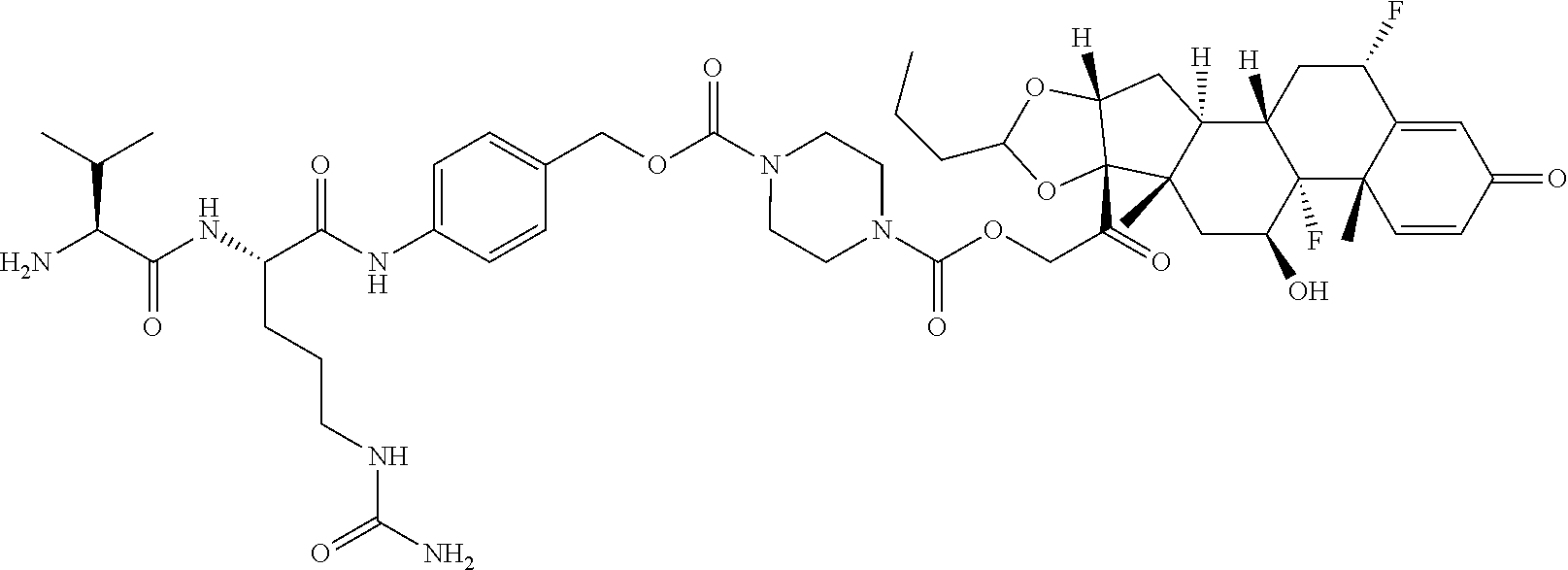


| TABLE 5a |
| Examples of Linker-Payloads |
| Linker | |||
| LP | Payload | name | Structures |
| LP1 | 101a | DIBAC- suc-PEG4- vcPAB- MEDA-100 |
 |
| LP2 | 101b | DIBAC- suc-PEG4- vcPAB- DMEDA- 100 |
 |
| LP3 | 101c | DIBAC- suc-PEG4- vcPAB- DEEDA- 100 |
 |
| LP4 | 101d | DIBAC- suc-PEG4- vcPAB- Pip-100 |
 |
| LP5 | 102e | NHS- disulfide- SEA-100 |
 |
| LP6 | 102f | NHS- disulfide- SEMA-100 |
 |
| LP7 | 102e | BCN- PEG3- disulfide- SEA-100 |
 |
| LP8 | 102f | BCN- PEG3- disulfide- SEMA-100 |
 |
| LP9 | 103a | DIBAC- suc-PEG4- vcPAB- Gly-AMO- Bud |
 |
| LP10 | 103b | DIBAC- suc-PEG4- vcPAB- Gly-AMO- 100 |
 |
| LP11 | 103b | DIBAC- suc-PEG4- GGFG- AMO-100 |
 |
| LP12 | 104a | BCN- PEG4- vcPAB- Leu-Aib- 100 |
 |
| LP13 | 104b | BCN- PEG4- vcPAB- Ser-Leu- 100 |
 |
| LP18 | 103b | DIBAC- suc-PEG4- EVC-PAB- Gly-AMO- 100 |
 |
| LP19 | 103b | DIBAC- suc-PEG4- dEVC- PAB-Gly- AMO-100 |
 |
| LP20 | 104b | BCN- PEG4- EVC-PAB- Ser-Leu- 100 |
 |
| LP21 | 104b | BCN- PEG4- dEVC- PAB-Ser- Leu-100 |
 |
| TABLE 6a |
| Characterization Data for Linker-Payloads |
| HPLC | MS | Highest | ||||
| purity | (m/z) | m/z | ||||
| LP | cLogP | MF | MW | (%) | 100% | peak |
| LP1 | 4.26 | C78H101F2N9O19 | 1506.71 | 95 | 753.9 | 753.9 |
| (m/2 + H) | (m/2 + H) | |||||
| LP2 | 4.48 | C79H103F2N9O19 | 1520.71 | 97 | 761.0 | 761.0 |
| (m/2 + H) | (m/2 + H) | |||||
| LP3 | 5.20 | C81H107F2N9O19 | 1548.76 | 95 | 775.0 | 775.0 |
| (m/2 + H) | (m/2 + H) | |||||
| LP4 | 4.31 | C79H101F2N9O19 | 1518.69 | 99 | 760.0 | 760.0 |
| (m/2 + H) | (m/2 + H) | |||||
| LP5 | 3.40 | C37H48F2N2O11S2 | 798.91 | 99 | 799.3 | 799.3 |
| (m + H) | (m + H) | |||||
| LP6 | 3.62 | C38H50F2N2O11S2 | 812.94 | 97 | 813.3 | 813.3 |
| (m + H) | (m + H) | |||||
| LP7 | 5.20 | C52H75F2N3O13S2 | 1052.29 | 97 | 526.7 | 526.7 |
| (m/2 + H) | (m/2 + H) | |||||
| LP8 | 5.42 | C53H77F2N3O13S2 | 1066.32 | 98 | 533.8 | 533.8 |
| (m/2 + H) | (m/2 + H) | |||||
| LP9 | 3.65 | C77H101N9O19 | 1456.70 | 96 | 729.0 | 729.0 |
| (m/2 + H) | (m/2 + H) | |||||
| LP10 | 3.35 | C77H99F2N9O19 | 1492.68 | 95 | 513.8 | 747.0 |
| (fragment) | (m/2 + H) | |||||
| LP11 | 1.96 | C71H87F2N7O17 | 1348.51 | 95 | 450.2 | 675.2 |
| (m/3 + H) | (m/2 + H) | |||||
| LP12 | 5.61 | C76H110F2N8O20 | 1493.75 | 90 | 747.6 | 747.6 |
| (m/2 + H) | (m/2 + H) | |||||
| LP13 | 4.13 | C75H108F2N8O21 | 1495.70 | 95 | 748.4 | 748.4 |
| (m/2 + H) | (m/2 + H) | |||||
| LP18 | 2.46 | C82H106F2N10O22 | 1621.77 | 95 | 811 | 811 |
| (m/2 + H) | (m/2 + H) | |||||
| LP19 | 2.46 | C82H106F2N10O22 | 1621.77 | 95 | 811 | 811 |
| (m/2 + H) | (m/2 + H) | |||||
| LP20 | 3.25 | C80H115F2N9O24 | 1624.81 | 95 | 813 | 813 |
| (m/2 + H) | (m/2 + H) | |||||
| LP21 | 3.25 | C80H115F2N9O24 | 1624.81 | 95 | 813 | 813 |
| (m/2 + H) | (m/2 + H) | |||||

| TABLE 7 | |
| LP | Ab, Ab-N3, or Ab-Steroid conjugates |
| EX | MS m/z | Name | MW (Da) | DAR |
| Anti-PRLR Ab | 144602 | — | ||
| PEG3-N3 | 218.3 | Anti-PRLR Ab-N3 | 145385 | 4 |
| 2b | 1369.7 | Anti-PRLR Ab-2b | 150894 | 4 |
| 2g | 1426.7 | Anti-PRLR Ab-2g | 151097 | 4 |
| 2l | 1373.7 | Anti-PRLR Ab-2l | 150884 | 4 |
| 2r | 729.8 | Anti-PRLR Ab-2r | 148330 | 4 |
| 2s | 809.8 | Anti-PRLR Ab-2s | 148623 | 4 |
| Anti-HER2 (Isotype) | 145126 | — | ||
| Ab | ||||
| PEG3-N3 | 218.3 | isotype Ab-N3 | 145930 | 4 |
| 2b | 1369.7 | Isotype Ab-2b | 151439 | 3.8 |
| 2g | 1426.7 | isotype Ab-2g | 151652 | 4 |
| 2l | 1373.7 | Isotype Ab-2l | 151445 | 3.9 |
| 2r | 729.8 | Isotype Ab-2r | 148876 | 4 |
| 2s | 809.8 | Isotype Ab-2s | 149169 | 4 |
| TABLE 8 | |
| HEK293/PRLR/GRE-Luc cells | |
| Molecule | EC50 (24 hr) | EC50 (48 hr) | EC50 (72 hr) |
| Anti-PRLR Ab-2s | 0.9078 | 0.4239 | 0.4823 |
| Anti-PRLR Ab-2r | 34.98 | 18.33 | 13.35 |
| Anti-PRLR Ab-2b | 1.225 | 0.4674 | 0.4291 |
| Isotype Ab-2s | 1.461 | 0.6594 | 0.4904 |
| Isotype Ab-2r | 109.2 | 64.01 | 310.9 |
| Isotype Ab-2b | 15.04 | 8.201 | 5.243 |
| 1a | 0.5732 | 0.5679 | 1.043 |
| TABLE 9 | |||
| HEK293/PRLR/GRE-Luc cells | |||
| Steroid ADCs | EC50 (nM) at 72 hours | ||
| Anti-PRLR Ab-2b | 0.29 | ||
| Anti-PRLR Ab-2l | 8.98 | ||
| Anti-PRLR Ab-2i | >90.9 | ||
| Anti-PRLR Ab-2g | 1.90 | ||
| Isotype Ab-2b | 4.16 | ||
| Isotype Ab-2l | NA | ||
| Isotype Ab-2i | NA | ||
| Isotype Ab- |
7. 11 | ||
| Budesonide (1a) | 5.42 | ||
| Anti-PRLR Ab | NA | ||
| Isotype Ab | NA | ||
| where NA means not active | |||
 |
| Percent Remaining (%) |
| Test Article | 0 h | 0.25 |
1 h | 8 |
24 h | T½ (h) |
| Procaine | 100.00 | BQL | BQL | BQL | BQL | <0.25 |
| 103a | 100.00 | 107.04 | 96.48 | 78.87 | 38.03 | 16.79 |
| Area ratio |
| Budesonide released | 0.054 | 0.052 | 0.042 | 0.047 | 0.049 | |
| from 103a | ||||||
| BQL: Below Quantitation Limit | ||||||

| Vendor information | |
| (where applicable)) | |
| HEK293 cells | ATCC, cat# |
| CRL-1573 | |
| HEK293/UAS-Luc/pBIND GR | |
| Growth media: DME High Glucose, 10% FBS, | |
| 100 units/mL Penicillin, 100 μg/mL, | |
| Streptomycin, 53 μg/mL glutamine, 100 μg/mL | |
| hygromycin, 500 μg/mL G418 | |
| DME high glucose, 500 mL | Irvine Scientific #9033 |
| Fetal Bovine Serum | Saradigm # 1500-500 |
| Penicillin-Streptomycin L-glutamine Solution | Gibco # 10378-016 |
| 100× | |
| pGL4.35[luc2p/9XGAL 4UAS/Hygro] vector | Promega, cat# E137A |
| pBIND-GR vector, selection marker is neomycin | Promega, cat# E158A |
| Hygromycin-B 100 mg/mL | InvivoGen # ant-hg-5 |
| G418 100 mg/mL | GIBCO # 11811-098 |
| Nunclon delta 96 well microwell plate, sterile | Thermo Scientific # |
| white, flat bottom | 13610 |
| Assay media: Same as growth media | |
| DMSO Dianethyl sulfoxide, cell culture tested | ATCC. #4-x. |
| ONE Glo | Promega, Cat# E6130 |
| Instrument | Envision plate reader, |
| Perkin Elmer | |
| Dilution plates | Axygen Scientific, |
| Cat# P-DW-11-C-S | |
| Trypsin-EDTA | Millipore Cat# |
| SM-2004- | |
| PBS | |
| 1 × without calcium and magnesium salts | Irvine Scientific # |
| 9240 | |
| |
Sigma/1278201/ |
| RO36WO | |
| Test compound 100 | |
| Test compound 105a | |
| Test compound 103a | |
| Test compound 103b | |
| Test compound Dexamethasone | Sigma/D1756-25MG/ |
| BCBV3214 | |
| Test Compound | EC50 (M) | S/N | ||
| Dexamethasone | 3.24E−09 | 17.3 | ||
| 1a | 3.06E−10 | 15.3 | ||
| 103a | 4.84E−10 | 14.6 | ||
| 100 | 5.47E−11 | 14.5 | ||
| 103b | 5.18E−11 | 16.6 | ||
| 105b | 1.49E−10 | 12.4 | ||
Claims (21)


Priority Applications (25)
| Application Number | Priority Date | Filing Date | Title |
|---|---|---|---|
| US16/243,020 US12070506B2 (en) | 2018-01-08 | 2019-01-08 | Steroids and antibody-conjugates thereof |
| KR1020257035503A KR20250156850A (en) | 2019-01-08 | 2020-01-08 | Traceless linkers and protein-conjugates thereof |
| MX2021008114A MX2021008114A (en) | 2019-01-08 | 2020-01-08 | LINKERS WITHOUT TRACE AND PROTEIN CONJUGATES THEREOF. |
| MA53772A MA53772B1 (en) | 2019-01-08 | 2020-01-08 | TRACELESS LINKERS AND RELATED PROTEIN CONJUGATES |
| JP2021539640A JP2022517767A (en) | 2019-01-08 | 2020-01-08 | Traceless linker and its protein-conjugate |
| PCT/US2020/012798 WO2020146541A2 (en) | 2019-01-08 | 2020-01-08 | Traceless linkers and protein-conjugates thereof |
| CN202080019317.3A CN113905767A (en) | 2019-01-08 | 2020-01-08 | Traceless linkers and protein conjugates thereof |
| PH1/2021/551629A PH12021551629A1 (en) | 2019-01-08 | 2020-01-08 | Traceless linkers and protein-conjugates thereof |
| BR112021013464-6A BR112021013464A2 (en) | 2019-01-08 | 2020-01-08 | TRACELESS BINDERS AND PROTEIN CONJUGATES THEREOF |
| MA59295A MA59295B1 (en) | 2019-01-08 | 2020-01-08 | TRACELESS LINKERS AND ASSOCIATED PROTEIN CONJUGATES |
| AU2020205662A AU2020205662A1 (en) | 2019-01-08 | 2020-01-08 | Traceless linkers and protein-conjugates thereof |
| EP20702563.6A EP3908323A2 (en) | 2019-01-08 | 2020-01-08 | Traceless linkers and protein-conjugates thereof |
| US17/612,204 US20230119539A1 (en) | 2019-01-08 | 2020-01-08 | Traceless linkers and protein-conjugates thereof |
| KR1020217024347A KR102877468B1 (en) | 2019-01-08 | 2020-01-08 | Traceless linker and its protein-conjugate |
| CA3125998A CA3125998A1 (en) | 2019-01-08 | 2020-01-08 | Traceless linkers and protein-conjugates thereof |
| SG11202107212QA SG11202107212QA (en) | 2019-01-08 | 2020-01-08 | Traceless linkers and protein-conjugates thereof |
| CN202411172153.4A CN119264215A (en) | 2019-01-08 | 2020-01-08 | Traceless linker and protein conjugate thereof |
| CL2021001790A CL2021001790A1 (en) | 2019-01-08 | 2021-07-06 | Non-trace linkers, protein conjugates thereof and compositions thereof |
| IL284673A IL284673A (en) | 2019-01-08 | 2021-07-07 | Untrackable linkers and linked protein conjugates |
| CONC2021/0010315A CO2021010315A2 (en) | 2019-01-08 | 2021-08-04 | Traceless linkers and protein conjugates thereof |
| US18/670,301 US20250064954A1 (en) | 2018-01-08 | 2024-05-21 | Steroids and antibody-conjugates thereof |
| US18/670,314 US20240342299A1 (en) | 2018-01-08 | 2024-05-21 | Steroids and antibody-conjugates thereof |
| CL2024001546A CL2024001546A1 (en) | 2019-01-08 | 2024-05-23 | Traceless linkers, protein conjugates thereof and compositions. |
| CL2024001547A CL2024001547A1 (en) | 2019-01-08 | 2024-05-23 | Traceless linkers, protein conjugates thereof and compositions. |
| JP2024232794A JP2025069133A (en) | 2019-01-08 | 2024-12-27 | Traceless linkers and protein-conjugates thereof |
Applications Claiming Priority (2)
| Application Number | Priority Date | Filing Date | Title |
|---|---|---|---|
| US201862614905P | 2018-01-08 | 2018-01-08 | |
| US16/243,020 US12070506B2 (en) | 2018-01-08 | 2019-01-08 | Steroids and antibody-conjugates thereof |
Related Parent Applications (1)
| Application Number | Title | Priority Date | Filing Date |
|---|---|---|---|
| PCT/US2019/012786 Continuation-In-Part WO2019136487A2 (en) | 2018-01-08 | 2019-01-08 | Steroids and antibody-conjugates thereof |
Related Child Applications (3)
| Application Number | Title | Priority Date | Filing Date |
|---|---|---|---|
| US17/612,204 Continuation-In-Part US20230119539A1 (en) | 2019-01-08 | 2020-01-08 | Traceless linkers and protein-conjugates thereof |
| US18/670,314 Division US20240342299A1 (en) | 2018-01-08 | 2024-05-21 | Steroids and antibody-conjugates thereof |
| US18/670,301 Continuation US20250064954A1 (en) | 2018-01-08 | 2024-05-21 | Steroids and antibody-conjugates thereof |
Publications (2)
| Publication Number | Publication Date |
|---|---|
| US20190209702A1 US20190209702A1 (en) | 2019-07-11 |
| US12070506B2 true US12070506B2 (en) | 2024-08-27 |
Family
ID=65411936
Family Applications (3)
| Application Number | Title | Priority Date | Filing Date |
|---|---|---|---|
| US16/243,020 Active 2041-04-21 US12070506B2 (en) | 2018-01-08 | 2019-01-08 | Steroids and antibody-conjugates thereof |
| US18/670,314 Pending US20240342299A1 (en) | 2018-01-08 | 2024-05-21 | Steroids and antibody-conjugates thereof |
| US18/670,301 Pending US20250064954A1 (en) | 2018-01-08 | 2024-05-21 | Steroids and antibody-conjugates thereof |
Family Applications After (2)
| Application Number | Title | Priority Date | Filing Date |
|---|---|---|---|
| US18/670,314 Pending US20240342299A1 (en) | 2018-01-08 | 2024-05-21 | Steroids and antibody-conjugates thereof |
| US18/670,301 Pending US20250064954A1 (en) | 2018-01-08 | 2024-05-21 | Steroids and antibody-conjugates thereof |
Country Status (19)
| Country | Link |
|---|---|
| US (3) | US12070506B2 (en) |
| EP (1) | EP3737420A2 (en) |
| JP (2) | JP7366028B2 (en) |
| KR (1) | KR102786381B1 (en) |
| CN (2) | CN118955604A (en) |
| AU (1) | AU2019205542B2 (en) |
| BR (1) | BR112020013492A2 (en) |
| CA (1) | CA3086926A1 (en) |
| CL (1) | CL2020001813A1 (en) |
| CO (1) | CO2020009644A2 (en) |
| EA (1) | EA202091672A1 (en) |
| IL (2) | IL319417A (en) |
| MA (2) | MA54673B2 (en) |
| MX (1) | MX2020006994A (en) |
| MY (1) | MY210236A (en) |
| PH (1) | PH12020551044A1 (en) |
| SG (1) | SG11202006510XA (en) |
| WO (1) | WO2019136487A2 (en) |
| ZA (1) | ZA202003956B (en) |
Cited By (2)
| Publication number | Priority date | Publication date | Assignee | Title |
|---|---|---|---|---|
| US12377159B2 (en) | 2016-11-08 | 2025-08-05 | Regeneron Pharmaceuticals, Inc. | Steroids and protein-conjugates thereof |
| US12589101B2 (en) | 2017-05-18 | 2026-03-31 | Regeneron Pharmaceuticals, Inc. | Cyclodextrin protein drug conjugates |
Families Citing this family (21)
| Publication number | Priority date | Publication date | Assignee | Title |
|---|---|---|---|---|
| MX2020004691A (en) | 2017-11-07 | 2020-08-20 | Regeneron Pharma | Hydrophilic linkers for antibody drug conjugates. |
| SG11202006510XA (en) | 2018-01-08 | 2020-08-28 | Regeneron Pharma | Steroids and antibody-conjugates thereof |
| CN118955710A (en) | 2018-05-09 | 2024-11-15 | 里珍纳龙药品有限公司 | Anti-MSR1 antibodies and methods of use thereof |
| BR112021013464A2 (en) * | 2019-01-08 | 2021-09-21 | Regeneron Pharmaceuticals, Inc. | TRACELESS BINDERS AND PROTEIN CONJUGATES THEREOF |
| US20230119539A1 (en) * | 2019-01-08 | 2023-04-20 | Regeneron Pharmaceuticals, Inc. | Traceless linkers and protein-conjugates thereof |
| FR3107648B1 (en) * | 2020-02-27 | 2022-03-18 | Mc Saf | anti-CD56 antibody-drug conjugates and their use in therapy |
| IT202000006442A1 (en) * | 2020-03-27 | 2021-09-27 | Genetic S P A | BUDESONIDE 21-PHOSPHATE SALTS AND PHARMACEUTICAL COMPOSITIONS CONTAINING THE SAME |
| JP2023072104A (en) * | 2020-04-10 | 2023-05-24 | 小野薬品工業株式会社 | antibody drug conjugate |
| US20230355773A1 (en) * | 2020-08-10 | 2023-11-09 | P.I.F. Entrepreneurs Ltd. | Macrophage targeting drug conjugates |
| US20220143194A1 (en) | 2020-11-10 | 2022-05-12 | Regeneron Pharmaceuticals, Inc. | Selenium antibody conjugates |
| WO2022135332A1 (en) * | 2020-12-21 | 2022-06-30 | 映恩生物制药(苏州)有限公司 | Steroid conjugate |
| CA3207416A1 (en) * | 2021-02-04 | 2022-08-11 | Lingjian ZHU | Drug conjugate of glucocorticoid receptor agonist, and application thereof in medicine |
| WO2022171101A1 (en) * | 2021-02-10 | 2022-08-18 | 映恩生物制药(苏州)有限公司 | Steroid conjugate |
| US11806405B1 (en) | 2021-07-19 | 2023-11-07 | Zeno Management, Inc. | Immunoconjugates and methods |
| TW202320858A (en) | 2021-07-19 | 2023-06-01 | 美商薩諾管理公司 | Immunoconjugates and methods |
| NL2029599B1 (en) * | 2021-11-02 | 2023-06-01 | Univ Leiden | Glycosylated Prodrugs |
| MX2024009080A (en) | 2022-01-29 | 2024-07-30 | Shanghai Shengdi Pharmaceutical Co Ltd | Drug conjugate of glucocorticoid. |
| CA3245598A1 (en) | 2022-03-11 | 2023-09-14 | Firefly Bio, Inc. | Phenyl maleimide linker agents |
| CN115785188B (en) * | 2022-12-20 | 2024-06-07 | 湖南科益新生物医药有限公司 | Preparation method of budesonide |
| CN121568722A (en) | 2023-07-28 | 2026-02-24 | 江苏恒瑞医药股份有限公司 | Pharmaceutical composition of antibody drug conjugate containing glucocorticoid |
| WO2025078841A2 (en) | 2023-10-11 | 2025-04-17 | Antikor Biopharma Limited | Antibodies, conjugates, and uses thereof |
Citations (143)
| Publication number | Priority date | Publication date | Assignee | Title |
|---|---|---|---|---|
| US2920999A (en) | 1957-06-07 | 1960-01-12 | Pfizer & Co C | 21-nitrogen derivatives of corticosteroids |
| US3007923A (en) | 1959-01-22 | 1961-11-07 | Lab Francais Chimiotherapie | Process for the fluorination of 9beta, 11beta-epoxy and 5alpha, 6alpha-epoxy steroids |
| US3020275A (en) | 1960-06-07 | 1962-02-06 | American Cyanamid Co | 21-nitrogen substituted steroids of the pregnane series and methods of preparing the same |
| GB889766A (en) | 1958-03-04 | 1962-02-21 | Olin Mathieson | Improvements in steroids and the synthesis thereof |
| US3033873A (en) | 1960-05-11 | 1962-05-08 | Pfizer & Co C | 21-aminomethyl-pregnenes |
| US3033874A (en) | 1960-05-11 | 1962-05-08 | Pfizer & Co C | 17beta-propenoyl steroids and process for preparing same |
| GB898295A (en) | 1959-03-18 | 1962-06-06 | Upjohn Co | Improvements in or relating to steroids and the manufacture thereof |
| US3047468A (en) | 1961-06-06 | 1962-07-31 | American Cyanamid Co | Method of preparing delta1, 4-3-keto steroids of the pregnane series |
| DE1165595B (en) | 1958-03-04 | 1964-03-19 | Olin Mathieson | Process for the preparation of triamcinolone acetonide-21-hemisuccinate and its salts |
| US3197469A (en) | 1958-08-06 | 1965-07-27 | Pharmaceutical Res Products In | 16, 17-acetals and ketals of 6-halo-16, 17-dihydroxy steroids of the pregnane seriesand intermediates therefor |
| US3232839A (en) | 1961-02-22 | 1966-02-01 | Schering Ag | delta1, 4-16alpha-methyl steroids |
| US3383394A (en) | 1965-08-30 | 1968-05-14 | Schering Corp | Novel 17-acylating process and products thereof |
| US3723484A (en) | 1970-09-18 | 1973-03-27 | Schering Ag | 17-chloro steroids |
| US3798216A (en) | 1969-03-07 | 1974-03-19 | Fabrication Des Antibiotique S | 9-fluoro-11beta,21-dihydroxy-16alpha,17-(2-propenylidenedioxy)-pregna-1,4-diene-3,20-dione and derivatives thereof |
| US3886145A (en) | 1972-04-28 | 1975-05-27 | Sigma Tau Ind Farmaceuti | New derivative of triamcinolone |
| US3928326A (en) | 1972-05-19 | 1975-12-23 | Bofors Ab | Process for the separation of stereoisomeric mixtures into their components and components obtained hereby |
| US3929768A (en) | 1972-05-19 | 1975-12-30 | Bofors Ab | Steroids, processes for their manufacture and preparations containing same |
| US4076737A (en) | 1975-02-20 | 1978-02-28 | Ciba-Geigy Corporation | Aldehydes of the pregnane series and derivatives thereof |
| IL73337A (en) | 1984-10-28 | 1988-09-30 | Yissum Res Dev Co | Antitumor steroid-platinum complexes and method for the preparation thereof |
| US4925933A (en) | 1986-09-25 | 1990-05-15 | Astra Pharmaceutical Production Aktiebolag | Method of controlling the epimeric distribution in the preparation of 16,17-acetals of pregnane derivatives |
| US5116829A (en) | 1990-04-23 | 1992-05-26 | Kao Corporation | Steroid compounds |
| US5183815A (en) | 1991-01-22 | 1993-02-02 | Merck & Co., Inc. | Bone acting agents |
| US5208020A (en) | 1989-10-25 | 1993-05-04 | Immunogen Inc. | Cytotoxic agents comprising maytansinoids and their therapeutic use |
| WO1994022898A1 (en) | 1993-04-07 | 1994-10-13 | Schering Aktiengesellschaft | New glucocorticoids |
| US5500362A (en) | 1987-01-08 | 1996-03-19 | Xoma Corporation | Chimeric antibody with specificity to human B cell surface antigen |
| WO1997041144A1 (en) | 1996-05-02 | 1997-11-06 | G.D. Searle & Co. | Novel steroid nitrite and nitrate ester derivatives useful as anti-inflammatory drugs |
| US5714586A (en) | 1995-06-07 | 1998-02-03 | American Cyanamid Company | Methods for the preparation of monomeric calicheamicin derivative/carrier conjugates |
| US5821337A (en) | 1991-06-14 | 1998-10-13 | Genentech, Inc. | Immunoglobulin variants |
| US5908833A (en) | 1993-01-08 | 1999-06-01 | Aktiebolaget Astra | Colon or ileum-specific steroid derivatives |
| WO2000049993A2 (en) | 1999-02-24 | 2000-08-31 | Nitromed, Inc. | Nitrosated and nitrosylated steroids for the treatment of cardiovascular diseases and disorders |
| WO2002080931A1 (en) | 2001-04-04 | 2002-10-17 | Astrazeneca Ab | New use of glyconjugates of glucocorticosteroids as a targeting to the colon |
| CN1414008A (en) | 2002-10-17 | 2003-04-30 | 南开大学 | Steroid compound containing nitrogen and its preparation method |
| US20030125357A1 (en) | 2001-06-11 | 2003-07-03 | Adams Alan D. | Therapeutic compounds for treating dyslipidemic conditions |
| US6596541B2 (en) | 2000-10-31 | 2003-07-22 | Regeneron Pharmaceuticals, Inc. | Methods of modifying eukaryotic cells |
| US20030199529A1 (en) | 1996-03-22 | 2003-10-23 | Garvey David S. | Nitrosated and nitrosylated compounds and compositions and their use for treating respiratory disorders |
| WO2004022099A2 (en) | 2002-09-06 | 2004-03-18 | Insert Therapeutics, Inc. | Cyclodextrin-based polymers for delivering the therapeutic agents covalently bound thereto |
| US20040157810A1 (en) | 2002-08-23 | 2004-08-12 | Teicher Martin H. | Corticosteroid conjugates and uses thereof |
| US20040192778A1 (en) | 2003-03-26 | 2004-09-30 | Anwar Jardien | Reduction of hair growth |
| US20050009798A1 (en) | 2002-02-20 | 2005-01-13 | Sepracor Inc. | Carbonate and carbamate modified forms of glucocorticoids in combination with B2 adrenergic agonists |
| WO2005063777A1 (en) | 2003-12-23 | 2005-07-14 | Corus Pharma | Benzylphosphate and substituted benzylphosphate prodrugs for the treatment of pulmonary inflammation |
| WO2005079523A2 (en) | 2004-02-18 | 2005-09-01 | University Of Georgia Research Foundation, Inc. | Novel teleost derived antimicrobal polypeptides |
| US20050192257A1 (en) | 2004-02-26 | 2005-09-01 | Peyman Gholam A. | Predictors for patients at risk for glaucoma from steroid therapy |
| WO2005089808A2 (en) | 2004-03-15 | 2005-09-29 | Wyeth | Antibody calicheamicin conjugates |
| WO2005119266A1 (en) | 2004-06-03 | 2005-12-15 | Universiteit Leiden | Sr-a antagonists |
| US20050287155A1 (en) | 2004-06-15 | 2005-12-29 | Santi Daniel V | Conjugates with reduced adverse systemic effects |
| EP1625854A1 (en) | 2004-08-09 | 2006-02-15 | Deutsches Krebsforschungszentrum Stiftung des öffentlichen Rechts | Albumin conjugates containing a glucuronic linker |
| US20060046967A1 (en) | 2004-08-26 | 2006-03-02 | Apparao Satyam | Prodrugs containing novel bio-cleavable linkers |
| US20060074008A1 (en) | 2002-07-31 | 2006-04-06 | Senter Peter D | Drug conjugates and their use for treating cancer, an autoimmune disease or an infectious disease |
| WO2006135371A1 (en) | 2005-06-09 | 2006-12-21 | Kosan Biosciences Incorporated | Conjugates with reduced adverse systemic effects |
| US20070258987A1 (en) | 2000-11-28 | 2007-11-08 | Seattle Genetics, Inc. | Recombinant Anti-Cd30 Antibodies and Uses Thereof |
| US20080171040A1 (en) | 2004-06-01 | 2008-07-17 | Genentech, Inc. | Antibody-drug conjugates and methods |
| WO2008122039A2 (en) | 2007-04-02 | 2008-10-09 | The Government Of The United States Of America, As Represented By The Secretary, Department Of Health And Human Services | Selenocysteine mediated hybrid antibody molecules |
| WO2008127347A1 (en) | 2006-07-21 | 2008-10-23 | Diadexus, Inc. | Pro115 antibody compositions and methods of use |
| US20080305497A1 (en) | 2007-05-23 | 2008-12-11 | Ventana Medical Systems, Inc. | Polymeric carriers for immunohistochemistry and in situ hybridization |
| US20080305044A1 (en) | 2004-11-29 | 2008-12-11 | Seattle Genetics, Inc. | Engineered Antibodies and Immunoconjugates |
| CN101397328A (en) | 2007-09-27 | 2009-04-01 | 天津药业研究院有限公司 | Nitric oxide-releasing glucocorticosteroid |
| US20090221543A1 (en) | 2002-01-29 | 2009-09-03 | Nicox S A. | New corticosteroids |
| US20090318396A1 (en) | 2008-06-10 | 2009-12-24 | Gilead Sciences, Inc. | Corticosteroid linked beta-agonist compounds for use in therapy |
| WO2010010324A1 (en) | 2008-07-21 | 2010-01-28 | Polytherics Limited | Novel reagents and method for conjugating biological molecules |
| WO2010010119A1 (en) | 2008-07-22 | 2010-01-28 | Ablynx Nv | Amino acid sequences directed against multitarget scavenger receptors and polypeptides |
| US20100041633A1 (en) | 2007-02-05 | 2010-02-18 | Nicox S.A. | Nitric oxide releasing steroids |
| US20100129314A1 (en) | 2008-04-30 | 2010-05-27 | Immunogen Inc. | Potent conjugates and hydrophilic linkers |
| US7750116B1 (en) | 2006-02-18 | 2010-07-06 | Seattle Genetics, Inc. | Antibody drug conjugate metabolites |
| US20100209508A1 (en) | 2005-06-14 | 2010-08-19 | Corus Pharma, Inc. | Substituted Phenylphosphates as Mutual Prodrugs of Steroids and ß-Agonists for the Treatment of Title Pulmonary Inflammation and Bronchoconstriction |
| US20100226987A1 (en) | 2007-06-28 | 2010-09-09 | Capsutech Ltd. | Targeting conjugates comprising active agents encapsulated in cyclodextrin-containing polymers |
| WO2010126953A1 (en) | 2009-04-29 | 2010-11-04 | Gilead Sciences, Inc. | Corticosteroid linked beta-agonist compounds for use in therapy |
| WO2010132743A1 (en) | 2009-05-15 | 2010-11-18 | Gilead Sciences, Inc. | Corticosteroid beta-agonist compounds for use in therapy |
| US20100323973A1 (en) | 2007-06-25 | 2010-12-23 | Endoctye, Inc. | Conjugates containing hydrophilic spacer linkers |
| WO2011020107A2 (en) | 2009-08-14 | 2011-02-17 | Georgetown University | Compositions and methods for detection and treatment of breast cancer |
| WO2011018611A1 (en) | 2009-08-10 | 2011-02-17 | Ucl Business Plc | Reversible covalent linkage of functional molecules |
| WO2011081937A1 (en) | 2009-12-15 | 2011-07-07 | Gilead Sciences, Inc. | Corticosteroid-beta-agonist-muscarinic antagonist compounds for use in therapy |
| US20110178287A1 (en) | 2010-01-19 | 2011-07-21 | Cerulean Pharma Inc. | Cyclodextrin-based polymers for therapeutic delivery |
| US20110182828A1 (en) | 2007-12-21 | 2011-07-28 | Schering Corporation | C20-c21 substituted glucocorticoid receptor agonists |
| WO2011103389A1 (en) | 2010-02-19 | 2011-08-25 | Cornell University | Method to treat autoimmune demyelinating diseases and other autoimmune or inflammatory diseases |
| WO2011130598A1 (en) | 2010-04-15 | 2011-10-20 | Spirogen Limited | Pyrrolobenzodiazepines and conjugates thereof |
| US20110262368A1 (en) | 2007-12-21 | 2011-10-27 | Schering Corporation | C21 thioethers as glucocorticoid receptor agonists |
| WO2012011591A1 (en) | 2010-07-23 | 2012-01-26 | 武田薬品工業株式会社 | Fused heterocyclic compound and application thereof |
| US20120058892A1 (en) | 2010-09-01 | 2012-03-08 | Bayer Cropscience Ag | N-(tetrazol-5-yl)- and n-(triazol-5-yl)arylcarboxamides and their use as herbicides |
| US20120059158A1 (en) | 2009-03-09 | 2012-03-08 | Mikasa Seiyaku Co., Ltd. | Steroid compound |
| US20120096572A1 (en) | 2010-08-02 | 2012-04-19 | Regeneron Pharmaceuticals, Inc. | Mice That Make VL Binding Proteins |
| WO2012058592A2 (en) | 2010-10-29 | 2012-05-03 | Immunogen, Inc. | Non-antagonistic egfr-binding molecules and immunoconjugates thereof |
| US20120258107A1 (en) | 2009-09-29 | 2012-10-11 | Niels Jonas Heilskov Graversen | Agents, Uses and Methods |
| US20120276193A1 (en) | 2009-09-29 | 2012-11-01 | Niels Jonas Heilskov Graversen | Agents, Uses and Methods |
| US20120302505A1 (en) | 2011-04-21 | 2012-11-29 | Fetzer Oliver S | Cyclodextrin-based polymers for therapeutic delivery |
| WO2012166559A1 (en) | 2011-05-27 | 2012-12-06 | Ambrx, Inc. | Compositions containing, methods involving, and uses of non-natural amino acid linked dolastatin derivatives |
| WO2013055993A1 (en) | 2011-10-14 | 2013-04-18 | Seattle Genetics, Inc. | Pyrrolobenzodiazepines and targeted conjugates |
| WO2013053873A1 (en) | 2011-10-14 | 2013-04-18 | Spirogen Sàrl | Pyrrolobenzodiazepines |
| WO2013055990A1 (en) | 2011-10-14 | 2013-04-18 | Seattle Genetics, Inc. | Pyrrolobenzodiazepines and targeted conjugates |
| WO2013053872A1 (en) | 2011-10-14 | 2013-04-18 | Spirogen Sàrl | Synthesis method and intermediates useful in the preparation of pyrrolobenzodiazepines |
| US20130101546A1 (en) | 2011-06-10 | 2013-04-25 | Mersana Therapeutics, Inc. | Protein-Polymer-Drug Conjugates |
| WO2013068874A1 (en) | 2011-11-11 | 2013-05-16 | Pfizer Inc. | Antibody-drug conjugates |
| WO2013085925A1 (en) | 2011-12-05 | 2013-06-13 | Igenica, Inc. | Antibody-drug conjugates and related compounds, compositions, and methods |
| WO2013093465A2 (en) | 2011-12-23 | 2013-06-27 | Cytoguide Aps | Novel formulations |
| CN103694375A (en) | 2013-12-13 | 2014-04-02 | 北京大学 | Novel triterpene-cyclodextrin covalent compound and preparation method and use thereof |
| US8703714B2 (en) | 2003-11-06 | 2014-04-22 | Seattle Genetics, Inc. | Monomethylvaline compounds capable of conjugation to ligands |
| WO2014065661A1 (en) | 2012-10-23 | 2014-05-01 | Synaffix B.V. | Modified antibody, antibody-conjugate and process for the preparation thereof |
| US20140227294A1 (en) | 2012-12-24 | 2014-08-14 | Abbvie Inc. | Prolactin receptor binding proteins and uses thereof |
| WO2014165119A1 (en) | 2013-03-13 | 2014-10-09 | Seattle Genetics, Inc. | Cyclodextrin and antibody-drug conjugate formulations |
| WO2014197854A1 (en) | 2013-06-06 | 2014-12-11 | Igenica Biotherapeutics, Inc. | Novel linkers for antibody-drug conjugates and related compounds, compositions, and methods of use |
| CN104302664A (en) | 2012-03-14 | 2015-01-21 | 瑞泽恩制药公司 | Multispecific antigen binding molecules and uses thereof |
| US20150056221A1 (en) | 2013-08-21 | 2015-02-26 | Regeneron Pharmaceuticals, Inc. | Anti-prlr antibodies and uses thereof |
| US20150152187A1 (en) | 2012-06-14 | 2015-06-04 | Ambrx, Inc. | Anti-PSMA Antibodies Conjugated to Nuclear Receptor Ligand Polypeptides |
| US20150165064A1 (en) * | 2013-06-21 | 2015-06-18 | Innate Pharma | Enzymatic conjugation of polypeptides |
| US20150258203A1 (en) | 2012-10-16 | 2015-09-17 | Endocyte, Inc. | Drug delivery conjugates containing unnatural amino acids and methods for using |
| WO2015155998A1 (en) | 2014-04-10 | 2015-10-15 | Daiichi Sankyo Company, Limited | Anti-her3 antibody-drug conjugate |
| US20150291563A1 (en) | 2012-10-25 | 2015-10-15 | Yuhan Corporation | 4,5-dihydro-1h-pyrazole derivative or salts thereof, and pharmaceutical composition comprising same |
| US20150290337A1 (en) | 2012-10-11 | 2015-10-15 | Ascendis Pharma A/S | Diagnosis, prevention and treatment of diseases of the joint |
| WO2015189478A1 (en) | 2014-06-13 | 2015-12-17 | Glykos Finland Oy | Payload-polymer-protein conjugates |
| US20160082119A1 (en) | 2013-04-22 | 2016-03-24 | Avelas Biosciences, Inc. | Selective drug delivery compositions and methods of use |
| WO2016090038A1 (en) | 2014-12-03 | 2016-06-09 | Genentech, Inc. | Anti-staphylococcus aureus antibody rifamycin conjugates and uses thereof |
| WO2016090040A1 (en) | 2014-12-03 | 2016-06-09 | Genentech, Inc. | Anti-staphylococcus aureus antibody rifamycin conjugates and uses thereof |
| US20160158369A1 (en) | 2013-07-10 | 2016-06-09 | Seikagaku Corporation | Pharmaceutical composition for respiratory administration |
| WO2016094517A1 (en) | 2014-12-09 | 2016-06-16 | Abbvie Inc. | Bcl-xl inhibitory compounds and antibody drug conjugates including the same |
| WO2016094509A1 (en) | 2014-12-09 | 2016-06-16 | Abbvie Inc. | Bcl xl inhibitory compounds having low cell permeability and antibody drug conjugates including the same |
| WO2016127081A1 (en) | 2015-02-06 | 2016-08-11 | Sorrento Therapeutics, Inc. | Antibody drug conjugates |
| US20160279054A1 (en) | 2007-10-05 | 2016-09-29 | Wayne State University | Dendrimers for sustained release of compounds |
| US20160310612A1 (en) | 2013-10-15 | 2016-10-27 | Seattle Genetics, Inc. | Pegylated drug-linkers for improved ligand-drug conjugate pharmacokinetics |
| US20160340445A1 (en) | 2014-01-24 | 2016-11-24 | Centre National De La Recherche Scientifique | Orally available compounds, a process for preparing the same and their uses as anti-adhesive drugs for treating e. coli induced inflammatory bowel diseases such as crohn's disease |
| WO2017006279A1 (en) | 2015-07-08 | 2017-01-12 | Aten Porus Lifesciences | Cyclodextrin-polymer complexes and compostions and methods of making and using the same |
| WO2017062271A2 (en) | 2015-10-06 | 2017-04-13 | Merck Sharp & Dohme Corp. | Antibody drug conjugate for anti-inflammatory applications |
| US20170182181A1 (en) | 2014-04-04 | 2017-06-29 | Merck Sharp & Dohme Corp. | Phosphate based linkers for intracellular delivery of drug conjugates |
| WO2017132103A2 (en) | 2016-01-29 | 2017-08-03 | Merck Sharp & Dohme Corp. | Phosphonate linkers and their use to facilitate cellular retention of compounds |
| WO2017147542A2 (en) | 2016-02-26 | 2017-08-31 | Regeneron Pharmaceuticals, Inc. | Optimized transglutaminase site-specific antibody conjugation |
| WO2017165851A1 (en) | 2016-03-25 | 2017-09-28 | Seattle Genetics, Inc. | Process for the preparation of pegylated drug-linkers and intermediates thereof |
| WO2017199046A1 (en) | 2016-05-20 | 2017-11-23 | Polytherics Limited | Conjugates and conjugating reagents |
| WO2017210471A1 (en) | 2016-06-02 | 2017-12-07 | Abbvie Inc. | Glucocorticoid receptor agonist and immunoconjugates thereof |
| WO2017214458A2 (en) | 2016-06-08 | 2017-12-14 | Abbvie Inc. | Anti-cd98 antibodies and antibody drug conjugates |
| US20180002372A1 (en) | 2015-01-30 | 2018-01-04 | Coral Drugs Pvt. Ltd. | Novel process for preparation of glucocorticoid steroids |
| CN107849131A (en) | 2015-07-06 | 2018-03-27 | 瑞泽恩制药公司 | Polyspecific antigen binding molecules and application thereof |
| US20180104357A1 (en) | 2016-09-23 | 2018-04-19 | Regeneron Pharmaceuticals, Inc. | Anti-STEAP2 Antibodies, Antibody-Drug Conjugates, and Bispecific Antigen-Binding Molecules that Bind STEAP2 and CD3, and Uses Thereof |
| WO2018089373A2 (en) | 2016-11-08 | 2018-05-17 | Regeneron Pharmaceuticals, Inc. | Steroids and protein-conjugates thereof |
| WO2018213077A1 (en) | 2017-05-18 | 2018-11-22 | Regeneron Pharmaceuticals, Inc. | Cyclodextrin protein drug conjugates |
| US20180334426A1 (en) | 2017-05-18 | 2018-11-22 | Regeneron Pharmaceutical, Inc. | Bis-octahydrophenanthrene carboxamides and protein conjugates thereof |
| CN108853514A (en) | 2017-08-18 | 2018-11-23 | 四川百利药业有限责任公司 | There are two types of the antibody drug conjugates of different pharmaceutical for tool |
| US20180360979A1 (en) | 2015-09-10 | 2018-12-20 | Shasqi, Inc. | Bioorthogonal compositions |
| CN109106951A (en) | 2017-08-18 | 2019-01-01 | 四川百利药业有限责任公司 | A kind of camptothecine-antibody coupling matter |
| WO2019094395A2 (en) | 2017-11-07 | 2019-05-16 | Regeneron Pharmaceuticals, Inc. | Hydrophilic linkers for antibody drug conjugates |
| WO2019136487A2 (en) | 2018-01-08 | 2019-07-11 | Regeneron Pharmaceuticals, Inc. | Steroids and antibody-conjugates thereof |
| US20190367631A1 (en) | 2018-05-09 | 2019-12-05 | Regeneron Pharmaceuticals, Inc. | Anti-msr1 antibodies and methods of use thereof |
| US20200115326A1 (en) * | 2017-05-24 | 2020-04-16 | The Board Of Regents Of The University Of Texas System | Linkers for antibody drug conjugates |
| WO2020146541A2 (en) | 2019-01-08 | 2020-07-16 | Regeneron Pharmaceuticals, Inc. | Traceless linkers and protein-conjugates thereof |
| US20200368361A1 (en) | 2018-12-21 | 2020-11-26 | Regeneron Pharmaceuticals, Inc. | Rifamycin analogs and antibody-drug conjugates thereof |
| US20230119539A1 (en) * | 2019-01-08 | 2023-04-20 | Regeneron Pharmaceuticals, Inc. | Traceless linkers and protein-conjugates thereof |
Family Cites Families (12)
| Publication number | Priority date | Publication date | Assignee | Title |
|---|---|---|---|---|
| NL7001308A (en) * | 1969-03-07 | 1970-09-09 | ||
| GR1004274B (en) * | 2002-07-16 | 2003-06-23 | Medexis ���� | Steroid-protein conjugates: new compounds for the selective identification and elimination of tumor cells derived from solid cancers and hematological malignancies |
| JP2010503708A (en) | 2006-09-15 | 2010-02-04 | エンゾン ファーマスーティカルズ インコーポレイテッド | Targeted polymer prodrugs containing multifunctional linkers |
| KR101000067B1 (en) | 2008-12-30 | 2010-12-10 | 엘지전자 주식회사 | Laser firing apparatus for high efficiency solar cell and manufacturing method of high efficiency solar cell |
| US20130244905A1 (en) | 2010-07-06 | 2013-09-19 | Ed Grabczyk | Reporter for RNA Polymerase II Termination |
| US9562015B2 (en) * | 2011-11-17 | 2017-02-07 | The Regents Of The University Of Colorado, A Body | Methods and compositions for enhanced drug delivery to the eye and extended delivery formulations |
| US20130196906A1 (en) * | 2012-01-31 | 2013-08-01 | Cerulean Pharma Inc. | Cyclodextrin-based polymers for therapeutic delivery |
| CN103044523B (en) * | 2012-12-13 | 2014-05-21 | 济南向惠医药技术有限公司 | Dexamethasone-RGD polypeptide conjugate, preparation method thereof and application |
| GB201309807D0 (en) | 2013-05-31 | 2013-07-17 | Pharma Mar Sau | Antibody drug conjugates |
| AR099812A1 (en) * | 2014-03-21 | 2016-08-17 | Abbvie Inc | ANTI-EGFR ANTIBODY AND DRUG ANTIBODIES AND CONJUGATES |
| WO2016168769A1 (en) | 2015-04-15 | 2016-10-20 | The California Institute For Biomedical Research | Chimeric receptor t cell switches for her2 |
| US11040108B2 (en) * | 2016-04-29 | 2021-06-22 | Brandeis University | Amino acid- and peptide-steroid conjugates and use thereof |
-
2019
- 2019-01-08 SG SG11202006510XA patent/SG11202006510XA/en unknown
- 2019-01-08 WO PCT/US2019/012786 patent/WO2019136487A2/en not_active Ceased
- 2019-01-08 CN CN202410947679.9A patent/CN118955604A/en active Pending
- 2019-01-08 EA EA202091672A patent/EA202091672A1/en unknown
- 2019-01-08 JP JP2020537642A patent/JP7366028B2/en active Active
- 2019-01-08 MA MA54673A patent/MA54673B2/en unknown
- 2019-01-08 KR KR1020207022224A patent/KR102786381B1/en active Active
- 2019-01-08 CN CN201980017324.7A patent/CN112004557B/en active Active
- 2019-01-08 IL IL319417A patent/IL319417A/en unknown
- 2019-01-08 IL IL275757A patent/IL275757B2/en unknown
- 2019-01-08 BR BR112020013492-9A patent/BR112020013492A2/en active Search and Examination
- 2019-01-08 US US16/243,020 patent/US12070506B2/en active Active
- 2019-01-08 CA CA3086926A patent/CA3086926A1/en active Pending
- 2019-01-08 AU AU2019205542A patent/AU2019205542B2/en active Active
- 2019-01-08 MA MA50259A patent/MA50259A1/en unknown
- 2019-01-08 EP EP19705259.0A patent/EP3737420A2/en active Pending
- 2019-01-08 MY MYPI2020003448A patent/MY210236A/en unknown
- 2019-01-08 MX MX2020006994A patent/MX2020006994A/en unknown
-
2020
- 2020-06-29 ZA ZA2020/03956A patent/ZA202003956B/en unknown
- 2020-07-03 PH PH12020551044A patent/PH12020551044A1/en unknown
- 2020-07-06 CL CL2020001813A patent/CL2020001813A1/en unknown
- 2020-08-03 CO CONC2020/0009644A patent/CO2020009644A2/en unknown
-
2023
- 2023-10-10 JP JP2023174957A patent/JP2024009905A/en not_active Withdrawn
-
2024
- 2024-05-21 US US18/670,314 patent/US20240342299A1/en active Pending
- 2024-05-21 US US18/670,301 patent/US20250064954A1/en active Pending
Patent Citations (164)
| Publication number | Priority date | Publication date | Assignee | Title |
|---|---|---|---|---|
| US2920999A (en) | 1957-06-07 | 1960-01-12 | Pfizer & Co C | 21-nitrogen derivatives of corticosteroids |
| GB889766A (en) | 1958-03-04 | 1962-02-21 | Olin Mathieson | Improvements in steroids and the synthesis thereof |
| DE1165595B (en) | 1958-03-04 | 1964-03-19 | Olin Mathieson | Process for the preparation of triamcinolone acetonide-21-hemisuccinate and its salts |
| US3197469A (en) | 1958-08-06 | 1965-07-27 | Pharmaceutical Res Products In | 16, 17-acetals and ketals of 6-halo-16, 17-dihydroxy steroids of the pregnane seriesand intermediates therefor |
| US3007923A (en) | 1959-01-22 | 1961-11-07 | Lab Francais Chimiotherapie | Process for the fluorination of 9beta, 11beta-epoxy and 5alpha, 6alpha-epoxy steroids |
| GB898295A (en) | 1959-03-18 | 1962-06-06 | Upjohn Co | Improvements in or relating to steroids and the manufacture thereof |
| US3033873A (en) | 1960-05-11 | 1962-05-08 | Pfizer & Co C | 21-aminomethyl-pregnenes |
| US3033874A (en) | 1960-05-11 | 1962-05-08 | Pfizer & Co C | 17beta-propenoyl steroids and process for preparing same |
| US3020275A (en) | 1960-06-07 | 1962-02-06 | American Cyanamid Co | 21-nitrogen substituted steroids of the pregnane series and methods of preparing the same |
| US3232839A (en) | 1961-02-22 | 1966-02-01 | Schering Ag | delta1, 4-16alpha-methyl steroids |
| US3047468A (en) | 1961-06-06 | 1962-07-31 | American Cyanamid Co | Method of preparing delta1, 4-3-keto steroids of the pregnane series |
| US3383394A (en) | 1965-08-30 | 1968-05-14 | Schering Corp | Novel 17-acylating process and products thereof |
| US3798216A (en) | 1969-03-07 | 1974-03-19 | Fabrication Des Antibiotique S | 9-fluoro-11beta,21-dihydroxy-16alpha,17-(2-propenylidenedioxy)-pregna-1,4-diene-3,20-dione and derivatives thereof |
| US3723484A (en) | 1970-09-18 | 1973-03-27 | Schering Ag | 17-chloro steroids |
| US3886145A (en) | 1972-04-28 | 1975-05-27 | Sigma Tau Ind Farmaceuti | New derivative of triamcinolone |
| US3928326A (en) | 1972-05-19 | 1975-12-23 | Bofors Ab | Process for the separation of stereoisomeric mixtures into their components and components obtained hereby |
| US3929768A (en) | 1972-05-19 | 1975-12-30 | Bofors Ab | Steroids, processes for their manufacture and preparations containing same |
| GB1428416A (en) | 1972-05-19 | 1976-03-17 | Bofors Ab | Process for the separation of stereoisomeric mixtures of steroid acetals into their components and components obtained thereby |
| US4076737A (en) | 1975-02-20 | 1978-02-28 | Ciba-Geigy Corporation | Aldehydes of the pregnane series and derivatives thereof |
| IL73337A (en) | 1984-10-28 | 1988-09-30 | Yissum Res Dev Co | Antitumor steroid-platinum complexes and method for the preparation thereof |
| US4925933A (en) | 1986-09-25 | 1990-05-15 | Astra Pharmaceutical Production Aktiebolag | Method of controlling the epimeric distribution in the preparation of 16,17-acetals of pregnane derivatives |
| US5500362A (en) | 1987-01-08 | 1996-03-19 | Xoma Corporation | Chimeric antibody with specificity to human B cell surface antigen |
| US5208020A (en) | 1989-10-25 | 1993-05-04 | Immunogen Inc. | Cytotoxic agents comprising maytansinoids and their therapeutic use |
| US5116829A (en) | 1990-04-23 | 1992-05-26 | Kao Corporation | Steroid compounds |
| US5183815A (en) | 1991-01-22 | 1993-02-02 | Merck & Co., Inc. | Bone acting agents |
| US5821337A (en) | 1991-06-14 | 1998-10-13 | Genentech, Inc. | Immunoglobulin variants |
| US5908833A (en) | 1993-01-08 | 1999-06-01 | Aktiebolaget Astra | Colon or ileum-specific steroid derivatives |
| WO1994022898A1 (en) | 1993-04-07 | 1994-10-13 | Schering Aktiengesellschaft | New glucocorticoids |
| US5714586A (en) | 1995-06-07 | 1998-02-03 | American Cyanamid Company | Methods for the preparation of monomeric calicheamicin derivative/carrier conjugates |
| US20030199529A1 (en) | 1996-03-22 | 2003-10-23 | Garvey David S. | Nitrosated and nitrosylated compounds and compositions and their use for treating respiratory disorders |
| US5837698A (en) | 1996-05-02 | 1998-11-17 | G. D. Searle & Co. | Steroid nitrite and nitrate ester derivatives useful as anti-inflammatory drugs |
| WO1997041144A1 (en) | 1996-05-02 | 1997-11-06 | G.D. Searle & Co. | Novel steroid nitrite and nitrate ester derivatives useful as anti-inflammatory drugs |
| WO2000049993A2 (en) | 1999-02-24 | 2000-08-31 | Nitromed, Inc. | Nitrosated and nitrosylated steroids for the treatment of cardiovascular diseases and disorders |
| US6596541B2 (en) | 2000-10-31 | 2003-07-22 | Regeneron Pharmaceuticals, Inc. | Methods of modifying eukaryotic cells |
| US20070258987A1 (en) | 2000-11-28 | 2007-11-08 | Seattle Genetics, Inc. | Recombinant Anti-Cd30 Antibodies and Uses Thereof |
| WO2002080931A1 (en) | 2001-04-04 | 2002-10-17 | Astrazeneca Ab | New use of glyconjugates of glucocorticosteroids as a targeting to the colon |
| US20030125357A1 (en) | 2001-06-11 | 2003-07-03 | Adams Alan D. | Therapeutic compounds for treating dyslipidemic conditions |
| US6908934B2 (en) | 2001-06-11 | 2005-06-21 | Merck & Co., Inc. | Therapeutic compounds for treating dyslipidemic conditions |
| US20090221543A1 (en) | 2002-01-29 | 2009-09-03 | Nicox S A. | New corticosteroids |
| US20050009798A1 (en) | 2002-02-20 | 2005-01-13 | Sepracor Inc. | Carbonate and carbamate modified forms of glucocorticoids in combination with B2 adrenergic agonists |
| US20060074008A1 (en) | 2002-07-31 | 2006-04-06 | Senter Peter D | Drug conjugates and their use for treating cancer, an autoimmune disease or an infectious disease |
| US20040157810A1 (en) | 2002-08-23 | 2004-08-12 | Teicher Martin H. | Corticosteroid conjugates and uses thereof |
| WO2004022099A2 (en) | 2002-09-06 | 2004-03-18 | Insert Therapeutics, Inc. | Cyclodextrin-based polymers for delivering the therapeutic agents covalently bound thereto |
| US20040077595A1 (en) | 2002-09-06 | 2004-04-22 | Insert Therapeutics, Inc. | Cyclodextrin-based polymers for therapeutics delivery |
| CN1414008A (en) | 2002-10-17 | 2003-04-30 | 南开大学 | Steroid compound containing nitrogen and its preparation method |
| US20040192778A1 (en) | 2003-03-26 | 2004-09-30 | Anwar Jardien | Reduction of hair growth |
| US8703714B2 (en) | 2003-11-06 | 2014-04-22 | Seattle Genetics, Inc. | Monomethylvaline compounds capable of conjugation to ligands |
| WO2005063777A1 (en) | 2003-12-23 | 2005-07-14 | Corus Pharma | Benzylphosphate and substituted benzylphosphate prodrugs for the treatment of pulmonary inflammation |
| WO2005079523A2 (en) | 2004-02-18 | 2005-09-01 | University Of Georgia Research Foundation, Inc. | Novel teleost derived antimicrobal polypeptides |
| US20050192257A1 (en) | 2004-02-26 | 2005-09-01 | Peyman Gholam A. | Predictors for patients at risk for glaucoma from steroid therapy |
| WO2005089808A2 (en) | 2004-03-15 | 2005-09-29 | Wyeth | Antibody calicheamicin conjugates |
| US20080171040A1 (en) | 2004-06-01 | 2008-07-17 | Genentech, Inc. | Antibody-drug conjugates and methods |
| WO2005119266A1 (en) | 2004-06-03 | 2005-12-15 | Universiteit Leiden | Sr-a antagonists |
| US20050287155A1 (en) | 2004-06-15 | 2005-12-29 | Santi Daniel V | Conjugates with reduced adverse systemic effects |
| EP1625854A1 (en) | 2004-08-09 | 2006-02-15 | Deutsches Krebsforschungszentrum Stiftung des öffentlichen Rechts | Albumin conjugates containing a glucuronic linker |
| US20060046967A1 (en) | 2004-08-26 | 2006-03-02 | Apparao Satyam | Prodrugs containing novel bio-cleavable linkers |
| US20080305044A1 (en) | 2004-11-29 | 2008-12-11 | Seattle Genetics, Inc. | Engineered Antibodies and Immunoconjugates |
| WO2006135371A1 (en) | 2005-06-09 | 2006-12-21 | Kosan Biosciences Incorporated | Conjugates with reduced adverse systemic effects |
| US20100209508A1 (en) | 2005-06-14 | 2010-08-19 | Corus Pharma, Inc. | Substituted Phenylphosphates as Mutual Prodrugs of Steroids and ß-Agonists for the Treatment of Title Pulmonary Inflammation and Bronchoconstriction |
| US7750116B1 (en) | 2006-02-18 | 2010-07-06 | Seattle Genetics, Inc. | Antibody drug conjugate metabolites |
| WO2008127347A1 (en) | 2006-07-21 | 2008-10-23 | Diadexus, Inc. | Pro115 antibody compositions and methods of use |
| US20100041633A1 (en) | 2007-02-05 | 2010-02-18 | Nicox S.A. | Nitric oxide releasing steroids |
| US20100093685A1 (en) | 2007-02-05 | 2010-04-15 | Nicox S.A. | Nitric oxide releasing steroids |
| WO2008122039A2 (en) | 2007-04-02 | 2008-10-09 | The Government Of The United States Of America, As Represented By The Secretary, Department Of Health And Human Services | Selenocysteine mediated hybrid antibody molecules |
| US20080305497A1 (en) | 2007-05-23 | 2008-12-11 | Ventana Medical Systems, Inc. | Polymeric carriers for immunohistochemistry and in situ hybridization |
| US20100323973A1 (en) | 2007-06-25 | 2010-12-23 | Endoctye, Inc. | Conjugates containing hydrophilic spacer linkers |
| US20100226987A1 (en) | 2007-06-28 | 2010-09-09 | Capsutech Ltd. | Targeting conjugates comprising active agents encapsulated in cyclodextrin-containing polymers |
| CN101397328A (en) | 2007-09-27 | 2009-04-01 | 天津药业研究院有限公司 | Nitric oxide-releasing glucocorticosteroid |
| US20160279054A1 (en) | 2007-10-05 | 2016-09-29 | Wayne State University | Dendrimers for sustained release of compounds |
| US20110182828A1 (en) | 2007-12-21 | 2011-07-28 | Schering Corporation | C20-c21 substituted glucocorticoid receptor agonists |
| US8524697B2 (en) | 2007-12-21 | 2013-09-03 | Merck Sharp & Dohme Corp. | C20-C21 substituted glucocorticoid receptor agonists |
| US20110262368A1 (en) | 2007-12-21 | 2011-10-27 | Schering Corporation | C21 thioethers as glucocorticoid receptor agonists |
| US20100129314A1 (en) | 2008-04-30 | 2010-05-27 | Immunogen Inc. | Potent conjugates and hydrophilic linkers |
| US20090318396A1 (en) | 2008-06-10 | 2009-12-24 | Gilead Sciences, Inc. | Corticosteroid linked beta-agonist compounds for use in therapy |
| WO2010010324A1 (en) | 2008-07-21 | 2010-01-28 | Polytherics Limited | Novel reagents and method for conjugating biological molecules |
| WO2010010119A1 (en) | 2008-07-22 | 2010-01-28 | Ablynx Nv | Amino acid sequences directed against multitarget scavenger receptors and polypeptides |
| US20120059158A1 (en) | 2009-03-09 | 2012-03-08 | Mikasa Seiyaku Co., Ltd. | Steroid compound |
| WO2010126953A1 (en) | 2009-04-29 | 2010-11-04 | Gilead Sciences, Inc. | Corticosteroid linked beta-agonist compounds for use in therapy |
| WO2010132743A1 (en) | 2009-05-15 | 2010-11-18 | Gilead Sciences, Inc. | Corticosteroid beta-agonist compounds for use in therapy |
| WO2011018611A1 (en) | 2009-08-10 | 2011-02-17 | Ucl Business Plc | Reversible covalent linkage of functional molecules |
| WO2011020107A2 (en) | 2009-08-14 | 2011-02-17 | Georgetown University | Compositions and methods for detection and treatment of breast cancer |
| US20120258107A1 (en) | 2009-09-29 | 2012-10-11 | Niels Jonas Heilskov Graversen | Agents, Uses and Methods |
| US20120276193A1 (en) | 2009-09-29 | 2012-11-01 | Niels Jonas Heilskov Graversen | Agents, Uses and Methods |
| WO2011081937A1 (en) | 2009-12-15 | 2011-07-07 | Gilead Sciences, Inc. | Corticosteroid-beta-agonist-muscarinic antagonist compounds for use in therapy |
| US20110178287A1 (en) | 2010-01-19 | 2011-07-21 | Cerulean Pharma Inc. | Cyclodextrin-based polymers for therapeutic delivery |
| WO2011103389A1 (en) | 2010-02-19 | 2011-08-25 | Cornell University | Method to treat autoimmune demyelinating diseases and other autoimmune or inflammatory diseases |
| US9375473B2 (en) | 2010-02-19 | 2016-06-28 | Cornell Research Foundation, Inc. | Method to treat autoimmune demyelinating diseases and other autoimmune or inflammatory diseases |
| WO2011130598A1 (en) | 2010-04-15 | 2011-10-20 | Spirogen Limited | Pyrrolobenzodiazepines and conjugates thereof |
| WO2012011591A1 (en) | 2010-07-23 | 2012-01-26 | 武田薬品工業株式会社 | Fused heterocyclic compound and application thereof |
| US20120096572A1 (en) | 2010-08-02 | 2012-04-19 | Regeneron Pharmaceuticals, Inc. | Mice That Make VL Binding Proteins |
| US20120058892A1 (en) | 2010-09-01 | 2012-03-08 | Bayer Cropscience Ag | N-(tetrazol-5-yl)- and n-(triazol-5-yl)arylcarboxamides and their use as herbicides |
| WO2012058592A2 (en) | 2010-10-29 | 2012-05-03 | Immunogen, Inc. | Non-antagonistic egfr-binding molecules and immunoconjugates thereof |
| US20120302505A1 (en) | 2011-04-21 | 2012-11-29 | Fetzer Oliver S | Cyclodextrin-based polymers for therapeutic delivery |
| WO2012166559A1 (en) | 2011-05-27 | 2012-12-06 | Ambrx, Inc. | Compositions containing, methods involving, and uses of non-natural amino acid linked dolastatin derivatives |
| US20130101546A1 (en) | 2011-06-10 | 2013-04-25 | Mersana Therapeutics, Inc. | Protein-Polymer-Drug Conjugates |
| WO2013055993A1 (en) | 2011-10-14 | 2013-04-18 | Seattle Genetics, Inc. | Pyrrolobenzodiazepines and targeted conjugates |
| WO2013053873A1 (en) | 2011-10-14 | 2013-04-18 | Spirogen Sàrl | Pyrrolobenzodiazepines |
| WO2013055990A1 (en) | 2011-10-14 | 2013-04-18 | Seattle Genetics, Inc. | Pyrrolobenzodiazepines and targeted conjugates |
| WO2013053872A1 (en) | 2011-10-14 | 2013-04-18 | Spirogen Sàrl | Synthesis method and intermediates useful in the preparation of pyrrolobenzodiazepines |
| WO2013068874A1 (en) | 2011-11-11 | 2013-05-16 | Pfizer Inc. | Antibody-drug conjugates |
| WO2013085925A1 (en) | 2011-12-05 | 2013-06-13 | Igenica, Inc. | Antibody-drug conjugates and related compounds, compositions, and methods |
| WO2013093465A2 (en) | 2011-12-23 | 2013-06-27 | Cytoguide Aps | Novel formulations |
| US11578135B2 (en) | 2012-03-14 | 2023-02-14 | Regeneron Pharmaceuticals, Inc. | Multispecific antigen-binding molecules binding to a target and an internalizing effector protein that is CD63 and uses thereof |
| CN104302664A (en) | 2012-03-14 | 2015-01-21 | 瑞泽恩制药公司 | Multispecific antigen binding molecules and uses thereof |
| US20150152187A1 (en) | 2012-06-14 | 2015-06-04 | Ambrx, Inc. | Anti-PSMA Antibodies Conjugated to Nuclear Receptor Ligand Polypeptides |
| US20150290337A1 (en) | 2012-10-11 | 2015-10-15 | Ascendis Pharma A/S | Diagnosis, prevention and treatment of diseases of the joint |
| US20150258203A1 (en) | 2012-10-16 | 2015-09-17 | Endocyte, Inc. | Drug delivery conjugates containing unnatural amino acids and methods for using |
| WO2014065661A1 (en) | 2012-10-23 | 2014-05-01 | Synaffix B.V. | Modified antibody, antibody-conjugate and process for the preparation thereof |
| US20150291563A1 (en) | 2012-10-25 | 2015-10-15 | Yuhan Corporation | 4,5-dihydro-1h-pyrazole derivative or salts thereof, and pharmaceutical composition comprising same |
| US20140227294A1 (en) | 2012-12-24 | 2014-08-14 | Abbvie Inc. | Prolactin receptor binding proteins and uses thereof |
| WO2014165119A1 (en) | 2013-03-13 | 2014-10-09 | Seattle Genetics, Inc. | Cyclodextrin and antibody-drug conjugate formulations |
| US20160082119A1 (en) | 2013-04-22 | 2016-03-24 | Avelas Biosciences, Inc. | Selective drug delivery compositions and methods of use |
| WO2014197854A1 (en) | 2013-06-06 | 2014-12-11 | Igenica Biotherapeutics, Inc. | Novel linkers for antibody-drug conjugates and related compounds, compositions, and methods of use |
| US20150165064A1 (en) * | 2013-06-21 | 2015-06-18 | Innate Pharma | Enzymatic conjugation of polypeptides |
| US20160158369A1 (en) | 2013-07-10 | 2016-06-09 | Seikagaku Corporation | Pharmaceutical composition for respiratory administration |
| US20150056221A1 (en) | 2013-08-21 | 2015-02-26 | Regeneron Pharmaceuticals, Inc. | Anti-prlr antibodies and uses thereof |
| US20160310612A1 (en) | 2013-10-15 | 2016-10-27 | Seattle Genetics, Inc. | Pegylated drug-linkers for improved ligand-drug conjugate pharmacokinetics |
| CN103694375A (en) | 2013-12-13 | 2014-04-02 | 北京大学 | Novel triterpene-cyclodextrin covalent compound and preparation method and use thereof |
| US20160340445A1 (en) | 2014-01-24 | 2016-11-24 | Centre National De La Recherche Scientifique | Orally available compounds, a process for preparing the same and their uses as anti-adhesive drugs for treating e. coli induced inflammatory bowel diseases such as crohn's disease |
| US20170182181A1 (en) | 2014-04-04 | 2017-06-29 | Merck Sharp & Dohme Corp. | Phosphate based linkers for intracellular delivery of drug conjugates |
| WO2015155998A1 (en) | 2014-04-10 | 2015-10-15 | Daiichi Sankyo Company, Limited | Anti-her3 antibody-drug conjugate |
| WO2015189478A1 (en) | 2014-06-13 | 2015-12-17 | Glykos Finland Oy | Payload-polymer-protein conjugates |
| WO2016090040A1 (en) | 2014-12-03 | 2016-06-09 | Genentech, Inc. | Anti-staphylococcus aureus antibody rifamycin conjugates and uses thereof |
| WO2016090038A1 (en) | 2014-12-03 | 2016-06-09 | Genentech, Inc. | Anti-staphylococcus aureus antibody rifamycin conjugates and uses thereof |
| WO2016094517A1 (en) | 2014-12-09 | 2016-06-16 | Abbvie Inc. | Bcl-xl inhibitory compounds and antibody drug conjugates including the same |
| WO2016094509A1 (en) | 2014-12-09 | 2016-06-16 | Abbvie Inc. | Bcl xl inhibitory compounds having low cell permeability and antibody drug conjugates including the same |
| US20180002372A1 (en) | 2015-01-30 | 2018-01-04 | Coral Drugs Pvt. Ltd. | Novel process for preparation of glucocorticoid steroids |
| WO2016127081A1 (en) | 2015-02-06 | 2016-08-11 | Sorrento Therapeutics, Inc. | Antibody drug conjugates |
| US11129903B2 (en) | 2015-07-06 | 2021-09-28 | Regeneron Pharmaceuticals, Inc. | Multispecific antigen-binding molecules and uses thereof |
| CN107849131A (en) | 2015-07-06 | 2018-03-27 | 瑞泽恩制药公司 | Polyspecific antigen binding molecules and application thereof |
| WO2017006279A1 (en) | 2015-07-08 | 2017-01-12 | Aten Porus Lifesciences | Cyclodextrin-polymer complexes and compostions and methods of making and using the same |
| US20180360979A1 (en) | 2015-09-10 | 2018-12-20 | Shasqi, Inc. | Bioorthogonal compositions |
| WO2017062271A2 (en) | 2015-10-06 | 2017-04-13 | Merck Sharp & Dohme Corp. | Antibody drug conjugate for anti-inflammatory applications |
| WO2017132103A2 (en) | 2016-01-29 | 2017-08-03 | Merck Sharp & Dohme Corp. | Phosphonate linkers and their use to facilitate cellular retention of compounds |
| US20190030171A1 (en) | 2016-01-29 | 2019-01-31 | Merck Sharp & Dohme Corp. | Phosponate linkers and their use to facilitate cellular retention of compounds |
| WO2017147542A2 (en) | 2016-02-26 | 2017-08-31 | Regeneron Pharmaceuticals, Inc. | Optimized transglutaminase site-specific antibody conjugation |
| WO2017165851A1 (en) | 2016-03-25 | 2017-09-28 | Seattle Genetics, Inc. | Process for the preparation of pegylated drug-linkers and intermediates thereof |
| US20190134220A1 (en) | 2016-05-20 | 2019-05-09 | Polytherics Limited | Conjugates and Conjugating Reagents |
| WO2017199046A1 (en) | 2016-05-20 | 2017-11-23 | Polytherics Limited | Conjugates and conjugating reagents |
| US20180126000A1 (en) | 2016-06-02 | 2018-05-10 | Abbvie Inc. | Glucocorticoid receptor agonist and immunoconjugates thereof |
| WO2017210471A1 (en) | 2016-06-02 | 2017-12-07 | Abbvie Inc. | Glucocorticoid receptor agonist and immunoconjugates thereof |
| WO2017214458A2 (en) | 2016-06-08 | 2017-12-14 | Abbvie Inc. | Anti-cd98 antibodies and antibody drug conjugates |
| US20180104357A1 (en) | 2016-09-23 | 2018-04-19 | Regeneron Pharmaceuticals, Inc. | Anti-STEAP2 Antibodies, Antibody-Drug Conjugates, and Bispecific Antigen-Binding Molecules that Bind STEAP2 and CD3, and Uses Thereof |
| US20180155389A1 (en) | 2016-11-08 | 2018-06-07 | Regeneron Pharmaceuticals, Inc. | Steroids and protein-conjugates thereof |
| US11760775B2 (en) | 2016-11-08 | 2023-09-19 | Regeneron Pharmaceuticals, Inc. | Steroids and protein-conjugates thereof |
| WO2018089373A9 (en) | 2016-11-08 | 2018-07-12 | Regeneron Pharmaceuticals, Inc. | Steroids and protein-conjugates thereof |
| WO2018089373A2 (en) | 2016-11-08 | 2018-05-17 | Regeneron Pharmaceuticals, Inc. | Steroids and protein-conjugates thereof |
| US20210040144A1 (en) * | 2016-11-08 | 2021-02-11 | Regeneron Pharmaceuticals, Inc. | Steroids and protein-conjugates thereof |
| US10711032B2 (en) * | 2016-11-08 | 2020-07-14 | Regeneron Pharmaceuticals, Inc. | Steroids and protein-conjugates thereof |
| US20180333504A1 (en) | 2017-05-18 | 2018-11-22 | Regeneron Pharmaceuticals, Inc. | Cyclodextrin protein drug conjugates |
| WO2018213082A1 (en) | 2017-05-18 | 2018-11-22 | Regeneron Pharmaceuticals, Inc. | Bis-octahydrophenanthrene carboxamides and protein conjugates thereof |
| US20180334426A1 (en) | 2017-05-18 | 2018-11-22 | Regeneron Pharmaceutical, Inc. | Bis-octahydrophenanthrene carboxamides and protein conjugates thereof |
| US11491237B2 (en) | 2017-05-18 | 2022-11-08 | Regeneron Pharmaceuticals, Inc. | Cyclodextrin protein drug conjugates |
| WO2018213077A1 (en) | 2017-05-18 | 2018-11-22 | Regeneron Pharmaceuticals, Inc. | Cyclodextrin protein drug conjugates |
| US20200115326A1 (en) * | 2017-05-24 | 2020-04-16 | The Board Of Regents Of The University Of Texas System | Linkers for antibody drug conjugates |
| CN109106951A (en) | 2017-08-18 | 2019-01-01 | 四川百利药业有限责任公司 | A kind of camptothecine-antibody coupling matter |
| CN108853514A (en) | 2017-08-18 | 2018-11-23 | 四川百利药业有限责任公司 | There are two types of the antibody drug conjugates of different pharmaceutical for tool |
| WO2019094395A2 (en) | 2017-11-07 | 2019-05-16 | Regeneron Pharmaceuticals, Inc. | Hydrophilic linkers for antibody drug conjugates |
| WO2019136487A2 (en) | 2018-01-08 | 2019-07-11 | Regeneron Pharmaceuticals, Inc. | Steroids and antibody-conjugates thereof |
| US20190367631A1 (en) | 2018-05-09 | 2019-12-05 | Regeneron Pharmaceuticals, Inc. | Anti-msr1 antibodies and methods of use thereof |
| US20230079407A1 (en) * | 2018-05-09 | 2023-03-16 | Regeneron Pharmaceuticals, Inc. | Anti-msr1 antibodies and methods of use thereof |
| US20200368361A1 (en) | 2018-12-21 | 2020-11-26 | Regeneron Pharmaceuticals, Inc. | Rifamycin analogs and antibody-drug conjugates thereof |
| WO2020146541A2 (en) | 2019-01-08 | 2020-07-16 | Regeneron Pharmaceuticals, Inc. | Traceless linkers and protein-conjugates thereof |
| US20230119539A1 (en) * | 2019-01-08 | 2023-04-20 | Regeneron Pharmaceuticals, Inc. | Traceless linkers and protein-conjugates thereof |
Non-Patent Citations (127)
| Title |
|---|
| Agard et al., "A Strain-Promoted [3+2] Azide-Alkyne Cycloaddition for Covalent Modification of Biomolecules in Living Systems", J. Am. Chem. Soc., Nov. 24, 2004, vol. 126, No. 46, pp. 15046-15047. |
| Agarwal et al., "A Pictet-Spengler ligation for protein chemical modification", PNAS, Jan. 2, 2013, vol. 110, No. 1, pp. 46-51. |
| Agarwal et al., "Site-Specific Antibody—Drug Conjugates: The Nexus of Bioorthogonal Chemistry, Protein Engineering, and Drug Development", Bioconjugate Chem., 2015, 26, pp. 176-192. |
| Aherne et al., "A sensitive radioimmunoassay for budesonide in plasma", Journal of Steroid Biochemistry, vol. 17, No. 5, Nov. 1982, pp. 559-565. |
| Angal et al., "A Single Amino Acid Substitution Abolishes the Heterogeneity of Chimeric Mouse/Human (IgG4) Antibody", Molecular Immunology, Jan. 1993, vol. 30, No. 1, pp. 105-108. |
| Bajaj et al., "Topochemical model for prediction of anti-HIV activity of HEPT analogs", Bioorganic & Medicinal Chemistry Letters, vol. 15, No. 2, Jan. 17, 2005, pp. 467-469. |
| Baskin et al., "Copper-free click chemistry for dynamic in vivo imaging", PNAS, Oct. 23, 2007, vol. 104, No. 43, pp. 16793-16797. |
| Beck et al., "Strategies and challenges for the next generation of antibody-drug conjugates", Nature Reviews/Drug Discovery, vol. 16, May 2017, pp. 315-337. |
| Berge et al., "Pharmaceutical Salts", Review Article, Jan. 1977, vol. 66, No. 1, pp. 1-19. |
| Berlin M., "Recent advances in the development of novel glucocorticoid receptor modulators", Review, Expert Opinion on Therapeutic Patents, 2010, 20(7), pp. 855-873. |
| Biju et al., "Synthesis of novel anti-inflammatory steroidal macrocycles using ring closing metathesis reaction", Tetrahedron Letters, Jan. 2015, vol. 56, No. 4, pp. 636-638. |
| Boersma et al., "DARPins and other repeat protein scaffolds: advances in engineering and applications", 2011, Current Opinion in Biotechnology, 2011, vol. 22, pp. 849-857. |
| Bogan et al., "Liver X Receptor Modulation of Gene Expression Leading to Proluteolytic Effects in Primate Luteal Cells", Biology of Reproduction, (2012) 86(3):89, 1-9. |
| Cannon et al., "The liver X receptor agonist AZ876 protects against pathological cardiac hypertrophy and fibrosis without lipogenic side effects", European Journal of Heart Failure, 2015, vol. 17, pp. 273-282. |
| Carrico et al., "Introducing genetically enclosed aldehydes into proteins", Nature Chemical Biology, Jun. 2007, vol. 3, No. 6, pp. 321-322. |
| CAS Registry Compounds, accessed Jul. 16, 2019; 355 pages. |
| CAS Registry No. 803648-23-9; STN Entry Date Dec. 29, 2004; 21-(Diethylamino)-11,17-dihydroxy-(11β)-(9Cl)pregna-1,4-diene-3,20-dione [2] Category: X Claims: 1, 2, 4, 14; SciFindern®. |
| CAS RN 2341-08-4 (entered into STN Nov. 16, 1984) (Year: 1984). |
| CAS RN 3859-14-1 (entered into STN Nov. 16, 1984) (Year: 1984). |
| CAS RN 57-86-3 (entered into STN Nov. 16, 1984) (Year: 1984). |
| Casati et al., "Unraveling Unidirectional Threading of α-Cyclodextrin in a [2]Rotaxane through Spin Labeling Approach", Journal of the American Chemical Society, Oct. 29, 2012, vol. 134, pp. 19108-19117. |
| Cho et al., "Regioselective Synthesis of Heterocycles Containing Nitrogen Neighboring an Aromatic Ring by Reductive Ring Expansion Using Diisobutylaluminum Hydride and Studies on the Reaction Mechanism", J. Org. Chem., 2010, vol. 75, pp. 627-636; published online Dec. 29, 2009. |
| Cho et al., "The first preparation of alpha-functionalized benzylamine", Tetrahedron Letters, vol. 40, No. 47, Nov. 19, 1999, pp. 8215-8217; XP005024955. |
| Chuu, "Modulation of liver X receptor signaling as a prevention and therapy for colon cancer", Medical Hypotheses, 2011, vol. 76, pp. 697-699. |
| Clynes et al., "Fc receptors are required in passive and active immunity to melanoma", Proc. Natl. Acad. Sci. USA, Jan. 1998, vol. 95, pp. 652-656. |
| Compounds from CAS Registry database, accessed May 20, 2019; 16 pages. |
| Compounds retrieved on Nov. 18, 2017 from SciFinder, Set 1; 4 pages. |
| Compounds retrieved on Nov. 18, 2017 from SciFinder, Set 2; 1 page. |
| Compounds retrieved on Nov. 18, 2017 from SciFinder, Set 3; 3 pages. |
| Czerkies et al., "An interplay between scavenger receptor A and CD14 during activation of J774 cells by high concentrations of LPS", Immunobiology, Apr. 12, 2013, vol. 218, pp. 1217-1226. |
| Dai et al., Regulation of MSR-1 and CD36 in macrophages by LOX-1 mediated through PPAR-c, Biochemical and Biophysical Research Communications, 431, 496-500, Publication Date: Jan. 16, 2013 (Year: 2013). * |
| Database Registry [Online] Chemical Abstracts Service Retrieved from STN on Aug. 11, 2020; Compounds with CAS Registry No. of 23640-98-4 (Entered STN: Nov. 16, 1984); 23640-97-3 (Entered STN: Nov. 16, 1984); 6477-56-1 (Entered STN: Nov. 16, 1984); 5514-61-4 (Entered STN: Nov. 16, 1984); 2353-16-4 (Entered STN: Nov. 16, 1984). |
| Dennler et al., "Antibody Conjugates: From Heterogeneous Populations to Defined Reagents", Antibodies 2015, 4, pp. 197-224; doi:10.3390/antib4030197. |
| Dennler et al., "Transglutaminase-Based Chemo-Enzymatic Conjugation Approach Yields Homogeneous Antibody-Drug Conjugates", Bioconjugate Chem., Feb. 3, 2014, vol. 25, pp. 569-578. |
| Diamantis et al., "Antibody-drug conjugates an emerging class of cancer treatment", British Journal of Cancer, 2016, vol. 114, pp. 362-367; D01:10.1038/bjc.2015.435. |
| Doi et al., "The Histidine Interruption of an α-Helical Coiled Coil Allosterically Mediates a pH-Dependent Ligand Dissociation From Macrophage Scavenger Receptors", The Journal of Biological Chemistry, vol. 269, No. 41, Oct. 14, 1994, pp. 25598-25604. |
| Doronina et al., "Novel Peptide Linkers for Highly Potent Antibody-Auristatin Conjugate", Bioconjugate Chem., 2008, vol. 19, No. 10, pp. 1960-1963. |
| Dubois-Camacho et al., "Glucocorticosteroid therapy in inflammatory bowel diseases: From clinical practice to molecular biology", World J Gastroenterol, Sep. 28, 2017, vol. 23(36), pp. 6628-6638. |
| Effenberger et al., "Trifluormethansulfonate van [alpha]-Hydroxycarbonsaureestern—Edukte zur racemisierungsfreien Synthese N-substituierter [alpha]-Aminosauren", Angewandte Chemie, vo 1, 95, No. 1, Jan. 1, 1983, p. 50. |
| Elgersma et al., "Design, Synthesis, and Evaluation of Linker-Duocarmycin Payloads: Toward Selection of HER2-Targeting Antibody-Drug Conjugate SYD985", Mol. Pharmaceutics 2015, 12, pp. 1813-1835; DOI: 10.1021/mp500781a. |
| Everts et al., "Selective Intracellular Delivery of Dexamethasone into Activated Endothelial Cells Using an E-Selectin-Directed Immunoconjugate", J Immunol (2002) 168 (2): 883-889; https://doi.org/10.4049/jimmunol.168.2.883. |
| Fellier et al., "Bindung von Cortisol, Fluocortolon und Difluocortolon a Humanplasmaproteine", J. Clin. Chem. Clin. Biochem., 1977, vol. 15, pp. 545-548. |
| Ferraboschi et al., "Estimation and characterisation of budesonide tablets impurities", Journal of Pharmaceutical and Biomedical Analysis, 2008, 47(3), pp. 636-640. |
| Friedman et al., "The Smart Targeting of Nanoparticles", Current Pharmaceutical Design, 2013, vol. 19, pp. 6315-6329. |
| Gidwani et al., "A Comprehensive Review on Cyclodextrin-Based Carriers for Delivery of Chemotherapeutic Cytotoxic Anticancer Drugs", Hindawi Publishing Corporation, BioMed Research International, vol. 2015, article ID 198268, 15 pages. |
| Gonzales et al., "Minimizing the Immunogenicity of Antibodies for Clinical Application", Tumor Biol. 2005; vol. 26, pp. 31-43; doi: 10.1159/000084184. |
| Graversen et al., "Targeting the Hemoglobin Scavenger receptor CD163 in Macrophages Highly Increases the Anti-inflammatory Potency of Dexamethasone", Molecular Therapy, vol. 20, No. 8, Aug. 2012, pp. 1550-1558. |
| Hamasaki et al., "Fluorescent sensors of molecular recognition. Modified cyclodextrins capable of exhibiting guest-responsive twisted intramolecular charge transfer fluorescence", J. Am. Chem. Soc., Jun. 1993, vol. 115, No. 12, pp. 5035-5040. |
| Han et al., "Development of Novel Glucocorticoids for Use in Antibody-Drug Conjugates for the Treatment of Inflammatory Diseases", J. Med. Chem. 2021, 64, pp. 11958-11971. |
| Hein et al., "The Synthesis of a Multiblock Osteotropic Polyrotaxane by Copper(I)-Catalyzed Huisgen 1,3-Dipolar Cycloaddition", Macromolecular Bioscience, Dec. 8, 2010, vol. 10, No. 12, pp. 1544-1556, XP055052204. |
| Hofer et al., "An engineered selenocysteine defines a unique class of antibody derivatives", PNAS, Aug. 26, 2008, vol. 105, No. 34, pp. 12451-12456. |
| Hollander et al., "Selection of Reaction Additives Used in the Preparetion of Monomeric Antibody-Calicheamicin Conjugates", Biooonjugate Chem., 2008, vol. 19, pp. 358-361; published on online Nov. 10, 2007. |
| Huisgen, "1,3-Dipolar Cycloadditions", Proceedings of the Chemical Society, Oct. 1961, pp. 357-369. |
| International Search Report and Written Opinion of the Interantional Searching Authority of PCT/US2019/012786 dated Aug. 9, 2019; 32 pages. |
| Invitation to Pay Additional Fees and, Where Applicable, Protest Fee of PCT/US2019/012786 dated Apr. 24, 2019; 24 pages. |
| Jain et al., "Current ADC Linker Chemistry", Pharm Res, 2015, vol. 32, pp. 3526-3540; DOI 10.1007/s11095-015-1657-7. |
| Jain R. A., "The manufacturing techniques of various drug loaded biodegradable poly(lactide-co-glycolide) (PLGA) devices", Biomaterials 21(23), 2000, pp. 2475-2490. |
| Jeger, Simon, "Site-specific conjugation of tumour-targeting, antibodies using transglutaminase", Ph.D. thesis, 2009, XP055208841, ETH Zurich, CH; 140 pages. DOI: 10.3929/ethz-a-005963273; pp. 41-46. |
| Kapp et al., "Studies on the Pharmacology of 6alpha, 9-difluoro-11beta-hydroxy-16alpha-methyl-21-valeryloxy-1,4-pregnadiene-3,20-dione", Arzneimittel-Forschung Drug Reserch. 1976;26(7b):1463-1475; with an English abstract. |
| Kern et al., "Discovery of Pyrophosphate Diesters as Tunable, Soluble, and Bioorthogonal Linkers for Site-Specific Antibody-Drug Conjugates", J. Am. Chem. Soc. (JACS), Jan. 25, 2016, vol. 138, No. 4, pp. 1430-1445. |
| Kern et al., "Novel Phosphate Modified Cathepsin B Linkers: Improving Aqueous Solubility and Enhancing Payload Scope of ADCs", Bioconjugate Chem., Jul. 28, 2016, vol. 27, No. 9, pp. 2081-2088. |
| Kern et al., Novel phosphate modified cathepsin B linkers: improving aqueous solubility and enhancing payload scope of ADCs, Bioconjugate Chem. 2016, 27, 2081-2088, Publication Date: Jul. 28, 2016 (Year: 2016). * |
| Kovtun et al., "Antibody-Maytansinoid Conjugates Designed to Bypass Multidrug Resistance", Cancer Research, vol. 70, No. 6, Mar. 15, 2010, pp. 2528-2537. |
| Krajcsi et al., "Novel Synthesis of 21-Aminopregnanes", J. Chem. Research (S), Nov. 1987, issue 11, pp. 382-383. |
| Kronkvist et al., "Determination of Drugs in Biosamples at Picomolar Concentrations Using Competitive Elisa With Electrochemical Detection: Application to Steroids", Journal of Pharmaceutical and Biomedical Analysis, vol. 11, No. 6, 1993, pp. 459-463. |
| Kunik, Vered et al: "Structural consensus among antibodies defines the antigen binding site", PLoS Comput Biol 8(2): e1002388. https://doi.org/10.1371/journal.pcbi.1002388; Published Feb. 23, 2012. |
| Kussie et al., "A Single Engineered Amino Acid Substitution Changes Antibody Fine Specificity", Journal of Immunology, 1994, pp. 146-152. |
| Lehar et al., "Novel antibody-antibiotic conjugate eliminates intracellular S. aureus", Nature, Nov. 19, 2015, vol. 527, No. 7578, pp. 323-328. |
| Lemke et al., Foye's Principles of Medicinal Chemistry, Chapter 44, pp. 1253, Publication Year: 2008 (Year: 2008). * |
| Lhospice et al., "Site-Specific Conjugation of Monomethyl Auristatin E to Anti-CD30 Antibodies Improves Their Pharmacokinetics and Therapeutic Index in Rodent Models", Mol. Pharmaceutics, 2015, vol. 12, pp. 1863-1871. |
| Lichtenecker R. J., "Synthesis of aromatic 13C/2H-α-ketoacid precursors to be used in selective phenylalanine and tyrosine protein labelling", Organic & Biomolecular Chemistry, Jul. 31, 2014, vol. 12, pp. 7551-7560. |
| Lim et al., "Targeted Delivery of LXR Agonist Using a Site-Specific Antibody-Drug Conjugate", Bioconjugate Chemistry, 2015, vol. 26, No. 11, pp. 2216-2222. |
| Lu et al., "Linkers Having a Crucial Role in Antibody-Drug Conjugates", Int. J. Mol. Sci., Apr. 14, 2016, vol. 17, No. 561, 22 pages. |
| Lyon et al., Reducing hydrophobicity of homogeneous antibody-drug conjugates improves pharmacokinetics and therapeutic index, Nature Biotechnology, Jul. 2015, vol. 33, No. 7, pp. 733-735. |
| Makinen et al., "Silencing of either SR-A or CD36 reduces at herosclerosis in hyperlipidaemic mice and reveals reciprocal upregulation of these receptors", Cardiovascular Research, 2010, vol. 88, No. 3, pp. 530-538. |
| Mark Frigerio et al., "The Chemical Design and Synthesis of Linkers Used in Antibody Drug Conjugates", Current Topics in Medicinal Chemistry, 2017, 17(32), pp. 3393-3424. |
| McCombs et al., "Antibody Drug Conjugates: Design and Selection of Linker, Payload and Conjugation Chemistry", The AAPS Journal, Mar. 2015, vol. 17, No. 2, pp. 339-351. |
| Milles-Larsson et al., "Reversible Fatty Acid Conjugation of Budesonide—Novel Mechanism for Prolonged Retention of Topically Applied Steroid in Airway Tissue", Drug Metab. Dispos. 1998, vol. 26, pp. 623-630. |
| Mori et al., "Endocytic Pathway of Scavenger Receptors via Trans-Golgi System in Bovine Alveolar Macrophages", Laboratory Investigation, vol. 71, No. 3, 1994, pp. 409-417. |
| Muck et al., "High pressure liquid chromatography of some triamcinolone derivatives", Bollettino chimico farmaceutica, Italy, Apr. 1981, 120(4), pp. 240-247; with an English abstract. |
| Opalinski et al., "High Affinity Promotes Internalization of Engineered Antibodies Targeting FGFR1", International Journal of Molecular Sciences, 2018, vol. 19, 1435; Published online May 10, 2018. doi: 10.3390/ijms19051435. |
| Ozment et al., "Blood Monocyte Scavenger Receptor A (Cd204) Expression Is Increased in Septic Patients", Shock, 2016, vol. 45, No. 6S, p. 129. |
| Pang et al., "Synthesis of an enzyme-dependent prodrug and evaluation of its potential for colon targeting", World J Gastroenterol., Oct. 15, 2002; 8(5): 913-917; doi: 10.3748/wjg.v8.i5.913. |
| Panka et al., "Variable region framework differences result in decreased or increased affinity of variant anti-digoxin antibodies", Proc. Natl. Acad. Sci. USA, vol. 85, May 1988, pp. 3080-30844, Immunology; doi: 10.1073/pnas.85.9.3080. |
| Papachristos et al., "Antibody-drug conjugates: a mini-review. The synopsis of two approved medicines", Drug Delivery, 2016, vol. 23, No. 5, pp. 1662-1666; published online Jan. 27, 2015. |
| Patani et al., Bioisosterism: A Rational Approach in Drug Design, Chem. Rev. 96,3147-3176, 1996, Publication Year: 1996 (Year: 1996). * |
| Paul-Clark et al., "Glucocorticoid Receptor Nitration Leads to Enhanced Anti-Inflammatory Effects of Novel Steroid Ligands", The Journal of Immunology, 2003, vol. 171, pp. 3245-3252; doi: 10.4049/jimmunol.171.6.3245. |
| Peng, J., et al. "Chemoselective reduction of 21-azidocorticosteroids to primary 21-primary aminocorticosteroids." Chemical Research in Chinese Universities (2004), 25(5), pp. 866-869. |
| Pufall "Glucocorticoids and Cancer", Adv Exp Med Biol., 2015, vol. 872, pp. 315-333. |
| Rabuka et al., "Site-specific chemical protein conjugation using genetically encoded aldehyde tags", Nat Protoc., vol. 7, No. 6, pp. 1052-1067, Dec. 1, 2012, doi:10.1038/nprot.2012.04. |
| Reggelin et al., "Asymmetric Synthesis of Highly Substituted Azapolycyclic Compounds via 2-Alkenyl Sulfoximines: Potential Scaffolds for Peptide Mimetics", J. American Chemical Society, Mar. 8, 2006, vol. 128, pp. 4023-4034. |
| Romero-Hernandez et al., "Diosgenin-based thio (seleno) ureas and triazolyl glycoconjugates as hybrid drugs. Antioxidant and antiproliferative profile", European Journal of Medicinal Chemistry, Editions Scientifique Elsevier, Paris, FR, May 14, 2015, vol. 99, pp. 67-81, XP029222662. |
| Romero-Hernández et al., "Diosgenin-based thio(seleno)ureas and triazolyl glycoconjugates as hybrid drugs, Antioxidant and antiproliferative profile", European Journal of Medicinal Chemistry, May 14, 2015, vol. 99, pp. 67-82. |
| Rudikoff, Stuart el al., "Single amino acid substitution altering antigen-binding specificity", Proc. Nat. Acad. Sci., USA, vol. 79, Mar. 1982, pp. 1979-1983; DOI: 10.1073/pnas.79.6.1979. |
| Ryan et al., "Polyclonal Antibody Production Against Chito-Oligosaccharides", Food and Agricultural Immunology, 2001, vol. 13, pp. 127-130. |
| Sagar S. et al., Bifidobacterium breve and Lactobacillus rhamnosus treatment is as effective as budesonide at reducing inflammation in a murine model for chronic asthma. Respiratory Research, Apr. 16, 2014, vol. 15, No. 1, article No. 46; Abstract. |
| Samal et al., "The First Synthesis of Water-Soluble Cyclodextrinazafullerenes", Synthetic Communications, 2002, vol. 32, No. 21, pp. 3367-3372. |
| Samant et al., "Synthesis of 3-hydroxypyrid-2-ones from furfural for treatment against iron overload and iron deficiency", European Journal of Medicinal Chemistry, vol. 43, No. 9, Sep. 1, 2008, pp. 1978-1982. |
| Sehgal et al., "Desoxymethasone: a new topical corticosteroid", International Journal of Dermatology, Dec. 1976, vol. 15, pp. 770-773; with an English abstract. |
| Sela-Culang et al., "The Structural Basis of Antibody-Antigen Recognition", Frontiers in Immunology, vol. 4, article 302, Oct. 2013; doi: 10.3389/fimmu.2013.00302. |
| Shaunak et al., "Site-specific PEGylation of native disulfide bonds in therapeutic proteins", Nature Chemical Biology, Jun. 2006, vol. 2, No. 6, pp. 312-313. |
| Simons S. Jr. et al., "Alpha Keto Mesylate: A Reactive Thiol Specific Functional Group", Journal of Organic Chemistry, American Chemical Society, Washington, vol. 45, No. 15, Jan. 1, 1980, pp. 3084-3088, XP008100022. |
| Singh et al., "Polymer Drug Conjugates: Recent Advancements in Various Diseases", Current Pharmaceutical design, vol. 22, No. 19, May 10, 2016, pp. 2821-2843; XP055490895. |
| Svendsen et al., "Antibody-Directed Glucocorticoid Targeting to CD163 M2-type Macrophages Attenuates Fructose-Induced Liver Inflammatory Changes", Molecular Therapy—Methods & Clinical Develop, vol. 4, Mar. 2017, pp. 50-61. |
| Svendsen et al., Antibody-Directed Glucocorticoid Targeting to CD163 in M2-type Macrophages Attenuates Fructose-Induced Liver Inflammatory Changes, Molecular Therapy: Methods & Clinical Development, vol. 4, 50-61, Publication Date: Mar. 2017 (Year: 2017). * |
| Tang et al., Org Biomol Chem 14:9501-9518, Oct. 28, 2016. |
| Taylor et al., "A transgenic mouse that expresses a diversity of human sequence heavy and light chain immunoglobulins", Nucleic Acids Research, 1992, vol. 20, No. 23, pp. 6287-6295. |
| Thalen et al., "Epimers of budesonide and related corticosteroids. I. Preparative resolution by chromatography on Sephadex LH-20", Acta Pharmaceutica Suecica, 1982, 19(4), pp. 247-266. |
| Thalen et al., "Synthesis and pharmacological properties of some 16α,17α-acetals of 16α hydroxyhydrocortisone, 16α-hydroxyprednisolone and fluorinated 16α-hydroxyprednisolones", Acta Pharmaceutica Suecica, 1984, 21(2), pp. 109-124. |
| Thalén et al., 6a-Fluoro- and 6a, 9a-difluoro-11b,21-dihydroxy-16a,17a-propylmethylenedioxypregn-4-ene-3,20-dione: Synthesis and evaluation of activity and kinetics, Steroids 63:37-43, 1998, Publication Year: 1998 (Year: 1998). * |
| Thalen, "Epimers of budesonide and related corticosteroids. II. Structure elucidation by mass spectrometry", Acta Pharmaceutica Suecica, 1982, 19(5), pp. 327-354. |
| Tian et al., "Inhibition of influenza virus infection by multivalent pentacyclic triterpene-functionalized per-0-methylated cyclodextrin conjugates", European Journal of Medicinal Chemistry, Editions Scientifique Elsevier, Paris, FR, Apr. 2, 2017, vol. 134, pp. 133-139, XP029995979. |
| Toth et al., "Amino-derivatives of 11,17,21-Trihydroxy-3,20-Dioxo-1,4-Pregnadiene", Nature 191, Aug. 5, 1961, p. 607. |
| Tumey et al., "ADME Considerations for the Development of Biopharmaceutical Conjugates Using Cleavable Linkers", Current Topics in Medicinal Chemistry, vol. 17, No. 32, 2017, pp. 3444-3462. |
| Tunek et al., "Reversible Formation of Fatty Acid Esters of Budesonide, an Antiasthma Glucocorticoid, in Human Lung and Liver Microsomes", Drug Metab. Dispos. 1997, vol. 25, No. 11, pp. 1311-1317. |
| Uekama et al., "6A-O-[(4-Biphenylyl)acetyl]-α-, -β-, and -γ-cyclodextrins and 6 A-Deoxy-6 A-[[(4-biphenylyl) acetyl]amino]-α-, -β-, and -γ-cyclodextrins: Potential Prodrugs for Colon-Specific Delivery", J. Med. Chem., 1997, vol. 40, pp. 2755-2761. |
| Uhrich et al., "Polymeric Systems for Controlled Drug Release", Chemical Reviews, 1999, vol. 11, pp. 3181-3198. |
| Varshosaz et al. "Synthesis and evaluation of dextran-budesonide conjugates as colon specific prodrugs for treatment of ulcerative colitis", International Journal of Pharmaceutics, Jan. 5, 2009;365(1-2):69-76; doi:10.1016/j.ijpharm.2008.08.034. |
| Vert et al., "Something new in the field of PLA/GA bioresorbable polymers?" Journal of Controlled Release 53, 1998, pp. 85-92. |
| Wang et al., "Bioconjugation by Copper(I)-Catalyzed Azide-Alkyne [3+2] Cycloaddition", J. Am. Chem. Soc. 2003, vol. 125, pp. 3192-3193. |
| Wark et al., "Latest technologies for the enhancement of antibody affinity", Advanced Drug Delivery Reviews, 2006, vol. 58, pp. 657-670; doi:10.1016/j.addr.2006.01.025. |
| Wikby et al., "Separation of epimers of budesonide and related corticosteroids by high-performance liquid chromatography. A comparison between straight- and reversed-phase systems", Journal of Chromatography, 1978, 157(1), pp. 65-74. |
| Wikby et al., "Separation of epimers of budesonide and related corticosteroids by reversed bonded-phase liquid chromatography", Journal of Chromatography, 1978, 157(1), pp. 51-64. |
| Williams et al., Foye's Principles of Medicinal Chemistry, 5th Ed, pp. 59-63, 2002. |
| Xiao et al., "Synthesis and biological evaluation of novel pentacyclic triterpene [alpha]—cyclodextrin conjugates as HCV entry inhibitors", European Journal of Medicinal Chemistry, Nov. 1, 2016, vol. 124, pp. 1-9, XP055490888. |
| Yano et al., "Preparation of prednisolone-appended [alpha]-, [beta]- and [gamma]-cyclodextrins: Substitution at secondary hydroxyl groups and in vitro hydrolysis behavior", Journal of Pharmaceutical Sciences, American Chemical Society and American Pharmaceutical Association, US, Apr. 1, 2001, vol. 90, No. 4, pp. 493-503, XP009506679. |
| Zoltan, T., et al, "Synthesis of biologically active amino and aza steroids and some of their new chemical reactions", Int. Conf. Chem. Biotechnol. Biol. Act. Nat. Prod., 1981, 2, pp. 135-149. |
Cited By (2)
| Publication number | Priority date | Publication date | Assignee | Title |
|---|---|---|---|---|
| US12377159B2 (en) | 2016-11-08 | 2025-08-05 | Regeneron Pharmaceuticals, Inc. | Steroids and protein-conjugates thereof |
| US12589101B2 (en) | 2017-05-18 | 2026-03-31 | Regeneron Pharmaceuticals, Inc. | Cyclodextrin protein drug conjugates |
Also Published As
Similar Documents
| Publication | Publication Date | Title |
|---|---|---|
| US20240342299A1 (en) | Steroids and antibody-conjugates thereof | |
| US12377159B2 (en) | Steroids and protein-conjugates thereof | |
| KR102877468B1 (en) | Traceless linker and its protein-conjugate | |
| US12497460B2 (en) | Anti-MSR1 antibodies and methods of use thereof | |
| US20230119539A1 (en) | Traceless linkers and protein-conjugates thereof | |
| EA045111B1 (en) | STEROIDS AND THEIR ANTIBODY CONJUGATES | |
| HK40010480A (en) | Steroids and protein-conjugates thereof | |
| HK40010480B (en) | Steroids and protein-conjugates thereof |
Legal Events
| Date | Code | Title | Description |
|---|---|---|---|
| FEPP | Fee payment procedure |
Free format text: ENTITY STATUS SET TO UNDISCOUNTED (ORIGINAL EVENT CODE: BIG.); ENTITY STATUS OF PATENT OWNER: LARGE ENTITY |
|
| AS | Assignment |
Owner name: REGENERON PHARMACEUTICALS, INC., NEW YORK Free format text: ASSIGNMENT OF ASSIGNORS INTEREST;ASSIGNOR:HAN, AMY;REEL/FRAME:048919/0467 Effective date: 20190417 |
|
| STPP | Information on status: patent application and granting procedure in general |
Free format text: NON FINAL ACTION MAILED |
|
| STPP | Information on status: patent application and granting procedure in general |
Free format text: RESPONSE TO NON-FINAL OFFICE ACTION ENTERED AND FORWARDED TO EXAMINER |
|
| STPP | Information on status: patent application and granting procedure in general |
Free format text: NON FINAL ACTION MAILED |
|
| STPP | Information on status: patent application and granting procedure in general |
Free format text: RESPONSE TO NON-FINAL OFFICE ACTION ENTERED AND FORWARDED TO EXAMINER |
|
| STPP | Information on status: patent application and granting procedure in general |
Free format text: NON FINAL ACTION MAILED |
|
| STPP | Information on status: patent application and granting procedure in general |
Free format text: RESPONSE TO NON-FINAL OFFICE ACTION ENTERED AND FORWARDED TO EXAMINER |
|
| STPP | Information on status: patent application and granting procedure in general |
Free format text: NON FINAL ACTION MAILED |
|
| STPP | Information on status: patent application and granting procedure in general |
Free format text: NON FINAL ACTION MAILED |
|
| STPP | Information on status: patent application and granting procedure in general |
Free format text: RESPONSE TO NON-FINAL OFFICE ACTION ENTERED AND FORWARDED TO EXAMINER |
|
| STPP | Information on status: patent application and granting procedure in general |
Free format text: FINAL REJECTION MAILED |
|
| STPP | Information on status: patent application and granting procedure in general |
Free format text: RESPONSE AFTER FINAL ACTION FORWARDED TO EXAMINER |
|
| STPP | Information on status: patent application and granting procedure in general |
Free format text: AWAITING TC RESP., ISSUE FEE NOT PAID |
|
| STPP | Information on status: patent application and granting procedure in general |
Free format text: NOTICE OF ALLOWANCE MAILED -- APPLICATION RECEIVED IN OFFICE OF PUBLICATIONS |
|
| STPP | Information on status: patent application and granting procedure in general |
Free format text: PUBLICATIONS -- ISSUE FEE PAYMENT VERIFIED |
|
| STCF | Information on status: patent grant |
Free format text: PATENTED CASE |