US12053459B2 - CDK2 inhibitors and methods of using the same - Google Patents

CDK2 inhibitors and methods of using the same Download PDF

Info

Publication number
US12053459B2
US12053459B2 US17/849,321 US202217849321A US12053459B2 US 12053459 B2 US12053459 B2 US 12053459B2 US 202217849321 A US202217849321 A US 202217849321A US 12053459 B2 US12053459 B2 US 12053459B2
Authority
US
United States
Prior art keywords
optionally substituted
nitrogen
sulfur
oxygen
independently selected
Prior art date
Legal status (The legal status is an assumption and is not a legal conclusion. Google has not performed a legal analysis and makes no representation as to the accuracy of the status listed.)
Active, expires
Application number
US17/849,321
Other versions
US20230121337A1 (en
Inventor
Louise Clare KIRMAN
Carl Eric SCHWARTZ
Wojtek MICHOWSKI
Dale A. Porter, JR.
Justin Ripper
John Feutrill
Current Assignee (The listed assignees may be inaccurate. Google has not performed a legal analysis and makes no representation or warranty as to the accuracy of the list.)
Cedilla Therapeutics Inc
Original Assignee
Cedilla Therapeutics Inc
Priority date (The priority date is an assumption and is not a legal conclusion. Google has not performed a legal analysis and makes no representation as to the accuracy of the date listed.)
Filing date
Publication date
Application filed by Cedilla Therapeutics Inc filed Critical Cedilla Therapeutics Inc
Priority to US17/849,321 priority Critical patent/US12053459B2/en
Assigned to CEDILLA THERAPEUTICS, INC. reassignment CEDILLA THERAPEUTICS, INC. ASSIGNMENT OF ASSIGNORS INTEREST (SEE DOCUMENT FOR DETAILS). Assignors: SYNthesis med chem (Hong Kong) Limited
Assigned to SYNthesis med chem (Hong Kong) Limited reassignment SYNthesis med chem (Hong Kong) Limited ASSIGNMENT OF ASSIGNORS INTEREST (SEE DOCUMENT FOR DETAILS). Assignors: Feutrill, John, RIPPER, JUSTIN
Assigned to CEDILLA THERAPEUTICS, INC. reassignment CEDILLA THERAPEUTICS, INC. ASSIGNMENT OF ASSIGNORS INTEREST (SEE DOCUMENT FOR DETAILS). Assignors: PORTER, Dale A., MICHOWSKI, Wojtek, KIRMAN, LOUISE CLARE, SCHWARTZ, Carl Eric
Publication of US20230121337A1 publication Critical patent/US20230121337A1/en
Application granted granted Critical
Publication of US12053459B2 publication Critical patent/US12053459B2/en
Active legal-status Critical Current
Adjusted expiration legal-status Critical

Links

Classifications

    • AHUMAN NECESSITIES
    • A61MEDICAL OR VETERINARY SCIENCE; HYGIENE
    • A61KPREPARATIONS FOR MEDICAL, DENTAL OR TOILETRY PURPOSES
    • A61K45/00Medicinal preparations containing active ingredients not provided for in groups A61K31/00 - A61K41/00
    • A61K45/06Mixtures of active ingredients without chemical characterisation, e.g. antiphlogistics and cardiaca
    • AHUMAN NECESSITIES
    • A61MEDICAL OR VETERINARY SCIENCE; HYGIENE
    • A61KPREPARATIONS FOR MEDICAL, DENTAL OR TOILETRY PURPOSES
    • A61K31/00Medicinal preparations containing organic active ingredients
    • A61K31/33Heterocyclic compounds
    • A61K31/395Heterocyclic compounds having nitrogen as a ring hetero atom, e.g. guanethidine or rifamycins
    • A61K31/435Heterocyclic compounds having nitrogen as a ring hetero atom, e.g. guanethidine or rifamycins having six-membered rings with one nitrogen as the only ring hetero atom
    • A61K31/4353Heterocyclic compounds having nitrogen as a ring hetero atom, e.g. guanethidine or rifamycins having six-membered rings with one nitrogen as the only ring hetero atom ortho- or peri-condensed with heterocyclic ring systems
    • A61K31/4355Heterocyclic compounds having nitrogen as a ring hetero atom, e.g. guanethidine or rifamycins having six-membered rings with one nitrogen as the only ring hetero atom ortho- or peri-condensed with heterocyclic ring systems the heterocyclic ring system containing a five-membered ring having oxygen as a ring hetero atom
    • AHUMAN NECESSITIES
    • A61MEDICAL OR VETERINARY SCIENCE; HYGIENE
    • A61KPREPARATIONS FOR MEDICAL, DENTAL OR TOILETRY PURPOSES
    • A61K31/00Medicinal preparations containing organic active ingredients
    • A61K31/33Heterocyclic compounds
    • A61K31/395Heterocyclic compounds having nitrogen as a ring hetero atom, e.g. guanethidine or rifamycins
    • A61K31/435Heterocyclic compounds having nitrogen as a ring hetero atom, e.g. guanethidine or rifamycins having six-membered rings with one nitrogen as the only ring hetero atom
    • A61K31/4353Heterocyclic compounds having nitrogen as a ring hetero atom, e.g. guanethidine or rifamycins having six-membered rings with one nitrogen as the only ring hetero atom ortho- or peri-condensed with heterocyclic ring systems
    • A61K31/437Heterocyclic compounds having nitrogen as a ring hetero atom, e.g. guanethidine or rifamycins having six-membered rings with one nitrogen as the only ring hetero atom ortho- or peri-condensed with heterocyclic ring systems the heterocyclic ring system containing a five-membered ring having nitrogen as a ring hetero atom, e.g. indolizine, beta-carboline
    • AHUMAN NECESSITIES
    • A61MEDICAL OR VETERINARY SCIENCE; HYGIENE
    • A61KPREPARATIONS FOR MEDICAL, DENTAL OR TOILETRY PURPOSES
    • A61K31/00Medicinal preparations containing organic active ingredients
    • A61K31/33Heterocyclic compounds
    • A61K31/395Heterocyclic compounds having nitrogen as a ring hetero atom, e.g. guanethidine or rifamycins
    • A61K31/435Heterocyclic compounds having nitrogen as a ring hetero atom, e.g. guanethidine or rifamycins having six-membered rings with one nitrogen as the only ring hetero atom
    • A61K31/44Non condensed pyridines; Hydrogenated derivatives thereof
    • A61K31/4427Non condensed pyridines; Hydrogenated derivatives thereof containing further heterocyclic ring systems
    • A61K31/444Non condensed pyridines; Hydrogenated derivatives thereof containing further heterocyclic ring systems containing a six-membered ring with nitrogen as a ring heteroatom, e.g. amrinone
    • AHUMAN NECESSITIES
    • A61MEDICAL OR VETERINARY SCIENCE; HYGIENE
    • A61KPREPARATIONS FOR MEDICAL, DENTAL OR TOILETRY PURPOSES
    • A61K31/00Medicinal preparations containing organic active ingredients
    • A61K31/33Heterocyclic compounds
    • A61K31/395Heterocyclic compounds having nitrogen as a ring hetero atom, e.g. guanethidine or rifamycins
    • A61K31/435Heterocyclic compounds having nitrogen as a ring hetero atom, e.g. guanethidine or rifamycins having six-membered rings with one nitrogen as the only ring hetero atom
    • A61K31/47Quinolines; Isoquinolines
    • A61K31/4709Non-condensed quinolines and containing further heterocyclic rings
    • AHUMAN NECESSITIES
    • A61MEDICAL OR VETERINARY SCIENCE; HYGIENE
    • A61KPREPARATIONS FOR MEDICAL, DENTAL OR TOILETRY PURPOSES
    • A61K31/00Medicinal preparations containing organic active ingredients
    • A61K31/33Heterocyclic compounds
    • A61K31/395Heterocyclic compounds having nitrogen as a ring hetero atom, e.g. guanethidine or rifamycins
    • A61K31/435Heterocyclic compounds having nitrogen as a ring hetero atom, e.g. guanethidine or rifamycins having six-membered rings with one nitrogen as the only ring hetero atom
    • A61K31/47Quinolines; Isoquinolines
    • A61K31/472Non-condensed isoquinolines, e.g. papaverine
    • A61K31/4725Non-condensed isoquinolines, e.g. papaverine containing further heterocyclic rings
    • AHUMAN NECESSITIES
    • A61MEDICAL OR VETERINARY SCIENCE; HYGIENE
    • A61KPREPARATIONS FOR MEDICAL, DENTAL OR TOILETRY PURPOSES
    • A61K31/00Medicinal preparations containing organic active ingredients
    • A61K31/33Heterocyclic compounds
    • A61K31/395Heterocyclic compounds having nitrogen as a ring hetero atom, e.g. guanethidine or rifamycins
    • A61K31/495Heterocyclic compounds having nitrogen as a ring hetero atom, e.g. guanethidine or rifamycins having six-membered rings with two or more nitrogen atoms as the only ring heteroatoms, e.g. piperazine or tetrazines
    • A61K31/4965Non-condensed pyrazines
    • A61K31/497Non-condensed pyrazines containing further heterocyclic rings
    • AHUMAN NECESSITIES
    • A61MEDICAL OR VETERINARY SCIENCE; HYGIENE
    • A61KPREPARATIONS FOR MEDICAL, DENTAL OR TOILETRY PURPOSES
    • A61K31/00Medicinal preparations containing organic active ingredients
    • A61K31/33Heterocyclic compounds
    • A61K31/395Heterocyclic compounds having nitrogen as a ring hetero atom, e.g. guanethidine or rifamycins
    • A61K31/495Heterocyclic compounds having nitrogen as a ring hetero atom, e.g. guanethidine or rifamycins having six-membered rings with two or more nitrogen atoms as the only ring heteroatoms, e.g. piperazine or tetrazines
    • A61K31/498Pyrazines or piperazines ortho- and peri-condensed with carbocyclic ring systems, e.g. quinoxaline, phenazine
    • AHUMAN NECESSITIES
    • A61MEDICAL OR VETERINARY SCIENCE; HYGIENE
    • A61KPREPARATIONS FOR MEDICAL, DENTAL OR TOILETRY PURPOSES
    • A61K31/00Medicinal preparations containing organic active ingredients
    • A61K31/33Heterocyclic compounds
    • A61K31/395Heterocyclic compounds having nitrogen as a ring hetero atom, e.g. guanethidine or rifamycins
    • A61K31/495Heterocyclic compounds having nitrogen as a ring hetero atom, e.g. guanethidine or rifamycins having six-membered rings with two or more nitrogen atoms as the only ring heteroatoms, e.g. piperazine or tetrazines
    • A61K31/4985Pyrazines or piperazines ortho- or peri-condensed with heterocyclic ring systems
    • AHUMAN NECESSITIES
    • A61MEDICAL OR VETERINARY SCIENCE; HYGIENE
    • A61KPREPARATIONS FOR MEDICAL, DENTAL OR TOILETRY PURPOSES
    • A61K31/00Medicinal preparations containing organic active ingredients
    • A61K31/33Heterocyclic compounds
    • A61K31/395Heterocyclic compounds having nitrogen as a ring hetero atom, e.g. guanethidine or rifamycins
    • A61K31/495Heterocyclic compounds having nitrogen as a ring hetero atom, e.g. guanethidine or rifamycins having six-membered rings with two or more nitrogen atoms as the only ring heteroatoms, e.g. piperazine or tetrazines
    • A61K31/50Pyridazines; Hydrogenated pyridazines
    • A61K31/501Pyridazines; Hydrogenated pyridazines not condensed and containing further heterocyclic rings
    • AHUMAN NECESSITIES
    • A61MEDICAL OR VETERINARY SCIENCE; HYGIENE
    • A61KPREPARATIONS FOR MEDICAL, DENTAL OR TOILETRY PURPOSES
    • A61K31/00Medicinal preparations containing organic active ingredients
    • A61K31/33Heterocyclic compounds
    • A61K31/395Heterocyclic compounds having nitrogen as a ring hetero atom, e.g. guanethidine or rifamycins
    • A61K31/495Heterocyclic compounds having nitrogen as a ring hetero atom, e.g. guanethidine or rifamycins having six-membered rings with two or more nitrogen atoms as the only ring heteroatoms, e.g. piperazine or tetrazines
    • A61K31/505Pyrimidines; Hydrogenated pyrimidines, e.g. trimethoprim
    • A61K31/506Pyrimidines; Hydrogenated pyrimidines, e.g. trimethoprim not condensed and containing further heterocyclic rings
    • CCHEMISTRY; METALLURGY
    • C07ORGANIC CHEMISTRY
    • C07DHETEROCYCLIC COMPOUNDS
    • C07D471/00Heterocyclic compounds containing nitrogen atoms as the only ring hetero atoms in the condensed system, at least one ring being a six-membered ring with one nitrogen atom, not provided for by groups C07D451/00 - C07D463/00
    • C07D471/02Heterocyclic compounds containing nitrogen atoms as the only ring hetero atoms in the condensed system, at least one ring being a six-membered ring with one nitrogen atom, not provided for by groups C07D451/00 - C07D463/00 in which the condensed system contains two hetero rings
    • C07D471/04Ortho-condensed systems
    • CCHEMISTRY; METALLURGY
    • C07ORGANIC CHEMISTRY
    • C07DHETEROCYCLIC COMPOUNDS
    • C07D519/00Heterocyclic compounds containing more than one system of two or more relevant hetero rings condensed among themselves or condensed with a common carbocyclic ring system not provided for in groups C07D453/00 or C07D455/00
    • AHUMAN NECESSITIES
    • A61MEDICAL OR VETERINARY SCIENCE; HYGIENE
    • A61KPREPARATIONS FOR MEDICAL, DENTAL OR TOILETRY PURPOSES
    • A61K2300/00Mixtures or combinations of active ingredients, wherein at least one active ingredient is fully defined in groups A61K31/00 - A61K41/00
    • CCHEMISTRY; METALLURGY
    • C07ORGANIC CHEMISTRY
    • C07BGENERAL METHODS OF ORGANIC CHEMISTRY; APPARATUS THEREFOR
    • C07B2200/00Indexing scheme relating to specific properties of organic compounds
    • C07B2200/09Geometrical isomers

Definitions

  • the present disclosure relates generally to Cyclin-dependent kinase 2 (CDK2) inhibiting chemical compounds and uses thereof in the inhibition of the activity of CDK2.
  • CDK2 Cyclin-dependent kinase 2
  • the disclosure also provides pharmaceutically acceptable compositions comprising compounds disclosed herein and methods of using said compounds and compositions in the treatment of various disorders related to CDK2 activity.
  • CDKs Cyclin-dependent kinases
  • CDK1, CDK2, CDK4 and CDK6 have been found to be specifically important subtypes, where over activity of one or more of these subtypes may lead to dysregulation of the cell cycle and the development of a variety of cancers.
  • the S phase of the cell cycle is responsible for DNA replication and is the phase where aberrant DNA replication may occur.
  • the CDK2/cyclin E complex is required for the cell cycle transition from the G1 phase to the S phase and the CDK2/cyclin A complex is required for the cell cycle transition from the S phase to the G2 phase. Therefore, selective inhibition of the CDK2/cyclin E and/or CDK2/cyclin A complexes can prevent aberrant DNA replication and can be used to treat certain cancers.
  • the present disclosure is based at least in part on the identification of compounds that bind and inhibit Cyclin-dependent kinase 2 (CDK2) and methods of using the same to treat diseases associated with CDK2 activity.
  • CDK2 Cyclin-dependent kinase 2
  • Disclosed herein is a compound according to Formula I or a pharmaceutically acceptable salt thereof:
  • the present disclosure provides compounds capable of inhibiting Cyclin-dependent kinase 2 (CDK2) and/or CDK2/cyclin complexes.
  • CDK2 Overexpression of CDK2 is associated with abnormal regulation of the cell-cycle.
  • the cyclin E/CDK2 complex plays an important role in regulation of the G1/S transition, histone biosynthesis and centrosome duplication. Progressive phosphorylation of retinoblastoma (Rb) by cyclin D/Cdk4/6 and cyclin E/Cdk2 releases the G1 transcription factor, E2F, and promotes S-phase entry.
  • Activation of cyclin A/CDK2 during early S-phase promotes phosphorylation of endogenous substrates that permit DNA replication and inactivation of E2F, for S-phase completion.
  • Cyclin E the regulatory cyclin for CDK2, is frequently overexpressed in cancer. Cyclin E amplification or overexpression has long been associated with poor outcomes in breast cancer. (Keyomarsi et al., Cyclin E and survival in patients with breast cancer. N Engl J Med. (2002) 347:1566-75). Cyclin E2 (CCNE2) overexpression is associated with endocrine resistance in breast cancer cells and CDK2 inhibition has been reported to restore sensitivity to tamoxifen or CDK4 inhibitors in tamoxifen-resistant and CCNE2 overexpressing cells. (Caldon et al., Mol. Cancer Ther. (2012) 11:1488-99; Herrera-Abreu et al., Cancer Res. (2016) 76: 2301-2313).
  • Cyclin E amplification also reportedly contributes to trastuzumab resistance in HER2+ breast cancer.
  • Cyclin E overexpression has also been reported to play a role in basal-like and triple negative breast cancer (TNBC), as well as inflammatory breast cancer.
  • TNBC basal-like and triple negative breast cancer
  • CCNE1 cyclin E1
  • CDK inhibitors especially selective CDK2 inhibitors, which may be useful for the treatment of cancer or other proliferative diseases or conditions.
  • CDK2 inhibitors may be useful in treating CCNE1 or CCNE2 amplified tumors.
  • aliphatic or “aliphatic group”, as used herein, means a straight-chain (i.e., unbranched) or branched, substituted or unsubstituted hydrocarbon chain that is completely saturated or that contains one or more units of unsaturation, or a monocyclic hydrocarbon or bicyclic hydrocarbon that is completely saturated or that contains one or more units of unsaturation, but which is not aromatic (also referred to herein as “carbocycle,” “cycloaliphatic” or “cycloalkyl”), that has a single point of attachment to the rest of the molecule.
  • aliphatic groups contain 1 to 6 aliphatic carbon atoms.
  • aliphatic groups contain 1 to 5 aliphatic carbon atoms. In other embodiments, aliphatic groups contain 1 to 4 aliphatic carbon atoms. In still other embodiments, aliphatic groups contain 1 to 3 aliphatic carbon atoms, and in yet other embodiments, aliphatic groups contain 1 to 2 aliphatic carbon atoms.
  • “cycloaliphatic” (or “carbocycle” or “cycloalkyl”) refers to a monocyclic C 3 -C 6 hydrocarbon that is completely saturated or that contains one or more units of unsaturation, but which is not aromatic, that has a single point of attachment to the rest of the molecule.
  • Suitable aliphatic groups include, but are not limited to, linear or branched, substituted or unsubstituted alkyl, alkenyl, alkynyl groups and hybrids thereof such as (cycloalkyl)alkyl, (cycloalkenyl)alkyl or (cycloalkyl)alkenyl.
  • bicyclic ring or “bicyclic ring system” refers to any bicyclic ring system, i.e. carbocyclic or heterocyclic, saturated or having one or more units of unsaturation, having one or more atoms in common between the two rings of the ring system.
  • the term includes any permissible ring fusion, such as ortho-fused or spirocyclic.
  • heterocyclic is a subset of “bicyclic” that requires that one or more heteroatoms are present in one or both rings of the bicycle.
  • Such heteroatoms may be present at ring junctions and are optionally substituted, and may be selected from nitrogen (including N-oxides), oxygen, sulfur (including oxidized forms such as sulfones and sulfonates), phosphorus (including oxidized forms such as phosphonates and phosphates), boron, etc.
  • a bicyclic group has 7-12 ring members and 0-4 heteroatoms independently selected from nitrogen, oxygen, and sulfur.
  • the term “bridged bicyclic” refers to any bicyclic ring system, i.e. carbocyclic or heterocyclic, saturated or partially unsaturated, having at least one bridge.
  • a “bridge” is an unbranched chain of atoms or an atom or a valence bond connecting two bridgeheads, where a “bridgehead” is any skeletal atom of the ring system which is bonded to three or more skeletal atoms (excluding hydrogen).
  • a bridged bicyclic group has 7-12 ring members and 0-4 heteroatoms independently selected from nitrogen, oxygen, and sulfur.
  • Such bridged bicyclic groups are well known in the art and include those groups set forth below where each group is attached to the rest of the molecule at any substitutable carbon or nitrogen atom.
  • a bridged bicyclic group is optionally substituted with one or more substituents as set forth for aliphatic groups. Additionally or alternatively, any substitutable nitrogen of a bridged bicyclic group is optionally substituted.
  • Exemplary bicyclic rings include:
  • Exemplary bridged bicyclics include:
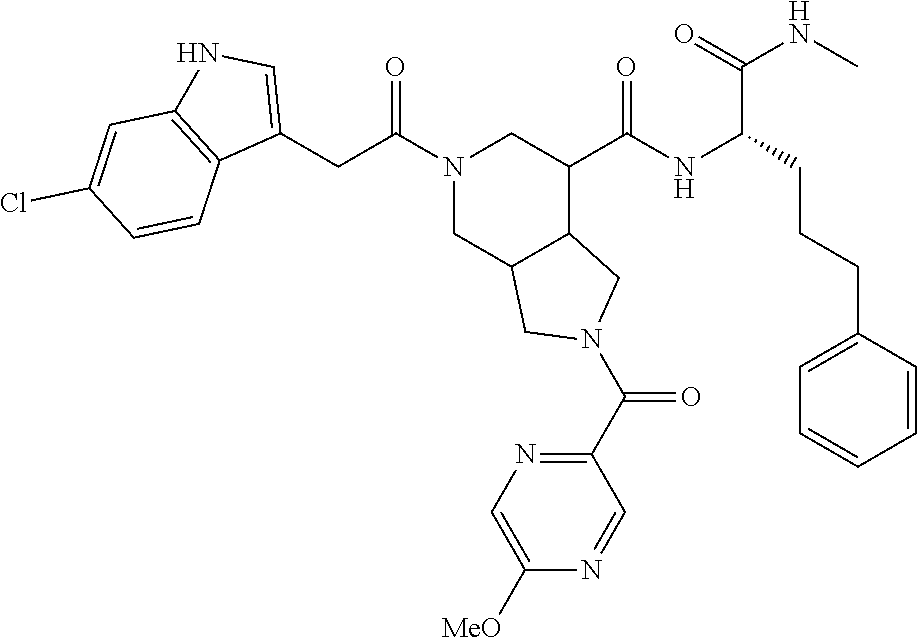
  • Compound X refers to 5-(2-(6-chloro-1H-indol-3-yl)acetyl)-2-(4-isopropoxy-3-methoxybenzoyl)-N-(1-(methylamino)-1-oxo-5-phenylpentan-2-yl)octahydro-1H-pyrrolo[3,4-c]pyridine-7-carboxamide.
  • Compound X may also be depicted as
  • lower alkyl refers to a C 1-4 straight or branched alkyl group.
  • exemplary lower alkyl groups are methyl, ethyl, propyl, isopropyl, butyl, isobutyl, and tert-butyl.
  • lower haloalkyl refers to a C 1-4 straight or branched alkyl group that is substituted with one or more halogen atoms.
  • heteroatom means one or more of oxygen, sulfur, nitrogen, phosphorus, or silicon (including, any oxidized form of nitrogen, sulfur, phosphorus, or silicon; the quaternized form of any basic nitrogen; or an oxygen, sulfur, nitrogen, phosphorus, or silicon atom in a heterocyclic ring.
  • unsaturated means that a moiety has one or more units of unsaturation.
  • bivalent C 1-8 (or C 1-6 ) saturated or unsaturated, straight or branched, hydrocarbon chain refers to bivalent alkylene, alkenylene, and alkynylene chains that are straight or branched as defined herein.
  • alkylene refers to a bivalent alkyl group.
  • An “alkylene chain” is a polymethylene group, i.e., —(CH 2 ) n —, wherein n is a positive integer, preferably from 1 to 6, from 1 to 4, from 1 to 3, from 1 to 2, or from 2 to 3.
  • a substituted alkylene chain is a polymethylene group in which one or more methylene hydrogen atoms are replaced with a substituent. Suitable substituents include those described below for a substituted aliphatic group.
  • alkenylene refers to a bivalent alkenyl group.
  • a substituted alkenylene chain is a polymethylene group containing at least one double bond in which one or more hydrogen atoms are replaced with a substituent. Suitable substituents include those described below for a substituted aliphatic group.
  • halogen means F, Cl, Br, or I.
  • aryl used alone or as part of a larger moiety as in “aralkyl,” “aralkoxy,” or “aryloxyalkyl,” refers to monocyclic or bicyclic ring systems having a total of 4 to 14 ring members, wherein at least one ring in the system is aromatic and wherein each ring in the system contains three to seven ring members.
  • aryl may be used interchangeably with the term “aryl ring”.
  • aryl refers to an aromatic ring system which includes, but not limited to, phenyl, biphenyl, naphthyl, anthracyl and the like, which may bear one or more substituents.
  • aryl is a group in which an aromatic ring is fused to one or more non-aromatic rings, such as indanyl, phthalimidyl, naphthimidyl, phenanthridinyl, or tetrahydronaphthyl, and the like.
  • heteroaryl and “heteroar-,” used alone or as part of a larger moiety, e.g., “heteroaralkyl,” or “heteroaralkoxy,” refer to groups having 5 to 10 ring atoms, preferably 5, 6, or 9 ring atoms; having 6, 10, or 14 ⁇ electrons shared in a cyclic array; and having, in addition to carbon atoms, from one to five heteroatoms.
  • heteroatom in the context of “heteroaryl” particularly includes, but is not limited to, nitrogen, oxygen, or sulfur, and includes any oxidized form of nitrogen or sulfur, and any quaternized form of a basic nitrogen.
  • Heteroaryl groups include, without limitation, thienyl, furanyl, pyrrolyl, imidazolyl, pyrazolyl, triazolyl, tetrazolyl, oxazolyl, isoxazolyl, oxadiazolyl, thiazolyl, isothiazolyl, thiadiazolyl, pyridyl, pyridazinyl, pyrimidinyl, pyrazinyl, indolizinyl, purinyl, naphthyridinyl, and pteridinyl.
  • heteroaryl and “heteroar-”, as used herein, also include groups in which a heteroaromatic ring is fused to one or more aryl, cycloaliphatic, or heterocyclyl rings, where the radical or point of attachment is on the heteroaromatic ring.
  • Nonlimiting examples include indolyl, isoindolyl, benzothienyl, benzofuranyl, dibenzofuranyl, indazolyl, benzimidazolyl, benzthiazolyl, quinolyl, isoquinolyl, cinnolinyl, phthalazinyl, quinazolinyl, quinoxalinyl, 4H-quinolizinyl, carbazolyl, acridinyl, phenazinyl, phenothiazinyl, phenoxazinyl, tetrahydroquinolinyl, tetrahydroisoquinolinyl, and pyrido[2,3-b]-1,4-oxazin-3(4H)-one.
  • a heteroaryl group may be monocyclic or bicyclic.
  • a heteroaryl ring may include one or more oxo ( ⁇ O) or thioxo ( ⁇ S) substituent.
  • the term “heteroaryl” may be used interchangeably with the terms “heteroaryl ring,” “heteroaryl group,” or “heteroaromatic,” any of which terms include rings that are optionally substituted.
  • the term “heteroaralkyl” refers to an alkyl group substituted by a heteroaryl, wherein the alkyl and heteroaryl portions independently are optionally substituted.
  • heterocycle As used herein, the terms “heterocycle,” “heterocyclyl,” “heterocyclic radical,” and “heterocyclic ring” are used interchangeably and refer to a stable 5- to 7-membered monocyclic or 7 to 10-membered bicyclic heterocyclic moiety that is either saturated or partially unsaturated, and having, in addition to carbon atoms, one or more, preferably 1 to 4, heteroatoms, as defined above.
  • nitrogen includes a substituted nitrogen.
  • a saturated or partially unsaturated ring having 0 to 3 heteroatoms selected from oxygen, sulfur and nitrogen.
  • a heterocyclic ring can be attached to a provided compound at any heteroatom or carbon atom that results in a stable structure and any of the ring atoms can be optionally substituted.
  • saturated or partially unsaturated heterocyclic radicals include, without limitation, tetrahydrofuranyl, tetrahydrothiophenyl pyrrolidinyl, piperidinyl, pyrrolinyl, tetrahydroquinolinyl, tetrahydroisoquinolinyl, decahydroquinolinyl, oxazolidinyl, piperazinyl, dioxanyl, dioxolanyl, diazepinyl, oxazepinyl, thiazepinyl, morpholinyl, and quinuclidinyl.
  • heterocycle used interchangeably herein, and also include groups in which a heterocyclyl ring is fused to one or more aryl, heteroaryl, or cycloaliphatic rings, such as indolinyl, 3H-indolyl, chromanyl, phenanthridinyl, or tetrahydroquinolinyl.
  • a heterocyclyl group may be monocyclic or bicyclic, bridged bicyclic, or spirocyclic.
  • heterocyclic ring may include one or more oxo ( ⁇ O) or thioxo ( ⁇ S) substituent.
  • heterocyclylalkyl refers to an alkyl group substituted by a heterocyclyl, wherein the alkyl and heterocyclyl portions independently are optionally substituted.
  • partially unsaturated refers to a ring moiety that includes at least one double or triple bond.
  • partially unsaturated is intended to encompass rings having multiple sites of unsaturation, but is not intended to include aryl or heteroaryl moieties, as herein defined.
  • compounds of the present disclosure may contain “substituted” moieties.
  • substituted means that one or more hydrogens of the designated moiety are replaced with a suitable substituent.
  • an “optionally substituted” group may have a suitable substituent at one or more substitutable position of the group, and when more than one position in any given structure is substituted with more than one substituent selected from a specified group, the substituent may be either the same or different at every position.
  • Combinations of substituents envisioned by the present disclosure are preferably those that result in the formation of stable or chemically feasible compounds.
  • stable refers to compounds that are not substantially altered when subjected to conditions to allow for their production, detection, and, in certain embodiments, their recovery, purification, and use for one or more of the purposes disclosed herein.
  • Suitable monovalent substituents on a substitutable carbon atom of an “optionally substituted” group are independently halogen; —(CH 2 ) 0-6 R ⁇ ; —(CH 2 ) 0-6 OR ⁇ ; —O(CH 2 ) 0-6 R ⁇ , —O—(CH 2 ) 0-6 C(O)OR ⁇ ; —(CH 2 ) 0-6 CH(OR ⁇ ) 2 ; —(CH 2 ) 0-6 SR ⁇ ; —(CH 2 ) 0-6 Ph, which Ph may be substituted with R ⁇ ; —(CH 2 ) 0-46 O(CH 2 ) 0-1 Ph which Ph may be substituted with R ⁇ ; —CH ⁇ CHPh, which Ph may be substituted with R ⁇ ; —(CH 2 ) 0-6 O(CH 2 ) 0-1 -pyridyl which pyridyl may be substituted with R ⁇ ; —
  • Suitable monovalent substituents on R ⁇ are independently halogen, —(CH 2 ) 0-2 R ⁇ , -(haloR ⁇ ), —(CH 2 ) 0-2 OH, —(CH 2 ) 0-2 R ⁇ , —(CH 2 ) 0-2 CH(OR ⁇ ) 2 ; —O(haloR ⁇ ), —CN, —N 3 , —(CH 2 ) 0-2 C(O)R ⁇ , —(CH 2 ) 0-2 C(O)OH, —(CH 2 ) 0-2 C(O)OR ⁇ , —(CH 2 ) 0-2 SR ⁇ , —(CH 2 ) 0-2 SH, —(CH 2 ) 0-2 NH 2 , —(CH 2 ) 0-2 NHR ⁇ , —(CH 2
  • Suitable divalent substituents on a saturated carbon atom of an “optionally substituted” group include the following: ⁇ O, ⁇ S, ⁇ NNR* 2 , ⁇ NNHC(O)R*, ⁇ NNHC(O)OR*, ⁇ NNHS(O) 2 R*, ⁇ NR*, ⁇ NOR*, —O(C(R* 2 )) 2-3 O—, or —S(C(R* 2 )) 2-3 S—, wherein each independent occurrence of R* is selected from hydrogen, C 1-6 aliphatic which may be substituted as defined below, and an unsubstituted 5 to 6-membered saturated, partially unsaturated, or aryl ring (having 0 to 4 heteroatoms independently selected from nitrogen, oxygen, and sulfur).
  • Suitable divalent substituents that are bound to vicinal substitutable carbons of an “optionally substituted” group include: —O(CR* 2 ) 2-3 O—, wherein each independent occurrence of R* is selected from hydrogen, C 1-6 aliphatic which may be substituted as defined below, and an unsubstituted 5 to 6-membered saturated, partially unsaturated, or aryl ring (having 0 to 4 heteroatoms independently selected from nitrogen, oxygen, and sulfur).
  • Suitable substituents on the aliphatic group of R* include halogen, —R ⁇ , -(haloR ⁇ ), —OH, —OR ⁇ , —O(haloR ⁇ ), —CN, —C(O)OH, —C(O)OR ⁇ , —NH 2 , —NHR ⁇ , —NR ⁇ 2 , or —NO 2 , wherein each R ⁇ is unsubstituted or where preceded by “halo” is substituted only with one or more halogens, and is independently C 1-4 aliphatic, —CH 2 Ph, —O(CH 2 ) 0-1 Ph, or a 5 to 6-membered saturated, partially unsaturated, or aryl ring (having 0 to 4 heteroatoms independently selected from nitrogen, oxygen, and sulfur).
  • Suitable substituents on a substitutable nitrogen of an “optionally substituted” group include —R ⁇ , —NR ⁇ , —C(O)R ⁇ , —C(O)OR ⁇ , —C(O)C(O)R ⁇ , —C(O)CH 2 C(O)R ⁇ , —S(O) 2 R ⁇ , —S(O) 2 NR ⁇ 2 , —C(S)NR ⁇ 2 , —C(NH)NR ⁇ 2 , or —N(R ⁇ )S(O) 2 R ⁇ ; wherein each R ⁇ is independently hydrogen, C 1-6 aliphatic which may be substituted as defined below, unsubstituted —OPh, or an unsubstituted 5 to 6-membered saturated, partially unsaturated, or aryl ring (having 0 to 4 heteroatoms independently selected from nitrogen, oxygen, and sulfur), or, notwithstanding the definition above, two independent
  • Suitable substituents on the aliphatic group of R ⁇ are independently halogen, —R ⁇ , -(haloR ⁇ ), —OH, —OR ⁇ , —O(haloR ⁇ ), —CN, —C(O)OH, —C(O)OR ⁇ , —NH 2 , —NHR ⁇ , —NR ⁇ 2 , or —NO 2 , wherein each R ⁇ is unsubstituted or where preceded by “halo” is substituted only with one or more halogens, and is independently C 1-4 aliphatic, —CH 2 Ph, —O(CH 2 ) 0-1 Ph, or a 5 to 6-membered saturated, partially unsaturated, or aryl ring (having 0 to 4 heteroatoms independently selected from nitrogen, oxygen, and sulfur).
  • the term “provided compound” or “compound of the present disclosure” refers to any genus, subgenus, and/or species set forth herein.
  • the term “pharmaceutically acceptable salt” refers to those salts which are, within the scope of sound medical judgment, suitable for use in contact with the tissues of humans and lower animals without undue toxicity, irritation, allergic response and the like, and are commensurate with a reasonable benefit/risk ratio.
  • Pharmaceutically acceptable salts are well known in the art. For example, S. M. Berge et al., describe pharmaceutically acceptable salts in detail in J. Pharmaceutical Sciences, 1977, 66, 1-19, which is incorporated herein by reference.
  • Pharmaceutically acceptable salts of the compounds of this disclosure include those derived from suitable inorganic and organic acids and bases.
  • Examples of pharmaceutically acceptable, nontoxic acid addition salts are salts of an amino group formed with inorganic acids such as hydrochloric acid, hydrobromic acid, phosphoric acid, sulfuric acid and perchloric acid or with organic acids such as acetic acid, oxalic acid, maleic acid, tartaric acid, citric acid, succinic acid or malonic acid or by using other methods used in the art such as ion exchange.
  • inorganic acids such as hydrochloric acid, hydrobromic acid, phosphoric acid, sulfuric acid and perchloric acid
  • organic acids such as acetic acid, oxalic acid, maleic acid, tartaric acid, citric acid, succinic acid or malonic acid or by using other methods used in the art such as ion exchange.
  • salts include adipate, alginate, ascorbate, aspartate, benzenesulfonate, benzoate, bisulfate, borate, butyrate, camphorate, camphorsulfonate, citrate, cyclopentanepropionate, digluconate, dodecylsulfate, ethanesulfonate, formate, fumarate, glucoheptonate, glycerophosphate, gluconate, hemisulfate, heptanoate, hexanoate, hydroiodide, 2-hydroxy-ethanesulfonate, lactobionate, lactate, laurate, lauryl sulfate, malate, maleate, malonate, methanesulfonate, 2-naphthalenesulfonate, nicotinate, nitrate, oleate, oxalate, palmitate, pamoate, pectinate,
  • Salts derived from appropriate bases include alkali metal, alkaline earth metal, ammonium and N + (C 1-4 alkyl) 4 salts.
  • Representative alkali or alkaline earth metal salts include sodium, lithium, potassium, calcium, magnesium, and the like.
  • Further pharmaceutically acceptable salts include, when appropriate, nontoxic ammonium, quaternary ammonium, and amine cations formed using counterions such as halide, hydroxide, carboxylate, sulfate, phosphate, nitrate, lower alkyl sulfonate, and aryl sulfonate.
  • structures depicted herein are also meant to include all isomeric (e.g., enantiomeric, diastereomeric, and geometric (or conformational)) forms of the structure; for example, the R and S configurations for each asymmetric center, Z and E double bond isomers, and Z and E conformational isomers. Therefore, single stereochemical isomers as well as enantiomeric, diastereomeric, and geometric (or conformational) mixtures of the present compounds are within the scope of the disclosure. Unless otherwise stated, all tautomeric forms of the compounds of the disclosure are within the scope of the disclosure.
  • structures depicted herein are also meant to include compounds that differ only in the presence of one or more isotopically enriched atoms.
  • compounds having the present structures including the replacement of hydrogen by deuterium or tritium, or the replacement of a carbon by a 13 C- or 14 C-enriched carbon are within the scope of this disclosure.
  • Such compounds are useful, for example, as analytical tools, as probes in biological assays, or as therapeutic agents in accordance with the present disclosure.
  • an inhibitor is defined as a compound that binds to and/or inhibits CDK2 with measurable affinity.
  • an inhibitor has an IC 50 and/or binding constant of less than about 50 ⁇ M, less than about 1 ⁇ M, less than about 500 nM, less than about 100 nM, less than about 10 nM, or less than about 1 nM, when measured in an appropriate assay.
  • patient means an animal, preferably a mammal, and most preferably a human.
  • compositions of this disclosure refers to a non-toxic carrier, adjuvant, or vehicle that does not destroy the pharmacological activity of the compound with which it is formulated.
  • Pharmaceutically acceptable carriers, adjuvants or vehicles that may be used in the compositions of this disclosure include, but are not limited to, ion exchangers, alumina, aluminum stearate, lecithin, serum proteins, such as human serum albumin, buffer substances such as phosphates, glycine, sorbic acid, potassium sorbate, partial glyceride mixtures of saturated vegetable fatty acids, water, salts or electrolytes, such as protamine sulfate, disodium hydrogen phosphate, potassium hydrogen phosphate, sodium chloride, zinc salts, colloidal silica, magnesium trisilicate, polyvinyl pyrrolidone, cellulose-based substances, polyethylene glycol, sodium carboxymethylcellulose, polyacrylates, waxes, polyethylene-polyoxypropylene-block
  • a “pharmaceutically acceptable derivative” means any non-toxic salt, ester, salt of an ester or other derivative of a compound of this disclosure that, upon administration to a recipient, is capable of providing, either directly or indirectly, a compound of this disclosure or an inhibitorily or degratorily active metabolite or residue thereof.
  • the term “inhibitorily active metabolite or residue thereof” means that a metabolite or residue thereof is also an inhibitor of a CDK2 protein, or a mutant thereof.
  • R A is
  • R A is
  • R A is
  • R A is
  • R A is
  • R A is
  • R A is
  • R A is
  • R A is selected from those depicted in the compounds of the compounds of Table 1, below.
  • L 1 is a covalent bond or a saturated or unsaturated, straight or branched, optionally substituted bivalent C 1-6 hydrocarbon chain, wherein 0-2 methylene units of L 1 are independently replaced by —O—, —NR—, —S—, —OC(O)—, —C(O)O—, —C(O)—, —S(O)—, —S(O) 2 —, —C(S)—, —NRS(O) 2 —, —S(O) 2 NR—, —NRC(O)—, —C(O)NR—, —OC(O)NR—, —NRC(O)O—, or —NRC(O)NR—.
  • L 1 is a covalent bond.
  • L 1 is a saturated or unsaturated, straight or branched, optionally substituted bivalent C 1-6 hydrocarbon chain, wherein 0-2 methylene units of L are independently replaced by —O—, —NR—, —S—, —OC(O)—, —C(O)O—, —C(O)—, —S(O)—, —S(O) 2 —, —C(S)—, —NRS(O) 2 —, —S(O) 2 NR—, —NRC(O)—, —C(O)NR—, —OC(O)NR—, —NRC(O)O—, or —NRC(O)NR—.
  • L 1 is a saturated or unsaturated, straight or branched, optionally substituted bivalent C 1-6 hydrocarbon chain. In some embodiments, L 1 is a saturated or unsaturated, straight or branched, optionally substituted bivalent C 1-4 hydrocarbon chain.
  • L 1 is a saturated or unsaturated, straight or branched, optionally substituted bivalent C 1-6 hydrocarbon chain, wherein 1 or 2 methylene units of L 1 are replaced by —O—, —NR—, —S—, —OC(O)—, —C(O)O—, —C(O)—, —S(O)—, —S(O) 2 —, —C(S)—, —NRS(O) 2 —, —S(O) 2 NR—, —NRC(O)—, —C(O)NR—, —OC(O)NR—, —NRC(O)O—, or —NRC(O)NR—.
  • L 1 is an optionally substituted saturated, straight or branched, bivalent C 1-4 hydrocarbon chain. In some embodiments, L 1 is a partially unsaturated, straight or branched, bivalent C 1-4 hydrocarbon chain. In some embodiments, L 1 is an optionally substituted saturated, straight, bivalent C 1-6 hydrocarbon chain, wherein 1-2 methylene units of L 1 are independently replaced by —O—, —NR—, —S—, —OC(O)—, —C(O)O—, —C(O)—, —S(O)—, —S(O) 2 —, —C(S)—, —NRS(O) 2 —, —S(O) 2 NR—, —NRC(O)—, —C(O)NR—, —OC(O)NR—, —NRC(O)O—, or —NRC(O)NR—.
  • L 1 is an optionally substituted straight or branched C 1-6 alkylene chain, wherein 1-2 methylene units of L 1 are independently replaced by —O—, —C(O)O—, —C(O)—, or —NRC(O)—.
  • L 1 is an optionally substituted straight or branched C 1-4 alkylene chain, wherein 1-2 methylene units of L 1 are independently replaced by —O—, —C(O)O—, —C(O)—, or —NRC(O)—.
  • L 1 is an optionally substituted straight or branched C 1-4 alkylene chain, wherein 1 methylene unit of L 1 is replaced by —O—.
  • L 1 is an optionally substituted straight or branched C 1-4 alkylene chain, wherein 1 methylene unit of L 1 is replaced by —NRC(O)—. In some embodiments, L 1 is an optionally substituted straight or branched C 1-4 alkylene chain, wherein 1 methylene unit of L 1 is replaced by —NHC(O)— or —N(CH 3 )C(O)—. In some embodiments, L 1 is an unsubstituted straight chain C 1-4 alkylene. In some embodiments, L 1 is an unsubstituted straight chain C 1-4 alkenylene. In some embodiments, L 1 is an unsubstituted straight chain C 1-4 alkynylene. In some embodiments, L 1 is selected from those depicted in the compounds of Table 1, below.
  • L 1 is N
  • L 1 is N
  • L 1 is N
  • L 1 is N
  • R 1 is hydrogen, an optionally substituted C 1-6 aliphatic group, or an optionally substituted cyclic group selected from a 3-8 membered saturated or partially unsaturated monocyclic carbocyclic ring, a 7-12 membered saturated or partially unsaturated bicyclic carbocyclic ring, phenyl, an 8-10 membered bicyclic aromatic carbocyclic ring, a 3-8 membered saturated or partially unsaturated monocyclic heterocyclic ring (having 1-2 heteroatoms independently selected from nitrogen, oxygen, and sulfur), a 7-12 membered saturated or partially unsaturated bicyclic heterocyclic ring (having 1-4 heteroatoms independently selected from nitrogen, oxygen, and sulfur), a 5-6 membered monocyclic heteroaromatic ring (having 1-4 heteroatoms independently selected from nitrogen, oxygen, and sulfur), and an 8-10 membered bicyclic heteroaromatic ring (having 1-5 heteroatoms independently selected from nitrogen, oxygen, and sulfur).
  • R 1 is hydrogen. In some embodiments, R 1 is an optionally substituted C 1-6 aliphatic group. In some embodiments, R 1 is an optionally substituted C 1-4 aliphatic group. In some embodiments, R 1 is a C 1-4 aliphatic group. In some embodiments, R 1 is an isopropyl group. In some embodiments, R 1 is a tert-butyl group. In some embodiments, R 1 is methyl.
  • R 1 is an optionally substituted cyclic group selected from a 3-8 membered saturated or partially unsaturated monocyclic carbocyclic ring, a 7-12 membered saturated or partially unsaturated bicyclic carbocyclic ring, phenyl, an 8-10 membered bicyclic aromatic carbocyclic ring, a 3-8 membered saturated or partially unsaturated monocyclic heterocyclic ring (having 1-2 heteroatoms independently selected from nitrogen, oxygen, and sulfur), a 7-12 membered saturated or partially unsaturated bicyclic heterocyclic ring (having 1-4 heteroatoms independently selected from nitrogen, oxygen, and sulfur), a 5-6 membered monocyclic heteroaromatic ring (having 1-4 heteroatoms independently selected from nitrogen, oxygen, and sulfur), and an 8-10 membered bicyclic heteroaromatic ring (having 1-5 heteroatoms independently selected from nitrogen, oxygen, and sulfur).
  • R 1 is an optionally substituted cyclic group selected from a 3-8 membered saturated or partially unsaturated monocyclic carbocyclic ring, phenyl, a 3-8 membered saturated or partially unsaturated monocyclic heterocyclic ring (having 1-2 heteroatoms independently selected from nitrogen, oxygen, and sulfur), a 5-6 membered monocyclic heteroaromatic ring (having 1-4 heteroatoms independently selected from nitrogen, oxygen, and sulfur), and an 8-10 membered bicyclic heteroaromatic ring (having 1-5 heteroatoms independently selected from nitrogen, oxygen, and sulfur).
  • R 1 is an optionally substituted cyclic group selected from phenyl, cyclohexyl, cyclopentyl, cycloheptyl, tetrahydrofuranyl, tetrahydropyranyl, pyridinyl, pyridazinyl, indole, and benzotriazole.
  • R 1 is an optionally substituted phenyl group.
  • R 1 is an optionally substituted cyclohexyl group.
  • R 1 is an optionally substituted cyclopentyl group.
  • R 1 is an optionally substituted cycloheptyl group.
  • R 1 is an optionally substituted pyridinyl group. In some embodiments, R 1 is an optionally substituted pyridazinyl group. In some embodiments, R 1 is an optionally substituted tetrahydrofuranyl group. In some embodiments, R 1 is an optionally substituted tetrahydropyranyl group. In some embodiments, R 1 is an optionally substituted indole group. In some embodiments, R 1 is an optionally substituted benzotriazole group. In some embodiments, R 1 is selected from those depicted in the compounds of Table 1, below.
  • R 1 is hydrogen, methyl
  • R 1 is N-(2-aminoethyl)-2-aminoethyl-N-(2-aminoethyl)-2-aminoethyl-N-(2-aminoethyl)-2-aminoethyl-N-(2-aminoethyl)-2-aminoethyl-N-(2-aminoethyl)-2-aminoethyl
  • R 1 is N-(2-aminoethyl)-2-aminoethyl-N-(2-aminoethyl)-2-aminoethyl-N-(2-aminoethyl)-2-aminoethyl-N-(2-aminoethyl)-2-aminoethyl-N-(2-aminoethyl)-2-aminoethyl
  • R 2 is hydrogen, an optionally substituted C 1-6 aliphatic group, —C(O)OR, —C(O)NR 2 , or an optionally substituted cyclic group selected from phenyl and a 5-6 membered monocyclic heteroaromatic ring (having 1-4 heteroatoms independently selected from nitrogen, oxygen, and sulfur).
  • R 2 is an optionally substituted C 1-6 aliphatic group, —C(O)OR, —C(O)NR 2 , or an optionally substituted cyclic group selected from phenyl and a 5-6 membered monocyclic heteroaromatic ring (having 1-4 heteroatoms independently selected from nitrogen, oxygen, and sulfur).
  • R 2 is hydrogen, methyl, —C(O)NHCH 3 , —C(O)NH 2 , —C(O)OCH 3 , —C(O)OH, or an optionally substituted 5-6 membered monocyclic heteroaromatic ring (having 1-4 heteroatoms independently selected from nitrogen, oxygen, and sulfur).
  • R 2 is hydrogen, methyl, —C(O)NHCH 3 , —C(O)NH 2 , —C(O)OCH 3 , or —C(O)OH.
  • R 2 is hydrogen.
  • R 2 is methyl.
  • R 2 is —C(O)NHCH 3 .
  • R 2 is —C(O)NH 2 . In some embodiments, R 2 is —C(O)OCH 3 . In some embodiments, R 2 is —C(O)OH. In some embodiments, R 2 is a 5-6 membered monocyclic heteroaromatic ring (having 1-4 heteroatoms independently selected from nitrogen, oxygen, and sulfur). In some embodiments R 2 is an oxazolyl group. In some embodiments, R 2 is a pyrimidinyl group.
  • R 2 is selected from those depicted in the compounds of Table 1, below.
  • each instance of R 3 is independently hydrogen or an optionally substituted C 1-6 aliphatic group. In some embodiments, each instance of R 3 is hydrogen.
  • R 4 is a cyclic group selected from a 3-8 membered saturated or partially unsaturated monocyclic carbocyclic ring, a 7-12 membered saturated or partially unsaturated bicyclic carbocyclic ring, phenyl, an 8-10 membered bicyclic aromatic carbocyclic ring, a 3-8 membered saturated or partially unsaturated monocyclic heterocyclic ring (having 1-2 heteroatoms independently selected from nitrogen, oxygen, and sulfur), a 7-12 membered saturated or partially unsaturated bicyclic heterocyclic ring (having 1-4 heteroatoms independently selected from nitrogen, oxygen, and sulfur), a 5-6 membered monocyclic heteroaromatic ring (having 1-4 heteroatoms independently selected from nitrogen, oxygen, and sulfur), and an 8-10 membered bicyclic heteroaromatic ring (having 1-5 heteroatoms independently selected from nitrogen, oxygen, and sulfur), wherein the cyclic group is optionally substituted with one or more instances of R 5 .
  • R 4 is a cyclic group selected from a 3-8 membered saturated or partially unsaturated monocyclic heterocyclic ring (having 1-2 heteroatoms independently selected from nitrogen, oxygen, and sulfur), and a 5-6 membered monocyclic heteroaromatic ring (having 1-4 heteroatoms independently selected from nitrogen, oxygen, and sulfur), wherein the cyclic group is optionally substituted with one or more instances of R 5 .
  • R 4 is a 3-8 membered saturated or partially unsaturated monocyclic heterocyclic ring (having 1-2 heteroatoms independently selected from nitrogen, oxygen, and sulfur), optionally substituted with one or more instances of R 5 .
  • R 4 is a 5-6 membered monocyclic heteroaromatic ring (having 1-4 heteroatoms independently selected from nitrogen, oxygen, and sulfur), optionally substituted with one or more instances of R 5 .
  • R 4 is a cyclic group selected from phenyl, pyridine, and piperidine, wherein the cyclic group is optionally substituted with one or more instances of R 5 .
  • R 4 is phenyl, optionally substituted with one or more instances of R 5 .
  • R 4 is pyridine, optionally substituted with one or more instances of R 5 .
  • R 4 is piperidine, optionally substituted with one or more instances of R 5 .
  • R 4 is selected from those depicted in the compounds of Table 1, below.
  • R 4 is substituted with 0, 1, or 2 instances of R 5 . In some embodiments, R 4 is substituted with 1 instance of R 5 . R 3 is substituted with 2 instances of R 5 . R 4 is substituted with 3 instances of R 5 . In some embodiments, R 4 is unsubstituted.
  • each instance of R 5 is independently halogen, —CN, —NO 2 , —OR, —SR, —NR 2 , —S(O) 2 R, —S(O) 2 NR 2 , —S(O)R, —S(O)NR 2 , —C(O)R, —C(O)OR, —C(O)NR 2 , —C(O)N(R)OR, —OC(O)R, —OC(O)NR 2 , —N(R)C(O)OR, —N(R)C(O)R, —N(R)C(O)NR 2 , —N(R)C(NR)NR 2 , —N(R)S(O) 2 NR 2 , —N(R)S(O) 2 R, an optionally substituted C 1-6 aliphatic group, or an optionally substituted —C 1-6 aliphatic-Cy group.
  • R 5 is —OR, —C(O)R, an optionally substituted C 1-6 aliphatic group, or an optionally substituted —C 1-6 aliphatic-Cy group. In some embodiments, R 5 is —OR. In some embodiments, R 5 is —C(O)R. In some embodiments, R 5 is an optionally substituted C 1-6 aliphatic group. In some embodiments, R 5 is an optionally substituted —C 1-6 aliphatic-Cy group. In some embodiments, R 5 is an optionally substituted benzyl group, an optionally substituted benzoyl group, an optionally substituted phenoxy group, or an optionally substituted phenylacetyl group.
  • R 5 is an optionally substituted benzyl group. In some embodiments R 5 is an optionally substituted benzoyl group. In some embodiments R 5 is an optionally substituted phenoxy group. In some embodiments R 5 is an optionally substituted phenylacetyl group. In some embodiments, R 5 is selected from those depicted in the compounds of Table 1, below.
  • R 4 is
  • R A is a substituent of Table A1 or Table A2:
  • R A is a substituent of Table A1 or Table A2. In some embodiments, R A is a substituent of Table A1. In some embodiments, R A is a substituent of Table A2.
  • R A is
  • L 2 is a saturated or unsaturated, straight or branched, optionally substituted bivalent C 1-4 hydrocarbon chain, wherein 0-2 methylene units of L 2 are independently replaced by —O—, —NR—, —S—, —OC(O)—, —C(O)O—, —C(O)—, —S(O)—, —S(O) 2 —, —C(S)—, —NRS(O) 2 —, —S(O) 2 NR—, —NRC(O)—, —C(O)NR—, —OC(O)NR—, —NRC(O)O—, or —NRC(O)NR—.
  • L 2 is a saturated, straight, optionally substituted bivalent C 1-4 hydrocarbon chain, wherein 0-2 methylene units of L 2 are independently replaced by —O—, —NR—, —OC(O)—, —C(O)O—, —C(O)—, —NRC(O)—, or —C(O)NR.
  • L 2 is a saturated, straight, optionally substituted bivalent C 1-4 hydrocarbon chain.
  • L 2 is a saturated, straight, optionally substituted bivalent C 1-4 hydrocarbon chain, wherein 1 methylene unit of L 2 is replaced by —O—, —NR—, —OC(O)—, —C(O)O—, —C(O)—, —NRC(O)—, or —C(O)NR.
  • L 2 is a saturated, straight, optionally substituted bivalent C 1-4 hydrocarbon chain, wherein 1 methylene unit of L 2 is replaced by —C(O)—.
  • L 2 is —CH 2 — or —C(O)—.
  • L 2 is —CH 2 —.
  • L 2 is —C(O)—.
  • L 2 is selected from those depicted in the compounds of Table 1, below.
  • R 6 is an optionally substituted C 1-6 aliphatic group, or a cyclic group selected from a 3-8 membered saturated or partially unsaturated monocyclic carbocyclic ring, a 7-12 membered saturated or partially unsaturated bicyclic carbocyclic ring, phenyl, an 8-10 membered bicyclic aromatic carbocyclic ring, a 3-8 membered saturated or partially unsaturated monocyclic heterocyclic ring (having 1-2 heteroatoms independently selected from nitrogen, oxygen, and sulfur), a 7-12 membered saturated or partially unsaturated bicyclic heterocyclic ring (having 1-4 heteroatoms independently selected from nitrogen, oxygen, and sulfur), a 5-6 membered monocyclic heteroaromatic ring (having 1-4 heteroatoms independently selected from nitrogen, oxygen, and sulfur), and an 8-10 membered bicyclic heteroaromatic ring (having 1-5 heteroatoms independently selected from nitrogen, oxygen, and sulfur), wherein the cyclic group is optionally
  • R 6 is an optionally substituted C 1-6 aliphatic group.
  • R 6 is a cyclic group selected from a 3-8 membered saturated or partially unsaturated monocyclic carbocyclic ring, a 7-12 membered saturated or partially unsaturated bicyclic carbocyclic ring, phenyl, an 8-10 membered bicyclic aromatic carbocyclic ring, a 3-8 membered saturated or partially unsaturated monocyclic heterocyclic ring (having 1-2 heteroatoms independently selected from nitrogen, oxygen, and sulfur), a 7-12 membered saturated or partially unsaturated bicyclic heterocyclic ring (having 1-4 heteroatoms independently selected from nitrogen, oxygen, and sulfur), a 5-6 membered monocyclic heteroaromatic ring (having 1-4 heteroatoms independently selected from nitrogen, oxygen, and sulfur), and an 8-10 membered bicyclic heteroaromatic ring (having 1-5 heteroatoms independently selected from nitrogen, oxygen, and sulfur), wherein the
  • R 6 is a cyclic group selected from phenyl, an 8-10 membered bicyclic aromatic carbocyclic ring, a 5-6 membered monocyclic heteroaromatic ring (having 1-4 heteroatoms independently selected from nitrogen, oxygen, and sulfur), and an 8-10 membered bicyclic heteroaromatic ring (having 1-5 heteroatoms independently selected from nitrogen, oxygen, and sulfur), wherein the cyclic group is optionally substituted with one or more instances of R 7 .
  • R 6 is a cyclic group selected from cyclohexyl, phenyl, quinolinyl, isoquinolinyl, quinoxalinyl, 2,3-dihydrobenzo[b][1,4]dioxinyl, pyrazolyl, isoxazolyl, imidazolyl, thiazolyl, pyridinyl, pyrazinyl, pyridazinyl, pyrimidinyl, 2,3-dihydrobenzo[d]furanyl, benzofuranyl, indolyl, benzo[1,2,3]triazole, benzimidazolyl, imidazo[1,2-a]pyrimidinyl, imidazo[1,2-a]pyrazinyl, indazolyl, indolinyl, indolizinyl, isoindolinyl, and 2,3,-dihydrobenzo[d]oxazolyl, wherein the cyclic
  • R 6 is cyclohexyl, optionally substituted with one or more instances of R 7 .
  • R 6 is phenyl, optionally substituted with one or more instances of R 7 .
  • R 6 is quinolinyl, optionally substituted with one or more instances of R 7 .
  • R 6 is isoquinolinyl, optionally substituted with one or more instances of R 7 .
  • R 6 is quinoxalinyl, optionally substituted with one or more instances of R 7 .
  • R 6 is 2,3-dihydrobenzo[b][1,4]dioxinyl, optionally substituted with one or more instances of R 7 .
  • R 6 is pyrazolyl, optionally substituted with one or more instances of R 7 . In some embodiments, R 6 is isoxazolyl, optionally substituted with one or more instances of R 7 . In some embodiments, R 6 is imidazolyl, optionally substituted with one or more instances of R 7 . In some embodiments, R 6 is thiazolyl, optionally substituted with one or more instances of R 7 . In some embodiments, R 6 is pyridinyl, optionally substituted with one or more instances of R 7 . In some embodiments, R 6 is pyrazinyl, optionally substituted with one or more instances of R 7 .
  • R 6 is pyridazinyl, optionally substituted with one or more instances of R 7 .
  • R 6 is pyrimidinyl, optionally substituted with one or more instances of R 7 .
  • R 6 is 2,3-dihydrobenzo[d]furanyl, optionally substituted with one or more instances of R 7 .
  • R 6 is benzofuranyl, optionally substituted with one or more instances of R 7 .
  • R 5 is indolyl, optionally substituted with one or more instances of R 7 .
  • R 6 is benzo[1,2,3]triazole, optionally substituted with one or more instances of R 7 .
  • R 6 is benzimidazolyl, optionally substituted with one or more instances of R 7 .
  • R 6 is imidazo[1,2-a]pyrimidinyl, optionally substituted with one or more instances of R 7 .
  • R 6 is imidazo[1,2-a]pyrazinyl, optionally substituted with one or more instances of R 7 .
  • R 6 is indazolyl, optionally substituted with one or more instances of R 7 .
  • R 6 is indolinyl, optionally substituted with one or more instances of R 7 .
  • R 6 is indolizinyl, optionally substituted with one or more instances of R 7 .
  • R 6 is isoindolinyl, optionally substituted with one or more instances of R 7 .
  • R 6 is 2,3,-dihydrobenzo[d]oxazolyl, optionally substituted with one or more instances of R 7 .
  • R 6 is selected from those depicted in the compounds of Table 1, below.
  • R 6 is substituted with 0, 1, 2 or 3 instances of R 7 . In some embodiments, R 6 is substituted with 1 instance of R 7 . R 6 is substituted with 2 instances of R 7 . R 6 is substituted with 3 instances of R 7 . In some embodiments, R 6 is unsubstituted.
  • each R 7 is independently halogen, —CN, —NO 2 , —OR, —SR, —NR 2 , —S(O) 2 R, —S(O) 2 NR 2 , —S(O)R, —S(O)NR 2 , —C(O)R, —C(O)OR, —C(O)NR 2 , —C(O)N(R)OR, —OC(O)R, —OC(O)NR 2 , —N(R)C(O)OR, —N(R)C(O)R, —N(R)C(O)NR 2 , —N(R)C(O)S(O) 2 R, —N(R)C(NR)NR 2 , —N(R)S(O) 2 NR 2 , —N(R)S(O) 2 R, an optionally substituted C 1-6 aliphatic group, or Cy, or two instances of R 6 on
  • each R 7 is independently halogen, —CN, —OR, —NR 2 , —S(O) 2 NR 2 , —N(R)C(O)R, —N(R)C(O)S(O) 2 R, an optionally substituted C 1-6 aliphatic group, or Cy, or two instances of R 7 on the same carbon atom are taken together to form an oxo group.
  • each R 7 is independently —OR, an optionally substituted C 1-6 aliphatic group, Cy or two instances of R 7 on the same carbon atom are taken together to form an oxo group.
  • each R 7 is independently fluoro, chloro, methoxy, ethoxy, isopropoxy, cyclopropoxy, isobutoxy, phenoxy, 2-cyclopropylethoxy, methyl, ethyl, cyclopropyl, isobutyl, phenyl, pyridinyl, pyrimidinyl, cyclopropanecarboxamido, 2-cyclopropylacetamido, (methyl sulfonyl)methanamido, cyano, hydroxymethyl, trifluoromethoxy, trifluoromethyl, sulfamoyl, or amino, or two instances of R 7 on the same carbon atom are taken together to form an oxo group.
  • each R 7 is independently —OR.
  • each R 7 is independently selected from those depicted in the compounds of Table 1, below.
  • -L 2 -R 6 is a substituent of Table B1 or Table B2:
  • -L 2 -R 6 is a substituent of Table B1. In some embodiments, -L 2 -R 6 is a substituent of Table B2. In some embodiments, -L 2 -R 6 is
  • L 3 is a saturated or unsaturated, straight or branched, optionally substituted bivalent C 1-4 hydrocarbon chain, wherein 0-2 methylene units of L 3 are independently replaced by —O—, —NR—, —S—, —OC(O)—, —C(O)O—, —C(O)—, —S(O)—, —S(O) 2 —, —C(S)—, —NRS(O) 2 —, —S(O) 2 NR—, —NRC(O)—, —C(O)NR—, —OC(O)NR—, —NRC(O)O—, or —NRC(O)NR—.
  • L 3 is a saturated, straight, optionally substituted bivalent C 1-4 hydrocarbon chain, wherein 0-2 methylene units of L 3 are independently replaced by —O—, —NR—, —OC(O)—, —C(O)O—, —C(O)—, —NRC(O)—, or —C(O)NR.
  • L 3 is a saturated, straight, optionally substituted bivalent C 1-4 hydrocarbon chain.
  • L 3 is a saturated, straight, optionally substituted bivalent C 1-4 hydrocarbon chain, wherein 1 methylene unit of L 3 is replaced by —O—, —NR—, —OC(O)—, —C(O)O—, —C(O)—, —NRC(O)—, or —C(O)NR.
  • L 3 is a saturated, straight, optionally substituted bivalent C 1-4 hydrocarbon chain, wherein 1 methylene unit of L 3 is replaced by —C(O)—.
  • L 3 is a saturated, straight, substituted bivalent C 1-4 hydrocarbon chain, wherein 1 methylene unit of L 3 is replaced by —C(O)—, and wherein the C 1-4 hydrocarbon chain is substituted twice on the same carbon atom and forms a 3-6 membered saturated or partially unsaturated monocyclic carbocyclic ring.
  • L 3 is —C(O)CH 2 —, —C(O)C(CH 3 )H—, —C(O)C(CH 3 ) 2 —, —C(O)CH 2 CH 2 —, C(O)CH 2 CH 2 CH 2 —,
  • L 3 is —C(O)CH 2 —, or —C(O)C(CH 3 )H—. In some embodiments, L 3 is —C(O)CH 2 —. In some embodiments, L 3 is —C(O)C(CH 3 )H—. In some embodiments, L 3 is —C(O)C(CH 3 ) 2 —. In some embodiments, L 3 is —C(O)CH 2 CH 2 —. In some embodiments, L 3 is —C(O)CH 2 CH 2 CH 2 —. In some embodiments, L 3 is —C(O)—. In some embodiments, L 3 is —C(O)—. In some embodiments, L 3 is —C(O)—. In some embodiments, L 3 is —C(O)—. In some embodiments, L 3 is —C(O)—. In some embodiments, L 3 is —C(O)—. In some embodiments, L 3 is —C(O)—. In some
  • L 3 is —C(O)CH 2 —
  • L 3 is selected from those depicted in the compounds of Table 1, below.
  • R 8 is a cyclic group selected from a 3-8 membered saturated or partially unsaturated monocyclic carbocyclic ring, a 7-12 membered saturated or partially unsaturated bicyclic carbocyclic ring, phenyl, an 8-10 membered bicyclic aromatic carbocyclic ring, a 3-8 membered saturated or partially unsaturated monocyclic heterocyclic ring (having 1-2 heteroatoms independently selected from nitrogen, oxygen, and sulfur), a 7-12 membered saturated or partially unsaturated bicyclic heterocyclic ring (having 1-4 heteroatoms independently selected from nitrogen, oxygen, and sulfur), a 5-6 membered monocyclic heteroaromatic ring (having 1-4 heteroatoms independently selected from nitrogen, oxygen, and sulfur), and an 8-10 membered bicyclic heteroaromatic ring (having 1-5 heteroatoms independently selected from nitrogen, oxygen, and sulfur), wherein the cyclic group is optionally substituted with one or more instances of R 9 .
  • R 8 is a cyclic group selected from phenyl, a 3-8 membered saturated or partially unsaturated monocyclic heterocyclic ring (having 1-2 heteroatoms independently selected from nitrogen, oxygen, and sulfur), a 7-12 membered saturated or partially unsaturated bicyclic heterocyclic ring (having 1-4 heteroatoms independently selected from nitrogen, oxygen, and sulfur), a 5-6 membered monocyclic heteroaromatic ring (having 1-4 heteroatoms independently selected from nitrogen, oxygen, and sulfur), and an 8-10 membered bicyclic heteroaromatic ring (having 1-5 heteroatoms independently selected from nitrogen, oxygen, and sulfur), wherein the cyclic group is optionally substituted with one or more instances of R 9 .
  • R 8 is an 8-10 membered bicyclic heteroaromatic ring (having 1-5 heteroatoms independently selected from nitrogen, oxygen, and sulfur), optionally substituted with one or more instances of R 9 .
  • R 8 is a cyclic group selected from indolyl, indazolyl, benzofuranyl, and benzimidazolyl, wherein the cyclic group is optionally substituted with one or more instances of R 9 .
  • R 8 is indolyl optionally substituted with one or more instances of R 9 .
  • R 8 is indazolyl, optionally substituted with one or more instances of R 9 .
  • R 8 is benzimidazolyl, optionally substituted with one or more instances of R 9 .
  • R 8 is benzofuranyl, optionally substituted with one or more instances of R 9 .
  • R 8 is phenyl, optionally substituted with one or more instances of R 9 .
  • R 8 is pyridinyl, optionally substituted with one or more instances of R 9 .
  • R 8 is pyrimidinyl, optionally substituted with one or more instances of R 9 .
  • R 8 is pyridazinyl, optionally substituted with one or more instances of R 9 .
  • R 8 is pyrazinyl, optionally substituted with one or more instances of R 9 .
  • R 8 is quinolinyl, optionally substituted with one or more instances of R 9 .
  • R 8 is isoquinolinyl, optionally substituted with one or more instances of R 9 .
  • R 8 is pyrazolyl, optionally substituted with one or more instances of R 9 .
  • R 8 is tetrazolyl, optionally substituted with one or more instances of R 9 .
  • R 8 is quinoxalinyl, optionally substituted with one or more instances of R 9 .
  • R 8 is indolizinyl, optionally substituted with one or more instances of R 9 .
  • R 8 is thiazolyl, optionally substituted with one or more instances of R 9 .
  • R 8 is oxazolyl, optionally substituted with one or more instances of R 9 .
  • R 8 is pyrrolyl, optionally substituted with one or more instances of R 9 .
  • R 8 is imidazo[1,2-a]pyrazinyl, optionally substituted with one or more instances of R 9 . In some embodiments, R 8 is tetrahydropyranyl, optionally substituted with one or more instances of R 9 . In some embodiments, R 8 is selected from those depicted in the compounds of Table 1, below.
  • R 8 is substituted with 0, 1 or 2 instances of R 9 . In some embodiments, R 8 is substituted with 1 instance of R 9 . R 8 is substituted with 2 instances of R 9 . In some embodiments, R 8 is unsubstituted.
  • each instance of R 9 is independently halogen, —CN, —NO 2 , —OR, —SR, —NR 2 , —S(O) 2 R, —S(O) 2 NR 2 , —S(O)R, —S(O)NR 2 , —C(O)R, —C(O)OR, —C(O)NR 2 , —C(O)N(R)OR, —OC(O)R, —OC(O)NR 2 , —N(R)C(O)OR, —N(R)C(O)R, —N(R)C(O)NR 2 , —N(R)C(O)NR 2 , —N(R)S(O) 2 NR 2 , —N(R)S(O) 2 R, an optionally substituted C 1-6 aliphatic group, an optionally substituted C 1-6 aliphatic-Cy group, or Cy.
  • each instance of R 9 is independently halogen, —CN, —OR, an optionally substituted C 1-6 aliphatic group, or Cy. In some embodiments, each instance of R 9 is independently halogen, —CN, —OR, or a C 1-6 aliphatic group. In some embodiments, each instance of R 9 is independently fluoro, chloro, bromo, —CN, methyl, ethyl methoxy, hydroxymethyl, cyclopropylmethoxy, 2-methoxyethyl, phenyl or pyridinyl. In some embodiments, each instance of R 9 is independently chloro, bromo, —CN, methyl, or methoxy. In some embodiments, each R 9 is independently selected from those depicted in the compounds of Table 1, below.
  • -L 3 -R 8 is a substituent of Table C1 or Table C2:
  • -L 3 -R 8 is a substituent of Table C1. In some embodiments, -L 3 -R 8 is a substituent of Table C2. In some embodiments, -L 3 -R 8 is
  • each instance of Cy is independently phenyl or a 5-6 membered monocyclic heteroaromatic ring (having 1-4 heteroatoms independently selected from nitrogen, oxygen, and sulfur).
  • the present disclosure provides a compound of Formula I, which is a compound of Formula II:
  • R A is a substituent from Table A1.
  • -L 2 -R 6 is a substituent from Table B1.
  • -L 3 -R 8 is a substituent from Table C1.
  • R A is a substituent from Table A1, and -L 2 -R 6 is a substituent from Table B1.
  • R A is a substituent from Table A1, and -L 3 -R 8 is a substituent from Table C1.
  • -L 2 -R 6 is a substituent from Table B1, and -L 3 -R 8 is a substituent from Table C1.
  • R A is a substituent from Table A1
  • -L 2 -R 6 is a substituent from Table B1
  • -L 3 -R 8 is a substituent from Table C1.
  • the present disclosure provides a compound of Formula I, which is a compound of Formula III:
  • R 1 , R 2 , L 1 , L 2 , R 6 , L 3 and R 8 , and their constituent groups, are each as defined and described herein.
  • -L 2 -R 6 is a substituent from Table B1.
  • -L 3 -R 8 is a substituent from Table C1.
  • -L 2 -R 6 is a substituent from Table B1, and -L 3 -R 8 is a substituent from Table C1.
  • R 1 is optionally substituted phenyl.
  • R 1 is optionally substituted cyclohexyl.
  • L 1 is
  • L 1 is N
  • R 2 is —C(O)NHCH 3 .
  • L 2 is —C(O)—.
  • R 6 is phenyl optionally substituted with one or more instances of R 7 .
  • R 6 is pyrazolyl optionally substituted with one or more instances of R 7 .
  • L 3 is —C(O)CH 2 —.
  • L 3 is —C(O)C(CH 3 )H—.
  • R 8 is a cyclic group selected from indolyl, indazolyl, benzofuranyl, and benzimidazolyl, wherein the cyclic group is optionally substituted with one or more instances of R 9 . In some embodiments, R 8 is indolyl optionally substituted with one or more instances of R 9 .
  • the present disclosure provides a compound of Formula I, which is a compound of Formula IV:
  • R 4 , L 2 , R 6 , L 3 and R 8 , and their constituent groups, are each as defined and described herein.
  • -L 2 -R 6 is a substituent from Table B1.
  • -L 3 -R 8 is a substituent from Table C1.
  • -L 2 -R 6 is a substituent from Table B1, and -L 3 -R 8 is a substituent from Table C1.
  • R 4 is pyridinyl, optionally substituted with one or more instances of R 5 .
  • R 4 is piperidinyl, optionally substituted with one or more instances of R 5 .
  • L 2 is —C(O)—.
  • R 6 is phenyl optionally substituted with one or more instances of R 7 .
  • R 6 is pyrazolyl optionally substituted with one or more instances of R 7 .
  • L 3 is —C(O)CH 2 —.
  • L 3 is —C(O)C(CH 3 )H—.
  • R 8 is a cyclic group selected from indolyl, indazolyl, benzofuranyl, and benzimidazolyl, wherein the cyclic group is optionally substituted with one or more instances of R 9 .
  • R 8 is indolyl optionally substituted with one or more instances of R 9 .
  • the present disclosure provides a compound of Formula I, which is a compound of Formula V:
  • R A , R 6 , L 3 and R 8 , and their constituent groups, are each as defined and described herein.
  • R A is a substituent from Table A1.
  • -L 3 -R 8 is a substituent from Table C1.
  • R A is a substituent from Table A1, and -L 3 -R 8 is a substituent from Table C1.
  • R 6 is phenyl optionally substituted with one or more instances of R 7 .
  • R 6 is pyrazolyl optionally substituted with one or more instances of R 7 .
  • the present disclosure provides a compound of Formula I, which is a compound of Formula Va or Vb:
  • R A , R 7 , L 3 and R 8 , and their constituent groups, are each as defined and described herein.
  • R A is a substituent from Table A1.
  • -L 3 -R 8 is a substituent from Table C1.
  • R A is a substituent from Table A1, and -L 3 -R 8 is a substituent from Table C1.
  • each instance of R 7 is —OR or a halogen.
  • each instance of R 7 is —OR.
  • L 3 is —C(O)CH 2 —.
  • L 3 is —C(O)C(CH 3 )H—.
  • R 8 is a cyclic group selected from indolyl, indazolyl, benzofuranyl, and benzimidazolyl, wherein the cyclic group is optionally substituted with one or more instances of R 9 . In some embodiments, R 8 is indolyl optionally substituted with one or more instances of R 9 .
  • the present disclosure provides a compound of Formula I, which is a compound of Formula VI:
  • R A , L 2 , R 6 , and R 8 , and their constituent groups, are each as defined and described herein.
  • R A is a substituent from Table A1.
  • -L 2 -R 6 is a substituent from Table B1.
  • R A is a substituent from Table A1, and -L 2 -R 6 is a substituent from Table B1.
  • R 8 is a cyclic group selected from indolyl, indazolyl, benzofuranyl, and benzimidazolyl, wherein the cyclic group is optionally substituted with one or more instances of R 9 .
  • R 8 is indolyl optionally substituted with one or more instances of R 9 .
  • the present disclosure provides a compound of Formula I, which is a compound of Formula VIa:
  • R A , L 2 , R 6 , and R 9 , and their constituent groups, are each as defined and described herein.
  • R A is a substituent from Table A1.
  • -L 2 -R 6 is a substituent from Table B1.
  • R A is a substituent from Table A1, and -L 2 -R 6 is a substituent from Table B1.
  • R 9 is a halogen, methyl or —CN. In some embodiments, R 9 is chloro.
  • the present disclosure provides a compound of Formula I, which is a compound of Formula VIIa:
  • R A is a substituent from Table A1.
  • R 6 is phenyl optionally substituted with one or more instances of R 7 .
  • R 6 is pyrazolyl optionally substituted with one or more instances of R 7 .
  • R 8 is a cyclic group selected from indolyl, indazolyl, benzofuranyl, and benzimidazolyl, wherein the cyclic group is optionally substituted with one or more instances of R 9 .
  • R 8 is indolyl optionally substituted with one or more instances of R 9 .
  • the present disclosure provides a compound of Formula I, which is a compound of Formula VIIb:
  • R A is a substituent from Table A1.
  • R 6 is phenyl optionally substituted with one or more instances of R 7 .
  • R 6 is pyrazolyl optionally substituted with one or more instances of R 7 .
  • R 9 is a halogen, methyl or —CN. In some embodiments, R 9 is chloro.
  • the present disclosure provides a compound of Formula I, which is a compound of Formula VIIc:
  • R A is a substituent from Table A1.
  • each instance of R 7 is —OR or a halogen.
  • each instance of R 7 is —OR.
  • L 3 is —C(O)CH 2 —. In some embodiments, L 3 is —C(O)C(CH 3 )H—.
  • R 8 is a cyclic group selected from indolyl, indazolyl, benzofuranyl, and benzimidazolyl, wherein the cyclic group is optionally substituted with one or more instances of R 9 . In some embodiments, R 8 is indolyl optionally substituted with one or more instances of R 9 .
  • the present disclosure provides a compound of Formula I, which is a compound of Formula VIIe or VIIf:
  • R A is a substituent from Table A1.
  • each instance of R 7 is —OR or a halogen.
  • each instance of R 7 is —OR.
  • R 9 is a halogen, methyl or —CN. In some embodiments, R 9 is chloro.
  • the present disclosure provides a compound of Formula I, which is a compound of Formula VIIIa or VIIIb
  • R 1 , R 2 , R 7 , and R 9 , and their constituent groups, are each as defined and described herein.
  • R 1 is optionally substituted phenyl.
  • R 1 is optionally substituted cyclohexyl.
  • L 1 is
  • L 1 is N
  • R 2 is —C(O)NHCH 3 .
  • each instance of R 7 is —OR or a halogen.
  • each instance of R 7 is —OR.
  • R 9 is a halogen, methyl or —CN. In some embodiments, R 9 is chloro.
  • the present disclosure provides a compound of Formula I, which is a compound of Formula VIIIc or VIIId:
  • R 4 , R 7 , and R 9 , and their constituent groups, are each as defined and described herein.
  • R 4 is pyridinyl, optionally substituted with one or more instances of R 5 .
  • R 4 is piperidinyl, optionally substituted with one or more instances of R 5 .
  • each instance of R 7 is —OR or a halogen.
  • each instance of R 7 is —OR.
  • R 9 is a halogen, methyl or —CN. In some embodiments, R 9 is chloro.
  • the present disclosure provides a compound set forth in Table 1, above, or a pharmaceutically acceptable salt thereof. In some embodiments, the disclosure provides a compound set forth in Table 1, above, or a pharmaceutically acceptable salt thereof, and any enantiomers, diastereomers, or conformation isomers thereof.
  • the present disclosure provides a pharmaceutical composition comprising a compound of the present disclosure, or a pharmaceutically acceptable salt thereof, together with a pharmaceutically acceptable carrier, excipient, vehicle, adjuvant or diluent.
  • the present disclosure provides a pharmaceutical composition comprising a compound set forth in Table 1 above, or a pharmaceutically acceptable salt thereof, together with a pharmaceutically acceptable carrier, excipient, vehicle, adjuvant or diluent.
  • the pharmaceutical composition further comprises an additional therapeutic agent.
  • the present disclosure provides a complex comprising a CDK2 protein and a compound of the present disclosure.
  • the present disclosure provides a method of inhibiting the activity of a cyclin-dependent kinase (CDK).
  • the method comprises contacting a compound of the present disclosure with a CDK.
  • the compound and the CDK are contacted in vivo.
  • the compound and the CDK are contacted in vitro.
  • the present disclosure provides compounds that selectively inhibit CDK2 over other cyclin-dependent kinases (CDKs).
  • CDKs cyclin-dependent kinases
  • the compounds of the present disclosure selectively inhibit CDK2 over one or more other CDKs, selected from CDK1, CDK3, CDK4, CDK5, CDK6, CDK7, CDK8, CDK9, CDK10, CDK11, CDK12 and CDK13.
  • the compounds of the present disclosure selectively inhibit CDK2 over CDK4.
  • the compounds of the present disclosure selectively inhibit CDK2 over CDK6.
  • the compounds of the present disclosure selectively inhibit CDK2 over CDK4 and CDK6.
  • the present disclosure provides compounds that selectively inhibit CDK2/cyclin E complexes over other CDK complexes.
  • the central bicyclic core of any of the compounds or formulas described herein can be in one of a number of stereochemical configurations, or a mixture of two or more stereochemical configurations.
  • the present disclosure provides a compound of Formula I, which is a compound of Formula Ia:
  • R A , L 2 , R 6 , L 3 and R 8 , and their constituent groups, are each as defined and described herein.
  • the present disclosure provides a compound of Formula I, which is a compound of Formula Ib:
  • R A , L 2 , R 6 , L 3 and R 8 , and their constituent groups, are each as defined and described herein.
  • the present disclosure provides a compound of Formula I, which is a compound of Formula Ic:
  • R A , L 2 , R 6 , L 3 and R 8 , and their constituent groups, are each as defined and described herein.
  • the present disclosure provides a compound of Formula I, which is a compound of Formula Id:
  • R A , L 2 , R 6 , L 3 and R 8 , and their constituent groups, are each as defined and described herein.
  • the present disclosure provides a compound of any one of Formulas II, III, IV, V, Va, Vb, VI, VIa, VIIa, VIIb, VIIc, VIId, VIIe, VIIf, VIIIa, VIIIb, VIIIc, or VIIId, or a compound of Table 1, or a pharmaceutically acceptable salt thereof, wherein the central bicyclic core of said Formula or compound has a stereochemical configuration as shown below:
  • the compound has stereochemical configuration “(a)”. In some embodiments, the compound has stereochemical configuration “(b)”. In some embodiments, the compound has stereochemical configuration “(c)”. In some embodiments, the compound has stereochemical configuration “(d)”. In some embodiments, the compound has stereochemical configuration “(e)”. In some embodiments, the compound has stereochemical configuration “(f)”. In some embodiments, the compound has stereochemical configuration “(g)”. In some embodiments, the compound has stereochemical configuration “(h)”.
  • the compounds of this disclosure may be prepared or isolated in general by synthetic and/or semi-synthetic methods known to those skilled in the art for analogous compounds and by methods described in detail in the Examples, herein.
  • LG includes, but is not limited to, halogens (e.g. fluoride, chloride, bromide, iodide), sulfonates (e.g. mesylate, tosylate, benzenesulfonate, brosylate, nosylate, triflate), diazonium, and the like.
  • halogens e.g. fluoride, chloride, bromide, iodide
  • sulfonates e.g. mesylate, tosylate, benzenesulfonate, brosylate, nosylate, triflate
  • diazonium and the like.
  • Amino protecting groups are well known in the art and include those described in detail in Protecting Groups in Organic Synthesis , T. W. Greene and P. G. M. Wuts, 3 rd edition, John Wiley & Sons, 1999, the entirety of which is incorporated herein by reference.
  • Suitable amino protecting groups include, but are not limited to, aralkylamines, carbamates, cyclic imides, allyl amines, amides, and the like.
  • Examples of such groups include t-butyloxycarbonyl (BOC), ethyloxycarbonyl, methyloxycarbonyl, trichloroethyloxycarbonyl, allyloxycarbonyl (Alloc), benzyloxocarbonyl (CBZ), allyl, phthalimide, benzyl (Bn), fluorenylmethylcarbonyl (Fmoc), formyl, acetyl, chloroacetyl, dichloroacetyl, trichloroacetyl, phenylacetyl, trifluoroacetyl, benzoyl, and the like.
  • Compounds of the present disclosure including those of Formula I and the compounds of Table 1, can generally be prepared according the methods described below. Reagents and conditions can be modified and substituted using knowledge common to one of ordinary skill in the art, as needed, in order to arrive at the compounds of the present disclosure.
  • the disclosure provides a composition comprising a compound of this disclosure or a pharmaceutically acceptable derivative thereof and a pharmaceutically acceptable carrier, adjuvant, or vehicle.
  • the amount of compound in compositions of this disclosure is such that it is effective to measurably inhibit a CDK2 protein, or a mutant thereof, in a biological sample or in a patient.
  • the amount of compound in compositions of this disclosure is such that it is effective to measurably inhibit a CDK2 protein, or a mutant thereof, in a biological sample or in a patient.
  • a composition of this disclosure is formulated for administration to a patient in need of such composition.
  • a composition of this disclosure is formulated for oral administration to a patient.
  • the sterile injectable preparation may also be a sterile injectable solution or suspension in a non-toxic parenterally acceptable diluent or solvent, for example as a solution in 1,3-butanediol.
  • a non-toxic parenterally acceptable diluent or solvent for example as a solution in 1,3-butanediol.
  • acceptable vehicles and solvents that may be employed are water, Ringer's solution and isotonic sodium chloride solution.
  • sterile, fixed oils are conventionally employed as a solvent or suspending medium.
  • any bland fixed oil may be employed including synthetic mono- or di-glycerides.
  • Fatty acids such as oleic acid and its glyceride derivatives are useful in the preparation of injectables, as are natural pharmaceutically-acceptable oils, such as olive oil or castor oil, especially in their polyoxyethylated versions.
  • These oil solutions or suspensions may also contain a long-chain alcohol diluent or dispersant, such as carboxymethyl cellulose or similar dispersing agents that are commonly used in the formulation of pharmaceutically acceptable dosage forms including emulsions and suspensions.
  • Other commonly used surfactants such as Tweens, Spans and other emulsifying agents or bioavailability enhancers which are commonly used in the manufacture of pharmaceutically acceptable solid, liquid, or other dosage forms may also be used for the purposes of formulation.
  • compositions of this disclosure may be orally administered in any orally acceptable dosage form including, but not limited to, capsules, tablets, aqueous suspensions or solutions.
  • carriers commonly used include lactose and corn starch.
  • Lubricating agents such as magnesium stearate, are also typically added.
  • useful diluents include lactose and dried cornstarch.
  • aqueous suspensions are required for oral use, the active ingredient is combined with emulsifying and suspending agents. If desired, certain sweetening, flavoring or coloring agents may also be added.
  • compositions of this disclosure may be administered in the form of suppositories for rectal administration.
  • suppositories for rectal administration.
  • suppositories can be prepared by mixing the agent with a suitable non-irritating excipient that is solid at room temperature but liquid at rectal temperature and therefore will melt in the rectum to release the drug.
  • suitable non-irritating excipient include cocoa butter, beeswax and polyethylene glycols.
  • compositions of this disclosure may also be administered topically, especially when the target of treatment includes areas or organs readily accessible by topical application, including diseases of the eye, the skin, or the lower intestinal tract. Suitable topical formulations are readily prepared for each of these areas or organs.
  • Topical application for the lower intestinal tract can be effected in a rectal suppository formulation (see above) or in a suitable enema formulation. Topically-transdermal patches may also be used.
  • compositions may be formulated in a suitable ointment containing the active component suspended or dissolved in one or more carriers.
  • Carriers for topical administration of compounds of this disclosure include, but are not limited to, mineral oil, liquid petrolatum, white petrolatum, propylene glycol, polyoxyethylene, polyoxypropylene compound, emulsifying wax and water.
  • provided pharmaceutically acceptable compositions can be formulated in a suitable lotion or cream containing the active components suspended or dissolved in one or more pharmaceutically acceptable carriers.
  • Suitable carriers include, but are not limited to, mineral oil, sorbitan monostearate, polysorbate 60, cetyl esters wax, cetearyl alcohol, 2-octyldodecanol, benzyl alcohol and water.
  • compositions may be formulated as micronized suspensions in isotonic, pH adjusted sterile saline, or, preferably, as solutions in isotonic, pH adjusted sterile saline, either with or without a preservative such as benzylalkonium chloride.
  • the pharmaceutically acceptable compositions may be formulated in an ointment such as petrolatum.
  • compositions of this disclosure may also be administered by nasal aerosol or inhalation.
  • Such compositions are prepared according to techniques well-known in the art of pharmaceutical formulation and may be prepared as solutions in saline, employing benzyl alcohol or other suitable preservatives, absorption promoters to enhance bioavailability, fluorocarbons, and/or other conventional solubilizing or dispersing agents.
  • compositions of this disclosure are formulated for oral administration. Such formulations may be administered with or without food. In some embodiments, pharmaceutically acceptable compositions of this disclosure are administered without food. In other embodiments, pharmaceutically acceptable compositions of this disclosure are administered with food.
  • compositions in a single dosage form will vary depending upon the host treated, the particular mode of administration.
  • provided compositions should be formulated so that a dosage of between 0.01-100 mg/kg body weight/day of the compound can be administered to a patient receiving these compositions.
  • a specific dosage and treatment regimen for any particular patient will depend upon a variety of factors, including the activity of the specific compound employed, the age, body weight, general health, sex, diet, time of administration, rate of excretion, drug combination, and the judgment of the treating physician and the severity of the particular disease being treated.
  • the amount of a compound of the present disclosure in the composition will also depend upon the particular compound in the composition.
  • Compounds and compositions described herein are generally useful for the modulation of the activity CDK2.
  • the compounds and compositions described herein are CDK2 inhibitors.
  • the compounds and compositions of the present disclosure are useful for treating diseases and disorders associated with CDK2 activity, including, but not limited to cancers, myeloproliferative disorders, autoimmune disorders, inflammatory disorders, viral infections, fibrotic disorders, and neurodegenerative disorders.
  • the disclosure provides a method of inhibiting the activity of a CDK2, the method comprising contacting a compound of the present disclosure, or a pharmaceutically acceptable salt thereof with the CDK2.
  • the contacting takes place in vitro. In some embodiments, the contacting takes place in vivo.
  • the disclosure provides a method of treating, preventing or lessening the severity of a disease or disorder associated with CDK2 activity in a patient, including, but not limited to cancers, myeloproliferative disorders, autoimmune disorders, inflammatory disorders, fibrotic disorders, and neurodegenerative disorders, said method comprising administering to a patient in need thereof, a compound of the present disclosure, or a pharmaceutically acceptable salt thereof, or a pharmaceutical composition comprising an effective amount of a compound of the present disclosure, or a pharmaceutically acceptable salt thereof.
  • the disclosure further provides a compound of the present disclosure, or a pharmaceutically acceptable salt thereof, or a pharmaceutical composition comprising an effective amount of a compound of the present disclosure, or a pharmaceutically acceptable salt thereof, for use in the treatment of a disease or disorder associated with CDK2 activity.
  • the disclosure further provides a compound of the present disclosure, or a pharmaceutically acceptable salt thereof, or a pharmaceutical composition comprising an effective amount of a compound of the present disclosure, or a pharmaceutically acceptable salt thereof, for use in the manufacture of a medicament for treating a disease or disorder associated with CDK2 activity.
  • the disease or disorder associated with CDK2 activity is a CDK2-mediated disease or disorder. In some embodiments, the disease or disorder associated with CDK2 activity is a disease or disorder caused by CDK2 over-activity.
  • the disease or disorder associated with CDK2 activity is cancer.
  • the cancer is selected from breast cancer, ovarian cancer, bladder cancer, uterine cancer, prostate cancer, lung cancer, esophageal cancer, head and neck cancer, colorectal cancer, kidney cancer, liver cancer, pancreatic cancer, stomach cancer, melanoma and thyroid cancer.
  • the cancer is characterized by amplification or overexpression of CCNE1 and/or CCNE2.
  • the cancer is breast cancer.
  • the breast cancer is a breast cancer selected from ER-positive/HR-positive breast cancer, HER2-negative breast cancer, ER-positive/HR-positive breast cancer, HER2-positive breast cancer, triple negative breast cancer (TNBC), inflammatory breast cancer, endocrine resistant breast cancer, trastuzumab resistant breast cancer, breast cancer with primary or acquired resistance to CDK4/CDK6 inhibition, advanced breast cancer and metastatic breast cancer.
  • TNBC triple negative breast cancer
  • inflammatory breast cancer endocrine resistant breast cancer
  • trastuzumab resistant breast cancer breast cancer with primary or acquired resistance to CDK4/CDK6 inhibition
  • advanced breast cancer and metastatic breast cancer is characterized by amplification or overexpression of CCNE1 and/or CCNE2.
  • the cancer is ovarian cancer.
  • the ovarian cancer is high-grade serous ovarian cancer (HGSOC).
  • the ovarian cancer is characterized by amplification or overexpression of CCNE1 and/or CCNE2.
  • the cancer is bladder cancer.
  • the bladder cancer is characterized by amplification or overexpression of CCNE1 and/or CCNE2.
  • the cancer is uterine cancer.
  • the uterine cancer is characterized by amplification or overexpression of CCNE1 and/or CCNE2.
  • the cancer is prostate cancer.
  • the prostate cancer is characterized by amplification or overexpression of CCNE1 and/or CCNE2.
  • the cancer is lung cancer.
  • the lung cancer is a lung cancer selected from non-small cell lung cancer, small cell lung cancer, squamous cell carcinoma, adenocarcinoma, and mesothelioma.
  • the lung cancer is characterized by amplification or overexpression of CCNE1 and/or CCNE2.
  • the lung cancer is CCNE1 amplified squamous cell carcinoma or CCNE1 amplified adenocarcinoma.
  • the cancer is head and neck cancer.
  • the head and neck cancer is characterized by amplification or overexpression of CCNE1 and/or CCNE2.
  • the cancer is colorectal cancer.
  • the colorectal cancer is characterized by amplification or overexpression of CCNE1 and/or CCNE2.
  • the cancer is kidney cancer.
  • the kidney cancer is renal cell carcinoma (RCC).
  • the kidney cancer is characterized by amplification or overexpression of CCNE1 and/or CCNE2.
  • the cancer is liver cancer.
  • the liver cancer is hepatocellular carcinoma (HCC).
  • the liver cancer is characterized by amplification or overexpression of CCNE1 and/or CCNE2.
  • the cancer is pancreatic cancer.
  • the pancreatic cancer is characterized by amplification or overexpression of CCNE1 and/or CCNE2.
  • the cancer is stomach cancer.
  • the stomach cancer is characterized by amplification or overexpression of CCNE1 and/or CCNE2.
  • the cancer is melanoma.
  • the melanoma is characterized by amplification or overexpression of CCNE1 and/or CCNE2.
  • CDK2 expression is regulated by essential melanocytic transcription factor MITF. It has been found that CDK2 depletion suppresses the growth of melanoma (Du et al., Cancer Cell. 2004 December; 6(6): 565-576)
  • the cancer is thyroid cancer.
  • the thyroid cancer is characterized by amplification or overexpression of CCNE1 and/or CCNE2.
  • the disease or disorder associated with CDK2 activity is a myeloproliferative disorder.
  • the disease or disorder associated with CDK2 activity is a neurodegenerative disease or disorder.
  • the neurodegenerative disease or disorder is Alzheimer's disease (AD). It has been reported that neuronal cell death in subjects suffering from AD is preceded by cell cycle events. Inhibition of one or more CDKs can inhibit cell cycle events and therefore stave off neuronal cell death (Yang et al., J Neurosci. 2003 Apr. 1; 23(7):2557-2563).
  • the disease or disorder associated with CDK2 activity is a liver disease.
  • the disease or disorder associated with CDK2 activity is liver fibrosis. It has been reported that CCNE1 knockout mice do not develop liver fibrosis upon exposure to pro-fibrotic toxin CCl 4 , suggesting that liver fibrosis can be treated via administration of a CDK2 inhibitor (Nevzorova, et al., Hepatology. 2012 September; 56(3): 1140-1149.)
  • the disease or disorder associated with CDK2 activity is Cushing disease.
  • Pituitary cyclin E/E2F1 signaling is a molecular mechanism underlying neuroendocrine regulation of the hypothalamic-pituitary-adrenal axis, and therefore provides a subcellular therapeutic target for CDK2 inhibitors of pituitary ACTH-dependent hypercortisolism, also known as Cushing disease (Liu, et al., J Clin Endocrinol Metab. 2015 July; 100(7): 2557-2564).
  • the disease or disorder associated with CDK2 activity is a kidney disease.
  • the disease or disorder associated with CDK2 activity is polycystic kidney disease. It has been reported that CDK2/CDK5 inhibitor roscovitine yields effective arrest of cystic kidney disease in mouse models of polycystic kidney disease (Bukanov, et al., Nature. 2006 Dec. 14; 444(7121):949-52).
  • the disease or disorder associated with CDK2 activity is an autoimmune disorder.
  • CDK2 ablation has been shown to promote immune tolerance by supporting the function of regulatory T cells (Chunder et al., J Immunol. 2012 Dec. 15; 189(12):5659-66).
  • the disease or disorder associated with CDK2 activity is an inflammatory disorder.
  • Cyclin E ablation has been shown to attenuate hepatitis in mice, while p27 knockout mice display exacerbation of renal inflammation (Ehedego et al., Oncogene. 2018 June; 37(25):3329-3339; Ophascharoensuk et al., Nat Med. 1998 May; 4(5):575-80).
  • the inflammatory disorder is hepatitis.
  • the compounds and compositions of the present disclosure are useful as male contraceptives. Based on the finding that male CDK2 knockout mice are sterile, CDK2 inhibitors have been studied as possible male contraceptives (Faber, et al., Biol Reprod. 2020 August; 103(2): 357-367).
  • the present disclosure provides a method of reducing male fertility comprising administering to a patient in need thereof, a compound of the present disclosure, or a pharmaceutically acceptable salt thereof, or a pharmaceutical composition comprising an effective amount of a compound of the present disclosure, or a pharmaceutically acceptable salt thereof.
  • additional therapeutic agents which are normally administered to treat that condition, may be administered in combination with compounds and compositions of this disclosure.
  • additional therapeutic agents that are normally administered to treat a particular disease, or condition are known as “appropriate for the disease, or condition, being treated.”
  • a provided combination, or composition thereof is administered in combination with another therapeutic agent.
  • the present disclosure provides a method of treating a disclosed disease or condition comprising administering to a patient in need thereof an effective amount of a compound disclosed herein or a pharmaceutically acceptable salt thereof and co-administering simultaneously or sequentially an effective amount of one or more additional therapeutic agents, such as those described herein.
  • the method includes co-administering one additional therapeutic agent.
  • the method includes co-administering two additional therapeutic agents.
  • the combination of the disclosed compound and the additional therapeutic agent or agents acts synergistically.
  • agents that the compounds of the present disclosure may also be combined with include, without limitation: endocrine therapeutic agents, chemotherapeutic agents and other CDK inhibitory compounds.
  • the present disclosure provides a method of treating a disclosed disease or condition comprising administering to a patient in need thereof an effective amount of a compound disclosed herein or a pharmaceutically acceptable salt thereof and co-administering simultaneously or sequentially an effective amount of an endocrine therapeutic agent.
  • the present disclosure provides a method of treating a disclosed disease or condition comprising administering to a patient in need thereof an effective amount of a compound disclosed herein or a pharmaceutically acceptable salt thereof and co-administering simultaneously or sequentially an effective amount of one or more additional CDK inhibitory compounds.
  • the CDK inhibitory compounds are CDK4 or CDK4/CDK6 inhibitors.
  • the present disclosure provides a method of treating a disclosed disease or condition comprising administering to a patient in need thereof an effective amount of a compound disclosed herein or a pharmaceutically acceptable salt thereof and co-administering simultaneously or sequentially an effective amount of a chemotherapeutic agent.
  • the chemotherapeutic agent is a taxane.
  • the chemotherapeutic agent is a platinum agent.
  • the chemotherapeutic agent is trastuzumab.
  • the term “combination,” “combined,” and related terms refers to the simultaneous or sequential administration of therapeutic agents in accordance with this disclosure.
  • a combination of the present disclosure may be administered with another therapeutic agent simultaneously or sequentially in separate unit dosage forms or together in a single unit dosage form.
  • the amount of additional therapeutic agent present in the compositions of this disclosure will be no more than the amount that would normally be administered in a composition comprising that therapeutic agent as the only active agent.
  • the amount of additional therapeutic agent in the presently disclosed compositions will range from about 50% to 100% of the amount normally present in a composition comprising that agent as the only therapeutically active agent.
  • One or more other therapeutic agent may be administered separately from a compound or composition of the present disclosure, as part of a multiple dosage regimen.
  • one or more other therapeutic agents may be part of a single dosage form, mixed together with a compound of this disclosure in a single composition.
  • one or more other therapeutic agent and a compound or composition of the present disclosure may be administered simultaneously, sequentially or within a period of time from one another, for example within 1, 2, 3, 4, 5, 6, 7, 8, 9, 10, 11, 12, 13, 14, 15, 16, 17, 18, 18, 20, 21, 22, 23, or 24 hours from one another.
  • one or more other therapeutic agent and a compound or composition the present disclosure are administered as a multiple dosage regimen within greater than 24 hours a parts.
  • the present disclosure provides a composition comprising a provided compound or a pharmaceutically acceptable salt thereof and one or more additional therapeutic agents.
  • the therapeutic agent may be administered together with a provided compound or a pharmaceutically acceptable salt thereof, or may be administered prior to or following administration of a provided compound or a pharmaceutically acceptable salt thereof. Suitable therapeutic agents are described in further detail below.
  • a provided compound or a pharmaceutically acceptable salt thereof may be administered up to 5 minutes, 10 minutes, 15 minutes, 30 minutes, 1 hour, 2 hours, 3 hours, 4 hours, 5, hours, 6 hours, 7 hours, 8 hours, 9 hours, 10 hours, 11 hours, 12 hours, 13 hours, 14 hours, 15 hours, 16 hours, 17 hours, or 18 hours before the therapeutic agent.
  • a provided compound or a pharmaceutically acceptable salt thereof may be administered up to 5 minutes, 10 minutes, 15 minutes, 30 minutes, 1 hour, 2 hours, 3 hours, 4 hours, 5, hours, 6 hours, 7 hours, 8 hours, 9 hours, 10 hours, 11 hours, 12 hours, 13 hours, 14 hours, 15 hours, 16 hours, 17 hours, or 18 hours following the therapeutic agent.
  • Chloroform-d deuterated chloroform
  • DMSO-d 6 deuterated dimethylsulfoxide
  • Boc tert-butoxycarbonyl
  • Boc 2 O di-tert-butyl dicarbonate
  • DMF N,N-dimethylformamide
  • NMP 1-methyl-2-pyrrolidinone
  • DMSO dimethylsulfoxide
  • PE petroleum ether
  • EDCI 1-ethyl-3-(3-dimethylaminopropyl) carbodiimide
  • ESI electrospray atmospheric pressure ionization
  • TEA tri ethyl amine
  • TFA trifluoroacetic acid
  • dioxane 1,4-dioxane
  • THF tetrahydrofuran
  • EtOAc ethyl acetate
  • g gram
  • h hour
  • nm nanometer
  • 1 H NMR protonon nuclear magnetic resonance
  • Hz Hz
  • Step 3 1-(tert-butyl) 3-ethyl 4-(1-cyano-2-ethoxy-2-oxoethyl)pyrrolidine-1,3-dicarboxylate
  • Step 4 2-(tert-butyl) 7-ethyl 4-oxooctahydro-2H-pyrrolo[3,4-c]pyridine-2,7-dicarboxylate
  • Step 5 2-(tert-butyl) 7-ethyl octahydro-2H-pyrrolo[3,4-c]pyridine-2,7-dicarboxylate (Int-1) and (Int-2)
  • Step 1 1-(tert-butyl) 3-ethyl 4-(1-cyano-2-ethoxy-2-oxoethylidene)pyrrolidine-1,3-dicarboxylate
  • Step 2 1-(tert-butyl) 3-ethyl 4-(1-cyano-2-ethoxy-2-oxoethyl)pyrrolidine-1,3-dicarboxylate
  • Step 1 tert-butyl (S)-(1-(methylamino)-1-oxo-5-phenylpentan-2-yl)carbamate
  • Step 1 methyl 4-(2-cyclopropylethoxy)-3-methoxybenzoate
  • Step 2 4-(2-cyclopropylethoxy)-3-methoxybenzoic acid 0
  • Step 1 methyl 4-(cyclopropanecarboxamido)-3-methoxybenzoate
  • Step 1 tert-butyl (1-benzoylpiperidin-3-yl)carbamate
  • Step 1 tert-butyl (1-(2-phenylacetyl)piperidin-3-yl)carbamate
  • Step 1 tert-butyl (S)-(1-(methylamino)-1-oxopent-4-yn-2-yl) carbamate
  • Step 2 tert-butyl (S)-(1-(methylamino)-1-oxo-5-(pyridin-2-yl)pent-4-yn-2-yl) carbamate
  • Step 3 tert-butyl (S)-(1-(methylamino)-1-oxo-5-(pyridin-2-yl)pentan-2-yl)carbamate
  • Step 3 tert-butyl ((2R,3R)-3-(benzyloxy)-1-(methylamino)-1-oxobutan-2-yl)carbamate
  • Step 1 tert-butyl (S)-(5-cyclopentyl-1-(methylamino)-1-oxopent-4-en-2-yl)carbamate
  • Step 2 tert-butyl (S)-(5-cyclopentyl-1-(methylamino)-1-oxopentan-2-yl)carbamate
  • Step 1 4-(trifluoromethyl)cyclohex-1-en-1-yl trifluoromethanesulfonate
  • Step 2 tert-butyl ((2S,E)-1-(methylamino)-1-oxo-5-(4-(trifluoromethyl)cyclohex-1-en-1-yl)pent-4-en-2-yl)carbamate
  • Step 3 tert-butyl (S)-(1-(methylamino)-1-oxo-5-(4-(trifluoromethyl)cyclohexyl)pentan-2-yl)carbamate
  • Step 1 tert-butyl (S,E)-(6,6-dimethyl-1-(methylamino)-1-oxohept-4-en-2-yl)carbamate
  • Step 2 tert-butyl (S)-(6,6-dimethyl-1-(methylamino)-1-oxoheptan-2-yl)carbamate
  • Step 1 tert-butyl (2-oxo-2-(3-phenylpropyl)amino)ethyl)carbamate
  • Step 1 N-(tert-butoxycarbonyl)-O-(cyclohexylmethyl)-L-threonine
  • Step 2 tert-butyl ((2S,3R)-3-(cyclohexylmethoxy)-1-(methylamino)-1-oxobutan-2-yl) carbamate
  • Step 1 N-(tert-butoxycarbonyl)-O-(cyclohexylmethyl)-D-allothreonine
  • Step 2 tert-butyl ((2R,3R)-3-(cyclohexylmethoxy)-1-(methylamino)-1-oxobutan-2-yl)carbamate
  • Step 2 tert-butyl (S,E)-(5-(4-(benzyloxy)phenyl)-1-(methylamino)-1-oxopent-4-en-2-yl)carbamate
  • Step 3 tert-butyl (S)-(5-(4-hydroxyphenyl)-1-(methylamino)-1-oxopentan-2-yl)carbamate
  • Step 1 tert-butyl (S)-(5-(4-hydroxycyclohexyl)-1-(methylamino)-1-oxopentan-2-yl)carbamate
  • Step 1 tert-butyl (4-chloro-2-nitrophenyl)glycinate
  • tert-butyl (4-chloro-2-nitrophenyl)glycinate 100 mg, 0.33 mmol
  • MeOH MeOH
  • Raney Ni 0.2 mL
  • the resulting mixture was stirred for 3 h under an atmosphere of H 2 .
  • the residue was filtered through celite, the solvent removed and the residue purified by prep-TLC (50% PE/EtOAc) to afford tert-butyl (2-amino-4-chlorophenyl)glycinate (40 mg, 42%) as a light yellow solid.
  • Step 3 tert-butyl 2-(5-chloro-1H-benzo[d]imidazol-1-yl)acetate
  • tert-butyl (2-amino-4-chlorophenyl)glycinate (20 mg, 0.078 mmol) in MeOH (1 mL) was added trimethoxymethane (10 mg, 0.093 mmol) and sulfamic acid (1 mg, 0.008 mmol). The resulting mixture was stirred overnight. The solvent was removed under reduced pressure and the residue was purified by prep-TLC (50% PE/EtOAc) to afford tert-butyl 2-(5-chloro-1H-benzo[d]imidazol-1-yl)acetate (7 mg, 33%) as a light yellow solid.
  • Step 1 ethyl 2-(6-cyano-1H-indol-3-yl)acetate
  • Step 1 tert-butyl (S,E)-(1-(methylamino)-1-oxo-5-(pyridin-3-yl)pent-4-en-2-yl)carbamate
  • Step 2 tert-butyl (S)-(1-(methylamino)-1-oxo-5-(pyridin-3-yl)pentan-2-yl)carbamate
  • Step 1 N-(tert-butoxycarbonyl)-O-(4-fluorobenzyl)-L-allothreonine
  • Step 2 tert-butyl ((2S,3S)-1-amino-3-(4-fluorobenzyl)oxy)-1-oxobutan-2-yl)carbamate
  • HATU 179 mg, 0.47 mmol was added to the solution of N-(tert-butoxycarbonyl)-O-(4-fluorobenzyl)-L-allothreonine (100 mg, 0.92 mmol) in DMF (2.0 mL) at 0° C. After stirring for 30 min, NH 4 Cl (50 mg, 0.93 mmol) was added and the solution was stirred for another 2 h. The residue, after concentration was purified by reverse-phase column to afford tert-butyl ((2S,3S)-1-amino-3-((4-fluorobenzyl)oxy)-1-oxobutan-2-yl)carbamate (50 mg, 50%) as a colorless oil.
  • Step 2 tert-butyl (S,Z)-(5-(2-(benzyloxy)phenyl)-1-(methylamino)-1-oxopent-4-en-2-yl)carbamate
  • Step 3 tert-butyl (S)-(5-(2-hydroxyphenyl)-1-(methylamino)-1-oxopentan-2-yl)carbamate
  • Step 2 ethyl 6-chloro-3-(2-methoxy-2-oxoethyl)-1H-indole-1-carboxylate
  • Step 3 ethyl 6-chloro-3-(1-methoxy-1-oxopropan-2-yl)-1H-indole-1-carboxylate
  • Step 2 tert-butyl (S,E)-(5-(3,6-dihydro-2H-pyran-4-yl)-1-(methylamino)-1-oxopent-4-en-2-yl)carbamate
  • Step 3 tert-butyl (S)-(1-(methylamino)-1-oxo-5-(tetrahydro-2H-pyran-4-yl)pentan-2-yl)carbamate
  • Step 1 ethyl 2-(5,6-dichloro-1H-indol-3-yl)acetate
  • Step 1 tert-butyl (S,E)-(1-(methylamino)-1-oxo-5-(4-(trifluoromethyl)phenyl)pent-4-en-2-yl)carbamate
  • Step 2 tert-butyl (S)-(1-(methylamino)-1-oxo-5-(4-(trifluoromethyl)phenyl)pentan-2-yl)carbamate
  • Step 1 tert-butyl (S,E)-(1-(methylamino)-1-oxo-5-phenylpent-4-en-2-yl)carbamate
  • Step 1 tert-butyl (S)-(1-(methylamino)-1-oxo-5-phenylpent-4-yn-2-yl)carbamate
  • Step 1 tert-butyl (S,E)-(1-(methylamino)-1-oxo-5-(pyridin-4-yl)pent-4-en-2-yl)carbamate
  • Step 2 tert-butyl (S)-(1-(methylamino)-1-oxo-5-(pyridin-4-yl)pentan-2-yl)carbamate
  • tert-butyl (S,E)-(1-(methylamino)-1-oxo-5-(pyridin-4-yl)pent-4-en-2-yl)carbamate 70 mg, 0.23 mmol
  • Pd/C 10%, 50 mg
  • the reaction mixture was stirred at room temperature for 2 h under an atmosphere of H 2 .
  • the reaction mixture was filtered through celite and the filtrate was concentrated to afford tert-butyl (S)-(1-(methylamino)-1-oxo-5-(pyridin-4-yl)pentan-2-yl)carbamate (70 mg, quant.) as a colorless oil.
  • LCMS m/z 308.0 [M+H] + .
  • Step 3 tert-butyl (S,E)-(5-(1-(4-methoxybenzyl)-1H-benzo[d][1,2,3]triazol-4-yl)-1-(methylamino)-1-oxopent-4-en-2-yl)carbamate
  • Step 4 tert-butyl (S)-(5-(1-(4-methoxybenzyl)-1H-benzo[d][1,2,3]triazol-4-yl)-1-(methylamino)-1-oxopentan-2-yl)carbamate
  • Step 5 tert-butyl (S)-(5-(1H-benzo[d][1,2,3]triazol-4-yl)-1-(methylamino)-1-oxopentan-2-yl)carbamate
  • Step 2 ethyl 2-(6-(cyclopropylmethoxy)-1H-indol-3-yl)acetate
  • Step 2 (S)-2-methyl-N-(1-(oxazol-2-yl)-4-phenylbutyl)propane-2-sulfinamide
  • Step 2 (S)-2-methyl-N-(4-phenyl-1-(pyridin-2-yl)butyl)propane-2-sulfinamide
  • Step 2 (S)-2-methyl-N-(4-phenyl-1-(pyrimidin-2-yl)butyl)propane-2-sulfinamide
  • Methyl 3-methoxy-4-((2-methylallyl)oxy)benzoate (100 mg, 0.42 mmol) was dissolved in NMP (1.5 mL) and the solution heated at 205° C. for 7 h. The reaction was allowed to cool, water added and the aqueous extracted with EtOAc three times. The combined organic layers were washed with water, brine and dried over Na 2 SO 4 . The residue was concentrated and purified by prep-TLC (5% MeOH/DCM) to afford methyl 4-hydroxy-3-methoxy-5-(2-methylallyl)benzoate (80 mg, 80%) as a white solid.
  • Step 3 methyl 7-methoxy-2,2-dimethyl-2,3-dihydrobenzofuran-5-carboxylate
  • Step 3 methyl 1-isopropyl-2-oxo-2,3-dihydro-1H-benzo[d]imidazole-5-carboxylate
  • Step 4 methyl 1-isopropyl-3-methyl-2-oxo-2,3-dihydro-1H-benzo[d]imidazole-5-carboxylate
  • Step 5 isopropyl-3-methyl-2-oxo-2,3-dihydro-1H-benzo[d]imidazole-5-carboxylic acid
  • Step 1 methyl 3-iodo-1-isopropyl-1H-indazole-6-carboxylate
  • Step 2 methyl 1-isopropyl-3-methoxy-JH-indazole-6-carboxylate
  • Step 3 methyl O-benzyl-N-(tert-butoxycarbonyl)-L-allothreoninate
  • Step 1 tert-butyl (S)-(1-((5-azidopentyl)amino)-1-oxopent-4-en-2-yl)carbamate
  • Step 2 tert-butyl (S,E)-(1-((5-azidopentyl)amino)-5-(3-(benzyloxy)phenyl)-1-oxopent-4-en-2-yl)carbamate
  • Step 3 tert-butyl (S)-(1-(5-aminopentyl)amino)-5-(3-hydroxyphenyl)-1-oxopentan-2-yl)carbamate
  • Step 4 tert-butyl (S)-(1-((5-((((9H-fluoren-9-yl)methoxy)carbonyl)amino)pentyl)amino)-5-(3-hydroxyphenyl)-1-oxopentan-2-yl)carbamate
  • Step 5 (9H-fluoren-9-yl)methyl (S)-(5-(2-amino-5-(3-hydroxyphenyl)pentanamido)pentyl)carbamate
  • Step 1 tert-butyl ((2S,3S)-1-(5-azidopentyl)amino)-3-(benzyloxy)-1-oxobutan-2-yl)carbamate
  • Step 1 2-(tert-butyl) 7-ethyl 5-(2-(6-chloro-1H-indol-3-yl)acetyl)octahydro-2H-pyrrolo[3,4-c]pyridine-2,7-dicarboxylate
  • Step 2 2-(tert-butoxycarbonyl)-5-(2-(6-chloro-1H-indol-3-yl)acetyl)octahydro-1H-pyrrolo[3,4-c]pyridine-7-carboxylic acid
  • Step 3 tert-butyl 5-(2-(6-chloro-1H-indol-3-yl)acetyl)-7-(((S)-1-(methylamino)-1-oxo-5-phenylpentan-2-yl)carbamoyl)octahydro-2H-pyrrolo[3,4-c]pyridine-2-carboxylate
  • Step 4 5-(2-(6-chloro-1H-indol-3-yl)acetyl)-N—((S)-1-(methylamino)-1-oxo-5-phenylpentan-2-yl)octahydro-1H-pyrrolo[3,4-c]pyridine-7-carboxamide hydrochloride
  • Step 5 5-(2-(6-chloro-1H-indol-3-yl)acetyl)-2-(4-isopropoxy-3-methoxybenzoyl)-N—((S)-1-(methylamino)-1-oxo-5-phenylpentan-2-yl)octahydro-1H-pyrrolo[3,4-c]pyridine-7-carboxamide (I-1)
  • Second eluting diastereomer purified by prep-HPLC on an Agilent 10 Prep-C18 column (21.2 mm I.D. ⁇ 25 cm, 10 um), using H 2 O/MeOH 0.1% TFA at a flow rate of 20 mL/min (wave length 214 nm). Rt 12.7 min.
  • Step 1 ethyl 5-(2-(6-chloro-1H-indol-3-yl)acetyl)octahydro-1H-pyrrolo[3,4-c]pyridine-7-carboxylate hydrochloride
  • Step 2 ethyl 5-(2-(6-chloro-1H-indol-3-yl)acetyl)-2-(4-isopropoxy-3-methoxybenzoyl) octahydro-1H-pyrrolo[3,4-c]pyridine-7-carboxylate
  • Step 3 5-(2-(6-chloro-M-indol-3-yl)acetyl)-2-(4-isopropoxy-3-methoxybenzoyl)octahydro-1H-pyrrolo[3,4-c]pyridine-7-carboxylic acid
  • Step 4 N—((R)-1-benzylpiperidin-3-yl)-5-(2-(6-chloro-1H-indol-3-yl)acetyl)-2-(4-isopropoxy-3-methoxybenzoyl)octahydro-1H-pyrrolo[3,4-c]pyridine-7-carboxamide (I-88)
  • Step 1 5-benzyl 2-(tert-butyl) 7-ethyl hexahydro-2H-pyrrolo[3,4-c]pyridine-2,5,7(3H)-tricarboxylate
  • Step 2 5-((benzyloxy)carbonyl)-2-(tert-butoxycarbonyl)octahydro-1H-pyrrolo[3,4-c]pyridine-7-carboxylic acid
  • Step 3 5-benzyl 2-(tert-butyl) 7-(((S)-1-(methylamino)-1-oxo-5-phenylpentan-2-yl)carbamoyl)hexahydro-2H-pyrrolo[3,4-c]pyridine-2,5(3H)-dicarboxylate
  • Step 4 benzyl 7-(((S)-1-(methylamino)-1-oxo-5-phenylpentan-2-yl)carbamoyl)octahydro-5H-pyrrolo[3,4-c]pyridine-5-carboxylate hydrochloride
  • Step 5 benzyl 2-(4-isopropoxy-3-methoxybenzoyl)-7-(((S)-1-(methylamino)-1-oxo-5-phenylpentan-2-yl)carbamoyl)octahydro-5H-pyrrolo[3,4-c]pyridine-5-carboxylate
  • Step 6 2-(4-isopropoxy-3-methoxybenzoyl)-N—((S)-1-(methylamino)-1-oxo-5-phenylpentan-2-yl)octahydro-1H-pyrrolo[3,4-c]pyridine-7-carboxamide
  • Step 7 2-(4-isopropoxy-3-methoxybenzoyl)-N—((S)-1-(methylamino)-1-oxo-5-phenylpentan-2-yl)-5-(2-phenylacetyl)octahydro-1H-pyrrolo[3,4-c]pyridine-7-carboxamide (I-154)

Landscapes

  • Health & Medical Sciences (AREA)
  • Chemical & Material Sciences (AREA)
  • Medicinal Chemistry (AREA)
  • Pharmacology & Pharmacy (AREA)
  • Epidemiology (AREA)
  • Life Sciences & Earth Sciences (AREA)
  • Animal Behavior & Ethology (AREA)
  • General Health & Medical Sciences (AREA)
  • Public Health (AREA)
  • Veterinary Medicine (AREA)
  • Organic Chemistry (AREA)
  • Pharmaceuticals Containing Other Organic And Inorganic Compounds (AREA)

Abstract

The present disclosure relates generally to Cyclin-dependent kinase 2 (CDK2) inhibiting chemical compounds and uses thereof in the inhibition of the activity of CDK2. The disclosure also provides pharmaceutically acceptable compositions comprising compounds disclosed herein and methods of using said compounds and compositions in the treatment of various disorders related to CDK2 activity.

Description

CROSS REFERENCE TO RELATED APPLICATION
This application claims the benefit of U.S. Provisional Application No. 63/202,844, filed Jun. 26, 2021, which is hereby incorporated by reference in its entirety.
FIELD
The present disclosure relates generally to Cyclin-dependent kinase 2 (CDK2) inhibiting chemical compounds and uses thereof in the inhibition of the activity of CDK2. The disclosure also provides pharmaceutically acceptable compositions comprising compounds disclosed herein and methods of using said compounds and compositions in the treatment of various disorders related to CDK2 activity.
BACKGROUND
Cell cycle dysregulation, including uncontrolled cell growth, impaired cell differentiation and abnormal apoptosis have been shown to be caused by over activity of Cyclin-dependent kinases (CDKs). CDKs are important serine/threonine protein kinases that become active when combined with a specific cyclin partner. There are various subtypes of CDKs, each having a different role during the cell cycle, with varying levels of activity during each of the phases. CDK1, CDK2, CDK4 and CDK6 have been found to be specifically important subtypes, where over activity of one or more of these subtypes may lead to dysregulation of the cell cycle and the development of a variety of cancers. The S phase of the cell cycle is responsible for DNA replication and is the phase where aberrant DNA replication may occur. The CDK2/cyclin E complex is required for the cell cycle transition from the G1 phase to the S phase and the CDK2/cyclin A complex is required for the cell cycle transition from the S phase to the G2 phase. Therefore, selective inhibition of the CDK2/cyclin E and/or CDK2/cyclin A complexes can prevent aberrant DNA replication and can be used to treat certain cancers.
Accordingly, there is a need for the development of compounds capable of inhibiting the activity of CDK2/cyclin complexes, and pharmaceutical compositions thereof, for the prevention, and treatment of CDK2 related diseases or disorders.
SUMMARY
The present disclosure is based at least in part on the identification of compounds that bind and inhibit Cyclin-dependent kinase 2 (CDK2) and methods of using the same to treat diseases associated with CDK2 activity. Disclosed herein is a compound according to Formula I or a pharmaceutically acceptable salt thereof:
Figure US12053459-20240806-C00001

wherein each variable is as defined and described herein.
Compounds of the present disclosure, and pharmaceutically acceptable compositions thereof, are useful for treating a variety of diseases, disorders or conditions, associated with CDK2 activity. Such diseases, disorders, or conditions include those described herein.
DETAILED DESCRIPTION OF CERTAIN EMBODIMENTS 1. General Description of Compounds of the Disclosure
The present disclosure provides compounds capable of inhibiting Cyclin-dependent kinase 2 (CDK2) and/or CDK2/cyclin complexes.
In some embodiments, provided herein are compounds according to Formula I:
Figure US12053459-20240806-C00002

or a pharmaceutically acceptable salt thereof, wherein:
    • RA is
Figure US12053459-20240806-C00003
    • L1 is a covalent bond or a saturated or unsaturated, straight or branched, optionally substituted bivalent C1-6 hydrocarbon chain, wherein 0-2 methylene units of L1 are independently replaced by —O—, —NR—, —S—, —OC(O)—, —C(O)O—, —C(O)—, —S(O)—, —S(O)2—, —C(S)—, —NRS(O)2—, —S(O)2NR—, —NRC(O)—, —C(O)NR—, —OC(O)NR—, —NRC(O)O—, or —NRC(O)NR—;
    • R1 is hydrogen, an optionally substituted C1-6 aliphatic group, or an optionally substituted cyclic group selected from a 3-8 membered saturated or partially unsaturated monocyclic carbocyclic ring, a 7-12 membered saturated or partially unsaturated bicyclic carbocyclic ring, phenyl, an 8-10 membered bicyclic aromatic carbocyclic ring, a 3-8 membered saturated or partially unsaturated monocyclic heterocyclic ring (having 1-2 heteroatoms independently selected from nitrogen, oxygen, and sulfur), a 7-12 membered saturated or partially unsaturated bicyclic heterocyclic ring (having 1-4 heteroatoms independently selected from nitrogen, oxygen, and sulfur), a 5-6 membered monocyclic heteroaromatic ring (having 1-4 heteroatoms independently selected from nitrogen, oxygen, and sulfur), and an 8-10 membered bicyclic heteroaromatic ring (having 1-5 heteroatoms independently selected from nitrogen, oxygen, and sulfur);
    • R2 is hydrogen, an optionally substituted C1-6 aliphatic group, —C(O)OR, —C(O)NR2, or an optionally substituted cyclic group selected from phenyl and a 5-6 membered monocyclic heteroaromatic ring (having 1-4 heteroatoms independently selected from nitrogen, oxygen, and sulfur);
    • each instance of R3 is independently hydrogen or an optionally substituted C1-6 aliphatic group;
    • R4 is a cyclic group selected from a 3-8 membered saturated or partially unsaturated monocyclic carbocyclic ring, a 7-12 membered saturated or partially unsaturated bicyclic carbocyclic ring, phenyl, an 8-10 membered bicyclic aromatic carbocyclic ring, a 3-8 membered saturated or partially unsaturated monocyclic heterocyclic ring (having 1-2 heteroatoms independently selected from nitrogen, oxygen, and sulfur), a 7-12 membered saturated or partially unsaturated bicyclic heterocyclic ring (having 1-4 heteroatoms independently selected from nitrogen, oxygen, and sulfur), a 5-6 membered monocyclic heteroaromatic ring (having 1-4 heteroatoms independently selected from nitrogen, oxygen, and sulfur), and an 8-10 membered bicyclic heteroaromatic ring (having 1-5 heteroatoms independently selected from nitrogen, oxygen, and sulfur), wherein the cyclic group is optionally substituted with one or more instances of R5;
    • each instance of R5 is independently halogen, —CN, —NO2, —OR, —SR, —NR2, —S(O)2R, —S(O)2NR2, —S(O)R, —S(O)NR2, —C(O)R, —C(O)OR, —C(O)NR2, —C(O)N(R)OR, —OC(O)R, —OC(O)NR2, —N(R)C(O)OR, —N(R)C(O)R, —N(R)C(O)NR2, —N(R)C(NR)NR2, —N(R)S(O)2NR2, —N(R)S(O)2R, an optionally substituted C1-6 aliphatic group, or an optionally substituted —C1-6 aliphatic-Cy group;
    • L2 is a saturated or unsaturated, straight or branched, optionally substituted bivalent C1-4 hydrocarbon chain, wherein 0-2 methylene units of L2 are independently replaced by —O—, —NR—, —S—, —OC(O)—, —C(O)O—, —C(O)—, —S(O)—, —S(O)2—, —C(S)—, —NRS(O)2—, —S(O)2NR—, —NRC(O)—, —C(O)NR—, —OC(O)NR—, —NRC(O)O—, or —NRC(O)NR—;
    • R6 is an optionally substituted C1-6 aliphatic group, or a cyclic group selected from a 3-8 membered saturated or partially unsaturated monocyclic carbocyclic ring, a 7-12 membered saturated or partially unsaturated bicyclic carbocyclic ring, phenyl, an 8-10 membered bicyclic aromatic carbocyclic ring, a 3-8 membered saturated or partially unsaturated monocyclic heterocyclic ring (having 1-2 heteroatoms independently selected from nitrogen, oxygen, and sulfur), a 7-12 membered saturated or partially unsaturated bicyclic heterocyclic ring (having 1-4 heteroatoms independently selected from nitrogen, oxygen, and sulfur), a 5-6 membered monocyclic heteroaromatic ring (having 1-4 heteroatoms independently selected from nitrogen, oxygen, and sulfur), and an 8-10 membered bicyclic heteroaromatic ring (having 1-5 heteroatoms independently selected from nitrogen, oxygen, and sulfur), wherein the cyclic group is optionally substituted with one or more instances of R7;
    • each instance of R7 is independently halogen, —CN, —NO2, —OR, —SR, —NR2, —S(O)2R, —S(O)2NR2, —S(O)R, —S(O)NR2, —C(O)R, —C(O)OR, —C(O)NR2, —C(O)N(R)OR, —OC(O)R, —OC(O)NR2, —N(R)C(O)OR, —N(R)C(O)R, —N(R)C(O)NR2, —N(R)C(O)S(O)2R, —N(R)C(NR)NR2, —N(R)S(O)2NR2, —N(R)S(O)2R, an optionally substituted C1-6 aliphatic group, or Cy, or two instances of R6 on the same carbon atom are taken together to form an oxo group;
    • L3 is a saturated or unsaturated, straight or branched, optionally substituted bivalent C1-4 hydrocarbon chain, wherein 0-2 methylene units of L3 are independently replaced by —O—, —NR—, —S—, —OC(O)—, —C(O)O—, —C(O)—, —S(O)—, —S(O)2—, —C(S)—, —NRS(O)2—, —S(O)2NR—, —NRC(O)—, —C(O)NR—, —OC(O)NR—, —NRC(O)O—, or —NRC(O)NR—;
    • R8 is a cyclic group selected from a 3-8 membered saturated or partially unsaturated monocyclic carbocyclic ring, a 7-12 membered saturated or partially unsaturated bicyclic carbocyclic ring, phenyl, an 8-10 membered bicyclic aromatic carbocyclic ring, a 3-8 membered saturated or partially unsaturated monocyclic heterocyclic ring (having 1-2 heteroatoms independently selected from nitrogen, oxygen, and sulfur), a 7-12 membered saturated or partially unsaturated bicyclic heterocyclic ring (having 1-4 heteroatoms independently selected from nitrogen, oxygen, and sulfur), a 5-6 membered monocyclic heteroaromatic ring (having 1-4 heteroatoms independently selected from nitrogen, oxygen, and sulfur), and an 8-10 membered bicyclic heteroaromatic ring (having 1-5 heteroatoms independently selected from nitrogen, oxygen, and sulfur), wherein the cyclic group is optionally substituted with one or more instances of R9;
    • each instance of R9 is independently halogen, —CN, —NO2, —OR, —SR, —NR2, —S(O)2R, —S(O)2NR2, —S(O)R, —S(O)NR2, —C(O)R, —C(O)OR, —C(O)NR2, —C(O)N(R)OR, —OC(O)R, —OC(O)NR2, —N(R)C(O)OR, —N(R)C(O)R, —N(R)C(O)NR2, —N(R)C(NR)NR2, —N(R)S(O)2NR2, —N(R)S(O)2R, an optionally substituted C1-6 aliphatic group, an optionally substituted C1-6 aliphatic-Cy group, or Cy;
    • each Cy is independently an optionally substituted cyclic group selected from a 3-8 membered saturated or partially unsaturated monocyclic carbocyclic ring, phenyl, a 3-8 membered saturated or partially unsaturated monocyclic heterocyclic ring (having 1-2 heteroatoms independently selected from nitrogen, oxygen, and sulfur), and a 5-6 membered monocyclic heteroaromatic ring (having 1-4 heteroatoms independently selected from nitrogen, oxygen, and sulfur); and
    • each R is independently hydrogen, or an optionally substituted C1-6 aliphatic group, an optionally substituted phenyl, an optionally substituted 3-7 membered saturated or partially unsaturated carbocyclic ring, an optionally substituted 3-7 membered saturated or partially unsaturated heterocyclic ring (having 1-2 heteroatoms independently selected from nitrogen, oxygen, and sulfur), or an optionally substituted 5-6 membered heteroaryl ring (having 1-4 heteroatoms independently selected from nitrogen, oxygen, and sulfur); or
    • two R groups on the same nitrogen are taken together with their intervening atoms to form an optionally substituted 4-7 membered saturated, partially unsaturated, or heteroaryl ring (having 0-3 heteroatoms, in addition to the nitrogen, independently selected from nitrogen, oxygen, and sulfur);
    • wherein the compound is not Compound X, wherein Compound X is defined herein.
Overexpression of CDK2 is associated with abnormal regulation of the cell-cycle. The cyclin E/CDK2 complex plays an important role in regulation of the G1/S transition, histone biosynthesis and centrosome duplication. Progressive phosphorylation of retinoblastoma (Rb) by cyclin D/Cdk4/6 and cyclin E/Cdk2 releases the G1 transcription factor, E2F, and promotes S-phase entry. Activation of cyclin A/CDK2 during early S-phase promotes phosphorylation of endogenous substrates that permit DNA replication and inactivation of E2F, for S-phase completion. (Asghar et al., Nat. Rev. Drug. Discov. 2015; 14(2): 130-146).
Cyclin E, the regulatory cyclin for CDK2, is frequently overexpressed in cancer. Cyclin E amplification or overexpression has long been associated with poor outcomes in breast cancer. (Keyomarsi et al., Cyclin E and survival in patients with breast cancer. N Engl J Med. (2002) 347:1566-75). Cyclin E2 (CCNE2) overexpression is associated with endocrine resistance in breast cancer cells and CDK2 inhibition has been reported to restore sensitivity to tamoxifen or CDK4 inhibitors in tamoxifen-resistant and CCNE2 overexpressing cells. (Caldon et al., Mol. Cancer Ther. (2012) 11:1488-99; Herrera-Abreu et al., Cancer Res. (2016) 76: 2301-2313). Cyclin E amplification also reportedly contributes to trastuzumab resistance in HER2+ breast cancer. (Scaltriti et al., Proc Natl Acad Sci. (2011) 108: 3761-6). Cyclin E overexpression has also been reported to play a role in basal-like and triple negative breast cancer (TNBC), as well as inflammatory breast cancer. (Elsawaf & Sinn, Breast Care (2011) 6:273-278; Alexander et al., Oncotarget (2017) 8: 14897-14911.)
Amplification or overexpression of cyclin E1 (CCNE1) is also associated with poor outcomes in ovarian, gastric, endometrial and other cancers. (Nakayama et al., Gene amplification CCNE1 is related to poor survival and potential therapeutic target in ovarian cancer, Cancer (2010) 116: 2621-34; Etemadmoghadam et al., Clin Cancer Res (2013) 19: 5960-71; Au-Yeung et al., Clin. Cancer Res. (2017) 23:1862-1874; Ayhan et al., Modern Pathology (2017) 30: 297-303; Ooi et al., Hum Pathol. (2017) 61: 58-67; Noske et al., Oncotarget (2017) 8: 14794-14805).
There remains a need in the art for CDK inhibitors, especially selective CDK2 inhibitors, which may be useful for the treatment of cancer or other proliferative diseases or conditions. In particular, CDK2 inhibitors may be useful in treating CCNE1 or CCNE2 amplified tumors.
2. Compounds and Definitions
Compounds of this present disclosure include those described generally herein, and are further illustrated by the classes, subclasses, and species disclosed herein. As used herein, the following definitions shall apply unless otherwise indicated. For purposes of this disclosure, the chemical elements are identified in accordance with the Periodic Table of the Elements, CAS version, Handbook of Chemistry and Physics, 101st Ed. Additionally, general principles of organic chemistry are described in “Organic Chemistry”, Thomas Sorrell, University Science Books, Sausalito: 2005, and “March's Advanced Organic Chemistry: Reactions Mechanisms and Structure”, 8th Ed., Ed.: Smith, M. B., John Wiley & Sons, New York: 2019, the entire contents of which are hereby incorporated by reference.
The term “aliphatic” or “aliphatic group”, as used herein, means a straight-chain (i.e., unbranched) or branched, substituted or unsubstituted hydrocarbon chain that is completely saturated or that contains one or more units of unsaturation, or a monocyclic hydrocarbon or bicyclic hydrocarbon that is completely saturated or that contains one or more units of unsaturation, but which is not aromatic (also referred to herein as “carbocycle,” “cycloaliphatic” or “cycloalkyl”), that has a single point of attachment to the rest of the molecule. Unless otherwise specified, aliphatic groups contain 1 to 6 aliphatic carbon atoms. In some embodiments, aliphatic groups contain 1 to 5 aliphatic carbon atoms. In other embodiments, aliphatic groups contain 1 to 4 aliphatic carbon atoms. In still other embodiments, aliphatic groups contain 1 to 3 aliphatic carbon atoms, and in yet other embodiments, aliphatic groups contain 1 to 2 aliphatic carbon atoms. In some embodiments, “cycloaliphatic” (or “carbocycle” or “cycloalkyl”) refers to a monocyclic C3-C6 hydrocarbon that is completely saturated or that contains one or more units of unsaturation, but which is not aromatic, that has a single point of attachment to the rest of the molecule. Suitable aliphatic groups include, but are not limited to, linear or branched, substituted or unsubstituted alkyl, alkenyl, alkynyl groups and hybrids thereof such as (cycloalkyl)alkyl, (cycloalkenyl)alkyl or (cycloalkyl)alkenyl.
As used herein, the term “bicyclic ring” or “bicyclic ring system” refers to any bicyclic ring system, i.e. carbocyclic or heterocyclic, saturated or having one or more units of unsaturation, having one or more atoms in common between the two rings of the ring system. Thus, the term includes any permissible ring fusion, such as ortho-fused or spirocyclic. As used herein, the term “heterobicyclic” is a subset of “bicyclic” that requires that one or more heteroatoms are present in one or both rings of the bicycle. Such heteroatoms may be present at ring junctions and are optionally substituted, and may be selected from nitrogen (including N-oxides), oxygen, sulfur (including oxidized forms such as sulfones and sulfonates), phosphorus (including oxidized forms such as phosphonates and phosphates), boron, etc. In some embodiments, a bicyclic group has 7-12 ring members and 0-4 heteroatoms independently selected from nitrogen, oxygen, and sulfur. As used herein, the term “bridged bicyclic” refers to any bicyclic ring system, i.e. carbocyclic or heterocyclic, saturated or partially unsaturated, having at least one bridge. As defined by IUPAC, a “bridge” is an unbranched chain of atoms or an atom or a valence bond connecting two bridgeheads, where a “bridgehead” is any skeletal atom of the ring system which is bonded to three or more skeletal atoms (excluding hydrogen). In some embodiments, a bridged bicyclic group has 7-12 ring members and 0-4 heteroatoms independently selected from nitrogen, oxygen, and sulfur. Such bridged bicyclic groups are well known in the art and include those groups set forth below where each group is attached to the rest of the molecule at any substitutable carbon or nitrogen atom. Unless otherwise specified, a bridged bicyclic group is optionally substituted with one or more substituents as set forth for aliphatic groups. Additionally or alternatively, any substitutable nitrogen of a bridged bicyclic group is optionally substituted. Exemplary bicyclic rings include:
Figure US12053459-20240806-C00004
Exemplary bridged bicyclics include:
Figure US12053459-20240806-C00005
The term “Compound X” refers to 5-(2-(6-chloro-1H-indol-3-yl)acetyl)-2-(4-isopropoxy-3-methoxybenzoyl)-N-(1-(methylamino)-1-oxo-5-phenylpentan-2-yl)octahydro-1H-pyrrolo[3,4-c]pyridine-7-carboxamide. Compound X may also be depicted as
Figure US12053459-20240806-C00006
The term “lower alkyl” refers to a C1-4 straight or branched alkyl group. Exemplary lower alkyl groups are methyl, ethyl, propyl, isopropyl, butyl, isobutyl, and tert-butyl.
The term “lower haloalkyl” refers to a C1-4 straight or branched alkyl group that is substituted with one or more halogen atoms.
The term “heteroatom” means one or more of oxygen, sulfur, nitrogen, phosphorus, or silicon (including, any oxidized form of nitrogen, sulfur, phosphorus, or silicon; the quaternized form of any basic nitrogen; or an oxygen, sulfur, nitrogen, phosphorus, or silicon atom in a heterocyclic ring.
The term “unsaturated,” as used herein, means that a moiety has one or more units of unsaturation.
As used herein, the term “bivalent C1-8 (or C1-6) saturated or unsaturated, straight or branched, hydrocarbon chain”, refers to bivalent alkylene, alkenylene, and alkynylene chains that are straight or branched as defined herein.
The term “alkylene” refers to a bivalent alkyl group. An “alkylene chain” is a polymethylene group, i.e., —(CH2)n—, wherein n is a positive integer, preferably from 1 to 6, from 1 to 4, from 1 to 3, from 1 to 2, or from 2 to 3. A substituted alkylene chain is a polymethylene group in which one or more methylene hydrogen atoms are replaced with a substituent. Suitable substituents include those described below for a substituted aliphatic group.
The term “alkenylene” refers to a bivalent alkenyl group. A substituted alkenylene chain is a polymethylene group containing at least one double bond in which one or more hydrogen atoms are replaced with a substituent. Suitable substituents include those described below for a substituted aliphatic group.
The term “halogen” means F, Cl, Br, or I.
The term “aryl” used alone or as part of a larger moiety as in “aralkyl,” “aralkoxy,” or “aryloxyalkyl,” refers to monocyclic or bicyclic ring systems having a total of 4 to 14 ring members, wherein at least one ring in the system is aromatic and wherein each ring in the system contains three to seven ring members. The term “aryl” may be used interchangeably with the term “aryl ring”. In certain embodiments of the present disclosure, “aryl” refers to an aromatic ring system which includes, but not limited to, phenyl, biphenyl, naphthyl, anthracyl and the like, which may bear one or more substituents. Also included within the scope of the term “aryl,” as it is used herein, is a group in which an aromatic ring is fused to one or more non-aromatic rings, such as indanyl, phthalimidyl, naphthimidyl, phenanthridinyl, or tetrahydronaphthyl, and the like.
The terms “heteroaryl” and “heteroar-,” used alone or as part of a larger moiety, e.g., “heteroaralkyl,” or “heteroaralkoxy,” refer to groups having 5 to 10 ring atoms, preferably 5, 6, or 9 ring atoms; having 6, 10, or 14 π electrons shared in a cyclic array; and having, in addition to carbon atoms, from one to five heteroatoms. The term “heteroatom” in the context of “heteroaryl” particularly includes, but is not limited to, nitrogen, oxygen, or sulfur, and includes any oxidized form of nitrogen or sulfur, and any quaternized form of a basic nitrogen. Heteroaryl groups include, without limitation, thienyl, furanyl, pyrrolyl, imidazolyl, pyrazolyl, triazolyl, tetrazolyl, oxazolyl, isoxazolyl, oxadiazolyl, thiazolyl, isothiazolyl, thiadiazolyl, pyridyl, pyridazinyl, pyrimidinyl, pyrazinyl, indolizinyl, purinyl, naphthyridinyl, and pteridinyl. The terms “heteroaryl” and “heteroar-”, as used herein, also include groups in which a heteroaromatic ring is fused to one or more aryl, cycloaliphatic, or heterocyclyl rings, where the radical or point of attachment is on the heteroaromatic ring. Nonlimiting examples include indolyl, isoindolyl, benzothienyl, benzofuranyl, dibenzofuranyl, indazolyl, benzimidazolyl, benzthiazolyl, quinolyl, isoquinolyl, cinnolinyl, phthalazinyl, quinazolinyl, quinoxalinyl, 4H-quinolizinyl, carbazolyl, acridinyl, phenazinyl, phenothiazinyl, phenoxazinyl, tetrahydroquinolinyl, tetrahydroisoquinolinyl, and pyrido[2,3-b]-1,4-oxazin-3(4H)-one. A heteroaryl group may be monocyclic or bicyclic. A heteroaryl ring may include one or more oxo (═O) or thioxo (═S) substituent. The term “heteroaryl” may be used interchangeably with the terms “heteroaryl ring,” “heteroaryl group,” or “heteroaromatic,” any of which terms include rings that are optionally substituted. The term “heteroaralkyl” refers to an alkyl group substituted by a heteroaryl, wherein the alkyl and heteroaryl portions independently are optionally substituted.
As used herein, the terms “heterocycle,” “heterocyclyl,” “heterocyclic radical,” and “heterocyclic ring” are used interchangeably and refer to a stable 5- to 7-membered monocyclic or 7 to 10-membered bicyclic heterocyclic moiety that is either saturated or partially unsaturated, and having, in addition to carbon atoms, one or more, preferably 1 to 4, heteroatoms, as defined above. When used in reference to a ring atom of a heterocycle, the term “nitrogen” includes a substituted nitrogen. As an example, in a saturated or partially unsaturated ring (having 0 to 3 heteroatoms selected from oxygen, sulfur and nitrogen.
A heterocyclic ring can be attached to a provided compound at any heteroatom or carbon atom that results in a stable structure and any of the ring atoms can be optionally substituted. Examples of such saturated or partially unsaturated heterocyclic radicals include, without limitation, tetrahydrofuranyl, tetrahydrothiophenyl pyrrolidinyl, piperidinyl, pyrrolinyl, tetrahydroquinolinyl, tetrahydroisoquinolinyl, decahydroquinolinyl, oxazolidinyl, piperazinyl, dioxanyl, dioxolanyl, diazepinyl, oxazepinyl, thiazepinyl, morpholinyl, and quinuclidinyl. The terms “heterocycle,” “heterocyclyl,” “heterocyclyl ring,” “heterocyclic group,” “heterocyclic moiety,” and “heterocyclic radical,” are used interchangeably herein, and also include groups in which a heterocyclyl ring is fused to one or more aryl, heteroaryl, or cycloaliphatic rings, such as indolinyl, 3H-indolyl, chromanyl, phenanthridinyl, or tetrahydroquinolinyl. A heterocyclyl group may be monocyclic or bicyclic, bridged bicyclic, or spirocyclic. A heterocyclic ring may include one or more oxo (═O) or thioxo (═S) substituent. The term “heterocyclylalkyl” refers to an alkyl group substituted by a heterocyclyl, wherein the alkyl and heterocyclyl portions independently are optionally substituted.
As used herein, the term “partially unsaturated” refers to a ring moiety that includes at least one double or triple bond. The term “partially unsaturated” is intended to encompass rings having multiple sites of unsaturation, but is not intended to include aryl or heteroaryl moieties, as herein defined.
As described herein, compounds of the present disclosure may contain “substituted” moieties. In general, the term “substituted” means that one or more hydrogens of the designated moiety are replaced with a suitable substituent. Unless otherwise indicated, an “optionally substituted” group may have a suitable substituent at one or more substitutable position of the group, and when more than one position in any given structure is substituted with more than one substituent selected from a specified group, the substituent may be either the same or different at every position. Combinations of substituents envisioned by the present disclosure are preferably those that result in the formation of stable or chemically feasible compounds. The term “stable,” as used herein, refers to compounds that are not substantially altered when subjected to conditions to allow for their production, detection, and, in certain embodiments, their recovery, purification, and use for one or more of the purposes disclosed herein.
Suitable monovalent substituents on a substitutable carbon atom of an “optionally substituted” group are independently halogen; —(CH2)0-6R; —(CH2)0-6OR; —O(CH2)0-6R, —O—(CH2)0-6C(O)OR; —(CH2)0-6 CH(OR)2; —(CH2)0-6SR; —(CH2)0-6 Ph, which Ph may be substituted with R; —(CH2)0-46O(CH2)0-1Ph which Ph may be substituted with R; —CH═CHPh, which Ph may be substituted with R; —(CH2)0-6O(CH2)0-1-pyridyl which pyridyl may be substituted with R; —NO2; —CN; —N3; —(CH2)0-6N(R)2; —(CH2)0-6N(R)C(O)R; —N(R)C(S)R; —(CH2)0- 6N(R)C(O)NR 2; —N(R)C(S)NR 2; —(CH2)0-6N(R)C(O)OR; —N(R)N(R)C(O)R; —N(R)N(R)C(O)NR 2; —N(R)N(R)C(O)OR; —(CH2)0-6C(O)R; —C(S)R; —(CH2)0-6C(O)OR; —(CH2)0-6C(O)SR; —(CH2)0-6C(O)OSiR 3; —(CH2)0-6OC(O)R; —OC(O)(CH2)0-6SR, —(CH2)0-6SC(O)R; —(CH2)0-6C(O)NR 2; —C(S)NR 2; —C(S)SR; —SC(S)SR, —(CH2)0-6OC(O)NR 2; —C(O)N(OR)R; —C(O)C(O)R; —C(O)CH2C(O)R; —C(NOR)R; —(CH2)0-6SSR; —(CH2)0-6S(O)2R; —(CH2)0-6S(O)2OR; —(CH2)0-6OS(O)2R; —S(O)2NR 2; —(CH2)0-6S(O)R; —N(R)S(O)2NR 2; —N(R)S(O)2R; —N(OR)R; —C(NH)NR 2; —P(O)2R; —P(O)R 2; —P(O)(OR)2; —OP(O)(R)OR; —OP(O)R 2; —OP(O)(OR)2; SiR 3; —(C1-4 straight or branched) alkylene)O—N(R 2; or —(C1-4 straight or branched)alkylene)C(O)O—N(R 2, wherein each R may be substituted as defined below and is independently hydrogen, C1-6 aliphatic, —CH2Ph, —O(CH2)0-1Ph, —CH*2— (5- to 6-membered heteroaryl ring), or a 3- to 6-membered saturated, partially unsaturated, or aryl ring (having 0 to 4 heteroatoms independently selected from nitrogen, oxygen, and sulfur), or, notwithstanding the definition above, two independent occurrences of R, taken together with their intervening atom(s), form a 3- to 12-membered saturated, partially unsaturated, or aryl mono- or bicyclic ring (having 0 to 4 heteroatoms independently selected from nitrogen, oxygen, and sulfur), which may be substituted as defined below.
Suitable monovalent substituents on R (or the ring formed by taking two independent occurrences of R together with their intervening atoms), are independently halogen, —(CH2)0-2R, -(haloR), —(CH2)0-2OH, —(CH2)0-2R, —(CH2)0-2CH(OR)2; —O(haloR), —CN, —N3, —(CH2)0-2C(O)R, —(CH2)0-2C(O)OH, —(CH2)0-2C(O)OR, —(CH2)0-2SR, —(CH2)0-2SH, —(CH2)0-2NH2, —(CH2)0-2 NHR, —(CH2)0-2NR 2, —NO2, —OSiR 3, —C(O)SR, —(C1-4 straight or branched alkylene)C(O)OR, or —SSR wherein each R is unsubstituted or where preceded by “halo” is substituted only with one or more halogens, and is independently selected from C1-4 aliphatic, —CH2Ph, —O(CH2)0-1Ph, or a 5 to 6-membered saturated, partially unsaturated, or aryl ring (having 0 to 4 heteroatoms independently selected from nitrogen, oxygen, and sulfur). Suitable divalent substituents on a saturated carbon atom of R include ═O and ═S.
Suitable divalent substituents on a saturated carbon atom of an “optionally substituted” group include the following: ═O, ═S, ═NNR*2, ═NNHC(O)R*, ═NNHC(O)OR*, ═NNHS(O)2R*, ═NR*, ═NOR*, —O(C(R*2))2-3O—, or —S(C(R*2))2-3S—, wherein each independent occurrence of R* is selected from hydrogen, C1-6 aliphatic which may be substituted as defined below, and an unsubstituted 5 to 6-membered saturated, partially unsaturated, or aryl ring (having 0 to 4 heteroatoms independently selected from nitrogen, oxygen, and sulfur). Suitable divalent substituents that are bound to vicinal substitutable carbons of an “optionally substituted” group include: —O(CR*2)2-3O—, wherein each independent occurrence of R* is selected from hydrogen, C1-6 aliphatic which may be substituted as defined below, and an unsubstituted 5 to 6-membered saturated, partially unsaturated, or aryl ring (having 0 to 4 heteroatoms independently selected from nitrogen, oxygen, and sulfur).
Suitable substituents on the aliphatic group of R* include halogen, —R, -(haloR), —OH, —OR, —O(haloR), —CN, —C(O)OH, —C(O)OR, —NH2, —NHR, —NR 2, or —NO2, wherein each R is unsubstituted or where preceded by “halo” is substituted only with one or more halogens, and is independently C1-4 aliphatic, —CH2Ph, —O(CH2)0-1Ph, or a 5 to 6-membered saturated, partially unsaturated, or aryl ring (having 0 to 4 heteroatoms independently selected from nitrogen, oxygen, and sulfur).
Suitable substituents on a substitutable nitrogen of an “optionally substituted” group include —R, —NR, —C(O)R, —C(O)OR, —C(O)C(O)R, —C(O)CH2C(O)R, —S(O)2R, —S(O)2NR 2, —C(S)NR 2, —C(NH)NR 2, or —N(R)S(O)2R; wherein each R is independently hydrogen, C1-6 aliphatic which may be substituted as defined below, unsubstituted —OPh, or an unsubstituted 5 to 6-membered saturated, partially unsaturated, or aryl ring (having 0 to 4 heteroatoms independently selected from nitrogen, oxygen, and sulfur), or, notwithstanding the definition above, two independent occurrences of R, taken together with their intervening atom(s) form an unsubstituted 3 to 12-membered saturated, partially unsaturated, or aryl mono- or bicyclic ring (having 0 to 4 heteroatoms independently selected from nitrogen, oxygen, and sulfur).
Suitable substituents on the aliphatic group of R are independently halogen, —R, -(haloR), —OH, —OR, —O(haloR), —CN, —C(O)OH, —C(O)OR, —NH2, —NHR, —NR 2, or —NO2, wherein each R is unsubstituted or where preceded by “halo” is substituted only with one or more halogens, and is independently C1-4 aliphatic, —CH2Ph, —O(CH2)0-1Ph, or a 5 to 6-membered saturated, partially unsaturated, or aryl ring (having 0 to 4 heteroatoms independently selected from nitrogen, oxygen, and sulfur).
As used herein, the term “provided compound” or “compound of the present disclosure” refers to any genus, subgenus, and/or species set forth herein.
As used herein, the term “pharmaceutically acceptable salt” refers to those salts which are, within the scope of sound medical judgment, suitable for use in contact with the tissues of humans and lower animals without undue toxicity, irritation, allergic response and the like, and are commensurate with a reasonable benefit/risk ratio. Pharmaceutically acceptable salts are well known in the art. For example, S. M. Berge et al., describe pharmaceutically acceptable salts in detail in J. Pharmaceutical Sciences, 1977, 66, 1-19, which is incorporated herein by reference. Pharmaceutically acceptable salts of the compounds of this disclosure include those derived from suitable inorganic and organic acids and bases. Examples of pharmaceutically acceptable, nontoxic acid addition salts are salts of an amino group formed with inorganic acids such as hydrochloric acid, hydrobromic acid, phosphoric acid, sulfuric acid and perchloric acid or with organic acids such as acetic acid, oxalic acid, maleic acid, tartaric acid, citric acid, succinic acid or malonic acid or by using other methods used in the art such as ion exchange. Other pharmaceutically acceptable salts include adipate, alginate, ascorbate, aspartate, benzenesulfonate, benzoate, bisulfate, borate, butyrate, camphorate, camphorsulfonate, citrate, cyclopentanepropionate, digluconate, dodecylsulfate, ethanesulfonate, formate, fumarate, glucoheptonate, glycerophosphate, gluconate, hemisulfate, heptanoate, hexanoate, hydroiodide, 2-hydroxy-ethanesulfonate, lactobionate, lactate, laurate, lauryl sulfate, malate, maleate, malonate, methanesulfonate, 2-naphthalenesulfonate, nicotinate, nitrate, oleate, oxalate, palmitate, pamoate, pectinate, persulfate, 3-phenylpropionate, phosphate, pivalate, propionate, stearate, succinate, sulfate, tartrate, thiocyanate, p-toluenesulfonate, undecanoate, valerate salts, and the like.
Salts derived from appropriate bases include alkali metal, alkaline earth metal, ammonium and N+(C1-4 alkyl)4 salts. Representative alkali or alkaline earth metal salts include sodium, lithium, potassium, calcium, magnesium, and the like. Further pharmaceutically acceptable salts include, when appropriate, nontoxic ammonium, quaternary ammonium, and amine cations formed using counterions such as halide, hydroxide, carboxylate, sulfate, phosphate, nitrate, lower alkyl sulfonate, and aryl sulfonate.
Unless otherwise stated, structures depicted herein are also meant to include all isomeric (e.g., enantiomeric, diastereomeric, and geometric (or conformational)) forms of the structure; for example, the R and S configurations for each asymmetric center, Z and E double bond isomers, and Z and E conformational isomers. Therefore, single stereochemical isomers as well as enantiomeric, diastereomeric, and geometric (or conformational) mixtures of the present compounds are within the scope of the disclosure. Unless otherwise stated, all tautomeric forms of the compounds of the disclosure are within the scope of the disclosure. Additionally, unless otherwise stated, structures depicted herein are also meant to include compounds that differ only in the presence of one or more isotopically enriched atoms. For example, compounds having the present structures including the replacement of hydrogen by deuterium or tritium, or the replacement of a carbon by a 13C- or 14C-enriched carbon are within the scope of this disclosure. Such compounds are useful, for example, as analytical tools, as probes in biological assays, or as therapeutic agents in accordance with the present disclosure.
As used herein, the term “inhibitor” is defined as a compound that binds to and/or inhibits CDK2 with measurable affinity. In certain embodiments, an inhibitor has an IC50 and/or binding constant of less than about 50 μM, less than about 1 μM, less than about 500 nM, less than about 100 nM, less than about 10 nM, or less than about 1 nM, when measured in an appropriate assay.
The term “patient,” as used herein, means an animal, preferably a mammal, and most preferably a human.
The term “pharmaceutically acceptable carrier, adjuvant, or vehicle” refers to a non-toxic carrier, adjuvant, or vehicle that does not destroy the pharmacological activity of the compound with which it is formulated. Pharmaceutically acceptable carriers, adjuvants or vehicles that may be used in the compositions of this disclosure include, but are not limited to, ion exchangers, alumina, aluminum stearate, lecithin, serum proteins, such as human serum albumin, buffer substances such as phosphates, glycine, sorbic acid, potassium sorbate, partial glyceride mixtures of saturated vegetable fatty acids, water, salts or electrolytes, such as protamine sulfate, disodium hydrogen phosphate, potassium hydrogen phosphate, sodium chloride, zinc salts, colloidal silica, magnesium trisilicate, polyvinyl pyrrolidone, cellulose-based substances, polyethylene glycol, sodium carboxymethylcellulose, polyacrylates, waxes, polyethylene-polyoxypropylene-block polymers, polyethylene glycol and wool fat.
A “pharmaceutically acceptable derivative” means any non-toxic salt, ester, salt of an ester or other derivative of a compound of this disclosure that, upon administration to a recipient, is capable of providing, either directly or indirectly, a compound of this disclosure or an inhibitorily or degratorily active metabolite or residue thereof.
As used herein, the term “inhibitorily active metabolite or residue thereof” means that a metabolite or residue thereof is also an inhibitor of a CDK2 protein, or a mutant thereof.
3. Description of Exemplary Embodiments
In some embodiments, provided herein are compounds according to Formula I:
Figure US12053459-20240806-C00007

or a pharmaceutically acceptable salt thereof, wherein:
    • RA is
Figure US12053459-20240806-C00008
    • L1 is a covalent bond or a saturated or unsaturated, straight or branched, optionally substituted bivalent C1-6 hydrocarbon chain, wherein 0-2 methylene units of L1 are independently replaced by —O—, —NR—, —S—, —OC(O)—, —C(O)O—, —C(O)—, —S(O)—, —S(O)2—, —C(S)—, —NRS(O)2—, —S(O)2NR—, —NRC(O)—, —C(O)NR—, —OC(O)NR—, —NRC(O)O—, or —NRC(O)NR—;
    • R1 is hydrogen, an optionally substituted C1-6 aliphatic group, or an optionally substituted cyclic group selected from a 3-8 membered saturated or partially unsaturated monocyclic carbocyclic ring, a 7-12 membered saturated or partially unsaturated bicyclic carbocyclic ring, phenyl, an 8-10 membered bicyclic aromatic carbocyclic ring, a 3-8 membered saturated or partially unsaturated monocyclic heterocyclic ring (having 1-2 heteroatoms independently selected from nitrogen, oxygen, and sulfur), a 7-12 membered saturated or partially unsaturated bicyclic heterocyclic ring (having 1-4 heteroatoms independently selected from nitrogen, oxygen, and sulfur), a 5-6 membered monocyclic heteroaromatic ring (having 1-4 heteroatoms independently selected from nitrogen, oxygen, and sulfur), and an 8-10 membered bicyclic heteroaromatic ring (having 1-5 heteroatoms independently selected from nitrogen, oxygen, and sulfur);
    • R2 is hydrogen, an optionally substituted C1-6 aliphatic group, —C(O)OR, —C(O)NR2, or an optionally substituted cyclic group selected from phenyl and a 5-6 membered monocyclic heteroaromatic ring (having 1-4 heteroatoms independently selected from nitrogen, oxygen, and sulfur);
    • each instance of R3 is independently hydrogen or an optionally substituted C1-6 aliphatic group;
    • R4 is a cyclic group selected from a 3-8 membered saturated or partially unsaturated monocyclic carbocyclic ring, a 7-12 membered saturated or partially unsaturated bicyclic carbocyclic ring, phenyl, an 8-10 membered bicyclic aromatic carbocyclic ring, a 3-8 membered saturated or partially unsaturated monocyclic heterocyclic ring (having 1-2 heteroatoms independently selected from nitrogen, oxygen, and sulfur), a 7-12 membered saturated or partially unsaturated bicyclic heterocyclic ring (having 1-4 heteroatoms independently selected from nitrogen, oxygen, and sulfur), a 5-6 membered monocyclic heteroaromatic ring (having 1-4 heteroatoms independently selected from nitrogen, oxygen, and sulfur), and an 8-10 membered bicyclic heteroaromatic ring (having 1-5 heteroatoms independently selected from nitrogen, oxygen, and sulfur), wherein the cyclic group is optionally substituted with one or more instances of R5;
    • each instance of R5 is independently halogen, —CN, —NO2, —OR, —SR, —NR2, —S(O)2R, —S(O)2NR2, —S(O)R, —S(O)NR2, —C(O)R, —C(O)OR, —C(O)NR2, —C(O)N(R)OR, —OC(O)R, —OC(O)NR2, —N(R)C(O)OR, —N(R)C(O)R, —N(R)C(O)NR2, —N(R)C(NR)NR2, —N(R)S(O)2NR2, —N(R)S(O)2R, an optionally substituted C1-6 aliphatic group, or an optionally substituted —C1-6 aliphatic-Cy group;
    • L2 is a saturated or unsaturated, straight or branched, optionally substituted bivalent C1-4 hydrocarbon chain, wherein 0-2 methylene units of L2 are independently replaced by —O—, —NR—, —S—, —OC(O)—, —C(O)O—, —C(O)—, —S(O)—, —S(O)2—, —C(S)—, —NRS(O)2—, —S(O)2NR—, —NRC(O)—, —C(O)NR—, —OC(O)NR—, —NRC(O)O—, or —NRC(O)NR—;
    • R6 is an optionally substituted C1-6 aliphatic group, or a cyclic group selected from a 3-8 membered saturated or partially unsaturated monocyclic carbocyclic ring, a 7-12 membered saturated or partially unsaturated bicyclic carbocyclic ring, phenyl, an 8-10 membered bicyclic aromatic carbocyclic ring, a 3-8 membered saturated or partially unsaturated monocyclic heterocyclic ring (having 1-2 heteroatoms independently selected from nitrogen, oxygen, and sulfur), a 7-12 membered saturated or partially unsaturated bicyclic heterocyclic ring (having 1-4 heteroatoms independently selected from nitrogen, oxygen, and sulfur), a 5-6 membered monocyclic heteroaromatic ring (having 1-4 heteroatoms independently selected from nitrogen, oxygen, and sulfur), and an 8-10 membered bicyclic heteroaromatic ring (having 1-5 heteroatoms independently selected from nitrogen, oxygen, and sulfur), wherein the cyclic group is optionally substituted with one or more instances of R7;
    • each instance of R7 is independently halogen, —CN, —NO2, —OR, —SR, —NR2, —S(O)2R, —S(O)2NR2, —S(O)R, —S(O)NR2, —C(O)R, —C(O)OR, —C(O)NR2, —C(O)N(R)OR, —OC(O)R, —OC(O)NR2, —N(R)C(O)OR, —N(R)C(O)R, —N(R)C(O)NR2, —N(R)C(O)S(O)2R, —N(R)C(NR)NR2, —N(R)S(O)2NR2, —N(R)S(O)2R, an optionally substituted C1-6 aliphatic group, or Cy, or two instances of R6 on the same carbon atom are taken together to form an oxo group;
    • L3 is a saturated or unsaturated, straight or branched, optionally substituted bivalent C1-4 hydrocarbon chain, wherein 0-2 methylene units of L3 are independently replaced by —O—, —NR—, —S—, —OC(O)—, —C(O)O—, —C(O)—, —S(O)—, —S(O)2—, —C(S)—, —NRS(O)2—, —S(O)2NR—, —NRC(O)—, —C(O)NR—, —OC(O)NR—, —NRC(O)O—, or —NRC(O)NR—;
    • R8 is a cyclic group selected from a 3-8 membered saturated or partially unsaturated monocyclic carbocyclic ring, a 7-12 membered saturated or partially unsaturated bicyclic carbocyclic ring, phenyl, an 8-10 membered bicyclic aromatic carbocyclic ring, a 3-8 membered saturated or partially unsaturated monocyclic heterocyclic ring (having 1-2 heteroatoms independently selected from nitrogen, oxygen, and sulfur), a 7-12 membered saturated or partially unsaturated bicyclic heterocyclic ring (having 1-4 heteroatoms independently selected from nitrogen, oxygen, and sulfur), a 5-6 membered monocyclic heteroaromatic ring (having 1-4 heteroatoms independently selected from nitrogen, oxygen, and sulfur), and an 8-10 membered bicyclic heteroaromatic ring (having 1-5 heteroatoms independently selected from nitrogen, oxygen, and sulfur), wherein the cyclic group is optionally substituted with one or more instances of R9;
    • each instance of R9 is independently halogen, —CN, —NO2, —OR, —SR, —NR2, —S(O)2R, —S(O)2NR2, —S(O)R, —S(O)NR2, —C(O)R, —C(O)OR, —C(O)NR2, —C(O)N(R)OR, —OC(O)R, —OC(O)NR2, —N(R)C(O)OR, —N(R)C(O)R, —N(R)C(O)NR2, —N(R)C(NR)NR2, —N(R)S(O)2NR2, —N(R)S(O)2R, an optionally substituted C1-6 aliphatic group, an optionally substituted C1-6 aliphatic-Cy group, or Cy;
    • each Cy is independently an optionally substituted cyclic group selected from a 3-8 membered saturated or partially unsaturated monocyclic carbocyclic ring, phenyl, a 3-8 membered saturated or partially unsaturated monocyclic heterocyclic ring (having 1-2 heteroatoms independently selected from nitrogen, oxygen, and sulfur), and a 5-6 membered monocyclic heteroaromatic ring (having 1-4 heteroatoms independently selected from nitrogen, oxygen, and sulfur); and
    • each R is independently hydrogen, or an optionally substituted C1-6 aliphatic group, an optionally substituted phenyl, an optionally substituted 3-7 membered saturated or partially unsaturated carbocyclic ring, an optionally substituted 3-7 membered saturated or partially unsaturated heterocyclic ring (having 1-2 heteroatoms independently selected from nitrogen, oxygen, and sulfur), or an optionally substituted 5-6 membered heteroaryl ring (having 1-4 heteroatoms independently selected from nitrogen, oxygen, and sulfur); or
    • two R groups on the same nitrogen are taken together with their intervening atoms to form an optionally substituted 4-7 membered saturated, partially unsaturated, or heteroaryl ring (having 0-3 heteroatoms, in addition to the nitrogen, independently selected from nitrogen, oxygen, and sulfur);
    • wherein the compound is not Compound X, wherein Compound X is defined herein.
As defined generally above, RA is
Figure US12053459-20240806-C00009

In some embodiments, RA is
Figure US12053459-20240806-C00010

In some embodiments, RA is
Figure US12053459-20240806-C00011

In some embodiments, RA is
Figure US12053459-20240806-C00012

In some embodiments, RA is
Figure US12053459-20240806-C00013

In some embodiments, RA is
Figure US12053459-20240806-C00014

In some embodiments, RA is
Figure US12053459-20240806-C00015

In some embodiments, RA is
Figure US12053459-20240806-C00016

In some embodiments, RA is selected from those depicted in the compounds of the compounds of Table 1, below.
As defined generally above, L1 is a covalent bond or a saturated or unsaturated, straight or branched, optionally substituted bivalent C1-6 hydrocarbon chain, wherein 0-2 methylene units of L1 are independently replaced by —O—, —NR—, —S—, —OC(O)—, —C(O)O—, —C(O)—, —S(O)—, —S(O)2—, —C(S)—, —NRS(O)2—, —S(O)2NR—, —NRC(O)—, —C(O)NR—, —OC(O)NR—, —NRC(O)O—, or —NRC(O)NR—. In some embodiments, L1 is a covalent bond. In some embodiments, L1 is a saturated or unsaturated, straight or branched, optionally substituted bivalent C1-6 hydrocarbon chain, wherein 0-2 methylene units of L are independently replaced by —O—, —NR—, —S—, —OC(O)—, —C(O)O—, —C(O)—, —S(O)—, —S(O)2—, —C(S)—, —NRS(O)2—, —S(O)2NR—, —NRC(O)—, —C(O)NR—, —OC(O)NR—, —NRC(O)O—, or —NRC(O)NR—. In some embodiments, L1 is a saturated or unsaturated, straight or branched, optionally substituted bivalent C1-6 hydrocarbon chain. In some embodiments, L1 is a saturated or unsaturated, straight or branched, optionally substituted bivalent C1-4 hydrocarbon chain. In some embodiments, L1 is a saturated or unsaturated, straight or branched, optionally substituted bivalent C1-6 hydrocarbon chain, wherein 1 or 2 methylene units of L1 are replaced by —O—, —NR—, —S—, —OC(O)—, —C(O)O—, —C(O)—, —S(O)—, —S(O)2—, —C(S)—, —NRS(O)2—, —S(O)2NR—, —NRC(O)—, —C(O)NR—, —OC(O)NR—, —NRC(O)O—, or —NRC(O)NR—. In some embodiments, L1 is an optionally substituted saturated, straight or branched, bivalent C1-4 hydrocarbon chain. In some embodiments, L1 is a partially unsaturated, straight or branched, bivalent C1-4 hydrocarbon chain. In some embodiments, L1 is an optionally substituted saturated, straight, bivalent C1-6 hydrocarbon chain, wherein 1-2 methylene units of L1 are independently replaced by —O—, —NR—, —S—, —OC(O)—, —C(O)O—, —C(O)—, —S(O)—, —S(O)2—, —C(S)—, —NRS(O)2—, —S(O)2NR—, —NRC(O)—, —C(O)NR—, —OC(O)NR—, —NRC(O)O—, or —NRC(O)NR—. In some embodiments, L1 is an optionally substituted straight or branched C1-6 alkylene chain, wherein 1-2 methylene units of L1 are independently replaced by —O—, —C(O)O—, —C(O)—, or —NRC(O)—. In some embodiments, L1 is an optionally substituted straight or branched C1-4 alkylene chain, wherein 1-2 methylene units of L1 are independently replaced by —O—, —C(O)O—, —C(O)—, or —NRC(O)—. In some embodiments, L1 is an optionally substituted straight or branched C1-4 alkylene chain, wherein 1 methylene unit of L1 is replaced by —O—. In some embodiments, L1 is an optionally substituted straight or branched C1-4 alkylene chain, wherein 1 methylene unit of L1 is replaced by —NRC(O)—. In some embodiments, L1 is an optionally substituted straight or branched C1-4 alkylene chain, wherein 1 methylene unit of L1 is replaced by —NHC(O)— or —N(CH3)C(O)—. In some embodiments, L1 is an unsubstituted straight chain C1-4 alkylene. In some embodiments, L1 is an unsubstituted straight chain C1-4 alkenylene. In some embodiments, L1 is an unsubstituted straight chain C1-4 alkynylene. In some embodiments, L1 is selected from those depicted in the compounds of Table 1, below.
In some embodiments, L1 is
Figure US12053459-20240806-C00017

In some embodiments, L1 is
Figure US12053459-20240806-C00018
In some embodiments, L1 is
Figure US12053459-20240806-C00019

In some embodiments, L1 is
Figure US12053459-20240806-C00020
As defined generally above, R1 is hydrogen, an optionally substituted C1-6 aliphatic group, or an optionally substituted cyclic group selected from a 3-8 membered saturated or partially unsaturated monocyclic carbocyclic ring, a 7-12 membered saturated or partially unsaturated bicyclic carbocyclic ring, phenyl, an 8-10 membered bicyclic aromatic carbocyclic ring, a 3-8 membered saturated or partially unsaturated monocyclic heterocyclic ring (having 1-2 heteroatoms independently selected from nitrogen, oxygen, and sulfur), a 7-12 membered saturated or partially unsaturated bicyclic heterocyclic ring (having 1-4 heteroatoms independently selected from nitrogen, oxygen, and sulfur), a 5-6 membered monocyclic heteroaromatic ring (having 1-4 heteroatoms independently selected from nitrogen, oxygen, and sulfur), and an 8-10 membered bicyclic heteroaromatic ring (having 1-5 heteroatoms independently selected from nitrogen, oxygen, and sulfur).
In some embodiments, R1 is hydrogen. In some embodiments, R1 is an optionally substituted C1-6 aliphatic group. In some embodiments, R1 is an optionally substituted C1-4 aliphatic group. In some embodiments, R1 is a C1-4 aliphatic group. In some embodiments, R1 is an isopropyl group. In some embodiments, R1 is a tert-butyl group. In some embodiments, R1 is methyl.
In some embodiments, R1 is an optionally substituted cyclic group selected from a 3-8 membered saturated or partially unsaturated monocyclic carbocyclic ring, a 7-12 membered saturated or partially unsaturated bicyclic carbocyclic ring, phenyl, an 8-10 membered bicyclic aromatic carbocyclic ring, a 3-8 membered saturated or partially unsaturated monocyclic heterocyclic ring (having 1-2 heteroatoms independently selected from nitrogen, oxygen, and sulfur), a 7-12 membered saturated or partially unsaturated bicyclic heterocyclic ring (having 1-4 heteroatoms independently selected from nitrogen, oxygen, and sulfur), a 5-6 membered monocyclic heteroaromatic ring (having 1-4 heteroatoms independently selected from nitrogen, oxygen, and sulfur), and an 8-10 membered bicyclic heteroaromatic ring (having 1-5 heteroatoms independently selected from nitrogen, oxygen, and sulfur). In some embodiments, R1 is an optionally substituted cyclic group selected from a 3-8 membered saturated or partially unsaturated monocyclic carbocyclic ring, phenyl, a 3-8 membered saturated or partially unsaturated monocyclic heterocyclic ring (having 1-2 heteroatoms independently selected from nitrogen, oxygen, and sulfur), a 5-6 membered monocyclic heteroaromatic ring (having 1-4 heteroatoms independently selected from nitrogen, oxygen, and sulfur), and an 8-10 membered bicyclic heteroaromatic ring (having 1-5 heteroatoms independently selected from nitrogen, oxygen, and sulfur). In some embodiments, R1 is an optionally substituted cyclic group selected from phenyl, cyclohexyl, cyclopentyl, cycloheptyl, tetrahydrofuranyl, tetrahydropyranyl, pyridinyl, pyridazinyl, indole, and benzotriazole. In some embodiments, R1 is an optionally substituted phenyl group. In some embodiments, R1 is an optionally substituted cyclohexyl group. In some embodiments, R1 is an optionally substituted cyclopentyl group. In some embodiments, R1 is an optionally substituted cycloheptyl group. In some embodiments, R1 is an optionally substituted pyridinyl group. In some embodiments, R1 is an optionally substituted pyridazinyl group. In some embodiments, R1 is an optionally substituted tetrahydrofuranyl group. In some embodiments, R1 is an optionally substituted tetrahydropyranyl group. In some embodiments, R1 is an optionally substituted indole group. In some embodiments, R1 is an optionally substituted benzotriazole group. In some embodiments, R1 is selected from those depicted in the compounds of Table 1, below.
In some embodiments, R1 is hydrogen, methyl,
Figure US12053459-20240806-C00021
In some embodiments, R1 is
Figure US12053459-20240806-C00022

In some embodiments, R1 is
Figure US12053459-20240806-C00023
As defined generally above, R2 is hydrogen, an optionally substituted C1-6 aliphatic group, —C(O)OR, —C(O)NR2, or an optionally substituted cyclic group selected from phenyl and a 5-6 membered monocyclic heteroaromatic ring (having 1-4 heteroatoms independently selected from nitrogen, oxygen, and sulfur). In some embodiments, R2 is an optionally substituted C1-6 aliphatic group, —C(O)OR, —C(O)NR2, or an optionally substituted cyclic group selected from phenyl and a 5-6 membered monocyclic heteroaromatic ring (having 1-4 heteroatoms independently selected from nitrogen, oxygen, and sulfur). In some embodiments, R2 is hydrogen, methyl, —C(O)NHCH3, —C(O)NH2, —C(O)OCH3, —C(O)OH, or an optionally substituted 5-6 membered monocyclic heteroaromatic ring (having 1-4 heteroatoms independently selected from nitrogen, oxygen, and sulfur). In some embodiments, R2 is hydrogen, methyl, —C(O)NHCH3, —C(O)NH2, —C(O)OCH3, or —C(O)OH. In some embodiments, R2 is hydrogen. In some embodiments, R2 is methyl. In some embodiments, R2 is —C(O)NHCH3. In some embodiments, R2 is —C(O)NH2. In some embodiments, R2 is —C(O)OCH3. In some embodiments, R2 is —C(O)OH. In some embodiments, R2 is a 5-6 membered monocyclic heteroaromatic ring (having 1-4 heteroatoms independently selected from nitrogen, oxygen, and sulfur). In some embodiments R2 is an oxazolyl group. In some embodiments, R2 is a pyrimidinyl group.
In some embodiments, R2 is selected from those depicted in the compounds of Table 1, below.
As defined generally above, each instance of R3 is independently hydrogen or an optionally substituted C1-6 aliphatic group. In some embodiments, each instance of R3 is hydrogen.
As defined generally above, R4 is a cyclic group selected from a 3-8 membered saturated or partially unsaturated monocyclic carbocyclic ring, a 7-12 membered saturated or partially unsaturated bicyclic carbocyclic ring, phenyl, an 8-10 membered bicyclic aromatic carbocyclic ring, a 3-8 membered saturated or partially unsaturated monocyclic heterocyclic ring (having 1-2 heteroatoms independently selected from nitrogen, oxygen, and sulfur), a 7-12 membered saturated or partially unsaturated bicyclic heterocyclic ring (having 1-4 heteroatoms independently selected from nitrogen, oxygen, and sulfur), a 5-6 membered monocyclic heteroaromatic ring (having 1-4 heteroatoms independently selected from nitrogen, oxygen, and sulfur), and an 8-10 membered bicyclic heteroaromatic ring (having 1-5 heteroatoms independently selected from nitrogen, oxygen, and sulfur), wherein the cyclic group is optionally substituted with one or more instances of R5.
In some embodiments, R4 is a cyclic group selected from a 3-8 membered saturated or partially unsaturated monocyclic heterocyclic ring (having 1-2 heteroatoms independently selected from nitrogen, oxygen, and sulfur), and a 5-6 membered monocyclic heteroaromatic ring (having 1-4 heteroatoms independently selected from nitrogen, oxygen, and sulfur), wherein the cyclic group is optionally substituted with one or more instances of R5. In some embodiments, R4 is a 3-8 membered saturated or partially unsaturated monocyclic heterocyclic ring (having 1-2 heteroatoms independently selected from nitrogen, oxygen, and sulfur), optionally substituted with one or more instances of R5. In some embodiments, R4 is a 5-6 membered monocyclic heteroaromatic ring (having 1-4 heteroatoms independently selected from nitrogen, oxygen, and sulfur), optionally substituted with one or more instances of R5. In some embodiments, R4 is a cyclic group selected from phenyl, pyridine, and piperidine, wherein the cyclic group is optionally substituted with one or more instances of R5. In some embodiments, R4 is phenyl, optionally substituted with one or more instances of R5. In some embodiments, R4 is pyridine, optionally substituted with one or more instances of R5. In some embodiments, R4 is piperidine, optionally substituted with one or more instances of R5. In some embodiments, R4 is selected from those depicted in the compounds of Table 1, below.
In some embodiments, R4 is substituted with 0, 1, or 2 instances of R5. In some embodiments, R4 is substituted with 1 instance of R5. R3 is substituted with 2 instances of R5. R4 is substituted with 3 instances of R5. In some embodiments, R4 is unsubstituted.
As defined generally above, each instance of R5 is independently halogen, —CN, —NO2, —OR, —SR, —NR2, —S(O)2R, —S(O)2NR2, —S(O)R, —S(O)NR2, —C(O)R, —C(O)OR, —C(O)NR2, —C(O)N(R)OR, —OC(O)R, —OC(O)NR2, —N(R)C(O)OR, —N(R)C(O)R, —N(R)C(O)NR2, —N(R)C(NR)NR2, —N(R)S(O)2NR2, —N(R)S(O)2R, an optionally substituted C1-6 aliphatic group, or an optionally substituted —C1-6 aliphatic-Cy group.
In some embodiments, R5 is —OR, —C(O)R, an optionally substituted C1-6 aliphatic group, or an optionally substituted —C1-6 aliphatic-Cy group. In some embodiments, R5 is —OR. In some embodiments, R5 is —C(O)R. In some embodiments, R5 is an optionally substituted C1-6 aliphatic group. In some embodiments, R5 is an optionally substituted —C1-6 aliphatic-Cy group. In some embodiments, R5 is an optionally substituted benzyl group, an optionally substituted benzoyl group, an optionally substituted phenoxy group, or an optionally substituted phenylacetyl group. In some embodiments R5 is an optionally substituted benzyl group. In some embodiments R5 is an optionally substituted benzoyl group. In some embodiments R5 is an optionally substituted phenoxy group. In some embodiments R5 is an optionally substituted phenylacetyl group. In some embodiments, R5 is selected from those depicted in the compounds of Table 1, below.
In some embodiments, R4 is
Figure US12053459-20240806-C00024
In some embodiments, RA is a substituent of Table A1 or Table A2:
TABLE A1
Exemplary RA substituents
Figure US12053459-20240806-C00025
Figure US12053459-20240806-C00026
Figure US12053459-20240806-C00027
Figure US12053459-20240806-C00028
Figure US12053459-20240806-C00029
Figure US12053459-20240806-C00030
Figure US12053459-20240806-C00031
Figure US12053459-20240806-C00032
Figure US12053459-20240806-C00033
Figure US12053459-20240806-C00034
Figure US12053459-20240806-C00035
Figure US12053459-20240806-C00036
Figure US12053459-20240806-C00037
Figure US12053459-20240806-C00038
Figure US12053459-20240806-C00039
Figure US12053459-20240806-C00040
Figure US12053459-20240806-C00041
Figure US12053459-20240806-C00042
Figure US12053459-20240806-C00043
Figure US12053459-20240806-C00044
Figure US12053459-20240806-C00045
Figure US12053459-20240806-C00046
Figure US12053459-20240806-C00047
Figure US12053459-20240806-C00048
Figure US12053459-20240806-C00049
Figure US12053459-20240806-C00050
Figure US12053459-20240806-C00051
Figure US12053459-20240806-C00052
Figure US12053459-20240806-C00053
Figure US12053459-20240806-C00054
Figure US12053459-20240806-C00055
Figure US12053459-20240806-C00056
Figure US12053459-20240806-C00057
Figure US12053459-20240806-C00058
Figure US12053459-20240806-C00059
Figure US12053459-20240806-C00060
TABLE A2
Additional Exemplary RA substituents
Figure US12053459-20240806-C00061
Figure US12053459-20240806-C00062
Figure US12053459-20240806-C00063
Figure US12053459-20240806-C00064
Figure US12053459-20240806-C00065
Figure US12053459-20240806-C00066
Figure US12053459-20240806-C00067
Figure US12053459-20240806-C00068
Figure US12053459-20240806-C00069
Figure US12053459-20240806-C00070
Figure US12053459-20240806-C00071
Figure US12053459-20240806-C00072
Figure US12053459-20240806-C00073
In some embodiments, RA is a substituent of Table A1 or Table A2. In some embodiments, RA is a substituent of Table A1. In some embodiments, RA is a substituent of Table A2.
In some embodiments, RA is
Figure US12053459-20240806-C00074
As defined generally above, L2 is a saturated or unsaturated, straight or branched, optionally substituted bivalent C1-4 hydrocarbon chain, wherein 0-2 methylene units of L2 are independently replaced by —O—, —NR—, —S—, —OC(O)—, —C(O)O—, —C(O)—, —S(O)—, —S(O)2—, —C(S)—, —NRS(O)2—, —S(O)2NR—, —NRC(O)—, —C(O)NR—, —OC(O)NR—, —NRC(O)O—, or —NRC(O)NR—. In some embodiments, L2 is a saturated, straight, optionally substituted bivalent C1-4 hydrocarbon chain, wherein 0-2 methylene units of L2 are independently replaced by —O—, —NR—, —OC(O)—, —C(O)O—, —C(O)—, —NRC(O)—, or —C(O)NR. In some embodiments, L2 is a saturated, straight, optionally substituted bivalent C1-4 hydrocarbon chain. In some embodiments, L2 is a saturated, straight, optionally substituted bivalent C1-4 hydrocarbon chain, wherein 1 methylene unit of L2 is replaced by —O—, —NR—, —OC(O)—, —C(O)O—, —C(O)—, —NRC(O)—, or —C(O)NR. In some embodiments, L2 is a saturated, straight, optionally substituted bivalent C1-4 hydrocarbon chain, wherein 1 methylene unit of L2 is replaced by —C(O)—. In some embodiments, L2 is —CH2— or —C(O)—. In some embodiments, L2 is —CH2—. In some embodiments, L2 is —C(O)—. In some embodiments, L2 is selected from those depicted in the compounds of Table 1, below.
As generally defined above, R6 is an optionally substituted C1-6 aliphatic group, or a cyclic group selected from a 3-8 membered saturated or partially unsaturated monocyclic carbocyclic ring, a 7-12 membered saturated or partially unsaturated bicyclic carbocyclic ring, phenyl, an 8-10 membered bicyclic aromatic carbocyclic ring, a 3-8 membered saturated or partially unsaturated monocyclic heterocyclic ring (having 1-2 heteroatoms independently selected from nitrogen, oxygen, and sulfur), a 7-12 membered saturated or partially unsaturated bicyclic heterocyclic ring (having 1-4 heteroatoms independently selected from nitrogen, oxygen, and sulfur), a 5-6 membered monocyclic heteroaromatic ring (having 1-4 heteroatoms independently selected from nitrogen, oxygen, and sulfur), and an 8-10 membered bicyclic heteroaromatic ring (having 1-5 heteroatoms independently selected from nitrogen, oxygen, and sulfur), wherein the cyclic group is optionally substituted with one or more instances of R7.
In some embodiments, R6 is an optionally substituted C1-6 aliphatic group. In some embodiments, R6 is a cyclic group selected from a 3-8 membered saturated or partially unsaturated monocyclic carbocyclic ring, a 7-12 membered saturated or partially unsaturated bicyclic carbocyclic ring, phenyl, an 8-10 membered bicyclic aromatic carbocyclic ring, a 3-8 membered saturated or partially unsaturated monocyclic heterocyclic ring (having 1-2 heteroatoms independently selected from nitrogen, oxygen, and sulfur), a 7-12 membered saturated or partially unsaturated bicyclic heterocyclic ring (having 1-4 heteroatoms independently selected from nitrogen, oxygen, and sulfur), a 5-6 membered monocyclic heteroaromatic ring (having 1-4 heteroatoms independently selected from nitrogen, oxygen, and sulfur), and an 8-10 membered bicyclic heteroaromatic ring (having 1-5 heteroatoms independently selected from nitrogen, oxygen, and sulfur), wherein the cyclic group is optionally substituted with one or more instances of R7. In some embodiments, R6 is a cyclic group selected from phenyl, an 8-10 membered bicyclic aromatic carbocyclic ring, a 5-6 membered monocyclic heteroaromatic ring (having 1-4 heteroatoms independently selected from nitrogen, oxygen, and sulfur), and an 8-10 membered bicyclic heteroaromatic ring (having 1-5 heteroatoms independently selected from nitrogen, oxygen, and sulfur), wherein the cyclic group is optionally substituted with one or more instances of R7.
In some embodiments, R6 is a cyclic group selected from cyclohexyl, phenyl, quinolinyl, isoquinolinyl, quinoxalinyl, 2,3-dihydrobenzo[b][1,4]dioxinyl, pyrazolyl, isoxazolyl, imidazolyl, thiazolyl, pyridinyl, pyrazinyl, pyridazinyl, pyrimidinyl, 2,3-dihydrobenzo[d]furanyl, benzofuranyl, indolyl, benzo[1,2,3]triazole, benzimidazolyl, imidazo[1,2-a]pyrimidinyl, imidazo[1,2-a]pyrazinyl, indazolyl, indolinyl, indolizinyl, isoindolinyl, and 2,3,-dihydrobenzo[d]oxazolyl, wherein the cyclic group is optionally substituted with one or more instances of R7.
In some embodiments, R6 is cyclohexyl, optionally substituted with one or more instances of R7. In some embodiments, R6 is phenyl, optionally substituted with one or more instances of R7. In some embodiments, R6 is quinolinyl, optionally substituted with one or more instances of R7. In some embodiments, R6 is isoquinolinyl, optionally substituted with one or more instances of R7. In some embodiments, R6 is quinoxalinyl, optionally substituted with one or more instances of R7. In some embodiments, R6 is 2,3-dihydrobenzo[b][1,4]dioxinyl, optionally substituted with one or more instances of R7. In some embodiments, R6 is pyrazolyl, optionally substituted with one or more instances of R7. In some embodiments, R6 is isoxazolyl, optionally substituted with one or more instances of R7. In some embodiments, R6 is imidazolyl, optionally substituted with one or more instances of R7. In some embodiments, R6 is thiazolyl, optionally substituted with one or more instances of R7. In some embodiments, R6 is pyridinyl, optionally substituted with one or more instances of R7. In some embodiments, R6 is pyrazinyl, optionally substituted with one or more instances of R7. In some embodiments, R6 is pyridazinyl, optionally substituted with one or more instances of R7. In some embodiments, R6 is pyrimidinyl, optionally substituted with one or more instances of R7. In some embodiments, R6 is 2,3-dihydrobenzo[d]furanyl, optionally substituted with one or more instances of R7. In some embodiments, R6 is benzofuranyl, optionally substituted with one or more instances of R7. In some embodiments, R5 is indolyl, optionally substituted with one or more instances of R7. In some embodiments, R6 is benzo[1,2,3]triazole, optionally substituted with one or more instances of R7. In some embodiments, R6 is benzimidazolyl, optionally substituted with one or more instances of R7. In some embodiments, R6 is imidazo[1,2-a]pyrimidinyl, optionally substituted with one or more instances of R7. In some embodiments, R6 is imidazo[1,2-a]pyrazinyl, optionally substituted with one or more instances of R7. In some embodiments, R6 is indazolyl, optionally substituted with one or more instances of R7. In some embodiments, R6 is indolinyl, optionally substituted with one or more instances of R7. In some embodiments, R6 is indolizinyl, optionally substituted with one or more instances of R7. In some embodiments, R6 is isoindolinyl, optionally substituted with one or more instances of R7. In some embodiments, R6 is 2,3,-dihydrobenzo[d]oxazolyl, optionally substituted with one or more instances of R7. In some embodiments, R6 is selected from those depicted in the compounds of Table 1, below.
In some embodiments, R6 is substituted with 0, 1, 2 or 3 instances of R7. In some embodiments, R6 is substituted with 1 instance of R7. R6 is substituted with 2 instances of R7. R6 is substituted with 3 instances of R7. In some embodiments, R6 is unsubstituted.
As defined generally above, each R7 is independently halogen, —CN, —NO2, —OR, —SR, —NR2, —S(O)2R, —S(O)2NR2, —S(O)R, —S(O)NR2, —C(O)R, —C(O)OR, —C(O)NR2, —C(O)N(R)OR, —OC(O)R, —OC(O)NR2, —N(R)C(O)OR, —N(R)C(O)R, —N(R)C(O)NR2, —N(R)C(O)S(O)2R, —N(R)C(NR)NR2, —N(R)S(O)2NR2, —N(R)S(O)2R, an optionally substituted C1-6 aliphatic group, or Cy, or two instances of R6 on the same carbon atom are taken together to form an oxo group.
In some embodiments, each R7 is independently halogen, —CN, —OR, —NR2, —S(O)2NR2, —N(R)C(O)R, —N(R)C(O)S(O)2R, an optionally substituted C1-6 aliphatic group, or Cy, or two instances of R7 on the same carbon atom are taken together to form an oxo group. In some embodiments, each R7 is independently —OR, an optionally substituted C1-6 aliphatic group, Cy or two instances of R7 on the same carbon atom are taken together to form an oxo group.
In some embodiments, each R7 is independently fluoro, chloro, methoxy, ethoxy, isopropoxy, cyclopropoxy, isobutoxy, phenoxy, 2-cyclopropylethoxy, methyl, ethyl, cyclopropyl, isobutyl, phenyl, pyridinyl, pyrimidinyl, cyclopropanecarboxamido, 2-cyclopropylacetamido, (methyl sulfonyl)methanamido, cyano, hydroxymethyl, trifluoromethoxy, trifluoromethyl, sulfamoyl, or amino, or two instances of R7 on the same carbon atom are taken together to form an oxo group. In some embodiments, each R7 is independently —OR. In some embodiments, each R7 is independently selected from those depicted in the compounds of Table 1, below.
In some embodiments, -L2-R6 is a substituent of Table B1 or Table B2:
TABLE B1
Exemplary -L2—R6 substituents
Figure US12053459-20240806-C00075
Figure US12053459-20240806-C00076
Figure US12053459-20240806-C00077
Figure US12053459-20240806-C00078
Figure US12053459-20240806-C00079
Figure US12053459-20240806-C00080
Figure US12053459-20240806-C00081
Figure US12053459-20240806-C00082
Figure US12053459-20240806-C00083
Figure US12053459-20240806-C00084
Figure US12053459-20240806-C00085
Figure US12053459-20240806-C00086
Figure US12053459-20240806-C00087
Figure US12053459-20240806-C00088
Figure US12053459-20240806-C00089
Figure US12053459-20240806-C00090
Figure US12053459-20240806-C00091
Figure US12053459-20240806-C00092
TABLE B2
Additional Exemplary -L2—R6 substituents
Figure US12053459-20240806-C00093
Figure US12053459-20240806-C00094
Figure US12053459-20240806-C00095
Figure US12053459-20240806-C00096
Figure US12053459-20240806-C00097
Figure US12053459-20240806-C00098
Figure US12053459-20240806-C00099
Figure US12053459-20240806-C00100
Figure US12053459-20240806-C00101
Figure US12053459-20240806-C00102
Figure US12053459-20240806-C00103
Figure US12053459-20240806-C00104
Figure US12053459-20240806-C00105
Figure US12053459-20240806-C00106
Figure US12053459-20240806-C00107
Figure US12053459-20240806-C00108
Figure US12053459-20240806-C00109
Figure US12053459-20240806-C00110
Figure US12053459-20240806-C00111
Figure US12053459-20240806-C00112
Figure US12053459-20240806-C00113
Figure US12053459-20240806-C00114
Figure US12053459-20240806-C00115
Figure US12053459-20240806-C00116
Figure US12053459-20240806-C00117
Figure US12053459-20240806-C00118
Figure US12053459-20240806-C00119
Figure US12053459-20240806-C00120
Figure US12053459-20240806-C00121
Figure US12053459-20240806-C00122
Figure US12053459-20240806-C00123
Figure US12053459-20240806-C00124
Figure US12053459-20240806-C00125
Figure US12053459-20240806-C00126
Figure US12053459-20240806-C00127
Figure US12053459-20240806-C00128
Figure US12053459-20240806-C00129
Figure US12053459-20240806-C00130
Figure US12053459-20240806-C00131
Figure US12053459-20240806-C00132
Figure US12053459-20240806-C00133
Figure US12053459-20240806-C00134
Figure US12053459-20240806-C00135
Figure US12053459-20240806-C00136
Figure US12053459-20240806-C00137
Figure US12053459-20240806-C00138
Figure US12053459-20240806-C00139
Figure US12053459-20240806-C00140
Figure US12053459-20240806-C00141
Figure US12053459-20240806-C00142
Figure US12053459-20240806-C00143
Figure US12053459-20240806-C00144
Figure US12053459-20240806-C00145
Figure US12053459-20240806-C00146
Figure US12053459-20240806-C00147
Figure US12053459-20240806-C00148
Figure US12053459-20240806-C00149
Figure US12053459-20240806-C00150
Figure US12053459-20240806-C00151
Figure US12053459-20240806-C00152
Figure US12053459-20240806-C00153
Figure US12053459-20240806-C00154
Figure US12053459-20240806-C00155
Figure US12053459-20240806-C00156
Figure US12053459-20240806-C00157
Figure US12053459-20240806-C00158
Figure US12053459-20240806-C00159
Figure US12053459-20240806-C00160
Figure US12053459-20240806-C00161
Figure US12053459-20240806-C00162
Figure US12053459-20240806-C00163
Figure US12053459-20240806-C00164
In some embodiments, -L2-R6 is a substituent of Table B1. In some embodiments, -L2-R6 is a substituent of Table B2. In some embodiments, -L2-R6 is
Figure US12053459-20240806-C00165
As defined generally above, L3 is a saturated or unsaturated, straight or branched, optionally substituted bivalent C1-4 hydrocarbon chain, wherein 0-2 methylene units of L3 are independently replaced by —O—, —NR—, —S—, —OC(O)—, —C(O)O—, —C(O)—, —S(O)—, —S(O)2—, —C(S)—, —NRS(O)2—, —S(O)2NR—, —NRC(O)—, —C(O)NR—, —OC(O)NR—, —NRC(O)O—, or —NRC(O)NR—. In some embodiments, L3 is a saturated, straight, optionally substituted bivalent C1-4 hydrocarbon chain, wherein 0-2 methylene units of L3 are independently replaced by —O—, —NR—, —OC(O)—, —C(O)O—, —C(O)—, —NRC(O)—, or —C(O)NR. In some embodiments, L3 is a saturated, straight, optionally substituted bivalent C1-4 hydrocarbon chain. In some embodiments, L3 is a saturated, straight, optionally substituted bivalent C1-4 hydrocarbon chain, wherein 1 methylene unit of L3 is replaced by —O—, —NR—, —OC(O)—, —C(O)O—, —C(O)—, —NRC(O)—, or —C(O)NR. In some embodiments, L3 is a saturated, straight, optionally substituted bivalent C1-4 hydrocarbon chain, wherein 1 methylene unit of L3 is replaced by —C(O)—. In some embodiments, L3 is a saturated, straight, substituted bivalent C1-4 hydrocarbon chain, wherein 1 methylene unit of L3 is replaced by —C(O)—, and wherein the C1-4 hydrocarbon chain is substituted twice on the same carbon atom and forms a 3-6 membered saturated or partially unsaturated monocyclic carbocyclic ring. In some embodiments, L3 is —C(O)CH2—, —C(O)C(CH3)H—, —C(O)C(CH3)2—, —C(O)CH2CH2—, C(O)CH2CH2CH2—,
Figure US12053459-20240806-C00166

or —C(O)—. In some embodiments, L3 is —C(O)CH2—, or —C(O)C(CH3)H—. In some embodiments, L3 is —C(O)CH2—. In some embodiments, L3 is —C(O)C(CH3)H—. In some embodiments, L3 is —C(O)C(CH3)2—. In some embodiments, L3 is —C(O)CH2CH2—. In some embodiments, L3 is —C(O)CH2CH2CH2—. In some embodiments, L3 is —C(O)—. In some embodiments, L3 is
Figure US12053459-20240806-C00167

In some embodiments, L3 is —C(O)CH2—,
Figure US12053459-20240806-C00168

or —C(O)C(CH3)H—. In some embodiments, L3 is selected from those depicted in the compounds of Table 1, below.
As defined generally above, R8 is a cyclic group selected from a 3-8 membered saturated or partially unsaturated monocyclic carbocyclic ring, a 7-12 membered saturated or partially unsaturated bicyclic carbocyclic ring, phenyl, an 8-10 membered bicyclic aromatic carbocyclic ring, a 3-8 membered saturated or partially unsaturated monocyclic heterocyclic ring (having 1-2 heteroatoms independently selected from nitrogen, oxygen, and sulfur), a 7-12 membered saturated or partially unsaturated bicyclic heterocyclic ring (having 1-4 heteroatoms independently selected from nitrogen, oxygen, and sulfur), a 5-6 membered monocyclic heteroaromatic ring (having 1-4 heteroatoms independently selected from nitrogen, oxygen, and sulfur), and an 8-10 membered bicyclic heteroaromatic ring (having 1-5 heteroatoms independently selected from nitrogen, oxygen, and sulfur), wherein the cyclic group is optionally substituted with one or more instances of R9.
In some embodiments, R8 is a cyclic group selected from phenyl, a 3-8 membered saturated or partially unsaturated monocyclic heterocyclic ring (having 1-2 heteroatoms independently selected from nitrogen, oxygen, and sulfur), a 7-12 membered saturated or partially unsaturated bicyclic heterocyclic ring (having 1-4 heteroatoms independently selected from nitrogen, oxygen, and sulfur), a 5-6 membered monocyclic heteroaromatic ring (having 1-4 heteroatoms independently selected from nitrogen, oxygen, and sulfur), and an 8-10 membered bicyclic heteroaromatic ring (having 1-5 heteroatoms independently selected from nitrogen, oxygen, and sulfur), wherein the cyclic group is optionally substituted with one or more instances of R9. In some embodiments, R8 is an 8-10 membered bicyclic heteroaromatic ring (having 1-5 heteroatoms independently selected from nitrogen, oxygen, and sulfur), optionally substituted with one or more instances of R9. In some embodiments, R8 a cyclic group selected from indolyl, indazolyl, benzimidazolyl, benzofuranyl, phenyl, pyridinyl, pyrimidinyl, pyridazinyl, pyrazinyl, quinolinyl, isoquinolinyl, pyrazolyl, tetrazolyl, quinoxalinyl, indolizinyl, thiazolyl, oxazolyl, pyrrolyl, imidazo[1,2-a]pyrazinyl, and tetrahydropyranyl wherein the cyclic group is optionally substituted with one or more instances of R9. In some embodiments, R8 is a cyclic group selected from indolyl, indazolyl, benzofuranyl, and benzimidazolyl, wherein the cyclic group is optionally substituted with one or more instances of R9.
In some embodiments, R8 is indolyl optionally substituted with one or more instances of R9. In some embodiments, R8 is indazolyl, optionally substituted with one or more instances of R9. In some embodiments, R8 is benzimidazolyl, optionally substituted with one or more instances of R9. In some embodiments, R8 is benzofuranyl, optionally substituted with one or more instances of R9. In some embodiments, R8 is phenyl, optionally substituted with one or more instances of R9. In some embodiments, R8 is pyridinyl, optionally substituted with one or more instances of R9. In some embodiments, R8 is pyrimidinyl, optionally substituted with one or more instances of R9. In some embodiments, R8 is pyridazinyl, optionally substituted with one or more instances of R9. In some embodiments, R8 is pyrazinyl, optionally substituted with one or more instances of R9. In some embodiments, R8 is quinolinyl, optionally substituted with one or more instances of R9. In some embodiments, R8 is isoquinolinyl, optionally substituted with one or more instances of R9. In some embodiments, R8 is pyrazolyl, optionally substituted with one or more instances of R9. In some embodiments, R8 is tetrazolyl, optionally substituted with one or more instances of R9. In some embodiments, R8 is quinoxalinyl, optionally substituted with one or more instances of R9. In some embodiments, R8 is indolizinyl, optionally substituted with one or more instances of R9. In some embodiments, R8 is thiazolyl, optionally substituted with one or more instances of R9. In some embodiments, R8 is oxazolyl, optionally substituted with one or more instances of R9. In some embodiments, R8 is pyrrolyl, optionally substituted with one or more instances of R9. In some embodiments, R8 is imidazo[1,2-a]pyrazinyl, optionally substituted with one or more instances of R9. In some embodiments, R8 is tetrahydropyranyl, optionally substituted with one or more instances of R9. In some embodiments, R8 is selected from those depicted in the compounds of Table 1, below.
In some embodiments, R8 is substituted with 0, 1 or 2 instances of R9. In some embodiments, R8 is substituted with 1 instance of R9. R8 is substituted with 2 instances of R9. In some embodiments, R8 is unsubstituted.
As defined generally above, each instance of R9 is independently halogen, —CN, —NO2, —OR, —SR, —NR2, —S(O)2R, —S(O)2NR2, —S(O)R, —S(O)NR2, —C(O)R, —C(O)OR, —C(O)NR2, —C(O)N(R)OR, —OC(O)R, —OC(O)NR2, —N(R)C(O)OR, —N(R)C(O)R, —N(R)C(O)NR2, —N(R)C(NR)NR2, —N(R)S(O)2NR2, —N(R)S(O)2R, an optionally substituted C1-6 aliphatic group, an optionally substituted C1-6 aliphatic-Cy group, or Cy.
In some embodiments, each instance of R9 is independently halogen, —CN, —OR, an optionally substituted C1-6 aliphatic group, or Cy. In some embodiments, each instance of R9 is independently halogen, —CN, —OR, or a C1-6 aliphatic group. In some embodiments, each instance of R9 is independently fluoro, chloro, bromo, —CN, methyl, ethyl methoxy, hydroxymethyl, cyclopropylmethoxy, 2-methoxyethyl, phenyl or pyridinyl. In some embodiments, each instance of R9 is independently chloro, bromo, —CN, methyl, or methoxy. In some embodiments, each R9 is independently selected from those depicted in the compounds of Table 1, below.
In some embodiments, -L3-R8 is a substituent of Table C1 or Table C2:
TABLE C1
Exemplary -L3—R8 substituents
Figure US12053459-20240806-C00169
Figure US12053459-20240806-C00170
Figure US12053459-20240806-C00171
Figure US12053459-20240806-C00172
Figure US12053459-20240806-C00173
Figure US12053459-20240806-C00174
Figure US12053459-20240806-C00175
Figure US12053459-20240806-C00176
Figure US12053459-20240806-C00177
Figure US12053459-20240806-C00178
Figure US12053459-20240806-C00179
Figure US12053459-20240806-C00180
Figure US12053459-20240806-C00181
Figure US12053459-20240806-C00182
Figure US12053459-20240806-C00183
Figure US12053459-20240806-C00184
TABLE C2
Additional Exemplary -L3—R8 substituents
Figure US12053459-20240806-C00185
Figure US12053459-20240806-C00186
Figure US12053459-20240806-C00187
Figure US12053459-20240806-C00188
Figure US12053459-20240806-C00189
Figure US12053459-20240806-C00190
Figure US12053459-20240806-C00191
Figure US12053459-20240806-C00192
Figure US12053459-20240806-C00193
Figure US12053459-20240806-C00194
Figure US12053459-20240806-C00195
Figure US12053459-20240806-C00196
Figure US12053459-20240806-C00197
Figure US12053459-20240806-C00198
Figure US12053459-20240806-C00199
Figure US12053459-20240806-C00200
Figure US12053459-20240806-C00201
Figure US12053459-20240806-C00202
Figure US12053459-20240806-C00203
Figure US12053459-20240806-C00204
Figure US12053459-20240806-C00205
Figure US12053459-20240806-C00206
Figure US12053459-20240806-C00207
Figure US12053459-20240806-C00208
Figure US12053459-20240806-C00209
Figure US12053459-20240806-C00210
Figure US12053459-20240806-C00211
Figure US12053459-20240806-C00212
Figure US12053459-20240806-C00213
Figure US12053459-20240806-C00214
Figure US12053459-20240806-C00215
Figure US12053459-20240806-C00216
Figure US12053459-20240806-C00217
Figure US12053459-20240806-C00218
Figure US12053459-20240806-C00219
Figure US12053459-20240806-C00220
Figure US12053459-20240806-C00221
Figure US12053459-20240806-C00222
Figure US12053459-20240806-C00223
Figure US12053459-20240806-C00224
Figure US12053459-20240806-C00225
Figure US12053459-20240806-C00226
Figure US12053459-20240806-C00227
Figure US12053459-20240806-C00228
Figure US12053459-20240806-C00229
Figure US12053459-20240806-C00230
Figure US12053459-20240806-C00231
Figure US12053459-20240806-C00232
Figure US12053459-20240806-C00233
Figure US12053459-20240806-C00234
Figure US12053459-20240806-C00235
Figure US12053459-20240806-C00236
Figure US12053459-20240806-C00237
Figure US12053459-20240806-C00238
Figure US12053459-20240806-C00239
Figure US12053459-20240806-C00240
Figure US12053459-20240806-C00241
Figure US12053459-20240806-C00242
Figure US12053459-20240806-C00243
Figure US12053459-20240806-C00244
Figure US12053459-20240806-C00245
Figure US12053459-20240806-C00246
Figure US12053459-20240806-C00247
Figure US12053459-20240806-C00248
Figure US12053459-20240806-C00249
Figure US12053459-20240806-C00250
Figure US12053459-20240806-C00251
Figure US12053459-20240806-C00252
Figure US12053459-20240806-C00253
In some embodiments, -L3-R8 is a substituent of Table C1. In some embodiments, -L3-R8 is a substituent of Table C2. In some embodiments, -L3-R8 is
Figure US12053459-20240806-C00254
In some embodiments, each instance of Cy is independently phenyl or a 5-6 membered monocyclic heteroaromatic ring (having 1-4 heteroatoms independently selected from nitrogen, oxygen, and sulfur).
In some embodiments:
    • RA is
Figure US12053459-20240806-C00255
Figure US12053459-20240806-C00256
    • R1 is a C1-4 aliphatic group or an optionally substituted cyclic group selected from a 3-8 membered saturated or partially unsaturated monocyclic carbocyclic ring, phenyl, a 3-8 membered saturated or partially unsaturated monocyclic heterocyclic ring (having 1-2 heteroatoms independently selected from nitrogen, oxygen, and sulfur), a 5-6 membered monocyclic heteroaromatic ring (having 1-4 heteroatoms independently selected from nitrogen, oxygen, and sulfur), and an 8-10 membered bicyclic heteroaromatic ring (having 1-5 heteroatoms independently selected from nitrogen, oxygen, and sulfur);
    • R2 is hydrogen, methyl, —C(O)NHCH3, —C(O)NH2, —C(O)OCH3, —C(O)OH, or an optionally substituted 5-6 membered monocyclic heteroaromatic ring (having 1-4 heteroatoms independently selected from nitrogen, oxygen, and sulfur);
    • R4 is a cyclic group selected from a 3-8 membered saturated or partially unsaturated monocyclic heterocyclic ring (having 1-2 heteroatoms independently selected from nitrogen, oxygen, and sulfur), and a 5-6 membered monocyclic heteroaromatic ring (having 1-4 heteroatoms independently selected from nitrogen, oxygen, and sulfur), wherein the cyclic group is optionally substituted with one or more instances of R5;
    • each R5 is independently —OR, —C(O)R, an optionally substituted C1-6 aliphatic group, or an optionally substituted —C1-6 aliphatic-Cy group;
    • L2 is —C(O)—;
    • R6 is a cyclic group selected from phenyl, an 8-10 membered bicyclic aromatic carbocyclic ring, a 5-6 membered monocyclic heteroaromatic ring (having 1-4 heteroatoms independently selected from nitrogen, oxygen, and sulfur), and an 8-10 membered bicyclic heteroaromatic ring (having 1-5 heteroatoms independently selected from nitrogen, oxygen, and sulfur), wherein the cyclic group is optionally substituted with one or more instances of R7;
    • each R7 is independently —OR, an optionally substituted C1-6 aliphatic group, Cy or two instances of R7 on the same carbon atom are taken together to form an oxo group;
    • L3 is —C(O)CH2—,
Figure US12053459-20240806-C00257

or —C(O)C(CH3)H—;
    • R8 is an 8-10 membered bicyclic heteroaromatic ring (having 1-5 heteroatoms independently selected from nitrogen, oxygen, and sulfur), optionally substituted with one or more instances of R9;
    • each instance of R9 is independently halogen, —CN, —OR, or a C1-6 aliphatic group; and
    • each instance of Cy is independently phenyl or a 5-6 membered monocyclic heteroaromatic ring (having 1-4 heteroatoms independently selected from nitrogen, oxygen, and sulfur).
In some embodiments, the present disclosure provides a compound of Formula I, which is a compound of Formula II:
Figure US12053459-20240806-C00258

or a pharmaceutically acceptable salt thereof, wherein RA, L2, R6, L3 and R8, and their constituent groups, are each as defined and described herein. In some embodiments, RA is a substituent from Table A1. In some embodiments, -L2-R6 is a substituent from Table B1. In some embodiments, -L3-R8 is a substituent from Table C1. In some embodiments, RA is a substituent from Table A1, and -L2-R6 is a substituent from Table B1. In some embodiments, RA is a substituent from Table A1, and -L3-R8 is a substituent from Table C1. In some embodiments, -L2-R6 is a substituent from Table B1, and -L3-R8 is a substituent from Table C1. And in some embodiments, RA is a substituent from Table A1, -L2-R6 is a substituent from Table B1, and -L3-R8 is a substituent from Table C1. In some embodiments:
    • RA is
Figure US12053459-20240806-C00259
    • L1 is
Figure US12053459-20240806-C00260
    • R1 is a C1-4 aliphatic group or an optionally substituted cyclic group selected from a 3-8 membered saturated or partially unsaturated monocyclic carbocyclic ring, phenyl, a 3-8 membered saturated or partially unsaturated monocyclic heterocyclic ring (having 1-2 heteroatoms independently selected from nitrogen, oxygen, and sulfur), a 5-6 membered monocyclic heteroaromatic ring (having 1-4 heteroatoms independently selected from nitrogen, oxygen, and sulfur), and an 8-10 membered bicyclic heteroaromatic ring (having 1-5 heteroatoms independently selected from nitrogen, oxygen, and sulfur);
    • R2 is hydrogen, methyl, —C(O)NHCH3, —C(O)NH2, —C(O)OCH3, —C(O)OH, or a 5-6 membered monocyclic heteroaromatic ring (having 1-4 heteroatoms independently selected from nitrogen, oxygen, and sulfur);
    • R4 is a 3-8 membered saturated or partially unsaturated monocyclic heterocyclic ring (having 1-2 heteroatoms independently selected from nitrogen, oxygen, and sulfur), optionally substituted with one or more instances of R5;
    • each R5 is independently —OR, —C(O)R, an optionally substituted C1-6 aliphatic group, or an optionally substituted —C1-6 aliphatic-Cy group;
    • L2 is —C(O)—;
    • R6 is a cyclic group selected from phenyl, an 8-10 membered bicyclic aromatic carbocyclic ring, a 5-6 membered monocyclic heteroaromatic ring (having 1-4 heteroatoms independently selected from nitrogen, oxygen, and sulfur), and an 8-10 membered bicyclic heteroaromatic ring (having 1-5 heteroatoms independently selected from nitrogen, oxygen, and sulfur), wherein the cyclic group is optionally substituted with one or more instances of R7;
    • each R7 is independently —OR, an optionally substituted C1-6 aliphatic group, Cy or two instances of R7 on the same carbon atom are taken together to form an oxo group;
    • L3 is —C(O)CH2—,
Figure US12053459-20240806-C00261

or —C(O)C(CH3)H—;
    • R8 is an 8-10 membered bicyclic heteroaromatic ring (having 1-5 heteroatoms independently selected from nitrogen, oxygen, and sulfur), optionally substituted with one or more instances of R9;
    • each instance of R9 is independently halogen, —CN, —OR, or a C1-6 aliphatic group; and
    • each instance of Cy is independently phenyl or a 5-6 membered monocyclic heteroaromatic ring (having 1-4 heteroatoms independently selected from nitrogen, oxygen, and sulfur).
In some embodiments, the present disclosure provides a compound of Formula I, which is a compound of Formula III:
Figure US12053459-20240806-C00262

or a pharmaceutically acceptable salt thereof, wherein R1, R2, L1, L2, R6, L3 and R8, and their constituent groups, are each as defined and described herein. In some embodiments, -L2-R6 is a substituent from Table B1. In some embodiments, -L3-R8 is a substituent from Table C1. In some embodiments, -L2-R6 is a substituent from Table B1, and -L3-R8 is a substituent from Table C1. In some embodiments, R1 is optionally substituted phenyl. In some embodiments, R1 is optionally substituted cyclohexyl. In some embodiments, L1 is
Figure US12053459-20240806-C00263

In some embodiments, L1 is
Figure US12053459-20240806-C00264

In some embodiments, R2 is —C(O)NHCH3. In some embodiments, L2 is —C(O)—. In some embodiments, R6 is phenyl optionally substituted with one or more instances of R7. In some embodiments, R6 is pyrazolyl optionally substituted with one or more instances of R7. In some embodiments, L3 is —C(O)CH2—. In some embodiments, L3 is —C(O)C(CH3)H—. In some embodiments, R8 is a cyclic group selected from indolyl, indazolyl, benzofuranyl, and benzimidazolyl, wherein the cyclic group is optionally substituted with one or more instances of R9. In some embodiments, R8 is indolyl optionally substituted with one or more instances of R9.
In some embodiments, the present disclosure provides a compound of Formula I, which is a compound of Formula IV:
Figure US12053459-20240806-C00265

or a pharmaceutically acceptable salt thereof, wherein R4, L2, R6, L3 and R8, and their constituent groups, are each as defined and described herein. In some embodiments, -L2-R6 is a substituent from Table B1. In some embodiments, -L3-R8 is a substituent from Table C1. In some embodiments, -L2-R6 is a substituent from Table B1, and -L3-R8 is a substituent from Table C1. In some embodiments, R4 is pyridinyl, optionally substituted with one or more instances of R5. In some embodiments, R4 is piperidinyl, optionally substituted with one or more instances of R5. In some embodiments, L2 is —C(O)—. In some embodiments, R6 is phenyl optionally substituted with one or more instances of R7. In some embodiments, R6 is pyrazolyl optionally substituted with one or more instances of R7. In some embodiments, L3 is —C(O)CH2—. In some embodiments, L3 is —C(O)C(CH3)H—. In some embodiments, R8 is a cyclic group selected from indolyl, indazolyl, benzofuranyl, and benzimidazolyl, wherein the cyclic group is optionally substituted with one or more instances of R9. In some embodiments, R8 is indolyl optionally substituted with one or more instances of R9.
In some embodiments, the present disclosure provides a compound of Formula I, which is a compound of Formula V:
Figure US12053459-20240806-C00266

or a pharmaceutically acceptable salt thereof, wherein RA, R6, L3 and R8, and their constituent groups, are each as defined and described herein. In some embodiments, RA is a substituent from Table A1. In some embodiments, -L3-R8 is a substituent from Table C1. In some embodiments, RA is a substituent from Table A1, and -L3-R8 is a substituent from Table C1. In some embodiments, R6 is phenyl optionally substituted with one or more instances of R7. In some embodiments, R6 is pyrazolyl optionally substituted with one or more instances of R7.
In some embodiments, the present disclosure provides a compound of Formula I, which is a compound of Formula Va or Vb:
Figure US12053459-20240806-C00267

or a pharmaceutically acceptable salt thereof, wherein RA, R7, L3 and R8, and their constituent groups, are each as defined and described herein. In some embodiments, RA is a substituent from Table A1. In some embodiments, -L3-R8 is a substituent from Table C1. In some embodiments, RA is a substituent from Table A1, and -L3-R8 is a substituent from Table C1. In some embodiments, each instance of R7 is —OR or a halogen. In some embodiments, each instance of R7 is —OR. In some embodiments, L3 is —C(O)CH2—. In some embodiments, L3 is —C(O)C(CH3)H—. In some embodiments, R8 is a cyclic group selected from indolyl, indazolyl, benzofuranyl, and benzimidazolyl, wherein the cyclic group is optionally substituted with one or more instances of R9. In some embodiments, R8 is indolyl optionally substituted with one or more instances of R9.
In some embodiments, the present disclosure provides a compound of Formula I, which is a compound of Formula VI:
Figure US12053459-20240806-C00268

or a pharmaceutically acceptable salt thereof, wherein RA, L2, R6, and R8, and their constituent groups, are each as defined and described herein. In some embodiments, RA is a substituent from Table A1. In some embodiments, -L2-R6 is a substituent from Table B1. In some embodiments, RA is a substituent from Table A1, and -L2-R6 is a substituent from Table B1. In some embodiments, R8 is a cyclic group selected from indolyl, indazolyl, benzofuranyl, and benzimidazolyl, wherein the cyclic group is optionally substituted with one or more instances of R9. In some embodiments, R8 is indolyl optionally substituted with one or more instances of R9.
In some embodiments, the present disclosure provides a compound of Formula I, which is a compound of Formula VIa:
Figure US12053459-20240806-C00269

or a pharmaceutically acceptable salt thereof, wherein RA, L2, R6, and R9, and their constituent groups, are each as defined and described herein. In some embodiments, RA is a substituent from Table A1. In some embodiments, -L2-R6 is a substituent from Table B1. In some embodiments, RA is a substituent from Table A1, and -L2-R6 is a substituent from Table B1. In some embodiments, R9 is a halogen, methyl or —CN. In some embodiments, R9 is chloro.
In some embodiments, the present disclosure provides a compound of Formula I, which is a compound of Formula VIIa:
Figure US12053459-20240806-C00270

or a pharmaceutically acceptable salt thereof, wherein RA, R6, and R8, and their constituent groups, are each as defined and described herein. In some embodiments, RA is a substituent from Table A1. In some embodiments, R6 is phenyl optionally substituted with one or more instances of R7. In some embodiments, R6 is pyrazolyl optionally substituted with one or more instances of R7. In some embodiments, R8 is a cyclic group selected from indolyl, indazolyl, benzofuranyl, and benzimidazolyl, wherein the cyclic group is optionally substituted with one or more instances of R9. In some embodiments, R8 is indolyl optionally substituted with one or more instances of R9.
In some embodiments, the present disclosure provides a compound of Formula I, which is a compound of Formula VIIb:
Figure US12053459-20240806-C00271

or a pharmaceutically acceptable salt thereof, wherein RA, R6, and R9, and their constituent groups, are each as defined and described herein. In some embodiments, RA is a substituent from Table A1. In some embodiments, R6 is phenyl optionally substituted with one or more instances of R7. In some embodiments, R6 is pyrazolyl optionally substituted with one or more instances of R7. In some embodiments, R9 is a halogen, methyl or —CN. In some embodiments, R9 is chloro.
In some embodiments, the present disclosure provides a compound of Formula I, which is a compound of Formula VIIc:
Figure US12053459-20240806-C00272

or a pharmaceutically acceptable salt thereof, wherein RA, R7, and R8, and their constituent groups, are each as defined and described herein. In some embodiments, RA is a substituent from Table A1. In some embodiments, each instance of R7 is —OR or a halogen. In some embodiments, each instance of R7 is —OR. In some embodiments, L3 is —C(O)CH2—. In some embodiments, L3 is —C(O)C(CH3)H—. In some embodiments, R8 is a cyclic group selected from indolyl, indazolyl, benzofuranyl, and benzimidazolyl, wherein the cyclic group is optionally substituted with one or more instances of R9. In some embodiments, R8 is indolyl optionally substituted with one or more instances of R9.
In some embodiments, the present disclosure provides a compound of Formula I, which is a compound of Formula VIIe or VIIf:
Figure US12053459-20240806-C00273

or a pharmaceutically acceptable salt thereof, wherein RA, R7, and R9, and their constituent groups, are each as defined and described herein. In some embodiments, RA is a substituent from Table A1. In some embodiments, each instance of R7 is —OR or a halogen. In some embodiments, each instance of R7 is —OR. In some embodiments, R9 is a halogen, methyl or —CN. In some embodiments, R9 is chloro.
In some embodiments, the present disclosure provides a compound of Formula I, which is a compound of Formula VIIIa or VIIIb
Figure US12053459-20240806-C00274

or a pharmaceutically acceptable salt thereof, wherein R1, R2, R7, and R9, and their constituent groups, are each as defined and described herein. In some embodiments, R1 is optionally substituted phenyl. In some embodiments, R1 is optionally substituted cyclohexyl. In some embodiments, L1 is
Figure US12053459-20240806-C00275

In some embodiments, L1 is
Figure US12053459-20240806-C00276

In some embodiments, R2 is —C(O)NHCH3. In some embodiments, each instance of R7 is —OR or a halogen. In some embodiments, each instance of R7 is —OR. In some embodiments, R9 is a halogen, methyl or —CN. In some embodiments, R9 is chloro.
In some embodiments, the present disclosure provides a compound of Formula I, which is a compound of Formula VIIIc or VIIId:
Figure US12053459-20240806-C00277

or a pharmaceutically acceptable salt thereof, wherein R4, R7, and R9, and their constituent groups, are each as defined and described herein. In some embodiments, R4 is pyridinyl, optionally substituted with one or more instances of R5. In some embodiments, R4 is piperidinyl, optionally substituted with one or more instances of R5. In some embodiments, each instance of R7 is —OR or a halogen. In some embodiments, each instance of R7 is —OR. In some embodiments, R9 is a halogen, methyl or —CN. In some embodiments, R9 is chloro.
Exemplary compounds of the present disclosure are set forth in Table 1, below.
TABLE 1
Exemplary Compounds
# Structure
I-1
Figure US12053459-20240806-C00278
I-2
Figure US12053459-20240806-C00279
I-3
Figure US12053459-20240806-C00280
I-4
Figure US12053459-20240806-C00281
I-5
Figure US12053459-20240806-C00282
I-6
Figure US12053459-20240806-C00283
I-7
Figure US12053459-20240806-C00284
I-8
Figure US12053459-20240806-C00285
I-9
Figure US12053459-20240806-C00286
I-10
Figure US12053459-20240806-C00287
I-11
Figure US12053459-20240806-C00288
I-12
Figure US12053459-20240806-C00289
I-13
Figure US12053459-20240806-C00290
I-14
Figure US12053459-20240806-C00291
I-15
Figure US12053459-20240806-C00292
I-16
Figure US12053459-20240806-C00293
I-17
Figure US12053459-20240806-C00294
I-18
Figure US12053459-20240806-C00295
I-19
Figure US12053459-20240806-C00296
I-20
Figure US12053459-20240806-C00297
I-21
Figure US12053459-20240806-C00298
I-22
Figure US12053459-20240806-C00299
First eluting diastereomer
I-23
Figure US12053459-20240806-C00300
Second eluting diastereomer
I-24
Figure US12053459-20240806-C00301
I-25
Figure US12053459-20240806-C00302
I-26
Figure US12053459-20240806-C00303
I-27
Figure US12053459-20240806-C00304
I-28
Figure US12053459-20240806-C00305
I-29
Figure US12053459-20240806-C00306
I-30
Figure US12053459-20240806-C00307
I-31
Figure US12053459-20240806-C00308
I-32
Figure US12053459-20240806-C00309
I-33
Figure US12053459-20240806-C00310
I-34
Figure US12053459-20240806-C00311
I-35
Figure US12053459-20240806-C00312
I-36
Figure US12053459-20240806-C00313
I-37
Figure US12053459-20240806-C00314
I-38
Figure US12053459-20240806-C00315
I-39
Figure US12053459-20240806-C00316
I-40
Figure US12053459-20240806-C00317
I-41
Figure US12053459-20240806-C00318
I-42
Figure US12053459-20240806-C00319
I-43
Figure US12053459-20240806-C00320
I-44
Figure US12053459-20240806-C00321
I-45
Figure US12053459-20240806-C00322
I-46
Figure US12053459-20240806-C00323
I-47
Figure US12053459-20240806-C00324
I-48
Figure US12053459-20240806-C00325
I-49
Figure US12053459-20240806-C00326
I-50
Figure US12053459-20240806-C00327
I-51
Figure US12053459-20240806-C00328
I-52
Figure US12053459-20240806-C00329
I-53
Figure US12053459-20240806-C00330
I-54
Figure US12053459-20240806-C00331
I-55
Figure US12053459-20240806-C00332
I-56
Figure US12053459-20240806-C00333
I-57
Figure US12053459-20240806-C00334
I-58
Figure US12053459-20240806-C00335
I-59
Figure US12053459-20240806-C00336
I-60
Figure US12053459-20240806-C00337
I-61
Figure US12053459-20240806-C00338
I-62
Figure US12053459-20240806-C00339
I-63
Figure US12053459-20240806-C00340
I-64
Figure US12053459-20240806-C00341
I-65
Figure US12053459-20240806-C00342
I-66
Figure US12053459-20240806-C00343
I-67
Figure US12053459-20240806-C00344
I-68
Figure US12053459-20240806-C00345
I-69
Figure US12053459-20240806-C00346
I-70
Figure US12053459-20240806-C00347
I-71
Figure US12053459-20240806-C00348
I-72
Figure US12053459-20240806-C00349
I-73
Figure US12053459-20240806-C00350
I-74
Figure US12053459-20240806-C00351
I-75
Figure US12053459-20240806-C00352
I-76
Figure US12053459-20240806-C00353
I-77
Figure US12053459-20240806-C00354
I-78
Figure US12053459-20240806-C00355
I-79
Figure US12053459-20240806-C00356
I-80
Figure US12053459-20240806-C00357
I-81
Figure US12053459-20240806-C00358
I-82
Figure US12053459-20240806-C00359
I-83
Figure US12053459-20240806-C00360
I-84
Figure US12053459-20240806-C00361
I-85
Figure US12053459-20240806-C00362
I-86
Figure US12053459-20240806-C00363
First eluting diastereomer
I-87
Figure US12053459-20240806-C00364
Second eluting diastereomer
I-88
Figure US12053459-20240806-C00365
I-89
Figure US12053459-20240806-C00366
I-90
Figure US12053459-20240806-C00367
I-91
Figure US12053459-20240806-C00368
I-92
Figure US12053459-20240806-C00369
I-93
Figure US12053459-20240806-C00370
I-94
Figure US12053459-20240806-C00371
I-95
Figure US12053459-20240806-C00372
I-96
Figure US12053459-20240806-C00373
I-97
Figure US12053459-20240806-C00374
I-98
Figure US12053459-20240806-C00375
I-99
Figure US12053459-20240806-C00376
I-100
Figure US12053459-20240806-C00377
First eluting diastereomer
I-101
Figure US12053459-20240806-C00378
Second eluting diastereomer
I-102
Figure US12053459-20240806-C00379
I-103
Figure US12053459-20240806-C00380
I-104
Figure US12053459-20240806-C00381
I-105
Figure US12053459-20240806-C00382
I-106
Figure US12053459-20240806-C00383
I-107
Figure US12053459-20240806-C00384
I-108
Figure US12053459-20240806-C00385
I-109
Figure US12053459-20240806-C00386
I-110
Figure US12053459-20240806-C00387
First eluting diastereomer
I-111
Figure US12053459-20240806-C00388
Second eluting diastereomer
I-112
Figure US12053459-20240806-C00389
I-113
Figure US12053459-20240806-C00390
I-114
Figure US12053459-20240806-C00391
I-115
Figure US12053459-20240806-C00392
I-116
Figure US12053459-20240806-C00393
I-117
Figure US12053459-20240806-C00394
First eluting diastereomer
I-118
Figure US12053459-20240806-C00395
Second eluting diastereomer
I-119
Figure US12053459-20240806-C00396
I-120
Figure US12053459-20240806-C00397
I-121
Figure US12053459-20240806-C00398
I-122
Figure US12053459-20240806-C00399
I-123
Figure US12053459-20240806-C00400
I-124
Figure US12053459-20240806-C00401
I-125
Figure US12053459-20240806-C00402
I-126
Figure US12053459-20240806-C00403
I-127
Figure US12053459-20240806-C00404
I-128
Figure US12053459-20240806-C00405
I-129
Figure US12053459-20240806-C00406
I-130
Figure US12053459-20240806-C00407
I-131
Figure US12053459-20240806-C00408
I-132
Figure US12053459-20240806-C00409
I-133
Figure US12053459-20240806-C00410
I-134
Figure US12053459-20240806-C00411
I-135
Figure US12053459-20240806-C00412
I-136
Figure US12053459-20240806-C00413
I-137
Figure US12053459-20240806-C00414
I-138
Figure US12053459-20240806-C00415
I-139
Figure US12053459-20240806-C00416
I-140
Figure US12053459-20240806-C00417
I-141
Figure US12053459-20240806-C00418
I-142
Figure US12053459-20240806-C00419
I-143
Figure US12053459-20240806-C00420
I-144
Figure US12053459-20240806-C00421
I-145
Figure US12053459-20240806-C00422
First eluting diastereomer - n-Hexane/EtOH
I-146
Figure US12053459-20240806-C00423
Second eluting diastereomer - n-Hexane/EtOH
I-147
Figure US12053459-20240806-C00424
First eluting diastereomer - H2O/Acetonitrile
I-148
Figure US12053459-20240806-C00425
Second eluting diastereomer - H2O/Acetonitrile
I-149
Figure US12053459-20240806-C00426
I-150
Figure US12053459-20240806-C00427
I-151
Figure US12053459-20240806-C00428
I-152
Figure US12053459-20240806-C00429
First eluting diastereomer
I-153
Figure US12053459-20240806-C00430
Second eluting diastereomer
I-154
Figure US12053459-20240806-C00431
I-155
Figure US12053459-20240806-C00432
I-156
Figure US12053459-20240806-C00433
I-157
Figure US12053459-20240806-C00434
I-158
Figure US12053459-20240806-C00435
I-159
Figure US12053459-20240806-C00436
I-160
Figure US12053459-20240806-C00437
I-161
Figure US12053459-20240806-C00438
I-162
Figure US12053459-20240806-C00439
I-163
Figure US12053459-20240806-C00440
I-164
Figure US12053459-20240806-C00441
I-165
Figure US12053459-20240806-C00442
I-166
Figure US12053459-20240806-C00443
I-167
Figure US12053459-20240806-C00444
I-168
Figure US12053459-20240806-C00445
I-169
Figure US12053459-20240806-C00446
I-170
Figure US12053459-20240806-C00447
I-171
Figure US12053459-20240806-C00448
I-172
Figure US12053459-20240806-C00449
I-173
Figure US12053459-20240806-C00450
I-174
Figure US12053459-20240806-C00451
I-175
Figure US12053459-20240806-C00452
I-176
Figure US12053459-20240806-C00453
I-177
Figure US12053459-20240806-C00454
I-178
Figure US12053459-20240806-C00455
I-179
Figure US12053459-20240806-C00456
I-180
Figure US12053459-20240806-C00457
I-181
Figure US12053459-20240806-C00458
I-182
Figure US12053459-20240806-C00459
I-183
Figure US12053459-20240806-C00460
I-184
Figure US12053459-20240806-C00461
I-185
Figure US12053459-20240806-C00462
I-186
Figure US12053459-20240806-C00463
I-187
Figure US12053459-20240806-C00464
I-188
Figure US12053459-20240806-C00465
I-189
Figure US12053459-20240806-C00466
I-190
Figure US12053459-20240806-C00467
I-191
Figure US12053459-20240806-C00468
I-192
Figure US12053459-20240806-C00469
I-193
Figure US12053459-20240806-C00470
I-194
Figure US12053459-20240806-C00471
First eluting diastereomer
I-195
Figure US12053459-20240806-C00472
Second eluting diastereomer
I-196
Figure US12053459-20240806-C00473
I-197
Figure US12053459-20240806-C00474
I-198
Figure US12053459-20240806-C00475
I-199
Figure US12053459-20240806-C00476
I-200
Figure US12053459-20240806-C00477
I-201
Figure US12053459-20240806-C00478
I-202
Figure US12053459-20240806-C00479
I-203
Figure US12053459-20240806-C00480
I-204
Figure US12053459-20240806-C00481
I-205
Figure US12053459-20240806-C00482
I-206
Figure US12053459-20240806-C00483
I-207
Figure US12053459-20240806-C00484
I-208
Figure US12053459-20240806-C00485
I-209
Figure US12053459-20240806-C00486
I-210
Figure US12053459-20240806-C00487
I-211
Figure US12053459-20240806-C00488
I-212
Figure US12053459-20240806-C00489
I-213
Figure US12053459-20240806-C00490
I-214
Figure US12053459-20240806-C00491
I-215
Figure US12053459-20240806-C00492
I-216
Figure US12053459-20240806-C00493
I-217
Figure US12053459-20240806-C00494
I-218
Figure US12053459-20240806-C00495
I-219
Figure US12053459-20240806-C00496
I-220
Figure US12053459-20240806-C00497
I-221
Figure US12053459-20240806-C00498
I-222
Figure US12053459-20240806-C00499
I-223
Figure US12053459-20240806-C00500
I-224
Figure US12053459-20240806-C00501
I-225
Figure US12053459-20240806-C00502
I-226
Figure US12053459-20240806-C00503
I-227
Figure US12053459-20240806-C00504
I-228
Figure US12053459-20240806-C00505
I-229
Figure US12053459-20240806-C00506
I-230
Figure US12053459-20240806-C00507
I-231
Figure US12053459-20240806-C00508
I-232
Figure US12053459-20240806-C00509
First eluting diastereomer
I-233
Figure US12053459-20240806-C00510
Second eluting diastereomer
I-234
Figure US12053459-20240806-C00511
I-235
Figure US12053459-20240806-C00512
I-236
Figure US12053459-20240806-C00513
I-237
Figure US12053459-20240806-C00514
I-238
Figure US12053459-20240806-C00515
I-239
Figure US12053459-20240806-C00516
I-240
Figure US12053459-20240806-C00517
I-241
Figure US12053459-20240806-C00518
I-242
Figure US12053459-20240806-C00519
I-243
Figure US12053459-20240806-C00520
I-244
Figure US12053459-20240806-C00521
I-245
Figure US12053459-20240806-C00522
I-246
Figure US12053459-20240806-C00523
I-247
Figure US12053459-20240806-C00524
I-248
Figure US12053459-20240806-C00525
I-249
Figure US12053459-20240806-C00526
I-250
Figure US12053459-20240806-C00527
I-251
Figure US12053459-20240806-C00528
I-252
Figure US12053459-20240806-C00529
I-253
Figure US12053459-20240806-C00530
I-254
Figure US12053459-20240806-C00531
I-255
Figure US12053459-20240806-C00532
I-256
Figure US12053459-20240806-C00533
I-257
Figure US12053459-20240806-C00534
Synthesized from first eluting intermediate
I-258
Figure US12053459-20240806-C00535
Synthesized from second eluting intermediate
I-259
Figure US12053459-20240806-C00536
First eluting diastereomer
I-260
Figure US12053459-20240806-C00537
Second eluting diastereomer
I-261
Figure US12053459-20240806-C00538
First eluting enantiomer
I-262
Figure US12053459-20240806-C00539
Second eluting enantiomer
In some embodiments, the present disclosure provides a compound set forth in Table 1, above, or a pharmaceutically acceptable salt thereof. In some embodiments, the disclosure provides a compound set forth in Table 1, above, or a pharmaceutically acceptable salt thereof, and any enantiomers, diastereomers, or conformation isomers thereof.
In some embodiments, the present disclosure provides a pharmaceutical composition comprising a compound of the present disclosure, or a pharmaceutically acceptable salt thereof, together with a pharmaceutically acceptable carrier, excipient, vehicle, adjuvant or diluent. In some embodiments, the present disclosure provides a pharmaceutical composition comprising a compound set forth in Table 1 above, or a pharmaceutically acceptable salt thereof, together with a pharmaceutically acceptable carrier, excipient, vehicle, adjuvant or diluent. In some embodiments, the pharmaceutical composition further comprises an additional therapeutic agent.
In some embodiments, the present disclosure provides a complex comprising a CDK2 protein and a compound of the present disclosure.
In some embodiments, the present disclosure provides a method of inhibiting the activity of a cyclin-dependent kinase (CDK). In some embodiments, the method comprises contacting a compound of the present disclosure with a CDK. In some embodiments, the compound and the CDK are contacted in vivo. In some embodiments, the compound and the CDK are contacted in vitro.
In some embodiments, the present disclosure provides compounds that selectively inhibit CDK2 over other cyclin-dependent kinases (CDKs). In some embodiments, the compounds of the present disclosure selectively inhibit CDK2 over one or more other CDKs, selected from CDK1, CDK3, CDK4, CDK5, CDK6, CDK7, CDK8, CDK9, CDK10, CDK11, CDK12 and CDK13. In some embodiments, the compounds of the present disclosure selectively inhibit CDK2 over CDK4. In some embodiments, the compounds of the present disclosure selectively inhibit CDK2 over CDK6. In some embodiments, the compounds of the present disclosure selectively inhibit CDK2 over CDK4 and CDK6.
In some embodiments, the present disclosure provides compounds that selectively inhibit CDK2/cyclin E complexes over other CDK complexes.
In any of the preceding embodiments, the central bicyclic core of any of the compounds or formulas described herein can be in one of a number of stereochemical configurations, or a mixture of two or more stereochemical configurations.
In some embodiments, the present disclosure provides a compound of Formula I, which is a compound of Formula Ia:
Figure US12053459-20240806-C00540

or a pharmaceutically acceptable salt thereof, wherein RA, L2, R6, L3 and R8, and their constituent groups, are each as defined and described herein.
In some embodiments, the present disclosure provides a compound of Formula I, which is a compound of Formula Ib:
Figure US12053459-20240806-C00541

or a pharmaceutically acceptable salt thereof, wherein RA, L2, R6, L3 and R8, and their constituent groups, are each as defined and described herein.
In some embodiments, the present disclosure provides a compound of Formula I, which is a compound of Formula Ic:
Figure US12053459-20240806-C00542

or a pharmaceutically acceptable salt thereof, wherein RA, L2, R6, L3 and R8, and their constituent groups, are each as defined and described herein.
In some embodiments, the present disclosure provides a compound of Formula I, which is a compound of Formula Id:
Figure US12053459-20240806-C00543

or a pharmaceutically acceptable salt thereof, wherein RA, L2, R6, L3 and R8, and their constituent groups, are each as defined and described herein.
In some embodiments, the present disclosure provides a compound of any one of Formulas II, III, IV, V, Va, Vb, VI, VIa, VIIa, VIIb, VIIc, VIId, VIIe, VIIf, VIIIa, VIIIb, VIIIc, or VIIId, or a compound of Table 1, or a pharmaceutically acceptable salt thereof, wherein the central bicyclic core of said Formula or compound has a stereochemical configuration as shown below:
Figure US12053459-20240806-C00544
or a combination of two or more of the aforementioned stereochemical configurations. In some embodiments, the compound has stereochemical configuration “(a)”. In some embodiments, the compound has stereochemical configuration “(b)”. In some embodiments, the compound has stereochemical configuration “(c)”. In some embodiments, the compound has stereochemical configuration “(d)”. In some embodiments, the compound has stereochemical configuration “(e)”. In some embodiments, the compound has stereochemical configuration “(f)”. In some embodiments, the compound has stereochemical configuration “(g)”. In some embodiments, the compound has stereochemical configuration “(h)”.
4. General Methods of Providing the Present Compounds
The compounds of this disclosure may be prepared or isolated in general by synthetic and/or semi-synthetic methods known to those skilled in the art for analogous compounds and by methods described in detail in the Examples, herein.
In the Schemes below, where a particular protecting group (“PG”), leaving group (“LG”), or transformation condition is depicted, one of ordinary skill in the art will appreciate that other protecting groups, leaving groups, and transformation conditions are also suitable and are contemplated. Such groups and transformations are described in detail in March's Advanced Organic Chemistry: Reactions, Mechanisms, and Structure, M. B. Smith and J. March, 5th Edition, John Wiley & Sons, 2001, Comprehensive Organic Transformations, R. C. Larock, 2nd Edition, John Wiley & Sons, 1999, and Protecting Groups in Organic Synthesis, T. W. Greene and P. G. M. Wuts, 3rd edition, John Wiley & Sons, 1999, the entirety of each of which is hereby incorporated herein by reference.
As used herein, the phrase “leaving group” (LG) includes, but is not limited to, halogens (e.g. fluoride, chloride, bromide, iodide), sulfonates (e.g. mesylate, tosylate, benzenesulfonate, brosylate, nosylate, triflate), diazonium, and the like.
Amino protecting groups are well known in the art and include those described in detail in Protecting Groups in Organic Synthesis, T. W. Greene and P. G. M. Wuts, 3rd edition, John Wiley & Sons, 1999, the entirety of which is incorporated herein by reference. Suitable amino protecting groups include, but are not limited to, aralkylamines, carbamates, cyclic imides, allyl amines, amides, and the like. Examples of such groups include t-butyloxycarbonyl (BOC), ethyloxycarbonyl, methyloxycarbonyl, trichloroethyloxycarbonyl, allyloxycarbonyl (Alloc), benzyloxocarbonyl (CBZ), allyl, phthalimide, benzyl (Bn), fluorenylmethylcarbonyl (Fmoc), formyl, acetyl, chloroacetyl, dichloroacetyl, trichloroacetyl, phenylacetyl, trifluoroacetyl, benzoyl, and the like.
Compounds of the present disclosure, including those of Formula I and the compounds of Table 1, can generally be prepared according the methods described below. Reagents and conditions can be modified and substituted using knowledge common to one of ordinary skill in the art, as needed, in order to arrive at the compounds of the present disclosure.
Figure US12053459-20240806-C00545
Figure US12053459-20240806-C00546
Figure US12053459-20240806-C00547
5. Uses, Formulation and Administration
Pharmaceutically Acceptable Compositions
According to another embodiment, the disclosure provides a composition comprising a compound of this disclosure or a pharmaceutically acceptable derivative thereof and a pharmaceutically acceptable carrier, adjuvant, or vehicle. The amount of compound in compositions of this disclosure is such that it is effective to measurably inhibit a CDK2 protein, or a mutant thereof, in a biological sample or in a patient. In certain embodiments, the amount of compound in compositions of this disclosure is such that it is effective to measurably inhibit a CDK2 protein, or a mutant thereof, in a biological sample or in a patient. In certain embodiments, a composition of this disclosure is formulated for administration to a patient in need of such composition. In some embodiments, a composition of this disclosure is formulated for oral administration to a patient.
Compositions of the present disclosure may be administered orally, parenterally, by inhalation spray, topically, rectally, nasally, buccally, vaginally or via an implanted reservoir. The term “parenteral” as used herein includes subcutaneous, intravenous, intramuscular, intra-articular, intra-synovial, intrasternal, intrathecal, intrahepatic, intralesional and intracranial injection or infusion techniques. Preferably, the compositions are administered orally, intraperitoneally or intravenously. Sterile injectable forms of the compositions of this disclosure may be aqueous or oleaginous suspension. These suspensions may be formulated according to techniques known in the art using suitable dispersing or wetting agents and suspending agents. The sterile injectable preparation may also be a sterile injectable solution or suspension in a non-toxic parenterally acceptable diluent or solvent, for example as a solution in 1,3-butanediol. Among the acceptable vehicles and solvents that may be employed are water, Ringer's solution and isotonic sodium chloride solution. In addition, sterile, fixed oils are conventionally employed as a solvent or suspending medium.
For this purpose, any bland fixed oil may be employed including synthetic mono- or di-glycerides. Fatty acids, such as oleic acid and its glyceride derivatives are useful in the preparation of injectables, as are natural pharmaceutically-acceptable oils, such as olive oil or castor oil, especially in their polyoxyethylated versions. These oil solutions or suspensions may also contain a long-chain alcohol diluent or dispersant, such as carboxymethyl cellulose or similar dispersing agents that are commonly used in the formulation of pharmaceutically acceptable dosage forms including emulsions and suspensions. Other commonly used surfactants, such as Tweens, Spans and other emulsifying agents or bioavailability enhancers which are commonly used in the manufacture of pharmaceutically acceptable solid, liquid, or other dosage forms may also be used for the purposes of formulation.
Pharmaceutically acceptable compositions of this disclosure may be orally administered in any orally acceptable dosage form including, but not limited to, capsules, tablets, aqueous suspensions or solutions. In the case of tablets for oral use, carriers commonly used include lactose and corn starch. Lubricating agents, such as magnesium stearate, are also typically added. For oral administration in a capsule form, useful diluents include lactose and dried cornstarch. When aqueous suspensions are required for oral use, the active ingredient is combined with emulsifying and suspending agents. If desired, certain sweetening, flavoring or coloring agents may also be added.
Alternatively, pharmaceutically acceptable compositions of this disclosure may be administered in the form of suppositories for rectal administration. These can be prepared by mixing the agent with a suitable non-irritating excipient that is solid at room temperature but liquid at rectal temperature and therefore will melt in the rectum to release the drug. Such materials include cocoa butter, beeswax and polyethylene glycols.
Pharmaceutically acceptable compositions of this disclosure may also be administered topically, especially when the target of treatment includes areas or organs readily accessible by topical application, including diseases of the eye, the skin, or the lower intestinal tract. Suitable topical formulations are readily prepared for each of these areas or organs.
Topical application for the lower intestinal tract can be effected in a rectal suppository formulation (see above) or in a suitable enema formulation. Topically-transdermal patches may also be used.
For topical applications, provided pharmaceutically acceptable compositions may be formulated in a suitable ointment containing the active component suspended or dissolved in one or more carriers. Carriers for topical administration of compounds of this disclosure include, but are not limited to, mineral oil, liquid petrolatum, white petrolatum, propylene glycol, polyoxyethylene, polyoxypropylene compound, emulsifying wax and water. Alternatively, provided pharmaceutically acceptable compositions can be formulated in a suitable lotion or cream containing the active components suspended or dissolved in one or more pharmaceutically acceptable carriers. Suitable carriers include, but are not limited to, mineral oil, sorbitan monostearate, polysorbate 60, cetyl esters wax, cetearyl alcohol, 2-octyldodecanol, benzyl alcohol and water.
For ophthalmic use, provided pharmaceutically acceptable compositions may be formulated as micronized suspensions in isotonic, pH adjusted sterile saline, or, preferably, as solutions in isotonic, pH adjusted sterile saline, either with or without a preservative such as benzylalkonium chloride. Alternatively, for ophthalmic uses, the pharmaceutically acceptable compositions may be formulated in an ointment such as petrolatum.
Pharmaceutically acceptable compositions of this disclosure may also be administered by nasal aerosol or inhalation. Such compositions are prepared according to techniques well-known in the art of pharmaceutical formulation and may be prepared as solutions in saline, employing benzyl alcohol or other suitable preservatives, absorption promoters to enhance bioavailability, fluorocarbons, and/or other conventional solubilizing or dispersing agents.
Most preferably, pharmaceutically acceptable compositions of this disclosure are formulated for oral administration. Such formulations may be administered with or without food. In some embodiments, pharmaceutically acceptable compositions of this disclosure are administered without food. In other embodiments, pharmaceutically acceptable compositions of this disclosure are administered with food.
The amount of compounds of the present disclosure that may be combined with the carrier materials to produce a composition in a single dosage form will vary depending upon the host treated, the particular mode of administration. Preferably, provided compositions should be formulated so that a dosage of between 0.01-100 mg/kg body weight/day of the compound can be administered to a patient receiving these compositions.
It should also be understood that a specific dosage and treatment regimen for any particular patient will depend upon a variety of factors, including the activity of the specific compound employed, the age, body weight, general health, sex, diet, time of administration, rate of excretion, drug combination, and the judgment of the treating physician and the severity of the particular disease being treated. The amount of a compound of the present disclosure in the composition will also depend upon the particular compound in the composition.
Uses of Compounds and Pharmaceutically Acceptable Compositions
Compounds and compositions described herein are generally useful for the modulation of the activity CDK2. In some embodiments, the compounds and compositions described herein are CDK2 inhibitors.
In some embodiments, the compounds and compositions of the present disclosure are useful for treating diseases and disorders associated with CDK2 activity, including, but not limited to cancers, myeloproliferative disorders, autoimmune disorders, inflammatory disorders, viral infections, fibrotic disorders, and neurodegenerative disorders.
In some embodiments, the disclosure provides a method of inhibiting the activity of a CDK2, the method comprising contacting a compound of the present disclosure, or a pharmaceutically acceptable salt thereof with the CDK2. In some embodiments, the contacting takes place in vitro. In some embodiments, the contacting takes place in vivo.
In some embodiments, the disclosure provides a method of treating, preventing or lessening the severity of a disease or disorder associated with CDK2 activity in a patient, including, but not limited to cancers, myeloproliferative disorders, autoimmune disorders, inflammatory disorders, fibrotic disorders, and neurodegenerative disorders, said method comprising administering to a patient in need thereof, a compound of the present disclosure, or a pharmaceutically acceptable salt thereof, or a pharmaceutical composition comprising an effective amount of a compound of the present disclosure, or a pharmaceutically acceptable salt thereof.
The disclosure further provides a compound of the present disclosure, or a pharmaceutically acceptable salt thereof, or a pharmaceutical composition comprising an effective amount of a compound of the present disclosure, or a pharmaceutically acceptable salt thereof, for use in the treatment of a disease or disorder associated with CDK2 activity.
The disclosure further provides a compound of the present disclosure, or a pharmaceutically acceptable salt thereof, or a pharmaceutical composition comprising an effective amount of a compound of the present disclosure, or a pharmaceutically acceptable salt thereof, for use in the manufacture of a medicament for treating a disease or disorder associated with CDK2 activity.
In some embodiments, the disease or disorder associated with CDK2 activity is a CDK2-mediated disease or disorder. In some embodiments, the disease or disorder associated with CDK2 activity is a disease or disorder caused by CDK2 over-activity.
In some embodiments, the disease or disorder associated with CDK2 activity is cancer.
In some embodiments, the cancer is selected from breast cancer, ovarian cancer, bladder cancer, uterine cancer, prostate cancer, lung cancer, esophageal cancer, head and neck cancer, colorectal cancer, kidney cancer, liver cancer, pancreatic cancer, stomach cancer, melanoma and thyroid cancer.
In some embodiments, the cancer is characterized by amplification or overexpression of CCNE1 and/or CCNE2.
In some embodiments, the cancer is breast cancer. In some embodiments, the breast cancer is a breast cancer selected from ER-positive/HR-positive breast cancer, HER2-negative breast cancer, ER-positive/HR-positive breast cancer, HER2-positive breast cancer, triple negative breast cancer (TNBC), inflammatory breast cancer, endocrine resistant breast cancer, trastuzumab resistant breast cancer, breast cancer with primary or acquired resistance to CDK4/CDK6 inhibition, advanced breast cancer and metastatic breast cancer. In some embodiments the breast cancer is characterized by amplification or overexpression of CCNE1 and/or CCNE2.
In some embodiments, the cancer is ovarian cancer. In some embodiments, the ovarian cancer is high-grade serous ovarian cancer (HGSOC). In some embodiments the ovarian cancer is characterized by amplification or overexpression of CCNE1 and/or CCNE2.
In some embodiments, the cancer is bladder cancer. In some embodiments, the bladder cancer is characterized by amplification or overexpression of CCNE1 and/or CCNE2.
In some embodiments, the cancer is uterine cancer. In some embodiments, the uterine cancer is characterized by amplification or overexpression of CCNE1 and/or CCNE2.
In some embodiments, the cancer is prostate cancer. In some embodiments, the prostate cancer is characterized by amplification or overexpression of CCNE1 and/or CCNE2.
In some embodiments, the cancer is lung cancer. In some embodiments, the lung cancer is a lung cancer selected from non-small cell lung cancer, small cell lung cancer, squamous cell carcinoma, adenocarcinoma, and mesothelioma. In some embodiments, the lung cancer is characterized by amplification or overexpression of CCNE1 and/or CCNE2. In some embodiments, the lung cancer is CCNE1 amplified squamous cell carcinoma or CCNE1 amplified adenocarcinoma.
In some embodiments, the cancer is head and neck cancer. In some embodiments, the head and neck cancer is characterized by amplification or overexpression of CCNE1 and/or CCNE2.
In some embodiments, the cancer is colorectal cancer. In some embodiments, the colorectal cancer is characterized by amplification or overexpression of CCNE1 and/or CCNE2.
In some embodiments, the cancer is kidney cancer. In some embodiments, the kidney cancer is renal cell carcinoma (RCC). In some embodiments, the kidney cancer is characterized by amplification or overexpression of CCNE1 and/or CCNE2.
In some embodiments, the cancer is liver cancer. In some embodiments, the liver cancer is hepatocellular carcinoma (HCC). In some embodiments, the liver cancer is characterized by amplification or overexpression of CCNE1 and/or CCNE2.
In some embodiments, the cancer is pancreatic cancer. In some embodiments, the pancreatic cancer is characterized by amplification or overexpression of CCNE1 and/or CCNE2.
In some embodiments, the cancer is stomach cancer. In some embodiments, the stomach cancer is characterized by amplification or overexpression of CCNE1 and/or CCNE2.
In some embodiments, the cancer is melanoma. In some embodiments, the melanoma is characterized by amplification or overexpression of CCNE1 and/or CCNE2. CDK2 expression is regulated by essential melanocytic transcription factor MITF. It has been found that CDK2 depletion suppresses the growth of melanoma (Du et al., Cancer Cell. 2004 December; 6(6): 565-576)
In some embodiments, the cancer is thyroid cancer. In some embodiments, the thyroid cancer is characterized by amplification or overexpression of CCNE1 and/or CCNE2.
In some embodiments, the disease or disorder associated with CDK2 activity is a myeloproliferative disorder.
In some embodiments, the disease or disorder associated with CDK2 activity is a neurodegenerative disease or disorder. In some embodiments, the neurodegenerative disease or disorder is Alzheimer's disease (AD). It has been reported that neuronal cell death in subjects suffering from AD is preceded by cell cycle events. Inhibition of one or more CDKs can inhibit cell cycle events and therefore stave off neuronal cell death (Yang et al., J Neurosci. 2003 Apr. 1; 23(7):2557-2563).
In some embodiments, the disease or disorder associated with CDK2 activity is a liver disease.
In some embodiments, the disease or disorder associated with CDK2 activity is liver fibrosis. It has been reported that CCNE1 knockout mice do not develop liver fibrosis upon exposure to pro-fibrotic toxin CCl4, suggesting that liver fibrosis can be treated via administration of a CDK2 inhibitor (Nevzorova, et al., Hepatology. 2012 September; 56(3): 1140-1149.)
In some embodiments, the disease or disorder associated with CDK2 activity is Cushing disease. Pituitary cyclin E/E2F1 signaling is a molecular mechanism underlying neuroendocrine regulation of the hypothalamic-pituitary-adrenal axis, and therefore provides a subcellular therapeutic target for CDK2 inhibitors of pituitary ACTH-dependent hypercortisolism, also known as Cushing disease (Liu, et al., J Clin Endocrinol Metab. 2015 July; 100(7): 2557-2564).
In some embodiments, the disease or disorder associated with CDK2 activity is a kidney disease.
In some embodiments, the disease or disorder associated with CDK2 activity is polycystic kidney disease. It has been reported that CDK2/CDK5 inhibitor roscovitine yields effective arrest of cystic kidney disease in mouse models of polycystic kidney disease (Bukanov, et al., Nature. 2006 Dec. 14; 444(7121):949-52).
In some embodiments, the disease or disorder associated with CDK2 activity is an autoimmune disorder. CDK2 ablation has been shown to promote immune tolerance by supporting the function of regulatory T cells (Chunder et al., J Immunol. 2012 Dec. 15; 189(12):5659-66).
In some embodiments, the disease or disorder associated with CDK2 activity is an inflammatory disorder. Cyclin E ablation has been shown to attenuate hepatitis in mice, while p27 knockout mice display exacerbation of renal inflammation (Ehedego et al., Oncogene. 2018 June; 37(25):3329-3339; Ophascharoensuk et al., Nat Med. 1998 May; 4(5):575-80). In some embodiments, the inflammatory disorder is hepatitis.
In some embodiments, the compounds and compositions of the present disclosure are useful as male contraceptives. Based on the finding that male CDK2 knockout mice are sterile, CDK2 inhibitors have been studied as possible male contraceptives (Faber, et al., Biol Reprod. 2020 August; 103(2): 357-367). In some embodiments, the present disclosure provides a method of reducing male fertility comprising administering to a patient in need thereof, a compound of the present disclosure, or a pharmaceutically acceptable salt thereof, or a pharmaceutical composition comprising an effective amount of a compound of the present disclosure, or a pharmaceutically acceptable salt thereof.
Combination Therapies
Depending upon the particular condition, or disease, to be treated, additional therapeutic agents, which are normally administered to treat that condition, may be administered in combination with compounds and compositions of this disclosure. As used herein, additional therapeutic agents that are normally administered to treat a particular disease, or condition, are known as “appropriate for the disease, or condition, being treated.”
In certain embodiments, a provided combination, or composition thereof, is administered in combination with another therapeutic agent.
In some embodiments, the present disclosure provides a method of treating a disclosed disease or condition comprising administering to a patient in need thereof an effective amount of a compound disclosed herein or a pharmaceutically acceptable salt thereof and co-administering simultaneously or sequentially an effective amount of one or more additional therapeutic agents, such as those described herein. In some embodiments, the method includes co-administering one additional therapeutic agent. In some embodiments, the method includes co-administering two additional therapeutic agents. In some embodiments, the combination of the disclosed compound and the additional therapeutic agent or agents acts synergistically.
Examples of agents that the compounds of the present disclosure may also be combined with include, without limitation: endocrine therapeutic agents, chemotherapeutic agents and other CDK inhibitory compounds.
In some embodiments, the present disclosure provides a method of treating a disclosed disease or condition comprising administering to a patient in need thereof an effective amount of a compound disclosed herein or a pharmaceutically acceptable salt thereof and co-administering simultaneously or sequentially an effective amount of an endocrine therapeutic agent.
In some embodiments, the present disclosure provides a method of treating a disclosed disease or condition comprising administering to a patient in need thereof an effective amount of a compound disclosed herein or a pharmaceutically acceptable salt thereof and co-administering simultaneously or sequentially an effective amount of one or more additional CDK inhibitory compounds. In some embodiments, the CDK inhibitory compounds are CDK4 or CDK4/CDK6 inhibitors.
In some embodiments, the present disclosure provides a method of treating a disclosed disease or condition comprising administering to a patient in need thereof an effective amount of a compound disclosed herein or a pharmaceutically acceptable salt thereof and co-administering simultaneously or sequentially an effective amount of a chemotherapeutic agent. In some embodiments, the chemotherapeutic agent is a taxane. In some embodiments, the chemotherapeutic agent is a platinum agent. In some embodiments, the chemotherapeutic agent is trastuzumab.
As used herein, the term “combination,” “combined,” and related terms refers to the simultaneous or sequential administration of therapeutic agents in accordance with this disclosure. For example, a combination of the present disclosure may be administered with another therapeutic agent simultaneously or sequentially in separate unit dosage forms or together in a single unit dosage form.
The amount of additional therapeutic agent present in the compositions of this disclosure will be no more than the amount that would normally be administered in a composition comprising that therapeutic agent as the only active agent. Preferably the amount of additional therapeutic agent in the presently disclosed compositions will range from about 50% to 100% of the amount normally present in a composition comprising that agent as the only therapeutically active agent.
One or more other therapeutic agent may be administered separately from a compound or composition of the present disclosure, as part of a multiple dosage regimen. Alternatively, one or more other therapeutic agents may be part of a single dosage form, mixed together with a compound of this disclosure in a single composition. If administered as a multiple dosage regime, one or more other therapeutic agent and a compound or composition of the present disclosure may be administered simultaneously, sequentially or within a period of time from one another, for example within 1, 2, 3, 4, 5, 6, 7, 8, 9, 10, 11, 12, 13, 14, 15, 16, 17, 18, 18, 20, 21, 22, 23, or 24 hours from one another. In some embodiments, one or more other therapeutic agent and a compound or composition the present disclosure are administered as a multiple dosage regimen within greater than 24 hours a parts.
In one embodiment, the present disclosure provides a composition comprising a provided compound or a pharmaceutically acceptable salt thereof and one or more additional therapeutic agents. The therapeutic agent may be administered together with a provided compound or a pharmaceutically acceptable salt thereof, or may be administered prior to or following administration of a provided compound or a pharmaceutically acceptable salt thereof. Suitable therapeutic agents are described in further detail below. In certain embodiments, a provided compound or a pharmaceutically acceptable salt thereof may be administered up to 5 minutes, 10 minutes, 15 minutes, 30 minutes, 1 hour, 2 hours, 3 hours, 4 hours, 5, hours, 6 hours, 7 hours, 8 hours, 9 hours, 10 hours, 11 hours, 12 hours, 13 hours, 14 hours, 15 hours, 16 hours, 17 hours, or 18 hours before the therapeutic agent. In other embodiments, a provided compound or a pharmaceutically acceptable salt thereof may be administered up to 5 minutes, 10 minutes, 15 minutes, 30 minutes, 1 hour, 2 hours, 3 hours, 4 hours, 5, hours, 6 hours, 7 hours, 8 hours, 9 hours, 10 hours, 11 hours, 12 hours, 13 hours, 14 hours, 15 hours, 16 hours, 17 hours, or 18 hours following the therapeutic agent.
EXAMPLES
As depicted in the Examples below, in certain exemplary embodiments, compounds are prepared according to the general procedures provided herein. It will be appreciated that, although the general methods depict the synthesis of certain compounds of the present disclosure, the general methods, and other methods known to one of ordinary skill in the art, can be applied to all compounds and subclasses and species of each of these compounds, as described herein.
General Procedures
Abbreviations: Chloroform-d (deuterated chloroform); DMSO-d6 (deuterated dimethylsulfoxide); Boc (tert-butoxycarbonyl); Boc2O (di-tert-butyl dicarbonate); DMF (N,N-dimethylformamide); NMP (1-methyl-2-pyrrolidinone); DMSO (dimethylsulfoxide); PE (petroleum ether); EDCI (1-ethyl-3-(3-dimethylaminopropyl) carbodiimide); ESI (electrospray atmospheric pressure ionization); TEA (tri ethyl amine); TFA (trifluoroacetic acid); dioxane (1,4-dioxane); THF (tetrahydrofuran); EtOAc (ethyl acetate); g (gram); h (hour); nm (nanometer); 1H NMR (proton nuclear magnetic resonance); Hz (hertz); LCMS (liquid chromatography-mass spectrometry); MS (mass spectrometry); mg (milligrams); MHz (megahertz); min (minutes); mL (millilitres), mmol (millimoles); ppm (parts per million); Rt (retention time); RT (room temperature); TLC (thin layer chromatography); v/v (volume/volume); m/z (mass charge ratio); HCl (hydrochloric acid); KOAc (potassium acetate); NaOAc (sodium acetate); Pd/C (palladium on activated carbon); n-BuLi (n-butyllithium); MeI (iodomethane); EtI (iodoethane); LiHMDS (lithium bis(trimethylsilyl)amide); NaHMDS (sodium bis(trimethylsilyl)amide); TMSOI (trimethyl sulfoxonium iodide); TMSCHN2 (trimethylsilyldiazomethane); LDA (lithium diisopropylamide); DIAD (diisopropyl azodicarboxylate); DEAD (diethyl azodicarboxylate); DBAD (di-tert-butyl azodicarboxylate); TMSCF3 (Trimethyl(trifluoromethyl)silane); X-Phos (2-(dicyclohexylphosphino)-2′,4′,6′-triisopropylbiphenyl); NCS (N-chlorosuccinimide); NBS (N-bromosuccinimide); SEMCl (2-(trimethylsilyl)ethoxymethyl chloride); AIBN (2,2′-azobis(isobutyronitrile)); CO (carbon monoxide); DIPEA or DIEA (N,N-diisopropylethylamine); TBAF (tetrabutylammonium fluoride); TBAI (tetrabutylammonium iodide); DAST (diethylaminosulfur trifluoride); MW (microwave); Pd(PPh3)4 (tetrakis(triphenylphosphine)palladium); Pd2(dba)3 (tris(dibenzylideneacetone)dipalladium); Pd(dppf)Cl2 ([1,1′-Bis(diphenylphosphino)ferrocene]dichloropalladium); NaH (sodium hydride); PPh3 (triphenylphosphine); HATU (2-(7-aza-1H-benzotriazole-1-yl)-1,1,3,3-tetramethyluronium hexafluorophosphate); TBSCl (tert-butyldimethylchlorosilane); ee (enantiomeric excess); NiCl2(dme) (dichloro(dimethoxyethane)nickel); HOBt (hydroxybenzotriazole); DCM (dicloromethane); DMA (dimethylacetamide); prep-TLC (preparative thin layer chromatography), prep-HPLC (preparative HPLC); DEA (diethylamine); CbzCl (benzyl chloroformate); ACN (acetonitrile), DCC (dicyclohexylcarbodiimide), HOSu (N-hydroxysuccinimide); quant. (quantitative yield); MTBE (methyl tert-butyl ether); DIBAL-H (diisobutylaluminium hydride); DCE (1,2-dichloro ethane); DMAP (4-(dimethylamino)pyridine); IPA (isopropyl alcohol); LDA (lithium diisopropylamide); TBN (tert-butyl nitrite); PMBCl (4-methoxybenzyl chloride); CAN (ceric ammonium nitrate); CDI (N,N′-carbonyldiimidazole); FmocOSu (N-(9H-fluoren-9-ylmethoxycarbonyloxy)succinimide).
Materials and Methods
NMR: 1H NMR spectra were recorded at 400 MHz using a Bruker AVANCE 400 MHz spectrometer. Data for 1H are reported as chemical shift (ppm) and multiplicity (s=singlet, d=doublet, t=triplet, q=quartet, m=multiplet).
LCMS (Shimadzu 3 min method):
    • LC: Shimadzu LC-20AD series, Binary Pump, Diode Array Detector. Agilent Poroshell 120 EC-C18, 2.7 μm, 4.6×50 mm column. Mobile phase: A: 0.05% formic acid in water (v/v), B: 0.05% formic acid in MeCN (v/v). Acquire time: 3 min. LC gradient: hold 15% B for 0.28 min; then 15% to 90% in 2.1 min; then 90% to 100% in 0.01 min; then hold 100% for 0.3 min; then 100% to 15% in 0.01 min; hold at 15% for 0.3 min. Flow Rate: 1.5 mL/min at 25° C. Detection wavelength: 214 nm, 254 nm.
    • MS: 2020, Quadrupole LC/MS, Ion Source: API-ESI, TIC: 100˜900 m/z, Drying gas flow: 15 L/min, Nebulizer pressure: 1.5 L/min, Drying gas temperature: 250° C., Vcap: 4500V.
LC-MS (Shimadzu 5 min method):
    • LC: Shimadzu LC-20AD series, Binary Pump, Diode Array Detector. Agilent Poroshell 120 EC-C18, 2.7 μm, 4.6×50 mm column. Mobile phase: A: 0.05% formic acid in water (v/v), B: 0.05% formic acid in MeCN (v/v). Acquire time: 5 min. LC gradient: hold 15% B for 0.5 min; then 15% to 85% in 3.5 min; then 85% to 100% in 0.01 min; then hold 100% for 0.49 min; then 100% to 15% in 0.01 min; hold at 15% for 0.49 min. Flow Rate: 1 mL/min at 25° C. Detection wavelength: 214 nm, 254 nm.
    • MS: 2020, Quadrupole LC/MS, Ion Source: API-ESI, TIC: 100˜900 m/z, Drying gas flow: 15 L/min, Nebulizer pressure: 1.5 L/min, Drying gas temperature: 250° C., Vcap: 4500V.
LC-MS (Agilent 5 min method):
    • LC: Agilent Technologies 1290 series, Binary Pump, Diode Array Detector. Agilent Poroshell 120 EC-C18, 2.7 μm, 4.6×50 mm column. Mobile phase: A: 0.05% formic acid in water (v/v), B: 0.05% formic acid in MeCN (v/v). Acquire time: 5 min. LC gradient: hold 10% B for 0.5 min; then 10% to 90% in 3.5 min; then 90% to 100% in 0.01 min; then hold 100% for 0.49 min; then 100% to 10% in 0.01 min; hold at 10% for 0.49 min. Flow Rate: 1 mL/min at 25° C. Detection wavelength: 214 nm, 254 nm.
    • MS: G6120A, Quadrupole LC/MS, Ion Source: API-ESI, TIC: 70˜1000 m/z, Fragmentor: 70, Drying gas flow: 12 L/min, Nebulizer pressure: 36 psi, Drying gas temperature: 350° C., Vcap: 3000V.
      Preparative HPLC Generic Methods:
    • HPLC Instruments: Shimadzu 20AP UV detector: SPD-20A. UV wavelength: 214 nm and 254 nm.
    • Condition 1: Mobile phase A: water with 0.1% trifluoroacetic acid; Mobile phase B: methanol.
    • Condition 2: Mobile phase A: water with 0.1% trifluoroacetic acid; Mobile phase B: acetonitrile.
    • Column: Agilent 10 Prep-C18 250×21.2 mm. Column temperature: Ambient
    • LC gradient: 20% to 85% in 20 min; then 85% to 100% in 0.01 min; then hold 100% for 5 min; then 100% to 20% in 0.01 min; hold at 20% for 5 min.
    • LC Flow rate: 20 mL/min binary pump.
Example 1: Synthesis of Precursor Compounds and Intermediates
Synthesis of Int-1 and Int-2
Figure US12053459-20240806-C00548
Step 1: 1-(tert-butyl) 3-ethyl 4-hydroxypyrrolidine-1,3-dicarboxylate
To a solution of 1-(tert-butyl) 3-ethyl 4-oxopyrrolidine-1,3-dicarboxylate (30.0 g, 0.117 mol) in MeOH (500 mL) was added NaBH3CN (8.04 g, 0.128 mol). Aqueous HCl (1M, 110 mL) was added dropwise with stirring maintaining the pH at ˜3-4. When the addition was complete the reaction was stirred for 5 h and extracted with EtOAc three times. The combined organic layers were washed with aqueous NaHCO3, brine, dried over Na2SO4 and concentrated in vacuo. The crude residue was purified by column chromatography (20% EtOAc/PE) to give the product (27.0 g, 89.4%) as a colourless oil. LCMS m/z=260.1 [M+H]+; 1H NMR (400 MHz, CDCl3) δ 4.57-4.49 (m, 1H), 4.17 (dq, J=7.2, 1.6 Hz, 2H), 3.78-3.41 (m, 3H), 3.37-2.64 (m, 3H), 1.44 (app d, J=1.4 Hz, 9H), 1.32-1.19 (m, 3H).
Step 2: 1-(tert-butyl) 3-ethyl 2,5-dihydro-1H-pyrrole-1,3-dicarboxylate
To a solution of 1-(tert-butyl) 3-ethyl 4-hydroxypyrrolidine-1,3-dicarboxylate (27.0 g, 0.104 mol) and PPh3 (32.8 g, 0.125 mol) in dry toluene (300 mL) at 0° C. was added DIAD (25.3 g, 0.125 mol) dropwise. The mixture was allowed to warm to room temperature and stirred overnight. The solvent was removed under vacuum and the residue purified by column chromatography (10% EtOAc/PE) to give the product (19.0 g, 76.4%) as a colourless oil. 1H NMR (400 MHz, DMSO-d6) δ 6.77 (dt, J=13.4, 1.9 Hz, 1H), 4.23-4.07 (m, 6H), 1.41 (d, J=2.3 Hz, 9H), 1.22 (t, J=7.1 Hz, 3H).
Step 3: 1-(tert-butyl) 3-ethyl 4-(1-cyano-2-ethoxy-2-oxoethyl)pyrrolidine-1,3-dicarboxylate
To a solution of 1-(tert-butyl) 3-ethyl 2,5-dihydro-1H-pyrrole-1,3-dicarboxylate (19.0 g, 0.079 mol) and ethyl 2-cyanoacetate (17.8 g, 0.157 mol) in DMF (250 mL) was added KOH (8.83 g, 0.158 mol). The mixture was stirred for 4 h, then extracted with EtOAc three times. The combined organic layers were washed with water and brine, dried over Na2SO4 and concentrated in vacuo. The crude was purified by column chromatography (30% EtOAc/PE) to give the product (19.8 g, 71%) as a colourless oil. 1H NMR (400 MHz, CD3OD) δ 4.38-4.19 (m, 4H), 3.85-3.38 (m, 6H), 3.19-3.09 (m, 1H), 1.54-1.50 (m, 9H), 1.42-1.23 (m, 6H).
Step 4: 2-(tert-butyl) 7-ethyl 4-oxooctahydro-2H-pyrrolo[3,4-c]pyridine-2,7-dicarboxylate
To a solution of 1-(tert-butyl) 3-ethyl 4-(1-cyano-2-ethoxy-2-oxoethyl)pyrrolidine-1,3-dicarboxylate (19.8 g, 0.056 mol) in EtOH (250 mL) was added Raney Ni (5 g). The resulting mixture was stirred under an atmosphere of H2 overnight. The reaction mixture was filtered through a pad of celite and the filtrate was concentrated in vacuo. The crude was purified by column chromatography (50% EtOAc/PE) to give the product (13.9 g, 79%) as a colourless oil. 1H NMR (400 MHz, CD3OD) δ 4.25-4.14 (m, 2H), 3.84-3.33 (m, 6H), 3.28-2.67 (m, 3H), 1.46 (d, J=3.7 Hz, 9H), 1.28 (dt, J=7.2, 3.0 Hz, 3H).
Step 5: 2-(tert-butyl) 7-ethyl octahydro-2H-pyrrolo[3,4-c]pyridine-2,7-dicarboxylate (Int-1) and (Int-2)
To a solution of 2-(tert-butyl) 7-ethyl 4-oxooctahydro-2H-pyrrolo[3,4-c]pyridine-2,7-dicarboxylate (13.9 g, 0.044 mol) and PhSiH3 (12.11 g, 0.112 mol) in dry toluene (300 mL) was added NiCl2(dme) (1.23 g, 0.006 mol). The mixture was heated at reflux under N2 overnight. The solvent was removed and the residue taken up in EtOAc. The organic phase was washed with aqueous NaHCO3 and brine, dried over Na2SO4 and concentrated in vacuo. The crude residue was purified by column chromatography (2.5% MeOH/DCM) to give Int-1 (4.0 g, 30%) as the first eluting diastereomer and Int-2 (2.1 g, 14%) as the second eluting diastereomer. Int-1: LCMS m/z=299.1 [M+H]+; 1H NMR (400 MHz, CD3OD) δ 4.16-4.04 (m, 2H), 3.36-3.18 (m, 4H), 3.10-3.02 (m, 1H), 2.86-2.75 (m, 2H), 2.69-2.57 (m, 1H), 2.47-2.39 (m, 1H), 2.38-2.28 (m, 2H), 1.43-1.37 (m, 9H), 1.24-1.17 (m, 3H). Int-2: LCMS m/z=299.1 [M+H]+; 1H NMR (400 MHz, CD3OD) δ 4.21-4.10 (m, 2H), 3.46-3.34 (m, 2H), 3.30-3.25 (m, 1H), 3.18-3.00 (m, 2H), 2.95-2.68 (m, 4H), 2.41-2.22 (m, 2H), 1.50-1.43 (m, 9H), 1.30-1.23 (m, 3H).
Alternative Synthesis of 1-(tert-butyl) 3-ethyl 4-(1-cyano-2-ethoxy-2-oxoethyl)pyrrolidine-1,3-dicarboxylate
Figure US12053459-20240806-C00549
Step 1: 1-(tert-butyl) 3-ethyl 4-(1-cyano-2-ethoxy-2-oxoethylidene)pyrrolidine-1,3-dicarboxylate
A mixture of 1-(tert-butyl) 3-ethyl 4-oxopyrrolidine-1,3-dicarboxylate (20.0 g, 0.078 mol), ethyl 2-cyanoacetate (8.8 g, 0.093 mol) and piperidine (20.0 g, 0.078 mol) was stirred for 2 days under N2. The resulting mixture was concentrated in vacuo and the crude purified by column chromatography (6% EtOAc/PE) to afford the product (8.11 g, 29.6%) as a yellow oil. 1H NMR (400 MHz, CD3OD) δ 4.66-4.49 (m, 1H), 4.46-3.60 (m, 8H), 1.53-1.44 (m, 9H), 1.39-1.22 (m, 6H).
Step 2: 1-(tert-butyl) 3-ethyl 4-(1-cyano-2-ethoxy-2-oxoethyl)pyrrolidine-1,3-dicarboxylate
To a solution of InCl3 (204 mg, 0.92 mmol) and NaBH4 (387 mg, 10.2 mmol) in acetonitrile (10 mL) was added a solution of 1-(tert-butyl) 3-ethyl 4-(1-cyano-2-ethoxy-2-oxoethylidene)pyrrolidine-1,3-dicarboxylate (2.4 g, 6.8 mmol) in acetonitrile (15 mL). The mixture was stirred at room temperature for 3 h. The reaction mixture was quenched with water and extracted with EtOAc three times. The combined organic layers were washed with water, brine, and dried over Na2SO4. The solvent was removed and the crude purified by column chromatography (30% EtOAc/PE) to afford the product (1.5 g, 62.2%) as a colorless oil. LCMS m/z=299.1 [M-tBu+H]+; 1H NMR (400 MHz, CD3OD) δ 4.39-4.17 (m, 4H), 3.85-3.65 (m, 2H), 3.64-3.35 (m, 4H), 3.18-3.05 (m, 1H), 1.55-1.48 (m, 9H), 1.41-1.28 (m, 6H).
Synthesis of (S)-2-amino-N-methyl-5-phenylpentanamide
Figure US12053459-20240806-C00550
Step 1: tert-butyl (S)-(1-(methylamino)-1-oxo-5-phenylpentan-2-yl)carbamate
A solution of (S)-2-((tert-butoxycarbonyl)amino)-5-phenylpentanoic acid (3.0 g, 10.2 mmol), HATU (5.83 g, 15.3 mmol) and DIEA (5.3 g, 40.8 mmol) in DMF (15 mL) was stirred at room temperature for 30 min Methylamine hydrochloride (830 mg, 12.3 mmol) was then added and the mixture stirred for another 6 h. Water was added and the precipitate collected by filtration, then washed with water and dried under vacuum to afford the product (2.1 g, 67%) as a white solid. LCMS m/z=307.2 [M+H]+.
Step 2: (S)-2-amino-N-methyl-5-phenylpentanamide
To a solution of tert-butyl (S)-(1-(methylamino)-1-oxo-5-phenylpentan-2-yl)carbamate (2.1 g, 6.85 mmol) in DCM (20 mL) was added HCl (4M in dioxane, 20 mL) and the mixture was stirred at room temperature for 2 h. The solvent was removed to afford the product (1.65 g, quant.) as white solid. LCMS m/z=207.1 [M+H]+.
Synthesis of (S)-2-amino-3-(1H-indol-3-yl)-N-methylpropanamide
Made using a similar method as described for the synthesis of (S)-2-amino-N-methyl-5-phenylpentanamide, starting with (tert-butoxycarbonyl)-L-tryptophan in place of (S)-2-((tert-butoxycarbonyl)amino)-5-phenylpentanoic acid. LCMS m/z=218.0 [M+H]+.
Synthesis of (R)-2-amino-N-methyl-3-phenylpropanamide
Made using a similar method as described for the synthesis of (S)-2-amino-N-methyl-5-phenylpentanamide, starting with (tert-butoxycarbonyl)-D-phenylalanine in place of (S)-2-((tert-butoxycarbonyl)amino)-5-phenylpentanoic acid. LCMS m/z=179.1 [M+H]+.
Synthesis of (R)-2-amino-3-(4-hydroxyphenyl)-N-methylpropanamide
Made using a similar method as described for the synthesis of (S)-2-amino-N-methyl-5-phenylpentanamide, starting with (tert-butoxycarbonyl)-D-tyrosine in place of (S)-2-((tert-butoxycarbonyl)amino)-5-phenylpentanoic acid. LCMS m/z=195.2 [M+H]+.
Synthesis of (R)-2-amino-3-(4-hydroxyphenyl)-N-methylpropanamide
Made using a similar method as described for the synthesis of (S)-2-amino-N-methyl-5-phenylpentanamide, starting with (tert-butoxycarbonyl)-L-phenylalanine in place of (S)-2-((tert-butoxycarbonyl)amino)-5-phenylpentanoic acid. LCMS m/z=179.2 [M+H]+.
Synthesis of 4-(2-cyclopropylethoxy)-3-methoxybenzoic acid
Figure US12053459-20240806-C00551
Step 1: methyl 4-(2-cyclopropylethoxy)-3-methoxybenzoate
To a solution of methyl 4-hydroxy-3-methoxybenzoate (100 mg, 0.55 mmol) in dry THF (3 mL) was added 2-cyclopropylethan-1-ol (57 mg, 0.66 mmol) and PPh3 (288 mg, 1.10 mmol). After stirring at 0° C. for 10 min, DIAD (166 mg, 082 mmol) was added and the reaction mixture was allowed to warm to room temperature and stirred for another 2 h. Water was added and the aqueous extracted with EtOAc three times. The combined organic layers were washed with water, brine and dried over Na2SO4. The solvent was removed and the residue purified by prep-TLC (50% PE/EtOAc) to afford methyl 4-(2-cyclopropylethoxy)-3-methoxybenzoate (80 mg, 59%) as a white solid. 1H NMR (400 MHz, CD3OD) δ 7.63 (dd, J=8.4, 2.0 Hz, 1H), 7.54 (d, J=2.0 Hz, 1H), 7.01 (d, J=8.4 Hz, 1H), 4.13 (t, J=6.5 Hz, 2H), 3.87 (d, J=1.5 Hz, 6H), 1.71 (q, J=6.7 Hz, 2H), 0.96-0.84 (m, 1H), 0.53-0.45 (m, 2H), 0.18-0.11 (m, 2H).
Step 2: 4-(2-cyclopropylethoxy)-3-methoxybenzoic acid 0
To a solution of methyl 4-(2-cyclopropylethoxy)-3-methoxybenzoate (80 mg, 0.32 mmol) in MeOH (2 mL) was added aqueous NaOH (1M, 0.5 mL). The resulting mixture was stirred for 3 h. The residue obtained after concentration was diluted with water and the pH adjusted to ˜1 by addition of 1M HCl. The aqueous layer was extracted with EtOAc three times and the combined organic layers were washed with water, brine and dried over Na2SO4. 4-(2-cyclopropylethoxy)-3-methoxybenzoic acid (50 mg, 67%) was obtained after removal of the solvent as a white solid. 1H NMR (400 MHz, CD3OD) δ 7.65 (dd, J=8.4, 2.0 Hz, 1H), 7.56 (d, J=2.0 Hz, 1H), 7.01 (d, J=8.4 Hz, 1H), 4.13 (t, J=6.6 Hz, 2H), 3.87 (s, 3H), 1.71 (q, J=6.7 Hz, 2H), 0.89 (td, J=7.3, 4.0 Hz, 2H), 0.55-0.45 (m, 1H), 0.22-0.11 (m, 2H).
Synthesis of 2-phenyloxazole-5-carboxylic acid
Figure US12053459-20240806-C00552
Step 1: N-(prop-2-yn-1-yl)benzamide
To a solution of benzoyl chloride (1.0 g, 7.14 mmol) and TEA (2.7 g, 26.7 mmol) in DCM (5 mL) was added prop-2-yn-1-amine (0.43 g, 7.80 mmol) dropwise. The mixture was stirred at r.t. overnight. The resulting mixture was extracted with EtOAc three times. The combined organic layers were washed with water and brine, dried over Na2SO4 and concentrated in vacuo. The obtained residue was purified by column chromatography (10% EtOAc/PE) to afford N-(prop-2-yn-1-yl)benzamide (0.80 g, 71.4%) as a colourless solid. LCMS m/z=160.1 [M+H]+; 1H NMR (400 MHz, DMSO-d6) δ 8.92 (t, J=5.6 Hz, 1H), 7.90-7.80 (m, 2H), 7.58-7.42 (m, 3H), 4.05 (dd, J=5.6, 2.5 Hz, 2H), 3.11 (t, J=2.5 Hz, 1H).
Step 2: 2-phenyloxazole-5-carbonitrile
To a solution of N-(prop-2-yn-1-yl)benzamide (350 mg, 2.201 mmol) in acetonitrile (5 mL) was added Ph3PauNTf2 (23.2 mg, 0.110 mmol), t-BuONO (680.1 mg, 6.603 mmol), N-Hydroxyphthalimide (107.6 mg, 0.660 mmol), bis(2,4-pentanedionato)cobalt (42.2 mg, 0.165 mmol) and magnesium oxide (266.1 mg, 6.603 mmol). The mixture was heated at 50° C. for 3 h. The solvent was removed under vacuum and the residue was purified by prep-TLC (6.6% MeOH/DCM) to give 2-phenyloxazole-5-carbonitrile (34 mg, 9.1%) as a colorless oil. LCMS m/z=171.1 [M+H]+; 1H NMR (400 MHz, DMSO-d6) δ 8.42 (s, 1H), 8.12-8.03 (m, 2H), 7.69-7.57 (m, 3H).
Step 3: 2-phenyloxazole-5-carboxylic acid
To a solution of 2-phenyloxazole-5-carbonitrile (35 mg, 0.205 mmol) in a mixture of DMSO (1 mL) and H2O (0.5 mL) was added NaOH (24.6 mg, 0.615 mmol). The mixture was heated at 100° C. for 3 h. After pH was adjusted to ˜1 with adding of 1M HCl, the aqueous was extracted with EtOAc three times. 2-phenyloxazole-5-carboxylic acid (34 mg, 87.2%) was obtained after removal of the solvent as a white solid. LCMS m/z=190.0 [M+H]+.
Synthesis of 3-methoxy-4-sulfamoylbenzoic acid
Figure US12053459-20240806-C00553
To a solution of 2-methoxy-4-methylbenzenesulfonamide (1.00 g, 4.97 mmol) in H2O (5 mL) was added NaHCO3 (0.34 g, 3.98 mmol) and KMnO4 (3.14 g 19.88 mmol). The resulting mixture was stirred at 100° C. overnight. After filtration, the filtrate was acidified by adding of 1M HCl until pH to ˜2 then extracted by EtOAc three times. The combined organic layers were washed with water, brine, dried over Na2SO4. 3-methoxy-4-sulfamoylbenzoic acid (200 mg, 17%) was obtained after removal of the solvent as a white solid. LCMS m/z=232.1 [M+H]+.
Synthesis of 4-(cyclopropanecarboxamido)-3-methoxybenzoic acid
Figure US12053459-20240806-C00554
Step 1: methyl 4-(cyclopropanecarboxamido)-3-methoxybenzoate
To a solution of methyl 4-amino-3-methoxybenzoate (500 mg, 2.76 mmol) in DCM (5 mL) at 0° C. was added TEA (836 mg, 8.26 mmol) and cyclopropanecarbonyl chloride (346 mg, 3.31 mmol). The resulting mixture was stirred at 0° C. for 1 h. The residue after concentration was purified by column chromatography (30% EtOAc/PE) to afford methyl 4-(cyclopropanecarboxamido)-3-methoxybenzoate (400 mg, 58.2%) as a white solid. LCMS m/z=250.1 [M+H]+.
Step 2: 4-(cyclopropanecarboxamido)-3-methoxybenzoic acid
To a solution of methyl 4-(cyclopropanecarboxamido)-3-methoxybenzoate (150.0 mg, 0.60 mmol) in a mixture of THF (2 mL) and H2O (2 mL) was added LiOH (43 mg, 1.8 mmol). The resulting mixture was stirred at room temperature for 3 h. The pH of reaction mixture was adjusted to ˜2 by adding of 1M HCl then extracted with EtOAc three times. The combined organic layers were washed with water and brine, dried over Na2SO4. 4-(Cyclopropanecarboxamido)-3-methoxybenzoic acid (140 mg, 98.9%) was obtained after removal of the solvent as a white solid. LCMS m/z=236.0 [M+H]+.
Synthesis of 3-methoxy-4-(methylsulfonamido)benzoic acid
Figure US12053459-20240806-C00555
Step 1: methyl 3-methoxy-4-(methylsulfonamido)benzoate
To a solution of methyl 4-amino-3-methoxybenzoate (500 mg, 2.7 mmol) in DCM (5 mL) and pyridine (0.5 mL) was added methanesulfonyl chloride (720 mg, 4.2 mmol) and DMAP (20 mg, 0.135 mmol) at 0° C. The resulting mixture was stirred for 4 h. Water was added and the aqueous extracted with EtOAc three times. The combined organic layers were washed with water, brine and dried over Na2SO4. The residue after concentration was purified by column chromatography (2% MeOH/DCM) to afford methyl 3-methoxy-4-(methylsulfonamido)benzoate (680 mg, 97%) as a white solid. 1H NMR (400 MHz, CDCl3) δ 7.68 (dd, J=8.4, 1.7 Hz, 1H), 7.58 (d, J=1.4 Hz, 2H), 7.12 (s, 1H), 3.92 (d, J=13.0 Hz, 6H), 3.03 (s, 3H).
Step 2: 3-methoxy-4-(methylsulfonamido)benzoic acid
To a solution of methyl 3-methoxy-4-(methylsulfonamido)benzoate (680 mg, 2.62 mmol) in MeOH (10 mL) and THF (5 mL) was added LiOH (275 mg, 6.55 mmol). The mixture was stirred for 2 h. The solvent was removed under vacuum and the residue obtained was diluted with water and the pH adjusted to ˜1 by addition of 1M HCl. The aqueous layer was extracted with EtOAc three times. The combined organic layers were washed with water and brine, dried over Na2SO4 and the solvent removed to afford methyl 3-methoxy-4-(methylsulfonamido)benzoate (563 mg, 87.8%) as a white solid. 1H NMR (400 MHz, CD3OD) δ 6.83 (t, J=1.0 Hz, 2H), 6.77-6.69 (m, 1H), 3.14 (d, J=0.9 Hz, 3H), 2.20 (d, J=1.0 Hz, 3H).
Synthesis of (3-aminopiperidin-1-yl)(phenyl)methanone hydrochloride
Figure US12053459-20240806-C00556
Step 1: tert-butyl (1-benzoylpiperidin-3-yl)carbamate
To a solution of tert-butyl piperidin-3-ylcarbamate (300 mg, 1.5 mmol) in DMA (5 mL) was added benzoic acid (275.0 mg, 28.2 mmol), EDCI (430.7 mg, 2.25 mmol), HOBt (243 mg, 1.85 mmol) and DIPEA (232.3 mg, 1.85 mmol). The resulting mixture was stirred overnight. Water was added into the reaction mixture then extracted with EtOAc three times. The combined organic layers were washed with water, brine, dried over Na2SO4. The residue after concentration was purified by column chromatography (10% EtOAc/PE) to afford tert-butyl (1-benzoylpiperidin-3-yl)carbamate (367 mg, 81%) as a white solid. LCMS m/z=305.2 [M+H]+; 1H NMR (400 MHz, CD3OD) δ 7.54-7.31 (m, 5H), 3.46 (d, J=58.1 Hz, 2H), 3.05 (d, J=47.2 Hz, 2H), 2.11-1.68 (m, 3H), 1.66-1.20 (m, 12H).
Step 2: (3-aminopiperidin-1-yl)(phenyl)methanone hydrochloride
To a solution of tert-butyl (1-benzoylpiperidin-3-yl)carbamate (367 mg, 1.2 mmol) in DCM (5 mL) was added HCl (4M in dixoane, 3 mL). The resulting mixture was stirred for 4 h. The solvent was removed to afford (3-aminopiperidin-1-yl)(phenyl)methanone hydrochloride (390 mg, quant.) LCMS m/z=205.1 [M+H]+.
Synthesis of 1-(3-aminopiperidin-1-yl)-2-phenylethan-1-one hydrochloride
Figure US12053459-20240806-C00557
Step 1: tert-butyl (1-(2-phenylacetyl)piperidin-3-yl)carbamate
To a solution of tert-butyl piperidin-3-ylcarbamate (200 mg, 1.0 mmol) in DMA (5 mL) was added 2-phenylacetic acid (204.0 mg, 1.5 mmol), EDCI (287.1 mg, 1.5 mmol), HOBt (162.0 mg, 1.2 mmol) and DIPEA (154.9 mg, 1.2 mmol). The resulting mixture was stirred overnight. Water was added into the reaction mixture then extracted with EtOAc three times. The combined organic layers were washed with water, brine and dried over Na2SO4. The solvent was removed and the residue purified by column chromatography (10% EtOAc/PE) to afford tert-butyl (1-(2-phenylacetyl)piperidin-3-yl)carbamate (234 mg, 74%) as a white solid. LCMS m/z=319.2 [M+H]+; 1H NMR (400 MHz, CD3OD) δ 7.39-7.17 (m, 5H), 3.94-3.66 (m, 4H), 3.44-3.34 (m, 1H), 3.19-3.05 (m, 2H), 2.01-1.66 (m, 1H), 1.57-1.36 (m, 12H).
Step 2: 1-(3-aminopiperidin-1-yl)-2-phenylethan-1-one hydrochloride
To a solution of tert-butyl (1-(2-phenylacetyl)piperidin-3-yl)carbamate (367 mg, 1.2 mmol) in DCM (5 mL) was added HCl (4M in dioxane, 3 mL). The resulting mixture was stirred for 4 h. The solvent was removed to afford 1-(3-aminopiperidin-1-yl)-2-phenylethan-1-one hydrochloride (240 mg, quant.) LCMS m/z=219.1 [M+H]+.
Synthesis of (S)-2-amino-N-methyl-5-(pyridin-2-yl)pentanamide
Figure US12053459-20240806-C00558
Step 1: tert-butyl (S)-(1-(methylamino)-1-oxopent-4-yn-2-yl) carbamate
To a solution of methanamine hydrochloride (950 mg, 14.07 mmol) in DMF (20 mL) was added (S)-2-((tert-butoxycarbonyl)amino)pent-4-ynoic acid (2.0 g, 9.38 mmol), EDCI (2.7 g, 14.07 mmol), HOBt (1.9 g, 14.07 mmol) and DIPEA (3.6 g, 28.14 mmol). The resulting mixture was stirred at room temperature for 4 h. Water was added and the aqueous extracted with EtOAc three times. The combined organic layers were washed with water, brine and dried over Na2SO4. The solvent was removed and the residue purified by column chromatography (5% MeOH/DCM) to afford tert-butyl (S)-(1-(methylamino)-1-oxopent-4-yn-2-yl) carbamate (1.6 g, 76%) as a white solid. 1H NMR (400 MHz, CD3OD) δ 4.18 (t, J=6.7 Hz, 1H), 2.74 (s, 3H), 2.67-2.60 (m, 1H) 2.58-2.49 (m, 1H), 2.36 (s, 1H), 1.45 (s, 9H).
Step 2: tert-butyl (S)-(1-(methylamino)-1-oxo-5-(pyridin-2-yl)pent-4-yn-2-yl) carbamate
A mixture of tert-butyl (S)-(1-(methylamino)-1-oxopent-4-yn-2-yl) carbamate (300 mg, 1.33 mmol), 2-bromopyridine (210 mg, 1.33 mmol), Pd(PPh3)4 (116 mg, 0.13 mmol), CsF (445 mg, 2.93 mmol), CuI (25 mg, 0.13 mmol) in DMF (5 mL) was heated at 100° C. for 3 h under an atmosphere of N2. Water was added and the aqueous extracted with EtOAc three times. The combined organic layers were washed with water, brine and dried over Na2SO4. The solvent was removed and the residue purified by prep-TLC (7% MeOH/DCM) to afford tert-butyl (S)-(1-(methylamino)-1-oxo-5-(pyridin-2-yl)pent-4-yn-2-yl) carbamate (142 mg, 35%) as a brown oil. LCMS m/z=304 [M+H]+; 1H NMR (400 MHz, CD3OD) δ 8.47 (d, J=5.4 Hz, 1H), 7.80 (tt, J=7.7, 1.2 Hz, 1H), 7.49 (d, J=7.9 Hz, 1H), 7.40-7.33 (m, 1H), 4.32 (t, J=6.6 Hz, 1H), 2.95-2.81 (m, 2H), 2.76 (s, 3H), 1.44 (d, J=0.9 Hz, 9H).
Step 3: tert-butyl (S)-(1-(methylamino)-1-oxo-5-(pyridin-2-yl)pentan-2-yl)carbamate
To a solution of tert-butyl (S)-(1-(methylamino)-1-oxo-5-(pyridin-2-yl)pent-4-yn-2-yl) carbamate (100 mg, 0.33 mmol) in MeOH (2 mL) was added Pd/C (10%, 10 mg). The resulting mixture was stirred for 3 h under an atmosphere of H2. The reaction mixture was filtered through celite, the solvent removed and the residue purified by prep-TLC (7% MeOH/DCM) to afford tert-butyl (S)-(1-(methylamino)-1-oxo-5-(pyridin-2-yl)pentan-2-yl)carbamate (30 mg, 33%) as a colorless oil LCMS m/z=308 [M+H]+.
Step 4: (S)-2-amino-N-methyl-5-(pyridin-2-yl)pentanamide
To a solution of tert-butyl (S)-(1-(methylamino)-1-oxo-5-(pyridin-2-yl)pentan-2-yl)carbamate (30 mg, 0.098 mmol) in MeOH (1 mL) was added HCl (4M in dioxane, 1 mL). The resulting mixture was stirred at room temperature for 3 h. The solvent was removed under reduced pressure to afford (S)-2-amino-N-methyl-5-(pyridin-2-yl)pentanamide (22 mg, quant.). LCMS m/z=208 [M+H]+.
Synthesis of (2R,3R)-2-amino-3-(benzyloxy)-N-methylbutanamide
Figure US12053459-20240806-C00559
Step 1: (tert-butoxycarbonyl)-D-allothreonine
To a solution of D-allothreonine (1.0 g, 8.4 mmol) in a mixture of THF and H2O (10 mL/2 mL) was added K2CO3 (2.3 g, 16.8 mmol) and Boc anhydride (2.0 g, 9.2 mmol). The resulting mixture was stirred overnight. Water was added and the aqueous extracted with EtOAc. The combined organic layers were washed with water, brine and dried over Na2SO4. The solvent was removed to afford (tert-butoxycarbonyl)-D-allothreonine (700 mg, 39%) as a yellow oil. 1H NMR (400 MHz, DMSO-d6) δ 6.78 (d, J=7.7 Hz, 1H), 3.90-3.79 (m, 2H), 1.38 (s, 9H), 1.08 (d, J=5.5 Hz, 3H).
Step 2: O-benzyl-N-(tert-butoxycarbonyl)-D-allothreonine
To a solution of (tert-butoxycarbonyl)-D-allothreonine (700 mg, 3.2 mmol) in DMF (5.0 mL) was added NaH (270 mg, 6.7 mmol) portionwise at 0° C. After stirring for 1 h, BnBr (544 mg, 3.2 mmol) was added and the reaction mixture was stirred for another 14 h. The solvent was removed and the residue purified by RP column to afford O-benzyl-N-(tert-butoxycarbonyl)-D-allothreonine (345 mg, 35%) as a white solid. 1H NMR (400 MHz, CD3OD) δ 7.38-7.23 (m, 5H), 4.63-4.51 (m, 2H), 4.46 (d, J=4.9 Hz, 1H), 3.92 (p, J=6.5 Hz, 1H), 1.45 (s, 9H), 1.21 (d, J=6.4 Hz, 3H).
Step 3: tert-butyl ((2R,3R)-3-(benzyloxy)-1-(methylamino)-1-oxobutan-2-yl)carbamate
To a solution of O-benzyl-N-(tert-butoxycarbonyl)-D-allothreonine (100 mg, 0.32 mmol) in DMF (2 mL) was added CH3NH2·HCl (26 mg, 0.39 mmol), EDCI (93 mg, 0.48 mmol), HOBt (66 mg, 0.48 mmol) and DIPEA (209 mg, 1.62 mmol). The resulting mixture was stirred at room temperature for 14 h. Water was added and the aqueous extracted with EtOAc. The combined organic layers were washed with water, brine and dried over Na2SO4. The solvent was removed and the residue purified by column chromatography (1% MeOH/DCM) to afford tert-butyl ((2R,3R)-3-(benzyloxy)-1-(methylamino)-1-oxobutan-2-yl)carbamate (80 mg, 80%) as a white solid. 1H NMR (400 MHz, CD3OD) δ 7.35-7.21 (m, 5H), 4.52 (q, J=11.5 Hz, 2H), 3.83 (t, J=6.4 Hz, 1H), 2.73 (s, 3H), 2.45-2.30 (m, 1H), 1.44 (s, 9H), 1.19 (t, J=6.7 Hz, 3H).
Step 4: (2R,3R)-2-amino-3-(benzyloxy)-N-methylbutanamide
To a solution of tert-butyl ((2R,3R)-3-(benzyloxy)-1-(methylamino)-1-oxobutan-2-yl)carbamate (80 mg, 0.25 mmol) in DCM (2 mL) was added TFA (0.5 mL). The resulting mixture was stirred for 3 h. The solvent was removed under reduced pressure to afford (2R,3R)-2-amino-3-(benzyloxy)-N-methylbutanamide (55 mg, quant.). This product was used directly in next step.
Synthesis of (2S,3S)-2-amino-3-(benzyloxy)-N-methylbutanamide
Figure US12053459-20240806-C00560
Made using a similar method as described for the synthesis of (2R,3R)-2-amino-3-(benzyloxy)-N-methylbutanamide. LCMS m/z=223.1 [M+H]+.
Synthesis of (S)-2-amino-5-cyclopentyl-N-methylpentanamide
Figure US12053459-20240806-C00561
Step 1: tert-butyl (S)-(5-cyclopentyl-1-(methylamino)-1-oxopent-4-en-2-yl)carbamate
To a solution of tert-butyl (S)-(1-(methylamino)-1-oxopent-4-en-2-yl)carbamate (200 mg, 0.877 mmol) in DCM (3 mL) was added vinylcyclopentane (169 mg, 1.754 mmol) and Grubbs catalyst (150 mg, 0.17 mmol). The resulting mixture was stirred at room temperature for 12 h. Water was added and the aqueous extracted with EtOAc. The combined organic layers were washed with water, brine and dried over Na2SO4. The solvent was removed and the residue purified by column chromatography (33% EtOAc/PE) to afford tert-butyl (S)-(5-cyclopentyl-1-(methylamino)-1-oxopent-4-en-2-yl)carbamate (58 mg, 22%) as a white solid. LCMS m/z=297 [M+H]+; 1H NMR (400 MHz, CD3OD) δ 5.61-5.17 (m, 2H), 4.05-3.84 (m, 1H), 2.72 (d, J=3.6 Hz, 3H), 2.32 (ddt, J=61.8, 14.6, 7.8 Hz, 3H), 1.81-1.52 (m, 6H), 1.44 (s, 9H), 1.34-1.24 (m, 2H).
Step 2: tert-butyl (S)-(5-cyclopentyl-1-(methylamino)-1-oxopentan-2-yl)carbamate
To a solution of tert-butyl (S)-(5-cyclopentyl-1-(methylamino)-1-oxopent-4-en-2-yl)carbamate (58 mg, 0.196 mmol) in MeOH (1 mL) was added 10% Pd/C (10 mg). The resulting mixture was stirred at room temperature for 3 h under an atmosphere of H2. The filtrate through a pad of celite was concentrated to afford tert-butyl (S)-(5-cyclopentyl-1-(methylamino)-1-oxopentan-2-yl)carbamate (50 mg, 99%) as a white solid. 1H NMR (400 MHz, CD3OD) δ 3.97 (dd, J=9.2, 5.3 Hz, 1H), 2.73 (s, 3H), 1.87-1.47 (m, 9H), 1.44 (s, 9H), 1.41-0.82 (m, 7H).
Step 3: (S)-2-amino-5-cyclopentyl-N-methylpentanamide
To a solution of tert-butyl (S)-(5-cyclopentyl-1-(methylamino)-1-oxopentan-2-yl)carbamate (50 mg, 0.167 mmol) in MeOH (1 mL) was added HCl (4M in dioxane, 1 ml). The mixture was stirred at room temperature for 3 h. The mixture was concentrated to afford (S)-2-amino-5-cyclopentyl-N-methylpentanamide.
Synthesis of (S)-2-amino-N-methyl-5-(4-(trifluoromethyl)cyclohexyl)pentanamide
Figure US12053459-20240806-C00562
Step 1: 4-(trifluoromethyl)cyclohex-1-en-1-yl trifluoromethanesulfonate
To a solution of 4-(trifluoromethyl)cyclohexan-1-one (500 mg, 3.01 mmol) in THF (8 mL) at −78° C. was added LiHMDS (3.6 mL, 3.61 mmol) dropwise and stirred for 30 minute. Then a solution of 1,1,1-trifluoro-N-phenyl-N-((trifluoromethyl)sulfonyl)methanesulfonamide (1.18 g, 3.31 mmol) in THF (1 mL) was added thereto and the mixture was stirred at room temperature overnight. Water was added and the aqueous extracted with EtOAc. The combined organic layers were washed with water, brine and dried over Na2SO4. The solvent was removed and the residue purified by column chromatography (2% MeOH/DCM) to afford 4-(trifluoromethyl)cyclohex-1-en-1-yl trifluoromethanesulfonate (400 mg, 45%). 1H NMR (400 MHz, Chloroform-d) δ 5.81-5.76 (m, 1H), 2.55-2.39 (m, 3H), 2.38-2.25 (m, 2H), 2.15 (ddt, J=13.1, 4.9, 2.5 Hz, 1H), 1.77 (dtd, J=13.0, 11.1, 6.3 Hz, 1H).
Step 2: tert-butyl ((2S,E)-1-(methylamino)-1-oxo-5-(4-(trifluoromethyl)cyclohex-1-en-1-yl)pent-4-en-2-yl)carbamate
A mixture of 4-(trifluoromethyl)cyclohex-1-en-1-yl trifluoromethanesulfonate (250 mg, 0.838 mmol), tert-butyl (S)-(1-(methylamino)-1-oxopent-4-en-2-yl)carbamate (172 mg, 0.755 mmol), Pd(OAc)2 (19 mg, 0.084 mmol) and NaHCO3 (211 mg, 2.52 mmol) in DMF/H2O (4 mL/1 mL) was stirred at 70° C. overnight. Water was added and the aqueous extracted with EtOAc. The combined organic layers were washed with water, brine and dried over Na2SO4. The solvent was removed and the residue purified by column chromatography (1.5% MeOH/DCM) to afford tert-butyl ((2S,E)-1-(methylamino)-1-oxo-5-(4-(trifluoromethyl)cyclohex-1-en-1-yl)pent-4-en-2-yl)carbamate (120 mg, 38%). LCMS m/z=377 [M+H]+; 1H NMR (400 MHz, CDCl3) δ 6.23-5.63 (m, 2H), 5.56-4.80 (m, 2H), 4.12 (d, J=7.1 Hz, 1H), 2.82 (d, J=4.9 Hz, 3H), 2.60-2.26 (m, 3H), 2.27-1.92 (m, 3H), 1.48-1.39 (m, 9H), 1.29-1.23 (m, 2H).
Step 3: tert-butyl (S)-(1-(methylamino)-1-oxo-5-(4-(trifluoromethyl)cyclohexyl)pentan-2-yl)carbamate
To a solution of ((2S,E)-1-(methylamino)-1-oxo-5-(4-(trifluoromethyl)cyclohex-1-en-1-yl)pent-4-en-2-yl)carbamate (120 mg, 0.319 mmol) in MeOH (2 mL) was added 10% Pd/C (12 mg). The resulting mixture was stirred under H2 overnight. The mixture was filtered through a pad of celite and the solvent remove from the filtrate to afford tert-butyl (S)-(1-(methylamino)-1-oxo-5-(4-(trifluoromethyl)cyclohexyl)pentan-2-yl)carbamate (100 mg, 83%). LCMS m/z=381 [M+H]+.
Step 4: (S)-2-amino-N-methyl-5-(4-(trifluoromethyl)cyclohexyl)pentanamide
To a solution of tert-butyl (S)-(1-(methylamino)-1-oxo-5-(4-(trifluoromethyl)cyclohexyl)pentan-2-yl)carbamate (100 mg, 0.263 mmol) in DCM (3 mL) was added TFA (3 mL). The mixture was stirred for 3 h. The solvent was removed to afford (S)-2-amino-N-methyl-5-(4-(trifluoromethyl)cyclohexyl)pentanamide (76 mg, quant.). LCMS m/z=281 [M+H]+
Synthesis of (S)-2-amino-5-cycloheptyl-N-methylpentanamide
Made using a similar method as described for the synthesis of (S)-2-amino-N-methyl-5-(4-(trifluoromethyl)cyclohexyl)pentanamide, starting from cycloheptanone, in place of 4-(trifluoromethyl)cyclohexan-1-one. L CMS m/z=227.1 [M+H]+.
Synthesis of (S)-2-amino-N,6,6-trimethylheptanamide
Figure US12053459-20240806-C00563
Step 1: tert-butyl (S,E)-(6,6-dimethyl-1-(methylamino)-1-oxohept-4-en-2-yl)carbamate
To a solution of tert-butyl (S)-(1-(methylamino)-1-oxopent-4-en-2-yl)carbamate (500 mg, 2.19 mmol) and 3,3-dimethylbut-1-ene (992.0 mg, 10.9 mmol) in toluene (10 mL) was added Hoveyda-Grubbs Catalyst 2nd Generation (274.4 mg, 0.428 mmol). The mixture was stirred at 100° C. for two days. The resulting mixture was concentrated in vacuo. The solvent was removed and the residue purified by column chromatography (25% EtOAc/PE) to afford tert-butyl (S,E)-(6,6-dimethyl-1-(methylamino)-1-oxohept-4-en-2-yl)carbamate (85.0 mg, 14%) as colourless oil. 1H NMR (400 MHz, CDCl3) δ 6.15 (s, 1H), 5.56 (m, 1H), 5.41-5.04 (m, 1H), 2.80 (d, J=4.9 Hz, 3H), 2.54-2.22 (m, 2H), 1.43 (s, 9H), 0.98 (s, 9H).
Step 2: tert-butyl (S)-(6,6-dimethyl-1-(methylamino)-1-oxoheptan-2-yl)carbamate
To a solution of tert-butyl (S,E)-(6,6-dimethyl-1-(methylamino)-1-oxohept-4-en-2-yl)carbamate (85 mg, 0.299 mmol) in MeOH (3 mL) was added Pd/C (10 mg). The mixture was stirred under an atmosphere of H2 for 8 h. The mixture was filtered through a pad of celite and the solvent removed from the filtrate to afford tert-butyl (S)-(6,6-dimethyl-1-(methylamino)-1-oxoheptan-2-yl)carbamate (76.0 mg, 80%) as colourless oil. LCMS m/z=287 [M+H]+.
Step 3: (S)-2-amino-N,6,6-trimethylheptanamide
To a solution of tert-butyl (S)-(6,6-dimethyl-1-(methylamino)-1-oxoheptan-2-yl)carbamate (76.0 mg, 0.27 mmol) in DCM (5 mL) was added HCl (4 M in dioxane, 3 mL). The resulting mixture was stirred for 3 h. The solvent was removed to afford (S)-2-amino-N,6,6-trimethylheptanamide (80 mg, quant.). LCMS m/z=186 [M+H]+.
Synthesis of (S)-2-amino-N,6-dimethylheptanamide
Made using a similar method as described for the synthesis of (S)-2-amino-N,6,6-trimethylheptanamide, using 3-methylbut-1-ene and Grubbs catalyst in place of 3,3-dimethylbut-1-ene and Hoveyda-Grubbs catalyst, respectively. The solvent was removed in vacuo and the crude product was used directly in the synthesis of additional compounds.
Synthesis of (S)-2-amino-5-cyclohexyl-N-methylpentanamide
Made using a similar method as described for the synthesis of (S)-2-amino-N,6,6-trimethylheptanamide, using vinylcyclohexane and Grubbs catalyst in place of 3,3-dimethylbut-1-ene and Hoveyda-Grubbs catalyst, respectively LCMS m/z=213.1 [M+H]+.
Synthesis of 2-amino-N-(3-phenylpropyl)acetamide
Figure US12053459-20240806-C00564
Step 1: tert-butyl (2-oxo-2-(3-phenylpropyl)amino)ethyl)carbamate
To a solution of (tert-butoxycarbonyl)glycine (500 mg, 2.85 mmol), EDCI (821 mg, 4.28 mmol) and HOBt (463 mg, 3.42 mmol) in DMA (10 mL) was added 3-phenylpropan-1-amine (424 mg, 3.14 mmol) and DIEA (1.11 g, 8.56 mmol). The mixture was stirred at room temperature overnight. Water was added and the aqueous extracted with EtOAc three times. The combined organic layers were washed with water and brine, dried over Na2SO4 and the solvent removed in vacuo. The crude was purified by column chromatography (2.5% MeOH/DCM) to give tert-butyl (2-oxo-2-((3-phenylpropyl)amino)ethyl)carbamate (538 mg, 64%). LCMS m/z=293.3 [M+H]+.
Step 2: 2-amino-N-(3-phenylpropyl)acetamide
A solution of tert-butyl (2-oxo-2-((3-phenylpropyl)amino)ethyl)carbamate (500 mg, 1.71 mmol) in HCl (4M in dioxane, 5 mL) was stirred for 1 h. The volatiles were removed in vacuo to give 2-amino-N-(3-phenylpropyl)acetamide (486 mg, quant.).
Synthesis of (S)-2-amino-N-methyl-N-(3-phenylpropyl)propanamide
Made using a similar method as described for the synthesis of 2-amino-N-(3-phenylpropyl)acetamide, starting from N-methyl-3-phenylpropan-1-amine and (tert-butoxycarbonyl)-L-alanine. LCMS m/z=221.3 [M+H]+.
Synthesis of 2-amino-N-methyl-N-(3-phenylpropyl)acetamide Made using a similar method as described for the synthesis of 2-amino-N-(3-phenylpropyl)acetamide, starting from N-methyl-3-phenylpropan-1-amine and (tert-butoxycarbonyl)glycine. LCMS m/z=207.2 [M+H]+.
Synthesis of (2S,3R)-2-amino-3-(cyclohexylmethoxy)-N-methylbutanamide
Figure US12053459-20240806-C00565
Step 1: N-(tert-butoxycarbonyl)-O-(cyclohexylmethyl)-L-threonine
To a solution of O-benzyl-N-(tert-butoxycarbonyl)-L-threonine (400 mg, 1.29 mmol) in IPA (15 mL) was added Rh—Al2O3 (5%, 50 mg). The resulting mixture was stirred overnight under H2. The reaction mixture was filtered through a pad of celite, the solvent removed and the residue purified by column chromatography (10% MeOH/DCM) to afford N-(tert-butoxycarbonyl)-O-(cyclohexylmethyl)-L-threonine (390 mg, 95.6%) as a colorless oil. 1H NMR (400 MHz, CD3OD) δ 4.09 (d, J=2.8 Hz, 1H), 4.04-3.94 (m, 1H), 3.39-3.33 (m, 1H), 3.17-3.09 (m, 1H), 1.79-1.62 (m, 4H), 1.53-1.40 (m, 9H), 1.34-1.09 (m, 8H), 1.00-0.81 (m, 2H).
Step 2: tert-butyl ((2S,3R)-3-(cyclohexylmethoxy)-1-(methylamino)-1-oxobutan-2-yl) carbamate
To a solution of N-(tert-butoxycarbonyl)-O-(cyclohexylmethyl)-L-threonine (390 mg, 1.24 mmol) in DMF (8 mL) was added methylamine hydrochloride (167 mg, 2.47 mmol), EDCI (357 mg, 1.86 mmol), HOBt (202 mg, 1.49 mmol) and DIPEA (320 mg, 2.47 mmol). The resulting mixture was stirred at room temperature overnight. Water was added and the aqueous extracted with EtOAc three times. The combined organic layers were washed with water, brine and dried over Na2SO4. The solvent was removed and the residue purified by column chromatography (1.9% MeOH/DCM) to afford tert-butyl ((2S,3R)-3-(cyclohexylmethoxy)-1-(methylamino)-1-oxobutan-2-yl) carbamate (360 mg, 88%) as a white solid. LCMS m/z=329.3 [M+H]+; 1H NMR (400 MHz, CDCl3) δ 6.53 (br, 1H), 5.47 (d, J=6.8 Hz, 1H), 4.20-4.13 (m, 1H), 3.99-3.90 (m, 1H), 3.41-3.21 (m, 2H), 2.83 (d, J=4.9 Hz, 3H), 1.75-1.61 (m, 6H), 1.45 (s, 9H), 1.29-1.04 (m, 6H), 0.96-0.83 (m, 2H)
Step 3: (2S,3R)-2-amino-3-(cyclohexylmethoxy)-N-methylbutanamide
To a solution of tert-butyl ((2S,3R)-3-(cyclohexylmethoxy)-1-(methylamino)-1-oxobutan-2-yl) carbamate (350 mg, 1.06 mmol) in DCM (2 mL) was added TFA (1 mL). The resulting mixture was stirred for 2 h. The solvent was removed to afford (2S,3R)-2-amino-3-(cyclohexylmethoxy)-N-methylbutanamide (370 mg, quant.). LCMS m/z=229.2 [M+H]+.
Synthesis of (2R,3R)-2-amino-3-(cyclohexylmethoxy)-N-methylbutanamide
Figure US12053459-20240806-C00566
Step 1: N-(tert-butoxycarbonyl)-O-(cyclohexylmethyl)-D-allothreonine
To a solution of O-benzyl-N-(tert-butoxycarbonyl)-D-allothreonine (70 mg, 0.22 mmol) in IPA (2 mL) was added Rh—Al2O3 (5%, 20 mg). The resulting mixture was stirred overnight under an atmosphere of H2. The reaction mixture was filtered through celite and the solvent removed to afford N-(tert-butoxycarbonyl)-O-(cyclohexylmethyl)-D-allothreonine (50 mg, 71%) as a colorless oil. LCMS m/z=316.1 [M+H]+.
Step 2: tert-butyl ((2R,3R)-3-(cyclohexylmethoxy)-1-(methylamino)-1-oxobutan-2-yl)carbamate
To a solution of N-(tert-butoxycarbonyl)-O-(cyclohexylmethyl)-D-allothreonine (50 mg, 0.16 mmol) in DMF (1 mL) was added methylamine hydrochloride (13 mg, 0.19 mmol), EDCI (46 mg, 0.24 mmol), HOBt (32 mg, 0.24 mmol) and DIPEA (62 mg, 0.48 mmol). The resulting mixture was stirred overnight. Water was added and the aqueous extracted with EtOAc. The combined organic layers were washed with water, brine and dried over Na2SO4. The solvent was removed and the residue purified by column chromatography (2% MeOH/DCM) to afford tert-butyl ((2R,3R)-3-(cyclohexylmethoxy)-1-(methylamino)-1-oxobutan-2-yl)carbamate (38 mg, 73%) as a white solid. LCMS m/z=329.3 [M+H]+.
Step 3: (2R,3R)-2-amino-3-(cyclohexylmethoxy)-N-methylbutanamide
To a solution of tert-butyl ((2R,3R)-3-(cyclohexylmethoxy)-1-(methylamino)-1-oxobutan-2-yl)carbamate (38 mg, 0.12 mmol) in a mixture of DCM (1 mL) and MeOH (1 mL) was added TFA (1 mL). The resulting mixture was stirred for 2 h. The solvent was removed under reduced pressure to afford (2R,3R)-2-amino-3-(cyclohexylmethoxy)-N-methylbutanamide (27 mg, quant.) as a yellow oil. LCMS m/z=229.2 [M+H]+.
Synthesis of (2S,3S)-2-amino-3-(cyclohexylmethoxy)-N-methylbutanamide
Figure US12053459-20240806-C00567
To a solution of (2S,3S)-2-amino-3-(benzyloxy)-N-methylbutanamide (100 mg, 0.45 mmol) in AcOH (2 mL) was added PtO2 (20 mg) and the mixture was stirred under an atmosphere of H2 (2 atm) overnight. The mixture was filtered through a pad of celite and the filtrate concentrated to afford (2S,3S)-2-amino-3-(cyclohexylmethoxy)-N-methylbutanamide (90 mg, 87%). LCMS m/z=229.2 [M+H]+.
Synthesis of (S)-2-amino-5-(4-hydroxyphenyl)-N-methylpentanamide
Figure US12053459-20240806-C00568
Step 1: 1-(benzyloxy)-4-bromobenzene
To a solution of 4-bromophenol (1 g, 5.78 mmol) in DMF (20 mL) was added BnBr (1.037 g, 6.07 mmol) and K2CO3 (2.4 g, 17.3 mmol). The resulting mixture was stirred at room temperature for 4 h. Water was added and the aqueous extracted with EtOAc three times. The combined organic layers were washed with water, brine and dried over Na2SO4. The solvent was removed and the residue purified by column chromatography (5% MeOH/DCM) to afford 1-(benzyloxy)-4-bromobenzene (1.215 g, 80%) as a white solid. 1H NMR (400 MHz, CD3OD) δ 7.44-7.27 (m, 7H), 6.94-6.88 (m, 2H), 5.04 (s, 2H).
Step 2: tert-butyl (S,E)-(5-(4-(benzyloxy)phenyl)-1-(methylamino)-1-oxopent-4-en-2-yl)carbamate
To a solution of 1-(benzyloxy)-4-bromobenzene (100 mg, 0.38 mmol) in NMP (2 mL) was added tert-butyl (S)-(1-(methylamino)-1-oxopent-4-en-2-yl)carbamate (86.6 mg, 0.38 mmol), Pd(PPh3)4 (22 mg, 0.019 mmol) and NaOAc (62.3 mg, 0.76 mmol). The mixture was heated at 110° C. overnight. Water was added and the aqueous extracted with EtOAc three times. The combined organic layers were washed with water, brine and dried over Na2SO4. The solvent was removed and the residue purified by column chromatography (50% EtOAc/PE) to afford tert-butyl (S,E)-(5-(4-(benzyloxy)phenyl)-1-(methylamino)-1-oxopent-4-en-2-yl)carbamate (37.8 mg, 24.3%) as a white solid. LCMS m/z=411.2 [M+H]+.
Step 3: tert-butyl (S)-(5-(4-hydroxyphenyl)-1-(methylamino)-1-oxopentan-2-yl)carbamate
To a solution of tert-butyl (S,E)-(5-(4-(benzyloxy)phenyl)-1-(methylamino)-1-oxopent-4-en-2-yl)carbamate (37.8 mg, 0.092 mmol) in MeOH (1 mL) was added Pd/C (10%, 50 mg). The resulting mixture was stirred for 3 h under an atmosphere of H2. The reaction mixture was filtered through celite and the solvent was removed to afford tert-butyl (S)-(5-(4-hydroxyphenyl)-1-(methylamino)-1-oxopentan-2-yl)carbamate (33 mg, quant) as a colorless oil. LCMS m/z=323.2 [M+H]+.
Step 4: (S)-2-amino-5-(4-hydroxyphenyl)-N-methylpentanamide
To a solution of tert-butyl (S)-(5-(4-hydroxyphenyl)-1-(methylamino)-1-oxopentan-2-yl)carbamate (33 mg, 0.102 mmol) in DCM (1 mL) was added HCl (4M in dioxane, 0.5 mL). The mixture was stirred at room temperature for 2 h. The solvent was removed to afford (S)-2-amino-5-(4-hydroxyphenyl)-N-methylpentanamide (25.5 g, quant.). LCMS m/z=223.1 [M+H]+.
Synthesis of (S)-2-amino-5-(4-hydroxycyclohexyl)-N-methylpentanamide
Figure US12053459-20240806-C00569
Step 1: tert-butyl (S)-(5-(4-hydroxycyclohexyl)-1-(methylamino)-1-oxopentan-2-yl)carbamate
To a solution of tert-butyl (S)-(5-(4-hydroxycyclohexyl)-1-(methylamino)-1-oxopentan-2-yl)carbamate (200 mg, 0.048 mmol) in IPA (1 mL) was added Rh/Al2O3 (5%, 49 mg). The mixture was stirred at room temperature under H2 for 2 h. The reaction mixture was filtered through celite and the filterate concentrated to afford tert-butyl (S)-(5-(4-hydroxycyclohexyl)-1-(methylamino)-1-oxopentan-2-yl)carbamate (16.7 mg, quant.) as a colorless oil LCMS m/z=329.2 [M+H]+.
Step 2: (S)-2-amino-5-(4-hydroxycyclohexyl)-N-methylpentanamide
To a solution of tert-butyl (S)-(5-(4-hydroxycyclohexyl)-1-(methylamino)-1-oxopentan-2-yl)carbamate (16 mg, 0.048 mmol) in DCM (1 mL) was added TFA (1 mL). The mixture was stirred at room temperature for 1 h. The solvent was removed to afford (S)-2-amino-5-(4-hydroxycyclohexyl)-N-methylpentanamide (16 mg, quant). LCMS m/z=226.9 [M−H].
Synthesis of 2-(5-chloro-1H-benzo[d]imidazol-1-yl)acetic acid
Figure US12053459-20240806-C00570
Step 1: tert-butyl (4-chloro-2-nitrophenyl)glycinate
To a solution of 4-chloro-1-fluoro-2-nitrobenzene (200 mg, 1.14 mmol) in DMSO (3 mL) was added tert-butyl glycinate (164 mg, 1.25 mmol) and DIPEA (294 mg, 2.28 mmol). The resulting mixture was stirred and heated to 60° C. overnight. Water was added into the reaction mixture and the aqueous extracted with EtOAc. The combined organic layers were washed with water, brine and dried over Na2SO4. The residue, after concentration was purified by column chromatography (10% EtOAc/PE) to afford tert-butyl (4-chloro-2-nitrophenyl)glycinate (1.1 g, 73%) as a yellow solid. 1H NMR (400 MHz, DMSO-d6) δ 8.42 (t, J=5.6 Hz, 1H), 8.10 (d, J=9.1 Hz, 1H), 6.99 (d, J=2.1 Hz, 1H), 6.76 (dd, J=9.1, 2.1 Hz, 1H), 4.19 (d, J=5.6 Hz, 2H), 1.44 (s, 9H).
Step 2: tert-butyl (2-amino-4-chlorophenyl)glycinate
To a solution of tert-butyl (4-chloro-2-nitrophenyl)glycinate (100 mg, 0.33 mmol) in MeOH (2 mL) was added Raney Ni (0.2 mL). The resulting mixture was stirred for 3 h under an atmosphere of H2. The residue was filtered through celite, the solvent removed and the residue purified by prep-TLC (50% PE/EtOAc) to afford tert-butyl (2-amino-4-chlorophenyl)glycinate (40 mg, 42%) as a light yellow solid. 1H NMR (400 MHz, DMSO-d6) δ 6.52 (d, J=8.2 Hz, 1H), 6.43 (dd, J=8.2, 2.3 Hz, 1H), 6.20 (d, J=2.3 Hz, 1H), 5.21 (t, J=6.3 Hz, 1H), 4.66 (s, 2H), 3.79 (d, J=6.2 Hz, 2H), 1.42 (s, 9H).
Step 3: tert-butyl 2-(5-chloro-1H-benzo[d]imidazol-1-yl)acetate
To a solution of tert-butyl (2-amino-4-chlorophenyl)glycinate (20 mg, 0.078 mmol) in MeOH (1 mL) was added trimethoxymethane (10 mg, 0.093 mmol) and sulfamic acid (1 mg, 0.008 mmol). The resulting mixture was stirred overnight. The solvent was removed under reduced pressure and the residue was purified by prep-TLC (50% PE/EtOAc) to afford tert-butyl 2-(5-chloro-1H-benzo[d]imidazol-1-yl)acetate (7 mg, 33%) as a light yellow solid. 1H NMR (400 MHz, CD3OD) δ 8.22 (d, J=1.4 Hz, 1H), 7.67 (d, J=8.7 Hz, 1H), 7.56 (d, J=2.0 Hz, 1H), 7.29 (dd, J=8.6, 2.0 Hz, 1H), 5.07 (s, 2H), 1.47 (s, 9H).
Step 4: 2-(5-chloro-1H-benzo[d]imidazol-1-yl)acetic acid
To a solution of tert-butyl 2-(5-chloro-1H-benzo[d]imidazol-1-yl)acetate (50 mg, 0.19 mmol) in DCM (2 mL) was added TFA (1.5 mL). The resulting mixture was stirred overnight. The solvent was removed under reduced pressure to afford 2-(5-chloro-1H-benzo[d]imidazol-1-yl)acetic acid as a yellow oil. LCMS m/z=210.9 [M+H]+.
Synthesis of 2-(6-cyano-1H-indol-3-yl)acetic acid
Figure US12053459-20240806-C00571
Step 1: ethyl 2-(6-cyano-1H-indol-3-yl)acetate
To a solution of 1H-indole-6-carbonitrile (200 mg, 1.41 mmol) in DCM (5 mL) was added ethyl 2-diazoacetate (293 mg, 2.57 mmol) and Cu(OTf)2 (62 mg, 0.17 mmol). The resulting mixture was stirred at room temperature overnight. The residue, after concentration, was purified by column chromatography (10% EtOAc/PE) to afford ethyl 2-(6-cyano-1H-indol-3-yl)acetate (40 mg, 12.4%) as a colorless oil.
Step 2: 2-(6-cyano-1H-indol-3-yl)acetic acid
To a solution of ethyl 2-(6-cyano-1H-indol-3-yl)acetate (40 mg, 0.18 mmol) in THF/H2O (1.5 mL/1.5 mL) was added LiOH·H2O (22.1 mg, 0.53 mmol). The resulting mixture was stirred at room temperature for 3 h. The aqueous was acidified to pH=2-3 by adding 1 M HCl and extracted with EtOAc three times. The combined organic phases were concentrated under reduced pressure to afford 2-(6-cyano-1H-indol-3-yl)acetic acid (28 mg, 79.8%) as a white solid. LCMS m/z=199.0 [M−H].
Synthesis of 2-(6-chlorobenzofuran-3-yl)acetic acid
Figure US12053459-20240806-C00572
Step 1: ethyl 2-(6-chlorobenzofuran-3-yl)acetate
A mixture of 6-chlorobenzofuran-3(2H)-one (169 mg, 1.0 mmol) and ethyl (triphenylphosphoranylidene)acetate (524 mg, 1.5 mmol) in toluene (10 mL) was heated at reflux for 24 h. The reaction mixture was concentrated in vacuo and the residue purified by column chromatography (10% EtOAc/PE) to give ethyl 2-(6-chlorobenzofuran-3-yl)acetate (171 mg, 72%). 1H NMR (400 MHz, DMSO-d6) δ 7.95 (d, J=1.1 Hz, 1H), 7.74 (d, J=1.8 Hz, 1H), 7.61 (d, J=8.4 Hz, 1H), 7.32 (dd, J=8.4, 1.9 Hz, 1H), 4.11 (q, J=7.1 Hz, 2H), 3.79 (d, J=1.1 Hz, 2H), 1.19 (t, J=7.1 Hz, 3H).
Step 2: 2-(6-chlorobenzofuran-3-yl)acetic acid
A mixture of ethyl 2-(6-chlorobenzofuran-3-yl)acetate (155 mg, 0.65 mmol) and KOH (55 mg, 0.98 mmol) in EtOH (5 mL) was heated at 80° C. for 1 h. The reaction mixture was acidified by adding of 1M HCl and extracted with EtOAc three times. The combined organic layers were washed with water and brine, dried over Na2SO4 and concentrated in vacuo to give 2-(6-chlorobenzofuran-3-yl)acetic acid (132 mg, 96% yield).
Synthesis of (S)-2-amino-N-methyl-5-(pyridin-2-yl)pentanamide
Figure US12053459-20240806-C00573
Step 1: tert-butyl (S,E)-(1-(methylamino)-1-oxo-5-(pyridin-3-yl)pent-4-en-2-yl)carbamate
A mixture of tert-butyl (S)-(1-(methylamino)-1-oxopent-4-en-2-yl)carbamate (50 mg, 0.22 mmol), 3-bromopyridine (31 mg, 0.20 mmol), Pd(OAc)2 (5 mg), NaHCO3 (55 mg, 0.66 mmol) in DMF/H2O (1 mL/0.2 mL) wad heated at 70° C. for 4 h under an atmosphere of N2. Water was added and the aqueous extracted with EtOAc. The combined organic layers were washed with water, brine and dried over Na2SO4. The solvent was removed and the residue purified by prep-TLC (8% MeOH/DCM) to afford tert-butyl (S,E)-(1-(methylamino)-1-oxo-5-(pyridin-3-yl)pent-4-en-2-yl)carbamate (24 mg, 35%) as a yellow oil. LCMS m/z=306.1[M+H]+.
Step 2: tert-butyl (S)-(1-(methylamino)-1-oxo-5-(pyridin-3-yl)pentan-2-yl)carbamate
To a solution of tert-butyl (S,E)-(1-(methylamino)-1-oxo-5-(pyridin-3-yl)pent-4-en-2-yl)carbamate (80 mg, 0.26 mmol) in MeOH (10 mL) was added Pd/C (10%, 8 mg). The resulting mixture was stirred for 14 h under an atmosphere of H2. The reaction mixture was filtered through celite and the filtrate was concentrated to afford tert-butyl (S)-(1-(methylamino)-1-oxo-5-(pyridin-3-yl)pentan-2-yl)carbamate (80.5 mg, quant.) as a yellow oil. LCMS m/z=308.2 [M+H]+.
Step 3: (S)-2-amino-N-methyl-5-(pyridin-2-yl)pentanamide
To a solution of tert-butyl (S)-(1-(methylamino)-1-oxo-5-(pyridin-3-yl)pentan-2-yl)carbamate (74 mg, 0.23 mmol) in DCM (3.0 mL) was added TFA (0.5 mL). The resulting mixture was stirred for 3 h. The solvent was removed under reduced pressure to afford (S)-2-amino-N-methyl-5-(pyridin-2-yl)pentanamide (51 mg, quant.).
Synthesis of 5-benzylpyridin-3-amine
Figure US12053459-20240806-C00574
Step 1: 3-benzyl-5-nitropyridine
To a solution of 3-bromo-5-nitropyridine (200 mg, 0.985 mmol) in a mixture of dioxane (15 mL) and water (3 mL) was added 2-benzyl-4,4,5,5-tetramethyl-1,3,2-dioxaborolane (322.3 mg, 1.48 mmol), Pd(dppf)2Cl2 (144.2 mg, 0.197 mmol) and K3PO4 (627.4 mg, 2.96 mmol). The resulting mixture was heated at 90° C. for 5 h. Water was added into the reaction mixture and the aqueous extracted with EtOAc three times. The combined organic layers were washed with water, brine and dried over Na2SO4. The residue, after concentration was purified by column chromatography (25% EtOAc/PE) to afford 3-benzyl-5-nitropyridine (92 mg, 44%). LCMS m/z=215.0 [M+H]+; 1H NMR (400 MHz, CD3OD) δ 9.20 (d, J=2.4 Hz, 1H), 8.79 (d, J=1.9 Hz, 1H), 8.39 (t, J=2.2 Hz, 1H), 7.38-7.21 (m, 5H), 4.16 (s, 2H).
Step 2: 5-benzylpyridin-3-amine
To a solution of 3-benzyl-5-nitropyridine (92 mg, 0.43 mmol) in MeOH (3 mL) was added Pd/C (10.0 mg). The reaction mixture was stirred under H2 for 5 h. After filtration through a pad of celite, the filtrate was concentrated to afford 5-benzylpyridin-3-amine (60 mg, 75%) as a white solid. LCMS m/z=185.1 [M+H]+; 1H NMR (400 MHz, DMSO-d6) δ 7.75 (d, J=2.6 Hz, 1H), 7.66 (d, J=1.9 Hz, 1H), 7.35-7.25 (m, 2H), 7.20 (d, J=7.5 Hz, 3H), 6.68 (s, 1H), 5.21 (s, 2H), 3.79 (s, 2H).
Synthesis of 2-benzylpyridin-4-amine
Made using a similar method as described for the synthesis of 5-benzylpyridin-3-amine, using 2-bromo-4-nitropyridine in place of 3-bromo-5-nitropyridine
Synthesis of 5-phenoxypyridin-3-amine
Figure US12053459-20240806-C00575
Step 1: 3-nitro-5-phenoxypyridine
A mixture of 3-bromo-5-nitropyridine (500 mg, 2.46 mmol), phenol (255 mg, 2.71 mmol) and K3CO3 (408 mg, 2.96 mmol) in DMSO (6 mL) was stirred at 120° C. for 3 h. Water was added into the reaction mixture and the aqueous extracted with EtOAc three times. The combined organic layers were washed with water, brine, dried over Na2SO4. The residue, after concentration was purified by column chromatography (10% EtOAc/PE) to afford 3-nitro-5-phenoxypyridine (93 mg, 17%) as a white solid. LCMS m/z=217.0 [M+H]+.
Step 2: 5-phenoxypyridin-3-amine
To a solution of 3-nitro-5-phenoxypyridine (93 mg, 0.43 mmol) in MeOH (1 mL) was added 10% Pd/C (10 mg). The resulting mixture was stirred under H2 for 3 h. After filtration through a pad of celite, the filtrate was concentrated to afford 5-phenoxypyridin-3-amine (50 mg, 62%) as a white solid. LCMS m/z=187.1 [M+H]+.
Synthesis of (2S,3S)-2-amino-3-((4-fluorobenzyl)oxy)butanamide
Figure US12053459-20240806-C00576
Step 1: N-(tert-butoxycarbonyl)-O-(4-fluorobenzyl)-L-allothreonine
To a solution of (tert-butoxycarbonyl)-L-allothreonine (500 mg, 2.28 mmol) in DMF (5.0 mL) was added NaH (187 mg, 4.67 mmol) portionwise at 0° C. After stirring for 1 h, 1-(bromomethyl)-4-fluorobenzene (431 mg, 2.28 mmol) was added and the reaction mixture was stirred for another 14 h. The residue, after concentration was purified by reverse-phase column to afford N-(tert-butoxycarbonyl)-O-(4-fluorobenzyl)-L-allothreonine (140 mg, 19%) as off-white solid. LCMS m/z=328.2 [M+H]+.
Step 2: tert-butyl ((2S,3S)-1-amino-3-(4-fluorobenzyl)oxy)-1-oxobutan-2-yl)carbamate
HATU (179 mg, 0.47 mmol) was added to the solution of N-(tert-butoxycarbonyl)-O-(4-fluorobenzyl)-L-allothreonine (100 mg, 0.92 mmol) in DMF (2.0 mL) at 0° C. After stirring for 30 min, NH4Cl (50 mg, 0.93 mmol) was added and the solution was stirred for another 2 h. The residue, after concentration was purified by reverse-phase column to afford tert-butyl ((2S,3S)-1-amino-3-((4-fluorobenzyl)oxy)-1-oxobutan-2-yl)carbamate (50 mg, 50%) as a colorless oil. LCMS m/z=327.1 [M+1]+; 1H NMR (400 MHz, CD3OD) δ 7.40-7.33 (m, 2H), 7.07-7.00 (m, 2H), 4.53 (s, 2H), 4.33 (d, J=6.0 Hz, 1H), 3.85 (t, J=6.4 Hz, 1H), 1.45 (s, 9H), 1.19 (d, J=6.3 Hz, 3H).
Step 3: (2S,3S)-2-amino-3-(4-fluorobenzyl)oxy)butanamide
TFA (2.0 mL) was added to the solution of tert-butyl ((2S,3S)-1-amino-3-((4-fluorobenzyl)oxy)-1-oxobutan-2-yl)carbamate (50 mg, 0.15 mmol) in DCM (2.0 mL) and the reaction mixture was stirred for 3 h. The solvent was removed under reduced pressure to afford (2S,3S)-2-amino-3-((4-fluorobenzyl)oxy)butanamide (209 mg, quant.) as a yellow oil. LCMS m/z=226.9 [M+H]+.
Synthesis of (2S,3R)-2-amino-3-((4-fluorobenzyl)oxy)butanamide
Made using a similar method as described for the synthesis of (2S,3S)-2-amino-3-((4-fluorobenzyl)oxy)butanamide, starting from (tert-butoxycarbonyl)-L-threonine. LCMS m/z=227.0 [M+H]+.
Synthesis of 4-(2-cyclopropylacetamido)-3-methoxybenzoic acid
Figure US12053459-20240806-C00577
Step 1: Methyl 4-(2-cyclopropylacetamido)-3-methoxybenzoate
2-cyclopropylacetic acid (332 mg, 3.31 mmol) was added to the solution of methyl 4-amino-3-methoxybenzoate (500 mg, 2.76 mmol), DIEA (1.07 g, 8.28 mmol) and HATU (380.23 mg, 4.14 mmol) in DMA (15.0 mL). The solution was stirred at room temperature for 14 h. The reaction was treated with water and extracted with EtOAc three times. The combined organic layers were washed with water and brine, dried over Na2SO4 and concentrated. The residue was purified by column chromatography (2% MeOH/DCM) to give methyl 4-(2-cyclopropylacetamido)-3-methoxybenzoate (333 mg, 46%) as a white solid. LCMS m/z=264.1 [M+H]+.
Step 2: 4-(2-cyclopropylacetamido)-3-methoxybenzoic acid
To a solution of methyl 4-(2-cyclopropylacetamido)-3-methoxybenzoate (50 mg, 0.19 mmol) in MeOH/H2O (1 mL/0.2 mL) was added NaOH (22.8 mg, 0.57 mmol). The resulting mixture was stirred for 4 h. The reaction was treated with water and pH of the aqueous was adjusted to ˜1 by adding of 1M HCl then extracted with EtOAc. The combined organic layers were washed with water, brine and dried over Na2SO4. Concentration afforded 4-(2-cyclopropylacetamido)-3-methoxybenzoic acid (40 mg, 85%) as a yellow solid. LCMS m/z=250.1 [M+H]+.
Synthesis of (S)-2-amino-5-(2-hydroxyphenyl)-N-methylpentanamide
Figure US12053459-20240806-C00578
Step 1: 1-(benzyloxy)-2-bromobenzene ( )
BnBr (2.17 g, 12.7 mmol) was added to the solution of 3-bromophenol (2 g, 11.6 mmol) and K2CO3 (3.2 g, 23.2 mmol) in DMF (10.0 mL). The solution was stirred at room temperature for 3 h. The reaction was treated with water and extracted with EtOAc three times. The combined organic layers were washed with water and brine, dried over Na2SO4 and concentrated. The residue was purified by column chromatography (20% EtOAc/PE) to afford 1-(benzyloxy)-2-bromobenzene (2.8 g, 92%) as a yellow oil. 1H NMR (400 MHz, CD3OD) δ 7.58-7.20 (m, 7H), 7.00-6.82 (m, 2H), 5.04 (s, 2H).
Step 2: tert-butyl (S,Z)-(5-(2-(benzyloxy)phenyl)-1-(methylamino)-1-oxopent-4-en-2-yl)carbamate
To a solution of 1-(benzyloxy)-2-bromobenzene (1 g, 3.80 mmol) in NMP (10.0 mL) was added tert-butyl (S)-(1-(methylamino)-1-oxopent-4-en-2-yl)carbamate (1.04 g, 4.56 mmol), Pd(PPh3)4 (218 mg, 1.90 mmol) and NaOAc (1.55 g, 11.4 mmol). The resulting mixture was heated at 100° C. for 14 h. The reaction was treated with water and extracted with EtOAc. The combined organic layers were washed with water and brine, dried over Na2SO4 and concentrated. The residue was purified by column chromatography (20% EtOAc/PE) to afford tert-butyl (S,Z)-(5-(2-(benzyloxy)phenyl)-1-(methylamino)-1-oxopent-4-en-2-yl)carbamate (300 mg, 40%) as a yellow oil. LCMS m/z=411.1 [M+H]+.
Step 3: tert-butyl (S)-(5-(2-hydroxyphenyl)-1-(methylamino)-1-oxopentan-2-yl)carbamate
Pd/C (5 mg) was added to the solution of tert-butyl (S,Z)-(5-(2-(benzyloxy)phenyl)-1-(methylamino)-1-oxopent-4-en-2-yl)carbamate (50 mg, 0.12 mmol) in MeOH (1.5 mL) and the reaction was stirred at room temperature for 14 h under an atmosphere of H2. The mixture was filtered through a pad of celite and the filtrate was concentrated to afford tert-butyl (S)-(5-(2-hydroxyphenyl)-1-(methylamino)-1-oxopentan-2-yl)carbamate (35 mg, quant.) which was used in next step without further purification. LCMS m/z=323.3 [M+H]+.
Step 4: (S)-2-amino-5-(2-hydroxyphenyl)-N-methylpentanamide
TFA (1.5 mL) was added to a solution of tert-butyl (S)-(5-(2-hydroxyphenyl)-1-(methylamino)-1-oxopentan-2-yl)carbamate (40 mg, 0.12 mmol) in DCM (2.0 mL) and the reaction was stirred for 4 h. The solvent was removed to afford (S)-2-amino-5-(2-hydroxyphenyl)-N-methylpentanamide (30 mg, quant.) which was used without further purification.
Synthesis of (S)-2-amino-5-(3-hydroxyphenyl)-N-methylpentanamide
Made using a similar method as described for the synthesis of (S)-2-amino-5-(2-hydroxyphenyl)-N-methylpentanamide. LCMS m/z=223.1 [M+H]+.
Synthesis of 2-(6-chloro-1H-indol-3-yl)propanoic acid
Figure US12053459-20240806-C00579
Step 1: methyl 2-(6-chloro-1H-indol-3-yl)acetate
To a solution of 2-(6-chloro-1H-indol-3-yl)acetic acid (500 mg, 2.392 mmol) in MeOH (5 mL) was added conc. H2SO4 (1 mL). The resulting mixture was heated at 80° C. for 2 h then the solvent removed under vacuum. The residue obtained was diluted with water and the pH adjusted to ˜8 by addition of 10% NaOH. The aqueous layer was extracted with EtOAc three times and the combined organic layers were washed with water and brine, dried over Na2SO4 and concentrated to afford methyl 2-(6-chloro-1H-indol-3-yl)acetate (490 mg, 92%) as a white solid. LCMS m/z=223.9 [M+H]+; 1H NMR (400 MHz, CD3OD) δ 7.46 (d, J=8.4 Hz, 1H), 7.34 (d, J=1.9 Hz, 1H), 7.18 (d, J=0.9 Hz, 1H), 6.99 (dd, J=8.4, 1.9 Hz, 1H), 3.75 (d, J=0.8 Hz, 2H), 3.67 (s, 3H).
Step 2: ethyl 6-chloro-3-(2-methoxy-2-oxoethyl)-1H-indole-1-carboxylate
To a solution of methyl 2-(6-chloro-1H-indol-3-yl)acetate (350 mg, 1.569 mmol) in DCM (3 ml) was added ethyl carbonochloridate (340 mg, 3.139 mmol) and TBAI (57 mg, 0.157 mmol). The resulting mixture was stirred at 0° C. for 2 h. The mixture was diluted with water and extracted with EtOAc three times. The combined organic layers were washed with water and brine, dried over Na2SO4 and concentrated. The residue was purified by column chromatography (20% EtOAc/PE) to afford ethyl 6-chloro-3-(2-methoxy-2-oxoethyl)-1H-indole-1-carboxylate (440 mg, 95%) as a white solid. 1H NMR (400 MHz, CD3OD) δ 8.13 (d, J=1.9 Hz, 1H), 7.61 (t, J=1.1 Hz, 1H), 7.49 (d, J=8.4 Hz, 1H), 7.23 (dd, J=8.4, 1.9 Hz, 1H), 4.48 (q, J=7.1 Hz, 2H), 3.74 (d, J=1.0 Hz, 2H), 3.70 (s, 3H), 1.45 (t, J=7.1 Hz, 3H).
Step 3: ethyl 6-chloro-3-(1-methoxy-1-oxopropan-2-yl)-1H-indole-1-carboxylate
To a solution of ethyl 6-chloro-3-(2-methoxy-2-oxoethyl)-1H-indole-1-carboxylate (440 mg, 1.49 mmol) in dry THF (3 mL) was added LDA (2M in THF, 1.2 mL, 2.4 mmol) and MeI (318 mg, 2.24 mmol) under N2 atmosphere at −70° C. The mixture was allowed to warm to room temperature and stirred for another 5 h. Water was added and the aqueous extracted with EtOAc three times. The combined organic layers were washed with water, brine and dried over Na2SO4. The residue obtained after concentration was purified by column chromatography (10% EtOAc/PE) to afford ethyl 6-chloro-3-(1-methoxy-1-oxopropan-2-yl)-1H-indole-1-carboxylate (70 mg, 15%) as a white solid. 1H NMR (400 MHz, CD3OD) δ 8.08 (s, 1H), 7.57 (dd, J=2.5, 1.3 Hz, 1H), 7.45 (dt, J=8.5, 1.9 Hz, 1H), 7.20 (dq, J=8.5, 1.6 Hz, 1H), 4.46 (qd, J=7.1, 1.0 Hz, 2H), 3.70 (d, J=7.3 Hz, 6H), 1.44 (t, J=7.1 Hz, 4H).
Step 4: 2-(6-chloro-1H-indol-3-yl)propanoic acid
To a solution of ethyl 6-chloro-3-(1-methoxy-1-oxopropan-2-yl)-1H-indole-1-carboxylate (70 mg, 0.226 mmol) in DMF (1 mL) was added 10% NaOH (1 ml). The resulting mixture was stirred for 3 h then the solvent removed under vacuum. The residue obtained was diluted with water and the pH adjusted to ˜2 by addition of 1M HCl. The aqueous layer was extracted with EtOAc three times and the combined organic layers were washed with water and brine, dried over Na2SO4 and concentrated to afford 2-(6-chloro-1H-indol-3-yl)propanoic acid (45 mg, 90%) as a white solid. LCMS m/z=221.9 [M−H].
Synthesis of (S)-2-amino-N-methyl-5-(tetrahydro-2H-pyran-4-yl)pentanamide
Figure US12053459-20240806-C00580
Step 1: 3,6-dihydro-2H-pyran-4-yl trifluoromethanesulfonate
To a solution of tetrahydro-4H-pyran-4-one (500 mg, 4.995 mmol) in dry THF (3 mL) was added LiHMDS (1M in THF, 6 mL, 5.994 mmol) and phenyl triflimide (1.96 g, 5.494 mmol) at ˜78° C. The resulting mixture was stirred at room temperature overnight. Water was added and the aqueous extracted with EtOAc three times. The combined organic layers were washed with water, brine and dried over Na2SO4. The residue, after concentration was purified by column chromatography (6% EtOAc/PE) to afford 3,6-dihydro-2H-pyran-4-yl trifluoromethanesulfonate (350 mg, 30%) as a yellow oil. 1H NMR (400 MHz, CD3OD) δ 5.92 (tt, J=2.9, 1.4 Hz, 1H), 4.24 (q, J=2.9 Hz, 2H), 3.87 (t, J=5.5 Hz, 2H), 2.46 (ttd, J=5.5, 2.8, 1.4 Hz, 2H).
Step 2: tert-butyl (S,E)-(5-(3,6-dihydro-2H-pyran-4-yl)-1-(methylamino)-1-oxopent-4-en-2-yl)carbamate
To a solution of 3,6-dihydro-2H-pyran-4-yl trifluoromethanesulfonate (300 mg, 1.293 mmol) in a mixture of DMF (4 mL) and H2O (1 mL) was added tert-butyl (S)-(1-(methylamino)-1-oxopent-4-en-2-yl)carbamate (265 mg, 1.164 mmol), NaHCO3 (326 mg, 3.879 mmol) and Pd(OAc)2 (29 mg, 0.129 mmol). The resulting mixture was heated at 100° C. overnight under N2 atmosphere. Water was added and the aqueous extracted with EtOAc three times. The combined organic layers were washed with water, brine and dried over Na2SO4. The residue after concentration was purified by column chromatography (20% EtOAc/PE) to afford tert-butyl (S,E)-(5-(3,6-dihydro-2H-pyran-4-yl)-1-(methylamino)-1-oxopent-4-en-2-yl)carbamate (180 mg, 45%) as a yellow oil. LCMS m/z=311.2 [M+H]+.
Step 3: tert-butyl (S)-(1-(methylamino)-1-oxo-5-(tetrahydro-2H-pyran-4-yl)pentan-2-yl)carbamate
To a solution of tert-butyl (S,E)-(5-(3,6-dihydro-2H-pyran-4-yl)-1-(methylamino)-1-oxopent-4-en-2-yl)carbamate (45 mg, 0.145 mmol) in MeOH (1 mL) was added 10% Pd/C (10 mg). The resulting mixture was stirred at room temperature for 3 h under H2 atmosphere. The mixture was filtered through celite and the filtrate was concentrated to afford tert-butyl (S)-(1-(methylamino)-1-oxo-5-(tetrahydro-2H-pyran-4-yl)pentan-2-yl)carbamate (40 mg, 88%) as a white oil. LCMS m/z=315.2 [M+H]+.
Step 4: (S)-2-amino-N-methyl-5-(tetrahydro-2H-pyran-4-yl)pentanamide
To a solution of tert-butyl (S)-(1-(methylamino)-1-oxo-5-(tetrahydro-2H-pyran-4-yl)pentan-2-yl)carbamate (40 mg, 0.127 mmol) in MeOH (1 mL) was added HCl (4M in dioxane, 1 mL). The mixture was stirred at room temperature for 3 h. The solvent was removed under reduced pressure to afford (S)-2-amino-N-methyl-5-(tetrahydro-2H-pyran-4-yl)pentanamide which was used directly in next step. LCMS m/z=215.1 [M+H]+.
Synthesis of 2-(5,6-dichloro-1H-indol-3-yl)acetic acid
Figure US12053459-20240806-C00581
Step 1: ethyl 2-(5,6-dichloro-1H-indol-3-yl)acetate
To a solution of 5,6-dichloro-1H-indole (2.0 g, 10.82 mmol) in DCM (10 mL) was added ethyl 2-diazoacetate (1.8 g, 16.2 mmol) and Cu(OTf)2 (180 mg, 1.1 mmol). The resulting mixture was stirred at room temperature overnight. Water was added and the aqueous extracted with DCM three times. The combined organic layers were washed with water, brine, dried over Na2SO4. The residue after concentration was purified by column chromatography (20% EtOAc/PE) to afford ethyl 2-(5,6-dichloro-1H-indol-3-yl)acetate (700 mg, 24%) as a yellow oil. LCMS m/z=269.8 [M−H].
Step 2: 2-(5,6-dichloro-1H-indol-3-yl)acetic acid
To a solution of ethyl 2-(5,6-dichloro-1H-indol-3-yl)acetate (100 mg, 0.37 mmol) in THF (1 mL) was added 10% NaOH (1 mL). The resulting mixture was stirred for 3 h then the solvent removed under vacuum. The residue obtained was diluted with water and the pH adjusted to ˜2 by addition of 1M HCl. The aqueous layer was extracted with EtOAc three times and the combined organic layers were washed with water and brine, dried over Na2SO4 and concentrated to afford 2-(5,6-dichloro-1H-indol-3-yl)acetic acid (70 mg, 78%) as a white solid. LCMS m/z=241.8 [M−H]. 1H NMR (400 MHz, CD3OD) δ 7.68 (d, J=9.1 Hz, 1H), 7.49 (d, J=2.1 Hz, 1H), 7.23 (d, J=7.3 Hz, 1H), 3.70 (d, J=0.9 Hz, 2H).
Synthesis of 2-(7-methoxy-1H-indol-3-yl)acetic acid
Made using a similar method as described for the synthesis of 2-(5,6-dichloro-1H-indol-3-yl)acetic acid, starting from 7-methoxy-1H-indole. LCMS m/z=206.0 [M+H]+.
Synthesis of (S)-2-amino-N-methyl-5-(4-(trifluoromethyl)phenyl)pentanamide
Figure US12053459-20240806-C00582
Step 1: tert-butyl (S,E)-(1-(methylamino)-1-oxo-5-(4-(trifluoromethyl)phenyl)pent-4-en-2-yl)carbamate
To a solution of tert-butyl (S)-(1-(methylamino)-1-oxopent-4-en-2-yl)carbamate (100 mg, 0.446 mmol) in NMP (3 mL) was added 1-bromo-4-(trifluoromethyl)benzene (100 mg, 0.446 mmol), Pd(PPh3)4 (25 mg, 0.023 mmol) and NaOAc (73 mg, 0.892 mmol). The resulting mixture was heated at 100° C. for 4 h. Water was added and the aqueous extracted with EtOAc three times. The combined organic layers were washed with water, brine and dried over Na2SO4. The residue after concentration was purified by column chromatography (20% EtOAc/PE) to afford tert-butyl (S,E)-(1-(methylamino)-1-oxo-5-(4-(trifluoromethyl)phenyl)pent-4-en-2-yl)carbamate (140 mg, 84%) as a white oil. LCMS m/z=373.0 [M+H]+.
Step 2: tert-butyl (S)-(1-(methylamino)-1-oxo-5-(4-(trifluoromethyl)phenyl)pentan-2-yl)carbamate
To a solution of tert-butyl (S,E)-(1-(methylamino)-1-oxo-5-(4-(trifluoromethyl)phenyl)pent-4-en-2-yl)carbamate (100 mg, 0.27 mmol) in MeOH (1 mL) was added 10% Pd/C (14 mg). The resulting mixture was stirred at room temperature for 6 h under H2 atmosphere. The mixture was filtered through a pad of celite and the filtrate was concentrated to afford tert-butyl (S)-(1-(methylamino)-1-oxo-5-(4-(trifluoromethyl)phenyl)pentan-2-yl)carbamate (70 mg, 71%) as a colorless oil. LCMS m/z=375.1 [M+H]+.
Step 3: (S)-2-amino-N-methyl-5-(4-(trifluoromethyl)phenyl)pentanamide
To a solution of tert-butyl (S)-(1-(methylamino)-1-oxo-5-(4-(trifluoromethyl)phenyl)pentan-2-yl)carbamate (50 mg, 0.167 mmol) in MeOH (1 mL) was added HCl (4M in dioxane, 1 mL). The mixture was stirred at room temperature for 3 h. The solvent was removed under reduced pressure and the product was used directly. LCMS m/z=275.0 [M+H]+.
Synthesis of (S,E)-2-amino-N-methyl-5-phenylpent-4-enamide
Figure US12053459-20240806-C00583
Step 1: tert-butyl (S,E)-(1-(methylamino)-1-oxo-5-phenylpent-4-en-2-yl)carbamate
To a solution of tert-butyl (S)-(1-(methylamino)-1-oxopent-4-en-2-yl)carbamate (450 mg, 1.973 mmol) in NMP (3 mL) was added bromobenzene (300 mg, 1.923 mmol), Pd(PPh3)4 (114 mg, 0.099 mmol) and NaOAc (324 mg, 3.946 mmol). The resulting mixture was heated at 100° C. for 4 h. Water was added and the aqueous extracted with EtOAc three times. The combined organic layers were washed with water, brine and dried over Na2SO4. The residue after concentration was purified by column chromatography (20% EtOAc/PE) to afford tert-butyl (S,E)-(1-(methylamino)-1-oxo-5-phenylpent-4-en-2-yl)carbamate (140 mg, 84%) as a white solid. LCMS m/z=305.0 [M+H]+.
Step 2: (S,E)-2-amino-N-methyl-5-phenylpent-4-enamide
To a solution of tert-butyl (S,E)-(1-(methylamino)-1-oxo-5-phenylpent-4-en-2-yl)carbamate (50 mg, 0.167 mmol) in MeOH (1 mL) was added HCl (4M in dioxane, 1 mL). The mixture was stirred at room temperature for 3 h. The solvent was removed under reduced pressure to afford (S,E)-2-amino-N-methyl-5-phenylpent-4-enamide which was used directly. LCMS m/z=205.0 [M+H]+.
Synthesis of (S)-2-amino-N-methyl-5-phenylpent-4-ynamide
Figure US12053459-20240806-C00584
Step 1: tert-butyl (S)-(1-(methylamino)-1-oxo-5-phenylpent-4-yn-2-yl)carbamate
To a solution of tert-butyl (S)-(1-(methylamino)-1-oxopent-4-en-2-yl)carbamate (100 mg, 0.442 mmol) in NMP (3 mL) was added iodobenzene (300 mg, 1.923 mmol), PdCl2(PPh3)2 (30 mg, 0.044 mmol) and CuI (8 mg, 0.044 mmol). The resulting mixture was heated at 100° C. for 4 h under N2 atmosphere. Water was added and the aqueous extracted with EtOAc three times. The combined organic layers were washed with water, brine and dried over Na2SO4. The residue after concentration was purified by column chromatography (20% EtOAc/PE) to afford tert-butyl (S)-(1-(methylamino)-1-oxo-5-phenylpent-4-yn-2-yl)carbamate (82 mg, 62%) as a white solid. LCMS m/z=303.2 [M+H]+.
Step 2: (S)-2-amino-N-methyl-5-phenylpent-4-ynamide
To a solution of tert-butyl (S)-(1-(methylamino)-1-oxo-5-phenylpent-4-yn-2-yl)carbamate (50 mg, 0.167 mmol) in MeOH (1 mL) was added HCl (4M in dioxane, 1 mL). The mixture was stirred at room temperature for 3 h. The solvent was removed under reduced pressure to afford (S)-2-amino-N-methyl-5-phenylpent-4-ynamide which was used directly in next step. LCMS m/z=203.2 [M+H]+.
Synthesis of (S)-2-amino-N-methyl-5-(pyridin-4-yl)pentanamide
Figure US12053459-20240806-C00585
Step 1: tert-butyl (S,E)-(1-(methylamino)-1-oxo-5-(pyridin-4-yl)pent-4-en-2-yl)carbamate
To a solution of tert-butyl (S)-(1-(methylamino)-1-oxopent-4-en-2-yl)carbamate (200 mg, 0.877 mmol) in a mixture of DMF (4 mL) and H2O (2 mL) was added 4-bromopyridine (187 mg, 0.964 mmol), Pd(OAc)2 (20 mg) and NaHCO3 (294 mg, 3.5 mmol). The resulting mixture was heated at 70° C. overnight. Water was added and the aqueous extracted with EtOAc three times. The combined organic layers were washed with water, brine and dried over Na2SO4. Residue after concentration was purified by prep-HPLC to afford tert-butyl (S,E)-(1-(methylamino)-1-oxo-5-(pyridin-4-yl)pent-4-en-2-yl)carbamate (70 mg, 26%) as a white solid. LCMS m/z=306.0 [M+H]+.
Step 2: tert-butyl (S)-(1-(methylamino)-1-oxo-5-(pyridin-4-yl)pentan-2-yl)carbamate
To a solution of tert-butyl (S,E)-(1-(methylamino)-1-oxo-5-(pyridin-4-yl)pent-4-en-2-yl)carbamate (70 mg, 0.23 mmol) in THF (2 mL) was added Pd/C (10%, 50 mg). The mixture was stirred at room temperature for 2 h under an atmosphere of H2. The reaction mixture was filtered through celite and the filtrate was concentrated to afford tert-butyl (S)-(1-(methylamino)-1-oxo-5-(pyridin-4-yl)pentan-2-yl)carbamate (70 mg, quant.) as a colorless oil. LCMS m/z=308.0 [M+H]+.
Step 3: (S)-2-amino-N-methyl-5-(pyridin-4-yl)pentanamide
To a solution of tert-butyl (S)-(1-(methylamino)-1-oxo-5-(pyridin-4-yl)pentan-2-yl)carbamate (70 mg, 0.228 mmol) in MeOH (1 mL) was added HCl (4M in dioxane, 2 mL). The resulting mixture was stirred at room temperature for 1 h. The solvent was removed to afford (S)-2-amino-N-methyl-5-(pyridin-4-yl)pentanamide (50 mg, quant.) LCMS m/z=208.0 [M+H]+.
Synthesis of 6-benzylpyridin-3-amine
Figure US12053459-20240806-C00586
Step 1: 2-benzyl-5-nitropyridine
A mixture of 2-bromo-5-nitropyridine (500 mg, 2.46 mmol), 2-benzyl-4,4,5,5-tetramethyl-1,3,2-dioxaborolane (218 mg, 3.69 mmol) Pd(dppf)Cl2 (cat.) and K3PO4 (1.57 g, 7.39 mmol) in a mixture of dioxane (5 mL) and H2O (1 mL) was heated at 90° C. for 2 h. Water was added and the aqueous extracted with EtOAc three times. The combined organic layers were washed with water and brine, dried over Na2SO4 and concentrated. The residue was purified by column chromatography (10% EtOAc/PE) to afford 2-benzyl-5-nitropyridine (249 mg, 47%) as a white solid. LCMS m/z=215.2 [M+H]+.
Step 2: 6-benzylpyridin-3-amine
To a solution of 2-benzyl-5-nitropyridine (249 mg, 1.16 mmol) in MeOH (3 mL) was added 10% Pd/C (10 mg). The resulting mixture was stirred for 3 h under an atmosphere of H2. The mixture was filtered through celite and the filtrate was concentrated to afford 6-benzylpyridin-3-amine (100 mg, 47% yield) as a white solid. LCMS m/z=185.1 [M+H]+.
Synthesis of (S)-2-amino-5-(1H-benzo[d][1,2,3]triazol-4-yl)-N-methylpentanamide
Figure US12053459-20240806-C00587
Step 1: 4-bromo-1H-benzo[d][1,2,3]triazole
TBN (2.2 g, 21.4 mmol) was added to a solution of 3-bromobenzene-1,2-diamine (2 g, 10.7 mmol) in DCM (15 mL). The solution was stirred at room temperature for 2 h. The solvent was removed and the residue was purified by column chromatography (2% MeOH/DCM) to give 4-bromo-1H-benzo[d][1,2,3]triazole (1.7 g, 81%) as a yellow oil. LCMS m/z=197.9 [M+H]+.
Step 2: 4-bromo-1-(4-methoxybenzyl)-1H-benzo[d][1,2,3]triazole
To a solution of 4-bromo-1H-benzo[d][1,2,3]triazole (1.6 mg, 8.04 mmol) in DCM (10.0 mL) was added PMBCl (1.38 g, 8.84 mmol) and TEA (2.9 g, 27.21 mmol). The resulting mixture was stirred for 4 h. The solvent was removed and the residue was purified by column chromatography (2% MeOH/DCM) to give 4-bromo-1-(4-methoxybenzyl)-1H-benzo[d][1,2,3]triazole (1.1 g, 41%) as a yellow solid. LCMS m/z=317.8 [M+H]+.
Step 3: tert-butyl (S,E)-(5-(1-(4-methoxybenzyl)-1H-benzo[d][1,2,3]triazol-4-yl)-1-(methylamino)-1-oxopent-4-en-2-yl)carbamate
To a solution of 4-bromo-1-(4-methoxybenzyl)-1H-benzo[d][1,2,3]triazole (950 mg, 2.99 mmol) in a mixture of DMF (10 mL) and H2O (2 mL) was added tert-butyl (S)-(1-(methylamino)-1-oxopent-4-en-2-yl)carbamate (820 mg, 3.60 mmol), Pd(OAc)2 (67 mg, 0.03 mmol) and NaHCO3 (754 mg, 8.97 mmol). The resulting mixture was heated at 70° C. for 14 h. Water was added and the aqueous extracted with EtOAc three times. The combined organic layers were washed with water and brine, dried over Na2SO4 and concentrated. The residue was purified by column chromatography (2% MeOH/DCM) to afford tert-butyl (S,E)-(5-(1-(4-methoxybenzyl)-1H-benzo[d][1,2,3]triazol-4-yl)-1-(methylamino)-1-oxopent-4-en-2-yl)carbamate (600 mg, 43%) as a white solid. LCMS m/z=466.1 [M+H]+.
Step 4: tert-butyl (S)-(5-(1-(4-methoxybenzyl)-1H-benzo[d][1,2,3]triazol-4-yl)-1-(methylamino)-1-oxopentan-2-yl)carbamate
Pd/C (10%, 84 mg) was added to a solution of tert-butyl (S,E)-(5-(1-(4-methoxybenzyl)-1H-benzo[d][1,2,3]triazol-4-yl)-1-(methylamino)-1-oxopent-4-en-2-yl)carbamate (280 mg, 0.77 mmol) in MeOH (5 mL) and the reaction mixture was stirred under H2 atmosphere for 14 h. The mixture was filtered through a pad of celite and the filtrate was concentrated to afford tert-butyl (S)-(5-(1-(4-methoxybenzyl)-1H-benzo[d][1,2,3]triazol-4-yl)-1-(methylamino)-1-oxopentan-2-yl)carbamate (250 mg, quant.) which was used in next step without further purification. LCMS m/z=468.1 [M+H]+.
Step 5: tert-butyl (S)-(5-(1H-benzo[d][1,2,3]triazol-4-yl)-1-(methylamino)-1-oxopentan-2-yl)carbamate
To a solution of tert-butyl (S)-(5-(1-(4-methoxybenzyl)-1H-benzo[d][1,2,3]triazol-4-yl)-1-(methylamino)-1-oxopentan-2-yl)carbamate (180 mg, 0.48 mmol) in a mixture of DMF (5 mL) and H2O (1 mL) was added CAN (808 mg, 1.48 mmol). The resulting mixture was stirred at room temperature for 4 h. Water was added and the aqueous extracted with EtOAc three times. The combined organic layers were washed with water and brine, dried over Na2SO4 and concentrated. The residue was purified by prep-TLC to give tert-butyl (S)-(5-(1H-benzo[d][1,2,3]triazol-4-yl)-1-(methylamino)-1-oxopentan-2-yl)carbamate (40 mg, 34%) as a yellow solid. LCMS m/z=348.0 [M+H]+.
Step 6: (S)-2-amino-5-(1H-benzo[d][1,2,3]triazol-4-yl)-N-methylpentanamide
TFA (0.5 mL) was added to a solution of tert-butyl (S)-(5-(1H-benzo[d][1,2,3]triazol-4-yl)-1-(methylamino)-1-oxopentan-2-yl)carbamate (40 mg, 0.11 mmol) in DCM (1.5 mL) and the reaction was stirred for 4 h. The solvent was removed to afford (S)-2-amino-5-(1H-benzo[d][1,2,3]triazol-4-yl)-N-methylpentanamide (32 mg, quant.) which was used without further purification.
Synthesis of 2-(6-(cyclopropylmethoxy)-1H-indol-3-yl)acetic acid
Figure US12053459-20240806-C00588
Step 1: 6-(cyclopropylmethoxy)-1H-indole
To a solution of 1H-indol-6-ol (500 mg, 3.76 mmol) in acetone (10 mL) was added (bromom-ethyl)cyclopropane (0.8 mL) and K2CO3 (1.55 g, 11.3 mmol). The mixture was heated at reflux for 24 h and an additional amount of (bromomethyl)cyclopropane (0.5 mL) was added. The mixture was heated at reflux for additional 2 days. The reaction mixture was concentrated in vacuo. The crude was purified by column chromatography (15% EtOAc/PE) to give 6-(cyclopropylmethoxy)-1H-indole (570 mg, 81%). LCMS m/z=188.0 [M+H]+.
Step 2: ethyl 2-(6-(cyclopropylmethoxy)-1H-indol-3-yl)acetate
To a solution of 6-(cyclopropylmethoxy)-1H-indole (100 mg, 0.53 mmol) and Cu(OTf)2 (19 mg, 0.05 mmol) in DCM (3 mL) was added ethyl diazoacetate (430 mg, 3.77 mmol) dropwise. The mixture was stirred at room temperature for 24 h. The reaction mixture was concentrated in vacuo and the residue was purified by column chromatography (12% EtOAc/PE) to give ethyl 2-(6-(cyclopropylmethoxy)-1H-indol-3-yl)acetate (122 mg, 14.6%). LCMS m/z=274.1 [M+H]+.
Step 3: 2-(6-(cyclopropylmethoxy)-1H-indol-3-yl)acetic acid
To a solution of ethyl 2-(6-(cyclopropylmethoxy)-1H-indol-3-yl)acetate (122 mg, 0.45 mmol) in MeOH (1 mL) was added 10% NaOH (4 mL). The mixture was stirred at room temperature for 3 h. The pH was adjusted to ˜2 by addition of 1M HCl and the aqueous extracted with EtOAc three times. The combined organic layers were concentrated in vacuo to afford 2-(6-(cyclopropylmethoxy)-1H-indol-3-yl)acetic acid which was used directly in the synthesis of further compounds.
Synthesis of 1-(oxazol-2-yl)-4-phenylbutan-1-amine
Figure US12053459-20240806-C00589
Step 1: (S)-2-methyl-N-(oxazol-2-ylmethylene)propane-2-sulfinamide
A mixture of oxazole-2-carbaldehyde (300 mg, 3.09 mmol), (S)-2-methylpropane-2-sulfinamide (450 mg, 3.71 mmol) and Ti(OEt)4 (1.41 g, 6.18 mmol) in THF (10.0 mL) was stirred at room temperature overnight. Water was added and the aqueous extracted with EtOAc three times. The organic layers were washed with water, brine, dried over Na2SO4 and concentrated in vacuo. The crude was purified by silica column chromatography (30% EtOAc/PE) to give (S)-2-methyl-N-(oxazol-2-ylmethylene)propane-2-sulfinamide (300 mg, 49%). LCMS m/z=201.2 [M+H]+; 1H NMR (400 MHz, CDCl3) δ 8.52 (d, J=1.0 Hz, 1H), 7.84 (s, 1H), 7.41 (s, 1H), 1.29 (d, J=1.1 Hz, 9H).
Step 2: (S)-2-methyl-N-(1-(oxazol-2-yl)-4-phenylbutyl)propane-2-sulfinamide
To a solution of (S)-2-methyl-N-(oxazol-2-ylmethylene)propane-2-sulfinamide (300 mg, 1.5 mmol) in dry THF was added (3-phenylpropyl)magnesium bromide (1.67 g, 7.49 mmol) at ˜78° C. The mixture was stirred at room temperature under an atmosphere of N2. NH4C1 solution was added and the aqueous extracted with EtOAc three times. The combined organic layers were washed with water, brine, dried over Na2SO4 and concentrated in vacuo. The crude was purified by prep-HPLC to give (S)-2-methyl-N-(1-(oxazol-2-yl)-4-phenylbutyl)propane-2-sulfinamide (82 mg, 17%). LCMS m/z=321.2 [M+H]+.
Step 3: 1-(oxazol-2-yl)-4-phenylbutan-1-amine
A solution of (S)-2-methyl-N-(1-(oxazol-2-yl)-4-phenylbutyl)propane-2-sulfinamide (82 mg, 0.256 mmol) in HCl (4M in dioxane, 3 mL) was stirred at room temperature for 3 h. The reaction mixture was concentrated in vacuo to give 1-(oxazol-2-yl)-4-phenylbutan-1-amine (60 mg, quant.). LCMS m/z=217.2 [M+H]+.
Synthesis of 4-phenyl-1-(pyridin-2-yl)butan-1-amine
Figure US12053459-20240806-C00590
Step 1: (S)-2-methyl-N-(pyridin-2-ylmethylene)propane-2-sulfinamide
A mixture of picolinaldehyde (3.0 g, 28.0 mmol), (S)-2-methylpropane-2-sulfinamide (4.06 g, 33.6 mmol) and Ti(OEt)4 (12.8 g, 56 mmol) in THF (50 mL) was stirred at room temperature overnight. Water was then added and the mixture extracted with EtOAc three times. The combined organic layers were washed with water, brine and dried over Na2SO4. The solvent was removed and the residue purified by silica column chromatography (10% EtOAc/PE) to afford (S,E)-2-methyl-N-(pyridin-2-ylmethylene)propane-2-sulfinamide (1.1 g, 21%): 1H NMR (400 MHz, CD3OD) δ 8.72 (ddd, J=4.9, 1.7, 0.9 Hz, 1H), 8.62 (s, 1H), 8.13 (dt, J=8.0, 1.1 Hz, 1H), 8.00 (td, J=7.7, 1.7 Hz, 1H), 7.58 (ddd, J=7.6, 4.8, 1.2 Hz, 1H), 1.29 (s, 9H).
Step 2: (S)-2-methyl-N-(4-phenyl-1-(pyridin-2-yl)butyl)propane-2-sulfinamide
To a solution of (S)-2-methyl-N-(pyridin-2-ylmethylene)propane-2-sulfinamide (300 mg, 1.4 mmol) in dry THF was added (3-phenylpropyl)magnesium bromide (466 mg, 2.1 mmol) dropwise at −78° C. under N2. The reaction mixture was stirred at this temperature for 2 hours. The reaction was quenched with sat. aq. NH4Cl solution and extracted with EtOAc three times. The combined organic layers were washed with water, brine and dried over Na2SO4. The residue was concentrated and purified by silica column chromatography (5% MeOH/DCM) to give (S)-2-methyl-N-(4-phenyl-1-(pyridin-2-yl)butyl)propane-2-sulfinamide (86 mg, 18%) as a mixture of diastereomers (2/5). 1H NMR (400 MHz, CD3OD) δ 8.48 (ddd, J=4.9, 1.7, 1.0 Hz, 1H), 7.80 (qd, J=7.6, 1.8 Hz, 1H), 7.44 (ddt, J=10.8, 8.0, 1.1 Hz, 1H), 7.33-7.27 (m, 1H), 7.26-7.18 (m, 2H), 7.13 (td, J=6.1, 5.6, 2.9 Hz, 3H), 4.47-4.37 (m, 1H), 2.62 (t, J=7.5 Hz, 2H), 2.02-1.54 (m, 4H), 1.19 (s, 9H, major isomer), 1.15 (s, 9H, minor isomer).
Step 3: 4-phenyl-1-(pyridin-2-yl)butan-1-amine
A solution of (S)-2-methyl-N-(4-phenyl-1-(pyridin-2-yl)butyl)propane-2-sulfinamide (30 mg, 0.09 mmol) in HCl (4 M in dioxane, 2 mL) was stirred at room temperature for 3 h. The reaction mixture was concentrated to afford 4-phenyl-1-(pyridin-2-yl)butan-1-amine which was used directly.
Synthesis of 4-phenyl-1-(pyrimidin-2-yl)butan-1-amine
Figure US12053459-20240806-C00591
Step 1: (S)-2-methyl-N-(pyrimidin-2-ylmethylene)propane-2-sulfinamide
(S)-2-methylpropane-2-sulfinamide (353 mg, 2.91 mmol) was added to a solution of pyrimidine-2-carbaldehyde (300 mg, 2.78 mmol) and KHSO4 (397 mg, 2.91 mmol) in toluene (20 mL) and the mixture was heated at 50° C. for 14 h. The reaction mixture was concentrated in vacuo and the residue purified by silica column chromatography (30% EtOAc/PE) to give (S)-2-methyl-N-(pyrimidin-2-ylmethylene)propane-2-sulfinamide (330 mg, 56%). LCMS m/z=212.0 [M+H]+; 1H NMR (400 MHz, CD3OD) δ 9.00 (d, J=4.8 Hz, 2H), 8.61 (s, 1H), 7.61 (t, J=4.8 Hz, 1H), 1.31 (s, 9H).
Step 2: (S)-2-methyl-N-(4-phenyl-1-(pyrimidin-2-yl)butyl)propane-2-sulfinamide
To a solution of (S)-2-methyl-N-(pyrimidin-2-ylmethylene)propane-2-sulfinamide (130 mg, 0.62 mmol) in THF (3.0 mL) was added (3-phenylpropyl)magnesium bromide (1M in THF, 2.0 mL) at −78° C. under N2. The mixture stirred at −78° C. for 10 min then allowed to warm to room temperature and stirring continued for 2 h. The reaction mixture was concentrated in vacuo and the residue purified by silica column chromatography (50% EtOAc/PE) to give (S)-2-methyl-N-(4-phenyl-1-(pyrimidin-2-yl)butyl)propane-2-sulfinamide (54 mg, 26%).
Step 3: 4-phenyl-1-(pyrimidin-2-yl)butan-1-amine
A solution of (S)-2-methyl-N-(4-phenyl-1-(pyrimidin-2-yl)butyl)propane-2-sulfinamide (54 mg, 0.16 mmol) in HCl (4 M in dioxane, 2 mL) was stirred at room temperature for 1 h. The reaction mixture was concentrated in vacuo to give 4-phenyl-1-(pyrimidin-2-yl)butan-1-amine 4-phenyl-1-(pyrimidin-2-yl)butan-1-amine (37 mg, quant.) which was used directly.
Synthesis of 3-methoxy-4-(trifluoromethoxy)benzoic acid
Figure US12053459-20240806-C00592
H2O2 (72 mg, 1.19 mmol) was added to a solution of 3-methoxy-4-(trifluoromethoxy)benzaldehyde (80 mg, 0.36 mmol), NaH2PO4 (282 mg, 1.19 mmol) and NaClO (164 mg, 1.19 mmol) in DMSO/H2O (2.0 mL/0.5 mL). The solution was stirred at room temperature for 5 h. Water was added and pH adjusted to ˜1 by addition of 1M HCl. The aqueous was extracted with EtOAc three times. The combined organic layers were washed with water, brine and dried over Na2SO4. The residue was concentrated and used without further purification. LCMS m/z=234.9 [M−H].
Synthesis of 1-(1H-indol-3-yl)cyclopropane-1-carboxylic acid
Figure US12053459-20240806-C00593
Step 1: 1-(1H-indol-3-yl)cyclopropane-1-carbonitrile
A solution of 2-(1H-indol-3-yl)acetonitrile (500 mg, 3.20 mmol) in THF was treated with LDA (2M in THF, 6.4 mL, 12.8 mmol) at −30° C. The solution was allowed to warm to −5° C. and stirred for 30 min, then cooled to −30° C. and 1-bromo-2-chloroethane (550 mg, 3.84 mmol) was added dropwise. The reaction mixture was stirred at room temperature for 2 h. Water was added and the pH adjusted to ˜1 by addition of 1M HCl. The aqueous was extracted with EtOAc three times and the combined organic layers washed with, water, brine and dried over Na2SO4. The residue after concentration was purified by silica gel column (20% EtOAc/PE) to afford 1-(1H-indol-3-yl)cyclopropane-1-carbonitrile (235 mg, 40%) as a yellow solid. 1H NMR (400 MHz, DMSO-d6) δ 11.17 (s, 1H), 7.72-7.66 (m, 1H), 7.43-7.35 (m, 2H), 7.19-7.05 (m, 2H), 1.69-1.56 (m, 2H), 1.41-1.28 (m, 2H).
Step 2: 1-(1H-indol-3-yl)cyclopropane-1-carboxylic acid
To a solution of 1-(1H-indol-3-yl)cyclopropane-1-carbonitrile (40 mg, 0.22 mmol) in DMSO (2 mL) was added NaOH (35.2 mg, 0.88 mmol). The mixture was heated at 70° C. overnight. Water was added and pH adjusted to ˜1 by addition of 1M HCl. The aqueous was extracted with EtOAc three times and the combined organic layers were washed with water, brine and dried over Na2SO4. The solvent was removed to afford 1-(1H-indol-3-yl)cyclopropane-1-carboxylic acid (43 mg, 97%) as a colorless oil, which was used directly.
Synthesis of 7-methoxy-2,2-dimethyl-2,3-dihydrobenzofuran-5-carboxylic acid
Figure US12053459-20240806-C00594
Step 1: methyl 3-methoxy-4-((2-methylallyl)oxy)benzoate
2-methylprop-2-en-1-ol (396 mg, 5.49 mmol) was added to a solution of methyl 4-hydroxy-3-methoxybenzoate (1 g, 5.49 mmol), DIAD (258 mg, 5.49 mmol) and PPh3 (1.44 g, 5.49 mmol) in THF (8.0 mL). The reaction mixture was stirred at room temperature for 14 h. The solvent was removed and the residue purified by silica gel column (3% EtOAc/PE) to afford methyl 3-methoxy-4-((2-methylallyl)oxy)benzoate (1 g, 77%) as a yellow solid. 1H NMR (400 MHz, DMSO-d6) δ 7.54 (dd, J=8.4, 2.4 Hz, 1H), 7.45 (d, J=2.0 Hz, 1H), 7.04 (d, J=8.4 Hz, 1H), 5.05 (s, 1H), 4.96 (s, 1H), 4.53 (s, 2H), 3.82 (s, 3H), 3.81 (s, 3H), 1.76 (s, 3H).
Step 2: methyl 4-hydroxy-3-methoxy-5-(2-methylallyl)benzoate
Methyl 3-methoxy-4-((2-methylallyl)oxy)benzoate (100 mg, 0.42 mmol) was dissolved in NMP (1.5 mL) and the solution heated at 205° C. for 7 h. The reaction was allowed to cool, water added and the aqueous extracted with EtOAc three times. The combined organic layers were washed with water, brine and dried over Na2SO4. The residue was concentrated and purified by prep-TLC (5% MeOH/DCM) to afford methyl 4-hydroxy-3-methoxy-5-(2-methylallyl)benzoate (80 mg, 80%) as a white solid. 1H NMR (400 MHz, DMSO-d6) δ 9.61 (s, 1H), 7.42-7.29 (m, 2H), 4.75 (s, 1H), 4.61 (s, 1H), 3.84 (s, 3H), 3.78 (s, 3H), 3.28 (s, 2H), 1.64 (s, 3H).
Step 3: methyl 7-methoxy-2,2-dimethyl-2,3-dihydrobenzofuran-5-carboxylate
To a solution of methyl 4-hydroxy-3-methoxy-5-(2-methylallyl)benzoate (60 mg, 0.25 mmol) in DCM (1.5 mL) was added formic acid (0.5 mL). The resulting mixture was heated at 45° C. for 14 h in a sealed tube. The solvent was removed and the residue purified by prep-TLC (7% MeOH/DCM) to afford methyl 7-methoxy-2,2-dimethyl-2,3-dihydrobenzofuran-5-carboxylate (55 mg, 92%) as a white oil. LCMS m/z=237.0 [M+H]+.
Step 4: 7-methoxy-2,2-dimethyl-2,3-dihydrobenzofuran-5-carboxylic acid
NaOH (18.6 mg, 0.47 mmol) was added to a solution of methyl 7-methoxy-2,2-dimethyl-2,3-dihydrobenzofuran-5-carboxylate (55 mg, 0.23 mmol) in a mixture of MeOH (2 mL) and H2O (0.4 mL). The reaction mixture was stirred at room temperature for 14 h. Water was added and the pH adjusted to ˜1 by addition of 1M HCl. The aqueous was extracted with EtOAc three times and the combined organic layers were washed with water, brine and dried over Na2SO4. The solvent was removed to afford 7-methoxy-2,2-dimethyl-2,3-dihydrobenzofuran-5-carboxylic acid (205 mg, quant.) which was used without further purification. 1H NMR (400 MHz, DMSO-d6) δ 7.43 (d, J=1.6 Hz, 1H), 7.35 (d, J=1.6 Hz, 1H), 3.78 (s, 3H), 3.04 (s, 2H), 1.42 (s, 6H).
Synthesis of isopropyl-3-methyl-2-oxo-2,3-dihydro-1H-benzo[d]imidazole-5-carboxylic acid
Figure US12053459-20240806-C00595
Step 1: methyl 4-(isopropylamino)-3-nitrobenzoate
To a solution of propan-2-amine (274 mg, 4.64 mmol) in THF (5 mL) was added methyl 4-chloro-3-nitrobenzoate (500 mg, 2.32 mmol) and Et3N (704 mg, 6.96 mmol). The mixture was stirred at room temperature overnight. Water was added and the aqueous extracted with EtOAc three times. The combined organic layers were washed with water, brine and dried over Na2SO4. The crude obtained, after concentration, was purified by silica gel column (20% EtOAc/PE) to afford methyl 4-(isopropylamino)-3-nitrobenzoate (552 mg, quant.). LCMS m/z=239.2 [M+H]+.
Step 2: methyl 3-amino-4-(isopropylamino)benzoate
To a solution of methyl 4-(isopropylamino)-3-nitrobenzoate (552 mg, 2.32 mmol) in MeOH (5 mL) was added Pd/C (10%, 52 mg). The mixture was stirred at room temperature overnight under an atmosphere of H2. The reaction mixture was filtered through celite and the filtrate was concentrated under reduced pressure to afford methyl 3-amino-4-(isopropylamino)benzoate (442 mg, 92%). LCMS m/z=209.2 [M+H]+.
Step 3: methyl 1-isopropyl-2-oxo-2,3-dihydro-1H-benzo[d]imidazole-5-carboxylate
To a solution of methyl 3-amino-4-(isopropylamino)benzoate (370 mg, 1.78 mmol) in dioxane (4 mL) was added CDI (346 mg, 2.13 mmol) and the reaction mixture stirred at room temperature overnight. Water was added and the aqueous extracted with EtOAc three times. The combined organic layers were washed with water, brine, dried over Na2SO4 and concentrated in vacuo. The crude was purified by silica gel column (5% MeOH/DCM) to afford methyl 1-isopropyl-2-oxo-2,3-dihydro-1H-benzo[d]imidazole-5-carboxylate (224 mg, 54%).
Step 4: methyl 1-isopropyl-3-methyl-2-oxo-2,3-dihydro-1H-benzo[d]imidazole-5-carboxylate
To a solution of methyl 1-isopropyl-2-oxo-2,3-dihydro-1H-benzo[d]imidazole-5-carboxylate (100 mg, 0.43 mmol) in DMF (2 mL) at RT was added NaH (51 mg, 1.28 mmol). The mixture was stirred for 30 min then MeI (91 mg, 0.64 mmol) was added. The reaction mixture was then stirred for a further 4 h. Water was added and the aqueous extracted with EtOAc three times. The combined organic layers were washed with water, brine, dried over Na2SO4 and concentrated in vacuo. The crude was purified by silica gel column (3% MeOH/DCM) to afford methyl 1-isopropyl-3-methyl-2-oxo-2,3-dihydro-1H-benzo[d]imidazole-5-carboxylate (93 mg, 88%). LCMS m/z=249.2 [M+H]+.
Step 5: isopropyl-3-methyl-2-oxo-2,3-dihydro-1H-benzo[d]imidazole-5-carboxylic acid
To a solution of methyl 1-isopropyl-3-methyl-2-oxo-2,3-dihydro-1H-benzo[d]imidazole-5-carboxylate (93 mg, 0.37 mmol) in MeOH (1 mL) was added NaOH (10%, 1 mL) and the reaction stirred for 2 h. Water was added and the pH adjusted to ˜1 by addition of 1 M HCl. The aqueous was extracted with EtOAc three times and the combined organic layers were washed with water, brine, dried over Na2SO4 and concentrated in vacuo to afford isopropyl-3-methyl-2-oxo-2,3-dihydro-1H-benzo[d]imidazole-5-carboxylic acid (86 mg, quant.).
Synthesis of 1-isopropyl-3-methoxy-1H-indazole-6-carboxylic acid
Figure US12053459-20240806-C00596
Step 1: methyl 3-iodo-1-isopropyl-1H-indazole-6-carboxylate
To a solution of methyl 3-iodo-1H-indazole-6-carboxylate (300 mg, 1 mmol) in DMF (5 mL) was added 2-iodopropane (336 mg, 2 mmol) and Cs2CO3 (972 mg, 3 mmol). The resulting mixture was stirred at room temperature overnight. Water was added and the aqueous extracted with EtOAc three times. The combined organic layers were washed with water, brine and dried over Na2SO4. The residue was concentrated and purified by silica gel column (20% EtOAc/PE) to afford methyl 3-iodo-1-isopropyl-1H-indazole-6-carboxylate (280 mg, 81%) as a yellow oil. LCMS m/z=345.0 [M+H]+.
Step 2: methyl 1-isopropyl-3-methoxy-JH-indazole-6-carboxylate
To a solution of methyl 3-iodo-1-isopropyl-1H-indazole-6-carboxylate (150 mg, 0.43 mmol) in MeOH (1 mL) was added Cs2CO3 (281 mg, 0.87 mmol), 3,4,7,8-tetramethyl-1,10-phenanthroline (20 mg, 0.085 mmol) and CuI (8 mg, 0.043 mmol). The resulting mixture was heated at 140° C. for 2 h in a microwave reactor. Water was added and the aqueous extracted with EtOAc three times. The combined organic layers were washed with water, brine and dried over Na2SO4. The residue was concentrated and purified by silica gel column (12% EtOAc/PE) to afford methyl 1-isopropyl-3-methoxy-1H-indazole-6-carboxylate (45 mg, 42%) as a yellow oil. LCMS m/z=249.2 [M+H]+. 1H NMR (400 MHz, CD3OD) δ 8.31 (dd, J=1.6, 0.8 Hz, 1H), 7.97 (dd, J=9.0, 1.6 Hz, 1H), 7.43 (d, J=9.0 Hz, 1H), 4.83-4.77 (m, 1H), 4.09 (s, 3H), 3.91 (s, 3H), 1.49 (d, J=6.4 Hz, 6H).
Step 3: 1-isopropyl-3-methoxy-JH-indazole-6-carboxylic acid
To a solution of methyl 1-isopropyl-3-methoxy-1H-indazole-6-carboxylate (45 mg, 0.18 mmol) in MeOH (1 mL) was added 10% aq NaOH (1 mL) and the reaction stirred at room temperature for 3 h. The solvent was removed and water added. The pH was adjusted to ˜1 by addition of 1 M HCl and the aqueous extracted with EtOAc three times. The combined organic layers were washed with water, brine, dried over Na2SO4 and concentrated to afford 1-isopropyl-3-methoxy-1H-indazole-6-carboxylic acid (30 mg, 71%) as a colourless oil. LCMS m/z=235.1 [M+H]+.
Synthesis of 7-isopropoxybenzofuran-4-carboxylic acid
Figure US12053459-20240806-C00597
Step 1: benzofuran-7-ol
To a solution of BBr3 (1M in DCM, 2 mL, 2 mmol) at −78° C. was added a solution of 7-methoxybenzofuran (150 mg, 1 mmol) in DCM (2 mL) dropwise. The resulting mixture was allowed to warm to room temperature and stirred for 4 hours under N2. Water was added and the aqueous extracted with diethylether three times. The combined organic layers were washed with water, brine, dried over Na2SO4 and concentrated. The residue was purified by prep-TLC (30% EtOAc/PE) to afford benzofuran-7-ol (55 mg, 31%) as a black oil. 1H NMR (400 MHz, CDCl3) δ 7.61 (d, J=2.2 Hz, 1H), 7.20-7.08 (m, 2H), 6.84 (dd, J=7.8, 1.2 Hz, 1H), 6.78 (d, J=2.2 Hz, 1H).
Step 2: 7-isopropoxybenzofuran
To a solution of benzofuran-7-ol (50 mg, 0.37 mmol) in DMF (1 mL) was added 2-iodopropane (76 mg, 0.45 mmol) and K2CO3 (155 mg, 1.1 mmol). The resulting mixture was stirred at room temperature for 4 hours. The solvent was removed in vacuo and the residue purified by prep-TLC (30% EtOAc/PE) to afford 7-isopropoxybenzofuran (44 mg, 68%) as a yellow oil. 1H NMR (400 MHz, CDCl3) δ 7.61 (d, J=2.2 Hz, 1H), 7.20-7.09 (m, 2H), 6.82 (dd, J=7.8, 1.2 Hz, 1H), 6.75 (d, J=2.2 Hz, 1H), 4.80 (p, J=6.0 Hz, 1H), 1.43 (d, J=6.0 Hz, 6H).
Step 3: 7-isopropoxybenzofuran-4-carbaldehyde
To a solution of 7-isopropoxybenzofuran (44 mg, 0.25 mmol) in DMF (1 mL) was added POCl3 (230 mg, 1.5 mmol) and the reaction heated at 100° C. for 4 hours under N2. The reaction was cooled to room temperature and the mixture was poured into saturated Na2CO3 solution and extracted with ether three times. The combined organic layers were washed with water, brine and dried over Na2SO4. The residue was purified by prep-TLC (30% EtOAc/PE) to afford 7-isopropoxybenzofuran-4-carbaldehyde (40 mg, 78%) as a yellow oil. LCMS m/z=205.1 [M+H]+.
Step 4: 7-isopropoxybenzofuran-4-carboxylic acid
To a solution of 7-isopropoxybenzofuran-4-carbaldehyde (40 mg, 0.2 mmol) in a mixture of DMSO (1 mL) and H2O (1 mL) was added NaClO2 (115 mg, 1.0 mmol), NaH2PO4 (160 mg, 1.0 mmol) and 30% H2O2 (113 mg, 1.0 mmol). The resulting mixture was stirred at room temperature for 4 hours under N2. Water was added and the pH adjusted to ˜1 by addition of 1M HCl. The aqueous was extracted with EtOAc three times. The combined organic layers were washed with water, brine and dried over Na2SO4. The residue was purified by prep-TLC (20% EtOAc/PE) to afford 7-isopropoxybenzofuran-4-carboxylic acid (20 mg, 45%) as a white solid. LCMS m/z=221.0 [M+H]+.
Synthesis of methyl O-benzyl-L-allothreoninate
Figure US12053459-20240806-C00598
Step 1: (tert-butoxycarbonyl)-L-allothreonine
To a solution of L-allothreonine (1.0 g, 8.4 mmol) and K2CO3 (2.3 g, 16.8 mmol) in a mixture of THF (10 mL) and H2O (2 mL) at 0° C. was added (Boc)2O (2.0 g, 9.2 mmol). The resulting mixture was stirred for 5 hours, then water was added and the aqueous extracted with Et2O three times and the organic layers discarded. The pH of the aqueous layer was adjusted to ˜1 by addition of 1M HCl and extracted with 20% MeOH/DCM three times. The combined organic layers were washed with water and brine, dried over Na2SO4 and concentrated to afford (tert-butoxycarbonyl)-L-allothreonine (1.0 g, 55%). LCMS m/z=164.1 [M−tButyl+H]+.
Step 2: O-benzyl-N-(tert-butoxycarbonyl)-L-allothreonine
To a solution of (tert-butoxycarbonyl)-L-allothreonine (2.0 g, 9.12 mmol) in DMF (20 mL) at 0° C. was added NaH (728 mg, 18.2 mmol) and the resulting mixture stirred for 30 minutes. Benzyl bromide (1.1 mL, 9.12 mmol) was then added and the reaction mixture stirred for another 3 hours at room temperature. Water was added and the aqueous extracted with EtOAc three times. The combined organic layers were washed with water, brine and dried over Na2SO4. The residue was concentrated and purified by reverse-phase column to afford O-benzyl-N-(tert-butoxycarbonyl)-L-allothreonine (1.7 g, 61%). LCMS m/z=254.2 [M−tButyl+H]+; 1H NMR (400 MHz, DMSO-d6) δ 12.64 (s, 1H), 7.39-7.21 (m, 5H), 7.01 (d, J=8.8 Hz, 1H), 4.47 (s, 2H), 4.28 (dd, J=9.0, 5.6 Hz, 1H), 3.88-3.77 (m, 1H), 1.39 (s, 9H), 1.11 (d, J=6.4 Hz, 3H).
Step 3: methyl O-benzyl-N-(tert-butoxycarbonyl)-L-allothreoninate
To a solution of O-benzyl-N-(tert-butoxycarbonyl)-L-allothreonine (480 mg, 1.55 mmol) and K2CO3 (429 mg, 3.10 mmol) in DMF (15 mL) was added CH3I (330.7 mg, 2.33 mmol) and the reaction stirred for 4 hours. Water was added and the aqueous extracted with EtOAc three times. The combined organic layers were washed with water, brine and dried over Na2SO4. The residue was concentrated and purified by silica gel column (20% EtOAc/PE) to afford methyl O-benzyl-N-(tert-butoxycarbonyl)-L-allothreoninate (498 mg, 99%) as a colourless oil. LCMS m/z=268.2 [M−tButyl+H]+; 1H NMR (400 MHz, CDCl3) δ 7.37-7.26 (m, 5H), 5.25 (d, J=8.8 Hz, 1H), 4.60-4.49 (m, 3H), 3.97-3.80 (m, 1H), 3.75 (s, 3H), 1.43 (s, 9H), 1.23 (d, J=6.4 Hz, 3H).
Step 4: methyl O-benzyl-L-allothreoninate
To a solution of methyl O-benzyl-N-(tert-butoxycarbonyl)-L-allothreoninate (480 mg, 1.49 mmol) in DCM (5 mL) was added TFA (2.5 mL). The mixture was stirred for 4 hours. The solvent was removed to afford methyl O-benzyl-L-allothreoninate (400 mg, quant). LCMS m/z=224.2 [M+H]+.
Synthesis of (9H-fluoren-9-yl)methyl (S)-(5-(2-amino-5-(3-hydroxyphenyl)pentanamido)pentyl)carbamate
Figure US12053459-20240806-C00599
Figure US12053459-20240806-C00600
Step 1: tert-butyl (S)-(1-((5-azidopentyl)amino)-1-oxopent-4-en-2-yl)carbamate
A solution of (S)-2-((tert-butoxycarbonyl)amino)pent-4-enoic acid (517 mg, 2.4 mmol), 5-azidopentan-1-amine (280 mg, 2.18 mmol), EDCI (630 mg, 3.3 mmol), HOBt (443 mg, 3.3 mmol) and DIEA (1.12 g, 8.8 mmol) in DMA (5 mL) was stirred at room temperature overnight. Water was added and the aqueous extracted with EtOAc. The combined organic layers were washed with water and brine and dried over Na2SO4. The residue after concentration was purified by silica gel column (50% EtOAc/PE) to afford tert-butyl (S)-(1-((5-azidopentyl)amino)-1-oxopent-4-en-2-yl)carbamate (330 mg, 46%) as a yellow oil. LCMS m/z=326.2 [M+H]+.
Step 2: tert-butyl (S,E)-(1-((5-azidopentyl)amino)-5-(3-(benzyloxy)phenyl)-1-oxopent-4-en-2-yl)carbamate
To a solution of tert-butyl (S)-(1-((5-azidopentyl)amino)-1-oxopent-4-en-2-yl)carbamate (1.07 g, 3.3 mmol) and 1-(benzyloxy)-3-iodobenzene (1.02 g, 3.3 mmol) in a mixture of DMF (8 mL) and H2O (2 mL) was added Pd(OAc)2 (73 mg, 0.33 mmol) and NaHCO3 (1.1 g, 13.2 mmol). The reaction mixture was heated at 75° C. for 4 h. Water was added and the aqueous extracted with EtOAc. The combined organic layers were washed with water and brine and dried over Na2SO4. The residue after concentration was purified by silica gel column (50% EtOAc/PE) to afford tert-butyl (S,E)-(1-((5-azidopentyl)amino)-5-(3-(benzyloxy)phenyl)-1-oxopent-4-en-2-yl)carbamate (1.38 g, 82%) as a white solid. 1H NMR (400 MHz, CD3OD) δ 7.46-7.40 (m, 2H), 7.39-7.27 (m, 3H), 7.19 (t, J=8.0 Hz, 1H), 7.00 (t, J=2.0 Hz, 1H), 6.95 (d, J=7.6 Hz, 1H), 6.85 (dd, J=8.0, 2.4 Hz, 1H), 6.47-6.38 (m, 1H), 6.24-6.12 (m, 1H), 5.07 (s, 2H), 4.16-4.07 (m, 1H), 3.29-3.20 (m, 1H), 3.17-3.06 (m, 3H), 2.68-2.43 (m, 2H), 1.51-1.39 (m, 12H), 1.37-1.27 (m, 3H).
Step 3: tert-butyl (S)-(1-(5-aminopentyl)amino)-5-(3-hydroxyphenyl)-1-oxopentan-2-yl)carbamate
To a solution of tert-butyl (S,E)-(1-((5-azidopentyl)amino)-5-(3-(benzyloxy)phenyl)-1-oxopent-4-en-2-yl)carbamate (1.4 g, 2.76 mmol) in MeOH (8 mL) was added Pd/C (10%, 200 mg). The reaction mixture was stirred at room temperature overnight. The solution was filtered through celite and the filtrate was concentrated to afford tert-butyl (S)-(1-((5-aminopentyl)amino)-5-(3-hydroxyphenyl)-1-oxopentan-2-yl)carbamate (970 mg, 89%) which was used in next step directly. 1H NMR (400 MHz, CD3OD) δ 7.05 (t, J=8.0 Hz, 1H), 6.66-6.56 (m, 3H), 4.03-3.90 (m, 1H), 3.26-3.09 (m, 2H), 2.67-2.50 (m, 4H), 1.73-1.48 (m, 7H), 1.44 (s, 9H), 1.40-1.28 (m, 3H).
Step 4: tert-butyl (S)-(1-((5-((((9H-fluoren-9-yl)methoxy)carbonyl)amino)pentyl)amino)-5-(3-hydroxyphenyl)-1-oxopentan-2-yl)carbamate
To a solution of tert-butyl (S)-(1-((5-aminopentyl)amino)-5-(3-hydroxyphenyl)-1-oxopentan-2-yl)carbamate (200 mg, 0.5 mmol) and FmocOSu (189 mg, 0.55 mmol) in a mixture of THF (4 mL) and H2O (1 mL) was added NaHCO3 (85 mg, 1 mmol). The reaction mixture was stirred at room temperature for 4 h. Water was added and the aqueous extracted with EtOAc. The combined organic layers were washed with water, brine and dried over Na2SO4. The residue after concentration was purified by silica gel column (50% EtOAc/PE) to afford tert-butyl (S)-(1-((5-((((9H-fluoren-9-yl)methoxy)carbonyl)amino)pentyl)amino)-5-(3-hydroxyphenyl)-1-oxopentan-2-yl)carbamate (137 mg, 44%) as a white solid. LCMS m/z=616.2 [M+H]+
Step 5: (9H-fluoren-9-yl)methyl (S)-(5-(2-amino-5-(3-hydroxyphenyl)pentanamido)pentyl)carbamate
To a solution of tert-butyl (S)-(1-((5-((((9H-fluoren-9-yl)methoxy)carbonyl)amino)pentyl)amino)-5-(3-hydroxyphenyl)-1-oxopentan-2-yl)carbamate (50 mg, 0.08 mmol) in DCM (2 mL) was added TFA (2 mL) and the reaction mixture was stirred at room temperature for 2 h. The solvent was removed under reduced pressure to afford the product (57 mg, quant.) as a white solid. LCMS m/z=516.2 [M+H]+.
Synthesis of (2S,3S)-2-amino-N-(5-azidopentyl)-3-(benzyloxy)butanamide
Figure US12053459-20240806-C00601
Step 1: tert-butyl ((2S,3S)-1-(5-azidopentyl)amino)-3-(benzyloxy)-1-oxobutan-2-yl)carbamate
To a solution of O-benzyl-N-(tert-butoxycarbonyl)-L-allothreonine (220 mg, 0.71 mmol) in DMA (1 mL) was added 5-azidopentan-1-amine (100 mg, 0.78 mmol), EDCI (205 mg, 1.07 mmol), HOBt (144 mg, 1.07 mmol) and DIEA (460 mg, 3.56 mmol). The resulting mixture was stirred at room temperature for 4 hours under N2. Water was added and the aqueous extracted with EtOAc three times. The combined organic layers were washed with water and brine and dried over Na2SO4. The residue obtained after concentration was purified by silica gel column (30% EtOAc/PE) to afford tert-butyl ((2S,3S)-1-((5-azidopentyl)amino)-3-(benzyloxy)-1-oxobutan-2-yl)carbamate (220 mg, 73%) as a yellow oil. LCMS m/z=420.3 [M+H]+.
Step 2: (2S,3S)-2-amino-N-(5-azidopentyl)-3-(benzyloxy)butanamide
To a solution of tert-butyl ((2S,3S)-1-((5-azidopentyl)amino)-3-(benzyloxy)-1-oxobutan-2-yl)carbamate (244 mg, 0.58 mmol) in MeOH (1 mL) was added HCl (4M in dixoane, 2 mL). The resulting mixture was stirred at room temperature for 1 h. The solvent was removed to afford (2S,3S)-2-amino-N-(5-azidopentyl)-3-(benzyloxy)butanamide (220 mg, quant.) LCMS m/z=320.3 [M+H]+.
Example 2: Synthesis of Exemplary Compounds Synthesis of 5-(2-(6-chloro-1H-indol-3-yl)acetyl)-2-(4-isopropoxy-3-methoxybenzoyl)-N-((5)-1-(methylamino)-1-oxo-5-phenylpentan-2-yl)octahydro-1H-pyrrolo[3,4-c]pyridine-7-carboxamide I-1
Figure US12053459-20240806-C00602
Step 1: 2-(tert-butyl) 7-ethyl 5-(2-(6-chloro-1H-indol-3-yl)acetyl)octahydro-2H-pyrrolo[3,4-c]pyridine-2,7-dicarboxylate
To a solution of 2-(tert-butyl) 7-ethyl octahydro-2H-pyrrolo[3,4-c]pyridine-2,7-dicarboxylate (Int-1, 6.4 g, 21.5 mmol) in DMF (60 mL) was added 2-(6-chloro-1H-indol-3-yl)acetic acid (5.9 g, 28.2 mmol), EDCI (6.8 g, 35.3 mmol), HOBt (4.8 g, 35.3 mmol) and DIPEA (9.1 g, 70.5 mmol). The resulting mixture was stirred at room temperature for 14 h. Water was then added and the aqueous layer was extracted with EtOAc. The combined organic layers were washed with water and brine, dried over Na2SO4 and the solvent removed in vacuo. The residue was purified by column chromatography (2% MeOH/DCM) to afford the product (5.3 g, 46%) as a white solid. LCMS m/z=490.0 [M+H]+; 1H NMR (400 MHz, CD3OD) δ 7.64-7.50 (m, 1H), 7.37-7.31 (m, 1H), 7.24-7.14 (m, 1H), 7.04-6.96 (m, 1H), 4.68-3.66 (m, 5H), 3.52-3.37 (m, 1H), 3.29-2.06 (m, 7H), 1.98-1.77 (m, 1H), 1.46-1.35 (m, 9H), 1.24 (t, J=7.2 Hz, 3H).
Step 2: 2-(tert-butoxycarbonyl)-5-(2-(6-chloro-1H-indol-3-yl)acetyl)octahydro-1H-pyrrolo[3,4-c]pyridine-7-carboxylic acid
To a solution of 2-(tert-butyl) 7-ethyl 5-(2-(6-chloro-1H-indol-3-yl)acetyl)octahydro-2H-pyrrolo[3,4-c]pyridine-2,7-dicarboxylate (2.0 g, 4.1 mmol) in MeOH (20 mL) was added aqueous NaOH (1M, 4.1 mL). The resulting mixture was stirred for 3 h then the solvent removed under vacuum. The residue obtained was diluted with water and the pH adjusted to ˜1 by addition of 1M HCl. The aqueous layer was extracted with EtOAc three times and the combined organic layers washed with water and brine, dried over Na2SO4 and concentrated to afford the product (1.7 g, 90%) as a white solid. LCMS m/z=462.2 [M+H]+; 1H NMR (400 MHz, CD3OD) δ 7.63-7.47 (m, 1H), 7.37-7.31 (m, 1H), 7.25-7.15 (m, 1H), 7.05-6.96 (m, 1H), 4.71-4.11 (m, 2H), 4.07-3.70 (m, 2H), 3.54-3.36 (m, 1H), 3.29-2.04 (m, 7H), 2.00-1.77 (m, 1H), 1.47-1.35 (m, 9H).
Step 3: tert-butyl 5-(2-(6-chloro-1H-indol-3-yl)acetyl)-7-(((S)-1-(methylamino)-1-oxo-5-phenylpentan-2-yl)carbamoyl)octahydro-2H-pyrrolo[3,4-c]pyridine-2-carboxylate
In a similar manner to the procedure reported for Step 1, the coupling of 2-(tert-butoxycarbonyl)-5-(2-(6-chloro-1H-indol-3-yl)acetyl)octahydro-1H-pyrrolo[3,4-c]pyridine-7-carboxylic acid and (S)-2-amino-N-methyl-5-phenylpentanamide gave the product (1.8 g, quant.) after column chromatography (2% MeOH/DCM) as a white solid. LCMS m/z=650.3 [M+H]+; 1H NMR (400 MHz, CD3OD) δ 7.68-6.87 (m, 9H), 4.53-3.66 (m, 5H), 3.56-3.38 (m, 1H), 3.28-2.77 (m, 4H), 2.76-1.98 (m, 9H), 1.87-1.51 (m, 4H), 1.50-1.33 (m, 9H).
Step 4: 5-(2-(6-chloro-1H-indol-3-yl)acetyl)-N—((S)-1-(methylamino)-1-oxo-5-phenylpentan-2-yl)octahydro-1H-pyrrolo[3,4-c]pyridine-7-carboxamide hydrochloride
To a solution of tert-butyl 5-(2-(6-chloro-1H-indol-3-yl)acetyl)-7-(((S)-1-(methylamino)-1-oxo-5-phenylpentan-2-yl)carbamoyl)octahydro-2H-pyrrolo[3,4-c]pyridine-2-carboxylate (1.8 g, 2.77 mmol) in a mixture of DCM and MeOH (20 mL/10 mL) was added HCl in dioxane (4M, 6 mL). The resulting mixture was stirred for 3 h, then the solvent removed under reduced pressure to afford the product (1.7 g, quant.). LCMS m/z=550.2 [M+H]+; 1H NMR (400 MHz, CD3OD) δ 7.68-6.89 (m, 9H), 4.49-3.73 (m, 5H), 3.61-3.34 (m, 1H), 3.30-2.81 (m, 4H), 2.78-2.28 (m, 8H), 1.89-1.55 (m, 4H).
Step 5: 5-(2-(6-chloro-1H-indol-3-yl)acetyl)-2-(4-isopropoxy-3-methoxybenzoyl)-N—((S)-1-(methylamino)-1-oxo-5-phenylpentan-2-yl)octahydro-1H-pyrrolo[3,4-c]pyridine-7-carboxamide (I-1)
A mixture of the product of Step 4 (73 mg, 0.12 mmol), 4-isopropoxy-3-methoxybenzoic acid (27 mg, 0.15 mmol), EDCI (36 mg 0.19 mmol), HOBt (20 mg, 0.15 mmol) and DIEA (65 mg, 0.5 mmol) in DMF (2.0 mL) was stirred overnight. The reaction mixture was diluted with water and extracted with EtOAc three times. The combined organic layers were washed with water and brine, dried over Na2SO4 and concentrated in vacuo. The residue was purified by column chromatography (3.3% MeOH/DCM) to give I-1 (33.4 mg, 39%) as a white solid. LCMS m/z=712.4 [M+H]+; 1H NMR (400 MHz, CD3OD) δ 7.66-6.77 (m, 13H), 4.79-3.35 (m, 9H), 3.29-2.98 (m, 2H), 2.98-2.76 (m, 1H), 2.76-2.48 (m, 6H), 2.43 (ddd, J=12.4, 7.2, 3.8 Hz, 1H), 2.37-1.99 (m, 1H), 1.97-1.43 (m, 4H), 1.42-1.22 (m, 7H).
The compounds listed in Table 2 were synthesized using analogous methods to those shown for I-1, using the appropriate commercially available reagents and/or intermediates. Final examples were obtained as a mixture of diastereomers unless indicated otherwise.
TABLE 2
Compounds made by a method analogous to I-1
# 1H NMR Chromatography conditions, if applicable LCMS
I-2 1H NMR (400 MHz, CD3OD) δ 7.71-6.80 (m, 12H), 4.61-3.34 (m, m/z = 707.3
7H), 3.28-2.78 (m, 2H), 2.78-2.58 (m, 5H), 2.57-2.34 (m, 6H), 2.30- [M + H]+
1.98 (m, 1H), 1.84-0.86 (m, 5H).
I-3 1H NMR (400 MHz, CD3OD) δ 7.82-6.86 (m, 12H), 6.57-6.39 (m, m/z = 708.3
1H), 4.60-4.15 (m, 2H), 4.15-3.69 (m, 3H), 3.69-3.39 (m, 3H), 3.27- [M + H]+
2.97 (m, 2H), 2.93-2.34 (m, 11H), 2.35-2.18 (m, 1H), 2.09-1.34
(m, 4H), 1.24-1.88 (m, 1H).
I-4 1H NMR (400 MHz, CD3OD) δ 7.55-7.76 (m, 13H), 4.51-4.30 (m, m/z = 670.3
1H), 4.28-3.84 (m, 4H), 3.71-3.64 (m, 1H), 3.55-3.37 (m, 2H), 3.27- [M + H]+
2.80 (m, 3H), 2.76-2.60 (m, 6H), 2.45-2.07 (m, 2H), 1.65-1.28 (m,
5H).
I-5 1H NMR (400 MHz, CD3OD) δ 7.66-6.76 (m, 13H), 4.44-3.72 (m, m/z = 684.3
8H), 3.68-3.40 (m, 3H), 3.13-2.95 (m, 1H), 2.78-2.56 (m, 6H), 2.46- [M + H]+
2.37 (m, 1H), 2.21-2.00 (m, 1H), 1.82-1.49 (m, 4H), 1.41-1.32 (m,
2H).
I-6 1H NMR (400 MHz, CD3OD) δ 7.65-6.91 (m, 13H), 4.57-4.36 (m m/z = 710.3
1H), 4.35-3.74 (m, 5H), 3.70-3.36 (m, 4H), 3.30-2.78 (m, 3H), 2.77- [M + H]+
1.99 (m, 9H), 1.80-1.37 (m, 4H), 0.88-0.58 (m, 4H).
I-7 1H NMR (400 MHz, CD3OD) δ 7.67-6.80 (m, 13H), 4.61-3.72 (m, m/z = 726.4
6H), 3.72-3.34 (m, 4H), 3.30-2.75 (m, 3H), 2.75-1.92 (m, 9H), 1.85- [M + H]+
1.33 (m, 4H), 1.24-0.88 (m, 7H).
I-8 1H NMR (400 MHz, CD3OD) δ 8.22-8.06 (m, 1H), 8.01-7.77 (m, 1H), m/z = 694.3
7.65-6.78 (m, 11H), 4.62-4.06 (m, 3H), 4.05-3.33 (m, 7H), 3.30- [M + H]+
3.01 (m, 2H), 3.00-1.83 (m, 10H), 1.81-1.34 (m, 4H).
I-9 1H NMR (400 MHz, CD3OD) δ 7.67-7.45 (m, 1H), 7.45-6.62 (m, m/z = 768.3
11H), 4.63-3.35 (m, 14H), 3.29-2.33 (m, 11H),, 1.87-1.50 (m, 5H), [M + H]+
1.05-0.73 (m, 1H), 0.58-0.35 (m, 2H), 0.19-0.05 (m, 2H).
I-10 1H NMR (400 MHz, CD3OD) δ 8.97-6.76 (m, 15H), 4.52-4.10 (m, m/z = 705.2
3H), 3.94-3.72 (m, 3H), 3.64-3.35 (m, 3H), 3.30-2.83 (m, 2H), 2.86- [M + H]+
2.28 (m, 8H), 2.08-2.00 (m, 1H), 1.77-1.41 (m, 3H), 1.12-0.90 (m,
1H).
I-11 1H NMR (400 MHz, CD3OD) δ 7.86-6.88 (m, 18H), 4.63-4.02 (m, m/z = 730.3
2H), 3.88 (m, 2H), 3.74-3.34 (m, 3H), 3.27-2.94 (m, 2H), 2.93-1.91 [M + H]+
(m, 9H), 1.87-1.22 (m, 5H).
I-12 1H NMR (400 MHz, CD3OD) δ 7.92-6.68 (m, 13H), 4.63-3.84 (m, m/z = 694.2
7H), 3.83-3.33 (m, 3H), 3.25-2.75 (m, 2H), 2.75-2.23 (m, 8H), 1.79- [M + H]+
1.57 (m, 3H), 1.54-1.35 (m, 1H).
I-13 1H NMR (400 MHz, CD3OD) δ 7.96-7.80 (m, 2H), 7.56-7.48 (m, 4H), m/z = 721.2
7.38-6.92 (m, 8H), 4.53-4.45 (m, 1H), 4.28-4.03 (m, 2H), 3.94- [M + H]+
3.49 (m, 6H), 3.20-2.81 (m, 2H), 2.78-2.33 (m, 7H), 2.20-2.03 (m,
1H), 1.71-1.50 (m, 4H), 1.36-1.25 (m, 3H).
I-14 1H NMR (400 MHz, CD3OD) δ 8.74-8.52 (m, 2H), 7.87-6.84 (m, m/z = 731.3
15H), 4.70-3.87 (m, 5H), 3.85-3.33 (m, 4H), 3.29-2.81 (m, 3H), 2.80- [M + H]+
2.49 (m, 7H), 2.42-2.13 (m, 1H), 1.86-1.51 (m, 3H).
I-15 1H NMR (400 MHz, CD3OD) δ 8.92-6.92 (m, 12H), 4.56-4.46 (m, m/z = 680.3
1H), 4.39-4.30 (m, 1H), 4.21-4.06 (m, 1H), 3.94-3.78 (m, 3H), 3.63- [M + H]+
3.40 (m, 3H), 3.30-2.91 (m, 2H), 2.74-2.68 (m, 8H), 2.35-2.00 (m,
1H), 1.83-1.44 (m, 4H).
I-16 1H NMR (400 MHz, CD3OD) δ 8.72-8.33 (m, 1H), 8.22-7.84 (m, 1H), m/z = 686.3
7.60-6.83 (m, 9H), 4.56-3.76 (m, 9H), 3.73-3.43 (m, 3H), 3.23- [M + H]+
2.76 (m, 2H), 2.75-2.55 (m, 6H), 2.54-2.16 (m, 2H), 1.79-1.45 (m,
4H).
I-17 1H NMR (400 MHz, CD3OD) δ 9.12-8.87 (m, 2H), 8.32-6.70 (m, m/z = 706.3
12H), 4.68-3.87 (m, 6H), 3.85-3.40 (m, 4H), 3.30-3.02 (m, 2H), 3.01- [M + H]+
2.63 (m, 6H), 2.61-2.44 (m, 2H), 2.41-2.01 (m, 2H), 1.80-1.39 (m,
3H), 1.25-0.85 (m, 1H).
I-18 1H NMR (400 MHz, CD3OD) δ 9.40-9.16 (m, 1H), 8.58-8.43 (m, 1H), m/z = 705.3
8.16-6.58 (m, 13H), 4.53-3.87 (m, 5H), 3.64-3.41 (m, 3H), 3.06- [M + H]+
2.44 (m, 10H), 2.29-1.42 (m, 5H).
I-19 1H NMR (400 MHz, CD3OD) δ 8.01-6.68 (m, 15H), 4.63-4.36 (m, m/z = 720.3
1H), 4.36-3.81 (m, 5H), 3.80-3.35 (m, 3H), 3.19-1.89 (m, 10H), 1.80- [M + H]+
1.40 (m, 4H).
I-20 1H NMR (400 MHz, CD3OD) δ 7.96-6.91 (m, 12H), 4.78-4.17 (m, m/z = 685.3
4H), 4.06-3.34 (m, 6H), 3.24-2.16 (m, 10H), 1.74-1.29 (m, 5H). [M + H]+
I-21 1H NMR (400 MHz, CD3OD) δ 8.29-6.69 (m, 11H), 4.56-3.41 (m, m/z = 686.3
11H), 3.27-2.76 (m, 2H), 2.75-2.46 (m, 7H), 2.38-1.96 (m, 1H), 1.80- [M + H]+
1.42 (m, 4H), 1.37-1.30 (m, 1H).
I-22 1H NMR (400 MHz, CD3OD) δ 7.63-6.88 (m, 12H), 4.54-3.84 (m, m/z = 709.3
5H), 3.71-3.36 (m, 5H), 3.26-1.96 (m, 12H), 1.83-1.40 (m, 4H). [M + H]+
First eluting diastereomer purified by Prep-TLC (6%
MeOH/DCM). Rf = 0.40
I-23 1H NMR (400 MHz, CD3OD) δ 7.67-6.79 (m, 12H), 4.66-3.39 (m, m/z = 709.3
10H), 3.32-2.35 (m, 11H), 2.33-1.52 (m, 4H). [M + H]+
Second eluting diastereomer purified by Prep-TLC (6%
MeOH/DCM). Rf = 0.32
I-24 1H NMR (400 MHz, CD3OD) δ 7.61-6.92 (m, 12H), 4.59-4.27 (m, m/z = 746.3
3H), 4.89-3.80 (m, 3H), 3.69-3.40 (m, 3H), 3.23-3.01 (m, 2H), 2.98- [M + H]+
2.75 (m, 1H), 2.72-2.41 (m, 7H), 2.29-2.13 (m, 1H), 1.78-1.55 (m,
3H), 1.43-1.24 (m, 8H).
I-25 1H NMR (400 MHz, CD3OD) δ 7.67-6.91 (m, 13H), 4.62-3.35 (m, m/z = 738.3
8H), 3.29-2.80 (m, 3H), 2.78-2.54 (m, 6H), 2.49-2.40 (m, 1H), 2.35- [M + H]+
1.92 (m, 1H), 1.82-1.56 (m, 3H), 1.38-1.28 (m, 1H).
I-26 1H NMR (400 MHz, CD3OD) δ 7.82-7.77 (m, 2H), 7.56-6.74 (m, m/z = 734.3
13H), 4.20-4.00 (m, 3H), 3.98-3.45 (m, 9H), 3.20-3.07 (m, 2H), 2.97- [M + H]+
2.91 (m, 1H), 2.74-2.29 (m, 8H), 1.84-1.27 (m, 5H).
I-27 1H NMR (400 MHz, CD3OD) δ 9.31-6.60 (m, 15H), 4.78-3.34 (m, m/z = 720.4
9H), 3.28-2.81 (m, 2H), 2.81-2.24 (m, 8H), 2.22-1.76 (m, 1H), 1.74- [M + H]+
1.32 (m, 4H).
I-28 1H NMR (400 MHz, CD3OD) δ 8.17 (m, 1H), 7.70-6.76 (m, 12H), 4.58- m/z = 694.4
4.36 (m, 1H), 4.35-4.06 (m, 2H), 4.04-3.57 (m, 5H), 3.56-3.35 (m, [M + H]+
1H), 3.23-2.85 (m, 2H), 2.77-2.45 (m, 7H), 2.47-1.93 (m, 1H), 1.87-
1.33 (m, 5H).
I-29 1H NMR (400 MHz, CD3OD) δ 8.12-6.24 (m, 11H), 4.66-4.11 (m, m/z = 644.4
2H), 4.10-3.75 (m, 4H), 3.72-3.34 (m, 2H), 3.24-2.80 (m, 2H), 2.79- [M + H]+
2.03 (m, 9H), 1.87-1.37 (m, 6H).
I-30 1H NMR (400 MHz, CD3OD) δ 7.58-6.21 (m, 10H), 4.55-3.34 (m, m/z = 684.4
9H), 3.27-2.86 (m, 2H), 2.75-2.49 (m, 7H), 2.27-1.34 (m, 6H), 1.05- [M + H]+
0.63 (m, 4H).
I-31 1H NMR (400 MHz, CD3OD) δ 7.99-6.80 (m, 12H), 4.58-4.06 (m, m/z = 763.3
2H), 4.04-3.34 (m, 9H), 3.29-2.96 (m, 2H), 2.94-2.35 (m, 9H), 2.31- [M + H]+
1.34 (m, 4H).
I-32 1H NMR (400 MHz, CD3OD) δ 7.71-6.62 (m, 12H), 4.50-3.44 (m, m/z = 700.4
11H), 3.24-2.79 (m, 3H), 2.77-1.87 (m, 9H), 1.81-1.34 (m, 7H). [M + H]+
I-33 1H NMR (400 MHz, CD3OD) δ 7.67-6.66 (m, 12H), 4.56-3.74 (m, m/z = 714.3
11H), 3.70-3.41 (m, 3H), 3.27-2.79 (m, 3H), 2.74-2.00 (m, 9H), 1.81- [M + H]+
1.49 (m, 3H).
I-34 1H NMR (400 MHz, CD3OD) δ 7.44-6.41 (m, 12H), 4.38-3.20 (m, m/z = 700.4
11H), 3.09-2.57 (m, 3H), 2.56-2.29 (m, 7H), 1.62-1.33 (m, 3H), 1.19- [M + H]+
0.97 (m, 2H).
I-35 1H NMR (400 MHz, CD3OD) δ 7.61-6.89 (m, 18H), 4.54-3.37 (m, m/z = 746.4
8H), 3.26-2.82 (m, 3H), 2.80-2.32 (m, 8H), 2.28-1.97 (m, 1H), 1.84- [M + H]+
1.55 (m, 3H)
I-36 1H NMR (400 MHz, CD3OD) δ 9.07-6.72 (m, 15H), 4.60-3.80 (m, m/z = 705.3
5H), 3.79-3.47 (m, 3H), 3.26-3.03 (m, 2H), 2.96-2.42 (m, 8H), 2.36- [M + H]+
1.97 (m, 2H), 1.84-1.47 (m, 3H), 1.15-0.90 (m, 1H).
I-37 1H NMR (400 MHz, CD3OD) δ 9.33-8.72 (m, 1H), 8.26-7.50 (m, 6H), m/z = 705.3
7.41-6.77 (m, 8H), 4.62-3.42 (m, 8H), 3.21-2.97 (m, 1H), 2.91-2.39 [M + H]+
(m, 8H), 2.28-2.10 (m, 1H), 1.87-1.43 (m, 4H), 1.22-0.84 (m, 1H).
I-38 1H NMR (400 MHz, CD3OD) δ 7.65-6.70 (m, 13H), 4.66-3.37 (m, m/z = 707.3
10H), 3.25-2.83 (m, 2H), 2.78-2.32 (m, 11H), 2.30-2.14 (m, 1H), [M + H]+
1.92-1.42 (m, 4H).
I-39 1H NMR (400 MHz, CD3OD) δ 7.73-6.12 (m, 10H), 4.56-3.39 (m, m/z = 672.4
12H), 3.24-1.93 (m, 14H), 1.77-1.46 (m, 4H). [M + H]+
I-40 1H NMR (400 MHz, CD3OD) δ 9.12-8.26 (m, 3H), 7.99-6.61 (m, m/z = 695.3
10H), 4.61-3.47 (m, 9H), 3.27-2.84 (m, 2H), 2.75-1.98 (m, 8H), 1.79- [M + H]+
1.41 (m, 4H).
I-41 1H NMR (400 MHz, CD3OD) δ 8.62-7.82 (m, 2H), 7.60-6.84 (m, 9H), m/z = 700.3
4.57-3.47 (m, 11H), 3.17-2.77 (m, 2H), 2.76-2.47 (m, 7H), 2.39- [M + H]+
2.08 (m, 1H), 1.77-1.35 (m, 7H).
I-42 1H NMR (400 MHz, CD3OD) δ 8.62-8.21 (m, 2H), 7.60-6.84 (m, 9H), m/z = 686.4
4.59-3.46 (m, 13H), 3.25-2.88 (m, 2H), 2.78-2.45 (m, 8H), 2.36- [M + H]+
2.01 (m, 1H), 1.77-1.49 (m, 3H).
I-43 1H NMR (400 MHz, CD3OD) δ 8.44-8.12 (m, 1H), 7.63-6.39 (m, m/z = 693.3
13H), 4.53-3.81 (m, 5H), 3.74-3.38 (m, 4H), 3.22-2.81 (m, 2H), 2.77- [M + H]+
1.96 (m, 8H), 1.83-1.42 (m, 4H), 1.27-1.05 (m, 1H).
I-44 1H NMR (400 MHz, CD3OD) δ 8.92-8.39 (m, 2H), 7.69-6.91 (m, 9H), m/z = 696.3
4.63-3.39 (m, 10H), 3.29-2.78 (m, 3H), 2.73-2.59 (m, 5H), 2.54- [M + H]+
2.05 (m, 3H), 1.86-1.52 (m, 4H), 1.34-1.22 (m, 4H).
I-45 1H NMR (400 MHz, CD3OD) δ 7.97-6.87 (m, 12H), 4.60-3.34 (m, m/z = 709.4
10H), 3.30-1.93 (m, 12H), 1.78-1.48 (m, 3H). [M + H]+
I-46 1H NMR (400 MHz, CD3OD) δ 7.64-6.88 (m, 12H), 4.84-3.33 (m, m/z = 730.4
9H), 3.29-1.89 (m, 12H), 1.85-1.55 (m, 3H), 1.45-1.30 (m, 6H). [M + H]+
I-47 1H NMR (400 MHz, CD3OD) δ 8.47-6.58 (m, 12H), 4.77-4.16 (m, m/z = 707.3
2H), 4.16-3.34 (m, 9H), 3.27-2.47 (m, 8H), 2.46-1.58 (m, 4H), 1.58- [M + H]+
0.84 (m, 3H).
I-48 1H NMR (400 MHz, CD3OD) δ 7.87-6.77 (m, 13H), 4.67-3.37 (m, m/z = 708.4
11H), 3.28-2.28 (m, 11H), 1.96-1.42 (m, 4H). [M + H]+
I-49 1H NMR (400 MHz, CD3OD) δ 8.10-6.86 (m, 13H), 4.53-4.26 (m, m/z = 684.3
1H), 4.13-3.93 (m, 2H), 3.85-3.71 (m, 4H), 3.69-3.40 (m, 2H), 3.24- [M + H]+
2.81 (m, 2H), 2.76-2.42 (m, 7H), 2.03-1.25 (m, 7H).
I-50 1H NMR (400 MHz, CD3OD) δ 7.65-6.90 (m, 14H), 4.60-3.40 (m, m/z = 654.3
6H), 3.25-2.80 (m, 3H), 2.80-2.39 (m, 7H), 2.26-1.53 (m, 4H), 1.38- [M + H]+
1.22 (m, 2H).
I-51 1H NMR (400 MHz, CD3OD) δ 7.70-6.79 (m, 9H), 4.60-3.47 (m, 6H), m/z = 660.3
2.77-2.21 (m, 10H), 1.78-1.18 (m, 19H). [M + H]+
I-52 1H NMR (400 MHz, CD3OD) δ 7.65-6.97 (m, 13H), 4.57-3.39 (m, m/z = 710.3
6H), 3.27-2.83 (m, 2H), 2.80-2.39 (m, 10H), 2.16-1.21 (m, 8H), [M + H]+
0.96-0.85 (m, 6H).
I-53 1H NMR (400 MHz, CD3OD) δ 7.62-6.61 (m, 12H), 4.73-3.37 (m, m/z = 695.3
9H), 3.25-2.97 (m, 4H), 2.77-2.36 (m, 8H), 1.85-1.52 (m, 3H), 1.45- [M + H]+
1.23 (m, 3H).
I-54 1H NMR (400 MHz, CD3OD) δ 8.20-6.66 (m, 12H), 4.59-3.82 (m, m/z = 767.4
7H), 3.75-3.33 (m, 4H), 3.28-2.47 (m, 9H), 2.46-2.13 (m, 2H), 2.10- [M + H]+
1.21 (m, 6H), 1.16-0.76 (m, 4H).
I-55 1H NMR (400 MHz, CD3OD) δ 8.18-7.75 (m, 2H), 7.39 (m, 2H), 7.25- m/z = 658.3
7.11 (m, 5H), 7.06 (m, 1H), 4.60-3.64 (m, 8H), 3.55-3.44 (m, 2H), [M + H]+
3.22-2.81 (m, 2H), 2.77-2.57 (m, 7H), 2.37-1.99 (m, 1H), 1.86-
1.51 (m, 4H), 1.37-1.24 (m, 3H).
I-56 1H NMR (400 MHz, CD3OD) δ 7.59-6.82 (m, 9H), 6.45-6.37 (m, 1H), m/z = 658.3
4.65-3.64 (m, 7H), 3.63-3.41 (m, 2H), 3.15-2.50 (m, 9H), 2.39- [M + H]+
2.09 (m, 4H), 1.80-1.33 (m, 5H).
I-57 1H NMR (400 MHz, CD3OD) δ 8.94-8.52 (m, 2H), 7.66-6.90 (m, m/z = 656.3
10H), 4.62-3.35 (m, 8H), 3.26-2.18 (m, 10H), 1.77-1.28 (m, 5H). [M + H]+
I-58 1H NMR (400 MHz, CD3OD) δ 8.53-6.87 (m, 12H), 4.61-4.21 (m, m/z = 683.3
2H), 4.20-3.74 (m, 3H), 3.73-3.37 (m, 4H), 3.22-2.93 (m, 1H), 2.85- [M + H]+
2.55 (m, 10H), 1.78-1.33 (m, 6H), 1.28-1.15 (m, 2H).
I-59 1H NMR (400 MHz, CD3OD) δ 9.34-8.87 (m, 3H), 7.89-6.83 (m, m/z = 732.3
13H), 4.58-3.42 (m, 8H), 3.28-2.01 (m, 11H), 1.90-1.37 (m, 4H). [M + H]+
I-60 1H NMR (400 MHz, CD3OD) δ 8.85-6.67 (m, 11H), 4.64-3.37 (m, m/z = 670.4
10H), 3.21-2.34 (m, 13H), 1.74-1.44 (m, 3H). [M + H]+
I-61 1H NMR (400 MHz, CD3OD) δ 8.07-6.79 (m, 14H), 4.57-3.37 (m, m/z = 693.4
10H), 3.26-2.83 (m, 2H), 2.76-2.01 (m, 8H), 1.75-1.45 (m, 3H). [M + H]+
I-62 1H NMR (400 MHz, CD3OD) δ 8.13-6.67 (m, 12H), 4.59-4.01 (m, m/z = 695.3
2H), 3.98-3.41 (m, 4H), 3.26-2.31 (m, 10H), 2.23-1.97 (m, 1H), 1.80- [M + H]+
1.49 (m, 3H), 1.40-1.03 (m, 4H).
I-63 1H NMR (400 MHz, CD3OD) δ 8.87-8.73 (m, 1H), 8.59-8.49 (m, 1H), m/z = 731.5
8.14-8.02 (m, 1H), 7.87-6.87 (m, 14H), 4.63-3.44 (m, 8H), 3.27- [M + H]+
2.40 (m, 10H), 2.38-2.19 (m, 1H), 2.01-1.40 (m, 4H).
I-64 1H NMR (400 MHz, CD3OD) δ 9.23-8.95 (m, 1H), 8.74-8.39 (m, 1H), m/z = 695.3
7.97-6.84 (m, 11H), 4.63-3.92 (m, 9H), 3.23-2.41 (m, 9H), 2.39- [M + H]+
2.19 (m, 1H), 2.12-1.41 (m, 4H).
I-65 1H NMR (400 MHz, CD3OD) δ 7.81-6.79 (m, 12H), 4.62-3.36 (m, m/z = 709.3
8H), 3.27-2.38 (m, 10H), 2.32-2.11 (m, 1H), 1.98-1.41 (m, 4H). [M + H]+
I-66 1H NMR (400 MHz, CD3OD) δ 7.60-6.69 (m, 12H), 4.55-3.84 (m, m/z = 777.4
8H), 3.71-3.36 (m, 3H), 3.13-2.88 (m, 5H), 2.78-2.17 (m, 9H), 1.82- [M + H]+
1.33 (m, 4H).
I-67 1H NMR (400 MHz, CD3OD) δ 7.62-6.71 (m, 13H), 4.55-3.82 (m, m/z = 698.2
6H), 3.72-3.37 (m, 3H), 3.29-2.38 (m, 11H), 2.38-1.96 (m, 1H), 1.79- [M + H]+
1.33 (m, 7H).
I-68 1H NMR (400 MHz, CD3OD) δ 8.25-6.76 (m, 15H), 4.65-3.40 (m, m/z = 737.3
9H), 3.28-2.78 (m, 2H), 2.76-2.49 (m, 7H), 1.77-1.50 (m, 5H), 1.44- [M + H]+
1.27 (m, 2H).
I-69 1H NMR (400 MHz, CD3OD) δ 8.46-6.53 (m, 12H), 4.60-3.82 (m, m/z = 781.4
8H), 3.68-3.44 (m, 3H), 3.36-3.34 (m, 2H), 3.30-2.79 (m, 3H), 2.57- [M + H]+
1.71 (m, 13H), 0.96-0.20 (m, 5H).
I-70 1H NMR (400 MHz, CD3OD) δ 8.23-6.91 (m, 15H), 4.65-3.37 (m, m/z = 737.4
9H), 3.12-1.36 (m, 15H). [M + H]+
I-71 1H NMR (400 MHz, CD3OD) δ 7.62-6.67 (m, 15H), 4.57-4.12 (m, m/z = 734.4
2H), 4.12-3.35 (m, 10H), 3.21-2.41 (m, 9H), 1.79-1.46 (m, 4H). [M + H]+
I-72 1H NMR (400 MHz, CD3OD) δ 8.45-6.88 (m, 12H), 4.57-3.37 (m, m/z = 711.4
7H), 3.27-1.93 (m, 11H), 1.86-1.11 (m, 5H). [M + H]+
I-73 1H NMR (400 MHz, CD3OD) δ 7.65-6.88 (m, 12H), 4.58-3.36 (m, m/z = 725.4
10H), 3.28-2.80 (m, 4H), 2.78-2.24 (m, 8H), 1.99-1.40 (m, 5H). [M + H]+
I-74 1H NMR (400 MHz, CD3OD) δ 8.11-6.79 (m, 15H), 4.60-3.46 (m, m/z = 720.4
8H), 3.25-2.46 (m, 9H), 2.40-1.34 (m, 5H). [M + H]+
I-75 1H NMR (400 MHz, CD3OD) δ 7.59-6.88 (m, 12H), 4.62-3.41 (m, m/z = 711.3
8H), 3.20-2.45 (m, 10H), 2.41-1.30 (m, 7H). [M + H]+
I-76 1H NMR (400 MHz, CD3OD) δ 7.91-6.81 (m, 12H), 4.56-3.02 (m, m/z = 725.3
13H), 2.79-2.12 (m, 10H), 1.63-1.35 (m, 8H). [M + H]+
I-77 1H NMR (400 MHz, CD3OD) δ 7.60-6.67 (m, 12H), 4.60-4.38 (m, m/z = 712.2
1H), 4.36-4.16 (m, 5H), 4.07-3.81 (m, 2H), 3.73-3.34 (m, 3H), 3.29- [M + H]+
2.36 (m, 11H), 2.35-1.91 (m, 1H), 1.87-1.37 (m, 4H).
I-78 1H NMR (400 MHz, CD3OD) δ 8.47-6.83 (m, 12H), 4.62-3.38 (m, m/z = 669.4
9H), 3.25-2.19 (m, 14H), 1.81-1.41 (m, 4H). [M + H]+
I-79 1H NMR (400 MHz, CD3OD) δ 9.00-8.49 (m, 2H), 8.26-7.94 (m, 1H), m/z = 731.3
7.77-6.84 (m, 14H), 4.59-3.33 (m, 8H), 3.28-2.76 (m, 3H), 2.75- [M + H]+
2.23 (m, 8H), 2.22-1.97 (m, 1H), 1.83-1.54 (m, 3H).
I-80 1H NMR (400 MHz, CD3OD) δ 9.08-8.85 (m, 1H), 8.53-6.97 (m, m/z = 705.3
13H), 6.89-6.50 (m, 1H), 4.58-3.33 (m, 8H), 3.28-2.74 (m, 3H), 2.73- [M + H]+
2.55 (m, 5H), 2.54-2.21 (m, 2H), 2.13-1.42 (m, 4H), 1.36-1.29 (m,
1H).
I-81 1H NMR (400 MHz, CD3OD) δ 7.64-6.85 (m, 9H), 6.35-6.20 (m, 1H), m/z = 685.4
4.70-3.34 (m, 9H), 3.27-2.79 (m, 2H), 2.74-2.54 (m, 6H), 2.35- [M + H]+
1.96 (m, 2H), 1.77-1.49 (m, 4H), 1.41-1.30 (m, 1H), 1.19-0.87 (m,
4H).
I-82 1H NMR (400 MHz, CD3OD) δ 7.68-6.68 (m, 12H), 4.62-3.44 (m, m/z = 768.4
11H), 3.20-2.24 (m, 11H), 2.01-1.36 (m, 4H). [M + H]+
I-83 1H NMR (400 MHz, CD3OD) δ 7.60-6.79 (m, 11H), 4.58-3.34 (m, m/z = 754.5
11H), 3.27-2.22 (m, 12H), 2.05-1.15 (m, 11H). [M + H]+
I-84 1H NMR (400 MHz, CD3OD) δ 7.86-6.79 (m, 12H), 4.82-3.96 (m, m/z = 766.3
7H), 3.94-3.38 (m, 5H), 3.28-2.32 (m, 9H), 2.29-1.61 (m, 4H), 1.60- [M + H]+
1.23 (m, 8H).
I-85 1H NMR (400 MHz, CD3OD) δ 7.84-6.73 (m, 13H), 4.62-3.38 (m, m/z = 752.4
7H), 3.24-2.92 (m, 2H), 2.84-2.20 (m, 9H), 1.83-1.61 (m, 3H), 1.51- [M + H]+
1.28 (m, 9H).
I-86 1H NMR (400 MHz, CD3OD) δ 7.64-6.80 (m, 12H), 4.80-4.55 (m, m/z = 766.5
1H), 4.55-4.16 (m, 2H), 4.15-3.87 (m, 2H), 3.84-3.43 (m, 3H), 3.41- [M + H]+
3.35 (m, 3H), 3.27-3.11 (m, 1H), 3.10-3.06 (m, 1H), 3.05-2.77 (m,
1H), 2.74-2.55 (m, 5H), 2.22-0.85 (m, 14H).
First eluting diastereomer purified by prep-HPLC on an Agilent 10
Prep-C18 column (21.2 mm I.D. × 25 cm, 10 um), using H2O/MeOH
0.1% TFA at a flow rate of 20 mL/min (wave length 214 nm). Rt =
10.5 min.
I-87 1H NMR (400 MHz, CD3OD) δ 7.63-6.87 (m, 12H), 4.80-4.60 (m, m/z = 766.5
1H), 4.55-3.36 (m, 11H), 3.27-2.96 (m, 2H), 2.89-2.42 (m, 8H), 1.87- [M + H]+
1.44 (m, 10H), 1.39-1.26 (m, 1H).
Second eluting diastereomer purified by prep-HPLC on an Agilent 10
Prep-C18 column (21.2 mm I.D. × 25 cm, 10 um), using H2O/MeOH
0.1% TFA at a flow rate of 20 mL/min (wave length 214 nm). Rt =
12.7 min.
Synthesis of N—((R)-1-benzylpiperidin-3-yl)-5-(2-(6-chloro-1H-indol-3-yl)acetyl)-2-(4-isopropoxy-3-methoxybenzoyl)octahydro-1H-pyrrolo[3,4-c]pyridine-7-carboxamide I-88
Figure US12053459-20240806-C00603
Step 1: ethyl 5-(2-(6-chloro-1H-indol-3-yl)acetyl)octahydro-1H-pyrrolo[3,4-c]pyridine-7-carboxylate hydrochloride
To a solution of the product of 2-(tert-butyl) 7-ethyl 5-(2-(6-chloro-1H-indol-3-yl)acetyl)octahydro-2H-pyrrolo[3,4-c]pyridine-2,7-dicarboxylate (3.5 g, 7.14 mmol; see synthesis of I-1) in DCM (40 mL) was added a solution of HCl in dioxane (4M, 20 mL). The resulting mixture was stirred for 3 h. The solvent was removed under vacuum to afford the product (3.0 g, quant.). LCMS m/z=390.2 [M+H]+.
Step 2: ethyl 5-(2-(6-chloro-1H-indol-3-yl)acetyl)-2-(4-isopropoxy-3-methoxybenzoyl) octahydro-1H-pyrrolo[3,4-c]pyridine-7-carboxylate
A mixture of ethyl 5-(2-(6-chloro-1H-indol-3-yl)acetyl)octahydro-1H-pyrrolo[3,4-c]pyridine-7-carboxylate hydrochloride (1.74 g, 4.1 mmol), 4-isopropoxy-3-methoxybenzoic acid (1.03 g, 4.92 mmol), EDCI (1.18 g, 6.15 mmol), HOBt (830 mg, 6.15 mmol) and DIEA (1.06 g, 8.2 mmol) in DMF (10 mL) was stirred overnight. The reaction mixture was diluted with water and extracted with EtOAc three times. The combined organic layers were washed with water and brine, dried over Na2SO4 and concentrated in vacuo. The residue was purified by column chromatography (2.5% MeOH/DCM) to give the product (2.1 g, 88%) as a white solid. LCMS m/z=582.3 [M+H]+.
Step 3: 5-(2-(6-chloro-M-indol-3-yl)acetyl)-2-(4-isopropoxy-3-methoxybenzoyl)octahydro-1H-pyrrolo[3,4-c]pyridine-7-carboxylic acid
To a solution of ethyl 5-(2-(6-chloro-1H-indol-3-yl)acetyl)-2-(4-isopropoxy-3-methoxybenzoyl) octahydro-1H-pyrrolo[3,4-c]pyridine-7-carboxylate (2.1 g, 3.61 mmol) in MeOH (20 mL) was added an aqueous solution of NaOH (1M, 7.2 mL). The resulting mixture was stirred for 3 h. The solvent was removed under vacuum and the residue obtained diluted with water. The pH was adjusted to ˜1 by addition of 1M HCl and the aqueous layer extracted with EtOAc three times. The combined organic layers were washed with water and brine, dried over Na2SO4 and concentrated to afford the product (1.7 g, 85% yield) as a white solid. LCMS m/z=554.2 [M+H]+.
Step 4: N—((R)-1-benzylpiperidin-3-yl)-5-(2-(6-chloro-1H-indol-3-yl)acetyl)-2-(4-isopropoxy-3-methoxybenzoyl)octahydro-1H-pyrrolo[3,4-c]pyridine-7-carboxamide (I-88)
To a solution of 5-(2-(6-chloro-1H-indol-3-yl)acetyl)-2-(4-isopropoxy-3-methoxybenzoyl)octahydro-1H-pyrrolo[3,4-c]pyridine-7-carboxylic acid (50 mg, 0.09 mmol) in DMA (1 mL) was added (R)-1-benzylpiperidin-3-amine (21 mg, 0.11 mmol), EDCI (26 mg, 0.14 mmol), HOBt (18 mg, 0.14 mmol) and DIPEA (44 mg, 0.27 mmol). The resulting mixture was stirred for 14 h. Water was added and the aqueous layer was extracted with EtOAc three times. The combined organic layers were washed with water and brine and dried over Na2SO4. The solvent was removed and the residue purified by prep-TLC (6% MeOH/DCM) to afford 1-88 (30 mg, 46%) as a white solid. LCMS m/z=726.3 [M+H]+; 1H NMR (400 MHz, CD3OD) δ 7.59-6.69 (m, 12H), 4.75-4.30 (m, 2H), 3.92-3.46 (m, 12H), 3.22-2.48 (m, 7H), 2.34-1.65 (m, 5H), 1.41-1.26 (m, 8H).
The compounds listed in Table 3 were synthesized using analogous methods to those shown for 1-88, using the appropriate commercially available reagents and/or intermediates. Final examples were obtained as a mixture of diastereomers (or enantiomers where applicable) or separated by preparative chiral HPLC as indicated.
Table 3. Compounds made by a method analogous to I-88
# 1H NMR Chromatography conditions, if applicable LCMS
I-89 1H NMR (400 MHz, CD3CD) δ 7.76-6.62 (m, 12H), 4.78-4.54 (m, m/z = 740.4
1H), 4.53-4.09 (m, 2H), 4.08-3.75 (m, 6H), 3.73-3.37 (m, 4H), [M + H]+
3.22-2.94 (m, 3H), 2.79-2.27 (m, 4H), 2.24-1.81 (m, 2H), 1.80-
1.46 (m,, 3H), 1.44-1.28 (m, 8H).
I-90 1H NMR (400 MHz, CD3OD) δ 7.74-6.63 (m, 12H), 4.78-4.30 (m, m/z = 754.4
2H), 4.26-3.77 (m, 8H), 3.76-3.60 (m, 3H), 3.58-3.37 (m, 3H), [M + H]+
3.26-2.72 (m, 5H), 2.71-1.80 (m, 5H), 1.78-1.49 (m, 2H), 1.41-
1.22 (m, 8H).
I-91 1H NMR (400 MHz, CD3OD) δ 8.58-6.55 (m, 11H), 4.78-3.37 (m, m/z = 743.3
11H), 3.25-2.97 (m, 2H), 2.91-2.26 (m, 8H), 2.24-1.98 (m, 1H), [M + H]+
1.87-1.50 (m, 4H), 1.47-1.27 (m, 10H).
I-92 1H NMR (400 MHz, CD3OD) δ 7.64-6.63 (m, 12H), 4.76-3.73 (m, m/z = 758.3
12H), 3.72-3.57 (m, 1H), 3.50 (d, J = 6.4 Hz, 1H), 3.40 (s, 1H), 3.29- [M + H]+
2.98 (m, 2H), 2.88-2.42 (m, 6H), 2.30-1.98 (m, 1H), 1.48-0.86
(m, 10H), 0.68 (d, J = 6.2 Hz, 1H).
I-93 1H NMR (400 MHz, CD3OD) δ 7.64-6.59 (m, 7H), 4.76-3.77 (m, m/z = 734.4
9H), 3.74-3.37 (m, 3H), 3.25-2.42 (m, 8H), 2.38-1.46 (m, 10H), [M + H]+
1.44-1.23 (m, 10H), 1.20-0.90 (m, 3H).
I-94 1H NMR (400 MHz, CD3OD) δ 8.58-6.52 (m, 7H), 4.79-3.36 (m, m/z = 816.5
11H), 3.27-2.38 (m, 8H), 2.37-1.44 (m, 8H), 1.44-1.08 (m, 13H), [M + H]+
1.08-0.62 (m, 3H).
I-95 1H NMR (400 MHz, CD3OD) δ 7.71-6.57 (m, 7H), 4.76-3.34 (m, m/z = 722.4
11H), 3.27-2.88 (m, 2H), 2.88-2.70 (m, 2H), 2.69-1.95 (m, 4H), [M + H]+
1.80-1.45 (m, 2H), 1.40-1.26 (m, 9H), 1.25-0.96 (m, 3H), 0.93-
0.84 (m, 7H), 0.80-0.70 (m, 3H).
I-96 1H NMR (400 MHz, CD3OD) δ 7.69-6.60 (m, 7H), 4.78-4.23 (m, m/z = 722.4
3H), 4.22-3.89 (m, 2H), 3.87-3.78 (m, 3H), 3.76-3.33 (m, 3H), [M + H]+
3.25-2.98 (m, 2H), 2.95-2.67 (m, 3H), 2.67-1.98 (m, 4H), 1.82-
1.41 (m, 2H), 1.41-1.29 (m, 8H), 1.28-0.96 (m, 4H), 0.93-0.84
(m, 6H), 0.81-0.70 (m, 3H).
I-97 1H NMR (400 MHz, CD3OD) δ 7.66-6.60 (m, 7H), 4.79-3.76 (m, m/z = 708.4
9H), 3.75-3.36 (m, 3H), 3.28-2.44 (m, 8H), 2.41-1.93 (m, 1H), [M + H]+
1.83-1.46 (m, 3H), 1.43-1.26 (m, 9H), 1.20 (m, 2H), 1.04-0.84
(m, 5H), 0.84-0.69 (m, 2H).
I-98 1H NMR (400 MHz, CD3OD) δ 7.66-6.59 (m, 12H), 4.78-4.35 (m, m/z = 742.3
2H), 4.33-3.96 (m, 2H), 3.95-3.38 (m, 8H), 3.26-2.75 (m, 5H), [M + H]+
2.72-2.15 (m, 5H), 1.90-1.60 (m, 2H), 1.43-1.19 (m, 9H).
I-99 1H NMR (400 MHz, CD3OD) δ 7.73-6.49 (m, 12H), 4.67-3.78 (m, m/z = 728.3
9H), 3.73-3.42 (m, 4H), 3.29-3.05 (m, 4H), 2.73-2.29 (m, 5H), [M + H]+
2.11-1.66 (m, 3H), 1.41-1.30 (m, 6H).
I-100 1H NMR (400 MHz, CD3OD) δ 7.70-6.46 (m, 12H), 4.74-3.78 (m, m/z = 742.3
9H), 3.74-3.34 (m, 5H), 3.28-3.05 (m, 2H), 3.01-2.81 (m, 4H), [M + H]+
2.68-2.44 (m, 4H), 2.10-1.72 (m, 3H), 1.42-1.22 (m, 7H).
First eluting diastereomer purified by chiral prep-HPLC on a
UniChiral CNZ-5H column (5 cm I.D. × 25 cm), using MeOH 0.1%
DEA at a flow rate of 90 mL/min (wave length 254 nm). Rt = 12.5 min
I-101 1H NMR (400 MHz, CD3OD) δ 7.68-6.47 (m, 12H), 4.76-3.79 (m, m/z = 742.4
9H), 3.76-3.33 (m, 5H), 3.28-3.05 (m, 2H), 3.01-2.81 (m, 4H), [M + H]+
2.70-2.48 (m, 4H), 2.08-1.75 (m, 3H), 1.42-1.24 (m, 7H).
Second eluting diastereomer purified by chiral prep-HPLC on a
UniChiral CNZ-5H column (5 cm I.D. × 25 cm), using MeOH 0.1%
DEA at a flow rate of 90 mL/min (wave length 254 nm). Rt = 13.9 min
I-102 1H NMR (400 MHz, CD3OD) δ 7.63-6.61 (m, 12H), 4.77-3.38 (m, m/z = 758.4
17H), 3.27-1.94 (m, 10H), 1.40-1.33 (m, 3H), 1.24-1.05 (m, 3H), [M + H]+
0.79-0.67 (m, 1H).
I-103 1H NMR (400 MHz, CD3OD) δ 7.65-6.60 (m, 12H), 4.65 (m, 3H), m/z = 756.4
4.21-3.69 (m, 6H), 3.69-3.38 (m, 4H), 3.26-3.15 (m, 1H), 3.12- [M + H]+
2.74 (m, 5H), 2.69-2.50 (m, 4H), 2.31-1.67 (m, 3H), 1.45-0.89
(m, 10H).
I-104 1H NMR (400 MHz, CD3OD) δ 7.83-6.58 (m, 7H), 4.78-3.35 (m, m/z = 816.4
11H), 3.25-2.16 (m, 8H), 2.12-1.44 (m, 8H), 1.43-0.71 (m, 16H). [M + H]+
I-105 1H NMR (400 MHz, CD3OD) δ 7.67-6.57 (m, 12H), 4.78-3.34 (m, m/z = 758.4
15H), 3.28-1.92 (m, 9H), 1.45-1.03 (m, 8H), 0.79-0.67 (m, 1H). [M + H]+
I-106 1H NMR (400 MHz, CD3OD) δ 7.79-6.44 (m, 12H), 4.74-3.39 (m, m/z = 758.4
15H), 3.29-2.98 (m, 2H), 2.87-2.42 (m, 5H), 2.31-1.96 (m, 1H), [M + H]+
1.42-1.12 (m, 9H), 0.72-0.67 (m, 1H).
I-107 1H NMR (400 MHz, CD3OD) δ 7.68-6.65 (m, 7H), 4.71-3.77 (m, m/z = 764.5
9H), 3.72-3.34 (m, 6H), 3.28-2.94 (m 4H), 2.83-2.58 (m, 5H), [M + H]+
2.32-1.96 (m, 1H), 1.68-1.58 (m, 6H), 1.43-1.27 (m, 10H), 1.24-
1.04 (m, 5H), 0.93-0.83 (m, 2H), 0.65-0.63 (m, 1H).
I-108 1H NMR (400 MHz, CD3OD) δ 7.81-6.44 (m, 7H), 4.81-4.41 (m, m/z = 764.5
3H), 4.39-4.08 (m, 1H), 4.07-3.79 (m, 5H), 3.73-3.52 (m, 2H), [M + H]+
3.47-3.36 (m, 1H), 3.24-2.94 (m, 3H), 2.80-2.61 (m, 4H), 2.57-
2.14 (m, 2H), 1.70-1.56 (m, 5H), 1.41-1.35 (m, 9H), 1.23-1.05
(m, 5H), 0.92-0.81 (m, 4H).
I-109 1H NMR (400 MHz, CD3OD) δ 7.64-6.59 (m, 12H), 4.78-3.36 (m, m/z = 728.4
12H), 3.27-2.51 (m, 6H), 2.48-1.96 (m, 2H), 1.84-1.55 (m, 3H), [M + H]+
1.43-1.22 (m, 7H).
I-110 1H NMR (400 MHz, CD3OD) δ 7.63-6.57 (m, 12H), 4.77-3.73 (m, m/z = 753.4
8H), 3.70-2.86 (m, 9H), 2.83-2.29 (m, 6H), 1.42-1.16 (m, 6H). [M + H]+
First eluting diastereomer purified by chiral prep-HPLC on a
UniChiral CND-5H column (2.21 cm I.D. × 25 cm), using
Hexane/EtOH (70/30) at a flow rate of 25 mL/min (wave length 254
nm). Rt = 9.1 min
I-111 1H NMR (400 MHz, CD3OD) δ 7.64-6.40 (m, 12H), 4.76-4.16 (m, m/z = 753.4
3H), 4.02-3.34 (m, 9H), 3.28-2.22 (m, 10H), 1.41-1.24 (m, 7H). [M + H]+
Second eluting diastereomer purified by chiral prep-HPLC on a
UniChiral CND-5H column (2.21 cm I.D. × 25 cm), using
Hexane/EtOH (70/30) at a flow rate of 25 mL/min (wave length 254
nm). Rt = 15.0 min
I-112 1H NMR (400 MHz, CD3OD) δ 7.64-6.62 (m, 7H), 4.79-3.77 (m, m/z = 748.4
9H), 3.72-3.38 (m, 3H), 3.26-2.50 (m, 8H), 1.78-1.50 (m, 7H), [M + H]+
1.43-0.74 (m, 17H).
I-113 1H NMR (400 MHz, CD3OD) δ 7.64-6.62 (m, 7H), 4.80-3.77 (m, m/z = 748.4
9H), 3.73-3.39 (m, 3H), 3.25-2.18 (m, 8H), 1.79-1.53 (m, 7H), [M + H]+
1.45-0.72 (m, 17H).
I-114 1H NMR (400 MHz, CD3OD) δ 7.63-7.49 (m, 1H), 7.43-6.62 (m, m/z = 708.5
6H), 4.76-3.37 (m, 12H), 3.26-2.17 (m, 10H), 1.80-1.45 (m, 3H), [M + H]+
1.43-1.27 (m, 10H), 1.07-0.68 (m, 7H).
I-115 1H NMR (400 MHz, CD3OD) δ 8.48-6.57 (m, 11H), 4.77-3.36 (m, m/z = 758.4
12H), 3.26-2.96 (m, 2H), 2.90-2.40 (m, 7H), 2.35-2.14 (m, 1H), [M + H]+
2.03-1.46 (m, 3H), 1.43-1.15 (m, 7H).
I-116 1H NMR (400 MHz, CD3OD) δ 7.64-6.61 (m, 7H), 4.76-3.38 (m, m/z = 764.5
14H), 3.25-2.85 (m, 2H), 2.81-2.39 (m, 6H), 2.11-1.83 (m, 2H), [M + H]+
1.81-0.96 (m, 20H).
I-117 1H NMR (400 MHz, CD3OD) δ 7.63-6.63 (m, 12H), 4.80-3.36 (m, m/z = 726.4
16H), 3.26-2.45 (m, 7H), 2.351.47 (m, 4H)1.45-1.27 (m, 8H). [M + H]+
First eluting diastereomer purified by chiral prep-HPLC on a
UniChiral CND-5H column (3 cm I.D. × 25 cm), using Hexane/EtOH
(70/30) at a flow rate of 45 mL/min (wave length 254 nm). Rt = 10.3
min
I-118 1H NMR (400 MHz, CD3OD) δ 7.64-6.69 (m, 12H), 4.76-3.37 (m, m/z = 726.4
16H), 3.27-2.45 (m, 6H), 2.36-1.48 (m, 3H), 1.44-1.26 (m, 8H). [M + H]+
Second eluting diastereomer purified by chiral prep-HPLC on a
UniChiral CND-5H column (3 cm I.D. × 25 cm), using Hexane/EtOH
(70/30) at a flow rate of 45 mL/min (wave length 254 nm). Rt = 13.8
min
I-119 1H NMR (400 MHz, CD3OD) δ 7.66-6.90 (m, 12H), 4.65-4.46 (m, m/z = 685.3
1H), 4.14-3.80 (m, 6H), 3.73-3.37 (m, 2H), 3.26-2.79 (m, 4H), [M + H]+
2.76-2.22 (m, 4H), 2.22-1.62 (m, 1H), 1.57-1.37 (m, 4H), 1.35-
1.28 (m, 9H).
I-120 1H NMR (400 MHz, CD3OD) δ 7.66-6.55 (m, 12H), 4.78-3.38 (m, m/z = 714.3
11H), 3.17-2.81 (m, 4H), 2.75-2.48 (m, 5H), 2.44-2.02 (m, 1H), [M + H]+
1.41-1.30 (m, 8H).
I-121 1H NMR (400 MHz, CD3OD) δ 7.65-6.47 (m, 11H), 4.76-4.14 (m, m/z = 730.3
3H), 4.11-3.37 (m, 8H), 3.27-2.38 (m, 10H), 2.27-1.61 (m, 1H), [M + H]+
1.41-1.22 (m, 6H).
I-122 1H NMR (400 MHz, CD3OD) δ 7.65-6.50 (m, 12H), 4.80-4.36 (m, m/z = 714.3
2H), 4.36-3.93 (m, 1H), 3.92-3.60 (m, 6H), 3.59-3.34 (m, 2H), [M + H]+
3.21-2.78 (m, 4H), 2.77-2.31 (m, 6H), 1.46-1.20 (m, 8H).
I-123 1H NMR (400 MHz, CD3OD) δ 7.64-6.41 (m, 11H), 4.69-3.77 (m, m/z = 730.2
8H), 3.77-3.37 (m, 3H), 3.25-2.39 (m, 10H), 2.38-1.50 (m, 2H), [M + H]+
1.43-1.22 (m, 8H).
I-124 1H NMR (400 MHz, CD3OD) δ 8.52-6.62 (m, 7H), 4.74-3.75 (m, m/z = 638.3
8H), 3.74-3.37 (m, 3H), 3.28-2.76 (m, 3H), 2.76-2.41 (m, 5H), [M + H]+
2.38-1.71 (m, 1H), 1.42-1.09 (m, 11H).
I-125 1H NMR (400 MHz, CD3OD) δ 7.68-6.60 (m, 7H), 4.65-3.78 (m, m/z = 638.3
8H), 3.73-3.35 (m, 3H), 3.25-2.88 (m, 2H), 2.84-2.17 (m, 6H), [M + H]+
2.10-1.57 (m, 1H), 1.36-1.28 (m, 10H).
I-126 1H NMR (400 MHz, CD3OD) δ 8.55-6.50 (m, 11H), 4.78-4.00 (m, m/z = 743.3
4H), 3.99-3.77 (m, 5H), 3.74-3.37 (m, 3H), 3.27-2.41 (m, 10H), [M + H]+
1.87-1.54 (m, 3H), 1.42-1.24 (m, 8H).
I-127 1H NMR (400 MHz, CD3OD) δ 7.59-6.55 (m, 11H), 4.79-3.36 (m, m/z = 758.4
13H), 3.29-2.28 (m, 11H), 2.21-1.46 (m, 5H), 1.42-1.30 (m, 7H). [M + H]+
I-128 1H NMR (400 MHz, CD3OD) δ 7.72-6.42 (m, 11H), 4.78-4.12 (m, m/z = 758.4
4H), 4.11-3.34 (m, 9H), 3.23-1.52 (m, 14H), 1.37-1.26 (m, 7H). [M + H]+
I-129 1H NMR (400 MHz, CD3OD) δ 7.87-6.63 (m, 7H), 4.743.36 (m, m/z = 764.5
13H), 3.262.25 (m, 10H), 1.770.62 (m, 21H). [M + H]+
I-130 1H NMR (400 MHz, CD3OD) δ 7.66-6.61 (m, 7H), 4.76-3.99 (m, m/z = 750.4
4H), 3.97-3.37 (m, 11H), 3.28-2.76 (m, 3H), 2.75-1.65 (m, 7H), [M + H]+
1.61-0.87 (m, 17H).
I-131 1H NMR (400 MHz, CD3OD) δ 7.66-6.61 (m, 7H), 4.76-3.99 (m, m/z = 750.4
4H), 3.97-3.37 (m, 11H), 3.28-2.76 (m, 3H), 2.75-1.65 (m, 7H), [M + H]+
1.61-0.87 (m, 17H)
I-132 1H NMR (400 MHz, CD3OD) δ 7.70-6.58 (m, 7H), 4.79-3.77 (m, m/z = 734.4
9H), 3.76-3.35 (m, 3H), 3.30-2.98 (m, 2H), 2.96-2.41 (m, 6H), [M + H]+
1.86-1.45 (m, 9H), 1.42-1.26 (m, 9H), 1.17-0.87 (m, 3H).
I-133 1H NMR (400 MHz, CD3OD) δ 7.71-6.60 (m, 11H), 4.76-3.95 (m, m/z = 810.4
4H), 3.95-3.36 (m, 8H), 3.26-2.82 (m, 3H), 2.82-1.56 (m, 12H), [M + H]+
1.43-1.22 (m, 8H).
I-134 1H NMR (400 MHz, CD3OD) δ 7.74-6.59 (m, 11H), 4.78-3.35 (m, m/z = 810.4
12H), 3.24-2.37 (m, 10H), 2.33-1.45 (m, 5H), 1.43-1.19 (m, 7H). [M + H]+
I-135 1H NMR (400 MHz, CD3OD) δ 7.66-6.60 (m, 7H), 4.78-4.24 (m, m/z = 764.5
3H), 3.90 (m, 2H), 3.86 (m, 1H), 3.82 (m, 3H), 3.75-3.35 (m, 4H), [M + H]+
3.24-2.96 (m, 3H), 2.96-2.78 (m, 1H), 2.77-2.48 (m, 5H), 1.69
(m, 5H), 1.51 (m, 1H), 1.43-1.28 (m, 7H), 1.27-1.05 (m, 5H), 1.03-
0.76 (m, 3H).
I-136 1H NMR (400 MHz, CD3OD) δ 7.72-6.04 (m, 12H), 4.75-3.98 (m, m/z = 740.4
3H), 3.96-3.36 (m, 8H), 3.26-2.88 (m, 2H), 2.84-2.17 (m, 7H), [M + H]+
1.41-1.22 (m, 6H).
I-137 1H NMR (400 MHz, CD3OD) δ 7.67-6.52 (m, 12H), 4.76-3.92 (m, m/z = 738.3
4H), 3.91-3.36 (m, 8H), 3.28-2.85 (m, 3H), 2.84-2.08 (m, 8H), [M + H]+
1.42-1.19 (m, 7H).
I-138 1H NMR (400 MHz, CD3OD) δ 8.77-8.51 (m, 2H), 8.00-6.65 (m, m/z = 743.4
9H), 4.79-3.79 (m, 9H), 3.73-3.39 (m, 3H), 3.24-2.12 (m, 11H), [M + H]+
1.92-1.57 (m, 3H), 1.45-1.23 (m, 7H).
I-139 1H NMR (400 MHz, CD3OD) δ 7.70-6.63 (m, 10H), 4.76-3.34 (m, m/z = 783.4
12H), 3.26-2.86 (m, 4H), 2.85-2.42 (m, 5H), 1.96-1.63 (m, 3H), [M + H]+
1.46-1.14 (m, 9H).
I-140 1H NMR (400 MHz, CD3OD) δ 7.66-6.64 (m, 7H), 4.75-3.38 (m, m/z = 762.4
12H), 3.26-2.36 (m, 9H), 1.75-1.01 (m, 25H). [M + H]+
I-141 1H NMR (400 MHz, CD3OD) δ 7.72-6.58 (m, 7H), 4.80-3.36 (m, m/z = 762.4
13H), 3.23-2.42 (m, 8H), 1.77-1.05 (m, 25H). [M + H]+
I-142 1H NMR (400 MHz, CD3OD) δ 7.65-6.61 (m, 7H), 4.78-3.39 (m, m/z = 764.4
12H), 3.25-2.97 (m, 2H), 2.85-2.52 (m, 5H), 2.08-1.08 (m, 24H). [M + H]+
I-143 1H NMR (400 MHz, CD3OD) δ 7.90-6.59 (m, 10H), 4.72-3.37 (m, m/z = 783.5
13H), 3.27-2.91 (m, 3H), 2.90-2.56 (m, 7H), 1.83-1.61 (m, 3H), [M + H]+
1.44-1.33 (m, 6H), 1.22-1.18 (m, 2H).
I-144 1H NMR (400 MHz, CD3OD) δ 7.68-6.57 (m, 11H), 4.75-3.79 (m, m/z = 760.4
9H), 3.73-3.41 (m, 3H), 3.28-2.79 (m, 3H), 2.78-2.54 (m, 6H), [M + H]+
2.44-2.00 (m, 2H), 1.73-1.50 (m, 3H), 1.41-1.29 (m, 8H).
I-145 1H NMR (400 MHz, CD3OD) δ 7.52-6.55 (m, 12H), 4.77-4.52 (m, m/z = 758.4
3H), 4.52-4.30 (m, 2H), 4.11-4.93 (m, 1H), 4.92-3.79 (m, 5H), [M + H]+
3.75-3.56 (m, 2H), 3.55-3.35 (m, 2H), 3.27-3.02 (m, 2H), 2.85-
2.72 (m, 3H), 2.65-2.23 (m, 4H), 1.45-1.28 (m, 7H), 1.23-0.84
(m, 3H).
First eluting diastereomer purified by chiral prep-HPLC on a
CHIRALPAK IF column (0.46 cm I.D. × 15 cm), using n-
Hexane/EtOH 0.1% DEA (60/40) at a flow rate of 1.0 mL/min (wave
length 210 nm). Rt = 8.2 min
I-146 1H NMR (400 MHz, CD3OD) δ 7.55-6.60 (m, 12H), 4.66-4.12 (m, m/z = 758.3
6H), 4.05-3.75 (m, 6H), 3.70-3.58 (m, 1H), 3.52-3.35 (m, 3H), [M + H]+
3.26-3.01 (m, 2H), 2.84-2.47 (m, 6H), 1.40-1.97 (m, 9H), 1.46-
1.35 (m, 9H), 0.71-0.66 (m, 2H).
Second eluting diastereomer purified by chiral prep-HPLC on a
CHIRALPAK IF column (0.46 cm I.D. × 15 cm), using n-
Hexane/EtOH 0.1% DEA (60/40) at a flow rate of 1.0 mL/min (wave
length 210 nm). Rt = 10.5 min
I-147 1H NMR (400 MHz, CD3OD) δ 8.07-6.76 (m, 12H), 4.80-3.98 (m, m/z = 758.4
6H), 3.97-3.58 (m, 7H), 3.55-3.33 (m, 2H), 3.29-1.63 (m, 8H), [M + H]+
1.37-0.88 (m, 9H).
First eluting diastereomer purified by prep-HPLC on an Agilent 10
Prep-C18 column (21.2 mm I.D. × 25 cm, 10 um), using H2O/ACN
0.1% TFA at a flow rate of 20 mL/min (wave length 214 nm). Rt =
12.9 min
I-148 1H NMR (400 MHz, CD3OD) δ7.62-6.88 (m, 12H), 4.67-4.23 (m, m/z = 758.4
5H), 4.13-3.68 (m, 8H), 3.63-3.33 (m, 2H), 3.28-2.58 (m, 5H), [M + H]+
2.54-2.13 (m, 3H), 1.38-1.27 (m, 6H), 1.23-1.06 (m, 3H).
Second eluting diastereomer purified by prep-HPLC on an Agilent 10
Prep-C18 column (21.2 mm I.D. × 25 cm, 10 um), using H2O/ACN
0.1% TFA at a flow rate of 20 mL/min (wave length 214 nm). Rt =
13.9 min
I-149 1H NMR (400 MHz, CD3OD) δ 7.92-6.63 (m, 14H), 4.80-3.45 (m, m/z = 752.5
11H), 3.27-2.07 (m, 8H), 1.77-1.18 (m, 11H) 1H), 1.80-1.52 (m, [M + H]+
2H), 1.48-0.86 (m, 9H).
I-150 1H NMR (400 MHz, CD3OD) δ 8.58-6.67 (m, 16H), 4.79-3.39 (m, m/z = 762.4
12H), 3.23-1.96 (m, 9H), 1.88-1.33 (m, 9H). [M + H]+
I-151 1H NMR (400 MHz, CD3OD) δ 8.78-8.71 (m, 1H), 8.70-8.61 (m, m/z = 763.4
0.5H), 8.40-8.29 (m, 0.5H), 7.61-6.65 (m, 13H), 4.79-3.75 (m, [M + H]+
8H), 3.70-3.35 (m, 3H), 3.29-2.94 (m, 2H), 2.84-2.39 (m, 5H),
2.22-2.00 (m, 1H), 1.87-1.49 (m, 3H), 1.42-1.31 (m, 5H), 1.29-
1.23 (m, 3H).
I-152 1H NMR (400 MHz, CD3OD) δ 7.68-6.41 (m, 11H), 4.77-4.13 (m, m/z = 758.4
3H), 4.11-3.33 (m, 9H), 3.28-1.51 (m, 14H), 1.44-1.21 (m, 7H). [M + H]+
First eluting diastereomer purified by chiral prep-HPLC on a
UniChiral CND-5H column (21.2 mm I.D. × 250 mm), using
ACN/IPA/DEA = 95/5/0.1, at a flow rate of 20 mL/min (wave length
254 nm). Rt = 5.7 min.
I-153 1H NMR (400 MHz, CD3OD) δ 7.63-6.50 (m, 11H), 4.77-3.38 (m, m/z = 758.4
13H), 3.27-2.28 (m, 10H), 2.20-1.47 (m, 4H), 1.42-1.27 (m, 6H). [M + H]+
Second eluting diastereomer purified by chiral prep-HPLC on a
UniChiral CND-5H column (21.2 mm I.D. × 250 mm), using
ACN/IPA/DEA = 95/5/0.1, at a flow rate of 20 mL/min (wave length
254 nm). Rt = 6.3 min.
I-261 1H NMR (400 MHz, CD3OD) δ 7.64-6.55 (m, 9H), 4.79-3.37 (m, m/z = 659.4
13H), 3.28-2.52 (m, 8H), 2.38-1.78 (m, 1H), 1.44-1.25 (m, 6H). [M + H]+
First eluting enantiomer purified by chiral prep-HPLC on a
UniChiral CND-5H column (21.2 mm I.D. × 250 mm), using n-
Hexane/EtOH = 70/30, at a flow rate of 20 mL/min (wave length 254
nm). Rt = 14.9 min.
I-262 1H NMR (400 MHz, CD3OD) δ 7.64-6.54 (m, 9H), 4.74-3.39 (m, m/z = 659.4
13H), 3.27-2.47 (m, 8H), 2.43-1.93 (m, 1H), 1.42-1.28 (m, 6H). [M + H]+
Second eluting enantiomer purified by chiral prep-HPLC on a
UniChiral CND-5H column (21.2 mm I.D. × 250 mm), using n-
Hexane/EtOH = 70/30, at a flow rate of 20 mL/min (wave length 254
nm). Rt = 17.9 min.
Synthesis of 2-(4-isopropoxy-3-methoxybenzoyl)-N—((S)-1-(methylamino)-1-oxo-5-phenylpentan-2-yl)-5-(2-phenylacetyl)octahydro-1H-pyrrolo[3,4-c]pyridine-7-carboxamide I-154
Figure US12053459-20240806-C00604
Figure US12053459-20240806-C00605
Step 1: 5-benzyl 2-(tert-butyl) 7-ethyl hexahydro-2H-pyrrolo[3,4-c]pyridine-2,5,7(3H)-tricarboxylate
To a solution of Int-1 (5 g, 16.7 mmol) in DCM (50 mL) was added Et3N (3.4 g, 33.5 mmol). After stirring for 30 min, CbzCl (3.1 g, 18.4 mmol) was added and stirring continued for 4 h. The reaction was quenched with water and extracted with EtOAc three times. The combined organic layers were washed with water, brine, and dried over Na2SO4. The solvent was removed in vacuo and the residue purified by column chromatography (20% EtOAc/PE) to afford the product (5.7 g, 79%) as a white solid. LCMS m/z=333.3 [M-Boc+H]+; 1H NMR (400 MHz, CD3OD) δ 7.39-7.26 (m, 5H), 5.13 (d, J=3.9 Hz, 2H), 4.31-3.47 (m, 4H), 3.46-3.32 (m, 3H), 3.30 (d, J=1.6 Hz, 1H), 3.24-1.58 (m, 5H), 1.46 (s, 9H), 1.29-1.23 (m, 3H).
Step 2: 5-((benzyloxy)carbonyl)-2-(tert-butoxycarbonyl)octahydro-1H-pyrrolo[3,4-c]pyridine-7-carboxylic acid
To a solution of 5-benzyl 2-(tert-butyl) 7-ethyl hexahydro-2H-pyrrolo[3,4-c]pyridine-2,5,7(3H)-tricarboxylate (5.7 g, 13.2 mmol) in MeOH (60 mL) was added aqueous NaOH (1M, 20 mL). The mixture was stirred at room temperature for 3 h, then diluted with water and the pH adjusted to ˜3 by addition of 1M HCl. The aqueous layer was extracted with EtOAc three times. The combined organic layers were washed with water, brine and dried over Na2SO4. Concentration afforded the product (4.7 g, 88%) as a white solid. LCMS m/z=305.3 [M-Boc+H]+.
Step 3: 5-benzyl 2-(tert-butyl) 7-(((S)-1-(methylamino)-1-oxo-5-phenylpentan-2-yl)carbamoyl)hexahydro-2H-pyrrolo[3,4-c]pyridine-2,5(3H)-dicarboxylate
To a solution of 5-((benzyloxy)carbonyl)-2-(tert-butoxycarbonyl)octahydro-1H-pyrrolo[3,4-c]pyridine-7-carboxylic acid (4.5 g, 11.1 mmol) in DMA (50 mL) was added (S)-2-amino-N-methyl-5-phenylpentanamide (3.4 g, 16.7 mmol), EDCI (3.2 g, 16.7 mmol), HOBt (1.7 g, 12.2 mmol) and DIEA (2.9 g, 22.3 mmol). The resulting mixture was stirred at room temperature overnight. The reaction was quenched with water and extracted with EtOAc three times. The combined organic layers were washed with water, brine and dried over Na2SO4. The solvent was removed and the residue purified by column chromatography (5% MeOH/DCM) to afford the product (5.3 g, 80%) as a white solid. LCMS m/z=493.4 [M-Boc+H]+.
Step 4: benzyl 7-(((S)-1-(methylamino)-1-oxo-5-phenylpentan-2-yl)carbamoyl)octahydro-5H-pyrrolo[3,4-c]pyridine-5-carboxylate hydrochloride
To a solution of 5-benzyl 2-(tert-butyl) 7-(((S)-1-(methylamino)-1-oxo-5-phenylpentan-2-yl)carbamoyl)hexahydro-2H-pyrrolo[3,4-c]pyridine-2,5(3H)-dicarboxylate (5.3 g, 8.9 mmol) in DCM (25 mL) was added a solution of HCl in dioxane (4M, 25 mL). The resulting mixture was stirred at room temperature for 1 h. The solvent was removed to afford the product (7.8 g, quant.). LCMS m/z=493.4 [M+H]+.
Step 5: benzyl 2-(4-isopropoxy-3-methoxybenzoyl)-7-(((S)-1-(methylamino)-1-oxo-5-phenylpentan-2-yl)carbamoyl)octahydro-5H-pyrrolo[3,4-c]pyridine-5-carboxylate
A mixture of benzyl 7-(((S)-1-(methylamino)-1-oxo-5-phenylpentan-2-yl)carbamoyl)octahydro-5H-pyrrolo[3,4-c]pyridine-5-carboxylate hydrochloride (5.1 g, 9.8 mmol), 4-isopropoxy-3-methoxybenzoic acid (2.47 g, 11.7 mmol), EDCI (2.8 g, 14.7 mmol), HOBt (2.0 g, 14.7 mmol) and DIEA (3.87 g, 30 mmol) in DMF (20 mL) was stirred overnight. The reaction mixture was diluted with water and extracted with EtOAc three times. The combined organic layers were washed with water and brine, dried over Na2SO4 and concentrated in vacuo. The residue was purified by column chromatography (5% MeOH/DCM) to give the product (6.7 g, quant.) as a colorless oil. LCMS m/z=685.4 [M+H]+. 1H NMR (400 MHz, CD3OD) δ 7.46-6.78 (m, 13H), 5.49 (s, 1H), 5.14 (d, J=2.7 Hz, 2H), 4.67-4.47 (m, 1H), 4.34-4.11 (m, 2H), 3.83 (d, J=7.0 Hz, 4H), 3.59 (d, J=3.7 Hz, 2H), 3.46-3.34 (m, 1H), 2.98 (d, J=53.8 Hz, 1H), 2.76-2.46 (m, 7H), 2.40 (t, J=7.3 Hz, 1H), 1.62 (d, J=33.2 Hz, 3H), 1.39-1.21 (m, 8H).
Step 6: 2-(4-isopropoxy-3-methoxybenzoyl)-N—((S)-1-(methylamino)-1-oxo-5-phenylpentan-2-yl)octahydro-1H-pyrrolo[3,4-c]pyridine-7-carboxamide
To a solution of benzyl 2-(4-isopropoxy-3-methoxybenzoyl)-7-(((S)-1-(methylamino)-1-oxo-5-phenylpentan-2-yl)carbamoyl)octahydro-5H-pyrrolo[3,4-c]pyridine-5-carboxylate (6.7 g, 9.8 mmol) in MeOH (70 mL) was added Pd/C (10%, 600 mg). The resulting mixture was stirred under H2 at room temperature overnight. The solution was filtered through celite and the filtrate concentrated to afford the product (5.2 g, 97%). LCMS m/z=551.4 [M+H]+; 1H NMR (400 MHz, CD3OD) δ 7.29-6.81 (m, 8H), 4.74-4.48 (m, 1H), 4.37-4.15 (m, 1H), 3.90-3.81 (m, 3H), 3.78-3.35 (m, 4H), 3.06-2.82 (m, 3H), 2.78-2.16 (m, 9H), 1.89-1.38 (m, 4H), 1.34-1.24 (m, 6H).
Step 7: 2-(4-isopropoxy-3-methoxybenzoyl)-N—((S)-1-(methylamino)-1-oxo-5-phenylpentan-2-yl)-5-(2-phenylacetyl)octahydro-1H-pyrrolo[3,4-c]pyridine-7-carboxamide (I-154)
A mixture of 2-(4-isopropoxy-3-methoxybenzoyl)-N—((S)-1-(methylamino)-1-oxo-5-phenylpentan-2-yl)octahydro-1H-pyrrolo[3,4-c]pyridine-7-carboxamide (55 mg, 0.1 mmol), 2-phenylacetic acid (16 mg, 0.12 mmol), EDCI (23 mg, 0.12 mmol), HOBt (20 mg, 0.15 mmol) and DIEA (32 mg, 0.25 mmol) in DMA (1.0 mL) was stirred at room temperature overnight. The reaction mixture was diluted with water and extracted with EtOAc three times. The combined organic layers were washed with water and brine, dried over Na2SO4 and concentrated in vacuo. The residue was purified by prep-HPLC to afford 1-154 (24.2 mg, 37%) as a white solid. LCMS m/z=669.4 [M+H]+; 1H NMR (400 MHz, CD3OD) δ 7.43-6.79 (m, 13H), 4.69-3.76 (m, 9H), 3.74-3.34 (m, 3H), 3.28-2.87 (m, 2H), 2.87-2.49 (m, 6H), 2.48-2.17 (m, 2H), 2.03-1.48 (m, 4H), 1.40-1.26 (m, 7H).
The compounds listed in Table 4 were synthesized using analogous methods to those shown for 1-154, using the appropriate commercially available reagents and/or intermediates. Final examples were obtained as a mixture of diastereomers or separated by preparative HPLC or preparative TLC as indicated.
TABLE 4
Compounds made by a method analogous to I-154
# 1H NMR Chromatography conditions, if applicable LCMS
I-155 1H NMR (400 MHz, CD3OD) δ 8.61-8.24 (m, 1H), 7.87-7.63 m/z = 670.4
(m, 1H), 7.48-6.68 (m, 10H), 4.84-3.35 (m, 11H), 3.29-2.10 [M + H]+
(m, 11H), 2.08-1.43 (m, 4H), 1.40-1.22 (m, 8H).
I-156 1H NMR (400 MHz, CD3OD) δ 7.65-6.71 (m, 12H), 4.77-3.78 m/z = 743.4
(m, 10H), 3.76-3.34 (m, 6H), 3.28-2.48 (m, 6H), 2.37-1.47 [M + H]+
(m, 3H), 1.45-1.24 (m, 8H).
I-157 1H NMR (400 MHz, CD3OD) δ 7.08-6.93 (m, 1H), 6.86-6.30 m/z = 722.5
(m, 12H), 4.15-3.28 (m, 6H), 3.26-2.85 (m, 3H), 2.79-2.38 [M + H]+
(m, 5H), 2.35-1.81 (m, 10H), 1.32-0.95 (m, 3H), 0.84-0.71
(m, 7H).
I-158 1H NMR (400 MHz, CD3OD) δ 8.99-8.84 (m, 1H), 8.53-8.33 m/z = 706.5
(m, 1H), 8.20-7.89 (m, 2H), 7.88-7.53 (m, 2H), 7.29-6.72 [M + H]+
(m, 8H), 4.74-4.31 (m, 2H), 4.31-3.98 (m, 1H), 3.88-3.35
(m, 9H), 2.84-2.17 (m, 8H), 2.05-0.98 (m, 12H).
I-159 1H NMR (400 MHz, CD3OD) δ 7.75-6.81 (m, 13H), 4.65-3.81 m/z = 708.5
(m, 8H), 3.80-3.33 (m, 7H), 2.82-2.38 (m, 8H), 1.75-1.49 [M + H]+
(m, 3H), 1.37-1.27 (m, 8H).
I-160 1H NMR (400 MHz, CD3OD) δ 9.34-9.11 (m, 1H), 8.20-7.72 m/z = 706.4
(m, 5H), 7.29-6.79 (m, 8H), 4.72-3.80 (m, 7H), 3.78-3.34 [M + H]+
(m, 5H), 2.89-2.28 (m, 8H), 2.08-1.55 (m, 3H), 1.37-1.26
(m, 8H).
I-161 1H NMR (400 MHz, CD3OD) δ 7.56-7.55 (m, 1H), 7.30-7.01 m/z = 708.5
(m, 12H), 6.49-6.41 (m, 1H), 5.34-4.92 (m, 2H), 4.73-3.35 [M + H]+
(m, 11H), 3.23-2.90 (m, 2H), 2.80-1.97 (m, 8H), 1.78-1.53
(m, 4H), 1.40-1.27 (m, 8H).
I-162 1H NMR (400 MHz, CD3OD) δ 7.42-6.64 (m, 12H), 4.67-4.05 m/z = 708.4
(m, 4H), 3.88-3.34 (m, 8H), 2.79-2.47 (m, 7H), 2.43-1.95 [M + H]+
(m, 4H), 1.82-1.35 (m, 4H), 1.35-1.20 (m, 9H).
I-163 1H NMR (400 MHz, CD3OD) δ 8.57-6.81 (m, 10H), 4.70-3.35 m/z = 687.4
(m, 15H), 3.23-2.36 (m, 9H), 1.85-1.22 (m, 11H). [M + H]+
I-164 1H NMR (400 MHz, CD3OD) δ 8.56-8.28 (m, 1H), 7.81-7.66 m/z = 684.4
(m, 1H), 7.41-6.83 (m, 10H), 4.66-3.82 (m, 7H), 3.79-3.33 [M + H]+
(m, 4H), 3.28-2.78 (m, 6H), 2.76-2.36 (m, 8H), 1.74-1.54
(m, 3H), 1.35-1.27 (m, 8H).
I-165 1H NMR (400 MHz, CD3OD) δ 8.99-8.84 (m, 2H), 8.25-8.07 m/z = 707.4
(m, 2H), 7.93-7.75 (m, 1H), 7.27-7.02 (m, 7H), 7.02-6.83 [M + H]+
(m, 1H), 4.69-3.78 (m, 8H), 3.70-3.37 (m, 5H), 2.83-2.49
(m, 7H), 1.85-1.50 (m, 3H), 1.36-1.28 (m, 8H).
I-166 1H NMR (400 MHz, CD3OD) δ 8.28-8.17 (m, 1H), 7.29-6.80 m/z = 660.4
(m, 8H), 4.66-4.19 (m, 3H), 3.90-3.77 (m, 3H), 3.75-3.34 [M + H]+
(m, 4H), 3.29-3.08 (m, 1H), 3.06-1.95 (m, 12H), 1.86-1.50
(m, 3H), 1.38-1.19 (m, 7H).
I-167 1H NMR (400 MHz, CD3OD) δ 8.82-8.81 (m, 1H), 8.35-8.25 m/z = 720.5
(m, 1H), 8.04-7.97 (m, 1H), 7.84-7.73 (m, 2H), 7.53-7.52 [M + H]+
(m, 1H), 7.23-6.83 (m, 8H), 4.70-3.36 (m, 12H), 3.26-3.13
(m, 2H), 2.78-2.20 (m, 8H), 1.68-1.57 (m, 3H), 1.34-1.26
(m, 9H).
I-168 1H NMR (400 MHz, CD3OD) δ 7.81-6.76 (m, 14H), 4.69-3.72 m/z = 721.5
(m, 7H), 3.66-3.33 (m, 4H), 3.22-2.59 (m, 7H), 2.51-1.99 [M + H]+
(m, 2H), 1.79-1.52 (m, 3H), 1.35-1.27 (m, 8H).
I-169 1H NMR (400 MHz, CD3OD) δ 7.26-6.85 (m, 8H), 4.63-4.51 m/z = 677.5
(m, 1H), 4.34-4.32 (m, 1H), 4.22-4.15 (m, 1H), 3.84-3.34 [M + H]+
(m, 12H), 3.25-3.12 (m, 1H), 2.74-2.61 (m, 7H), 2.44-2.33
(m, 1H), 2.11-2.08 (m, 1H), 2.08-2.04 (m, 1H), 1.71-1.50
(m, 5H), 1.40-1.21 (m, 12H).
I-170 1H NMR (400 MHz, CD3OD) δ 7.56-7.55 (m, 1H), 7.30-7.01 m/z = 708.4
(m, 12H), 6.49-6.41 (m, 1H), 5.23-4.85 (m, 2H), 4.67-4.52 [M + H]+
(m, 1H), 4.36-4.22 (m, 1H), 4.20-3.97 (m, 1H), 3.88-3.82
(m, 3H), 3.78-3.71 (m, 1H), 3.62-3.36 (m, 4H), 3.23-2.90
(m, 2H), 2.73-2.57 (m, 6H), 2.45-2.36 (m, 1H), 2.20-2.00
(m, 1H), 1.78-1.40 (m, 4H), 1.36-1.27 (m, 8H).
I-171 1H NMR (400 MHz, CD3OD) δ 7.30-6.71 (m, 9H), 6.04-5.93 m/z = 658.5
(m, 1H), 4.69-4.47 (m, 1H), 4.38-3.79 (m, 6H), 3.77-3.33 [M + H]+
(m, 4H), 3.30-3.08 (m, 2H), 2.78-2.37 (m, 8H), 2.20-2.04
(m, 3H), 1.83-1.53 (m, 3H), 1.39-1.22 (m, 7H).
I-172 1H NMR (400 MHz, CD3OD) δ 8.04-6.81 (m, 12H), 4.67-4.02 m/z = 728.4
(m, 4H), 3.91-3.67 (m, 4H), 3.66-3.34 (m, 4H), 3.22-2.70 [M + H]+
(m, 3H), 2.70-2.46 (m, 5H), 2.45-1.92 (m, 1H), 1.85-1.50
(m, 3H), 1.50-1.12 (m, 9H).
I-173 1H NMR (400 MHz, CD3OD) δ 9.63-8.23 (m, 12H), 6.22-5.57 m/z = 726.5
(m, 4H), 5.49-5.31 (m, 4H), 5.31-4.90 (m, 5H), 4.36-3.91 [M + H]+
(m, 9H), 3.47-2.99 (m, 3H), 2.96-2.69 (m, 10H).
I-174 1H NMR (400 MHz, CD3OD) δ 7.64-7.50 (m, 1H), 7.34-6.82 m/z = 726.5
(m, 12H), 6.52-6.40 (m, 1H), 5.40-4.97 (m, 2H), 4.75-3.34 [M + H]+
(m, 11H), 3.27-2.90 (m, 2H), 2.81-1.97 (m, 8H), 1.86-1.43
(m, 4H), 1.40-1.25 (m, 8H).
I-175 1H NMR (400 MHz, CD3OD) δ 7.53-6.67 (m, 12H), 4.72-4.24 m/z = 722.4
(m, 2H), 4.23-3.60 (m, 7H), 3.60-3.34 (m, 2H), 3.28-2.79 [M + H]+
(m, 2H), 2.78-2.48 (m, 9H), 2.48-1.92 (m, 2H), 1.86-1.43
(m, 3H), 1.40-1.18 (m, 10H).
I-176 1H NMR (400 MHz, CD3OD) δ 7.24-6.82 (m, 11H), 6.49-6.38 m/z = 738.5
(m, 1H), 4.70-4.51 (m, 2H), 4.33-3.99 (m, 4H), 3.96-3.90 [M + H]+
(m, 1H), 3.86-3.76 (m, 5H), 3.68-3.50 (m, 3H), 3.25-2.84
(m, 2H), 2.71-2.38 (m, 8H), 2.03-1.63 (m, 3H), 1.38-1.25
(m, 9H).
I-177 1H NMR (400 MHz, CD3OD) δ 7.59-6.73 (m, 13H), 4.84-3.94 m/z = 736.5
(m, 3H), 3.94-3.80 (m, 3H), 3.81-3.36 (m, 2H), 3.25-2.77 [M + H]+
(m, 2H), 2.77-2.46 (m, 6H), 2.46-1.93 (m, 2H), 1.84-1.53
(m, 9H), 1.50-1.04 (m, 10H).
I-178 1H NMR (400 MHz, CD3OD) δ 7.43-6.72 (m, 13H), 4.76-4.18 m/z = 708.4
(m, 3H), 4.16-3.73 (m, 7H), 3.61-3.38 (m, 2H), 3.13-2.90 [M + H]+
(m, 2H), 2.77-2.37 (m, 8H), 1.77-1.24 (m, 11H).
I-179 1H NMR (400 MHz, CD3OD) δ 8.25-6.67 (m, 12H), 4.76-4.30 m/z = 709.4
(m, 2H), 4.30-3.35 (m, 10H), 3.28-2.93 (m, 2H), 2.80-2.15 [M + H]+
(m, 8H), 1.90-1.21 (m, 11H).
I-180 1H NMR (400 MHz, CD3OD) δ 7.63-6.30 (m, 12H), 4.77-3.80 m/z = 694.5
(m, 6H), 3.79-3.32 (m, 5H), 3.27-2.35 (m, 9H), 2.32-1.48 [M + H]+
(m, 3H), 1.47-1.17 (m, 8H).
I-181 1H NMR (400 MHz, CD3OD) δ 9.02-6.80 (m, 14H), 4.75-3.99 m/z = 706.5
(m, 3H), 3.89-3.82 (m, 3H), 3.81-3.36 (m, 6H), 2.88-2.25 [M + H]+
(m, 8H), 2.08-1.39 (m, 3H), 1.36-1.14 (m, 8H).
I-182 1H NMR (400 MHz, CD3OD) δ 8.15-6.69 (m, 12H), 4.73-4.08 m/z = 695.4
(m, 3H), 3.92-3.40 (m, 8H), 3.01-2.32 (m, 8H), 2.09-1.19 [M + H]+
(m, 12H).
I-183 1H NMR (400 MHz, CD3OD) δ 7.28-6.28 (m, 9H), 4.71-4.16 m/z = 659.5
(m, 3H), 3.89-3.71 (m, 4H), 3.663.53 (m, 2H), 2.82-2.49 (m, [M + H]+
8H), 2.44-2.24 (m, 4H), 1.81-1.50 (m, 3H), 1.34-1.24 (m,
10H).
I-184 1H NMR (400 MHz, CD3OD) δ 8.66-6.81 (m, 11H), 4.72-3.96 m/z = 670.5
(m, 3H), 3.95-3.35 (m, 9H), 3.28-2.58 (m, 7H), 2.57-1.99 [M + H]+
(m, 5H), 1.95-1.51 (m, 3H), 1.50-1.16 (m, 8H).
I-185 1H NMR (400 MHz, CD3OD) δ 7.28-6.83 (m, 8H), 4.72-3.35 m/z = 690.4
(m, 12H), 2.94-2.25 (m, 14H), 1.77-1.52 (m, 3H), 1.35-1.24 [M + H]+
(m, 8H).
I-186 1H NMR (400 MHz, CD3OD) δ 7.31-6.75 (m, 8H), 4.75-4.11 m/z = 661.4
(m, 5H), 4.10-3.67 (m, 5H), 3.67-3.33 (m, 3H), 3.29-2.77 [M + H]+
(m, 2H), 2.77-2.21 (m, 8H), 2.18-1.60 (m, 3H), 1.58-1.27
(m, 7H).
I-187 1H NMR (400 MHz, CD3OD) δ 8.30-6.72 (m, 9H), 4.68-3.36 m/z = 660.4
(m, 12H), 2.84-2.24 (m, 11H), 1.87-1.20 (m, 11H). [M + H]+
I-188 1H NMR (400 MHz, CD3OD) δ 7.28-6.83 (m, 8H), 4.72-3.35 m/z = 674.5
(m, 12H), 2.94-2.25 (m, 14H), 1.77-1.52 (m, 3H), 1.35-1.24 [M + H]+
(m, 8H).
I-189 1H NMR (400 MHz, CD3OD) δ 7.27-5.78 (m, 10H), 4.69-4.19 m/z = 658.5
(m, 4H), 3.91-3.35 (m, 8H), 2.75-2.21 (m, 11H), 1.76-1.49 [M + H]+
(m, 3H), 1.34-1.24 (m, 8H).
I-190 1H NMR (400 MHz, CD3OD) δ 7.78-6.81 (m, 12H), 4.63- m/z = 712.4
4.11 (m, 4H), 3.86-3.77 (m, 3H), 3.72-3.37 (m, 4H), 2.79- [M + H]+
2.36 (m, 7H), 1.93-1.42 (m, 4H), 1.40-1.20 (m, 10H).
I-191 1H NMR (400 MHz, CD3OD) δ 7.74-6.77 (m, 12H), 4.65-4.07 m/z = 708.5
(m, 4H), 3.99-3.33 (m, 8H), 2.80-2.35 (m, 11H), 1.92-1.43 [M + H]+
(m, 3H), 1.41-1.08 (m, 8H).
I-192 1H NMR (400 MHz, CD3OD) δ 8.79-8.67 (m, 1H), 8.60-8.45 m/z = 698.5
(m, 1H), 8.06-7.85 (m, 2H), 7.29-6.81 (m, 9H), 4.68-3.75 [M + H]+
(m, 7H), 3.73-3.34 (m, 3H), 3.27-2.83 (m, 4H), 2.78-2.40
(m, 11H), 2.38-1.91 (m, 2H), 1.88-1.47 (m, 3H), 1.45-1.29
(m, 6H).
I-193 1H NMR (400 MHz, CD3OD) δ 8.10-7.70 (m, 1H), 7.29-6.80 m/z = 660.4
(m, 8H), 4.74-4.16 (m, 4H), 3.88-3.79 (m, 3H), 3.71-3.34 [M + H]+
(m, 4H), 3.28-2.83 (m, 1H), 2.81-2.34 (m, 11H), 1.86-1.37
(m, 4H), 1.35-1.20 (m, 7H).
I-194 1H NMR (400 MHz, CD3OD) δ 9.13-8.88 (m, 1H), 8.54-8.34 m/z = 696.4
(m, 2H), 7.96-7.88 (m, 1H), 7.25-6.92 (m, 8H), 4.73-4.16 [M + H]+
(m, 3H), 3.79-3.33 (m, 8H), 2.88-2.42 (m, 8H), 1.84-1.50
(m, 4H), 1.34-1.27 (m, 8H).
First eluting diastereomer purified by Prep-TLC (6%
MeOH/DCM). Rf = 0.45
I-195 1H NMR (400 MHz, CD3OD) δ 9.24-8.88 (m, 1H), 8.57-8.32 m/z = 696.4
(m, 2H), 7.97-7.88 (m, 1H), 7.28-6.81 (m, 8H), 4.80-4.15 [M + H]+
(m, 4H), 3.87-3.33 (m, 7H), 3.06-2.35 (m, 9H), 2.07-1.51
(m, 3H), 1.35-1.23 (m, 8H).
Second eluting diastereomer purified by Prep-TLC (6%
MeOH/DCM). Rf = 0.4
I-196 1H NMR (400 MHz, CD3OD) δ 9.03-8.73 (m, 2H), 7.31-6.78 m/z = 691.3
(m, 8H), 4.74-4.10 (m, 3H), 3.91-3.36 (m, 9H), 3.27-2.92 [M + H]+
(m, 1H), 2.84-2.37 (m, 8H), 1.84-1.56 (m, 3H), 1.38-1.23
(m, 9H).
I-197 1H NMR (400 MHz, CD3OD) δ 7.30-6.49 (m, 9H), 4.66-4.14 m/z = 679.4
(m, 3H), 3.89-3.56 (m, 6H), 3.52-3.33 (m, 2H), 2.81-2.54 [M + H]+
(m, 7H), 1.84-1.48 (m, 3H), 1.39-1.21 (m, 11H).
I-198 1H NMR (400 MHz, CD3OD) δ 7.75-6.93 (m, 9H), 6.30-6.13 m/z = 659.5
(m, 1H), 4.74-4.36 (m, 2H), 4.35-3.97 (m, 2H), 3.93-3.75 [M + H]+
(m, 4H), 3.72-3.35 (m, 4H), 3.26-2.97 (m, 2H), 2.76-2.49
(m, 7H), 1.80-1.54 (m, 4H), 1.41-1.23 (m, 8H)
I-199 1H NMR (400 MHz, CD3OD) δ 8.43-6.43 (m, 12H), 4.74-3.33 m/z = 694.5
(m, 12H), 3.25-2.34 (m, 8H), 2.04-1.47 (m, 3H), 1.45-1.19 [M + H]+
(m, 8H).
I-200 1H NMR (400 MHz, CD3OD) δ 7.37-6.70 (m, 12H), 4.75-4.25 m/z = 738.5
(m, 3H), 4.20-3.76 (m, 9H), 3.70-3.35 (m, 3H), 3.24-2.96 [M + H]+
(m, 2H), 2.94-2.51 (m, 7H), 2.46-2.36 (m, 1H), 1.77-1.55
(m, 3H), 1.40-1.24 (m, 8H).
I-201 1H NMR (400 MHz, CD3OD) δ 7.50-6.73 (m, 12H), 4.80-3.90 m/z = 722.4
(m, 4H), 3.88-3.47 (m, 4H), 3.69-3.35 (m, 3H), 3.28-2.49 [M + H]+
(m, 9H), 2.44-2.29 (m, 4H), 1.91-1.45 (m, 4H), 1.42-1.23
(m, 8H).
I-202 1H NMR (400 MHz, CD3OD) δ 8.56-8.40 (m, 2H), 7.44-6.87 m/z = 670.4
(m, 10H), 4.67-4.13 (m, 3H), 4.07-3.45 (m, 9H), 3.24-2.81 [M + H]+
(m, 2H), 2.76-2.40 (m, 7H), 1.83-1.42 (m, 4H), 1.37-1.22
(m, 8H).
I-203 1H NMR (400 MHz, CD3OD) δ 7.91-6.65 (m, 12H), 4.77-4.06 m/z = 733.5
(m, 3H), 4.04-3.34 (m, 9H), 3.29-2.72 (m, 3H), 2.71-2.21 [M + H]+
(m, 7H), 1.63 (m, 3H), 1.40-1.23 (m, 8H).
I-204 1H NMR (400 MHz, CD3OD) δ 7.83-6.80 (m, 12H), 4.77-3.79 m/z = 743.4
(m, 9H), 3.76-3.34 (m, 4H), 3.29-2.86 (m, 2H), 2.75-2.57 [M + H]+
(m, 6H), 2.46-2.30 (m, 1H), 1.78-1.52 (m, 3H), 1.40-1.28
(m, 7H), 0.94-0.86 (m, 1H).
I-205 1H NMR (400 MHz, CD3OD) δ 7.88-6.35 (m, 11H), 4.75-3.39 m/z = 743.4
(m, 12H), 3.27-2.50 (m 9H), 2.44-2.20 (m, 1H), 1.82-1.21 [M + H]+
(m, 11H).
I-206 1H NMR (400 MHz, CD3OD) δ 9.20-9.05 (m, 1H), 8.25-8.10 m/z = 662.4
(m, 1H), 7.29-6.82 (m, 8H), 4.68-3.35 (m, 12H), 2.82-2.36 [M + H]+
(m, 8H), 1.77-1.50 (m, 3H), 1.38-1.21 (m, 8H).
I-207 1H NMR (400 MHz, CD3OD) δ 7.30-6.80 (m, 8H), 4.68-3.74 m/z = 663.5
(m, 11H), 3.72-3.36 (m, 5H), 3.23-2.30 (m, 9H), 1.88-1.52 [M + H]+
(m, 7H), 1.37-1.23 (m, 8H).
I-208 1H NMR (400 MHz, CD3OD) δ 9.01-8.74 (m, 1H), 8.36-8.20 m/z = 681.4
(m, 1H), 7.85-7.69 (m, 1H), 7.29-6.81 (m, 8H), 4.72-4.12 [M + H]+
(m, 3H), 3.94-3.33 (m, 9H), 3.28-3.02 (m, 1H), 2.89-2.36
(m, 8H), 1.84-1.53 (m, 3H), 1.40-1.20 (m, 8H).
I-209 1H NMR (400 MHz, CD3OD) δ 8.04-7.86 (m, 1H), 7.70-7.40 m/z = 686.4
(m, 2H), 7.29-6.82 (m, 8H), 4.83-4.10 (m, 5H), 4.04-3.34 (m, [M + H]+
9H), 3.28-2.92 (m, 2H), 2.80-2.36 (m, 7H), 1.83-1.55 (m, 3H),
1.42-1.19 (m, 7H).
I-210 1H NMR (400 MHz, CD3OD) δ 9.28-8.67 (m, 3H), 8.20-7.52 m/z = 732.5
(m, 5H), 7.30-6.82 (m, 8H), 4.70-3.36 (m, 12H), 2.85-2.35 (m, [M + H]+
8H), 1.82-1.56 (m, 2H), 1.45-1.22 (m, 8H).
I-211 1H NMR (400 MHz, CD3OD) δ 8.69-8.44 (m, 2H), 7.30-6.82 m/z = 671.4
(m, 8H), 4.74-3.34 (m, 12H), 3.27-2.98 (m, 1H), 2.87-2.33 (m, [M + H]+
11H), 1.86-1.58 (m, 3H), 1.37-1.23 (m, 7H).
I-212 1H NMR (400 MHz, CD3OD) δ 8.81-8.64 (m, 1H), 8.12-8.05 m/z = 709.4
(m, 1H), 7.86-7.46 (m, 2H), 7.28-6.82 (m, 8H), 4.71-3.78 [M + H]+
(m, 9H), 3.68-3.36 (m, 3H), 3.26-2.92 (m, 2H), 2.84-2.57
(m, 6H), 2.51-1.98 (m, 2H), 1.75-1.52 (m, 3H), 1.39-1.26
(m, 8H).
I-213 1H NMR (400 MHz, CDCl3) δ 7.76-7.62 (m, 1H), 7.37-6.94 m/z = 694.5
(m, 10H), 6.88-6.74 (m, 1H), 6.61-6.50 (m, 1H), 4.63-4.20 [M + H]+
(m, 2H), 4.04-3.27 (m, 10H), 3.25-2.45 (m, 8H), 2.06-1.50
(m, 5H), 1.45-1.29 (m, 7H).
I-214 1H NMR (400 MHz, CD3OD) δ 8.59-6.76 (m, 11H), 4.72-3.39 m/z = 684.5
(m, 12H), 3.21-2.33 (m, 11H), 1.83-1.52 (m, 3H), 1.42-1.21 [M + H]+
(m, 10H).
I-215 1H NMR (400 MHz, CD3OD) δ 7.28-6.22 (m, 11H), 4.66-4.18 m/z = 658.4
(m, 4H), 3.87-3.79 (m, 3H), 3.79-3.58 (m, 5H), 3.49-3.33 [M + H]+
(m, 2H), 2.76-2.36 (m, 8H), 1.82-1.54 (m, 3H), 1.35-1.25
(m, 9H).
I-216 1H NMR (400 MHz, CD3OD) δ 7.87-7.68 (m, 1H), 7.35-6.82 m/z = 687.4
(m, 9H), 4.73-4.46 (m, 2H), 4.43-4.20 (m, 1H), 4.19-3.92 [M + H]+
(m, 4H), 3.87-3.34 (m, 8H), 3.27-2.38 (m, 9H), 1.77-1.47
(m, 3H), 1.37-1.25 (m, 8H).
I-217 1H NMR (400 MHz, CD3OD) δ 7.28-6.67 (m, 12H), 4.70-3.33 m/z = 722.5
(m, 13H), 3.27-2.93 (m, 2H), 2.79-2.36 (m, 10H), 1.79-1.52 [M + H]+
(m, 3H), 1.39-1.23 (m, 8H).
I-218 1H NMR (400 MHz, CD3OD) δ 7.96-6.45 (m, 13H), 4.72-3.36 m/z = 766.5
(m, 16H), 3.26-2.15 (m, 13H), 1.81-1.17 (m, 11H). [M + H]+
I-219 1H NMR (400 MHz, CD3OD) δ 7.47-6.70 (m, 12H), 4.75-3.39 m/z = 722.5
(m, 11H), 3.27-2.33 (m, 13H), 1.82-1.52 (m, 3H), 1.45-1.18 [M + H]+
(m, 9H).
I-220 1H NMR (400 MHz, CD3OD) δ 7.74-6.57 (m, 12H), 4.65-3.97 m/z = 742.3
(m, 4H), 3.96-3.65 (m, 6H), 3.63-3.36 (m, 2H), 3.24-2.77 [M + H]+
(m, 2H), 2.76-2.36 (m, 7H), 2.33-1.93 (m, 1H), 1.64 (m, 4H),
1.35-1.19 (m, 7H).
I-221 1H NMR (400 MHz, CD3OD) δ 7.35-6.85 (m, 12H), 4.72-3.35 m/z = 742.3
(m, 12H), 3.27-2.82 (m, 2H), 2.81-2.24 (m, 8H), 1.89-1.42 [M + H]+
(m, 4H), 1.35-1.22 (m, 7H).
I-222 1H NMR (400 MHz, CD3OD) δ 7.63-6.76 (m, 12H), 4.75-3.37 m/z = 742.3
(m, 11H), 3.30-3.00 (m, 2H), 2.99-2.24 (m, 8H), 2.01-1.46 [M + H]+
(m, 4H), 1.43-1.19 (m, 8H).
I-223 1H NMR (400 MHz, CD3OD) δ 7.68-6.69 (m, 13H), 4.73-3.76 m/z = 708.4
(m, 9H), 3.75-3.32 (m, 3H), 3.26-2.90 (m, 2H), 2.77-2.45 [M + H]+
(m, 6H), 2.43-2.34 (m, 1H), 2.32-1.85 (m, 1H), 1.79-1.38
(m, 4H), 1.38-1.22 (m, 7H).
I-224 1H NMR (400 MHz, CD3OD) δ 8.53-8.33 (m, 2H), 7.81-7.66 m/z = 670.4
(m, 1H), 7.47-6.83 (m, 9H), 4.75-3.80 (m, 9H), 3.79-3.38 [M + H]+
(m, 4H), 2.77-2.54 (m, 7H), 2.46-2.34 (m, 1H), 1.73-1.44
(m, 4H), 1.39-1.25 (m, 8H).
I-225 1H NMR (400 MHz, CD3OD) δ 7.67-6.64 (m, 12H), 4.77-3.79 m/z = 756.5
(m, 9H), 3.77-3.63 (m, 3H), 3.62-3.36 (m, 3H), 3.27-3.02 [M + H]+
(m, 2H), 2.97-2.79 (m, 1H), 2.77-2.55 (m, 6H), 2.44-2.37
(m, 1H), 2.24-2.00 (m, 1H), 1.86-1.50 (m, 4H), 1.41-1.26
(m, 8H).
I-226 1H NMR (400 MHz, CD3OD) δ 7.74-6.31 (m, 12H), 4.77-4.11 m/z = 756.5
(m, 4H), 4.08-3.38 (m, 6H), 3.26-2.81 (m, 2H), 2.81-2.07 [M + H]+
(m, 9H), 2.07-1.55 (m, 3H), 1.54-1.16 (m, 12H).
I-227 1H NMR (400 MHz, CD3OD) δ 7.97-6.38 (m, 11H), 4.75-3.90 m/z = 776.4
(m, 4H), 3.87-3.40 (m, 7H), 3.20-2.52 (m, 8H), 2.46-1.51 [M + H]+
(m, 5H), 1.42-1.17 (m, 10H).
I-228 1H NMR (400 MHz, CD3OD) δ 7.64-6.79 (m, 12H), 4.66-4.08 m/z = 708.4
(m, 3H), 3.89-3.34 (m, 8H), 3.29-2.34 (m, 12H), 1.85-1.46 [M + H]+
(m, 3H), 1.43-1.17 (m, 8H).
I-229 1H NMR (400 MHz, CD3OD) δ 7.31-6.54 (m, 12H), 4.74-3.97 m/z = 738.4
(m, 4H), 3.96-3.69 (m, 8H), 3.67-3.36 (m, 3H), 3.27-2.78 [M + H]+
(m, 3H), 2.79-1.91 (m, 8H), 1.75-1.43 (m, 3H), 1.39-1.23
(m, 7H).
I-230 1H NMR (400 MHz, CD3OD) δ 8.65-8.31 (m, 3H), 7.28-6.88 m/z = 671.5
(m, 8H), 4.73-3.35 (m, 14H), 3.25-2.33 (m, 10H), 1.80-1.54 [M + H]+
(m, 3H), 1.38-1.26 (m, 8H).
I-231 1H NMR (400 MHz, CD3OD) δ 7.59-6.69 (m, 12H), 4.83-3.38 m/z = 722.5
(m, 12H), 3.29-2.21 (m, 14H), 2.02-1.58 (m, 3H), 1.49-1.21 [M + H]+
(m, 8H).
I-232 1H NMR (400 MHz, CD3OD) δ 8.41 (m, 1H), 7.27-6.84 (m, m/z = 680.4
9H), 4.68-4.19 (m, 4H), 3.87-3.77 (m, 4H), 3.70-3.57 (m, [M + H]+
2H), 2.78-2.58 (m, 7H), 2.48-2.36 (m, 2H), 1.74-1.57 (m,
2H), 1.36-1.22 (m, 9H).
First eluting diastereomer purified by prep-HPLC on an Agilent 10
Prep-C18 column (21.2 mm I.D. × 25 cm, 10 um), using H2O/ACN
0.1% TFA at a flow rate of 20 mL/min (wave length 214 nm). Rt =
10.1 min
I-233 1H NMR (400 MHz, CD3OD) δ 8.48-8.33 (m, 1H), 7.32-6.93 m/z = 680.4
(m, 9H), 4.79-4.15 (m, 4H), 3.86-3.80 (m, 3H), 3.69-3.57 [M + H]+
(m, 3H), 3.50-3.42 (m, 1H), 2.81-2.55 (m, 8H), 1.78-1.58
(m, 4H), 1.36-1.28 (m, 8H).
Second eluting diastereomer purified by prep-HPLC on an Agilent 10
Prep-C18 column (21.2 mm I.D. × 25 cm, 10 um), using H2O/ACN
0.1% TFA at a flow rate of 20 mL/min (wave length 214 nm). Rt =
11.8 min
I-234 1H NMR (400 MHz, CD3OD) δ 7.57-6.47 (m, 12H), 4.75-3.72 m/z = 778.5
(m, 11H), 3.66-3.33 (m, 3H), 3.23-2.68 (m, 5H), 2.66-2.36 [M + H]+
(m, 5H), 2.01-1.53 (m, 4H), 1.45-1.20 (m, 9H), 0.62-0.55
(m, 2H), 0.37-0.28 (m, 2H).
I-235 1H NMR (400 MHz, CD3OD) δ 7.61-6.49 (m, 12H), 4.65-4.23 m/z = 738.4
(m, 2H), 4.20-3.74 (m, 9H), 3.73-3.34 (m, 3H), 3.21-2.85 [M + H]+
(m, 2H), 2.82-2.15 (m, 8H), 2.07-1.44 (m, 4H), 1.40-1.23
(m, 8H).
I-236 1H NMR (400 MHz, CD3OD) δ 7.83-6.37 (m, 13H), 4.72-4.14 m/z = 734.5
(m, 3H), 3.92-3.74 (m, 3H), 3.67-3.42 (m, 1H), 3.27-2.22 [M + H]+
(m, 11H), 1.85-1.27 (m, 11H), 1.27-0.72 (m, 6H).
I-237 1H NMR (400 MHz, CD3OD) δ 7.99-6.52 (m, 12H), 4.79-3.78 m/z = 786.3
(m, 9H), 3.74-3.35 (m, 4H), 3.26-2.14 (m, 11H), 1.77-1.53 [M + H]+
(m, 3H), 1.33 (m, 6H).
Synthesis of N-(5-benzylpyridin-3-yl)-5-(2-(6-chloro-1H-indol-3-yl)acetyl)-2-(4-isopropoxy-3-methoxybenzoyl)octahydro-1H-pyrrolo[3,4-c]pyridine-7-carboxamide I-238
Figure US12053459-20240806-C00606

Step 1:
To a solution of 5-(2-(6-chloro-1H-indol-3-yl)acetyl)-2-(4-isopropoxy-3-methoxybenzoyl)octahydro-1H-pyrrolo[3,4-c]pyridine-7-carboxylic acid (100 mg, 0.18 mmol; see synthesis of 1-88) in DCM (3 mL) was added DCC (31.0 mg, 0.27 mmol) and HOSu (42 mg, 0.36 mmol). The mixture was stirred for 8 h. The resulting mixture was filtered and concentrated to afford the active ester as a white solid. LCMS m/z=651.2 [M+H]+.
Step 2:
To a solution of 5-benzylpyridin-3-amine (50 mg, 0.077 mmol) in THF (5 mL) was added LiHMDS (2M in THF, 0.153 mmol) dropwise at 0° C. After stirring for 30 min, the active ester was added to the mixture and stirred 1-238 (5 mg, 10%) as a white solid. LCMS m/z=720.3 [M+H]+; 1H NMR (400 MHz, CD3OD) δ 9.20-8.89 (m, 1H), 8.46-8.30 (m, 1H), 8.20-7.80 (m, 1H), 7.63-6.72 (m, 12H), 4.77-4.42 (m, 1H), 4.38-4.05 (m, 3H), 4.02-3.88 (m, 2H), 3.87-3.55 (m, 6H), 3.55-3.33 (m, 2H), 3.25-3.09 (m, 1H), 2.96-1.99 (m, 4H), 1.46-1.20 (m, 8H).
The compounds listed in Table 5 were synthesized using analogous methods to those shown for 1-238, using the appropriate commercially available reagents and/or intermediates. Final examples were obtained as a mixture of diastereomers.
TABLE 5
Compounds made by a method analogous to I-229
# 1H NMR LCMS
I-239 1H NMR (400 MHz, CD3OD) δ 9.07-6.28 (m, 15H), 4.79-4.19 m/z = 720.3
(m, 3H), 4.19-3.35 (m, 11H), 3.27-3.00 (m, 1H), 2.96-1.99 [M + H]+
(m, 4H), 1.45-1.18 (m, 7H).
I-240 1H NMR (400 MHz, CD3OD) δ 8.51-8.29 (m, 1H), 8.08-7.68 m/z = 722.3
(m, 2H), 7.57-7.26 (m, 4H), 7.24-6.69 (m, 8H), 4.81-4.29 (m, [M + H]+
2H), 4.27-3.70 (m, 7H), 3.60-3.47 (m, 2H), 3.27-2.24 (m,
5H), 1.42-1.25 (m, 7H).
I-241 1H NMR (400 MHz, CD3OD) δ 9.25-8.90 (m, 1H), 8.32-8.06 m/z = 720.4
(m, 1H), 7.72-6.75 (m, 13H), 4.80-4.23 (m, 4H), 4.06-3.35 [M + H]+
(m, 10H), 3.23-3.03 (m, 1H), 2.90-2.61 (m, 2H), 2.57-2.34
(m, 1H), 1.68-0.98 (m, 8H).
Synthesis of 5-(2-(6-chloro-1H-indol-3-yl)acetyl)-N-((2S,3R)-3-(cyclohexylmethoxy)-1-(methylamino)-1-oxobutan-2-yl)-2-(4-cyclopropoxybenzoyl)octahydro-1H-pyrrolo[3,4-c]pyridine-7-carboxamide I-242
Figure US12053459-20240806-C00607
Figure US12053459-20240806-C00608
Step 1: ethyl 5-(2-(6-chloro-1H-indol-3-yl)acetyl)octahydro-1H-pyrrolo[3,4-c]pyridine-7-carboxylate
To a solution of 2-(tert-butyl) 7-ethyl 5-(2-(6-chloro-1H-indol-3-yl)acetyl)octahydro-2H-pyrrolo[3,4-c]pyridine-2,7-dicarboxylate (500 mg, 1.02 mmol; see synthesis of I-1) in DCM (10 mL) was added HCl (4M in dioxane, 10 mL). The resulting mixture was stirred for 2 h. The solvent was removed to afford the product (500 mg, quant.). LCMS m/z=390.2 [M+H]+.
Step 2: ethyl 5-(2-(6-chloro-1H-indol-3-yl)acetyl)-2-(4-cyclopropoxybenzoyl)octahydro-1H-pyrrolo[3,4-c]pyridine-7-carboxylate
In a similar manner to the procedure reported in Step 1 of the preparation of I-1, the coupling of ethyl 5-(2-(6-chloro-1H-indol-3-yl)acetyl)octahydro-1H-pyrrolo[3,4-c]pyridine-7-carboxylate and 4-cyclopropoxybenzoic acid gave the product (413 mg, 76%) after column chromatography (2.5% MeOH/DCM) as a white solid.
Step 3: 5-(2-(6-chloro-1H-indol-3-yl)acetyl)-2-(4-cyclopropoxybenzoyl)octahydro-1H-pyrrolo[3,4-c]pyridine-7-carboxylic acid
To a solution of ethyl 5-(2-(6-chloro-1H-indol-3-yl)acetyl)-2-(4-cyclopropoxybenzoyl)octahydro-1H-pyrrolo[3,4-c]pyridine-7-carboxylate (413 mg, 0.753 mmol) in MeOH (5 mL) was added aqueous NaOH (1M, 3 mL). The resulting mixture was stirred for 3 h. The solvent was removed under vacuum, the residue diluted with water and the pH adjusted to 1 by addition of 1M HCl. The aqueous layer was extracted with EtOAc three times. The combined organic layers were washed with water, brine and dried over Na2SO4. Removal of the solvent afforded the product (381.0 mg, 97%) as a white solid. LCMS m/z=522.3 [M+H]+.
Step 4: 5-(2-(6-chloro-1H-indol-3-yl)acetyl)-N-((2S,3R)-3-(cyclohexylmethoxy)-1-(methylamino)-1-oxobutan-2-yl)-2-(4-cyclopropoxybenzoyl)octahydro-1H-pyrrolo[3,4-c]pyridine-7-carboxamide
In a similar manner to the procedure in Step 1 of the preparation of I-1, the coupling of 5-(2-(6-chloro-1H-indol-3-yl)acetyl)-2-(4-cyclopropoxybenzoyl)octahydro-1H-pyrrolo[3,4-c]pyridine-7-carboxylic acid and (2S,3R)-2-amino-3-(cyclohexylmethoxy)-N-methylbutanamide gave 1-242 (40 mg, 51%) after column chromatography (2.8% MeOH/DCM) as a white solid. LCMS m/z=732.4 [M+H]+; 1H NMR (400 MHz, CD3OD) δ 8.06-6.94 (m, 8H), 4.68-3.35 (m, 10H), 3.27-2.07 (m, 9H), 1.80-1.58 (m, 5H), 1.57-1.39 (m, 1H), 1.38-1.06 (m, 7H), 1.04-0.72 (m, 7H).
The compounds listed in Table 6 were synthesized using analogous methods to those shown for 1-242, using the appropriate commercially available reagents and/or intermediates. Final examples were obtained as a mixture of diastereomers.
TABLE 6
Compounds made by a method analogous to I-242
# 1H NMR LCMS
I-243 1H NMR (400 MHz, CD3OD) δ 7.65-6.93 (m, 12H), 4.82-4.26 m/z = 730.4
(m, 5H), 4.25-3.33 (m, 8H), 3.27-2.73 (m, 2H), 2.71-2.37 (m, [M + H]+
2H), 1.37-1.28 (m, 2H), 1.20-1.15 (m, 4H), 1.06-0.83 (m, 2H),
0.83-0.64 (m, 3H).
I-244 1H NMR (400 MHz, CD3OD) δ 7.74-6.87 (m, 12H), 4.73-3.34 m/z = 730.4
(m, 13H), 3.28-1.98 (m, 6H), 1.27-1.14 (m, 2H), 0.92-0.63 [M + H]+
(m, 5H).
I-245 1H NMR (400 MHz, CD3OD) δ 7.68-6.89 (m, 12H), 4.69-4.27 m/z = 730.4
(m, 4H), 4.21-3.35 (m, 8H), 3.26-1.97 (m, 6H), 1.37-0.61 (m, [M + H]+
7H).
I-246 1H NMR (400 MHz, CD3OD) δ 7.67-6.88 (m, 12H), 4.79-3.35 m/z = 730.4
(m, 12H), 3.26-1.88 (m, 6H), 1.28-0.61 (m, 7H) [M + H]+
Synthesis of 2-(3,4-dichlorobenzoyl)-5-(2-(6-methoxy-1H-indol-3-yl)acetyl)-N—((S)-1-(methylamino)-1-oxo-5-phenylpentan-2-yl)octahydro-1H-pyrrolo[3,4-c]pyridine-7-carboxamide I-247
Figure US12053459-20240806-C00609
Step 1: 2-(tert-butyl) 7-ethyl 5-(2-(6-methoxy-1H-indol-3-yl)acetyl)octahydro-2H-pyrrolo[3,4-c]pyridine-2,7-dicarboxylate
To a solution of Int-1 (400 mg, 1.34 mmol) in DMA (10 mL) was added 2-(6-methoxy-1H-indol-3-yl)acetic acid (330 mg, 1.61 mmol), EDCI (385 mg, 2.01 mmol), HOBt (217 mg, 1.61 mmol) and DIPEA (520 mg, 4.02 mmol). The resulting mixture was stirred overnight. Water was added and the mixture was extracted with EtOAc three times. The combined organic layers were washed with water, brine and dried over Na2SO4. The solvent was then removed and the crude purified by column chromatography (2% MeOH/DCM) to afford the product (410 mg, 63%) as a white solid. LCMS m/z=486 [M+H]+; 1H NMR (400 MHz, CD3OD) δ 7.46 (dd, J=21.3, 8.6 Hz, 1H), 7.07-6.99 (m, 1H), 6.92-6.85 (m, 1H), 6.69 (td, J=8.5, 3.9 Hz, 1H), 4.60 (s, 1H), 4.31 (dt, J=16.2, 12.8 Hz, 1H), 4.20-3.94 (m, 3H), 3.80 (d, J=4.9 Hz, 3H), 3.73 (t, J=13.9 Hz, 1H), 3.31 (dq, J=4.2, 2.9, 2.2 Hz, 3H), 3.05 (s, 3H), 2.92 (s, 3H), 1.45-1.36 (m, 9H), 1.28-1.17 (m, 3H).
Step 2: ethyl 5-(2-(6-methoxy-M-indol-3-yl)acetyl)octahydro-1H-pyrrolo[3,4-c]pyridine-7-carboxylate hydrochloride
To a solution of 2-(tert-butyl) 7-ethyl 5-(2-(6-methoxy-1H-indol-3-yl)acetyl)octahydro-2H-pyrrolo[3,4-c]pyridine-2,7-dicarboxylate (410 mg, 0.84 mmol) in DCM (3 mL) was added HCl (4M in dioxane, 3 mL). The resulting mixture was stirred for 3 h. The solvent was removed to afford the target compound (443 mg, quant.). LCMS m/z=386 [M+H]+.
Step 3: ethyl 2-(3,4-dichlorobenzoyl)-5-(2-(6-methoxy-M-indol-3-yl)acetyl)octahydro-M-pyrrolo[3,4-c]pyridine-7-carboxylate
In a similar manner to the procedure in Step 1, the coupling of ethyl 5-(2-(6-methoxy-1H-indol-3-yl)acetyl)octahydro-1H-pyrrolo[3,4-c]pyridine-7-carboxylate hydrochloride and 3,4-dichlorobenzoic acid gave the desired product (86 mg, 26%) after column chromatography (2% MeOH/DCM) as a white solid. LCMS m/z=558 [M+H]+; 1H NMR (400 MHz, CD3OD) δ 8.30-6.46 (m, 7H), 4.54-4.08 (m, 1H), 4.08-3.83 (m, 1H), 3.82-3.61 (m, 4H), 3.61-3.34 (m, 2H), 3.28-3.12 (m, 1H), 3.12-2.88 (m, 1H), 2.81-2.32 (m, 2H), 2.30-1.19 (m, 6H), 1.18-0.61 (m, 3H).
Step 4: 2-(3,4-dichlorobenzoyl)-5-(2-(6-methoxy-M-indol-3-yl)acetyl)octahydro-M-pyrrolo[3,4-c]pyridine-7-carboxylic acid
To a solution of ethyl 2-(3,4-dichlorobenzoyl)-5-(2-(6-methoxy-1H-indol-3-yl)acetyl)octahydro-1H-pyrrolo[3,4-c]pyridine-7-carboxylate (86 mg, 0.15 mmol) in MeOH (3 mL) was added aqueous NaOH (1M, 3 mL). The mixture was stirred at room temperature for 5 h then the solvent was removed under vacuum. The residue obtained was diluted with water and the pH adjusted to ˜1 by addition of 1M HCl. The aqueous layer was extracted with EtOAc three times and the combined organic layers were washed with water, brine and dried over Na2SO4. Removal of the solvent afforded the product (48 mg, 59%) as a white solid. LCMS m/z=530 [M+H]+.
Step 5: 2-(3,4-dichlorobenzoyl)-5-(2-(6-methoxy-1H-indol-3-yl)acetyl)-N—((S)-1-(methylamino)-1-oxo-5-phenylpentan-2-yl)octahydro-1H-pyrrolo[3,4-c]pyridine-7-carboxamide
In a similar manner to the procedure in Step 1, the coupling of 2-(3,4-dichlorobenzoyl)-5-(2-(6-methoxy-1H-indol-3-yl)acetyl)octahydro-1H-pyrrolo[3,4-c]pyridine-7-carboxylic acid and (S)-2-amino-N-methyl-5-phenylpentanamide gave 1-247 (10 mg, 15%) after column chromatography (2% MeOH/DCM) as a white solid. LC-MS m/z=718.3 [M+H]+; 1H NMR (400 MHz, CD3OD) δ 7.77-6.60 (m, 12H), 4.66-4.01 (m, 3H), 4.01-3.70 (m, 5H), 3.69-3.44 (m, 2H), 3.43-3.33 (m, 1H), 3.29-2.14 (m, 11H), 2.06-1.31 (m, 5H).
The compounds listed in Table 7 were synthesized using analogous methods to those shown for 1-247, using the appropriate commercially available reagents and/or intermediates. Final examples were obtained as a mixture of diastereomers.
TABLE 7
Compounds made by a method analogous to I-247
Example 1H NMR LCMS
I-248 1H NMR (400 MHz, CD3OD) δ 8.56-6.39 (m, 12H), 4.60-4.20 m/z = 751.2
(m, 2H), 4.19-3.98 (m, 1H), 3.98-3.64 (m, 5H), 3.62-3.36 (m, [M + H]+
2H), 3.31-2.78 (m, 4H), 2.76-2.60 (m, 5H), 2.57-2.36 (m, 2H),
2.03-1.33 (m, 5H), 1.25-0.74 (m, 1H).
Synthesis of 5-(2-(6-chloro-1H-indol-3-yl)acetyl)-N-((2S,3S)-3-(cyclohexylmethoxy)-1-(methylamino)-1-oxobutan-2-yl)-2-(3-phenyl-1H-pyrazole-5-carbonyl)octahydro-1H-pyrrolo[3,4-c]pyridine-7-carboxamide I-249
Figure US12053459-20240806-C00610
Step 1: ethyl 5-(2-(6-chloro-1H-indol-3-yl)acetyl)-2-(3-phenyl-1H-pyrazole-5-carbonyl)octahydro-1H-pyrrolo[3,4-c]pyridine-7-carboxylate
To a solution of ethyl 5-(2-(6-chloro-1H-indol-3-yl)acetyl)octahydro-1H-pyrrolo[3,4-c]pyridine-7-carboxylate (358 mg, 0.92 mmol; see synthesis of 1-242) in DMF (5.0 mL) was added 3-phenyl-1H-pyrazole-5-carboxylic acid (207 mg, 1.1 mmol), EDCI (264 mg, 1.38 mmol), HOBt (186 mg, 1.38 mmol) and DIPEA (593 mg, 4.59 mmol). The resulting mixture was stirred for 14 h. Water was then added and the aqueous extracted with EtOAc three times. The combined organic layers were washed with water and brine and dried over Na2SO4. The solvent was removed and the crude purified by column chromatography (2% MeOH/DCM) to give ethyl 5-(2-(6-chloro-1H-indol-3-yl)acetyl)-2-(3-phenyl-1H-pyrazole-5-carbonyl)octahydro-1H-pyrrolo[3,4-c]pyridine-7-carboxylate (350 mg, 68%) as a yellow solid.
Step 2: 5-(2-(6-chloro-1H-indol-3-yl)acetyl)-2-(3-phenyl-1H-pyrazole-5-carbonyl)octahydro-1H-pyrrolo[3,4-c]pyridine-7-carboxylic acid
To the solution of ethyl 5-(2-(6-chloro-1H-indol-3-yl)acetyl)-2-(3-phenyl-1H-pyrazole-5-carbonyl)octahydro-1H-pyrrolo[3,4-c]pyridine-7-carboxylate (350 mg, 0.62 mmol) in a mixture of THF and H2O (5.0 mL/1.0 mL) was added NaOH (75 mg, 1.87 mmol) and the solution was stirred for 4 h. The pH was adjusted to 2 by addition of 1N HCl then concentrated to give the product (450 mg, quant.) as a white solid. LCMS m/z=532.1 [M+H]+.
Step 3: 5-(2-(6-chloro-1H-indol-3-yl)acetyl)-N-((2S,3S)-3-(cyclohexylmethoxy)-1-(methylamino)-1-oxobutan-2-yl)-2-(3-phenyl-1H-pyrazole-5-carbonyl)octahydro-1H-pyrrolo[3,4-c]pyridine-7-carboxamide
In a similar manner reported for synthesis of the product of Step 1, the coupling of 5-(2-(6-chloro-1H-indol-3-yl)acetyl)-2-(3-phenyl-1H-pyrazole-5-carbonyl)octahydro-1H-pyrrolo[3,4-c]pyridine-7-carboxylic acid and (2S,3S)-2-amino-3-(cyclohexylmethoxy)-N-methylbutanamide afforded 1-249 (20 mg, 28%) as a white solid after prep-TLC (6% MeOH/DCM). LCMS m/z=742.3 [M+H]+; 1H NMR (400 MHz, CD3OD) δ 8.00-6.80 (m, 10H), 4.65-3.40 (m, 11H), 3.25-2.46 (m, 9H), 1.79-1.54 (m, 5H), 1.26-0.73 (m, 10H).
The compounds listed in Table 8 were synthesized using analogous methods to those shown for I-249, using the appropriate commercially available reagents and/or intermediates. Final examples were obtained as a mixture of diastereomers.
TABLE 8
Compounds made by a method analogous to I-249
Example 1H NMR Chromatography conditions, if applicable LCMS
I-250 1H NMR (400 MHz, CD3OD) δ 8.07-6.74 (m, 15H), 4.71-3.45 m/z = 736.5
(m, 13H), 3.29-2.03 (m, 9H), 1.48-1.37 (m, 1H), 1.29-1.03 (m, [M + H]+
3H)
I-251 1H NMR (400 MHz, CD3OD) δ 8.00-6.73 (m, 10H), 4.67-3.42 m/z = 742.4
(m, 11H), 3.24-2.21 (m, 10H), 1.82-1.39 (m, 6H), 1.22-0.83 (m, [M + H]+
7H).
I-252 1H NMR (400 MHz, CD3OD) δ 7.91-6.73 (m, 15H), 4.69-4.33 m/z = 736.5
(m, 4H), 4.28-3.72 (m, 6H), 3.70-3.47 (m, 2H), 3.23-2.74 (m, [M + H]+
3H), 2.71-2.44 (m, 4H), 2.44-1.85 (m, 1H), 1.25-0.83 (m, 4H).
Synthesis of 2-(4-isopropoxy-3-methoxybenzoyl)-N—((S)-1-(methylamino)-1-oxo-5-phenylpentan-2-yl)-5-(2-(quinolin-4-yl)acetyl)octahydro-1H-pyrrolo[3,4-c]pyridine-7-carboxamide I-253
Figure US12053459-20240806-C00611
Step 1: 4-(2,2-dibromovinyl)quinoline
A mixture of quinoline-4-carbaldehyde (500 mg, 3.18 mmol), carbon tetrabromide (3.16 g, 9.54 mmol) and triphenylphosphine (5.19 g, 19.08 mmol) in DCM (10 mL) wad stirred at room temperature for 1.5 h under an atmosphere of N2. Water was added and the aqueous extracted with EtOAc. The combined organic layers were washed with water, brine and dried over Na2SO4. The solvent was removed and the residue purified by column chromatography (6% MeOH/DCM) to afford 4-(2,2-dibromovinyl)quinoline (45.5 mg, 4.6%) as a brown solid.
Step 2: 2-(4-isopropoxy-3-methoxybenzoyl)-N—((S)-1-(methylamino)-1-oxo-5-phenylpentan-2-yl)-5-(2-(quinolin-4-yl)acetyl)octahydro-1H-pyrrolo[3,4-c]pyridine-7-carboxamide
To a solution of 4-(2,2-dibromovinyl)quinoline (25 mg, 0.08 mmol) in DMF (1.5 ml) and H2O (0.5 mL) was added 2-(4-isopropoxy-3-methoxybenzoyl)-N—((S)-1-(methylamino)-1-oxo-5-phenylpentan-2-yl)octahydro-1H-pyrrolo[3,4-c]pyridine-7-carboxamide (45 mg, 0.08 mmol; see synthesis of 1-154) and DIEA (31 mg, 0.24 mmol). The resulting mixture was stirred at room temperature for 4 h. Water was added and the aqueous extracted with EtOAc three times. The combined organic layers were washed with water, brine and dried over Na2SO4. The solvent was removed and the residue purified by prep-HPLC to afford the product (31 mg, 48%) as a yellow solid. LCMS m/z=720.4 [M+H]+ 1H NMR (400 MHz, CD3OD) δ 9.22-9.00 (m, 1H), 8.45-7.83 (m, 5H), 7.29-6.83 (m, 8H), 4.72-3.37 (m, 13H), 3.22-2.00 (m, 9H), 1.92-1.18 (m, 11H).
Synthesis of 5-(2-(6-chloro-1H-indol-3-yl)ethyl)-2-(4-isopropoxy-3-methoxybenzoyl)-N—((S)-1-(methylamino)-1-oxo-5-phenylpentan-2-yl)octahydro-1H-pyrrolo[3,4-c]pyridine-7-carboxamide I-254
Figure US12053459-20240806-C00612
Step 1: methyl 2-(6-chloro-1H-indol-3-yl)acetate
To a solution of 2-(6-chloro-1H-indol-3-yl)acetic acid (210 mg, 1.0 mmol) in MeOH (5.0 mL) was added con. H2SO4 (3 mL). The mixture was heated at 65° C. for 1 h. The mixture was poured into ice-water and the aqueous extracted with EtOAc three times. The combined organic layers were washed with water, brine and dried over Na2SO4. The solvent was remove and the residue purified by column chromatography (20% EtOAc/PE) to afford methyl 2-(6-chloro-1H-indol-3-yl)acetate (121 mg, 54%) as a white solid.
Step 2: 2-(6-chloro-1H-indol-3-yl)acetaldehyde
To a solution of methyl 2-(6-chloro-1H-indol-3-yl)acetate (121 mg, 0.54 mmol) in DCM (1.0 mL) at −78° C. was added DIBAL-H (4M in Toluene, 0.2 mL). The resulting mixture was stirred at −78° C. under N2 for 3 h. The reaction mixture was quenched with saturated aq. NH4Cl and the aqueous extracted with EtOAc three times. The combined organic layers were washed with water, brine and dried over Na2SO4. The solvent was removed and the residue purified by column chromatography (33% EtOAc/PE) to afford 2-(6-chloro-1H-indol-3-yl)acetaldehyde (26 mg, 25% yield) as a white solid.
Step 3: 5-(2-(6-chloro-1H-indol-3-yl)ethyl)-2-(4-isopropoxy-3-methoxybenzoyl)-N—((S)-1-(methylamino)-1-oxo-5-phenylpentan-2-yl)octahydro-1H-pyrrolo[3,4-c]pyridine-7-carboxamide
To 2-(4-isopropoxy-3-methoxybenzoyl)-N—((S)-1-(methylamino)-1-oxo-5-phenylpentan-2-yl)octahydro-1H-pyrrolo[3,4-c]pyridine-7-carboxamide (50 mg, 0.09 mmol; see synthesis of I-154) and 2-(6-chloro-1H-indol-3-yl)acetaldehyde (12.0 mg, 0.06 mmol) in DCE (2.0 mL) was added NaBH(OAc)3 (38.5 mg, 0.18 mmol) and the mixture stirred at room temperature overnight. The reaction mixture was concentrated in vacuo and the residue purified by prep-HPLC to afford the product (11.2 mg, 25.4%) as a white solid. LCMS m/z=728.5 [M+H]+; 1H NMR (400 MHz, CD3OD) δ 7.59-6.74 (m, 12H), 4.68-3.91 (m, 3H), 3.87-3.79 (m, 3H), 3.72-3.34 (m, 4H), 2.96-2.89 (m, 2H), 2.82-2.76 (m, 1H), 2.75-2.51 (m, 8H), 2.49-2.39 (m, 2H), 1.79-1.50 (m, 4H), 1.36-1.28 (m, 8H).
Synthesis of methyl (2S,3S)-3-(benzyloxy)-2-(5-(2-(6-chloro-1H-indol-3-yl)acetyl)-2-(4-isopropoxy-3-methoxybenzoyl)octahydro-1H-pyrrolo[3,4-c]pyridine-7-carboxamido)butanoate I-255
Figure US12053459-20240806-C00613
A mixture of methyl O-benzyl-L-allothreoninate (60.45 mg, 0.271 mmol), 5-(2-(6-chloro-1H-indol-3-yl)acetyl)-2-(4-isopropoxy-3-methoxybenzoyl)octahydro-1H-pyrrolo[3,4-c]pyridine-7-carboxylic acid (100 mg, 0.181 mmol) (I-88, Step 3), EDCI (52.0 mg, 0.271 mmol), HOBt (36.6 mg, 0.271 mmol) and DIEA (70.0 mg, 0.542 mmol) in DMF (5 mL) was stirred at room temperature overnight. Water was added and the aqueous extracted with EtOAc three times. The combined organic layers were washed with water and brine and dried over Na2SO4. The residue obtained after concentration was purified by prep-HPLC to afford methyl (2S,3S)-3-(benzyloxy)-2-(5-(2-(6-chloro-1H-indol-3-yl)acetyl)-2-(4-isopropoxy-3-methoxybenzoyl)octahydro-1H-pyrrolo[3,4-c]pyridine-7-carboxamido)butanoate (80 mg, 58%) as a white solid. LCMS m/z=759.4 [M+H]+; 1H NMR (400 MHz, CD3OD) δ 8.75-6.58 (m, 12H), 4.79-4.47 (m, 3H), 4.40-3.98 (m, 2H), 3.98-3.60 (m, 8H), 3.59-3.35 (m, 3H), 3.17-2.97 (m, 2H), 2.83-1.98 (m, 4H), 1.62-1.19 (m, 8H), 1.15-1.05 (m, 1H), 0.94-0.67 (m, 2H).
Synthesis of O-benzyl-N-(5-(2-(6-chloro-1H-indol-3-yl)acetyl)-2-(4-isopropoxy-3-methoxybenzoyl)octahydro-1H-pyrrolo[3,4-c]pyridine-7-carbonyl)-L-allothreonine I-256
Figure US12053459-20240806-C00614
To a solution of I-255 in MeOH (5 mL) was added aqueous NaOH (1 M, 2 mL). The resulting mixture was stirred for 3 h then solvent was removed under vacuum. The residue obtained was diluted with water and the pH adjusted to ˜1 by addition of 1 M HCl. The aqueous layer was extracted with EtOAc three times and the combined organic layers were washed with water, brine, dried over Na2SO4 and concentrated to afford O-benzyl-N-(5-(2-(6-chloro-1H-indol-3-yl)acetyl)-2-(4-isopropoxy-3-methoxybenzoyl)octahydro-1H-pyrrolo[3,4-c]pyridine-7-carbonyl)-L-allothreonine (500 mg, 90%) as a white solid. LCMS m/z=745.4 [M+H]+; 1H NMR (400 MHz, CD3OD) δ 7.78-6.64 (m, 12H), 4.80-4.39 (m, 3H), 4.38-3.95 (m, 2H), 3.94-3.68 (m, 5H), 3.67-3.37 (m, 3H), 3.24-2.96 (m, 1H), 2.92-2.16 (m, 3H), 1.45-1.37 (m, 3H), 1.36-1.10 (m, 8H), 0.97-0.67 (m, 2H). LCMS m/z=745.4 [M+H]+.
Synthesis of N—((S)-1-((5-aminopentyl)amino)-5-(3-hydroxyphenyl)-1-oxopentan-2-yl)-5-(2-(6-chloro-1H-indol-3-yl)acetyl)-2-(4-isopropoxy-3-methoxybenzoyl)octahydro-1H-pyrrolo[3,4-c]pyridine-7-carboxamide I-257 and 1-258
Figure US12053459-20240806-C00615
Step 1: (9H-fluoren-9-yl)methyl (5-((2S)-2-(5-(2-(6-chloro-1H-indol-3-yl)acetyl)-2-(4-isopropoxy-3-methoxybenzoyl)octahydro-1H-pyrrolo[3,4-c]pyridine-7-carboxamido)-5-(3-hydroxyphenyl)pentanamido)pentyl)carbamate
Made using the same procedure reported for preparation of 1-255 using (9H-fluoren-9-yl)methyl (S)-(5-(2-amino-5-(3-hydroxyphenyl)pentanamido)pentyl)carbamate. Two diastereomers (30 mg each) were obtained after silica gel column (50% EtOAc/PE). LCMS m/z=1051.3 [M+H]+.
Step 2: N—((S)-1-((5-aminopentyl)amino)-5-(3-hydroxyphenyl)-1-oxopentan-2-yl)-5-(2-(6-chloro-1H-indol-3-yl)acetyl)-2-(4-isopropoxy-3-methoxybenzoyl)octahydro-1H-pyrrolo[3,4-c]pyridine-7-carboxamide
To a solution of the first eluting diastereomer from Step 1 (40 mg, 0.038 mmol) in dioxane (1 mL) was added aq. NH4OH (1 mL) and the mixture was heated at 65° C. in a sealed tube overnight. The solvent was removed under reduced pressure and the residue was purified by prep-HPLC to afford 1-257 (5.4 mg, 19%) as colorless solid. LCMS m/z=829.5 [M+H]+; 1H NMR (400 MHz, CD3OD) δ 7.62-6.48 (m, 11H), 4.70-3.75 (m, 9H), 3.69-3.35 (m, 3H), 3.22-2.74 (m, 6H), 2.69-2.04 (m, 5H), 1.79-1.49 (m, 7H), 1.43-1.25 (m, 10H). The second eluting diastereomer of from Step 1 was treated in the same fashion to afford I-258 (10.8 mg, 38%) as a colorless solid. LCMS m/z=829.5 [M+H]+; 1H NMR (400 MHz, CD3OD) δ 7.72-6.46 (m, 11H), 4.78-4.42 (m, 2H), 4.36-4.01 (m, 2H), 3.97-3.42 (m, 8H), 3.26-2.78 (m, 7H), 2.66-2.10 (m, 5H), 1.74-1.22 (m, 16H).
Synthesis of tert-butyl (5-((2S,3S)-3-(benzyloxy)-2-(5-(2-(6-chloro-1H-indol-3-yl)acetyl)-2-(4-isopropoxy-3-methoxybenzoyl)octahydro-1H-pyrrolo[3,4-c]pyridine-7-carboxamido)butanamido)pentyl)carbamate I-259 and I-260
Figure US12053459-20240806-C00616
Figure US12053459-20240806-C00617
Step 1: N-((2S,3S)-1-((5-azidopentyl)amino)-3-(benzyloxy)-1-oxobutan-2-yl)-5-(2-(6-chloro-1H-indol-3-yl)acetyl)-2-(4-isopropoxy-3-methoxybenzoyl)octahydro-1H-pyrrolo[3,4-c]pyridine-7-carboxamide
Made using the procedure reported for I-257/I-258, Step 1, using (2S,3S)-2-amino-N-(5-azidopentyl)-3-(benzyloxy)butanamide to give the titled product (100 mg, 20%) as a yellow solid. LCMS m/z=855.3 [M+H]+.
Step 2: N-((2S,3S)-1-((5-aminopentyl)amino)-3-(benzyloxy)-1-oxobutan-2-yl)-5-(2-(6-chloro-1H-indol-3-yl)acetyl)-2-(4-isopropoxy-3-methoxybenzoyl)octahydro-1H-pyrrolo[3,4-c]pyridine-7-carboxamide
To a solution of N-((2S,3S)-1-((5-azidopentyl)amino)-3-(benzyloxy)-1-oxobutan-2-yl)-5-(2-(6-chloro-1H-indol-3-yl)acetyl)-2-(4-isopropoxy-3-methoxybenzoyl)octahydro-1H-pyrrolo[3,4-c]pyridine-7-carboxamide (270 mg, 0.31 mmol) in a mixture of THF (2 mL) and H2O (1 mL) was added PPh3 (162 mg, 0.62 mmol). The resulting mixture was stirred at room temperature for 14 hours. The solvent was removed and the residue purified by prep-HPLC to afford the titled product (174 mg, 68%) as a white solid. LCMS m/z=829.5 [M+H]+.
Step 3: tert-butyl (5-((2S,3S)-3-(benzyloxy)-2-(5-(2-(6-chloro-1H-indol-3-yl)acetyl)-2-(4-isopropoxy-3-methoxybenzoyl)octahydro-1H-pyrrolo[3,4-c]pyridine-7-carboxamido)butanamido)pentyl)carbamate
To a solution of N-((2S,3S)-1-((5-aminopentyl)amino)-3-(benzyloxy)-1-oxobutan-2-yl)-5-(2-(6-chloro-1H-indol-3-yl)acetyl)-2-(4-isopropoxy-3-methoxybenzoyl)octahydro-1H-pyrrolo[3,4-c]pyridine-7-carboxamide (25 mg, 0.03 mmol) in DCM (1 mL) was added Boc2O (6.5 mg, 0.03 mmol) and Et3N (9 mg, 0.06 mmol). The resulting mixture was stirred at room temperature overnight. The solvent was removed in vacuo and the residue purified by prep-HPLC on an Agilent 10 Prep-C18 column (21.2 mm I.D.×25 cm, 10 um), using H2O/ACN 0.1% TFA, at a flow rate of 20 mL/min (wave length 214 nm) to afford the first eluting (Rt=9.3 min) diastereomer (16 mg, 57%) 1-259 as a white solid; 1H NMR (400 MHz, CD3OD) δ 7.63-6.66 (m, 12H), 4.73-4.31 (m, 5H), 4.15-3.36 (m, 9H), 3.26-2.90 (m, 6H), 2.87-1.99 (m, 5H), 1.43 (s, 9H), 1.39-1.13 (m, 15H). LCMS m/z=929.6 [M+H]+, and the second eluting (Rt=10.5 min) diastereomer (10 mg, 35%) 1-260 also as a white solid; 1H NMR (400 MHz, CD3OD) δ 7.67-6.63 (m, 12H), 4.75-3.35 (m, 16H), 3.28-2.93 (m, 7H), 2.85-2.44 (m, 3H), 2.29-1.97 (m, 1H), 1.42 (s, 9H), 1.38-1.18 (m, 11H), 0.93-0.67 (m, 2H). LCMS m/z=929.6 [M+H]+.
Example A1: Caliper Assay
Inhibition of CDK2/Cyclin E1 activity in the presence of compounds of the present disclosure was evaluated using a Caliper LabChip® EZ Reader mobility shift assay. In the assay, activated CDK2/Cyclin E1 catalyzes the phosphorylation of a fluorescently tagged peptide 5-FAM-QSPKKG-CONH2 (PerkinElmer, FL Peptide 18) which induces a difference in capillary electrophoresis mobility. The peptide substrate and product were measured, and the conversion ratio was used to determine the inhibition (as % activity and IC50 values) of CDK2/Cyclin E1. Reactions contained 50 mM HEPES pH 7.5, 10 mM MgCl2, 1 mM EDTA, 2 mM DTT, 0.01% Brij35, 0.5 mg/mL BSA, 0.1% DMSO, 2.5 nM CDK2/Cyclin E1(14-475), 100 μM ATP, and 1.5 μM fluorescent peptide substrate.
Dose titrations of inhibitors in 100% DMSO were combined with 3.25 nM CDK2/Cyclin E1(14-475) and 130 μM of ATP in reaction buffer. The mixtures were incubated for 30 minutes before the addition of fluorescent peptide substrate to initiate the kinase reaction. The final conditions were 2.5 nM CDK2/Cyclin E1(14-475), 100 μM ATP, and 1.5 μM fluorescent peptide. The reactions were stopped after 100 minutes with the addition of EDTA (6 mM final EDTA concentration). The stopped reactions were analyzed on a Caliper LabChip® EZ Reader II. The conversion ratios were normalized to yield % activity, plotted against compound concentration, and fit to a four-parameter equation to determine the IC50 for each compound.
The results of the Caliper Assay are reported in Table X, below. Compounds with an IC50 less than or equal to 0.5 μM are designated as “A”. Compounds with an IC50 greater than 0.5 μM and less than or equal to 5.0 μM are designated as “B”. Compounds with an IC50 greater than 5.0 μM and less than or equal to 10.0 μM are designated as “C”. Compounds with an IC50 greater than 10.0 μM are designated as “D”.
Example A2: BrdU Cell Proliferation Assay
A BrdU assay was used as a measure of proliferation based on the DNA replication process of proliferating cells. BrdU, a pyrimidine analog, is added to the cell culture and incorporated into the DNA of proliferating cells. The presence of the BrdU analog was then measured through a colorimetric ELISA. After fixation and permeabilization of cells, peroxidase-conjugated antibody recognizing BrdU is added and allowed to incubate, followed by thorough washing to remove unbound antibody. In order to quantify the amount of bound antibody, peroxidase substrate is added and produces a color that can be measured at 450 nm.
On day −1, Kuramochi cells (Sekisui XenoTech JCRB0098) were seeded at 2,000 cells/well in columns 2-12 of a 96 well plate (Corning, CLS3596) in 150 uL media and allowed to adhere overnight at 37 degree with 5% CO2. In order to assess specificity of the compounds, Kuramochi RBKO cells were also plated and treated, as RBKO cells were not expected to show a proliferative response to CCNE/CDK specific inhibitors.
On day 0, the source plate was prepared by adding 10 mM compounds and performing 3-fold serial dilutions for a 4-point dose response of each compound. Using a multichannel pipette, 2 uL of the contents of the source plate were stamped into an intermediate plate with 500 uL of RPMI 1640 Media, GlutaMAX Supplement (Life Technologies, 61870127) in each well of a Nunc 96 DeepWell™ plate, non-treated 96 DeepWell plate, 2 mL/well, sterile, natural, 60/cs (Sigma Z717274) and mixed thoroughly. 50 uL from row A of this intermediate plate were added to rows A-H of one plate of previously seeded Kuramochi cells, and each subsequent row of the intermediate plate was added to a full plate of cells.
On day 4, the plates were developed using the BrdU ELISA Cell Proliferation Assay according to manufacturer's instructions (Roche, 11647229001). Briefly, BrdU was diluted 1:100 in Gibco®, Opti-MEM® and 20 μL/well was added, shaken for 10 minutes at 350 rpm, and then returned to the incubator for 1 hour. Following incubation, the medium was discarded, and the cells were fixed by adding 200 μL of Fix/Denature solution. The anti-BrdU peroxidase antibody was diluted 1:1000 in OptiMEM, added at 100 μL/well, and incubated while shaking (350 rpm) for one hour. Three washes with PBS were performed to remove any unbound antibody, followed by the addition of 100 μL of substrate solution to each well. μL/well of 1M sulfuric acid solution was then added to halt the reaction, and plates were read out using an Envision spectrophotometer (Perkin Elmer) set to read 450 nm absorbance. Background absorbance values from empty wells were subtracted from all samples and then normalized to DMSO treated wells.
The results of the BrdU cell proliferation assay are reported in Table X, below. Compounds with an IC50 less than or equal to 0.5 μM are designated as “A”. Compounds with an IC50 greater than 0.5 μM and less than or equal to 5.0 μM are designated as “B”. Compounds with an IC50 greater than 5.0 μM and less than or equal to 10.0 μM are designated as “C”. Compounds with an IC50 greater than 10.0 μM are designated as “D”.
Example A3: HotSpot™ Kinase Inhibition Assay
Inhibition of a select panel of CDK2/CCNE1 activities in the presence of compounds of the present disclosure was evaluated using the HotSpot™ assay (proprietary to Reaction Biology Corporation). In the assay, activated CDK2/Cyclin E1 catalyzes the transfer of radioactive phosphate to amino acid residues of peptide or protein substrates, which are detected radiometrically. After subtraction of background derived from control reactions containing inactive enzyme, kinase activity data is expressed as the percent remaining kinase activity in test samples compared to reactions without inhibitor present. Reactions contained 20 mM HEPES pH 7.5, 10 mM MgCl2, 1 mM EGTA, 2 mM DTT, 0.02% Brij35, 0.02 mg/mL BSA, 0.1 mM Na3VO4, 1% DMSO, 1.5 nM CDK2/Cyclin E1(14-475), 10 μM ATP, and 20 μM Histone H1 protein isolated from calf thymus (Sigma).
CDK2/Cyclin E1 (14-75) and Histone H1 were mixed in reaction buffer. To this mixture, was added dose titrations of inhibitor compounds in 100% DMSO by acoustic transfer. The compound mixtures were incubated for 20 minutes, then the kinase reactions were initiated by the addition of a mixture of ATP and 33P ATP for final concentrations of 10 μM total ATP, 20 μM Histone H1, and 1.5 nM CDK2/Cyclin E1 (14-475). The reactions were carried out for 120 minutes, then spotted on a P81 ion exchange filter paper, and extensively washed with 0.75% phosphoric acid. The resulting radioactive counts were normalized to yield % activity, plotted against compound concentration, and fit to a four-parameter equation to determine the IC50 for each compound.
The results of the HotSpot™ assay are reported in Table X, below. Compounds with an IC50 less than or equal to 1.0 μM are designated as “A”. Compounds with an IC50 greater than 1.0 μM and less than or equal to 10 μM are designated as “B”. Compounds with an IC50 greater than 10 μM and less than or equal to 100 μM are designated as “C”. Compounds with an IC50 greater than 100 μM are designated as “D”.
Example A4: Incucyte® Cell Proliferation Assay
Kuramochi cells labeled with mApple-H2B and Kuramochi RB1−/− cells labeled with NucLight green (Sartorius, 4475) were co-plated on 384-well assay-ready plates along with test compounds at varying concentrations. Plates were placed in the IncuCyte® Sartorius and scanned at 0 and 72 hours. IncuCyte® software was used to count the number of fluorescent nuclei in each well. The fold change in cell count from 0 to 72 hours in wells treated with increasing compounds concentrations (10 pts, ½ log dilution, 20 uM top concentration) was normalized to DMSO control wells. The normalized cell counts were fit with dose response curves and a GI50 was calculated.
The results of the Incucyte® Kuramochi cell viability assay are reported in Table X, below. Compounds with a GI50 less than or equal to 1.0 μM are designated as “A”. Compounds with a GI50 greater than 1.0 μM and less than or equal to 10.0 μM are designated as “B”. Compounds with a GI50 greater than 10.0 μM and less than or equal to 20.0 μM are designated as “C”. Compounds with a GI50 greater than 20.0 μM are designated as “D”.
TABLE X
Assay Results
BrdU Cell Kinase Incucyte ® Cell
Caliper Proliferation Inhibition Proliferation
# Assay Assay Assay Assay
I-1 A D
I-2 D C
I-3 D D
I-4 D
I-5 D D
I-6 B D
I-7 B C
I-8 D D
I-9 C D
I-10 D D
I-11 D D
I-12 D D
I-13 D C D
I-14 D D
I-15 D D
I-16 D D
I-17 D D
I-18 D D
I-19 D B A
I-20 D D
I-21 D D
I-22 D D
I-23 D D
I-24 D D
I-25 B D
I-26 C D
I-27 D D
I-28 D D
I-29 D D
I-30 D D
I-31 D D
I-32 D D
I-33 C
I-34 C D
I-35 D D
I-36 D
I-37 D D
I-38 D D
I-39 D D
I-40 D D
I-41 D D
I-42 D D
I-43 D D
I-44 D D
I-45 D D
I-46 B D
I-47 D D
I-48 D D
I-49 D
I-50 D B
I-51 D
I-52 C D
I-53 D
I-54 D D
I-55 D D
I-56 B D
I-57 D D
I-58 D D
I-59 D D
I-60 D D
I-61 D D
I-62 D D
I-63 D
I-64 D C
I-65 D D
I-66 D D
I-67 C
I-68 D
I-69 D D
I-70 D D
I-71 D D
I-72 D D
I-73 D D
I-74 D D
I-75 D D
I-76 D
I-77 D D
I-78 D D
I-79 C D
I-80 D D
I-81 D C
I-82 B C
I-83 A D
I-84 B D
I-85 A D
I-86 D D
I-87 A D
I-88 D D
I-89 D D
I-90 D D
I-91 B D
I-92 D D
I-93 B D
I-94 D D
I-95 B D
I-96 D
I-97 B D
I-98 B D
I-99 B D
I-100 A B
I-101 D D
I-102 B D
I-103 B D
I-104 D D
I-105 D D
I-106 A B B
I-107 A B
I-108 D D
I-109 B D
I-110 D D
I-111 A D
I-112 C D
I-113 B D
I-114 D D
I-115 C D
I-116 D D
I-117 B D
I-118 D D
I-119 D
I-120 D
I-121 D
I-122 C
I-123 C
I-124 D D
I-125 C
I-126 B D
I-127 B D
I-128 C B
I-129 D D
I-130 B D
I-131 C B
I-132 B D
I-133 B D
I-134 D D
I-135 A B
I-136 B D
I-137 D D
I-138 D D
I-139 B D
I-140 B D
I-141 D C
I-142 D D
I-143 D D
I-144 B D
I-145 A B B
I-146 A D C
I-147 D D D
I-148 B D D
I-149 B D
I-150 B C
I-151 A B
I-152 D D
I-153 B D
I-154 D D
I-155 D D
I-156 B D
I-157 D D
I-158 D D
I-159 D D
I-160 D D
I-161 D D
I-162 D D
I-163 D D
I-164 D D
I-165 D D
I-166 D D
I-167 D D
I-168 D D
I-169 D D
I-170 D D
I-171 D D
I-172 D D
I-173 B D
I-174 B D
I-175 D D
I-176 D D
I-177 D D
I-178 D D
I-179 D D
I-180 D D
I-181 D D
I-182 D D
I-183 D D
I-184 D D
I-185 D D
I-186 D D
I-187 D D
I-188 D D
I-189 D D
I-190 D D
I-191 D D
I-192 D D
I-193 D D
I-194 D
I-195 D D
I-196 D D
I-197 D D
I-198 D D
I-199 D D
I-200 C D
I-201 B D
I-202 D D
I-203 B D
I-204 B D
I-205 B D
I-206 D D
I-207 D D
I-208 D D
I-209 D D
I-210 D D
I-211 D D
I-212 D D
I-213 D D
I-214 D D
I-215 D D
I-216 D D
I-217 D D
I-218 D D
I-219 B D
I-220 D D
I-221 D D
I-222 B
I-223 D D
I-224 D
I-225 B D
I-226 B C
I-227 A D
I-228 D D
I-229 D D
I-230 D D
I-231 C D
I-232 D D
I-233 D D
I-234 D D
I-235 B
I-236 B D
I-237 A D
I-238 B B
I-239 B D
I-240 B D
I-241 D D
I-242 B D
I-243 B D
I-244 D D
I-245 D D
I-246 D D
I-247 D D
I-248 D D
I-249 D D
I-250 B D
I-251 D C D
I-252 D D
I-253 D D
I-254 D
I-255 A B
I-256 B D
I-257 B D
I-258 D D
I-259 A B
I-260 B D
I-261 D D
I-262 D D

Claims (23)

We claim:
1. A compound, wherein the compound is of Formula I:
Figure US12053459-20240806-C00618
or a pharmaceutically acceptable salt thereof, wherein:
RA is
Figure US12053459-20240806-C00619
L1 is a covalent bond or a saturated or unsaturated, straight or branched, optionally substituted bivalent C1-6 hydrocarbon chain, wherein 0-2 methylene units of L1 are independently replaced by —O—, —NR—, —S—, —OC(O)—, —C(O)O—, —C(O)—, —S(O)—, —S(O)2—, —C(S)—, —NRS(O)2—, —S(O)2NR—, —NRC(O)—, —C(O)NR—, —OC(O)NR—, —NRC(O)O—, or —NRC(O)NR—;
R1 is hydrogen, an optionally substituted C1-6 aliphatic group, or an optionally substituted cyclic group selected from a 3-8 membered saturated or partially unsaturated monocyclic carbocyclic ring, a 7-12 membered saturated or partially unsaturated bicyclic carbocyclic ring, phenyl, an 8-10 membered bicyclic aromatic carbocyclic ring, a 3-8 membered saturated or partially unsaturated monocyclic heterocyclic ring (having 1-2 heteroatoms independently selected from nitrogen, oxygen, and sulfur), a 7-12 membered saturated or partially unsaturated bicyclic heterocyclic ring (having 1-4 heteroatoms independently selected from nitrogen, oxygen, and sulfur), a 5-6 membered monocyclic heteroaromatic ring (having 1-4 heteroatoms independently selected from nitrogen, oxygen, and sulfur), and an 8-10 membered bicyclic heteroaromatic ring (having 1-5 heteroatoms independently selected from nitrogen, oxygen, and sulfur);
R2 is hydrogen, an optionally substituted C1-6 aliphatic group, —C(O)OR, —C(O)NR2, or an optionally substituted cyclic group selected from phenyl and a 5-6 membered monocyclic heteroaromatic ring (having 1-4 heteroatoms independently selected from nitrogen, oxygen, and sulfur);
each instance of R3 is independently hydrogen or an optionally substituted C1-6 aliphatic group;
R4 is a cyclic group selected from a 3-8 membered saturated or partially unsaturated monocyclic carbocyclic ring, a 7-12 membered saturated or partially unsaturated bicyclic carbocyclic ring, phenyl, an 8-10 membered bicyclic aromatic carbocyclic ring, a 3-8 membered saturated or partially unsaturated monocyclic heterocyclic ring (having 1-2 heteroatoms independently selected from nitrogen, oxygen, and sulfur), a 7-12 membered saturated or partially unsaturated bicyclic heterocyclic ring (having 1-4 heteroatoms independently selected from nitrogen, oxygen, and sulfur), a 5-6 membered monocyclic heteroaromatic ring (having 1-4 heteroatoms independently selected from nitrogen, oxygen, and sulfur), and an 8-10 membered bicyclic heteroaromatic ring (having 1-5 heteroatoms independently selected from nitrogen, oxygen, and sulfur), wherein the cyclic group is optionally substituted with one or more instances of R5;
each instance of R5 is independently halogen, —CN, —NO2, —OR, —SR, —NR2, —S(O)2R, —S(O)2NR2, —S(O)R, —S(O)NR2, —C(O)R, —C(O)OR, —C(O)NR2, —C(O)N(R)OR, —OC(O)R, —OC(O)NR2, —N(R)C(O)OR, —N(R)C(O)R, —N(R)C(O)NR2, —N(R)C(NR)NR2, —N(R)S(O)2NR2, —N(R)S(O)2R, an optionally substituted C1-6 aliphatic group, or an optionally substituted —C1-6 aliphatic-Cy group;
L2 is a saturated or unsaturated, straight or branched, optionally substituted bivalent C1-4 hydrocarbon chain, wherein 0-2 methylene units of L2 are independently replaced by —O—, —NR—, —S—, —OC(O)—, —C(O)O—, —C(O)—, —S(O)—, —S(O)2—, —C(S)—, —NRS(O)2—, —S(O)2NR—, —NRC(O)—, —C(O)NR—, —OC(O)NR—, —NRC(O)O—, or —NRC(O)NR—;
R6 is an optionally substituted C1-6 aliphatic group, or a cyclic group selected from a 3-8 membered saturated or partially unsaturated monocyclic carbocyclic ring, a 7-12 membered saturated or partially unsaturated bicyclic carbocyclic ring, phenyl, an 8-10 membered bicyclic aromatic carbocyclic ring, a 3-8 membered saturated or partially unsaturated monocyclic heterocyclic ring (having 1-2 heteroatoms independently selected from nitrogen, oxygen, and sulfur), a 7-12 membered saturated or partially unsaturated bicyclic heterocyclic ring (having 1-4 heteroatoms independently selected from nitrogen, oxygen, and sulfur), a 5-6 membered monocyclic heteroaromatic ring (having 1-4 heteroatoms independently selected from nitrogen, oxygen, and sulfur), and an 8-10 membered bicyclic heteroaromatic ring (having 1-5 heteroatoms independently selected from nitrogen, oxygen, and sulfur), wherein the cyclic group is optionally substituted with one or more instances of R7;
each instance of R7 is independently halogen, —CN, —NO2, —OR, —SR, —NR2, —S(O)2R, —S(O)2NR2, —S(O)R, —S(O)NR2, —C(O)R, —C(O)OR, —C(O)NR2, —C(O)N(R)OR, —OC(O)R, —OC(O)NR2, —N(R)C(O)OR, —N(R)C(O)R, —N(R)C(O)NR2, —N(R)C(O)S(O)2R, —N(R)C(NR)NR2, —N(R)S(O)2NR2, —N(R)S(O)2R, an optionally substituted C1-6 aliphatic group, or Cy, or two instances of R6 on the same carbon atom are taken together to form an oxo group;
L3 is a saturated or unsaturated, straight or branched, optionally substituted bivalent C1-4 hydrocarbon chain, wherein 0-2 methylene units of L3 are independently replaced by —O—, —NR—, —S—, —OC(O)—, —C(O)O—, —C(O)—, —S(O)—, —S(O)2—, —C(S)—, —NRS(O)2—, —S(O)2NR—, —NRC(O)—, —C(O)NR—, —OC(O)NR—, —NRC(O)O—, or —NRC(O)NR—;
R8 is a cyclic group selected from a 3-8 membered saturated or partially unsaturated monocyclic carbocyclic ring, a 7-12 membered saturated or partially unsaturated bicyclic carbocyclic ring, phenyl, an 8-10 membered bicyclic aromatic carbocyclic ring, a 3-8 membered saturated or partially unsaturated monocyclic heterocyclic ring (having 1-2 heteroatoms independently selected from nitrogen, oxygen, and sulfur), a 7-12 membered saturated or partially unsaturated bicyclic heterocyclic ring (having 1-4 heteroatoms independently selected from nitrogen, oxygen, and sulfur), a 5-6 membered monocyclic heteroaromatic ring (having 1-4 heteroatoms independently selected from nitrogen, oxygen, and sulfur), and an 8-10 membered bicyclic heteroaromatic ring (having 1-5 heteroatoms independently selected from nitrogen, oxygen, and sulfur), wherein the cyclic group is optionally substituted with one or more instances of R9;
each instance of R9 is independently halogen, —CN, —NO2, —OR, —SR, —NR2, —S(O)2R, —S(O)2NR2, —S(O)R, —S(O)NR2, —C(O)R, —C(O)OR, —C(O)NR2, —C(O)N(R)OR, —OC(O)R, —OC(O)NR2, —N(R)C(O)OR, —N(R)C(O)R, —N(R)C(O)NR2, —N(R)C(NR)NR2, —N(R)S(O)2NR2, —N(R)S(O)2R, an optionally substituted C1-6 aliphatic group, an optionally substituted C1-6 aliphatic-Cy group, or Cy;
each Cy is independently an optionally substituted cyclic group selected from a 3-8 membered saturated or partially unsaturated monocyclic carbocyclic ring, phenyl, a 3-8 membered saturated or partially unsaturated monocyclic heterocyclic ring (having 1-2 heteroatoms independently selected from nitrogen, oxygen, and sulfur), and a 5-6 membered monocyclic heteroaromatic ring (having 1-4 heteroatoms independently selected from nitrogen, oxygen, and sulfur); and
each R is independently hydrogen, or an optionally substituted C1-6 aliphatic group, an optionally substituted phenyl, an optionally substituted 3-7 membered saturated or partially unsaturated carbocyclic ring, an optionally substituted 3-7 membered saturated or partially unsaturated heterocyclic ring (having 1-2 heteroatoms independently selected from nitrogen, oxygen, and sulfur), or an optionally substituted 5-6 membered heteroaryl ring (having 1-4 heteroatoms independently selected from nitrogen, oxygen, and sulfur); or
two R groups on the same nitrogen are taken together with their intervening atoms to form an optionally substituted 4-7 membered saturated, partially unsaturated, or heteroaryl ring (having 0-3 heteroatoms, in addition to the nitrogen, independently selected from nitrogen, oxygen, and sulfur);
wherein the compound is not 5-(2-(6-chloro-1H-indol-3-yl)acetyl)-2-(4-isopropoxy-3-methoxybenzoyl)-N-(1-(methylamino)-1-oxo-5-phenylpentan-2-yl)octahydro-1H-pyrrolo[3,4-c]pyridine-7-carboxamide.
2. The compound of claim 1, wherein RA is
Figure US12053459-20240806-C00620
3. The compound of claim 1, wherein L is a covalent bond; or
wherein L1 is a saturated or unsaturated, straight or branched, optionally substituted bivalent C1-6 hydrocarbon chain, wherein 0-2 methylene units of L1 are independently replaced by —O—, —NR—, —S—, —OC(O)—, —C(O)O—, —C(O)—, —S(O)—, —S(O)2—, —C(S)—, —NRS(O)2—, —S(O)2NR—, —NRC(O)—, —C(O)NR—, —OC(O)NR—, —NRC(O)O—, or —NRC(O)NR—; or
wherein L1 is an optionally substituted straight or branched C1-4 alkylene chain, wherein 1-2 methylene units of L1 are independently replaced by —O—, —NR—, —C(O)O—, or —NRC(O)—; or
wherein L1 is
Figure US12053459-20240806-C00621
 or
wherein L1 is
Figure US12053459-20240806-C00622
 or
wherein L1 is
Figure US12053459-20240806-C00623
4. The compound of claim 1, wherein R1 is hydrogen; or
wherein R1 is an optionally substituted C1-6 aliphatic group; or
wherein R1 is an optionally substituted cyclic group selected from a 3-8 membered saturated or partially unsaturated monocyclic carbocyclic ring, a 7-12 membered saturated or partially unsaturated bicyclic carbocyclic ring, phenyl, an 8-10 membered bicyclic aromatic carbocyclic ring, a 3-8 membered saturated or partially unsaturated monocyclic heterocyclic ring (having 1-2 heteroatoms independently selected from nitrogen, oxygen, and sulfur), a 7-12 membered saturated or partially unsaturated bicyclic heterocyclic ring (having 1-4 heteroatoms independently selected from nitrogen, oxygen, and sulfur), a 5-6 membered monocyclic heteroaromatic ring (having 1-4 heteroatoms independently selected from nitrogen, oxygen, and sulfur), and an 8-10 membered bicyclic heteroaromatic ring (having 1-5 heteroatoms independently selected from nitrogen, oxygen, and sulfur); or
wherein R1 an optionally substituted cyclic group selected from a 3-8 membered saturated or partially unsaturated monocyclic carbocyclic ring, phenyl, a 3-8 membered saturated or partially unsaturated monocyclic heterocyclic ring (having 1-2 heteroatoms independently selected from nitrogen, oxygen, and sulfur), a 5-6 membered monocyclic heteroaromatic ring (having 1-4 heteroatoms independently selected from nitrogen, oxygen, and sulfur), and an 8-10 membered bicyclic heteroaromatic ring (having 1-5 heteroatoms independently selected from nitrogen, oxygen, and sulfur); or
wherein R1 is an optionally substituted cyclic group selected from phenyl, cyclohexyl, cyclopentyl, cycloheptyl, tetrahydrofuranyl, tetrahydropyranyl, indole, and benzotriazole; or
wherein R1 is optionally substituted cyclohexyl; or
wherein R1 is optionally substituted phenyl.
5. The compound of claim 1, wherein R2 is an optionally substituted C1-6 aliphatic group, —C(O)OR, —C(O)NR2, or an optionally substituted cyclic group selected from phenyl and a 5-6 membered monocyclic heteroaromatic ring (having 1-4 heteroatoms independently selected from nitrogen, oxygen, and sulfur); or
wherein R2 is C(O)NR2; or
wherein R2 is hydrogen, methyl, —C(O)NHCH3, —C(O)NH2, —C(O)OCH3, or —C(O)OH; or
wherein R2 is a 5-6 membered monocyclic heteroaromatic ring (having 1-4 heteroatoms independently selected from nitrogen, oxygen, and sulfur); or
wherein R2 is an oxazolyl or pyrimidinyl group.
6. The compound of claim 1, wherein RA is
Figure US12053459-20240806-C00624
7. The compound of claim 1, wherein R4 is a cyclic group selected from a 3-8 membered saturated or partially unsaturated monocyclic heterocyclic ring (having 1-2 heteroatoms independently selected from nitrogen, oxygen, and sulfur), and a 5-6 membered monocyclic heteroaromatic ring (having 1-4 heteroatoms independently selected from nitrogen, oxygen, and sulfur), wherein the cyclic group is optionally substituted with one or more instances of R5; or
wherein R4 is a cyclic group selected from phenyl, pyridine, and piperidine, wherein the cyclic group is optionally substituted with one or more instances of R5.
8. The compound of claim 1, wherein R5 is —OR, —C(O)R, an optionally substituted C1-6 aliphatic group, or an optionally substituted —C1-6 aliphatic-Cy group; or
wherein R5 is an optionally substituted benzyl group, an optionally substituted benzoyl group, an optionally substituted phenoxy group, or an optionally substituted phenylacetyl group.
9. The compound of claim 1, wherein each R3 is hydrogen.
10. The compound of claim 1, wherein RA is a substituent selected from:
TABLE Al
Figure US12053459-20240806-C00625
Figure US12053459-20240806-C00626
Figure US12053459-20240806-C00627
Figure US12053459-20240806-C00628
Figure US12053459-20240806-C00629
Figure US12053459-20240806-C00630
Figure US12053459-20240806-C00631
Figure US12053459-20240806-C00632
Figure US12053459-20240806-C00633
Figure US12053459-20240806-C00634
Figure US12053459-20240806-C00635
Figure US12053459-20240806-C00636
Figure US12053459-20240806-C00637
Figure US12053459-20240806-C00638
Figure US12053459-20240806-C00639
Figure US12053459-20240806-C00640
Figure US12053459-20240806-C00641
Figure US12053459-20240806-C00642
Figure US12053459-20240806-C00643
Figure US12053459-20240806-C00644
Figure US12053459-20240806-C00645
Figure US12053459-20240806-C00646
Figure US12053459-20240806-C00647
Figure US12053459-20240806-C00648
Figure US12053459-20240806-C00649
Figure US12053459-20240806-C00650
Figure US12053459-20240806-C00651
Figure US12053459-20240806-C00652
Figure US12053459-20240806-C00653
Figure US12053459-20240806-C00654
Figure US12053459-20240806-C00655
Figure US12053459-20240806-C00656
Figure US12053459-20240806-C00657
Figure US12053459-20240806-C00658
Figure US12053459-20240806-C00659
Figure US12053459-20240806-C00660
or
TABLE A2
Figure US12053459-20240806-C00661
Figure US12053459-20240806-C00662
Figure US12053459-20240806-C00663
Figure US12053459-20240806-C00664
Figure US12053459-20240806-C00665
Figure US12053459-20240806-C00666
Figure US12053459-20240806-C00667
Figure US12053459-20240806-C00668
Figure US12053459-20240806-C00669
Figure US12053459-20240806-C00670
Figure US12053459-20240806-C00671
Figure US12053459-20240806-C00672
Figure US12053459-20240806-C00673
or
wherein RA is
Figure US12053459-20240806-C00674
11. The compound of claim 1, wherein L2 is a saturated, straight, optionally substituted bivalent C1-4 hydrocarbon chain, wherein 1 methylene unit of L2 is replaced by —C(O)—; or
wherein L2 is —C(O)—.
12. The compound of claim 1, wherein R6 is a cyclic group selected from a 3-8 membered saturated or partially unsaturated monocyclic carbocyclic ring, a 7-12 membered saturated or partially unsaturated bicyclic carbocyclic ring, phenyl, an 8-10 membered bicyclic aromatic carbocyclic ring, a 3-8 membered saturated or partially unsaturated monocyclic heterocyclic ring (having 1-2 heteroatoms independently selected from nitrogen, oxygen, and sulfur), a 7-12 membered saturated or partially unsaturated bicyclic heterocyclic ring (having 1-4 heteroatoms independently selected from nitrogen, oxygen, and sulfur), a 5-6 membered monocyclic heteroaromatic ring (having 1-4 heteroatoms independently selected from nitrogen, oxygen, and sulfur), and an 8-10 membered bicyclic heteroaromatic ring (having 1-5 heteroatoms independently selected from nitrogen, oxygen, and sulfur), wherein the cyclic group is optionally substituted with one or more instances of R7; or
wherein R6 is a cyclic group selected from phenyl, an 8-10 membered bicyclic aromatic carbocyclic ring, a 5-6 membered monocyclic heteroaromatic ring (having 1-4 heteroatoms independently selected from nitrogen, oxygen, and sulfur), and an 8-10 membered bicyclic heteroaromatic ring (having 1-5 heteroatoms independently selected from nitrogen, oxygen, and sulfur), wherein the cyclic group is optionally substituted with one or more instances of R7; or
wherein R6 is a cyclic group selected from cyclohexyl, phenyl, quinolinyl, isoquinolinyl, quinoxalinyl, 2,3-dihydrobenzo[b][1,4]dioxinyl, pyrazolyl, isoxazolyl, imidazolyl, thiazolyl, pyridinyl, pyrazinyl, pyridazinyl, pyrimidinyl, 2,3-dihydrobenzo[d]furanyl, benzofuranyl, indolyl, benzo[1,2,3]triazole, benzimidazolyl, imidazo[1,2-a]pyrimidinyl, imidazo[1,2-a]pyrazinyl, indazolyl, indolinyl, indolizinyl, isoindolinyl, and 2,3,-dihydrobenzo[d]oxazolyl, wherein the cyclic group is optionally substituted with one or more instances of R7.
13. The compound of claim 1, wherein each R7 is independently halogen, —CN, —OR, —NR2, —S(O)2NR2, —N(R)C(O)R, —N(R)C(O)S(O)2R, an optionally substituted C1-6 aliphatic group, or Cy, or two instances of R7 on the same carbon atom are taken together to form an oxo group.
14. The compound of claim 1, wherein -L2-R6 is a substituent selected from:
TABLE B1
Figure US12053459-20240806-C00675
Figure US12053459-20240806-C00676
Figure US12053459-20240806-C00677
Figure US12053459-20240806-C00678
Figure US12053459-20240806-C00679
Figure US12053459-20240806-C00680
Figure US12053459-20240806-C00681
Figure US12053459-20240806-C00682
Figure US12053459-20240806-C00683
Figure US12053459-20240806-C00684
Figure US12053459-20240806-C00685
Figure US12053459-20240806-C00686
Figure US12053459-20240806-C00687
Figure US12053459-20240806-C00688
Figure US12053459-20240806-C00689
Figure US12053459-20240806-C00690
Figure US12053459-20240806-C00691
Figure US12053459-20240806-C00692
or,
TABLE B2
Figure US12053459-20240806-C00693
Figure US12053459-20240806-C00694
Figure US12053459-20240806-C00695
Figure US12053459-20240806-C00696
Figure US12053459-20240806-C00697
Figure US12053459-20240806-C00698
Figure US12053459-20240806-C00699
Figure US12053459-20240806-C00700
Figure US12053459-20240806-C00701
Figure US12053459-20240806-C00702
Figure US12053459-20240806-C00703
Figure US12053459-20240806-C00704
Figure US12053459-20240806-C00705
Figure US12053459-20240806-C00706
Figure US12053459-20240806-C00707
Figure US12053459-20240806-C00708
Figure US12053459-20240806-C00709
Figure US12053459-20240806-C00710
Figure US12053459-20240806-C00711
Figure US12053459-20240806-C00712
Figure US12053459-20240806-C00713
Figure US12053459-20240806-C00714
Figure US12053459-20240806-C00715
Figure US12053459-20240806-C00716
Figure US12053459-20240806-C00717
Figure US12053459-20240806-C00718
Figure US12053459-20240806-C00719
Figure US12053459-20240806-C00720
Figure US12053459-20240806-C00721
Figure US12053459-20240806-C00722
Figure US12053459-20240806-C00723
Figure US12053459-20240806-C00724
Figure US12053459-20240806-C00725
Figure US12053459-20240806-C00726
Figure US12053459-20240806-C00727
Figure US12053459-20240806-C00728
Figure US12053459-20240806-C00729
Figure US12053459-20240806-C00730
Figure US12053459-20240806-C00731
Figure US12053459-20240806-C00732
Figure US12053459-20240806-C00733
Figure US12053459-20240806-C00734
Figure US12053459-20240806-C00735
Figure US12053459-20240806-C00736
Figure US12053459-20240806-C00737
Figure US12053459-20240806-C00738
Figure US12053459-20240806-C00739
Figure US12053459-20240806-C00740
Figure US12053459-20240806-C00741
Figure US12053459-20240806-C00742
Figure US12053459-20240806-C00743
Figure US12053459-20240806-C00744
Figure US12053459-20240806-C00745
Figure US12053459-20240806-C00746
Figure US12053459-20240806-C00747
Figure US12053459-20240806-C00748
Figure US12053459-20240806-C00749
Figure US12053459-20240806-C00750
Figure US12053459-20240806-C00751
Figure US12053459-20240806-C00752
Figure US12053459-20240806-C00753
Figure US12053459-20240806-C00754
Figure US12053459-20240806-C00755
Figure US12053459-20240806-C00756
Figure US12053459-20240806-C00757
Figure US12053459-20240806-C00758
Figure US12053459-20240806-C00759
Figure US12053459-20240806-C00760
Figure US12053459-20240806-C00761
Figure US12053459-20240806-C00762
Figure US12053459-20240806-C00763
Figure US12053459-20240806-C00764
or
wherein -L2-R6 is
Figure US12053459-20240806-C00765
15. The compound of claim 1, wherein L3 is a saturated, straight, optionally substituted bivalent C1-4 hydrocarbon chain, wherein 1 methylene unit of L3 is replaced by —O—, —NR—, —OC(O)—, —C(O)O—, —C(O)—, —NRC(O)—, or —C(O)NR; or
wherein L3 is a saturated, straight, optionally substituted bivalent C1-4 hydrocarbon chain, wherein 1 methylene unit of L3 is replaced by —C(O)—; or
wherein L3 is —C(O)CH2—, —C(O)C(CH3)H—, —C(O)C(CH3)2—, —C(O)CH2CH2—, —C(O)CH2CH2CH2—,
Figure US12053459-20240806-C00766
 or —C(O)—; or
wherein L3 is —C(O)CH2—,
Figure US12053459-20240806-C00767
 or —C(O)C(CH3)H—.
16. The compound of claim 1, wherein R8 is a cyclic group selected from phenyl, a 3-8 membered saturated or partially unsaturated monocyclic heterocyclic ring (having 1-2 heteroatoms independently selected from nitrogen, oxygen, and sulfur), a 7-12 membered saturated or partially unsaturated bicyclic heterocyclic ring (having 1-4 heteroatoms independently selected from nitrogen, oxygen, and sulfur), a 5-6 membered monocyclic heteroaromatic ring (having 1-4 heteroatoms independently selected from nitrogen, oxygen, and sulfur), and an 8-10 membered bicyclic heteroaromatic ring (having 1-5 heteroatoms independently selected from nitrogen, oxygen, and sulfur), wherein the cyclic group is optionally substituted with one or more instances of R9; or
wherein R8 is an 8-10 membered bicyclic heteroaromatic ring (having 1-5 heteroatoms independently selected from nitrogen, oxygen, and sulfur), optionally substituted with one or more instances of R9; or
wherein R8 is a cyclic group selected from indolyl, indazolyl, benzimidazolyl, benzofuranyl, phenyl, pyridinyl, pyrimidinyl, pyridazinyl, pyrazinyl, quinolinyl, isoquinolinyl, pyrazolyl, tetrazolyl, quinoxalinyl, indolizinyl, thiazolyl, oxazolyl, pyrrolyl, imidazo[1,2-a]pyrazinyl, and tetrahydropyranyl wherein the cyclic group is optionally substituted with one or more instances of R9.
17. The compound of claim 1, wherein each instance of R9 is independently halogen, —CN, —OR, or an optionally substituted C1-6 aliphatic group; or
wherein each instance of R9 is independently chloro, bromo, —CN, methyl, or methoxy.
18. The compound of claim 1, wherein -L3-R8 is a substituent selected from:
TABLE C1
Figure US12053459-20240806-C00768
Figure US12053459-20240806-C00769
Figure US12053459-20240806-C00770
Figure US12053459-20240806-C00771
Figure US12053459-20240806-C00772
Figure US12053459-20240806-C00773
Figure US12053459-20240806-C00774
Figure US12053459-20240806-C00775
Figure US12053459-20240806-C00776
Figure US12053459-20240806-C00777
Figure US12053459-20240806-C00778
Figure US12053459-20240806-C00779
Figure US12053459-20240806-C00780
Figure US12053459-20240806-C00781
Figure US12053459-20240806-C00782
Figure US12053459-20240806-C00783
or
TABLE C2
Figure US12053459-20240806-C00784
Figure US12053459-20240806-C00785
Figure US12053459-20240806-C00786
Figure US12053459-20240806-C00787
Figure US12053459-20240806-C00788
Figure US12053459-20240806-C00789
Figure US12053459-20240806-C00790
Figure US12053459-20240806-C00791
Figure US12053459-20240806-C00792
Figure US12053459-20240806-C00793
Figure US12053459-20240806-C00794
Figure US12053459-20240806-C00795
Figure US12053459-20240806-C00796
Figure US12053459-20240806-C00797
Figure US12053459-20240806-C00798
Figure US12053459-20240806-C00799
Figure US12053459-20240806-C00800
Figure US12053459-20240806-C00801
Figure US12053459-20240806-C00802
Figure US12053459-20240806-C00803
Figure US12053459-20240806-C00804
Figure US12053459-20240806-C00805
Figure US12053459-20240806-C00806
Figure US12053459-20240806-C00807
Figure US12053459-20240806-C00808
Figure US12053459-20240806-C00809
Figure US12053459-20240806-C00810
Figure US12053459-20240806-C00811
Figure US12053459-20240806-C00812
Figure US12053459-20240806-C00813
Figure US12053459-20240806-C00814
Figure US12053459-20240806-C00815
Figure US12053459-20240806-C00816
Figure US12053459-20240806-C00817
Figure US12053459-20240806-C00818
Figure US12053459-20240806-C00819
Figure US12053459-20240806-C00820
Figure US12053459-20240806-C00821
Figure US12053459-20240806-C00822
Figure US12053459-20240806-C00823
Figure US12053459-20240806-C00824
Figure US12053459-20240806-C00825
Figure US12053459-20240806-C00826
Figure US12053459-20240806-C00827
Figure US12053459-20240806-C00828
Figure US12053459-20240806-C00829
Figure US12053459-20240806-C00830
Figure US12053459-20240806-C00831
Figure US12053459-20240806-C00832
Figure US12053459-20240806-C00833
Figure US12053459-20240806-C00834
Figure US12053459-20240806-C00835
Figure US12053459-20240806-C00836
Figure US12053459-20240806-C00837
Figure US12053459-20240806-C00838
Figure US12053459-20240806-C00839
Figure US12053459-20240806-C00840
Figure US12053459-20240806-C00841
Figure US12053459-20240806-C00842
Figure US12053459-20240806-C00843
Figure US12053459-20240806-C00844
Figure US12053459-20240806-C00845
Figure US12053459-20240806-C00846
Figure US12053459-20240806-C00847
Figure US12053459-20240806-C00848
Figure US12053459-20240806-C00849
Figure US12053459-20240806-C00850
Figure US12053459-20240806-C00851
Figure US12053459-20240806-C00852
or,
wherein -L3-R8 is
Figure US12053459-20240806-C00853
19. The compound of claim 1, wherein the compound of Formula I is a compound of any of the following Formulae:
Figure US12053459-20240806-C00854
or a pharmaceutically acceptable salt thereof.
20. The compound of claim 1, wherein
RA is
Figure US12053459-20240806-C00855
L1 is
Figure US12053459-20240806-C00856
R1 is a C1-4 aliphatic group or an optionally substituted cyclic group selected from a 3-8 membered saturated or partially unsaturated monocyclic carbocyclic ring, phenyl, a 3-8 membered saturated or partially unsaturated monocyclic heterocyclic ring (having 1-2 heteroatoms independently selected from nitrogen, oxygen, and sulfur), a 5-6 membered monocyclic heteroaromatic ring (having 1-4 heteroatoms independently selected from nitrogen, oxygen, and sulfur), and an 8-10 membered bicyclic heteroaromatic ring (having 1-5 heteroatoms independently selected from nitrogen, oxygen, and sulfur);
R2 is hydrogen, methyl, —C(O)NHCH3, —C(O)NH2, —C(O)OCH3, —C(O)OH, or a 5-6 membered monocyclic heteroaromatic ring (having 1-4 heteroatoms independently selected from nitrogen, oxygen, and sulfur);
R4 is a cyclic group selected from a 3-8 membered saturated or partially unsaturated monocyclic heterocyclic ring (having 1-2 heteroatoms independently selected from nitrogen, oxygen, and sulfur), and a 5-6 membered monocyclic heteroaromatic ring (having 1-4 heteroatoms independently selected from nitrogen, oxygen, and sulfur), wherein the cyclic group is optionally substituted with one or more instances of R5;
each R5 is independently —OR, —C(O)R, an optionally substituted C1-6 aliphatic group, or an optionally substituted —C1-6 aliphatic-Cy group;
L2 is —C(O)—;
R6 is a cyclic group selected from phenyl, an 8-10 membered bicyclic aromatic carbocyclic ring, a 5-6 membered monocyclic heteroaromatic ring (having 1-4 heteroatoms independently selected from nitrogen, oxygen, and sulfur), and an 8-10 membered bicyclic heteroaromatic ring (having 1-5 heteroatoms independently selected from nitrogen, oxygen, and sulfur), wherein the cyclic group is optionally substituted with one or more instances of R7;
each R7 is independently —OR, an optionally substituted C1-6 aliphatic group, Cy or two instances of R7 on the same carbon atom are taken together to form an oxo group;
L3 is —C(O)CH2—,
Figure US12053459-20240806-C00857
 or —C(O)C(CH3)H—;
R8 is an 8-10 membered bicyclic heteroaromatic ring (having 1-5 heteroatoms independently selected from nitrogen, oxygen, and sulfur), optionally substituted with one or more instances of R9;
each instance of R9 is independently halogen, —CN, —OR, or a C1-6 aliphatic group; and
each instance of Cy is independently phenyl or a 5-6 membered monocyclic heteroaromatic ring (having 1-4 heteroatoms independently selected from nitrogen, oxygen, and sulfur).
21. The compound of claim 1, wherein the compound is one of those in Table 1:
# Structure I-1
Figure US12053459-20240806-C00858
I-2
Figure US12053459-20240806-C00859
I-3
Figure US12053459-20240806-C00860
I-4
Figure US12053459-20240806-C00861
I-5
Figure US12053459-20240806-C00862
I-6
Figure US12053459-20240806-C00863
I-7
Figure US12053459-20240806-C00864
I-8
Figure US12053459-20240806-C00865
I-9
Figure US12053459-20240806-C00866
I-10
Figure US12053459-20240806-C00867
I-11
Figure US12053459-20240806-C00868
I-12
Figure US12053459-20240806-C00869
I-13
Figure US12053459-20240806-C00870
I-14
Figure US12053459-20240806-C00871
I-15
Figure US12053459-20240806-C00872
I-16
Figure US12053459-20240806-C00873
I-17
Figure US12053459-20240806-C00874
I-18
Figure US12053459-20240806-C00875
I-19
Figure US12053459-20240806-C00876
I-20
Figure US12053459-20240806-C00877
I-21
Figure US12053459-20240806-C00878
I-22
Figure US12053459-20240806-C00879
I-23
Figure US12053459-20240806-C00880
I-24
Figure US12053459-20240806-C00881
I-25
Figure US12053459-20240806-C00882
I-26
Figure US12053459-20240806-C00883
I-27
Figure US12053459-20240806-C00884
I-28
Figure US12053459-20240806-C00885
I-29
Figure US12053459-20240806-C00886
I-30
Figure US12053459-20240806-C00887
I-31
Figure US12053459-20240806-C00888
I-32
Figure US12053459-20240806-C00889
I-33
Figure US12053459-20240806-C00890
I-34
Figure US12053459-20240806-C00891
I-35
Figure US12053459-20240806-C00892
I-36
Figure US12053459-20240806-C00893
I-37
Figure US12053459-20240806-C00894
I-38
Figure US12053459-20240806-C00895
I-39
Figure US12053459-20240806-C00896
I-40
Figure US12053459-20240806-C00897
I-41
Figure US12053459-20240806-C00898
I-42
Figure US12053459-20240806-C00899
I-43
Figure US12053459-20240806-C00900
I-44
Figure US12053459-20240806-C00901
I-45
Figure US12053459-20240806-C00902
I-46
Figure US12053459-20240806-C00903
I-47
Figure US12053459-20240806-C00904
I-48
Figure US12053459-20240806-C00905
I-49
Figure US12053459-20240806-C00906
I-50
Figure US12053459-20240806-C00907
I-51
Figure US12053459-20240806-C00908
I-52
Figure US12053459-20240806-C00909
I-53
Figure US12053459-20240806-C00910
I-54
Figure US12053459-20240806-C00911
I-55
Figure US12053459-20240806-C00912
I-56
Figure US12053459-20240806-C00913
I-57
Figure US12053459-20240806-C00914
I-58
Figure US12053459-20240806-C00915
I-59
Figure US12053459-20240806-C00916
I-60
Figure US12053459-20240806-C00917
I-61
Figure US12053459-20240806-C00918
I-62
Figure US12053459-20240806-C00919
I-63
Figure US12053459-20240806-C00920
I-64
Figure US12053459-20240806-C00921
I-65
Figure US12053459-20240806-C00922
I-66
Figure US12053459-20240806-C00923
I-67
Figure US12053459-20240806-C00924
I-68
Figure US12053459-20240806-C00925
I-69
Figure US12053459-20240806-C00926
I-70
Figure US12053459-20240806-C00927
I-71
Figure US12053459-20240806-C00928
I-72
Figure US12053459-20240806-C00929
I-73
Figure US12053459-20240806-C00930
I-74
Figure US12053459-20240806-C00931
I-75
Figure US12053459-20240806-C00932
I-76
Figure US12053459-20240806-C00933
I-77
Figure US12053459-20240806-C00934
I-78
Figure US12053459-20240806-C00935
I-79
Figure US12053459-20240806-C00936
I-80
Figure US12053459-20240806-C00937
I-81
Figure US12053459-20240806-C00938
I-82
Figure US12053459-20240806-C00939
I-83
Figure US12053459-20240806-C00940
I-84
Figure US12053459-20240806-C00941
I-85
Figure US12053459-20240806-C00942
I-86
Figure US12053459-20240806-C00943
I-87
Figure US12053459-20240806-C00944
I-88
Figure US12053459-20240806-C00945
I-89
Figure US12053459-20240806-C00946
I-90
Figure US12053459-20240806-C00947
I-91
Figure US12053459-20240806-C00948
I-92
Figure US12053459-20240806-C00949
I-93
Figure US12053459-20240806-C00950
I-94
Figure US12053459-20240806-C00951
I-95
Figure US12053459-20240806-C00952
I-96
Figure US12053459-20240806-C00953
I-97
Figure US12053459-20240806-C00954
I-98
Figure US12053459-20240806-C00955
I-99
Figure US12053459-20240806-C00956
I-100
Figure US12053459-20240806-C00957
I-101
Figure US12053459-20240806-C00958
I-102
Figure US12053459-20240806-C00959
I-103
Figure US12053459-20240806-C00960
I-104
Figure US12053459-20240806-C00961
I-105
Figure US12053459-20240806-C00962
I-106
Figure US12053459-20240806-C00963
I-107
Figure US12053459-20240806-C00964
I-108
Figure US12053459-20240806-C00965
I-109
Figure US12053459-20240806-C00966
I-110
Figure US12053459-20240806-C00967
I-111
Figure US12053459-20240806-C00968
I-112
Figure US12053459-20240806-C00969
I-113
Figure US12053459-20240806-C00970
I-114
Figure US12053459-20240806-C00971
I-115
Figure US12053459-20240806-C00972
I-116
Figure US12053459-20240806-C00973
I-117
Figure US12053459-20240806-C00974
I-118
Figure US12053459-20240806-C00975
I-119
Figure US12053459-20240806-C00976
I-120
Figure US12053459-20240806-C00977
I-121
Figure US12053459-20240806-C00978
I-122
Figure US12053459-20240806-C00979
I-123
Figure US12053459-20240806-C00980
I-124
Figure US12053459-20240806-C00981
I-125
Figure US12053459-20240806-C00982
I-126
Figure US12053459-20240806-C00983
I-127
Figure US12053459-20240806-C00984
I-128
Figure US12053459-20240806-C00985
I-129
Figure US12053459-20240806-C00986
I-130
Figure US12053459-20240806-C00987
I-131
Figure US12053459-20240806-C00988
I-132
Figure US12053459-20240806-C00989
I-133
Figure US12053459-20240806-C00990
I-134
Figure US12053459-20240806-C00991
I-135
Figure US12053459-20240806-C00992
I-136
Figure US12053459-20240806-C00993
I-137
Figure US12053459-20240806-C00994
I-138
Figure US12053459-20240806-C00995
I-139
Figure US12053459-20240806-C00996
I-140
Figure US12053459-20240806-C00997
I-141
Figure US12053459-20240806-C00998
I-142
Figure US12053459-20240806-C00999
I-143
Figure US12053459-20240806-C01000
I-144
Figure US12053459-20240806-C01001
I-145
Figure US12053459-20240806-C01002
I-146
Figure US12053459-20240806-C01003
I-147
Figure US12053459-20240806-C01004
I-148
Figure US12053459-20240806-C01005
I-149
Figure US12053459-20240806-C01006
I-150
Figure US12053459-20240806-C01007
I-151
Figure US12053459-20240806-C01008
I-152
Figure US12053459-20240806-C01009
I-153
Figure US12053459-20240806-C01010
I-154
Figure US12053459-20240806-C01011
I-155
Figure US12053459-20240806-C01012
I-156
Figure US12053459-20240806-C01013
I-157
Figure US12053459-20240806-C01014
I-158
Figure US12053459-20240806-C01015
I-159
Figure US12053459-20240806-C01016
I-160
Figure US12053459-20240806-C01017
I-161
Figure US12053459-20240806-C01018
I-162
Figure US12053459-20240806-C01019
I-163
Figure US12053459-20240806-C01020
I-164
Figure US12053459-20240806-C01021
I-165
Figure US12053459-20240806-C01022
I-166
Figure US12053459-20240806-C01023
I-167
Figure US12053459-20240806-C01024
I-168
Figure US12053459-20240806-C01025
I-169
Figure US12053459-20240806-C01026
I-170
Figure US12053459-20240806-C01027
I-171
Figure US12053459-20240806-C01028
I-172
Figure US12053459-20240806-C01029
I-173
Figure US12053459-20240806-C01030
I-174
Figure US12053459-20240806-C01031
I-175
Figure US12053459-20240806-C01032
I-176
Figure US12053459-20240806-C01033
I-177
Figure US12053459-20240806-C01034
I-178
Figure US12053459-20240806-C01035
I-179
Figure US12053459-20240806-C01036
I-180
Figure US12053459-20240806-C01037
I-181
Figure US12053459-20240806-C01038
I-182
Figure US12053459-20240806-C01039
I-183
Figure US12053459-20240806-C01040
I-184
Figure US12053459-20240806-C01041
I-185
Figure US12053459-20240806-C01042
I-186
Figure US12053459-20240806-C01043
I-187
Figure US12053459-20240806-C01044
I-188
Figure US12053459-20240806-C01045
I-189
Figure US12053459-20240806-C01046
I-190
Figure US12053459-20240806-C01047
I-191
Figure US12053459-20240806-C01048
I-192
Figure US12053459-20240806-C01049
I-193
Figure US12053459-20240806-C01050
I-194
Figure US12053459-20240806-C01051
I-195
Figure US12053459-20240806-C01052
I-196
Figure US12053459-20240806-C01053
I-197
Figure US12053459-20240806-C01054
I-198
Figure US12053459-20240806-C01055
I-199
Figure US12053459-20240806-C01056
I-200
Figure US12053459-20240806-C01057
I-201
Figure US12053459-20240806-C01058
I-202
Figure US12053459-20240806-C01059
I-203
Figure US12053459-20240806-C01060
I-204
Figure US12053459-20240806-C01061
I-205
Figure US12053459-20240806-C01062
I-206
Figure US12053459-20240806-C01063
I-207
Figure US12053459-20240806-C01064
I-208
Figure US12053459-20240806-C01065
I-209
Figure US12053459-20240806-C01066
I-210
Figure US12053459-20240806-C01067
I-211
Figure US12053459-20240806-C01068
I-212
Figure US12053459-20240806-C01069
I-213
Figure US12053459-20240806-C01070
I-214
Figure US12053459-20240806-C01071
I-215
Figure US12053459-20240806-C01072
I-216
Figure US12053459-20240806-C01073
I-217
Figure US12053459-20240806-C01074
I-218
Figure US12053459-20240806-C01075
I-219
Figure US12053459-20240806-C01076
I-220
Figure US12053459-20240806-C01077
I-221
Figure US12053459-20240806-C01078
I-222
Figure US12053459-20240806-C01079
I-223
Figure US12053459-20240806-C01080
I-224
Figure US12053459-20240806-C01081
I-225
Figure US12053459-20240806-C01082
I-226
Figure US12053459-20240806-C01083
I-227
Figure US12053459-20240806-C01084
I-228
Figure US12053459-20240806-C01085
I-229
Figure US12053459-20240806-C01086
I-230
Figure US12053459-20240806-C01087
I-231
Figure US12053459-20240806-C01088
I-232
Figure US12053459-20240806-C01089
I-233
Figure US12053459-20240806-C01090
I-234
Figure US12053459-20240806-C01091
I-235
Figure US12053459-20240806-C01092
I-236
Figure US12053459-20240806-C01093
I-237
Figure US12053459-20240806-C01094
I-238
Figure US12053459-20240806-C01095
I-239
Figure US12053459-20240806-C01096
I-240
Figure US12053459-20240806-C01097
I-241
Figure US12053459-20240806-C01098
I-242
Figure US12053459-20240806-C01099
I-243
Figure US12053459-20240806-C01100
I-244
Figure US12053459-20240806-C01101
I-245
Figure US12053459-20240806-C01102
I-246
Figure US12053459-20240806-C01103
I-247
Figure US12053459-20240806-C01104
I-248
Figure US12053459-20240806-C01105
I-249
Figure US12053459-20240806-C01106
I-250
Figure US12053459-20240806-C01107
I-251
Figure US12053459-20240806-C01108
I-252
Figure US12053459-20240806-C01109
I-253
Figure US12053459-20240806-C01110
I-254
Figure US12053459-20240806-C01111
I-255
Figure US12053459-20240806-C01112
I-256
Figure US12053459-20240806-C01113
I-257
Figure US12053459-20240806-C01114
I-258
Figure US12053459-20240806-C01115
I-259
Figure US12053459-20240806-C01116
I-260
Figure US12053459-20240806-C01117
I-261
Figure US12053459-20240806-C01118
I-262
Figure US12053459-20240806-C01119
or a pharmaceutically acceptable salt thereof.
22. A pharmaceutically acceptable composition comprising a compound of claim 1, and a pharmaceutically acceptable carrier, excipient, vehicle, adjuvant or diluent; optionally further comprising an additional therapeutic agent.
23. A method of reducing male fertility comprising administering to the patient in need thereof a compound of claim 1.
US17/849,321 2021-06-26 2022-06-24 CDK2 inhibitors and methods of using the same Active 2042-07-12 US12053459B2 (en)

Priority Applications (1)

Application Number Priority Date Filing Date Title
US17/849,321 US12053459B2 (en) 2021-06-26 2022-06-24 CDK2 inhibitors and methods of using the same

Applications Claiming Priority (2)

Application Number Priority Date Filing Date Title
US202163202844P 2021-06-26 2021-06-26
US17/849,321 US12053459B2 (en) 2021-06-26 2022-06-24 CDK2 inhibitors and methods of using the same

Publications (2)

Publication Number Publication Date
US20230121337A1 US20230121337A1 (en) 2023-04-20
US12053459B2 true US12053459B2 (en) 2024-08-06

Family

ID=84544960

Family Applications (1)

Application Number Title Priority Date Filing Date
US17/849,321 Active 2042-07-12 US12053459B2 (en) 2021-06-26 2022-06-24 CDK2 inhibitors and methods of using the same

Country Status (8)

Country Link
US (1) US12053459B2 (en)
EP (1) EP4358954A4 (en)
CN (1) CN117561058A (en)
CA (1) CA3225439A1 (en)
IL (1) IL309571A (en)
MX (1) MX2023015436A (en)
TW (1) TW202317560A (en)
WO (1) WO2022272106A1 (en)

Families Citing this family (4)

* Cited by examiner, † Cited by third party
Publication number Priority date Publication date Assignee Title
PE20240050A1 (en) 2021-01-29 2024-01-09 Cedilla Therapeutics Inc CDK2 INHIBITORS AND METHODS OF USE THEREOF
AU2022271290A1 (en) 2021-05-07 2023-11-23 Kymera Therapeutics, Inc. Cdk2 degraders and uses thereof
IL309571A (en) 2021-06-26 2024-02-01 Cedilla Therapeutics Inc CDK2 inhibitors and methods of using them
WO2026024674A1 (en) 2024-07-22 2026-01-29 Genesis Therapeutics, Inc. Methods of treating skp2-associated cancers

Citations (66)

* Cited by examiner, † Cited by third party
Publication number Priority date Publication date Assignee Title
WO2004039780A1 (en) 2002-10-31 2004-05-13 Boehringer Ingelheim Pharma Gmbh & Co. Kg Novel alkyne compounds having an mch antagonistic effect and medicaments containing these compounds
WO2004039764A1 (en) 2002-10-31 2004-05-13 Boehringer Ingelheim Pharma Gmbh & Co. Kg Novel amide compounds with mch antagonistic effect and medicaments comprising said compounds
US20040152742A1 (en) 2002-10-31 2004-08-05 Boehringer Ingelheim Pharma Gmbh & Co. Kg Amide compounds having MCH-antagonistic activity and medicaments comprising these compounds
US20040209865A1 (en) 2002-10-31 2004-10-21 Boehringer Ingelheim Pharma Gmbh & Co. Kg Alkyne compounds with MCH antagonistic activity and medicaments comprising these compounds
WO2005040167A1 (en) 2003-10-23 2005-05-06 Astrazeneca Ab Novel diazaspiroalkanes and their use for treatment of ccr8 mediated diseases
WO2005063239A1 (en) 2003-12-23 2005-07-14 Boehringer Ingelheim International Gmbh 3-(4-piperidine-1ylmethyl-phenyl)-propion acid-phenylamide-derivatives and related compounds used in the form of mch antagonists (melanine concentrating hormone) for treating eating disorders
WO2005084667A1 (en) 2004-03-03 2005-09-15 Chemocentryx, Inc. Bicyclic and bridged nitrogen heterocycles
US20050267093A1 (en) 2003-12-23 2005-12-01 Boehringer Ingelheim International Gmbh Amide compounds with MCH antagonistic activity and medicaments comprising these compounds
US20060074121A1 (en) 2004-03-03 2006-04-06 Chemocentryx, Inc. Bicyclic and bridged nitrogen heterocycles
WO2007030061A1 (en) 2005-09-06 2007-03-15 Astrazeneca Ab Novel diazaspiroalkanes and their use for treatment of ccr8 mediated diseases
WO2007056155A1 (en) 2005-11-03 2007-05-18 Chembridge Research Laboratories, Inc. Heterocyclic compounds as tyrosine kinase modulators
US20070117824A1 (en) 2005-11-23 2007-05-24 Berk Scott C Spirocyclic compounds
WO2007133561A2 (en) 2006-05-08 2007-11-22 Neurogen Corporation Substituted azaspiro derivatives
WO2007140383A2 (en) 2006-05-30 2007-12-06 Neurogen Corporation Spirocyclic sulfonamides and related compounds
WO2008033456A1 (en) 2006-09-15 2008-03-20 Schering Corporation Spiro-condensed azetidine derivatives useful in treating pain, diabetes and disorders of lipid metabilism
US20090111794A1 (en) 2007-10-31 2009-04-30 Bacani Genesis M Aryl-substituted bridged or fused diamines as modulators of leukotriene A4 hydrolase
WO2010108651A1 (en) 2009-03-25 2010-09-30 Grünenthal GmbH Substituted spiro-amide compounds
WO2010142402A1 (en) 2009-06-08 2010-12-16 Grünenthal GmbH Substituted benzimidazoles, benzothiazoles and benzoxazoles
WO2011092198A1 (en) 2010-01-26 2011-08-04 Boehringer Ingelheim International Gmbh 5-alkynyl-pyrimidines
WO2012071684A1 (en) 2010-12-02 2012-06-07 Shanghai De Novo Pharmatech Co Ltd. Heterocyclic derivates,preparation processes and medical uses thereof
CN102952118A (en) 2011-08-17 2013-03-06 上海迪诺医药科技有限公司 Poly(ADP-ribose)polymerase inhibitor, preparation method and application thereof
WO2013131010A2 (en) 2012-03-02 2013-09-06 Icahn School Of Medicine At Mount Sinai Function of chemokine receptor ccr8 in melanoma metastasis
WO2013186159A1 (en) 2012-06-13 2013-12-19 F. Hoffmann-La Roche Ag New diazaspirocycloalkane and azaspirocycloalkane
WO2015048567A1 (en) 2013-09-26 2015-04-02 Sanford-Burnham Medical Research Institute Spirocyclic ebi2 modulators
WO2015051230A1 (en) 2013-10-04 2015-04-09 Drexel University Novel compositions useful for inhibiting hiv-1 infection and methods using same
US9150587B2 (en) 2009-09-04 2015-10-06 Janssen Pharmaceuticals, Inc. Chemical compounds
WO2015154039A2 (en) 2014-04-04 2015-10-08 Syros Pharmaceuticals, Inc. Inhibitors of cyclin-dependent kinase 7 (cdk7)
WO2015173392A1 (en) 2014-05-15 2015-11-19 AbbVie Deutschland GmbH & Co. KG Oxindole compounds carrying a co-bound spiro substituent and use thereof for treating vasopressin-related diseases
WO2015179414A1 (en) 2014-05-19 2015-11-26 Merial, Inc. Anthelmintic compounds
WO2016040330A1 (en) 2014-09-09 2016-03-17 The Regents Of The University Of Michigan Thienopyrimidine and thienopyridine compounds and methods of use thereof
CN105461693A (en) 2014-09-26 2016-04-06 广东东阳光药业有限公司 Crth2 antagonist compound and use thereof
WO2016128456A1 (en) 2015-02-12 2016-08-18 Chiesi Farmaceutici S.P.A. Compounds having muscarinic receptor antagonist and beta2 adrenergic receptor agonist activity
WO2017023133A2 (en) 2015-08-04 2017-02-09 Chong Kun Dang Pharmaceutical Corp. 1,3,4-oxadiazole derivative compounds as histone deacetylase 6 inhibitor, and the pharmaceutical composition comprising the same
US20170037050A1 (en) 2014-04-28 2017-02-09 Medshine Discovery Inc. Isoquinolinesulfonyl derivative as rho kinase inhibitor
WO2017087863A1 (en) 2015-11-20 2017-05-26 Abide Therapeutics, Inc. Pyrazole compounds and methods of making and using same
WO2018026798A1 (en) 2016-08-01 2018-02-08 Aptinyx Inc. Spiro-lactam nmda modulators and methods of using same
US20180105491A1 (en) 2016-10-14 2018-04-19 Heptares Therapeutics Limited Pharmaceutical compounds
WO2018069732A1 (en) 2016-10-14 2018-04-19 Heptares Therapeutics Limited Heterocyclic compounds having activity as modulators of muscarinic m1 and/or m4 receptors in the treatment of cns diseases and pains.
WO2018106818A1 (en) 2016-12-07 2018-06-14 Kura Oncology, Inc. Methods of promoting beta cell proliferation
WO2018106820A1 (en) 2016-12-07 2018-06-14 Kura Oncology, Inc. Methods of promoting beta cell proliferation
WO2018153312A1 (en) 2017-02-22 2018-08-30 广州市恒诺康医药科技有限公司 Azaspiro compound and preparation method therefor and use thereof
WO2018175746A1 (en) 2017-03-24 2018-09-27 Kura Oncology, Inc. Methods for treating hematological malignancies and ewing's sarcoma
US20180339970A1 (en) 2017-05-23 2018-11-29 Abide Therapeutics, Inc. Pyrazole magl inhibitors
WO2018217809A1 (en) 2017-05-23 2018-11-29 Abide Therapeutics, Inc. Pyrazole magl inhibitors
WO2019015644A1 (en) 2017-07-21 2019-01-24 四川海思科制药有限公司 Peptide amide compound and preparation method and medical use thereof
WO2019046330A1 (en) 2017-08-29 2019-03-07 Abide Therapeutics, Inc. Spirocycle compounds and methods of making and using same
WO2019060365A1 (en) 2017-09-20 2019-03-28 Kura Oncology, Inc. Substituted inhibitors of menin-mll and methods of use
WO2019129121A1 (en) 2017-12-28 2019-07-04 Rpxds Co., Ltd Derivatives of phenylmethanone as fto inhibitors
US20190218230A1 (en) 2016-09-14 2019-07-18 Janssen Pharmaceultica nv Fused bicyclic inhibitors of menin-mll interaction
WO2019158051A1 (en) 2018-02-13 2019-08-22 中国科学院上海有机化学研究所 Spiro compound as indoleamine-2,3-dioxygenase inhibitor
WO2020069027A1 (en) 2018-09-26 2020-04-02 Kura Oncology, Inc. Treatment of hematological malignancies with inhibitors of menin
WO2020086739A1 (en) 2018-10-24 2020-04-30 Araxes Pharma Llc 2-(2-acryloyl-2,6-diazaspiro[3.4]octan-6-yl)-6-(1h-indazol-4-yl)-benzonitrile derivatives and related compounds as inhibitors of g12c mutant kras protein for inhibiting tumor metastasis
CN111138358A (en) 2019-12-17 2020-05-12 中国药科大学 USP8 inhibitor and preparation method and application thereof
WO2020104494A1 (en) 2018-11-22 2020-05-28 F. Hoffmann-La Roche Ag New heterocyclic compounds
WO2020112905A1 (en) 2018-11-28 2020-06-04 Lundbeck La Jolla Research Center, Inc. Methods of treating disease with magl inhibitors
WO2020113071A1 (en) 2018-11-29 2020-06-04 Araxes Pharma Llc Compounds and methods of use thereof for treatment of cancer
WO2020131627A1 (en) 2018-12-19 2020-06-25 Array Biopharma Inc. Substituted pyrazolo[1,5-a]pyridine compounds as inhibitors of fgfr tyrosine kinases
US20200407374A1 (en) 2018-02-28 2020-12-31 The Trustees Of The University Of Pennsylvania Low affinity poly(ad-ribose) polymerase 1 dependent cytotoxic agents
US20210214356A1 (en) * 2018-08-16 2021-07-15 Oita University Institute Of Advanced Medicine, Inc. Compounds and medicaments using same
WO2022165513A1 (en) 2021-01-29 2022-08-04 Cedilla Therapeutics, Inc. Cdk2 inhibitors and methods of using the same
WO2022272106A1 (en) 2021-06-26 2022-12-29 Cedilla Therapeutics, Inc. Cdk2 inhibitors and methods of using the same
WO2024026479A2 (en) 2022-07-29 2024-02-01 Cedilla Therapeutics, Inc. Cdk2 inhibitors and methods of using the same
WO2024026481A2 (en) 2022-07-29 2024-02-01 Cedilla Therapeutics, Inc. Cdk2 inhibitors and methods of using the same
WO2024026483A2 (en) 2022-07-28 2024-02-01 Cedilla Therapeutics, Inc. Cdk2 inhibitors and methods of using the same
WO2024026486A2 (en) 2022-07-28 2024-02-01 Cedilla Therapeutics, Inc. Cdk2 inhibitors and methods of using the same
WO2024026484A2 (en) 2022-07-29 2024-02-01 Cedilla Therapeutics, Inc. Cdk2 inhibitors and methods of using the same

Family Cites Families (3)

* Cited by examiner, † Cited by third party
Publication number Priority date Publication date Assignee Title
ES2574154T3 (en) * 2007-08-07 2016-06-15 Abbvie Deutschland Gmbh & Co Kg Quinoline compounds suitable for treating disorders that respond to serotonin 5-HT6 receptor modulation
SI2900669T1 (en) * 2012-09-25 2019-12-31 F. Hoffmann-La Roche Ag Hexahydropyrrolo(3,4-c)pyrrole derivatives and related compounds as autotaxin (atx) inhibitors and as inhibitors of the lysophosphatidic acid (lpa) production for treating e.g. renal diseases
AR095079A1 (en) * 2013-03-12 2015-09-16 Hoffmann La Roche DERIVATIVES OF OCTAHIDRO-PIRROLO [3,4-C] -PIRROL AND PIRIDINA-FENILO

Patent Citations (150)

* Cited by examiner, † Cited by third party
Publication number Priority date Publication date Assignee Title
US7351719B2 (en) 2002-10-31 2008-04-01 Boehringer Ingelheim Pharma Gmbh & Co. Kg Amide compounds having MCH-antagonistic activity and medicaments comprising these compounds
WO2004039764A1 (en) 2002-10-31 2004-05-13 Boehringer Ingelheim Pharma Gmbh & Co. Kg Novel amide compounds with mch antagonistic effect and medicaments comprising said compounds
US20040152742A1 (en) 2002-10-31 2004-08-05 Boehringer Ingelheim Pharma Gmbh & Co. Kg Amide compounds having MCH-antagonistic activity and medicaments comprising these compounds
US20040209865A1 (en) 2002-10-31 2004-10-21 Boehringer Ingelheim Pharma Gmbh & Co. Kg Alkyne compounds with MCH antagonistic activity and medicaments comprising these compounds
WO2004039780A1 (en) 2002-10-31 2004-05-13 Boehringer Ingelheim Pharma Gmbh & Co. Kg Novel alkyne compounds having an mch antagonistic effect and medicaments containing these compounds
US7452911B2 (en) 2002-10-31 2008-11-18 Boehringer Ingelheim Pharma Gmbh & Co. Kg Alkyne compounds with MCH antagonistic activity and medicaments comprising these compounds
US20090069282A1 (en) 2002-10-31 2009-03-12 Boehringer Ingelheim Pharma Gmbh & Co. Kg Alkyne compounds with mch antagonistic activity and medicaments comprising these compounds
US8618132B2 (en) 2002-10-31 2013-12-31 Boehringer Ingelheim Pharma Gmbh & Co. Kg Alkyne compounds with MCH antagonistic activity and medicaments comprising these compounds
WO2005040167A1 (en) 2003-10-23 2005-05-06 Astrazeneca Ab Novel diazaspiroalkanes and their use for treatment of ccr8 mediated diseases
US20070249648A1 (en) 2003-10-23 2007-10-25 Bladh Haakan Novel Diazaspiroalkanes and Their Use for Treatment of Ccr8 Mediated Diseases
WO2005063239A1 (en) 2003-12-23 2005-07-14 Boehringer Ingelheim International Gmbh 3-(4-piperidine-1ylmethyl-phenyl)-propion acid-phenylamide-derivatives and related compounds used in the form of mch antagonists (melanine concentrating hormone) for treating eating disorders
US20050267093A1 (en) 2003-12-23 2005-12-01 Boehringer Ingelheim International Gmbh Amide compounds with MCH antagonistic activity and medicaments comprising these compounds
US7592373B2 (en) 2003-12-23 2009-09-22 Boehringer Ingelheim International Gmbh Amide compounds with MCH antagonistic activity and medicaments comprising these compounds
WO2005084667A1 (en) 2004-03-03 2005-09-15 Chemocentryx, Inc. Bicyclic and bridged nitrogen heterocycles
US20060074121A1 (en) 2004-03-03 2006-04-06 Chemocentryx, Inc. Bicyclic and bridged nitrogen heterocycles
US20050234034A1 (en) 2004-03-03 2005-10-20 Chemocentryx, Inc. Bicyclic and bridged nitrogen heterocycles
US7435831B2 (en) 2004-03-03 2008-10-14 Chemocentryx, Inc. Bicyclic and bridged nitrogen heterocycles
US7435830B2 (en) 2004-03-03 2008-10-14 Chemocentryx, Inc. Bicyclic and bridged nitrogen heterocycles
WO2007027734A3 (en) 2005-09-01 2007-05-03 Chemocentryx Inc Bicyclic and bridged nitrogen heterocycles
WO2007027734A2 (en) 2005-09-01 2007-03-08 Chemocentryx, Inc. Bicyclic and bridged nitrogen heterocycles
WO2007030061A1 (en) 2005-09-06 2007-03-15 Astrazeneca Ab Novel diazaspiroalkanes and their use for treatment of ccr8 mediated diseases
US20090156575A1 (en) 2005-09-06 2009-06-18 Lena Borjesson Novel diazaspiroalkanes and their use for treatment of ccr8 mediated diseases
WO2007056155A1 (en) 2005-11-03 2007-05-18 Chembridge Research Laboratories, Inc. Heterocyclic compounds as tyrosine kinase modulators
US8629147B2 (en) 2005-11-03 2014-01-14 Chembridge Corporation Heterocyclic compounds useful in the treatment of neoplastic diseases, inflammatory disorders and immunomodulatory disorders
US20080207635A1 (en) 2005-11-03 2008-08-28 Alexey Vyacheslavovich Anikin Heterocyclic compounds useful in the treatment of neoplastic diseases, inflammatory disorders and immunomodulatory disorders
WO2007061978A1 (en) 2005-11-23 2007-05-31 Merck & Co., Inc. Spirocyclic compounds as hdac inhibitors
US20070117824A1 (en) 2005-11-23 2007-05-24 Berk Scott C Spirocyclic compounds
US20130131041A1 (en) 2005-11-23 2013-05-23 Merck Sharp & Dohme Corp. Spirocyclic compounds
US20110098268A1 (en) 2005-11-23 2011-04-28 Merck & Co., Inc Spirocyclic compounds
WO2007061880A1 (en) 2005-11-23 2007-05-31 Merck & Co., Inc. Spirocyclic compounds as hdac inhibitors
US8686020B2 (en) 2005-11-23 2014-04-01 Merck Sharp & Dohme Corp. Spirocyclic compounds
US7834026B2 (en) 2005-11-23 2010-11-16 Merck Sharp & Dohme Corp. Spirocyclic compounds
US7544695B2 (en) 2005-11-23 2009-06-09 Merck & Co., Inc. Spirocyclic compounds
US8349825B2 (en) 2005-11-23 2013-01-08 Merck Sharp & Dohme Corp. Spirocyclic compounds
US20090209566A1 (en) 2005-11-23 2009-08-20 Berk Scott C Spirocyclic Compounds
WO2007133561A2 (en) 2006-05-08 2007-11-22 Neurogen Corporation Substituted azaspiro derivatives
US20080247964A1 (en) 2006-05-08 2008-10-09 Yuelian Xu Substituted azaspiro derivatives
WO2007133561A3 (en) 2006-05-08 2008-10-02 Neurogen Corp Substituted azaspiro derivatives
WO2007140383A2 (en) 2006-05-30 2007-12-06 Neurogen Corporation Spirocyclic sulfonamides and related compounds
WO2007140383A3 (en) 2006-05-30 2008-01-24 Neurogen Corp Spirocyclic sulfonamides and related compounds
US7638526B2 (en) 2006-09-15 2009-12-29 Schering Corporation Azetidine derivatives useful in treating pain, diabetes and disorders of lipid metabolism
WO2008033456A1 (en) 2006-09-15 2008-03-20 Schering Corporation Spiro-condensed azetidine derivatives useful in treating pain, diabetes and disorders of lipid metabilism
US20080089858A1 (en) 2006-09-15 2008-04-17 Mckittrick Brian A Azetidine derivatives useful in treating pain, diabetes and disorders of lipid metabolism
US20090111794A1 (en) 2007-10-31 2009-04-30 Bacani Genesis M Aryl-substituted bridged or fused diamines as modulators of leukotriene A4 hydrolase
WO2010108651A1 (en) 2009-03-25 2010-09-30 Grünenthal GmbH Substituted spiro-amide compounds
US8455475B2 (en) 2009-03-25 2013-06-04 Gruenenthal Gmbh Substituted spiro-amide compounds
US20100249095A1 (en) 2009-03-25 2010-09-30 Gruenenthal Gmbh Substituted Spiro-amide Compounds
US20130231327A1 (en) 2009-03-25 2013-09-05 Gruenenthal Gmbh Substituted Spiro-Amide Compounds
WO2010142402A1 (en) 2009-06-08 2010-12-16 Grünenthal GmbH Substituted benzimidazoles, benzothiazoles and benzoxazoles
US20110009382A1 (en) 2009-06-08 2011-01-13 Gruenenthal Gmbh Substituted Benzimidazoles, Benzothiazoles and Benzoxazoles
US8232288B2 (en) 2009-06-08 2012-07-31 Gruenenthal Gmbh Substituted benzimidazoles, benzothiazoles and benzoxazoles
US9150587B2 (en) 2009-09-04 2015-10-06 Janssen Pharmaceuticals, Inc. Chemical compounds
WO2011092198A1 (en) 2010-01-26 2011-08-04 Boehringer Ingelheim International Gmbh 5-alkynyl-pyrimidines
US8999985B2 (en) 2010-12-02 2015-04-07 Shanghai De Novo Pharmatech Co Ltd. Substituted phthalazin-1(2H)-ones, preparation processes and medical uses thereof
US20130224107A1 (en) 2010-12-02 2013-08-29 Shanghai De Novo Pharmatech Co Ltd. Heterocyclic derivates, preparation processes and medical uses thereof
WO2012071684A1 (en) 2010-12-02 2012-06-07 Shanghai De Novo Pharmatech Co Ltd. Heterocyclic derivates,preparation processes and medical uses thereof
CN102952118A (en) 2011-08-17 2013-03-06 上海迪诺医药科技有限公司 Poly(ADP-ribose)polymerase inhibitor, preparation method and application thereof
WO2013131010A2 (en) 2012-03-02 2013-09-06 Icahn School Of Medicine At Mount Sinai Function of chemokine receptor ccr8 in melanoma metastasis
WO2013131010A3 (en) 2012-03-02 2013-11-14 Icahn School Of Medicine At Mount Sinai Function of chemokine receptor ccr8 in melanoma metastasis
WO2013186159A1 (en) 2012-06-13 2013-12-19 F. Hoffmann-La Roche Ag New diazaspirocycloalkane and azaspirocycloalkane
US20150099734A1 (en) 2012-06-13 2015-04-09 Hoffmann-La Roche Inc. New diazaspirocycloalkane and azaspirocycloalkane
US20200207769A1 (en) 2012-06-13 2020-07-02 Hoffmann-La Roche Inc. Diazaspirocycloalkane and azaspirocycloalkane
US10633384B2 (en) 2012-06-13 2020-04-28 Hoffmann-La Roche Inc. Diazaspirocycloalkane and azaspirocycloalkane
US20170029425A1 (en) 2012-06-13 2017-02-02 Hoffmann-La Roche Inc. New diazaspirocycloalkane and azaspirocycloalkane
US9493486B2 (en) 2012-06-13 2016-11-15 Hoffmann-La Roches Inc. Diazaspirocycloalkane and azaspirocycloalkane
WO2015048567A1 (en) 2013-09-26 2015-04-02 Sanford-Burnham Medical Research Institute Spirocyclic ebi2 modulators
US10196369B2 (en) 2013-09-26 2019-02-05 Sanford Burnham Prebys Medical Discovery Institute Spirocyclic EBI2 modulators
US20160176875A1 (en) 2013-09-26 2016-06-23 Sanford-Burnham Medical Research Institute Spirocyclic ebi2 modulators
WO2015051230A1 (en) 2013-10-04 2015-04-09 Drexel University Novel compositions useful for inhibiting hiv-1 infection and methods using same
US9920073B2 (en) 2013-10-04 2018-03-20 Drexel University Compositions useful for inhibiting HIV-1 infection and methods using same
US20160214998A1 (en) 2013-10-04 2016-07-28 Drexel University Novel compositions useful for inhibiting hiv-1 infection and methods using same
WO2015154039A8 (en) 2014-04-04 2016-10-27 Syros Pharmaceuticals, Inc. Inhibitors of cyclin-dependent kinase 7 (cdk7)
US20170183355A1 (en) 2014-04-04 2017-06-29 Syros Pharmaceuticals, Inc. Inhibitors of cyclin-dependent kinase 7 (cdk7)
US10059690B2 (en) 2014-04-04 2018-08-28 Syros Pharmaceuticals, Inc. Inhibitors of cyclin-dependent kinase 7 (CDK7)
US20180319772A1 (en) 2014-04-04 2018-11-08 Syros Pharmaceuticals, Inc. Inhibitors of cyclin-dependent kinase 7 (cdk7)
US20180208578A1 (en) 2014-04-04 2018-07-26 Syros Pharmaceuticals, Inc. Inhibitors of cyclin-dependent kinase 7 (cdk7)
WO2015154039A3 (en) 2014-04-04 2015-12-03 Syros Pharmaceuticals, Inc. Inhibitors of cyclin-dependent kinase 7 (cdk7)
WO2015154039A2 (en) 2014-04-04 2015-10-08 Syros Pharmaceuticals, Inc. Inhibitors of cyclin-dependent kinase 7 (cdk7)
US10106526B2 (en) 2014-04-04 2018-10-23 Syros Pharmaceuticals, Inc. Inhibitors of cyclin-dependent kinase 7 (CDK7)
US10519135B2 (en) 2014-04-04 2019-12-31 Syros Pharmaceuticals, Inc. Inhibitors of cyclin-dependent kinase 7 (CDK7)
US20170037050A1 (en) 2014-04-28 2017-02-09 Medshine Discovery Inc. Isoquinolinesulfonyl derivative as rho kinase inhibitor
US9527856B2 (en) 2014-05-15 2016-12-27 AbbVie Deutschland GmbH & Co. KG Oxindole compounds carrying a CO-bound spiro substituent and use thereof for treating vasopressin-related diseases
WO2015173392A1 (en) 2014-05-15 2015-11-19 AbbVie Deutschland GmbH & Co. KG Oxindole compounds carrying a co-bound spiro substituent and use thereof for treating vasopressin-related diseases
US20150344489A1 (en) 2014-05-15 2015-12-03 AbbVie Deutschland GmbH & Co. KG Oxindole compounds carrying a co-bound spiro substituent and use thereof for treating vasopressin-related diseases
US10463661B2 (en) 2014-05-19 2019-11-05 Boehringer Ingelheim Animal Health USA Inc. Anthelmintic compounds
US20170100394A1 (en) 2014-05-19 2017-04-13 Merial Inc. Anthelmintic compounds
US10045979B2 (en) 2014-05-19 2018-08-14 Merial Inc. Anthelmintic compounds
WO2015179414A1 (en) 2014-05-19 2015-11-26 Merial, Inc. Anthelmintic compounds
US20180338972A1 (en) 2014-05-19 2018-11-29 Merial Inc. Anthelmintic compounds
WO2016040330A1 (en) 2014-09-09 2016-03-17 The Regents Of The University Of Michigan Thienopyrimidine and thienopyridine compounds and methods of use thereof
US10246464B2 (en) 2014-09-09 2019-04-02 The Regents Of The University Of Michigan Thienopyrimidine and thienopyridine compounds and methods of use thereof
US20170247391A1 (en) 2014-09-09 2017-08-31 The Regents Of The University Of Michigan Thienopyrimidine and thienopyridine compounds and methods of use thereof
CN105461693A (en) 2014-09-26 2016-04-06 广东东阳光药业有限公司 Crth2 antagonist compound and use thereof
US9579314B2 (en) 2015-02-12 2017-02-28 Chiesi Farmaceutici S.P.A. Compounds having muscarinic receptor antagonist and BETA2 adrenergic receptor agonist activity
US20170119753A1 (en) 2015-02-12 2017-05-04 Chiesi Farmaceutici S.P.A. Compounds having muscarinic receptor antagonist and beta2 adrenergic receptor agonist activity
US10004728B2 (en) 2015-02-12 2018-06-26 Chiesi Farmaceutici S.P.A. Compounds having muscarinic receptor antagonist and BETA2 adrenergic receptor agonist activity
WO2016128456A1 (en) 2015-02-12 2016-08-18 Chiesi Farmaceutici S.P.A. Compounds having muscarinic receptor antagonist and beta2 adrenergic receptor agonist activity
US20160235734A1 (en) 2015-02-12 2016-08-18 Chiesi Farmaceutici S.P.A. Compounds having muscarinic receptor antagonist and beta2 adrenergic receptor agonist activity
WO2017023133A3 (en) 2015-08-04 2017-03-23 Chong Kun Dang Pharmaceutical Corp. 1,3,4-oxadiazole derivative compounds as histone deacetylase 6 inhibitor, and the pharmaceutical composition comprising the same
US10717716B2 (en) 2015-08-04 2020-07-21 Chong Kun Dang Pharmaceutical Corp. 1,3,4-oxadiazole derivative compounds as histone deacetylase 6 inhibitor, and the pharmaceutical composition comprising the same
US20180230114A1 (en) 2015-08-04 2018-08-16 Chong Kun Dang Pharmaceutical Corp. 1,3,4-oxadiazole derivative compounds as histone deacetylase 6 inhibitor, and the pharmaceuticalcomposition comprising the same
WO2017023133A2 (en) 2015-08-04 2017-02-09 Chong Kun Dang Pharmaceutical Corp. 1,3,4-oxadiazole derivative compounds as histone deacetylase 6 inhibitor, and the pharmaceutical composition comprising the same
US20180327416A1 (en) 2015-11-20 2018-11-15 Abide Therapeutics, Inc. Pyrazole compounds and methods of making and using same
US10323038B2 (en) 2015-11-20 2019-06-18 Abide Therapeutics, Inc. Pyrazole compounds and methods of making and using same
WO2017087863A1 (en) 2015-11-20 2017-05-26 Abide Therapeutics, Inc. Pyrazole compounds and methods of making and using same
US20180291023A1 (en) 2016-08-01 2018-10-11 Aptinyx Inc. Spiro-lactam nmda modulators and methods of using same
US20190330209A1 (en) 2016-08-01 2019-10-31 Aptinyx Inc. Spiro-lactam nmda modulators and methods of using same
US20190194200A1 (en) 2016-08-01 2019-06-27 Aptinyx Inc. Spiro-lactam nmda modulators and methods of using same
WO2018026798A1 (en) 2016-08-01 2018-02-08 Aptinyx Inc. Spiro-lactam nmda modulators and methods of using same
US10150769B2 (en) 2016-08-01 2018-12-11 Aptinyx Inc. Spiro-lactam NMDA modulators and methods of using same
US20190218230A1 (en) 2016-09-14 2019-07-18 Janssen Pharmaceultica nv Fused bicyclic inhibitors of menin-mll interaction
US20200290963A1 (en) 2016-10-14 2020-09-17 Heptares Therapeutics Limited Substituted cyclohexanes as muscarinic m1 receptor and/or m4 receptor agonists
US20190202783A1 (en) 2016-10-14 2019-07-04 Heptares Therapeutics Limited Substituted cyclohexanes as muscarinic m1 receptor and/or m4 receptor agonists
US20180105491A1 (en) 2016-10-14 2018-04-19 Heptares Therapeutics Limited Pharmaceutical compounds
US10259787B2 (en) 2016-10-14 2019-04-16 Heptares Therapeutics Limited Substituted cyclohexanes as muscarinic M1 receptor and/or M4 receptor agonists
WO2018069732A1 (en) 2016-10-14 2018-04-19 Heptares Therapeutics Limited Heterocyclic compounds having activity as modulators of muscarinic m1 and/or m4 receptors in the treatment of cns diseases and pains.
US10759751B2 (en) 2016-10-14 2020-09-01 Heptares Therapeutics Limited Substituted spirocyclohexanes as muscarinic M1 receptor and/or M4 receptor agonists
WO2018106820A1 (en) 2016-12-07 2018-06-14 Kura Oncology, Inc. Methods of promoting beta cell proliferation
WO2018106818A1 (en) 2016-12-07 2018-06-14 Kura Oncology, Inc. Methods of promoting beta cell proliferation
WO2018153312A1 (en) 2017-02-22 2018-08-30 广州市恒诺康医药科技有限公司 Azaspiro compound and preparation method therefor and use thereof
WO2018175746A1 (en) 2017-03-24 2018-09-27 Kura Oncology, Inc. Methods for treating hematological malignancies and ewing's sarcoma
US20180339970A1 (en) 2017-05-23 2018-11-29 Abide Therapeutics, Inc. Pyrazole magl inhibitors
WO2018217805A1 (en) 2017-05-23 2018-11-29 Abide Therapeutics, Inc. Pyrazole magl inhibitors
US10266497B2 (en) 2017-05-23 2019-04-23 Abide Therapeutics, Inc. Pyrazole MAGL inhibitors
WO2018217809A1 (en) 2017-05-23 2018-11-29 Abide Therapeutics, Inc. Pyrazole magl inhibitors
US20200087304A1 (en) 2017-05-23 2020-03-19 Lundbeck La Jolla Research Center, Inc. Pyrazole magl inhibitors
WO2019015644A1 (en) 2017-07-21 2019-01-24 四川海思科制药有限公司 Peptide amide compound and preparation method and medical use thereof
US20200172573A1 (en) 2017-07-21 2020-06-04 Sichuan Haisco Pharmaceutical Co., Ltd. Peptide amide compound and preparation method and medical use thereof
WO2019046330A1 (en) 2017-08-29 2019-03-07 Abide Therapeutics, Inc. Spirocycle compounds and methods of making and using same
WO2019060365A1 (en) 2017-09-20 2019-03-28 Kura Oncology, Inc. Substituted inhibitors of menin-mll and methods of use
US20200216471A1 (en) 2017-09-20 2020-07-09 Kura Oncology, Inc. Substituted inhibitors of menin-mll and methods of use
WO2019129121A1 (en) 2017-12-28 2019-07-04 Rpxds Co., Ltd Derivatives of phenylmethanone as fto inhibitors
WO2019158051A1 (en) 2018-02-13 2019-08-22 中国科学院上海有机化学研究所 Spiro compound as indoleamine-2,3-dioxygenase inhibitor
US20200407374A1 (en) 2018-02-28 2020-12-31 The Trustees Of The University Of Pennsylvania Low affinity poly(ad-ribose) polymerase 1 dependent cytotoxic agents
US20210214356A1 (en) * 2018-08-16 2021-07-15 Oita University Institute Of Advanced Medicine, Inc. Compounds and medicaments using same
WO2020069027A1 (en) 2018-09-26 2020-04-02 Kura Oncology, Inc. Treatment of hematological malignancies with inhibitors of menin
WO2020086739A1 (en) 2018-10-24 2020-04-30 Araxes Pharma Llc 2-(2-acryloyl-2,6-diazaspiro[3.4]octan-6-yl)-6-(1h-indazol-4-yl)-benzonitrile derivatives and related compounds as inhibitors of g12c mutant kras protein for inhibiting tumor metastasis
WO2020104494A1 (en) 2018-11-22 2020-05-28 F. Hoffmann-La Roche Ag New heterocyclic compounds
WO2020112905A1 (en) 2018-11-28 2020-06-04 Lundbeck La Jolla Research Center, Inc. Methods of treating disease with magl inhibitors
WO2020113071A1 (en) 2018-11-29 2020-06-04 Araxes Pharma Llc Compounds and methods of use thereof for treatment of cancer
WO2020131627A1 (en) 2018-12-19 2020-06-25 Array Biopharma Inc. Substituted pyrazolo[1,5-a]pyridine compounds as inhibitors of fgfr tyrosine kinases
CN111138358A (en) 2019-12-17 2020-05-12 中国药科大学 USP8 inhibitor and preparation method and application thereof
WO2022165513A1 (en) 2021-01-29 2022-08-04 Cedilla Therapeutics, Inc. Cdk2 inhibitors and methods of using the same
US20230109076A1 (en) 2021-01-29 2023-04-06 Cedilla Therapeutics, Inc. Cdk2 inhibitors and methods of using the same
WO2022272106A1 (en) 2021-06-26 2022-12-29 Cedilla Therapeutics, Inc. Cdk2 inhibitors and methods of using the same
WO2024026483A2 (en) 2022-07-28 2024-02-01 Cedilla Therapeutics, Inc. Cdk2 inhibitors and methods of using the same
WO2024026486A2 (en) 2022-07-28 2024-02-01 Cedilla Therapeutics, Inc. Cdk2 inhibitors and methods of using the same
WO2024026479A2 (en) 2022-07-29 2024-02-01 Cedilla Therapeutics, Inc. Cdk2 inhibitors and methods of using the same
WO2024026481A2 (en) 2022-07-29 2024-02-01 Cedilla Therapeutics, Inc. Cdk2 inhibitors and methods of using the same
WO2024026484A2 (en) 2022-07-29 2024-02-01 Cedilla Therapeutics, Inc. Cdk2 inhibitors and methods of using the same

Non-Patent Citations (30)

* Cited by examiner, † Cited by third party
Title
Alexander et al., "Cyclin E overexpression as a biomarker for combination treatment strategies in inflammatory breast cancer", Oncotarget. Feb. 28, 2017;8(9):14897-14911.
Asghar et al., "The history and future of targeting cyclin-dependent kinases in cancer therapy", Nat Rev Drug Discov. Feb. 2015;14(2):130-46.
Au-Yeung et al., "Selective Targeting of Cyclin E1-Amplified High-Grade Serous Ovarian Cancer by Cyclin-Dependent Kinase 2 and AKT Inhibition", Clin Cancer Res. Apr. 1, 2017;23(7):1862-1874.
Ayhan et al., "CCNE1 copy-number gain and overexpression identify ovarian clear cell carcinoma with a poor prognosis", Mod Pathol. Feb. 2017;30(2):297-303.
Bukanov et al., "Long-lasting arrest of murine polycystic kidney disease with CDK inhibitor roscovitine", Nature. Dec. 14, 2006;444(7121):949-52.
Caldon et al., "Cyclin E2 overexpression is associated with endocrine resistance but not insensitivity to CDK2 inhibition in human breast cancer cells", Mol Cancer Ther. Jul. 2012;11(7):1488-99.
Chunder et al., "Cyclin-dependent kinase 2 controls peripheral immune tolerance", J Immunol. Dec. 15, 2012;189(12):5659-66.
Du et al., "Critical role of CDK2 for melanoma growth linked to its melanocyte-specific transcriptional regulation by MITF", Cancer Cell. Dec. 2004; 6(6): 565-576.
Ehedego et al., "Loss of Cyclin E1 attenuates hepatitis and hepatocarcinogenesis in a mouse model of chronic liver injury", Oncogene. Jun. 2018;37(25):3329-3339.
Elsawaf et al., "Triple-Negative Breast Cancer: Clinical and Histological Correlations", Breast Care (Basel). 2011;6(4):273-278.
Etemadmoghadam et al., "Resistance to CDK2 inhibitors is associated with selection of polyploid cells in CCNE1-amplified ovarian cancer", Clin Cancer Res. Nov. 1, 2013;19(21):5960-71.
Faber et al., "Review of rationale and progress toward targeting cyclin-dependent kinase 2 (CDK2) for male contraception", Biol Reprod. Aug. 4, 2020;103(2):357-367.
Herrera-Abreu et al., "Early Adaptation and Acquired Resistance to CDK4/6 Inhibition in Estrogen Receptor-Positive Breast Cancer", Cancer Res. Apr. 15, 2016;76(8):2301-13.
International Search Authority, International Search Report and Written Opinion issue in corresponding PCT/US22/70409, Mailing date: Jun. 2, 2022, 12 pages.
International Search Report mailed Sep. 26, 2022 for PCT Application No. PCT/US2022/034963, filed Jun. 24, 2022, 2 pages.
Keyomarsi et al., "Cyclin E and survival in patients with breast cancer", N Engl J Med. Nov. 14, 2002;347(20): 1566-75.
Liu et al., "Cyclin E-Mediated Human Proopiomelanocortin Regulation as a Therapeutic Target for Cushing Disease", J Clin Endocrinol Metab. Jul. 2015;100(7):2557-64.
Nakayama et al., "Gene amplification CCNE1 is related to poor survival and potential therapeutic target in ovarian cancer", Cancer. Jun. 1, 2010;116(11):2621-34.
Nevzorova et al., "Cyclin E1 controls proliferation of hepatic stellate cells and is essential for liver fibrogenesis in mice", Hepatology. Sep. 2012;56(3):1140-9.
Noske et al., "Detection of CCNE1/URI (19q12) amplification by in situ hybridisation is common in high grade and type II endometrial cancer", Oncotarget. Feb. 28, 2017;8(9):14794-14805.
Ooi et al., "Gene amplification of CCNE1, CCND1, and CDK6 in gastric cancers detected by multiplex ligation-dependent probe amplification and fluorescence in situ hybridization", Hum Pathol. Mar. 2017;61:58-67.
Ophascharoensuk et al., "The cyclin-dependent kinase inhibitor p27Kip1 safeguards against inflammatory injury", Nat Med. May 1998;4(5):575-80.
PCT International Search Report and Written Opinion from PCT/US2022/034963, dated Sep. 2, 2022.
PubChem Open Chemistry Database, "CID 143728706 Compound Summary: 1-N-cyclopentyl-7a-hydroxy-3-oxo-2-2-oxoethyl)-4-N-[4-(trifluoromethyl)phenyl]-1,3a,4,5,6,7-hexahydropyrrolo[3,4-c]pyridine-1,4-dicarboxamide," PubChem. Created Dec. 7, 2019: <https://pubchem.ncbi.nlm.nih.gov/compound/143728706>.
PubChem Open Chemistry Database, Compound Summary for SID 382817814, available Apr. 26, 2019 (5 pages).
Scaltriti et al., "Cyclin E amplification/overexpression is a mechanism of trastuzumab resistance in HER2+ breast cancer patients", Proc Natl Acad Sci U S A. Mar. 1, 2011;108(9):3761-6.
U.S. Appl. No. 17/649,269, filed Jan. 28, 2022, for Kirman et al. (Also cited as U.S. Publication No. US-2023-0109076)(U.S. Patent Application is not submitted herewith pursuant to the waiver of 37 C.F.R. § 1.98(a)(2)(iii) issued by the Office on Sep. 21, 2004.).
U.S. Appl. No. 18/274,962, filed Jan. 28, 2022, for Kirman et al. (U.S. Patent Application is not submitted herewith pursuant to the waiver of 37 C.F.R. § 1.98(a)(2)(iii) issued by the Office on Sep. 21, 2004.).
U.S. Appl. No. 18/545,134, filed Dec. 19, 2023, for Kirman et al. (U.S. Patent Application is not submitted herewith pursuant to the waiver of 37 C.F.R. § 1.98(a)(2)(iii) issued by the Office on Sep. 21, 2004.).
Yang et al., "Neuronal cell death is preceded by cell cycle events at all stages of Alzheimer's disease", J Neurosci. Apr. 1, 2003;23(7):2557-63.

Also Published As

Publication number Publication date
IL309571A (en) 2024-02-01
WO2022272106A1 (en) 2022-12-29
US20230121337A1 (en) 2023-04-20
CA3225439A1 (en) 2022-12-29
EP4358954A1 (en) 2024-05-01
TW202317560A (en) 2023-05-01
CN117561058A (en) 2024-02-13
EP4358954A4 (en) 2025-09-03
MX2023015436A (en) 2024-02-21

Similar Documents

Publication Publication Date Title
KR102785137B1 (en) RIP1 inhibitory compounds and methods for making and using them
US12053459B2 (en) CDK2 inhibitors and methods of using the same
US10532985B2 (en) Heterocycle and carbocycle derivatives having TRKA inhibitory activity
US8188095B2 (en) Gyrase inhibitors and uses thereof
US8962642B2 (en) 5-cyano-4- (pyrrolo [2,3B] pyridine-3-yl) -pyrimidine derivatives useful as protein kinase inhibitors
US11999716B2 (en) WDR5 inhibitors and modulators
KR102219695B1 (en) Heteroaryl compounds and uses thereof
KR102350704B1 (en) Heteroaryl compounds and uses thereof
CN112778276A (en) Compound as SHP2 inhibitor and application thereof
US20220372040A1 (en) Mettl3 modulators
TW201444805A (en) Heteroaryl compounds and uses thereof
US20230416262A1 (en) Trpml modulators
US20180009784A1 (en) Quinazoline and quinoline compounds and uses thereof
JP2025531867A (en) Heterobifunctional compounds and methods for treating diseases
US20230026466A1 (en) Wdr5 inhibitors and modulators
US20250340574A1 (en) Modulators of cystic fibrosis transmembrane conductance regulator
US20250388575A1 (en) Heterobifunctional compounds and methods of treating disease
US20240190890A1 (en) Mk2 inhibitors and uses thereof
HK40068242A (en) Rip1 inhibitory compounds and methods for making and using the same
HK40068242B (en) Rip1 inhibitory compounds and methods for making and using the same

Legal Events

Date Code Title Description
FEPP Fee payment procedure

Free format text: ENTITY STATUS SET TO UNDISCOUNTED (ORIGINAL EVENT CODE: BIG.); ENTITY STATUS OF PATENT OWNER: SMALL ENTITY

FEPP Fee payment procedure

Free format text: ENTITY STATUS SET TO SMALL (ORIGINAL EVENT CODE: SMAL); ENTITY STATUS OF PATENT OWNER: SMALL ENTITY

AS Assignment

Owner name: CEDILLA THERAPEUTICS, INC., MASSACHUSETTS

Free format text: ASSIGNMENT OF ASSIGNORS INTEREST;ASSIGNOR:SYNTHESIS MED CHEM (HONG KONG) LIMITED;REEL/FRAME:061013/0814

Effective date: 20220810

Owner name: SYNTHESIS MED CHEM (HONG KONG) LIMITED, HONG KONG

Free format text: ASSIGNMENT OF ASSIGNORS INTEREST;ASSIGNORS:RIPPER, JUSTIN;FEUTRILL, JOHN;REEL/FRAME:061013/0710

Effective date: 20220809

Owner name: CEDILLA THERAPEUTICS, INC., MASSACHUSETTS

Free format text: ASSIGNMENT OF ASSIGNORS INTEREST;ASSIGNORS:KIRMAN, LOUISE CLARE;SCHWARTZ, CARL ERIC;MICHOWSKI, WOJTEK;AND OTHERS;SIGNING DATES FROM 20220804 TO 20220815;REEL/FRAME:061013/0592

STPP Information on status: patent application and granting procedure in general

Free format text: DOCKETED NEW CASE - READY FOR EXAMINATION

STPP Information on status: patent application and granting procedure in general

Free format text: NON FINAL ACTION MAILED

STPP Information on status: patent application and granting procedure in general

Free format text: RESPONSE TO NON-FINAL OFFICE ACTION ENTERED AND FORWARDED TO EXAMINER

STPP Information on status: patent application and granting procedure in general

Free format text: EX PARTE QUAYLE ACTION MAILED

STPP Information on status: patent application and granting procedure in general

Free format text: DOCKETED NEW CASE - READY FOR EXAMINATION

STPP Information on status: patent application and granting procedure in general

Free format text: NOTICE OF ALLOWANCE MAILED -- APPLICATION RECEIVED IN OFFICE OF PUBLICATIONS

ZAAA Notice of allowance and fees due

Free format text: ORIGINAL CODE: NOA

ZAAB Notice of allowance mailed

Free format text: ORIGINAL CODE: MN/=.

STPP Information on status: patent application and granting procedure in general

Free format text: PUBLICATIONS -- ISSUE FEE PAYMENT VERIFIED

STCF Information on status: patent grant

Free format text: PATENTED CASE