US12052522B2 - Solid-state imaging apparatus and electronic device - Google Patents

Solid-state imaging apparatus and electronic device Download PDF

Info

Publication number
US12052522B2
US12052522B2 US17/417,208 US202017417208A US12052522B2 US 12052522 B2 US12052522 B2 US 12052522B2 US 202017417208 A US202017417208 A US 202017417208A US 12052522 B2 US12052522 B2 US 12052522B2
Authority
US
United States
Prior art keywords
pixel
transistor
floating diffusion
readout
reset
Prior art date
Legal status (The legal status is an assumption and is not a legal conclusion. Google has not performed a legal analysis and makes no representation as to the accuracy of the status listed.)
Active, expires
Application number
US17/417,208
Other versions
US20220060646A1 (en
Inventor
Mamoru Sato
Akihiko Kato
Eriko Kato
Current Assignee (The listed assignees may be inaccurate. Google has not performed a legal analysis and makes no representation or warranty as to the accuracy of the list.)
Sony Semiconductor Solutions Corp
Original Assignee
Sony Semiconductor Solutions Corp
Priority date (The priority date is an assumption and is not a legal conclusion. Google has not performed a legal analysis and makes no representation as to the accuracy of the date listed.)
Filing date
Publication date
Application filed by Sony Semiconductor Solutions Corp filed Critical Sony Semiconductor Solutions Corp
Assigned to SONY SEMICONDUCTOR SOLUTIONS CORPORATION reassignment SONY SEMICONDUCTOR SOLUTIONS CORPORATION ASSIGNMENT OF ASSIGNORS INTEREST (SEE DOCUMENT FOR DETAILS). Assignors: KATO, ERIKO, SATO, MAMORU, KATO, AKIHIKO
Publication of US20220060646A1 publication Critical patent/US20220060646A1/en
Application granted granted Critical
Publication of US12052522B2 publication Critical patent/US12052522B2/en
Active legal-status Critical Current
Adjusted expiration legal-status Critical

Links

Images

Classifications

    • H01L27/14603
    • H01L27/14612
    • H01L27/14643
    • HELECTRICITY
    • H04ELECTRIC COMMUNICATION TECHNIQUE
    • H04NPICTORIAL COMMUNICATION, e.g. TELEVISION
    • H04N25/00Circuitry of solid-state image sensors [SSIS]; Control thereof
    • H04N25/60Noise processing, e.g. detecting, correcting, reducing or removing noise
    • H04N25/62Detection or reduction of noise due to excess charges produced by the exposure, e.g. smear, blooming, ghost image, crosstalk or leakage between pixels
    • H04N25/627Detection or reduction of inverted contrast or eclipsing effects
    • HELECTRICITY
    • H04ELECTRIC COMMUNICATION TECHNIQUE
    • H04NPICTORIAL COMMUNICATION, e.g. TELEVISION
    • H04N25/00Circuitry of solid-state image sensors [SSIS]; Control thereof
    • H04N25/70SSIS architectures; Circuits associated therewith
    • H04N25/709Circuitry for control of the power supply
    • HELECTRICITY
    • H04ELECTRIC COMMUNICATION TECHNIQUE
    • H04NPICTORIAL COMMUNICATION, e.g. TELEVISION
    • H04N25/00Circuitry of solid-state image sensors [SSIS]; Control thereof
    • H04N25/70SSIS architectures; Circuits associated therewith
    • H04N25/71Charge-coupled device [CCD] sensors; Charge-transfer registers specially adapted for CCD sensors
    • H04N25/75Circuitry for providing, modifying or processing image signals from the pixel array
    • HELECTRICITY
    • H10SEMICONDUCTOR DEVICES; ELECTRIC SOLID-STATE DEVICES NOT OTHERWISE PROVIDED FOR
    • H10FINORGANIC SEMICONDUCTOR DEVICES SENSITIVE TO INFRARED RADIATION, LIGHT, ELECTROMAGNETIC RADIATION OF SHORTER WAVELENGTH OR CORPUSCULAR RADIATION
    • H10F39/00Integrated devices, or assemblies of multiple devices, comprising at least one element covered by group H10F30/00, e.g. radiation detectors comprising photodiode arrays
    • H10F39/10Integrated devices
    • H10F39/12Image sensors
    • H10F39/18Complementary metal-oxide-semiconductor [CMOS] image sensors; Photodiode array image sensors
    • HELECTRICITY
    • H10SEMICONDUCTOR DEVICES; ELECTRIC SOLID-STATE DEVICES NOT OTHERWISE PROVIDED FOR
    • H10FINORGANIC SEMICONDUCTOR DEVICES SENSITIVE TO INFRARED RADIATION, LIGHT, ELECTROMAGNETIC RADIATION OF SHORTER WAVELENGTH OR CORPUSCULAR RADIATION
    • H10F39/00Integrated devices, or assemblies of multiple devices, comprising at least one element covered by group H10F30/00, e.g. radiation detectors comprising photodiode arrays
    • H10F39/80Constructional details of image sensors
    • H10F39/802Geometry or disposition of elements in pixels, e.g. address-lines or gate electrodes
    • HELECTRICITY
    • H10SEMICONDUCTOR DEVICES; ELECTRIC SOLID-STATE DEVICES NOT OTHERWISE PROVIDED FOR
    • H10FINORGANIC SEMICONDUCTOR DEVICES SENSITIVE TO INFRARED RADIATION, LIGHT, ELECTROMAGNETIC RADIATION OF SHORTER WAVELENGTH OR CORPUSCULAR RADIATION
    • H10F39/00Integrated devices, or assemblies of multiple devices, comprising at least one element covered by group H10F30/00, e.g. radiation detectors comprising photodiode arrays
    • H10F39/80Constructional details of image sensors
    • H10F39/803Pixels having integrated switching, control, storage or amplification elements
    • H10F39/8037Pixels having integrated switching, control, storage or amplification elements the integrated elements comprising a transistor
    • HELECTRICITY
    • H10SEMICONDUCTOR DEVICES; ELECTRIC SOLID-STATE DEVICES NOT OTHERWISE PROVIDED FOR
    • H10FINORGANIC SEMICONDUCTOR DEVICES SENSITIVE TO INFRARED RADIATION, LIGHT, ELECTROMAGNETIC RADIATION OF SHORTER WAVELENGTH OR CORPUSCULAR RADIATION
    • H10F39/00Integrated devices, or assemblies of multiple devices, comprising at least one element covered by group H10F30/00, e.g. radiation detectors comprising photodiode arrays
    • H10F39/80Constructional details of image sensors
    • H10F39/813Electronic components shared by multiple pixels, e.g. one amplifier shared by two pixels

Definitions

  • the technology according to the present disclosure (the present technology) relates to a solid-state imaging apparatus and an electronic device.
  • a source follower CMOS image sensor that performs readout with a source follower circuit using an amplification transistor.
  • a differential amplification CIS capable of increased gain and significantly higher conversion efficiency compared to a source follower CIS (see PTLs 1 to 3 and NPL 1).
  • a differential amplifier is formed by a readout pixel from which a pixel signal is read out and a reference pixel from which a pixel signal is not read out, and a pixel signal differentially amplified by the differential amplifier is read out.
  • a light detecting device including one or more switch transistors, a first pixel including a first photoelectric converter, a first floating diffusion region coupled to the first photoelectric converter through a first transfer transistor, and a first amplification transistor coupled to the first floating diffusion region, a second pixel in a column in which the first pixel is disposed, the second pixel including a second photoelectric converter, a second floating diffusion region coupled to the second photoelectric converter through a second transfer transistor, and a second amplification transistor coupled to the second floating diffusion region, and a third pixel in the column, the third pixel including a third photoelectric converter, a third floating diffusion region coupled to the third photoelectric converter through a third transfer transistor, and a third amplification transistor coupled to the third floating diffusion region, wherein a pixel signal is differentially amplified by the first amplification transistor and the third amplification transistor, and wherein the first floating diffusion region and the second floating diffusion region are selectively connected to each other via one of the one or
  • a light detecting device above that further includes a plurality of reset transistors, the plurality of reset transistors including a first reset transistor configured to reset the first floating diffusion region, a second reset transistor configured to reset the second floating diffusion region, and a third reset transistor configured to reset the third floating diffusion region.
  • a light detecting device above, wherein a source of the first reset transistor or a drain of the first reset transistor is coupled to a power supply voltage, and a source of the third reset transistor or a drain of the third reset transistor is coupled to a first voltage line that provides a first voltage different from the power supply voltage.
  • a light detecting device above that further includes a fourth pixel in the column, the fourth pixel including a fourth photoelectric converter, a fourth floating diffusion region coupled to the fourth photoelectric converter through a fourth transfer transistor, and a fourth amplification transistor coupled to the fourth floating diffusion region, wherein the third floating diffusion region and the fourth floating diffusion region are selectively connected to each other via a second one of the one or more switch transistors.
  • a light detecting device above that further includes a current supply (VCOM) line that is disposed adjacent to the column, and an output signal (VSL) line that is disposed adjacent to the column.
  • VCOM current supply
  • VSL output signal
  • a light detecting device above, wherein the current supply line is disposed between the first amplification transistor and a fourth amplification transistor of a fourth pixel, the fourth pixel disposed in an adjacent column to the column.
  • a light detecting device above, wherein the first amplification transistor is coupled to the current supply line, the second amplification transistor is coupled to the current supply line, and the third amplification transistor is coupled to the current supply line.
  • a light detecting device above, wherein the first amplification transistor is coupled to the output signal line, and the second amplification transistor is coupled to the output signal line.
  • a light detecting device above that further includes a second output signal (VSLR) line that is disposed adjacent to the column, the second output signal line being different than the output signal line, wherein the third amplification transistor is coupled to the second output signal line.
  • VSLR second output signal
  • the first pixel includes a first switch transistor from the one or more switch transistors, the first switch transistor being the one of the one or more switch transistors that is configured to electrically connect the first floating diffusion region to the second floating diffusion region
  • the second pixel includes a second switch transistor from the one or more switch transistors, the second switch transistor configured to electrically connect the second floating diffusion region to a fourth floating diffusion region
  • the third pixel includes a third switch transistor from the one or more switch transistors, the third switch transistor configured to electrically connect the third floating diffusion region to a fifth floating diffusion region.
  • a light detecting device above that further includes a pixel array including the first pixel, the second pixel, and the third pixel, wherein the third pixel is a reference pixel that is positioned at an edge of the pixel array.
  • an electronic apparatus including a light detecting device that includes one or more switch transistors, a first pixel including a first photoelectric converter, a first floating diffusion region coupled to the first photoelectric converter through a first transfer transistor, and a first amplification transistor coupled to the first floating diffusion region, a second pixel in a column in which the first pixel is disposed, the second pixel including a second photoelectric converter, a second floating diffusion region coupled to the second photoelectric converter through a second transfer transistor, and a second amplification transistor coupled to the second floating diffusion region, and a third pixel in the column, the third pixel including a third photoelectric converter, a third floating diffusion region coupled to the third photoelectric converter through a third transfer transistor, and a third amplification transistor coupled to the third floating diffusion region, wherein a pixel signal is differentially amplified by the first amplification transistor and the third amplification transistor, and wherein the first floating diffusion region and the second floating diffusion region are selectively connected to each other via
  • the light detecting device further includes a plurality of reset transistors, wherein the plurality of reset transistors includes a first reset transistor configured to reset the first floating diffusion region, a second reset transistor configured to reset the second floating diffusion region, and a third reset transistor configured to reset the third floating diffusion region.
  • an electronic apparatus wherein a source of the first reset transistor or a drain of the first reset transistor is coupled to a power supply voltage, and
  • a source of the third reset transistor or a drain of the third reset transistor is coupled to a first voltage line that provides a first voltage different from the power supply voltage.
  • the light detecting device further includes a fourth pixel in the column, the fourth pixel including a fourth photoelectric converter, a fourth floating diffusion region coupled to the fourth photoelectric converter through a fourth transfer transistor, and a fourth amplification transistor coupled to the fourth floating diffusion region, wherein the third floating diffusion region and the fourth floating diffusion region are selectively connected to each other via a second one of the one or more switch transistors.
  • the light detecting device further includes a current supply (VCOM) line that is disposed adjacent to the column, and an output signal (VSL) line that is disposed adjacent to the column.
  • VCOM current supply
  • VSL output signal
  • an electronic apparatus wherein the first amplification transistor is coupled to the current supply line, the second amplification transistor is coupled to the current supply line, and the third amplification transistor is coupled to the current supply line.
  • an electronic apparatus wherein the first amplification transistor is coupled to the output signal line, and the second amplification transistor is coupled to the output signal line.
  • the first pixel includes a first switch transistor from the one or more switch transistors, the first switch transistor being the one of the one or more switch transistors that is configured to electrically connect the first floating diffusion region to the second floating diffusion region
  • the second pixel includes a second switch transistor from the one or more switch transistors, the second switch transistor configured to electrically connect the second floating diffusion region to a fourth floating diffusion region
  • the third pixel includes a third switch transistor from the one or more switch transistors, the third switch transistor configured to electrically connect the third floating diffusion region to a fifth floating diffusion region.
  • the light detecting device further includes a pixel array including the first pixel, the second pixel, and the third pixel, and wherein the third pixel is a reference pixel that is positioned at an edge of the pixel array.
  • FIG. 1 is a schematic configuration diagram of a solid-state imaging apparatus according to a first embodiment.
  • FIG. 2 is a circuit diagram of a part of the solid-state imaging apparatus according to the first embodiment.
  • FIG. 3 is a circuit diagram of a pixel according to the first embodiment.
  • FIG. 4 is a circuit diagram of a part of the solid-state imaging apparatus according to the first embodiment.
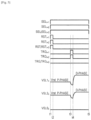
  • FIG. 5 is a timing chart for explaining a readout operation by the solid-state imaging apparatus according to the first embodiment.
  • FIG. 6 is a circuit diagram of a part of a solid-state imaging apparatus according to a first modification of the first embodiment.
  • FIG. 7 is a circuit diagram of a part of a solid-state imaging apparatus according to a second modification of the first embodiment.
  • FIG. 8 is a circuit diagram of a part of a solid-state imaging apparatus according to a third modification of the first embodiment.
  • FIG. 9 is a circuit diagram of a part of a solid-state imaging apparatus according to a fourth modification of the first embodiment.
  • FIG. 10 is a circuit diagram of a part of the solid-state imaging apparatus according to the fourth modification of the first embodiment.
  • FIG. 11 is a timing chart for explaining a readout operation by the solid-state imaging apparatus according to the fourth modification of the first embodiment.
  • FIG. 12 is a circuit diagram of a part of a solid-state imaging apparatus according to a fifth modification of the first embodiment.
  • FIG. 13 is a timing chart for explaining a readout operation by the solid-state imaging apparatus according to the fifth modification of the first embodiment.
  • FIG. 14 is a circuit diagram in a differential amplification readout state of a part of a solid-state imaging apparatus according to a second embodiment.
  • FIG. 15 is a circuit diagram in a source follower readout state of a part of the solid-state imaging apparatus according to the second embodiment.
  • FIG. 16 is a circuit diagram in a differential amplification readout state of a part of the solid-state imaging apparatus according to the second embodiment.
  • FIG. 17 is a timing chart for explaining a differential amplification readout operation by the solid-state imaging apparatus according to the second embodiment.
  • FIG. 18 is a circuit diagram in a source follower readout state of the solid-state imaging apparatus according to the second embodiment.
  • FIG. 19 is a timing chart for explaining a source follower readout operation by the solid-state imaging apparatus according to the second embodiment.
  • FIG. 20 is a circuit diagram in a differential amplification readout state of a part of a solid-state imaging apparatus according to a modification of the second embodiment.
  • FIG. 21 is a circuit diagram in a differential amplification readout state of a part of the solid-state imaging apparatus according to the modification of the second embodiment.
  • FIG. 22 is a timing chart for explaining a differential amplification readout operation by the solid-state imaging apparatus according to the modification of the second embodiment.
  • FIG. 23 is a circuit diagram in a source follower readout state of the solid-state imaging apparatus according to the modification of the second embodiment.
  • FIG. 24 is a timing chart for explaining a source follower readout operation by the solid-state imaging apparatus according to the modification of the second embodiment.
  • FIG. 25 is a circuit diagram of a part of a solid-state imaging apparatus according to a third embodiment.
  • FIG. 26 is a schematic plan view of a part of the solid-state imaging apparatus according to the third embodiment.
  • FIG. 27 is a schematic plan view of a part of a solid-state imaging apparatus according to a first modification of the third embodiment.
  • FIG. 28 is a circuit diagram of a part of a solid-state imaging apparatus according to a second modification of the third embodiment.
  • FIG. 29 is a schematic plan view of a part of a solid-state imaging apparatus according to the second modification of the third embodiment.
  • FIG. 30 A is a schematic plan view of a part of a solid-state imaging apparatus according to a third modification of the third embodiment.
  • FIG. 30 B is a schematic plan view of another part of a solid-state imaging apparatus according to the third modification of the third embodiment.
  • FIG. 31 is a schematic plan view of a part of a solid-state imaging apparatus according to a fourth modification of the third embodiment.
  • FIG. 32 is a circuit diagram of a part of a solid-state imaging apparatus according to the fourth embodiment.
  • FIG. 33 is a timing chart for explaining a readout operation by the solid-state imaging apparatus according to the fourth embodiment.
  • FIG. 34 is a circuit diagram of a part of a solid-state imaging apparatus according to a fifth embodiment.
  • FIG. 35 is a circuit diagram of a part of a solid-state imaging apparatus according to a first modification of the fifth embodiment.
  • FIG. 36 A is a circuit diagram illustrating the parasitic capacitance of amplification transistors connected in parallel.
  • FIG. 36 B is a circuit diagram illustrating the parasitic capacitance of an amplification transistor.
  • FIG. 37 is a circuit diagram of a part of a solid-state imaging apparatus according to a second modification of the fifth embodiment.
  • FIG. 38 is a circuit diagram of a part of a solid-state imaging apparatus according to a third modification of the fifth embodiment.
  • FIG. 39 is a circuit diagram of a part of a solid-state imaging apparatus according to a fourth modification of the fifth embodiment.
  • FIG. 40 is a circuit diagram of a part of a solid-state imaging apparatus according to a fifth modification of the fifth embodiment.
  • FIG. 41 is a circuit diagram of a part of a solid-state imaging apparatus according to a sixth modification of the fifth embodiment.
  • FIG. 42 is a schematic cross-sectional view illustrating an example of applying a solid-state imaging apparatus according to a sixth embodiment to a front-illuminated CIS.
  • FIG. 43 is a schematic cross-sectional view illustrating an example of applying the solid-state imaging apparatus according to the sixth embodiment to a back-illuminated CIS.
  • FIG. 44 is a schematic diagram illustrating an example of applying the solid-state imaging apparatus according to the sixth embodiment to a back-illuminated CIS.
  • FIG. 45 is a schematic diagram illustrating an example of applying the solid-state imaging apparatus according to the sixth embodiment to a back-illuminated CIS.
  • FIG. 46 is a schematic diagram illustrating an example of applying the solid-state imaging apparatus according to the sixth embodiment to an electronic device.
  • the first embodiment describes a differential amplification solid-state imaging apparatus in which the number of vertical signal lines can be reduced.
  • a CIS is illustrated as an example of the solid-state imaging apparatus according to the first embodiment.
  • a CIS captures incident light (image light) from a subject, converts the light intensity of the incident light formed into an image on an imaging surface into electrical signals in units of pixels, and outputs the electrical signals as pixel signals.
  • the solid-state imaging apparatus As illustrated in FIG. 1 , the solid-state imaging apparatus according to the first embodiment is provided with a pixel array unit 1 and peripheral circuits ( 2 , 3 , 4 , 5 , 6 , and 7 ).
  • the configuration illustrated in FIG. 1 may be provided on a single substrate, or the configuration may have a laminate structure in which a plurality of substrates is stuck together.
  • the pixel array unit 1 has a plurality of pixels arranged in a two-dimensional layout of rows and columns (a matrix). Each of the plurality of pixels includes a photoelectric conversion unit capable of photoelectrically converting and internally storing a quantity of charge corresponding to the amount of incident light, and outputting the stored charge as a signal.
  • the photoelectric conversion unit includes a photodiode, for example.
  • pixel driving lines 8 are respectively connected to every pixel row, and vertical signal lines 9 are respectively connected to every pixel column.
  • the pixel driving lines 8 are a group of lines that accept signals such as a transfer signal, a select signal, and a reset signal as input.
  • the vertical signal lines 9 are a group of lines such as output signal lines, reset input lines, and current supply lines.
  • the peripheral circuits ( 2 , 3 , 4 , 5 , 6 , and 7 ) include a vertical driving unit 2 , a column readout circuit unit 3 , a column signal processing unit 4 , a horizontal driving unit 5 , a signal processing unit 6 , and a system control unit 7 .
  • the vertical driving unit 2 includes for example a shift register, an address decoder, or the like. The vertical driving unit 2 successively selects the pixel driving lines 8 , supplies pulses for driving pixels to the selected pixel driving line 8 , and drives each of the pixels in units of rows.
  • the column readout circuit unit 3 includes a circuit that supplies a constant current, a current mirror circuit, and the like for every pixel column, and forms a differential amplifier together with transistors inside the pixels of the pixel array unit 1 .
  • the column readout circuit unit 3 reads out signals from the pixel array unit 1 to the vertical signal lines 9 .
  • the column signal processing unit 4 is disposed for every pixel column, for example, and processes the signals output from individual rows of pixels for every pixel column.
  • the column signal processing unit 4 performs signal processing such as correlated double sampling (CDS) and analog-digital (AD) conversion.
  • CDS is a process that reduces fixed-pattern noise by reading out a signal from a pixel twice and treating the difference between the two readings as the pixel data.
  • the signal read out in the first time is a reset level for example, and is referred to as P-phase level.
  • the signal read out in the second time is a signal level for example, and is referred to as D-phase level.
  • the horizontal driving unit 5 includes for example a shift register, an address decoder, or the like.
  • the horizontal driving unit 5 successively outputs horizontal scan pulses to the column signal processing unit 4 , sequentially selects the column signal processing unit 4 , and causes the selected column signal processing unit 4 to output a processed pixel signal.
  • the signal processing unit 6 performs signal processing on the pixel signals output from the column signal processing unit 4 , and outputs processed image data.
  • the system control unit 7 generates control signals and clock signals that serve as a reference for operations by the vertical driving unit 2 , the column readout circuit unit 3 , the column signal processing unit 4 , the horizontal driving unit 5 , and the like on the basis of a vertical synchronization signal, a horizontal synchronization signal, and a master clock signal, and outputs the generated clock signals and control signals to the vertical driving unit 2 , the column readout circuit unit 3 , the column signal processing unit 4 , the horizontal driving unit 5 , and the like.
  • the pixel array unit 1 includes a plurality of pixels X i,k , X i+1,k , X i+2,k , X i+3,k , X i+4,k , X i+5,k , X i,k+1 , X i+1,k+1 , X i+2,k+1 , X i+3,k+1 , X i+4,k+1 , and X i+5,k+1 arranged in a row direction (horizontal direction) and a column direction (vertical direction).
  • the row direction is defined as the left-and-right direction of FIG. 2
  • the column direction is defined as the top-and-bottom direction of FIG.
  • the pixel X i,k illustrated in FIG. 2 includes a photoelectric conversion unit including a photodiode PD that photoelectrically converts incident light, and a plurality of pixel transistors (T 1 , T 2 , T 3 , and T 4 ) that controls the photoelectrically-converted signal charge.
  • the plurality of pixel transistors (TI, T 2 , T 3 , and T 4 ) includes a transfer transistor T 1 , a reset transistor T 2 , a select transistor T 3 , and an amplification transistor T 4 , for example.
  • the transfer transistor T 1 , the reset transistor T 2 , the select transistor T 3 , and the amplification transistor T 4 are n-channel MOS transistors, for example.
  • the anode of the photodiode PD is grounded, while the cathode of the photodiode PD is connected to the source of the transfer transistor T 1 .
  • the drain of the transfer transistor T 1 is connected to a floating diffusion (FD).
  • a transfer signal TRG i is applied to the gate of the transfer transistor T 1 .
  • the transfer transistor T 1 transfers the signal charge generated by the photodiode PD to the floating diffusion FD on the basis of the transfer signal TRG i .
  • the floating diffusion FD is connected to the source of the reset transistor T 2 and the gate of the amplification transistor T 4 .
  • the floating diffusion FD stores charge transferred by the transfer transistor T 1 .
  • the potential of the floating diffusion FD is modulated according to the amount of charge stored in the floating diffusion FD.
  • the source of the amplification transistor T 4 is connected to a current supply line VCOM k , while the drain of the amplification transistor T 4 is connected to the source of the select transistor T 3 .
  • the amplification transistor T 4 amplifies the potential of the floating diffusion FD, and outputs a current corresponding to the potential of the floating diffusion FD to an output signal line VSL 0 k .
  • the drain of the select transistor T 3 is connected to the output signal line VSL 0 k .
  • a select signal SEL i is applied to the gate of the select transistor T 3 .
  • the select transistor T 3 selects the pixel X i,k as the readout pixel on the basis of the select signal SEL i .
  • the drain of the reset transistor T 2 is connected to a reset input line VRD 0 k .
  • a reset signal RST i is applied to the gate of the reset transistor T 2 .
  • the reset transistor T 2 discharges (resets) the charge stored in the floating diffusion FD on the basis of the reset signal RST i .
  • the source and drain of the reset transistor T 2 may be connected in reverse. In this case, the drain of the reset transistor T 2 is connected to the floating diffusion FD while the source of the reset transistor T 2 is connected to the reset input line VRD 0 k .
  • the pixels X i,k , X i+1,k , X i+2,k , X i+3,k , X i+4,k , X i+5,k , X i,k+1 , X i+1,k+1 , X i+2,k+1 , X i+3,k+1 , X i+4,k+1 , and X i+5,k+1 illustrated in FIG. 2 likewise have a configuration similar to the pixel X i,k illustrated in FIG. 3 .
  • the transfer signal TRG i is applied to the gate of the transfer transistor
  • the reset signal RST i is applied to the gate of the reset transistor
  • the select signal SEL i is applied to the gate of the select transistor.
  • the transfer signal TRG i+1 is applied to the gate of the transfer transistor
  • the reset signal RST i+1 is applied to the gate of the reset transistor
  • the select signal SEL i+1 is applied to the gate of the select transistor.
  • the transfer signal TRG i+2 is applied to the gate of the transfer transistor, the reset signal RST i+2 is applied to the gate of the reset transistor, and the select signal SEL i+2 is applied to the gate of the select transistor.
  • the transfer signal TRG i+3 is applied to the gate of the transfer transistor, the reset signal RST i+3 is applied to the gate of the reset transistor, and the select signal SEL i+3 is applied to the gate of the select transistor.
  • the transfer signal TRG i+4 is applied to the gate of the transfer transistor, the reset signal RST i+4 is applied to the gate of the reset transistor, and the select signal SEL i+4 is applied to the gate of the select transistor.
  • the transfer signal TRG i+5 is applied to the gate of the transfer transistor, the reset signal RST i+5 is applied to the gate of the reset transistor, and the select signal SEL i+5 is applied to the gate of the select transistor.
  • a differential amplifier is formed by the pair (differential pair) of a readout pixel that reads out the signal charge and a reference pixel given a reference voltage with no signal charge.
  • the readout pixel is successively selected from among the plurality of pixels X i,k , X i+1,k , X i+2,k , X i+3,k , X i+4,k , X i+5,k , X i,k+1 , X i+1,k+1 , X i+2,k+1 , X i+3,k+1 , X i+4,k+1 , and X i+5,k+1 .
  • the reference pixel may be successively selected from among the plurality of pixels X i,k , X i+1,k , X i+2,k , X i+3,k , X i+4,k , X i+5,k , X i,k+1 , X i+1,k+1 , X i+2,k+1 , X i+3,k+1 , X i+4,k+1 , and X i+5,k+1 to track the readout pixel, or the reference pixel may be fixed in advance.
  • the reference pixel may be fixed in advance.
  • Reset input lines VRD 1 k and VRD 2 k are respectively connected to the drain of the reset transistor of the readout pixels X i+1,k and X i+2,k in the kth column.
  • Output signal lines VSL 1 k and VSL 2 k are respectively connected to the drain of the select transistor of the readout pixels X i+1,k and X i+2,k .
  • a common current supply line VCOM k is connected to the source of the amplification transistor of the readout pixels X i+1,k and X i+2,k .
  • a common reset input line VRD 0 k is connected to the drain of the reset transistor of the reference pixels X i,k and X i+3,k in the kth column.
  • a common output signal line VSL 0 k is connected to the drain of the select transistor of the reference pixels X i,k and X i+3,k .
  • a common current supply line VCOM k is connected to the source of the amplification transistor of the reference pixels X i,k and X i+3,k .
  • Reset input lines VRD 1 k+1 and VRD 2 k+1 are respectively connected to the drain of the reset transistor of the readout pixels X i+1,k+1 and X i+2,k+1 in the (k+1)th column.
  • Output signal lines VSL 1 k+1 and VSL 2 k+1 are respectively connected to the drain of the select transistor of the readout pixels X i+1,k+1 and X i+2,k+1 .
  • a common current supply line VCOM k+1 is connected to the source of the amplification transistor of the readout pixels X i+1,k+1 and X i+2,k+1 .
  • a common reset input line VRD 0 k+1 is connected to the drain of the reset transistor of the reference pixels and X i,k+1 and X i+3,k+1 in the (k+1)th column.
  • a common output signal line VSL 0 k+1 is connected to the drain of the select transistor of the reference pixels X i,k+1 and X i+3,k+1 .
  • a common current supply line VCOM k+1 is connected to the source of the amplification transistor of the reference pixels X i,k+1 and X i+3,k+1 .
  • the column readout circuit unit 3 has a configuration corresponding to each of the kth and (k+1)th columns. As the configuration corresponding to the kth column, the column readout circuit unit 3 includes a switch M 0 k disposed between a reset voltage V rst and the reset input lines VRD 0 k , VRD 1 k , and VRD 2 k .
  • the switch M 0 k switches the connection destination of the reset voltage V rst to one of the reset input lines VRD 0 k , VRD 1 k , and VRD 2 k .
  • the switch M 0 k connects the connection destination of the reset voltage V rst to the reset input line VRD 0 k connected to the drain of the reset transistor of the reference pixels X i,k and X i+3,k .
  • the column readout circuit unit 3 includes transistors T 1 k , T 2 k , T 3 k , and T 4 k that form a current mirror circuit.
  • the transistors T 1 k , T 2 k , T 3 k , and T 4 k are p-channel MOS transistors, for example.
  • the drains of the transistors T 1 k , T 2 k , T 3 k , and T 4 k are connected to a power supply voltage VDD.
  • the gates of the transistors T 1 k , T 2 k , T 3 k , and T 4 k are connected to each other and are also connected to the sources of the transistors T 1 k and T 2 k .
  • the transistors T 1 k and T 2 k output a signal current 2 I from the source.
  • the transistors T 3 k and T 4 k respectively output a reference current I from the source.
  • the column readout circuit unit 3 includes a switch M 1 k disposed between the sources of the transistors T 1 k and T 2 k and the output signal lines VSL 0 k , VSL 1 k , and VSL 2 k , a switch M 2 k disposed between the source of the transistor T 3 k and the output signal lines VSL 0 k , VSL 1 k , and VSL 2 k , and a switch M 3 k disposed between the source of the transistor T 4 k and the output signal lines VSL 0 k , VSL 1 k , and VSL 2 k .
  • the switch M 1 k is capable of switching the connection destination of the transistors T 1 k and T 2 k to one of the output signal lines VSL 0 k , VSL 1 k , and VSL 2 k , and is connected to the output signal line VSL 0 k .
  • the switch M 2 k is capable of switching the connection destination of the transistor T 3 k to one of the output signal lines VSL 0 k , VSL 1 k , and VSL 2 k , and is connected to the output signal line VSL 1 k .
  • the switch M 3 k is capable of switching the connection destination of the transistor T 4 k to one of the output signal lines VSL 0 k , VSL 1 k , and VSL 2 k , and is connected to the output signal line VSL 2 k .
  • the column readout circuit unit 3 includes a switch S 1 k disposed between the reset input line VRD 0 k and the output signal line VSL 0 k , a switch S 2 k disposed between the reset input line VRD 1 k and the output signal line VSL 1 k , and a switch S 3 k disposed between the reset input line VRD 2 k and the output signal line VSL 2 k .
  • the switch S 1 k is turned on.
  • the switch S 2 k is turned off, shorting the reset input line VRD 1 k and the output signal line VSL 1 k .
  • the switch S 3 k is turned off, shorting the reset input line VRD 2 k and the output signal line VSL 2 k .
  • the column readout circuit unit 3 includes a constant current source L 1 k connected to the current supply line VCOM k .
  • the constant current source L 1 k is an n-channel MOS transistor, for example.
  • the constant current source L 1 k maintains a constant current 4 I from the current supply line VCOM k .
  • the current mirror circuit including the amplification transistors of the readout pixels X i+1,k and X i+2,k , the amplification transistors of the reference pixels X i,k and X i+3,k , and the transistors T 1 k , T 2 k , T 3 k , and T 4 k form with the constant current source L 1 k a differential amplifier that amplifies a pair of differential input voltages.
  • One of the pair of differential input voltages is input into the amplification transistors of the readout pixels X i+1,k and X i+2,k , while the other of the pair of differential input voltages is input into the amplification transistors of the reference pixels X i,k and X i+3,k .
  • the output voltages amplifying the differential input voltages are output to the column readout circuit unit 3 through the output signal lines VSL 1 k and VSL 2 k connected to the drain of the amplification transistors of the readout pixels X i+1,k and X i+2,k .
  • the column readout circuit unit 3 includes a switch M 0 k+1 disposed between the reset voltage V rst and the reset input lines VRD 0 k+1 , VRD 1 k+1 , and VRD 2 k+1 .
  • the switch M 0 k+1 is capable of switching the connection destination of the reset voltage V rst to one of the reset input lines VRD 0 k+1 , VRD 1 k+1 , and VRD 2 k+1 , and is connected to the reset input line VRD 0 k+1 .
  • the column readout circuit unit 3 includes transistors T 1 k+1 , T 2 k+1 , T 3 k+1 , and T 4 k+1 that form a current mirror circuit.
  • the transistors T 1 k+1 , T 2 k+1 , T 3 k+1 , and T 4 k+1 are p-channel MOS transistors, for example.
  • the drains of the transistors T 1 k+1 , T 2 k+1 , T 3 k+1 , and T 4 k+1 are connected to a power supply voltage VDD.
  • the gates of the transistors T 1 k+1 , T 2 k+1 , T 3 k+1 , and T 4 k+1 are connected to each other and are also connected to the sources of the transistors T 1 k+1 and T 2 k+1 .
  • the transistors T 1 k+1 and T 2 k+1 output a signal current 2 I from the source.
  • the transistors T 3 k+1 and T 4 k+1 respectively output a reference current I from the source.
  • the column readout circuit unit 3 includes a switch M 1 k+1 disposed between the sources of the transistors T 1 k+1 and T 2 k+1 and the output signal lines VSL 0 k+1 , VSL 1 k+1 , and VSL 2 k+1 , a switch M 2 k+1 disposed between the source of the transistor T 3 k+1 and the output signal lines VSL 0 k+1 , VSL 1 k+1 , and VSL 2 k+1 , and a switch M 3 k+1 disposed between the source of the transistor T 4 k and the output signal lines VSL 0 k , VSL 1 k , and VSL 2 k .
  • the switch M 1 k+1 switches the connection destination of the transistors T 1 k+1 and T 2 k+1 to one of the output signal lines VSL 0 k+1 , VSL 1 k+1 , and VSL 2 k+1 .
  • the switch M 2 k+1 switches the connection destination of the transistor T 3 k+1 to one of the output signal lines VSL 0 k+1 , VSL 1 k+1 , and VSL 2 k+1 .
  • the switch M 3 k switches the connection destination of the transistor T 4 to one of the output signal lines VSL 0 k+1 , VSL 1 k+1 , and VSL 2 k+1 .
  • the column readout circuit unit 3 includes a switch S 1 k+1 disposed between the reset input line VRD 0 k+1 and the output signal line VSL 0 k+1 , a switch S 2 k+1 disposed between the reset input line VRD 1 k+1 and the output signal line VSL 1 k+1 , and a switch S 3 k+1 disposed between the reset input line VRD 2 k+1 and the output signal line VSL 2 k+1 . Furthermore, the column readout circuit unit 3 includes a constant current source L 1 k+1 connected to the current supply line VCOM k+1 .
  • the constant current source L 1 k+1 is an n-channel MOS transistor, for example.
  • the constant current source L 1 k+1 maintains a constant current 4 I from the current supply line VCOM k+1 .
  • the timing chart in FIG. 5 will be referenced to describe a differential amplification readout operation in the case where the pixels X i,k and X i+3,k in the ith and (i+3)th rows of the kth column are selected as reference pixels while the pixels X i+1,k and X i+2,k in the (i+1)th and (i+2)th rows of the kth column are selected as readout pixels, as illustrated in FIG. 4 .
  • a high (H) level is applied as the select signals SEL i and SEL i+3 of the reference pixels X i,k and X i+3,k , and while in addition, the select signals SEL i+1 and SEL i+2 of the readout pixels X i+1,k and X i+2,k are set to the H level.
  • the reset signals RST i+1 and RST i+2 of the readout pixels X i+1,k and X i+2,k are set to the H level, resetting the readout pixels X i+1,k and X i+2,k .
  • the reset signals RST i and RST i+3 of the reference pixels X i,k and X i+3,k are set to the H level, resetting the reference pixels X i,k and X i+3,k .
  • the voltage follower function of the differential amplifier causes the output voltages of the output signal lines VSL 1 k and VSL 2 k to go to the reset level V rst . From the time t 2 to t 3 , the reset level V rst is read out from the output signal lines VSL 1 k and VSL 2 k as the P-phase level.
  • the transfer signals TRG i+1 and TRG i+2 of the readout pixels X i+1,k and X i+2,k are set to the H level, the reset level V rst of the output signal lines VSL 1 k and VSL 2 k is inverted and amplified, and the D-phase level is read out.
  • the column signal processing unit 4 outputs the difference between the P-phase level and the D-phase level as image data.
  • the solid-state imaging apparatus by having the reference pixels X i,k and X i+3,k respectively share the reset input line VRD 0 k connected to the drain of the reset transistor, the output signal line VSL 0 k connected to the drain of the select transistor, and the current supply line VCOM k connected to the source of the amplification transistor, the number of vertical signal lines can be reduced compared to a non-shared configuration. For this reason, the pixels can he miniaturized, and it is also possible to reduce the line area when performing multi-row readout.
  • the reference pixels X i,k and X i+3,k do not necessarily have to share all of the reset input line VRD 0 k , the output signal line VSL 0 k , and the current supply line VCOM k .
  • the number of vertical signal lines can be reduced if the reference pixels X i,k and X i+3,k share at least one of the reset input line VRD 0 k , the output signal line VSL 0 k , and the current supply line VCOM k .
  • the configuration of the pixel array unit 1 is different from the solid-state imaging apparatus according to the first embodiment illustrated in FIG. 2 .
  • the pixel array unit 1 includes pixels X i,k , X i+1,k , X i+2,k , X i+3,k , X i+4,k , and X i+5,k in the ith to the (i+5)th rows of the kth column, pixels X j,k+1 , X j+1,k+1 , X j+2,k+1 , X j+3,k+1 , X j+4,k+1 , and X j+5,k+1 in the jth to the (j+5)th rows (where j is an integer) of the (k+1)th column, pixels X i,k+2 , X i+1,k+2 , X i+2,k+2 , X i+3,k+2 , X i+4,k+2 , and X i+5,k+2 in the ith to the (i+5)th rows of the (k+2)th column,
  • the pixel X i,k in the ith row is selected as the reference pixel, while the pixel X i+1,k+1 in the (i+1)th row is selected as the readout pixel.
  • the pixel X j+1,k+1 in the (j+1)th row is selected as the readout pixel, while the pixel X j+2,k+1 in the (j+2)th row is selected as the reference pixel,
  • the readout pixels X i+1,k and X j+1,k+1 are adjacent to each other in the same row.
  • the drains of the respective reset transistors of the readout pixels X i+1,k and X j+1,k+1 in the kth and (k+1)th columns are connected to the reset input lines VRD 1 k and VRD 2 k , respectively.
  • the sources of the respective amplification transistors of the readout pixels X i+1,k and X j+1,k+1 are connected to a common current supply line VCOM k .
  • the drains of the respective select transistors of the readout pixels X i+1,k and X j+1,k+1 are connected to the output signal lines VSL 1 k and VSL 2 k , respectively.
  • the drains of the respective reset transistors of the reference pixels X i,k and X j+2,k+1 in the kth and (k+1)th columns are connected to a common reset input line VRD 0 k .
  • the sources of the respective amplification transistors of the reference pixels X i,k and X j+2,k+1 are connected to a common current supply line VCOM k .
  • the drains of the respective select transistors of the reference pixels X i,k and X j+2,k+1 are connected to a common output signal line VSL 0 k .
  • the pixel X i,k+2 in the ith row is selected as the reference pixel
  • the pixel X i+1,k+2 in the (i+1)th row is selected as the readout pixel.
  • the pixel X j+1,k+1 in the (j+1)th row is selected as the readout pixel
  • the pixel X j+2,k+3 in the (j+2)th row is selected as the reference pixel.
  • the readout pixels X i+1,k+2 and X j+1,k+3 are adjacent to each other in the same row.
  • the drains of the respective reset transistors of the readout pixels X i+1,k+2 and X j+1,k+3 in the (k+2)th and (k+3)th columns are connected to the reset input lines VRD 1 k+1 and VRD 2 k+1 , respectively.
  • the sources of the respective amplification transistors of the readout pixels X i+1,k+2 and X j+1,k+3 are connected to a common current supply line VCOM k+1 .
  • the drains of the respective select transistors of the readout pixels X i+1,k+2 and X j+1,k+3 are connected to the output signal lines VSL 1 k+1 and VSL 2 k+1 , respectively.
  • the drains of the respective reset transistors of the reference pixels X i,k+2 and X j+2,k+3 in the (k+2)th and (k+3)th columns are connected to a common reset input line VRD 0 k+1 .
  • the sources of the respective amplification transistors of the reference pixels X i,k+2 and X j+2,k+3 are connected to a common current supply line VCOM k+1 .
  • the drains of the respective select transistors of the reference pixels X i,k+2 and X j+2,k+3 are connected to a common output signal line VSL 0 k+1 .
  • the rest of the configuration of the solid-state imaging apparatus according to the first modification of the first embodiment is similar to the solid-state imaging apparatus according to the first embodiment illustrated in FIG. 2 , and therefore a duplicate description will be omitted.
  • the solid-state imaging apparatus by having the reference pixels X i,k and X j+2,k+1 as well as the reference pixels X i,k+2 and X j+2,k+3 in adjacent columns respectively share the reset input lines VRD 0 k and VRD 0 k+1 connected to the drain of the reset transistor, the output signal lines VSL 0 k and VSL 0 k+1 connected to the drain of the select transistor, and the current supply lines VCOM k , VCOM k+1 connected to the source of the amplification transistor, the number of vertical signal lines can be reduced.
  • a solid-state imaging apparatus shares a point in common with the solid-state imaging apparatus according to the first embodiment illustrated in FIG. 2 , namely that in the pixel array unit 1 , the readout pixels X i+1,k , X i+2,k , X i+1,k+1 , and X i+2,k+1 are disposed two at a time in each of the kth and (k+1)th columns.
  • the solid-state imaging apparatus according to the second modification of the first embodiment differs from the solid-state imaging apparatus according to the first embodiment illustrated in FIG. 2 in that the reference pixels X i+3,k and X i+3,k+1 are disposed one at a time in each of the kth and (k+1)th columns.
  • the reference pixels X i+3,k and X i+3,k+1 are disposed in the same (i+3)th row.
  • the output signal line VSL 0 k connected to the drain of the select transistor of the reference pixel X i+3,k and the output signal line VSL 0 k+1 connected to the drain of the select transistor of the reference pixel X i+3,k+1 are shorted by a short line 51 through the switches M 1 k and M 1 k+1 in the column readout circuit unit 3 .
  • the current supply line VCOM k connected to the source of the amplification transistor of the reference pixel X i+3,k and the current supply line VCOM k+1 connected to the source of the amplification transistor of the reference pixel X i+3,k+1 are shorted by a short line 52 in the column readout circuit unit 3 .
  • the rest of the configuration of the solid-state imaging apparatus according to the second modification of the first embodiment is similar to the solid-state imaging apparatus according to the first embodiment illustrated in FIG. 2 , and therefore a duplicate description will be omitted.
  • the solid-state imaging apparatus according to the second modification of the first embodiment, as illustrated in FIG. 7 , by disposing the reference pixels X i+3,k and X i+3,k+1 one at a time in each of the kth and (k+1)th columns and using the short line 51 to short the output signal lines VSL 0 k and VSL 0 k+1 connected to the drain of the select transistor of each of the reference pixels X i+3,k and X i+3,k+1 in the same row while also using the short line 52 to short the current supply lines VCOM k and VCOM k+1 connected to the source of the amplification transistor of each of the reference pixels X i+3,k and X i+3,k+1 in the same row, noise can be reduced. Furthermore, the number of readouts of the reference pixels X i+3,k and X i+3,k+1 per column can be reduced, and power consumption can be reduced.
  • a solid-state imaging apparatus differs from the solid-state imaging apparatus according to the first embodiment illustrated in FIG. 2 in that in the pixel array unit 1 , the reference pixels X i,k , X i+3,k , X i+6,k , X i,k+1 , X i+3,k+1 , and X i+6,k+1 are selected more than the readout pixels X i+1,k , X i+2,k , X i+1,k+1 , and X i+2,k+1 .
  • the three reference pixels X i,k , X i+3,k , and X i+6,k in the ith, (i+3)th, and (i+6)th rows are selected, while the two readout pixels X i+1,k and X i+2,k in the (i+1)th and (i+2)th rows are selected.
  • the three reference pixels X i,k+1 , X i+3,k+1 , and X i+6,k+1 in the ith, (i+3)th, and (i+6)th rows are selected, while the two readout pixels X i+1,k+1 and X i+2,k+1 in the (i+1)th and (i+2)th rows are selected.
  • the solid-state imaging apparatus by selecting more of the reference pixels X i,k , X i+3,k , X i+6,k , X i,k+1 , X i+3,k+1 , and X i+6,k+1 than the readout pixels X i+1,k , X i+2,k , X i+1,k+1 , and X i+2,k+1 , noise can be reduced further.
  • a solid-state imaging apparatus shares a point in common with the solid-state imaging apparatus according to the first embodiment illustrated in FIG. 2 , namely that the reference pixels X i,k and X i+3,k in the same kth column share the output signal line VSL 0 k , the reset input line VRD 0 k , and the current supply line VCOM k , and in addition, the reference pixels X i,k+1 and X i+3,k+1 in the same (k+1)th column share the output signal line VSL 0 k+1 , the reset input line VRD 0 k+1 , and the current supply line VCOM k+1 .
  • the solid-state imaging apparatus differs from the solid-state imaging apparatus according to the first embodiment illustrated in FIG. 2 in that the readout pixels X i+1,k and X i+2,k in the kth column share the reset input line VRD 1 k connected to the drain of the reset transistor, and additionally, the readout pixels X i+1,k+1 and X i+2,k+1 in the (k+1)th column share the reset input line VRD 1 k+1 connected to the drain of the reset transistor.
  • the column readout circuit unit 3 includes switches M 11 k and M 12 k disposed between the reset input lines VRD 0 k and VRD 1 k and the output signal lines VSL 0 k , VSL 1 k , and VSL 2 k .
  • the switches M 11 k and M 12 k switch the connection of one of the reset input lines VRD 0 k and VRD 1 k and to one of the output signal lines VSL 0 k , VSL 1 k , and VSL 2 k .
  • the switch M 11 k connects the reset input line VRD 1 k and the output signal line VSL 1 k .
  • the switch M 12 k connects the reset input line VRD 1 k and the output signal line VSL 2 k .
  • the column readout circuit unit 3 includes switches M 11 k+1 and M 12 k+1 disposed between the reset input lines VRD 0 k+1 and VRD 1 k+1 and the output signal lines VSL 0 k+1 , VSL 1 k+1 , and VSL 2 k+1 .
  • the rest of the configuration of the solid-state imaging apparatus according to the third modification of the first embodiment is similar to the solid-state imaging apparatus according to the first embodiment illustrated in FIG. 2 , and therefore a duplicate description will be omitted.
  • the timing chart in FIG. 11 will be referenced to describe a differential amplification readout operation in the case where the pixels X i+1,k and X i+2,k in the (i+1)th and (i+2)th rows of the kth column are selected as readout pixels while the pixels X i,k and X i+3,k in the ith and (i+3)th rows are selected as reference pixels, as illustrated in FIG. 10 .
  • the switch M 11 k illustrated in FIG. 10 is put in the closed state, shorting the output signal line VSL 1 k and the reset input line VRD 1 k .
  • the reset signal RST i+1 of one readout pixel X i+1,k is set to the H level, resetting the readout pixel X i+1,k .
  • the reset signals RST i and RST i+3 of the reference pixels X i,k and X i+3,k are set to the H level, resetting the reference pixels X i,k and X i+3,k . Because the output signal line VSL 1 k and the reset input line VRD 1 k are shorted, the output signal line VSL 1 k goes to the reset level and is read out as the P-phase level.
  • the switch M 11 k is put in the open state, electrically isolating the output signal line VSL 1 k and the reset input line VRD 1 k .
  • the switch M 12 k is put in the closed state, shorting the reset input line VRD 1 k and the output signal line VSL 2 k .
  • the reset signal RST i+2 of the other readout pixel X i+2,k is set to the H level, resetting the readout pixel X i+2,k .
  • the reset signals RST i and RST i+3 of the reference pixels X i,k and X i+3,k are set to the H level, resetting the reference pixels X i,k and X i+3,k . Because the reset input line VRD 1 k and the output signal line VSL 2 k are shorted, the output signal line VSL 2 k goes to the reset level and is read out as the P-phase level.
  • the switch M 12 k is put in the open state, electrically isolating the reset input line VRD 1 k and the output signal line VSL 2 k .
  • the transfer signals TRG i+1 and TRG i+2 of the readout pixels X i+1,k and X i+2,k are set to the H level, and the reset level of the output signal lines VSL 1 k and VSL 2 k is inverted and amplified. After that, the D-phase levels of the output signal lines VSL 1 k and VSL 2 k are read out at the same time.
  • the readout pixels X i+1,k and X i+2,k in the kth column share the reset input line VRD 1 k connected to the drain of the reset transistor and also having the readout pixels X i+1,k+1 and X i+2,k+1 in the (k+1)th column share the reset input line VRD 1 k+1 connected to the drain of the reset transistor, the number of vertical signal lines can be reduced further.
  • a solid-state imaging apparatus differs from the solid-state imaging apparatus according to the fourth modification of the first embodiment illustrated in FIG. 10 in that, in the pixel array unit 1 , one reference pixel X i,k is selected in the kth column.
  • the differential amplification readout operation in this case will be described with reference to the timing chart in FIG. 13 .
  • the switch M 11 k illustrated in FIG. 10 is put in the closed state, shorting the output signal line VSL 1 k and the reset input line VRD 1 k connected to the readout pixel X i+1,k reset previously.
  • the reset signal RST i of the reference pixel X i,k is set to the H level, resetting the reference pixel X i,k .
  • the reset signal RST i+1 of one readout pixel X i+1,k is set to the H level, resetting the readout pixel X i+1,k . Because the output signal line VSL 1 k and the reset input line VRD 1 k are shorted, the output signal line VSL 1 k goes to the reset level, and the P-phase level is read out.
  • the switch M 11 k is put in the open state, electrically isolating the output signal line VSL 1 k and the reset input line VRD 1 k .
  • the switch M 12 k is put in the closed state, shorting the reset input line VRD 1 k and the output signal line VSL 2 k connected to the readout pixel X i+2,k reset subsequently.
  • the reset signal RST i of the reference pixel X i,k is set to the H level, resetting the reference pixel X i,k .
  • the reset signal RST i+2 of the other readout pixel X i+2,k is set to the H level, resetting the readout pixel X i+2,k . Because the reset input line VRD 1 k and the output signal line VSL 2 k are shorted, the output signal line VSL 2 k goes to the reset level, and the P-phase level is read out.
  • the transfer signal TRG i+1 of the readout pixel X i+1,k is set to the H level, the reset level of the output signal line VSL 1 k is inverted and amplified, and the D-phase level is read out.
  • the switch M 12 k is put in the open state, electrically isolating the reset input line VRD 1 k and the output signal line VSL 2 k .
  • the transfer signal TRG i+2 of the readout pixel X i+2,k is set to the H level, the reset level of the output signal line VSL 2 k goes to the signal level, and the D-phase level is read out.
  • the readouts of the P-phase level and the D-phase level of the readout pixels X i+1,k and X i+2,k selected at the same time are performed with shifted a half-phase away from each other, making it possible to read out the signal level (D phase level) of one readout pixel X i+1,k while at the same time to read out the reset level (P-phase level) of the other readout pixel X i+2,k . Consequently, readout can be sped up and the readout time can be shortened.
  • a differential amplification CIS capable of increased gain and significantly higher conversion efficiency compared to a source follower CIS of the related art.
  • a differential amplification CIS has a narrow operating point and the dynamic range is difficult to expand. For this reason, a configuration that switches between a differential amplification readout and source follower readout with a switch has been investigated.
  • a pixel that switches between source follower readout and differential amplification readout needs additional vertical lines inside the pixel.
  • the number of vertical lines is increased to five lines in a pixel that switches between source follower readout and differential amplification readout.
  • the second embodiment proposes a solid-state imaging apparatus capable of reducing vertical lines inside pixels in a solid-state imaging apparatus capable of switching between differential amplification readout and source follower readout.
  • the overall configuration of the solid-state imaging apparatus according to the second embodiment is shared in common with the solid-state imaging apparatus according to the first embodiment illustrated in FIG. 1 .
  • the solid-state imaging apparatus according to the second embodiment differs from the solid-state imaging apparatus according to the first embodiment illustrated in FIG. 2 in that the pixel array unit 1 includes a readout pixel region 1 a and a reference pixel region 1 b.
  • the readout pixel region 1 a includes pixels X i,k , X i+1,k , X i+2,k , X i+3,k , X i,k+1 , X i+1,k+1 , X i+2,k+1 , and X i+3,k+1 arranged in a two-dimensional matrix.
  • the pixels X i,k , X i+1,k , X i+2,k , X i+3,k , X i,k+1 , X i+1,k+1 , X i+2,k+1 , and X i+3,k+1 included in the readout pixel region 1 a are only selectable as readout pixels, and are not selected as reference pixels.
  • each of the readout pixels X i,k , X i+1,k , X i+2,k , X i+3,k , X i,k+1 , X i+1,k+1 , X i+2,k+1 , and X i+3,k+1 is similar to the configuration of the pixel X i,k illustrated in FIG. 3 .
  • the sources of the respective amplification transistors of the readout pixels X i,k and X i+2,k in the ith and (i+2)th rows of the kth column are connected to a common current supply line VCOM k .
  • the drains of the respective select transistors of the readout pixels X i,k and X i+2,k are connected to a common output signal line VSL 0 k .
  • the sources of the respective reset transistors of the readout pixels X i,k and X i+2,k are connected to a floating diffusion, and the drains of the respective reset transistors are connected to a common output signal line VSL 0 k .
  • the readout pixels X i,k and X i+2,k form a negative feedback loop connecting the floating diffusion and the output signal line VSL 1 k through the reset transistor, and supply the reset voltage.
  • the sources of the respective amplification transistors of the readout pixels X i+1,k and X i+3,k in the (i+1)th and (i+3)th rows of the kth column are connected to a common current supply line VCOM k .
  • the drains of the respective select transistors of the readout pixels X i+1,k and X i+3,k are connected to a common output signal line VSL 1 k .
  • the sources of the respective reset transistors of the readout pixels X i+1,k and X i+3,k are connected to a floating diffusion, and the drains of the respective reset transistors are connected to a common output signal line VSL 1 k .
  • the readout pixels X i+1,k and X i+3,k form a negative feedback loop connecting the floating diffusion and the output signal VSL 1 k through the reset transistor, and supply the reset voltage.
  • the sources of the respective amplification transistors of the readout pixels X i,k+1 and X i+2,k+1 in the ith and (i+2)th rows of the (k+1)th column are connected to a common current supply line VCOM k+1 .
  • the drains of the respective select transistors of the readout pixels X i,k+1 and X i+2,k+1 are connected to a common output signal line VSL 0 k+1 .
  • the sources of the respective reset transistors of the readout pixels and X i,k+1 and X i+2,k+1 are connected to a floating diffusion, and the drains of the respective reset transistors are connected to a common output signal line VSL 0 k+1 . That is, the readout pixels X i,k+1 and X i+2,k+1 form a negative feedback loop connecting the floating diffusion and the output signal line VSL 1 k+1 through the reset transistor, and supply the reset voltage.
  • the sources of the respective amplification transistors of the readout pixels X i+1,k+1 and X i+3,k+1 in the (i+1)th and (i+3)th rows of the (k+1)th column are connected to a common current supply line VCOM k+1 .
  • the drains of the respective select transistors of the readout pixels X i+1,k+1 and X i+3,k+1 are connected to a common output signal line VSL 1 k+1 .
  • the sources of the respective reset transistors of the readout pixels X i+1,k+1 and X i+3,k+1 are connected to a floating diffusion, and the drains of the respective reset transistors are connected to a common output signal line VSL 1 k+1 .
  • the readout pixels X i+1,k+1 and X i+3,k+1 form a negative feedback loop connecting the floating diffusion and the output signal line VSL 1 k+1 through the reset transistor, and supply the reset voltage.
  • the reference pixel region 1 b includes a plurality of pixels X R,k and X R,k+1 fixed to a specific row of the pixel array unit 1 .
  • the pixels X R,k and X R,k+1 are arranged in the Rth row, which is the row positioned closest to the column readout circuit unit 3 among the rows of the pixel array unit 1 .
  • the pixels X R,k and X R,k+1 are disposed in correspondence with the kth and (k+1)th columns of the readout pixel region 1 a .
  • the pixels X R,k and X R,k+1 are fixed as reference pixels, and are not selected as readout pixels.
  • the configuration of each of the reference pixels X R,k and X R,k+1 is similar to the configuration of the pixel X i,k illustrated in FIG. 3 .
  • the drains of the respective reset transistors of the reference pixels X R,k and X R,k+1 in the kth and (k+1)th columns are connected to a common reset input line VRD.
  • the reference pixels X R,k and X R,k+1 share the reset input line VRD.
  • the reset input line VRD is supplied with any reset voltage V rst from a reset voltage source.
  • the drains of the respective select transistors of the reference pixels X R,k and X R,k+1 in the kth and (k+1)th columns are connected to output signal lines VSLR k and VSLR k+1 .
  • the output signal lines VSLR k and VSLR k+1 are shorted by a short line 61 in the column readout circuit unit 3 .
  • the sources of the respective amplification transistors of the reference pixels X R,k and X R,k+1 in the kth and (k+1)th columns are connected to current supply lines VCOM k and VCOM k+1 , respectively.
  • the current supply lines VCOM k and VCOM k+1 are shorted by a short line 62 in the column readout circuit unit 3 .
  • the column readout circuit unit 3 has a corresponding configuration for each of the kth and (k+1)th columns. As the configuration corresponding to the kth column, the column readout circuit unit 3 includes constant current sources L 1 k and L 2 k .
  • the constant current sources L 1 k and L 2 k are n-channel MOS transistors or the like.
  • the column readout circuit unit 3 includes transistors T 1 k , T 2 k , and T 3 k that form a current mirror circuit.
  • a power supply voltage VDD are connected to the drains of the transistors T 1 k , T 2 k , and T 3 k .
  • the gates of the transistors T 1 k , T 2 k , and T 3 k are connected to each other and are also connected to the source of the transistor T 1 k .
  • the column readout circuit unit 3 includes a plurality of switches (switching units) S 11 k , S 12 k , S 13 k , S 14 k , S 15 k , S 16 k , S 17 k , S 18 k , S 19 k , and S 20 k that switch the operating point of the amplification transistors of the readout pixels X i,k , X i+1,k , X i+2,k and X i+3,k of the kth column between source follower readout and differential amplification readout.
  • switches switching units
  • the switch S 11 k is disposed between the source of the transistor T 1 k and the output signal line VSLR k .
  • the switch S 12 k is disposed between the source of the transistor T 2 k and the output signal line VSL 0 k .
  • the switch S 13 k is disposed between the source of the transistor T 3 k and the output signal line VSL 1 k .
  • the switch S 14 k is disposed between the power supply voltage VDD and the current supply line VCOM k .
  • the switch S 15 k is disposed between the power supply voltage VDD and the output signal line VSL 0 k .
  • the switch S 16 k is disposed between the power supply voltage VDD and the output signal line VSL 1 k .
  • the switch S 17 k is disposed between the output signal line VSL 0 k and the constant current source L 1 k .
  • the switch S 18 k is disposed between the output signal line VSL 1 k and the constant current source L 2 k .
  • the switch S 19 k is disposed between the constant current source L 1 k and the current supply line VCOM k .
  • the switch S 20 k is disposed between the constant current source L 2 k and the current supply line VCOM k .
  • the column readout circuit unit 3 includes constant current sources L 1 k+1 and L 2 k+1 , and transistors T 1 k+1 , T 2 k+1 , and T 3 k+1 .
  • the configuration of each of the constant current sources L 1 k+1 and L 2 k+1 and the transistors T 1 k+1 , T 2 k+1 , and T 3 k+1 is similar to the constant current sources L 1 k and L 2 k and the transistors T 1 k , T 2 k , and T 3 k in the configuration of the kth column.
  • the column readout circuit unit 3 includes a plurality of switches (switching units) S 11 k+1 , S 12 k+1 , S 13 k+1 , S 14 k+1 , S 15 k+1 , S 16 k+1 , S 17 k+1 , S 18 k+1 , S 19 k+1 , and S 20 k+1 that switch the operating point of the amplification transistors of the readout pixels X i,k+1 , X i+1,k+1 , X i+2,k+1 and X i+3,k+1 of the (k+1)th column between source follower readout and differential amplification readout.
  • switches switching units
  • each of the plurality of switches S 11 k+1 , S 12 k+1 , S 13 k+1 , S 14 k+1 , S 15 k+1 , S 16 k+1 , S 17 k+1 , S 18 k+1 , S 19 k+1 , and S 20 k+1 is similar to the plurality of switches S 11 k , S 12 k , S 13 k , S 14 k , S 15 k , S 16 k , S 17 k , S 18 k+1 , S 19 k+1 , and S 20 k+1 is similar to the plurality of switches S 11 k , S 12 k , S 13 k , S 14 k , S 15 k , S 16 k , S 17 k , S 18 k , S 19 k , and S 20 k in the configuration of the kth column.
  • FIG. 14 illustrates the differential amplification readout state of the solid-state imaging apparatus according to the second embodiment.
  • the switches S 11 k , S 12 k , S 13 k , S 19 k , and S 20 k are in the closed state while the switches S 14 k , S 15 k , S 16 k , S 17 k , and S 18 k are in the open state.
  • the switches S 11 k+1 , S 12 k+1 , S 13 k+1 , S 19 k+1 , and S 20 k+1 are in the closed state while the switches S 14 k+1 , S 15 k+1 , S 16 k+1 , S 17 k+1 , and S 18 k+1 are in the open state.
  • FIG. 15 illustrates the source follower readout state of the solid-state imaging apparatus according to the second embodiment.
  • the switches S 11 k , S 12 k , S 13 k , S 19 k , and S 20 k are in the open state while the switches S 14 k , S 17 k , and S 18 k are in the closed state.
  • the switches S 15 k and S 16 k are switched between the open state and the closed state during the source follower readout operation, Also, in the configuration of the (k+1)th column of the column readout circuit unit 3 , the switches S 11 k+1 S 12 k+1 , S 13 k+1 , S 19 k+1 , and S 20 k+1 are in the open state while the switches S 14 k+1 , S 17 k+1 , and S 18 k+1 are in the closed state. The switches S 15 k+1 and S 16 k+1 are switched between the open state and the closed state during the source follower readout operation.
  • the timing chart in FIG. 17 will be referenced to describe a differential amplification readout operation in the case where the pixels X i,k+1 and X i+1,k+1 in the ith and (i+1)th rows of the kth column are selected as readout pixels while the reference pixel X R,k is fixed, as illustrated in FIG. 16 .
  • a select signal SEL R of the reference pixel X R,k is set to the H level, while in addition, the select signals SEL i and SEL i+1 of the readout pixels X i,k X i+1,k are set to the H level.
  • a control signal ⁇ VSW of the switches S 15 k and S 16 k is set to the L level, putting the switches S 15 k and S 16 k in the open state.
  • the reset signals RST i and RST i+1 of the readout pixels X i,k and X i+1,k are set to the H level, resetting the readout pixels X i,k and X i+1,k .
  • a reset signal RST R of the reference pixel X R,k is set to the H level, resetting the reference pixel X R,k .
  • the output signal lines VSL 0 k and VSL 1 k go to the reset level V rst according to the voltage follower function of the differential amplifier. From the time t 2 to t 3 , the reset level V rst is read out from the output signal lines VSL 0 k and VSL 1 k as the P-phase level.
  • the transfer signals TRG i and TRG i+1 of the readout pixels X i,k and X i+1,k are set to the H level, the reset level V rst of the output signal lines VSL 0 k and VSL 1 k is inverted and amplified, and after that, the D-phase level is read out.
  • FIG. 19 will be referenced to describe a source follower readout operation in the case where the pixels X i,k and X i+1,k in the ith and (i+1)th rows of the kth column are readout pixels, as illustrated in FIG. 18 .
  • the select signals SEL i and SEL i+1 of the readout pixels X i,k and X i+1,k are set to the H level.
  • the select signal SEL R of the reference pixel X R,k is at the L level, and the reference pixel X R,k is not selected.
  • the reset signals RST i and RST i+1 of the readout pixels X i,k and X i+1,k are set to the H level, resetting the readout pixels X i,k and X i+1,k .
  • the control signal ⁇ VSW of the switches S 15 k and S 16 k is set to the H level to put the switches S 15 k and S 16 k in the closed state, thereby shorting the output signal lines VSL 0 k and VSL 1 k and the power supply potential VDD.
  • the P-phase level is read out from the output signal lines VSL 0 k and VSL 1 k .
  • the transfer signals TRG i and TRG i+1 of the readout pixels X i,k and X i+1,k are set to the H level, the P-phase level of the output signal lines VSL 0 k and VSL 1 k is inverted and amplified, and the D-phase level is read out.
  • the solid-state imaging apparatus it is possible to switch between source follower readout and differential amplification readout with the plurality of switches (switching units) S 11 k , S 12 k , S 13 k , S 14 k , S 15 k , S 16 k , S 17 k , S 18 k , S 19 k , and S 20 k .
  • the readout pixels X i,k , X i+1,k , X i+2,k and X i+3,k form a negative feedback loop connecting the drain of the select transistor and the drain of the reset transistor to the output signal lines VSL 0 k and VSL 1 k , the number of reset input lines can be reduced. Consequently, the vertical lines inside the pixels can be reduced, thereby improving sensitivity and also improving the freedom of line placement.
  • the line lengths of the output signal lines VSLR k and VSLR k+1 to which the drains of the respective select transistors of the pixels X R,k and X R,k+1 are connected can be shortened.
  • a solid-state imaging apparatus shares a point in common with the solid-state imaging apparatus according to the second embodiment illustrated in FIG. 14 , namely a configuration capable of switching between source follower readout and differential amplification readout.
  • FIG. 20 illustrates the state of differential amplification readout.
  • the configuration of the readout pixels X i,k , X i+1,k , X i+2,k , X i+3,k , X i,k+1 , X i+1,k+1 , X i+2,k+1 , and X i+3,k+1 included in the readout pixel region 1 a and the reference pixels X R,k and X R,k+1 included in the reference pixel region 1 b is different from the solid-state imaging apparatus according to the second embodiment illustrated in FIG. 14 .
  • the readout pixel X i,k included in the readout pixel region 1 a includes two photoelectric conversion units including photodiodes PD 1 and PD 2 that photoelectrically convert incident light, and a plurality of pixel transistors (T 1 a , T 1 b , T 2 a , T 2 b , T 3 , and T 4 ) that controls the photoelectrically-converted signal charge.
  • the plurality of pixel transistors includes transfer transistors T 1 a and T 1 b , a reset transistor for source follower readout (source follower reset transistor) T 2 a , a reset transistor for differential amplification readout (differential amplification reset transistor) T 2 b , a select transistor T 3 , and an amplification transistor T 4 , for example,
  • the respective anodes of the photoelectric conversion units that is, the photodiodes PD 1 and PD 2
  • the respective cathodes of the photodiodes PD 1 and PD 2 are connected to the sources of the transfer transistors T 1 a and T 1 b , respectively.
  • the drains of the transfer transistors T 1 a and T 1 b are connected to the floating diffusion FD.
  • Transfer signals TRG 0 i and TRG 1 i are respectively applied to the gates of the transfer transistors T 1 a and T 1 b.
  • the floating diffusion FD is connected to the sources of the source follower reset transistor T 2 a and the differential amplification reset transistor T 2 b , and to the gate of the amplification transistor T 4 .
  • the source of the amplification transistor T 4 is connected to a current supply line VCOM k , while the drain of the amplification transistor T 4 is connected to the source of the select transistor T 3 .
  • the drain of the select transistor T 3 is connected to the output signal line VSL 0 k .
  • a select signal SEL i is applied to the gate of the select transistor T 3 .
  • the drain of the source follower reset transistor T 2 a is connected to the current supply line VCOM k .
  • the drain of the differential amplification reset transistor T 2 b is connected to the output signal line VSL 0 k .
  • Reset signals RSTS i and RSTD i are respectively applied to the gates of the source follower reset transistor T 2 a and the differential amplification reset transistor T 2 b .
  • a reset signal RSTS R is applied to the gates of the respective source follower reset transistors of the reference pixels X R,k and X R,k+1 .
  • the drains of the respective source follower reset transistors of the reference pixels X R,k and X R,k+1 are connected to the current supply lines VCOM k and VCOM k+1 .
  • a reset signal RSTD R is applied to the gates of the respective differential amplification reset transistors of the reference pixels X R,k and X R,k+1 .
  • the drains of the respective differential amplification reset transistors of the reference pixels X R,k and X R,k+1 are connected to a common reset input line VRD.
  • the timing chart in FIG. 22 will be referenced to describe a differential amplification readout operation in the modification of the second embodiment in the case where the pixels X i,k+1 and X i+1,k+1 in the ith and (i+1)th rows of the kth column are the readout pixels while the reference pixel X R,k is fixed, as illustrated in FIG. 21 .
  • a select signal SEL R of the reference pixel X R,k is set to the H level, while in addition, the select signals SEL i and SEL i+1 of the readout pixels X i,k and X i+1,k are set to the H level.
  • a control signal ⁇ VSW of the switches S 15 k and S 16 k is set to the L level, putting the switches S 15 k and S 16 k in the open state.
  • the reset signals RSTS i and RSTS i+1 of the readout pixels X i,k and X i+1,k as well as the reset signal RSTS R of the reference pixel X R,k are set to the L level.
  • the reset signals RSTD i and RSTD i+1 of the readout pixels X i,k and X i+1,k are set to the H level, resetting the readout pixels X i,k and X i+1,k .
  • a reset signal RSTD R of the reference pixel X R,k is set to the H level, resetting the reference pixel X R,k .
  • the output signal lines VSL 0 k and VSL 1 k go to the reset level V rst according to the voltage follower function of the differential amplifier. From the time t 2 to t 3 , the reset level V rst is read out from the output signal lines VSL 0 k and VSL 1 k as the P-phase level.
  • the transfer signals TRG 0 i and TRG 0 i+1 of the readout pixels X i,k and X i+1,k are set to the H level, the reset level V rst of the output signal lines VSL 0 k and VSL 1 k is inverted and amplified, and the D-phase level is read out.
  • FIG. 24 will be referenced to describe a source follower readout operation in the modification of the second embodiment in the case where the pixels X i,k+1 and X i+1,k+1 in the ith and (i+1)th rows are the readout pixels, as illustrated in FIG. 23 .
  • the select signals SEL i and SEL i+1 of the readout pixels X i,k X i+1,k are set to the H level.
  • the select signal SEL R of the reference pixel X R,k is at the L level, and the reference pixel X R,k is not selected.
  • the reset signals RSTD i and RSTD +1 of the readout pixels X i,k and X i+1,k are set to the L level.
  • the reset signals RSTS i and RSTS i+1 of the readout pixels X i,k X i+1,k are set to the H level, resetting the readout pixels X i,k and X i+1,k .
  • the control signal ⁇ VSW of the switches S 15 k and S 16 k is set to the H level to put the switches S 15 k and S 16 k in the closed state, thereby shorting the output signal lines VSL 0 k and VSL 1 k and the power supply potential VDD.
  • the P-phase level is read out from the output signal lines VSL 0 k and VSL 1 k .
  • the transfer signals TRG i TRG i+1 and of the readout pixels X i,k and X i+1,k are set to the H level, the P-phase level of the output signal lines VSL 0 k and VSL 1 k is inverted and amplified, and the D-phase level is read out.
  • each of the readout pixels X i,k , X i+1,k , X i+2,k , X i+3,k , X i,k+1 , X i+1,k+1 , X i+2,k+1 , and X i+3,k+1 as well as the reference pixels X R,k and X R,k+1 include the source follower reset transistor T 2 a and the differential amplification reset transistor T 2 b , compared to the solid-state imaging apparatus according to the second embodiment illustrated in FIG.
  • a differential amplification CIS capable of increased gain and significantly higher conversion efficiency compared to a source follower CIS of the related art.
  • the source diffusion layer of the amplification transistor and the source diffusion layer of the reset transistor can be shared among the pixels, whereas in a differential amplification CIS, the source diffusion layer of the amplification transistor and the source diffusion layer of the reset transistor is not shared among the pixels. For this reason, a differential amplification CIS has poor layout efficiency compared to a source follower CIS.
  • a third embodiment proposes a solid-state imaging apparatus in which the gate length of the amplification transistor can be lengthened and the RTS noise can be improved even at small pixel sizes.
  • a pixel array unit 1 includes pixels X i,k , X i+1,k , X i+2,k , X i+3,k , X i+4,k , X i+5,k , X i,k+1 , X i+1,k+1 , X i+2,k+1 , X i+3,k+1 , X i+4,k+1 , and X i+5,k+1 arranged in a matrix.
  • the pixels X i+1,k and X i+2,k in the (i+1)th and (i+2)th rows are selected as readout pixels while the pixel X i+3,k in the (i+3)th row is selected as the reference pixel.
  • the pixels X i+1,k+1 and X i+2,k+1 in the (i+1)th and (i+2)th rows are selected as readout pixels while the pixel X i+3,k in the (i+3)th row is selected as the reference pixel.
  • the sources of the respective amplification transistors of the readout pixels X i+1,k , X i+2,k , X i+1,k+1 , and X i+2,k+1 as well as the reference pixels X i+3,k and X i+3,k+1 are connected to a common current supply line VCOM k .
  • the rest of the circuit configuration of the solid-state imaging apparatus according to the third embodiment is similar to the solid-state imaging apparatus according to the second modification of the first embodiment illustrated in FIG. 7 , and therefore a duplicate description will be omitted.
  • FIG. 26 illustrates a plan-view layout of the portion of the readout pixels X i+1,k , X i+2,k , X i+1,k+1 , and X i+2,k+1 as well as the reference pixels X i+3,k and X i+3,k+1 illustrated in FIG. 25 .
  • the readout pixels X i+1,k and X i+2,k as well as the reference pixel X i+3,k in the kth column and the readout pixels X i+1,k+1 and X i+2,k+1 as well as the reference pixel X i+3,k+1 in the (k+1)th column have a plan-view layout (plan-view pattern) with left/right line symmetry in FIG.
  • the readout pixel X i+1,k the (i+1)th row of the kth column is provided with a diffusion layer 70 a for applying a substrate potential, a diffusion layer 71 a that forms a photodiode, a gate electrode 81 a of the transfer transistor, a common diffusion layer 72 a that acts as the floating diffusion and the source diffusion layer of the reset transistor, a gate electrode 82 a of the reset transistor, a drain diffusion layer 73 a of the reset transistor, a source diffusion layer 74 a of the select transistor, a gate electrode 83 a of the select transistor, a common diffusion layer 75 a that acts as the source diffusion layer of the select transistor and the drain diffusion layer of the amplification transistor, a gate electrode 84 a of the amplification transistor, and a source diffusion layer 76 a of the amplification transistor.
  • the readout pixel X i+1,k+1 in the (i+1)th row of the (k+1)th column, which is adjacent in the row direction to the readout pixel X i+1,k , is provided with a diffusion layer 70 d for applying a substrate potential, a diffusion layer 71 d that forms a photodiode, a gate electrode 81 d of the transfer transistor, a common diffusion layer 72 d that acts as the floating diffusion and the source diffusion layer of the reset transistor, a gate electrode 82 d of the reset transistor, a drain diffusion layer 73 d of the reset transistor, a drain diffusion layer 74 d of the select transistor, a gate electrode 83 d of the select transistor, a common diffusion layer 75 d that acts as the source diffusion layer of the select transistor and the drain diffusion layer of the amplification transistor, a gate electrode 84 d of the amplification transistor, and a source diffusion layer 76 a of the amplification transistor.
  • a diffusion layer 70 d for applying a
  • the readout pixel X i+2,k in the (i+2)th row of the kth column is provided with a diffusion layer 70 b for applying a substrate potential, a diffusion layer 71 b that forms a photodiode, a gate electrode 81 b of the transfer transistor, a common diffusion layer 72 b that acts as the floating diffusion and the source diffusion layer of the reset transistor, a gate electrode 82 b of the reset transistor, a drain diffusion layer 73 b of the reset transistor, a source diffusion layer 74 b of the select transistor, a gate electrode 83 b of the select transistor, a common diffusion layer 75 b that acts as the source diffusion layer of the select transistor and the drain diffusion layer of the amplification transistor, a gate electrode 84 b of the amplification transistor, and a source diffusion layer 76 b of the amplification transistor.
  • the readout pixel X i+2,k+1 in the (i+2)th row of the (k+1)th column, which is adjacent in the row direction to the readout pixel X i+2,k , is provided with a diffusion layer 70 e for applying a substrate potential, a diffusion layer 71 e that forms a photodiode, a gate electrode 81 e of the transfer transistor, a common diffusion layer 72 e that acts as the floating diffusion and the source diffusion layer of the reset transistor, a gate electrode 82 e of the reset transistor, a drain diffusion layer 73 e of the reset transistor, a drain diffusion layer 74 e of the select transistor, a gate electrode 83 e of the select transistor, a common diffusion layer 75 e that acts as the source diffusion layer of the select transistor and the drain diffusion layer of the amplification transistor, a gate electrode 84 e of the amplification transistor, and a source diffusion layer 76 b of the amplification transistor.
  • a diffusion layer 70 e for applying a
  • the reference pixel X i+3,k in the (i+3)th row of the kth column is provided with a diffusion layer 70 c for applying a substrate potential, a diffusion layer 71 c that forms a photodiode, a gate electrode 81 c of the transfer transistor, a common diffusion layer 72 c that acts as the floating diffusion and the source diffusion layer of the reset transistor, a gate electrode 82 c of the reset transistor, a drain diffusion layer 73 c of the reset transistor, a source diffusion layer 74 c of the select transistor, a gate electrode 83 b of the select transistor, a common diffusion layer 75 c that acts as the source diffusion layer of the select transistor and the drain diffusion layer of the amplification transistor, a gate electrode 84 c of the amplification transistor, and a source diffusion layer 76 c of the amplification transistor.
  • the reference pixel X i+3,k+1 in the (i+3)th row of the (k+1)th column, which is adjacent in the row direction to the reference pixel X i+3,k , is provided with a diffusion layer 70 f for applying a substrate potential, a diffusion layer 71 f that forms a photodiode, a gate electrode 81 f of the transfer transistor, a common diffusion layer 72 f that acts as the floating diffusion and the source diffusion layer of the reset transistor, a gate electrode 82 f of the reset transistor, a drain diffusion layer 73 f of the reset transistor, a drain diffusion layer 74 f of the select transistor, a gate electrode 83 f of the select transistor, a common diffusion layer 75 f that acts as the source diffusion layer of the select transistor and the drain diffusion layer of the amplification transistor, a gate electrode 84 f of the amplification transistor, and a source diffusion layer 76 c of the amplification transistor.
  • the readout pixels X i+1,k , X i+2,k , X i+1,k+1 , X i+2,k+1 as well as the reference pixels X i+3,k and X i+3,k+1 adjacent to each other in the same rows share source diffusion layers 76 a , 76 b , and 76 c of the amplification transistor.
  • the gate length of the amplification transistor of each of the readout pixels X i+1,k , X i+2,k , X i+1,k+1 , X i+2,k+1 as well as the reference pixels X i+3,k and X i+3,k+1 can be lengthened and the RTS noise can be improved, even at small pixel sizes.
  • a solid-state imaging apparatus includes the pixel array unit 1 illustrated in FIG. 2 .
  • the pixels X i,k and X i+3,k are selected as readout pixels while the pixels X i+1,k and X i+2,k are selected as reference pixels.
  • the pixels X i,k+1 and X i+3,k+1 are selected as readout pixels while the pixels X i+1,k+1 and X i+2,k+1 are selected as reference pixels.
  • FIG. 27 illustrates a plan-view layout of the portion of the readout pixel X i+2,k as well as the reference pixel X i+3,k in the kth column and the readout pixel X i+2,k+1 as well as the reference pixel X i+3,k+1 in the (k+1)th column of the pixel array unit 1 illustrated in FIG. 2 .
  • the readout pixels X i+2,k and X i+2,k+1 in the same (i+2)th row as well as the reference pixels X i+3,k and X i+3,k+1 and in the same (i+3)th row have a plan-view layout with top/bottom line symmetry in FIG. 27 .
  • the arrangement of components such as the floating diffusion, the reset transistor, the amplification transistor, and the select transistor has line symmetry.
  • the readout pixel X i+2,k in the (i+2)th row of the kth column is provided with a diffusion layer 70 b for applying a substrate potential, a diffusion layer 71 b that forms a photodiode, a gate electrode 81 b of the transfer transistor, a common diffusion layer 72 b that acts as a drain diffusion layer of a transfer transistor, the floating diffusion, and the source diffusion layer of the reset transistor, a gate electrode 82 b of the reset transistor, a drain diffusion layer 73 b of the reset transistor, a source diffusion layer 74 b of the select transistor, a gate electrode 83 b of the select transistor, a common diffusion layer 75 b that acts as the source diffusion layer of the select transistor and the drain diffusion layer of the amplification transistor, a gate electrode 84 b of the amplification transistor, and a source diffusion layer 76 b of the amplification transistor.
  • the reference pixel X i+3,k in the (i+3)th row of the kth row, which is adjacent in the column direction to the readout pixel X i+2,k is provided with a diffusion layer 70 c for applying a substrate potential, a diffusion layer 71 c that forms a photodiode, a gate electrode 81 c of the transfer transistor, a common diffusion layer 72 c that acts as a drain diffusion layer of a transfer transistor, the floating diffusion, and the source diffusion layer of the reset transistor, a gate electrode 82 c of the reset transistor, a drain diffusion layer 73 c of the reset transistor, a source diffusion layer 74 c of the select transistor, a gate electrode 83 b of the select transistor, a common diffusion layer 75 c that acts as the source diffusion layer of the select transistor and the drain diffusion layer of the amplification transistor, a gate electrode 84 c of the amplification transistor, and a source diffusion layer 76 b of the amplification transistor.
  • the readout pixel X i+2,k+1 in the (i+2)th row of the (k+1)th column is provided with a diffusion layer 70 e for applying a substrate potential, a diffusion layer 71 e that forms a photodiode, a gate electrode 81 e of the transfer transistor, a common diffusion layer 72 e that acts as a drain diffusion layer of a transfer transistor, the floating diffusion, and the source diffusion layer of the reset transistor, a gate electrode 82 e of the reset transistor, a drain diffusion layer 73 e of the reset transistor, a drain diffusion layer 74 e of the select transistor, a gate electrode 83 e of the select transistor, a common diffusion layer 75 e that acts as the source diffusion layer of the select transistor and the drain diffusion layer of the amplification transistor, a gate electrode 84 e of the amplification transistor, and a source diffusion layer 76 e of the amplification transistor.
  • the reference pixel X i+3,k+1 in the (i+3)th row of the (k+1)th row, which is adjacent in the column direction to the readout pixel X i+2,k+1 is provided with a diffusion layer 70 f for applying a substrate potential, a diffusion layer 71 f that forms a photodiode, a gate electrode 81 f of the transfer transistor, a common diffusion layer 72 f that acts as a drain diffusion layer of a transfer transistor, the floating diffusion, and the source diffusion layer of the reset transistor, a gate electrode 82 f of the reset transistor, a drain diffusion layer 73 f of the reset transistor, a drain diffusion layer 74 f of the select transistor, a gate electrode 83 f of the select transistor, a common diffusion layer 75 f that acts as the source diffusion layer of the select transistor and the drain diffusion layer of the amplification transistor, a gate electrode 84 f of the amplification transistor, and a source diffusion layer 76 e of the amplification transistor.
  • the readout pixels X i+2,k and the reference pixel X i+3,k as well as the readout pixel X i+2,k+1 and the reference pixel X i+3,k+1 adjacent to each other in the same columns share respective source diffusion layers 76 b and 76 f of the amplification transistor.
  • the gate length of the amplification transistor of each of the readout pixels X i+2,k and X i+2,k+1 as well as the reference pixels X i+3,k and X i+3,k+1 can be lengthened and the RTS noise can be improved, even at small pixel sizes.
  • FIG. 27 illustrates an example of a case in which the readout pixels X i+2,k and the reference pixel X i+3,k as well as the readout pixel X i+2,k+1 and the reference pixel X i+3,k+1 adjacent to each other in the same columns share respective source diffusion layers 76 b and 76 f of the amplification transistor
  • the pairs of a readout pixel and a reference pixel are not limited to sharing a source diffusion layer.
  • the readout pixels X i+1,k and X i+2,k adjacent to each other may share the source diffusion layer of the amplification transistor.
  • the adjacent reference pixels may share the drain diffusion layer of the amplification transistor.
  • a solid-state imaging apparatus shares a point in common with the solid-state imaging apparatus according to the second embodiment illustrated in FIG. 14 , namely that the pixel array unit 1 includes the readout pixel region 1 a and the reference pixel region 1 b.
  • the solid-state imaging apparatus differs from the solid-state imaging apparatus according to the second embodiment illustrated in FIG. 14 in that the drains of the respective amplification transistors of the pixels X i,k , X i+1,k , X i+2,k , X i+3,k , X i+4,k , and X i+5,k in the kth column as well as the pixels X i,k+1 , X i+1,k+1 , X i+2,k+1 , X i+3,k+1 , X i+4,k+1 , and X i+5,k+1 in the (k+1)th column in the readout pixel region 1 a are connected to a common current supply line VCOM k .
  • the common current supply line VCOM k is shorted with the current supply line of each of the other columns omitted from illustration in FIG. 28 by the short line 61 of the column readout circuit unit 3 .
  • the pixels X i,k and X i+3,k are selected as readout pixels while the pixel X R,k is fixed as the reference pixel.
  • the pixels X i,k+1 and X i+3,k+1 are selected as readout pixels while the pixel X R,k+1 is fixed as the reference pixel.
  • the rest of the configuration of the solid-state imaging apparatus according to the second modification of the third embodiment is similar to the solid-state imaging apparatus according to the second embodiment illustrated in FIG. 14 , and therefore a duplicate description will be omitted.
  • FIG. 29 illustrates a plan-view layout of the reference pixels X R,k and X R,k+1 illustrated in FIG. 28 .
  • the reference pixels X R,k and X R,k+1 in the same row have a plan-view layout with left/right line symmetry in FIG. 29 .
  • the arrangement of components such as the floating diffusion, the reset transistor, the amplification transistor, and the select transistor has line symmetry.
  • the reference pixel X R,k is provided with a diffusion layer 70 g for applying a substrate potential, a diffusion layer 71 g that forms a photodiode, a gate electrode 81 g of the transfer transistor, a common diffusion layer 72 g that acts as a drain diffusion layer of a transfer transistor, the floating diffusion, and the source diffusion layer of the reset transistor, a gate electrode 82 g of the reset transistor, a drain diffusion layer 73 g of the reset transistor, a drain diffusion layer 74 g of the select transistor, a gate electrode 83 g of the select transistor, a common diffusion layer 75 g that acts as the source diffusion layer of the select transistor and the drain diffusion layer of the amplification transistor, a gate electrode 84 g of the amplification transistor, and a source diffusion layer 76 g of the amplification transistor.
  • the reference pixel X R,k+1 which is adjacent in the row direction to the reference pixel X R,k , is provided with a diffusion layer 70 h for applying a substrate potential, a diffusion layer 71 h that forms a photodiode, a gate electrode 81 h of the transfer transistor, a common diffusion layer 72 h that acts as a drain diffusion layer of a transfer transistor, the floating diffusion, and the source diffusion layer of the reset transistor, a gate electrode 82 h of the reset transistor, a drain diffusion layer 73 g of the reset transistor, a drain diffusion layer 74 h of the select transistor, a gate electrode 83 h of the select transistor, a common diffusion layer 75 h that acts as the source diffusion layer of the select transistor and the drain diffusion layer of the amplification transistor, a gate electrode 84 h of the amplification transistor, and a source diffusion layer 76 h of the amplification transistor. That is, the reference pixel X R,k and X R,k+1 share the drain diffusion
  • the solid-state imaging apparatus by having the reference pixels X R,k and X R,k+1 adjacent to each other in the same row share a drain diffusion layer 73 g of the reset transistor, the gate length of the reset transistor of each of the reference pixels X R,k and X R,k+1 can be lengthened and the RTS noise can be improved, even at small pixel sizes.
  • a solid-state imaging apparatus shares a common circuit configuration with the solid-state imaging apparatus according to the second modification of the third embodiment illustrated in FIG. 28 .
  • the plan-view layout of the reference pixels X R,k and X R,k+1 differs from the solid-state imaging apparatus according to the second modification of the third embodiment illustrated in FIG. 29 .
  • FIG. 30 A illustrates a plan-view layout of the reference pixels X R,k and X R,k+1 illustrated in FIG. 28 .
  • a reference pixel X R,k ⁇ 1 in the (k ⁇ 1)th column is adjacent to the left of the reference pixel X R,k
  • a reference pixel X R,k+2 in the (k+2)th column is adjacent to the right of the reference pixel X R,k+1 .
  • the reference pixels X R,k ⁇ 1 , X R,k , X R,k+1 , and X R,k+2 in the same row have a plan-view layout with left/right line symmetry in FIG. 30 A .
  • the arrangement of components such as the floating diffusion, the reset transistor, the amplification transistor, and the select transistor has line symmetry.
  • the reference pixel X R,k is provided with a diffusion layer 70 g for applying a substrate potential, a diffusion layer 71 g that forms a photodiode, a gate electrode 81 g of the transfer transistor, a common diffusion layer 72 g that acts as a drain diffusion layer of a transfer transistor, the floating diffusion and the source diffusion layer of the reset transistor, a gate electrode 82 g of the reset transistor, a drain diffusion layer 73 g of the reset transistor, a drain diffusion layer 74 g of the select transistor, a gate electrode 83 g of the select transistor, a common diffusion layer 75 g that acts as the source diffusion layer of the select transistor and the drain diffusion layer of the amplification transistor, a gate electrode 84 g of the amplification transistor, and a source diffusion layer 76 g of the amplification transistor.
  • the reference pixel X R,k shares the drain diffusion layer 73 g of the reset transistor together with the reference pixel X R,k ⁇ 1 , which is adjacent in the row
  • the reference pixel X R,k+1 which is adjacent in the row direction to the reference pixel X R,k , is provided with a diffusion layer 70 h for applying a substrate potential, a diffusion layer 71 h that forms a photodiode, a gate electrode 81 h of the transfer transistor, a common diffusion layer 72 h that acts as a drain diffusion layer of a transfer transistor, the floating diffusion, and the source diffusion layer of the reset transistor, a gate electrode 82 h of the reset transistor, a drain diffusion layer 73 h of the reset transistor, a drain diffusion layer 74 h of the select transistor, a gate electrode 83 h of the select transistor, a common diffusion layer 75 h that acts as the source diffusion layer of the select transistor and the drain diffusion layer of the amplification transistor, a gate electrode 84 h of the amplification transistor, and a source diffusion layer 76 g of the amplification transistor.
  • the reference pixel X R,k and X R,k+1 share the source diffusion layer 76 g of the amplification transistor. Further, the reference pixel X R,k+1 shares the drain diffusion layer 73 h of the reset transistor, together with the reference pixel X R,k+2 , which is adjacent in the row direction to the reference pixel X R,k+1.
  • FIG. 30 B illustrates a plan-view layout of the readout pixels X i+2,k and X i+2,k+1 illustrated in FIG. 28 .
  • a readout pixel X i+2,k ⁇ 1 in the (k ⁇ 1)th column is adjacent to the left of the readout pixel X i+2,k
  • a readout pixel X i+2,k+2 in the (k+2)th column is adjacent to the right of the readout pixel X i+2,k+1 .
  • the readout pixels X i+2,k ⁇ 1 , X i+2,k , X i+2,k+1 , and X i+2,k+2 in the same row have a plan-view layout with left/right line symmetry in FIG.
  • the arrangement of components such as the floating diffusion, the reset transistor, the amplification transistor, and the select transistor has line symmetry.
  • the readout pixel X i+2,k is provided with a diffusion layer 70 b for applying a substrate potential, a diffusion layer 71 b that forms a photodiode, a gate electrode 81 b of the transfer transistor, a common diffusion layer 72 b that acts as a drain diffusion layer of a transfer transistor, the floating diffusion, and the source diffusion layer of the reset transistor, a gate electrode 82 b of the reset transistor, a drain diffusion layer 73 b of the reset transistor, a source diffusion layer 74 b of the select transistor, a gate electrode 83 b of the select transistor, a common diffusion layer 75 b that acts as the source diffusion layer of the select transistor and the drain diffusion layer of the amplification transistor, a gate electrode 84 b of the amplification transistor, and a source diffusion layer 76 b of the amplification transistor.
  • the readout pixel X i+2,k+1 which is adjacent in the row direction to the pixel X i+2,k , is provided with a diffusion layer 70 e for applying a substrate potential, a diffusion layer 71 e that forms a photodiode, a gate electrode 81 e of the transfer transistor, a common diffusion layer 72 e that acts as a drain diffusion layer of a transfer transistor, the floating diffusion, and the source diffusion layer of the reset transistor, a gate electrode 82 e of the reset transistor, the common drain diffusion layer 74 e that acts as the drain diffusion layer of the reset transistor and the select transistor of the select transistor, a gate electrode 83 e of the select transistor, a common diffusion layer 75 e that acts as the source diffusion layer of the select transistor and the drain diffusion layer of the amplification transistor, a gate electrode 84 e of the amplification transistor, and a source diffusion layer 76 b of the amplification transistor.
  • the readout pixel i+2,k+1 is provided with a diffusion
  • the adjacent reference pixels X R,k ⁇ 1 , X R,k , X R,k+1 , and X R,k+2 in the same row share drain diffusion layers 73 g and 73 h of the reset transistor, and in addition, the reference pixels X R,k and X R,k+1 share a source diffusion layer 76 g of the amplification transistor. Furthermore, the readout pixels X i+2,k and X i+2,k+1 adjacent to each other in the same row share the drain diffusion layer 73 g of the reset transistor.
  • the gate lengths of the amplification transistor and the reset transistor of each of the reference pixels X R,k ⁇ 1 , X R,k , X R,k+1 , and X R,k+2 as well as the readout pixels X i+2,k and X i+2,k+1 can be lengthened and the RTS noise can be improved, even at small pixel sizes.
  • a solid-state imaging apparatus includes the pixel array unit 1 illustrated in FIG. 20 .
  • the pixels X i,k and X i+1,k are selected as readout pixels while the reference pixel X R,k is fixed.
  • the pixels X i,k+1 and X i+1,k+1 are selected as readout pixels while the reference pixel X R,k+1 is fixed.
  • FIG. 31 illustrates a plan-view layout of the readout pixels X i,k , X i+1,k , X i,k+1 , and X i+1,k+1 as well as the pixels (non-selected pixels) X i+2,k and X i+2,k+1 not selected as readout pixels illustrated in FIG. 20 .
  • the top-and-bottom direction of FIG. 31 indicates the row direction of the pixel array unit 1
  • the left-and-right direction of FIG. 31 indicates the column direction of the pixel array unit 1 .
  • the readout pixels X i,k and X i+1,k as well as the non-selected pixel X i+2,k in the same kth column and the readout pixels X i,k+1 and X i+1,k+1 as well as the non-selected pixel X i+2,k+1 the same (k+1)th column have a plan-view layout with top/bottom line symmetry in FIG. 31 .
  • the arrangement of components such as the floating diffusion, the reset transistor, the amplification transistor, and the select transistor has line symmetry.
  • the readout pixel X i+1,k in the (i+1)th row and the kth column is provided with a diffusion layer 70 x for applying a substrate potential, diffusion layers 71 x and 71 y that form respective photodiodes, gate electrodes 81 x and 81 y of the transfer transistors, a diffusion layer 72 x that forms a floating diffusion, a drain diffusion layer 73 x of a source follower reset transistor, a gate electrode 82 x of a source follower reset transistor, a common diffusion layer 72 y that acts as a floating diffusion, the source diffusion layer of the source follower reset transistor, and the source diffusion layer of a differential amplification reset transistor, a gate electrode 82 y of the differential amplification reset transistor, a common diffusion layer 74 x that acts as the drain diffusion layer of the differential amplification reset transistor and the source diffusion layer of the select transistor, a gate electrode 83 x of the select transistor, a common diffusion layer 75 x that acts as the source diffusion layer of the
  • Each of the other readout pixels X i,k , X i,k+1 , and X i+1,k+1 as well as the non-selected pixels X i+2,k and X i+2,k+1 illustrated in FIG. 31 also has a configuration similar to the readout pixel X i+1,k .
  • the drain diffusion layer 73 x of the source follower reset transistor of the readout pixel X i,k is a common diffusion layer shared with the source diffusion layer of the amplification transistor of the readout pixel X i+1,k adjacent to the readout pixel X i,k .
  • the source diffusion layer 76 x of the amplification transistor of the readout pixel X i+1,k is a common diffusion layer shared with the drain diffusion layer of the source follower reset transistor of the non-selected pixel X i+2,k adjacent to the readout pixel X i+1,k .
  • the drain diffusion layer 77 x of the source follower reset transistor of the readout pixel X i,k+1 is a common diffusion layer shared with the source diffusion layer of the amplification transistor of the readout pixel X i+1,k+1 adjacent to the readout pixel X i,k+1 .
  • the source diffusion layer 77 y of the amplification transistor of the readout pixel X i+1,k+1 is a common diffusion layer shared with the drain diffusion layer of the source follower reset transistor of the non-selected pixel X i+2,k+1 adjacent to the readout pixel X i+1,k+1 .
  • the solid-state imaging apparatus by having the readout pixels X i,k , X i+1,k , X i,k+1 , and X i+1,k+1 as well as the non-selected pixels X i+2,k and X i+2,k+1 adjacent to each other in the same columns share the diffusion layers 73 x , 77 x , 76 x , and 77 y , the gate lengths of the transistors sharing diffusion layers can be lengthened and the RTS noise can be improved, even at small pixel sizes.
  • a fourth embodiment provides a solid-state imaging apparatus capable of speeding up the readout speed while also suppressing an increase in the chip size.
  • the overall configuration of the solid-state imaging apparatus according to the fourth embodiment is shared in common with the solid-state imaging apparatus according to the first embodiment illustrated in FIG. 1 .
  • the configuration of the pixel array unit 1 and the column readout circuit unit 3 is shared in common with the solid-state imaging apparatus according to the second embodiment illustrated in FIG. 14 .
  • the configuration of the column signal processing unit 4 is different from the solid-state imaging apparatus according to the second embodiment illustrated in FIG. 14 .
  • the column signal processing unit 4 includes two systems of sample and hold circuits 41 and 42 respectively connected to the output signal lines VSL 0 k and VSL 1 k , and two analog-to-digital conversion units 43 and 44 respectively connected to the sample and hold circuits 41 and 42 .
  • the sample and hold circuits 41 and 42 successively sample the reset level and the signal level read out from the output signal lines VSL 0 k and VSL 1 k , and successively output the sampled reset level and signal level to the analog-to-digital conversion units 43 and 44 .
  • the sample and hold circuit 41 is provided with switches S 31 and S 32 connected in parallel with each other to the output signal line VSL 0 k , capacitors C 1 and C 2 having one end respectively connected to the switches S 31 and S 32 and the other end grounded, and switches S 33 and S 34 respectively connected to one ends of the capacitors C 1 and C 2 and also connected in parallel with each other to the analog-to-digital conversion unit 43 .
  • the open or closed states of the switches S 31 , S 32 , S 33 , and S 34 are controlled by control signals ⁇ P SMP , ⁇ D SMP , ⁇ P AD , and ⁇ D AD .
  • the sample and hold circuit 42 is provided with switches S 35 and S 36 connected in parallel with each other to the output signal line VSL 1 k , capacitors C 3 and C 4 having one end grounded to the switches S 35 and S 36 and the other end grounded, and switches S 37 and S 38 respectively connected to one ends of the capacitors C 3 and C 4 and also connected in parallel with each other to the analog-to-digital conversion unit 44 .
  • the open or closed states of the switches S 35 , S 36 , S 37 , and S 38 are controlled by control signals ⁇ P SMP , ⁇ D SMP , ⁇ P AD , and ⁇ D AD .
  • the analog-to-digital conversion unit 43 outputs an image signal by performing analog-to-digital (AD) conversion of the reset level and the signal level output from the sample and hold circuit 41 .
  • the analog-to-digital conversion unit 44 outputs an image signal by performing AD conversion of the reset level and the signal level output from the sample and hold circuit 42 .
  • the differential amplification readout operation by the solid-state imaging apparatus according to the fourth embodiment will be described with reference to the timing chart in FIG. 33 .
  • the reference pixel X R,k is fixed, and the pixels X i ⁇ 2,k , X i ⁇ 1,k , X i,k , X i+1,k , X i+2,k , and X i+3,k are successively selected as readout pixels.
  • the select signal SEL R of the reference pixel X R,k is set to the H level.
  • the select signals SEL i and SEL i+1 of the pixels X i,k and X i+1,k are set to the H level, selecting the pixels X i,k and X i+1,k as readout pixels.
  • the reset signals RST i and RST i+1 of the readout pixels X i,k and X i+1,k are set to the H level, resetting the readout pixels X i,k and X i+1,k .
  • a reset signal RST R of the reference pixel X R,k is set to the H level, resetting the reference pixel X R,k .
  • the output signal lines VSL 0 k and VSL 1 k go to the reset level of the readout pixels X i,k and X i+1,k , and the P-phase level is read out.
  • the control signal ⁇ P SMP is set to the H level to put the switches S 31 and S 35 in the closed state, while in addition, the control signal ⁇ P AD is set to the L level to put the switches S 33 and S 37 in the open state, thereby causing the capacitors C 1 and C 3 to sample the P-phase levels of the readout pixels X i,k and X i+1,k .
  • the control signal ⁇ D AD is set to the H level to put the switches S 34 and S 38 in the closed state
  • the control signal ⁇ D SMP is set to the L level to put the switches S 32 and S 36 in the open state, thereby causing the capacitors C 2 and C 4 to respectively output the sampled D-phase levels of the readout pixels X i ⁇ 2,k and X i ⁇ 1,k .
  • the AD conversion period of the D-phase levels of the previous readout pixels X i ⁇ 2,k and X i ⁇ 1,k is made to overlap with the sampling period (settling period) of the P-phase levels of the readout pixels X i,k and X i+1,k .
  • the analog-to-digital conversion units 43 and 44 perform AD conversion of the D-phase levels of the readout pixels X i ⁇ 2,k and X i ⁇ 1,k , and output image signals.
  • the transfer signals TRG i and TRG i+1 of the readout pixels X i,k and X i+1,k are set to the H level, the P-phase levels of the output signal lines VSL 0 k and VSL 1 k are inverted and amplified, and after that, the D-phase levels of the readout pixels X i,k and X i+1,k are read out.
  • the control signal ⁇ D SMP is set to the H level to put the switches S 32 and S 36 in the closed state, while in addition, the control signal ⁇ D AD is set to the L level to put the switches S 34 and S 38 in the open state, thereby causing the capacitors C 1 and C 3 to sample the D-phase levels of the readout pixels X i,k and X i+1,k .
  • the control signal ⁇ P AD is set to the H level to put the switches S 33 and S 37 in the closed state, while in addition, the control signal ⁇ P SMP is set to the L level to set the switches S 31 and S 35 in the open state, thereby causing the capacitors C 1 and C 3 to respectively output the sampled P-phase levels of the readout pixels X i,k and X i+1,k .
  • the AD conversion period of the P-phase levels of the previous readout pixels X i,k and X i+1,k is made to overlap with the sampling period (settling period) of the D-phase levels of the readout pixels X i,k and X i+1,k .
  • the analog-to-digital conversion units 43 and 44 perform AD conversion of the P-phase levels of the readout pixels X i,k and X i+1,k , and output image signals.
  • the select signals SEL i+2 and SEL i+3 of the pixels X i+2,k and X i+3,k are set to the H level, selecting the pixels X i+2,k and X i+3,k as readout pixels.
  • the reset signals RST i+2 and RST i+3 of the readout pixels X i+2,k and X i+3,k are set to the H level, resetting the readout pixels X i+2,k and X i+3,k .
  • a reset signal RST R of the reference pixel X R,k is set to the H level, resetting the reference pixel X R,k .
  • the output signal lines VSL 0 k and VSL 1 k go to the reset level of the pixels X i+2,k and X i+3,k , and the P-phase level is read out.
  • the control signal ⁇ P SMP is set to the H level to put the switches S 31 and S 35 in the closed state, while in addition, the control signal ⁇ P AD is set to the L level to put the switches S 33 and S 37 in the open state, thereby causing the capacitors C 1 and C 3 to sample the P-phase levels of the pixels X i+2,k and X i+3,k .
  • the control signal ⁇ D AD is set to the H level to put the switches S 34 and S 38 in the closed state
  • the control signal ⁇ D SMP is set to the L level to set the switches S 32 and S 36 in the open state, thereby causing the capacitors C 2 and C 4 to respectively output the sampled D-phase levels of the readout pixels X i,k and X i+1,k .
  • the AD conversion period of the D--phase levels of the previous readout pixels X i,k and X i+1,k is made to overlap with the sampling period (settling period) of the P-phase levels of the readout pixels X i+2,k and X i+3,k .
  • the analog-to-digital conversion units 43 and 44 perform AD conversion of the D-phase levels of the readout pixels X i,k and X i+1,k , and output image signals.
  • the transfer signals TRG i+2 and TRG i+3 of the readout pixels X i+2,k and X i+3,k are set to the H level, the P-phase level of the output signal lines VSL 0 k and VSL 1 k is inverted and amplified, and the D-phase level is read out.
  • the control signal ⁇ D SMP is set to the H level to put the switches S 32 and S 36 in the closed state, while in addition, the control signal ⁇ D AD is set to the L level to put the switches S 34 and S 38 in the open state, thereby causing the capacitors C 1 and C 3 to sample the D-phase levels of the readout pixels X i+2,k and X i+3,k .
  • the control signal ⁇ P AD is set to the H level to put the switches S 33 and S 37 in the closed state, while in addition, the control signal ⁇ P SMP is set to the L level to set the switches S 31 and S 35 in the open state, thereby causing the capacitors C 1 and C 3 to respectively output the sampled P-phase levels of the readout pixels X i,k and X i+1,k .
  • the AD conversion period of the P-phase levels of the previous readout pixels X i,k and X i+1,k is made to overlap with the sampling period (settling period) of the D-phase levels of the readout pixels and X i+2,k and X i+3,k .
  • the analog-to-digital conversion units 43 and 44 perform AD conversion of the P-phase levels of the readout pixels X i,k and X i+1,k , and output image signals.
  • the solid-state imaging apparatus by including two or more systems of sample and hold circuits 41 and 42 per line of the output signal lines VSL 0 k and VSL 1 k , it is possible to achieve both fast and low-noise readout while also keeping the sample and hold circuits 41 and 42 to approximately 1/10 the size compared to the configuration of NPL 1.
  • the fourth embodiment illustrates an example of a case where two systems of the sample and hold circuits 41 and 42 are included, it is sufficient to have two or more systems of sample and hold circuits. For example, if four or eight systems of sample and hold circuits are configured, an even greater speedup may be attained.
  • a differential amplification CIS capable of increased gain and significantly higher conversion efficiency compared to a source follower CIS of the related art.
  • a differential amplification CIS has the problems of large inconsistencies in conversion efficiency and slow settling as well as a narrow readout signal range. These problems are primarily caused by inconsistencies in the parasitic capacitance between the gate and drain of the amplification transistors, the output resistance of the select transistor and the amplification transistor, and the high conversion efficiency.
  • a fifth embodiment provides a solid-state imaging apparatus capable of reducing inconsistencies in the conversion efficiency, speeding up settling, and widening the readout signal range.
  • the overall configuration of the solid-state imaging apparatus according to the fifth embodiment is shared in common with the solid-state imaging apparatus according to the first embodiment illustrated in FIG. 1 .
  • the configuration of the pixel array unit 1 is different from the solid-state imaging apparatus according to the first embodiment illustrated in FIG. 2 .
  • the pixel array unit 1 includes a plurality of pixels X i,k , X i+1,k , X i+2,k , X i+3,k , X i,k+1 , X i+1,k+1 , X i+2,k+1 , and X i+3,k+1 .
  • the configuration of each of the pixels X i,k , X i+1,k , X i+2,k , X i+3,k , X i,k+1 , X i+1,k+1 , X i+2,k+1 , and X i+3,k+1 is basically similar to the configuration of the pixel i,k illustrated in FIG. 2 .
  • the sources of the respective amplification transistors of the pixels X i,k , X i+1,k , X i+2,k , and X i+3,k in the kth column and the sources of the respective amplification transistors of the pixels X i,k+1 , X i+1,k+1 , X i+2,k+1 , and X i+3,k+1 in the (k+1)th column are connected to a common current supply line VCOM k .
  • the drains of the respective select transistors of the pixels X i,k , X i+1,k , X i+2,k , and X i+3,k in the kth column are connected to a common output signal line VSL 0 k .
  • the drains of the respective select transistors of the pixels X i,k+1 , X i+1,k+1 , X i+2,k+1 , and X i+3,k+1 in the (k+1)th column are connected to a common output signal line VSL 1 k .
  • the pixel array unit 1 is provided with switches S 41 i , S 41 i+1 , S 41 i+2 , and S 41 i+3 that short the floating diffusions of the pixels X i,k , X i+1,k , X i+2,k , and X i+3,k in the kth column and switches S 42 i , S 42 i+1 , S 42 i+2 , and S 42 i+3 that short the floating diffusions of the pixels X i,k+1 , X i+1,k+1 , X i+2,k+1 , and X i+3,k+1 in the (k+1)th column in units of pixel cells.
  • the on-off state of the switches S 41 i and S 42 i in the same ith row is controlled by a control signal FDL i .
  • the on-off state of the switches S 41 i+1 and S 42 i+1 in the same (i+1)th row is controlled by a control signal FDL i+1 .
  • the on-off state of the switches S 41 i+2 and S 42 i+2 in the same (i+2)th row is controlled by a control signal FDL i+2 .
  • the on-off state of the switches S 41 i+3 and S 42 i+3 in the same (i+3)th row is controlled by a control signal FDL i+3 .
  • the pixel X i,k in the ith row of the kth column is selected as the reference pixel, while the pixel X i,k+1 in the ith row of the (k+1)th column is selected as the readout pixel.
  • the respective select transistors of the readout pixel X i,k+1 and the reference pixel X i,k are turned on.
  • the respective select transistors of the pixels (non-selected pixels) X i+1,k , X i+2,k , X i+3,k , X i+1,k+1 , X i+2,k+1 , and X i+3,k+1 not selected as a readout pixel or a reference pixel are not turned on.
  • the switch S 41 i between the reference pixel X i,k in the kth column and the non-selected pixel X i+1,k adjacent to the reference pixel X i,k in the column direction is turned off, shorting the floating diffusion of the reference pixel X i,k and the floating diffusion of the non-selected pixel X i+1,k .
  • the switches S 41 i+1 , S 41 i+2 , and S 41 i+3 between the non-selected pixels X i+1,k , X i+2,k , and X i+3,k in the kth column are turned on.
  • the switch S 42 i between the readout pixel X i,k+1 in the (k+1)th column and the non-selected pixel X i+1,k+1 adjacent to the readout pixel X i,k+1 in the column direction is turned off, shorting the floating diffusion of the readout pixel X i,k and the floating diffusion of the non-selected pixel X i+1,k+1 .
  • the switches S 42 i+1 , S 42 i+2 , and S 42 i+3 between the non-selected pixels X i+1,k+1 , X i+2,k+1 , and X i+3,k+1 in the (k+1)th column are turned on.
  • the fifth embodiment illustrates an example of a case where only the switches S 41 i and S 42 i are turned off, the switches S 41 i+1 , S 41 i+2 , S 41 i+3 , S 42 i+1 , S 42 i+2 , and S 42 i+3 may also be turned off to join additional floating diffusions.
  • R VSL is the line resistance
  • R AMPTr is the output resistance of the amplification transistor
  • R SELTr is the output resistance of the select transistor.
  • C FD_total is the total amount of the floating diffusion capacitance
  • Av is the average value of the floating diffusion capacitance
  • C FD_VSL is the line parasitic capacitance
  • C gd is the parasitic capacitance between the gate and the drain of the amplification transistor.
  • the inconsistencies in the parasitic capacitance C gd of the amplification transistor are relatively larger than the inconsistencies in the line parasitic capacitance C FD_VSL . Also, the higher the conversion efficiency ⁇ , the narrower the signal readout range becomes.
  • the solid-state imaging apparatus by using the switch S 41 i to short the floating diffusion of the reference pixel X i,k and the floating diffusion of the non-selected pixel X i+1,k and additionally using the switch S 42 i to short the floating diffusion of the readout pixel X i,k and the floating diffusion of the non-selected pixel X i+1,k+1 , the total amount of the floating diffusion capacitance C FD_total indicated in Formula (1) is doubled, and the conversion efficiency ⁇ can be lowered. Consequently, the signal readout range can be widened.
  • the floating diffusions of the pixels X i,k , X i+1,k , X i+2,k , and X i+3,k in the kth column may be shorted without including the switches S 41 i , S 41 i+1 , S 41 i+2 , and S 41 i+3 that join the floating diffusions of a plurality of pixels disposed in the same column, and the floating diffusions of the pixels X i,k+1 , X i+1,k+1 , and X i+3,k+1 in the (k+1)th column may be shorted without including the switches S 42 i , S 42 i+1 , S 42 i+2 , and S 42 i+3 .
  • the floating diffusion capacitance can be shared and the conversion efficiency can be lowered without performing the switching by the switches S 41 i , S 41 i+1 , S 41 i+2 , S 41 i+3 , S 42 i , S 42 i+1 , S 42 i+2 , and S 42 i+3 . Consequently, the signal readout range can be widened.
  • the configuration of the pixel array unit 1 and the column readout circuit unit 3 is shared in common with the solid-state imaging apparatus according to the fifth embodiment illustrated in FIG. 34 .
  • the solid-state imaging apparatus differs from the solid-state imaging apparatus according to the fifth embodiment illustrated in FIG. 34 in that the select transistor of the pixel X i+1,k whose floating diffusion is shorted with the floating diffusion of the reference pixel X i,k is turned on, and in addition, the select transistor of the pixel X i+1,k+1 whose floating diffusion is shorted with the floating diffusion of the readout pixel X i,k is turned on.
  • the first modification of the fifth embodiment illustrates an example of a case where only the switches S 41 i and S 42 i are turned off
  • the switches S 41 i+1 , S 41 i+2 , S 41 i+3 , S 42 i+1 , S 42 i+2 , and S 42 i+3 may also be turned off to join three or more floating diffusions.
  • the select transistors of two or more pixels whose floating diffusions are shorted with the floating diffusion of the reference pixel X i,k may be turned on, and in addition, the select transistors of two or more pixels whose floating diffusions are shorted with the floating diffusion of the readout pixel X i,k may be turned on.
  • the solid-state imaging apparatus by using the switch S 41 i to short the floating diffusion of the reference pixel X i,k and the floating diffusion of the non-selected pixel X i+1,k and additionally using the switch S 42 i to short the floating diffusion of the readout pixel X i,k and the floating diffusion of the non-selected pixel X i+1,k+1 , the floating diffusion capacitance can be increased, and the conversion efficiency can be lowered. Consequently, the signal readout range can be widened.
  • the inconsistency ⁇ C gd /C gd in the parasitic capacitance C gd of the amplification transistors in the case of performing a parallel readout of N rows is expressed by the following Formula (3).
  • the inconsistency ⁇ C gd /C gd in the parasitic capacitance C gd between the gate and the drain is multiplied by 1/ ⁇ N, and the inconsistency in the conversion efficiency ⁇ is reduced.
  • the output resistance R of the select transistor and the amplification transistor is expressed by the following Formula (4).
  • R R VSL +1 /N ( R AMPTr +R SELTr ) (4)
  • the output resistance R AMPTr of the amplification transistor and the output resistance R SELTr of the select transistor are multiplied by 1/N, and the readout speed is improved.
  • the photodiode area loss due to the addition of the switches S 41 i and S 41 i+1 is less than the photodiode area loss in the case of doubling the gate width of the amplification transistor.
  • the configuration of the pixel array unit 1 and the column readout circuit unit 3 is shared in common with the solid-state imaging apparatus according to the first modification of the fifth embodiment illustrated in FIG. 35 .
  • the solid-state imaging apparatus differs from the solid-state imaging apparatus according to the first modification of the fifth embodiment illustrated in FIG. 35 in that in the pixel array unit 1 , the number of shorts of the floating diffusions of the pixels X i,k , X i+1,k , X i+2,k , X i,k+1 , X i+1,k+1 , and X i+2,k+1 by the switches S 41 i , S 41 i+1 , S 42 i , and S 42 i+1 is increased to three.
  • the switches S 41 i and S 41 i+1 are turned off, shorting the floating diffusions of the reference pixel X i,k and the pixels X i+1,k and X i+2,k adjacent to the reference pixel X i,k in the kth column. Also, the switches S 42 i and S 42 i+1 are turned off, shorting the floating diffusions of the readout pixel X i,k+1 and the pixels X i+1,k+1 and X i+2,k+1 adjacent to the readout pixel X i,k+1 in the (k+1)th column.
  • switches S 41 i+2 , S 41 i+3 , S 42 i+2 , and S 42 i+3 may also be turned off to increase the number of shorts of the floating diffusions of the pixels X i,k , X i+1,k , X i+2,k , X i+3,k , X i,k+1 , X i+1,k+1 , X i+2,k+1 , and X i+3,k+1 to four or more.
  • the respective select transistors of the pixels X i+1,k and X i+2,k adjacent to the reference pixel X i,k are also turned on, while in addition, the respective select transistors of the pixels X i+1,k+1 and X i+2,k+1 adjacent to the readout pixel X i,k+1 are also turned on.
  • the rest of the configuration of the solid-state imaging apparatus according to the second modification of the fifth embodiment is similar to the solid-state imaging apparatus according to the first modification of the fifth embodiment illustrated in FIG. 35 , and therefore a duplicate description will be omitted.
  • the solid-state imaging apparatus by increasing the number of shorts of the floating diffusions of the pixels X i,k , X i+1,k , X i+2,k , X i,k+1 , X i+1,k+1 , and X i+2,k+1 by the switches S 41 i , S 41 i+1 , S 42 i , and S 42 i+1 to three or more, the floating diffusion capacitance can be increased further, and the conversion efficiency can be lowered further. As a result, the signal readout range can be widened further.
  • a solid-state imaging apparatus shares a point in common with the solid-state imaging apparatus according to the fifth embodiment illustrated in FIG. 34 , namely that the pixel array unit 1 includes a plurality of pixels X i,k , X i+1,k , X i+2,k , X i+3,k , X i+4,k , and X i+5,k , and additionally includes switches S 41 i , S 41 i+1 , S 41 i+2 , S 41 i+3 , S 41 i+4 , and S 41 i+5 .
  • the solid-state imaging apparatus according to the third modification of the fifth embodiment differs from the solid-state imaging apparatus according to the fifth embodiment illustrated in FIG. 35 in that in the same kth column, the pixels X i,k and X i+2,k are selected as readout pixels while the pixel X i+4,k is selected as the reference pixel.
  • the readout pixel X i,k and the non-selected pixel X i+1,k share a reset input line VRD 1 k , VSL 1 k , and VCOM k .
  • the readout pixel X i+2,k and the non-selected pixel X i+3,k share a reset input line VRD 2 k , VSL 2 k , and VCOM k .
  • the reference pixel X i+4,k and the non-selected pixel X i+5,k share a reset input line VRD 0 k , VSL 0 k , and VCOM k .
  • the switch S 41 i is turned off, shorting the floating diffusion of the readout pixel X i,k and the floating diffusion of the non-selected pixel X i+1,k .
  • the switch S 41 i+2 is turned off, shorting the floating diffusion of the readout pixel X i+2,k and the floating diffusion of the non-selected pixel X i+3,k .
  • the switch S 41 i+4 is turned off, shorting the floating diffusion of the readout pixel X i+4,k and the floating diffusion of the non-selected pixel i+5,k .
  • the rest of the configuration of the solid-state imaging apparatus according to the third modification of the fifth embodiment is similar to the solid-state imaging apparatus according to the fifth embodiment illustrated in FIG. 34 , and therefore a duplicate description will be omitted.
  • the solid-state imaging apparatus in the same kth column, even in the case where the pixels X i,k and X i+2,k are selected as the readout pixels and the pixel X i+4,k is selected as the reference pixel, by using the switch S 41 i+4 to short the floating diffusion of the reference pixel X i+4,k and the floating diffusion of the non-selected pixel X i+5,k , using the switch S 41 i to short the floating diffusion of the readout pixel X i,k and the floating diffusion of the non-selected pixel X i+1,k , and using the switch S 41 i+2 to short the floating diffusion of the readout pixel X i+2,k and the floating diffusion of the non-selected pixel i+3,k , the floating diffusion capacitance can be increased, and the conversion efficiency can be lowered. Consequently, the signal readout range can be widened.
  • a solid-state imaging apparatus shares a point in common with the solid-state imaging apparatus according to the third modification of the fifth embodiment illustrated in FIG. 38 , namely that the pixel array unit 1 includes a plurality of pixels X i,k , X i+1,k , X i+2,k , X i+3,k , X i+4,k , and X i+5,k , and additionally includes switches S 41 i , S 41 i+1 , S 41 i+2 , S 41 i+3 , S 41 i+4 , and S 41 i+5 .
  • the solid-state imaging apparatus differs from the solid-state imaging apparatus according to the third modification of the fifth embodiment illustrated in FIG. 38 in that the switches S 41 i , S 41 i+1 , S 41 i+2 , S 41 i+3 , S 41 i+4 , and S 41 i+5 connect the floating diffusions of the pixels X i,k , X i+1,k , X i+2,k , X i+3,k , X i+4,k , and X i+5,k not adjacent in the same column.
  • the pixel X i,k is selected as the reference pixel while the pixels X i+1,k and X i+2,k are selected as readout pixels.
  • the switch S 41 i is connected between the floating diffusion of the reference pixel X i,k and the floating diffusion of the non-selected pixel X i+3,k , and is also connected to the switch S 41 i+3 .
  • the switch S 41 i+1 is connected between the floating diffusion of the readout pixel X i+1,k and the floating diffusion of the non-selected pixel X i+4,k , and is also connected to the switch S 41 i+4 .
  • the switch S 41 i+2 is connected between the floating diffusion of the readout pixel X i+2,k and the floating diffusion of the non-selected pixel X i+5,k , and is also connected to the switch S 41 i+5 .
  • the rest of the configuration of the solid-state imaging apparatus according to the fourth modification of the fifth embodiment is similar to the solid-state imaging apparatus according to the third modification of the fifth embodiment illustrated in FIG. 38 , and therefore a duplicate description will be omitted.
  • the switches S 41 i , S 41 i+1 , S 41 i+2 , S 41 i+3 , S 41 i+4 , and S 41 i+5 connect the floating diffusions of the pixels X i,k , X i+1,k , X i+2,k , X i+3,k , X i+4,k , and X i+5,k distanced from each other and not adjacent in the same column, the floating diffusion capacitance can be increased, and the conversion efficiency can be lowered. Consequently, the signal readout range can be widened.
  • a solid-state imaging apparatus shares a point in common with the solid-state imaging apparatus according to the fifth embodiment illustrated in FIG. 34 , namely that the pixel array unit 1 includes a plurality of pixels X i,k , X i+1,k , X i+2,k , and X i+3,k , and additionally includes switches S 41 i , S 41 i+1 , S 41 i+2 , and S 41 i+3 .
  • the solid-state imaging apparatus according to the fifth modification of the fifth embodiment differs from the solid-state imaging apparatus according to the fifth embodiment illustrated in FIG. 34 in that the pixel array unit 1 includes the reference pixel region 1 b fixed discretely from the readout pixel region 1 a .
  • the reference pixel region 1 b is disposed in the row positioned at the edge of the pixel array unit 1 , or in other words, on the side of the pixel array unit 1 closest to the column readout circuit unit 3 .
  • the pixels X i,k , X i+1,k , X i+2,k , and X i+3,k included in the readout pixel region 1 a are selected as readout pixels while the pixels X i+1,k and X i+3,k are non-selected pixels.
  • the pixel array unit 1 includes switches S 41 i , S 41 i+1 , S 41 i+2 , and S 41 i+3 that join the respective floating diffusions of the readout pixels X i,k and X i+2,k as well as the non-selected pixels X i+1,k and X i+3,k in the readout pixel region 1 a .
  • the switch S 41 i is turned off, connecting the floating diffusion of the readout pixel X i,k and the floating diffusion of the non-selected pixel X i+1,k .
  • the switch S 41 i+2 is turned off, connecting the floating diffusion of the readout pixel X i+2,k and the floating diffusion of the non-selected pixel i+3,k .
  • the reference pixel region 1 b includes a plurality of pixels X R,k and X R+1,k arranged in the Rth and (R+1)th rows. Note that the reference pixel region 1 b may also include a plurality of pixels arranged in three or more rows. Of the pixels X R,k and X R+1,k included in the reference pixel region 1 b , the pixel X R,k in the Rth row is selected as the reference pixel, and the pixel X R+1,k is a non-selected pixel.
  • the pixel array unit 1 includes switches S 41 R and S 41 R+1 that join the respective floating diffusions of the reference pixel X R,k and the non-selected pixel X R+1,k of the reference pixel region 1 b .
  • the switch S 41 R is turned off, connecting the floating diffusion of the reference pixel X R,k and the floating diffusion of the non-selected pixel X R+1,k .
  • the rest of the configuration of the solid-state imaging apparatus according to the fifth modification of the fifth embodiment is similar to the solid-state imaging apparatus according to the fifth embodiment illustrated in FIG. 34 , and therefore a duplicate description will be omitted.
  • the pixel array unit 1 includes the reference pixel region 1 b fixed in a specific row discretely from the readout pixel region 1 a
  • the respective floating diffusions of the reference pixel X R,k and the non-selected pixel X R+1,k in the reference pixel region 1 b are connected by the switches S 41 R and S 41 R+1 .
  • the floating diffusion capacitance can be increased and the conversion efficiency can be lowered. Consequently, the signal readout range can he widened.
  • a solid-state imaging apparatus shares a point in common with the solid-state imaging apparatus according to the fifth modification of the fifth embodiment illustrated in FIG. 40 , namely that the pixel array unit 1 includes the readout pixel region 1 a and the reference pixel region 1 b, and additionally includes switches S 41 i , S 41 i+1 , S 41 i+2 , S 41 i+3 and switches S 41 R and S 41 R+1 .
  • the solid-state imaging apparatus according to the sixth modification of the fifth embodiment differs from the solid-state imaging apparatus according to the fourth modification of the fifth embodiment illustrated in FIG. 40 in that the select transistor of the non-selected pixel X R+1,k whose floating diffusion is joined with the floating diffusion of the reference pixel X R,k is turned on, and in addition, the respective select transistors of the pixels X i+1,k and X i+3,k whose floating diffusions are joined with the floating diffusions of the readout pixels X i,k and X i+2,k are turned on.
  • the rest of the configuration of the solid-state imaging apparatus according to the sixth modification of the fifth embodiment is similar to the solid-state imaging apparatus according to the fifth modification of the fifth embodiment illustrated in FIG. 40 , and therefore a duplicate description will be omitted.
  • the solid-state imaging apparatus by turning on the select transistor of the non-selected pixel X R+1,k whose floating diffusion is joined with the floating diffusion of the reference pixel X R,k , and in addition, turning on the respective select transistors of the pixels X i+1,k and X i+3,k whose floating diffusions are joined with the floating diffusions of the readout pixels X i,k and X i+2,k , a parallel readout from multiple (two) rows can be performed.
  • FIG. 42 illustrates an example of applying the solid-state imaging apparatus according to the first to fifth embodiments to a front-illuminated CIS.
  • the front-illuminated CIS includes the plurality of pixels X i,k , X i+1,k , and X i+2,k of the solid-state imaging apparatus according to the first to fifth embodiments.
  • a photodiode 92 containing a p-n junction is provided in an upper part of a substrate 91 such as silicon (Si).
  • a pixel transistor 93 is provided above the photodiode 92 .
  • the pixel transistor 93 is one example of the transfer transistor, the reset transistor, the amplification transistor, and the select transistor.
  • interconnect layers 95 , 96 , and 97 are provided with an insulating layer 94 in between.
  • a color filter 98 and an on-chip lens (OCL) 99 are provided on the upper face of the interconnect layers 95 , 96 , and 97 .
  • FIG. 43 illustrates an example of applying the solid-state imaging apparatus according to the first to fifth embodiments to a back-illuminated CIS.
  • the back-illuminated CIS includes the plurality of pixels X i,k , X i+1,k , and X i+2,k of the solid-state imaging apparatus according to the first to fifth embodiments.
  • interconnect layers 95 , 96 , and 97 are provided with an insulating layer 94 in between.
  • a pixel transistor 93 is provided in an upper part of the interconnect layers 95 , 96 , and 97 .
  • the pixel transistor 93 is one example of the transfer transistor, the reset transistor, the amplification transistor, and the select transistor.
  • a photodiode 92 containing a p-n junction is provided above the photodiode 92 .
  • OCL on-chip lens
  • FIG. 44 illustrates an example of applying the solid-state imaging apparatus according to the first to fifth embodiments to a back-illuminated CIS.
  • the back-illuminated CIS illustrated in FIG. 44 includes a first substrate 101 and a second substrate 102 in a stacked configuration.
  • the first substrate 101 is a support substrate.
  • a pixel array unit 1 and a peripheral circuit 103 are provided on the second substrate 102 .
  • the peripheral circuit 103 includes column readout circuit units 3 a and 3 b as well as column signal processing units 4 a and 4 b.
  • FIG. 45 illustrates an example of applying the solid-state imaging apparatus according to the first to fifth embodiments to a back-illuminated CIS.
  • the back-illuminated CIS illustrated in FIG. 45 includes a first substrate 101 and a second substrate 102 in a stacked configuration.
  • a peripheral circuit 103 is provided on the first substrate 101 .
  • the peripheral circuit 103 includes column readout circuit, units 3 a and 3 b as well as column signal processing units 4 a and 4 b .
  • a pixel array unit 1 is provided on the second substrate 102 .
  • the solid-state imaging apparatus can be applied to an electronic device of any type provided with an imaging function, such as a camera system like a digital still camera or a video camera, or a mobile phone that includes an imaging function, for example.
  • the electronic device illustrated in FIG. 46 is a video camera capable of shooting still images or moving images, for example, and includes a solid-state imaging apparatus 200 , an optical system 201 , a shutter apparatus 202 , a driving unit 204 that drives the solid-state imaging apparatus 200 and the shutter apparatus 202 , and a signal processing unit 203 .
  • the solid-state imaging apparatus is applicable as the solid-state imaging apparatus 200 .
  • the optical system 201 guides image light from an object (incident light) to the pixel array unit 1 of the solid-state imaging apparatus 200 .
  • the optical system 201 may include a plurality of optical lenses.
  • the shutter apparatus 202 controls the periods during which light is radiated onto or blocked from the solid-state imaging apparatus 200 .
  • the driving unit 204 drives a transfer operation of the solid-state imaging apparatus 200 and a shutter operation of the shutter apparatus 202 .
  • the signal processing unit 203 performs various types of signal processing on a signal output from the solid-state imaging apparatus 200 .
  • the processed image signal is stored in a storage medium such as memory, or is output to a monitor or the like.
  • the present technology is described by the first to sixth embodiments, but the statements and drawings constituting part of this disclosure should not be understood as limiting the present technology. If the gist of the technical content disclosed by the foregoing embodiments is understood, it is clear to persons skilled in the art that a variety of substitute embodiments, examples, and applied technologies may be included in the present technology. Furthermore, the present technology obviously includes various embodiments and the like not described herein, such as configurations that arbitrarily apply each of the configurations explained in the foregoing embodiments. Consequently, the technical scope of the present technology is to be determined solely by the matters specifying the technology as set forth in the claims, which are appropriate from the above exemplary description.
  • configurations respectively disclosed in the first to sixth embodiments and their modifications can be appropriately combined within a range that does not cause inconsistency.
  • configurations respectively disclosed by a plurality of different embodiments may be combined, and configurations respectively disclosed by a plurality of different modifications of the same embodiment may be combined.
  • the present technology may include the following configuration.
  • a solid-state apparatus including:
  • a pixel array unit that includes a plurality of pixels arranged in a matrix of rows and columns;
  • each of the pixels includes a floating diffusion, a reset transistor, an amplification transistor, and a select transistor,
  • a readout pixel and a reference pixel from among the pixels form a differential amplifier
  • the reference pixel is plurally disposed in a same row, a same column, or an adjacent column, and
  • the plural reference pixels share at least one of a reference-side reset input line connected to a drain or a source of the reset transistor, a reference-side output signal line connected to a drain of the select transistor, and a current supply line connected to a source of the amplification transistor.
  • the readout pixel is plurally disposed in a same row, a same column, or an adjacent column, and
  • the plural readout pixels share a readout-side reset input line connected to a drain or a source of the reset transistor.
  • the readout pixel is selected plurally and simultaneously,
  • the peripheral circuit further includes switches that short a readout-side reset input line connected to a drain or a source of the reset transistor and a readout-side output signal line connected to a drain of the select transistor for each of the simultaneously selected readout pixels, and
  • the simultaneously selected readout pixels are successively reset.
  • a reset level of one of the simultaneously selected readout pixels is read out, while simultaneously, a signal level of another of the simultaneously selected readout pixels is read out.
  • a source of the reset transistor of the reference pixel is connected to the floating diffusion of the reference pixel
  • a drain of the reset transistor of the reference pixel is connected to the reference-side reset input line
  • a source of the reset transistor of the readout pixel is connected to the floating diffusion of the readout pixel
  • the reference pixel is fixed to a specific row of the pixel array unit.
  • the floating diffusion of the reference pixel supplies a reset voltage from the reference-side reset input line
  • the floating diffusion of the readout pixel supplies a reset voltage by connecting the floating diffusion and the readout-side output signal line through the reset transistor to form a negative feedback loop.
  • the peripheral circuit includes a switching unit that switches an operating point of the amplification transistor of the pixels between a source follower readout and a differential amplification readout, and
  • the switching unit includes a switch that shorts the readout-side output signal line to a power supply potential during the source follower readout.
  • the reference pixel further includes another reset transistor having a source connected to the floating diffusion of the reference pixel and a drain connected to the current supply line.
  • the solid-state imaging apparatus according to any one of (1) to (8), in which the pixels adjacent to each other in a same row or a same column share a source diffusion layer of the amplification transistor.
  • the solid-state imaging apparatus according to any one of (1) to (9), in which the pixels adjacent to each other in a same row or a same column share a drain diffusion layer of the reset transistor.
  • an arrangement of the floating diffusion, the reset transistor, the amplification transistor, and the select transistor has line symmetry.
  • the solid-state imaging apparatus according to any one of (1) to (7), in which in the pixel array unit, the floating diffusions of the plurality of pixels disposed in a same row or a same column are joined.
  • the solid-state imaging apparatus according to any one of (1) to (8), in which the pixel array unit further includes a switch that joins the floating diffusions of the plurality of pixels disposed in a same row or a same column.
  • the solid-state imaging apparatus according to any one of (1) to (15), in which the peripheral circuit includes two or more systems of sample and hold circuits connected to a common readout-side output signal line connected to a drain of the select transistor of each of a plurality of the readout pixels.
  • a solid-state imaging apparatus including:
  • a pixel array unit that includes a plurality of pixels arranged in a matrix of rows and columns;
  • each of the pixels includes a floating diffusion, a reset transistor, an amplification transistor, and a select transistor,
  • a readout pixel and a reference pixel from among the pixels form a differential amplifier
  • a source of the reset transistor of the reference pixel is connected to the floating diffusion of the reference pixel
  • a drain of the reset transistor of the reference pixel is connected to a reset input line
  • a source of the reset transistor of the readout pixel is connected to the floating diffusion of the readout pixel
  • a drain of the reset transistor of the readout pixel is connected to an output signal line
  • the reference pixel is fixed to a specific row of the pixel array unit.
  • An electronic device including:
  • a solid-state imaging apparatus including a pixel array unit that includes a plurality of pixels arranged in a matrix of rows and columns and a peripheral circuit disposed in a periphery of the pixel array unit; and
  • each of the pixels includes a floating diffusion, a reset transistor, an amplification transistor, and a select transistor,
  • a readout pixel and a reference pixel from among the pixels form a differential amplifier
  • the reference pixel is plurally disposed in a same row, a same column, or an adjacent column, and
  • the plural reference pixels share at least one of a reference-side reset input line connected to a drain or a source of the reset transistor, a reference-side output signal line connected to a drain of the select transistor, and a current supply line connected to a source of the amplification transistor.
  • An electronic device including:
  • a solid-state imaging apparatus including a pixel array unit that includes a plurality of pixels arranged in a matrix of rows and columns and a peripheral circuit disposed in a periphery of the pixel array unit; and
  • each of the pixels includes a floating diffusion, a reset transistor, an amplification transistor, and a select transistor,
  • a readout pixel and a reference pixel from among the pixels form a differential amplifier
  • a source of the reset transistor of the reference pixel is connected to the floating diffusion of the reference pixel
  • a drain of the reset transistor of the reference pixel is connected to a reset input line
  • a source of the reset transistor of the readout pixel is connected to the floating diffusion of the readout pixel
  • a drain of the reset transistor of the readout pixel is connected to an output signal line
  • the reference pixel is fixed to a specific row of the pixel array unit.
  • a light detecting device comprising:
  • a first floating diffusion region coupled to the first photoelectric converter through a first transfer transistor
  • a first amplification transistor coupled to the first floating diffusion region
  • the second pixel including
  • the third pixel including
  • a pixel signal is differentially amplified by the first amplification transistor and the third amplification transistor
  • first floating diffusion region and the second floating diffusion region are selectively connected to each other via one of the one or more switch transistors.
  • the light detecting device further comprising:
  • the plurality of reset transistors includes
  • a first reset transistor configured to reset the first floating diffusion region
  • a second reset transistor configured to reset the second floating diffusion region
  • a third reset transistor configured to reset the third floating diffusion region.
  • a source of the first reset transistor or a drain of the first reset transistor is coupled to a power supply voltage
  • a source of the third reset transistor or a drain of the third reset transistor is coupled to a first voltage line that provides a first voltage different from the power supply voltage.
  • the light detecting device according to any one of (20) to (22), further comprising:
  • the fourth pixel including
  • third floating diffusion region and the fourth floating diffusion region are selectively connected to each other via a second one of the one or more switch transistors.
  • the light detecting device according to any one of (20) to (23), further comprising:
  • VCOM current supply
  • VSL output signal
  • the current supply line is disposed between the first amplification transistor and a fourth amplification transistor of a fourth pixel, the fourth pixel disposed in an adjacent column to the column.
  • the first amplification transistor is coupled to the current supply line
  • the second amplification transistor is coupled to the current supply line
  • the third amplification transistor is coupled to the current supply line.
  • the first amplification transistor is coupled to the output signal line
  • the second amplification transistor is coupled to the output signal line.
  • the light detecting device further comprising:
  • VSLR second output signal
  • the third amplification transistor is coupled to the second output signal line.
  • the first pixel includes a first switch transistor from the one or more switch transistors, the first switch transistor being the one of the one or more switch transistors that is configured to electrically connect the first floating diffusion region to the second floating diffusion region,
  • the second pixel includes a second switch transistor from the one or more switch transistors, the second switch transistor configured to electrically connect the second floating diffusion region to a fourth floating diffusion region, and
  • the third pixel includes a third switch transistor from the one or more switch transistors, the third switch transistor configured to electrically connect the third floating diffusion region to a fifth floating diffusion region.
  • the light detecting device according to any one of (20) to (29), further comprising:
  • a pixel array including the first pixel, the second pixel, and the third pixel
  • the third pixel is a reference pixel that is positioned at an edge of the pixel array.
  • An electronic apparatus comprising:
  • a light detecting device including
  • a first floating diffusion region coupled to the first photoelectric converter through a first transfer transistor
  • a first amplification transistor coupled to the first floating diffusion region
  • the second pixel including
  • the third pixel including
  • a pixel signal is differentially amplified by the first amplification transistor and the third amplification transistor
  • first floating diffusion region and the second floating diffusion region are selectively connected to each other via one of the one or more switch transistors.
  • the plurality of reset transistors includes
  • a first reset transistor configured to reset the first floating diffusion region
  • a second reset transistor configured to reset the second floating diffusion region
  • a third reset transistor configured to reset the third floating diffusion region.
  • a source of the first reset transistor or a drain of the first reset transistor is coupled to a. power supply voltage
  • a source of the third reset transistor or a drain of the third reset transistor is coupled to a first voltage line that provides a first voltage different from the power supply voltage.
  • the fourth pixel including
  • a fourth floating diffusion region coupled to the fourth photoelectric converter through a fourth transfer transistor, and.
  • third floating diffusion region and the fourth floating diffusion region are selectively connected to each other via a second one of the one or more switch transistors.
  • the electronic apparatus according to any one of 30) to (34), wherein the light detecting device further includes
  • VCOM current supply
  • VSL output signal
  • the first amplification transistor is coupled to the current supply line
  • the second amplification transistor is coupled to the current supply line
  • the third amplification transistor is coupled to the current supply line.
  • the first amplification transistor is coupled to the output signal line
  • the second amplification transistor is coupled to the output signal line.
  • the first pixel includes a first switch transistor from the one or more switch transistors, the first switch transistor being the one of the one or more switch transistors that is configured to electrically connect the first floating diffusion region to the second floating diffusion region,
  • the second pixel includes a second switch transistor from the one or more switch transistors, the second switch transistor configured to electrically connect the second floating diffusion region to a fourth floating diffusion region, and
  • the third pixel includes a third switch transistor from the one or more switch transistors, the third switch transistor configured to electrically connect the third floating diffusion region to a fifth floating diffusion region.
  • a pixel array including the first pixel, the second pixel, and the third pixel, and wherein the third pixel is a reference pixel that is positioned at an edge of the pixel array.

Landscapes

  • Engineering & Computer Science (AREA)
  • Multimedia (AREA)
  • Signal Processing (AREA)
  • Transforming Light Signals Into Electric Signals (AREA)
  • Solid State Image Pick-Up Elements (AREA)

Abstract

A light detecting device includes: one or more switch transistors, a first pixel including a first floating diffusion region coupled to a first photoelectric converter through a first transfer transistor, and a first amplification transistor coupled to the first floating diffusion region, a second pixel including a second floating diffusion region coupled to a second photoelectric converter through a second transfer transistor, and a second amplification transistor coupled to the second floating diffusion region, and a third pixel including a third floating diffusion region coupled to a third photoelectric converter through a third transfer transistor, and a third amplification transistor coupled to the third floating diffusion region. A pixel signal is differentially amplified by the first and third amplification transistors. The first and second floating diffusion regions are selectively connected to each other via one of the one or more switch transistors.

Description

CROSS REFERENCE TO RELATED APPLICATIONS
This application claims the benefit of Japanese Priority Patent Application JP 2019-093923 filed on May 17, 2019, the entire contents of which are incorporated herein by reference.
TECHNICAL FIELD
The technology according to the present disclosure (the present technology) relates to a solid-state imaging apparatus and an electronic device.
BACKGROUND ART
In the related art, a source follower CMOS image sensor (CIS) that performs readout with a source follower circuit using an amplification transistor is known. Also, there has been proposed a differential amplification CIS capable of increased gain and significantly higher conversion efficiency compared to a source follower CIS (see PTLs 1 to 3 and NPL 1). In a differential amplification CIS, a differential amplifier is formed by a readout pixel from which a pixel signal is read out and a reference pixel from which a pixel signal is not read out, and a pixel signal differentially amplified by the differential amplifier is read out.
CITATION LIST Patent Literature
  • PTL 1: JP 2008-271280A
  • PTL 2: WO 2017/179319
  • PTL 3: JP 2003-259218A
Non Patent Literature
  • NPL 1: Kazuko Nishimura, and other 11 persons. “An 8K4K Resolution 60 fps 450ke-Saturation Signal Organic Photoconductive Film Global Shutter CMOS Image Sensor with In-Pixel Noise Canceller”, International Solid-State Circuits Conference (ISSCC), Institute of Electrical and Electronics Engineers (IEEE), Digest of Technical Papers, 2018, p. 82-83.
SUMMARY Technical Problem
In the differential amplification CIS, further performance improvements are demanded.
It is desirable to provide a differential amplification solid-state imaging apparatus in which further performance improvements may be attained.
Solution to Problem
According to an aspect to the present technology, there is provided a light detecting device including one or more switch transistors, a first pixel including a first photoelectric converter, a first floating diffusion region coupled to the first photoelectric converter through a first transfer transistor, and a first amplification transistor coupled to the first floating diffusion region, a second pixel in a column in which the first pixel is disposed, the second pixel including a second photoelectric converter, a second floating diffusion region coupled to the second photoelectric converter through a second transfer transistor, and a second amplification transistor coupled to the second floating diffusion region, and a third pixel in the column, the third pixel including a third photoelectric converter, a third floating diffusion region coupled to the third photoelectric converter through a third transfer transistor, and a third amplification transistor coupled to the third floating diffusion region, wherein a pixel signal is differentially amplified by the first amplification transistor and the third amplification transistor, and wherein the first floating diffusion region and the second floating diffusion region are selectively connected to each other via one of the one or more switch transistors.
According to another aspect of the present technology, there is provided a light detecting device above that further includes a plurality of reset transistors, the plurality of reset transistors including a first reset transistor configured to reset the first floating diffusion region, a second reset transistor configured to reset the second floating diffusion region, and a third reset transistor configured to reset the third floating diffusion region.
According to another aspect of the present technology, there is provided a light detecting device above, wherein a source of the first reset transistor or a drain of the first reset transistor is coupled to a power supply voltage, and a source of the third reset transistor or a drain of the third reset transistor is coupled to a first voltage line that provides a first voltage different from the power supply voltage.
According to another aspect of the present technology, there is provided a light detecting device above that further includes a fourth pixel in the column, the fourth pixel including a fourth photoelectric converter, a fourth floating diffusion region coupled to the fourth photoelectric converter through a fourth transfer transistor, and a fourth amplification transistor coupled to the fourth floating diffusion region, wherein the third floating diffusion region and the fourth floating diffusion region are selectively connected to each other via a second one of the one or more switch transistors.
According to another aspect of the present technology, there is provided a light detecting device above that further includes a current supply (VCOM) line that is disposed adjacent to the column, and an output signal (VSL) line that is disposed adjacent to the column.
According to another aspect of the present technology, there is provided a light detecting device above, wherein the current supply line is disposed between the first amplification transistor and a fourth amplification transistor of a fourth pixel, the fourth pixel disposed in an adjacent column to the column.
According to another aspect of the present technology, there is provided a light detecting device above, wherein the first amplification transistor is coupled to the current supply line, the second amplification transistor is coupled to the current supply line, and the third amplification transistor is coupled to the current supply line.
According to another aspect of the present technology, there is provided a light detecting device above, wherein the first amplification transistor is coupled to the output signal line, and the second amplification transistor is coupled to the output signal line.
According to another aspect of the present technology, there is provided a light detecting device above that further includes a second output signal (VSLR) line that is disposed adjacent to the column, the second output signal line being different than the output signal line, wherein the third amplification transistor is coupled to the second output signal line.
According to another aspect of the present technology, there is provided a light detecting device above, wherein the first pixel includes a first switch transistor from the one or more switch transistors, the first switch transistor being the one of the one or more switch transistors that is configured to electrically connect the first floating diffusion region to the second floating diffusion region, the second pixel includes a second switch transistor from the one or more switch transistors, the second switch transistor configured to electrically connect the second floating diffusion region to a fourth floating diffusion region, and the third pixel includes a third switch transistor from the one or more switch transistors, the third switch transistor configured to electrically connect the third floating diffusion region to a fifth floating diffusion region.
According to another aspect of the present technology, there is provided a light detecting device above that further includes a pixel array including the first pixel, the second pixel, and the third pixel, wherein the third pixel is a reference pixel that is positioned at an edge of the pixel array.
According to another aspect of the present technology, there is provided an electronic apparatus including a light detecting device that includes one or more switch transistors, a first pixel including a first photoelectric converter, a first floating diffusion region coupled to the first photoelectric converter through a first transfer transistor, and a first amplification transistor coupled to the first floating diffusion region, a second pixel in a column in which the first pixel is disposed, the second pixel including a second photoelectric converter, a second floating diffusion region coupled to the second photoelectric converter through a second transfer transistor, and a second amplification transistor coupled to the second floating diffusion region, and a third pixel in the column, the third pixel including a third photoelectric converter, a third floating diffusion region coupled to the third photoelectric converter through a third transfer transistor, and a third amplification transistor coupled to the third floating diffusion region, wherein a pixel signal is differentially amplified by the first amplification transistor and the third amplification transistor, and wherein the first floating diffusion region and the second floating diffusion region are selectively connected to each other via one of the one or more switch transistors.
According to another aspect of the present technology, there is provided an electronic apparatus above, wherein the light detecting device further includes a plurality of reset transistors, wherein the plurality of reset transistors includes a first reset transistor configured to reset the first floating diffusion region, a second reset transistor configured to reset the second floating diffusion region, and a third reset transistor configured to reset the third floating diffusion region.
According to another aspect of the present technology, there is provided an electronic apparatus above, wherein a source of the first reset transistor or a drain of the first reset transistor is coupled to a power supply voltage, and
a source of the third reset transistor or a drain of the third reset transistor is coupled to a first voltage line that provides a first voltage different from the power supply voltage.
According to another aspect of the present technology, there is provided an electronic apparatus above, wherein the light detecting device further includes a fourth pixel in the column, the fourth pixel including a fourth photoelectric converter, a fourth floating diffusion region coupled to the fourth photoelectric converter through a fourth transfer transistor, and a fourth amplification transistor coupled to the fourth floating diffusion region, wherein the third floating diffusion region and the fourth floating diffusion region are selectively connected to each other via a second one of the one or more switch transistors.
According to another aspect of the present technology, there is provided an electronic apparatus above, wherein the light detecting device further includes a current supply (VCOM) line that is disposed adjacent to the column, and an output signal (VSL) line that is disposed adjacent to the column.
According to another aspect of the present technology, there is provided an electronic apparatus above, wherein the first amplification transistor is coupled to the current supply line, the second amplification transistor is coupled to the current supply line, and the third amplification transistor is coupled to the current supply line.
According to another aspect of the present technology, there is provided an electronic apparatus above, wherein the first amplification transistor is coupled to the output signal line, and the second amplification transistor is coupled to the output signal line.
According to another aspect of the present technology, there is provided an electronic apparatus above, wherein the first pixel includes a first switch transistor from the one or more switch transistors, the first switch transistor being the one of the one or more switch transistors that is configured to electrically connect the first floating diffusion region to the second floating diffusion region, the second pixel includes a second switch transistor from the one or more switch transistors, the second switch transistor configured to electrically connect the second floating diffusion region to a fourth floating diffusion region, and the third pixel includes a third switch transistor from the one or more switch transistors, the third switch transistor configured to electrically connect the third floating diffusion region to a fifth floating diffusion region.
According to another aspect of the present technology, there is provided an electronic apparatus above, wherein the light detecting device further includes a pixel array including the first pixel, the second pixel, and the third pixel, and wherein the third pixel is a reference pixel that is positioned at an edge of the pixel array.
BRIEF DESCRIPTION OF DRAWINGS
FIG. 1 is a schematic configuration diagram of a solid-state imaging apparatus according to a first embodiment.
FIG. 2 is a circuit diagram of a part of the solid-state imaging apparatus according to the first embodiment.
FIG. 3 is a circuit diagram of a pixel according to the first embodiment.
FIG. 4 is a circuit diagram of a part of the solid-state imaging apparatus according to the first embodiment.
FIG. 5 is a timing chart for explaining a readout operation by the solid-state imaging apparatus according to the first embodiment.
FIG. 6 is a circuit diagram of a part of a solid-state imaging apparatus according to a first modification of the first embodiment.
FIG. 7 is a circuit diagram of a part of a solid-state imaging apparatus according to a second modification of the first embodiment.
FIG. 8 is a circuit diagram of a part of a solid-state imaging apparatus according to a third modification of the first embodiment.
FIG. 9 is a circuit diagram of a part of a solid-state imaging apparatus according to a fourth modification of the first embodiment.
FIG. 10 is a circuit diagram of a part of the solid-state imaging apparatus according to the fourth modification of the first embodiment.
FIG. 11 is a timing chart for explaining a readout operation by the solid-state imaging apparatus according to the fourth modification of the first embodiment.
FIG. 12 is a circuit diagram of a part of a solid-state imaging apparatus according to a fifth modification of the first embodiment.
FIG. 13 is a timing chart for explaining a readout operation by the solid-state imaging apparatus according to the fifth modification of the first embodiment.
FIG. 14 is a circuit diagram in a differential amplification readout state of a part of a solid-state imaging apparatus according to a second embodiment.
FIG. 15 is a circuit diagram in a source follower readout state of a part of the solid-state imaging apparatus according to the second embodiment.
FIG. 16 is a circuit diagram in a differential amplification readout state of a part of the solid-state imaging apparatus according to the second embodiment.
FIG. 17 is a timing chart for explaining a differential amplification readout operation by the solid-state imaging apparatus according to the second embodiment.
FIG. 18 is a circuit diagram in a source follower readout state of the solid-state imaging apparatus according to the second embodiment.
FIG. 19 is a timing chart for explaining a source follower readout operation by the solid-state imaging apparatus according to the second embodiment.
FIG. 20 is a circuit diagram in a differential amplification readout state of a part of a solid-state imaging apparatus according to a modification of the second embodiment.
FIG. 21 is a circuit diagram in a differential amplification readout state of a part of the solid-state imaging apparatus according to the modification of the second embodiment.
FIG. 22 is a timing chart for explaining a differential amplification readout operation by the solid-state imaging apparatus according to the modification of the second embodiment.
FIG. 23 is a circuit diagram in a source follower readout state of the solid-state imaging apparatus according to the modification of the second embodiment.
FIG. 24 is a timing chart for explaining a source follower readout operation by the solid-state imaging apparatus according to the modification of the second embodiment.
FIG. 25 is a circuit diagram of a part of a solid-state imaging apparatus according to a third embodiment.
FIG. 26 is a schematic plan view of a part of the solid-state imaging apparatus according to the third embodiment.
FIG. 27 is a schematic plan view of a part of a solid-state imaging apparatus according to a first modification of the third embodiment.
FIG. 28 is a circuit diagram of a part of a solid-state imaging apparatus according to a second modification of the third embodiment.
FIG. 29 is a schematic plan view of a part of a solid-state imaging apparatus according to the second modification of the third embodiment.
FIG. 30A is a schematic plan view of a part of a solid-state imaging apparatus according to a third modification of the third embodiment.
FIG. 30B is a schematic plan view of another part of a solid-state imaging apparatus according to the third modification of the third embodiment.
FIG. 31 is a schematic plan view of a part of a solid-state imaging apparatus according to a fourth modification of the third embodiment.
FIG. 32 is a circuit diagram of a part of a solid-state imaging apparatus according to the fourth embodiment.
FIG. 33 is a timing chart for explaining a readout operation by the solid-state imaging apparatus according to the fourth embodiment.
FIG. 34 is a circuit diagram of a part of a solid-state imaging apparatus according to a fifth embodiment.
FIG. 35 is a circuit diagram of a part of a solid-state imaging apparatus according to a first modification of the fifth embodiment.
FIG. 36A is a circuit diagram illustrating the parasitic capacitance of amplification transistors connected in parallel.
FIG. 36B is a circuit diagram illustrating the parasitic capacitance of an amplification transistor.
FIG. 37 is a circuit diagram of a part of a solid-state imaging apparatus according to a second modification of the fifth embodiment.
FIG. 38 is a circuit diagram of a part of a solid-state imaging apparatus according to a third modification of the fifth embodiment.
FIG. 39 is a circuit diagram of a part of a solid-state imaging apparatus according to a fourth modification of the fifth embodiment.
FIG. 40 is a circuit diagram of a part of a solid-state imaging apparatus according to a fifth modification of the fifth embodiment.
FIG. 41 is a circuit diagram of a part of a solid-state imaging apparatus according to a sixth modification of the fifth embodiment.
FIG. 42 is a schematic cross-sectional view illustrating an example of applying a solid-state imaging apparatus according to a sixth embodiment to a front-illuminated CIS.
FIG. 43 is a schematic cross-sectional view illustrating an example of applying the solid-state imaging apparatus according to the sixth embodiment to a back-illuminated CIS.
FIG. 44 is a schematic diagram illustrating an example of applying the solid-state imaging apparatus according to the sixth embodiment to a back-illuminated CIS.
FIG. 45 is a schematic diagram illustrating an example of applying the solid-state imaging apparatus according to the sixth embodiment to a back-illuminated CIS.
FIG. 46 is a schematic diagram illustrating an example of applying the solid-state imaging apparatus according to the sixth embodiment to an electronic device.
DESCRIPTION OF EMBODIMENTS
In the following, first to sixth embodiments of the present technology will be described with reference to the drawings. In the notation of the diagrams referenced in the following description, identical or similar portions are denoted with identical or similar signs. However, it should be appreciated that the diagrams are schematic illustrations, and features such as the relationship between thickness and planar dimension and the ratio of the thickness of each layer may be different from actual features. Consequently, specific thicknesses and dimensions should be determined in consideration of the following description. Also, the relationships and ratios of dimensions with respect to each other in different drawings obviously may include some portions that differ from each other. Note that the effects described in this specification are merely for the sake of example and non-limiting, and there may be other additional effects.
Also, the definition of directions such as up and down in the following description are simply definitions for the sake of convenience, and do not limit the technical ideas of the present technology. For example, it is obvious that up and down is reinterpreted as left and right when observing the target rotated 90°, and up and down is interpreted as being reversed when observing the target rotated 180°.
First Embodiment
As described above, there has been proposed a differential amplification CIS capable of increased gain and significantly higher conversion efficiency compared to a source follower CIS of the related art. In a differential amplification CIS, there are many vertical signal lines compared to a source follower CIS, and because the line area takes up space, the vertical signal lines pose an impediment to the miniaturization of the pixels. Additionally, there are also problems in the case of reading out from multiple rows at the same time for faster operation. Accordingly, the first embodiment describes a differential amplification solid-state imaging apparatus in which the number of vertical signal lines can be reduced.
<Configuration of Solid-State Imaging Apparatus>
A CIS is illustrated as an example of the solid-state imaging apparatus according to the first embodiment. A CIS captures incident light (image light) from a subject, converts the light intensity of the incident light formed into an image on an imaging surface into electrical signals in units of pixels, and outputs the electrical signals as pixel signals.
As illustrated in FIG. 1 , the solid-state imaging apparatus according to the first embodiment is provided with a pixel array unit 1 and peripheral circuits (2, 3, 4, 5, 6, and 7). In the solid-state imaging apparatus according to the first embodiment, the configuration illustrated in FIG. 1 may be provided on a single substrate, or the configuration may have a laminate structure in which a plurality of substrates is stuck together.
The pixel array unit 1 has a plurality of pixels arranged in a two-dimensional layout of rows and columns (a matrix). Each of the plurality of pixels includes a photoelectric conversion unit capable of photoelectrically converting and internally storing a quantity of charge corresponding to the amount of incident light, and outputting the stored charge as a signal. The photoelectric conversion unit includes a photodiode, for example. In the pixel array unit 1, pixel driving lines 8 are respectively connected to every pixel row, and vertical signal lines 9 are respectively connected to every pixel column. The pixel driving lines 8 are a group of lines that accept signals such as a transfer signal, a select signal, and a reset signal as input. The vertical signal lines 9 are a group of lines such as output signal lines, reset input lines, and current supply lines.
The peripheral circuits (2, 3, 4, 5, 6, and 7) include a vertical driving unit 2, a column readout circuit unit 3, a column signal processing unit 4, a horizontal driving unit 5, a signal processing unit 6, and a system control unit 7. The vertical driving unit 2 includes for example a shift register, an address decoder, or the like. The vertical driving unit 2 successively selects the pixel driving lines 8, supplies pulses for driving pixels to the selected pixel driving line 8, and drives each of the pixels in units of rows.
The column readout circuit unit 3 includes a circuit that supplies a constant current, a current mirror circuit, and the like for every pixel column, and forms a differential amplifier together with transistors inside the pixels of the pixel array unit 1. The column readout circuit unit 3 reads out signals from the pixel array unit 1 to the vertical signal lines 9.
The column signal processing unit 4 is disposed for every pixel column, for example, and processes the signals output from individual rows of pixels for every pixel column. For example, the column signal processing unit 4 performs signal processing such as correlated double sampling (CDS) and analog-digital (AD) conversion. CDS is a process that reduces fixed-pattern noise by reading out a signal from a pixel twice and treating the difference between the two readings as the pixel data. The signal read out in the first time is a reset level for example, and is referred to as P-phase level. The signal read out in the second time is a signal level for example, and is referred to as D-phase level.
The horizontal driving unit 5 includes for example a shift register, an address decoder, or the like. The horizontal driving unit 5 successively outputs horizontal scan pulses to the column signal processing unit 4, sequentially selects the column signal processing unit 4, and causes the selected column signal processing unit 4 to output a processed pixel signal. The signal processing unit 6 performs signal processing on the pixel signals output from the column signal processing unit 4, and outputs processed image data.
The system control unit 7 generates control signals and clock signals that serve as a reference for operations by the vertical driving unit 2, the column readout circuit unit 3, the column signal processing unit 4, the horizontal driving unit 5, and the like on the basis of a vertical synchronization signal, a horizontal synchronization signal, and a master clock signal, and outputs the generated clock signals and control signals to the vertical driving unit 2, the column readout circuit unit 3, the column signal processing unit 4, the horizontal driving unit 5, and the like.
As illustrated in FIG. 2 , the pixel array unit 1 includes a plurality of pixels Xi,k, Xi+1,k, Xi+2,k, Xi+3,k, Xi+4,k, Xi+5,k, Xi,k+1, Xi+1,k+1, Xi+2,k+1, Xi+3,k+1, Xi+4,k+1, and Xi+5,k+1 arranged in a row direction (horizontal direction) and a column direction (vertical direction). The row direction is defined as the left-and-right direction of FIG. 2 , while the column direction is defined as the top-and-bottom direction of FIG. 2 . In FIG. 2 , the pixels Xi,k, Xi+1,k, Xi+2,k, Xi+3,k, Xi+4,k, Xi+5,k, Xi,k+1, Xi+1,k+1, Xi+2,k+1, Xi+3,k+1, Xi+4,k+1, and Xi+5,k+1 in the kth (where k is an integer) and (k+1)th columns and also in the ith (where i is an integer) to (i+5)th rows are schematically illustrated, whereas illustration of the other pixels is omitted. Also, the notations such as “I”, “2I”, and “4I” and the arrows illustrated in the circuit diagrams in FIG. 2 and thereafter indicate magnitudes and flows of current.
As illustrated in FIG. 3 , the pixel Xi,k illustrated in FIG. 2 includes a photoelectric conversion unit including a photodiode PD that photoelectrically converts incident light, and a plurality of pixel transistors (T1, T2, T3, and T4) that controls the photoelectrically-converted signal charge. The plurality of pixel transistors (TI, T2, T3, and T4) includes a transfer transistor T1, a reset transistor T2, a select transistor T3, and an amplification transistor T4, for example. The transfer transistor T1 , the reset transistor T2, the select transistor T3, and the amplification transistor T4 are n-channel MOS transistors, for example.
As illustrated in FIG. 3 , the anode of the photodiode PD is grounded, while the cathode of the photodiode PD is connected to the source of the transfer transistor T1. The drain of the transfer transistor T1 is connected to a floating diffusion (FD). A transfer signal TRGi is applied to the gate of the transfer transistor T1. The transfer transistor T1 transfers the signal charge generated by the photodiode PD to the floating diffusion FD on the basis of the transfer signal TRGi.
The floating diffusion FD is connected to the source of the reset transistor T2 and the gate of the amplification transistor T4. The floating diffusion FD stores charge transferred by the transfer transistor T1. The potential of the floating diffusion FD is modulated according to the amount of charge stored in the floating diffusion FD.
The source of the amplification transistor T4 is connected to a current supply line VCOMk, while the drain of the amplification transistor T4 is connected to the source of the select transistor T3. The amplification transistor T4 amplifies the potential of the floating diffusion FD, and outputs a current corresponding to the potential of the floating diffusion FD to an output signal line VSL0 k.
The drain of the select transistor T3 is connected to the output signal line VSL0 k. A select signal SELi is applied to the gate of the select transistor T3. The select transistor T3 selects the pixel Xi,k as the readout pixel on the basis of the select signal SELi.
The drain of the reset transistor T2 is connected to a reset input line VRD0 k. A reset signal RSTi is applied to the gate of the reset transistor T2. The reset transistor T2 discharges (resets) the charge stored in the floating diffusion FD on the basis of the reset signal RSTi. Note that in the case where the polarity of the photodiode PD is reversed, the source and drain of the reset transistor T2 may be connected in reverse. In this case, the drain of the reset transistor T2 is connected to the floating diffusion FD while the source of the reset transistor T2 is connected to the reset input line VRD0 k.
The pixels Xi,k, Xi+1,k, Xi+2,k, Xi+3,k, Xi+4,k, Xi+5,k, Xi,k+1, Xi+1,k+1, Xi+2,k+1, Xi+3,k+1, Xi+4,k+1, and Xi+5,k+1 illustrated in FIG. 2 likewise have a configuration similar to the pixel Xi,k illustrated in FIG. 3 .
As illustrated in FIG. 2 , in each of the pixels Xi,k and Xi,k+1 in the same ith row, the transfer signal TRGi is applied to the gate of the transfer transistor, the reset signal RSTi is applied to the gate of the reset transistor, and the select signal SELi is applied to the gate of the select transistor. In each of the pixels Xi+1,k and Xi+1,k+1 in the same (i+1)th row, the transfer signal TRGi+1 is applied to the gate of the transfer transistor, the reset signal RSTi+1 is applied to the gate of the reset transistor, and the select signal SELi+1 is applied to the gate of the select transistor.
In each of the pixels Xi+2,k and Xi+2,k+1 in the same (i+2)th row, the transfer signal TRGi+2 is applied to the gate of the transfer transistor, the reset signal RSTi+2 is applied to the gate of the reset transistor, and the select signal SELi+2 is applied to the gate of the select transistor. In each of the pixels Xi+3,k and Xi+3,k+1 in the same (i+3)th row, the transfer signal TRGi+3 is applied to the gate of the transfer transistor, the reset signal RSTi+3 is applied to the gate of the reset transistor, and the select signal SELi+3 is applied to the gate of the select transistor.
In each of the pixels Xi+4,k and Xi+4,k+1 in the same (i+4)th row, the transfer signal TRGi+4 is applied to the gate of the transfer transistor, the reset signal RSTi+4 is applied to the gate of the reset transistor, and the select signal SELi+4 is applied to the gate of the select transistor. In each of the pixels Xi+5,k and Xi+5,k+1 in the same (i+5)th row, the transfer signal TRGi+5 is applied to the gate of the transfer transistor, the reset signal RSTi+5 is applied to the gate of the reset transistor, and the select signal SELi+5 is applied to the gate of the select transistor.
In the solid-state imaging apparatus according to the first embodiment, a differential amplifier is formed by the pair (differential pair) of a readout pixel that reads out the signal charge and a reference pixel given a reference voltage with no signal charge. For example, the readout pixel is successively selected from among the plurality of pixels Xi,k, Xi+1,k, Xi+2,k, Xi+3,k, Xi+4,k, Xi+5,k, Xi,k+1, Xi+1,k+1, Xi+2,k+1, Xi+3,k+1, Xi+4,k+1, and Xi+5,k+1. The reference pixel may be successively selected from among the plurality of pixels Xi,k, Xi+1,k, Xi+2,k, Xi+3,k, Xi+4,k, Xi+5,k, Xi,k+1, Xi+1,k+1, Xi+2,k+1, Xi+3,k+1, Xi+4,k+1, and Xi+5,k+1 to track the readout pixel, or the reference pixel may be fixed in advance. Herein, as schematically illustrated by hatching in FIG. 2 , a case will be described in which the pixels Xi,k, Xi+3,k, Xi,k+1, and Xi+3,k+1 are selected as reference pixels and the pixels Xi+1,k, Xi+2,k, Xi+1,k+1, and Xi+2,k+1 are selected as readout pixels.
Reset input lines VRD1 k and VRD2 k are respectively connected to the drain of the reset transistor of the readout pixels Xi+1,k and Xi+2,k in the kth column. Output signal lines VSL1 k and VSL2 k are respectively connected to the drain of the select transistor of the readout pixels Xi+1,k and Xi+2,k. A common current supply line VCOMk is connected to the source of the amplification transistor of the readout pixels Xi+1,k and Xi+2,k. A common reset input line VRD0 k is connected to the drain of the reset transistor of the reference pixels Xi,k and Xi+3,k in the kth column. A common output signal line VSL0 k is connected to the drain of the select transistor of the reference pixels Xi,k and Xi+3,k. A common current supply line VCOMk is connected to the source of the amplification transistor of the reference pixels Xi,k and Xi+3,k.
Reset input lines VRD1 k+1 and VRD2 k+1 are respectively connected to the drain of the reset transistor of the readout pixels Xi+1,k+1 and Xi+2,k+1 in the (k+1)th column. Output signal lines VSL1 k+1 and VSL2 k+1 are respectively connected to the drain of the select transistor of the readout pixels Xi+1,k+1 and Xi+2,k+1. A common current supply line VCOMk+1 is connected to the source of the amplification transistor of the readout pixels Xi+1,k+1 and Xi+2,k+1. A common reset input line VRD0 k+1 is connected to the drain of the reset transistor of the reference pixels and Xi,k+1 and Xi+3,k+1 in the (k+1)th column. A common output signal line VSL0 k+1 is connected to the drain of the select transistor of the reference pixels Xi,k+1 and Xi+3,k+1. A common current supply line VCOMk+1 is connected to the source of the amplification transistor of the reference pixels Xi,k+1 and Xi+3,k+1.
The column readout circuit unit 3 has a configuration corresponding to each of the kth and (k+1)th columns. As the configuration corresponding to the kth column, the column readout circuit unit 3 includes a switch M0 k disposed between a reset voltage Vrst and the reset input lines VRD0 k, VRD1 k, and VRD2 k. The switch M0 k switches the connection destination of the reset voltage Vrst to one of the reset input lines VRD0 k, VRD1 k, and VRD2 k. The switch M0 k connects the connection destination of the reset voltage Vrst to the reset input line VRD0 k connected to the drain of the reset transistor of the reference pixels Xi,k and Xi+3,k.
Additionally, the column readout circuit unit 3 includes transistors T1 k, T2 k, T3 k, and T4 k that form a current mirror circuit. The transistors T1 k, T2 k, T3 k, and T4 k are p-channel MOS transistors, for example. The drains of the transistors T1 k, T2 k, T3 k, and T4 k are connected to a power supply voltage VDD. The gates of the transistors T1 k, T2 k, T3 k, and T4 k are connected to each other and are also connected to the sources of the transistors T1 k and T2 k. The transistors T1 k and T2 k output a signal current 2I from the source. The transistors T3 k and T4 k respectively output a reference current I from the source.
Furthermore, the column readout circuit unit 3 includes a switch M1 k disposed between the sources of the transistors T1 k and T2 k and the output signal lines VSL0 k, VSL1 k, and VSL2 k, a switch M2 k disposed between the source of the transistor T3 k and the output signal lines VSL0 k, VSL1 k, and VSL2 k, and a switch M3 k disposed between the source of the transistor T4 k and the output signal lines VSL0 k, VSL1 k, and VSL2 k. The switch M1 k is capable of switching the connection destination of the transistors T1 k and T2 k to one of the output signal lines VSL0 k, VSL1 k, and VSL2 k, and is connected to the output signal line VSL0 k. The switch M2 k is capable of switching the connection destination of the transistor T3 k to one of the output signal lines VSL0 k, VSL1 k, and VSL2 k, and is connected to the output signal line VSL1 k. The switch M3 k is capable of switching the connection destination of the transistor T4 k to one of the output signal lines VSL0 k, VSL1 k, and VSL2 k, and is connected to the output signal line VSL2 k.
Furthermore, the column readout circuit unit 3 includes a switch S1 k disposed between the reset input line VRD0 k and the output signal line VSL0 k, a switch S2 k disposed between the reset input line VRD1 k and the output signal line VSL1 k, and a switch S3 k disposed between the reset input line VRD2 k and the output signal line VSL2 k. The switch S1 k is turned on. The switch S2 k is turned off, shorting the reset input line VRD1 k and the output signal line VSL1 k. The switch S3 k is turned off, shorting the reset input line VRD2 k and the output signal line VSL2 k. Furthermore, the column readout circuit unit 3 includes a constant current source L1 k connected to the current supply line VCOMk. The constant current source L1 k is an n-channel MOS transistor, for example. The constant current source L1 k maintains a constant current 4I from the current supply line VCOMk.
The current mirror circuit including the amplification transistors of the readout pixels Xi+1,k and Xi+2,k, the amplification transistors of the reference pixels Xi,k and Xi+3,k, and the transistors T1 k, T2 k, T3 k, and T4 k form with the constant current source L1 k a differential amplifier that amplifies a pair of differential input voltages. One of the pair of differential input voltages is input into the amplification transistors of the readout pixels Xi+1,k and Xi+2,k, while the other of the pair of differential input voltages is input into the amplification transistors of the reference pixels Xi,k and Xi+3,k. Additionally, the output voltages amplifying the differential input voltages are output to the column readout circuit unit 3 through the output signal lines VSL1 k and VSL2 k connected to the drain of the amplification transistors of the readout pixels Xi+1,k and Xi+2,k.
As the configuration corresponding to the (k+1)th column, the column readout circuit unit 3 includes a switch M0 k+1 disposed between the reset voltage Vrst and the reset input lines VRD0 k+1, VRD1 k+1, and VRD2 k+1. The switch M0 k+1 is capable of switching the connection destination of the reset voltage Vrst to one of the reset input lines VRD0 k+1, VRD1 k+1, and VRD2 k+1, and is connected to the reset input line VRD0 k+1.
Additionally, the column readout circuit unit 3 includes transistors T1 k+1, T2 k+1, T3 k+1, and T4 k+1 that form a current mirror circuit. The transistors T1 k+1, T2 k+1, T3 k+1, and T4 k+1 are p-channel MOS transistors, for example. The drains of the transistors T1 k+1, T2 k+1, T3 k+1, and T4 k+1 are connected to a power supply voltage VDD. The gates of the transistors T1 k+1, T2 k+1, T3 k+1, and T4 k+1 are connected to each other and are also connected to the sources of the transistors T1 k+1 and T2 k+1. The transistors T1 k+1 and T2 k+1 output a signal current 2I from the source. The transistors T3 k+1 and T4 k+1 respectively output a reference current I from the source.
Furthermore, the column readout circuit unit 3 includes a switch M1 k+1 disposed between the sources of the transistors T1 k+1 and T2 k+1 and the output signal lines VSL0 k+1, VSL1 k+1, and VSL2 k+1, a switch M2 k+1 disposed between the source of the transistor T3 k+1 and the output signal lines VSL0 k+1, VSL1 k+1, and VSL2 k+1, and a switch M3 k+1 disposed between the source of the transistor T4 k and the output signal lines VSL0 k, VSL1 k, and VSL2 k. The switch M1 k+1 switches the connection destination of the transistors T1 k+1 and T2 k+1 to one of the output signal lines VSL0 k+1, VSL1 k+1, and VSL2 k+1. The switch M2 k+1 switches the connection destination of the transistor T3 k+1 to one of the output signal lines VSL0 k+1, VSL1 k+1, and VSL2 k+1. The switch M3 k switches the connection destination of the transistor T4 to one of the output signal lines VSL0 k+1, VSL1 k+1, and VSL2 k+1.
Furthermore, the column readout circuit unit 3 includes a switch S1 k+1 disposed between the reset input line VRD0 k+1 and the output signal line VSL0 k+1, a switch S2 k+1 disposed between the reset input line VRD1 k+1 and the output signal line VSL1 k+1, and a switch S3 k+1 disposed between the reset input line VRD2 k+1 and the output signal line VSL2 k+1. Furthermore, the column readout circuit unit 3 includes a constant current source L1 k+1 connected to the current supply line VCOMk+1. The constant current source L1 k+1 is an n-channel MOS transistor, for example. The constant current source L1 k+1 maintains a constant current 4I from the current supply line VCOMk+1.
<Differential Amplification Readout Operation>
Next, the timing chart in FIG. 5 will be referenced to describe a differential amplification readout operation in the case where the pixels Xi,k and Xi+3,k in the ith and (i+3)th rows of the kth column are selected as reference pixels while the pixels Xi+1,k and Xi+2,k in the (i+1)th and (i+2)th rows of the kth column are selected as readout pixels, as illustrated in FIG. 4 .
From a time t1 to a time t5, a high (H) level is applied as the select signals SELi and SELi+3 of the reference pixels Xi,k and Xi+3,k, and while in addition, the select signals SELi+1 and SELi+2 of the readout pixels Xi+1,k and Xi+2,k are set to the H level.
From the time t1 to t2, the reset signals RSTi+1 and RSTi+2 of the readout pixels Xi+1,k and Xi+2,k are set to the H level, resetting the readout pixels Xi+1,k and Xi+2,k. At the same time, the reset signals RSTi and RSTi+3 of the reference pixels Xi,k and Xi+3,k are set to the H level, resetting the reference pixels Xi,k and Xi+3,k. During the reset, the voltage follower function of the differential amplifier causes the output voltages of the output signal lines VSL1 k and VSL2 k to go to the reset level Vrst. From the time t2 to t3, the reset level Vrst is read out from the output signal lines VSL1 k and VSL2 k as the P-phase level.
From the time t3 to t4, the transfer signals TRGi+1 and TRGi+2 of the readout pixels Xi+1,k and Xi+2,k are set to the H level, the reset level Vrst of the output signal lines VSL1 k and VSL2 k is inverted and amplified, and the D-phase level is read out. The column signal processing unit 4 outputs the difference between the P-phase level and the D-phase level as image data.
According to the solid-state imaging apparatus according to the first embodiment, by having the reference pixels Xi,k and Xi+3,k respectively share the reset input line VRD0 k connected to the drain of the reset transistor, the output signal line VSL0 k connected to the drain of the select transistor, and the current supply line VCOMk connected to the source of the amplification transistor, the number of vertical signal lines can be reduced compared to a non-shared configuration. For this reason, the pixels can he miniaturized, and it is also possible to reduce the line area when performing multi-row readout.
Note that the reference pixels Xi,k and Xi+3,k do not necessarily have to share all of the reset input line VRD0 k, the output signal line VSL0 k, and the current supply line VCOMk. The number of vertical signal lines can be reduced if the reference pixels Xi,k and Xi+3,k share at least one of the reset input line VRD0 k, the output signal line VSL0 k, and the current supply line VCOMk.
<First Modification of First Embodiment>
As illustrated in FIG. 6 , in a solid-state imaging apparatus according to a first modification of the first embodiment, the configuration of the pixel array unit 1 is different from the solid-state imaging apparatus according to the first embodiment illustrated in FIG. 2 .
The pixel array unit 1 includes pixels Xi,k, Xi+1,k, Xi+2,k, Xi+3,k, Xi+4,k, and Xi+5,k in the ith to the (i+5)th rows of the kth column, pixels Xj,k+1, Xj+1,k+1, Xj+2,k+1, Xj+3,k+1, Xj+4,k+1, and Xj+5,k+1 in the jth to the (j+5)th rows (where j is an integer) of the (k+1)th column, pixels Xi,k+2, Xi+1,k+2, Xi+2,k+2, Xi+3,k+2, Xi+4,k+2, and Xi+5,k+2 in the ith to the (i+5)th rows of the (k+2)th column, and pixels Xj,k+3, Xj+1,k+3, Xj+2,k+3, Xj+3,k+3, Xj+4,k+3, and Xj+5,k+3 in the jth to the (j+5)th rows of the (k+3)th column.
In the kth column, the pixel Xi,k in the ith row is selected as the reference pixel, while the pixel Xi+1,k+1 in the (i+1)th row is selected as the readout pixel. In the (k+1)th column, the pixel Xj+1,k+1 in the (j+1)th row is selected as the readout pixel, while the pixel Xj+2,k+1 in the (j+2)th row is selected as the reference pixel, The readout pixels Xi+1,k and Xj+1,k+1 are adjacent to each other in the same row.
The drains of the respective reset transistors of the readout pixels Xi+1,k and Xj+1,k+1 in the kth and (k+1)th columns are connected to the reset input lines VRD1 k and VRD2 k, respectively. The sources of the respective amplification transistors of the readout pixels Xi+1,k and Xj+1,k+1 are connected to a common current supply line VCOMk. The drains of the respective select transistors of the readout pixels Xi+1,k and Xj+1,k+1 are connected to the output signal lines VSL1 k and VSL2 k, respectively.
The drains of the respective reset transistors of the reference pixels Xi,k and Xj+2,k+1 in the kth and (k+1)th columns are connected to a common reset input line VRD0 k. The sources of the respective amplification transistors of the reference pixels Xi,k and Xj+2,k+1 are connected to a common current supply line VCOMk. The drains of the respective select transistors of the reference pixels Xi,k and Xj+2,k+1 are connected to a common output signal line VSL0 k.
Further, in the (k+2)th column, the pixel Xi,k+2 in the ith row is selected as the reference pixel, while the pixel Xi+1,k+2 in the (i+1)th row is selected as the readout pixel. In the (k+3)th column, the pixel Xj+1,k+1 in the (j+1)th row is selected as the readout pixel, while the pixel Xj+2,k+3 in the (j+2)th row is selected as the reference pixel. The readout pixels Xi+1,k+2 and Xj+1,k+3 are adjacent to each other in the same row.
The drains of the respective reset transistors of the readout pixels Xi+1,k+2 and Xj+1,k+3 in the (k+2)th and (k+3)th columns are connected to the reset input lines VRD1 k+1 and VRD2 k+1, respectively. The sources of the respective amplification transistors of the readout pixels Xi+1,k+2 and Xj+1,k+3 are connected to a common current supply line VCOMk+1. The drains of the respective select transistors of the readout pixels Xi+1,k+2 and Xj+1,k+3 are connected to the output signal lines VSL1 k+1 and VSL2 k+1, respectively.
The drains of the respective reset transistors of the reference pixels Xi,k+2 and Xj+2,k+3 in the (k+2)th and (k+3)th columns are connected to a common reset input line VRD0 k+1. The sources of the respective amplification transistors of the reference pixels Xi,k+2 and Xj+2,k+3 are connected to a common current supply line VCOMk+1. The drains of the respective select transistors of the reference pixels Xi,k+2 and Xj+2,k+3 are connected to a common output signal line VSL0 k+1.
The rest of the configuration of the solid-state imaging apparatus according to the first modification of the first embodiment is similar to the solid-state imaging apparatus according to the first embodiment illustrated in FIG. 2 , and therefore a duplicate description will be omitted.
According to the solid-state imaging apparatus according to the first modification of the first embodiment, by having the reference pixels Xi,k and Xj+2,k+1 as well as the reference pixels Xi,k+2 and Xj+2,k+3 in adjacent columns respectively share the reset input lines VRD0 k and VRD0 k+1 connected to the drain of the reset transistor, the output signal lines VSL0 k and VSL0 k+1 connected to the drain of the select transistor, and the current supply lines VCOMk, VCOMk+1 connected to the source of the amplification transistor, the number of vertical signal lines can be reduced.
<Second Modification of First Embodiment>
As illustrated in FIG. 7 , a solid-state imaging apparatus according to a second modification of the first embodiment shares a point in common with the solid-state imaging apparatus according to the first embodiment illustrated in FIG. 2 , namely that in the pixel array unit 1, the readout pixels Xi+1,k, Xi+2,k, Xi+1,k+1, and Xi+2,k+1 are disposed two at a time in each of the kth and (k+1)th columns. However, the solid-state imaging apparatus according to the second modification of the first embodiment differs from the solid-state imaging apparatus according to the first embodiment illustrated in FIG. 2 in that the reference pixels Xi+3,k and Xi+3,k+1 are disposed one at a time in each of the kth and (k+1)th columns.
The reference pixels Xi+3,k and Xi+3,k+1 are disposed in the same (i+3)th row. The output signal line VSL0 k connected to the drain of the select transistor of the reference pixel Xi+3,k and the output signal line VSL0 k+1 connected to the drain of the select transistor of the reference pixel Xi+3,k+1 are shorted by a short line 51 through the switches M1 k and M1 k+1 in the column readout circuit unit 3.
The current supply line VCOMk connected to the source of the amplification transistor of the reference pixel Xi+3,k and the current supply line VCOMk+1 connected to the source of the amplification transistor of the reference pixel Xi+3,k+1 are shorted by a short line 52 in the column readout circuit unit 3. The rest of the configuration of the solid-state imaging apparatus according to the second modification of the first embodiment is similar to the solid-state imaging apparatus according to the first embodiment illustrated in FIG. 2 , and therefore a duplicate description will be omitted.
According to the solid-state imaging apparatus according to the second modification of the first embodiment, as illustrated in FIG. 7 , by disposing the reference pixels Xi+3,k and Xi+3,k+1 one at a time in each of the kth and (k+1)th columns and using the short line 51 to short the output signal lines VSL0 k and VSL0 k+1 connected to the drain of the select transistor of each of the reference pixels Xi+3,k and Xi+3,k+1 in the same row while also using the short line 52 to short the current supply lines VCOMk and VCOMk+1 connected to the source of the amplification transistor of each of the reference pixels Xi+3,k and Xi+3,k+1 in the same row, noise can be reduced. Furthermore, the number of readouts of the reference pixels Xi+3,k and Xi+3,k+1 per column can be reduced, and power consumption can be reduced.
<Third Modification of First Embodiment>
As illustrated in FIG. 8 , a solid-state imaging apparatus according to a third modification of the first embodiment differs from the solid-state imaging apparatus according to the first embodiment illustrated in FIG. 2 in that in the pixel array unit 1, the reference pixels Xi,k, Xi+3,k, Xi+6,k, Xi,k+1, Xi+3,k+1, and Xi+6,k+1 are selected more than the readout pixels Xi+1,k, Xi+2,k, Xi+1,k+1, and Xi+2,k+1.
In FIG. 8 , in the kth column, the three reference pixels Xi,k, Xi+3,k, and Xi+6,k in the ith, (i+3)th, and (i+6)th rows are selected, while the two readout pixels Xi+1,k and Xi+2,k in the (i+1)th and (i+2)th rows are selected. In the (k+1)th column, the three reference pixels Xi,k+1, Xi+3,k+1, and Xi+6,k+1 in the ith, (i+3)th, and (i+6)th rows are selected, while the two readout pixels Xi+1,k+1 and Xi+2,k+1 in the (i+1)th and (i+2)th rows are selected.
Note that four or more reference pixels may be selected in each column, and three or more readout pixels may be selected in each column. The rest of the configuration of the solid-state imaging apparatus according to the third modification of the first embodiment is similar to the solid-state imaging apparatus according to the first embodiment illustrated in FIG. 2 , and therefore a duplicate description will be omitted.
According to the solid-state imaging apparatus according to the third modification of the first embodiment, by selecting more of the reference pixels Xi,k, Xi+3,k, Xi+6,k, Xi,k+1, Xi+3,k+1, and Xi+6,k+1 than the readout pixels Xi+1,k, Xi+2,k, Xi+1,k+1, and Xi+2,k+1, noise can be reduced further.
<Fourth Modification of First Embodiment>
As illustrated in FIG. 9 , a solid-state imaging apparatus according to a fourth modification of the first embodiment shares a point in common with the solid-state imaging apparatus according to the first embodiment illustrated in FIG. 2 , namely that the reference pixels Xi,k and Xi+3,k in the same kth column share the output signal line VSL0 k, the reset input line VRD0 k, and the current supply line VCOMk, and in addition, the reference pixels Xi,k+1 and Xi+3,k+1 in the same (k+1)th column share the output signal line VSL0 k+1, the reset input line VRD0 k+1, and the current supply line VCOMk+1.
However, the solid-state imaging apparatus according to the fourth modification of the first embodiment differs from the solid-state imaging apparatus according to the first embodiment illustrated in FIG. 2 in that the readout pixels Xi+1,k and Xi+2,k in the kth column share the reset input line VRD1 k connected to the drain of the reset transistor, and additionally, the readout pixels Xi+1,k+1 and Xi+2,k+1 in the (k+1)th column share the reset input line VRD1 k+1 connected to the drain of the reset transistor.
As the configuration corresponding to the kth column, the column readout circuit unit 3 includes switches M11 k and M12 k disposed between the reset input lines VRD0 k and VRD1 k and the output signal lines VSL0 k, VSL1 k, and VSL2 k. The switches M11 k and M12 k switch the connection of one of the reset input lines VRD0 k and VRD1 k and to one of the output signal lines VSL0 k, VSL1 k, and VSL2 k. For example, during a readout operation, the switch M11 k connects the reset input line VRD1 k and the output signal line VSL1 k. During a readout operation, the switch M12 k connects the reset input line VRD1 k and the output signal line VSL2 k.
Like the configuration corresponding to the kth column, as the configuration corresponding to the (k+1)th column, the column readout circuit unit 3 includes switches M11 k+1 and M12 k+1 disposed between the reset input lines VRD0 k+1 and VRD1 k+1 and the output signal lines VSL0 k+1, VSL1 k+1, and VSL2 k+1. The rest of the configuration of the solid-state imaging apparatus according to the third modification of the first embodiment is similar to the solid-state imaging apparatus according to the first embodiment illustrated in FIG. 2 , and therefore a duplicate description will be omitted.
Next, the timing chart in FIG. 11 will be referenced to describe a differential amplification readout operation in the case where the pixels Xi+1,k and Xi+2,k in the (i+1)th and (i+2)th rows of the kth column are selected as readout pixels while the pixels Xi,k and Xi+3,k in the ith and (i+3)th rows are selected as reference pixels, as illustrated in FIG. 10 .
From a time t0 to a time t3, the switch M11 k illustrated in FIG. 10 is put in the closed state, shorting the output signal line VSL1 k and the reset input line VRD1 k. From the time t1 to t2, the reset signal RSTi+1 of one readout pixel Xi+1,k is set to the H level, resetting the readout pixel Xi+1,k. At the same time, the reset signals RSTi and RSTi+3 of the reference pixels Xi,k and Xi+3,k are set to the H level, resetting the reference pixels Xi,k and Xi+3,k. Because the output signal line VSL1 k and the reset input line VRD1 k are shorted, the output signal line VSL1 k goes to the reset level and is read out as the P-phase level.
At the time t3, the switch M11 k is put in the open state, electrically isolating the output signal line VSL1 k and the reset input line VRD1 k. From the time t3 to t6, the switch M12 k is put in the closed state, shorting the reset input line VRD1 k and the output signal line VSL2 k.
From the time t4 to t5, the reset signal RSTi+2 of the other readout pixel Xi+2,k is set to the H level, resetting the readout pixel Xi+2,k. At the same time, the reset signals RSTi and RSTi+3 of the reference pixels Xi,k and Xi+3,k are set to the H level, resetting the reference pixels Xi,k and Xi+3,k. Because the reset input line VRD1 k and the output signal line VSL2 k are shorted, the output signal line VSL2 k goes to the reset level and is read out as the P-phase level. At the time t6, the switch M12 k is put in the open state, electrically isolating the reset input line VRD1 k and the output signal line VSL2 k.
From the time t7 to t8, the transfer signals TRGi+1 and TRGi+2 of the readout pixels Xi+1,k and Xi+2,k are set to the H level, and the reset level of the output signal lines VSL1 k and VSL2 k is inverted and amplified. After that, the D-phase levels of the output signal lines VSL1 k and VSL2 k are read out at the same time.
According to the solid-state imaging apparatus according to the fourth modification of the first embodiment, by having the readout pixels Xi+1,k and Xi+2,k in the kth column share the reset input line VRD1 k connected to the drain of the reset transistor and also having the readout pixels Xi+1,k+1 and Xi+2,k+1 in the (k+1)th column share the reset input line VRD1 k+1 connected to the drain of the reset transistor, the number of vertical signal lines can be reduced further.
<Fifth Modification of First Embodiment>
As illustrated in FIG. 12 , a solid-state imaging apparatus according to the fifth modification of the first embodiment differs from the solid-state imaging apparatus according to the fourth modification of the first embodiment illustrated in FIG. 10 in that, in the pixel array unit 1, one reference pixel Xi,k is selected in the kth column. The differential amplification readout operation in this case will be described with reference to the timing chart in FIG. 13 .
From a time t0 to a time t3, the switch M11 k illustrated in FIG. 10 is put in the closed state, shorting the output signal line VSL1 k and the reset input line VRD1 k connected to the readout pixel Xi+1,k reset previously.
From the time t1 to t2, the reset signal RSTi of the reference pixel Xi,k is set to the H level, resetting the reference pixel Xi,k. At the same time, the reset signal RSTi+1 of one readout pixel Xi+1,k is set to the H level, resetting the readout pixel Xi+1,k. Because the output signal line VSL1 k and the reset input line VRD1 k are shorted, the output signal line VSL1 k goes to the reset level, and the P-phase level is read out. At the time t3, the switch M11 k is put in the open state, electrically isolating the output signal line VSL1 k and the reset input line VRD1 k.
From the time t4 to t7, the switch M12 k is put in the closed state, shorting the reset input line VRD1 k and the output signal line VSL2 k connected to the readout pixel Xi+2,k reset subsequently.
From the time t5 to t6, the reset signal RSTi of the reference pixel Xi,k is set to the H level, resetting the reference pixel Xi,k. At the same time, the reset signal RSTi+2 of the other readout pixel Xi+2,k is set to the H level, resetting the readout pixel Xi+2,k. Because the reset input line VRD1 k and the output signal line VSL2 k are shorted, the output signal line VSL2 k goes to the reset level, and the P-phase level is read out. From the time t5 to t6, the transfer signal TRGi+1 of the readout pixel Xi+1,k is set to the H level, the reset level of the output signal line VSL1 k is inverted and amplified, and the D-phase level is read out.
At the time t7, the switch M12 k is put in the open state, electrically isolating the reset input line VRD1 k and the output signal line VSL2 k. From the time t8 to t9, the transfer signal TRGi+2 of the readout pixel Xi+2,k is set to the H level, the reset level of the output signal line VSL2 k goes to the signal level, and the D-phase level is read out.
According to the solid-state imaging apparatus according to the fifth modification of the first embodiment, the readouts of the P-phase level and the D-phase level of the readout pixels Xi+1,k and Xi+2,k selected at the same time are performed with shifted a half-phase away from each other, making it possible to read out the signal level (D phase level) of one readout pixel Xi+1,k while at the same time to read out the reset level (P-phase level) of the other readout pixel Xi+2,k. Consequently, readout can be sped up and the readout time can be shortened.
Second Embodiment
As described above, there has been proposed a differential amplification CIS capable of increased gain and significantly higher conversion efficiency compared to a source follower CIS of the related art. On the other hand, a differential amplification CIS has a narrow operating point and the dynamic range is difficult to expand. For this reason, a configuration that switches between a differential amplification readout and source follower readout with a switch has been investigated.
However, compared to a pixel that performs source follower readout only, a pixel that switches between source follower readout and differential amplification readout needs additional vertical lines inside the pixel. For example, in the case of a configuration in which one column ADC is disposed for every pixel column like in PTL 2, there are one or two vertical lines in a pixel that performs source follower readout of the related art only, whereas the number of vertical lines is increased to five lines in a pixel that switches between source follower readout and differential amplification readout. The addition of vertical lines inside a pixel leads to lowered sensitivity in a front-illuminated CIS, and even with a back-illuminated CIS, the freedom of line placement inside the pixel is lowered at fine pixel sizes, and furthermore the metal interconnect layers increase and become more costly. Accordingly, the second embodiment proposes a solid-state imaging apparatus capable of reducing vertical lines inside pixels in a solid-state imaging apparatus capable of switching between differential amplification readout and source follower readout.
<Configuration of Solid-State Imaging Apparatus>
The overall configuration of the solid-state imaging apparatus according to the second embodiment is shared in common with the solid-state imaging apparatus according to the first embodiment illustrated in FIG. 1 . However, as illustrated in FIG. 14 , the solid-state imaging apparatus according to the second embodiment differs from the solid-state imaging apparatus according to the first embodiment illustrated in FIG. 2 in that the pixel array unit 1 includes a readout pixel region 1 a and a reference pixel region 1 b.
The readout pixel region 1 a includes pixels Xi,k, Xi+1,k, Xi+2,k, Xi+3,k, Xi,k+1, Xi+1,k+1, Xi+2,k+1, and Xi+3,k+1 arranged in a two-dimensional matrix. The pixels Xi,k, Xi+1,k, Xi+2,k, Xi+3,k, Xi,k+1, Xi+1,k+1, Xi+2,k+1, and Xi+3,k+1 included in the readout pixel region 1 a are only selectable as readout pixels, and are not selected as reference pixels. The configuration of each of the readout pixels Xi,k, Xi+1,k, Xi+2,k, Xi+3,k, Xi,k+1, Xi+1,k+1, Xi+2,k+1, and Xi+3,k+1 is similar to the configuration of the pixel Xi,k illustrated in FIG. 3 .
The sources of the respective amplification transistors of the readout pixels Xi,k and Xi+2,k in the ith and (i+2)th rows of the kth column are connected to a common current supply line VCOMk. The drains of the respective select transistors of the readout pixels Xi,k and Xi+2,k are connected to a common output signal line VSL0 k. The sources of the respective reset transistors of the readout pixels Xi,k and Xi+2,k are connected to a floating diffusion, and the drains of the respective reset transistors are connected to a common output signal line VSL0 k. The readout pixels Xi,k and Xi+2,k form a negative feedback loop connecting the floating diffusion and the output signal line VSL1 k through the reset transistor, and supply the reset voltage.
The sources of the respective amplification transistors of the readout pixels Xi+1,k and Xi+3,k in the (i+1)th and (i+3)th rows of the kth column are connected to a common current supply line VCOMk. The drains of the respective select transistors of the readout pixels Xi+1,k and Xi+3,k are connected to a common output signal line VSL1 k. The sources of the respective reset transistors of the readout pixels Xi+1,k and Xi+3,k are connected to a floating diffusion, and the drains of the respective reset transistors are connected to a common output signal line VSL1 k. The readout pixels Xi+1,k and Xi+3,k form a negative feedback loop connecting the floating diffusion and the output signal VSL1 k through the reset transistor, and supply the reset voltage.
The sources of the respective amplification transistors of the readout pixels Xi,k+1 and Xi+2,k+1 in the ith and (i+2)th rows of the (k+1)th column are connected to a common current supply line VCOMk+1. The drains of the respective select transistors of the readout pixels Xi,k+1 and Xi+2,k+1 are connected to a common output signal line VSL0 k+1. The sources of the respective reset transistors of the readout pixels and Xi,k+1 and Xi+2,k+1 are connected to a floating diffusion, and the drains of the respective reset transistors are connected to a common output signal line VSL0 k+1. That is, the readout pixels Xi,k+1 and Xi+2,k+1 form a negative feedback loop connecting the floating diffusion and the output signal line VSL1 k+1 through the reset transistor, and supply the reset voltage.
The sources of the respective amplification transistors of the readout pixels Xi+1,k+1 and Xi+3,k+1 in the (i+1)th and (i+3)th rows of the (k+1)th column are connected to a common current supply line VCOMk+1. The drains of the respective select transistors of the readout pixels Xi+1,k+1 and Xi+3,k+1 are connected to a common output signal line VSL1 k+1. The sources of the respective reset transistors of the readout pixels Xi+1,k+1 and Xi+3,k+1 are connected to a floating diffusion, and the drains of the respective reset transistors are connected to a common output signal line VSL1 k+1. The readout pixels Xi+1,k+1 and Xi+3,k+1 form a negative feedback loop connecting the floating diffusion and the output signal line VSL1 k+1 through the reset transistor, and supply the reset voltage.
On the other hand, the reference pixel region 1 b includes a plurality of pixels XR,k and XR,k+1 fixed to a specific row of the pixel array unit 1. Herein, an example of a case is illustrated in which the pixels XR,k and XR,k+1 are arranged in the Rth row, which is the row positioned closest to the column readout circuit unit 3 among the rows of the pixel array unit 1. The pixels XR,k and XR,k+1 are disposed in correspondence with the kth and (k+1)th columns of the readout pixel region 1 a. The pixels XR,k and XR,k+1 are fixed as reference pixels, and are not selected as readout pixels. The configuration of each of the reference pixels XR,k and XR,k+1 is similar to the configuration of the pixel Xi,k illustrated in FIG. 3 .
The drains of the respective reset transistors of the reference pixels XR,k and XR,k+1 in the kth and (k+1)th columns are connected to a common reset input line VRD. In other words, the reference pixels XR,k and XR,k+1 share the reset input line VRD. The reset input line VRD is supplied with any reset voltage Vrst from a reset voltage source.
The drains of the respective select transistors of the reference pixels XR,k and XR,k+1 in the kth and (k+1)th columns are connected to output signal lines VSLRk and VSLRk+1. The output signal lines VSLRk and VSLRk+1 are shorted by a short line 61 in the column readout circuit unit 3.
The sources of the respective amplification transistors of the reference pixels XR,k and XR,k+1 in the kth and (k+1)th columns are connected to current supply lines VCOMk and VCOMk+1, respectively. The current supply lines VCOMk and VCOMk+1 are shorted by a short line 62 in the column readout circuit unit 3.
The column readout circuit unit 3 has a corresponding configuration for each of the kth and (k+1)th columns. As the configuration corresponding to the kth column, the column readout circuit unit 3 includes constant current sources L1 k and L2 k. The constant current sources L1 k and L2 k are n-channel MOS transistors or the like. The column readout circuit unit 3 includes transistors T1 k, T2 k, and T3 k that form a current mirror circuit. A power supply voltage VDD are connected to the drains of the transistors T1 k, T2 k, and T3 k. The gates of the transistors T1 k, T2 k, and T3 k are connected to each other and are also connected to the source of the transistor T1 k.
The column readout circuit unit 3 includes a plurality of switches (switching units) S11 k, S12 k, S13 k, S14 k, S15 k, S16 k, S17 k, S18 k, S19 k, and S20 k that switch the operating point of the amplification transistors of the readout pixels Xi,k, Xi+1,k, Xi+2,k and Xi+3,k of the kth column between source follower readout and differential amplification readout.
The switch S11 k is disposed between the source of the transistor T1 k and the output signal line VSLRk. The switch S12 k is disposed between the source of the transistor T2 k and the output signal line VSL0 k. The switch S13 k is disposed between the source of the transistor T3 k and the output signal line VSL1 k. The switch S14 k is disposed between the power supply voltage VDD and the current supply line VCOMk.
The switch S15 k is disposed between the power supply voltage VDD and the output signal line VSL0 k. The switch S16 k is disposed between the power supply voltage VDD and the output signal line VSL1 k. The switch S17 k is disposed between the output signal line VSL0 k and the constant current source L1 k. The switch S18 k is disposed between the output signal line VSL1 k and the constant current source L2 k. The switch S19 k is disposed between the constant current source L1 k and the current supply line VCOMk. The switch S20 k is disposed between the constant current source L2 k and the current supply line VCOMk.
As the configuration for the (k+1)th column, the column readout circuit unit 3 includes constant current sources L1 k+1 and L2 k+1, and transistors T1 k+1, T2 k+1, and T3 k+1. The configuration of each of the constant current sources L1 k+1 and L2 k+1 and the transistors T1 k+1, T2 k+1, and T3 k+1 is similar to the constant current sources L1 k and L2 k and the transistors T1 k, T2 k, and T3 k in the configuration of the kth column.
The column readout circuit unit 3 includes a plurality of switches (switching units) S11 k+1, S12 k+1, S13 k+1, S14 k+1, S15 k+1, S16 k+1, S17 k+1, S18 k+1, S19 k+1, and S20 k+1 that switch the operating point of the amplification transistors of the readout pixels Xi,k+1, Xi+1,k+1, Xi+2,k+1 and Xi+3,k+1 of the (k+1)th column between source follower readout and differential amplification readout. The configuration of each of the plurality of switches S11 k+1, S12 k+1, S13 k+1, S14 k+1, S15 k+1, S16 k+1, S17 k+1, S18 k+1, S19 k+1, and S20 k+1 is similar to the plurality of switches S11 k, S12 k, S13 k, S14 k, S15 k, S16 k, S17 k, S18 k, S19 k, and S20 k in the configuration of the kth column.
FIG. 14 illustrates the differential amplification readout state of the solid-state imaging apparatus according to the second embodiment. In the configuration of the kth column of the column readout circuit unit 3, the switches S11 k, S12 k, S13 k, S19 k, and S20 k are in the closed state while the switches S14 k, S15 k, S16 k, S17 k, and S18 k are in the open state. Also, in the configuration of the (k+1)th column of the column readout circuit unit 3, the switches S11 k+1, S12 k+1, S13 k+1, S19 k+1, and S20 k+1 are in the closed state while the switches S14 k+1, S15 k+1, S16 k+1, S17 k+1, and S18 k+1 are in the open state.
On the other hand, FIG. 15 illustrates the source follower readout state of the solid-state imaging apparatus according to the second embodiment. In the configuration of the kth column of the column readout circuit unit 3, the switches S11 k, S12 k, S13 k, S19 k, and S20 k are in the open state while the switches S14 k, S17 k, and S18 k are in the closed state. The switches S15 k and S16 k are switched between the open state and the closed state during the source follower readout operation, Also, in the configuration of the (k+1)th column of the column readout circuit unit 3, the switches S11 k+1S12 k+1, S13 k+1, S19 k+1, and S20 k+1 are in the open state while the switches S14 k+1, S17 k+1, and S18 k+1 are in the closed state. The switches S15 k+1 and S16 k+1 are switched between the open state and the closed state during the source follower readout operation.
<Differential Amplification Readout Operation>
Next, the timing chart in FIG. 17 will be referenced to describe a differential amplification readout operation in the case where the pixels Xi,k+1 and Xi+1,k+1 in the ith and (i+1)th rows of the kth column are selected as readout pixels while the reference pixel XR,k is fixed, as illustrated in FIG. 16 .
From a time t1 to a time t5, a select signal SELR of the reference pixel XR,k is set to the H level, while in addition, the select signals SELi and SELi+1 of the readout pixels Xi,k Xi+1,k are set to the H level. Note that from the time t1 to t5, a control signal φVSW of the switches S15 k and S16 k is set to the L level, putting the switches S15 k and S16 k in the open state.
From the time t1 to t2, the reset signals RSTi and RSTi+1 of the readout pixels Xi,k and Xi+1,k are set to the H level, resetting the readout pixels Xi,k and Xi+1,k. At the same time, a reset signal RSTR of the reference pixel XR,k is set to the H level, resetting the reference pixel XR,k. The output signal lines VSL0 k and VSL1 k go to the reset level Vrst according to the voltage follower function of the differential amplifier. From the time t2 to t3, the reset level Vrst is read out from the output signal lines VSL0 k and VSL1 k as the P-phase level.
From the time t3 to t4, the transfer signals TRGi and TRGi+1 of the readout pixels Xi,k and Xi+1,k are set to the H level, the reset level Vrst of the output signal lines VSL0 k and VSL1 k is inverted and amplified, and after that, the D-phase level is read out.
<Source Follower Readout Operation>
Next, the timing chart in FIG. 19 will be referenced to describe a source follower readout operation in the case where the pixels Xi,k and Xi+1,k in the ith and (i+1)th rows of the kth column are readout pixels, as illustrated in FIG. 18 .
From a time t1 to a time t6, the select signals SELi and SELi+1 of the readout pixels Xi,k and Xi+1,k are set to the H level. The select signal SELR of the reference pixel XR,k is at the L level, and the reference pixel XR,k is not selected.
From the time t1 to t2, the reset signals RSTi and RSTi+1 of the readout pixels Xi,k and Xi+1,k are set to the H level, resetting the readout pixels Xi,k and Xi+1,k. From the time t1 to t3, the control signal φVSW of the switches S15 k and S16 k is set to the H level to put the switches S15 k and S16 k in the closed state, thereby shorting the output signal lines VSL0 k and VSL1 k and the power supply potential VDD. After that, the P-phase level is read out from the output signal lines VSL0 k and VSL1 k.
From the time t4 to t5, the transfer signals TRGi and TRGi+1 of the readout pixels Xi,k and Xi+1,k are set to the H level, the P-phase level of the output signal lines VSL0 k and VSL1 k is inverted and amplified, and the D-phase level is read out.
According to the solid-state imaging apparatus according to the second embodiment, it is possible to switch between source follower readout and differential amplification readout with the plurality of switches (switching units) S11 k, S12 k, S13 k, S14 k, S15 k, S16 k, S17 k, S18 k, S19 k, and S20 k. Furthermore, by having the readout pixels Xi,k, Xi+1,k, Xi+2,k and Xi+3,k form a negative feedback loop connecting the drain of the select transistor and the drain of the reset transistor to the output signal lines VSL0 k and VSL1 k, the number of reset input lines can be reduced. Consequently, the vertical lines inside the pixels can be reduced, thereby improving sensitivity and also improving the freedom of line placement.
Furthermore, by fixing the pixels XR,k and XR,k+1 of the reference pixel region 1 b to the Rth row closest to the column readout circuit unit 3 or a nearby row among the rows of the pixel array unit 1, the line lengths of the output signal lines VSLRk and VSLRk+1 to which the drains of the respective select transistors of the pixels XR,k and XR,k+1 are connected can be shortened.
<Modification of Second Embodiment>
As illustrated in FIG. 20 , a solid-state imaging apparatus according to a modification of the second embodiment shares a point in common with the solid-state imaging apparatus according to the second embodiment illustrated in FIG. 14 , namely a configuration capable of switching between source follower readout and differential amplification readout. FIG. 20 illustrates the state of differential amplification readout. In the solid-state imaging apparatus according to the modification of the second embodiment, the configuration of the readout pixels Xi,k, Xi+1,k, Xi+2,k, Xi+3,k, Xi,k+1, Xi+1,k+1, Xi+2,k+1, and Xi+3,k+1 included in the readout pixel region 1 a and the reference pixels XR,k and XR,k+1 included in the reference pixel region 1 b is different from the solid-state imaging apparatus according to the second embodiment illustrated in FIG. 14 .
The readout pixel Xi,k included in the readout pixel region 1 a includes two photoelectric conversion units including photodiodes PD1 and PD2 that photoelectrically convert incident light, and a plurality of pixel transistors (T1 a, T1 b, T2 a, T2 b, T3, and T4) that controls the photoelectrically-converted signal charge. The plurality of pixel transistors (T1 a, T1 b, T2 a, T2 b, T3, and T4) includes transfer transistors T1 a and T1 b, a reset transistor for source follower readout (source follower reset transistor) T2 a, a reset transistor for differential amplification readout (differential amplification reset transistor) T2 b, a select transistor T3, and an amplification transistor T4, for example,
The respective anodes of the photoelectric conversion units, that is, the photodiodes PD1 and PD2, are grounded, while the respective cathodes of the photodiodes PD1 and PD2 are connected to the sources of the transfer transistors T1 a and T1 b, respectively. The drains of the transfer transistors T1 a and T1 b are connected to the floating diffusion FD. Transfer signals TRG0 i and TRG1 i are respectively applied to the gates of the transfer transistors T1 a and T1 b.
The floating diffusion FD is connected to the sources of the source follower reset transistor T2 a and the differential amplification reset transistor T2 b, and to the gate of the amplification transistor T4. The source of the amplification transistor T4 is connected to a current supply line VCOMk, while the drain of the amplification transistor T4 is connected to the source of the select transistor T3. The drain of the select transistor T3 is connected to the output signal line VSL0 k. A select signal SELi is applied to the gate of the select transistor T3.
The drain of the source follower reset transistor T2 a is connected to the current supply line VCOMk. The drain of the differential amplification reset transistor T2 b is connected to the output signal line VSL0 k. Reset signals RSTSi and RSTDi are respectively applied to the gates of the source follower reset transistor T2 a and the differential amplification reset transistor T2 b. Each of the other readout pixels Xi+1,k, Xi+2,k, Xi+3,k, Xi,k+1, Xi+1,k+1, Xi+2,k+1, and Xi+3,k+1 included in the readout pixel region 1 a as well as the reference pixels XR,k and XR,k+1 included in the reference pixel region 1 b has a configuration similar to the readout pixel Xi,k.
On the other hand, in the reference pixel region 1 b, a reset signal RSTSR is applied to the gates of the respective source follower reset transistors of the reference pixels XR,k and XR,k+1. The drains of the respective source follower reset transistors of the reference pixels XR,k and XR,k+1 are connected to the current supply lines VCOMk and VCOMk+1.
A reset signal RSTDR is applied to the gates of the respective differential amplification reset transistors of the reference pixels XR,k and XR,k+1. The drains of the respective differential amplification reset transistors of the reference pixels XR,k and XR,k+1 are connected to a common reset input line VRD. The rest of the configuration, including the column readout circuit unit 3, of the solid-state imaging apparatus according to the modification of the second embodiment is similar to the solid-state imaging apparatus according to the second embodiment illustrated in FIG. 14 , and therefore a duplicate description will be omitted.
<Differential Amplification Readout Operation>
Next, the timing chart in FIG. 22 will be referenced to describe a differential amplification readout operation in the modification of the second embodiment in the case where the pixels Xi,k+1 and Xi+1,k+1 in the ith and (i+1)th rows of the kth column are the readout pixels while the reference pixel XR,k is fixed, as illustrated in FIG. 21 .
From a time t1 to a time t5, a select signal SELR of the reference pixel XR,k is set to the H level, while in addition, the select signals SELi and SELi+1 of the readout pixels Xi,k and Xi+1,k are set to the H level. Note that from the time t1 to t5, a control signal φVSW of the switches S15 k and S16 k is set to the L level, putting the switches S15 k and S16 k in the open state. Also, from the time t1 to t5, the reset signals RSTSi and RSTSi+1 of the readout pixels Xi,k and Xi+1,k as well as the reset signal RSTSR of the reference pixel XR,k are set to the L level.
From the time t1 to t2, the reset signals RSTDi and RSTDi+1 of the readout pixels Xi,k and Xi+1,k are set to the H level, resetting the readout pixels Xi,k and Xi+1,k. At the same time, a reset signal RSTDR of the reference pixel XR,k is set to the H level, resetting the reference pixel XR,k. The output signal lines VSL0 k and VSL1 k go to the reset level Vrst according to the voltage follower function of the differential amplifier. From the time t2 to t3, the reset level Vrst is read out from the output signal lines VSL0 k and VSL1 k as the P-phase level.
From the time t3 to t4, the transfer signals TRG0 i and TRG0 i+1 of the readout pixels Xi,k and Xi+1,k are set to the H level, the reset level Vrst of the output signal lines VSL0 k and VSL1 k is inverted and amplified, and the D-phase level is read out.
<Source Follower Readout Operation>
Next, the timing chart in FIG. 24 will be referenced to describe a source follower readout operation in the modification of the second embodiment in the case where the pixels Xi,k+1 and Xi+1,k+1 in the ith and (i+1)th rows are the readout pixels, as illustrated in FIG. 23 .
From a time t1 to a time t5, the select signals SELi and SELi+1 of the readout pixels Xi,k Xi+1,k are set to the H level. The select signal SELR of the reference pixel XR,k is at the L level, and the reference pixel XR,k is not selected. Note that the reset signals RSTDi and RSTD+1 of the readout pixels Xi,k and Xi+1,k are set to the L level.
From the time t1 to t2, the reset signals RSTSi and RSTSi+1 of the readout pixels Xi,k Xi+1,k are set to the H level, resetting the readout pixels Xi,k and Xi+1,k. From the time t1 to t3, the control signal φVSW of the switches S15 k and S16 k is set to the H level to put the switches S15 k and S16 k in the closed state, thereby shorting the output signal lines VSL0 k and VSL1 k and the power supply potential VDD. After that, the P-phase level is read out from the output signal lines VSL0 k and VSL1 k.
From the time t4 to t5, the transfer signals TRGi TRGi+1 and of the readout pixels Xi,k and Xi+1,k are set to the H level, the P-phase level of the output signal lines VSL0 k and VSL1 k is inverted and amplified, and the D-phase level is read out.
According to the solid-state imaging apparatus according to the modification of the second embodiment, by having each of the readout pixels Xi,k, Xi+1,k, Xi+2,k, Xi+3,k, Xi,k+1, Xi+1,k+1, Xi+2,k+1, and Xi+3,k+1 as well as the reference pixels XR,k and XR,k+1 include the source follower reset transistor T2 a and the differential amplification reset transistor T2 b, compared to the solid-state imaging apparatus according to the second embodiment illustrated in FIG. 15 , it is possible to switch between source follower readout and differential amplification readout even without the switch S15 k disposed between the power supply voltage VDD and the output signal line VSL0 k and the switch S16 k disposed between the power supply voltage VDD and the output signal line VSL1 k.
Third Embodiment
As described above, there has been proposed a differential amplification CIS capable of increased gain and significantly higher conversion efficiency compared to a source follower CIS of the related art. However, in a differential amplification CIS, it is necessary to keep the reset voltage of the floating diffusion below the power supply voltage of the pixels to secure the output amplitude range during readout. For this reason, in a source follower CIS of the related art, the source diffusion layer of the amplification transistor and the source diffusion layer of the reset transistor can be shared among the pixels, whereas in a differential amplification CIS, the source diffusion layer of the amplification transistor and the source diffusion layer of the reset transistor is not shared among the pixels. For this reason, a differential amplification CIS has poor layout efficiency compared to a source follower CIS. Particularly, in the case of small pixels at sub-micron sizes, the gate length of the amplification transistor becomes short, and RTS noise worsens. Accordingly, a third embodiment proposes a solid-state imaging apparatus in which the gate length of the amplification transistor can be lengthened and the RTS noise can be improved even at small pixel sizes.
<Configuration of Solid-State Imaging Apparatus>
The overall configuration of the solid-state imaging apparatus according to the third embodiment is shared in common with the solid-state imaging apparatus according to the first embodiment illustrated in FIG. 1 . As illustrated in FIG. 25 , in the solid-state imaging apparatus according to the third embodiment, a pixel array unit 1 includes pixels Xi,k, Xi+1,k, Xi+2,k, Xi+3,k, Xi+4,k, Xi+5,k, Xi,k+1, Xi+1,k+1, Xi+2,k+1, Xi+3,k+1, Xi+4,k+1, and Xi+5,k+1 arranged in a matrix.
In FIG. 25 , in the kth column, the pixels Xi+1,k and Xi+2,k in the (i+1)th and (i+2)th rows are selected as readout pixels while the pixel Xi+3,k in the (i+3)th row is selected as the reference pixel. Also, in the (k+1)th column, the pixels Xi+1,k+1 and Xi+2,k+1 in the (i+1)th and (i+2)th rows are selected as readout pixels while the pixel Xi+3,k in the (i+3)th row is selected as the reference pixel.
The sources of the respective amplification transistors of the readout pixels Xi+1,k, Xi+2,k, Xi+1,k+1, and Xi+2,k+1 as well as the reference pixels Xi+3,k and Xi+3,k+1 are connected to a common current supply line VCOMk. The rest of the circuit configuration of the solid-state imaging apparatus according to the third embodiment is similar to the solid-state imaging apparatus according to the second modification of the first embodiment illustrated in FIG. 7 , and therefore a duplicate description will be omitted.
FIG. 26 illustrates a plan-view layout of the portion of the readout pixels Xi+1,k, Xi+2,k, Xi+1,k+1, and Xi+2,k+1 as well as the reference pixels Xi+3,k and Xi+3,k+1 illustrated in FIG. 25 . The readout pixels Xi+1,k and Xi+2,k as well as the reference pixel Xi+3,k in the kth column and the readout pixels Xi+1,k+1 and Xi+2,k+1 as well as the reference pixel Xi+3,k+1 in the (k+1)th column have a plan-view layout (plan-view pattern) with left/right line symmetry in FIG. 26 . In other words, in the readout pixels Xi+1,k and Xi+2,k as well as the reference pixel Xi+3,k in the kth column and the readout pixels Xi+1,k+1 and Xi+2,k+1 as well as the reference pixel Xi+3,k+1 in the (k+1)th column, the arrangement of components such as the floating diffusion, the reset transistor, the amplification transistor, and the select transistor has line symmetry. Note that in the plan-view layouts illustrated in FIG. 26 and subsequent drawings, to facilitate understanding, each part is denoted with a label such as “PD”, “TRG”, “FD”, “RST”, “VRD”, “VSL”, “SEL”, “AMP”, or “VCOM”.
The readout pixel Xi+1,k the (i+1)th row of the kth column is provided with a diffusion layer 70 a for applying a substrate potential, a diffusion layer 71 a that forms a photodiode, a gate electrode 81 a of the transfer transistor, a common diffusion layer 72 a that acts as the floating diffusion and the source diffusion layer of the reset transistor, a gate electrode 82 a of the reset transistor, a drain diffusion layer 73 a of the reset transistor, a source diffusion layer 74 a of the select transistor, a gate electrode 83 a of the select transistor, a common diffusion layer 75 a that acts as the source diffusion layer of the select transistor and the drain diffusion layer of the amplification transistor, a gate electrode 84 a of the amplification transistor, and a source diffusion layer 76 a of the amplification transistor.
The readout pixel Xi+1,k+1 in the (i+1)th row of the (k+1)th column, which is adjacent in the row direction to the readout pixel Xi+1,k, is provided with a diffusion layer 70 d for applying a substrate potential, a diffusion layer 71 d that forms a photodiode, a gate electrode 81 d of the transfer transistor, a common diffusion layer 72 d that acts as the floating diffusion and the source diffusion layer of the reset transistor, a gate electrode 82 d of the reset transistor, a drain diffusion layer 73 d of the reset transistor, a drain diffusion layer 74 d of the select transistor, a gate electrode 83 d of the select transistor, a common diffusion layer 75 d that acts as the source diffusion layer of the select transistor and the drain diffusion layer of the amplification transistor, a gate electrode 84 d of the amplification transistor, and a source diffusion layer 76 a of the amplification transistor. In other words, in the same (i+1)th row, the readout pixels Xi+1,k and Xi+1,k+1 that are adjacent to each other share the source diffusion layer 76 a of the amplification transistor.
The readout pixel Xi+2,k in the (i+2)th row of the kth column is provided with a diffusion layer 70 b for applying a substrate potential, a diffusion layer 71 b that forms a photodiode, a gate electrode 81 b of the transfer transistor, a common diffusion layer 72 b that acts as the floating diffusion and the source diffusion layer of the reset transistor, a gate electrode 82 b of the reset transistor, a drain diffusion layer 73 b of the reset transistor, a source diffusion layer 74 b of the select transistor, a gate electrode 83 b of the select transistor, a common diffusion layer 75 b that acts as the source diffusion layer of the select transistor and the drain diffusion layer of the amplification transistor, a gate electrode 84 b of the amplification transistor, and a source diffusion layer 76 b of the amplification transistor.
The readout pixel Xi+2,k+1 in the (i+2)th row of the (k+1)th column, which is adjacent in the row direction to the readout pixel Xi+2,k, is provided with a diffusion layer 70 e for applying a substrate potential, a diffusion layer 71 e that forms a photodiode, a gate electrode 81 e of the transfer transistor, a common diffusion layer 72 e that acts as the floating diffusion and the source diffusion layer of the reset transistor, a gate electrode 82 e of the reset transistor, a drain diffusion layer 73 e of the reset transistor, a drain diffusion layer 74 e of the select transistor, a gate electrode 83 e of the select transistor, a common diffusion layer 75 e that acts as the source diffusion layer of the select transistor and the drain diffusion layer of the amplification transistor, a gate electrode 84 e of the amplification transistor, and a source diffusion layer 76 b of the amplification transistor. In other words, in the same (i+2)th row, the readout pixels Xi+2,k and Xi+2,k+1 that are adjacent to each other share the source diffusion layer 76 b of the amplification transistor.
The reference pixel Xi+3,k in the (i+3)th row of the kth column is provided with a diffusion layer 70 c for applying a substrate potential, a diffusion layer 71 c that forms a photodiode, a gate electrode 81 c of the transfer transistor, a common diffusion layer 72 c that acts as the floating diffusion and the source diffusion layer of the reset transistor, a gate electrode 82 c of the reset transistor, a drain diffusion layer 73 c of the reset transistor, a source diffusion layer 74 c of the select transistor, a gate electrode 83 b of the select transistor, a common diffusion layer 75 c that acts as the source diffusion layer of the select transistor and the drain diffusion layer of the amplification transistor, a gate electrode 84 c of the amplification transistor, and a source diffusion layer 76 c of the amplification transistor.
The reference pixel Xi+3,k+1 in the (i+3)th row of the (k+1)th column, which is adjacent in the row direction to the reference pixel Xi+3,k, is provided with a diffusion layer 70 f for applying a substrate potential, a diffusion layer 71 f that forms a photodiode, a gate electrode 81 f of the transfer transistor, a common diffusion layer 72 f that acts as the floating diffusion and the source diffusion layer of the reset transistor, a gate electrode 82 f of the reset transistor, a drain diffusion layer 73 f of the reset transistor, a drain diffusion layer 74 f of the select transistor, a gate electrode 83 f of the select transistor, a common diffusion layer 75 f that acts as the source diffusion layer of the select transistor and the drain diffusion layer of the amplification transistor, a gate electrode 84 f of the amplification transistor, and a source diffusion layer 76 c of the amplification transistor. In other words, in the same (i+3)th row, the reference pixels Xi+3,k and Xi+3,k+1 that are adjacent to each other share the source diffusion layer 76 c of the amplification transistor.
According to the solid-state imaging apparatus according to the third embodiment, the readout pixels Xi+1,k, Xi+2,k, Xi+1,k+1, Xi+2,k+1 as well as the reference pixels Xi+3,k and Xi+3,k+1 adjacent to each other in the same rows share source diffusion layers 76 a, 76 b, and 76 c of the amplification transistor. With this arrangement, the gate length of the amplification transistor of each of the readout pixels Xi+1,k, Xi+2,k, Xi+1,k+1, Xi+2,k+1 as well as the reference pixels Xi+3,k and Xi+3,k+1 can be lengthened and the RTS noise can be improved, even at small pixel sizes.
<First Modification of Third Embodiment>
Like the solid-state imaging apparatus according to the first embodiment, a solid-state imaging apparatus according to a first modification of the third embodiment includes the pixel array unit 1 illustrated in FIG. 2 . As illustrated in FIG. 2 , in the kth column, the pixels Xi,k and Xi+3,k are selected as readout pixels while the pixels Xi+1,k and Xi+2,k are selected as reference pixels. In the (k+1)th column, the pixels Xi,k+1 and Xi+3,k+1 are selected as readout pixels while the pixels Xi+1,k+1 and Xi+2,k+1 are selected as reference pixels.
FIG. 27 illustrates a plan-view layout of the portion of the readout pixel Xi+2,k as well as the reference pixel Xi+3,k in the kth column and the readout pixel Xi+2,k+1 as well as the reference pixel Xi+3,k+1 in the (k+1)th column of the pixel array unit 1 illustrated in FIG. 2 . The readout pixels Xi+2,k and Xi+2,k+1 in the same (i+2)th row as well as the reference pixels Xi+3,k and Xi+3,k+1 and in the same (i+3)th row have a plan-view layout with top/bottom line symmetry in FIG. 27 . In other words, in the readout pixels Xi+2,k and Xi+2,k+1 in the same (i+2)th row as well as the reference pixels Xi+3,k and Xi+3,k+1 in the same (i+3)th row, the arrangement of components such as the floating diffusion, the reset transistor, the amplification transistor, and the select transistor has line symmetry.
The readout pixel Xi+2,k in the (i+2)th row of the kth column is provided with a diffusion layer 70 b for applying a substrate potential, a diffusion layer 71 b that forms a photodiode, a gate electrode 81 b of the transfer transistor, a common diffusion layer 72 b that acts as a drain diffusion layer of a transfer transistor, the floating diffusion, and the source diffusion layer of the reset transistor, a gate electrode 82 b of the reset transistor, a drain diffusion layer 73 b of the reset transistor, a source diffusion layer 74 b of the select transistor, a gate electrode 83 b of the select transistor, a common diffusion layer 75 b that acts as the source diffusion layer of the select transistor and the drain diffusion layer of the amplification transistor, a gate electrode 84 b of the amplification transistor, and a source diffusion layer 76 b of the amplification transistor.
Further, the reference pixel Xi+3,k in the (i+3)th row of the kth row, which is adjacent in the column direction to the readout pixel Xi+2,k, is provided with a diffusion layer 70 c for applying a substrate potential, a diffusion layer 71 c that forms a photodiode, a gate electrode 81 c of the transfer transistor, a common diffusion layer 72 c that acts as a drain diffusion layer of a transfer transistor, the floating diffusion, and the source diffusion layer of the reset transistor, a gate electrode 82 c of the reset transistor, a drain diffusion layer 73 c of the reset transistor, a source diffusion layer 74 c of the select transistor, a gate electrode 83 b of the select transistor, a common diffusion layer 75 c that acts as the source diffusion layer of the select transistor and the drain diffusion layer of the amplification transistor, a gate electrode 84 c of the amplification transistor, and a source diffusion layer 76 b of the amplification transistor. In other words, in the same kth column, the readout pixel Xi+2,k and the reference pixel Xi+3,k that are adjacent to each other share the source diffusion layer 76 b of the amplification transistor.
The readout pixel Xi+2,k+1 in the (i+2)th row of the (k+1)th column is provided with a diffusion layer 70 e for applying a substrate potential, a diffusion layer 71 e that forms a photodiode, a gate electrode 81 e of the transfer transistor, a common diffusion layer 72 e that acts as a drain diffusion layer of a transfer transistor, the floating diffusion, and the source diffusion layer of the reset transistor, a gate electrode 82 e of the reset transistor, a drain diffusion layer 73 e of the reset transistor, a drain diffusion layer 74 e of the select transistor, a gate electrode 83 e of the select transistor, a common diffusion layer 75 e that acts as the source diffusion layer of the select transistor and the drain diffusion layer of the amplification transistor, a gate electrode 84 e of the amplification transistor, and a source diffusion layer 76 e of the amplification transistor.
Further, the reference pixel Xi+3,k+1 in the (i+3)th row of the (k+1)th row, which is adjacent in the column direction to the readout pixel Xi+2,k+1 is provided with a diffusion layer 70 f for applying a substrate potential, a diffusion layer 71 f that forms a photodiode, a gate electrode 81 f of the transfer transistor, a common diffusion layer 72 f that acts as a drain diffusion layer of a transfer transistor, the floating diffusion, and the source diffusion layer of the reset transistor, a gate electrode 82 f of the reset transistor, a drain diffusion layer 73 f of the reset transistor, a drain diffusion layer 74 f of the select transistor, a gate electrode 83 f of the select transistor, a common diffusion layer 75 f that acts as the source diffusion layer of the select transistor and the drain diffusion layer of the amplification transistor, a gate electrode 84 f of the amplification transistor, and a source diffusion layer 76 e of the amplification transistor. In other words, in the same (k+1)th column, the readout pixel Xi+2,k+1 and the reference pixel Xi+3,k+1 that are adjacent to each other share the source diffusion layer 76 c of the amplification transistor.
According to the solid-state imaging apparatus according to the first modification of the third embodiment, the readout pixels Xi+2,k and the reference pixel Xi+3,k as well as the readout pixel Xi+2,k+1 and the reference pixel Xi+3,k+1 adjacent to each other in the same columns share respective source diffusion layers 76 b and 76 f of the amplification transistor. With this arrangement, the gate length of the amplification transistor of each of the readout pixels Xi+2,k and Xi+2,k+1 as well as the reference pixels Xi+3,k and Xi+3,k+1 can be lengthened and the RTS noise can be improved, even at small pixel sizes.
Note that although FIG. 27 illustrates an example of a case in which the readout pixels Xi+2,k and the reference pixel Xi+3,k as well as the readout pixel Xi+2,k+1 and the reference pixel Xi+3,k+1 adjacent to each other in the same columns share respective source diffusion layers 76 b and 76 f of the amplification transistor, the pairs of a readout pixel and a reference pixel are not limited to sharing a source diffusion layer. For example, in the kth column of the pixel array unit 1 illustrated in FIG. 2 , the readout pixels Xi+1,k and Xi+2,k adjacent to each other may share the source diffusion layer of the amplification transistor. Also, in the case where reference pixels are adjacent to each other in the same column, the adjacent reference pixels may share the drain diffusion layer of the amplification transistor.
<Second Modification of Third Embodiment>
As illustrated in FIG. 28 , a solid-state imaging apparatus according to a second modification of the third embodiment shares a point in common with the solid-state imaging apparatus according to the second embodiment illustrated in FIG. 14 , namely that the pixel array unit 1 includes the readout pixel region 1 a and the reference pixel region 1 b.
However, the solid-state imaging apparatus according to the second modification of the third embodiment differs from the solid-state imaging apparatus according to the second embodiment illustrated in FIG. 14 in that the drains of the respective amplification transistors of the pixels Xi,k, Xi+1,k, Xi+2,k, Xi+3,k, Xi+4,k, and Xi+5,k in the kth column as well as the pixels Xi,k+1, Xi+1,k+1, Xi+2,k+1, Xi+3,k+1, Xi+4,k+1, and Xi+5,k+1 in the (k+1)th column in the readout pixel region 1 a are connected to a common current supply line VCOMk. The common current supply line VCOMk is shorted with the current supply line of each of the other columns omitted from illustration in FIG. 28 by the short line 61 of the column readout circuit unit 3.
In the kth column, the pixels Xi,k and Xi+3,k are selected as readout pixels while the pixel XR,k is fixed as the reference pixel. In the (k+1)th column, the pixels Xi,k+1 and Xi+3,k+1 are selected as readout pixels while the pixel XR,k+1 is fixed as the reference pixel. The rest of the configuration of the solid-state imaging apparatus according to the second modification of the third embodiment is similar to the solid-state imaging apparatus according to the second embodiment illustrated in FIG. 14 , and therefore a duplicate description will be omitted.
FIG. 29 illustrates a plan-view layout of the reference pixels XR,k and XR,k+1 illustrated in FIG. 28 . The reference pixels XR,k and XR,k+1 in the same row have a plan-view layout with left/right line symmetry in FIG. 29 . In other words, in the reference pixels XR,k and XR,k+1 in the same row, the arrangement of components such as the floating diffusion, the reset transistor, the amplification transistor, and the select transistor has line symmetry.
The reference pixel XR,k is provided with a diffusion layer 70 g for applying a substrate potential, a diffusion layer 71 g that forms a photodiode, a gate electrode 81 g of the transfer transistor, a common diffusion layer 72 g that acts as a drain diffusion layer of a transfer transistor, the floating diffusion, and the source diffusion layer of the reset transistor, a gate electrode 82 g of the reset transistor, a drain diffusion layer 73 g of the reset transistor, a drain diffusion layer 74 g of the select transistor, a gate electrode 83 g of the select transistor, a common diffusion layer 75 g that acts as the source diffusion layer of the select transistor and the drain diffusion layer of the amplification transistor, a gate electrode 84 g of the amplification transistor, and a source diffusion layer 76 g of the amplification transistor.
The reference pixel XR,k+1, which is adjacent in the row direction to the reference pixel XR,k, is provided with a diffusion layer 70 h for applying a substrate potential, a diffusion layer 71 h that forms a photodiode, a gate electrode 81 h of the transfer transistor, a common diffusion layer 72 h that acts as a drain diffusion layer of a transfer transistor, the floating diffusion, and the source diffusion layer of the reset transistor, a gate electrode 82 h of the reset transistor, a drain diffusion layer 73 g of the reset transistor, a drain diffusion layer 74 h of the select transistor, a gate electrode 83 h of the select transistor, a common diffusion layer 75 h that acts as the source diffusion layer of the select transistor and the drain diffusion layer of the amplification transistor, a gate electrode 84 h of the amplification transistor, and a source diffusion layer 76 h of the amplification transistor. That is, the reference pixel XR,k and XR,k+1 share the drain diffusion layer 73 g of the reset transistor.
According to the solid-state imaging apparatus according to the second modification of the third embodiment, by having the reference pixels XR,k and XR,k+1 adjacent to each other in the same row share a drain diffusion layer 73 g of the reset transistor, the gate length of the reset transistor of each of the reference pixels XR,k and XR,k+1 can be lengthened and the RTS noise can be improved, even at small pixel sizes.
<Third Modification of Third Embodiment>
A solid-state imaging apparatus according to a third modification of the third embodiment shares a common circuit configuration with the solid-state imaging apparatus according to the second modification of the third embodiment illustrated in FIG. 28 . However, the plan-view layout of the reference pixels XR,k and XR,k+1 differs from the solid-state imaging apparatus according to the second modification of the third embodiment illustrated in FIG. 29 .
FIG. 30A illustrates a plan-view layout of the reference pixels XR,k and XR,k+1 illustrated in FIG. 28 . A reference pixel XR,k−1 in the (k−1)th column is adjacent to the left of the reference pixel XR,k, while a reference pixel XR,k+2 in the (k+2)th column is adjacent to the right of the reference pixel XR,k+1. The reference pixels XR,k−1, XR,k, XR,k+1, and XR,k+2 in the same row have a plan-view layout with left/right line symmetry in FIG. 30A. In other words, in the reference pixels XR,k−1, XR,k, XR,k+1, and XR,k+2 in the same row, the arrangement of components such as the floating diffusion, the reset transistor, the amplification transistor, and the select transistor has line symmetry.
The reference pixel XR,k is provided with a diffusion layer 70 g for applying a substrate potential, a diffusion layer 71 g that forms a photodiode, a gate electrode 81 g of the transfer transistor, a common diffusion layer 72 g that acts as a drain diffusion layer of a transfer transistor, the floating diffusion and the source diffusion layer of the reset transistor, a gate electrode 82 g of the reset transistor, a drain diffusion layer 73 g of the reset transistor, a drain diffusion layer 74 g of the select transistor, a gate electrode 83 g of the select transistor, a common diffusion layer 75 g that acts as the source diffusion layer of the select transistor and the drain diffusion layer of the amplification transistor, a gate electrode 84 g of the amplification transistor, and a source diffusion layer 76 g of the amplification transistor. The reference pixel XR,k shares the drain diffusion layer 73 g of the reset transistor together with the reference pixel XR,k−1, which is adjacent in the row direction to the reference pixel XR,k.
The reference pixel XR,k+1, which is adjacent in the row direction to the reference pixel XR,k, is provided with a diffusion layer 70 h for applying a substrate potential, a diffusion layer 71 h that forms a photodiode, a gate electrode 81 h of the transfer transistor, a common diffusion layer 72 h that acts as a drain diffusion layer of a transfer transistor, the floating diffusion, and the source diffusion layer of the reset transistor, a gate electrode 82 h of the reset transistor, a drain diffusion layer 73 h of the reset transistor, a drain diffusion layer 74 h of the select transistor, a gate electrode 83 h of the select transistor, a common diffusion layer 75 h that acts as the source diffusion layer of the select transistor and the drain diffusion layer of the amplification transistor, a gate electrode 84 h of the amplification transistor, and a source diffusion layer 76 g of the amplification transistor. That is, the reference pixel XR,k and XR,k+1 share the source diffusion layer 76 g of the amplification transistor. Further, the reference pixel XR,k+1 shares the drain diffusion layer 73 h of the reset transistor, together with the reference pixel XR,k+2, which is adjacent in the row direction to the reference pixel XR,k+1.
FIG. 30B illustrates a plan-view layout of the readout pixels Xi+2,k and Xi+2,k+1 illustrated in FIG. 28 . A readout pixel Xi+2,k−1 in the (k−1)th column is adjacent to the left of the readout pixel Xi+2,k, while a readout pixel Xi+2,k+2 in the (k+2)th column is adjacent to the right of the readout pixel Xi+2,k+1. The readout pixels Xi+2,k−1, Xi+2,k, Xi+2,k+1, and Xi+2,k+2 in the same row have a plan-view layout with left/right line symmetry in FIG. 30B. In other words, in the readout pixels Xi+2,k−1, Xi+2,k, Xi+2,k+1, and Xi+2,k+2 in the same row, the arrangement of components such as the floating diffusion, the reset transistor, the amplification transistor, and the select transistor has line symmetry.
The readout pixel Xi+2,k is provided with a diffusion layer 70 b for applying a substrate potential, a diffusion layer 71 b that forms a photodiode, a gate electrode 81 b of the transfer transistor, a common diffusion layer 72 b that acts as a drain diffusion layer of a transfer transistor, the floating diffusion, and the source diffusion layer of the reset transistor, a gate electrode 82 b of the reset transistor, a drain diffusion layer 73 b of the reset transistor, a source diffusion layer 74 b of the select transistor, a gate electrode 83 b of the select transistor, a common diffusion layer 75 b that acts as the source diffusion layer of the select transistor and the drain diffusion layer of the amplification transistor, a gate electrode 84 b of the amplification transistor, and a source diffusion layer 76 b of the amplification transistor.
Further, the readout pixel Xi+2,k+1, which is adjacent in the row direction to the pixel Xi+2,k, is provided with a diffusion layer 70 e for applying a substrate potential, a diffusion layer 71 e that forms a photodiode, a gate electrode 81 e of the transfer transistor, a common diffusion layer 72 e that acts as a drain diffusion layer of a transfer transistor, the floating diffusion, and the source diffusion layer of the reset transistor, a gate electrode 82 e of the reset transistor, the common drain diffusion layer 74 e that acts as the drain diffusion layer of the reset transistor and the select transistor of the select transistor, a gate electrode 83 e of the select transistor, a common diffusion layer 75 e that acts as the source diffusion layer of the select transistor and the drain diffusion layer of the amplification transistor, a gate electrode 84 e of the amplification transistor, and a source diffusion layer 76 b of the amplification transistor. In other words, in the same (i+2)th row, the readout pixels Xi+2,k and Xi+2,k+1 that are adjacent to each other share the source diffusion layer 76 b of the amplification transistor.
According to the solid-state imaging apparatus according to the third modification of the third embodiment, the adjacent reference pixels XR,k−1, XR,k, XR,k+1, and XR,k+2 in the same row share drain diffusion layers 73 g and 73 h of the reset transistor, and in addition, the reference pixels XR,k and XR,k+1 share a source diffusion layer 76 g of the amplification transistor. Furthermore, the readout pixels Xi+2,k and Xi+2,k+1 adjacent to each other in the same row share the drain diffusion layer 73 g of the reset transistor. With this arrangement, the gate lengths of the amplification transistor and the reset transistor of each of the reference pixels XR,k−1, XR,k, XR,k+1, and XR,k+2 as well as the readout pixels Xi+2,k and Xi+2,k+1 can be lengthened and the RTS noise can be improved, even at small pixel sizes.
<Fourth Modification of Third Embodiment>
Like the solid-state imaging apparatus according to the modification of the second embodiment, a solid-state imaging apparatus according to a fourth modification of the third embodiment includes the pixel array unit 1 illustrated in FIG. 20 . As illustrated in FIG. 20 , in the kth column, the pixels Xi,k and Xi+1,k are selected as readout pixels while the reference pixel XR,k is fixed. In the (k+1)th column, the pixels Xi,k+1 and Xi+1,k+1 are selected as readout pixels while the reference pixel XR,k+1 is fixed.
FIG. 31 illustrates a plan-view layout of the readout pixels Xi,k, Xi+1,k, Xi,k+1, and Xi+1,k+1 as well as the pixels (non-selected pixels) Xi+2,k and Xi+2,k+1 not selected as readout pixels illustrated in FIG. 20 . The top-and-bottom direction of FIG. 31 indicates the row direction of the pixel array unit 1, while the left-and-right direction of FIG. 31 indicates the column direction of the pixel array unit 1. The readout pixels Xi,k and Xi+1,k as well as the non-selected pixel Xi+2,k in the same kth column and the readout pixels Xi,k+1 and Xi+1,k+1 as well as the non-selected pixel Xi+2,k+1 the same (k+1)th column have a plan-view layout with top/bottom line symmetry in FIG. 31 . In other words, in the readout pixels Xi,k and Xi+1,k as well as the non-selected pixel Xi+2,k in the same kth column and the readout pixels Xi,k+1 and Xi+1,k+1 as well as the non-selected pixel Xi+2,k+1 in the same (k+1)th column, the arrangement of components such as the floating diffusion, the reset transistor, the amplification transistor, and the select transistor has line symmetry.
The readout pixel Xi+1,k in the (i+1)th row and the kth column is provided with a diffusion layer 70 x for applying a substrate potential, diffusion layers 71 x and 71 y that form respective photodiodes, gate electrodes 81 x and 81 y of the transfer transistors, a diffusion layer 72 x that forms a floating diffusion, a drain diffusion layer 73 x of a source follower reset transistor, a gate electrode 82 x of a source follower reset transistor, a common diffusion layer 72 y that acts as a floating diffusion, the source diffusion layer of the source follower reset transistor, and the source diffusion layer of a differential amplification reset transistor, a gate electrode 82 y of the differential amplification reset transistor, a common diffusion layer 74 x that acts as the drain diffusion layer of the differential amplification reset transistor and the source diffusion layer of the select transistor, a gate electrode 83 x of the select transistor, a common diffusion layer 75 x that acts as the source diffusion layer of the select transistor and the drain diffusion layer of the amplification transistor, a gate electrode 84 x of the amplification transistor, and a source diffusion layer 76 x of the amplification transistor. Each of the other readout pixels Xi,k, Xi,k+1, and Xi+1,k+1 as well as the non-selected pixels Xi+2,k and Xi+2,k+1 illustrated in FIG. 31 also has a configuration similar to the readout pixel Xi+1,k.
In the same kth column, the drain diffusion layer 73 x of the source follower reset transistor of the readout pixel Xi,k is a common diffusion layer shared with the source diffusion layer of the amplification transistor of the readout pixel Xi+1,k adjacent to the readout pixel Xi,k. Also, the source diffusion layer 76 x of the amplification transistor of the readout pixel Xi+1,k is a common diffusion layer shared with the drain diffusion layer of the source follower reset transistor of the non-selected pixel Xi+2,k adjacent to the readout pixel Xi+1,k.
In the same (k+1)th column, the drain diffusion layer 77 x of the source follower reset transistor of the readout pixel Xi,k+1 is a common diffusion layer shared with the source diffusion layer of the amplification transistor of the readout pixel Xi+1,k+1 adjacent to the readout pixel Xi,k+1. Also, the source diffusion layer 77 y of the amplification transistor of the readout pixel Xi+1,k+1 is a common diffusion layer shared with the drain diffusion layer of the source follower reset transistor of the non-selected pixel Xi+2,k+1 adjacent to the readout pixel Xi+1,k+1.
According to the solid-state imaging apparatus according to the fourth modification of the third embodiment, by having the readout pixels Xi,k, Xi+1,k, Xi,k+1, and Xi+1,k+1 as well as the non-selected pixels Xi+2,k and Xi+2,k+1 adjacent to each other in the same columns share the diffusion layers 73 x, 77 x, 76 x, and 77 y, the gate lengths of the transistors sharing diffusion layers can be lengthened and the RTS noise can be improved, even at small pixel sizes.
Fourth Embodiment
As described above, there has been proposed a differential amplification CIS capable of increased gain and significantly higher conversion efficiency compared to a source follower CIS of the related art (see PTLs 1 and 2). However, in a differential amplification CIS, because the output resistance of the amplification transistor is large compared to a source follower CIS, the RC time constant of the vertical signal lines increases, and the readout speed becomes slower.
On the other hand, there is technology that speeds up the readout speed by including a sample and hold circuit as a peripheral circuit and causing the AD conversion period and the settling period of the vertical signal lines to overlap (see NPL 1). However, to keep the kTC noise of the sample and hold circuit down to a level that does not influence the image quality, it is necessary to use a large capacitance of several pF for example, and the chip size increases. Accordingly, a fourth embodiment provides a solid-state imaging apparatus capable of speeding up the readout speed while also suppressing an increase in the chip size.
<Configuration of Solid-State Imaging Apparatus>
The overall configuration of the solid-state imaging apparatus according to the fourth embodiment is shared in common with the solid-state imaging apparatus according to the first embodiment illustrated in FIG. 1 . As illustrated in FIG. 32 , in the solid-state imaging apparatus according to the fourth embodiment, the configuration of the pixel array unit 1 and the column readout circuit unit 3 is shared in common with the solid-state imaging apparatus according to the second embodiment illustrated in FIG. 14 . However, as illustrated in FIG. 32 , in the solid-state imaging apparatus according to the fourth embodiment, the configuration of the column signal processing unit 4 is different from the solid-state imaging apparatus according to the second embodiment illustrated in FIG. 14 .
The column signal processing unit 4 includes two systems of sample and hold circuits 41 and 42 respectively connected to the output signal lines VSL0 k and VSL1 k, and two analog-to- digital conversion units 43 and 44 respectively connected to the sample and hold circuits 41 and 42. The sample and hold circuits 41 and 42 successively sample the reset level and the signal level read out from the output signal lines VSL0 k and VSL1 k, and successively output the sampled reset level and signal level to the analog-to- digital conversion units 43 and 44.
The sample and hold circuit 41 is provided with switches S31 and S32 connected in parallel with each other to the output signal line VSL0 k, capacitors C1 and C2 having one end respectively connected to the switches S31 and S32 and the other end grounded, and switches S33 and S34 respectively connected to one ends of the capacitors C1 and C2 and also connected in parallel with each other to the analog-to-digital conversion unit 43. The open or closed states of the switches S31, S32, S33, and S34 are controlled by control signals φPSMP, φDSMP, φPAD, and φDAD.
The sample and hold circuit 42 is provided with switches S35 and S36 connected in parallel with each other to the output signal line VSL1 k, capacitors C3 and C4 having one end grounded to the switches S35 and S36 and the other end grounded, and switches S37 and S38 respectively connected to one ends of the capacitors C3 and C4 and also connected in parallel with each other to the analog-to-digital conversion unit 44. The open or closed states of the switches S35, S36, S37, and S38 are controlled by control signals φPSMP, φDSMP, φPAD, and φDAD.
The analog-to-digital conversion unit 43 outputs an image signal by performing analog-to-digital (AD) conversion of the reset level and the signal level output from the sample and hold circuit 41. The analog-to-digital conversion unit 44 outputs an image signal by performing AD conversion of the reset level and the signal level output from the sample and hold circuit 42.
<Differential Amplification Readout Operation>
Next, the differential amplification readout operation by the solid-state imaging apparatus according to the fourth embodiment will be described with reference to the timing chart in FIG. 33 . Herein, it is assumed that the reference pixel XR,k is fixed, and the pixels Xi−2,k, Xi−1,k, Xi,k, Xi+1,k, Xi+2,k, and Xi+3,k are successively selected as readout pixels.
From a time t1 to t9, the select signal SELR of the reference pixel XR,k is set to the H level. From the time t1 to t5, the select signals SELi and SELi+1 of the pixels Xi,k and Xi+1,k are set to the H level, selecting the pixels Xi,k and Xi+1,k as readout pixels. From the time t1 to t2, the reset signals RSTi and RSTi+1 of the readout pixels Xi,k and Xi+1,k are set to the H level, resetting the readout pixels Xi,k and Xi+1,k. At the same time, a reset signal RSTR of the reference pixel XR,k is set to the H level, resetting the reference pixel XR,k. The output signal lines VSL0 k and VSL1 k go to the reset level of the readout pixels Xi,k and Xi+1,k, and the P-phase level is read out.
From the time t1 to t3, the control signal φPSMP is set to the H level to put the switches S31 and S35 in the closed state, while in addition, the control signal φPAD is set to the L level to put the switches S33 and S37 in the open state, thereby causing the capacitors C1 and C3 to sample the P-phase levels of the readout pixels Xi,k and Xi+1,k. At the same time, the control signal φDAD is set to the H level to put the switches S34 and S38 in the closed state, while in addition, the control signal φDSMP is set to the L level to put the switches S32 and S36 in the open state, thereby causing the capacitors C2 and C4 to respectively output the sampled D-phase levels of the readout pixels Xi−2,k and Xi−1,k. In other words, the AD conversion period of the D-phase levels of the previous readout pixels Xi−2,k and Xi−1,k is made to overlap with the sampling period (settling period) of the P-phase levels of the readout pixels Xi,k and Xi+1,k. The analog-to- digital conversion units 43 and 44 perform AD conversion of the D-phase levels of the readout pixels Xi−2,k and Xi−1,k, and output image signals.
From the time t3 to t4, the transfer signals TRGi and TRGi+1 of the readout pixels Xi,k and Xi+1,k are set to the H level, the P-phase levels of the output signal lines VSL0 k and VSL1 k are inverted and amplified, and after that, the D-phase levels of the readout pixels Xi,k and Xi+1,k are read out.
From the time t3 to t5, the control signal φDSMP is set to the H level to put the switches S32 and S36 in the closed state, while in addition, the control signal φDAD is set to the L level to put the switches S34 and S38 in the open state, thereby causing the capacitors C1 and C3 to sample the D-phase levels of the readout pixels Xi,k and Xi+1,k. At the same time, the control signal φPAD is set to the H level to put the switches S33 and S37 in the closed state, while in addition, the control signal φPSMP is set to the L level to set the switches S31 and S35 in the open state, thereby causing the capacitors C1 and C3 to respectively output the sampled P-phase levels of the readout pixels Xi,k and Xi+1,k. In other words, the AD conversion period of the P-phase levels of the previous readout pixels Xi,k and Xi+1,k is made to overlap with the sampling period (settling period) of the D-phase levels of the readout pixels Xi,k and Xi+1,k. The analog-to- digital conversion units 43 and 44 perform AD conversion of the P-phase levels of the readout pixels Xi,k and Xi+1,k, and output image signals.
From the time t5 to t9, the select signals SELi+2 and SELi+3 of the pixels Xi+2,k and Xi+3,k are set to the H level, selecting the pixels Xi+2,k and Xi+3,k as readout pixels. From the time t5 to t6, the reset signals RSTi+2 and RSTi+3 of the readout pixels Xi+2,k and Xi+3,k are set to the H level, resetting the readout pixels Xi+2,k and Xi+3,k. At the same time, a reset signal RSTR of the reference pixel XR,k is set to the H level, resetting the reference pixel XR,k. The output signal lines VSL0 k and VSL1 k go to the reset level of the pixels Xi+2,k and Xi+3,k, and the P-phase level is read out.
From the time t5 to t7, the control signal φPSMP is set to the H level to put the switches S31 and S35 in the closed state, while in addition, the control signal φPAD is set to the L level to put the switches S33 and S37 in the open state, thereby causing the capacitors C1 and C3 to sample the P-phase levels of the pixels Xi+2,k and Xi+3,k. At the same time, the control signal φDAD is set to the H level to put the switches S34 and S38 in the closed state, while in addition, the control signal φDSMP is set to the L level to set the switches S32 and S36 in the open state, thereby causing the capacitors C2 and C4 to respectively output the sampled D-phase levels of the readout pixels Xi,k and Xi+1,k. In other words, the AD conversion period of the D--phase levels of the previous readout pixels Xi,k and Xi+1,k is made to overlap with the sampling period (settling period) of the P-phase levels of the readout pixels Xi+2,k and Xi+3,k. The analog-to- digital conversion units 43 and 44 perform AD conversion of the D-phase levels of the readout pixels Xi,k and Xi+1,k, and output image signals.
From the time t7 to t8, the transfer signals TRGi+2 and TRGi+3 of the readout pixels Xi+2,k and Xi+3,k are set to the H level, the P-phase level of the output signal lines VSL0 k and VSL1 k is inverted and amplified, and the D-phase level is read out.
From the time t7 to t9, the control signal φDSMP is set to the H level to put the switches S32 and S36 in the closed state, while in addition, the control signal φDAD is set to the L level to put the switches S34 and S38 in the open state, thereby causing the capacitors C1 and C3 to sample the D-phase levels of the readout pixels Xi+2,k and Xi+3,k. At the same time, the control signal φPAD is set to the H level to put the switches S33 and S37 in the closed state, while in addition, the control signal φPSMP is set to the L level to set the switches S31 and S35 in the open state, thereby causing the capacitors C1 and C3 to respectively output the sampled P-phase levels of the readout pixels Xi,k and Xi+1,k. In other words, the AD conversion period of the P-phase levels of the previous readout pixels Xi,k and Xi+1,k is made to overlap with the sampling period (settling period) of the D-phase levels of the readout pixels and Xi+2,k and Xi+3,k. The analog-to- digital conversion units 43 and 44 perform AD conversion of the P-phase levels of the readout pixels Xi,k and Xi+1,k, and output image signals.
According to the solid-state imaging apparatus according to the fourth embodiment, by including two or more systems of sample and hold circuits 41 and 42 per line of the output signal lines VSL0 k and VSL1 k, it is possible to achieve both fast and low-noise readout while also keeping the sample and hold circuits 41 and 42 to approximately 1/10 the size compared to the configuration of NPL 1. Note that although the fourth embodiment illustrates an example of a case where two systems of the sample and hold circuits 41 and 42 are included, it is sufficient to have two or more systems of sample and hold circuits. For example, if four or eight systems of sample and hold circuits are configured, an even greater speedup may be attained.
Fifth Embodiment
As described above, there has been proposed a differential amplification CIS capable of increased gain and significantly higher conversion efficiency compared to a source follower CIS of the related art. However, a differential amplification CIS has the problems of large inconsistencies in conversion efficiency and slow settling as well as a narrow readout signal range. These problems are primarily caused by inconsistencies in the parasitic capacitance between the gate and drain of the amplification transistors, the output resistance of the select transistor and the amplification transistor, and the high conversion efficiency. Accordingly, a fifth embodiment provides a solid-state imaging apparatus capable of reducing inconsistencies in the conversion efficiency, speeding up settling, and widening the readout signal range.
<Configuration of Solid-State Imaging Apparatus>
The overall configuration of the solid-state imaging apparatus according to the fifth embodiment is shared in common with the solid-state imaging apparatus according to the first embodiment illustrated in FIG. 1 . As illustrated in FIG. 34 , in a solid-state imaging apparatus according to the fifth embodiment, the configuration of the pixel array unit 1 is different from the solid-state imaging apparatus according to the first embodiment illustrated in FIG. 2 .
The pixel array unit 1 includes a plurality of pixels Xi,k, Xi+1,k, Xi+2,k, Xi+3,k, Xi,k+1, Xi+1,k+1, Xi+2,k+1, and Xi+3,k+1. The configuration of each of the pixels Xi,k, Xi+1,k, Xi+2,k, Xi+3,k, Xi,k+1, Xi+1,k+1, Xi+2,k+1, and Xi+3,k+1 is basically similar to the configuration of the pixel Xi,k illustrated in FIG. 2 . The sources of the respective amplification transistors of the pixels Xi,k, Xi+1,k, Xi+2,k, and Xi+3,k in the kth column and the sources of the respective amplification transistors of the pixels Xi,k+1, Xi+1,k+1, Xi+2,k+1, and Xi+3,k+1 in the (k+1)th column are connected to a common current supply line VCOMk. The drains of the respective select transistors of the pixels Xi,k, Xi+1,k, Xi+2,k, and Xi+3,k in the kth column are connected to a common output signal line VSL0 k. The drains of the respective select transistors of the pixels Xi,k+1, Xi+1,k+1, Xi+2,k+1, and Xi+3,k+1 in the (k+1)th column are connected to a common output signal line VSL1 k.
The pixel array unit 1 is provided with switches S41 i, S41 i+1, S41 i+2, and S41 i+3 that short the floating diffusions of the pixels Xi,k, Xi+1,k, Xi+2,k, and Xi+3,k in the kth column and switches S42 i, S42 i+1, S42 i+2, and S42 i+3 that short the floating diffusions of the pixels Xi,k+1, Xi+1,k+1, Xi+2,k+1, and Xi+3,k+1 in the (k+1)th column in units of pixel cells.
The on-off state of the switches S41 i and S42 i in the same ith row is controlled by a control signal FDLi. The on-off state of the switches S41 i+1 and S42 i+1 in the same (i+1)th row is controlled by a control signal FDLi+1. The on-off state of the switches S41 i+2 and S42 i+2 in the same (i+2)th row is controlled by a control signal FDLi+2. The on-off state of the switches S41 i+3 and S42 i+3 in the same (i+3)th row is controlled by a control signal FDLi+3.
In the pixel array unit 1, the pixel Xi,k in the ith row of the kth column is selected as the reference pixel, while the pixel Xi,k+1 in the ith row of the (k+1)th column is selected as the readout pixel. The respective select transistors of the readout pixel Xi,k+1 and the reference pixel Xi,k are turned on. On the other hand, the respective select transistors of the pixels (non-selected pixels) Xi+1,k, Xi+2,k, Xi+3,k, Xi+1,k+1, Xi+2,k+1, and Xi+3,k+1 not selected as a readout pixel or a reference pixel are not turned on.
The switch S41 i between the reference pixel Xi,k in the kth column and the non-selected pixel Xi+1,k adjacent to the reference pixel Xi,k in the column direction is turned off, shorting the floating diffusion of the reference pixel Xi,k and the floating diffusion of the non-selected pixel Xi+1,k. On the other hand, the switches S41 i+1, S41 i+2, and S41 i+3 between the non-selected pixels Xi+1,k, Xi+2,k, and Xi+3,k in the kth column are turned on.
The switch S42 i between the readout pixel Xi,k+1 in the (k+1)th column and the non-selected pixel Xi+1,k+1 adjacent to the readout pixel Xi,k+1 in the column direction is turned off, shorting the floating diffusion of the readout pixel Xi,k and the floating diffusion of the non-selected pixel Xi+1,k+1. On the other hand, the switches S42 i+1, S42 i+2, and S42 i+3 between the non-selected pixels Xi+1,k+1, Xi+2,k+1, and Xi+3,k+1 in the (k+1)th column are turned on.
Note that although the fifth embodiment illustrates an example of a case where only the switches S41 i and S42 i are turned off, the switches S41 i+1, S41 i+2, S41 i+3, S42 i+1, S42 i+2, and S42 i+3 may also be turned off to join additional floating diffusions.
Herein, the output resistance R of the select transistor and the amplification transistor in a certain pixel is expressed by the following Formula (1).
R=R VSL +R AMPTr +R SELTr   (1)
In Formula (1), RVSL is the line resistance, RAMPTr is the output resistance of the amplification transistor, and RSELTr is the output resistance of the select transistor.
Also, the conversion efficiency η is expressed by the following Formula (2).
[ Math . 1 ] η = e C FD_total Av + C FD_VSL + C gd ( 2 )
In Formula (2), CFD_total is the total amount of the floating diffusion capacitance, Av is the average value of the floating diffusion capacitance, CFD_VSL is the line parasitic capacitance, and Cgd is the parasitic capacitance between the gate and the drain of the amplification transistor. The inconsistencies in the parasitic capacitance Cgd of the amplification transistor are relatively larger than the inconsistencies in the line parasitic capacitance CFD_VSL. Also, the higher the conversion efficiency η, the narrower the signal readout range becomes.
In contrast, according to the solid-state imaging apparatus according to the fifth embodiment, by using the switch S41 i to short the floating diffusion of the reference pixel Xi,k and the floating diffusion of the non-selected pixel Xi+1,k and additionally using the switch S42 i to short the floating diffusion of the readout pixel Xi,k and the floating diffusion of the non-selected pixel Xi+1,k+1, the total amount of the floating diffusion capacitance CFD_total indicated in Formula (1) is doubled, and the conversion efficiency η can be lowered. Consequently, the signal readout range can be widened.
Note that in the pixel array unit 1 of the solid-state imaging apparatus according to the fifth embodiment, the floating diffusions of the pixels Xi,k, Xi+1,k, Xi+2,k, and Xi+3,k in the kth column may be shorted without including the switches S41 i, S41 i+1, S41 i+2, and S41 i+3 that join the floating diffusions of a plurality of pixels disposed in the same column, and the floating diffusions of the pixels Xi,k+1, Xi+1,k+1, and Xi+3,k+1 in the (k+1)th column may be shorted without including the switches S42 i, S42 i+1, S42 i+2, and S42 i+3. In other words, the floating diffusion capacitance can be shared and the conversion efficiency can be lowered without performing the switching by the switches S41 i, S41 i+1, S41 i+2, S41 i+3, S42 i, S42 i+1, S42 i+2, and S42 i+3. Consequently, the signal readout range can be widened.
<First Modification of Fifth Embodiment>
As illustrated in FIG. 35 , in a solid-state imaging apparatus according to a first modification of the fifth embodiment, the configuration of the pixel array unit 1 and the column readout circuit unit 3 is shared in common with the solid-state imaging apparatus according to the fifth embodiment illustrated in FIG. 34 .
However, the solid-state imaging apparatus according to the first modification of the fifth embodiment differs from the solid-state imaging apparatus according to the fifth embodiment illustrated in FIG. 34 in that the select transistor of the pixel Xi+1,k whose floating diffusion is shorted with the floating diffusion of the reference pixel Xi,k is turned on, and in addition, the select transistor of the pixel Xi+1,k+1 whose floating diffusion is shorted with the floating diffusion of the readout pixel Xi,k is turned on.
Note that although the first modification of the fifth embodiment illustrates an example of a case where only the switches S41 i and S42 i are turned off, the switches S41 i+1, S41 i+2, S41 i+3, S42 i+1, S42 i+2, and S42 i+3 may also be turned off to join three or more floating diffusions. Furthermore, the select transistors of two or more pixels whose floating diffusions are shorted with the floating diffusion of the reference pixel Xi,k may be turned on, and in addition, the select transistors of two or more pixels whose floating diffusions are shorted with the floating diffusion of the readout pixel Xi,k may be turned on.
According to the solid-state imaging apparatus according to the first modification of the fifth embodiment, by using the switch S41 i to short the floating diffusion of the reference pixel Xi,k and the floating diffusion of the non-selected pixel Xi+1,k and additionally using the switch S42 i to short the floating diffusion of the readout pixel Xi,k and the floating diffusion of the non-selected pixel Xi+1,k+1, the floating diffusion capacitance can be increased, and the conversion efficiency can be lowered. Consequently, the signal readout range can be widened.
Furthermore, by turning on the select transistor of the pixel Xi+1,k whose floating diffusion is shorted with the floating diffusion of the reference pixel Xi,k and additionally turning on the select transistor of the pixel Xi+1,k+1 whose floating diffusion is shorted with the floating diffusion of the readout pixel Xi,k, a parallel readout from multiple (two) rows of readout pixels Xi,k and Xi+1,k+1 can be performed.
As illustrated in FIG. 36A, in the case where the parasitic capacitances C11 and C12 of two amplification transistors are connected in parallel, if Cgd0 is taken to be a reference value of the parasitic capacitances C11 and C12 of the amplification transistors, the respective values of the parasitic capacitances C11 and C12 of the amplification transistors become Cgd0+ΔCgd0. On the other hand, as illustrated in FIG. 36B, the value of the parasitic capacitance C13 of a single amplification transistor becomes 2Cgd0+√2ΔCgd0.
Herein, the inconsistency ΔCgd/Cgd in the parasitic capacitance Cgd of the amplification transistors in the case of performing a parallel readout of N rows (where N is an integer equal to or greater than 2) is expressed by the following Formula (3).
[ Math . 2 ] Δ C gd C gd = N Δ C gd 0 NC gd 0 = Δ C gd 0 N C gd 0 ( 3 )
In other words, by performing a parallel readout of N rows, the inconsistency ΔCgd/Cgd in the parasitic capacitance Cgd between the gate and the drain is multiplied by 1/√N, and the inconsistency in the conversion efficiency η is reduced.
Also, in the case of performing a parallel readout of N rows, the output resistance R of the select transistor and the amplification transistor is expressed by the following Formula (4).
R=R VSL+1/N(R AMPTr +R SELTr)   (4)
In other words, in the case of a parallel readout of N rows, compared to the case of not performing the parallel readout indicated in Formula (4), the output resistance RAMPTr of the amplification transistor and the output resistance RSELTr of the select transistor are multiplied by 1/N, and the readout speed is improved.
Also, the photodiode area loss due to the addition of the switches S41 i and S41 i+1 is less than the photodiode area loss in the case of doubling the gate width of the amplification transistor.
<Second Modification of Fifth Embodiment>
As illustrated in FIG. 37 , in a solid-state imaging apparatus according to a second modification of the fifth embodiment, the configuration of the pixel array unit 1 and the column readout circuit unit 3 is shared in common with the solid-state imaging apparatus according to the first modification of the fifth embodiment illustrated in FIG. 35 .
However, the solid-state imaging apparatus according to the second modification of the fifth embodiment differs from the solid-state imaging apparatus according to the first modification of the fifth embodiment illustrated in FIG. 35 in that in the pixel array unit 1, the number of shorts of the floating diffusions of the pixels Xi,k, Xi+1,k, Xi+2,k, Xi,k+1, Xi+1,k+1, and Xi+2,k+1 by the switches S41 i, S41 i+1, S42 i, and S42 i+1 is increased to three. The switches S41 i and S41 i+1 are turned off, shorting the floating diffusions of the reference pixel Xi,k and the pixels Xi+1,k and Xi+2,k adjacent to the reference pixel Xi,k in the kth column. Also, the switches S42 i and S42 i+1 are turned off, shorting the floating diffusions of the readout pixel Xi,k+1 and the pixels Xi+1,k+1 and Xi+2,k+1 adjacent to the readout pixel Xi,k+1 in the (k+1)th column. Note that the switches S41 i+2, S41 i+3, S42 i+2, and S42 i+3 may also be turned off to increase the number of shorts of the floating diffusions of the pixels Xi,k, Xi+1,k, Xi+2,k, Xi+3,k, Xi,k+1, Xi+1,k+1, Xi+2,k+1, and Xi+3,k+1 to four or more.
In addition, the respective select transistors of the pixels Xi+1,k and Xi+2,k adjacent to the reference pixel Xi,k are also turned on, while in addition, the respective select transistors of the pixels Xi+1,k+1 and Xi+2,k+1 adjacent to the readout pixel Xi,k+1 are also turned on. The rest of the configuration of the solid-state imaging apparatus according to the second modification of the fifth embodiment is similar to the solid-state imaging apparatus according to the first modification of the fifth embodiment illustrated in FIG. 35 , and therefore a duplicate description will be omitted.
According to the solid-state imaging apparatus according to the second modification of the fifth embodiment, by increasing the number of shorts of the floating diffusions of the pixels Xi,k, Xi+1,k, Xi+2,k, Xi,k+1, Xi+1,k+1, and Xi+2,k+1 by the switches S41 i, S41 i+1, S42 i, and S42 i+1 to three or more, the floating diffusion capacitance can be increased further, and the conversion efficiency can be lowered further. As a result, the signal readout range can be widened further.
<Third Modification of Fifth Embodiment>
As illustrated in FIG. 38 , a solid-state imaging apparatus according to a third modification of the fifth embodiment shares a point in common with the solid-state imaging apparatus according to the fifth embodiment illustrated in FIG. 34 , namely that the pixel array unit 1 includes a plurality of pixels Xi,k, Xi+1,k, Xi+2,k, Xi+3,k, Xi+4,k, and Xi+5,k, and additionally includes switches S41 i, S41 i+1, S41 i+2, S41 i+3, S41 i+4, and S41 i+5.
However, the solid-state imaging apparatus according to the third modification of the fifth embodiment differs from the solid-state imaging apparatus according to the fifth embodiment illustrated in FIG. 35 in that in the same kth column, the pixels Xi,k and Xi+2,k are selected as readout pixels while the pixel Xi+4,k is selected as the reference pixel.
The readout pixel Xi,k and the non-selected pixel Xi+1,k share a reset input line VRD1 k, VSL1 k, and VCOMk. The readout pixel Xi+2,k and the non-selected pixel Xi+3,k share a reset input line VRD2 k, VSL2 k, and VCOMk. The reference pixel Xi+4,k and the non-selected pixel Xi+5,k share a reset input line VRD0 k, VSL0 k, and VCOMk.
The switch S41 i is turned off, shorting the floating diffusion of the readout pixel Xi,k and the floating diffusion of the non-selected pixel Xi+1,k. The switch S41 i+2 is turned off, shorting the floating diffusion of the readout pixel Xi+2,k and the floating diffusion of the non-selected pixel Xi+3,k. The switch S41 i+4 is turned off, shorting the floating diffusion of the readout pixel Xi+4,k and the floating diffusion of the non-selected pixel Xi+5,k. The rest of the configuration of the solid-state imaging apparatus according to the third modification of the fifth embodiment is similar to the solid-state imaging apparatus according to the fifth embodiment illustrated in FIG. 34 , and therefore a duplicate description will be omitted.
According to the solid-state imaging apparatus according to the third modification of the fifth embodiment, in the same kth column, even in the case where the pixels Xi,k and Xi+2,k are selected as the readout pixels and the pixel Xi+4,k is selected as the reference pixel, by using the switch S41 i+4 to short the floating diffusion of the reference pixel Xi+4,k and the floating diffusion of the non-selected pixel Xi+5,k, using the switch S41 i to short the floating diffusion of the readout pixel Xi,k and the floating diffusion of the non-selected pixel Xi+1,k, and using the switch S41 i+2 to short the floating diffusion of the readout pixel Xi+2,k and the floating diffusion of the non-selected pixel Xi+3,k, the floating diffusion capacitance can be increased, and the conversion efficiency can be lowered. Consequently, the signal readout range can be widened.
<Fourth Modification of Fifth Embodiment>
As illustrated in FIG. 39 , a solid-state imaging apparatus according to a fourth modification of the fifth embodiment shares a point in common with the solid-state imaging apparatus according to the third modification of the fifth embodiment illustrated in FIG. 38 , namely that the pixel array unit 1 includes a plurality of pixels Xi,k, Xi+1,k, Xi+2,k, Xi+3,k, Xi+4,k, and Xi+5,k, and additionally includes switches S41 i, S41 i+1, S41 i+2, S41 i+3, S41 i+4, and S41 i+5.
However, the solid-state imaging apparatus according to the fourth modification of the fifth embodiment differs from the solid-state imaging apparatus according to the third modification of the fifth embodiment illustrated in FIG. 38 in that the switches S41 i, S41 i+1, S41 i+2, S41 i+3, S41 i+4, and S41 i+5 connect the floating diffusions of the pixels Xi,k, Xi+1,k, Xi+2,k, Xi+3,k, Xi+4,k, and Xi+5,k not adjacent in the same column.
In the same kth column, the pixel Xi,k is selected as the reference pixel while the pixels Xi+1,k and Xi+2,k are selected as readout pixels. The switch S41 i is connected between the floating diffusion of the reference pixel Xi,k and the floating diffusion of the non-selected pixel Xi+3,k, and is also connected to the switch S41 i+3. The switch S41 i+1 is connected between the floating diffusion of the readout pixel Xi+1,k and the floating diffusion of the non-selected pixel Xi+4,k, and is also connected to the switch S41 i+4. The switch S41 i+2 is connected between the floating diffusion of the readout pixel Xi+2,k and the floating diffusion of the non-selected pixel Xi+5,k, and is also connected to the switch S41 i+5. The rest of the configuration of the solid-state imaging apparatus according to the fourth modification of the fifth embodiment is similar to the solid-state imaging apparatus according to the third modification of the fifth embodiment illustrated in FIG. 38 , and therefore a duplicate description will be omitted.
According to the solid-state imaging apparatus according to the fourth modification of the fifth embodiment, even in the case where the switches S41 i, S41 i+1, S41 i+2, S41 i+3, S41 i+4, and S41 i+5 connect the floating diffusions of the pixels Xi,k, Xi+1,k, Xi+2,k, Xi+3,k, Xi+4,k, and Xi+5,k distanced from each other and not adjacent in the same column, the floating diffusion capacitance can be increased, and the conversion efficiency can be lowered. Consequently, the signal readout range can be widened.
<Fifth Modification of Fifth Embodiment>
As illustrated in FIG. 40 , a solid-state imaging apparatus according to a fifth modification of the fifth embodiment shares a point in common with the solid-state imaging apparatus according to the fifth embodiment illustrated in FIG. 34 , namely that the pixel array unit 1 includes a plurality of pixels Xi,k, Xi+1,k, Xi+2,k, and Xi+3,k, and additionally includes switches S41 i, S41 i+1, S41 i+2, and S41 i+3.
However, as illustrated in FIG. 40 , the solid-state imaging apparatus according to the fifth modification of the fifth embodiment differs from the solid-state imaging apparatus according to the fifth embodiment illustrated in FIG. 34 in that the pixel array unit 1 includes the reference pixel region 1 b fixed discretely from the readout pixel region 1 a. The reference pixel region 1 b is disposed in the row positioned at the edge of the pixel array unit 1, or in other words, on the side of the pixel array unit 1 closest to the column readout circuit unit 3.
Among the pixels Xi,k, Xi+1,k, Xi+2,k, and Xi+3,k included in the readout pixel region 1 a, the pixels Xi,k and Xi+2,k are selected as readout pixels while the pixels Xi+1,k and Xi+3,k are non-selected pixels. The pixel array unit 1 includes switches S41 i, S41 i+1, S41 i+2, and S41 i+3 that join the respective floating diffusions of the readout pixels Xi,k and Xi+2,k as well as the non-selected pixels Xi+1,k and Xi+3,k in the readout pixel region 1 a. The switch S41 i is turned off, connecting the floating diffusion of the readout pixel Xi,k and the floating diffusion of the non-selected pixel Xi+1,k. The switch S41 i+2 is turned off, connecting the floating diffusion of the readout pixel Xi+2,k and the floating diffusion of the non-selected pixel Xi+3,k.
The reference pixel region 1 b includes a plurality of pixels XR,k and XR+1,k arranged in the Rth and (R+1)th rows. Note that the reference pixel region 1 b may also include a plurality of pixels arranged in three or more rows. Of the pixels XR,k and XR+1,k included in the reference pixel region 1 b, the pixel XR,k in the Rth row is selected as the reference pixel, and the pixel XR+1,k is a non-selected pixel.
The pixel array unit 1 includes switches S41 R and S41 R+1 that join the respective floating diffusions of the reference pixel XR,k and the non-selected pixel XR+1,k of the reference pixel region 1 b. The switch S41 R is turned off, connecting the floating diffusion of the reference pixel XR,k and the floating diffusion of the non-selected pixel XR+1,k. The rest of the configuration of the solid-state imaging apparatus according to the fifth modification of the fifth embodiment is similar to the solid-state imaging apparatus according to the fifth embodiment illustrated in FIG. 34 , and therefore a duplicate description will be omitted.
According to the solid-state imaging apparatus according to the fifth modification of the fifth embodiment, in the case where the pixel array unit 1 includes the reference pixel region 1 b fixed in a specific row discretely from the readout pixel region 1 a, the respective floating diffusions of the reference pixel XR,k and the non-selected pixel XR+1,k in the reference pixel region 1 b are connected by the switches S41 R and S41 R+1. For this reason, the floating diffusion capacitance can be increased and the conversion efficiency can be lowered. Consequently, the signal readout range can he widened.
<Sixth Modification of Fifth Embodiment>
As illustrated in FIG. 41 , a solid-state imaging apparatus according to a sixth modification of the fifth embodiment shares a point in common with the solid-state imaging apparatus according to the fifth modification of the fifth embodiment illustrated in FIG. 40 , namely that the pixel array unit 1 includes the readout pixel region 1 a and the reference pixel region 1 b, and additionally includes switches S41 i, S41 i+1, S41 i+2, S41 i+3 and switches S41 R and S41 R+1.
However, the solid-state imaging apparatus according to the sixth modification of the fifth embodiment differs from the solid-state imaging apparatus according to the fourth modification of the fifth embodiment illustrated in FIG. 40 in that the select transistor of the non-selected pixel XR+1,k whose floating diffusion is joined with the floating diffusion of the reference pixel XR,k is turned on, and in addition, the respective select transistors of the pixels Xi+1,k and Xi+3,k whose floating diffusions are joined with the floating diffusions of the readout pixels Xi,k and Xi+2,k are turned on. The rest of the configuration of the solid-state imaging apparatus according to the sixth modification of the fifth embodiment is similar to the solid-state imaging apparatus according to the fifth modification of the fifth embodiment illustrated in FIG. 40 , and therefore a duplicate description will be omitted.
According to the solid-state imaging apparatus according to the sixth modification of the fifth embodiment, by turning on the select transistor of the non-selected pixel XR+1,k whose floating diffusion is joined with the floating diffusion of the reference pixel XR,k, and in addition, turning on the respective select transistors of the pixels Xi+1,k and Xi+3,k whose floating diffusions are joined with the floating diffusions of the readout pixels Xi,k and Xi+2,k, a parallel readout from multiple (two) rows can be performed.
Sixth Embodiment
An example of applying the solid-state imaging apparatus according to the first to fifth embodiments is described as a sixth embodiment.
<Example of Application to Front-Illuminated CIS>
FIG. 42 illustrates an example of applying the solid-state imaging apparatus according to the first to fifth embodiments to a front-illuminated CIS. As illustrated in FIG. 42 , the front-illuminated CIS includes the plurality of pixels Xi,k, Xi+1,k, and Xi+2,k of the solid-state imaging apparatus according to the first to fifth embodiments.
In each of the plurality of pixels Xi,k, Xi+1,k, and Xi+2,k, a photodiode 92 containing a p-n junction is provided in an upper part of a substrate 91 such as silicon (Si). A pixel transistor 93 is provided above the photodiode 92. The pixel transistor 93 is one example of the transfer transistor, the reset transistor, the amplification transistor, and the select transistor. Above the photodiode 92, interconnect layers 95, 96, and 97 are provided with an insulating layer 94 in between. On the upper face of the interconnect layers 95, 96, and 97, a color filter 98 and an on-chip lens (OCL) 99 are provided.
<Example of Application to Back-Illuminated CIS>
FIG. 43 illustrates an example of applying the solid-state imaging apparatus according to the first to fifth embodiments to a back-illuminated CIS. As illustrated in FIG. 43 , the back-illuminated CIS includes the plurality of pixels Xi,k, Xi+1,k, and Xi+2,k of the solid-state imaging apparatus according to the first to fifth embodiments.
In each of the plurality of pixels Xi,k, Xi+1,k, and Xi+2,k, on the upper face of a substrate 91 such as silicon (Si), interconnect layers 95, 96, and 97 are provided with an insulating layer 94 in between. A pixel transistor 93 is provided in an upper part of the interconnect layers 95, 96, and 97. The pixel transistor 93 is one example of the transfer transistor, the reset transistor, the amplification transistor, and the select transistor. Above the interconnect layers 95, 96, and 97, a photodiode 92 containing a p-n junction is provided. Above the photodiode 92, a color filter 98 and an on-chip lens (OCL) 99 are provided.
FIG. 44 illustrates an example of applying the solid-state imaging apparatus according to the first to fifth embodiments to a back-illuminated CIS. The back-illuminated CIS illustrated in FIG. 44 includes a first substrate 101 and a second substrate 102 in a stacked configuration. The first substrate 101 is a support substrate. A pixel array unit 1 and a peripheral circuit 103 are provided on the second substrate 102. The peripheral circuit 103 includes column readout circuit units 3 a and 3 b as well as column signal processing units 4 a and 4 b.
FIG. 45 illustrates an example of applying the solid-state imaging apparatus according to the first to fifth embodiments to a back-illuminated CIS. The back-illuminated CIS illustrated in FIG. 45 includes a first substrate 101 and a second substrate 102 in a stacked configuration. A peripheral circuit 103 is provided on the first substrate 101. The peripheral circuit 103 includes column readout circuit, units 3 a and 3 b as well as column signal processing units 4 a and 4 b. A pixel array unit 1 is provided on the second substrate 102.
<Example of Application to Electronic Device>
The solid-state imaging apparatus according to the first to fifth embodiments can be applied to an electronic device of any type provided with an imaging function, such as a camera system like a digital still camera or a video camera, or a mobile phone that includes an imaging function, for example. For example, the electronic device illustrated in FIG. 46 is a video camera capable of shooting still images or moving images, for example, and includes a solid-state imaging apparatus 200, an optical system 201, a shutter apparatus 202, a driving unit 204 that drives the solid-state imaging apparatus 200 and the shutter apparatus 202, and a signal processing unit 203.
The solid-state imaging apparatus according to the first to fifth embodiments is applicable as the solid-state imaging apparatus 200. The optical system 201 guides image light from an object (incident light) to the pixel array unit 1 of the solid-state imaging apparatus 200. The optical system 201 may include a plurality of optical lenses. The shutter apparatus 202 controls the periods during which light is radiated onto or blocked from the solid-state imaging apparatus 200. The driving unit 204 drives a transfer operation of the solid-state imaging apparatus 200 and a shutter operation of the shutter apparatus 202. The signal processing unit 203 performs various types of signal processing on a signal output from the solid-state imaging apparatus 200. The processed image signal is stored in a storage medium such as memory, or is output to a monitor or the like.
Other Embodiments
As above, the present technology is described by the first to sixth embodiments, but the statements and drawings constituting part of this disclosure should not be understood as limiting the present technology. If the gist of the technical content disclosed by the foregoing embodiments is understood, it is clear to persons skilled in the art that a variety of substitute embodiments, examples, and applied technologies may be included in the present technology. Furthermore, the present technology obviously includes various embodiments and the like not described herein, such as configurations that arbitrarily apply each of the configurations explained in the foregoing embodiments. Consequently, the technical scope of the present technology is to be determined solely by the matters specifying the technology as set forth in the claims, which are appropriate from the above exemplary description.
In addition, the configurations respectively disclosed in the first to sixth embodiments and their modifications can be appropriately combined within a range that does not cause inconsistency. For example, configurations respectively disclosed by a plurality of different embodiments may be combined, and configurations respectively disclosed by a plurality of different modifications of the same embodiment may be combined.
Further, the present technology may include the following configuration.
(1)
A solid-state apparatus including:
a pixel array unit that includes a plurality of pixels arranged in a matrix of rows and columns; and
a peripheral circuit disposed in a periphery of the pixel array unit, in which each of the pixels includes a floating diffusion, a reset transistor, an amplification transistor, and a select transistor,
a readout pixel and a reference pixel from among the pixels form a differential amplifier,
the reference pixel is plurally disposed in a same row, a same column, or an adjacent column, and
the plural reference pixels share at least one of a reference-side reset input line connected to a drain or a source of the reset transistor, a reference-side output signal line connected to a drain of the select transistor, and a current supply line connected to a source of the amplification transistor.
(2)
The solid-state imaging apparatus according to (1), in which
the readout pixel is plurally disposed in a same row, a same column, or an adjacent column, and
the plural readout pixels share a readout-side reset input line connected to a drain or a source of the reset transistor.
(3)
The solid-state imaging apparatus according to (1) or (2), in which
the readout pixel is selected plurally and simultaneously,
the peripheral circuit further includes switches that short a readout-side reset input line connected to a drain or a source of the reset transistor and a readout-side output signal line connected to a drain of the select transistor for each of the simultaneously selected readout pixels, and
the simultaneously selected readout pixels are successively reset.
(4)
The solid-state imaging apparatus according to (3), in which
a reset level of one of the simultaneously selected readout pixels is read out, while simultaneously, a signal level of another of the simultaneously selected readout pixels is read out.
(5)
The solid-state imaging apparatus according to any one of (1) to (4), in which
a source of the reset transistor of the reference pixel is connected to the floating diffusion of the reference pixel,
a drain of the reset transistor of the reference pixel is connected to the reference-side reset input line,
a source of the reset transistor of the readout pixel is connected to the floating diffusion of the readout pixel,
a drain of the reset transistor of the readout pixel s connected to an output signal line, and
the reference pixel is fixed to a specific row of the pixel array unit.
(6)
The solid-state imaging apparatus according to (5), in which
the floating diffusion of the reference pixel supplies a reset voltage from the reference-side reset input line, and
the floating diffusion of the readout pixel supplies a reset voltage by connecting the floating diffusion and the readout-side output signal line through the reset transistor to form a negative feedback loop.
(7)
The solid-state imaging apparatus according to any one of (1) to (6), in which the peripheral circuit includes a switching unit that switches an operating point of the amplification transistor of the pixels between a source follower readout and a differential amplification readout, and
the switching unit includes a switch that shorts the readout-side output signal line to a power supply potential during the source follower readout.
(8)
The solid-state imaging apparatus according to (7), in which
the reference pixel further includes another reset transistor having a source connected to the floating diffusion of the reference pixel and a drain connected to the current supply line.
(9)
The solid-state imaging apparatus according to any one of (1) to (8), in which the pixels adjacent to each other in a same row or a same column share a source diffusion layer of the amplification transistor.
(10)
The solid-state imaging apparatus according to any one of (1) to (9), in which the pixels adjacent to each other in a same row or a same column share a drain diffusion layer of the reset transistor.
(11)
The solid-state imaging apparatus according to (9) or (10), in which
in the pixels adjacent to each other in a same row or a same column, an arrangement of the floating diffusion, the reset transistor, the amplification transistor, and the select transistor has line symmetry.
(12)
The solid-state imaging apparatus according to any one of (1) to (7), in which in the pixel array unit, the floating diffusions of the plurality of pixels disposed in a same row or a same column are joined.
(13)
The solid-state imaging apparatus according to any one of (1) to (8), in which the pixel array unit further includes a switch that joins the floating diffusions of the plurality of pixels disposed in a same row or a same column.
(14)
The solid-state imaging apparatus according to (13), in which the pixels whose floating diffusions are joined by the switch share an output signal line connected to drains of the select transistors of the pixels.
(15)
The solid-state imaging apparatus according to (13) or (14), in which the select transistors of the pixels whose floating diffusions are joined by the switch are turned on simultaneously.
(16)
The solid-state imaging apparatus according to any one of (1) to (15), in which the peripheral circuit includes two or more systems of sample and hold circuits connected to a common readout-side output signal line connected to a drain of the select transistor of each of a plurality of the readout pixels.
(17)
A solid-state imaging apparatus including:
a pixel array unit that includes a plurality of pixels arranged in a matrix of rows and columns; and
a peripheral circuit disposed in a periphery of the pixel array unit, in which each of the pixels includes a floating diffusion, a reset transistor, an amplification transistor, and a select transistor,
a readout pixel and a reference pixel from among the pixels form a differential amplifier,
a source of the reset transistor of the reference pixel is connected to the floating diffusion of the reference pixel,
a drain of the reset transistor of the reference pixel is connected to a reset input line,
a source of the reset transistor of the readout pixel is connected to the floating diffusion of the readout pixel,
a drain of the reset transistor of the readout pixel is connected to an output signal line, and
the reference pixel is fixed to a specific row of the pixel array unit.
(18)
An electronic device including:
a solid-state imaging apparatus including a pixel array unit that includes a plurality of pixels arranged in a matrix of rows and columns and a peripheral circuit disposed in a periphery of the pixel array unit; and
a signal processing circuit that processes an image signal from the solid-state imaging apparatus, in which
each of the pixels includes a floating diffusion, a reset transistor, an amplification transistor, and a select transistor,
a readout pixel and a reference pixel from among the pixels form a differential amplifier,
the reference pixel is plurally disposed in a same row, a same column, or an adjacent column, and
the plural reference pixels share at least one of a reference-side reset input line connected to a drain or a source of the reset transistor, a reference-side output signal line connected to a drain of the select transistor, and a current supply line connected to a source of the amplification transistor.
(19)
An electronic device including:
a solid-state imaging apparatus including a pixel array unit that includes a plurality of pixels arranged in a matrix of rows and columns and a peripheral circuit disposed in a periphery of the pixel array unit; and
a signal processing circuit that processes an image signal from the solid-state imaging apparatus, in which
each of the pixels includes a floating diffusion, a reset transistor, an amplification transistor, and a select transistor,
a readout pixel and a reference pixel from among the pixels form a differential amplifier,
a source of the reset transistor of the reference pixel is connected to the floating diffusion of the reference pixel,
a drain of the reset transistor of the reference pixel is connected to a reset input line,
a source of the reset transistor of the readout pixel is connected to the floating diffusion of the readout pixel,
a drain of the reset transistor of the readout pixel is connected to an output signal line, and
the reference pixel is fixed to a specific row of the pixel array unit.
(20)
A light detecting device comprising:
one or more switch transistors;
a first pixel including
a first photoelectric converter,
a first floating diffusion region coupled to the first photoelectric converter through a first transfer transistor, and
a first amplification transistor coupled to the first floating diffusion region;
a second pixel in a column in which the first pixel is disposed, the second pixel including
a second photoelectric converter,
a second floating diffusion region coupled to the second photoelectric converter through a second transfer transistor, and
a second amplification transistor coupled to the second floating diffusion region; and
a third pixel in the column, the third pixel including
a third photoelectric converter,
a third floating diffusion region coupled to the third photoelectric converter through a third transfer transistor, and
a third amplification transistor coupled to the third floating diffusion region,
wherein a pixel signal is differentially amplified by the first amplification transistor and the third amplification transistor, and
wherein the first floating diffusion region and the second floating diffusion region are selectively connected to each other via one of the one or more switch transistors.
(21)
The light detecting device according to (20), further comprising:
a plurality of reset transistors, wherein the plurality of reset transistors includes
a first reset transistor configured to reset the first floating diffusion region,
a second reset transistor configured to reset the second floating diffusion region, and
a third reset transistor configured to reset the third floating diffusion region.
(22)
The light detecting device according to (21), wherein
a source of the first reset transistor or a drain of the first reset transistor is coupled to a power supply voltage, and
a source of the third reset transistor or a drain of the third reset transistor is coupled to a first voltage line that provides a first voltage different from the power supply voltage.
(23)
The light detecting device according to any one of (20) to (22), further comprising:
a fourth pixel in the column, the fourth pixel including
a fourth photoelectric converter,
a fourth floating diffusion region coupled to the fourth photoelectric converter through a fourth transfer transistor, and
a fourth amplification transistor coupled to the fourth floating diffusion region,
wherein the third floating diffusion region and the fourth floating diffusion region are selectively connected to each other via a second one of the one or more switch transistors.
(24)
The light detecting device according to any one of (20) to (23), further comprising:
a current supply (VCOM) line that is disposed adjacent to the column; and
an output signal (VSL) line that is disposed adjacent to the column.
(25)
The light detecting device according to (24),
wherein the current supply line is disposed between the first amplification transistor and a fourth amplification transistor of a fourth pixel, the fourth pixel disposed in an adjacent column to the column.
(26)
The light detecting device according to (24), wherein
the first amplification transistor is coupled to the current supply line,
the second amplification transistor is coupled to the current supply line, and
the third amplification transistor is coupled to the current supply line. (27)
The light detecting device according to (26), wherein
the first amplification transistor is coupled to the output signal line, and
The second amplification transistor is coupled to the output signal line.
(28)
The light detecting device according to (27), further comprising:
a second output signal (VSLR) line that is disposed adjacent to the column, the second output signal line being different than the output signal line,
wherein the third amplification transistor is coupled to the second output signal line.
(29)
The light detecting device according to any one of (20) to (28), wherein
the first pixel includes a first switch transistor from the one or more switch transistors, the first switch transistor being the one of the one or more switch transistors that is configured to electrically connect the first floating diffusion region to the second floating diffusion region,
the second pixel includes a second switch transistor from the one or more switch transistors, the second switch transistor configured to electrically connect the second floating diffusion region to a fourth floating diffusion region, and
the third pixel includes a third switch transistor from the one or more switch transistors, the third switch transistor configured to electrically connect the third floating diffusion region to a fifth floating diffusion region.
(30)
The light detecting device according to any one of (20) to (29), further comprising:
a pixel array including the first pixel, the second pixel, and the third pixel,
wherein the third pixel is a reference pixel that is positioned at an edge of the pixel array.
(31)
An electronic apparatus comprising:
a light detecting device including
one or more switch transistors;
a first pixel including
a first photoelectric converter,
a first floating diffusion region coupled to the first photoelectric converter through a first transfer transistor, and
a first amplification transistor coupled to the first floating diffusion region;
a second pixel in a column in which the first pixel is disposed, the second pixel including
a second photoelectric converter,
a second floating diffusion region coupled to the second photoelectric converter through a second transfer transistor, and
a second amplification transistor coupled to the second floating diffusion region; and
a third pixel in the column, the third pixel including
a third photoelectric converter,
a third floating diffusion region coupled to the third photoelectric converter through a third transfer transistor, and
a third amplification transistor coupled to the third floating diffusion region,
wherein a pixel signal is differentially amplified by the first amplification transistor and the third amplification transistor, and
wherein the first floating diffusion region and the second floating diffusion region are selectively connected to each other via one of the one or more switch transistors.
(32)
The electronic apparatus according to (31), wherein the light detecting device further includes
a plurality of reset transistors, wherein the plurality of reset transistors includes
a first reset transistor configured to reset the first floating diffusion region,
a second reset transistor configured to reset the second floating diffusion region, and
a third reset transistor configured to reset the third floating diffusion region.
(33)
The electronic apparatus according to (32), wherein
a source of the first reset transistor or a drain of the first reset transistor is coupled to a. power supply voltage, and
a source of the third reset transistor or a drain of the third reset transistor is coupled to a first voltage line that provides a first voltage different from the power supply voltage.
(34)
The electronic apparatus according to any tine of (30) to (33), wherein the light detecting device further includes
a fourth pixel in the column, the fourth pixel including
a fourth photoelectric converter,
a fourth floating diffusion region coupled to the fourth photoelectric converter through a fourth transfer transistor, and.
a fourth amplification transistor coupled to the fourth floating diffusion region,
wherein the third floating diffusion region and the fourth floating diffusion region are selectively connected to each other via a second one of the one or more switch transistors.
(35)
The electronic apparatus according to any one of 30) to (34), wherein the light detecting device further includes
a current supply (VCOM) line that is disposed adjacent to the column; and
an output signal (VSL) line that is disposed adjacent to the column.
(36)
The electronic apparatus according to (35), wherein
the first amplification transistor is coupled to the current supply line,
the second amplification transistor is coupled to the current supply line, and
the third amplification transistor is coupled to the current supply line.
(37)
The electronic apparatus according to (36), wherein
the first amplification transistor is coupled to the output signal line, and
the second amplification transistor is coupled to the output signal line.
(38)
The electronic apparatus according to any one of (30) to (37), wherein
the first pixel includes a first switch transistor from the one or more switch transistors, the first switch transistor being the one of the one or more switch transistors that is configured to electrically connect the first floating diffusion region to the second floating diffusion region,
the second pixel includes a second switch transistor from the one or more switch transistors, the second switch transistor configured to electrically connect the second floating diffusion region to a fourth floating diffusion region, and
the third pixel includes a third switch transistor from the one or more switch transistors, the third switch transistor configured to electrically connect the third floating diffusion region to a fifth floating diffusion region.
(39)
The electronic apparatus according to any one of (30) to (38), wherein the light detecting device further includes
a pixel array including the first pixel, the second pixel, and the third pixel, and wherein the third pixel is a reference pixel that is positioned at an edge of the pixel array.
It should be understood by those skilled in the art that various modifications, combinations, sub-combinations and alterations may occur depending on design requirements and other factors insofar as they are within the scope of the appended claims or the equivalents thereof.
REFERENCE SIGNS LIST
  • 1 Pixel array unit
  • 1 a Readout pixel region
  • 1 b Reference pixel region
  • 2 Vertical driving unit
  • 3, 3 a, 3 b Column readout circuit unit
  • 4, 4 a, 4 b Column signal processing unit
  • 5 Horizontal driving unit
  • 6 Signal processing unit
  • 7 System control unit
  • 8 Pixel driving line
  • 9 Vertical signal line
  • 41, 42 Sample and hold circuit
  • 43, 44 Analog-to-digital conversion unit
  • 51, 52, 61, 62 Short line
  • 70 a to 70 h, 70 x, 71 a to 71 h, 71 x, 71 y, 72 a to 72 h, 72 x, 72 y, 73 a to 73 h, 73 x, 74 a to 74 h, 74 x, 75 a to 75 h, 75 x, 76 a to 76 h, 76 f, 76 x, 77 x, 77 y Diffusion layer
  • 81 a to 81 h, 81 x, 81 y, 82 a to 82 h, 82 x, 82 y, 83 a to 83 h, 83 x, 84 a to 84 h, 84 x Gate electrode
  • 91 Substrate
  • 92 Photodiode
  • 93 Pixel transistor
  • 94 Insulating layer
  • 95, 96, 97 Interconnect layer
  • 98 Color filter
  • 101, 102 Substrate
  • 103 Peripheral circuit
  • 200 Solid-state imaging apparatus
  • 201 Optical system
  • 202 Shutter apparatus
  • 203 Signal processing unit
  • 204 Driving unit
  • C1 to C4 Capacitor
  • FD Floating diffusion
  • L1 k, L2 k Constant current source
  • M0 k to M3 k, M11 k, M12 k Switch
  • PD, PD1, PD2 Photodiode
  • S1 k to S3 k, S11 k to S20 k, S31 to S38, S41 i to S41 i+5, S42 i to S42 i+5, T1, T1 a, T1 b Transfer transistor
  • T1 k to T4 k Transistor
  • T2, T2 a, T2 b Reset transistor
  • T3 Select transistor
  • T4 Amplifying transistor
  • VCOMk, VCOMk+1 Current supply line
  • VRD, VRD0 k to VRD2 k, VRD0 k+1 to VRD2 k+1, VSLRk, VSLRk+1 Reset input line
  • VSL0 k to VSL2 k, VSL0 k+1 to VSL2 k+1 Output signal line Xi,k to Xi+6,k, Xi,k+1 to Xi+6,k+1, XR,k, XR+1,k, XR,k+1 Pixel

Claims (20)

The invention claimed is:
1. A light detecting device comprising:
one or more switch transistors;
a first pixel including
a first photoelectric converter,
a first floating diffusion region coupled to the first photoelectric converter through a first transfer transistor, and
a first amplification transistor coupled to the first floating diffusion region;
a second pixel in a column in which the first pixel is disposed, the second pixel including
a second photoelectric converter,
a second floating diffusion region coupled to the second photoelectric converter through a second transfer transistor, and
a second amplification transistor coupled to the second floating diffusion region; and
a third pixel in the column, the third pixel including
a third photoelectric converter,
a third floating diffusion region coupled to the third photoelectric converter through a third transfer transistor, and
a third amplification transistor coupled to the third floating diffusion region,
wherein a pixel signal is differentially amplified by the first amplification transistor and the third amplification transistor, and
wherein the first floating diffusion region and the second floating diffusion region are selectively connected to each other via one of the one or more switch transistors.
2. The light detecting device according to claim 1, further comprising:
a plurality of reset transistors, wherein the plurality of reset transistors includes
a first reset transistor configured to reset the first floating diffusion region,
a second reset transistor configured to reset the second floating diffusion region, and
a third reset transistor configured to reset the third floating diffusion region.
3. The light detecting device according to claim 2, wherein
a source of the first reset transistor or a drain of the first reset transistor is coupled to a power supply voltage, and
a source of the third reset transistor or a drain of the third reset transistor is coupled to a first voltage line that provides a first voltage different from the power supply voltage.
4. The light detecting device according to claim 1, further comprising:
a fourth pixel in the column, the fourth pixel including
a fourth photoelectric converter,
a fourth floating diffusion region coupled to the fourth photoelectric converter through a fourth transfer transistor, and
a fourth amplification transistor coupled to the fourth floating diffusion region,
wherein the third floating diffusion region and the fourth floating diffusion region are selectively connected to each other via a second one of the one or more switch transistors.
5. The light detecting device according to claim 1, further comprising:
a current supply (VCOM) line that is disposed adjacent to the column; and
an output signal (VSL) line that is disposed adjacent to the column.
6. The light detecting device according to claim 5,
wherein the current supply line is disposed between the first amplification transistor and a fourth amplification transistor of a fourth pixel, the fourth pixel disposed in an adjacent column to the column.
7. The light detecting device according to claim 5, wherein
the first amplification transistor is coupled to the current supply line,
the second amplification transistor is coupled to the current supply line, and
the third amplification transistor is coupled to the current supply line.
8. The light detecting device according to claim 7, wherein
the first amplification transistor is coupled to the output signal line, and
the second amplification transistor is coupled to the output signal line.
9. The light detecting device according to claim 8, further comprising:
a second output signal (VSLR) line that is disposed adjacent to the column, the second output signal line being different than the output signal line,
wherein the third amplification transistor is coupled to the second output signal line.
10. The light detecting device according to claim 1, wherein
the first pixel includes a first switch transistor from the one or more switch transistors, the first switch transistor being the one of the one or more switch transistors that is configured to electrically connect the first floating diffusion region to the second floating diffusion region,
the second pixel includes a second switch transistor from the one or more switch transistors, the second switch transistor configured to electrically connect the second floating diffusion region to a fourth floating diffusion region, and
the third pixel includes a third switch transistor from the one or more switch transistors, the third switch transistor configured to electrically connect the third floating diffusion region to a fifth floating diffusion region.
11. The light detecting device according to claim 1, further comprising:
a pixel array including the first pixel, the second pixel, and the third pixel,
wherein the third pixel is a reference pixel that is positioned at an edge of the pixel array.
12. An electronic apparatus comprising:
a light detecting device including
one or more switch transistors;
a first pixel including
a first photoelectric converter,
a first floating diffusion region coupled to the first photoelectric converter through a first transfer transistor, and
a first amplification transistor coupled to the first floating diffusion region;
a second pixel in a column in which the first pixel is disposed, the second pixel including
a second photoelectric converter,
a second floating diffusion region coupled to the second photoelectric converter through a second transfer transistor, and
a second amplification transistor coupled to the second floating diffusion region; and
a third pixel in the column, the third pixel including
a third photoelectric converter,
a third floating diffusion region coupled to the third photoelectric converter through a third transfer transistor, and
a third amplification transistor coupled to the third floating diffusion region,
wherein a pixel signal is differentially amplified by the first amplification transistor and the third amplification transistor, and
wherein the first floating diffusion region and the second floating diffusion region are selectively connected to each other via one of the one or more switch transistors.
13. The electronic apparatus according to claim 12, wherein the light detecting device further includes
a plurality of reset transistors, wherein the plurality of reset transistors includes
a first reset transistor configured to reset the first floating diffusion region,
a second reset transistor configured to reset the second floating diffusion region, and
a third reset transistor configured to reset the third floating diffusion region.
14. The electronic apparatus according to claim 13, wherein
a source of the first reset transistor or a drain of the first reset transistor is coupled to a power supply voltage, and
a source of the third reset transistor or a drain of the third reset transistor is coupled to a first voltage line that provides a first voltage different from the power supply voltage.
15. The electronic apparatus according to claim 12, wherein the light detecting device further includes
a fourth pixel in the column, the fourth pixel including
a fourth photoelectric converter,
a fourth floating diffusion region coupled to the fourth photoelectric converter through a fourth transfer transistor, and
a fourth amplification transistor coupled to the fourth floating diffusion region,
wherein the third floating diffusion region and the fourth floating diffusion region are selectively connected to each other via a second one of the one or more switch transistors.
16. The electronic apparatus according to claim 12, wherein the light detecting device further includes
a current supply (VCOM) line that is disposed adjacent to the column; and
an output signal (VSL) line that is disposed adjacent to the column.
17. The electronic apparatus according to claim 16, wherein
the first amplification transistor is coupled to the current supply line,
the second amplification transistor is coupled to the current supply line, and
the third amplification transistor is coupled to the current supply line.
18. The electronic apparatus according to claim 17, wherein
the first amplification transistor is coupled to the output signal line, and
the second amplification transistor is coupled to the output signal line.
19. The electronic apparatus according to claim 12, wherein
the first pixel includes a first switch transistor from the one or more switch transistors, the first switch transistor being the one of the one or more switch transistors that is configured to electrically connect the first floating diffusion region to the second floating diffusion region,
the second pixel includes a second switch transistor from the one or more switch transistors, the second switch transistor configured to electrically connect the second floating diffusion region to a fourth floating diffusion region, and
the third pixel includes a third switch transistor from the one or more switch transistors, the third switch transistor configured to electrically connect the third floating diffusion region to a fifth floating diffusion region.
20. The electronic apparatus according to claim 12, wherein the light detecting device further includes
a pixel array including the first pixel, the second pixel, and the third pixel, and
wherein the third pixel is a reference pixel that is positioned at an edge of the pixel array.
US17/417,208 2019-05-17 2020-02-28 Solid-state imaging apparatus and electronic device Active 2041-01-09 US12052522B2 (en)

Applications Claiming Priority (3)

Application Number Priority Date Filing Date Title
JP2019-093923 2019-05-17
JP2019093923A JP7329963B2 (en) 2019-05-17 2019-05-17 Solid-state imaging device and electronic equipment
PCT/JP2020/008246 WO2020235169A1 (en) 2019-05-17 2020-02-28 Solid-state imaging apparatus and electronic device

Publications (2)

Publication Number Publication Date
US20220060646A1 US20220060646A1 (en) 2022-02-24
US12052522B2 true US12052522B2 (en) 2024-07-30

Family

ID=69811845

Family Applications (1)

Application Number Title Priority Date Filing Date
US17/417,208 Active 2041-01-09 US12052522B2 (en) 2019-05-17 2020-02-28 Solid-state imaging apparatus and electronic device

Country Status (5)

Country Link
US (1) US12052522B2 (en)
JP (1) JP7329963B2 (en)
DE (1) DE112020002407T5 (en)
TW (1) TWI848085B (en)
WO (1) WO2020235169A1 (en)

Families Citing this family (3)

* Cited by examiner, † Cited by third party
Publication number Priority date Publication date Assignee Title
JP2022144242A (en) * 2021-03-18 2022-10-03 キヤノン株式会社 Photoelectric conversion device, photoelectric conversion system, and movable body
US12256162B2 (en) * 2022-10-05 2025-03-18 Semiconductor Components Industries, Llc Reference pixel column readout
WO2025158732A1 (en) * 2024-01-24 2025-07-31 パナソニックIpマネジメント株式会社 Imaging device and camera system

Citations (23)

* Cited by examiner, † Cited by third party
Publication number Priority date Publication date Assignee Title
JP2003009003A (en) 2001-06-25 2003-01-10 Canon Inc Imaging apparatus and imaging system
JP2003259218A (en) 2002-02-28 2003-09-12 Fujitsu Ltd CMOS image sensor that can increase sensitivity
US20060274176A1 (en) 2005-06-01 2006-12-07 Eastman Kodak Company CMOS image sensor pixel with selectable binning and conversion gain
US20080115500A1 (en) 2006-11-15 2008-05-22 Scott Macadam Combustion of water borne fuels in an oxy-combustion gas generator
US20080231727A1 (en) * 2007-03-21 2008-09-25 Compton John T Extended dynamic range using variable sensitivity pixels
JP2008271280A (en) 2007-04-23 2008-11-06 Sony Corp Solid-state imaging device, driving method for solid-state imaging device, signal processing method for solid-state imaging device, and imaging device
US20110001860A1 (en) * 2009-07-01 2011-01-06 Taruki Hisayuki Solid-state imaging device
US20110234871A1 (en) * 2010-03-24 2011-09-29 Kabushiki Kaisha Toshiba Solid-state imaging device
US20120286138A1 (en) 2011-05-12 2012-11-15 Canon Kabushiki Kaisha Solid-state imaging device, driving method thereof, and solid-state imaging system
JP2012253741A (en) 2011-05-12 2012-12-20 Canon Inc Solid state image pickup device, driving method, solid state image pickup device, and solid state image pickup system
US20130155303A1 (en) 2011-12-19 2013-06-20 Stmicroelectronics Sa Method of capturing an image with an image sensor
JP2014075776A (en) 2012-09-14 2014-04-24 Canon Inc Solid-state imaging apparatus
US20140139713A1 (en) * 2012-11-21 2014-05-22 Olympus Corporation Solid-state imaging device, imaging device, and signal reading method
JP2015126239A (en) 2013-12-25 2015-07-06 キヤノン株式会社 Imaging device, imaging system, and driving method of imaging device
JP2016042633A (en) 2014-08-14 2016-03-31 キヤノン株式会社 Imaging apparatus, imaging system, and imaging system driving method
WO2017179319A1 (en) 2016-04-15 2017-10-19 ソニー株式会社 Solid-state imaging element, electronic device and control method for solid-state imaging element
JP2018074268A (en) 2016-10-26 2018-05-10 ソニーセミコンダクタソリューションズ株式会社 Solid state imaging device and control method thereof, and electronic apparatus
TW201838167A (en) 2017-04-11 2018-10-16 日商索尼半導體解決方案公司 Signal processing device and solid-state imaging device
JP2019041200A (en) 2017-08-24 2019-03-14 ソニーセミコンダクタソリューションズ株式会社 Solid-state imaging device, imaging method for solid-state imaging device, imaging device, and electronic apparatus
US20190181169A1 (en) * 2017-12-13 2019-06-13 Magic Leap, Inc. Differential pixel circuit and method of computer vision applications
US20210168317A1 (en) * 2018-08-24 2021-06-03 Sony Semiconductor Solutions Corporation Solid-state imaging device and electronic apparatus
US11463645B2 (en) * 2017-11-30 2022-10-04 Sony Semiconductor Solutions Corporation Solid-state imaging element and electronic device including a shared structure for pixels for sharing an AD converter
US11523081B2 (en) * 2020-03-19 2022-12-06 Kabushiki Kaisha Toshiba Solid-state imaging device

Family Cites Families (1)

* Cited by examiner, † Cited by third party
Publication number Priority date Publication date Assignee Title
JP6915507B2 (en) 2017-11-23 2021-08-04 株式会社デンソー Road surface condition determination device

Patent Citations (27)

* Cited by examiner, † Cited by third party
Publication number Priority date Publication date Assignee Title
JP2003009003A (en) 2001-06-25 2003-01-10 Canon Inc Imaging apparatus and imaging system
JP2003259218A (en) 2002-02-28 2003-09-12 Fujitsu Ltd CMOS image sensor that can increase sensitivity
US20060274176A1 (en) 2005-06-01 2006-12-07 Eastman Kodak Company CMOS image sensor pixel with selectable binning and conversion gain
US20080115500A1 (en) 2006-11-15 2008-05-22 Scott Macadam Combustion of water borne fuels in an oxy-combustion gas generator
US20080231727A1 (en) * 2007-03-21 2008-09-25 Compton John T Extended dynamic range using variable sensitivity pixels
JP2008271280A (en) 2007-04-23 2008-11-06 Sony Corp Solid-state imaging device, driving method for solid-state imaging device, signal processing method for solid-state imaging device, and imaging device
US20110001860A1 (en) * 2009-07-01 2011-01-06 Taruki Hisayuki Solid-state imaging device
US20110234871A1 (en) * 2010-03-24 2011-09-29 Kabushiki Kaisha Toshiba Solid-state imaging device
US20120286138A1 (en) 2011-05-12 2012-11-15 Canon Kabushiki Kaisha Solid-state imaging device, driving method thereof, and solid-state imaging system
JP2012253741A (en) 2011-05-12 2012-12-20 Canon Inc Solid state image pickup device, driving method, solid state image pickup device, and solid state image pickup system
JP2012253740A (en) 2011-05-12 2012-12-20 Canon Inc Solid state image pickup device, driving method,solid state image pickup device, and solid state image pickup system
US20130155303A1 (en) 2011-12-19 2013-06-20 Stmicroelectronics Sa Method of capturing an image with an image sensor
JP2014075776A (en) 2012-09-14 2014-04-24 Canon Inc Solid-state imaging apparatus
US20140139713A1 (en) * 2012-11-21 2014-05-22 Olympus Corporation Solid-state imaging device, imaging device, and signal reading method
JP2015126239A (en) 2013-12-25 2015-07-06 キヤノン株式会社 Imaging device, imaging system, and driving method of imaging device
JP2016042633A (en) 2014-08-14 2016-03-31 キヤノン株式会社 Imaging apparatus, imaging system, and imaging system driving method
WO2017179319A1 (en) 2016-04-15 2017-10-19 ソニー株式会社 Solid-state imaging element, electronic device and control method for solid-state imaging element
US20180146154A1 (en) 2016-04-15 2018-05-24 Sony Corporation Solid-state image sensor, electronic apparatus, and control method of solid-state image sensor
JP2018074268A (en) 2016-10-26 2018-05-10 ソニーセミコンダクタソリューションズ株式会社 Solid state imaging device and control method thereof, and electronic apparatus
TW201838167A (en) 2017-04-11 2018-10-16 日商索尼半導體解決方案公司 Signal processing device and solid-state imaging device
JP2018182496A (en) 2017-04-11 2018-11-15 ソニーセミコンダクタソリューションズ株式会社 Signal processing device and solid-state imaging device
US20200106975A1 (en) * 2017-04-11 2020-04-02 Sony Semiconductor Solutions Corporation Signal processing device and solid-state imaging device
JP2019041200A (en) 2017-08-24 2019-03-14 ソニーセミコンダクタソリューションズ株式会社 Solid-state imaging device, imaging method for solid-state imaging device, imaging device, and electronic apparatus
US11463645B2 (en) * 2017-11-30 2022-10-04 Sony Semiconductor Solutions Corporation Solid-state imaging element and electronic device including a shared structure for pixels for sharing an AD converter
US20190181169A1 (en) * 2017-12-13 2019-06-13 Magic Leap, Inc. Differential pixel circuit and method of computer vision applications
US20210168317A1 (en) * 2018-08-24 2021-06-03 Sony Semiconductor Solutions Corporation Solid-state imaging device and electronic apparatus
US11523081B2 (en) * 2020-03-19 2022-12-06 Kabushiki Kaisha Toshiba Solid-state imaging device

Non-Patent Citations (3)

* Cited by examiner, † Cited by third party
Title
International Search Report (PCT/ISA/210), International Application No. PCT/JP2020/008246, dated Apr. 22, 2020.
Kazuko Nishimura, and other 11 persons. "An 8K4K Resolution 60fps 450keSaturation Signal Organic Photoconductive Film Global Shutter CMOS Image Sensor with In-Pixel Noise Canceller", International Solid-State Circuits Conference (ISSCC), Institute of Electrical and Electronics Engineers (IEEE), Digest of Technical Papers, 2018, p. 82-83.
Written Opinion of the International Search Authority (PCT/ISA/237), International Application No. PCT/JP2020/008246, dated Apr. 22, 2020.

Also Published As

Publication number Publication date
TW202044574A (en) 2020-12-01
JP2020188441A (en) 2020-11-19
US20220060646A1 (en) 2022-02-24
DE112020002407T5 (en) 2022-02-03
WO2020235169A1 (en) 2020-11-26
JP7329963B2 (en) 2023-08-21
TWI848085B (en) 2024-07-11

Similar Documents

Publication Publication Date Title
US12015864B2 (en) Comparator, AD converter, solid-state imaging device, electronic apparatus, and method of controlling comparator
US9961262B2 (en) Solid-state imaging device having a switchable conversion gain in the floating diffusion, method for driving solid-state imaging device, and electronic apparatus
US9991306B2 (en) Hybrid bonded image sensor and method of operating such image sensor
US7714904B2 (en) Solid-state imaging device and method for driving the same
JP5358136B2 (en) Solid-state imaging device
CN101909167B (en) Solid-state imaging device, method of driving the same, and electronic system including the device
US8289425B2 (en) Solid-state image pickup device with an improved output amplifier circuitry
US8817153B2 (en) Column parallel readout image sensors with shared column analog-to-digital converter circuitry
US8411184B2 (en) Column output circuits for image sensors
US20080246869A1 (en) Differential readout from pixels in CMOS sensor
EP3627556B1 (en) Solid-state image sensor and image-capturing device
US12211878B2 (en) Image sensor and electronic camera
US10958861B2 (en) Image sensors with in-pixel amplification circuitry
US12052522B2 (en) Solid-state imaging apparatus and electronic device
TWI814893B (en) Solid-state camera devices and electronic equipment
US8854521B2 (en) Solid-state image sensing device and control method of solid-state image sensing device
WO2018086342A1 (en) Pixel sensing circuit, driving method thereof, image sensor, and electronic device
KR20090015286A (en) Image sensor and its driving method

Legal Events

Date Code Title Description
AS Assignment

Owner name: SONY SEMICONDUCTOR SOLUTIONS CORPORATION, JAPAN

Free format text: ASSIGNMENT OF ASSIGNORS INTEREST;ASSIGNORS:SATO, MAMORU;KATO, AKIHIKO;KATO, ERIKO;SIGNING DATES FROM 20210604 TO 20210607;REEL/FRAME:056619/0699

FEPP Fee payment procedure

Free format text: ENTITY STATUS SET TO UNDISCOUNTED (ORIGINAL EVENT CODE: BIG.); ENTITY STATUS OF PATENT OWNER: LARGE ENTITY

STPP Information on status: patent application and granting procedure in general

Free format text: DOCKETED NEW CASE - READY FOR EXAMINATION

STPP Information on status: patent application and granting procedure in general

Free format text: NON FINAL ACTION MAILED

STPP Information on status: patent application and granting procedure in general

Free format text: RESPONSE TO NON-FINAL OFFICE ACTION ENTERED AND FORWARDED TO EXAMINER

STPP Information on status: patent application and granting procedure in general

Free format text: NOTICE OF ALLOWANCE MAILED -- APPLICATION RECEIVED IN OFFICE OF PUBLICATIONS

ZAAA Notice of allowance and fees due

Free format text: ORIGINAL CODE: NOA

ZAAB Notice of allowance mailed

Free format text: ORIGINAL CODE: MN/=.

STPP Information on status: patent application and granting procedure in general

Free format text: AWAITING TC RESP., ISSUE FEE NOT PAID

STPP Information on status: patent application and granting procedure in general

Free format text: NOTICE OF ALLOWANCE MAILED -- APPLICATION RECEIVED IN OFFICE OF PUBLICATIONS

ZAAA Notice of allowance and fees due

Free format text: ORIGINAL CODE: NOA

STPP Information on status: patent application and granting procedure in general

Free format text: PUBLICATIONS -- ISSUE FEE PAYMENT VERIFIED

STCF Information on status: patent grant

Free format text: PATENTED CASE