US12049468B2 - Plurality of host materials and organic electroluminescent device comprising the same - Google Patents

Plurality of host materials and organic electroluminescent device comprising the same Download PDF

Info

Publication number
US12049468B2
US12049468B2 US16/972,962 US201916972962A US12049468B2 US 12049468 B2 US12049468 B2 US 12049468B2 US 201916972962 A US201916972962 A US 201916972962A US 12049468 B2 US12049468 B2 US 12049468B2
Authority
US
United States
Prior art keywords
substituted
unsubstituted
group
membered
heteroaryl
Prior art date
Legal status (The legal status is an assumption and is not a legal conclusion. Google has not performed a legal analysis and makes no representation as to the accuracy of the status listed.)
Active, expires
Application number
US16/972,962
Other versions
US20210253586A1 (en
Inventor
Bitnari Kim
Su-Hyun Lee
Doo-Hyeon Moon
Hyo-Soon Park
Tae-Jun Han
Sang-Hee Cho
Current Assignee (The listed assignees may be inaccurate. Google has not performed a legal analysis and makes no representation or warranty as to the accuracy of the list.)
DuPont Specialty Materials Korea Ltd
Original Assignee
Rohm and Haas Electronic Materials Korea Ltd
Priority date (The priority date is an assumption and is not a legal conclusion. Google has not performed a legal analysis and makes no representation as to the accuracy of the date listed.)
Filing date
Publication date
Application filed by Rohm and Haas Electronic Materials Korea Ltd filed Critical Rohm and Haas Electronic Materials Korea Ltd
Priority claimed from PCT/KR2019/005537 external-priority patent/WO2019235748A1/en
Publication of US20210253586A1 publication Critical patent/US20210253586A1/en
Assigned to ROHM AND HAAS ELECTRONIC MATERIALS KOREA LTD. reassignment ROHM AND HAAS ELECTRONIC MATERIALS KOREA LTD. ASSIGNMENT OF ASSIGNORS INTEREST (SEE DOCUMENT FOR DETAILS). Assignors: CHO, SANG-HEE, HAN, TAE-JUN, KIM, BITNARI, LEE, SU-HYUN, MOON, DOO-HYEON, PARK, HYO-SOON
Application granted granted Critical
Publication of US12049468B2 publication Critical patent/US12049468B2/en
Assigned to DUPONT SPECIALTY MATERIALS KOREA LTD reassignment DUPONT SPECIALTY MATERIALS KOREA LTD CHANGE OF NAME (SEE DOCUMENT FOR DETAILS). Assignors: ROHM & HAAS ELECTRONIC MATERIALS KOREA LTD
Active legal-status Critical Current
Adjusted expiration legal-status Critical

Links

Classifications

    • CCHEMISTRY; METALLURGY
    • C07ORGANIC CHEMISTRY
    • C07DHETEROCYCLIC COMPOUNDS
    • C07D487/00Heterocyclic compounds containing nitrogen atoms as the only ring hetero atoms in the condensed system, not provided for by groups C07D451/00 - C07D477/00
    • C07D487/12Heterocyclic compounds containing nitrogen atoms as the only ring hetero atoms in the condensed system, not provided for by groups C07D451/00 - C07D477/00 in which the condensed system contains three hetero rings
    • C07D487/16Peri-condensed systems
    • HELECTRICITY
    • H10SEMICONDUCTOR DEVICES; ELECTRIC SOLID-STATE DEVICES NOT OTHERWISE PROVIDED FOR
    • H10KORGANIC ELECTRIC SOLID-STATE DEVICES
    • H10K85/00Organic materials used in the body or electrodes of devices covered by this subclass
    • H10K85/60Organic compounds having low molecular weight
    • H10K85/649Aromatic compounds comprising a hetero atom
    • H10K85/657Polycyclic condensed heteroaromatic hydrocarbons
    • CCHEMISTRY; METALLURGY
    • C07ORGANIC CHEMISTRY
    • C07DHETEROCYCLIC COMPOUNDS
    • C07D487/00Heterocyclic compounds containing nitrogen atoms as the only ring hetero atoms in the condensed system, not provided for by groups C07D451/00 - C07D477/00
    • C07D487/02Heterocyclic compounds containing nitrogen atoms as the only ring hetero atoms in the condensed system, not provided for by groups C07D451/00 - C07D477/00 in which the condensed system contains two hetero rings
    • C07D487/06Peri-condensed systems
    • HELECTRICITY
    • H10SEMICONDUCTOR DEVICES; ELECTRIC SOLID-STATE DEVICES NOT OTHERWISE PROVIDED FOR
    • H10KORGANIC ELECTRIC SOLID-STATE DEVICES
    • H10K50/00Organic light-emitting devices
    • H10K50/10OLEDs or polymer light-emitting diodes [PLED]
    • H10K50/11OLEDs or polymer light-emitting diodes [PLED] characterised by the electroluminescent [EL] layers
    • HELECTRICITY
    • H10SEMICONDUCTOR DEVICES; ELECTRIC SOLID-STATE DEVICES NOT OTHERWISE PROVIDED FOR
    • H10KORGANIC ELECTRIC SOLID-STATE DEVICES
    • H10K85/00Organic materials used in the body or electrodes of devices covered by this subclass
    • H10K85/60Organic compounds having low molecular weight
    • H10K85/615Polycyclic condensed aromatic hydrocarbons, e.g. anthracene
    • HELECTRICITY
    • H10SEMICONDUCTOR DEVICES; ELECTRIC SOLID-STATE DEVICES NOT OTHERWISE PROVIDED FOR
    • H10KORGANIC ELECTRIC SOLID-STATE DEVICES
    • H10K85/00Organic materials used in the body or electrodes of devices covered by this subclass
    • H10K85/60Organic compounds having low molecular weight
    • H10K85/631Amine compounds having at least two aryl rest on at least one amine-nitrogen atom, e.g. triphenylamine
    • HELECTRICITY
    • H10SEMICONDUCTOR DEVICES; ELECTRIC SOLID-STATE DEVICES NOT OTHERWISE PROVIDED FOR
    • H10KORGANIC ELECTRIC SOLID-STATE DEVICES
    • H10K85/00Organic materials used in the body or electrodes of devices covered by this subclass
    • H10K85/60Organic compounds having low molecular weight
    • H10K85/649Aromatic compounds comprising a hetero atom
    • H10K85/654Aromatic compounds comprising a hetero atom comprising only nitrogen as heteroatom
    • HELECTRICITY
    • H10SEMICONDUCTOR DEVICES; ELECTRIC SOLID-STATE DEVICES NOT OTHERWISE PROVIDED FOR
    • H10KORGANIC ELECTRIC SOLID-STATE DEVICES
    • H10K85/00Organic materials used in the body or electrodes of devices covered by this subclass
    • H10K85/60Organic compounds having low molecular weight
    • H10K85/649Aromatic compounds comprising a hetero atom
    • H10K85/657Polycyclic condensed heteroaromatic hydrocarbons
    • H10K85/6572Polycyclic condensed heteroaromatic hydrocarbons comprising only nitrogen in the heteroaromatic polycondensed ring system, e.g. phenanthroline or carbazole
    • HELECTRICITY
    • H10SEMICONDUCTOR DEVICES; ELECTRIC SOLID-STATE DEVICES NOT OTHERWISE PROVIDED FOR
    • H10KORGANIC ELECTRIC SOLID-STATE DEVICES
    • H10K85/00Organic materials used in the body or electrodes of devices covered by this subclass
    • H10K85/60Organic compounds having low molecular weight
    • H10K85/649Aromatic compounds comprising a hetero atom
    • H10K85/657Polycyclic condensed heteroaromatic hydrocarbons
    • H10K85/6574Polycyclic condensed heteroaromatic hydrocarbons comprising only oxygen in the heteroaromatic polycondensed ring system, e.g. cumarine dyes
    • HELECTRICITY
    • H10SEMICONDUCTOR DEVICES; ELECTRIC SOLID-STATE DEVICES NOT OTHERWISE PROVIDED FOR
    • H10KORGANIC ELECTRIC SOLID-STATE DEVICES
    • H10K2101/00Properties of the organic materials covered by group H10K85/00
    • H10K2101/10Triplet emission
    • HELECTRICITY
    • H10SEMICONDUCTOR DEVICES; ELECTRIC SOLID-STATE DEVICES NOT OTHERWISE PROVIDED FOR
    • H10KORGANIC ELECTRIC SOLID-STATE DEVICES
    • H10K2101/00Properties of the organic materials covered by group H10K85/00
    • H10K2101/90Multiple hosts in the emissive layer
    • HELECTRICITY
    • H10SEMICONDUCTOR DEVICES; ELECTRIC SOLID-STATE DEVICES NOT OTHERWISE PROVIDED FOR
    • H10KORGANIC ELECTRIC SOLID-STATE DEVICES
    • H10K85/00Organic materials used in the body or electrodes of devices covered by this subclass
    • H10K85/30Coordination compounds
    • H10K85/341Transition metal complexes, e.g. Ru(II)polypyridine complexes
    • H10K85/342Transition metal complexes, e.g. Ru(II)polypyridine complexes comprising iridium

Definitions

  • the present disclosure relates to a plurality of host materials and an organic electroluminescent device comprising the same.
  • OLED organic electroluminescent device
  • TPD/Alq3 bilayer consisting of a light-emitting layer and a charge transport layer. Since then, the research on an OLED has been rapidly carried out, and it has been commercialized.
  • phosphorous materials which provide excellent luminous efficiency in realizing panels, are mainly used in organic electroluminescent devices. OLEDs having high luminous efficiency and/or long lifespan are required for long time uses and high resolution of displays.
  • Korean Patent Application Laying-Open No. 2018-0012709 discloses a diazadibenzo azuleno fluorene derivative.
  • a use as one of a plurality of host materials is not specifically disclosed, and performances of OLED devices still need to be improved.
  • the objective of the present disclosure is to provide an organic electroluminescent device having long lifespan characteristics by comprising a plurality of host materials comprising a specific combination of compounds.
  • the present inventors found that the objective above can be achieved by a plurality of host materials comprising at least one first host compound and at least one second host compound, wherein the first host compound is represented by the following formula 1, and the second host compound is represented by the following formula 2:
  • an organic electroluminescent device having long lifespan characteristics is provided, and a display device or a lighting device using the organic electroluminescent device can be manufactured.
  • organic electroluminescent compound in the present disclosure means a compound that may be used in an organic electroluminescent device, and may be comprised in any layer constituting an organic electroluminescent device, as necessary.
  • organic electroluminescent material in the present disclosure means a material that may be used in an organic electroluminescent device, and may comprise at least one compound.
  • the organic electroluminescent material may be comprised in any layer constituting an organic electroluminescent device, as necessary.
  • the organic electroluminescent material may be a hole injection material, a hole transport material, a hole auxiliary material, a light-emitting auxiliary material, an electron blocking material, a light-emitting material (a host material or a dopant material), an electron buffer material, a hole blocking material, an electron transport material, or an electron injection material.
  • a plurality of host materials in the present disclosure means a host material comprising a combination of at least two compounds, which may be comprised in any light-emitting layer constituting an organic electroluminescent device. It may mean both a material before being comprised in an organic electroluminescent device (for example, before vapor deposition) and a material after being comprised in an organic electroluminescent device (for example, after vapor deposition).
  • a plurality of host materials of the present disclosure may be a combination of at least two host materials, and selectively, conventional materials comprised in organic electroluminescent materials may be additionally comprised.
  • the at least two compounds comprised in the plurality of host materials of the present disclosure may be comprised together in one light-emitting layer, or may be each comprised in separate light-emitting layers by a method known in the field.
  • the at least two compounds may be mixture-evaporated or co-evaporated, or may be individually evaporated.
  • (C1-C30)alkyl is meant to be a linear or branched alkyl having 1 to 30 carbon atoms constituting the chain, in which the number of carbon atoms is preferably 1 to 10, and more preferably 1 to 6.
  • the above alkyl may include methyl, ethyl, n-propyl, iso-propyl, n-butyl, iso-butyl, tert-butyl, etc.
  • (C3-C30)cycloalkyl is meant to be a mono- or polycyclic hydrocarbon having 3 to 30 ring backbone carbon atoms, in which the number of carbon atoms is preferably 3 to 20, and more preferably 3 to 7.
  • the above cycloalkyl may include cyclopropyl, cyclobutyl, cyclopentyl, cyclohexyl, etc.
  • the term “(3- to 7-membered)heterocycloalkyl” is meant to be a cycloalkyl having 3 to 7 ring backbone atoms, and including at least one heteroatom selected from the group consisting of B, N, O, S, Si, and P, and preferably the group consisting of O, S, and N.
  • the above heterocycloalkyl may include tetrahydrofuran, pyrrolidine, thiolan, tetrahydropyran, etc.
  • (C6-C30)aryl or “(C6-C30)arylene” is meant to be a monocyclic or fused ring radical derived from an aromatic hydrocarbon having 6 to 30 ring backbone carbon atoms, in which the number of the ring backbone carbon atoms is preferably 6 to 20, more preferably 6 to 15.
  • the above aryl or arylene may be partially saturated.
  • the above aryl may include phenyl, biphenyl, terphenyl, naphthyl, binaphthyl, phenylnaphthyl, naphthylphenyl, fluorenyl, phenylfluorenyl, benzofluorenyl, dibenzofluorenyl, phenanthrenyl, phenylphenanthrenyl, anthracenyl, indenyl, triphenylenyl, pyrenyl, tetracenyl, perylenyl, chrysenyl, naphthacenyl, fluoranthenyl, etc.
  • the above aryl may include a phenyl group, a 1-naphthyl group, a 2-naphthyl group, a 1-anthryl group, a 2-anthryl group, a 9-anthryl group, a benzanthryl group, a 1-phenanthryl group, a 2-phenanthryl group, a 3-phenanthryl group, a 4-phenanthryl group, a 9-phenanthryl group, a naphthacenyl group, a pyrenyl group, a 1-chrysenyl group, a 2-chrysenyl group, a 3-chrysenyl group, a 4-chrysenyl group, a 5-chrysenyl group, a 6-chrysenyl group, a benzo[c]phenanthryl group, a benzo[g]chrysenyl group, a 1-triphenylenyl group, a 2-triphenyl
  • (3- to 30-membered)heteroaryl” or “(3- to 30-membered)heteroarylene” is an aryl having 3 to 30 ring backbone atoms, in which the number of the ring backbone atoms is preferably 3 to 20, more preferably 5 to 15, and including at least one, preferably 1 to 4 heteroatoms selected from the group consisting of B, N, O, S, Si, and P.
  • the above heteroaryl or heteroarylene may be a monocyclic ring, or a fused ring condensed with at least one benzene ring; may be partially saturated; and may be one formed by linking at least one heteroaryl or aryl group to a heteroaryl group via a single bond(s).
  • the above heteroaryl may include a monocyclic ring-type heteroaryl such as furyl, thiophenyl, pyrrolyl, imidazolyl, pyrazolyl, thiazolyl, thiadiazolyl, isothiazolyl, isoxazolyl, oxazolyl, oxadiazolyl, triazinyl, tetrazinyl, triazolyl, tetrazolyl, furazanyl, pyridyl, pyrazinyl, pyrimidinyl, and pyridazinyl, and a fused ring-type heteroaryl such as benzofuranyl, benzothiophenyl, isobenzofuranyl, dibenzofuranyl, dibenzothiophenyl, benzonaphthothiophenyl, benzimidazolyl, benzothiazolyl, benzoisothiazolyl, benzoisoxazolyl,
  • the above heteroaryl or heteroarylene may include a 1-pyrrolyl group, a 2-pyrrolyl group, a 3-pyrrolyl group, a pyrazinyl group, a 2-pyridinyl group, a 2-pyrimidinyl group, a 4-pyrimidinyl group, a 5-pyrimidinyl group, a 6-pyrimidinyl group, a 1,2,3-triazin-4-yl group, a 1,2,4-triazin-3-yl group, a 1,3,5-triazin-2-yl group, a 1-imidazolyl group, a 2-imidazolyl group, a 1-pyrazolyl group, a 1-indolidinyl group, a 2-indolidinyl group, a 3-indolidinyl group, a 5-indolidinyl group, a 6-indolidinyl group, a 7-indolidinyl group, an 8-indolidinyl group, a
  • ortho position represents a just neighboring position, and, for example, in the case of benzene, represents 1,2 positions.
  • the meta position represents the position next to the just neighboring position, and, for example, in the case of benzene, represents 1,3 positions.
  • the para position represents the position next to the meta position, and, for example, in the case of benzene, represents 1,4 positions.
  • substituted in the expression “substituted or unsubstituted” means that a hydrogen atom in a certain functional group is replaced with another atom or functional group, i.e., a substituent.
  • the substituents of the substituted alkyl, the substituted cycloalkyl, the substituted cycloalkylene, the substituted cycloalkenyl, the substituted heterocycloalkyl, the substituted aryl, the substituted arylene, the substituted heteroaryl, and the substituted heteroarylene in the formulas of the present disclosure each independently are at least one selected from the group consisting of deuterium; a halogen; a cyano; a carboxyl; a nitro; a hydroxyl; a (C1-C30)alkyl; a halo(C1-C30)alkyl; a (C2-C30)alkenyl; a (C2-C30)alkynyl; a (
  • the substituents each independently are at least one selected from the group consisting of a (C1-C6)alkyl, a (C6-C20)aryl, and a (3- to 20-membered)heteroaryl.
  • the substituents may be methyl, phenyl, naphthyl, biphenyl, or naphthylphenyl.
  • the ring may be a substituted or unsubstituted, mono- or polycyclic, alicyclic or aromatic (3- to 30-membered) ring, or the combination thereof, in which the formed ring may contain at least one heteroatom selected from nitrogen, oxygen, and sulfur.
  • the fused ring may be a substituted or unsubstituted dibenzothiophene ring, a substituted or unsubstituted dibenzofurane ring, a substituted or unsubstituted naphthalene ring, a substituted or unsubstituted phenanthrene ring, a substituted or unsubstituted fluorene ring, a substituted or unsubstituted benzothiophene ring, a substituted or unsubstituted benzofuran ring, a substituted or unsubstituted indole ring, a substituted or unsubstituted indene ring, a substituted or unsubstituted benzene ring, or a substituted or unsubstituted carbazole ring.
  • the heteroaryl or heteroarylene may each independently contain at least one heteroatom selected from B, N, O, S, Si, and P.
  • the heteroatom may be substituted with at least one substituent selected from the group consisting of hydrogen, deuterium, a halogen, a cyano, a substituted or unsubstituted (C1-C30)alkyl, a substituted or unsubstituted (C6-C30)aryl, a substituted or unsubstituted (5- to 30-membered)heteroaryl, a substituted or unsubstituted (C3-C30)cycloalkyl, a substituted or unsubstituted (C1-C30)alkoxy, a substituted or unsubstituted tri(C1-C30)alkylsilyl, a substituted or unsubstituted di(C1-C30)alkyl(C6-C30)arylsily
  • X 1 to X 13 each independently represent N or CR 1 . According to one embodiment of the present disclosure, X 1 to X 13 are all CR 1 .
  • L 1 represents a single bond, a substituted or unsubstituted (C6-C30)arylene, a substituted or unsubstituted (C3-C30)cycloalkylene, or a substituted or unsubstituted (3- to 30-membered)heteroarylene.
  • L 1 represents a single bond, or a (C6-C15)arylene unsubstituted or substituted with a (C1-C6)alkyl.
  • L 1 represents a single bond or an unsubstituted (C6-C12)arylene.
  • L 1 may represent a single bond, a phenylene, a naphthylene, a biphenylene, a dimethylfluorenylene, etc.
  • Ar represents hydrogen, deuterium, a halogen, a cyano, a substituted or unsubstituted (C1-C30)alkyl, a substituted or unsubstituted (C3-C30)cycloalkyl, a substituted or unsubstituted (C3-C30)cycloalkenyl, a substituted or unsubstituted (3- to 7-membered)heterocycloalkyl, a substituted or unsubstituted (C6-C30)aryl, a substituted or unsubstituted (3- to 30-membered)heteroaryl, —NR 5 R 6 , or —SiR 7 R 8 R 9 ; or may be linked to an adjacent substituent to form a ring.
  • R 5 to R 9 each independently represent a substituted or unsubstituted (C1-C30)alkyl, a substituted or unsubstituted (C6-C30)aryl, or a substituted or unsubstituted (3- to 30-membered)heteroaryl.
  • Ar represents hydrogen, a (C6-C20)aryl unsubstituted or substituted with a (C1-C6)alkyl, a (5- to 25-membered)heteroaryl unsubstituted or substituted with a (C6-C12)aryl, or —NR 5 R 6 ; and R 5 and R 6 each independently represent a (C6-C20)aryl unsubstituted or substituted with a (C1-C6)alkyl, or an unsubstituted (5- to 15-membered)heteroaryl.
  • Ar represents an unsubstituted (C6-C20)aryl, an unsubstituted (5- to 20-membered)heteroaryl, or —NR 5 R 6 ; and R 5 and R 6 each independently represent an unsubstituted (C6-C20)aryl.
  • Ar may represent hydrogen, a phenyl, a naphthyl, a biphenyl, a naphthylphenyl, a phenylnaphthyl, a terphenyl, a dimethylfluorenyl, a dimethylbenzofluorenyl, a dibenzofuranyl, a benzonaphthofuranyl, a dibenzothiophenyl, a benzonaphthothiophenyl, a carbazolyl, a phenylcarbazolyl, a benzocarbazolyl, a phenylbenzocarbazolyl, a dibenzocarbazolyl, —NR 5 R 6 , etc.; and R 5 and R 6 may each independently represent a phenyl, a naphthyl, a biphenyl, a naphthylphenyl, a dimethylfluorenyl, a
  • Ar may represent a substituted or unsubstituted phenyl, a substituted or unsubstituted naphthyl, a substituted or unsubstituted biphenyl, a substituted or unsubstituted naphthylphenyl, a substituted or unsubstituted phenylnaphthyl, a substituted or unsubstituted terphenyl, a substituted or unsubstituted carbazolyl, a substituted or unsubstituted benzocarbazolyl, a substituted or unsubstituted dibenzocarbazolyl, a substituted or unsubstituted dibenzothiophenyl, a substituted or unsubstituted benzothiophenyl, a substituted or unsubstituted benzonaphthothiophenyl, a substituted or unsubstituted dibenzofur
  • R 1 represents -L 1 -(Ar) a , hydrogen, deuterium, a halogen, a cyano, a substituted or unsubstituted (C1-C30)alkyl, a substituted or unsubstituted (C3-C30)cycloalkyl, a substituted or unsubstituted (C3-C30)cycloalkenyl, a substituted or unsubstituted (3- to 7-membered)heterocycloalkyl, a substituted or unsubstituted (C6-C30)aryl, a substituted or unsubstituted (3- to 30-membered)heteroaryl, —NR 5 R 6 , or —SiR 7 R 8 R 9 ; or may be linked to an adjacent substituent to form a ring.
  • R 1 represents hydrogen, an unsubstituted (C6-C12)aryl, or an unsubstituted (5- to 15-membered)heteroaryl; or may be linked to an adjacent substituent to form an unsubstituted monocyclic (6- to 12-membered) aromatic ring.
  • R 1 may represent hydrogen, a phenyl, a dibenzofuranyl, a dibenzothiophenyl, etc., or may be linked to an adjacent substituent to form a benzene ring, etc.
  • Formula 1 may be represented by the following formula 1-1.
  • formula 1 may be represented by at least one of the following formulas 1-11 to 1-40.
  • HAr represents a substituted or unsubstituted (3- to 30-membered)heteroaryl. According to one embodiment of the present disclosure, HAr represents a (3- to 15-membered)heteroaryl substituted with one or more (C6-C20)aryls. According to another embodiment of the present disclosure, HAr represents a (3- to 15-membered)heteroaryl substituted with one or more (C6-C12)aryls.
  • HAr may represent a pyridyl substituted with one or more phenyls; a pyrimidinyl substituted with one or more phenyls; a triazinyl substituted with one or more selected from phenyl, naphthyl, and biphenyl; a quinazolinyl substituted with one or more selected from phenyl, naphthyl, biphenyl, and naphthylphenyl; a quinoxalinyl substituted with one or more selected from phenyl, naphthyl, biphenyl, naphthylphenyl, etc.
  • HAr may represent a substituted or unsubstituted triazinyl, a substituted or unsubstituted pyridyl, a substituted or unsubstituted pyrimidinyl, a substituted or unsubstituted quinazolinyl, a substituted or unsubstituted benzoquinazolinyl, a substituted or unsubstituted quinoxalinyl, a substituted or unsubstituted benzoquinoxalinyl, a substituted or unsubstituted quinolyl, a substituted or unsubstituted benzoquinolyl, a substituted or unsubstituted isoquinolyl, a substituted or unsubstituted benzoisoquinolyl, a substituted or unsubstituted triazolyl, a substituted or unsubstituted pyrazolyl, a substituted or unsubstituted
  • L 2 represents a single bond, a substituted or unsubstituted (C6-C30)arylene, or a substituted or unsubstituted (3- to 30-membered)heteroarylene.
  • L 2 represents a single bond, or a (C6-C20)arylene unsubstituted or substituted with a (C1-C6)alkyl.
  • L 2 represents a single bond or a (C6-C15)arylene unsubstituted or substituted with a (C1-C6)alkyl.
  • L 2 may represent a single bond, a phenylene, a naphthylene, a biphenylene, a dimethylfluorenylene, a dimethylbenzofluorenylene, etc.
  • R 21 and R 22 each independently represent hydrogen, deuterium, a halogen, a cyano, a substituted or unsubstituted (C1-C30)alkyl, a substituted or unsubstituted (C3-C30)cycloalkyl, a substituted or unsubstituted (C3-C30)cycloalkenyl, a substituted or unsubstituted (3- to 7-membered)heterocycloalkyl, a substituted or unsubstituted (C6-C30)aryl, a substituted or unsubstituted (3- to 30-membered)heteroaryl, —NR 5 R 6 , or —SiR 7 R 8 R 9 ; or may be linked to an adjacent substituent to form a ring, with a proviso that at least one of two adjacent R 21 's or two adjacent R 22 's are linked to each other to form a ring.
  • R 21 and R 22 each independently represent hydrogen, or an unsubstituted (C6-C12)aryl, or two adjacent R 21 's or two adjacent R 22 's are linked to each other to form a polycyclic aromatic ring.
  • R 21 and R 22 may each independently represent hydrogen, a phenyl, etc., or two adjacent R 21 's or two adjacent R 22 's are linked to each other to form a benzene ring, an indole ring substituted with a phenyl, a benzoindole ring substituted with one or more selected from a phenyl and a biphenyl, a benzofuran ring, a benzothiophene ring, etc.
  • Formula 2 may be represented by at least one of the following formulas 2-1 to 2-6.
  • formula 2 may be represented by at least one of the following formulas 2-11 to 2-38.
  • the compound represented by formula 1 includes the following compounds, but is not limited thereto.
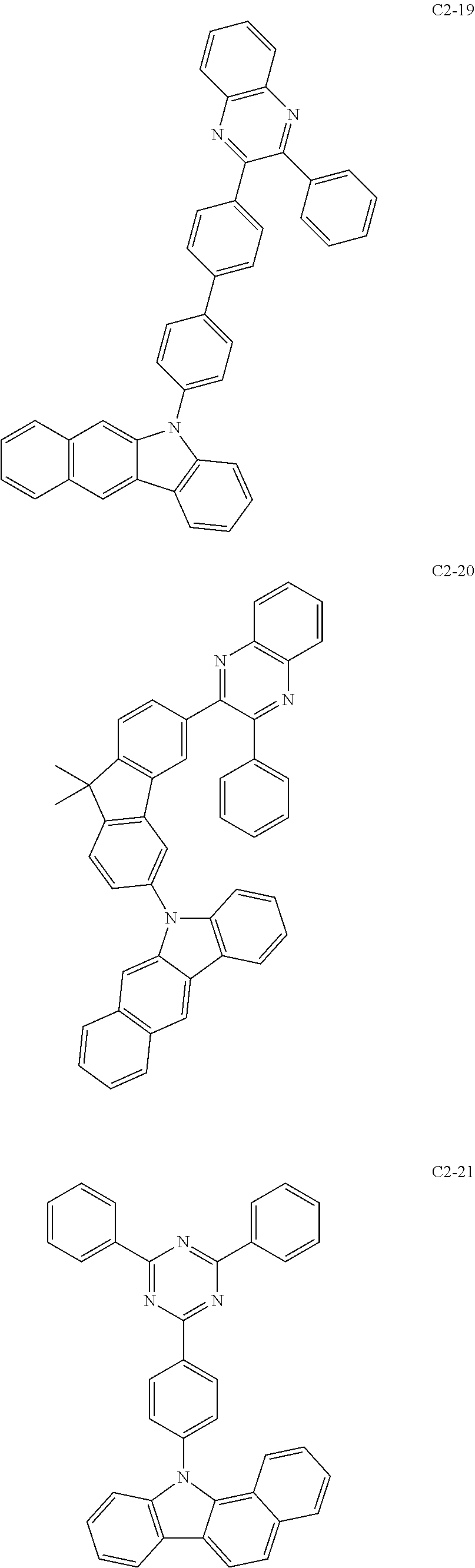
  • the compound represented by formula 2 includes the following compounds, but is not limited thereto.
  • the compound represented by formula 1 according to the present disclosure may be prepared by a synthetic method known to one skilled in the art. For example, it may be prepared by referring to Korean Patent Application Laying-Open No. 2018-0012709 (published on Feb. 6, 2018), but is not limited thereto.
  • the compound represented by formula 2 according to the present disclosure may be prepared by a synthetic method known to a person skilled in the art. For example, it may be prepared by referring to Korean Patent Application Laying-Open Nos. 2015-0032447 (published on Mar. 26, 2015), 2015-0077513 (published on Jul. 8, 2015), and 2015-0135109 (published on Dec. 2, 2015), but is not limited thereto.
  • the organic electroluminescent device comprises a first electrode; a second electrode; and at least one organic layer between the first and second electrodes.
  • the organic layer comprises a light-emitting layer, and may further comprise at least one layer selected from a hole injection layer, a hole transport layer, a hole auxiliary layer, a light-emitting auxiliary layer, an electron transport layer, an electron buffer layer, an electron injection layer, an interlayer, a hole blocking layer, and an electron blocking layer.
  • the second electrode may be a transflective electrode or a reflective electrode, and may be a top emission, bottom emission, or both-sides emission type according to the material used.
  • the hole injection layer may be further doped with a p-dopant
  • the electron injection layer may be further doped with an n-dopant.
  • the organic electroluminescent device comprises an anode, a cathode, and at least one light-emitting layer between the anode and the cathode, wherein at least one layer of the light-emitting layers comprises the compound represented by formula 1 and the compound represented by formula 2.
  • the light-emitting layer comprises a host and a dopant, and the host comprises the plurality of host materials.
  • the compound represented by formula 1 may be comprised as a first host compound of the plurality of host materials and the compound represented by formula 2 may be comprised as a second host compound of the plurality of host materials.
  • the weight ratio of the first host compound to the second host compound is in the range of 1:99 to 99:1.
  • the light-emitting layer is a layer from which light is emitted, and can be a single layer or a multi-layer of which two or more layers are stacked.
  • the first and second host materials may both be comprised in one layer or may be respectively comprised in different light-emitting layers.
  • the doping concentration of the dopant compound with respect to the host compound of the light-emitting layer may be less than 20 wt %.
  • the organic electroluminescent device of the present disclosure may further comprise at least one layer selected from a hole injection layer, a hole transport layer, a hole auxiliary layer, a light-emitting auxiliary layer, an electron transport layer, an electron injection layer, an interlayer, an electron buffer layer, a hole blocking layer, and an electron blocking layer.
  • the organic electroluminescent device of the present disclosure may further comprise an amine-based compound, in addition to the plurality of host materials of the present disclosure, as at least one of a hole injection material, a hole transport material, a hole auxiliary material, a light-emitting material, a light-emitting auxiliary material, and an electron blocking material.
  • the organic electroluminescent device of the present disclosure may further comprise an azine-based compound, in addition to the plurality of host materials of the present disclosure, as at least one of an electron transport material, an electron injection material, an electron buffer material, and a hole blocking material.
  • the dopant comprised in the organic electroluminescent device according to the present disclosure may be at least one phosphorescent or fluorescent dopant, and preferably phosphorescent dopant.
  • the phosphorescent dopant material applied to the organic electroluminescent device of the present disclosure is not particularly limited, but may be selected from metallated complex compounds of iridium (Ir), osmium (Os), copper (Cu), and platinum (Pt), preferably selected from ortho-metallated complex compounds of iridium (Ir), osmium (Os), copper (Cu), and platinum (Pt), and more preferably ortho-metallated iridium complex compounds.
  • the dopant comprised in the organic electroluminescent device of the present disclosure may include the compound represented by the following formula 101, but is not limited thereto.
  • L is selected from the following structures 1 and 2:
  • dopant compound is as follows, but are not limited thereto.
  • a hole injection layer between the anode and the light-emitting layer, a hole injection layer, a hole transport layer, an electron blocking layer, or a combination thereof can be used.
  • Multiple hole injection layers can be used in order to lower the hole injection barrier (or hole injection voltage) from the anode to the hole transport layer or the electron blocking layer.
  • Two compounds can be simultaneously used in each layer.
  • the hole transport layer or the electron blocking layer can also be formed of multi-layers.
  • an electron buffer layer between the light-emitting layer and the cathode, an electron buffer layer, a hole blocking layer, an electron transport layer, an electron injection layer, or a combination thereof can be used.
  • Multiple electron buffer layers can be used in order to control the injection of the electrons and enhance the interfacial characteristics between the light-emitting layer and the electron injection layer.
  • Two compounds can be simultaneously used in each layer.
  • the hole blocking layer or the electron transport layer can also be formed of multi-layers, and each layer can comprise two or more compounds.
  • organic electroluminescent compound or the plurality of host materials according to the present disclosure can also be used in an organic electroluminescent device comprising a quantum dot (QD).
  • QD quantum dot
  • dry film-forming methods such as vacuum evaporation, sputtering, plasma and ion plating methods, or wet film-forming methods such as ink jet printing, nozzle printing, slot coating, spin coating, dip coating, and flow coating methods can be used.
  • a thin film can be formed by dissolving or diffusing materials forming each layer into any suitable solvent such as ethanol, chloroform, tetrahydrofuran, dioxane, etc.
  • the solvent can be any solvent where the materials forming each layer can be dissolved or diffused, and where there are no problems in film-formation capability.
  • first and the second host compounds of the present disclosure may be film-formed in the above-listed methods, commonly by a co-evaporation process or a mixture-evaporation process.
  • the co-evaporation is a mixed deposition method in which two or more materials are placed in a respective individual crucible source and a current is applied to both cells at the same time to evaporate the materials.
  • the mixture-evaporation is a mixed deposition method in which two or more materials are mixed in one crucible source before evaporating them, and a current is applied to the cell to evaporate the materials.
  • the present disclosure may provide a display device by using the plurality of host materials comprising the compound represented by formula 1 and the compound represented by formula 2. That is, it is possible to manufacture a display system or a lighting system by using the plurality of host materials of the present disclosure. Specifically, it is possible to produce a display system, e.g., a display system for smartphones, tablets, notebooks, PCs, TVs, or cars, or a lighting system, e.g., an outdoor or indoor lighting system, by using the plurality of host materials of the present disclosure.
  • a display system e.g., a display system for smartphones, tablets, notebooks, PCs, TVs, or cars
  • a lighting system e.g., an outdoor or indoor lighting system
  • the luminous efficiency and/or lifespan characteristics of the OLED device can be improved by comprising the plurality of host materials of the present disclosure.
  • the following examples are for explaining the performance of the OLED device comprising the plurality of host materials according to the present disclosure in order to comprehend the present disclosure in detail, and the present disclosure is not limited to the following examples.
  • An organic light-emitting diode (OLED) device comprising the plurality of host materials according to the present disclosure.
  • a transparent electrode indium tin oxide (ITO) thin film (10 ⁇ /sq) on a glass substrate for an OLED device (Geomatec, Japan) was subjected to an ultrasonic washing with trichloroethylene, acetone, ethanol, and distilled water, sequentially, and was then stored in isopropanol.
  • the ITO substrate was mounted on a substrate holder of a vacuum vapor depositing apparatus.
  • Compound HI-1 was introduced into a cell of said vacuum vapor depositing apparatus, and then the pressure in the chamber of said apparatus was controlled to 10 ⁇ 6 torr.
  • the second hole transport material listed in Table 1 below was introduced into another cell of said vacuum vapor depositing apparatus, and was evaporated by applying an electric current to the cell, thereby forming a second hole transport layer having a thickness of 60 nm on the first hole transport layer.
  • a light-emitting layer was then deposited as follows.
  • the first and second host compounds shown in Table 1 below were introduced into two cells of the vacuum vapor depositing apparatus as a host, and compound D-39 was introduced into another cell.
  • the two host materials were evaporated at a rate of 1:1 and the dopant material was simultaneously evaporated at a different rate and these were deposited in a doping amount of 3 wt % based on the total amount of the host and dopant to form a light-emitting layer having a thickness of 40 nm on the second hole transport layer.
  • Compound ET-1 and compound EI-1 were then introduced into two other cells, evaporated at the rate of 1:1, and deposited to form an electron transport layer having a thickness of 35 nm on the light-emitting layer.
  • the time taken for the luminance to decrease from 100% to 90% at constant current at a luminance of 5,000 nit (lifespan; T90), of the OLEDs produced above is provided in Table 1 below.
  • Comparative Examples 1 and 2 Production of an OLED Device Comprising a Conventional Compound as a Host
  • OLED device was produced in the same manner as in Device Example 1, except that the material listed in Table 2 below was introduced as the second hole transport material and the single compound listed in Table 2 below was used as the host.
  • the time taken for the luminance to decrease from 100% to 90% at constant current at a luminance of 5,000 nit (lifespan; T90), of the OLEDs produced above is provided in Table 2 below.
  • an organic electroluminescent device comprising the compounds represented by the formulas 1 and 2 of the present disclosure as a plurality of host materials has much improved lifespan characteristics compared to an organic electroluminescent device comprising a single conventional organic electroluminescent compound.

Landscapes

  • Chemical & Material Sciences (AREA)
  • Physics & Mathematics (AREA)
  • Spectroscopy & Molecular Physics (AREA)
  • Engineering & Computer Science (AREA)
  • Materials Engineering (AREA)
  • Organic Chemistry (AREA)
  • Optics & Photonics (AREA)
  • Electroluminescent Light Sources (AREA)
  • Plural Heterocyclic Compounds (AREA)

Abstract

The present disclosure relates to a plurality of host materials comprising a compound represented by formula 1 and a compound represented by formula 2, and an organic electroluminescent device comprising the same. By comprising the plurality of host materials comprising a specific combination of compounds, it is possible to provide an organic electroluminescent device having long lifespan characteristics.

Description

TECHNICAL FIELD
The present disclosure relates to a plurality of host materials and an organic electroluminescent device comprising the same.
BACKGROUND ART
In 1987, Tang et al. of Eastman Kodak first developed a small molecule green organic electroluminescent device (OLED) of TPD/Alq3 bilayer consisting of a light-emitting layer and a charge transport layer. Since then, the research on an OLED has been rapidly carried out, and it has been commercialized. At present, phosphorous materials, which provide excellent luminous efficiency in realizing panels, are mainly used in organic electroluminescent devices. OLEDs having high luminous efficiency and/or long lifespan are required for long time uses and high resolution of displays.
Korean Patent Application Laying-Open No. 2018-0012709 discloses a diazadibenzo azuleno fluorene derivative. However, a use as one of a plurality of host materials is not specifically disclosed, and performances of OLED devices still need to be improved.
DISCLOSURE OF THE INVENTION Problems to be Solved
The objective of the present disclosure is to provide an organic electroluminescent device having long lifespan characteristics by comprising a plurality of host materials comprising a specific combination of compounds.
Solution to Problems
The present inventors found that the objective above can be achieved by a plurality of host materials comprising at least one first host compound and at least one second host compound, wherein the first host compound is represented by the following formula 1, and the second host compound is represented by the following formula 2:
Figure US12049468-20240730-C00001
    • wherein
    • X1 to X13 each independently represent N or CR1;
    • L1 represents a single bond, a substituted or unsubstituted (C6-C30)arylene, a substituted or unsubstituted (C3-C30)cycloalkylene, or a substituted or unsubstituted (3- to 30-membered)heteroarylene;
    • Ar represents hydrogen, deuterium, a halogen, a cyano, a substituted or unsubstituted (C1-C30)alkyl, a substituted or unsubstituted (C3-C30)cycloalkyl, a substituted or unsubstituted (C3-C30)cycloalkenyl, a substituted or unsubstituted (3- to 7-membered)heterocycloalkyl, a substituted or unsubstituted (C6-C30)aryl, a substituted or unsubstituted (3- to 30-membered)heteroaryl, —NR5R6, or —SiR7R8R9; or may be linked to an adjacent substituent to form a ring;
    • R1 represents -L1-(Ar)a, hydrogen, deuterium, a halogen, a cyano, a substituted or unsubstituted (C1-C30)alkyl, a substituted or unsubstituted (C3-C30)cycloalkyl, a substituted or unsubstituted (C3-C30)cycloalkenyl, a substituted or unsubstituted (3- to 7-membered)heterocycloalkyl, a substituted or unsubstituted (C6-C30)aryl, a substituted or unsubstituted (3- to 30-membered)heteroaryl, —NR5R6, or —SiR7R8R9; or may be linked to an adjacent substituent to form a ring;
    • R5 to R9 each independently represent a substituted or unsubstituted (C1-C30)alkyl, a substituted or unsubstituted (C6-C30)aryl, or a substituted or unsubstituted (3- to 30-membered)heteroaryl;
    • a represents an integer of 1 to 3, where if a is an integer of 2 or more, each of Ar may be the same or different;
Figure US12049468-20240730-C00002
    • wherein
    • HAr represents a substituted or unsubstituted (3- to 30-membered)heteroaryl;
    • L2 represents a single bond, a substituted or unsubstituted (C6-C30)arylene, or a substituted or unsubstituted (3- to 30-membered)heteroarylene;
    • R21 and R22 each independently represent hydrogen, deuterium, a halogen, a cyano, a substituted or unsubstituted (C1-C30)alkyl, a substituted or unsubstituted (C3-C30)cycloalkyl, a substituted or unsubstituted (C3-C30)cycloalkenyl, a substituted or unsubstituted (3- to 7-membered)heterocycloalkyl, a substituted or unsubstituted (C6-C30)aryl, a substituted or unsubstituted (3- to 30-membered)heteroaryl, —NR5R6, or —SiR7R8R9; or may be linked to an adjacent substituent to form a ring, with a proviso that at least one of two adjacent R21's or two adjacent R22's are linked to each other to form a ring; and
    • b represents an integer of 1 to 4, c represents an integer of 1 to 6, where if b and c are an integer of 2 or more, each of R21 and each of R22 may be the same or different.
Effects of the Invention
By comprising the plurality of host materials of the present disclosure, an organic electroluminescent device having long lifespan characteristics is provided, and a display device or a lighting device using the organic electroluminescent device can be manufactured.
EMBODIMENTS OF THE INVENTION
Hereinafter, the present disclosure will be described in detail. However, the following description is intended to explain the disclosure, and is not meant in any way to restrict the scope of the disclosure.
The term “organic electroluminescent compound” in the present disclosure means a compound that may be used in an organic electroluminescent device, and may be comprised in any layer constituting an organic electroluminescent device, as necessary.
The term “organic electroluminescent material” in the present disclosure means a material that may be used in an organic electroluminescent device, and may comprise at least one compound. The organic electroluminescent material may be comprised in any layer constituting an organic electroluminescent device, as necessary. For example, the organic electroluminescent material may be a hole injection material, a hole transport material, a hole auxiliary material, a light-emitting auxiliary material, an electron blocking material, a light-emitting material (a host material or a dopant material), an electron buffer material, a hole blocking material, an electron transport material, or an electron injection material.
The term “a plurality of host materials” in the present disclosure means a host material comprising a combination of at least two compounds, which may be comprised in any light-emitting layer constituting an organic electroluminescent device. It may mean both a material before being comprised in an organic electroluminescent device (for example, before vapor deposition) and a material after being comprised in an organic electroluminescent device (for example, after vapor deposition). For example, a plurality of host materials of the present disclosure may be a combination of at least two host materials, and selectively, conventional materials comprised in organic electroluminescent materials may be additionally comprised. The at least two compounds comprised in the plurality of host materials of the present disclosure may be comprised together in one light-emitting layer, or may be each comprised in separate light-emitting layers by a method known in the field. For example, the at least two compounds may be mixture-evaporated or co-evaporated, or may be individually evaporated.
Hereinafter, the compounds represented by formulas 1 and 2 will be described in detail.
Herein, the term “(C1-C30)alkyl” is meant to be a linear or branched alkyl having 1 to 30 carbon atoms constituting the chain, in which the number of carbon atoms is preferably 1 to 10, and more preferably 1 to 6. The above alkyl may include methyl, ethyl, n-propyl, iso-propyl, n-butyl, iso-butyl, tert-butyl, etc. The term “(C3-C30)cycloalkyl” is meant to be a mono- or polycyclic hydrocarbon having 3 to 30 ring backbone carbon atoms, in which the number of carbon atoms is preferably 3 to 20, and more preferably 3 to 7. The above cycloalkyl may include cyclopropyl, cyclobutyl, cyclopentyl, cyclohexyl, etc. The term “(3- to 7-membered)heterocycloalkyl” is meant to be a cycloalkyl having 3 to 7 ring backbone atoms, and including at least one heteroatom selected from the group consisting of B, N, O, S, Si, and P, and preferably the group consisting of O, S, and N. The above heterocycloalkyl may include tetrahydrofuran, pyrrolidine, thiolan, tetrahydropyran, etc. The term “(C6-C30)aryl” or “(C6-C30)arylene” is meant to be a monocyclic or fused ring radical derived from an aromatic hydrocarbon having 6 to 30 ring backbone carbon atoms, in which the number of the ring backbone carbon atoms is preferably 6 to 20, more preferably 6 to 15. The above aryl or arylene may be partially saturated. The above aryl may include phenyl, biphenyl, terphenyl, naphthyl, binaphthyl, phenylnaphthyl, naphthylphenyl, fluorenyl, phenylfluorenyl, benzofluorenyl, dibenzofluorenyl, phenanthrenyl, phenylphenanthrenyl, anthracenyl, indenyl, triphenylenyl, pyrenyl, tetracenyl, perylenyl, chrysenyl, naphthacenyl, fluoranthenyl, etc. More specifically, the above aryl may include a phenyl group, a 1-naphthyl group, a 2-naphthyl group, a 1-anthryl group, a 2-anthryl group, a 9-anthryl group, a benzanthryl group, a 1-phenanthryl group, a 2-phenanthryl group, a 3-phenanthryl group, a 4-phenanthryl group, a 9-phenanthryl group, a naphthacenyl group, a pyrenyl group, a 1-chrysenyl group, a 2-chrysenyl group, a 3-chrysenyl group, a 4-chrysenyl group, a 5-chrysenyl group, a 6-chrysenyl group, a benzo[c]phenanthryl group, a benzo[g]chrysenyl group, a 1-triphenylenyl group, a 2-triphenylenyl group, a 3-triphenylenyl group, a 4-triphenylenyl group, a 1-fluorenyl group, a 2-fluorenyl group, a 3-fluorenyl group, a 4-fluorenyl group, a 9-fluorenyl group, a benzofluorenyl group, a dibenzofluorenyl group, a 2-biphenylyl group, a 3-biphenylyl group, a 4-biphenylyl group, an o-terphenyl group, an m-terphenyl-4-yl group, an m-terphenyl-3-yl group, an m-terphenyl-2-yl group, a p-terphenyl-4-yl group, a p-terphenyl-3-yl group, a p-terphenyl-2-yl group, an m-quaterphenyl group, a 3-fluoranthenyl group, a 4-fluoranthenyl group, an 8-fluoranthenyl group, a 9-fluoranthenyl group, a benzofluoranthenyl group, an o-tolyl group, an m-tolyl group, a p-tolyl group, a 2,3-xylyl group, a 3,4-xylyl group, a 2,5-xylyl group, a mesityl group, an o-cumenyl group, an m-cumenyl group, a p-cumenyl group, a p-t-butylphenyl group, a p-(2-phenylpropyl)phenyl group, a 4′-methylbiphenylyl group, a 4″-t-butyl-p-terphenyl-4-yl group, a 9,9-dimethyl-1-fluorenyl group, a 9,9-dimethyl-2-fluorenyl group, a 9,9-dimethyl-3-fluorenyl group, a 9,9-dimethyl-4-fluorenyl group, a 9,9-diphenyl-1-fluorenyl group, a 9,9-diphenyl-2-fluorenyl group, a 9,9-diphenyl-3-fluorenyl group, and a 9,9-diphenyl-4-fluorenyl group. The term “(3- to 30-membered)heteroaryl” or “(3- to 30-membered)heteroarylene” is an aryl having 3 to 30 ring backbone atoms, in which the number of the ring backbone atoms is preferably 3 to 20, more preferably 5 to 15, and including at least one, preferably 1 to 4 heteroatoms selected from the group consisting of B, N, O, S, Si, and P. The above heteroaryl or heteroarylene may be a monocyclic ring, or a fused ring condensed with at least one benzene ring; may be partially saturated; and may be one formed by linking at least one heteroaryl or aryl group to a heteroaryl group via a single bond(s). The above heteroaryl may include a monocyclic ring-type heteroaryl such as furyl, thiophenyl, pyrrolyl, imidazolyl, pyrazolyl, thiazolyl, thiadiazolyl, isothiazolyl, isoxazolyl, oxazolyl, oxadiazolyl, triazinyl, tetrazinyl, triazolyl, tetrazolyl, furazanyl, pyridyl, pyrazinyl, pyrimidinyl, and pyridazinyl, and a fused ring-type heteroaryl such as benzofuranyl, benzothiophenyl, isobenzofuranyl, dibenzofuranyl, dibenzothiophenyl, benzonaphthothiophenyl, benzimidazolyl, benzothiazolyl, benzoisothiazolyl, benzoisoxazolyl, benzoxazolyl, isoindolyl, indolyl, indazolyl, benzothiadiazolyl, quinolyl, isoquinolyl, cinnolinyl, quinazolinyl, quinoxalinyl, carbazolyl, phenoxazinyl, phenanthridinyl, benzodioxolyl, etc. More specifically, the above heteroaryl or heteroarylene may include a 1-pyrrolyl group, a 2-pyrrolyl group, a 3-pyrrolyl group, a pyrazinyl group, a 2-pyridinyl group, a 2-pyrimidinyl group, a 4-pyrimidinyl group, a 5-pyrimidinyl group, a 6-pyrimidinyl group, a 1,2,3-triazin-4-yl group, a 1,2,4-triazin-3-yl group, a 1,3,5-triazin-2-yl group, a 1-imidazolyl group, a 2-imidazolyl group, a 1-pyrazolyl group, a 1-indolidinyl group, a 2-indolidinyl group, a 3-indolidinyl group, a 5-indolidinyl group, a 6-indolidinyl group, a 7-indolidinyl group, an 8-indolidinyl group, a 2-imidazopyridinyl group, a 3-imidazopyridinyl group, a 5-imidazopyridinyl group, a 6-imidazopyridinyl group, a 7-imidazopyridinyl group, an 8-imidazopyridinyl group, a 3-pyridinyl group, a 4-pyridinyl group, a 1-indolyl group, a 2-indolyl group, a 3-indolyl group, a 4-indolyl group, a 5-indolyl group, a 6-indolyl group, a 7-indolyl group, a 1-isoindolyl group, a 2-isoindolyl group, a 3-isoindolyl group, a 4-isoindolyl group, a 5-isoindolyl group, a 6-isoindolyl group, a 7-isoindolyl group, a 2-furyl group, a 3-furyl group, a 2-benzofuranyl group, a 3-benzofuranyl group, a 4-benzofuranyl group, a 5-benzofuranyl group, a 6-benzofuranyl group, a 7-benzofuranyl group, a 1-isobenzofuranyl group, a 3-isobenzofuranyl group, a 4-isobenzofuranyl group, a 5-isobenzofuranyl group, a 6-isobenzofuranyl group, a 7-isobenzofuranyl group, a 2-quinolyl group, a 3-quinolyl group, a 4-quinolyl group, a 5-quinolyl group, a 6-quinolyl group, a 7-quinolyl group, an 8-quinolyl group, a 1-isoquinolyl group, a 3-isoquinolyl group, a 4-isoquinolyl group, a 5-isoquinolyl group, a 6-isoquinolyl group, a 7-isoquinolyl group, an 8-isoquinolyl group, a 2-quinoxalinyl group, a 5-quinoxalinyl group, a 6-quinoxalinyl group, a 1-carbazolyl group, a 2-carbazolyl group, a 3-carbazolyl group, a 4-carbazolyl group, a 9-carbazolyl group, an azacarbazolyl-1-yl group, an azacarbazolyl-2-yl group, an azacarbazolyl-3-yl group, an azacarbazolyl-4-yl group, an azacarbazolyl-5-yl group, an azacarbazolyl-6-yl group, an azacarbazolyl-7-yl group, an azacarbazolyl-8-yl group, an azacarbazolyl-9-yl group, a 1-phenanthridinyl group, a 2-phenanthridinyl group, a 3-phenanthridinyl group, a 4-phenanthridinyl group, a 6-phenanthridinyl group, a 7-phenanthridinyl group, an 8-phenanthridinyl group, a 9-phenanthridinyl group, a 10-phenanthridinyl group, a 1-acridinyl group, a 2-acridinyl group, a 3-acridinyl group, a 4-acridinyl group, a 9-acridinyl group, a 2-oxazolyl group, a 4-oxazolyl group, a 5-oxazolyl group, a 2-oxadiazolyl group, a 5-oxadiazolyl group, a 3-furazanyl group, a 2-thienyl group, a 3-thienyl group, a 2-methylpyrrol-1-yl group, a 2-methylpyrrol-3-yl group, a 2-methylpyrrol-4-yl group, a 2-methylpyrrol-5-yl group, a 3-methylpyrrol-1-yl group, a 3-methylpyrrol-2-yl group, a 3-methylpyrrol-4-yl group, a 3-methylpyrrol-5-yl group, a 2-t-butylpyrrol-4-yl group, a 3-(2-phenylpropyl)pyrrol-1-yl group, a 2-methyl-1-indolyl group, a 4-methyl-1-indolyl group, a 2-methyl-3-indolyl group, a 4-methyl-3-indolyl group, a 2-t-butyl-1-indolyl group, a 4-t-butyl-1-indolyl group, a 2-t-butyl-3-indolyl group, a 4-t-butyl-3-indolyl group, a 1-dibenzofuranyl group, a 2-dibenzofuranyl group, a 3-dibenzofuranyl group, a 4-dibenzofuranyl group, a 1-dibenzothiophenyl group, a 2-dibenzothiophenyl group, a 3-dibenzothiophenyl group, a 4-dibenzothiophenyl group, a 1-silafluorenyl group, a 2-silafluorenyl group, a 3-silafluorenyl group, a 4-silafluorenyl group, a 1-germafluorenyl group, a 2-germafluorenyl group, a 3-germafluorenyl group, and a 4-germafluorenyl group. Furthermore, “halogen” includes F, Cl, Br, and I.
In addition, “ortho,” “meta,” and “para” signify substitution positions of two substituents. The ortho position represents a just neighboring position, and, for example, in the case of benzene, represents 1,2 positions. The meta position represents the position next to the just neighboring position, and, for example, in the case of benzene, represents 1,3 positions. The para position represents the position next to the meta position, and, for example, in the case of benzene, represents 1,4 positions.
Herein, “substituted” in the expression “substituted or unsubstituted” means that a hydrogen atom in a certain functional group is replaced with another atom or functional group, i.e., a substituent. The substituents of the substituted alkyl, the substituted cycloalkyl, the substituted cycloalkylene, the substituted cycloalkenyl, the substituted heterocycloalkyl, the substituted aryl, the substituted arylene, the substituted heteroaryl, and the substituted heteroarylene in the formulas of the present disclosure each independently are at least one selected from the group consisting of deuterium; a halogen; a cyano; a carboxyl; a nitro; a hydroxyl; a (C1-C30)alkyl; a halo(C1-C30)alkyl; a (C2-C30)alkenyl; a (C2-C30)alkynyl; a (C1-C30)alkoxy; a (C1-C30)alkylthio; a (C3-C30)cycloalkyl; a (3- to 7-membered)heterocycloalkyl; a (C6-C30)aryloxy; a (C6-C30)arylthio; a (3- to 30-membered)heteroaryl unsubstituted or substituted with a (C1-C30)alkyl, a (C6-C30)aryl, or a di(C6-C30)arylamino; a (C6-C30)aryl unsubstituted or substituted with a cyano, a (3- to 30-membered)heteroaryl, or a tri(C6-C30)arylsilyl; a tri(C1-C30)alkylsilyl; a tri(C6-C30)arylsilyl; a di(C1-C30)alkyl(C6-C30)arylsilyl; a (C1-C30)alkyldi(C6-C30)arylsilyl; an amino; a mono- or di-(C1-C30)alkylamino; a mono- or di-(C6-C30)arylamino; a (C1-C30)alkyl(C6-C30)arylamino; a (C1-C30)alkylcarbonyl; a (C1-C30)alkoxycarbonyl; a (C6-C30)arylcarbonyl; a di(C6-C30)arylboronyl; a di(C1-C30)alkylboronyl; a (C1-C30)alkyl(C6-C30)arylboronyl; a (C6-C30)aryl(C1-C30)alkyl; and a (C1-C30)alkyl(C6-C30)aryl. Preferably, the substituents each independently are at least one selected from the group consisting of a (C1-C6)alkyl, a (C6-C20)aryl, and a (3- to 20-membered)heteroaryl. For example, the substituents may be methyl, phenyl, naphthyl, biphenyl, or naphthylphenyl.
In the formulas of the present disclosure, if a substituent is linked to an adjacent substituent to form a ring, the ring may be a substituted or unsubstituted, mono- or polycyclic, alicyclic or aromatic (3- to 30-membered) ring, or the combination thereof, in which the formed ring may contain at least one heteroatom selected from nitrogen, oxygen, and sulfur. For example, the fused ring may be a substituted or unsubstituted dibenzothiophene ring, a substituted or unsubstituted dibenzofurane ring, a substituted or unsubstituted naphthalene ring, a substituted or unsubstituted phenanthrene ring, a substituted or unsubstituted fluorene ring, a substituted or unsubstituted benzothiophene ring, a substituted or unsubstituted benzofuran ring, a substituted or unsubstituted indole ring, a substituted or unsubstituted indene ring, a substituted or unsubstituted benzene ring, or a substituted or unsubstituted carbazole ring.
In the formulas of the present disclosure, the heteroaryl or heteroarylene may each independently contain at least one heteroatom selected from B, N, O, S, Si, and P. In addition, the heteroatom may be substituted with at least one substituent selected from the group consisting of hydrogen, deuterium, a halogen, a cyano, a substituted or unsubstituted (C1-C30)alkyl, a substituted or unsubstituted (C6-C30)aryl, a substituted or unsubstituted (5- to 30-membered)heteroaryl, a substituted or unsubstituted (C3-C30)cycloalkyl, a substituted or unsubstituted (C1-C30)alkoxy, a substituted or unsubstituted tri(C1-C30)alkylsilyl, a substituted or unsubstituted di(C1-C30)alkyl(C6-C30)arylsilyl, a substituted or unsubstituted (C1-C30)alkyldi(C6-C30)arylsilyl, a substituted or unsubstituted tri(C6-C30)arylsilyl, a substituted or unsubstituted mono- or di-(C1-C30)alkylamino, a substituted or unsubstituted mono- or di-(C6-C30)arylamino, and a substituted or unsubstituted (C1-C30)alkyl(C6-C30)arylamino.
In formula 1, X1 to X13 each independently represent N or CR1. According to one embodiment of the present disclosure, X1 to X13 are all CR1.
In formula 1, L1 represents a single bond, a substituted or unsubstituted (C6-C30)arylene, a substituted or unsubstituted (C3-C30)cycloalkylene, or a substituted or unsubstituted (3- to 30-membered)heteroarylene. According to one embodiment of the present disclosure, L1 represents a single bond, or a (C6-C15)arylene unsubstituted or substituted with a (C1-C6)alkyl. According to another embodiment of the present disclosure, L1 represents a single bond or an unsubstituted (C6-C12)arylene. Specifically, L1 may represent a single bond, a phenylene, a naphthylene, a biphenylene, a dimethylfluorenylene, etc.
In formula 1, Ar represents hydrogen, deuterium, a halogen, a cyano, a substituted or unsubstituted (C1-C30)alkyl, a substituted or unsubstituted (C3-C30)cycloalkyl, a substituted or unsubstituted (C3-C30)cycloalkenyl, a substituted or unsubstituted (3- to 7-membered)heterocycloalkyl, a substituted or unsubstituted (C6-C30)aryl, a substituted or unsubstituted (3- to 30-membered)heteroaryl, —NR5R6, or —SiR7R8R9; or may be linked to an adjacent substituent to form a ring. Herein, R5 to R9 each independently represent a substituted or unsubstituted (C1-C30)alkyl, a substituted or unsubstituted (C6-C30)aryl, or a substituted or unsubstituted (3- to 30-membered)heteroaryl. According to one embodiment of the present disclosure, Ar represents hydrogen, a (C6-C20)aryl unsubstituted or substituted with a (C1-C6)alkyl, a (5- to 25-membered)heteroaryl unsubstituted or substituted with a (C6-C12)aryl, or —NR5R6; and R5 and R6 each independently represent a (C6-C20)aryl unsubstituted or substituted with a (C1-C6)alkyl, or an unsubstituted (5- to 15-membered)heteroaryl. According to another embodiment of the present disclosure, Ar represents an unsubstituted (C6-C20)aryl, an unsubstituted (5- to 20-membered)heteroaryl, or —NR5R6; and R5 and R6 each independently represent an unsubstituted (C6-C20)aryl. Specifically, Ar may represent hydrogen, a phenyl, a naphthyl, a biphenyl, a naphthylphenyl, a phenylnaphthyl, a terphenyl, a dimethylfluorenyl, a dimethylbenzofluorenyl, a dibenzofuranyl, a benzonaphthofuranyl, a dibenzothiophenyl, a benzonaphthothiophenyl, a carbazolyl, a phenylcarbazolyl, a benzocarbazolyl, a phenylbenzocarbazolyl, a dibenzocarbazolyl, —NR5R6, etc.; and R5 and R6 may each independently represent a phenyl, a naphthyl, a biphenyl, a naphthylphenyl, a dimethylfluorenyl, a dibenzofuranyl, etc.
According to one embodiment of the present disclosure, Ar may represent a substituted or unsubstituted phenyl, a substituted or unsubstituted naphthyl, a substituted or unsubstituted biphenyl, a substituted or unsubstituted naphthylphenyl, a substituted or unsubstituted phenylnaphthyl, a substituted or unsubstituted terphenyl, a substituted or unsubstituted carbazolyl, a substituted or unsubstituted benzocarbazolyl, a substituted or unsubstituted dibenzocarbazolyl, a substituted or unsubstituted dibenzothiophenyl, a substituted or unsubstituted benzothiophenyl, a substituted or unsubstituted benzonaphthothiophenyl, a substituted or unsubstituted dibenzofuranyl, a substituted or unsubstituted benzofuranyl, a substituted or unsubstituted benzonaphthofuranyl, a substituted or unsubstituted naphthyridinyl, a substituted or unsubstituted fluorenyl, a substituted or unsubstituted benzofluorenyl, a substituted or unsubstituted diphenylamino, a substituted or unsubstituted phenylbiphenylamino, a substituted or unsubstituted naphthylbiphenylamino, a substituted or unsubstituted dibiphenylamino, a substituted or unsubstituted biphenylfluorenylamino, or a substituted or unsubstituted biphenyidibenzofuranylamino.
In formula 1, R1 represents -L1-(Ar)a, hydrogen, deuterium, a halogen, a cyano, a substituted or unsubstituted (C1-C30)alkyl, a substituted or unsubstituted (C3-C30)cycloalkyl, a substituted or unsubstituted (C3-C30)cycloalkenyl, a substituted or unsubstituted (3- to 7-membered)heterocycloalkyl, a substituted or unsubstituted (C6-C30)aryl, a substituted or unsubstituted (3- to 30-membered)heteroaryl, —NR5R6, or —SiR7R8R9; or may be linked to an adjacent substituent to form a ring. According to one embodiment of the present disclosure, R1 represents hydrogen, an unsubstituted (C6-C12)aryl, or an unsubstituted (5- to 15-membered)heteroaryl; or may be linked to an adjacent substituent to form an unsubstituted monocyclic (6- to 12-membered) aromatic ring. Specifically, R1 may represent hydrogen, a phenyl, a dibenzofuranyl, a dibenzothiophenyl, etc., or may be linked to an adjacent substituent to form a benzene ring, etc.
Formula 1 may be represented by the following formula 1-1.
Figure US12049468-20240730-C00003
    • wherein
    • L1 represents a single bond, or a substituted or unsubstituted (C6-C30)arylene;
    • Ar represents hydrogen, deuterium, a substituted or unsubstituted (C6-C30)aryl, a substituted or unsubstituted (3- to 30-membered)heteroaryl, or —NR5R6;
    • R5 and R6 each independently represent a substituted or unsubstituted (C1-C30)alkyl, a substituted or unsubstituted (C6-C30)aryl, or a substituted or unsubstituted (3- to 30-membered)heteroaryl;
    • R11 to R14 each independently are identical to the definition of R1 in formula 1; and
    • aa represents an integer of 1 to 3, ab and ac each independently represent an integer of 1 to 4, ad represents 1 or 2, where if aa, ab, ac, and ad are an integer of 2 or more, each of R11, each of R12, each of R13, and each of R14 may be the same or different.
In addition, formula 1 may be represented by at least one of the following formulas 1-11 to 1-40.
Figure US12049468-20240730-C00004
Figure US12049468-20240730-C00005
Figure US12049468-20240730-C00006
Figure US12049468-20240730-C00007
Figure US12049468-20240730-C00008
Figure US12049468-20240730-C00009
Figure US12049468-20240730-C00010
Figure US12049468-20240730-C00011
    • wherein
    • L1 represents a single bond, or is represented by one of the following formulas L1-1 to L1-7, and
Figure US12049468-20240730-C00012
    • Ar is represented by one of the following formulas Ar-1 to Ar-121.
Figure US12049468-20240730-C00013
Figure US12049468-20240730-C00014
Figure US12049468-20240730-C00015
Figure US12049468-20240730-C00016
Figure US12049468-20240730-C00017
Figure US12049468-20240730-C00018
Figure US12049468-20240730-C00019
Figure US12049468-20240730-C00020
Figure US12049468-20240730-C00021
Figure US12049468-20240730-C00022
Figure US12049468-20240730-C00023
Figure US12049468-20240730-C00024
Figure US12049468-20240730-C00025
Figure US12049468-20240730-C00026
Figure US12049468-20240730-C00027
Figure US12049468-20240730-C00028
Figure US12049468-20240730-C00029
Figure US12049468-20240730-C00030
Figure US12049468-20240730-C00031
Figure US12049468-20240730-C00032
In formula 2, HAr represents a substituted or unsubstituted (3- to 30-membered)heteroaryl. According to one embodiment of the present disclosure, HAr represents a (3- to 15-membered)heteroaryl substituted with one or more (C6-C20)aryls. According to another embodiment of the present disclosure, HAr represents a (3- to 15-membered)heteroaryl substituted with one or more (C6-C12)aryls. Specifically, HAr may represent a pyridyl substituted with one or more phenyls; a pyrimidinyl substituted with one or more phenyls; a triazinyl substituted with one or more selected from phenyl, naphthyl, and biphenyl; a quinazolinyl substituted with one or more selected from phenyl, naphthyl, biphenyl, and naphthylphenyl; a quinoxalinyl substituted with one or more selected from phenyl, naphthyl, biphenyl, naphthylphenyl, etc.
According to one embodiment of the present disclosure, HAr may represent a substituted or unsubstituted triazinyl, a substituted or unsubstituted pyridyl, a substituted or unsubstituted pyrimidinyl, a substituted or unsubstituted quinazolinyl, a substituted or unsubstituted benzoquinazolinyl, a substituted or unsubstituted quinoxalinyl, a substituted or unsubstituted benzoquinoxalinyl, a substituted or unsubstituted quinolyl, a substituted or unsubstituted benzoquinolyl, a substituted or unsubstituted isoquinolyl, a substituted or unsubstituted benzoisoquinolyl, a substituted or unsubstituted triazolyl, a substituted or unsubstituted pyrazolyl, a substituted or unsubstituted naphthyridinyl, or a substituted or unsubstituted benzothienopyrimidinyl.
In formula 2, L2 represents a single bond, a substituted or unsubstituted (C6-C30)arylene, or a substituted or unsubstituted (3- to 30-membered)heteroarylene. According to one embodiment of the present disclosure, L2 represents a single bond, or a (C6-C20)arylene unsubstituted or substituted with a (C1-C6)alkyl. According to another embodiment of the present disclosure, L2 represents a single bond or a (C6-C15)arylene unsubstituted or substituted with a (C1-C6)alkyl. Specifically, L2 may represent a single bond, a phenylene, a naphthylene, a biphenylene, a dimethylfluorenylene, a dimethylbenzofluorenylene, etc.
In formula 2, R21 and R22 each independently represent hydrogen, deuterium, a halogen, a cyano, a substituted or unsubstituted (C1-C30)alkyl, a substituted or unsubstituted (C3-C30)cycloalkyl, a substituted or unsubstituted (C3-C30)cycloalkenyl, a substituted or unsubstituted (3- to 7-membered)heterocycloalkyl, a substituted or unsubstituted (C6-C30)aryl, a substituted or unsubstituted (3- to 30-membered)heteroaryl, —NR5R6, or —SiR7R8R9; or may be linked to an adjacent substituent to form a ring, with a proviso that at least one of two adjacent R21's or two adjacent R22's are linked to each other to form a ring. According to one embodiment of the present disclosure, R21 and R22 each independently represent hydrogen, or an unsubstituted (C6-C12)aryl, or two adjacent R21's or two adjacent R22's are linked to each other to form a polycyclic aromatic ring. Specifically, R21 and R22 may each independently represent hydrogen, a phenyl, etc., or two adjacent R21's or two adjacent R22's are linked to each other to form a benzene ring, an indole ring substituted with a phenyl, a benzoindole ring substituted with one or more selected from a phenyl and a biphenyl, a benzofuran ring, a benzothiophene ring, etc.
Formula 2 may be represented by at least one of the following formulas 2-1 to 2-6.
Figure US12049468-20240730-C00033
Figure US12049468-20240730-C00034
    • wherein
    • HAr and L2 are as defined in formula 2;
    • R31 to R44 each independently represent hydrogen, deuterium, a halogen, a cyano, a substituted or unsubstituted (C1-C30)alkyl, a substituted or unsubstituted (C3-C30)cycloalkyl, a substituted or unsubstituted (C3-C30)cycloalkenyl, a substituted or unsubstituted (3- to 7-membered)heterocycloalkyl, a substituted or unsubstituted (C6-C30)aryl, a substituted or unsubstituted (3- to 30-membered)heteroaryl, —NR5R6, or —SiR7R8R9; or may be linked to an adjacent substituent to form a ring;
    • V and W each independently represent NR16, O, or S;
    • R16 represents a substituted or unsubstituted (C6-C30)aryl, or a substituted or unsubstituted (3- to 30-membered)heteroaryl; and
    • d, h, i, j, l, n, o, p, and q each independently represent an integer of 1 to 4, e, f, g, k, and m each independently represent an integer of 1 to 6, where if d to q are an integer of 2 or more, each of R31 to each of R44 may be the same or different.
In addition, formula 2 may be represented by at least one of the following formulas 2-11 to 2-38.
Figure US12049468-20240730-C00035
Figure US12049468-20240730-C00036
Figure US12049468-20240730-C00037
Figure US12049468-20240730-C00038
Figure US12049468-20240730-C00039
Figure US12049468-20240730-C00040
    • wherein
    • HAr is represented by one of the following formulas 2-40 to 2-58, and
Figure US12049468-20240730-C00041
Figure US12049468-20240730-C00042
Figure US12049468-20240730-C00043
Figure US12049468-20240730-C00044
    • L2 is represented b one of the following formulas 3-1 to 3-47.
Figure US12049468-20240730-C00045
Figure US12049468-20240730-C00046
Figure US12049468-20240730-C00047
Figure US12049468-20240730-C00048
The compound represented by formula 1 includes the following compounds, but is not limited thereto.
Compound Formula L1 Ar Compound Formula L1 Ar
C1-1 1-11 L1-1 Ar-1 C1-2 1-11 L1-1 Ar-2
C1-3 1-11 L1-2 Ar-2 C1-4 1-11 L1-2 Ar-4
C1-5 1-11 L1-2 Ar-26 C1-6 1-11 L1-2 Ar-49
C1-7 1-11 L1-2 Ar-71 C1-8 1-11 L1-2 Ar-115
C1-9 1-11 L1-2 Ar-27 C1-10 1-11 L1-2 Ar-51
C1-11 1-11 L1-2 Ar-28 C1-12 1-11 L1-2 Ar-52
C1-13 1-11 L1-2 Ar-29 C1-14 1-11 L1-2 Ar-53
C1-15 1-11 L1-2 Ar-33 C1-16 1-11 L1-2 Ar-54
C1-17 1-11 L1-2 Ar-50 C1-18 1-11 L1-2 Ar-55
C1-19 1-11 L1-2 Ar-56 C1-20 1-11 L1-3 Ar-119
C1-21 1-11 L1-3 Ar-2 C1-22 1-11 L1-3 Ar-4
C1-23 1-11 L1-3 Ar-26 C1-24 1-11 L1-3 Ar-49
C1-25 1-11 L1-3 Ar-71 C1-26 1-11 L1-3 Ar-116
C1-27 1-12 L1-1 Ar-1 C1-28 1-12 L1-2 Ar-4
C1-29 1-12 L1-2 Ar-49 C1-30 1-12 L1-3 Ar-116
C1-31 1-13 L1-1 Ar-1 C1-32 1-13 L1-2 Ar-4
C1-33 1-13 L1-2 Ar-49 C1-34 1-13 L1-3 Ar-116
C1-35 1-14 L1-1 Ar-1 C1-36 1-14 L1-2 Ar-4
C1-37 1-14 L1-2 Ar-49 C1-38 1-14 L1-3 Ar-116
C1-39 1-15 L1-1 Ar-1 C1-40 1-15 L1-2 Ar-4
C1-41 1-15 L1-2 Ar-49 C1-42 1-15 L1-3 Ar-116
C1-43 1-16 L1-1 Ar-1 C1-44 1-16 L1-2 Ar-4
C1-45 1-16 L1-2 Ar-49 C1-46 1-16 L1-3 Ar-116
C1-47 1-17 L1-1 Ar-1 C1-48 1-17 L1-2 Ar-4
C1-49 1-17 L1-2 Ar-49 C1-50 1-17 L1-3 Ar-116
C1-51 1-18 L1-1 Ar-1 C1-52 1-18 L1-2 Ar-4
C1-53 1-18 L1-2 Ar-49 C1-54 1-18 L1-3 Ar-116
C1-55 1-19 L1-1 Ar-1 C1-56 1-19 L1-2 Ar-4
C1-57 1-19 L1-2 Ar-49 C1-58 1-19 L1-3 Ar-116
C1-59 1-20 L1-1 Ar-1 C1-60 1-20 L1-2 Ar-4
C1-61 1-20 L1-2 Ar-49 C1-62 1-20 L1-3 Ar-116
C1-63 1-21 L1-1 Ar-1 C1-64 1-21 L1-2 Ar-4
C1-65 1-21 L1-2 Ar-49 C1-66 1-21 L1-3 Ar-116
C1-67 1-22 L1-1 Ar-1 C1-68 1-22 L1-2 Ar-4
C1-69 1-22 L1-2 Ar-49 C1-70 1-22 L1-3 Ar-116
C1-71 1-23 L1-1 Ar-1 C1-72 1-23 L1-2 Ar-4
C1-73 1-23 L1-2 Ar-49 C1-74 1-23 L1-3 Ar-116
C1-75 1-24 L1-1 Ar-1 C1-76 1-24 L1-2 Ar-4
C1-77 1-24 L1-2 Ar-49 C1-78 1-24 L1-3 Ar-116
C1-79 1-25 L1-1 Ar-1 C1-80 1-25 L1-2 Ar-4
C1-81 1-25 L1-2 Ar-49 C1-82 1-25 L1-3 Ar-116
C1-83 1-26 L1-1 Ar-1 C1-84 1-26 L1-2 Ar-4
C1-85 1-26 L1-2 Ar-49 C1-86 1-26 L1-3 Ar-116
C1-87 1-27 L1-1 Ar-1 C1-88 1-27 L1-2 Ar-4
C1-89 1-27 L1-2 Ar-49 C1-90 1-27 L1-3 Ar-116
C1-91 1-28 L1-1 Ar-1 C1-92 1-28 L1-2 Ar-4
C1-93 1-28 L1-2 Ar-49 C1-94 1-28 L1-3 Ar-116
C1-95 1-29 L1-1 Ar-1 C1-96 1-29 L1-2 Ar-4
C1-97 1-29 L1-2 Ar-49 C1-98 1-29 L1-3 Ar-116
C1-99 1-30 L1-1 Ar-1 C1-100 1-30 L1-2 Ar-4
C1-101 1-30 L1-2 Ar-49 C1-102 1-30 L1-3 Ar-116
C1-103 1-31 L1-1 Ar-1 C1-104 1-31 L1-2 Ar-4
C1-105 1-31 L1-2 Ar-49 C1-106 1-31 L1-3 Ar-116
C1-107 1-32 L1-1 Ar-1 C1-108 1-32 L1-2 Ar-4
C1-109 1-32 L1-2 Ar-49 C1-110 1-32 L1-3 Ar-116
C1-111 1-33 L1-1 Ar-1 C1-112 1-33 L1-2 Ar-4
C1-113 1-33 L1-2 Ar-49 C1-114 1-33 L1-3 Ar-116
C1-115 1-34 L1-1 Ar-1 C1-116 1-34 L1-2 Ar-4
C1-117 1-34 L1-2 Ar-49 C1-118 1-34 L1-3 Ar-116
C1-119 1-35 L1-1 Ar-1 C1-120 1-35 L1-2 Ar-4
C1-121 1-35 L1-2 Ar-49 C1-122 1-35 L1-3 Ar-116
C1-123 1-36 L1-1 Ar-1 C1-124 1-36 L1-2 Ar-4
C1-125 1-36 L1-2 Ar-49 C1-126 1-36 L1-3 Ar-116
C1-127 1-37 L1-1 Ar-1 C1-128 1-37 L1-2 Ar-4
C1-129 1-37 L1-2 Ar-49 C1-130 1-37 L1-3 Ar-116
C1-131 1-38 L1-1 Ar-1 C1-132 1-38 L1-2 Ar-4
C1-133 1-38 L1-2 Ar-49 C1-134 1-38 L1-3 Ar-116
C1-135 1-39 L1-1 Ar-1 C1-136 1-39 L1-2 Ar-4
C1-137 1-39 L1-2 Ar-49 C1-138 1-39 L1-3 Ar-116
C1-139 1-40 L1-1 Ar-1 C1-140 1-40 L1-2 Ar-4
C1-141 1-40 L1-2 Ar-49 C1-142 1-40 L1-3 Ar-116
C1-143 1-11 Single Ar-2 C1-144 1-11 Single Ar-50
bond bond
C1-145 1-11 Single Ar-3 C1-146 1-11 L1-2 Ar-111
bond
C1-147 1-11 Single Ar-51 C1-148 1-11 Single Ar-121
bond bond
The compound represented by formula 2 includes the following compounds, but is not limited thereto.
Compound Formula L2 HAr Compound Formula L2 HAr
C2-1 2-11 3-3 2-40 C2-2 2-11 3-3 2-45
C2-3 2-11 3-3 2-48 C2-4 2-11 3-8 2-45
C2-5 2-11 3-3 2-50 C2-6 2-11 3-8 2-50
C2-7 2-12 3-3 2-40 C2-8 2-12 3-8 2-40
C2-9 2-12 3-3 2-50 C2-10 2-12 3-8 2-50
C2-11 2-12 3-20 2-40 C2-12 2-12 3-34 2-40
C2-13 2-12 3-3 2-45 C2-14 2-12 3-8 2-45
C2-15 2-12 3-20 2-45 C2-16 2-12 3-34 2-45
C2-17 2-12 3-3 2-48 C2-18 2-12 3-8 2-48
C2-19 2-12 3-20 2-48 C2-20 2-12 3-34 2-48
C2-21 2-13 3-3 2-40 C2-22 2-13 3-3 2-45
C2-23 2-13 3-3 2-48 C2-24 2-13 3-8 2-45
02-25 2-13 3-3 2-50 C2-26 2-13 3-8 2-50
C2-27 2-14 3-3 2-40 C2-28 2-14 3-3 2-45
C2-29 2-14 3-3 2-48 C2-30 2-14 3-8 2-45
C2-31 2-14 3-3 2-50 C2-32 2-14 3-8 2-50
C2-33 2-15 3-3 2-40 C2-34 2-15 3-3 2-45
C2-35 2-15 3-3 2-48 C2-36 2-15 3-8 2-45
C2-37 2-15 3-3 2-50 C2-38 2-15 3-8 2-50
C2-39 2-16 3-3 2-40 C2-40 2-16 3-8 2-40
C2-41 2-16 3-20 2-40 C2-42 2-16 3-34 2-40
C2-43 2-16 3-3 2-45 C2-44 2-16 3-8 2-45
C2-45 2-16 3-3 2-50 C2-46 2-16 3-8 2-50
C2-47 2-16 3-20 2-45 C2-48 2-16 3-34 2-45
C2-49 2-16 3-3 2-48 C2-50 2-16 3-8 2-48
C2-51 2-16 3-20 2-48 C2-52 2-16 3-34 2-48
C2-53 2-17 3-3 2-40 C2-54 2-17 3-3 2-45
C2-55 2-17 3-3 2-48 C2-56 2-17 3-8 2-45
C2-57 2-17 3-3 2-50 C2-58 2-17 3-8 2-50
C2-59 2-18 3-3 2-40 C2-60 2-18 3-3 2-45
C2-61 2-18 3-3 2-48 C2-62 2-18 3-8 2-45
C2-63 2-18 3-3 2-50 C2-64 2-18 3-8 2-50
C2-65 2-19 3-3 2-40 C2-66 2-19 3-3 2-45
C2-67 2-19 3-3 2-48 C2-68 2-19 3-8 2-45
C2-69 2-19 3-3 2-50 C2-70 2-19 3-8 2-50
C2-71 2-20 3-3 2-40 C2-72 2-20 3-3 2-45
C2-73 2-20 3-3 2-48 C2-74 2-20 3-8 2-45
C2-75 2-20 3-3 2-50 C2-76 2-20 3-8 2-50
C2-77 2-21 3-3 2-40 C2-78 2-21 3-3 2-45
C2-79 2-21 3-3 2-48 C2-80 2-21 3-8 2-45
C2-81 2-21 3-3 2-50 C2-82 2-21 3-8 2-50
C2-83 2-22 3-3 2-40 C2-84 2-22 3-3 2-45
C2-85 2-22 3-3 2-48 C2-86 2-22 3-8 2-45
C2-87 2-22 3-3 2-50 C2-88 2-22 3-8 2-50
C2-89 2-23 3-3 2-40 C2-90 2-23 3-8 2-40
C2-91 2-23 3-20 2-40 C2-92 2-23 3-34 2-40
C2-93 2-23 3-3 2-50 C2-94 2-23 3-8 2-50
C2-95 2-23 3-3 2-45 C2-96 2-23 3-8 2-45
C2-97 2-23 3-20 2-45 C2-98 2-23 3-34 2-45
C2-99 2-23 3-3 2-48 C2-100 2-23 3-8 2-48
C2-101 2-23 3-20 2-48 C2-102 2-23 3-34 2-48
C2-103 2-24 3-3 2-40 C2-104 2-24 3-3 2-45
C2-105 2-24 3-3 2-48 C2-106 2-24 3-8 2-45
C2-107 2-24 3-3 2-50 C2-108 2-24 3-8 2-50
C2-109 2-25 3-3 2-40 C2-110 2-25 3-3 2-45
C2-111 2-25 3-3 2-48 C2-112 2-25 3-8 2-45
C2-113 2-25 3-3 2-50 C2-114 2-25 3-8 2-50
C2-115 2-26 3-3 2-40 C2-116 2-26 3-3 2-45
C2-117 2-26 3-3 2-48 C2-118 2-26 3-8 2-45
C2-119 2-26 3-3 2-50 C2-120 2-26 3-8 2-50
C2-121 2-27 3-3 2-40 C2-122 2-27 3-3 2-45
C2-123 2-27 3-3 2-48 C2-124 2-27 3-8 2-45
C2-125 2-27 3-3 2-50 C2-126 2-27 3-8 2-50
C2-127 2-28 3-3 2-40 C2-128 2-28 3-3 2-45
C2-129 2-28 3-3 2-48 C2-130 2-28 3-8 2-45
C2-131 2-28 3-3 2-50 C2-132 2-28 3-8 2-50
C2-133 2-29 3-3 2-40 C2-134 2-29 3-3 2-45
C2-135 2-29 3-3 2-48 C2-136 2-29 3-8 2-45
C2-137 2-29 3-3 2-50 C2-138 2-29 3-8 2-50
C2-139 2-30 3-3 2-40 C2-140 2-30 3-8 2-40
C2-141 2-30 3-20 2-40 C2-142 2-30 3-34 2-40
C2-143 2-30 3-3 2-50 C2-144 2-30 3-8 2-50
C2-145 2-30 3-3 2-45 C2-146 2-30 3-8 2-45
C2-147 2-30 3-20 2-45 C2-148 2-30 3-34 2-45
C2-149 2-30 3-3 2-48 C2-150 2-30 3-8 2-48
C2-151 2-30 3-20 2-48 C2-152 2-30 3-34 2-48
C2-153 2-31 3-3 2-40 C2-154 2-31 3-3 2-45
C2-155 2-31 3-3 2-48 C2-156 2-31 3-8 2-45
C2-157 2-31 3-3 2-50 C2-158 2-31 3-8 2-50
C2-159 2-32 3-3 2-40 C2-160 2-32 3-3 2-45
C2-161 2-32 3-3 2-48 C2-162 2-32 3-8 2-45
C2-163 2-32 3-3 2-50 C2-164 2-32 3-8 2-50
C2-165 2-33 3-3 2-40 C2-166 2-33 3-3 2-45
C2-167 2-33 3-3 2-48 C2-168 2-33 3-8 2-45
C2-169 2-33 3-3 2-50 C2-170 2-33 3-8 2-50
C2-171 2-34 3-3 2-40 C2-172 2-34 3-3 2-45
C2-173 2-34 3-3 2-48 C2-174 2-34 3-8 2-45
C2-175 2-34 3-3 2-50 C2-176 2-34 3-8 2-50
C2-177 2-35 3-3 2-40 C2-178 2-35 3-3 2-45
C2-179 2-35 3-3 2-48 C2-180 2-35 3-8 2-45
C2-181 2-35 3-3 2-50 C2-182 2-35 3-8 2-50
C2-183 2-36 3-3 2-40 C2-184 2-36 3-3 2-45
C2-185 2-36 3-3 2-48 C2-186 2-36 3-8 2-45
C2-187 2-36 3-3 2-50 C2-188 2-36 3-8 2-50
C2-189 2-37 3-3 2-40 C2-190 2-37 3-3 2-45
C2-191 2-37 3-3 2-48 C2-192 2-37 3-8 2-45
C2-193 2-37 3-3 2-50 C2-194 2-37 3-8 2-50
C2-195 2-38 3-3 2-40 C2-196 2-38 3-3 2-45
C2-197 2-38 3-3 2-48 C2-198 2-38 3-8 2-45
C2-199 2-38 3-3 2-50 C2-200 2-38 3-8 2-50
C2-201 2-12 Single 2-48 C2-202 2-16 Single 2-48
bond bond
C2-203 2-23 Single 2-48 C2-204 2-26 Single 2-48
bond bond
C2-205 2-30 Single 2-48 C2-206 2-37 Single 2-48
bond bond
C2-207 2-11 Single 2-60 C2-208 2-12 Single 2-60
bond bond
C2-209 2-16 Single 2-60 C2-210 2-23 Single 2-60
bond bond
C2-211 2-30 Single 2-60 C2-212 2-37 Single 2-60
bond bond
The compound represented by formula 1 according to the present disclosure may be prepared by a synthetic method known to one skilled in the art. For example, it may be prepared by referring to Korean Patent Application Laying-Open No. 2018-0012709 (published on Feb. 6, 2018), but is not limited thereto.
The compound represented by formula 2 according to the present disclosure may be prepared by a synthetic method known to a person skilled in the art. For example, it may be prepared by referring to Korean Patent Application Laying-Open Nos. 2015-0032447 (published on Mar. 26, 2015), 2015-0077513 (published on Jul. 8, 2015), and 2015-0135109 (published on Dec. 2, 2015), but is not limited thereto.
The organic electroluminescent device according to the present disclosure comprises a first electrode; a second electrode; and at least one organic layer between the first and second electrodes.
One of the first and second electrodes may be an anode, and the other may be a cathode. The organic layer comprises a light-emitting layer, and may further comprise at least one layer selected from a hole injection layer, a hole transport layer, a hole auxiliary layer, a light-emitting auxiliary layer, an electron transport layer, an electron buffer layer, an electron injection layer, an interlayer, a hole blocking layer, and an electron blocking layer. Herein, the second electrode may be a transflective electrode or a reflective electrode, and may be a top emission, bottom emission, or both-sides emission type according to the material used. In addition, the hole injection layer may be further doped with a p-dopant, and the electron injection layer may be further doped with an n-dopant.
The organic electroluminescent device according to the present disclosure comprises an anode, a cathode, and at least one light-emitting layer between the anode and the cathode, wherein at least one layer of the light-emitting layers comprises the compound represented by formula 1 and the compound represented by formula 2.
The light-emitting layer comprises a host and a dopant, and the host comprises the plurality of host materials. The compound represented by formula 1 may be comprised as a first host compound of the plurality of host materials and the compound represented by formula 2 may be comprised as a second host compound of the plurality of host materials. Herein, the weight ratio of the first host compound to the second host compound is in the range of 1:99 to 99:1.
The light-emitting layer is a layer from which light is emitted, and can be a single layer or a multi-layer of which two or more layers are stacked. In the plurality of host materials according to the present disclosure, the first and second host materials may both be comprised in one layer or may be respectively comprised in different light-emitting layers. According to one embodiment of the present disclosure, the doping concentration of the dopant compound with respect to the host compound of the light-emitting layer may be less than 20 wt %.
The organic electroluminescent device of the present disclosure may further comprise at least one layer selected from a hole injection layer, a hole transport layer, a hole auxiliary layer, a light-emitting auxiliary layer, an electron transport layer, an electron injection layer, an interlayer, an electron buffer layer, a hole blocking layer, and an electron blocking layer. In one embodiment of the present disclosure, the organic electroluminescent device of the present disclosure may further comprise an amine-based compound, in addition to the plurality of host materials of the present disclosure, as at least one of a hole injection material, a hole transport material, a hole auxiliary material, a light-emitting material, a light-emitting auxiliary material, and an electron blocking material. In addition, in one embodiment of the present disclosure, the organic electroluminescent device of the present disclosure may further comprise an azine-based compound, in addition to the plurality of host materials of the present disclosure, as at least one of an electron transport material, an electron injection material, an electron buffer material, and a hole blocking material.
The dopant comprised in the organic electroluminescent device according to the present disclosure may be at least one phosphorescent or fluorescent dopant, and preferably phosphorescent dopant. The phosphorescent dopant material applied to the organic electroluminescent device of the present disclosure is not particularly limited, but may be selected from metallated complex compounds of iridium (Ir), osmium (Os), copper (Cu), and platinum (Pt), preferably selected from ortho-metallated complex compounds of iridium (Ir), osmium (Os), copper (Cu), and platinum (Pt), and more preferably ortho-metallated iridium complex compounds.
The dopant comprised in the organic electroluminescent device of the present disclosure may include the compound represented by the following formula 101, but is not limited thereto.
Figure US12049468-20240730-C00049
In formula 101, L is selected from the following structures 1 and 2:
Figure US12049468-20240730-C00050
    • R100 to R103 each independently represent hydrogen, deuterium, a halogen, a (C1-C30)alkyl unsubstituted or substituted with a halogen, a substituted or unsubstituted (C3-C30)cycloalkyl, a substituted or unsubstituted (C6-C30)aryl, a cyano, a substituted or unsubstituted (3- to 30-membered)heteroaryl, or a substituted or unsubstituted (C1-C30)alkoxy; or may be linked to an adjacent substituent to form a substituted or unsubstituted fused ring, e.g., together with pyridine, a substituted or unsubstituted quinoline, a substituted or unsubstituted benzofuropyridine, a substituted or unsubstituted benzothienopyridine, a substituted or unsubstituted indenopyridine, a substituted or unsubstituted benzofuroquinoline, a substituted or unsubstituted benzothienoquinoline, or a substituted or unsubstituted indenoquinoline ring;
    • R104 to R107 each independently represent hydrogen, deuterium, a halogen, a (C1-C30)alkyl unsubstituted or substituted with a halogen, a substituted or unsubstituted (C3-C30)cycloalkyl, a substituted or unsubstituted (C6-C30)aryl, a substituted or unsubstituted (3- to 30-membered)heteroaryl, a cyano, or a substituted or unsubstituted (C1-C30)alkoxy; or may be linked to an adjacent substituent to form a substituted or unsubstituted fused ring, e.g., together with benzene, a substituted or unsubstituted naphthalene, a substituted or unsubstituted fluorene, a substituted or unsubstituted dibenzothiophene, a substituted or unsubstituted dibenzofuran, a substituted or unsubstituted indenopyridine, a substituted or unsubstituted benzofuropyridine, or a substituted or unsubstituted benzothienopyridine ring;
    • R201 to R211 each independently represent hydrogen, deuterium, a halogen, a (C1-C30)alkyl unsubstituted or substituted with a halogen, a substituted or unsubstituted (C3-C30)cycloalkyl, or a substituted or unsubstituted (C6-C30)aryl; or may be linked to an adjacent substituent to form a substituted or unsubstituted fused ring; and
    • r represents an integer of 1 to 3.
The specific examples of the dopant compound are as follows, but are not limited thereto.
Figure US12049468-20240730-C00051
Figure US12049468-20240730-C00052
Figure US12049468-20240730-C00053
Figure US12049468-20240730-C00054
Figure US12049468-20240730-C00055
Figure US12049468-20240730-C00056
Figure US12049468-20240730-C00057
Figure US12049468-20240730-C00058
Figure US12049468-20240730-C00059
Figure US12049468-20240730-C00060
Figure US12049468-20240730-C00061
Figure US12049468-20240730-C00062
Figure US12049468-20240730-C00063
Figure US12049468-20240730-C00064
Figure US12049468-20240730-C00065
Figure US12049468-20240730-C00066
Figure US12049468-20240730-C00067
Figure US12049468-20240730-C00068
Figure US12049468-20240730-C00069
Figure US12049468-20240730-C00070
Figure US12049468-20240730-C00071
Figure US12049468-20240730-C00072
Figure US12049468-20240730-C00073
Figure US12049468-20240730-C00074
Figure US12049468-20240730-C00075
Figure US12049468-20240730-C00076
Figure US12049468-20240730-C00077
Figure US12049468-20240730-C00078
In the organic electroluminescent device of the present disclosure, between the anode and the light-emitting layer, a hole injection layer, a hole transport layer, an electron blocking layer, or a combination thereof can be used. Multiple hole injection layers can be used in order to lower the hole injection barrier (or hole injection voltage) from the anode to the hole transport layer or the electron blocking layer. Two compounds can be simultaneously used in each layer. The hole transport layer or the electron blocking layer can also be formed of multi-layers.
In addition, between the light-emitting layer and the cathode, an electron buffer layer, a hole blocking layer, an electron transport layer, an electron injection layer, or a combination thereof can be used. Multiple electron buffer layers can be used in order to control the injection of the electrons and enhance the interfacial characteristics between the light-emitting layer and the electron injection layer. Two compounds can be simultaneously used in each layer. The hole blocking layer or the electron transport layer can also be formed of multi-layers, and each layer can comprise two or more compounds.
In addition, the organic electroluminescent compound or the plurality of host materials according to the present disclosure can also be used in an organic electroluminescent device comprising a quantum dot (QD).
In order to form each layer of the organic electroluminescent device of the present disclosure, dry film-forming methods such as vacuum evaporation, sputtering, plasma and ion plating methods, or wet film-forming methods such as ink jet printing, nozzle printing, slot coating, spin coating, dip coating, and flow coating methods can be used.
When using a solvent in a wet film-forming method, a thin film can be formed by dissolving or diffusing materials forming each layer into any suitable solvent such as ethanol, chloroform, tetrahydrofuran, dioxane, etc. The solvent can be any solvent where the materials forming each layer can be dissolved or diffused, and where there are no problems in film-formation capability.
In addition, the first and the second host compounds of the present disclosure may be film-formed in the above-listed methods, commonly by a co-evaporation process or a mixture-evaporation process. The co-evaporation is a mixed deposition method in which two or more materials are placed in a respective individual crucible source and a current is applied to both cells at the same time to evaporate the materials. The mixture-evaporation is a mixed deposition method in which two or more materials are mixed in one crucible source before evaporating them, and a current is applied to the cell to evaporate the materials.
The present disclosure may provide a display device by using the plurality of host materials comprising the compound represented by formula 1 and the compound represented by formula 2. That is, it is possible to manufacture a display system or a lighting system by using the plurality of host materials of the present disclosure. Specifically, it is possible to produce a display system, e.g., a display system for smartphones, tablets, notebooks, PCs, TVs, or cars, or a lighting system, e.g., an outdoor or indoor lighting system, by using the plurality of host materials of the present disclosure.
Hereinafter, it is described whether the luminous efficiency and/or lifespan characteristics of the OLED device can be improved by comprising the plurality of host materials of the present disclosure. However, the following examples are for explaining the performance of the OLED device comprising the plurality of host materials according to the present disclosure in order to comprehend the present disclosure in detail, and the present disclosure is not limited to the following examples.
Device Examples 1 to 13: Production of an OLED Device Comprising the Plurality of Host Materials According to the Present Disclosure
An organic light-emitting diode (OLED) device was produced comprising the plurality of host materials according to the present disclosure. A transparent electrode indium tin oxide (ITO) thin film (10 Ω/sq) on a glass substrate for an OLED device (Geomatec, Japan) was subjected to an ultrasonic washing with trichloroethylene, acetone, ethanol, and distilled water, sequentially, and was then stored in isopropanol. Next, the ITO substrate was mounted on a substrate holder of a vacuum vapor depositing apparatus. Compound HI-1 was introduced into a cell of said vacuum vapor depositing apparatus, and then the pressure in the chamber of said apparatus was controlled to 10−6 torr. Thereafter, an electric current was applied to the cell to evaporate the above-introduced material, thereby forming a first hole injection layer having a thickness of 80 nm on the ITO substrate. Compound HI-2 was then introduced into another cell of said vacuum vapor depositing apparatus, and was evaporated by applying an electric current to the cell, thereby forming a second hole injection layer having a thickness of 5 nm on the first hole injection layer. Compound HT-1 was introduced into another cell of said vacuum vapor depositing apparatus, and was evaporated by applying an electric current to the cell, thereby forming a first hole transport layer having a thickness of 10 nm on the second hole injection layer. The second hole transport material listed in Table 1 below was introduced into another cell of said vacuum vapor depositing apparatus, and was evaporated by applying an electric current to the cell, thereby forming a second hole transport layer having a thickness of 60 nm on the first hole transport layer. After forming the hole injection layers and the hole transport layers, a light-emitting layer was then deposited as follows. The first and second host compounds shown in Table 1 below were introduced into two cells of the vacuum vapor depositing apparatus as a host, and compound D-39 was introduced into another cell. The two host materials were evaporated at a rate of 1:1 and the dopant material was simultaneously evaporated at a different rate and these were deposited in a doping amount of 3 wt % based on the total amount of the host and dopant to form a light-emitting layer having a thickness of 40 nm on the second hole transport layer. Compound ET-1 and compound EI-1 were then introduced into two other cells, evaporated at the rate of 1:1, and deposited to form an electron transport layer having a thickness of 35 nm on the light-emitting layer. Next, after depositing compound EI-1 as an electron injection layer having a thickness of 2 nm on the electron transport layer, an Al cathode having a thickness of 80 nm was deposited by another vacuum vapor deposition apparatus on the electron injection layer. Thus, an OLED device was produced.
The time taken for the luminance to decrease from 100% to 90% at constant current at a luminance of 5,000 nit (lifespan; T90), of the OLEDs produced above is provided in Table 1 below.
TABLE 1
Second Hole First Second
Transport Host Host Lifespan
Material Material Material (T90, hr)
Device Example 1 HT-2 C1-4  C2-8 893
Device Example 2 HT-3 C1-4  C2-8 1164
Device Example 3 HT-2 C1-22  C2-8 650
Device Example 4 HT-2 C1-6  C2-8 511
Device Example 5 HT-2 C1-26  C2-8 877
Device Example 6 HT-4 C1-4  C2-8 662
Device Example 7 HT-2 C1-4:02-8(1:1)* 1025
Device Example 8 HT-2 C1-143 C2-8 1681
Device Example 9 HT-2 C1-144 C2-8 1272
Device Example 10 HT-2 C1-145 C2-8 635
Device Example 11 HT-2 C1-146 C2-8 675
Device Example 12 HT-2 C1-147 C2-8 1800
Device Example 13 HT-2 C1-148 C2-8 727
*In Device Example 7, the first and second host materials were pre-mixed in a ratio of 1:1 and evaporated.
Comparative Examples 1 and 2: Production of an OLED Device Comprising a Conventional Compound as a Host
An OLED device was produced in the same manner as in Device Example 1, except that the material listed in Table 2 below was introduced as the second hole transport material and the single compound listed in Table 2 below was used as the host.
The time taken for the luminance to decrease from 100% to 90% at constant current at a luminance of 5,000 nit (lifespan; T90), of the OLEDs produced above is provided in Table 2 below.
TABLE 2
Second Hole Host Lifespan
Transport Material Material (T90, hr)
Comparative HT-4 A 351
Example 1
Comparative HT-2 C2-8 157
Example 2
From Tables 1 and 2, it is confirmed that an organic electroluminescent device comprising the compounds represented by the formulas 1 and 2 of the present disclosure as a plurality of host materials has much improved lifespan characteristics compared to an organic electroluminescent device comprising a single conventional organic electroluminescent compound.
The compounds used in the Device Examples and the Comparative Examples are shown in Table 3 below.
TABLE 3
Hole Injection Layer/ Hole Transport Layer
Figure US12049468-20240730-C00079
HT-3
Figure US12049468-20240730-C00080
HT-4
Light- Emitting Layer
Figure US12049468-20240730-C00081
C1-4
Figure US12049468-20240730-C00082
C1-22
Figure US12049468-20240730-C00083
C1-6
Figure US12049468-20240730-C00084
C1-26
Figure US12049468-20240730-C00085
C1-143
Figure US12049468-20240730-C00086
C1-144
Figure US12049468-20240730-C00087
C1-145
Figure US12049468-20240730-C00088
C1-146
Figure US12049468-20240730-C00089
C1-147
Figure US12049468-20240730-C00090
C1-148
Figure US12049468-20240730-C00091
C2-8
Figure US12049468-20240730-C00092
A
Figure US12049468-20240730-C00093
D-39
Electron Transport Layer/ Electron Injection Layer
Figure US12049468-20240730-C00094
ET-1
Figure US12049468-20240730-C00095
EI-1

Claims (10)

The invention claimed is:
1. A plurality of host materials comprising at least one first host compound and at least one second host compound, wherein the first host compound is represented by the following formula 1, and the second host compound is represented by the following formula 2:
Figure US12049468-20240730-C00096
wherein
X1 to X13 each independently represent N or CR1;
L1 represents a single bond, a substituted or unsubstituted (C6-C30)arylene, a substituted or unsubstituted (C3-C30)cycloalkylene, or a substituted or unsubstituted (3- to 30-membered)heteroarylene;
Ar represents hydrogen, deuterium, a halogen, a cyano, a substituted or unsubstituted (C1-C30)alkyl, a substituted or unsubstituted (C3-C30)cycloalkyl, a substituted or unsubstituted (C3-C30)cycloalkenyl, a substituted or unsubstituted (3- to 7-membered)heterocycloalkyl, a substituted or unsubstituted (C6-C30)aryl, a substituted or unsubstituted (3- to 30-membered)heteroaryl, —NR5R6, or —SiR7R8R9; or may be linked to an adjacent substituent to form a ring;
R1 represents -L1-(Ar)a, hydrogen, deuterium, a halogen, a cyano, a substituted or unsubstituted (C1-C30)alkyl, a substituted or unsubstituted (C3-C30)cycloalkyl, a substituted or unsubstituted (C3-C30)cycloalkenyl, a substituted or unsubstituted (3- to 7-membered)heterocycloalkyl, a substituted or unsubstituted (C6-C30)aryl, a substituted or unsubstituted (3- to 30-membered)heteroaryl, —NR5R6, or —SiR7R8R9; or may be linked to one pair selected from X1 and X2, X2 and X3, X3 and X4, X5 and X6, X6 and X7, X8 and X9, X10 and X11, X11 and X12, and X12 and X13, as a pair of an adjacent substituent to form a ring;
R5 to R9 each independently represent a substituted or unsubstituted (C1-C30)alkyl, a substituted or unsubstituted (C6-C30)aryl, or a substituted or unsubstituted (3- to 30-membered)heteroaryl;
a represents an integer of 1 to 3, where if a is an integer of 2 or more, each of Ar may be the same or different;
Figure US12049468-20240730-C00097
wherein
HAr represents a substituted or unsubstituted (3- to 30-membered)heteroaryl;
L2 represents a single bond, a substituted or unsubstituted (C6-C30)arylene, or a substituted or unsubstituted (3- to 30-membered)heteroarylene;
R21 and R22 each independently represent hydrogen, deuterium, a halogen, a cyano, a substituted or unsubstituted (C1-C30)alkyl, a substituted or unsubstituted (C3-C30)cycloalkyl, a substituted or unsubstituted (C3-C30)cycloalkenyl, a substituted or unsubstituted (3- to 7-membered)heterocycloalkyl, a substituted or unsubstituted (C6-C30)aryl, a substituted or unsubstituted (3- to 30-membered)heteroaryl, —NR5R6, or —SiR7R8R9; or may be linked to an adjacent substituent to form a ring, with a proviso that at least one of two adjacent R21's or two adjacent R22's are linked to each other to form a ring; and
b represents an integer of 1 to 4, c represents an integer of 1 to 6, where if b and c are an integer of 2 or more, each of R21 and each of R22 may be the same or different.
2. The plurality of host materials according to claim 1, wherein formula 1 is represented by the following formula 1-1:
Figure US12049468-20240730-C00098
wherein
L1 represents a single bond, or a substituted or unsubstituted (C6-C30)arylene;
Ar represents hydrogen, deuterium, a substituted or unsubstituted (C6-C30)aryl, a substituted or unsubstituted (3- to 30-membered)heteroaryl, or —NR5R6;
R5 and R6 each independently represent a substituted or unsubstituted (C1-C30)alkyl, a substituted or unsubstituted (C6-C30)aryl, or a substituted or unsubstituted (3- to 30-membered)heteroaryl;
R11 to R14 each independently are identical to the definition of R1 in claim 1; and
aa represents an integer of 1 to 3, ab and ac each independently represent an integer of 1 to 4, ad represents 1 or 2, where if aa, ab, ac, and ad are an integer of 2 or more, each of R11, each of R12, each of R13, and each of R14 may be the same or different.
3. The plurality of host materials according to claim 1, wherein in formula 1, Ar represents a substituted or unsubstituted phenyl, a substituted or unsubstituted naphthyl, a substituted or unsubstituted biphenyl, a substituted or unsubstituted naphthylphenyl, a substituted or unsubstituted phenylnaphthyl, a substituted or unsubstituted terphenyl, a substituted or unsubstituted carbazolyl, a substituted or unsubstituted benzocarbazolyl, a substituted or unsubstituted dibenzocarbazolyl, a substituted or unsubstituted dibenzothiophenyl, a substituted or unsubstituted benzothiophenyl, a substituted or unsubstituted benzonaphthothiophenyl, a substituted or unsubstituted dibenzofuranyl, a substituted or unsubstituted benzofuranyl, a substituted or unsubstituted benzonaphthofuranyl, a substituted or unsubstituted naphthyridinyl, a substituted or unsubstituted fluorenyl, a substituted or unsubstituted benzofluorenyl, a substituted or unsubstituted diphenylamino, a substituted or unsubstituted phenylbiphenylamino, a substituted or unsubstituted naphthylbiphenylamino, a substituted or unsubstituted dibiphenylamino, a substituted or unsubstituted biphenylfluorenylamino, or a substituted or unsubstituted biphenyldibenzofuranylamino.
4. The plurality of host materials according to claim 1, wherein formula 2 is represented by at least one of the following formulas 2-1 to 2-6:
Figure US12049468-20240730-C00099
Figure US12049468-20240730-C00100
wherein
HAr and L2 are as defined in claim 1;
R31 to R44 each independently represent hydrogen, deuterium, a halogen, a cyano, a substituted or unsubstituted (C1-C30)alkyl, a substituted or unsubstituted (C3-C30)cycloalkyl, a substituted or unsubstituted (C3-C30)cycloalkenyl, a substituted or unsubstituted (3- to 7-membered)heterocycloalkyl, a substituted or unsubstituted (C6-C30)aryl, a substituted or unsubstituted (3- to 30-membered)heteroaryl, —NR5R6, or —SiR7R8R9; or may be linked to an adjacent substituent to form a ring;
V and W each independently represent NR16, O, or S;
R16 represents a substituted or unsubstituted (C6-C30)aryl, or a substituted or unsubstituted (3- to 30-membered)heteroaryl; and
d, h, i, j, l, n, o, p, and q each independently represent an integer of 1 to 4, e, f, g, k, and m each independently represent an integer of 1 to 6, where if d to q are an integer of 2 or more, each of R31 to each of R44 may be the same or different.
5. The plurality of host materials according to claim 1, wherein in formula 2, HAr represents a substituted or unsubstituted triazinyl, a substituted or unsubstituted pyridyl, a substituted or unsubstituted pyrimidinyl, a substituted or unsubstituted quinazolinyl, a substituted or unsubstituted benzoquinazolinyl, a substituted or unsubstituted quinoxalinyl, a substituted or unsubstituted benzoquinoxalinyl, a substituted or unsubstituted quinolyl, a substituted or unsubstituted benzoquinolyl, a substituted or unsubstituted isoquinolyl, a substituted or unsubstituted benzoisoquinolyl, a substituted or unsubstituted triazolyl, a substituted or unsubstituted pyrazolyl, a substituted or unsubstituted naphthyridinyl, or a substituted or unsubstituted benzothienopyrimidinyl.
6. The plurality of host materials according to claim 1, wherein formula 1 is represented by at least one of the following formulas 1-11 to 1-40:
Figure US12049468-20240730-C00101
Figure US12049468-20240730-C00102
Figure US12049468-20240730-C00103
wherein
L1 represents a single bond, or is represented by one of the following formulas L1-1 to L1-7, and
Figure US12049468-20240730-C00104
Ar is represented by one of the following formulas Ar-1 to Ar-121:
Figure US12049468-20240730-C00105
Figure US12049468-20240730-C00106
Figure US12049468-20240730-C00107
Figure US12049468-20240730-C00108
Figure US12049468-20240730-C00109
Figure US12049468-20240730-C00110
Figure US12049468-20240730-C00111
Figure US12049468-20240730-C00112
Figure US12049468-20240730-C00113
Figure US12049468-20240730-C00114
Figure US12049468-20240730-C00115
Figure US12049468-20240730-C00116
Figure US12049468-20240730-C00117
Figure US12049468-20240730-C00118
Figure US12049468-20240730-C00119
Figure US12049468-20240730-C00120
Figure US12049468-20240730-C00121
Figure US12049468-20240730-C00122
Figure US12049468-20240730-C00123
7. The plurality of host materials according to claim 1, wherein formula 2 is represented by at least one of the following formulas 2-11 to 2-38:
Figure US12049468-20240730-C00124
Figure US12049468-20240730-C00125
Figure US12049468-20240730-C00126
wherein
HAr is represented by one of the following formulas 2-40 to 2-58, and
Figure US12049468-20240730-C00127
L2 is represented by one of the following formulas 3-1 to 3-47:
Figure US12049468-20240730-C00128
Figure US12049468-20240730-C00129
Figure US12049468-20240730-C00130
Figure US12049468-20240730-C00131
Figure US12049468-20240730-C00132
Figure US12049468-20240730-C00133
Figure US12049468-20240730-C00134
8. The plurality of host materials according to claim 1, wherein the compound represented by formula 1 is selected from the following compounds:
Figure US12049468-20240730-C00135
Figure US12049468-20240730-C00136
Figure US12049468-20240730-C00137
Figure US12049468-20240730-C00138
Figure US12049468-20240730-C00139
Figure US12049468-20240730-C00140
Figure US12049468-20240730-C00141
Figure US12049468-20240730-C00142
Figure US12049468-20240730-C00143
Figure US12049468-20240730-C00144
Figure US12049468-20240730-C00145
Figure US12049468-20240730-C00146
Figure US12049468-20240730-C00147
Figure US12049468-20240730-C00148
Figure US12049468-20240730-C00149
Figure US12049468-20240730-C00150
Figure US12049468-20240730-C00151
Figure US12049468-20240730-C00152
Figure US12049468-20240730-C00153
Figure US12049468-20240730-C00154
Figure US12049468-20240730-C00155
Figure US12049468-20240730-C00156
Figure US12049468-20240730-C00157
Figure US12049468-20240730-C00158
Figure US12049468-20240730-C00159
Figure US12049468-20240730-C00160
Figure US12049468-20240730-C00161
Figure US12049468-20240730-C00162
Figure US12049468-20240730-C00163
Figure US12049468-20240730-C00164
Figure US12049468-20240730-C00165
Figure US12049468-20240730-C00166
Figure US12049468-20240730-C00167
Figure US12049468-20240730-C00168
Figure US12049468-20240730-C00169
Figure US12049468-20240730-C00170
Figure US12049468-20240730-C00171
Figure US12049468-20240730-C00172
Figure US12049468-20240730-C00173
Figure US12049468-20240730-C00174
Figure US12049468-20240730-C00175
Figure US12049468-20240730-C00176
Figure US12049468-20240730-C00177
Figure US12049468-20240730-C00178
Figure US12049468-20240730-C00179
Figure US12049468-20240730-C00180
Figure US12049468-20240730-C00181
Figure US12049468-20240730-C00182
Figure US12049468-20240730-C00183
Figure US12049468-20240730-C00184
Figure US12049468-20240730-C00185
Figure US12049468-20240730-C00186
Figure US12049468-20240730-C00187
Figure US12049468-20240730-C00188
9. The plurality of host materials according to claim 1, wherein the compound represented by formula 2 is selected from the following compounds:
Figure US12049468-20240730-C00189
Figure US12049468-20240730-C00190
Figure US12049468-20240730-C00191
Figure US12049468-20240730-C00192
Figure US12049468-20240730-C00193
Figure US12049468-20240730-C00194
Figure US12049468-20240730-C00195
Figure US12049468-20240730-C00196
Figure US12049468-20240730-C00197
Figure US12049468-20240730-C00198
Figure US12049468-20240730-C00199
Figure US12049468-20240730-C00200
Figure US12049468-20240730-C00201
Figure US12049468-20240730-C00202
Figure US12049468-20240730-C00203
Figure US12049468-20240730-C00204
Figure US12049468-20240730-C00205
Figure US12049468-20240730-C00206
Figure US12049468-20240730-C00207
Figure US12049468-20240730-C00208
Figure US12049468-20240730-C00209
Figure US12049468-20240730-C00210
Figure US12049468-20240730-C00211
Figure US12049468-20240730-C00212
Figure US12049468-20240730-C00213
Figure US12049468-20240730-C00214
Figure US12049468-20240730-C00215
Figure US12049468-20240730-C00216
Figure US12049468-20240730-C00217
Figure US12049468-20240730-C00218
Figure US12049468-20240730-C00219
Figure US12049468-20240730-C00220
Figure US12049468-20240730-C00221
Figure US12049468-20240730-C00222
Figure US12049468-20240730-C00223
Figure US12049468-20240730-C00224
Figure US12049468-20240730-C00225
Figure US12049468-20240730-C00226
Figure US12049468-20240730-C00227
Figure US12049468-20240730-C00228
Figure US12049468-20240730-C00229
Figure US12049468-20240730-C00230
Figure US12049468-20240730-C00231
Figure US12049468-20240730-C00232
Figure US12049468-20240730-C00233
Figure US12049468-20240730-C00234
Figure US12049468-20240730-C00235
Figure US12049468-20240730-C00236
Figure US12049468-20240730-C00237
Figure US12049468-20240730-C00238
Figure US12049468-20240730-C00239
Figure US12049468-20240730-C00240
Figure US12049468-20240730-C00241
Figure US12049468-20240730-C00242
Figure US12049468-20240730-C00243
Figure US12049468-20240730-C00244
Figure US12049468-20240730-C00245
Figure US12049468-20240730-C00246
Figure US12049468-20240730-C00247
Figure US12049468-20240730-C00248
Figure US12049468-20240730-C00249
Figure US12049468-20240730-C00250
Figure US12049468-20240730-C00251
Figure US12049468-20240730-C00252
Figure US12049468-20240730-C00253
Figure US12049468-20240730-C00254
Figure US12049468-20240730-C00255
Figure US12049468-20240730-C00256
Figure US12049468-20240730-C00257
10. An organic electroluminescent device comprising an anode, a cathode, and at least one light-emitting layer between the anode and the cathode, wherein at least one layer of the light-emitting layers comprises the plurality of host materials according to claim 1.
US16/972,962 2018-06-08 2019-05-09 Plurality of host materials and organic electroluminescent device comprising the same Active 2041-02-21 US12049468B2 (en)

Applications Claiming Priority (5)

Application Number Priority Date Filing Date Title
KR20180066283 2018-06-08
KR10-2018-0066283 2018-06-08
KR1020190044358A KR102816737B1 (en) 2018-06-08 2019-04-16 A plurality of host materials and organic electroluminescent device comprising the same
KR10-2019-0044358 2019-04-16
PCT/KR2019/005537 WO2019235748A1 (en) 2018-06-08 2019-05-09 A plurality of host materials and organic electroluminescent device comprising the same

Publications (2)

Publication Number Publication Date
US20210253586A1 US20210253586A1 (en) 2021-08-19
US12049468B2 true US12049468B2 (en) 2024-07-30

Family

ID=69052398

Family Applications (1)

Application Number Title Priority Date Filing Date
US16/972,962 Active 2041-02-21 US12049468B2 (en) 2018-06-08 2019-05-09 Plurality of host materials and organic electroluminescent device comprising the same

Country Status (4)

Country Link
US (1) US12049468B2 (en)
KR (1) KR102816737B1 (en)
CN (1) CN112236881B (en)
TW (1) TWI834665B (en)

Families Citing this family (4)

* Cited by examiner, † Cited by third party
Publication number Priority date Publication date Assignee Title
KR102816266B1 (en) * 2019-02-20 2025-06-05 듀폰스페셜티머터리얼스코리아 유한회사 Organic electroluminescent compound and organic electroluminescent device comprising the same
CN114539262B (en) * 2021-04-08 2023-05-23 陕西莱特光电材料股份有限公司 Organic compound, and electronic component and electronic device including the same
CN117417345A (en) * 2022-07-08 2024-01-19 北京燕化集联光电技术有限公司 Organic compound and application thereof
CN117645607A (en) * 2022-08-10 2024-03-05 北京燕化集联光电技术有限公司 Electroluminescent material and application thereof

Citations (12)

* Cited by examiner, † Cited by third party
Publication number Priority date Publication date Assignee Title
WO2010114264A2 (en) * 2009-03-31 2010-10-07 Dow Advanced Display Materials,Ltd. Novel organic electroluminescent compounds and organic electroluminescent device using the same
WO2015037965A1 (en) 2013-09-16 2015-03-19 Rohm And Haas Electronic Materials Korea Ltd. Novel organic electroluminescent compounds and organic electroluminescent device comprising the same
WO2015099486A1 (en) 2013-12-27 2015-07-02 Rohm And Haas Electronic Materials Korea Ltd. Novel organic electroluminescent compounds and organic electroluminescent device comprising the same
WO2016080791A1 (en) 2014-11-20 2016-05-26 Rohm And Haas Electronic Materials Korea Ltd. A plurality of host materials and an organic electroluminescent device comprising the same
US20160163998A1 (en) 2013-01-24 2016-06-09 Idemitsu Kosan Co., Ltd. Organic electroluminescence
KR20180022325A (en) 2016-08-24 2018-03-06 덕산네오룩스 주식회사 Compound for organic electronic element, organic electronic element using the same, and an electronic device thereof
US9997723B2 (en) 2014-05-23 2018-06-12 Rohm And Haas Electronic Materials Korea Ltd Organic electroluminescent compound and an organic electroluminescent device comprising the same
US20180175306A1 (en) * 2016-12-15 2018-06-21 Universal Display Corporation Organic Electroluminescent Materials and Devices
US20190131542A1 (en) 2016-04-18 2019-05-02 Rohm And Haas Electronic Materials Korea Ltd. A plurality of host materials and organic electroluminescent device comprising the same
US20190221751A1 (en) 2016-09-22 2019-07-18 Rohm And Haas Electronic Materials Korea Ltd Organic electroluminescent device comprising an electron buffer layer and an electron transport layer
WO2019190149A1 (en) * 2018-03-27 2019-10-03 Rohm And Haas Electronic Materials Korea Ltd. Composition material for organic electroluminescent device, plurality of host materials, and organic electroluminescent device comprising the same
US10636980B2 (en) 2016-07-27 2020-04-28 Rohm And Haas Electronic Materials Korea Ltd. Organic electroluminescent compound and organic electroluminescent device comprising the same

Family Cites Families (2)

* Cited by examiner, † Cited by third party
Publication number Priority date Publication date Assignee Title
KR102576858B1 (en) * 2015-06-18 2023-09-12 롬엔드하스전자재료코리아유한회사 A plurality of host materials and organic electroluminescent device comprising the same
WO2018021841A1 (en) * 2016-07-27 2018-02-01 Rohm And Haas Electronic Materials Korea Ltd. Organic electroluminescent compound and organic electroluminescent device comprising the same

Patent Citations (12)

* Cited by examiner, † Cited by third party
Publication number Priority date Publication date Assignee Title
WO2010114264A2 (en) * 2009-03-31 2010-10-07 Dow Advanced Display Materials,Ltd. Novel organic electroluminescent compounds and organic electroluminescent device using the same
US20160163998A1 (en) 2013-01-24 2016-06-09 Idemitsu Kosan Co., Ltd. Organic electroluminescence
WO2015037965A1 (en) 2013-09-16 2015-03-19 Rohm And Haas Electronic Materials Korea Ltd. Novel organic electroluminescent compounds and organic electroluminescent device comprising the same
WO2015099486A1 (en) 2013-12-27 2015-07-02 Rohm And Haas Electronic Materials Korea Ltd. Novel organic electroluminescent compounds and organic electroluminescent device comprising the same
US9997723B2 (en) 2014-05-23 2018-06-12 Rohm And Haas Electronic Materials Korea Ltd Organic electroluminescent compound and an organic electroluminescent device comprising the same
WO2016080791A1 (en) 2014-11-20 2016-05-26 Rohm And Haas Electronic Materials Korea Ltd. A plurality of host materials and an organic electroluminescent device comprising the same
US20190131542A1 (en) 2016-04-18 2019-05-02 Rohm And Haas Electronic Materials Korea Ltd. A plurality of host materials and organic electroluminescent device comprising the same
US10636980B2 (en) 2016-07-27 2020-04-28 Rohm And Haas Electronic Materials Korea Ltd. Organic electroluminescent compound and organic electroluminescent device comprising the same
KR20180022325A (en) 2016-08-24 2018-03-06 덕산네오룩스 주식회사 Compound for organic electronic element, organic electronic element using the same, and an electronic device thereof
US20190221751A1 (en) 2016-09-22 2019-07-18 Rohm And Haas Electronic Materials Korea Ltd Organic electroluminescent device comprising an electron buffer layer and an electron transport layer
US20180175306A1 (en) * 2016-12-15 2018-06-21 Universal Display Corporation Organic Electroluminescent Materials and Devices
WO2019190149A1 (en) * 2018-03-27 2019-10-03 Rohm And Haas Electronic Materials Korea Ltd. Composition material for organic electroluminescent device, plurality of host materials, and organic electroluminescent device comprising the same

Non-Patent Citations (3)

* Cited by examiner, † Cited by third party
Title
Notification of Preliminary Rejection from Korea Patent Office for Korean application No. 2019-0044358; Application Date: Apr. 16, 2019.
Szlachcic et al., . "Organic light emitting diodes (OLED) based on helical structures containing 7-membered fused rings." Dyes and Pigments 114 (2015): 184-195. (Year: 2015). *
Wagner, Jakub, et al. "TADF/RTP OLED organic emitters based on concaved N-PAHs with tunable intrinsic DA electronic structure." (2022). (Year: 2022). *

Also Published As

Publication number Publication date
TWI834665B (en) 2024-03-11
KR20190139754A (en) 2019-12-18
KR102816737B1 (en) 2025-06-10
CN112236881A (en) 2021-01-15
US20210253586A1 (en) 2021-08-19
CN112236881B (en) 2025-03-28
TW202000857A (en) 2020-01-01

Similar Documents

Publication Publication Date Title
US12082496B2 (en) Composition material for organic electroluminescent device, plurality of host materials, and organic electroluminescent device comprising the same
US20210359216A1 (en) A plurality of host materials and organic electroluminescent device comprising the same
US20250295030A1 (en) Organic electroluminescent compound, a plurality of host materials, and organic electroluminescent device comprising the same
US20250257261A1 (en) Plurality of light-emitting material and organic electroluminescent device comprising the same
US20210328154A1 (en) Plurality of host materials and organic electroluminescent device comprising the same
US11552257B2 (en) Plurality of host materials and organic electroluminescent device comprising the same
US20210043848A1 (en) Composition material for organic electroluminescent device, plurality of host materials, and organic electroluminescent device comprising the same
US20210296595A1 (en) Organic electroluminescent compound, a plurality of host materials, and organic electroluminescent device comprising the same
US12279525B2 (en) Organic electroluminescent compound, a plurality of host materials and organic electroluminescent device comprising the same
US12507587B2 (en) Organic electroluminescent device
US20220077406A1 (en) Organic electroluminescent device
US12049468B2 (en) Plurality of host materials and organic electroluminescent device comprising the same
US20230019297A1 (en) Plurality of host materials and organic electroluminescent device comprising the same
US20230247898A1 (en) Organic electroluminescent compound and organic electroluminescent device comprising the same
US12084446B2 (en) Organic electroluminescent compound and organic electroluminescent device comprising the same
US20220140247A1 (en) Plurality of host materials, composition comprising the same, and organic electroluminescent device comprising the same
US20250346608A1 (en) Organic electroluminescent compound and organic electroluminescent device comprising the same
US20250040432A1 (en) Plurality of host materials and organic electroluminescent device comprising the same
US11653562B2 (en) Organic electroluminescent compound and organic electroluminescent device comprising the same
US20230141435A1 (en) Plurality of host materials and organic electroluminescent device comprising the same
US20230157165A1 (en) Organic electroluminescent compound, a plurality of host materials and organic electroluminescent device comprising the same
US20230128431A1 (en) Plurality of host materials and organic electroluminescent device comprising the same
US20220173322A1 (en) Organic electroluminescent compound, a plurality of host materials comprising the same, and organic electroluminescent device
US20250127041A1 (en) Compound, and organic electroluminescent material and organic electroluminescent device comprising the same
US12234219B2 (en) Organic electroluminescent compound, a plurality of host materials, and organic electroluminescent device comprising the same

Legal Events

Date Code Title Description
FEPP Fee payment procedure

Free format text: ENTITY STATUS SET TO UNDISCOUNTED (ORIGINAL EVENT CODE: BIG.); ENTITY STATUS OF PATENT OWNER: LARGE ENTITY

STPP Information on status: patent application and granting procedure in general

Free format text: DOCKETED NEW CASE - READY FOR EXAMINATION

STPP Information on status: patent application and granting procedure in general

Free format text: NON FINAL ACTION MAILED

STPP Information on status: patent application and granting procedure in general

Free format text: RESPONSE TO NON-FINAL OFFICE ACTION ENTERED AND FORWARDED TO EXAMINER

STPP Information on status: patent application and granting procedure in general

Free format text: NOTICE OF ALLOWANCE MAILED -- APPLICATION RECEIVED IN OFFICE OF PUBLICATIONS

ZAAA Notice of allowance and fees due

Free format text: ORIGINAL CODE: NOA

ZAAB Notice of allowance mailed

Free format text: ORIGINAL CODE: MN/=.

STPP Information on status: patent application and granting procedure in general

Free format text: NOTICE OF ALLOWANCE MAILED -- APPLICATION RECEIVED IN OFFICE OF PUBLICATIONS

ZAAA Notice of allowance and fees due

Free format text: ORIGINAL CODE: NOA

AS Assignment

Owner name: ROHM AND HAAS ELECTRONIC MATERIALS KOREA LTD., KOREA, REPUBLIC OF

Free format text: ASSIGNMENT OF ASSIGNORS INTEREST;ASSIGNORS:KIM, BITNARI;MOON, DOO-HYEON;HAN, TAE-JUN;AND OTHERS;REEL/FRAME:067459/0829

Effective date: 20190419

STPP Information on status: patent application and granting procedure in general

Free format text: NOTICE OF ALLOWANCE MAILED -- APPLICATION RECEIVED IN OFFICE OF PUBLICATIONS

ZAAA Notice of allowance and fees due

Free format text: ORIGINAL CODE: NOA

STPP Information on status: patent application and granting procedure in general

Free format text: PUBLICATIONS -- ISSUE FEE PAYMENT VERIFIED

STCF Information on status: patent grant

Free format text: PATENTED CASE

AS Assignment

Owner name: DUPONT SPECIALTY MATERIALS KOREA LTD, KOREA, REPUBLIC OF

Free format text: CHANGE OF NAME;ASSIGNOR:ROHM & HAAS ELECTRONIC MATERIALS KOREA LTD;REEL/FRAME:069185/0438

Effective date: 20240320