US12048240B2 - Organic compound, electronic component and electronic apparatus comprising the same - Google Patents

Organic compound, electronic component and electronic apparatus comprising the same Download PDF

Info

Publication number
US12048240B2
US12048240B2 US18/552,412 US202218552412A US12048240B2 US 12048240 B2 US12048240 B2 US 12048240B2 US 202218552412 A US202218552412 A US 202218552412A US 12048240 B2 US12048240 B2 US 12048240B2
Authority
US
United States
Prior art keywords
substituted
unsubstituted
carbon atoms
present application
group
Prior art date
Legal status (The legal status is an assumption and is not a legal conclusion. Google has not performed a legal analysis and makes no representation as to the accuracy of the status listed.)
Active
Application number
US18/552,412
Other versions
US20240206326A1 (en
Inventor
Qiqi NIE
Youngkook Kim
Yun Liu
Current Assignee (The listed assignees may be inaccurate. Google has not performed a legal analysis and makes no representation or warranty as to the accuracy of the list.)
Shaanxi Lighte Optoelectronics Material Co Ltd
Original Assignee
Shaanxi Lighte Optoelectronics Material Co Ltd
Priority date (The priority date is an assumption and is not a legal conclusion. Google has not performed a legal analysis and makes no representation as to the accuracy of the date listed.)
Filing date
Publication date
Application filed by Shaanxi Lighte Optoelectronics Material Co Ltd filed Critical Shaanxi Lighte Optoelectronics Material Co Ltd
Assigned to SHAANXI LIGHTE OPTOELECTRONICS MATERIAL CO. , LTD. reassignment SHAANXI LIGHTE OPTOELECTRONICS MATERIAL CO. , LTD. ASSIGNMENT OF ASSIGNORS INTEREST (SEE DOCUMENT FOR DETAILS). Assignors: KIM, YOUNGKOOK, LIU, YUN, NIE, Qiqi
Publication of US20240206326A1 publication Critical patent/US20240206326A1/en
Application granted granted Critical
Publication of US12048240B2 publication Critical patent/US12048240B2/en
Active legal-status Critical Current
Anticipated expiration legal-status Critical

Links

Images

Classifications

    • CCHEMISTRY; METALLURGY
    • C07ORGANIC CHEMISTRY
    • C07CACYCLIC OR CARBOCYCLIC COMPOUNDS
    • C07C211/00Compounds containing amino groups bound to a carbon skeleton
    • C07C211/43Compounds containing amino groups bound to a carbon skeleton having amino groups bound to carbon atoms of six-membered aromatic rings of the carbon skeleton
    • C07C211/54Compounds containing amino groups bound to a carbon skeleton having amino groups bound to carbon atoms of six-membered aromatic rings of the carbon skeleton having amino groups bound to two or three six-membered aromatic rings
    • CCHEMISTRY; METALLURGY
    • C07ORGANIC CHEMISTRY
    • C07CACYCLIC OR CARBOCYCLIC COMPOUNDS
    • C07C211/00Compounds containing amino groups bound to a carbon skeleton
    • C07C211/43Compounds containing amino groups bound to a carbon skeleton having amino groups bound to carbon atoms of six-membered aromatic rings of the carbon skeleton
    • C07C211/57Compounds containing amino groups bound to a carbon skeleton having amino groups bound to carbon atoms of six-membered aromatic rings of the carbon skeleton having amino groups bound to carbon atoms of six-membered aromatic rings being part of condensed ring systems of the carbon skeleton
    • C07C211/58Naphthylamines; N-substituted derivatives thereof
    • CCHEMISTRY; METALLURGY
    • C07ORGANIC CHEMISTRY
    • C07CACYCLIC OR CARBOCYCLIC COMPOUNDS
    • C07C211/00Compounds containing amino groups bound to a carbon skeleton
    • C07C211/43Compounds containing amino groups bound to a carbon skeleton having amino groups bound to carbon atoms of six-membered aromatic rings of the carbon skeleton
    • C07C211/57Compounds containing amino groups bound to a carbon skeleton having amino groups bound to carbon atoms of six-membered aromatic rings of the carbon skeleton having amino groups bound to carbon atoms of six-membered aromatic rings being part of condensed ring systems of the carbon skeleton
    • C07C211/60Compounds containing amino groups bound to a carbon skeleton having amino groups bound to carbon atoms of six-membered aromatic rings of the carbon skeleton having amino groups bound to carbon atoms of six-membered aromatic rings being part of condensed ring systems of the carbon skeleton containing a ring other than a six-membered aromatic ring forming part of at least one of the condensed ring systems
    • CCHEMISTRY; METALLURGY
    • C07ORGANIC CHEMISTRY
    • C07CACYCLIC OR CARBOCYCLIC COMPOUNDS
    • C07C211/00Compounds containing amino groups bound to a carbon skeleton
    • C07C211/43Compounds containing amino groups bound to a carbon skeleton having amino groups bound to carbon atoms of six-membered aromatic rings of the carbon skeleton
    • C07C211/57Compounds containing amino groups bound to a carbon skeleton having amino groups bound to carbon atoms of six-membered aromatic rings of the carbon skeleton having amino groups bound to carbon atoms of six-membered aromatic rings being part of condensed ring systems of the carbon skeleton
    • C07C211/61Compounds containing amino groups bound to a carbon skeleton having amino groups bound to carbon atoms of six-membered aromatic rings of the carbon skeleton having amino groups bound to carbon atoms of six-membered aromatic rings being part of condensed ring systems of the carbon skeleton with at least one of the condensed ring systems formed by three or more rings
    • CCHEMISTRY; METALLURGY
    • C07ORGANIC CHEMISTRY
    • C07DHETEROCYCLIC COMPOUNDS
    • C07D209/00Heterocyclic compounds containing five-membered rings, condensed with other rings, with one nitrogen atom as the only ring hetero atom
    • C07D209/56Ring systems containing three or more rings
    • C07D209/80[b, c]- or [b, d]-condensed
    • C07D209/82Carbazoles; Hydrogenated carbazoles
    • C07D209/88Carbazoles; Hydrogenated carbazoles with hetero atoms or with carbon atoms having three bonds to hetero atoms with at the most one bond to halogen, e.g. ester or nitrile radicals, directly attached to carbon atoms of the ring system
    • CCHEMISTRY; METALLURGY
    • C07ORGANIC CHEMISTRY
    • C07DHETEROCYCLIC COMPOUNDS
    • C07D307/00Heterocyclic compounds containing five-membered rings having one oxygen atom as the only ring hetero atom
    • C07D307/77Heterocyclic compounds containing five-membered rings having one oxygen atom as the only ring hetero atom ortho- or peri-condensed with carbocyclic rings or ring systems
    • C07D307/91Dibenzofurans; Hydrogenated dibenzofurans
    • CCHEMISTRY; METALLURGY
    • C07ORGANIC CHEMISTRY
    • C07DHETEROCYCLIC COMPOUNDS
    • C07D333/00Heterocyclic compounds containing five-membered rings having one sulfur atom as the only ring hetero atom
    • C07D333/50Heterocyclic compounds containing five-membered rings having one sulfur atom as the only ring hetero atom condensed with carbocyclic rings or ring systems
    • C07D333/76Dibenzothiophenes
    • CCHEMISTRY; METALLURGY
    • C07ORGANIC CHEMISTRY
    • C07DHETEROCYCLIC COMPOUNDS
    • C07D409/00Heterocyclic compounds containing two or more hetero rings, at least one ring having sulfur atoms as the only ring hetero atoms
    • C07D409/02Heterocyclic compounds containing two or more hetero rings, at least one ring having sulfur atoms as the only ring hetero atoms containing two hetero rings
    • C07D409/12Heterocyclic compounds containing two or more hetero rings, at least one ring having sulfur atoms as the only ring hetero atoms containing two hetero rings linked by a chain containing hetero atoms as chain links
    • CCHEMISTRY; METALLURGY
    • C09DYES; PAINTS; POLISHES; NATURAL RESINS; ADHESIVES; COMPOSITIONS NOT OTHERWISE PROVIDED FOR; APPLICATIONS OF MATERIALS NOT OTHERWISE PROVIDED FOR
    • C09KMATERIALS FOR MISCELLANEOUS APPLICATIONS, NOT PROVIDED FOR ELSEWHERE
    • C09K11/00Luminescent, e.g. electroluminescent, chemiluminescent materials
    • C09K11/06Luminescent, e.g. electroluminescent, chemiluminescent materials containing organic luminescent materials
    • HELECTRICITY
    • H10SEMICONDUCTOR DEVICES; ELECTRIC SOLID-STATE DEVICES NOT OTHERWISE PROVIDED FOR
    • H10KORGANIC ELECTRIC SOLID-STATE DEVICES
    • H10K50/00Organic light-emitting devices
    • HELECTRICITY
    • H10SEMICONDUCTOR DEVICES; ELECTRIC SOLID-STATE DEVICES NOT OTHERWISE PROVIDED FOR
    • H10KORGANIC ELECTRIC SOLID-STATE DEVICES
    • H10K50/00Organic light-emitting devices
    • H10K50/10OLEDs or polymer light-emitting diodes [PLED]
    • H10K50/11OLEDs or polymer light-emitting diodes [PLED] characterised by the electroluminescent [EL] layers
    • HELECTRICITY
    • H10SEMICONDUCTOR DEVICES; ELECTRIC SOLID-STATE DEVICES NOT OTHERWISE PROVIDED FOR
    • H10KORGANIC ELECTRIC SOLID-STATE DEVICES
    • H10K50/00Organic light-emitting devices
    • H10K50/10OLEDs or polymer light-emitting diodes [PLED]
    • H10K50/14Carrier transporting layers
    • H10K50/15Hole transporting layers
    • H10K50/156Hole transporting layers comprising a multilayered structure
    • HELECTRICITY
    • H10SEMICONDUCTOR DEVICES; ELECTRIC SOLID-STATE DEVICES NOT OTHERWISE PROVIDED FOR
    • H10KORGANIC ELECTRIC SOLID-STATE DEVICES
    • H10K85/00Organic materials used in the body or electrodes of devices covered by this subclass
    • H10K85/60Organic compounds having low molecular weight
    • H10K85/615Polycyclic condensed aromatic hydrocarbons, e.g. anthracene
    • HELECTRICITY
    • H10SEMICONDUCTOR DEVICES; ELECTRIC SOLID-STATE DEVICES NOT OTHERWISE PROVIDED FOR
    • H10KORGANIC ELECTRIC SOLID-STATE DEVICES
    • H10K85/00Organic materials used in the body or electrodes of devices covered by this subclass
    • H10K85/60Organic compounds having low molecular weight
    • H10K85/631Amine compounds having at least two aryl rest on at least one amine-nitrogen atom, e.g. triphenylamine
    • H10K85/633Amine compounds having at least two aryl rest on at least one amine-nitrogen atom, e.g. triphenylamine comprising polycyclic condensed aromatic hydrocarbons as substituents on the nitrogen atom
    • HELECTRICITY
    • H10SEMICONDUCTOR DEVICES; ELECTRIC SOLID-STATE DEVICES NOT OTHERWISE PROVIDED FOR
    • H10KORGANIC ELECTRIC SOLID-STATE DEVICES
    • H10K85/00Organic materials used in the body or electrodes of devices covered by this subclass
    • H10K85/60Organic compounds having low molecular weight
    • H10K85/631Amine compounds having at least two aryl rest on at least one amine-nitrogen atom, e.g. triphenylamine
    • H10K85/636Amine compounds having at least two aryl rest on at least one amine-nitrogen atom, e.g. triphenylamine comprising heteroaromatic hydrocarbons as substituents on the nitrogen atom
    • HELECTRICITY
    • H10SEMICONDUCTOR DEVICES; ELECTRIC SOLID-STATE DEVICES NOT OTHERWISE PROVIDED FOR
    • H10KORGANIC ELECTRIC SOLID-STATE DEVICES
    • H10K85/00Organic materials used in the body or electrodes of devices covered by this subclass
    • H10K85/60Organic compounds having low molecular weight
    • H10K85/649Aromatic compounds comprising a hetero atom
    • H10K85/657Polycyclic condensed heteroaromatic hydrocarbons
    • H10K85/6572Polycyclic condensed heteroaromatic hydrocarbons comprising only nitrogen in the heteroaromatic polycondensed ring system, e.g. phenanthroline or carbazole
    • HELECTRICITY
    • H10SEMICONDUCTOR DEVICES; ELECTRIC SOLID-STATE DEVICES NOT OTHERWISE PROVIDED FOR
    • H10KORGANIC ELECTRIC SOLID-STATE DEVICES
    • H10K99/00Subject matter not provided for in other groups of this subclass
    • CCHEMISTRY; METALLURGY
    • C07ORGANIC CHEMISTRY
    • C07BGENERAL METHODS OF ORGANIC CHEMISTRY; APPARATUS THEREFOR
    • C07B2200/00Indexing scheme relating to specific properties of organic compounds
    • C07B2200/05Isotopically modified compounds, e.g. labelled
    • CCHEMISTRY; METALLURGY
    • C07ORGANIC CHEMISTRY
    • C07CACYCLIC OR CARBOCYCLIC COMPOUNDS
    • C07C2602/00Systems containing two condensed rings
    • C07C2602/02Systems containing two condensed rings the rings having only two atoms in common
    • C07C2602/04One of the condensed rings being a six-membered aromatic ring
    • C07C2602/08One of the condensed rings being a six-membered aromatic ring the other ring being five-membered, e.g. indane
    • CCHEMISTRY; METALLURGY
    • C07ORGANIC CHEMISTRY
    • C07CACYCLIC OR CARBOCYCLIC COMPOUNDS
    • C07C2602/00Systems containing two condensed rings
    • C07C2602/02Systems containing two condensed rings the rings having only two atoms in common
    • C07C2602/04One of the condensed rings being a six-membered aromatic ring
    • C07C2602/10One of the condensed rings being a six-membered aromatic ring the other ring being six-membered, e.g. tetraline
    • CCHEMISTRY; METALLURGY
    • C07ORGANIC CHEMISTRY
    • C07CACYCLIC OR CARBOCYCLIC COMPOUNDS
    • C07C2602/00Systems containing two condensed rings
    • C07C2602/02Systems containing two condensed rings the rings having only two atoms in common
    • C07C2602/14All rings being cycloaliphatic
    • C07C2602/18All rings being cycloaliphatic the ring system containing six carbon atoms
    • CCHEMISTRY; METALLURGY
    • C07ORGANIC CHEMISTRY
    • C07CACYCLIC OR CARBOCYCLIC COMPOUNDS
    • C07C2603/00Systems containing at least three condensed rings
    • C07C2603/02Ortho- or ortho- and peri-condensed systems
    • C07C2603/04Ortho- or ortho- and peri-condensed systems containing three rings
    • C07C2603/06Ortho- or ortho- and peri-condensed systems containing three rings containing at least one ring with less than six ring members
    • C07C2603/10Ortho- or ortho- and peri-condensed systems containing three rings containing at least one ring with less than six ring members containing five-membered rings
    • C07C2603/12Ortho- or ortho- and peri-condensed systems containing three rings containing at least one ring with less than six ring members containing five-membered rings only one five-membered ring
    • C07C2603/18Fluorenes; Hydrogenated fluorenes
    • CCHEMISTRY; METALLURGY
    • C09DYES; PAINTS; POLISHES; NATURAL RESINS; ADHESIVES; COMPOSITIONS NOT OTHERWISE PROVIDED FOR; APPLICATIONS OF MATERIALS NOT OTHERWISE PROVIDED FOR
    • C09KMATERIALS FOR MISCELLANEOUS APPLICATIONS, NOT PROVIDED FOR ELSEWHERE
    • C09K2211/00Chemical nature of organic luminescent or tenebrescent compounds
    • C09K2211/10Non-macromolecular compounds
    • C09K2211/1003Carbocyclic compounds
    • C09K2211/1014Carbocyclic compounds bridged by heteroatoms, e.g. N, P, Si or B
    • HELECTRICITY
    • H10SEMICONDUCTOR DEVICES; ELECTRIC SOLID-STATE DEVICES NOT OTHERWISE PROVIDED FOR
    • H10KORGANIC ELECTRIC SOLID-STATE DEVICES
    • H10K2101/00Properties of the organic materials covered by group H10K85/00
    • H10K2101/90Multiple hosts in the emissive layer
    • HELECTRICITY
    • H10SEMICONDUCTOR DEVICES; ELECTRIC SOLID-STATE DEVICES NOT OTHERWISE PROVIDED FOR
    • H10KORGANIC ELECTRIC SOLID-STATE DEVICES
    • H10K50/00Organic light-emitting devices
    • H10K50/10OLEDs or polymer light-emitting diodes [PLED]
    • H10K50/14Carrier transporting layers
    • H10K50/15Hole transporting layers
    • HELECTRICITY
    • H10SEMICONDUCTOR DEVICES; ELECTRIC SOLID-STATE DEVICES NOT OTHERWISE PROVIDED FOR
    • H10KORGANIC ELECTRIC SOLID-STATE DEVICES
    • H10K85/00Organic materials used in the body or electrodes of devices covered by this subclass
    • H10K85/60Organic compounds having low molecular weight
    • H10K85/615Polycyclic condensed aromatic hydrocarbons, e.g. anthracene
    • H10K85/626Polycyclic condensed aromatic hydrocarbons, e.g. anthracene containing more than one polycyclic condensed aromatic rings, e.g. bis-anthracene
    • HELECTRICITY
    • H10SEMICONDUCTOR DEVICES; ELECTRIC SOLID-STATE DEVICES NOT OTHERWISE PROVIDED FOR
    • H10KORGANIC ELECTRIC SOLID-STATE DEVICES
    • H10K85/00Organic materials used in the body or electrodes of devices covered by this subclass
    • H10K85/60Organic compounds having low molecular weight
    • H10K85/649Aromatic compounds comprising a hetero atom
    • H10K85/657Polycyclic condensed heteroaromatic hydrocarbons
    • H10K85/6574Polycyclic condensed heteroaromatic hydrocarbons comprising only oxygen in the heteroaromatic polycondensed ring system, e.g. cumarine dyes
    • HELECTRICITY
    • H10SEMICONDUCTOR DEVICES; ELECTRIC SOLID-STATE DEVICES NOT OTHERWISE PROVIDED FOR
    • H10KORGANIC ELECTRIC SOLID-STATE DEVICES
    • H10K85/00Organic materials used in the body or electrodes of devices covered by this subclass
    • H10K85/60Organic compounds having low molecular weight
    • H10K85/649Aromatic compounds comprising a hetero atom
    • H10K85/657Polycyclic condensed heteroaromatic hydrocarbons
    • H10K85/6576Polycyclic condensed heteroaromatic hydrocarbons comprising only sulfur in the heteroaromatic polycondensed ring system, e.g. benzothiophene
    • YGENERAL TAGGING OF NEW TECHNOLOGICAL DEVELOPMENTS; GENERAL TAGGING OF CROSS-SECTIONAL TECHNOLOGIES SPANNING OVER SEVERAL SECTIONS OF THE IPC; TECHNICAL SUBJECTS COVERED BY FORMER USPC CROSS-REFERENCE ART COLLECTIONS [XRACs] AND DIGESTS
    • Y02TECHNOLOGIES OR APPLICATIONS FOR MITIGATION OR ADAPTATION AGAINST CLIMATE CHANGE
    • Y02EREDUCTION OF GREENHOUSE GAS [GHG] EMISSIONS, RELATED TO ENERGY GENERATION, TRANSMISSION OR DISTRIBUTION
    • Y02E10/00Energy generation through renewable energy sources
    • Y02E10/50Photovoltaic [PV] energy
    • Y02E10/549Organic PV cells

Definitions

  • the present application relates to the technical field of organic luminescent materials, and in particular to an organic compound, an electronic component and an electronic apparatus comprising the organic compound.
  • OLED organic electroluminescent devices
  • a common organic electroluminescent device consists of an anode, a cathode, and more than one organic layers disposed between the cathode and the anode.
  • an electric field is formed between the two electrodes.
  • electrons on the cathode side migrate to an organic light emitting layer, and holes on the anode side also migrate to the organic light emitting layer.
  • the electrons and the holes recombine in the organic light emitting layer, forming excitons which, in excited state, release energy.
  • the excitons change from the excited state to the ground state by releasing energy, light is emitted. Therefore, it is very important to improve the recombination of electrons and holes in OLED devices.
  • the multi-layer structure includes a hole injection layer, a hole transport layer, an organic light emitting layer, an electron transport layer, and the like. These organic layers can improve the injection efficiency of carriers (holes and electrons) between the layers, balance the transporting of the carriers between the layers, and thus improve the brightness and the efficiency of the device.
  • Bis-triarylamine-based hole transport layers have been disclosed in many documents, such as JP1997316038A.
  • Bis-triarylamine-based hole transport materials, including NPB have also been widely used in mass production due to their excellent hole transport properties.
  • NPB has an excellent hole transport property
  • glass-transition temperature (Tg) is only 96° C., which makes the organic electroluminescent device prone to crystallize at high temperatures and thus leads to reduced performance of the device.
  • the present application aims at providing an organic compound, an electronic component and an electronic apparatus comprising the organic compound.
  • the organic compound when used in an organic electroluminescent device, can improve the performance of the device.
  • a first aspect of the present application provides an organic compound having a structure shown in Formula 1:
  • Ar 1 , Ar 2 , Ar 3 , and Ar 4 are identical or different, and are each independently selected from a substituted or unsubstituted aryl having 6 to 14 ring carbon atoms, a substituted or unsubstituted heteroaryl having 5 to 15 ring carbon atoms, or a group shown in Formula 2; and at least one of Ar 1 and Ar 3 is selected from the group shown in Formula 2;
  • a second aspect of the present application provides an electronic component including an anode and a cathode disposed opposite each other, and an organic functional layer disposed between the anode and the cathode, the functional layer comprises the above described organic compound.
  • a third aspect of the present application provides an electronic apparatus including the electronic component described in the second aspect of the present application.
  • the organic compound of the present application two arylamines are linked by a linking group containing at least two benzene rings.
  • the formed compound exhibits an appropriate degree of torque in space.
  • a benzo 5-/6-membered ring with a particular spatial configuration is introduced on at least one of the arylamines, and meanwhile the aromatic group on the arylamine is controlled to be a smaller group. This can avoid intermolecular stacking of the compound, and thus make the compound not prone to crystallization during evaporation, thereby improving the film-forming property of the material.
  • the organic compound when used in an organic luminescent device, can prolong the service life of the device.
  • the particular structure of the organic compound of the present application exhibits better hole mobility, which can improve the matching between the hole transport layer and the organic layer, and can effectively improve the luminescence efficiency of the device.
  • FIG. 1 is a schematic structural diagram of an organic electroluminescent device according to an embodiment of the present application.
  • FIG. 2 is a schematic structural diagram of a first electronic apparatus according to an embodiment of the present application.
  • FIG. 3 is a schematic structural diagram of a photoelectric conversion device according to an embodiment of the present application.
  • FIG. 4 is a schematic structural diagram of a second electronic apparatus according to an embodiment of the present application.
  • the present application provides an organic compound having a structure shown in Formula 1:
  • the expression “at least one of Ar 1 and Ar 3 is selected from the group shown in Formula 2” means that one of Ar 1 and Ar 3 is selected from the group shown in Formula 2, i.e., Ar 1 is selected from the group shown in Formula 2 or Ar 3 is selected from the group shown in Formula 2; optionally, both Ar 1 and Ar 3 are selected from the group shown in Formula 2.
  • Ar 1 and Ar 3 are identical or different, and are each independently selected from a substituted or unsubstituted aryl having 6 to 14 ring carbon atoms, a substituted or unsubstituted heteroaryl having 5 to 15 ring carbon atoms, or a group shown in Formula 2, and at least one of Ar 1 and Ar 3 is selected from the group shown in Formula 2;
  • Ar 2 and Ar 4 are identical or different, and are each independently selected from a substituted or unsubstituted aryl having 6 to 14 ring carbon atoms, or a substituted or unsubstituted heteroaryl having 5 to 15 ring carbon atoms.
  • the number of ring carbon atoms is the number of carbon atoms on the ring of “aryl”, “heteroaryl” in “a substituted or unsubstituted aryl having 6 to 14 ring carbon atoms, a substituted or unsubstituted heteroaryl having 5 to 15 ring carbon atoms”. It should be noted that, the number of carbon atoms of substituents of “a substituted or unsubstituted aryl having 6 to 14 ring carbon atoms, or a substituted or unsubstituted heteroaryl having 5 to 15 ring carbon atoms” is not counted in the number of ring carbon atoms.
  • 9,9-dimethylfluorenyl is methyl-substituted aryl having 13 ring carbon atoms
  • diphenylfluorenyl is a phenyl-substituted aryl having 13 ring carbon atoms
  • phenyl-substituted dibenzofuranyl is a phenyl-substituted heteroaryl having 12 ring carbon atoms
  • the number of carbon atoms of phenyl as the substituent is not counted in the number of ring carbon atoms of “a substituted or unsubstituted aryl having 6 to 14 ring carbon atoms, or a substituted or unsubstituted heteroaryl having 5 to 15 ring carbon atoms”.
  • the expression “ . . . each independently” may be used interchangeably with the expressions “ . . . respectively and independently”, and “ . . . independently selected from”, and all these expressions should be interpreted in a broad sense. They can not only mean that, in different groups, specific options expressed between the same symbols do not affect each other, but also mean that in a same group, specific options expressed between the same symbols do not affect each other. For example, the meaning of “
  • each q is independently 0, 1, 2 or 3, and each R′′ is independently selected from hydrogen, deuterium, fluorine and chlorine” is as follows: formula Q-1 represents that q substituent R′′s exist on a benzene ring, each R′′ can be the identical or different, and options of each R′′ do not affect each other; and formula Q-2 represents that each benzene ring of biphenyl has q substituent R′′s, the number q of the substituent R′′s on the two benzene rings can be the identical or different, each R′′ can be the identical or different, and options of each R′′ do not affect each other.
  • substituted or unsubstituted means that the functional group defined by the term may or may not have a substituent (hereinafter referred to as Rc for ease of description).
  • Rc a substituent
  • a substituted or unsubstituted aryl is an aryl having a substituent Rc or is an unsubstituted aryl.
  • the foregoing substituent, namely Rc may be, for example, deuterium, halogen, cyano, trialkylsilyl, alkyl, heteroaryl, aryl, or the like.
  • the number of carbon atoms of a substituted or unsubstituted functional group is the number of all carbon atoms. For example, if L is a substituted arylene having 12 carbon atoms, then the number of all carbon atoms of the arylene group and substituents thereof is 12.
  • aryl refers to any functional group or substituent derived from an aromatic carbon ring.
  • An aryl group may be a monocyclic aryl group (e.g., phenyl) or a polycyclic aryl group.
  • an aryl group may be a monocyclic aryl group, a fused aryl group, two or more monocyclic aryl groups connected by a carbon-carbon conjugate linkage, a monocyclic aryl group and a fused aryl group connected by a carbon-carbon conjugate linkage, or two or more fused aryl groups connected by a carbon-carbon conjugate linkage.
  • fused aryl groups may include, for example, bicyclic fused aryl groups (e.g., naphthyl), tricyclic fused aryl groups (e.g., phenanthryl, fluorenyl, anthryl), and the like.
  • An aryl group does not contain heteroatoms such as B, N, O, S, P, Se, Si, or the like.
  • aryl groups are aryl groups.
  • aryl may include, but are not limited to, phenyl, naphthyl, fluorenyl, anthryl, phenanthryl, biphenyl, terphenyl, benzo[9,10]phenanthryl, pyrenyl, benzofluoranthenyl, chrysenyl, and the like.
  • arylene refers to a divalent group formed by further removing one hydrogen atom from an aryl group.
  • a substituted aryl may mean that one or more hydrogen atoms of the aryl group are replaced by a group such as deuterium, halogen, cyano, trialkylsilyl, alkyl, haloalkyl, deuterated alkyl, heteroaryl, aryl, or the like.
  • the number of carbon atoms of substituted arylene is the number of all carbon atoms of the arylene group and substituents thereof.
  • substituted arylene having 18 carbon atoms means that the number of all carbon atoms of the arylene group and substituents thereof is 18.
  • heteroaryl refers to a monovalent aromatic ring containing at least one heteroatom or a derivative thereof.
  • the heteroatom may be one or more selected from B, O, N, P, Si, Se, or S.
  • a heteroaryl group may be a monocyclic heteroaryl group or polycyclic heteroaryl group.
  • a heteroaryl group may be a single aromatic ring system, or a plurality of aromatic ring systems connected by a carbon-carbon conjugate linkage, with any of the aromatic ring systems being an aromatic monocyclic ring or a fused aromatic ring.
  • heteroaryl groups may include, but are not limited to, thiophenyl, furyl, pyrryl, imidazolyl, thiazolyl, oxazolyl, oxadiazolyl, triazolyl, pyridyl, bipyridyl, pyrimidyl, triazinyl, acridinyl, pyridazinyl, pyrazinyl, quinolyl, quinazolinyl, quinoxalinyl, phenoxazinyl, phthalazinyl, pyridopyrimidinyl, pyridopyrazinyl, pyrazinopyrazinyl, isoquinolyl, indolyl, carbazolyl, benzoxazolyl, benzimidazolyl, benzothiazolyl, benzocarbazolyl, benzothiophenyl, dibenzothiophenyl, thienothiophenyl,
  • heteroarylene involved is a divalent group formed by further removing one hydrogen atom from a heteroaryl group.
  • substituted heteroaryl may mean that one or more hydrogen atoms in the heteroaryl group are replaced by group such as deuterium atom, halogen, cyano, aryl, heteroaryl, trialkylsilyl, alkyl, cycloalkyl, haloalkyl, and the like. It should be understood that the number of carbon atoms of a substituted heteroarylene is the number of all carbon atoms of the heteroarylene group and substituents of the heteroarylene group.
  • the number of carbon atoms of aryl as a substituent may be 6 to 20.
  • the number of carbon atoms may be 6, 7, 8, 9, 10, 11, 12, 13, 14, 15, 16, 17, 18, 19, or 20.
  • Specific Examples of aryl as a substituent include, but are not limited to, phenyl, biphenyl, naphthyl, fluorenyl, phenanthryl, anthryl, and chrysenyl.
  • the number of carbon atoms of heteroaryl as a substituent may be 3 to 20.
  • the number of carbon atoms may be 3, 4, 5, 6, 7, 8, 9, 10, 11, 12, 13, 14, 15, 16, 17, 18, 19, or 20.
  • Specific examples of heteroaryl as a substituent include, but are not limited to, triazinyl, pyridyl, pyrimidyl, carbazolyl, dibenzofuranyl, dibenzothiophenyl, quinolyl, quinazolinyl, quinoxalinyl, and isoquinolyl.
  • alkyl having 1 to 10 carbon atoms may include straight-chain alkyl having 1 to 10 carbon atoms and branched-chain alkyl having 3 to 10 carbon atoms.
  • the number of carbon atoms of alkyl may be, for example, 1, 2, 3, 4, 5, 6, 7, 8, 9, or 10.
  • alkyl examples include, but are not limited to, methyl, ethyl, n-propyl, isopropyl, n-butyl, isobutyl, tert-butyl, n-pentyl, isopentyl, neo-pentyl, n-hexyl, n-octyl, 2-ethylhexyl, nonyl, decyl, 3,7-dimethyloctyl, and the like.
  • halogen may be, for example, fluorine, chlorine, bromine, iodine.
  • trialkylsilyl include, but are not limited to, trimethylsilyl, triethylsilyl, and the like.
  • haloalkyl examples include, but are not limited to, trifluoromethyl, and the like.
  • deuterated alkyl include, but are not limited to, trideuteromethyl, and the like.
  • an unlocated linkage bond refers to a single bond extending from a ring system, and it indicates that the linkage bond can be linked at one end thereof to any position in the ring system through which the bond passes, and linked at the other end thereof to the rest of the compound molecule.
  • the naphthalyl group represented by Formula (f) is linked to other positions of the molecule via two unlocated linkage bonds passing through the two rings, which indicates any of possible linkages shown in Formulae (f-1) to (f-10):
  • the dibenzofuranyl group represented by Formula (X′) is linked to another position of the molecule via an unlocated linkage bond extending from the center of one benzene ring, which indicates any of possible linkages shown in Formulae (X′-1) to (X′-4):
  • Ar 1 , Ar 2 , Ar 3 , and Ar 4 are each independently selected from a substituted or unsubstituted aryl having 6, 7, 8, 9, 10, 11, 12, 13, or 14 ring carbon atoms, a substituted or unsubstituted heteroaryl having 5, 6, 7, 8, 9, 10, 11, 12, 13, 14, or 15 ring carbon atoms, or the group shown in Formula 2.
  • Ar 1 and Ar 3 are identical or different, and are each independently selected from a substituted or unsubstituted aryl having 6 to 14 ring carbon atoms, a substituted or unsubstituted heteroaryl having 5 to 15 ring carbon atoms, or the group shown in Formula 2; and at least one of Ar 1 and Ar 3 is selected from the group shown in Formula 2.
  • Ar 2 and Ar 4 are identical or different, and are each independently selected from a substituted or unsubstituted aryl having 6 to 14 ring carbon atoms, or a substituted or unsubstituted heteroaryl having 5 to 15 ring carbon atoms.
  • L, L 1 , L 2 , L 3 , and L 4 are each independently selected from a single bond, or a substituted or unsubstituted arylene having 6 to 20 carbon atoms.
  • L, L 1 , L 2 , L 3 , and L 4 are each independently selected from a single bond, or a substituted or unsubstituted arylene having 6, 7, 8, 9, 10, 11, 12, 13, 14, 15, 16, 17, 18, 19, or 20 carbon atoms.
  • the substituents of L, L 1 , L 2 , L 3 , and L 4 are each independently selected from deuterium, a fluorine, a cyano, a trialkylsilyl having 3 to 6 carbon atoms, an alkyl having 1 to 5 carbon atoms, an aryl having 6 to 12 carbon atoms, or a heteroaryl having 5 to 12 carbon atoms.
  • L, L 1 , L 2 , L 3 , and L 4 are each independently selected from a single bond, a substituted or unsubstituted phenylene, a substituted or unsubstituted naphthylene, or a substituted or unsubstituted biphenylene.
  • the substituents of L, L 1 , L 2 , L 3 , and L 4 are each independently selected from deuterium, a fluorine, a cyano, a trimethylsilyl, a methyl, an ethyl, an isopropyl, a tert-butyl, a phenyl, a naphthyl, a biphenyl, a pyridyl, a dibenzofuranyl, a dibenzothiophenyl, or a carbazolyl.
  • L, L 1 , L 2 , L 3 , and L 4 are each independently selected from a single bond or a substituted or unsubstituted group V.
  • the unsubstituted group V is selected from the following groups:
  • L, L 1 , L 2 , L 3 , and L 4 are each independently selected from a single bond or the following groups:
  • L, L 1 , L 2 , L 3 , and L 4 are each independently selected from a single bond or the following groups:
  • L is selected from a single bond or the group consisting of the following groups:
  • substituted or unsubstituted aryl having 6 to 14 ring carbon atoms include, but are not limited to a substituted or unsubstituted phenyl, a substituted or unsubstituted naphthyl, a substituted or unsubstituted biphenyl, a substituted or unsubstituted terphenyl, a substituted or unsubstituted fluorenyl, a substituted or unsubstituted phenanthryl, or a substituted or unsubstituted anthryl.
  • substituents are identical or different, and are each independently selected from deuterium, a fluorine, a cyano, a trialkylsilyl having 3 to 6 carbon atoms, an alkyl having 1 to 4 carbon atoms, a haloalkyl having 1 to 4 carbon atoms, a deuterated alkyl having 1 to 4 carbon atoms, an aryl having 6 to 12 carbon atoms, or a heteroaryl having 5 to 12 carbon atoms.
  • substituents include, but are not limited to deuterium, a fluorine, a cyano, a trimethylsilyl, a methyl, an ethyl, a n-propyl, an isopropyl, a tert-butyl, a phenyl, a naphthyl, a biphenyl, a carbazolyl, a dibenzofuranyl, a dibenzothiophenyl, or a carbazolyl.
  • Ar 1 , Ar 2 , Ar 3 , and Ar 4 are each independently selected from a substituted or unsubstituted phenyl, a substituted or unsubstituted naphthyl, a substituted or unsubstituted biphenyl, a substituted or unsubstituted terphenyl, a substituted or unsubstituted fluorenyl, a substituted or unsubstituted phenanthryl, a substituted or unsubstituted anthryl, a substituted or unsubstituted dibenzofuranyl, a substituted or unsubstituted dibenzothiophenyl, a substituted or unsubstituted carbazolyl, or the group shown in Formula 2; and at least one of Ar 1 and Ar 3 is selected from the group shown in Formula 2.
  • the substituents of Ar 1 , Ar 2 , Ar 3 , and Ar 4 are each independently selected from deuterium, a fluorine, a cyano, a trimethylsilyl, a methyl, an ethyl, an isopropyl, a tert-butyl, a phenyl, a naphthyl, a biphenyl, a dibenzofuranyl, a dibenzothiophenyl, or a carbazolyl.
  • Ar 1 and Ar 3 are each independently selected from a substituted or unsubstituted group W or the group shown in Formula 2, at least one of Ar 1 and Ar 3 being selected from the group shown in Formula 2;
  • Ar 2 and Ar 4 are identical or different, and are each independently selected from a substituted or unsubstituted group W.
  • the unsubstituted group W is selected from the following groups:
  • Ar 1 and Ar 3 are identical or different, and are each independently selected from the following groups:
  • Ar 1 and Ar 3 are selected from or
  • Ar 2 and Ar 4 are identical or different, and are each independently selected from the following groups:
  • Ar 1 , Ar 2 , Ar 3 , and Ar 4 are each independently selected from the following groups:
  • Ar 2 and Ar 4 are not
  • the organic compound is selected from the following compounds:
  • the present application provides an electronic component comprising an anode and a cathode disposed opposite each other, and a functional layer disposed between the anode and the cathode.
  • the functional layer comprises the organic compound of the present application.
  • the functional layer includes a hole transport layer comprising the organic compound.
  • the electronic component is an organic electroluminescent device or a photoelectric conversion device.
  • the electronic component is an organic electroluminescent device.
  • the hole transport layer includes a first hole transport layer and a second hole transport layer. The first hole transport layer is closer to the anode than the second hole transport layer, wherein the first hole transport layer comprises the organic compound.
  • the organic electroluminescent device is a blue light organic electroluminescent device.
  • the electronic component is an organic electroluminescent device.
  • the organic electroluminescent device may include an anode 100 , a first hole transport layer 321 , a second hole transport layer 322 , an organic light emitting layer 330 , an electron transport layer 340 , and a cathode 200 that are stacked sequentially.
  • the anode 100 comprises an anode material, which are preferably materials having a large work function that facilitate hole injection into the functional layer.
  • the anode material include, but are not limited to: metals such as nickel, platinum, vanadium, chromium, copper, zinc, and gold; and alloys thereof; metal oxides such as zinc oxide, indium oxide, indium tin oxide (ITO), and indium zinc oxide (IZO); combinations of metals and oxides, such as ZnO:Al or SnO 2 :Sb; and conductive polymers such as poly(3-methylthiophene), poly[3,4-(ethylene-1,2-dioxy)thiophene] (PEDT), polypyrrole, and polyaniline.
  • a transparent electrode containing indium tin oxide (ITO) as the anode is preferably included.
  • the first hole transport layer 321 is composed of the organic compound of the present application.
  • the second hole transport layer 322 comprises one or more hole transport materials.
  • the hole transport materials may be selected from carbazole polymers, carbazole-linked triarylamine compounds, or other types of compounds, which can be selected by those skilled in the art by referring to the existing technologies.
  • the material of the second hole transport layer is selected from the group consisting of the following compounds:
  • the second hole transport layer 322 is composed of HT-7.
  • the organic light emitting layer 330 may be composed of a single light emitting material, or may comprise a host material and a doping material.
  • the organic light emitting layer 330 is composed of a host material and a doping material. Holes injected into the organic light emitting layer 330 and electrons injected into the organic light emitting layer 330 can be combined in the organic light emitting layer 330 to form excitons. The excitons transmit energy to the host material, and the host material transmits the energy to the doping material, thereby enabling the doping material to emit light.
  • the host material of the organic light emitting layer 330 may be a metal chelating compound, a stilbene derivative, a 9,10-anthracene aromatic compound ( ⁇ , ⁇ -ADN), an aromatic amine derivative, a dibenzofuran derivative, or other types of materials, which is not specially limited in the present application.
  • the host material of the organic light emitting layer 330 is ⁇ , ⁇ -ADN.
  • the doping material of the organic light emitting layer 330 may be selected by referring to the existing technology, and may be, for example, selected from an iridium (III) organometallic complex, a platinum (II) organometallic complex, a ruthenium (II) complex, or the like. Specific examples of the doping material include, but are not limited to:
  • the doping material of the organic light emitting layer 330 is BD.
  • the electron transport layer 340 may be a single-layer structure, or a multi-layer structure, and may comprise one or more electron transport materials.
  • the electron transport materials may typically include metal complexes and/or nitrogen-containing heterocyclic derivatives.
  • the metal complex material may, for example, be selected from LiQ, Alq 3 , Bepq 2 , or the like.
  • the nitrogen-containing heterocyclic derivative may be an aromatic ring having a nitrogen-containing 6-membered ring or 5-membered ring skeleton, a fused aromatic ring compound having a nitrogen-containing 6-membered ring or 5-membered ring skeleton, or the like, specific examples include, but are not limited to, 1,10-phenanthroline compounds such as Bphen, NBphen, DBimiBphen, BimiBphen, and the like; or azaaryl-containing anthracene, triazine or pyrimidine compounds having a structure shown below.
  • the electron transport layer 340 may be composed of ET-18 and LiQ.
  • the cathode 200 may comprise a cathode material, which is a material with a small work function that facilitates electron injection into the functional layer.
  • the cathode material include, but are not limited to, metals such as magnesium, calcium, sodium, potassium, titanium, indium, yttrium, lithium, gadolinium, aluminum, silver, tin, lead, and alloys thereof; or multilayer materials such as LiF/Al, Liq/Al, LiO 2 /Al, LiF/Ca, LiF/Al, and BaF 2 /Ca.
  • a metal electrode including magnesium and silver as the cathode is preferably included.
  • a hole injection layer 310 may be further provided between the anode 100 and the hole transport layer 321 to enhance the ability to inject holes into the hole transport layer 321 .
  • the hole injection layer 310 may be composed of a material selected from benzidine derivatives, starburst arylamine compounds, phthalocyanine derivatives, or other materials, which is not specially limited in the present application.
  • the compound contained in the hole injection layer 310 is selected from the group consisting of the following compounds:
  • the hole injection layer 310 is composed of F4-TCNQ.
  • a hole blocking layer may be further provided between the organic light emitting layer 330 and the electron transport layer 340 to keep carriers from the anode in the organic light emitting layer, so as to improve the balance of the carriers.
  • the hole blocking layer may be composed of BTB.
  • an electron injection layer 350 may be further provided between the cathode 200 and the electron transport layer 340 to enhance the ability to inject electrons into the electron transport layer 340 .
  • the electron injection layer 350 may comprise an inorganic material such as an alkali metal sulfide, an alkali metal halide, and the like. or may comprise a complex of an alkali metal and an organic substance.
  • the electron injection layer 350 may comprise Yb.
  • the electronic component is a photoelectric conversion device.
  • the photoelectric conversion device may include an anode 100 and a cathode 200 disposed opposite each other, and a functional layer 300 disposed between the anode 100 and the cathode 200 .
  • the functional layer 300 comprises the organic compound provided in the present application.
  • the photoelectric conversion device may include an anode 100 , a hole transport layer 320 , a photoelectric conversion layer 360 , an electron transport layer 340 , and a cathode 200 that are stacked in sequence.
  • the photoelectric conversion device may be a solar cell, especially an organic thin-film solar cell.
  • the solar cell may include an anode, a hole transport layer, a photoelectric conversion layer, an electron transport layer, and a cathode that are stacked in sequence, wherein the hole transport layer 320 comprises the organic compound of the present application.
  • the present application provides an electronic apparatus comprising the electronic component provided in the second aspect of the present application.
  • the electronic apparatus is a first electronic apparatus 400 .
  • the first electronic apparatus 400 includes the above described organic electroluminescent device.
  • the first electronic apparatus 400 may be, for example, a display device, a lighting device, an optical communication device, or other types of electronic apparatuses, which, for example, may include, but are not limited to, computer screens, mobile phone screens, televisions, electronic paper, emergency lamps, optical modules, and the like.
  • the electronic apparatus is a second electronic apparatus 500 .
  • the second electronic apparatus 500 includes the photoelectric conversion device described above.
  • the second electronic apparatus 500 may be, for example, a solar power generation apparatus, a light detector, a fingerprint recognition apparatus, an optical module, a CCD camera, or other types of electronic apparatuses.
  • the resulting filtrate was passed through a short silica gel column, followed by removing the solvent under reduced pressure.
  • the resulting crude product was purified by recrystallization using a mixture of dichloromethane/n-heptane to obtain IM a-1 as a solid (44 g, yield 84%).
  • IM X-1 was synthesized with reference to the synthesis method of IM a-1, except that Sub A-1 was replaced with the raw material I, and that aniline was replaced with the raw material II.
  • the raw materials I and raw materials II used, the correspondingly synthesized IM X-1, as well as the yields of the reactions are shown in Table 1.
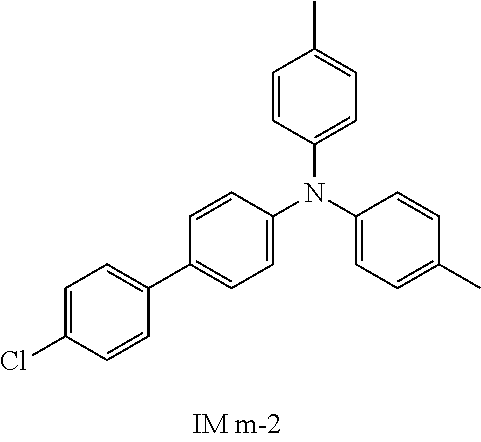
  • Raw material Sub B-1 (20 g, 74.75 mmol), raw material Sub C-1 (15.57 g, 71.01 mmol), tris(dibenzylideneacetonyl)dipalladium (0.68 g, 0.75 mmol), 2-dicyclohexylphosphino-2′,6′-dimethoxybiphenyl (0.61 g, 1.49 mmol), and sodium tert-butoxide (10.77 g, 112.13 mmol) were added to toluene (160 mL), heated to 108° C. under nitrogen protection, stirred for 2 hours, and then cooled to room temperature.
  • IM X-2 was synthesized with reference to the synthesis method of IM a-2, except that Sub B-1 was replaced with the raw material III, and that Sub C-1 was replaced with the raw material IV.
  • the main raw materials used, the correspondingly synthesized IM X-2, and the yields are shown in Table 2.
  • IM a-1 13 g, 46.5 mmol
  • IM a-2 (18.89 g, 46.5 mmol)
  • tris(dibenzylideneacetonyl) dipalladium (0.43 g, 0.46 mmol
  • 2-dicyclohexylphosphino-2′,6′-dimethoxybiphenyl (0.38 g, 0.93 mmol)
  • sodium tert-butoxide 6.7 g, 69.78 mmol
  • An anode was prepared by the following processes.
  • An Ag/ITO/Ag substrate manufactured by Corning
  • thicknesses of Ag/ITO/Ag being 100 ⁇ , 1300 ⁇ , and 100 ⁇ , respectively, was cut to have dimensions of 40 mm ⁇ 40 mm ⁇ 0.7 mm, and then fabricated by photoetching processes into an experimental substrate with patterns of an anode, and of an insulation layer, followed by surface treatment using ultraviolet ozone and O 2 :N 2 plasma to increase the work function of the anode (experimental substrate) and to descum.
  • F4-TCNQ was deposited by vacuum evaporation on the experimental substrate (anode) to form a hole injection layer (HIL) having a thickness of 100 ⁇
  • HIL hole injection layer
  • HTL-1 first hole transport layer
  • HT-7 was deposited by vacuum evaporation on the first hole transport layer to form a second hole transport layer (HTL-2) having a thickness of 50 ⁇ .
  • ⁇ , ⁇ -AND and BD were co-deposited by evaporation on the second hole transport layer at an evaporation rate ratio of 99%:1% to form an organic light emitting layer (EML) having a thickness of 220 ⁇ .
  • EML organic light emitting layer
  • HBL hole blocking layer
  • ET-18 and LiQ were co-deposited by evaporation on the hole blocking layer at an evaporation rate ratio of 1:1 to form an electron transport layer (ETL) having a thickness of 300 ⁇ .
  • ETL electron transport layer
  • Yb was deposited by evaporation on the electron transport layer to form an electron injection layer (EIL) having a thickness of 10 ⁇ .
  • EIL electron injection layer
  • magnesium (Mg) and silver (Ag) were mixed at an evaporation rate ratio of 1:9 and deposited by vacuum evaporation on the electron injection layer to form a cathode having a thickness of 120 ⁇ .
  • CPL organic capping layer
  • Organic electroluminescent devices were fabricated by the same method as used in Example 1, except that Compound A-5 was replaced with Compounds shown in Table 4 below when a first hole transport layer was formed.
  • Organic electroluminescent devices were fabricated by the same method as used in Example 1, except that Compound A-5 was replaced with Compounds a to e shown in Table 4 below when a first hole transport layer was formed.
  • Example 1 Compound A-5 3.98 6.81 0.140, 0.050 14.01 218
  • Example 2 Compound A-3 3.95 6.92 0.140, 0.050 13.60 215
  • Example 3 Compound A-44 3.94 6.68 0.140, 0.050 13.74 207
  • Example 4 Compound A-2 3.90 6.86 0.140, 0.050 14.11 194
  • Example 5 Compound A-8 3.97 6.64 0.140, 0.050 13.66 201
  • Example 6 Compound B-41 3.87 6.61 0.140, 0.050 14.23 196
  • Example 7 Compound A-12 3.99 6.81 0.140, 0.050 13.64 214
  • Example 8 Compound A-62 3.89 6.67 0.140, 0.050 13.68 258
  • Example 9 Compound A-18 3.92 6.82 0.140, 0.050 14.03 249
  • Example 10 Compound C-3 3.97 6.93 0.140, 0.050 14.26 198
  • Example 11 Compound

Landscapes

  • Chemical & Material Sciences (AREA)
  • Organic Chemistry (AREA)
  • Physics & Mathematics (AREA)
  • Engineering & Computer Science (AREA)
  • Materials Engineering (AREA)
  • Spectroscopy & Molecular Physics (AREA)
  • Optics & Photonics (AREA)
  • Electroluminescent Light Sources (AREA)

Abstract

The present application relates to the technical field of organic materials and provides an organic compound, an electronic component and an electronic apparatus containing the organic compound. The organic compound has a structure shown in Formula 1. The organic compound, when used in an organic electroluminescent device, can improve the performance of the device.

Description

CROSS-REFERENCE TO RELATED APPLICATIONS
This application is a U.S. National Stage of International Application No. PCT/CN2022/138052, filed on Dec. 9, 2022 claims the priority of Chinese patent application No. 202210182946.9 filed on Feb. 25, 2022, both of which are incorporated herein by reference in their enteritis as a part of the present application.
FIELD OF THE INVENTION
The present application relates to the technical field of organic luminescent materials, and in particular to an organic compound, an electronic component and an electronic apparatus comprising the organic compound.
BACKGROUND OF THE INVENTION
In recent years, organic electroluminescent devices (OLED), as a new generation of display technology, have been widely used in the field of mobile phone display, vehicle display, and the like. A common organic electroluminescent device consists of an anode, a cathode, and more than one organic layers disposed between the cathode and the anode. When a voltage is applied to the cathode and the anode, an electric field is formed between the two electrodes. Under the influence of the electric field, electrons on the cathode side migrate to an organic light emitting layer, and holes on the anode side also migrate to the organic light emitting layer. The electrons and the holes recombine in the organic light emitting layer, forming excitons which, in excited state, release energy. During the process that the excitons change from the excited state to the ground state by releasing energy, light is emitted. Therefore, it is very important to improve the recombination of electrons and holes in OLED devices.
In order to improve the brightness, efficiency, and service life of an organic electroluminescent device, a multi-layer structure is often used in the device. The multi-layer structure includes a hole injection layer, a hole transport layer, an organic light emitting layer, an electron transport layer, and the like. These organic layers can improve the injection efficiency of carriers (holes and electrons) between the layers, balance the transporting of the carriers between the layers, and thus improve the brightness and the efficiency of the device.
Bis-triarylamine-based hole transport layers have been disclosed in many documents, such as JP1997316038A. Bis-triarylamine-based hole transport materials, including NPB, have also been widely used in mass production due to their excellent hole transport properties.
Although NPB has an excellent hole transport property, its glass-transition temperature (Tg) is only 96° C., which makes the organic electroluminescent device prone to crystallize at high temperatures and thus leads to reduced performance of the device.
SUMMARY OF THE INVENTION
Directed against the above problems with the existing technology, the present application aims at providing an organic compound, an electronic component and an electronic apparatus comprising the organic compound. The organic compound, when used in an organic electroluminescent device, can improve the performance of the device.
A first aspect of the present application provides an organic compound having a structure shown in Formula 1:
Figure US12048240-20240723-C00002
    • wherein L, L1, L2, L3, and L4 are identical or different, and are each independently selected from a single bond, or a substituted or unsubstituted arylene having 6 to 30 carbon atoms;
    • substituents of L, L1, L2, L3, and L4 are identical or different, and are each independently selected from deuterium, a halogen, a cyano, a trialkylsiyl having 3 to 12 carbon atoms, an alkyl having 1 to 10 carbon atoms, an aryl having 6 to 20 carbon atoms, or a heteroaryl having 3 to 20 carbon atoms;
Ar1, Ar2, Ar3, and Ar4 are identical or different, and are each independently selected from a substituted or unsubstituted aryl having 6 to 14 ring carbon atoms, a substituted or unsubstituted heteroaryl having 5 to 15 ring carbon atoms, or a group shown in Formula 2; and at least one of Ar1 and Ar3 is selected from the group shown in Formula 2;
Figure US12048240-20240723-C00003
    • wherein n is 1 or 2;
    • substituents of Ar1, Ar2, Ar3, and Ar4 are identical or different, and are each independently selected from deuterium, a halogen, a cyano, a trialkylsiyl having 3 to 12 carbon atoms, an alkyl having 1 to 10 carbon atoms, a haloalkyl having 1 to 10 carbon atoms, a deuterated alkyl having 1 to 10 carbon atoms, an aryl having 6 to 12 carbon atoms, or a heteroaryl having 5 to 12 carbon atoms.
A second aspect of the present application provides an electronic component including an anode and a cathode disposed opposite each other, and an organic functional layer disposed between the anode and the cathode, the functional layer comprises the above described organic compound.
A third aspect of the present application provides an electronic apparatus including the electronic component described in the second aspect of the present application.
In the organic compound of the present application, two arylamines are linked by a linking group containing at least two benzene rings. The formed compound exhibits an appropriate degree of torque in space. Further, a benzo 5-/6-membered ring with a particular spatial configuration is introduced on at least one of the arylamines, and meanwhile the aromatic group on the arylamine is controlled to be a smaller group. This can avoid intermolecular stacking of the compound, and thus make the compound not prone to crystallization during evaporation, thereby improving the film-forming property of the material. The organic compound, when used in an organic luminescent device, can prolong the service life of the device. In addition, the particular structure of the organic compound of the present application exhibits better hole mobility, which can improve the matching between the hole transport layer and the organic layer, and can effectively improve the luminescence efficiency of the device.
BRIEF DESCRIPTION OF THE DRAWINGS
The accompanying drawings are intended to provide a further understanding of the present application and form a part of the specification. The accompanying drawings, together with the following specific embodiments, are used to illustrate the present application, but do not constitute any limitation to the present application.
FIG. 1 is a schematic structural diagram of an organic electroluminescent device according to an embodiment of the present application.
FIG. 2 is a schematic structural diagram of a first electronic apparatus according to an embodiment of the present application.
FIG. 3 is a schematic structural diagram of a photoelectric conversion device according to an embodiment of the present application.
FIG. 4 is a schematic structural diagram of a second electronic apparatus according to an embodiment of the present application.
LIST OF REFERENCE SIGNS
    • 100: anode; 200: cathode; 300: functional layer; 310: hole injection layer; 320: hole transport layer; 321: first hole transport layer; 322: second hole transport layer; 330: organic light emitting layer; 340: electron transport layer; 350: electron injection layer; 360: photoelectric conversion layer; 400: first electronic apparatus; 500: second electronic apparatus
DETAILED DESCRIPTION OF THE EMBODIMENTS
Exemplary embodiments will now be described more comprehensively with reference to the accompanying drawings. The exemplary embodiments, however, can be implemented in a variety of forms and should not be interpreted as being limited to the examples set forth herein. On the contrary, these embodiments are provided to make the present application more comprehensive and complete, and to communicate the concepts of these exemplary embodiments fully to those skilled in the art. Features, structures, or characteristics described can be combined in one or more embodiments in any suitable manner. In the following description, many specific details are provided to give a full understanding of the embodiments of the present application.
In a first aspect, the present application provides an organic compound having a structure shown in Formula 1:
Figure US12048240-20240723-C00004
    • wherein L, L1, L2, L3, and L4 are identical or different, and are each independently selected from a single bond, or a substituted or unsubstituted arylene having 6 to 30 carbon atoms;
    • substituents of L, L1, L2, L3, and L4 are identical or different, and are each independently selected from deuterium, a halogen, a cyano, a trialkylsiyl having 3 to 12 carbon atoms, an alkyl having 1 to 10 carbon atoms, an aryl having 6 to 20 carbon atoms, or a heteroaryl having 3 to 20 carbon atoms;
    • Ar1, Ar2, Ar3, and Ar4 are identical or different, and are each independently selected from a substituted or unsubstituted aryl having 6 to 14 ring carbon atoms, a substituted or unsubstituted heteroaryl having 5 to 15 ring carbon atoms, or a group shown in Formula 2; and at least one of Ar1 and Ar3 is selected from the group shown in Formula 2;
Figure US12048240-20240723-C00005
    • wherein n is 1 or 2
    • substituents of Ar1, Ar2, Ar3, and Ar4 are identical or different, and are each independently selected from deuterium, a halogen, a cyano, a trialkylsiyl having 3 to 12 carbon atoms, an alkyl having 1 to 10 carbon atoms, a haloalkyl having 1 to 10 carbon atoms, a deuterated alkyl having 1 to 10 carbon atoms, an aryl having 6 to 12 carbon atoms, or a heteroaryl having 5 to 12 carbon atoms.
In the present application, the expression “at least one of Ar1 and Ar3 is selected from the group shown in Formula 2” means that one of Ar1 and Ar3 is selected from the group shown in Formula 2, i.e., Ar1 is selected from the group shown in Formula 2 or Ar3 is selected from the group shown in Formula 2; optionally, both Ar1 and Ar3 are selected from the group shown in Formula 2.
In an embodiment, Ar1 and Ar3 are identical or different, and are each independently selected from a substituted or unsubstituted aryl having 6 to 14 ring carbon atoms, a substituted or unsubstituted heteroaryl having 5 to 15 ring carbon atoms, or a group shown in Formula 2, and at least one of Ar1 and Ar3 is selected from the group shown in Formula 2; Ar2 and Ar4 are identical or different, and are each independently selected from a substituted or unsubstituted aryl having 6 to 14 ring carbon atoms, or a substituted or unsubstituted heteroaryl having 5 to 15 ring carbon atoms.
In the present application, the number of ring carbon atoms is the number of carbon atoms on the ring of “aryl”, “heteroaryl” in “a substituted or unsubstituted aryl having 6 to 14 ring carbon atoms, a substituted or unsubstituted heteroaryl having 5 to 15 ring carbon atoms”. It should be noted that, the number of carbon atoms of substituents of “a substituted or unsubstituted aryl having 6 to 14 ring carbon atoms, or a substituted or unsubstituted heteroaryl having 5 to 15 ring carbon atoms” is not counted in the number of ring carbon atoms. For example, 9,9-dimethylfluorenyl is methyl-substituted aryl having 13 ring carbon atoms, diphenylfluorenyl is a phenyl-substituted aryl having 13 ring carbon atoms, and phenyl-substituted dibenzofuranyl is a phenyl-substituted heteroaryl having 12 ring carbon atoms; in diphenylfluorenyl and phenyl-substituted diphenylfluorenyl, the number of carbon atoms of phenyl as the substituent is not counted in the number of ring carbon atoms of “a substituted or unsubstituted aryl having 6 to 14 ring carbon atoms, or a substituted or unsubstituted heteroaryl having 5 to 15 ring carbon atoms”.
In the present application, the expression “ . . . each independently” may be used interchangeably with the expressions “ . . . respectively and independently”, and “ . . . independently selected from”, and all these expressions should be interpreted in a broad sense. They can not only mean that, in different groups, specific options expressed between the same symbols do not affect each other, but also mean that in a same group, specific options expressed between the same symbols do not affect each other. For example, the meaning of “
Figure US12048240-20240723-C00006

where each q is independently 0, 1, 2 or 3, and each R″ is independently selected from hydrogen, deuterium, fluorine and chlorine” is as follows: formula Q-1 represents that q substituent R″s exist on a benzene ring, each R″ can be the identical or different, and options of each R″ do not affect each other; and formula Q-2 represents that each benzene ring of biphenyl has q substituent R″s, the number q of the substituent R″s on the two benzene rings can be the identical or different, each R″ can be the identical or different, and options of each R″ do not affect each other.
In the present application, the term “substituted or unsubstituted” means that the functional group defined by the term may or may not have a substituent (hereinafter referred to as Rc for ease of description). For example, “a substituted or unsubstituted aryl” is an aryl having a substituent Rc or is an unsubstituted aryl. The foregoing substituent, namely Rc, may be, for example, deuterium, halogen, cyano, trialkylsilyl, alkyl, heteroaryl, aryl, or the like.
In the present application, the number of carbon atoms of a substituted or unsubstituted functional group is the number of all carbon atoms. For example, if L is a substituted arylene having 12 carbon atoms, then the number of all carbon atoms of the arylene group and substituents thereof is 12.
In the present application, aryl refers to any functional group or substituent derived from an aromatic carbon ring. An aryl group may be a monocyclic aryl group (e.g., phenyl) or a polycyclic aryl group. In other words, an aryl group may be a monocyclic aryl group, a fused aryl group, two or more monocyclic aryl groups connected by a carbon-carbon conjugate linkage, a monocyclic aryl group and a fused aryl group connected by a carbon-carbon conjugate linkage, or two or more fused aryl groups connected by a carbon-carbon conjugate linkage. That is, unless otherwise specified, two or more aromatic groups connected by a carbon-carbon conjugate linkage may also be regarded as an aryl group in the present application. Among them, fused aryl groups may include, for example, bicyclic fused aryl groups (e.g., naphthyl), tricyclic fused aryl groups (e.g., phenanthryl, fluorenyl, anthryl), and the like. An aryl group does not contain heteroatoms such as B, N, O, S, P, Se, Si, or the like. For example, in the present application, biphenyl and terphenyl
Figure US12048240-20240723-C00007

and the like are aryl groups. Examples of aryl may include, but are not limited to, phenyl, naphthyl, fluorenyl, anthryl, phenanthryl, biphenyl, terphenyl, benzo[9,10]phenanthryl, pyrenyl, benzofluoranthenyl, chrysenyl, and the like. In the present application, arylene refers to a divalent group formed by further removing one hydrogen atom from an aryl group.
In the present application, a substituted aryl may mean that one or more hydrogen atoms of the aryl group are replaced by a group such as deuterium, halogen, cyano, trialkylsilyl, alkyl, haloalkyl, deuterated alkyl, heteroaryl, aryl, or the like. It should be appreciated that the number of carbon atoms of substituted arylene is the number of all carbon atoms of the arylene group and substituents thereof. For example, substituted arylene having 18 carbon atoms means that the number of all carbon atoms of the arylene group and substituents thereof is 18.
In the present application, heteroaryl refers to a monovalent aromatic ring containing at least one heteroatom or a derivative thereof. The heteroatom may be one or more selected from B, O, N, P, Si, Se, or S. A heteroaryl group may be a monocyclic heteroaryl group or polycyclic heteroaryl group. In other words, a heteroaryl group may be a single aromatic ring system, or a plurality of aromatic ring systems connected by a carbon-carbon conjugate linkage, with any of the aromatic ring systems being an aromatic monocyclic ring or a fused aromatic ring. For example, heteroaryl groups may include, but are not limited to, thiophenyl, furyl, pyrryl, imidazolyl, thiazolyl, oxazolyl, oxadiazolyl, triazolyl, pyridyl, bipyridyl, pyrimidyl, triazinyl, acridinyl, pyridazinyl, pyrazinyl, quinolyl, quinazolinyl, quinoxalinyl, phenoxazinyl, phthalazinyl, pyridopyrimidinyl, pyridopyrazinyl, pyrazinopyrazinyl, isoquinolyl, indolyl, carbazolyl, benzoxazolyl, benzimidazolyl, benzothiazolyl, benzocarbazolyl, benzothiophenyl, dibenzothiophenyl, thienothiophenyl, benzofuranyl, phenanthrolinyl, isoxazolyl, thiadiazolyl, benzothiazolyl, phenothiazinyl, silafluorenyl, dibenzofuranyl, N-phenylcarbazolyl, N-pyridylcarbazolyl, N-methylcarbazolyl, and the like. Among these, thiophenyl, furyl, phenanthrolinyl, and the like are heteroaryl group of a single aromatic ring system, and N-phenylcarbazolyl and N-pyridylcarbazolyl are each a heteroaryl group of polycyclic systems connected by a carbon-carbon conjugate linkage. In the present application, heteroarylene involved is a divalent group formed by further removing one hydrogen atom from a heteroaryl group.
In the present application, substituted heteroaryl may mean that one or more hydrogen atoms in the heteroaryl group are replaced by group such as deuterium atom, halogen, cyano, aryl, heteroaryl, trialkylsilyl, alkyl, cycloalkyl, haloalkyl, and the like. It should be understood that the number of carbon atoms of a substituted heteroarylene is the number of all carbon atoms of the heteroarylene group and substituents of the heteroarylene group.
In the present application, the number of carbon atoms of aryl as a substituent may be 6 to 20. For example, the number of carbon atoms may be 6, 7, 8, 9, 10, 11, 12, 13, 14, 15, 16, 17, 18, 19, or 20. Specific Examples of aryl as a substituent include, but are not limited to, phenyl, biphenyl, naphthyl, fluorenyl, phenanthryl, anthryl, and chrysenyl.
In the present application, the number of carbon atoms of heteroaryl as a substituent may be 3 to 20. For example, the number of carbon atoms may be 3, 4, 5, 6, 7, 8, 9, 10, 11, 12, 13, 14, 15, 16, 17, 18, 19, or 20. Specific examples of heteroaryl as a substituent include, but are not limited to, triazinyl, pyridyl, pyrimidyl, carbazolyl, dibenzofuranyl, dibenzothiophenyl, quinolyl, quinazolinyl, quinoxalinyl, and isoquinolyl.
In the present application, alkyl having 1 to 10 carbon atoms may include straight-chain alkyl having 1 to 10 carbon atoms and branched-chain alkyl having 3 to 10 carbon atoms. The number of carbon atoms of alkyl may be, for example, 1, 2, 3, 4, 5, 6, 7, 8, 9, or 10. Specific examples of alkyl include, but are not limited to, methyl, ethyl, n-propyl, isopropyl, n-butyl, isobutyl, tert-butyl, n-pentyl, isopentyl, neo-pentyl, n-hexyl, n-octyl, 2-ethylhexyl, nonyl, decyl, 3,7-dimethyloctyl, and the like.
In the present application, halogen may be, for example, fluorine, chlorine, bromine, iodine.
In the present application, specific examples of trialkylsilyl include, but are not limited to, trimethylsilyl, triethylsilyl, and the like.
In the present application, specific examples of haloalkyl include, but are not limited to, trifluoromethyl, and the like.
In the present application, specific examples of deuterated alkyl include, but are not limited to, trideuteromethyl, and the like.
In the present application, an unlocated linkage bond refers to a single bond extending from a ring system, and it indicates that the linkage bond can be linked at one end thereof to any position in the ring system through which the bond passes, and linked at the other end thereof to the rest of the compound molecule.
For example, as shown in Formula (f) below, the naphthalyl group represented by Formula (f) is linked to other positions of the molecule via two unlocated linkage bonds passing through the two rings, which indicates any of possible linkages shown in Formulae (f-1) to (f-10):
Figure US12048240-20240723-C00008
Figure US12048240-20240723-C00009
As another example, as shown in Formula (X′) below, the dibenzofuranyl group represented by Formula (X′) is linked to another position of the molecule via an unlocated linkage bond extending from the center of one benzene ring, which indicates any of possible linkages shown in Formulae (X′-1) to (X′-4):
Figure US12048240-20240723-C00010
In the present application, Ar1, Ar2, Ar3, and Ar4 are each independently selected from a substituted or unsubstituted aryl having 6, 7, 8, 9, 10, 11, 12, 13, or 14 ring carbon atoms, a substituted or unsubstituted heteroaryl having 5, 6, 7, 8, 9, 10, 11, 12, 13, 14, or 15 ring carbon atoms, or the group shown in Formula 2.
In the present application, the group shown in Formula 2 is specifically selected from the group consisting of the following structures:
Figure US12048240-20240723-C00011
In an embodiment of the present application, Ar1 and Ar3 are identical or different, and are each independently selected from a substituted or unsubstituted aryl having 6 to 14 ring carbon atoms, a substituted or unsubstituted heteroaryl having 5 to 15 ring carbon atoms, or the group shown in Formula 2; and at least one of Ar1 and Ar3 is selected from the group shown in Formula 2.
Ar2 and Ar4 are identical or different, and are each independently selected from a substituted or unsubstituted aryl having 6 to 14 ring carbon atoms, or a substituted or unsubstituted heteroaryl having 5 to 15 ring carbon atoms.
In an embodiment of the present application, L, L1, L2, L3, and L4 are each independently selected from a single bond, or a substituted or unsubstituted arylene having 6 to 20 carbon atoms. For example, L, L1, L2, L3, and L4 are each independently selected from a single bond, or a substituted or unsubstituted arylene having 6, 7, 8, 9, 10, 11, 12, 13, 14, 15, 16, 17, 18, 19, or 20 carbon atoms.
Optionally, the substituents of L, L1, L2, L3, and L4 are each independently selected from deuterium, a fluorine, a cyano, a trialkylsilyl having 3 to 6 carbon atoms, an alkyl having 1 to 5 carbon atoms, an aryl having 6 to 12 carbon atoms, or a heteroaryl having 5 to 12 carbon atoms.
Optionally, L, L1, L2, L3, and L4 are each independently selected from a single bond, a substituted or unsubstituted phenylene, a substituted or unsubstituted naphthylene, or a substituted or unsubstituted biphenylene.
Optionally, the substituents of L, L1, L2, L3, and L4 are each independently selected from deuterium, a fluorine, a cyano, a trimethylsilyl, a methyl, an ethyl, an isopropyl, a tert-butyl, a phenyl, a naphthyl, a biphenyl, a pyridyl, a dibenzofuranyl, a dibenzothiophenyl, or a carbazolyl.
Optionally, L, L1, L2, L3, and L4 are each independently selected from a single bond or a substituted or unsubstituted group V. The unsubstituted group V is selected from the following groups:
Figure US12048240-20240723-C00012
    • the substituted group V may have one or more substituents, the substituents each independently selected from deuterium, a fluorine, a cyano, a trimethylsilyl, a methyl, an ethyl, an isopropyl, a tert-butyl, a phenyl, a naphthyl, a biphenyl, or a pyridyl; and when the number of the substituents are greater than 1, the substituents are identical or different.
Optionally, L, L1, L2, L3, and L4 are each independently selected from a single bond or the following groups:
Figure US12048240-20240723-C00013
Further optionally, L, L1, L2, L3, and L4 are each independently selected from a single bond or the following groups:
Figure US12048240-20240723-C00014
Figure US12048240-20240723-C00015
Optionally, L is selected from a single bond or the group consisting of the following groups:
Figure US12048240-20240723-C00016
In the present application, specific examples of the substituted or unsubstituted aryl having 6 to 14 ring carbon atoms include, but are not limited to a substituted or unsubstituted phenyl, a substituted or unsubstituted naphthyl, a substituted or unsubstituted biphenyl, a substituted or unsubstituted terphenyl, a substituted or unsubstituted fluorenyl, a substituted or unsubstituted phenanthryl, or a substituted or unsubstituted anthryl.
In the substituted or unsubstituted aryl having 6 to 14 ring carbon atoms, substituents are identical or different, and are each independently selected from deuterium, a fluorine, a cyano, a trialkylsilyl having 3 to 6 carbon atoms, an alkyl having 1 to 4 carbon atoms, a haloalkyl having 1 to 4 carbon atoms, a deuterated alkyl having 1 to 4 carbon atoms, an aryl having 6 to 12 carbon atoms, or a heteroaryl having 5 to 12 carbon atoms. Specific examples of the substituents include, but are not limited to deuterium, a fluorine, a cyano, a trimethylsilyl, a methyl, an ethyl, a n-propyl, an isopropyl, a tert-butyl, a phenyl, a naphthyl, a biphenyl, a carbazolyl, a dibenzofuranyl, a dibenzothiophenyl, or a carbazolyl.
In an embodiment, Ar1, Ar2, Ar3, and Ar4 are each independently selected from a substituted or unsubstituted phenyl, a substituted or unsubstituted naphthyl, a substituted or unsubstituted biphenyl, a substituted or unsubstituted terphenyl, a substituted or unsubstituted fluorenyl, a substituted or unsubstituted phenanthryl, a substituted or unsubstituted anthryl, a substituted or unsubstituted dibenzofuranyl, a substituted or unsubstituted dibenzothiophenyl, a substituted or unsubstituted carbazolyl, or the group shown in Formula 2; and at least one of Ar1 and Ar3 is selected from the group shown in Formula 2.
Optionally, the substituents of Ar1, Ar2, Ar3, and Ar4 are each independently selected from deuterium, a fluorine, a cyano, a trimethylsilyl, a methyl, an ethyl, an isopropyl, a tert-butyl, a phenyl, a naphthyl, a biphenyl, a dibenzofuranyl, a dibenzothiophenyl, or a carbazolyl.
Optionally, Ar1 and Ar3 are each independently selected from a substituted or unsubstituted group W or the group shown in Formula 2, at least one of Ar1 and Ar3 being selected from the group shown in Formula 2; Ar2 and Ar4 are identical or different, and are each independently selected from a substituted or unsubstituted group W. The unsubstituted group W is selected from the following groups:
Figure US12048240-20240723-C00017
    • the substituted group W has one or more substituents, the substituents being each independently selected from deuterium, a fluorine, a cyano, a trimethylsilyl, a methyl, an ethyl, an isopropyl, a tert-butyl, a phenyl, a naphthyl, a biphenyl, a dibenzofuranyl, a dibenzothiophenyl, or a carbazolyl; and when the number of the substituents is greater than 1, the substituents are identical or different.
Optionally, Ar1 and Ar3 are identical or different, and are each independently selected from the following groups:
Figure US12048240-20240723-C00018
Figure US12048240-20240723-C00019

and at least one of Ar1 and Ar3 is selected from or
Figure US12048240-20240723-C00020
Optionally, Ar2 and Ar4 are identical or different, and are each independently selected from the following groups:
Figure US12048240-20240723-C00021
Figure US12048240-20240723-C00022
Optionally, Ar1, Ar2, Ar3, and Ar4 are each independently selected from the following groups:
Figure US12048240-20240723-C00023
Figure US12048240-20240723-C00024
Figure US12048240-20240723-C00025
Figure US12048240-20240723-C00026

and at least one of Ar1 and Ar3 is selected from
Figure US12048240-20240723-C00027
Optionally, Ar2 and Ar4 are not
Figure US12048240-20240723-C00028
Optionally, the organic compound is selected from the following compounds:
Figure US12048240-20240723-C00029
Figure US12048240-20240723-C00030
Figure US12048240-20240723-C00031
Figure US12048240-20240723-C00032
Figure US12048240-20240723-C00033
Figure US12048240-20240723-C00034
Figure US12048240-20240723-C00035
Figure US12048240-20240723-C00036
Figure US12048240-20240723-C00037
Figure US12048240-20240723-C00038
Figure US12048240-20240723-C00039
Figure US12048240-20240723-C00040
Figure US12048240-20240723-C00041
Figure US12048240-20240723-C00042
Figure US12048240-20240723-C00043
Figure US12048240-20240723-C00044
Figure US12048240-20240723-C00045
Figure US12048240-20240723-C00046
Figure US12048240-20240723-C00047
Figure US12048240-20240723-C00048
Figure US12048240-20240723-C00049
Figure US12048240-20240723-C00050
Figure US12048240-20240723-C00051
Figure US12048240-20240723-C00052
Figure US12048240-20240723-C00053
Figure US12048240-20240723-C00054
Figure US12048240-20240723-C00055
Figure US12048240-20240723-C00056
Figure US12048240-20240723-C00057
Figure US12048240-20240723-C00058
Figure US12048240-20240723-C00059
Figure US12048240-20240723-C00060
Figure US12048240-20240723-C00061
Figure US12048240-20240723-C00062
Figure US12048240-20240723-C00063
Figure US12048240-20240723-C00064
Figure US12048240-20240723-C00065
Figure US12048240-20240723-C00066
Figure US12048240-20240723-C00067
Figure US12048240-20240723-C00068
Figure US12048240-20240723-C00069
Figure US12048240-20240723-C00070
Figure US12048240-20240723-C00071
Figure US12048240-20240723-C00072
Figure US12048240-20240723-C00073
Figure US12048240-20240723-C00074
Figure US12048240-20240723-C00075
Figure US12048240-20240723-C00076
Figure US12048240-20240723-C00077
Figure US12048240-20240723-C00078
Figure US12048240-20240723-C00079
Figure US12048240-20240723-C00080
Figure US12048240-20240723-C00081
Figure US12048240-20240723-C00082
Figure US12048240-20240723-C00083
Figure US12048240-20240723-C00084
Figure US12048240-20240723-C00085
Figure US12048240-20240723-C00086
Figure US12048240-20240723-C00087
Figure US12048240-20240723-C00088
Figure US12048240-20240723-C00089
Figure US12048240-20240723-C00090
Figure US12048240-20240723-C00091
Figure US12048240-20240723-C00092
Figure US12048240-20240723-C00093
Figure US12048240-20240723-C00094
In a second aspect, the present application provides an electronic component comprising an anode and a cathode disposed opposite each other, and a functional layer disposed between the anode and the cathode. The functional layer comprises the organic compound of the present application.
Optionally, the functional layer includes a hole transport layer comprising the organic compound.
Optionally, the electronic component is an organic electroluminescent device or a photoelectric conversion device.
Further optionally, the electronic component is an organic electroluminescent device. The hole transport layer includes a first hole transport layer and a second hole transport layer. The first hole transport layer is closer to the anode than the second hole transport layer, wherein the first hole transport layer comprises the organic compound.
In an embodiment, the organic electroluminescent device is a blue light organic electroluminescent device.
In an embodiment, the electronic component is an organic electroluminescent device. As shown in FIG. 1 , the organic electroluminescent device may include an anode 100, a first hole transport layer 321, a second hole transport layer 322, an organic light emitting layer 330, an electron transport layer 340, and a cathode 200 that are stacked sequentially.
Optionally, the anode 100 comprises an anode material, which are preferably materials having a large work function that facilitate hole injection into the functional layer. Specific examples of the anode material include, but are not limited to: metals such as nickel, platinum, vanadium, chromium, copper, zinc, and gold; and alloys thereof; metal oxides such as zinc oxide, indium oxide, indium tin oxide (ITO), and indium zinc oxide (IZO); combinations of metals and oxides, such as ZnO:Al or SnO2:Sb; and conductive polymers such as poly(3-methylthiophene), poly[3,4-(ethylene-1,2-dioxy)thiophene] (PEDT), polypyrrole, and polyaniline. A transparent electrode containing indium tin oxide (ITO) as the anode is preferably included.
Optionally, the first hole transport layer 321 is composed of the organic compound of the present application.
The second hole transport layer 322 comprises one or more hole transport materials. The hole transport materials may be selected from carbazole polymers, carbazole-linked triarylamine compounds, or other types of compounds, which can be selected by those skilled in the art by referring to the existing technologies. For example, the material of the second hole transport layer is selected from the group consisting of the following compounds:
Figure US12048240-20240723-C00095
Figure US12048240-20240723-C00096
Figure US12048240-20240723-C00097
Figure US12048240-20240723-C00098
Figure US12048240-20240723-C00099
In a specific embodiment, the second hole transport layer 322 is composed of HT-7.
Optionally, the organic light emitting layer 330 may be composed of a single light emitting material, or may comprise a host material and a doping material. Optionally, the organic light emitting layer 330 is composed of a host material and a doping material. Holes injected into the organic light emitting layer 330 and electrons injected into the organic light emitting layer 330 can be combined in the organic light emitting layer 330 to form excitons. The excitons transmit energy to the host material, and the host material transmits the energy to the doping material, thereby enabling the doping material to emit light.
The host material of the organic light emitting layer 330 may be a metal chelating compound, a stilbene derivative, a 9,10-anthracene aromatic compound (α,β-ADN), an aromatic amine derivative, a dibenzofuran derivative, or other types of materials, which is not specially limited in the present application.
In an embodiment of the present application, the host material of the organic light emitting layer 330 is α, β-ADN.
The doping material of the organic light emitting layer 330 may be selected by referring to the existing technology, and may be, for example, selected from an iridium (III) organometallic complex, a platinum (II) organometallic complex, a ruthenium (II) complex, or the like. Specific examples of the doping material include, but are not limited to:
Figure US12048240-20240723-C00100
Figure US12048240-20240723-C00101
Figure US12048240-20240723-C00102
Figure US12048240-20240723-C00103
In an embodiment of the present application, the doping material of the organic light emitting layer 330 is BD.
Optionally, the electron transport layer 340 may be a single-layer structure, or a multi-layer structure, and may comprise one or more electron transport materials. The electron transport materials may typically include metal complexes and/or nitrogen-containing heterocyclic derivatives. The metal complex material may, for example, be selected from LiQ, Alq3, Bepq2, or the like. The nitrogen-containing heterocyclic derivative may be an aromatic ring having a nitrogen-containing 6-membered ring or 5-membered ring skeleton, a fused aromatic ring compound having a nitrogen-containing 6-membered ring or 5-membered ring skeleton, or the like, specific examples include, but are not limited to, 1,10-phenanthroline compounds such as Bphen, NBphen, DBimiBphen, BimiBphen, and the like; or azaaryl-containing anthracene, triazine or pyrimidine compounds having a structure shown below. In an embodiment of the present application, the electron transport layer 340 may be composed of ET-18 and LiQ.
Figure US12048240-20240723-C00104
Figure US12048240-20240723-C00105
Figure US12048240-20240723-C00106
Figure US12048240-20240723-C00107
Figure US12048240-20240723-C00108
Figure US12048240-20240723-C00109
In the present application, the cathode 200 may comprise a cathode material, which is a material with a small work function that facilitates electron injection into the functional layer. Specific examples of the cathode material include, but are not limited to, metals such as magnesium, calcium, sodium, potassium, titanium, indium, yttrium, lithium, gadolinium, aluminum, silver, tin, lead, and alloys thereof; or multilayer materials such as LiF/Al, Liq/Al, LiO2/Al, LiF/Ca, LiF/Al, and BaF2/Ca. A metal electrode including magnesium and silver as the cathode is preferably included.
Optionally, as shown in FIG. 1 , a hole injection layer 310 may be further provided between the anode 100 and the hole transport layer 321 to enhance the ability to inject holes into the hole transport layer 321. The hole injection layer 310 may be composed of a material selected from benzidine derivatives, starburst arylamine compounds, phthalocyanine derivatives, or other materials, which is not specially limited in the present application. For example, the compound contained in the hole injection layer 310 is selected from the group consisting of the following compounds:
Figure US12048240-20240723-C00110
Figure US12048240-20240723-C00111
In a specific embodiment of the present application, the hole injection layer 310 is composed of F4-TCNQ.
Optionally, a hole blocking layer may be further provided between the organic light emitting layer 330 and the electron transport layer 340 to keep carriers from the anode in the organic light emitting layer, so as to improve the balance of the carriers. For example, the hole blocking layer may be composed of BTB.
Optionally, as shown in FIG. 1 , an electron injection layer 350 may be further provided between the cathode 200 and the electron transport layer 340 to enhance the ability to inject electrons into the electron transport layer 340. The electron injection layer 350 may comprise an inorganic material such as an alkali metal sulfide, an alkali metal halide, and the like. or may comprise a complex of an alkali metal and an organic substance. For example, the electron injection layer 350 may comprise Yb.
According to another embodiment, the electronic component is a photoelectric conversion device. As shown in FIG. 3 , the photoelectric conversion device may include an anode 100 and a cathode 200 disposed opposite each other, and a functional layer 300 disposed between the anode 100 and the cathode 200. The functional layer 300 comprises the organic compound provided in the present application.
According to a specific embodiment, as shown in FIG. 3 , the photoelectric conversion device may include an anode 100, a hole transport layer 320, a photoelectric conversion layer 360, an electron transport layer 340, and a cathode 200 that are stacked in sequence.
Optionally, the photoelectric conversion device may be a solar cell, especially an organic thin-film solar cell. For example, in an embodiment of the present application, the solar cell may include an anode, a hole transport layer, a photoelectric conversion layer, an electron transport layer, and a cathode that are stacked in sequence, wherein the hole transport layer 320 comprises the organic compound of the present application.
In a third aspect, the present application provides an electronic apparatus comprising the electronic component provided in the second aspect of the present application.
According to an embodiment, as shown in FIG. 2 , the electronic apparatus is a first electronic apparatus 400. The first electronic apparatus 400 includes the above described organic electroluminescent device. The first electronic apparatus 400 may be, for example, a display device, a lighting device, an optical communication device, or other types of electronic apparatuses, which, for example, may include, but are not limited to, computer screens, mobile phone screens, televisions, electronic paper, emergency lamps, optical modules, and the like.
According to another embodiment, as shown in FIG. 4 , the electronic apparatus is a second electronic apparatus 500. The second electronic apparatus 500 includes the photoelectric conversion device described above. The second electronic apparatus 500 may be, for example, a solar power generation apparatus, a light detector, a fingerprint recognition apparatus, an optical module, a CCD camera, or other types of electronic apparatuses.
A synthesis method of the organic compound of the present application is described in detail below in conjunction with Synthesis Examples, but the present application is not limited thereto in any way.
Synthesis Examples
Those skilled in the art should appreciate that chemical reactions described in the present application may be used properly to prepare many organic compounds of the present application, and other methods that can be used to prepare the compounds of the present application are all considered to be within the scope of the present application. For example, the synthesis of those non-exemplary compounds of the present application may be successfully accomplished by those skilled in the art by modifying the method, for example, by properly protecting an interfering group, by utilizing other known reagents other than those described in the present application, or by making some conventional modifications to reaction conditions. Compounds for which a synthesis method is not mentioned in the present application are commercially available raw material products.
1. Synthesis of IM X-1
Synthesis of IM X-1 was illustrated by taking the synthesis of IM a-1 as an example.
Figure US12048240-20240723-C00112
Raw material Sub A-1 (50 g, 187 mmol), aniline (19.17 g, 206 mmol), tris(dibenzylideneacetonyl)dipalladium (1.71 g, 1.87 mmol), 2-dicyclohexylphosphino-2′,4′,6′-triisopropylbiphenyl (1.77 g, 3.74 mmol), and sodium tert-butoxide (26.97 g, 281 mmol) were added to toluene (400 mL), heated to 108° C. under nitrogen protection, stirred for 4 hours, and then cooled to room temperature. The reaction solution was washed with deionized water to pH=7, dried by adding anhydrous magnesium sulfate, and filtered. The resulting filtrate was passed through a short silica gel column, followed by removing the solvent under reduced pressure. The resulting crude product was purified by recrystallization using a mixture of dichloromethane/n-heptane to obtain IM a-1 as a solid (44 g, yield 84%).
IM X-1 was synthesized with reference to the synthesis method of IM a-1, except that Sub A-1 was replaced with the raw material I, and that aniline was replaced with the raw material II. The raw materials I and raw materials II used, the correspondingly synthesized IM X-1, as well as the yields of the reactions are shown in Table 1.
TABLE 1
2. Synthesis of IM X-2
Raw material I Raw material II IM X-1 Yield/%
Figure US12048240-20240723-C00113
Figure US12048240-20240723-C00114
Figure US12048240-20240723-C00115
81
Figure US12048240-20240723-C00116
Figure US12048240-20240723-C00117
Figure US12048240-20240723-C00118
77
Figure US12048240-20240723-C00119
Figure US12048240-20240723-C00120
Figure US12048240-20240723-C00121
82
Figure US12048240-20240723-C00122
Figure US12048240-20240723-C00123
Figure US12048240-20240723-C00124
80
Figure US12048240-20240723-C00125
Figure US12048240-20240723-C00126
Figure US12048240-20240723-C00127
75
Figure US12048240-20240723-C00128
Figure US12048240-20240723-C00129
Figure US12048240-20240723-C00130
70
Figure US12048240-20240723-C00131
Figure US12048240-20240723-C00132
Figure US12048240-20240723-C00133
72
Figure US12048240-20240723-C00134
Figure US12048240-20240723-C00135
Figure US12048240-20240723-C00136
74
Figure US12048240-20240723-C00137
Figure US12048240-20240723-C00138
Figure US12048240-20240723-C00139
76
Figure US12048240-20240723-C00140
Figure US12048240-20240723-C00141
Figure US12048240-20240723-C00142
77
Figure US12048240-20240723-C00143
Figure US12048240-20240723-C00144
Figure US12048240-20240723-C00145
85
Figure US12048240-20240723-C00146
Figure US12048240-20240723-C00147
Figure US12048240-20240723-C00148
79
Figure US12048240-20240723-C00149
Figure US12048240-20240723-C00150
Figure US12048240-20240723-C00151
82
Synthesis of IM X-2 was illustrated by taking the synthesis of IM a-2 as an example.
Figure US12048240-20240723-C00152
Raw material Sub B-1 (20 g, 74.75 mmol), raw material Sub C-1 (15.57 g, 71.01 mmol), tris(dibenzylideneacetonyl)dipalladium (0.68 g, 0.75 mmol), 2-dicyclohexylphosphino-2′,6′-dimethoxybiphenyl (0.61 g, 1.49 mmol), and sodium tert-butoxide (10.77 g, 112.13 mmol) were added to toluene (160 mL), heated to 108° C. under nitrogen protection, stirred for 2 hours, and then cooled to room temperature. The reaction solution was washed with water to pH=7, dried by adding magnesium sulfate, and then filtered. The resulting filtrate was subjected to removal of the solvent under reduced pressure. The resulting product was purified by recrystallization using a mixture of dichloromethane/n-heptane to obtain IM a-2 as a solid (19 g, yield 66%).
IM X-2 was synthesized with reference to the synthesis method of IM a-2, except that Sub B-1 was replaced with the raw material III, and that Sub C-1 was replaced with the raw material IV. The main raw materials used, the correspondingly synthesized IM X-2, and the yields are shown in Table 2.
TABLE 2
Raw material III Raw material IV IM X-2 Yield/%
Figure US12048240-20240723-C00153
Figure US12048240-20240723-C00154
Figure US12048240-20240723-C00155
70
Figure US12048240-20240723-C00156
Figure US12048240-20240723-C00157
Figure US12048240-20240723-C00158
66
Figure US12048240-20240723-C00159
Figure US12048240-20240723-C00160
Figure US12048240-20240723-C00161
69
Figure US12048240-20240723-C00162
Figure US12048240-20240723-C00163
Figure US12048240-20240723-C00164
70
Figure US12048240-20240723-C00165
Figure US12048240-20240723-C00166
Figure US12048240-20240723-C00167
50
Figure US12048240-20240723-C00168
Figure US12048240-20240723-C00169
Figure US12048240-20240723-C00170
54
Figure US12048240-20240723-C00171
Figure US12048240-20240723-C00172
Figure US12048240-20240723-C00173
62
Figure US12048240-20240723-C00174
Figure US12048240-20240723-C00175
Figure US12048240-20240723-C00176
59
Figure US12048240-20240723-C00177
Figure US12048240-20240723-C00178
Figure US12048240-20240723-C00179
64
Figure US12048240-20240723-C00180
Figure US12048240-20240723-C00181
Figure US12048240-20240723-C00182
67
Figure US12048240-20240723-C00183
Figure US12048240-20240723-C00184
Figure US12048240-20240723-C00185
59
Figure US12048240-20240723-C00186
Figure US12048240-20240723-C00187
Figure US12048240-20240723-C00188
56
Figure US12048240-20240723-C00189
Figure US12048240-20240723-C00190
Figure US12048240-20240723-C00191
63
Figure US12048240-20240723-C00192
Figure US12048240-20240723-C00193
Figure US12048240-20240723-C00194
65
Figure US12048240-20240723-C00195
Figure US12048240-20240723-C00196
Figure US12048240-20240723-C00197
58
Figure US12048240-20240723-C00198
Figure US12048240-20240723-C00199
Figure US12048240-20240723-C00200
67
Figure US12048240-20240723-C00201
Figure US12048240-20240723-C00202
Figure US12048240-20240723-C00203
53
Figure US12048240-20240723-C00204
Figure US12048240-20240723-C00205
Figure US12048240-20240723-C00206
60
Figure US12048240-20240723-C00207
Figure US12048240-20240723-C00208
Figure US12048240-20240723-C00209
65
Synthesis of Compounds Synthesis Example 1: Synthesis of Compound A-5
Figure US12048240-20240723-C00210
IM a-1 (13 g, 46.5 mmol), IM a-2 (18.89 g, 46.5 mmol), tris(dibenzylideneacetonyl) dipalladium (0.43 g, 0.46 mmol), 2-dicyclohexylphosphino-2′,6′-dimethoxybiphenyl (0.38 g, 0.93 mmol), and sodium tert-butoxide (6.7 g, 69.78 mmol) were added to toluene (100 mL), heated to 108° C. under nitrogen protection, stirred for 3 hours, and then cooled to room temperature. The reaction solution was filtered, and the resulting filtrate was subjected to removal of the solvent under reduced pressure. The resulting crude product was purified by silica gel column chromatography using dichloromethane/n-heptane (v/v) (1:3) as a mobile phase, and then purified by recrystallization using a mixture of dichloromethane/ethyl acetate to obtain Compound A-5 as a white solid (19.5 g, yield 64.5%); mass spectrometry (m/z)=649.4[M+H]+.
NMR data for Compound A-5:
    • 1H-NMR (400 MHz, CD2Cl2): 8.44 (d, 1H), 8.17 (d, 1H), 7.86-7.78 (m, 6H), 7.62-7.42 (m, 6H), 7.35 (d, 1H), 7.27 (s, 1H), 7.19-6.82 (m, 12H), 2.23-1.93 (m, 4H), 1.85 (d, 12H).
Synthesis Examples 2 to 25
Compounds shown in Table 3 were synthesized with reference to the synthesis method of Compound A-5, except that IM a-1 was replaced with IM X-1, and that IM a-2 was replaced with IM X-2. The intermediates used, the correspondingly synthesized compounds, the yields and mass spectrometry (MS) characterization results are shown in Table 3.
TABLE 3
Synthesis
Example IM X-1 IM X-2
2
Figure US12048240-20240723-C00211
Figure US12048240-20240723-C00212
3
Figure US12048240-20240723-C00213
Figure US12048240-20240723-C00214
4
Figure US12048240-20240723-C00215
Figure US12048240-20240723-C00216
5
Figure US12048240-20240723-C00217
Figure US12048240-20240723-C00218
6
Figure US12048240-20240723-C00219
Figure US12048240-20240723-C00220
7
Figure US12048240-20240723-C00221
Figure US12048240-20240723-C00222
8
Figure US12048240-20240723-C00223
Figure US12048240-20240723-C00224
9
Figure US12048240-20240723-C00225
Figure US12048240-20240723-C00226
10
Figure US12048240-20240723-C00227
Figure US12048240-20240723-C00228
11
Figure US12048240-20240723-C00229
Figure US12048240-20240723-C00230
12
Figure US12048240-20240723-C00231
Figure US12048240-20240723-C00232
13
Figure US12048240-20240723-C00233
Figure US12048240-20240723-C00234
14
Figure US12048240-20240723-C00235
Figure US12048240-20240723-C00236
15
Figure US12048240-20240723-C00237
Figure US12048240-20240723-C00238
16
Figure US12048240-20240723-C00239
Figure US12048240-20240723-C00240
17
Figure US12048240-20240723-C00241
Figure US12048240-20240723-C00242
18
Figure US12048240-20240723-C00243
Figure US12048240-20240723-C00244
19
Figure US12048240-20240723-C00245
Figure US12048240-20240723-C00246
20
Figure US12048240-20240723-C00247
Figure US12048240-20240723-C00248
21
Figure US12048240-20240723-C00249
Figure US12048240-20240723-C00250
22
Figure US12048240-20240723-C00251
Figure US12048240-20240723-C00252
23
Figure US12048240-20240723-C00253
Figure US12048240-20240723-C00254
24
Figure US12048240-20240723-C00255
Figure US12048240-20240723-C00256
25
Figure US12048240-20240723-C00257
Figure US12048240-20240723-C00258
MS
Synthesis Yield/ (m/z)/
Example Compound % [M + H]+
2
Figure US12048240-20240723-C00259
68 675.4
3
Figure US12048240-20240723-C00260
61 751.4
4
Figure US12048240-20240723-C00261
67 675.4
5
Figure US12048240-20240723-C00262
64 675.4
6
Figure US12048240-20240723-C00263
70 725.4
7
Figure US12048240-20240723-C00264
51 725.4
8
Figure US12048240-20240723-C00265
67 699.4
9
Figure US12048240-20240723-C00266
70 775.4
10
Figure US12048240-20240723-C00267
55 765.4
11
Figure US12048240-20240723-C00268
70 677.4
12
Figure US12048240-20240723-C00269
59 765.4
13
Figure US12048240-20240723-C00270
52 751.4
14
Figure US12048240-20240723-C00271
68 680.4
15
Figure US12048240-20240723-C00272
60 839.4
16
Figure US12048240-20240723-C00273
61 725.4
17
Figure US12048240-20240723-C00274
60 775.4
18
Figure US12048240-20240723-C00275
61 725.4
19
Figure US12048240-20240723-C00276
55 699.4
20
Figure US12048240-20240723-C00277
71 801.4
21
Figure US12048240-20240723-C00278
70 725.4
22
Figure US12048240-20240723-C00279
62 731.4
23
Figure US12048240-20240723-C00280
73 711.4
24
Figure US12048240-20240723-C00281
66 689.4
25
Figure US12048240-20240723-C00282
71 719.3
NMR data for Compound F-21:
1H-NMR (400 MHz, CD2Cl2): 8.42-8.35 (m, 2H), 8.08 (d, 2H), 7.92-7.53 (m, 18H), 7.44 (d, 1H), 7.38 (d, 1H), 7.31-6.95 (m, 10H), 2.26-2.01 (m, 4H), 1.90 (d, 12H).
Fabrication and Evaluation of Organic Electroluminescent Devices Example 1: Blue Light-Emitting Organic Electroluminescent Device
An anode was prepared by the following processes. An Ag/ITO/Ag substrate (manufactured by Corning), with thicknesses of Ag/ITO/Ag being 100 Å, 1300 Å, and 100 Å, respectively, was cut to have dimensions of 40 mm×40 mm×0.7 mm, and then fabricated by photoetching processes into an experimental substrate with patterns of an anode, and of an insulation layer, followed by surface treatment using ultraviolet ozone and O2:N2 plasma to increase the work function of the anode (experimental substrate) and to descum.
F4-TCNQ was deposited by vacuum evaporation on the experimental substrate (anode) to form a hole injection layer (HIL) having a thickness of 100 Å, and Compound A-5 was deposited by evaporation on the hole injection layer to form a first hole transport layer (HTL-1) having a thickness of 1100 Å.
HT-7 was deposited by vacuum evaporation on the first hole transport layer to form a second hole transport layer (HTL-2) having a thickness of 50 Å.
α,β-AND and BD were co-deposited by evaporation on the second hole transport layer at an evaporation rate ratio of 99%:1% to form an organic light emitting layer (EML) having a thickness of 220 Å.
BTB was deposited by vacuum evaporation on the organic light emitting layer to form a hole blocking layer (HBL) having a thickness of 50 Å.
ET-18 and LiQ were co-deposited by evaporation on the hole blocking layer at an evaporation rate ratio of 1:1 to form an electron transport layer (ETL) having a thickness of 300 Å. Yb was deposited by evaporation on the electron transport layer to form an electron injection layer (EIL) having a thickness of 10 Å. Then magnesium (Mg) and silver (Ag) were mixed at an evaporation rate ratio of 1:9 and deposited by vacuum evaporation on the electron injection layer to form a cathode having a thickness of 120 Å.
Furthermore, CP-1 was deposited by evaporation on the above cathode to form an organic capping layer (CPL) having a thickness of 680 Å, thereby completing the fabrication of an organic electroluminescent device.
Examples 2 to 25
Organic electroluminescent devices were fabricated by the same method as used in Example 1, except that Compound A-5 was replaced with Compounds shown in Table 4 below when a first hole transport layer was formed.
Comparative Examples 1 to 5
Organic electroluminescent devices were fabricated by the same method as used in Example 1, except that Compound A-5 was replaced with Compounds a to e shown in Table 4 below when a first hole transport layer was formed.
Structures of the materials used in the above Examples and Comparative Examples are shown in Table 4 below.
TABLE 4
Figure US12048240-20240723-C00283
  F4-TCNQ
Figure US12048240-20240723-C00284
  HT-7
Figure US12048240-20240723-C00285
  α, β -ADN
Figure US12048240-20240723-C00286
  BD
Figure US12048240-20240723-C00287
  BTB
Figure US12048240-20240723-C00288
  ET-18
Figure US12048240-20240723-C00289
  LiQ
Figure US12048240-20240723-C00290
  CP-1
Figure US12048240-20240723-C00291
  Compound a
Figure US12048240-20240723-C00292
  Compound b
Figure US12048240-20240723-C00293
  Compound c
Figure US12048240-20240723-C00294
  Compound d
Figure US12048240-20240723-C00295
  Compound e
The organic electroluminescent devices fabricated above were tested for their performance under the condition of 20 mA/cm2. Results are shown in Table 5 below.
TABLE 5
External
Driving Current Chromaticity quantum
voltage efficiency coordinate efficiency Lifetime
Example HTL-1 (V) (Cd/A) CIEx, CIEy (EQE %) T95(h)
Example 1 Compound A-5 3.98 6.81 0.140, 0.050 14.01 218
Example 2 Compound A-3 3.95 6.92 0.140, 0.050 13.60 215
Example 3 Compound A-44 3.94 6.68 0.140, 0.050 13.74 207
Example 4 Compound A-2 3.90 6.86 0.140, 0.050 14.11 194
Example 5 Compound A-8 3.97 6.64 0.140, 0.050 13.66 201
Example 6 Compound B-41 3.87 6.61 0.140, 0.050 14.23 196
Example 7 Compound A-12 3.99 6.81 0.140, 0.050 13.64 214
Example 8 Compound A-62 3.89 6.67 0.140, 0.050 13.68 258
Example 9 Compound A-18 3.92 6.82 0.140, 0.050 14.03 249
Example 10 Compound C-3 3.97 6.93 0.140, 0.050 14.26 198
Example 11 Compound C-21 3.90 6.69 0.140, 0.050 13.68 199
Example 12 Compound C-6 3.97 6.83 0.140, 0.050 14.05 203
Example 13 Compound C-22 3.88 6.63 0.140, 0.050 14.01 220
Example 14 Compound D-8 3.93 6.58 0.140, 0.050 13.54 200
Example 15 Compound E-15 3.89 6.75 0.140, 0.050 13.91 211
Example 16 Compound F-1 3.92 6.65 0.140, 0.050 13.68 219
Example 17 Compound A-88 3.96 6.80 0.140, 0.050 13.99 260
Example 18 Compound A-91 3.96 6.82 0.140, 0.050 14.03 217
Example 19 Compound D-33 3.94 6.76 0.140, 0.050 13.82 209
Example 20 Compound C-41 3.92 6.82 0.140, 0.050 14.03 212
Example 21 Compound A-90 3.92 6.70 0.140, 0.050 13.78 251
Example 22 Compound C-36 3.94 6.91 0.140, 0.050 14.21 246
Example 23 Compound C-28 3.93 6.92 0.140, 0.050 14.23 204
Example 24 Compound F-18 3.92 6.77 0.140, 0.050 13.93 205
Example 25 Compound F-21 3.96 6.78 0.140, 0.050 13.95 216
Comparative Compound a 4.18 5.69 0.140, 0.050 11.70 168
Example 1
Comparative Compound b 4.24 5.51 0.140, 0.050 11.31 156
Example 2
Comparative Compound c 4.20 5.55 0.140, 0.050 11.54 160
Example 3
Comparative Compound d 4.11 5.52 0.140, 0.050 11.35 163
Example 4
Comparative Compound e 4.16 5.48 0.140, 0.050 11.27 155
Example 5
As can be seen from Table 5, in the case that the compounds are each used in the blue light organic electroluminescent devices as the first hole transport layer, the devices in Examples 1 to 25, compared with those in Comparative Examples 1 to 5, exhibit improvement in all properties thereof. Specifically, the current efficiency is increased by at least 15.6%; the external quantum efficiency is increased by at least 15.7%; and the T95 lifetime was prolonged by at least 22.8%.
The above describes in detail optional embodiments of the present application. the present application, however, is not limited to those specific details provided in the above embodiments. A variety of simple variations may be made to the technical solutions of the present application within the scope of the technical concept of the present application, and all such simple variations are within the protection scope of the present application.

Claims (8)

The invention claimed is:
1. An organic compound having a structure shown in Formula 1:
Figure US12048240-20240723-C00296
wherein L, L1, L2, L3, and L4 are identical or different, and are each independently selected from a single bond, or an unsubstituted phenylene;
Ar1, Ar2, Ar3, and Ar4 are identical or different, and are each independently selected from a substituted or unsubstituted phenyl, a substituted or unsubstituted naphthyl, a substituted or unsubstituted biphenyl, a substituted or unsubstituted terphenyl, a substituted or unsubstituted fluorenyl, a substituted or unsubstituted dibenzofuranyl, a substituted or unsubstituted dibenzothiophenyl, or a group shown in Formula 2; and at least one of Ar1 and Ar3 is selected from the group shown in Formula 2;
Figure US12048240-20240723-C00297
wherein n is 1 or 2;
substituents of Ar1, Ar2, Ar3, and Ar4 are identical or different, and are each independently selected from deuterium, methyl, ethyl, isopropyl, tert-butyl or phenyl.
2. The organic compound according to claim 1, wherein Ar1 and Ar3 are identical or different, and are each independently selected from the group consisting of the following groups:
Figure US12048240-20240723-C00298
and at least one of Ar1 and Ar3 is selected from
Figure US12048240-20240723-C00299
Ar2 and Ar4 are identical or different, and are each independently selected from the group consisting of the following groups:
Figure US12048240-20240723-C00300
3. The organic compound according to claim 1, wherein the organic compound is selected from the group consisting of the following compounds:
Figure US12048240-20240723-C00301
Figure US12048240-20240723-C00302
Figure US12048240-20240723-C00303
Figure US12048240-20240723-C00304
Figure US12048240-20240723-C00305
Figure US12048240-20240723-C00306
Figure US12048240-20240723-C00307
Figure US12048240-20240723-C00308
Figure US12048240-20240723-C00309
Figure US12048240-20240723-C00310
Figure US12048240-20240723-C00311
Figure US12048240-20240723-C00312
Figure US12048240-20240723-C00313
Figure US12048240-20240723-C00314
Figure US12048240-20240723-C00315
Figure US12048240-20240723-C00316
Figure US12048240-20240723-C00317
Figure US12048240-20240723-C00318
Figure US12048240-20240723-C00319
Figure US12048240-20240723-C00320
Figure US12048240-20240723-C00321
Figure US12048240-20240723-C00322
Figure US12048240-20240723-C00323
Figure US12048240-20240723-C00324
Figure US12048240-20240723-C00325
Figure US12048240-20240723-C00326
Figure US12048240-20240723-C00327
Figure US12048240-20240723-C00328
Figure US12048240-20240723-C00329
Figure US12048240-20240723-C00330
Figure US12048240-20240723-C00331
Figure US12048240-20240723-C00332
Figure US12048240-20240723-C00333
Figure US12048240-20240723-C00334
Figure US12048240-20240723-C00335
Figure US12048240-20240723-C00336
Figure US12048240-20240723-C00337
Figure US12048240-20240723-C00338
Figure US12048240-20240723-C00339
Figure US12048240-20240723-C00340
Figure US12048240-20240723-C00341
Figure US12048240-20240723-C00342
Figure US12048240-20240723-C00343
Figure US12048240-20240723-C00344
Figure US12048240-20240723-C00345
Figure US12048240-20240723-C00346
Figure US12048240-20240723-C00347
Figure US12048240-20240723-C00348
Figure US12048240-20240723-C00349
Figure US12048240-20240723-C00350
Figure US12048240-20240723-C00351
Figure US12048240-20240723-C00352
Figure US12048240-20240723-C00353
Figure US12048240-20240723-C00354
4. An electronic component, comprising an anode, a cathode, and a functional layer disposed between the anode and the cathode, wherein the functional layer comprises the organic compound according to claim 1.
5. The electronic component according to claim 4, wherein the functional layer comprises a hole transport layer comprising the organic compound.
6. The electronic component according to claim 4, wherein the electronic component is an organic electroluminescent device or a photoelectric conversion device.
7. The electronic component according to claim 6, wherein the organic electroluminescent device is a blue light organic electroluminescent device.
8. An electronic apparatus, comprising the electronic component according to claim 4.
US18/552,412 2022-02-25 2022-12-09 Organic compound, electronic component and electronic apparatus comprising the same Active US12048240B2 (en)

Applications Claiming Priority (3)

Application Number Priority Date Filing Date Title
CN202210182946.9A CN115521214B (en) 2022-02-25 2022-02-25 Organic compound, and electronic component and electronic device including the same
CN202210182946.9 2022-02-25
PCT/CN2022/138052 WO2023160121A1 (en) 2022-02-25 2022-12-09 Organic compound, electronic element comprising same, and electronic device

Publications (2)

Publication Number Publication Date
US20240206326A1 US20240206326A1 (en) 2024-06-20
US12048240B2 true US12048240B2 (en) 2024-07-23

Family

ID=84693646

Family Applications (1)

Application Number Title Priority Date Filing Date
US18/552,412 Active US12048240B2 (en) 2022-02-25 2022-12-09 Organic compound, electronic component and electronic apparatus comprising the same

Country Status (3)

Country Link
US (1) US12048240B2 (en)
CN (1) CN115521214B (en)
WO (1) WO2023160121A1 (en)

Families Citing this family (3)

* Cited by examiner, † Cited by third party
Publication number Priority date Publication date Assignee Title
CN115521214B (en) 2022-02-25 2023-08-18 陕西莱特光电材料股份有限公司 Organic compound, and electronic component and electronic device including the same
CN116375588A (en) * 2023-03-17 2023-07-04 长春海谱润斯科技股份有限公司 A kind of diamine compound and its organic light-emitting device
CN116986996B (en) * 2023-07-18 2025-04-11 广东工业大学 A halogenated benzene derivative and its preparation method, a light-activated thin film material and its preparation method and application

Citations (20)

* Cited by examiner, † Cited by third party
Publication number Priority date Publication date Assignee Title
EP0826420A1 (en) 1996-08-27 1998-03-04 Pierron Entreprise Société Anonyme Heating device for laboratory glassware
JP2002014478A (en) 2000-06-30 2002-01-18 Hodogaya Chem Co Ltd Purification method of electronic product materials
CN102600921A (en) 2011-01-24 2012-07-25 美天施生物科技有限责任公司 Heating device for cylindrical laboratory vessels
JP2012220727A (en) 2011-04-08 2012-11-12 Sharp Corp Electrophotographic photoreceptor and image forming apparatus using the same
JP2013124271A (en) 2011-12-14 2013-06-24 Toyo Ink Sc Holdings Co Ltd Material used for organic electroluminescent element and application of the same
CN106810456A (en) 2016-12-28 2017-06-09 上海天马有机发光显示技术有限公司 A kind of hole mobile material, the OLED display panel comprising it and electronic equipment
CN109400488A (en) * 2018-11-29 2019-03-01 长春海谱润斯科技有限公司 A kind of aromatic amino-derivative and its organic electroluminescence device
CN109438258A (en) 2018-11-29 2019-03-08 长春海谱润斯科技有限公司 A kind of amine derivant and its organic electroluminescence device
US20190378980A1 (en) * 2018-06-11 2019-12-12 Samsung Display Co., Ltd. Amine compound and organic light-emitting device including the same
US20200044161A1 (en) * 2018-07-27 2020-02-06 Samsung Display Co., Ltd. Amine compound and organic light-emitting device including the same
KR20210067843A (en) 2019-11-29 2021-06-08 주식회사 엘지화학 Compound and organic light emitting device comprising same
CN113567213A (en) 2021-08-13 2021-10-29 深圳市瑞沃德生命科技有限公司 Heating equipment and biological sample preparation device for experimental vessels
CN113735759A (en) 2021-09-26 2021-12-03 长春海谱润斯科技股份有限公司 Diamine derivative and organic electroluminescent device thereof
CN113773207A (en) * 2021-06-18 2021-12-10 陕西莱特光电材料股份有限公司 Organic compound, and electronic element and electronic device comprising same
CN114354312A (en) 2021-12-29 2022-04-15 深圳市瑞沃德生命科技有限公司 Heating equipment for experiment container and biological sample preparation device
KR20220049358A (en) * 2020-10-14 2022-04-21 주식회사 엘지화학 Compound and organic light emitting device comprising same
CN114394949A (en) 2022-01-25 2022-04-26 长春海谱润斯科技股份有限公司 Biphenylamine derivative and organic electroluminescent device thereof
WO2022108258A1 (en) * 2020-11-19 2022-05-27 주식회사 엘지화학 Compound and organic light-emitting device comprising same
CN114805179A (en) * 2022-04-15 2022-07-29 陕西莱特光电材料股份有限公司 Nitrogen-containing compound, organic electroluminescent device, and electronic device
CN115521214A (en) 2022-02-25 2022-12-27 陕西莱特光电材料股份有限公司 Organic compound, and electronic element and electronic device comprising same

Patent Citations (22)

* Cited by examiner, † Cited by third party
Publication number Priority date Publication date Assignee Title
EP0826420A1 (en) 1996-08-27 1998-03-04 Pierron Entreprise Société Anonyme Heating device for laboratory glassware
JP2002014478A (en) 2000-06-30 2002-01-18 Hodogaya Chem Co Ltd Purification method of electronic product materials
CN102600921A (en) 2011-01-24 2012-07-25 美天施生物科技有限责任公司 Heating device for cylindrical laboratory vessels
JP2012220727A (en) 2011-04-08 2012-11-12 Sharp Corp Electrophotographic photoreceptor and image forming apparatus using the same
JP2013124271A (en) 2011-12-14 2013-06-24 Toyo Ink Sc Holdings Co Ltd Material used for organic electroluminescent element and application of the same
CN106810456A (en) 2016-12-28 2017-06-09 上海天马有机发光显示技术有限公司 A kind of hole mobile material, the OLED display panel comprising it and electronic equipment
US20170301861A1 (en) * 2016-12-28 2017-10-19 Shanghai Tianma AM-OLED Co., Ltd. Hole transporting material, oled display panel and electronic device comprising the same
US20190378980A1 (en) * 2018-06-11 2019-12-12 Samsung Display Co., Ltd. Amine compound and organic light-emitting device including the same
US20200044161A1 (en) * 2018-07-27 2020-02-06 Samsung Display Co., Ltd. Amine compound and organic light-emitting device including the same
CN109400488A (en) * 2018-11-29 2019-03-01 长春海谱润斯科技有限公司 A kind of aromatic amino-derivative and its organic electroluminescence device
CN109438258A (en) 2018-11-29 2019-03-08 长春海谱润斯科技有限公司 A kind of amine derivant and its organic electroluminescence device
KR20210067843A (en) 2019-11-29 2021-06-08 주식회사 엘지화학 Compound and organic light emitting device comprising same
KR20220049358A (en) * 2020-10-14 2022-04-21 주식회사 엘지화학 Compound and organic light emitting device comprising same
WO2022108258A1 (en) * 2020-11-19 2022-05-27 주식회사 엘지화학 Compound and organic light-emitting device comprising same
CN113773207A (en) * 2021-06-18 2021-12-10 陕西莱特光电材料股份有限公司 Organic compound, and electronic element and electronic device comprising same
CN113567213A (en) 2021-08-13 2021-10-29 深圳市瑞沃德生命科技有限公司 Heating equipment and biological sample preparation device for experimental vessels
CN113735759A (en) 2021-09-26 2021-12-03 长春海谱润斯科技股份有限公司 Diamine derivative and organic electroluminescent device thereof
CN114354312A (en) 2021-12-29 2022-04-15 深圳市瑞沃德生命科技有限公司 Heating equipment for experiment container and biological sample preparation device
CN114394949A (en) 2022-01-25 2022-04-26 长春海谱润斯科技股份有限公司 Biphenylamine derivative and organic electroluminescent device thereof
CN115521214A (en) 2022-02-25 2022-12-27 陕西莱特光电材料股份有限公司 Organic compound, and electronic element and electronic device comprising same
WO2023160121A1 (en) 2022-02-25 2023-08-31 陕西莱特光电材料股份有限公司 Organic compound, electronic element comprising same, and electronic device
CN114805179A (en) * 2022-04-15 2022-07-29 陕西莱特光电材料股份有限公司 Nitrogen-containing compound, organic electroluminescent device, and electronic device

Non-Patent Citations (3)

* Cited by examiner, † Cited by third party
Title
International Search Report and English Translation for corresponding International application No. PCT/CN2022/129052, dated Dec. 15, 2022.
Notification of Grant and English translation for corresponding Chinese application No. 202210182946.9, dated Jun. 27, 2023.
Office Action and English translation for corresponding Chinese application No. 202210182946.9, dated May 19, 2023.

Also Published As

Publication number Publication date
WO2023160121A1 (en) 2023-08-31
CN115521214A (en) 2022-12-27
US20240206326A1 (en) 2024-06-20
CN115521214B (en) 2023-08-18

Similar Documents

Publication Publication Date Title
US11827615B2 (en) Nitrogen-containing compound, electronic element and electronic device
US11618754B2 (en) Nitrogen-containing compound, electronic component and electronic device including same
US10680182B2 (en) Fluoranthene compound, and organic electronic device comprising same
US20230322656A1 (en) Organic compound, and electronic component and electronic device having same
US11718583B2 (en) Nitrogen-containing compound, electronic component using same and electronic device
US20230146030A1 (en) Arylamine compound, electronic component using same and electronic device
US11723271B2 (en) Organic compound, and electronic component and electronic device therefor
US12120950B2 (en) Organic compound, electronic element and electronic apparatus
US11444252B2 (en) Nitrogen-containing compound, organic electroluminescent device and electronic apparatus
US20230242484A1 (en) Nitrogen-containing compound, and electronic element and electronic apparatus using same
US12144247B2 (en) Organic compound and electronic device and electronic apparatus thereof
US12150379B2 (en) Arylamine compound, organic electroluminescent device, and electronic apparatus
US12108660B2 (en) Organic compound, electronic component, and electronic apparatus
US11098022B2 (en) Nitrogen-containing compound, electronic component and electronic device
US12048240B2 (en) Organic compound, electronic component and electronic apparatus comprising the same
US20250109091A1 (en) Nitrogen-containing compound, electronic element, and electronic device
US20230200225A1 (en) Nitrogen-containing compound, electronic component, and electronic device
US20240217956A1 (en) Organic compounds, organic electroluminescent device and electronic apparatus
US20230320205A1 (en) Nitrogen-containing compound, organic electroluminescent device, and electronic apparatus
US20250115807A1 (en) Arylamine compound, organic electroluminescent device, and electronic apparatus
US12010910B2 (en) Nitrogen-containing compound, and electronic element and electronic device comprising same
US12433158B2 (en) Nitrogen-containing compound, organic electroluminescent device, and electronic apparatus
US20230183191A1 (en) Nitrogen-containing compound, electronic element, and electronic device
US11800792B2 (en) Organic compound with spirocyclic adamantane, and electronic element and electronic device using same
US11535602B1 (en) Nitrogen-containing compound, electronic element and electronic apparatus

Legal Events

Date Code Title Description
FEPP Fee payment procedure

Free format text: ENTITY STATUS SET TO UNDISCOUNTED (ORIGINAL EVENT CODE: BIG.); ENTITY STATUS OF PATENT OWNER: SMALL ENTITY

FEPP Fee payment procedure

Free format text: ENTITY STATUS SET TO SMALL (ORIGINAL EVENT CODE: SMAL); ENTITY STATUS OF PATENT OWNER: SMALL ENTITY

AS Assignment

Owner name: SHAANXI LIGHTE OPTOELECTRONICS MATERIAL CO. , LTD., CHINA

Free format text: ASSIGNMENT OF ASSIGNORS INTEREST;ASSIGNORS:NIE, QIQI;KIM, YOUNGKOOK;LIU, YUN;REEL/FRAME:066261/0660

Effective date: 20230924

STPP Information on status: patent application and granting procedure in general

Free format text: PUBLICATIONS -- ISSUE FEE PAYMENT VERIFIED

STCF Information on status: patent grant

Free format text: PATENTED CASE