US12048237B2 - Organic electroluminescent materials and devices - Google Patents

Organic electroluminescent materials and devices Download PDF

Info

Publication number
US12048237B2
US12048237B2 US17/236,282 US202117236282A US12048237B2 US 12048237 B2 US12048237 B2 US 12048237B2 US 202117236282 A US202117236282 A US 202117236282A US 12048237 B2 US12048237 B2 US 12048237B2
Authority
US
United States
Prior art keywords
group
organic
layer
devices
incorporated
Prior art date
Legal status (The legal status is an assumption and is not a legal conclusion. Google has not performed a legal analysis and makes no representation as to the accuracy of the status listed.)
Active, expires
Application number
US17/236,282
Other versions
US20210257563A1 (en
Inventor
Jui-Yi Tsai
Chuanjun Xia
Walter Yeager
Alexey Borisovich Dyatkin
Current Assignee (The listed assignees may be inaccurate. Google has not performed a legal analysis and makes no representation or warranty as to the accuracy of the list.)
Universal Display Corp
Original Assignee
Universal Display Corp
Priority date (The priority date is an assumption and is not a legal conclusion. Google has not performed a legal analysis and makes no representation as to the accuracy of the date listed.)
Filing date
Publication date
Application filed by Universal Display Corp filed Critical Universal Display Corp
Priority to US17/236,282 priority Critical patent/US12048237B2/en
Publication of US20210257563A1 publication Critical patent/US20210257563A1/en
Assigned to UNIVERSAL DISPLAY CORPORATION reassignment UNIVERSAL DISPLAY CORPORATION ASSIGNMENT OF ASSIGNORS INTEREST (SEE DOCUMENT FOR DETAILS). Assignors: DYATKIN, ALEXEY BORISOVICH, TSAI, JUI-YI, YEAGER, WALTER, XIA, CHUANJUN
Application granted granted Critical
Publication of US12048237B2 publication Critical patent/US12048237B2/en
Active legal-status Critical Current
Adjusted expiration legal-status Critical

Links

Images

Classifications

    • CCHEMISTRY; METALLURGY
    • C07ORGANIC CHEMISTRY
    • C07FACYCLIC, CARBOCYCLIC OR HETEROCYCLIC COMPOUNDS CONTAINING ELEMENTS OTHER THAN CARBON, HYDROGEN, HALOGEN, OXYGEN, NITROGEN, SULFUR, SELENIUM OR TELLURIUM
    • C07F15/00Compounds containing elements of Groups 8, 9, 10 or 18 of the Periodic Table
    • C07F15/0006Compounds containing elements of Groups 8, 9, 10 or 18 of the Periodic Table compounds of the platinum group
    • C07F15/0033Iridium compounds
    • CCHEMISTRY; METALLURGY
    • C09DYES; PAINTS; POLISHES; NATURAL RESINS; ADHESIVES; COMPOSITIONS NOT OTHERWISE PROVIDED FOR; APPLICATIONS OF MATERIALS NOT OTHERWISE PROVIDED FOR
    • C09KMATERIALS FOR MISCELLANEOUS APPLICATIONS, NOT PROVIDED FOR ELSEWHERE
    • C09K11/00Luminescent, e.g. electroluminescent, chemiluminescent materials
    • C09K11/02Use of particular materials as binders, particle coatings or suspension media therefor
    • C09K11/025Use of particular materials as binders, particle coatings or suspension media therefor non-luminescent particle coatings or suspension media
    • CCHEMISTRY; METALLURGY
    • C09DYES; PAINTS; POLISHES; NATURAL RESINS; ADHESIVES; COMPOSITIONS NOT OTHERWISE PROVIDED FOR; APPLICATIONS OF MATERIALS NOT OTHERWISE PROVIDED FOR
    • C09KMATERIALS FOR MISCELLANEOUS APPLICATIONS, NOT PROVIDED FOR ELSEWHERE
    • C09K11/00Luminescent, e.g. electroluminescent, chemiluminescent materials
    • C09K11/06Luminescent, e.g. electroluminescent, chemiluminescent materials containing organic luminescent materials
    • HELECTRICITY
    • H10SEMICONDUCTOR DEVICES; ELECTRIC SOLID-STATE DEVICES NOT OTHERWISE PROVIDED FOR
    • H10KORGANIC ELECTRIC SOLID-STATE DEVICES
    • H10K50/00Organic light-emitting devices
    • H10K50/10OLEDs or polymer light-emitting diodes [PLED]
    • H10K50/11OLEDs or polymer light-emitting diodes [PLED] characterised by the electroluminescent [EL] layers
    • H10K50/12OLEDs or polymer light-emitting diodes [PLED] characterised by the electroluminescent [EL] layers comprising dopants
    • HELECTRICITY
    • H10SEMICONDUCTOR DEVICES; ELECTRIC SOLID-STATE DEVICES NOT OTHERWISE PROVIDED FOR
    • H10KORGANIC ELECTRIC SOLID-STATE DEVICES
    • H10K85/00Organic materials used in the body or electrodes of devices covered by this subclass
    • H10K85/30Coordination compounds
    • H10K85/341Transition metal complexes, e.g. Ru(II)polypyridine complexes
    • H10K85/342Transition metal complexes, e.g. Ru(II)polypyridine complexes comprising iridium
    • CCHEMISTRY; METALLURGY
    • C09DYES; PAINTS; POLISHES; NATURAL RESINS; ADHESIVES; COMPOSITIONS NOT OTHERWISE PROVIDED FOR; APPLICATIONS OF MATERIALS NOT OTHERWISE PROVIDED FOR
    • C09KMATERIALS FOR MISCELLANEOUS APPLICATIONS, NOT PROVIDED FOR ELSEWHERE
    • C09K2211/00Chemical nature of organic luminescent or tenebrescent compounds
    • C09K2211/10Non-macromolecular compounds
    • C09K2211/1003Carbocyclic compounds
    • C09K2211/1007Non-condensed systems
    • CCHEMISTRY; METALLURGY
    • C09DYES; PAINTS; POLISHES; NATURAL RESINS; ADHESIVES; COMPOSITIONS NOT OTHERWISE PROVIDED FOR; APPLICATIONS OF MATERIALS NOT OTHERWISE PROVIDED FOR
    • C09KMATERIALS FOR MISCELLANEOUS APPLICATIONS, NOT PROVIDED FOR ELSEWHERE
    • C09K2211/00Chemical nature of organic luminescent or tenebrescent compounds
    • C09K2211/10Non-macromolecular compounds
    • C09K2211/1018Heterocyclic compounds
    • C09K2211/1025Heterocyclic compounds characterised by ligands
    • C09K2211/1044Heterocyclic compounds characterised by ligands containing two nitrogen atoms as heteroatoms
    • CCHEMISTRY; METALLURGY
    • C09DYES; PAINTS; POLISHES; NATURAL RESINS; ADHESIVES; COMPOSITIONS NOT OTHERWISE PROVIDED FOR; APPLICATIONS OF MATERIALS NOT OTHERWISE PROVIDED FOR
    • C09KMATERIALS FOR MISCELLANEOUS APPLICATIONS, NOT PROVIDED FOR ELSEWHERE
    • C09K2211/00Chemical nature of organic luminescent or tenebrescent compounds
    • C09K2211/18Metal complexes
    • C09K2211/185Metal complexes of the platinum group, i.e. Os, Ir, Pt, Ru, Rh or Pd
    • HELECTRICITY
    • H10SEMICONDUCTOR DEVICES; ELECTRIC SOLID-STATE DEVICES NOT OTHERWISE PROVIDED FOR
    • H10KORGANIC ELECTRIC SOLID-STATE DEVICES
    • H10K2101/00Properties of the organic materials covered by group H10K85/00
    • H10K2101/10Triplet emission
    • HELECTRICITY
    • H10SEMICONDUCTOR DEVICES; ELECTRIC SOLID-STATE DEVICES NOT OTHERWISE PROVIDED FOR
    • H10KORGANIC ELECTRIC SOLID-STATE DEVICES
    • H10K50/00Organic light-emitting devices
    • H10K50/10OLEDs or polymer light-emitting diodes [PLED]
    • H10K50/11OLEDs or polymer light-emitting diodes [PLED] characterised by the electroluminescent [EL] layers
    • HELECTRICITY
    • H10SEMICONDUCTOR DEVICES; ELECTRIC SOLID-STATE DEVICES NOT OTHERWISE PROVIDED FOR
    • H10KORGANIC ELECTRIC SOLID-STATE DEVICES
    • H10K85/00Organic materials used in the body or electrodes of devices covered by this subclass
    • H10K85/60Organic compounds having low molecular weight
    • H10K85/615Polycyclic condensed aromatic hydrocarbons, e.g. anthracene
    • H10K85/622Polycyclic condensed aromatic hydrocarbons, e.g. anthracene containing four rings, e.g. pyrene
    • HELECTRICITY
    • H10SEMICONDUCTOR DEVICES; ELECTRIC SOLID-STATE DEVICES NOT OTHERWISE PROVIDED FOR
    • H10KORGANIC ELECTRIC SOLID-STATE DEVICES
    • H10K85/00Organic materials used in the body or electrodes of devices covered by this subclass
    • H10K85/60Organic compounds having low molecular weight
    • H10K85/615Polycyclic condensed aromatic hydrocarbons, e.g. anthracene
    • H10K85/626Polycyclic condensed aromatic hydrocarbons, e.g. anthracene containing more than one polycyclic condensed aromatic rings, e.g. bis-anthracene
    • HELECTRICITY
    • H10SEMICONDUCTOR DEVICES; ELECTRIC SOLID-STATE DEVICES NOT OTHERWISE PROVIDED FOR
    • H10KORGANIC ELECTRIC SOLID-STATE DEVICES
    • H10K85/00Organic materials used in the body or electrodes of devices covered by this subclass
    • H10K85/60Organic compounds having low molecular weight
    • H10K85/631Amine compounds having at least two aryl rest on at least one amine-nitrogen atom, e.g. triphenylamine
    • HELECTRICITY
    • H10SEMICONDUCTOR DEVICES; ELECTRIC SOLID-STATE DEVICES NOT OTHERWISE PROVIDED FOR
    • H10KORGANIC ELECTRIC SOLID-STATE DEVICES
    • H10K85/00Organic materials used in the body or electrodes of devices covered by this subclass
    • H10K85/60Organic compounds having low molecular weight
    • H10K85/649Aromatic compounds comprising a hetero atom
    • H10K85/654Aromatic compounds comprising a hetero atom comprising only nitrogen as heteroatom
    • HELECTRICITY
    • H10SEMICONDUCTOR DEVICES; ELECTRIC SOLID-STATE DEVICES NOT OTHERWISE PROVIDED FOR
    • H10KORGANIC ELECTRIC SOLID-STATE DEVICES
    • H10K85/00Organic materials used in the body or electrodes of devices covered by this subclass
    • H10K85/60Organic compounds having low molecular weight
    • H10K85/649Aromatic compounds comprising a hetero atom
    • H10K85/657Polycyclic condensed heteroaromatic hydrocarbons
    • HELECTRICITY
    • H10SEMICONDUCTOR DEVICES; ELECTRIC SOLID-STATE DEVICES NOT OTHERWISE PROVIDED FOR
    • H10KORGANIC ELECTRIC SOLID-STATE DEVICES
    • H10K85/00Organic materials used in the body or electrodes of devices covered by this subclass
    • H10K85/60Organic compounds having low molecular weight
    • H10K85/649Aromatic compounds comprising a hetero atom
    • H10K85/657Polycyclic condensed heteroaromatic hydrocarbons
    • H10K85/6576Polycyclic condensed heteroaromatic hydrocarbons comprising only sulfur in the heteroaromatic polycondensed ring system, e.g. benzothiophene
    • YGENERAL TAGGING OF NEW TECHNOLOGICAL DEVELOPMENTS; GENERAL TAGGING OF CROSS-SECTIONAL TECHNOLOGIES SPANNING OVER SEVERAL SECTIONS OF THE IPC; TECHNICAL SUBJECTS COVERED BY FORMER USPC CROSS-REFERENCE ART COLLECTIONS [XRACs] AND DIGESTS
    • Y02TECHNOLOGIES OR APPLICATIONS FOR MITIGATION OR ADAPTATION AGAINST CLIMATE CHANGE
    • Y02EREDUCTION OF GREENHOUSE GAS [GHG] EMISSIONS, RELATED TO ENERGY GENERATION, TRANSMISSION OR DISTRIBUTION
    • Y02E10/00Energy generation through renewable energy sources
    • Y02E10/50Photovoltaic [PV] energy
    • Y02E10/549Organic PV cells

Definitions

  • the present invention relates to compounds for use as emitters, and devices, such as organic light emitting diodes, including the same.
  • Opto-electronic devices that make use of organic materials are becoming increasingly desirable for a number of reasons. Many of the materials used to make such devices are relatively inexpensive, so organic opto-electronic devices have the potential for cost advantages over inorganic devices. In addition, the inherent properties of organic materials, such as their flexibility, may make them well suited for particular applications such as fabrication on a flexible substrate. Examples of organic opto-electronic devices include organic light emitting diodes/devices (OLEDs), organic phototransistors, organic photovoltaic cells, and organic photodetectors. For OLEDs, the organic materials may have performance advantages over conventional materials. For example, the wavelength at which an organic emissive layer emits light may generally be readily tuned with appropriate dopants.
  • OLEDs make use of thin organic films that emit light when voltage is applied across the device. OLEDs are becoming an increasingly interesting technology for use in applications such as flat panel displays, illumination, and backlighting. Several OLED materials and configurations are described in U.S. Pat. Nos. 5,844,363, 6,303,238, and 5,707,745, which are incorporated herein by reference in their entirety.
  • phosphorescent emissive molecules is a full color display. Industry standards for such a display call for pixels adapted to emit particular colors, referred to as “saturated” colors. In particular, these standards call for saturated red, green, and blue pixels.
  • the OLED can be designed to emit white light. In conventional liquid crystal displays emission from a white backlight is filtered using absorption filters to produce red, green and blue emission. The same technique can also be used with OLEDs.
  • the white OLED can be either a single EML device or a stack structure. Color may be measured using CIE coordinates, which are well known to the art.
  • a green emissive molecule is tris(2-phenylpyridine) iridium, denoted Ir(ppy) 3 , which has the following structure:
  • organic includes polymeric materials as well as small molecule organic materials that may be used to fabricate organic opto-electronic devices.
  • Small molecule refers to any organic material that is not a polymer, and “small molecules” may actually be quite large. Small molecules may include repeat units in some circumstances. For example, using a long chain alkyl group as a substituent does not remove a molecule from the “small molecule” class. Small molecules may also be incorporated into polymers, for example as a pendent group on a polymer backbone or as a part of the backbone. Small molecules may also serve as the core moiety of a dendrimer, which consists of a series of chemical shells built on the core moiety.
  • the core moiety of a dendrimer may be a fluorescent or phosphorescent small molecule emitter.
  • a dendrimer may be a “small molecule,” and it is believed that all dendrimers currently used in the field of OLEDs are small molecules.
  • top means furthest away from the substrate, while “bottom” means closest to the substrate.
  • first layer is described as “disposed over” a second layer, the first layer is disposed further away from substrate. There may be other layers between the first and second layer, unless it is specified that the first layer is “in contact with” the second layer.
  • a cathode may be described as “disposed over” an anode, even though there are various organic layers in between.
  • solution processible means capable of being dissolved, dispersed, or transported in and/or deposited from a liquid medium, either in solution or suspension form.
  • a ligand may be referred to as “photoactive” when it is believed that the ligand directly contributes to the photoactive properties of an emissive material.
  • a ligand may be referred to as “ancillary” when it is believed that the ligand does not contribute to the photoactive properties of an emissive material, although an ancillary ligand may alter the properties of a photoactive ligand
  • the LUMO energy level of a material is higher than the HOMO energy level of the same material.
  • a “higher” HOMO or LUMO energy level appears closer to the top of such a diagram than a “lower” HOMO or LUMO energy level.
  • a first work function is “greater than” or “higher than” a second work function if the first work function has a higher absolute value. Because work functions are generally measured as negative numbers relative to vacuum level, this means that a “higher” work function is more negative. On a conventional energy level diagram, with the vacuum level at the top, a “higher” work function is illustrated as further away from the vacuum level in the downward direction. Thus, the definitions of HOMO and LUMO energy levels follow a different convention than work functions.
  • a compound that has the structure of (L A ) n Ir(L B ) 3-n represented by Formula I shown below:
  • an organic light emitting diode/device is also provided.
  • the OLED can include an anode, a cathode, and an organic layer, disposed between the anode and the cathode.
  • the organic layer can include a compound of Formula I.
  • the organic light emitting device is incorporated into a device selected from a consumer product, an electronic component module, and/or a lighting panel.
  • a consumer product comprising one or more organic light emitting devices.
  • the organic light emitting device can include an anode, a cathode, and an organic layer, disposed between the anode and the cathode, wherein the organic layer can include a compound of Formula I.
  • the consumer product can be a flat panel display, a computer monitor, a medical monitors television, a billboard, a light for interior or exterior illumination and/or signaling, a heads-up display, a fully or partially transparent display, a flexible display, a laser printer, a telephone, a cell phone, tablet, a phablet, a personal digital assistant (PDA), a wearable device, a laptop computer, a digital camera, a camcorder, a viewfinder, a micro-display that is less than 2 inches diagonal, a 3-D display, a virtual reality or augmented reality display, a vehicle, a video wall comprising multiple displays tiled together, a theater or stadium screen, and/or a sign.
  • PDA personal digital assistant
  • FIG. 1 shows an organic light emitting device
  • FIG. 2 shows an inverted organic light emitting device that does not have a separate electron transport layer.
  • an OLED comprises at least one organic layer disposed between and electrically connected to an anode and a cathode.
  • the anode injects holes and the cathode injects electrons into the organic layer(s).
  • the injected holes and electrons each migrate toward the oppositely charged electrode.
  • an “exciton,” which is a localized electron-hole pair having an excited energy state is formed.
  • Light is emitted when the exciton relaxes via a photoemissive mechanism.
  • the exciton may be localized on an excimer or an exciplex. Non-radiative mechanisms, such as thermal relaxation, may also occur, but are generally considered undesirable.
  • the initial OLEDs used emissive molecules that emitted light from their singlet states (“fluorescence”) as disclosed, for example, in U.S. Pat. No. 4,769,292, which is incorporated by reference in its entirety. Fluorescent emission generally occurs in a time frame of less than 10 nanoseconds.
  • FIG. 1 shows an organic light emitting device 100 .
  • Device 100 may include a substrate 110 , an anode 115 , a hole injection layer 120 , a hole transport layer 125 , an electron blocking layer 130 , an emissive layer 135 , a hole blocking layer 140 , an electron transport layer 145 , an electron injection layer 150 , a protective layer 155 , a cathode 160 , and a barrier layer 170 .
  • Cathode 160 is a compound cathode having a first conductive layer 162 and a second conductive layer 164 .
  • Device 100 may be fabricated by depositing the layers described, in order. The properties and functions of these various layers, as well as example materials, are described in more detail in U.S. Pat. No. 7,279,704 at cols. 6-10, which are incorporated by reference.
  • each of these layers are available.
  • a flexible and transparent substrate-anode combination is disclosed in U.S. Pat. No. 5,844,363, which is incorporated by reference in its entirety.
  • An example of a p-doped hole transport layer is m-MTDATA doped with F 4 -TCNQ at a molar ratio of 50:1, as disclosed in U.S. Patent Application Publication No. 2003/0230980, which is incorporated by reference in its entirety.
  • Examples of emissive and host materials are disclosed in U.S. Pat. No. 6,303,238 to Thompson et al., which is incorporated by reference in its entirety.
  • An example of an n-doped electron transport layer is BPhen doped with Li at a molar ratio of 1:1, as disclosed in U.S. Patent Application Publication No. 2003/0230980, which is incorporated by reference in its entirety.
  • the theory and use of blocking layers is described in more detail in U.S. Pat. No. 6,097,147 and U.S. Patent Application Publication No.
  • FIGS. 1 and 2 The simple layered structure illustrated in FIGS. 1 and 2 is provided by way of non-limiting example, and it is understood that embodiments of the invention may be used in connection with a wide variety of other structures.
  • the specific materials and structures described are exemplary in nature, and other materials and structures may be used.
  • Functional OLEDs may be achieved by combining the various layers described in different ways, or layers may be omitted entirely, based on design, performance, and cost factors. Other layers not specifically described may also be included. Materials other than those specifically described may be used. Although many of the examples provided herein describe various layers as comprising a single material, it is understood that combinations of materials, such as a mixture of host and dopant, or more generally a mixture, may be used. Also, the layers may have various sublayers.
  • hole transport layer 225 transports holes and injects holes into emissive layer 220 , and may be described as a hole transport layer or a hole injection layer.
  • an OLED may be described as having an “organic layer” disposed between a cathode and an anode. This organic layer may comprise a single layer, or may further comprise multiple layers of different organic materials as described, for example, with respect to FIGS. 1 and 2 .
  • OLEDs comprised of polymeric materials (PLEDs) such as disclosed in U.S. Pat. No. 5,247,190 to Friend et al., which is incorporated by reference in its entirety.
  • PLEDs polymeric materials
  • OLEDs having a single organic layer may be used.
  • OLEDs may be stacked, for example as described in U.S. Pat. No. 5,707,745 to Forrest et al, which is incorporated by reference in its entirety.
  • the OLED structure may deviate from the simple layered structure illustrated in FIGS. 1 and 2 .
  • the substrate may include an angled reflective surface to improve out-coupling, such as a mesa structure as described in U.S. Pat. No. 6,091,195 to Forrest et al., and/or a pit structure as described in U.S. Pat. No. 5,834,893 to Bulovic et al., which are incorporated by reference in their entireties.
  • any of the layers of the various embodiments may be deposited by any suitable method.
  • preferred methods include thermal evaporation, ink-jet, such as described in U.S. Pat. Nos. 6,013,982 and 6,087,196, which are incorporated by reference in their entireties, organic vapor phase deposition (OVPD), such as described in U.S. Pat. No. 6,337,102 to Forrest et al., which is incorporated by reference in its entirety, and deposition by organic vapor jet printing (OVJP), such as described in U.S. Pat. No. 7,431,968, which is incorporated by reference in its entirety.
  • OVPD organic vapor phase deposition
  • OJP organic vapor jet printing
  • Other suitable deposition methods include spin coating and other solution based processes.
  • Solution based processes are preferably carried out in nitrogen or an inert atmosphere.
  • preferred methods include thermal evaporation.
  • Preferred patterning methods include deposition through a mask, cold welding such as described in U.S. Pat. Nos. 6,294,398 and 6,468,819, which are incorporated by reference in their entireties, and patterning associated with some of the deposition methods such as ink jet and OVJD. Other methods may also be used.
  • the materials to be deposited may be modified to make them compatible with a particular deposition method. For example, substituents such as alkyl and aryl groups, branched or unbranched, and preferably containing at least 3 carbons, may be used in small molecules to enhance their ability to undergo solution processing.
  • Devices fabricated in accordance with embodiments of the present invention may further optionally comprise a barrier layer.
  • a barrier layer One purpose of the barrier layer is to protect the electrodes and organic layers from damaging exposure to harmful species in the environment including moisture, vapor and/or gases, etc.
  • the barrier layer may be deposited over, under or next to a substrate, an electrode, or over any other parts of a device including an edge.
  • the barrier layer may comprise a single layer, or multiple layers.
  • the barrier layer may be formed by various known chemical vapor deposition techniques and may include compositions having a single phase as well as compositions having multiple phases. Any suitable material or combination of materials may be used for the barrier layer.
  • the barrier layer may incorporate an inorganic or an organic compound or both.
  • Devices fabricated in accordance with embodiments of the invention can be incorporated into a wide variety of electronic component modules (or units) that can be incorporated into a variety of electronic products or intermediate components. Examples of such electronic products or intermediate components include display screens, lighting devices such as discrete light source devices or lighting panels, etc. that can be utilized by the end-user product manufacturers. Such electronic component modules can optionally include the driving electronics and/or power source(s). Devices fabricated in accordance with embodiments of the invention can be incorporated into a wide variety of consumer products that have one or more of the electronic component modules (or units) incorporated therein. Such consumer products would include any kind of products that include one or more light source(s) and/or one or more of some type of visual displays.
  • Some examples of such consumer products include flat panel displays, computer monitors, medical monitors, televisions, billboards, lights for interior or exterior illumination and/or signaling, heads-up displays, fully or partially transparent displays, flexible displays, laser printers, telephones, cell phones, tablets, phablets, personal digital assistants (PDAs), wearable device, laptop computers, digital cameras, camcorders, viewfinders, micro-displays that are less than 2 inches diagonal, 3-D displays, virtual reality or augmented reality displays, vehicles, video walls comprising multiple displays tiled together, theater or stadium screen, or a sign.
  • PDAs personal digital assistants
  • wearable device laptop computers, digital cameras, camcorders, viewfinders, micro-displays that are less than 2 inches diagonal, 3-D displays, virtual reality or augmented reality displays, vehicles, video walls comprising multiple displays tiled together, theater or stadium screen, or a sign.
  • Various control mechanisms may be used to control devices fabricated in accordance with the present invention, including passive matrix and active matrix. Many of the devices are intended for use in
  • the materials and structures described herein may have applications in devices other than OLEDs.
  • other optoelectronic devices such as organic solar cells and organic photodetectors may employ the materials and structures.
  • organic devices such as organic transistors, may employ the materials and structures.
  • halo includes fluorine, chlorine, bromine, and iodine.
  • cycloalkyl as used herein contemplates cyclic alkyl radicals.
  • Preferred cycloalkyl groups are those containing 3 to 10 ring carbon atoms and includes cyclopropyl, cyclopentyl, cyclohexyl, adamantyl, and the like. Additionally, the cycloalkyl group may be optionally substituted.
  • alkenyl as used herein contemplates both straight and branched chain alkene radicals.
  • Preferred alkenyl groups are those containing two to fifteen carbon atoms. Additionally, the alkenyl group may be optionally substituted.
  • alkynyl as used herein contemplates both straight and branched chain alkyne radicals. Preferred alkynyl groups are those containing two to fifteen carbon atoms. Additionally, the alkynyl group may be optionally substituted.
  • aralkyl or “atylalkyl” as used herein are used interchangeably and contemplate an alkyl group that has as a substituent an aromatic group. Additionally, the aralkyl group may be optionally substituted.
  • heterocyclic group contemplates aromatic and non-aromatic cyclic radicals.
  • Hetero-aromatic cyclic radicals also means heteroaryl.
  • Preferred hetero-non-aromatic cyclic groups are those containing 3 to 7 ring atoms which includes at least one hetero atom, and includes cyclic amines such as morpholino, piperdino, pyrrolidino, and the like, and cyclic ethers, such as tetrahydrofuran, tetrahydropyran, and the like. Additionally, the heterocyclic group may be optionally substituted.
  • aryl or “aromatic group” as used herein contemplates single-ring groups and polycyclic ring systems.
  • the polycyclic rings may have two or more rings in which two carbons are common to two adjoining rings (the rings are “fused”) wherein at least one of the rings is aromatic, e.g., the other rings can be cycloalkyls, cycloalkenyls, aryl, heterocycles, and/or heteroaryls.
  • Preferred aryl groups are those containing six to thirty carbon atoms, preferably six to twenty carbon atoms, more preferably six to twelve carbon atoms. Especially preferred is an aryl group having six carbons, ten carbons or twelve carbons.
  • Suitable aryl groups include phenyl, biphenyl, triphenyl, triphenylene, tetraphenylene, naphthalene, anthracene, phenalene, phenanthrene, fluorene, pyrene, cluysene, petylene, and azulene, preferably phenyl, biphenyl, triphenyl, triphenylene, fluorene, and naphthalene. Additionally, the aryl group may be optionally substituted.
  • heteroatyl contemplates single-ring hetero-aromatic groups that may include from one to five heteroatoms.
  • heteroaryl also includes polycyclic hetero-aromatic systems having two or more rings in which two atoms are common to two adjoining rings (the rings are “fused”) wherein at least one of the rings is a heteroaryl, e.g., the other rings can be cycloalkyls, cycloalkenyls, aryl, heterocycles, and/or heteroaryls.
  • Preferred heteroaryl groups are those containing three to thirty carbon atoms, preferably three to twenty carbon atoms, more preferably three to twelve carbon atoms.
  • Suitable heteroaryl groups include dibenzothiophene, dibenzofuran, dibenzoselenophene, furan, thiophene, benzofuran, benzothiophene, benzoselenophene, carbazole, indolocarbazole, pyridylindole, pyrrolodipyridine, pyrazole, imidazole, triazole, oxazole, thiazole, oxadiazole, oxatriazole, dioxazole, thiadiazole, pyridine, pyridazine, pyrimidine, pyrazine, triazine, oxazine, oxathiazine, oxadiazine, indole, benzimidazole, indazole, indoxazine, benzoxazole, benzisoxazole, benzothiazole, quinoline, isoquinoline, cinnoline, qui
  • alkyl, cycloalkyl, alkenyl, alkynyl, aralkyl, heterocyclic group, aryl, and heteroaryl may be unsubstituted or may be substituted with one or more substituents selected from the group consisting of deuterium, halogen, alkyl, cycloalkyl, heteroalkyl, arylalkyl, alkoxy, aryloxy, amino, cyclic amino, silyl, alkenyl, cycloalkenyl, heteroalkenyl, alkynyl, aryl, heteroaryl, acyl, carbonyl, carboxylic acid, ether, ester, nitrile, isonitrile, sulfanyl, sulfinyl, sulfonyl, phosphino, and combinations thereof.
  • substituted indicates that a substituent other than H is bonded to the relevant position, such as carbon.
  • R 1 is mono-substituted
  • one R 1 must be other than H.
  • R 1 is di-substituted
  • two of R 1 must be other than H.
  • R 1 is unsubstituted, is hydrogen for all available positions.
  • the conversion of electrical energy into light is mediated by excitons. It is the properties of the excitons that primarily determine the overall luminescent efficiency of the device.
  • the exciton formation process in OLEDs begins with electrons and holes injected at the electrodes. Dopants with deep LUMOs (more reducible LUMOs) generally lead to effective electron trapping and yield high efficiency OLED devices.
  • the present invention includes a compound having the structure of (L A ) n Ir(L B ) 3-n represented by Formula I:
  • n 1
  • R 1 is N-(2-aminoethyl)-2-aminoethyl-N-(2-aminoethyl)-2-aminoethyl-N-(2-aminoethyl)-2-aminoethyl-N-(2-aminoethyl)-2-aminoethyl-N-(2-aminoethyl)-2-aminoethyl
  • the compound has the formula:
  • the compound has the formula:
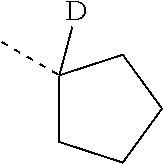
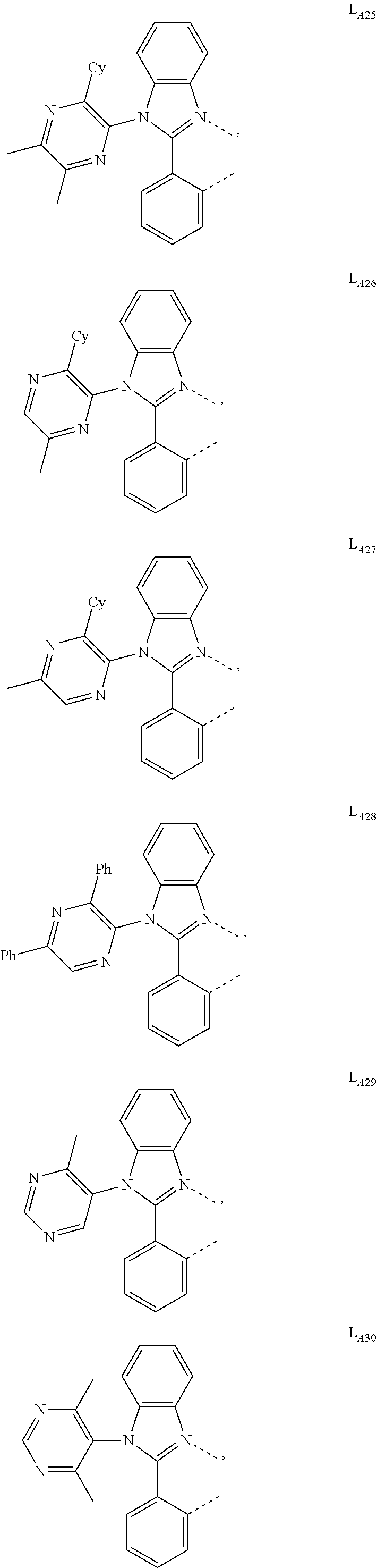
  • L A is selected from the group consisting of:
  • L B is selected from the group consisting of:
  • H H H 201 CH 3 H H 202. H CH 3 H 203. H H CH 3 204. CH 3 CH 3 H 205. CH 3 H CH 3 206. H CH 3 CH 3 207. CH 3 CH 3 CH 3 208. H H H 209. CH 3 H CH 3 210. H CH 3 H 211. H H CH 3 212. CH 3 CH 3 H 213. CH 3 H CH 3 214. H CH 3 CH 3 215. CH 3 CH 3 CH 3 216. H H H 217. CH 3 H CH 3 218. H CH 3 H 219. H H CH 3 220. CH 3 CH 3 H 221. CH 3 H CH 3 222. H CH 3 CH 3 223. CH 3 CH 3 CH 224. H H H 225. CH 3 H H 226.
  • CD 2 CH 2 CF 3 CD 3 CD 3 600 CD 3 CD 2 CH 2 CF 3 CD 3 CD 3 601. H H CD 2 CH 2 CF 3 H 602. CD 3 H CD 2 CH 2 CF 3 H 603. H CD 3 CD 2 CH 2 CF 3 H 604 H H CD 2 CH 2 CF 3 CD 3 605. CD 3 CD 3 CD 2 CH 2 CF 3 H 606. CD 3 H CD 2 CH 2 CF 3 CD 3 607. H CD 3 CD 2 CH 2 CF 3 CD 3 608. CD 3 CD 3 CD 2 CH 2 CF 3 CD 3 609. H H H 610. CD 3 H CD 3 611. H CD 3 H 612. H H CD 3 613. CD 3 CD 3 H 614. CD 3 H CD 3 615. H CD 3 CD 3 616.
  • CD 2 C(CH 3 ) 3 H CD 2 C(CH 3 ) 3 H 784.
  • CD 2 C(CH 3 ) 3 H CD 2 CH 2 CF 3 H 785.
  • CD 2 C(CH 3 ) 3 H CD 2 C(CH 3 ) 2 CF 3 H 786.
  • the compound is the Compound x having the Formula Ir(L Ai )(L Bj ) 2 ;
  • L B1 to L B856 are defined according to the above table.
  • an OLED is also provided.
  • the OLED includes an anode, a cathode, and an organic layer disposed between the anode and the cathode.
  • the organic layer may include a host and a phosphorescent dopant.
  • the organic layer can include a compound according to Formula I, and its variations as described herein.
  • the OLED can be incorporated into one or more of a consumer product, an electronic component module, and a lighting panel.
  • the organic layer can be an emissive layer and the compound can be an emissive dopant in some embodiments, while the compound can be a non-emissive dopant in other embodiments.
  • a consumer product comprising an OLED
  • the OLED may include an anode, a cathode, and an organic layer disposed between the anode and the cathode.
  • the organic layer may include a host and one or more emitter dopants.
  • the organic layer includes a compound of Formula I.
  • Non-limiting examples of consumer products include flat panel displays, computer monitors, medical monitors, televisions, billboards, lights for interior or exterior illumination and/or signaling, heads-up displays, fully or partially transparent displays, flexible displays, laser printers, telephones, cell phones, tablets, phablets, personal digital assistants (PDAs), wearable device, laptop computers, digital cameras, camcorders, viewfinders, micro-displays, 3-D displays that are less than 2 inches diagonal, 3-D displays, virtual reality or augmented reality displays, vehicles, video walls comprising multiple displays tiled together, theater or stadium screens, and/or signs.
  • PDAs personal digital assistants
  • 3-D displays that are less than 2 inches diagonal
  • 3-D displays virtual reality or augmented reality displays
  • vehicles video walls comprising multiple displays tiled together, theater or stadium screens, and/or signs.
  • the organic layer can also include a host.
  • a host In some embodiments, two or more hosts are preferred.
  • the hosts used maybe a) bipolar, b) electron transporting, c) hole transporting or d) wide band gap materials that play little role in charge transport.
  • the host can include a metal complex.
  • the host can be a triphenylene containing benzo-fused thiophene or benzo-fused furan.
  • Any substituent in the host can be an unfused substituent independently selected from the group consisting of C n H 2n+1 , OC n H 2n+1 , OAr 1 , N(C n H 2n+1 ) 2 , N(Ar 1 )(Ar 2 ), CH ⁇ CH—C n H 2n+1 , C ⁇ C—C n H 2n+1 , Ar 1 , Ar 1 —Ar 2 , and C n H 2n —Ar 1 , or the host has no substitution.
  • n can range from 1 to 10; and Ar 1 and Ar 2 can be independently selected from the group consisting of benzene, biphenyl, naphthalene, triphenylene, carbazole, and heteroaromatic analogs thereof.
  • the host can be an inorganic compound.
  • a Zn containing inorganic material e.g. ZnS.
  • the host can be a compound comprising at least one chemical group selected from the group consisting of triphenylene, carbazole, dibenzothiophene, dibenzofuran, dibenzoselenophene, azatriphenylene, azacarbazole, aza-dibenzothiophene, aza-dibenzofuran, and aza-dibenzoselenophene.
  • the host can include a metal complex.
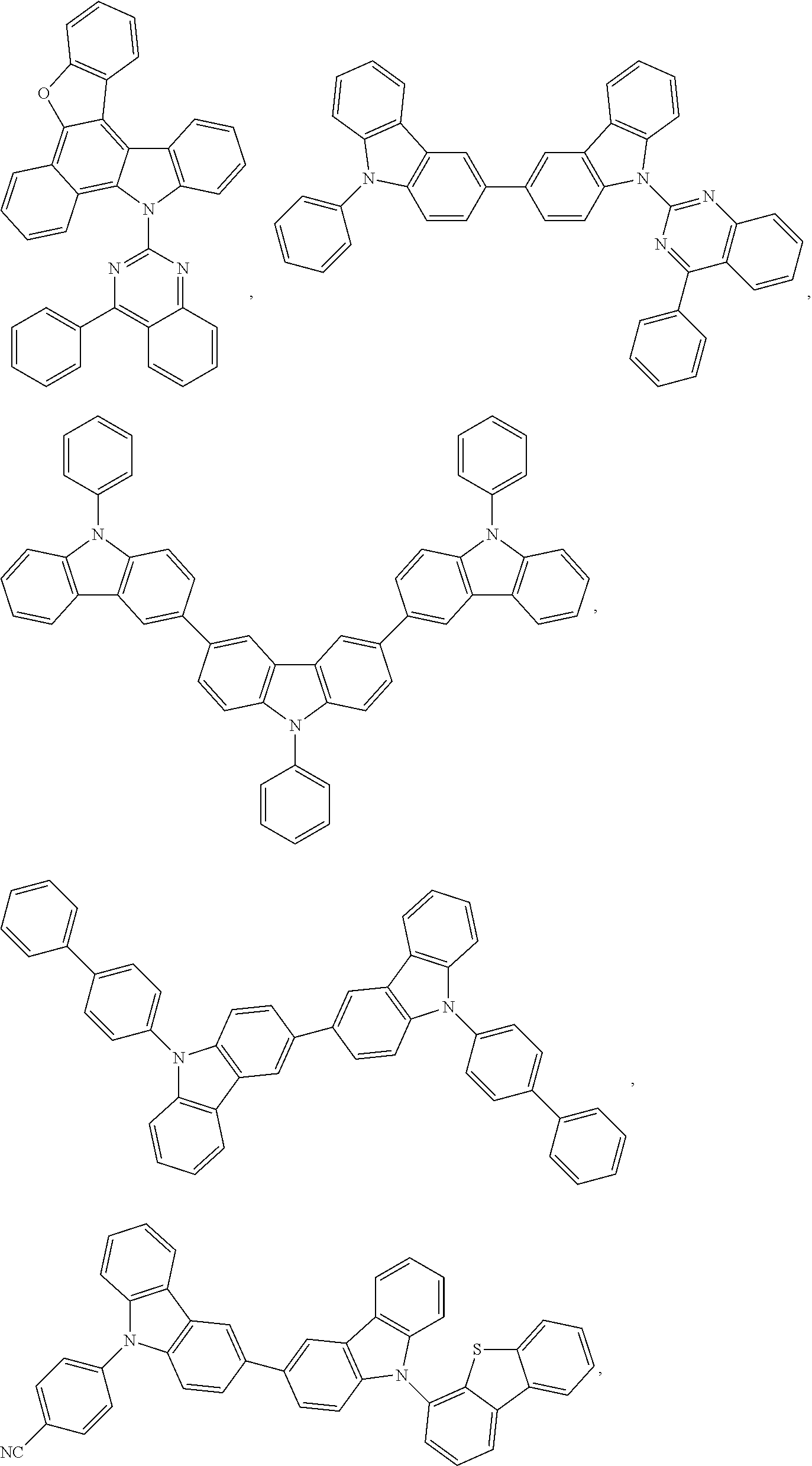
  • the host can be, but is not limited to, a specific compound selected from the group consisting of:
  • a formulation that comprises a compound according to Formula I is described.
  • the formulation can include one or more components selected from the group consisting of a solvent, a host, a hole injection material, hole transport material, and an electron transport layer material, disclosed herein.
  • the materials described herein as useful for a particular layer in an organic light emitting device may be used in combination with a wide variety of other materials present in the device.
  • emissive dopants disclosed herein may be used in conjunction with a wide variety of hosts, transport layers, blocking layers, injection layers, electrodes and other layers that may be present.
  • the materials described or referred to below are non-limiting examples of materials that may be useful in combination with the compounds disclosed herein, and one of skill in the art can readily consult the literature to identify other materials that may be useful in combination.
  • a charge transport layer can be doped with conductivity dopants to substantially alter its density of charge carriers, which will in turn alter its conductivity.
  • the conductivity is increased by generating charge carriers in the matrix material, and depending on the type of dopant, a change in the Fermi level of the semiconductor may also be achieved.
  • Hole-transporting layer can be doped by p-type conductivity dopants and n-type conductivity dopants are used in the electron-transporting layer.
  • Non-limiting examples of the conductivity dopants that may be used in an OLED in combination with materials disclosed herein are exemplified below together with references that disclose those materials: EP01617493, EP01968131, EP2020694, EP2684932, US20050139810, US20070160905, US20090167167, US2010288362, WO06081780, WO2009003455, WO2009008277, WO2009011327, WO2014009310, US2007252140, US2015060804 and US2012146012.
  • a hole injecting/transporting material to be used in the present invention is not particularly limited, and any compound may be used as long as the compound is typically used as a hole injecting/transporting material.
  • the material include, but are not limited to: a phthalocyanine or porphyrin derivative; an aromatic amine derivative; an indolocarbazole derivative; a polymer containing fluorohydrocarbon; a polymer with conductivity dopants; a conducting polymer, such as PEDOT/PSS; a self-assembly monomer derived from compounds such as phosphoric acid and silane derivatives; a metal oxide derivative, such as MoO x ; a p-type semiconducting organic compound, such as 1,4,5,8,9,12-Hexaazatriphenylenehexacarbonitrile; a metal complex, and a cross-linkable compounds.
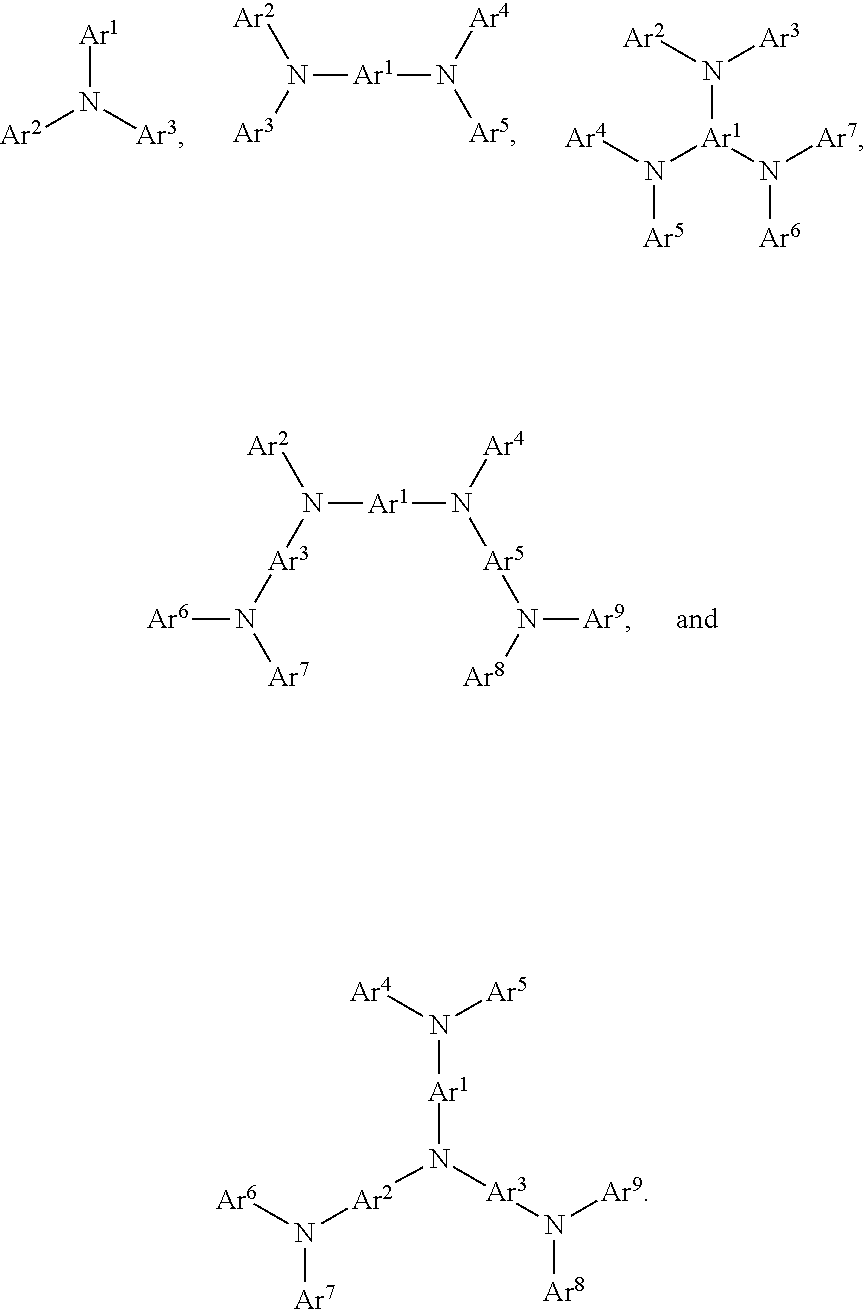
  • aromatic amine derivatives used in HIL or HTL include, but not limit to the following general structures:
  • Each of Ar 1 to Ar 9 is selected from the group consisting of aromatic hydrocarbon cyclic compounds such as benzene, biphenyl, triphenyl, triphenylene, naphthalene, anthracene, phenalene, phenanthrene, fluorene, pyrene, cluysene, petylene, and azulene; the group consisting of aromatic heterocyclic compounds such as dibenzothiophene, dibenzofuran, dibenzoselenophene, furan, thiophene, benzofuran, benzothiophene, benzoselenophene, carbazole, indolocarbazole, pyridylindole, pyrrolodipyridine, pyrazole, imidazole, triazole, oxazole, thiazole, oxadiazole, oxatriazole, dioxazole, thiadiazole, pyridine, pyridazine
  • Each Ar may be unsubstituted or may be substituted by a substituent selected from the group consisting of deuterium, halide, alkyl, cycloalkyl, heteroalkyl, arylalkyl, alkoxy, aryloxy, amino, silyl, alkenyl, cycloalkenyl, heteroalkenyl, alkynyl, aryl, heteroaryl, acyl, carbonyl, carboxylic acids, ester, nitrile, isonitrile, sulfanyl, sulfinyl, sulfonyl, phosphino, and combinations thereof.
  • a substituent selected from the group consisting of deuterium, halide, alkyl, cycloalkyl, heteroalkyl, arylalkyl, alkoxy, aryloxy, amino, silyl, alkenyl, cycloalkenyl, heteroalkenyl, alkynyl, aryl, hetero
  • Ar 1 to Ar 9 is independently selected from the group consisting of:
  • k is an integer from 1 to 20;
  • X 101 to X 108 is C (including CH) or N;
  • Z 101 is NAr 1 , O, or S;
  • Ar 1 has the same group defined above.
  • metal complexes used in HIL or HTL include, but are not limited to the following general formula:
  • (Y 101 -Y 102 ) is a 2-phenylpyridine derivative. In another aspect, (Y 101 -Y 102 ) is a carbene ligand. In another aspect, Met is selected from Ir, Pt, Os, and Zn. In a further aspect, the metal complex has a smallest oxidation potential in solution vs. Fc + /Fc couple less than about 0.6 V.
  • Non-limiting examples of the HIL and HTL materials that may be used in an OLED in combination with materials disclosed herein are exemplified below together with references that disclose those materials: CN102702075, DE102012005215, EP01624500, EP01698613, EP01806334, EP01930964, EP01972613, EP01997799, EP02011790, EP02055700, EP02055701, EP1725079, EP2085382, EP2660300, EP650955, JP07-073529, JP2005112765, JP2007091719, JP2008021687, JP2014-009196, KR20110088898, KR20130077473, TW201139402, U.S. Ser.
  • An electron blocking layer may be used to reduce the number of electrons and/or excitons that leave the emissive layer.
  • the presence of such a blocking layer in a device may result in substantially higher efficiencies, and or longer lifetime, as compared to a similar device lacking a blocking layer.
  • a blocking layer may be used to confine emission to a desired region of an OLED.
  • the EBL material has a higher LUMO (closer to the vacuum level) and/or higher triplet energy than the emitter closest to the EBL interface.
  • the EBL material has a higher LUMO (closer to the vacuum level) and or higher triplet energy than one or more of the hosts closest to the EBL interface.
  • the compound used in EBL contains the same molecule or the same functional groups used as one of the hosts described below.
  • metal complexes used as host are preferred to have the following general formula:
  • the metal complexes are:
  • Met is selected from Ir and Pt.
  • (Y 103 -Y 104 ) is a carbene ligand.
  • organic compounds used as host are selected from the group consisting of aromatic hydrocarbon cyclic compounds such as benzene, biphenyl, triphenyl, triphenylene, tetraphenylene, naphthalene, anthracene, phenalene, phenanthrene, fluorene, pyrene, cluysene, petylene, and azulene; the group consisting of aromatic heterocyclic compounds such as dibenzothiophene, dibenzofuran, dibenzoselenophene, furan, thiophene, benzofuran, benzothiophene, benzoselenophene, carbazole, indolocarbazole, pyridylindole, pyrrolodipyridine, pyrazole, imidazole, triazole, oxazole, thiazole, oxadiazole, oxatriazole, dioxazole, thiadiazole, pyridine
  • Each option within each group may be unsubstituted or may be substituted by a substituent selected from the group consisting of deuterium, halide, alkyl, cycloalkyl, heteroalkyl, arylalkyl, alkoxy, atyloxy, amino, silyl, alkenyl, cycloalkenyl, heteroalkenyl, alkynyl, heteroaryl, acyl, carbonyl, carboxylic acids, ester, nitrile, isonitrile, sulfanyl, sulfinyl, sulfonyl, phosphino, and combinations thereof.
  • a substituent selected from the group consisting of deuterium, halide, alkyl, cycloalkyl, heteroalkyl, arylalkyl, alkoxy, atyloxy, amino, silyl, alkenyl, cycloalkenyl, heteroalkenyl, alkynyl, heteroaryl, acy
  • each of R 101 to R 107 is independently selected from the group consisting of hydrogen, deuterium, halide, alkyl, cycloalkyl, heteroalkyl, arylalkyl, alkoxy, atyloxy, amino, silyl, alkenyl, cycloalkenyl, heteroalkenyl, alkynyl, heteroatyl, acyl, carbonyl, carboxylic acids, ester, nitrile, isonitrile, sulfanyl, sulfinyl, sulfonyl, phosphino, and combinations thereof, and when it is aryl or heteroatyl, it has the similar definition as Ar's mentioned above.
  • X 101 to X 108 is selected from C (including CH) or N.
  • Z 101 and Z 102 is selected from NR′′, O, or S.
  • Non-limiting examples of the host materials that may be used in an OLED in combination with materials disclosed herein are exemplified below together with references that disclose those materials: EP2034538, EP2034538A, EP2757608, JP2007254297, KR20100079458, KR20120088644, KR20120129733, KR20130115564, TW201329200, US20030175553, US20050238919, US20060280965, US20090017330, US20090030202, US20090167162, US20090302743, US20090309488, US20100012931, US20100084966, US20100187984, US2010187984, US2012075273, US2012126221, US2013009543, US2013105787, US2013175519, US2014001446, US20140183503, US20140225088, US2014034914, U.S.
  • One or more additional emitter dopants may be used in conjunction with the compound of the present disclosure.
  • the additional emitter dopants are not particularly limited, and any compounds may be used as long as the compounds are typically used as emitter materials.
  • suitable emitter materials include, but are not limited to, compounds which can produce emissions via phosphorescence, fluorescence, thermally activated delayed fluorescence, i.e., TADF (also referred to as E-type delayed fluorescence), triplet-triplet annihilation, or combinations of these processes.
  • Non-limiting examples of the emitter materials that may be used in an OLED in combination with materials disclosed herein are exemplified below together with references that disclose those materials: CN103694277, CN1696137, EB01238981, EP01239526, EP01961743, EP1239526, EP1244155, EP1642951, EP1647554, EP1841834, EP1841834B, EP2062907, EP2730583, JP2012074444, JP2013110263, JP4478555, KR1020090133652, KR20120032054, KR20130043460, TW201332980, U.S. Ser. No. 06/699,599, U.S. Ser. No.
  • a hole blocking layer may be used to reduce the number of holes and/or excitons that leave the emissive layer.
  • the presence of such a blocking layer in a device may result in substantially higher efficiencies and/or longer lifetime as compared to a similar device lacking a blocking layer.
  • a blocking layer may be used to confine emission to a desired region of an OLED.
  • the HBL material has a lower HOMO (further from the vacuum level) and or higher triplet energy than the emitter closest to the HBL interface.
  • the HBL material has a lower HOMO (further from the vacuum level) and or higher triplet energy than one or more of the hosts closest to the HBL interface.
  • compound used in HBL contains the same molecule or the same functional groups used as host described above.
  • compound used in HBL contains at least one of the following groups in the molecule:
  • Electron transport layer may include a material capable of transporting electrons. Electron transport layer may be intrinsic (undoped), or doped. Doping may be used to enhance conductivity. Examples of the ETL material are not particularly limited, and any metal complexes or organic compounds may be used as long as they are typically used to transport electrons.
  • compound used in ETL contains at least one of the following groups in the molecule:
  • R 101 is selected from the group consisting of hydrogen, deuterium, halide, alkyl, cycloalkyl, heteroalkyl, arylalkyl, alkoxy, aryloxy, amino, silyl, alkenyl, cycloalkenyl, heteroalkenyl, alkynyl, aryl, heteroaryl, acyl, carbonyl, carboxylic acids, ester, nitrile, isonitrile, sulfanyl, sulfinyl, sulfonyl, phosphino, and combinations thereof, when it is aryl or heteroaryl, it has the similar definition as Ar's mentioned above.
  • Ar′ to Ai′ has the similar definition as Ar's mentioned above.
  • k is an integer from 1 to 20.
  • X 101 to X 108 is selected from C (including CH) or N.
  • the metal complexes used in ETL contains, but not limit to the following general formula:
  • (O—N) or (N—N) is a bidentate ligand, having metal coordinated to atoms O, N or N, N; L 101 is another ligand; k′ is an integer value from 1 to the maximum number of ligands that may be attached to the metal.
  • Non-limiting examples of the ETL materials that may be used in an OLED in combination with materials disclosed herein are exemplified below together with references that disclose those materials: CN103508940, EP01602648, EP01734038, EP01956007, JP2004-022334, JP2005149918, JP2005-268199, KR0117693, KR20130108183, US20040036077, US20070104977, US2007018155, US20090101870, US20090115316, US20090140637, US20090179554, US2009218940, US2010108990, US2011156017, US2011210320, US2012193612, US2012214993, US2014014925, US2014014927, US20140284580, U.S.
  • the CGL plays an essential role in the performance, which is composed of an n-doped layer and a p-doped layer for injection of electrons and holes, respectively. Electrons and holes are supplied from the CGL and electrodes. The consumed electrons and holes in the CGL are refilled by the electrons and holes injected from the cathode and anode, respectively; then, the bipolar currents reach a steady state gradually.
  • Typical CGL materials include n and p conductivity dopants used in the transport layers.
  • the hydrogen atoms can be partially or fully deuterated.
  • any specifically listed substituent such as, without limitation, methyl, phenyl, pyridyl, etc. may be undeuterated, partially deuterated, and fully deuterated versions thereof.
  • classes of substituents such as, without limitation, alkyl, aryl, cycloalkyl, heteroaryl, etc. also may be undeuterated, partially deuterated, and fully deuterated versions thereof.
  • the reaction mixture was cooled to room temperature, diluted with 300 mL water and then was extracted with 2 ⁇ 350 mL of ethyl acetate. These extracts were combined and were washed with aqueous LiCl. The extracts were dried over magnesium sulfate and filtered and concentrated under vacuum. The crude residue was subjected to column chromatography on silica gel, eluting with a 15-20% ethyl acetate/toluene gradient mixture, providing 1-(3-methylpyrazin-2-yl)-2-phenyl-1H-benzo[d]imidazole (7.0 g, 24.45 mmol, 71.5% yield) as a tan solid.
  • the reaction mixture was diluted with 300 mL water and was extracted with 3 ⁇ 250 mL ethyl acetate. The extracts were combined and washed with aqueous LiCl followed by drying over magnesium sulfate. The extract was filtered and concentrated under vacuum. The crude residue was subjected to column chromatography on silica gel columns, eluted with a 15-20% ethyl acetate/toluene gradient mixture, providing 1-(3-(1methyl-d3)pyrazin-2-yl)-2-phenyl-1H-benzo[d]imidazole (2.95 g, 10.20 mmol, 40.9% yield) as a tan solid.
  • the iridium salt (4.6 g, 6.44 mmol) and 1-(3-(methyl-d3)pyrazin-2-yl)-2-phenyl-1H-benzo[d]imidazole (2.95 g, 10.20 mmol) were suspended in a 120 mL methanol and ethanol (1/1; v/v) mixture, degassed with nitrogen, and then immersed in an oil bath at 75° C. for 16 h. HPLC showed trace product. The reaction mixture was evaporated under reduced pressure and 60 mL of fresh ethanol was added. This mixture was degassed again and heated in an oil bath set at 90° C. for 24 hours. HPLC still showed very little product formation. The ethanol was removed and was replaced with DMF and 2-ethoxyethanol.
  • the reaction mixture was degassed with nitrogen and was heated in an oil bath at 130° C. for 21 ⁇ 2 days. The reaction mixture was then cooled down to room temperature. The solvents were removed under vacuum and the crude residue was subjected to column chromatography on a silica gel column, eluted with DCM followed by DCM/ethyl acetate ( 1 / 1 ; v/v). The solvents were removed and the product residue was purified by column chromatography.
  • the first product eluted from the column was isolated as an orange solid. This material was dissolved in 300 mL DCM and passed through a pad of activated basic alumina. The filtrate was evaporated under reduced vacuum. This residue was passed through 7 ⁇ 120 g silica gel columns. The columns were eluted with 5-10% ethyl acetate/toluene. The pure product fractions were combined and concentrated under vacuum, yielding the iridium complex as an orange solid (0.60 g, 0.76 mmol, 11.8% yield)
  • N1-(4-methylpyrimidin-5-yl)benzene-1,2-diamine (7.95 g, 39.7 mmol)
  • benzaldehyde (5.18 g, 48.8 mmol)
  • Na 2 S 2 O 5 15.09 g, 79 mmol
  • the reaction mixture was heated for 16 hat 125° C. open to air.
  • the reaction mixture was then cooled down, diluted with EtOAc, and washed with brine and LiClaq. 10% solution.
  • All example devices were fabricated by high vacuum ( ⁇ 10 ⁇ 7 Torr) thermal evaporation.
  • the anode electrode was 750 ⁇ of indium tin oxide (ITO).
  • the cathode consisted of 10 ⁇ of Liq (8-hydroxyquinoline lithium) followed by 1,000 ⁇ of A1. All devices were encapsulated with a glass lid sealed with an epoxy resin in a nitrogen glove box ( ⁇ 1 ppm of H 2 O and O 2 ) immediately after fabrication with a moisture getter incorporated inside the package.
  • the organic stack of the device examples consisted of sequentially, from the ITO Surface: 100 ⁇ of HAT-CN as the hole injection layer (HIL); 450 ⁇ of HTM as a hole transporting layer (HTL); emissive layer (EML) with thickness 400 ⁇ .
  • HIL hole injection layer
  • HTL hole transporting layer
  • EML emissive layer
  • Device structure is shown in the table 1. Table 1 shows the schematic device structure. The chemical structures of the device materials are shown below.

Landscapes

  • Chemical & Material Sciences (AREA)
  • Organic Chemistry (AREA)
  • Engineering & Computer Science (AREA)
  • Materials Engineering (AREA)
  • Crystallography & Structural Chemistry (AREA)
  • Inorganic Chemistry (AREA)
  • Physics & Mathematics (AREA)
  • Optics & Photonics (AREA)
  • Organic Low-Molecular-Weight Compounds And Preparation Thereof (AREA)
  • Electroluminescent Light Sources (AREA)

Abstract

The present invention includes a new series of heteroleptic iridium complexes that demonstrate high efficiency in OLED device.

Description

CROSS-REFERENCE TO RELATED APPLICATIONS
This application is a continuation of U.S. patent application Ser. No. 15/475,463, filed Mar. 31, 2017, which claims priority to U.S. Provisional Patent Application No. 62/332,239, filed May 5, 2016, all of which applications are hereby incorporated by reference in their entireties.
FIELD
The present invention relates to compounds for use as emitters, and devices, such as organic light emitting diodes, including the same.
BACKGROUND
Opto-electronic devices that make use of organic materials are becoming increasingly desirable for a number of reasons. Many of the materials used to make such devices are relatively inexpensive, so organic opto-electronic devices have the potential for cost advantages over inorganic devices. In addition, the inherent properties of organic materials, such as their flexibility, may make them well suited for particular applications such as fabrication on a flexible substrate. Examples of organic opto-electronic devices include organic light emitting diodes/devices (OLEDs), organic phototransistors, organic photovoltaic cells, and organic photodetectors. For OLEDs, the organic materials may have performance advantages over conventional materials. For example, the wavelength at which an organic emissive layer emits light may generally be readily tuned with appropriate dopants.
OLEDs make use of thin organic films that emit light when voltage is applied across the device. OLEDs are becoming an increasingly interesting technology for use in applications such as flat panel displays, illumination, and backlighting. Several OLED materials and configurations are described in U.S. Pat. Nos. 5,844,363, 6,303,238, and 5,707,745, which are incorporated herein by reference in their entirety.
One application for phosphorescent emissive molecules is a full color display. Industry standards for such a display call for pixels adapted to emit particular colors, referred to as “saturated” colors. In particular, these standards call for saturated red, green, and blue pixels. Alternatively the OLED can be designed to emit white light. In conventional liquid crystal displays emission from a white backlight is filtered using absorption filters to produce red, green and blue emission. The same technique can also be used with OLEDs. The white OLED can be either a single EML device or a stack structure. Color may be measured using CIE coordinates, which are well known to the art.
One example of a green emissive molecule is tris(2-phenylpyridine) iridium, denoted Ir(ppy)3, which has the following structure:
Figure US12048237-20240723-C00001
In this, and later figures herein, we depict the dative bond from nitrogen to metal (here, Ir) as a straight line.
As used herein, the term “organic” includes polymeric materials as well as small molecule organic materials that may be used to fabricate organic opto-electronic devices. “Small molecule” refers to any organic material that is not a polymer, and “small molecules” may actually be quite large. Small molecules may include repeat units in some circumstances. For example, using a long chain alkyl group as a substituent does not remove a molecule from the “small molecule” class. Small molecules may also be incorporated into polymers, for example as a pendent group on a polymer backbone or as a part of the backbone. Small molecules may also serve as the core moiety of a dendrimer, which consists of a series of chemical shells built on the core moiety. The core moiety of a dendrimer may be a fluorescent or phosphorescent small molecule emitter. A dendrimer may be a “small molecule,” and it is believed that all dendrimers currently used in the field of OLEDs are small molecules.
As used herein, “top” means furthest away from the substrate, while “bottom” means closest to the substrate. Where a first layer is described as “disposed over” a second layer, the first layer is disposed further away from substrate. There may be other layers between the first and second layer, unless it is specified that the first layer is “in contact with” the second layer. For example, a cathode may be described as “disposed over” an anode, even though there are various organic layers in between.
As used herein, “solution processible” means capable of being dissolved, dispersed, or transported in and/or deposited from a liquid medium, either in solution or suspension form.
A ligand may be referred to as “photoactive” when it is believed that the ligand directly contributes to the photoactive properties of an emissive material. A ligand may be referred to as “ancillary” when it is believed that the ligand does not contribute to the photoactive properties of an emissive material, although an ancillary ligand may alter the properties of a photoactive ligand
As used herein, and as would be generally understood by one skilled in the art, a first “Highest Occupied Molecular Orbital” (HOMO) or “Lowest Unoccupied Molecular Orbital” (LUMO) energy level is “greater than” or “higher than” a second HOMO or LUMO energy level if the first energy level is closer to the vacuum energy level. Since ionization potentials (IP) are measured as a negative energy relative to a vacuum level, a higher HOMO energy level corresponds to an IP having a smaller absolute value (an IP that is less negative). Similarly, a higher LUMO energy level corresponds to an electron affinity (EA) having a smaller absolute value (an EA that is less negative). On a conventional energy level diagram, with the vacuum level at the top, the LUMO energy level of a material is higher than the HOMO energy level of the same material. A “higher” HOMO or LUMO energy level appears closer to the top of such a diagram than a “lower” HOMO or LUMO energy level.
As used herein, and as would be generally understood by one skilled in the art, a first work function is “greater than” or “higher than” a second work function if the first work function has a higher absolute value. Because work functions are generally measured as negative numbers relative to vacuum level, this means that a “higher” work function is more negative. On a conventional energy level diagram, with the vacuum level at the top, a “higher” work function is illustrated as further away from the vacuum level in the downward direction. Thus, the definitions of HOMO and LUMO energy levels follow a different convention than work functions.
More details on OLEDs, and the definitions described above, can be found in U.S. Pat. No. 7,279,704, which is incorporated herein by reference in its entirety.
There is need in the art for novel emitters which can be used for electroluminescent devices. The present invention addresses this unmet need.
SUMMARY
According to an embodiment, a compound is provided that has the structure of (LA)nIr(LB)3-n represented by Formula I shown below:
Figure US12048237-20240723-C00002
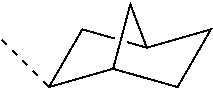
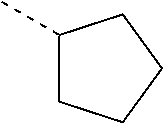
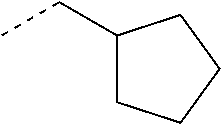
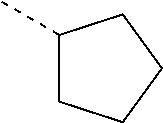
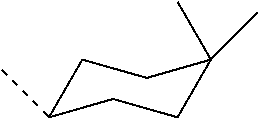
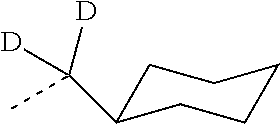
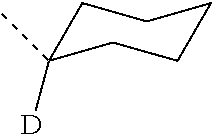
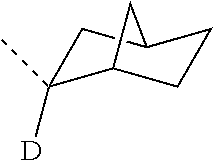
    • wherein R2, R3, R4 and R5 each represent monosubstitution, disubstitution, trisubstitution, tetrasubstitution, or no substitution;
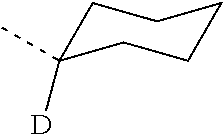
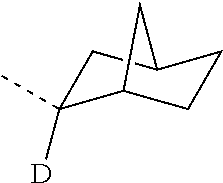
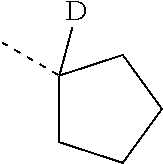
    • wherein R′ is an aryl or heteroaryl comprising at least one group selected from group A consisting of:
Figure US12048237-20240723-C00003
Figure US12048237-20240723-C00004
Figure US12048237-20240723-C00005
    • wherein R1 can be further substituted with one or more substituents selected from the group consisting of deuterium, halide, alkyl, cycloalkyl, and combinations thereof;
    • wherein R2, R3, R4, and R5 are each independently selected from the group consisting of hydrogen, deuterium, halide, alkyl, cycloalkyl, and combinations thereof; and
    • wherein n is 1 or 2.
According to another embodiment, an organic light emitting diode/device (OLED) is also provided. The OLED can include an anode, a cathode, and an organic layer, disposed between the anode and the cathode. The organic layer can include a compound of Formula I. According to yet another embodiment, the organic light emitting device is incorporated into a device selected from a consumer product, an electronic component module, and/or a lighting panel.
According to another embodiment, a consumer product comprising one or more organic light emitting devices is also provided. The organic light emitting device can include an anode, a cathode, and an organic layer, disposed between the anode and the cathode, wherein the organic layer can include a compound of Formula I. The consumer product can be a flat panel display, a computer monitor, a medical monitors television, a billboard, a light for interior or exterior illumination and/or signaling, a heads-up display, a fully or partially transparent display, a flexible display, a laser printer, a telephone, a cell phone, tablet, a phablet, a personal digital assistant (PDA), a wearable device, a laptop computer, a digital camera, a camcorder, a viewfinder, a micro-display that is less than 2 inches diagonal, a 3-D display, a virtual reality or augmented reality display, a vehicle, a video wall comprising multiple displays tiled together, a theater or stadium screen, and/or a sign.
According to another embodiment, a formulation containing a compound of Formula I is provided.
BRIEF DESCRIPTION OF THE DRAWINGS
FIG. 1 shows an organic light emitting device.
FIG. 2 shows an inverted organic light emitting device that does not have a separate electron transport layer.
DETAILED DESCRIPTION
Generally, an OLED comprises at least one organic layer disposed between and electrically connected to an anode and a cathode. When a current is applied, the anode injects holes and the cathode injects electrons into the organic layer(s). The injected holes and electrons each migrate toward the oppositely charged electrode. When an electron and hole localize on the same molecule, an “exciton,” which is a localized electron-hole pair having an excited energy state, is formed. Light is emitted when the exciton relaxes via a photoemissive mechanism. In some cases, the exciton may be localized on an excimer or an exciplex. Non-radiative mechanisms, such as thermal relaxation, may also occur, but are generally considered undesirable.
The initial OLEDs used emissive molecules that emitted light from their singlet states (“fluorescence”) as disclosed, for example, in U.S. Pat. No. 4,769,292, which is incorporated by reference in its entirety. Fluorescent emission generally occurs in a time frame of less than 10 nanoseconds.
More recently, OLEDs having emissive materials that emit light from triplet states (“phosphorescence”) have been demonstrated. Baldo et al., “Highly Efficient Phosphorescent Emission from Organic Electroluminescent Devices,” Nature, vol. 395, 151-154, 1998; (“Baldo-I”) and Baldo et al., “Very high-efficiency green organic light-emitting devices based on electrophosphorescence,” Appl. Phys. Lett., vol. 75, No. 3, 4-6 (1999) (“Baldo-II”), are incorporated by reference in their entireties. Phosphorescence is described in more detail in U.S. Pat. No. 7,279,704 at cols. 5-6, which are incorporated by reference.
FIG. 1 shows an organic light emitting device 100. The figures are not necessarily drawn to scale. Device 100 may include a substrate 110, an anode 115, a hole injection layer 120, a hole transport layer 125, an electron blocking layer 130, an emissive layer 135, a hole blocking layer 140, an electron transport layer 145, an electron injection layer 150, a protective layer 155, a cathode 160, and a barrier layer 170. Cathode 160 is a compound cathode having a first conductive layer 162 and a second conductive layer 164. Device 100 may be fabricated by depositing the layers described, in order. The properties and functions of these various layers, as well as example materials, are described in more detail in U.S. Pat. No. 7,279,704 at cols. 6-10, which are incorporated by reference.
More examples for each of these layers are available. For example, a flexible and transparent substrate-anode combination is disclosed in U.S. Pat. No. 5,844,363, which is incorporated by reference in its entirety. An example of a p-doped hole transport layer is m-MTDATA doped with F4-TCNQ at a molar ratio of 50:1, as disclosed in U.S. Patent Application Publication No. 2003/0230980, which is incorporated by reference in its entirety. Examples of emissive and host materials are disclosed in U.S. Pat. No. 6,303,238 to Thompson et al., which is incorporated by reference in its entirety. An example of an n-doped electron transport layer is BPhen doped with Li at a molar ratio of 1:1, as disclosed in U.S. Patent Application Publication No. 2003/0230980, which is incorporated by reference in its entirety. U.S. Pat. Nos. 5,703,436 and 5,707,745, which are incorporated by reference in their entireties, disclose examples of cathodes including compound cathodes having a thin layer of metal such as Mg:Ag with an overlying transparent, electrically-conductive, sputter-deposited ITO layer. The theory and use of blocking layers is described in more detail in U.S. Pat. No. 6,097,147 and U.S. Patent Application Publication No. 2003/0230980, which are incorporated by reference in their entireties. Examples of injection layers are provided in U.S. Patent Application Publication No. 2004/0174116, which is incorporated by reference in its entirety. A description of protective layers may be found in U.S. Patent Application Publication No. 2004/0174116, which is incorporated by reference in its entirety.
FIG. 2 shows an inverted OLED 200. The device includes a substrate 210, a cathode 215, an emissive layer 220, a hole transport layer 225, and an anode 230. Device 200 may be fabricated by depositing the layers described, in order. Because the most common OLED configuration has a cathode disposed over the anode, and device 200 has cathode 215 disposed under anode 230, device 200 may be referred to as an “inverted” OLED. Materials similar to those described with respect to device 100 may be used in the corresponding layers of device 200. FIG. 2 provides one example of how some layers may be omitted from the structure of device 100.
The simple layered structure illustrated in FIGS. 1 and 2 is provided by way of non-limiting example, and it is understood that embodiments of the invention may be used in connection with a wide variety of other structures. The specific materials and structures described are exemplary in nature, and other materials and structures may be used. Functional OLEDs may be achieved by combining the various layers described in different ways, or layers may be omitted entirely, based on design, performance, and cost factors. Other layers not specifically described may also be included. Materials other than those specifically described may be used. Although many of the examples provided herein describe various layers as comprising a single material, it is understood that combinations of materials, such as a mixture of host and dopant, or more generally a mixture, may be used. Also, the layers may have various sublayers. The names given to the various layers herein are not intended to be strictly limiting. For example, in device 200, hole transport layer 225 transports holes and injects holes into emissive layer 220, and may be described as a hole transport layer or a hole injection layer. In one embodiment, an OLED may be described as having an “organic layer” disposed between a cathode and an anode. This organic layer may comprise a single layer, or may further comprise multiple layers of different organic materials as described, for example, with respect to FIGS. 1 and 2 .
Structures and materials not specifically described may also be used, such as OLEDs comprised of polymeric materials (PLEDs) such as disclosed in U.S. Pat. No. 5,247,190 to Friend et al., which is incorporated by reference in its entirety. By way of further example, OLEDs having a single organic layer may be used. OLEDs may be stacked, for example as described in U.S. Pat. No. 5,707,745 to Forrest et al, which is incorporated by reference in its entirety. The OLED structure may deviate from the simple layered structure illustrated in FIGS. 1 and 2 . For example, the substrate may include an angled reflective surface to improve out-coupling, such as a mesa structure as described in U.S. Pat. No. 6,091,195 to Forrest et al., and/or a pit structure as described in U.S. Pat. No. 5,834,893 to Bulovic et al., which are incorporated by reference in their entireties.
Unless otherwise specified, any of the layers of the various embodiments may be deposited by any suitable method. For the organic layers, preferred methods include thermal evaporation, ink-jet, such as described in U.S. Pat. Nos. 6,013,982 and 6,087,196, which are incorporated by reference in their entireties, organic vapor phase deposition (OVPD), such as described in U.S. Pat. No. 6,337,102 to Forrest et al., which is incorporated by reference in its entirety, and deposition by organic vapor jet printing (OVJP), such as described in U.S. Pat. No. 7,431,968, which is incorporated by reference in its entirety. Other suitable deposition methods include spin coating and other solution based processes. Solution based processes are preferably carried out in nitrogen or an inert atmosphere. For the other layers, preferred methods include thermal evaporation. Preferred patterning methods include deposition through a mask, cold welding such as described in U.S. Pat. Nos. 6,294,398 and 6,468,819, which are incorporated by reference in their entireties, and patterning associated with some of the deposition methods such as ink jet and OVJD. Other methods may also be used. The materials to be deposited may be modified to make them compatible with a particular deposition method. For example, substituents such as alkyl and aryl groups, branched or unbranched, and preferably containing at least 3 carbons, may be used in small molecules to enhance their ability to undergo solution processing. Substituents having 20 carbons or more may be used, and 3-20 carbons is a preferred range. Materials with asymmetric structures may have better solution processibility than those having symmetric structures, because asymmetric materials may have a lower tendency to recrystallize. Dendrimer substituents may be used to enhance the ability of small molecules to undergo solution processing.
Devices fabricated in accordance with embodiments of the present invention may further optionally comprise a barrier layer. One purpose of the barrier layer is to protect the electrodes and organic layers from damaging exposure to harmful species in the environment including moisture, vapor and/or gases, etc. The barrier layer may be deposited over, under or next to a substrate, an electrode, or over any other parts of a device including an edge. The barrier layer may comprise a single layer, or multiple layers. The barrier layer may be formed by various known chemical vapor deposition techniques and may include compositions having a single phase as well as compositions having multiple phases. Any suitable material or combination of materials may be used for the barrier layer. The barrier layer may incorporate an inorganic or an organic compound or both. The preferred barrier layer comprises a mixture of a polymeric material and a non-polymeric material as described in U.S. Pat. No. 7,968,146, PCT Pat. Application Nos. PCT/US2007/023098 and PCT/US2009/042829, which are herein incorporated by reference in their entireties. To be considered a “mixture”, the aforesaid polymeric and non-polymeric materials comprising the barrier layer should be deposited under the same reaction conditions and/or at the same time. The weight ratio of polymeric to non-polymeric material may be in the range of 95:5 to 5:95. The polymeric material and the non-polymeric material may be created from the same precursor material. In one example, the mixture of a polymeric material and a non-polymeric material consists essentially of polymeric silicon and inorganic silicon.
Devices fabricated in accordance with embodiments of the invention can be incorporated into a wide variety of electronic component modules (or units) that can be incorporated into a variety of electronic products or intermediate components. Examples of such electronic products or intermediate components include display screens, lighting devices such as discrete light source devices or lighting panels, etc. that can be utilized by the end-user product manufacturers. Such electronic component modules can optionally include the driving electronics and/or power source(s). Devices fabricated in accordance with embodiments of the invention can be incorporated into a wide variety of consumer products that have one or more of the electronic component modules (or units) incorporated therein. Such consumer products would include any kind of products that include one or more light source(s) and/or one or more of some type of visual displays. Some examples of such consumer products include flat panel displays, computer monitors, medical monitors, televisions, billboards, lights for interior or exterior illumination and/or signaling, heads-up displays, fully or partially transparent displays, flexible displays, laser printers, telephones, cell phones, tablets, phablets, personal digital assistants (PDAs), wearable device, laptop computers, digital cameras, camcorders, viewfinders, micro-displays that are less than 2 inches diagonal, 3-D displays, virtual reality or augmented reality displays, vehicles, video walls comprising multiple displays tiled together, theater or stadium screen, or a sign. Various control mechanisms may be used to control devices fabricated in accordance with the present invention, including passive matrix and active matrix. Many of the devices are intended for use in a temperature range comfortable to humans, such as 18 degrees C. to 30 degrees C., and more preferably at room temperature (20-25 degrees C.), but could be used outside this temperature range, for example, from −40 degree C. to +80 degree C.
The materials and structures described herein may have applications in devices other than OLEDs. For example, other optoelectronic devices such as organic solar cells and organic photodetectors may employ the materials and structures. More generally, organic devices, such as organic transistors, may employ the materials and structures.
The term “halo,” “halogen,” or “halide” as used herein includes fluorine, chlorine, bromine, and iodine.
The term “alkyl” as used herein contemplates both straight and branched chain alkyl radicals. Preferred alkyl groups are those containing from one to fifteen carbon atoms and includes methyl, ethyl, propyl, 1-methylethyl, butyl, 1-methylpropyl, 2-methylpropyl, pentyl, 1-methylbutyl, 2-methylbutyl, 3-methylbutyl, 1,1-dimethylpropyl, 1,2-dimethylpropyl, 2,2-dimethylpropyl, and the like. Additionally, the alkyl group may be optionally substituted.
The term “cycloalkyl” as used herein contemplates cyclic alkyl radicals. Preferred cycloalkyl groups are those containing 3 to 10 ring carbon atoms and includes cyclopropyl, cyclopentyl, cyclohexyl, adamantyl, and the like. Additionally, the cycloalkyl group may be optionally substituted.
The term “alkenyl” as used herein contemplates both straight and branched chain alkene radicals. Preferred alkenyl groups are those containing two to fifteen carbon atoms. Additionally, the alkenyl group may be optionally substituted.
The term “alkynyl” as used herein contemplates both straight and branched chain alkyne radicals. Preferred alkynyl groups are those containing two to fifteen carbon atoms. Additionally, the alkynyl group may be optionally substituted.
The terms “aralkyl” or “atylalkyl” as used herein are used interchangeably and contemplate an alkyl group that has as a substituent an aromatic group. Additionally, the aralkyl group may be optionally substituted.
The term “heterocyclic group” as used herein contemplates aromatic and non-aromatic cyclic radicals. Hetero-aromatic cyclic radicals also means heteroaryl. Preferred hetero-non-aromatic cyclic groups are those containing 3 to 7 ring atoms which includes at least one hetero atom, and includes cyclic amines such as morpholino, piperdino, pyrrolidino, and the like, and cyclic ethers, such as tetrahydrofuran, tetrahydropyran, and the like. Additionally, the heterocyclic group may be optionally substituted.
The term “aryl” or “aromatic group” as used herein contemplates single-ring groups and polycyclic ring systems. The polycyclic rings may have two or more rings in which two carbons are common to two adjoining rings (the rings are “fused”) wherein at least one of the rings is aromatic, e.g., the other rings can be cycloalkyls, cycloalkenyls, aryl, heterocycles, and/or heteroaryls. Preferred aryl groups are those containing six to thirty carbon atoms, preferably six to twenty carbon atoms, more preferably six to twelve carbon atoms. Especially preferred is an aryl group having six carbons, ten carbons or twelve carbons. Suitable aryl groups include phenyl, biphenyl, triphenyl, triphenylene, tetraphenylene, naphthalene, anthracene, phenalene, phenanthrene, fluorene, pyrene, cluysene, petylene, and azulene, preferably phenyl, biphenyl, triphenyl, triphenylene, fluorene, and naphthalene. Additionally, the aryl group may be optionally substituted.
The term “heteroatyl” as used herein contemplates single-ring hetero-aromatic groups that may include from one to five heteroatoms. The term heteroaryl also includes polycyclic hetero-aromatic systems having two or more rings in which two atoms are common to two adjoining rings (the rings are “fused”) wherein at least one of the rings is a heteroaryl, e.g., the other rings can be cycloalkyls, cycloalkenyls, aryl, heterocycles, and/or heteroaryls. Preferred heteroaryl groups are those containing three to thirty carbon atoms, preferably three to twenty carbon atoms, more preferably three to twelve carbon atoms. Suitable heteroaryl groups include dibenzothiophene, dibenzofuran, dibenzoselenophene, furan, thiophene, benzofuran, benzothiophene, benzoselenophene, carbazole, indolocarbazole, pyridylindole, pyrrolodipyridine, pyrazole, imidazole, triazole, oxazole, thiazole, oxadiazole, oxatriazole, dioxazole, thiadiazole, pyridine, pyridazine, pyrimidine, pyrazine, triazine, oxazine, oxathiazine, oxadiazine, indole, benzimidazole, indazole, indoxazine, benzoxazole, benzisoxazole, benzothiazole, quinoline, isoquinoline, cinnoline, quinazoline, quinoxaline, naphthyridine, phthalazine, pteridine, xanthene, acridine, phenazine, phenothiazine, phenoxazine, benzofuropyridine, furodipyridine, benzothienopyridine, thienodipyridine, benzoselenophenopyridine, and selenophenodipyridine, preferably dibenzothiophene, dibenzofuran, dibenzoselenophene, carbazole, indolocarbazole, imidazole, pyridine, triazine, benzimidazole, 1,2-azaborine, 1,3-azaborine, 1,4-azaborine, borazine, and aza-analogs thereof. Additionally, the heteroaryl group may be optionally substituted.
The alkyl, cycloalkyl, alkenyl, alkynyl, aralkyl, heterocyclic group, aryl, and heteroaryl may be unsubstituted or may be substituted with one or more substituents selected from the group consisting of deuterium, halogen, alkyl, cycloalkyl, heteroalkyl, arylalkyl, alkoxy, aryloxy, amino, cyclic amino, silyl, alkenyl, cycloalkenyl, heteroalkenyl, alkynyl, aryl, heteroaryl, acyl, carbonyl, carboxylic acid, ether, ester, nitrile, isonitrile, sulfanyl, sulfinyl, sulfonyl, phosphino, and combinations thereof.
As used herein, “substituted” indicates that a substituent other than H is bonded to the relevant position, such as carbon. Thus, for example, where R1 is mono-substituted, then one R1 must be other than H. Similarly, where R1 is di-substituted, then two of R1 must be other than H. Similarly, where R1 is unsubstituted, is hydrogen for all available positions.
The “aza” designation in the fragments described herein, i.e. aza-dibenzofuran, aza-dibenzothiophene, etc. means that one or more of the C—H groups in the respective fragment can be replaced by a nitrogen atom, for example, and without any limitation, azatriphenylene encompasses both dibenzo[f, h]quinoxaline and dibenzo[f, h]quinoline. One of ordinary skill in the art can readily envision other nitrogen analogs of the aza-derivatives described above, and all such analogs are intended to be encompassed by the terms as set forth herein.
It is to be understood that when a molecular fragment is described as being a substituent or otherwise attached to another moiety, its name may be written as if it were a fragment (e.g. phenyl, phenylene, naphthyl, dibenzofutyl) or as if it were the whole molecule (e.g. benzene, naphthalene, dibenzofuran). As used herein, these different ways of designating a substituent or attached fragment are considered to be equivalent.
In an OLED device, the conversion of electrical energy into light is mediated by excitons. It is the properties of the excitons that primarily determine the overall luminescent efficiency of the device. The exciton formation process in OLEDs begins with electrons and holes injected at the electrodes. Dopants with deep LUMOs (more reducible LUMOs) generally lead to effective electron trapping and yield high efficiency OLED devices.
In one aspect of this invention, a series of heteroleptic tris-cyclometalated iridium (III) complexes that have deep LUMOs and are capable of producing high efficiency OLED devices.
Compounds of the Invention
In one aspect, the present invention includes a compound having the structure of (LA)nIr(LB)3-n represented by Formula I:
Figure US12048237-20240723-C00006
    • wherein R2, R3, R4 and R5 each represent monosubstitution, disubstitution, trisubstitution, tetrasubstitution, or no substitution;
    • wherein R1 is an aryl or heteroaryl comprising at least one group selected from group A consisting of:
Figure US12048237-20240723-C00007
Figure US12048237-20240723-C00008
Figure US12048237-20240723-C00009
    • wherein R1 can be further substituted with one or more substituents selected from the group consisting of deuterium, halide, alkyl, cycloalkyl, and combinations thereof;
    • wherein R2, R3, R4, and R5 are each independently selected from the group consisting of hydrogen, deuterium, halide, alkyl, cycloalkyl, and combinations thereof; and
    • wherein n is 1 or 2.
In one embodiment, n is 1.
Figure US12048237-20240723-C00010
In one embodiment, R1 is
    • wherein R1′ and R2′ are independently selected from the group consisting of hydrogen, deuterium, halide, alkyl, cycloalkyl, aryl, heteroatyl, and combinations thereof;
    • wherein at least one of R1′ and R2′ is not hydrogen or deuterium;
    • wherein A is a 5-membered or 6-membered carbocyclic or heterocyclic aromatic ring that is optionally further substituted; and
    • wherein at least one of R1′, R2′, and ring A comprise at least one group selected from group A.
In one embodiment, the compound has the formula:
Figure US12048237-20240723-C00011
    • wherein R8 represents monosubstitution, disubstitution, trisubstitution, or no substitution;
    • wherein R6, R7, and R8 are each independently selected from the group consisting of hydrogen, deuterium, halide, alkyl, cycloalkyl, aryl, heteroaryl, and combinations thereof; and
    • wherein at least one of R6, R7,and R8 comprises at least one group selected from group A.
In one embodiment, the compound has the formula:
Figure US12048237-20240723-C00012
    • wherein X1, X2, X3, X4, and X5 are each independently selected from the group consisting of carbon, and nitrogen, and wherein at least one of X1, X2, X3, X4, and X5 is nitrogen; and
    • wherein R is selected from the group consisting of hydrogen, deuterium, halide, alkyl, cycloalkyl, and combinations thereof.
In one embodiment, LA is selected from the group consisting of:
Figure US12048237-20240723-C00013
Figure US12048237-20240723-C00014
Figure US12048237-20240723-C00015
Figure US12048237-20240723-C00016
Figure US12048237-20240723-C00017
Figure US12048237-20240723-C00018
Figure US12048237-20240723-C00019
Figure US12048237-20240723-C00020
Figure US12048237-20240723-C00021
Figure US12048237-20240723-C00022
Figure US12048237-20240723-C00023
Figure US12048237-20240723-C00024
In one embodiment, LB is selected from the group consisting of:
Figure US12048237-20240723-C00025
LB RB1 RB2 RB3 RB4
1 H H H H
2. CH3 H H H
3. H CH3 H H
4. H H CH3 H
5. H H H CH3
6. CH3 H CH3 H
7. CH3 H H CH3
8. H CH3 CH3 H
9. H CH3 H CH3
10. H H CH3 CH3
11. CH3 CH3 CH3 H
12. CH3 CH3 H CH3
13. CH3 H CH3 CH3
14. H CH3 CH3 CH3
15. CH3 CH3 CH3 CH3
16. CH2CH3 H H H
17. CH2CH3 CH3 H CH3
18. CH2CH3 H CH3 H
19. CH2CH3 H H CH3
20. CH2CH3 CH3 CH3 H
21. CH2CH3 CH3 H CH3
22. CH2CH3 H CH3 CH3
23. CH2CH3 CH3 CH3 CH3
24. H CH2CH3 H H
25. CH3 CH2CH3 H CH3
26. H CH2CH3 CH3 H
27. H CH2CH3 H CH3
28. CH3 CH2CH3 CH3 H
29. CH3 CH2CH3 H CH3
30. H CH2CH3 CH3 CH3
31. CH3 CH2CH3 CH3 CH3
32. H H CH2CH3 H
33. CH3 H CH2CH3 H
34. H CH3 CH2CH3 H
35. H H CH2CH3 CH3
36. CH3 CH3 CH2CH3 H
37. CH3 H CH2CH3 CH3
38. H CH3 CH2CH3 CH3
39. CH3 CH3 CH2CH3 CH3
40. CH(CH3)2 H H H
41. CH(CH3)2 CH3 H CH3
42. CH(CH3)2 H CH3 H
43. CH(CH3)2 H H CH3
44. CH(CH3)2 CH3 CH3 H
45. CH(CH3)2 CH3 H CH3
46. CH(CH3)2 H CH3 CH3
47. CH(CH3)2 CH3 CH3 CH3
48. H CH(CH3)2 H H
49. CH3 CH(CH3)2 H CH3
50. H CH(CH3)2 CH3 H
51. H CH(CH3)2 H CH3
52. CH3 CH(CH3)2 CH3 H
53. CH3 CH(CH3)2 H CH3
54. H CH(CH3)2 CH3 CH3
55. CH3 CH(CH3)2 CH3 CH3
56. H H CH(CH3)2 H
57. CH3 H CH(CH3)2 H
58. H CH3 CH(CH3)2 H
59. H H CH(CH3)2 CH3
60. CH3 CH3 CH(CH3)2 H
61. CH3 H CH(CH3)2 CH3
62. H CH3 CH(CH3)2 CH3
63. CH3 CH3 CH(CH3)2 CH3
64. CH2CH(CH3)2 H H H
65. CH2CH(CH3)2 CH3 H CH3
66. CH2CH(CH3)2 H CH3 H
67. CH2CH(CH3)2 H H CH3
68. CH2CH(CH3)2 CH3 CH3 H
69. CH2CH(CH3)2 CH3 H CH3
70. CH2CH(CH3)2 H CH3 CH3
71. CH2CH(CH3)2 CH3 CH3 CH3
72. H CH2CH(CH3)2 H H
73. CH3 CH2CH(CH3)2 H CH3
74. H CH2CH(CH3)2 CH3 H
75. H CH2CH(CH3)2 H CH3
76. CH3 CH2CH(CH3)2 CH3 H
77. CH3 CH2CH(CH3)2 H CH3
78. H CH2CH(CH3)2 CH3 CH3
79. CH3 CH2CH(CH3)2 CH3 CH3
80. H H CH2CH(CH3)2 H
81. CH3 H CH2CH(CH3)2 H
82. H CH3 CH2CH(CH3)2 H
83. H H CH2CH(CH3)2 CH3
84. CH3 CH3 CH2CH(CH3)2 H
85. CH3 H CH2CH(CH3)2 CH3
86. H CH3 CH2CH(CH3)2 CH3
87. CH3 CH3 CH2CH(CH3)2 CH3
88. C(CH3)3 H H H
89. C(CH3)3 CH3 H CH3
90. C(CH3)3 H CH3 H
91. C(CH3)3 H H CH3
92. C(CH3)3 CH3 CH3 H
93. C(CH3)3 CH3 H CH3
94. C(CH3)3 H CH3 CH3
95. C(CH3)3 CH3 CH3 CH3
96. H C(CH3)3 H H
97. CH3 C(CH3)3 H CH3
98. H C(CH3)3 CH3 H
99. H C(CH3)3 H CH 3
100 CH3 C(CH3)3 CH3 H
101. CH3 C(CH3)3 H CH3
102. H C(CH3)3 CH3 CH3
103. CH3 C(CH3)3 CH3 CH3
104. H H C(CH3)3 H
105. CH3 H C(CH3)3 H
106. H CH3 C(CH3)3 H
107. H H C(CH3)3 CH3
108. CH3 CH3 C(CH3)3 H
109. CH3 H C(CH3)3 CH 3
110. H CH3 C(CH3)3 CH3
111. CH3 CH3 C(CH3)3 CH3
112. CH2C(CH3)3 H H H
113. CH2C(CH3)3 CH3 H CH3
114. CH2C(CH3)3 H CH3 H
115. CH2C(CH3)3 H H CH3
116. CH2C(CH3)3 CH3 CH3 H
117. CH2C(CH3)3 CH3 H CH3
118. CH2C(CH3)3 H CH3 CH3
119. CH2C(CH3)3 CH3 CH3 CH3
120. H CH2C(CH3)3 H H
121. CH3 CH2C(CH3)3 H CH3
122 H CH2C(CH3)3 CH3 H
123. H CH2C(CH3)3 H CH3
124. CH3 CH2C(CH3)3 CH3 H
125. CH3 CH2C(CH3)3 H CH 3
126. H CH2C(CH3)3 CH3 CH3
127. CH3 CH2C(CH3)3 CH3 CH3
128. H H CH2C(CH3)3 H
129. CH3 H CH2C(CH3)3 H
130. H CH3 CH2C(CH3)3 H
131. H H CH2C(CH3)3 CH3
132. CH3 CH3 CH2C(CH3)3 H
133. CH3 H CH2C(CH3)3 CH3
134. H CH3 CH2C(CH3)3 CH 3
135. CH3 CH3 CH2C(CH3)3 CH3
136. CH2C(CH3)2CF3 H H H
137. CH2C(CH3)2CF3 CH3 H CH3
138. CH2C(CH3)2CF3 H CH3 H
139. CH2C(CH3)2CF3 H H CH 3
140. CH2C(CH3)2CF3 CH3 CH3 H
141. CH2C(CH3)2CF3 CH3 H CH3
142. CH2C(CH3)2CF3 H CH3 CH3
143. CH2C(CH3)2CF3 CH3 CH3 CH3
144. H CH2C(CH3)2CF3 H H
145. CH3 CH2C(CH3)2CF3 H CH3
146. H CH2C(CH3)2CF3 CH3 H
147. H CH2C(CH3)2CF3 H CH3
148. CH3 CH2C(CH3)2CF3 CH3 H
149. CH3 CH2C(CH3)2CF3 H CH3
150. H CH2C(CH3)2CF3 CH3 CH3
151. CH3 CH2C(CH3)2CF3 CH3 CH3
152. H H CH2C(CH3)2CF3 H
153. CH3 H CH2C(CH3)2CF3 H
154. H CH3 CH2C(CH3)2CF3 H
155. H H CH2C(CH3)2CF3 CH3
156. CH3 CH3 CH2C(CH3)2CF3 H
157. CH3 H CH2C(CH3)2CF3 CH3
158. H CH3 CH2C(CH3)2CF3 CH3
159. CH3 CH3 CH2C(CH3)2CF3 CH3
160. CH2CH2CF3 H H H
161. CH2CH2CF3 CH3 H CH3
162. CH2CH2CF3 H CH3 H
163. CH2CH2CF3 H H CH 3
164. CH2CH2CF3 CH3 CH3 H
165. CH2CH2CF3 CH3 H CH3
166. CH2CH2CF3 H CH3 CH3
167. CH2CH2CF3 CH3 CH3 CH3
168. H CH2CH2CF3 H H
169. CH3 CH2CH2CF3 H CH3
170. H CH2CH2CF3 CH3 H
171. H CH2CH2CF3 H CH3
172. CH3 CH2CH2CF3 CH3 H
173. CH3 CH2CH2CF3 H CH3
174. H CH2CH2CF3 CH3 CH3
175. CH3 CH2CH2CF3 CH3 CH3
176. H H CH2CH2CF3 H
177. CH3 H CH2CH2CF3 H
178. H CH3 CH2CH2CF3 H
179. H H CH2CH2CF3 CH3
180. CH3 CH3 CH2CH2CF3 H
181. CH3 H CH2CH2CF3 CH3
182. H CH3 CH2CH2CF3 CH3
183. CH3 CH3 CH2CH2CF3 CH3
184.
Figure US12048237-20240723-C00026
H H H
185.
Figure US12048237-20240723-C00027
CH3 H CH3
186.
Figure US12048237-20240723-C00028
H CH3 H
187.
Figure US12048237-20240723-C00029
H H CH3
188.
Figure US12048237-20240723-C00030
CH3 CH3 H
189.
Figure US12048237-20240723-C00031
CH3 H CH3
190.
Figure US12048237-20240723-C00032
H CH3 CH3
191.
Figure US12048237-20240723-C00033
CH3 CH3 CH3
192. H
Figure US12048237-20240723-C00034
H H
193. CH3
Figure US12048237-20240723-C00035
H CH3
194. H
Figure US12048237-20240723-C00036
CH3 H
195. H
Figure US12048237-20240723-C00037
H CH3
196. CH3
Figure US12048237-20240723-C00038
CH3 H
197. CH3
Figure US12048237-20240723-C00039
H CH3
198. H
Figure US12048237-20240723-C00040
CH3 CH3
199. CH3
Figure US12048237-20240723-C00041
CH3 CH3
200. H H
Figure US12048237-20240723-C00042
H
201. CH3 H
Figure US12048237-20240723-C00043
H
202. H CH3
Figure US12048237-20240723-C00044
H
203. H H
Figure US12048237-20240723-C00045
CH3
204. CH3 CH3
Figure US12048237-20240723-C00046
H
205. CH3 H
Figure US12048237-20240723-C00047
CH3
206. H CH3
Figure US12048237-20240723-C00048
CH3
207. CH3 CH3
Figure US12048237-20240723-C00049
CH3
208.
Figure US12048237-20240723-C00050
H H H
209.
Figure US12048237-20240723-C00051
CH3 H CH3
210.
Figure US12048237-20240723-C00052
H CH3 H
211.
Figure US12048237-20240723-C00053
H H CH3
212.
Figure US12048237-20240723-C00054
CH3 CH3 H
213.
Figure US12048237-20240723-C00055
CH3 H CH3
214.
Figure US12048237-20240723-C00056
H CH3 CH3
215.
Figure US12048237-20240723-C00057
CH3 CH3 CH3
216. H
Figure US12048237-20240723-C00058
H H
217. CH3
Figure US12048237-20240723-C00059
H CH3
218. H
Figure US12048237-20240723-C00060
CH3 H
219. H
Figure US12048237-20240723-C00061
H CH 3
220. CH3
Figure US12048237-20240723-C00062
CH3 H
221. CH3
Figure US12048237-20240723-C00063
H CH3
222. H
Figure US12048237-20240723-C00064
CH3 CH3
223. CH3
Figure US12048237-20240723-C00065
CH3 CH
224. H H
Figure US12048237-20240723-C00066
H
225. CH3 H
Figure US12048237-20240723-C00067
H
226. H CH3
Figure US12048237-20240723-C00068
H
227. H H
Figure US12048237-20240723-C00069
CH3
228. CH3 CH3
Figure US12048237-20240723-C00070
H
229. CH3 H
Figure US12048237-20240723-C00071
CH 3
230. H CH3
Figure US12048237-20240723-C00072
CH3
231. CH3 CH3
Figure US12048237-20240723-C00073
CH3
232.
Figure US12048237-20240723-C00074
H H H
233.
Figure US12048237-20240723-C00075
CH3 H CH3
234.
Figure US12048237-20240723-C00076
H CH3 H
235.
Figure US12048237-20240723-C00077
H H CH3
236.
Figure US12048237-20240723-C00078
CH3 CH3 H
237.
Figure US12048237-20240723-C00079
CH3 H CH3
238.
Figure US12048237-20240723-C00080
H CH3 CH3
239.
Figure US12048237-20240723-C00081
CH3 CH3 CH3
240. H
Figure US12048237-20240723-C00082
H H
241. CH3
Figure US12048237-20240723-C00083
H CH3
242. H
Figure US12048237-20240723-C00084
CH3 H
243. H
Figure US12048237-20240723-C00085
H CH3
244. CH3
Figure US12048237-20240723-C00086
CH3 H
245. CH3
Figure US12048237-20240723-C00087
H CH3
246. H
Figure US12048237-20240723-C00088
CH3 CH3
247. CH3
Figure US12048237-20240723-C00089
CH3 CH3
248. H H
Figure US12048237-20240723-C00090
H
249. CH3 H
Figure US12048237-20240723-C00091
H
250. H CH3
Figure US12048237-20240723-C00092
H
251 H H
Figure US12048237-20240723-C00093
CH3
252 CH3 CH3
Figure US12048237-20240723-C00094
H
253. CH3 H
Figure US12048237-20240723-C00095
CH3
254. H CH3
Figure US12048237-20240723-C00096
CH3
255. CH3 CH3
Figure US12048237-20240723-C00097
CH3
256
Figure US12048237-20240723-C00098
H H H
257.
Figure US12048237-20240723-C00099
CH3 H CH3
258.
Figure US12048237-20240723-C00100
H CH3 H
259.
Figure US12048237-20240723-C00101
H H CH3
260.
Figure US12048237-20240723-C00102
CH3 CH3 H
261.
Figure US12048237-20240723-C00103
CH3 H CH3
262.
Figure US12048237-20240723-C00104
H CH3 CH3
263.
Figure US12048237-20240723-C00105
CH3 CH3 CH3
264. H
Figure US12048237-20240723-C00106
H H
265. CH3
Figure US12048237-20240723-C00107
H CH3
266. H
Figure US12048237-20240723-C00108
CH3 H
267. H
Figure US12048237-20240723-C00109
H CH3
268. CH3
Figure US12048237-20240723-C00110
CH3 H
269. CH3
Figure US12048237-20240723-C00111
H CH3
270. H
Figure US12048237-20240723-C00112
CH3 CH3
271. CH
Figure US12048237-20240723-C00113
CH3 CH3
272. H H
Figure US12048237-20240723-C00114
H
273. CH3 H
Figure US12048237-20240723-C00115
H
274. H CH3
Figure US12048237-20240723-C00116
H
275. H H
Figure US12048237-20240723-C00117
CH3
276. CH3 CH3
Figure US12048237-20240723-C00118
H
277. CH3 H
Figure US12048237-20240723-C00119
CH3
278. H CH3
Figure US12048237-20240723-C00120
CH3
279. CH3 CH3
Figure US12048237-20240723-C00121
CH3
280.
Figure US12048237-20240723-C00122
H H H
281.
Figure US12048237-20240723-C00123
CH3 H CH3
282.
Figure US12048237-20240723-C00124
H CH3 H
283.
Figure US12048237-20240723-C00125
H H CH3
284.
Figure US12048237-20240723-C00126
CH3 CH3 H
285.
Figure US12048237-20240723-C00127
CH3 H CH3
286.
Figure US12048237-20240723-C00128
H CH3 CH3
287.
Figure US12048237-20240723-C00129
CH3 CH3 CH3
288. H
Figure US12048237-20240723-C00130
H H
289. CH3
Figure US12048237-20240723-C00131
H CH3
290. H
Figure US12048237-20240723-C00132
CH3 H
291. H
Figure US12048237-20240723-C00133
H CH3
292. CH3
Figure US12048237-20240723-C00134
CH3 H
293. CH
Figure US12048237-20240723-C00135
H CH3
294. H
Figure US12048237-20240723-C00136
CH3 CH3
295. CH3
Figure US12048237-20240723-C00137
CH3 CH3
296. H H
Figure US12048237-20240723-C00138
H
297. CH H
Figure US12048237-20240723-C00139
H
298. H CH3
Figure US12048237-20240723-C00140
H
299. H H
Figure US12048237-20240723-C00141
CH3
300. CH3 CH3
Figure US12048237-20240723-C00142
H
301. CH3 H
Figure US12048237-20240723-C00143
CH3
302. H CH3
Figure US12048237-20240723-C00144
CH3
303. CH3 CH3
Figure US12048237-20240723-C00145
CH3
304.
Figure US12048237-20240723-C00146
H H H
305.
Figure US12048237-20240723-C00147
CH3 H CH3
306.
Figure US12048237-20240723-C00148
H CH3 H
307.
Figure US12048237-20240723-C00149
H H CH3
308.
Figure US12048237-20240723-C00150
CH3 CH3 H
309.
Figure US12048237-20240723-C00151
CH3 H CH3
310.
Figure US12048237-20240723-C00152
H CH3 CH3
311.
Figure US12048237-20240723-C00153
CH3 CH3 CH3
312. H
Figure US12048237-20240723-C00154
H H
313. CH3
Figure US12048237-20240723-C00155
H CH3
314. H
Figure US12048237-20240723-C00156
CH3 H
315. H
Figure US12048237-20240723-C00157
H CH3
316. CH3
Figure US12048237-20240723-C00158
CH3 H
317. CH3
Figure US12048237-20240723-C00159
H CH3
318. H
Figure US12048237-20240723-C00160
CH3 CH3
319. CH3
Figure US12048237-20240723-C00161
CH3 CH3
320. H H
Figure US12048237-20240723-C00162
H
321. CH3 H
Figure US12048237-20240723-C00163
H
322. H CH3
Figure US12048237-20240723-C00164
H
323. H H
Figure US12048237-20240723-C00165
CH3
324. CH3 CH3
Figure US12048237-20240723-C00166
H
325. CH3 H
Figure US12048237-20240723-C00167
CH3
326. H CH3
Figure US12048237-20240723-C00168
CH3
327. CH3 CH3
Figure US12048237-20240723-C00169
CH3
328. CH(CH3)2 H CH2CH3 H
329. CH(CH3)2 H CH(CH3)2 H
330. CH(CH3)2 H CH2CH(CH3)2 H
331. CH(CH3)2 H C(CH3)3 H
332. CH(CH3)2 H CH2C(CH3)3 H
333. CH(CH3)2 H CH2CH2CF3 H
334. CH(CH3)2 H CH2C(CH3)2CF3 H
335. CH(CH3)2 H
Figure US12048237-20240723-C00170
H
336. CH(CH3)2 H
Figure US12048237-20240723-C00171
H
337. CH(CH3)2 H
Figure US12048237-20240723-C00172
H
338. CH(CH3)2 H
Figure US12048237-20240723-C00173
H
339. CH(CH3)2 H
Figure US12048237-20240723-C00174
H
340. CH(CH3)2 H
Figure US12048237-20240723-C00175
H
341. C(CH3)3 H CH2CH3 H
342. C(CH3)3 H CH(CH3)2 H
343. C(CH3)3 H CH2CH(CH3)2 H
344. C(CH3)3 H C(CH3)3 H
345. C(CH3)3 H CH2C(CH3)3 H
346. C(CH3)3 H CH2CH2CF3 H
347. C(CH3)3 H CH2C(CH3)2CF3 H
348. C(CH3)3 H
Figure US12048237-20240723-C00176
H
349. C(CH3)3 H
Figure US12048237-20240723-C00177
H
350. C(CH3)3 H
Figure US12048237-20240723-C00178
H
351. C(CH3)3 H
Figure US12048237-20240723-C00179
H
352. C(CH3)3 H
Figure US12048237-20240723-C00180
H
353. C(CH3)3 H
Figure US12048237-20240723-C00181
H
354. CH2C(CH3)3 H CH2CH3 H
355. CH2C(CH3)3 H CH(CH3)2 H
356. CH2C(CH3)3 H CH2CH(CH3)2 H
357. CH2C(CH3)3 H C(CH3)3 H
358. CH2C(CH3)3 H CH2C(CH3)3 H
359. CH2C(CH3)3 H CH2CH2CF3 H
360. CH2C(CH3)3 H CH2C(CH3)2CF3 H
361. CH2C(CH3)3 H
Figure US12048237-20240723-C00182
H
362. CH2C(CH3)3 H
Figure US12048237-20240723-C00183
H
363. CH2C(CH3)3 H
Figure US12048237-20240723-C00184
H
364. CH2C(CH3)3 H
Figure US12048237-20240723-C00185
H
365. CH2C(CH3)3 H
Figure US12048237-20240723-C00186
H
366. CH2C(CH3)3 H
Figure US12048237-20240723-C00187
H
367.
Figure US12048237-20240723-C00188
H CH2CH3 H
368
Figure US12048237-20240723-C00189
H CH(CH3)2 H
369.
Figure US12048237-20240723-C00190
H CH2CH(CH3)2 H
370.
Figure US12048237-20240723-C00191
H C(CH3)3 H
371.
Figure US12048237-20240723-C00192
H CH2C(CH3)3 H
372.
Figure US12048237-20240723-C00193
H CH2CH2CF3 H
373.
Figure US12048237-20240723-C00194
H CH2C(CH3)2CF3 H
374.
Figure US12048237-20240723-C00195
H
Figure US12048237-20240723-C00196
H
375.
Figure US12048237-20240723-C00197
H
Figure US12048237-20240723-C00198
H
376.
Figure US12048237-20240723-C00199
H
Figure US12048237-20240723-C00200
H
377.
Figure US12048237-20240723-C00201
H
Figure US12048237-20240723-C00202
H
378.
Figure US12048237-20240723-C00203
H
Figure US12048237-20240723-C00204
H
379.
Figure US12048237-20240723-C00205
H
Figure US12048237-20240723-C00206
H
380.
Figure US12048237-20240723-C00207
H CH2CH3 H
381.
Figure US12048237-20240723-C00208
H CH(CH3)2 H
382.
Figure US12048237-20240723-C00209
H CH2CH(CH3)2 H
383.
Figure US12048237-20240723-C00210
H C(CH3)3 H
384.
Figure US12048237-20240723-C00211
H CH2C(CH3)3 H
385.
Figure US12048237-20240723-C00212
H CH2CH2CF3 H
386.
Figure US12048237-20240723-C00213
H CH2C(CH3)2CF3 H
387.
Figure US12048237-20240723-C00214
H
Figure US12048237-20240723-C00215
H
388.
Figure US12048237-20240723-C00216
H
Figure US12048237-20240723-C00217
H
389.
Figure US12048237-20240723-C00218
H
Figure US12048237-20240723-C00219
H
390.
Figure US12048237-20240723-C00220
H
Figure US12048237-20240723-C00221
H
391.
Figure US12048237-20240723-C00222
H
Figure US12048237-20240723-C00223
H
392.
Figure US12048237-20240723-C00224
H
Figure US12048237-20240723-C00225
H
393.
Figure US12048237-20240723-C00226
H CH2CH(CH3)2 H
394.
Figure US12048237-20240723-C00227
H C(CH3)3 H
395.
Figure US12048237-20240723-C00228
H CH2C(CH3)3 H
396.
Figure US12048237-20240723-C00229
H CH2CH2CF3 H
397.
Figure US12048237-20240723-C00230
H CH2C(CH3)2CF3 H
398.
Figure US12048237-20240723-C00231
H
Figure US12048237-20240723-C00232
H
399.
Figure US12048237-20240723-C00233
H
Figure US12048237-20240723-C00234
H
400.
Figure US12048237-20240723-C00235
H
Figure US12048237-20240723-C00236
H
401.
Figure US12048237-20240723-C00237
H
Figure US12048237-20240723-C00238
H
402.
Figure US12048237-20240723-C00239
H
Figure US12048237-20240723-C00240
H
403.
Figure US12048237-20240723-C00241
H
Figure US12048237-20240723-C00242
H
404.
Figure US12048237-20240723-C00243
H CH2CH(CH3)2 H
405.
Figure US12048237-20240723-C00244
H C(CH3)3 H
406.
Figure US12048237-20240723-C00245
H CH2C(CH3)3 H
407.
Figure US12048237-20240723-C00246
H CH2CH2CF3 H
408.
Figure US12048237-20240723-C00247
H CH2C(CH3)2CF3 H
409.
Figure US12048237-20240723-C00248
H
Figure US12048237-20240723-C00249
H
410.
Figure US12048237-20240723-C00250
H
Figure US12048237-20240723-C00251
H
411.
Figure US12048237-20240723-C00252
H
Figure US12048237-20240723-C00253
H
412.
Figure US12048237-20240723-C00254
H
Figure US12048237-20240723-C00255
H
413.
Figure US12048237-20240723-C00256
H
Figure US12048237-20240723-C00257
H
414.
Figure US12048237-20240723-C00258
H
Figure US12048237-20240723-C00259
H
415.
Figure US12048237-20240723-C00260
H CH2CH(CH3)2 H
416.
Figure US12048237-20240723-C00261
H C(CH3)3 H
417.
Figure US12048237-20240723-C00262
H CH2C(CH3)3 H
418.
Figure US12048237-20240723-C00263
H CH2CH2CF3 H
419.
Figure US12048237-20240723-C00264
H CH2C(CH3)2CF3 H
420.
Figure US12048237-20240723-C00265
H
Figure US12048237-20240723-C00266
H
421.
Figure US12048237-20240723-C00267
H
Figure US12048237-20240723-C00268
H
422.
Figure US12048237-20240723-C00269
H
Figure US12048237-20240723-C00270
H
423.
Figure US12048237-20240723-C00271
H
Figure US12048237-20240723-C00272
H
424.
Figure US12048237-20240723-C00273
H
Figure US12048237-20240723-C00274
H
425.
Figure US12048237-20240723-C00275
H
Figure US12048237-20240723-C00276
H
426. H H H H
427. CD3 H H H
428. H CD3 H H
429. H H CD3 H
430. H H H CD3
431. CD3 H CD3 H
432. CD H H CD3
433. H CD3 CH3 H
434. H CD3 H CD3
435. H H CD3 CD3
436. CD3 CD3 CD3 H
437. CD3 CD3 H CD3
438. CD3 H CD3 CD3
439. H CD3 CD3 CD3
440. CD3 CD3 CD3 CD3
441. CD2CH3 H H H
442. CD2CH3 CD3 H CD3
443. CD2CH3 H CD3 H
444. CD2CH3 H H CD3
445. CD2CH3 CD3 CD3 H
446. CD2CH3 CD3 H CD3
447. CD2CH3 H CD3 CD3
448. CD2CH3 CD3 CD3 CD3
449. H CD2CH3 H H
450. CH3 CD2CH3 H CD3
451. H CD2CH3 CD3 H
452. H CD2CH3 H CD3
453. CD3 CD2CH3 CD3 H
454. CD3 CD2CH3 H CD3
455. H CD2CH3 CD3 CD3
456. CD3 CD2CH3 CD3 CD3
457. H H CD2CH3 H
458. CD3 H CD2CH3 H
459. H CD3 CD2CH3 H
460. H H CD2CH3 CD3
461. CD3 CD3 CD2CH3 H
462. CD3 H CD2CH3 CD3
463. H CD3 CD2CH3 CD3
464. CD3 CD CD2CH3 CD3
465. CD(CH3)2 H H H
466. CD(CH3)2 CD3 H CD3
467. CD(CH3)2 H CD3 H
468. CD(CH3)2 H H CD3
469. CD(CH3)2 CD3 CD3 H
470. CD(CH3)2 CD3 H CD3
471. CD(CH3)2 H CD3 CD3
472. CD(CH3)2 CD3 CD3 CD3
473. H CD(CH3)2 H H
474. CD3 CD(CH3)2 H CD3
475. H CD(CH3)2 CD3 H
476. H CD(CH3)2 H CD3
477. CD3 CD(CH3)2 CD3 H
478. CD3 CD(CH3)2 H CD3
479. H CD(CH3)2 CD3 CD3
480. CD3 CD(CH3)2 CD3 CD3
481. H H CD(CH3)2 H
482. CD3 H CD(CH3)2 H
483. H CD3 CD(CH3)2 H
484. H H CD(CH3)2 CD3
485. CD3 CD3 CD(CH3)2 H
486. CD3 H CD(CH3)2 CD3
487. H CD3 CD(CH3)2 CD3
488. CD3 CD3 CD(CH3)2 CD3
489. CD(CD3)2 H H H
490. CD(CD3)2 CD3 H CD3
491. CD(CD3)2 H CD3 H
492. CD(CD3)2 H H CD3
493. CD(CD3)2 CD3 CD3 H
494. CD(CD3)2 CD3 H CD3
495. CD(CD3)2 H CD3 CD3
496. CD(CD3)2 CD3 CD3 CD3
497. H CD(CD3)2 H H
498. CH3 CD(CD3)2 H CD3
499. H CD(CD3)2 CD3 H
500. H CD(CD3)2 H CD3
501. CD3 CD(CD3)2 CD3 H
502. CD3 CD(CD3)2 H CD3
503. H CD(CD3)2 CD3 CD3
504. CD3 CD(CD3)2 CD3 CD3
505. H H CD(CD3)2 H
506. CD3 H CD(CD3)2 H
507. H CD3 CD(CD3)2 H
508. H H CD(CD3)2 CD3
509. CD3 CD3 CD(CD3)2 H
510. CD3 H CD(CD3)2 CD3
511. H CD3 CD(CD3)2 CD3
512. CD3 CD3 CD(CD3)2 CD3
513. CD2CH(CH3)2 H H H
514. CD2CH(CH3)2 CD3 H CD3
515. CD2CH(CH3)2 H CD3 H
516. CD2CH(CH3)2 H H CD3
517. CD2CH(CH3)2 CD3 CD3 H
518. CD2CH(CH3)2 CD3 H CD3
519. CD2CH(CH3)2 H CD3 CD3
520. CD2CH(CH3)2 CD3 CD3 CD3
521. H CD2CH(CH3)2 H H
522. CD3 CD2CH(CH3)2 H CD3
523. H CD2CH(CH3)2 CD3 H
524. H CD2CH(CH3)2 H CD3
525. CD3 CD2CH(CH3)2 CD3 H
526. CD3 CD2CH(CH3)2 H CD3
527. H CD2CH(CH3)2 CD3 CD3
528. CD3 CD2CH(CH3)2 CD3 CD3
529. H H CD2CH(CH3)2 H
530. CD3 H CD2CH(CH3)2 H
531. H CD CD2CH(CH3)2 H
532. H H CD2CH(CH3)2 CD
533. CD3 CD CD2CH(CH3)2 H
534. CD3 H CD2CH(CH3)2 CD3
535. H CD3 CD2CH(CH3)2 CD3
536. CD3 CD3 CD2CH(CH3)2 CD3
537. CD2C(CH3)3 H H H
538. CD2C(CH3)3 CD3 H CD3
539. CD2C(CH3)3 H CD3 H
540. CD2C(CH3)3 H H CD3
541. CD2C(CH3)3 CD3 CD3 H
542. CD2C(CH3)3 CD3 H CD3
543. CD2C(CH3)3 H CD3 CD3
544. CD2C(CH3)3 CH3 CD3 CD3
545. H CD2C(CH3)3 H H
546. CD3 CD2C(CH3)3 H CD3
547. H CD2C(CH3)3 CD3 H
548. H CD2C(CH3)3 H CD3
549. CD3 CD2C(CH3)3 CD3 H
550. CD3 CD2C(CH3)3 H CD3
551. H CD2C(CH3)3 CD3 CD3
552. CD3 CD2C(CH3)3 CD3 CD3
553. H H CD2C(CH3)3 H
554. CD3 H CD2C(CH3)3 H
555. H CD3 CD2C(CH3)3 H
556. H H CD2C(CH3)3 CD
557. CD3 CD3 CD2C(CH3)3 H
558. CD3 H CD2C(CH3)3 CD3
559. H CD CD2C(CH3)3 CD3
560. CD3 CD3 CD2C(CH3)3 CD
561. CD2C(CH3)2CF3 H H H
562. CD2C(CH3)2CF3 CD3 H CD3
563. CD2C(CH3)2CF3 H CD3 H
564. CD2C(CH3)2CF3 H H CD3
565. CD2C(CH3)2CF3 CD3 CD3 H
566. CD2C(CH3)2CF3 CD3 H CD3
567. CD2C(CH3)2CF3 H CD3 CD3
568. CD2C(CH3)2CF3 CD3 CD3 CD3
569. H CD2C(CH3)2CF3 H H
570. CD3 CD2C(CH3)2CF3 H CD3
571. H CD2C(CH3)2CF3 CD3 H
572. H CD2C(CH3)2CF3 H CD3
573. CD3 CD2C(CH3)2CF3 CD3 H
574. CD3 CD2C(CH3)2CF3 H CD3
575. H CD2C(CH3)2CF3 CD3 CD3
576. CD3 CD2C(CH3)2CF3 CD3 CD3
577. H H CD2C(CH3)2CF3 H
578. CD3 H CD2C(CH3)2CF3 H
579. H CD3 CD2C(CH3)2CF3 H
580. H H CD2C(CH3)2CF3 CD3
581. CD3 CD3 CD2C(CH3)2CF3 H
582. CD3 H CD2C(CH3)2CF3 CD3
583. H CD3 CD2C(CH3)2CF3 CD3
584. CD3 CD3 CD2C(CH3)2CF3 CD3
585. CD2CH2CF3 H H H
586. CD2CH2CF3 CD3 H CD3
587. CD2CH2CF3 H CD3 H
588. CD2CH2CF3 H H CD3
589. CD2CH2CF3 CD3 CD3 H
590. CD2CH2CF3 CD3 H CD3
591. CD2CH2CF3 H CD3 CD3
592. CD2CH2CF3 CD3 CD3 CD3
593. H CD2CH2CF3 H H
594. CD3 CD2CH2CF3 H CD3
595. H CD2CH2CF3 CD3 H
596. H CD2CH2CF3 H CD3
597. CD3 CD2CH2CF3 CD3 H
598. CD3 CD2CH2CF3 H CD3
599. H CD2CH2CF3 CD3 CD3
600. CD3 CD2CH2CF3 CD3 CD3
601. H H CD2CH2CF3 H
602. CD3 H CD2CH2CF3 H
603. H CD3 CD2CH2CF3 H
604 H H CD2CH2CF3 CD3
605. CD3 CD3 CD2CH2CF3 H
606. CD3 H CD2CH2CF3 CD3
607. H CD3 CD2CH2CF3 CD3
608. CD3 CD3 CD2CH2CF3 CD3
609.
Figure US12048237-20240723-C00277
H H H
610.
Figure US12048237-20240723-C00278
CD3 H CD3
611.
Figure US12048237-20240723-C00279
H CD3 H
612.
Figure US12048237-20240723-C00280
H H CD3
613.
Figure US12048237-20240723-C00281
CD3 CD3 H
614.
Figure US12048237-20240723-C00282
CD3 H CD3
615.
Figure US12048237-20240723-C00283
H CD3 CD3
616.
Figure US12048237-20240723-C00284
CD3 CD3 CD3
617. H
Figure US12048237-20240723-C00285
H H
618. CD3
Figure US12048237-20240723-C00286
H CD3
619. H
Figure US12048237-20240723-C00287
CD3 H
620. H
Figure US12048237-20240723-C00288
H CD3
621. CD3
Figure US12048237-20240723-C00289
CD3 H
622. CD3
Figure US12048237-20240723-C00290
H CD3
623. H
Figure US12048237-20240723-C00291
CD3 CD3
624. CD3
Figure US12048237-20240723-C00292
CD3 CD3
625. H H
Figure US12048237-20240723-C00293
H
626. CD3 H
Figure US12048237-20240723-C00294
H
627. H CD3
Figure US12048237-20240723-C00295
H
628. H H
Figure US12048237-20240723-C00296
CD3
629. CD3 CD3
Figure US12048237-20240723-C00297
H
630. CD3 H
Figure US12048237-20240723-C00298
CD3
631. H CD3
Figure US12048237-20240723-C00299
CD3
632. CD3 CD3
Figure US12048237-20240723-C00300
CD3
633.
Figure US12048237-20240723-C00301
H H H
634.
Figure US12048237-20240723-C00302
CD3 H CD3
635.
Figure US12048237-20240723-C00303
H CD3 H
636.
Figure US12048237-20240723-C00304
H H CD3
637.
Figure US12048237-20240723-C00305
CD3 CD3 H
638.
Figure US12048237-20240723-C00306
CD3 H CD3
639.
Figure US12048237-20240723-C00307
H CD3 CD3
640.
Figure US12048237-20240723-C00308
CD3 CD3 CD3
641. H
Figure US12048237-20240723-C00309
H H
642. CH3
Figure US12048237-20240723-C00310
H CD3
643. H
Figure US12048237-20240723-C00311
CD3 H
644. H
Figure US12048237-20240723-C00312
H CD3
645. CD3
Figure US12048237-20240723-C00313
CD3 H
646. CD3
Figure US12048237-20240723-C00314
H CD3
647. H
Figure US12048237-20240723-C00315
CD3 CD3
648. CH3
Figure US12048237-20240723-C00316
CD3 CD3
649. H H
Figure US12048237-20240723-C00317
H
650. CD3 H
Figure US12048237-20240723-C00318
H
651. H CD3
Figure US12048237-20240723-C00319
H
652. H H
Figure US12048237-20240723-C00320
CD3
653. CD3 CD3
Figure US12048237-20240723-C00321
H
654. CD3 H
Figure US12048237-20240723-C00322
CD3
655. H CD3
Figure US12048237-20240723-C00323
CD3
656. CD3 CD3
Figure US12048237-20240723-C00324
CD3
657.
Figure US12048237-20240723-C00325
H H H
658.
Figure US12048237-20240723-C00326
CD3 H CD3
659.
Figure US12048237-20240723-C00327
H CD3 H
660.
Figure US12048237-20240723-C00328
H H CD3
661.
Figure US12048237-20240723-C00329
CD3 CD3 H
662.
Figure US12048237-20240723-C00330
CD3 H CD3
663.
Figure US12048237-20240723-C00331
H CD3 CD3
664.
Figure US12048237-20240723-C00332
CD3 CD3 CD3
665. H
Figure US12048237-20240723-C00333
H H
666. CD3
Figure US12048237-20240723-C00334
H CD3
667. H
Figure US12048237-20240723-C00335
CD3 H
668. H
Figure US12048237-20240723-C00336
H CD3
669. CD3
Figure US12048237-20240723-C00337
CD3 H
670. CD3
Figure US12048237-20240723-C00338
H CD3
671. H
Figure US12048237-20240723-C00339
CD3 CD3
672. CD3
Figure US12048237-20240723-C00340
CD3 CD3
673. H H
Figure US12048237-20240723-C00341
H
674. CD3 H
Figure US12048237-20240723-C00342
H
675. H CD3
Figure US12048237-20240723-C00343
H
676. H H
Figure US12048237-20240723-C00344
CD3
677. CD3 CD3
Figure US12048237-20240723-C00345
H
678. CD3 H
Figure US12048237-20240723-C00346
CD3
679. H CD3
Figure US12048237-20240723-C00347
CD3
680. CD3 CD3
Figure US12048237-20240723-C00348
CD3
681.
Figure US12048237-20240723-C00349
H H H
682.
Figure US12048237-20240723-C00350
CD3 H CD3
683.
Figure US12048237-20240723-C00351
H CD3 H
684.
Figure US12048237-20240723-C00352
H H CD3
685.
Figure US12048237-20240723-C00353
CD3 CD3 H
686.
Figure US12048237-20240723-C00354
CD3 H CD3
687.
Figure US12048237-20240723-C00355
H CD3 CD3
688.
Figure US12048237-20240723-C00356
CD3 CD3 CD3
689. H
Figure US12048237-20240723-C00357
H H
690. CD3
Figure US12048237-20240723-C00358
H CD3
691. H
Figure US12048237-20240723-C00359
CD3 H
692. H
Figure US12048237-20240723-C00360
H CD3
693. CD3
Figure US12048237-20240723-C00361
CD3 H
694. CD3
Figure US12048237-20240723-C00362
H CD3
695. H
Figure US12048237-20240723-C00363
CD3 CD3
696. CD3
Figure US12048237-20240723-C00364
CD3 CD3
697. H H
Figure US12048237-20240723-C00365
H
698. CD3 H
Figure US12048237-20240723-C00366
H
699. H CD3
Figure US12048237-20240723-C00367
H
700. H H
Figure US12048237-20240723-C00368
CD3
701. CD3 CD3
Figure US12048237-20240723-C00369
H
702. CD3 H
Figure US12048237-20240723-C00370
CD3
703. H CD3
Figure US12048237-20240723-C00371
CD3
704. CD3 CD3
Figure US12048237-20240723-C00372
CD3
705.
Figure US12048237-20240723-C00373
H H H
706.
Figure US12048237-20240723-C00374
CD3 H CD3
707.
Figure US12048237-20240723-C00375
H CD3 H
708.
Figure US12048237-20240723-C00376
H H CD3
709.
Figure US12048237-20240723-C00377
CD3 CD3 H
710.
Figure US12048237-20240723-C00378
CD3 H CD3
711.
Figure US12048237-20240723-C00379
H CD3 CD3
712.
Figure US12048237-20240723-C00380
CD3 CD3 CD3
713. H
Figure US12048237-20240723-C00381
H H
714. CD3
Figure US12048237-20240723-C00382
H CD3
715. H
Figure US12048237-20240723-C00383
CD3 H
716. H
Figure US12048237-20240723-C00384
H CD3
717. CD3
Figure US12048237-20240723-C00385
CD3 H
718. CD3
Figure US12048237-20240723-C00386
H CD3
719. H
Figure US12048237-20240723-C00387
CD3 CD3
720. CD3
Figure US12048237-20240723-C00388
CD3 CD3
721. H H
Figure US12048237-20240723-C00389
H
722. CD3 H
Figure US12048237-20240723-C00390
H
723. H CD3
Figure US12048237-20240723-C00391
H
724. H H
Figure US12048237-20240723-C00392
CD3
725. CD3 CD3
Figure US12048237-20240723-C00393
H
726. CD3 H
Figure US12048237-20240723-C00394
CD3
727. H CD3
Figure US12048237-20240723-C00395
CD3
728. CD3 CD3
Figure US12048237-20240723-C00396
CD3
729.
Figure US12048237-20240723-C00397
H H H
730.
Figure US12048237-20240723-C00398
CD3 H CD3
731.
Figure US12048237-20240723-C00399
H CD3 H
732.
Figure US12048237-20240723-C00400
H H CD3
733.
Figure US12048237-20240723-C00401
CH3 CH3 H
734.
Figure US12048237-20240723-C00402
CD3 H CD3
735.
Figure US12048237-20240723-C00403
H CD3 CD3
736
Figure US12048237-20240723-C00404
CD3 CD3 CD3
737. H
Figure US12048237-20240723-C00405
H H
738. CD3
Figure US12048237-20240723-C00406
H CD3
739. H
Figure US12048237-20240723-C00407
CD3 H
740. H
Figure US12048237-20240723-C00408
H CD3
741. CD3
Figure US12048237-20240723-C00409
CD3 H
742. CD3
Figure US12048237-20240723-C00410
H CD3
743. H
Figure US12048237-20240723-C00411
CD3 CD3
744. CD3
Figure US12048237-20240723-C00412
CD3 CD3
745. H H
Figure US12048237-20240723-C00413
H
746. CD3 H
Figure US12048237-20240723-C00414
H
747. H CD3
Figure US12048237-20240723-C00415
H
748. H H
Figure US12048237-20240723-C00416
CH3
749. CD3 CD3
Figure US12048237-20240723-C00417
H
750. CD3 H
Figure US12048237-20240723-C00418
CD3
751. H CD3
Figure US12048237-20240723-C00419
CD3
752. CD3 CD3
Figure US12048237-20240723-C00420
CD3
753. CD(CH3)2 H CD2CH3 H
754. CD(CH3)2 H CD(CH3)2 H
755. CD(CH3)2 H CD2CH(CH3)2 H
756. CD(CH3)2 H C(CH3)3 H
757. CD(CH3)2 H CD2C(CH3)3 H
758. CD(CH3)2 H CD2CH2CF3 H
759. CD(CH3)2 H CD2C(CH3)2CF3 H
760. CD(CH3)2 H
Figure US12048237-20240723-C00421
H
761. CD(CH3)2 H
Figure US12048237-20240723-C00422
H
762. CD(CH3)2 H
Figure US12048237-20240723-C00423
H
763. CD(CH3)2 H
Figure US12048237-20240723-C00424
H
764. CD(CH3)2 H
Figure US12048237-20240723-C00425
H
765. CD(CH3)2 H
Figure US12048237-20240723-C00426
H
766. C(CH3)3 H CD2CH3 H
767. C(CH3)3 H CD(CH3)2 H
768. C(CH3)3 H CD2CH(CH3)2 H
769. C(CH3)3 H C(CH3)3 H
770. C(CH3)3 H CD2C(CH3)3 H
771. C(CH3)3 H CD2CH2CF3 H
772. C(CH3)3 H CD2C(CH3)2CF3 H
773. C(CH3)3 H
Figure US12048237-20240723-C00427
H
774. C(CH3)3 H
Figure US12048237-20240723-C00428
H
775. C(CH3)3 H
Figure US12048237-20240723-C00429
H
776. C(CH3)3 H
Figure US12048237-20240723-C00430
H
777. C(CH3)3 H
Figure US12048237-20240723-C00431
H
778. C(CH3)3 H
Figure US12048237-20240723-C00432
H
779. CD2C(CH3)3 H CD2CH3 H
780. CD2C(CH3)3 H CD(CH3)2 H
781. CD2C(CH3)3 H CD2CH(CH3)2 H
782. CD2C(CH3)3 H C(CH3)3 H
783. CD2C(CH3)3 H CD2C(CH3)3 H
784. CD2C(CH3)3 H CD2CH2CF3 H
785. CD2C(CH3)3 H CD2C(CH3)2CF3 H
786. CD2C(CH3)3 H
Figure US12048237-20240723-C00433
H
787. CD2C(CH3)3 H
Figure US12048237-20240723-C00434
H
788. CD2C(CH3)3 H
Figure US12048237-20240723-C00435
H
789. CD2C(CH3) H
Figure US12048237-20240723-C00436
H
790. CD2C(CH3)3 H
Figure US12048237-20240723-C00437
H
791. CD2C(CH3)3 H
Figure US12048237-20240723-C00438
H
792.
Figure US12048237-20240723-C00439
H CD2CH3 H
793.
Figure US12048237-20240723-C00440
H CD(CH3)2 H
794.
Figure US12048237-20240723-C00441
H CD2CH(CH3)2 H
795.
Figure US12048237-20240723-C00442
H C(CH3)3 H
796.
Figure US12048237-20240723-C00443
H CD2C(CH3)3 H
797.
Figure US12048237-20240723-C00444
H CD2CH2CF3 H
798.
Figure US12048237-20240723-C00445
H CD2C(CH3)2CF3 H
799.
Figure US12048237-20240723-C00446
H
Figure US12048237-20240723-C00447
H
800.
Figure US12048237-20240723-C00448
H
Figure US12048237-20240723-C00449
H
801.
Figure US12048237-20240723-C00450
H
Figure US12048237-20240723-C00451
H
802.
Figure US12048237-20240723-C00452
H
Figure US12048237-20240723-C00453
H
803.
Figure US12048237-20240723-C00454
H
Figure US12048237-20240723-C00455
H
804.
Figure US12048237-20240723-C00456
H
Figure US12048237-20240723-C00457
H
805.
Figure US12048237-20240723-C00458
H CD2CH3 H
806.
Figure US12048237-20240723-C00459
H CD(CH3)2 H
807.
Figure US12048237-20240723-C00460
H CD2CH(CH3)2 H
808.
Figure US12048237-20240723-C00461
H C(CH3)3 H
809.
Figure US12048237-20240723-C00462
H CD2C(CH3)3 H
810.
Figure US12048237-20240723-C00463
H CD2CH2CF3 H
811.
Figure US12048237-20240723-C00464
H CD2C(CH3)2CF3 H
812.
Figure US12048237-20240723-C00465
H
Figure US12048237-20240723-C00466
H
813.
Figure US12048237-20240723-C00467
H
Figure US12048237-20240723-C00468
H
814.
Figure US12048237-20240723-C00469
H
Figure US12048237-20240723-C00470
H
815.
Figure US12048237-20240723-C00471
H
Figure US12048237-20240723-C00472
H
816.
Figure US12048237-20240723-C00473
H
Figure US12048237-20240723-C00474
H
817.
Figure US12048237-20240723-C00475
H
Figure US12048237-20240723-C00476
H
818.
Figure US12048237-20240723-C00477
H CD2CH3 H
819.
Figure US12048237-20240723-C00478
H CD(CH3)2 H
820.
Figure US12048237-20240723-C00479
H CD2CH(CH3)2 H
821.
Figure US12048237-20240723-C00480
H C(CH3)3 H
822.
Figure US12048237-20240723-C00481
H CD2C(CH3)3 H
823.
Figure US12048237-20240723-C00482
H CD2CH2CF3 H
824.
Figure US12048237-20240723-C00483
H CD2C(CH3)2CF3 H
825.
Figure US12048237-20240723-C00484
H
Figure US12048237-20240723-C00485
H
826.
Figure US12048237-20240723-C00486
H
Figure US12048237-20240723-C00487
H
827.
Figure US12048237-20240723-C00488
H
Figure US12048237-20240723-C00489
H
828.
Figure US12048237-20240723-C00490
H
Figure US12048237-20240723-C00491
H
829.
Figure US12048237-20240723-C00492
H
Figure US12048237-20240723-C00493
H
830.
Figure US12048237-20240723-C00494
H
Figure US12048237-20240723-C00495
H
831.
Figure US12048237-20240723-C00496
H CD2CH3 H
832.
Figure US12048237-20240723-C00497
H CD(CH3)2 H
833.
Figure US12048237-20240723-C00498
H CD2CH(CH3)2 H
834.
Figure US12048237-20240723-C00499
H C(CH3)3 H
835.
Figure US12048237-20240723-C00500
H CD2C(CH3)3 H
836.
Figure US12048237-20240723-C00501
H CD2CH2CF3 H
837.
Figure US12048237-20240723-C00502
H CD2C(CH3)2CF3 H
838.
Figure US12048237-20240723-C00503
H
Figure US12048237-20240723-C00504
H
839.
Figure US12048237-20240723-C00505
H
Figure US12048237-20240723-C00506
H
840.
Figure US12048237-20240723-C00507
H
Figure US12048237-20240723-C00508
H
841.
Figure US12048237-20240723-C00509
H
Figure US12048237-20240723-C00510
H
842.
Figure US12048237-20240723-C00511
H
Figure US12048237-20240723-C00512
H
843.
Figure US12048237-20240723-C00513
H
Figure US12048237-20240723-C00514
H
844.
Figure US12048237-20240723-C00515
H CD2CH3 H
845.
Figure US12048237-20240723-C00516
H CD(CH3)2 H
846.
Figure US12048237-20240723-C00517
H CD2CH(CH3)2 H
847.
Figure US12048237-20240723-C00518
H C(CH3)3 H
848.
Figure US12048237-20240723-C00519
H CD2C(CH3)3 H
849.
Figure US12048237-20240723-C00520
H CD2CH2CF3 H
850.
Figure US12048237-20240723-C00521
H CD2C(CH3)2CF3 H
851.
Figure US12048237-20240723-C00522
H
Figure US12048237-20240723-C00523
H
852.
Figure US12048237-20240723-C00524
H
Figure US12048237-20240723-C00525
H
853.
Figure US12048237-20240723-C00526
H
Figure US12048237-20240723-C00527
H
854.
Figure US12048237-20240723-C00528
H
Figure US12048237-20240723-C00529
H
855.
Figure US12048237-20240723-C00530
H
Figure US12048237-20240723-C00531
H
856.
Figure US12048237-20240723-C00532
H
Figure US12048237-20240723-C00533
H
In one embodiment, the compound is the Compound x having the Formula Ir(LAi)(LBj)2;
    • wherein x=856i+j−856; i is an integer from 1 to 111; and j is an integer from 1 to 856; and
    • wherein LB1 to LB856 have the following structure:
Figure US12048237-20240723-C00534

wherein LB1 to LB856 are defined according to the above table.
In some embodiments, the compound can be an emissive dopant. In some embodiments, the compound can produce emissions via phosphorescence, fluorescence, thermally activated delayed fluorescence, i.e., TADF (also referred to as E-type delayed fluorescence), triplet-triplet annihilation, or combinations of these processes.
According to another aspect of the present disclosure, an OLED is also provided. The OLED includes an anode, a cathode, and an organic layer disposed between the anode and the cathode. The organic layer may include a host and a phosphorescent dopant. The organic layer can include a compound according to Formula I, and its variations as described herein.
The OLED can be incorporated into one or more of a consumer product, an electronic component module, and a lighting panel. The organic layer can be an emissive layer and the compound can be an emissive dopant in some embodiments, while the compound can be a non-emissive dopant in other embodiments.
According to another aspect of the present disclosure, a consumer product comprising an OLED is provided. The OLED may include an anode, a cathode, and an organic layer disposed between the anode and the cathode. The organic layer may include a host and one or more emitter dopants. In one embodiment, the organic layer includes a compound of Formula I.
Non-limiting examples of consumer products include flat panel displays, computer monitors, medical monitors, televisions, billboards, lights for interior or exterior illumination and/or signaling, heads-up displays, fully or partially transparent displays, flexible displays, laser printers, telephones, cell phones, tablets, phablets, personal digital assistants (PDAs), wearable device, laptop computers, digital cameras, camcorders, viewfinders, micro-displays, 3-D displays that are less than 2 inches diagonal, 3-D displays, virtual reality or augmented reality displays, vehicles, video walls comprising multiple displays tiled together, theater or stadium screens, and/or signs.
The organic layer can also include a host. In some embodiments, two or more hosts are preferred. In some embodiments, the hosts used maybe a) bipolar, b) electron transporting, c) hole transporting or d) wide band gap materials that play little role in charge transport. In some embodiments, the host can include a metal complex. The host can be a triphenylene containing benzo-fused thiophene or benzo-fused furan. Any substituent in the host can be an unfused substituent independently selected from the group consisting of CnH2n+1, OCnH2n+1, OAr1, N(CnH2n+1)2, N(Ar1)(Ar2), CH═CH—CnH2n+1, C≡C—CnH2n+1, Ar1, Ar1—Ar2, and CnH2n—Ar1, or the host has no substitution. In the preceding substituents n can range from 1 to 10; and Ar1 and Ar2 can be independently selected from the group consisting of benzene, biphenyl, naphthalene, triphenylene, carbazole, and heteroaromatic analogs thereof. The host can be an inorganic compound. For example, a Zn containing inorganic material e.g. ZnS.
The host can be a compound comprising at least one chemical group selected from the group consisting of triphenylene, carbazole, dibenzothiophene, dibenzofuran, dibenzoselenophene, azatriphenylene, azacarbazole, aza-dibenzothiophene, aza-dibenzofuran, and aza-dibenzoselenophene. The host can include a metal complex. The host can be, but is not limited to, a specific compound selected from the group consisting of:
Figure US12048237-20240723-C00535
Figure US12048237-20240723-C00536
Figure US12048237-20240723-C00537
Figure US12048237-20240723-C00538

and combinations thereof.
Additional information on possible hosts is provided below.
In yet another aspect of the present disclosure, a formulation that comprises a compound according to Formula I is described. The formulation can include one or more components selected from the group consisting of a solvent, a host, a hole injection material, hole transport material, and an electron transport layer material, disclosed herein.
Combination with Other Materials
The materials described herein as useful for a particular layer in an organic light emitting device may be used in combination with a wide variety of other materials present in the device. For example, emissive dopants disclosed herein may be used in conjunction with a wide variety of hosts, transport layers, blocking layers, injection layers, electrodes and other layers that may be present. The materials described or referred to below are non-limiting examples of materials that may be useful in combination with the compounds disclosed herein, and one of skill in the art can readily consult the literature to identify other materials that may be useful in combination.
Conductivity Dopants:
A charge transport layer can be doped with conductivity dopants to substantially alter its density of charge carriers, which will in turn alter its conductivity. The conductivity is increased by generating charge carriers in the matrix material, and depending on the type of dopant, a change in the Fermi level of the semiconductor may also be achieved. Hole-transporting layer can be doped by p-type conductivity dopants and n-type conductivity dopants are used in the electron-transporting layer.
Non-limiting examples of the conductivity dopants that may be used in an OLED in combination with materials disclosed herein are exemplified below together with references that disclose those materials: EP01617493, EP01968131, EP2020694, EP2684932, US20050139810, US20070160905, US20090167167, US2010288362, WO06081780, WO2009003455, WO2009008277, WO2009011327, WO2014009310, US2007252140, US2015060804 and US2012146012.
Figure US12048237-20240723-C00539
Figure US12048237-20240723-C00540
Figure US12048237-20240723-C00541
HIL/HTL:
A hole injecting/transporting material to be used in the present invention is not particularly limited, and any compound may be used as long as the compound is typically used as a hole injecting/transporting material. Examples of the material include, but are not limited to: a phthalocyanine or porphyrin derivative; an aromatic amine derivative; an indolocarbazole derivative; a polymer containing fluorohydrocarbon; a polymer with conductivity dopants; a conducting polymer, such as PEDOT/PSS; a self-assembly monomer derived from compounds such as phosphoric acid and silane derivatives; a metal oxide derivative, such as MoOx; a p-type semiconducting organic compound, such as 1,4,5,8,9,12-Hexaazatriphenylenehexacarbonitrile; a metal complex, and a cross-linkable compounds.
Examples of aromatic amine derivatives used in HIL or HTL include, but not limit to the following general structures:
Figure US12048237-20240723-C00542
Each of Ar1 to Ar9 is selected from the group consisting of aromatic hydrocarbon cyclic compounds such as benzene, biphenyl, triphenyl, triphenylene, naphthalene, anthracene, phenalene, phenanthrene, fluorene, pyrene, cluysene, petylene, and azulene; the group consisting of aromatic heterocyclic compounds such as dibenzothiophene, dibenzofuran, dibenzoselenophene, furan, thiophene, benzofuran, benzothiophene, benzoselenophene, carbazole, indolocarbazole, pyridylindole, pyrrolodipyridine, pyrazole, imidazole, triazole, oxazole, thiazole, oxadiazole, oxatriazole, dioxazole, thiadiazole, pyridine, pyridazine, pyrimidine, pyrazine, triazine, oxazine, oxathiazine, oxadiazine, indole, benzimidazole, indazole, indoxazine, benzoxazole, benzisoxazole, benzothiazole, quinoline, isoquinoline, cinnoline, quinazoline, quinoxaline, naphthyridine, phthalazine, pteridine, xanthene, acridine, phenazine, phenothiazine, phenoxazine, benzofuropyridine, furodipyridine, benzothienopyridine, thienodipyridine, benzoselenophenopyridine, and selenophenodipyridine; and the group consisting of 2 to 10 cyclic structural units which are groups of the same type or different types selected from the aromatic hydrocarbon cyclic group and the aromatic heterocyclic group and are bonded to each other directly or via at least one of oxygen atom, nitrogen atom, sulfur atom, silicon atom, phosphorus atom, boron atom, chain structural unit and the aliphatic cyclic group. Each Ar may be unsubstituted or may be substituted by a substituent selected from the group consisting of deuterium, halide, alkyl, cycloalkyl, heteroalkyl, arylalkyl, alkoxy, aryloxy, amino, silyl, alkenyl, cycloalkenyl, heteroalkenyl, alkynyl, aryl, heteroaryl, acyl, carbonyl, carboxylic acids, ester, nitrile, isonitrile, sulfanyl, sulfinyl, sulfonyl, phosphino, and combinations thereof.
In one aspect, Ar1 to Ar9 is independently selected from the group consisting of:
Figure US12048237-20240723-C00543

wherein k is an integer from 1 to 20; X101 to X108 is C (including CH) or N; Z101 is NAr1, O, or S; Ar1 has the same group defined above.
Examples of metal complexes used in HIL or HTL include, but are not limited to the following general formula:
Figure US12048237-20240723-C00544

wherein Met is a metal, which can have an atomic weight greater than 40; (Y101-Y102) is a bidentate ligand, Y101 and Y102 are independently selected from C, N, O, P, and S; L101 is an ancillary ligand; k′ is an integer value from 1 to the maximum number of ligands that may be attached to the metal; and k′+k″ is the maximum number of ligands that may be attached to the metal.
In one aspect, (Y101-Y102) is a 2-phenylpyridine derivative. In another aspect, (Y101-Y102) is a carbene ligand. In another aspect, Met is selected from Ir, Pt, Os, and Zn. In a further aspect, the metal complex has a smallest oxidation potential in solution vs. Fc+/Fc couple less than about 0.6 V.
Non-limiting examples of the HIL and HTL materials that may be used in an OLED in combination with materials disclosed herein are exemplified below together with references that disclose those materials: CN102702075, DE102012005215, EP01624500, EP01698613, EP01806334, EP01930964, EP01972613, EP01997799, EP02011790, EP02055700, EP02055701, EP1725079, EP2085382, EP2660300, EP650955, JP07-073529, JP2005112765, JP2007091719, JP2008021687, JP2014-009196, KR20110088898, KR20130077473, TW201139402, U.S. Ser. No. 06/517,957, US20020158242, US20030162053, US20050123751, US20060182993, US20060240279, US20070145888, US20070181874, US20070278938, US20080014464, US20080091025, US20080106190, US20080124572, US20080145707, US20080220265, US20080233434, US20080303417, US2008107919, US20090115320, US20090167161, US2009066235, US2011007385, US20110163302, US2011240968, US2011278551, US2012205642, US2013241401, US20140117329, US2014183517, U.S. Pat. Nos. 5,061,569, 5,639,914, WO05075451, WO07125714, WO08023550, WO08023759, WO2009145016, WO2010061824, WO2011075644, WO2012177006, WO2013018530, WO2013039073, WO2013087142, WO2013118812, WO2013120577, WO2013157367, WO2013175747, WO2014002873, WO2014015935, WO2014015937, WO2014030872, WO2014030921, WO2014034791, WO2014104514, WO2014157018.
Figure US12048237-20240723-C00545
Figure US12048237-20240723-C00546
Figure US12048237-20240723-C00547
Figure US12048237-20240723-C00548
Figure US12048237-20240723-C00549
Figure US12048237-20240723-C00550
Figure US12048237-20240723-C00551
Figure US12048237-20240723-C00552
Figure US12048237-20240723-C00553
Figure US12048237-20240723-C00554
Figure US12048237-20240723-C00555
Figure US12048237-20240723-C00556
Figure US12048237-20240723-C00557
Figure US12048237-20240723-C00558
Figure US12048237-20240723-C00559
EBL:
An electron blocking layer (EBL) may be used to reduce the number of electrons and/or excitons that leave the emissive layer. The presence of such a blocking layer in a device may result in substantially higher efficiencies, and or longer lifetime, as compared to a similar device lacking a blocking layer. Also, a blocking layer may be used to confine emission to a desired region of an OLED. In some embodiments, the EBL material has a higher LUMO (closer to the vacuum level) and/or higher triplet energy than the emitter closest to the EBL interface. In some embodiments, the EBL material has a higher LUMO (closer to the vacuum level) and or higher triplet energy than one or more of the hosts closest to the EBL interface. In one aspect, the compound used in EBL contains the same molecule or the same functional groups used as one of the hosts described below.
Host:
The light emitting layer of the organic EL device of the present invention preferably contains at least a metal complex as light emitting material, and may contain a host material using the metal complex as a dopant material. Examples of the host material are not particularly limited, and any metal complexes or organic compounds may be used as long as the triplet energy of the host is larger than that of the dopant. Any host material may be used with any dopant so long as the triplet criteria is satisfied.
Examples of metal complexes used as host are preferred to have the following general formula:
Figure US12048237-20240723-C00560
    • wherein Met is a metal; (Y103-Y104)) is a bidentate ligand, Y103 and Y104 are independently selected from C, N, O, P, and S; L101 is an another ligand; k′ is an integer value from 1 to the maximum number of ligands that may be attached to the metal; and k′+k″ is the maximum number of ligands that may be attached to the metal.
In one aspect, the metal complexes are:
Figure US12048237-20240723-C00561
    • wherein (O—N) is a bidentate ligand, having metal coordinated to atoms O and N.
In another aspect, Met is selected from Ir and Pt. In a further aspect, (Y103-Y104) is a carbene ligand.
Examples of other organic compounds used as host are selected from the group consisting of aromatic hydrocarbon cyclic compounds such as benzene, biphenyl, triphenyl, triphenylene, tetraphenylene, naphthalene, anthracene, phenalene, phenanthrene, fluorene, pyrene, cluysene, petylene, and azulene; the group consisting of aromatic heterocyclic compounds such as dibenzothiophene, dibenzofuran, dibenzoselenophene, furan, thiophene, benzofuran, benzothiophene, benzoselenophene, carbazole, indolocarbazole, pyridylindole, pyrrolodipyridine, pyrazole, imidazole, triazole, oxazole, thiazole, oxadiazole, oxatriazole, dioxazole, thiadiazole, pyridine, pyridazine, pyrimidine, pyrazine, triazine, oxazine, oxathiazine, oxadiazine, indole, benzimidazole, indazole, indoxazine, benzoxazole, benzisoxazole, benzothiazole, quinoline, isoquinoline, cinnoline, quinazoline, quinoxaline, naphthyridine, phthalazine, pteridine, xanthene, acridine, phenazine, phenothiazine, phenoxazine, benzofuropyridine, furodipyridine, benzothienopyridine, thienodipyridine, benzoselenophenopyridine, and selenophenodipyridine; and the group consisting of 2 to 10 cyclic structural units which are groups of the same type or different types selected from the aromatic hydrocarbon cyclic group and the aromatic heterocyclic group and are bonded to each other directly or via at least one of oxygen atom, nitrogen atom, sulfur atom, silicon atom, phosphorus atom, boron atom, chain structural unit and the aliphatic cyclic group. Each option within each group may be unsubstituted or may be substituted by a substituent selected from the group consisting of deuterium, halide, alkyl, cycloalkyl, heteroalkyl, arylalkyl, alkoxy, atyloxy, amino, silyl, alkenyl, cycloalkenyl, heteroalkenyl, alkynyl, heteroaryl, acyl, carbonyl, carboxylic acids, ester, nitrile, isonitrile, sulfanyl, sulfinyl, sulfonyl, phosphino, and combinations thereof.
In one aspect, the host compound contains at least one of the following groups in the molecule:
Figure US12048237-20240723-C00562
Figure US12048237-20240723-C00563

wherein each of R101 to R107 is independently selected from the group consisting of hydrogen, deuterium, halide, alkyl, cycloalkyl, heteroalkyl, arylalkyl, alkoxy, atyloxy, amino, silyl, alkenyl, cycloalkenyl, heteroalkenyl, alkynyl, heteroatyl, acyl, carbonyl, carboxylic acids, ester, nitrile, isonitrile, sulfanyl, sulfinyl, sulfonyl, phosphino, and combinations thereof, and when it is aryl or heteroatyl, it has the similar definition as Ar's mentioned above. k is an integer from 0 to 20 or 1 to 20; k″ is an integer from 0 to 20. X101 to X108 is selected from C (including CH) or N. Z101 and Z102 is selected from NR″, O, or S.
Non-limiting examples of the host materials that may be used in an OLED in combination with materials disclosed herein are exemplified below together with references that disclose those materials: EP2034538, EP2034538A, EP2757608, JP2007254297, KR20100079458, KR20120088644, KR20120129733, KR20130115564, TW201329200, US20030175553, US20050238919, US20060280965, US20090017330, US20090030202, US20090167162, US20090302743, US20090309488, US20100012931, US20100084966, US20100187984, US2010187984, US2012075273, US2012126221, US2013009543, US2013105787, US2013175519, US2014001446, US20140183503, US20140225088, US2014034914, U.S. Pat. No. 7,154,114, WO2001039234, WO2004093207, WO2005014551, WO2005089025, WO2006072002, WO2006114966, WO2007063754, WO2008056746, WO2009003898, WO2009021126, WO2009063833, WO2009066778, WO2009066779, WO2009086028, WO2010056066, WO2010107244, WO2011081423, WO2011081431, WO2011086863, WO2012128298, WO2012133644, WO2012133649, WO2013024872, WO2013035275, WO2013081315, WO2013191404, WO2014142472,
Figure US12048237-20240723-C00564
Figure US12048237-20240723-C00565
Figure US12048237-20240723-C00566
Figure US12048237-20240723-C00567
Figure US12048237-20240723-C00568
Figure US12048237-20240723-C00569
Figure US12048237-20240723-C00570
Figure US12048237-20240723-C00571
Figure US12048237-20240723-C00572
Figure US12048237-20240723-C00573
Figure US12048237-20240723-C00574
Additional Emitters:
One or more additional emitter dopants may be used in conjunction with the compound of the present disclosure. Examples of the additional emitter dopants are not particularly limited, and any compounds may be used as long as the compounds are typically used as emitter materials. Examples of suitable emitter materials include, but are not limited to, compounds which can produce emissions via phosphorescence, fluorescence, thermally activated delayed fluorescence, i.e., TADF (also referred to as E-type delayed fluorescence), triplet-triplet annihilation, or combinations of these processes.
Non-limiting examples of the emitter materials that may be used in an OLED in combination with materials disclosed herein are exemplified below together with references that disclose those materials: CN103694277, CN1696137, EB01238981, EP01239526, EP01961743, EP1239526, EP1244155, EP1642951, EP1647554, EP1841834, EP1841834B, EP2062907, EP2730583, JP2012074444, JP2013110263, JP4478555, KR1020090133652, KR20120032054, KR20130043460, TW201332980, U.S. Ser. No. 06/699,599, U.S. Ser. No. 06/916,554, US20010019782, US20020034656, US20030068526, US20030072964, US20030138657, US20050123788, US20050244673, US2005123791, US2005260449, US20060008670, US20060065890, US20060127696, US20060134459, US20060134462, US20060202194, US20060251923, US20070034863, US20070087321, US20070103060, US20070111026, US20070190359, US20070231600, US2007034863, US2007104979, US2007104980, US2007138437, US2007224450, US2007278936, US20080020237, US20080233410, US20080261076, US20080297033, US200805851, US2008161567, US2008210930, US20090039776, US20090108737, US20090115322, US20090179555, US2009085476, US2009104472, US20100090591, US20100148663, US20100244004, US20100295032, US2010102716, US2010105902, US2010244004, US2010270916, US20110057559, US20110108822, US20110204333, US2011215710, US2011227049, US2011285275, US2012292601, US20130146848, US2013033172, US2013165653, US2013181190, US2013334521, US20140246656, US2014103305, U.S. Pat. Nos. 6,303,238, 6,413,656, 6,653,654, 6,670,645, 6,687,266, 6,835,469, 6,921,915, 7,279,704, 7,332,232, 7,378,162, 7,534,505, 7,675,228, 7,728,137, 7,740,957, 7,759,489, 7,951,947, 8,067,099, 8,592,586, 8,871,361, WO06081973, WO06121811, WO07018067, WO07108362, WO07115970, WO07115981, WO08035571, WO2002015645, WO2003040257, WO2005019373, WO2006056418, WO2008054584, WO2008078800, WO2008096609, WO2008101842, WO2009000673, WO2009050281, WO2009100991, WO2010028151, WO2010054731, WO2010086089, WO2010118029, WO2011044988, WO2011051404, WO2011107491, WO2012020327, WO2012163471, WO2013094620, WO2013107487, WO2013174471, WO2014007565, WO2014008982, WO2014023377, WO2014024131, WO2014031977, WO2014038456, WO2014112450.
Figure US12048237-20240723-C00575
Figure US12048237-20240723-C00576
Figure US12048237-20240723-C00577
Figure US12048237-20240723-C00578
Figure US12048237-20240723-C00579
Figure US12048237-20240723-C00580
Figure US12048237-20240723-C00581
Figure US12048237-20240723-C00582
Figure US12048237-20240723-C00583
Figure US12048237-20240723-C00584
Figure US12048237-20240723-C00585
Figure US12048237-20240723-C00586
Figure US12048237-20240723-C00587
Figure US12048237-20240723-C00588
Figure US12048237-20240723-C00589
Figure US12048237-20240723-C00590
Figure US12048237-20240723-C00591
Figure US12048237-20240723-C00592
Figure US12048237-20240723-C00593
Figure US12048237-20240723-C00594
Figure US12048237-20240723-C00595
Figure US12048237-20240723-C00596
HBL:
A hole blocking layer (HBL) may be used to reduce the number of holes and/or excitons that leave the emissive layer. The presence of such a blocking layer in a device may result in substantially higher efficiencies and/or longer lifetime as compared to a similar device lacking a blocking layer. Also, a blocking layer may be used to confine emission to a desired region of an OLED. In some embodiments, the HBL material has a lower HOMO (further from the vacuum level) and or higher triplet energy than the emitter closest to the HBL interface. In some embodiments, the HBL material has a lower HOMO (further from the vacuum level) and or higher triplet energy than one or more of the hosts closest to the HBL interface.
In one aspect, compound used in HBL contains the same molecule or the same functional groups used as host described above.
In another aspect, compound used in HBL contains at least one of the following groups in the molecule:
Figure US12048237-20240723-C00597

wherein k is an integer from 1 to 20; L101 is an another ligand, k′ is an integer from 1 to 3.
ETL:
Electron transport layer (ETL) may include a material capable of transporting electrons. Electron transport layer may be intrinsic (undoped), or doped. Doping may be used to enhance conductivity. Examples of the ETL material are not particularly limited, and any metal complexes or organic compounds may be used as long as they are typically used to transport electrons.
In one aspect, compound used in ETL contains at least one of the following groups in the molecule:
Figure US12048237-20240723-C00598

wherein R101 is selected from the group consisting of hydrogen, deuterium, halide, alkyl, cycloalkyl, heteroalkyl, arylalkyl, alkoxy, aryloxy, amino, silyl, alkenyl, cycloalkenyl, heteroalkenyl, alkynyl, aryl, heteroaryl, acyl, carbonyl, carboxylic acids, ester, nitrile, isonitrile, sulfanyl, sulfinyl, sulfonyl, phosphino, and combinations thereof, when it is aryl or heteroaryl, it has the similar definition as Ar's mentioned above. Ar′ to Ai′ has the similar definition as Ar's mentioned above. k is an integer from 1 to 20. X101 to X108 is selected from C (including CH) or N.
In another aspect, the metal complexes used in ETL contains, but not limit to the following general formula:
Figure US12048237-20240723-C00599

wherein (O—N) or (N—N) is a bidentate ligand, having metal coordinated to atoms O, N or N, N; L101 is another ligand; k′ is an integer value from 1 to the maximum number of ligands that may be attached to the metal.
Non-limiting examples of the ETL materials that may be used in an OLED in combination with materials disclosed herein are exemplified below together with references that disclose those materials: CN103508940, EP01602648, EP01734038, EP01956007, JP2004-022334, JP2005149918, JP2005-268199, KR0117693, KR20130108183, US20040036077, US20070104977, US2007018155, US20090101870, US20090115316, US20090140637, US20090179554, US2009218940, US2010108990, US2011156017, US2011210320, US2012193612, US2012214993, US2014014925, US2014014927, US20140284580, U.S. Pat. Nos. 6,656,612, 8,415,031, WO2003060956, WO2007111263, WO2009148269, WO2010067894, WO2010072300, WO2011074770, WO2011105373, WO2013079217, WO2013145667, WO2013180376, WO2014104499, WO2014104535,
Figure US12048237-20240723-C00600
Figure US12048237-20240723-C00601
Figure US12048237-20240723-C00602
Figure US12048237-20240723-C00603
Figure US12048237-20240723-C00604
Figure US12048237-20240723-C00605
Figure US12048237-20240723-C00606
Figure US12048237-20240723-C00607
Figure US12048237-20240723-C00608
Charge Generation Layer (CGL)
In tandem or stacked OLEDs, the CGL plays an essential role in the performance, which is composed of an n-doped layer and a p-doped layer for injection of electrons and holes, respectively. Electrons and holes are supplied from the CGL and electrodes. The consumed electrons and holes in the CGL are refilled by the electrons and holes injected from the cathode and anode, respectively; then, the bipolar currents reach a steady state gradually. Typical CGL materials include n and p conductivity dopants used in the transport layers.
In any above-mentioned compounds used in each layer of the OLED device, the hydrogen atoms can be partially or fully deuterated. Thus, any specifically listed substituent, such as, without limitation, methyl, phenyl, pyridyl, etc. may be undeuterated, partially deuterated, and fully deuterated versions thereof. Similarly, classes of substituents such as, without limitation, alkyl, aryl, cycloalkyl, heteroaryl, etc. also may be undeuterated, partially deuterated, and fully deuterated versions thereof.
EXPERIMENTAL Synthesis of compound 1
Step 1.
Figure US12048237-20240723-C00609
Synthesis of 3-methyl-N-(2-nitrophenyl)pyrazin-2-amine: 3-methylpyrazin-2-amine (6 g, 55.0 mmol), 1-bromo-2-nitrobenzene (12.77 g, 63.2 mmol), cesium carbonate (35.7 g, 110 mmol), tris(dibenzylideneacetone)palladium(0) (1.509 g, 1.649 mmol) and BiNAP (4.10 g, 6.60 mmol) were charged into the reaction flask with 350 mL of toluene. This mixture was degassed with nitrogen then was heated at reflux for 16 h. GC/MS analysis showed this reaction to be complete. Heating was discontinued. The reaction mixture was filtered and concentrated under vacuum. The crude residue was subjected to column chromatography on silica gel, eluted with a gradient mixture of 2-5% ethyl acetate/toluene, yielding 3-methyl-N-(2-nitrophenyflpyrazin-2-amine (10 g, 43.4 mmol, 79% yield) as a yellow solid.
Step 2
Figure US12048237-20240723-C00610
Synthesis of N1-(3-methylpyrazin-2-yl)benzene-1,2-diamine: 3-methyl-N-(2-nitrophenyl)pyrazin-2-amine (9 g, 39.1 mmol) was dissolved in 200 mL of ethanol. This solution was transferred into a Parr® vessel that contained palladium on carbon (1.5 g, 39.1 mmol) and hydrogenated for 1 hour. The reaction mixture was filtered through a pad of celite. The filtrate was concentrated under vacuum, then triturated with heptane. A tan solid was filtered off and recrystallized from 100 mL of ethanol, yielding 4.35 g of a crystalline solid. The filtrate was concentrated under vacuum to a reduced volume and a 2nd crop of product was isolated via filtration, yielding 2.5 g of pure product.
The two product crops were combined yielding N1-(3-methylpyrazin-2-yl)benzene-1,2-diamine (4.35 g, 21.72 mmol, 63.5% yield).
Step 3
Figure US12048237-20240723-C00611
Synthesis of 1-(3-methylpyrazin-2-yl)-2-phenyl-1H-benzo[d]imidazole: N1-(3-methylpyrazin-2-yl)benzene-1,2-diamine (6.85 g, 34.2 mmol), benzaldehyde (4.36 g, 41.0 mmol) and sodium bisulfite (7.12 g, 68.4 mmol) were charged into the reaction flask with 125 mL of DMF. This mixture was stirred and heated at a bath temperature of 125° C. for 16 h under an air atmosphere. TLC of the reaction mixture showed a major product and no unreacted starting material. The reaction mixture was cooled to room temperature, diluted with 300 mL water and then was extracted with 2×350 mL of ethyl acetate. These extracts were combined and were washed with aqueous LiCl. The extracts were dried over magnesium sulfate and filtered and concentrated under vacuum. The crude residue was subjected to column chromatography on silica gel, eluting with a 15-20% ethyl acetate/toluene gradient mixture, providing 1-(3-methylpyrazin-2-yl)-2-phenyl-1H-benzo[d]imidazole (7.0 g, 24.45 mmol, 71.5% yield) as a tan solid.
Step 4
Figure US12048237-20240723-C00612
Synthesis of 1-(3-(1methyl-d3)pyrazin-2-yl)-2-phenyl-1H-benzo[d]imidazole: 1-(3-methylpyrazin-2-yl)-2-phenyl-1H-benzo[d]imidazole (7.14 g, 24.94 mmol) was dissolved in 70 mL of THF. Dimethyl sulfoxide-d6 (60 ml, 857 mmol) was then added to the reaction mixture followed by sodium tert-butoxide (1.197 g, 12.47 mmol). Stirring was continued at room temperature for 18 hours. The dark reaction mixture was quenched with 80 mL D2O and stirred at room temperature for 1 hour. The reaction mixture was diluted with 300 mL water and was extracted with 3×250 mL ethyl acetate. The extracts were combined and washed with aqueous LiCl followed by drying over magnesium sulfate. The extract was filtered and concentrated under vacuum. The crude residue was subjected to column chromatography on silica gel columns, eluted with a 15-20% ethyl acetate/toluene gradient mixture, providing 1-(3-(1methyl-d3)pyrazin-2-yl)-2-phenyl-1H-benzo[d]imidazole (2.95 g, 10.20 mmol, 40.9% yield) as a tan solid.
Step 5
Figure US12048237-20240723-C00613
The iridium salt (4.6 g, 6.44 mmol) and 1-(3-(methyl-d3)pyrazin-2-yl)-2-phenyl-1H-benzo[d]imidazole (2.95 g, 10.20 mmol) were suspended in a 120 mL methanol and ethanol (1/1; v/v) mixture, degassed with nitrogen, and then immersed in an oil bath at 75° C. for 16 h. HPLC showed trace product. The reaction mixture was evaporated under reduced pressure and 60 mL of fresh ethanol was added. This mixture was degassed again and heated in an oil bath set at 90° C. for 24 hours. HPLC still showed very little product formation. The ethanol was removed and was replaced with DMF and 2-ethoxyethanol. The reaction mixture was degassed with nitrogen and was heated in an oil bath at 130° C. for 2½ days. The reaction mixture was then cooled down to room temperature. The solvents were removed under vacuum and the crude residue was subjected to column chromatography on a silica gel column, eluted with DCM followed by DCM/ethyl acetate (1/1; v/v). The solvents were removed and the product residue was purified by column chromatography.
The first product eluted from the column was isolated as an orange solid. This material was dissolved in 300 mL DCM and passed through a pad of activated basic alumina. The filtrate was evaporated under reduced vacuum. This residue was passed through 7×120 g silica gel columns. The columns were eluted with 5-10% ethyl acetate/toluene. The pure product fractions were combined and concentrated under vacuum, yielding the iridium complex as an orange solid (0.60 g, 0.76 mmol, 11.8% yield)
LC/MS analysis confirmed the mass of the desired product.
Synthesis of Compound 2
Step 1
Figure US12048237-20240723-C00614
In an oven-dried 500 mL two-necked round-bottomed flask 1-bromo-2-nitrobenzene (18.33 g, 91 mmol), 4-methylpyrimidin-5-amine (9 g, 82 mmol), cesium carbonate (53.7 g, 165 mmol), Pd2(dba)3 (1.510 g, 1.649 mmol) and 2,2′-bis(diphenylphosphanyl)-1,1′-binaphthalene (BINAP) (5.14 g, 8.25 mmol) were dissolved in toluene (180 ml) under nitrogen to give a red suspension. The reaction mixture was degassed and heated to 120° C. for 16 h. The mixture was cooled down, diluted with ethyl acetate, washed with brine, filtered through celite and evaporated, providing 4-methyl-N-(2-nitrophenyl)pyrimidin-5-amine as a red solid (10.1 g, 53% yield).
Step 2
Figure US12048237-20240723-C00615
4-Methyl-N-(2-nitrophenyl)pyrimidin-5-amine (10 g, 43.4 mmol) with 1 g of 10% Pd/C in 200 mL of ethanol was reduced in the Parr hydrogenator at room temperature for 3 h. The reaction mixture was filtered through a celite pad, concentrated, and the precipitated product was filtered off. The product was crystallized from hot DCM to yield a grey solid (7.7 g, 89% yield).
Step 3
Figure US12048237-20240723-C00616
In a nitrogen flushed 500 mL round-bottomed flask, N1-(4-methylpyrimidin-5-yl)benzene-1,2-diamine (7.95 g, 39.7 mmol), benzaldehyde (5.18 g, 48.8 mmol), and Na2S2O5 (15.09 g, 79 mmol) (mixture of sulfite and metabisulfite) were dissolved in DMF (105 ml) open to air to give a yellow solution. The reaction mixture was heated for 16 hat 125° C. open to air. The reaction mixture was then cooled down, diluted with EtOAc, and washed with brine and LiClaq. 10% solution. The organic layer was filtered and evaporated. The product was isolated by column chromatography on silica gel, eluted with DCM/EtOAc 1/1 (v/v), then crystallized from DCM/heptanes, providing brown crystals (7.1 g, 63% yield).
Step 4
Figure US12048237-20240723-C00617
1-(4-Methylpyrimidin-5-yl)-2-phenyl-1H-benzo[d]imidazole (7.3 g, 25.5 mmol) was dissolved in DMSO-d6 (64.4 g, 765 mmol), and sodium 2-methylpropan-2-olate (1.225 g, 12.75 mmol) was added. The reaction mixture was degassed, immersed in an oil bath, and stirred at 71° C. overnight. The reaction mixture was then cooled down, diluted with brine, and extracted with ethyl acetate (3×50 mL). The extracts were combined, dried over sodium sulfate, filtered and evaporated. The crude mixture was purified by column chromatography on silica gel, eluted with DCM/EtOAc 1/1 (v/v), and recrystallized from DCM/heptanes to afford white crystals (5.1 g, 69% yield).
Step 5
Figure US12048237-20240723-C00618
1-(4-(methyl-d3)pyrimidin-5-yl)-2-phenyl-1H-benzo[d]imidazole (2.5 g, 8.6 mmol) and iridium triflate complex (6.2 g, 8.6 mmol) were suspended in 50 mL ethoxyethanol/DMF 1/1 (v/v) and heated to 150° C. under nitrogen for 50 h. Then the reaction mixture was cooled down, filtered through a short celite plug, and evaporated. The crude mixture was subjected to column chromatography on a silica gel column eluted with toluene/EtOAc 9/1 (v/v), providing the target compound as yellow solid (1.5 g, 22% yield).
Device Examples
All example devices were fabricated by high vacuum (<10−7 Torr) thermal evaporation. The anode electrode was 750 Å of indium tin oxide (ITO). The cathode consisted of 10 Å of Liq (8-hydroxyquinoline lithium) followed by 1,000 Å of A1. All devices were encapsulated with a glass lid sealed with an epoxy resin in a nitrogen glove box (<1 ppm of H2O and O2) immediately after fabrication with a moisture getter incorporated inside the package. The organic stack of the device examples consisted of sequentially, from the ITO Surface: 100 Å of HAT-CN as the hole injection layer (HIL); 450 Å of HTM as a hole transporting layer (HTL); emissive layer (EML) with thickness 400 Å. Emissive layer containing H-host (H1): E-host (H2) in 6:4 ratio and 12 weight % of green emitter. 350 Å of Liq (8-hydroxyquinoline lithium) doped with 40% of ETM as the En. Device structure is shown in the table 1. Table 1 shows the schematic device structure. The chemical structures of the device materials are shown below.
Figure US12048237-20240723-C00619
Figure US12048237-20240723-C00620
Upon fabrication, the devices were lifetested at DC 80 mA/cm2 and EL and JVL were measured. LT95 at 1,000 nits was calculated from 80 mA/cm 2 LT data assuming an acceleration factor of 1.8. Device performance is shown in the table 2
TABLE 1
Device structure
Layer Material Thickness [Å]
Anode ITO 800
HIL HAT-CN 100
HTL HTM 450
Green EML H1:H2: example dopant 400
ETL Liq:ETM 40% 350
EIL Liq 10
Cathode Al 1,000
TABLE 2
Device performance
1931 CIE At 10 mA/cm2
Emitter λ max FWHM Voltage LE EQE
15% x y [nm] [nm] [V] [cd/A] [%]
Compound 1 0.391 0.581 539 87 5.1 67.8 20.0
Comparative 0.320 0.627 520 70 4.6 66.2 18.5
Example 1
Compound 2 0.391 0.582 539 85 5.4 68.6 20.3
Comparing compound 1 and 2 with the comparative example 1, the efficiency of compound 1 and 2 is higher than the comparative example. While not wishing to be bound by any particular theory, it is possible that the electron deficiency ring in the peripheral position promotes the electron trapping of the dopant and increases the efficiency. The concept is illustrated in the following picture.
Figure US12048237-20240723-C00621
It is understood that the various embodiments described herein are by way of example only, and are not intended to limit the scope of the invention. For example, many of the materials and structures described herein may be substituted with other materials and structures without deviating from the spirit of the invention. The present invention as claimed may therefore include variations from the particular examples and preferred embodiments described herein, as will be apparent to one of skill in the art. It is understood that various theories as to why the invention works are not intended to be limiting.

Claims (14)

We claim:
1. A compound having the structure of (LA)nIr(LB)3-n represented by Formula II:
Figure US12048237-20240723-C00622
wherein X1, X2, X3, X4, and X5 are each independently selected from the group consisting of carbon and nitrogen, and wherein at least one of X1, X2, X3, X4, and X5 is nitrogen
wherein R, R2, R3, R4 and R5 each represent monosubstitution, disubstitution, trisubstitution, tetrasubstitution, or no substitution;
wherein R2, R3, R4, and R5 are each independently selected from the group consisting of hydrogen, deuterium, halide, alkyl, cycloalkyl, and combinations thereof;
wherein n is 1 or 2;
wherein R is selected from the group consisting of hydrogen, deuterium, halide, alkyl, cycloalkyl, phenyl, and combinations thereof.
2. The compound of claim 1, wherein n is 1.
3. The compound of claim 1, wherein LA is selected from the group consisting of:
Figure US12048237-20240723-C00623
Figure US12048237-20240723-C00624
Figure US12048237-20240723-C00625
Figure US12048237-20240723-C00626
Figure US12048237-20240723-C00627
Figure US12048237-20240723-C00628
Figure US12048237-20240723-C00629
Figure US12048237-20240723-C00630
Figure US12048237-20240723-C00631
Figure US12048237-20240723-C00632
4. The compound of claim 1, wherein LB is selected from the group consisting of:
Figure US12048237-20240723-C00633
LB LB RB1 RB2 RB3 RB4  1. H H H H  2. CH3 H H H  3. H CH3 H H  4. H H CH3 H  5. H H H CH3  6. CH3 H CH3 H  7. CH H H CH3  8. H CH3 CH3 H  9. H CH3 H CH3  10. H H CH3 CH3  11. CH3 CH3 CH3 H  12. CH3 CH3 H CH3  13. CH3 H CH3 CH3  14. H CH3 CH3 CH3  15. CH3 CH3 CH3 CH3  16. CH2CH3 H H H  17. CH2CH3 CH3 H CH3  18. CH2CH3 H CH3 H  19. CH2CH3 H H CH3  20. CH2CH3 CH3 CH3 H  21. CH2CH3 CH3 H CH3  22. CH2CH3 H CH3 CHE  23. CH2CH3 CH3 CH3 CH3  24. H CH2CH3 H H  25. CH3 CH2CH3 H CH3  26. H CH2CH3 CH3 H  27. H CH2CH3 H CH3  28. CH3 CH2CH3 CH3 H  29. CH3 CH2CH3 H CH3  30. H CH2CH3 CH3 CH3  31. CH3 CH2CH3 CH3 CH3  32. H H CH2CH3 H  33. CH3 H CH2CH3 H  34. H CH3 CH2CH3 H  35. H H CH2CH3 CH3  36. CH3 CH3 CH2CH3 H  37. CH3 H CH2CH3 CH3  38. H CH3 CH2CH3 CH3  39. CH3 CH3 CH2CH3 CH3  40. CH(CH3)2 H H H  41. CH(CH3)2 CH3 H CH3  42. CH(CH3)2 H CH3 H  43. CH(CH3)2 H H CH3  44. CH(CH3)2 CH3 CH3 H  45. CH(CH3)2 CH3 H CH3  46. CH(CH3)2 H CH3 CH3  47. CH(CH3)2 CH3 CH3 CH3  48. H CH(CH3)2 H H  49. CH3 CH(CH3)2 H CH3  50. H CH(CH3)2 CH3 H  51. H CH(CH3)2 H CH3  52. CH3 CH(CH3)2 CH3 H  53. CH3 CH(CH3)2 H CH3  54. H CH(CH3)2 CH3 CH3  55. CH3 CH(CH3)2 CH3 CH3  56. H H CH(CH3)2 H  57. CH3 H CH(CH3)2 H  58. H CH3 CH(CH3)2 H  59. H H CH(CH3)2 CH3  60. CH3 CH3 CH(CH3)2 H  61. CH3 H CH(CH3)2 CH3  62. H CH3 CH(CH3)2 CH3  63. CH3 CH3 CH(CH3)2 CH3  64. CH2CH(CH3)2 H H H  65. CH2CH(CH3)2 CH3 H CH3  66. CH2CH(CH3)2 H CH3 H  67. CH2CH(CH3)2 H H CH3  68. CH2CH(CH3)2 CH3 CH3 H  69. CH2CH(CH3)2 CH3 H CH3  70. CH2CH(CH3)2 H CH3 CH3  71. CH2CH(CH3)2 CH3 CH3 CH3  72. H CH2CH(CH3)2 H H  73. CH3 CH2CH(CH3)2 H CH3  74. H CH2CH(CH3)2 CH3 H  75. H CH2CH(CH3)2 H CH3  76. CH3 CH2CH(CH3)2 CH3 H  77. CH3 CH2CH(CH3)2 H CH3  78. H CH2CH(CH3)2 CH3 CH3  79. CH3 CH2CH(CH3)2 CH3 CH3  80. H H CH2CH(CH3)2 H  81. CH3 H CH2CH(CH3)2 H  82. H CH3 CH2CH(CH3)2 H  83. H H CH2CH(CH3)2 CH3  84. CH3 CH3 CH2CH(CH3)2 H  85. CH3 H CH2CH(CH3)2 CH3  86. H CH3 CH2CH(CH3)2 CH3  87. CH3 CH3 CH2CH(CH3)2 CH3  88. C(CH3)3 H H H  89. C(CH3)3 CH3 H CH3  90. C(CH3)3 H CH3 H  91. C(CH3)3 H H CH3  92. C(CH3)3 CH3 CH3 H  93. C(CH3)3 CH3 H CH3  94. C(CH3)3 H CH3 CH3  95. C(CH3)3 CH3 CH3 CH3  96. H C(CH3)3 H H  97. CH3 C(CH3)3 H CH3  98. H C(CH3)3 CH3 H  99. H C(CH3)3 H CH3 100. CH3 C(CH3)3 CH3 H 101. CH3 C(CH3)3 H CH3 102. H C(CH3)3 CH3 CH3 103. CH3 C(CH3)3 CH3 CH3 104. H H C(CH3)3 H 105. CH3 H C(CH3)3 H 106. H CH3 C(CH3)3 H 107. H H C(CH3)3 CH3 108. CH3 CH3 C(CH3)3 H 109. CH3 H C(CH3)3 CH3 110. H CH3 C(CH3)3 CH3 111. CH3 CHE C(CH3)3 CH3 112. CH2C(CH3)3 H H H 113. CH2C(CH3)3 CH3 H CH3 114. CH2C(CH3)3 H CH3 H 115. CH2C(CH3)3 H H CH3 116. CH2C(CH3)3 CH3 CH3 H 117. CH2C(CH3)3 CH3 H CH3 118. CH2C(CH3)3 H CH3 CH3 119. CH2C(CH3)3 CH CH3 CH3 120. H CH2C(CH3)3 H H 121. CH3 CH2C(CH3)3 H CH3 122. H CH2C(CH3)3 CH3 H 123. H CH2C(CH3)3 H CH3 124. CH3 CH2C(CH3)3 CH3 H 125. CH3 CH2C(CH3)3 H CH3 126. H CH2C(CH3)3 CH3 CH3 127. CH3 CH2C(CH3)3 CH3 CH3 128. H H CH2C(CH3)3 H 129. CH3 H CH2C(CH3)3 H 130. H CH3 CH2C(CH3)3 H 131. H H CH2C(CH3)3 CH3 132. CH3 CH3 CH2C(CH3)3 H 133. CH3 H CH2C(CH3)3 CH3 134. H CH3 CH2C(CH3)3 CH3 135. CH3 CH3 CH2C(CH3)3 CH3 136. CH2C(CH3)2CF3 H H H 137. CH2C(CH3)2CF3 CH3 H CH3 138. CH2C(CH3)2CF3 H CH H 139. CH2C(CH3)2CF3 H H CH3 140. CH2C(CH3)2CF3 CH3 CH3 H 141. CH2C(CH3)2CF3 CH3 H CH3 142. CH2C(CH3)2CF3 H CH3 CH3 143. CH2C(CH3)2CF3 CH3 CH3 CH3 144. H CH2C(CH3)2CF3 H H 145. CH3 CH2C(CH3)2CF3 H CH3 146. H CH2C(CH3)2CF3 CH3 H 147. H CH2C(CH3)2CF3 H CH3 148. CH3 CH2C(CH3)2CF3 CH3 H 149. CH3 CH2C(CH3)2CF3 H CH3 150. H CH2C(CH3)2CF3 CH3 CH3 151. CH3 CH2C(CH3)2CF3 CH3 CH3 152. H H CH2C(CH3)2CF3 H 153. CH3 H CH2C(CH3)2CF3 H 154. H CH3 CH2C(CH3)2CF3 H 155. H H CH2C(CH3)2CF3 CH3 156. CH3 CH3 CH2C(CH3)2CF3 H 157. CH3 H CH2C(CH3)2CF3 CH3 158. H CH3 CH2C(CH3)2CF3 CH3 159. CH3 CH3 CH2C(CH3)2CF3 CH3 160. CH2CH2CF3 H H H 161. CH2CH2CF3 CH3 H CH3 162. CH2CH2CF3 H CH3 H 163. CH2CH2CF3 H H CH3 164. CH2CH2CF3 CH3 CH3 H 165. CH2CH2CF3 CH3 H CH3 166. CH2CH2CF3 H CH3 CH3 167. CH2CH2CF3 CH3 CH3 CH3 168. H CH2CH2CF3 H H 169. CH3 CH2CH2CF3 H CH3 170. H CH2CH2CF3 CH3 H 171. H CH2CH2CF3 H CH3 172. CH3 CH2CH2CF3 CH3 H 173. CH3 CH2CH2CF3 H CH3 174. H CH2CH2CF3 CH3 CH3 175. CH3 CH2CH2CF3 CH3 CH3 176. H H CH2CH2CF3 H 177. CH3 H CH2CH2CF3 H 178. H CH3 CH2CH2CF3 H 179. H H CH2CH2CF3 CH3 180. CH3 CH3 CH2CH2CF3 H 181. CH3 H CH2CH2CF3 CH3 182. H CH3 CH2CH2CF3 CH3 183. CH3 CH3 CH2CH2CF3 CH3 184.
Figure US12048237-20240723-C00634
H H H
185.
Figure US12048237-20240723-C00635
CH3 H CH3
186.
Figure US12048237-20240723-C00636
H CH3 H
187.
Figure US12048237-20240723-C00637
H H CH3
188.
Figure US12048237-20240723-C00638
CH3 CH3 H
189.
Figure US12048237-20240723-C00639
CH3 H CH3
190.
Figure US12048237-20240723-C00640
H CH3 CH3
191.
Figure US12048237-20240723-C00641
CH3 CH3 CH3
192. H
Figure US12048237-20240723-C00642
H H
193. CH3
Figure US12048237-20240723-C00643
H CH3
194. H
Figure US12048237-20240723-C00644
CH3 H
195. H
Figure US12048237-20240723-C00645
H CH
196. CH3
Figure US12048237-20240723-C00646
CH3 H
197. CH3
Figure US12048237-20240723-C00647
H CH3
198. H
Figure US12048237-20240723-C00648
CH3 CH3
199. CH3
Figure US12048237-20240723-C00649
CH3 CH3
200. H H
Figure US12048237-20240723-C00650
H
201. CH3 H
Figure US12048237-20240723-C00651
H
202. H CH3
Figure US12048237-20240723-C00652
H
203. H H
Figure US12048237-20240723-C00653
CH3
204. CH3 CH3
Figure US12048237-20240723-C00654
H
205. CH3 H
Figure US12048237-20240723-C00655
CH3
206. H CH3
Figure US12048237-20240723-C00656
CH3
207. CH3 CH3
Figure US12048237-20240723-C00657
CH3
208.
Figure US12048237-20240723-C00658
H H H
209.
Figure US12048237-20240723-C00659
CH3 H CH3
210.
Figure US12048237-20240723-C00660
H CH3 H
211.
Figure US12048237-20240723-C00661
H H CH3
212.
Figure US12048237-20240723-C00662
CH3 CH3 H
213.
Figure US12048237-20240723-C00663
CH3 H CH3
214.
Figure US12048237-20240723-C00664
H CH3 CH3
215.
Figure US12048237-20240723-C00665
CH3 CH3 CH3
216. H
Figure US12048237-20240723-C00666
H H
217. CH3
Figure US12048237-20240723-C00667
H CH
218. H
Figure US12048237-20240723-C00668
CH3 H
219. H
Figure US12048237-20240723-C00669
H CH
220. CH3
Figure US12048237-20240723-C00670
CH3 H
221. CH3
Figure US12048237-20240723-C00671
H CH3
222. H
Figure US12048237-20240723-C00672
CH3 CH3
223. CH3
Figure US12048237-20240723-C00673
CH3 CH3
224. H H
Figure US12048237-20240723-C00674
H
225. CH3 H
Figure US12048237-20240723-C00675
H
226. H CH3
Figure US12048237-20240723-C00676
H
227. H H
Figure US12048237-20240723-C00677
CH
228. CH3 CH3
Figure US12048237-20240723-C00678
H
229. CH3 H
Figure US12048237-20240723-C00679
CH3
230. H CH3
Figure US12048237-20240723-C00680
CH3
231. CH3 CH3
Figure US12048237-20240723-C00681
CH
232.
Figure US12048237-20240723-C00682
H H H
233.
Figure US12048237-20240723-C00683
CH3 H CH3
234.
Figure US12048237-20240723-C00684
H CH3 H
235.
Figure US12048237-20240723-C00685
H H CH3
236.
Figure US12048237-20240723-C00686
CH3 CH3 H
237.
Figure US12048237-20240723-C00687
CH3 H CH3
238.
Figure US12048237-20240723-C00688
H CH3 CH3
239.
Figure US12048237-20240723-C00689
CH3 CH3 CH3
240. H
Figure US12048237-20240723-C00690
H H
241. CH3
Figure US12048237-20240723-C00691
H CH3
242. H
Figure US12048237-20240723-C00692
CH3 H
243. H
Figure US12048237-20240723-C00693
H CH3
244. CH3
Figure US12048237-20240723-C00694
CH3 H
245. CH3
Figure US12048237-20240723-C00695
H CH3
246. H
Figure US12048237-20240723-C00696
CH3 CH3
247. CH3
Figure US12048237-20240723-C00697
CH3 CH3
248. H H
Figure US12048237-20240723-C00698
H
249. CH3 H
Figure US12048237-20240723-C00699
H
250. H CH3
Figure US12048237-20240723-C00700
H
251. H H
Figure US12048237-20240723-C00701
CH3
252. CH3 CH3
Figure US12048237-20240723-C00702
H
253. CH3 H
Figure US12048237-20240723-C00703
CH3
254. H CH3
Figure US12048237-20240723-C00704
CH3
255. CH3 CH3
Figure US12048237-20240723-C00705
CH3
256.
Figure US12048237-20240723-C00706
H H H
257.
Figure US12048237-20240723-C00707
CH3 H CH3
258.
Figure US12048237-20240723-C00708
H CH3 H
259.
Figure US12048237-20240723-C00709
H H CH3
260.
Figure US12048237-20240723-C00710
CH3 CH3 H
261.
Figure US12048237-20240723-C00711
CH3 H CH3
262.
Figure US12048237-20240723-C00712
H CH3 CH3
263.
Figure US12048237-20240723-C00713
CH3 CH3 CH3
264. H
Figure US12048237-20240723-C00714
H H
265. CH3
Figure US12048237-20240723-C00715
H CH3
266. H
Figure US12048237-20240723-C00716
CH3 H
267. H
Figure US12048237-20240723-C00717
H CH3
268. CH3
Figure US12048237-20240723-C00718
CH3 H
269. CH3
Figure US12048237-20240723-C00719
H CH3
270. H
Figure US12048237-20240723-C00720
CH3 CH3
271. CH3
Figure US12048237-20240723-C00721
CH3 CH3
272. H H
Figure US12048237-20240723-C00722
H
273. CH3 H
Figure US12048237-20240723-C00723
H
274. H CH3
Figure US12048237-20240723-C00724
H
275. H H
Figure US12048237-20240723-C00725
CH3
276. CH3 CH3
Figure US12048237-20240723-C00726
H
277. CH3 H
Figure US12048237-20240723-C00727
CH3
278. H CH3
Figure US12048237-20240723-C00728
CH3
279. CH3 CH3
Figure US12048237-20240723-C00729
CH3
280.
Figure US12048237-20240723-C00730
H H H
281.
Figure US12048237-20240723-C00731
CH3 H CH3
282.
Figure US12048237-20240723-C00732
H CH3 H
283.
Figure US12048237-20240723-C00733
H H CH3
284.
Figure US12048237-20240723-C00734
CH3 CH3 H
285.
Figure US12048237-20240723-C00735
CH3 H CH3
286.
Figure US12048237-20240723-C00736
H CH3 CH3
287.
Figure US12048237-20240723-C00737
CH3 CH3 CH3
288. H
Figure US12048237-20240723-C00738
H H
289. CH3
Figure US12048237-20240723-C00739
H CH3
290. H
Figure US12048237-20240723-C00740
CH3 H
291. H
Figure US12048237-20240723-C00741
H CH3
292. CH3
Figure US12048237-20240723-C00742
CH3 H
293. CH3
Figure US12048237-20240723-C00743
H CH3
294. H
Figure US12048237-20240723-C00744
CH3 CH3
295. CH3
Figure US12048237-20240723-C00745
CH3 CH3
296. H H
Figure US12048237-20240723-C00746
H
297. CH3 H
Figure US12048237-20240723-C00747
H
298. H CH3
Figure US12048237-20240723-C00748
H
299. H H
Figure US12048237-20240723-C00749
CH3
300. CH3 CH3
Figure US12048237-20240723-C00750
H
301. CH3 H
Figure US12048237-20240723-C00751
CH3
302. H CH3
Figure US12048237-20240723-C00752
CH3
303. CH3 CH3
Figure US12048237-20240723-C00753
CH3
304.
Figure US12048237-20240723-C00754
H H H
305.
Figure US12048237-20240723-C00755
CH3 H CH3
306.
Figure US12048237-20240723-C00756
H CH3 H
307.
Figure US12048237-20240723-C00757
H H CH3
308.
Figure US12048237-20240723-C00758
CH3 CH3 H
309.
Figure US12048237-20240723-C00759
CH3 H CH3
310.
Figure US12048237-20240723-C00760
H CH3 CH3
311.
Figure US12048237-20240723-C00761
CH3 CH3 CH3
312. H
Figure US12048237-20240723-C00762
H H
313. CH3
Figure US12048237-20240723-C00763
H CH3
314. H
Figure US12048237-20240723-C00764
CH3 H
315. H
Figure US12048237-20240723-C00765
H CH3
316. CH3
Figure US12048237-20240723-C00766
CH3 H
317. CH3
Figure US12048237-20240723-C00767
H CH3
318. H
Figure US12048237-20240723-C00768
CH3 CH3
319. CH3
Figure US12048237-20240723-C00769
CH3 CH3
320. H H
Figure US12048237-20240723-C00770
H
321. CH3 H
Figure US12048237-20240723-C00771
H
322. H CH3
Figure US12048237-20240723-C00772
H
323. H H
Figure US12048237-20240723-C00773
CH3
324. CH3 CH
Figure US12048237-20240723-C00774
H
325. CH3 H
Figure US12048237-20240723-C00775
CH3
326. H CH3
Figure US12048237-20240723-C00776
CH3
327. CH3 CH3
Figure US12048237-20240723-C00777
CH3
328. CH(CH3)2 H CH2CH3 H 329. CH(CH3)2 H CH(CH3)2 H 330. CH(CH3)2 H CH2CH(CH3)2 H 331. CH(CH3)2 H C(CH3)3 H 332. CH(CH3)2 H CH2C(CH3)3 H 333. CH(CH3)2 H CH2CH2CF3 H 334. CH(CH3)2 H CH2C(CH3)2CF3 H 335. CH(CH3)2 H
Figure US12048237-20240723-C00778
H
336. CH(CH3)2 H
Figure US12048237-20240723-C00779
H
337. CH(CH3)2 H
Figure US12048237-20240723-C00780
H
338. CH(CH3)2 H
Figure US12048237-20240723-C00781
H
339. CH(CH3)2 H
Figure US12048237-20240723-C00782
H
340. CH(CH3)2 H
Figure US12048237-20240723-C00783
H
341. C(CH3)3 H CH2CH3 H 342. C(CH3)3 H CH(CH3)2 H 343. C(CH3)3 H CH2CH(CH3)2 H 344. C(CH3)3 H C(CH3)3 H 345. C(CH3)3 H CH2C(CH3)3 H 346. C(CH3)3 H CH2CH2CF3 H 347. C(CH3)3 H CH2C(CH3)2CF3 H 348. C(CH3)3 H
Figure US12048237-20240723-C00784
H
349. C(CH3)3 H
Figure US12048237-20240723-C00785
H
350. C(CH3)3 H
Figure US12048237-20240723-C00786
H
351. C(CH3)3 H
Figure US12048237-20240723-C00787
H
352. C(CH3)3 H
Figure US12048237-20240723-C00788
H
353. C(CH3)3 H
Figure US12048237-20240723-C00789
H
354. CH2C(CH3)3 H CH2CH3 H 355. CH2C(CH3)3 H CH(CH3)2 H 356. CH2C(CH3)3 H CH2CH(CH3)2 H 357. CH2C(CH3)3 H C(CH3)3 H 358. CH2C(CH3)3 H CH2C(CH3)3 H 359. CH2C(CH3)3 H CH2CH2CF3 H 360. CH2C(CH3)3 H CH2C(CH3)2CF3 H 361. CH2C(CH3)3 H
Figure US12048237-20240723-C00790
H
362. CH2C(CH3)3 H
Figure US12048237-20240723-C00791
H
363. CH2C(CH3)3 H
Figure US12048237-20240723-C00792
H
364. CH2C(CH3)3 H
Figure US12048237-20240723-C00793
H
365. CH2C(CH3)3 H
Figure US12048237-20240723-C00794
H
366. CH2C(CH3)3 H
Figure US12048237-20240723-C00795
H
367.
Figure US12048237-20240723-C00796
H CH2CH3 H
368.
Figure US12048237-20240723-C00797
H CH(CH3)2 H
369.
Figure US12048237-20240723-C00798
H CH2CH(CH3)2 H
370.
Figure US12048237-20240723-C00799
H C(CH3)3 H
371.
Figure US12048237-20240723-C00800
H CH2C(CH3)3 H
372.
Figure US12048237-20240723-C00801
H CH2CH2CF3 H
373.
Figure US12048237-20240723-C00802
H CH2C(CH3)2CF3 H
374.
Figure US12048237-20240723-C00803
H
Figure US12048237-20240723-C00804
H
375.
Figure US12048237-20240723-C00805
H
Figure US12048237-20240723-C00806
H
376.
Figure US12048237-20240723-C00807
H
Figure US12048237-20240723-C00808
H
377.
Figure US12048237-20240723-C00809
H
Figure US12048237-20240723-C00810
H
378.
Figure US12048237-20240723-C00811
H
Figure US12048237-20240723-C00812
H
379.
Figure US12048237-20240723-C00813
H
Figure US12048237-20240723-C00814
H
380.
Figure US12048237-20240723-C00815
H CH2CH3 H
381.
Figure US12048237-20240723-C00816
H CH(CH3)2 H
382.
Figure US12048237-20240723-C00817
H CH2CH(CH3)2 H
383.
Figure US12048237-20240723-C00818
H C(CH3)3 H
384.
Figure US12048237-20240723-C00819
H CH2C(CH3)3 H
385.
Figure US12048237-20240723-C00820
H CH2CH2CF3 H
386.
Figure US12048237-20240723-C00821
H CH2C(CH3)2CF3 H
387.
Figure US12048237-20240723-C00822
H
Figure US12048237-20240723-C00823
H
388.
Figure US12048237-20240723-C00824
H
Figure US12048237-20240723-C00825
H
389.
Figure US12048237-20240723-C00826
H
Figure US12048237-20240723-C00827
H
390.
Figure US12048237-20240723-C00828
H
Figure US12048237-20240723-C00829
H
391.
Figure US12048237-20240723-C00830
H
Figure US12048237-20240723-C00831
H
392.
Figure US12048237-20240723-C00832
H
Figure US12048237-20240723-C00833
H
393.
Figure US12048237-20240723-C00834
H CH2CH(CH3)2 H
394.
Figure US12048237-20240723-C00835
H C(CH3)3 H
395.
Figure US12048237-20240723-C00836
H CH2C(CH3)3 H
396.
Figure US12048237-20240723-C00837
H CH2CH2CF3 H
397.
Figure US12048237-20240723-C00838
H CH2C(CH3)2CF3 H
398.
Figure US12048237-20240723-C00839
H
Figure US12048237-20240723-C00840
H
399.
Figure US12048237-20240723-C00841
H
Figure US12048237-20240723-C00842
H
400.
Figure US12048237-20240723-C00843
H
Figure US12048237-20240723-C00844
H
401.
Figure US12048237-20240723-C00845
H
Figure US12048237-20240723-C00846
H
402.
Figure US12048237-20240723-C00847
H
Figure US12048237-20240723-C00848
H
403.
Figure US12048237-20240723-C00849
H
Figure US12048237-20240723-C00850
H
404.
Figure US12048237-20240723-C00851
H CH2CH(CH3)2 H
405.
Figure US12048237-20240723-C00852
H C(CH3)3 H
406.
Figure US12048237-20240723-C00853
H CH2C(CH3)3 H
407.
Figure US12048237-20240723-C00854
H CH2CH2CF3 H
408.
Figure US12048237-20240723-C00855
H CH2C(CH3)2CF3 H
409.
Figure US12048237-20240723-C00856
H
Figure US12048237-20240723-C00857
H
410.
Figure US12048237-20240723-C00858
H
Figure US12048237-20240723-C00859
H
411.
Figure US12048237-20240723-C00860
H
Figure US12048237-20240723-C00861
H
412.
Figure US12048237-20240723-C00862
H
Figure US12048237-20240723-C00863
H
413.
Figure US12048237-20240723-C00864
H
Figure US12048237-20240723-C00865
H
414.
Figure US12048237-20240723-C00866
H H
415.
Figure US12048237-20240723-C00867
H CH2CH(CH3)2 H
416.
Figure US12048237-20240723-C00868
H C(CH3)3 H
417.
Figure US12048237-20240723-C00869
H CH2C(CH3)3 H
418.
Figure US12048237-20240723-C00870
H CH2CH2CF3 H
419.
Figure US12048237-20240723-C00871
H CH2C(CH3)2CF3 H
420.
Figure US12048237-20240723-C00872
H
Figure US12048237-20240723-C00873
H
421.
Figure US12048237-20240723-C00874
H
Figure US12048237-20240723-C00875
H
422.
Figure US12048237-20240723-C00876
H
Figure US12048237-20240723-C00877
H
423.
Figure US12048237-20240723-C00878
H
Figure US12048237-20240723-C00879
H
424.
Figure US12048237-20240723-C00880
H
Figure US12048237-20240723-C00881
H
425.
Figure US12048237-20240723-C00882
H
Figure US12048237-20240723-C00883
H
426. H H H H 427. CD3 H H H 428. H CD3 H H 429. H H CD3 H 430. H H H CD3 431. CD3 H CD3 H 432. CD3 H H CD3 433. H CD3 CH3 H 434. H CD3 H CD3 435. H H CD3 CD3 436. CD3 CD3 CD3 H 437. CD3 CD3 H CD3 438. CD3 H CD CD 439. H CD3 CD3 CD3 440. CD3 CD3 CD3 CD3 441. CD2CH3 H H H 442. CD2CH3 CD3 H CD3 443. CD2CH3 H CD3 H 444. CD2CH3 H H CD3 445. CD2CH3 CD3 CD3 H 446. CD2CH3 CD3 H CD3 447. CD2CH3 H CD3 CD3 448. CD2CH3 CD3 CD3 CD3 449. H CD2CH3 H H 450. CH3 CD2CH3 H CD 451. H CD2CH3 CD3 H 452. H CD2CH3 H CD3 453. CD3 CD2CH3 CD3 H 454. CD3 CD2CH3 H CD 455. H CD2CH3 CD3 CD3 456. CD3 CD2CH3 CD3 CD 457. H H CD2CH3 H 458. CD3 H CD2CH3 H 459. H CD3 CD2CH3 H 460. H H CD2CH3 CD3 461. CD3 CD3 CD2CH3 H 462. CD3 H CD2CH3 CD3 463. H CD3 CD2CH3 CD3 464. CD3 CD3 CD2CH3 CD3 465. CD(CH3)2 H H H 466. CD(CH3)2 CD3 H CD3 467. CD(CH3)2 H CD3 H 468. CD(CH3)2 H H CD3 469. CD(CH3)2 CD3 CD3 H 470. CD(CH3)2 CD3 H CD3 471. CD(CH3)2 H CD3 CD 472. CD(CH3)2 CD3 CD3 CD3 473. H CD(CH3)2 H H 474. CD3 CD(CH3)2 H CD3 475. H CD(CH3)2 CD3 H 476. H CD(CH3)2 H CD3 477. CD3 CD(CH3)2 CD3 H 478. CD3 CD(CH3)2 H CD3 479. H CD(CH3)2 CD3 CD3 480 CD3 CD(CH3)2 CD3 CD3 481. H H CD(CH3)2 H 482. CD3 H CD(CH3)2 H 483. H CD3 CD(CH3)2 H 484. H H CD(CH3)2 CD3 485. CD3 CD3 CD(CH3)2 H 486 CD3 H CD(CH3)2 CD3 487. H CD3 CD(CH3)2 CD3 488. CD3 CD3 CD(CH3)2 CD3 489. CD(CD3)2 H H H 490. CD(CD3)2 CD3 H CD3 491. CD(CD3)2 H CD3 H 492. CD(CD3)2 H H CD3 493. CD(CD3)2 CD3 CD3 H 494. CD(CD3)2 CD3 H CD3 495. CD(CD3)2 H CD3 CD3 496. CD(CD3)2 CD3 CD3 CD3 497. H CD(CD3)2 H H 498. CH3 CD(CD3)2 H CD3 499. H CD(CD3)2 CD3 H 500. H CD(CD3)2 H CD3 501. CD3 CD(CD3)2 CD3 H 502. CD3 CD(CD3)2 H CD3 503. H CD(CD3)2 CD3 CD3 504. CD3 CD(CD3)2 CD3 CD3 505. H H CD(CD3)2 H 506. CD3 H CD(CD3)2 H 507. H CD3 CD(CD3)2 H 508. H H CD(CD3)2 CD3 509. CD3 CD3 CD(CD3)2 H 510. CD3 H CD(CD3)2 CD3 511. H CD3 CD(CD3)2 CD3 512. CD3 CD3 CD(CD3)2 CD3 513. CD2CH(CH3)2 H H H 514. CD2CH(CH3)2 CD3 H CD3 515. CD2CH(CH3)2 H CD3 H 516. CD2CH(CH3)2 H H CD3 517. CD2CH(CH3)2 CD3 CD3 H 518. CD2CH(CH3)2 CD3 H CD3 519. CD2CH(CH3)2 H CD3 CD3 520. CD2CH(CH3)2 CD3 CD3 CD3 521. H CD2CH(CH3)2 H H 522. CD3 CD2CH(CH3)2 H CD3 523. H CD2CH(CH3)2 CD3 H 524. H CD2CH(CH3)2 H CD3 525. CD3 CD2CH(CH3)2 CD3 H 526. CD3 CD2CH(CH3)2 H CD 527. H CD2CH(CH3)2 CD3 CD3 528. CD3 CD2CH(CH3)2 CD3 CD3 529. H H CD2CH(CH3)2 H 530. CD3 H CD2CH(CH3)2 H 531. H CD3 CD2CH(CH3)2 H 532. H H CD2CH(CH3)2 CD3 533. CD3 CD3 CD2CH(CH3)2 H 534. CD3 H CD2CH(CH3)2 CD3 535. H CD3 CD2CH(CH3)2 CD3 536. CD3 CD3 CD2CH(CH3)2 CD3 537. CD2C(CH3)3 H H H 538. CD2C(CH3)3 CD3 H CD3 539. CD2C(CH3)3 H CD3 H 540. CD2C(CH3)3 H H CD3 541. CD2C(CH3)3 CD3 CD3 H 542. CD2C(CH3)3 CD3 H CD3 543. CD2C(CH3)3 H CD3 CD3 544. CD2C(CH3)3 CH3 CD3 CD 545. H CD2C(CH3)3 H H 546. CD3 CD2C(CH3)3 H CD3 547. H CD2C(CH3)3 CD3 H 548. H CD2C(CH3)3 H CD3 549. CD3 CD2C(CH3)3 CD3 H 550. CD3 CD2C(CH3)3 H CD3 551. H CD2C(CH3)3 CD3 CD3 552. CD3 CD2C(CH3)3 CD3 CD3 553. H H CD2C(CH3)3 H 554. CD3 H CD2C(CH3)3 H 555. H CD3 CD2C(CH3)3 H 556. H H CD2C(CH3)3 CD3 557. CD3 CD3 CD2C(CH3)3 H 558. CD3 H CD2C(CH3)3 CD3 559. H CD3 CD2C(CH3)3 CD3 560. CD3 CD3 CD2C(CH3)3 CD3 561. CD2C(CH3)2CF3 H H H 562. CD2C(CH3)2CF3 CD3 H CD3 563. CD2C(CH3)2CF3 H CD3 H 564. CD2C(CH3)2CF3 H H CD3 565. CD2C(CH3)2CF3 CD3 CD3 H 566. CD2C(CH3)2CF3 CD3 H CD3 567. CDzC(CH3)2CF3 H CD3 CD3 568. CDzC(CH3)2CF3 CD3 CD3 CD3 569. H CDzC(CH3)2CF3 H H 570. CD3 CD2C(CH3)2CF3 H CD3 571. H CD2C(CH3)2CF3 CD3 H 572. H CD2C(CH3)2CF3 H CD3 573. CD3 CD2C(CH3)2CF3 CD3 H 574. CD3 CD2C(CH3)2CF3 H CD3 575. H CD2C(CH3)2CF3 CD3 CD3 576. CD3 CDzC(CH3)2CF3 CD3 CD3 577. H H CD2C(CH3)2CF3 H 578. CD3 H CD2C(CH3)2CF3 H 579. H CD3 CD2C(CH3)2CF3 H 580. H H CD2C(CH3)2CF3 CD3 581. CD3 CD3 CD2C(CH3)2CF3 H 582. CD3 H CD2C(CH3)2CF3 CD3 583. H CD3 CD2C(CH3)2CF3 CD3 584. CD3 CD3 CDzC(CH3)2CF3 CD3 585. CD2CH2CF3 H H H 586. CD2CH2CF3 CD3 H CD3 587. CD2CH2CF3 H CD3 H 588. CD2CH2CF3 H H CD3 589. CD2CH2CF3 CD3 CD3 H 590. CD2CH2CF3 CD3 H CD3 591. CD2CH2CF3 H CD3 CD3 592. CD2CH2CF3 CD3 CD3 CD3 593. H CDzCH2CF3 H H 594. CD3 CD2CH2CF3 H CD3 595. H CD2CH2CF3 CD3 H 596. H CD2CH2CF3 H CD3 597. CD3 CD2CH2CF3 CD3 H 598. CD3 CD2CH2CF3 H CD3 599. H CD2CH2CF3 CD3 CD3 600. CD3 CD2CH2CF3 CD3 CD3 601. H H CD2CH2CF3 H 602. CD3 H CD2CH2CF3 H 603. H CD3 CD2CH2CF3 H 604. H H CD2CH2CF3 CD3 605. CD3 CD3 CD2CH2CF3 H 606. CD3 H CD2CH2CF3 CD3 607. H CD3 CD2CH2CF3 CD3 608. CD3 CD3 CD2CH2CF3 CD3 609.
Figure US12048237-20240723-C00884
H H H
610.
Figure US12048237-20240723-C00885
CD H CD3
611.
Figure US12048237-20240723-C00886
H CD3 H
612.
Figure US12048237-20240723-C00887
H H CD3
613.
Figure US12048237-20240723-C00888
CD3 CD3 H
614.
Figure US12048237-20240723-C00889
CD3 H CD3
615.
Figure US12048237-20240723-C00890
H CD3 CD3
616.
Figure US12048237-20240723-C00891
CD3 CD3 CD3
617. H
Figure US12048237-20240723-C00892
H H
618. CD3
Figure US12048237-20240723-C00893
H CD3
619. H
Figure US12048237-20240723-C00894
CD3 H
620. H
Figure US12048237-20240723-C00895
H CD3
621. CD3
Figure US12048237-20240723-C00896
CD3 H
622. CD3
Figure US12048237-20240723-C00897
H CD3
623. H
Figure US12048237-20240723-C00898
CD3 CD3
624. CD3
Figure US12048237-20240723-C00899
CD3 CD3
625. H H
Figure US12048237-20240723-C00900
H
626. CD3 H
Figure US12048237-20240723-C00901
H
627. H CD3
Figure US12048237-20240723-C00902
H
628. H H
Figure US12048237-20240723-C00903
CD3
629. CD3 CD3
Figure US12048237-20240723-C00904
H
630. CD3 H
Figure US12048237-20240723-C00905
CD3
631. H CD
Figure US12048237-20240723-C00906
CD3
632. CD3 CD3
Figure US12048237-20240723-C00907
CD3
633.
Figure US12048237-20240723-C00908
H H H
634.
Figure US12048237-20240723-C00909
CD3 H CD3
635.
Figure US12048237-20240723-C00910
H CD3 H
636.
Figure US12048237-20240723-C00911
H H CD3
637.
Figure US12048237-20240723-C00912
CD3 CD3 H
638.
Figure US12048237-20240723-C00913
CD3 H CD3
639.
Figure US12048237-20240723-C00914
H CD3 CD3
640.
Figure US12048237-20240723-C00915
CD3 CD3 CD3
641. H
Figure US12048237-20240723-C00916
H H
642. CH3
Figure US12048237-20240723-C00917
H CD3
643. H
Figure US12048237-20240723-C00918
CD3 H
644. H
Figure US12048237-20240723-C00919
H CD3
645. CD3
Figure US12048237-20240723-C00920
CD H
646. CD3
Figure US12048237-20240723-C00921
H CD3
647. H
Figure US12048237-20240723-C00922
CD3 CD3
648. CH3
Figure US12048237-20240723-C00923
CD3 CD3
649. H H
Figure US12048237-20240723-C00924
H
650. CD3 H
Figure US12048237-20240723-C00925
H
651. H CD3
Figure US12048237-20240723-C00926
H
652. H H
Figure US12048237-20240723-C00927
CD3
653. CD3 CD3
Figure US12048237-20240723-C00928
H
654. CD3 H
Figure US12048237-20240723-C00929
CD3
655. H CD3
Figure US12048237-20240723-C00930
CD3
656. CD3 CD3
Figure US12048237-20240723-C00931
CD3
657.
Figure US12048237-20240723-C00932
H H H
658.
Figure US12048237-20240723-C00933
CD3 H CD3
659.
Figure US12048237-20240723-C00934
H CD3 H
660.
Figure US12048237-20240723-C00935
H H CD3
661.
Figure US12048237-20240723-C00936
CD3 CD3 H
662.
Figure US12048237-20240723-C00937
CD3 H CD3
663.
Figure US12048237-20240723-C00938
H CD3 CD3
664.
Figure US12048237-20240723-C00939
CD3 CD3 CD3
665. H
Figure US12048237-20240723-C00940
H H
666. CD3
Figure US12048237-20240723-C00941
H CD3
667. H
Figure US12048237-20240723-C00942
CD3 H
668. H
Figure US12048237-20240723-C00943
H CD3
669. CD3
Figure US12048237-20240723-C00944
CD3 H
670. CD3
Figure US12048237-20240723-C00945
H CD3
671. H
Figure US12048237-20240723-C00946
CD3 CD3
672. CD3
Figure US12048237-20240723-C00947
CD3 CD3
673. H H
Figure US12048237-20240723-C00948
H
674. CD3 H
Figure US12048237-20240723-C00949
H
675. H CD3
Figure US12048237-20240723-C00950
H
676. H H
Figure US12048237-20240723-C00951
CD3
677. CD3 CD3
Figure US12048237-20240723-C00952
H
678. CD H
Figure US12048237-20240723-C00953
CD3
679. H CD3
Figure US12048237-20240723-C00954
CD3
680. CD3 CD3
Figure US12048237-20240723-C00955
CD3
681.
Figure US12048237-20240723-C00956
H H H
682.
Figure US12048237-20240723-C00957
CD3 H CD3
683.
Figure US12048237-20240723-C00958
H CD3 H
684.
Figure US12048237-20240723-C00959
H H CD3
685.
Figure US12048237-20240723-C00960
CD3 CD3 H
686.
Figure US12048237-20240723-C00961
CD3 H CD3
687.
Figure US12048237-20240723-C00962
H CD3 CD3
688.
Figure US12048237-20240723-C00963
CD3 CD3 CD3
689. H
Figure US12048237-20240723-C00964
H H
690. CD3
Figure US12048237-20240723-C00965
H CD3
691. H
Figure US12048237-20240723-C00966
CD3 H
692. H
Figure US12048237-20240723-C00967
H CD3
693. CD3
Figure US12048237-20240723-C00968
CD3 H
694. CD3
Figure US12048237-20240723-C00969
H CD3
695. H
Figure US12048237-20240723-C00970
CD3 CD
696. CD3
Figure US12048237-20240723-C00971
CD3 CD3
697. H H
Figure US12048237-20240723-C00972
H
698. CD3 H
Figure US12048237-20240723-C00973
H
699. H CD3
Figure US12048237-20240723-C00974
H
700. H H
Figure US12048237-20240723-C00975
CD3
701. CD3 CD3
Figure US12048237-20240723-C00976
H
702. CD3 H
Figure US12048237-20240723-C00977
CD3
703. H CD3
Figure US12048237-20240723-C00978
CD
704. CD3 CD3
Figure US12048237-20240723-C00979
CD3
705.
Figure US12048237-20240723-C00980
H H H
706.
Figure US12048237-20240723-C00981
CD3 H CD3
707.
Figure US12048237-20240723-C00982
H CD3 H
708.
Figure US12048237-20240723-C00983
H H CD3
709.
Figure US12048237-20240723-C00984
CD3 CD3 H
710.
Figure US12048237-20240723-C00985
CD3 H CD3
711.
Figure US12048237-20240723-C00986
H CD3 CD3
712.
Figure US12048237-20240723-C00987
CD CD3 CD3
713. H
Figure US12048237-20240723-C00988
H H
714. CD3
Figure US12048237-20240723-C00989
H CD3
715. H
Figure US12048237-20240723-C00990
CD3 H
716. H
Figure US12048237-20240723-C00991
H CD3
717. CD3
Figure US12048237-20240723-C00992
CD3 H
718. CD3
Figure US12048237-20240723-C00993
H CD3
719. H
Figure US12048237-20240723-C00994
CD3 CD3
720. CD3
Figure US12048237-20240723-C00995
CD3 CD
721. H H
Figure US12048237-20240723-C00996
H
722. CD3 H
Figure US12048237-20240723-C00997
H
723. H CD3
Figure US12048237-20240723-C00998
H
724. H H
Figure US12048237-20240723-C00999
CD3
725. CD3 CD3
Figure US12048237-20240723-C01000
H
726. CD3 H
Figure US12048237-20240723-C01001
CD3
727. H CD3
Figure US12048237-20240723-C01002
CD3
728. CD3 CD3
Figure US12048237-20240723-C01003
CD3
729.
Figure US12048237-20240723-C01004
H H H
730.
Figure US12048237-20240723-C01005
CD3 H CD3
731.
Figure US12048237-20240723-C01006
H CD3 H
732.
Figure US12048237-20240723-C01007
H H CD3
733.
Figure US12048237-20240723-C01008
CH3 CH3 H
734.
Figure US12048237-20240723-C01009
CD3 H CD3
735.
Figure US12048237-20240723-C01010
H CD3 CD3
736.
Figure US12048237-20240723-C01011
CD3 CD3 CD3
737. H
Figure US12048237-20240723-C01012
H H
738. CD3
Figure US12048237-20240723-C01013
H CD3
739. H
Figure US12048237-20240723-C01014
CD3 H
740. H
Figure US12048237-20240723-C01015
H CD3
741. CD3
Figure US12048237-20240723-C01016
CD3 H
742. CD3
Figure US12048237-20240723-C01017
H CD3
743. H
Figure US12048237-20240723-C01018
CD3 CD3
744. CD
Figure US12048237-20240723-C01019
CD3 CD3
745. H H
Figure US12048237-20240723-C01020
H
746. CD3 H
Figure US12048237-20240723-C01021
H
747. H CD3
Figure US12048237-20240723-C01022
H
748. H H
Figure US12048237-20240723-C01023
CH
749. CD3 CD3
Figure US12048237-20240723-C01024
H
750. CD3 H
Figure US12048237-20240723-C01025
CD3
751. H CD3
Figure US12048237-20240723-C01026
CD3
752. CD3 CD3
Figure US12048237-20240723-C01027
CD3
753. CD(CH3)2 H CD2CH3 H 754. CD(CH3)2 H CD(CH3)2 H 755. CD(CH3)2 H CD2CH(CH3)2 H 756. CD(CH3)2 H C(CH3)3 H 757. CD(CH3)2 H CD2C(CH3)3 H 758. CD(CH3)2 H CD2CH2CF3 H 759. CD(CH3)2 H CD2C(CH3)2CF3 H 760. CD(CH3)2 H
Figure US12048237-20240723-C01028
H
761. CD(CH3)2 H
Figure US12048237-20240723-C01029
H
762. CD(CH3)2 H
Figure US12048237-20240723-C01030
H
763. CD(CH3)2 H
Figure US12048237-20240723-C01031
H
764. CD(CH3)2 H
Figure US12048237-20240723-C01032
H
765. CD(CH3)2 H
Figure US12048237-20240723-C01033
H
766. C(CH3)3 H CD2CH3 H 767. C(CH3)3 H CD(CH3)2 H 768. C(CH3)3 H CD2CH(CH3)2 H 769. C(CH3)3 H C(CH3)3 H 770. C(CH3)3 H CD2C(CH3)3 H 771. C(CH3)3 H CD2CH2CF3 H 772. C(CH3)3 H CD2C(CH3)2CF3 H 773. C(CH3)3 H
Figure US12048237-20240723-C01034
H
774. C(CH3)3 H
Figure US12048237-20240723-C01035
H
775. C(CH3)3 H
Figure US12048237-20240723-C01036
H
776. C(CH3)3 H
Figure US12048237-20240723-C01037
H
777. C(CH3)3 H
Figure US12048237-20240723-C01038
H
778. C(CH3)3 H
Figure US12048237-20240723-C01039
H
779. CD2C(CH3)3 H CD2CH3 H 780. CD2C(CH3)3 H CD(CH3)2 H 781. CD2C(CH3)3 H CD2CH(CH3)2 H 782. CD2C(CH3)3 H C(CH3)3 H 783. CD2C(CH3)3 H CD2C(CH3)3 H 784. CD2C(CH3)3 H CD2CH2CF3 H 785. CD2C(CH3)3 H CD2C(CH3)2CF3 H 786. CD2C(CH3)3 H
Figure US12048237-20240723-C01040
H
787. CD2C(CH3)3 H
Figure US12048237-20240723-C01041
H
788. CD2C(CH3)3 H
Figure US12048237-20240723-C01042
H
789. CD2C(CH3)3 H
Figure US12048237-20240723-C01043
H
790. CD2C(CH3)3 H
Figure US12048237-20240723-C01044
H
791. CD2C(CH3)3 H
Figure US12048237-20240723-C01045
H
792.
Figure US12048237-20240723-C01046
H CD2CH3 H
793.
Figure US12048237-20240723-C01047
H CD(CH3)2 H
794.
Figure US12048237-20240723-C01048
H CD2CH(CH3)2 H
795.
Figure US12048237-20240723-C01049
H C(CH3)3 H
796.
Figure US12048237-20240723-C01050
H CD2C(CH3)3 H
797.
Figure US12048237-20240723-C01051
H CD2CH2CF3 H
798.
Figure US12048237-20240723-C01052
H CD2C(CH3)2CF3 H
799.
Figure US12048237-20240723-C01053
H
Figure US12048237-20240723-C01054
H
800.
Figure US12048237-20240723-C01055
H
Figure US12048237-20240723-C01056
H
801.
Figure US12048237-20240723-C01057
H
Figure US12048237-20240723-C01058
H
802.
Figure US12048237-20240723-C01059
H
Figure US12048237-20240723-C01060
H
803.
Figure US12048237-20240723-C01061
H
Figure US12048237-20240723-C01062
H
804.
Figure US12048237-20240723-C01063
H
Figure US12048237-20240723-C01064
H
805.
Figure US12048237-20240723-C01065
H CD2CH3 H
806.
Figure US12048237-20240723-C01066
H CD(CH3)2 H
807.
Figure US12048237-20240723-C01067
H CD2CH(CH3)2 H
808.
Figure US12048237-20240723-C01068
H C(CH3)3 H
809.
Figure US12048237-20240723-C01069
H CD2C(CH3)3 H
810.
Figure US12048237-20240723-C01070
H CD2CH2CF3 H
811.
Figure US12048237-20240723-C01071
H CD2C(CH3)2CF3 H
812.
Figure US12048237-20240723-C01072
H
Figure US12048237-20240723-C01073
H
813.
Figure US12048237-20240723-C01074
H
Figure US12048237-20240723-C01075
H
814.
Figure US12048237-20240723-C01076
H
Figure US12048237-20240723-C01077
H
815.
Figure US12048237-20240723-C01078
H
Figure US12048237-20240723-C01079
H
816.
Figure US12048237-20240723-C01080
H
Figure US12048237-20240723-C01081
H
817.
Figure US12048237-20240723-C01082
H
Figure US12048237-20240723-C01083
H
818.
Figure US12048237-20240723-C01084
H CD2CH3 H
819.
Figure US12048237-20240723-C01085
H CD(CH3)2 H
820.
Figure US12048237-20240723-C01086
H CD2CH(CH3)2 H
821.
Figure US12048237-20240723-C01087
H C(CH3)3 H
822.
Figure US12048237-20240723-C01088
H CD2C(CH3)3 H
823.
Figure US12048237-20240723-C01089
H CD2CH2CF3 H
824.
Figure US12048237-20240723-C01090
H CD2C(CH3)2CF3 H
825.
Figure US12048237-20240723-C01091
H
Figure US12048237-20240723-C01092
H
826.
Figure US12048237-20240723-C01093
H
Figure US12048237-20240723-C01094
H
827.
Figure US12048237-20240723-C01095
H
Figure US12048237-20240723-C01096
H
828.
Figure US12048237-20240723-C01097
H
Figure US12048237-20240723-C01098
H
829.
Figure US12048237-20240723-C01099
H
Figure US12048237-20240723-C01100
H
830.
Figure US12048237-20240723-C01101
H
Figure US12048237-20240723-C01102
H
831.
Figure US12048237-20240723-C01103
H CD2CH3 H
832.
Figure US12048237-20240723-C01104
H CD(CH3)2 H
833.
Figure US12048237-20240723-C01105
H CD2CH(CH3)2 H
834.
Figure US12048237-20240723-C01106
H C(CH3)3 H
835.
Figure US12048237-20240723-C01107
H CD2C(CH3)3 H
836.
Figure US12048237-20240723-C01108
H CD2CH2CF3 H
837.
Figure US12048237-20240723-C01109
H CD2C(CH3)2CF3 H
838.
Figure US12048237-20240723-C01110
H
Figure US12048237-20240723-C01111
H
839.
Figure US12048237-20240723-C01112
H
Figure US12048237-20240723-C01113
H
840.
Figure US12048237-20240723-C01114
H
Figure US12048237-20240723-C01115
H
841.
Figure US12048237-20240723-C01116
H
Figure US12048237-20240723-C01117
H
842.
Figure US12048237-20240723-C01118
H
Figure US12048237-20240723-C01119
H
843.
Figure US12048237-20240723-C01120
H
Figure US12048237-20240723-C01121
H
844.
Figure US12048237-20240723-C01122
H CD2CH3 H
845.
Figure US12048237-20240723-C01123
H CD(CH3)2 H
846.
Figure US12048237-20240723-C01124
H CD2CH(CH3)2 H
847.
Figure US12048237-20240723-C01125
H C(CH3)3 H
848.
Figure US12048237-20240723-C01126
H CD2C(CH3)3 H
849.
Figure US12048237-20240723-C01127
H CD2CH2CF3 H
850.
Figure US12048237-20240723-C01128
H CD2C(CH3)2CF3 H
851.
Figure US12048237-20240723-C01129
H
Figure US12048237-20240723-C01130
H
852.
Figure US12048237-20240723-C01131
H
Figure US12048237-20240723-C01132
H
853.
Figure US12048237-20240723-C01133
H
Figure US12048237-20240723-C01134
H
854.
Figure US12048237-20240723-C01135
H
Figure US12048237-20240723-C01136
H
855.
Figure US12048237-20240723-C01137
H
Figure US12048237-20240723-C01138
H
856.
Figure US12048237-20240723-C01139
H
Figure US12048237-20240723-C01140
H
5. The compound of claim 4, wherein the compound is the Compound x having the Formula Ir(LAi)(LBj)2;
wherein x=856i+j-856; i is an integer from 1 to 79 or 81 to 111; and j is an integer from 1 to 856;
wherein LA is selected from the group consisting of:
Figure US12048237-20240723-C01141
Figure US12048237-20240723-C01142
Figure US12048237-20240723-C01143
Figure US12048237-20240723-C01144
Figure US12048237-20240723-C01145
Figure US12048237-20240723-C01146
Figure US12048237-20240723-C01147
Figure US12048237-20240723-C01148
Figure US12048237-20240723-C01149
Figure US12048237-20240723-C01150
6. An organic light-emitting device (OLED) comprising:
an anode;
a cathode; and
an organic layer, disposed between the anode and the cathode, comprising a compound having the structure of (LA)nIr(LB)3-n represented by Formula II:
Figure US12048237-20240723-C01151
wherein X1, X2, X3, X4, and X5 are each independently selected from the group consisting of carbon and nitrogen, and wherein at least one of X1, X2, X3, X4, and X5 is nitrogen
wherein R, R2, R3, R4 and R5 each represent monosubstitution, disubstitution, trisubstitution, tetrasubstitution, or no substitution;
wherein R2, R3, R4, and R5 are each independently selected from the group consisting of hydrogen, deuterium, halide, alkyl, cycloalkyl, and combinations thereof;
wherein n is 1 or 2;
wherein R is selected from the group consisting of hydrogen, deuterium, halide, alkyl, cycloalkyl, phenyl, and combinations thereof.
7. The OLED of claim 6, wherein the organic layer is an emissive layer and the compound is an emissive dopant or a non-emissive dopant.
8. The OLED of claim 6, wherein the organic layer further comprises a host, wherein the host comprises a triphenylene containing benzo-fused thiophene or benzo-fused furan;
wherein any substituent in the host is an unfused substituent independently selected from the group consisting of CnH2n+1, OCnH2n+1, OAr1, N(CnH2n+1)2, N(Ar1)(Ar2), CH═CH—CnH2n+1, C≡C—CnH2n+1, Ar1, Ar1—Ar2, or CnH2n—Ar1;
wherein n is between 1 and 10; and
wherein Ar1 and Ar2 are independently selected from the group consisting of benzene, biphenyl, naphthalene, triphenylene, carbazole, and heteroaromatic analogs thereof.
9. The OLED of claim 6, wherein the organic layer further comprises a host, wherein the host comprises at least one chemical group selected from the group consisting of triphenylene, carbazole, dibenzothiophene, dibenzofuran, dibenzoselenophene, azatriphenylene, azacarbazole, aza-dibenzothiophene, aza-dibenzofuran, and aza-dibenzoselenophene.
10. The OLED of claim 6, wherein the organic layer further comprises a host, wherein the host is selected from the group consisting of:
Figure US12048237-20240723-C01152
Figure US12048237-20240723-C01153
Figure US12048237-20240723-C01154
Figure US12048237-20240723-C01155
11. The OLED of claim 6, wherein the organic layer further comprises a host, wherein the host comprises a metal complex.
12. A consumer product comprising an organic light-emitting device (OLED) comprising:
an anode;
a cathode; and
an organic layer, disposed between the anode and the cathode, comprising a compound having the structure of (LA)nIr(LB)3-n represented by Formula II:
Figure US12048237-20240723-C01156
wherein X1, X2, X3, X4, and X5 are each independently selected from the group consisting of carbon and nitrogen, and wherein at least one of X1, X2, X3, X4, and X5 is nitrogen
wherein R, R2, R3, R4 and R5 each represent monosubstitution, disubstitution, trisubstitution, tetrasubstitution, or no substitution;
wherein R2, R3, R4, and R5 are each independently selected from the group consisting of hydrogen, deuterium, halide, alkyl, cycloalkyl, and combinations thereof;
wherein n is 1 or 2;
wherein R is selected from the group consisting of hydrogen, deuterium, halide, alkyl, cycloalkyl, phenyl, and combinations thereof.
13. The consumer product of claim 12, wherein the consumer product is selected from the group consisting of a flat panel display, a computer monitor, a medical monitor, a television, a billboard, a light for interior or exterior illumination and/or signaling, a heads-up display, a fully or partially transparent display, a flexible display, a laser printer, a telephone, a cell phone, tablet, a phablet, a personal digital assistant (PDA), a wearable device, a laptop computer, a digital camera, a camcorder, a viewfinder, a micro-display that is less than 2 inches diagonal, a 3-D display, a virtual reality or augmented reality display, a vehicle, a video wall comprising multiple displays tiled together, a theater or stadium screen, and a sign.
14. The compound of claim 1, wherein the ring
Figure US12048237-20240723-C01157
is selected from the group consisting of
Figure US12048237-20240723-C01158
and
wherein one or more substituents selected from the group consisting of hydrogen, deuterium, halide, alkyl, cycloalkyl, phenyl, and combinations thereof.
US17/236,282 2016-05-05 2021-04-21 Organic electroluminescent materials and devices Active 2037-08-09 US12048237B2 (en)

Priority Applications (1)

Application Number Priority Date Filing Date Title
US17/236,282 US12048237B2 (en) 2016-05-05 2021-04-21 Organic electroluminescent materials and devices

Applications Claiming Priority (3)

Application Number Priority Date Filing Date Title
US201662332239P 2016-05-05 2016-05-05
US15/475,463 US20170324049A1 (en) 2016-05-05 2017-03-31 Organic Electroluminescent Materials and Devices
US17/236,282 US12048237B2 (en) 2016-05-05 2021-04-21 Organic electroluminescent materials and devices

Related Parent Applications (1)

Application Number Title Priority Date Filing Date
US15/475,463 Continuation US20170324049A1 (en) 2016-05-05 2017-03-31 Organic Electroluminescent Materials and Devices

Publications (2)

Publication Number Publication Date
US20210257563A1 US20210257563A1 (en) 2021-08-19
US12048237B2 true US12048237B2 (en) 2024-07-23

Family

ID=60243671

Family Applications (2)

Application Number Title Priority Date Filing Date
US15/475,463 Abandoned US20170324049A1 (en) 2016-05-05 2017-03-31 Organic Electroluminescent Materials and Devices
US17/236,282 Active 2037-08-09 US12048237B2 (en) 2016-05-05 2021-04-21 Organic electroluminescent materials and devices

Family Applications Before (1)

Application Number Title Priority Date Filing Date
US15/475,463 Abandoned US20170324049A1 (en) 2016-05-05 2017-03-31 Organic Electroluminescent Materials and Devices

Country Status (2)

Country Link
US (2) US20170324049A1 (en)
KR (1) KR102514223B1 (en)

Families Citing this family (3)

* Cited by examiner, † Cited by third party
Publication number Priority date Publication date Assignee Title
US9847498B2 (en) 2014-04-14 2017-12-19 Universal Display Corporation Organic electroluminescent materials and devices
US10008679B2 (en) * 2014-04-14 2018-06-26 Universal Display Corporation Organic electroluminescent materials and devices
CN106450015B (en) * 2016-10-11 2018-07-10 武汉华星光电技术有限公司 Transparent OLED display and preparation method thereof

Citations (139)

* Cited by examiner, † Cited by third party
Publication number Priority date Publication date Assignee Title
US4769292A (en) 1987-03-02 1988-09-06 Eastman Kodak Company Electroluminescent device with modified thin film luminescent zone
US5061569A (en) 1990-07-26 1991-10-29 Eastman Kodak Company Electroluminescent device with organic electroluminescent medium
US5247190A (en) 1989-04-20 1993-09-21 Cambridge Research And Innovation Limited Electroluminescent devices
EP0650955A1 (en) 1993-11-01 1995-05-03 Hodogaya Chemical Co., Ltd. Amine compound and electro-luminescence device comprising same
US5703436A (en) 1994-12-13 1997-12-30 The Trustees Of Princeton University Transparent contacts for organic devices
US5707745A (en) 1994-12-13 1998-01-13 The Trustees Of Princeton University Multicolor organic light emitting devices
US5834893A (en) 1996-12-23 1998-11-10 The Trustees Of Princeton University High efficiency organic light emitting devices with light directing structures
US5844363A (en) 1997-01-23 1998-12-01 The Trustees Of Princeton Univ. Vacuum deposited, non-polymeric flexible organic light emitting devices
US6013982A (en) 1996-12-23 2000-01-11 The Trustees Of Princeton University Multicolor display devices
US6087196A (en) 1998-01-30 2000-07-11 The Trustees Of Princeton University Fabrication of organic semiconductor devices using ink jet printing
US6091195A (en) 1997-02-03 2000-07-18 The Trustees Of Princeton University Displays having mesa pixel configuration
US6097147A (en) 1998-09-14 2000-08-01 The Trustees Of Princeton University Structure for high efficiency electroluminescent device
WO2001039234A2 (en) 1999-11-24 2001-05-31 The Trustees Of Princeton University Organic light emitting diode having a blue phosphorescent molecule as an emitter
US6294398B1 (en) 1999-11-23 2001-09-25 The Trustees Of Princeton University Method for patterning devices
US6303238B1 (en) 1997-12-01 2001-10-16 The Trustees Of Princeton University OLEDs doped with phosphorescent compounds
US6337102B1 (en) 1997-11-17 2002-01-08 The Trustees Of Princeton University Low pressure vapor phase deposition of organic thin films
WO2002002714A2 (en) 2000-06-30 2002-01-10 E.I. Du Pont De Nemours And Company Electroluminescent iridium compounds with fluorinated phenylpyridines, phenylpyrimidines, and phenylquinolines and devices made with such compounds
WO2002015645A1 (en) 2000-08-11 2002-02-21 The Trustees Of Princeton University Organometallic compounds and emission-shifting organic electrophosphorescence
US20020034656A1 (en) 1998-09-14 2002-03-21 Thompson Mark E. Organometallic complexes as phosphorescent emitters in organic LEDs
EP1238981A2 (en) 2001-03-08 2002-09-11 Canon Kabushiki Kaisha Metal coordination compound, luminescence device and display apparatus
US20020134984A1 (en) 2001-02-01 2002-09-26 Fuji Photo Film Co., Ltd. Transition metal complex and light-emitting device
US20020158242A1 (en) 1999-12-31 2002-10-31 Se-Hwan Son Electronic device comprising organic compound having p-type semiconducting characteristics
US6528187B1 (en) 1998-09-08 2003-03-04 Fuji Photo Film Co., Ltd. Material for luminescence element and luminescence element using the same
WO2003040257A1 (en) 2001-11-07 2003-05-15 E. I. Du Pont De Nemours And Company Electroluminescent platinum compounds and devices made with such compounds
WO2003060956A2 (en) 2002-01-18 2003-07-24 Lg Chem, Ltd. New material for transporting electrons and organic electroluminescent display using the same
US20030138657A1 (en) 2000-12-07 2003-07-24 Canon Kabushiki Kaisha Deuterated semi-conducting organic compounds used for opto-electronic devices
US20030152802A1 (en) 2001-06-19 2003-08-14 Akira Tsuboyama Metal coordination compound and organic liminescence device
US20030162053A1 (en) 1996-06-25 2003-08-28 Marks Tobin J. Organic light - emitting diodes and methods for assembly and enhanced charge injection
US20030175553A1 (en) 2001-12-28 2003-09-18 Thompson Mark E. White light emitting oleds from combined monomer and aggregate emission
US20030230980A1 (en) 2002-06-18 2003-12-18 Forrest Stephen R Very low voltage, high efficiency phosphorescent oled in a p-i-n structure
US6687266B1 (en) 2002-11-08 2004-02-03 Universal Display Corporation Organic light emitting materials and devices
US20040036077A1 (en) 2002-08-22 2004-02-26 Fuji Photo Film Co., Ltd. Light emitting element
US20040137268A1 (en) 2002-12-27 2004-07-15 Fuji Photo Film Co., Ltd. Organic electroluminescent device
US20040137267A1 (en) 2002-12-27 2004-07-15 Fuji Photo Film Co., Ltd. Organic electroluminescent device
US20040174116A1 (en) 2001-08-20 2004-09-09 Lu Min-Hao Michael Transparent electrodes
WO2004093207A2 (en) 2003-04-15 2004-10-28 Covion Organic Semiconductors Gmbh Mixtures of matrix materials and organic semiconductors capable of emission, use of the same and electronic components containing said mixtures
WO2004107822A1 (en) 2003-05-29 2004-12-09 Nippon Steel Chemical Co., Ltd. Organic electroluminescent element
WO2004111066A1 (en) 2003-06-09 2004-12-23 Hitachi Chemical Co., Ltd. Metal coordination compound, polymer composition, and organic electroluminescence element using them
US6835469B2 (en) 2001-10-17 2004-12-28 The University Of Southern California Phosphorescent compounds and devices comprising the same
JP2005011610A (en) 2003-06-18 2005-01-13 Nippon Steel Chem Co Ltd Organic electroluminescence device
US20050025993A1 (en) 2003-07-25 2005-02-03 Thompson Mark E. Materials and structures for enhancing the performance of organic light emitting devices
WO2005014551A1 (en) 2003-08-07 2005-02-17 Nippon Steel Chemical Co., Ltd. Aluminum chelate compelx for organic el material
WO2005019373A2 (en) 2003-08-19 2005-03-03 Basf Aktiengesellschaft Transition metal complexes comprising carbene ligands serving as emitters for organic light-emitting diodes (oled's)
WO2005030900A1 (en) 2003-09-25 2005-04-07 Nippon Steel Chemical Co., Ltd. Organic electroluminescent device
US20050112407A1 (en) 2003-11-21 2005-05-26 Fuji Photo Film Co., Ltd. Organic electroluminescent device
WO2005089025A1 (en) 2004-03-15 2005-09-22 Nippon Steel Chemical Co., Ltd. Organic electroluminescent device
US20050238919A1 (en) 2004-04-23 2005-10-27 Fuji Photo Film Co., Ltd. Organic electroluminescent device
US20050244673A1 (en) 2002-08-27 2005-11-03 Fujitsu Limited Organometallic complex, organic EL element and organic EL display
US20050260441A1 (en) 2004-05-18 2005-11-24 Thompson Mark E Luminescent compounds with carbene ligands
US20050260449A1 (en) 2004-05-18 2005-11-24 Robert Walters Complexes with tridentate ligands
WO2005123873A1 (en) 2004-06-17 2005-12-29 Konica Minolta Holdings, Inc. Organic electroluminescent device material, organic electroluminescent device, display and illuminating device
US20060008670A1 (en) 2004-07-06 2006-01-12 Chun Lin Organic light emitting materials and devices
WO2006009024A1 (en) 2004-07-23 2006-01-26 Konica Minolta Holdings, Inc. Organic electroluminescent device, display and illuminating device
WO2006056418A2 (en) 2004-11-25 2006-06-01 Basf Aktiengesellschaft Use of transition metal carbene complexes in organic light-emitting diodes (oleds)
WO2006072002A2 (en) 2004-12-30 2006-07-06 E.I. Dupont De Nemours And Company Organometallic complexes
US7087321B2 (en) 2003-04-22 2006-08-08 Universal Display Corporation Organic light emitting devices having reduced pixel shrinkage
WO2006082742A1 (en) 2005-02-04 2006-08-10 Konica Minolta Holdings, Inc. Organic electroluminescent device material, organic electroluminescent device, display and illuminating device
US7090928B2 (en) 2003-04-01 2006-08-15 The University Of Southern California Binuclear compounds
US20060202194A1 (en) 2005-03-08 2006-09-14 Jeong Hyun C Red phosphorescene compounds and organic electroluminescence device using the same
WO2006098120A1 (en) 2005-03-16 2006-09-21 Konica Minolta Holdings, Inc. Organic electroluminescent device material and organic electroluminescent device
WO2006100298A1 (en) 2005-03-24 2006-09-28 Basf Aktiengesellschaft Use of compounds containing aromatic or heteroaromatic rings linked via carbonyl group-containing groups, for use as matrix materials in organic light-emitting diodes
WO2006103874A1 (en) 2005-03-29 2006-10-05 Konica Minolta Holdings, Inc. Organic electroluminescent device material, organic electroluminescent device, display and illuminating device
US20060240279A1 (en) 2005-04-21 2006-10-26 Vadim Adamovich Non-blocked phosphorescent OLEDs
WO2006114966A1 (en) 2005-04-18 2006-11-02 Konica Minolta Holdings, Inc. Organic electroluminescent device, display and illuminating device
US20060251923A1 (en) 2005-05-06 2006-11-09 Chun Lin Stability OLED materials and devices
EP1725079A1 (en) 2004-03-11 2006-11-22 Mitsubishi Chemical Corporation Composition for charge-transporting film and ion compound, charge-transporting film and organic electroluminescent device using same, and method for manufacturing organic electroluminescent device and method for producing charge-transporting film
US20060263635A1 (en) 2005-05-06 2006-11-23 Fuji Photo Film Co., Ltd. Organic electroluminescent device
US20060280965A1 (en) 2005-05-31 2006-12-14 Raymond Kwong Triphenylene hosts in phosphorescent light emitting diodes
WO2006132173A1 (en) 2005-06-07 2006-12-14 Nippon Steel Chemical Co., Ltd. Organic metal complex and organic electroluminescent device using same
US7154114B2 (en) 2004-05-18 2006-12-26 Universal Display Corporation Cyclometallated iridium carbene complexes for use as hosts
WO2007002683A2 (en) 2005-06-27 2007-01-04 E. I. Du Pont De Nemours And Company Electrically conductive polymer compositions
WO2007004380A1 (en) 2005-07-01 2007-01-11 Konica Minolta Holdings, Inc. Organic electroluminescent element material, organic electroluminescent element, display device, and lighting equipment
JP2007123392A (en) 2005-10-26 2007-05-17 Konica Minolta Holdings Inc Organic electroluminescence element, display device and lighting device
WO2007063796A1 (en) 2005-12-01 2007-06-07 Nippon Steel Chemical Co., Ltd. Organic electroluminescent device
WO2007063754A1 (en) 2005-12-01 2007-06-07 Nippon Steel Chemical Co., Ltd. Compound for organic electroluminescent element and organic electroluminescent element
US7250226B2 (en) 2001-08-31 2007-07-31 Nippon Hoso Kyokai Phosphorescent compound, a phosphorescent composition and an organic light-emitting device
US20070190359A1 (en) 2006-02-10 2007-08-16 Knowles David B Metal complexes of cyclometallated imidazo[1,2-ƒ]phenanthridine and diimidazo[1,2-a:1',2'-c]quinazoline ligands and isoelectronic and benzannulated analogs thereof
US20070196691A1 (en) 2006-02-20 2007-08-23 Dai Ikemizu Organic electroluminescent element, white light emission element, full color display device and lighting device
JP2007254297A (en) 2006-03-20 2007-10-04 Nippon Steel Chem Co Ltd Luminescent layer compound and organic electroluminescent device
US20070278938A1 (en) 2006-04-26 2007-12-06 Idemitsu Kosan Co., Ltd. Aromatic amine derivative and electroluminescence device using the same
US20080015355A1 (en) 2004-06-28 2008-01-17 Thomas Schafer Electroluminescent Metal Complexes With Triazoles And Benzotriazoles
US7332232B2 (en) 2004-02-03 2008-02-19 Universal Display Corporation OLEDs utilizing multidentate ligand systems
US7338722B2 (en) 2003-03-24 2008-03-04 The University Of Southern California Phenyl and fluorenyl substituted phenyl-pyrazole complexes of Ir
JP2008074939A (en) 2006-09-21 2008-04-03 Konica Minolta Holdings Inc ORGANIC ELECTROLUMINESCENT ELEMENT MATERIAL, ORGANIC ELECTROLUMINESCENT ELEMENT, DISPLAY DEVICE AND LIGHTING DEVICE
WO2008044723A1 (en) 2006-10-13 2008-04-17 Konica Minolta Holdings, Inc. Organic electroluminescent device material, organic electroluminescent device, display and illuminating device
US20080106190A1 (en) 2006-08-23 2008-05-08 Idemitsu Kosan Co., Ltd. Aromatic amine derivatives and organic electroluminescent device using same
WO2008057394A1 (en) 2006-11-01 2008-05-15 The Trustees Of Princeton University Hybrid layers for use in coatings on electronic devices or other articles
WO2008056746A1 (en) 2006-11-09 2008-05-15 Nippon Steel Chemical Co., Ltd. Compound for organic electroluminescent device and organic electroluminescent device
US20080124572A1 (en) 2006-11-24 2008-05-29 Idemitsu Kosan Co., Ltd. Aromatic amine derivative and organic electroluminescence device using the same
US7393599B2 (en) 2004-05-18 2008-07-01 The University Of Southern California Luminescent compounds with carbene ligands
US7396598B2 (en) 2001-06-20 2008-07-08 Showa Denko K.K. Light emitting material and organic light-emitting device
WO2008101842A1 (en) 2007-02-23 2008-08-28 Basf Se Electroluminescent metal complexes with benzotriazoles
US20080220265A1 (en) 2006-12-08 2008-09-11 Universal Display Corporation Cross-linkable Iridium Complexes and Organic Light-Emitting Devices Using the Same
US7431968B1 (en) 2001-09-04 2008-10-07 The Trustees Of Princeton University Process and apparatus for organic vapor jet deposition
US7445855B2 (en) 2004-05-18 2008-11-04 The University Of Southern California Cationic metal-carbene complexes
WO2008132085A1 (en) 2007-04-26 2008-11-06 Basf Se Silanes containing phenothiazine-s-oxide or phenothiazine-s,s-dioxide groups and the use thereof in oleds
US20080297033A1 (en) 2006-02-10 2008-12-04 Knowles David B Blue phosphorescent imidazophenanthridine materials
WO2009000673A2 (en) 2007-06-22 2008-12-31 Basf Se Light emitting cu(i) complexes
WO2009003898A1 (en) 2007-07-05 2009-01-08 Basf Se Organic light-emitting diodes containing carbene transition metal complex emitters and at least one compound selected from disilylcarbazoles, disilyldibenzofurans, disilyldibenzothiophenes, disilyldibenzophospholes, disilyldibenzothiophene s-oxides and disilyldibenzothiophene s,s-dioxides
US20090008605A1 (en) 2007-07-07 2009-01-08 Idemitsu Kosan Co., Ltd. Naphthalene derivative, material for organic electroluminescence device, and organic electroluminescence device using the same
US20090009065A1 (en) 2007-07-07 2009-01-08 Idemitsu Kosan Co., Ltd. Organic electroluminescence device and material for organic electroluminescence device
WO2009008311A1 (en) 2007-07-07 2009-01-15 Idemitsu Kosan Co., Ltd. Chrysene derivative and organic electroluminescent device using the same
US20090017330A1 (en) 2007-07-10 2009-01-15 Idemitsu Kosan Co., Ltd. Material for organic electroluminescence device and organic electroluminescence device utilizing the same
US20090030202A1 (en) 2007-07-10 2009-01-29 Idemitsu Kosan Co., Ltd. Material for organic electroluminescent element and organic electroluminescent element employing the same
WO2009018009A1 (en) 2007-07-27 2009-02-05 E. I. Du Pont De Nemours And Company Aqueous dispersions of electrically conducting polymers containing inorganic nanoparticles
US20090039776A1 (en) 2007-08-09 2009-02-12 Canon Kabushiki Kaisha Organometallic complex and organic light-emitting element using same
WO2009021126A2 (en) 2007-08-08 2009-02-12 Universal Display Corporation Benzo-fused thiophene or benzo-fused furan compounds comprising a triphenylene group
US20090045731A1 (en) 2007-07-07 2009-02-19 Idemitsu Kosan Co., Ltd. Organic electroluminescence device and material for organic electroluminescence device
US20090045730A1 (en) 2007-07-07 2009-02-19 Idemitsu Kosan Co., Ltd. Organic electroluminescence device and material for organic electroluminescence device
EP2034538A1 (en) 2006-06-02 2009-03-11 Idemitsu Kosan Co., Ltd. Material for organic electroluminescence element, and organic electroluminescence element using the material
US20090101870A1 (en) 2007-10-22 2009-04-23 E. I. Du Pont De Nemours And Company Electron transport bi-layers and devices made with such bi-layers
WO2009050290A1 (en) 2007-10-17 2009-04-23 Basf Se Transition metal complexes having bridged carbene ligands and the use thereof in oleds
US20090108737A1 (en) 2006-12-08 2009-04-30 Raymond Kwong Light-emitting organometallic complexes
US20090115316A1 (en) 2007-11-02 2009-05-07 Shiying Zheng Organic electroluminescent device having an azatriphenylene derivative
US7534505B2 (en) 2004-05-18 2009-05-19 The University Of Southern California Organometallic compounds for use in electroluminescent devices
WO2009063833A1 (en) 2007-11-15 2009-05-22 Idemitsu Kosan Co., Ltd. Benzochrysene derivative and organic electroluminescent device using the same
WO2009062578A1 (en) 2007-11-12 2009-05-22 Merck Patent Gmbh Organic electroluminescent devices comprising azomethine-metal complexes
WO2009066779A1 (en) 2007-11-22 2009-05-28 Idemitsu Kosan Co., Ltd. Organic el element
WO2009066778A1 (en) 2007-11-22 2009-05-28 Idemitsu Kosan Co., Ltd. Organic el element and solution containing organic el material
US20090167162A1 (en) 2007-12-28 2009-07-02 Universal Display Corporation Dibenzothiophene-containing materials in phosphorescent light emitting diodes
US20090165846A1 (en) 2005-09-07 2009-07-02 Universitaet Braunschweig Triplet emitter having condensed five-membered rings
WO2009086028A2 (en) 2007-12-28 2009-07-09 Universal Display Corporation Carbazole-containing materials in phosphorescent light emitting diodes
US20090179554A1 (en) 2006-05-11 2009-07-16 Hitoshi Kuma Organic electroluminescent device
WO2009100991A1 (en) 2008-02-12 2009-08-20 Basf Se Electroluminescent metal complexes with dibenzo[f,h]quinoxalines
US20090230850A1 (en) 2005-10-11 2009-09-17 Konica Minolta Holdings, Inc. Electroluminescent element, liquid crystal display and illuminating device
WO2010011390A2 (en) 2008-05-07 2010-01-28 The Trustees Of Princeton University Hybrid layers for use in coatings on electronic devices or other articles
US20100141127A1 (en) * 2008-11-11 2010-06-10 Universal Display Corporation Phosphorescent emitters
JP2010135467A (en) 2008-12-03 2010-06-17 Konica Minolta Holdings Inc Organic electroluminescent element, lighting system equipped with the element, and display device
WO2010111175A1 (en) 2009-03-23 2010-09-30 Universal Display Corporation Heteroleptic iridium complex
US7968146B2 (en) 2006-11-01 2011-06-28 The Trustees Of Princeton University Hybrid layers for use in coatings on electronic devices or other articles
US20110204333A1 (en) 2010-02-25 2011-08-25 Universal Display Corporation Phosphorescent emitters
US20120292600A1 (en) 2011-05-19 2012-11-22 Universal Display Corporation Phosphorescent heteroleptic phenylbenzimidazole dopants
US20130026452A1 (en) 2011-07-28 2013-01-31 Universal Display Corporation Heteroleptic iridium complexes as dopants
US20130119354A1 (en) 2011-11-15 2013-05-16 Universal Display Corporation Heteroleptic iridium complex
US20130270541A1 (en) 2011-01-07 2013-10-17 Idemitsu Kosan Co., Ltd. Imidazole compound production method, imidazole compound, imidazole-based compound, organic metal complex, material for organic electroluminescent element, organic electroluminescent element, display device, and lighting device
JP2013245179A (en) 2012-05-25 2013-12-09 Konica Minolta Inc Metal complex, organic electroluminescent element, display and illumination apparatus
US20140054563A1 (en) 2012-08-24 2014-02-27 Universal Display Corporation Phosphorescent emitters with phenylimidazole ligands
US8795850B2 (en) 2011-05-19 2014-08-05 Universal Display Corporation Phosphorescent heteroleptic phenylbenzimidazole dopants and new synthetic methodology
US20140225069A1 (en) 2013-02-08 2014-08-14 Universal Display Corporation Organic electroluminescent materials and devices

Patent Citations (143)

* Cited by examiner, † Cited by third party
Publication number Priority date Publication date Assignee Title
US4769292A (en) 1987-03-02 1988-09-06 Eastman Kodak Company Electroluminescent device with modified thin film luminescent zone
US5247190A (en) 1989-04-20 1993-09-21 Cambridge Research And Innovation Limited Electroluminescent devices
US5061569A (en) 1990-07-26 1991-10-29 Eastman Kodak Company Electroluminescent device with organic electroluminescent medium
EP0650955A1 (en) 1993-11-01 1995-05-03 Hodogaya Chemical Co., Ltd. Amine compound and electro-luminescence device comprising same
US5703436A (en) 1994-12-13 1997-12-30 The Trustees Of Princeton University Transparent contacts for organic devices
US5707745A (en) 1994-12-13 1998-01-13 The Trustees Of Princeton University Multicolor organic light emitting devices
US20030162053A1 (en) 1996-06-25 2003-08-28 Marks Tobin J. Organic light - emitting diodes and methods for assembly and enhanced charge injection
US5834893A (en) 1996-12-23 1998-11-10 The Trustees Of Princeton University High efficiency organic light emitting devices with light directing structures
US6013982A (en) 1996-12-23 2000-01-11 The Trustees Of Princeton University Multicolor display devices
US5844363A (en) 1997-01-23 1998-12-01 The Trustees Of Princeton Univ. Vacuum deposited, non-polymeric flexible organic light emitting devices
US6091195A (en) 1997-02-03 2000-07-18 The Trustees Of Princeton University Displays having mesa pixel configuration
US6337102B1 (en) 1997-11-17 2002-01-08 The Trustees Of Princeton University Low pressure vapor phase deposition of organic thin films
US6303238B1 (en) 1997-12-01 2001-10-16 The Trustees Of Princeton University OLEDs doped with phosphorescent compounds
US6087196A (en) 1998-01-30 2000-07-11 The Trustees Of Princeton University Fabrication of organic semiconductor devices using ink jet printing
US6528187B1 (en) 1998-09-08 2003-03-04 Fuji Photo Film Co., Ltd. Material for luminescence element and luminescence element using the same
US6097147A (en) 1998-09-14 2000-08-01 The Trustees Of Princeton University Structure for high efficiency electroluminescent device
US20020034656A1 (en) 1998-09-14 2002-03-21 Thompson Mark E. Organometallic complexes as phosphorescent emitters in organic LEDs
US6294398B1 (en) 1999-11-23 2001-09-25 The Trustees Of Princeton University Method for patterning devices
US6468819B1 (en) 1999-11-23 2002-10-22 The Trustees Of Princeton University Method for patterning organic thin film devices using a die
WO2001039234A2 (en) 1999-11-24 2001-05-31 The Trustees Of Princeton University Organic light emitting diode having a blue phosphorescent molecule as an emitter
US20020158242A1 (en) 1999-12-31 2002-10-31 Se-Hwan Son Electronic device comprising organic compound having p-type semiconducting characteristics
WO2002002714A2 (en) 2000-06-30 2002-01-10 E.I. Du Pont De Nemours And Company Electroluminescent iridium compounds with fluorinated phenylpyridines, phenylpyrimidines, and phenylquinolines and devices made with such compounds
WO2002015645A1 (en) 2000-08-11 2002-02-21 The Trustees Of Princeton University Organometallic compounds and emission-shifting organic electrophosphorescence
US20030138657A1 (en) 2000-12-07 2003-07-24 Canon Kabushiki Kaisha Deuterated semi-conducting organic compounds used for opto-electronic devices
US20020134984A1 (en) 2001-02-01 2002-09-26 Fuji Photo Film Co., Ltd. Transition metal complex and light-emitting device
EP1238981A2 (en) 2001-03-08 2002-09-11 Canon Kabushiki Kaisha Metal coordination compound, luminescence device and display apparatus
US6921915B2 (en) 2001-03-08 2005-07-26 Canon Kabushiki Kaisha Metal coordination compound, luminescence device and display apparatus
US20030152802A1 (en) 2001-06-19 2003-08-14 Akira Tsuboyama Metal coordination compound and organic liminescence device
US7396598B2 (en) 2001-06-20 2008-07-08 Showa Denko K.K. Light emitting material and organic light-emitting device
US20040174116A1 (en) 2001-08-20 2004-09-09 Lu Min-Hao Michael Transparent electrodes
US7250226B2 (en) 2001-08-31 2007-07-31 Nippon Hoso Kyokai Phosphorescent compound, a phosphorescent composition and an organic light-emitting device
US7431968B1 (en) 2001-09-04 2008-10-07 The Trustees Of Princeton University Process and apparatus for organic vapor jet deposition
US6835469B2 (en) 2001-10-17 2004-12-28 The University Of Southern California Phosphorescent compounds and devices comprising the same
WO2003040257A1 (en) 2001-11-07 2003-05-15 E. I. Du Pont De Nemours And Company Electroluminescent platinum compounds and devices made with such compounds
US20030175553A1 (en) 2001-12-28 2003-09-18 Thompson Mark E. White light emitting oleds from combined monomer and aggregate emission
WO2003060956A2 (en) 2002-01-18 2003-07-24 Lg Chem, Ltd. New material for transporting electrons and organic electroluminescent display using the same
US20030230980A1 (en) 2002-06-18 2003-12-18 Forrest Stephen R Very low voltage, high efficiency phosphorescent oled in a p-i-n structure
US20040036077A1 (en) 2002-08-22 2004-02-26 Fuji Photo Film Co., Ltd. Light emitting element
US20050244673A1 (en) 2002-08-27 2005-11-03 Fujitsu Limited Organometallic complex, organic EL element and organic EL display
US6687266B1 (en) 2002-11-08 2004-02-03 Universal Display Corporation Organic light emitting materials and devices
US20040137267A1 (en) 2002-12-27 2004-07-15 Fuji Photo Film Co., Ltd. Organic electroluminescent device
US20040137268A1 (en) 2002-12-27 2004-07-15 Fuji Photo Film Co., Ltd. Organic electroluminescent device
US7338722B2 (en) 2003-03-24 2008-03-04 The University Of Southern California Phenyl and fluorenyl substituted phenyl-pyrazole complexes of Ir
US7090928B2 (en) 2003-04-01 2006-08-15 The University Of Southern California Binuclear compounds
WO2004093207A2 (en) 2003-04-15 2004-10-28 Covion Organic Semiconductors Gmbh Mixtures of matrix materials and organic semiconductors capable of emission, use of the same and electronic components containing said mixtures
US7087321B2 (en) 2003-04-22 2006-08-08 Universal Display Corporation Organic light emitting devices having reduced pixel shrinkage
WO2004107822A1 (en) 2003-05-29 2004-12-09 Nippon Steel Chemical Co., Ltd. Organic electroluminescent element
WO2004111066A1 (en) 2003-06-09 2004-12-23 Hitachi Chemical Co., Ltd. Metal coordination compound, polymer composition, and organic electroluminescence element using them
JP2005011610A (en) 2003-06-18 2005-01-13 Nippon Steel Chem Co Ltd Organic electroluminescence device
US20050025993A1 (en) 2003-07-25 2005-02-03 Thompson Mark E. Materials and structures for enhancing the performance of organic light emitting devices
WO2005014551A1 (en) 2003-08-07 2005-02-17 Nippon Steel Chemical Co., Ltd. Aluminum chelate compelx for organic el material
WO2005019373A2 (en) 2003-08-19 2005-03-03 Basf Aktiengesellschaft Transition metal complexes comprising carbene ligands serving as emitters for organic light-emitting diodes (oled's)
WO2005030900A1 (en) 2003-09-25 2005-04-07 Nippon Steel Chemical Co., Ltd. Organic electroluminescent device
US20050112407A1 (en) 2003-11-21 2005-05-26 Fuji Photo Film Co., Ltd. Organic electroluminescent device
US7332232B2 (en) 2004-02-03 2008-02-19 Universal Display Corporation OLEDs utilizing multidentate ligand systems
EP1725079A1 (en) 2004-03-11 2006-11-22 Mitsubishi Chemical Corporation Composition for charge-transporting film and ion compound, charge-transporting film and organic electroluminescent device using same, and method for manufacturing organic electroluminescent device and method for producing charge-transporting film
WO2005089025A1 (en) 2004-03-15 2005-09-22 Nippon Steel Chemical Co., Ltd. Organic electroluminescent device
US20050238919A1 (en) 2004-04-23 2005-10-27 Fuji Photo Film Co., Ltd. Organic electroluminescent device
US20050260441A1 (en) 2004-05-18 2005-11-24 Thompson Mark E Luminescent compounds with carbene ligands
US7279704B2 (en) * 2004-05-18 2007-10-09 The University Of Southern California Complexes with tridentate ligands
US20050260449A1 (en) 2004-05-18 2005-11-24 Robert Walters Complexes with tridentate ligands
US7393599B2 (en) 2004-05-18 2008-07-01 The University Of Southern California Luminescent compounds with carbene ligands
US7445855B2 (en) 2004-05-18 2008-11-04 The University Of Southern California Cationic metal-carbene complexes
US7154114B2 (en) 2004-05-18 2006-12-26 Universal Display Corporation Cyclometallated iridium carbene complexes for use as hosts
US7534505B2 (en) 2004-05-18 2009-05-19 The University Of Southern California Organometallic compounds for use in electroluminescent devices
WO2005123873A1 (en) 2004-06-17 2005-12-29 Konica Minolta Holdings, Inc. Organic electroluminescent device material, organic electroluminescent device, display and illuminating device
US20080015355A1 (en) 2004-06-28 2008-01-17 Thomas Schafer Electroluminescent Metal Complexes With Triazoles And Benzotriazoles
US20060008670A1 (en) 2004-07-06 2006-01-12 Chun Lin Organic light emitting materials and devices
WO2006009024A1 (en) 2004-07-23 2006-01-26 Konica Minolta Holdings, Inc. Organic electroluminescent device, display and illuminating device
WO2006056418A2 (en) 2004-11-25 2006-06-01 Basf Aktiengesellschaft Use of transition metal carbene complexes in organic light-emitting diodes (oleds)
US20080018221A1 (en) 2004-11-25 2008-01-24 Basf Aktiengesellschaft Use Of Transition Metal Carbene Complexes In Organic Light-Emitting Diodes (Oleds)
WO2006072002A2 (en) 2004-12-30 2006-07-06 E.I. Dupont De Nemours And Company Organometallic complexes
WO2006082742A1 (en) 2005-02-04 2006-08-10 Konica Minolta Holdings, Inc. Organic electroluminescent device material, organic electroluminescent device, display and illuminating device
US20060202194A1 (en) 2005-03-08 2006-09-14 Jeong Hyun C Red phosphorescene compounds and organic electroluminescence device using the same
WO2006098120A1 (en) 2005-03-16 2006-09-21 Konica Minolta Holdings, Inc. Organic electroluminescent device material and organic electroluminescent device
WO2006100298A1 (en) 2005-03-24 2006-09-28 Basf Aktiengesellschaft Use of compounds containing aromatic or heteroaromatic rings linked via carbonyl group-containing groups, for use as matrix materials in organic light-emitting diodes
WO2006103874A1 (en) 2005-03-29 2006-10-05 Konica Minolta Holdings, Inc. Organic electroluminescent device material, organic electroluminescent device, display and illuminating device
WO2006114966A1 (en) 2005-04-18 2006-11-02 Konica Minolta Holdings, Inc. Organic electroluminescent device, display and illuminating device
US20060240279A1 (en) 2005-04-21 2006-10-26 Vadim Adamovich Non-blocked phosphorescent OLEDs
US20060263635A1 (en) 2005-05-06 2006-11-23 Fuji Photo Film Co., Ltd. Organic electroluminescent device
US20060251923A1 (en) 2005-05-06 2006-11-09 Chun Lin Stability OLED materials and devices
US20060280965A1 (en) 2005-05-31 2006-12-14 Raymond Kwong Triphenylene hosts in phosphorescent light emitting diodes
WO2006132173A1 (en) 2005-06-07 2006-12-14 Nippon Steel Chemical Co., Ltd. Organic metal complex and organic electroluminescent device using same
WO2007002683A2 (en) 2005-06-27 2007-01-04 E. I. Du Pont De Nemours And Company Electrically conductive polymer compositions
WO2007004380A1 (en) 2005-07-01 2007-01-11 Konica Minolta Holdings, Inc. Organic electroluminescent element material, organic electroluminescent element, display device, and lighting equipment
US20090165846A1 (en) 2005-09-07 2009-07-02 Universitaet Braunschweig Triplet emitter having condensed five-membered rings
US20090230850A1 (en) 2005-10-11 2009-09-17 Konica Minolta Holdings, Inc. Electroluminescent element, liquid crystal display and illuminating device
JP2007123392A (en) 2005-10-26 2007-05-17 Konica Minolta Holdings Inc Organic electroluminescence element, display device and lighting device
WO2007063796A1 (en) 2005-12-01 2007-06-07 Nippon Steel Chemical Co., Ltd. Organic electroluminescent device
WO2007063754A1 (en) 2005-12-01 2007-06-07 Nippon Steel Chemical Co., Ltd. Compound for organic electroluminescent element and organic electroluminescent element
US20080297033A1 (en) 2006-02-10 2008-12-04 Knowles David B Blue phosphorescent imidazophenanthridine materials
US20070190359A1 (en) 2006-02-10 2007-08-16 Knowles David B Metal complexes of cyclometallated imidazo[1,2-ƒ]phenanthridine and diimidazo[1,2-a:1',2'-c]quinazoline ligands and isoelectronic and benzannulated analogs thereof
US20070196691A1 (en) 2006-02-20 2007-08-23 Dai Ikemizu Organic electroluminescent element, white light emission element, full color display device and lighting device
JP2007254297A (en) 2006-03-20 2007-10-04 Nippon Steel Chem Co Ltd Luminescent layer compound and organic electroluminescent device
US20070278938A1 (en) 2006-04-26 2007-12-06 Idemitsu Kosan Co., Ltd. Aromatic amine derivative and electroluminescence device using the same
US20090179554A1 (en) 2006-05-11 2009-07-16 Hitoshi Kuma Organic electroluminescent device
EP2034538A1 (en) 2006-06-02 2009-03-11 Idemitsu Kosan Co., Ltd. Material for organic electroluminescence element, and organic electroluminescence element using the material
US20080106190A1 (en) 2006-08-23 2008-05-08 Idemitsu Kosan Co., Ltd. Aromatic amine derivatives and organic electroluminescent device using same
JP2008074939A (en) 2006-09-21 2008-04-03 Konica Minolta Holdings Inc ORGANIC ELECTROLUMINESCENT ELEMENT MATERIAL, ORGANIC ELECTROLUMINESCENT ELEMENT, DISPLAY DEVICE AND LIGHTING DEVICE
WO2008044723A1 (en) 2006-10-13 2008-04-17 Konica Minolta Holdings, Inc. Organic electroluminescent device material, organic electroluminescent device, display and illuminating device
US7968146B2 (en) 2006-11-01 2011-06-28 The Trustees Of Princeton University Hybrid layers for use in coatings on electronic devices or other articles
WO2008057394A1 (en) 2006-11-01 2008-05-15 The Trustees Of Princeton University Hybrid layers for use in coatings on electronic devices or other articles
WO2008056746A1 (en) 2006-11-09 2008-05-15 Nippon Steel Chemical Co., Ltd. Compound for organic electroluminescent device and organic electroluminescent device
US20080124572A1 (en) 2006-11-24 2008-05-29 Idemitsu Kosan Co., Ltd. Aromatic amine derivative and organic electroluminescence device using the same
US20080220265A1 (en) 2006-12-08 2008-09-11 Universal Display Corporation Cross-linkable Iridium Complexes and Organic Light-Emitting Devices Using the Same
US20090108737A1 (en) 2006-12-08 2009-04-30 Raymond Kwong Light-emitting organometallic complexes
WO2008101842A1 (en) 2007-02-23 2008-08-28 Basf Se Electroluminescent metal complexes with benzotriazoles
WO2008132085A1 (en) 2007-04-26 2008-11-06 Basf Se Silanes containing phenothiazine-s-oxide or phenothiazine-s,s-dioxide groups and the use thereof in oleds
WO2009000673A2 (en) 2007-06-22 2008-12-31 Basf Se Light emitting cu(i) complexes
WO2009003898A1 (en) 2007-07-05 2009-01-08 Basf Se Organic light-emitting diodes containing carbene transition metal complex emitters and at least one compound selected from disilylcarbazoles, disilyldibenzofurans, disilyldibenzothiophenes, disilyldibenzophospholes, disilyldibenzothiophene s-oxides and disilyldibenzothiophene s,s-dioxides
US20090008605A1 (en) 2007-07-07 2009-01-08 Idemitsu Kosan Co., Ltd. Naphthalene derivative, material for organic electroluminescence device, and organic electroluminescence device using the same
US20090009065A1 (en) 2007-07-07 2009-01-08 Idemitsu Kosan Co., Ltd. Organic electroluminescence device and material for organic electroluminescence device
WO2009008311A1 (en) 2007-07-07 2009-01-15 Idemitsu Kosan Co., Ltd. Chrysene derivative and organic electroluminescent device using the same
US20090045731A1 (en) 2007-07-07 2009-02-19 Idemitsu Kosan Co., Ltd. Organic electroluminescence device and material for organic electroluminescence device
US20090045730A1 (en) 2007-07-07 2009-02-19 Idemitsu Kosan Co., Ltd. Organic electroluminescence device and material for organic electroluminescence device
US20090030202A1 (en) 2007-07-10 2009-01-29 Idemitsu Kosan Co., Ltd. Material for organic electroluminescent element and organic electroluminescent element employing the same
US20090017330A1 (en) 2007-07-10 2009-01-15 Idemitsu Kosan Co., Ltd. Material for organic electroluminescence device and organic electroluminescence device utilizing the same
WO2009018009A1 (en) 2007-07-27 2009-02-05 E. I. Du Pont De Nemours And Company Aqueous dispersions of electrically conducting polymers containing inorganic nanoparticles
WO2009021126A2 (en) 2007-08-08 2009-02-12 Universal Display Corporation Benzo-fused thiophene or benzo-fused furan compounds comprising a triphenylene group
US20090039776A1 (en) 2007-08-09 2009-02-12 Canon Kabushiki Kaisha Organometallic complex and organic light-emitting element using same
WO2009050290A1 (en) 2007-10-17 2009-04-23 Basf Se Transition metal complexes having bridged carbene ligands and the use thereof in oleds
US20090101870A1 (en) 2007-10-22 2009-04-23 E. I. Du Pont De Nemours And Company Electron transport bi-layers and devices made with such bi-layers
US20090115316A1 (en) 2007-11-02 2009-05-07 Shiying Zheng Organic electroluminescent device having an azatriphenylene derivative
WO2009062578A1 (en) 2007-11-12 2009-05-22 Merck Patent Gmbh Organic electroluminescent devices comprising azomethine-metal complexes
WO2009063833A1 (en) 2007-11-15 2009-05-22 Idemitsu Kosan Co., Ltd. Benzochrysene derivative and organic electroluminescent device using the same
WO2009066778A1 (en) 2007-11-22 2009-05-28 Idemitsu Kosan Co., Ltd. Organic el element and solution containing organic el material
WO2009066779A1 (en) 2007-11-22 2009-05-28 Idemitsu Kosan Co., Ltd. Organic el element
WO2009086028A2 (en) 2007-12-28 2009-07-09 Universal Display Corporation Carbazole-containing materials in phosphorescent light emitting diodes
US20090167162A1 (en) 2007-12-28 2009-07-02 Universal Display Corporation Dibenzothiophene-containing materials in phosphorescent light emitting diodes
WO2009100991A1 (en) 2008-02-12 2009-08-20 Basf Se Electroluminescent metal complexes with dibenzo[f,h]quinoxalines
WO2010011390A2 (en) 2008-05-07 2010-01-28 The Trustees Of Princeton University Hybrid layers for use in coatings on electronic devices or other articles
US20100141127A1 (en) * 2008-11-11 2010-06-10 Universal Display Corporation Phosphorescent emitters
JP2010135467A (en) 2008-12-03 2010-06-17 Konica Minolta Holdings Inc Organic electroluminescent element, lighting system equipped with the element, and display device
WO2010111175A1 (en) 2009-03-23 2010-09-30 Universal Display Corporation Heteroleptic iridium complex
US20110204333A1 (en) 2010-02-25 2011-08-25 Universal Display Corporation Phosphorescent emitters
US20130270541A1 (en) 2011-01-07 2013-10-17 Idemitsu Kosan Co., Ltd. Imidazole compound production method, imidazole compound, imidazole-based compound, organic metal complex, material for organic electroluminescent element, organic electroluminescent element, display device, and lighting device
US20120292600A1 (en) 2011-05-19 2012-11-22 Universal Display Corporation Phosphorescent heteroleptic phenylbenzimidazole dopants
US8795850B2 (en) 2011-05-19 2014-08-05 Universal Display Corporation Phosphorescent heteroleptic phenylbenzimidazole dopants and new synthetic methodology
US20130026452A1 (en) 2011-07-28 2013-01-31 Universal Display Corporation Heteroleptic iridium complexes as dopants
US20130119354A1 (en) 2011-11-15 2013-05-16 Universal Display Corporation Heteroleptic iridium complex
JP2013245179A (en) 2012-05-25 2013-12-09 Konica Minolta Inc Metal complex, organic electroluminescent element, display and illumination apparatus
US20140054563A1 (en) 2012-08-24 2014-02-27 Universal Display Corporation Phosphorescent emitters with phenylimidazole ligands
US20140225069A1 (en) 2013-02-08 2014-08-14 Universal Display Corporation Organic electroluminescent materials and devices

Non-Patent Citations (46)

* Cited by examiner, † Cited by third party
Title
Adachi, Chihaya et al., "High-Efficiency Red Electrophosphorescence Devices," Appl. Phys. Lett., 78(11):1622-1624 (2001).
Adachi, Chihaya et al., "Nearly 100% Internal Phosphorescence Efficiency in an Organic Light Emitting Device," J. Appl. Phys., 90(10):5048-5051 (2001).
Adachi, Chihaya et al., "Organic Electroluminescent Device Having a Hole Conductor as an Emitting Layer," Appl. Phys. Lett., 55(15):1489-1491 (1989).
Aonuma, Masaki et al., "Material Design of Hole Transport Materials Capable of Thick-Film Formation in Organic Light Emitting Diodes," Appl. Phys. Lett., 90, Apr. 30, 2007, 183503-1-183503-3.
Baldo et al., "Highly Efficient Phosphorescent Emission from Organic Electroluminescent Devices," Nature, vol. 395,151-154, (1998).
Baldo et al., "Very high-efficiency green organic light-emitting devices based on electrophosphorescence," Appl. Phys. Lett., vol. 75, No. 3, 4-6 (1999).
Gao, Zhiqiang et al., "Bright-Blue Electroluminescence From a Silyl-Substituted ter-(phenylene-vinylene) derivative," Appl. Phys. Lett., 74(6):865-867 (1999).
Guo, Tzung-Fang et al., "Highly Efficient Electrophosphorescent Polymer Light-Emitting Devices," Organic Electronics, 1:15-20 (2000).
Hamada, Yuji et al., "High Luminance in Organic Electroluminescent Devices with Bis(10-hydroxybenzo[h]quinolinato)beryllium as an Emitter," Chem. Lett., 905-906 (1993).
Holmes, R.J. et al., "Blue Organic Electrophosphorescence Using Exothermic Host-Guest Energy Transfer," Appl. Phys. Lett., 82(15):2422-2424 (2003).
Hu, Nan-Xing et al., "Novel High Tg Hole-Transport Molecules Based on Indolo[3,2-b]carbazoles for Organic Light-Emitting Devices," Synthetic Metals, 111-112:421-424 (2000).
Huang, Jinsong et al., "Highly Efficient Red-Emission Polymer Phosphorescent Light-Emitting Diodes Based on Two Novel Tris(1-phenylisoquinolinato-C2,N)iridium(III) Derivatives," Adv. Mater., 19:739-743 (2007).
Huang, Wei-Sheng et al., "Highly Phosphorescent Bis-Cyclometalated Iridium Complexes Containing Benzoimidazole-Based Ligands," Chem. Mater., 16(12):2480-2488 (2004).
Hung, L.S. et al., "Anode Modification in Organic Light-Emitting Diodes by Low-Frequency Plasma Polymerization of CHF3," Appl. Phys. Lett., 78(5):673-675 (2001).
Ikai, Masamichi and Tokito, Shizuo, "Highly Efficient Phosphorescence From Organic Light-Emitting Devices with an Exciton-Block Layer," Appl. Phys. Lett., 79(2):156-158 (2001).
Ikeda, Hisao et al., "P-185: Low-Drive-Voltage OLEDs with a Buffer Layer Having Molybdenum Oxide," SID Symposium Digest, 37:923-926 (2006).
Inada, Hiroshi and Shirota, Yasuhiko, "1,3,5-Tris[4-(diphenylamino)phenyl]benzene and its Methylsubstituted Derivatives as a Novel Class of Amorphous Molecular Materials," J. Mater. Chem., 3(3):319-320 (1993).
Kanno, Hiroshi et al., "Highly Efficient and Stable Red Phosphorescent Organic Light-Emitting Device Using bis[2-(2-benzothiazoyl)phenolato]zinc(II) as host material," Appl. Phys. Lett., 90:123509-1-123509-3 (2007).
Kido, Junji et al., "1,2,4-Triazole Derivative as an Electron Transport Layer in Organic Electroluminescent Devices," Jpn. J. Appl. Phys., 32:L917-L920 (1993).
Kuwabara, Yoshiyuki et al., "Thermally Stable Multilayered Organic Electroluminescent Devices Using Novel Starburst Molecules, 4,4′,4″-Tri(N-carbazolyl)triphenylamine (TCTA) and 4,4′,4″-Tris(3-methylphenylphenyl-amino)triphenylamine (m-MTDATA), as Hole-Transport Materials," Adv. Mater., 6(9):677-679 (1994).
Kwong, Raymond C. et al., "High Operational Stability of Electrophosphorescent Devices," Appl. Phys. Lett., 81(1):162-164 (2002).
Lamansky, Sergey et al., "Synthesis and Characterization of Phosphorescent Cyclometalated Iridium Complexes," Inorg. Chem., 40(7):1704-1711 (2001).
Lee, Chang-Lyoul et al., "Polymer Phosphorescent Light-Emitting Devices Doped with Tris(2-phenylpyridine) Iridium as a Triplet Emitter," Appl. Phys. Lett., 77(15):2280-2282 (2000).
Lo, Shih-Chun et al., "Blue Phosphorescence from Iridium(III) Complexes at Room Temperature," Chem. Mater., 18(21):5119-5129 (2006).
Ma, Yuguang et al., "Triplet Luminescent Dinuclear-Gold(I) Complex-Based Light-Emitting Diodes with Low Turn-On voltage," Appl. Phys. Lett., 74(10):1361-1363 (1999).
Mi, Bao-Xiu et al., "Thermally Stable Hole-Transporting Material for Organic Light-Emitting Diode: an Isoindole Derivative," Chem. Mater., 15(16):3148-3151 (2003).
Nishida, Jun-ichi et al., "Preparation, Characterization, and Electroluminescence Characteristics of a-Diimine-type Platinum(II) Complexes with Perfluorinated Phenyl Groups as Ligands," Chem. Lett., 34(4):592-593 (2005).
Niu, Yu-Hua et al., "Highly Efficient Electrophosphorescent Devices with Saturated Red Emission from a Neutral Osmium Complex," Chem. Mater., 17(13):3532-3536 (2005).
Noda, Tetsuya and Shirota, Yasuhiko, "5,6-Bis(dinnesitylboryl)-2,2′-bithiophene and 5,5″-Bis(dimesitylbory1)-2,2′:5′,2″-terthiophene as a Novel Family of Electron-Transporting Amorphous Molecular Materials," J. Am. Chem. Soc., 120 (37):9714-9715 (1998).
Okumoto, Kenji et al., "Green Fluorescent Organic Light-Emitting Device with External Quantum Efficiency of Nearly 10%," Appl. Phys. Lett., 89:063504-1-063504-3 (2006).
Palilis, Leonidas C., "High Efficiency Molecular Organic Light-Emitting Diodes Based On Silole Derivatives And Their Exciplexes," Organic Electronics, 4:113-121 (2003).
Paulose, Betty Marie Jennifer S, et al., "First Examples of Alkenyl Pyridines as Organic Ligands for Phosphorescent Iridium Complexes," Adv. Mater., 16(22):2003-2007 (2004).
Ranjan, Sudhir et al., "Realizing Green Phosphorescent Light-Emitting Materials from Rhenium(I) Pyrazolato Diimine Complexes," Inorg. Chem., 42(4):1248-1255 (2003).
Sakamoto, Youichi et al., "Synthesis, Characterization, and Electron-Transport Property of Perfluorinated Phenylene Dendrimers," J. Am. Chem. Soc., 122(8):1832-1833 (2000).
Salbeck, J. et al., "Low Molecular Organic Glasses for Blue Electroluminescence," Synthetic Metals, 91:209-215 (1997).
Shirota, Yasuhiko et al., "Starburst Molecules Based on p-Electron Systems as Materials for Organic Electroluminescent Devices," Journal of Luminescence, 72-74:985-991 (1997).
Sotoyama, Wataru et al., "Efficient Organic Light-Emitting Diodes with Phosphorescent Platinum Complexes Containing NCN-Coordinating Tridentate Ligand," Appl. Phys. Lett., 86:153505-1-153505-3 (2005).
Sun, Yiru and Forrest, Stephen R., "High-Efficiency White Organic Light Emitting Devices with Three Separate Phosphorescent Emission Layers," Appl. Phys. Lett., 91:263503-1-263503-3 (2007).
T. Ostergard et al., "Langmuir-Blodgett Light-Emitting Diodes Of Poly(3-Hexylthiophene): Electro-Optical Characteristics Related to Structure," Synthetic Metals, 87:171-177 (1997).
Takizawa, Shin-ya et al., "Phosphorescent Iridium Complexes Based on 2-Phenylimidazo[1,2-alpyridine Ligands: Tuning of Emission Color toward the Blue Region and Application to Polymer Light-Emitting Devices," Inorg. Chem., 46(10):4308-4319 (2007).
Tang, C.W. and VanSlyke, S.A., "Organic Electroluminescent Diodes," Appl. Phys. Lett., 51(12):913-915 (1987).
Tung, Yung-Liang et al., "Organic Light-Emitting Diodes Based on Charge-Neutral Ru II PHosphorescent Emitters," Adv. Mater., 17(8):1059-1064 (2005).
Van Slyke, S. A. et al., "Organic Electroluminescent Devices with Improved Stability," Appl. Phys. Lett, 69(15 ):2160-2162 (1996).
Wang, Y. et al., "Highly Efficient Electroluminescent Materials Based on Fluorinated Organometallic Iridium Compounds," Appl. Phys. Lett., 79(4):449-451 (2001).
Wong, Keith Man-Chung et al., "A Novel Class of Phosphorescent Gold(III) Alkynyl-Based Organic Light-Emitting Devices with Tunable Colour," Chem. Commun., 2906-2908 (2005).
Wong, Wai-Yeung, "Multifunctional Iridium Complexes Based on Carbazole Modules as Highly Efficient Electrophosphors," Angew. Chem. Int. Ed., 45:7800-7803 (2006).

Also Published As

Publication number Publication date
US20170324049A1 (en) 2017-11-09
KR102514223B1 (en) 2023-03-24
US20210257563A1 (en) 2021-08-19
KR20170125737A (en) 2017-11-15

Similar Documents

Publication Publication Date Title
US12101999B2 (en) Organic electroluminescent materials and devices
US20230292608A1 (en) Organic Electroluminescent Materials and Devices
US10651403B2 (en) Organic electroluminescent materials and devices
US20210376256A1 (en) Organic electroluminescent materials and devices
US11711968B2 (en) Organic electroluminescent materials and devices
US10153443B2 (en) Organic electroluminescent materials and devices
US10608186B2 (en) Organic electroluminescent materials and devices
US10153445B2 (en) Organic electroluminescent materials and devices
US10236456B2 (en) Organic electroluminescent materials and devices
US20160233436A1 (en) Organic Electroluminescent Materials and Devices
US10790455B2 (en) Organic electroluminescent materials and devices
US10236458B2 (en) Organic electroluminescent materials and devices
US10566547B2 (en) Organic electroluminescent materials and devices
US10205105B2 (en) Organic electroluminescent materials and devices
US10629820B2 (en) Organic electroluminescent materials and devices
US20180108844A1 (en) Organic Electroluminescent Materials and Devices
US12048237B2 (en) Organic electroluminescent materials and devices
US20260035397A1 (en) Organic electroluminescent materials and devices
US20230303605A1 (en) Organic electroluminescent materials and devices

Legal Events

Date Code Title Description
FEPP Fee payment procedure

Free format text: ENTITY STATUS SET TO UNDISCOUNTED (ORIGINAL EVENT CODE: BIG.); ENTITY STATUS OF PATENT OWNER: LARGE ENTITY

STPP Information on status: patent application and granting procedure in general

Free format text: DOCKETED NEW CASE - READY FOR EXAMINATION

STPP Information on status: patent application and granting procedure in general

Free format text: NON FINAL ACTION MAILED

STPP Information on status: patent application and granting procedure in general

Free format text: FINAL REJECTION MAILED

STPP Information on status: patent application and granting procedure in general

Free format text: DOCKETED NEW CASE - READY FOR EXAMINATION

STPP Information on status: patent application and granting procedure in general

Free format text: NON FINAL ACTION MAILED

STPP Information on status: patent application and granting procedure in general

Free format text: RESPONSE TO NON-FINAL OFFICE ACTION ENTERED AND FORWARDED TO EXAMINER

STPP Information on status: patent application and granting procedure in general

Free format text: NOTICE OF ALLOWANCE MAILED -- APPLICATION RECEIVED IN OFFICE OF PUBLICATIONS

AS Assignment

Owner name: UNIVERSAL DISPLAY CORPORATION, NEW JERSEY

Free format text: ASSIGNMENT OF ASSIGNORS INTEREST;ASSIGNORS:TSAI, JUI-YI;XIA, CHUANJUN;YEAGER, WALTER;AND OTHERS;SIGNING DATES FROM 20170313 TO 20170316;REEL/FRAME:066725/0001

STPP Information on status: patent application and granting procedure in general

Free format text: PUBLICATIONS -- ISSUE FEE PAYMENT VERIFIED

STCF Information on status: patent grant

Free format text: PATENTED CASE