US12043781B2 - Liquid-crystalline medium - Google Patents
Liquid-crystalline medium Download PDFInfo
- Publication number
- US12043781B2 US12043781B2 US17/225,223 US202117225223A US12043781B2 US 12043781 B2 US12043781 B2 US 12043781B2 US 202117225223 A US202117225223 A US 202117225223A US 12043781 B2 US12043781 B2 US 12043781B2
- Authority
- US
- United States
- Prior art keywords
- atoms
- compounds
- halogenated
- independently
- alkyl
- Prior art date
- Legal status (The legal status is an assumption and is not a legal conclusion. Google has not performed a legal analysis and makes no representation as to the accuracy of the status listed.)
- Active
Links
- 239000004973 liquid crystal related substance Substances 0.000 claims abstract description 28
- 229920000642 polymer Polymers 0.000 claims abstract description 16
- 150000001875 compounds Chemical class 0.000 claims description 329
- 125000004432 carbon atom Chemical group C* 0.000 claims description 142
- -1 alkoxy radical Chemical class 0.000 claims description 129
- 125000000217 alkyl group Chemical group 0.000 claims description 109
- 229910052731 fluorine Inorganic materials 0.000 claims description 73
- 229910052801 chlorine Inorganic materials 0.000 claims description 53
- 125000002496 methyl group Chemical group [H]C([H])([H])* 0.000 claims description 41
- 125000003342 alkenyl group Chemical group 0.000 claims description 37
- 125000004430 oxygen atom Chemical group O* 0.000 claims description 34
- 229910052739 hydrogen Inorganic materials 0.000 claims description 31
- 150000003254 radicals Chemical class 0.000 claims description 31
- 125000001495 ethyl group Chemical group [H]C([H])([H])C([H])([H])* 0.000 claims description 28
- 125000001436 propyl group Chemical group [H]C([*])([H])C([H])([H])C([H])([H])[H] 0.000 claims description 26
- 125000000876 trifluoromethoxy group Chemical group FC(F)(F)O* 0.000 claims description 24
- 125000003545 alkoxy group Chemical group 0.000 claims description 23
- 229910052727 yttrium Inorganic materials 0.000 claims description 17
- 229910052698 phosphorus Inorganic materials 0.000 claims description 14
- 125000002023 trifluoromethyl group Chemical group FC(F)(F)* 0.000 claims description 13
- 229910052740 iodine Inorganic materials 0.000 claims description 10
- 125000004435 hydrogen atom Chemical group [H]* 0.000 claims description 9
- 229910052794 bromium Inorganic materials 0.000 claims description 7
- 229910052736 halogen Inorganic materials 0.000 claims description 7
- 125000000956 methoxy group Chemical group [H]C([H])([H])O* 0.000 claims description 7
- 125000004191 (C1-C6) alkoxy group Chemical group 0.000 claims description 6
- 125000004169 (C1-C6) alkyl group Chemical group 0.000 claims description 6
- 125000000882 C2-C6 alkenyl group Chemical group 0.000 claims description 6
- TXCDCPKCNAJMEE-UHFFFAOYSA-N dibenzofuran Chemical compound C1=CC=C2C3=CC=CC=C3OC2=C1 TXCDCPKCNAJMEE-UHFFFAOYSA-N 0.000 claims description 6
- 125000003709 fluoroalkyl group Chemical group 0.000 claims description 6
- 150000002367 halogens Chemical class 0.000 claims description 6
- 238000002156 mixing Methods 0.000 claims description 6
- 125000004093 cyano group Chemical group *C#N 0.000 claims description 5
- 125000006850 spacer group Chemical group 0.000 claims description 5
- 125000001424 substituent group Chemical group 0.000 claims description 5
- 125000004434 sulfur atom Chemical group 0.000 claims description 5
- 125000004453 alkoxycarbonyl group Chemical group 0.000 claims description 4
- 125000005194 alkoxycarbonyloxy group Chemical group 0.000 claims description 4
- 125000004448 alkyl carbonyl group Chemical group 0.000 claims description 4
- 125000005196 alkyl carbonyloxy group Chemical group 0.000 claims description 4
- 125000001072 heteroaryl group Chemical group 0.000 claims description 4
- 125000003107 substituted aryl group Chemical group 0.000 claims description 4
- JNCMHMUGTWEVOZ-UHFFFAOYSA-N F[CH]F Chemical compound F[CH]F JNCMHMUGTWEVOZ-UHFFFAOYSA-N 0.000 claims description 3
- IYYZUPMFVPLQIF-ALWQSETLSA-N dibenzothiophene Chemical group C1=CC=CC=2[34S]C3=C(C=21)C=CC=C3 IYYZUPMFVPLQIF-ALWQSETLSA-N 0.000 claims description 3
- 239000011521 glass Substances 0.000 claims description 3
- 238000004519 manufacturing process Methods 0.000 claims description 3
- 229910052760 oxygen Inorganic materials 0.000 claims description 3
- WSFSSNUMVMOOMR-UHFFFAOYSA-N Formaldehyde Chemical compound O=C WSFSSNUMVMOOMR-UHFFFAOYSA-N 0.000 claims description 2
- 125000002723 alicyclic group Chemical group 0.000 claims description 2
- 125000003118 aryl group Chemical group 0.000 claims description 2
- 125000004104 aryloxy group Chemical group 0.000 claims description 2
- 125000004429 atom Chemical group 0.000 claims description 2
- VUWZPRWSIVNGKG-UHFFFAOYSA-N fluoromethane Chemical compound F[CH2] VUWZPRWSIVNGKG-UHFFFAOYSA-N 0.000 claims description 2
- 125000005553 heteroaryloxy group Chemical group 0.000 claims description 2
- 125000000623 heterocyclic group Chemical group 0.000 claims description 2
- CBOIHMRHGLHBPB-UHFFFAOYSA-N hydroxymethyl Chemical compound O[CH2] CBOIHMRHGLHBPB-UHFFFAOYSA-N 0.000 claims description 2
- 125000001181 organosilyl group Chemical group [SiH3]* 0.000 claims description 2
- 125000006413 ring segment Chemical group 0.000 claims description 2
- 125000003003 spiro group Chemical group 0.000 claims description 2
- 229910052717 sulfur Inorganic materials 0.000 claims description 2
- 239000011159 matrix material Substances 0.000 abstract description 10
- 125000000325 methylidene group Chemical group [H]C([H])=* 0.000 description 52
- 239000000460 chlorine Substances 0.000 description 41
- OXBRRUNAAVNTOZ-UHFFFAOYSA-N 1-ethoxy-4-(4-propylcyclohexyl)benzene Chemical compound C1CC(CCC)CCC1C1=CC=C(OCC)C=C1 OXBRRUNAAVNTOZ-UHFFFAOYSA-N 0.000 description 32
- 239000000203 mixture Substances 0.000 description 26
- 125000001147 pentyl group Chemical group C(CCCC)* 0.000 description 14
- 125000004123 n-propyl group Chemical group [H]C([H])([H])C([H])([H])C([H])([H])* 0.000 description 13
- 239000000654 additive Substances 0.000 description 11
- 125000000484 butyl group Chemical group [H]C([*])([H])C([H])([H])C([H])([H])C([H])([H])[H] 0.000 description 11
- 125000004786 difluoromethoxy group Chemical group [H]C(F)(F)O* 0.000 description 10
- 230000004044 response Effects 0.000 description 10
- 125000004051 hexyl group Chemical group [H]C([H])([H])C([H])([H])C([H])([H])C([H])([H])C([H])([H])C([H])([H])* 0.000 description 9
- 125000000740 n-pentyl group Chemical group [H]C([H])([H])C([H])([H])C([H])([H])C([H])([H])C([H])([H])* 0.000 description 9
- 239000003381 stabilizer Substances 0.000 description 8
- 230000005684 electric field Effects 0.000 description 6
- 239000000758 substrate Substances 0.000 description 6
- CERQOIWHTDAKMF-UHFFFAOYSA-M Methacrylate Chemical compound CC(=C)C([O-])=O CERQOIWHTDAKMF-UHFFFAOYSA-M 0.000 description 5
- 230000005540 biological transmission Effects 0.000 description 5
- 238000005516 engineering process Methods 0.000 description 5
- QUPDWYMUPZLYJZ-UHFFFAOYSA-N ethyl Chemical compound C[CH2] QUPDWYMUPZLYJZ-UHFFFAOYSA-N 0.000 description 5
- 125000004108 n-butyl group Chemical group [H]C([H])([H])C([H])([H])C([H])([H])C([H])([H])* 0.000 description 5
- OCBFFGCSTGGPSQ-UHFFFAOYSA-N [CH2]CC Chemical compound [CH2]CC OCBFFGCSTGGPSQ-UHFFFAOYSA-N 0.000 description 4
- 239000002019 doping agent Substances 0.000 description 4
- 230000006872 improvement Effects 0.000 description 4
- 238000000034 method Methods 0.000 description 4
- AHHWIHXENZJRFG-UHFFFAOYSA-N oxetane Chemical compound C1COC1 AHHWIHXENZJRFG-UHFFFAOYSA-N 0.000 description 4
- 125000000391 vinyl group Chemical group [H]C([*])=C([H])[H] 0.000 description 4
- 229920002554 vinyl polymer Polymers 0.000 description 4
- 125000001140 1,4-phenylene group Chemical group [H]C1=C([H])C([*:2])=C([H])C([H])=C1[*:1] 0.000 description 3
- UUFQTNFCRMXOAE-UHFFFAOYSA-N 1-methylmethylene Chemical compound C[CH] UUFQTNFCRMXOAE-UHFFFAOYSA-N 0.000 description 3
- 125000004975 3-butenyl group Chemical group C(CC=C)* 0.000 description 3
- TYZNCUASDJPXMP-UHFFFAOYSA-N 4-[4-(4-ethylcyclohexyl)phenyl]-1,2-difluorobenzene Chemical compound C1CC(CC)CCC1C1=CC=C(C=2C=C(F)C(F)=CC=2)C=C1 TYZNCUASDJPXMP-UHFFFAOYSA-N 0.000 description 3
- NIXOWILDQLNWCW-UHFFFAOYSA-M Acrylate Chemical compound [O-]C(=O)C=C NIXOWILDQLNWCW-UHFFFAOYSA-M 0.000 description 3
- OKKJLVBELUTLKV-UHFFFAOYSA-N Methanol Chemical compound OC OKKJLVBELUTLKV-UHFFFAOYSA-N 0.000 description 3
- 239000004642 Polyimide Substances 0.000 description 3
- 239000011737 fluorine Substances 0.000 description 3
- 125000005843 halogen group Chemical group 0.000 description 3
- 238000012986 modification Methods 0.000 description 3
- 230000004048 modification Effects 0.000 description 3
- 125000001997 phenyl group Chemical group [H]C1=C([H])C([H])=C(*)C([H])=C1[H] 0.000 description 3
- 229920001721 polyimide Polymers 0.000 description 3
- 239000000126 substance Substances 0.000 description 3
- WPWHSFAFEBZWBB-UHFFFAOYSA-N 1-butyl radical Chemical compound [CH2]CCC WPWHSFAFEBZWBB-UHFFFAOYSA-N 0.000 description 2
- SZTBMYHIYNGYIA-UHFFFAOYSA-M 2-chloroacrylate Chemical compound [O-]C(=O)C(Cl)=C SZTBMYHIYNGYIA-UHFFFAOYSA-M 0.000 description 2
- WWQRDAMGSQVYAE-UHFFFAOYSA-N 2-ethenoxyprop-2-enoic acid Chemical compound OC(=O)C(=C)OC=C WWQRDAMGSQVYAE-UHFFFAOYSA-N 0.000 description 2
- 125000004200 2-methoxyethyl group Chemical group [H]C([H])([H])OC([H])([H])C([H])([H])* 0.000 description 2
- CSCPPACGZOOCGX-UHFFFAOYSA-N Acetone Chemical compound CC(C)=O CSCPPACGZOOCGX-UHFFFAOYSA-N 0.000 description 2
- HEDRZPFGACZZDS-UHFFFAOYSA-N Chloroform Chemical compound ClC(Cl)Cl HEDRZPFGACZZDS-UHFFFAOYSA-N 0.000 description 2
- 239000004988 Nematic liquid crystal Substances 0.000 description 2
- 230000000996 additive effect Effects 0.000 description 2
- 229910052799 carbon Inorganic materials 0.000 description 2
- 229940126214 compound 3 Drugs 0.000 description 2
- 239000002178 crystalline material Substances 0.000 description 2
- 239000000975 dye Substances 0.000 description 2
- 125000003700 epoxy group Chemical group 0.000 description 2
- 230000002349 favourable effect Effects 0.000 description 2
- 125000001153 fluoro group Chemical group F* 0.000 description 2
- ZYMKZMDQUPCXRP-UHFFFAOYSA-N fluoro prop-2-enoate Chemical compound FOC(=O)C=C ZYMKZMDQUPCXRP-UHFFFAOYSA-N 0.000 description 2
- 239000003999 initiator Substances 0.000 description 2
- UHOVQNZJYSORNB-UHFFFAOYSA-N monobenzene Natural products C1=CC=CC=C1 UHOVQNZJYSORNB-UHFFFAOYSA-N 0.000 description 2
- 239000002105 nanoparticle Substances 0.000 description 2
- 230000003287 optical effect Effects 0.000 description 2
- 230000000704 physical effect Effects 0.000 description 2
- 230000008569 process Effects 0.000 description 2
- 150000003839 salts Chemical class 0.000 description 2
- 125000004400 (C1-C12) alkyl group Chemical group 0.000 description 1
- LUCHFKBTWHPREI-UHFFFAOYSA-N 1-(4-propylcyclohexyl)-4-[4-(4-propylcyclohexyl)phenyl]benzene Chemical compound C1CC(CCC)CCC1C1=CC=C(C=2C=CC(=CC=2)C2CCC(CCC)CC2)C=C1 LUCHFKBTWHPREI-UHFFFAOYSA-N 0.000 description 1
- HNEGJTWNOOWEMH-UHFFFAOYSA-N 1-fluoropropane Chemical group [CH2]CCF HNEGJTWNOOWEMH-UHFFFAOYSA-N 0.000 description 1
- AUXIEQKHXAYAHG-UHFFFAOYSA-N 1-phenylcyclohexane-1-carbonitrile Chemical class C=1C=CC=CC=1C1(C#N)CCCCC1 AUXIEQKHXAYAHG-UHFFFAOYSA-N 0.000 description 1
- 125000004777 2-fluoroethyl group Chemical group [H]C([H])(F)C([H])([H])* 0.000 description 1
- LWRBVKNFOYUCNP-UHFFFAOYSA-N 2-methyl-1-(4-methylsulfanylphenyl)-2-morpholin-4-ylpropan-1-one Chemical compound C1=CC(SC)=CC=C1C(=O)C(C)(C)N1CCOCC1 LWRBVKNFOYUCNP-UHFFFAOYSA-N 0.000 description 1
- 125000006043 5-hexenyl group Chemical group 0.000 description 1
- RZVAJINKPMORJF-UHFFFAOYSA-N Acetaminophen Chemical compound CC(=O)NC1=CC=C(O)C=C1 RZVAJINKPMORJF-UHFFFAOYSA-N 0.000 description 1
- YZCKVEUIGOORGS-OUBTZVSYSA-N Deuterium Chemical compound [2H] YZCKVEUIGOORGS-OUBTZVSYSA-N 0.000 description 1
- SNRUBQQJIBEYMU-UHFFFAOYSA-N Dodecane Natural products CCCCCCCCCCCC SNRUBQQJIBEYMU-UHFFFAOYSA-N 0.000 description 1
- 239000004593 Epoxy Substances 0.000 description 1
- PXGOKWXKJXAPGV-UHFFFAOYSA-N Fluorine Chemical compound FF PXGOKWXKJXAPGV-UHFFFAOYSA-N 0.000 description 1
- 229940123457 Free radical scavenger Drugs 0.000 description 1
- JCXJVPUVTGWSNB-UHFFFAOYSA-N Nitrogen dioxide Chemical compound O=[N]=O JCXJVPUVTGWSNB-UHFFFAOYSA-N 0.000 description 1
- CZPWVGJYEJSRLH-UHFFFAOYSA-N Pyrimidine Chemical compound C1=CN=CN=C1 CZPWVGJYEJSRLH-UHFFFAOYSA-N 0.000 description 1
- 239000004990 Smectic liquid crystal Substances 0.000 description 1
- GAMYVSCDDLXAQW-AOIWZFSPSA-N Thermopsosid Natural products O(C)c1c(O)ccc(C=2Oc3c(c(O)cc(O[C@H]4[C@H](O)[C@@H](O)[C@H](O)[C@H](CO)O4)c3)C(=O)C=2)c1 GAMYVSCDDLXAQW-AOIWZFSPSA-N 0.000 description 1
- 238000010521 absorption reaction Methods 0.000 description 1
- 239000013543 active substance Substances 0.000 description 1
- 125000002947 alkylene group Chemical group 0.000 description 1
- 125000000304 alkynyl group Chemical group 0.000 description 1
- 239000003963 antioxidant agent Substances 0.000 description 1
- 235000006708 antioxidants Nutrition 0.000 description 1
- 150000001555 benzenes Chemical class 0.000 description 1
- 125000005569 butenylene group Chemical group 0.000 description 1
- 125000004106 butoxy group Chemical group [*]OC([H])([H])C([H])([H])C(C([H])([H])[H])([H])[H] 0.000 description 1
- 238000006243 chemical reaction Methods 0.000 description 1
- 125000001309 chloro group Chemical group Cl* 0.000 description 1
- 229940125904 compound 1 Drugs 0.000 description 1
- 229940125782 compound 2 Drugs 0.000 description 1
- 238000009833 condensation Methods 0.000 description 1
- 230000005494 condensation Effects 0.000 description 1
- 239000000470 constituent Substances 0.000 description 1
- 238000010276 construction Methods 0.000 description 1
- ZYGHJZDHTFUPRJ-UHFFFAOYSA-N coumarin Chemical compound C1=CC=C2OC(=O)C=CC2=C1 ZYGHJZDHTFUPRJ-UHFFFAOYSA-N 0.000 description 1
- 150000003983 crown ethers Chemical class 0.000 description 1
- 125000005725 cyclohexenylene group Chemical group 0.000 description 1
- 125000002704 decyl group Chemical group [H]C([H])([H])C([H])([H])C([H])([H])C([H])([H])C([H])([H])C([H])([H])C([H])([H])C([H])([H])C([H])([H])C([H])([H])* 0.000 description 1
- 230000007812 deficiency Effects 0.000 description 1
- 229910052805 deuterium Inorganic materials 0.000 description 1
- 125000001028 difluoromethyl group Chemical group [H]C(F)(F)* 0.000 description 1
- 238000004821 distillation Methods 0.000 description 1
- 125000003438 dodecyl group Chemical group [H]C([H])([H])C([H])([H])C([H])([H])C([H])([H])C([H])([H])C([H])([H])C([H])([H])C([H])([H])C([H])([H])C([H])([H])C([H])([H])C([H])([H])* 0.000 description 1
- RBBNOVKRLWDEGC-UHFFFAOYSA-M dodecyl-ethyl-dimethylazanium;4-hexoxybenzoate Chemical compound CCCCCCOC1=CC=C(C([O-])=O)C=C1.CCCCCCCCCCCC[N+](C)(C)CC RBBNOVKRLWDEGC-UHFFFAOYSA-M 0.000 description 1
- 230000000694 effects Effects 0.000 description 1
- 238000005265 energy consumption Methods 0.000 description 1
- 150000002118 epoxides Chemical class 0.000 description 1
- 150000002148 esters Chemical class 0.000 description 1
- 125000005678 ethenylene group Chemical group [H]C([*:1])=C([H])[*:2] 0.000 description 1
- 125000005745 ethoxymethyl group Chemical group [H]C([H])([H])C([H])([H])OC([H])([H])* 0.000 description 1
- 229930003944 flavone Natural products 0.000 description 1
- 150000002212 flavone derivatives Chemical class 0.000 description 1
- 235000011949 flavones Nutrition 0.000 description 1
- 125000004216 fluoromethyl group Chemical group [H]C([H])(F)* 0.000 description 1
- 125000003187 heptyl group Chemical group [H]C([*])([H])C([H])([H])C([H])([H])C([H])([H])C([H])([H])C([H])([H])C([H])([H])[H] 0.000 description 1
- 125000005446 heptyloxy group Chemical group [H]C([H])([H])C([H])([H])C([H])([H])C([H])([H])C([H])([H])C([H])([H])C([H])([H])O* 0.000 description 1
- 238000011065 in-situ storage Methods 0.000 description 1
- 239000003112 inhibitor Substances 0.000 description 1
- 125000001449 isopropyl group Chemical group [H]C([H])([H])C([H])(*)C([H])([H])[H] 0.000 description 1
- 239000004611 light stabiliser Substances 0.000 description 1
- 230000014759 maintenance of location Effects 0.000 description 1
- 239000000463 material Substances 0.000 description 1
- 238000005259 measurement Methods 0.000 description 1
- 238000002844 melting Methods 0.000 description 1
- 230000008018 melting Effects 0.000 description 1
- 125000004184 methoxymethyl group Chemical group [H]C([H])([H])OC([H])([H])* 0.000 description 1
- SNVLJLYUUXKWOJ-UHFFFAOYSA-N methylidenecarbene Chemical compound C=[C] SNVLJLYUUXKWOJ-UHFFFAOYSA-N 0.000 description 1
- 239000011859 microparticle Substances 0.000 description 1
- 125000001421 myristyl group Chemical group [H]C([*])([H])C([H])([H])C([H])([H])C([H])([H])C([H])([H])C([H])([H])C([H])([H])C([H])([H])C([H])([H])C([H])([H])C([H])([H])C([H])([H])C([H])([H])C([H])([H])[H] 0.000 description 1
- 229910052757 nitrogen Inorganic materials 0.000 description 1
- 125000001400 nonyl group Chemical group [H]C([*])([H])C([H])([H])C([H])([H])C([H])([H])C([H])([H])C([H])([H])C([H])([H])C([H])([H])C([H])([H])[H] 0.000 description 1
- 125000002347 octyl group Chemical group [H]C([*])([H])C([H])([H])C([H])([H])C([H])([H])C([H])([H])C([H])([H])C([H])([H])C([H])([H])[H] 0.000 description 1
- 238000005457 optimization Methods 0.000 description 1
- 239000003960 organic solvent Substances 0.000 description 1
- 125000002958 pentadecyl group Chemical group [H]C([*])([H])C([H])([H])C([H])([H])C([H])([H])C([H])([H])C([H])([H])C([H])([H])C([H])([H])C([H])([H])C([H])([H])C([H])([H])C([H])([H])C([H])([H])C([H])([H])C([H])([H])[H] 0.000 description 1
- 125000004115 pentoxy group Chemical group [*]OC([H])([H])C([H])([H])C([H])([H])C(C([H])([H])[H])([H])[H] 0.000 description 1
- 238000006068 polycondensation reaction Methods 0.000 description 1
- 229910021420 polycrystalline silicon Inorganic materials 0.000 description 1
- 229920001690 polydopamine Polymers 0.000 description 1
- 238000006116 polymerization reaction Methods 0.000 description 1
- 238000002360 preparation method Methods 0.000 description 1
- 125000006410 propenylene group Chemical group 0.000 description 1
- 150000003222 pyridines Chemical class 0.000 description 1
- 239000002516 radical scavenger Substances 0.000 description 1
- 239000000376 reactant Substances 0.000 description 1
- 238000007142 ring opening reaction Methods 0.000 description 1
- 239000002904 solvent Substances 0.000 description 1
- 230000002195 synergetic effect Effects 0.000 description 1
- 125000000999 tert-butyl group Chemical group [H]C([H])([H])C(*)(C([H])([H])[H])C([H])([H])[H] 0.000 description 1
- 125000001412 tetrahydropyranyl group Chemical group 0.000 description 1
- 239000010409 thin film Substances 0.000 description 1
- 125000003396 thiol group Chemical group [H]S* 0.000 description 1
- 230000009466 transformation Effects 0.000 description 1
- 230000007704 transition Effects 0.000 description 1
- 238000002834 transmittance Methods 0.000 description 1
- 125000002889 tridecyl group Chemical group [H]C([*])([H])C([H])([H])C([H])([H])C([H])([H])C([H])([H])C([H])([H])C([H])([H])C([H])([H])C([H])([H])C([H])([H])C([H])([H])C([H])([H])C([H])([H])[H] 0.000 description 1
- 125000002948 undecyl group Chemical group [H]C([*])([H])C([H])([H])C([H])([H])C([H])([H])C([H])([H])C([H])([H])C([H])([H])C([H])([H])C([H])([H])C([H])([H])C([H])([H])[H] 0.000 description 1
- VHBFFQKBGNRLFZ-UHFFFAOYSA-N vitamin p Natural products O1C2=CC=CC=C2C(=O)C=C1C1=CC=CC=C1 VHBFFQKBGNRLFZ-UHFFFAOYSA-N 0.000 description 1
Classifications
-
- C—CHEMISTRY; METALLURGY
- C09—DYES; PAINTS; POLISHES; NATURAL RESINS; ADHESIVES; COMPOSITIONS NOT OTHERWISE PROVIDED FOR; APPLICATIONS OF MATERIALS NOT OTHERWISE PROVIDED FOR
- C09K—MATERIALS FOR MISCELLANEOUS APPLICATIONS, NOT PROVIDED FOR ELSEWHERE
- C09K19/00—Liquid crystal materials
- C09K19/04—Liquid crystal materials characterised by the chemical structure of the liquid crystal components, e.g. by a specific unit
- C09K19/06—Non-steroidal liquid crystal compounds
- C09K19/08—Non-steroidal liquid crystal compounds containing at least two non-condensed rings
- C09K19/30—Non-steroidal liquid crystal compounds containing at least two non-condensed rings containing saturated or unsaturated non-aromatic rings, e.g. cyclohexane rings
- C09K19/3098—Unsaturated non-aromatic rings, e.g. cyclohexene rings
-
- C—CHEMISTRY; METALLURGY
- C09—DYES; PAINTS; POLISHES; NATURAL RESINS; ADHESIVES; COMPOSITIONS NOT OTHERWISE PROVIDED FOR; APPLICATIONS OF MATERIALS NOT OTHERWISE PROVIDED FOR
- C09K—MATERIALS FOR MISCELLANEOUS APPLICATIONS, NOT PROVIDED FOR ELSEWHERE
- C09K19/00—Liquid crystal materials
- C09K19/04—Liquid crystal materials characterised by the chemical structure of the liquid crystal components, e.g. by a specific unit
- C09K19/42—Mixtures of liquid crystal compounds covered by two or more of the preceding groups C09K19/06 - C09K19/40
-
- C—CHEMISTRY; METALLURGY
- C09—DYES; PAINTS; POLISHES; NATURAL RESINS; ADHESIVES; COMPOSITIONS NOT OTHERWISE PROVIDED FOR; APPLICATIONS OF MATERIALS NOT OTHERWISE PROVIDED FOR
- C09K—MATERIALS FOR MISCELLANEOUS APPLICATIONS, NOT PROVIDED FOR ELSEWHERE
- C09K19/00—Liquid crystal materials
- C09K19/02—Liquid crystal materials characterised by optical, electrical or physical properties of the components, in general
-
- C—CHEMISTRY; METALLURGY
- C09—DYES; PAINTS; POLISHES; NATURAL RESINS; ADHESIVES; COMPOSITIONS NOT OTHERWISE PROVIDED FOR; APPLICATIONS OF MATERIALS NOT OTHERWISE PROVIDED FOR
- C09K—MATERIALS FOR MISCELLANEOUS APPLICATIONS, NOT PROVIDED FOR ELSEWHERE
- C09K19/00—Liquid crystal materials
- C09K19/04—Liquid crystal materials characterised by the chemical structure of the liquid crystal components, e.g. by a specific unit
- C09K19/06—Non-steroidal liquid crystal compounds
-
- C—CHEMISTRY; METALLURGY
- C09—DYES; PAINTS; POLISHES; NATURAL RESINS; ADHESIVES; COMPOSITIONS NOT OTHERWISE PROVIDED FOR; APPLICATIONS OF MATERIALS NOT OTHERWISE PROVIDED FOR
- C09K—MATERIALS FOR MISCELLANEOUS APPLICATIONS, NOT PROVIDED FOR ELSEWHERE
- C09K19/00—Liquid crystal materials
- C09K19/04—Liquid crystal materials characterised by the chemical structure of the liquid crystal components, e.g. by a specific unit
- C09K19/06—Non-steroidal liquid crystal compounds
- C09K19/08—Non-steroidal liquid crystal compounds containing at least two non-condensed rings
- C09K19/10—Non-steroidal liquid crystal compounds containing at least two non-condensed rings containing at least two benzene rings
- C09K19/12—Non-steroidal liquid crystal compounds containing at least two non-condensed rings containing at least two benzene rings at least two benzene rings directly linked, e.g. biphenyls
-
- C—CHEMISTRY; METALLURGY
- C09—DYES; PAINTS; POLISHES; NATURAL RESINS; ADHESIVES; COMPOSITIONS NOT OTHERWISE PROVIDED FOR; APPLICATIONS OF MATERIALS NOT OTHERWISE PROVIDED FOR
- C09K—MATERIALS FOR MISCELLANEOUS APPLICATIONS, NOT PROVIDED FOR ELSEWHERE
- C09K19/00—Liquid crystal materials
- C09K19/04—Liquid crystal materials characterised by the chemical structure of the liquid crystal components, e.g. by a specific unit
- C09K19/06—Non-steroidal liquid crystal compounds
- C09K19/08—Non-steroidal liquid crystal compounds containing at least two non-condensed rings
- C09K19/30—Non-steroidal liquid crystal compounds containing at least two non-condensed rings containing saturated or unsaturated non-aromatic rings, e.g. cyclohexane rings
- C09K19/3001—Cyclohexane rings
- C09K19/3003—Compounds containing at least two rings in which the different rings are directly linked (covalent bond)
-
- C—CHEMISTRY; METALLURGY
- C09—DYES; PAINTS; POLISHES; NATURAL RESINS; ADHESIVES; COMPOSITIONS NOT OTHERWISE PROVIDED FOR; APPLICATIONS OF MATERIALS NOT OTHERWISE PROVIDED FOR
- C09K—MATERIALS FOR MISCELLANEOUS APPLICATIONS, NOT PROVIDED FOR ELSEWHERE
- C09K19/00—Liquid crystal materials
- C09K19/04—Liquid crystal materials characterised by the chemical structure of the liquid crystal components, e.g. by a specific unit
- C09K19/06—Non-steroidal liquid crystal compounds
- C09K19/34—Non-steroidal liquid crystal compounds containing at least one heterocyclic ring
- C09K19/3402—Non-steroidal liquid crystal compounds containing at least one heterocyclic ring having oxygen as hetero atom
-
- C—CHEMISTRY; METALLURGY
- C09—DYES; PAINTS; POLISHES; NATURAL RESINS; ADHESIVES; COMPOSITIONS NOT OTHERWISE PROVIDED FOR; APPLICATIONS OF MATERIALS NOT OTHERWISE PROVIDED FOR
- C09K—MATERIALS FOR MISCELLANEOUS APPLICATIONS, NOT PROVIDED FOR ELSEWHERE
- C09K19/00—Liquid crystal materials
- C09K19/04—Liquid crystal materials characterised by the chemical structure of the liquid crystal components, e.g. by a specific unit
- C09K19/06—Non-steroidal liquid crystal compounds
- C09K19/34—Non-steroidal liquid crystal compounds containing at least one heterocyclic ring
- C09K19/3441—Non-steroidal liquid crystal compounds containing at least one heterocyclic ring having nitrogen as hetero atom
- C09K19/3444—Non-steroidal liquid crystal compounds containing at least one heterocyclic ring having nitrogen as hetero atom the heterocyclic ring being a six-membered aromatic ring containing one nitrogen atom, e.g. pyridine
-
- C—CHEMISTRY; METALLURGY
- C09—DYES; PAINTS; POLISHES; NATURAL RESINS; ADHESIVES; COMPOSITIONS NOT OTHERWISE PROVIDED FOR; APPLICATIONS OF MATERIALS NOT OTHERWISE PROVIDED FOR
- C09K—MATERIALS FOR MISCELLANEOUS APPLICATIONS, NOT PROVIDED FOR ELSEWHERE
- C09K19/00—Liquid crystal materials
- C09K19/04—Liquid crystal materials characterised by the chemical structure of the liquid crystal components, e.g. by a specific unit
- C09K19/06—Non-steroidal liquid crystal compounds
- C09K19/34—Non-steroidal liquid crystal compounds containing at least one heterocyclic ring
- C09K19/3441—Non-steroidal liquid crystal compounds containing at least one heterocyclic ring having nitrogen as hetero atom
- C09K19/345—Non-steroidal liquid crystal compounds containing at least one heterocyclic ring having nitrogen as hetero atom the heterocyclic ring being a six-membered aromatic ring containing two nitrogen atoms
-
- C—CHEMISTRY; METALLURGY
- C09—DYES; PAINTS; POLISHES; NATURAL RESINS; ADHESIVES; COMPOSITIONS NOT OTHERWISE PROVIDED FOR; APPLICATIONS OF MATERIALS NOT OTHERWISE PROVIDED FOR
- C09K—MATERIALS FOR MISCELLANEOUS APPLICATIONS, NOT PROVIDED FOR ELSEWHERE
- C09K19/00—Liquid crystal materials
- C09K19/04—Liquid crystal materials characterised by the chemical structure of the liquid crystal components, e.g. by a specific unit
- C09K19/06—Non-steroidal liquid crystal compounds
- C09K19/34—Non-steroidal liquid crystal compounds containing at least one heterocyclic ring
- C09K19/3441—Non-steroidal liquid crystal compounds containing at least one heterocyclic ring having nitrogen as hetero atom
- C09K19/345—Non-steroidal liquid crystal compounds containing at least one heterocyclic ring having nitrogen as hetero atom the heterocyclic ring being a six-membered aromatic ring containing two nitrogen atoms
- C09K19/3458—Uncondensed pyrimidines
-
- C—CHEMISTRY; METALLURGY
- C09—DYES; PAINTS; POLISHES; NATURAL RESINS; ADHESIVES; COMPOSITIONS NOT OTHERWISE PROVIDED FOR; APPLICATIONS OF MATERIALS NOT OTHERWISE PROVIDED FOR
- C09K—MATERIALS FOR MISCELLANEOUS APPLICATIONS, NOT PROVIDED FOR ELSEWHERE
- C09K19/00—Liquid crystal materials
- C09K19/04—Liquid crystal materials characterised by the chemical structure of the liquid crystal components, e.g. by a specific unit
- C09K19/06—Non-steroidal liquid crystal compounds
- C09K19/34—Non-steroidal liquid crystal compounds containing at least one heterocyclic ring
- C09K19/3491—Non-steroidal liquid crystal compounds containing at least one heterocyclic ring having sulfur as hetero atom
-
- C—CHEMISTRY; METALLURGY
- C09—DYES; PAINTS; POLISHES; NATURAL RESINS; ADHESIVES; COMPOSITIONS NOT OTHERWISE PROVIDED FOR; APPLICATIONS OF MATERIALS NOT OTHERWISE PROVIDED FOR
- C09K—MATERIALS FOR MISCELLANEOUS APPLICATIONS, NOT PROVIDED FOR ELSEWHERE
- C09K19/00—Liquid crystal materials
- C09K19/04—Liquid crystal materials characterised by the chemical structure of the liquid crystal components, e.g. by a specific unit
- C09K19/38—Polymers
-
- C—CHEMISTRY; METALLURGY
- C09—DYES; PAINTS; POLISHES; NATURAL RESINS; ADHESIVES; COMPOSITIONS NOT OTHERWISE PROVIDED FOR; APPLICATIONS OF MATERIALS NOT OTHERWISE PROVIDED FOR
- C09K—MATERIALS FOR MISCELLANEOUS APPLICATIONS, NOT PROVIDED FOR ELSEWHERE
- C09K19/00—Liquid crystal materials
- C09K19/52—Liquid crystal materials characterised by components which are not liquid crystals, e.g. additives with special physical aspect: solvents, solid particles
- C09K19/54—Additives having no specific mesophase characterised by their chemical composition
- C09K19/542—Macromolecular compounds
-
- G—PHYSICS
- G02—OPTICS
- G02F—OPTICAL DEVICES OR ARRANGEMENTS FOR THE CONTROL OF LIGHT BY MODIFICATION OF THE OPTICAL PROPERTIES OF THE MEDIA OF THE ELEMENTS INVOLVED THEREIN; NON-LINEAR OPTICS; FREQUENCY-CHANGING OF LIGHT; OPTICAL LOGIC ELEMENTS; OPTICAL ANALOGUE/DIGITAL CONVERTERS
- G02F1/00—Devices or arrangements for the control of the intensity, colour, phase, polarisation or direction of light arriving from an independent light source, e.g. switching, gating or modulating; Non-linear optics
- G02F1/01—Devices or arrangements for the control of the intensity, colour, phase, polarisation or direction of light arriving from an independent light source, e.g. switching, gating or modulating; Non-linear optics for the control of the intensity, phase, polarisation or colour
- G02F1/13—Devices or arrangements for the control of the intensity, colour, phase, polarisation or direction of light arriving from an independent light source, e.g. switching, gating or modulating; Non-linear optics for the control of the intensity, phase, polarisation or colour based on liquid crystals, e.g. single liquid crystal display cells
- G02F1/133—Constructional arrangements; Operation of liquid crystal cells; Circuit arrangements
- G02F1/1333—Constructional arrangements; Manufacturing methods
-
- C—CHEMISTRY; METALLURGY
- C09—DYES; PAINTS; POLISHES; NATURAL RESINS; ADHESIVES; COMPOSITIONS NOT OTHERWISE PROVIDED FOR; APPLICATIONS OF MATERIALS NOT OTHERWISE PROVIDED FOR
- C09K—MATERIALS FOR MISCELLANEOUS APPLICATIONS, NOT PROVIDED FOR ELSEWHERE
- C09K19/00—Liquid crystal materials
- C09K19/02—Liquid crystal materials characterised by optical, electrical or physical properties of the components, in general
- C09K19/0208—Twisted Nematic (T.N.); Super Twisted Nematic (S.T.N.); Optical Mode Interference (O.M.I.)
-
- C—CHEMISTRY; METALLURGY
- C09—DYES; PAINTS; POLISHES; NATURAL RESINS; ADHESIVES; COMPOSITIONS NOT OTHERWISE PROVIDED FOR; APPLICATIONS OF MATERIALS NOT OTHERWISE PROVIDED FOR
- C09K—MATERIALS FOR MISCELLANEOUS APPLICATIONS, NOT PROVIDED FOR ELSEWHERE
- C09K19/00—Liquid crystal materials
- C09K19/04—Liquid crystal materials characterised by the chemical structure of the liquid crystal components, e.g. by a specific unit
- C09K2019/0444—Liquid crystal materials characterised by the chemical structure of the liquid crystal components, e.g. by a specific unit characterized by a linking chain between rings or ring systems, a bridging chain between extensive mesogenic moieties or an end chain group
- C09K2019/0466—Liquid crystal materials characterised by the chemical structure of the liquid crystal components, e.g. by a specific unit characterized by a linking chain between rings or ring systems, a bridging chain between extensive mesogenic moieties or an end chain group the linking chain being a -CF2O- chain
-
- C—CHEMISTRY; METALLURGY
- C09—DYES; PAINTS; POLISHES; NATURAL RESINS; ADHESIVES; COMPOSITIONS NOT OTHERWISE PROVIDED FOR; APPLICATIONS OF MATERIALS NOT OTHERWISE PROVIDED FOR
- C09K—MATERIALS FOR MISCELLANEOUS APPLICATIONS, NOT PROVIDED FOR ELSEWHERE
- C09K19/00—Liquid crystal materials
- C09K19/04—Liquid crystal materials characterised by the chemical structure of the liquid crystal components, e.g. by a specific unit
- C09K19/06—Non-steroidal liquid crystal compounds
- C09K19/08—Non-steroidal liquid crystal compounds containing at least two non-condensed rings
- C09K19/10—Non-steroidal liquid crystal compounds containing at least two non-condensed rings containing at least two benzene rings
- C09K19/12—Non-steroidal liquid crystal compounds containing at least two non-condensed rings containing at least two benzene rings at least two benzene rings directly linked, e.g. biphenyls
- C09K2019/121—Compounds containing phenylene-1,4-diyl (-Ph-)
- C09K2019/122—Ph-Ph
-
- C—CHEMISTRY; METALLURGY
- C09—DYES; PAINTS; POLISHES; NATURAL RESINS; ADHESIVES; COMPOSITIONS NOT OTHERWISE PROVIDED FOR; APPLICATIONS OF MATERIALS NOT OTHERWISE PROVIDED FOR
- C09K—MATERIALS FOR MISCELLANEOUS APPLICATIONS, NOT PROVIDED FOR ELSEWHERE
- C09K19/00—Liquid crystal materials
- C09K19/04—Liquid crystal materials characterised by the chemical structure of the liquid crystal components, e.g. by a specific unit
- C09K19/06—Non-steroidal liquid crystal compounds
- C09K19/08—Non-steroidal liquid crystal compounds containing at least two non-condensed rings
- C09K19/10—Non-steroidal liquid crystal compounds containing at least two non-condensed rings containing at least two benzene rings
- C09K19/12—Non-steroidal liquid crystal compounds containing at least two non-condensed rings containing at least two benzene rings at least two benzene rings directly linked, e.g. biphenyls
- C09K2019/121—Compounds containing phenylene-1,4-diyl (-Ph-)
- C09K2019/123—Ph-Ph-Ph
-
- C—CHEMISTRY; METALLURGY
- C09—DYES; PAINTS; POLISHES; NATURAL RESINS; ADHESIVES; COMPOSITIONS NOT OTHERWISE PROVIDED FOR; APPLICATIONS OF MATERIALS NOT OTHERWISE PROVIDED FOR
- C09K—MATERIALS FOR MISCELLANEOUS APPLICATIONS, NOT PROVIDED FOR ELSEWHERE
- C09K19/00—Liquid crystal materials
- C09K19/04—Liquid crystal materials characterised by the chemical structure of the liquid crystal components, e.g. by a specific unit
- C09K19/06—Non-steroidal liquid crystal compounds
- C09K19/08—Non-steroidal liquid crystal compounds containing at least two non-condensed rings
- C09K19/10—Non-steroidal liquid crystal compounds containing at least two non-condensed rings containing at least two benzene rings
- C09K19/12—Non-steroidal liquid crystal compounds containing at least two non-condensed rings containing at least two benzene rings at least two benzene rings directly linked, e.g. biphenyls
- C09K2019/121—Compounds containing phenylene-1,4-diyl (-Ph-)
- C09K2019/124—Ph-Ph-Ph-Ph
-
- C—CHEMISTRY; METALLURGY
- C09—DYES; PAINTS; POLISHES; NATURAL RESINS; ADHESIVES; COMPOSITIONS NOT OTHERWISE PROVIDED FOR; APPLICATIONS OF MATERIALS NOT OTHERWISE PROVIDED FOR
- C09K—MATERIALS FOR MISCELLANEOUS APPLICATIONS, NOT PROVIDED FOR ELSEWHERE
- C09K19/00—Liquid crystal materials
- C09K19/04—Liquid crystal materials characterised by the chemical structure of the liquid crystal components, e.g. by a specific unit
- C09K19/06—Non-steroidal liquid crystal compounds
- C09K19/08—Non-steroidal liquid crystal compounds containing at least two non-condensed rings
- C09K19/30—Non-steroidal liquid crystal compounds containing at least two non-condensed rings containing saturated or unsaturated non-aromatic rings, e.g. cyclohexane rings
- C09K19/3001—Cyclohexane rings
- C09K19/3003—Compounds containing at least two rings in which the different rings are directly linked (covalent bond)
- C09K2019/3004—Cy-Cy
-
- C—CHEMISTRY; METALLURGY
- C09—DYES; PAINTS; POLISHES; NATURAL RESINS; ADHESIVES; COMPOSITIONS NOT OTHERWISE PROVIDED FOR; APPLICATIONS OF MATERIALS NOT OTHERWISE PROVIDED FOR
- C09K—MATERIALS FOR MISCELLANEOUS APPLICATIONS, NOT PROVIDED FOR ELSEWHERE
- C09K19/00—Liquid crystal materials
- C09K19/04—Liquid crystal materials characterised by the chemical structure of the liquid crystal components, e.g. by a specific unit
- C09K19/06—Non-steroidal liquid crystal compounds
- C09K19/08—Non-steroidal liquid crystal compounds containing at least two non-condensed rings
- C09K19/30—Non-steroidal liquid crystal compounds containing at least two non-condensed rings containing saturated or unsaturated non-aromatic rings, e.g. cyclohexane rings
- C09K19/3001—Cyclohexane rings
- C09K19/3003—Compounds containing at least two rings in which the different rings are directly linked (covalent bond)
- C09K2019/3009—Cy-Ph
-
- C—CHEMISTRY; METALLURGY
- C09—DYES; PAINTS; POLISHES; NATURAL RESINS; ADHESIVES; COMPOSITIONS NOT OTHERWISE PROVIDED FOR; APPLICATIONS OF MATERIALS NOT OTHERWISE PROVIDED FOR
- C09K—MATERIALS FOR MISCELLANEOUS APPLICATIONS, NOT PROVIDED FOR ELSEWHERE
- C09K19/00—Liquid crystal materials
- C09K19/04—Liquid crystal materials characterised by the chemical structure of the liquid crystal components, e.g. by a specific unit
- C09K19/06—Non-steroidal liquid crystal compounds
- C09K19/08—Non-steroidal liquid crystal compounds containing at least two non-condensed rings
- C09K19/30—Non-steroidal liquid crystal compounds containing at least two non-condensed rings containing saturated or unsaturated non-aromatic rings, e.g. cyclohexane rings
- C09K19/3001—Cyclohexane rings
- C09K19/3003—Compounds containing at least two rings in which the different rings are directly linked (covalent bond)
- C09K2019/301—Cy-Cy-Ph
-
- C—CHEMISTRY; METALLURGY
- C09—DYES; PAINTS; POLISHES; NATURAL RESINS; ADHESIVES; COMPOSITIONS NOT OTHERWISE PROVIDED FOR; APPLICATIONS OF MATERIALS NOT OTHERWISE PROVIDED FOR
- C09K—MATERIALS FOR MISCELLANEOUS APPLICATIONS, NOT PROVIDED FOR ELSEWHERE
- C09K19/00—Liquid crystal materials
- C09K19/04—Liquid crystal materials characterised by the chemical structure of the liquid crystal components, e.g. by a specific unit
- C09K19/06—Non-steroidal liquid crystal compounds
- C09K19/08—Non-steroidal liquid crystal compounds containing at least two non-condensed rings
- C09K19/30—Non-steroidal liquid crystal compounds containing at least two non-condensed rings containing saturated or unsaturated non-aromatic rings, e.g. cyclohexane rings
- C09K19/3001—Cyclohexane rings
- C09K19/3003—Compounds containing at least two rings in which the different rings are directly linked (covalent bond)
- C09K2019/3013—Cy-Ph-Cy
-
- C—CHEMISTRY; METALLURGY
- C09—DYES; PAINTS; POLISHES; NATURAL RESINS; ADHESIVES; COMPOSITIONS NOT OTHERWISE PROVIDED FOR; APPLICATIONS OF MATERIALS NOT OTHERWISE PROVIDED FOR
- C09K—MATERIALS FOR MISCELLANEOUS APPLICATIONS, NOT PROVIDED FOR ELSEWHERE
- C09K19/00—Liquid crystal materials
- C09K19/04—Liquid crystal materials characterised by the chemical structure of the liquid crystal components, e.g. by a specific unit
- C09K19/06—Non-steroidal liquid crystal compounds
- C09K19/08—Non-steroidal liquid crystal compounds containing at least two non-condensed rings
- C09K19/30—Non-steroidal liquid crystal compounds containing at least two non-condensed rings containing saturated or unsaturated non-aromatic rings, e.g. cyclohexane rings
- C09K19/3001—Cyclohexane rings
- C09K19/3003—Compounds containing at least two rings in which the different rings are directly linked (covalent bond)
- C09K2019/3015—Cy-Cy-Ph-Cy
-
- C—CHEMISTRY; METALLURGY
- C09—DYES; PAINTS; POLISHES; NATURAL RESINS; ADHESIVES; COMPOSITIONS NOT OTHERWISE PROVIDED FOR; APPLICATIONS OF MATERIALS NOT OTHERWISE PROVIDED FOR
- C09K—MATERIALS FOR MISCELLANEOUS APPLICATIONS, NOT PROVIDED FOR ELSEWHERE
- C09K19/00—Liquid crystal materials
- C09K19/04—Liquid crystal materials characterised by the chemical structure of the liquid crystal components, e.g. by a specific unit
- C09K19/06—Non-steroidal liquid crystal compounds
- C09K19/08—Non-steroidal liquid crystal compounds containing at least two non-condensed rings
- C09K19/30—Non-steroidal liquid crystal compounds containing at least two non-condensed rings containing saturated or unsaturated non-aromatic rings, e.g. cyclohexane rings
- C09K19/3001—Cyclohexane rings
- C09K19/3003—Compounds containing at least two rings in which the different rings are directly linked (covalent bond)
- C09K2019/3016—Cy-Ph-Ph
-
- C—CHEMISTRY; METALLURGY
- C09—DYES; PAINTS; POLISHES; NATURAL RESINS; ADHESIVES; COMPOSITIONS NOT OTHERWISE PROVIDED FOR; APPLICATIONS OF MATERIALS NOT OTHERWISE PROVIDED FOR
- C09K—MATERIALS FOR MISCELLANEOUS APPLICATIONS, NOT PROVIDED FOR ELSEWHERE
- C09K19/00—Liquid crystal materials
- C09K19/04—Liquid crystal materials characterised by the chemical structure of the liquid crystal components, e.g. by a specific unit
- C09K19/06—Non-steroidal liquid crystal compounds
- C09K19/08—Non-steroidal liquid crystal compounds containing at least two non-condensed rings
- C09K19/30—Non-steroidal liquid crystal compounds containing at least two non-condensed rings containing saturated or unsaturated non-aromatic rings, e.g. cyclohexane rings
- C09K19/3001—Cyclohexane rings
- C09K19/3003—Compounds containing at least two rings in which the different rings are directly linked (covalent bond)
- C09K2019/3019—Cy-Cy-Ph-Ph
-
- C—CHEMISTRY; METALLURGY
- C09—DYES; PAINTS; POLISHES; NATURAL RESINS; ADHESIVES; COMPOSITIONS NOT OTHERWISE PROVIDED FOR; APPLICATIONS OF MATERIALS NOT OTHERWISE PROVIDED FOR
- C09K—MATERIALS FOR MISCELLANEOUS APPLICATIONS, NOT PROVIDED FOR ELSEWHERE
- C09K19/00—Liquid crystal materials
- C09K19/04—Liquid crystal materials characterised by the chemical structure of the liquid crystal components, e.g. by a specific unit
- C09K19/06—Non-steroidal liquid crystal compounds
- C09K19/08—Non-steroidal liquid crystal compounds containing at least two non-condensed rings
- C09K19/30—Non-steroidal liquid crystal compounds containing at least two non-condensed rings containing saturated or unsaturated non-aromatic rings, e.g. cyclohexane rings
- C09K19/3001—Cyclohexane rings
- C09K19/3003—Compounds containing at least two rings in which the different rings are directly linked (covalent bond)
- C09K2019/3021—Cy-Ph-Ph-Cy
-
- C—CHEMISTRY; METALLURGY
- C09—DYES; PAINTS; POLISHES; NATURAL RESINS; ADHESIVES; COMPOSITIONS NOT OTHERWISE PROVIDED FOR; APPLICATIONS OF MATERIALS NOT OTHERWISE PROVIDED FOR
- C09K—MATERIALS FOR MISCELLANEOUS APPLICATIONS, NOT PROVIDED FOR ELSEWHERE
- C09K19/00—Liquid crystal materials
- C09K19/04—Liquid crystal materials characterised by the chemical structure of the liquid crystal components, e.g. by a specific unit
- C09K19/06—Non-steroidal liquid crystal compounds
- C09K19/08—Non-steroidal liquid crystal compounds containing at least two non-condensed rings
- C09K19/30—Non-steroidal liquid crystal compounds containing at least two non-condensed rings containing saturated or unsaturated non-aromatic rings, e.g. cyclohexane rings
- C09K19/3001—Cyclohexane rings
- C09K19/3003—Compounds containing at least two rings in which the different rings are directly linked (covalent bond)
- C09K2019/3027—Compounds comprising 1,4-cyclohexylene and 2,3-difluoro-1,4-phenylene
-
- C—CHEMISTRY; METALLURGY
- C09—DYES; PAINTS; POLISHES; NATURAL RESINS; ADHESIVES; COMPOSITIONS NOT OTHERWISE PROVIDED FOR; APPLICATIONS OF MATERIALS NOT OTHERWISE PROVIDED FOR
- C09K—MATERIALS FOR MISCELLANEOUS APPLICATIONS, NOT PROVIDED FOR ELSEWHERE
- C09K19/00—Liquid crystal materials
- C09K19/04—Liquid crystal materials characterised by the chemical structure of the liquid crystal components, e.g. by a specific unit
- C09K19/06—Non-steroidal liquid crystal compounds
- C09K19/34—Non-steroidal liquid crystal compounds containing at least one heterocyclic ring
- C09K19/3402—Non-steroidal liquid crystal compounds containing at least one heterocyclic ring having oxygen as hetero atom
- C09K2019/3422—Non-steroidal liquid crystal compounds containing at least one heterocyclic ring having oxygen as hetero atom the heterocyclic ring being a six-membered ring
-
- C—CHEMISTRY; METALLURGY
- C09—DYES; PAINTS; POLISHES; NATURAL RESINS; ADHESIVES; COMPOSITIONS NOT OTHERWISE PROVIDED FOR; APPLICATIONS OF MATERIALS NOT OTHERWISE PROVIDED FOR
- C09K—MATERIALS FOR MISCELLANEOUS APPLICATIONS, NOT PROVIDED FOR ELSEWHERE
- C09K19/00—Liquid crystal materials
- C09K19/52—Liquid crystal materials characterised by components which are not liquid crystals, e.g. additives with special physical aspect: solvents, solid particles
- C09K19/54—Additives having no specific mesophase characterised by their chemical composition
- C09K19/542—Macromolecular compounds
- C09K2019/548—Macromolecular compounds stabilizing the alignment; Polymer stabilized alignment
Definitions
- aspects of the present invention include liquid-crystalline (LC) media having positive dielectric anisotropy and to liquid-crystal displays (LCDs) containing these media, especially to displays addressed by an active matrix and in particular to LC displays of the TN, PS-TN, STN, TN-TFT, OCB, IPS, PS-IPS, FFS, HB-FFS, XB-FFS, PS-FFS, SA-HB-FFS, SA-XB-FFS, polymer stabilised SA-HB-FFS, polymer stabilised SA-XB-FFS, positive VA or positive PS-VA type.
- LCDs Liquid-crystal displays
- LCDs are used in many areas for the display of information. LCDs are used both for direct-view displays and for projection-type displays.
- the electro-optical modes used are, for example, the twisted nematic (TN), super twisted nematic (STN), optically compensated bend (OCB) and electrically controlled birefringence (ECB) modes together with their various modifications, as well as others. All these modes utilise an electric field which is generated substantially perpendicular to the substrates and the liquid-crystal layer.
- TN twisted nematic
- STN super twisted nematic
- OCB optically compensated bend
- ECB electrically controlled birefringence
- WO 91/10936 discloses a liquid-crystal display in which the electric signals are generated in such a way that the electric fields have a significant component parallel to the liquid-crystal layer, and which has since then become known as in-plane switching IPS) display.
- in-plane switching IPS in-plane switching IPS
- IPS displays contain an LC layer between two substrates with planar orientation, where the two electrodes are arranged on only one of the two substrates and preferably have interdigitated, comb-shaped structures. On application of a voltage to the electrodes an electric field with a significant component parallel to the LC layer is generated between them. This causes realignment of the LC molecules in the layer plane.
- EP 0 588 568 discloses various possibilities for the design of the electrodes and for addressing an IPS display.
- DE 198 24 137 likewise describes various embodiments of such IPS displays.
- Liquid-crystalline materials for IPS displays of this type are described, for example, in DE 195 28 104.
- FFS displays have been reported (see, inter alia, S. H. Jung et al., Jpn. J. Appl. Phys., Volume 43, No. 3, 2004, 1028), which contain two electrodes on the same substrate, one of which is structured in a comb-shaped manner and the other is unstructured.
- a strong, so-called “fringe field” is thereby generated, i.e. a strong electric field close to the edge of the electrodes, and, throughout the cell, an electric field which has both a strong vertical component and also a strong horizontal component.
- FFS displays have a low viewing-angle dependence of the contrast.
- FFS displays usually contain an LC medium with positive dielectric anisotropy, and an alignment layer, usually of polyimide, which provides planar alignment to the molecules of the LC medium.
- Liquid-crystal displays of the IPS and FFS electro-optical mode are in particular suitable for use in modern desktop monitors, TV sets and multimedia applications.
- the liquid-crystalline media according to the present invention are preferably used in displays of this type.
- dielectrically positive liquid-crystalline media having rather lower values of the dielectric anisotropy are used in FFS displays, but in some cases liquid-crystalline media having a dielectric anisotropy of only about 3 or even less are also used in IPS displays.
- HB-FFS mode A further improvement has been achieved by the HB-FFS mode.
- One of the unique features of the HB-FFS mode in contrast to the traditional FFS technology is that it enables higher transmittance which allows operation of the panel with less energy consumption.
- liquid-crystalline medium additionally contains a polar liquid crystal compound with low dielectric anisotropy.
- Liquid-crystal compositions which are suitable for LCDs and especially for FFS and IPS displays are known in prior art, for example, from JP 07-181 439 (A), EP 0 667 555, EP 0 673 986, DE 195 09 410, DE 195 28 106, DE 195 28 107, WO 96/23 851 and WO 96/28 521.
- these compositions have certain disadvantages. Amongst other deficiencies, most of them result in disadvantageously long addressing times, have inadequate values of the resistivity and/or require excessively high operating voltages. Both an improvement in the operating properties and also in the shelf life are necessary here.
- FFS and IPS displays can be operated as active-matrix displays (AMD) or passive-matrix displays (PMD).
- AMD active-matrix displays
- PMD passive-matrix displays
- individual pixels are usually addressed by integrated, non-linear active elements such as, for example, thin-film transistors (TFTs)
- TFTs thin-film transistors
- passive-matrix displays individual pixels are usually addressed by the multiplex method as known from the prior art.
- the displays according to the present invention are preferably operated by an active matrix, preferably by a matrix of TFT.
- the liquid crystals according to the invention can also advantageously be used in displays having other known addressing means.
- IPS in-plane switching
- FFS fringe field switching
- Both the IPS and the FFS technology have certain advantages over other LCD technologies, such as, for example, the vertical alignment (VA) technology, e.g. a broad viewing angle dependency of the contrast.
- VA vertical alignment
- the invention has an object of providing liquid-crystalline media, in particular for FFS and IPS displays, but also for TN, positive VA or STN displays, and in particular for active-matrix displays like those addressed by TFTs, which do not exhibit the disadvantages indicated above or only do so to a lesser extent and preferably have high specific resistance, low threshold voltage, high dielectric anisotropy, a good low temperature stability (LTS), fast response times and low rotational viscosities, and enable high brightness.
- LTS low temperature stability
- liquid-crystalline media according to the present invention which contain compounds of formula I and particularly when in combination with compounds of the formulae Z show several improvements, especially when being used in FFS mode displays, like a good solubility and a low ratio of ⁇ 1 /K 1 , and enable fast response times.
- liquid-crystal media according to the present invention are especially suitable for use in liquid-crystal displays of the FFS, HB-FFS, XB-FFS and IPS mode based on dielectrically positive liquid crystals, and polymer stabilised variants thereof.
- the invention relates, for example, to a liquid-crystalline medium, characterised in that it has positive dielectric anisotropy and comprises one or more compounds of formula I
- the invention further relates to the use of a liquid-crystalline medium as described above and below for electro-optical purposes, in particular for the use in liquid-crystal displays, shutter glasses, LC windows, 3D applications, preferably in TN, PS-TN, STN, TN-TFT, OCB, IPS, PS-IPS, FFS, HB-FFS, XB-FFS, PS-HB-FFS, PS-XB-FFS, SA-HB-FFS, SA-XB-FFS, polymer stabilised SA-HB-FFS, polymer stabilised SA-XB-FFS, positive VA and positive PS-VA displays, very preferably in FFS, HB-FFS, IPS, PS-HB-FFS and PS-IPS displays.
- a liquid-crystalline medium as described above and below for electro-optical purposes, in particular for the use in liquid-crystal displays, shutter glasses, LC windows, 3D applications, preferably in TN, PS-TN, STN, TN-TFT, OCB,
- the invention further relates to an electro-optical liquid-crystal display containing a liquid-crystalline medium as described above and below, in particular a TN, PS-TN, STN, TN-TFT, OCB, IPS, PS-IPS, FFS, HB-FFS, XB-FFS, PS-HB-FFS, PS-XB-FFS, SA-HB-FFS, SA-XB-FFS, polymer stabilised SA-HB-FFS, polymer stabilised SA-XB-FFS, positive VA or positive PS-VA display, preferably a FFS, HB-FFS, IPS, PS-HB-FFS or PS-IPS display.
- a liquid-crystalline medium as described above and below, in particular a TN, PS-TN, STN, TN-TFT, OCB, IPS, PS-IPS, FFS, HB-FFS, XB-FFS, PS-HB-FFS, PS-XB-FFS, SA-HB-FFS, SA-X
- all atoms also include their isotopes.
- one or more hydrogen atoms (H) are replaced by deuterium (D); a high degree of deuteration enables or simplifies analytical determination of compounds, in particular in the case of low concentrations.
- halogenated means that one or more hydrogen atoms on one or more carbon atoms are replaced by a halogen atom.
- the halogen atoms are preferably F or Cl.
- R 0 , R 1 or R 2 denotes an alkyl radical and/or an alkoxy radical, this may be straight-chain or branched. It is preferably straight-chain, has 2, 3, 4, 5, 6 or 7 C atoms and accordingly preferably denotes ethyl, propyl, butyl, pentyl, hexyl, heptyl, ethoxy, propoxy, butoxy, pentoxy, hexyloxy or heptyloxy, furthermore methyl, octyl, nonyl, decyl, undecyl, dodecyl, tridecyl, tetradecyl, pentadecyl, methoxy, octyloxy, nonyloxy, decyloxy, undecyloxy, dodecyloxy, tridecyloxy or tetradecyloxy.
- R 0 preferably denotes straight-chain alkyl
- R 0 , R 1 or R 2 denotes an alkoxy or oxaalkyl group it may also contain one or more additional oxygen atoms, provided that oxygen atoms are not linked directly to one another.
- R 0 , R 1 and R 2 are selected from the group consisting of
- S 1 is C 1-12 -alkylene or C 2-12 -alkenylene and S 2 is H, C 1-12 -alkyl or C 2-12 -alkenyl, and very preferably one or more of R 0 , R 1 and R 2 are selected from the group consisting of
- R 0 , R 1 or R 2 denotes an alkyl radical in which one CH 2 group has been replaced by —CH ⁇ CH—, this may be straight-chain or branched. It is preferably straight-chain and has 2 to 10 C atoms.
- R 0 , R 1 or R 2 denotes an alkyl or alkenyl radical which is at least monosubstituted by halogen, this radical is preferably straight-chain, and halogen is preferably F or Cl. In the case of polysubstitution, halogen is preferably F.
- the resultant radicals also include perfluorinated radicals.
- the fluorine or chlorine substituent may be in any desired position, but is preferably in the ⁇ -position.
- X 0 is preferably F, Cl or a mono- or polyfluorinated alkyl or alkoxy radical having 1, 2 or 3 C atoms or a mono- or polyfluorinated alkenyl radical having 2 or 3 C atoms.
- X 0 is particularly preferably F, Cl, CF 3 , CHF 2 , OCF 3 , OCHF 2 , OCFHCF 3 , OCFHCHF 2 , OCFHCHF 2 , OCF 2 CH 3 , OCF 2 CHF 2 , OCF 2 CHF 2 , OCF 2 CF 2 CHF 2 , OCF 2 CF 2 CHF 2 , OCFHCF 2 CF 3 , OCFHCF 2 CHF 2 , OCF 2 CF 2 CF 3 , OCF 2 CF 2 CCIF 2 , OCCIFCF 2 CF 3 , OCH ⁇ CF 2 or CH ⁇ CF 2 , very particularly preferably F or OCF 3 , furthermore CF 3 , OCF ⁇ CF 2 , OCHF 2 or OCH ⁇ CF 2 .
- the use of compounds of formula I together with compounds of formulae Z1 to Z3 or their subformulae enables to achieve an increased value of EL and at the same time a decrease of the rotational viscosity and the ratios of ⁇ 1 /K 2 and ⁇ 1 /K 1 , and thus fast response times.
- R 0 preferably denotes straight-chain alkyl or alkoxy having 1 to 6 C atoms, very preferably methyl, ethyl or propyl, most preferably n-propyl.
- Preferred compounds of formula I are those wherein Y 1 and Y 2 denote F or Cl, very preferably F.
- Y 5 is H or CH 3 , preferably H.
- the proportion of the compounds of formula I or its subformulae in the medium is preferably from 2 to 35%, very preferably from 3 to 30%, most preferably from 4 to 20% by weight.
- the medium contains 1, 2 or 3 compounds of formula I or its subformulae.
- the medium contains, in addition to the compounds of formula I, one or more compounds selected from the following formulae
- alkyl is C 1-6 -alkyl, and preferably denotes propyl, butyl or pentyl, very preferably propyl or butyl. Very preferred are compounds of formula Z1.
- Preferred compounds of formula Z1, Z2 and Z3 are those selected from the following subformulae
- the medium contains one or more compounds of formula Z1 or its preferred subformulae and one or more compounds selected from formulae Z2 and Z3 or their preferred subformulae.
- the total proportion of compounds of formula Z1, Z2 and Z3 or their subformulae in the medium is from 10 to 65%, very preferably from 15 to 60%, most preferably from 20 to 55% by weight.
- the medium contains 1, 2 or 3 compounds selected from the formulae Z1, Z2 and Z3 or their subformulae.
- the LC medium contains, in addition to the compounds of formula I, one or more compounds selected from the formulae Y and B
- the LC medium according to this first preferred embodiment contains one or more compounds of formula I, one or more compounds selected from formulae Z1, Z2 and Z3, and one or more compounds selected from formulae Y and B.
- the LC media according to this first preferred embodiment are especially suitable for use in LC displays of the HB-FFS or PS-HB-FFS mode.
- the LC medium does not contain a compound of the formulae Y or B.
- R 1 and R 2 preferably denote straight-chain alkyl or alkoxy having 1 to 6 C atoms, furthermore alkenyl having 2 to 6 C atoms, in particular vinyl, 1E-propenyl, 1E-butenyl, 3-butenyl, 1E-pentenyl, 3E-pentenyl or 4-pentenyl.
- both radicals L 1 and L 2 denote F.
- one of the radicals L 1 and L 2 denotes F and the other denotes Cl.
- L 1 , L 2 , R 1 , R 2 , Z x , Z y , x and y have the meanings given in formula Y or one of the preferred meanings given above and below,
- both L 1 and L 2 denote F or one of L 1 and L 2 denotes F and the other denotes Cl
- both L 3 and L 4 denote F or one of L 3 and L 4 denotes F and the other denotes Cl.
- the medium comprises one or more compounds of the formula Y1 selected from the group consisting of the following subformulae
- alkyl denotes 1 or 2
- alkyl and alkyl* each, independently of one another, denote a straight-chain alkyl radical having 1-6 C atoms
- alkenyl denotes a straight-chain alkenyl radical having 2-6 C atoms
- (O) denotes an oxygen atom or a single bond.
- alkenyl preferably denotes CH 2 ⁇ CH—, CH 2 ⁇ CHCH 2 CH 2 —, CH 3 —CH ⁇ CH—, CH 3 —CH 2 —CH ⁇ CH—, CH 3 —(CH 2 ) 2 —CH ⁇ CH—, CH 3 —(CH 2 ) 3 —CH ⁇ CH— or CH 3 —CH ⁇ CH—(CH 2 ) 2 —.
- the medium contains one or more compounds of formula Y1 selected from formulae Y1-2 and Y1-10.
- the medium comprises one or more compounds of the formula Y2 selected from the group consisting of the following subformulae:
- alkyl and “alkyl*” each, independently of one another, denote a straight-chain alkyl radical having 1-6 C atoms
- alkenyl denotes a straight-chain alkenyl radical having 2-6 C atoms
- (O) denotes an oxygen atom or a single bond.
- alkenyl preferably denotes CH 2 ⁇ CH—, CH 2 ⁇ CHCH 2 CH 2 —, CH 3 —CH ⁇ CH—, CH 3 —CH 2 —CH ⁇ CH—, CH 3 —(CH 2 ) 2 —CH ⁇ CH—, CH 3 —(CH 2 ) 3 —CH ⁇ CH— or CH 3 —CH ⁇ CH—(CH 2 ) 2 —.
- the medium contains one or more compounds of formula Y2 selected from formulae Y2-2 and Y2-10.
- the proportion of the compounds of formula Y1 or its subformulae in the medium is preferably from 1 to 10% by weight.
- the proportion of the compounds of formula Y2 or its subformulae in the medium is preferably from 1 to 10% by weight.
- the total proportion of the compounds of formula Y1 and Y2 or their subformulae in the medium is preferably from 1 to 20%, very preferably from 2 to 15% by weight.
- the medium contains 1, 2 or 3 compounds of formula Y1 and Y2 or their subformulae, very preferably selected from formulae Y1-2, Y1-10, Y1-40, Y1-42, Y2-2 and Y2-10.
- L 1 , L 2 , R 1 and R 2 have one of the meanings given in formula Y or one of the preferred meanings as given above and below.
- Preferred compounds of the formula Y3 are selected from the group consisting of the following subformulae
- Alkyl and Alkyl* each, independently of one another, denote a straight-chain alkyl radical having 1-6 C atoms
- Alkoxy denotes a straight-chain alkoxy radical having 1-6 C atoms
- Alkenyl and Alkenyl* each, independently of one another, denote a straight-chain alkenyl radical having 2-6 C atoms
- O denotes an oxygen atom or a single bond.
- Alkenyl and “Alkenyl*” preferably denote CH 2 ⁇ CH—, CH 2 ⁇ CHCH 2 CH 2 —, CH 3 —CH ⁇ CH—, CH 3 —CH 2 —CH ⁇ CH—, CH 3 —(CH 2 ) 2 —CH ⁇ CH—, CH 3 —(CH 2 ) 3 —CH ⁇ CH— or CH 3 —CH ⁇ CH—(CH 2 ) 2 —.
- Particularly preferred compounds of the formula Y3 are selected from the group consisting of following subformulae:
- Alkoxy preferably denotes straight-chain alkoxy with 3, 4, or 5 C atoms.
- both L 1 and L 2 denote F.
- one of the radicals L 1 and L 2 denotes F and the other denotes Cl.
- the proportion of the compounds of formula Y3 or its subformulae in the medium is preferably from 1 to 10%, very preferably from 1 to 6% by weight.
- the medium contains 1, 2 or 3 compounds of formula Y3 or its subformulae, preferably of formula Y3-6, very preferably of formula Y3-6A.
- the medium contains one or more compounds of formula Y selected from the subformula Y4
- R 1 and R 2 each, independently of one another, have one of the meanings indicated above, and
- L 5 denotes F or Cl, preferably F
- L 6 denotes F, Cl, OCF 3 , CF 3 , CH 3 , CH 2 F or CHF 2 , preferably F, and preferably at least one of the rings G, I and K is different from unsubstituted benzene.
- Preferred compounds of the formula Y4 are selected from the group consisting of the following sub-formulae:
- R denotes a straight-chain alkyl or alkoxy radical having 1-7 C atoms
- R* denotes a straight-chain alkenyl radical having 2-7 C atoms
- (O) denotes an oxygen atom or a single bond
- m denotes an integer from 1 to 6.
- R* preferably denotes CH 2 ⁇ CH—, CH 2 ⁇ CHCH 2 CH 2 —, CH 3 —CH ⁇ CH—, CH 3 —CH 2 —CH ⁇ CH—, CH 3 —(CH 2 ) 2 —CH ⁇ CH—, CH 3 —(CH 2 ) 3 —CH ⁇ CH— or CH 3 —CH ⁇ CH—(CH 2 ) 2 —.
- R preferably denotes methyl, ethyl, propyl, butyl, pentyl, hexyl, methoxy, ethoxy, propoxy, butoxy or pentoxy.
- the proportion of the compounds of formula Y4 or its subformulae in the medium is preferably from 1 to 10%, very preferably from 1 to 6% by weight.
- the medium contains 1, 2 or 3 compounds of formula Y4 or its subformulae, preferably of formula Y4-1, Y4-2, Y4-3 or Y4-21, wherein R preferably denotes alkyl, furthermore alkoxy, each having 1-5 C atoms.
- R 5 has one of the meanings indicated above for R 1
- “alkyl” denotes a straight-chain alkyl radical having 1-6 C atoms
- L x denotes H or F
- X denotes F, Cl, OCF 3 , OCHF 2 or OCH ⁇ CF 2
- d denotes 0 or 1
- z and m each, independently of one another, denote an integer from 1 to 6.
- R 5 in these compounds is particularly preferably C 1-6 -alkyl or -alkoxy or C 2-6 -alkenyl, d is preferably 1.
- X in these compounds is particularly preferably F.
- the LC medium according to the invention preferably comprises one or more compounds of the above-mentioned formulae in amounts of ⁇ 5% by weight.
- R 1 and R 2 preferably denote straight-chain alkyl or alkoxy having 1 to 6 C atoms, in particular methoxy, ethoxy, propoxy or butoxy, furthermore alkenyl having 2 to 6 C atoms, in particular vinyl, 1E-propenyl, 1E-butenyl, 3-butenyl, 1E-pentenyl, 3E-pentenyl or 4-pentenyl.
- L 1 , L 2 , R 1 , R 3 and X 1 have the meanings given in formula B or one of the preferred meanings given above and below.
- Preferred compounds of formula B1 are selected from the following subformulae:
- alkyl denotes a straight-chain alkyl radical having 1-6 C atoms
- (O) denotes an oxygen atom or a single bond.
- compounds of formula B1-1 and B1-2 wherein both groups (O) denote an oxygen atom and “alkyl” is methyl, ethyl, propyl, butyl, pentyl or hexyl, which are preferably straight-chained.
- one “alkyl” is ethyl and the other “alkyl” is n-pentyl.
- the proportion of the compounds of formula B1 or its subformulae in the medium is preferably from 1 to 20%, very preferably from 1 to 15% by weight.
- the medium contains 1, 2 or 3 compounds of formula B1 or its subformulae.
- Preferred compounds of formula B2 are selected from the following subformulae:
- the proportion of the compounds of formula B2 or its subformulae in the medium is preferably from 1 to 20%, very preferably from 1 to 15% by weight.
- the LC medium contains 1, 2 or 3 compounds of formula B2 or its subformulae.
- Preferred compounds of formula B3 are selected from the following subformulae:
- R 1 has one of the meanings given in formula B3 and preferably denotes straight-chain alkyl having 1-6 C atoms, very preferably methyl, ethyl, propyl, butyl, pentyl or hexyl, more preferably ethyl or propyl, most preferably propyl
- X 1 has one of the meanings given in formula B3 and preferably denotes CF 3 or OCF 3 .
- Preferred compounds of formula B3 are selected from the following subformulae:
- R 1 has one of the meanings given in formula B3 and preferably denotes straight-chain alkyl having 1-6 C atoms, very preferably methyl, ethyl, propyl, butyl, pentyl or hexyl, more preferably ethyl or propyl, most preferably propyl.
- the proportion of the compounds of formula B3 or its subformulae in the LC medium is preferably from 1 to 20%, very preferably from 1 to 10% by weight.
- the LC medium contains 1, 2 or 3 compounds of formula B3 or its subformulae.
- the total proportion of compounds of formula Y and B or their subformulae in the medium is from 2 to 25%, very preferably from 3 to 20% by weight.
- R 1 , R 2 , L 1 , L 2 , X, x and Z x have the meanings given in formula Y, and wherein at least one of the rings X is cyclohexenylene.
- both radicals L 1 and L 2 denote F. Further preferably one of the radicals L 1 and L 2 denotes F and the other denotes Cl.
- the compounds of the formula LY are preferably selected from the group consisting of the following sub-formulae:
- R 1 has the meaning indicated above, (O) denotes an oxygen atom or a single bond, and v denotes an integer from 1 to 6.
- R 1 preferably denotes straight-chain alkyl having 1 to 6 C atoms or straight-chain alkenyl having 2 to 6 C atoms, in particular CH 3 , C 2 H 5 , n-C 3 H 7 , n-C 4 H 9 , n-C 5 H 11 , CH 2 ⁇ CH—, CH 2 ⁇ CHCH 2 CH 2 —, CH 3 —CH ⁇ CH—, CH 3 —CH 2 —CH ⁇ CH—, CH 3 —(CH 2 ) 2 —CH ⁇ CH—, CH 3 —(CH 2 ) 3 —CH ⁇ CH— or CH 3 —CH ⁇ CH—(CH 2 ) 2 —.
- the medium contains 1, 2 or 3 compounds of formula LY, very preferably of formula LY4.
- the proportion of the compounds of formula LY or its subformulae in the medium is preferably from 1 to 10% by weight.
- the compounds of the formula AY are preferably selected from the group consisting of the following sub-formulae:
- R 1 has the meaning indicated above, “alkyl” denotes a straight-chain alkyl radical having 1-6 C atoms, (O) denotes an oxygen atom or a single bond, and v denotes an integer from 1 to 6.
- R 1 preferably denotes straight-chain alkyl having 1 to 6 C atoms or straight-chain alkenyl having 2 to 6 C atoms, in particular CH 3 , C 2 H 5 , n-C 3 H 7 , n-C 4 He, n-C 5 H 11 , CH 2 ⁇ CH—, CH 2 ⁇ CHCH 2 CH 2 —, CH 3 —CH ⁇ CH—, CH 3 —CH 2 —CH ⁇ CH—, CH 3 —(CH 2 ) 2 —CH ⁇ CH—, CH 3 —(CH 2 ) 3 —CH ⁇ CH— or CH 3 —CH ⁇ CH—(CH 2 ) 2 —.
- Preferred compounds of formula II and III are those wherein Y 0 is H.
- R 0 denotes alkyl having 1 to 6 C atoms, very preferably ethyl or propyl
- X 0 denotes F or OCF 3 , very preferably F.
- R 0 and X 0 have the meanings given in formula II or one of the preferred meanings given above and below.
- Preferred compounds are those of formula II1, II2 and II3, very preferred those of formula II and II2.
- R 0 preferably denotes alkyl having 1 to 6 C atoms, very preferably ethyl or propyl, and X 0 preferably denotes F or OCF 3 , very preferably F.
- R 0 and X 0 have the meanings given in formula II or one of the preferred meanings given above and below.
- Preferred compounds are those of formula IIA1, IIA2 and IIA3, very preferred those of formula IIA1 and IIA2.
- R 0 preferably denotes alkyl having 1 to 6 C atoms, very preferably ethyl or propyl, and X 0 preferably denotes F or OCF 3 , very preferably F.
- R 0 and X 0 have the meanings given in formula II or one of the preferred meanings given above and below.
- Preferred compounds are those of formula III1, III4, III6, III16, III19 and III20.
- R 0 preferably denotes alkyl having 1 to 6 C atoms, very preferably ethyl or propyl
- X 0 preferably denotes F or OCF 3 , very preferably F
- Y 2 preferably denotes F.
- R 0 and X 0 have the meanings given in formula III or one of the preferred meanings given above and below.
- Preferred compounds are those of formula IIIA1, IIIA4, IIIA6, IIIA16, IIIA19 and IIIA20.
- R 0 preferably denotes alkyl having 1 to 6 C atoms, very preferably ethyl or propyl
- X 0 preferably denotes F or OCF 3 , very preferably F
- Y 2 preferably denotes F.
- R 0 and X 0 have the meanings indicated above.
- R 0 has the meanings indicated above and is preferably propyl or pentyl.
- R 0 has the meanings indicated above and is preferably propyl or pentyl.
- the compound(s) of the formula IVc in particular of the formula IVc1, is (are) preferably employed in the mixtures according to the invention in amounts of 1-20% by weight, particularly preferably 2-15% by weight.
- R 0 and X 0 have the meanings indicated above.
- R 0 preferably denotes alkyl having 1 to 6 C atoms.
- X 0 preferably denotes F and OCF 3 , furthermore OCHF 2 , CF 3 , OCF ⁇ CF 2 and OCH ⁇ CF 2 ;
- R 0 and X 0 have the meanings indicated above.
- R 0 and X 0 have the meanings indicated above.
- R 0 preferably denotes alkyl having 1 to 6 C atoms.
- X 0 preferably denotes F, furthermore OCF 3 , OCHF 2 and OCH ⁇ CF 2 .
- alkyl has the meaning given in formula IX, “alkyl*” is methyl, butyl, pentyl or hexyl and “alkyl**” is butyl, pentyl or hexyl.
- alkyl preferably, independently of one another, denotes n-C 3 H 7 , n-C 4 H 9 or n-C 5 H 11 , in particular n-C 3 H 7 .
- L 1 and L 2 have the meanings indicated above, and R 1 and R 2 each, independently of one another, denote n-alkyl, alkoxy, oxaalkyl, fluoroalkyl or alkenyl, each having up to 6 C atoms, and preferably each, independently of one another, denote alkyl having 1 to 6 C atoms, and the compounds of formula XIV are different from those of formula P; in the compound of the formula XIV, at least one of the radicals R 1 and R 2 preferably denotes alkenyl having 2 to 6 C atoms.
- alkyl has the meaning indicated above, and preferably denotes methyl, ethyl or propyl;
- R 1 and R 2 have the meanings indicated above and preferably each, independently of one another, denote alkyl having 1 to 6 C atoms.
- L denotes H or F.
- Particularly preferred compounds of the formula XVI are those of the sub-formulae
- R 1 and R 2 have the meanings indicated above and preferably each, independently of one another, denote alkyl having 1 to 6 C atoms.
- L denotes H or F.
- Very preferred are compounds of formula XVIIa wherein L is H
- Very preferred are compounds of formula XVIIb wherein L is F.
- R 0 and X 0 each, independently of one another, have one of the meanings indicated above, and Y 1-4 each, independently of one another, denote H or F and Y 5 denotes H or CH 3 , preferably H.
- X° is preferably F, Cl, CF 3 , OCF 3 or OCHF 2 .
- R 0 preferably denotes alkyl, alkoxy, oxaalkyl, fluoroalkyl or alkenyl, each having up to 6 C atoms.
- the medium according to the invention comprises one or more compounds of the formula XXa,
- R 0 has the meanings indicated above.
- R 0 preferably denotes straight-chain alkyl, in particular ethyl, n-propyl, n-butyl or n-pentyl and very particularly preferably n-propyl.
- the compound(s) of the formula XX in particular of the formula XXa, is (are) preferably employed in the mixtures according to the invention in amounts of 1-15% by weight, particularly preferably 2-10% by weight.
- the medium according to the invention comprises one or more compounds of the formula XXIa,
- R 0 has the meanings indicated above.
- R 0 preferably denotes straight-chain alkyl, in particular ethyl, n-propyl, n-butyl or n-pentyl and very particularly preferably n-propyl.
- the compound(s) of the formula XXI, in particular of the formula XXIa, is (are) preferably employed in the mixtures according to the invention in amounts of 1-15% by weight, particularly preferably 2-10% by weight.
- the medium according to the invention comprises one or more compounds of the formula XXIIIa,
- R 0 has the meanings indicated above.
- R 0 preferably denotes straight-chain alkyl, in particular ethyl, n-propyl, n-butyl or n-pentyl and very particularly preferably n-propyl.
- the compound(s) of the formula XXIII, in particular of the formula XXIIIa, is (are) preferably employed in the mixtures according to the invention in amounts of 0.5-5% by weight, particularly preferably 0.5-2% by weight.
- R 0 , X 0 and Y 1-6 have the meanings indicated in formula I, s denotes 0 or 1, and
- X 0 may also denote an alkyl radical having 1-6 C atoms or an alkoxy radical having 1-6 C atoms.
- the alkyl or alkoxy radical is preferably straight-chain.
- R 0 preferably denotes alkyl having 1 to 6 C atoms.
- X 0 preferably denotes F;
- R 0 preferably denotes alkyl having 1 to 6 C atoms.
- X 0 preferably denotes F, and Y 1 is preferably F;
- R 1 and X 0 have the meanings indicated above.
- R 1 preferably denotes alkyl having 1 to 6 C atoms.
- X 0 preferably denotes F or Cl.
- X 0 very particularly preferably denotes Cl.
- R 1 and X 0 have the meanings indicated above.
- R 1 preferably denotes alkyl having 1 to 6 C atoms.
- X 0 preferably denotes F.
- the medium according to the invention particularly preferably comprises one or more compounds of the formula XXIX in which X 0 preferably denotes F.
- the compound(s) of the formulae XXVI-XXIX is (are) preferably employed in the mixtures according to the invention in amounts of 1-20% by weight, particularly preferably 1-15% by weight.
- Particularly preferred mixtures comprise at least one compound of the formula XXIX.
- the medium according to the invention comprises one or more compounds of the formula XXIXa,
- R 1 has the meanings indicated above, and preferably denotes straight-chain alkyl, in particular ethyl, n-propyl, n-butyl or n-pentyl and very particularly preferably n-propyl.
- R 1 and X 0 have the meanings indicated above.
- R 1 preferably denotes alkyl having 1 to 6 C atoms.
- X 0 preferably denotes F.
- the medium according to the invention particularly preferably comprises one or more compounds of the formula XXX1, in which X 0 preferably denotes F.
- the compound(s) of the formulae XXX1 to XXX3 is (are) preferably employed in the mixtures according to the invention in amounts of 1-20% by weight, particularly preferably 1-15% by weight.
- X 0 is preferably Cl, CF 3 , OCF 3 or OCHF 2 .
- Y 1-4 each, independently of one another, preferably denote H or F.
- R 0 preferably denotes alkyl, alkoxy, oxaalkyl, fluoroalkyl or alkenyl, each having up to 6 C atoms.
- the medium according to the invention comprises one or more compounds of the formula XXXa,
- R 0 has the meanings indicated above.
- R 0 preferably denotes straight-chain alkyl, in particular ethyl, n-propyl, n-butyl or n-pentyl and very particularly preferably n-propyl.
- the compound(s) of the formula XXX in particular of the formula XXXa, is (are) preferably employed in the mixtures according to the invention in amounts of 1-15% by weight, particularly preferably 2-10% by weight.
- LC media are selected from the following preferred embodiments, including any combination thereof:
- alkyl or “alkyl*” in this application encompasses straight-chain and branched alkyl groups having 1-6 carbon atoms, in particular the straight-chain groups methyl, ethyl, propyl, butyl, pentyl and hexyl. Groups having 2-5 carbon atoms are generally preferred.
- alkenyl or “alkenyl*” encompasses straight-chain and branched alkenyl groups having 2-6 carbon atoms, in particular the straight-chain groups.
- Preferred alkenyl groups are C 2 -C 7 -1E-alkenyl, C 4 -C 6 -3E-alkenyl, in particular C 2 -C 6 -1E-alkenyl.
- alkenyl groups are vinyl, 1E-propenyl, 1E-butenyl, 1E-pentenyl, 1E-hexenyl, 3-butenyl, 3E-pentenyl, 3E-hexenyl, 4-pentenyl, 4Z-hexenyl, 4E-hexenyl and 5-hexenyl.
- Groups having up to 5 carbon atoms are generally preferred, in particular CH 2 ⁇ CH, CH 3 CH ⁇ CH.
- fluoroalkyl preferably encompasses straight-chain groups having a terminal fluorine, i.e. fluoromethyl, 2-fluoroethyl, 3-fluoropropyl, 4-fluorobutyl, 5-fluoropentyl, 6-fluorohexyl and 7-fluoroheptyl.
- fluorine i.e. fluoromethyl, 2-fluoroethyl, 3-fluoropropyl, 4-fluorobutyl, 5-fluoropentyl, 6-fluorohexyl and 7-fluoroheptyl.
- other positions of the fluorine are not excluded.
- R 0 and X 0 Through a suitable choice of the meanings of R 0 and X 0 , the addressing times, the threshold voltage, the steepness of the transmission characteristic lines, etc., can be modified in the desired manner.
- 1E-alkenyl radicals, 3E-alkenyl radicals, 2E-alkenyloxy radicals and the like generally result in shorter addressing times, improved nematic tendencies and a higher ratio between the elastic constants k 33 (bend) and k 11 (splay) compared with alkyl and alkoxy radicals.
- 4-Alkenyl radicals, 3-alkenyl radicals and the like generally give lower threshold voltages and lower values of k 33 /k 11 compared with alkyl and alkoxy radicals.
- the mixtures according to the invention are distinguished, in particular, by high ⁇ values and thus have significantly faster response times than the mixtures from the prior art.
- the total amount of compounds of the above-mentioned formulae in the liquid-crystalline media according to the invention is not crucial.
- the mixtures can therefore comprise one or more further components for the purposes of optimisation of various properties.
- the observed effect on the desired improvement in the properties of the medium is generally greater, the higher the total concentration of compounds of the above-mentioned formulae.
- the liquid-crystalline media according to the invention comprise compounds of the formulae IV to VIII (preferably IV and V) in which X 0 denotes F, OCF 3 , OCHF 2 , OCH ⁇ CF 2 , OCF ⁇ CF 2 or OCF 2 —CF 2 H.
- X 0 denotes F, OCF 3 , OCHF 2 , OCH ⁇ CF 2 , OCF ⁇ CF 2 or OCF 2 —CF 2 H.
- the liquid-crystalline medium additionally comprises one or more polymerisable compounds.
- the polymerisable compounds are preferably selected from formula M R a —B 1 —(Z b —B 2 ) m —R b M in which the individual radicals, on each occurrence identically or differently, and each, independently of one another, have the following meaning:
- Particularly preferred compounds of the formula I are those in which B 1 and B 2 each, independently of one another, denote 1,4-phenylene, 1,3-phenylene, naphthalene-1,4-diyl, naphthalene-2,6-diyl, phenanthrene-2,7-diyl, 9,10-dihydro-phenanthrene-2,7-diyl, anthracene-2,7-diyl, fluorene-2,7-diyl, coumarine, flavone, where, in addition, one or more CH groups in these groups may be replaced by N, cyclohexane-1,4-diyl, in which, in addition, one or more non-adjacent CH 2 groups may be replaced by O and/or S, 1,4-cyclohexenylene, bicycle[1.1.1]pentane-1,3-diyl, bicyclo[2.2.2]octane-1,4-diyl,
- L on each occurrence identically or differently, has one of the meanings given above or below, and is preferably F, Cl, CN, NO 2 , CH 3 , C 2 H 5 , C(CH 3 ) 3 , CH(CH 3 ) 2 , CH 2 CH(CH 3 )C 2 H 5 , OCH 3 , OC 2 H 5 , COCH 3 , COC 2 H 5 , COOCH 3 , COOC 2 H 5 , CF 3 , OCF 3 , OCHF 2 , OC 2 F 5 or P-Sp-, very preferably F, Cl, CN, CH 3 , C 2 H 5 , OCH 3 , COCH 3 , OCF 3 or P-Sp-, more preferably F, Cl, CH 3 , OCH 3 , COCH 3 or OCF 3 , especially F or CH 3 .
- Further preferred compounds of formulae M1 to M31 are those wherein one of Sp 1 , Sp 2 and Sp 3 is a single bond and another one of Sp 1 , Sp 2 and Sp 3 is different from a single bond.
- Further preferred compounds of formulae M1 to M31 are those wherein those groups Sp 1 , Sp 2 and Sp 3 that are different from a single bond denote —(CH 2 ) s1 —X′′—, wherein s1 is an integer from 1 to 6, preferably 2, 3, 4 or 5, and X′′ is X′′ is the linkage to the benzene ring and is —O—, —O—CO—, —CO—O—, —O—CO—O— or a single bond.
- liquid-crystalline media comprising one, two or three polymerisable compounds of formula M, preferably selected from formulae M1 to M31.
- liquid-crystalline media according to the present invention comprise one or more polymerisable compounds selected from Table E below.
- the proportion of polymerisable compounds in the liquid-crystalline medium is from 0.01 to 5%, very preferably from 0.05 to 1%, most preferably from 0.1 to 0.5%.
- liquid-crystalline medium like those selected from formula M and Table E, leads to advantageous properties like fast response times.
- a liquid-crystalline medium is especially suitable for use in PSA displays where it shows low image sticking, a quick and complete polymerisation, the quick generation of a low pretilt angle which is stable after UV exposure, a high reliability, high VHR value after UV exposure, and a high birefringence.
- the polymerisable group P is a group which is suitable for a polymerisation reaction, such as, for example, free-radical or ionic chain polymerisation, polyaddition or polycondensation, or for a polymer-analogous reaction, for example addition or condensation onto a main polymer chain.
- a polymerisation reaction such as, for example, free-radical or ionic chain polymerisation, polyaddition or polycondensation, or for a polymer-analogous reaction, for example addition or condensation onto a main polymer chain.
- groups for chain polymerisation in particular those containing a C ⁇ C double bond or —C ⁇ C— triple bond
- groups which are suitable for polymerisation with ring opening such as, for example, oxetane or epoxide groups.
- Preferred groups P are selected from the group consisting of CH 2 ⁇ CW 1 —CO—O—, CH 2 ⁇ CW 1 —CO—,
- Very preferred groups P are selected from the group consisting of CH 2 ⁇ CW 1 —CO—O—, CH 2 ⁇ CW 1 —CO—,
- Very particularly preferred groups P are selected from the group consisting of CH 2 ⁇ CW 1 —CO—O—, in particular CH 2 ⁇ CH—CO—O—, CH 2 ⁇ C(CH 3 )—CO—O— and CH 2 ⁇ CF—CO—O—, furthermore CH 2 ⁇ CH—O—, (CH 2 ⁇ CH) 2 CH—O—CO—, (CH 2 ⁇ CH) 2 CH—O—,
- polymerisable groups P are selected from the group consisting of vinyloxy, acrylate, methacrylate, fluoroacrylate, chloroacrylate, oxetane and epoxide, most preferably from acrylate and methacrylate.
- Sp is different from a single bond, it is preferably of the formula Sp′′-X′′, so that the respective radical P-Sp- conforms to the formula P-Sp′′-X′′—, wherein
- X′′ is preferably —O—, —S—, —CO—, —COO—, —OCO—, —O—COO—, —CO—NRO—, —NROCO—, —NR 0 —CO—NR 00 — or a single bond.
- Typical spacer groups Sp and -Sp′′-X′′— are, for example, —(CH 2 ) p1 —, —(CH 2 CH 2 O) q1 —CH 2 CH 2 —, —CH 2 CH 2 —S—CH 2 CH 2 —, —CH 2 CH 2 —NH—CH 2 CH 2 — or —(SiR 0 R 00 —O) p1 —, in which p1 is an integer from 1 to 12, q1 is an integer from 1 to 3, and R 0 and R 00 have the meanings indicated above.
- Particularly preferred groups Sp and -Sp′′-X′′— are —(CH 2 ) p1 —, —(CH 2 ) p1 —O—, —(CH 2 ) p1 —O—CO—, —(CH 2 ) p1 —CO—O—, —(CH 2 ) p1 —O—CO—O—, in which p1 and q1 have the meanings indicated above.
- Particularly preferred groups Sp′′ are, in each case straight-chain, ethylene, propylene, butylene, pentylene, hexylene, heptylene, octylene, nonylene, decylene, undecylene, dodecylene, octadecylene, ethyleneoxyethylene, methyleneoxybutylene, ethylenethioethylene, ethylene-N-methyliminoethylene, 1-methylalkylene, ethenylene, propenylene and butenylene.
- the polymerisable compounds contained in the liquid-crystalline medium are polymerised or crosslinked (if one compound contains two or more polymerisable groups) by in-situ polymerisation in the liquid-crystalline medium between the substrates of the LC display, optionally while a voltage is applied to the electrodes.
- the structure of the PSA displays according to the invention corresponds to the usual geometry for PSA displays, as described in the prior art cited at the outset. Geometries without protrusions are preferred, in particular those in which, in addition, the electrode on the colour filter side is unstructured and only the electrode on the TFT side has slots. Particularly suitable and preferred electrode structures for PS-VA displays are described, for example, in US 2006/0066793 A1.
- liquid-crystalline media containing polymerisable compounds allows the rapid establishment of a particularly low pretilt angle in PSA displays.
- the liquid-crystalline media exhibit significantly shortened response times, in particular also the grey-shade response times, in PSA displays compared with the media from the prior art.
- liquid-crystalline media which have a nematic liquid-crystalline phase, and preferably have no chiral liquid crystal phase.
- the invention also relates to the use of a liquid-crystalline medium according to the present invention as described above and below for electro-optical purposes, in particular for the use is in shutter glasses, for 3D applications, in TN, PS-TN, STN, TN-TFT, OCB, IPS, PS-IPS, FFS, HB-FFS, XB-FFS, PS-FFS, positive VA and positive PS-VA displays, and to electro-optical displays, in particular of the aforementioned types, containing a liquid-crystalline medium according to the present invention as described above and below, in particular a TN, PS-TN, STN, TN-TFT, OCB, IPS, PS-IPS, FFS, HB-FFS, XB-FFS, PS-FFS, positive VA (vertically aligned) or positive PS-VA display.
- the invention also relates to electro-optical displays, such as, for example, STN or MLC displays, having two plane-parallel outer plates, which, together with a frame, form a cell, integrated non-linear elements for switching individual pixels on the outer plates, and a nematic liquid-crystal medium having positive dielectric anisotropy and high specific resistance located in the cell, wherein the a nematic liquid-crystal medium is a liquid-crystalline medium according to the present invention as described above and below.
- electro-optical displays such as, for example, STN or MLC displays, having two plane-parallel outer plates, which, together with a frame, form a cell, integrated non-linear elements for switching individual pixels on the outer plates, and a nematic liquid-crystal medium having positive dielectric anisotropy and high specific resistance located in the cell, wherein the a nematic liquid-crystal medium is a liquid-crystalline medium according to the present invention as described above and below.
- liquid-crystalline media according to the invention enable a significant broadening of the available parameter latitude.
- achievable combinations of clearing point, viscosity at low temperature, thermal and UV stability and high optical anisotropy are far superior to previous materials from the prior art.
- the combination of compounds of formula I with compounds of formula Y and/or B, and additionally with compounds selected from formulae II-XXXIV or their subformulae leads to liquid-crystalline media which show a moderate positive dielectric anisotropy and at the same time an increased dielectric constant EL perpendicular to the longitudinal axes of the liquid-crystalline molecules, while maintaining a low rotational viscosity and a low value of the ratio ⁇ 1 /K 1 .
- This enables liquid-crystalline displays, especially of the FFS, HB-FFS, XB-FFS and IPS mode, with high brightness and transmission and low response times.
- the liquid-crystalline media according to the invention while retaining the nematic phase down to ⁇ 20° C. and preferably down to ⁇ 30° C., particularly preferably down to ⁇ 40° C., and the clearing point ⁇ 75° C., preferably ⁇ 80° C., at the same time allow rotational viscosities ⁇ 1 of ⁇ 110 mPa ⁇ s, particularly preferably ⁇ 100 mPa ⁇ s, to be achieved, enabling excellent MLC displays having fast response times to be achieved.
- the rotational viscosities are determined at 20° C.
- the birefringence ⁇ n of the liquid-crystalline media according to the invention at 20° C. is preferably from 0.08 to 0.12, very preferably from 0.09 to 0.11.
- the rotational viscosity ⁇ 1 of the liquid-crystalline media according to the invention is preferably ⁇ 80 mPa s, more preferably ⁇ 70 mPa s, very preferably ⁇ 60 mPa s.
- the MLC displays according to the invention preferably operate at the first Gooch and Tarry transmission minimum [C. H. Gooch and H. A. Tarry, Electron. Lett. 10, 2-4, 1974; C. H. Gooch and H. A. Tarry, Appl. Phys., Vol.
- the light stability and UV stability of the liquid-crystalline media according to the invention are considerably better, i.e. they exhibit a significantly smaller decrease in the HR on exposure to light, heat or UV.
- the construction of the MLC display according to the invention from polarisers, electrode base plates and surface-treated electrodes corresponds to the usual design for displays of this type.
- the term usual design is broadly drawn here and also encompasses all derivatives and modifications of the MLC display, in particular including matrix display elements based on poly-Si TFTs or MIM.
- liquid-crystalline media which can be used in accordance with the invention are prepared in a manner conventional per se, for example by mixing one or more compounds of Claim 1 with one or more compounds of the formulae II-XXXIV or with further liquid-crystalline compounds and/or additives.
- the desired amount of the components used in lesser amount is dissolved in the components making up the principal constituent, advantageously at elevated temperature. It is also possible to mix solutions of the components in an organic solvent, for example in acetone, chloroform or methanol, and to remove the solvent again, for example by distillation, after thorough mixing.
- the LC media may also comprise further additives known to the person skilled in the art and described in the literature, such as, for example, polymerisation initiators, inhibitors, surface-active substances, light stabilisers, antioxidants, e.g. BHT, TEMPOL, microparticles, free-radical scavengers, nanoparticles, etc.
- polymerisation initiators e.g. BHT, TEMPOL
- antioxidants e.g. BHT, TEMPOL
- microparticles e.g. BHT, TEMPOL
- microparticles e.g. ethylene glycol dimethoxys
- free-radical scavengers e.g., TEMPOL
- nanoparticles e.g., etc.
- 0-15% of pleochroic dyes or chiral dopants or initiators like Irgacure651@ or Irgacure907® can be added.
- the LC media contain one or more further stabilisers, preferably selected from the group consisting of the following formulae
- Preferred stabilisers of formula S3 are selected from formula S3A
- n2 is an integer from 1 to 12, and wherein one or more H atoms in the group (CH 2 ) n2 are optionally replaced by methyl, ethyl, propyl, butyl, pentyl or hexyl.
- Very preferred stabilisers are selected from the group consisting of the following formulae
- the LC medium comprises one or more stabilisers selected from the group consisting of formulae S1-1, S2-1, S3-1, S3-1 and S3-3.
- the LC medium comprises one or more stabilisers selected from Table D.
- the proportion of stabilisers, like those of formula S1-S3, in the LC medium is from 10 to 2000 ppm, very preferably from 30 to 1000 ppm.
- the LC medium according to the present invention contains a self-aligning (SA) additive, preferably in a concentration of 0.1 to 2.5%.
- SA self-aligning
- An LC medium according to this preferred embodiment is especially suitable for use in polymer stabilised SA-FFS, SA-HB-FFS or SA-XB-FFS displays.
- Preferred SA additives for use in this preferred embodiment are selected from compounds comprising a mesogenic group and a straight-chain or branched alkyl side chain that is terminated with one or more polar anchor groups selected from hydroxy, carboxy, amino or thiol groups.
- SA additives contain one or more polymerisable groups which are attached, optionally via spacer groups, to the mesogenic group.
- polymerisable SA additives can be polymerised in the LC medium under similar conditions as applied for the RMs in the PSA process.
- Suitable SA additives to induce homeotropic alignment are disclosed for example in US 2013/0182202 A1, US 2014/0838581 A1, US 2015/0166890 A1 and US 2015/0252265 A1.
- an LC medium or a polymer stabilised SA-FFS, SA-HB-FFS or SA-XB-FFS display according to the present invention contains one or more self-aligning additives selected from Table F below.
- liquid-crystalline media for example, 0 to 15% by weight of pleochroic dyes, furthermore nanoparticles, conductive salts, preferably ethyldimethyldodecylammonium 4-hexoxybenzoate, tetrabutylammonium tetraphenylborate or complex salts of crown ethers (cf., for example, Haller et al., Mol. Cryst. Liq. Cryst. 24, 249-258 (1973)), for improving the conductivity, or substances for modifying the dielectric anisotropy, the viscosity and/or the alignment of the nematic phases.
- conductive salts preferably ethyldimethyldodecylammonium 4-hexoxybenzoate, tetrabutylammonium tetraphenylborate or complex salts of crown ethers (cf., for example, Haller et al., Mol. Cryst. Liq.
- n and m each, independently of one another, denote 0, 1, 2, 3, 4, 5, 6, 7, 8, 9, 10, 11 or 12, in particular 2, 3, 5, furthermore 0, 4, 6.
- liquid-crystalline media which, besides the compounds of the formulae IA, IIA, IB and IIB, comprise at least one, two, three, four or more compounds from Table B.
- Table C indicates possible dopants which are generally added to the liquid-crystalline media according to the invention.
- TABLE C preferably comprise 0-10% by weight, in particular 0.01-5% by weight and particularly preferably 0.01-3% by weight of dopants.
- Stabilisers which can additionally be added, for example, to the liquid-crystalline media according to the invention in amounts of 0-10% by weight, are mentioned below.
- Table E shows illustrative reactive mesogenic compounds (RMs) which can be used in the liquid-crystalline media in accordance with the present invention.
- the liquid-crystalline media according to the invention comprise one or more polymerisable compounds, preferably selected from the polymerisable compounds of the formulae RM-1 to RM-143.
- polymerisable compounds preferably selected from the polymerisable compounds of the formulae RM-1 to RM-143.
- compounds RM-1, RM-4, RM-8, RM-17, RM-19, RM-35, RM-37, RM-39, RM-40, RM-41, RM-48, RM-52, RM-54, RM-57, RM-64, RM-74, RM-76, RM-88, RM-102, RM-103, RM-109, RM-117, RM-120, RM-121 and RM-122 are particularly preferred.
- Table E shows self-alignment additives for vertical alignment which can be used in LC media for SA-FFS, SA-HB-FFS and SA-XB-FFS displays according to the present invention, optionally together with the polymerizable compounds of formula I:
- the LC media, SA-FFS, SA-HB-FFS and SA-XB-FFS displays according to the present invention comprise one or more SA additives selected from formulae SA-1 to SA-34, preferably from formulae SA-14 to SA-34, very preferably from formulae SA-20 to SA-28, most preferably of formula SA-20, in combination with one or more RMs of formula I.
- SA additives selected from formulae SA-1 to SA-34, preferably from formulae SA-14 to SA-34, very preferably from formulae SA-20 to SA-28, most preferably of formula SA-20, in combination with one or more RMs of formula I.
- Very preferred is a combination of polymerizable compound 1, 2 or 3 of Example 1 below, very preferably of polymerizable compound 3 of Example 1, with an SA additive of formula SA-20 to SA-28, very preferably of formula SA-20.
- the medium does not contain a compound of formula I.
- the medium does not contain a compound of formula I.
- the medium contains compound CLU-3-F of formula I and shows a lower value of ⁇ 1 /K 1 than the medium of Comparison Example 1 or 2.
- the medium does not contain a compound of formula I.
- APUQU-3-F 3.0% cl.p. 99.9 BCH-32 6.5% ⁇ n 0.1106 CC-3-V 21.0% n e 1.5991 CC-3-V1 8.0% n o 1.4885 CCP-3-1 6.0% ⁇ 6.0 CCP-3-3 5.0% ⁇ ⁇ 8.9 CCP-V-1 10.0% ⁇ ⁇ 2.9 CCPC-33 1.5% ⁇ 1 102 CLP-3-T 8.0% K 1 18.3 CLU-3-F 3.5% K 3 19.0 PCH-302 13.0% PGUQU-3-F 7.5% PGUQU-4-F 7.0%
- BCH-32 3.0% cl.p. 99.9
- BCH-3F.F 8.0% ⁇ n 0.1092 CC-3-V 25.0% n e 1.5987 CCP-3-1 6.0% n o 1.4895 CCP-3-3 5.0% ⁇ 5.7 CCP-V-1 7.5% ⁇ ⁇ 8.7 CCPC-33 2.0% ⁇ ⁇ 3.0 CCPC-34 2.0% ⁇ 1 112 CLP-3-T 8.0% K 1 17.5 CLU-3-F 11.5% K 3 18.5 PCH-302 10.0% PGUQU-3-F 7.5% PGUQU-4-F 3.0% PP-1-2V1 1.5%
- BCH-32 4.5% cl.p. 100.9
- BCH-3F.F 10.0% ⁇ n 0.1104 CC-3-V 24.0% n e 1.5992 CCH-35 4.0% n o 1.4888 CCP-3-1 6.0% ⁇ 5.9 CCP-3-3 5.0% ⁇ ⁇ 8.9 CCP-V-1 5.0% ⁇ ⁇ 3.0 CCPC-33 2.0% ⁇ 1 111 CCPC-34 2.0% K 1 18.1 CLP-3-T 8.0% K 3 18.4 CLU-3-F 6.0% PCH-302 10.0% PGUQU-3-F 7.5% PGUQU-4-F 5.5% PP-1-2V1 0.5%
- APUQU-3-F 5.0% cl.p. 78.1 CC-3-V 39.5% ⁇ n 0.1082 CCP-3-1 7.0% n e 1.5919 CCP-3-3 5.0% n o 1.4837 CCPC-33 3.0% ⁇ 11.4 CCPC-34 1.5% ⁇ ⁇ 15.0 CLU-3-F 4.5% ⁇ ⁇ 3.6 PGU-2-F 4.5% ⁇ 1 80 PGUQU-3-F 5.0% K 1 12.0 PGUQU-4-F 7.0% K 3 13.1 PGUQU-5-F 2.5% PUQU-3-F 15.5%
- APUQU-3-F 5.0% cl.p. 78.3 CC-3-V 40.0% ⁇ n 0.1091 CCP-3-1 7.5% n e 1.5928 CCP-3-3 5.0% n o 1.4837 CCPC-33 3.0% ⁇ 11.6 CLU-3-F 5.5% ⁇ ⁇ 15.2 DGUQU-4-F 0.5% ⁇ ⁇ 3.6 PGU-2-F 4.5% ⁇ 1 80 PGUQU-3-F 5.0% K 1 12.1 PGUQU-4-F 7.0% K 3 13.4 PGUQU-5-F 4.5% PUQU-3-F 12.5%
- APUQU-3-F 5.0% cl.p. 76.5 BCH-2F.F 3.0% ⁇ n 0.1087 BCH-3F.F 3.0% n e 1.5935 CC-3-V 38.5% n o 1.4848 CCP-3-1 7.0% ⁇ 11.3 CCP-3-3 5.0% ⁇ ⁇ 14.9 CCPC-33 1.0% ⁇ ⁇ 3.6 CLU-3-F 8.0% ⁇ 1 78 DGUQU-4-F 3.0% K 1 11.8 PGU-2-F 4.5% K 3 12.9 PGUQU-3-F 5.0% PGUQU-4-F 7.0% PGUQU-5-F 2.0% PUQU-3-F 8.0%
- DGUQU-4-F 1.0% K 1 11.6 PGUQU-3-F 5.0% K 3 13.0 PGUQU-4-F 7.0% PGUQU-5-F 6.0% PUQU-3-F 14.5%
- APUQU-3-F 2.5% cl.p. 100.3 BCH-32 8.0% ⁇ n 0.1105 CC-3-V 19.5% n e 1.5993 CC-3-V1 8.0% n o 1.4888 CCP-3-1 6.0% ⁇ 5.8 CCP-3-3 5.0% ⁇ ⁇ 8.7 CCP-3F.F.F 3.5% ⁇ ⁇ 2.9 CCP-V-1 13.0% ⁇ 1 98 CLP-3-T 4.5% K 1 17.7 CLU-3-F 5.0% K 3 18.7 PCH-302 11.0% PGP-2-3 0.5% PGUQU-3-F 5.5% PGUQU-4-F 6.0% PGUQU-5-F 2.0%
- APUQU-3-F 2.0% cl.p. 100.7 BCH-32 7.0% ⁇ n 0.1097 CC-3-V 26.5% n e 1.5983 CC-3-V1 1.0% n o 1.4886 CCP-3-1 7.0% ⁇ 5.8 CCP-3-3 5.0% ⁇ ⁇ 8.7 CCP-V-1 13.0% ⁇ ⁇ 2.9 CCPC-33 0.5% ⁇ 1 100 CLP-3-T 8.0% K 1 18.0 CLU-3-F 6.0% K 3 18.7 PCH-302 10.0% PGUQU-3-F 3.0% PGUQU-4-F 5.0% PGUQU-5-F 6.0%
- APUQU-3-F 2.0% cl.p. 100.4 BCH-32 4.0% ⁇ n 0.1113 CC-3-V 18.5% n e 1.6014 CC-3-V1 8.5% n o 1.4901 CCP-3-1 5.0% ⁇ 5.7 CCP-3-3 5.0% ⁇ ⁇ 8.6 CCP-V-1 20.0% ⁇ ⁇ 2.9 CCPC-33 0.5% ⁇ 1 99 CLP-3-T 1.5% K 1 16.8 CLU-3-F 9.0% K 3 18.8 PCH-302 10.0% PGU-3-F 4.0% PGUQU-3-F 2.0% PGUQU-4-F 4.0% PGUQU-5-F 6.0%
- APUQU-3-F 2.0% cl.p. 100.6
- BCH-32 9.0% ⁇ n 0.1107 CC-3-V 19.5% n e 1.6004 CC-3-V1 10.0% n o 1.4897 CCP-3-1 7.0% ⁇ 5.8 CCP-V-1 14.0% ⁇ ⁇ 8.7 CCPC-33 1.0% ⁇ ⁇ 2.9 CLP-3-T 2.5% ⁇ 1 98 CLU-3-F 11.5% K 1 17.3 PCH-302 10.0% K 3 18.7 PGUQU-3-F 3.0% PGUQU-4-F 4.5% PGUQU-5-F 6.0%
- APUQU-3-F 2.0% cl.p. 100.7 BCH-32 2.5% ⁇ n 0.1108 CC-3-V 22.0% n e 1.6003 CC-3-V1 7.0% n o 1.4895 CCP-3-1 7.0% ⁇ 5.8 CCP-3-3 5.0% ⁇ ⁇ 8.7 CCP-V-1 13.0% ⁇ ⁇ 2.9 CCP-V2-1 0.5% ⁇ 1 104 CCPC-33 3.0% K 1 17.5 CLP-3-T 6.5% K 3 18.8 CLU-3-F 4.0% PCH-302 10.0% PGU-2-F 5.0% PGU-3-F 2.5% PGUQU-4-F 5.0% PGUQU-5-F 5.0%
- APUQU-3-F 2.5% cl.p. 100.3 BCH-32 4.0% ⁇ n 0.1119 CC-3-V 22.0% n e 1.6012 CC-3-V1 8.0% n o 1.4893 CCP-3-1 7.0% ⁇ 5.9 CCP-3-3 5.0% ⁇ ⁇ 8.8 CCP-V-1 12.0% ⁇ ⁇ 3.0 CCP-V2-1 1.0% ⁇ 1 99 CCPC-33 2.5% K 1 17.5 CLP-3-T 6.0% K 3 18.5 CLU-3-F 2.0% PCH-302 10.0% PGU-2-F 7.0% PGUQU-3-F 3.0% PGUQU-4-F 5.0% PGUQU-5-F 3.0%
- APUQU-3-F 2.0% cl.p. 100.4 BCH-32 4.0% ⁇ n 0.1113 CC-3-V 22.5% n e 1.6008 CC-3-V1 8.0% n o 1.4895 CCP-3-1 7.0% ⁇ 5.8 CCP-3-3 5.0% ⁇ ⁇ 8.8 CCP-V-1 12.0% ⁇ ⁇ 2.9 CCP-V2-1 0.5% ⁇ 1 99 CCPC-33 2.5% K 1 17.6 CLP-3-T 6.5% K 3 18.7 CLU-3-F 2.0% PCH-302 10.0% PGU-2-F 6.0% PGUQU-3-F 3.0% PGUQU-4-F 5.0% PGUQU-5-F 4.0%
- PCH-302 1.0% cl.p. 97 PP-1-2V1 2.5% ⁇ n 0.1112 PGU-2-F 1.5% n e 1.5989 PGUQU-3-F 8.0% n o 1.4877 PGUQU-4-F 0.5% ⁇ 5.5 CLU-3-F 20.0% ⁇ ⁇ 8.6 CCP-3-1 7.0% ⁇ ⁇ 3.1 BCH-32 12.0% ⁇ 1 87 CC-3-V 26.0% K 1 18.0 CC-3-V1 8.0% K 3 17.0 CCP-30CF3 8.0% CPY-3-O2 5.5%
- CC-3-V 9.0% cl.p. 91 CCH-34 10.0% ⁇ n 0.1129 PCH-302 13.5% n e 1.6060 PCH-53 5.0% n o 1.4931 CCP-3-1 7.0% ⁇ 5.4 CCP-3-3 3.0% ⁇ ⁇ 8.5 BCH-32 12.0% ⁇ ⁇ 3.0 CCPC-33 2.0% ⁇ 1 100 CCPC-34 2.0% K 1 18.2 BCH-3F.F 5.0% K 3 15.7 PGU-2-F 8.0% PGUQU-3-F 3.5% CLU-3-F 20.0%
Landscapes
- Chemical & Material Sciences (AREA)
- Crystallography & Structural Chemistry (AREA)
- Engineering & Computer Science (AREA)
- Materials Engineering (AREA)
- Organic Chemistry (AREA)
- Physics & Mathematics (AREA)
- Nonlinear Science (AREA)
- Mathematical Physics (AREA)
- General Physics & Mathematics (AREA)
- Optics & Photonics (AREA)
- Liquid Crystal Substances (AREA)
- Liquid Crystal (AREA)
Abstract
Description

in which the individual radicals, on each occurrence identically or differently, and each, independently of one another, have the following meaning:
- R0 a straight chain, branched or cyclic alkyl or alkoxy radical that is unsubstituted or halogenated, preferably by F or Cl, and has 1 to 15 C atoms, where one or more CH2 groups in these radicals may each be replaced, independently of one another, by

—C≡C—, —CF2O—, —OCF2—, —CH═CH—, —O—, —CO—O— or —O—CO— in such a way that O atoms are not linked directly to one another,
- Y1, Y2 H, F or Cl, preferably H or F, very preferably F, with at least one of Y1 and Y2 being different from H,
- Y5 H or CH3, preferably H.

—S1—F, —O—S1—F, —O—S1—O—S2, wherein S1 is C1-12-alkylene or C2-12-alkenylene and S2 is H, C1-12-alkyl or C2-12-alkenyl, and very preferably one or more of R0, R1 and R2 are selected from the group consisting of

—OCH2 OCH3, —O(CH2)2OCH3, —O(CH2)3OCH3, —O(CH2)4OCH3, —O(CH2)2F, —O(CH2)3F, —O(CH2)4F.

wherein Y5 is H or CH3, preferably H.

wherein “alkyl” is C1-6-alkyl, and preferably denotes propyl, butyl or pentyl, very preferably propyl or butyl. Very preferred are compounds of formula Z1.


in which the individual radicals, on each occurrence identically or differently, and each, independently of one another, have the following meaning:


- R1, R2 one of the meanings given for R0 in formula I,
- R3 one of the meanings given for R1, or X1,
- X1 fluorinated alkyl or alkoxy with 1, 2 or 3 C atoms, preferably CF3 or OCF3,
- Zx, Zy —CH2CH2—, —CH═CH—, —CF2O—, —OCF2—, —CH2O—, —OCH2—, —CO—O—, —O—CO—, —C2F4—, —CF═CF—, —CH═CH—CH2O—, or a single bond, preferably a single bond,
- Zz CH2O or a single bond,
- Y1 O or S,
- L1-4 H, F or Cl, preferably H or F, very preferably F,
- x, y 0, 1 or 2, with x+y≤3,
- z 0 or 1,
wherein in formula B the dibenzofuran or dibenzothiophene group may also be further substituted by a methyl or methoxy group, and
wherein the compounds of formula Y contain at least one substituent L14 that is F or Cl, preferably F.

wherein L1, L2, R1, R2, Zx, Zy, x and y have the meanings given in formula Y or one of the preferred meanings given above and below,
- a denotes 1 or 2,
- b denotes 0 or 1,

denotes

- L3, L4 denote F or Cl, preferably F.


in which a denotes 1 or 2, “alkyl” and “alkyl*” each, independently of one another, denote a straight-chain alkyl radical having 1-6 C atoms, and “alkenyl” denotes a straight-chain alkenyl radical having 2-6 C atoms, and (O) denotes an oxygen atom or a single bond. “alkenyl” preferably denotes CH2═CH—, CH2═CHCH2CH2—, CH3—CH═CH—, CH3—CH2—CH═CH—, CH3—(CH2)2—CH═CH—, CH3—(CH2)3—CH═CH— or CH3—CH═CH—(CH2)2—.


in which “alkyl” and “alkyl*” each, independently of one another, denote a straight-chain alkyl radical having 1-6 C atoms, and “alkenyl” denotes a straight-chain alkenyl radical having 2-6 C atoms, and (O) denotes an oxygen atom or a single bond. “alkenyl” preferably denotes CH2═CH—, CH2═CHCH2CH2—, CH3—CH═CH—, CH3—CH2—CH═CH—, CH3—(CH2)2—CH═CH—, CH3—(CH2)3—CH═CH— or CH3—CH═CH—(CH2)2—.

wherein L1, L2, R1 and R2 have one of the meanings given in formula Y or one of the preferred meanings as given above and below.

in which, “Alkyl” and “Alkyl*” each, independently of one another, denote a straight-chain alkyl radical having 1-6 C atoms, “Alkoxy” denotes a straight-chain alkoxy radical having 1-6 C atoms, “Alkenyl” and “Alkenyl*” each, independently of one another, denote a straight-chain alkenyl radical having 2-6 C atoms, and O denotes an oxygen atom or a single bond. “Alkenyl” and “Alkenyl*” preferably denote CH2═CH—, CH2═CHCH2CH2—, CH3—CH═CH—, CH3—CH2—CH═CH—, CH3—(CH2)2—CH═CH—, CH3—(CH2)3—CH═CH— or CH3—CH═CH—(CH2)2—.

wherein “Alkoxy” preferably denotes straight-chain alkoxy with 3, 4, or 5 C atoms.

in which R1 and R2 each, independently of one another, have one of the meanings indicated above, and

each, independently of one another, denote

in which L5 denotes F or Cl, preferably F, and L6 denotes F, Cl, OCF3, CF3, CH3, CH2F or CHF2, preferably F, and preferably at least one of the rings G, I and K is different from unsubstituted benzene.


in which R denotes a straight-chain alkyl or alkoxy radical having 1-7 C atoms, R* denotes a straight-chain alkenyl radical having 2-7 C atoms, (O) denotes an oxygen atom or a single bond, and m denotes an integer from 1 to 6. R* preferably denotes CH2═CH—, CH2═CHCH2CH2—, CH3—CH═CH—, CH3—CH2—CH═CH—, CH3—(CH2)2—CH═CH—, CH3—(CH2)3—CH═CH— or CH3—CH═CH—(CH2)2—.

in which R5 has one of the meanings indicated above for R1, “alkyl” denotes a straight-chain alkyl radical having 1-6 C atoms, Lx denotes H or F, X denotes F, Cl, OCF3, OCHF2 or OCH═CF2, d denotes 0 or 1, and z and m each, independently of one another, denote an integer from 1 to 6.

wherein L1, L2, R1, R3 and X1 have the meanings given in formula B or one of the preferred meanings given above and below.

wherein “alkyl” denotes a straight-chain alkyl radical having 1-6 C atoms, and (O) denotes an oxygen atom or a single bond. Very preferred are compounds of formula B1-1 and B1-2 wherein both groups (O) denote an oxygen atom and “alkyl” is methyl, ethyl, propyl, butyl, pentyl or hexyl, which are preferably straight-chained. Very preferably one “alkyl” is ethyl and the other “alkyl” is n-pentyl.


wherein R1 has one of the meanings given in formula B3 and preferably denotes straight-chain alkyl having 1-6 C atoms, very preferably methyl, ethyl, propyl, butyl, pentyl or hexyl, more preferably ethyl or propyl, most preferably propyl, and X1 has one of the meanings given in formula B3 and preferably denotes CF3 or OCF3.

wherein R1 has one of the meanings given in formula B3 and preferably denotes straight-chain alkyl having 1-6 C atoms, very preferably methyl, ethyl, propyl, butyl, pentyl or hexyl, more preferably ethyl or propyl, most preferably propyl.
-
- The medium comprises one or more compounds of formula Y selected from the following subformula

wherein R1, R2, L1, L2, X, x and Zx have the meanings given in formula Y, and wherein at least one of the rings X is cyclohexenylene.

-
- The medium comprises one or more compounds of formula Y selected from the following subformula

wherein R1, R2, L1, L2, Y, y and Zy have the meanings given in formula Y, and wherein at least one of the rings Y is tetrahydropyrane.


in which R1 has the meaning indicated above, “alkyl” denotes a straight-chain alkyl radical having 1-6 C atoms, (O) denotes an oxygen atom or a single bond, and v denotes an integer from 1 to 6. R1 preferably denotes straight-chain alkyl having 1 to 6 C atoms or straight-chain alkenyl having 2 to 6 C atoms, in particular CH3, C2H5, n-C3H7, n-C4He, n-C5H11, CH2═CH—, CH2═CHCH2CH2—, CH3—CH═CH—, CH3—CH2—CH═CH—, CH3—(CH2)2—CH═CH—, CH3—(CH2)3—CH═CH— or CH3—CH═CH—(CH2)2—.
-
- The medium does not contain a compound of formula Y, B, LY or AY.
- The medium does not contain a compound having a 1,4-phenylene group that is substituted in 2- and 3-position with F or Cl.
- The medium additionally comprises one or more compounds selected from the following formulae:

wherein the individual radicals, independently of each other and on each occurrence identically or differently, have the following meanings

- R0 one of the meanings given in formula I or one of the preferred meanings as given above and below,
- X0 F, Cl, CN, SF5, SCN, NCS, a halogenated alkyl radical, a halogenated alkenyl radical, a halogenated alkoxy radical or a halogenated alkenyloxy radical having up to 6 C atoms, and
- Y1-6 H or F,
- Y0 H or CH3.
-
- The medium comprises one or more compounds of formula II selected from the following subformulae:

in which R0 and X0 have the meanings given in formula II or one of the preferred meanings given above and below.
-
- The medium contains one or more compounds of formula II or their subformulae as described above and below wherein Y0 is CH3, Very preferably the medium according to this preferred embodiment comprises one or more compounds of formula II selected from the following subformulae:

in which R0 and X0 have the meanings given in formula II or one of the preferred meanings given above and below.
-
- The medium comprises one or more compounds of formula III selected from the following subformulae:


in which R0 and X0 have the meanings given in formula II or one of the preferred meanings given above and below.
-
- The medium contains one or more compounds of formula III or their subformulae as described above and below wherein Y0 is CH3, Very preferably the medium according to this preferred embodiment comprises one or more compounds of formula III selected from the following subformulae:


in which R0 and X0 have the meanings given in formula III or one of the preferred meanings given above and below.
-
- The medium additionally comprises one or more compounds selected from the following formulae:
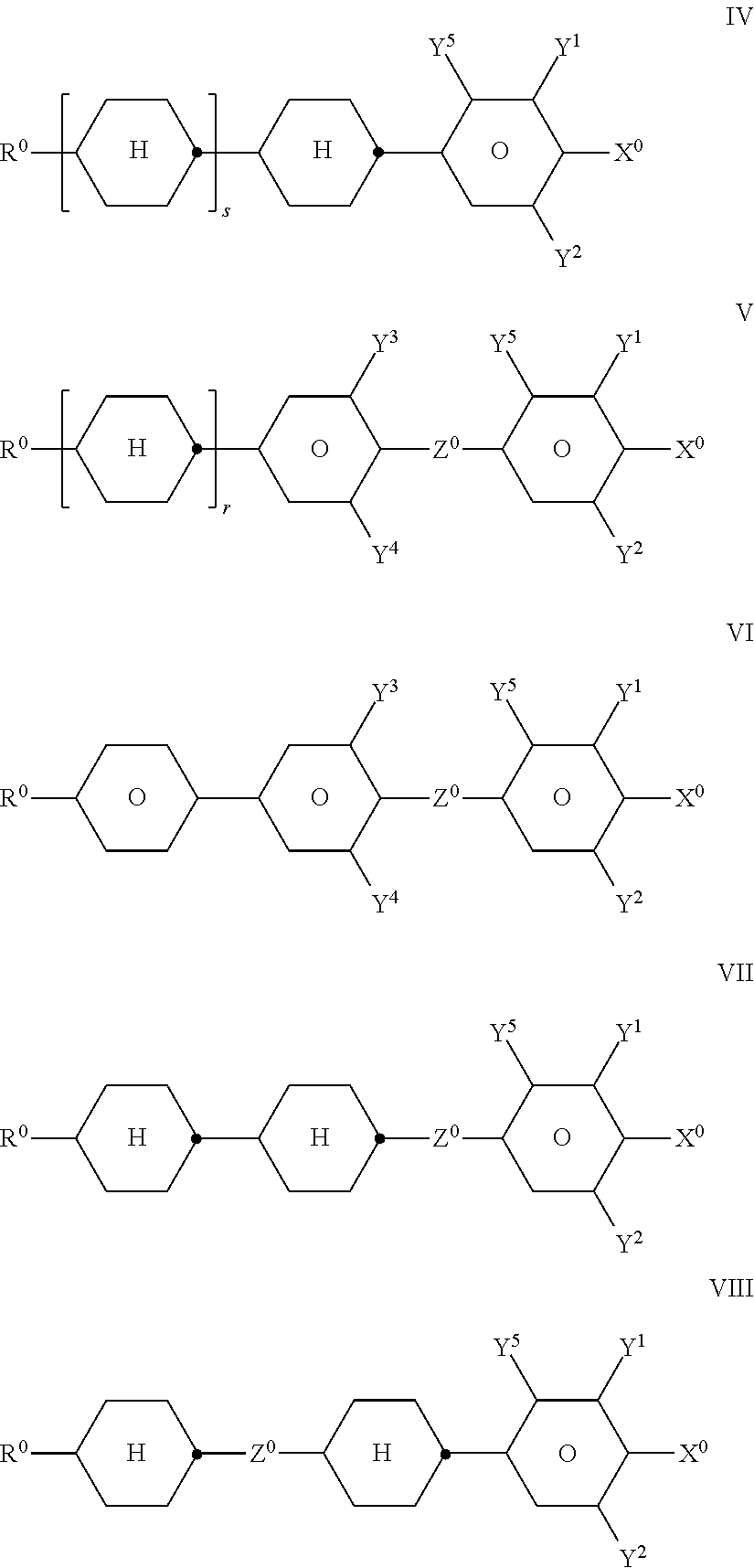
in which
- R0, X0 and Y1-5 have the meanings indicated above, and
- Z0 denotes —C2H4—, —(CH2)4—, —CH═CH—, —CF═CF—, —C2F4—, —CH2CF2—, —CF2CH2—, —CH2O—, —OCH2—, —COO— or —OCF2—, in formulae V and VI also a single bond, in formulae V and VIII also —CF2O—,
- r denotes 0 or 1, and
- s denotes 0 or 1;
- The compounds of the formula IV are preferably selected from the following formulae:

in which R0 and X0 have the meanings indicated above.
- R0 preferably denotes alkyl having 1 to 6 C atoms. X0 preferably denotes F or OCF3, furthermore OCF═CF2 or C1;
- The compounds of the formula IVa are preferably selected from the following subformula:

in which R0 has the meanings indicated above and is preferably propyl or pentyl.
-
- The compounds of the formula IVc are preferably selected from the following subformula:

in which R0 has the meanings indicated above and is preferably propyl or pentyl.
-
- The compounds of the formula V are preferably selected from the following subformulae:

in which R0 and X0 have the meanings indicated above.
-
- The compounds of the formula VI are preferably selected from the following subformulae:

in which R0 and X0 have the meanings indicated above.
-
- The compounds of the formula VII are preferably selected from the following subformulae:

in which R0 and X0 have the meanings indicated above.
-
- The medium additionally comprises one or more compounds selected from the following subformulae:

in which X0 has the meanings indicated above, and
- L denotes H or F,
- “alkyl” denotes C1-6-alkyl,
- R′ denotes methyl, C4-6-alkyl or C1-6-alkoxy, wherein, if R′ is different from C1-6 alkoxy, then “alkyl” in formula IX is not ethyl or propyl,
- R″ denotes C1-6-alkyl, C1-6-alkoxy or C2-6-alkenyl, and
- “alkenyl” and “alkenyl*” each, independently of one another, denote C2-6-alkenyl, and in formula X “alkenyl” denotes C3-6 alkenyl.
- The compounds of the formulae IX-XIII are preferably selected from the following subformulae:

wherein “alkyl” has the meaning given in formula IX, “alkyl*” is methyl, butyl, pentyl or hexyl and “alkyl**” is butyl, pentyl or hexyl.
-
- Preferred compounds are selected from the following group

-
- The medium additionally comprises one or more compounds selected from the following formulae:

in which L1 and L2 have the meanings indicated above, and R1 and R2 each, independently of one another, denote n-alkyl, alkoxy, oxaalkyl, fluoroalkyl or alkenyl, each having up to 6 C atoms, and preferably each, independently of one another, denote alkyl having 1 to 6 C atoms, and the compounds of formula XIV are different from those of formula P; in the compound of the formula XIV, at least one of the radicals R1 and R2 preferably denotes alkenyl having 2 to 6 C atoms.
-
- The medium comprises one or more compounds of the formula XIV in which at least one of the radicals R1 and R2 denotes alkenyl having 2 to 6 C atoms, preferably those selected from the following subformulae:

in which “alkyl” has the meaning indicated above, and preferably denotes methyl, ethyl or propyl;
-
- The compounds of the formulae XIV are preferably selected from the following subformulae:

-
- The medium comprises one or more compounds of the formula XVI,

in which R1 and R2 have the meanings indicated above and preferably each, independently of one another, denote alkyl having 1 to 6 C atoms. L denotes H or F.

in which
- alkyl and alkyl* each, independently of one another, denote a straight-chain alkyl radical having 1-6 C atoms, in particular ethyl, propyl or pentyl,
- alkenyl
- and alkenyl* each, independently of one another, denote a straight-chain alkenyl radical having 2-6 C atoms, in particular CH2═CHC2H4, CH3CH═CHC2H4, CH2═CH and CH3CH═CH.

-
- The medium comprises one or more compounds of the following formulae:

in which R1 and R2 have the meanings indicated above and preferably each, independently of one another, denote alkyl having 1 to 6 C atoms. L denotes H or F. Very preferred are compounds of formula XVIIa wherein L is H Very preferred are compounds of formula XVIIb wherein L is F.
-
- The medium additionally comprises one or more compounds selected from the following formulae:


in which R0 and X0 each, independently of one another, have one of the meanings indicated above, and Y1-4 each, independently of one another, denote H or F and Y5 denotes H or CH3, preferably H. X° is preferably F, Cl, CF3, OCF3 or OCHF2. R0 preferably denotes alkyl, alkoxy, oxaalkyl, fluoroalkyl or alkenyl, each having up to 6 C atoms.

in which R0 has the meanings indicated above. R0 preferably denotes straight-chain alkyl, in particular ethyl, n-propyl, n-butyl or n-pentyl and very particularly preferably n-propyl.

in which R0 has the meanings indicated above. R0 preferably denotes straight-chain alkyl, in particular ethyl, n-propyl, n-butyl or n-pentyl and very particularly preferably n-propyl.

in which R0 has the meanings indicated above. R0 preferably denotes straight-chain alkyl, in particular ethyl, n-propyl, n-butyl or n-pentyl and very particularly preferably n-propyl.
-
- The medium additionally comprises one or more compounds of the formula XXIV,

in which R0, X0 and Y1-6 have the meanings indicated in formula I, s denotes 0 or 1, and

denotes

-
- The compounds of the formula XXIV are preferably selected from the following subformulae:

in which R0, X0 and Y1 have the meanings indicated above. R0 preferably denotes alkyl having 1 to 6 C atoms. X0 preferably denotes F, and Y1 is preferably F;

is preferably

-
- R0 is straight-chain alkyl or alkenyl having 2 to 6 C atoms;
- The medium comprises one or more compounds of the following formulae:

in which R1 and X0 have the meanings indicated above. R1 preferably denotes alkyl having 1 to 6 C atoms. X0 preferably denotes F or Cl. In the formula XXIV, X0 very particularly preferably denotes Cl.
-
- The medium comprises one or more compounds of the following formulae:

in which R1 and X0 have the meanings indicated above. R1 preferably denotes alkyl having 1 to 6 C atoms. X0 preferably denotes F. The medium according to the invention particularly preferably comprises one or more compounds of the formula XXIX in which X0 preferably denotes F.

in which R1 has the meanings indicated above, and preferably denotes straight-chain alkyl, in particular ethyl, n-propyl, n-butyl or n-pentyl and very particularly preferably n-propyl.
-
- The medium comprises one or more compounds of the following pyrimidine or pyridine compounds of the formulae

in which R1 and X0 have the meanings indicated above. R1 preferably denotes alkyl having 1 to 6 C atoms. X0 preferably denotes F. The medium according to the invention particularly preferably comprises one or more compounds of the formula XXX1, in which X0 preferably denotes F. The compound(s) of the formulae XXX1 to XXX3 is (are) preferably employed in the mixtures according to the invention in amounts of 1-20% by weight, particularly preferably 1-15% by weight.
-
- The medium additionally comprises one or more compounds of the following formula:

in which R0 and X0 and Y1-4 have the meanings indicated above with X0 being different from F

in which R0 has the meanings indicated above. R0 preferably denotes straight-chain alkyl, in particular ethyl, n-propyl, n-butyl or n-pentyl and very particularly preferably n-propyl.
-
- The medium additionally comprises one or more compounds of the following formula:

-
- in which L, R1 and R2 have the meanings indicated above. R1 and R2 preferably denote alkyl, alkoxy, oxaalkyl, fluoroalkyl or alkenyl, each having up to 6 C atoms.
- Very preferably the medium according to the invention comprises one or more compounds of the formula XXXIVa,

-
- in which “alkyl” denotes a straight-chain alkyl radical having 1-6 C atoms, in particular ethyl, propyl or pentyl.
- The compound(s) of the formula XXXIV, in particular of the formula XXXIVa, is (are) preferably employed in the mixtures according to the invention in amounts of 0.5-10% by weight, particularly preferably 1-5% by weight.
-
- The medium comprises one or more compounds of formula I or its subformulae and one or more compounds selected from the group consisting of formulae Z1, Z2, Z3, Y, B, LY, AY, II, III, IV, V, VI, VII, VIII, IX, X, XI, XII, XIII, XIV, XV, XVI, XVIIa, XVIIb, XVIIc, XVIII, XIX, XX, XXI, XII, XXIII, XXIV, XXV, XXVI, XXVII, XXVIII, XXIX, XXX, XXX1, XXX2, XXX3, XXXI, XXXII, XXXIII and XXXIV and their subformulae.
- The medium comprises one or more compounds of formula I or its subformulae and one or more compounds selected from the group consisting of formulae Z1, Z2, Z3, Y, B, II, III, IV, VI, IX, X, XIV, XVI, XVIIa, XVIIb, XVIIc, XX, XII, XXIII, XXIX, XXXI and XXXIV and their subformulae.
- The medium does not contain a compound of formula Y, B, AY or LY.
- The medium comprises one or more compounds of the formula II, preferably selected from the group consisting of formula II, II2 and II3, very preferably from formula II and 112. The individual concentration of each of these compounds is preferably from 2 to 15% by weight. The total concentration of these compounds is preferably from 5 to 25% by weight.
- The medium comprises one or more compounds of the formula III, preferably selected from the group consisting of formula III1, III4, III6, III16, III19 and III20, very preferably from the group consisting of formula III1, III6, III16 and III20. The individual concentration of each of these compounds is preferably from 2 to 15% by weight. The total concentration of these compounds is preferably from 5 to 30% by weight.
- The medium comprises one or more compounds of the formula IV, preferably selected from formula Va or IVc, very preferably from formula IVa1 or IVc1, most preferably of formula IVc1. The individual concentration of each of these compounds is preferably from 2 to 15% by weight. The total concentration of these compounds is preferably from 5 to 20% by weight.
- The medium comprises one or more compounds of the formula VI, preferably selected from formula VIb. The individual concentration of each of these compounds is preferably from 1 to 20% by weight. The total concentration of these compounds is preferably from 5 to 20% by weight.
- The medium comprises one or more compounds of the formula IX, preferably selected from formula IXa. The total concentration of these compounds is preferably from 1 to 25% by weight.
- The medium comprises one or more compounds of the formula X, preferably selected from formulae Xb and Xc, very preferably from formulae Xb2 and Xc1. The total concentration of these compounds is preferably from 2 to 35%, very preferably from 3 to 25% by weight.
- The medium comprises from 5 to 20% by weight of compounds of formula Xb, preferably of formula Xb2.
- The medium comprises from 5 to 20% by weight of compounds of formula Xc, preferably of formula Xc1.
- The medium comprises from 10 to 65%, very preferably from 20 to 60% by weight of compounds of formula XIb.
- The medium comprises one or more compounds of the formula XII, preferably of the formula XIIa or XIIb, very preferably of formula XIIa, most preferably of formula XIa1. The concentration of these compounds is preferably from 2 to 15% by weight.
- The medium comprises from 1 to 15% by weight of compounds of formula XIIb.
- The medium comprises one or more compounds of the formula XIV, preferably of the formula XIVd, very preferably of formula XIVd1. The concentration of these compounds is preferably from 2 to 10% by weight.
- The medium comprises one or more compounds of the formula XVIb, preferably of formula XVIb1, XVIb2 and/or XV13. The concentration of these compounds is preferably from 2 to 15% by weight.
- The medium comprises one or more compounds of the formula XVIc, preferably of formula XVIc1, XVIc2 and/or XVIc3. The concentration of these compounds is preferably from 2 to 20% by weight.
- The medium comprises one or more compounds of the formula XVIg, preferably of the formula XVIg1 and/or XVIg2. The total concentration of these compounds is preferably from 5 to 25% by weight.
- The medium comprises one or more compounds selected from the group consisting of the formulae XVIIa, XVIIb and XVIIc, very preferably of formula XVIIa wherein L is H and of formula XVIIb wherein L is F. The total concentration of these compounds is preferably from 0.5 to 5% by weight.
- The medium comprises one or more compounds of the formula XX, preferably of the formula XXa. The concentration of these compounds is preferably from 2 to 10% by weight.
- The medium comprises one or more compounds of the formula XXI, preferably of the formula XXIa. The concentration of these compounds is preferably from 2 to 10% by weight.
- The medium comprises one or more compounds of the formula XXIII, preferably of the formula XXIIIa. The concentration of these compounds is preferably from 0.5 to 5% by weight.
- The medium comprises one or more compounds of the formula XXIX, preferably of the formula XXIXa. The concentration of these compounds is preferably from 2 to 10% by weight.
- The medium comprises one or more compounds of the formula XXX, preferably of the formula XXXa. The concentration of these compounds is preferably from 2 to 10% by weight.
- The medium comprises one or more compounds of the formula XXXI. The concentration of these compounds is preferably from 2 to 10% by weight.
- The medium comprises one or more compounds of the formula XXXI. The concentration of these compounds is preferably from 2 to 10% by weight.
- The medium comprises one or more compounds of the formula XXXIV, preferably of the formula XXXIVa. The concentration of these compounds is preferably from 1 to 5% by weight.
- The medium comprises one or more compounds of formula I, preferably of formula I1, one or more compounds selected from the group consisting of the formulae Z1, Z2 and Z3 or their subformulae, one or more compounds selected from the group consisting of formulae IX, X and XIV or their subformulae, one or more compounds selected from the group consisting of formulae II, III, IV, VI, XX, XXIII and XXIX or their subformulae, and one or more compounds selected from the group consisting of the formulae XII, XVI, XVIIa, XVIIb, XVIIc, XXXI and XXXIV or their subformulae.
- The medium comprises one or more compounds of formula I, preferably of formula I1, one or more compounds selected from the group consisting of the formulae Z1, Z2 and Z3 or their subformulae, one or more compounds selected from the group consisting of formulae IXa, Xb, XIb and XIVd or their subformulae, one or more compounds selected from the group consisting of formulae II, III, IVc, VIb, XXa, XXIIIa and XXIXa or their subformulae, and one or more compounds selected from the group consisting of the formulae XIIb, XVIb, XVIc, XVIIa, XVIIb, XVIIc, XXXI and XXXIVa or their subformulae.
- The medium comprises one or more compounds of formula I, preferably of formula I1, one or more compounds selected from the group consisting of the formulae Z1, Z2 and Z3 or their subformulae, one or more compounds of formula Y, preferably selected from the group consisting of the formulae Y1 and Y2, one or more compounds selected from the group consisting of formulae IX, X and XIV or their subformulae, one or more compounds selected from the group consisting of formulae II, III, IV, VI, XX, XXIII and XXIX or their subformulae, and one or more compounds selected from the group consisting of the formulae XII, XVI, XVIIa, XVIIb, XVIIc, XXXI and XXXIV or their subformulae.
- The medium comprises one or more compounds of formula I, preferably of formula I1, one or more compounds selected from the group consisting of the formulae Z1, Z2 and Z3 or their subformulae, one or more compounds of formula B, preferably selected from the group consisting of the formulae B1, B2 and B3, one or more compounds selected from the group consisting of formulae IXa, Xb, XIb and XIVd or their subformulae, one or more compounds selected from the group consisting of formulae II, III, IVc, VIb, XXa, XXIIIa and XXIXa or their subformulae, and one or more compounds selected from the group consisting of the formulae XIIb, XVIb, XVIc, XVIIa, XVIIb, XVIIc, XXXI and XXXIVa or their subformulae.
- Besides the compounds of the formulae I, the medium comprises further compounds selected from the group of the compounds of the formula Z1, Z2, Z3, Y, B, IV, IX, X, XII, XIV, XVI, XVIIa, XVIIb, XVIIc, XXI, XXIII, XXIX, XXX, XXXI and XXIV or their subformulae.
- Besides the compounds of the formulae I, the medium comprises further compounds selected from the group of the compounds of the formula Z1, Z2, Z3, IV, IX, X, XII, XIV, XVI, XVIIa, XVIIb, XVIIc, XXI, XXIII, XXIX, XXX, XXXI and XXIV or their subformulae.
- The proportion of compounds of formula I or its subformulae in the medium is from 1 to 30%, very preferably from 2 to 25%, most preferably from 2 to 20% by weight.
- The proportion of compounds of the formula Z1, Z2 and Z3 or their subformulae in the mixture as a whole is from 10 to 65%, very preferably from 20 to 60%.
- The proportion of compounds of the formula Y or its subformulae in the mixture as a whole is from 1 to 20%, very preferably from 2 to 15%.
- The proportion of compounds of the formula B or its subformulae in the mixture as a whole is from 1 to 20%, very preferably from 2 to 18%.
- The proportion of compounds of the formulae II, III, IV-VIII, XVIII-XXIII and XXVII-XXX in the mixture as a whole is 30 to 60% by weight.
- The proportion of compounds of the formulae IX-XV in the mixture as a whole is 40 to 70% by weight.
- The proportion of compounds of the formulae XIV, XVIIa-c and XXXI-XXXIV in the mixture as a whole is 0.5 to 15% by weight.
Ra—B1—(Zb—B2)m—Rb M
in which the individual radicals, on each occurrence identically or differently, and each, independently of one another, have the following meaning:
- Ra and Rb P, P-Sp-, H, F, Cl, Br, I, —CN, —NO2, —NCO, —NCS, —OCN, —SCN, SF5 or straight-chain or branched alkyl having 1 to 25 C atoms, in which, in addition, one or more non-adjacent CH2 groups may each be replaced, independently of one another, by —C(R0)═C(R00)—, —C≡C—, —N(R00)—, —O—, —S—, —CO—, —CO—O—, —O—CO—, —O—CO—O— in such a way that O and/or S atoms are not linked directly to one another, and in which, in addition, one or more H atoms may be replaced by F, C, Br, I, CN, P or P-Sp-, where, if B1 and/or B2 contain a saturated C atom, Ra and/or Rb may also denote a radical which is spiro-linked to this saturated C atom,
- wherein at least one of the radicals Ra and Rb denotes or contains a group P or P-Sp-,
- P a polymerisable group,
- Sp a spacer group or a single bond,
- B1 and B2 an aromatic, heteroaromatic, alicyclic or heterocyclic group, preferably having 4 to 25 ring atoms, which may also contain fused rings, and which is unsubstituted, or mono- or polysubstituted by L,
- Zb —O—, —S—, —CO—, —CO—O—, —OCO—, —O—CO—O—, —OCH2—, —CH2O—, —SCH2—, —CH2S—, —CF2O—, —OCF2—, —CF2S—, —SCF2—, —(CH2)n1—, —CF2CH2—, —CH2CF2—, —(CF2)n1—, —CH═CH—, —CF═CF—, —C≡C—, —CH═CH—COO—, —OCO—CH═CH—, CR0R00 or a single bond,
- R0 and R00 each, independently of one another, denote H or alkyl having 1 to 12 C atoms,
- m denotes 0, 1, 2, 3 or 4,
- n1 denotes 1, 2, 3 or 4,
- L P, P-Sp-, OH, CH2OH, F, Cl, Br, I, —CN, —NO2, —NCO, —NCS, —OCN, —SCN, —C(═O)N(Rx)2, —C(═O)Y1, —C(═O)Rx, —N(Rx)2, optionally substituted silyl, optionally substituted aryl having 6 to 20 C atoms, or straight-chain or branched alkyl, alkoxy, alkylcarbonyl, alkoxycarbonyl, alkylcarbonyloxy or alkoxycarbonyloxy having 1 to 25 C atoms, in which, in addition, one or more H atoms may be replaced by F, C, P or P-Sp-,
- P and Sp have the meanings indicated above,
- Y1 denotes halogen,
- Rx denotes P, P-Sp-, H, halogen, straight-chain, branched or cyclic alkyl having 1 to 25 C atoms, in which, in addition, one or more non-adjacent CH2 groups may be replaced by —O—, —S—, —CO—, —CO—O—, —O—CO—, —O—CO—O— in such a way that O and/or S atoms are not linked directly to one another, and in which, in addition, one or more H atoms may be replaced by F, Cl, P or P-Sp-, an optionally substituted aryl or aryloxy group having 6 to 40 C atoms, or an optionally substituted heteroaryl or heteroaryloxy group having 2 to 40 C atoms.


in which the individual radicals, on each occurrence identically or differently, and each, independently of one another, have the following meaning:
- P1, P2, P3 a polymerisable group, preferably selected from vinyloxy, acrylate, methacrylate, fluoroacrylate, chloroacrylate, oxetane and epoxy,
- Sp1, Sp2, Sp3 a single bond or a spacer group where, in addition, one or more of the radicals P1—Sp1—, P1—Sp2— and P3—Sp3— may denote Raa, with the proviso that at least one of the radicals P1—Sp1—, P2—Sp2 and P3—Sp3— present is different from Raa, preferably —(CH2)p1—, —(CH2)p1—O—, —(CH2)p1—CO—O— or —(CH2)p1—O—CO—O—, wherein p1 is an integer from 1 to 12,
- Raa H, F, Cl, CN or straight-chain or branched alkyl having 1 to 25 C atoms, in which, in addition, one or more non-adjacent CH2 groups may each be replaced, independently of one another, by —C(R0)═C(R00)—, —C≡C—, —N(R0)—, —O—, —S—, —CO—, —CO—O—, —O—CO—, —O—CO—O— in such a way that O and/or S atoms are not linked directly to one another, and in which, in addition, one or more H atoms may be replaced by F, Cl, CN or P1—Sp1—, particularly preferably straight-chain or branched, optionally mono- or polyfluorinated alkyl, alkoxy, alkenyl, alkynyl, alkylcarbonyl, alkoxycarbonyl, alkylcarbonyloxy or alkoxycarbonyloxy having 1 to 12 C atoms (where the alkenyl and alkynyl radicals have at least two C atoms and the branched radicals have at least three C atoms),
- R0, R00 H or alkyl having 1 to 12 C atoms,
- Ry and Rz H, F, CH3 or CF3,
- X1, X2, X3 —CO—O—, —O—CO— or a single bond,
- ZM1 —O—, —CO—, —C(RyRz)— or —CF2CF2—,
- ZM2, ZM3 —CO—O—, —O—CO—, —CH2O—, —OCH2—, —CF2O—, —OCF2— or —(CH2)n—, where n is 2, 3 or 4,
- L F, Cl, CN or straight-chain or branched, optionally mono- or polyfluorinated alkyl, alkoxy, alkenyl, alkynyl, alkylcarbonyl, alkoxycarbonyl, alkylcarbonyloxy or alkoxycarbonyloxy having 1 to 12 C atoms,
- L′, L″ H, F or Cl,
- r 0, 1, 2, 3 or 4,
- s 0, 1, 2 or 3,
- t 0, 1 or 2,
- x 0 or 1.

is preferably

wherein L on each occurrence, identically or differently, has one of the meanings given above or below, and is preferably F, Cl, CN, NO2, CH3, C2H5, C(CH3)3, CH(CH3)2, CH2CH(CH3)C2H5, OCH3, OC2H5, COCH3, COC2H5, COOCH3, COOC2H5, CF3, OCF3, OCHF2, OC2F5 or P-Sp-, very preferably F, Cl, CN, CH3, C2H5, OCH3, COCH3, OCF3 or P-Sp-, more preferably F, Cl, CH3, OCH3, COCH3 or OCF3, especially F or CH3.

CH2═CW2—(O)k3—, CW1═CH—CO—(O)k3—, CW1═CH—CO—NH—CH2═CW1—CO—NH—, CH3—CH═CH—O—, (CH2═CH)2CH—OCO—, (CH2═CH—CH2)2CH—OCO—, (CH2═CH)2CH—O—, (CH2═CH—CH2)2N—, (CH2═CH—CH2)2N—CO—, HO—CW2W3—, HS—CW2W3—, HW2N—, HO—CW2W3—NH—, CH2═CW1—CO—NH—, CH2═CH—(COO)k1-Phe-(O)k2—, CH2═CH—(CO)k1-Phe-(O)k2—, Phe-CH═CH—, HOOC—, OCN— and W4W5W6Si—, in which W1 denotes H, F, Cl, CN, CF3, phenyl or alkyl having 1 to 5 C atoms, in particular H, F, Cl or CH3, W2 and W3 each, independently of one another, denote H or alkyl having 1 to 5 C atoms, in particular H, methyl, ethyl or n-propyl, W4, W5 and W6 each, independently of one another, denote Cl, oxaalkyl or oxacarbonylalkyl having 1 to 5 C atoms, W7 and W8 each, independently of one another, denote H, C1 or alkyl having 1 to 5 C atoms, Phe denotes 1,4-phenylene, which is optionally substituted by one or more radicals L as defined above which are other than P-Sp-, k1, k2 and k3 each, independently of one another, denote 0 or 1, k3 preferably denotes 1, and k4 denotes an integer from 1 to 10.

CH2═CW2—O—, CH2═CW2—, CW1═CH—CO—(O)k3—, CW1═CH—CO—NH—, CH2═CW1—CO—NH—, (CH2═CH)2CH—OCO—, (CH2═CHCH2)2CH—OCO—, (CH2═CH)2CH—O—, (CH2═CH—CH2)2N—, (CH2═CH—CH2)2N—CO, CH2═CW1—CO—NH—, CH2═CH—(COO)k1-Phe-(O)k2—, CH2═CH—(CO)k1-Phe(O)k2—, Phe-CH═CH— and W4W5W6Si—, in which W1 denotes H, F, Cl, CN, CF3, phenyl or alkyl having 1 to 5 C atoms, in particular H, F, Cl or CH3, W2 and W3 each, independently of one another, denote H or alkyl having 1 to 5 C atoms, in particular H, methyl, ethyl or n-propyl, W4, W5 and W6 each, independently of one another, denote Cl, oxaalkyl or oxacarbonylalkyl having 1 to 5 C atoms, W7 and W8 each, independently of one another, denote H, C1 or alkyl having 1 to 5 C atoms, Phe denotes 1,4-phenylene, k1, k2 and k3 each, independently of one another, denote 0 or 1, k3 preferably denotes 1, and k4 denotes an integer from 1 to 10.

- Sp″ denotes alkylene having 1 to 20, preferably 1 to 12, C atoms, which is optionally mono- or polysubstituted by F, Cl, Br, I or CN and in which, in addition, one or more non-adjacent CH2 groups may each be replaced, independently of one another, by —O—, —S—, —NH—, —N(R0)—, —Si(R0)—, —Si(R0R00)—, —CO—, —CO—O—, —O—CO—, —O—CO—O—, —S—CO—, —CO—S—, —N(R00)—CO—O—, —O—CO—N(R0)—, —N(R0)—CO—N(R00)—, —CH═CH— or —C≡C— in such a way that O and/or S atoms are not linked directly to one another,
- X″ denotes —O—, —S—, —CO—, —CO—O—, —O—CO—, —O—CO—O—, —CO—N(R0)—, —N(R0)—CO—, —N(R0)—CO—N(R00)—, —OCH2—, —CH2O—, —SCH2—, —CH2S, —CF2O—, —OCF2—, —CF2S—, —SCF2—, —CF2CH2—, —CH2CF2—, —CF2CF2—, —CH═N—, —N═CH—, —N═N—, —CH═CRO—, —CY2═CY3—, —C≡C—, —CH═CH—CO—O—, —O—CO—CH═CH— or a single bond,
- R0 and R00 each, independently of one another, denote H or alkyl having 1 to 20 C atoms, and
- Y2 and Y3 each, independently of one another, denote H, F, Cl or CN.

or esters of the formula

instead of the compounds of the formulae I ST-1, ST-2, RV, IA and IB.

wherein the individual radicals, independently of each other and on each occurrence identically or differently, have the following meanings
- Ra-d straight-chain or branched alkyl with 1 to 10, preferably 1 to 6, very preferably 1 to 4 C atoms, most preferably methyl,
- XS H, CH3, OH or O⋅,
- AS straight-chain, branched or cyclic alkylene with 1 to 20 C atoms which is optionally substituted,
- n an integer from 1 to 6, preferably 3.

wherein n2 is an integer from 1 to 12, and wherein one or more H atoms in the group (CH2)n2 are optionally replaced by methyl, ethyl, propyl, butyl, pentyl or hexyl.


| Code for R1*, | ||||
| R2*, L1*, L2*, L3* | R1* | R2* | L1* | L2* |
| nm | CnH2n+1 | CmH2m+1 | H | H |
| nOm | CnH2n+1 | OCmH2m+1 | H | H |
| nO.m | OCnH2n+1 | CmH2m+1 | H | H |
| n | CnH2n+1 | CN | H | H |
| nN.F | CnH2n+1 | CN | F | H |
| nN.F.F | CnH2n+1 | CN | F | F |
| nF | CnH2n+1 | F | H | H |
| nCl | CnH2n+1 | Cl | H | H |
| nOF | OCnH2n+1 | F | H | H |
| nF.F | CnH2n+1 | F | F | H |
| nF.F.F | CnH2n+1 | F | F | F |
| nOCF3 | CnH2n+1 | OCF3 | H | H |
| nOCF3.F | CnH2n+1 | OCF3 | F | H |
| n-Vm | CnH2n+1 | —CH═CH—CmH2m+1 | H | H |
| nV-Vm | CnH2n+1—CH═CH— | —CH═CH—CmH2m+1 | H | H |
| TABLE A |
 |
 |
 |
 |
 |
 |
 |
 |
 |
 |
 |
 |
 |
 |
 |
 |
 |
 |
 |
 |
 |
 |
 |
 |
| TABLE B |
 |
 |
 |
 |
 |
 |
 |
 |
 |
 |
 |
 |
 |
 |
 |
 |
 |
 |
 |
 |
 |
 |
 |
 |
 |
 |
 |
 |
 |
 |
 |
 |
 |
 |
 |
 |
 |
 |
 |
 |
 |
 |
 |
 |
 |
 |
 |
 |
 |
 |
 |
 |
 |
 |
 |
 |
 |
 |
 |
 |
 |
 |
 |
 |
 |
 |
 |
 |
 |
 |
 |
 |
 |
 |
 |
 |
 |
 |
 |
 |
 |
| TABLE C |
 |
 |
 |
 |
 |
 |
 |
 |
 |
 |
 |
 |
 |
preferably comprise 0-10% by weight, in particular 0.01-5% by weight and particularly preferably 0.01-3% by weight of dopants.
| TABLE D |
 |
 |
 |
 |
 |
 |
 |
 |
 |
 |
 |
 |
 |
 |
 |
 |
 |
 |
 |
 |
 |
 |
 |
 |
 |
 |
 |
 |
 |
 |
 |
 |
 |
| TABLE E | |
 |
RM-1 |
 |
RM-2 |
 |
RM-3 |
 |
RM-4 |
 |
RM-5 |
 |
RM-6 |
 |
RM-7 |
 |
RM-8 |
 |
RM-9 |
 |
RM-10 |
 |
RM-11 |
 |
RM-12 |
 |
RM-13 |
 |
RM-14 |
 |
RM-15 |
 |
RM-16 |
 |
RM-17 |
 |
RM-18 |
 |
RM-19 |
 |
RM-20 |
 |
RM-21 |
 |
RM-22 |
 |
RM-23 |
 |
RM-24 |
 |
RM-25 |
 |
RM-26 |
 |
RM-27 |
 |
RM-28 |
 |
RM-29 |
 |
RM-30 |
 |
RM-31 |
 |
RM-32 |
 |
RM-33 |
 |
RM-34 |
 |
RM-35 |
 |
RM-36 |
 |
RM-37 |
 |
RM-38 |
 |
RM-39 |
 |
RM-40 |
 |
RM-41 |
 |
RM-42 |
 |
RM-43 |
 |
RM-44 |
 |
RM-45 |
 |
RM-46 |
 |
RM-47 |
 |
RM-48 |
 |
RM-49 |
 |
RM-50 |
 |
RM-51 |
 |
RM-52 |
 |
RM-53 |
 |
RM-54 |
 |
RM-55 |
 |
RM-56 |
 |
RM-57 |
 |
RM-58 |
 |
RM-59 |
 |
RM-60 |
 |
RM-61 |
 |
RM-62 |
 |
RM-63 |
 |
RM-64 |
 |
RM-65 |
 |
RM-66 |
 |
RM-67 |
 |
RM-68 |
 |
RM-69 |
 |
RM-70 |
 |
RM-71 |
 |
RM-72 |
 |
RM-73 |
 |
RM-74 |
 |
RM-75 |
 |
RM-76 |
 |
RM-77 |
 |
RM-78 |
 |
RM-79 |
 |
RM-80 |
 |
RM-81 |
 |
RM-82 |
 |
RM-83 |
 |
RM-84 |
 |
RM-85 |
 |
RM-86 |
 |
RM-87 |
 |
RM-88 |
 |
RM-89 |
 |
RM-90 |
 |
RM-91 |
 |
RM-92 |
 |
RM-93 |
 |
RM-94 |
 |
RM-95 |
 |
RM-96 |
 |
RM-97 |
 |
RM-98 |
 |
RM-99 |
 |
RM-100 |
 |
RM-101 |
 |
RM-102 |
 |
RM-103 |
 |
RM-104 |
 |
RM-105 |
 |
RM-106 |
 |
RM-107 |
 |
RM-108 |
 |
RM-109 |
 |
RM-110 |
 |
RM-111 |
 |
RM-112 |
 |
RM-113 |
 |
RM-114 |
 |
RM-115 |
 |
RM-116 |
 |
RM-117 |
 |
RM-118 |
 |
RM-119 |
 |
RM-120 |
 |
RM-121 |
 |
RM-122 |
 |
RM-123 |
 |
RM-124 |
 |
RM-125 |
 |
RM-126 |
 |
RM-127 |
 |
RM-128 |
 |
RM-129 |
 |
RM-130 |
 |
RM-131 |
 |
RM-132 |
 |
RM-133 |
 |
RM-134 |
 |
RM-135 |
 |
RM-136 |
 |
RM-137 |
 |
RM-138 |
 |
RM-139 |
 |
RM-140 |
 |
RM-141 |
 |
RM-142 |
 |
RM-143 |
| TABLE E | |
 |
SA-1 |
 |
SA-2 |
 |
SA-3 |
 |
SA-4 |
 |
SA-5 |
 |
SA-6 |
 |
SA-7 |
 |
SA-8 |
 |
SA-9 |
 |
SA-10 |
 |
SA-11 |
 |
SA-12 |
 |
SA-13 |
 |
SA-14 |
 |
SA-15 |
 |
SA-16 |
 |
SA-17 |
 |
SA-18 |
 |
SA-19 |
 |
SA-20 |
 |
SA-21 |
 |
SA-22 |
 |
SA-23 |
 |
SA-24 |
 |
SA-25 |
 |
SA-26 |
 |
SA-27 |
 |
SA-28 |
 |
SA-29 |
 |
SA-30 |
 |
SA-31 |
 |
SA-32 |
 |
SA-33 |
 |
SA-34 |
- V0 Freedericks threshold voltage, capacitive [V] at 20° C.,
- V10 voltage [V] for 10% transmission,
- ne extraordinary refractive index measured at 20° C. and 589 nm,
- no ordinary refractive index measured at 20° C. and 589 nm,
- Δn optical anisotropy measured at 20° C. and 589 nm,
- ε⊥ dielectric susceptibility (or “dielectric constant”) perpendicular to the to the longitudinal axes of the molecules at 20° C. and 1 kHz,
- ε∥ dielectric susceptibility (or “dielectric constant”) parallel to the to the longitudinal axes of the molecules at 20° C. and 1 kHz,
- Δε dielectric anisotropy at 20° C. and 1 kHz,
- cl.p. or
- T(N,I) clearing point [° C.],
- v flow viscosity measured at 20° C. [mm2·s−1],
- γ1 rotational viscosity measured at 20° C. [mPa·s],
- K1 elastic constant, “splay” deformation at 20° C. [pN],
- K2 elastic constant, “twist” deformation at 20° C. [pN],
- K3 elastic constant, “bend” deformation at 20° C. [pN], and
- LTS low-temperature stability of the phase [h] in bulk
- VHR voltage holding ratio.
| PGUQU-3-F | 2.0% | cl.p. | 81.0 | |
| BCH-3F.F.F | 14.5% | Δn | 0.0997 | |
| PPGU-3-F | 0.5% | ne | 1.5887 | |
| CC-3-V | 48.0% | no | 1.4890 | |
| CC-4-V | 5.5% | Δε | 2.4 | |
| CCP-3-1 | 3.0% | ε∥ | 5.0 | |
| CCP-V-1 | 12.5% | ε⊥ | 2.6 | |
| CBC-33F | 3.0% | γ1 | 53 | |
| PGP-2-3 | 8.0% | K1 | 13.1 | |
| PGP-2-4 | 3.0% | K3 | 14.2 | |
| γ1/K1 | 4.0 mPas/pN | |||
| LTS bulk | 1000 | |||
| CBC-33F | 3.0% | cl.p. | 78.5 | |
| PPGU-3-F | 0.5% | Δn | 0.1000 | |
| BCH-32 | 4.5% | ne | 1.5881 | |
| BCH-3F.F.F | 12.0% | no | 1.4881 | |
| CCP-3-1 | 3.0% | Δε | 2.5 | |
| CCP-V-1 | 6.5% | ε∥ | 5.1 | |
| PGP-2-3 | 3.0% | ε⊥ | 2.6 | |
| PGP-2-4 | 5.0% | γ1 | 51 | |
| PGU-3-F | 5.5% | K1 | 13.5 | |
| CC-3-V | 49.0% | K3 | 14.1 | |
| CC-3-V1 | 8.0% | γ1/K1 | 3.8 mPas/pN | |
| LTS | 1000 | |||
| CBC-33F | 3.0% | cl.p. | 79.5 | |
| PPGU-3-F | 0.5% | Δn | 0.0980 | |
| BCH-32 | 6.5% | ne | 1.5852 | |
| PGP-2-3 | 6.0% | no | 1.4872 | |
| PGP-2-4 | 6.0% | Δε | 2.4 | |
| CC-3-V | 49.0% | ε∥ | 5.1 | |
| CC-3-V1 | 8.0% | ε⊥ | 2.7 | |
| CLU-3-F | 20.0% | γ1 | 51 | |
| BCH-5F.F.F | 1.0% | K1 | 14.5 | |
| K3 | 14.0 | |||
| γ1/K1 | 3.5 mPas/pN | |||
| LTS | 1000 | |||
| CDUQU-3-F | 8.0% | cl.p. | 103.5 | |
| CPGP-5-2 | 2.5% | Δn | 0.1114 | |
| DGUQU-4-F | 6.0% | ne | 1.5990 | |
| DPGU-4-F | 4.0% | no | 1.4876 | |
| PGUQU-3-F | 2.0% | Δε | 6.7 | |
| CCP-V-1 | 11.0% | ε∥ | 9.7 | |
| CCP-V2-1 | 9.0% | ε⊥ | 3.0 | |
| PGP-2-2V | 6.0% | γ1 | 95 | |
| CC-3-2V1 | 8.0% | K1 | 18.5 | |
| CC-3-V | 23.5% | K3 | 19.4 | |
| CC-3-V1 | 10.0% | LTS | 1000 | |
| PP-1-2V1 | 5.0% | |||
| CLU-3-F | 5.0% | |||
| APUQU-3-F | 3.0% | cl.p. | 81.0 | |
| CBC-33F | 3.0% | Δn | 0.0938 | |
| PGUQU-3-F | 5.5% | ne | 1.5778 | |
| PPGU-3-F | 0.5% | no | 1.4840 | |
| BCH-32 | 6.5% | Δε | 2.7 | |
| CCP-3-1 | 5.0% | ε∥ | 5.3 | |
| PGP-2-3 | 5.5% | ε⊥ | 2.6 | |
| PGP-2-4 | 3.0% | γ1 | 55 | |
| CC-3-V | 48.5% | K1 | 14.8 | |
| CCH-23 | 5.0% | K3 | 14.3 | |
| CCH-34 | 4.5% | |||
| CCH-35 | 5.0% | |||
| CLU-3-F | 5.0% | |||
| CBC-33F | 3.0% | cl.p. | 80.5 | |
| PPGU-3-F | 0.5% | Δn | 0.0992 | |
| BCH-32 | 4.5% | ne | 1.5883 | |
| BCH-3F.F.F | 12.0% | no | 1.4891 | |
| CCP-3-1 | 3.0% | Δε | 2.5 | |
| CCP-V-1 | 6.5% | ε∥ | 5.2 | |
| PGP-2-3 | 3.0% | ε⊥ | 2.6 | |
| PGP-2-4 | 6.0% | γ1 | 54 | |
| PGU-3-F | 2.5% | K1 | 13.7 | |
| CC-3-V | 49.0% | K3 | 14.2 | |
| CC-3-V1 | 5.0% | LTS | 1000 | |
| CLU-3-F | 5.0% | |||
| CBC-33F | 3.0% | cl.p. | 80.0 | |
| PPGU-3-F | 0.5% | Δn | 0.1006 | |
| BCH-32 | 5.5% | ne | 1.5900 | |
| CCP-3-1 | 3.0% | no | 1.4894 | |
| CCP-V-1 | 4.5% | Δε | 2.5 | |
| PGP-2-3 | 4.0% | ε∥ | 5.2 | |
| PGP-2-4 | 8.0% | ε⊥ | 2.7 | |
| PGU-3-F | 4.5% | γ1 | 55 | |
| CC-3-V | 49.0% | K1 | 13.7 | |
| CC-3-V1 | 3.0% | K3 | 13.8 | |
| CLU-3-F | 7.0% | |||
| CCP-2F.F.F | 8.0% | |||
| CBC-33F | 3.0% | cl.p. | 80.0 | |
| PPGU-3-F | 0.5% | Δn | 0.1000 | |
| BCH-32 | 5.5% | ne | 1.5877 | |
| CCP-3-1 | 3.0% | no | 1.4877 | |
| CCP-V-1 | 4.5% | Δε | 2.5 | |
| PGP-2-3 | 4.0% | ε∥ | 5.2 | |
| PGP-2-4 | 5.0% | ε⊥ | 2.6 | |
| PGU-3-F | 4.0% | γ1 | 54 | |
| CC-3-V | 49.0% | K1 | 13.9 | |
| CC-3-V1 | 6.5% | K3 | 14.3 | |
| CLU-3-F | 7.0% | LTS | 1000 | |
| BCH-3F.F.F | 8.0% | |||
| CBC-33F | 3.0% | cl.p. | 79.0 | |
| PPGU-3-F | 0.5% | Δn | 0.1007 | |
| BCH-32 | 5.5% | ne | 1.5887 | |
| CCP-3-1 | 3.0% | no | 1.4880 | |
| CCP-V-1 | 3.0% | Δε | 2.6 | |
| PGP-2-3 | 4.0% | ε∥ | 5.2 | |
| PGP-2-4 | 5.0% | ε⊥ | 2.6 | |
| PGU-3-F | 6.0% | γ1 | 55 | |
| CC-3-V | 49.0% | K1 | 14.0 | |
| CC-3-V1 | 8.0% | K3 | 14.2 | |
| CLU-3-F | 7.0% | LTS | 1000 | |
| BCH-5F.F.F | 6.0% | |||
| CBC-33F | 3.0% | cl.p. | 80.0 | |
| PPGU-3-F | 0.5% | Δn | 0.0992 | |
| BCH-32 | 5.5% | ne | 1.5867 | |
| CCP-3-1 | 3.0% | no | 1.4875 | |
| CCP-V-1 | 3.0% | Δε | 2.5 | |
| PGP-2-3 | 4.0% | ε∥ | 5.2 | |
| PGP-2-4 | 5.0% | ε⊥ | 2.6 | |
| PGU-3-F | 5.0% | γ1 | 54 | |
| CC-3-V | 49.0% | K1 | 14.2 | |
| CC-3-V1 | 8.0% | K3 | 14.3 | |
| CLU-3-F | 10.0% | LTS | 1000 | |
| BCH-5F.F.F | 4.0% | |||
| CC-3-V | 48.5% | cl.p. | 79.5 | |
| CC-3-V1 | 3.0% | Δn | 0.1005 | |
| CCP-V-1 | 12.0% | ne | 1.5865 | |
| PGP-2-2V | 7.5% | no | 1.4865 | |
| APUQU-3-F | 6.0% | Δε | 2.7 | |
| PGUQU-4-F | 5.0% | ε∥ | 6.2 | |
| DPGU-4-F | 2.0% | ε⊥ | 3.5 | |
| PPGU-3-F | 0.5% | γ1 | 61 | |
| CY-5-O2 | 6.0% | K1 | 13.1 | |
| CCY-5-O2 | 3.5% | K3 | 15.1 | |
| CPY-3-O2 | 3.5% | LTS | 216 | |
| PP-1-2V1 | 2.5% | γ1/K1 | 4.7 mPas/pN | |
| CC-3-V | 48.5% | cl.p. | 78.5 | |
| CC-3-V1 | 1.0% | Δn | 0.1000 | |
| CCP-V-1 | 9.0% | ne | 1.5865 | |
| PGP-2-2V | 8.0% | no | 1.4860 | |
| APUQU-3-F | 1.0% | Δε | 2.6 | |
| PGUQU-4-F | 5.0% | ε∥ | 6.0 | |
| DPGU-4-F | 1.5% | ε⊥ | 3.5 | |
| PPGU-3-F | 0.5% | γ1 | 61 | |
| CY-5-O2 | 5.0% | K1 | 13.3 | |
| CCY-5-O2 | 4.0% | K3 | 14.7 | |
| CPY-3-O2 | 4.0% | LTS | 1000 | |
| PP-1-2V1 | 2.5% | γ1/K1 | 4.6 mPas/pN | |
| CLU-3-F | 10.0% | |||
| CC-3-V | 48.0% | cl.p. | 79 | |
| CCP-V-1 | 10.0% | Δn | 0.0996 | |
| PGP-2-2V | 2.0% | ne | 1.5851 | |
| APUQU-3-F | 2.5% | no | 1.4855 | |
| PGUQU-4-F | 5.5% | Δε | 2.5 | |
| CY-5-O2 | 2.0% | ε∥ | 6.1 | |
| CCY-5-O2 | 2.5% | ε⊥ | 3.6 | |
| CPY-3-O2 | 11.5% | γ1 | 62 | |
| PP-1-2V1 | 6.0% | K1 | 13.7 | |
| CLU-3-F | 10.0% | K3 | 15.6 | |
| CC-3-V | 25.0% | cl.p. | 101.5 | |
| CCP-V-1 | 10.5% | Δn | 0.1120 | |
| BCH-32 | 9.0% | ne | 1.5992 | |
| CCP-30CF3 | 8.0% | no | 1.4872 | |
| CC-3-V1 | 8.0% | Δε | 5.8 | |
| PGUQU-3-F | 7.0% | ε∥ | 8.6 | |
| CLU-3-F | 6.0% | ε⊥ | 2.8 | |
| PGUQU-4-F | 5.0% | γ1 | 86 | |
| CCP-50CF3 | 5.0% | K1 | 17.6 | |
| CCP-3-1 | 5.0% | K3 | 18.3 | |
| BCH-3F.F | 5.0% | |||
| PP-1-2V1 | 3.0% | |||
| PGUQU-5-F | 2.0% | |||
| PCH-302 | 1.5% | |||
| CC-3-V | 47.82% | cl.p. | 75 | ||
| BCH-32 | 8.99% | Δn | 0.1013 | ||
| PGU-2-F | 7.99% | ne | 1.5881 | ||
| CCP-30CF3 | 7.99% | no | 1.4868 | ||
| CLP-3-T | 5.0% | Δε | 3.4 | ||
| CCP-3-1 | 4.99% | ε∥ | 6.0 | ||
| CLU-3-F | 4.83% | ε⊥ | 2.7 | ||
| PGP-2-3 | 3.92% | γ1 | 49 | ||
| PP-1-3 | 3.81% | K1 | 15.0 | ||
| CC-3-V1 | 2.37% | K3 | 13.6 | ||
| PGU-3-F | 2.29% | ||||
| CC-3-V | 38.28% | cl.p. | 76.5 | ||
| CLU-3-F | 15.16% | Δn | 0.1013 | ||
| PCH-302 | 12.19% | ne | 1.5890 | ||
| BCH-32 | 8.99% | no | 1.4877 | ||
| CCP-30CF3 | 7.99% | Δε | 3.2 | ||
| PGP-2-3 | 6.61% | ε∥ | 6.0 | ||
| PGU-2-F | 5.79% | ε⊥ | 2.8 | ||
| CCP-3-1 | 4.99% | γ1 | 56 | ||
| K1 | 14.2 | ||||
| K3 | 13.6 | ||||
| CC-3-V | 38.23% | cl.p. | 77 | ||
| CLU-3-F | 13.26% | Δn | 0.1004 | ||
| PCH-302 | 11.49% | ne | 1.5883 | ||
| BCH-32 | 8.99% | no | 1.4879 | ||
| CCP-30CF3 | 8.00% | Δε | 3.2 | ||
| PGU-2-F | 5.12% | ε∥ | 6.1 | ||
| CCP-3-1 | 5.00% | ε⊥ | 2.8 | ||
| BCH-3F.F | 5.00% | γ1 | 58 | ||
| PGP-2-3 | 4.91% | K1 | 14.0 | ||
| K3 | 14.0 | ||||
| CC-3-V | 30.0% | cl.p. | 77 | ||
| CC-3-V1 | 5.0% | Δn | 0.0995 | ||
| CCP-V-1 | 8.0% | ne | 1.5868 | ||
| CCP-3-1 | 4.0% | no | 1.4873 | ||
| PP-1-2V1 | 8.0% | Δε | 2.7 | ||
| PGUQU-3-F | 6.0% | ε∥ | 5.4 | ||
| PCH-302 | 16.0% | ε⊥ | 2.7 | ||
| BCH-32 | 7.0% | γ1 | 58 | ||
| CCP-30CF3 | 6.0% | K1 | 14.7 | ||
| CCP-50CF3 | 4.0% | K3 | 16.0 | ||
| CLU-3-F | 6.0% | ||||
| CC-3-V | 35.0% | cl.p. | 98 | ||
| CC-3-V1 | 5.0% | Δn | 0.1108 | ||
| CCP-30CF3 | 8.0% | ne | 1.5975 | ||
| CCP-40CF3 | 2.0% | no | 1.4867 | ||
| CCP-V-1 | 20.0% | Δε | 6.0 | ||
| CCP-V2-1 | 2.0% | ε∥ | 8.9 | ||
| CPGP-5-2 | 2.5% | ε⊥ | 2.9 | ||
| PGP-2-2V | 2.0% | γ1 | 77 | ||
| PGU-3-F | 6.5% | K1 | 15.0 | ||
| PGUQU-3-F | 8.0% | K3 | 17.5 | ||
| PGUQU-4-F | 6.0% | ||||
| CLU-3-F | 3.0% | ||||
| APUQU-3-F | 1.0% | cl.p. | 99 | ||
| BCH-32 | 9.0% | Δn | 0.1094 | ||
| BCH-3F.F | 5.5% | ne | 1.5985 | ||
| CC-3-V | 23.5% | no | 1.4891 | ||
| CCH-34 | 5.0% | Δε | 5.8 | ||
| CCH-35 | 2.5% | ε∥ | 8.8 | ||
| CCP-3-1 | 5.0% | ε⊥ | 3.0 | ||
| CCP-3-3 | 5.0% | γ1 | 102 | ||
| CCP-V-1 | 4.5% | K1 | 17.2 | ||
| CCPC-33 | 2.0% | K3 | 16.7 | ||
| CCPC-34 | 2.0% | ||||
| CLP-3-T | 2.0% | ||||
| CLU-3-F | 10.0% | ||||
| PCH-302 | 9.0% | ||||
| PGU-2-F | 2.0% | ||||
| PGUQU-3-F | 5.0% | ||||
| PGUQU-4-F | 7.0% | ||||
| BCH-32 | 6.5% | cl.p. | 100.7 | ||
| CC-3-V | 25.5% | Δn | 0.1083 | ||
| CC-3-V1 | 2.5% | ne | 1.5979 | ||
| CCP-3-1 | 5.0% | no | 1.4896 | ||
| CCP-3-3 | 5.0% | Δε | 5.6 | ||
| CCP-V-1 | 13.0% | ε∥ | 8.5 | ||
| CCPC-33 | 2.0% | ε⊥ | 2.9 | ||
| CLP-3-T | 6.5% | γ1 | 100 | ||
| CLU-3-F | 10.0% | K1 | 17.5 | ||
| PCH-302 | 10.0% | K3 | 18.6 | ||
| PGUQU-3-F | 7.5% | ||||
| PGUQU-4-F | 6.5% | ||||
| BCH-32 | 9.0% | cl.p. | 91.8 | ||
| CC-3-V | 43.5% | Δn | 0.1019 | ||
| CC-3-V1 | 2.5% | ne | 1.5896 | ||
| CCP-3-1 | 2.0% | no | 1.4877 | ||
| CCP-3-3 | 5.0% | Δε | 4.8 | ||
| CCP-V-1 | 12.5% | ε∥ | 7.5 | ||
| CLU-3-F | 10.0% | ε⊥ | 2.7 | ||
| DPGU-4-F | 0.5% | γ1 | 67 | ||
| PGP-2-4 | 1.0% | K1 | 15.0 | ||
| PGUQU-3-F | 6.0% | K3 | 16.3 | ||
| PGUQU-4-F | 7.0% | ||||
| PPGU-3-F | 1.0% | ||||
| APUQU-3-F | 3.0% | cl.p. | 99.9 | ||
| BCH-32 | 6.5% | Δn | 0.1106 | ||
| CC-3-V | 21.0% | ne | 1.5991 | ||
| CC-3-V1 | 8.0% | no | 1.4885 | ||
| CCP-3-1 | 6.0% | Δε | 6.0 | ||
| CCP-3-3 | 5.0% | ε∥ | 8.9 | ||
| CCP-V-1 | 10.0% | ε⊥ | 2.9 | ||
| CCPC-33 | 1.5% | γ1 | 102 | ||
| CLP-3-T | 8.0% | K1 | 18.3 | ||
| CLU-3-F | 3.5% | K3 | 19.0 | ||
| PCH-302 | 13.0% | ||||
| PGUQU-3-F | 7.5% | ||||
| PGUQU-4-F | 7.0% | ||||
| BCH-32 | 6.5% | cl.p. | 99.7 | ||
| CC-3-V | 27.5% | Δn | 0.1090 | ||
| CC-3-V1 | 3.0% | ne | 1.5972 | ||
| CCP-3-1 | 6.0% | no | 1.4882 | ||
| CCP-3-3 | 5.0% | Δε | 5.9 | ||
| CCP-3F.F.F | 1.0% | ε∥ | 8.7 | ||
| CCP-V-1 | 10.0% | ε⊥ | 2.9 | ||
| CCPC-33 | 2.0% | γ1 | 99 | ||
| CLP-3-T | 8.0% | K1 | 17.5 | ||
| CLU-3-F | 5.0% | K3 | 18.4 | ||
| PCH-302 | 10.0% | ||||
| PGUQU-3-F | 7.0% | ||||
| PGUQU-4-F | 7.0% | ||||
| PGUQU-5-F | 2.0% | ||||
| BCH-32 | 3.0% | cl.p. | 99.9 | ||
| BCH-3F.F | 8.0% | Δn | 0.1092 | ||
| CC-3-V | 25.0% | ne | 1.5987 | ||
| CCP-3-1 | 6.0% | no | 1.4895 | ||
| CCP-3-3 | 5.0% | Δε | 5.7 | ||
| CCP-V-1 | 7.5% | ε∥ | 8.7 | ||
| CCPC-33 | 2.0% | ε⊥ | 3.0 | ||
| CCPC-34 | 2.0% | γ1 | 112 | ||
| CLP-3-T | 8.0% | K1 | 17.5 | ||
| CLU-3-F | 11.5% | K3 | 18.5 | ||
| PCH-302 | 10.0% | ||||
| PGUQU-3-F | 7.5% | ||||
| PGUQU-4-F | 3.0% | ||||
| PP-1-2V1 | 1.5% | ||||
| BCH-32 | 4.5% | cl.p. | 100.9 | ||
| BCH-3F.F | 10.0% | Δn | 0.1104 | ||
| CC-3-V | 24.0% | ne | 1.5992 | ||
| CCH-35 | 4.0% | no | 1.4888 | ||
| CCP-3-1 | 6.0% | Δε | 5.9 | ||
| CCP-3-3 | 5.0% | ε∥ | 8.9 | ||
| CCP-V-1 | 5.0% | ε⊥ | 3.0 | ||
| CCPC-33 | 2.0% | γ1 | 111 | ||
| CCPC-34 | 2.0% | K1 | 18.1 | ||
| CLP-3-T | 8.0% | K3 | 18.4 | ||
| CLU-3-F | 6.0% | ||||
| PCH-302 | 10.0% | ||||
| PGUQU-3-F | 7.5% | ||||
| PGUQU-4-F | 5.5% | ||||
| PP-1-2V1 | 0.5% | ||||
| APUQU-3-F | 5.0% | cl.p. | 78.1 | ||
| CC-3-V | 39.5% | Δn | 0.1082 | ||
| CCP-3-1 | 7.0% | ne | 1.5919 | ||
| CCP-3-3 | 5.0% | no | 1.4837 | ||
| CCPC-33 | 3.0% | Δε | 11.4 | ||
| CCPC-34 | 1.5% | ε∥ | 15.0 | ||
| CLU-3-F | 4.5% | ε⊥ | 3.6 | ||
| PGU-2-F | 4.5% | γ1 | 80 | ||
| PGUQU-3-F | 5.0% | K1 | 12.0 | ||
| PGUQU-4-F | 7.0% | K3 | 13.1 | ||
| PGUQU-5-F | 2.5% | ||||
| PUQU-3-F | 15.5% | ||||
| APUQU-3-F | 5.0% | cl.p. | 78.3 | ||
| CC-3-V | 40.0% | Δn | 0.1091 | ||
| CCP-3-1 | 7.5% | ne | 1.5928 | ||
| CCP-3-3 | 5.0% | no | 1.4837 | ||
| CCPC-33 | 3.0% | Δε | 11.6 | ||
| CLU-3-F | 5.5% | ε∥ | 15.2 | ||
| DGUQU-4-F | 0.5% | ε⊥ | 3.6 | ||
| PGU-2-F | 4.5% | γ1 | 80 | ||
| PGUQU-3-F | 5.0% | K1 | 12.1 | ||
| PGUQU-4-F | 7.0% | K3 | 13.4 | ||
| PGUQU-5-F | 4.5% | ||||
| PUQU-3-F | 12.5% | ||||
| APUQU-3-F | 5.0% | cl.p. | 76.5 | ||
| BCH-2F.F | 3.0% | Δn | 0.1087 | ||
| BCH-3F.F | 3.0% | ne | 1.5935 | ||
| CC-3-V | 38.5% | no | 1.4848 | ||
| CCP-3-1 | 7.0% | Δε | 11.3 | ||
| CCP-3-3 | 5.0% | ε∥ | 14.9 | ||
| CCPC-33 | 1.0% | ε⊥ | 3.6 | ||
| CLU-3-F | 8.0% | γ1 | 78 | ||
| DGUQU-4-F | 3.0% | K1 | 11.8 | ||
| PGU-2-F | 4.5% | K3 | 12.9 | ||
| PGUQU-3-F | 5.0% | ||||
| PGUQU-4-F | 7.0% | ||||
| PGUQU-5-F | 2.0% | ||||
| PUQU-3-F | 8.0% | ||||
| BCH-2F.F | 1.5% | cl.p. | 74.2 | ||
| BCH-3F.F | 5.0% | Δn | 0.1073 | ||
| CC-3-V | 34.5% | ne | 1.5915 | ||
| CC-3-V1 | 3.5% | no | 1.4842 | ||
| CCP-3-1 | 7.0% | Δε | 11.2 | ||
| CCP-3-3 | 3.0% | ε∥ | 14.8 | ||
| CCPC-33 | 1.5% | ε⊥ | 3.6 | ||
| CLU-3-F | 10.5% | γ1 | 78 | ||
| DGUQU-4-F | 1.0% | K1 | 11.6 | ||
| PGUQU-3-F | 5.0% | K3 | 13.0 | ||
| PGUQU-4-F | 7.0% | ||||
| PGUQU-5-F | 6.0% | ||||
| PUQU-3-F | 14.5% | ||||
| BCH-2F.F | 1.5% | cl.p. | 74.8 | ||
| BCH-3F.F | 5.0% | Δn | 0.1102 | ||
| CC-3-V | 30.0% | ne | 1.5951 | ||
| CC-3-V1 | 5.5% | no | 1.4849 | ||
| CCP-3-1 | 7.0% | Δε | 11.8 | ||
| CCP-3-3 | 5.0% | ε∥ | 15.4 | ||
| CCP-V-1 | 1.0% | ε⊥ | 3.7 | ||
| CLU-3-F | 11.0% | γ1 | 81 | ||
| DGUQU-4-F | 1.0% | K1 | 11.9 | ||
| PGU-2-F | 0.5% | K3 | 13.1 | ||
| PGUQU-3-F | 5.0% | ||||
| PGUQU-4-F | 7.0% | ||||
| PGUQU-5-F | 6.0% | ||||
| PUQU-3-F | 14.5% | ||||
| CC-3-V | 32.5% | cl.p. | 75.8 | ||
| CCP-3-1 | 7.0% | Δn | 0.1096 | ||
| CCP-3-3 | 5.0% | ne | 1.5949 | ||
| CCP-3F.F.F | 3.0% | no | 1.4853 | ||
| CCP-V-1 | 4.0% | Δε | 11.6 | ||
| CLP-3-T | 3.5% | ε∥ | 15.1 | ||
| CLU-3-F | 11.0% | ε⊥ | 3.6 | ||
| PGU-2-F | 3.5% | γ1 | 81 | ||
| PGUQU-3-F | 6.0% | K1 | 12.1 | ||
| PGUQU-4-F | 7.0% | K3 | 13.2 | ||
| PGUQU-5-F | 3.0% | ||||
| PUQU-3-F | 14.5% | ||||
| BCH-32 | 7.0% | cl.p. | 100.2 | ||
| CC-3-V | 22.0% | Δn | 0.1115 | ||
| CC-3-V1 | 8.0% | ne | 1.6004 | ||
| CCP-3-1 | 7.0% | no | 1.4889 | ||
| CCP-3-3 | 5.0% | Δε | 5.8 | ||
| CCP-V-1 | 13.0% | ε∥ | 8.7 | ||
| CLP-3-T | 6.0% | ε⊥ | 2.9 | ||
| CLU-3-F | 5.0% | γ1 | 97 | ||
| PCH-302 | 10.0% | K1 | 17.9 | ||
| PGUQU-3-F | 6.0% | K3 | 18.8 | ||
| PGUQU-4-F | 7.0% | ||||
| PGUQU-5-F | 4.0% | ||||
| BCH-32 | 7.0% | cl.p. | 100.4 | ||
| CC-3-V | 26.5% | Δn | 0.1112 | ||
| CC-3-V1 | 1.0% | ne | 1.6004 | ||
| CCP-3-1 | 7.0% | no | 1.4892 | ||
| CCP-3-3 | 5.0% | Δε | 5.9 | ||
| CCP-V-1 | 13.0% | ε∥ | 8.7 | ||
| CCPC-33 | 0.5% | ε⊥ | 2.9 | ||
| CLP-3-T | 8.0% | γ1 | 99 | ||
| CLU-3-F | 6.0% | K1 | 17.8 | ||
| PCH-302 | 10.0% | K3 | 18.7 | ||
| PGUQU-3-F | 5.0% | ||||
| PGUQU-4-F | 7.0% | ||||
| PGUQU-5-F | 4.0% | ||||
| BCH-32 | 8.0% | cl.p. | 100 | ||
| CC-3-V | 25.5% | Δn | 0.1101 | ||
| CC-3-V1 | 4.5% | ne | 1.5992 | ||
| CCP-3-1 | 7.5% | no | 1.4891 | ||
| CCP-3-3 | 4.5% | Δε | 5.9 | ||
| CCP-V-1 | 9.0% | ε∥ | 8.7 | ||
| CCPC-33 | 1.5% | ε⊥ | 2.9 | ||
| CLP-3-T | 6.0% | γ1 | 98 | ||
| CLU-3-F | 7.5% | K1 | 17.7 | ||
| PCH-302 | 10.0% | K3 | 18.6 | ||
| PGUQU-3-F | 5.5% | ||||
| PGUQU-4-F | 7.0% | ||||
| PGUQU-5-F | 3.5% | ||||
| BCH-32 | 6.5% | cl.p. | 101 | ||
| CC-3-V | 26.5% | Δn | 0.1097 | ||
| CC-3-V1 | 3.0% | ne | 1.5981 | ||
| CCP-3-1 | 6.0% | no | 1.4884 | ||
| CCP-3-3 | 5.0% | Δε | 5.9 | ||
| CCP-3F.F.F | 1.0% | ε∥ | 8.7 | ||
| CCP-V-1 | 11.0% | ε⊥ | 2.9 | ||
| CCPC-33 | 2.0% | γ1 | 99 | ||
| CLP-3-T | 8.0% | K1 | 17.8 | ||
| CLU-3-F | 5.0% | K3 | 18.9 | ||
| PCH-302 | 10.0% | ||||
| PGUQU-3-F | 7.0% | ||||
| PGUQU-4-F | 7.0% | ||||
| PGUQU-5-F | 2.0% | ||||
| BCH-32 | 7.0% | cl.p. | 100.4 | ||
| CC-3-V | 28.5% | Δn | 0.1109 | ||
| CC-3-V1 | 0.5% | ne | 1.5995 | ||
| CCP-3-1 | 7.0% | no | 1.4886 | ||
| CCP-3-3 | 5.0% | Δε | 5.9 | ||
| CCP-V-1 | 10.5% | ε∥ | 8.8 | ||
| CCPC-33 | 2.0% | ε⊥ | 2.9 | ||
| CLP-3-T | 7.0% | γ1 | 98 | ||
| CLU-3-F | 5.0% | K1 | 18.0 | ||
| PCH-302 | 10.5% | K3 | 18.6 | ||
| PGUQU-3-F | 5.0% | ||||
| PGUQU-4-F | 7.0% | ||||
| PGUQU-5-F | 5.0% | ||||
| APUQU-3-F | 2.0% | cl.p. | 101.1 | ||
| BCH-32 | 8.0% | Δn | 0.1110 | ||
| CC-3-V | 25.0% | ne | 1.5996 | ||
| CCP-3-1 | 6.0% | no | 1.4886 | ||
| CCP-3-3 | 5.0% | Δε | 5.8 | ||
| CCP-30CF3 | 5.5% | ε∥ | 8.7 | ||
| CCP-V-1 | 12.5% | ε⊥ | 2.9 | ||
| CLP-3-T | 6.5% | γ1 | 97 | ||
| CLU-3-F | 3.5% | K1 | 18.0 | ||
| PCH-302 | 11.5% | K3 | 18.6 | ||
| PGUQU-3-F | 3.0% | ||||
| PGUQU-4-F | 6.0% | ||||
| PGUQU-5-F | 5.5% | ||||
| BCH-32 | 8.5% | cl.p. | 101.4 | ||
| CC-3-V | 25.0% | Δn | 0.1108 | ||
| CC-3-V1 | 0.5% | ne | 1.5995 | ||
| CCP-3-1 | 7.0% | no | 1.4887 | ||
| CCP-3-3 | 2.0% | Δε | 5.8 | ||
| CCP-30CF3 | 5.5% | ε∥ | 8.7 | ||
| CCP-V-1 | 14.0% | ε⊥ | 2.9 | ||
| CLP-3-T | 6.5% | γ1 | 97 | ||
| CLU-3-F | 5.0% | K1 | 17.8 | ||
| DGUQU-4-F | 1.0% | K3 | 18.5 | ||
| PCH-302 | 10.5% | ||||
| PGUQU-3-F | 3.0% | ||||
| PGUQU-4-F | 6.0% | ||||
| PGUQU-5-F | 5.5% | ||||
| CC-3-V | 24.0% | cl.p. | 100.4 | ||
| CCP-3-1 | 7.0% | Δn | 0.1110 | ||
| CCP-3-3 | 3.0% | ne | 1.5982 | ||
| CCP-30CF3 | 8.0% | no | 1.4872 | ||
| CCP-3F.F.F | 3.0% | Δε | 5.9 | ||
| CCP-50CF3 | 1.5% | ε∥ | 8.8 | ||
| CCP-V-1 | 13.5% | ε⊥ | 2.9 | ||
| CLP-3-T | 7.5% | γ1 | 98 | ||
| CLU-3-F | 3.0% | K1 | 17.5 | ||
| PCH-302 | 11.0% | K3 | 18.7 | ||
| PGP-2-3 | 4.5% | ||||
| PGUQU-3-F | 8.0% | ||||
| PGUQU-4-F | 6.0% | ||||
| BCH-32 | 4.0% | cl.p. | 100.5 | ||
| CC-3-V | 26.0% | Δn | 0.1109 | ||
| CC-3-V1 | 4.5% | ne | 1.5992 | ||
| CCP-3-1 | 4.5% | no | 1.4883 | ||
| CCP-3-3 | 5.0% | Δε | 5.8 | ||
| CCP-3F.F.F | 3.0% | ε∥ | 8.7 | ||
| CCP-V-1 | 11.0% | ε⊥ | 2.9 | ||
| CCPC-33 | 3.0% | γ1 | 99 | ||
| CLP-3-T | 6.0% | K1 | 17.3 | ||
| CLU-3-F | 4.5% | K3 | 18.5 | ||
| PCH-302 | 10.0% | ||||
| PGP-2-3 | 2.5% | ||||
| PGUQU-3-F | 7.0% | ||||
| PGUQU-4-F | 7.0% | ||||
| PGUQU-5-F | 2.0% | ||||
| APUQU-3-F | 2.5% | cl.p. | 100.3 | ||
| BCH-32 | 8.0% | Δn | 0.1105 | ||
| CC-3-V | 19.5% | ne | 1.5993 | ||
| CC-3-V1 | 8.0% | no | 1.4888 | ||
| CCP-3-1 | 6.0% | Δε | 5.8 | ||
| CCP-3-3 | 5.0% | ε∥ | 8.7 | ||
| CCP-3F.F.F | 3.5% | ε⊥ | 2.9 | ||
| CCP-V-1 | 13.0% | γ1 | 98 | ||
| CLP-3-T | 4.5% | K1 | 17.7 | ||
| CLU-3-F | 5.0% | K3 | 18.7 | ||
| PCH-302 | 11.0% | ||||
| PGP-2-3 | 0.5% | ||||
| PGUQU-3-F | 5.5% | ||||
| PGUQU-4-F | 6.0% | ||||
| PGUQU-5-F | 2.0% | ||||
| APUQU-3-F | 2.0% | cl.p. | 100.7 | ||
| BCH-32 | 7.0% | Δn | 0.1097 | ||
| CC-3-V | 26.5% | ne | 1.5983 | ||
| CC-3-V1 | 1.0% | no | 1.4886 | ||
| CCP-3-1 | 7.0% | Δε | 5.8 | ||
| CCP-3-3 | 5.0% | ε∥ | 8.7 | ||
| CCP-V-1 | 13.0% | ε⊥ | 2.9 | ||
| CCPC-33 | 0.5% | γ1 | 100 | ||
| CLP-3-T | 8.0% | K1 | 18.0 | ||
| CLU-3-F | 6.0% | K3 | 18.7 | ||
| PCH-302 | 10.0% | ||||
| PGUQU-3-F | 3.0% | ||||
| PGUQU-4-F | 5.0% | ||||
| PGUQU-5-F | 6.0% | ||||
| APUQU-3-F | 2.0% | cl.p. | 100.4 | ||
| BCH-32 | 4.0% | Δn | 0.1113 | ||
| CC-3-V | 18.5% | ne | 1.6014 | ||
| CC-3-V1 | 8.5% | no | 1.4901 | ||
| CCP-3-1 | 5.0% | Δε | 5.7 | ||
| CCP-3-3 | 5.0% | ε∥ | 8.6 | ||
| CCP-V-1 | 20.0% | ε⊥ | 2.9 | ||
| CCPC-33 | 0.5% | γ1 | 99 | ||
| CLP-3-T | 1.5% | K1 | 16.8 | ||
| CLU-3-F | 9.0% | K3 | 18.8 | ||
| PCH-302 | 10.0% | ||||
| PGU-3-F | 4.0% | ||||
| PGUQU-3-F | 2.0% | ||||
| PGUQU-4-F | 4.0% | ||||
| PGUQU-5-F | 6.0% | ||||
| APUQU-3-F | 2.0% | cl.p. | 101.2 | ||
| BCH-32 | 9.0% | Δn | 0.1106 | ||
| CC-3-V | 25.5% | ne | 1.5999 | ||
| CC-3-V1 | 3.5% | no | 1.4893 | ||
| CCP-3-1 | 5.5% | Δε | 5.8 | ||
| CCP-V-1 | 14.5% | ε∥ | 8.7 | ||
| CCPC-33 | 2.0% | ε⊥ | 2.9 | ||
| CLP-3-T | 7.0% | γ1 | 99 | ||
| CLU-3-F | 7.0% | K1 | 17.6 | ||
| PCH-302 | 10.0% | K3 | 18.6 | ||
| PGUQU-3-F | 3.0% | ||||
| PGUQU-4-F | 5.0% | ||||
| PGUQU-5-F | 6.0% | ||||
| APUQU-3-F | 2.0% | cl.p. | 101.3 | ||
| BCH-32 | 9.0% | Δε | 5.8 | ||
| CC-3-V | 19.5% | ε∥ | 8.7 | ||
| CC-3-V1 | 8.5% | ε⊥ | 2.9 | ||
| CCP-3-1 | 7.0% | γ1 | 100 | ||
| CCP-3-3 | 1.5% | K1 | 18.1 | ||
| CCP-3F.F.F | 4.0% | K3 | 19.0 | ||
| CCP-V-1 | 14.0% | ||||
| CLP-3-T | 6.5% | ||||
| CLU-3-F | 4.5% | ||||
| PCH-302 | 10.0% | ||||
| PGUQU-3-F | 3.0% | ||||
| PGUQU-4-F | 5.0% | ||||
| PGUQU-5-F | 5.5% | ||||
| APUQU-3-F | 2.0% | cl.p. | 101 | ||
| BCH-32 | 5.0% | Δn | 0.1114 | ||
| CC-3-V | 21.5% | ne | 1.6006 | ||
| CC-3-V1 | 8.0% | no | 1.4892 | ||
| CCP-3-1 | 7.0% | Δε | 5.8 | ||
| CCP-3-3 | 4.5% | ε∥ | 8.7 | ||
| CCP-V-1 | 13.5% | ε⊥ | 2.9 | ||
| CCPC-33 | 1.5% | γ1 | 100 | ||
| CLP-3-T | 6.5% | K1 | 18.0 | ||
| CLU-3-F | 4.0% | K3 | 18.9 | ||
| PCH-302 | 10.0% | ||||
| PGU-3-F | 4.0% | ||||
| PGUQU-3-F | 3.0% | ||||
| PGUQU-4-F | 5.0% | ||||
| PGUQU-5-F | 4.5% | ||||
| APUQU-3-F | 2.0% | cl.p. | 100.6 | ||
| BCH-32 | 9.0% | Δn | 0.1107 | ||
| CC-3-V | 19.5% | ne | 1.6004 | ||
| CC-3-V1 | 10.0% | no | 1.4897 | ||
| CCP-3-1 | 7.0% | Δε | 5.8 | ||
| CCP-V-1 | 14.0% | ε∥ | 8.7 | ||
| CCPC-33 | 1.0% | ε⊥ | 2.9 | ||
| CLP-3-T | 2.5% | γ1 | 98 | ||
| CLU-3-F | 11.5% | K1 | 17.3 | ||
| PCH-302 | 10.0% | K3 | 18.7 | ||
| PGUQU-3-F | 3.0% | ||||
| PGUQU-4-F | 4.5% | ||||
| PGUQU-5-F | 6.0% | ||||
| APUQU-3-F | 2.0% | cl.p. | 101 | ||
| BCH-32 | 2.5% | Δn | 0.1108 | ||
| CC-3-V | 22.5% | ne | 1.5998 | ||
| CC-3-V1 | 6.5% | no | 1.4890 | ||
| CCP-3-1 | 7.0% | Δε | 5.8 | ||
| CCP-3-3 | 4.0% | ε∥ | 8.7 | ||
| CCP-V-1 | 13.0% | ε⊥ | 2.9 | ||
| CCP-V2-1 | 1.5% | γ1 | 103 | ||
| CCPC-33 | 3.0% | K1 | 17.5 | ||
| CLP-3-T | 6.5% | K3 | 18.9 | ||
| CLU-3-F | 4.5% | ||||
| PCH-302 | 10.0% | ||||
| PGU-2-F | 3.5% | ||||
| PGU-3-F | 3.5% | ||||
| PGUQU-3-F | 3.0% | ||||
| PGUQU-4-F | 4.0% | ||||
| PGUQU-5-F | 3.0% | ||||
| APUQU-3-F | 2.0% | cl.p. | 100.7 | ||
| BCH-32 | 2.5% | Δn | 0.1108 | ||
| CC-3-V | 22.0% | ne | 1.6003 | ||
| CC-3-V1 | 7.0% | no | 1.4895 | ||
| CCP-3-1 | 7.0% | Δε | 5.8 | ||
| CCP-3-3 | 5.0% | ε∥ | 8.7 | ||
| CCP-V-1 | 13.0% | ε⊥ | 2.9 | ||
| CCP-V2-1 | 0.5% | γ1 | 104 | ||
| CCPC-33 | 3.0% | K1 | 17.5 | ||
| CLP-3-T | 6.5% | K3 | 18.8 | ||
| CLU-3-F | 4.0% | ||||
| PCH-302 | 10.0% | ||||
| PGU-2-F | 5.0% | ||||
| PGU-3-F | 2.5% | ||||
| PGUQU-4-F | 5.0% | ||||
| PGUQU-5-F | 5.0% | ||||
| BCH-32 | 9.0% | cl.p. | 99.7 | ||
| CC-3-V | 31.5% | Δn | 0.1104 | ||
| CCG-V-F | 4.0% | ne | 1.6017 | ||
| CCP-3-1 | 5.0% | no | 1.4913 | ||
| CCP-3-3 | 5.0% | Δε | 5.8 | ||
| CCP-V-1 | 9.5% | ε∥ | 8.6 | ||
| CCPC-33 | 3.0% | ε⊥ | 2.9 | ||
| CDUQU-3-F | 1.0% | γ1 | 91 | ||
| CLU-3-F | 13.0% | K1 | 16.4 | ||
| DGUQU-4-F | 1.0% | K3 | 17.4 | ||
| PGU-2-F | 2.5% | ||||
| PGUQU-3-F | 3.5% | ||||
| PGUQU-4-F | 4.0% | ||||
| PGUQU-5-F | 3.0% | ||||
| PP-1-2V1 | 5.0% | ||||
| APUQU-3-F | 2.5% | cl.p. | 100.3 | ||
| BCH-32 | 4.0% | Δn | 0.1119 | ||
| CC-3-V | 22.0% | ne | 1.6012 | ||
| CC-3-V1 | 8.0% | no | 1.4893 | ||
| CCP-3-1 | 7.0% | Δε | 5.9 | ||
| CCP-3-3 | 5.0% | ε∥ | 8.8 | ||
| CCP-V-1 | 12.0% | ε⊥ | 3.0 | ||
| CCP-V2-1 | 1.0% | γ1 | 99 | ||
| CCPC-33 | 2.5% | K1 | 17.5 | ||
| CLP-3-T | 6.0% | K3 | 18.5 | ||
| CLU-3-F | 2.0% | ||||
| PCH-302 | 10.0% | ||||
| PGU-2-F | 7.0% | ||||
| PGUQU-3-F | 3.0% | ||||
| PGUQU-4-F | 5.0% | ||||
| PGUQU-5-F | 3.0% | ||||
| APUQU-3-F | 2.0% | cl.p. | 100.4 | ||
| BCH-32 | 4.0% | Δn | 0.1113 | ||
| CC-3-V | 22.5% | ne | 1.6008 | ||
| CC-3-V1 | 8.0% | no | 1.4895 | ||
| CCP-3-1 | 7.0% | Δε | 5.8 | ||
| CCP-3-3 | 5.0% | ε∥ | 8.8 | ||
| CCP-V-1 | 12.0% | ε⊥ | 2.9 | ||
| CCP-V2-1 | 0.5% | γ1 | 99 | ||
| CCPC-33 | 2.5% | K1 | 17.6 | ||
| CLP-3-T | 6.5% | K3 | 18.7 | ||
| CLU-3-F | 2.0% | ||||
| PCH-302 | 10.0% | ||||
| PGU-2-F | 6.0% | ||||
| PGUQU-3-F | 3.0% | ||||
| PGUQU-4-F | 5.0% | ||||
| PGUQU-5-F | 4.0% | ||||
| BCH-32 | 8.0% | cl.p. | 103.6 | ||
| BCH-5F.F.F | 2.5% | Δn | 0.1116 | ||
| CBC-33 | 0.5% | ne | 1.5988 | ||
| CC-3-V | 34.0% | no | 1.4872 | ||
| CC-3-V1 | 1.0% | Δε | 5.8 | ||
| CCP-3-1 | 10.0% | ε∥ | 8.6 | ||
| CCP-30CF3 | 8.0% | ε⊥ | 2.8 | ||
| CCP-V-1 | 0.5% | γ1 | 97 | ||
| CCPC-33 | 2.0% | K1 | 17.8 | ||
| CCPC-35 | 4.0% | K3 | 18.5 | ||
| CLU-3-F | 9.0% | ||||
| PGUQU-3-F | 8.0% | ||||
| PGUQU-4-F | 4.0% | ||||
| PGUQU-5-F | 2.0% | ||||
| PP-1-2V1 | 6.5% | ||||
| CC-3-V | 26.0% | cl.p. | 97 | ||
| CC-3-V1 | 10.0% | Δn | 0.1111 | ||
| CCGU-3-F | 1.0% | ne | 1.5966 | ||
| CCP-3F.F.F | 1.0% | no | 1.4855 | ||
| CCP-30CF3 | 7.0% | Δε | 5.7 | ||
| CCP-40CF3 | 1.5% | ε∥ | 8.5 | ||
| CCP-50CF3 | 4.0% | ε⊥ | 2.8 | ||
| CCP-V-1 | 12.0% | γ1 | 85 | ||
| CLP-3-T | 7.0% | K1 | 18.2 | ||
| PGP-2-3 | 3.0% | K3 | 18.2 | ||
| PGP-2-5 | 4.0% | ||||
| PGUQU-3-F | 7.0% | ||||
| PGUQU-4-F | 3.0% | ||||
| PP-1-2V1 | 3.5% | ||||
| CLU-3-F | 10.0% | ||||
| CC-3-V | 25.5% | cl.p. | 97.5 | ||
| CC-3-V1 | 6.0% | Δn | 0.1106 | ||
| CCGU-3-F | 6.0% | ne | 1.5977 | ||
| CCP-3F.F.F | 1.0% | no | 1.4871 | ||
| CCP-30CF3 | 8.0% | Δε | 5.9 | ||
| CCP-40CF3 | 5.0% | ε∥ | 8.7 | ||
| CCP-50CF3 | 2.5% | ε⊥ | 2.8 | ||
| CCP-V-1 | 15.0% | γ1 | 86 | ||
| PGP-2-3 | 2.0% | K1 | 16.8 | ||
| PGUQU-3-F | 5.0% | K3 | 18.3 | ||
| PGUQU-4-F | 5.0% | ||||
| PP-1-2V1 | 9.0% | ||||
| CLU-3-F | 10.0% | ||||
| PCH-302 | 1.0% | cl.p. | 97 | ||
| PP-1-2V1 | 2.5% | Δn | 0.1112 | ||
| PGU-2-F | 1.5% | ne | 1.5989 | ||
| PGUQU-3-F | 8.0% | no | 1.4877 | ||
| PGUQU-4-F | 0.5% | Δε | 5.5 | ||
| CLU-3-F | 20.0% | ε∥ | 8.6 | ||
| CCP-3-1 | 7.0% | ε⊥ | 3.1 | ||
| BCH-32 | 12.0% | γ1 | 87 | ||
| CC-3-V | 26.0% | K1 | 18.0 | ||
| CC-3-V1 | 8.0% | K3 | 17.0 | ||
| CCP-30CF3 | 8.0% | ||||
| CPY-3-O2 | 5.5% | ||||
| CC-3-V | 9.0% | cl.p. | 91 | ||
| CCH-34 | 10.0% | Δn | 0.1129 | ||
| PCH-302 | 13.5% | ne | 1.6060 | ||
| PCH-53 | 5.0% | no | 1.4931 | ||
| CCP-3-1 | 7.0% | Δε | 5.4 | ||
| CCP-3-3 | 3.0% | ε∥ | 8.5 | ||
| BCH-32 | 12.0% | ε⊥ | 3.0 | ||
| CCPC-33 | 2.0% | γ1 | 100 | ||
| CCPC-34 | 2.0% | K1 | 18.2 | ||
| BCH-3F.F | 5.0% | K3 | 15.7 | ||
| PGU-2-F | 8.0% | ||||
| PGUQU-3-F | 3.5% | ||||
| CLU-3-F | 20.0% | ||||
| CC-3-V | 49.5% | cl.p. | 79 | ||
| CCP-V-1 | 10.0% | Δn | 0.0989 | ||
| PGP-2-2V | 2.0% | ne | 1.5847 | ||
| PUQU-3-F | 3.0% | no | 1.4858 | ||
| PPGU-3-F | 0.5% | Δε | 2.4 | ||
| CPY-3-O2 | 9.0% | ε∥ | 6.7 | ||
| B(S)-2O-O4 | 4.0% | ε⊥ | 4.3 | ||
| B(S)-2O-O5 | 4.0% | γ1 | 60 | ||
| CLU-3-F | 14.0% | K1 | 13.8 | ||
| PGUQU-3-F | 4.0% | K3 | 14.5 | ||
| LTS bulk | 840 | ||||
| [h, −20° C.]: | |||||
Claims (26)


Ra−B1−(Zb−B2)m−Rb
Priority Applications (1)
| Application Number | Priority Date | Filing Date | Title |
|---|---|---|---|
| US18/753,581 US12552991B2 (en) | 2020-04-09 | 2024-06-25 | Liquid-crystalline medium |
Applications Claiming Priority (3)
| Application Number | Priority Date | Filing Date | Title |
|---|---|---|---|
| EP20168884 | 2020-04-09 | ||
| EP20168884 | 2020-04-09 | ||
| EP20168884.3 | 2020-04-09 |
Related Child Applications (1)
| Application Number | Title | Priority Date | Filing Date |
|---|---|---|---|
| US18/753,581 Division US12552991B2 (en) | 2020-04-09 | 2024-06-25 | Liquid-crystalline medium |
Publications (2)
| Publication Number | Publication Date |
|---|---|
| US20220372371A1 US20220372371A1 (en) | 2022-11-24 |
| US12043781B2 true US12043781B2 (en) | 2024-07-23 |
Family
ID=70277282
Family Applications (1)
| Application Number | Title | Priority Date | Filing Date |
|---|---|---|---|
| US17/225,223 Active US12043781B2 (en) | 2020-04-09 | 2021-04-08 | Liquid-crystalline medium |
Country Status (6)
| Country | Link |
|---|---|
| US (1) | US12043781B2 (en) |
| EP (3) | EP3892706B1 (en) |
| JP (1) | JP2021191837A (en) |
| KR (1) | KR20210125922A (en) |
| CN (1) | CN113512429A (en) |
| TW (1) | TW202144547A (en) |
Cited By (2)
| Publication number | Priority date | Publication date | Assignee | Title |
|---|---|---|---|---|
| US20240368471A1 (en) * | 2020-04-09 | 2024-11-07 | Merck Patent Gmbh | Liquid-crystalline medium |
| US12552991B2 (en) * | 2020-04-09 | 2026-02-17 | Merck Patent Gmbh | Liquid-crystalline medium |
Families Citing this family (6)
| Publication number | Priority date | Publication date | Assignee | Title |
|---|---|---|---|---|
| CN114350380B (en) * | 2022-01-13 | 2024-08-16 | 烟台显华科技集团股份有限公司 | Negative dielectric anisotropic liquid crystal composition, optical anisotropic isomer and liquid crystal display device |
| EP4299694B1 (en) * | 2022-07-01 | 2025-09-10 | Merck Patent GmbH | Liquid-crystal medium |
| WO2024132893A1 (en) * | 2022-12-19 | 2024-06-27 | Merck Patent Gmbh | Liquid-crystalline medium |
| WO2025000508A1 (en) * | 2023-06-30 | 2025-01-02 | Merck Patent Gmbh | Liquid-crystalline medium |
| CN116814277B (en) * | 2023-08-29 | 2023-12-26 | 烟台显华科技集团股份有限公司 | High-gradient high-brightness negative dielectric anisotropy liquid crystal composition and application thereof |
| WO2025190996A1 (en) * | 2024-03-15 | 2025-09-18 | Merck Patent Gmbh | Liquid-crystalline medium |
Citations (14)
| Publication number | Priority date | Publication date | Assignee | Title |
|---|---|---|---|---|
| DE4113424C1 (en) | 1991-04-25 | 1992-08-06 | Merck Patent Gmbh, 6100 Darmstadt, De | Prepn. of tert. tri- or tetra- fluoro derivs. of benzyl alcohol derivs. - from corresp. tetra- or penta- fluoro deriv., obtd. in higher yields with little formation of by-prods |
| US5213710A (en) | 1990-09-26 | 1993-05-25 | Merck Patent Gesellschaft Mit Beschrankter Haftung | Benzene derivatives and a liquid-crystalline medium |
| DE4203719A1 (en) | 1991-04-11 | 1993-08-12 | Merck Patent Gmbh | New 2-substd. 1,3,4-tri: and 1,3,4,5-tetra:fluoro-benzene cpds. - used in liquid crystal medium for electro=optical display with positive dielectric anisotropy and wide nematic range |
| DE4411806A1 (en) | 1993-04-09 | 1994-10-13 | Merck Patent Gmbh | Liquid-crystalline medium |
| US20020166994A1 (en) | 1996-09-25 | 2002-11-14 | Tomoyuki Kondo | Substituted benzene derivative, liquid crystal composition, and liquid crystal display element |
| US20160215214A1 (en) | 2015-01-22 | 2016-07-28 | Merck Patent Gmbh | Liquid-crystal medium |
| US20170002267A1 (en) | 2015-07-02 | 2017-01-05 | Merck Patent Gmbh | Liquid Crystal Medium |
| US9605206B2 (en) * | 2015-01-12 | 2017-03-28 | Samsung Display Co., Ltd. | Liquid crystal composition and liquid crystal display including the same |
| WO2019048444A1 (en) | 2017-09-08 | 2019-03-14 | Merck Patent Gmbh | Liquid-crystalline medium and liquid-crystal display comprising the same |
| US20190185748A1 (en) | 2017-12-20 | 2019-06-20 | Merck Patent Gmbh | Liquid-crystal medium |
| US10459292B2 (en) * | 2016-08-11 | 2019-10-29 | Samsung Display Co., Ltd. | Liquid crystal display and liquid crystal composition comprised thereof |
| CN113072957A (en) | 2020-01-03 | 2021-07-06 | 北京八亿时空液晶科技股份有限公司 | Positive liquid crystal composition with high contrast |
| CN113072960A (en) | 2020-01-03 | 2021-07-06 | 北京八亿时空液晶科技股份有限公司 | Liquid crystal composition containing 2-methyl-3, 4, 5 trifluorobenzene structure and application thereof |
| CN113072959A (en) | 2020-01-03 | 2021-07-06 | 北京八亿时空液晶科技股份有限公司 | Liquid crystal composition with high elastic constant and containing terphenyl structure and application thereof |
Family Cites Families (23)
| Publication number | Priority date | Publication date | Assignee | Title |
|---|---|---|---|---|
| BE795849A (en) | 1972-02-26 | 1973-08-23 | Merck Patent Gmbh | MODIFIED NEMATIC PHASES |
| US3814700A (en) | 1972-08-03 | 1974-06-04 | Ibm | Method for controllably varying the electrical properties of nematic liquids and dopants therefor |
| DE2450088A1 (en) | 1974-10-22 | 1976-04-29 | Merck Patent Gmbh | Liquid crystalline dielectrics for electronic components - contg biphenylyl carboxylic acid phenyl ester or benzoic acid biphenylyl ester components |
| DE2637430A1 (en) | 1976-08-20 | 1978-02-23 | Merck Patent Gmbh | Heterocyclic diaza cpd. in liquid crystalline dielectric - for electrooptical registration devices, giving stable orientation parallel to electrode surfaces |
| DE2853728A1 (en) | 1978-12-13 | 1980-07-17 | Merck Patent Gmbh | LIQUID CRYSTALLINE CARBONIC ACID ESTER, METHOD FOR THE PRODUCTION THEREOF, ITS CONTAINING DIELECTRICS AND ELECTRO-OPTICAL DISPLAY ELEMENT |
| DE3022818C2 (en) | 1980-06-19 | 1986-11-27 | Merck Patent Gmbh, 6100 Darmstadt | Liquid crystal display element |
| DE4042747B4 (en) | 1990-01-09 | 2009-10-08 | Merck Patent Gmbh | Electro-optical liquid crystal switching element |
| DE69333323T2 (en) | 1992-09-18 | 2004-09-16 | Hitachi, Ltd. | A liquid crystal display device |
| JPH07181439A (en) | 1993-12-24 | 1995-07-21 | Hitachi Ltd | Active matrix liquid crystal display device |
| JP3543351B2 (en) | 1994-02-14 | 2004-07-14 | 株式会社日立製作所 | Active matrix type liquid crystal display |
| TW262553B (en) | 1994-03-17 | 1995-11-11 | Hitachi Seisakusyo Kk | |
| DE19528106A1 (en) | 1995-02-03 | 1996-08-08 | Merck Patent Gmbh | In-plane-switching electro=optical LCD with short switching times |
| DE19528104B4 (en) | 1995-08-01 | 2008-05-15 | Merck Patent Gmbh | Electro-optical liquid crystal medium |
| US5993691A (en) | 1995-02-03 | 1999-11-30 | Merck Patent Gesellschaft Mit | Electro-optical liquid crystal display |
| DE19528107B4 (en) | 1995-03-17 | 2010-01-21 | Merck Patent Gmbh | Liquid-crystalline medium and its use in an electro-optical liquid crystal display |
| DE19509410A1 (en) | 1995-03-15 | 1996-09-19 | Merck Patent Gmbh | Electro-optical liquid crystal display |
| JP2961650B2 (en) * | 1996-09-25 | 1999-10-12 | チッソ株式会社 | Substituted benzene derivative, liquid crystal composition and liquid crystal display device |
| TW387997B (en) | 1997-12-29 | 2000-04-21 | Hyundai Electronics Ind | Liquid crystal display and fabrication method |
| JP4387276B2 (en) | 2004-09-24 | 2009-12-16 | シャープ株式会社 | Liquid crystal display |
| DE102011108708A1 (en) | 2010-09-25 | 2012-03-29 | Merck Patent Gmbh | Liquid crystal displays and liquid crystal media with homeotropic alignment |
| CN103619993B (en) | 2011-07-07 | 2016-10-12 | 默克专利股份有限公司 | liquid crystal medium |
| US10131841B2 (en) | 2013-12-16 | 2018-11-20 | Merck Patent Gmbh | Liquid-crystalline medium |
| EP3730590B1 (en) | 2014-03-10 | 2025-12-24 | Merck Patent GmbH | Liquid crystal media with homeotropic alignment |
-
2021
- 2021-04-02 KR KR1020210043153A patent/KR20210125922A/en not_active Ceased
- 2021-04-06 EP EP21166936.1A patent/EP3892706B1/en active Active
- 2021-04-06 EP EP24176440.6A patent/EP4428214A1/en active Pending
- 2021-04-06 EP EP24176436.4A patent/EP4428213A1/en active Pending
- 2021-04-08 CN CN202110374949.8A patent/CN113512429A/en active Pending
- 2021-04-08 JP JP2021065916A patent/JP2021191837A/en active Pending
- 2021-04-08 US US17/225,223 patent/US12043781B2/en active Active
- 2021-04-08 TW TW110112645A patent/TW202144547A/en unknown
Patent Citations (19)
| Publication number | Priority date | Publication date | Assignee | Title |
|---|---|---|---|---|
| US5213710A (en) | 1990-09-26 | 1993-05-25 | Merck Patent Gesellschaft Mit Beschrankter Haftung | Benzene derivatives and a liquid-crystalline medium |
| DE4203719A1 (en) | 1991-04-11 | 1993-08-12 | Merck Patent Gmbh | New 2-substd. 1,3,4-tri: and 1,3,4,5-tetra:fluoro-benzene cpds. - used in liquid crystal medium for electro=optical display with positive dielectric anisotropy and wide nematic range |
| DE4113424C1 (en) | 1991-04-25 | 1992-08-06 | Merck Patent Gmbh, 6100 Darmstadt, De | Prepn. of tert. tri- or tetra- fluoro derivs. of benzyl alcohol derivs. - from corresp. tetra- or penta- fluoro deriv., obtd. in higher yields with little formation of by-prods |
| DE4411806A1 (en) | 1993-04-09 | 1994-10-13 | Merck Patent Gmbh | Liquid-crystalline medium |
| US6689291B1 (en) | 1993-04-09 | 2004-02-10 | Merck Patent Gesellschaft Mit Beschrankter Haftung | Liquid-crystalline medium |
| US20020166994A1 (en) | 1996-09-25 | 2002-11-14 | Tomoyuki Kondo | Substituted benzene derivative, liquid crystal composition, and liquid crystal display element |
| US9605206B2 (en) * | 2015-01-12 | 2017-03-28 | Samsung Display Co., Ltd. | Liquid crystal composition and liquid crystal display including the same |
| US20160215214A1 (en) | 2015-01-22 | 2016-07-28 | Merck Patent Gmbh | Liquid-crystal medium |
| CN105820824A (en) | 2015-01-22 | 2016-08-03 | 默克专利股份有限公司 | Liquid crystal medium |
| US20170002267A1 (en) | 2015-07-02 | 2017-01-05 | Merck Patent Gmbh | Liquid Crystal Medium |
| CN106318406A (en) | 2015-07-02 | 2017-01-11 | 默克专利股份有限公司 | Liquid-crystal medium |
| US10459292B2 (en) * | 2016-08-11 | 2019-10-29 | Samsung Display Co., Ltd. | Liquid crystal display and liquid crystal composition comprised thereof |
| WO2019048444A1 (en) | 2017-09-08 | 2019-03-14 | Merck Patent Gmbh | Liquid-crystalline medium and liquid-crystal display comprising the same |
| US20200385636A1 (en) | 2017-09-08 | 2020-12-10 | Merck Patent Gmbh | Liquid-crystalline medium and liquid-crystal display comprising the same |
| US20190185748A1 (en) | 2017-12-20 | 2019-06-20 | Merck Patent Gmbh | Liquid-crystal medium |
| CN109943351A (en) | 2017-12-20 | 2019-06-28 | 默克专利股份有限公司 | Liquid-crystalline medium |
| CN113072957A (en) | 2020-01-03 | 2021-07-06 | 北京八亿时空液晶科技股份有限公司 | Positive liquid crystal composition with high contrast |
| CN113072960A (en) | 2020-01-03 | 2021-07-06 | 北京八亿时空液晶科技股份有限公司 | Liquid crystal composition containing 2-methyl-3, 4, 5 trifluorobenzene structure and application thereof |
| CN113072959A (en) | 2020-01-03 | 2021-07-06 | 北京八亿时空液晶科技股份有限公司 | Liquid crystal composition with high elastic constant and containing terphenyl structure and application thereof |
Non-Patent Citations (2)
| Title |
|---|
| Extended EP search report in corresponding EP21166936.1 dated Sep. 21, 2021 (pp. 1-7). |
| Office Action in corresponding Application No. 202110374949.8 dated Apr. 10, 2024 (pp. 1-10). |
Cited By (2)
| Publication number | Priority date | Publication date | Assignee | Title |
|---|---|---|---|---|
| US20240368471A1 (en) * | 2020-04-09 | 2024-11-07 | Merck Patent Gmbh | Liquid-crystalline medium |
| US12552991B2 (en) * | 2020-04-09 | 2026-02-17 | Merck Patent Gmbh | Liquid-crystalline medium |
Also Published As
| Publication number | Publication date |
|---|---|
| US20240368471A1 (en) | 2024-11-07 |
| EP3892706A3 (en) | 2021-10-20 |
| KR20210125922A (en) | 2021-10-19 |
| EP3892706B1 (en) | 2024-05-22 |
| EP4428214A1 (en) | 2024-09-11 |
| CN113512429A (en) | 2021-10-19 |
| US20220372371A1 (en) | 2022-11-24 |
| EP3892706A2 (en) | 2021-10-13 |
| TW202144547A (en) | 2021-12-01 |
| JP2021191837A (en) | 2021-12-16 |
| EP4428213A1 (en) | 2024-09-11 |
Similar Documents
| Publication | Publication Date | Title |
|---|---|---|
| US11279879B2 (en) | Liquid-crystalline medium | |
| US12043781B2 (en) | Liquid-crystalline medium | |
| KR102803501B1 (en) | Liquid-crystal medium | |
| US12516245B2 (en) | Liquid-crystalline medium | |
| US11952526B2 (en) | LC medium | |
| US20150275088A1 (en) | Liquid-crystalline medium | |
| EP3870671B1 (en) | Liquid-crystalline medium | |
| US20220119711A1 (en) | Liquid-crystal medium | |
| US20240228877A1 (en) | Liquid-crystalline medium | |
| US20250136868A1 (en) | Liquid-crystalline medium | |
| EP4249570B1 (en) | Liquid-crystalline medium | |
| US11739267B2 (en) | LC medium | |
| US12552991B2 (en) | Liquid-crystalline medium | |
| US20180223187A1 (en) | Liquid crystal medium | |
| US20250250486A1 (en) | Liquid-crystalline medium | |
| US11920075B2 (en) | Liquid-crystal medium | |
| US20250197723A1 (en) | Liquid-crystalline medium | |
| WO2024126567A1 (en) | Liquid-crystalline medium | |
| EP4508162A1 (en) | Liquid-crystalline medium |
Legal Events
| Date | Code | Title | Description |
|---|---|---|---|
| FEPP | Fee payment procedure |
Free format text: ENTITY STATUS SET TO UNDISCOUNTED (ORIGINAL EVENT CODE: BIG.); ENTITY STATUS OF PATENT OWNER: LARGE ENTITY |
|
| AS | Assignment |
Owner name: MERCK PERFORMANCE MATERIALS GERMANY GMBH, GERMANY Free format text: ASSIGNMENT OF ASSIGNORS INTEREST;ASSIGNOR:MERCK KGAA;REEL/FRAME:057654/0742 Effective date: 20200622 Owner name: MERCK PATENT GMBH, GERMANY Free format text: ASSIGNMENT OF ASSIGNORS INTEREST;ASSIGNOR:MERCK PERFORMANCE MATERIALS GERMANY GMBH;REEL/FRAME:057654/0906 Effective date: 20200123 Owner name: MERCK KGAA, GERMANY Free format text: ASSIGNMENT OF ASSIGNORS INTEREST;ASSIGNORS:LAUT, SVEN CHRISTIAN;PFEIFFER, SABRINA;FACKLER, PHILIPP HANS;SIGNING DATES FROM 20210716 TO 20210902;REEL/FRAME:057654/0651 |
|
| STPP | Information on status: patent application and granting procedure in general |
Free format text: FINAL REJECTION MAILED |
|
| STPP | Information on status: patent application and granting procedure in general |
Free format text: DOCKETED NEW CASE - READY FOR EXAMINATION |
|
| STPP | Information on status: patent application and granting procedure in general |
Free format text: NON FINAL ACTION MAILED |
|
| STPP | Information on status: patent application and granting procedure in general |
Free format text: NOTICE OF ALLOWANCE MAILED -- APPLICATION RECEIVED IN OFFICE OF PUBLICATIONS |
|
| STPP | Information on status: patent application and granting procedure in general |
Free format text: AWAITING TC RESP., ISSUE FEE NOT PAID |
|
| STPP | Information on status: patent application and granting procedure in general |
Free format text: NOTICE OF ALLOWANCE MAILED -- APPLICATION RECEIVED IN OFFICE OF PUBLICATIONS |
|
| STPP | Information on status: patent application and granting procedure in general |
Free format text: PUBLICATIONS -- ISSUE FEE PAYMENT VERIFIED |
|
| STCF | Information on status: patent grant |
Free format text: PATENTED CASE |