US12040720B2 - Resonance conversion device and universal serial bus circuit - Google Patents

Resonance conversion device and universal serial bus circuit Download PDF

Info

Publication number
US12040720B2
US12040720B2 US17/704,442 US202217704442A US12040720B2 US 12040720 B2 US12040720 B2 US 12040720B2 US 202217704442 A US202217704442 A US 202217704442A US 12040720 B2 US12040720 B2 US 12040720B2
Authority
US
United States
Prior art keywords
switch
voltage
signal
coupled
output voltage
Prior art date
Legal status (The legal status is an assumption and is not a legal conclusion. Google has not performed a legal analysis and makes no representation as to the accuracy of the status listed.)
Active, expires
Application number
US17/704,442
Other versions
US20230238890A1 (en
Inventor
Yen-Shin LAI
Yong-Yi HUANG
Xiang-Yu Wu
You-Quan Dong
Shu-Hao Wu
Current Assignee (The listed assignees may be inaccurate. Google has not performed a legal analysis and makes no representation or warranty as to the accuracy of the list.)
National Taipei University of Technology
Chicony Power Technology Co Ltd
Original Assignee
National Taipei University of Technology
Chicony Power Technology Co Ltd
Priority date (The priority date is an assumption and is not a legal conclusion. Google has not performed a legal analysis and makes no representation as to the accuracy of the date listed.)
Filing date
Publication date
Application filed by National Taipei University of Technology, Chicony Power Technology Co Ltd filed Critical National Taipei University of Technology
Assigned to CHICONY POWER TECHNOLOGY CO., LTD., NATIONAL TAIPEI UNIVERSITY OF TECHNOLOGY reassignment CHICONY POWER TECHNOLOGY CO., LTD. ASSIGNMENT OF ASSIGNORS INTEREST (SEE DOCUMENT FOR DETAILS). Assignors: DONG, YOU-QUAN, HUANG, Yong-yi, LAI, YEN-SHIN, WU, SHU-HAO, WU, Xiang-yu
Publication of US20230238890A1 publication Critical patent/US20230238890A1/en
Application granted granted Critical
Publication of US12040720B2 publication Critical patent/US12040720B2/en
Active legal-status Critical Current
Adjusted expiration legal-status Critical

Links

Images

Classifications

    • HELECTRICITY
    • H02GENERATION; CONVERSION OR DISTRIBUTION OF ELECTRIC POWER
    • H02MAPPARATUS FOR CONVERSION BETWEEN AC AND AC, BETWEEN AC AND DC, OR BETWEEN DC AND DC, AND FOR USE WITH MAINS OR SIMILAR POWER SUPPLY SYSTEMS; CONVERSION OF DC OR AC INPUT POWER INTO SURGE OUTPUT POWER; CONTROL OR REGULATION THEREOF
    • H02M3/00Conversion of DC power input into DC power output
    • H02M3/22Conversion of DC power input into DC power output with intermediate conversion into AC
    • H02M3/24Conversion of DC power input into DC power output with intermediate conversion into AC by static converters
    • H02M3/28Conversion of DC power input into DC power output with intermediate conversion into AC by static converters using discharge tubes with control electrode or semiconductor devices with control electrode to produce the intermediate AC
    • H02M3/325Conversion of DC power input into DC power output with intermediate conversion into AC by static converters using discharge tubes with control electrode or semiconductor devices with control electrode to produce the intermediate AC using devices of a triode or a transistor type requiring continuous application of a control signal
    • H02M3/335Conversion of DC power input into DC power output with intermediate conversion into AC by static converters using discharge tubes with control electrode or semiconductor devices with control electrode to produce the intermediate AC using devices of a triode or a transistor type requiring continuous application of a control signal using semiconductor devices only
    • H02M3/33569Conversion of DC power input into DC power output with intermediate conversion into AC by static converters using discharge tubes with control electrode or semiconductor devices with control electrode to produce the intermediate AC using devices of a triode or a transistor type requiring continuous application of a control signal using semiconductor devices only having several active switching elements
    • HELECTRICITY
    • H02GENERATION; CONVERSION OR DISTRIBUTION OF ELECTRIC POWER
    • H02MAPPARATUS FOR CONVERSION BETWEEN AC AND AC, BETWEEN AC AND DC, OR BETWEEN DC AND DC, AND FOR USE WITH MAINS OR SIMILAR POWER SUPPLY SYSTEMS; CONVERSION OF DC OR AC INPUT POWER INTO SURGE OUTPUT POWER; CONTROL OR REGULATION THEREOF
    • H02M1/00Details of apparatus for conversion
    • H02M1/0003Details of control, feedback or regulation circuits
    • H02M1/0025Arrangements for modifying reference values, feedback values or error values in the control loop of a converter
    • HELECTRICITY
    • H02GENERATION; CONVERSION OR DISTRIBUTION OF ELECTRIC POWER
    • H02MAPPARATUS FOR CONVERSION BETWEEN AC AND AC, BETWEEN AC AND DC, OR BETWEEN DC AND DC, AND FOR USE WITH MAINS OR SIMILAR POWER SUPPLY SYSTEMS; CONVERSION OF DC OR AC INPUT POWER INTO SURGE OUTPUT POWER; CONTROL OR REGULATION THEREOF
    • H02M1/00Details of apparatus for conversion
    • H02M1/0003Details of control, feedback or regulation circuits
    • H02M1/0032Control circuits allowing low power mode operation, e.g. in standby mode
    • H02M1/0035Control circuits allowing low power mode operation, e.g. in standby mode using burst mode control
    • HELECTRICITY
    • H02GENERATION; CONVERSION OR DISTRIBUTION OF ELECTRIC POWER
    • H02MAPPARATUS FOR CONVERSION BETWEEN AC AND AC, BETWEEN AC AND DC, OR BETWEEN DC AND DC, AND FOR USE WITH MAINS OR SIMILAR POWER SUPPLY SYSTEMS; CONVERSION OF DC OR AC INPUT POWER INTO SURGE OUTPUT POWER; CONTROL OR REGULATION THEREOF
    • H02M1/00Details of apparatus for conversion
    • H02M1/0048Circuits or arrangements for reducing losses
    • HELECTRICITY
    • H02GENERATION; CONVERSION OR DISTRIBUTION OF ELECTRIC POWER
    • H02MAPPARATUS FOR CONVERSION BETWEEN AC AND AC, BETWEEN AC AND DC, OR BETWEEN DC AND DC, AND FOR USE WITH MAINS OR SIMILAR POWER SUPPLY SYSTEMS; CONVERSION OF DC OR AC INPUT POWER INTO SURGE OUTPUT POWER; CONTROL OR REGULATION THEREOF
    • H02M1/00Details of apparatus for conversion
    • H02M1/08Circuits specially adapted for the generation of control voltages for semiconductor devices incorporated in static converters
    • HELECTRICITY
    • H02GENERATION; CONVERSION OR DISTRIBUTION OF ELECTRIC POWER
    • H02MAPPARATUS FOR CONVERSION BETWEEN AC AND AC, BETWEEN AC AND DC, OR BETWEEN DC AND DC, AND FOR USE WITH MAINS OR SIMILAR POWER SUPPLY SYSTEMS; CONVERSION OF DC OR AC INPUT POWER INTO SURGE OUTPUT POWER; CONTROL OR REGULATION THEREOF
    • H02M3/00Conversion of DC power input into DC power output
    • H02M3/01Resonant DC/DC converters
    • HELECTRICITY
    • H02GENERATION; CONVERSION OR DISTRIBUTION OF ELECTRIC POWER
    • H02MAPPARATUS FOR CONVERSION BETWEEN AC AND AC, BETWEEN AC AND DC, OR BETWEEN DC AND DC, AND FOR USE WITH MAINS OR SIMILAR POWER SUPPLY SYSTEMS; CONVERSION OF DC OR AC INPUT POWER INTO SURGE OUTPUT POWER; CONTROL OR REGULATION THEREOF
    • H02M3/00Conversion of DC power input into DC power output
    • H02M3/22Conversion of DC power input into DC power output with intermediate conversion into AC
    • H02M3/24Conversion of DC power input into DC power output with intermediate conversion into AC by static converters
    • H02M3/28Conversion of DC power input into DC power output with intermediate conversion into AC by static converters using discharge tubes with control electrode or semiconductor devices with control electrode to produce the intermediate AC
    • H02M3/325Conversion of DC power input into DC power output with intermediate conversion into AC by static converters using discharge tubes with control electrode or semiconductor devices with control electrode to produce the intermediate AC using devices of a triode or a transistor type requiring continuous application of a control signal
    • H02M3/335Conversion of DC power input into DC power output with intermediate conversion into AC by static converters using discharge tubes with control electrode or semiconductor devices with control electrode to produce the intermediate AC using devices of a triode or a transistor type requiring continuous application of a control signal using semiconductor devices only
    • H02M3/33507Conversion of DC power input into DC power output with intermediate conversion into AC by static converters using discharge tubes with control electrode or semiconductor devices with control electrode to produce the intermediate AC using devices of a triode or a transistor type requiring continuous application of a control signal using semiconductor devices only with automatic control of the output voltage or current, e.g. flyback converters
    • H02M3/33515Conversion of DC power input into DC power output with intermediate conversion into AC by static converters using discharge tubes with control electrode or semiconductor devices with control electrode to produce the intermediate AC using devices of a triode or a transistor type requiring continuous application of a control signal using semiconductor devices only with automatic control of the output voltage or current, e.g. flyback converters with digital control
    • HELECTRICITY
    • H02GENERATION; CONVERSION OR DISTRIBUTION OF ELECTRIC POWER
    • H02MAPPARATUS FOR CONVERSION BETWEEN AC AND AC, BETWEEN AC AND DC, OR BETWEEN DC AND DC, AND FOR USE WITH MAINS OR SIMILAR POWER SUPPLY SYSTEMS; CONVERSION OF DC OR AC INPUT POWER INTO SURGE OUTPUT POWER; CONTROL OR REGULATION THEREOF
    • H02M3/00Conversion of DC power input into DC power output
    • H02M3/22Conversion of DC power input into DC power output with intermediate conversion into AC
    • H02M3/24Conversion of DC power input into DC power output with intermediate conversion into AC by static converters
    • H02M3/28Conversion of DC power input into DC power output with intermediate conversion into AC by static converters using discharge tubes with control electrode or semiconductor devices with control electrode to produce the intermediate AC
    • H02M3/325Conversion of DC power input into DC power output with intermediate conversion into AC by static converters using discharge tubes with control electrode or semiconductor devices with control electrode to produce the intermediate AC using devices of a triode or a transistor type requiring continuous application of a control signal
    • H02M3/335Conversion of DC power input into DC power output with intermediate conversion into AC by static converters using discharge tubes with control electrode or semiconductor devices with control electrode to produce the intermediate AC using devices of a triode or a transistor type requiring continuous application of a control signal using semiconductor devices only
    • H02M3/33507Conversion of DC power input into DC power output with intermediate conversion into AC by static converters using discharge tubes with control electrode or semiconductor devices with control electrode to produce the intermediate AC using devices of a triode or a transistor type requiring continuous application of a control signal using semiconductor devices only with automatic control of the output voltage or current, e.g. flyback converters
    • H02M3/33523Conversion of DC power input into DC power output with intermediate conversion into AC by static converters using discharge tubes with control electrode or semiconductor devices with control electrode to produce the intermediate AC using devices of a triode or a transistor type requiring continuous application of a control signal using semiconductor devices only with automatic control of the output voltage or current, e.g. flyback converters with galvanic isolation between input and output of both the power stage and the feedback loop
    • HELECTRICITY
    • H02GENERATION; CONVERSION OR DISTRIBUTION OF ELECTRIC POWER
    • H02MAPPARATUS FOR CONVERSION BETWEEN AC AND AC, BETWEEN AC AND DC, OR BETWEEN DC AND DC, AND FOR USE WITH MAINS OR SIMILAR POWER SUPPLY SYSTEMS; CONVERSION OF DC OR AC INPUT POWER INTO SURGE OUTPUT POWER; CONTROL OR REGULATION THEREOF
    • H02M3/00Conversion of DC power input into DC power output
    • H02M3/22Conversion of DC power input into DC power output with intermediate conversion into AC
    • H02M3/24Conversion of DC power input into DC power output with intermediate conversion into AC by static converters
    • H02M3/28Conversion of DC power input into DC power output with intermediate conversion into AC by static converters using discharge tubes with control electrode or semiconductor devices with control electrode to produce the intermediate AC
    • H02M3/325Conversion of DC power input into DC power output with intermediate conversion into AC by static converters using discharge tubes with control electrode or semiconductor devices with control electrode to produce the intermediate AC using devices of a triode or a transistor type requiring continuous application of a control signal
    • H02M3/335Conversion of DC power input into DC power output with intermediate conversion into AC by static converters using discharge tubes with control electrode or semiconductor devices with control electrode to produce the intermediate AC using devices of a triode or a transistor type requiring continuous application of a control signal using semiconductor devices only
    • H02M3/33569Conversion of DC power input into DC power output with intermediate conversion into AC by static converters using discharge tubes with control electrode or semiconductor devices with control electrode to produce the intermediate AC using devices of a triode or a transistor type requiring continuous application of a control signal using semiconductor devices only having several active switching elements
    • H02M3/33573Full-bridge at primary side of an isolation transformer
    • HELECTRICITY
    • H02GENERATION; CONVERSION OR DISTRIBUTION OF ELECTRIC POWER
    • H02MAPPARATUS FOR CONVERSION BETWEEN AC AND AC, BETWEEN AC AND DC, OR BETWEEN DC AND DC, AND FOR USE WITH MAINS OR SIMILAR POWER SUPPLY SYSTEMS; CONVERSION OF DC OR AC INPUT POWER INTO SURGE OUTPUT POWER; CONTROL OR REGULATION THEREOF
    • H02M3/00Conversion of DC power input into DC power output
    • H02M3/22Conversion of DC power input into DC power output with intermediate conversion into AC
    • H02M3/24Conversion of DC power input into DC power output with intermediate conversion into AC by static converters
    • H02M3/28Conversion of DC power input into DC power output with intermediate conversion into AC by static converters using discharge tubes with control electrode or semiconductor devices with control electrode to produce the intermediate AC
    • H02M3/325Conversion of DC power input into DC power output with intermediate conversion into AC by static converters using discharge tubes with control electrode or semiconductor devices with control electrode to produce the intermediate AC using devices of a triode or a transistor type requiring continuous application of a control signal
    • H02M3/335Conversion of DC power input into DC power output with intermediate conversion into AC by static converters using discharge tubes with control electrode or semiconductor devices with control electrode to produce the intermediate AC using devices of a triode or a transistor type requiring continuous application of a control signal using semiconductor devices only
    • H02M3/33569Conversion of DC power input into DC power output with intermediate conversion into AC by static converters using discharge tubes with control electrode or semiconductor devices with control electrode to produce the intermediate AC using devices of a triode or a transistor type requiring continuous application of a control signal using semiconductor devices only having several active switching elements
    • H02M3/33576Conversion of DC power input into DC power output with intermediate conversion into AC by static converters using discharge tubes with control electrode or semiconductor devices with control electrode to produce the intermediate AC using devices of a triode or a transistor type requiring continuous application of a control signal using semiconductor devices only having several active switching elements having at least one active switching element at the secondary side of an isolation transformer
    • YGENERAL TAGGING OF NEW TECHNOLOGICAL DEVELOPMENTS; GENERAL TAGGING OF CROSS-SECTIONAL TECHNOLOGIES SPANNING OVER SEVERAL SECTIONS OF THE IPC; TECHNICAL SUBJECTS COVERED BY FORMER USPC CROSS-REFERENCE ART COLLECTIONS [XRACs] AND DIGESTS
    • Y02TECHNOLOGIES OR APPLICATIONS FOR MITIGATION OR ADAPTATION AGAINST CLIMATE CHANGE
    • Y02BCLIMATE CHANGE MITIGATION TECHNOLOGIES RELATED TO BUILDINGS, e.g. HOUSING, HOUSE APPLIANCES OR RELATED END-USER APPLICATIONS
    • Y02B70/00Technologies for an efficient end-user side electric power management and consumption
    • Y02B70/10Technologies improving the efficiency by using switched-mode power supplies [SMPS], i.e. efficient power electronics conversion e.g. power factor correction or reduction of losses in power supplies or efficient standby modes

Definitions

  • the present invention relates to a resonance conversion device, and in particular, to a full-bridge LLC resonance conversion device with a hybrid control mechanism.
  • switch power supplies gradually replace conventional linear power supplies.
  • the voltage and the current are not zero when a power control switch of a switch power supply is turned on or turned off, the voltage and the current have a high overlapping region area, that is, a high switching loss during switching, and thereby heat is generated, causing efficiency reduction.
  • the switching frequency increases, the switching loss and electromagnetic interference also increase. LLC resonance conversion devices have attracted more attention in recent years due to their advantages of zero-voltage switching and a voltage regulation capability.
  • a novel full-bridge LLC resonance conversion device with a hybrid control mechanism is urgently needed in this field.
  • embodiments of the present invention provide a resonance conversion device and a universal serial bus circuit to improve the existing technical problems.
  • An embodiment of the present invention provides a resonance conversion device.
  • the resonance conversion device includes an input filter circuit, a full-bridge LLC converter circuit, a transformer circuit, a rectifier filter circuit, and a controller.
  • the input filter circuit is configured to receive a DC input voltage and filter the DC input voltage to output a filtered DC voltage.
  • the full-bridge LLC converter circuit is configured to receive the filtered DC voltage and output a converted voltage.
  • the transformer circuit includes a primary side and a secondary side. The primary side of the transformer circuit is coupled to the full-bridge LLC converter circuit to receive the converted voltage. The secondary side of the transformer circuit induces the converted voltage to generate an induced voltage.
  • the rectifier filter circuit is coupled to the secondary side of the transformer circuit, and is configured to receive, rectify, and filter the induced voltage to output a DC output voltage.
  • the controller is coupled to the full-bridge LLC converter circuit and the rectifier filter circuit. The controller can detect the DC output voltage and receive a voltage command from outside.
  • the controller is configured to determine whether an indication voltage of the voltage command is less than or equal to a threshold value and to perform the following steps: in response to the indication voltage being less than or equal to the threshold value, controlling the full-bridge LLC converter circuit into a half-bridge operation mode, and regulating the DC output voltage by performing half-bridge burst mode control on the full-bridge LLC converter circuit based on the DC output voltage; and in response to the indication voltage being greater than the threshold value, regulating the DC output voltage by performing full-bridge burst mode control on the full-bridge LLC converter circuit based on the DC output voltage.
  • the resonance conversion device includes an input filter circuit, a full-bridge LLC converter circuit, a transformer circuit, a rectifier filter circuit, a load detection circuit, and a controller.
  • the input filter circuit is configured to receive a DC input voltage and filter the DC input voltage to output a filtered DC voltage.
  • the full-bridge LLC converter circuit is configured to receive the filtered DC voltage and output a converted voltage.
  • the transformer circuit includes a primary side and a secondary side. The primary side of the transformer circuit is coupled to the full-bridge LLC converter circuit to receive the converted voltage. The secondary side of the transformer circuit induces the converted voltage to generate an induced voltage.
  • the load detection circuit detects a load condition of the resonance conversion device.
  • the controller is configured to determine whether an indication voltage of the voltage command is less than or equal to a threshold value and to perform the following steps: in response to the indication voltage being less than or equal to the threshold value, controlling the full-bridge LLC converter circuit into a half-bridge operation mode, and regulating the DC output voltage by performing half-bridge burst-variable frequency switching mode control on the full-bridge LLC converter circuit based on the DC output voltage; and in response to the indication voltage being greater than the threshold value, regulating the DC output voltage by performing full-bridge burst-variable frequency switching mode control on the full-bridge LLC converter circuit based on the DC output voltage.
  • An embodiment of the present invention provides a universal serial bus (USB) circuit including the foregoing resonance conversion device.
  • the USB circuit sends the voltage command to the resonance conversion device based on a request of an external device.
  • some embodiments of the present invention can avoid efficiency reduction by a single-level design. Some embodiments of the present invention can achieve a wide output voltage and improve the efficiency by switching the operation mode and control method of the full-bridge LLC converter circuit based on the indication voltage. Some embodiments of the present invention can further improve the efficiency by controlling using a variable frequency control method within a specific voltage and load range.
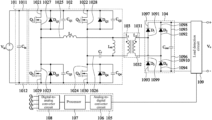
  • FIG. 2 - 1 is a circuit structure diagram of the resonance conversion device according to an embodiment of the present invention.
  • FIG. 3 - 1 is a circuit structure diagram of the resonance conversion device according to an embodiment of the present invention.
  • FIG. 3 - 2 is a circuit structure diagram of the resonance conversion device according to an embodiment of the present invention.
  • FIG. 4 is an equivalent circuit diagram of a series branch in a full-bridge LLC converter circuit according to an embodiment of the present invention.
  • FIG. 5 is a response diagram of a product of a switching gain and a resonance tank gain and a normalized frequency according to an embodiment of the present invention
  • FIG. 6 is a timing diagram of a switch control signal according to an embodiment of the present invention.
  • FIG. 7 is a timing diagram of a switch control signal according to an embodiment of the present invention.
  • FIG. 8 is a timing diagram of a switch control signal according to an embodiment of the present invention.
  • FIG. 9 is a control flow chart of the resonance conversion device according to an embodiment of the present invention.
  • FIG. 10 is a control flow chart according to an embodiment of the present invention.
  • FIG. 11 is a control flow chart according to an embodiment of the present invention.
  • FIG. 12 is a control flow chart of the resonance conversion device according to an embodiment of the present invention.
  • FIG. 13 is a control flow chart according to an embodiment of the present invention.
  • FIG. 14 is a control flow chart according to an embodiment of the present invention.
  • FIG. 16 is a control flow chart according to an embodiment of the present invention.
  • FIG. 17 is a control flow chart according to an embodiment of the present invention.
  • FIG. 18 is a control flow chart according to an embodiment of the present invention.
  • FIG. 19 is a block diagram of a USB circuit and an external device according to an embodiment of the present invention.
  • FIG. 20 is an efficiency comparison diagram of the resonance conversion device at light load
  • FIG. 21 is an efficiency comparison diagram of the resonance conversion device at heavy load
  • FIG. 22 is an efficiency comparison diagram of half-bridge burst mode control and half-bridge variable frequency control of the resonance conversion device.
  • FIG. 23 is an efficiency comparison diagram of full-bridge burst mode control and full-bridge variable frequency control of the resonance conversion device.
  • FIG. 1 is a block diagram of a resonance conversion device according to an embodiment of the present invention.
  • the resonance conversion device 100 includes an input filter circuit 101 , a full-bridge LLC converter circuit 102 , a transformer circuit 103 , a rectifier filter circuit 104 , and a controller 105 .
  • the input filter circuit 101 receives a DC input voltage and filters the DC input voltage to output a filtered DC voltage.
  • the full-bridge LLC converter circuit 102 is a resonance switch converter, and includes a resonance tank formed by a resonance inductor, a resonance capacitor, and an excitation inductor.
  • the full-bridge LLC converter circuit 102 receives the filtered DC voltage, and outputs a converted voltage through the resonance tank formed by the resonance inductor, the resonance capacitor, and the excitation inductor.
  • the specific implementation of the full-bridge LLC converter circuit 102 will be described in detail in the following embodiments.
  • the transformer circuit 103 includes a primary side and a secondary side.
  • the primary side of the transformer circuit 103 is coupled to the full-bridge LLC converter circuit to receive the converted voltage output by the resonance tank.
  • the secondary side of the transformer circuit 103 induces the converted voltage to generate an induced voltage.
  • the rectifier filter circuit 104 is coupled to the secondary side of the transformer circuit 103 to receive the induced voltage generated by the secondary side of the transformer circuit 103 .
  • the rectifier filter circuit 104 rectifies and filters the induced voltage to output a DC output voltage as an output of the resonance conversion device 100 .
  • the controller 105 is coupled to the full-bridge LLC converter circuit 102 and an output end of the rectifier filter circuit 104 .
  • the controller 105 detects the DC output voltage output by the rectifier filter circuit 104 and receives a voltage command from outside.
  • the voltage command includes an indication voltage used for indicating a value of the DC output voltage of the resonance conversion device 100 .
  • the controller 105 further receives a load condition.
  • the indication voltages include 5 V, 9 V, 15 V, 20 V, 28 V, 36 V, and 48 V.
  • the indication voltage may satisfy the PD 3.1 specification (USB Power Delivery Specification Revision 3.1, Version 1.0) of the universal serial bus.
  • the controller 105 controls the full-bridge LLC converter circuit 102 based on the voltage command and the value of the detected DC output voltage output by the rectifier filter circuit 104 .
  • FIG. 9 is a control flow chart of the resonance conversion device according to an embodiment of the present invention.
  • the controller 105 based on the indication voltage of the voltage command received from outside and the value of the detected DC output voltage output by the rectifier filter circuit 104 , the controller 105 sends a control signal to the full-bridge LLC converter circuit 102 to make the rectifier filter circuit 104 of the resonance conversion device 100 output a DC output voltage corresponding to the indication voltage.
  • the controller 105 detects the DC output voltage output by the rectifier filter circuit 104 and receives a voltage command from outside.
  • step S 902 the controller 105 determines whether an indication voltage of the voltage command is less than or equal to a threshold value.
  • the controller 105 controls the full-bridge LLC converter circuit 102 into a half-bridge operation mode, and regulates the DC output voltage by performing half-bridge burst mode control on the full-bridge LLC converter circuit 102 based on the value of the DC output voltage output by the rectifier filter circuit 104 and detected by the controller 105 .
  • the controller 105 regulates the DC output voltage by performing full-bridge burst mode control on the full-bridge LLC converter circuit 102 based on the value of the DC output voltage output by the rectifier filter circuit 104 and detected by the controller 105 .
  • FIG. 12 is a control flow chart of the resonance conversion device according to an embodiment of the present invention. Refer to FIG. 1 and FIG. 12 together. Each step shown in FIG. 12 is performed by the controller 105 . In some embodiments of the present invention, based on the indication voltage of the voltage command received from outside, the load condition, and the value of the detected DC output voltage output by the rectifier filter circuit 104 , the controller 105 sends a control signal to the full-bridge LLC converter circuit 102 to make the rectifier filter circuit 104 of the resonance conversion device 100 output a DC output voltage corresponding to the indication voltage.
  • step S 1201 the controller 105 detects the DC output voltage output by the rectifier filter circuit 104 , receives a load condition, and receives a voltage command from outside.
  • step S 1202 the controller 105 determines whether an indication voltage of the voltage command is less than or equal to a threshold value. When the indication voltage is less than or equal to the threshold value, the controller 105 controls the full-bridge LLC converter circuit 102 into a half-bridge operation mode, and regulates the DC output voltage by performing half-bridge burst-variable frequency switching mode control on the full-bridge LLC converter circuit 102 based on the value of the DC output voltage output by the rectifier filter circuit 104 and detected by the controller 105 .
  • the controller 105 regulates the DC output voltage by performing full-bridge burst-variable frequency switching mode control on the full-bridge LLC converter circuit 102 based on the value of the DC output voltage output by the rectifier filter circuit 104 and detected by the controller 105 .
  • a first end 1021 of the first switch Q 1 is coupled to a first end 1011 of the input filter circuit 101 .
  • the first switch Q 1 is connected in parallel to a diode D Q1 and a capacitor C Q1 .
  • a first end 1022 of the second switch Q 2 is coupled to the first end 1021 of the first switch Q 1 and the first end 1011 of the input filter circuit 101 .
  • the second switch Q 2 is connected in parallel to a diode D Q2 and a capacitor C Q2 .
  • a first end 1023 of the third switch Q 3 is coupled to a second end 1027 of the first switch Q 1 , and a second end 1029 of the third switch Q 3 is coupled to a second end 1012 of the input filter circuit 101 .
  • the third switch Q 3 is connected in parallel to a diode D Q3 and a capacitor C Q3 .
  • a first end 1024 of the fourth switch Q 4 is coupled to a second end 1028 of the second switch Q 2 , and a second end 1030 of the fourth switch Q 4 is coupled to the second end 1029 of the third switch Q 3 .
  • the fourth switch Q 4 is connected in parallel to a diode D Q4 and a capacitor C Q4 .
  • the series branch includes a first resonance inductor L r , a second resonance inductor L m , and a resonance capacitor C r connected in series.
  • the first resonance inductor L r is a resonance inductor of the full-bridge LLC converter circuit 102
  • the second resonance inductor L m is an excitation inductor of the full-bridge LLC converter circuit 102
  • the resonance capacitor C r is a resonance capacitor of the full-bridge LLC converter circuit 102 .
  • the first resonance inductor L r , the second resonance inductor L m , and the resonance capacitor C r form a resonance tank of the full-bridge LLC converter circuit 102 .
  • a first end 1025 of the series branch is coupled between the second end 1027 of the first switch Q 1 and the first end 1023 of the third switch Q 3 .
  • a second end 1026 of the series branch is coupled between the second end 1028 of the second switch Q 2 and the first end 1024 of the fourth switch Q 4 .
  • the primary side of the transformer circuit 103 includes a primary coil L 1 .
  • the secondary side of the transformer circuit 103 includes a secondary coil L 2 .
  • the ratio of the number of turns of the primary coil L 1 to the secondary coil L 2 is N 1 :N 2 .
  • the second resonance inductor L m is connected in parallel to the primary coil L 1 of the primary side of the transformer circuit 103 .
  • the secondary coil L 2 includes a first end 1031 and a second end 1032 , and the rectifier filter circuit 104 is coupled to the secondary side of the transformer circuit 103 through the first end 1031 and the second end 1032 of the secondary coil L 2 .
  • the resonance conversion device 100 includes a load detection circuit 109 .
  • the load detection circuit 109 is coupled to an output end of the rectifier filter circuit 104 to detect a DC output voltage and a load current of the rectifier filter circuit 104 .
  • the load detection circuit 109 obtains the load condition by the DC output voltage and the load current of the rectifier filter circuit 104 .
  • the rectifier filter circuit 104 includes a first forward conduction element D 1 , a second forward conduction element D 2 , a third forward conduction element D 3 , a fourth forward conduction element D 4 , and a capacitor C out .
  • the first forward conduction element D 1 , the second forward conduction element D 2 , the third forward conduction element D 3 , and the fourth forward conduction element D 4 are all diodes.
  • a first end 1091 of the first forward conduction element D 1 and a second end 1099 of the third forward conduction element D 3 are coupled.
  • the first end 1031 of the secondary coil L 2 of the secondary side of the transformer circuit 103 is coupled between the first end 1091 of the first forward conduction element D 1 and the second end 1099 of the third forward conduction element D 3 .
  • a first end 1092 of the second forward conduction element D 2 and a second end 10910 of the fourth forward conduction element D 4 are coupled.
  • the second end 1032 of the secondary coil L 2 of the secondary side of the transformer circuit 103 is coupled between the first end 1092 of the second forward conduction element D 2 and the second end 10910 of the fourth forward conduction element D 4 .
  • a second end 1097 of the first forward conduction element D 1 , a second end 1098 of the second forward conduction element D 2 , and a first end 1095 of the capacitor C out are coupled to each other.
  • a first end 1093 of the third forward conduction element D 3 , a first end 1094 of the fourth forward conduction element D 4 , and a second end 1096 of the capacitor C out are coupled to each other.
  • a voltage across the capacitor C out serves as the DC output voltage of the rectifier filter circuit 104 .
  • a DC output voltage V o of the resonance conversion device 100 is the DC output voltage of the rectifier filter circuit 104 .
  • the controller 105 includes a processor 107 , an analog-to-digital converter circuit 106 , and a digital-to-analog converter circuit 108 .
  • the analog-to-digital converter circuit 106 of the controller 105 receives the load condition of the load detection circuit 109 , digitizes the load condition, and then transmits the digitized load condition to the processor 107 .
  • the analog-to-digital converter circuit 106 also receives the DC output voltage output by the rectifier filter circuit 104 , digitizes the DC output voltage output by the rectifier filter circuit 104 , and then transmits the digitized DC output voltage to the processor 107 .
  • the processor 107 receives a voltage command from outside, and the processor 107 obtains an indication voltage from the received voltage command.
  • the indication voltage is used to indicate a value of the DC output voltage of the resonance conversion device 100 .
  • FIG. 2 - 2 is a circuit structure diagram of the resonance conversion device according to another embodiment of the present invention.
  • the rectifier filter circuit 104 in the resonance conversion device 100 shown in FIG. 2 - 2 includes a fifth switch Q 5 , a sixth switch Q 6 , a seventh switch Q 7 , an eighth switch Q 8 , and a capacitor C out .
  • the fifth switch Q 5 , the sixth switch Q 6 , the seventh switch Q 7 , and the eighth switch Q 8 are all n-type MOS field effect transistors.
  • a second end 2091 of the fifth switch Q 5 is coupled to a first end 2099 of the seventh switch Q 7 .
  • the first end 1031 of the secondary coil L 2 of the secondary side of the transformer circuit 103 is coupled between the second end 2091 of the fifth switch Q 5 and the first end 2099 of the seventh switch Q 7 .
  • a second end 2092 of the sixth switch Q 6 is coupled to a first end 20910 of the eighth switch Q 8 .
  • the second end 1032 of the secondary coil L 2 of the secondary side of the transformer circuit 103 is coupled between the second end 2092 of the sixth switch Q 6 and the first end 20910 of the eighth switch Q 8 .
  • a first end 2097 of the fifth switch Q 5 , a first end 2098 of the sixth switch Q 6 , and a first end 1095 of the capacitor C out are coupled to each other.
  • a second end 2093 of the seventh switch Q 7 , a second end 2094 of the eighth switch Q 8 , and a second end 1096 of the capacitor C out are coupled to each other.
  • a voltage across the capacitor C out serves as the DC output voltage of the rectifier filter circuit 104 .
  • a DC output voltage V o of the resonance conversion device 100 is the DC output voltage of the rectifier filter circuit 104 .
  • the controller 105 sends appropriate control signals to the fifth switch Q 5 , the sixth switch Q 6 , the seventh switch Q 7 , and the eighth switch Q 8 , to rectify the induced voltage.
  • the controller 105 sends appropriate control signals to the fifth switch Q 5 , the sixth switch Q 6 , the seventh switch Q 7 , and the eighth switch Q 8 , so that the fifth switch Q 5 , the sixth switch Q 6 , the seventh switch Q 7 , and the eighth switch Q 8 behave the same as those of the first forward conduction element D 1 , the second forward conduction element D 2 , the third forward conduction element D 3 , and the fourth forward conduction element D 4 in FIG. 2 - 1 .
  • FIG. 3 - 1 is a circuit structure diagram of the resonance conversion device according to another embodiment of the present invention.
  • the primary side of the transformer circuit 103 in the resonance conversion device 100 shown in FIG. 3 - 1 includes the primary coil L 1 .
  • the secondary side of the transformer circuit 103 includes a secondary coil L 3 .
  • the secondary coil L 3 includes a first end 1033 , a second end 1034 , and a center tap junction 1035 .
  • the rectifier filter circuit 104 is coupled to the secondary side of the transformer circuit 103 through the first end 1033 , the second end 1034 , and the center tap junction 1035 of the secondary coil L 3 .
  • the rectifier filter circuit 104 includes a first forward conduction element D 5 , a second forward conduction element D 6 , and a capacitor C out .
  • a second end 10913 of the first forward conduction element D 5 is coupled to the first end 1033 of the secondary coil L 3
  • a second end 10914 of the second forward conduction element D 6 is coupled to the second end 1034 of the secondary coil L 3 .
  • a first end 10912 of the second forward conduction element D 6 is coupled to a second end 10916 of the capacitor C out
  • a first end 10911 of the first forward conduction element D 5 is coupled between the first end 10912 of the second forward conduction element D 6 and the second end 10916 of the capacitor C out .
  • a first end 10915 of the capacitor C out is coupled to the center tap junction 1035 .
  • a voltage across the capacitor C out serves as the DC output voltage of the rectifier filter circuit 104 .
  • a DC output voltage V o of the resonance conversion device 100 is the DC output voltage of the rectifier filter circuit 104 .
  • FIG. 3 - 2 is a circuit structure diagram of the resonance conversion device according to an embodiment of the present invention.
  • the rectifier filter circuit 104 in the resonance conversion device 100 shown in FIG. 3 - 2 includes a fifth switch Q 9 , a sixth switch Q 10 , and a capacitor C out .
  • a first end 20913 of the fifth switch Q 9 is coupled to a first end 1033 of the secondary coil L 3 .
  • a first end 20914 of the sixth switch Q 10 is coupled to the second end 1034 of the secondary coil L 3
  • a second end 20912 of the sixth switch Q 10 is coupled to a second end 10916 of the capacitor C out .
  • a second end 20911 of the fifth switch is coupled between the second end 20912 of the sixth switch Q 10 and the second end 10916 of the capacitor C out .
  • a first end 10915 of the capacitor C out is coupled to the center tap junction 1035 .
  • a voltage across the capacitor C out serves as the DC output voltage of the rectifier filter circuit 104 .
  • a DC output voltage V o of the resonance conversion device 100 is the DC output voltage of the rectifier filter circuit 104 .
  • the controller 105 sends appropriate control signals to the fifth switch Q 9 and the sixth switch Q 10 , to rectify the induced voltage.
  • the controller 105 sends appropriate control signals to the fifth switch Q 9 and the sixth switch Q 10 , so that the fifth switch Q 9 and the sixth switch Q 10 behave the same as those of the first forward conduction element D 5 and the second forward conduction element D 6 shown in FIG. 3 - 1 .
  • the full-bridge LLC converter circuit 102 has two operation modes. One is that the controller 105 simultaneously controls the first switch Q 1 , the second switch Q 2 , the third switch Q 3 , and the fourth switch Q 4 to regulate the DC output voltage. This operation mode is referred to as a full-bridge operation mode. The other is that the controller 105 controls the second switch Q 2 to be turned off and controls the fourth switch Q 4 to be turned on. In this case, the second switch Q 2 acts as an open circuit, the fourth switch Q 4 acts as a short circuit, and the controller 105 controls only the first switch Q 1 and the third switch Q 3 to regulate the output DC voltage. This operation mode is referred to as a half-bridge operation mode.
  • FIG. 4 is an equivalent circuit diagram of a series branch in a full-bridge LLC converter circuit according to an embodiment of the present invention. Referring to FIG. 2 - 1 and FIG. 4 together, s in FIG. 4 is the Laplace operator, and a gain of the resonance tank of the full-bridge LLC converter circuit 102 is
  • R a ⁇ c 8 ⁇ 2 ⁇ N 1 2 N 2 2 ⁇
  • R o is an output impedance looking out from the capacitor C out ,
  • f r 1 2 ⁇ ⁇ ⁇ L r ⁇ C r is a resonance frequency
  • f s is a switching frequency
  • FIG. 5 is a response diagram of a product of a switching gain and a resonance tank gain and a normalized frequency according to an embodiment of the present invention.
  • the switching gain*resonance tank gain is 1 at the resonance frequency f r .
  • the switching gain*resonance tank gain is 0.5 at the resonance frequency f r .
  • the switching gain*resonance tank gain is less than 1 when the switching frequency f s is greater than the resonance frequency f r , and the switching gain*resonance tank gain decreases when the switching frequency f s increases.
  • the full-bridge LLC converter circuit 102 operates in an interval where the switching frequency is greater than or equal to the resonance frequency f r .
  • the processor 107 transmits, to the digital-to-analog converter circuit 108 , the control signals to be transmitted to the first switch Q 1 , the second switch Q 2 , the third switch Q 3 , and the fourth switch Q 4 of the full-bridge LLC converter circuit 102 .
  • the digital-to-analog converter circuit 108 converts the received control signals into appropriate drive signals, and then transmits the drive signals to the first switch Q 1 , the second switch Q 2 , the third switch Q 3 , and the fourth switch Q 4 of the full-bridge LLC converter circuit 102 , to drive the first switch Q 1 , the second switch Q 2 , the third switch Q 3 , and the fourth switch Q 4 .
  • FIG. 6 is a timing diagram of a switch control signal according to an embodiment of the present invention.
  • FIG. 7 is a timing diagram of a switch control signal according to an embodiment of the present invention.
  • FIG. 10 is a control flow chart according to an embodiment of the present invention.
  • FIG. 11 is a control flow chart according to an embodiment of the present invention. Refer to FIG. 2 - 1 , FIG. 6 , FIG. 7 , FIG. 10 , and FIG. 11 together. V GSQ1 recorded in FIG.
  • V GSQ2 represents a voltage between a gate and a source of the second switch Q 2
  • V GSQ3 represents a voltage between a gate and a source of the third switch Q 3
  • V GSQ4 represents a voltage between a gate and a source of the fourth switch Q 4 .
  • step S 903 further includes step S 1001 and step S 1002 .
  • step S 1001 in response to the indication voltage being less than or equal to a threshold value, the processor 107 makes the digital-to-analog converter circuit 108 transmit the drive signals of V GSQ2 and V GSQ4 recorded in FIG. 6 , to control the voltage between the gate and the source of the second switch Q 2 and the voltage between the gate and the source of the fourth switch Q 4 , to turn off the second switch Q 2 and turn on the fourth switch Q 4 .
  • the full-bridge LLC converter circuit 102 enters the half-bridge operation mode.
  • step S 1002 the controller 105 detects the DC output voltage of the rectifier filter circuit 104 .
  • the processor 107 makes the digital-to-analog converter circuit 108 transmit the drive signals having signal waveforms of V GSQ1 and V GSQ3 before a time point T 1 as recorded in FIG. 6 , to control the voltage between the gate and the source of the first switch Q 1 and the voltage between the gate and the source of the third switch Q 3 , thereby turning off the first switch Q 1 and the third switch Q 3 .
  • the processor 107 makes the digital-to-analog converter circuit 108 transmit a first signal (a signal waveform of V GSQ1 from the time point T 1 to the time point T 2 as recorded in FIG. 6 ) to drive the first switch Q 1 , and transmit a second signal (a signal waveform of V GSQ3 from the time point T 1 to the time point T 2 as recorded in FIG. 6 ) to drive the third switch Q 3 , as shown from the time point T 1 to a time point T 2 recorded in FIG. 6 .
  • the first signal and the second signal are periodic pulse signals in which a duty cycle is 50% and a frequency is a burst mode frequency, and the first signal and the second signal are complementary.
  • the burst mode frequency is
  • T r is a cycle of the first signal and the second signal.
  • the processor 107 makes the digital-to-analog converter circuit 108 transmit drive signals having signal waveforms of V GSQ1 and V GSQ3 from the time point T 2 to a time point T 3 as recorded in FIG. 6 , to control the voltage between the gate and the source of the first switch Q 1 and the voltage between the gate and the source of the third switch Q 3 , to turn off the first switch Q 1 and the third switch Q 3 .
  • the first preset voltage is greater than the indication voltage
  • the second preset voltage is less than the indication voltage
  • the controller 105 controls the DC output voltage to be within a range of the first preset voltage and the second preset voltage. Actual values of the first preset voltage and the second preset voltage are set according to design specifications.
  • step S 1003 the controller 105 continues performing step S 1002 until the processor 107 receives a stop signal.
  • step S 904 further includes step S 1101 and step S 1102 .
  • the controller 105 detects the DC output voltage of the rectifier filter circuit 104 .
  • the processor 107 makes the digital-to-analog converter circuit 108 transmit drive signals having signal waveforms of V GSQ1 , V GSQ2 , V GSQ3 , and V GSQ4 before the time point T 1 as recorded in FIG.
  • the processor 107 makes the digital-to-analog converter circuit 108 transmit a first signal (a signal waveform of V GSQ1 from the time point T 4 to the time point T 5 as recorded in FIG. 7 ) to drive the first switch Q 1 and the fourth switch Q 4 , and transmit a second signal (a signal waveform of V GSQ2 from the time point T 4 to the time point T 5 as recorded in FIG. 7 ) to drive the second switch Q 2 and the third switch Q 3 , as shown from a time point T 4 to a time point T 5 recorded in FIG. 7 .
  • the first signal and the second signal are periodic pulse signals in which a duty cycle is 50% and a frequency is a burst mode frequency, and the first signal and the second signal are complementary.
  • the burst mode frequency is
  • T r is a cycle of the first signal and the second signal.
  • the burst mode frequency is selected as the resonance frequency
  • f r 1 2 ⁇ ⁇ ⁇ L r ⁇ C r of the full-bridge LLC converter circuit 102 .
  • the threshold value is half of a designed maximum output voltage of the resonance conversion device 100 at an operation point at the resonance frequency
  • f r 1 2 ⁇ ⁇ ⁇ L r ⁇ C r is designed to be 50 V, and the threshold value is selected to be 25 V.
  • FIG. 8 is a timing diagram of a switch control signal according to an embodiment of the present invention.
  • the first switch Q 1 and the third switch Q 3 are simultaneously turned on or the second switch Q 2 and the fourth switch Q 4 are simultaneously turned on, a large current may be generated to damage the first switch Q 1 and the third switch Q 3 or the second switch Q 2 and the fourth switch Q 4 . Therefore, the first signal (the signal waveform of V GSQ1 from the time point T 1 to the time point T 2 as recorded in FIG. 6 ) and the second signal (the signal waveform of V GSQ3 from the time point T 1 to the time point T 2 as recorded in FIG.
  • a dead time is set from a time point T 7 to a time point T 8 (corresponding to a time point T 13 to a time point T 14 ), from a time point T 9 to a time point T 10 (corresponding to a time point T 15 to a time point T 16 ), from a time point T 10 to a time point T 11 (corresponding to a time point T 16 to a time point TO, and from a time point T 12 to the time point T 13 .
  • the duty cycle of the first signal and the second signal without the dead time is 50%.
  • the processor 107 makes the digital-to-analog converter circuit 108 transmit the first signal (the signal waveform of V GSQ1 from the time point T 1 to the time point T 2 as recorded in FIG. 6 ) to drive the first switch Q 1 , and transmit the second signal (the signal waveform of V GSQ3 from the time point T 1 to the time point T 2 as recorded in FIG. 6 ) to drive the third switch Q 3 , as shown from the time point T 1 to the time point T 2 recorded in FIG. 6 .
  • the first signal and the second signal are periodic pulse signals in which a duty cycle is 50% and a frequency is a burst mode frequency, and the first signal and the second signal are complementary.
  • the burst mode frequency is
  • T r is a cycle of the first signal and the second signal.
  • the processor 107 makes the digital-to-analog converter circuit 108 transmit drive signals having signal waveforms of V GSQ1 and V GSQ3 from the time point T 2 to a time point T 3 as recorded in FIG. 6 , to control the voltage between the gate and the source of the first switch Q 1 and the voltage between the gate and the source of the third switch Q 3 , to turn off the first switch Q 1 and the third switch Q 3 .
  • step S 1402 the controller 105 continues performing step S 1401 until the processor 107 receives a stop signal.
  • FIG. 15 is a control flow chart according to an embodiment of the present invention.
  • the foregoing step S 1305 further includes steps S 1403 to S 1407 .
  • the processor 107 makes the digital-to-analog converter circuit 108 transmit a third signal to drive the first switch Q 1 and transmit a fourth signal to drive the third switch Q 3 .
  • the third signal and the fourth signal are variable frequency periodic pulse signals having a duty cycle of 50%, and the third signal and the fourth signal are complementary.
  • step S 1403 the processor 107 determines whether the difference between the DC output voltage and the preset voltage is greater than 0. If the difference between the DC output voltage and the preset voltage is greater than 0, step S 1404 is performed.
  • step S 1404 the processor 107 increases a frequency of the third signal and a frequency of the fourth signal. If the difference between the DC output voltage and the preset voltage is less than 0, step S 1405 is performed. In step S 1405 , the processor 107 decreases the frequency of the third signal and the frequency of the fourth signal. If the difference between the DC output voltage and the preset voltage is 0, the frequency of the third signal and the frequency of the fourth signal are not changed.
  • step S 1406 the processor 107 makes the digital-to-analog converter circuit 108 transmit the third signal to drive the first switch Q 1 and transmit the fourth signal to drive the third switch Q 3 .
  • step S 1407 the controller 105 continues performing the foregoing steps S 1403 to S 1406 until the processor 107 receives a stop signal.
  • FIG. 16 is a control flow chart according to an embodiment of the present invention. Referring to FIG. 7 and FIG. 16 together, as shown in FIG. 16 , the foregoing step S 1204 further includes steps S 1501 to S 1504 .
  • step S 1501 the processor 107 determines whether the indication voltage of the voltage command is in a second voltage interval. If the processor 107 determines that the indication voltage of the voltage command is not in the second voltage interval, step S 1503 is performed. If the processor 107 determines that the indication voltage of the voltage command is in the second voltage interval, step S 1502 is performed. In step S 1502 , whether the load condition is light is further determined, if yes, step S 1503 is performed, and if not, step S 1504 is performed.
  • step S 1503 the processor 107 regulates the DC output voltage by performing full-bridge burst mode control on the full-bridge LLC converter circuit 102 based on the DC output voltage.
  • step S 1504 the DC output voltage is regulated by performing full-bridge variable frequency control on the full-bridge LLC converter circuit 102 based on the difference between the DC output voltage and the indication voltage.
  • FIG. 17 is a control flow chart according to an embodiment of the present invention. As shown in FIG. 17 , step S 1503 further includes step S 1601 and step S 1602 . Because step S 1601 is the same as the foregoing step S 1101 , and step S 1602 is the same as the foregoing step S 1102 , the description is not repeated here.
  • FIG. 18 is a control flow chart according to an embodiment of the present invention.
  • the foregoing step S 1504 further includes steps S 1603 to S 1607 .
  • the processor 107 makes the digital-to-analog converter circuit 108 transmit a third signal to drive the first switch Q 1 and the fourth switch Q 4 and transmit a fourth signal to drive the second switch Q 2 and the third switch Q 3 .
  • the third signal and the fourth signal are variable frequency periodic pulse signals having a duty cycle of 50%, and the third signal and the fourth signal are complementary.
  • the processor 107 determines whether the difference between the DC output voltage and the preset voltage is greater than 0. If the difference between the DC output voltage and the preset voltage is greater than 0, step S 1604 is performed.
  • step S 1604 the processor 107 increases the frequency of the third signal and the frequency of the fourth signal. If the difference between the DC output voltage and the preset voltage is less than 0, step S 1605 is performed. In step S 1605 , the processor 107 decreases the frequency of the third signal and the frequency of the fourth signal. If the difference between the DC output voltage and the preset voltage is 0, the frequency of the third signal and the frequency of the fourth signal are not changed.
  • step S 1606 the processor 107 makes the digital-to-analog converter circuit 108 transmit the third signal to drive the first switch Q 1 and the fourth switch Q 4 and transmit the fourth signal to drive the second switch Q 2 and the third switch Q 3 .
  • step S 1607 the controller 105 continues performing the foregoing steps S 1603 to S 1606 until the processor 107 receives a stop signal.
  • the burst mode frequency is selected as the resonance frequency
  • the burst mode frequency includes the resonance frequency of the resonance conversion device. In some embodiments of the present invention, the burst mode frequency includes the resonance frequency
  • f r 1 2 ⁇ ⁇ ⁇ L r ⁇ C r of the full-bridge LLC converter circuit 102 .
  • the second voltage interval is an interval including the maximum output voltage of the resonance conversion device 100 at the operation point at the resonance frequency
  • the first voltage interval is an interval including the threshold value.
  • the maximum output voltage of the resonance conversion device 100 at the operation point at the resonance frequency f r is designed to be 50 V and the threshold value is selected to be 25 V
  • the second voltage interval ranges from 48 to 50 V
  • the first voltage interval ranges from 24 to 25 V.
  • FIG. 19 is a block diagram of a universal serial bus (USB) circuit and an external device according to an embodiment of the present invention.
  • the universal serial bus circuit 1900 includes a resonance conversion device 1901 .
  • the resonance conversion device 1901 may be the resonance conversion device 100 described in any of the foregoing embodiments.
  • the universal serial bus circuit 1900 is connected to the external device 1902 .
  • the universal serial bus circuit 1900 sends a voltage command to the resonance conversion device 1901 according to a requirement of the external device 1902 , so that the resonance conversion device 1901 provides a fixed voltage to the external device 1902 .
  • FIG. 20 is an efficiency comparison diagram of the resonance conversion device at light load.
  • FIG. 21 is an efficiency comparison diagram of the resonance conversion device at heavy load. Refer to FIG. 20 and FIG. 21 together.
  • the efficiency of using the half-bridge burst mode control is better than that of using the full-bridge burst mode control below 25 V.
  • the efficiency of using the full-bridge burst mode control is better than that of using the conventional full-bridge phase-shift mode control.
  • the efficiency of using the half-bridge burst mode control is better than that of using the full-bridge burst mode control below 25 V.
  • the efficiency of using the full-bridge burst mode control is better than that of using the conventional full-bridge phase-shift mode control.
  • the results shown in FIG. 20 and FIG. 21 may verify that the control method of the resonance conversion device shown in FIG. 9 has good efficiency.
  • FIG. 22 is an efficiency comparison diagram of half-bridge burst mode control and half-bridge variable frequency control of the resonance conversion device.
  • FIG. 23 is an efficiency comparison diagram of full-bridge burst mode control and full-bridge variable frequency control of the resonance conversion device. Refer to FIG. 22 and FIG. 23 together.
  • the efficiency of using the half-bridge burst mode control is better than that of using the half-bridge variable frequency control when the load is below 40%, and the efficiency of using the half-bridge variable frequency control is better than that of using the half-bridge burst mode control when the load is above 40%.
  • the efficiency of using the full-bridge burst mode control is better than that of using the full-bridge variable frequency control when the load is below 30%, and the efficiency of using the full-bridge variable frequency control is better than that of using the full-bridge burst mode control when the load is above 30%.
  • the results shown in FIG. 22 and FIG. 23 may verify that the control method of the resonance conversion device shown in FIG. 12 has good efficiency.
  • some embodiments of the present invention can avoid efficiency reduction by a single-stage design. Some embodiments of the present invention can achieve a wide output voltage and improve the efficiency by switching the operation mode and control method of the full-bridge LLC converter circuit based on the indication voltage. Some embodiments of the present invention can further improve the efficiency by controlling using a variable frequency control method within a specific voltage and load range.

Landscapes

  • Engineering & Computer Science (AREA)
  • Power Engineering (AREA)
  • Dc-Dc Converters (AREA)
  • Control Of Motors That Do Not Use Commutators (AREA)
  • Input Circuits Of Receivers And Coupling Of Receivers And Audio Equipment (AREA)

Abstract

A resonance conversion device and a universal serial bus circuit are provided. The resonance conversion device includes an input filter circuit, a full-bridge LLC converter circuit, a transformer circuit, a rectifier filter circuit, and a controller. The controller is configured to determine whether an indication voltage of a voltage command is less than or equal to a threshold value and to perform the following steps: in response to the indication voltage being less than or equal to the threshold value, controlling the full-bridge LLC converter circuit into a half-bridge operation mode, and regulating the DC output voltage by performing half-bridge burst mode control on the full-bridge LLC converter circuit based on the DC output voltage; and in response to the indication voltage being greater than the threshold value, regulating the DC output voltage by performing full-bridge burst mode control on the full-bridge LLC converter circuit based on the DC output voltage.

Description

CROSS-REFERENCE TO RELATED APPLICATION
This non-provisional application claims priority under 35 U.S.C. § 119(a) to Patent Application No. 111103015 filed in Taiwan, R.O.C. on Jan. 24, 2022, the entire contents of which are hereby incorporated by reference.
BACKGROUND Technical Field
The present invention relates to a resonance conversion device, and in particular, to a full-bridge LLC resonance conversion device with a hybrid control mechanism.
Related Art
In order to meet requirements of a small volume and high power density, switch power supplies gradually replace conventional linear power supplies. However, because the voltage and the current are not zero when a power control switch of a switch power supply is turned on or turned off, the voltage and the current have a high overlapping region area, that is, a high switching loss during switching, and thereby heat is generated, causing efficiency reduction. In addition, as the switching frequency increases, the switching loss and electromagnetic interference also increase. LLC resonance conversion devices have attracted more attention in recent years due to their advantages of zero-voltage switching and a voltage regulation capability. In order to adapt to complex application scenarios, achieve a wide output voltage, and improve the efficiency, a novel full-bridge LLC resonance conversion device with a hybrid control mechanism is urgently needed in this field.
SUMMARY
In view of the above, embodiments of the present invention provide a resonance conversion device and a universal serial bus circuit to improve the existing technical problems.
An embodiment of the present invention provides a resonance conversion device. The resonance conversion device includes an input filter circuit, a full-bridge LLC converter circuit, a transformer circuit, a rectifier filter circuit, and a controller. The input filter circuit is configured to receive a DC input voltage and filter the DC input voltage to output a filtered DC voltage. The full-bridge LLC converter circuit is configured to receive the filtered DC voltage and output a converted voltage. The transformer circuit includes a primary side and a secondary side. The primary side of the transformer circuit is coupled to the full-bridge LLC converter circuit to receive the converted voltage. The secondary side of the transformer circuit induces the converted voltage to generate an induced voltage. The rectifier filter circuit is coupled to the secondary side of the transformer circuit, and is configured to receive, rectify, and filter the induced voltage to output a DC output voltage. The controller is coupled to the full-bridge LLC converter circuit and the rectifier filter circuit. The controller can detect the DC output voltage and receive a voltage command from outside. The controller is configured to determine whether an indication voltage of the voltage command is less than or equal to a threshold value and to perform the following steps: in response to the indication voltage being less than or equal to the threshold value, controlling the full-bridge LLC converter circuit into a half-bridge operation mode, and regulating the DC output voltage by performing half-bridge burst mode control on the full-bridge LLC converter circuit based on the DC output voltage; and in response to the indication voltage being greater than the threshold value, regulating the DC output voltage by performing full-bridge burst mode control on the full-bridge LLC converter circuit based on the DC output voltage.
Another embodiment of the present invention provides a resonance conversion device. The resonance conversion device includes an input filter circuit, a full-bridge LLC converter circuit, a transformer circuit, a rectifier filter circuit, a load detection circuit, and a controller. The input filter circuit is configured to receive a DC input voltage and filter the DC input voltage to output a filtered DC voltage. The full-bridge LLC converter circuit is configured to receive the filtered DC voltage and output a converted voltage. The transformer circuit includes a primary side and a secondary side. The primary side of the transformer circuit is coupled to the full-bridge LLC converter circuit to receive the converted voltage. The secondary side of the transformer circuit induces the converted voltage to generate an induced voltage. The load detection circuit detects a load condition of the resonance conversion device. The rectifier filter circuit is coupled to the secondary side of the transformer circuit, and is configured to receive, rectify, and filter the induced voltage to output a DC output voltage. The controller is coupled to the full-bridge LLC converter circuit, the load detection circuit, and the rectifier filter circuit. The controller can detect the DC output voltage, receive the load condition, and receive a voltage command from outside. The controller is configured to determine whether an indication voltage of the voltage command is less than or equal to a threshold value and to perform the following steps: in response to the indication voltage being less than or equal to the threshold value, controlling the full-bridge LLC converter circuit into a half-bridge operation mode, and regulating the DC output voltage by performing half-bridge burst-variable frequency switching mode control on the full-bridge LLC converter circuit based on the DC output voltage; and in response to the indication voltage being greater than the threshold value, regulating the DC output voltage by performing full-bridge burst-variable frequency switching mode control on the full-bridge LLC converter circuit based on the DC output voltage.
An embodiment of the present invention provides a universal serial bus (USB) circuit including the foregoing resonance conversion device. The USB circuit sends the voltage command to the resonance conversion device based on a request of an external device.
Based on the above, some embodiments of the present invention can avoid efficiency reduction by a single-level design. Some embodiments of the present invention can achieve a wide output voltage and improve the efficiency by switching the operation mode and control method of the full-bridge LLC converter circuit based on the indication voltage. Some embodiments of the present invention can further improve the efficiency by controlling using a variable frequency control method within a specific voltage and load range.
BRIEF DESCRIPTION OF THE DRAWINGS
FIG. 1 is a block diagram of a resonance conversion device according to an embodiment of the present invention;
FIG. 2-1 is a circuit structure diagram of the resonance conversion device according to an embodiment of the present invention;
FIG. 2-2 is a circuit structure diagram of the resonance conversion device according to an embodiment of the present invention;
FIG. 3-1 is a circuit structure diagram of the resonance conversion device according to an embodiment of the present invention;
FIG. 3-2 is a circuit structure diagram of the resonance conversion device according to an embodiment of the present invention;
FIG. 4 is an equivalent circuit diagram of a series branch in a full-bridge LLC converter circuit according to an embodiment of the present invention;
FIG. 5 is a response diagram of a product of a switching gain and a resonance tank gain and a normalized frequency according to an embodiment of the present invention;
FIG. 6 is a timing diagram of a switch control signal according to an embodiment of the present invention;
FIG. 7 is a timing diagram of a switch control signal according to an embodiment of the present invention;
FIG. 8 is a timing diagram of a switch control signal according to an embodiment of the present invention;
FIG. 9 is a control flow chart of the resonance conversion device according to an embodiment of the present invention;
FIG. 10 is a control flow chart according to an embodiment of the present invention;
FIG. 11 is a control flow chart according to an embodiment of the present invention;
FIG. 12 is a control flow chart of the resonance conversion device according to an embodiment of the present invention;
FIG. 13 is a control flow chart according to an embodiment of the present invention;
FIG. 14 is a control flow chart according to an embodiment of the present invention;
FIG. 15 is a control flow chart according to an embodiment of the present invention;
FIG. 16 is a control flow chart according to an embodiment of the present invention;
FIG. 17 is a control flow chart according to an embodiment of the present invention;
FIG. 18 is a control flow chart according to an embodiment of the present invention;
FIG. 19 is a block diagram of a USB circuit and an external device according to an embodiment of the present invention;
FIG. 20 is an efficiency comparison diagram of the resonance conversion device at light load;
FIG. 21 is an efficiency comparison diagram of the resonance conversion device at heavy load;
FIG. 22 is an efficiency comparison diagram of half-bridge burst mode control and half-bridge variable frequency control of the resonance conversion device; and
FIG. 23 is an efficiency comparison diagram of full-bridge burst mode control and full-bridge variable frequency control of the resonance conversion device.
DETAILED DESCRIPTION
The foregoing and other technical content, features, and effects of the present invention can be clearly presented below in detailed description of embodiments with reference to the accompanying drawings. Thicknesses or sizes of components in the drawings expressed in an exaggerated, omitted or general manner are used to help a person skilled in the art to understand and read, and the size of each component is not completely its actual size and is not intended to limit restraint conditions under which the present invention can be implemented and therefore have no technical significance. Any modification to the structure, change to the proportional relationship or adjustment on the size should fall within the scope of the technical content disclosed by the present invention without affecting the effects and the objectives that can be achieved by the present invention. The same reference numbers in the drawings are used to represent the same or similar components. The term “couple” or “connect” mentioned in the following embodiments may refer to any direct or indirect connection means.
FIG. 1 is a block diagram of a resonance conversion device according to an embodiment of the present invention. Referring to FIG. 1 , the resonance conversion device 100 includes an input filter circuit 101, a full-bridge LLC converter circuit 102, a transformer circuit 103, a rectifier filter circuit 104, and a controller 105. The input filter circuit 101 receives a DC input voltage and filters the DC input voltage to output a filtered DC voltage. The full-bridge LLC converter circuit 102 is a resonance switch converter, and includes a resonance tank formed by a resonance inductor, a resonance capacitor, and an excitation inductor. The full-bridge LLC converter circuit 102 receives the filtered DC voltage, and outputs a converted voltage through the resonance tank formed by the resonance inductor, the resonance capacitor, and the excitation inductor. The specific implementation of the full-bridge LLC converter circuit 102 will be described in detail in the following embodiments.
The transformer circuit 103 includes a primary side and a secondary side. The primary side of the transformer circuit 103 is coupled to the full-bridge LLC converter circuit to receive the converted voltage output by the resonance tank. The secondary side of the transformer circuit 103 induces the converted voltage to generate an induced voltage. The rectifier filter circuit 104 is coupled to the secondary side of the transformer circuit 103 to receive the induced voltage generated by the secondary side of the transformer circuit 103. In addition, the rectifier filter circuit 104 rectifies and filters the induced voltage to output a DC output voltage as an output of the resonance conversion device 100.
The controller 105 is coupled to the full-bridge LLC converter circuit 102 and an output end of the rectifier filter circuit 104. The controller 105 detects the DC output voltage output by the rectifier filter circuit 104 and receives a voltage command from outside. The voltage command includes an indication voltage used for indicating a value of the DC output voltage of the resonance conversion device 100. In some embodiments, the controller 105 further receives a load condition.
In some embodiments, the indication voltages include 5 V, 9 V, 15 V, 20 V, 28 V, 36 V, and 48 V. The indication voltage may satisfy the PD 3.1 specification (USB Power Delivery Specification Revision 3.1, Version 1.0) of the universal serial bus.
The controller 105 controls the full-bridge LLC converter circuit 102 based on the voltage command and the value of the detected DC output voltage output by the rectifier filter circuit 104.
FIG. 9 is a control flow chart of the resonance conversion device according to an embodiment of the present invention. In some embodiments of the present invention, based on the indication voltage of the voltage command received from outside and the value of the detected DC output voltage output by the rectifier filter circuit 104, the controller 105 sends a control signal to the full-bridge LLC converter circuit 102 to make the rectifier filter circuit 104 of the resonance conversion device 100 output a DC output voltage corresponding to the indication voltage. Refer to FIG. 1 and FIG. 9 together. Each step shown in FIG. 9 is performed by the controller 105. In step S901, the controller 105 detects the DC output voltage output by the rectifier filter circuit 104 and receives a voltage command from outside. In step S902, the controller 105 determines whether an indication voltage of the voltage command is less than or equal to a threshold value. When the indication voltage is less than or equal to the threshold value, the controller 105 controls the full-bridge LLC converter circuit 102 into a half-bridge operation mode, and regulates the DC output voltage by performing half-bridge burst mode control on the full-bridge LLC converter circuit 102 based on the value of the DC output voltage output by the rectifier filter circuit 104 and detected by the controller 105. When the indication voltage is greater than the threshold value, the controller 105 regulates the DC output voltage by performing full-bridge burst mode control on the full-bridge LLC converter circuit 102 based on the value of the DC output voltage output by the rectifier filter circuit 104 and detected by the controller 105.
FIG. 12 is a control flow chart of the resonance conversion device according to an embodiment of the present invention. Refer to FIG. 1 and FIG. 12 together. Each step shown in FIG. 12 is performed by the controller 105. In some embodiments of the present invention, based on the indication voltage of the voltage command received from outside, the load condition, and the value of the detected DC output voltage output by the rectifier filter circuit 104, the controller 105 sends a control signal to the full-bridge LLC converter circuit 102 to make the rectifier filter circuit 104 of the resonance conversion device 100 output a DC output voltage corresponding to the indication voltage.
In step S1201, the controller 105 detects the DC output voltage output by the rectifier filter circuit 104, receives a load condition, and receives a voltage command from outside. In step S1202, the controller 105 determines whether an indication voltage of the voltage command is less than or equal to a threshold value. When the indication voltage is less than or equal to the threshold value, the controller 105 controls the full-bridge LLC converter circuit 102 into a half-bridge operation mode, and regulates the DC output voltage by performing half-bridge burst-variable frequency switching mode control on the full-bridge LLC converter circuit 102 based on the value of the DC output voltage output by the rectifier filter circuit 104 and detected by the controller 105. When the indication voltage is greater than the threshold value, the controller 105 regulates the DC output voltage by performing full-bridge burst-variable frequency switching mode control on the full-bridge LLC converter circuit 102 based on the value of the DC output voltage output by the rectifier filter circuit 104 and detected by the controller 105.
FIG. 2-1 is a circuit structure diagram of the resonance conversion device according to an embodiment of the present invention. Refer to FIG. 1 and FIG. 2-1 together. In some embodiments of the present invention, the resonance conversion device 100 receives a DC input voltage Vin from outside. The input filter circuit 101 includes a filter capacitor Cin, and the filter capacitor Cin is connected in parallel to the DC input voltage Vin to filter the DC input voltage Vin, so as to output a filtered DC voltage. The full-bridge LLC converter circuit 102 includes a first switch Q1, a second switch Q2, a third switch Q3, a fourth switch Q4, and a series branch. The first switch Q1, the second switch Q2, the third switch Q3, and the fourth switch Q4 are n-type MOS field effect transistors.
A first end 1021 of the first switch Q1 is coupled to a first end 1011 of the input filter circuit 101. The first switch Q1 is connected in parallel to a diode DQ1 and a capacitor CQ1. A first end 1022 of the second switch Q2 is coupled to the first end 1021 of the first switch Q1 and the first end 1011 of the input filter circuit 101. The second switch Q2 is connected in parallel to a diode DQ2 and a capacitor CQ2. A first end 1023 of the third switch Q3 is coupled to a second end 1027 of the first switch Q1, and a second end 1029 of the third switch Q3 is coupled to a second end 1012 of the input filter circuit 101. The third switch Q3 is connected in parallel to a diode DQ3 and a capacitor CQ3. A first end 1024 of the fourth switch Q4 is coupled to a second end 1028 of the second switch Q2, and a second end 1030 of the fourth switch Q4 is coupled to the second end 1029 of the third switch Q3. The fourth switch Q4 is connected in parallel to a diode DQ4 and a capacitor CQ4.
The series branch includes a first resonance inductor Lr, a second resonance inductor Lm, and a resonance capacitor Cr connected in series. The first resonance inductor Lr is a resonance inductor of the full-bridge LLC converter circuit 102, the second resonance inductor Lm is an excitation inductor of the full-bridge LLC converter circuit 102, and the resonance capacitor Cr is a resonance capacitor of the full-bridge LLC converter circuit 102. The first resonance inductor Lr, the second resonance inductor Lm, and the resonance capacitor Cr form a resonance tank of the full-bridge LLC converter circuit 102. A first end 1025 of the series branch is coupled between the second end 1027 of the first switch Q1 and the first end 1023 of the third switch Q3. A second end 1026 of the series branch is coupled between the second end 1028 of the second switch Q2 and the first end 1024 of the fourth switch Q4.
The primary side of the transformer circuit 103 includes a primary coil L1. The secondary side of the transformer circuit 103 includes a secondary coil L2. The ratio of the number of turns of the primary coil L1 to the secondary coil L2 is N1:N2. The second resonance inductor Lm is connected in parallel to the primary coil L1 of the primary side of the transformer circuit 103. The secondary coil L2 includes a first end 1031 and a second end 1032, and the rectifier filter circuit 104 is coupled to the secondary side of the transformer circuit 103 through the first end 1031 and the second end 1032 of the secondary coil L2.
The resonance conversion device 100 includes a load detection circuit 109. The load detection circuit 109 is coupled to an output end of the rectifier filter circuit 104 to detect a DC output voltage and a load current of the rectifier filter circuit 104. The load detection circuit 109 obtains the load condition by the DC output voltage and the load current of the rectifier filter circuit 104.
The rectifier filter circuit 104 includes a first forward conduction element D1, a second forward conduction element D2, a third forward conduction element D3, a fourth forward conduction element D4, and a capacitor Cout. The first forward conduction element D1, the second forward conduction element D2, the third forward conduction element D3, and the fourth forward conduction element D4 are all diodes. A first end 1091 of the first forward conduction element D1 and a second end 1099 of the third forward conduction element D3 are coupled. The first end 1031 of the secondary coil L2 of the secondary side of the transformer circuit 103 is coupled between the first end 1091 of the first forward conduction element D1 and the second end 1099 of the third forward conduction element D3. A first end 1092 of the second forward conduction element D2 and a second end 10910 of the fourth forward conduction element D4 are coupled. The second end 1032 of the secondary coil L2 of the secondary side of the transformer circuit 103 is coupled between the first end 1092 of the second forward conduction element D2 and the second end 10910 of the fourth forward conduction element D4. A second end 1097 of the first forward conduction element D1, a second end 1098 of the second forward conduction element D2, and a first end 1095 of the capacitor Cout are coupled to each other. A first end 1093 of the third forward conduction element D3, a first end 1094 of the fourth forward conduction element D4, and a second end 1096 of the capacitor Cout are coupled to each other. A voltage across the capacitor Cout serves as the DC output voltage of the rectifier filter circuit 104. A DC output voltage Vo of the resonance conversion device 100 is the DC output voltage of the rectifier filter circuit 104.
The controller 105 includes a processor 107, an analog-to-digital converter circuit 106, and a digital-to-analog converter circuit 108.
The analog-to-digital converter circuit 106 of the controller 105 receives the load condition of the load detection circuit 109, digitizes the load condition, and then transmits the digitized load condition to the processor 107. At the same time, the analog-to-digital converter circuit 106 also receives the DC output voltage output by the rectifier filter circuit 104, digitizes the DC output voltage output by the rectifier filter circuit 104, and then transmits the digitized DC output voltage to the processor 107.
The processor 107 receives a voltage command from outside, and the processor 107 obtains an indication voltage from the received voltage command. The indication voltage is used to indicate a value of the DC output voltage of the resonance conversion device 100.
It should be noted that, in the above embodiment, the controller 105 is implemented in a digital manner. Certainly, the controller 105 may alternatively be implemented in an analog manner. In this case, the controller 105 receives the DC output voltage, the load current, and the load condition of the rectifier filter circuit 104 that are detected by the load detection circuit 109, and outputs control signals of the first switch Q1, the second switch Q2, the third switch Q3, and the fourth switch Q4 after an analog calculation.
FIG. 2-2 is a circuit structure diagram of the resonance conversion device according to another embodiment of the present invention. Compared with the resonance conversion device shown in FIG. 2-1 , the rectifier filter circuit 104 in the resonance conversion device 100 shown in FIG. 2-2 includes a fifth switch Q5, a sixth switch Q6, a seventh switch Q7, an eighth switch Q8, and a capacitor Cout. The fifth switch Q5, the sixth switch Q6, the seventh switch Q7, and the eighth switch Q8 are all n-type MOS field effect transistors. A second end 2091 of the fifth switch Q5 is coupled to a first end 2099 of the seventh switch Q7. The first end 1031 of the secondary coil L2 of the secondary side of the transformer circuit 103 is coupled between the second end 2091 of the fifth switch Q5 and the first end 2099 of the seventh switch Q7. A second end 2092 of the sixth switch Q6 is coupled to a first end 20910 of the eighth switch Q8. The second end 1032 of the secondary coil L2 of the secondary side of the transformer circuit 103 is coupled between the second end 2092 of the sixth switch Q6 and the first end 20910 of the eighth switch Q8. A first end 2097 of the fifth switch Q5, a first end 2098 of the sixth switch Q6, and a first end 1095 of the capacitor Cout are coupled to each other. A second end 2093 of the seventh switch Q7, a second end 2094 of the eighth switch Q8, and a second end 1096 of the capacitor Cout are coupled to each other. A voltage across the capacitor Cout serves as the DC output voltage of the rectifier filter circuit 104. A DC output voltage Vo of the resonance conversion device 100 is the DC output voltage of the rectifier filter circuit 104. The controller 105 sends appropriate control signals to the fifth switch Q5, the sixth switch Q6, the seventh switch Q7, and the eighth switch Q8, to rectify the induced voltage.
In some embodiments of the present invention, the controller 105 sends appropriate control signals to the fifth switch Q5, the sixth switch Q6, the seventh switch Q7, and the eighth switch Q8, so that the fifth switch Q5, the sixth switch Q6, the seventh switch Q7, and the eighth switch Q8 behave the same as those of the first forward conduction element D1, the second forward conduction element D2, the third forward conduction element D3, and the fourth forward conduction element D4 in FIG. 2-1 .
FIG. 3-1 is a circuit structure diagram of the resonance conversion device according to another embodiment of the present invention. Compared with the resonance conversion device shown in FIG. 2-1 , the primary side of the transformer circuit 103 in the resonance conversion device 100 shown in FIG. 3-1 includes the primary coil L1. The secondary side of the transformer circuit 103 includes a secondary coil L3. The secondary coil L3 includes a first end 1033, a second end 1034, and a center tap junction 1035. The rectifier filter circuit 104 is coupled to the secondary side of the transformer circuit 103 through the first end 1033, the second end 1034, and the center tap junction 1035 of the secondary coil L3. The rectifier filter circuit 104 includes a first forward conduction element D5, a second forward conduction element D6, and a capacitor Cout. A second end 10913 of the first forward conduction element D5 is coupled to the first end 1033 of the secondary coil L3, and a second end 10914 of the second forward conduction element D6 is coupled to the second end 1034 of the secondary coil L3. A first end 10912 of the second forward conduction element D6 is coupled to a second end 10916 of the capacitor Cout, and a first end 10911 of the first forward conduction element D5 is coupled between the first end 10912 of the second forward conduction element D6 and the second end 10916 of the capacitor Cout. A first end 10915 of the capacitor Cout is coupled to the center tap junction 1035. A voltage across the capacitor Cout serves as the DC output voltage of the rectifier filter circuit 104. A DC output voltage Vo of the resonance conversion device 100 is the DC output voltage of the rectifier filter circuit 104.
FIG. 3-2 is a circuit structure diagram of the resonance conversion device according to an embodiment of the present invention. Referring to FIG. 3-2 , compared with the resonance conversion device shown in FIG. 3-1 , the rectifier filter circuit 104 in the resonance conversion device 100 shown in FIG. 3-2 includes a fifth switch Q9, a sixth switch Q10, and a capacitor Cout. A first end 20913 of the fifth switch Q9 is coupled to a first end 1033 of the secondary coil L3. A first end 20914 of the sixth switch Q10 is coupled to the second end 1034 of the secondary coil L3, and a second end 20912 of the sixth switch Q10 is coupled to a second end 10916 of the capacitor Cout. A second end 20911 of the fifth switch is coupled between the second end 20912 of the sixth switch Q10 and the second end 10916 of the capacitor Cout. A first end 10915 of the capacitor Cout is coupled to the center tap junction 1035. A voltage across the capacitor Cout serves as the DC output voltage of the rectifier filter circuit 104. A DC output voltage Vo of the resonance conversion device 100 is the DC output voltage of the rectifier filter circuit 104. The controller 105 sends appropriate control signals to the fifth switch Q9 and the sixth switch Q10, to rectify the induced voltage.
In some embodiments of the present invention, the controller 105 sends appropriate control signals to the fifth switch Q9 and the sixth switch Q10, so that the fifth switch Q9 and the sixth switch Q10 behave the same as those of the first forward conduction element D5 and the second forward conduction element D6 shown in FIG. 3-1 .
The full-bridge LLC converter circuit 102 has two operation modes. One is that the controller 105 simultaneously controls the first switch Q1, the second switch Q2, the third switch Q3, and the fourth switch Q4 to regulate the DC output voltage. This operation mode is referred to as a full-bridge operation mode. The other is that the controller 105 controls the second switch Q2 to be turned off and controls the fourth switch Q4 to be turned on. In this case, the second switch Q2 acts as an open circuit, the fourth switch Q4 acts as a short circuit, and the controller 105 controls only the first switch Q1 and the third switch Q3 to regulate the output DC voltage. This operation mode is referred to as a half-bridge operation mode.
FIG. 4 is an equivalent circuit diagram of a series branch in a full-bridge LLC converter circuit according to an embodiment of the present invention. Referring to FIG. 2-1 and FIG. 4 together, s in FIG. 4 is the Laplace operator, and a gain of the resonance tank of the full-bridge LLC converter circuit 102 is
M ( Q , m , F ) = F 2 ( m - 1 ) ( m · F 2 - 1 ) 2 + F 2 · ( F 2 - 1 ) 2 · ( m - 1 ) 2 · K 2 ,
where
Q = L r C r R a c
is a quality factor,
R a c = 8 π 2 · N 1 2 N 2 2 · R o
is a reflective load resistance, Ro is an output impedance looking out from the capacitor Cout,
F = f s f r
is a normalized switching frequency,
f r = 1 2 π L r · C r
is a resonance frequency, fs is a switching frequency, and
m = L r + L m L r .
A conversion gain of the full-bridge LLC converter circuit 102, the transformer circuit 103, and the rectifier filter circuit 104 can be decided by the following equation:
conversion gain=switching gain*resonance tank gain*ratio of number of turns of the primary coil L 1 to the secondary coil L 2(N 2 /N 1).
The switching gain is 1 in the full-bridge operation mode, and is 0.5 in the half-bridge operation mode. That is, the conversion gain in the full-bridge operation mode is twice that in the half-bridge operation mode. FIG. 5 is a response diagram of a product of a switching gain and a resonance tank gain and a normalized frequency according to an embodiment of the present invention. In FIG. 5 , m=6, Q=0.53, Lr=420 pH, Lm=2.1 mH, Cr=6.031 nF, and the ratio of the number of turns of the primary coil L1 to the secondary coil L2 is N1:N2=8:1. When the full-bridge LLC converter circuit 102 is in the full-bridge operation mode, the switching gain*resonance tank gain is 1 at the resonance frequency fr. When the full-bridge LLC converter circuit 102 is in the half-bridge operation mode, the switching gain*resonance tank gain is 0.5 at the resonance frequency fr. The switching gain*resonance tank gain is less than 1 when the switching frequency fs is greater than the resonance frequency fr, and the switching gain*resonance tank gain decreases when the switching frequency fs increases. It should be noted that, when the switching frequency fs is greater than or equal to the resonance frequency fr, the first switch Q1, the second switch Q2, the third switch Q3, and the fourth switch Q4 in the full-bridge LLC converter circuit 102 have a zero-voltage switching characteristic. Therefore, in the following embodiments, the full-bridge LLC converter circuit 102 operates in an interval where the switching frequency is greater than or equal to the resonance frequency fr.
The processor 107 transmits, to the digital-to-analog converter circuit 108, the control signals to be transmitted to the first switch Q1, the second switch Q2, the third switch Q3, and the fourth switch Q4 of the full-bridge LLC converter circuit 102. The digital-to-analog converter circuit 108 converts the received control signals into appropriate drive signals, and then transmits the drive signals to the first switch Q1, the second switch Q2, the third switch Q3, and the fourth switch Q4 of the full-bridge LLC converter circuit 102, to drive the first switch Q1, the second switch Q2, the third switch Q3, and the fourth switch Q4.
FIG. 6 is a timing diagram of a switch control signal according to an embodiment of the present invention. FIG. 7 is a timing diagram of a switch control signal according to an embodiment of the present invention. FIG. 10 is a control flow chart according to an embodiment of the present invention. FIG. 11 is a control flow chart according to an embodiment of the present invention. Refer to FIG. 2-1 , FIG. 6 , FIG. 7 , FIG. 10 , and FIG. 11 together. VGSQ1 recorded in FIG. 6 represents a voltage between a gate and a source of the first switch Q1, VGSQ2 represents a voltage between a gate and a source of the second switch Q2, VGSQ3 represents a voltage between a gate and a source of the third switch Q3, and VGSQ4 represents a voltage between a gate and a source of the fourth switch Q4.
As shown in FIG. 10 , the foregoing step S903 further includes step S1001 and step S1002. In step S1001, in response to the indication voltage being less than or equal to a threshold value, the processor 107 makes the digital-to-analog converter circuit 108 transmit the drive signals of VGSQ2 and VGSQ4 recorded in FIG. 6 , to control the voltage between the gate and the source of the second switch Q2 and the voltage between the gate and the source of the fourth switch Q4, to turn off the second switch Q2 and turn on the fourth switch Q4. In this case, the full-bridge LLC converter circuit 102 enters the half-bridge operation mode.
In step S1002, the controller 105 detects the DC output voltage of the rectifier filter circuit 104. When the DC output voltage is greater than a first preset voltage, the processor 107 makes the digital-to-analog converter circuit 108 transmit the drive signals having signal waveforms of VGSQ1 and VGSQ3 before a time point T1 as recorded in FIG. 6 , to control the voltage between the gate and the source of the first switch Q1 and the voltage between the gate and the source of the third switch Q3, thereby turning off the first switch Q1 and the third switch Q3.
When the controller 105 detects that the DC output voltage is less than a second preset voltage, the processor 107 makes the digital-to-analog converter circuit 108 transmit a first signal (a signal waveform of VGSQ1 from the time point T1 to the time point T2 as recorded in FIG. 6 ) to drive the first switch Q1, and transmit a second signal (a signal waveform of VGSQ3 from the time point T1 to the time point T2 as recorded in FIG. 6 ) to drive the third switch Q3, as shown from the time point T1 to a time point T2 recorded in FIG. 6 . The first signal and the second signal are periodic pulse signals in which a duty cycle is 50% and a frequency is a burst mode frequency, and the first signal and the second signal are complementary. The burst mode frequency is
1 T r ,
and Tr is a cycle of the first signal and the second signal. When the controller 105 detects that the DC output voltage is greater than the first preset voltage again at the time point T2, the processor 107 makes the digital-to-analog converter circuit 108 transmit drive signals having signal waveforms of VGSQ1 and VGSQ3 from the time point T2 to a time point T3 as recorded in FIG. 6 , to control the voltage between the gate and the source of the first switch Q1 and the voltage between the gate and the source of the third switch Q3, to turn off the first switch Q1 and the third switch Q3.
The first preset voltage is greater than the indication voltage, the second preset voltage is less than the indication voltage, and the controller 105 controls the DC output voltage to be within a range of the first preset voltage and the second preset voltage. Actual values of the first preset voltage and the second preset voltage are set according to design specifications.
In step S1003, the controller 105 continues performing step S1002 until the processor 107 receives a stop signal.
As shown in FIG. 11 , step S904 further includes step S1101 and step S1102. In step S1101, the controller 105 detects the DC output voltage of the rectifier filter circuit 104. When the DC output voltage is greater than the first preset voltage, the processor 107 makes the digital-to-analog converter circuit 108 transmit drive signals having signal waveforms of VGSQ1, VGSQ2, VGSQ3, and VGSQ4 before the time point T1 as recorded in FIG. 7 , to control the voltages between the gates and the sources of the first switch Q1, the second switch Q2, the third switch Q3, and the fourth switch Q4, to turn off the first switch Q1, the second switch Q2, the third switch Q3, and the fourth switch Q4.
When the controller 105 detects that the DC output voltage is less than the second preset voltage, the processor 107 makes the digital-to-analog converter circuit 108 transmit a first signal (a signal waveform of VGSQ1 from the time point T4 to the time point T5 as recorded in FIG. 7 ) to drive the first switch Q1 and the fourth switch Q4, and transmit a second signal (a signal waveform of VGSQ2 from the time point T4 to the time point T5 as recorded in FIG. 7 ) to drive the second switch Q2 and the third switch Q3, as shown from a time point T4 to a time point T5 recorded in FIG. 7 . The first signal and the second signal are periodic pulse signals in which a duty cycle is 50% and a frequency is a burst mode frequency, and the first signal and the second signal are complementary. The burst mode frequency is
1 T r ,
and Tr is a cycle of the first signal and the second signal.
In some embodiments of the present invention, the burst mode frequency is selected as the resonance frequency
f r = 1 2 π L r · C r .
In some embodiments of the present invention, the burst mode frequency includes the resonance frequency of the resonance conversion device. In some embodiments of the present invention, the burst mode frequency includes the resonance frequency
f r = 1 2 π L r · C r
of the full-bridge LLC converter circuit 102.
In some embodiments of the present invention, the threshold value is half of a designed maximum output voltage of the resonance conversion device 100 at an operation point at the resonance frequency
f r = 1 2 π L r · C r .
For example, in order to cover the foregoing indication voltages 5 V, 9 V, 15 V, 20 V, 28 V, 36 V, and 48 V, the maximum output voltage of the resonance conversion device 100 at the operation point at the resonance frequency
f r = 1 2 π L r · C r
is designed to be 50 V, and the threshold value is selected to be 25 V.
FIG. 8 is a timing diagram of a switch control signal according to an embodiment of the present invention. Referring to FIG. 2-1 , FIG. 6 , FIG. 7 , and FIG. 8 together, if the first switch Q1 and the third switch Q3 are simultaneously turned on or the second switch Q2 and the fourth switch Q4 are simultaneously turned on, a large current may be generated to damage the first switch Q1 and the third switch Q3 or the second switch Q2 and the fourth switch Q4. Therefore, the first signal (the signal waveform of VGSQ1 from the time point T1 to the time point T2 as recorded in FIG. 6 ) and the second signal (the signal waveform of VGSQ3 from the time point T1 to the time point T2 as recorded in FIG. 6 ) recorded in FIG. 6 and FIG. 7 are designed as waveforms of VGSQ1 and VGSQ3 as shown in FIG. 8 . A dead time is set from a time point T7 to a time point T8 (corresponding to a time point T13 to a time point T14), from a time point T9 to a time point T10 (corresponding to a time point T15 to a time point T16), from a time point T10 to a time point T11 (corresponding to a time point T16 to a time point TO, and from a time point T12 to the time point T13. In the dead time, the controller 105 controls VGSQ1, VGSQ2, VGSQ3, and VGSQ4 to be at a low level, to turn off the first switch Q1, the second switch Q2, the third switch Q3, and the fourth switch Q4, so as to avoid simultaneously turning on the first switch Q1 and the third switch Q3 or simultaneously turning on the second switch Q2 and the fourth switch Q4 to destroy the first switch Q1 and the third switch Q3 or the second switch Q2 and the fourth switch Q4.
In some embodiments of the present invention, the duty cycle of the first signal and the second signal without the dead time is 50%.
FIG. 13 is a control flow chart according to an embodiment of the present invention. Referring to FIG. 6 and FIG. 13 together, as shown in FIG. 13 , the foregoing step S1203 further includes steps S1301 to S1305. In step S1301, in response to the indication voltage being less than or equal to the threshold value, the processor 107 makes the digital-to-analog converter circuit 108 transmit the drive signals of VGSQ2 and VGSQ4 recorded in FIG. 6 , to control the voltage between the gate and the source of the second switch Q2 and the voltage between the gate and the source of the fourth switch Q4, to turn off the second switch Q2 and turn on the fourth switch Q4. In this case, the full-bridge LLC converter circuit 102 enters the half-bridge operation mode.
In step S1302, the processor 107 determines whether the indication voltage of the voltage command is in a first voltage interval. If the processor 107 determines that the indication voltage of the voltage command is not in the first voltage interval, step S1304 is performed. If the processor 107 determines that the indication voltage of the voltage command is in the first voltage interval, step S1303 is performed. In step S1303, whether the load condition is light is further determined, if yes, step S1304 is performed, and if not, step S1305 is performed. In step S1304, the processor 107 regulates the DC output voltage by performing half-bridge burst mode control on the full-bridge LLC converter circuit 102 based on the DC output voltage. In step S1305, the processor 107 regulates the DC output voltage by performing half-bridge variable frequency control on the full-bridge LLC converter circuit 102 based on a difference between the DC output voltage and the indication voltage.
FIG. 14 is a control flow chart according to an embodiment of the present invention. Refer to FIG. 6 and FIG. 14 together. As shown in FIG. 14 , step S1304 further includes step S1401 and step S1402. In step S1401, the controller 105 detects the DC output voltage of the rectifier filter circuit 104. When the DC output voltage is greater than the first preset voltage, the processor 107 makes the digital-to-analog converter circuit 108 transmit the drive signals having signal waveforms of VGSQ1 and VGSQ3 before the time point T1 as recorded in FIG. 6 , to control the voltage between the gate and the source of the first switch Q1 and the voltage between the gate and the source of the third switch Q3, to turn off the first switch Q1 and the third switch Q3.
When the controller 105 detects that the DC output voltage is less than the second preset voltage, the processor 107 makes the digital-to-analog converter circuit 108 transmit the first signal (the signal waveform of VGSQ1 from the time point T1 to the time point T2 as recorded in FIG. 6 ) to drive the first switch Q1, and transmit the second signal (the signal waveform of VGSQ3 from the time point T1 to the time point T2 as recorded in FIG. 6 ) to drive the third switch Q3, as shown from the time point T1 to the time point T2 recorded in FIG. 6 . The first signal and the second signal are periodic pulse signals in which a duty cycle is 50% and a frequency is a burst mode frequency, and the first signal and the second signal are complementary. The burst mode frequency is
1 T r ,
and Tr is a cycle of the first signal and the second signal. When the controller 105 detects that the DC output voltage is greater than the first preset voltage again at the time point T2, the processor 107 makes the digital-to-analog converter circuit 108 transmit drive signals having signal waveforms of VGSQ1 and VGSQ3 from the time point T2 to a time point T3 as recorded in FIG. 6 , to control the voltage between the gate and the source of the first switch Q1 and the voltage between the gate and the source of the third switch Q3, to turn off the first switch Q1 and the third switch Q3.
In step S1402, the controller 105 continues performing step S1401 until the processor 107 receives a stop signal.
FIG. 15 is a control flow chart according to an embodiment of the present invention. As shown in FIG. 15 , the foregoing step S1305 further includes steps S1403 to S1407. In this embodiment, the processor 107 makes the digital-to-analog converter circuit 108 transmit a third signal to drive the first switch Q1 and transmit a fourth signal to drive the third switch Q3. The third signal and the fourth signal are variable frequency periodic pulse signals having a duty cycle of 50%, and the third signal and the fourth signal are complementary. In step S1403, the processor 107 determines whether the difference between the DC output voltage and the preset voltage is greater than 0. If the difference between the DC output voltage and the preset voltage is greater than 0, step S1404 is performed. In step S1404, the processor 107 increases a frequency of the third signal and a frequency of the fourth signal. If the difference between the DC output voltage and the preset voltage is less than 0, step S1405 is performed. In step S1405, the processor 107 decreases the frequency of the third signal and the frequency of the fourth signal. If the difference between the DC output voltage and the preset voltage is 0, the frequency of the third signal and the frequency of the fourth signal are not changed.
In step S1406, the processor 107 makes the digital-to-analog converter circuit 108 transmit the third signal to drive the first switch Q1 and transmit the fourth signal to drive the third switch Q3. In step S1407, the controller 105 continues performing the foregoing steps S1403 to S1406 until the processor 107 receives a stop signal.
FIG. 16 is a control flow chart according to an embodiment of the present invention. Referring to FIG. 7 and FIG. 16 together, as shown in FIG. 16 , the foregoing step S1204 further includes steps S1501 to S1504. In step S1501, the processor 107 determines whether the indication voltage of the voltage command is in a second voltage interval. If the processor 107 determines that the indication voltage of the voltage command is not in the second voltage interval, step S1503 is performed. If the processor 107 determines that the indication voltage of the voltage command is in the second voltage interval, step S1502 is performed. In step S1502, whether the load condition is light is further determined, if yes, step S1503 is performed, and if not, step S1504 is performed. In step S1503, the processor 107 regulates the DC output voltage by performing full-bridge burst mode control on the full-bridge LLC converter circuit 102 based on the DC output voltage. In step S1504, the DC output voltage is regulated by performing full-bridge variable frequency control on the full-bridge LLC converter circuit 102 based on the difference between the DC output voltage and the indication voltage.
FIG. 17 is a control flow chart according to an embodiment of the present invention. As shown in FIG. 17 , step S1503 further includes step S1601 and step S1602. Because step S1601 is the same as the foregoing step S1101, and step S1602 is the same as the foregoing step S1102, the description is not repeated here.
FIG. 18 is a control flow chart according to an embodiment of the present invention. As shown in FIG. 18 , the foregoing step S1504 further includes steps S1603 to S1607. In this embodiment, the processor 107 makes the digital-to-analog converter circuit 108 transmit a third signal to drive the first switch Q1 and the fourth switch Q4 and transmit a fourth signal to drive the second switch Q2 and the third switch Q3. The third signal and the fourth signal are variable frequency periodic pulse signals having a duty cycle of 50%, and the third signal and the fourth signal are complementary. In step S1603, the processor 107 determines whether the difference between the DC output voltage and the preset voltage is greater than 0. If the difference between the DC output voltage and the preset voltage is greater than 0, step S1604 is performed. In step S1604, the processor 107 increases the frequency of the third signal and the frequency of the fourth signal. If the difference between the DC output voltage and the preset voltage is less than 0, step S1605 is performed. In step S1605, the processor 107 decreases the frequency of the third signal and the frequency of the fourth signal. If the difference between the DC output voltage and the preset voltage is 0, the frequency of the third signal and the frequency of the fourth signal are not changed.
In step S1606, the processor 107 makes the digital-to-analog converter circuit 108 transmit the third signal to drive the first switch Q1 and the fourth switch Q4 and transmit the fourth signal to drive the second switch Q2 and the third switch Q3. In step S1607, the controller 105 continues performing the foregoing steps S1603 to S1606 until the processor 107 receives a stop signal.
In some embodiments of the present invention, the burst mode frequency is selected as the resonance frequency
f r = 1 2 π L r · C r .
In some embodiments of the present invention, the burst mode frequency includes the resonance frequency of the resonance conversion device. In some embodiments of the present invention, the burst mode frequency includes the resonance frequency
f r = 1 2 π L r · C r
of the full-bridge LLC converter circuit 102.
In some embodiments of the present invention, the second voltage interval is an interval including the maximum output voltage of the resonance conversion device 100 at the operation point at the resonance frequency
f r = 1 2 π L r · C r ,
and the first voltage interval is an interval including the threshold value. In the embodiment in which the maximum output voltage of the resonance conversion device 100 at the operation point at the resonance frequency fr is designed to be 50 V and the threshold value is selected to be 25 V, the second voltage interval ranges from 48 to 50 V, and the first voltage interval ranges from 24 to 25 V.
FIG. 19 is a block diagram of a universal serial bus (USB) circuit and an external device according to an embodiment of the present invention. Referring to FIG. 19 , the universal serial bus circuit 1900 includes a resonance conversion device 1901. The resonance conversion device 1901 may be the resonance conversion device 100 described in any of the foregoing embodiments. The universal serial bus circuit 1900 is connected to the external device 1902. The universal serial bus circuit 1900 sends a voltage command to the resonance conversion device 1901 according to a requirement of the external device 1902, so that the resonance conversion device 1901 provides a fixed voltage to the external device 1902.
FIG. 20 is an efficiency comparison diagram of the resonance conversion device at light load. FIG. 21 is an efficiency comparison diagram of the resonance conversion device at heavy load. Refer to FIG. 20 and FIG. 21 together. FIG. 20 and FIG. 21 are efficiency comparison diagrams of different control methods at 10% load and 100% load respectively, which are based on the resonance conversion device 100 recorded in FIG. 2-1 and use an example in which m=6, Q=0.53, Lr=420 pH, Lm=2.1 mH, Cr=6.031 nF, and the ratio of the number of turns of the primary coil L1 to the secondary coil L2 is N1:N2=8:1. As shown in FIG. 20 , at 10% load, the efficiency of using the half-bridge burst mode control is better than that of using the full-bridge burst mode control below 25 V. At 25 V˜48 V, the efficiency of using the full-bridge burst mode control is better than that of using the conventional full-bridge phase-shift mode control. As shown in FIG. 21 , at 100% load, the efficiency of using the half-bridge burst mode control is better than that of using the full-bridge burst mode control below 25 V. At 25 V˜48 V, the efficiency of using the full-bridge burst mode control is better than that of using the conventional full-bridge phase-shift mode control. The results shown in FIG. 20 and FIG. 21 may verify that the control method of the resonance conversion device shown in FIG. 9 has good efficiency.
FIG. 22 is an efficiency comparison diagram of half-bridge burst mode control and half-bridge variable frequency control of the resonance conversion device. FIG. 23 is an efficiency comparison diagram of full-bridge burst mode control and full-bridge variable frequency control of the resonance conversion device. Refer to FIG. 22 and FIG. 23 together. FIG. 22 and FIG. 23 are efficiency comparison diagrams of different control methods when the DC output voltage is 25 V and 48 V respectively, which are based on the resonance conversion device 100 recorded in FIG. 2-1 and use an example in which m=6, Q=0.53, Lr=420 pH, Lm=2.1 mH, Cr=6.031 nF, and the ratio of the number of turns of the primary coil L1 to the secondary coil L2 is N1:N2=8:1. As shown in FIG. 22 , when the DC output voltage is 25 V, the efficiency of using the half-bridge burst mode control is better than that of using the half-bridge variable frequency control when the load is below 40%, and the efficiency of using the half-bridge variable frequency control is better than that of using the half-bridge burst mode control when the load is above 40%. As shown in FIG. 23 , when the DC output voltage is 48 V, the efficiency of using the full-bridge burst mode control is better than that of using the full-bridge variable frequency control when the load is below 30%, and the efficiency of using the full-bridge variable frequency control is better than that of using the full-bridge burst mode control when the load is above 30%. The results shown in FIG. 22 and FIG. 23 may verify that the control method of the resonance conversion device shown in FIG. 12 has good efficiency.
Based on the above, some embodiments of the present invention can avoid efficiency reduction by a single-stage design. Some embodiments of the present invention can achieve a wide output voltage and improve the efficiency by switching the operation mode and control method of the full-bridge LLC converter circuit based on the indication voltage. Some embodiments of the present invention can further improve the efficiency by controlling using a variable frequency control method within a specific voltage and load range.

Claims (44)

What is claimed is:
1. A resonance conversion device, comprising:
an input filter circuit, receiving a DC input voltage and filtering the DC input voltage to output a filtered DC voltage;
a full-bridge LLC converter circuit, receiving the filtered DC voltage and outputting a converted voltage;
a transformer circuit, comprising a primary side and a secondary side, wherein the primary side is coupled to the full-bridge LLC converter circuit to receive the converted voltage, and the secondary side induces the converted voltage to generate an induced voltage;
a rectifier filter circuit, coupled to the secondary side and receiving, rectifying, and filtering the induced voltage to output a DC output voltage; and
a controller, coupled to the full-bridge LLC converter circuit and the rectifier filter circuit and configured to detect the DC output voltage and receive a voltage command from outside, wherein the controller is configured to determine whether an indication voltage of the voltage command is less than or equal to a threshold value and to perform the following steps:
in response to the indication voltage being less than or equal to the threshold value, controlling the full-bridge LLC converter circuit into a half-bridge operation mode, and regulating the DC output voltage by performing half-bridge burst mode control on the full-bridge LLC converter circuit based on the DC output voltage; and
in response to the indication voltage being greater than the threshold value, regulating the DC output voltage by performing full-bridge burst mode control on the full-bridge LLC converter circuit based on the DC output voltage.
2. The resonance conversion device according to claim 1, wherein the full-bridge LLC converter circuit comprises:
a first switch, wherein a first end of the first switch is coupled to a first end of the input filter circuit;
a second switch, wherein a first end of the second switch is coupled to the first end of the first switch;
a third switch, wherein a first end of the third switch is coupled to a second end of the first switch, and a second end of the third switch is coupled to a second end of the input filter circuit;
a fourth switch, wherein a first end of the fourth switch is coupled to a second end of the second switch, and a second end of the fourth switch is coupled to the second end of the third switch; and
a series branch, comprising a resonance capacitor, a first resonance inductor, and a second resonance inductor connected in series,
wherein a first end of the series branch is coupled between the second end of the first switch and the first end of the third switch, a second end of the series branch is coupled between the second end of the second switch and the first end of the fourth switch, and the second resonance inductor is connected in parallel to the primary side.
3. The resonance conversion device according to claim 2, wherein in response to the indication voltage being less than or equal to the threshold value, the controller controls the second switch to be turned off and the fourth switch to be turned on, so that the full-bridge LLC converter circuit enters the half-bridge operation mode.
4. The resonance conversion device according to claim 3, wherein the step of regulating, by the controller, the DC output voltage by performing the half-bridge burst mode control on the full-bridge LLC converter circuit based on the DC output voltage comprises:
turning off the first switch and the third switch in response to the DC output voltage being greater than a first preset voltage; and
driving the first switch with a first signal and driving the third switch with a second signal in response to the DC output voltage being less than a second preset voltage, wherein a duty cycle of the first signal and the second signal without a dead time is 50%, a frequency of the first signal and the second signal is a burst mode frequency, and the first signal and the second signal are complementary.
5. The resonance conversion device according to claim 4, wherein the burst mode frequency comprises a resonance frequency of the resonance conversion device.
6. The resonance conversion device according to claim 2, wherein the step of regulating the DC output voltage by performing the full-bridge burst mode control on the full-bridge LLC converter circuit based on the DC output voltage comprises:
turning off the first switch, the second switch, the third switch, and the fourth switch in response to the DC output voltage being greater than a first preset voltage; and
driving the first switch and the fourth switch with a first signal and driving the second switch and the third switch with a second signal in response to the DC output voltage being less than a second preset voltage, wherein a duty cycle of the first signal and the second signal without a dead time is 50%, a frequency of the first signal and the second signal are both is a burst mode frequency, and the first signal and the second signal are complementary.
7. The resonance conversion device according to claim 6, wherein the burst mode frequency comprises a resonance frequency of the resonance conversion device.
8. The resonance conversion device according to claim 1, wherein the threshold value is half of a designed maximum output voltage of the resonance conversion device at an operation point at a resonance frequency.
9. The resonance conversion device according to claim 1, wherein the secondary side comprises a secondary coil, the secondary coil comprises a first end and a second end, and the rectifier filter circuit is coupled to the secondary side through the first end and the second end of the secondary coil.
10. The resonance conversion device according to claim 9, wherein the rectifier filter circuit comprises a first forward conduction element, a second forward conduction element, a third forward conduction element, a fourth forward conduction element, and a capacitor, wherein a first end of the first forward conduction element is coupled to a second end of the third forward conduction element, and the first end of the secondary coil of the secondary side is coupled between the first end of the first forward conduction element and the second end of the third forward conduction element; a first end of the second forward conduction element is coupled to a second end of the fourth forward conduction element, and the second end of the secondary coil of the secondary side is coupled between the first end of the second forward conduction element and the second end of the fourth forward conduction element; a second end of the first forward conduction element, a second end of the second forward conduction element, and a first end of the capacitor are coupled to each other, and a first end of the third forward conduction element, a first end of the fourth forward conduction element, and a second end of the capacitor are coupled to each other; and a voltage across the capacitor serves as the DC output voltage.
11. The resonance conversion device according to claim 9, wherein the rectifier filter circuit comprises a fifth switch, a sixth switch, a seventh switch, an eighth switch, and a capacitor, wherein a second end of the fifth switch is coupled to a first end of the seventh switch, and the first end of the secondary coil of the secondary side is coupled between the second end of the fifth switch and the first end of the seventh switch; a second end of the sixth switch is coupled to a first end of the eighth switch, and the second end of the secondary coil of the secondary side is coupled between the second end of the sixth switch and the first end of the eighth switch; a first end of the fifth switch, a first end of the sixth switch, and a first end of the capacitor are coupled to each other, and a second end of the seventh switch, a second end of the eighth switch, and a second end of the capacitor are coupled to each other; and a voltage across the capacitor serves as the DC output voltage.
12. The resonance conversion device according to claim 1, wherein the secondary side comprises a secondary coil, the secondary coil comprises a first end, a second end, and a center tap junction, and the rectifier filter circuit is coupled to the secondary side through the first end, the second end, and the center tap junction of the secondary coil.
13. The resonance conversion device according to claim 12, wherein the rectifier filter circuit comprises a first forward conduction element, a second forward conduction element, and a capacitor, a second end of the first forward conduction element is coupled to the first end of the secondary coil, a second end of the second forward conduction element is coupled to the second end of the secondary coil, a first end of the second forward conduction element is coupled to a second end of the capacitor, a first end of the first forward conduction element is coupled between the first end of the second forward conduction element and the second end of the capacitor, a first end of the capacitor is coupled to the center tap junction, and a voltage across the capacitor serves as the DC output voltage.
14. The resonance conversion device according to claim 12, wherein the rectifier filter circuit comprises a fifth switch, a sixth switch, and a capacitor, a first end of the fifth switch is coupled to the first end of the secondary coil, a first end of the sixth switch is coupled to the second end of the secondary coil, a second end of the sixth switch is coupled to a second end of the capacitor, a second end of the fifth switch is coupled between the second end of the sixth switch and the second end of the capacitor, a first end of the capacitor is coupled to the center tap junction, and a voltage across the capacitor serves as the DC output voltage.
15. A universal serial bus circuit comprising the resonance conversion device according to claim 1, wherein the universal serial bus circuit sends the voltage command to the resonance conversion device based on a request of an external device.
16. A resonance conversion device, comprising:
an input filter circuit, receiving a DC input voltage and filtering the DC input voltage to output a filtered DC voltage;
a full-bridge LLC converter circuit, receiving the filtered DC voltage and outputting a converted voltage;
a transformer circuit, comprising a primary side and a secondary side, wherein the primary side is coupled to the full-bridge LLC converter circuit to receive the converted voltage, and the secondary side induces the converted voltage to generate an induced voltage;
a rectifier filter circuit, coupled to the secondary side and receiving, rectifying, and filtering the induced voltage to output a DC output voltage;
a load detection circuit, detecting a load condition of the resonance conversion device; and
a controller, coupled to the full-bridge LLC converter circuit, the load detection circuit, and the rectifier filter circuit and configured to detect the DC output voltage, receive the load condition, and receive a voltage command from outside, wherein the controller is configured to determine whether an indication voltage of the voltage command is less than or equal to a threshold value and to perform the following steps:
in response to the indication voltage being less than or equal to the threshold value, controlling the full-bridge LLC converter circuit into a half-bridge operation mode, and regulating the DC output voltage by performing half-bridge burst-variable frequency switching mode control on the full-bridge LLC converter circuit based on the DC output voltage; and
in response to the indication voltage being greater than the threshold value, regulating the DC output voltage by performing full-bridge burst-variable frequency switching mode control on the full-bridge LLC converter circuit based on the DC output voltage.
17. The resonance conversion device according to claim 16, wherein the step of regulating, by the controller, the DC output voltage by performing the half-bridge burst-variable frequency switching mode control on the full-bridge LLC converter circuit based on the DC output voltage comprises:
in response to the indication voltage of the voltage command being in a first voltage interval, determining whether the load condition is light, and performing the following steps:
(a) in response to the load condition being light, regulating the DC output voltage by performing half-bridge burst mode control on the full-bridge LLC converter circuit based on the DC output voltage; and
(b) in response to the load condition not being light, regulating the DC output voltage by performing half-bridge variable frequency control on the full-bridge LLC converter circuit based on a difference between the DC output voltage and the indication voltage; and
in response to the indication voltage of the voltage command not being in the first voltage interval, regulating the DC output voltage by performing the half-bridge burst mode control on the full-bridge LLC converter circuit based on the DC output voltage.
18. The resonance conversion device according to claim 17, wherein the first voltage interval ranges from 24 to 25 V.
19. The resonance conversion device according to claim 17, wherein the full-bridge LLC converter circuit comprises:
a first switch, wherein a first end of the first switch is coupled to a first end of the input filter circuit;
a second switch, wherein a first end of the second switch is coupled to the first end of the first switch;
a third switch, wherein a first end of the third switch is coupled to a second end of the first switch, and a second end of the third switch is coupled to a second end of the input filter circuit;
a fourth switch, wherein a first end of the fourth switch is coupled to a second end of the second switch, and a second end of the fourth switch is coupled to the second end of the third switch; and
a series branch, comprising a resonance capacitor, a first resonance inductor, and a second resonance inductor connected in series,
wherein a first end of the series branch is coupled between the second end of the first switch and the first end of the third switch, a second end of the series branch is coupled between the second end of the second switch and the first end of the fourth switch, and the second resonance inductor is connected in parallel to the primary side.
20. The resonance conversion device according to claim 19, wherein in response to the indication voltage being less than or equal to the threshold value, the controller controls the second switch to be turned off and the fourth switch to be turned on, so that the full-bridge LLC converter circuit enters the half-bridge operation mode.
21. The resonance conversion device according to claim 20, wherein the step of regulating, by the controller, the DC output voltage by performing the half-bridge burst mode control on the full-bridge LLC converter circuit based on the DC output voltage comprises:
turning off the first switch and the third switch in response to the DC output voltage being greater than a first preset voltage; and
driving the first switch with a first signal and driving the third switch with a second signal in response to the DC output voltage being less than a second preset voltage, wherein a duty cycle of the first signal and the second signal without a dead time is 50%, a frequency of the first signal and the second signal is a burst mode frequency, and the first signal and the second signal are complementary.
22. The resonance conversion device according to claim 21, wherein the burst mode frequency comprises a resonance frequency of the resonance conversion device.
23. The resonance conversion device according to claim 20, wherein the step of regulating the DC output voltage by performing the half-bridge variable frequency control on the full-bridge LLC converter circuit based on the difference between the DC output voltage and the preset voltage comprises:
decreasing, by the controller, a frequency of a third signal and a frequency of a fourth signal when the difference is less than zero, and increasing the frequency of the third signal and the frequency of the fourth signal when the difference is greater than zero; and
driving the first switch with the third signal and driving the third switch with the fourth signal, wherein the third signal and the fourth signal are complementary.
24. The resonance conversion device according to claim 19, wherein the step of regulating the DC output voltage by performing the full-bridge burst mode control on the full-bridge LLC converter circuit based on the DC output voltage comprises:
turning off the first switch, the second switch, the third switch, and the fourth switch in response to the DC output voltage being greater than a first preset voltage; and
driving the first switch and the fourth switch with a first signal and driving the second switch and the third switch with a second signal in response to the DC output voltage being less than a second preset voltage, wherein a duty cycle of the first signal and the second signal without a dead time is 50%, a frequency of the first signal and the second signal is a burst mode frequency, and the first signal and the second signal are complementary.
25. The resonance conversion device according to claim 24, wherein the burst mode frequency comprises a resonance frequency of the resonance conversion device.
26. The resonance conversion device according to claim 19, wherein the step of regulating the DC output voltage by performing the full-bridge variable frequency control on the full-bridge LLC converter circuit based on the DC output voltage comprises:
decreasing, by the controller, a frequency of a third signal and a frequency of a fourth signal when the difference is less than zero, and increasing the frequency of the third signal and the frequency of the fourth signal when the difference is greater than zero; and
driving the first switch and the fourth switch with the third signal and driving the second switch and the third switch with the fourth signal, wherein the third signal and the fourth signal are complementary.
27. The resonance conversion device according to claim 1, wherein the step of regulating, by the controller, the DC output voltage by performing the full-bridge burst-variable frequency switching mode control on the full-bridge LLC converter circuit based on the DC output voltage comprises:
in response to the indication voltage of the voltage command being in a second voltage interval, determining whether the load condition is light, and performing the following steps:
(a) in response to the load condition being light, regulating the DC output voltage by performing full-bridge burst mode control on the full-bridge LLC converter circuit based on the DC output voltage; and
(b) in response to the load condition not being light, regulating the DC output voltage by performing full-bridge variable frequency control on the full-bridge LLC converter circuit based on a difference between the DC output voltage and the indication voltage; and
in response to the indication voltage of the voltage command not being in the second voltage interval, regulating the DC output voltage by performing the full-bridge burst mode control on the full-bridge LLC converter circuit based on the DC output voltage.
28. The resonance conversion device according to claim 27, wherein the second voltage interval ranges from 48 to 50 V.
29. The resonance conversion device according to claim 27, wherein the full-bridge LLC converter circuit comprises:
a first switch, wherein a first end of the first switch is coupled to a first end of the input filter circuit;
a second switch, wherein a first end of the second switch is coupled to the first end of the first switch;
a third switch, wherein a first end of the third switch is coupled to a second end of the first switch, and a second end of the third switch is coupled to a second end of the input filter circuit;
a fourth switch, wherein a first end of the fourth switch is coupled to a second end of the second switch, and a second end of the fourth switch is coupled to the second end of the third switch; and
a series branch, comprising a resonance capacitor, a first resonance inductor, and a second resonance inductor connected in series,
wherein a first end of the series branch is coupled between the second end of the first switch and the first end of the third switch, a second end of the series branch is coupled between the second end of the second switch and the first end of the fourth switch, and the second resonance inductor is connected in parallel to the primary side.
30. The resonance conversion device according to claim 29, wherein in response to the indication voltage being less than or equal to the threshold value, the controller controls the second switch to be turned off and the fourth switch to be turned on, so that the full-bridge LLC converter circuit enters the half-bridge operation mode.
31. The resonance conversion device according to claim 30, wherein the step of regulating, by the controller, the DC output voltage by performing the half-bridge burst mode control on the full-bridge LLC converter circuit based on the DC output voltage comprises:
turning off the first switch and the third switch in response to the DC output voltage being greater than a first preset voltage; and
driving the first switch with a first signal and driving the third switch with a second signal in response to the DC output voltage being less than a second preset voltage, wherein a duty cycle of the first signal and the second signal without a dead time is 50%, a frequency of the first signal and the second signal is a burst mode frequency, and the first signal and the second signal are complementary.
32. The resonance conversion device according to claim 31, wherein the burst mode frequency comprises a resonance frequency of the resonance conversion device.
33. The resonance conversion device according to claim 30, wherein the step of regulating the DC output voltage by performing the half-bridge variable frequency control on the full-bridge LLC converter circuit based on the difference between the DC output voltage and the preset voltage comprises:
decreasing, by the controller, a frequency of a third signal and a frequency of a fourth signal when the difference is less than zero, and increasing the frequency of the third signal and the frequency of the fourth signal when the difference is greater than zero; and
driving the first switch with the third signal and driving the third switch with the fourth signal, wherein the third signal and the fourth signal are complementary.
34. The resonance conversion device according to claim 29, wherein the step of regulating the DC output voltage by performing the full-bridge burst mode control on the full-bridge LLC converter circuit based on the DC output voltage comprises:
turning off the first switch, the second switch, the third switch, and the fourth switch in response to the DC output voltage being greater than a first preset voltage; and
driving the first switch and the fourth switch with a first signal and driving the second switch and the third switch with a second signal in response to the DC output voltage being less than a second preset voltage, wherein a duty cycle of the first signal and the second signal without a dead time is 50%, a frequency of the first signal and the second signal is a burst mode frequency, and the first signal and the second signal are complementary.
35. The resonance conversion device according to claim 34, wherein the burst mode frequency comprises a resonance frequency of the resonance conversion device.
36. The resonance conversion device according to claim 29, wherein the step of regulating the DC output voltage by performing the full-bridge variable frequency control on the full-bridge LLC converter circuit based on the DC output voltage comprises:
decreasing, by the controller, a frequency of a third signal and a frequency of a fourth signal when the difference is less than zero, and increasing the frequency of the third signal and the frequency of the fourth signal when the difference is greater than zero; and
driving the first switch and the fourth switch with the third signal and driving the second switch and the third switch with the fourth signal, wherein the third signal and the fourth signal are complementary.
37. The resonance conversion device according to claim 16, wherein the threshold value is half of a designed maximum output voltage of the resonance conversion device at an operation point at a resonance frequency.
38. The resonance conversion device according to claim 16, wherein the secondary side comprises a secondary coil, the secondary coil comprises a first end and a second end, and the rectifier filter circuit is coupled to the secondary side through the first end and the second end of the secondary coil.
39. The resonance conversion device according to claim 38, wherein the rectifier filter circuit comprises a first forward conduction element, a second forward conduction element, a third forward conduction element, a fourth forward conduction element, and a capacitor, wherein a first end of the first forward conduction element is coupled to a second end of the third forward conduction element, and the first end of the secondary coil of the secondary side is coupled between the first end of the first forward conduction element and the second end of the third forward conduction element; a first end of the second forward conduction element is coupled to a second end of the fourth forward conduction element, and the second end of the secondary coil of the secondary side is coupled between the first end of the second forward conduction element and the second end of the fourth forward conduction element; a second end of the first forward conduction element, a second end of the second forward conduction element, and a first end of the capacitor are coupled to each other, and a first end of the third forward conduction element, a first end of the fourth forward conduction element, and a second end of the capacitor are coupled to each other; and a voltage across the capacitor serves as the DC output voltage.
40. The resonance conversion device according to claim 38, wherein the rectifier filter circuit comprises a fifth switch, a sixth switch, a seventh switch, an eighth switch, and a capacitor, wherein a second end of the fifth switch is coupled to a first end of the seventh switch, and the first end of the secondary coil of the secondary side is coupled between the second end of the fifth switch and the first end of the seventh switch; a second end of the sixth switch is coupled to a first end of the eighth switch, and the second end of the secondary coil of the secondary side is coupled between the second end of the sixth switch and the first end of the eighth switch; a first end of the fifth switch, a first end of the sixth switch, and a first end of the capacitor are coupled to each other, and a second end of the seventh switch, a second end of the eighth switch, and a second end of the capacitor are coupled to each other; and a voltage across the capacitor serves as the DC output voltage.
41. The resonance conversion device according to claim 16, wherein the secondary side comprises a secondary coil, the secondary coil comprises a first end, a second end, and a center tap junction, and the rectifier filter circuit is coupled to the secondary side through the first end, the second end, and the center tap junction of the secondary coil.
42. The resonance conversion device according to claim 41, wherein the rectifier filter circuit comprises a first forward conduction element, a second forward conduction element, and a capacitor, a second end of the first forward conduction element is coupled to the first end of the secondary coil, a second end of the second forward conduction element is coupled to the second end of the secondary coil, a first end of the second forward conduction element is coupled to a second end of the capacitor, a first end of the first forward conduction element is coupled between the first end of the second forward conduction element and the second end of the capacitor, a first end of the capacitor is coupled to the center tap junction, and a voltage across the capacitor serves as the DC output voltage.
43. The resonance conversion device according to claim 41, wherein the rectifier filter circuit comprises a fifth switch, a sixth switch, and a capacitor, a first end of the fifth switch is coupled to the first end of the secondary coil, a first end of the sixth switch is coupled to the second end of the secondary coil, a second end of the sixth switch is coupled to a second end of the capacitor, a second end of the fifth switch is coupled between the second end of the sixth switch and the second end of the capacitor, a first end of the capacitor is coupled to the center tap junction, and a voltage across the capacitor serves as the DC output voltage.
44. A universal serial bus circuit comprising the resonance conversion device according to claim 16, wherein the universal serial bus circuit sends the voltage command to the resonance conversion device based on a request of an external device.
US17/704,442 2022-01-24 2022-03-25 Resonance conversion device and universal serial bus circuit Active 2043-03-21 US12040720B2 (en)

Applications Claiming Priority (2)

Application Number Priority Date Filing Date Title
TW111103015A TWI805201B (en) 2022-01-24 2022-01-24 Resonant converter device and universal serial bus circuit
TW111103015 2022-01-24

Publications (2)

Publication Number Publication Date
US20230238890A1 US20230238890A1 (en) 2023-07-27
US12040720B2 true US12040720B2 (en) 2024-07-16

Family

ID=87314747

Family Applications (1)

Application Number Title Priority Date Filing Date
US17/704,442 Active 2043-03-21 US12040720B2 (en) 2022-01-24 2022-03-25 Resonance conversion device and universal serial bus circuit

Country Status (3)

Country Link
US (1) US12040720B2 (en)
CN (1) CN116526851A (en)
TW (1) TWI805201B (en)

Families Citing this family (1)

* Cited by examiner, † Cited by third party
Publication number Priority date Publication date Assignee Title
CN119134925B (en) * 2024-11-11 2025-02-28 泉州师范学院 LLC resonant converter for automotive DC-DC converters

Citations (17)

* Cited by examiner, † Cited by third party
Publication number Priority date Publication date Assignee Title
US6804129B2 (en) 1999-07-22 2004-10-12 02 Micro International Limited High-efficiency adaptive DC/AC converter
US20060133119A1 (en) 2004-12-21 2006-06-22 Fujio Nomura Electric power unit
TW201027892A (en) 2009-01-05 2010-07-16 Spi Electronic Co Ltd Resonant converter with phase-shift output line
US20150049515A1 (en) * 2013-08-13 2015-02-19 Delphi Technologies, Inc. Resonant converter and method of operating the same
CN104467443A (en) 2015-01-06 2015-03-25 山东鲁能智能技术有限公司 Super-wide output voltage range charger based on LLC topology and control method
US20150098254A1 (en) 2013-10-09 2015-04-09 Power Systems Technologies Ltd. Controller for use with a power converter and method of operating the same
US20150162840A1 (en) 2010-02-18 2015-06-11 Arda Power Inc Dc-dc converter circuit using an llc circuit in the region of voltage gain above unity
US20150229225A1 (en) 2014-02-12 2015-08-13 Delta Electronics, Inc. Resonant converters and control methods thereof
US9263960B2 (en) 2013-09-16 2016-02-16 Delta Electronics, Inc. Power converters for wide input or output voltage range and control methods thereof
CN108258910A (en) 2017-12-25 2018-07-06 浙江大学 A kind of full-bridge LLC resonant transform circuits and its wide range output control method
CN108964466A (en) 2017-05-19 2018-12-07 恩智浦有限公司 Power source converter and method for operating power source converter
US20190068069A1 (en) * 2017-08-31 2019-02-28 Google Inc. Programmable Power Adapter
US10389233B1 (en) 2018-10-08 2019-08-20 Infineon Technologies Austria Ag Switched mode power supply with PFC burst mode control
TW201937329A (en) 2018-02-23 2019-09-16 台達電子工業股份有限公司 Power supply device and control method thereof
CN110504847A (en) 2018-05-18 2019-11-26 龙海特尔福汽车电子研究所有限公司 A kind of AC-DC converter based on PFC+LLC topology
US20230077388A1 (en) * 2021-08-20 2023-03-16 Delta Electronics (Thailand) Public Co., Ltd. On-the-fly topology morphing for frequency-multiplier half-bridge operation
US20230198371A1 (en) * 2020-09-30 2023-06-22 Guangdong Oppo Mobile Telecommunications Corp., Ltd. Power source providing apparatus, and charging method and system

Family Cites Families (5)

* Cited by examiner, † Cited by third party
Publication number Priority date Publication date Assignee Title
CN104953837B (en) * 2014-03-31 2018-05-08 台达电子企业管理(上海)有限公司 Control device and control method and Switching Power Supply for power inverter
US20200220368A1 (en) * 2019-01-08 2020-07-09 Google Llc Universal Adapter
KR102739582B1 (en) * 2019-08-02 2024-12-09 삼성전자주식회사 Display apparatus
US11349387B2 (en) * 2020-02-28 2022-05-31 Astec International Limited Power measurements in switched mode power supplies
CN113765398A (en) * 2021-09-10 2021-12-07 安徽工业大学 A novel bidirectional LLC resonant converter topology and control method suitable for energy storage systems

Patent Citations (17)

* Cited by examiner, † Cited by third party
Publication number Priority date Publication date Assignee Title
US6804129B2 (en) 1999-07-22 2004-10-12 02 Micro International Limited High-efficiency adaptive DC/AC converter
US20060133119A1 (en) 2004-12-21 2006-06-22 Fujio Nomura Electric power unit
TW201027892A (en) 2009-01-05 2010-07-16 Spi Electronic Co Ltd Resonant converter with phase-shift output line
US20150162840A1 (en) 2010-02-18 2015-06-11 Arda Power Inc Dc-dc converter circuit using an llc circuit in the region of voltage gain above unity
US20150049515A1 (en) * 2013-08-13 2015-02-19 Delphi Technologies, Inc. Resonant converter and method of operating the same
US9263960B2 (en) 2013-09-16 2016-02-16 Delta Electronics, Inc. Power converters for wide input or output voltage range and control methods thereof
US20150098254A1 (en) 2013-10-09 2015-04-09 Power Systems Technologies Ltd. Controller for use with a power converter and method of operating the same
US20150229225A1 (en) 2014-02-12 2015-08-13 Delta Electronics, Inc. Resonant converters and control methods thereof
CN104467443A (en) 2015-01-06 2015-03-25 山东鲁能智能技术有限公司 Super-wide output voltage range charger based on LLC topology and control method
CN108964466A (en) 2017-05-19 2018-12-07 恩智浦有限公司 Power source converter and method for operating power source converter
US20190068069A1 (en) * 2017-08-31 2019-02-28 Google Inc. Programmable Power Adapter
CN108258910A (en) 2017-12-25 2018-07-06 浙江大学 A kind of full-bridge LLC resonant transform circuits and its wide range output control method
TW201937329A (en) 2018-02-23 2019-09-16 台達電子工業股份有限公司 Power supply device and control method thereof
CN110504847A (en) 2018-05-18 2019-11-26 龙海特尔福汽车电子研究所有限公司 A kind of AC-DC converter based on PFC+LLC topology
US10389233B1 (en) 2018-10-08 2019-08-20 Infineon Technologies Austria Ag Switched mode power supply with PFC burst mode control
US20230198371A1 (en) * 2020-09-30 2023-06-22 Guangdong Oppo Mobile Telecommunications Corp., Ltd. Power source providing apparatus, and charging method and system
US20230077388A1 (en) * 2021-08-20 2023-03-16 Delta Electronics (Thailand) Public Co., Ltd. On-the-fly topology morphing for frequency-multiplier half-bridge operation

Also Published As

Publication number Publication date
CN116526851A (en) 2023-08-01
US20230238890A1 (en) 2023-07-27
TWI805201B (en) 2023-06-11
TW202332180A (en) 2023-08-01

Similar Documents

Publication Publication Date Title
US7843708B2 (en) Synchronous rectifier type series resonant converter for operating in intermittence mode
US8536851B2 (en) Quasi-resonant systems and methods with multi-mode control
US6125046A (en) Switching power supply having a high efficiency starting circuit
CN101728956B (en) Switch type power supply device and switch type power supply control circuit
CN101582638B (en) Switching power source apparatus
CN201435677Y (en) A flyback switching power supply
US11664736B2 (en) Auto-tuned synchronous rectifier controller
US8488338B2 (en) Controller with valley switching and limited maximum frequency for quasi-resonant power converters
US20130336017A1 (en) Switching power-supply device
US8665613B2 (en) Switched mode power converter and method of operation thereof
EP0765022B1 (en) Uninterrupted switching regulator
JP2002300779A (en) Switching power supply
TW202103426A (en) Controller for closed loop control of a dcx converter and method therefor
US20240333125A1 (en) Switch-mode power converters with peak value determination for magnetization currents in discontinuous conduction mode and methods thereof
JP5424031B2 (en) Power factor correction circuit
US12040720B2 (en) Resonance conversion device and universal serial bus circuit
US9093918B2 (en) Control circuit for offline power converter without input capacitor
WO2023065230A1 (en) Hold-up time circuit for llc converter
JP6919612B2 (en) Non-contact power supply device
US7729136B2 (en) Isolated DC-DC converter
US12155312B2 (en) Power converter controller, power converter and method for operating control of a power stage based on an intermediate voltage with respect to a threshold value determined from a turns ratio of a transformer
US12249919B2 (en) Control circuit, system and method for switched-mode power supply
JP2002354798A (en) Switching power supply
KR100359709B1 (en) Switching mode power supply
US9276481B2 (en) Power control device for dynamically adjusting frequency

Legal Events

Date Code Title Description
AS Assignment

Owner name: NATIONAL TAIPEI UNIVERSITY OF TECHNOLOGY, TAIWAN

Free format text: ASSIGNMENT OF ASSIGNORS INTEREST;ASSIGNORS:LAI, YEN-SHIN;HUANG, YONG-YI;WU, XIANG-YU;AND OTHERS;REEL/FRAME:059403/0207

Effective date: 20220323

Owner name: CHICONY POWER TECHNOLOGY CO., LTD., TAIWAN

Free format text: ASSIGNMENT OF ASSIGNORS INTEREST;ASSIGNORS:LAI, YEN-SHIN;HUANG, YONG-YI;WU, XIANG-YU;AND OTHERS;REEL/FRAME:059403/0207

Effective date: 20220323

FEPP Fee payment procedure

Free format text: ENTITY STATUS SET TO UNDISCOUNTED (ORIGINAL EVENT CODE: BIG.); ENTITY STATUS OF PATENT OWNER: LARGE ENTITY

STPP Information on status: patent application and granting procedure in general

Free format text: DOCKETED NEW CASE - READY FOR EXAMINATION

STPP Information on status: patent application and granting procedure in general

Free format text: NOTICE OF ALLOWANCE MAILED -- APPLICATION RECEIVED IN OFFICE OF PUBLICATIONS

STPP Information on status: patent application and granting procedure in general

Free format text: PUBLICATIONS -- ISSUE FEE PAYMENT RECEIVED

STPP Information on status: patent application and granting procedure in general

Free format text: PUBLICATIONS -- ISSUE FEE PAYMENT VERIFIED

STCF Information on status: patent grant

Free format text: PATENTED CASE