US12036286B2 - Selective drug release from internalized conjugates of biologically active compounds - Google Patents
Selective drug release from internalized conjugates of biologically active compounds Download PDFInfo
- Publication number
- US12036286B2 US12036286B2 US17/697,844 US202217697844A US12036286B2 US 12036286 B2 US12036286 B2 US 12036286B2 US 202217697844 A US202217697844 A US 202217697844A US 12036286 B2 US12036286 B2 US 12036286B2
- Authority
- US
- United States
- Prior art keywords
- moiety
- drug
- antibody
- alkyl
- unit
- Prior art date
- Legal status (The legal status is an assumption and is not a legal conclusion. Google has not performed a legal analysis and makes no representation as to the accuracy of the status listed.)
- Active, expires
Links
Images


Classifications
-
- A—HUMAN NECESSITIES
- A61—MEDICAL OR VETERINARY SCIENCE; HYGIENE
- A61K—PREPARATIONS FOR MEDICAL, DENTAL OR TOILETRY PURPOSES
- A61K47/00—Medicinal preparations characterised by the non-active ingredients used, e.g. carriers or inert additives; Targeting or modifying agents chemically bound to the active ingredient
- A61K47/50—Medicinal preparations characterised by the non-active ingredients used, e.g. carriers or inert additives; Targeting or modifying agents chemically bound to the active ingredient the non-active ingredient being chemically bound to the active ingredient, e.g. polymer-drug conjugates
- A61K47/51—Medicinal preparations characterised by the non-active ingredients used, e.g. carriers or inert additives; Targeting or modifying agents chemically bound to the active ingredient the non-active ingredient being chemically bound to the active ingredient, e.g. polymer-drug conjugates the non-active ingredient being a modifying agent
- A61K47/68—Medicinal preparations characterised by the non-active ingredients used, e.g. carriers or inert additives; Targeting or modifying agents chemically bound to the active ingredient the non-active ingredient being chemically bound to the active ingredient, e.g. polymer-drug conjugates the non-active ingredient being a modifying agent the modifying agent being an antibody, an immunoglobulin or a fragment thereof, e.g. an Fc-fragment
- A61K47/6801—Drug-antibody or immunoglobulin conjugates defined by the pharmacologically or therapeutically active agent
- A61K47/6803—Drugs conjugated to an antibody or immunoglobulin, e.g. cisplatin-antibody conjugates
-
- A—HUMAN NECESSITIES
- A61—MEDICAL OR VETERINARY SCIENCE; HYGIENE
- A61K—PREPARATIONS FOR MEDICAL, DENTAL OR TOILETRY PURPOSES
- A61K47/00—Medicinal preparations characterised by the non-active ingredients used, e.g. carriers or inert additives; Targeting or modifying agents chemically bound to the active ingredient
- A61K47/50—Medicinal preparations characterised by the non-active ingredients used, e.g. carriers or inert additives; Targeting or modifying agents chemically bound to the active ingredient the non-active ingredient being chemically bound to the active ingredient, e.g. polymer-drug conjugates
- A61K47/51—Medicinal preparations characterised by the non-active ingredients used, e.g. carriers or inert additives; Targeting or modifying agents chemically bound to the active ingredient the non-active ingredient being chemically bound to the active ingredient, e.g. polymer-drug conjugates the non-active ingredient being a modifying agent
- A61K47/68—Medicinal preparations characterised by the non-active ingredients used, e.g. carriers or inert additives; Targeting or modifying agents chemically bound to the active ingredient the non-active ingredient being chemically bound to the active ingredient, e.g. polymer-drug conjugates the non-active ingredient being a modifying agent the modifying agent being an antibody, an immunoglobulin or a fragment thereof, e.g. an Fc-fragment
- A61K47/6801—Drug-antibody or immunoglobulin conjugates defined by the pharmacologically or therapeutically active agent
- A61K47/6803—Drugs conjugated to an antibody or immunoglobulin, e.g. cisplatin-antibody conjugates
- A61K47/68031—Drugs conjugated to an antibody or immunoglobulin, e.g. cisplatin-antibody conjugates the drug being an auristatin
-
- A—HUMAN NECESSITIES
- A61—MEDICAL OR VETERINARY SCIENCE; HYGIENE
- A61K—PREPARATIONS FOR MEDICAL, DENTAL OR TOILETRY PURPOSES
- A61K47/00—Medicinal preparations characterised by the non-active ingredients used, e.g. carriers or inert additives; Targeting or modifying agents chemically bound to the active ingredient
- A61K47/50—Medicinal preparations characterised by the non-active ingredients used, e.g. carriers or inert additives; Targeting or modifying agents chemically bound to the active ingredient the non-active ingredient being chemically bound to the active ingredient, e.g. polymer-drug conjugates
- A61K47/51—Medicinal preparations characterised by the non-active ingredients used, e.g. carriers or inert additives; Targeting or modifying agents chemically bound to the active ingredient the non-active ingredient being chemically bound to the active ingredient, e.g. polymer-drug conjugates the non-active ingredient being a modifying agent
- A61K47/68—Medicinal preparations characterised by the non-active ingredients used, e.g. carriers or inert additives; Targeting or modifying agents chemically bound to the active ingredient the non-active ingredient being chemically bound to the active ingredient, e.g. polymer-drug conjugates the non-active ingredient being a modifying agent the modifying agent being an antibody, an immunoglobulin or a fragment thereof, e.g. an Fc-fragment
- A61K47/6801—Drug-antibody or immunoglobulin conjugates defined by the pharmacologically or therapeutically active agent
- A61K47/6803—Drugs conjugated to an antibody or immunoglobulin, e.g. cisplatin-antibody conjugates
- A61K47/68037—Drugs conjugated to an antibody or immunoglobulin, e.g. cisplatin-antibody conjugates the drug being a camptothecin [CPT] or derivatives
-
- A—HUMAN NECESSITIES
- A61—MEDICAL OR VETERINARY SCIENCE; HYGIENE
- A61K—PREPARATIONS FOR MEDICAL, DENTAL OR TOILETRY PURPOSES
- A61K47/00—Medicinal preparations characterised by the non-active ingredients used, e.g. carriers or inert additives; Targeting or modifying agents chemically bound to the active ingredient
- A61K47/50—Medicinal preparations characterised by the non-active ingredients used, e.g. carriers or inert additives; Targeting or modifying agents chemically bound to the active ingredient the non-active ingredient being chemically bound to the active ingredient, e.g. polymer-drug conjugates
- A61K47/51—Medicinal preparations characterised by the non-active ingredients used, e.g. carriers or inert additives; Targeting or modifying agents chemically bound to the active ingredient the non-active ingredient being chemically bound to the active ingredient, e.g. polymer-drug conjugates the non-active ingredient being a modifying agent
- A61K47/68—Medicinal preparations characterised by the non-active ingredients used, e.g. carriers or inert additives; Targeting or modifying agents chemically bound to the active ingredient the non-active ingredient being chemically bound to the active ingredient, e.g. polymer-drug conjugates the non-active ingredient being a modifying agent the modifying agent being an antibody, an immunoglobulin or a fragment thereof, e.g. an Fc-fragment
- A61K47/6835—Medicinal preparations characterised by the non-active ingredients used, e.g. carriers or inert additives; Targeting or modifying agents chemically bound to the active ingredient the non-active ingredient being chemically bound to the active ingredient, e.g. polymer-drug conjugates the non-active ingredient being a modifying agent the modifying agent being an antibody, an immunoglobulin or a fragment thereof, e.g. an Fc-fragment the modifying agent being an antibody or an immunoglobulin bearing at least one antigen-binding site
- A61K47/6849—Medicinal preparations characterised by the non-active ingredients used, e.g. carriers or inert additives; Targeting or modifying agents chemically bound to the active ingredient the non-active ingredient being chemically bound to the active ingredient, e.g. polymer-drug conjugates the non-active ingredient being a modifying agent the modifying agent being an antibody, an immunoglobulin or a fragment thereof, e.g. an Fc-fragment the modifying agent being an antibody or an immunoglobulin bearing at least one antigen-binding site the antibody targeting a receptor, a cell surface antigen or a cell surface determinant
-
- A—HUMAN NECESSITIES
- A61—MEDICAL OR VETERINARY SCIENCE; HYGIENE
- A61K—PREPARATIONS FOR MEDICAL, DENTAL OR TOILETRY PURPOSES
- A61K47/00—Medicinal preparations characterised by the non-active ingredients used, e.g. carriers or inert additives; Targeting or modifying agents chemically bound to the active ingredient
- A61K47/50—Medicinal preparations characterised by the non-active ingredients used, e.g. carriers or inert additives; Targeting or modifying agents chemically bound to the active ingredient the non-active ingredient being chemically bound to the active ingredient, e.g. polymer-drug conjugates
- A61K47/51—Medicinal preparations characterised by the non-active ingredients used, e.g. carriers or inert additives; Targeting or modifying agents chemically bound to the active ingredient the non-active ingredient being chemically bound to the active ingredient, e.g. polymer-drug conjugates the non-active ingredient being a modifying agent
- A61K47/68—Medicinal preparations characterised by the non-active ingredients used, e.g. carriers or inert additives; Targeting or modifying agents chemically bound to the active ingredient the non-active ingredient being chemically bound to the active ingredient, e.g. polymer-drug conjugates the non-active ingredient being a modifying agent the modifying agent being an antibody, an immunoglobulin or a fragment thereof, e.g. an Fc-fragment
- A61K47/6835—Medicinal preparations characterised by the non-active ingredients used, e.g. carriers or inert additives; Targeting or modifying agents chemically bound to the active ingredient the non-active ingredient being chemically bound to the active ingredient, e.g. polymer-drug conjugates the non-active ingredient being a modifying agent the modifying agent being an antibody, an immunoglobulin or a fragment thereof, e.g. an Fc-fragment the modifying agent being an antibody or an immunoglobulin bearing at least one antigen-binding site
- A61K47/6851—Medicinal preparations characterised by the non-active ingredients used, e.g. carriers or inert additives; Targeting or modifying agents chemically bound to the active ingredient the non-active ingredient being chemically bound to the active ingredient, e.g. polymer-drug conjugates the non-active ingredient being a modifying agent the modifying agent being an antibody, an immunoglobulin or a fragment thereof, e.g. an Fc-fragment the modifying agent being an antibody or an immunoglobulin bearing at least one antigen-binding site the antibody targeting a determinant of a tumour cell
-
- A—HUMAN NECESSITIES
- A61—MEDICAL OR VETERINARY SCIENCE; HYGIENE
- A61K—PREPARATIONS FOR MEDICAL, DENTAL OR TOILETRY PURPOSES
- A61K47/00—Medicinal preparations characterised by the non-active ingredients used, e.g. carriers or inert additives; Targeting or modifying agents chemically bound to the active ingredient
- A61K47/50—Medicinal preparations characterised by the non-active ingredients used, e.g. carriers or inert additives; Targeting or modifying agents chemically bound to the active ingredient the non-active ingredient being chemically bound to the active ingredient, e.g. polymer-drug conjugates
- A61K47/51—Medicinal preparations characterised by the non-active ingredients used, e.g. carriers or inert additives; Targeting or modifying agents chemically bound to the active ingredient the non-active ingredient being chemically bound to the active ingredient, e.g. polymer-drug conjugates the non-active ingredient being a modifying agent
- A61K47/68—Medicinal preparations characterised by the non-active ingredients used, e.g. carriers or inert additives; Targeting or modifying agents chemically bound to the active ingredient the non-active ingredient being chemically bound to the active ingredient, e.g. polymer-drug conjugates the non-active ingredient being a modifying agent the modifying agent being an antibody, an immunoglobulin or a fragment thereof, e.g. an Fc-fragment
- A61K47/6889—Conjugates wherein the antibody being the modifying agent and wherein the linker, binder or spacer confers particular properties to the conjugates, e.g. peptidic enzyme-labile linkers or acid-labile linkers, providing for an acid-labile immuno conjugate wherein the drug may be released from its antibody conjugated part in an acidic, e.g. tumoural or environment
-
- A—HUMAN NECESSITIES
- A61—MEDICAL OR VETERINARY SCIENCE; HYGIENE
- A61P—SPECIFIC THERAPEUTIC ACTIVITY OF CHEMICAL COMPOUNDS OR MEDICINAL PREPARATIONS
- A61P35/00—Antineoplastic agents
-
- C—CHEMISTRY; METALLURGY
- C07—ORGANIC CHEMISTRY
- C07K—PEPTIDES
- C07K16/00—Immunoglobulins [IG], e.g. monoclonal or polyclonal antibodies
- C07K16/18—Immunoglobulins [IG], e.g. monoclonal or polyclonal antibodies against material from animals or humans
- C07K16/28—Immunoglobulins [IG], e.g. monoclonal or polyclonal antibodies against material from animals or humans against receptors, cell surface antigens or cell surface determinants
- C07K16/2803—Immunoglobulins [IG], e.g. monoclonal or polyclonal antibodies against material from animals or humans against receptors, cell surface antigens or cell surface determinants against the immunoglobulin superfamily
-
- C—CHEMISTRY; METALLURGY
- C07—ORGANIC CHEMISTRY
- C07K—PEPTIDES
- C07K16/00—Immunoglobulins [IG], e.g. monoclonal or polyclonal antibodies
- C07K16/18—Immunoglobulins [IG], e.g. monoclonal or polyclonal antibodies against material from animals or humans
- C07K16/28—Immunoglobulins [IG], e.g. monoclonal or polyclonal antibodies against material from animals or humans against receptors, cell surface antigens or cell surface determinants
- C07K16/2878—Immunoglobulins [IG], e.g. monoclonal or polyclonal antibodies against material from animals or humans against receptors, cell surface antigens or cell surface determinants against the NGF-receptor/TNF-receptor superfamily, e.g. CD27, CD30, CD40, CD95
-
- C—CHEMISTRY; METALLURGY
- C07—ORGANIC CHEMISTRY
- C07K—PEPTIDES
- C07K16/00—Immunoglobulins [IG], e.g. monoclonal or polyclonal antibodies
- C07K16/18—Immunoglobulins [IG], e.g. monoclonal or polyclonal antibodies against material from animals or humans
- C07K16/28—Immunoglobulins [IG], e.g. monoclonal or polyclonal antibodies against material from animals or humans against receptors, cell surface antigens or cell surface determinants
- C07K16/2896—Immunoglobulins [IG], e.g. monoclonal or polyclonal antibodies against material from animals or humans against receptors, cell surface antigens or cell surface determinants against molecules with a "CD"-designation, not provided for elsewhere
-
- C—CHEMISTRY; METALLURGY
- C07—ORGANIC CHEMISTRY
- C07K—PEPTIDES
- C07K16/00—Immunoglobulins [IG], e.g. monoclonal or polyclonal antibodies
- C07K16/18—Immunoglobulins [IG], e.g. monoclonal or polyclonal antibodies against material from animals or humans
- C07K16/28—Immunoglobulins [IG], e.g. monoclonal or polyclonal antibodies against material from animals or humans against receptors, cell surface antigens or cell surface determinants
- C07K16/30—Immunoglobulins [IG], e.g. monoclonal or polyclonal antibodies against material from animals or humans against receptors, cell surface antigens or cell surface determinants from tumour cells
-
- A—HUMAN NECESSITIES
- A61—MEDICAL OR VETERINARY SCIENCE; HYGIENE
- A61K—PREPARATIONS FOR MEDICAL, DENTAL OR TOILETRY PURPOSES
- A61K39/00—Medicinal preparations containing antigens or antibodies
- A61K2039/505—Medicinal preparations containing antigens or antibodies comprising antibodies
-
- C—CHEMISTRY; METALLURGY
- C07—ORGANIC CHEMISTRY
- C07K—PEPTIDES
- C07K2317/00—Immunoglobulins specific features
- C07K2317/70—Immunoglobulins specific features characterized by effect upon binding to a cell or to an antigen
- C07K2317/73—Inducing cell death, e.g. apoptosis, necrosis or inhibition of cell proliferation
Definitions
- the invention relates to Ligand Drug Conjugate (LDC) compounds and compositions thereof, including Antibody Drug Conjugates (ADCs), that have improved selectivity for targeted cells in comparison to non-targeted cells.
- LDC Ligand Drug Conjugate
- ADCs Antibody Drug Conjugates
- the invention also relates to Drugs and Drug-Linkers and compositions thereof, which are useful as part of the Ligand Drug Conjugate compounds.
- Traditional Ligand Drug Conjugates exhibit biological activity towards targeted cells, which display the targeted moiety that is recognized by the Ligand Unit of the Conjugate, by binding to the targeted moiety and then entering into the cell by internalization of the bound Conjugate. Selectivity for the targeted cells over non-targeted cells is primarily achieved by a traditional Ligand Drug Conjugate as a result of the targeted moiety being present in greater abundance on the targeted cells in comparison to non-targeted normal cells, which are cells not intended to be acted upon by the Conjugate.
- Reduction in premature release of the cytotoxic compound, which otherwise would cause undesired side effects, from traditional dipeptide-based Ligand Drug Conjugates is accomplished by optimizing for selectivity for a specific lysosomal protease that is believed to be upregulated in cancer cells.
- selectivity for the targeted cells is primarily due to the greater abundance of the targeted moiety on the cells intended to be acted upon by the Conjugate, notwithstanding the differing intracellular activity levels of the processing protease within targeted cancer cells and non-targeted normal cells.
- that approach does not take into consideration possible exposure differences of the released cytotoxic compound between tumor and normal tissue, which are presently exploited by the Ligand Drug Conjugates of the present invention.
- the dipeptide sequences of traditional Ligand Drug Conjugates which were designed to be selectively acted upon by an intracellular protease upregulated in cancer cells of the tumor tissue, are still capable of being acted upon by proteases confined within normal tissue. Such action can occur either within the microenvironment of the normal tissue or within cells of the normal tissue after immunologically specific or non-specific uptake into these cells, resulting in on-target or off-target toxicity, respectively. Those toxicities are a more acute problem to be solved for targeted delivery of highly cytotoxic compounds.
- Ligand Drug Conjugate with an improved peptide sequence that provides lower exposure to normal tissue in comparison to a traditional dipeptide-based Ligand Drug Conjugates, and hence reduces exposure to a cytotoxic compound released therefrom, while maintaining the efficacy provided by these traditional conjugates, would improve tolerability to therapy.
- a Ligand Drug Conjugate having an improved peptide sequence that is more prone to proteolysis by tumor tissue over proteolysis by normal tissue in comparison to proteolysis of a traditional dipeptide-based Ligand Drug Conjugate by these tissues would also decrease exposure to the released cytotoxic compound, which would contribute to improving tolerability to therapy. Determining those proteolytic differences using tissue homogenates should capture those differences driven by the microenvironment of these tissues and/or subsequent to cellular internalization.
- Ligand Drug Conjugates having peptide-based Linker Units whose sequences result in more selective exposure of targeted cells of the tumor tissue to the cytotoxic compound released from the Conjugate in comparison to exposure of cells of normal tissue to the free cytotoxin such that tolerability to the Conjugate is improved while retaining the efficacy of the traditional dipeptide-based Conjugates in treating cancer in a mammalian subject. That difference in exposure may result from greater selectivity for proteolysis of Ligand Drug Conjugates having the selectivity conferring peptide sequences within tumor tissue over proteolysis within normal tissue in comparison to proteolysis of the traditional dipeptide-based Conjugate.
- altering the peptide sequence may also affect the physiochemical properties of the Conjugate compound, greater exposure from improved biodistribution into tumor tissue and not normal tissue and/or improved disposition once distributed into these tissues, which preferentially retains the Conjugate compound in tumor tissue and/or preferentially eliminates the Conjugate compound from normal tissue, respectively, can occur. Those biodistribution effects may even become the dominant factors over preferential proteolysis, which could be difficult to observe in vivo.
- Conjugate compounds having peptide sequences providing enhanced exposure of released free cytotoxic compound to tumor tissue in comparison to normal tissue should exhibit reduced undesired toxicities due to the peptide sequences being overall less susceptible to proteolysis within normal tissue or cells thereof in comparison to those of the tumor and/or from improved pharmacokinetic properties for Conjugate compounds incorporating those peptide sequences that favor tumor tissue over normal tissue.
- the Ligand Drug Conjugates of the present invention therefore have two levels of selectivity for targeted cells over non-targeted normal cells: (1) selective entry into targeted cells and (2) decreased exposure of normal tissue in comparison to tumor tissue to the Conjugate compound. From that second level of selectivity, reduction in normal tissue toxicities is expected to provide reduced adverse events associated with conventional targeted therapies.
- GPNMB glycoprotein non-metastatic melanoma protein B
- GPNMB is a transmembrane protein found on the cell surface of certain tumor cells. GPNMB is upregulated in multiple cancers, including melanoma, soft tissue tumors, hepatocellular carcinoma, breast cancer, stomach cancer, non-small cell lung cancer (NSCLC), head-and-neck cancer, ovarian, and pancreatic cancer.
- CD228 is overexpressed on a majority of clinical melanoma isolates and is also observed on many human carcinomas. CD228 has been shown to be expressed in a variety of cancers.
- ⁇ v ⁇ 6 which is also known as alpha-v beta-6, is a cell adhesion receptor that binds extracellular matrix proteins such as fibronectin.
- ⁇ v ⁇ 6 is composed of an alpha v subunit and a beta 6 subunit, and is upregulated in multiple cancers, including non-small cell lung cancer (NSCLC).
- NSCLC non-small cell lung cancer
- CD30 is a membrane glycoprotein and member of the TNF-receptor superfamily that is upregulated in various cancers, autoimmune, and other infectious diseases. CD30 is a proven marker of malignant cells in Hodgkin's disease and anaplastic large cell lymphoma, a subset of non-Hodgkin's lymphomas.
- LIV1 is a member of the LZT (LIV-1-ZIP Zinc Transporters) subfamily of zinc transporter proteins. Taylor et al., Biochim. Biophys. Acta 1611:16-30 (2003). Computer analysis of the LIV1 protein reveals a potential metalloprotease motif, fitting the consensus sequence for the catalytic zinc-binding site motif of the zinc metalloprotease. LIV1 mRNA is primarily expressed in breast, prostate, pituitary gland and brain tissue. The LIV1 protein has also been implicated in certain cancerous conditions, e.g., breast cancer and prostate cancer. The detection of LIV1 is associated with estrogen receptor-positive breast cancer, McClelland et al., Br. J. Cancer 77:1653-1656 (1998), and the metastatic spread of these cancers to the regional lymph nodes. Manning et al., Eur. J Cancer 30A:675-678 (1994).
- CD19 is a pan-B cell membrane glycoprotein that is expressed from early stages of pre-B cell development through terminal differentiation, regulating B lymphocyte development and function. Expression of CD19 was identified on most cancers of lymphoid origin, on the vast majority of Non-Hodgkin lymphoma (NHL) and on leukemias, including Chronic Lymphocytic Leukemia (CLL), Acute Lymphoblastic Leukemia (ALL) and Waldenstrom's Macroglobulinemia (WM).
- NHL Non-Hodgkin lymphoma
- NHL Acute Lymphoblastic Leukemia
- WM Waldenstrom's Macroglobulinemia
- Ligand Drug Conjugate composition represented by Formula 1: L-[LU-D′] p (1)
- a related principle embodiment provides for a Drug Linker compound of Formula I: LU′-(D′) (I)
- Ligand Drug Conjugate composition represented by Formula 1: L-[LU-D′] p (1)
- a first one of the amino acids P1, P2, or P3 is negatively charged; a second one of the amino acids P1, P2, or P3 has an aliphatic side chain with hydrophobicity no greater than that of leucine; and a third one of the amino acids P1, P2, or P3 has hydrophobicity lower than that of leucine.
- the Ligand Drug Conjugate composition of Formula 1 wherein the Ligand Drug Conjugate compounds in the Ligand Drug Conjugate composition predominately have drug linker moieties of Formula 1H:
- HE is —(C ⁇ O).
- Ligand Drug Conjugate composition wherein —Y y -D has the structure of:
- the Ligand Drug Conjugate composition wherein D is a cytotoxic drug wherein the cytotoxic drug is a secondary amine-containing auristatin compound wherein the nitrogen atom of the secondary amine is the site of covalent attachment to the drug linker moiety and the secondary amine-containing auristatin compound has the structure of Formula D F/E-3 :
- the Ligand Drug Conjugate composition wherein the secondary amine-containing auristatin compound is monomethylauristatin E (MMAE) or monomethylauristatin F (MMAF).
- MMAE monomethylauristatin E
- MMAF monomethylauristatin F
- the Ligand Drug Conjugate composition wherein subscript q is 1 and the Ligand Drug Conjugate compounds in the Ligand Drug Conjugate composition predominately have drug linker moieties of Formula 1H-MMAE:
- the Ligand Drug Conjugate composition wherein the Peptide Cleavable Unit is a tripeptide having the sequence -P3-P2-P1-, wherein P1, P2, and P3 are each an amino acid, wherein: the P3 amino acid of the tripeptide is in the D-amino acid configuration; one of the P2 and P1 amino acids has an aliphatic side chain with hydrophobicity lower than that of leucine; and the other of the P2 and P1 amino acids is negatively charged.
- the P3 amino acid is D-Leu or D-Ala.
- one of the P2 or P1 amino acid has an aliphatic side chain with hydrophobicity no greater than that of valine, and the other of the P2 or P1 amino acid is negatively charged at plasma physiological pH.
- P2 amino acid has an aliphatic side chain with hydrophobicity no greater than that of valine, and the P1 amino acid is negatively charged at plasma physiological pH.
- -P2-P1- is -Ala-Glu- or -Ala-Asp-.
- -P3-P2-P1- is -D-Leu-Ala-Asp-, -D-Leu-Ala-Glu-, -D-Ala-Ala-Asp-, or -D-Ala-Ala-Glu-.
- the P3 amino acid is D-Leu or D-Ala
- the P2 amino acid is Ala, Glu, or Asp
- the P1 amino acid is Ala, Glu, or Asp.
- the Ligand Drug Conjugate composition wherein the compound has the structure of:
- the Ligand Drug Conjugate composition wherein L is an antibody Ligand Unit of an intact antibody or an antigen-binding fragment thereof.
- the intact antibody or fragment thereof is capable of selectively binding to a cancer cell antigen.
- the intact antibody is a chimeric, humanized or human antibody, wherein the antibody is capable of selectively binding to a cancer cell antigen or the antibody is a non-binding control antibody thereby defining a non-binding control Conjugate composition.
- the Ligand Drug Conjugate composition wherein subscript p ranges from about 2 to about 12, or from about 2 to about 10, or from about 2 to about 8, in particular subscript p is about 2, about 4 or about 8.
- the formulation comprises an effective amount of a Ligand Drug Conjugate composition or an equivalent amount of a non-binding control Conjugate described herein and at least one pharmaceutically acceptable excipient.
- the least one pharmaceutically acceptable excipient is a liquid carrier that provides a liquid formulation, wherein the liquid formulation is suitable for lyophilization or administration to a subject in need thereof.
- the formulation is a solid from lyophilization or a liquid formulation described herein, wherein the at least one excipient of the solid formulation is a lyoprotectant.
- a Drug Linker compound of Formula IA is provided herein:
- a first one of the amino acids P1, P2, or P3 is negatively charged; a second one of the amino acids P1, P2, or P3 has an aliphatic side chain with hydrophobicity no greater than that of leucine; and a third one of the amino acids P1, P2, or P3 has hydrophobicity lower than that of leucine.
- the Drug Linker compound of Formula IA wherein the Drug Linker compound has the structure of Formula IH:
- the Drug Linker compound wherein HE is —(C ⁇ O).
- the Drug Linker compound wherein D is a cytotoxic drug wherein the cytotoxic drug is a secondary amine-containing auristatin compound wherein the nitrogen atom of the secondary amine is the site of covalent attachment to the drug linker moiety and the secondary amine-containing auristatin compound has the structure of Formula D F/E-3 :
- the Drug Linker compound wherein the secondary amine-containing auristatin compound is monomethylauristatin E (MMAE) or monomethylauristatin F (MMAF).
- MMAE monomethylauristatin E
- MMAF monomethylauristatin F
- the Drug Linker compound wherein the Drug Linker compound has the structure of Formula IH-MMAE:
- the Drug Linker compound wherein the Peptide Cleavable Unit is a tripeptide having the sequence -P3-P2-P1-, wherein P1, P2, and P3 are each an amino acid, wherein: the P3 amino acid of the tripeptide is in the D-amino acid configuration; one of the P2 and P1 amino acids has an aliphatic side chain with hydrophobicity lower than that of leucine; and the other of the P2 and P1 amino acids is negatively charged.
- the P3 amino acid is D-Leu or D-Ala.
- one of the P2 or P1 amino acid has an aliphatic side chain with hydrophobicity no greater than that of valine, and the other of the P2 or P1 amino acid is negatively charged at plasma physiological pH.
- P2 amino acid has an aliphatic side chain with hydrophobicity no greater than that of valine, and the P1 amino acid is negatively charged at plasma physiological pH.
- -P2-P1- is -Ala-Glu- or -Ala-Asp-.
- -P3-P2-P1- is -D-Leu-Ala-Asp-, -D-Leu-Ala-Glu-, -D-Ala-Ala-Asp-, or -D-Ala-Ala-Glu-.
- the P3 amino acid is D-Leu or D-Ala
- the P2 amino acid is Ala, Glu, or Asp
- the P1 amino acid is Ala, Glu, or Asp.
- the Drug Linker compound wherein the Drug Linker compound has the structure of:
- Linker compound of Formula IA-L is a Linker compound of Formula IA-L:
- subscript q is an integer ranging from 1 to 4,
- subscript q is 1 when subscript b is 0 and subscript q is 2, 3 or 4 when subscript b is 1.
- a first one of the amino acids P1, P2, or P3 is negatively charged; a second one of the amino acids P1, P2, or P3 has an aliphatic side chain with hydrophobicity no greater than that of leucine; and a third one of the amino acids P1, P2, or P3 has hydrophobicity lower than that of leucine.
- the Linker compound wherein the Peptide Cleavable Unit is a tripeptide having the sequence -P3-P2-P1-, wherein P1, P2, and P3 are each an amino acid, wherein: the P3 amino acid of the tripeptide is in the D-amino acid configuration; one of the P2 and P1 amino acids has an aliphatic side chain with hydrophobicity lower than that of leucine; and the other of the P2 and P1 amino acids is negatively charged.
- the Peptide Cleavable Unit is a tripeptide having the sequence -P3-P2-P1-, wherein P1, P2, and P3 are each an amino acid, wherein: the P3 amino acid of the tripeptide is in the D-amino acid configuration; one of the P2 and P1 amino acids has an aliphatic side chain with hydrophobicity lower than that of leucine; and the other of the P2 and P1 amino acids is negatively charged.
- Linker compound wherein the Linker compound has the structure of Formula IA-L-3:
- Linker compound wherein the Linker compound has the structure of:
- a Ligand Drug Conjugate composition in another aspect, provided herein is a Ligand Drug Conjugate composition
- L-[LU-D′] p (1) or a pharmaceutically acceptable salt thereof wherein L is a Ligand Unit; LU is a Linker Unit; D′ represents from 1 to 4 Drug Units (D) in each drug linker moiety of formula -LU-D′; and subscript p is a number from 1 to 12, from 1 to 10 or from 1 to 8 or is about 4 or about 8, wherein the Ligand Unit is from an antibody or an antigen-binding fragment of an antibody, wherein the antibody or the antigen-binding fragment is capable of selective binding to an antigen of tumor tissue for subsequent release of the Drug Unit(s) as a free drug, wherein the drug linker moiety of formula -LU-D′ in each of the Ligand Drug Conjugate compounds of the composition has the structure of Formula 1A:
- L is the Drug Unit
- L B is a ligand covalent binding moiety
- A is a first optional Stretcher Unit
- subscript a is 0 or 1, indicating the absence or presence of A, respectively
- B is an optional Branching Unit
- subscript b is 0 or 1, indicating the absence or presence of B, respectively
- L O is a secondary linker moiety, wherein the secondary linker has the formula of,
- A′ is a second optional Stretcher Unit, which when present and in the absence of B becomes a subunit of A, subscript a′ is 0 or 1, indicating the absence or presence of A′, respectively, W is a Peptide Cleavable Unit, wherein the Peptide Cleavable Unit comprises a tripeptide having the sequence -P3-P2-P1-, wherein P1, P2, and P3 are each an amino acid, wherein: a first one of the amino acids P1, P2, or P3 is negatively charged or is serine; a second one of the amino acids P1, P2, or P3 has an aliphatic side chain with hydrophobicity no greater than that of leucine, or is glycine or serine or proline; and a third one of the amino acids P1, P
- a first one of the amino acids P1, P2, or P3 is negatively charged; a second one of the amino acids P1, P2, or P3 has an aliphatic side chain with hydrophobicity no greater than that of leucine; and a third one of the amino acids P1, P2, or P3 has hydrophobicity lower than that of leucine.
- W is a Peptide Cleavable Unit, wherein the Peptide Cleavable Unit comprises a tripeptide having the sequence -P3-P2-P1-, wherein wherein one of the amino acids is negatively charged, another of the amino acids has a aliphatic side chain with hydrophobicity no greater than that of leucine and the remaining amino acid has hydrophobicity lower than that of leucine.
- protease action upon the Peptide Cleavable Unit is capable of releasing D as the free drug.
- the Ligand Drug Conjugate compounds in the Ligand Drug Conjugate composition are in salt form.
- the Ligand Drug Conjugate compounds in the Ligand Drug Conjugate composition predominately have drug linker moieties of Formula 1H:
- HE is a Hydrolysis Enhancing Unit
- A′ is a subunit, when present, of the indicated first Stretcher Unit (A); subscript a′ is 0 or 1, indicating the absence or presence of A′, respectively; and the wavy line indicates the site of covalent attachment to a sulfur atom of the Ligand Unit.
- HE is —C( ⁇ O).
- —Y y -D has the structure of:
- each Q when present, is independently selected from the group consisting of —C 1 -C 8 alkyl, —O—(C 1 -C 8 alkyl), halogen, nitro and cyano; and subscript m is 0, 1 or 2.
- —Y y -D has the structure of
- —N(R y )D′ represents D, wherein D′ is the remainder of D; the wavy line indicates the site of covalent attachment to P1; the dotted line indicates optional cyclization of R y to D′; R y is optionally substituted C 1 -C 6 alkyl in absence of cyclization to D′ or optionally substituted C 1 -C 6 alkylene when cyclized to D′; each Q, when present, is independently selected from the group consisting of —C 1 -C 8 alkyl, —O—(C 1 -C 8 alkyl), halogen, nitro and cyano; and subscript m is 0, 1 or 2.
- D incorporates the structure of a tubulin disrupting agent, a DNA minor groove binder, a DNA damaging agent, or a DNA replication inhibitor. In some embodiments, D incorporates the structure of a tubulysin. In some embodiments, D incorporates the structure of a camptothecin. In some embodiments, D incorporates the structure of an auristatin. In some embodiments, D incorporates the structure of an anthracycline. In some embodiments, D incorporates the structure of a camptothecin selected from the group consisting of.
- R B is selected from the group consisting of H, C 1 -C 8 alkyl, C 1 -C 8 haloalkyl, C 3 -C 8 cycloalkyl, (C 3 -C 8 cycloalkyl)-C 1 -C 4 alkyl, phenyl, and phenyl-C 1 -C 4 alkyl;
- R C is selected from the group consisting of C 1 -C 6 alkyl and C 3 -C 6 cycloalkyl; and each R F and R F′ is independently selected from the group consisting of —H, C 1 -C 8 alkyl, C 1 -C 8 hydroxyalkyl, C 1 -C 8 aminoalkyl, (C 1 -C 4 alkylamino)-C 1 -C 8 alkyl-, N,N—(C 1 -C 4 hydroxyalkyl)(C 1 -C 4 alkyl)amino-C 1 -C 8 alkyl-, N,N
- D has a formula selected from the group consisting of
- X B is O, S, or N—R B wherein R B is hydrogen or lower alkyl.
- R B is hydrogen or lower alkyl.
- the 5-membered heteroarylene is a divalent thiazole moiety.
- subscript m′ is 1.
- D has a formula selected from the group consisting of
- R 7B is hydrogen or —OH
- R 3 is lower alkyl
- R 2B and R 2C are independently hydrogen or lower alkyl.
- subscript q is 1 and the Ligand Drug Conjugate compounds in the Ligand Drug Conjugate composition predominately have drug linker moieties of:
- Ligand Drug Conjugate compounds in which one or more of the drug linker moieties in each of such compounds has the succinimide ring in hydrolyzed form, and wherein: subscript a′ is 0, and A′ is absent; and the wavy line indicates the site of covalent attachment to a sulfur atom of the Ligand Unit.
- subscript q is 1 and the Ligand Drug Conjugate compounds in the Ligand Drug Conjugate composition predominately have drug linker moieties of:
- Ligand Drug Conjugate compounds in which one or more of the drug linker moieties in each of such compounds has the succinimide ring in hydrolyzed form, and wherein: subscript a′ is 0, and A′ is absent; and the wavy line indicates the site of covalent attachment to a sulfur atom of the Ligand Unit.
- D is a cytotoxic drug wherein the cytotoxic drug is a secondary amine-containing auristatin compound wherein the nitrogen atom of the secondary amine is the site of covalent attachment to the drug linker moiety and the secondary amine-containing auristatin compound has the structure of Formula D F/E-3 :
- R 19B is —CH(CH 3 )—CH(OH)-Ph, —CH(CO 2 H)—CH(OH)—CH 3 , —CH(CO 2 H)—CH 2 Ph, —CH(CH 2 Ph)-2-thiazolyl, —CH(CH 2 Ph)-2-pyridyl, —CH(CH 2 -p-Cl-Ph), —CH(CO 2 Me)-CH 2 Ph, —CH(CO 2 Me)-CH 2 CH 2 SCH 3 , —CH(CH 2 CH 2 SCH 3 )C( ⁇ O)NH-quinol-3-yl, —CH(CH 2 Ph)C( ⁇ O)NH-p-Cl-Ph, or R 19B has the structure of
- the secondary amine-containing auristatin compound is monomethylauristatin E (MMAE) or monomethylauristatin F (MMAF).
- the Peptide Cleavable Unit is a tripeptide having the sequence -P3-P2-P1-, wherein P1, P2, and P3 are each an amino acid, wherein: the P3 amino acid of the tripeptide is in the D-amino acid configuration; one of the P2 and P1 amino acids has an aliphatic side chain with hydrophobicity lower than that of leucine; and the other of the P2 and P1 amino acids is negatively charged.
- the P3 amino acid is D-Leu or D-Ala.
- one of the P2 or P1 amino acid has an aliphatic side chain with hydrophobicity no greater than that of valine, and the other of the P2 or P1 amino acid is negatively charged at plasma physiological pH.
- the P2 amino acid has an aliphatic side chain with hydrophobicity no greater than that of valine, and the P1 amino acid is negatively charged at plasma physiological pH.
- -P2-P1- is -Ala-Glu- or -Ala-Asp-.
- -P3-P2-P1- is -D-Leu-Ala-Asp-, -D-Leu-Ala-Glu-, -D-Ala-Ala-Asp-, or -D-Ala-Ala-Glu-.
- the P3 amino acid is D-Leu or D-Ala
- the P2 amino acid is Ala, Glu, or Asp
- the P1 amino acid is Ala, Glu, or Asp.
- the composition comprises Ligand Drug Conjugate compounds having the structure of:
- L is an antibody Ligand Unit of an intact antibody or an antigen-binding fragment thereof.
- the intact antibody is a an intact chimeric, humanized or human antibody.
- the intact antibody or fragment thereof is capable of selectively binding to a cancer cell antigen.
- the intact antibody or fragment thereof is capable of selectively binding to an immune cell antigen.
- the intact antibody or fragment thereof is capable of selectively binding CD30.
- the intact antibody or fragment thereof comprises CDR-H1, CDR-H2, CDR-H3, CDR-L1, CDR-L2, and CDR-L3 comprising the amino acid sequences of SEQ ID NOs: 1, 2, 3, 4, 5, and 6, respectively.
- the intact antibody or fragment thereof comprises a heavy chain variable region comprising the amino acid sequence of SEQ ID NO: 7 and a light chain variable region comprising the amino acid sequence of SEQ ID NO: 8.
- the intact antibody is cAC10.
- the intact antibody or fragment thereof is capable of selectively binding LIV1.
- intact antibody or fragment thereof comprises CDR-H1, CDR-H2, CDR-H3, CDR-L1, CDR-L2, and CDR-L3 comprising the amino acid sequences of SEQ ID NOs: 518, 519, 520, 521, 522, and 523, respectively.
- the intact antibody or fragment thereof comprises a heavy chain variable region comprising the amino acid sequence of SEQ ID NO: 524 and a light chain variable region comprising the amino acid sequence of SEQ ID NO: 525.
- the intact antibody is ladiratuzumab.
- the intact antibody or fragment thereof is capable of selectively binding TROP2.
- the intact antibody is sacituzumab or datopotamab.
- the intact antibody or fragment thereof is capable of selectively binding ALPP. In some embodiments, the intact antibody or fragment thereof is capable of selectively binding IL1RAP. In some embodiments, the intact antibody or fragment thereof comprises CDR-H1, CDR-H2, CDR-H3, CDR-L1, CDR-L2, and CDR-L3 comprising the amino acid sequences of SEQ ID NOs: 96, 97, 98, 99, 100, and 101, respectively. In some embodiments, the intact antibody or fragment thereof comprises a heavy chain variable region comprising the amino acid sequence of SEQ ID NO: 102 and a light chain variable region comprising the amino acid sequence of SEQ ID NO: 103. In some embodiments, the intact antibody is nidanilimab.
- the intact antibody or fragment thereof is capable of selectively binding ASCT2.
- the intact antibody or fragment thereof comprises CDR-H1, CDR-H2, CDR-H3, CDR-L1, CDR-L2, and CDR-L3 comprising the amino acid sequences of SEQ ID NOs: 794, 795, 796, 797, 798, and 799, respectively.
- the intact antibody or fragment thereof comprises a heavy chain variable region comprising the amino acid sequence of SEQ ID NO: 801 and a light chain variable region comprising the amino acid sequence of SEQ ID NO: 802.
- the intact antibody or fragment thereof comprises a heavy chain variable region comprising the amino acid sequence of SEQ ID NO: 790 and a light chain variable region comprising the amino acid sequence of SEQ ID NO: 791. In some embodiments, the intact antibody or fragment thereof comprises a heavy chain variable region comprising the amino acid sequence of SEQ ID NO: 792 and a light chain variable region comprising the amino acid sequence of SEQ ID NO: 793.
- subscript q is 1 and the Ligand Drug Conjugate compounds in the Ligand Drug Conjugate composition predominately have drug linker moieties of Formula 1H-MMAE:
- the composition comprises Ligand Drug Conjugate compounds having the structure of
- L is the Ligand Unit
- p is an integer from 1 to 12.
- p ranges from about 2 to about 12, or from about 2 to about 10, or from about 2 to about 8, or subscript p is about 2, about 4 or about 8.
- a pharmaceutically acceptable formulation wherein the formulation comprises an effective amount of a Ligand Drug Conjugate composition described herein and at least one pharmaceutically acceptable excipient.
- the least one pharmaceutically acceptable excipient is a liquid carrier that provides a liquid formulation, wherein the liquid formulation is suitable for lyophilization or administration to a subject in need thereof.
- the formulation is a lyophilized solid or a liquid formulation, wherein the at least one excipient of the solid formulation is a lyoprotectant.
- a method of treating cancer comprising administering to a subject in need thereof a therapeutically effective amount of a Ligand Drug Conjugate composition described herein or a pharmaceutically acceptable formulation of any Ligand Drug Conjugate composition described herein.
- D is a Drug Unit
- L B ′ is a ligand covalent binding precursor moiety
- A is a first optional Stretcher Unit
- subscript a is 0 or 1, indicating the absence or presence of A, respectively
- B is an optional Branching Unit
- subscript b is 0 or 1, indicating the absence or presence of B, respectively
- L O is a secondary linker moiety, wherein the secondary linker has the formula of;
- wavy line adjacent to Y indicates the site of covalent attachment of L O to the Drug Unit and the wavy line adjacent to A′ indicates the site of covalent attachment of L O to the remainder of the Drug Linker compound;
- A′ is a second optional Stretcher Unit, which when present and in the absence of B becomes a subunit of A; subscript a′ is 0 or 1, indicating the absence or presence of A′, respectively,
- W is a Peptide Cleavable Unit, wherein the Peptide Cleavable Unit comprises a tripeptide having the sequence -P3-P2-P1-, wherein P1, P2, and P3 are each an amino acid, wherein: a first one of the amino acids P1, P2, or P3 is negatively charged or is serine; a second one of the amino acids P1, P2, or P3 has an aliphatic side chain with hydrophobicity no greater than that of leucine, or is glycine or serine or proline; and a third one of the amino acids P1,
- a first one of the amino acids P1, P2, or P3 is negatively charged; a second one of the amino acids P1, P2, or P3 has an aliphatic side chain with hydrophobicity no greater than that of leucine; and a third one of the amino acids P1, P2, or P3 has hydrophobicity lower than that of leucine.
- the Drug Linker compound is in a salt form.
- the Drug Linker compound has the structure of Formula IH:
- HE is a Hydrolysis Enhancing Unit
- A′ is a subunit, when present, of the indicated first Stretcher Unit (A); subscript a′ is 0 or 1, indicating the absence or presence of A′, respectively.
- HE is —C( ⁇ O).
- —Y y -D has the structure of:
- —N(R y )D′ represents D, wherein D′ is the remainder of D; the wavy line indicates the site of covalent attachment to P1; the dotted line indicates optional cyclization of R to D′; R y is optionally substituted C 1 -C 6 alkyl in absence of cyclization to D′ or optionally substituted C 1 -C 6 alkylene when cyclized to D′; each Q is independently selected from the group consisting of —C 1 -C 8 alkyl, —O—(C 1 -C 8 alkyl), halogen, nitro and cyano; and subscript m is 0, 1 or 2.
- D incorporates the structure of a tubulin disrupting agent, a DNA minor groove binder, a DNA damaging agent, or a DNA replication inhibitor. In some embodiments, D incorporates the structure of a tubulysin. In some embodiments, D incorporates the structure of a camptothecin. In some embodiments, D incorporates the structure of an auristatin. In some embodiments, D incorporates the structure of an anthracycline. In some embodiments, D incorporates the structure of a camptothecin having the structure selected from the group consisting of
- R B is selected from the group consisting of H, C 1 -C 8 alkyl, C 1 -C 8 haloalkyl, C 3 -C 8 cycloalkyl, (C 3 -C 8 cycloalkyl)-C 1 -C 4 alkyl, phenyl, and phenyl-C 1 -C 4 alkyl;
- R C is selected from the group consisting of C 1 -C 6 alkyl and C 3 -C 6 cycloalkyl; and each R F and R F′ is independently selected from the group consisting of —H, C 1 -C 8 alkyl, C 1 -C 8 hydroxyalkyl, C 1 -C 8 aminoalkyl, (C 1 -C 4 alkylamino)-C 1 -C 8 alkyl-, N,N—(C 1 -C 4 hydroxyalkyl)(C 1 -C 4 alkyl)amino-C 1 -C 8 alkyl-, N,N
- R 2 is X A —R 2A , wherein X A is —O—, —S—, —N(R 2B )—, —CH 2 —, —(C ⁇ O)N(R 2B )— or —O(C ⁇ O)N(R 2B )— wherein R 2B is hydrogen or optionally substituted alkyl, R 2A is hydrogen, optionally substituted alkyl, optionally substituted aryl, or —C( ⁇ O)R C , wherein R C is hydrogen, optionally substituted alkyl, or optionally substituted aryl or R 2 is an O-linked substituent; R 3 is hydrogen or optionally substituted alkyl; R 4
- X B is O, S, or N—R B wherein R B is hydrogen or lower alkyl.
- R B is hydrogen or lower alkyl.
- the 5-membered heteroarylene is a divalent thiazole moiety.
- subscript m′ is 1.
- D has a formula selected from the group consisting of
- the Drug Linker compound has the structure:
- the Drug Linker compound has the structure:
- D is a cytotoxic drug wherein the cytotoxic drug is a secondary amine-containing auristatin compound wherein the nitrogen atom of the secondary amine is the site of covalent attachment to the drug linker moiety and the secondary amine-containing auristatin compound has the structure of Formula D F/E-3 :
- R 19B is —CH(CH 3 )—CH(OH)-Ph, —CH(CO 2 H)—CH(OH)—CH 3 , —CH(CO 2 H)—CH 2 Ph, —CH(CH 2 Ph)-2-thiazolyl, —CH(CH 2 Ph)-2-pyridyl, —CH(CH 2 -p-Cl-Ph), —CH(CO 2 Me)-CH 2 Ph, —CH(CO 2 Me)-CH 2 CH 2 SCH 3 , —CH(CH 2 CH 2 SCH 3 )C( ⁇ O)NH-quinol-3-yl, —CH(CH 2 Ph)C( ⁇ O)NH-p-Cl-Ph, or R 19B has the structure of
- the secondary amine-containing auristatin compound is monomethylauristatin E (MMAE) or monomethylauristatin F (MMAF).
- the Peptide Cleavable Unit is a tripeptide having the sequence -P3-P2-P1-, wherein P1, P2, and P3 are each an amino acid, wherein: the P3 amino acid of the tripeptide is in the D-amino acid configuration; one of the P2 and P1 amino acids has an aliphatic side chain with hydrophobicity lower than that of leucine; and the other of the P2 and P1 amino acids is negatively charged.
- the P3 amino acid is D-Leu or D-Ala.
- one of the P2 or P1 amino acid has an aliphatic side chain with hydrophobicity no greater than that of valine, and the other of the P2 or P1 amino acid is negatively charged at plasma physiological pH.
- the P2 amino acid has an aliphatic side chain with hydrophobicity no greater than that of valine, and the P1 amino acid is negatively charged at plasma physiological pH.
- -P2-P1- is -Ala-Glu- or -Ala-Asp-.
- -P3-P2-P1- is -D-Leu-Ala-Asp-, -D-Leu-Ala-Glu-, -D-Ala-Ala-Asp-, or -D-Ala-Ala-Glu-.
- the P3 amino acid is D-Leu or D-Ala
- the P2 amino acid is Ala, Glu, or Asp
- the P1 amino acid is Ala, Glu, or Asp.
- the Drug Linker compound has the structure of
- antigen binding proteins including antigen binding fragments thereof, (e.g., antibodies and antigen binding fragments thereof) that bind GPNMB, CD228, ⁇ v ⁇ 6, CD30, LIV1, or CD19 are provided herein.
- the antigen binding proteins and fragments contain an antigen binding domain that specifically binds to GPNMB, CD228, ⁇ v ⁇ 6, CD30, LIV1, or CD19, including to human GPNMB, CD228, ⁇ v ⁇ 6, CD30, LIV1 (e.g., SEQ ID NO: 931), or CD19.
- anti-GPNMB, anti-CD228, anti- ⁇ v ⁇ 6, anti-CD30, anti-LIV1, or anti-CD19 antibody-drug conjugates comprise an anti-GPNMB, anti-CD228, anti- ⁇ v ⁇ 6, anti-CD30, anti-LIV1, or anti-CD19 ABP as described above conjugated to a dLAE-MMAE (sometimes referred to herein as mp-dLAE-PABC-MMAE or mp-dLAE-MMAE) drug-linker.
- dLAE-MMAE sometimes referred to herein as mp-dLAE-PABC-MMAE or mp-dLAE-MMAE
- these anti-GPNMB ADCs can be used to treat GPNMB-expressing cancers such as melanoma, lung, breast, head and neck, ovarian, sarcoma, mesothelioma, and cervical cancers.
- these anti-CD228 ADCs can be used to treat CD228-expressing cancers such as melanoma, pancreatic cancer, mesothelioma, colorectal cancer, lung cancer, thyroid cancer, breast cancer, choliangiocarcinoma, esophageal cancer and head and neck cancer.
- these anti- ⁇ v ⁇ 6 ADCs can be used to treat ⁇ v ⁇ 6-expressing cancers such as non-small cell lung cancer (NSCLC), head and neck cancer, esophageal cancer, breast cancer, ovarian cancer, bladder cancer, skin cancer (SCC), ovarian cancer, cervical cancer, gastric cancer, and pancreatic cancer.
- NSCLC non-small cell lung cancer
- SCC skin cancer
- ovarian cancer cervical cancer
- gastric cancer gastric cancer
- pancreatic cancer ⁇ v ⁇ 6-expressing cancers
- these anti-CD30 ADCs can be used to treat CD30-expressing diseases such as cancer, autoimmune diseases, and other infectious diseases.
- these anti-CD30 ADCs can be used to treat solid and liquid tumors, and autoimmune diseases such as HIV and AIDS.
- these anti-LIV1 ADCs can be used to treat LIV1-expressing cancers such as breast cancer, prostate cancer, ovarian cancer, endometrial cancer, cervical, liver, gastric, kidney, and squamous cell carcinomas (e.g., bladder, head and neck, esophageal, and lung, e.g., non-small cell lung cancer); skin cancers, e.g., melanoma; small lung cell carcinoma or lung carcinoid or non-squamous non-small cell lung cancer.
- Breast cancers include, e.g., HER2 positive breast cancers, including HER-low breast cancers, hormone responsive breast cancers, such as estrogen receptor positive breast cancers, and triple negative breast cancers.
- cancers treated with an mp-dLAE-PABC-MMAE LIV1-ADC include gastric and gastroesophageal adenocarcinoma, castration resistant prostate cancer.
- these anti-CD19 ADCs can be used to treat CD19-expressing cancers such as chronic leukemia, lymphoma, multiple myeloma, B type acute lymphoblastic leukemia, chronic myelocytic leukemia, chronic lymphocytic leukemia, non-Hodgkin lymphoma and Hodgkin lymphoma, B cell lymphoma, or diffuse large B-cell lymphoma.
- FIGS. 1 A, 1 B, 1 C, and 1 D Tumor volume vs days post implant in a xenograft model treated with a series of 4-loaded ADCs having varying tripeptide sequences as the Peptide Cleavable Unit with drug-linker moieties represented by the formula of mp-P 3 -P 2 -P 1 -PABC-MMAE at sub-curative doses compared to a subcurative dose of a 4-loaded ADC targeting the same cancer cell antigen and having drug-linker moieties represented by the formula of mc-val-cit-PABC-MMAE.
- Compounds in FIG. 1 A were tested at at 4 mg/kg.
- Compounds in FIG. 1 B and FIG. 1 D were tested at 3 mg/kg.
- Compounds in FIG. 1 C were tested at 6 mg/kg.
- FIGS. 2 A- 2 C Neutrophil counts after day 4 of 10 mg/Kg administration ( FIGS. 2 A and 2 B ) or after days 8 and 22 of a highest tolerated dose ( FIG. 2 C ) of a series of 4-loaded non-binding control conjugates having varying tripeptide sequences as the Peptide Cleavable Unit with drug-linker moieties represented by the formula of mp-P 3 -P 2 -P 1 -PABC-MMAE in comparison to 4-loaded non-binding conjugates having drug-linker moieties represented by the formula of mc-val-cit-PABC-MMAE or mp-val-cit-PABC-MMAE.
- FIGS. 3 A- 3 C Reticulocyte counts in rat plasma after day 4 from 10 mg/Kg administration ( FIGS. 3 A and 3 B ) or after days 8 and 22 of a highest tolerated dose ( FIG. 3 C ) to non-tumor bearing animals of a series of 4-loaded non-binding conjugates having varying tripeptide sequences as the Peptide Cleavable Unit with drug-linker moieties represented by the formula of mp-P 3 -P 2 -P 1 -PABC-MMAE in comparison to 4-loaded non-binding conjugates having drug-linker moieties represented by the formula of mc-val-cit-PABC-MMAE or mp-val-cit-PABC-MMAE.
- FIG. 4 Histopathology of bone marrow of rat after administration to non-tumor bearing animals at day 4 of vehicle or 10 mg/Kg of 4-loaded non-binding conjugates having varying tripeptide sequences as the Peptide Cleavable Unit with drug-linker moieties represented by the formula of mp-P 3 -P 2 -P 1 -PABC-MMAE in comparison to a 4-loaded non-binding conjugate having drug-linker moieties represented by the formula of mc-val-cit-PABC-MMAE.
- FIGS. 5 A and 5 B Free MMAE in rat plasma at various time points subsequent to administration to non-tumor bearing animals of vehicle and 10 mg/Kg of 4-loaded non-binding conjugates having varying tripeptide sequences as the Peptide Cleavable Unit with drug-linker moieties represented by the formula of mp-P 3 -P 2 -P 1 -PABC-MMAE in comparison to a 4-loaded non-binding conjugate having drug-linker moieties represented by the formula of mc-val-cit-PABC-MMAE.
- FIGS. 6 A- 6 D Percentage of drug cleaved from the heavy chain of 4-loaded non-targeted conjugates having varying tripeptide sequences as the Peptide Cleavable Unit with drug-linker moieties represented by the formula of mp-P 3 -P 2 -P 1 -PABC-MMAE in comparison to a 4-loaded non-targeted conjugate having drug-linker moieties represented by the formula of mp-val-cit-PABC-MMAE in vitro by neutrophil elastase ( FIG. 6 A ) or by Cathepsin B ( FIGS. 6 B and 6 C ) or in a pancreatic cancer xenograft ( FIG. 6 D ).
- FIGS. 7 A, 7 B, 8 , and 9 Aggregation of a series of 4-loaded non-targeted conjugates having varying tripeptide sequences as the Peptide Cleavable Unit with drug-linker moieties represented by the formula of mp-P 3 -P 2 -P 1 -PABC-MMAE after a 96 h incubation in rat plasma ( FIGS. 7 A and 7 B ), cyno plasma ( FIG. 8 ), or human plasma ( FIG. 9 ).
- FIG. 10 Aggregation of non-targeted MMAF ADCs in rat plasma at various time points.
- FIG. 11 Correlation of reticulocyte depletion by non-targeted ADCs in rats and ADC aggregation in rat plasma after a 96 h incubation.
- FIG. 12 Correlation of reticulocyte depletion by non-targeted ADCs in rats and ADC aggregation in cyno plasma after a 96 h incubation.
- FIG. 13 Correlation of reticulocyte depletion by non-targeted ADCs in rats and ADC aggregation in human plasma after a 96 h incubation.
- FIG. 14 Concentration of antibody in extracellular bone marrow compartment of rats administered non-targeted ADCs.
- FIG. 15 Amount of free MMAE in bone marrow cells of rats administered non-targeted ADCs.
- FIG. 16 Reticulocyte depletion on days 5 and 8 after dose by non-targeted tripeptide ADCs after administration in rats at 20 mg/kg.
- FIG. 17 Neutrophil depletion on days 5 and 8 after dose by non-targeted tripeptide ADCs after administration in rats at 20 mg/kg.
- FIG. 18 Histology of bone on days 5 and 8 after dose by non-targeted tripeptide ADCs after administration in rats at 20 mg/kg.
- FIG. 23 Results of plasma aggregation over time for selected ADC compounds.
- FIGS. 24 A and 24 B Tumor size in mice with Hodgkin lymphoma (L428) after treatment with selected Antibody Drug Conjugate compounds.
- FIGS. 25 A, 25 B, and 25 C Tumor size in mice with DELBVR (ALCL) after treatment with selected Antibody Drug Conjugate compounds.
- FIG. 26 Survival of mice with Karpas/KarpasBVR following treatment with selected Antibody Drug Conjugate compounds.
- FIGS. 27 A and 27 B Tumor size in mice with Caki-1 (renal cell carcinoma) following treatment with selected Antibody Drug Conjugate compounds.
- FIG. 28 Tumor volume vs days post implant in a xenograft model treated with a series of 4-loaded ADCs having the tripeptide sequence D-Leu-Ala-Glu as the Peptide Cleavable Unit with a drug-linker moiety represented by the formula of mp-D-Leu-Ala-Glu-TubM in comparison to cAC10.
- FIG. 29 shows WM266-4, a melanoma cell-derived xenograft model, tumor volumes over times in mice untreated and treated with 3 mg/kg of IgG-me-vc-PABC-MMAE (4), 3 mg/kg of hCR011-me-vc-PABC-MMAE (4), 3 mg/kg of IgG-mp-dLAE-PABC-MMAE (4), and 3 mg/kg of hCR011-mp-dLAE-PABC-MMAE (4).
- FIG. 30 shows A2058, a melanoma cell-derived xenograft model, tumor volumes over times in mice untreated and treated with 3 mg/kg of hL49-mc-vc-PABC-MMAE (4), 1 mg/kg of hL49-mc-vc-PABC-MMAE (4), 3 mg/kg of hL49-me-vc-PABC-MMAE (4), and 1 mg/kg of hL49-mp-dLAE-PABC-MMAE (4).
- FIG. 31 shows the results of a xenograft study of the Detroit562 cell line in nude mice. The dose and schedule are indicated on the figure.
- FIG. 32 shows the results of a xenograft study of the BxPC3 cell line in nude mice. The dose and schedule are indicated on the figure.
- FIG. 33 shows the results of a xenograft study of the HPAFII cell line in nude mice. The dose and schedule are indicated on the figure.
- FIGS. 34 A and 34 B show in vivo results of mouse xenograft experiments using the breast cancer model cell line MCF7nci.
- the hLIV22 antibody was conjugated to either mc-vc-MMAE or mp-dLAE-MMAE and assessed.
- FIGS. 35 A and 35 B show in vivo results of mouse xenograft experiments using the prostate cancer model cell line PC3dsmz.
- the hLIV22 antibody was conjugated to either mc-vc-MMAE or mp-dLAE-MMAE and assessed.
- FIGS. 36 A and 36 B show in vivo results of mouse xenograft experiments using the cervical cancer model cell line HeLa-J.
- the hLIV22 antibody was conjugated to either mc-vc-MMAE or mp-dLAE-MMAE and assessed.
- FIG. 37 shows the decrease in neutrophil and reticulocyte production upon ADC administration.
- the hLIV22 antibody was conjugated to either me-vc-MMAE or mp-dLAE-MMAE and assessed.
- FIG. 38 shows the results of a xenograft study of the Raji cell line in SCID (CB17SC sp/sp) mice.
- FIG. 39 A- 39 F show in vitro potency results for cAC10-1006 and cAC10-7092 compared to conjugates containing a non-targeting antibody (h00) and free MMAE in L540cy ( 39 A), Karpas 299 ( 39 B), DEL ( 39 C), KMH2 ( 39 D), L428 ( 39 E), and DELBVR8F9 ( 39 F) cell lines.
- FIG. 40 shows in vitro cytotoxicity of chimeric anti-CD30 antibody cAC10 conjugated with vcMMAE (cAC10-1006) or dLAE-MMAE (cAC10-7092) on human bone marrow myeloid progenitor cells compared with conjugates containing a non-targeting antibody (h00).
- FIGS. 41 A and 41 B show ATP release ( 41 A) and HMGB1 release ( 41 B) measured in MIA-PaCa2 cells treated for 24 hours with either Receptor1-1006, Receptor1-7092, or a non-targeting antibody conjugated to 1006.
- FIGS. 42 A-D show the results of xenograft studies of the L540cy and L428 cell lines in SCID (CB17SC sp/sp) mice (L540cy ( 42 A and 42 B)) and NSG (NOD scid gamma) mice (L428 ( 42 C) and KMH2 ( 42 D)).
- FIG. 43 shows the results of xenograft studies of the Karpas:Karpas BVR cell lines in SCID (CB17SC sp/sp) mice.
- FIGS. 44 A and 44 B show neurite cultures treated with a non-targeting antibody conjugated with vcMMAE (h00-1006) and conjugated with dLAE-MMAE (h00-7092).
- FIGS. 44 C and 44 D respectively, shows a comparison of the data for the non-targeting antibody conjugated with vcMMAE (h00-1006) and conjugated with dLAE-MMAE (h00-7092) with and without addition of 50% serum.
- the present invention is based, in part, on the unexpected finding that protease activities in tumor tissue are sufficiently different from that of non-targeted normal tissue for providing additional selectivity towards cancer cells that are targeted by a Ligand Drug Conjugate having a protease activatable peptide sequence for conditional release of its conjugated cytotoxic compound. That difference is exploited by the protease cleavable peptide sequences disclosed herein, when those sequences are incorporated into a peptide cleavable Linker Unit of a Ligand Drug Conjugate compound. It is believed that sequences having that property in some instances provide Conjugate compounds whose biodistribution and/or sensitivity to proteolysis to release free cytotoxic compound favor tumor tissue in comparison to normal tissue.
- invention embodiments also specifically include those compounds, compositions, compositions or methods that are, or that consist of, or that consist essentially of those specified components, elements or steps.
- the term “comprised of” is used interchangeably with the term “comprising” and are stated as equivalent terms.
- disclosed compositions, devices, articles of manufacture or methods that “comprise” a component or step are open-ended, and they include or read on those compositions or methods plus an additional component(s) or step(s).
- those terms do not encompass unrecited elements that would destroy the functionality of the disclosed compositions, devices, articles of manufacture or methods for its intended purpose.
- compositions, devices, articles of manufacture or methods that “consist of” a component or step are closed, and they would not include or read on those compositions or methods having appreciable amounts of an additional component(s) or an additional step(s).
- the term “consisting essentially of” admits for the inclusion of unrecited elements that have no material effect on the functionality of the disclosed compositions, devices, articles of manufacture or methods for its intended purpose as further defined herein.
- the section headings used herein are for organizational purposes only and are not to be construed as limiting the subject matter described. Unless otherwise indicated, conventional methods of mass spectroscopy, NMR, HPLC, protein chemistry, biochemistry, recombinant DNA techniques, and pharmacology are employed.
- Essentially retains refers to a property, characteristic, function or activity of a compound or composition or moiety thereof that has not detectably changed or is within experimental error of determination of that same activity, characteristic or property of a compound or composition or moiety of related structure.
- substantially retains refers to a measured value of a physical property or characteristic of a compound or composition or moiety thereof that may be statistically different from the determination of that same physical property of another compound or composition or moiety of related structure, but which such difference does not translate to a statistically significant or meaningful difference in biological activity or pharmacological property in a suitable biological test system for evaluating that activity or property (i.e., biological activity or property is retained or is essentially retained).
- the phrase “substantially retains” is made in reference to the effect that a physical property or characteristic of a compound or composition has on a physiochemical or pharmacological property or biological activity that is explicitly associated with that physical property or characteristic.
- Negligibly is an amount of an impurity below the level of quantification by HPLC analysis. Depending on context, those terms may alternatively mean that no statistically significant difference is observed between measured values or outcomes or are within experimental error of the instrumentation used to obtain those values. Negligible differences in values of a parameter determined experimentally do not imply that an impurity characterized by that parameter is present in negligible amount.
- Predominately containing refers to the major component of a mixture.
- the major component represents more than 50% by weight of the mixture.
- the predominant component is the one present in greatest amount in the mixture and may or may not represent a majority of the mass of the mixture.
- Electrode-withdrawing group refers to a functional group or electronegative atom that draws electron density away from an atom to which it is bonded either inductively and/or through resonance, whichever is more dominant (i.e., a functional group or atom may be electron-donating through resonance but may overall be electron withdrawing inductively), and tends to stabilize anions or electron-rich moieties.
- the electron-withdrawing effect is typically transmitted inductively, albeit in attenuated form, to other atoms attached to the bonded atom that has been made electron-deficient by the electron-withdrawing group (EWG), thus reducing the electron density of a more remote reactive center.
- EWG electron-withdrawing group
- An electron-withdrawing group is typically selected from the group consisting of —C( ⁇ O)R′, —CN, —NO 2 , —CX 3 , —X, —C( ⁇ O)OR′, —C( ⁇ O)NH 2 , —C( ⁇ O)N(R′)R op , —C( ⁇ O)R′, —C( ⁇ O)X, —S( ⁇ O) 2 R op , —S( ⁇ O) 2 OR′, —SO 3 H 2 , —S( ⁇ O) 2 NH 2 , —S( ⁇ O) 2 N(R′)R op , -PO 3 H 2 , —P( ⁇ O)(OR′)(OR op ) 2 , —NO, —NH 2 , —N(R′)(R op ), —N(R op ) 3 + , and salts thereof, wherein X is —F,
- each R op is independently C 1 -C 12 alkyl, C 1 -C 8 alkyl, C 1 -C 6 alkyl or C 1 -C 4 alkyl, or is independently selected from the group consisting of C 1 -C 6 alkyl and optionally substituted phenyl, and R′ is hydrogen.
- An EWG can also be an aryl (e.g., phenyl) or heteroaryl depending on its substitution and certain electron deficient heteroaryl groups (e.g., pyridyl).
- an “electron-withdrawing group” further encompasses electron-deficient C 5 -C 24 heteroaryls and C 6 -C 24 aryls that are substituted with electron-withdrawing substituents. More typically, an electron-withdrawing group is independently selected from the group consisting of —C( ⁇ O)R′, —CN, —NO 2 , —CX 3 , and —X, wherein X is halogen, typically from the group consisting of —F and —Cl and R′ is H, C 1 -C 6 alkyl or C 1 -C 4 alkyl. Depending on its substituents, an optionally substituted alkyl moiety may also be an electron withdrawing group and thus in such cases these aspects would be encompassed by the term for an electron-withdrawing group.
- Electrode-donating group refers to a functional group or electropositive atom that increases electron density of an atom to which it is bonded either inductively and/or through resonance, whichever is more dominant (i.e., a functional group or atom may be electron-withdrawing inductively but may overall be electron-donating through resonance), and tends to stabilize cations or electron poor systems.
- the electron-donating effect is typically transmitted through resonance to other atoms attached to the bonded atom that has been made electron rich by the electron-donating group (EDG) thus increasing the electron density of a more remote reactive center.
- EDG electron-donating group
- an electron donating group is selected from the group consisting of —OH, —OR′, —NH 2 , —NHR′, and N(R′) 2 , wherein each R′ is an independently selected from C 1 -C 12 alkyl, typically C 1 -C 6 alkyl.
- R′ is an independently selected from C 1 -C 12 alkyl, typically C 1 -C 6 alkyl.
- a C 6 -C 24 aryl, C 5 -C 24 heteroaryl, or unsaturated C 1 -C 12 alkyl moiety may also be an electron-donating group, and in some aspects, such moieties are encompassed by the term for an electron-donating group.
- Compound as the term is used herein, unless otherwise stated or implied by context, refers to and encompasses the chemical compound itself, either named or represented by structure, and salt form(s) thereof, whether explicitly stated or not, unless context makes clear that such salt forms are to be excluded.
- Compound salts include zwitterionic salt forms and acid addition and base addition salt forms having organic counterions or inorganic counterions and salt forms involving two or more counterions, which may be the same or different.
- the salt form is a pharmaceutically acceptable salt form of the compound.
- compound further encompasses solvate forms of the compound, in which solvent is noncovalently associated with the compound or is reversibly associated covalently with the compound, as when a carbonyl group of the compound is hydrated to form a gem-diol.
- Solvate forms include those of the compound itself and its salt form(s) and are inclusive of hemisolvates, monosolvates, disolvates, including hydrates; and when a compound can be associated with two or more solvent molecules, the two or more solvent molecules may be the same or different.
- a compound of the invention will include an explicit reference to one or more of the above forms, e.g., salts and solvates, which does not imply any solid state form of the compound; however, this reference is for emphasis only, and is not to be construed as excluding any other of the forms as identified above.
- explicit reference to a salt and/or solvate form of a compound or a Ligand Drug Conjugate composition is not made, that omission is not to be construed as excluding the salt and/or solvate form(s) of the compound or Conjugate unless context make clear that such salt and/or solvate forms are to be excluded.
- Optical isomer refers to a related compound in comparison to a reference compound both having identical atom connectivities but differing structurally by one or more chiral centers in opposite stereochemical configuration(s).
- any substituent group or moiety described herein by a given range of carbon atoms the designated range means that any individual number of carbon atoms is described.
- reference to, e.g., “optionally substituted C 1 -C 4 alkyl” or “optionally substituted C 2 -C 6 alkenyl” specifically means that a 1, 2, 3, or 4 carbon alkyl moiety, optionally substituted, as defined herein, is present, or a 2, 3, 4, 5, or 6 carbon alkenyl moiety, optionally substituted, as defined herein, is present, respectively.
- C 1 -C 4 alkyl includes, methyl, ethyl, 3-carbon alkyls, and 4-carbon alkyls, including all of their positional isomers, whether substituted or unsubstituted.
- the numerical designations refer to an unsubstituted base moiety and are not intended to include carbon atoms not directly attached to the base moiety that may be present in the substituents of that base moiety.
- esters For esters, carbonates, carbamates, and ureas as defined herein that are identified by a given range of carbon atoms, the designated range includes the carbonyl carbon of the respective functional group.
- a C 1 ester refers to a formate ester and a C 2 ester refers to an acetate ester.
- organic substituents, moieties, and groups described herein, and for other any other moieties described herein usually will exclude unstable moieties except where such unstable moieties are transient species that one can use to make a compound with sufficient chemical stability for the one or more of the uses described herein.
- Substituents, moieties or groups by operation of the definitions provided herein that results in those having a pentavalent carbon are specifically excluded.
- Alkyl refers to methyl or a collection of contiguous carbon atoms, one of which is monovalent, wherein one or more of the carbon atoms are saturated (i.e., is comprised of one or more sp 3 carbons) and are covalently linked together in normal, secondary, tertiary or cyclic arrangements, i.e., in a linear, branched, cyclic arrangement or some combination thereof.
- saturated carbon atoms i.e., is comprised of one or more sp 3 carbons
- cyclic arrangements i.e., in a linear, branched, cyclic arrangement or some combination thereof.
- alkyl substituent When referring to an alkyl moiety or group as an alkyl substituent, that alkyl substituent to a Markush structure or another organic moiety with which it is associated is methyl or that chain of contiguous carbon atoms covalently attached to the structure or moiety through a sp 3 carbon of the alkyl substituent.
- an optionally substituted alkyl substituent may additionally contain one, two, three or more independently selected double bonds and/or triple bonds or may be substituted by alkenyl or alkynyl moieties or some combination thereof to define an unsaturated alkyl substituent and may be substituted by other moieties that include appropriate optional substituents as described herein.
- the number of carbon atoms in a saturated alkyl can vary and typically is 1-50, 1-30 or 1-20, and more typically is 1-8 or 1-6, and in an unsaturated alkyl moiety or group typically varies between 3-50, 3-30 or 3-20, and more typically varies between 3-8.
- a saturated alkyl moiety contains saturated, acyclic carbon atoms (i.e., acyclic sp 3 carbons) and no sp 2 or sp carbon atoms, but may be substituted with an optional substituent as described herein, provided that such substitution is not through an sp 3 , sp 2 or sp carbon atom of the optional substituent as that would affect the identity of the base alkyl moiety so substituted in carbon atom number except when the optional substituent is a Basic Unit as defined herein.
- alkyl will indicate a saturated, non-cyclic hydrocarbon radical, wherein the hydrocarbon radical has the indicated number of covalently linked saturated carbon atoms so that terms such as “C 1 -C 6 alkyl” or “C 1 -C 6 alkyl” means an alkyl moiety or group containing 1 saturated carbon atom (i.e., is methyl) or 2, 3, 4, 5 or 6 contiguous, non-cyclic saturated carbon atoms and “C 1 -C 8 alkyl” refers to an alkyl moiety or group having 1 saturated carbon atom or 2, 3, 4, 5, 6, 7 or 8 contiguous saturated, non-cyclic carbon atoms.
- a saturated alkyl is a C 1 -C 6 or C 1 -C 4 alkyl moiety containing no sp 2 or sp carbon atoms in its contiguous carbon chain, with the latter sometimes referred to as lower alkyl and in some aspects will refer to a saturated C 1 -C 8 alkyl moiety having from 1 to 8 contiguous acyclic sp 3 carbon atoms containing no sp 2 or sp carbon atoms in its contiguous carbon chain when the number of carbon atoms is not indicated.
- a range of contiguous carbon atoms defines the term “alkyl” but without specifying it as saturated or unsaturated, then that term encompasses saturated alkyl with the specified range and unsaturated alkyl in which the lower limit of the range is increased by two carbon atoms.
- the term “C 1 -C 8 alkyl without limitation to a saturated alkyl includes saturated C 1 -C 8 alkyl and C 3 -C 8 unsaturated alkyl.
- species include those derived from removing a hydrogen atom from a parent alkane (i.e., an alkyl moiety is monovalent) and may include methyl, ethyl, 1-propyl (n-propyl), 2-propyl (iso-propyl, —CH(CH 3 ) 2 ), 1-butyl (n-butyl), 2-methyl-1-propyl (iso-butyl, —CH 2 CH(CH 3 ) 2 ), 2-butyl (sec-butyl, —CH(CH 3 )CH 2 CH 3 ), 2-methyl-2-propyl (t-butyl, —C(CH 3 ) 3 ), amyl, isoamyl, sec-amyl and other linear and branch chain alkyl moieties.
- Alkylene refers to a saturated, branched or straight chain hydrocarbon diradical, substituted or unsubstituted, wherein one or more of the carbon atoms is saturated (i.e., is comprised of one or more sp 3 carbons), of the stated number of carbon atoms ranging from 1 to 50 or 1 to 30, typically 1 to 20 or 1 to 12 carbon atoms, more typically 1 to 8, 1 or 6, or 1 to 4 carbon atoms and having two radical centers (i.e., is divalent) derived by the removal of two hydrogen atoms from the same or two different saturated (i.e., sp 3 ) carbon atoms of a parent alkane.
- An alkylene moiety in some aspects, is an alkyl radical as described herein in which a hydrogen atom has been removed from another of its saturated carbons or from the radical carbon of an alkyl radical to form a diradical.
- an alkylene moiety is or is further encompassed by a divalent moiety derived from removing a hydrogen atom from a saturated carbon atom of a parent alkyl moiety and are exemplified without limitation by methylene (—CH 2 —), 1,2-ethylene (—CH 2 CH 2 —), 1,3-propylene (—CH 2 CH 2 CH 2 —), 1,4-butylene (—CH 2 CH 2 CH 2 CH 2 —), and like diradicals.
- an alkylene is a branched or straight chain hydrocarbon containing only sp 3 carbons (i.e., is fully saturated notwithstanding the radical carbon atoms) and, in some aspects, is unsubstituted.
- an alkylene contains an internal site of unsaturation(s) in the form of one or more double and/or triple bond functional groups, typically 1 or 2 such functional groups, more typically 1, so that the terminal carbons of the unsaturated alkylene moiety are monovalent sp 3 carbon atoms.
- the alkylene is substituted with 1 to 4, typically 1 to 3, or 1 or 2 substituents, as defined herein for optional substituents, at saturated carbon atom(s) of a saturated alkylene moiety or saturated and/or unsaturated carbon atom(s) of an unsaturated alkylene moiety, excluding alkyl, arylalkyl, alkenyl, alkynyl and any other moiety when the resulting substituted alkylene would differ by the number of contiguous non-aromatic carbon atoms relative to the unsubstituted alkylene, except when the optional substituent is a Basic Unit as defined herein.
- Carbocyclyl as the term is used herein, by itself of as part of another term, unless otherwise stated or implied by context, refers to a radical of a monocyclic, bicyclic or tricyclic ring system, wherein each of the atoms forming the ring system (i.e., skeletal atoms) is a carbon atom and wherein one or more of these carbon atoms in each ring of the cyclic ring system is saturated (i.e., is comprised of one or more sp 3 carbons).
- a carbocyclyl is a cyclic arrangement of saturated carbons but may also contain unsaturated carbon atom(s) and therefore its carbocyclic ring may be saturated or partially unsaturated or may be fused with an aromatic moiety, wherein the points of fusion to the cycloalkyl and aromatic rings are to adjacent unsaturated carbons of the carbocyclyl moiety and adjacent aromatic carbon atoms of the aromatic moiety.
- a carbocyclyl can be substituted (i.e. optionally substituted) with moieties described for alkyl, alkenyl, alkynyl, aryl, arylalkyl, alkylaryl and the like or can be substituted with another cycloalkyl moiety.
- Cycloalkyl moieties, groups or substituents include cyclopropyl, cyclopentyl, cyclohexyl, adamantly or other cyclic moieties that have only carbon atoms in their cyclic ring systems.
- carbocyclyl When carbocyclyl is used as a Markush group (i.e., a substituent) the carbocyclyl is attached to a Markush formula or another organic moiety with which it is associated through a carbon atom that is involved in the carbocyclic ring system of the carbocyclyl moiety provided that carbon is not an aromatic carbon.
- an unsaturated carbon atom of an alkene moiety comprising the carbocyclyl substituent is attached to a Markush formula with which it is associated that carbocyclyl is sometimes referred to as a cycloalkenyl substituent.
- the number of carbon atoms in a carbocyclyl substituent is defined by the total number of skeletal atoms of its carbocyclic ring system.
- C 3 -C 8 carbocyclyl means an carbocyclyl substituent, moiety or group containing 3, 4, 5, 6, 7 or 8 carbocyclic carbon atoms and C 3 -C 6 carbocyclyl means an carbocyclyl substituent, moiety or group containing 3, 4, 5 or 6 carbocyclic carbon atoms.
- a carbocyclyl may be derived by the removal of one hydrogen atom from a ring atom of a parent cycloalkane or cycloalkene.
- Representative C 3 -C 8 carbocyclyls include, but are not limited to, cyclopropyl, cyclobutyl, cyclopentyl, cyclopentadienyl, cyclohexyl, cyclohexenyl, 1,3-cyclohexadienyl, 1,4-cyclohexadienyl, cycloheptyl, 1,3-cycloheptadienyl, 1,3,5-cycloheptatrienyl, cyclooctyl, and cyclooctadienyl.
- carbocyclyl substituents, moieties or groups typically have 3, 4, 5, 6, 7, 8 carbon atoms in its carbocyclic ring system and may contain exo or endo-cyclic double bonds or endo-cyclic triple bonds or a combination of both wherein the endo-cyclic double or triple bonds, or the combination of both, do not form a cyclic conjugated system of 4n+2 electrons.
- a bicyclic ring system may share two carbon atoms and a tricyclic ring system may share a total of 3 or 4 carbon atoms.
- a carbocyclyl is a C 3 -C 8 or C 3 -C 6 carbocyclyl that may be substituted (i.e.
- a cycloalkyl moiety, group or substituent is a C 3 -C 6 cycloalkyl selected from the group consisting of cyclopropyl, cyclopentyl and cyclohexyl, or is a C 3 -C 8 cycloalkyl that encompasses that group and is further encompasses other cyclic moieties that have no more than 8 carbon atoms in their cyclic ring systems.
- a carbocyclyl moiety, group or substituent has from 3 to 8 carbon atoms in its carbocylic ring system.
- Carbocyclo refers to an optionally substituted carbocyclyl as defined above wherein another hydrogen atom of its cycloalkyl ring system has been removed (i.e., it is divalent) and is a C 3 -C 50 or C 3 -C 30 carbocyclo, typically a C 3 -C 20 or C 3 -C 12 carbocyclo, more typically a C 3 -C 8 or C 3 -C 6 carbocyclo and in some aspects is unsubstituted or an optionally substituted C 3 , C 5 or C 6 carbocyclo.
- a carbocyclo moiety, group or substituent has from 3 to 8 carbon atoms in its carbocylic ring system.
- that other hydrogen atom is removed from the monovalent carbon atom of the cycloalkyl to provide a divalent carbon atom, which in some instances is a spiro carbon atom that interrupts an alkyl moiety with that carbocyclic carbon atom.
- the spiro carbon atom is attributed to the carbon atom count of the interrupted alkyl moiety and the carbocyclo ring system with the carbocyclo indicated as being incorporated into the alkyl moiety.
- a carbocyclo moiety, group or substituent is a C 3 -C 6 carbocyclo in the form of a spiro ring system and is selected from the group consisting of cycloprop-1,1-diyl, cyclobutyl-1,1-diyl, cyclopent-1,1-diyl and cyclohex-1,1-diyl, or is a C 3 -C 8 carbocyclo, which encompasses that group and is further encompassed by other divalent cyclic moieties that have no more than 8 carbon atoms in their cyclic ring systems.
- a carbocyclo may be a saturated or an unsaturated carbocyclo, and/or may be unsubstituted or unsubstituted in the same manner as described for a carbocyclyl moiety. If unsaturated, one or both monovalent carbon atoms of the carbocyclo moiety may be sp 2 carbon atoms from the same or a different double bond functional group or both monovalent carbon atoms may be adjacent or non-adjacent sp 3 carbon atoms.
- Alkenyl refers to an organic moiety, substituent or group that comprises one or more double bond functional groups (e.g., a —CH ⁇ CH— moiety) or 1, 2, 3, 4, 5 or 6 or more, typically 1, 2 or 3 of such functional groups, more typically one such functional group, and in some aspects may be substituted (i.e., is optionally substituted) with an aryl moiety or group such as phenyl, or may contain non-aromatic linked normal, secondary, tertiary or cyclic carbon atoms, i.e., linear, branched, cyclic or any combination thereof as part of the base moiety unless the alkenyl substituent, moiety or group is a vinyl moiety (e.g., a —CH ⁇ CH 2 moiety).
- a vinyl moiety e.g., a —CH ⁇ CH 2 moiety
- An alkenyl moiety, group or substituent having multiple double bonds may have the double bonds arranged contiguously (i.e., a 1,3-butadienyl moiety) or non-contiguously with one or more intervening saturated carbon atoms or a combination thereof, provided that a cyclic, contiguous arrangement of double bonds do not form a cyclic conjugated system of 4n+2 electrons (i.e., is not aromatic).
- alkenyl moiety, group or substituent contains at least one sp 2 carbon atom in which that carbon atom is divalent and is doubly bonded to another organic moiety or Markush structure to which it is associated, or contains at least two sp 2 carbon atoms in conjugation to each other in which one of the sp 2 carbon atoms is monovalent and is singly bonded to another organic moiety or Markush structure to which it is associated.
- alkenyl is used as a Markush group (i.e., is a substituent) the alkenyl is singly bonded to a Markush formula or another organic moiety with which it is associated through a sp 2 carbon of an alkene functional group of the alkenyl moiety.
- species encompasses those corresponding to any of the optionally substituted alkyl or carbocyclyl, groups moieties or substituents described herein that has one or more endo double bonds in which a sp 2 carbon atom thereof is monovalent and monovalent moieties derived from removal of a hydrogen atom from a sp 2 carbon of a parent alkene compound.
- Such monovalent moieties are exemplified without limitation by vinyl (—CH ⁇ CH 2 ), allyl, 1-methylvinyl, butenyl, iso-butenyl, 3-methyl-2-butenyl, 1-pentenyl, cyclopentenyl, 1-methyl-cyclopentenyl, 1-hexenyl, 3-hexenyl, and cyclohexenyl.
- alkenyl encompasses those and/or other linear, cyclic and branched chained, all carbon-containing moieties containing at least one double bond functional group in which one of the sp 2 carbon atoms is monovalent.
- the number of carbon atoms in an alkenyl moiety is defined by the number of sp 2 carbon atoms of the alkene functional group(s) that defines it as an alkenyl substituent and the total number of contiguous non-aromatic carbon atoms appended to each of these sp 2 carbons not including any carbon atom of the other moiety or Markush structure for which the alkenyl moiety is a variable group and carbon atoms from any optional substituent to the alkenyl moiety. That number ranges from 1 to 50 or 1 to 30, typically 1 to 20 or 1 to 12, more typically, 1 to 8, 1 to 6 or 1 to 4 carbon atoms when the double bond functional group is doubly bonded to a Markush structure (e.g.
- ⁇ CH 2 or ranges from 2 to 50, typically 2 to 30, 2 to 20 or 2 to 12, more typically 2 to 8, 2 to 6 or 2 to 4 carbon atoms, when the double bond functional group is singly bonded to the Markush structure (e.g., —CH ⁇ CH 2 ).
- C 2 -C 8 alkenyl or C 2 -C 8 alkenyl means an alkenyl moiety containing 2, 3, 4, 5, 6, 7 or 8 carbon atoms in which at least two are sp 2 carbon atoms in conjugation with each other with one of these carbon atoms being monovalent
- C 2 -C 6 alkenyl or C 2 -C 6 alkenyl means an alkenyl moiety containing 2, 3, 4, 5 or 6 carbon atoms in which at least two are sp 2 carbons that are in conjugation with each other with one of these carbon atoms being monovalent.
- an alkenyl substituent or group is a C 2 -C 6 or C 2 -C 4 alkenyl moiety having only two sp 2 carbons that are in conjugation with each other with one of these carbon atoms being monovalent, and in other aspects that alkenyl moiety is unsubstituted or is substituted with 1 to 4 or more, typically 1 to 3, more typically 1 or 2, independently selected moieties as disclosed herein, including substituents as defined herein for optional substituents, excluding alkyl, arylalkyl, heteroarylalkyl, alkenyl, alkynyl and any other moiety when the substituted alkenyl would differ by the number of contiguous non-aromatic carbon atoms relative to the unsubstituted alkenyl, wherein the substitution(s) may be at any of the alkenyl moiety's contiguous sp 2 carbon and sp 3 carbon atoms, if any.
- an alkenyl substituent is a C 2 -C 6 or C 2 -C 4 alkenyl moiety having only two sp 2 carbons that are in conjugation with each other. When the number of carbon atoms is not indicated, an alkenyl moiety has from 2 to 8 carbon atoms.
- Alkenylene as the term is used herein, by itself of as part of another term, unless otherwise stated or implied by context, refers to an organic moiety, substituent or group that comprises one or more double bond moieties, as previously described for alkenyl, of the stated number of carbon atoms and has two radical centers derived by the removal of two hydrogen atoms from the same or two different sp 2 carbon atoms of an alkene functional group or removal of two hydrogen atoms from two separate alkene functional groups in a parent alkene.
- an alkenylene moiety is that of an alkenyl radical as described herein in which a hydrogen atom has been removed from the same or different sp 2 carbon atom of a double bond functional group of the alkenyl radical, or from a sp 2 carbon from a different double bonded moiety to provide a diradical.
- alkenylene moieties encompass diradicals containing the structure of —C ⁇ C— or —C ⁇ C—X 1 —C ⁇ C— wherein X 1 is absent or is an optionally substituted saturated alkylene as defined herein, which is typically a C 1 -C 6 alkylene, which is more typically unsubstituted.
- the number of carbon atoms in an alkenylene moiety is defined by the number of sp 2 carbon atoms of its alkene functional group(s) that defines it as an alkenylene moiety and the total number of contiguous non-aromatic carbon atoms appended to each of its sp 2 carbons not including any carbon atoms of the other moiety or Markush structure in which the alkenyl moiety is a present as a variable group. That number, unless otherwise specified, ranges from 2 to 50 or 2 to 30, typically from 2 to 20 or 2 to 12, more typically from 2 to 8, 2 to 6 or 2 to 4 carbon atoms.
- C 2 -C 8 alkenylene or C2-C8 alkenylene means an alkenylene moiety containing 2, 3, 4, 5, 6, 7 or 8 carbon atoms, in which at least two are sp 2 carbons in which one is divalent or both are monovalent, that are in conjugation with each other and
- C 2 -C 6 alkenylene or C2-C6 alkenylene means an alkenyl moiety containing 2, 3, 4, 5 or 6 carbon atoms in which at least two are sp 2 carbons, in which at least two are sp 2 carbons in which one is divalent or both are monovalent, that are in conjugation with each other.
- an alkenylene moiety is a C 2 -C 6 or C 2 -C 4 alkenylene having two sp 2 carbons that are in conjugation with each other in which both sp 2 carbon atoms are monovalent, and in some aspects is unsubstituted.
- an alkenylene moiety has from 2 to 8 carbon atoms and is unsubstituted or substituted in the same manner described for an alkenyl moiety.
- Alkynyl refers to an organic moiety, substituent or group that comprises one or more triple bond functional groups (e.g., a —C ⁇ C— moiety) or 1, 2, 3, 4, 5, or 6 or more, typically 1, 2, or 3 of such functional groups, more typically one such functional group, and in some aspects may be substituted (i.e., is optionally substituted) with an aryl moiety such as phenyl, or by an alkenyl moiety or linked normal, secondary, tertiary or cyclic carbon atoms, i.e., linear, branched, cyclic or any combination thereof unless the alkynyl substituent, moiety or group is —C ⁇ CH).
- aryl moiety such as phenyl
- alkenyl moiety or linked normal, secondary, tertiary or cyclic carbon atoms i.e., linear, branched, cyclic or any combination thereof unless the alkynyl substituent, moiety or group is —C ⁇
- An alkynyl moiety, group or substituent having multiple triple bonds may have the triple bonds arranged contiguously or non-contiguously with one or more intervening saturated or unsaturated carbon atoms or a combination thereof, provided that a cyclic, contiguous arrangement of triple bonds do not form a cyclic conjugated system of 4n+2 electrons (i.e., is not aromatic).
- alkynyl moiety, group or substituent contains at least two sp carbon atom in which the carbon atoms are conjugation to each other and in which one of the sp carbon atoms is singly bonded, to another organic moiety or Markush structure to which it is associated.
- alkynyl is used as a Markush group (i.e., is a substituent) the alkynyl is singly bonded to a Markush formula or another organic moiety with which it is associated through a triple-bonded carbon (i.e., a sp carbon) of a terminal alkyne functional group.
- species encompasses are any of the optionally substituted alkyl or carbocyclyl, groups moieties or substituents described herein that has one or more endo triple bonds and monovalent moieties derived from removal of a hydrogen atom from a sp carbon of a parent alkyne compound.
- monovalent moieties are exemplified without limitation by —C ⁇ CH, and —C ⁇ C—CH 3 , and —C ⁇ C-Ph.
- the number of carbon atoms in an alkynyl substituent is defined by the number of sp carbon atoms of the alkene functional group that defines it as an alkynyl substituent and the total number of contiguous non-aromatic carbon atoms appended to each of these sp carbons not including any carbon atom of the other moiety or Markush structure for which the alkenyl moiety is a variable group. That number can vary ranging from 2 to 50, typically 2 to 30, 2 to 20, or 2 to 12, more typically 2 to 8, 2 to 6, or 2 to 4 carbon atoms, when the triple bond functional group is singly bonded to the Markush structure (e.g., —CH ⁇ CH).
- C 2 -C 8 alkynyl or C2-C8 alkynyl means an alkynyl moiety containing 2, 3, 4, 5, 6, 7, or 8 carbon atoms in which at least two are sp carbon atoms in conjugation with each other with one of these carbon atoms being monovalent
- C 2 -C 6 alkynyl or C2-C6 alkynyl means an alkynyl moiety containing 2, 3, 4, 5, or 6 carbon atoms in which at least two are sp carbons that are in conjugation with each other with one of these carbon atoms being monovalent.
- an alkynyl substituent or group is a C 2 -C 6 or C 2 -C 4 alkynyl moiety having two sp carbons that are in conjugation with each other with one of these carbon atoms being monovalent, and in other aspects that alkynyl moiety is unsubstituted.
- an alkynyl moiety, group or substituent has from 2 to 8 carbon atoms.
- An alkynyl moiety may be substituted or unsubstituted in the same manner as described for an alkenyl moiety, except that substitution at the monovalent sp carbon is not permitted.
- Aryl as the term is used herein, by itself or as part of another term, unless otherwise stated or implied by context, refers to an organic moiety, substituent or group having an aromatic or fused aromatic ring system with no ring heteroatoms comprising or consisting of 1, 2, 3 or 4 to 6 aromatic rings each of which are independently optionally substituted, typically consisting of 1 to 3 aromatic rings, more typically 1 or 2 aromatic rings each of which are independently optionally substituted, wherein the rings are composed of only carbon atoms that participate in a cyclically conjugated system of 4n+2 electrons (Hückel rule), typically 6, 10 or 14 electrons, some of which may additionally participate in exocyclic conjugation with a heteroatom (cross-conjugated, e.g., quinone).
- Hückel rule typically 6, 10 or 14 electrons
- Aryl substituents, moieties or groups are typically formed by six, eight, ten or more contiguous aromatic carbon atoms up to 24 to include C 6 -C 24 aryl and in some aspects is a C 6 -C 20 or C 6 -C 12 aryl.
- Aryl substituents, moieties or groups are optionally substituted and in some aspects are unsubstituted or substituted with 1, 2, 3 or more, typically 1 or 2, independently selected substituents as defined herein for alkyl, alkenyl, alkynyl or other moiety described herein including another aryl or a heteroaryl to form a biaryl and other optional substituents as defined herein.
- aryls are C 6 -C 10 aryls such as phenyl and naphthalenyl and phenanthryl.
- aromaticity in a neutral aryl moiety requires an even number or electrons, it will be understood that a given range for that moiety will not encompass species with an odd number of aromatic carbons.
- aryl is used as a Markush group (i.e., a substituent) the aryl is attached to a Markush formula or another organic moiety with which it is associated through an aromatic carbon of the aryl group.
- Heterocyclyl refers to a carbocyclyl in which one or more, but not all of the skeletal carbon atoms with their attached hydrogen atoms within the carbocyclic ring system are replaced by independently selected heteroatoms or heteroatom moieties, optionally substituted where permitted, including without limitation N/NH, O, S, Se, B, Si and P, wherein two or more heteroatoms or heteroatom moieties, typically 2, may be adjacent to each other or separated by one or more carbon atoms within the same ring system, typically by 1 to 3 carbon atoms. Those heteroatoms or heteroatom moieties typically are N/NH, O and S.
- a heterocyclyl typically contains a monovalent skeletal carbon atom or a monovalent heteroatom or heteroatom moiety and has a total of one to ten heteroatoms and/or heteroatom moieties, typically a total of 1 to 5, or more typically a total of 1 to 3, or 1 or 2, provided that not all of the skeletal atoms in any one of the heterocyclic ring(s) in the heterocyclyl are heteroatoms and/or heteroatom moieties (i.e.
- heterocyclyls and heteroaryls are collectively referred to as heterocycles, are provided by Paquette, Leo A.; “Principles of Modern Heterocyclic Chemistry” (W. A.
- heterocyclyl When heterocyclyl is used as a Markush group (i.e., a substituent) a saturated or partially unsaturated heterocyclic ring of the heterocyclyl is attached to a Markush structure or other moiety with which it is associated through a carbon atom or a heteroatom of that heterocyclic ring, where such attachment does not result in an unstable or disallowed formal oxidation state of that carbon atom or heteroatom.
- a heterocyclyl in that context is a monovalent moiety in which a heterocyclic ring of the heterocyclic ring system defining it as a heterocyclyl is non-aromatic, but may be fused with a carbocyclic, aryl or heteroaryl ring and includes phenyl- (i.e., benzo) fused heterocyclic moieties.
- a heterocyclyl is a C 3 -C 50 or C 3 -C 30 carbocyclyl, typically a C 3 -C 20 or C 3 -C 12 carbocyclyl, more typically a C 3 -C 8 or C 3 -C 6 carbocyclyl wherein 1, 2 or 3 or more, but not all of its carbons of its cycloalkyl ring system are replaced along with its attached hydrogens, typically 1, 2, 3 or 4, more typically 1 or 2, are replaced with a heteroatom or heteroatom moiety independently selected from the group consisting of N/NH, O and S, optionally substituted where permitted, and thus is a C 3 -C 50 or C 3 -C 30 heterocyclyl, typically a C 3 -C 20 or C 3 -C 12 heterocyclyl, more typically a C 3 -C 6 , or C 5 -C 6 heterocyclyl, in which the subscript indicates the total number of skeletal atoms (inclusive of its carbon atoms and heteroatoms) of the heterocycl
- a heterocyclyl contains 0 to 2 N, 0 to 2 O or 0 to 1 S skeletal heteroatoms, optionally substituted or some combination thereof provided at least one of said heteroatoms is present in a heterocyclic ring system of the heterocyclyl.
- a heterocyclyl may be saturated or partially unsaturated and/or unsubstituted or substituted at a skeletal carbon atom with an oxo ( ⁇ O) moiety, as in pyrrolidin-2-one, and/or at a skeletal heteroatom with one or two oxo moieties so as to contain an oxidized heteroatom as exemplified, but not limited to, —N( ⁇ O), —S( ⁇ O)— or —S( ⁇ O) 2 —.
- a fully saturated or partially unsaturated heterocyclyl may be substituted or further substituted with an alkyl, (hetero)aryl, (hetero)arylalkyl, alkenyl, alkynyl or other moiety as described herein, including optional substituents as defined herein or a combination of 2, 3 or more, typically 1 or 2, such substituents.
- heterocyclyl is selected from the group consisting of pyrrolidinyl, piperidinyl, morpholinyl and piperazinyl.
- Heterocyclo refers to a heterocyclyl moiety, group or substituent as defined above wherein a hydrogen atom from its monovalent carbon atom, a hydrogen atom from a different skeletal atom (carbon or nitrogen atom if the latter is present), or an electron from a skeletal nitrogen atom, where permitted, is removed or an electron from a nitrogen ring atom that is not already monovalent is removed and is replaced with a bond (i.e., it is divalent).
- the replaced second hydrogen is that of the monovalent carbon atom of the parent heterocyclyl thus forming a spiro carbon atom, which in some instances may interrupt an alkyl moiety with that carbocyclic carbon atom.
- the spiro carbon atom is attributed to the carbon atom count of the interrupted alkyl moiety with the heterocyclo indicated as being incorporated into the alkyl moiety.
- Heteroaryl as the term is used herein, by itself or as part of another term, unless otherwise stated or implied by context, refers to an aryl moiety, group or substituent as defined herein in which one or more but not all of the aromatic carbons of an aromatic ring system of an aryl is replaced by a heteroatom.
- a heteroaryl typically contains a total one to four skeletal heteroatoms in the ring(s) of the heteroaryl ring system, provided that not all of the skeletal atoms of any one ring system in the heteroaryl are heteroatoms, which are optionally substituted where permitted, and have 0 to 3 N, 1 to 3 N or 0 to 3 N skeletal heteroatoms, typically 0 to 1 O, and/or 0 to 1 S skeletal heteroatoms, provided that at least one skeletal heteroatom is present.
- a heteroaryl may be monocyclic, bicyclic or polycyclic.
- a polycyclic heteroaryl is typically a C 5 -C 50 or C 5 -C 30 heteroaryl, more typically a C 5 -C 20 or C 5 -C 12 heteroaryl, a bicyclic heteroaryl is typically a C 5 -C 10 heteroaryl, and a monocyclic heteroaryl is a typically is C 5 -C 6 heteroaryl, in which the subscript indicates the total number of skeletal atoms (inclusive of its carbon atoms and heteroatoms) of the aromatic ring system(s) of the heteroaryl.
- a heteroaryl is a bicyclic aryl moiety wherein one 1, 2, 3, 4 or more, typically 1, 2 or 3, of the carbon atoms of the aromatic ring(s) and their attached hydrogen atoms of a parent bicyclic aryl moiety are replaced by an independently selected heteroatom or heteroatom moiety, or is a monocyclic aryl moiety wherein one 1, 2, 3 or more, typically 1 or 2, of the carbon atoms of the aromatic ring(s) and their attached hydrogen atoms of a parent monocyclic aryl moiety are replaced by an independently selected heteroatom or heteroatom moiety, wherein the heteroatom or heteroatom moiety is optionally substituted where permitted, including N/NH, O and S, provided that not all of the skeletal atoms of any one aromatic ring system in the parent aryl moiety are replaced by heteroatoms and more typically are replaced by oxygen (—O—), sulfur (—S—) nitrogen ( ⁇ N—) or —NR—, so that the nitrogen heteroatom is optionally substituted,
- 1, 2 or 3 of the carbon atoms of the aromatic ring(s) and their attached hydrogen atoms of a parent aryl moiety are replaced by nitrogen substituted with another organic moiety in a manner which retains the cyclic conjugated system.
- the aromatic carbon radical of a parent aryl moiety is replaced with an aromatic nitrogen radical.
- the nitrogen, sulfur or oxygen heteroatom participates in the conjugated system either through pi-bonding with an adjacent atom in the ring system or through a lone pair of electrons on the heteroatom.
- a heteroaryl has the structure of a heterocyclyl as defined herein in which its ring system has been aromatized.
- a heteroaryl is monocyclic, which, in some aspects, has a 5-membered or 6-membered heteroaromatic ring system.
- a 5-membered heteroaryl is a monocyclic C 5 -heteroaryl containing 1 to 4 aromatic carbon atoms and the requisite number of aromatic heteroatoms within its heteroaromatic ring system.
- a 6-membered heteroaryl is a monocyclic C 6 heteroaryl containing 1 to 5 aromatic carbon atoms and the requisite number of aromatic heteroatoms within its heteroaromatic ring system.
- Heteroaryls that are 5-membered have four, three, two or one aromatic heteroatom(s), and heteroaryls that are 6-membered include heteroaryls having five, four, three, two or one aromatic heteroatom(s).
- C 5 -heteroaryls also referred to as 5-membered heteroaryl
- the parent heterocycle is selected from the group consisting of thiazole, imidazole, oxazole, and triazole and is typically thiazole or oxazole, more typically thiazole.
- C 6 heteroaryls which are 6-membered, are monovalent moieties derived from removing a hydrogen atom from an aromatic carbon or an electron from an aromatic heteroatom, where permitted, from a parent aromatic heterocycle compound, which is certain aspects is selected from the group consisting of pyridine, pyridazine, pyrimidine, and triazine.
- a heteroaryl may be substituted or further substituted with an alkyl, (hetero)arylalkyl, alkenyl or alkynyl, or with an aryl or another heteroaryl to form a biaryl, or with other moieties as described herein, including optional substituents as defined herein, or a combination of 2, 3 or more, typically 1 or 2, such substituents.
- an arylalkyl is a (C 6 -C 24 aryl)-C 1 -C 12 alkyl- moiety, group or substituent
- heteroarylalkyl is a (C 5 -C 24 heteroaryl)-C 1 -C 12 alkyl- moiety, group or substituent.
- an arylalkyl is a (C 6 -C 24 aryl)-C 1 -C 12 alkyl- or a (C 6 -C 20 aryl)-C 1 -C 20 alkyl-, typically a (C 6 -C 12 aryl)-C 1 -C 12 alkyl- or (C 6 -C 10 aryl)-C 1 -C 12 alkyl-, more typically a (C 6 -C 10 aryl)-C 1 -C 6 alkyl-exemplified without limitation, by C 6 H 5 —CH 2 —, C 6 H 5 —CH(CH 3 )CH 2 — and C 6 H 5 —CH 2 —CH(CH 2 CH 2 CH 3 )—.
- An (hetero)arylalkyl may be unsubstituted or substituted in the same manner as described for (hetero)aryl and/or alkyl moieties.
- Arylene or “heteroarylene” as the terms are used herein, by itself or as part of another term, unless otherwise stated or implied by context, is an aromatic or heteroaromatic diradical moiety that forms two covalent bonds (i.e., it is divalent) within another organic moiety, for which the bonds are in the ortho, meta, or para configuration.
- Arylene and some heteroarylenes include divalent species by removal of a hydrogen atom from a parent aryl or heteroaryl moiety, group or substituent as defined herein.
- heteroarylenes are divalent species in which hydrogen atoms have been removed from two different aromatic carbon atoms of a parent aromatic heterocycle to form a diradical species, or from removal of a hydrogen atom from an aromatic carbon atom or heteroatom and of another hydrogen atom or electron from a different aromatic heteroatom from a parent aromatic heterocycle to form a diradical species in which one aromatic carbon atom and one aromatic heteroatom is monovalent or two different aromatic heteroatoms are each monovalent.
- Heteroarylene further include those in which heteroatom(s) and/or heteroatom moiety(ies) replace one or more but not all of the aromatic carbon atoms of a parent arylene.
- Non-limiting exemplary arylenes which are optionally substituted at the remaining positions, are phenyl-1,2-ene, phenyl-1,3-ene, and phenyl-1,4-ene, as shown in the following structures:
- Heteroalkyl refers to an optionally substituted straight or branched chain hydrocarbon, fully saturated or containing from 1 to 3 degrees of unsaturation and having 1 to 12 carbon atom and 1 to 6 heteroatoms, typically 1 to 5 heteroatoms, more typically one or two heteroatoms or heteroatom moieties, selected from the group consisting of O, N/NH, Si and S, optionally substituted where permitted, and includes each nitrogen and sulfur atom independently optionally oxidized to an N-oxide, a sulfoxide or sulfone, or wherein one or more of the nitrogen atoms is optionally substituted or quaternized.
- heteroatom(s) or heteroatom moiety(ies) O, N/NH, S, and/or Si may be placed at any interior position of the heteroalkyl group or at a terminal position of the optionally substituted alkyl group of the heteroalkyl.
- the heteroalkyl is fully saturated or contains 1 degree of unsaturation and contain 1 to 6 carbon atoms and 1 to 2 heteroatoms, and in other aspects that heteroalkyl is unsubstituted.
- Non-limiting examples are —CH 2 —CH 2 —O—CH 3 , —CH 2 —CH 2 —NH—CH 3 , —CH 2 —CH 2 —N(CH 3 )—CH 3 , —CH 2 —S—CH 2 —CH 3 , —CH 2 —CH 2 —S(O)—CH 3 , —NH—CH 2 —CH 2 —NH—C(O)—CH 2 —CH 3 , —CH 2 —CH 2 —S(O) 2 —CH 3 , —CH ⁇ CH—O—CH 3 , —Si(CH 3 ) 3 , —CH 2 —CH ⁇ N—O—CH 3 , and —CH ⁇ CH—N(CH 3 )—CH 3 .
- Up to two heteroatoms may be consecutive, as exemplified by —CH 2 —NH—OCH 3 and —CH 2 —O—Si(CH 3 ) 3 .
- a heteroalkyl is typically denoted by the number of its contiguous heteroatom(s) and non-aromatic carbon atoms, which includes those contiguous carbon atom(s) attached to the heteroatom(s), unless indicated otherwise (e.g., as described for aminoalkyl) or by context.
- —CH 2 —CH 2 —O—CH 3 and —CH 2 —CH 2 —S(O)—CH 3 are both C 4 -heteroalkyls and —CH 2 —CH ⁇ N—O—CH 3 , and —CH ⁇ CH—N(CH 3 ) 2 are both C 5 heteroalkyls.
- a heteroalkyl may be unsubstituted or substituted (i.e., optionally substituted) at its heteroatom or heteroatom component with any one of the moieties described herein, including an optional substituent as defined herein, and/or at its alkyl component with 1 to 4 or more, typically 1 to 3 or 1 or 2 independently selected moieties as described herein, including optional substituent(s) as defined herein, excluding alkyl, (hetero)arylalkyl, alkenyl, alkynyl, another heteroalkyl or any other moiety when the substituted alkenyl would differ by the number of contiguous non-aromatic carbon atoms relative to the unsubstituted aminoalkyl.
- Hydroalkyl refers to an alkyl moiety, group, or substituent having a hydroxyl radical in place of one or more hydrogen atoms. In some aspects, one or two hydrogen atoms are replaced with a hydroxyl substituent in a hydroxyalkyl group.
- a hydroxyalkyl is typically denoted by the number of contiguous carbon atoms of its alkyl or alkylene moiety.
- a C 1 hydroxyalkyl is exemplified without limitation by —CH 2 OH
- a C 2 hydroxyalkyl is exemplified without limitation by —CH 2 CH 2 OH or —CH 2 (OH)CH 3 .
- An aminoalkyl as defined herein is an exemplary heteroalkyl in which a terminal carbon atom of an alkyl moiety other than its monovalent carbon atom is replaced by an amino group.
- the monovalent carbon atom of the alkyl moiety is attached to another organic moiety with which it is to be associated, which typically is a different carbon atom to that attached to the amino group.
- An aminoalkyl differs from other heteroalkyls by denotation in numbering by only indicating the number of contiguous carbon atoms of its alkylene moiety.
- Heteroalkylene as the term is used herein by itself or in combination with another term, unless otherwise stated or implied by context, means a divalent group derived from a heteroalkyl (as discussed above), by removal of a hydrogen atom or a heteroatom electron form a parent heteroalkyl to provide a divalent moiety exemplified by, but not limited to, —CH 2 —CH 2 —S—CH 2 —CH 2 — and —CH 2 —S—CH 2 —CH 2 —NH—CH 2 —.
- heteroatom(s) thereof may be interior to or may occupy either or both termini of its optionally substituted alkylene chain so that one or both of these heteroatoms are monovalent.
- heteroalkylene When a heteroalkylene is a component of a Linker Unit both orientations of that component within the Linker Unit is permitted unless indicated or implied by context.
- a heteroalkylene is typically denoted by the number of its contiguous heteroatom(s) and non-aromatic carbon atoms, which includes those contiguous carbon atom(s) attached to the heteroatom(s), unless indicated otherwise or by context.
- a alkylene diamine is a heteroalkylene in which the two monovalent carbon atoms of an alkylene are replaced by amino groups so that each of their nitrogen atoms is monovalent and differs from other heteroalkylenes by denotation in numbering by only indicating the number of contiguous carbon atoms of its alkylene moiety.
- Aminoalkyl refers to a moiety, group or substituent having a basic nitrogen bonded to one radical terminus of an alkylene moiety as defined above to provide a primary amine in which the basic nitrogen is not further substituted, or to provide a secondary or tertiary amine in which the basic amine is further substituted by one or two independent selected optional substituted C 1 -C 12 alkyl moieties, respectively, as described above.
- the optionally substituted alkyl is a C 1 -C 8 alkyl or C 1 -C 6 alkyl and in other aspects that alkyl is unsubstituted.
- the basic nitrogen together with its substituents defines an optionally substituted C 3 -C 8 heterocyclyl containing the basic nitrogen as a skeletal atom, typically in the form of a nitrogen-containing C 3 -C 6 or C 5 -C 6 heterocyclyl, optionally substituted.
- aminoalkyl is used as a variable group to a Markush structure, the alkylene moiety of the aminoalkyl is attached to a Markush formula with which it is associated through a sp 3 carbon of that moiety, which, in some aspects, is the other radical terminus of the aforementioned alkylene.
- An aminoalkyl is typically denoted by the number of contiguous carbon atoms of its alkylene moiety.
- a C 1 aminoalkyl is exemplified without limitation by —CH 2 NH 2 , —CH 2 NHCH 3 and —CH 2 N(CH 3 ) 2 and a C 2 amino alkyl is exemplified without limitation by —CH 2 CH 2 NH 2 , —CH 2 CH 2 NHCH 3 and —CH 2 CH 2 N(CH 3 ) 2 .
- Optionally substituted alkyl “optionally substituted alkenyl”, “optionally substituted alkynyl”, “optionally substituted arylalkyl”, “optionally substituted heterocycle”, “optionally substituted aryl”, “optionally substituted heteroaryl”, “optionally substituted heteroarylalkyl” and like terms as used herein, unless otherwise stated or implied by context, refer to an alkyl, alkenyl, alkynyl, arylalkyl, heterocycle, aryl, heteroaryl, heteroarylalkyl, or other substituent, moiety or group as defined or disclosed herein wherein hydrogen atom(s) of that substituent, moiety or group has been optionally replaced with different moiety(ies) or group(s), or wherein an alicyclic carbon chain that comprise one of those substituents, moiety or group is interrupted by replacing carbon atom(s) of that chain with different moiety(ies) or group(s).
- an alkene functional group replaces two contiguous sp 3 carbon atoms of an alkyl substituent, provided that the radical carbon of the alkyl moiety is not replaced, so that the optionally substituted alkyl becomes an unsaturated alkyl substituent.
- Optional substituents replacing hydrogen(s) in any one of the foregoing substituents, moieties, or groups is independently selected from the group consisting of C 6 -C 24 aryl, C 5 -C 24 heteroaryl, hydroxyl, C 1 -C 20 alkoxy, C 6 -C 24 aryloxy, cyano, halogen, nitro, C 1 -C 20 fluoroalkoxy, and amino, which encompasses —NH 2 and mono-, di-, and tri-substituted amino groups, and the protected derivatives thereof, or is selected from the group consisting of —X, —OR′, —SR′, —NH 2 , —N(R′)(R op ), —N(R op ) 3 , ⁇ NR′, —CX 3 , —CN, —NO 2 , —NR′C( ⁇ O)H, —NR′C( ⁇ O)R op , —NR′C( ⁇ O
- optional substituents that are present are selected from the group consisting of —X, —OH, —OR op , —SH, —SR op , —NH 2 , —NH(R op ), —NR′(R op ) 2 , —N(R op ) 3 , ⁇ NH, ⁇ NR op , —CX 3 , —CN, —NO 2 , —NR′C( ⁇ O)H, NR′C( ⁇ O)R op , —CO 2 H, —C( ⁇ O)H, —C( ⁇ O)R op , —C( ⁇ O)NH 2 , —C( ⁇ O)NR′R op , —S( ⁇ O) 2 R op , —S( ⁇ O) 2 NH 2 , —S( ⁇ O) 2 N(R′)R op , —S( ⁇ O) 2 NH 2 ,
- optional substituents that are present are selected from the group consisting of —X, —R op , —OH, —OR op , —NH 2 , —NH(R op ), —N(R op ) 2 , —N(R op ) 3 , —CX 3 , —NO 2 , —NHC( ⁇ O)H, —NHC( ⁇ O)R op , —C( ⁇ O)NH 2 , —C( ⁇ O)NHR op , —C( ⁇ O)N(R op ) 2 , —CO 2 H, —CO 2 R op , —C( ⁇ O)H, —C( ⁇ O)R op , —C( ⁇ O)NH 2 , —C( ⁇ O)NH(R op ), —C( ⁇ O)N(R op ) 2 , —C( ⁇ NR′)NH
- an optional alkyl substituent that is present is selected from the group consisting of —NH 2 , —NH(R op ), —N(R op ) 2 , —N(R op ) 3 , —C( ⁇ NR′)NH 2 , —C( ⁇ NR′)NH(R op ), and —C( ⁇ NR′)N(R op ) 2 , wherein R′ and R op is as defined for any one of the R′ or R op groups above.
- the R′ and/or R op substituents together with the nitrogen atom to which they are attached provide for the basic functional group of a Basic Unit (BU), as when R op is independently selected from the group consisting of hydrogen and C 1 -C 6 alkyl.
- BU Basic Unit
- Alkylene, carbocyclyl, carbocyclo, aryl, arylene, heteroalkyl, heteroalkylene, heterocyclyl, heterocyclo, heteroaryl, and heteroarylene groups as described above are similarly substituted or are unsubstituted, with exceptions, if any, described in the definitions of these moieties.
- substituents replace a carbon atom in the acyclic carbon chain of an alkyl or alkylene moiety, group or substituent to provide for a C 3 -C 12 heteroalkyl or C 3 -C 12 heteroalkylene and for that purpose is typically selected from the group consisting of —O—, —C( ⁇ O)—, —C( ⁇ O)O—, —S—, —S( ⁇ O)—, —S( ⁇ O) 2 —, —NH—, —NHC( ⁇ O)—, —C( ⁇ O)NH—, S( ⁇ O) 2 NH—, —NHS( ⁇ O) 2 —, —OC( ⁇ O)NH—, and —NHC( ⁇ O)O, optionally substituted in which —NH— is an optionally substituted heteroatom moiety by replacement of its hydrogen atom by an independently selected substituent from a group previously described for an —NH— optional substituent.
- Optionally substituted heteroatom refers to a heteroatom or heteroatom moiety within a functional group or other organic moiety in which the heteroatom is not further substituted or is substituted by any one of the aforementioned moieties having a monovalent carbon atom including, but not limited to alkyl, cycloalkyl, alkenyl, aryl, heterocyclyl, heteroaryl, heteroalkyl and (hetero)arylalkyl- or is oxidized by substitution with one or two ⁇ O substituents.
- optionally substituted heteroatom refers an aromatic or non-aromatic —NH— moiety that is unsubstituted or in which the hydrogen atom is replaced by any one of the aforementioned substituents.
- optionally substituted heteroatom refers to an aromatic skeletal nitrogen atom of a heteroaryl in which an electron of that heteroatom is replaced by any one of the aforementioned substituents.
- the nitrogen heteroatom is sometime referred to as an optionally substituted N/NH.
- an optional substituent of a nitrogen atom that is present is selected from the group consisting of C 1 -C 20 alkyl, C 2 -C 20 alkenyl, C 2 -C 20 alkynyl, C 6 -C 24 aryl, C 5 -C 24 heteroaryl, (C 6 -C 24 aryl)-C 1 -C 20 alkyl-, and (C 5 -C 24 heteroaryl)-C 1 -C 20 alkyl-, optionally substituted, as those terms are defined herein.
- optional substituents of a nitrogen atom that are present are independently selected from the group consisting of C 1 -C 12 alkyl, C 2 -C 12 alkenyl, C 2 -C 12 alkynyl, C 6 -C 24 aryl, C 5 -C 24 heteroaryl, (C 6 -C 24 aryl)-C 1 -C 12 alkyl-, and (C 5 -C 24 heteroaryl)-C 1 -C 12 alkyl-, optionally substituted, from the group consisting of C 1 -C 8 alkyl, C 2 -C 8 alkenyl, C 2 -C 8 alkynyl, C 6 -C 10 aryl, C 5 -C 10 heteroaryl, (C 6 -C 10 aryl)-C 1 -C 8 alkyl-, and (C 5 -C 10 heteroaryl)-C 1 -C 8 alkyl, or from the group consisting of C 1 -C 6 alkyl, C 2 -C
- an optional substituent of that nitrogen atom when present is limited to one having a monovalent sp 3 carbon atom attached thereto that does not adversely impact the electron donating ability of the nitrogen atom, as compared to the unsubstituted nitrogen atom, once its electron donating ability is restored on cleavage of the Cleavable Unit, so as to allow for self-immolation to occur for release of the Drug Unit as free drug.
- O-linked moiety refers to a moiety, group or substituent that is attached to a Markush structure or another organic moiety with which it is associated directly through an oxygen atom of the O-linked moiety.
- a monovalent O-linked moiety has that attachment through a monovalent oxygen and is typically —OH, —OC( ⁇ O)R b (acyloxy), wherein R b is —H, optionally substituted saturated C 1 -C 20 alkyl, optionally substituted unsaturated C 1 -C 20 alkyl, optionally substituted C 3 -C 20 cycloalkyl, wherein the cycloalkyl moiety is saturated or partially unsaturated, optionally substituted C 3 -C 20 alkenyl, optionally substituted C 2 -C 20 alkynyl, optionally substituted C 6 -C 24 aryl, optionally substituted C 5 -C 24 heteroaryl or optionally substituted C 3 -C 24 heterocyclyl, or R b is optionally substituted C 1 -C 12 alkyl, optionally substituted C 3 -C 12 cycloalkyl, optionally substituted C 3 -C 12 alkenyl or optionally substituted C 2 -C 12 alky
- a monovalent O-linked moiety is a monovalent moiety selected from the group consisting of optionally substituted phenoxy, optionally substituted C 1 -C 8 alkyloxy (i.e., C 1 -C 8 aliphatic ether) and —OC( ⁇ O)R b , wherein R b is optionally substituted C 1 -C 8 alkyl, which is typically saturated or is an unsaturated C 3 -C 8 alkyl, optionally substituted.
- an O-linked moiety is a monovalent moiety selected from the group consisting of —OH, and saturated C 1 -C 6 alkyl ether, unsaturated C 3 -C 6 alkyl ether, optionally substituted, and —OC( ⁇ O)R b , wherein R b is typically C 1 -C 6 saturated alkyl, C 3 -C 6 unsaturated alkyl, C 3 -C 6 cycloalkyl, C 2 -C 6 alkenyl, or phenyl, optionally substituted, or is selected from that group excluding —OH and/or phenyl, or R b is a monovalent moiety selected from the group consisting of C 1 -C 6 saturated alkyl, C 3 -C 6 unsaturated alkyl and C 2 -C 6 alkenyl, optionally substituted, or a monovalent O-linked moiety is an unsubstituted O-linked substituent selected from the group consisting of saturated C 1 -C
- O-linked substituents are provided by definitions for carbamate, ether and carbonate as disclosed herein in which the monovalent oxygen atom of the carbamate, ether or carbonate functional group is bonded to the Markush structure or other organic moiety with which it is associated.
- an O-linked moiety to carbon is divalent and encompasses ⁇ O and —X—(CH 2 ) n —Y—, wherein X and Y independently are S and O and subscript n is 2 or 3, to form a spiro ring system with the carbon to which X and Y are both attached.
- Halogen as the term is used herein by itself or in combination with another term, unless otherwise stated or implied by context, refers to fluorine, chlorine, bromine or iodine and is typically —F or —Cl.
- Protecting group refers to a moiety that prevents or substantially reduces the ability of the atom or functional group to which it is linked from participating in unwanted reactions.
- Typical protecting groups for atoms or functional groups are given in Greene (1999), “Protective groups in organic synthesis, 3 rd ed.”, Wiley Interscience.
- Protecting groups for heteroatoms such as oxygen, sulfur and nitrogen are sometime used to minimize or avoid their unwanted reactions with electrophilic compounds. Other times the protecting group is used to reduce or eliminate the nucleophilicity and/or basicity of the unprotected heteroatom.
- Non-limiting examples of protected oxygen are given by —OR PR , wherein R PR is a protecting group for hydroxyl, wherein hydroxyl is typically protected as an ester (e.g., acetate, propionate or benzoate).
- R PR is a protecting group for hydroxyl, wherein hydroxyl is typically protected as an ester (e.g., acetate, propionate or benzoate).
- Other protecting groups for hydroxyl avoid its interference with the nucleophilicity of organometallic reagents or other highly basic reagents, for which purpose hydroxyl is typically protected as an ether, including without limitation alkyl or heterocyclyl ethers, (e.g., methyl or tetrahydropyranyl ethers), alkoxymethyl ethers (e.g., methoxymethyl or ethoxymethyl ethers), optionally substituted aryl ethers, and silyl ethers (e.g., trimethylsilyl (TMS), trie
- a protecting group is a suitable for protecting when it is capable of preventing or substantially avoiding unwanted side-reactions and/or premature loss of the protecting group under reaction conditions required to effect desired chemical transformation(s) elsewhere in the molecule and during purification of the newly formed molecule when desired, and can be removed under conditions that do not adversely affect the structure or stereochemical integrity of that newly formed molecule.
- suitable protecting groups are those previously described for protecting functional groups.
- a suitable protecting group is a protecting group used in peptide coupling reactions.
- a suitable protecting group for the basic nitrogen atom of an acyclic or cyclic Basic Unit is an acid-labile carbamate protecting group such as t-butyloxycarbonyl (BOC).
- esters in addition to the ester functional group comprise or consist of an organic moiety containing 1 to 50 carbon atoms, typically 1 to 20 carbon atoms or more typically 1 to 8, 1 to 6 or 1 to 4 carbon atoms and 0 to 10 independently selected heteroatoms (e.g., O, S, N, P, Si, but usually O, S and N), typically 0 to 2 heteroatoms, wherein the organic moiety is bonded to the —C( ⁇ O)—O— structure (i.e., through the ester functional group) so as to provide structure having the formula of organic moiety —C( ⁇ O)—O— or —C( ⁇ O)—O— organic moiety.
- heteroatoms e.g., O, S, N, P, Si, but usually O, S and N
- an ester is a substituent or variable group of a Markush structure or other organic moiety with which it is associated, that substituent is bonded to the structure or other organic moiety through the monovalent oxygen atom of the ester functional group so that it is a monovalent O-linked substituent, which sometimes referred to as an acyloxy.
- the organic moiety attached to the carbonyl carbon of the ester functional group typically is a C 1 -C 20 alkyl, C 2 -C 20 alkenyl, C 2 -C 20 alkynyl, C 6 -C 24 aryl, C 5 -C 24 heteroaryl, C 3 -C 24 heterocyclyl or is a substituted derivative of any one of these, e.g., having 1, 2, 3 or 4 substituents, more typically is C 1 -C 12 alkyl, C 2 -C 12 alkenyl, C 2 -C 12 alkynyl, C 6 -C 10 aryl, C 5 —C 10 heteroaryl, C 3 -C 10 heterocyclyl or a substituted derivative of one any of these, e.g., having 1, 2, or 3 substituents or is C 1 -C 8 alkyl, C 2 -C 8 alkenyl, C 2 -C 8 alkynyl, or phenyl or a substituted derivative
- esters by way of example and not limitation, are acetate, propionate, isopropionate, isobutyrate, butyrate, valerate, isovalerate, caproate, isocaproate, hexanoate, heptanoate, octanoate, phenylacetate esters and benzoate esters or have the structure of —OC( ⁇ O)R b in which R b is as defined for acyloxy O-linked substituents and is typically selected from the group consisting of methyl, ethyl, propyl, iso-propyl, 2-methyl-prop-1-yl, 2,2-dimethyl-prop-1-yl, prop-2-ene-1-yl, and vinyl.
- an ether contains the formula of —O-organic moiety wherein organic moiety is as described for an organic moiety bonded to an ester functional group or is as described herein for an optionally substituted alkyl group.
- an ether O-linked substituent is a C 1 -C 20 alkoxy or a C 1 -C 12 alkoxy, optionally substituted with 1, 2, 3 or 4 substituents, typically 1, 2 or 3, and in other aspects is a C 1 -C 8 alkoxy or C 1 -C 6 alkoxy, optionally substituted with 1 or 2 substituents, wherein each independently selected substituent is as defined herein for optional alkyl substituents, and in still other aspects an ether O-linked substituent is an unsubstituted, saturated or unsaturated C 1 -C 4 alkoxy such as, by way of example and not limitation, methoxy, ethoxy, propoxy, iso-propoxy, butoxy and allyloxy (i.e., —OCH 2 CH ⁇ CH 2 ).
- amide nitrogen atom or carbonyl carbon atom of the amide functional group is bonded to that structure or other organic moiety.
- Amides are typically prepared by condensing an acid halide, such an acid chloride, with a molecule containing a primary or secondary amine.
- acid halide such an acid chloride
- amide coupling reactions well-known in the art of peptide synthesis, which in some aspects proceeds through an activated ester of a carboxylic acid-containing molecule, are used.
- amides are be prepared by reacting a carboxylic acid with an amine in the presence of a coupling agent.
- a coupling agent in the presence of a coupling agent includes contacting the carboxylic acid with the coupling agent thereby converting the acid to its activated derivative, such as an activated ester or a mixed anhydride, with or without isolation of the resulting activated derivative of the acid, followed by or simultaneously contacting the resulting activated derivative with the amine.
- the activated derivative is prepared in situ. In other instances, the activated derivative may be isolated to remove any undesired impurities.
- Carbonate as the term is used herein by itself or in combination with another term, unless otherwise stated or implied by context, means a substituent, moiety or group that contains a functional group having the structure —O—C( ⁇ O)—O— which defines a carbonate functional group.
- carbonate groups as used herein are comprised of an organic moiety bonded to the —O—C( ⁇ O)—O— structure, wherein the organic moiety is as described herein for an organic moiety bonded to an ester functional group, e.g., organic moiety-O—C( ⁇ O)—O—.
- carbonate When carbonate is recited as a substituent or variable group of a Markush structure or other organic moiety with which it is associated, one of the monovalent oxygen atoms of the carbonate functional group is attached to that structure or organic moiety and the other is bonded to a carbon atom of another organic moiety as previously described for an organic moiety bonded to an ester functional group or is as described herein for an optionally substituted alkyl group.
- carbonate is an exemplary O-linked substituent.
- carbamate groups are additionally comprised of an organic moiety, independently selected from R c , wherein the organic moiety is as described herein for an organic moiety bonded to an ester functional group, bonded through the —O—C( ⁇ O)—N(R c )— structure, wherein the resulting structure has the formula of organic moiety-O—C( ⁇ O)—N(R c )— or —O—C( ⁇ O)—N(R c )-organic moiety.
- Ligand Drug Conjugate refers to a construct comprised of a Ligand Unit (L) incorporating or corresponding in structure to a targeting agent and a Drug Unit (D) incorporating or corresponding in structure to free drug, wherein L and D are bonded to each other through a Linker Unit (LU), wherein the Ligand Drug Conjugate is capable of selective binding to a targeted moiety of a targeted cell.
- L Ligand Unit
- D Drug Unit
- LU Linker Unit
- LDC Ligand Drug Conjugate
- LDC Ligand Drug Conjugate
- a plurality i.e., composition
- individual Conjugate compounds having the same or differing to some extent by the number of auristatin Drug Units conjugated to each Ligand Unit and/or the location on the Ligand Unit to which the Drug Units are conjugated.
- the term refers to a collection (i.e., population or plurality) of Conjugate compounds having essentially the same Ligand Unit, and the same Drug Unit and Linker Unit, which in some aspects have variable loading and/or distribution of auristatin drug linker moieties attached to each antibody residue (as, for example, when the number of Drug Units of any two Ligand Drug Conjugate compounds in a plurality of such compounds is the same but the locations of their sites of attachment to the Ligand Unit are different).
- a Ligand Drug Conjugate is described by the averaged drug loading of the Conjugate compounds.
- the average number Drug Units per Ligand Unit in a Ligand Drug Conjugate composition is an averaged number for a population of Ligand Drug Conjugate compounds, sometimes designated by subscript p, which in some aspects reflects a distribution of these compounds differing primarily by the number of conjugated Drug Units to the Ligand Unit and/or by their location on the Ligand Unit to which they are conjugated.
- a Ligand Drug Conjugate compound, by itself or within a Ligand Drug Conjugate composition, of the present invention is typically represented by the structure of Formula 1: L-[LU-(D′)] p ′ (1) or a salt thereof, which in some aspects is a pharmaceutically acceptable salt, wherein L is a Ligand Unit; LU is a Linker Unit; subscript p′ is a integer ranging from 1 to 24; and D′ represents from 1 to 4 Drug Units.
- a Ligand Unit incorporates or corresponds in structure to an antibody or an antigen-binding fragment thereof thereby defining an antibody Ligand Unit.
- an antibody Ligand Unit is capable of selective binding to an antigen of a targeted cell for subsequent release of free drug, wherein the targeted antigen in one aspect is a cancer cell antigen selectively recognized by an antibody Ligand Unit and is capable of internalization into said cancer cell along with the bound ADC compound upon said binding for initiating intracellular release of free drug subsequent to said internalization.
- each drug linker moiety in a Ligand Drug Conjugate compound has the structure of Formula 1A:
- each drug linker moiety is the Drug Unit; the wavy line indicates covalent binding to L; L B is an ligand covalent binding moiety; A is a first optional Stretcher Unit; subscript a is 0 or 1 indicating the absence or presence of A, respectively; B is an optional Branching Unit; subscript b is 0 or 1, indicating the absence or presence of B, respectively; L O is an secondary linker moiety; D is the Drug Unit, wherein the Drug Unit corresponds in structure to free drug; and subscript q is an integer ranging from 1 to 4, wherein a Ligand Drug Conjugate composition comprised of a distribution or collection of Ligand Drug Conjugate compounds is represented by structure of Formula 1 in which subscript p′ is replaced by subscript p, wherein subscript p is a number ranging from about 2 to about 24.
- Ligand Unit refers to a targeting moiety of a Ligand Drug Conjugate composition or compound that is capable of binding selectively to its cognate targeted moiety and incorporates or corresponds to the structure of a targeting agent.
- a Ligand Unit (L) includes without limitation those from receptor ligands, antibodies to cell-surface antigens, and transporter substrates.
- the receptor, antigen or transporter to be bound by a Conjugate compound of a Ligand Drug Conjugate composition is present in greater abundance on abnormal cells in contrast to normal cells so as to effect a desired improvement in tolerability or reduce the potential occurrence or severity of one or more adverse events that are associated with administration of a drug in unconjugated form.
- the receptor, antigen or transporter to be bound to the Ligand Unit of a Ligand Drug Conjugate compound is present in greater abundance on normal cells in the vicinity of abnormal cells in contrast to normal cells that are distant from the site of the abnormal cells, so as to selectively expose the nearby abnormal cells to free drug.
- Ligand Units including antibody Ligand Units, are further described by embodiments of the invention.
- Targeting agent refers to an agent that is capable of selective binding to a targeted moiety and which substantially retains that capability when it is incorporated into a Ligand Drug Conjugate as a Ligand Unit.
- the Ligand Unit of a Ligand Drug Conjugate therefore corresponds in structure to the targeting agent so that the Ligand Unit is the targeting moiety of the Conjugate.
- the targeting agent is an antibody or fragment thereof that selectively binds to an accessible antigen that is characteristic of an abnormal cell or is present in higher copy number in comparison to normal cells or is an accessible antigen that is particular to the surrounding environment in which these cells are found to an extent that achieves an improved tolerability in comparison to administration of free drug.
- the targeting agent is a receptor ligand that selectively binds to an accessible receptor characteristic of, or in greater abundance on, abnormal cells, or to an accessible receptor on nominally normal cells that are peculiar to environment surrounding the abnormal cells.
- a targeting agent is an antibody as defined herein that binds selectively to a targeted moiety of an abnormal mammalian cell, more typically a targeted moiety of an abnormal human cell.
- Targeteted moiety as defined herein is a moiety to be selectively recognized by a targeting agent or the targeting moiety of a Ligand Drug Conjugate, which is its Ligand Unit that incorporates or corresponds in structure to the targeting agent.
- a targeted moiety is present on, within, or in the vicinity of abnormal cells and is typically present in greater abundance or copy number on these cells in comparison to normal cells or to the environment of normal cells distant from the site of the abnormal cells so as to provide for improved tolerability relative to administration of free drug or reduces the potential for one or more adverse events from that administration.
- the targeted moiety is an antigen accessible to selective binding by an antibody, which is an exemplary targeting agent that that been incorporated into or corresponds in structure to an antibody Ligand Unit in an Antibody Drug Conjugate composition or compound thereof.
- the targeting moiety is that of a ligand for an extracellularly accessible cell membrane receptor, which in some aspects is internalized upon binding of the cognate targeting moiety by the Ligand Unit of a Ligand Drug Conjugate compound, wherein the Ligand Unit incorporates or corresponds in structure to the receptor ligand, and in other aspects the receptor is capable of passive or facilitative transport of the Ligand Drug Conjugate compound subsequent to its binding to the cell-surface receptor.
- the targeted moiety is present on abnormal mammalian cells or on mammalian cells characteristic of the environment of such abnormal cells. In some of those aspects, the targeted moiety is an antigen of an abnormal mammalian cell, more typically a targeted moiety of an abnormal human cell.
- Targeteted cells are the intended cells to which Ligand Drug Conjugate is designed to interact in order to inhibit the proliferation or other unwanted activity of abnormal cells.
- the targeted cells are hyper-proliferating cells or hyper-activated immune cells, which are exemplary abnormal cells. Typically, those abnormal cells are mammalian cells and more typically are human cells.
- the targeted cells are within the vicinity of the abnormal cells so that action of the Ligand Drug Conjugate on the nearby cells has an intended effect on the abnormal cells.
- the nearby cells may be epithelial cells that are characteristic of the abnormal vasculature of a tumor.
- Targeting of those vascular cells by a Ligand Drug Conjugate compound will either have a cytotoxic or a cytostatic effect on these cells, which is believed to result in inhibition of nutrient delivery to the nearby abnormal cells of the tumor.
- Such inhibition indirectly has a cytotoxic or cytostatic effect on the abnormal cells and may also have a direct cytotoxic or cytostatic effect on the nearby abnormal cells by releasing its drug payload in the vicinity of these cells.
- an “antibody-drug-conjugate” or simply “ADC” refers to an antibody conjugated to a cytotoxic agent or cytostatic agent.
- An antibody-drug-conjugate typically binds to the target antigen (e.g., GPNMB, CD228, ⁇ v ⁇ 6, CD30, LIV1, or CD19) on a cell surface followed by internalization of the antibody-drug-conjugate into the cell where the drug is released.
- the target antigen e.g., GPNMB, CD228, ⁇ v ⁇ 6, CD30, LIV1, or CD19
- Antibody Drug Conjugate is a subset of Ligand Drug Conjugates of Formula 1 and therefore refers to a construct comprised of an antibody Ligand Unit (L) incorporating or corresponding to an antibody or antigen-binding fragment thereof, and a Drug Unit (D) incorporating or corresponding in structure to a biologically active compound, often referred to as free drug, wherein L and D are bonded to each other through a Linker Unit (LU), wherein the Antibody Drug Conjugate is capable of selective binding to a targeted antigen of a targeted cell, which in some aspects is an antigen of an abnormal cell such as a cancer cell, through its targeting antibody Ligand Unit.
- L antibody Ligand Unit
- D Drug Unit
- LU Linker Unit
- ADC Antibody Drug Conjugate
- ADC in one aspect refers to a plurality (i.e., composition) of individual Conjugate compounds having the same or differing to some extent by the number of Drug Units conjugated to each antibody Ligand Unit and/or the locations on the antibody Ligand Unit to which the Drug Units are conjugated.
- the term refers to a distribution or collection (i.e., population or plurality) of Conjugate compounds having the same drug-linker moieties and antibody Ligand Units, allowing for mutational amino acid variations and varying glycosylation patterns as described herein occurring during production of antibodies from cell culture, which in some aspects have variable loading and/or distribution of the drug linker moieties attached to each antibody residue (as, for example, when the number of Drug Units of any two Antibody Drug Conjugate compounds in a plurality of such compounds is the same but the locations of their sites of attachment of the drug linker moieties to the targeting antibody Ligand Unit differ).
- an Antibody Drug Conjugate is described by the averaged drug loading of the Conjugate compounds.
- the average number Drug Units per antibody Ligand Unit, or antigen-binding fragment thereof, in an Antibody Drug Conjugate composition having intact drug linker moieties in which the Linker Units are unbranched is an averaged number for a population of Antibody Drug Conjugate compounds and in some aspects reflects a distribution of these compounds differing primarily by the number of conjugated Drug Units to the antibody Ligand Unit and/or by their location.
- the average number reflects the distribution of drug linker moieties for a population of Antibody Drug Conjugate compounds.
- p is a number ranging from about 2 to about 24 or about 2 to about 20 and is typically about 2, about 4, or about 10 or about 8.
- p represents the number of Drug Units that are covalently bonded to a single antibody Ligand Unit of an Antibody Drug Conjugate within a population of Antibody Drug Conjugate compounds in which the compounds of that population in some aspects primarily differ by the number and/or locations of the Drug Units or drug linker moieties.
- p is designated as p′ and is an integer ranging from 1 to 24 or from 1 to 20, typically from 1 to 12 or 1 to 10, and more typically from 1 to 8.
- essentially all of the available reactive functional groups of an antibody targeting agent form covalent bonds to drug linker moieties to provide an antibody Ligand Unit attached to the maximum number of drug linker moieties, so that the p value of the Antibody Drug Conjugate composition is the same or nearly the same as each of the p′ values for each of the Antibody Drug Conjugate compounds of the composition, so that only minor amounts of Antibody Drug Conjugate compounds with lower p′ values are present, if at all, as detected using an appropriate chromatographic method, such as electrophoresis, HIC, reverse phase HPLC or size-exclusion chromatography.
- an appropriate chromatographic method such as electrophoresis, HIC, reverse phase HPLC or size-exclusion chromatography.
- the average number of Drug Units or drug linker moieties per antibody Ligand Unit in a preparation from a conjugation reaction in some aspects is characterized by conventional chromatographic means as described above in conjunction with mass spectroscopy detection.
- the quantitative distribution of conjugate compounds in terms of p′ values are determined.
- separation, purification, and characterization of homogeneous Antibody Drug Conjugate compounds in which p′ is a certain value from an Antibody Drug Conjugate composition from those with other Drug Unit or drug linker moiety loadings is achievable by means such as an aforementioned chromatographic method.
- Drug Linker compound refers to a compound having an Drug Unit covalently attached to a Linker Unit precursor (LU′), wherein LU′ is comprised of L B ′ sometimes referred to as a ligand covalent binding precursor (L B ′) moiety because that moiety contains a reactive or activatable functional group, wherein that reactive functional group or activatable functional group subsequent to activation is capable of reacting with a targeting agent to form a covalent bond between a ligand covalent binding moiety (L B ) and a Ligand Unit, thus providing a drug linker moiety of Formula 1A for an Ligand Drug Conjugate compound of Formula 1, in particular a covalent bond to an antibody Ligand Unit, which incorporates or corresponds in structure to an antibody,
- a Drug Linker compound of the present invention typically has the general formula of Formula I: LU′-(D′) (I) or a salt thereof, which in some aspects is a pharmaceutically acceptable salt, wherein LU′ is a LU precursor; and D′ represents from 1 to 4 Drug Units, wherein the Drug Linker compound is further defined by the structure of Formula IA:
- L B ′ is comprised of the reactive or activatable functional group and the remaining variable groups are as defined for Formula 1A.
- cytotoxic agent refers to an agent that has a cytotoxic effect on a cell.
- Cytotoxic agent as the term is used herein, unless otherwise stated or implied by context, is a compound capable of inducing cell death or inhibiting the proliferation or continued survival of cells, which typically are abnormal mammalian cells, in vitro or in vivo. Cytostatic agents, which primarily exert a therapeutic effect by inhibiting proliferation of abnormal cells and not by direct cell killing, are encompassed by the definition of cytotoxic agent.
- a cytotoxic agent is the free drug resulting from release of a Drug Unit from an Antibody Drug Conjugate.
- a “cytotoxic effect” refers to the depletion, elimination and/or killing of a target cell.
- a “cytostatic effect” refers to the inhibition of cell proliferation.
- cytostatic agent refers to an agent that has a cytostatic effect on a cell, thereby inhibiting the growth of and/or expansion of a specific subset of cells. Cytostatic agents can be conjugated to an antibody or administered in combination with an antibody.
- Drug Unit refers to a residue of a drug covalently attached to a Linker Unit (LU) in a drug linker moiety of a Ligand Drug Conjugate (LDC) or is covalently attached to the Linker Unit precursor (LU′) of a Drug Linker compound and is releasable from the drug linker moiety or Drug linker compound as free drug.
- the free drug may be directly incorporated into a Drug Unit, or a component of the free drug may be covalently attached to LU or LU′ or an intermediate thereof followed by further elaboration to complete the structure of the Drug Unit.
- Drug as used herein alone or in connection with another term (such as “Drug Unit”), is not intended to imply that a compound is approved, approvable, or intended to be approved by a government agency for a medical or veterinary treatment.
- the free drug incorporated into a Drug Unit is a cytotoxic compound, typically one that has a secondary aliphatic amine as the conjugation handle, and includes auristatin compounds as defined herein.
- auristatin drug refers to a peptide-based tubulin disrupting agent having cytotoxic, cytostatic or anti-inflammatory activity that is comprised of a dolaproline and a dolaisoleucine residue or amino acid residues related thereto.
- Some exemplary auristatins have the structure of D E or D F :
- R 10 —R 21 are as defined in embodiments for auristatin Drug Units and the indicated nitrogen atom ( ⁇ ) is that of a secondary amine (e.g., one of R 10 , R 11 is hydrogen and the other is —CH 3 ).
- the auristatin is incorporated into a Drug Unit through a carbamate functional group comprised of that nitrogen atom.
- That carbamate functional group is an exemplary second Spacer Unit (Y′) and is capable of undergoing self-immolation, which is turn is attached to a PAB or PAB-type Spacer Unit (Y) so that subscript y in any one of the drug linker moieties described herein is 2.
- exemplary auristatins include, but are not limited to AE, AFP, AEB, AEVB, MMAF, and MMAE and those further described in the embodiments of the invention.
- the synthesis and structure of auristatins are described in U.S. Patent Application Publication Nos. 2003-0083263, 2005-0238649 2005-0009751, 2009-0111756, and 2011-0020343; International Patent Publication No. WO 04/010957, International Patent Publication No. WO 02/088172, and U.S. Pat. Nos. 7,659,241 and 8,343,928.
- Their structures and methods of their syntheses disclosed therein are specifically incorporated by reference herein.
- Salt thereof refers to a salt form of a compound (e.g., a Drug, a Drug Linker compound or a LDC compound).
- a salt form of a compound is of one or more internal salt forms and/or involves the inclusion of another molecule such as an acetate ion, a succinate ion or other counterion.
- the counterion in a salt form of a compound is typically an organic or inorganic moiety that stabilizes the charge on the parent compound.
- a salt form of a compound has one or more than one charged atom in its structure. In instances where multiple charged atoms are part of the salt form, multiple counter ions and/or multiple charged counter ions are present.
- a salt form of a compound typically has one or more charged atoms corresponding to those of the non-salt form of the compound and one or more counterions.
- the non-salt form of a compound contains at least one amino group or other basic moiety, and accordingly in the presence of an acid, an acid addition salt with the basic moiety is obtained.
- the non-salt form of a compound contains at least one carboxylic acid group or other acidic moiety, and accordingly in the presence of a base, a carboxylate or other anionic moiety is obtained.
- Exemplary counteranion and countercations in compound salt forms include, but are not limited to, sulfate, trifluoroacetate, citrate, acetate, oxalate, chloride, bromide, iodide, nitrate, bisulfate, phosphate, acid phosphate, isonicotinate, lactate, salicylate, acid citrate, tartrate, oleate, tannate, pantothenate, bitartrate, ascorbate, succinate, maleate, gentisinate, fumarate, gluconate, glucuronate, saccharate, formate, benzoate, glutamate, methanesulfonate, ethanesulfonate, benzenesulfonate, p toluenesulfonate, and pamoate (i.e., 1,1′ methylene bis-(2-hydroxy-3-naphthoate)) salts.
- pamoate i.e
- a salt form of a compound is dependent on properties the drug product must exhibit, including adequate aqueous solubility at various pH values, depending upon the intended route(s) of administration, crystallinity with flow characteristics and low hygroscopicity (i.e., water absorption versus relative humidity) suitable for handling and required shelf life by determining chemical and solid-state stability under accelerated conditions (i.e., for determining degradation or solid-state changes when stored at 40° C. and 75% relative humidity).
- a “pharmaceutically acceptable salt” is a salt form of a compound that is suitable for administration to a subject as described herein and in some aspects includes countercations or counteranions as described by P. H. Stahl and C. G. Wermuth, editors, Handbook of Pharmaceutical Salts: Properties, Selection and Use , Weinheim/Zürich:Wiley-VCH/VHCA, 2002.
- Antibody as the term is used herein is used in the broadest sense, unless otherwise stated or implied by context, and specifically encompasses intact monoclonal antibodies, polyclonal antibodies, monospecific antibodies, multispecific antibodies (e.g., bispecific antibodies), and antibody fragments that exhibit the desired biological activity which requires the antibody fragment to have the requisite number of sites for attachment to the desired number of drug-linker moieties and be capable of specific and selective binding to the targeted cancer cell antigen.
- the native form of an antibody is a tetramer and typically consists of two identical pairs of immunoglobulin chains, each pair having one light chain and one heavy chain. In each pair, the light and heavy chain variable regions (VL and VH) are together primarily responsible for binding to an antigen.
- the light chain and heavy chain variable domains consist of a framework region interrupted by three hypervariable regions, also called “complementarity determining regions” or “CDRs”.
- the constant regions are recognized by and interact with the immune system (see, e.g., Janeway et al., 2001 , Immunol. Biology, 5 th Ed ., Garland Publishing, New York) so as to exert an effector function.
- An antibody includes any isotype (e.g., IgG, IgE, IgM, IgD, and IgA) or subclass thereof (e.g., IgG1, IgG2, IgG3, IgG4, IgA1 and IgA2).
- the antibody is derivable from any suitable species.
- the antibody is of human or murine origin. Such antibodies include human, humanized or chimeric antibodies.
- antibody also specifically covers, for example, monoclonal antibodies (including full length or intact monoclonal antibodies), antibodies with polyepitopic or monoepitopic specificity, polyclonal or monovalent antibodies, multivalent antibodies, multispecific antibodies (e.g., bispecific antibodies so long as they exhibit the desired biological activity), single chain antibodies, and fragments of the foregoing, as described below.
- An antibody can be human, humanized, chimeric and/or affinity matured, as well as an antibody from other species, for example, mouse and rabbit, etc.
- antibody thus includes, for instance, a polypeptide product of B cells within the immunoglobulin class of polypeptides that is able to bind to a specific molecular antigen and is composed of two identical pairs of polypeptide chains, wherein each pair has one heavy chain (about 50-70 kDa) and one light chain (about 25 kDa), each amino-terminal portion of each chain includes a variable region of about 100 to about 130 or more amino acids, and each carboxy-terminal portion of each chain includes a constant region. See, e.g., Antibody Engineering (Borrebaeck ed., 2d ed. 1995); and Kuby, Immunology (3d ed. 1997).
- antibody also includes, but is not limited to, synthetic antibodies, recombinantly produced antibodies, camelized antibodies, intrabodies, anti-idiotypic (anti-Id) antibodies, and functional fragments (e.g., antigen-binding fragments) of any of the above, which refers to a portion of an antibody heavy and/or light chain polypeptide that retains some or all of the binding activity of the antibody from which the fragment was derived.
- Non-limiting examples of functional fragments include single-chain Fvs (scFv) (e.g., including monospecific, bispecific, etc.), Fab fragments, F(ab′) fragments, F(ab) 2 fragments, F(ab′) 2 fragments, disulfide-linked Fvs (dsFv), Fd fragments, Fv fragments, diabody, triabodies, tetrabodies, and minibodies.
- scFv single-chain Fvs
- dsFv disulfide-linked Fvs
- antibodies provided herein include immunoglobulin molecules and immunologically active portions of immunoglobulin molecules, for example, antigen-binding domains or molecules that contain an antigen-binding site that binds to an antigen (e.g., one or more CDRs of an antibody).
- an antigen e.g., one or more CDRs of an antibody.
- antibody fragments can be found in, for example, Harlow and Lane, Antibodies: A Laboratory Manual (1989); Mol. Biology and Biotechnology: A Comprehensive Desk Reference (Myers ed., 1995); Huston et al., 1993, Cell Biophysics 22:189-224; Plückthun and Skerra, 1989, Meth. Enzymol. 178:497-515; and Day, Advanced Immunochemistry (2d ed. 1990).
- the antibody is in reduced form in which the antibody has undergone reduction of its hinge disulfide bonds.
- the antibody is then incorporated into an Antibody Drug Conjugate as an antibody Ligand Unit by reaction of one or more of the cysteine thiols obtained by that reduction with an appropriate electrophile of a Drug Linker compound resulting in covalent binding of a drug linker moiety to the antibody Ligand Unit or of a Linker intermediate that is further elaborated to its final form as the drug linker moiety.
- “Monoclonal antibody” as used herein refers to an antibody obtained from a population of substantially homogeneous antibodies, i.e., the individual antibodies comprising the population are identical except for possible naturally occurring mutations that may be present in minor amounts and/or differences in glycosylation patterns. Monoclonal antibodies are highly specific, being directed against a single antigenic site. In contrast to polyclonal antibody preparations, which can include different antibodies directed against different determinants (epitopes), each monoclonal antibody is directed against a single determinant on the antigen.
- the modifier “monoclonal” indicates the character of the antibody as being obtained from a substantially homogeneous population of antibodies and is not to be construed as requiring production of the antibody by any particular method.
- Selective binding and “selectively binds” as the terms are used herein, unless otherwise stated or implied by context, refers to an antibody, a fragment thereof, or an antibody Ligand Unit of an Antibody Drug Conjugate that is capable of binding in an immunologically selective and specific manner with its cognate cancer cell antigen and not with a multitude of other antigens.
- the antibody or antigen-binding fragment thereof binds its targeted cancer cell antigen with an affinity of at least about 1 ⁇ 10 ⁇ 7 M, and preferably about 1 ⁇ 10 ⁇ 8 M to 1 ⁇ 10 ⁇ 9 M, 1 ⁇ 10 ⁇ 10 M, or 1 ⁇ 10 ⁇ 11 M and binds to that predetermined antigen with an affinity that is at least two-fold greater than its affinity for binding to a non-specific antigen (e.g., BSA, casein) other than for a closely-related antigen, wherein said affinities are substantially retained when the antibody or antigen-binding fragment thereof corresponds to or is incorporated into an Antibody Drug Conjugate as an antibody Ligand Unit.
- a non-specific antigen e.g., BSA, casein
- Antigen as the term is used herein, unless otherwise stated or implied by context, is a moiety that is capable of specific binding by an unconjugated antibody or an antigen-binding fragment thereof or to an Antibody Drug Conjugate compound, which is comprised of an antibody Ligand Unit that incorporates or corresponds in structure to the unconjugated antibody.
- the antigen is an extracellularly accessible cell-surface protein, glycoprotein, or carbohydrate preferentially displayed by abnormal cells in comparison to normal cells distant from the site of the abnormal cells, in particular, a protein or glycoprotein.
- the cell-surface antigen is capable of internalization upon selective binding by a Conjugate compound of an Antibody Drug Conjugate composition.
- Antigens associated with hyper-proliferating cells that are cell-surface accessible to an Antibody Drug Conjugate compound include by way of example and not limitation to a cancer specific antigen as described herein.
- the antigen is associated with a cancer.
- the antigen is preferentially displayed by cancer cells in comparison to normal cells that are not localized to the abnormal cells, in particular, the cancer cells displaying the antigen are mammalian cancer cells.
- the cancer cell antigen is an extracellularly accessible antigen preferentially displayed by nearby normal cells that are peculiar to the environment of the cancer cells in comparison to normal cells distant from the site of the cancer cells.
- the nearby cells may be epithelial cells that are characteristic of the abnormal vasculature of a tumor.
- Targeting of those vascular cells by an Antibody Drug Conjugate will have a cytotoxic or a cytostatic effect on these cells, which is believed to result in inhibition of nutrient delivery to the nearby cancer cells of the tumor. Such inhibition will indirectly have a cytotoxic or cytostatic effect on the cancer cells and may also have a direct cytotoxic or cytostatic effect on nearby cancer cells subsequent to release of its Drug Unit as free drug subsequent to immunological selective binding by an Antibody Drug Conjugate (ADC) compound.
- ADC Antibody Drug Conjugate
- the cell-surface antigen is capable of internalization to allow for intracellular delivery of free drug on its release from the Conjugate into the targeted cell.
- Preferred internalizable antigens are those expressed on the surface of cancer cells with a copy number of 10,000 per cell or more, 20,000 per cell or more or 40,000 per cell or more.
- Antigens associated with cancer cells that are cell-surface accessible to an ADC and are internalizable include an antigen expressed on Hodgkin's Lymphoma cells, particularly those of Reed-Sternberg cells, as exemplified by Karpas 299 cells and certain cancer cells of high grade lymphomas sometimes referred to a Ki-1 lymphomas.
- antigens include cancer cells of renal cell adenocarcinoma, as exemplified by 789-O cells, cancer cells of B-cell lymphomas or leukemias, including non-Hodgkin's lymphoma, chronic lymphocytic leukemia (CLL) and acute lympholytic leukemia (ALL), as exemplified by CHO cells, cancer cells of acute myeloid leukemia (AML), as exemplified by HL-60, and certain transporter receptors that are ubiquitously expressed on these and other cancer cells.
- B-cell lymphomas or leukemias including non-Hodgkin's lymphoma, chronic lymphocytic leukemia (CLL) and acute lympholytic leukemia (ALL), as exemplified by CHO cells, cancer cells of acute myeloid leukemia (AML), as exemplified by HL-60, and certain transporter receptors that are ubiquitously expressed on these and other cancer cells.
- Linker Unit refers to an organic moiety in a Ligand Drug Conjugate intervening between and covalently attached to a Drug Unit and a Ligand Unit (L), as these terms are defined herein, or is an organic moiety in a Drug Linker compound that is covalently attached to a Drug Unit and has a reactive functional group or moiety for interaction with a targeting agent to form a covalent bond between L, which incorporates or corresponds in structure to the targeting agent, and the Linker Unit (LU).
- the Linker Unit in a Drug Linker is capable of forming such a bond, it is considered a precursor to a Linker Unit in a Ligand Drug Conjugate and is sometimes so indicated as LU′.
- a Linker Unit is comprised of a primary linker (L R ) and a secondary linker (L O ) that intervenes between L R and D within a drug linker moiety of a Ligand Drug Conjugate compound or between L R and D of a Drug Linker compound, which in the latter instance may be represented as L R ′ to explicitly indicate that is a precursor to L R in a Ligand Drug Conjugate.
- Primary linker refers to a required component of a Linker Unit (LU) in Ligand Drug Conjugate that is covalently attached to the Ligand Unit and the remainder of LU.
- LU Linker Unit
- L R One component of the primary linker (L R ) is a ligand covalent binding (L B ) moiety, which in some aspects of Ligand Drug Conjugates (LDCs) and Drug Linker compounds described herein provides for a self-stabilizing (L SS ) linker, thereby defining a L SS primary linker, and in other aspects of LDCs provides for a self-stabilized (L S ) linker derivable from L SS , thereby defining a L S primary linker, as these terms are further described herein.
- LDCs Ligand Drug Conjugates
- L S self-stabilized linker derivable from L SS
- the primary linker optionally contains a Branching Unit (B) and a first optional Stretcher Unit (A), dependent on the values of subscripts a and b in Formula 1A, provided that A is present when L R is a L SS or a L S primary linker.
- B Branching Unit
- A first optional Stretcher Unit
- a L SS primary linker in a LDC or Drug Linker compound is characterized by a succinimide (M 2 ) or maleimide (M 1 ) moiety, respectively, in proximity to a Basic Unit, while a L S primary linker in a LDC composition or compound thereof is characterized by a succinic acid amide (M 3 ) moiety in proximity to a Basic Unit.
- An L SS or L S primary linker of the present invention is also characterized by a first optional Stretcher Unit (A) that is present and comprised of an optionally substituted C 1 -C 12 alkylene moiety bonded to the imide nitrogen of the maleimide or succinimide ring system of M 1 or M 2 or the amide nitrogen of M 3 , wherein the alkylene moiety in some aspects is substituted by an acyclic Basic Unit and may be further substituted by optional substituents, or in other aspects is optionally substituted and incorporates a cyclic Basic Unit that is optionally substituted.
- A first optional Stretcher Unit
- a maleimide (M 1 ) moiety of a ligand covalent binding precursor of a L SS primary linker in a Drug Linker Compound is capable of reacting with a sulfur atom of a reactive thiol functional group of a targeting agent resulting in a thio-substituted succinimide moiety (M 2 ) in a ligand covalent binding moiety of a L SS primary linker of an Ligand Drug Conjugate, wherein the thio-substituent is a Ligand Unit incorporating or corresponding in structure to the targeting agent.
- the targeting agent is an antibody or antigen-binding fragment thereof
- the antibody becomes bonded to M 2 through a sulfur atom of a cysteine residue derived from disulfide bond reduction or introduced through genetic engineering.
- the antibody or antigen-binding fragment thereof is covalently bonded to the L SS primary linker as an antibody Ligand Unit.
- Subsequent hydrolysis of M 2 in a L SS primary linker results in a L S primary linker in which M 2 is converted to a succinic acid amide moiety (M 3 ). That linker moiety may exist as a mixture of two regioisomers (M 3A and M 3B ), depending on the relative reactivity of the two carbonyl groups of the succinimide ring system to hydrolysis.
- Ligand covalent binding moiety refers to a moiety of a Linker Unit (LU) in Ligand Drug Conjugate that interconnects its Ligand Unit (L) and the remainder of the Linker Unit and is derived from reaction between the corresponding ligand covalent binding precursor (L B ′) moiety of a Linker Unit precursor (LU′) in a Drug Linker compound and a targeting agent, such as an antibody or antigen-binding fragment thereof.
- LU Linker Unit
- L B ′ is comprised of a maleimide moiety (M 1 )
- reaction of that moiety with a reactive thiol functional group of a targeting agent converts L B ′ to a ligand covalent binding (L B ) moiety so that a thio-substituted succinimide moiety is obtained.
- the targeting agent is an antibody or antigen-binding fragment thereof
- the thio-substituent is comprised of a sulfur atom of an antibody Ligand Unit, which in some aspects is provided by a cysteine residue obtained by interchain disulfide bond reduction or genetic engineering.
- L B ′ when L B ′ is comprised of an activated carboxylic acid functional group, reaction of that functional group with a reactive amino group of a targeting agent, such as an epsilon amino group of a lysine residue in an antibody or antigen-binding fragment thereof, converts the functional group to an amide, wherein that amide functional group resulting from that reaction is shared between L B and the attached Ligand Unit, which in the case of an antibody or antigen-binding fragment is an antibody Ligand Unit.
- a targeting agent such as an epsilon amino group of a lysine residue in an antibody or antigen-binding fragment thereof.
- a targeting agent having a reactive amino group is derivatized with a bi-functional molecule to provide an intermediate, which in some instances results in a reactive thiol functional group, that is condensed with a L B ′ moiety.
- a reactive thiol functional group that is condensed with a L B ′ moiety.
- Ligand covalent binding precursor moiety is a moiety of a Linker Unit of a Drug Linker compound or Intermediate thereof that comprised of a reactive or activatable functional group, wherein the reactive functional group or activatable functional group subsequent to activation is capable of covalent binding to a targeting agent, such as an antibody or antigen-binding fragment thereof, during the preparation of a Ligand Drug Conjugate (LDC), including an Antibody Drug Conjugate (ADC), whereupon the ligand binding moiety precursor (L B ′) moiety is converted to a ligand covalent binding (L B ) moiety.
- LDC Ligand Drug Conjugate
- ADC Antibody Drug Conjugate
- a L B ′ moiety has a functional group capable of reacting with a nucleophile or electrophile native to an antibody or antigen-binding fragment thereof, or is introduced into the antibody or antigen binding fragment by chemical transformation or genetic engineering (vide supra) for its conversion to an antibody Ligand Unit.
- the nucleophile is an N-terminal amino group of a light or heavy chain of an antibody or antigen-binding fragment thereof, or the epsilon amino group of a lysine residue of that light or heavy chain.
- the nucleophile is the sulfhydryl group of a cysteine residue introduced by genetic engineering into a light or heavy chain of an antibody or antigen-binding fragment thereof or from chemical reduction of an interchain disulfide of the antibody or antigen-binding fragment.
- the electrophile is an aldehyde introduced by selective oxidation of a carbohydrate moiety in a glycan component of an antibody or antigen-binding fragment thereof, or is a ketone from an unnatural amino acid introduced into a light or heavy chain of an antibody or antigen-binding fragment thereof using a genetically engineered tRNA/tRNA synthetase pair.
- LDC Ligand Drug Conjugate
- L S self-stabilized primary linker of a LDC/ADC compound upon hydrolysis
- a secondary linker of a Ligand Drug Conjugate compound or a Drug Linker compound typically has the structure of:
- A′ is a second optional Spacer Unit, or in some aspects is a subunit of a first optional Stretcher Unit that is present, subscript a′ is 0 or 1, indicating the absence or presence of A′, respectively; Y is a Spacer Unit, and subscript y is 0, 1 or 2, indicating the absence or presence of one or two Spacer Units, respectively; and W is a Peptide Cleavable Unit, wherein the Peptide Cleavable Unit provides for a recognition site that has overall greater selectivity for proteases of tumor tissue homogenate in comparison to proteases in normal tissue homogenate, wherein the tumor tissue is comprised of targeted cancer cells and the normal tissue is comprised of non-targeted normal cells for which off-target cytotoxicity by the Ligand Drug Conjugate is
- A′ when present, becomes a subunit of A in which case the secondary linker has the structure of —W—Y y —.
- W, Y and D are arranged in a linear configuration with respect to the remainder of LU/LU′, as represented by —W—Y y -D, in which W is the Peptide Cleavable Unit and subscript y is 0, 1 or 2.
- subscript y is 1 or 2
- protease cleavage is followed by self-immolation of a self-immolative Spacer Unit attached to W so as to release D or Y′-D, if a second Spacer Unit (Y′) is present, which decomposes to complete release of D as free drug.
- a secondary linker (L O ) bonded to D in a Linker Unit as exemplified when only one Drug Unit is attached to LU in which W is a Peptide Cleavable Unit is typically represented by the structure of
- L B is a ligand covalent binding moiety as defined herein, which is a component of a primary linker (L R ) of a Linker Unit (LU) of a drug linker moiety of a Ligand Drug Conjugate compound
- L B ′ is a ligand covalent binding moiety as defined herein, which is a component of a primary linker (L R ′) of a Linker Unit (LU′) in a Drug Linker compound, and are sometimes referred to as a ligand covalent binding moiety precursor, a primary linker precursor and a Linker Unit precursor for L R , L B and LU, respectively, of a Ligand Drug Conjugate when the Drug Linker Compound is used in the preparation of the Ligand Drug Conjugate;
- A is a first optional Stretcher Unit; subscript a is 0 or 1, indicating the absence or presence of A, respectively; B is an optional Branching Unit, subscript b is 0 or 1, indicating the absence or presence of B, respectively, where
- a maleimide moiety (M 1 ) is capable of participating in Michael addition (i.e., 1,4-conjugate addition) by a sulfur atom of a reactive thiol functional group of targeting agent, such as an antibody or antigen-binding fragment thereof, to provide a thio-substituted succinimide (M 2 ) moiety, wherein the thio substituent is a Ligand Unit that incorporates or corresponds to the structure of the targeting agent as exemplified herein for an antibody Ligand Unit of an Antibody Drug Conjugate composition or compound thereof.
- That M 1 moiety of a Drug Linker compound is attached to the remainder of the primary linker, typically to a first optional Stretcher Unit (A) that is present as the M 1 moiety is a component of L SS ′ or to a secondary linker (L O ) if both A and B are absent, through its imide nitrogen atom.
- A Stretcher Unit
- L O secondary linker
- an M 1 moiety is typically unsubstituted, but may be asymmetrically substituted at the cyclic double bond of its maleimide ring system.
- Such substitution can result in regiochemically preferred conjugate addition of a sulfur atom of a reactive thiol functional group of a targeting agent to the less hindered or more electronically deficient double bonded carbon atom (dependent on the more dominant contribution) of the maleimide ring system. That conjugate addition results in a succinimide (M 2 ) moiety, which is thio-substituted by the Ligand Unit though a sulfur atom from a thiol functional group provided by the targeting agent.
- L B ligand covalent binding
- a succinimide (M 2 ) moiety is therefore comprised of a thio-substituted succinimide ring system that has its imide nitrogen atom substituted with the remainder of the primary linker, which typically would be a first optional Stretcher Unit (A) that is present.
- that nitrogen atom is attached to the first optional Stretcher Unit (A) that is present through an optionally substituted C 1 -C 12 alkylene moiety comprising that Unit.
- the primary linker is a self-stabilizing linker
- that alkylene moiety incorporates a cyclic Basic Unit into a first optional Stretcher Unit that is present or is substituted by an acyclic Basic Unit as described elsewhere, and is otherwise optionally substituted, and has its M 2 moiety optionally substituted with substituent(s) at its succinimide ring system, which may have been present on the M 1 precursor.
- the optionally substituted C 1 -C 12 alkylene moiety of A in optional combination with [HE], which is an optional hydrolysis-enhancing unit, is either covalently attached directly to the optional secondary linker (L O ) that is present, when subscript b is 0 or indirectly to L O through -[HE]-B— when subscript b is 1 in a drug linker moiety of Formula 1B or the Drug Linker compound of Formula IB.
- A is represented by the formula -A 1 [HE]-A2-, wherein A 1 is a first subunit of A and is comprised of the optionally substituted C 1 -C 12 alkylene moiety in optional combination with HE, and A′, previously indicated as a component of L O , becomes A2, which is now the second subunit of A.
- A′ is a component of the secondary linker and A is a single unit in optional combination with [HE] or is optionally comprised of two subunits, which is represented by -A[HE]-A O -, wherein A O is an optional subunit of A.
- a O is also represented by the formula -A 1 [HE]-A 2 -.
- the relative amounts of those isomers will be due at least in part to differences in reactivity of the two carbonyl carbons of M 2 , which can be attributed at least in part to any substituent(s) that were present in the M 1 precursor.
- Hydrolysis is also expected to occur to some extent when L R having a M 2 moiety that does not contain a Basic Unit but is highly variable in comparison to the controlled hydrolysis provided by the Basic Unit.
- those optional substituents on the succinimide ring system of M 2 are not present and the first optional Stretcher Unit is present and is comprised of an optionally substituted C 1 -C 12 alkylene moiety optionally attached to [HE], which is an optional hydrolysis-enhancing unit, at a position distal to its attachment site to the imide nitrogen atom.
- HE optional hydrolysis-enhancing unit
- A is a single unit or is further comprised of A′, which is an optional subunit of A that is present when subscript b is 0 and subscript a′ is 1, and is attached to [HE] that is also present so that A has the formula of -A[HE]-A′- or when subscript b is 1 and subscript a′ is 1,
- A′ is a component that is present of the secondary linker so that A is represented by the formula of -A[HE]-A O -.
- “Succinic acid-amide moiety” refers to component of a self-stabilized linker (L S ) of a Linker Unit within a Ligand Drug Conjugate, such as an Antibody Drug Conjugate, and has the structure of a succinic amide hemi-acid residue with substitution of its amide nitrogen by another component of L S , wherein that component is typically a first optional Stretcher Unit (A) or subunit thereof that is present and is comprised of an C 1 -C 12 alkylene moiety optionally attached to [HE].
- L S self-stabilized linker
- A Stretcher Unit
- A is represented by the formula of A 1 [HE]-A 2 -, wherein A 1 is the first subunit of A, which is comprised of the optionally substituted C 1 -C 12 alkylene moiety optionally attached to [HE], and A2 is the second subunit of A, previously indicated as A′.
- a O is an optional subunit of A when present.
- a 1 [HE]-A2- A 1 is the first subunit of A, which is comprised of the optionally substituted C 1 -C 12 alkylene moiety optionally attached to [HE], and A2, previously indicated as A O , is the second subunit of A.
- the alkylene moiety incorporates a cyclic Basic Unit and in other aspects is substituted by an acyclic Basic Unit and in either aspect is otherwise optionally substituted, wherein the succinic acid amide (M 3 ) moiety has further substitution by L-S—, wherein L is a Ligand Unit such as an antibody Ligand Unit incorporating or corresponding in structure to a targeting agent such as an antibody or antigen-binding fragment thereof and S is a sulfur atom from that targeting agent, antibody or antigen-binding fragment.
- L is a Ligand Unit such as an antibody Ligand Unit incorporating or corresponding in structure to a targeting agent such as an antibody or antigen-binding fragment thereof and S is a sulfur atom from that targeting agent, antibody or antigen-binding fragment.
- a M 3 moiety results from the thio-substituted succinimide ring system of a succinimide (M 2 ) moiety in self-stabilizing primary linker having undergone breakage of one of its carbonyl-nitrogen bonds by hydrolysis, which is assisted by the Basic Unit.
- a M 3 moiety has a free carboxylic acid functional group and an amide functional group whose nitrogen heteroatom is attached to the remainder of the primary linker and is substituted by L-S— at the carbon that is alpha to that carboxylic acid or amide functional group, depending on the site of hydrolysis of its M 2 precursor.
- L Linker Unit
- Self-stabilizing linker refers to a primary linker of a Linker Unit (LU) in a Ligand Drug Conjugate, such as an Antibody Drug Conjugate, having a M 2 -containing component or a primary linker of a Linker Unit precursor (LU′) in a Drug Linker compound having a M 1 -containing component, wherein that component may be designated as L SS ′ to indicate that it is a precursor to the M 2 - containing component of L SS in an LDC.
- the self-stabilizing linker subsequently undergoes conversion under controlled hydrolysis conditions to the corresponding self-stabilized linker (L S ).
- the L SS primary linker in addition to its M 1 or M 2 moiety, is further comprised of a first optional Stretcher Unit (A) that is required to be present, wherein A is comprised of an C 1 -C 12 alkylene moiety optionally in combination with [HE], wherein that combination is sometimes designated as A 1 when A is further comprised of an optional subunit (A O ) that is present when subscript b is 1 or A is further comprised of A′ when subscript b is 0 and subscript a′ is 1, wherein with either value of subscript b that additionally present subunit is designated a A2.
- A optional Stretcher Unit
- A may exist as a single discrete unit or in the form of two discrete units, both possibilities are represented by the formula of -A[HE]-A O -, when subscript b is 1 or A[HE]-A′ a′ when subscript b is 0, which for either value of subscript b becomes -A[HE]- or -A 1 [HE]-A 2 -, depending on the absence or presence, respectively, of a second subunit.
- its alkylene moiety incorporates a cyclic Basic Unit or is substituted by an acyclic Basic Unit and is otherwise optionally substituted.
- the primary linker of a Drug Linker compound is L SS , sometimes shown as L SS ′ to indicate that it is a precursor of L SS in a Ligand Drug Conjugate, that primary linker contains a first optional Stretcher Unit (A) that is required to be present and a maleimide (M 1 ) moiety through which a targeting agent is to be attached, which in the case of an antibody or antigen-binding fragment thereof provides an antibody Ligand Unit.
- A Stretcher Unit
- M 1 maleimide
- the C 1 -C 12 alkylene moiety of A of L SS is attached to the imide nitrogen of the maleimide ring system of M 1 and to the remainder of the Linker Unit, the latter of which optionally occurs through [HE]-A O -B— when subscript b is 1 or [HE]-A′ a′ - when subscript b is 0, depending on the absence or presence of A O /A′ and [HE].
- [HE] which is a hydrolysis-enhancing moiety, consists or is comprised of an optionally substituted electron withdrawing heteroatom or functional group, which in some aspects in addition to BU may enhance the hydrolysis rate of the M 2 moiety in the corresponding L SS moiety of a LDC/ADC compound.
- L SS now contains a succinimide (M 2 ) moiety that is thio-substituted by the Ligand Unit (i.e., attachment of the Ligand Unit to its drug linker moiety has occurred through Michael addition of a sulfur atom of a reactive thiol functional group of a targeting agent to the maleimide ring system of M 1 ).
- M 2 succinimide
- a cyclized Basic unit corresponds in structure to an acyclic Basic Unit through formal cyclisation to the basic nitrogen of that Unit so that the cyclic Basic Unit structure is incorporated into the first optional Stretcher Unit that is present as an optionally substituted spiro C 4 -C 12 heterocyclo.
- the spiro carbon is attached to the maleimide imide nitrogen of M 1 , and hence to that nitrogen in M 2 , and is further attached to the remainder of the L SS primary linker, which is comprised of the afore-described first optional Stretcher Unit (A) that is present optionally through -[HE]-A O - or [HE]-A a′ -, in a drug linker moiety of Formula 1B or a Drug Linker compound of Formula IB.
- A first optional Stretcher Unit
- a cyclic BU assists in the hydrolysis of the succinimide moiety of M 2 to its corresponding ring-opened form(s) represented by M 3 in qualitatively similar manner to that of an acyclic Basic Unit, which may also be enhanced by [HE].
- L B ′-A-B b — of a L SS primary linker which is sometimes shown as L SS ′ to explicitly indicate that it is a precursor to a self-stabilizing (L SS ) primary linker in a Drug Linker compound of Formula IB, is represented by the general formula of M 1 -A(BU)-[HE]-A O -B— when subscript b is 1 or M 1 -A(BU)-[HE]-A′ a′ - when subscript b is 0, wherein M 1 is a maleimide moiety and A is a C 1 -C 12 alkylene that incorporates or is substituted by BU and is otherwise optionally substituted and is in optional combination with [HE], which is an optional hydrolysis-enhancing moiety, wherein that formula for becomes M 1 -A(BU)-[HE]-B- or M 1 -A(BU)[HE]- when A is a single discreet unit or M 1 -A 1 (BU)-[HE]-A
- a L SS primary linker in a drug linker moiety of Formula 1B of an ADC of Formula 1A is represented by the general formula of -M 2 -A(BU)-[HE]-A O -B—, when subscript b is 1 or -M 2 -A(BU)-[HE]-A a′ - when subscript b is 0, wherein M 2 is a succinimide moiety, A is a first optional Stretcher Unit that is present and is comprised of an C 1 -C 12 alkylene that incorporates or is substituted by BU and is otherwise optionally substituted and is in optional combination with [HE], which is an optional hydrolysis-enhancing moiety, and A O /A′ is an optional subunit of A.
- L SS is represented by the formula of -M 2 -A(BU)-[HE]-B— or -M 2 -A(BU)-[HE]- and when A is of two subunits, L SS is represented by the formula of -M 2 -A 1 (BU)-[HE]-A 2 - or -M 2 -A 1 (BU)-[HE]-A 2 -B— when subscript b is 0 or 1, respectively.
- a L S primary linker in a drug linker moiety of Formula 1B of a LDC/ADC of Formula 1A is represented by the general formula of -M 3 -A(BU)-[HE]-A O -B—, when subscript b is 1 or -M 3 -A(BU)-[HE]-A a′ - when subscript b is 0, wherein M 3 is a succinimide acid amide moiety and A is a C 1 -C 12 alkylene that incorporates or is substituted by BU, and is otherwise optionally substituted, and is in optional combination with [HE], which is an optional hydrolysis-enhancing moiety, and A O /A′ is an optional subunit of A, wherein -A(BU)-[HE]-A O - or -A(BU)-[HE]-A a′ - becomes -A(BU)-[HE]- when A is a single discreet unit or -A 1 (BU)-[HE]-A 2
- Exemplary, but non-limiting -L B -A- structures comprising a L SS primary linker within a drug linker moiety of Formula 1B for some Ligand Drug Conjugates of Formula 1 are represented by:
- the wavy line indicates the site of covalent attachment to a Ligand Unit
- the pound sign (#) in the upper structure for which subscript b is 1 indicates the site of covalent attachment in Formula 1B to a Branching Unit (B) or in the lower structure in which subscript b is 0 to W of an optional secondary linker (L O ) that is present and wherein the dotted curved line indicates optional cyclization which is present when BU is a cyclic Basic Unit or is absent when BU is an acyclic Basic Unit
- [HE] is an optional hydrolysis-enhancing moiety
- a O /A′ is an optional subunit of A
- subscript z is 0 or an integer ranging from 1 to 6
- each R d1 is independently selected from the group consisting of hydrogen and optionally substituted C 1 -C 6 alkyl, or two of R d1 , the carbon atom(s) to which they are attached and any intervening carbon atoms define an optionally substituted C 3 -C 8 carbocycl
- L B ′-A- structures comprising L SS ′, which are sometimes present in Drug Linker compounds of Formula I used as intermediates in the preparation of Ligand Drug Conjugate compositions, are represented by:
- BU and the other variable groups are as defined above for L B -A- structures of LDCs/ADCs having L SS primary linkers.
- L SS ′ drug Linker compound having a self-stabilizing linker precursor
- L SS ′ drug Linker compound having a self-stabilizing linker precursor
- the basic nitrogen atom of BU is typically protonated or protected by an acid-labile protecting group.
- Self-stabilized linker is an organic moiety derived from a M 2 -containing moiety of a self-stabilizing linker (L SS ) in a Ligand Drug Conjugate, such as an Antibody Drug Conjugate, that has undergone hydrolysis under controlled conditions so as to provide a corresponding M 3 -moiety of a self-stabilized linker (L S ), wherein that LU component is less likely to reverse the condensation reaction of a targeting moiety with a M 1 -containing moiety that provided the original M 2 -containing L SS moiety.
- Ligand Drug Conjugate such as an Antibody Drug Conjugate
- a self-stabilized linker is comprised of a first optional Stretcher Unit (A) that is present and incorporates a cyclic Basic Unit or is substituted by an acyclic Basic Unit, wherein A is covalently attached to M 3 and the remainder of the L S primary linker (i.e., B) or to a secondary linker (L O ) when B is absent.
- A is covalently attached to M 3 and the remainder of the L S primary linker (i.e., B) or to a secondary linker (L O ) when B is absent.
- the M 3 moiety is obtained from conversion of a succinimide moiety (M 2 ) of L SS in an Ligand Drug Conjugate, wherein the M 2 moiety has a thio-substituted succinimide ring system resulting from Michael addition of a sulfur atom of a reactive thiol functional group of a targeting agent to the maleimide ring system of M 1 of a L SS ′ moiety in a Drug Linker compound, wherein that M 2 -derived moiety has reduced reactivity for elimination of its thio-substituent in comparison to the corresponding substituent in M 2 .
- the M 2 -derived moiety has the structure of a succinic acid-amide (M 3 ) moiety corresponding to M 2 wherein M 2 has undergone hydrolysis of one of its carbonyl-nitrogen bonds of its succinimide ring system, which is assisted by the basic functional group of BU due to its appropriate proximity as a result of that attachment.
- the product of that hydrolysis therefore has a carboxylic acid functional group and an amide functional group substituted at its amide nitrogen atom, which corresponds to the imide nitrogen atom in the M 2 -containing L SS precursor to L S , with the remainder of the primary linker, which is will include at minimum the optional Stretcher Unit that is present.
- the basic functional group is a primary, secondary or tertiary amine of an acyclic Basic Unit or secondary or tertiary amine of a cyclic Basic Unit.
- the basic nitrogen of BU is a heteroatom of an optionally substituted basic functional group as in a guanidino moiety.
- the reactivity of the basic functional group of BU for base-catalyzed hydrolysis is controlled by pH by reducing the protonation state of the basic nitrogen atom.
- a self-stabilized linker typically has the structure of an M 3 moiety covalently bond to a first optional Stretcher Unit that is present and incorporating a cyclic Basic Unit or substituted by an acyclic Basic Unit.
- A is a discrete single unit and in other aspects is of two or more subunits, typically represented by A 1 -A 2 if two subunits are present with A/A 1 optionally in combination with [HE].
- Stretcher Unit A in turn is covalently bonded to B of the L S primary linker or to W of L O with its M 3 , A, A′ a′ /B and BU components arranged in the manner represented by the general formula of -M 3 -A(BU)-[HE]-A′ a′ - or M 3 -A(BU)-[HE]-A O -B—, in which subscript b is 0 or 1, respectively.
- L S is represented by -M 3 -A(BU)-[HE]-B— when subscript b is 1 or -M 3 -A(BU)-[HE]- and when A is of two subunits represent L S is represented by -M 3 -A 1 (BU)-A 2 - or -M 3 -A 1 (BU)-A 2 -B— in which subscript b is 0 or 1, respectively, wherein BU represents either type of Basic Unit (cyclic or acyclic).
- Exemplary non-limiting structures of -L B -A- in L SS and L S primary linkers for LDCs/ADCs in which L B is M 2 or M 3 ; and A(BU)/A 1 (BU), and [HE] within these structures are arranged in the manner indicated above in which BU is an acyclic Basic Unit is shown by way of example but not limitation by the structures of.
- —CH(CH 2 NH 2 )C( ⁇ O)— moiety is A, when A is a single discreet unit so that A O or A′ is absent or A is A 1 -A 2 - when A O /A′ is present as A 2 , and wherein A/A 1 is substituted by BU, wherein BU is an acyclic Basic Unit, which is —CH 2 NH 2 , having the basic nitrogen atom optionally protonated, and —C( ⁇ O)— within that moiety is the optional hydrolysis enhancing moiety [HE] that is present and wherein the hash mark in the upper structure indicates covalent attachment to B and the hash mark in the lower structure indicates covalent attachment to W of L O .
- HE hydrolysis enhancing moiety
- Those exemplary structures contain a succinimide (M 2 ) moiety or a succinic acid-amide (M 3 ) moiety, respectively, the latter of which results from succinimide ring hydrolysis of M 2 assisted by —CH 2 NH 2 in the conversion of L SS to L S .
- M 2 succinimide
- M 3 succinic acid-amide
- That heterocyclo corresponds to the aminoalkyl of an acyclic Basic Unit in an -A 1 (BU)— or -A(BU)- moiety in which the basic nitrogen of the acyclic Basic Unit has been formally cyclized at least in part back through R a2 to the carbon atom that is alpha to the succinimide nitrogen of M 2 to which the acyclic Basic Unit is attached.
- the wavy line in each of the above -L B -A- structures indicates the site of covalent attachment of a sulfur atom of a Ligand Unit derived from a reactive thiol functional group of a targeting agent upon Michael addition of that sulfur atom to the maleimide ring system of an M 1 moiety in a structurally corresponding Drug Linker compound or M 1 -containing intermediate thereof.
- the hash mark (#) in the upper structure indicates the site of covalent attachment to B, which is the remainder of the L SS or L S primary linker and in the lower structure indicates the site of covalent attachment to W of L O .
- Base Unit refers to an organic moiety within a self-stabilizing linker (L SS ) primary linker, as described herein, which is carried forward into a corresponding L S moiety by BU participating in base catalyzed hydrolysis of the succinimide ring system within a M 2 moiety comprising L SS (i.e., catalyzes addition of a water molecule to one of the succinimide carbonyl-nitrogen bonds).
- L SS self-stabilizing linker
- the base-catalyzed hydrolysis is initiated on contact of the Drug Linker compound comprised of L SS ′ with a targeting agent in which Michael addition of a sulfur atom of a reactive thiol functional group of the targeting agent competes with hydrolysis of the M 1 moiety of L SS ′ of the Drug Linker compound.
- a targeting agent in which Michael addition of a sulfur atom of a reactive thiol functional group of the targeting agent competes with hydrolysis of the M 1 moiety of L SS ′ of the Drug Linker compound.
- the basic functional group of an acyclic Basic Unit and its relative position in L SS with respect to its M 2 component are selected for the ability of BU to hydrogen bond to a carbonyl group of M 2 , which effectively increases its electrophilicity and hence its susceptibility to water attack.
- those selections are made so that a water molecule, whose nucleophilicity is increased by hydrogen bonding to the basic functional group of BU, is directed to an M 2 carbonyl group.
- those selections are made so the basic nitrogen on protonation does not increase the electrophilicity of the succinimide carbonyls by inductive electron withdrawal to an extent that would promote premature hydrolysis requiring compensation from an undesired excess of Drug Linker compound.
- some combination of those mechanistic effects contributes to catalysis for controlled hydrolysis of L SS to L S .
- an acyclic Basic Unit which may act through any of the above mechanistic aspects, is comprised of 1 carbon atom or 2 to 6 contiguous carbon atoms, more typically of 1 carbon atom or 2 or 3 contiguous carbon atoms, wherein the carbon atom(s) connect the basic amino functional group of the acyclic Basic Unit to the remainder of the L SS primary linker to which it is attached.
- the amine-bearing carbon chain of an acyclic Basic Unit is typically attached to A of the -L B -A- moiety of L SS at the alpha carbon of the C 1 -C 12 alkylene of that moiety relative to the site of attachment of A to the succinimide nitrogen of M 2 (and hence to the maleimide nitrogen of its corresponding M 1 -A- structure).
- that alpha carbon in an acyclic Basic Unit has the (S) stereochemical configuration or the configuration corresponding to that of the alpha carbon of L-amino acids.
- BU in acyclic form or BU in cyclized form is typically connected to M 1 or M 2 of L SS or M 3 of L S through an otherwise optionally substituted C 1 -C 12 alkylene moiety in which that moiety incorporates the cyclized Basic Unit or is substituted by the acyclic Basic Unit and is bonded to the maleimide or succinimide nitrogen of M 1 or M 2 , respectively, or the amide nitrogen atom of M 3 .
- the otherwise optionally substituted C 1 -C 12 alkylene moiety incorporating the cyclic Basic Unit is covalently bonded to [HE] and typically occurs through intermediacy of an ether, ester, carbonate, urea, disulfide, amide carbamate or other functional group, more typically through an ether, amide or carbamate functional group.
- BU in acyclic form is typically connected to M 1 or M 2 of L SS or M 3 of L S through the otherwise optionally substituted C 1 -C 12 alkylene moiety of A in L B ′-A-, in which L B ′ is M 1 , or -L B -A-, in which L B is M 2 or M 3 , that is substitution by the acyclic Basic unit at the same carbon of the C 1 -C 12 alkylene moiety that is attached to the imino nitrogen atom of the maleimide or succinimide ring system of M 1 or M 2 or the amide nitrogen of M 3 , which results from hydrolysis of the succinimide ring system of M 2 .
- a cyclic Basic Unit incorporates the structure of an acyclic BU by formally cyclizing an acyclic Basic Unit to an otherwise optionally substituted C 1 -C 12 alkyl (R a2 ), independently selected from that of A/A 1 , that is bonded to the same alpha carbon as the acyclic Basic Unit, thus forming a spirocyclic ring system so that a cyclic Basic Unit is incorporated into the structure of A/A 1 rather than being a substituent of A/A 1 as when BU is acyclic.
- the formal cyclization is to the basic amine nitrogen of an acyclic Basic Unit thus providing a cyclic Basic Unit as an optionally substituted symmetrical or asymmetrical spiro C 4 -C 12 heterocyclo, depending on the relative carbon chain lengths in the two alpha carbon substituents, in which the basic nitrogen is now a basic skeletal heteroatom.
- the basic nitrogen atom of the acyclic Basic Unit nitrogen should be that of a primary or secondary amine and not a tertiary amine since that would result in a quaternized skeletal nitrogen in the heterocyclo of the cyclic Basic Unit.
- the resulting structure of the cyclic Basic Unit in these primary linkers will typically have its basic nitrogen located so that no more than three, and typically one or two, intervening carbon atoms between the basic nitrogen atom and the spiro carbon of the spiro C 4 -C 12 heterocyclo component.
- Cyclic Basic Units incorporated into A/A 1 and the L SS and L S primary linkers having these as components are further described by the embodiments of the invention.
- “Hydrolysis-enhancing moiety” refers to an electron withdrawing group or moiety that is optionally present within a first optional Stretcher Unit (A) in L B ′-A- or -L B -A- of an L SS primary linker and its hydrolysis product L S .
- a hydrolysis-enhancing [HE] moiety when present as component of A/A 1 of L SS in a drug linker moiety of an LDC/ADC in which A/A 1 is bonded to the imide nitrogen of an M 2 moiety in some aspects increases or has minimal effects on the electrophilicity of the succinimide carbonyl groups in that moiety, depending on its proximity to that M 2 moiety due to the electron withdrawing effect of [HE], to facilitate its conversion to a M 3 moiety of a L S primary linker
- A/A 1 incorporating or substituted by a cyclic Basic Unit or an acyclic Basic Unit, respectively, the potential effect of [HE] on the carbonyl groups of M 2 for increasing the hydrolysis rate to M 3 by induction and the aforementioned effect(s) of either type of BU, are adjusted so that premature hydrolysis of M 1 does not occur to an appreciable extent during preparation of a Ligand Drug Conjugate from a Drug Linker compound comprised of the L B ′-A- structure of formula M 1
- Michael addition of the sulfur atom of a reactive thiol functional group of the targeting agent to the maleimide ring system of M 1 which provides a targeting Ligand Unit attached to a succinimide ring system of M 2 , typically occurs at a rate that effectively competes with M 1 hydrolysis.
- [HE] is a carbonyl moiety or other carbonyl-containing functional group located distal to the end of the C 1 -C 12 alkylene of A/A 1 that is bonded to M 2 , or M 3 derived therefrom and also provides for covalent attachment to A 2 or to the optional secondary linker this is present, when B is absent and A is a single discreet unit.
- Carbonyl-containing functional groups other than ketone include esters, carbamates, carbonates and ureas.
- the [HE] moiety may be sufficiently distant from the imide nitrogen to which of A/A 1 is covalently bonded so that no discernable or minor effect on hydrolytic sensitivity of the succinimide carbonyl-nitrogen bonds of an M 2 -containing moiety is observable, but instead is driven primarily by BU.
- Ligand Drug Conjugate such as an Antibody Drug Conjugate
- first optional Stretcher Unit (A) in L R may also be required in any type of primary linker when there is insufficient steric relief from the Ligand Unit absent that optional Stretcher Unit to allow for efficient processing of the secondary linker for release of the Drug Unit as a free drug.
- those optional components may be included for synthetic ease in preparing a Drug Linker compound.
- subscript b is 1
- a first or second optional Stretcher Unit (A or A′, respectively) is a single unit or can contain multiple subunits (as for example when A has two subunits represented by -A 1 -[HE]-A 2 -).
- subscript b is 0 typically, A is one distinct unit or has two distinct subunits when subscript b is 0 and subscript a′ is 1.
- B/A′ has 2 to 4 independently selected distinct subunits.
- L R is L SS /L S
- A is bonded to a Branching Unit (B), or W of an optional secondary linker (L O ) that is present optionally through A O /A′ a′ as in A[HE] (A O /A′ is absent) or A 1 -[HE]-A 2 (A O /A′ present), represented in general as A-[HE]-A O /A a′ -, in which A/A 1 and A O /A a′ when present as A 2 is also a component of L SS /L S .
- B Branching Unit
- L O optional secondary linker
- a or A′ or a subunit of either of these Stretcher Units has the formula of -L P (PEG)- in which L P is a Parallel Connecter Unit and PEG is a PEG Unit as defined elsewhere.
- a Linker Unit in drug linker moiety of a Ligand Drug Conjugate or Drug Linker compound in which subscript b is 0 and subscript a′ is 1 contains the formula of -A 1 -[HE]-L P (PEG)- in which A′ is -L P (PEG)- and is present as A 2 .
- a Linker Unit in drug linker moiety of a Ligand Drug Conjugate or Drug Linker compound contains the formula of -A 1 -[HE]-L P (PEG)-B—.
- subscript b is 1 and subscript a′ is 1, a Ligand Drug Conjugate or Drug Linker compound contains the formula of -A-[HE]-A O -B-L P (PEG) in which A′ is L P (PEG)
- a when subscript a is 1 so that a first optional Stretcher Unit (A) is present, that Unit typically has at least one carbon atom, wherein that atom connects L B /L B ′ to [HE].
- L B ′ is that of a L SS ′ primary linker of a Drug Linker compound
- that Stretcher Unit is comprised of C 1 -C 12 alkylene moiety substituted by or incorporating a Basic Unit and is otherwise optionally substituted and has one of its radical carbon atoms attached to the maleimide nitrogen atom and the other to [HE], wherein [HE] is an optional hydrolysis enhancing moiety that is present.
- L R ′ is other than L SS ′, but nonetheless is comprised of a maleimide moiety or some other L B ′ moiety
- L B ′ is attached to an optional first Stretcher Unit (A), which in some aspects is an optionally substituted C 1 -C 12 alkylene, which is optionally in combination with [HE].
- L R ′ is L SS ′
- the first optional Stretcher Unit is present and is comprised of a C 1 -C 12 alkylene moiety, [HE] and an optional subunit (A O when subscript b is 1 or A′ a′ when subscript b is 0), all of which are components of L R ‘ when L R ’ is L SS , wherein A is attached to B, which is a component of L R ′ or W, which is a component of L O , distal to the attachment site of the C 1 -C 12 alkylene moiety to the imide nitrogen atom.
- A when subscript a is 1 and A is present as a single discreet unit or of two subunits, A has the general formula of -A-[HE]-A O /A a′ - wherein A O /A′ a′ is an optional subunit of A, or more specifically has the formula of -A 1 -[HE]-A 2 - when A O is present as a second subunit of A and subscript b is 1 or when subscript a′ is 1 and subscript b is 0 so that A′ is present as a second subunit of A.
- a O /A 2 or A′/A 2 is an ⁇ -amino acid, a ⁇ -amino acid or other amine-containing acid residue.
- Branching Unit refers to a tri-functional or multi-functional organic moiety that is an optional component of a Linker Unit (LU).
- a Branching Unit (B) is present in a primary linker of drug linker moiety of Formula 1A of LDC/ADC of Formula 1A, when multiple -L O -D moieties are present is a single drug linker moiety.
- the absence or presence of a Branching Unit is indicated by subscript b of B b in which subscript b is 0 or 1, respectively.
- a Branching Unit is at least trifunctional in order to be incorporated into a primary linker.
- Drug Linker or LDC/ADC compounds having a Branching Unit which is due to multiple -L O -D moieties per drug linker moiety of formula -LU-D, typically have each secondary linker (L O ) containing the formula -A′ a′ -W—Y y —, wherein A′ is a second optional Stretcher Unit; subscripts a′ is 0 or 1, indicating the absence or presence of A′, respectively; W is a Peptide Cleavable Unit; Y is a Spacer Unit; and subscript y is 0, 1 or 2, indicating the absence or presence of one or two Spacer Units, respectively.
- a natural or un-natural amino acid residue or residue of another amine-containing acid compound having a functionalized side chain serves as a trifunctional Branching Unit for attachment of two -L O -D moieties.
- B is a lysine, glutamic acid or aspartic acid residue in the L- or D-configuration in which the epsilon-amino, gamma-carboxylic acid or beta-carboxylic acid functional group, respectively, along with their amino and carboxylic acid termini, interconnects B within the remainder of LU.
- a Branching Unit of greater functionality for attachment of 3 or 4 -L O -D moieties is typically comprised of the requisite number of tri-functional subunits.
- Natural amino acid refers to a naturally occurring amino acid, namely, arginine, glutamine, phenylalanine, tyrosine, tryptophan, lysine, glycine, alanine, histidine, serine, proline, glutamic acid, aspartic acid, threonine, cysteine, methionine, leucine, asparagine, isoleucine, and valine or a residue thereof, in the L or D-configuration, unless otherwise specified or implied by context.
- Un-natural amino acid refers to an alpha-amino-containing acid or residue thereof, which has the backbone structure of a natural amino acid, but has a side chain group attached to the alpha carbon that is not present in natural amino acids.
- Non-classical amino acid refers to an amine-containing acid compound that does not have its amine substituent bonded to the carbon alpha to the carboxylic acid and therefore is not an alpha-amino acid.
- Non-classical amino acids include ⁇ -amino acids in which a methylene is inserted between the carboxylic acid and amino functional groups in a natural amino acid or an un-natural amino acid.
- Peptide refers to a polymer of two or more amino acids wherein carboxylic acid group of one amino acid forms an amide bond with the alpha-amino group of the next amino acid in the peptide sequence. Methods for preparing amide bonds in polypeptides are additionally provided in the definition of amide. Peptides may be comprised of naturally occurring amino acids in the L- or D-configuration and/or unnatural and/or non-classical amino acids.
- Protease refers to a protein capable of enzymatic cleavage of a carbonyl-nitrogen bond such as an amide bond typically found in a peptide. Proteases are classified into major six classes: serine proteases, threonine proteases, cysteine proteases, glutamic acid proteases, aspartic acid proteases and metalloproteases so named for the catalytic residue in the active site that is primarily responsible for cleaving the carbonyl-nitrogen bond of its substrate. Proteases are characterized by various specificities, which are dependent of identities of the residues at the N-terminal and/or C-terminal side of the carbonyl-nitrogen bond and their various distributions (intracellular and extracellular).
- Regulatory proteases are typically intracellular proteases that are required for the regulation of cellular activities that sometimes becomes aberrant or dysregulated in abnormal or other unwanted cells.
- a protease having preferential distribution intracellularly that protease is a regulatory protease, which is involved in cellular maintenance or proliferation.
- Those proteases include cathepsins.
- Cathepsins include the serine proteases, Cathepsin A, Cathepsin G, aspartic acid proteases Cathepsin D, Cathepsin E and the cysteine proteases, Cathepsin B, Cathepsin C, Cathepsin F, Cathepsin H, Cathepsin K, Cathepsin L1, Cathepsin L2, Cathepsin O, Cathepsin S, Cathepsin W and Cathepsin Z.
- Protein Cleavable Unit refers to an organic moiety within a secondary linker of a Ligand Drug Conjugate compound's drug linker moiety or a Drug Linker compound that provides for a recognition site for a protease and is capable of enzymatically releasing its conjugated Drug Unit (D) as free drug upon enzymatic action of that protease.
- a recognition site for cleavage by a protease is sometimes limited to those recognized by proteases found in abnormal cells, such as cancer cells, or within nominally normal cells targeted by the Ligand Drug Conjugate that are particular to the environment of the nearby abnormal cells, but which may also be found within normal cells.
- the peptide is typically resistant to circulating proteases in order to minimize premature release of free drug or precursor thereof that otherwise could cause off-target adverse events from systemic exposure to that drug.
- the peptide will have one or more D-amino acids or an unnatural or non-classical amino acids in order to have that resistance.
- the sequence will comprise a dipeptide or tripeptide in which the P2′ site contains a D-amino acid and the P1′ site contains one of the 20 naturally occurring L-amino acids other than L-proline.
- the reactive site is more likely operated upon enzymatically subsequent to immunologically selective binding to the targeted antigen.
- the targeted antigen is on abnormal cells so that the recognition site is more likely operated upon enzymatically subsequent to cellular internalization of a Ligand Drug Conjugate compound into targeted abnormal cells. Consequently, those abnormal cells should display the targeted antigen in higher copy number in comparison to normal cells to mitigate on-target adverse events.
- the targeted antigen is on normal cells that are within and are peculiar to the environment of abnormal cells so that the recognition site is more likely operated upon enzymatically subsequent to cellular internalization of a Ligand Drug Conjugate compound into these targeted normal cells. Consequently, those normal cells should display the targeted antigen in higher copy number in comparison to normal cells distant from the site of the cancer cells to mitigate on-target adverse events.
- protease reactivity towards the recognition site is greater within tumor tissue homogenate in comparison to normal tissue homogenate. That greater reactivity in some aspects is due to a greater amount of intracellular protease activity within the targeted cells of the tumor tissue as compared to intracellular protease activity in normal cells of the normal tissue and/or reduced protease activity in the interstitial space of normal tissue in comparison to that activity of Peptide Cleavable Units of traditional Ligand Drug Conjugates.
- the intracellular protease is a regulatory protease and the peptide bond of the Peptide Cleavable Unit is capable of being selectively cleaved by an intracellular regulatory protease in comparison to serum proteases in addition to being selectively cleaved by proteases of tumor tissue homogenate in comparison to proteases in normal tissue homogenate.
- a secondary linker containing a Peptide Cleavable Unit typically has the formula of -A′ a′ —W—Y y —, wherein A′ is a second optional Spacer Unit when subscript b is 1; subscript a′ is 0 or 1, W is a Peptide Cleavable Unit; Y is an optional Spacer Unit; and subscript y is 0, 1 or 2.
- A′ becomes a subunit of A so that the secondary linker has the formula of —W—Y y —.
- Drug Linker compounds in which the secondary linker contains a Peptide Cleavable Unit are represented by the structures of Formula IC:
- Ligand Drug Conjugates are represented by the structures of Formula 1D or Formula 1E:
- W is the Peptide Cleavable Unit and M 1 -A a -B b — of Formula IC, -M 2 -A a -B b — of Formula 1D and -M 3 -A a -B b — of Formula 1E are primary linkers, wherein M 1 is a maleimide moiety; M 2 is a succinimide moiety; M 3 is a succinic acid amide moiety; Y is an optional Spacer Unit so that subscript y is 0 or 1 or Y y is —Y—Y′ so that subscript y is 2 and Y and Y′ are a first and second Spacer Unit, respectively, and the remaining variable groups are as defined for Drug Linker compounds of Formula IA and for drug linker moieties of Formula 1A.
- L SS ′ primary linkers of Drug Linker compounds which contain an M 1 moiety
- L SS primary linkers of drug linker moieties in some LDCs/ADCs, which contain M 2 moieties, of the present invention are those formulae in which A or a subunit thereof is substituted by or incorporates a Basic Unit.
- Other primary linkers are L S primary linkers that are derived from the above M 2 -containing L SS primary linker of Formula 1C by hydrolysis of their succinimide moieties to provide M 3 -containing moieties of Formula 1D.
- the amide bond that is specifically cleaved by a protease produced by or within a targeted cell is to the amino group of the Spacer Unit (Y) or Drug Unit, if Y is absent.
- Y Spacer Unit
- protease action on the peptide sequence in W results in release of D as free drug or its precursor Y y -D, which spontaneously fragments to provide free drug.
- Spacer Unit refers to a moiety in a secondary linker (L O ) of formula -A′ a′ -W—Y y — in which subscript y is 1 or 2, indicating the presence of 1 or 2 Spacer Units, within a Drug Linker compound or the Linker Unit of a drug linker moiety of a Ligand Drug Conjugate, wherein A′ is a second optional Spacer Unit, which is some aspects as described herein becomes part of a primary linker to which the secondary linker is covalently attached as a subunit of a first optional Spacer Unit that is present, subscript a′ is 0 or 1 indicating the absence or presence of A′; Y is a Spacer Unit and W is a Peptide Cleavable Unit of formula -P n .
- subscript n ranges from 0 to 12 (e.g., 0-10, 3-12 or 3-10) and P1, P2 and P3 are amino acid residues that confer selectivity for protease cleavage by tumor tissue homogenate over normal tissue homogenate as described herein.
- subscript y is 1, a Spacer Unit is covalently bonded to W and to a Drug Unit (D), or when subscript y is 2 to another such moiety (Y′) covalently bonded to D. Protease action upon W initiates release D as free drug as further described by the embodiments of the invention.
- Self-immolating moiety refers to a bifunctional moiety within a self-immolative Spacer Unit (Y) wherein the self-immolative moiety is covalently attached to a heteroatom of D, or to a shared functional group between Y and D, optionally substituted where permitted, and is also covalently attached to a Peptide Cleavable Unit through another optionally substituted heteroatom (J), wherein J is —NH— or an appropriately substituted nitrogen atom within an amide functional group, so that the self-immolative moiety incorporates these drug linker components into a normally stable tripartite molecule unless activated.
- Y self-immolative Spacer Unit
- J optionally substituted heteroatom
- D or a first drug linker fragment, which is Y′-D spontaneously separates from the tripartite molecule by self-destruction of the self-immolative moiety of its self-immolative Spacer Unit.
- a component of a self-immolative moiety Spacer Unit intervening between Y′-D or D and the optionally substituted heteroatom J of Y bonded to W has the formula of —C 6 -C 24 arylene-C(R 8 )(R 9 )—, —C 5 -C 24 heteroarylene- C(R 8 )(R 9 )—, —C 6 -C 24 arylene-C(R 8 ) ⁇ C(R 9 )— or —C 5 -C 24 heteroarylene- C(R 8 ) ⁇ C(R 9 )—, optionally substituted, wherein R 8 and R 9 are as described by the embodiments of the invention, and typically is C 6 -C 10 arylene-CH 2 — or C 5 -C 10 heteroarylene-CH 2 —, in which the (hetero)arylene is optionally substituted, wherein the component of the self-immolative moiety Spacer Unit is capable of undergoing fragmentation to form a imin
- a self-immolative Spacer Unit having the aforementioned component bonded to J is exemplified by an optionally substituted p-aminobenzyl alcohol (PAB) moiety, ortho or para-aminobenzylacetals, or other aromatic compounds that are electronically similar to the PAB group (i.e., PAB-type) such as 2-aminoimidazol-5-methanol derivatives (see, e.g., Hay et al., 1999 , Bioorg. Med. Chem. Lett. 9:2237) or those in which the phenyl group of the p-aminobenzyl alcohol (PAB) moiety is replaced by a heteroarylene.
- PAB p-aminobenzyl alcohol
- an aromatic carbon of an arylene or heteroarylene group of a PAB or PAB-type moiety of a self-immolative Spacer Unit that is incorporated into a Linker Unit is substituted by J wherein the electron-donating heteroatom of J is attached to the cleavage site of W so that the electron-donating capacity of that heteroatom is attenuated (i.e., its EDG ability is masked by incorporation of a self-immolative moiety of a Self-immolative Spacer Unit into a Linker Unit).
- the other substituent of the hetero(arylene) is a benzylic carbon that is attached to an optionally substituted heteroatom of D an optionally substituted functional group shared between Y and D or a second Spacer Unit (Y′) bonded to the Drug Unit (D), wherein the benzylic carbon is attached to another aromatic carbon atom of the central arylene or heteroarylene, wherein the aromatic carbon bearing the attenuated electron-donating heteroatom is adjacent to (i.e., 1,2-relationship), or two additional positions removed (i.e., 1,4-relationship) from that benzylic carbon atom.
- the functionalized EDG heteroatom is chosen so that upon processing of the cleavage site of W the electron-donating capacity of the masked heteroatom is restored thus triggering a 1,4- or 1,6-elimination to expel -D as free drug from the benzylic substituent, or when Y′-D is released subsequent self-immolation of Y′ provides free drug, to elicit a therapeutic effect.
- Exemplary self-immolative moieties and self-immolative Spacer Unit having those self-immolative moieties are exemplified by the embodiments of the invention.
- self-immolative groups include, but are not limited to, aromatic compounds that are electronically similar to the PAB group such as 2-aminoimidazol-5-methanol derivatives (see, e.g., Hay et al., 1999, Bioorg. Med. Chem. Lett. 9:2237) and ortho or para-aminobenzylacetals.
- Spacers can be used that undergo cyclization upon amide bond hydrolysis, such as substituted and unsubstituted 4-aminobutyric acid amides (see, e.g., Rodrigues et al., 1995, Chemistry Biology 2:223), appropriately substituted bicyclo[2.2.1] and bicyclo[2.2.2] ring systems (see, e.g., Storm et al., 1972, J. Amer. Chem. Soc. 94:5815) and 2-aminophenylpropionic acid amides (see, e.g., Amsberry et al., 1990, J. Org. Chem. 55:5867).
- the Spacer unit is a branched bis(hydroxymethyl)styrene (BHMS) unit, as described in WO 2007/011968, which can be used to incorporate and release multiple drugs. Additional self-immolative spacers are described in WO 2005/082023.
- BHMS bis(hydroxymethyl)styrene
- Methylene Carbamate Unit refers to an organic moiety capable of self-immolation and intervenes between a first self-immolative Spacer Unit and a Drug Unit within a Linker Unit of a Ligand Drug Conjugate or Drug linker compound and as such is an exemplary second Spacer Unit.
- a Methylene Carbamate (MAC) Unit bonded to a Drug Unit is represented by formula III:
- D is a Drug Unit having a functional group (e.g., hydroxyl, thiol, amide or amine functional group) that is incorporated into the methylene carbamate unit;
- T* is a heteroatom from said functional group, which includes oxygen, sulfur, or nitrogen as optionally substituted —NH—.
- a Linker Unit comprised of a MAC Unit
- a first self-immolative Spacer Unit (Y) bonded to that MAC Unit as the second self-immolative Spacer Unit (Y′) undergoes fragmentation to release —Y′-D of formula III.
- the MAC Unit then spontaneous decomposes to complete release D as free drug, the presumed mechanism for which is indicated by the embodiments of the invention.
- PEG Unit refers to a group comprising a polyethylene glycol moiety (PEG) having a repetition of ethylene-oxy subunits (PEGs or PEG subunits), also referred to as ethylene glycol subunits having the formula of
- PEGs include polydisperse PEGs, monodisperse PEGs and discrete PEGs.
- Polydisperse PEGs are a heterogeneous mixture of sizes and molecular weights whereas monodisperse PEGs are typically purified from heterogeneous mixtures and are therefore provide a single chain length and molecular weight.
- Preferred PEG Units comprises discrete PEGs, compounds that are synthesized in step-wise fashion and not via a polymerization process.
- Discrete PEGs are compounds that are synthesized in step-wise fashion and not via a polymerization process.
- Discrete PEGs provide a single molecule with defined and specified chain length.
- a PEG Unit comprises at least 2 subunits, at least 3 subunits, at least 4 subunits, at least 5 subunits, least 6 subunits, at least 7 subunits, at least 8 subunits, at least 9 subunits, at least 10 subunits, at least 11 subunits, at least 12 subunits, at least 13 subunits, at least 14 subunits, at least 15 subunits, at least 16 subunits, at least 17 subunits, at least 18 subunits, at least 19 subunits, at least 20 subunits, at least 21 subunits, at least 22 subunits, at least 23 subunits, or at least 24 subunits.
- Some PEG Units comprise up to 72 subunits.
- the PEG Unit provided herein comprises one or multiple polyethylene glycol chains, each comprised of one or more ethyleneoxy subunits, covalently attached to each other.
- the polyethylene glycol chains can be linked together, for example, in a linear, branched or star shaped configuration.
- at least one of the polyethylene glycol chains prior to incorporation into a camptothecin conjugate is derivatized at one end with an alkyl moiety substituted with an electrophilic group for covalent attachment to the carbamate nitrogen of a methylene carbamate unit (i.e., represents an instance of R).
- the terminal ethyleneoxy subunit in each polyethylene glycol chains not involved in covalent attachment to the remainder of the Linker Unit is modified with a PEG Capping Unit, typically an optionally substituted alkyl such as —CH 3 , CH 2 CH 3 or CH 2 CH 2 CO 2 H.
- PEG Capping Unit typically an optionally substituted alkyl such as —CH 3 , CH 2 CH 3 or CH 2 CH 2 CO 2 H.
- a preferred PEG Unit has a single polyethylene glycol chain with 2 to 24 —CH 2 CH 2 O— subunits covalently attached in series and terminated at one end with a PEG Capping Unit.
- PEG Capping Unit as used herein is a nominally unreactive organic moiety or functional group that terminates the free and untethered end of a PEG Unit and in some aspects is other than hydrogen.
- a PEG Capping Unit is methoxy, ethoxy, or other C 1 -C 6 ether, or is —CH 2 —CO 2 H, or other suitable moiety.
- the ether, —CH 2 —CO 2 H, —CH 2 CH 2 CO 2 H, or other suitable organic moiety thus acts as a “cap” for the terminal PEG subunit of the PEG Unit.
- “Parallel Connector Unit” refers to an organic moiety of a Drug Linker compound or a Ligand Drug Conjugate compound's drug linker moiety, which is typically present in its Linker Unit as a subunit of a first or second Stretcher Unit, wherein the Parallel Connector Unit (L P ) is capable of orienting the PEG Unit attached thereto in parallel orientation to a Drug Unit that is hydrophobic, referred herein as a hydrophobic Drug Unit, so as to reduce at least in part the hydrophobicity of that Drug Unit.
- L P is a tri-functional ⁇ -amino acid, ⁇ -amino acid or other tri-functional amine-containing acid residue.
- Intracellularly cleaved refers to a metabolic process or reaction within a targeted cell occurring upon a Ligand Drug Conjugate or the like, whereby covalent attachment through its Linker Unit between the Drug Unit and the Ligand Unit of the Conjugate is broken, resulting in release of D as free drug within the targeted cell.
- D is initially released as an adduct of the Drug Unit with one or more self-immolative spacers, which self-immolative spacers subsequently spontaneously separate from the Drug Unit to release D as the free drug.
- Hematological malignancy refers to a blood cell tumor that originates from cells of lymphoid or myeloid origin and is synonymous with the term “liquid tumor”. Hematological malignancies may be categorized as indolent, moderately aggressive or highly aggressive.
- Lymphomas refers to is hematological malignancy that usually develops from hyper-proliferating cells of lymphoid origin. Lymphomas are sometimes classified into two major types: Hodgkin lymphoma (HL) and non-Hodgkin lymphoma (NHL). Lymphomas may also be classified according to the normal cell type that most resemble the cancer cells in accordance with phenotypic, molecular or cytogenic markers.
- HL Hodgkin lymphoma
- NHL non-Hodgkin lymphoma
- Lymphoma subtypes under that classification include without limitation mature B-cell neoplasms, mature T cell and natural killer (NK) cell neoplasms, Hodgkin lymphoma and immunodeficiency-associated lympho-proliferative disorders.
- NK natural killer
- Lymphoma subtypes include precursor T-cell lymphoblastic lymphoma (sometimes referred to as a lymphoblastic leukemia since the T-cell lymphoblasts are produced in the bone marrow), follicular lymphoma, diffuse large B cell lymphoma, mantle cell lymphoma, B-cell chronic lymphocytic lymphoma (sometimes referred to as a leukemia due to peripheral blood involvement), MALT lymphoma, Burkitt's lymphoma, mycosis fungoides and its more aggressive variant Sezary's disease, peripheral T-cell lymphomas not otherwise specified, nodular sclerosis of Hodgkin lymphoma, and mixed-cellularity subtype of Hodgkin lymphoma.
- T-cell lymphoblastic lymphoma sometimes referred to as a lymphoblastic leukemia since the T-cell lymphoblasts are produced in the bone marrow
- follicular lymphoma diffuse large B cell lymphoma
- Leukemia refers to a hematological malignancy that usually develops from hyper-proliferating cells of myeloid origin, and include without limitation, acute lymphoblastic leukemia (ALL), acute myelogenous leukemia (AML), chronic lymphocytic leukemia (CLL), chronic myelogenous leukemia (CML) and acute monocyctic leukemia (AMoL).
- ALL acute lymphoblastic leukemia
- AML acute myelogenous leukemia
- CLL chronic lymphocytic leukemia
- CML chronic myelogenous leukemia
- AoL acute monocyctic leukemia
- Other leukemias include hairy cell leukemia (HCL), T-cell lymphatic leukemia (T-PLL), large granular lymphocytic leukemia and adult T-cell leukemia.
- hyper-proliferating cells refer to abnormal cells that are characterized by unwanted cellular proliferation or an abnormally high rate or persistent state of cell division or other cellular activity that is unrelated or uncoordinated with that of the surrounding normal tissues.
- hyper-proliferating cells are hyper-proliferating mammalian cells.
- hyper-proliferating cells are hyper-stimulated immune cells as defined herein whose persistent state of cell division or activation occurs after the cessation of the stimulus that may have initially evoked the change in their cell division.
- the hyper-proliferating cells are transformed normal cells or cancer cells and their uncontrolled and progressive state of cell proliferation may result in a tumor that is benign, potentially malignant (premalignant) or virtually malignant.
- Hyperproliferation conditions resulting from transformed normal cells or cancer cells include, but are not limited to, those characterized as a precancer, hyperplasia, dysplasia, adenoma, sarcoma, blastoma, carcinoma, lymphoma, leukemia or papilloma.
- Precancers are usually defined as lesions that exhibit histological changes and are associated with an increased risk of cancer development and sometimes have some, but not all, of the molecular and phenotypic properties that characterize the cancer.
- Hormone associated or hormone sensitive precancers include without limitation, prostatic intraepithelial neoplasia (PIN), particularly high-grade PIN (HGPIN), atypical small acinar proliferation (ASAP), cervical dysplasia and ductal carcinoma in situ.
- PIN prostatic intraepithelial neoplasia
- HGPIN high-grade PIN
- ASAP atypical small acinar proliferation
- cervical dysplasia and ductal carcinoma in situ.
- Hyperplasias generally refers to the proliferation of cells within an organ or tissue beyond that which is ordinarily seen that may result in the gross enlargement of an organ or in the formation of a benign tumor or growth. Hyperplasias include, but are not limited to, endometrial hyperplasia (endometriosis), benign prostatic hyperplasia and ductal hyperplasia.
- Normal cells refer to cells undergoing coordinated cell division related to maintenance of cellular integrity of normal tissue or replenishment of circulating lymphatic or blood cells that is required by regulated cellular turnover, or tissue repair necessitated by injury, or to a regulated immune or inflammatory response resulting from pathogen exposure or other cellular insult, where the provoked cell division or immune response terminates on completion of the necessary maintenance, replenishment or pathogen clearance.
- Normal cells include normally proliferating cells, normal quiescent cells and normally activated immune cells. Normal cells include normal quiescent cells, which are noncancerous cells in their resting G o state and have not been stimulated by stress or a mitogen or are immune cells that are normally inactive or have not been activated by pro-inflammatory cytokine exposure.
- Abnormal cells refers to normal cells that have become dysfunctional either in disproportionate response to external stimuli or from failure to appropriately regulate their spontaneous intracellular activity, which in some instances has a mutational origin.
- Abnormal cells include hyper-proliferating cells and hyper-stimulated immune cells, as these terms are defined elsewhere. Those cells when present in an organism typically interfere with the functioning of otherwise normal cells causing harm to the organism and over time will increase in destructive capacity.
- Abnormal cells include cancer cells, hyperactivate immune cells and other unwanted cells of the organism.
- Abnormal cells may also refer to nominally normal cells that are in the environment of outwardly abnormal cells, but which nonetheless support the proliferation and/or survival of these other abnormal cells, such as tumor cells, so that targeting the nominally normal cells indirectly inhibits the proliferation and/or survival of the tumor cells.
- a Ligand Drug Conjugate compound of a Ligand Drug Conjugate composition binds to an antigen preferentially displayed by pro-inflammatory immune cells that are abnormally proliferating or are inappropriately or persistently activated.
- Those immune cells include classically activated macrophages or Type 1 T helper (Th1) cells, which produce interferon-gamma (INF- ⁇ ), interleukin-2 (IL-2), interleukin-10 (IL-10), and tumor necrosis factor-beta (TNF- ⁇ ), which are cytokines that are involved in macrophage and CD8 + T cell activation.
- Bioavailability refers to the systemic availability (i.e., blood/plasma levels) of a given amount of a drug administered to a patient. Bioavailability is an absolute term that indicates measurement of both the time (rate) and total amount (extent) of drug that reaches the general circulation from an administered dosage form.
- the terms “individual”, “subject”, or patient are used interchangeably herein to refer to an animal, for example a mammal.
- methods of treating mammals including, but not limited to, humans, rodents, simians, felines, canines, equines, bovines, porcines, ovines, caprines, mammalian laboratory animals, mammalian farm animals, mammalian sport animals, and mammalian pets, are provided.
- the “individual” or “subject” is a human.
- an “individual” or “subject” refers to an individual or subject (e.g., a human) in need of treatment for a disease or disorder.
- “subject” refers to a human, non-human primate or mammal having a hyper-proliferation, inflammatory or immune disorder or other disorder attributable to abnormal cells or is prone to such a disorder who would benefit from administering an effective amount of a Ligand Drug Conjugate.
- a subject include human, rat, mouse, guinea pig, monkey, pig, goat, cow, horse, dog, cat, bird and fowl.
- the subject is a human, non-human primate, rat, mouse or dog.
- Carrier unless otherwise stated or implied by context refers to a diluent, adjuvant or excipient, with which a compound is administered.
- Such pharmaceutical carriers can be liquids, such as water and oils, including those of petroleum, animal, vegetable or synthetic origin, such as peanut oil, soybean oil, mineral oil, sesame oil.
- the carriers can be saline, gum acacia, gelatin, starch paste, talc, keratin, colloidal silica, urea.
- auxiliary, stabilizing, thickening, lubricating and coloring agents can be used.
- the compound or compositions and pharmaceutically acceptable carriers when administered to a subject, are sterile. Water is an exemplary carrier when the compounds are administered intravenously.
- Saline solutions and aqueous dextrose and glycerol solutions can also be employed as liquid carriers, particularly for injectable solutions.
- suitable pharmaceutical carriers also include excipients such as starch, glucose, lactose, sucrose, gelatin, malt, rice, flour, chalk, silica gel, sodium stearate, glycerol monostearate, talc, sodium chloride, dried skim milk, glycerol, propylene, glycol, water, and ethanol.
- the present compositions if desired, can also contain minor amounts of wetting or emulsifying agents, or pH buffering agents.
- Salt form refers to a charged compound in ionic association with a countercation(s) and/or counteranions so as to form an overall neutral species.
- a salt form of a compound occurs through interaction of the parent compound's basic or acid functional group with an external acid or base, respectively.
- the charged atom of the compound that is associated with a counteranion is permanent in the sense that spontaneous disassociation to a neural species cannot occur without altering the structural integrity of the parent compound as when a nitrogen atom is quaternized.
- a salt form of a compound may involve a quaternized nitrogen atom within that compound and/or a protonated form of a basic functional group and/or ionized carboxylic acid of that compound each of which is in ionic association with a counteranion.
- a salt form may result from interaction of a basic functional group and an ionized acid functional group within the same compound or involve inclusion of a negatively charged molecule such as an acetate ion, a succinate ion or other counteranion.
- a compound in salt form may have more than one charged atom in its structure.
- that salt from can have multiple counter ions so that a salt form of a compound may have one or more charged atoms and/or one or more counterions.
- the counterion may be any charged organic or inorganic moiety that stabilizes an opposite charge on the parent compound.
- a protonated salt form of a compound is typically obtained when a basic functional group of a compound, such as a primary, secondary or tertiary amine or other basic amine functional group interacts with an organic or inorganic acid of suitable pKa for protonation of the basic functional group, or when an acid functional group of a compound with a suitable pK a , such as a carboxylic acid, interacts with a hydroxide salt, such as NaOH or KOH, or an organic base of suitable strength, such as triethylamine, for deprotonation of the acid functional group.
- a basic functional group of a compound such as a primary, secondary or tertiary amine or other basic amine functional group interacts with an organic or inorganic acid of suitable pKa for protonation of the basic functional group
- an acid functional group of a compound with a suitable pK a such as a carboxylic acid
- a hydroxide salt such as NaOH or KOH
- a compound in salt form contains at least one basic amine functional group, and accordingly acid addition salts can be formed with this amine group, which includes the basic amine functional group of a cyclic or acyclic Basic Unit.
- a suitable salt form in the context of a Drug Linker compound is one that does not unduly interfere with the condensation reaction between a targeting agent and the Drug Linker compound that provides a Ligand drug Conjugate.
- Exemplary pharmaceutically acceptable counteranions for basic amine functional groups include, but are not limited to, sulfate, citrate, acetate, oxalate, chloride, bromide, iodide, nitrate, bisulfate, phosphate, acid phosphate, isonicotinate, lactate, salicylate, acid citrate, tartrate, oleate, tannate, pantothenate, bitartrate, ascorbate, succinate, maleate, mesylate, besylate, gentisinate, fumarate, gluconate, glucuronate, saccharate, formate, benzoate, glutamate, methanesulfonate, ethanesulfonate, benzenesulfonate, p-toluenesulfonate, and pamoate (i.e., 1,1′-methylene-bis-(2-hydroxy-3-
- a pharmaceutically acceptable salt is selected from those described in P. H. Stahl and C. G. Wermuth, editors, Handbook of Pharmaceutical Salts: Properties, Selection and Use , Weinheim/Zürich:Wiley-VCH/VHCA, 2002.
- Salt selection is dependent on properties the drug product must exhibit, including adequate aqueous solubility at various pH values, depending upon the intended route(s) of administration, crystallinity with flow characteristics and low hygroscopicity (i.e., water absorption versus relative humidity) suitable for handling and required shelf life by determining chemical and solid-state stability as when in a lyophilized formulation under accelerated conditions (i.e., for determining degradation or solid-state changes when stored at 40° C. and 75% relative humidity).
- the phrase “pharmaceutically acceptable salt” as used herein refers to pharmaceutically acceptable organic or inorganic salts of a compound of the invention.
- Exemplary salts include, but are not limited, to sulfate, citrate, acetate, oxalate, chloride, bromide, iodide, nitrate, bisulfate, phosphate, acid phosphate, isonicotinate, lactate, salicylate, acid citrate, tartrate, oleate, tannate, pantothenate, bitartrate, ascorbate, succinate, maleate, gentisinate, fumarate, gluconate, glucuronate, saccharate, formate, benzoate, glutamate, methanesulfonate “mesylate”, ethanesulfonate, benzenesulfonate, p-toluenesulfonate, pamoate (i.e., 4,4′-methylene-
- a pharmaceutically acceptable salt may involve the inclusion of another molecule such as an acetate ion, a succinate ion or other counter ion.
- the counter ion may be any organic or inorganic moiety that stabilizes the charge on the parent compound.
- a pharmaceutically acceptable salt may have more than one charged atom in its structure. Instances where multiple charged atoms are part of the pharmaceutically acceptable salt can have multiple counter ions. Hence, a pharmaceutically acceptable salt can have one or more charged atoms and/or one or more counter ion.
- “Inhibit”, “inhibition of” and like terms means to reduce by a measurable amount, or to prevent entirely an undesired activity or outcome.
- the undesired outcome or activity is related to abnormal cells and includes hyper-proliferation, or hyper-stimulation or other dysregulated cellular activity underlying a disease state. Inhibition of such a dysregulated cellular activity by a Ligand Drug Conjugate is typically determined relative to untreated cells (sham treated with vehicle) in a suitable test system as in cell culture (in vitro) or in a xenograft model (in vivo).
- a Ligand Drug Conjugate that targets an antigen that is not present or has low copy number on the abnormal cells of interest or is genetically engineered to not recognize any known antigen is used as a negative control.
- Treatment refers to a therapeutic treatment, including prophylactic measures to prevent relapse, wherein the object is to inhibit or slow down (lessen) an undesired physiological change or disorder, such as the development or spread of cancer or tissue damage from chronic inflammation.
- beneficial or desired clinical benefits of such therapeutic treatments include, but are not limited to, alleviation of symptoms, diminishment of extent of disease, stabilized (i.e., not worsening) state of disease, delay or slowing of disease progression, amelioration or palliation of the disease state, and remission (whether partial or total), whether detectable or undetectable.
- Treatment can also mean prolonging survival or quality of life as compared to expected survival or quality of life if not receiving treatment.
- Those in need of treatment include those already having the condition or disorder as well as those prone to have the condition or disorder.
- treatment is an approach for obtaining beneficial or desired clinical results.
- Treatment covers any administration or application of a therapeutic for disease in a mammal, including a human.
- Beneficial or desired clinical results include, but are not limited to, any one or more of: alleviation of one or more symptoms, diminishment of extent of disease, preventing or delaying spread (e.g., metastasis, for example metastasis to the lung or to the lymph node) of disease, preventing or delaying recurrence of disease, delay or slowing of disease progression, amelioration of the disease state, inhibiting the disease or progression of the disease, inhibiting or slowing the disease or its progression, arresting its development, and remission (whether partial or total).
- treatment is a reduction of pathological consequence of a proliferative disease.
- treating includes any or all of: inhibiting growth of cancer cells, inhibiting replication of cancer cells, reducing the number of cancer cells, reducing the rate of cancer cell infiltration into peripheral organs, reducing the rate or extent of tumor metastasis, lessening of overall tumor burden, and ameliorating one or more symptoms associated with the cancer.
- the term “treating” includes any or all of inhibiting growth of tumor cells, cancer cells, or of a tumor; inhibiting replication of tumor cells or cancer cells, inhibiting dissemination of tumor cells or cancer cell, lessening of overall tumor burden or decreasing the number of cancerous cells, or ameliorating one or more symptoms associated with cancer.
- the therapeutically effective amount of the free drug or Ligand Drug Conjugate may reduce the number of cancer cells; reduce the tumor size, inhibit (i.e., slow to some extent and preferably stop) cancer cell infiltration into peripheral organs, inhibit (i.e., slow to some extent and preferably stop) tumor metastasis, inhibit, to some extent, tumor growth, and/or relieve to some extent one or more of the symptoms associated with the cancer.
- the free drug or Ligand Drug Conjugate may inhibit growth and/or kill existing cancer cells, it may be cytostatic or cytotoxic.
- efficacy can, for example, be measured by assessing the time to disease progression (TTP) determining the response rate (RR) and/or overall survival (OS).
- a therapeutically effective amount of the drug may reduce the number of hyper-stimulated immune cells, the extent of their stimulation and/or infiltration into otherwise normal tissue and/or relieve to some extent one or more of the symptoms associated with a dysregulated immune system due to hyper-stimulated immune cells.
- efficacy can, for example, be measured by assessing one or more inflammatory surrogates, including one or more cytokines levels such as those for IL-1 ⁇ , TNF ⁇ , INF ⁇ and MCP-1, or numbers of classically activated macrophages.
- a Ligand Drug Conjugate compound associates with an antigen on the surface of a targeted cell (i.e., an abnormal cell such as a hyper-proliferating cell or a hyper-stimulated immune cell), and the Conjugate compound is then taken up inside the targeted cell through receptor-mediated endocytosis. Once inside the cell, one or more Cleavage Units within a Linker Unit of the Conjugate are cleaved, resulting in release of Drug Unit (D) as free drug. The free drug so released is then able to migrate within the cytosol and induce cytotoxic or cytostatic activities, or in the case of hyper-stimulated immune cells may alternatively inhibit pro-inflammatory signal transduction.
- a targeted cell i.e., an abnormal cell such as a hyper-proliferating cell or a hyper-stimulated immune cell
- D Drug Unit
- the Drug Unit (D) is released from a Ligand Drug Conjugate compound outside the targeted cell but within the vicinity of the targeted cell so that the resulting free drug from that release is localized to the desired site of action and is able to subsequently penetrate the cell rather than being prematurely released at distal sites.
- any concentration range, percentage range, ratio range, or integer range is to be understood to include the value of any integer within the recited range and, when appropriate, fractions thereof (such as one tenth and one hundredth of an integer), unless otherwise indicated.
- trade name when a trade name is used herein, reference to the trade name also refers to the product formulation, the generic drug, and the active pharmaceutical ingredient(s) of the trade name product, unless otherwise indicated by context.
- GPNMB glycoprotein non-metastatic melanoma protein B
- glycoprotein NMB glycoprotein NMB
- PLCA3 glycoprotein non-metastatic melanoma protein B
- GPNMB glycoprotein non-metastatic melanoma protein B
- glycoprotein NMB glycoprotein NMB
- PLCA3 PLCA3
- any naturally occurring variants e.g., splice variants, allelic variants
- isoforms e.g., isoforms
- vertebrate species homologs of human GPNMB e.g., splice variants, allelic variants
- the term encompasses “full length,” unprocessed GPNMB as well as any form of GPNMB that results from processing within a cell.
- the amino acid sequence of an exemplary human GPNMB is provided in Uniprot #Q14956.
- CD228, melanotransferrin, MELTF, p97 and MF12 are used interchangeably herein, and, unless otherwise specified, include any naturally occurring variants (e.g., splice variants, allelic variants), isoforms, and vertebrate species homologs of human CD228.
- the term encompasses “full length,” unprocessed CD228 as well as any form of CD228 that results from processing within a cell.
- the amino acid sequence of an exemplary human CD228 is provided in Uniprot #P08582.
- ⁇ v ⁇ 6 ⁇ v ⁇ 6
- avb6 alpha-v beta-6
- ⁇ 6 ⁇ 6
- any naturally occurring variants e.g., splice variants, allelic variants
- isoforms e.g., isoforms
- vertebrate species homologs of human ⁇ v ⁇ 6 e.g., isoforms
- vertebrate species homologs of human ⁇ v ⁇ 6 e.g., splice variants, allelic variants
- the term encompasses “full length,” unprocessed ⁇ v ⁇ 6 as well as any form of ⁇ v ⁇ 6 that results from processing within a cell.
- An exemplary ⁇ 6 human sequence is assigned GenBank accession number AAA36122.
- An exemplary ⁇ v human sequence is assigned NCBI NP_002201.1.
- CD30 TNF receptor superfamily member 8, TNFRSF8, and D1S166E are used interchangeably herein, and, unless otherwise specified, include any naturally occurring variants (e.g., splice variants, allelic variants), isoforms, and vertebrate species homologs of human CD30.
- the term encompasses “full length,” unprocessed CD30 as well as any form of CD30 that results from processing within a cell.
- the amino acid sequence of an exemplary human CD30 is provided in Uniprot #P28908 (TNR8_HUMAN).
- TNR8_HUMAN The amino acid sequence of one specific example of a mature human CD30 protein is set forth in NP_001234.3.
- LIV1, LIV-1, LIV 1, BCR4, BCR 4, BCR-4, ZIP6, ZIP-6, ZIP 6 or SLC39A6 are used interchangeably herein, and, unless otherwise specified, include any naturally occurring variants (e.g., splice variants, allelic variants), isoforms, and vertebrate species homologs of human LIV1.
- the term encompasses “full length,” unprocessed LIV1 as well as any form of LIV1 that results from processing within a cell.
- the amino acid sequence of an exemplary human LIV1 is provided in Uniprot #Q13433.
- the amino acid sequence of one specific example of a mature human LIV1 protein is set forth in SEQ ID NO: 931.
- CD19, B-lymphocyte surface antigen B4, and CVID3 are used interchangeably herein, and, unless otherwise specified, include any naturally occurring variants (e.g., splice variants, allelic variants), isoforms, and vertebrate species homologs of human CD19.
- the term encompasses “full length,” unprocessed CD19 as well as any form of CD19 that results from processing within a cell.
- the amino acid sequence of an exemplary human CD19 is provided in Uniprot #Q71UW0.
- an “antigen binding protein” means any protein that binds a specified target antigen other than the naturally occurring cognate ligand(s) or fragments of such ligand(s) that bind the specified antigen.
- the specified target antigen is GPNMB or a fragment of GPNMB.
- the specified target antigen is CD228 or a fragment of CD228.
- the specified target antigen is ⁇ v ⁇ 6 or a fragment of ⁇ v ⁇ 6.
- the specified target antigen is CD30 or a fragment of CD30.
- the specified target antigen is LIV1 or a fragment of LIV1.
- the specified target antigen is CD19 or a fragment of CD19.
- ⁇ v ⁇ 6 ⁇ v ⁇ 6An “antigen binding protein” includes, proteins that include at least one antigen binding region or domain (e.g., at least one hypervariable region (HVR) or complementarity determining region (CDR) as defined herein).
- an antigen binding protein comprises a scaffold, such as a polypeptide or polypeptides, into which one or more (e.g., 1, 2, 3, 4, 5 or 6) HVR(s) or CDR(s), as described herein, are embedded and/or joined.
- the HVRs or CDRs are embedded into a “framework” region, which orients the HVR(s) or CDR(s) such that the proper antigen binding properties of the CDR(s) are achieved.
- the scaffold is the immunoglobulin heavy and/or light chain(s) from an antibody or a fragment thereof.
- scaffolds include, but are not limited to, human fibronectin (e.g., the 10 th extracellular domain of human fibronectin III), neocarzinostatin CBM4-2, anticalines derived from lipocalins, designed ankyrin repeat domains (DARPins), protein-A domain (protein Z), Kunitz domains, Im9, TPR proteins, zinc finger domains, pVIII, GC4, transferrin, B-domain of SPA, Sac7d, A-domain, SH3 domain of Fyn kinase, and C-type lectin-like domains (see, e.g., Gebauer and Skerra (2009) Curr. Opin. Chem.
- human fibronectin e.g., the 10 th extracellular domain of human fibronectin III
- neocarzinostatin CBM4-2 anticalines derived from lipocalins, designed ankyrin repeat domains (DARPins), protein-A domain (protein Z), Kun
- antigen binding proteins include, but are not limited to, monoclonal antibodies, bispecific antibodies, minibodies, domain antibodies such as Nanobodies®, synthetic antibodies (sometimes referred to herein as “antibody mimetics”), chimeric antibodies, humanized antibodies, human antibodies, antibody fusions, and portions or fragments of each, respectively.
- the antigen binding protein is a functional fragment of a complete antibody (e.g., a Fab, a Fab′, a F(ab′) 2 , a scFv, a domain antibody or a minibody).
- Peptibodies are another example of antigen binding proteins.
- the term “antigen binding protein” includes derivatives, for example an antigen binding protein that has been chemically-modified, for example an antigen binding protein that is joined to another agent such as a label or a cytotoxic or cytostatic agent (e.g., an antigen binding protein conjugate such as an antibody drug conjugate).
- an “antigen-binding fragment” (or simply “fragment”) or “antigen-binding domain”, of an antigen binding protein (e.g., an antibody) as used herein refers to one or more fragments of an antigen binding protein (e.g., an antibody), regardless of how obtained or synthesized, that retain the ability to specifically bind to the antigen bound by the whole antigen binding protein.
- antibody fragments include, but are not limited to, Fv; Fab; Fab′; Fab′-SH; F(ab′) 2 ; diabodies; linear antibodies; single-chain antibody molecules (e.g. scFv); and multispecific antibodies formed from antibody fragments.
- a “Fv” fragment includes a non-covalently-linked dimer of one heavy chain variable domain and one light chain variable domain.
- a “Fab” fragment includes, the constant domain of the light chain and the first constant domain (CHI) of the heavy chain, in addition to the heavy and light chain variable domains of the Fv fragment.
- a “F(ab′) 2 ” fragment includes two Fab fragments joined, near the hinge region, by disulfide bonds.
- polypeptide and “protein” are used interchangeably to refer to a polymer of amino acid residues and are not limited to a minimum length. Such polymers of amino acid residues can contain natural or non-natural amino acid residues, and include, but are not limited to, dimers, trimers, peptides, oligopeptides, and multimers of amino acid residues. Both full-length proteins and fragments thereof are encompassed by the definition.
- the terms also include post-expression modifications of the polypeptide, for example, glycosylation, sialylation, acetylation, phosphorylation, and the like.
- polypeptide also refers to a protein which includes modifications, such as deletions, additions, and substitutions (generally conservative in nature), to the native sequence, so long as the protein maintains the desired activity.
- modifications such as deletions, additions, and substitutions (generally conservative in nature)
- polypeptide and protein encompass GPNMB, CD228, ⁇ v ⁇ 6, CD30, LIV1, and CD19 antigen binding proteins, including antibodies, antibody fragments, or sequences that have deletions from, additions to, and/or substitutions of one or more amino acids of the antigen binding protein.
- a “native sequence” or a “naturally-occurring” polypeptide comprises a polypeptide having the same amino acid sequence as a polypeptide found in nature.
- a native sequence polypeptide can have the amino acid sequence of naturally-occurring polypeptide from any mammal.
- Such native sequence polypeptide can be isolated from nature or can be produced by recombinant or synthetic means.
- the term “native sequence” polypeptide specifically encompasses naturally-occurring truncated or secreted forms of the polypeptide (e.g., an extracellular domain sequence), naturally-occurring variant forms (e.g., alternatively spliced forms) and naturally-occurring allelic variants of the polypeptide.
- a polypeptide “variant” means a biologically active polypeptide (e.g., an antigen binding protein or antibody) having at least about 70%, 80%, or 90% amino acid sequence identity with the native or a reference sequence polypeptide after aligning the sequences and introducing gaps, if necessary, to achieve the maximum percent sequence identity, and not considering any conservative substitutions as part of the sequence identity.
- Such variants include, for instance, polypeptides wherein one or more amino acid residues are added, or deleted, at the N- or C-terminus of the polypeptide.
- a variant will have at least about 80% amino acid sequence identity.
- a variant will have at least about 90% amino acid sequence identity.
- a variant will have at least about 95% amino acid sequence identity with the native sequence polypeptide.
- Percent (%) amino acid sequence identity and “homology” with respect to a peptide, polypeptide or antigen binding protein (e.g., antibody) sequence are defined as the percentage of amino acid residues in a candidate sequence that are identical with the amino acid residues in the specific peptide or polypeptide sequence, after aligning the sequences and introducing gaps, if necessary, to achieve the maximum percent sequence identity, and not considering any conservative substitutions as part of the sequence identity. Alignment for purposes of determining percent amino acid sequence identity can be achieved in various ways that are within the skill in the art, for instance, using publicly available computer software such as BLAST, BLAST-2, ALIGN or MEGALIGNTM (DNASTAR) software.
- % sequence identity of a given amino acid sequence A to, with, or against a given amino acid sequence B is calculated as follows: 100 times the fraction X/Y
- leader sequence refers to a sequence of amino acid residues located at the N-terminus of a polypeptide that facilitates secretion of a polypeptide from a mammalian cell.
- a leader sequence may be cleaved upon export of the polypeptide from the mammalian cell, forming a mature protein.
- Leader sequences can be natural or synthetic, and they can be heterologous or homologous to the protein to which they are attached.
- immunoglobulin refers to a class of structurally related glycoproteins consisting of two pairs of polypeptide chains, one pair of light (L) low molecular weight chains and one pair of heavy (H) chains, all four inter-connected by disulfide bonds.
- L light
- H heavy
- each heavy chain typically is comprised of a heavy chain variable region (abbreviated herein as V H or VH) and a heavy chain constant region (CH or CH).
- V H or VH heavy chain variable region
- CH heavy chain constant region
- the heavy chain constant region typically is comprised of three domains, C H 1, C H 2 , and C H 3 .
- the heavy chains are generally inter-connected via disulfide bonds in the so-called “hinge region.”
- Each light chain typically is comprised of a light chain variable region (abbreviated herein as V L or VL) and a light chain constant region (C L or CL).
- the light chain constant region typically is comprised of one domain, C L .
- the CL can be of ⁇ (kappa) or ⁇ (lambda) isotype.
- the terms “constant domain” and “constant region” are used interchangeably herein.
- An immunoglobulin can derive from any of the commonly known isotypes, including but not limited to IgA, secretory IgA, IgG, and IgM.
- IgG subclasses are also well known to those in the art and include but are not limited to human IgG1, IgG2, IgG3 and IgG4.
- immunotype refers to the antibody class or subclass (e.g., IgM or IgG1) that is encoded by the heavy chain constant region genes.
- hypervariable region refers to each of the regions of an antibody variable domain which are hypervariable in sequence. HVRs can form structurally defined loops (“hypervariable loops”). Generally, native four-chain antibodies comprise six HVRs; three in the VH (H1, H2, H3), and three in the VL (L1, L2, L3). In native antibodies, H 3 and L3 display the most diversity of the six HVRs, and H 3 in particular is believed to play a unique role in conferring fine specificity to antibodies.
- HVRs generally comprise amino acid residues from the hypervariable loops and/or from the “complementary determining regions” (CDRs), CDRs being of highest sequence variability and/or involved in antigen recognition.
- CDRs complementary determining regions
- a variety of schemes for defining the boundaries of a given CDR are known in the art.
- the Kabat Complementarity Determining Regions are based on sequence variability and are the most commonly used (Kabat et at., Sequences of Proteins of Immunological Interest, 5th Ed. Public Health Service, National Institutes of Health, Bethesda, MD. (1991)). Chothia refers instead to the location of the structural loops (Chothia and Lesk, J. Mol. Biol. 196:901-917 (1987)).
- the AbM CDRs represent a compromise between the Kabat CDRs and Chothia structural loops and are used by Oxford Molecular's AbM antibody modeling software.
- the “contact” CDRs are based on an analysis of the available complex crystal structures. Additional details on the foregoing schemes as well as other numbering conventions are provided in the following references: Al-Lazikani et al., (1997) J. Mol. Biol. 273: 927-948 (“Chothia” numbering scheme); MacCallum et al., (1996) J. Mol. Biol. 262:732-745 (1996), (Contact” numbering scheme); Lefranc M-P., et al., (2003) Dev. Comp. Immunol. 27:55-77 (“IMGT” numbering scheme); and Honegger A. & Pluckthun A. (2001) J. Mol/Biol. 309:657-70, (AHo numbering scheme).
- the HVR regions and associated sequences are the same as the CDR regions and associated sequences based upon one of the foregoing numbering conventions.
- residues for exemplary HVRs and/or CDRs are summarized in Table A below.
- HVRs can comprise extended HVRs as follows: 24-36 or 24-34 (L1), 46-56 or 50-56 (L2) and 89-97 or 89-96 (L3) in the VL and 26-35 (H1), 50-65 or 49-65 (H2) and 93-102, 94-102, or 95-102 (H3) in the VH.
- the variable domain residues are numbered according to Kabat et at., supra, for each of these definitions.
- CDR complementary determining region
- individual CDRs e.g., “CDR-H1, CDR-H2” of the antibody or region thereof
- CDR-H1, CDR-H2 complementary determining region
- the scheme for identification of a particular CDR or CDRs is specified, such as the CDR as defined by the IMGT, Kabat, AbM, Chothia, or Contact method.
- the particular amino acid sequence of a CDR is given.
- the antigen binding protein comprises CDRs and/or HVRs as defined by the IMGT system.
- the antigen binding protein comprises CDRs or HVRs as defined by the Kabat system.
- the antigen binding protein comprises CDRs or HVRs as defined by the AbM system.
- the antigen binding protein comprises CDRs or HVRs as defined by the Chothia system.
- the antigen binding protein comprises CDRs or HVRs as defined by the IMGT system.
- variable region refers to the domain of an antigen binding protein (e.g., an antibody) heavy or light chain that is involved in binding the antigen binding protein (e.g., antibody) to antigen.
- the variable regions or domains of the heavy chain and light chain (VH and VL, respectively) of an antigen binding protein such as an antibody can be further subdivided into regions of hypervariability (or hypervariable regions, which may be hypervariable in sequence and/or form of structurally defined loops), such as hypervariable regions (HVRs) or complementarity-determining regions (CDRs), interspersed with regions that are more conserved, termed framework regions (FRs).
- HVRs hypervariable regions
- CDRs complementarity-determining regions
- HVR-H1, HVR-H2, HVR-H3 there are three HVRs (HVR-H1, HVR-H2, HVR-H3) or CDRs (CDR-H1, CDR-H2, CDR-H3) in each heavy chain variable region, and three HVRs (HVR-L1, HVR-L2, HVR-L3) or CDRs in (CDR-L1, CDR-L2, CDR-L3) in each light chain variable region.
- HVR-L1, HVR-L2, HVR-L3 three HVRs (HVR-L1, HVR-L2, HVR-L3) or CDRs in (CDR-L1, CDR-L2, CDR-L3) in each light chain variable region.
- “Framework regions” and “FR” are known in the art to refer to the non-HVR or non-CDR portions of the variable regions of the heavy and light chains.
- FR-H1, FR-H2, FR-H3, and FR-H4 there are four FRs in each full-length heavy chain variable region
- FR-L1, FR-L2, FR-L3, and FR-L4 four FRs in each full-length light chain variable region
- FR-L1, FR-L2, FR-L3, and FR-L4 three HVRs or CDRs and four FRs are typically arranged from amino-terminus to carboxy-terminus in the following order: FR1, HVR1, FR2, HVR2, FR3, HVR3, FR4 in the case of HVRs, or FR1, CDR1, FR2, CDR2, FR3, CDR3, FR4 in the case of CDRs (See also Chothia and Lesk J. Mot.
- VH or VL domain can be sufficient to confer antigen-binding specificity.
- antibodies that bind a particular antigen can be isolated using a VH or VL domain from an antibody that binds the antigen to screen a library of complementary VL or VH domains, respectively. See, e.g., Portolano et al. J. Immunol. 150:880-887 (1993); Clarkson et al., Nature 352:624-628 (1991).
- heavy chain variable region refers to a region comprising heavy chain HVR-H1, FR-H2, HVR-H2, FR-H3, and HVR-H3.
- a heavy chain variable region may comprise heavy chain CDR-H1, FR-H2, CDR-H2, FR-H3, and CDR-H3.
- a heavy chain variable region also comprises at least a portion of an FR-H1 and/or at least a portion of an FR-H4.
- heavy chain constant region refers to a region comprising at least three heavy chain constant domains, C H 1, C H 2, and C H 3.
- Nonlimiting exemplary heavy chain constant regions include ⁇ , ⁇ , and ⁇ .
- Nonlimiting exemplary heavy chain constant regions also include ⁇ and ⁇ .
- Each heavy constant region corresponds to an antibody isotype.
- an antibody comprising a ⁇ constant region is an IgG antibody
- an antibody comprising a ⁇ constant region is an IgD antibody
- an antibody comprising an a constant region is an IgA antibody.
- an antibody comprising a p constant region is an IgM antibody
- an antibody comprising an E constant region is an IgE antibody.
- IgG antibodies include, but are not limited to, IgG1 (comprising a ⁇ 1 constant region), IgG2 (comprising a ⁇ 2 constant region), IgG3 (comprising a 73 constant region), and IgG4 (comprising a ⁇ 4 constant region) antibodies;
- IgA antibodies include, but are not limited to, IgA1 (comprising an ⁇ 1 constant region) and IgA2 (comprising an ⁇ 2 constant region) antibodies;
- IgM antibodies include, but are not limited to, IgM1 and IgM2.
- heavy chain refers to a polypeptide comprising at least a heavy chain variable region, with or without a leader sequence.
- a heavy chain comprises at least a portion of a heavy chain constant region.
- full-length heavy chain refers to a polypeptide comprising a heavy chain variable region and a heavy chain constant region, with or without a leader sequence.
- light chain variable region refers to a region comprising light chain HVR-L1, FR-L2, HVR-L2, FR-L3, and HVR-L3.
- the light chain variable region comprises light chain CDR-L1, FR-L2, CDR-L2, FR-L3, and CDR-L3.
- a light chain variable region also comprises an FR-L1 and/or an FR-L4.
- light chain constant region refers to a region comprising a light chain constant domain, C L .
- Nonlimiting exemplary light chain constant regions include ⁇ and ⁇ .
- LC light chain
- full-length light chain refers to a polypeptide comprising a light chain variable region and a light chain constant region, with or without a leader sequence.
- EU numbering system or “EU index” is generally used when referring to a residue in an immunoglobulin heavy chain constant region (e.g., the EU index reported in Kabat et al., Sequences of Proteins of Immunological Interest, 5th Ed. Public Health Service, National Institutes of Health, Bethesda, Md., 1991).
- the “EU index as in Kabat” refers to the residue numbering of the human IgG1 EU antibody. Unless stated otherwise herein, references to residue numbers in the constant domain of antibodies means residue numbering by the EU numbering system.
- bispecific antibody refers to an antibody, having binding specificities for at least two different antigenic epitopes.
- the epitopes are from the same antigen.
- the epitopes are from two different antigens.
- Methods for making bispecific antibodies are known in the art. For example, bispecific antibodies can be produced recombinantly using the co-expression of two immunoglobulin heavy chain/light chain pairs. See, e.g., Milstein et al., Nature 305:537-39 (1983). Alternatively, bispecific antibodies can be prepared using chemical linkage. See, e.g., Brennan, et al., Science 229:81 (1985). Bispecific antibodies include bispecific antibody fragments.
- a “dual variable domain immunoglobulin” or “DVD-Ig” refers to multivalent and multispecific binding proteins as described, e.g., in DiGiammarino et al., Methods Mol. Biol. 899:145-156, 2012; Jakob et al., MABs 5:358-363, 2013; and U.S. Pat. Nos. 7,612,181; 8,258,268; 8,586,714; 8,716,450; 8,722,855; 8,735,546; and 8,822,645, each of which is incorporated by reference in its entirety.
- a “dual-affinity re-targeting protein” or a “DART” is a form of a bispecific antibody in which the heavy variable domain from one antibody is linked with the light variable domain of another, and the two chains associate, and are described in, e.g., Garber, Nature Reviews Drug Discovery 13:799-801, 2014.
- BiTE® Bispecific T-cell Engager
- a “chimeric antibody” as used herein refers to an antibody in which a portion of the heavy and/or light chain is derived from a particular source or species, while the remainder of the heavy and/or light chain is derived from a different source or species.
- a chimeric antibody refers to an antibody comprising at least one variable region from a first species (such as mouse, rat, cynomolgus monkey, etc.) and at least one constant region from a second species (such as human, cynomolgus monkey, etc.).
- a chimeric antibody comprises at least one mouse variable region and at least one human constant region.
- a chimeric antibody comprises at least one cynomolgus variable region and at least one human constant region. In some embodiments, all of the variable regions of a chimeric antibody are from a first species and all of the constant regions of the chimeric antibody are from a second species.
- humanized antibody refers to a genetically engineered non-human antibody, which contains human antibody constant domains and non-human variable domains modified to contain a high level of sequence homology to human variable domains. This can be achieved by grafting of the six non-human antibody complementarity-determining regions (CDRs), onto a homologous human acceptor framework region (FR) (see WO92/22653 and EP0629240). In order to fully reconstitute the binding affinity and specificity of the parental antibody, the substitution of framework residues from the parental antibody (i.e. the non-human antibody) into the human framework regions (back-mutations) may be required.
- CDRs complementarity-determining regions
- FR homologous human acceptor framework region
- a humanized antibody may comprise non-human CDR sequences, primarily human framework regions optionally comprising one or more amino acid back-mutations to the non-human amino acid sequence, and fully human constant regions.
- additional amino acid modifications which are not necessarily back-mutations, may be applied to obtain a humanized antibody with preferred characteristics, such as affinity and biochemical properties.
- a “human antibody” as used herein refers to antibodies produced in humans, antibodies produced in non-human animals that comprise human immunoglobulin genes, such as XenoMouse®, and antibodies selected using in vitro methods, such as phage display, wherein the antibody repertoire is based on a human immunoglobulin sequence.
- a “human antibody” is one having variable regions in which both the FRs and CDRs are derived from human germline immunoglobulin sequences. Furthermore, if the antibody contains a constant region, the constant region also is derived from human germline immunoglobulin sequences.
- human antibodies of the disclosure can include amino acid residues not encoded by human germline immunoglobulin sequences (e.g., mutations introduced by random or site-specific mutagenesis in vitro or by somatic mutation in vivo).
- human antibody as used herein, is not intended to include antibodies in which CDR sequences derived from the germline of another mammalian species, such as a mouse, have been grafted onto human framework sequences.
- human antibodies and “fully human antibodies” and are used synonymously.
- an “acceptor human framework” for the purposes herein is a framework comprising the amino acid sequence of a light chain variable domain (VL) framework or a heavy chain variable domain (VH) framework derived from a human immunoglobulin framework or a human consensus framework, as defined below.
- An acceptor human framework derived from a human immunoglobulin framework or a human consensus framework can comprise the same amino acid sequence thereof, or it can contain amino acid sequence changes. In some embodiments, the number of amino acid changes are 10 or less, 9 or less, 8 or less, 7 or less, 6 or less, 5 or less, 4 or less, 3 or less, or 2 or less.
- the VL acceptor human framework is identical in sequence to the VL human immunoglobulin framework sequence or human consensus framework sequence.
- an “affinity matured” antibody refers to an antibody with one or more alterations in one or more hypervariable regions (HVRs) compared to a parent antibody which does not possess such alterations, such alterations resulting in an improvement in the affinity of the antibody for antigen.
- an affinity matured antibody refers to an antibody with one or more alterations in one or more complementarity determining regions (CDRs) compared to a parent antibody which does not possess such alterations, such alterations resulting in an improvement in the affinity of the antibody for antigen.
- derivative refers to a molecule (e.g., an antigen binding protein such as an antibody or fragment thereof) that includes a chemical modification other than an insertion, deletion, or substitution of amino acids (or nucleic acids).
- derivatives comprise covalent modifications, including, but not limited to, chemical bonding with polymers, lipids, or other organic or inorganic moieties.
- a derivative of a particular antigen binding protein can have a greater circulating half-life than an antigen binding protein that is not chemically modified.
- a derivative can have improved targeting capacity for desired cells, tissues, and/or organs.
- a derivative of an antigen binding protein is covalently modified to include one or more polymers, including, but not limited to, monomethoxy-polyethylene glycol, dextran, cellulose, or other carbohydrate based polymers, poly-(N-vinyl pyrrolidone)-polyethylene glycol, propylene glycol homopolymers, a polypropylene oxide/ethylene oxide co-polymer, polyoxyethylated polyols (e.g., glycerol) and polyvinyl alcohol, as well as mixtures of such polymers. See, e.g., U.S. Pat. Nos. 4,640,835, 4,496,689, 4,301,144, 4,670,417, 4,791,192 and 4,179,337.
- epitope refers to a site on an antigen (e.g., GPNMB, CD228, ⁇ v ⁇ 6, CD30, LIV1, or CD19), to which an antigen-binding protein (e.g., an antibody or fragments thereof) that targets that antigen binds.
- an antigen-binding protein e.g., an antibody or fragments thereof
- Epitopes often consist of a chemically active surface grouping of molecules such as amino acids, polypeptides, sugar side chains, phosphoryl or sulfonyl groups, and have specific three-dimensional structural characteristics as well as specific charge characteristics. Epitopes can be formed both from contiguous or noncontiguous amino acids of the antigen that are juxtaposed by tertiary folding.
- an epitope can include, but is not limited to, at least 3, at least 4, at least 5, at least 6, at least 7, amino acids in a unique spatial arrangement. In some embodiments, the epitope refers to 3-5, 4-6, or 8-10 amino acids in a unique spatial conformation. In further embodiments, an epitope is less than 20 amino acids in length, less than 15 amino acids or less than 12 amino acids, less than 10 amino acids, or less than 8 amino acids in length.
- the epitope can comprise amino acids residues directly involved in the binding (also called immunodominant component of the epitope) and other amino acid residues that are not directly involved in the binding, including amino acid residues that are effectively blocked or covered by the antigen binding molecule (i.e., the amino acids are within the footprint of the antigen binding molecule).
- Methods of determining spatial conformation of epitopes include, for example, x-ray crystallography, two-dimensional nuclear magnetic resonance, and HDX-MS (see, e.g., Epitope Mapping Protocols in Methods in Molecular Biology , Vol. 66, G. E. Morris, Ed. (1996)).
- antigen binding proteins e.g., antibodies or fragments thereof
- antigen binding proteins to that epitope can be generated using established techniques. It is then possible to screen the resulting antigen binding proteins in competition assays to identify antigen binding proteins that bind the same or overlapping epitopes. Methods for binning antibodies based upon cross-competition studies are described in WO 03/48731.
- the epitope for the hLIV22 antibody is KGAHRPEH (SEQ ID NO: 942).
- a “nonlinear epitope” or “conformational epitope” comprises noncontiguous polypeptides, amino acids, and/or sugars within the antigenic protein to which an antibody specific to the epitope binds.
- a “linear epitope” comprises contiguous polypeptides, amino acids, and/or sugars within the antigenic protein to which an antigen binding protein (e.g., an antibody or fragment thereof) specific to the epitope binds.
- an antigen binding protein e.g., an antibody or fragment thereof
- a “paratope” or “antigen binding site” is the site on the antigen binding protein (e.g., antibody or fragment thereof) that binds the epitope and typically includes the amino acids that are in close proximity to the epitope once the antibody is bound (see, e.g., Sela-Culang et al., 2013 , Front Immunol. 4:302).
- antigen binding proteins e.g., antibodies or fragments thereof
- competition when used in the context of antigen binding proteins (e.g., antibodies or fragments thereof) that compete for the same epitope means competition between antigen binding proteins as determined by an assay in which the antigen binding protein (e.g., an antibody or fragment thereof) being tested (e.g., a test antibody) prevents or inhibits (partially or completely) specific binding of a reference antigen binding protein (e.g., a reference antibody) to a common antigen (e.g., GPNMB, CD228, ⁇ v ⁇ 6, CD30, LIV1, or CD19 or a fragment thereof).
- a reference antigen binding protein e.g., a reference antibody
- SPR surface plasmon resonance
- RIA solid phase direct or indirect radioimmunoassay
- EIA solid phase direct or indirect enzyme immunoassay
- sandwich competition assay see, e.g., Stahli et al., 1983 , Methods in Enzymology 9:242-253
- solid phase direct biotin-avidin EIA see, e.g., Kirkland et al., 1986 , J. Immunol.
- solid phase direct labeled assay solid phase direct labeled sandwich assay (see, e.g., Harlow and Lane, 1988 , Antibodies, A Laboratory Manual , Cold Spring Harbor Press); solid phase direct label RIA using I-125 label (see, e.g., Morel et al., 1988 , Mol. Immunol. 25:7-15); solid phase direct biotin-avidin EIA (see, e.g., Cheung, et al., 1990 , Virology 176:546-552); direct labeled RIA (Moldenhauer et al., 1990 , Scand. J Immunol. 32:77-82).
- the test antigen binding protein is present in excess (e.g., at least 2 ⁇ , 5 ⁇ , 10 ⁇ , 20 ⁇ or 100 ⁇ ).
- a competing antigen binding protein when present in excess, it will inhibit specific binding of a reference antigen binding protein to a common antigen by at least 40%, 50%, 60%, 70%, 80%, 90%, 95% or 100%.
- each antigen binding protein e.g., an antibody or fragment thereof
- detectably inhibits the binding of the other antigen binding protein with its cognate epitope whether to the same, greater, or lesser extent
- the antigen binding proteins are said to “cross-compete” with each other for binding of their respective epitope(s) or to “cross-block” one another.
- cross-competition studies are done using the conditions and methods described above for competition studies and the extent of blocking is at least 30%, at least 40%, or at least 50% each way.
- Affinity refers to the strength of the sum total of noncovalent interactions between a single binding site of a molecule (e.g., an antibody) and its binding partner (e.g., an antigen).
- the affinity of a molecule X for its partner Y can generally be represented by the dissociation constant (K d ). Affinity can be measured by common methods known in the art, including those described herein.
- an “affinity matured” antibody refers to an antibody with one or more alterations in one or more hypervariable regions (HVRs) compared to a parent antibody which does not possess such alterations, such alterations resulting in an improvement in the affinity of the antibody for antigen.
- an affinity matured antibody refers to an antibody with one or more alterations in one or more complementarity determining regions (CDRs) compared to a parent antibody which does not possess such alterations, such alterations resulting in an improvement in the affinity of the antibody for antigen.
- the term “specifically binds”, “binding” or simply “binds” or other related terms in the context of the binding of an antigen binding protein to its target antigen means that the antigen binding protein exhibits essentially background binding to non-target molecules.
- An antigen binding protein that specifically binds the target antigen e.g., GPNMB, CD228, ⁇ v ⁇ 6, CD30, LIV1, or CD19
- GPNMB, CD228, ⁇ v ⁇ 6, CD30, LIV1, or CD19 may, however, cross-react with GPNMB, CD228, ⁇ v ⁇ 6, CD30, LIV1, or CD19 proteins from different species.
- K D refers to the dissociation equilibrium constant of a particular antigen binding protein-antigen interaction (e.g., antibody-antigen interaction).
- Affinity as used herein, and K D are inversely related, such that higher affinity is intended to refer to lower K D , and lower affinity is intended to refer to higher K D .
- LAE refers to the tripeptide linker leucine-alanine-glutamic acid.
- dLAE refers to the tripeptide linker D-leucine-alanine-glutamic acid, where the leucine in the tripeptide linker is in the D-configuration.
- VKG refers to the tripeptide linker valine-lysine-glycine.
- PABC refers to the self-immolative spacer
- Fc region herein is used to define a C-terminal region of an immunoglobulin heavy chain that contains at least a portion of the constant region.
- the term includes native sequence Fc regions and variant Fc regions.
- a human IgG heavy chain Fc region extends from Cys226, or from Pro230, to the carboxyl-terminus of the heavy chain.
- the C-terminal lysine (Lys447) of the Fc region may or may not be present.
- numbering of amino acid residues in the Fc region or constant region is according to the EU numbering system, also called the EU index, as described in Kabat et al., Sequences of Proteins of Immunological Interest, 5th Ed. Public Health Service, National Institutes of Health, Bethesda, Md., 1991.
- a “functional Fc region” possesses an “effector function” of a native sequence Fc region.
- effector functions include Fc receptor binding; C1q binding; complement dependent cytotoxicity (CDC); antibody-dependent cell-mediated cytotoxicity (ADCC); antibody-dependent cellular phagocytosis (ADCP); down regulation of cell surface receptors (e.g. B cell receptor; BCR), etc.
- Such effector functions generally require the Fc region to be combined with a binding domain (e.g., an antibody variable domain) and can be assessed using various assays.
- a “native sequence Fc region” comprises an amino acid sequence identical to the amino acid sequence of an Fc region found in nature.
- Native sequence human Fc regions include a native sequence human IgG1 Fc region (non-A and A allotypes); native sequence human IgG2 Fc region; native sequence human IgG3 Fc region; and native sequence human IgG4 Fc region as well as naturally occurring variants thereof.
- a “variant Fc region” comprises an amino acid sequence which differs from that of a native sequence Fc region by virtue of at least one amino acid modification.
- Fc receptor or “FcR” describes a receptor that binds to the Fc region of an antibody.
- an Fc ⁇ R is a native human FcR.
- an FcR is one which binds an IgG antibody (a gamma receptor) and includes receptors of the Fc ⁇ RI, Fc ⁇ RII, and Fc ⁇ RIII subclasses, including allelic variants and alternatively spliced forms of those receptors.
- Fc ⁇ RII receptors include Fc ⁇ RIIA (an “activating receptor”) and Fc ⁇ RIIB (an “inhibiting receptor”), which have similar amino acid sequences that differ primarily in the cytoplasmic domains thereof.
- Activating receptor Fc ⁇ RIIA contains an immunoreceptor tyrosine-based activation motif (ITAM) in its cytoplasmic domain
- Inhibiting receptor Fc ⁇ RIIB contains an immunoreceptor tyrosine-based inhibition motif (ITIM) in its cytoplasmic domain.
- ITAM immunoreceptor tyrosine-based activation motif
- ITIM immunoreceptor tyrosine-based inhibition motif
- FcR FcR
- FcRn neonatal receptor
- Methods of measuring binding to FcRn are known (see, e.g., Ghetie and Ward., Immunol.
- “Effector functions” refer to biological activities attributable to the Fc region of an antibody, which vary with the antibody isotype. Examples of antibody effector functions include: C1q binding and complement dependent cytotoxicity (CDC); Fc receptor binding; antibody-dependent cell-mediated cytotoxicity (ADCC); antibody-dependent cellular phagocytosis (ADCP); down regulation of cell surface receptors (e.g. B cell receptor); and B cell activation. Such functions can be affected by, for example, binding of an Fc effector domain(s) to an Fc receptor on an immune cell with phagocytic or lytic activity or by binding of an Fc effector domain(s) to components of the complement system.
- CDC complement dependent cytotoxicity
- ADCC antibody-dependent cell-mediated cytotoxicity
- ADCP antibody-dependent cellular phagocytosis
- B cell receptor down regulation of cell surface receptors
- the effect(s) mediated by the Fc-binding cells or complement components result in inhibition and/or depletion of the CD33 targeted cell.
- Fc regions of antibodies can recruit Fc receptor (FcR)-expressing cells and juxtapose them with antibody-coated target cells.
- Cells expressing surface FcR for IgGs including Fc ⁇ RIII (CD16), Fc ⁇ RII (CD32) and Fc ⁇ RIII (CD64) can act as effector cells for the destruction of IgG-coated cells.
- effector cells include monocytes, macrophages, natural killer (NK) cells, neutrophils and eosinophils.
- ADCC antibody-dependent cellular cytotoxicity
- ADCP antibody-dependent cellular phagocytosis
- Human effector cells are leukocytes which express one or more FcRs and perform effector functions. In certain embodiments, the cells express at least Fc ⁇ RIII and perform ADCC effector function(s). Examples of human leukocytes which mediate ADCC include peripheral blood mononuclear cells (PBMC), natural killer (NK) cells, monocytes, cytotoxic T cells, and neutrophils.
- PBMC peripheral blood mononuclear cells
- NK natural killer cells
- monocytes cytotoxic T cells
- neutrophils neutrophils.
- the effector cells may be isolated from a native source, e.g., from blood.
- ADCC antibody-dependent cell-mediated cytotoxicity
- FcRs Fc receptors
- cytotoxic effector cells e.g. NK cells, neutrophils, and macrophages.
- NK cells express Fc ⁇ RIII only, whereas monocytes express Fc ⁇ RI, Fc ⁇ RII, and Fc ⁇ RIII.
- FcR expression on hematopoietic cells is summarized in Table 3 on page 464 of Ravetch and Kinet, Annu. Rev.
- ADCC activity of a molecule of interest can be assessed in vitro, such as that described in U.S. Pat. No. 5,500,362 or 5,821,337 or U.S. Pat. No. 6,737,056 (Presta), can be performed.
- Useful effector cells for such assays include PBMC and NK cells.
- ADCC activity of the molecule of interest can also be assessed in vivo, e.g., in an animal model such as that disclosed in Clynes et al. Proc. Natl. Acad. Sci . ( USA ) 95:652-656 (1998).
- polypeptide variants with altered Fc region amino acid sequences are described, e.g., in U.S. Pat. Nos. 7,923,538, and 7,994,290.
- “Complement dependent cytotoxicity” or “CDC” refers to the lysis of a target cell in the presence of complement. Activation of the classical complement pathway is initiated by the binding of the first component of the complement system (C1q) to the Fc region of antibodies (of the appropriate subclass), which are bound to their cognate antigen on a target cell. This binding activates a series of enzymatic reactions culminating in the formation of holes in the target cell membrane and subsequent cell death. Activation of complement may also result in deposition of complement components on the target cell surface that facilitate ADCC by binding complement receptors (e.g., CR3) on leukocytes.
- complement receptors e.g., CR3
- a CDC assay e.g., as described in Gazzano-Santoro et al., J. Immunol. Methods 202:163 (1996), can be performed.
- Polypeptide variants with altered Fc region amino acid sequences polypeptides such as an antibody with a variant Fc region
- increased or decreased C1q binding capability are described, e.g., in U.S. Pat. No. 6,194,551 B1, U.S. Pat. Nos. 7,923,538, 7,994,290 and WO 1999/51642. See also, e.g., Idusogie et al., J. Immunol. 164: 4178-4184 (2000).
- ADCP antibody-dependent cellular phagocytosis
- phagocytic immune cells e.g., macrophages, neutrophils and dendritic cells
- a polypeptide variant with “altered” FcR binding affinity or ADCC activity is one which has either enhanced or diminished FcR binding activity and/or ADCC activity compared to a parent polypeptide or to a polypeptide comprising a native sequence Fc region.
- the polypeptide variant which “displays increased binding” to an FcR binds at least one FcR with better affinity than the parent polypeptide.
- the polypeptide variant which “displays decreased binding” to an FcR binds at least one FcR with lower affinity than a parent polypeptide.
- such variants which display decreased binding to an FcR may possess little or no appreciable binding to an FcR, e.g., 0-20% binding to the FcR compared to a native sequence IgG Fc region.
- nucleic acid molecule refers to a polymer of nucleotides of any length. Such polymers of nucleotides can contain natural and/or non-natural nucleotides, and include, but are not limited to, DNA, RNA, and PNA.
- Nucleic acid sequence refers to the linear sequence of nucleotides that comprise the nucleic acid molecule or polynucleotide.
- vector means any molecule or entity (e.g., nucleic acid, plasmid, bacteriophage or virus) used to transfer a nucleic acid molecule into a host cell.
- a vector typically includes a nucleic acid molecule engineered to contain a cloned polynucleotide or polynucleotides encoding a polypeptide or polypeptides of interest that can be propagated in a host cell.
- vectors include, but are not limited to, plasmids, viral vectors, and expression vectors, for example, recombinant expression vectors.
- a vector may include one or more of the following elements: an origin of replication, one or more regulatory sequences (such as, for example, promoters and/or enhancers) that regulate the expression of the polypeptide of interest, and/or one or more selectable marker genes.
- the term includes vectors which are self-replicating nucleic acid molecules as well as vectors incorporated into the genome of a host cell into which it has been introduced.
- expression vector refers to a vector that is suitable for transformation of a host cell and that can be used to express a polypeptide of interest in a host cell.
- host cell or “host cell line” are used interchangeably herein and refer to a cell or population of cells that may be or has been a recipient of a vector or isolated polynucleotide.
- Host cells can be prokaryotic cells or eukaryotic cells.
- Exemplary eukaryotic cells include mammalian cells, such as primate or non-primate animal cells; fungal cells, such as yeast; plant cells; and insect cells.
- Nonlimiting exemplary mammalian cells include, but are not limited to, NSO cells, PER.C6® cells (Crucell), and 293 and CHO cells, and their derivatives, such as 293-6E and DG44 cells, respectively.
- Such terms refer not only to the original cell, but also to the progeny of such a cell. Certain modifications may occur in succeeding generations due to, for example, mutation or environmental influences. Such progeny are also encompassed by the terms so long as the cells have the same function or biological activity as the original cells.
- control sequence refers to a polynucleotide sequence that can affect the expression and processing of coding sequences to which it is ligated. The nature of such control sequences can depend upon the host organism.
- control sequences for prokaryotes can include a promoter, a ribosomal binding site, and a transcription termination sequence.
- Control sequences for eukaryotes can include, for example, promoters comprising one or a plurality of recognition sites for transcription factors, transcription enhancer sequences, and transcription termination sequence.
- Control sequences can include leader sequences and/or fusion partner sequences.
- operably linked means that the components to which the term is applied are in a relationship that allows them to carry out their inherent functions under suitable conditions.
- a control sequence in a vector that is “operably linked” to a protein coding sequence is ligated thereto such that expression of the protein coding sequence is achieved under conditions compatible with the transcriptional activity of the control sequences.
- the phrase means that the two DNA fragments or encoding sequences are joined such that the amino acid sequences encoded by the two fragments remain in-frame.
- transfection means the uptake of foreign or exogenous DNA by a cell, and a cell has been “transfected” when the exogenous DNA has been introduced inside the cell membrane.
- transfection techniques are well known in the art and are disclosed herein. See, e.g., Graham et al., 1973, Virology 52:456; Sambrook et al., 2001, Molecular Cloning: A Laboratory Manual, supra; Davis et al., 1986, Basic Methods in Molecular Biology, Elsevier; Chu et al., 1981, Gene 13:197.
- Such techniques can be used to introduce one or more exogenous DNA moieties into suitable host cells.
- transformation refers to a change in a cell's genetic characteristics, and a cell has been transformed when it has been modified to contain new DNA or RNA.
- a cell is transformed where it is genetically modified from its native state by introducing new genetic material via transfection, transduction, or other techniques.
- the transforming DNA can recombine with that of the cell by physically integrating into a chromosome of the cell, or can be maintained transiently as an episomal element without being replicated, or can replicate independently as a plasmid.
- a cell is considered to have been “stably transformed” when the transforming DNA is replicated with the division of the cell.
- isolated refers to a molecule that has been separated from at least some of the components with which it is typically found in nature or produced.
- a polypeptide is referred to as “isolated” when it is separated from at least some of the components of the cell in which it was produced.
- a polypeptide is secreted by a cell after expression, physically separating the supernatant containing the polypeptide from the cell that produced it is considered to be “isolating” the polypeptide.
- a polynucleotide is referred to as “isolated” when it is not part of the larger polynucleotide (such as, for example, genomic DNA or mitochondrial DNA, in the case of a DNA polynucleotide) in which it is typically found in nature, or is separated from at least some of the components of the cell in which it was produced, e.g., in the case of an RNA polynucleotide.
- a DNA polynucleotide that is contained in a vector inside a host cell may be referred to as “isolated”.
- a “disease” or “disorder” as used herein refers to a condition where treatment is needed.
- cancer and tumor are interchangeable terms that refer to any abnormal cell or tissue growth or proliferation in an animal.
- cancer and “tumor” encompass solid and hematological/lymphatic cancers and also encompass malignant, pre-malignant, and benign growth, such as dysplasia.
- a solid tumor is an abnormal growth or mass of tissue that usually does not contain cysts or liquid areas. Examples of cancer include but are not limited to, carcinoma, lymphoma, blastoma, sarcoma, and leukemia.
- cancers include squamous cell cancer, small-cell lung cancer, pituitary cancer, esophageal cancer, astrocytoma, soft tissue sarcoma, non-small cell lung cancer, adenocarcinoma of the lung, squamous carcinoma of the lung, cancer of the peritoneum, hepatocellular cancer, gastrointestinal cancer, pancreatic cancer, glioblastoma, cervical cancer, ovarian cancer, liver cancer, bladder cancer, hepatoma, breast cancer, colon cancer, colorectal cancer, endometrial or uterine carcinoma, salivary gland carcinoma, kidney cancer, renal cancer, liver cancer, prostate cancer, vulval cancer, thyroid cancer, hepatic carcinoma, brain cancer, endometrial cancer, testis cancer, cholangiocarcinoma, gallbladder carcinoma, gastric cancer, melanoma, and various types of head and neck cancer.
- metalstatic cancer and “metastatic disease” mean cancers that have spread from the site of origin to another part of the body, e.g., to regional lymph nodes or to distant sites.
- advanced cancer “locally advanced cancer”, “advanced disease” and “locally advanced disease” mean cancers that have extended through the relevant tissue capsule. Surgery is typically not recommended for patients with locally advanced disease, and these patients have substantially less favorable outcomes compared to patients having clinically localized (organ-confined) cancer.
- inhibitors refer to a decrease or cessation of any phenotypic characteristic or to the decrease or cessation in the incidence, degree, or likelihood of that characteristic.
- To “reduce” or “inhibit” is to decrease, reduce or arrest an activity, function, and/or amount as compared to a reference.
- by “reduce” or “inhibit” is meant the ability to cause an overall decrease of 20% or greater.
- by “reduce” or “inhibit” is meant the ability to cause an overall decrease of 50% or greater.
- by “reduce” or “inhibit” is meant the ability to cause an overall decrease of 75%, 85%, 90%, 95%, or greater.
- a “reference” as used herein, refers to any sample, standard, or level that is used for comparison purposes.
- a reference can be obtained from a healthy and/or non-diseased sample.
- a reference can be obtained from an untreated sample.
- a reference is obtained from a non-diseased on non-treated sample of a subject individual.
- a reference is obtained from one or more healthy individuals who are not the subject or patient.
- “delaying development of a disease” means to defer, hinder, slow, retard, stabilize, suppress and/or postpone development of the disease (such as cancer). This delay can be of varying lengths of time, depending on the history of the disease and/or individual being treated. As is evident to one skilled in the art, a sufficient or significant delay can, in effect, encompass prevention, in that the individual does not develop the disease. For example, a late stage cancer, such as development of metastasis, may be delayed.
- Preventing includes providing prophylaxis with respect to the occurrence or recurrence of a disease in a subject that may be predisposed to the disease but has not yet been diagnosed with the disease.
- to “suppress” a function or activity is to reduce the function or activity when compared to otherwise same conditions except for a condition or parameter of interest, or alternatively, as compared to another condition.
- an antibody which suppresses tumor growth reduces the rate of growth of the tumor compared to the rate of growth of the tumor in the absence of the antibody.
- an “effective amount” or “therapeutically effective amount” or “therapeutically effective dosage” of a drug or therapeutic agent is any amount of the drug or agent that, when used alone or in combination with another therapeutic agent provides a treatment effect, such as protecting a subject against the onset of a disease or promoting disease regression as evidenced by a decrease in severity of disease symptoms, an increase in frequency and duration of disease symptom-free periods, or a prevention of impairment or disability due to the disease affliction.
- the ability of a therapeutic agent to promote disease regression can be evaluated using a variety of methods known to the skilled practitioner, such as in human subjects during clinical trials, in animal model systems predictive of efficacy in humans, or by assaying the activity of the agent in in vitro assays.
- a therapeutically effective amount of a drug includes a “prophylactically effective amount,” which is any amount of the drug that, when administered alone or in combination with an anti-cancer agent to a subject at risk of developing a cancer (e.g., a subject having a pre-malignant condition) or of suffering a recurrence of cancer, inhibits the development or recurrence of the cancer.
- the prophylactically effective amount prevents the development or recurrence of the cancer entirely. “Inhibiting” the development or recurrence of a cancer means either lessening the likelihood of the cancer's development or recurrence, or preventing the development or recurrence of the cancer entirely.
- administering refers to the physical introduction of a therapeutic agent to a subject, using any of the various methods and delivery systems known to those skilled in the art.
- exemplary routes of administration include intravenous, intramuscular, subcutaneous, intraperitoneal, spinal or other parenteral routes of administration, for example by injection or infusion (e.g., intravenous infusion).
- Administration can also be performed, for example, once, a plurality of times, and/or over one or more extended periods.
- the term “monotherapy” as used herein means that the anti-GPNMB antibody or ADC, anti-CD228 antibody or ADC, anti- ⁇ v ⁇ 6 antibody or ADC, CD30 antibody or ADC, anti-LIV1 antibody or ADC, or anti-CD19 antibody or ADC of the invention is the only anti-cancer agent administered to the subject during the treatment cycle.
- Other therapeutic agents can be administered to the subject.
- anti-inflammatory agents or other agents administered to a subject with cancer to treat symptoms associated with cancer, but not the underlying cancer itself, including, for example inflammation, pain, weight loss, and general malaise, can be administered during the period of monotherapy.
- Administration “in combination with” one or more further therapeutic agents includes simultaneous (concurrent) and consecutive or sequential administration in any order.
- the term “concurrently” is used herein to refer to administration of two or more therapeutic agents, where at least part of the administration overlaps in time or where the administration of one therapeutic agent falls within a short period of time relative to administration of the other therapeutic agent.
- the two or more therapeutic agents are administered simultaneously or with a time separation of no more than about 60 minutes, such as no more than about any of 30, 15, 10, 5, or 1 minutes.
- administration of two or more therapeutic agents where the administration of one or more agent(s) continues after discontinuing the administration of one or more other agent(s).
- administration of the two or more therapeutic agents are administered with a time separation of more than about 15 minutes, such as about any of 20, 30, 40, 50, or 60 minutes, 1 day, 2 days, 3 days, 1 week, 2 weeks, or 1 month, or longer.
- chemotherapeutic agent refers to all chemical compounds that are effective in inhibiting tumor growth.
- Non-limiting examples of chemotherapeutic agents include alkylating agents (e.g., nitrogen mustards, ethyleneimine compounds and alkyl sulphonates); antimetabolites (e.g., folic acid, purine or pyrimidine antagonists); mitotic inhibitors (e.g., anti-tubulin agents such as vinca alkaloids, auristatins and derivatives of podophyllotoxin); cytotoxic antibiotics; compounds that damage or interfere with DNA expression or replication (e.g., DNA minor groove binders); and growth factor receptor antagonists, and cytotoxic or cytostatic agents.
- alkylating agents e.g., nitrogen mustards, ethyleneimine compounds and alkyl sulphonates
- antimetabolites e.g., folic acid, purine or pyrimidine antagonists
- mitotic inhibitors e.g., anti-tubulin agents such as vin
- phrases “pharmaceutically acceptable” indicates that the substance or composition is compatible chemically and/or toxicologically with the other ingredients comprising a formulation, and/or the subject being treated therewith.
- composition refers to a preparation which is in such form as to permit the biological activity of the active ingredient(s) to be effective, and which contains no additional components which are unacceptably toxic to a subject to which the formulation would be administered.
- Such formulations may be sterile.
- a “pharmaceutically acceptable carrier” refers to a non-toxic solid, semisolid, or liquid filler, diluent, encapsulating material, formulation auxiliary, or carrier conventional in the art for use with a therapeutic agent that together comprise a “pharmaceutical composition” for administration to a subject.
- a pharmaceutically acceptable carrier is non-toxic to recipients at the dosages and concentrations employed and is compatible with other ingredients of the formulation. The pharmaceutically acceptable carrier is appropriate for the formulation employed.
- any of the selected embodiments for the components of the processes can apply to each and every aspect of the invention as described herein or they may relate to a single aspect.
- the selected embodiments may be combined in any combination appropriate for describing an auristatin Ligand Drug Conjugate, Drug Linker compound or Intermediate thereof having a hydrophobic auristatin F Drug Unit.
- a Ligand Drug Conjugate (LDC) compound of the present invention is compound having a Drug Unit connected to a Ligand Unit through an intervening Linker Unit (LU) in which LU is comprised of a Peptide Cleavable Unit that is more susceptible to proteolytic cleavage by tumor tissue homogenate compared to normal tissue homogenate to effect release D as free drug, and typically has the structure of Formula 1: L-[LU-(D′)] p′ (1) or a salt thereof, in particular a pharmaceutically acceptable salt thereof, wherein L is the Ligand Unit; LU is the Linker Unit; D′ represents from 1 to 4 Drug Units, incorporating or corresponding in structure to the same free drug for each drug linker moiety of formula -LU-(D)′; and subscript p′ is an integer ranging from 1 to 24, wherein the Ligand Unit is capable of selective binding to an antigen of targeted abnormal cells, wherein the targeted antigen is capable of internalization along with bound Conjugate compound for subsequent intracellular release of free drug, wherein
- the -L B -A a -B b -moiety of a drug linker moiety of Formula 1A in general represents the primary linker (L R ) of the Linker Unit (LU) of Formula 1 wherein the wavy line indicates covalent attachment to L;
- L B is a Ligand covalent binding moiety;
- A is a first optional Stretcher Unit; subscript a is 0 or 1 indicating the absence or presence of A, respectively; B is an optional Branching Unit; subscript b is 0 or 1, indicating the absence or presence of B, respectively;
- D is the Drug Unit; and subscript q is an integer ranging from 1 to 4;
- L O is a secondary linker moiety having the structure of:
- the wavy line adjacent to A′ indicates the site of covalent attachment of L O to the primary linker; the wavy line adjacent to Y indicates the site of covalent attachment of L O to the Drug Unit;
- A′ is a second optional Spacer Unit, subscript a′ is 0 or 1, indicating the absence or presence of A′, respectively, W is a Peptide Cleavable Unit, Y is a Spacer Unit, and y is 0, 1 or 2, indicating the absence or presence of 1 or 2 Spacer Units, respectively.
- a Ligand Drug Conjugate composition is comprised of a distribution or collection of Ligand Drug Conjugate compounds and is represented by the structure of Formula 1 in which subscript p′ is replaced by subscript p, wherein subscript p is an number ranging from about 2 to about 24.
- a traditional Ligand Drug Conjugate is also represented by Formula 1, but having a Peptide Cleavable Unit (W) comprised of a dipeptide covalently attached either directly to D or indirectly through Y, in which the dipeptide is designed to be selective for a specific intracellular protease whose activity is upregulated in abnormal cells relative to that of normal cells.
- Conjugates of the present invention are based upon the unexpected finding that the overall protease activity within tissue comprised of the abnormal cells may be differentiated from that activity within normal tissue comprised of the normal cells by an appropriately designed Cleavable Unit while remaining resistant to cleavage by freely circulating proteases.
- Conjugates of the present invention that differentiation is achieved by a Peptide Cleavable Unit incorporating certain tripeptides, wherein these peptides have been identified by a screening method described herein in which protease activity from a tissue homogenate comprised of abnormal cells is compared to that of a normal tissue homogenate, wherein the normal tissue is known to be the source of on-target and/or off-target adverse event(s) experienced by a mammalian subject when administered a therapeutically effective amount of a traditional Ligand Drug Conjugate.
- W is a Peptide Cleavable Unit comprised of a tripeptide that provides for a recognition site that is selectively acted upon by one or more intracellular proteases of targeted abnormal cells in comparison to freely circulating proteases and is also selectively acted upon by proteases within a tumor tissue homogenate in comparison to proteases within a normal tissue homogenate.
- a tripeptide sequence for the Peptide Cleavable Unit is selected so that proteases of normal tissue known to be the source of on-target and/or off-target adverse events from administration of a therapeutically effective amount of a traditional Ligand Drug Conjugate are less likely to act upon the Conjugate having that tripeptide-based Cleavable Unit than proteases of tumor tissue so as to provide greater selectivity for targeting cancer cells. That selection is based upon the lower overall protease activity in the homogenate of the normal tissue compared to homogenate of the tumor tissue of the cancer.
- a drug linker moiety of Formula 1A will have the structure represented by Formula 1B:
- L B is a ligand covalent binding moiety as defined herein for a primary linker (L R ) in the Linker Unit (LU) of a drug linker moiety or Drug Linker compound;
- a and B are a first optional Stretcher Unit and an optional Branching Unit, respectively, of L R ; subscript q ranges from 1 to 4; and the remaining variable groups are as defined herein for L O .
- W contains a tripeptide that is is directly attached to the Drug Unit so that subscript y is 0.
- the tripeptide is attached to a self-immolative Spacer Unit so that cleavage by the protease provides a drug linker fragment of formula Y-D in which Y undergoes self-immolation so as to complete release of the free drug.
- the tripeptide is attached to a first self-immolative Spacer Unit (Y) so that cleavage by the protease provides a first drug linker fragment of formula Y-Y′-D in which Y′ and is a second Spacer Unit and is followed by self-immolation of the first Spacer Unit so as to provide a second drug linker fragment of formula Y′-D that decomposes to complete the release of the free drug.
- Y self-immolative Spacer Unit
- Exemplary Ligand Drug Conjugate compounds having drug linker moieties of Formula 1B in which the tripeptide of the Peptide Cleavable Unit (W) is directly attached to the Drug Unit or to an intervening Spacer Unit have the structure of Scheme 1a, wherein P1, P2, and P3 are amino acid residues of the tripeptide sequence and D is attached to a p-amino benzyl alcohol residue through a carbamate or carbonate functional group that together represent Y y in which subscript y is 2.
- the carbonyl functional group of the amide bond adjacent to P1 is from the C-terminus of the tripeptide sequence wherein that amide bond is the site of protease cleavage (indicated by the arrow) and the amino group of the amide bond adjacent to P3 is from the N-terminus of the tripeptide sequence.
- one or more amino acids designated as P4, P5, etc. may be present between the primary linker of formula -L B -A′ a′ - and P3 as part of the peptide sequence comprising the tripeptide that confers selectivity for intracellular proteolysis over proteolysis by freely circulating proteases and proteolysis by tumor tissue homogenate over proteolysis by normal tissue homogenate.
- the mechanism of free drug release from Ligand Drug Conjugates having such extended peptide sequences is analogous to that of Scheme 1a.
- an amino acid residue designated as P-1 intervenes between the specificity-conferring tripeptide of W and D or —Y y -D so that D or the drug linker fragment initially released from protease action at the specificity-conferring tripeptide comprises that amino acid, and thus requires further processing by an intracellular endopeptidase to allow for self-immolation of the Spacer Unit(s) to occur.
- exemplary Ligand Drug Conjugate compounds having drug linker moieties of Formula 1B in which the specificity-conferring tripeptide of the Peptide Cleavable Unit is not directly attached to the Drug Unit or to an intervening Spacer Unit have the structure shown in Scheme 1b.
- Protease cleavage of the susceptible amide bond between P1 and P-1 provides a drug linker fragment in which a first self-immolative Spacer Unit (Y) is present as an amino acid residue that provides for a substrate of an endopeptidase with attachment to the self-immolative moiety of Y, which is the para-amino benzyl alcohol residue having attachment to D through a carbamate or carbonate function group.
- Y self-immolative Spacer Unit
- one or more amino acids designated as P4, P5, etc. may be present between the primary linker of formula -L B -A′ a′ - and P3 as part of the peptide sequence comprising the tripeptide that confers selectivity for intracellular proteolysis over proteolysis by freely circulating proteases and proteolysis by tumor tissue homogenate over proteolysis by normal tissue homogenate.
- P-1 in Scheme 1b is formally part of a first self-immolative Spacer Unit (Y), for convenience it will be associated with the tripeptide sequence so that W is a tetrapeptide in SEQ IDs describing such Peptide Cleavable Units.
- Y first self-immolative Spacer Unit
- a Ligand Unit (L) of a Ligand Drug Conjugate is the targeting moiety of the Conjugate that selectively binds to a targeted moiety.
- the Ligand Unit selectively binds to a cell component (a Cell Binding Agent), which serves as the targeted moiety, or to other target molecules of interest.
- the Ligand Unit acts to target and present the Drug Unit of the Ligand Drug Conjugate to the particular target cell population with which the Ligand Unit interacts in order to selectively release D as a free drug.
- Targeting agents that provide for Ligand Units include, but are not limited to, proteins, polypeptides and peptides.
- Exemplary Ligand Units include, but are not limited to, those provided by proteins, polypeptides and peptides such as antibodies, e.g., full-length antibodies and antigen binding fragments thereof, interferons, lymphokines, hormones, growth factors and colony-stimulating factors.
- Other suitable Ligand Units are those from vitamins, nutrient-transport molecules, or any other cell binding molecule or substance.
- a Ligand Unit is from non-antibody protein targeting agent.
- a Ligand Unit is from a protein targeting agent such as an antibody.
- Preferred targeting agents are larger molecular weight proteins, e.g., Cell Binding Agents having a molecular weight of at least about 80 Kd.
- a targeting agent reacts with a ligand covalent binding precursor (L B ′) moiety of a primary linker precursor (L R ′) of a Drug Linker compound to form a Ligand Unit covalently attached to a ligand covalent binding (L B ) moiety of a primary linker (L R ) of a drug-linker moiety of Formula 1A.
- the targeting agent has or is modified to have the appropriate number of attachment sites to accommodate the requisite number of drug-linker moieties, defined by subscript p, whether they be naturally occurring or non-naturally occurring (e.g., engineered).
- a targeting agent must be capable of forming a bond to 6 to 14 drug-linker moieties.
- the attachment sites can be naturally occurring or engineered into the targeting agent.
- a targeting agent can form a bond to the L SS moiety of the Linker Unit of a Drug Linker compound via a reactive or activatable heteroatom or a heteroatom-containing functional group of the targeting agent.
- Reactive or activatable heteroatoms or a heteroatom-containing functional groups that may be present on a targeting agent include sulfur (in one embodiment, from a thiol functional group of a targeting agent), C ⁇ O (in one embodiment, from a carbonyl, carboxyl or hydroxyl group of a targeting agent) and nitrogen (in one embodiment, from a primary or secondary amino group of a targeting agent).
- Those heteroatoms can be present on the targeting agent in the targeting agent's natural state, for example a naturally occurring antibody, or can be introduced into the targeting agent via chemical modification or genetic engineering.
- a targeting agent has a thiol functional group (e.g., of a cysteine residue) and the Ligand Unit therefrom is attached to a drug linker moiety of a Ligand Drug Conjugate compound via the thiol functional group's sulfur atom.
- a thiol functional group e.g., of a cysteine residue
- the targeting agent has lysine residues that can react with an activated ester, including but are not limited to, N-hydroxysuccinimide, pentafluorophenyl, and p-nitrophenyl esters, of L R of the Linker Unit of a Drug Linker compound and thus results in an amide bond between the nitrogen atom from the Ligand Unit and the C ⁇ O functional group from the Linker Unit of the Drug Linker compound.
- an activated ester including but are not limited to, N-hydroxysuccinimide, pentafluorophenyl, and p-nitrophenyl esters
- the targeting agent has one or more lysine residues that can be chemically modified to introduce one or more thiol functional groups.
- the Ligand Unit from that targeting agent is attached to the Linker Unit via the introduced thiol functional group's sulfur atom.
- the reagents that can be used to modify lysines include, but are not limited to, N-succinimidyl S-acetylthioacetate (SATA) and 2-Iminothiolane hydrochloride (Traut's Reagent).
- the targeting agent can have one or more carbohydrate groups that can be chemically modified to have one or more thiol functional groups.
- the Ligand Unit from that targeting agent is attached to the Linker Unit via the introduced thiol functional group's sulfur atom, or the targeting agent can have one or more carbohydrate groups that can be oxidized to provide an aldehyde (—CHO) group (see, e.g., Laguzza, et al., 1989 , J. Med. Chem. 32(3):548-55).
- the corresponding aldehyde can then react with an L SS moiety of a Drug Linker compound having nucleophilic nitrogen.
- L R reactive sites on L R that can react with a carbonyl group on a targeting agent include, but are not limited to, hydrazine and hydroxylamine.
- Other protocols for the modification of proteins for the attachment of drug linker moieties are described in Coligan et al., Current Protocols in Protein Science , vol. 2, John Wiley & Sons (2002) (incorporated herein by reference).
- the reactive group of L R of a Drug Linker compound is a maleimide (M 1 ) moiety and covalent attachment of L to L R is accomplished through a thiol functional group of a targeting agent so that a thio-substituted succinimide (M 2 ) moiety is formed through Michael addition.
- the thiol functional group can be present on the targeting agent in the targeting agent's natural state, for example a naturally occurring residue, or can be introduced into the targeting agent via chemical modification and/or genetic engineering.
- the site of drug conjugation can affect numerous parameters including ease of conjugation, drug-linker stability, effects on biophysical properties of the resulting bioconjugates, and in-vitro cytotoxicity.
- drug-linker stability the site of conjugation of a drug-linker to a ligand can affect the ability of the conjugated drug-linker moiety to undergo an elimination reaction and for the drug linker moiety to be transferred from the Ligand Unit of a bioconjugate to an alternative reactive thiol present in the milieu of the bioconjugate, such as, for example, a reactive thiol in albumin, free cysteine, or glutathione when in plasma.
- Such sites include, for example, the interchain disulfides as well as select cysteine engineered sites.
- the Ligand-Drug Conjugates described herein can be conjugated to thiol residues at sites that are less susceptible to the elimination reaction (e.g., positions 239 according to the EU index as set forth in Kabat) in addition to other sites.
- the Ligand Unit (L) is of an antibody or antigen-binding fragment thereof, thereby defining an antibody Ligand Unit of an Antibody Drug Conjugate (ADC), wherein the antibody Ligand Unit is capable of selective binding to a targeted antigen of a cancer cell for subsequent release of D as free drug, wherein the targeted antigen is capable of internalization into said cancer cell upon said binding in order to initiate intracellular release of free drug.
- ADC Antibody Drug Conjugate
- Useful antibodies include polyclonal antibodies, which are heterogeneous populations of antibody molecules derived from the sera of immunized animals.
- Other useful antibodies are monoclonal antibodies, which are homogeneous populations of antibodies to a particular antigenic determinant (e.g., a cancer cell antigen, a viral antigen, a microbial antigen, a protein, a peptide, a carbohydrate, a chemical, nucleic acid, or fragments thereof).
- a monoclonal antibody (mAb) to an antigen-of-interest can be prepared by using any technique known in the art which provides for production of antibody molecules by continuous cell lines in culture.
- Useful monoclonal antibodies include, but are not limited to, human monoclonal antibodies, humanized monoclonal antibodies, or chimeric human-mouse (or other species) monoclonal antibodies.
- the antibodies include full-length antibodies and antigen binding fragments thereof.
- Human monoclonal antibodies may be made by any of numerous techniques known in the art (e.g., Teng et al., 1983 , Proc. Natl. Acad. Sci. USA. 80:7308-7312; Kozbor et al., 1983 , Immunology Today 4:72-79; and Olsson et al., 1982 , Meth. Enzymol. 92:3-16).
- the antibody can be a functionally active fragment, derivative or analog of an antibody that immunospecifically binds to targeted cells (e.g., cancer cell antigens, viral antigens, or microbial antigens) or other antibodies bound to tumor cells or matrix.
- targeted cells e.g., cancer cell antigens, viral antigens, or microbial antigens
- “functionally active” means that the fragment, derivative or analog is able to immunospecifically binds to target cells.
- synthetic peptides containing the CDR sequences can be used in binding assays with the antigen by any binding assay method known in the art (e.g., the BIA core assay) (See, e.g., Kabat et al., 1991 , Sequences of Proteins of Immunological Interest , Fifth Edition, National Institute of Health, Bethesda, Md.; Kabat E et al., 1980 , J. Immunology 125(3):961-969).
- antibodies include fragments of antibodies such as, but not limited to, F(ab′) 2 fragments, Fab fragments, Fvs, single chain antibodies, diabodies, triabodies, tetrabodies, scFv, scFv-FV, or any other molecule with the same specificity as the antibody.
- recombinant antibodies such as chimeric and humanized monoclonal antibodies, comprising both human and non-human portions, which can be made using standard recombinant DNA techniques, are useful antibodies.
- a chimeric antibody is a molecule in which different portions are derived from different animal species, such as for example, those having a variable region derived from a murine monoclonal and human immunoglobulin constant regions. (See, e.g., U.S. Pat. Nos. 4,816,567; and 4,816,397, which are incorporated herein by reference in their entirety).
- Humanized antibodies are antibody molecules from non-human species having one or more complementarity determining regions (CDRs) from the non-human species and a framework region from a human immunoglobulin molecule.
- CDRs complementarity determining regions
- Such chimeric and humanized monoclonal antibodies can be produced by recombinant DNA techniques known in the art, for example using methods, each of which is specifically incorporated herein by reference, as described in International Publication No. WO 87/02671; European Patent Publication No. 0 184 187; European Patent Publication No. 0 171 496; European Patent Publication No. 0 173 494; International Publication No.
- Completely human antibodies are particularly preferred and can be produced using transgenic mice that are incapable of expressing endogenous immunoglobulin heavy and light chains genes, but which can express human heavy and light chain genes.
- Antibodies include analogs and derivatives that are either modified, i.e., by the covalent attachment of any type of molecule if such covalent attachment permits the antibody to retain its antigen binding immunospecificity.
- derivatives and analogs of the antibodies include those that have been further modified, e.g., by glycosylation, acetylation, PEGylation, phosphorylation, amidation, derivitization by known protecting/blocking groups, proteolytic cleavage, linkage to a cellular antibody unit or other protein, etc. Any of numerous chemical modifications can be carried out by known techniques including, but not limited to, specific chemical cleavage, acetylation, formylation, metabolic synthesis in the presence of tunicamycin, etc. Additionally, the analog or derivative can contain one or more unnatural amino acids.
- Antibodies can have modifications (e.g., substitutions, deletions or additions) in amino acid residues that interact with Fc receptors.
- antibodies can have modifications in amino acid residues identified as involved in the interaction between the anti-Fc domain and the FcRn receptor (see, e.g., International Publication No. WO 97/34631, which is incorporated herein by reference in its entirety).
- known antibodies for the treatment of cancer are used.
- the antibody will selectively bind to a cancer antigen of a hematological malignancy.
- An ADC can be conjugated to a pro-drug converting enzyme.
- the pro-drug converting enzyme can be recombinantly fused to the antibody or chemically conjugated thereto using known methods.
- Exemplary pro-drug converting enzymes are carboxypeptidase G2, beta-glucuronidase, penicillin-V-amidase, penicillin-G-amidase, ⁇ -lactamase, ⁇ -glucosidase, nitroreductase and carboxypeptidase A.
- a Ligand Drug Conjugate is comprised of one or more drug linker moieties of formula -L R -L O -D, wherein L O is -A′ a′ -W—Y y — as described herein, wherein L R is a primary linker, A′ is a second optional Stretcher Unit, a′ is 0 or 1, indicating the absence or presence of A′, respectively, Y is a Spacer Unit, subscript y is 0, 1 or 2, indicating the absence or presence of 1 or 2 Spacer Units, respectively, D is a Drug Unit, and W is a Peptide Cleavable Unit, wherein the Peptide Cleavable Unit is a sequence of up to 12 (e.g., 3-12 or 3-10) contiguous amino acids, wherein the sequence comprises a tripeptide that is more susceptible to proteolytic cleavage by a homogenate of tumor tissue as compared to a homogenate of normal tissue for initiating release of D as free
- -L R - is -L B -A a -B b — in which L B is a ligand covalent binding moiety, A is a first optional Stretcher Unit, subscript a is 0 or 1, indicating the absence or presence of A, respectively, B is an optional Branching Unit, and subscript b is 0 or 1, indicating the absence or presence of B, respectively.
- a drug linker moiety has the structure of
- L R , A′, a′, Y, y and D retain their previous meanings and P1, P2 and P3 are amino acid residues that together provide selectivity for proteolysis by tumor tissue homogenate over proteolysis by normal tissue homogenate and/or provide increased bioavailability to tumor tissue to the detriment of normal tissue in comparison to a comparator Ligand Drug Conjugate in which the amino acid sequence of the Peptide Cleavable Unit is the dipeptide -valine-citrulline-, wherein proteolytic cleavage occurs at the covalent bond between P1 and Y if subscript y is 1 or 2 or at the covalent bond between P1 and D if subscript y is 0 and wherein the tumor and normal tissue are of the same species.
- other embodiments contain an additional amino acid residue between P1 and Y or D, depending on the value of subscript y, which is designated as P-1, so that selective endopeptidase action by a proteolytic enzyme(s) of tumor tissue homogenate occurs at the amide bond between P1 and P-1 to release a drug linker fragment of formula —[P-1]-Y y -D. Release of free drug from that fragment would occur from exopeptidase action of a proteolytic enzyme to remove the P-1 amino acid residue to directly provide free drug if subscript y is 0 (i.e., Y is absent).
- a drug linker moiety has the structure of:
- L R , A′, a′, Y, y and D retain their previous meanings and P1, P2 and P3 are amino acid residues, optionally with P-1, that together provide selectivity for proteolysis by tumor tissue homogenate over proteolysis by normal tissue homogenate, wherein proteolytic cleavage occurs at the covalent bond between P1 and P-1 to release a linker fragment having the structure of [P-1]-Y y -D.
- subscript y when subscript y is 0, the [P-1]-D residue resulting from endo-peptidase cleavage of the amide bond between the P1 and P-1 amino acids also exerts cytotoxic activity.
- subscript y is 1 or 2 so that exopeptidase action to remove the P-1 amino acid residue provides another drug linker fragment of formula —Y y -D, which spontaneously fragments to provide free drug.
- one or more amino acid residues designated P4, P5 . . . P n , wherein subscript n ranges up to 12 (e.g., 3-12 or 3-10), are between P3 and L R or A′, depending on the value of subscript a′, which is some embodiments is in addition to the Peptide Cleavable Unit containing a P-1 amino acid residue. In either instance, the additional P4, P5 . . .
- P n amino acid residues are selected so as to not alter the cleavage site that provides the —Y y -D or —[P-1]-Y y -D fragment, but instead are selected to confer a desired physiochemical and/or pharmokinetic property to the Ligand Drug Conjugate, such as improved solubility for decreasing aggregation.
- a drug linker moiety has the structure of:
- L R , A′, a′, Y, y and D retain their previous meanings and P-1 and P1, P2, P3 . . . P n are amino acid residues, wherein subscript n ranges up to 12 (e.g., 3-12 or 3-10) and P1, P2 and P3, optionally with P-1, together provide selectivity for proteolysis by tumor tissue homogenate over proteolysis by normal tissue homogenate, wherein proteolytic cleavage occurs at the covalent bond between P1 and Y y -D or between and P1 and P-1 to release a linker fragment having the structure of Y y -D or [P-1]-Y y -D, respectively, in which the later subsequently undergoes exopeptidase cleavage to release the linker fragment having the structure of Y y -D.
- the Y y -D linker fragment undergoes spontaneous decomposition to complete release of
- L R of a drug linker moiety has the formula of -L B -A a -, wherein L B is a ligand covalent binding moiety and A is a first optional Stretcher Unit.
- A′ is present as subunit of A and therefore is considered a component of the primary linker.
- L R of formula -L B -A- is a self-stabilizing linker (L SS ) moiety or a self-stabilized linker (L S ) moiety obtained from controlled hydrolysis of the succinimide (M 2 ) moiety of L SS .
- L SS and L S primary linkers of a drug linker moiety of a Ligand Drug Conjugate composition, or Conjugate compound thereof, having either type of primary linker is represented by the structures of
- BU is a Basic Unit
- R a2 is an optionally substituted C 1 -C 12 alkyl group
- the dotted curved line indicates optional cyclization so that in the absence of said cyclization, BU is an acyclic Basic Unit having a primary, secondary or tertiary amine functional group as the basic function group of the acyclic Basic Unit, or in the presence of said cyclization, BU is a cyclized Basic Unit in which R a2 and BU together with the carbon atom to which both are attached, define an optionally substituted spiro C 3 -C 20 heterocyclo containing a skeletal basic nitrogen atom of a secondary or tertiary amine functional
- the basic nitrogen atom of the acyclic Basic Unit or cyclic Basic Unit is optionally suitably protected by a nitrogen protecting group, dependent on the degree of substitution of the basic nitrogen atom or is optionally protonated.
- variable groups are as previously described for L SS or L S primary linkers.
- L-L R - structures in which L R is covalently attached to a Ligand Unit (L) of a LDC, are the following:
- a Drug Linker Compound which is useful in preparing a Ligand Drug Conjugate as described in the previous group of embodiments, has the formula of L R ′-A′ a′ -W—Y y -D as described herein, wherein L R ′ is a primary linker of the Drug Linker Compound, which is converted to the primary linker L R of a drug linker moiety of a Ligand Drug Conjugate when the Drug Linker compound is used in the preparation of that Conjugate, A′ is a second optional Stretcher Unit, a′ is 0 or 1, indicating the absence or presence of A′, respectively, wherein when L R ′ does not contain a Branching Unit and subscript a′ is 1, A′ is considered part of L R ′ as a subunit of A which is present as a component of L R ′, Y is a Spacer Unit, subscript y is 0, 1 or 2, indicating the absence or presence of 1 or 2 Spacer Units, respectively, D is a
- L R ′- is L B ′-A a -B b — wherein L B ′ is a ligand covalent binding moiety of the primary linker of the Drug Linker compound, sometimes referred to as ligand covalent binding precursor moiety since it is a precursor to a ligand covalent binding moiety (L B ) of a primary linker (L R ) of a drug linker moiety of a Ligand Drug Conjugate when the Drug Linker compound is used in the preparation of that Conjugate,
- A is a first optional Stretcher Unit
- subscript a is 0 or 1, indicating the absence or presence of A, respectively
- B is an optional Branching Unit
- subscript b is 0 or 1, indicating the absence or presence of B, respectively.
- a Drug Linker compound has the structure of
- L R ′, A′, a′, Y, y and D retain their previous meanings and P1, P2 and P3 are amino acid residues that together provide selectivity for proteolysis by tumor tissue homogenate over proteolysis by normal tissue homogenate, wherein proteolytic cleavage occurs at the covalent bond between P1 and Y if subscript y is 1 or 2 or at the covalent bond between P1 and D if subscript y is 0.
- other embodiments contain an additional amino acid residue between P1 and Y or D, depending on the value of subscript y, which is designated as P-1, so that selective endopeptidase action by a proteolytic enzyme(s) of tumor tissue homogenate occurs at the amide bond between P1 and P-1 to release a drug linker fragment of formula —[P-1]-Y y -D. Release of free drug from that fragment would occur from exopeptidase action of a proteolytic enzyme to remove the P-1 amino acid residue to directly provide free drug if subscript y is 0 (i.e., Y is absent).
- a Drug Linker Compound has the structure of:
- L R ′, A′, a′, Y, y and D retain their previous meanings and P1, P2 and P3 are amino acid residues, optionally with P-1, that together provide selectivity for proteolysis by tumor tissue homogenate over proteolysis by normal tissue homogenate, wherein proteolytic cleavage occurs at the covalent bond between P1 and P-1 to release a linker fragment having the structure of [P-1]-Y y -D.
- subscript y when subscript y is 0, the [P-1]-D residue resulting from endo-peptidase cleavage of the amide bond between the P1 and P-1 amino acids also exerts cytotoxic activity.
- subscript y is 1 or 2 so that exopeptidase action to remove the P-1 amino acid residue provides another drug linker fragment of formula —Y y -D, which spontaneously fragments to provide free drug.
- one or more amino acid residues designated P4, P5 . . . P n , wherein subscript n ranges up to 12 (e.g., 3-12 or 3-10), are between P3 and L R or A′, depending on the value of subscript a′, which is some embodiments is in addition to the Peptide Cleavable Unit containing a P-1 amino acid residue. In either instance, the additional P4, P5 . . .
- P n amino acid residues are selected so as to not alter the cleavage site that provides the —Y y -D or —[P-1]-Y y -D fragment, but instead are selected to confer a desired physiochemical and/or pharmokinetic property to the Ligand Drug Conjugate, such as improved solubility for decreasing aggregation.
- a Drug Linker compound has the structure of:
- L R ′ of a Drug Linker compound has the formula of L B ′-A a -, wherein L B ′ is a ligand covalent binding precursor moiety and A is a first optional Stretcher Unit.
- A′ is present as subunit of A and therefore is considered a component of the primary linker.
- L R ′ of formula L B ′-A- of a Drug Linker compound is a self-stabilizing linker precursor (L SS ′) moiety so named since it converts to self-stabilizing linker (L SS ) moiety of a Ligand Drug Conjugate when the Drug Linker compound is used in the preparation of the Conjugate.
- L SS ′ primary linkers of a Drug Linker compound are represented by the structures of:
- BU is a Basic Unit
- R a2 is an optionally substituted C 1 -C 12 alkyl group
- the dotted curved line indicates optional cyclization so that in the absence of said cyclization, BU is an acyclic Basic Unit having a primary, secondary or tertiary amine functional group as the basic function group of the acyclic Basic Unit, or in the presence of said cyclization BU is a cyclized Basic Unit in which R a2 and BU together with the carbon atom to which both are attached, define an optionally substituted spiro C 3 -C 20 heterocyclo containing a skeletal basic nitrogen atom of a secondary or tertiary amine functional group as the
- variable groups are as previously described for L SS or L S primary linkers.
- the protecting group is preferably an acid-labile protecting group such as BOC.
- a Peptide Cleavable Unit (W) of a Ligand Drug Conjugate is a peptide sequence containing a tripeptide directly attached to D or indirectly through one or two self-immolative Spacer Units, wherein the tripeptide is recognized by at least one intracellular protease, preferably by more than one, wherein the at least one protease is upregulated in tumor cells in comparison to normal cells, and is more susceptible to proteolysis by a homogenate of tumor tissue comprised of the tumor cells to be targeted by the Ligand Drug Conjugate in comparison to a homogenate of normal tissue wherein cytotoxicity to the normal tissue is associated with an adverse event from administration of a comparator Ligand Drug Conjugate.
- the tripeptide improves the biodistribution of the Conjugate to the tumor tissue to the detriment of biodistribution to the normal tissue, which in some of these embodiments is in addition to the selectivity for proteolysis by tumor tissue homogenate in comparison to proteolysis by normal tissue homogenate.
- the normal tissue is sometimes bone marrow and the adverse event to be ameliorated is neutropenia.
- the normal tissue is bone marrow, liver, kidney, esophageal, breast, or corneal tissue and the adverse event to be ameliorated is neutropenia.
- the tripeptide is directly attached to D or indirectly attached to D through one or two self-immolative Spacer Units.
- the Peptide Cleavable Unit (W) comprising a tripeptide as described herein is directly attached to D or indirectly attached to D through one or two self-immolative Spacer Units via an amino acid that is not part of the tripeptide.
- the Peptide Cleavable Unit (W) of the comparator Conjugate is typically a dipeptide that confers selectivity for a specific intracellular protease that is upregulated in cancer cells over freely circulating proteases, wherein the specific protease is capable of cleaving the amide bond between the C-terminal amino acid of the dipeptide and the amino group of a self-immolative Spacer Unit (Y) to initiate release of the Drug Unit as free drug.
- the Ligand Drug Conjugate comprising the tripeptide as disclosed herein shows improved tolerability in comparison to a comparator Ligand Drug Conjugate in which the Peptide Cleavable Unit is a dipeptide that confers selectivity for a specific intracellular protease that is upregulated in cancer cells over freely circulating proteases, wherein the specific protease is capable of cleaving the amide bond between the C-terminal amino acid of the dipeptide and the amino group of a self-immolative Spacer Unit (Y) to initiate release of the Drug Unit as free drug.
- the dipeptide is known to be selectively cleavable by Cathepsin B.
- the dipeptide in the comparator Ligand-Drug Conjugate is -valine-citrulline- or -valine-alanine-. In some embodiments, the dipeptide in the comparator Ligand-Drug Conjugate is -valine-citrulline-. In some embodiments, the dipeptide in the comparator Ligand-Drug Conjugate is -valine-alanine-. In some embodiments, tolerability refers to the degree to which adverse events associated with the Ligand-Drug Conjugate's administration affect the ability or desire of the patient to adhere to the dose or intensity of therapy. As such, improved tolerability may be achieved by reducing the occurrence or severity of the adverse events.
- aggregated Ligand Drug Conjugate compounds are more likely to be distributed in a normal tissue (e.g., bone marrow), wherein the normal tissue is known to be the source of on-target and/or off-target adverse event(s) experienced by a mammalian subject when administered a therapeutically effective amount of a Ligand Drug Conjugate.
- the improved tolerability is demonstrated by the decreased aggregation rate of the Ligand Drug Conjugate comprising the tripeptide in comparison to the comparator Ligand Drug Conjugate.
- the aggregation rates of the Ligand Drug Conjugate comprising the tripeptide and the comparator Ligand Drug Conjugate are determined by measuring the concentrations of high molecular weight aggregates after incubating the conjugates in rat plasma, cynomolgus monkey plasma, or human plasma at a same concentration for 12, 24, 36, 48, 60, 72, 84, or 96 hours.
- the improved tolerability of the Ligand Drug Conjugate comprising the tripeptide is demonstrated by an improved selectivity for exposure of a tumor tissue over a normal tissue to free cytotoxic compound released from the Ligand Drug Conjugate comprising the tripeptide in comparison to the cytotoxic compound released from the comparator Ligand Drug Conjugate.
- the tumor tissue and the normal tissue are from a rodent species (e.g., rat or mouse) or a primate species (e.g., cynomolgus monkey or human).
- the normal tissue when the tumor tissue and the normal tissue are from a species different from human, the normal tissue is of the same tissue type in human and wherein cytotoxicity to cells of that tissue is responsible at least in part to an adverse event in a human subject to whom is administered a therapeutically effective amount of the comparator Ligand Drug Conjugate.
- the normal tissue is bone marrow, liver, kidney, esophageal, breast, or corneal tissue. In some embodiments, the normal tissue is bone marrow.
- the improved exposure selectivity is demonstrated by a reduction in plasma concentration of the free cytotoxic compound released from the Ligand Drug Conjugate comprising the tripeptide in comparison to the comparator Ligand Drug Conjugate when the conjugates are administered at a same dose.
- the Ligand Drug Conjugate comprising the tripeptide retains efficacy (e.g., achieves substantially same reduction in tumor volume in comparison with the comparator Ligand Drug Conjugate) in a tumor xenograft model when administered at the same effective amount and dose schedule previously determined for the comparator Ligand-Drug Conjugate.
- the improved exposure selectivity is demonstrated by decreased non-target mediated cytoxicity or preservation of normal cells in the normal tissue in comparison to the comparator Ligand-Drug Conjugate when the conjugates are administered at a same dose.
- the normal tissue is bone marrow, liver, kidney, esophageal, breast, or corneal tissue.
- the normal tissue is bone marrow.
- the decreased non-target mediated cytoxicity or preservation of normal cells in the normal tissue is demonstrated by bone marrow histology (e.g., reduced loss of nuclei staining of mononuclear cells).
- the decreased non-target mediated cytoxicity or preservation of normal cells is demonstrated by reduction in neutrophil and/or reticulocyte loss and/or more rapid rebound from that loss. In some embodiments, the decreased non-target mediated cytoxicity or preservation of normal cells is demonstrated by a reduction in neutrophil loss. In some embodiments, the decreased non-target mediated cytoxicity or preservation of normal cells is demonstrated by a reduction in reticulocyte loss.
- the Ligand Drug Conjugate comprising the tripeptide retains efficacy in a tumor xenograft model when administered at the same effective amount and dose schedule previously determined for the comparator Ligand-Drug Conjugate. In some embodiments, when comparing the exposure selectivity between the Ligand Drug Conjugate comprising the tripeptide and the comparator Ligand Drug Conjugate, the Ligand Units of both conjugates are replaced by a non-binding antibody.
- Ligand-Drug Conjugates e.g., ADCs
- the comparator Ligand Drug Conjugate e.g., dipeptide ADC containing -val-cit-
- the Ligand-Drug Conjugate is not required to be as active because the therapeutic window will still be increased if it is less active and less toxic.
- the amide bond between the carboxylic acid of the C-terminal amino acid of the tripeptide and the amino group of a self-immolative Spacer Unit (Y) is cleavable by at least one, preferably by more than one, intracellular protease to initiate release of a Drug Unit as free drug.
- the Drug Unit is that of MMAE
- the drug linker moieties of the comparator Conjugate have the formula of mc-val-cit-PABC-MMAE or mp-val-cit-PABC-MMAE, which have the structures of:
- a Peptide Cleavable Unit (W) of a Ligand Drug Conjugate is a peptide sequence comprised of a tetrapeptide residue directly attached to D or indirectly through at least one self-immolative Spacer Unit, wherein the tetrapeptide sequence -P3-P2-P1-[P-1]- is recognized by at least one intracellular protease, preferably by more than one, wherein the at least one intracellular protease is upregulated within tumor cells in comparison to normal cells, and is more selective for proteolysis by a homogenate of tumor tissue that are comprised of the tumor cells to be targeted by the Ligand Drug Conjugate in comparison to a homogenate of normal tissue wherein cytotoxicity to the normal tissue is associated with an adverse event from administration of a comparator Ligand Drug Conjugate.
- the Peptide Cleavable Unit of the comparator Conjugate is a dipeptide that confers selectivity for a specific intracellular protease over freely circulating proteases.
- said selectivity is primarily attributed to the N-terminal tripeptide sequence of the tetrapeptide.
- the amide bond between the carboxylic acid of the C-terminal amino acid and the remaining amino acid residue of that tetrapeptide sequence is cleavable by the at least one intracellular protease to initiate release of free drug by first releasing an amino acid-containing linker fragment that subsequently undergoes exopeptidase removal of its amino acid component to provide a second linker fragment.
- the P1-[P-1] bond in the tetrapeptide -P3-P2-P1-[P-1]- is cleaved to release the drug linker fragment of —[P-1]-Y y -D.
- the second linker fragment then undergoes self-immolation of its Spacer Unit(s) that had intervened between D and the tetrapeptide of W to complete release of D as free drug.
- the at least one protease which is preferably upregulated within targeted cancer cells, includes certain cathepsins such as Cathepsin B.
- the P1-D, P1-Y- or P1-[P-1] bond is cleavable by anon-excreted intracellular protease or collection of such intracellular proteases of targeted cancer cells and one or more extracellular proteases that are associated with or are upregulated within the tissue microenvironment of tumor cells and which are absent or are present at reduced levels in the tissue microenvironment of normal cells, wherein cytotoxicity towards these normal cells is typically associated with an adverse event from administration of an effective amount of a comparator Conjugate in which the Peptide Cleavable Unit is a dipeptide that confers selectivity for an intracellular protease over freely circulating proteases.
- the P1-D, P1-Y- or P1-[P-1] bond is cleavable by anon-excreted intracellular protease or collection of such intracellular proteases of targeted cancer cells and is less susceptible to proteolysis by extracellular protease(s) that are associated with normal tissue in comparison to a comparator Conjugate in which the Peptide Cleavable Unit is the aforementioned dipeptide.
- the secreted protease within normal tissue is a neutrophil protease such as those selected from the group consisting of Neu Elastase, cathepsin G and proteinase 3.
- a tripeptide in a Ligand Drug Conjugate of the present invention confers global selectivity for proteolysis by a homogenate of tumor tissue that is comprised of the tumor cells to be targeted by the Ligand Drug Conjugate in comparison to a homogenate of normal tissue wherein cytotoxicity to the normal tissue is associated with an adverse event from administration of a comparator Ligand Drug Conjugate.
- the Peptide Cleavable Unit (W) in drug linker moieties of the comparator Conjugate is the aforementioned dipeptide that confers selectivity for a specific intracellular protease upregulated in cancer cells of the tumor tissue over freely circulating proteases.
- Ligand Drug Conjugates having linkers containing certain 3-residue amino acid sequences have advantageous properties, such as reduced toxicity in one or more normal tissues (which may be due to differential proteolysis) and improved biophysical properties (e.g., reduced aggregation, longer residence time prior to clearance).
- Ligand Drug Conjugates having linkers containing a 3-amino acid sequence in which the N-terminal amino acid of the 3-residue sequence is a D-amino acid, and the central and C-terminal residues of the 3-residue sequence are, in either order, an amino acid that is negatively charged (e.g., at plasma physiological pH) and an amino acid that is polar or that has an aliphatic side chain with hydrophobicity no greater than that of leucine.
- the tripeptide contains an amino acid in the D-amino acid configuration.
- the tripeptide contains D-Leu or D-Ala.
- the tripeptide contains D-Leu.
- the tripeptide contains D-Ala. In some embodiments, the tripeptide contains an amino acid having an aliphatic side chain with hydrophobicity no greater than that of leucine. In some embodiments, the tripeptide contains an amino acid having an aliphatic side chain with hydrophobicity no greater than that of valine. In some embodiments, the tripeptide contains alanine. In some embodiments, the tripeptide contains a polar amino acid. In some embodiments, the tripeptide contains serine. In some embodiments, the tripeptide contains an amino acid that is negatively charged (e.g., at plasma physiological pH). In some embodiments, the tripeptide contains an amino acid selected from the group consisting of aspartic acid and glutamic acid.
- the P3 amino acid of the tripeptide is in the D-amino acid configuration. In some embodiments, the P3 amino acid is D-Leu or D-Ala. In some embodiments, the P3 amino acid is D-Leu. In some embodiments, the P3 amino acid is D-Ala. In some embodiments, the P2 amino acid of the tripeptide has an aliphatic side chain with hydrophobicity no greater than that of leucine. In some embodiments, the P2 amino acid has an aliphatic side chain with hydrophobicity no greater than that of valine. In some embodiments, P2 amino acid is alanine. In some embodiments, the P2 amino acid of the tripeptide is a polar amino acid.
- P2 amino acid is serine. In some embodiments, the P2 amino acid of the tripeptide is negatively charged (e.g., at plasma physiological pH). In some embodiments, the P2 amino acid is selected from the group consisting of aspartic acid and glutamic acid. In some embodiments, the P1 amino acid of the tripeptide has an aliphatic side chain with hydrophobicity no greater than that of leucine. In some embodiments, the P1 amino acid has an aliphatic side chain with hydrophobicity no greater than that of valine. In some embodiments, P1 amino acid is alanine. In some embodiments, the P1 amino acid of the tripeptide is a polar amino acid. In some embodiments, P1 amino acid is serine.
- the P1 amino acid of the tripeptide is negatively charged (e.g., at plasma physiological pH).
- the P1 amino acid is selected from the group consisting of aspartic acid and glutamic acid.
- one of the P2 or P1 amino acid of the tripeptide has an aliphatic side chain with hydrophobicity no greater than that of leucine (e.g., no greater than that of valine), and the other of the P2 or P1 amino acid is a polar amino acid or is negatively charged (e.g., at plasma physiological pH).
- the P2 amino acid has an aliphatic side chain with hydrophobicity no greater than that of leucine (e.g., no greater than that of valine), and the P1 amino acid is a polar amino acid or is negatively charged (e.g., at plasma physiological pH).
- the P1 amino acid has an aliphatic side chain with hydrophobicity no greater than that of leucine (e.g., no greater than that of valine), and the P2 amino acid is a polar amino acid or is negatively charged (e.g., at plasma physiological pH).
- -P2-P1- is -Ala-Glu-.
- -P2-P1- is -Ala-Asp-.
- the P3 amino acid of the tripeptide is in the D-amino acid configuration, one of the P2 or P1 amino acid has an aliphatic side chain with hydrophobicity no greater than that of leucine (e.g., no greater than that of valine), and the other of the P2 or P1 amino acid is negatively charged (e.g., at plasma physiological pH).
- the P3 amino acid is in the D-amino acid configuration, the P2 amino acid has an aliphatic side chain with hydrophobicity no greater than that of leucine (e.g., no greater than that of valine), and the P1 amino acid is negatively charged (e.g., at plasma physiological pH).
- the P3 amino acid is in the D-amino acid configuration
- the P1 amino acid has an aliphatic side chain with hydrophobicity no greater than that of leucine (e.g., no greater than that of valine)
- the P2 amino acid is negatively charged (e.g., at plasma physiological pH).
- -P3-P2-P1- is selected from the group consisting of -D-Leu-Ala-Asp-, -D-Leu-Ala-Glu-, -D-Ala-Ala-Asp-, and -D-Ala-Ala-Glu-.
- the tripeptide contains an amino acid selected from the group consisting of alanine, citrulline, proline, isoleucine, leucine and valine. In some embodiments, the tripeptide contains an amino acid in the D-amino acid configuration. In some embodiments, the tripeptide contains D-Leu. In some embodiments, the tripeptide contains D-Ala. In some embodiments, the tripeptide contains an amino acid in the D-amino acid configuration. In another embodiment, the tripeptide contains an amino acid selected from the group consisting of D-leucine and D-alanine. In another embodiment, tripeptide contains D-leucine. In another embodiment, tripeptide contains D-alanine.
- the tripeptide contains an amino acid having a side chain with at least one charged (e.g., negatively charged at plasma physiological pH) substituent or at least one uncharged substituent with a permanent electric dipole moment and one or two additional amino acids having hydrophobicity no greater than that of leucine. In some embodiments, the tripeptide contains an amino acid having a side chain with at least one charged (e.g., negatively charged at plasma physiological pH) substituent or at least one uncharged substituent with a permanent electric dipole moment and one or two additional amino acids having aliphatic side chains with hydrophobicity no greater than that of leucine.
- the tripeptide contains an amino acid having a side chain with at least one charged (e.g., negatively charged at plasma physiological pH) substituent or at least one uncharged substituent with a permanent electric dipole moment and one or two additional amino acids having aliphatic side chains with hydrophobicity no greater than that of leucine.
- the tripeptide contains an amino acid having a side chain with at least one uncharged substituent with a permanent electric dipole moment and one or two additional amino acids having hydrophobicity no greater than that of leucine. In some embodiments, the tripeptide contains an amino acid having a side chain with at least one uncharged substituent with a permanent electric dipole moment and one or two additional amino acids having aliphatic side chains with hydrophobicity no greater than that of leucine. In some embodiments, the side chains of the tripeptide all have neutral charge (e.g., at plasma physiological pH). In some embodiments, the tripeptide does not contain any ionizable side chains.
- the tripeptide contains an amino acid having an aliphatic side chain with hydrophobicity no greater than that of leucine, such as alanine or valine. In some embodiments, the tripeptide contains an amino acid having an aliphatic side chain with hydrophobicity no greater than that of valine, such as alanine. In some embodiments, the tripeptide is contains a polar amino acid, such as aspartic acid, glutamic acid, asparagine, glutamine, serine, threonine, tyrosine, citrulline, methionine sulfoxide, or ⁇ -carboxy-glutamic acid.
- a polar amino acid such as aspartic acid, glutamic acid, asparagine, glutamine, serine, threonine, tyrosine, citrulline, methionine sulfoxide, or ⁇ -carboxy-glutamic acid.
- the tripeptide contains an amino acid that is negatively charged (e.g., at plasma physiological pH), such as glutamic acid, aspartic acid, or ⁇ -carboxy-glutamic acid. In some embodiments, the tripeptide contains an amino acid having a side chain with at least one charged substituent or at least one uncharged substituent with a permanent electric dipole moment, preferably greater than that of —C(O)NH 2 . In some embodiments, the tripeptide contains an amino acid having a side chain with at least one charged substituent or at least one uncharged substituent with a permanent electric dipole moment, preferably greater than that of —NH—C(O)NH 2 .
- the tripeptide contains an amino acid selected from the group consisting of alanine, ⁇ -aninobuyric acid, ⁇ -aminoisobutyric acid, aspartic acid, citrulline, ⁇ -carboxy-glutamic acid, glutamic acid, glutamine, glycine, leucine, norvaline proline, isoleucine, leucine, lysine, methionine sulfoxide, naphthylalanine, O-allyl tyrosine, phenylalanine, propargylglycine, 2-aminobut-3-ynoic acid, proline, selenomethionine, serine, threonine, and valine.
- amino acid selected from the group consisting of alanine, ⁇ -aninobuyric acid, ⁇ -aminoisobutyric acid, aspartic acid, citrulline, ⁇ -carboxy-glutamic acid, glutamic acid, glutamine, glycine, le
- the tripeptide contains and amino acid selected the group consisting of alanine, aspartic acid, citrulline, ⁇ -carboxyglutamic acid, glutamic acid, glutamine, glycine, leucine, proline, isoleucine, leucine, lysine, methionine sulfoxide, naphthylalanine, O-allyl tyrosine, phenylalanine, proline, selenomethionine, serine, threonine, and valine.
- the amino acid in any of the embodiments herein can be a natural or un-natural amino acid.
- alanine can be D-alanine or L-alanine and leucine can be D-leucine or L-leucine.
- P3 is selected from the group consisting of alanine, arginine, asparagine, aspartic acid, cysteine, gamma-carboxyglutamate, glutamine, glycine, histidine, homoserine, hydroxylysine, hydroxyproline, isoleucine, leucine, lysine, methionine, ornithine, phenylalanine, proline, sarcosine, serine, threonine, tryptophan, tyrosine, valine, p-fluorophenylalanine, p-fluorophenylalanine, and o-fluorophenylalanine;
- P2 is selected from the group consisting of aminobutyric acid (Abu), 2-aminoisobutyric acid (Aib), norvaline (Nva), aminohippuric acid (Pra), alanine, arginine, asparagine, aspartic acid, cysteine,
- P3 is selected from the group consisting of alanine, arginine, asparagine, aspartic acid, cysteine, gamma-carboxyglutamate, glutamine, glutamic acid, glycine, histidine, homoserine, hydroxylysine, hydroxyproline, isoleucine, leucine, lysine, methionine, ornithine, phenylalanine, proline, sarcosine, serine, threonine, tryptophan, tyrosine, valine, p-fluorophenylalanine, p-fluorophenylalanine, and o-fluorophenylalanine;
- P2 is selected from the group consisting of aminobutyric acid (Abu), 2-aminoisobutyric acid (Aib), norvaline (Nva), aminohippuric acid (Pra), alanine, arginine, asparagine, aspartic
- P3 is a D-amino acid.
- P3 is selected from the group consisting of D-alanine, D-arginine, D-asparagine, D-aspartic acid, D-cysteine, D-gamma-carboxyglutamate, D-glutamine, D-glycine, D-histidine, D-homoserine, D-hydroxylysine, D-hydroxyproline, D-isoleucine, D-leucine, D-lysine, D-methionine, D-ornithine, D-phenylalanine, D-proline, D-sarcosine, D-serine, D-threonine, D-tryptophan, D-tyrosine, D-valine, D-p-fluorophenylalanine, D-p-fluorophenylalanine, and D-o-fluorophenylalanine.
- P3 is selected from the group consisting of L-alanine, L-arginine, L-asparagine, L-aspartic acid, L-cysteine, L-gamma-carboxyglutamate, L-glutamine, L-glycine, L-histidine, L-homoserine, L-hydroxylysine, L-hydroxyproline, L-isoleucine, L-leucine, L-lysine, L-methionine, L-ornithine, L-phenylalanine, L-proline, L-sarcosine, L-serine, L-threonine, L-tryptophan, L-tyrosine, L-valine, L-p-fluorophenylalanine, L-p-fluorophenylalanine, and L-o-fluorophenylalanine.
- P3 is L-phenylalanine or D-phenylalanine.
- the P3 amino acid is selected from the group consisting of alanine, citrulline, proline, isoleucine, leucine and valine preferably in the D-amino acid configuration with D-Leu particularly preferred. In another embodiment, the P3 amino acid is in the D-amino acid configuration. In another embodiment, the P3 amino acid in the tripeptide is selected from the group consisting of alanine, leucine, glutamic acid, lysine, O-allyl tyrosine, phenylalanine, proline, and threonine.
- the P3 amino acid in the tripeptide is selected from the group consisting of D-alanine, D-leucine, glutamic acid, lysine, O-allyl tyrosine, phenylalanine, proline, and threonine.
- the P3 amino acid in the tripeptide is D-leucine or D-alanine.
- the P3 amino acid in the tripeptide is D-leucine.
- the P3 amino acid in the tripeptide is D-alanine.
- the P2 amino acid is a natural or un-natural amino acid having an aliphatic side chain with hydrophobicity no greater than that of leucine, with lower hydrophobicity more preferred with greater hydrophobicity of the P3 side chain.
- the P2 amino acid is a natural or un-natural amino acid having an aliphatic side chain with hydrophobicity no greater than that of valine.
- the P2 amino acid in the tripeptide is selected from the group consisting of alanine, valine, leucine and methionine.
- the P2 amino acid in a tripeptide is selected from the group consisting of alanine, valine, and methionine.
- the P2 amino acid in the tripeptide is alanine.
- P2 is selected from the group consisting of Asn, Asp, Gln, Glu, Gly, and Ser.
- P2 is selected from the group consisting of Abu, Aib, Ala, Gly, Leu, Nva, Pra, Egl and Val in which the un-natural amino acids have the structures of.
- the side chain is preferably in an L-configuration.
- the P2 amino acid in the tripeptide is a polar amino acid.
- the P2 amino acid in the tripeptide is selected from the group consisting of aspartic acid, glutamic acid, asparagine, glutamine, serine, threonine, tyrosine, citrulline, methionine sulfoxide, and ⁇ -carboxy-glutamic acid.
- the P2 amino acid in the tripeptide is negatively charged (e.g., at plasma physiological pH).
- the P2 amino acid in the tripeptide is selected from the group consisting of aspartic acid, glutamic acid, and ⁇ -carboxy-glutamic acid. In some embodiments, the P2 amino acid in the tripeptide is selected from the group consisting of aspartic acid and glutamic acid. In some embodiments, the P2 amino acid in the tripeptide is alanine. In some embodiments, the P2 amino acid in the tripeptide is serine.
- the P2 amino acid in the tripeptide is selected from the group consisting of alanine, valine, leucine, methionine, aspartic acid, glutamic acid, asparagine, glutamine, serine, threonine, tyrosine, citrulline, methionine sulfoxide, and ⁇ -carboxy-glutamic acid.
- the P1 amino acid is a natural or un-natural amino acid having a side chain with at least one charged substituent or at least one uncharged substituent with a permanent electric dipole moment, preferably greater than that of —C(O)NH 2 .
- the P1 amino acid is a natural or un-natural amino acid having a side chain with at least one charged substituent or at least one uncharged substituent with a permanent electric dipole moment, preferably greater than that of —NH—C(O)NH 2 .
- P1 is selected from the group consisting of Glu, Asp, ⁇ -carboxy-glutamic acid, lysine, methionine sulfoxide, sometimes indicated as Met(O) and phospho-threonine in which the side chain is preferably in the L- stereochemical configuration, with Glu, Asp, ⁇ -carboxy-glutamic acid and Met(O), more preferred and Glu particularly preferred.
- P1 is selected from the group consisting of Glu, Asp, ⁇ -carboxy-glutamic acid, lysine, proline, methionine sulfoxide, sometimes indicated as Met(O) and phospho-threonine in which the side chain is preferably in the L- stereochemical configuration, with Glu, Asp, ⁇ -carboxy-glutamic acid and Met(O), more preferred and Glu particularly preferred.
- the P1 amino acid in the tripeptide is selected from the group consisting of alanine, aspartic acid, citrulline, ⁇ -carboxy-glutamic acid, glutamic acid, glutamine, leucine, lysine, methionine sulfoxide, and selenomethionine.
- the P1 amino acid in the tripeptide is glutamic acid.
- the P1 amino acid is a natural or un-natural amino acid having an aliphatic side chain with hydrophobicity no greater than that of leucine, with lower hydrophobicity more preferred with greater hydrophobicity of the P3 side chain.
- the P1 amino acid is a natural or un-natural amino acid having an aliphatic side chain with hydrophobicity no greater than that of valine.
- the P1 amino acid in the tripeptide is selected from the group consisting of alanine, valine, leucine, and methionine.
- the P1 amino acid in the tripeptide is selected from the group consisting of alanine, valine, and methionine.
- the P1 amino acid in a tripeptide is alanine.
- the P1 amino acid in the tripeptide is a polar amino acid.
- the P1 amino acid in the tripeptide is selected from the group consisting of aspartic acid, glutamic acid, asparagine, glutamine, serine, threonine, tyrosine, citrulline, methionine sulfoxide, and ⁇ -carboxy-glutamic acid.
- the P1 amino acid in the tripeptide is negatively charged (e.g., at plasma physiological pH).
- the P1 amino acid in the tripeptide is selected from the group consisting of aspartic acid, glutamic acid, and ⁇ -carboxy-glutamic acid.
- the P1 amino acid in the tripeptide is selected from the group consisting of aspartic acid and glutamic acid.
- the P1 amino acid in the tripeptide is alanine.
- the P1 amino acid in the tripeptide is serine.
- the P3 amino acid in the tripeptide is selected from the group consisting of alanine, leucine, glutamic acid, lysine, O-allyl tyrosine, phenylalanine, proline, and threonine
- the P2 amino acid in the tripeptide is selected from the group consisting of alanine, valine, leucine, methionine, aspartic acid, glutamic acid, asparagine, glutamine, serine, threonine, tyrosine, citrulline, methionine sulfoxide, and ⁇ -carboxy-glutamic acid
- the P1 amino acid in the tripeptide is selected from the group consisting of alanine, aspartic acid, citrulline, ⁇ -carboxy-glutamic acid, glutamic acid, glutamine, leucine, lysine, methionine sulfoxide, and selenomethionine.
- the P3 amino acid in the tripeptide is selected from the group consisting of alanine, leucine, glutamic acid, lysine, O-allyl tyrosine, phenylalanine, proline, and threonine
- the P2 amino acid in the tripeptide is selected from the group consisting of alanine, valine, leucine, methionine, aspartic acid, glutamic acid, asparagine, glutamine, serine, threonine, tyrosine, citrulline, methionine sulfoxide, and ⁇ -carboxy-glutamic acid
- the P1 amino acid in the tripeptide is selected from the group consisting of aspartic acid and glutamic acid.
- the P3 amino acid in the tripeptide is selected from the group consisting of alanine, leucine, glutamic acid, lysine, O-allyl tyrosine, phenylalanine, proline, and threonine
- the P2 amino acid in the tripeptide is selected from the group consisting of alanine, valine, leucine, methionine, aspartic acid, glutamic acid, asparagine, glutamine, serine, threonine, tyrosine, citrulline, methionine sulfoxide, and ⁇ -carboxy-glutamic acid
- the P1 amino acid in the tripeptide is alanine.
- the P3 amino acid in the tripeptide is selected from the group consisting of alanine, leucine, glutamic acid, lysine, O-allyl tyrosine, phenylalanine, proline, and threonine
- the P2 amino acid in the tripeptide is selected from the group consisting of aspartic acid and glutamic acid
- the P1 amino acid in the tripeptide is selected from the group consisting of alanine, aspartic acid, citrulline, ⁇ -carboxy-glutamic acid, glutamic acid, glutamine, leucine, lysine, methionine sulfoxide, and selenomethionine.
- the P3 amino acid in the tripeptide is selected from the group consisting of alanine, leucine, glutamic acid, lysine, O-allyl tyrosine, phenylalanine, proline, and threonine
- the P2 amino acid in the tripeptide is selected from the group consisting of aspartic acid and glutamic acid
- the P1 amino acid in the tripeptide is selected from the group consisting of aspartic acid and glutamic acid.
- the P3 amino acid in the tripeptide is selected from the group consisting of alanine, leucine, glutamic acid, lysine, O-allyl tyrosine, phenylalanine, proline, and threonine
- the P2 amino acid in the tripeptide is selected from the group consisting of aspartic acid and glutamic acid
- the P1 amino acid in the tripeptide is alanine.
- the P3 amino acid in the tripeptide is selected from the group consisting of alanine, leucine, glutamic acid, lysine, O-allyl tyrosine, phenylalanine, proline, and threonine
- the P2 amino acid in the tripeptide is alanine
- the P1 amino acid in the tripeptide is selected from the group consisting of alanine, aspartic acid, citrulline, ⁇ -carboxy-glutamic acid, glutamic acid, glutamine, leucine, lysine, methionine sulfoxide, and selenomethionine.
- the P3 amino acid in the tripeptide is selected from the group consisting of alanine, leucine, glutamic acid, lysine, O-allyl tyrosine, phenylalanine, proline, and threonine
- the P2 amino acid in the tripeptide is alanine
- the P1 amino acid in the tripeptide is selected from the group consisting of aspartic acid and glutamic acid.
- the P3 amino acid in the tripeptide is selected from the group consisting of alanine, leucine, glutamic acid, lysine, O-allyl tyrosine, phenylalanine, proline, and threonine, the P2 amino acid in the tripeptide is alanine, and the P1 amino acid in the tripeptide is alanine.
- the P3 amino acid in the tripeptide is D-leucine or D-alanine
- the P2 amino acid in the tripeptide is selected from the group consisting alanine, valine, leucine, methionine, aspartic acid, glutamic acid, asparagine, glutamine, serine, threonine, tyrosine, citrulline, methionine sulfoxide, and ⁇ -carboxy-glutamic acid
- the P1 amino acid in the tripeptide is selected from the group consisting of alanine, aspartic acid, citrulline, ⁇ -carboxy-glutamic acid, glutamic acid, glutamine, leucine, lysine, methionine sulfoxide, and selenomethionine.
- the P3 amino acid in the tripeptide is D-leucine or D-alanine
- the P2 amino acid in the tripeptide is selected from the group consisting alanine, valine, leucine, methionine, aspartic acid, glutamic acid, asparagine, glutamine, serine, threonine, tyrosine, citrulline, methionine sulfoxide, and ⁇ -carboxy-glutamic acid
- the P1 amino acid in the tripeptide is selected from the group consisting of aspartic acid and glutamic acid.
- the P3 amino acid in the tripeptide is D-leucine or D-alanine
- the P2 amino acid in the tripeptide is selected from the group consisting alanine, valine, leucine, methionine, aspartic acid, glutamic acid, asparagine, glutamine, serine, threonine, tyrosine, citrulline, methionine sulfoxide, and ⁇ -carboxy-glutamic acid
- the P1 amino acid in the tripeptide is alanine.
- the P3 amino acid in the tripeptide is D-leucine or D-alanine
- the P2 amino acid in the tripeptide is selected from the group consisting of aspartic acid and glutamic acid
- the P1 amino acid in the tripeptide is selected from the group consisting of alanine, aspartic acid, citrulline, ⁇ -carboxy-glutamic acid, glutamic acid, glutamine, leucine, lysine, methionine sulfoxide, and selenomethionine.
- the P3 amino acid in the tripeptide is D-leucine or D-alanine
- the P2 amino acid in the tripeptide is selected from the group consisting of aspartic acid and glutamic acid
- the P1 amino acid in the tripeptide is selected from the group consisting of aspartic acid and glutamic acid.
- the P3 amino acid in the tripeptide is D-leucine or D-alanine
- the P2 amino acid in the tripeptide is selected from the group consisting of aspartic acid and glutamic acid
- the P1 amino acid in the tripeptide is alanine.
- the P3 amino acid in the tripeptide is D-leucine or D-alanine
- the P2 amino acid in the tripeptide is alanine
- the P1 amino acid in the tripeptide is selected from the group consisting of alanine, aspartic acid, citrulline, ⁇ -carboxy-glutamic acid, glutamic acid, glutamine, leucine, lysine, methionine sulfoxide, and selenomethionine.
- the P3 amino acid in the tripeptide is D-leucine or D-alanine
- the P2 amino acid in the tripeptide is alanine
- the P1 amino acid in the tripeptide is selected from the group consisting of aspartic acid and glutamic acid.
- the P3 amino acid in the tripeptide is selected from the group consisting of alanine, D-alanine, D-leucine, glutamic acid, L-leucine, O-allyl tyrosine, phenylalanine, proline, threonine, and valine.
- the P2 amino acid in the tripeptide is selected from the group consisting of ⁇ -aminoisobutyric acid, alanine, D-leucine, glutamic acid, glutamine, glycine, leucine, proline, serine, and valine.
- the P1 amino acid in the tripeptide is selected from the group consisting of alanine, aspartic acid, citrulline, gamma-carboxy-glutamic acid, glutamic acid, glutamine, leucine, and lysine.
- the P3 amino acid in the tripeptide is selected from the group consisting of alanine, D-alanine, D-leucine, glutamic acid, L-leucine, O-allyl tyrosine, phenylalanine, proline, threonine, and valine
- the P2 amino acid in the tripeptide is selected from the group consisting of ⁇ -aminoisobutyric acid, alanine, D-leucine, glutamic acid, glutamine, glycine, leucine, proline, serine, and valine
- the P1 amino acid in the tripeptide is selected from the group consisting of alanine, aspartic acid, citrulline, gamma-carboxy-glutamic acid, glutamic acid, glutamine, leucine, and lysine, wherein -P3-P2-P1- is not -Glu-Val-Cit- or -Asp-Val-Cit-.
- the P3 amino acid is in the D-amino acid configuration
- one of the P2 or P1 amino acid has an aliphatic side chain with hydrophobicity no greater than that of leucine (e.g., no greater than that of valine)
- the other of the P2 or P1 amino acid is a polar amino acid or is negatively charged (e.g., at plasma physiological pH).
- the P3 amino acid is in the D-amino acid configuration
- the P2 amino acid has an aliphatic side chain with hydrophobicity no greater than that of leucine (e.g., no greater than that of valine)
- the P1 amino acid is a polar amino acid or is negatively charged (e.g., at plasma physiological pH).
- the P3 amino acid is in the D-amino acid configuration
- the P1 amino acid has an aliphatic side chain with hydrophobicity no greater than that of leucine (e.g., no greater than that of valine)
- the P2 amino acid is a polar amino acid or is negatively charged (e.g., at plasma physiological pH).
- -P3-P2-P1- is selected from the group consisting of -D-Leu-Ala-Asp-, -D-Leu-Ala-Glu-, -D-Ala-Ala-Asp-, and -D-Ala-Ala-Glu-.
- -P3-P2-P1- is selected from the group consisting of -D-Leu-Asp-Ala-, -D-Leu-Glu-Ala-, -D-Ala-Asp-Ala-, and -D-Ala-Glu-Ala-.
- -P2-P1- is selected from the group consisting of -Ala-Glu-, -Leu-Glu-, -Ala-Met(O)— and -Leu-Met(O)— with the side chains of both amino acids in the L-stereochemical configuration.
- -P2-P1- is selected from the group consisting of -Ala-Ala-, -Ala-Asp-, -Ala-Cit-, -Ala-( ⁇ -carboxsy-glutamic acid)-, -Ala-Glu-, -Ala-Gln-, -Ala-Leu-, -Ala-Lys-, -Ala-Met(O)—, -Ala-selenomethionine-, -D-Leu-Glu-, -Leu-Glu-, -Glu-Ala-, -Glu-Cit-, -Glu-Leu-, -Gly-Glu-, -Leu-Cit-, -Leu-Glu-, -Leu-Lys-, -Leu-Met(O)—, -(naphthylalanine)-Lys-, -Pro-Cit-, -Ser-Asp-, -Ala
- -P2-P1- is -Ala-Glu-. In some embodiments, -P2-P1- is -Ala-Asp-. In some embodiments, -P2-P1- is selected from the group consisting of -Asn-Asn-, -Asn-Glu-, -Asp-Pro-, -Asp-Ser-, -Gln-Asp-, -Gln-Glu-, -Glu-Pro-, -Gly-Asp-, -Gly-Pro-, -Nal-Lys-, -Ser-Ala-, -Ser-Pro-, and -Ser-Ser-.
- -P3-P2- is selected from the group consisting of -Ala-Ser-, -Ala-Ala-, -Leu-Ala-, -Leu-Glu-, -Leu-Gly-, -Leu-Leu-, Leu-Ser-, -Leu-Val-, -Glu-Ala-, -Glu-Leu-, -Glu-Pro-, -Glu-Val-, -Lys-Leu-, —(O-allyl tyrosine)-Leu-, —(O-allyl tyrosine)-Pro-, -Phe-Ser-, -Pro-Leu-, -Pro-(naphthylalanine)-, and -Thr-Glu-.
- -P3-P2- is selected from the group consisting of -Ala-Ser-, -D-Ala-Ala-, -D-Leu-Ala-, -D-Leu-Glu-, -D-Leu-Gly-, -D-Leu-Leu-, D-Leu-Ser-, -D-Leu-Val-, -Glu-Ala-, -Glu-Leu-, -Glu-Pro-, -Glu-Val-, L-Leu-Ala-, -Lys-Leu-, —(O-allyl tyrosine)-D-Leu-, —(O-allyl tyrosine)-Pro-, -Phe-Ser-, -Pro-Leu-, -Pro-(naphthylalanine)-, and -Thr-Glu-.
- -P3-P2- is -D-Leu-Ala- or -L-Leu-Ala-. In some embodiments, -P3-P2- is -D-Leu-Ala-. In some embodiments, -P3-P2- is -D-Ala-Ala-.
- -P3-P2- is selected from the group consisting of -Ala-Asp-, -Ala-Gln-, -D-Ala-Gln-, -Ala-Glu-, -D-Ala-Ser-, -Asp-Gly-, -Gln-Ser-, -Glu-Ser-, -D-Glu-Ser-, -Phe-Gln-, -Pro-Asp-, -Pro-Gln-, -Pro-Gly-, -Pro-Ser-, -Ser-Asn-, -Ser-Ser-, -D-Ser-Ser-, and -Val-Asn-.
- -P3-P2-P1- is selected from the group consisting of -Ala-Ser-Asp-, -Ala-Ser-Glu-, -Ala-Ala-Cit-, -Ala-Ala-Glu-, -Leu-Ala-Ala-, -Leu-Ala-Asp-, -Leu-Ala-Cit-, -Leu-Ala-(y-carboxy-glutamic acid)-, -Leu-Ala-Glu-, -Leu-Ala-Gln-, -Leu-Ala-Leu-, -Leu-Ala-Lys-, -Leu-Ala-Met(O)—, -Leu-Ala-(selenomethionine)-, -Leu-Glu-Ala-, -Leu-Glu-Cit-, -Leu-Gly-Glu-, -Leu-Leu-Cit-
- -P3-P2-P1- is selected from the group consisting of -Ala-Ser-Asp-, -Ala-Ser-Glu-, -D-Ala-Ala-Cit-, -D-Ala-Ala-Glu-, -D-Leu-Ala-Ala-, -D-Leu-Ala-Asp-, -D-Leu-Ala-Cit-, -D-Leu-Ala-(y-carboxy-glutamic acid)-, -D-Leu-Ala-Glu-, -D-Leu-Ala-Gln-, -D-Leu-Ala-Leu-, -D-Leu-Ala-Lys-, -D-Leu-Ala-Met(O)—, -D-Leu-Ala-(selenomethionine)-, -D-Leu-Glu-Ala-, -D-Leu-Met(O)
- -P3-P2-P1- is selected from the group consisting of Ala-Cit-Cit-, —Cit-Cit-Cit-, —Cit-Glu-Cit-, —Cit-Glu-Glu-, -D-Leu-Ala-Glu-, -D-Leu-Ala-Lys-, -D-Leu-Cit-Glu-, -D-Leu-Glu-Lys-, -D-Leu-Leu-Cit-, -D-Leu-Leu-Glu-, -D-Leu-Leu-Lys-, -D-Leu-Leu-Met(O)—, -D-Leu-Phe-Glu-, -Glu-Ala-Glu-, -Glu-Ala-Met(O)—, -Glu-Glu-Cit-, -Leu-(naphthylalanine)-Lys-, -Lys-Glu-
- -P3-P2-P1- is selected from the group consisting of -Ala-Glu-Pro-, D-Ala-Ser-Glu-, -Asp-Gly-Pro-, -Phe-Gln-Glu-, -Val-Asn-Glu-, -D-Ala-Gln-Glu-, D-Glu-Ser-Glu-, -Ser-Ser-Pro-, -Pro-Ser-Ser-, -Ser-Ser-Glu-, -Pro-Gly-Asp-, -Pro-Gln-Asp-, -Pro-Gln-Glu-, -D-Ser-Ser-Glu-, -Gln-Ser-Ala-, -Glu-Ser-Ala-, and -Ser-Asn-Asn-.
- the Peptide Cleavable Unit (W) of a Ligand Drug Conjugate is a peptide sequence that can contain more than three amino acids.
- the tripeptide described herein is any three contiguous amino acids within the sequence (i.e., the tripeptide can occupy any three adjacent positions of the sequence). Therefore, the embodiments described herein for P1, P2, and P3 can be applied to amino acids of any positions corresponding to three contiguous amino acids of the Peptide Cleavable Unit (W).
- the tripeptide that is recognized by the intracellular protease is located at positions -P6-P5-P4-, embodiments for P3 described herein apply to P6, embodiments for P2 described herein apply to P5, and embodiments for P1 described herein apply to P4.
- the tripeptide that is recognized by the intracellular protease is located at positions -P4-P3-P2-, embodiments for P3 described herein apply to P4, embodiments for P2 described herein apply to P3, and embodiments for P1 described herein apply to P2.
- the P1 amino acid of the Peptide Cleavable Unit (W) is an amino acid that is amenable to cleavage, for example by endopeptidase action.
- P1 amino acid is not in D-configuration.
- the C-terminal amino acid is ⁇ -carboxy-glutamic acid.
- the amino acid(s) extrinsic to the tripeptide do not increase the overall hydrophobicity of the peptide sequence.
- the additional amino acid(s) do not contain hydrophobic residues (e.g., residues more hydrophobic than leucine or residues more hydrophobic than valine).
- hydrophobicity of a given compound can be assessed experimentally or computationally by methods known in the art. Hydrophobicity can be assessed, for example, by determination of a partition coefficient P, which may be determined experimentally and expressed as log P, or which can be determined computationally and expressed as c log P. Values of c log P can be computed using various types of commercially available software, such as ChemDraw or DataWarrior. Such methods may be used to assess the hydrophobicity of an amino acid or to assess the relative hydrophobicities of different amino acids. Such methods may also be used to assess the hydrophobicity of a Drug-Linker Compound as described herein or to assess the relative hydrophobicities of different Drug-Linker Compounds.
- Ligand-Drug Conjugates e.g., ADCs
- the comparator Ligand Drug Conjugate e.g., dipeptide ADC containing -val-cit-
- the Ligand-Drug Conjugate is not required to be as active because the therapeutic window will still be increased if it is less active and less toxic.
- Exemplary compound exhibiting this effect may include Compounds 38 and 39 herein with AIB in position P2.
- the wavy line at the nitrogen atom of the tripeptide N-terminal amino acid which is indicated as P3 in the afore-described Drug Linker compounds and drug linker moieties of Ligand Drug Conjugates derived therefrom, indicates the site of covalent attachment as an amide bond to the P4 amino acid residue when W is comprised of a tetrapeptide in which the selectivity conferring tripeptide is the C-terminal component of the tetrapeptide, or to A′ or L R /L R ′ when W consists of the tripeptide and subscript a′ is 1 or 0, respectively, and the wavy line at the tripeptide's C-terminal amino acid residue, which is indicated as P1 in the afore-described Drug Linker compounds and drug linker moieties of Ligand Drug Conjugates derived therefrom, is the site of covalent attachment to the P-1 residue, when W is comprised of a tetrapeptide in which the selectivity conferring tripeptide is the C-
- R 36 is —CH(CH 3 ) 2 , —CH 2 CH(CH 3 ) 2 , or —CH 2 CH 2 CH 3 in the R stereochemical configuration and R 34 is —CH 2 CH 2 CO 2 H.
- R 36 is —CH(CH 3 ) 2 in the R stereochemical configuration; and R 35 is —CH 3 and R 34 is —CH 2 CH 2 CO 2 H, both of which are in the S stereochemical configuration as shown.
- the normal tissue homogenate is from bone marrow and the tumor tissue homogenate is from the tumor of a xenograft model of the same species, wherein greater selectivity for proteolysis by tumor tissue homogenate over the normal tissue homogenate is in comparison to a comparator Conjugate having a val-cit dipeptide Cleavable Unit.
- an Antibody Drug Conjugate in which the Peptide Cleavable Unit is comprised of the selectivity conferring tripeptide is shown in a xenograft model by substantial retention of the tumor growth profile obtained from administering an Antibody Drug Conjugate in which the Peptide Cleavable Unit is val-cit and with administration of the corresponding tripeptide-based non-binding control Conjugate showing reduced non-target mediated cytoxicity to normal bone marrow when compared to the corresponding dipeptide-based non-binding control, wherein that cytoxicity to normal cells is responsible for an adverse event associated with administering the dipeptide-based ADC at its maximum tolerated dose.
- the normal tissue is bone marrow, liver, kidney, esophageal, breast, or corneal.
- reduced non-target mediated cytoxicity is observed from histology of normal tissue (e.g., bone marrow, liver, kidney, esophageal, breast, or corneal tissue) from the same or different rodent species as used in the xenograft model on administering a non-binding control conjugate corresponding to the targeting tripeptide-based Antibody Drug Conjugate by showing reduced loss of nuclei staining of mononuclear cells in comparison to that from administration of the dipeptide-based non-binding control, so as to provide an improved therapeutic window for the tripeptide-based ADC.
- the normal tissue is bone marrow.
- mouse is used in the xenograft study and bone marrow is from rat, because rat is more sensitive to MMAE toxicity than mouse.
- improvement in tolerability is shown by reduction in neutrophil and/or reticulocyte loss and/or from more rapid rebound from that loss.
- a O or A′ that subunit of a first Stretcher Unit (A) is indicated as A 2 to signify it as a subunit of A, wherein preferably A O /A′ correspond independently in structure to an optionally substituted amine-containing acid (e.g., an amino acid) residue, wherein the residue of the carboxylic acid terminus of the amine-containing acid is covalently attached to B in those primary linkers in which that component is present, or to A′, if present as A 2 , or to W in those primary linkers in which B and A′ are absent, wherein said covalent attachment is through an amide functional group and the residue of the amine terminus is covalently attached to the remainder of A.
- an optionally substituted amine-containing acid e.g., an amino acid
- A is a single discreet unit that is bonded to B, and if B is absent and A is a single discreet unit then A is bonded to W through [HE], which is provided by A, wherein [HE] is —C( ⁇ O)—.
- a O /A′ has or is comprised of the formula of -L P (PEG)-, wherein L P is a Parallel Connector Unit and PEG is a PEG Unit.
- the PEG Unit contains a total of 2 to 36 ethyleneoxy monomer units and L P is an amine-containing acid residue, preferably an amino acid residue, covalently attached within LU of a drug linker moiety of a Ligand Drug Conjugate compound or LU′ of a Drug Linker compound through amide functional groups.
- the PEG Unit contains a total of 4 to 24 contiguous ethyleneoxy monomer units.
- a O /A′ is an amine-containing acid residue having the structure of formula 3a, formula 4a or formula 5a:
- a Spacer Unit is a component of a secondary linker (L O ) of Drug Linker Compound or a Linker Unit in a drug linker moiety of a Ligand Drug Conjugate compound represented by the structure of:
- subscript y is 1 or 2, indicating the presence of one or two Spacer Unit, so that Y y is Y or —Y—Y′—, wherein subscript a is 0 or 1,
- A′ is an optional first Stretcher Unit, which becomes a component of the primary linker (L R /L R ′) as a subunit of a first optional Stretcher Unit (A) that is present when subscript a′ is 1 are there is no Branching Unit (B) in L R /L R ′;
- W is a Peptide Cleavable Unit of formula —[P n ] . . . [P3]-[P2]-[P1]- or [P n ] . . .
- proteolytic action on L O releases a drug linker fragment of formula —Y-D, when subscript y is 1, or —Y—Y′-D, when subscript y is 2, wherein Y is a first Spacer Unit and Y′ is a second Spacer Unit, whereupon the Spacer Units in those fragments undergo self-immolation to complete release of D as free drug.
- proteolytic action on L O releases a first drug linker fragment of formula [P-1]-Y-D or [P-1]-Y—Y′-D.
- the P-1 residue will be associated with the sequence in SEQ IDs describing such Peptide Cleavable Units.
- Completing release of free drug then requires exopeptidase action to remove the [P-1] amino acid residue to provide either Y-D or —Y—Y′-D as a second drug linker fragment similarly to when W does not contain a P-1 residue.
- the —Y—Y′-D linker fragment then proceeds to a third drug linker fragment of formula Y′-D.
- Y-D or Y′-D spontaneously decomposes to complete release of D as free drug.
- a self-immolative Spacer Unit (Y) covalently bonded to P1 or P-1 of a peptide Cleavage Unit (W) is comprised or consists of a self-immolating moiety as defined herein so that enzymatic processing of W activates the self-immolative moiety of Y for its self-destruction thus initiating release of the Drug Unit as free Drug.
- subscript y is 1, the self-immolative moiety of Y is directly attached to an optionally substituted heteroatom of the Drug Unit.
- Y y is —Y—Y′— wherein Y is a first self-immolative Spacer covalently attached to the Peptide Cleavable Unit (W) and Y′ is second self-immolative Spacer Unit, which in some aspects is a carbamate functional group shared between Y and D. In other aspects Y′ is a methylene carbamate unit.
- Y y is bonded to the Drug Unit (D) such that spontaneous self-destruction of the first self-immolative Spacer Unit Y initiated by endopeptidase action on the amide bond covalently attaching W to Y or exopeptidase action on the amide bond of [P-1]-D releases Y′-D, which then spontaneously decomposes to complete release of D as free drug.
- D Drug Unit
- Y contains a PAB or PAB-related self-immolative moiety bonded to -D or —Y′-D, in which subscript y is 1 or 2, respectively, which have a central arylene or heteroarylene substituted by a masked electron donating group (EDG) and a benzylic carbon bonded to D through a shared heteroatom or functional group, or bonded to D indirectly through an intervening second Spacer Unit (Y′), wherein the masked EDG and benzylic carbon substituents are ortho or para to each other (i.e., 1,2 or 1,4 substitution pattern).
- the second Spacer Unit (Y′) is capable of self-immolation or spontaneous decomposition or is absent.
- wavy line adjacent to J indicates the site of covalent attachment to P1 if the selectivity conferring tripeptide is directly attached —Y′-D or to P-1 if the selectivity conferring tripeptide is indirectly attached —Y′-D through that amino acid residue, and the other wavy line indicates the site of covalent attachment to —Y′-D, wherein J is a heteroatom, optionally substituted where permitted (i.e., optionally substituted —NH—), Y′ is an optional second Spacer Unit, D is a Drug Unit, wherein when Y′ is absent Y′ is replaced by a heteroatom from D so that D becomes D′, which is the remainder of the Drug Unit; and
- V, Z 1 , Z 2 , Z 3 are independently ⁇ N or ⁇ C(R 24 )—, wherein each R 24 is independently selected from the group consisting of hydrogen and optionally substituted C 1 -C 12 alkyl, optionally substituted C 2 -C 12 alkenyl, optionally substituted C 2 -C 12 alkynyl, optionally substituted C 6 -C 20 aryl, optionally substituted (C 6 -C 20 aryl)-C 1 -C 6 alkyl-, optionally substituted C 5 -C 20 heteroaryl and optionally substituted (C 5 -C 20 heteroaryl)-C 1 -C 6 alkyl-, and halogen and an electron withdrawing group;
- R′ is hydrogen or optionally substituted C 1 -C 12 alkyl, optionally substituted C 2 -C 12 alkenyl, optionally substituted C 2 -C 12 alkynyl, optionally substituted C 6 -C 20 aryl, optionally substituted (C
- one or more of V, Z 1 , Z 2 or one or more of V, Z 2 , Z 3 is ⁇ CH—.
- R′ is hydrogen or an electron donating group, including C 1 -C 6 ethers such as —OCH 3 and —OCH 2 CH 3 , or one of R 8 , R 9 is hydrogen and the other is hydrogen or C 1 -C 4 alkyl.
- two or more of V, Z 1 and Z 2 are ⁇ CH— or two or more of V, Z 2 and Z 3 are ⁇ CH—.
- R 8 , R 9 and R′ are each hydrogen.
- Intracellular cleavage of the bond to J or the amide bond between P1 and P-1 results in release of Y′-D or —[P-1]-Y′-D, respectively, wherein —[P-1]-Y′-D is convertible to —Y′-D by exopeptidase activity of an intracellular protease of a targeted cell.
- —Y y -D in which subscript y is 2 has the structure of —Y—Y′-D is as follows:
- —N(R y )D′ represents D, wherein D′ is the remainder of D, and wherein the dotted line indicates optional cyclization of R to D, wherein R y is optionally substituted C 1 -C 6 alkyl in absence of cyclization to D′ or optionally substituted C 1 -C 6 alkylene when cyclized to D′; -J- is an optionally substituted heteroatom where permitted, including O, S and optionally substituted —NH—, wherein J, a functional group comprised of J, or P-1 is bonded to P1, as indicated by the adjacent wavy line, of the tripeptide that confers selectivity for intracellular proteolysis over proteolysis by freely circulating proteases and selectivity for proteolysis by tumor tissue homogenate over proteolysis by normal tissue homogenate and/or selective biodistribution to tumor tissue over biodistribution to normal tissue, wherein cleavage of that bond initiates release of D as a secondary amine-containing biologically active compound from a
- the intervening moiety between D and the benzylic carbon of the PAB or PAB-related self-immolative moiety of Spacer Unit Y represents Y′ in —C(R 8 )(R 9 )—Y′-D so that a carbamate functional group is shared between Y and D.
- fragmentation of the Spacer Unit Y with expulsion of Y′-D is followed by loss of CO 2 for release of D as biologically active compound having a primary or secondary amine whose nitrogen atom was bonded to the secondary linker comprised of the PAB or PAB-related self-immolative moiety.
- —Y y -D having a PAB or PAB-type moiety bound to —Y′-D or -D has the structure of.
- Y′ is an optional Spacer Unit that when absent is replaced with a phenolic oxygen atom or a sulfur atom from D, and when present is a carbamate functional group the nitrogen atom of which is from D;
- R 33 is hydrogen or optionally substituted C 1 -C 6 alkyl, in particular hydrogen or C 1 -C 4 alkyl, preferably hydrogen, —CH 3 or —CH 2 CH 3 , more preferably hydrogen.
- V, Z 1 and Z 2 are each ⁇ CH— and R 33 is hydrogen.
- —Y y -D having a PAB or PAB-type moiety bound to —Y′-D or -D has the structure of:
- Y′ is an optional Spacer Unit that when absent is replaced with a phenolic oxygen atom, a quaternized tertiary amine, or a sulfur atom from D.
- Y′ when present, is a carbamate functional group the nitrogen atom of which is from D, a methylene-alkoxy-carbamate functional group wherein the oxygen atom of the alkoxy moiety is shared with D, or a carbonate functional wherein one oxygen atom is shared with D;
- R 33 is hydrogen or optionally substituted C 1 -C 6 alkyl, in particular hydrogen or C 1 -C 4 alkyl, preferably hydrogen, —CH 3 or —CH 2 CH 3 , more preferably hydrogen.
- V, Z 1 and Z 2 are each ⁇ CH— and R 33 is hydrogen.
- —N(R y )D′ has its previous meaning and the wavy line indicates covalent attachment to P1;
- Q is —C 1 -C 8 alkyl, —O—(C 1 -C 8 alkyl), or other electron donating group, -halogen, -nitro or -cyano or other electron withdrawing group (preferably, Q is —C 1 -C 8 alkyl, —O—(C 1 -C 8 alkyl), halogen, nitro or cyano); and
- subscript m is an integer ranging from 0-4 (i.e., the central arylene has no other substituents or 1-4 other substituents). In preferred embodiments subscript m is 0, 1 or 2 and each Q is an independently selected electron donating group.
- —Y y — has the structure of:
- the wavy line adjacent to the carbonyl carbon atom indicates the site of covalent attachment to an oxygen or sulfur atom of D to form a carbonate or thiocarbamate functional group that is shared between D and Y wherein that shared functional group is Y′, or to a secondary nitrogen atom to form a carbamate that is shared between D and Y, wherein that shared functional group is Y′, and the wavy line adjacent to the nitrogen atom indicates the site of covalent attachment as an amide bond to the carboxylic acid residue of P1.
- —Y y — has the structure of:
- the wavy line adjacent to the carbonyl carbon atom indicates the site of covalent attachment to an oxygen, nitrogen, or sulfur atom of D to form a carbonate, carbamate, or thiocarbamate functional group that is shared between D and Y wherein that shared functional group is Y′, or to a secondary nitrogen atom to form a carbamate that is shared between D and Y, wherein that shared functional group is Y′, and the wavy line adjacent to the nitrogen atom indicates the site of covalent attachment as an amide bond to the carboxylic acid residue of P1.
- —Y y — has the structure of:
- the wavy line adjacent to the methylene carbon atom indicates the site of covalent attachment to a quaternized, tertiary amine containing Drug Unit, such that —Y y — is attached to the Drug Unit by way of a quaternized nitrogen atom that is part of the Drug Unit, and the wavy line adjacent to the nitrogen atom indicates the site of covalent attachment as an amide bond to the carboxylic acid residue of P1.
- —Y y — has the structure of:
- the wavy line adjacent to the carbon atom of the methylene carbamate moiety indicates the site of covalent attachment to an oxygen atom on D to form a methylene alkoxy carbamate moiety that is shared between D and Y wherein that shared functional group is Y′ and the wavy line adjacent to the nitrogen atom indicates the site of covalent attachment as an amide bond to the carboxylic acid residue of P1.
- a drug linker moiety of Formula 1A has the structure of:
Landscapes
- Health & Medical Sciences (AREA)
- Bioinformatics & Cheminformatics (AREA)
- Engineering & Computer Science (AREA)
- Chemical & Material Sciences (AREA)
- Life Sciences & Earth Sciences (AREA)
- Immunology (AREA)
- Medicinal Chemistry (AREA)
- General Health & Medical Sciences (AREA)
- Pharmacology & Pharmacy (AREA)
- Animal Behavior & Ethology (AREA)
- Public Health (AREA)
- Veterinary Medicine (AREA)
- Epidemiology (AREA)
- Organic Chemistry (AREA)
- Cell Biology (AREA)
- Molecular Biology (AREA)
- Biochemistry (AREA)
- Biophysics (AREA)
- Genetics & Genomics (AREA)
- Proteomics, Peptides & Aminoacids (AREA)
- Nuclear Medicine, Radiotherapy & Molecular Imaging (AREA)
- General Chemical & Material Sciences (AREA)
- Chemical Kinetics & Catalysis (AREA)
- Medicinal Preparation (AREA)
- Peptides Or Proteins (AREA)
- Medicines That Contain Protein Lipid Enzymes And Other Medicines (AREA)
- Pharmaceuticals Containing Other Organic And Inorganic Compounds (AREA)
- Medicines Containing Antibodies Or Antigens For Use As Internal Diagnostic Agents (AREA)
Abstract
Description
L-[LU-D′]p (1)
-
- or a salt thereof, in particular a pharmaceutically acceptable salt, wherein
- L is a Ligand Unit;
- LU is a Linker Unit; and
- D′ represents from 1 to Drug Units (D) in each drug linker moiety of formula -LU-D′; and
- subscript p is a number from 1 to 12, from 1 to 10 or from 1 to 8 or is about 4 or about 8,
- wherein the Ligand Unit is of an antibody, or an antigen-binding fragment of an antibody, that is capable of selective binding to an antigen of tumor tissue for subsequent release of the Drug Unit as free cytotoxic compound,
- wherein the drug linker moiety of formula -LU-D′ in each of the Ligand Drug Conjugate compounds of the composition has the structure of Formula 1A:

-
- or a salt thereof, in particular a pharmaceutically acceptable salt,
- wherein the wavy line indicates covalent attachment to L;
- D is the Drug Unit of the cytotoxic compound;
- LB is a ligand covalent binding moiety;
- A is a first optional Stretcher Unit;
- subscript a is 0 or 1 indicating the absence or presence of A, respectively;
- B is an optional Branching Unit;
- subscript b is 0 or 1, indicating the absence or presence of B, respectively;
- LO Is a secondary linker moiety, wherein the secondary linker has the formula of;

-
- wherein the wavy line adjacent to Y indicates the site of covalent attachment of LO to the Drug Unit and the wavy line adjacent to A′ indicates the site of covalent attachment to the remainder of the drug linker moiety;
- A′ is a second optional Stretcher Unit, which in the absence of B becomes a subunit of A,
- subscript a′ is 0 or 1, indicating the absence or presence of A′, respectively,
- W is a Peptide Cleavable Unit, wherein the Peptide Cleavable Unit is a contiguous sequence of up to 12 (e.g., 3-12 or 3-10) amino acids, wherein the sequence is comprised of a selectivity conferring tripeptide that provides improved selectivity for exposure of tumor tissue over normal tissue to free cytotoxic compound released from the Ligand Drug Conjugate compounds of the composition in comparison to the cytotoxic compound released from Ligand Drug Conjugate compounds of a comparator Ligand-Drug Conjugate composition in which the peptide sequence of its Peptide Cleavable Unit is the dipeptide -valine-citrulline- or -valine-alanine-;
- wherein the tumor and normal tissues are of rodent species and wherein the
Formula 1 composition provides said improved exposure selectivity demonstrated by: - retaining efficacy in a tumor xenograft model of the comparator Ligand-Drug Conjugate conjugate composition when administered at the same effective amount and dose schedule previously determined for the comparator Ligand-Drug Conjugate conjugate composition, and
- showing a reduction in plasma concentration of the free cytotoxic compound released from the Ligand Drug Conjugate compounds of the composition, and/or preservation of normal cells in tissue when administered at the same effective amount and dose schedule as in the tumor xenograft model to a non-tumor bearing rodent in comparison to the equivalent (e.g., same) administration of the comparator Ligand-Drug Conjugate composition in which the Ligand Units of both conjugate compositions are replaced by a non-binding antibody,
- wherein cytotoxicity to cells in human tissue of the same type as the normal cells in the tissue of the non-tumor bearing rodent is responsible at least in part to an adverse event in a human subject to whom is administered a therapeutically effective amount of the comparator conjugate composition;
- Y is a self-immolative Spacer Unit; and
- subscript y is 0, 1 or 2 indicating the absence or presence of 1 or 2 of Y, respectively; subscript q is an integer ranging from 1 to 4 or 1 to 3,
- provided that subscript q is 1 when subscript b is 0 and subscript q is 2, 3 or 4 when subscript b is 1; and
- wherein the Ligand Drug Conjugate compounds of the composition have the structure of
Formula 1 in which subscript p is replaced by subscript p′, wherein subscript p′ is an integer from 1 to 12, 1 to 10 or 1 to 8 or is 4 or 8.
LU′-(D′) (I)
-
- or a salt thereof, in particular a pharmaceutically acceptable salt thereof, wherein LU′ is capable of providing a covalent bond between L and LU of Formula 1, and therefore is sometimes referred to as a Linker Unit precursor; and D′ represents from 1 to 4 Drug Units, wherein the Drug Linker compound is further defined by the structure of Formula IA:

-
- wherein LB′ is capable of transformation to LB of Formula 1A thereby forming a covalent bond to L of
Formula 1, and therefore is sometimes referred to a ligand covalent binding precursor moiety, and the remaining variable groups of Formula IA are as defined for Formula 1A.
- wherein LB′ is capable of transformation to LB of Formula 1A thereby forming a covalent bond to L of
L-[LU-D′]p (1)
-
- or a pharmaceutically acceptable salt thereof, wherein
- L is a Ligand Unit;
- LU is a Linker Unit;
- D′ represents from 1 to 4 Drug Units (D) in each drug linker moiety of formula -LU-D′; and
- subscript p is a number from 1 to 12, from 1 to 10 or from 1 to 8 or is about 4 or about 8,
- wherein the Ligand Unit is from an antibody or an antigen-binding fragment of an antibody that is capable of selective binding to an antigen of tumor tissue for subsequent release of the Drug Unit(s) as free drug,
- wherein the drug linker moiety of formula -LU-D′ in each of the Ligand Drug Conjugate compounds of the composition has the structure of Formula 1A:

-
- or a salt thereof, in particular a pharmaceutically acceptable salt,
- wherein the wavy line indicates covalent attachment to L;
- D is the Drug Unit;
- LB is a ligand covalent binding moiety;
- A is a first optional Stretcher Unit;
- subscript a is 0 or 1, indicating the absence or presence of A, respectively;
- B is an optional Branching Unit;
- subscript b is 0 or 1, indicating the absence or presence of B, respectively;
- LO is a secondary linker moiety, wherein the secondary linker has the formula of;

-
- wherein the wavy line adjacent to Y indicates the site of covalent attachment of LO to the Drug Unit and the wavy line adjacent to A′ indicates the site of covalent attachment to the remainder of the drug linker moiety;
- A′ is a second optional Stretcher Unit, which in the absence of B becomes a subunit of A,
- subscript a′ is 0 or 1, indicating the absence or presence of A′, respectively,
- W is a Peptide Cleavable Unit, wherein the Peptide Cleavable Unit comprises a tripeptide having the sequence -P3-P2-P1-, wherein P1, P2, and P3 are each an amino acid, wherein:
- a first one of the amino acids P1, P2, or P3 is negatively charged or is serine;
- a second one of the amino acids P1, P2, or P3 has an aliphatic side chain with hydrophobicity no greater than that of leucine, or is glycine or serine or proline; and
- a third one of the amino acids P1, P2, or P3 has hydrophobicity lower than that of leucine, or is proline,
- wherein the first one of the amino acids P1, P2, or P3 corresponds to any one of P1, P2, or P3, the second one of the amino acids P1, P2, or P3 corresponds to one of the two remaining amino acids P1, P2, or P3, and the third one of the amino acids P1, P2, or P3 corresponds to the last remaining amino acids P1, P2, or P3,
- provided that -P3-P2-P1- is not -Glu-Val-Cit- or -Asp-Val-Cit-;
- Y is a self-immolative Spacer Unit;
- subscript y is 0, 1 or 2 indicating the absence or presence of 1 or 2 of Y, respectively; and
- subscript q is an integer ranging from 1 to 4,
- provided that subscript q is 1 when subscript b is 0 and subscript q is 2, 3 or 4 when subscript b is 1; and
wherein the Ligand Drug Conjugate compounds of the composition have the structure ofFormula 1 in which subscript p is replaced by subscript p′, wherein subscript p′ is independently an integer from 1 to 12, 1 to 10 or 1 to 8 or is 4 or 8.

-
- or pharmaceutically acceptable salts thereof, and optionally having a minority of Ligand Drug Conjugate compounds in which one or more of the drug linker moieties in each of such compounds has its succinimide ring in hydrolyzed form and wherein
- HE is a Hydrolysis Enhancing Unit;
- A′ is a subunit, when present, of the indicated first Stretcher Unit (A); subscript a′ is 0 or 1, indicating the absence or presence of A′; and
- the wavy line indicates the site of covalent binding to a sulfur atom of the Ligand Unit.

-
- wherein —N(Ry)D′ represents D, wherein D′ is the remainder of D;
- the wavy line indicates the site of covalent attachment to P1;
- the dotted line indicates optional cyclization of R to D′;
- Ry is optionally substituted C1-C6 alkyl in absence of cyclization to D′ or optionally substituted C1-C6 alkylene when cyclized to D′;
- each Q is independently selected from the group consisting of —C1-C8 alkyl, —O—(C1-C8 alkyl), halogen, nitro and cyano; and
- subscript m is 0, 1 or 2.

-
- wherein the dagger indicates the site of covalent attachment of the nitrogen atom that provides the carbamate functional group;
- one of R10 and R11 is hydrogen and the other is methyl;
- R13 is isopropyl or —CH2—CH(CH3)2; and
- R19B is —CH(CH3)—CH(OH)-Ph, —CH(CO2H)—CH(OH)—CH3, —CH(CO2H)—CH2Ph, —CH(CH2Ph)-2-thiazolyl, —CH(CH2Ph)-2-pyridyl, —CH(CH2-p-Cl-Ph), —CH(CO2Me)-CH2Ph, —CH(CO2Me)-CH2CH2SCH3, —CH(CH2CH2SCH3)C(═O)NH-quinol-3-yl, —CH(CH2Ph)C(═O)NH-p-Cl-Ph, or
- R19B has the structure of

-
- wherein the wavy line indicates covalent attachment to the remainder of the auristatin compound.

-
- or a pharmaceutical acceptable salt thereof, and optionally having a minority of Ligand Drug Conjugate compounds in which one or more of the drug linker moieties in each of such compounds has its the succinimide ring in hydrolyzed form and wherein:
- subscript a′ is 0, and A′ is absent; and
- the wavy line indicates the site of covalent binding to a sulfur atom of the Ligand Unit.

-
- or a pharmaceutically acceptable salt thereof,
wherein L is a Ligand Unit, and subscript p′ is an integer from 1 to 24.
- or a pharmaceutically acceptable salt thereof,

-
- or a salt thereof, wherein
- D is a Drug Unit;
- LB′ is a ligand covalent binding precursor moiety;
- A is a first optional Stretcher Unit;
- subscript a is 0 or 1, indicating the absence or presence of A, respectively;
- B is an optional Branching Unit;
- subscript b is 0 or 1, indicating the absence or presence of B, respectively;
- LO is a secondary linker moiety, wherein the secondary linker has the formula of,

-
- wherein the wavy line adjacent to Y indicates the site of covalent attachment of LO to the Drug Unit and the wavy line adjacent to A′ indicates the site of covalent attachment to the remainder of the Drug Linker compound;
- A′ is a second optional Stretcher Unit, which in the absence of B becomes a subunit of A;
- subscript a′ is 0 or 1, indicating the absence or presence of A′, respectively,
- W is a Peptide Cleavable Unit, wherein the Peptide Cleavable Unit comprises a tripeptide having the sequence -P3-P2-P1-, wherein P1, P2, and P3 are each an amino acid, wherein:
- a first one of the amino acids P1, P2, or P3 is negatively charged or is serine;
- a second one of the amino acids P1, P2, or P3 has an aliphatic side chain with hydrophobicity no greater than that of leucine, or is glycine or serine or proline; and
- a third one of the amino acids P1, P2, or P3 has hydrophobicity lower than that of leucine, or is proline,
- wherein the first one of the amino acids P1, P2, or P3 corresponds to any one of P1, P2, or P3, the second one of the amino acids P1, P2, or P3 corresponds to one of the two remaining amino acids P1, P2, or P3, and the third one of the amino acids P1, P2, or P3 corresponds to the last remaining amino acids P1, P2, or P3,
- provided that -P3-P2-P1- is not -Glu-Val-Cit- or -Asp-Val-Cit-;
- Y is a self-immolative Spacer Unit;
- subscript y is 0, 1 or 2 indicating the absence or presence of 1 or 2 of Y, respectively; and
- subscript q is an integer ranging from 1 to 4,
provided that subscript q is 1 when subscript b is 0 and subscript q is 2, 3 or 4 when subscript b is 1.

-
- or salt thereof, wherein:
- HE is a Hydrolysis Enhancing Unit; and
- A′ is a subunit, when present, of the indicated first Stretcher Unit (A); subscript a′ is 0 or 1, indicating the absence or presence of A′.

-
- wherein —N(Ry)D′ represents D, wherein D′ is the remainder of D;
- the wavy line indicates the site of covalent attachment to P1;
- the dotted line indicates optional cyclization of R to D′;
- Ry is optionally substituted C1-C6 alkyl in absence of cyclization to D′ or optionally substituted C1-C6 alkylene when cyclized to D′;
- each Q is independently selected from the group consisting of —C1-C8 alkyl, —O—(C1-C8 alkyl), halogen, nitro and cyano; and
- subscript m is 0, 1 or 2.

-
- wherein the dagger indicates the site of covalent attachment of the nitrogen atom that provides the carbamate functional group;
- one of R10 and R11 is hydrogen and the other is methyl;
- R13 is isopropyl or —CH2—CH(CH3)2; and
- R19B is —CH(CH3)—CH(OH)-Ph, —CH(CO2H)—CH(OH)—CH3, —CH(CO2H)—CH2Ph, —CH(CH2Ph)-2-thiazolyl, —CH(CH2Ph)-2-pyridyl, —CH(CH2-p-Cl-Ph), —CH(CO2Me)-CH2Ph, —CH(CO2Me)-CH2CH2SCH3, —CH(CH2CH2SCH3)C(═O)NH-quinol-3-yl, —CH(CH2Ph)C(═O)NH-p-Cl-Ph, or
- R19B has the structure of

-
- wherein the wavy line indicates covalent attachment to the remainder of the auristatin compound.

-
- or a salt thereof, wherein
subscript a′ is 0, and A′ is absent.
- or a salt thereof, wherein

or a salt thereof.

-
- or a salt thereof, wherein
- RG is a reactive group;
- LB′ is a ligand covalent binding precursor moiety;
- A is a first optional Stretcher Unit;
- subscript a is 0 or 1, indicating the absence or presence of A, respectively;
- B is an optional Branching Unit;
- subscript b is 0 or 1, indicating the absence or presence of B, respectively;
- LO is a secondary linker moiety, wherein the secondary linker has the formula of,

-
- wherein the wavy line adjacent to Y indicates the site of covalent attachment of LO to the Drug Unit and the wavy line adjacent to A′ indicates the site of covalent attachment to the remainder of the Drug Linker compound;
- A′ is a second optional Stretcher Unit, which in the absence of B becomes a subunit of A;
- subscript a′ is 0 or 1, indicating the absence or presence of A′, respectively,
- W is a Peptide Cleavable Unit, wherein the Peptide Cleavable Unit comprises a tripeptide having the sequence -P3-P2-P1-, wherein P1, P2, and P3 are each an amino acid, wherein:
- a first one of the amino acids P1, P2, or P3 is negatively charged or is serine;
- a second one of the amino acids P1, P2, or P3 has an aliphatic side chain with hydrophobicity no greater than that of leucine, or is glycine or serine or proline; and
- a third one of the amino acids P1, P2, or P3 has hydrophobicity lower than that of leucine, or is proline,
- wherein the first one of the amino acids P1, P2, or P3 corresponds to any one of P1, P2, or P3, the second one of the amino acids P1, P2, or P3 corresponds to one of the two remaining amino acids P1, P2, or P3, and the third one of the amino acids P1, P2, or P3 corresponds to the last remaining amino acids P1, P2, or P3,
- provided that -P3-P2-P1- is not -Glu-Val-Cit- or -Asp-Val-Cit-;
- Y is a self-immolative Spacer Unit;
- subscript y is 0, 1 or 2 indicating the absence or presence of 1 or 2 of Y, respectively; and

or a salt thereof.

or a salt thereof.
L-[LU-D′]p (1)
or a pharmaceutically acceptable salt thereof, wherein L is a Ligand Unit; LU is a Linker Unit; D′ represents from 1 to 4 Drug Units (D) in each drug linker moiety of formula -LU-D′; and subscript p is a number from 1 to 12, from 1 to 10 or from 1 to 8 or is about 4 or about 8, wherein the Ligand Unit is from an antibody or an antigen-binding fragment of an antibody, wherein the antibody or the antigen-binding fragment is capable of selective binding to an antigen of tumor tissue for subsequent release of the Drug Unit(s) as a free drug, wherein the drug linker moiety of formula -LU-D′ in each of the Ligand Drug Conjugate compounds of the composition has the structure of Formula 1A:

or a salt thereof, wherein the wavy line indicates covalent attachment to L; D is the Drug Unit; LB is a ligand covalent binding moiety; A is a first optional Stretcher Unit; subscript a is 0 or 1, indicating the absence or presence of A, respectively; B is an optional Branching Unit; subscript b is 0 or 1, indicating the absence or presence of B, respectively; LO is a secondary linker moiety, wherein the secondary linker has the formula of,

wherein the wavy line adjacent to Y indicates the site of covalent attachment of LO to the Drug Unit and the wavy line adjacent to A′ indicates the site of covalent attachment of LO to the remainder of the drug linker moiety; A′ is a second optional Stretcher Unit, which when present and in the absence of B becomes a subunit of A, subscript a′ is 0 or 1, indicating the absence or presence of A′, respectively, W is a Peptide Cleavable Unit, wherein the Peptide Cleavable Unit comprises a tripeptide having the sequence -P3-P2-P1-, wherein P1, P2, and P3 are each an amino acid, wherein: a first one of the amino acids P1, P2, or P3 is negatively charged or is serine; a second one of the amino acids P1, P2, or P3 has an aliphatic side chain with hydrophobicity no greater than that of leucine, or is glycine or serine or proline; and a third one of the amino acids P1, P2, or P3 has hydrophobicity lower than that of leucine, or is proline, wherein the first one of the amino acids P1, P2, or P3 corresponds to any one of P1, P2, or P3, the second one of the amino acids P1, P2, or P3 corresponds to one of the two remaining amino acids P1, P2, or P3, and the third one of the amino acids P1, P2, or P3 corresponds to the last remaining amino acids P1, P2, or P3, provided that -P3-P2-P1- is not -Glu-Val-Cit- or -Asp-Val-Cit-; each Y when present is a self-immolative Spacer Unit; subscript y is 0, 1 or 2 indicating the absence or presence of 1 or 2 of Y, respectively; and subscript q is an integer ranging from 1 to 3 or 1 to 4, and provided that subscript q is 1 when subscript b is 0 and subscript q is 2, 3, or 4 when subscript b is 1; and wherein the Ligand Drug Conjugate compounds of the composition have the structure of Formula 1 in which subscript p is replaced by subscript p′, wherein subscript p′ is an integer from 1 to 12, 1 to 10 or 1 to 8 or is 4 or 8. In some embodiments, a first one of the amino acids P1, P2, or P3 is negatively charged; a second one of the amino acids P1, P2, or P3 has an aliphatic side chain with hydrophobicity no greater than that of leucine; and a third one of the amino acids P1, P2, or P3 has hydrophobicity lower than that of leucine. In some embodiments, W is a Peptide Cleavable Unit, wherein the Peptide Cleavable Unit comprises a tripeptide having the sequence -P3-P2-P1-, wherein wherein one of the amino acids is negatively charged, another of the amino acids has a aliphatic side chain with hydrophobicity no greater than that of leucine and the remaining amino acid has hydrophobicity lower than that of leucine. In some embodiments protease action upon the Peptide Cleavable Unit is capable of releasing D as the free drug. In some embodiments, the Ligand Drug Conjugate compounds in the Ligand Drug Conjugate composition are in salt form.

or pharmaceutically acceptable salts thereof, and optionally having a minority of Ligand Drug Conjugate compounds in which one or more of the drug linker moieties in each of such compounds has its succinimide ring in hydrolyzed form and wherein HE is a Hydrolysis Enhancing Unit; A′ is a subunit, when present, of the indicated first Stretcher Unit (A); subscript a′ is 0 or 1, indicating the absence or presence of A′, respectively; and the wavy line indicates the site of covalent attachment to a sulfur atom of the Ligand Unit. In some embodiments, HE is —C(═O). In some embodiments, —Yy-D has the structure of:

wherein each Q, when present, is independently selected from the group consisting of —C1-C8 alkyl, —O—(C1-C8 alkyl), halogen, nitro and cyano; and subscript m is 0, 1 or 2. In some embodiments, —Yy-D has the structure of

wherein —N(Ry)D′ represents D, wherein D′ is the remainder of D; the wavy line indicates the site of covalent attachment to P1; the dotted line indicates optional cyclization of Ry to D′; Ry is optionally substituted C1-C6 alkyl in absence of cyclization to D′ or optionally substituted C1-C6 alkylene when cyclized to D′; each Q, when present, is independently selected from the group consisting of —C1-C8 alkyl, —O—(C1-C8 alkyl), halogen, nitro and cyano; and subscript m is 0, 1 or 2.


wherein RB is selected from the group consisting of H, C1-C8 alkyl, C1-C8 haloalkyl, C3-C8 cycloalkyl, (C3-C8 cycloalkyl)-C1-C4 alkyl, phenyl, and phenyl-C1-C4 alkyl; RC is selected from the group consisting of C1-C6 alkyl and C3-C6 cycloalkyl; and each RF and RF′ is independently selected from the group consisting of —H, C1-C8 alkyl, C1-C8 hydroxyalkyl, C1-C8 aminoalkyl, (C1-C4 alkylamino)-C1-C8 alkyl-, N,N—(C1-C4 hydroxyalkyl)(C1-C4 alkyl)amino-C1-C8 alkyl-, N,N-di(C1-C4 alkyl)amino-C1-C8 alkyl-, N—(C1-C4 hydroxyalkyl)-C1—C8 aminoalkyl, C1-C8 alkyl-C(O)—, C1-C8 hydoxyalkyl-C(O)—, C1-C8 aminoalkyl-C(O)—, C3-C10 cycloalkyl, (C3-C10 cycloalkyl)-C1-C4 alkyl-, C3-C10 heterocycloalkyl, (C3-C10 heterocycloalkyl)-C1-C4 alkyl-, phenyl, phenyl-C1-C4 alkyl-, diphenyl-C1-C4 alkyl-, heteroaryl, and heteroaryl-C1-C4 alkyl-, or RF and RF′ are combined with the nitrogen atom to which each is attached to form a 5-, 6- or 7-membered ring having 0 to 3 substituents selected from the group consisting of halogen, C1-C4 alkyl, —OH, —OC1-C4 alkyl, —NH2, —NH—C1-C4 alkyl, —N(C1-C4 alkyl)2; and wherein the cycloalkyl, heterocycloalkyl, phenyl and heteroaryl portions of RB, RC, RF and RF′ are substituted with from 0 to 3 substituents selected from the group consisting of halogen, C1-C4 alkyl, —OH, —OC1-C4 alkyl, —NH2, —NHC1-C4 alkyl, and —N(C1-C4 alkyl)2.

wherein the dagger represents the point of attachment of D to the secondary linker of the drug linker moiety and the circle represents an 5-membered or 6-membered nitrogen heteroarylene wherein the indicated required substituents to that heteroarylene are in a 1,3- or meta-relationship to each other with optional substitution at the remaining positions; R2 is XA—R2A, wherein XA is —O—, —S—, —N(R2B)—, —CH2—, —(C═O)N(R2B)— or —O(C═O)N(R2B)— wherein R2B is hydrogen or optionally substituted alkyl, R2A is hydrogen, optionally substituted alkyl, optionally substituted aryl, or —C(═O)RC, wherein RC is hydrogen, optionally substituted alkyl, or optionally substituted aryl or R2 is an O-linked substituent; R3 is hydrogen or optionally substituted alkyl; R4, R4A, R4B, R5 and R6 are optionally substituted alkyl, independently selected, one R7 is hydrogen or optionally substituted alkyl and the other R7 is optionally substituted arylalkyl or optionally substituted heteroarylalkyl, and subscript m′ is 0 or 1. In some embodiments, R4 is methyl or R4A and R4B are methyl. In some embodiments, the 5-membered heteroarylene is represented by the structure

wherein XB is O, S, or N—RB wherein RB is hydrogen or lower alkyl. In some embodiments, the 5-membered heteroarylene is a divalent thiazole moiety. In some embodiments, subscript m′ is 1.

wherein R7B is hydrogen or —OH, R3 is lower alkyl, and R2B and R2C are independently hydrogen or lower alkyl. In some embodiments, subscript q is 1 and the Ligand Drug Conjugate compounds in the Ligand Drug Conjugate composition predominately have drug linker moieties of:

or a pharmaceutical acceptable salt thereof, and optionally having a minority of Ligand Drug Conjugate compounds in which one or more of the drug linker moieties in each of such compounds has the succinimide ring in hydrolyzed form, and wherein: subscript a′ is 0, and A′ is absent; and the wavy line indicates the site of covalent attachment to a sulfur atom of the Ligand Unit. In some embodiments, subscript q is 1 and the Ligand Drug Conjugate compounds in the Ligand Drug Conjugate composition predominately have drug linker moieties of:

or a pharmaceutical acceptable salt thereof, and optionally having a minority of Ligand Drug Conjugate compounds in which one or more of the drug linker moieties in each of such compounds has the succinimide ring in hydrolyzed form, and wherein: subscript a′ is 0, and A′ is absent; and the wavy line indicates the site of covalent attachment to a sulfur atom of the Ligand Unit.

wherein the dagger indicates the site of covalent attachment of the nitrogen atom that provides the carbamate functional group; one of R10 and R11 is hydrogen and the other is methyl; R13 is isopropyl or —CH2—CH(CH3)2; and R19B is —CH(CH3)—CH(OH)-Ph, —CH(CO2H)—CH(OH)—CH3, —CH(CO2H)—CH2Ph, —CH(CH2Ph)-2-thiazolyl, —CH(CH2Ph)-2-pyridyl, —CH(CH2-p-Cl-Ph), —CH(CO2Me)-CH2Ph, —CH(CO2Me)-CH2CH2SCH3, —CH(CH2CH2SCH3)C(═O)NH-quinol-3-yl, —CH(CH2Ph)C(═O)NH-p-Cl-Ph, or R19B has the structure of

wherein the wavy line indicates covalent attachment to the remainder of the auristatin compound. In some embodiments, the secondary amine-containing auristatin compound is monomethylauristatin E (MMAE) or monomethylauristatin F (MMAF).


or a pharmaceutically acceptable salt thereof, wherein L is the Ligand Unit, and subscript p′ is an integer from 1 to 12. In some embodiments, L is an antibody Ligand Unit of an intact antibody or an antigen-binding fragment thereof. In some embodiments, the intact antibody is a an intact chimeric, humanized or human antibody. In some embodiments, the intact antibody or fragment thereof is capable of selectively binding to a cancer cell antigen. In some embodiments, the intact antibody or fragment thereof is capable of selectively binding to an immune cell antigen. In some embodiments, the intact antibody or fragment thereof is capable of selectively binding CD30. In some embodiments, the intact antibody or fragment thereof comprises CDR-H1, CDR-H2, CDR-H3, CDR-L1, CDR-L2, and CDR-L3 comprising the amino acid sequences of SEQ ID NOs: 1, 2, 3, 4, 5, and 6, respectively. In some embodiments, the intact antibody or fragment thereof comprises a heavy chain variable region comprising the amino acid sequence of SEQ ID NO: 7 and a light chain variable region comprising the amino acid sequence of SEQ ID NO: 8. In some embodiments, the intact antibody is cAC10. In some embodiments, the intact antibody or fragment thereof is capable of selectively binding LIV1. In some embodiments, intact antibody or fragment thereof comprises CDR-H1, CDR-H2, CDR-H3, CDR-L1, CDR-L2, and CDR-L3 comprising the amino acid sequences of SEQ ID NOs: 518, 519, 520, 521, 522, and 523, respectively. In some embodiments, the intact antibody or fragment thereof comprises a heavy chain variable region comprising the amino acid sequence of SEQ ID NO: 524 and a light chain variable region comprising the amino acid sequence of SEQ ID NO: 525. In some embodiments, the intact antibody is ladiratuzumab. In some embodiments, the intact antibody or fragment thereof is capable of selectively binding TROP2. In some embodiments, the intact antibody is sacituzumab or datopotamab. In some embodiments, the intact antibody or fragment thereof is capable of selectively binding ALPP. In some embodiments, the intact antibody or fragment thereof is capable of selectively binding IL1RAP. In some embodiments, the intact antibody or fragment thereof comprises CDR-H1, CDR-H2, CDR-H3, CDR-L1, CDR-L2, and CDR-L3 comprising the amino acid sequences of SEQ ID NOs: 96, 97, 98, 99, 100, and 101, respectively. In some embodiments, the intact antibody or fragment thereof comprises a heavy chain variable region comprising the amino acid sequence of SEQ ID NO: 102 and a light chain variable region comprising the amino acid sequence of SEQ ID NO: 103. In some embodiments, the intact antibody is nidanilimab. In some embodiments, the intact antibody or fragment thereof is capable of selectively binding ASCT2. In some embodiments, the intact antibody or fragment thereof comprises CDR-H1, CDR-H2, CDR-H3, CDR-L1, CDR-L2, and CDR-L3 comprising the amino acid sequences of SEQ ID NOs: 794, 795, 796, 797, 798, and 799, respectively. In some embodiments, the intact antibody or fragment thereof comprises a heavy chain variable region comprising the amino acid sequence of SEQ ID NO: 801 and a light chain variable region comprising the amino acid sequence of SEQ ID NO: 802. In some embodiments, the intact antibody or fragment thereof comprises a heavy chain variable region comprising the amino acid sequence of SEQ ID NO: 790 and a light chain variable region comprising the amino acid sequence of SEQ ID NO: 791. In some embodiments, the intact antibody or fragment thereof comprises a heavy chain variable region comprising the amino acid sequence of SEQ ID NO: 792 and a light chain variable region comprising the amino acid sequence of SEQ ID NO: 793.

or a pharmaceutical acceptable salt thereof, and optionally having a minority of Ligand Drug Conjugate compounds in which one or more of the drug linker moieties in each of such compounds has its the succinimide ring in hydrolyzed form and wherein: subscript a′ is 0, and A′ is absent; and the wavy line indicates the site of covalent binding to a sulfur atom of the Ligand Unit. In some embodiments, the composition comprises Ligand Drug Conjugate compounds having the structure of

or a pharmaceutically acceptable salt thereof, wherein L is the Ligand Unit, and subscript p is an integer from 1 to 12.

or a salt thereof, wherein D is a Drug Unit; LB′ is a ligand covalent binding precursor moiety; A is a first optional Stretcher Unit; subscript a is 0 or 1, indicating the absence or presence of A, respectively; B is an optional Branching Unit; subscript b is 0 or 1, indicating the absence or presence of B, respectively; LO is a secondary linker moiety, wherein the secondary linker has the formula of;

wherein the wavy line adjacent to Y indicates the site of covalent attachment of LO to the Drug Unit and the wavy line adjacent to A′ indicates the site of covalent attachment of LO to the remainder of the Drug Linker compound; A′ is a second optional Stretcher Unit, which when present and in the absence of B becomes a subunit of A; subscript a′ is 0 or 1, indicating the absence or presence of A′, respectively, W is a Peptide Cleavable Unit, wherein the Peptide Cleavable Unit comprises a tripeptide having the sequence -P3-P2-P1-, wherein P1, P2, and P3 are each an amino acid, wherein: a first one of the amino acids P1, P2, or P3 is negatively charged or is serine; a second one of the amino acids P1, P2, or P3 has an aliphatic side chain with hydrophobicity no greater than that of leucine, or is glycine or serine or proline; and a third one of the amino acids P1, P2, or P3 has hydrophobicity lower than that of leucine, or is proline, wherein the first one of the amino acids P1, P2, or P3 corresponds to any one of P1, P2, or P3, the second one of the amino acids P1, P2, or P3 corresponds to one of the two remaining amino acids P1, P2, or P3, and the third one of the amino acids P1, P2, or P3 corresponds to the last remaining amino acids P1, P2, or P3, provided that -P3-P2-P1- is not -Glu-Val-Cit- or -Asp-Val-Cit-; each Y when present is a self-immolative Spacer Unit; subscript y is 0, 1 or 2 indicating the absence or presence of 1 or 2 of Y, respectively; and subscript q is an integer ranging from 1 to 3, and provided that subscript q is 1 when subscript b is 0 and subscript q is 2 or 3 when subscript b is 1. In some embodiments, a first one of the amino acids P1, P2, or P3 is negatively charged; a second one of the amino acids P1, P2, or P3 has an aliphatic side chain with hydrophobicity no greater than that of leucine; and a third one of the amino acids P1, P2, or P3 has hydrophobicity lower than that of leucine. In some embodiments, the Drug Linker compound is in a salt form.

or salt thereof, wherein: HE is a Hydrolysis Enhancing Unit; and A′ is a subunit, when present, of the indicated first Stretcher Unit (A); subscript a′ is 0 or 1, indicating the absence or presence of A′, respectively. In some embodiments, HE is —C(═O). In some embodiments, —Yy-D has the structure of:

wherein —N(Ry)D′ represents D, wherein D′ is the remainder of D; the wavy line indicates the site of covalent attachment to P1; the dotted line indicates optional cyclization of R to D′; Ry is optionally substituted C1-C6 alkyl in absence of cyclization to D′ or optionally substituted C1-C6 alkylene when cyclized to D′; each Q is independently selected from the group consisting of —C1-C8 alkyl, —O—(C1-C8 alkyl), halogen, nitro and cyano; and subscript m is 0, 1 or 2.


wherein RB is selected from the group consisting of H, C1-C8 alkyl, C1-C8 haloalkyl, C3-C8 cycloalkyl, (C3-C8 cycloalkyl)-C1-C4 alkyl, phenyl, and phenyl-C1-C4 alkyl; RC is selected from the group consisting of C1-C6 alkyl and C3-C6 cycloalkyl; and each RF and RF′ is independently selected from the group consisting of —H, C1-C8 alkyl, C1-C8 hydroxyalkyl, C1-C8 aminoalkyl, (C1-C4 alkylamino)-C1-C8 alkyl-, N,N—(C1-C4 hydroxyalkyl)(C1-C4 alkyl)amino-C1-C8 alkyl-, N,N-di(C1-C4 alkyl)amino-C1-C8 alkyl-, N—(C1-C4 hydroxyalkyl)-C1—C8 aminoalkyl, C1-C8 alkyl-C(O)—, C1-C8 hydoxyalkyl-C(O)—, C1-C8 aminoalkyl-C(O)—, C3-C10 cycloalkyl, (C3-C10 cycloalkyl)-C1-C4 alkyl-, C3-C10 heterocycloalkyl, (C3-C10 heterocycloalkyl)-C1-C4 alkyl-, phenyl, phenyl-C1-C4 alkyl-, diphenyl-C1-C4 alkyl-, heteroaryl, and heteroaryl-C1-C4 alkyl-, or RF and RF′ are combined with the nitrogen atom to which each is attached to form a 5-, 6- or 7-membered ring having 0 to 3 substituents selected from the group consisting of halogen, C1-C4 alkyl, —OH, —OC1-C4 alkyl, —NH2, —NH—C1-C4 alkyl, —N(C1-C4 alkyl)2; and wherein the cycloalkyl, heterocycloalkyl, phenyl and heteroaryl portions of RB, RC, RF and RF′ are substituted with from 0 to 3 substituents selected from the group consisting of halogen, C1-C4 alkyl, —OH, —OC1-C4 alkyl, —NH2, —NHC1-C4 alkyl, and —N(C1-C4 alkyl)2. In some embodiments, D has a formula selected from the group consisting of

wherein the dagger represents the point of attachment of D to the remainder of the Drug Linker compound and the circle represents an 5-membered or 6-membered nitrogen heteroarylene wherein the indicated required substituents to that heteroarylene are in a 1,3- or meta-relationship to each other with optional substitution at the remaining positions; R2 is XA—R2A, wherein XA is —O—, —S—, —N(R2B)—, —CH2—, —(C═O)N(R2B)— or —O(C═O)N(R2B)— wherein R2B is hydrogen or optionally substituted alkyl, R2A is hydrogen, optionally substituted alkyl, optionally substituted aryl, or —C(═O)RC, wherein RC is hydrogen, optionally substituted alkyl, or optionally substituted aryl or R2 is an O-linked substituent; R3 is hydrogen or optionally substituted alkyl; R4, R4A, R4B, R5 and R6 are optionally substituted alkyl, independently selected, one R7 is hydrogen or optionally substituted alkyl and the other R7 is optionally substituted arylalkyl or optionally substituted heteroarylalkyl, and subscript m′ is 0 or 1. In some embodiments, R4 is methyl or R4A and R4B are methyl. In some embodiments, the 5-membered heteroarylene is represented by the structure

wherein XB is O, S, or N—RB wherein RB is hydrogen or lower alkyl. In some embodiments, the 5-membered heteroarylene is a divalent thiazole moiety. In some embodiments, subscript m′ is 1.

wherein R7B is hydrogen or —OH, R3 is lower alkyl, and R2B and R2C are independently hydrogen or lower alkyl. In some embodiments, the Drug Linker compound has the structure:

or a salt thereof, wherein subscript a′ is 0, and A′ is absent. In some embodiments, the Drug Linker compound has the structure:

or a salt thereof, wherein subscript a′ is 0, and A′ is absent.

wherein the dagger indicates the site of covalent attachment of the nitrogen atom that provides the carbamate functional group; one of R10 and R11 is hydrogen and the other is methyl; R13 is isopropyl or —CH2—CH(CH3)2; and R19B is —CH(CH3)—CH(OH)-Ph, —CH(CO2H)—CH(OH)—CH3, —CH(CO2H)—CH2Ph, —CH(CH2Ph)-2-thiazolyl, —CH(CH2Ph)-2-pyridyl, —CH(CH2-p-Cl-Ph), —CH(CO2Me)-CH2Ph, —CH(CO2Me)-CH2CH2SCH3, —CH(CH2CH2SCH3)C(═O)NH-quinol-3-yl, —CH(CH2Ph)C(═O)NH-p-Cl-Ph, or R19B has the structure of

wherein the wavy line indicates covalent attachment to the remainder of the auristatin compound. In some embodiments, the secondary amine-containing auristatin compound is monomethylauristatin E (MMAE) or monomethylauristatin F (MMAF).

or a salt thereof.

or a salt thereof, comprising a) reacting

or a salt thereof, with 4-aminobenzyl alcohol followed by reduction to form

or a salt thereof, b) reacting the

or salt thereof with

or a salt thereof, followed by reduction to form

or a salt thereof; c) reacting the

or salt thereof with 3-maleimidopropionic acid to form

or a salt thereof, and d) converting the

or salt thereof to the compound

or salt thereof.

L-[LU-(D′)]p′ (1)
or a salt thereof, which in some aspects is a pharmaceutically acceptable salt, wherein L is a Ligand Unit; LU is a Linker Unit; subscript p′ is a integer ranging from 1 to 24; and D′ represents from 1 to 4 Drug Units. In some aspects a Ligand Unit incorporates or corresponds in structure to an antibody or an antigen-binding fragment thereof thereby defining an antibody Ligand Unit. In those aspects, an antibody Ligand Unit is capable of selective binding to an antigen of a targeted cell for subsequent release of free drug, wherein the targeted antigen in one aspect is a cancer cell antigen selectively recognized by an antibody Ligand Unit and is capable of internalization into said cancer cell along with the bound ADC compound upon said binding for initiating intracellular release of free drug subsequent to said internalization. In any of those aspects each drug linker moiety in a Ligand Drug Conjugate compound has the structure of Formula 1A:

or a salt thereof, which is some aspects is a pharmaceutically acceptable salt, wherein D in each drug linker moiety is the Drug Unit; the wavy line indicates covalent binding to L; LB is an ligand covalent binding moiety; A is a first optional Stretcher Unit; subscript a is 0 or 1 indicating the absence or presence of A, respectively; B is an optional Branching Unit; subscript b is 0 or 1, indicating the absence or presence of B, respectively; LO is an secondary linker moiety; D is the Drug Unit, wherein the Drug Unit corresponds in structure to free drug; and subscript q is an integer ranging from 1 to 4,
wherein a Ligand Drug Conjugate composition comprised of a distribution or collection of Ligand Drug Conjugate compounds is represented by structure of
LU′-(D′) (I)
or a salt thereof, which in some aspects is a pharmaceutically acceptable salt, wherein LU′ is a LU precursor; and D′ represents from 1 to 4 Drug Units, wherein the Drug Linker compound is further defined by the structure of Formula IA:

wherein LB′ is comprised of the reactive or activatable functional group and the remaining variable groups are as defined for Formula 1A.

wherein Z is —O—, —S—, or —N(R19)—, and wherein R10—R21 are as defined in embodiments for auristatin Drug Units and the indicated nitrogen atom (†) is that of a secondary amine (e.g., one of R10, R11 is hydrogen and the other is —CH3). In those aspects the auristatin is incorporated into a Drug Unit through a carbamate functional group comprised of that nitrogen atom. That carbamate functional group is an exemplary second Spacer Unit (Y′) and is capable of undergoing self-immolation, which is turn is attached to a PAB or PAB-type Spacer Unit (Y) so that subscript y in any one of the drug linker moieties described herein is 2.

when subscript b is 0 wherein the wavy line adjacent to A′ indicates the site of covalent attachment of LO to the primary linker; the wavy line adjacent to Y indicates the site of covalent attachment of LO to the Drug Unit; A′ is a second optional Spacer Unit, or in some aspects is a subunit of a first optional Stretcher Unit that is present, subscript a′ is 0 or 1, indicating the absence or presence of A′, respectively; Y is a Spacer Unit, and subscript y is 0, 1 or 2, indicating the absence or presence of one or two Spacer Units, respectively; and W is a Peptide Cleavable Unit, wherein the Peptide Cleavable Unit provides for a recognition site that has overall greater selectivity for proteases of tumor tissue homogenate in comparison to proteases in normal tissue homogenate, wherein the tumor tissue is comprised of targeted cancer cells and the normal tissue is comprised of non-targeted normal cells for which off-target cytotoxicity by the Ligand Drug Conjugate is responsible at least in part for an adverse event often associated with administration of a therapeutically effective amount to a mammalian subject in need thereof. When subscript b is 0, A′, when present, becomes a subunit of A in which case the secondary linker has the structure of —W—Yy—. In either of those aspects W, Y and D are arranged in a linear configuration with respect to the remainder of LU/LU′, as represented by —W—Yy-D, in which W is the Peptide Cleavable Unit and subscript y is 0, 1 or 2. When subscript y is 1 or 2, protease cleavage is followed by self-immolation of a self-immolative Spacer Unit attached to W so as to release D or Y′-D, if a second Spacer Unit (Y′) is present, which decomposes to complete release of D as free drug.

when subscript b is 1 or

due to A′a′ being treated as a subunit of a first optional Stretcher unit when subscript b is 0 and subscript a′ is 1;
-
- wherein D is a Drug Unit and the remaining variable groups are as defined herein for LO; and a drug linker moiety or a Drug Linker compound comprised of that secondary linker typically has the structure of Formula 1B and Formula IB, respectively:

wherein LB is a ligand covalent binding moiety as defined herein, which is a component of a primary linker (LR) of a Linker Unit (LU) of a drug linker moiety of a Ligand Drug Conjugate compound; and LB′ is a ligand covalent binding moiety as defined herein, which is a component of a primary linker (LR′) of a Linker Unit (LU′) in a Drug Linker compound, and are sometimes referred to as a ligand covalent binding moiety precursor, a primary linker precursor and a Linker Unit precursor for LR, LB and LU, respectively, of a Ligand Drug Conjugate when the Drug Linker Compound is used in the preparation of the Ligand Drug Conjugate; A is a first optional Stretcher Unit; subscript a is 0 or 1, indicating the absence or presence of A, respectively; B is an optional Branching Unit, subscript b is 0 or 1, indicating the absence or presence of B, respectively, wherein A′ is a subunit of A when subscript b is 0, subscript a is 1 and subscript a′ is 1; subscript q ranges from 1 to 4, wherein LB/LB′ and A and B, when present, are components of LR/LR′ and provided that subscript q ranges from 2 to 4 when subscript b is 1, and subscript q is 1 when subscript b is 0; and the remaining variable groups are as defined herein for LO.

wherein the wavy line indicates the site of covalent attachment to a Ligand Unit, the pound sign (#) in the upper structure for which subscript b is 1 indicates the site of covalent attachment in Formula 1B to a Branching Unit (B) or in the lower structure in which subscript b is 0 to W of an optional secondary linker (LO) that is present and wherein the dotted curved line indicates optional cyclization which is present when BU is a cyclic Basic Unit or is absent when BU is an acyclic Basic Unit, wherein [HE] is an optional hydrolysis-enhancing moiety, AO/A′ is an optional subunit of A, subscript z is 0 or an integer ranging from 1 to 6; each Rd1 is independently selected from the group consisting of hydrogen and optionally substituted C1-C6 alkyl, or two of Rd1, the carbon atom(s) to which they are attached and any intervening carbon atoms define an optionally substituted C3-C8 carbocyclo, and the remaining Rd1, if any, are independently hydrogen or optionally substituted C1-C6; and Ra2 is —H or an optionally substituted C1-C8 alkyl when BU is an acyclic Basic Unit, and when BU a cyclic Basic Unit, Ra2 is required to be other than —H and along with the carbon atom to which BU and Ra2 are attached define an optionally substituted spiro C4-C12 heterocyclo having a skeletal secondary or tertiary basic nitrogen atom, such that the acyclic or cyclic BU is capable of increasing the rate of hydrolysis of the shown succinimide (M2) moiety to provide a succinic acid amide (M3) moiety at a suitable pH in comparison to the corresponding Conjugate in which Ra2 is hydrogen and BU is replaced by hydrogen, and for a cyclic Basic Unit substantially retains the increase in the rate of hydrolysis of the drug linker moiety corresponding to that of the LDC/ADC in which in Ra2 is hydrogen and BU is an acyclic BU over the aforementioned Conjugate in which Ra2 is hydrogen and BU is replaced by hydrogen.

wherein BU and the other variable groups are as defined above for LB-A- structures of LDCs/ADCs having LSS primary linkers. When a Drug Linker compound having a self-stabilizing linker precursor (LSS′), which is comprised of a maleimide moiety, is used in the preparation of an LDC/ADC, that LSS′ moiety is converted into an LSS primary linker comprised of a succinimide moiety. Prior to condensation with a reactive thiol functional group from a targeting agent such as an antibody or antigen-binding fragment thereof, the basic nitrogen atom of BU is typically protonated or protected by an acid-labile protecting group.


wherein the —CH(CH2NH2)C(═O)— moiety is A, when A is a single discreet unit so that AO or A′ is absent or A is A1-A2- when AO/A′ is present as A2, and wherein A/A1 is substituted by BU, wherein BU is an acyclic Basic Unit, which is —CH2NH2, having the basic nitrogen atom optionally protonated, and —C(═O)— within that moiety is the optional hydrolysis enhancing moiety [HE] that is present and wherein the hash mark in the upper structure indicates covalent attachment to B and the hash mark in the lower structure indicates covalent attachment to W of LO. Those exemplary structures contain a succinimide (M2) moiety or a succinic acid-amide (M3) moiety, respectively, the latter of which results from succinimide ring hydrolysis of M2 assisted by —CH2NH2 in the conversion of LSS to LS.


wherein these -M2-A(BU)-[HE]-AO/A′a′- and -M3-A(BU)-[HE]-AO/A′a′- structures become -M2-A(BU)-[HE]- and -M3-A(BU)-[HE]-, when AO is absent or subscript a′ is 0 so that A is present as a single discreet unit or become -M2-A1(BU)-[HE]-A2- and -M3-A′(BU)-[HE]-A2-when AO/A′ is present as a subunit of A indicated as A2 and wherein in either structure BU is a cyclic Basic Unit in the form of an optionally protonated azetidin-3,3-diyl, the structure of which is an exemplary heterocyclo Basic Unit incorporated into A/A1. That heterocyclo corresponds to the aminoalkyl of an acyclic Basic Unit in an -A1(BU)— or -A(BU)- moiety in which the basic nitrogen of the acyclic Basic Unit has been formally cyclized at least in part back through Ra2 to the carbon atom that is alpha to the succinimide nitrogen of M2 to which the acyclic Basic Unit is attached.

and corresponding drug linker moieties of Ligand Drug Conjugates are represented by the structures of Formula 1D or Formula 1E:

wherein W is the Peptide Cleavable Unit and M1-Aa-Bb— of Formula IC, -M2-Aa-Bb— of Formula 1D and -M3-Aa-Bb— of Formula 1E are primary linkers, wherein M1 is a maleimide moiety; M2 is a succinimide moiety; M3 is a succinic acid amide moiety; Y is an optional Spacer Unit so that subscript y is 0 or 1 or Yy is —Y—Y′ so that subscript y is 2 and Y and Y′ are a first and second Spacer Unit, respectively, and the remaining variable groups are as defined for Drug Linker compounds of Formula IA and for drug linker moieties of Formula 1A. LSS′ primary linkers of Drug Linker compounds, which contain an M1 moiety, and LSS primary linkers of drug linker moieties in some LDCs/ADCs, which contain M2 moieties, of the present invention are those formulae in which A or a subunit thereof is substituted by or incorporates a Basic Unit. Other primary linkers are LS primary linkers that are derived from the above M2-containing LSS primary linker of Formula 1C by hydrolysis of their succinimide moieties to provide M3-containing moieties of Formula 1D.

or a pharmaceutically acceptable salt thereof, wherein the wavy line indicates covalent attachment of the methylene carbamate unit to a first self-immolative Spacer Unit (Y); D is a Drug Unit having a functional group (e.g., hydroxyl, thiol, amide or amine functional group) that is incorporated into the methylene carbamate unit; T* is a heteroatom from said functional group, which includes oxygen, sulfur, or nitrogen as optionally substituted —NH—. Upon cleavage of a Linker Unit comprised of a MAC Unit, a first self-immolative Spacer Unit (Y) bonded to that MAC Unit as the second self-immolative Spacer Unit (Y′) undergoes fragmentation to release —Y′-D of formula III. The MAC Unit then spontaneous decomposes to complete release D as free drug, the presumed mechanism for which is indicated by the embodiments of the invention.

100 times the fraction X/Y
| TABLE A |
| Summary of Different CDR Numbering Schemes |
| Loop | IMGT | Kabat | AbM | Chothia | Contact |
| CDR-H1 | 27-38 | 31-35 | 26-35 | 26-32 | 30-35 |
| CDR-H2 | 56-65 | 50-65 | 50-58 | 52-56 | 47-58 |
| CDR-H3 | 105-117 | 95-102 | 95-102 | 95-102 | 93-101 |
| CDR-L1 | 27-38 | 24-34 | 24-34 | 24-34 | 30-36 |
| CDR-L2 | 56-65 | 50-56 | 50-56 | 50-56 | 46-55 |
| CDR-L3 | 105-117 | 89-97 | 89-97 | 89-97 | 89-96 |


L-[LU-(D′)]p′ (1)
or a salt thereof, in particular a pharmaceutically acceptable salt thereof, wherein L is the Ligand Unit; LU is the Linker Unit; D′ represents from 1 to 4 Drug Units, incorporating or corresponding in structure to the same free drug for each drug linker moiety of formula -LU-(D)′; and subscript p′ is an integer ranging from 1 to 24, wherein the Ligand Unit is capable of selective binding to an antigen of targeted abnormal cells, wherein the targeted antigen is capable of internalization along with bound Conjugate compound for subsequent intracellular release of free drug, wherein each drug linker moiety in the Ligand Drug Conjugate compound has the structure of Formula 1A:

or a salt thereof, in particular, a pharmaceutically acceptable salt, wherein the -LB-Aa-Bb-moiety of a drug linker moiety of Formula 1A in general represents the primary linker (LR) of the Linker Unit (LU) of
wherein the wavy line indicates covalent attachment to L; LB is a Ligand covalent binding moiety; A is a first optional Stretcher Unit; subscript a is 0 or 1 indicating the absence or presence of A, respectively; B is an optional Branching Unit; subscript b is 0 or 1, indicating the absence or presence of B, respectively; D is the Drug Unit; and subscript q is an integer ranging from 1 to 4; and LO is a secondary linker moiety having the structure of:

wherein the wavy line adjacent to A′ indicates the site of covalent attachment of LO to the primary linker; the wavy line adjacent to Y indicates the site of covalent attachment of LO to the Drug Unit; A′ is a second optional Spacer Unit, subscript a′ is 0 or 1, indicating the absence or presence of A′, respectively, W is a Peptide Cleavable Unit, Y is a Spacer Unit, and y is 0, 1 or 2, indicating the absence or presence of 1 or 2 Spacer Units, respectively.

wherein LB is a ligand covalent binding moiety as defined herein for a primary linker (LR) in the Linker Unit (LU) of a drug linker moiety or Drug Linker compound; A and B are a first optional Stretcher Unit and an optional Branching Unit, respectively, of LR; subscript q ranges from 1 to 4; and the remaining variable groups are as defined herein for LO.


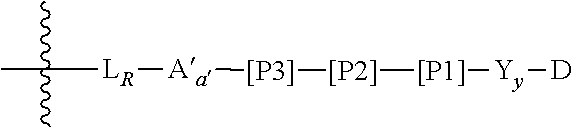
or a salt thereof, in particular a pharmaceutically acceptable salt, wherein LR, A′, a′, Y, y and D retain their previous meanings and P1, P2 and P3 are amino acid residues that together provide selectivity for proteolysis by tumor tissue homogenate over proteolysis by normal tissue homogenate and/or provide increased bioavailability to tumor tissue to the detriment of normal tissue in comparison to a comparator Ligand Drug Conjugate in which the amino acid sequence of the Peptide Cleavable Unit is the dipeptide -valine-citrulline-, wherein proteolytic cleavage occurs at the covalent bond between P1 and Y if subscript y is 1 or 2 or at the covalent bond between P1 and D if subscript y is 0 and wherein the tumor and normal tissue are of the same species.

or a salt thereof, in particular a pharmaceutically acceptable salt, wherein LR, A′, a′, Y, y and D retain their previous meanings and P1, P2 and P3 are amino acid residues, optionally with P-1, that together provide selectivity for proteolysis by tumor tissue homogenate over proteolysis by normal tissue homogenate, wherein proteolytic cleavage occurs at the covalent bond between P1 and P-1 to release a linker fragment having the structure of [P-1]-Yy-D.

or a salt thereof, in particular a pharmaceutically acceptable salt, wherein LR, A′, a′, Y, y and D retain their previous meanings and P-1 and P1, P2, P3 . . . Pn are amino acid residues, wherein subscript n ranges up to 12 (e.g., 3-12 or 3-10) and P1, P2 and P3, optionally with P-1, together provide selectivity for proteolysis by tumor tissue homogenate over proteolysis by normal tissue homogenate, wherein proteolytic cleavage occurs at the covalent bond between P1 and Yy-D or between and P1 and P-1 to release a linker fragment having the structure of Yy-D or [P-1]-Yy-D, respectively, in which the later subsequently undergoes exopeptidase cleavage to release the linker fragment having the structure of Yy-D. In both instances the Yy-D linker fragment undergoes spontaneous decomposition to complete release of D as free drug.


For Abu, Ala, Leu, Nva and Pra as the P2 amino acid residue the side chain is preferably in an L-configuration. In another embodiment, the P2 amino acid in the tripeptide is a polar amino acid. In some embodiments, the P2 amino acid in the tripeptide is selected from the group consisting of aspartic acid, glutamic acid, asparagine, glutamine, serine, threonine, tyrosine, citrulline, methionine sulfoxide, and γ-carboxy-glutamic acid. In another embodiment, the P2 amino acid in the tripeptide is negatively charged (e.g., at plasma physiological pH). In some embodiments, the P2 amino acid in the tripeptide is selected from the group consisting of aspartic acid, glutamic acid, and γ-carboxy-glutamic acid. In some embodiments, the P2 amino acid in the tripeptide is selected from the group consisting of aspartic acid and glutamic acid. In some embodiments, the P2 amino acid in the tripeptide is alanine. In some embodiments, the P2 amino acid in the tripeptide is serine. In some embodiments, the P2 amino acid in the tripeptide is selected from the group consisting of alanine, valine, leucine, methionine, aspartic acid, glutamic acid, asparagine, glutamine, serine, threonine, tyrosine, citrulline, methionine sulfoxide, and γ-carboxy-glutamic acid.


-
- wherein the wavy line adjacent to the nitrogen atom indicates the site of covalent attachment to the remainder of A, and the wavy line adjacent to the carbonyl carbon atom indicates the site of covalent attachment to B if B is present or to A′/W when B is absent; subscripts e and f are independently 0 or 1; and
- G is hydrogen, —OH, —ORPR, —CO2H, —CO2RPR or an optionally substituted C1-C6 alkyl, wherein the optional substituent when present is selected from the group consisting of —OH, —ORPR, —CO2H, and —CO2RPR; and wherein RPR is a suitable protecting group, or
- G is N(RPR)(RPR) or an optionally substituted C1-C6 alkyl, wherein the optional substituent when present is N(RPR)(RPR), wherein RPR are independently a protecting group or RPR together form a suitable protecting group, or
- G is —N(R45)(R46), or an optionally substituted C1-C6 alkyl, wherein the optional substituent when present is —N(R45)(R46), wherein one of R45 and R46 is hydrogen or RPR, wherein RPR is a suitable protecting group, and the other is hydrogen or optionally substituted C1-C6 alkyl;
- R38 is hydrogen or optionally substituted C1-C6 alkyl; and
- R39-R44 are independently selected from the group consisting of hydrogen, optionally substituted C1-C6 alkyl, optionally substituted C6-C20 aryl, and optionally substituted C5-C20 heteroaryl, or
- R39, R40 together with the carbon atom to which both are attached define a C3-C6 carbocyclo, and R41-R44 are as defined herein,
- or R43, R44 together with the carbon atom to which both are attached define a C3-C6 carbocyclo, and R39-R42 are as defined herein,
- or R40 and R41, or R40 and R43, or R41 and R43 to together with the carbon atom or heteroatom to which both are attached and the atoms intervening between those carbon atoms and/or heteroatoms define a C5-C6 carbocyclo or a C5-C6 heterocyclo, and R39, R44 and the remainder of R40-R43 are as defined herein,
- or AO/A′ is an α-amino or β-amino acid residue, wherein the nitrogen atom of the α-amino residue is covalently attached to the remainder of A, and the carbonyl carbon atom of its carboxylic acid residue is covalently attached to B if B is present or to W when B is absent, wherein both attachments are preferably through amide functional groups.


wherein the wavy line adjacent to the methylene carbon atom indicates the site of covalent attachment to a quaternized, tertiary amine containing Drug Unit, such that —Yy— is attached to the Drug Unit by way of a quaternized nitrogen atom that is part of the Drug Unit, and the wavy line adjacent to the nitrogen atom indicates the site of covalent attachment as an amide bond to the carboxylic acid residue of P1.

wherein the wavy line adjacent to the carbon atom of the methylene carbamate moiety indicates the site of covalent attachment to an oxygen atom on D to form a methylene alkoxy carbamate moiety that is shared between D and Y wherein that shared functional group is Y′ and the wavy line adjacent to the nitrogen atom indicates the site of covalent attachment as an amide bond to the carboxylic acid residue of P1.


-
- wherein the dagger indicates the site of covalent attachment of the nitrogen atom that provides a carbamate functional group, wherein —OC(═O)— of that functional group is Y′ on incorporation of the auristatin drug compound as -D into any one of the drug linker moieties of a Ligand Drug Conjugate compound or into any one of the Drug Linker compounds as described herein, so that for either type of compound subscript y is 2; and
- one R10 and R11 is hydrogen and the other is C1-C8 alkyl; R12 is hydrogen, C1-C8 alkyl, C3-C8 carbocyclyl, C6-C24 aryl, —X1—C6-C24 aryl, —X1—(C3-C8 carbocyclyl), C3-C8 heterocyclyl or —X1—(C3-C8 heterocyclyl); R13 is hydrogen, C1-C8 alkyl, C3-C8 carbocyclyl, C6-C24 aryl, —X1— C6-C24 aryl, —X1—(C3-C8 carbocyclyl), C3-C8 heterocyclyl and —X1—(C3-C8 heterocyclyl); R14 is hydrogen or methyl, or R13 and R14 taken together with the carbon to which they are attached comprise a spiro C3-C8 carbocyclo; R15 is hydrogen or C1-C8 alkyl; R16 is hydrogen, C1-C8 alkyl, C3-C8 carbocyclyl, C6-C24 aryl, —C6-C24—X1-aryl, —X1—(C3-C8 carbocyclyl), C3-C8 heterocyclyl and —X1—(C3-C8 heterocyclyl); R17 independently are hydrogen, —OH, C1-C8 alkyl, C3-C8 carbocyclyl and O—(C1-C8 alkyl); R18 is hydrogen or optionally substituted C1-C8 alkyl; R19 is —C(R19A)2—C(R19A)2— C6-C24 aryl, —C(R19A)2—C(R19A)2—(C3-C8 heterocyclyl) or —C(R19A)2—C(R19A)2—(C3-C8 carbocyclyl), wherein C6-C24 aryl and C3-C8 heterocyclyl are optionally substituted; R19A independently are hydrogen, optionally substituted C1-C8 alkyl, —OH or optionally substituted —O—C1-C8 alkyl; R20 is hydrogen or optionally substituted C1-C20 alkyl, optionally substituted C6-C24 aryl or optionally substituted C3-C8 heterocyclyl, or —(R47O)m—R48, or —(R47O)m—CH(R49)2; R21 is optionally substituted —C1-C8 alkylene-(C6-C24 aryl) or optionally substituted —C1-C8 alkylene-(C5-C24 heteroaryl), or C1-C8 hydroxylalkyl, or optionally substituted C3-C8 heterocyclyl; Z is O, S, NH, or NR46; R46 is optionally substituted C1-C8 alkyl; subscript m is an integer ranging from 1-1000; R47 is C2-C8 alkyl; R48 is hydrogen or C1-C8 alkyl; R49 independently are —COOH, —(CH2)n—N(R50)2, —(CH2)n—SO3H, or —(CH2)n—SO3—C1-C8 alkyl; R50 independently are C1-C8 alkyl, or —(CH2)n—COOH; subscript n is an integer ranging from 0 to 6; and X1 is C1-C10 alkylene.


wherein the wavy line indicates covalent attachment to the remainder of the auristatin compound.


wherein R7B is hydrogen or an O-linked substituent, and R8A is hydrogen or lower alkyl; and wherein the wavy line indicates the point of attachment to the remainder of DG or DH. In some embodiments, R7B is hydrogen or —OH in the para position. In some embodiments, R8A is methyl.

wherein R7B is —H or —OH; and wherein the wavy line indicates the point of attachment to the remainder of DG or DH.

wherein Z is an optionally substituted alkylene or an optionally substituted alkenylene, R7B is hydrogen or an O-linked substituent, R8A is hydrogen or lower alkyl, and the subscript n is 0, 1 or 2; and wherein the wavy line indicates the point of attachment to the remainder of DG or DH. In some embodiments, subscript n is 0 or 1. In still other embodiments of structure DG and DH-N(R7)(R7) is —NH(C1-C6 alkyl) wherein the C1-C6 alkyl is optionally substituted by —CO2H or an ester thereof, or by an optionally substituted phenyl. In some embodiments —N(R7)(R7) is selected from the group consisting of —NH(CH3), —CH2CH2Ph, —CH2—CO2H, —CH2CH2CO2H and —CH2CH2CH2CO2H. In some embodiments, one R7 is hydrogen or methyl and the other R7 is an optionally substituted arylalkyl having the structure of:

wherein Z is an optionally substituted alkylene or an optionally substituted alkenylene, R7B is hydrogen or —OH in the para position, R8A is hydrogen or methyl, and the subscript n is 0, 1 or 2

wherein the wavy line indicates the point of attachment to the remainder of DG′ or DH′.


wherein XB is O, S, or N—RB wherein RB is hydrogen or lower alkyl. In some embodiments, the quaternized drug is a tubulysin represented by structure DG, DG′ or DG-1, wherein m is 1. In some embodiments, the tubulysins are represented by structure DG, wherein m is 1 and the circle represents an optionally substituted divalent thiazole moiety.

wherein R2A along with the oxygen atom to which it is attached defines an O-linked substituent, R3 is lower alkyl or —CH2OC(═O)R3A wherein R3A is optionally substituted lower alkyl, and R7B is hydrogen or an O-linked substituent. In some embodiments, R2A along with the oxygen atom to which it is attached defines an ester, ether or O-linked carbamate. In some embodiments, R7B is an O-linked substituent in the para position. In some embodiments, R3 is methyl or R3A is methyl, ethyl, propyl, iso-propyl, iso-butyl or —CH2C═(CH3)2. In some embodiments R2A is methyl, ethyl, propyl (i.e., —OR2A is an ether) or is —C(═O)R2B (i.e., —OR2A is an ester) wherein R2B is lower alkyl. In some embodiments, R2B is methyl (i.e., —OR2A is acetate).

wherein R7B is hydrogen or —OH, R3 is lower alkyl, and R2B and R2C are independently hydrogen or lower alkyl. In some embodiments, R3 is methyl or ethyl. In some embodiments of any one of structures DG, DG-1, DG-2, DG-3, DG-4, DG-5, DH, DH-1 and DH-2, R3 is methyl or is —CH2OC(═O)R3A, wherein R3A is optionally substituted alkyl. In some embodiments of any one of structures DG′ and DH′, R3 is methyl or is —CH2OC(═O)R3A, wherein R3A is optionally substituted alkyl. In some embodiments of any one of those structures R3 is —C(R3A)(R3A)C(═O)—XC, wherein XC is —OR3B or —N(R3C)(R3C), wherein each R3A, R3B and R3C independently is hydrogen, optionally substituted alkyl or optionally substituted cycloalkyl. In some embodiments, R3 is —C(R3A)(R3A)C(═O)—N(R3C)(R3C), with each R3Ahydrogen, one R3C hydrogen and the other R3C n-butyl or isopropyl.

is replaced with

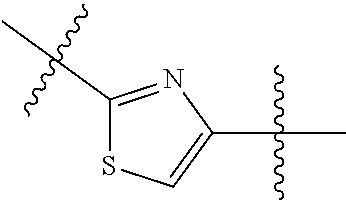
is replaced with


| TABLE 1 |
| Some Naturally Occurring Tubulysins |
| Tubulysin | R7B | R2A | R3 | ||
| A | OH | C(═O)CH3 | CH2OC═O)i-Bu | ||
| B | OH | C(═O)CH3 | CH2OC═O)n-Pr | ||
| C | OH | C(═O)CH3 | CH2OC═O)Et | ||
| D | H | C(═O)CH3 | CH2OC═O)i-Bu | ||
| E | H | C(═O)CH3 | CH2OC═O)n-Pr | ||
| F | H | C(═O)CH3 | CH2OC═O)Et | ||
| G | OH | C(═O)CH3 | CH2OC═O)CH═CH2 | ||
| H | H | C(═O)CH3 | CH2OC═O)Me | ||
| I | OH | C(═O)CH3 | CH2OC═O)Me | ||
| U | H | C(═O)CH3 | H | ||
| V | H | OH | H | ||
| Z | OH | OH | H | ||

wherein RB is selected from the group consisting of H, C1-C8 alkyl, C1-C8 haloalkyl, C3-C8 cycloalkyl, (C3-C8 cycloalkyl)-C1-C4 alkyl, phenyl, and phenyl-C1-C4 alkyl;
-
- RC is selected from the group consisting of C1-C6 alkyl and C3-C6 cycloalkyl; and
- each RF and RF′ is independently selected from the group consisting of —H, C1-C8 alkyl, C1-C8 hydroxyalkyl, C1-C8 aminoalkyl, (C1-C4 alkylamino)-C1-C8 alkyl-, N,N—(C1-C4 hydroxyalkyl)(C1-C4 alkyl)amino-C1-C8 alkyl-, N,N-di(C1-C4 alkyl)amino-C1-C8 alkyl-, N—(C1-C4 hydroxyalkyl)-C1-C8 aminoalkyl, C1-C8 alkyl-C(O)—, C1-C8 hydoxyalkyl-C(O)—, C1-C8 aminoalkyl-C(O)—, C3-C10 cycloalkyl, (C3-C10 cycloalkyl)-C1-C4 alkyl-, C3-C10 heterocycloalkyl, (C3-C10 heterocycloalkyl)-C1-C4 alkyl-, phenyl, phenyl-C1-C4 alkyl-, diphenyl-C1-C4 alkyl-, heteroaryl, and heteroaryl-C1-C4 alkyl-, or
- RF and RF′ are combined with the nitrogen atom to which each is attached to form a 5-, 6- or 7-membered ring having 0 to 3 substituents selected from the group consisting of halogen, C1-C4 alkyl, —OH, —OC1-C4 alkyl, —NH2, —NH—C1-C4 alkyl, —N(C1-C4 alkyl)2; and
- wherein the cycloalkyl, heterocycloalkyl, phenyl and heteroaryl portions of RB, RC, RF and RF′ are substituted with from 0 to 3 substituents selected from the group consisting of halogen, C1-C4 alkyl, —OH, —OC1-C4 alkyl, —NH2, —NHC1-C4 alkyl, and —N(C1-C4 alkyl)2.

wherein the dagger represents the point of attachment of the Drug Unit to the Linker Unit in a Drug Linker compound or Ligand Drug Conjugate compound.

wherein the dagger represents the point of attachment of the Drug Unit to the Linker Unit in a Drug Linker compound or Ligand Drug Conjugate compound.

-
- wherein the dagger represents the point of attachment of the Drug Unit to the Linker Unit in a Drug Linker compound or Ligand Drug Conjugate compound.

wherein the dagger represents the point of covalent attachment of the Drug Unit to the Linker Unit when the formula CPT4 compound is in the form of a Drug Unit in a Drug Linker compound or Ligand Drug Conjugate compound. In some embodiments, D incorporates the structure of exatecan.

wherein the dagger represents the point of attachment to the Linker Unit when the formula CPT5 compound is in the form of a Drug Unit in a Drug Linker compound or Ligand Drug Conjugate compound.

wherein the dagger represents the point of attachment to the Linker Unit when the formula CPT6 compound is in the form of a Drug Unit in a Drug Linker compound or Ligand Drug Conjugate compound. In some embodiments, CPT6 has the structure of:

wherein the dagger represents the point of attachment to the Linker Unit when the formula CPT6 compound is in the form of a Drug Unit in a Drug Linker compound or Ligand Drug Conjugate compound. In some embodiments, the camptothecin compound whose structure is incorporated as a Drug Unit in a LDC or a Drug Linker Compound is selected from Table X.

wherein the dagger represents the point of attachment to the Linker Unit in a Drug Linker compound or Ligand Drug Conjugate compound when the formula CPT7 compound is in the form of a Drug Unit.

wherein one of R11 is n-butyl and one of R12—R14 is —NH2 and the other are hydrogen, or R12 is —NH2 and R13 and R14 together are —OCHO—.


-
- or a salt thereof, wherein: the dotted lines represent a tautomeric double bond; R2″ is of formula XI:

-
- wherein the wavy line indicates the site of covalent attachment to the remainder of the Formula X structure; Ar is an optionally substituted C5-7 arylene; Xa is from a reactive or activatable group for conjugation to a Linker Unit, wherein Xa is selected from the group comprising: —O—, —S—, —C(O)O—, —C(O)—, —NHC(O)—, and —N(RN)—, wherein RN is H or C1-C4 alkyl, and (C2H4O)mCH3, where subscript m is 1, 2 or 3; and either:
- (i) Q1 is a single bond; and Q2 is a single bond or —Z—(CH2)n—, wherein Z is selected from the group consisting of a single bond, O, S, and NH; and subscript n is 1, 2 or 3, or (ii) Q1 is —CH═CH—, and Q2 is a single bond; and
- R2′ is a optionally substituted C1-C4 alkyl or a C5-10 aryl group, optionally substituted by one or more substituents selected from the group consisting of halo, nitro, cyano, C1-C6 ether, C1-C7 alkyl, C3-C7 heterocyclyl and bis-oxy-C1-C3 alkylene, in particular by one such substituent, wherein the dotted lines indicate a single bond to R2′, or R2′ an optionally substituted C1-C4 alkenylene, wherein the dotted lines indicate a double bond to R2′; R6″ and R9″ are independently selected from the group consisting of H, R, OH, OR, SH, SR, NH2, NHR, NRR′, nitro, Me3Sn and halo; R7″ is selected from the group consisting of H, R, OH, OR, SH, SR, NH2, NHR, NRR′, nitro, Me3Sn and halo; and R and R′ are independently selected from the group consisting of optionally substituted C1-C12 alkyl, optionally substituted C3-C20 heterocyclyl and optionally substituted C5-C20 aryl; either:
- (a) R10″ is H, and R11″ is OH or ORA, wherein RA is C1-C4 alkyl, (b) R10″ and R11″ form a nitrogen-carbon double bond between the nitrogen and carbon atoms to which they are bound, or (c) R10″ is H and R11″ is SOzM, wherein subscript z is 2 or 3 and M is a monovalent pharmaceutically acceptable cation, or (d) R10′, R11′ and R10″ are each H and R11″ is SO2M, or R10′ and R11′ are each H and R10″ and R11″ form a nitrogen-carbon double bond between the nitrogen and carbon atoms to which they are bound, or R10″, R11″ and R10′ are each H and R11′ is SOzM, or R10″ and R11″ are each H and R10′ and R11′ form a nitrogen-carbon double bond between the nitrogen and carbon atoms to which they are bound; wherein subscript z is 2 or 3 and M is a monovalent pharmaceutically acceptable cation; and
- R″ is a C3-12 alkylene group, the carbon chain of which is optionally interrupted by one or more heteroatoms, in particular by one of O, S or NRN2 (where RN2 is H or C1-C4 alkyl), and/or by aromatic rings, in particular by one of benzene or pyridine; Y and Y′ are selected from the group consisting of O, S, and NH; R6′, R7′, R9′ are selected from the same groups as R6″, R7″ and R9″, respectively, and R10′ and R11′ are the same as R10″ and R11″, respectively, wherein if R11″ and R11′ are SO2M, each M is either a monovalent pharmaceutically acceptable cation or together represent a divalent pharmaceutically acceptable cation.

or a salt thereof, wherein: the dotted lines indicate a tautomeric double bond; Q is of formula XIV:

wherein the wavy lines indicate the sites of covalent attachment to Y′ and Y in either orientation; Ar is a C5-7 arylene group substituted by Xa and is otherwise optionally substituted, wherein Xa is from an activatable group for conjugation to a Linker Unit, wherein Xa is selected from the group comprising: —O—, —S—, —C(O)O—, —C(O)—, —NHC(O)—, and —N(RN)—, wherein RN is H or C1-C4 alkyl, and (C2H4O)mCH3, where subscript m is 1, 2 or 3; and either:
-
- (i) Q1 is a single bond; and Q2 is a single bond or —(CH2)n—, wherein subscript n is 1, 2 or 3, or (ii) Q1 is —CH═CH—, and Q2 is a single bond or —CH═CH—; and
- R2′ is a optionally substituted C1-C4 alkyl or a C5-10 aryl group, optionally substituted by one or more substituents selected from the group consisting of halo, nitro, cyano, C1-C6 ether, C1-C7 alkyl, C3-C7 heterocyclyl and bis-oxy-C1-C3 alkylene, in particular by one such substituent, wherein the dotted lines indicate a single bond to R2′, or R2′ an optionally substituted C1-C4 alkenylene wherein the dotted lines indicate a double bond to R2′; and
- R2″ is an optionally substituted C1-C4 alkyl or a C5-10 aryl group, optionally substituted by one or more substituents selected from the group consisting of halo, nitro, cyano, C1-C6 ether, C1-C7 alkyl, C3-C7 heterocyclyl and bis-oxy-C1-C3 alkylene, in particular by one such substituent; R6″ and R9″ are independently selected from the group consisting of H, R, OH, OR, SH, SR, NH2, NHR, NRR′, nitro, Me3Sn and halo; R7″ is selected from the group consisting of H, R, OH, OR, SH, SR, NH2, NHR, NRR′, nitro, Me3Sn and halo; and R and R′ are independently selected from the group consisting of optionally substituted C1-C12 alkyl, optionally substituted C3-C20 heterocyclyl and optionally substituted C5-C20 aryl; and either:
- (a) R10″ is H, and R11″ is OH or ORA, wherein RA is C1-C4 alkyl, or (b) R10″ and R11″ form a nitrogen-carbon double bond between the nitrogen and carbon atoms to which they are bound, or (c) R10″ is H and R11″ is SO2M, wherein subscript z is 2 or 3 and M is a monovalent pharmaceutically acceptable cation, or (d) R10′, R11′ and R10″ are each H and R11″ is SO2M, or R10′ and R11″ are each H and R10″ and R11″ form a nitrogen-carbon double bond between the nitrogen and carbon atoms to which they are bound, or R10″, R11″ and R10′ are each H and R11″ is SO2M, or R10″ and R11″ are each H and R10′ and R11′ form a nitrogen-carbon double bond between the nitrogen and carbon atoms to which they are bound; wherein subscript z is 2 or 3 and M is a monovalent pharmaceutically acceptable cation; and
- Y and Y′ are selected from the group consisting of O, S, and NH; R″ represents one or more optional substituents; and R6′, R7′, R9′ are selected from the same groups as R6″, R7″ and R9″, respectively, and R10′ and R11″ are the same as R10″ and R11″, respectively, wherein if R11″ and R11′ are SOZM, each M is either a monovalent pharmaceutically acceptable cation or together represent a divalent pharmaceutically acceptable cation.


or a salt thereof, wherein the dagger represents the point of attachment of the Drug Unit to the Linker Unit in a Drug Linker compound or Ligand Drug Conjugate compound.


or a salt thereof (e.g., a pharmaceutically acceptable salt thereof), wherein L is a Ligand Unit, and subscript p′ is an integer from 1 to 24. It is understood that where L is an antibody, a sulfur atom S bonded to L in the aforementioned chemical structures represents a sulfur of the side chain of a cysteine residue of the antibody. In some embodiments, the subscript p′ is an integer from 1 to 12, 1 to 10 or 1 to 8 or is 4 or 8. In some embodiments, the subscript p′ is 1, 2, 3, 4, 5, 6, 7, 8, 9, 10, 11, 12, 13, 14, 15, 16, 17, 18, 19, 20, 21, 22, 23, or 24. In some embodiments, the subscript p′ is 2, 4, 6, or 8. In some embodiments, the subscript p′ is 2. In some embodiments, the subscript p′ is 4. In some embodiments, the subscript p′ is 6. In some embodiments, the subscript p′ is 8. Also included are Ligand Drug Conjugate compositions containing any of the Ligand Drug Conjugate compounds listed above wherein p′ is replaced with p as described herein.
LU′-(D′) (I)
-
- or a salt thereof, wherein LU′ is LU precursor; and D′ represents from 1 to 4 Drug Units, which are preferably identical to each other, wherein the Drug Linker compound is further defined by the structure of Formula IA:

-
- wherein LB′ is an ligand covalent binding moiety precursor; A is a first optional Stretcher Unit; subscript a is 0 or 1 indicating the absence or presence of A, respectively, B is an optional Branching Unit; subscript b is 0 or 1 indicating the absence or presence of B, respectively, provided that subscript b is 1 when subscript q is selected from 2 to 4 and
- LO is a secondary linker having the formula of:

-
- or a salt thereof, in particular a pharmaceutically acceptable salt, wherein A′ is a second optional Stretcher Unit, subscript a′ is 0 or 1 indicating the absence or presence of A′, respectively, Y is an optional Spacer Unit, subscript y is 0, 1 or 2 indicating the absence or presence of 1 or 2 Spacer Units, respectively, and P1, P2 and P3 are amino acid residues that together provide selectivity for proteolysis by a homogenate of tumor tissue over proteolysis by a homogenate of normal tissue, and/or together provide for preferred biodistribution of a Conjugate prepared from the Formula IA Drug Linker compound into tumor tissue in comparison to normal tissue, wherein cytotoxicity of the free drug released from the Conjugate towards the normal tissue is responsible at least in part for an adverse event typically associated with administration of a therapeutically effective amount of a comparator dipeptide-base Conjugate, wherein proteolytic cleavage occurs at the covalent bond between P1 and Y if subscript y is 1 or 2, or at the covalent bond between P1 and D if subscript y is 0 or
- LO is a secondary linker having the formula of:

-
- or a salt thereof, in particular a pharmaceutically acceptable salt, wherein A′, a′, Y, and y retain their previous meanings and P1, P2 and P3 are amino acid residues, optionally with the P-1 amino acid, that together provide selectivity for proteolysis by tumor tissue homogenate over proteolysis by normal tissue homogenate, and/or together provide for preferred biodistribution of a Conjugate prepared from the Formula IA Drug Linker compound into tumor tissue in comparison to normal tissue, wherein cytotoxicity of the free drug released from the Conjugate towards the normal tissue is responsible at least in part for an adverse event typically associated with administration of a therapeutically effective amount of a comparator dipeptide-base Conjugate, wherein proteolytic cleavage occurs at the covalent bond between P1 and P-1 to release a linker fragment having the structure of [P-1]—Yy-D, or
- LO is a secondary linker having the formula of:

-
- or a salt thereof, in particular a pharmaceutically acceptable salt, wherein A′, a′, Y, and y retain their previous meanings and P-1 and P1, P2, P3 . . . Pn are contiguous amino acid residues, wherein subscript n is an integer value providing for up to 12 (e.g., 3-12 or 3-10) of these amino acids and P1, P2 and P3, optionally with P-1, together provide selectivity for proteolysis by tumor tissue homogenate over proteolysis by normal tissue homogenate and/or together provide for preferred biodistribution of a Conjugate prepared from the Drug Linker compound into tumor tissue in comparison to normal tissue, wherein cytotoxicity of the free drug released from the Conjugate towards the normal tissue is responsible at least in part for an adverse event typically associated with administration of a therapeutically effective amount of a comparator dipeptide-base Conjugate, wherein proteolytic cleavage occurs at the covalent bond between P1 and Yy-D or between and P1 and P-1 to release a linker fragment having the structure of Yy-D or [P-1]-Yy-D, respectively, in which the later subsequently undergoes exopeptidase cleavage to release the linker fragment having the structure of Yy-D. In both instances the Yy-D linker fragment undergoes spontaneous decomposition to complete release of D as free drug.


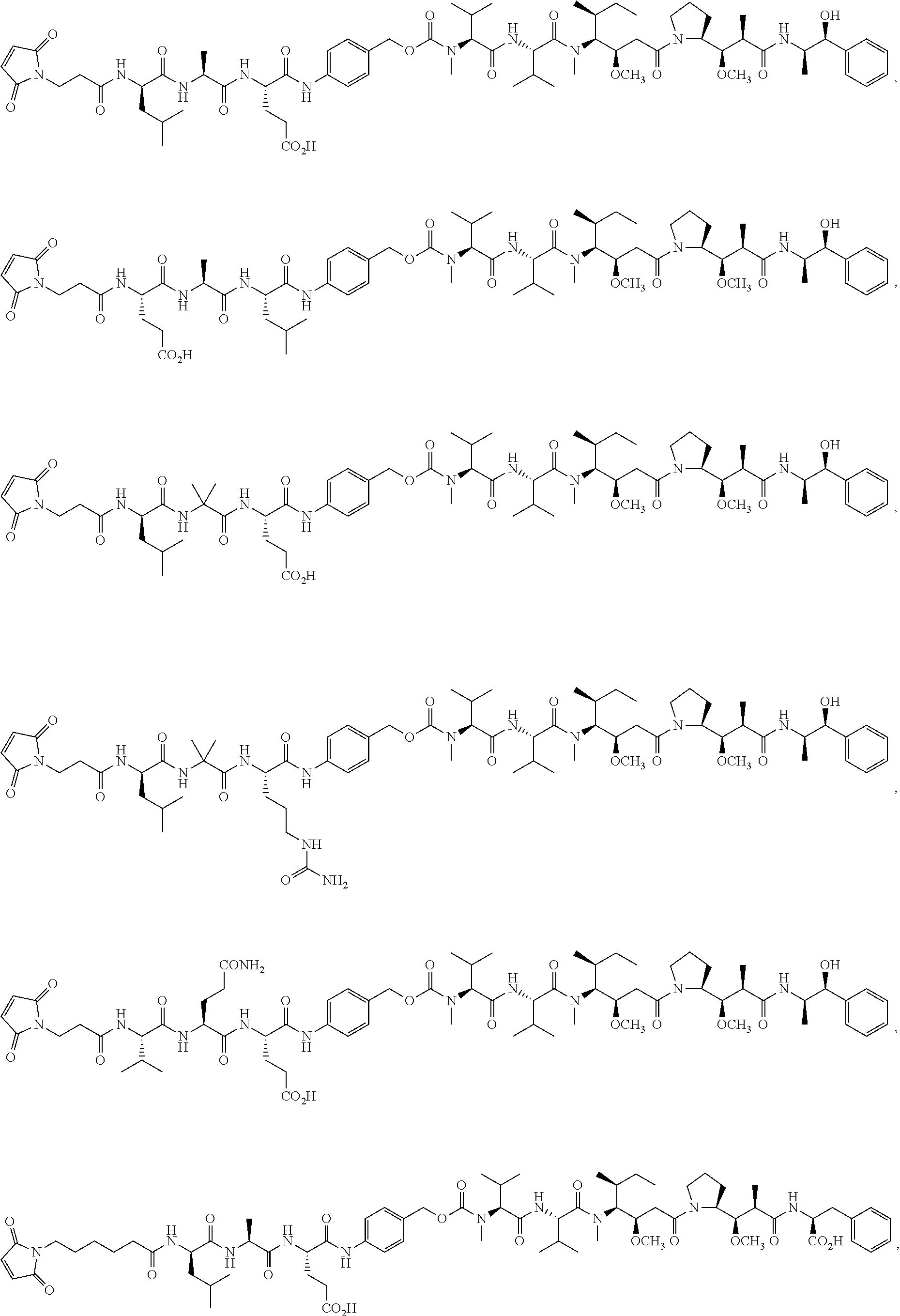


PG-W—Yy-D
PG-[P3]-[P2]-[P1]-Yy-D
PG-[P3]-[P2]-[P1]-[P-1]-Yy-D
PG-[Pn] . . . [P4]-[P3]-[P2]-[P1]-Yy-D
PG-[Pn] . . . [P4]-[P3]-[P2]-[P1]-[P-1]-Yy-D


or a salt thereof, wherein PG is an amine protecting group (e.g., Fmoc) or hydrogen.


or a pharmaceutically acceptable salt thereof. The drug loading is represented by p, the number of drug-linker molecules per antibody. Depending on the context, p can represent the average number of drug-linker molecules per antibody in a composition of antibodies, also referred to the average drug loading. P ranges from 1 to 20 and is preferably from 1 to 8. In some preferred embodiments, when p represents the average drug loading, p ranges from about 2 to about 5. In some embodiments, p is about 2, about 3, about 4, or about 5. The average number of drugs per antibody in a preparation may be characterized by conventional means such as mass spectroscopy, HIC, ELISA assay, and HPLC. In some aspects, the ABP (e.g., anti-GPNMB, anti-CD228, anti-αvβ6, anti-CD30, anti-LIV1, or anti-CD19 antibody) is attached to the drug-linker through a cysteine residue of the antibody. In some embodiments, the cysteine residue is one that is engineered into the antibody. In other aspects, the cysteine residue is an interchain disulfide cysteine residue.
L-[LU-D′]p (1)
-
- or a salt thereof, in particular a pharmaceutically acceptable salt, wherein
- L is a Ligand Unit;
- LU is a Linker Unit;
- D′ represents from 1 to 4 Drug Units (D) in each drug linker moiety of formula -LU-D′; and
- subscript p is a number from 1 to 12, from 1 to 10 or from 1 to 8 or is about 4 or about 8,
- wherein the Ligand Unit is from an antibody or an antigen-binding fragment of an antibody that is capable of selective binding to an antigen of tumor tissue for subsequent release of the Drug Unit(s) as free drug,
- wherein the drug linker moiety of formula -LU-D′ in each of the Ligand Drug Conjugate compounds of the composition has the structure of Formula 1A:

-
- or a salt thereof, in particular a pharmaceutically acceptable salt,
- wherein the wavy line indicates covalent attachment to L;
- D is the Drug Unit;
- LB is a ligand covalent binding moiety;
- A is a first optional Stretcher Unit;
- subscript a is 0 or 1, indicating the absence or presence of A, respectively;
- B is an optional Branching Unit;
- subscript b is 0 or 1, indicating the absence or presence of B, respectively;
- LO is a secondary linker moiety, wherein the secondary linker has the formula of;

-
- wherein the wavy line adjacent to Y indicates the site of covalent attachment of LO to the Drug Unit and the wavy line adjacent to A′ indicates the site of covalent attachment to the remainder of the drug linker moiety;
- A′ is a second optional Stretcher Unit, which in the absence of B becomes a subunit of A,
- subscript a′ is 0 or 1, indicating the absence or presence of A′, respectively,
- W is a peptide Cleavable Unit, wherein the peptide Cleavable Unit is a contiguous sequence of up to 12 amino acids, wherein the sequence is comprised of a selectivity conferring tripeptide that provides improved selectivity for exposure of tumor tissue over normal tissue to free cytotoxic compound released from the Ligand Drug Conjugate compounds of the composition in comparison to the compounds of a comparator Ligand-Drug Conjugate composition in which the peptide sequence of its peptide Cleavable Unit is the dipeptide -valine-citrulline- or -valine-alanine-;
- wherein the tumor and normal tissues are of rodent species and wherein the formula I composition provides said improved exposure selectivity demonstrated by:
- retaining efficacy in a tumor xenograft model of the comparator conjugate composition when administered at the same effective amount and dose schedule previously determined for the comparator conjugate composition, and
- showing a reduction in plasma concentration of free drug, and/or preservation of normal cells in tissue when administration at the same effective amount and dose schedule as in the tumor xenograft model to a non-tumor bearing rodent in comparison that same administration of the comparator conjugate in which the Ligand Units of both conjugate compositions are replaced by a non-binding antibody,
- wherein the normal tissue is of the same tissue type in human and wherein cytotoxicity to cells of that tissue is responsible at least in part to an adverse event in a human subject to whom is administered a therapeutically effective amount of the comparator conjugate composition;
- Y is a self-immolative Spacer Unit;
- subscript y is 0, 1 or 2 indicating the absence or presence of 1 or 2 of Y, respectively; and
- subscript q is an integer ranging from 1 to 4,
- provided that subscript q is 1 when subscript b is 0 and subscript q is 2, 3 or 4 when subscript b is 1; and
- wherein the Ligand Drug Conjugate compounds of the composition have the structure of
Formula 1 in which subscript p is replaced by subscript p′, wherein subscript p′ is an integer from 1 to 12, 1 to 10 or 1 to 8 or is 4 or 8.

-
- or a salt thereof, in particular a pharmaceutically acceptable salt, wherein
- LR is a primary linker of formula -LB-Aa-Bb—, provided that A′ is a subunit of A so that A′ is a component of LR when subscript a and a′ are each 1 and subscript b is 0; and
- each P is an amino acid residue of the contiguous amino acid sequence of the peptide Cleavable Unit and wherein subscript n has an integer value providing for up to 12 of these residues.

-
- or a salt thereof, in particular a pharmaceutically acceptable salt,
- wherein LR is a primary linker of formula -LB-Aa-Bb—, provided that A′ is a subunit of A so that A′ is a component of LR when subscript a and a′ are each 1 and subscript b is 0; and
- wherein each P is an amino acid residue of the contiguous amino acid sequence of the peptide Cleavable Unit.

-
- or a salt thereof, in particular a pharmaceutically acceptable salt, wherein
- LR is a primary linker of formula -LB-Aa-Bb—, provided that A′ is a subunit of A so that A′ is a component of LR when subscript a and a′ are each 1 and subscript b is 0;
- each P is an amino acid residue of the contiguous amino acid sequence of the peptide Cleavable Unit and wherein subscript n has an integer value providing for up to 12 of these residues; and
- P1 is a L-amino acid residue having at physiological pH a negatively charged side chain or a non-positively charged polar side chain.

-
- or a salt thereof, in particular a pharmaceutically acceptable salt, wherein
- LR is a primary linker of formula -LB-Aa-Bb—, provided that A′ is a subunit of A so that A′ is a component of LR when subscript a and a′ are each 1 and subscript b is 0; and
- each P is an amino acid residue of the contiguous amino acid sequence of the peptide Cleavable Unit.

-
- and wherein the side chains of Abu, Nva and Pra are in the same stereochemical configuration of an L-amino acid.

-
- or a salt thereof, in particular a pharmaceutically acceptable salt, wherein
- LR is a primary linker of formula -LB-Aa-Bb—, provided that A′ is a subunit of A so that A′ is a component of LR when subscript a and a′ are each 1 and subscript b is 0; and
- P3 is an amino acid residue of the contiguous amino acid sequence of the peptide Cleavable Unit.

-
- wherein the indicated (#) nitrogen, carbon or sulfur atom is from the Ligand Unit; and wherein the wavy line adjacent thereto indicates the site of covalent attachment to the remainder of the Ligand Unit and the other wavy line indicates the site of covalent attachment to the remainder of one of the drug linker moieties.
-
- wherein -LB-A- in the drug linker moieties of each Ligand Drug Conjugate compound predominately has the structure of:

-
- or a salt thereof, in particular a pharmaceutically acceptable salt, wherein
- the wavy line adjacent to A′a′ indicates the site of covalent attachment to the Peptide Cleavable Unit of one of the drug linker moieties; and the other wavy line indicates the site of covalent attachment to a sulfur atom of the Ligand Unit;
- [HE] is a Hydrolysis Enhancing Unit;
- BU is a Basic Unit;
- Ra2 is an optionally substituted C1-C12 alkyl group; and
- the dotted curved line indicates optional cyclization so that in the absence of said cyclization, BU is an acyclic Basic Unit having a primary, secondary or tertiary amine functional group as the basic function group of the acyclic Basic Unit, or in the presence of said cyclization BU is a cyclized Basic Unit in which Ra2 and BU together with the carbon atom to which both are attached, define an optionally substituted spiro C3-C20 heterocyclo containing a skeletal basic nitrogen atom of a secondary or tertiary amine functional group as the basic function group of the cyclic Basic Unit,
- wherein the basic nitrogen atom of the acyclic Basic Unit or cyclic Basic Unit is optionally suitably protected by a nitrogen protecting group, dependent on the degree of substitution of the basic nitrogen atom or is optionally protonated.

-
- or a salt thereof, in particular a pharmaceutically acceptable salt.

-
- or a salt thereof, in particular a pharmaceutically acceptable salt, wherein
- the wavy line adjacent to the nitrogen atom indicates the site of covalent attachment to [HE], wherein [HE] is —C(═O)— and the wavy line adjacent to the carbonyl carbon atom indicates the site of covalent attachment to the remainder of A′ or to the N-terminal amino acid residue of the Peptide Cleavable Unit, wherein both attachments are through amide functional groups;
- K and L′ independently are C, N, O or S, provided that when K or L′ is O or S, R41 and R42 to K, R38 and G to K, R43 and R44 to L′, and R39 and R40 to L′ are absent, and when K or L′ are N, one of R41 or R42 to K and one of R38 or G to K, one of R43 or R44 to L′ for each unit of -L′(R43)(R44), and one of R39 or R40 to L′ for each unit of -L′(R39)(R40) are absent, and provided that no two adjacent L′ are independently selected as N, O, or S;
- wherein subscripts e and f are independently selected integers that range from 0 to 12, and subscript g is an integer ranging from 1 to 12:
- G is hydrogen, optionally substituted C1-C6 alkyl, —OH or —CO2H;
- R38 is hydrogen or optionally substituted C1-C6 alkyl;
- R39-R44 are independently selected from the group consisting of hydrogen, optionally substituted C1-C6 alkyl and optionally substituted C5-C10 (hetero)aryl,
- or R39 and R40 together with the carbon atom to which both are attached, or R41 and R42 together with K to which both are attached when K is a carbon atom, define a C3-C6 carbocyclo, and the remainder of R39-R44 are as defined herein,
- or R43 and R44 together with L′ to which both are attached when L′ is a carbon atom define a C3-C6 carbocyclo, and R39-R42 are as defined herein,
- or R40 and R41, or R40 and R43, or R41 and R43 to together with the carbon atom or heteroatom to which both are attached and the optional atoms intervening between those carbon atoms and/or heteroatoms define a C5-C6 carbocyclo or a C5-C6 heterocyclo, and R39, R44 and the remainder of R40-R43 are as defined herein,
- provided that when K is O or S, R41 and R42 are absent, and when K is N, one of R41, R42 is absent, and when L′ is O or S, R43 and R44 are absent, and when L′ is N, one of R43, R44 is absent, or
- A′ is comprised of an alpha-amino, beta-amino or another amine-containing acid residue, wherein its amino nitrogen atom is covalently attached to the carbonyl carbon atom of HE, and its carboxylic acid carbonyl carbon atom is covalently attached to the remainder of A′ or to N-terminal amino acid of the Peptide Cleavable Unit, wherein both covalent attachments are through amide functional groups.

-
- or a salt thereof, in particular a pharmaceutically acceptable salt, wherein
- subscripts e and f are independently 0 or 1; and
- R38—R44 are each hydrogen;
- or A′ is an α-amino or β-amino acid residue.
-
- wherein PEG is a PEG Unit and LP is Parallel Connector Unit having the structure of Formula LP-1 or LP-2:

or
-
- wherein -LP(PEG)- or a PEG-containing subunit thereof has the structure of Formula LP-3 or Formula LP-4:

-
- wherein subscript v is an integer ranging from 1 to 4;
- subscript v′ is an integer ranging from 0 to 4;
- XLP is provided by a natural or un-natural amino acid side chain or is selected from the group consisting of —O—, —NRLP—, —S—, —S(═)-, —S(═O)2—, —C(═O)—, —C(═O)N(RLP)—, —N(RLP)C(═O)N(RLP)—, and —N(RLP)C(═NRLP)N(RLP)—, or C3-C8 heterocyclo;
- wherein each RLP is independently selected from the group consisting of hydrogen and optionally substituted C1-C6 alkyl, or two of RLP together along with the carbons atoms to which they are attached, and their intervening atoms define a C5-C6 heterocyclo and any remaining RLP are as previously defined;
- Ar is a C6-C10 arylene or a C5-C10 heteroarylene, each of which is optionally substituted;
- each RE and RF is independently selected from the group consisting of —H, optionally substituted C1-C6 alkyl, optionally substituted C2-C6 alkylene, optionally substituted C6-C10 arylene or optionally substituted C5-C10 heteroarylene,
- or RE and RF together with the carbon atom to which both are attached defines an optionally substituted spiro C3-C6 carbocyclo, or RE and RF from adjacent carbon atoms together with these atoms and any intervening carbon atoms defines an optionally substituted C5-C6 carbocyclo with any remaining RE and RF as previously defined;
- wherein one of the wavy lines indicate the point of covalent attachment of a PEG Unit and the other two wavy lines indicates covalent attachment of Formula LP-1 or Formula LP-2 within the structure representing the Ligand Drug Conjugate composition, or
- LP is Parallel Connector Unit having the structure of a tri-functional amine-containing acid residue or; and
- PEG is a PEG Unit.
-
- wherein the β-amino acid residue has the structure of —NHCH2CH2C(═O)—; and
- wherein -LP(PEG)- has the structure of:

-
- wherein the wavy lines indicate the sites of covalent attachment within the drug linker moiety.

-
- wherein the wavy line indicates the site of covalent attachment to LP;
- R20 is a PEG Attachment Unit, wherein the PEG Attachment Unit is —C(O)—, —O—, —S—, —S(O)—, —NH—, —C(O)O—, —C(O)C1-C10alkyl, —C(O)C1-C10alkyl-O—, —C(O)C1-C10alkyl-CO2—, —C(O)C1-C10alkyl-NH—, —C(O)C1-C10 alkyl-S—, —C(O)C1-C10 alkyl-C(O)—NH—, —C(O)C1-C10alkyl-NH—C(O)—, —C1-C10alkyl, —C1-C10alkyl-O—, —C1-C10alkyl-CO2—, —C1-C10alkyl-NH—, —C1-C10alkyl-S—, —C1-C10alkyl-C(O)—NH—, —C1-C10alkyl-NH—C(O)—, —CH2CH2SO2—C1-C10alkyl-, —CH2C(O)—C1-10 alkyl-, ═N—(O or N)—C1-C10alkyl-O—, ═N—(O or N)—C1-C10alkyl-NH—, ═N—(O or N)—C1-C10alkyl-CO2—, ═N—(O or N)—C1-C10alkyl-S—,

-
- R21 is a PEG Capping Unit; wherein the PEG Capping Unit is —C1-C10alkyl, —C2-C10 alkyl-CO2H, —C2-C10 alkyl-OH, —C2-C10 alkyl-NH2, C2-C10 alkyl-NH(C1-C3 alkyl), or C2-C10 alkyl-N(C1-C3 alkyl)2;
- R22 is an PEG Coupling Unit for coupling multiple PEG subunit chains together, wherein the PEG Coupling Unit is —C1-10 alkyl-C(O)—NH—, —C1-10 alkyl-NH—C(O)—, —C2-10 alkyl-NH—, —C2-C10 alkyl-O—, —C1-C10alkyl-S—, or —C2-C10 alkyl-NH—;
- subscript n is independently selected from 8 to 72, from 10 to 72 or from 12 to 72;
- subscript e is selected from 2 to 5; and
- each n′ is independently selected from at least 6 to no more than 72, preferably from at least 8 or at least 10 to no more than 36.

-
- or a salt thereof, in particular a pharmaceutical acceptable salt, wherein
- HE is a Hydrolysis Enhancing Unit;
- A′ is a subunit, when present, of the indicated first Stretcher Unit (A);
- subscript a′ is 0 or 1, indicating the absence or presence of A′, respectively;
- subscript P is 1 or 2; and subscript Q ranges from 1 to 6, preferably subscript Q is 1 or 2, more preferably subscript Q has the same value as subscript P;
- Ra3 is —H, optionally substituted C1-C6 alkyl, optionally substituted —C1-C4 alkylene-(C6-C10 aryl), or —RPEG1—O—(CH2CH2O)1-36—RPEG2, wherein RPEG1 is C1-C4 alkylene and RPEG2 is —H or C1-C4 alkylene, wherein the basic nitrogen bonded to Ra3 is optionally protonated in a salt form, preferably in a pharmaceutically acceptable salt form, or
- Ra3 is a nitrogen protecting group such as a suitable acid-labile protecting group;
- each P is an amino acid residue of the contiguous amino acid sequence of the peptide Cleavable Unit; and
- the wavy line indicates the site of covalent binding to a sulfur atom of the Ligand Unit.

-
- or a salt thereof, in particular a pharmaceutical acceptable salt, wherein
- HE is a Hydrolysis Enhancing Unit;
- A′ is a subunit, when present, of the indicated first Stretcher Unit (A);
- subscript a′ is 0 or 1, indicating the absence or presence of A′, respectively;
- subscript x is 1 or 2;
- Ra2 is —H, optionally substituted C1-C6 alkyl, —CH3 or —CH2CH3;
- Ra3, at each instance, is independently a nitrogen protecting group, —H or optionally substituted C1-C6 alkyl, preferably —H, an acid-labile protecting group, —CH3 or —CH2CH3,
- or both Ra3 together with the nitrogen to which they are attached define a nitrogen protecting group or an azetidinyl, pyrrolidinyl or piperidinyl heterocyclyl, in which a basic primary, secondary or tertiary amine so defined is optionally protonated in a salt form, preferably a pharmaceutically acceptable salt form; and
- the wavy line indicates the site of covalent binding to a sulfur atom of the Ligand Unit.

-
- or salts thereof, in particular pharmaceutical acceptable salts, and optionally having a minority of Ligand Drug Conjugate compounds in which one or more of the drug linker moieties in each of such compounds has its the succinimide ring in hydrolyzed form and wherein
- HE is a Hydrolysis Enhancing Unit;
- A′ is a subunit, when present, of the indicated first Stretcher Unit (A); subscript a′ is 0 or 1, indicating the absence or presence of A′; and
- the wavy line indicates the site of covalent binding to a sulfur atom of the Ligand Unit.

-
- or salts thereof, in particular pharmaceutical acceptable salts.

-
- or salts thereof, in particular pharmaceutical acceptable salts.

-
- wherein —N(Ry)D′ represents D, wherein D′ is the remainder of D;
- the wavy line indicates the site of covalent attachment to P1 or P-1;
- the dotted line indicates optional cyclization of R to D;
- Ry is optionally substituted C1-C6 alkyl in absence of cyclization to D′ or optionally substituted C1-C6 alkylene when cyclized to D′;
- each Q is independently —C1-C8 alkyl, —O—(C1-C8 alkyl), or other electron donating group, -halogen, -nitro or -cyano or other electron withdrawing group, in particular each Q is independently selected from the group consisting of —C1-C8 alkyl, —O—(C1-C8 alkyl), halogen, nitro and cyano; and
- subscript m is 0, 1 or 2, in particular subscript m is 0 or 1 and Q when present is an electron donating group, preferably subscript m is 0.

-
- or salts thereof, in particular, pharmaceutically acceptable salts, wherein
- the wavy line indicates covalent attachment to a sulfur atom from a Ligand Unit;
- subscript a′ is 1, indicating the presence of A′, wherein A′ is an amine-containing acid residue of formula 3a, formula 4a or formula 5a of
embodiment 22, or an α-amino acid or β-amino acid residue, in particular —NH—CH2CH2—C(═O)—; and - D is a cytotoxic drug having a secondary amino group as the site of attachment to the drug linker moiety.

-
- or salts thereof, in particular, pharmaceutically acceptable salts, wherein
- the wavy line indicates covalent attachment to a sulfur atom from a Ligand Unit;
- subscript a′ is 1, indicating the presence of A, respectively, wherein A′ is an amine-containing acid residue of formula 3a, formula 4a or formula 5a of
embodiment 22, or an α-amino acid or β-amino acid residue, in particular —NH—CH2CH2—C(═O)—; and - D is a cytotoxic drug having a secondary amino group as the site of attachment to the drug linker moiety.

-
- or salts thereof, in particular, pharmaceutically acceptable salts, wherein
- the wavy line indicates covalent attachment to a sulfur atom from a Ligand Unit; and
- D is a cytotoxic drug having a secondary amino group as the site of attachment to the drug linker moiety.

-
- wherein the dagger indicates the site of covalent attachment of the nitrogen atom that provides the carbamate functional group,
- one of R10 and R11 is hydrogen and the other is C1-C8 alkyl, preferably one of R10 and R11 is hydrogen and the other is methyl;
- R12 is hydrogen, C1-C8 alkyl, C3-C8 carbocyclyl, C6-C24 aryl, —X1—C6-C24 aryl, —X1—(C3-C8 carbocyclyl), C3-C8 heterocyclyl or —X1—(C3-C8 heterocyclyl);
- R13 is hydrogen, C1-C8 alkyl, C3-C8 carbocyclyl, C6-C24 aryl, —X1— C6-C24 aryl, —X1—(C3-C8 carbocyclyl), C3-C8 heterocyclyl or —X1—(C3-C8 heterocyclyl);
- R14 is hydrogen or methyl, or
- R13 and R14 taken together with the carbon to which they are attached comprise a Spiro C3-C8 carbocyclo;
- R15 is hydrogen or C1-C8 alkyl;
- R16 is hydrogen, C1-C8 alkyl, C3-C8 carbocyclyl, C6-C24 aryl, —C6-C24—X1-aryl, —X1—(C3-C8 carbocyclyl), C3-C8 heterocyclyl or —X1—(C3-C8 heterocyclyl);
- each R17 independently are hydrogen, —OH, C1-C8 alkyl, C3-C8 carbocyclyl or O—(C1-C8 alkyl);
- R18 is hydrogen or optionally substituted C1-C8 alkyl;
- R19 is —C(R19A)2—C(R19A)2— C6-C24 aryl, —C(R19A)2—C(R19A)2—(C3-C8 heterocyclyl) or —C(R19A)2—C(R19A)2—(C3-C8 carbocyclyl), wherein C6-C24 aryl and C3-C8 heterocyclyl are optionally substituted;
- R19A independently are hydrogen, optionally substituted C1-C8 alkyl, —OH or optionally substituted —O—C1-C8 alkyl;
- R20 is hydrogen or C1-C20 alkyl, C6-C24 aryl or C3-C8 heterocyclyl, optionally substituted, or —(R47O)m—R48, or —(R47O)m—CH(R49)2;
- R21 is —C1-C8 alkylene-(C6-C24 aryl) or —C1-C8 alkylene-(C5-C24 heteroaryl), optionally substituted, or C1-C8 hydroxylalkyl, or optionally substituted C3-C8 heterocyclyl; Z is O, S, NH, or NR46.
- R46 is optionally substituted C1-C8 alkyl; subscript m is an integer ranging from 1-1000;
- R47 is C2-C8 alkylene; R48 is hydrogen or C1-C8 alkyl;
- R49 independently are —COOH, —(CH2)n—N(R50)2, —(CH2)n—SO3H, or —(CH2)n—SO3—C1-C8 alkyl; and
- each R50 independently are C1-C8 alkyl or —(CH2)n—COOH; subscript n is an integer ranging from 0 to 6; and X1 is C1-C10 alkylene.

-
- wherein Ar is C6-C10 aryl or C5-C10 heteroaryl, preferably Ar is phenyl or 2-pyridyl;
- Z is —O— or —NH—; R20 is hydrogen, C1-C6 alkyl, C6-C10 aryl or C5-C10 heteroaryl, wherein C1-C6 alkyl, C6-C10 aryl and C5-C10 heteroaryl are optionally substituted; and R21 is C1-C6 alkyl, —C1-C6 alkylene-(C6-C10 aryl) or —C1-C6 alkylene-(C5-C10 heteroaryl), each of which is optionally substituted.
-
- wherein R21 is X1—S—R21a or X1—Ar, wherein X1 is C1-C6 alkylene, R21a is C1-C4 alkyl and Ar is phenyl or C5-C6 heteroaryl; and
- —Z— is —O— and R20 is C1-C4 alkyl, or
- —Z— is —NH— and R20 is phenyl or C5-C6 heteroaryl.

-
- wherein one of R10 and R11 is hydrogen and the other is methyl;
- R13 is isopropyl or —CH2—CH(CH3)2; and
- R19B is —CH(CH3)—CH(OH)-Ph, —CH(CO2H)—CH(OH)—CH3, —CH(CO2H)—CH2Ph, —CH(CH2Ph)-2-thiazolyl, —CH(CH2Ph)-2-pyridyl, —CH(CH2-p-Cl-Ph), —CH(CO2Me)-CH2Ph, —CH(CO2Me)-CH2CH2SCH3, —CH(CH2CH2SCH3)C(═O)NH-quinol-3-yl, —CH(CH2Ph)C(═O)NH-p-Cl-Ph, or
- R19B has the structure of

-
- wherein the wavy line indicates covalent attachment to the remainder of the auristatin compound.

-
- or salts thereof, in particular a pharmaceutical acceptable salts, wherein
- A′ is a subunit, when present, of the indicated first Stretcher Unit (A) having the structure of formula 3a, formula 4a or formula 5a of
embodiment 22, or an α-amino acid or β-amino acid residue, in particular —NH—CH2CH2—C(═O)—; - Ra3 is —H, optionally substituted C1-C6 alkyl, optionally substituted —C1-C4 alkylene-(C6-C10 aryl), or —RPEG1—O—(CH2CH2O)1-36—RPEG2, wherein RPEG1 is C1-C4 alkylene, RPEG2 is —H or C1-C4 alkylene, and wherein the basic nitrogen bonded to Ra3 is optionally protonated in a salt form, preferably in a pharmaceutically acceptable salt form, or
- Ra3 is a nitrogen protecting group such as a suitable acid-labile protecting group; and
- the wavy line indicates the site of covalent binding to a sulfur atom of the Ligand Unit.

-
- or salt thereof, in particular a pharmaceutical acceptable salts, wherein
- A′ is a subunit, when present, of the indicated first Stretcher Unit (A) having the structure of formula 3a, formula 4a or formula 5a of
embodiment 22, or an α-amino acid or β-amino acid residue, in particular —NH—CH2CH2—C(═O)—; - subscript x is 1 or 2;
- Ra3, at each instance, is independently a nitrogen protecting group, —H or optionally substituted C1-C6 alkyl, preferably —H, an acid-labile protecting group, —CH3 or —CH2CH3,
- or both Ra3 together with the nitrogen to which they are attached define a nitrogen protecting group or an azetidinyl, pyrrolidinyl or piperidinyl heterocyclyl, in which a basic primary, secondary or tertiary amine so defined is optionally protonated in a salt form, preferably a pharmaceutically acceptable salt form; and
- the wavy line indicates the site of covalent binding to a sulfur atom of the Ligand Unit.

-
- or a salt thereof, in particular a pharmaceutical acceptable salt, and optionally having a minority of Ligand Drug Conjugate compounds in which one or more of the drug linker moieties in each of such compounds has its the succinimide ring in hydrolyzed form and wherein
- A′ is a subunit, when present, of the indicated first Stretcher Unit (A) having the structure of formula 3a, formula 4a or formula 5a of
embodiment 22, or an α-amino acid or β-amino acid residue, in particular —NH—CH2CH2—C(═O)—; - subscript a′ is 0 or 1, indicating the absence or presence of A′; and
- the wavy line indicates the site of covalent binding to a sulfur atom of the Ligand Unit.

-
- or a salt thereof, in particular a pharmaceutical acceptable salt, and optionally having a minority of Ligand Drug Conjugate compounds in which one or more of the drug linker moieties in each of such compounds has its the succinimide ring in hydrolyzed form

-
- or a salt thereof, wherein
- D is a Drug Unit;
- LB′ is a ligand covalent binding precursor moiety;
- A is a first optional Stretcher Unit;
- subscript a is 0 or 1, indicating the absence or presence of A, respectively;
- B is an optional Branching Unit;
- subscript b is 0 or 1, indicating the absence or presence of B, respectively;
- LO is a secondary linker moiety, wherein the secondary linker has the formula of;

-
- wherein the wavy line adjacent to Y indicates the site of covalent attachment of LO to the Drug Unit and the wavy line adjacent to A′ indicates the site of covalent attachment to the remainder of the Drug Linker compound;
- A′ is a second optional Stretcher Unit, which in the absence of B becomes a subunit of A;
- subscript a′ is 0 or 1, indicating the absence or presence of A′, respectively,
- W is a peptide Cleavable Unit, wherein the peptide Cleavable Unit is a contiguous sequence of up to 12 amino acids, wherein the sequence is comprised of a selectivity conferring tripeptide whose N-terminus provides an amide linkage that is selectively cleavable by a homogenate of tumor tissue to release free drug in comparison to a homogenate of normal tissue, and/or provides improved bioavailability to tumor tissue of a Ligand Drug Conjugate compound of
Formula 1 ofembodiment 1 in which the Drug Linker compound becomes a drug linker moiety of the Conjugate compound to the detriment of bioavailability to normal tissue in comparison to a comparator Ligand-Drug Conjugate in which the peptide sequence of its peptide Cleavable Unit is the dipeptide -valine-citrulline-; - wherein the tumor and normal tissues are of the same species and wherein an adverse event associated with release of free drug from the comparator Ligand-Drug Conjugate when administered in an effective amount to a subject in need thereof is due to its toxicity towards cells of the normal tissue.
- Y is a self-immolative Spacer Unit;
- subscript y is 0, 1 or 2 indicating the absence or presence of 1 or 2 of Y, respectively; and
- subscript q is an integer ranging from 1 to 4,
- provided that subscript q is 1 when subscript b is 0 and subscript q is 2, 3 or 4 when subscript b is 1.
LR′-A′a′-[Pn] . . . [P4]-[P3-P2]-[P1]-Yy-D or
LR′-A′a′-[Pn] . . . [P4]-[P3]-[P2]-P1-P-1-Yy-D
-
- or a salt thereof, wherein
- LR′ is a primary linker of formula LB′-Aa-Bb—, provided that A′ is a subunit of A so that A′ is a component of LR′ when subscript a and a′ are each 1 and subscript b is 0; and
- each P is an amino acid residue of the contiguous amino acid sequence of the peptide Cleavable Unit and wherein subscript n has an integer value providing for up to 12 of these residues,
- wherein —[P3]-[P2]-[P1]- of the sequence is the selectivity conferring tripeptide.
LR′-A′a′-[P3]-[P2]-[P1]-Yy-D or
LR′-A′a′-[P3]-[P2]-[P1]-[P-1]-Yy-D
-
- or a salt thereof,
- wherein LR′ is a primary linker of formula LB′-Aa-Bb—, provided that A′ is a subunit of A so that A′ is a component of LR′ when subscript a and a′ are each 1 and subscript b is 0; and
- wherein each P is an amino acid residue of the contiguous amino acid sequence of the peptide Cleavable Unit, wherein —[P3]-[P2]-[P1]- of the sequence is the selectivity conferring tripeptide.
LR′-A′a′-[P3]-[P2]-[P1]-Yy-D
-
- or a salt thereof, wherein P1 is a L-amino acid residue having at physiological pH a negatively charged side chain or a non-positively charged polar side chain.

-
- or a salt thereof, in particular a pharmaceutically acceptable salt, wherein each P is an amino acid residue of the contiguous amino acid sequence of the peptide Cleavable Unit.

-
- wherein the side chains of Abu, Nva and Pra are in the same stereochemical configuration of an L-amino acid.
LR′-A′a′-[P3]-[Ala]-[Glu]-Yy-D
-
- or a salt thereof, wherein P3 is an amino acid residue of the contiguous amino acid sequence of the peptide Cleavable Unit.

-
- or a salt thereof, wherein
- LG1 is a leaving group suitable for nucleophilic displacement by a targeting agent nucleophile;
- LG2 is a leaving group suitable for amide bond formation to a targeting agent, or —OH to provide an activatable carboxylic acid suitable for amide bond formation to a targeting agent; and
- the wavy line indicates the site of covalent attachment to the remainder of the Drug Linker compound structure.

-
- or a salt thereof, wherein
- the wavy line adjacent to A′a′ indicates the site of covalent attachments to the Peptide Cleavable Unit;
- [HE] is an optional Hydrolysis Enhancing Unit, which is a component provided by A or a first subunit thereof;
- BU is a Basic Unit;
- Ra2 is an optionally substituted C1-C12 alkyl group; and
- the dotted curved line indicates optional cyclization so that in the absence of said cyclization, BU is an acyclic Basic Unit having a primary, secondary or tertiary amine functional group as the basic function group of the acyclic Basic Unit, or in the presence of said cyclization BU is a cyclized Basic Unit in which Ra2 and BU together with the carbon atom to which both are attached, define an optionally substituted spiro C3-C20 heterocyclo containing a skeletal basic nitrogen atom of a secondary or tertiary amine functional group as the basic function group of the cyclic Basic Unit,
- wherein the basic nitrogen atom of the acyclic Basic Unit or cyclic Basic Unit is optionally suitably protected by a nitrogen protecting group, dependent on the degree of substitution of the basic nitrogen atom or is optionally protonated as an acid addition salt.

-
- or a salt thereof, in particular as an acid addition salt, or wherein LB′-A- has the structure of:


-
- or a salt thereof, wherein
- the wavy line adjacent to the nitrogen atom indicates the site of covalent attachment to [HE], wherein [HE] is —C(═O)— and the wavy line adjacent to the carbonyl carbon atom indicates the site of covalent attachment to the remainder of A′ or to the N-terminal amino acid residue of the Peptide Cleavable Unit, wherein both attachments are through amide functional groups;
- K and L′ independently are C, N, O or S, provided that when K or L′ is O or S, R41 and R42 to K or R43 and R44 to L′ are absent, and when K or L′ are N, one of R41, R42 to K or one of R42, R43 to L′ are absent, and provided that no two adjacent L′ are independently selected as N, O, or S;
- wherein subscripts e and f are independently selected integers that range from 0 to 12, and subscript g is an integer ranging from 1 to 12:
- G is hydrogen, optionally substituted C1-C6 alkyl, —OH or —CO2H;
- R38 is hydrogen or optionally substituted C1-C6 alkyl;
- R39-R44 are independently selected from the group consisting of hydrogen, optionally substituted C1-C6 alkyl and optionally substituted C5-C10 (hetero)aryl, or
- R39, R40 together with the carbon atom to which both are attached, or R41, R42 together with K to which both are attached when K is a carbon atom, define a C3-C6 carbocyclo, and R41-R44 are as defined herein,
- or R43, R44 together with L′ to which both are attached when L′ is a carbon atom define a C3-C6 carbocyclo, and R39-R42 are as defined herein,
- or R40 and R41, or R40 and R43, or R41 and R43 to together with the carbon atom or heteroatom to which both are attached and the atoms intervening between those carbon atoms and/or heteroatoms define a C5-C6 carbocyclo or a C5-C6 heterocyclo, and R39, R44 and the remainder of R40-R43 are as defined herein,
- provided that when K is O or S, R41 and R42 are absent, and when K is N, one of R41, R42 is absent, and when L′ is O or S, R43 and R44 are absent, and when L′ is N, one of R43, R44 is absent, or
- A′ is comprised of an alpha-amino, beta-amino or another amine-containing acid residue, wherein its amino nitrogen atom is covalently attached to the carbonyl carbon atom of HE, and its carboxylic acid carbonyl carbon atom is covalently attached to the remainder of A′ or to the N-terminal amino acid of the Peptide Cleavable Unit, wherein both covalent attachments are through amide functional groups.

-
- or a salt thereof, wherein
- subscripts e and f are independently 0 or 1; and
- R38—R44 are each hydrogen;
- or A′ is an α-amino or β-amino acid residue.
-
- wherein LP is Parallel Connector Unit having the structure of Formula LP-1 or LP-2:

or
-
- wherein -LP(PEG)- or a PEG-containing subunit thereof has the structure of Formula LP-3 or Formula LP-4:

-
- wherein subscript v is an integer ranging from 1 to 4;
- subscript v′ is an integer ranging from 0 to 4;
- XLP is provided by a natural or un-natural amino acid side chain or is selected from the group consisting of —O—, —NRLP—, —S—, —S(═O)—, —S(═O)2—, —C(═O)—, —C(═O)N(RLP)—, —N(RLP)C(═O)N(RLP)—, and —N(RLP)C(═NRLP)N(RLP)—, or C3-C8 heterocyclo;
- wherein each RLP is independently selected from the group consisting of hydrogen and optionally substituted C1-C6 alkyl, or two of RLP together along with the carbons atoms to which they are attached, and their intervening atoms define a C5-C6 heterocyclo and any remaining RLP are as previously defined;
- Ar is a C6-C10 arylene or a C5-C10 heteroarylene, optionally substituted;
- each RE and RF is independently selected from the group consisting of —H, optionally substituted C1-C6 alkyl, optionally substituted C2-C6 alkylene, optionally substituted C6-C10 arylene or optionally substituted C5-C10 heteroarylene,
- or RE and RF together with the carbon atom to which both are attached defines an optionally substituted spiro C3-C6 carbocyclo, or RE and RF from adjacent carbon atoms together with these atoms and any intervening carbon atoms defines an optionally substituted C5-C6 carbocyclo with any remaining RE and RF as previously defined;
- wherein one of the wavy lines indicate the point of covalent attachment of a PEG Unit and the other two wavy lines indicates covalent attachment of Formula LP-1 or Formula LP-2 within the structure representing the Drug Linker Compound, or
- LP is Parallel Connector Unit having the structure of a tri-functional amine-containing acid residue or; and
- PEG is a PEG Unit.
-
- wherein the β-amino acid residue has the structure of —NHCH2CH2C(═O)—; and
- wherein -LP(PEG)- has the structure of:

-
- wherein the wavy lines indicate the sites of covalent attachment within the drug linker moiety.

-
- wherein the wavy line indicates the site of covalent attachment to LP;
- R20 is a PEG Attachment Unit, wherein the PEG Attachment Unit is —C(O)—, —O—, —S—, —S(O)—, —NH—, —C(O)O—, —C(O)C1-C10alkyl, —C(O)C1-C10alkyl-O—, —C(O)C1-C10alkyl-CO2—, —C(O)C1-C10alkyl-NH—, —C(O)C1-C10 alkyl-S—, —C(O)C1-C10 alkyl-C(O)—NH—, —C(O)C1-C10alkyl-NH—C(O)—, —C1-C10alkyl, —C1-C10alkyl-O—, —C1-C10alkyl-CO2—, —C1-C10alkyl-NH—, —C1-C10alkyl-S—, —C1-C10alkyl-C(O)—NH—, —C1-C10alkyl-NH—C(O)—, —CH2CH2SO2—C1-C10alkyl-, —CH2C(O)—C1-10 alkyl-, ═N—(O or N)—C1-C10alkyl-O—, ═N—(O or N)—C1-C10alkyl-NH—, ═N—(O or N)—C1-C10alkyl-CO2—, ═N—(O or N)—C1-C10alkyl-S—,

-
- R21 is a PEG Capping Unit; wherein the PEG Capping Unit is —C1-C10alkyl, —C2-C10 alkyl-CO2H, —C2-C10 alkyl-OH, —C2-C10 alkyl-NH2, C2-C10 alkyl-NH(C1-C3 alkyl), or C2-C10 alkyl-N(C1-C3 alkyl)2;
- R22 is an PEG Coupling Unit for coupling multiple PEG subunit chains together, wherein the PEG Coupling Unit is —C1-10 alkyl-C(O)—NH—, —C1-10 alkyl-NH—C(O)—, —C2-10 alkyl-NH—, —C2-C1O alkyl-O—, —C1-C10alkyl-S—, or —C2-C1O alkyl-NH-;
- subscript n is independently selected from from 8 to 72, from 10 to 72 or from 12 to 72;
- subscript e is selected from 2 to 5; and
- each n′ is independently selected from at least 6 to no more than 72, preferably from at least 8 or at least 10 to no more than 36.

-
- or a salt thereof, wherein
- HE is a Hydrolysis Enhancing Unit;
- A′ is an subunit, when present, of the indicated first Stretcher Unit (A);
- subscript a′ is 0 or 1, indicating the absence or presence of A′, respectively;
- subscript P is 1 or 2; and subscript Q ranges from 1 to 6, preferably subscript Q is 1 or 2, more preferably subscript Q has the same value as subscript P;
- Ra3 is —H, optionally substituted C1-C6 alkyl, optionally substituted —C1-C4 alkylene-(C6-C10 aryl), or —RPEG1—O—(CH2CH2O)1-36—RPEG2 wherein RPEG1 IS C1-C4 alkylene and RPEG2 is —H or C1-C4 alkylene, wherein the basic nitrogen bonded to Ra3 is protonated in a salt form, or
- Ra3 is a suitable nitrogen protecting group, preferably a suitable acid-labile protecting group; and
- each P is an amino acid residue of the contiguous amino acid sequence of the peptide Cleavable Unit.

-
- or a salt thereof, wherein
- HE is a Hydrolysis Enhancing Unit;
- A′ is an subunit, when present, of the indicated first Stretcher Unit (A);
- subscript a′ is 0 or 1, indicating the absence or presence of A′, respectively;
- subscript x is 1 or 2;
- Ra2 is —H, optionally substituted C1-C6 alkyl, —CH3 or —CH2CH3;
- Ra3, at each instance, is independently a suitable nitrogen protecting group, —H or optionally substituted C1-C6 alkyl, preferably —H, a suitable acid-labile protecting group, —CH3 or —CH2CH3, provided that the nitrogen atom to which both Ra3 are bound is protonated in salt form when neither Ra3 is a nitrogen protecting group,
- or both Ra3 together with the nitrogen to which they are attached define a nitrogen protecting group or an azetidinyl, pyrrolidinyl or piperidinyl heterocyclyl, in which a basic primary, secondary or tertiary amine so defined is protonated in a salt form.

-
- or salt thereof,
- HE is a Hydrolysis Enhancing Unit; and
- A′ is a subunit, when present, of the indicated first Stretcher Unit (A); subscript a′ is 0
- or 1, indicating the absence or presence of A′.

and
-
- or a salt thereof, wherein the nitrogen atom of the 4-membered heterocyclo of LSS′ is protonated in salt form.

-
- or salt thereof, wherein the primary amine of LSS′ is protonated in salt form.

-
- wherein —N(Ry)D′ represents D, wherein D′ is the remainder of D;
- the wavy line indicates the site of covalent attachment to P1 or P-1;
- the dotted line indicates optional cyclization of Ry to D′;
- Ry is optionally substituted C1-C6 alkyl in absence of cyclization to D′ or optionally substituted C1-C6 alkylene when cyclized to D′;
- each Q is independently —C1-C8 alkyl, —O—(C1-C8 alkyl), or other electron donating group, -halogen, -nitro or -cyano or other electron withdrawing group, in particular each Q is independently selected from the group consisting of —C1-C8 alkyl, —O—(C1-C8 alkyl), halogen, nitro and cyano; and
- subscript m is 0, 1 or 2, in particular subscript m is 0 or 1 and Q when present is an electron donating group, preferably subscript m is 0.

-
- or a salt thereof, wherein
- subscript a′ is 1, indicating the presence of A′, wherein A′ is an amine-containing acid residue of formula 3a, formula 4a or formula 5a of embodiment 73, or an α-amino acid or β-amino acid residue, in particular —NH—CH2CH2—C(═O)—; and
- D is a cytotoxic drug having a secondary amino group as the site of attachment to the Linker Unit of the Drug Linker compound,
- wherein the nitrogen atom of the heterocyclo of LSS′ is protonated in salt form.

-
- or a salt thereof, wherein
- subscript a′ is 1, indicating the presence of A′, wherein A′ is an amine-containing acid residue of formula 3a, formula 4a or formula 5a of embodiment 73, or an α-amino acid or β-amino acid residue, in particular —NH—CH2CH2—C(═O)—; and
- D is a cytotoxic drug having a secondary amino group as the site of attachment to the Linker Unit of the Drug Linker compound,
- wherein the primary amine of LSS′ is protonated in salt form.

-
- or a salt thereof, wherein
- D is a cytotoxic drug having a secondary amino group as the site of attachment to the Linker Unit of the Drug Linker compound.

-
- wherein the dagger indicates the site of covalent attachment of the nitrogen atom that provides the carbamate functional group,
- one of R10 and R11 is hydrogen and the other is C1-C8 alkyl, preferably one of R10 and R11 is hydrogen and the other is methyl;
- R12 is hydrogen, C1-C8 alkyl, C3-C8 carbocyclyl, C6-C24 aryl, —X1—C6-C24 aryl, —X1—(C3-C8 carbocyclyl), C3-C8 heterocyclyl or —X1—(C3-C8 heterocyclyl);
- R13 is hydrogen, C1-C8 alkyl, C3-C8 carbocyclyl, C6-C24 aryl, —X1—C6-C24 aryl, —X1—(C3-C8 carbocyclyl), C3-C8 heterocyclyl and —X1—(C3-C8 heterocyclyl);
- R14 is hydrogen or methyl, or
- R13 and R14 taken together with the carbon to which they are attached comprise a spiro C3-C8 carbocyclo;
- R15 is hydrogen or C1-C8 alkyl;
- R16 is hydrogen, C1-C8 alkyl, C3-C8 carbocyclyl, C6-C24 aryl, —C6-C24—X1-aryl, —X1—(C3-C8 carbocyclyl), C3-C8 heterocyclyl and —X1—(C3-C8 heterocyclyl);
- R17 independently are hydrogen, —OH, C1-C8 alkyl, C3-C8 carbocyclyl and O—(C1-C8 alkyl);
- R18 is hydrogen or optionally substituted C1-C8 alkyl;
- R19 is —C(R19A)2—C(R19A)2—C6-C24 aryl, —C(R19A)2—C(R19A)2—(C3-C8 heterocyclyl) or —C(R19A)2—C(R19A)2—(C3-C8 carbocyclyl), wherein C6-C24 aryl and C3-C8 heterocyclyl are optionally substituted;
- R19A independently are hydrogen, optionally substituted C1-C8 alkyl, —OH or optionally substituted —O—C1-C8 alkyl;
- R20 is hydrogen or C1-C20 alkyl, C6-C24 aryl or C3-C8 heterocyclyl, optionally substituted, or —(R47O)m—R48, or —(R47O)m—CH(R49)2;
- R21 is —C1-C8 alkylene-(C6-C24 aryl) or —C1-C8 alkylene-(C5-C24 heteroaryl), optionally substituted, or C1-C8 hydroxylalkyl, or optionally substituted C3-C8 heterocyclyl;
- Z is O, S, NH, or NR46.
- R46 is optionally substituted C1-C8 alkyl; subscript m is an integer ranging from 1-1000;
- R47 is C2-C8 alkyl; R48 is hydrogen or C1-C8 alkyl;
- R49 independently are —COOH, —(CH2)n—N(R50)2, —(CH2)n—SO3H, or —(CH2)n—SO3—C1-C8 alkyl; and
- R50 independently are C1-C8 alkyl, or —(CH2)n—COOH; subscript n is an integer ranging from 0 to 6; and X1 is C1-C10 alkylene.

-
- wherein Ar is C6-C10 aryl or C5-C10 heteroaryl, preferably Ar is phenyl or 2-pyridyl;
- Z is —O—, or —NH—; R20 is hydrogen or C1-C6 alkyl, C6-C10 aryl or C5-C10 heteroaryl, optionally substituted; and R21 is C1-C6 alkyl, —C1-C6 alkylene-(C6-C10 aryl) or —C1-C6 alkylene-(C5-C10 heteroaryl), optionally substituted.
-
- wherein R21 is X1—S—R21a or X1-Ar, wherein X1 is C1-C6 alkylene, R21a is C1-C4 alkyl and Ar is phenyl or C5-C6 heteroaryl; and
- —Z— is —O— and R20 is C1-C4 alkyl, or
- —Z— is —NH— and R20 is phenyl or C5-C6 heteroaryl.

-
- wherein one of R10 and R11 is hydrogen and the other is methyl;
- R13 is isopropyl or —CH2—CH(CH3)2; and
- R19B is —CH(CH3)—CH(OH)-Ph, —CH(CO2H)—CH(OH)—CH3, —CH(CO2H)—CH2Ph, —CH(CH2Ph)-2-thiazolyl, —CH(CH2Ph)-2-pyridyl, —CH(CH2-p-Cl-Ph), —CH(CO2Me)-CH2Ph, —CH(CO2Me)-CH2CH2SCH3, —CH(CH2CH2SCH3)C(═O)NH-quinol-3-yl, —CH(CH2Ph)C(═O)NH-p-Cl-Ph, or
- R19B has the structure of

-
- wherein the wavy line indicates covalent attachment to the remainder of the auristatin compound.

-
- or salts thereof, in particular a pharmaceutical acceptable salts, wherein
- A′ is a subunit, when present, of the indicated first Stretcher Unit (A) having the structure of formula 3a, formula 4a or formula 5a of embodiment 73, or an α-amino acid or β-amino acid residue, in particular —NH—CH2CH2—C(═O)—;
- Ra3 is —H, optionally substituted C1-C6 alkyl, optionally substituted —C1-C4 alkylene-(C6-C10 aryl), or —RPEG1—O—(CH2CH2O)1-36—RPEG2 wherein RPEG1 IS C1-C4 alkylene, RPEG2 is —H or C1-C4 alkylene, and wherein the basic nitrogen bonded to Ra3 is protonated in a salt form, or
- Ra3 is a suitable nitrogen protecting group, preferably a suitable acid-labile protecting group.

-
- or a salt thereof, wherein
- A′ is a subunit, when present, of the indicated first Stretcher Unit (A) having the structure of formula 3a, formula 4a or formula 5a of embodiment 73, or an α-amino acid or β-amino acid residue, in particular —NH—CH2CH2—C(═O)—;
- subscript x is 1 or 2;
- Ra3, at each instance, is independently a suitable nitrogen protecting group, —H or optionally substituted C1-C6 alkyl, preferably —H, a suitable acid-labile protecting group, —CH3 or —CH2CH3, provided that the nitrogen atom to which both Ra3 are bound is protonated in salt form when neither Ra3 is a nitrogen protecting group,
- or both Ra3 together with the nitrogen to which they are attached define a nitrogen protecting group or an azetidinyl, pyrrolidinyl or piperidinyl heterocyclyl, in which a basic primary, secondary or tertiary amine so defined is protonated in a salt form.

-
- or a salt thereof, wherein
- A′ is a subunit, when present, of the indicated first Stretcher Unit (A) having the structure of formula 3a, formula 4a or formula 5a of embodiment 73, or an α-amino acid or β-amino acid residue, in particular —NH—CH2CH2—C(═O)—;
- subscript a′ is 0 or 1, indicating the absence or presence of A′.
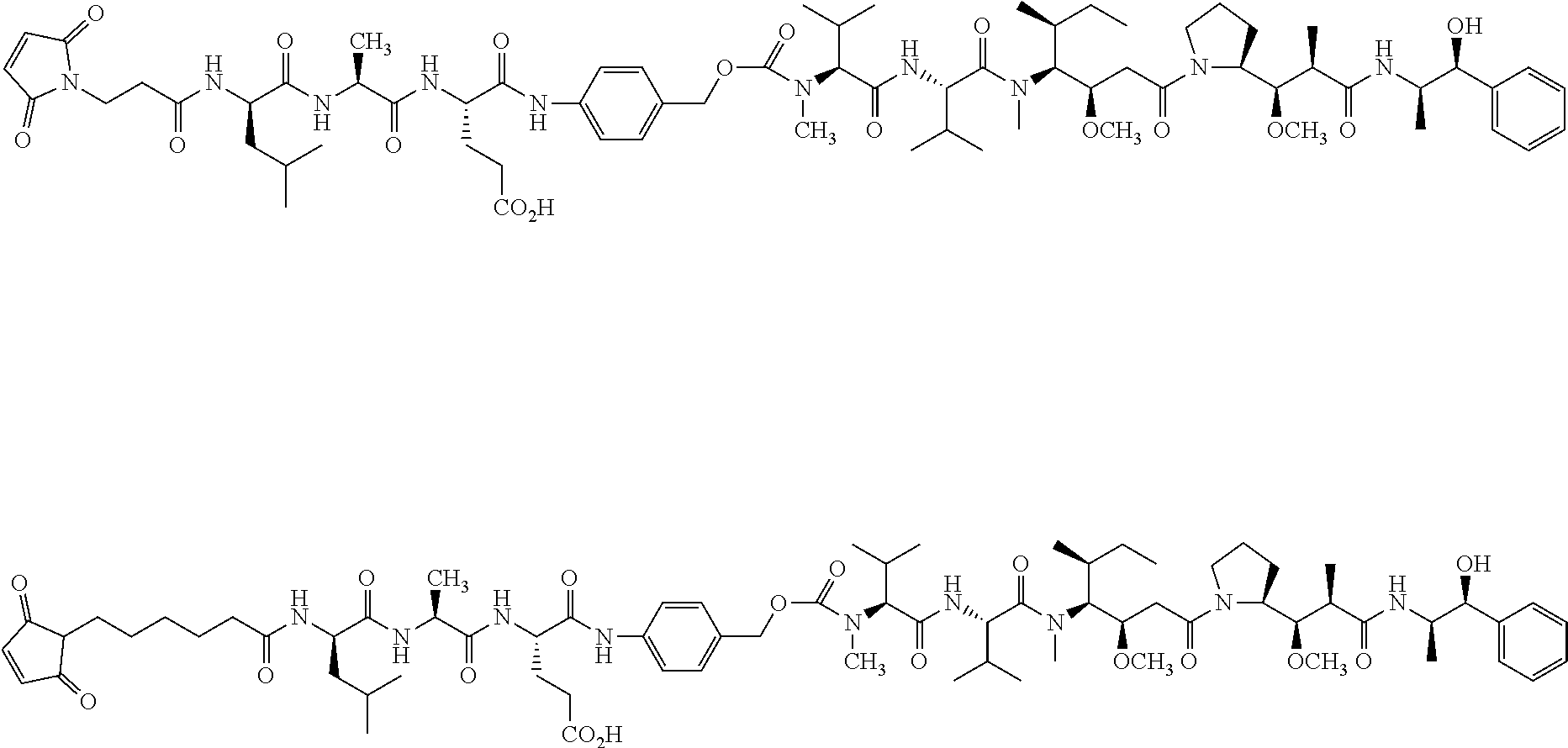
-
- or a salt thereof.
A1. A Ligand Drug Conjugate composition represented by Formula A1:
L-[LU-D′]p (A1) - or a pharmaceutically acceptable salt thereof, wherein
- L is a Ligand Unit;
- LU is a Linker Unit;
- D′ represents from 1 to 4 Drug Units (D) in each drug linker moiety of formula -LU-D′; and
- subscript p is a number from 1 to 12, from 1 to 10 or from 1 to 8 or is about 4 or about 8,
- wherein the Ligand Unit is from an antibody or an antigen-binding fragment of an antibody, wherein the antibody or the antigen-binding fragment is capable of selective binding to an antigen of tumor tissue for subsequent release of the Drug Unit(s) as a free drug,
- wherein the drug linker moiety of formula -LU-D′ in each of the Ligand Drug Conjugate compounds of the composition has the structure of Formula A1A:
- or a salt thereof.

-
- or a salt thereof,
- wherein the wavy line indicates covalent attachment to L;
- D is the Drug Unit;
- LB is a ligand covalent binding moiety;
- A is a first optional Stretcher Unit;
- subscript a is 0 or 1, indicating the absence or presence of A, respectively;
- B is an optional Branching Unit;
- subscript b is 0 or 1, indicating the absence or presence of B, respectively;
- LO is a secondary linker moiety, wherein the secondary linker has the formula of;

-
- wherein the wavy line adjacent to Y indicates the site of covalent attachment of LO to the Drug Unit and the wavy line adjacent to A′ indicates the site of covalent attachment of LO to the remainder of the drug linker moiety;
- A′ is a second optional Stretcher Unit, which when present and in the absence of B becomes a subunit of A,
- subscript a′ is 0 or 1, indicating the absence or presence of A′, respectively,
- W is a Peptide Cleavable Unit, wherein the Peptide Cleavable Unit comprises a tripeptide having the sequence -P3-P2-P1-, wherein P1, P2, and P3 are each an amino acid, wherein:
- a first one of the amino acids P1, P2, or P3 is negatively charged;
- a second one of the amino acids P1, P2, or P3 has an aliphatic side chain with hydrophobicity no greater than that of leucine; and
- a third one of the amino acids P1, P2, or P3 has hydrophobicity lower than that of leucine,
- wherein the first one of the amino acids P1, P2, or P3 corresponds to any one of P1, P2, or P3, the second one of the amino acids P1, P2, or P3 corresponds to one of the two remaining amino acids P1, P2, or P3, and the third one of the amino acids P1, P2, or P3 corresponds to the last remaining amino acids P1, P2, or P3,
- provided that -P3-P2-P1- is not -Glu-Val-Cit- or -Asp-Val-Cit-;
- each Y when present is a self-immolative Spacer Unit;
- subscript y is 0, 1 or 2 indicating the absence or presence of 1 or 2 of Y, respectively; and
- subscript q is an integer ranging from 1 to 3, and
- provided that subscript q is 1 when subscript b is 0 and subscript q is 2 or 3 when subscript b is 1; and
- wherein the Ligand Drug Conjugate compounds of the composition have the structure of Formula A1 in which subscript p is replaced by subscript p′, wherein subscript p′ is an integer from 1 to 12, 1 to 10 or 1 to 8 or is 4 or 8.
A2. The Ligand Drug Conjugate composition of embodiment A1, wherein the Ligand Drug Conjugate compounds in the Ligand Drug Conjugate composition predominately have drug linker moieties of Formula A1H.

-
- or pharmaceutically acceptable salts thereof, and optionally having a minority of Ligand Drug Conjugate compounds in which one or more of the drug linker moieties in each of such compounds has its succinimide ring in hydrolyzed form and wherein
- HE is a Hydrolysis Enhancing Unit;
- A′ is a subunit, when present, of the indicated first Stretcher Unit (A); subscript a′ is 0 or 1, indicating the absence or presence of A′, respectively; and
- the wavy line indicates the site of covalent attachment to a sulfur atom of the Ligand Unit.
A3. The Ligand Drug Conjugate composition of embodiment A2, wherein HE is —C(═O).
A4. The Ligand Drug Conjugate composition of any one of embodiments A1-A3, wherein —Yy-D has the structure of:

-
- wherein —N(Ry)D′ represents D, wherein D′ is the remainder of D;
- the wavy line indicates the site of covalent attachment to P1;
- the dotted line indicates optional cyclization of Ry to D′;
- Ry is optionally substituted C1-C6 alkyl in absence of cyclization to D′ or optionally substituted C1-C6 alkylene when cyclized to D′;
- each Q, when present, is independently selected from the group consisting of —C1-C8 alkyl, —O—(C1-C8 alkyl), halogen, nitro and cyano; and
- subscript m is 0, 1 or 2.
A5. The Ligand Drug Conjugate composition of any one of embodiments A1-A4, wherein D incorporates the structure of a tubulin disrupting agent, a DNA minor groove binder, a DNA damaging agent, or a DNA replication inhibitor.
A6. The Ligand Drug Conjugate composition of any one of embodiments A1-A4, wherein D incorporates the structure of a tubulysin.
A7. The Ligand Drug Conjugate composition of any one of embodiments A1-A4, wherein D incorporates the structure of a camptothecin.
A8. The Ligand Drug Conjugate composition of any one of embodiments A1-A4, wherein D incorporates the structure of an auristatin.
A9. The Ligand Drug Conjugate composition of any one of embodiments A1-A4, wherein D incorporates the structure of an anthracycline.
A10. The Ligand Drug Conjugate composition of any one of embodiments A1-A4, wherein D incorporates the structure of a camptothecin selected from the group consisting of


wherein
-
- RB is selected from the group consisting of H, C1-C8 alkyl, C1-C8 haloalkyl, C3-C8 cycloalkyl, (C3-C8 cycloalkyl)-C1-C4 alkyl, phenyl, and phenyl-C1-C4 alkyl;
- RC is selected from the group consisting of C1-C6 alkyl and C3-C6 cycloalkyl; and
- each RF and RF′ is independently selected from the group consisting of —H, C1-C8 alkyl, C1-C8 hydroxyalkyl, C1-C8 aminoalkyl, (C1-C4 alkylamino)-C1-C8 alkyl-, N,N-(C1-C4 hydroxyalkyl)(C1-C4 alkyl)amino-C1-C8 alkyl-, N,N-di(C1-C4 alkyl)amino-C1-C8 alkyl-, N—(C1-C4 hydroxyalkyl)-C1-C8 aminoalkyl, C1-C8 alkyl-C(O)—, C1-C8 hydoxyalkyl-C(O)—, C1-C8 aminoalkyl-C(O)—, C3-C10 cycloalkyl, (C3-C10 cycloalkyl)-C1-C4 alkyl-, C3-C10 heterocycloalkyl, (C3-C10 heterocycloalkyl)-C1-C4 alkyl-, phenyl, phenyl-C1-C4 alkyl-, diphenyl-C1-C4 alkyl-, heteroaryl, and heteroaryl-C1-C4 alkyl-, or
- RF and RF′ are combined with the nitrogen atom to which each is attached to form a 5-, 6- or 7-membered ring having 0 to 3 substituents selected from the group consisting of halogen, C1-C4 alkyl, —OH, —OC1-C4 alkyl, —NH2, —NH—C1-C4 alkyl, —N(C1-C4 alkyl)2; and
- wherein the cycloalkyl, heterocycloalkyl, phenyl and heteroaryl portions of RB, RC, RF and RF′ are substituted with from 0 to 3 substituents selected from the group consisting of halogen, C1-C4 alkyl, —OH, —OC1-C4 alkyl, —NH2, —NHC1-C4 alkyl, and —N(C1-C4 alkyl)2.
A11. The Ligand Drug Conjugate composition of any one of embodiments A1-A4, wherein D has a formula selected from the group consisting of

-
- wherein the dagger represents the point of attachment of D to the secondary linker of the drug linker moiety and the circle represents an 5-membered or 6-membered nitrogen heteroarylene wherein the indicated required substituents to that heteroarylene are in a 1,3- or meta-relationship to each other with optional substitution at the remaining positions;
- R2 is XA-R2A, wherein XA is —O—, —S—, —N(R2B)-, —CH2—, —(C═O)N(R2B)— or —O(C═O)N(R2B)— wherein R2B is hydrogen or optionally substituted alkyl, R2A is hydrogen, optionally substituted alkyl, optionally substituted aryl, or —C(═O)RC, wherein RC is hydrogen, optionally substituted alkyl, or optionally substituted aryl or R2 is an O-linked substituent;
- R3 is hydrogen or optionally substituted alkyl;
- R4, R4A, R4B, R5 and R6 are optionally substituted alkyl, independently selected,
- one R7 is hydrogen or optionally substituted alkyl and the other R7 is optionally substituted arylalkyl or optionally substituted heteroarylalkyl, and
- subscript m′ is 0 or 1.
A12. The Ligand Drug Conjugate composition of any one of embodiments A1-A4, wherein D is a cytotoxic drug wherein the cytotoxic drug is a secondary amine-containing auristatin compound wherein the nitrogen atom of the secondary amine is the site of covalent attachment to the drug linker moiety and the secondary amine-containing auristatin compound has the structure of Formula DF/E-3:

-
- wherein the dagger indicates the site of covalent attachment of the nitrogen atom that provides the carbamate functional group;
- one of R10 and R11 is hydrogen and the other is methyl;
- R13 is isopropyl or —CH2—CH(CH3)2; and
- R19B is —CH(CH3)—CH(OH)-Ph, —CH(CO2H)—CH(OH)—CH3, —CH(CO2H)—CH2Ph, —CH(CH2Ph)-2-thiazolyl, —CH(CH2Ph)-2-pyridyl, —CH(CH2-p-Cl-Ph), —CH(CO2Me)-CH2Ph, —CH(CO2Me)-CH2CH2SCH3, —CH(CH2CH2SCH3)C(═O)NH-quinol-3-yl, —CH(CH2Ph)C(═O)NH-p-Cl-Ph, or
- R19B has the structure of

-
- wherein the wavy line indicates covalent attachment to the remainder of the auristatin compound.
A13. The Ligand Drug Conjugate composition of embodiment A12, wherein the secondary amine-containing auristatin compound is monomethylauristatin E (MMAE) or monomethylauristatin F (MMAF).
A14. The Ligand Drug Conjugate composition of any one of embodiments A1-A13, or a pharmaceutically acceptable salt thereof, wherein the Peptide Cleavable Unit is a tripeptide having the sequence -P3-P2-P1-, wherein P1, P2, and P3 are each an amino acid, wherein: - the P3 amino acid of the tripeptide is in the D-amino acid configuration;
- one of the P2 and P1 amino acids has an aliphatic side chain with hydrophobicity lower than that of leucine; and
- the other of the P2 and P1 amino acids is negatively charged.
A15. The Ligand Drug Conjugate composition of any one of embodiments A1-A14, or a pharmaceutically acceptable salt thereof, wherein the P3 amino acid is D-Leu or D-Ala.
A16. The Ligand Drug Conjugate composition of any one of embodiments A1-A15, or a pharmaceutically acceptable salt thereof, wherein one of the P2 or P1 amino acid has an aliphatic side chain with hydrophobicity no greater than that of valine, and the other of the P2 or P1 amino acid is negatively charged at plasma physiological pH.
A17. The Ligand Drug Conjugate composition of any one of embodiments A1-A16, or a pharmaceutically acceptable salt thereof, wherein the P2 amino acid has an aliphatic side chain with hydrophobicity no greater than that of valine, and the P1 amino acid is negatively charged at plasma physiological pH.
A18. The Ligand Drug Conjugate composition of any one of embodiments A1-A17, or a pharmaceutically acceptable salt thereof, wherein -P2-P1- is -Ala-Glu- or -Ala-Asp-.
A19. The Ligand Drug Conjugate composition of any one of embodiments A1-A18, or a pharmaceutically acceptable salt thereof, wherein -P3-P2-P1- is -D-Leu-Ala-Asp-, -D-Leu-Ala-Glu-, -D-Ala-Ala-Asp-, or -D-Ala-Ala-Glu-.
A20. The Ligand Drug Conjugate composition of any one of embodiments A1-A16, or a salt thereof, wherein the P3 amino acid is D-Leu or D-Ala, the P2 amino acid is Ala, Glu, or Asp, and the P1 amino acid is Ala, Glu, or Asp.
A21. The Ligand Drug Conjugate compound composition of embodiment A1, wherein the composition comprises Ligand Drug Conjugate compounds having the structure of
- wherein the wavy line indicates covalent attachment to the remainder of the auristatin compound.


or a pharmaceutically acceptable salt thereof,
wherein L is the Ligand Unit, and subscript p′ is an integer from 1 to 12.
A22. The Ligand Drug Conjugate composition of any one of embodiments A1-A21, wherein L is an antibody Ligand Unit of an intact antibody or an antigen-binding fragment thereof.
A23. The Ligand Drug Conjugate composition of embodiment A22, wherein the intact antibody is a an intact chimeric, humanized or human antibody.
A24. The Ligand Drug Conjugate composition of embodiment A22, wherein the intact antibody or fragment thereof is capable of selectively binding to a cancer cell antigen.
A25. The Ligand Drug Conjugate composition of embodiment A22, wherein the intact antibody or fragment thereof is capable of selectively binding to an immune cell antigen.
A26. The Ligand Drug Conjugate composition of embodiment A22 or embodiment A23, wherein the intact antibody or fragment thereof is capable of selectively binding CD30.
A27. The Ligand Drug Conjugate composition of embodiment A26, wherein the intact antibody or fragment thereof comprises CDR-H1, CDR-H2, CDR-H3, CDR-L1, CDR-L2, and CDR-L3 comprising the amino acid sequences of SEQ ID NOs: 1, 2, 3, 4, 5, and 6, respectively.
A28. The Ligand Drug Conjugate composition of embodiment A26 or embodiment A27, wherein the intact antibody or fragment thereof comprises a heavy chain variable region comprising the amino acid sequence of SEQ ID NO: 7 and a light chain variable region comprising the amino acid sequence of SEQ ID NO: 8.
A29. The Ligand Drug Conjugate composition of any one of embodiments A26-A28, wherein the intact antibody is cAC10.
A30. The Ligand Drug Conjugate composition of embodiment A22 or embodiment A23, wherein the intact antibody or fragment thereof is capable of selectively binding LIV1.
A31. The Ligand Drug Conjugate composition of embodiment A30, wherein the intact antibody or fragment thereof comprises CDR-H1, CDR-H2, CDR-H3, CDR-L1, CDR-L2, and CDR-L3 comprising the amino acid sequences of SEQ ID NOs: 518, 519, 520, 521, 522, and 523, respectively.
A32. The Ligand Drug Conjugate composition of embodiment A30 or embodiment A31, wherein the intact antibody or fragment thereof comprises a heavy chain variable region comprising the amino acid sequence of SEQ ID NO: 524 and a light chain variable region comprising the amino acid sequence of SEQ ID NO: 525.
A33. The Ligand Drug Conjugate composition of any one of embodiments A30-A32, wherein the intact antibody is ladiratuzumab.
A34. The Ligand Drug Conjugate composition of embodiment A22 or embodiment A23, wherein the intact antibody or fragment thereof is capable of selectively binding TROP2.
A35. The Ligand Drug Conjugate composition of embodiment A34, wherein the intact antibody is sacituzumab or datopotamab.
A36. The Ligand Drug Conjugate composition of embodiment A22 or embodiment A23, wherein the intact antibody or fragment thereof is capable of selectively binding ALPP.
A37. The Ligand Drug Conjugate composition of embodiment A22 or embodiment A23, wherein the intact antibody or fragment thereof is capable of selectively binding IL1RAP.
A38. The Ligand Drug Conjugate composition of embodiment A37, wherein the intact antibody or fragment thereof comprises CDR-H1, CDR-H2, CDR-H3, CDR-L1, CDR-L2, and CDR-L3 comprising the amino acid sequences of SEQ ID NOs: 96, 97, 98, 99, 100, and 101, respectively.
A39. The Ligand Drug Conjugate composition of embodiment A37 or embodiment A38, wherein the intact antibody or fragment thereof comprises a heavy chain variable region comprising the amino acid sequence of SEQ ID NO: 102 and a light chain variable region comprising the amino acid sequence of SEQ ID NO: 103.
A40. The Ligand Drug Conjugate composition of any one of embodiments A37-A39, wherein the intact antibody is nidanilimab.
A41. The Ligand Drug Conjugate composition of embodiment A22 or embodiment A23, wherein the intact antibody or fragment thereof is capable of selectively binding ASCT2.
A42. The Ligand Drug Conjugate composition of embodiment A41, wherein the intact antibody or fragment thereof comprises CDR-H1, CDR-H2, CDR-H3, CDR-L1, CDR-L2, and CDR-L3 comprising the amino acid sequences of SEQ ID NOs: 794, 795, 796, 797, 798, and 799, respectively.
A43. The Ligand Drug Conjugate composition of embodiment A41 or embodiment A42, wherein the intact antibody or fragment thereof comprises a heavy chain variable region comprising the amino acid sequence of SEQ ID NO: 801 and a light chain variable region comprising the amino acid sequence of SEQ ID NO: 802.
A44. The Ligand Drug Conjugate composition of embodiment A41, wherein the intact antibody or fragment thereof comprises a heavy chain variable region comprising the amino acid sequence of SEQ ID NO: 790 and a light chain variable region comprising the amino acid sequence of SEQ ID NO: 791.
A45. The Ligand Drug Conjugate composition of embodiment A41, wherein the intact antibody or fragment thereof comprises a heavy chain variable region comprising the amino acid sequence of SEQ ID NO: 792 and a light chain variable region comprising the amino acid sequence of SEQ ID NO: 793.
A46. The Ligand Drug Conjugate composition of any one of embodiments A26-A45, wherein subscript q is 1 and the Ligand Drug Conjugate compounds in the Ligand Drug Conjugate composition predominately have drug linker moieties of Formula 1H-MMAE:

-
- or a pharmaceutical acceptable salt thereof, and optionally having a minority of Ligand Drug Conjugate compounds in which one or more of the drug linker moieties in each of such compounds has its the succinimide ring in hydrolyzed form and wherein:
- subscript a′ is 0, and A′ is absent; and
- the wavy line indicates the site of covalent binding to a sulfur atom of the Ligand Unit.
A47. The Ligand Drug Conjugate compound composition of any one of embodiments A26-A45, wherein the composition comprises Ligand Drug Conjugate compounds having the structure of

or a pharmaceutically acceptable salt thereof,
wherein L is the Ligand Unit, and subscript p′ is an integer from 1 to 12.
A48. The Ligand Drug Conjugate composition of any one of embodiments A1-A48, wherein subscript p ranges from about 2 to about 12, or from about 2 to about 10, or from about 2 to about 8, or subscript p is about 2, about 4 or about 8.
A49. A pharmaceutically acceptable formulation, wherein the formulation comprises an effective amount of a Ligand Drug Conjugate composition of any one of embodiments A1-A48 and at least one pharmaceutically acceptable excipient.
A50. The pharmaceutically acceptable formulation of embodiment A49, wherein the least one pharmaceutically acceptable excipient is a liquid carrier that provides a liquid formulation, wherein the liquid formulation is suitable for lyophilization or administration to a subject in need thereof.
A51. The pharmaceutically acceptable formulation of embodiment A49, wherein the formulation is a lyophilized solid or a liquid formulation of embodiment A26, wherein the at least one excipient of the solid formulation is a lyoprotectant.
A52. A method of treating cancer comprising administering to a subject in need thereof a therapeutically effective amount of a Ligand Drug Conjugate composition of any one of embodiments A1-A48 or a pharmaceutically acceptable formulation of any one of embodiments A49-A51.
A53. A Drug Linker compound of Formula AIA:

-
- or a salt thereof, wherein
- D is a Drug Unit;
- LB′ is a ligand covalent binding precursor moiety;
- A is a first optional Stretcher Unit;
- subscript a is 0 or 1, indicating the absence or presence of A, respectively;
- B is an optional Branching Unit;
- subscript b is 0 or 1, indicating the absence or presence of B, respectively;
- LO is a secondary linker moiety, wherein the secondary linker has the formula of;

-
- wherein the wavy line adjacent to Y indicates the site of covalent attachment of LO to the Drug Unit and the wavy line adjacent to A′ indicates the site of covalent attachment of LO to the remainder of the Drug Linker compound;
- A′ is a second optional Stretcher Unit, which when present and in the absence of B becomes a subunit of A;
- subscript a′ is 0 or 1, indicating the absence or presence of A′, respectively,
- W is a Peptide Cleavable Unit, wherein the Peptide Cleavable Unit comprises a tripeptide having the sequence -P3-P2-P1-, wherein P1, P2, and P3 are each an amino acid, wherein:
- a first one of the amino acids P1, P2, or P3 is negatively charged;
- a second one of the amino acids P1, P2, or P3 has an aliphatic side chain with hydrophobicity no greater than that of leucine; and
- a third one of the amino acids P1, P2, or P3 has hydrophobicity lower than that of leucine,
- wherein the first one of the amino acids P1, P2, or P3 corresponds to any one of P1, P2, or P3, the second one of the amino acids P1, P2, or P3 corresponds to one of the two remaining amino acids P1, P2, or P3, and the third one of the amino acids P1, P2, or P3 corresponds to the last remaining amino acids P1, P2, or P3,
- provided that -P3-P2-P1- is not -Glu-Val-Cit- or -Asp-Val-Cit-;
- each Y when present is a self-immolative Spacer Unit;
- subscript y is 0, 1 or 2 indicating the absence or presence of 1 or 2 of Y, respectively; and
- subscript q is an integer ranging from 1 to 3, and
- provided that subscript q is 1 when subscript b is 0 and subscript q is 2 or 3 when subscript b is 1.
A54. The Drug Linker compound of embodiment A53, wherein the Drug Linker compound has the structure of Formula AIH:

-
- or salt thereof, wherein:
- HE is a Hydrolysis Enhancing Unit; and
- A′ is a subunit, when present, of the indicated first Stretcher Unit (A); subscript a′ is 0 or 1, indicating the absence or presence of A′, respectively.
A55. The Drug Linker compound of A54 wherein HE is —C(═O).
A56. The Drug Linker compound of any one of embodiments A53-A55, wherein —Yy-D has the structure of

-
- wherein —N(Ry)D′ represents D, wherein D′ is the remainder of D;
- the wavy line indicates the site of covalent attachment to P1;
- the dotted line indicates optional cyclization of Ry to D′;
- Ry is optionally substituted C1-C6 alkyl in absence of cyclization to D′ or optionally substituted C1-C6 alkylene when cyclized to D′;
- each Q is independently selected from the group consisting of —C1-C8 alkyl, —O—(C1-C8 alkyl), halogen, nitro and cyano; and
- subscript m is 0, 1 or 2.
A57. The Drug Linker compound of any one of embodiments A53-A56, wherein D incorporates the structure of a tubulin disrupting agent, a DNA minor groove binder, a DNA damaging agent, or a DNA replication inhibitor.
A58. The Drug Linker compound of any one of embodiments A53-A56, wherein D incorporates the structure of a tubulysin.
A59. The Drug Linker compound of any one of embodiments A53-A56, wherein D incorporates the structure of a camptothecin.
A60. The Drug Linker compound of any one of embodiments A53-A56, wherein D incorporates the structure of an auristatin.
A61. The Drug Linker compound of any one of embodiments A53-A56, wherein D incorporates the structure of an anthracycline.
A62. The Drug Linker compound of any one of embodiments A53-A56, wherein D incorporates the structure of a camptothecin having the structure selected from the group consisting of


wherein
-
- RB is selected from the group consisting of H, C1-C8 alkyl, C1-C8 haloalkyl, C3-C8 cycloalkyl, (C3-C8 cycloalkyl)-C1-C4 alkyl, phenyl, and phenyl-C1-C4 alkyl;
- RC is selected from the group consisting of C1-C6 alkyl and C3-C6 cycloalkyl; and
- each RF and RF′ is independently selected from the group consisting of —H, C1-C8 alkyl, C1-C8 hydroxyalkyl, C1-C8 aminoalkyl, (C1-C4 alkylamino)-C1-C8 alkyl-, N,N-(C1-C4 hydroxyalkyl)(C1-C4 alkyl)amino-C1-C8 alkyl-, N,N-di(C1-C4 alkyl)amino-C1-C8 alkyl-, N—(C1-C4 hydroxyalkyl)-C1-C8 aminoalkyl, C1-C8 alkyl-C(O)—, C1-C8 hydoxyalkyl-C(O)—, C1-C8 aminoalkyl-C(O)—, C3-C10 cycloalkyl, (C3-C10 cycloalkyl)-C1-C4 alkyl-, C3-C10 heterocycloalkyl, (C3-C10 heterocycloalkyl)-C1-C4 alkyl-, phenyl, phenyl-C1-C4 alkyl-, diphenyl-C1-C4 alkyl-, heteroaryl, and heteroaryl-C1-C4 alkyl-, or
- RF and RF′ are combined with the nitrogen atom to which each is attached to form a 5-, 6- or 7-membered ring having 0 to 3 substituents selected from the group consisting of halogen, C1-C4 alkyl, —OH, —OC1-C4 alkyl, —NH2, —NH—C1-C4 alkyl, —N(C1-C4 alkyl)2; and
- wherein the cycloalkyl, heterocycloalkyl, phenyl and heteroaryl portions of RB, RC, RF and RF′ are substituted with from 0 to 3 substituents selected from the group consisting of halogen, C1-C4 alkyl, —OH, —OC1-C4 alkyl, —NH2, —NHC1-C4 alkyl, and —N(C1-C4 alkyl)2.
A63. The Drug Linker compound of any one of embodiments A53-A56, wherein D has a formula selected from the group consisting of

-
- wherein the dagger represents the point of attachment of D to the remainder of the Drug Linker compound and the circle represents an 5-membered or 6-membered nitrogen heteroarylene wherein the indicated required substituents to that heteroarylene are in a 1,3- or meta-relationship to each other with optional substitution at the remaining positions;
- R2 is XA-R2A, wherein XA is —O—, —S—, —N(R2B)—, —CH2—, —(C═O)N(R2B)— or —O(C═O)N(R2B)— wherein R2B is hydrogen or optionally substituted alkyl, R2A is hydrogen, optionally substituted alkyl, optionally substituted aryl, or —C(═O)RC, wherein RC is hydrogen, optionally substituted alkyl, or optionally substituted aryl or R2 is an O-linked substituent;
- R3 is hydrogen or optionally substituted alkyl;
- R4, R4A, R4B, R5 and R6 are optionally substituted alkyl, independently selected,
- one R7 is hydrogen or optionally substituted alkyl and the other R7 is optionally substituted arylalkyl or optionally substituted heteroarylalkyl, and
- subscript m′ is 0 or 1.
A64. The Drug Linker compound of any one of embodiments A53-A56, wherein D is a cytotoxic drug wherein the cytotoxic drug is a secondary amine-containing auristatin compound wherein the nitrogen atom of the secondary amine is the site of covalent attachment to the drug linker moiety and the secondary amine-containing auristatin compound has the structure of Formula DF/E-3:

-
- wherein the dagger indicates the site of covalent attachment of the nitrogen atom that provides the carbamate functional group;
- one of R10 and R11 is hydrogen and the other is methyl;
- R13 is isopropyl or —CH2—CH(CH3)2; and
- R19B is —CH(CH3)—CH(OH)-Ph, —CH(CO2H)—CH(OH)—CH3, —CH(CO2H)—CH2Ph, —CH(CH2Ph)-2-thiazolyl, —CH(CH2Ph)-2-pyridyl, —CH(CH2-p-Cl-Ph), —CH(CO2Me)-CH2Ph, —CH(CO2Me)-CH2CH2SCH3, —CH(CH2CH2SCH3)C(═O)NH-quinol-3-yl, —CH(CH2Ph)C(═O)NH-p-Cl-Ph, or
- R19B has the structure of

-
- wherein the wavy line indicates covalent attachment to the remainder of the auristatin compound.
A65. The Drug Linker compound of embodiment A64, wherein the secondary amine-containing auristatin compound is monomethylauristatin E (MMAE) or monomethylauristatin F (MMAF).
A66. The Drug Linker compound of any one of embodiments A53-A65, or a salt thereof, wherein the Peptide Cleavable Unit is a tripeptide having the sequence -P3-P2-P1-, wherein P1, P2, and P3 are each an amino acid, wherein: - the P3 amino acid of the tripeptide is in the D-amino acid configuration;
- one of the P2 and P1 amino acids has an aliphatic side chain with hydrophobicity lower than that of leucine; and
- the other of the P2 and P1 amino acids is negatively charged.
A67. The Drug Linker compound of any one of embodiments A53-A66 wherein the P3 amino acid is D-Leu or D-Ala.
A68. The Drug Linker compound of any one of embodiments A53-A67 wherein one of the P2 or P1 amino acid has an aliphatic side chain with hydrophobicity no greater than that of valine, and the other of the P2 or P1 amino acid is negatively charged at plasma physiological pH.
A69. The Drug Linker compound of any one of embodiments A53-A68 wherein the P2 amino acid has an aliphatic side chain with hydrophobicity no greater than that of valine, and the P1 amino acid is negatively charged at plasma physiological pH.
A70. The Drug Linker compound of any one of embodiments A53-A69 wherein -P2-P1- is -Ala-Glu- or -Ala-Asp-.
A71. The Drug Linker compound of any one of embodiments A53-A70 wherein -P3-P2-P1- is -D-Leu-Ala-Asp-, -D-Leu-Ala-Glu-, -D-Ala-Ala-Asp-, or -D-Ala-Ala-Glu-.
A72. The Drug Linker compound any one of embodiments A53-A68 wherein the P3 amino acid is D-Leu or D-Ala, the P2 amino acid is Ala, Glu, or Asp, and the P1 amino acid is Ala, Glu, or Asp.
A73. The Drug Linker compound of embodiment A53, wherein the Drug Linker compound has the structure of:
- wherein the wavy line indicates covalent attachment to the remainder of the auristatin compound.


or a salt thereof, comprising
-
- a) reacting

-
- or a salt thereof, with 4-aminobenzyl alcohol followed by reduction to form

-
- or a salt thereof,
- b) reacting the

-
- or salt thereof with

-
- or a salt thereof, followed by reduction to form

-
- or a salt thereof;
- c) reacting the

-
- or salt thereof with 3-maleimidopropionic acid to form

-
- or a salt thereof; and
- d) converting the

-
- or salt thereof to the compound

-
- or salt thereof.
B1. A Ligand Drug Conjugate composition represented by Formula B1:
L-[LU-D′]p (B1) - or a pharmaceutically acceptable salt thereof, wherein
- L is a Ligand Unit;
- LU is a Linker Unit;
- D′ represents from 1 to 4 Drug Units (D) in each drug linker moiety of formula -LU-D′; and
- subscript p is a number from 1 to 12, from 1 to 10 or from 1 to 8 or is about 4 or about 8,
- wherein the Ligand Unit is from an antibody or an antigen-binding fragment of an antibody, wherein the antibody or the antigen-binding fragment is capable of selective binding to an antigen of tumor tissue for subsequent release of the Drug Unit(s) as a free drug,
- wherein the drug linker moiety of formula -LU-D′ in each of the Ligand Drug Conjugate compounds of the composition has the structure of Formula B1A:
- or salt thereof.

-
- or a salt thereof,
- wherein the wavy line indicates covalent attachment to L;
- D is the Drug Unit, wherein the Drug Unit is a tubulysin;
- LB is a ligand covalent binding moiety;
- A is a first optional Stretcher Unit;
- subscript a is 0 or 1, indicating the absence or presence of A, respectively;
- B is an optional Branching Unit;
- subscript b is 0 or 1, indicating the absence or presence of B, respectively;
- LO is a secondary linker moiety, wherein the secondary linker has the formula of;

-
- wherein the wavy line adjacent to Y indicates the site of covalent attachment of LO to the Drug Unit and the wavy line adjacent to A′ indicates the site of covalent attachment of LO to the remainder of the drug linker moiety;
- A′ is a second optional Stretcher Unit, which when present and in the absence of B becomes a subunit of A,
- subscript a′ is 0 or 1, indicating the absence or presence of A′, respectively,
- W is a Peptide Cleavable Unit, wherein the Peptide Cleavable Unit comprises a tripeptide having the sequence -P3-P2-P1-, wherein P1, P2, and P3 are each an amino acid, wherein:
- a first one of the amino acids P1, P2, or P3 is negatively charged;
- a second one of the amino acids P1, P2, or P3 has an aliphatic side chain with hydrophobicity no greater than that of leucine; and
- a third one of the amino acids P1, P2, or P3 has hydrophobicity lower than that of leucine,
- wherein the first one of the amino acids P1, P2, or P3 corresponds to any one of P1, P2, or P3, the second one of the amino acids P1, P2, or P3 corresponds to one of the two remaining amino acids P1, P2, or P3, and the third one of the amino acids P1, P2, or P3 corresponds to the last remaining amino acids P1, P2, or P3,
- provided that -P3-P2-P1- is not -Glu-Val-Cit- or -Asp-Val-Cit-;
- each Y when present is a self-immolative Spacer Unit;
- subscript y is 0, 1 or 2 indicating the absence or presence of 1 or 2 of Y, respectively; and
- subscript q is an integer ranging from 1 to 4,
- provided that subscript q is 1 when subscript b is 0 and subscript q is 2, 3 or 4 when subscript b is 1; and
- wherein the Ligand Drug Conjugate compounds of the composition have the structure of Formula B1 in which subscript p is replaced by subscript p′, wherein subscript p′ is an integer from 1 to 12, 1 to 10 or 1 to 8 or is 4 or 8.
B2. The Ligand Drug Conjugate composition of embodiment B1, wherein the Ligand Drug Conjugate compounds in the Ligand Drug Conjugate composition predominately have drug linker moieties of Formula 1H:

-
- or pharmaceutically acceptable salts thereof, and optionally having a minority of Ligand Drug Conjugate compounds in which one or more of the drug linker moieties in each of such compounds has its succinimide ring in hydrolyzed form and wherein
- HE is a Hydrolysis Enhancing Unit;
- A′ is a subunit, when present, of the indicated first Stretcher Unit (A); subscript a′ is 0 or 1, indicating the absence or presence of A′, respectively; and
- the wavy line indicates the site of covalent attachment to a sulfur atom of the Ligand Unit.
B3. The Ligand Drug Conjugate composition of embodiment B2, wherein HE is —C(═O).
B4. The Ligand Drug Conjugate composition of any one of embodiments B1-B3, wherein —Yy-D has the structure of:

-
- wherein each Q is independently selected from the group consisting of —C1-C8 alkyl, —O—(C1-C8 alkyl), halogen, nitro and cyano; and
- subscript m is 0, 1 or 2.
B5. The Ligand Drug Conjugate composition of any one of embodiments B1-B4, wherein D has a formula selected from the group consisting of

-
- wherein the dagger represents the point of attachment of D to the drug linker moiety and the circle represents an 5-membered or 6-membered nitrogen heteroarylene wherein the indicated required substituents to that heteroarylene are in a 1,3- or meta-relationship to each other with optional substitution at the remaining positions;
- R2 is XA-R2A, wherein XA is —O—, —S—, —N(R2B)—, —CH2—, —(C═O)N(R2B)— or —O(C═O)N(R2B)— wherein R2B is hydrogen or optionally substituted alkyl, R2A is hydrogen, optionally substituted alkyl, optionally substituted aryl, or —C(═O)RC, wherein RC is hydrogen, optionally substituted alkyl, or optionally substituted aryl or R2 is an O-linked substituent;
- R3 is hydrogen or optionally substituted alkyl;
- R4, R4A, R4B, R5 and R6 are optionally substituted alkyl, independently selected, one R7 is hydrogen or optionally substituted alkyl and the other R7 is optionally substituted arylalkyl or optionally substituted heteroarylalkyl, and
- subscript m′ is 0 or 1.
B6. The Ligand Drug Conjugate composition of embodiment B5, wherein R4 is methyl or R4A and R4B are methyl.
B7. The Ligand Drug Conjugate composition of embodiment B5 or embodiment B6, wherein the 5-membered heteroarylene is represented by the structure

wherein XB is O, S, or N—RB wherein RB is hydrogen or lower alkyl.
B8. The Ligand Drug Conjugate composition of any one of embodiments B5-B-7, wherein the 5-membered heteroarylene is a divalent thiazole moiety.
B9. The Ligand Drug Conjugate composition of any one of embodiments B5-B-8, wherein subscript m′ is 1.
B10. The Ligand Drug Conjugate composition of any one of embodiments B5-B-9, wherein D has a formula selected from the group consisting of

wherein R7B is hydrogen or —OH, R3 is lower alkyl, and R2B and R2C are independently hydrogen or lower alkyl.
B11. The Ligand Drug Conjugate composition of embodiment B1, wherein subscript q is 1 and the Ligand Drug Conjugate compounds in the Ligand Drug Conjugate composition predominately have drug linker moieties of:

-
- or a pharmaceutical acceptable salt thereof, and optionally having a minority of Ligand Drug Conjugate compounds in which one or more of the drug linker moieties in each of such compounds has the succinimide ring in hydrolyzed form, and wherein:
- subscript a′ is 0, and A′ is absent; and
- the wavy line indicates the site of covalent attachment to a sulfur atom of the Ligand Unit.
B12. The Ligand Drug Conjugate composition of embodiment B1, wherein subscript q is 1 and the Ligand Drug Conjugate compounds in the Ligand Drug Conjugate composition predominately have drug linker moieties of:

-
- or a pharmaceutical acceptable salt thereof, and optionally having a minority of Ligand Drug Conjugate compounds in which one or more of the drug linker moieties in each of such compounds has the succinimide ring in hydrolyzed form, and wherein:
- subscript a′ is 0, and A′ is absent; and
- the wavy line indicates the site of covalent attachment to a sulfur atom of the Ligand Unit.
B13. The Ligand Drug Conjugate composition of any one of embodiments B1-B12, or a pharmaceutically acceptable salt thereof, wherein the Peptide Cleavable Unit is a tripeptide having the sequence -P3-P2-P1-, wherein P1, P2, and P3 are each an amino acid, wherein: - the P3 amino acid of the tripeptide is in the D-amino acid configuration;
- one of the P2 and P1 amino acids has an aliphatic side chain with hydrophobicity lower than that of leucine; and
- the other of the P2 and P1 amino acids is negatively charged.
B14. The Ligand Drug Conjugate composition of any one of embodiments B1-B13, or a pharmaceutically acceptable salt thereof, wherein the P3 amino acid is D-Leu or D-Ala.
B15. The Ligand Drug Conjugate composition of any one of embodiments B1-B14, or a pharmaceutically acceptable salt thereof, wherein one of the P2 or P1 amino acid has an aliphatic side chain with hydrophobicity no greater than that of valine, and the other of the P2 or P1 amino acid is negatively charged at plasma physiological pH.
B16. The Ligand Drug Conjugate composition of any one of embodiments B1-B15, or a pharmaceutically acceptable salt thereof, wherein the P2 amino acid has an aliphatic side chain with hydrophobicity no greater than that of valine, and the P1 amino acid is negatively charged at plasma physiological pH.
B17. The Ligand Drug Conjugate composition of any one of embodiments B1-B16, or a pharmaceutically acceptable salt thereof, wherein -P2-P1- is -Ala-Glu- or -Ala-Asp-.
B18. The Ligand Drug Conjugate composition of any one of embodiments B1-B17, or a pharmaceutically acceptable salt thereof, wherein -P3-P2-P1- is -D-Leu-Ala-Asp-, -D-Leu-Ala-Glu-, -D-Ala-Ala-Asp-, or -D-Ala-Ala-Glu-.
B19. The Ligand Drug Conjugate composition of any one of embodiments B1-B15, or a pharmaceutically acceptable salt thereof, wherein the P3 amino acid is D-Leu or D-Ala, the P2 amino acid is Ala, Glu, or Asp, and the P1 amino acid is Ala, Glu, or Asp.
B20. The Ligand Drug Conjugate compound composition of embodiment B1, wherein the composition comprises Ligand Drug Conjugate compounds having the structure of

or a pharmaceutically acceptable salt thereof,
wherein L is the Ligand Unit, and subscript p′ is an integer from 1 to 12.
B21. The Ligand Drug Conjugate composition of any one of embodiments B1-B20, wherein L is an antibody Ligand Unit of an intact antibody or an antigen-binding fragment thereof.
B22. The Ligand Drug Conjugate composition of embodiment B21, wherein the intact antibody is an intact chimeric, humanized or human antibody.
B23. The Ligand Drug Conjugate composition of embodiment B21, wherein the intact antibody or fragment thereof is capable of selectively binding to a cancer cell antigen.
B24. The Ligand Drug Conjugate composition of embodiment B21, wherein the intact antibody or fragment thereof is capable of selectively binding to an immune cell antigen.
B25. The Ligand Drug Conjugate composition of embodiment B21 or embodiment B22, wherein the intact antibody or fragment thereof is capable of selectively binding CD30.
B26. The Ligand Drug Conjugate composition of embodiment B25, wherein the intact antibody or fragment thereof comprises CDR-H1, CDR-H2, CDR-H3, CDR-L1, CDR-L2, and CDR-L3 comprising the amino acid sequences of SEQ ID NOs: 1, 2, 3, 4, 5, and 6, respectively.
B27. The Ligand Drug Conjugate composition of embodiment B25 or embodiment B26, wherein the intact antibody or fragment thereof comprises a heavy chain variable region comprising the amino acid sequence of SEQ ID NO: 7 and a light chain variable region comprising the amino acid sequence of SEQ ID NO: 8.
B28. The Ligand Drug Conjugate composition of any one of embodiments B25-B27, wherein the intact antibody is cAC10.
B29. The Ligand Drug Conjugate composition of embodiment B21 or embodiment B22, wherein the intact antibody or fragment thereof is capable of selectively binding LIV1.
B30. The Ligand Drug Conjugate composition of embodiment B29, wherein the intact antibody or fragment thereof comprises CDR-H1, CDR-H2, CDR-H3, CDR-L1, CDR-L2, and CDR-L3 comprising the amino acid sequences of SEQ ID NOs: 518, 519, 520, 521, 522, and 523, respectively.
B31. The Ligand Drug Conjugate composition of embodiment B29 or embodiment B30, wherein the intact antibody or fragment thereof comprises a heavy chain variable region comprising the amino acid sequence of SEQ ID NO: 524 and a light chain variable region comprising the amino acid sequence of SEQ ID NO: 525.
B32. The Ligand Drug Conjugate composition of any one of embodiments B29-B31, wherein the intact antibody is ladiratuzumab.
B33. The Ligand Drug Conjugate composition of embodiment B21 or embodiment B22, wherein the intact antibody or fragment thereof is capable of selectively binding TROP2.
B34. The Ligand Drug Conjugate composition of embodiment B33, wherein the intact antibody is sacituzumab or datopotamab.
B35. The Ligand Drug Conjugate composition of embodiment B21 or embodiment B22, wherein the intact antibody or fragment thereof is capable of selectively binding ALPP.
B36. The Ligand Drug Conjugate composition of embodiment B21 or embodiment B22, wherein the intact antibody is capable of selectively binding IL1RAP.
B37. The Ligand Drug Conjugate composition of embodiment B36, wherein the intact antibody or fragment thereof comprises CDR-H1, CDR-H2, CDR-H3, CDR-L1, CDR-L2, and CDR-L3 comprising the amino acid sequences of SEQ ID NOs: 96, 97, 98, 99, 100, and 101, respectively.
B38. The Ligand Drug Conjugate composition of embodiment B36 or embodiment B37, wherein the intact antibody or fragment thereof comprises a heavy chain variable region comprising the amino acid sequence of SEQ ID NO: 102 and a light chain variable region comprising the amino acid sequence of SEQ ID NO: 103.
B39. The Ligand Drug Conjugate composition of any one of embodiments B36-B38, wherein the intact antibody is nidanilimab.
B40. The Ligand Drug Conjugate composition of embodiment B21 or embodiment B22, wherein the intact antibody is capable of selectively binding ASCT2.
B41. The Ligand Drug Conjugate composition of embodiment B40, wherein the intact antibody or fragment thereof comprises CDR-H1, CDR-H2, CDR-H3, CDR-L1, CDR-L2, and CDR-L3 comprising the amino acid sequences of SEQ ID NOs: 794, 795, 796, 797, 798, and 799, respectively.
B42. The Ligand Drug Conjugate composition of embodiment B40 or embodiment B41, wherein the intact antibody or fragment thereof comprises a heavy chain variable region comprising the amino acid sequence of SEQ ID NO: 801 and a light chain variable region comprising the amino acid sequence of SEQ ID NO: 802.
B43. The Ligand Drug Conjugate composition of embodiment B40, wherein the intact antibody or fragment thereof comprises a heavy chain variable region comprising the amino acid sequence of SEQ ID NO: 790 and a light chain variable region comprising the amino acid sequence of SEQ ID NO: 791.
B44. The Ligand Drug Conjugate composition of embodiment B40, wherein the intact antibody or fragment thereof comprises a heavy chain variable region comprising the amino acid sequence of SEQ ID NO: 792 and a light chain variable region comprising the amino acid sequence of SEQ ID NO: 793.
B45. The Ligand Drug Conjugate composition of any one of embodiments B1-B44, wherein subscript p ranges from about 2 to about 12, or from about 2 to about 10, or from about 2 to about 8, or subscript p is about 2, about 4 or about 8.
B46. A pharmaceutically acceptable formulation, wherein the formulation comprises an effective amount of a Ligand Drug Conjugate composition of any one of embodiments B1-B45 and at least one pharmaceutically acceptable excipient.
B47. The pharmaceutically acceptable formulation of embodiment B46 wherein the least one pharmaceutically acceptable excipient is a liquid carrier that provides a liquid formulation, wherein the liquid formulation is suitable for lyophilization or administration to a subject in need thereof.
B48. The pharmaceutically acceptable formulation of embodiment B46, wherein the formulation is a lyophilized solid or a liquid formulation of embodiment B47, wherein the at least one excipient of the solid formulation is a lyoprotectant.
B49. A method of treating cancer comprising administering to a subject in need thereof a therapeutically effective amount of a Ligand Drug Conjugate composition of any one of embodiments B1-B45 or a pharmaceutically acceptable formulation of any one of embodiments B46-B48.
B50. A Drug Linker compound of Formula BIA:

-
- or a salt thereof, wherein
- D is a Drug Unit, wherein the Drug Unit is a tubulysin;
- LB′ is a ligand covalent binding precursor moiety;
- A is a first optional Stretcher Unit;
- subscript a is 0 or 1, indicating the absence or presence of A, respectively;
- B is an optional Branching Unit;
- subscript b is 0 or 1, indicating the absence or presence of B, respectively;
- LO is a secondary linker moiety, wherein the secondary linker has the formula of;

-
- wherein the wavy line adjacent to Y indicates the site of covalent attachment of LO to the Drug Unit and the wavy line adjacent to A′ indicates the site of covalent attachment of LO to the remainder of the Drug Linker compound;
- A′ is a second optional Stretcher Unit, which when present and in the absence of B becomes a subunit of A;
- subscript a′ is 0 or 1, indicating the absence or presence of A′, respectively,
- W is a Peptide Cleavable Unit, wherein the Peptide Cleavable Unit comprises a tripeptide having the sequence -P3-P2-P1-, wherein P1, P2, and P3 are each an amino acid, wherein:
- a first one of the amino acids P1, P2, or P3 is negatively charged;
- a second one of the amino acids P1, P2, or P3 has an aliphatic side chain with hydrophobicity no greater than that of leucine; and
- a third one of the amino acids P1, P2, or P3 has hydrophobicity lower than that of leucine,
- wherein the first one of the amino acids P1, P2, or P3 corresponds to any one of P1, P2, or P3, the second one of the amino acids P1, P2, or P3 corresponds to one of the two remaining amino acids P1, P2, or P3, and the third one of the amino acids P1, P2, or P3 corresponds to the last remaining amino acids P1, P2, or P3,
- provided that -P3-P2-P1- is not -Glu-Val-Cit- or -Asp-Val-Cit-;
- each Y when present is a self-immolative Spacer Unit;
- subscript y is 0, 1 or 2 indicating the absence or presence of 1 or 2 of Y, respectively; and
- subscript q is an integer ranging from 1 to 4, and
- provided that subscript q is 1 when subscript b is 0 and subscript q is 2, 3 or 4 when subscript b is 1.
B51. The Drug Linker compound of embodiment B50, wherein the Drug Linker compound has the structure of Formula BIH:

-
- or salt thereof, wherein:
- HE is a Hydrolysis Enhancing Unit; and
- A′ is a subunit, when present, of the indicated first Stretcher Unit (A); subscript a′ is 0 or 1, indicating the absence or presence of A′, respectively.
B52. The Drug Linker compound of embodiment B51 wherein HE is —C(═O).
B53. The Drug Linker compound of any one of embodiments B50-B52, wherein —Yy-D has the structure of.

-
- wherein each Q is independently selected from the group consisting of —C1-C8 alkyl, —O—(C1-C8 alkyl), halogen, nitro and cyano; and
- subscript m is 0, 1 or 2.
B54. The Drug Linker compound of any one of embodiments B50-B53, wherein D has a formula selected from the group consisting of

-
- wherein the dagger represents the point of attachment of D to the drug linker moiety and the circle represents an 5-membered or 6-membered nitrogen heteroarylene wherein the indicated required substituents to that heteroarylene are in a 1,3- or meta-relationship to each other with optional substitution at the remaining positions;
- R2 is XA—R2A, wherein XA is —O—, —S—, —N(R2B)—, —CH2—, —(C═O)N(R2B)— or —O(C═O)N(R2B)— wherein R2B is hydrogen or optionally substituted alkyl, R2A is hydrogen, optionally substituted alkyl, optionally substituted aryl, or —C(═O)RC, wherein RC is hydrogen, optionally substituted alkyl, or optionally substituted aryl or R2 is an O-linked substituent;
- R3 is hydrogen or optionally substituted alkyl;
- R4, R4A, R4B, R5 and R6 are optionally substituted alkyl, independently selected,
- one R7 is hydrogen or optionally substituted alkyl and the other R7 is optionally substituted arylalkyl or optionally substituted heteroarylalkyl, and
- subscript m′ is 0 or 1.
B55. The Drug Linker compound of embodiment B54, wherein R4 is methyl or R4A and R4Bare methyl.
B56. The Drug Linker compound of embodiment B54 or embodiment B55, wherein the 5-membered heteroarylene is represented by the structure

wherein XB is O, S, or N—RB wherein RB is hydrogen or lower alkyl.
B57. The Drug Linker compound of any one of embodiments B54-B56, wherein the 5-membered heteroarylene is a divalent thiazole moiety.
B58. The Drug Linker compound of any one of embodiments B54-B57, wherein subscript m′ is 1.
B59. The Drug Linker compound of any one of embodiments B54-B58, wherein D has a formula selected from the group consisting of
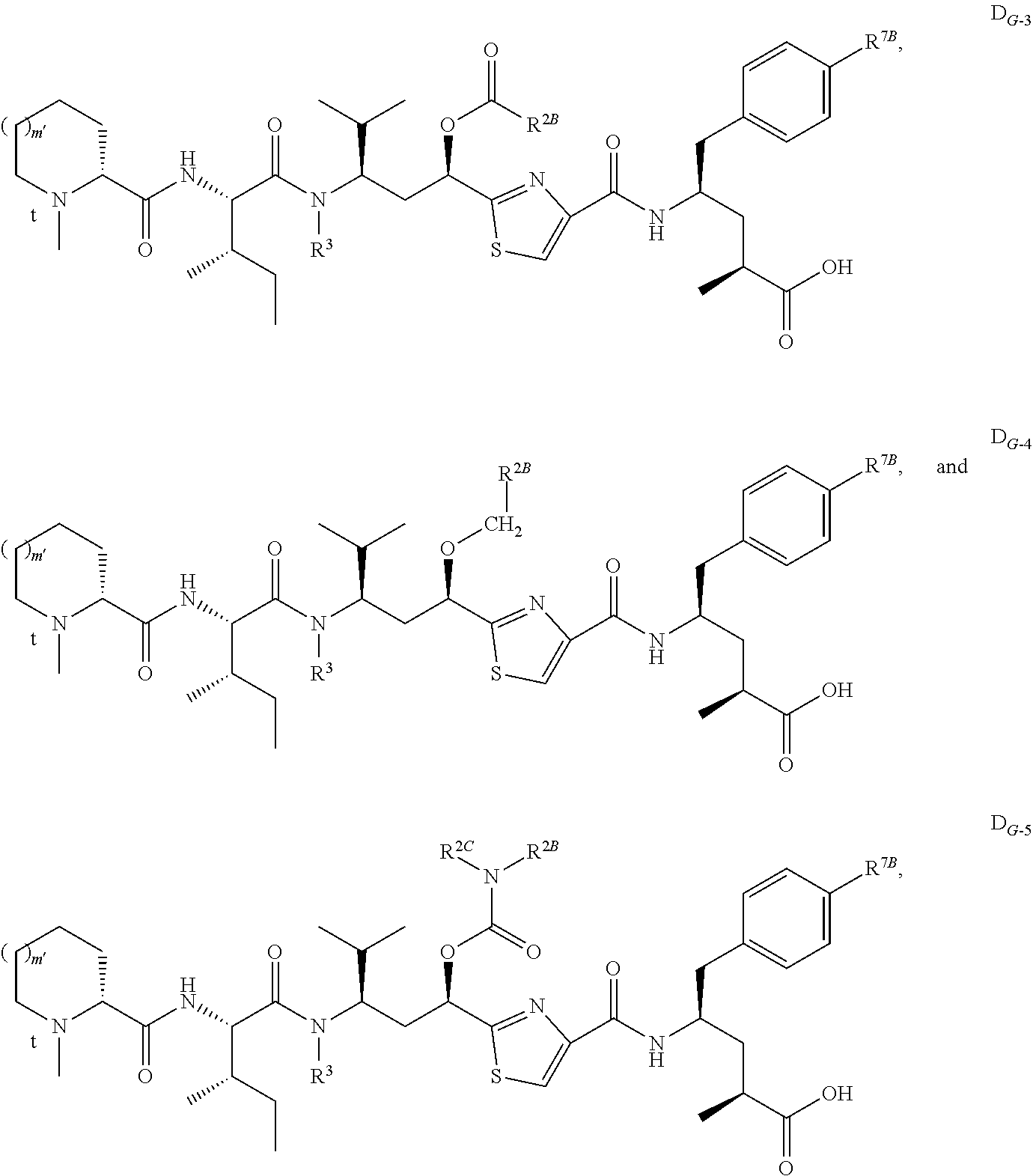
wherein R7B is hydrogen or —OH, R3 is lower alkyl, and R2B and R2C are independently hydrogen or lower alkyl.
B60. The Drug Linker compound of embodiment B50, wherein Drug Linker compound has the structure:

-
- or a salt thereof, wherein
- subscript a′ is 0, and A′ is absent.
B61. The Drug Linker compound of embodiment B50, wherein Drug Linker compound has the structure:

-
- or a salt thereof, wherein
- subscript a′ is 0, and A′ is absent.
B62. The Drug Linker compound of any one of embodiments B50-B61, or a pharmaceutically acceptable salt thereof, wherein the Peptide Cleavable Unit is a tripeptide having the sequence -P3-P2-P1-, wherein P1, P2, and P3 are each an amino acid, wherein: - the P3 amino acid of the tripeptide is in the D-amino acid configuration;
- one of the P2 and P1 amino acids has an aliphatic side chain with hydrophobicity lower than that of leucine; and
- the other of the P2 and P1 amino acids is negatively charged.
B63. The Drug Linker compound of any one of embodiments B50-B62 wherein the P3 amino acid is D-Leu or D-Ala.
B64. The Drug Linker compound of any one of embodiments B50-B63 wherein one of the P2 or P1 amino acid has an aliphatic side chain with hydrophobicity no greater than that of valine, and the other of the P2 or P1 amino acid is negatively charged at plasma physiological pH.
B65. The Drug Linker compound of any one of embodiments B50-B64 wherein the P2 amino acid has an aliphatic side chain with hydrophobicity no greater than that of valine, and the P1 amino acid is negatively charged at plasma physiological pH.
B66. The Drug Linker compound of any one of embodiments B50-B65 wherein -P2-P1- is -Ala-Glu- or -Ala-Asp-.
B67. The Drug Linker compound of any one of embodiments B50-B66 wherein -P3-P2-P1- is -D-Leu-Ala-Asp-, -D-Leu-Ala-Glu-, -D-Ala-Ala-Asp-, or -D-Ala-Ala-Glu-.
B68. The Drug Linker compound any one of embodiments B50-B64 wherein the P3 amino acid is D-Leu or D-Ala, the P2 amino acid is Ala, Glu, or Asp, and the P1 amino acid is Ala, Glu, or Asp.
B69. The Drug Linker compound of embodiment B50, wherein the Drug Linker compound has the structure of:

-
- or a salt thereof.
C1. An antibody-drug conjugate comprising an antigen binding protein or fragment thereof that binds GPNMB, wherein the antibody-drug conjugate is represented by the structure:
- or a salt thereof.

or a pharmaceutically acceptable salt thereof, wherein:
Ab is the antigen binding protein or fragment thereof and p denotes a number from 1 to 12;
subscript nn is a number from 1 to 5;
subscript a′ is 0, and A′ is absent;
P1, P2, and P3 are each an amino acid, wherein:
-
- a first one of the amino acids P1, P2, or P3 is negatively charged;
- a second one of the amino acids P1, P2, or P3 has an aliphatic side chain with hydrophobicity no greater than that of leucine; and
- a third one of the amino acids P1, P2, or P3 has hydrophobicity lower than that of leucine,
- wherein the first one of the amino acids P1, P2, or P3 corresponds to any one of P1, P2, or P3, the second one of the amino acids P1, P2, or P3 corresponds to one of the two remaining amino acids P1, P2, or P3, and the third one of the amino acids P1, P2, or P3 corresponds to the last remaining amino acids P1, P2, or P3,
- provided that -P3-P2-P1- is not -Glu-Val-Cit- or -Asp-Val-Cit-.
C2. The antibody-drug conjugate of embodiment C1, wherein subscript nn is 2.
C3. The antibody-drug conjugate of embodiment C1 or C2, wherein: - the P3 amino acid of the tripeptide is in the D-amino acid configuration;
- one of the P2 and P1 amino acids has an aliphatic side chain with hydrophobicity lower than that of leucine; and
- the other of the P2 and P1 amino acids is negatively charged.
C4. The antibody-drug conjugate of any one of embodiments C1-C3, wherein the P3 amino acid is D-Leu or D-Ala.
C5. The antibody-drug conjugate of any one of embodiments C1-C4, wherein the P3 amino acid is D-Leu or D-Ala, the P2 amino acid is Ala, Glu, or Asp, and the P1 amino acid is Ala, Glu, or Asp.
C6. The antibody-drug conjugate of any one of embodiments C1-C5, wherein -P3-P2-P1- is -D-Leu-Ala-Asp-, -D-Leu-Ala-Glu-, -D-Ala-Ala-Asp-, or -D-Ala-Ala-Glu-.
C7. The antibody-drug conjugate of any one of embodiments C1-C6, wherein -P3-P2-P1- is -D-Leu-Ala-Glu-.
C8. The antibody-drug conjugate of any one of embodiments C1-C7, wherein the antibody-drug conjugate is represented by the structure:

or a pharmaceutically acceptable salt thereof,
wherein Ab is the antigen binding protein or fragment thereof and p denotes a number from 1 to 12.
C9. The antibody-drug conjugate of any one of embodiments C1-C8, wherein the antigen binding protein or fragment comprises the following 6 HVRs:
-
- an HVR-H1 comprising the amino acid sequence of SEQ ID NO: 894;
- an HVR-H2 comprising the amino acid sequence of SEQ ID NO: 895;
- an HVR-H3 comprising the amino acid sequence of SEQ ID NO: 896;
- an HVR-L1 comprising the amino acid sequence of SEQ ID NO: 897;
- an HVR-L2 comprising the amino acid sequence of SEQ ID NO: 898; and
- an HVR-L3 comprising the amino acid sequence of SEQ ID NO: 899.
C10. The antibody-drug conjugate of any one of embodiments C1-C9 wherein the antigen binding protein or fragment comprises a VH and a VL, wherein the VH has at least 80%, 85%, 90%, 95% or 99% amino acid sequence identity to the amino acid sequence of SEQ ID NO: 892 and the VL has at least 80%, 85%, 90%, 95% or 99% amino acid sequence identity to the amino acid sequence of SEQ ID NO: 893.
C11. The antibody-drug conjugate of any one of embodiments C1-C10 wherein the antigen binding protein or fragment comprises a VH and a VL, wherein the VH comprises the amino acid sequence of SEQ ID NO: 892 and the VL comprises the amino acid sequence of SEQ ID NO: 893.
C12. The antibody-drug conjugate of any one of embodiments C1-C11 wherein the antigen binding protein or fragment comprises an HC comprising the amino acid sequence of SEQ ID NO: 890 and an LC comprising the amino acid sequence of SEQ ID NO: 891.
C13. The antibody-drug conjugate of any of embodiments C1-C12, wherein the antigen binding protein or fragment is a monoclonal antibody or fragment thereof.
C14. The antibody-drug conjugate of any of embodiments C1-C13, wherein the antigen binding protein or fragment is a chimeric antibody or fragment thereof.
C15. The antibody-drug conjugate of any of embodiments C1-C14, wherein the antigen binding protein or fragment is a humanized antibody or fragment thereof.
C16. The antibody-drug conjugate of any of embodiments C1-C15, wherein the fragment is selected from a Fab, Fab′, Fv, scFv or (Fab′)2 fragment.
C17. A pharmaceutical composition comprising the antibody-drug conjugate of any of embodiments C1-C16 and a pharmaceutically acceptable carrier.
C18. A method of treating a GPNMB-expressing cancer in an individual comprising administering to an individual in need thereof an effective amount of the antibody-drug conjugate of any one of embodiments C1-C16, or the pharmaceutical composition of embodiment C17.
C19. The method of embodiment C18, wherein the GPNMB-expressing cancer is melanoma, lung cancer, breast cancer, head and neck cancer, ovarian cancer, sarcoma, mesothelioma, or cervical cancer.
D1. An antibody-drug conjugate comprising an antigen binding protein or fragment thereof that binds CD228, wherein the antibody-drug conjugate is represented by the structure:

or a pharmaceutically acceptable salt thereof, wherein:
Ab is the antigen binding protein or fragment thereof and p denotes a number from 1 to 12;
subscript nn is a number from 1 to 5;
subscript a′ is 0, and A′ is absent;
P1, P2, and P3 are each an amino acid, wherein:
-
- a first one of the amino acids P1, P2, or P3 is negatively charged;
- a second one of the amino acids P1, P2, or P3 has an aliphatic side chain with hydrophobicity no greater than that of leucine; and
- a third one of the amino acids P1, P2, or P3 has hydrophobicity lower than that of leucine,
- wherein the first one of the amino acids P1, P2, or P3 corresponds to any one of P1, P2, or P3, the second one of the amino acids P1, P2, or P3 corresponds to one of the two remaining amino acids P1, P2, or P3, and the third one of the amino acids P1, P2, or P3 corresponds to the last remaining amino acids P1, P2, or P3,
- provided that -P3-P2-P1- is not -Glu-Val-Cit- or -Asp-Val-Cit-.
D2. The antibody-drug conjugate of embodiment D1, wherein subscript nn is 2.
D3. The antibody-drug conjugate of embodiment D1 or D2, wherein: - the P3 amino acid of the tripeptide is in the D-amino acid configuration;
- one of the P2 and P1 amino acids has an aliphatic side chain with hydrophobicity lower than that of leucine; and
- the other of the P2 and P1 amino acids is negatively charged.
D4. The antibody-drug conjugate of any one of embodiments D1-D3, wherein the P3 amino acid is D-Leu or D-Ala.
D5. The antibody-drug conjugate of any one of embodiments D1-D4, wherein the P3 amino acid is D-Leu or D-Ala, the P2 amino acid is Ala, Glu, or Asp, and the P1 amino acid is Ala, Glu, or Asp.
D6. The antibody-drug conjugate of any one of embodiments D1-D5, wherein -P3-P2-P1- is -D-Leu-Ala-Asp-, -D-Leu-Ala-Glu-, -D-Ala-Ala-Asp-, or -D-Ala-Ala-Glu-.
D7. The antibody-drug conjugate of any one of embodiments D1-D6, wherein -P3-P2-P1- is -D-Leu-Ala-Glu-.
D8. The antibody-drug conjugate of any one of embodiments D1-D7, wherein the antibody-drug conjugate is represented by the structure:

or a pharmaceutically acceptable salt thereof,
wherein Ab is the antigen binding protein or fragment thereof and p denotes a number from 1 to 12.
D9. The antibody-drug conjugate of any one of embodiments D1-D8, wherein the antigen binding protein or fragment comprises the following 6 HVRs:
-
- an HVR-H1 comprising the amino acid sequence of SEQ ID NO: 900;
- an HVR-H2 comprising the amino acid sequence of SEQ ID NO: 901;
- an HVR-H3 comprising the amino acid sequence of SEQ ID NO: 902;
- an HVR-L1 comprising the amino acid sequence of SEQ ID NO: 903;
- an HVR-L2 comprising the amino acid sequence of SEQ ID NO: 904; and
- an HVR-L3 comprising the amino acid sequence of SEQ ID NO: 905.
D10. The antibody-drug conjugate of any one of embodiments D1-D9 wherein the antigen binding protein or fragment comprises a VH and a VL, wherein the VH has at least 80%, 85%, 90%, 95% or 99% amino acid sequence identity to the amino acid sequence of SEQ ID NO: 906 and the VL has at least 80%, 85%, 90%, 95% or 99% amino acid sequence identity to the amino acid sequence of SEQ ID NO: 907.
D11. The antibody-drug conjugate of any one of embodiments D1-D10 wherein the antigen binding protein or fragment comprises a VH and a VL, wherein the VH comprises the amino acid sequence of SEQ ID NO: 906 and the VL comprises the amino acid sequence of SEQ ID NO: 907.
D12. The antibody-drug conjugate of any one of embodiments D1-D11 wherein the antigen binding protein or fragment comprises an HC comprising the amino acid sequence of SEQ ID NO: 908 and an LC comprising the amino acid sequence of SEQ ID NO: 909.
D13. The antibody-drug conjugate of any of embodiments D1-D12, wherein the antigen binding protein or fragment is a monoclonal antibody or fragment thereof.
D14. The antibody-drug conjugate of any of embodiments D1-D13, wherein the antigen binding protein or fragment is a chimeric antibody or fragment thereof.
D15. The antibody-drug conjugate of any of embodiments D1-D14, wherein the antigen binding protein or fragment is a humanized antibody or fragment thereof.
D16. The antibody-drug conjugate of any of embodiments D1-D15, wherein the fragment is selected from a Fab, Fab′, Fv, scFv or (Fab′)2 fragment.
D17. A pharmaceutical composition comprising the antibody-drug conjugate of any of embodiments D1-D16 and a pharmaceutically acceptable carrier.
D18. A method of treating a CD228-expressing cancer in an individual comprising administering to an individual in need thereof an effective amount of the antibody-drug conjugate of any one of embodiments D1-D16, or the pharmaceutical composition of embodiment D17.
D19. The method of embodiment D18, wherein the CD228-expressing cancer is chronic leukemia, lymphoma, multiple myeloma, B type acute lymphoblastic leukemia, chronic myelocytic leukemia, chronic lymphocytic leukemia, non-Hodgkin lymphoma and Hodgkin lymphoma, B cell lymphoma, or diffuse large B-cell lymphoma.
E1. An antibody-drug conjugate comprising an antigen binding protein or fragment thereof that binds αvβ6, wherein the antibody-drug conjugate is represented by the structure:

or a pharmaceutically acceptable salt thereof, wherein:
Ab is the antigen binding protein or fragment thereof and p denotes a number from 1 to 12;
subscript nn is a number from 1 to 5;
subscript a′ is 0, and A′ is absent;
P1, P2, and P3 are each an amino acid, wherein:
-
- a first one of the amino acids P1, P2, or P3 is negatively charged;
- a second one of the amino acids P1, P2, or P3 has an aliphatic side chain with hydrophobicity no greater than that of leucine; and
- a third one of the amino acids P1, P2, or P3 has hydrophobicity lower than that of leucine,
- wherein the first one of the amino acids P1, P2, or P3 corresponds to any one of P1, P2, or P3, the second one of the amino acids P1, P2, or P3 corresponds to one of the two remaining amino acids P1, P2, or P3, and the third one of the amino acids P1, P2, or P3 corresponds to the last remaining amino acids P1, P2, or P3,
- provided that -P3-P2-P1- is not -Glu-Val-Cit- or -Asp-Val-Cit-.
E2. The antibody-drug conjugate of embodiment E1, wherein subscript nn is 2.
E3. The antibody-drug conjugate of embodiment E1 or E2, wherein: - the P3 amino acid of the tripeptide is in the D-amino acid configuration;
- one of the P2 and P1 amino acids has an aliphatic side chain with hydrophobicity lower than that of leucine; and
- the other of the P2 and P1 amino acids is negatively charged.
E4. The antibody-drug conjugate of any one of embodiments E1-E3, wherein the P3 amino acid is D-Leu or D-Ala.
E5. The antibody-drug conjugate of any one of embodiments E1-E4, wherein the P3 amino acid is D-Leu or D-Ala, the P2 amino acid is Ala, Glu, or Asp, and the P1 amino acid is Ala, Glu, or Asp.
E6. The antibody-drug conjugate of any one of embodiments E1-E5, wherein -P3-P2-P1- is -D-Leu-Ala-Asp-, -D-Leu-Ala-Glu-, -D-Ala-Ala-Asp-, or -D-Ala-Ala-Glu-.
E7. The antibody-drug conjugate of any one of embodiments E1-E6, wherein -P3-P2-P1- is -D-Leu-Ala-Glu-.
E8. The antibody-drug conjugate of any one of embodiments E1-E7, wherein the antibody-drug conjugate is represented by the structure:

or a pharmaceutically acceptable salt thereof,
wherein Ab is the antigen binding protein or fragment thereof and p denotes a number from 1 to 12.
E9. The antibody-drug conjugate of any one of embodiments E1-E8, wherein the antigen binding protein or fragment comprises the following 6 HVRs:
-
- an HVR-H1 comprising the amino acid sequence of SEQ ID NO: 914;
- an HVR-H2 comprising the amino acid sequence of SEQ ID NO: 915;
- an HVR-H3 comprising the amino acid sequence of SEQ ID NO: 916;
- an HVR-L1 comprising the amino acid sequence of SEQ ID NO: 917;
- an HVR-L2 comprising the amino acid sequence of SEQ ID NO: 918; and
- an HVR-L3 comprising the amino acid sequence of SEQ ID NO: 919.
E10. The antibody-drug conjugate of any one of embodiments E1-E9 wherein the antigen binding protein or fragment comprises a VH and a VL, wherein the VH has at least 80%, 85%, 90%, 95% or 99% amino acid sequence identity to the amino acid sequence of SEQ ID NO: 912 and the VL has at least 80%, 85%, 90%, 95% or 99% amino acid sequence identity to the amino acid sequence of SEQ ID NO: 913.
E11. The antibody-drug conjugate of any one of embodiments E1-E10 wherein the antigen binding protein or fragment comprises a VH and a VL, wherein the VH comprises the amino acid sequence of SEQ ID NO: 912 and the VL comprises the amino acid sequence of SEQ ID NO: 913.
E12. The antibody-drug conjugate of any one of embodiments E1-E11 wherein the antigen binding protein or fragment comprises an HC comprising the amino acid sequence of SEQ ID NO: 910 and an LC comprising the amino acid sequence of SEQ ID NO: 911.
E13. The antibody-drug conjugate of any of embodiments E1-E12, wherein the antigen binding protein or fragment is a monoclonal antibody or fragment thereof.
E14. The antibody-drug conjugate of any of embodiments E1-E13, wherein the antigen binding protein or fragment is a chimeric antibody or fragment thereof.
E15. The antibody-drug conjugate of any of embodiments E1-E14, wherein the antigen binding protein or fragment is a humanized antibody or fragment thereof.
E16. The antibody-drug conjugate of any of embodiments E1-E15, wherein the fragment is selected from a Fab, Fab′, Fv, scFv or (Fab′)2 fragment.
E17. A pharmaceutical composition comprising the antibody-drug conjugate of any of embodiments E1-E16 and a pharmaceutically acceptable carrier.
E18. A method of treating a αvβ6-expressing cancer in an individual comprising administering to an individual in need thereof an effective amount of the antibody-drug conjugate of any one of embodiments E1-E16, or the pharmaceutical composition of embodiment E17.
E19. The method of embodiment E18, wherein the αvβ6-expressing cancer is non-small cell lung cancer (NSCLC), head and neck cancer, esophageal cancer, breast cancer, ovarian cancer, bladder cancer, skin cancer (SCC), ovarian cancer, cervical cancer, gastric cancer, or pancreatic cancer.
F1. An antibody-drug conjugate comprising an antigen binding protein or fragment thereof that binds CD30, wherein the antibody-drug conjugate is represented by the structure:

or a pharmaceutically acceptable salt thereof, wherein:
Ab is the antigen binding protein or fragment thereof and p denotes a number from 1 to 12;
subscript nn is a number from 1 to 5;
subscript a′ is 0, and A′ is absent;
P1, P2, and P3 are each an amino acid, wherein:
-
- a first one of the amino acids P1, P2, or P3 is negatively charged;
- a second one of the amino acids P1, P2, or P3 has an aliphatic side chain with hydrophobicity no greater than that of leucine; and
- a third one of the amino acids P1, P2, or P3 has hydrophobicity lower than that of leucine,
- wherein the first one of the amino acids P1, P2, or P3 corresponds to any one of P1, P2, or P3, the second one of the amino acids P1, P2, or P3 corresponds to one of the two remaining amino acids P1, P2, or P3, and the third one of the amino acids P1, P2, or P3 corresponds to the last remaining amino acids P1, P2, or P3,
- provided that -P3-P2-P1- is not -Glu-Val-Cit- or -Asp-Val-Cit-.
F2. The antibody-drug conjugate of embodiment F1, wherein subscript nn is 2.
F3. The antibody-drug conjugate of embodiment F1 or F2, wherein: - the P3 amino acid of the tripeptide is in the D-amino acid configuration;
- one of the P2 and P1 amino acids has an aliphatic side chain with hydrophobicity lower than that of leucine; and
- the other of the P2 and P1 amino acids is negatively charged.
F4. The antibody-drug conjugate of any one of embodiments F1-F3, wherein the P3 amino acid is D-Leu or D-Ala.
F5. The antibody-drug conjugate of any one of embodiments F1-F4, wherein the P3 amino acid is D-Leu or D-Ala, the P2 amino acid is Ala, Glu, or Asp, and the P1 amino acid is Ala, Glu, or Asp.
F6. The antibody-drug conjugate of any one of embodiments F1-F5, wherein -P3-P2-P1- is -D-Leu-Ala-Asp-, -D-Leu-Ala-Glu-, -D-Ala-Ala-Asp-, or -D-Ala-Ala-Glu-.
F7. The antibody-drug conjugate of any one of embodiments F1-F6, wherein -P3-P2-P1- is -D-Leu-Ala-Glu-.
F8. The antibody-drug conjugate of any one of embodiments F1-F7, wherein the antibody-drug conjugate is represented by the structure:

or a pharmaceutically acceptable salt thereof,
wherein Ab is the antigen binding protein or fragment thereof and p denotes a number from 1 to 12.
F9. The antibody-drug conjugate of any one of embodiments F1-F8, wherein the antigen binding protein or fragment comprises the following 6 HVRs:
-
- an HVR-H1 comprising the amino acid sequence of SEQ ID NO: 920;
- an HVR-H2 comprising the amino acid sequence of SEQ ID NO: 921;
- an HVR-H3 comprising the amino acid sequence of SEQ ID NO: 922;
- an HVR-L1 comprising the amino acid sequence of SEQ ID NO: 923;
- an HVR-L2 comprising the amino acid sequence of SEQ ID NO: 924; and
- an HVR-L3 comprising the amino acid sequence of SEQ ID NO: 925.
F10. The antibody-drug conjugate of any one of embodiments F1-F9 wherein the antigen binding protein or fragment comprises a VH and a VL, wherein the VH has at least 80%, 85%, 90%, 95% or 99% amino acid sequence identity to the amino acid sequence of SEQ ID NO: 926 and the VL has at least 80%, 85%, 90%, 95% or 99% amino acid sequence identity to the amino acid sequence of SEQ ID NO: 927.
F11. The antibody-drug conjugate of any one of embodiments F1-F10 wherein the antigen binding protein or fragment comprises a VH and a VL, wherein the VH comprises the amino acid sequence of SEQ ID NO: 926 and the VL comprises the amino acid sequence of SEQ ID NO: 927.
F12. The antibody-drug conjugate of any one of embodiments F1-F11 wherein the antigen binding protein or fragment comprises an HC comprising the amino acid sequence of SEQ ID NO: 928 or SEQ ID NO: 929 and an LC comprising the amino acid sequence of SEQ ID NO: 930.
F13. The antibody-drug conjugate of any of embodiments F1-F12, wherein the antigen binding protein or fragment is a monoclonal antibody or fragment thereof.
F14. The antibody-drug conjugate of any of embodiments F1-F13, wherein the antigen binding protein or fragment is a chimeric antibody or fragment thereof.
F15. The antibody-drug conjugate of any of embodiments F1-F14, wherein the antigen binding protein or fragment is a humanized antibody or fragment thereof.
F16. The antibody-drug conjugate of any of embodiments F1-F15, wherein the fragment is selected from a Fab, Fab′, Fv, scFv or (Fab′)2 fragment.
F17. A pharmaceutical composition comprising the antibody-drug conjugate of any of embodiments F1-F16 and a pharmaceutically acceptable carrier.
F18. A method of treating a CD30-expressing disease or condition in an individual comprising administering to an individual in need thereof an effective amount of the antibody-drug conjugate of any one of embodiments F1-F16, or the pharmaceutical composition of embodiment F17.
F19. The method of embodiment F18, wherein the CD30-expressing disease or condition is cancer.
F20. The method of embodiment F19, wherein the cancer is Hodgkin's disease or a non-Hodgkin's lymphoma.
F21. The method of embodiment F18, wherein the CD30-expressing disease or condition is an autoimmune disease.
F22. The method of embodiment F18, wherein the CD30-expressing disease or condition is an infectious disease.
G1. An antibody-drug conjugate comprising an antigen binding protein or fragment thereof that binds LIV1, wherein the antibody-drug conjugate is represented by the structure:

or a pharmaceutically acceptable salt thereof, wherein:
Ab is the antigen binding protein or fragment thereof and p denotes a number from 1 to 12;
subscript nn is a number from 1 to 5;
subscript a′ is 0, and A′ is absent;
P1, P2, and P3 are each an amino acid, wherein:
-
- a first one of the amino acids P1, P2, or P3 is negatively charged;
- a second one of the amino acids P1, P2, or P3 has an aliphatic side chain with hydrophobicity no greater than that of leucine; and
- a third one of the amino acids P1, P2, or P3 has hydrophobicity lower than that of leucine,
- wherein the first one of the amino acids P1, P2, or P3 corresponds to any one of P1, P2, or P3, the second one of the amino acids P1, P2, or P3 corresponds to one of the two remaining amino acids P1, P2, or P3, and the third one of the amino acids P1, P2, or P3 corresponds to the last remaining amino acids P1, P2, or P3,
- provided that -P3-P2-P1- is not -Glu-Val-Cit- or -Asp-Val-Cit-.
G2. The antibody-drug conjugate of embodiment G1, wherein subscript nn is 2.
G3. The antibody-drug conjugate of embodiment G1 or G2, wherein: - the P3 amino acid of the tripeptide is in the D-amino acid configuration;
- one of the P2 and P1 amino acids has an aliphatic side chain with hydrophobicity lower than that of leucine; and
- the other of the P2 and P1 amino acids is negatively charged.
G4. The antibody-drug conjugate of any one of embodiments G1-G3, wherein the P3 amino acid is D-Leu or D-Ala.
G5. The antibody-drug conjugate of any one of embodiments G1-G4, wherein the P3 amino acid is D-Leu or D-Ala, the P2 amino acid is Ala, Glu, or Asp, and the P1 amino acid is Ala, Glu, or Asp.
G6. The antibody-drug conjugate of any one of embodiments G1-G5, wherein -P3-P2-P1- is -D-Leu-Ala-Asp-, -D-Leu-Ala-Glu-, -D-Ala-Ala-Asp-, or -D-Ala-Ala-Glu-.
G7. The antibody-drug conjugate of any one of embodiments G1-G6, wherein -P3-P2-P1- is -D-Leu-Ala-Glu-.
G8. The antibody-drug conjugate of any one of embodiments G1-G7, wherein the antibody-drug conjugate is represented by the structure:

or a pharmaceutically acceptable salt thereof,
wherein Ab is the antigen binding protein or fragment thereof and p denotes a number from 1 to 12.
G9. The antibody-drug conjugate of any one of embodiments GI-G8, wherein the antigen binding protein or fragment comprises the following 6 HVRs:
-
- an HVR-H1 comprising the amino acid sequence of SEQ ID NO: 936;
- an HVR-H2 comprising the amino acid sequence of SEQ ID NO: 937;
- an HVR-H3 comprising the amino acid sequence of SEQ ID NO: 938;
- an HVR-L1 comprising the amino acid sequence of SEQ ID NO: 939;
- an HVR-L2 comprising the amino acid sequence of SEQ ID NO: 940; and
- an HVR-L3 comprising the amino acid sequence of SEQ ID NO: 941.
G10. The antibody-drug conjugate of any one of embodiments G1-G9 wherein the antigen binding protein or fragment comprises a VH and a VL, wherein the VH has at least 80%, 85%, 90%, 95% or 99% amino acid sequence identity to the amino acid sequence of SEQ ID NO: 934 and the VL has at least 80%, 85%, 90%, 95% or 99% amino acid sequence identity to the amino acid sequence of SEQ ID NO: 935.
G11. The antibody-drug conjugate of any one of embodiments GI-G10 wherein the antigen binding protein or fragment comprises a VH and a VL, wherein the VH comprises the amino acid sequence of SEQ ID NO: 934 and the VL comprises the amino acid sequence of SEQ ID NO: 935.
G12. The antibody-drug conjugate of any one of embodiments G1-G11 wherein the antigen binding protein or fragment comprises an HC comprising the amino acid sequence of SEQ ID NO: 932 and an LC comprising the amino acid sequence of SEQ ID NO: 933.
G13. The antibody-drug conjugate of any of embodiments GT-G12, wherein the antigen binding protein or fragment is a monoclonal antibody or fragment thereof.
G14. The antibody-drug conjugate of any of embodiments GT-G13, wherein the antigen binding protein or fragment is a chimeric antibody or fragment thereof.
G15. The antibody-drug conjugate of any of embodiments G1-G14, wherein the antigen binding protein or fragment is a humanized antibody or fragment thereof.
G16. The antibody-drug conjugate of any of embodiments G1-G15, wherein the fragment is selected from a Fab, Fab′, Fv, scFv or (Fab′)2 fragment.
G17. A pharmaceutical composition comprising the antibody-drug conjugate of any of embodiments G1-G16 and a pharmaceutically acceptable carrier.
G18. A method of treating a LIV1-expressing cancer in an individual comprising administering to an individual in need thereof an effective amount of the antibody-drug conjugate of any one of embodiments GT-G16, or the pharmaceutical composition of embodiment G17.
G19. The method of embodiment G18, wherein the LIV1-expressing cancer is breast cancer, prostate cancer, ovarian cancer, endometrial cancer, cervical, liver, gastric, kidney, and squamous cell carcinomas, skin cancers, small lung cell carcinoma, or lung carcinoid.
G20. The method of embodiment G19, wherein the breast cancer is HER2 positive breast cancer, hormone responsive breast cancer, or triple negative breast cancer.
G21. The method of embodiment G19, wherein the squamous cell carcinoma is bladder, lung, or head and neck cancer.
G22. The method of embodiment G19, wherein the skin cancer is melanoma.
G23. The antibody-drug conjugate of embodiment G1, wherein the antigen binding protein or fragment specifically binds to SEQ ID NO: 942.
G24. The antibody-drug conjugate of embodiment GI, wherein the antigen binding protein or fragment specifically competes for binding with a second antibody that comprises the amino acid sequence of SEQ ID NO: 934 and the VL comprises the amino acid sequence of SEQ ID NO: 935 binds to SEQ ID NO:942.
H1. An antibody-drug conjugate comprising an antigen binding protein or fragment thereof that binds CD19, wherein the antibody-drug conjugate is represented by the structure:

or a pharmaceutically acceptable salt thereof, wherein:
Ab is the antigen binding protein or fragment thereof and p denotes a number from 1 to 12;
subscript nn is a number from 1 to 5;
subscript a′ is 0, and A′ is absent;
P1, P2, and P3 are each an amino acid, wherein:
-
- a first one of the amino acids P1, P2, or P3 is negatively charged;
- a second one of the amino acids P1, P2, or P3 has an aliphatic side chain with hydrophobicity no greater than that of leucine; and
- a third one of the amino acids P1, P2, or P3 has hydrophobicity lower than that of leucine,
- wherein the first one of the amino acids P1, P2, or P3 corresponds to any one of P1, P2, or P3, the second one of the amino acids P1, P2, or P3 corresponds to one of the two remaining amino acids P1, P2, or P3, and the third one of the amino acids P1, P2, or P3 corresponds to the last remaining amino acids P1, P2, or P3,
- provided that -P3-P2-P1- is not -Glu-Val-Cit- or -Asp-Val-Cit-.
H2. The antibody-drug conjugate of embodiment H1, wherein subscript nn is 2.
H3. The antibody-drug conjugate of embodiment H1 or H2, wherein: - the P3 amino acid of the tripeptide is in the D-amino acid configuration;
- one of the P2 and P1 amino acids has an aliphatic side chain with hydrophobicity lower than that of leucine; and
- the other of the P2 and P1 amino acids is negatively charged.
H4. The antibody-drug conjugate of any one of embodiments H1-H3, wherein the P3 amino acid is D-Leu or D-Ala.
H5. The antibody-drug conjugate of any one of embodiments H1-H4, wherein the P3 amino acid is D-Leu or D-Ala, the P2 amino acid is Ala, Glu, or Asp, and the P1 amino acid is Ala, Glu, or Asp.
H6. The antibody-drug conjugate of any one of embodiments H1-H5, wherein -P3-P2-P1- is -D-Leu-Ala-Asp-, -D-Leu-Ala-Glu-, -D-Ala-Ala-Asp-, or -D-Ala-Ala-Glu-.
H7. The antibody-drug conjugate of any one of embodiments H1-H6, wherein -P3-P2-P1- is -D-Leu-Ala-Glu-.
H8. The antibody-drug conjugate of any one of embodiments H1-H7, wherein the antibody-drug conjugate is represented by the structure:

or a pharmaceutically acceptable salt thereof,
wherein Ab is the antigen binding protein or fragment thereof and p denotes a number from 1 to 12.
H9. The antibody-drug conjugate of any one of embodiments H1-H8, wherein the antigen binding protein or fragment comprises the following 6 HVRs:
-
- an HVR-H1 comprising the amino acid sequence of SEQ ID NO: 944;
- an HVR-H2 comprising the amino acid sequence of SEQ ID NO: 945;
- an HVR-H3 comprising the amino acid sequence of SEQ ID NO: 946;
- an HVR-L1 comprising the amino acid sequence of SEQ ID NO: 948;
- an HVR-L2 comprising the amino acid sequence of SEQ ID NO: 949; and
- an HVR-L3 comprising the amino acid sequence of SEQ ID NO: 950.
H10. The antibody-drug conjugate of any one of embodiments H1-H9 wherein the antigen binding protein or fragment comprises a VH and a VL, wherein the VH has at least 80%, 85%, 90%, 95% or 99% amino acid sequence identity to the amino acid sequence of SEQ ID NO: 943 and the VL has at least 80%, 85%, 90%, 95% or 99% amino acid sequence identity to the amino acid sequence of SEQ ID NO: 947.
H11. The antibody-drug conjugate of any one of embodiments H1-H10 wherein the antigen binding protein or fragment comprises a VH and a VL, wherein the VH comprises the amino acid sequence of SEQ ID NO: 943 and the VL comprises the amino acid sequence of SEQ ID NO: 947.
H12. The antibody-drug conjugate of any one of embodiments H1-H11 wherein the antigen binding protein or fragment comprises an HC comprising the amino acid sequence of SEQ ID NO: 951 and an LC comprising the amino acid sequence of SEQ ID NO: 952.
H13. The antibody-drug conjugate of any of embodiments H1-H12, wherein the antigen binding protein or fragment is a monoclonal antibody or fragment thereof.
H14. The antibody-drug conjugate of any of embodiments H1-H13, wherein the antigen binding protein or fragment is a chimeric antibody or fragment thereof.
H15. The antibody-drug conjugate of any of embodiments H1-H14, wherein the antigen binding protein or fragment is a humanized antibody or fragment thereof.
H16. The antibody-drug conjugate of any of embodiments H1-H15, wherein the fragment is selected from a Fab, Fab′, Fv, scFv or (Fab′)2 fragment.
H17. A pharmaceutical composition comprising the antibody-drug conjugate of any of embodiments H1-H16 and a pharmaceutically acceptable carrier.
H18. A method of treating a CD19-expressing cancer in an individual comprising administering to an individual in need thereof an effective amount of the antibody-drug conjugate of any one of embodiments H1-H16, or the pharmaceutical composition of embodiment H17.
H19. The method of embodiment H18, wherein the CD19-expressing cancer is chronic leukemia, lymphoma, multiple myeloma, B type acute lymphoblastic leukemia, chronic myelocytic leukemia, chronic lymphocytic leukemia, non-Hodgkin lymphoma and Hodgkin lymphoma, B cell lymphoma, or diffuse large B-cell lymphoma.


| TABLE 1A |
| Ranking of Tripeptide Library Members by Fluorescence Ratio |
| Normalized | Normalized | ||
| Tripeptide* | Normal Tissue | Tumor Tissue | Tumor/Normal |
| Pro-Ala-Glu | 0.78 | 2.48 | 3.16 |
| DLeu-Leu-Glu | 1.12 | 3.45 | 3.09 |
| Pro-Ala-Cit | 1.07 | 3.03 | 2.84 |
| Pro-Glu-Cit | 0.85 | 2.35 | 2.77 |
| DLeu-Leu-Cit | 1.37 | 3.70 | 2.70 |
| Pro-Cit-Glu | 0.85 | 2.27 | 2.68 |
| Pro-Cit-Cit | 0.95 | 2.54 | 2.67 |
| Cit-Glu-Cit | 1.21 | 3.16 | 2.61 |
| Pro-Lys-Glu | 0.72 | 1.88 | 2.59 |
| DLeu-Leu-Met(O) | 0.66 | 1.70 | 2.58 |
| Pro-Glu-Glu | 0.73 | 1.87 | 2.58 |
| Pro-Glu-Lys | 0.72 | 1.85 | 2.57 |
| Glu-Glu-Cit | 1.22 | 3.14 | 2.57 |
| DLeu-Phe-Glu | 0.89 | 2.27 | 2.55 |
| DLeu-Leu-Lys | 0.87 | 2.20 | 2.54 |
| Glu-Ala-Glu | 1.05 | 2.66 | 2.53 |
| Ala-Cit-Cit | 1.02 | 2.58 | 2.53 |
| Thr-Cit-Cit | 0.89 | 2.26 | 2.53 |
| Cit-Glu-Glu | 0.97 | 2.44 | 2.53 |
| Cit-Cit-Cit | 1.12 | 2.82 | 2.52 |
| *Abbreviations: Cit = citrulline, Met(O) = methionine sulfoxide | |||
| TABLE 1B |
| Ranking of tripeptide library members by |
| propensity for normal tissue proteolysis |
| Normalized | Normalized | ||
| Tripeptide* | Normal | Tumor | Tumor/Normal |
| D-Leu-Leu-Met(O) | 0.66 | 1.70 | 2.58 |
| Pro-Nal-Lys | 0.65 | 1.33 | 2.05 |
| D-Leu-Ala-Glu | 0.69 | 1.30 | 1.87 |
| Pro-Glu-Ala | 0.70 | 1.28 | 1.84 |
| Lys-Glu-Met(O) | 0.70 | 1.16 | 1.66 |
| DLeu-Ala-Lys | 0.68 | 1.16 | 1.70 |
| Leu-Nal-Lys | 0.62 | 1.13 | 1.84 |
| DLeu-Cit-Glu | 0.64 | 1.07 | 1.67 |
| DLeu-Glu-Lys | 0.62 | 1.06 | 1.71 |
| Glu-Ala-Met(O) | 0.65 | 1.06 | 1.63 |
| *Abbreviations: Cit = citrulline, Met(O) = methionine sulfoxide, Nal = naphtha-1-yl alanine. | |||


| Method A: Column - Waters Acquity UPLC BEH C18, 130 Å, |
| 1.7 μm, 2.1 × 50 mm, reversed-phase column |
| Time (min) | Flow (mL/min) | A % | B % | ||
| Initial | 0.5 | 97 | 3 | ||
| 1.0 | 0.5 | 40 | 60 | ||
| 1.5 | 0.5 | 5 | 95 | ||
| Method B: Column - Waters CORTECS UPLC C18, 90 Å, 1.6 |
| μm, 2.1 × 50 mm, reversed- phase column |
| Time (min) | Flow (mL/min) | A % | B % | ||
| Initial | 0.5 | 97 | 3 | ||
| 1.7 | 0.5 | 40 | 60 | ||
| 2.0 | 0.5 | 5 | 95 | ||
| 3.5 | 0.5 | 5 | 95 | ||
| 3.8 | 0.5 | 97 | 3 | ||
| 4.0 | 0.5 | 97 | 3 | ||
| Method C: Column - Waters CORTECS UPLC C18, 90 Å, 1.6 |
| μm, 2.1 × 50 mm, reversed- phase column |
| Time (min) | Flow (mL/min) | A % | B % | ||
| Initial | 0.5 | 97 | 3 | ||
| 1.5 | 0.5 | 5 | 95 | ||
| Method D: Column - Waters Acquity UPLC BEH C18, 130 Å, |
| 1.7 μm, 2.1 × 50 mm, reversed-phase column |
| Time (min) | Flow (mL/min) | A % | B % | ||
| Initial | 0.5 | 97 | 3 | ||
| 1.7 | 0.5 | 40 | 60 | ||
| 2.0 | 0.5 | 5 | 95 | ||
| 3.5 | 0.5 | 5 | 95 | ||
| 3.8 | 0.5 | 97 | 3 | ||
| 4.0 | 0.5 | 97 | 3 | ||
| Method E: Column - Waters CORTECS UPLC C8, 90 Å, 1.6 |
| μm, 2.1 × 50 mm, reversed-phase column |
| Time (min) | Flow (mL/min) | A % | B % | ||
| Initial | 0.5 | 97 | 3 | ||
| 1.7 | 0.5 | 40 | 60 | ||
| 2.0 | 0.5 | 5 | 95 | ||
| 3.5 | 0.5 | 5 | 95 | ||
| 3.8 | 0.5 | 97 | 3 | ||
| 4.0 | 0.5 | 97 | 3 | ||
| TABLE 2 |
| UPLC-MS data for Selected MMAE Drug Linker compounds |
| Retention | ||||||
| Compound | Tripeptide* | Molecular | MS Calc. | MS | Time | |
| # | Sequence | Formula | (M + H)+ | found | (min.) | Method |
| 2 | Pro-Nal-Lys | C78H109N11O15 | 1440.8 | 1441 | 1.31 | A |
| 3 | D-Leu-Leu-Lys | C72H113N11O15 | 1372.8 | 1373 | 1.22 | A |
| 4 | D-Leu-Leu-Met(O) | C71H110N10O16S | 1391.8 | 1392 | 1.5 | A |
| 5 | D-Leu-Ala-Glu | C68H102N10O17 | 1331.7 | 1332 | 1.43 | A |
| 6 | D-Leu-Leu-Cit | C72H112N12O16 | 1401.8 | 1402 | 1.48 | A |
| 7 | Leu-Ala-Glu | C68H102N10O17 | 1330.7 | 1332.2 | 1.92 | B |
| 8 | D-Leu-Ala-Cit | C69H106N12O16 | 1358.8 | 1359.3 | 1.39 | A |
| 9 | Pro-Leu-Glu | C70H104N10O17 | 1356.8 | 1357.4 | 1.49 | A |
| 10 | Thr-Glu-Leu | C69H104N10O18 | 1360.8 | 1361.4 | 1.44 | A |
| 11 | D-Leu-Glu-Cit | C71H108N12O18 | 1416.8 | 1417.4 | 1.35 | A |
| 12 | Glu-Pro-Cit | C70H104N12O18 | 1400.8 | 1402.2 | 1.29 | A |
| 13 | Tyr(All)-Pro-Cit | C77H110N12O17 | 1474.8 | 1475.9 | 1.46 | A |
| 14 | Lys-Leu-Cit | C72H113N13O16 | 1415.8 | 1417.6 | 1.21 | A |
| 15 | Tyr(All)-dLeu-Glu | C77H110N10O18 | 1462.8 | 1463.8 | 1.41 | C |
| 16 | D-Leu-Ala-Gln | C68H103N11O16 | 1331.6 | 1331.4 | 2.01 | D |
| 17 | D-Leu-Ala-(Se-Met) | C68H104N10O15Se | 1381.6 | 1381.4 | 2.22 | D |
| 18 | D-Leu-Glu-Ala | C68H102N10O17 | 1332.6 | 1332.2 | 2.08 | D |
| 19 | D-Leu-Ala-Ala | C66H100N10O15 | 1274.6 | 1275 | 2.13 | B |
| 20 | D-Leu-Ala-Met(O) | C68H104N10O16S | 1350.7 | 1350.1 | 2.07 | B |
| 21 | D-Leu-Leu-Glu | C71H108N10O17 | 1374.7 | 1373.9 | 2.26 | B |
| 22 | D-Ala-Ala-Glu | C65H96N10O17 | 1290.5 | 1290.3 | 1.89 | D |
| 23 | Ala-Ser-Glu | C65H96N10O18 | 1306.5 | 1306.4 | 1.88 | B |
| 24 | D-Leu-Ala-Asp | C67H100N10O17 | 1318.6 | 1318.5 | 2.09 | B |
| 25 | D-Leu-Val-Gln | C70H107N11O16 | 1359.7 | 1359.9 | 2.1 | D |
| 26 | D-Leu-Ala-Gla | C69H102N10O19 | 1376.6 | 1376.5 | 2.02 | B |
| 27 | D-Leu-Ala-Lys | C69H107N11O15 | 1332.7 | 1331.5 | 1.74 | B |
| 28 | Ala-Ser-Asp | C64H94N10O18 | 1292.5 | 1292.3 | 1.83 | B |
| 29 | D-Leu-Ala-Leu | C69H106N10O15 | 1316.7 | 1316.5 | 2.28 | B |
| 30 | Phe-Ser-Glu | C71H100N10O18 | 1382.6 | 1382.2 | 2.02 | D |
| 31 | Glu-Val-Cit | C70H106N12O18 | 1404.7 | 1418.5 | 1.96 | B |
| 32 | D-Leu-Ser-Glu | C68H102N10O18 | 1348.6 | 1349.2 | 2.07 | B |
| 33 | D-Ala-Ala-Cit | C66H100N12O16 | 1318.6 | 1318.5 | 1.86 | B |
| 34 | Glu-Leu-Cit | C71H108N12O18 | 1418.7 | 1418.5 | 1.96 | B |
| 35 | D-Leu-Gly-Glu | C67H100N10O17 | 1318.6 | 1318.5 | 2.02 | B |
| 36 | Glu-Ala-Leu | C68H102N10O17 | 1332.6 | 1332.5 | 2.03 | B |
| 38 | D-Leu-Aib-Glu | C69H104N10O17 | 1346.7 | 1346.4 | 2.13 | D |
| 39 | D-Leu-Aib-Cit | C70H108N12O16 | 1374.7 | 1375.1 | 2.11 | B |
| 40 | Val-Gln-Glu | C69H103N11O18 | 1375.6 | 1375.5 | 1.84 | B |
| 45 | Ala-Ser-Pro | C65H96N10O16 | 1274.5 | 1274.6 | 1.88 | B |
| 46 | Ala-Asp-Pro | C66H96N10O17 | 1302.5 | 1302.6 | 1.87 | B |
| 47 | Phe-Ser-Asp | C70H98N10O18 | 1368.6 | 1368.4 | 1.98 | E |
| 48 | Pro-Ser-Asp | C66H96N10O18 | 1318.5 | 1318.3 | 1.84 | E |
| 49 | D-Ala-Ser-Asp | C64H94N10O18 | 1292.5 | 1292.3 | 1.81 | E |
| 50 | Pro-Gly-Glu | C66H96N10O17 | 1302.5 | 1302.1 | 1.9 | E |
| 51 | Pro-Asp-Ser | C66H96N10O18 | 1318.5 | 1318.2 | 1.88 | E |
| 52 | D-Ala-Asp-Ser | C64H94N10O18 | 1292.5 | 1292.2 | 1.83 | E |
| 53 | D-Ser-Ser-Asp | C64H94N10O19 | 1308.5 | 1308.9 | 1.82 | E |
| 54 | Ala-Glu-Pro | C67H98N10O17 | 1316.5 | 1316.4 | 1.98 | E |
| 55 | D-Ala-Ser-Glu | C65H96N10O18 | 1306.5 | 1306.6 | 1.94 | E |
| 56 | Asp-Gly-Pro | C65H94N10O17 | 1288.5 | 1289.1 | 2.01 | E |
| 57 | Phe-Gln-Glu | C73H103N11O18 | 1423.7 | 1423.6 | 2.07 | E |
| 58 | Val-Asn-Glu | C68H101N11O18 | 1361.6 | 1361.4 | 2.05 | E |
| 59 | D-Ala-Gln-Glu | C67H99N11O18 | 1347.6 | 1347.6 | 1.99 | E |
| 60 | D-Glu-Ser-Glu | C67H98N10O20 | 1364.5 | 1364.5 | 1.74 | B |
| 61 | Ser-Ser-Pro | C65H96N10O17 | 1290.5 | 1289.6 | 1.88 | E |
| 62 | Pro-Ser-Ser | C65H96N10O17 | 1290.5 | 1289.7 | 1.9 | E |
| 63 | Ser-Ser-Glu | C65H96N10O19 | 1322.5 | 1322.4 | 1.85 | E |
| 64 | Pro-Gly-Asp | C65H94N10O17 | 1288.51 | 1288.1 | 1.95 | E |
| 65 | Pro-Gln-Asp | C68H99N11O18 | 1359.61 | 1359.4 | 1.93 | E |
| 66 | Pro-Gln-Glu | C69H101N11O18 | 1373.61 | 1373.3 | 1.91 | E |
| 67 | D-Ser-Ser-Glu | C65H96N10O19 | 1322.51 | 1322.4 | 1.95 | E |
| 68 | Gln-Ser-Ala | C65H97N11O17 | 1305.51 | 1305.3 | 1.75 | E |
| 69 | Glu-Ser-Ala | C65H96N10O18 | 1306.51 | 1306.2 | 1.76 | E |
| 70 | Ser-Asn-Asn | C65H96N12O18 | 1334.51 | 1334.6 | 1.69 | E |
| *Abbreviations: | ||||||
| Aib = α-aminoisobutyric acid, | ||||||
| Cit = citrulline, | ||||||
| Met(O) = methionine sulfoxide, | ||||||
| Nal = naphthal-1-yl alanine, | ||||||
| (Se-Met) = Selenomethionine, | ||||||
| Gla = gamma-carboxyglutamate, | ||||||
| Tyr(All) = O-allyl tyrosine | ||||||
| TABLE 2A |
| UPLC-MS data for Selected MMAF Drug Linker compound |
| Retention | ||||||
| Compound | Tripeptide | Molecular | MS Calc. | MS | Time | |
| # | Sequence | Formula | (M + H)+ | found | (min.) | Method |
| 42 | D-Leu-Ala-Glu | C71H106N10O18 | 1389.7 | 1388.6 | 2.16 | B |


| TABLE 3 |
| Cytotoxicity of ADCs against pancreatic adenocarcinoma cells |
| Cytotoxicity |
| ADC | IC50 | % | ||
| Ag1-1 | 54 | 21 | ||
| Ag1-2 | 36 | 21 | ||
| Ag1-3 | 22 | 22 | ||
| Ag1-4 | 35 | 21 | ||
| Ag1-5 | 62 | 23 | ||
| Ag1-6 | 30 | 20 | ||
| TABLE 3a |
| Cytotoxicity of ADCs against HPAFII cells |
| Cytotoxicity |
| ADC | IC50 | % | ||
| Ag1-1 | 39 | 32 | ||
| Ag1-8 | 279 | 39 | ||
| Ag1-9 | 85 | 34 | ||
| Ag1-10 | 37 | 32 | ||
| Ag1-13 | 69 | 21 | ||
| Ag1-16 | 83 | 29 | ||
| Ag1-17 | 57 | 24 | ||
| Ag1-18 | 81 | 27 | ||
| Ag1-19 | 29 | 24 | ||
| Ag1-20 | 70 | 31 | ||
| Ag1-21 | 75 | 25 | ||
| Ag1-30 | 144 | 31 | ||
| Ag1-31 | 47 | 21 | ||
| Ag1-38 | 484 | 54 | ||
| TABLE 3b |
| Cytotoxicity of ADCs against HPAFII cells |
| Cytotoxicity |
| ADC | IC50 | % | ||
| Ag1-1 | 413 | 12 | ||
| Ag1-7 | 226 | 29 | ||
| Ag1-15 | 802 | 33 | ||
| Ag1-22 | 2210 | NA | ||
| Ag1-23 | 581 | 31 | ||
| Ag1-24 | 1239 | 32 | ||
| Ag1-25 | 499 | 26 | ||
| Ag1-26 | 1725 | 37 | ||
| Ag1-27 | 99 | 11 | ||
| Ag1-28 | 768 | 22 | ||
| Ag1-29 | 261 | 20 | ||
| Ag1-32 | 318 | 32 | ||
| Ag1-33 | 279 | 11 | ||
| Ag1-34 | 158 | 21 | ||
| Ag1-35 | 859 | 27 | ||
| Ag1-36 | 160 | 15 | ||
| Ag1-39 | 2352 | 40 | ||
| Ag1-41 | 16 | 23 | ||
| Ag1-42 | 56 | 30 | ||


| Time (min) | Flow (mL/min) | A % | B % | Gradient | ||
| Initial | 0.6 | 97 | 3 | |||
| 1.70 | 0.6 | 40 | 60 | Linear | ||
| 2.00 | 0.6 | 5 | 95 | Linear | ||
| 2.50 | 0.6 | 5 | 95 | Linear | ||
| 2.80 | 0.6 | 97 | 3 | Linear | ||
| 3.00 | 0.6 | 97 | 3 | Linear | ||
| 2.80 | 0.6 | 97 | 3 | Linear | ||
| AcOH | acetic acid | ||
| Boc | tert-butyloxycarbonyl protecting group | ||
| DAR | Drug Antibody Ratio (p) | ||
| DCM | dichloromethane | ||
| DIPEA | N,N-diisopropylethylamine | ||
| DMA | N,N-dimethyacetamide | ||
| DMF | N,N-dimethylformamide | ||
| EtOAc | ethyl acetate | ||
| EtOH | ethanol | ||
| Fmoc | 9-fluorenylmethyl carbamates | ||
| HATU | 1-[bis(dimethylamino)methylene]-1H-1,2,3- | ||
| triazolo[4,5-b]pyridinium 3-oxid | |||
| hexafluorophosphate | |||
| Hex | hexanes | ||
| HPLC | high performance liquid chromatography | ||
| Mal | maleimide moiety | ||
| MeCN | acetonitrile | ||
| MeOH | methanol | ||
| MP | 3-maleimidopropyl | ||
| MS | Mass spectrometry | ||
| OSu | N-hydroxysuccinimide | ||
| PABC | para-amino benzyl carbamoyl | ||
| PEG | polyethylene glycol | ||
| PPTS | pyridinium para-toluene sulfonic acid | ||
| pTSA | para-toluene sulfonic acid | ||
| Prep | preparative | ||
| rt | room temperature | ||
| RT | retention time | ||
| TFA | trifluoroacetic acid | ||
| TSTU | N,N,N′,N′-tetramethyl-O-(N- | ||
| succinimidyl)uronium tetrafluoroborate | |||
| UPLC | Ultra Performance Liquid Chromatography | ||


| TABLE 4a |
| Drug Linker compounds synthesized according to the method of Example 2.2. |
| Cmpd | Camptothecin | ||||
| No. | LB | A | W | Y | (N-link) |
| 43 | Mal-CH2CH2C(O)— | — | D-Leu- | PABC | AMDCPT |
| Ala-Glu- | |||||
| 43a | Mal-CH2CH2C(O)— | —NH(CH2CH2O)4—CH2CH2C(O)— | D-Leu- | PABC | AMDCPT |
| Ala-Glu- | |||||
| 43b | Mal-CH2CH2C(O)— | —NH(CH2CH2O)8—CH2CH2C(O)— | D-Leu- | PABC | AMDCPT |
| Ala-Glu- | |||||
| 43c | Mal-CH2CH2C(O)— | — | D-Leu- | PABC | Exatecan |
| Ala-Glu- | |||||
| TABLE 4b |
| Characterization of Drug-Linkers. |
| Compound | Calc'd MS | Observed MS | |||
| No. | (m/z) [M + H]+ | (m/z) | |
||
| 43 | 1281.52 | 1282.97 | 1.42 | ||
| 43a | 1035.38 | 1035.51 | 1.43 | ||
| 43b | 1049.41 | 1049.58 | 1.64 | ||
| 43c | 1458.62 | 1458.94 | 1.43 | ||


| TABLE 5 |
| In vitro potency (IC50 values) of camptothecin ADCs (DAR = 8 for all ADCs). |
| 786-O | A2058 | BxPC3 | Calu1 | DEL | DELBVR | ||
| ADC/Drug | Description | IC50 | IC50 | IC50 | IC50 | IC50 | IC50 |
| cAC10- | MP-PEG8-D- | >1000 | >1000 | >1000 | >1000 | 2 | 3.9 |
| |
Leu-Ala-Glu- | ||||||
| AMDCPT | |||||||
| cAC10- | MP-D-Leu- | >1000 | >1000 | >1000 | >1000 | 2 | 4 |
| |
Ala-Glu- | ||||||
| PABC-AMDCPT | |||||||
| Ag2- | MP-D-Leu- | >1000 | 261 | 132 | >1000 | 7 | 5 |
| |
Ala-Glu- | ||||||
| PABC-AMDCPT | |||||||
| Ag2- | MP-PEG4-D- | >1K | 69 | 65 | > |
4 | 5 |
| |
Leu-Ala-Glu- | ||||||
| PABC-AMDCPT | |||||||
| Ag2- | mp-PEG8-D- | >1000 | 98 | >1000 | >1000 | 5 | 4 |
| |
Leu-Ala-Glu- | ||||||
| AMDCPT | |||||||
| Karpas299 | L540cy | Ls174T | MDAMB231 | MOLM-13 | SU-DHL-4 | ||
| ADC/Drug | Description | IC50 | IC50 | IC50 | IC50 | IC50 | IC50 |
| cAC10- | MP-PEG8-D- | 455 | 15 | >1000 | >1000 | >1000 | >1000 |
| Compound 43b | Leu-Ala-Glu- | ||||||
| AMDCPT | |||||||
| cAC10- | MP-D-Leu- | 49 | 11 | — | >1000 | >1000 | >1000 |
| Compound 43 | Ala-Glu- | ||||||
| PABC-AMDCPT | |||||||
| Ag2- | MP-D-Leu- | 29 | 20 | >1000 | 136 | 32 | |
| Compound 43 | Ala-Glu- | ||||||
| PABC-AMDCPT | |||||||
| Ag2- | MP-PEG4-D- | 9 | 10 | 41 | >1K | 41 | 14 |
| Compound 43a | Leu-Ala-Glu- | ||||||
| PABC-AMDCPT | |||||||
| Ag2- | MP-PEG8-D- | 41 | 24 | 16.9 | 116 | 90 | 28 |
| Compound 43b | Leu-Ala-Glu- | ||||||
| AMDCPT | |||||||
| TABLE 6 |
| Results of aggregation study. |
| Conc. | ||||
| ADC | Description | DAR | (mg/mL) | HMW % |
| Ag2-Compound | MP-D-Leu-Ala-Glu- | 8 | 1.07 | 5.66 |
| 43 | PABC-AMDCPT | |||
| cAC10- | MP-D-Leu-Ala-Glu- | 8 | 1.01 | 3.96 |
| Compound 43 | PABC-AMDCPT | |||
| Ag2-Compound | MP-PEG4-D-Leu- | 8 | 1.00 | 14.1 |
| 43a | Ala-Glu-PABC- | |||
| AMDCPT | ||||
| Ag2-Compound | MP-PEG8-D-Leu- | 8 | 0.98 | 4.7 |
| 43b | Ala-Glu-PABC- | |||
| AMDCPT | ||||
| cAC10- | MP-PEG8-D-Leu- | 8 | 0.96 | 3.32 |
| Compound 43b | Ala-Glu-PABC- | |||
| AMDCPT | ||||
| Ag2-Compound | MC-Val-Cit-PABC- | 8 | 1.00 | 50.1 |
| 44 | AMDCPT | |||
| TABLE 7 |
| Results of plasma aggregation study. |
| AF488 | Conc. | HMW | |||
| ADC | Description | DAR | loading | (mg/mL) | % |
| h00-AF488- | MP-D-Leu-Ala- | 8 | 1.7 | 2.2 | 2.64 |
| Compound | Glu-PABC- | ||||
| 43 | AMDCPT | ||||
| h00-AF488- | MP-PEG4-D-Leu- | 8 | 1.8 | 2.12 | 3.12 |
| Compound | Ala-Glu-PABC- | ||||
| 43a | AMDCPT | ||||
| h00-AF488- | MP-PEG8-D-Leu- | 8 | 1.8 | 2.28 | 4.58 |
| Compound | Ala-Glu-PABC- | ||||
| 43b | AMCPT | ||||
| h00-AF488- | MP-D-Leu-Ala- | 8 | 1.7 | 2.44 | 3.41 |
| Compound | Glu-PABC- | ||||
| 43c | Exatecan | ||||
| h00-AF488- | MC-Val-Cit-PABC- | 8 | 1.7 | 2.27 | 32.01 |
| Compound | AMDCPT | ||||
| 44 | |||||


| TABLE 8-1 |
| Potency of cAC10-ADCs on human bone marrow monocular cells |
| Test article | IC50 (μg/ml) | ||
| h00-7092(4) | 11.5 | ||
| cAC10-7092(4) | 9.17 | ||
| h00-1006(4) | 2.18 | ||
| cAC10-1006(4) | 1.21 | ||
| TABLE 8-2 |
| Histopathology of non-targeted ADCs |
| after administration at 10 mg/kg |
| Treatment: |
| h00-1006(4) | h00-7092(4) |
| Dose: |
| 10 mg/ |
10 mg/kg |
| Study Day: |
| 5 | 5 |
| Rat ID: | A | B | C | D | E | | ||
| BONE MARROW |
| 4 | 3 | 4 | 0 | 0 | 0 | ||
| EYE, |
1 | 1 | 1 | 1 | 0 | 0 | |
| |
2 | 2 | 1 | 0 | 0 | 0 | |
| |
1 | 1 | 1 | 0 | 0 | 1 | |
| |
0 | 1 | 0 | 0 | 0 | 0 | |
| TABLE 8-3 |
| Histopathology of non-targeted ADCs after administration |
| at the maximum tolerated dose |
| Treatment: |
| h00-1006(4) | h00-7092(4) |
| Dose: |
| 15 mg/ |
30 mg/kg |
| Study Day: |
| 5 | 5 |
| Rat ID: | G | H | I | J | K | | ||
| BONE MARROW |
| 4 | 4 | 4 | 4 | 4 | 4 | ||
| EYE, |
1 | 1 | 1 | 2 | 1 | 2 | |
| |
2 | 2 | 1 | 2 | 2 | 2 | |
| |
1 | 1 | 1 | 1 | 1 | 1 | |
| |
3 | 2 | 3 | 1 | 3 | 3 | |


| TABLE 9 |
| UPLC-MS data for Selected Quaternary Salt MMAE Drug Linker compounds |
| Tripeptide* | Molecular | MS Calc. | Retention | |||
| Compound # | Sequence | Formula | (M)+ | MS found | Time (min.) | Method |
| 73 | Ser-Ser-Pro | C65H99N10O15 | 1260.5 | 1260.4 | 1.50 | E |
| 74 | D-Leu-Ala-Glu | C68H104N9O16 | 1303.6 | 1303.5 | 1.70 | E |
| 75 | Ala-Ser-Glu | C65H99N10O16 | 1276.5 | 1276.54 | 1.43 | E |
| 76 | Ala-Ser-Pro | C65H99N10O14 | 1244.5 | 1244.38 | 1.53 | E |
| 77 | Val-Cit | C68H108N11O13 | 1287.7 | 1287.3 | 1.71 | E |
| Compounds 73-76: | ||||||
 |
||||||
 |
||||||
| Table of Sequences |
| SEQ | ||
| ID | ||
| NO | Description | Sequence |
| 1 | cAC10 CDR-H1 | DYYIT |
| 2 | cAC10 CDR-H2 | WIYPGSGNTKYNEKFKG |
| 3 | cAC10 CDR-H3 | YGNYWFAY |
| 4 | cAC10 CDR-L1 | KASQSVDFDGDSYMN |
| 5 | cAC10 CDR-L2 | AASNLES |
| 6 | cAC10 CDR-L3 | QQSNEDPWT |
| 7 | cAC10 VH | QIQLQQSGPEVVKPGASVKISCKASGYTFTDYYITWVKQKPGQGLEWIGWIYPGSGNTKY |
| NEKFKGKATLTVDTSSSTAFMQLSSLTSEDTAVYFCANYGNYWFAYWGQGTQVTVSA | ||
| 8 | cAC10 VL | DIVLTQSPASLAVSLGQRATISCKASQSVDFDGDSYMNWYQQKPGQPPKVLIYAASNLES |
| GIPARFSGSGSGTDFTLNIHPVEEEDAATYYCQQSNEDPWTFGGGTKLEIK | ||
| 9 | cAC10 HC | QIQLQQSGPEVVKPGASVKISCKASGYTFTDYYITWVKQKPGQGLEWIGWIYPGSGNTKY |
| NEKFKGKATLTVDTSSSTAFMQLSSLTSEDTAVYFCANYGNYWFAYWGQGTQVTVSAAST | ||
| KGPSVFPLAPSSKSTSGGTAALGCLVKDYFPEPVTVSWNSGALTSGVHTFPAVLQSS | ||
| GLYSLSSVVTVPSSSLGTQTYICNVNHKPSNTKVDKKVEPKSCDKTHTCPPCPAPELLGG | ||
| PSVFLFPPKPKDTLMISRTPEVTCVVVDVSHEDPEVKFNWYVDGVEVHNAKTKPREEQYN | ||
| STYRVVSVLTVLHQDWLNGKEYKCKVSNKALPAPIEKTISKAKGQPREPQVYTLPPSRDE | ||
| LTKNQVSLTCLVKGFYPSDIAVEWESNGQPENNYKTTPPVLDSDGSFFLYSKLTVDKSRW | ||
| QQGNVFSCSVMHEALHNHYTQKSLSLSPGK | ||
| 10 | cAC10 HC v2 | QIQLQQSGPEVVKPGASVKISCKASGYTFTDYYITWVKQKPGQGLEWIGWIYPGSGNTKY |
| NEKFKGKATLTVDTSSSTAFMQLSSLTSEDTAVYFCANYGNYWFAYWGQGTQVTVSAAST | ||
| KGPSVFPLAPSSKSTSGGTAALGCLVKDYFPEPVTVSWNSGALTSGVHTFPAVLQSS | ||
| GLYSLSSVVTVPSSSLGTQTYICNVNHKPSNTKVDKKVEPKSCDKTHTCPPCPAPELLGG | ||
| PSVFLFPPKPKDTLMISRTPEVTCVVVDVSHEDPEVKFNWYVDGVEVHNAKTKPREEQYN | ||
| STYRVVSVLTVLHQDWLNGKEYKCKVSNKALPAPIEKTISKAKGQPREPQVYTLPPSRDE | ||
| LTKNQVSLTCLVKGFYPSDIAVEWESNGQPENNYKTTPPVLDSDGSFFLYSKLTVDKSRW | ||
| QQGNVFSCSVMHEALHNHYTQKSLSLSPG | ||
| 11 | cAC10 LC | DIVLTQSPASLAVSLGQRATISCKASQSVDFDGDSYMNWYQQKPGQPPKVLIYAASNLES |
| GIPARFSGSGSGTDFTLNIHPVEEEDAATYYCQQSNEDPWTFGGGTKLEIKR | ||
| TVAAPSVFIFPPSDEQLKSGTASVVCLLNNFYPREAKVQWKVDNALQSGNSQESVTEQDS | ||
| KDSTYSLSSTLTLSKADYEKHKVYACEVTHQGLSSPVTKSFNRGEC | ||
| 12 | h1F6 VH | QVQLVQSGAEVKKPGASVKVSCKASGYTFTNYGMNWVRQAPGQGLKWMGWINTYTGEPTY |
| ADAFKGRVTMTRDTSISTAYMELSRLRSDDTAVYYCARDYGDYGMDYWGQGTTVTVSS | ||
| 13 | h1F6 VL | DIVMTQSPDSLAVSLGERATINCRASKSVSTSGYSFMHWYQQKPGQPPKLLIYLASNLES |
| GVPDRFSGSGSGTDFTLTISSLQAEDVAVYYCQHSREVPWTFGQGTKVEIK | ||
| 14 | h1F6 HC | QVQLVQSGAEVKKPGASVKVSCKASGYTFTNYGMNWVRQAPGQGLKWMGWINTYTGEPTY |
| ADAFKGRVTMTRDTSISTAYMELSRLRSDDTAVYYCARDYGDYGMDYWGQGTTVTVSSAS | ||
| TKGPSVFPLAPSSKSTSGGTAALGCLVKDYFPEPVTVSWNSGALTSGVHTFPAVLQSSGL | ||
| YSLSSVVTVPSSSLGTQTYICNVNHKPSNTKVDKKVEPKSCDKTHTCPPCPAPELLGGPS | ||
| VFLFPPKPKDTLMISRTPEVTCVVVDVSHEDPEVKFNWYVDGVEVHNAKTKPREEQYNST | ||
| YRVVSVLTVLHQDWLNGKEYKCKVSNKALPAPIEKTISKAKGQPREPQVYTLPPSRDELT | ||
| KNQVSLTCLVKGFYPSDIAVEWESNGQPENNYKTTPPVLDSDGSFFLYSKLTVDKSRWQQ | ||
| GNVFSCSVMHEALHNHYTQKSLSLSPGK | ||
| 15 | h1F6 LC | DIVMTQSPDSLAVSLGERATINCRASKSVSTSGYSFMHWYQQKPGQPPKLLIYLASNLES |
| GVPDRFSGSGSGTDFTLTISSLQAEDVAVYYCQHSREVPWTFGQGTKVEIKRTVAAPSVF | ||
| IFPPSDEQLKSGTASVVCLLNNFYPREAKVQWKVDNALQSGNSQESVTEQDSKDSTYSLS | ||
| STLTLSKADYEKHKVYACEVTHQGLSSPVTKSFNRGEC | ||
| 16 | TROP2 CDR-H1 | NYGMN |
| 17 | TROP2 CDR-H2 | WINTYTGEPTYTDDFKG |
| 18 | TROP2 CDR-H3 | GGFGSSYWYFDV |
| 19 | TROP2 CDR-L1 | KASQDVSIAVA |
| 20 | TROP2 CDR-L2 | SASYRYT |
| 21 | TROP2 CDR-L3 | QQHYITPLT |
| 22 | TROP2 VH | QVQLQQSGSELKKPGASVKVSCKASGYTFTNYGMNWVKQAPGQGLKWMGWINTYTGEPT |
| YTDDFKGRFAFSLDTSVSTAYLQISSLKADDTAVYFCARGGFGSSYWYFDVWGQGSLVTV | ||
| SS | ||
| 23 | TROP2 VL | DIQLTQSPSSLSASVGDRVSITCKASQDVSIAVAWYQQKPGKAPKLLIYSASYRYTGVP |
| DRFSGSGSGTDFTLTISSLQPEDFAVYYCQQHYITPLTFGAGTKVEIK | ||
| 24 | TROP2 CDR-H1 | TAGMQ |
| 25 | TROP2 CDR-H2 | WINTHSGVPKYAEDFKG |
| 26 | TROP2 CDR-H3 | SGFGSSYWYFDV |
| 27 | TROP2 CDR-L1 | KASQDVSTAVA |
| 28 | TROP2 CDR-L2 | SASYRYT |
| 29 | TROP2 CDR-L3 | QQHYITPLT |
| 30 | TROP2 VH | QVQLVQSGAEVKKPGASVKVSCKASGYTFTTAGMQWVRQAPGQGLEWMGWINTHSGVPKY |
| AEDFKGRVTISADTSTSTAYLQLSSLKSEDTAVYYCARSGFGSSYWYFDVWGQGTLVTVS | ||
| S | ||
| 31 | TROP2 VL | DIQMTQSPSSLSASVGDRVTITCKASQDVSTAVAWYQQKPGKAPKLLIYSASYRYTGVPS |
| RFSGSGSGTDFTLTISSLQPEDEAVYYCQQHYITPLTFGQGTKLEIK | ||
| 32 | MICA CDR-H1 | SQNIY |
| 33 | MICA CDR-H2 | YIEPYNVVPMYNPKFKG |
| 34 | MICA CDR-H3 | SGSSNFDY |
| 35 | MICA CDR-L1 | SASSSISSHYLN |
| 36 | MICA CDR-L2 | RTSNLAS |
| 37 | MICA CDR-L3 | QQGSSLPLT |
| 38 | MICA VH | EIQLVQSGAEVKKPGASVKVSCKASGYAFTSQNIYWVRQAPGQGLEWIGYIEPYNVVPMY |
| NPKFKGRATLTVDKSTSTAYLELSSLRSEDTAVYYCARSGSSNFDYWGQGTLVTVSS | ||
| 39 | MICA VL | DIQLTQSPSSLSASVGDRVTITCSASSSISSHYLHWYQQKPGKSPKLLIYRTSNLASGVP |
| SRFSGSGSGTDYTLTISSLQPEDFATYYCQQGSSLPLTFGQGTKVEIK | ||
| 40 | MICA CDR-H1 | NYAMH |
| 41 | MICA CDR-H2 | LIWYDGSNKFYGDSVKG |
| 42 | MICA CDR-H3 | EGSGHY |
| 43 | MICA CDR-L1 | RASQGISSALA |
| 44 | MICA CDR-L2 | DASSLES |
| 45 | MICA CDR-L3 | QQFNSYPIT |
| 46 | MICA VH | QVQLVESGGGVVQPGRSLRLSCAASGFTFSNYAMHWVRQAPGEGLEWVALIWYDGSNKFY |
| GDSVKGRFTISRDNSKNTLYLQMNSLSAEDTAVYYCAREGSGHYWGQGTLVTVSS | ||
| 47 | MICA VL | AIQLTQSPSSLSASVGDRVTITCRASQGISSALAWYQQKPGKVPKSLIYDASSLESGVPS |
| RFSGSGSGTDFTLTISSLQPEDFATYYCQQFNSYPITFGQGTRLEIK | ||
| 48 | MICA CDR-H1 | NYAMS |
| 49 | MICA CDR-H2 | YISPGGDYIYYADSVKG |
| 50 | MICA CDR-H3 | DRRHYGSYAMDY |
| 51 | MICA CDR-L1 | RSSKSLLHSNLNTYLY |
| 52 | MICA CDR-L2 | RMSNLAS |
| 53 | MICA CDR-L3 | MQHLEYPFT |
| 54 | MICA VH | QVQLVESGGGLVKPGGSLRLSCAASGFTFSNYAMSWIRQAPGKGLEWVSYISPGGDYIYY |
| ADSVKGRFTISRDNAKNSLYLQMNSLRAEDTAVYYCTTDRRHYGSYAMDYWGQGTLVTVS | ||
| S | ||
| 55 | MICA VL | DIVMTQSPLSLPVTPGEPASISCRSSKSLLHSNLNTYLYWFLQKPGQSPQILIYRMSNLA |
| SGVPDRFSGSGSGTAFTLKISRVEAEDVGVYYCMQHLEYPFTFGPGTKLEIK | ||
| 56 | MICA CDR-H1 | TYAFH |
| 57 | MICA CDR-H2 | GIVPIFGTLKYAQKFQD |
| 58 | MICA CDR-H3 | AIQLEGRPFDH |
| 59 | MICA CDR-L1 | RASQGITSYLA |
| 60 | MICA CDR-L2 | AASALQS |
| 61 | MICA CDR-L3 | QQVNRGAAIT |
| 62 | MICA VH | QVQLVQSGAEVKKPGSSVRVSCRASGGSSTTYAFHWVRQAPGQGLEWMGGIVPIFGTLKY |
| AQKFQDRVTLTADKSTGTAYMELNSLRLDDTAVYYCARAIQLEGRPFDHWGQGTQVTVSA | ||
| 63 | MICA VL | DIQLTQSPSFLSASVGDRVTITCRASQGITSYLAWYQQKPGKAPKLLIYAASALQSGVPS |
| RFSGRGSGTEFTLTISSLQPEDFATYYCQQVNRGAAITFGHGTRLDIK | ||
| 64 | CD24 CDR-H1 | TYAFH |
| 65 | CD24 CDR-H2 | GIVPIFGTLKYAQKFQD |
| 66 | CD24 CDR-H3 | AIQLEGRPFDH |
| 67 | CD24 CDR-L1 | RASQGITSYLA |
| 68 | CD24 CDR-L2 | AASALQS |
| 69 | CD24 CDR-L3 | QQVNRGAAIT |
| 70 | CD24 VH | QVQLVQSGAEVKKPGSSVRVSCRASGGSSTTYAFHWVRQAPGQGLEWMGGIVPIFGTLKY |
| AQKFQDRVTLTADKSTGTAYMELNSLRLDDTAVYYCARAIQLEGRPFDHWGQGTQVTVSA | ||
| 71 | CD24 VL | DIQLTQSPSFLSASVGDRVTITCRASQGITSYLAWYQQKPGKAPKLLIYAASALQSGVPS |
| RFSGRGSGTEFTLTISSLQPEDFATYYCQQVNRGAAITFGHGTRLDIK | ||
| 72 | ITGav CDR-H1 | RYTMH |
| 73 | ITGav CDR-H2 | VISFDGSNKYYVDSVKG |
| 74 | ITGav CDR-H3 | EARGSYAFDI |
| 75 | ITGav CDR-L1 | RASQSVSSYLA |
| 76 | ITGav CDR-L2 | DASNRAT |
| 77 | ITGav CDR-L3 | QQRSNWPPFT |
| 78 | ITGav VH | QVQLVESGGGVVQPGRSRRLSCAASGFTFSRYTMHWVRQAPGKGLEWVAVISFDGSNKYY |
| VDSVKGRFTISRDNSENTLYLQVNILRAEDTAVYYCAREARGSYAFDIWGQGTMVTVSS | ||
| 79 | ITGav VL | EIVLTQSPATLSLSPGERATLSCRASQSVSSYLAWYQQKPGQAPRLLIYDASNRATGIPA |
| RFSGSGSGTDFTLTISSLEPEDFAVYYCQQRSNWPPFTFGPGTKVDIK | ||
| 80 | ITGav CDR-H1 | SFWMH |
| 81 | ITGav CDR-H2 | YINPRSGYTEYNEIFRD |
| 82 | ITGav CDR-H3 | FLGRGAMDY |
| 83 | ITGav CDR-L1 | RASQDISNYLA |
| 84 | ITGav CDR-L2 | YTSKIHS |
| 85 | ITGav CDR-L3 | QQGNTFPYT |
| 86 | ITGav VH | QVQLQQSGGELAKPGASVKVSCKASGYTFSSFWMHWVRQAPGQGLEWIGYINPRSGYTEY |
| NEIFRDKATMTTDTSTSTAYMELSSLRSEDTAVYYCASFLGRGAMDYWGQGTTVTVSS | ||
| 87 | ITGav VL | DIQMTQSPSSLSASVGDRVTITCRASQDISNYLAWYQQKPGKAPKLLIYYTSKIHSGVPS |
| RFSGSGSGTDYTFTISSLQPEDIATYYCQQGNTFPYTFGQGTKVEIK | ||
| 88 | gpA33 CDR-H1 | TSSYYWG |
| 89 | gpA33 CDR-H2 | TIYYNGSTYYSPSLKS |
| 90 | gpA33 CDR-H3 | QGYDIKINIDV |
| 91 | gpA33 CDR-L1 | RASQSVSSYLA |
| 92 | gpA33 CDR-L2 | VASNRAT |
| 93 | gpA33 CDR-L3 | QQRSNWPLT |
| 94 | gpA33 VH | QLQLQESGPGLVKPSETLSLTCTVSGGSISTSSYYWGWIRQPPGKGLEWIGTIYYNGSTY |
| YSPSLKSRVSISVDTSKNQFSLKLSSVTAADTSVYYCARQGYDIKINIDVWGQGTTVTVS | ||
| S | ||
| 95 | gpA33 VL | EIVLTQSPATLSLSPGERATLSCRASQSVSSYLAWYQQKPGQAPRLLIYVASNRATGIPA |
| RFSGSGSGTDFTLTISSLEPEDFAVYYCQQRSNWPLTFGGGTKVEIK | ||
| 96 | IL1Rap CDR- | SSWMN |
| H1 | ||
| 97 | IL1Rap CDR- | RIYPGDGNTHYAQKFQG |
| H2 | ||
| 98 | IL1Rap CDR- | GYLDPMDY |
| H3 | ||
| 99 | IL1Rap CDR- | QASQGINNYLN |
| L1 | ||
| 100 | IL1Rap CDR- | YTSGLHA |
| L2 | ||
| 101 | IL1Rap CDR- | QQYSILPWT |
| L3 | ||
| 102 | IL1Rap VH | QVQLVQSGAEVKKPGSSVKVSCKASGYAFTSSWMNWVRQAPGQGLEWMGRIYPGDGNTHY |
| AQKFQGRVTLTADKSTSTAYMELSSLRSEDTAVYYCGEGYLDPMDYWGQGTLVTVSS | ||
| 103 | IL1Rap VL | DIQMTQSPSSLSASVGDRVTITCQASQGINNYLNWYQQKPGKAPKLLIHYTSGLHAGVPS |
| RFSGSGSGTDYTLTISSLEPEDVATYYCQQYSILPWTFGGGTKVEIK | ||
| 104 | EpCAM CDR-H1 | SYGMH |
| 105 | EpCAM CDR-H2 | VISYDGSNKYYADSVKG |
| 106 | EpCAM CDR-H3 | DMG |
| 107 | EpCAM CDR-L1 | RTSQSISSYLN |
| 108 | EpCAM CDR-L2 | WASTRES |
| 109 | EpCAM CDR-L3 | QQSYDIPYT |
| 110 | EpCAM VH | EVQLLESGGGVVQPGRSLRLSCAASGFTFSSYGMHWVRQAPGKGLEWVAVISYDGSNKYY |
| ADSVKGRFTISRDNSKNTLYLQMNSLRAEDTAVYYCAKDMGWGSGWRPYYYYGMDVWGQG | ||
| TTVTVSS | ||
| 111 | EpCAM VL | ELQMTQSPSSLSASVGDRVTITCRTSQSISSYLNWYQQKPGQPPKLLIYWASTRESGVPD |
| RFSGSGSGTDFTLTISSLQPEDSATYYCQQSYDIPYTFGQGTKLEIK | ||
| 112 | EpCAM CDR-H1 | NYWMS |
| 113 | EpCAM CDR-H2 | NIKQDGSEKFYADSVKG |
| 114 | EpCAM CDR-H3 | VGPSWEQDY |
| 115 | EpCAM CDR-L1 | TGSSSNIGSYYGVH |
| 116 | EpCAM CDR-L2 | SDTNRPS |
| 117 | EpCAM CDR-L3 | QSYDKGFGHRV |
| 118 | EpCAM VH | EVQLVESGGGLVQPGGSLRLSCAASGFTFSNYWMSWVRQAPGKGLEWVANIKQDGSEKFY |
| ADSVKGRFTISRDNAKNSLYLQMNSLRAEDTAVYYCARVGPSWEQDYWGQGTLVTVSA | ||
| 119 | EpCAM VL | QSVLTQPPSVSGAPGQRVTISCTGSSSNIGSYYGVHWYQQLPGTAPKLLIYSDTNRPSGV |
| PDRFSGSKSGTSASLAITGLQAEDEADYYCQSYD | ||
| 120 | EpCAM CDR-H1 | SYAIS |
| 121 | EpCAM CDR-H2 | GIIPIFGTANYAQKFQG |
| 122 | EpCAM CDR-H3 | GLLWNY |
| 123 | EpCAM CDR-L1 | RASQSVSSNLA |
| 124 | EpCAM CDR-L2 | GASTTAS |
| 125 | EpCAM CDR-L3 | QQYNNWPPAYT |
| 126 | EpCAM VH | QVQLVQSGAEVKKPGSSVKVSCKASGGTFSSYAISWVRQAPGQGLEWMGGIIPIFGTANY |
| AQKFQGRVTITADESTSTAYMELSSLRSEDTAVYYCARGLLWNYWGQGTLVTVSS | ||
| 127 | EpCAM VL | EIVMTQSPATLSVSPGERATLSCRASQSVSSNLAWYQQKPGQAPRLIIYGASTTASGIPA |
| RFSASGSGTDFTLTISSLQSEDFAVYYCQQYNNWPPAYTFGQGTKLEIK | ||
| 128 | EpCAM CDR-H1 | NYGMN |
| 129 | EpCAM CDR-H2 | WINTYTGEPTYGEDFKG |
| 130 | EpCAM CDR-H3 | FGNYVDY |
| 131 | EpCAM CDR-L1 | RSSKNLLHSNGITYLY |
| 132 | EpCAM CDR-L2 | QMSNLAS |
| 133 | EpCAM CDR-L3 | AQNLEIPRT |
| 134 | EpCAM VH | QVQLVQSGPEVKKPGASVKVSCKASGYTFTNYGMNWVRQAPGQGLEWMGWINTYTGEPTY |
| GEDFKGRFAFSLDTSASTAYMELSSLRSEDTAVYFCARFGNYVDYWGQGSLVTVSS | ||
| 135 | EpCAM VL | DIVMTQSPLSLPVTPGEPASISCRSSKNLLHSNGITYLYWYLQKPGQSPQLLIYQMSNLA |
| SGVPDRFSSSGSGTDFTLKISRVEAEDVGVYYCAQNLEIPRTFGQGTKVEIK | ||
| 136 | EpCAM CDR-H1 | KYGMN |
| 137 | EpCAM CDR-H2 | WINTYTEEPTYGDDFKG |
| 138 | EpCAM CDR-H3 | FGSAVDY |
| 139 | EpCAM CDR-L1 | RSSKSLLHSNGITYLY |
| 140 | EpCAM CDR-L2 | QMSNRAS |
| 141 | EpCAM CDR-L3 | AQNLELPRT |
| 142 | EpCAM VH | QIQLVQSGPEVKKPGESVKISCKASGYTFTKYGMNWVKQAPGQGLKWMGWINTYTEEPTY |
| GDDFKGRFTFTLDTSTSTAYLEISSLRSEDTATYFCARFGSAVDYWGQGTLVTVSS | ||
| 143 | EpCAM VL | DIVMTQSALSNPVTLGESGSISCRSSKSLLHSNGITYLYWYLQKPGQSPQLLIYQMSNRA |
| SGVPDRFSSSGSGTDFTLKISRVEAEDVGVYYCAQNLELPRTFGQGTKLEMKR | ||
| 144 | EpCAM CDR-H1 | DYSMH |
| 145 | EpCAM CDR-H2 | WINTETGEPTYADDFKG |
| 146 | EpCAM CDR-H3 | TAVY |
| 147 | EpCAM CDR-L1 | RASQEISVSLS |
| 148 | EpCAM CDR-L2 | ATSTLDS |
| 149 | EpCAM CDR-L3 | LQYASYPWT |
| 150 | EpCAM VH | QVKLQESGPELKKPGETVKISCKASGYTFTDYSMHWVKQAPGKGLKWMGWINTETGEPTY |
| ADDFKGRFAFSLETSASTAYLQINNLKNEDTATYFCARTAVYWGQGTTVTVSS | ||
| 151 | EpCAM VL | DIQMTQSPSSLSASLGERVSLTCRASQEISVSLSWLQQEPDGTIKRLIYATSTLDSGVPK |
| RFSGSRSGSDYSLTISSLESEDFVDYYCLQYASYPWTFGGGTKLEIKR | ||
| 152 | CD352 CDR-H1 | NYGMN |
| 153 | CD352 CDR-H2 | WINTYSGEPRYADDFKG |
| 154 | CD352 CDR-H3 | DYGRWYFDV |
| 155 | CD352 CDR-L1 | RASSSVSHMH |
| 156 | CD352 CDR-L2 | ATSNLAS |
| 157 | CD352 CDR-L3 | QQWSSTPRT |
| 158 | CD352 VH | QIQLVQSGSELKKPGASVKVSCKASGYTFTNYGMNWVRQAPGQDLKWMGWINTYSGEPRY |
| ADDFKGRFVFSLDKSVNTAYLQISSLKAEDTAVYYCARDYGRWYFDVWGQGTTVTVSS | ||
| 159 | CD352 VL | QIVLSQSPATLSLSPGERATMSCRASSSVSHMHWYQQKPGQAPRPWIYATSNLASGVPAR |
| FSGSGSGTDYTLTISSLEPEDFAVYYCQQWSSTPRTFGGGTKVEIKR | ||
| 160 | CS1 CDR-H1 | RYWMS |
| 161 | CS1 CDR-H2 | EINPDSSTINYAPSLKD |
| 162 | CS1 CDR-H3 | PDGNYWYFDV |
| 163 | CS1 CDR-L1 | KASQDVGIAVA |
| 164 | CS1 CDR-L2 | WASTRHT |
| 165 | CS1 CDR-L3 | QQYSSYPYT |
| 166 | CS1 VH | EVQLVESGGGLVQPGGSLRLSCAASGFDFSRYWMSWVRQAPGKGLEWIGEINPDSSTINY |
| APSLKDKFIISRDNAKNSLYLQMNSLRAEDTAVYYCARPDGNYWYFDVWGQGTLVTVSS | ||
| 167 | CS1 VL | DIQMTQSPSSLSASVGDRVTITCKASQDVGIAVAWYQQKPGKVPKLLIYWASTRHTGVPD |
| RFSGSGSGTDFTLTISSLQPEDVATYYCQQYSSYPYTFGQGTKVEIKR | ||
| 168 | CD38 CDR-H1 | SFAMS |
| 169 | CD38 CDR-H2 | AISGSGGGTYYADSVKG |
| 170 | CD38 CDR-H3 | DKILWFGEPVFDY |
| 171 | CD38 CDR-L1 | RASQSVSSYLA |
| 172 | CD38 CDR-L2 | DASNRAT |
| 173 | CD38 CDR-L3 | QQRSNWPPT |
| 174 | CD38 VH | EVQLLESGGGLVQPGGSLRLSCAVSGFTFNSFAMSWVRQAPGKGLEWVSAISGSGGGTYY |
| ADSVKGRFTISRDNSKNTLYLQMNSLRAEDTAVYFCAKDKILWFGEPVFDYWGQGTLVTV | ||
| SS | ||
| 175 | CD38 VL | EIVLTQSPATLSLSPGERATLSCRASQSVSSYLAWYQQKPGQAPRLLIYDASNRATGIPA |
| RFSGSGSGTDFTLTISSLEPEDFAVYYCQQRSNWPPTFGQGTKVEIKR | ||
| 176 | CD25 CDR-H1 | SYRMH |
| 177 | CD25 CDR-H2 | YINPSTGYTEYNQKFKD |
| 178 | CD25 CDR-H3 | GGGVFDY |
| 179 | CD25 CDR-L1 | SASSSISYMH |
| 180 | CD25 CDR-L2 | TTSNLAS |
| 181 | CD25 CDR-L3 | HQRSTYPLT |
| 182 | CD25 VH | QVQLVQSGAEVKKPGSSVKVSCKASGYTFTSYRMHWVRQAPGQGLEWIGYINPSTGYTEY |
| NQKFKDKATITADESTNTAYMELSSLRSEDTAVYYCARGGGVFDYWGQGTLVTVSS | ||
| 183 | CD25 VL | DIQMTQSPSTLSASVGDRVTITCSASSSISYMHWYQQKPGKAPKLLIYTTSNLASGVPAR |
| FSGSGSGTEFTLTISSLQPDDFATYYCHQRSTYPLTFGQGTKVEVK | ||
| 184 | ADAM9 CDR-H1 | SYWM |
| 185 | ADAM9 CDR-H2 | EIIPINGHTNYNEKFKS |
| 186 | ADAM9 CDR-H3 | GGYYYYGSRDYFDY |
| 187 | ADAM9 CDR-L1 | KASQSVDYDGDSYMN |
| 188 | ADAM9 CDR-L2 | AASDLES |
| 189 | ADAM9 CDR-L3 | QQSHEDPFT |
| 190 | ADAM9 VH | QVQLQQPGAELVKPGASVKLSCKASGYTFTSYWMHWVKQRPGQGLEWIGEIIPINGHTNY |
| NEKFKSKATLTLDKSSSTAYMQLSSLASEDSAVYYCARGGYYYYGSRDYFDYWGQGTTLT | ||
| VSS | ||
| 191 | ADAM9 VL | DIVLTQSPASLAVSLGQRATISCKASQSVDYDGDSYMNWYQQIPGQPPKLLIYAASDLES |
| GIPARFSGSGSGTDFTLNIHPVEEEDAATYYCQQSHEDPFTFGGGTKLEIK | ||
| 192 | ADAM9 CDR-H1 | SYWM |
| 193 | ADAM9 CDR-H2 | EIIPIFGHTNYNEKFKS |
| 194 | ADAM9 CDR-H3 | GGYYYYPRQGFLDY |
| 195 | ADAM9 CDR-L1 | KASQSVDYDSGDSYMN |
| 196 | ADAM9 CDR-L2 | AASDLES |
| 197 | ADAM9 CDR-L3 | QQSHEDPFT |
| 198 | ADAM9 VH | EVQLVESGGGLVKPGGSLRLSCAASGFTFSSYWMHWVRQAPGKGLEWVGETIPIFGHTNY |
| NEKFKSRFTISLDNSKNTLYLQMGSLRAEDTAVYYCARGGYYYYPRQGFLDYWGQGTTVT | ||
| VSS | ||
| 199 | ADAM9 VL | DIVMTQSPDSLAVSLGERATISCKASQSVDYSGDSYMNWYQQKPGQPPKLLIYAASDLES |
| GIPARFSGSGSGTDFTLTISSLEPEDFATYYCQQSHEDPFTFGQGTKLEIK | ||
| 200 | CD59 CDR-H1 | YGMN |
| 201 | CD59 CDR-H2 | YISSSSSTIYADSVKG |
| 202 | CD59 CDR-H3 | GPGMDV |
| 203 | CD59 CDR-L1 | KSSQSVLYSSNNKNYLA |
| 204 | CD59 CDR-L2 | WASTRES |
| 205 | CD59 CDR-L3 | QQYYSTPQLT |
| 206 | CD59 VH | QVQLQQSGGGVVQPGRSLGLSCAASFTFSSYGMNWVRQAPGKGLEWVSYISSSSSTIYAD |
| SVKGRFTISRDNSKNTLYLQMNSLRAEDTAVYYCARGPGMDVWGQGTTVTVS | ||
| 207 | CD59 VL | DIVLTQSPDSLAVSLGERATINCKSSQSVLYSSNNKNYLAWYQQKPGQPPKLLIYWASTR |
| ESGVPDRFSGSGSGTDFTPAISSLQAEDVAVYYCQQYYSTPQLTFGGGTKVDIK | ||
| 208 | CD19 CDR-H1 | TSGMGVG |
| 209 | CD19 CDR-H2 | HIWWDDDKRYNPALKS |
| 210 | CD19 CDR-H3 | MELWSYYFDY |
| 211 | CD19 CDR-L1 | SASSSVSYMH |
| 212 | CD19 CDR-L2 | DTSKLAS |
| 213 | CD19 CDR-L3 | FQGSVYPFT |
| 214 | CD19 VH | QVQLQESGPGLVKPSQTLSLTCTVSGGSISTSGMGVGWIRQHPGKGLEWIGHIWWDDDKR |
| YNPALKSRVTISVDTSKNQFSLKLSSVTAADTAVYYCARMELWSYYFDYWGQGTLVTVSS | ||
| 215 | CD19 VL | EIVLTQSPATLSLSPGERATLSCSASSSVSYMHWYQQKPGQAPRLLIYDTSKLASGIPAR |
| FSGSGSGTDFTLTISSLEPEDVAVYYCFQGSVYPFTFGQGTKLEIKR | ||
| 216 | CD70 CDR-H1 | NYGMN |
| 217 | CD70 CDR-H2 | WINTYTGEPTYADAFKG |
| 218 | CD70 CDR-H3 | DYGDYGMDY |
| 219 | CD70 CDR-L1 | RASKSVSTSGYSFMH |
| 220 | CD70 CDR-L2 | LASNLES |
| 221 | CD70 CDR-L3 | QHSREVPWT |
| 222 | CD70 VH | QVQLVQSGAEVKKPGASVKVSCKASGYTFTNYGMNWVRQAPGQGLKWMGWINTYTGEPTY |
| ADAFKGRVTMTRDTSISTAYMELSRLRSDDTAVYYCARDYGDYGMDYWGQGTTVTVSS | ||
| 223 | CD70 VL | DIVMTQSPDSLAVSLGERATINCRASKSVSTSGYSFMHWYQQKPGQPPKLLIYLASNLES |
| GVPDRFSGSGSGTDFTLTISSLQAEDVAVYYCQHSREVPWTFGQGTKVEIK | ||
| 224 | B7H4 CDR-H1 | SGYSWH |
| 225 | B7H4 CDR-H2 | YIHSSGSTNYNPSLKS |
| 226 | B7H4 CDR-H3 | YDDYFEY |
| 227 | B7H4 CDR-L1 | KASQNVGFNVA |
| 228 | B7H4 CDR-L2 | SASYRYS |
| 229 | B7H4 CDR-L3 | QQYNWYPFT |
| 230 | B7H4 VH | EVQLQESGPGLVKPSETLSLTCAVTGYSITSGYSWHWIRQFPGNGLEWMGYIHSSGSTNY |
| NPSLKSRISISRDTSKNQFFLKLSSVTAADTAVYYCAGYDDYFEYWGQGTTVTVSS | ||
| 231 | B7H4 VL | DIQMTQSPSSLSASVGDRVTITCKASQNVGFNVAWYQQKPGKSPKALIYSASYRYSGVPS |
| RFSGSGSGTDFTLTISSLQPEDFAEYFCQQYNWYPFTFGQGTKLEIK | ||
| 232 | CD138 CDR-H1 | NYWIE |
| 233 | CD138 CDR-H2 | EILPGTGRTIYNEKFKG |
| 234 | CD138 CDR-H3 | RDYYGNFYYAMDY |
| 235 | CD138 CDR-IA | SASQGINNYLN |
| 236 | CD138 CDR-I2 | YTSTLQS |
| 237 | CD138 CDR-I3 | QQYSKLPRT |
| 238 | CD138 VH | QVQLQQSGSELMMPGASVKISCKATGYTFSNYWIEWVKQRPGHGLEWIGEILPGTGRTIY |
| NEKFKGKATFTADISSNTVQMQLSSLTSEDSAVYYCARRDYYGNFYYAMDYWGQGTSVTV | ||
| SS | ||
| 239 | CD138 VL | DIQMTQSTSSLSASLGDRVTISCSASQGINNYLNWYQQKPDGTVELLIYYTSTLQSGVP |
| SRFSGSGSGTDYSLTISNLEPEDIGTYYCQQYSKLPRTFGGGTKLEIK | ||
| 240 | CD166 CDR-H1 | TYGMGVG |
| 241 | CD166 CDR-H2 | NIWWSEDKHYSPSLKS |
| 242 | CD166 CDR-H3 | IDYGNDYAFTY |
| 243 | CD166 CDR-L1 | RSSKSLLHSNGITYLY |
| 244 | CD166 CDR-L2 | QMSNLAS |
| 245 | CD166 CDR-L3 | AQNLELPYT |
| 246 | CD166 VH | QITLKESGPTLVKPTQTLTLTCTFSLSTYGMGVGWIRQPPKALEWLANIWWSEDKH |
| YSPSLKSRLTITKDTSKNQVVLTITNVDPVDTATYYCVQIDYGNDYAFTYWGQGTLVTVS | ||
| S | ||
| 247 | CD166 VL | DIVMTQSPLSLPVTPGEPASISCRSSKSLLHSNGITYLYWYLQKPGQSPQLLIYQMSNLA |
| SGVPDRFSGSGSGTDFTLKISRVEAEDVGVYYCAQNLELPYTFGQGTKLEIK | ||
| 248 | CD51 CDR-H1 | RYTMH |
| 249 | CD51 CDR-H2 | VISFDGSNKYYVDSVKG |
| 250 | CD51 CDR-H3 | EARGSYAFDI |
| 251 | CD51 CDR-L1 | RASQSVSSYLA |
| 252 | CD51 CDR-L2 | DASNRAT |
| 253 | CD51 CDR-L3 | QQRSNWPPFT |
| 254 | CD51 VH | QVQLVESGGGVVQPGRSRRLSCAASGFTFSRYTMHWVRQAPGKGLEWVAVISFDGSNKYY |
| VDSVKGRFTISRDNSENTLYLQVNILRAEDTAVYYCAREARGSYAFDIWGQGTMVTVSS | ||
| 255 | CD51 VL | EIVLTQSPATLSLSPGERATLSCRASQSVSSYLAWYQQKPGQAPRLLIYDASNRATGIPA |
| RFSGSGSGTDFTLTISSLEPEDFAVYYCQQRSNWPPFTFGPGTKVDIK | ||
| 256 | CD56 CDR-H1 | SFGMH |
| 257 | CD56 CDR-H2 | YISSGSFTIYYADSVKG |
| 258 | CD56 CDR-H3 | MRKGYAMDY |
| 259 | CD56 CDR-L1 | RSSQIIIHSDGNTYLE |
| 260 | CD56 CDR-L2 | KVSNRFS |
| 261 | CD56 CDR-L3 | FQGSHVPHT |
| 262 | CD56 VH | QVQLVESGGGVVQPGRSLRLSCAASGFTFSSFGMHWVRQAPGKGLEWVAYISSGSFTIYY |
| ADSVKGRFTISRDNSKNTLYLQMNSLRAEDTAVYYCARMRKGYAMDYWGQGTLVTVSS | ||
| 263 | CD56 VL | DVVMTQSPLSLPVTLGQPASISCRSSQIIIHSDGNTYLEWFQQRPGQSPRRLIYKVSNRF |
| SGVPDRFSGSGSGTDFTLKISRVEAEDVGVYYCFQGSHVPHTFGQGTKVEIK | ||
| 264 | CD74 CDR-H1 | NYGVN |
| 265 | CD74 CDR-H2 | WINPNTGEPTFDDDFKG |
| 266 | CD74 CDR-H3 | SRGKNEAWFAY |
| 267 | CD74 CDR-L1 | RSSQSLVHRNGNTYLH |
| 268 | CD74 CDR-L2 | TVSNRFS |
| 269 | CD74 CDR-L3 | SQSSHVPPT |
| 270 | CD74 VH | QVQLQQSGSELKKPGASVKVSCKASGYTFTNYGVNWIKQAPGQGLQWMGWINPNTGEPTF |
| DDDFKGRFAFSLDTSVSTAYLQISSLKADDTAVYFCSRSRGKNEAWFAYWGQGTLVTVSS | ||
| 271 | CD74 VL | DIQLTQSPLSLPVTLGQPASISCRSSQSLVHRNGNTYLHWFQQRPGQSPRLLIYTVSNRF |
| SGVPDRFSGSGSGTDFTLKISRVEAEDVGVYFCSQSSHVPPTFGAGTRLEIK | ||
| 272 | CEACAM5 CDR- | TYWMS |
| H1 | ||
| 273 | CEACAM5 CDR- | EIHPDSSTINYAPSLKD |
| H2 | ||
| 274 | CEACAM5 CDR- | LYFGFPWFAY |
| H3 | ||
| 275 | CEACAM5 CDR- | KASQDVGTSVA |
| L1 | ||
| 276 | CEACAM5 CDR- | WTSTRHT |
| L2 | ||
| 277 | CEACAM5 CDR- | QQYSLYRS |
| L3 | ||
| 278 | CEACAM5 VH | EVQLVESGGGVVQPGRSLRLSCSASGFDFTTYWMSWVRQAPGKGLEWIGEIHPDSSTINY |
| APSLKDRFTISRDNAKNTLFLQMDSLRPEDTGVYFCASLYFGFPWFAYWGQGTPVTVSS | ||
| 279 | CEACAM5 VL | DIQLTQSPSSLSASVGDRVTITCKASQDVGTSVAWYQQKPGKAPKLLIYWTSTRHTGVPS |
| RFSGSGSGTDFTFTISSLQPEDIATYYCQQYSLYRSFGQGTKVEIK | ||
| 280 | CanAg CDR-H1 | YYGMN |
| 281 | CanAg CDR-H2 | WIDTTTGEPTYAQKFQG |
| 282 | CanAg CDR-H3 | RGPYNWYFDV |
| 283 | CanAg CDR-IA | RSSKSLLHSNGNTYLY |
| 284 | CanAg CDR-I2 | RMSNLVS |
| 285 | CanAg CDR-I3 | LQHLEYPFT |
| 286 | CanAg VH | QVQLVQSGAEVKKPGETVKISCKASDYTFTYYGMNWVKQAPGQGLKWMGWIDTTTGEPTY |
| AQKFQGRIAFSLETSASTAYLQIKSLKSEDTATYFCARRGPYNWYFDVWGQGTTVTVSS | ||
| 287 | CanAg VL | DIVMTQSPLSVPVTPGEPVSISCRSSKSLLHSNGNTYLYWFLQRPGQSPQLLIYRMSNLV |
| SGVPDRFSGSGSGTAFTLRISRVEAEDVGVYYCLQHLEYPFTFGPGTKLELK | ||
| 288 | DLL-3 CDR-H1 | NYGMN |
| 289 | DLL-3 CDR-H2 | WINTYTGEPTYADDFKG |
| 290 | DLL-3 CDR-H3 | IGDSSPSDY |
| 291 | DLL-3 CDR-L1 | KASQSVSNDVV |
| 292 | DLL-3 CDR-L2 | YASNRYT |
| 293 | DLL-3 CDR-L3 | QQDYTSPWT |
| 294 | DLL-3 VH | QVQLVQSGAEVKKPGASVKVSCKASGYTFTNYGMNWVRQAPGQGLEWMGWINTYTGEPTY |
| ADDFKGRVTMTTDTSTSTAYMELRSLRSDDTAVYYCARIGDSSPSDYWGQGTLVTVSS | ||
| 295 | DLL-3 VL | EIVMTQSPATLSVSPGERATLSCKASQSVSNDVVWYQQKPGQAPRLLIYYASNRYTGIPA |
| RFSGSGSGTEFTLTISSLQSEDFAVYYCQQDYTSPWTFGQGTKLEIK | ||
| 296 | DPEP-3 CDR- | SYWIE |
| H1 | ||
| 297 | DPEP-3 CDR- | EILPGSGNTYYNERFKD |
| H2 | ||
| 298 | DPEP-3 CDR- | RAAAYYSNPEWFAY |
| H3 | ||
| 299 | DPEP-3 CDR- | TASSSVNSFYLH |
| L1 | ||
| 300 | DPEP-3 CDR- | STSNLAS |
| L2 | ||
| 301 | DPEP-3 CDR- | HQYHRSPYT |
| L3 | ||
| 302 | DPEP-3 VH | QVQLVQSGAEVKKPGSSVKVSCKASGGTFSSYWIEWVRQAPGQGLEWMGEILPGSGNTYY |
| NERFKDRVTITADESTSTAYMELSSLRSEDTAVYYCARRAAAYYSNPEWFAYWGQGTLVT | ||
| VSS | ||
| 303 | DPEP-3 VL | EIVLTQSPATLSLSPGERATLSCTASSSVNSFYLHWYQQKPGLAPRLLIYSTSNLASGIP |
| DRFSGSGSGTDFTLTISRLEPEDFAVYYCHQYHRSPYTFGQGTKLEIK | ||
| 304 | EGFR CDR-H1 | SYWMQ |
| 305 | EGFR CDR-H2 | TIYPGDGDTTYTQKFQG |
| 306 | EGFR CDR-H3 | YDAPGYAMDY |
| 307 | EGFR CDR-L1 | RASQDINNYLA |
| 308 | EGFR CDR-L2 | YTSTLHP |
| 309 | EGFR CDR-L3 | LQYDNLLYT |
| 310 | EGFR VH | QVQLVQSGAEVAKPGASVKLSCKASGYTFTSYWMQWVKQRPGQGLECIGTIYPGDGDTTY |
| TQKFQGKATLTADKSSSTAYMQLSSLRSEDSAVYYCARYDAPGYAMDYWGQGTLVTVSS | ||
| 311 | EGFR VL | DIQMTQSPSSLSASVGDRVTITCRASQDINNYLAWYQHKPGKGPKLLIHYTSTLHPGIPS |
| RFSGSGSGRDYSFSISSLEPEDIATYYCLQYDNLLYTFGQGTKLEIK | ||
| 312 | EGFR CDR-H1 | RDFAWN |
| 313 | EGFR CDR-H2 | YISYNGNTRYQPSLKS |
| 314 | EGFR CDR-H3 | ASRGFPY |
| 315 | EGFR CDR-L1 | HSSQDINSNIG |
| 316 | EGFR CDR-L2 | HGTNLDD |
| 317 | EGFR CDR-L3 | VQYAQFPWT |
| 318 | EGFR VH | EVQLQESGPGLVKPSQTLSLTCTVSGYSISRDFAWNWIRQPPGKGLEWMGYISYNGNTRY |
| QPSLKSRITISRDTSKNQFFLKLNSVTAADTATYYCVTASRGFPYWGQGTLVTVSS | ||
| 319 | EGFR VL | DIQMTQSPSSMSVSVGDRVTITCHSSQDINSNIGWLQQKPGKSFKGLIYHGTNLDDGVPS |
| RFSGSGSGTDYTLTISSLQPEDFATYYCVQYAQFPWTFGGGTKLEIK | ||
| 320 | EGFR CDR-H1 | RDFAWN |
| 321 | EGFR CDR-H2 | YISYNGNTRYQPSLKS |
| 322 | EGFR CDR-H3 | ASRGFPY |
| 323 | EGFR CDR-L1 | HSSQDINSNIG |
| 324 | EGFR CDR-L2 | HGTNLDD |
| 325 | EGFR CDR-L3 | VQYAQFPWT |
| 326 | EGFR VH | EVQLQESGPGLVKPSQTLSLTCTVSGYSISRDFAWNWIRQPPGKGLEWMGYISYNGNTRY |
| QPSLKSRITISRDTSKNQFFLKLNSVTAADTATYYCVTASRGFPYWGQGTLVTVSS | ||
| 327 | EGFR VL | DIQMTQSPSSMSVSVGDRVTITCHSSQDINSNIGWLQQKPGKSFKGLIYHGTNLDDGVPS |
| RFSGSGSGTDYTLTISSLQPEDFATYYCVQYAQFPWTFGGGTKLEIK | ||
| 328 | EGFR CDR-H1 | NYGVH |
| 329 | EGFR CDR-H2 | VIWSGGNTDYNTPFTS |
| 330 | EGFR CDR-H3 | ALTYYDYEFAY |
| 331 | EGFR CDR-L1 | RASQSIGTNIH |
| 332 | EGFR CDR-L2 | YASESIS |
| 333 | EGFR CDR-L3 | QQNNNWPTT |
| 334 | EGFR VH | QVQLKQSGPGLVQPSQSLSITCTVSGFSLTNYGVHWVRQSPGKGLEWLGVIWSGGNTDYN |
| TPFTSRLSINKDNSKSQVFFKMNSLQSNDTAIYYCARALTYYDYEFAYWGQGTLVTVSA | ||
| 335 | EGFR VL | DILLTQSPVILSVSPGERVSFSCRASQSIGTNIHWYQQRTNGSPRLLIKYASESISGIPS |
| RFSGSGSGTDFTLSINSVESEDIADYYCQQNNNWPTTFGAGTKLELK | ||
| 336 | FRa CDR-H1 | GYFMN |
| 337 | FRa CDR-H2 | RIHPYDGDTFYNQKFQG |
| 338 | FRa CDR-H3 | YDGSRAMDY |
| 339 | FRa CDR-L1 | KASQSVSFAGTSLMH |
| 340 | FRa CDR-L2 | RASNLEA |
| 341 | FRa CDR-L3 | QQSREYPYT |
| 342 | FRa VH | QVQLVQSGAEVVKPGASVKISCKASGYTFTGYFMNWVKQSPGQSLEWIGRIHPYDGDTFY |
| NQKFQGKATLTVDKSSNTAHMELLSLTSEDFAVYYCTRYDGSRAMDYWGQGTTVTVSS | ||
| 343 | FRa VL | DIVLTQSPLSLAVSLGQPAIISCKASQSVSFAGTSLMHWYHQKPGQQPRLLIYRASNLEA |
| GVPDRFSGSGSKTDFTLTISPVEAEDAATYYCQQSREYPYTFGGGTKLEIK | ||
| 344 | FRa CDR-H1 | GYGLS |
| 345 | FRa CDR-H2 | MISSGGSYTYYADSVKG |
| 346 | FRa CDR-H3 | HGDDPAWFAY |
| 347 | FRa CDR-L1 | SVSSSISSNNLH |
| 348 | FRa CDR-L2 | GTSNLAS |
| 349 | FRa CDR-L3 | QQWSSYPYMYT |
| 350 | FRa VH | EVQLVESGGGVVQPGRSLRLSCSASGFTFSGYGLSWVRQAPGKGLEWVAMISSGGSYTYY |
| ADSVKGRFAISRDNAKNTLFLQMDSLRPEDTGVYFCARHGDDPAWFAYWGQGTPVTVSS | ||
| 351 | FRa VL | DIQLTQSPSSLSASVGDRVTITCSVSSSISSNNLHWYQQKPGKAPKPWIYGTSNLASGVP |
| SRFSGSGSGTDYTFTISSLQPEDIATYYCQQWSSYPYMYTFGQGTKVEIK | ||
| 352 | MUC-1 CDR-H1 | NYWMN |
| 353 | MUC-1 CDR-H2 | EIRLKSNNYTTHYAESVKG |
| 354 | MUC-1 CDR-H3 | HYYFDY |
| 355 | MUC-1 CDR-L1 | RSSKSLLHSNGITYFF |
| 356 | MUC-1 CDR-L2 | QMSNLAS |
| 357 | MUC-1 CDR-L3 | AQNLELPPT |
| 358 | MUC-1 VH | EVQLVESGGGLVQPGGSMRLSCVASGFPFSNYWMNWVRQAPGKGLEWVGEIRLKSNNYTT |
| HYAESVKGRFTISRDDSKNSLYLQMNSLKTEDTAVYYCTRHYYFDYWGQGTLVTVSS | ||
| 359 | MUC-1 VL | DIVMTQSPLSNPVTPGEPASISCRSSKSLLHSNGITYFFWYLQKPGQSPQLLIYQMSNLA |
| SGVPDRFSGSGSGTDFTLRISRVEAEDVGVYYCAQNLELPPTFGQGTKVEIK | ||
| 360 | Mesothelin | SYWIG |
| CDR-H1 | ||
| 361 | Mesothelin | IIDPGDSRTRYSPSFQG |
| CDR-H2 | ||
| 362 | Mesothelin | GQLYGGTYMDG |
| CDR-H3 | ||
| 363 | Mesothelin | TGTSSDIGGYNSVS |
| CDR-L1 | ||
| 364 | Mesothelin | GVNNRPS |
| CDR-L2 | ||
| 365 | Mesothelin | SSYDIESATPV |
| CDR-L3 | ||
| 366 | Mesothelin | QVELVQSGAEVKKPGESLKISCKGSGYSFTSYWIGWVRQAPGKGLEWMGIIDPGDSRTRY |
| VH | SPSFQGQVTISADKSISTAYLQWSSLKASDTAMYYCARGQLYGGTYMDGWGQGTLVTVSS | |
| 367 | Mesothelin | DIALTQPASVSGSPGQSITISCTGTSSDIGGYNSVSWYQQHPGKAPKLMIYGVNNRPSGV |
| VL | SNRFSGSKSGNTASLTISGLQAEDEADYYCSSYDIESATPVFGGGTKLTVL | |
| 368 | ROR-1 CDR-H1 | AYNIH |
| 369 | ROR-1 CDR-H2 | SFDPYDGGSSYNQKFKD |
| 370 | ROR-1 CDR-H3 | GWYYFDY |
| 371 | ROR-1 CDR-L1 | RASKSISKYLA |
| 372 | ROR-1 CDR-L2 | SGSTLQS |
| 373 | ROR-1 CDR-L3 | QQHDESPYT |
| 374 | ROR-1 VH | QVQLQESGPGLVKPSQTLSLTCTVSGYAFTAYNIHWVRQAPGQGLEWMGSFDPYDGGSSY |
| NQKFKDRLTISKDTSKNQVVLTMTNMDPVDTATYYCARGWYYFDYWGHGTLVTVSS | ||
| 375 | ROR-1 VL | DIVMTQTPLSLPVTPGEPASISCRASKSISKYLAWYQQKPGQAPRLLIYSGSTLQSGIPP |
| RFSGSGYGTDFTLTINNIESEDAAYYFCQQHDESPYTFGEGTKVEIK | ||
| 376 | B7H4 CDR-H1 | GSIKSGSYYWG |
| 377 | B7H4 CDR-H2 | NIYYSGSTYYNPSLRS |
| 378 | B7H4 CDR-H3 | AREGSYPNQFDP |
| 379 | B7H4 CDR-L1 | RASQSVSSNLA |
| 380 | B7H4 CDR-L2 | GASTRAT |
| 381 | B7H4 CDR-L3 | QQYHSFPFT |
| 382 | B7H4 VH | QLQLQESGPGLVKPSETLSLTCTVSGGSIKSGSYYWGWIRQPPGKGLEWIGNIYYSGSTY |
| YNPSLRSRVTISVDTSKNQFSLKLSSVTAADTAVYYCAREGSYPNQFDPWGQGTLVTVSS | ||
| 383 | B7H4 VL | EIVMTQSPATLSVSPGERATLSCRASQSVSSNLAWYQQKPGQAPRLLIYGASTRATGIPA |
| RFSGSGSGTEFTLTISSLQSEDFAVYYCQQYHSFPFTFGGGTKVEIK | ||
| 384 | B7-H3 CDR-H1 | SFGMH |
| 385 | B7-H3 CDR-H2 | YISSDSSAIYY |
| 386 | B7-H3 CDR-H3 | GRENIYYGSRLD |
| 387 | B7-H3 CDR-L1 | KASQNVD |
| 388 | B7-H3 CDR-L2 | SASYRYSGVPD |
| 389 | B7-H3 CDR-L3 | QQYNNYPFTFGS |
| 390 | B7-H3 VH | DVQLVESGGGLVQPGGSRKLSCAASGFTFSSFGMHWVRQAPEKGLEWVAYISSDSSAIYY |
| ADTVKGRFTISRDNPKNTLFLQMTSLRSEDTAMYYCGRGRENIYYGSRLDYWGQGTTLTV | ||
| SS | ||
| 391 | B7-H3 VL | DIAMTQSQKFMSTSVGDRVSVTCKASQNVDTNVAWYQQKPGQSPKALIYSASYRYSGVPD |
| RFTGSGSGTDFTLTINNVQSEDLAEYFCQQYNNYPFTFGSGTKLEIK | ||
| 392 | B7-H3 CDR-H1 | SYWMQWVRQA |
| 393 | B7-H3 CDR-H2 | TIYPGDGDTRY |
| 394 | B7-H3 CDR-H3 | RGIPRLWYFDVM |
| 395 | B7-H3 CDR-L1 | ITCRASQDIS |
| 396 | B7-H3 CDR-L2 | YTSRLHSGVPS |
| 397 | B7-H3 CDR-L3 | QQGNTLPPFTGG |
| 398 | B7-H3 VH | DVQLVESGGGLVQPGGSRKLSCAASGFTFSSFGMHWVRQAPEKGLEWVAYISSDSSAIYY |
| ADTVKGRFTISRDNPKNTLFLQMTSLRSEDTAMYYCGRGRENIYYGSRLDYWGQGTTLTV | ||
| SS | ||
| 399 | B7-H3 VL | DIAMTQSQKFMSTSVGDRVSVTCKASQNVDTNVAWYQQKPGQSPKALIYSASYRYSGVPD |
| RFTGSGSGTDFTLTINNVQSEDLAEYFCQQYNNYPFTFGSGTKLEIK | ||
| 400 | B7-H3 CDR-H1 | SYGMSWVRQA |
| 401 | B7-H3 CDR-H2 | INSGGSNTYY |
| 402 | B7-H3 CDR-H3 | HDGGAMDYW |
| 403 | B7-H3 CDR-L1 | ITCRASESIYSYLA |
| 404 | B7-H3 CDR-L2 | NTKTLPE |
| 405 | B7-H3 CDR-L3 | HHYGTPPWTFG |
| 406 | B7-H3 VH | EVQLVESGGGLVKPGGSLRLSCAASGFTFSSYGMSWVRQAPGKGLEWVATINSGGSNTYY |
| PDSLKGRFTISRDNAKNSLYLQMNSLRAEDTAVYYCARHDGGAMDYWGQGTTVTVSS | ||
| 407 | B7-H3 VL | DIQMTQSPSSLSASVGDRVTITCRASESIYSYLAWYQQKPGKAPKLLVYNTKTLPEGVPS |
| RFSGSGSGTDFTLTISSLQPEDFATYYCQHHYGTPPWTFGQGTRLEIK | ||
| 408 | B7-H3 CDR-H1 | SFGMHWVRQA |
| 409 | B7-H3 CDR-H2 | ISSGSGTIYYADTVKGRFTI |
| 410 | B7-H3 CDR-H3 | HGYRYEGFDYWG |
| 411 | B7-H3 CDR-L1 | ITCKASQNVDTNVA |
| 412 | B7-H3 CDR-L2 | SASYRYSGVPS |
| 413 | B7-H3 CDR-L3 | QQYNNYPFTFGQ |
| 414 | B7-H3 VH | EVQLVESGGGLVQPGGSLRLSCAASGFTFSSFGMHWVRQAPGKGLEWVAYISSGSGTIY |
| YADTVKGRFTISRDNAKNSLYLQMNSLRAEDTAVYYCARHGYRYEGFDYWGQGTTVTVSS | ||
| 415 | B7-H3 VL | DIQMTQSPSFLSASVGDRVTITCKASQNVDTNVAWYQQKPGKAPKALIYSASYRYSGVPS |
| RFSGSGSGTDFTLTISSLQPEDFAEYFCQQYNNYPFTFGQGTKLEIK | ||
| 416 | B7-H3 CDR-H1 | NYVMH |
| 417 | B7-H3 CDR-H2 | YINPYNDDVKYNEKFKG |
| 418 | B7-H3 CDR-H3 | WGYYGSPLYYFDY |
| 419 | B7-H3 CDR-L1 | RASSRLIYMH |
| 420 | B7-H3 CDR-L2 | ATSNLAS |
| 421 | B7-H3 CDR-L3 | QQWNSNPPT |
| 422 | B7-H3 VH | EVQLQQSGPELVKPGASVKMSCKASGYTFTNYVMHWVKQKPGQGLEWIGYINPYNDDVKY |
| NEKFKGKATQTSDKSSSTAYMELSSLTSEDSAVYYCARWGYYGSPLYYFDYWGQGTTLTV | ||
| SS | ||
| 423 | B7-H3 VL | QIVLSQSPTILSASPGEKVTMTCRASSRLIYMHWYQQKPGSSPKPWIYATSNLASGVPAR |
| FSGSGSGTSYSLTISRVEAEDAATYYCQQWNSNPPTFGTGTKLELK | ||
| 424 | B7-H3 CDR-H1 | NYVMH |
| 425 | B7-H3 CDR-H2 | YINPYNDDVKYNEKFKG |
| 426 | B7-H3 CDR-H3 | WGYYGSPLYYFDY |
| 427 | B7-H3 CDR-L1 | RASSRLIYMH |
| 428 | B7-H3 CDR-L2 | ATSNLAS |
| 429 | B7-H3 CDR-L3 | QQWNSNPPT |
| 430 | B7-H3 VH | QVQLVQSGAEVKKPGSSVKVSCKASGYTFTNYVMHWVRQAPGQGLEWMGYINPYNDDVKY |
| NE | ||
| KFKGRVTITADESTSTAYMELSSLRSEDTAVYYCARWGYYGSPLYYFDYWGQGTLVTVSS | ||
| 431 | B7-H3 VL | EIVLTQSPATLSLSPGERATLSCRASSRLIYMHWYQQKPGQAPRPLIYATSNLASGIPAR |
| FSGSGSGTDFTLTISSLEPEDFAVYYCQQWNSNPPTFGQGTKVEIK | ||
| 432 | B7-H3 CDR-H1 | GYSFTSYTIH |
| 433 | B7-H3 CDR-H2 | YINPNSRNTDYAQKFQG |
| 434 | B7-H3 CDR-H3 | YSGSTPYWYFDV |
| 435 | B7-H3 CDR-L1 | RASSSVSYMN |
| 436 | B7-H3 CDR-L2 | ATSNLAS |
| 437 | B7-H3 CDR-L3 | QQWSSNPLT |
| 438 | B7-H3 VH | EVQLVQSGAEVKKPGSSVKVSCKASGYSFTSYTIHWVRQAPGQGLEWMGYINPNSRNTDY |
| AQKFQGRVTLTADKSTSTAYMELSSLRSEDTAVYYCARYSGSTPYWYFDVWGQGTTVTVS | ||
| S | ||
| 439 | B7-H3 VL | DIQMTQSPSSLSASVGDRVTITCKASQNVGFNVAWYQQKPGKSPKALIYSASYRYSGVPS |
| RFSGSGSGTDFTLTISSLQPEDFAEYFCQQYNWYPFTFGQGTKLEIK | ||
| 440 | B7-H3 CDR-H1 | GYTFSSYWMH |
| 441 | B7-H3 CDR-H2 | LIHPDSGSTNYNEMFKN |
| 442 | B7-H3 CDR-H3 | GGRLYFD |
| 443 | B7-H3 CDR-L1 | RSSQSLVHSNGDTYLR |
| 444 | B7-H3 CDR-L2 | KVSNRFS |
| 445 | B7-H3 CDR-L3 | SQSTHVPYT |
| 446 | B7-H3 VH | EVQLVQSGAEVKKPGSSVKVSCKASGYTFSSYWMHWVRQAPGQGLEWIGLIHPDSGSTNY |
| NEMFKNRATLTVDRSTSTAYVELSSLRSEDTAVYFCAGGGRLYFDYWGQGTTVTVSS | ||
| 447 | B7-H3 VL | DVVMTQSPLSLPVTPGEPASISCRSSQSLVHSNGDTYLRWYLQKPGQSPQLLIYKVSNRF |
| SGVPDRFSGSGSGTDFTLKISRVEAEDVGVYYCSQSTHVPYTFGGGTKVEIK | ||
| 448 | B7-H3 CDR-H1 | GYTFSSYWMH |
| 449 | B7-H3 CDR-H2 | LIHPESGSTNYNEMFKN |
| 450 | B7-H3 CDR-H3 | GGRLYFDY |
| 451 | B7-H3 CDR-L1 | RSSQSLVHSNQDTYLR |
| 452 | B7-H3 CDR-L2 | KVSNRFS |
| 453 | B7-H3 CDR-L3 | SQSTHVPYT |
| 454 | B7-H3 VH | EVQLVQSGAEVKKPGSSVKVSCKASGYTFSSYWMHWVRQAPGQGLEWIGLIHPESGSTNY |
| NEMFKNRATLTVDRSTSTAYMELSSLRSEDTAVYYCAGGGRLYFDYWGQGTTVTVSS | ||
| 455 | B7-H3 VL | DIVMTQSPLSLPVTPGEPASISCRSSQSLVHSNQDTYLRWYLQKPGQSPQLLIYKVSNRF |
| SGVPDRFSGSGSGTDFTLKKISRVEAEDVGVYYCSQSTHVPYTFGGGTKVEIK | ||
| 456 | B7-H3 CDR-H1 | TGYSITSGYSWH |
| 457 | B7-H3 CDR-H2 | YIHSSGSTNYNPSLKS |
| 458 | B7-H3 CDR-H3 | YDDYFEY |
| 459 | B7-H3 CDR-L1 | KASQNVGFNVAW |
| 460 | B7-H3 CDR-L2 | SASYRYS |
| 461 | B7-H3 CDR-L3 | QQYNWYPFT |
| 462 | B7-H3 VH | EVQLQESGPGLVKPSETLSLTCAVTGYSITSGYSWHWIRQFPGNGLEWMGYIHSSGSTNY |
| NPSLKSRISISRDTSKNQFFLKLSSVTAADTAVYYCAGYDDYFEYWGQGTTVTVSS | ||
| 463 | B7-H3 VL | DIQMTQSPSSLSASVGDRVTITCKASQNVGGFNVAWYQQKPGKSPKALIYSASYRYSGV |
| PSRFSGSGSGTDFTLTISSLQPEDFAEYFCQQYNWYPFTFGQGTKLEIK | ||
| 464 | B7-H3 CDR-H1 | NYDIN |
| 465 | B7-H3 CDR-H2 | WIGWIFPGDDSTQYNEKFKG |
| 466 | B7-H3 CDR-H3 | QTTGTWFAY |
| 467 | B7-H3 CDR-L1 | RASQSISDYLY |
| 468 | B7-H3 CDR-L2 | YASQSIS |
| 469 | B7-H3 CDR-L3 | CQNGHSFPL |
| 470 | B7-H3 VH | QVQLVQSGAEVVKPGASVKLSCKTSGYTFTNYDINWVRQRPGQGLEWIGWIFPGDDSTQY |
| NEKFKGKATLTTDTSTSTAYMELSSLRSEDTAVYFCARQTTGTWFAYWGQGTLVTVSS | ||
| 471 | B7-H3 VL | EIVMTQSPATLSVSPGERVTLSCRASQSISDYLYWYQQKSHESPRLLIKYASQSISGIPA |
| RFSGSGSGSEFTLTINSVEPEDVGVYYCQNGHSFPLTFGQGTKLELK | ||
| 472 | B7-H3 VH | QVQLQQSGAEVKKPGSSVKVSCKASGGTFSSYAISWVRQAPGQGLEWMGGIIPILGIAN |
| YAQKFQGRVTITADESTSTAYMELSSLRSEDTAVYYCARGGSGSYHMDVWGKGTTVTVSS | ||
| 473 | B7-H3 VL | EIVLTQSPATLSLSPGERATLSCRASQSVSSYLAWYQQKPGQAPRLLIYDASNRATGIP |
| ARFSGSGSGTDFTLTISSLEPEDFAVYYCQQRSNWPPRITFGQGTRLEIK | ||
| 474 | B7-H3 CDR-H1 | IYNVH |
| 475 | B7-H3 CDR-H2 | TIFPGNGDTSYNQKFKD |
| 476 | B7-H3 CDR-H3 | WDDGNVGFAH |
| 477 | B7-H3 CDR-L1 | RASENINNYLT |
| 478 | B7-H3 CDR-L2 | HAKTLAE |
| 479 | B7-H3 CDR-L3 | QHHYGTPPT |
| 480 | B7-H3 VH | QVQLQQPGAELVKPGASVKMSCKASGYTFTIYNVHWIKQTPGQGLEWMGTIFPGNGDTSY |
| NQKFKDKATLTTDKSSKTAYMQLNSLTSEDSAVYYCARWDDGNVGFAHWGQGTLVTVSA | ||
| 481 | B7-H3 VL | DIQMTQSPASLSASVGETVTITCRASENINNYLTWFQQKQGKSPQLLVYHAKTLAEGVPS |
| RFSGSGSGTQFSLKINSLQPEDFGSYYCQHHYGTPPTFGGGTKLEIK | ||
| 482 | B7-H3 VH | EVQLVQSGAEVKKPGASVKVSCKASGYTFTIYNVHWVRQAPGQGLEWMGTIFPGNGDTS |
| YNQKFKDKVTMTTDTSTSTAYMELSSLRSEDTAVYYCARWDDGNVGFAHWGQGTLVTVSS | ||
| 483 | B7-H3 VL | DIQMTQSPSSLSASVGDRVTITCRASENINNYLTWFQQKQGKSPQLLIYHAKTLAEGVP |
| SRFSGSGSGTDFTLTISSLQPEDFATYYCQHHYGTPPTFGGGTKVEIK | ||
| 484 | B7-H3 VH | EVQLVQSGAEVKKPGASVKVSCKASGYTFTIYNVHWIRQAPGQGLEWMGTIFPGNGDTSY |
| NQKFKDRATLTTDKSTKTAYMELRSLRSDDTAVYYCARWDDGNVGFAHWGQGTLVTVSS | ||
| 485 | B7-H3 VL | DIQMTQSPSSLSASVGDRVTITCRASENINNYLTWFQQKPGKAPKLLVYHAKTLAEGVPS |
| RFSGSGSGTQFTLTISSLQPEDFATYYCQHHYGTPPTFGQGTKLEIK | ||
| 486 | HER3 H | QVQLQQWGAGLLKPSETLSLTCAVYGGSFSGYYWSWIRQPPGKGLEWIGEINHSGSTNYN |
| PSLKSRVTISVETSKNQFSLKLSSVTAADTAVYYCARDKWTWYFDLWGRGTLVTVSSAST | ||
| KGPSVFPLAPSSKSTSGGTAALGCLVKDYFPEPVTVSWNSGALTSGVHTFPAVLQSSGL | ||
| YSLSSVVTVPSSSLGTQTYICNVNHKPSNTKVDKRVEPKSCDKTHTCPPCPAPELLGGPS | ||
| VFLFPPKPKDTLMISRTPEVTCVVVDVSHEDPEVKFNWYVDGVEVHNAKTKPREEQYNST | ||
| YRVVSVLTVLHQDWLNGKEYKCKVSNKALPAPIEKTISKAKGQPREPQVYTLPPSREEMT | ||
| KNQVSLTCLVKGFYPSDIAVEWESNGQPENNYKTTPPVLDSDGSFFLYSKLTVDKSRWQQ | ||
| GNVFSCSVMHEALHNHYTQKSLSLSPGK | ||
| 487 | HER3 L | DIEMTQSPDSLAVSLGERATINCRSSQSVLYSSSNRNYLAWYQQNPGQPPKLLIYWASTR |
| ESGVPDRFSGSGSGTDFTLTISSLQAEDVAVYYCQQYYSTPRTFGQGTKVEIKRTVAAPS | ||
| VFIFPPSDEQLKSGTASVVCLLNNFYPREAKVQWKVDNALQSGNSQESVTEQDSKDSTYS | ||
| LSSTLTLSKADYEKHKVYACEVTHQGLSSPVTKSFNRGEC | ||
| 488 | HER3 H | EVQLLESGGGLVQPGGSLRLSCAASGFTFSHYVMAWVRQAPGKGLEWVSSISSSGGWTLY |
| ADSVKGRFTISRDNSKNTLYLQMNSLRAEDTAVYYCTRGLKMATIFDYWGQGTLVTVSSA | ||
| STKGPSVFPLAPCSRSTSESTAALGCLVKDYFPEPVTVSWNSGALTSGVHTFPAVLQSSG | ||
| LYSLSSVVTVPSSNFGTQTYTCNVDHKPSNTKVDKTVERKCCVECPPCPAPPVAGPSVFL | ||
| FPPKPKDTLMISRTPEVTCVVVDVSHEDPEVQFNWYVDGVEVHNAKTKPREEQFNSTFRV | ||
| VSVLTVVHQDWLNGKEYKCKVSNKGLPAPIEKTISKTKGQPREPQVYTLPPSREEMTKNQ | ||
| VSLTCLVKGFYPSDIAVEWESNGQPENNYKTTPPMLDSDGSFFLYSKLTVDKSRWQQGNV | ||
| FSCSVMHEALHNHYTQKSLSLSPGK | ||
| 489 | HER3 L | QSALTQPASVSGSPGQSITISCTGTSSDVGSYNVVSWYQQHPGKAPKLIIYEVSQRPSGV |
| SNRFSGSKSGNTASLTISGLQTEDEADYYCCSYAGSSIFVIFGGGTKVTVLGQPKAAPSV | ||
| TLFPPSSEELQANKATLVCLVSDFYPGAVTVAWKADGSPVKVGVETTKPSKQSNNKYAAS | ||
| SYLSLTPEQWKSHRSYSCRVTHEGSTVEKTVAPAECS | ||
| 490 | HER3 H | EVQLLESGGGLVQPGGSLRLSCAASGFTFSSYAMSWVRQAPGKGLEWVSAINSQGKSTYY |
| ADSVKGRFTISRDNSKNTLYLQMNSLRAEDTAVYYCARWGDEGFDIWGQGTLVTVSSAST | ||
| KGPSVFPLAPSSKSTSGGTAALGCLVKDYFPEPVTVSWNSGALTSGVHTFPAVLQSSGLY | ||
| SLSSVVTVPSSSLGTQTYICNVNHKPSNTKVDKRVEPKSCDKTHTCPPCPAPELLGGPSV | ||
| FLFPPKPKDTLMISRTPEVTCVVVDVSHEDPEVKFNWYVDGVEVHNAKTKPREEQYNSTY | ||
| RVVSVLTVLHQDWLNGKEYKCKVSNKALPAPIEKTISKAKGQPREPQVYTLPPSREEMTK | ||
| NQVSLTCLVKGFYPSDIAVEWESNGQPENNYKTTPPVLDSDGSFFLYSKLTVDKSRWQQG | ||
| NVFSCSVMHEALHNHYTQKSLSLSPGK | ||
| 491 | HER3 L | DIQMTQSPSSLSASVGDRVTITCRASQGISNWLAWYQQKPGKAPKLLIYGASSLQSGVPS |
| RFSGSGSGTDFTLTISSLQPEDFATYYCQQYSSFPTTFGQGTKVEIKRTVAAPSVFIFPP | ||
| SDEQLKSGTASVVCLLNNFYPREAKVQWKVDNALQSGNSQESVTEQDSKDSTYSLSSTLT | ||
| LSKADYEKHKVYACEVTHQGLSSPVTKSFNRGEC | ||
| 492 | HER3 H | QVQLVQSGAEVKKPGASVKVSCKASGYTFRSSYISWVRQAPGQGLEWMGWIYAGTGSPSY |
| NQKLQGRVTMTTDTSTSTAYMELRSLRSDDTAVYYCARHRDYYSNSLTYWGQGTLVTVSS | ||
| ASTKGPSVFPLAPSSKSTSGGTAALGCLVKDYFPEPVTVSWNSGALTSGVHTFPAVLQSS | ||
| GLYSLSSVVTVPSSSLGTQTYICNVNHKPSNTKVDKKVEPKSCDKTHTCPPCPAPELLGG | ||
| PSVFLFPPKPKDTLMISRTPEVTCVVVDVSHEDPEVKFNWYVDGVEVHNAKTKPREEQYN | ||
| STYRVVSVLTVLHQDWLNGKEYKCKVSNKALPAPIEKTISKAKGQPREPQVYTLPPSRDE | ||
| LTKNQVSLTCLVKGFYPSDIAVEWESNGQPENNYKTTPPVLDSDGSFFLYSKLTVDKSRW | ||
| QQGNVFSCSVMHEALHNHYTQKSLSLSPG | ||
| 493 | HER3 L | DIVMTQSPDSLAVSLGERATINCKSSQSVLNSGNQKNYLTWYQQKPGQPPKLLIYWASTR |
| ESGVPDRFSGSGSGTDFTLTISSLQAEDVAVYYCQSDYSYPYTFGQGTKLEIKRTVAAPS | ||
| VFIFPPSDEQLKSGTASVVCLLNNFYPREAKVQWKVDNALQSGNSQESVTEQDSKDSTYS | ||
| LSSTLTLSKADYEKHKVYACEVTHQGLSSPVTKSFNRGEC | ||
| 494 | PTK7 CDR-H1 | TSNMGVG |
| 495 | PTK7 CDR-H2 | HIWWDDDKYYSPSLKS |
| 496 | PTK7 CDR-H3 | SNYGYAWFAY |
| 497 | PTK7 CDR-L1 | KASQDIYPYLN |
| 498 | PTK7 CDR-L2 | RTNRLLD |
| 499 | PTK7 CDR-L3 | LQYDEFPLT |
| 500 | PTK7 VH | QITLKESGPTLVKPTQTLTLTCTFSGFSLSTSNMGVGWIRQPPGKALEWLAHIWWDDDKY |
| YSPSLKSRLTITKDTSKNQVVLTMTNMDPVDTATYYCVRSNYGYAWFAYWGQGTLVTVSS | ||
| 501 | PTK7 VL | DIQMTQSPSSLSASVGDRVTITCKASQDIYPYLNWFQQKPGKAPKTLIYRTNRLLDGVPS |
| RFSGSGSGTDFTFTISSLQPEDIATYYCLQYDEFPLTFGAGTKLEIK | ||
| 502 | PTK7 CDR-H1 | DYAVH |
| 503 | PTK7 CDR-H2 | VISTYNDYTYNNQDFKG |
| 504 | PTK7 CDR-H3 | GNSYFYALDY |
| 505 | PTK7 CDR-L1 | RASESVDSYGKSFMH |
| 506 | PTK7 CDR-L2 | RASNLES |
| 507 | PTK7 CDR-L3 | QQSNEDPWT |
| 508 | PTK7 VH | QVQLVQSGPEVKKPGASVKVSCKASGYTFTDYAVHWVRQAPGKRLEWIGVISTYNDYTY |
| NNQDFKGRVTMTRDTSASTAYMELSRLRSEDTAVYYCARGNSYFYALDYWGQGTSVTVSS | ||
| 509 | PTK7 VL | EIVLTQSPATLSLSPGERATLSCRASESVDSYGKSFMHWYQQKPGQAPRLLIYRASNLES |
| GIPARFSGSGSGTDFTLTISSLEPEDFAVYYCQQSNEDPWTFGGGTKLEIK | ||
| 510 | PTK7 CDR-H1 | RYWMS |
| 511 | PTK7 CDR-H2 | DLNPDSSAINYVDSVKG |
| 512 | PTK7 CDR-H3 | ITTLVPYTMDF |
| 513 | PTK7 CDR-L1 | ITNTDIDDDMN |
| 514 | PTK7 CDR-L2 | EGNGLRP |
| 515 | PTK7 CDR-L3 | LQSDNLPLT |
| 516 | PTK7 VH | EVQLVESGGGLVQPGGSLRLSCAASGFDFSRYWMSWVRQAPGKGLEWIGDLNPDSSAINY |
| VDSVKGRFTISRDNAKNSLYLQMNSLRAEDTAVYYCTLITTLVPYTMDFWGQGTSVTVSS | ||
| 517 | PTK7 VL | ETTLTQSPAFMSATPGDKVNISCITNTDIDDDMNWYQQKPGEAAILLISEGNGLRPGIPP |
| RFSGSGYGTDFTLTINNIESEDAAYYFCLQSDNLPLTFGSGTKLEIK | ||
| 518 | LIV1 CDR-H1 | DYYMH |
| 519 | LIV1 CDR-H2 | WIDPENGDTEYGPKFQG |
| 520 | LIV1 CDR-H3 | HNAHYGTWFAY |
| 521 | LIV1 CDR-L1 | RSSQSLLHSSGNTYLE |
| 522 | LIV1 CDR-L2 | KISTRFS |
| 523 | LIV1 CDR-L3 | FQGSHVPYT |
| 524 | LIV1 VH | QVQLVQSGAEVKKPGASVKVSCKASGLTIEDYYMHWVRQAPGQGLEWMGWIDPENGDTEY |
| GPKFQGRVTMTRDTSINTAYMELSRLRSDDTAVYYCAVHNAHYGTWFAYWGQGTLVTVSS | ||
| 525 | LIV1 VL | DVVMTQSPLSLPVTLGQPASISCRSSQSLLHSSGNTYLEWYQQRPGQSPRPLIYKISTRF |
| SGVPDRFSGSGSGTDFTLKISRVEAEDVGVYYCFQGSHVPYTFGGGTKVEIK | ||
| 526 | avb6 CDR-H1 | DYNVN |
| 527 | avb6 CDR-H2 | VINPKYGTTRYNQKFKG |
| 528 | avb6 CDR-H3 | GLNAWDY |
| 529 | avb6 CDR-L1 | GASENIYGALN |
| 530 | avb6 CDR-L2 | GATNLED |
| 531 | avb6 CDR-L3 | QNVLTTPYT |
| 532 | avb6 VH | QFQLVQSGAEVKKPGASVKVSCKASGYSFTDYNVNWVRQAPGQGLEWIGVINPKYGTTRY |
| NQKFKGRATLTVDKSTSTAYMELSSLRSEDTAVYYCTRGLNAWDYWGQGTLVTVSS | ||
| 533 | avb6 VL | DIQMTQSPSSLSASVGDRVTITCGASENIYGALNWYQQKPGKAPKLLIYGATNLEDGVPS |
| RFSGSGSGRDYTFTISSLQPEDIATYYCQNVLTTPYTFGQGTKLEIK | ||
| 534 | avb6 CDR-H1 | GYFMN |
| 535 | avb6 CDR-H2 | LINPYNGDSFYNQKFKG |
| 536 | avb6 CDR-H3 | GLRRDFDY |
| 537 | avb6 CDR-L1 | KSSQSLLDSDGKTYLN |
| 538 | avb6 CDR-L2 | LVSELDS |
| 539 | avb6 CDR-L3 | WQGTHFPRT |
| 540 | avb6 VH | QVQLVQSGAEVKKPGASVKVSCKASGYSFSGYFMNWVRQAPGQGLEWMGLINPYNGDSFY |
| NQKFKGRVTMTRQTSTSTVYMELSSLRSEDTAVYYCVRGLRRDFDYWGQGTLVTVSS | ||
| 541 | avb6 VL | DVVMTQSPLSLPVTLGQPASISCKSSQSLLDSDGKTYLNWLFQRPGQSPRRLIYLVSELD |
| SGVPDRFSGSGSGTDFTLKISRVEAEDVGVYYCWQGTHFPRTFGGGTKLEIK | ||
| 542 | CD48 CDR-H1 | DFGMN |
| 543 | CD48 CDR-H2 | WINTFTGEPSYGNVFKG |
| 544 | CD48 CDR-H3 | RHGNGNVFDS |
| 545 | CD48 CDR-L1 | RASQSIGSNIH |
| 546 | CD48 CDR-L2 | YTSESIS |
| 547 | CD48 CDR-L3 | QQSNSWPLT |
| 548 | CD48 VH | QVQLVQSGSELKKPGASVKVSCKASGYTFTDFGMNWVRQAPGQGLEWMGWINTFTGEPSY |
| GNVFKGRFVFSLDTSVSTAYLQISSLKAEDTAVYYCARRHGNGNVFDSWGQGTLVTVSS | ||
| 549 | CD48 VL | EIVLTQSPDFQSVTPKEKVTITCRASQSIGSNIHWYQQKPDQSPKLLIKYTSESISGVPS |
| RFSGSGSGTDFTLTINSLEAEDAATYYCQQSNSWPLTFGGGTKVEIKR | ||
| 550 | PD-L1 CDR-H1 | TAAIS |
| 551 | PD-L1 CDR-H2 | GIIPIFGKAHYAQKFQG |
| 552 | PD-L1 CDR-H3 | KFHFVSGSPFGMDV |
| 553 | PD-L1 CDR-L1 | RASQSVSSYLA |
| 554 | PD-L1 CDR-L2 | DASNRAT |
| 555 | PD-L1 CDR-L3 | QQRSNWPT |
| 556 | PD-L1 VH | QVQLVQSGAEVKKPGSSVKVSCKTSGDTFSTAAISWVRQAPGQGLEWMGGIIPIFGKAHY |
| AQKFQGRVTITADESTSTAYMELSSLRSEDTAVYFCARKFHFVSGSPFGMDVWGQGTTVT | ||
| VSS | ||
| 557 | PD-L1 VL | EIVLTQSPATLSLSPGERATLSCRASQSVSSYLAWYQQKPGQAPRLLIYDASNRATGIPA |
| RFSGSGSGTDFTLTISSLEPEDFAVYYCQQRSNWPTFGQGTKVEIK | ||
| 558 | IGF-1R CDR- | SYAIS |
| H1 | ||
| 559 | IGF-1R CDR- | GIIPIFGTANYAQKFQG |
| H2 | ||
| 560 | IGF-1R CDR- | APLRFLEWSTQDHYYYYYMDV |
| H3 | ||
| 561 | IGF-1R CDR- | QGDSLRSYYAT |
| L1 | ||
| 562 | IGF-1R CDR- | GENKRPS |
| L2 | ||
| 563 | IGF-1R CDR- | KSRDGSGQHLV |
| L3 | ||
| 564 | IGF-1R VH | EVQLVQSGAEVKKPGSSVKVSCKASGGTFSSYAISWVRQAPGQGLEWMGGIIPIFGTANY |
| AQKFQGRVTITADKSTSTAYMELSSLRSEDTAVYYCARAPLRFLEWSTQDHYYYYYMDVW | ||
| GKGTTVTVSS | ||
| 565 | IGF-1R VL | SSELTQDPAVSVALGQTVRITCQGDSLRSYYATWYQQKPGQAPILVIYGENKRPSGIPDR |
| FSGSSSGNTASLTITGAQAEDEADYYCKSRDGSGQHLVFGGGTKLTVL | ||
| 566 | Claudin-18.2 | SYWIN |
| CDR-H1 | ||
| 567 | Claudin-18.2 | NIYPSDSYTNYNQKFKD |
| CDR-H2 | ||
| 568 | Claudin-18.2 | SWRGNSFDY |
| CDR-H3 | ||
| 569 | Claudin-18.2 | KSSQSLLNSGNQKNYLT |
| CDR-L1 | ||
| 570 | Claudin-18.2 | WASTRES |
| CDR-L2 | ||
| 571 | Claudin-18.2 | QNDYSYPFT |
| CDR-L3 | ||
| 572 | Claudin-18.2 | QVQLQQPGAELVRPGASVKLSCKASGYTFTSYWINWVKQRPGQGLEWIGNIYPSDSYTN |
| VH | YNQKFKDKATLTVDKSSSTAYMQLSSPTSEDSAVYYCTRSWRGNSFDYWGQGTTLTVSS | |
| 573 | Claudin-18.2 | DIVMTQSPSSLTVTAGEKVTMSCKSSQSLLNSGNQKNYLTWYQQKPGQPPKLLIYWASTR |
| VL | ESGVPDRFTGSGSGTDFTLTISSVQAEDLAVYYCQNDYSYPFTFGSGTKLEIK | |
| 574 | Claudin-18.2 | NYGMN |
| CDR-H1 | ||
| 575 | Claudin-18.2 | WINTNTGEPTYAEEFKG |
| CDR-H2 | ||
| 576 | Claudin-18.2 | LGFGNAMDY |
| CDR-H3 | ||
| 577 | Claudin-18.2 | KSSQSLLNSGNQKNYLT |
| CDR-L1 | ||
| 578 | Claudin-18.2 | WASTRES |
| CDR-L2 | ||
| 579 | Claudin-18.2 | QNDYSYPLT |
| CDR-L3 | ||
| 580 | Claudin-18.2 | QIQLVQSGPELKKPGETVKISCKASGYTFTNYGMNWVKQAPGKGLKWMGWINTNTGEPTY |
| VH | AEEFKGRFAFSLETSASTAYLQINNLKNEDTATYFCARLGFGNAMDYWGQGTSVTVSS | |
| 581 | Claudin-18.2 | DIVMTQSPSSLTVTAGEKVTMSCKSSQSLLNSGNQKNYLTWYQQKPGQPPKLLIYWASTR |
| VL | ESGVPDRFTGSGSGTDFTLTISSVQAEDLAVYYCQNDYSYPLTFGAGTKLELK | |
| 582 | Nectin-4 | SYNMN |
| CDR-H1 | ||
| 583 | Nectin-4 | YISSSSSTIYYADSVKG |
| CDR-H2 | ||
| 584 | Nectin-4 | AYYYGMDV |
| CDR-H3 | ||
| 585 | Nectin-4 | RASQGISGWLA |
| CDR-L1 | ||
| 586 | Nectin-4 | AASTLQS |
| CDR-L2 | ||
| 587 | Nectin-4 | QQANSFPPT |
| CDR-L3 | ||
| 588 | Nectin-4 VH | EVQLVESGGGLVQPGGSLRLSCAASGFTFSSYNMNWVRQAPGKGLEWVSYISSSSSTIYY |
| ADSVKGRFTISRDNAKNSLSLQMNSLRDEDTAVYYCARAYYYGMDVWGQGTTVTVSS | ||
| 589 | Nectin-4 VL | DIQMTQSPSSVSASVGDRVTITCRASQGISGWLAWYQQKPGKAPKFLIYAASTLQSGVPS |
| RFSGSGSGTDFTLTISSLQPEDFATYYCQQANSFPPTFGGGTKVEIK | ||
| 590 | SLTRK6 CDR- | SYGMH |
| H1 | ||
| 591 | SLTRK6 CDR- | VIWYDGSNQYYADSVKG |
| H2 | ||
| 592 | SLTRK6 CDR- | GLTSGRYGMDV |
| H3 | ||
| 593 | SLTRK6 CDR- | RSSQSLLLSHGFNYLD |
| L1 | ||
| 594 | SLTRK6 CDR- | LGSSRAS |
| L2 | ||
| 595 | SLTRK6 CDR- | MQPLQIPWT |
| L3 | ||
| 596 | SLTRK6 VH | QVQLVESGGGVVQPGRSLRLSCAASGFTFSSYGMHWVRQAPGKGLEWVAVIWYDGSNQYY |
| ADSVKGRFTISRDNSKNTLFLQMHSLRAEDTAVYYCARGLTSGRYGMDVWGQGTTVTVSS | ||
| 597 | SLTRK6 VL | DIVMTQSPLSLPVTPGEPASISCRSSQSLLLSHGFNYLDWYLQKPGQSPQLLIYLGSSRA |
| SGVPDRFSGSGSGTDFTLKISRVEAEDVGLYYCMQPLQIPWTFGQGTKVEIK | ||
| 598 | CD228 CDR-H1 | SGYWN |
| 599 | CD228 CDR-H2 | YISDSGITYYNPSLKS |
| 600 | CD228 CDR-H3 | RTLATYYAMDY |
| 601 | CD228 CDR-L1 | RASQSLVHSDGNTYLH |
| 602 | CD228 CDR-L2 | RVSNRFS |
| 603 | CD228 CDR-L3 | SQSTHVPPT |
| 604 | CD228 VH | QVQLQESGPGLVKPSETLSLTCTVSGDSITSGYWNWIRQPPGKGLEYIGYISDSGITYYN |
| PSLKSRVTISRDTSKNQYSLKLSSVTAADTAVYYCARRTLATYYAMDYWGQGTLVTVSS | ||
| 605 | CD228 VL | DFVMTQSPLSLPVTLGQPASISCRASQSLVHSDGNTYLHWYQQRPGQSPRLLIYRVSNRF |
| SGVPDRFSGSGSGTDFTLKISRVEAEDVGVYYCSQSTHVPPTFGQGTKLEIKR | ||
| 606 | CD142 (TF) | NYAMS |
| CDR-H1 | ||
| 607 | CD142 (TF) | SISGSGDYTYYTDSVKG |
| CDR-H2 | ||
| 608 | CD142 (TF) | SPWGYYLDS |
| CDR-H3 | ||
| 609 | CD142 (TF) | RASQGISSRLA |
| CDR-L1 | ||
| 610 | CD142 (TF) | AASSLQS |
| CDR-L2 | ||
| 611 | CD142 (TF) | QQYNSYPYT |
| CDR-L3 | ||
| 612 | CD142 (TF) | EVQLLESGGGLVQPGGSLRLSCAASGFTFSNYAMSWVRQAPGKGLEWVSSISGSGDYTY |
| VH | YTDSVKGRFTISRDNSKNTLYLQMNSLRAEDTAVYYCARSPWGYYLDSWGQGTLVTVSS | |
| 613 | CD142 (TF) | DIQMTQSPPSLSASAGDRVTITCRASQGISSRLAWYQQKPEKAPKSLIYAASSLQSGVPS |
| VL | RFSGSGSGTDFTLTISSLQPEDFATYYCQQYNSYPYTFGQGTKLEIK | |
| 614 | STn CDR-H1 | DHAIH |
| 615 | STn CDR-H2 | YFSPGNDDIKYNEKFRG |
| 616 | STn CDR-H3 | SLSTPY |
| 617 | STn CDR-L1 | KSSQSLLNRGNHKNYLT |
| 618 | STn CDR-L2 | WASTRES |
| 619 | STn CDR-L3 | QNDYTYPYT |
| 620 | STn VH | EVQLVQSGAEVKKPGASVKVSCKASGYTFTDHAIHWVRQAPGQGLEWMGYFSPGNDDIKY |
| NEKFRGRVTMTADKSSSTAYMELRSLRSDDTAVYFCKRSLSTPYWGQGTLVTVSS | ||
| 621 | STn VL | DIVMTQSPDSLAVSLGERATINCKSSQSLLNRGNHKNYLTWYQQKPGQPPKLLIYWAST |
| RESGVPDRFSGSGSGTDFTLTISSLQAEDVAVYYCQNDYTYPYTFGQGTKVEIK | ||
| 622 | CD20 CDR-H1 | SYNMH |
| 623 | CD20 CDR-H2 | AIYPGNGDTSYNQKFKG |
| 624 | CD20 CDR-H3 | STYYGGDWYFNV |
| 625 | CD20 CDR-L1 | RASSSVSYIH |
| 626 | CD20 CDR-L2 | ATSNLAS |
| 627 | CD20 CDR-L3 | QQWTSNPPT |
| 628 | CD20 VH | QVQLQQPGAELVKPGASVKMSCKASGYTFTSYNMHWVKQTPGRGLEWIGAIYPGNGDTSY |
| NQKFKGKATLTADKSSSTAYMQLSSLTSEDSAVYYCARSTYYGGDWYFNVWGAGTTVTVS | ||
| A | ||
| 629 | CD20 VL | QIVLSQSPAILSASPGEKVTMTCRASSSVSYIHWFQQKPGSSPKPWIYATSNLASGVPVR |
| FSGSGSGTSYSLTISRVEAEDAATYYCQQWTSNPPTFGGGTKLEIK | ||
| 630 | HER2 CDR-H1 | DTYIH |
| 631 | HER2 CDR-H2 | RIYPTNGYTRYADSVKG |
| 632 | HER2 CDR-H3 | WGGDGFYAMDY |
| 633 | HER2 CDR-L1 | RASQDVNTAVA |
| 634 | HER2 CDR-L2 | SASFLYS |
| 635 | HER2 CDR-L3 | QQHYTTPPT |
| 636 | HER2 VH | EVQLVESGGGLVQPGGSLRLSCAASGFNIKDTYIHWVRQAPGKGLEWVARIYPTNGYTRY |
| ADSVKGRFTISADTSKNTAYLQMNSLRAEDTAVYYCSRWGGDGFYAMDYWGQGTLVTVSS | ||
| 637 | HER2 VL | DIQMTQSPSSLSASVGDRVTITCRASQDVNTAVAWYQQKPGKAPKLLIYSASFLYSGVPS |
| RFSGSRSGTDFTLTISSLQPEDFATYYCQQHYTTPPTFGQGTKVEIK | ||
| 638 | CD79b CDR-H1 | SYWIE |
| 639 | CD79b CDR-H2 | EILPGGGDTNYNEIFKG |
| 640 | CD79b CDR-H3 | RVPIRLDY |
| 641 | CD79b CDR-L1 | KASQSVDYEGDSFLN |
| 642 | CD79b CDR-L2 | AASNLES |
| 643 | CD79b CDR-L3 | QQSNEDPLT |
| 644 | CD79b VH | EVQLVESGGGLVQPGGSLRLSCAASGYTFSSYWIEWVRQAPGKGLEWIGEILPGGGDTNY |
| NEIFKGRATFSADTSKNTAYLQMNSLRAEDTAVYYCTRRVPIRLDYWGQGTLVTVSS | ||
| 645 | CD79b VL | DIQLTQSPSSLSASVGDRVTITCKASQSVDYEGDSFLNWYQQKPGKAPKLLIYAASNLES |
| GVPSRFSGSGSGTDFTLTISSLQPEDFATYYCQQSNEDPLTFGQGTKVEIK | ||
| 646 | NaPi2B CDR- | DFAMS |
| H1 | ||
| 647 | NaPi2B CDR- | TIGRVAFHTYYPDSMKG |
| H2 | ||
| 648 | NaPi2B CDR- | HRGFDVGHFDF |
| H3 | ||
| 649 | NaPi2B CDR- | RSSETLVHSSGNTYLE |
| L1 | ||
| 650 | NaPi2B CDR- | RVSNRFS |
| L2 | ||
| 651 | NaPi2B CDR- | FQGSFNPLT |
| L3 | ||
| 652 | NaPi2B VH | EVQLVESGGGLVQPGGSLRLSCAASGFSFSDFAMSWVRQAPGKGLEWVATIGRVAFHTYY |
| PDSMKGRFTISRDNSKNTLYLQMNSLRAEDTAVYYCARHRGFDVGHFDFWGQGTLVTVSS | ||
| 653 | NaPi2B VL | DIQMTQSPSSLSASVGDRVTITCRSSETLVHSSGNTYLEWYQQKPGKAPKLLIYRVSNRF |
| SGVPSRFSGSGSGTDFTLTISSLQPEDFATYYCFQGSFNPLTFGQGTKVEIK | ||
| 654 | Muc16 CDR-H1 | NDYAWN |
| 655 | Muc16 CDR-H2 | YISYSGYTTYNPSLKS |
| 656 | Muc16 CDR-H3 | WTSGLDY |
| 657 | Muc16 CDR-L1 | KASDLIHNWLA |
| 658 | Muc16 CDR-L2 | GATSLET |
| 659 | Muc16 CDR-L3 | QQYWTTPFT |
| 660 | Mucl6 VH | EVQLVESGGGLVQPGGSLRLSCAASGYSITNDYAWNWVRQAPGKGLEWVGYISYSGYTTY |
| NPSLKSRFTISRDTSKNTLYLQMNSLRAEDTAVYYCARWTSGLDYWGQGTLVTVSS | ||
| 661 | Mucl6 VL | DIQMTQSPSSLSASVGDRVTITCKASDLIHNWLAWYQQKPGKAPKLLIYGATSLETGVPS |
| RFSGSGSGTDFTLTISSLQPEDFATYYCQQYWTTPFTFGQGTKVEIK | ||
| 662 | STEAP1 CDR- | SDYAWN |
| H1 | ||
| 663 | STEAP1 CDR- | YISNSGSTSYNPSLKS |
| H2 | ||
| 664 | STEAP1 CDR- | ERNYDYDDYYYAMDY |
| H3 | ||
| 665 | STEAP1 CDR- | KSSQSLLYRSNQKNYLA |
| L1 | ||
| 666 | STEAP1 CDR- | WASTRES |
| L2 | ||
| 667 | STEAP1 CDR- | QQYYNYPRT |
| L3 | ||
| 668 | STEAP1 VH | EVQLVESGGGLVQPGGSLRLSCAVSGYSITSDYAWNWVRQAPGKGLEWVGYISNSGSTSY |
| NPSLKSRFTISRDTSKNTLYLQMNSLRAEDTAVYYCARERNYDYDDYYYAMDYWGQGTLV | ||
| TVSS | ||
| 669 | STEAP1 VL | DIQMTQSPSSLSASVGDRVTITCKSSQSLLYRSNQKNYLAWYQQKPGKAPKLLIYWASTR |
| ESGVPSRFSGSGSGTDFTLTISSLQPEDFATYYCQQYYNYPRTFGQGTKVEIK | ||
| 670 | BCMA CDR-H1 | NYWMH |
| 671 | BCMA CDR-H2 | ATYRGHSDTYYNQKFKG |
| 672 | BCMA CDR-H3 | GAIYDGYDVLDN |
| 673 | BCMA CDR-L1 | SASQDISNYLN |
| 674 | BCMA CDR-L2 | YTSNLHS |
| 675 | BCMA CDR-L3 | QQYRKLPWT |
| 676 | BCMA VH | QVQLVQSGAEVKKPGSSVKVSCKASGGTFSNYWMHWVRQAPGQGLEWMGATYRGHSDTYY |
| NQKFKGRVTITADKSTSTAYMELSSLRSEDTAVYYCARGAIYDGYDVLDNWGQGTLVTVS | ||
| S | ||
| 677 | BCMA VL | DIQMTQSPSSLSASVGDRVTITCSASQDISNYLNWYQQKPGKAPKLLIYYTSNLHSGVPS |
| RFSGSGSGTDFTLTISSLQPEDFATYYCQQYRKLPWTFGQGTKLEIK | ||
| 678 | c-Met CDR-H1 | AYTMH |
| 679 | c-Met CDR-H2 | WIKPNNGLANYAQKFQG |
| 680 | c-Met CDR-H3 | SEITTEFDY |
| 681 | c-Met CDR-L1 | KSSESVDSYANSFLH |
| 682 | c-Met CDR-L2 | RASTRES |
| 683 | c-Met CDR-L3 | QQSKEDPLT |
| 684 | c-Met VH | QVQLVQSGAEVKKPGASVKVSCKASGYIFTAYTMHWVRQAPGQGLEWMGWIKPNNGLAN |
| YAQKFQGRVTMTRDTSISTAYMELSRLRSDDTAVYYCARSEITTEFDYWGQGTLVTVSS | ||
| 685 | c-Met VL | DIVMTQSPDSLAVSLGERATINCKSSESVDSYANSFLHWYQQKPGQPPKLLIYRASTRE |
| SGVPDRFSGSGSGTDFTLTISSLQAEDVAVYYCQQSKEDPLTFGGGTKVEIK | ||
| 686 | EGFR CDR-H1 | SDFAWN |
| 687 | EGFR CDR-H2 | YISYSGNTRYQPSLKS |
| 688 | EGFR CDR-H3 | AGRGFPY |
| 689 | EGFR CDR-L1 | HSSQDINSNIG |
| 690 | EGFR CDR-L2 | HGTNLDD |
| 691 | EGFR CDR-L3 | VQYAQFPWT |
| 692 | EGFR VH | QVQLQESGPGLVKPSQTLSLTCTVSGYSISSDFAWNWIRQPPGKGLEWMGYISYSGNTRY |
| QPSLKSRITISRDTSKNQFFLKLNSVTAADTATYYCVTAGRGFPYWGQGTLVTVSS | ||
| 693 | EGFR VL | DIQMTQSPSSMSVSVGDRVTITCHSSQDINSNIGWLQQKPGKSFKGLIYHGTNLDDGVPS |
| RFSGSGSGTDYTLTISSLQPEDFATYYCVQYAQFPWTFGGGTKLEIK | ||
| 694 | SLAMF7 CDR- | DYYMA |
| H1 | ||
| 695 | SLAMF7 CDR- | SINYDGSSTYYVDSVKG |
| H2 | ||
| 696 | SLAMF7 CDR- | DRGYYFDY |
| H3 | ||
| 697 | SLAMF7 CDR- | RSSQSLVHSNGNTYLH |
| L1 | ||
| 698 | SLAMF7 CDR- | KVSNRFS |
| L2 | ||
| 699 | SLAMF7 CDR- | SQSTHVPPFT |
| L3 | ||
| 700 | SLAMF7 VH | EVQLVESGGGLVQPGGSLRLSCAASGFTFSDYYMAWVRQAPGKGLEWVASINYDGSSTY |
| YVDSVKGRFTISRDNAKNSLYLQMNSLRAEDTAVYYCARDRGYYFDYWGQGTTVTVSS | ||
| 701 | SLAMF7 VL | DVVMTQTPLSLSVTPGQPASISCRSSQSLVHSNGNTYLHWYLQKPGQSPQLLIYKVSNRF |
| SGVPDRFSGSGSGTDFTLKISRVEAEDVGVYFCSQSTHVPPFTFGGGTKVEIK | ||
| 702 | SLITRK6 CDR- | SYGMH |
| H1 | ||
| 703 | SLITRK6 CDR- | VIWYDGSNQYYADSVKG |
| H2 | ||
| 704 | SLITRK6 CDR- | GLTSGRYGMDV |
| H3 | ||
| 705 | SLITRK6 CDR- | RSSQSLLLSHGFNYLD |
| L1 | ||
| 706 | SLITRK6 CDR- | LGSSRAS |
| L2 | ||
| 707 | SLITRK6 CDR- | MQPLQIPWT |
| L3 | ||
| 708 | SLITRK6 VH | QVQLVESGGGVVQPGRSLRLSCAASGFTFSSYGMHWVRQAPGKGLEWVAVIWYDGSNQYY |
| ADSVKGRFTISRDNSKNTLFLQMHSLRAEDTAVYYCARGLTSGRYGMDVWGQGTTVTVSS | ||
| 709 | SLITRK6 VL | DIVMTQSPLSLPVTPGEPASISCRSSQSLLLSHGFNYLDWYLQKPGQSPQLLIYLGSSRA |
| SGVPDRFSGSGSGTDFTLKISRVEAEDVGLYYCMQPLQIPWTFGQGTKVEIK | ||
| 710 | C4.4a CDR-H1 | NAWMS |
| 711 | C4.4a CDR-H2 | YISSSGSTIYYADSVKG |
| 712 | C4.4a CDR-H3 | EGLWAFDY |
| 713 | C4.4a CDR-L1 | TGSSSNIGAGYVVH |
| 714 | C4.4a CDR-L2 | DNNKRPS |
| 715 | C4.4a CDR-L3 | AAWDDRLNGPV |
| 716 | C4.4a VH | EVQLLESGGGLVQPGGSLRLSCAASGFTFSNAWMSWVRQAPGKGLEWVSYISSSGSTIYY |
| ADSVKGRFTISRDNSKNTLYLQMNSLRAEDTAVYYCAREGLWAFDYWGQGTLVTVSS | ||
| 717 | C4.4a VL | ESVLTQPPSVSGAPGQRVTISCTGSSSNIGAGYVVHWYQQLPGTAPKLLIYDNNKRPSGV |
| PDRFSGSKSGTSASLAISGLRSEDEADYYCAAWDDRLNGPVFGGGTKLTVL | ||
| 718 | GCC CDR-H1 | GYYWS |
| 719 | GCC CDR-H2 | EINHRGNTNDNPSLKS |
| 720 | GCC CDR-H3 | ERGYTYGNFDH |
| 721 | GCC CDR-L1 | RASQSVSRNLA |
| 722 | GCC CDR-L2 | GASTRAT |
| 723 | GCC CDR-L3 | QQYKTWPRT |
| 724 | GCC VH | QVQLQQWGAGLLKPSETLSLTCAVFGGSFSGYYWSWIRQPPGKGLEWIGEINHRGNTNDN |
| PSLKSRVTISVDTSKNQFALKLSSVTAADTAVYYCARERGYTYGNFDHWGQGTLVTVSS | ||
| 725 | GCC VL | EIVMTQSPATLSVSPGERATLSCRASQSVSRNLAWYQQKPGQAPRLLIYGASTRATGIP |
| ARFSGSGSGTEFTLTIGSLQSEDFAVYYCQQYKTWPRTFGQGTNVEIK | ||
| 726 | Axl CDR-H1 | SYAMN |
| 727 | Axl CDR-H2 | TTSGSGASTYYADSVKG |
| 728 | Axl CDR-H3 | IWIAFDI |
| 729 | Axl CDR-L1 | RASQSVSSSYLA |
| 730 | Axl CDR-L2 | GASSRAT |
| 731 | Axl CDR-L3 | QQYGSSPYT |
| 732 | Axl VH | EVQLLESGGGLVQPGGSLRLSCAASGFTFSSYAMNWVRQAPGKGLEWVSTTSGSGASTYY |
| ADSVKGRFTISRDNSKNTLYLQMNSLRAEDTAVYYCAKIWIAFDIWGQGTMVTVSS | ||
| 733 | Axl VL | EIVLTQSPGTLSLSPGERATLSCRASQSVSSSYLAWYQQKPGQAPRLLIYGASSRATGIP |
| DRFSGSGSGTDFTLTISRLEPEDFAVYYCQQYGSSPYTFGQGTKLEIK | ||
| 734 | gpNMB CDR-H1 | SFNYYWS |
| 735 | gpNMB CDR-H2 | YIYYSGSTYSNPSLKS |
| 736 | gpNMB CDR-H3 | GYNWNYFDY |
| 737 | gpNMB CDR-L1 | RASQSVDNNLV |
| 738 | gpNMB CDR-L2 | GASTRAT |
| 739 | gpNMB CDR-L3 | QQYNNWPPWT |
| 740 | gpNMB VH | QVQLQESGPGLVKPSQTLSLTCTVSGGISSFNYYWSWIRHHPGKGLEWIGYIYYSGSTY |
| SNPSLKSRVTISVDTSKNQFSLTLSSVTAADTAVYYCARGYNWNYFDYWGQGTLVTVSS | ||
| 741 | gpNMB VL | EIVMTQSPATLSVSPGERATLSCRASQSVDNNLVWYQQKPGQAPRLLIYGASTRATGIPA |
| RFSGSGSGTEFTLTISSLQSEDFAVYYCQQYNNWPPWTFGQGTKVEIK | ||
| 742 | Prolactin | TYWMH |
| receptor | ||
| CDR-H1 | ||
| 743 | Prolactin | EIDPSDSYSNYNQKFKD |
| receptor | ||
| CDR-H2 | ||
| 744 | Prolactin | NGGLGPAWFSY |
| receptor | ||
| CDR-H3 | ||
| 745 | Prolactin | KASQYVGTAVA |
| receptor | ||
| CDR-L1 | ||
| 746 | Prolactin | SASNRYT |
| receptor | ||
| CDR-L2 | ||
| 747 | Prolactin | QQYSSYPWT |
| receptor | ||
| CDR-L3 | ||
| 748 | Prolactin | EVQLVQSGAEVKKPGSSVKVSCKASGYTFTTYWMHWVRQAPGQGLEWIGEIDPSDSYSNY |
| receptor VH | NQKFKDRATLTVDKSTSTAYMELSSLRSEDTAVYYCARNGGLGPAWFSYWGQGTLVTVSS | |
| 749 | Prolactin | DIQMTQSPSSVSASVGDRVTITCKASQYVGTAVAWYQQKPGKSPKLLIYSASNRYTGVPS |
| receptor VL | RFSDSGSGTDFTLTISSLQPEDFATYFCQQYSSYPWTFGGGTKVEIK | |
| 750 | FGFR2 CDR-H1 | SYAMS |
| 751 | FGFR2 CDR-H2 | AISGSGTSTYYADSVKG |
| 752 | FGFR2 CDR-H3 | VRYNWNHGDWFDP |
| 753 | FGFR2 CDR-L1 | SGSSSNIGNNYVS |
| 754 | FGFR2 CDR-L2 | ENYNRPA |
| 755 | FGFR2 CDR-L3 | SSWDDSLNYWV |
| 756 | FGFR2 VH | EVQLLESGGGLVQPGGSLRLSCAASGFTFSSYAMSWVRQAPGKGLEWVSAISGSGTSTYY |
| ADSVKGRFTISRDNSKNTLYLQMNSLRAEDTAVYYCARVRYNWNHGDWFDPWGQGTLVTV | ||
| SS | ||
| 757 | FGFR2 VL | QSVLTQPPSASGTPGQRVTISCSGSSSNIGNNYVSWYQQLPGTAPKLLIYENYNRPAGVP |
| DRFSGSKSGTSASLAISGLRSEDEADYYCSSWDDSLNYWVFGGGTKLTVL | ||
| 758 | CDCP1 CDR-H1 | SYGMS |
| 759 | CDCP1 CDR-H2 | TISSGGSYKYYVDSVKG |
| 760 | CDCP1 CDR-H3 | HPDYDGVWFAY |
| 761 | CDCP1 CDR-L1 | SVSSSVFYVH |
| 762 | CDCP1 CDR-L2 | DTSKLAS |
| 763 | CDCP1 CDR-L3 | QQWNSNPPT |
| 764 | CDCP1 VH | EVQLVESGGGLVQPGGSLRLSCAASGFTFNSYGMSWVRQAPGKGLEWVATISSGGSYKYY |
| VDSVKGRFTISRDNAKNSLYLQMNSLRAEDTAVYYCARHPDYDGVWFAYWGQGTLVTVSS | ||
| 765 | CDCP1 VL | DIQMTQSPSSLSASVGDRVTITCSVSSSVFYVHWYQQKPGKAPKLLIYDTSKLASSGVPS |
| RFSGSGSGTDFTFTISSLQPEDIATYYCQQWNSNPPTFGGGTKVEIK | ||
| 766 | CDCP1 CDR-H1 | SYGMS |
| 767 | CDCP1 CDR-H2 | TISSGGSYTYYPDSVKG |
| 768 | CDCP1 CDR-H3 | HPDYDGVWFAY |
| 769 | CDCP1 CDR-L1 | SVSSSVFYVH |
| 770 | CDCP1 CDR-L2 | DTSKLAS |
| 771 | CDCP1 CDR-L3 | QQWNSNPPT |
| 772 | CDCP1 VH | EVQLVESGGDLVKPGGSLKLSCAASGFTFNSYGMSWVRQTPDKRLEWVATISSGGSYTYY |
| PDSVKGRFTISRDNAKNTLYLQMSSLKSEDTAMYYCARHPDYDGVWFAYWGQGTLVTVSA | ||
| 773 | CDCP1 VL | QIVLTQSPAIMASPGEKVTMTCSVSSSVFYVHWYQQKSGTSPKRWIYDTSKLASGVPARF |
| SGSGSGTSYSLTISSMEAEDAATYYCQQWNSNPPTFGGGTKLEIK | ||
| 774 | CDCP1 CDR-H1 | SYYMH |
| 775 | CDCP1 CDR-H2 | IINPSGGSTSYAQKFQG |
| 776 | CDCP1 CDR-H3 | DGVLRYFDWLLDYYYY |
| 777 | CDCP1 CDR-L1 | RASQSVGSYLA |
| 778 | CDCP1 CDR-L2 | DASNRAT |
| 779 | CDCP1 CDR-L3 | QQRANVFT |
| 780 | CDCP1 VH | EVQLVQSGAEVKKPGASVKVSCKASGYTFTSYYMHWVRQAPGQGLEWMGIINPSGGSTSY |
| AQKFQGRVTMTRDTSTSTVYMELSSLRSEDTAVYYCARDGVLRYFDWLLDYYYYMDVWGK | ||
| GTTVTVSS | ||
| 781 | CDCP1 VL | EIVLTQSPATLSLSPGERATLSCRASQSVGSYLAWYQQRPGQAPRLLIYDASNRATGIPA |
| RFSGSGSGTDFTLTISSLEPEDFAVYYCQQRANVFTFGQGTKVEIK | ||
| 782 | CDCP1 CDR-H1 | SYYMH |
| 783 | CDCP1 CDR-H2 | IINPSGGSTSYAQKFQG |
| 784 | CDCP1 CDR-H3 | DAELRHFDHLLDYHYYMDV |
| 785 | CDCP1 CDR-L1 | RASQSVGSYLA |
| 786 | CDCP1 CDR-L2 | DASNRAT |
| 787 | CDCP1 CDR-L3 | QQRAQEFT |
| 788 | CDCP1 VH | EVQLVQSGAEVKKPGASVKVSCKASGYTFTSYYMHWVRQAPGQGLEWMGIINPSGGSTSY |
| AQKFQGRVTMTRDTSTSTVYMELSSLRSEDTAVYYCARDAELRHFDHLLDYHYYMDVWGQ | ||
| GTTVTVSS | ||
| 789 | CDCP1 VL | EIVMTQSPATLSLSPGERATLSCRASQSVGSYLAWYQQKPGQAPRLLIYDASNRATGIPA |
| RFSGSGSGTDFTLTISSLQPEDFAVYYCQQRAQEFTFGQGTKVEIK | ||
| 790 | ASCT2 VH | QVQLVQSGSELKKPGAPVKVSCKASGYTFSTFGMSWVRQAPGQGLKWMGWIHTYAGVPIY |
| GDDFKGRFVFSLDTSVSTAYLQISSLKAEDTAVYFCARRSDNYRYFFDYWGQGTTVTVSS | ||
| 791 | ASCT2 VL | DIQMTQSPSSLSASLGDRVTITCRASQDIRNYLNWYQQKPGKAPKLLIYYTSRLHSGVPS |
| RFSGSGSGTDYTLTISSLQPEDFATYFCQQGHTLPPTFGQGTKLEIK | ||
| 792 | ASCT2 VH | QIQLVQSGPELKKPGAPVKISCKASGYTFTTFGMSWVKQAPGQGLKWMGWIHTYAGVPIY |
| GDDFKGRFVFSLDTSVSTAYLQISSVKAEDTATYFCARRSDNYRYFFDYWGQGTTLTVSS | ||
| 793 | ASCT2 VL | DIQMTQSPSSLSASLGDRVTITCRASQDIRNYLNWYQQKPGKAPKLLIYYTSRLHSGVPS |
| RFSGSGSGTDYTLTISSLQPEDFATYFCQQGHTLPPTFGQGTKLEIK | ||
| 794 | ASCT2 CDR-H1 | NYYMA |
| 795 | ASCT2 CDR-H2 | SITKGGGNTYYRDSVKG |
| 796 | ASCT2 CDR-H3 | QVTIAAVSTSYFDS |
| 797 | ASCT2 CDR-L1 | KTNQKVDYYGNSYVY |
| 798 | ASCT2 CDR-L2 | LASNLAS |
| 799 | ASCT2 CDR-L3 | QQSRNLPYT |
| 800 | ASCT2 VH | EVQLVESGGGLVQSGRSIRLSCAASGFSFSNYYMAWVRQAPSKGLEWVASITKGGGNTYY |
| RDSVKGRFTFSRDNAKSTLYLQMDSLRSEDTATYYCARQVTIAAVSTSYFDSWGQGVMVT | ||
| VSS | ||
| 801 | ASCT2 VL | DIVLTQSPALAVSLGQRATISCKTNQKVDYYGNSYVYWYQQKPGQQPKLLIYLASNLASG |
| IPARFSGRGSGTDFTLTIDPVEADDTATYYCQQSRNLPYTFGAGTKLELK | ||
| 802 | CD123 CDR-H1 | DYYMK |
| 803 | CD123 CDR-H2 | DIIPSNGATFYNQKFKG |
| 804 | CD123 CDR-H3 | SHLLRASWFAY |
| 805 | CD123 CDR-L1 | KSSQSLLNSGNQKNYLT |
| 806 | CD123 CDR-L2 | WASTRES |
| 807 | CD123 CDR-L3 | QNDYSYPYT |
| 808 | CD123 VH | QVQLVQSGAEVKKPGASVKMSCKASGYTFTDYYMKWVKQAPGQGLEWIGDIIPSNGATFY |
| NQKFKGKATLTVDRSISTAYMHLNRLRSDDTAVYYCTRSHLLRASWFAYWGQGTLVTVSS | ||
| 809 | CD123 VL | DFVMTQSPDSLAVSLGERATINCKSSQSLLNSGNQKNYLTWYLQKPGQPPKLLIYWASTR |
| ESGVPDRFSGSGSGTDFTLTISSLQAEDVAVYYCQNDYSYPYTFGQGTKLEIK | ||
| 810 | GPC3 CDR-H1 | DYEMH |
| 811 | GPC3 CDR-H2 | WIGGIDPETGGTAYNQKFKG |
| 812 | GPC3 CDR-H3 | YYSFAY |
| 813 | GPC3 CDR-L1 | RSSQSIVHSNGNTYLQ |
| 814 | GPC3 CDR-L2 | KVSNRFS |
| 815 | GPC3 CDR-L3 | FQVSHVPYT |
| 816 | GPC3 VH | EVQLVQSGAEVKKPGATVKISCKVSGYTFTDYEMHWVQQAPGKGLEWMGGIDPETGGTAY |
| NQKFKGRVTLTADKSTDTAYMELSSLRSEDTAVYYCGRYYSFAYWGQGTLVTVSS | ||
| 817 | GPC3 VL | DVVMTQSPLSLPVTLGQPASISCRSSQSIVHSNANTYLQWFQQRPGQSPRLLIYKVSNRF |
| SGVPDRFSGSGSGTDFTLKISRVEAEDVGVYYCFQVSHVPYTFGQGTKLEIK | ||
| 818 | B6A CDR-H1 | DYNVN |
| 819 | B6A CDR-H2 | VINPKYGTTRYNQKFKG |
| 820 | B6A CDR-H3 | GLNAWDY |
| 821 | B6A CDR-L1 | GASENIYGALN |
| 822 | B6A CDR-L2 | GATNLED |
| 823 | B6A CDR-L3 | QNVLTTPYT |
| 824 | B6A VH | QFQLVQSGAEVKKPGASVKVSCKASGYSFTDYNVNWVRQAPGQGLEWIGVINPKYGTTRY |
| NQKFKGRATLTVDKSTSTAYMELSSLRSEDTAVYYCTRGLNAWDYWGQGTLVTVSS | ||
| 825 | B6A VL | DIQMTQSPSSLSASVGDRVTITCGASENIYGALNWYQQKPGKAPKLLIYGATNLEDGVPS |
| RFSGSGSGRDYTFTISSLQPEDIATYYCQNVLTTPYTFGQGTKLEIK | ||
| 826 | B6A CDR-H1 | GYFMN |
| 827 | B6A CDR-H2 | LINPYNGDSFYNQKFKG |
| 828 | B6A CDR-H3 | GLRRDFDY |
| 829 | B6A CDR-L1 | KSSQSLLDSDGKTYLN |
| 830 | B6A CDR-L2 | LVSELDS |
| 831 | B6A CDR-L3 | WQGTHFPRT |
| 832 | B6A VH | QVQLVQSGAEVKKPGASVKVSCKASGYSFSGYFMNWVRQAPGQGLEWMGLINPYNGDSFY |
| NQKFKGRVTMTRQTSTSTVYMELSSLRSEDTAVYYCVRGLRRDFDYWGQGTLVTVSS | ||
| 833 | B6A VL | DVVMTQSPLSLPVTLGQPASISCKSSQSLLDSDGKTYLNWLFQRPGQSPRRLIYLVSELD |
| SGVPDRFSGSGSGTDFTLKISRVEAEDVGVYYCWQGTHFPRTFGGGTKLEIK | ||
| 834 | PD-L1 CDR-H1 | TAAIS |
| 835 | PD-L1 CDR-H2 | GIIPIFGKAHYAQKFQG |
| 836 | PD-L1 CDR-H3 | KFHFVSGSPFGMDV |
| 837 | PD-L1 CDR-L1 | RASQSVSSYLA |
| 838 | PD-L1 CDR-L2 | DASNRAT |
| 839 | PD-L1 CDR-L3 | QQRSNWPT |
| 840 | PD-L1 VH | QVQLVQSGAEVKKPGSSVKVSCKTSGDTFSTAAISWVRQAPGQGLEWMGGIIPIFGKAHY |
| AQKFQGRVTITADESTSTAYMELSSLRSEDTAVYFCARKFHFVSGSPFGMDVWGQGTTVT | ||
| VSS | ||
| 841 | PD-L1 VL | EIVLTQSPATLSLSPGERATLSCRASQSVSSYLAWYQQKPGQAPRLLIYDASNRATGIPA |
| RFSGSGSGTDFTLTISSLEPEDFAVYYCQQRSNWPTFGQGTKVEIK | ||
| 842 | TIGIT CDR-H1 | GTFSSYAIS |
| 843 | TIGIT CDR-H2 | SIIPIFGTANYAQKFQG |
| 844 | TIGIT CDR-H3 | ARGPSEVGAILGYVWFDP |
| 845 | TIGIT CDR-L1 | RSSQSLLHSNGYNYLD |
| 846 | TIGIT CDR-L2 | LGSNRAS |
| 847 | TIGIT CDR-L3 | MQARRIPIT |
| 848 | TIGIT VH | QVQLVQSGAEVKKPGSSVKVSCKASGGTFSSYAISWVRQAPGQGLEWMGSIIPIFGTANY |
| AQKFQGRVTITADESTSTAYMELSSLRSEDTAVYYCARGPSEVGAILGYVWFDPWGQGTL | ||
| VTVSS | ||
| 849 | TIGIT VL | DIVMTQSPLSLPVTPGEPASISCRSSQSLLHSNGYNYLDWYLQKPGQSPQLLIYLGSNRA |
| SGVPDRFSGSGSGTDFTLKISRVEAEDVGVYYCMQARRIPITFGGGTKVEIK | ||
| 850 | STN CDR-H1 | GYTFTDHAIHWV |
| 851 | STN CDR-H2 | FSPGNDDIKY |
| 852 | STN CDR-H3 | KRSLSTPY |
| 853 | STN CDR-L1 | QSLLNRGNHKNY |
| 854 | STN CDR-L2 | WASTRES |
| 855 | STN CDR-L3 | QNDYTYPYT |
| 856 | STN VH | EVQLVQSGAEVKKPGASVKVSCKASGYTFTDHAIHWVRQAPGQGLEWMGYFSPGNDDIKY |
| NEKFRGRVTMTADKSSSTAYMELRSLRSDDTAVYFCKRSLSTPYWGQGTLVTVSS | ||
| 857 | STN VL | DIVMTQSPDSLAVSLGERATINCKSSQSLLNRGNHKNYLTWYQQKPGQPPKLLIYWASTR |
| ESGVPDRFSGSGSGTDFTLTISSLQAEDVAVYYCQNDYTYPYTFGQGTKVEIK | ||
| 858 | CD33 CDR-H1 | NYDIN |
| 859 | CD33 CDR-H2 | WIYPGDGSTKYNEKFKA |
| 860 | CD33 CDR-H3 | GYEDAMDY |
| 861 | CD33 CDR-L1 | KASQDINSYLS |
| 862 | CD33 CDR-L2 | RANRLVD |
| 863 | CD33 CDR-L3 | LQYDEFPLT |
| 864 | CD33 VH | QVQLVQSGAE VKKPGASVKV SCKASGYTFT NYDINWVRQA PGQGLEWIGW |
| IYPGDGSTKY NEKFKAKATL TADTSTSTAY MELRSLRSDD TAVYYCASGY | ||
| EDAMDYWGQG TTVTVSS | ||
| 865 | CD33 VL | DIQMTQSPS SLSASVGDRVT INCKASQDINSYLSWFQQKPGKAPKTL |
| IYRANRLVDGVPS RFSGSGSGQDYTLT ISSLQPEDFATYYCLQYDEFPLTFGGGTKVE | ||
| 866 | NTBA CDR-H1 | NYGMN |
| 867 | NTBA CDR-H2 | WINTYSGEPRYADDFKG |
| 868 | NTBA CDR-H3 | DYGRWYFDV |
| 869 | NTBA CDR-L1 | RASSSVSHMH |
| 870 | NTBA CDR-L2 | ATSNLAS |
| 871 | NTBA CDR-L3 | QQWSSTPRT |
| 872 | NTBA VH | QIQLVQSGSELKKPGASVKVSCKASGYTFTNYGMNWVRQAPGQDLKWMGWINTYSGEPRY |
| ADDFKGRFVFSLDKSVNTAYLQISSLKAEDTAVYYCARDYGRWYFDVWGQGTTVTVSS | ||
| 873 | NTBA VL | QIVLSQSPATLSLSPGERATMSCRASSSVSHMHWYQQKPGQAPRPWIYATSNLASGVPAR |
| FSGSGSGTDYTLTISSLEPEDFAVYYCQQWSSTPRTFGGGTKVEIK | ||
| 874 | BCMA CDR-H1 | DYYIH |
| 875 | BCMA CDR-H2 | YINPNSGYTNYAQKFQG |
| 876 | BCMA CDR-H3 | YMWERVTGFFDF |
| 877 | BCMA CDR-L1 | LASEDISDDLA |
| 878 | BCMA CDR-L2 | TTSSLQS |
| 879 | BCMA CDR-L3 | QQTYKFPPT |
| 880 | BCMA VH | QVQLVQSGAEVKKPGASVKLSCKASGYTFTDYYIHWVRQAPGQGLEWIGYINPNSGYTNY |
| AQKFQGRATMTADKSINTAYVELSRLRSDDTAVYFCTRYMWERVTGFFDFWGQGTMVTVS | ||
| S | ||
| 881 | BCMA VL | DIQMTQSPSSVSASVGDRVTITCLASEDISDDLAWYQQKPGKAPKVLVYTTSSLQSGVPS |
| RFSGSGSGTDFTLTISSLQPEDFATYFCQQTYKFPPTFGGGTKVEIK | ||
| 882 | TF CDR-H1 | GFTFSNYA |
| 883 | TF CDR-H2 | ISGSGDYT |
| 884 | TF CDR-H3 | ARSPWGYYLDS |
| 885 | TF CDR-L1 | QGISSR |
| 886 | TF CDR-L2 | AAS |
| 887 | TF CDR-L3 | QQYNSYPYT |
| 888 | TF VH | EVQLLESGGGLVQPGGSLRLSCAASGFTFSNYAMSWVRQAPGKGLEWVSSISGSGDYTYY |
| TDSVKGRFTISRDNSKNTLYLQMNSLRAEDTAVYYCARSPWGYYLDSWGQGTLVTVSS | ||
| 889 | TF VL | DIQMTQSPPSLSASAGDRVTITCRASQGISSRLAWYQQKPEKAPKSLIYAASSLQSGVPS |
| RFSGSGSGTDFTLTISSLQPEDFATYYCQQYNSYPYTFGQGTKLEIK | ||
| 890 | GPNMB HC | QVQLQESGPGLVKPSQTLSLTCTVSGGSISSFNYYWSWIRHHPGKGLEWIGYIYYSGSTY |
| SNPSLKSRVTISVDTSKNQFSLTLSSVTAADTAVYYCARGYNWNYFDYWGQGTLVTVSSA | ||
| STKGPSVFPLAPSSKSTSGGTAALGCLVKDYFPEPVTVSWNSGALTSGVHTFPAVLQSSG | ||
| LYSLSSVVTVPSSSLGTQTYICNVNHKPSNTKVDKKVEPKSCDKTHTCPPCPAPELLGGP | ||
| SVFLFPPKPKDTLMISRTPEVTCVVVDVSHEDPEVKFNWYVDGVEVHNAKTKPREEQYNS | ||
| TYRVVSVLTVLHQDWLNGKEYKCKVSNKALPAPIEKTISKAKGQPREPQVYTLPPSRDEL | ||
| TKNQVSLTCLVKGFYPSDIAVEWESNGQPENNYKTTPPVLDSDGSFFLYSKLTVDKSRWQ | ||
| QGNVFSCSVMHEALHNHYTQKSLSLSPGK | ||
| 891 | GPNMB LC | EIVMTQSPATLSVSPGERATLSCRASQSVDNNLVWYQQKPGQAPRLLIYGASTRATGIPA |
| RFSGSGSGTEFTLTISSLQSEDFAVYYCQQYNNWPPWTFGQGTKVEIKRTVAAPSVFIFP | ||
| PSDEQLKSGTASVVCLLNNFYPREAKVQWKVDNALQSGNSQESVTEQDSKDSTYSLSSTL | ||
| TLSKADYEKHKVYACEVTHQGLSSPVTKSFNRGEC | ||
| 892 | GPNMB VH | QVQLQESGPGLVKPSQTLSLTCTVSGGSISSFNYYWSWIRHHPGKGLEWIGYIYYSGSTY |
| SNPSLKSRVTISVDTSKNQFSLTLSSVTAADTAVYYCARGYNWNYFDYWGQGTLVTVSSA | ||
| 893 | GPNMB VL | EIVMTQSPATLSVSPGERATLSCRASQSVDNNLVWYQQKPGQAPRLLIYGASTRATGIPA |
| RFSGSGSGTEFTLTISSLQSEDFAVYYCQQYNNWPPWTFGQGTKVEIKR | ||
| 894 | GPNMB HVR-H1 | SFNYYWS |
| 895 | GPNMB HVR-H2 | YIYYSGSTYSNPSLKS |
| 896 | GPNMB HVR-H3 | GYNWNYFDY |
| 897 | GPNMB HVR-L1 | RASQSVDNNLV |
| 898 | GPNMB HVR-L2 | GASTRAT |
| 899 | GPNMB HVR-L3 | QQYNNWPPWT |
| 900 | CD228 HVR-H1 | SGYWN |
| 901 | CD228 HVR-H2 | YISDSGITYYNPSLKS |
| 902 | CD228 HVR-H3 | RTLATYYAMDY |
| 903 | CD228 HVR-L1 | RASQSLVHSDGNTYLH |
| 904 | CD228 HVR-L2 | RVSNRFS |
| 905 | CD228 HVR-L3 | SQSTHVPPT |
| 906 | CD228 VH | QVQLQESGPGLVKPSETLSLTCTVSGDSITSGYWNWIRQPPGKGLEYIGYISDSGITYYN |
| PSLKSRVTISRDTSKNQYSLKLSSVTAADTAVYYCARRTLATYYAMDYWGQGTLVTVSS | ||
| 907 | CD228 VL | DFVMTQSPLSLPVTLGQPASISCRASQSLVHSDGNTYLHWYQQRPGQSPRLLIYRVSNRF |
| SGVPDRFSGSGSGTDFTLKISRVEAEDVGVYYCSQSTHVPPTFGQGTKLEIK | ||
| 908 | CD228 HC | ASTKGPSVFPLAPSSKSTSGGTAALGCLVKDYFPEPVTVSWNSGALTSGVHTFPAVLQSS |
| GLYSLSSVVTVPSSSLGTQTYICNVNHKPSNTKVDKKVEPKSCDKTHTCPPCPAPELLGG | ||
| PSVFLFPPKPKDTLMISRTPEVTCVVVDVSHEDPEVKFNWYVDGVEVHNAKTKPREEQYN | ||
| STYRVVSVLTVLHQDWLNGKEYKCKVSNKALPAPIEKTISKAKGQPREPQVYTLPPSRDE | ||
| LTKNQVSLTCLVKGFYPSDIAVEWESNGQPENNYKTTPPVLDSDGSFFLYSKLTVDKSRW | ||
| QQGNVFSCSVMHEALHNHYTQKSLSLSPG | ||
| 909 | CD228 LC | TVAAPSVFIFPPSDEQLKSGTASVVCLLNNFYPREAKVQWKVDNALQSGNSQESVTEQDS |
| KDSTYSLSSTLTLSKADYEKHKVYACEVTHQGLSSPVTKSFNRGEC | ||
| 910 | h2A2 HC | QFQLVQSGAEVKKPGASVKVSCKASGYSFTDYNVNWVRQAPGQGLEWIGVINPKYGTTRY |
| NQKFKGRATLTVDKSTSTAYMELSSLRSEDTAVYYCTRGLNAWDYWGQGTLVTVSSASTK | ||
| GPSVFPLAPSSKSTSGGTAALGCLVKDYFPEPVTVSWNSGALTSGVHTFPAVLQSSGLYS | ||
| LSSVVTVPSSSLGTQTYICNVNHKPSNTKVDKKVEPKSCDKTHTCPPCPAPELLGGPSVF | ||
| LFPPKPKDTLMISRTPEVTCVVVDVSHEDPEVKFNWYVDGVEVHNAKTKPREEQYNSTYR | ||
| VVSVLTVLHQDWLNGKEYKCKVSNKALPAPIEKTISKAKGQPREPQVYTLPPSRDELTKN | ||
| QVSLTCLVKGFYPSDIAVEWESNGQPENNYKTTPPVLDSDGSFFLYSKLTVDKSRWQQGN | ||
| VFSCSVMHEALHNHYTQKSLSLSPGK | ||
| 911 | h2A2 LC | DIQMTQSPSSLSASVGDRVTITCGASENIYGALNWYQQKPGKAPKLLIYGATNLEDGVPS |
| RFSGSGSGRDYTFTISSLQPEDIATYYCQNVLTTPYTFGQGTKLEIKRTVAAPSVFIFPP | ||
| SDEQLKSGTASVVCLLNNFYPREAKVQWKVDNALQSGNSQESVTEQDSKDSTYSLSSTLT | ||
| LSKADYEKHKVYACEVTHQGLSSPVTKSFNRGEC | ||
| 912 | h2A2 VH | QFQLVQSGAEVKKPGASVKVSCKASGYSFTDYNVNWVRQAPGQGLEWIGVINPKYGTTRY |
| NQKFKGRATLTVDKSTSTAYMELSSLRSEDTAVYYCTRGLNAWDYWGQGTLVTVSS | ||
| 913 | h2A2 VL | DIQMTQSPSSLSASVGDRVTITCGASENIYGALNWYQQKPGKAPKLLIYGATNLEDGVPS |
| RFSGSGSGRDYTFTISSLQPEDIATYYCQNVLTTPYTFGQGTKLEIK | ||
| 914 | h2A2 HVR-H1 | DYNVN |
| 915 | h2A2 HVR-H2 | VINPKYGTTRYNQKFKG |
| 916 | h2A2 HVR-H3 | GLNAWDY |
| 917 | h2A2 HVR-L1 | GASENIYGALN |
| 918 | h2A2 HVR-L2 | GATNLED |
| 919 | h2A2 HVR-L3 | QNVLTTPYT |
| 920 | cAC10 CDR-H1 | DYYIT |
| 921 | cAC10 CDR-H2 | WIYPGSGNTKYNEKFKG |
| 922 | cAC10 CDR-H3 | YGNYWFAY |
| 923 | cAC10 CDR-L1 | KASQSVDFDGDSYMN |
| 924 | cAC10 CDR-L2 | AASNLES |
| 925 | cAC10 CDR-L3 | QQSNEDPWT |
| 926 | cAC10 VH | QIQLQQSGPEVVKPGASVKISCKASGYTFTDYYITWVKQKPGQGLEWIGWIYPGSGNTKY |
| NEKFKGKATLTVDTSSSTAFMQLSSLTSEDTAVYFCANYGNYWFAYWGQGTQVTVSA | ||
| 927 | cAC10 VL | DIVLTQSPASLAVSLGQRATISCKASQSVDFDGDSYMNWYQQKPGQPPKVLIYAASNLES |
| GIPARFSGSGSGTDFTLNIHPVEEEDAATYYCQQSNEDPWTFGGGTKLEIK | ||
| 928 | cAC10 HC | QIQLQQSGPEVVKPGASVKISCKASGYTFTDYYITWVKQKPGQGLEWIGWIYPGSGNTKY |
| NEKFKGKATLTVDTSSSTAFMQLSSLTSEDTAVYFCANYGNYWFAYWGQGTQVTVSAAST | ||
| KGPSVFPLAPSSKSTSGGTAALGCLVKDYFPEPVTVSWNSGALTSGVHTFPAVLQSS | ||
| GLYSLSSVVTVPSSSLGTQTYICNVNHKPSNTKVDKKVEPKSCDKTHTCPPCPAPELLGG | ||
| PSVFLFPPKPKDTLMISRTPEVTCVVVDVSHEDPEVKFNWYVDGVEVHNAKTKPREEQYN | ||
| STYRVVSVLTVLHQDWLNGKEYKCKVSNKALPAPIEKTISKAKGQPREPQVYTLPPSRDE | ||
| LTKNQVSLTCLVKGFYPSDIAVEWESNGQPENNYKTTPPVLDSDGSFFLYSKLTVDKSRW | ||
| QQGNVFSCSVMHEALHNHYTQKSLSLSPGK | ||
| 929 | cAC10 HC v2 | QIQLQQSGPEVVKPGASVKISCKASGYTFTDYYITWVKQKPGQGLEWIGWIYPGSGNTKY |
| NEKFKGKATLTVDTSSSTAFMQLSSLTSEDTAVYFCANYGNYWFAYWGQGTQVTVSAAST | ||
| KGPSVFPLAPSSKSTSGGTAALGCLVKDYFPEPVTVSWNSGALTSGVHTFPAVLQSS | ||
| GLYSLSSVVTVPSSSLGTQTYICNVNHKPSNTKVDKKVEPKSCDKTHTCPPCPAPELLGG | ||
| PSVFLFPPKPKDTLMISRTPEVTCVVVDVSHEDPEVKFNWYVDGVEVHNAKTKPREEQYN | ||
| STYRVVSVLTVLHQDWLNGKEYKCKVSNKALPAPIEKTISKAKGQPREPQVYTLPPSRDE | ||
| LTKNQVSLTCLVKGFYPSDIAVEWESNGQPENNYKTTPPVLDSDGSFFLYSKLTVDKSRW | ||
| QQGNVFSCSVMHEALHNHYTQKSLSLSPG | ||
| 930 | cAC10 LC | DIVLTQSPASLAVSLGQRATISCKASQSVDFDGDSYMNWYQQKPGQPPKVLIYAASNLES |
| GIPARFSGSGSGTDFTLNIHPVEEEDAATYYCQQSNEDPWTFGGGTKLEIKR | ||
| TVAAPSVFIFPPSDEQLKSGTASVVCLLNNFYPREAKVQWKVDNALQSGNSQESVTEQDS | ||
| KDSTYSLSSTLTLSKADYEKHKVYACEVTHQGLSSPVTKSFNRGEC | ||
| 931 | <Q13433; | MARKLSVILI LTFALSVTNP LHELKAAAFP QTTEKISPNW ESGINVDLAI |
| protein | STRQYHLQQL FYRYGENNSL SVEGFRKLLQ NIGIDKIKRI HIHHDHDHHS | |
| DHEHHSDHER HSDHEHHSEH | ||
| EHHSDHDHHS HHNHAASGKN KRKALCPDHD SDSSGKDPRN SQGKGAHRPE | ||
| HASGRRNVKD SVSASEVTST VYNTVSEGTH FLETIETPRP GKLFPKDVSS | ||
| STPPSVTSKS RVSRLAGRKT | ||
| NESVSEPRKG FMYSRNTNEN PQECFNASKL LTSHGMGIQV PLNATEFNYL | ||
| CPAIINQIDA RSCLIHTSEK KAEIPPKTYS LQIAWVGGFI AISIISFLSL | ||
| LGVILVPLMN RVFFKFLLSF | ||
| LVALAVGTLS GDAFLHLLPH SHASHHHSHS HEEPAMEMKR GPLFSHLSSQ | ||
| NIEESAYFDS TWKGLTALGG LYFMFLVEHV LTLIKQFKDK KKKNQKKPEN | ||
| DDDVEIKKQL SKYESQLSTN | ||
| EEKVDTDDRT EGYLRADSQE PSHFDSQQPA VLEEEEVMIA HAHPQEVYNE | ||
| YVPRGCKNKC HSHFHDTLGQ SDDLIHHHHD YHHILHHHHH QNHHPHSHSQ | ||
| RYSREELKDA GVATLAWMVI | ||
| MGDGLHNFSD GLAIGAAFTE GLSSGLSTSV AVFCHELPHE LGDFAVLLKA | ||
| GMTVKQAVLY NALSAMLAYL GMATGIFIGH YAENVSMWIF ALTAGLFMYV | ||
| ALVDMVPEML HNDASDHGCS | ||
| RWGYFFLQNA GMLLGFGIML LISIFEHKIV FRINF | ||
| 932 | hLIV22 HC + | QVQLVQSGAEVKKPGASVKVSCKASGLTIEDYYMHWVRQAPGQGLEWMGWIDPENGDTEY |
| Constant | GPKFQGRVTMTRDTSINTAYMELSRLRSDDTAVYYCAVHNAHYGTWFAYWGQGTLVTVSS | |
| ASTKGPSVFPLAPSSKSTSGGTAALGCLVKDYFPEPVTVSWNSGALTSGVHTFPAVLQSS | ||
| GLYSLSSVVTVPSSSLGTQTYICNVNHKPSNTKVDKKVEPKSCDKTHTCPPCPAPELLGG | ||
| PSVFLFPPKPKDTLMISRTPEVTCVVVDVSHEDPEVKFNWYVDGVEVHNAKTKPREEQYN | ||
| STYRVVSVLTVLHQDWLNGKEYKCKVSNKALPAPIEKTISKAKGQPREPQVYTLPPSRDE | ||
| LTKNQVSLTCLVKGFYPSDIAVEWESNGQPENNYKTTPPVLDSDGSFFLYSKLTVDKSRW | ||
| QQGNVFSCSVMHEALHNHYTQKSLSLSPG | ||
| 933 | hLIV22 LC + | DVVMTQSPLSLPVTLGQPASISCRSSQSLLHSSGNTYLEWYQQRPGQSPRPLIYKISTRF |
| Constant | SGVPDRFSGSGSGTDFTLKISRVEAEDVGVYYCFQGSHVPYTFGGGTKVEIKRTVAAPSV | |
| FIFPPSDEQLKSGTASVVCLLNNFYPREAKVQWKVDNALQSGNSQESVTEQDSKDSTYSL | ||
| SSTLTLSKADYEKHKVYACEVTHQGLSSPVTKSFNRGEC | ||
| 934 | hLIV22 VH | QVQLVQSGAEVKKPGASVKVSCKASGLTIEDYYMHWVRQAPGQGLEWMGWIDPENGDTEY |
| GPKFQGRVTMTRDTSINTAYMELSRLRSDDTAVYYCAVHNAHYGTWFAYWGQGTLVTVSS | ||
| 935 | hLIV22 VL | DVVMTQSPLSLPVTLGQPASISCRSSQSLLHSSGNTYLEWYQQRPGQSPRPLIYKISTRF |
| SGVPDRFSGSGSGTDFTLKISRVEAEDVGVYYCFQGSHVPYTFGGGTKVEIK | ||
| 936 | hLIV22 HVR- | DYYMH |
| H1 | ||
| 937 | hLIV22 HVR- | WIDPENGDTEYGPKFQG |
| H2 | ||
| 938 | hLIV22 HVR- | HNAHYGTWFAY |
| H3 | ||
| 939 | hLIV22 HVR- | RSSQSLLHSSGNTYLE |
| L1 | ||
| 940 | hLIV22 HVR- | KISTRFS |
| L2 | ||
| 941 | hLIV22 HVR- | FQGSHVPYT |
| L3 | ||
| 942 | hLIV22 | KGAHRPEH |
| epitope | ||
| 943 | HBU12 VH | QVQLQESGPGLVKPSQTLSLTCTVSGGSISTSGMGVGWIRQHPGKGLEWIGHIWWDDDKR |
| YNPALKSRVTISVDTSKNQFSLKLSSVTAADTAVYYCARMELWSYYFDYWGQGTLVTVSS | ||
| 944 | hBU12 HVR-H1 | TSGMGVG |
| 945 | hBU12 HVR-H2 | HIWWDDDKRYNPALKS |
| 946 | hBU12 HVR-H3 | MELWSYYFDY |
| 947 | hBU12 VL | EIVLTQSPATLSLSPGERATLSCSASSSVSYMHWYQQKPGQAPRLLIYDTSKLASGIPAR |
| FSGSGSGTDFTLTISSLEPEDVAVYYCFQGSVYPFTFGQGTKLEIKR | ||
| 948 | hBU12 HVR-L1 | SASSSVSYMH |
| 949 | hBU12 HVR-L2 | DTSKLAS |
| 950 | hBU12 HVR-L3 | FQGSVYPFT |
| 951 | hBU12 HC | QVQLQESGPGLVKPSQTLSLTCTVSGGSISTSGMGVGWIRQHPGKGLEWIGHIWWDDDKR |
| YNPALKSRVTISVDTSKNQFSLKLSSVTAADTAVYYCARMELWSYYFDYWGQGTLVTVSS | ||
| ASTKGPSVFPLAPSSKSTSGGTAALGCLVKDYFPEPVTVSWNSGALTSGVHTFPAVLQSS | ||
| GLYSLSSVVTVPSSSLGTQTYICNVNHKPSNTKVDKKVEPKSCDKTHTCPPCPAPELLGG | ||
| PSVFLFPPKPKDTLMISRTPEVTCVVVDVSHEDPEVKFNWYVDGVEVHNAKTKPREEQYN | ||
| STYRVVSVLTVLHQDWLNGKEYKCKVSNKALPAPIEKTISKAKGQPREPQVYTLPPSRDE | ||
| LTKNQVSLTCLVKGFYPSDIAVEWESNGQPENNYKTTPPVLDSDGSFFLYSKLTVDKSRW | ||
| QQGNVFSCSVMHEALHNHYTQKSLSLSPGK | ||
| 952 | HBU12 LC | EIVLTQSPATLSLSPGERATLSCSASSSVSYMHWYQQKPGQAPRLLIYDTSKLASGIPAR |
| FSGSGSGTDFTLTISSLEPEDVAVYYCFQGSVYPFTFGQGTKLEIKRTVAAPSVFIFPPS | ||
| DEQLKSGTASVVCLLNNFYPREAKVQWKVDNALQSGNSQESVTEQDSKDSTYSLSSTLTL | ||
| SKADYEKHKVYACEVTHQGLSSPVTKSFNRGEC | ||
| 943A | GLN VAL GLN LEU GLN GLU SER GLY PRO GLY LEU VAL LYS PRO |
| SER GLN THR LEU SER LEU THR CYS THR VAL SER GLY GLY SER | |
| ILE SER THR SER GLY MET GLY VAL GLY TRP ILE ARG GLN HIS | |
| PRO GLY LYS GLY LEU GLU TRP ILE GLY HIS ILE TRP TRP ASP | |
| ASP ASP LYS ARG TYR ASN PRO ALA LEU LYS SER ARG VAL THR | |
| ILE SER VAL ASP THR SER LYS ASN GLN PHE SER LEU LYS | |
| LEU SER SER VAL THP ALA ALA ASP THP ALA VAL TYR TYR CYS | |
| ALA ARG MET GLU LEU TRP SER TYR TYR PHE ASP TYR TRP GLY | |
| GLN GLY THP LEU VAL THP VAL SER SER | |
| 944A | THP SER GLY MET GLY VAL GLY |
| 945A | HIS ILE TRP TRP ASP ASP ASP LYS ARG TYR ASN PRO ALA LEU |
| LYS SER | |
| 946A | MET GLU LEU TRP SER TYR TYR PHE ASP TYR |
| 947A | GLU ILE VAL LEU THP GLN SER PRO ALA THR LEU SER LEU SER |
| PRO GLY GLU ARG ALA THR LEU SER CYS SER ALA SER SER SER | |
| VAL SER TYR MET HIS TRP TYR GLN GLN LYS PRO GLY GLN ALA | |
| PRO ARG LEU LEU ILE TYR ASP THR SER LYS LEU ALA SER GLY | |
| ILE PRO ALA ARG PHE SER GLY SER GLY SER GLY THR ASP PHE | |
| THP LEU THR ILE SER SER LEU GLU PRO GLU ASP VAL ALA | |
| VAL TYR TYR CYS PHE GLN GLY SER VAL TYR PRO PHE THR PHE | |
| GLY GLN GLY THR LYS LEU GLU ILE LYS ARG | |
| 948A | SER ALA SER SER SER VAL SER TYR MET HIS |
| 949A | ASP THR SER LYS LEU ALA SER |
| 950A | PHE GLN GLY SER VAL TYR PRO PHE THP |
| 951A | GLN VAL GLN LEU GIN GLU SER GLY PRO GLY LEU VAL LYS PRO |
| SER GLN THR LEU SER LEU THR CYS THR VAL SER GLY GLY SER | |
| ILE SER THR SER GLY MET GLY VAL GLY TRP ILE ARG GLN HIS | |
| PRO GLY LYS GLY LEU GLU TRP ILE GLY HIS ILE TRP TRP ASP | |
| ASP ASP LYS ARG TYR ASN PRO ALA LEU LYS SER ARG VAL THR | |
| ILE SER VAL ASP THR SER LYS ASN GLN PHE SER LEU LYS LEU | |
| SER SER VAL THR ALA ALA ASP THP ALA VAL TYR TYR CYS ALA | |
| ARG MET GLU LEU TRR SER TYR TYR PHE ASP TYR TRR GLY GLN | |
| GLY THR LEU VAL THP VAL SER SER ALA SER THP LYS GLY PRO | |
| SER VAL PHE PRO LEU ALA PRO SER SER LYS SER THR SER GLY | |
| GLY THR ALA ALA LEU GLY CYS LEU VAL LYS ASP TYR PHE PRO | |
| GLU PRO VAL THR VAL SER TRP ASN SER GLY ALA LEU THR SER | |
| GLY VAL HIS THR PHE PRO ALA VAL LEU GLN SER SER GLY LEU | |
| TYR SER LEU SER SER VAL VAL THR VAL PRO SER SER SER LEU | |
| GLY THR GLN THR TYR ILE CYS ASN VAL ASN HIS LYS PRO SER | |
| ASN THR LYS VAL ASP LYS LYS VAL GLU PRO LYS SER CYS ASP | |
| LYS THR HIS THR CYS PRO PRO CYS PRO ALA PRO GLU LEU LEU | |
| GLY GLY PRO SER VAL PHE LEU PHE PRO PRO LYS PRO LYS ASP | |
| THR LEU MET ILE SER ARG THP PRO GLU VAL THR CYS VAL VAL | |
| VAL ASP VAL SER HIS GLU ASP PRO GLU VAL LYS PHE ASN TRP | |
| TYR VAL ASP GLY VAL GLU VAL HIS ASN ALA LYS THP LYS PRO | |
| ARG GLU GLU GLN TYR ASN SER THR TYR ARG VAL VAL SER VAL | |
| LEU THR VAL LEU HIS GLN ASP TRP LEU ASN GLY LYS GLU TYR | |
| LYS CYS LYS VAL SER ASN LYS ALA LEU PRO ALA PRO ILE GLU | |
| LYS THR ILE SER LYS ALA LYS GLY GLN PRO ARG GLU PRO GLN | |
| VAL TYR THR LEU PRO PRO SER ARG ASP GLU LEU THR LYS ASN | |
| GLN VAL SER LEU THR CYS LEU VAL LYS GLY PHE TYR PRO SER | |
| ASP ILE ALA VAL GLU TRP GLU SER ASN GLY GLN PRO GLU ASN | |
| ASN TYR LYS THP THP PRO PRO VAL LEU ASP SER ASP GLY SER | |
| PHE PHE LEU TYR SER LYS LEU THP VAL ASP LYS SER ARG TRP | |
| GLN GLN GLY ASN VAL PHE SER CYS SER VAL MET HIS GLU ALA | |
| LEU HIS ASN HIS TYR THP GLN LYS SER LEU SER LEU SER PRO | |
| GLY LYS | |
| 952A | GLU ILE VAL LEU THR GLN SER PRO ALA THR LEU SER LEU SER |
| PRO GLY GLU ARG ALA THR LEU SER CYS SER ALA SER SER SER | |
| VAL SER TYR MET HIS TRP TYR GLN GLN LYS PRO GLY GLN ALA | |
| PRO ARG LEU LEU ILE TYR ASP THR SER LYS LEU ALA SER GLY | |
| ILE PRO ALA ARG PHE SER GLY SER GLY SER GLY THR ASP PHE | |
| THR LEU THR ILE SER SER LEU GLU PRO GLU ASP VAL ALA VAL | |
| TYR TYR CYS PHE GLN GLY SER VAL TYR PRO PHE THR PHE GLY | |
| GLN GLY THR LYS LEU GLU ILE LYS ARG THR VAL ALA ALA PRO | |
| SER VAL PHE ILE PHE PRO PRO SER ASP GLU GLN LEU LYS SER | |
| GLY THP ALA SER VAL VAL CYS LEU LEU ASN ASN PHE TYR PRO | |
| ARG GLU ALA LYS VAL GLN TRP LYS VAL ASP ASN ALA LEU GLN | |
| SER GLY ASN SER GLN GLU SER VAL THR GLU GLN ASP SER LYS | |
| ASP SER THP TYR SER LEU SER SER THR LEU THP LEU SER LYS | |
| ALA ASP TYR GLU LYS HIS LYS VAL TYR ALA CYS GLU VAL THR | |
| HIS GLN GLY LEU SER SER PRO VAL THR LYS SER PHE ASN ARG | |
| GLY GLU CYS | |
Claims (12)

Priority Applications (2)
| Application Number | Priority Date | Filing Date | Title |
|---|---|---|---|
| US17/697,844 US12036286B2 (en) | 2021-03-18 | 2022-03-17 | Selective drug release from internalized conjugates of biologically active compounds |
| US18/606,103 US20240366779A1 (en) | 2021-03-18 | 2024-03-15 | Selective drug release from internalized conjugates of biologically active compounds |
Applications Claiming Priority (10)
| Application Number | Priority Date | Filing Date | Title |
|---|---|---|---|
| US202163162776P | 2021-03-18 | 2021-03-18 | |
| US202163163012P | 2021-03-18 | 2021-03-18 | |
| US202163162786P | 2021-03-18 | 2021-03-18 | |
| US202163162781P | 2021-03-18 | 2021-03-18 | |
| US202163163017P | 2021-03-18 | 2021-03-18 | |
| US202163162653P | 2021-03-18 | 2021-03-18 | |
| US202163162773P | 2021-03-18 | 2021-03-18 | |
| US202163162660P | 2021-03-18 | 2021-03-18 | |
| US202163221295P | 2021-07-13 | 2021-07-13 | |
| US17/697,844 US12036286B2 (en) | 2021-03-18 | 2022-03-17 | Selective drug release from internalized conjugates of biologically active compounds |
Related Child Applications (1)
| Application Number | Title | Priority Date | Filing Date |
|---|---|---|---|
| US18/606,103 Division US20240366779A1 (en) | 2021-03-18 | 2024-03-15 | Selective drug release from internalized conjugates of biologically active compounds |
Publications (2)
| Publication Number | Publication Date |
|---|---|
| US20230091653A1 US20230091653A1 (en) | 2023-03-23 |
| US12036286B2 true US12036286B2 (en) | 2024-07-16 |
Family
ID=81327542
Family Applications (2)
| Application Number | Title | Priority Date | Filing Date |
|---|---|---|---|
| US17/697,844 Active 2042-03-17 US12036286B2 (en) | 2021-03-18 | 2022-03-17 | Selective drug release from internalized conjugates of biologically active compounds |
| US18/606,103 Pending US20240366779A1 (en) | 2021-03-18 | 2024-03-15 | Selective drug release from internalized conjugates of biologically active compounds |
Family Applications After (1)
| Application Number | Title | Priority Date | Filing Date |
|---|---|---|---|
| US18/606,103 Pending US20240366779A1 (en) | 2021-03-18 | 2024-03-15 | Selective drug release from internalized conjugates of biologically active compounds |
Country Status (11)
| Country | Link |
|---|---|
| US (2) | US12036286B2 (en) |
| EP (1) | EP4308170A1 (en) |
| JP (1) | JP2024510435A (en) |
| KR (1) | KR20230158005A (en) |
| AU (1) | AU2022238571A1 (en) |
| BR (1) | BR112023018676A2 (en) |
| CA (1) | CA3213636A1 (en) |
| IL (1) | IL305883A (en) |
| MX (1) | MX2023010902A (en) |
| TW (1) | TW202300178A (en) |
| WO (1) | WO2022198231A1 (en) |
Cited By (2)
| Publication number | Priority date | Publication date | Assignee | Title |
|---|---|---|---|---|
| US20220281980A1 (en) * | 2018-03-23 | 2022-09-08 | Bristol-Myers Squibb Company | Antibodies against mica and/or micb and uses thereof |
| US12257281B2 (en) | 2014-02-17 | 2025-03-25 | Seagen Inc. | Hydrophilic antibody-drug conjugates |
Families Citing this family (17)
| Publication number | Priority date | Publication date | Assignee | Title |
|---|---|---|---|---|
| EP3658172A4 (en) | 2017-07-25 | 2021-05-05 | TrueBinding, Inc. | CANCER TREATMENT BY BLOCKING THE INTERACTION OF TIM-3 AND ITS LIGAND |
| TWI851577B (en) | 2018-06-07 | 2024-08-11 | 美商思進公司 | Camptothecin conjugates |
| CN113711036B (en) | 2019-01-30 | 2025-03-18 | 真和制药有限公司 | Anti-GAL3 antibodies and uses thereof |
| CN116157151A (en) | 2020-05-26 | 2023-05-23 | 真和制药有限公司 | Methods of treating inflammatory diseases by blocking galectin-3 |
| WO2023012669A2 (en) * | 2021-08-03 | 2023-02-09 | Glaxosmithkline Intellectual Property Development Limited | Biopharmaceutical compositions and stable isotope labeling peptide mapping method |
| IL315508A (en) * | 2022-03-17 | 2024-11-01 | Seagen Inc | Camptothecin conjugates |
| WO2024065056A1 (en) * | 2022-09-28 | 2024-04-04 | Zymeworks Bc Inc. | Antibody drug conjugates targeting c-met and methods of use |
| AU2023359114A1 (en) | 2022-10-09 | 2025-04-24 | LaNova Medicines Limited | Compounds, compositions and methods |
| JP2025533758A (en) * | 2022-10-14 | 2025-10-09 | スーチュアン・コールン-バイオテック・バイオファーマシューティカル・カンパニー・リミテッド | Antibody-drug conjugates and methods for preparing and using same |
| CN119306846A (en) * | 2023-07-14 | 2025-01-14 | 广州百吉生物制药有限公司 | An engineered immune cell and its preparation and application |
| WO2025083064A1 (en) * | 2023-10-17 | 2025-04-24 | Adc Therapeutics Sa | Anti-asct2 conjugates |
| TW202527996A (en) | 2023-10-31 | 2025-07-16 | 美商思進公司 | Methods of treating cancers using anti-cd30 antibody-drug conjugates |
| WO2025117593A1 (en) * | 2023-11-27 | 2025-06-05 | Systemic Bio, Llc | Bioprinted 3d culture scaffolds |
| WO2025149667A1 (en) | 2024-01-12 | 2025-07-17 | Pheon Therapeutics Ltd | Antibody drug conjugates and uses thereof |
| US20250312469A1 (en) * | 2024-02-06 | 2025-10-09 | Canget Biotekpharma | FL118 COMPLEXES FOR TARGETING DDX5, UbE2T or USP2a |
| WO2025169056A1 (en) * | 2024-02-06 | 2025-08-14 | Seagen Inc. | Methods of treating cancers using anti-cd30 antibody-drug conjugates |
| TW202602929A (en) | 2024-03-21 | 2026-01-16 | 美商思進公司 | Cd25 antibodies, antibody-drug conjugates, and uses thereof |
Citations (378)
| Publication number | Priority date | Publication date | Assignee | Title |
|---|---|---|---|---|
| DE252827C (en) | 1910-03-21 | |||
| US4179337A (en) | 1973-07-20 | 1979-12-18 | Davis Frank F | Non-immunogenic polypeptides |
| US4301144A (en) | 1979-07-11 | 1981-11-17 | Ajinomoto Company, Incorporated | Blood substitute containing modified hemoglobin |
| EP0124081A2 (en) | 1983-05-02 | 1984-11-07 | Merck & Co. Inc. | New substituted cephalosporin sulfones as antiinflammatory and antidegenerative agents, pharmaceutical compositions containing the same and processes for making them |
| DE3320175A1 (en) | 1983-06-03 | 1984-12-06 | Boehringer Mannheim Gmbh, 6800 Mannheim | Amino-acid or peptide derivatives, processes for their preparation and use as pharmaceuticals |
| US4496689A (en) | 1983-12-27 | 1985-01-29 | Miles Laboratories, Inc. | Covalently attached complex of alpha-1-proteinase inhibitor with a water soluble polymer |
| CA1182110A (en) | 1980-07-10 | 1985-02-05 | Hamao Umezawa | Physiologically active tetrapeptides |
| EP0171496A2 (en) | 1984-08-15 | 1986-02-19 | Research Development Corporation of Japan | Process for the production of a chimera monoclonal antibody |
| EP0173494A2 (en) | 1984-08-27 | 1986-03-05 | The Board Of Trustees Of The Leland Stanford Junior University | Chimeric receptors by DNA splicing and expression |
| WO1986001533A1 (en) | 1984-09-03 | 1986-03-13 | Celltech Limited | Production of chimeric antibodies |
| EP0174866A2 (en) | 1984-09-13 | 1986-03-19 | The Dow Chemical Company | Novel collectors for the froth flotation of mineral values |
| EP0184187A2 (en) | 1984-12-04 | 1986-06-11 | Teijin Limited | Mouse-human chimaeric immunoglobulin heavy chain, and chimaeric DNA encoding it |
| US4640835A (en) | 1981-10-30 | 1987-02-03 | Nippon Chemiphar Company, Ltd. | Plasminogen activator derivatives |
| WO1987002671A1 (en) | 1985-11-01 | 1987-05-07 | International Genetic Engineering, Inc. | Modular assembly of antibody genes, antibodies prepared thereby and use |
| US4670417A (en) | 1985-06-19 | 1987-06-02 | Ajinomoto Co., Inc. | Hemoglobin combined with a poly(alkylene oxide) |
| WO1987004622A1 (en) | 1986-02-06 | 1987-08-13 | Albion Laboratories, Inc. | Amino acid chelated compositions for delivery to specific biological tissue sites |
| EP0272583A2 (en) | 1986-12-19 | 1988-06-29 | Banyu Pharmaceutical Co., Ltd. | 5-Substituted amino-4-hydroxy-pentenoic acid derivatives and their use |
| US4791192A (en) | 1986-06-26 | 1988-12-13 | Takeda Chemical Industries, Ltd. | Chemically modified protein with polyethyleneglycol |
| US4810625A (en) | 1986-04-25 | 1989-03-07 | Agfa-Gevaert Aktiengesellschaft | Photographic material with pyrazolone coupler and oil former |
| US4816567A (en) | 1983-04-08 | 1989-03-28 | Genentech, Inc. | Recombinant immunoglobin preparations |
| US4816397A (en) | 1983-03-25 | 1989-03-28 | Celltech, Limited | Multichain polypeptides or proteins and processes for their production |
| EP0308917A2 (en) | 1987-09-24 | 1989-03-29 | Fujisawa Pharmaceutical Co., Ltd. | Imidazopyridine compound, a process for preparation thereof and pharmaceutical compositions comprising them |
| WO1989005818A1 (en) | 1987-12-24 | 1989-06-29 | Co Pharma Corporation S.R.L. | Purine derivatives having pharmacological action |
| EP0326799A2 (en) | 1988-02-03 | 1989-08-09 | Degussa Aktiengesellschaft | Enzymatic process for synthesizing peptides |
| EP0331988A1 (en) | 1988-03-08 | 1989-09-13 | Sanshin Kagaku Kogyo Co., Ltd. | Sulfonium compounds, as well as process for producing active esters and amides used for the production of amides |
| US4880935A (en) | 1986-07-11 | 1989-11-14 | Icrf (Patents) Limited | Heterobifunctional linking agents derived from N-succinimido-dithio-alpha methyl-methylene-benzoates |
| WO1989010931A1 (en) | 1988-05-02 | 1989-11-16 | The Regents Of The University Of California | A general method for producing and selecting peptides with specific properties |
| EP0349402A2 (en) | 1988-06-27 | 1990-01-03 | Rhone-Poulenc Nutrition Animale | Solid-phase process for the preparation of polypeptides |
| DE3829594A1 (en) | 1988-09-01 | 1990-03-15 | Bayer Ag | Renin inhibitors, preparation process and their use in pharmaceuticals |
| US4952562A (en) | 1989-09-29 | 1990-08-28 | Rorer Pharmaceutical Corporation | Anti-thrombotic peptides and pseudopeptides |
| WO1990012874A2 (en) | 1989-04-21 | 1990-11-01 | Genetics Institute, Inc. | Cysteine added variants of polypeptides and chemical modifications thereof |
| WO1990012565A1 (en) | 1989-04-25 | 1990-11-01 | Nattermann, A. & Cie. Gmbh | Water-containing formulations with phospholipids |
| EP0401384A1 (en) | 1988-12-22 | 1990-12-12 | Kirin-Amgen, Inc. | Chemically modified granulocyte colony stimulating factor |
| WO1991001976A1 (en) | 1989-08-04 | 1991-02-21 | Iaf Biochem International Inc. | Thioacylating reagents and intermediates, thiopeptides, and methods for preparing and using same |
| EP0421367A1 (en) | 1989-10-03 | 1991-04-10 | Merrell Pharmaceuticals Inc. | Anticoagulant peptides |
| EP0457195A2 (en) | 1990-05-14 | 1991-11-21 | Fujisawa Pharmaceutical Co., Ltd. | Peptides having endothelin antagonist activity, a process for preparation thereof and pharmaceutical compositions comprising the same |
| DE4016994A1 (en) | 1990-05-26 | 1991-11-28 | Bayer Ag | New anhydro-statin-phosphono:pyrrolidine(s) and -piperidine(s) - useful as antiviral cpds. in human and animal medicine, active against e.g. HIV |
| EP0472077A2 (en) | 1990-08-24 | 1992-02-26 | Bayer Ag | Phosphonate containing hydroxyethylamin- and norstatin-type pseudopeptides |
| EP0472078A2 (en) | 1990-08-23 | 1992-02-26 | Bayer Ag | Phosphonopyrrolidin- and piperidin-containing statin-type pseudopeptides, their preparation and use against retroviruses |
| JPH04139113A (en) | 1990-09-27 | 1992-05-13 | Seiwa Kasei:Kk | Hair-treatment agent |
| JPH04139115A (en) | 1990-09-27 | 1992-05-13 | Seiwa Kasei:Kk | Shampoo |
| US5122368A (en) | 1988-02-11 | 1992-06-16 | Bristol-Myers Squibb Company | Anthracycline conjugates having a novel linker and methods for their production |
| EP0501280A2 (en) | 1991-03-01 | 1992-09-02 | MERCK PATENT GmbH | Renin-inhibiting peptide analogues |
| WO1992014751A1 (en) | 1991-02-25 | 1992-09-03 | Carlbiotech Ltd. A/S | Peptides for treatment |
| WO1992017196A1 (en) | 1991-03-28 | 1992-10-15 | Rhone-Poulenc Rorer International (Holdings) Inc. | Anti-thrombotic peptides and pseudopeptides |
| EP0514268A1 (en) | 1991-05-16 | 1992-11-19 | Laboratorios Del Dr. Esteve, S.A. | Substituted amino acid azetidinyl pyridone derivatives, their preparation and use as medicines |
| WO1992022653A1 (en) | 1991-06-14 | 1992-12-23 | Genentech, Inc. | Method for making humanized antibodies |
| EP0520573A1 (en) | 1991-06-27 | 1992-12-30 | Glaxo Inc. | Cyclic imide derivatives |
| WO1993006128A1 (en) | 1991-09-16 | 1993-04-01 | Peptide Technology Limited | Tnf antagonist peptides |
| US5223486A (en) | 1988-11-01 | 1993-06-29 | University Research Corporation | Inhibition of cancer procoagulant |
| US5225539A (en) | 1986-03-27 | 1993-07-06 | Medical Research Council | Recombinant altered antibodies and methods of making altered antibodies |
| WO1993017105A1 (en) | 1992-02-19 | 1993-09-02 | Scotgen Limited | Altered antibodies, products and processes relating thereto |
| WO1993018141A1 (en) | 1992-03-02 | 1993-09-16 | Biogen, Inc. | Thrombin receptor antagonists |
| WO1994014817A1 (en) | 1992-12-21 | 1994-07-07 | E.I. Du Pont De Nemours And Company | Herbicidal imidazolones and a process for their manufacture |
| US5332726A (en) | 1989-09-29 | 1994-07-26 | Rhone-Poulenc Rorer Pharmaceuticals Inc. | Antithrombotic peptides and pseudopeptides |
| JPH06321761A (en) | 1993-05-13 | 1994-11-22 | Rabio:Kk | Cosmetic tool |
| WO1994027627A1 (en) | 1993-05-24 | 1994-12-08 | Smithkline Beecham Corporation | Hemoregulatory peptides |
| DE4321502A1 (en) | 1993-06-29 | 1995-01-12 | Bayer Ag | Alkynol-substituted peptides, processes for their preparation and their use as antiretroviral agents |
| JPH0762400A (en) | 1993-08-26 | 1995-03-07 | Lion Corp | Granular detergent composition |
| JPH0762399A (en) | 1993-08-26 | 1995-03-07 | Lion Corp | Granular detergent composition |
| WO1995006654A1 (en) | 1993-08-30 | 1995-03-09 | Bayer Aktiengesellschaft | Glycosyl amides of 2-aminoacylamino-2-deoxy sugars |
| WO1995006655A1 (en) | 1993-08-30 | 1995-03-09 | Bayer Aktiengesellschaft | (glycosil amide) uronic acid derivatives |
| WO1995014666A1 (en) | 1993-11-24 | 1995-06-01 | Merck & Co., Inc. | Indolyl group containing compounds and the use thereof to promote the release of growth hormone(s) |
| WO1995015742A1 (en) | 1993-12-09 | 1995-06-15 | Estee Lauder Inc. | Skin tanning compositions |
| WO1995017204A1 (en) | 1993-12-23 | 1995-06-29 | Auckland Uniservices Limited | Composition and methods to improve neural outcome |
| US5492894A (en) | 1991-03-21 | 1996-02-20 | The Procter & Gamble Company | Compositions for treating wrinkles comprising a peptide |
| US5500362A (en) | 1987-01-08 | 1996-03-19 | Xoma Corporation | Chimeric antibody with specificity to human B cell surface antigen |
| DE4433564A1 (en) | 1994-09-07 | 1996-04-04 | Schering Ag | New metal complexes of linear peptide(s) |
| US5585089A (en) | 1988-12-28 | 1996-12-17 | Protein Design Labs, Inc. | Humanized immunoglobulins |
| WO1996040750A1 (en) | 1995-06-07 | 1996-12-19 | Glaxo Group Limited | Peptides and compounds that bind to a thrombopoietin receptor |
| WO1997003091A1 (en) | 1995-07-11 | 1997-01-30 | Degussa Aktiengesellschaft | Process for preparing peptides and n-carbamoyl-protected peptides |
| WO1997007097A1 (en) | 1995-08-18 | 1997-02-27 | Auckland Division Cancer Society Of New Zealand Inc. | Cyclopropylindoles and their seco precursors, and their use as prodrugs |
| US5622929A (en) | 1992-01-23 | 1997-04-22 | Bristol-Myers Squibb Company | Thioether conjugates |
| US5650508A (en) | 1991-12-27 | 1997-07-22 | Georgia Tech Research Corporation | Peptide ketoamides |
| EP0785583A2 (en) | 1996-01-15 | 1997-07-23 | Delegation Generale Pour L'armement | Method of making a pressure-sensitive material |
| WO1997034631A1 (en) | 1996-03-18 | 1997-09-25 | Board Of Regents, The University Of Texas System | Immunoglobin-like domains with increased half lives |
| US5672662A (en) | 1995-07-07 | 1997-09-30 | Shearwater Polymers, Inc. | Poly(ethylene glycol) and related polymers monosubstituted with propionic or butanoic acids and functional derivatives thereof for biotechnical applications |
| WO1998008919A2 (en) | 1996-08-30 | 1998-03-05 | Solutia Inc. | Novel water soluble metal working fluids |
| US5728813A (en) | 1992-11-13 | 1998-03-17 | Immunex Corporation | Antibodies directed against elk ligand |
| JPH1087629A (en) | 1996-09-18 | 1998-04-07 | Fujisawa Pharmaceut Co Ltd | New isoquinoline derivative, and its medicinal use |
| WO1998019705A1 (en) | 1996-11-05 | 1998-05-14 | Bristol-Myers Squibb Company | Branched peptide linkers |
| US5757078A (en) | 1995-04-27 | 1998-05-26 | Nec Corporation | Semiconductor device with increased multi-bumps and adhered multilayered insulating films and method for installing same |
| WO1998031359A1 (en) | 1997-01-17 | 1998-07-23 | Merck & Co., Inc. | Integrin antagonists |
| US5824805A (en) | 1995-12-22 | 1998-10-20 | King; Dalton | Branched hydrazone linkers |
| WO1998058967A1 (en) | 1997-06-25 | 1998-12-30 | Massachusetts Institute Of Technology | Self-assembling peptide surfaces for cell patterning and interactions |
| WO1999051642A1 (en) | 1998-04-02 | 1999-10-14 | Genentech, Inc. | Antibody variants and fragments thereof |
| US5969110A (en) | 1993-08-20 | 1999-10-19 | Immunex Corporation | Antibodies that bind hek ligands |
| US5981245A (en) | 1994-04-15 | 1999-11-09 | Amgen Inc. | EPH-like receptor protein tyrosine kinases |
| WO1999064495A1 (en) | 1998-06-05 | 1999-12-16 | Ústav Makromolekulární Chemie Akademie Věd České Republiky | FUNCTIONALISED POLYMERS OF α-AMINO ACIDS AND THE METHOD OF PREPARATION THEREOF |
| EP0966975A2 (en) | 1998-06-05 | 1999-12-29 | Tokyo Gas Co., Ltd. | Diagnostic agents for pancreatic exocrine function |
| US6057124A (en) | 1995-01-27 | 2000-05-02 | Amgen Inc. | Nucleic acids encoding ligands for HEK4 receptors |
| US6077939A (en) | 1996-08-02 | 2000-06-20 | Ortho-Mcneil Pharmaceutical, Inc. | Methods and kits for making polypeptides having a single covalently bound N-terminal water-soluble polymer |
| US6120768A (en) | 1993-05-17 | 2000-09-19 | Immunomedics, Inc. | Dota-biotin derivatives |
| US6130237A (en) | 1996-09-12 | 2000-10-10 | Cancer Research Campaign Technology Limited | Condensed N-aclyindoles as antitumor agents |
| US6194551B1 (en) | 1998-04-02 | 2001-02-27 | Genentech, Inc. | Polypeptide variants |
| US6232447B1 (en) | 1994-10-05 | 2001-05-15 | Immunex Corporation | Antibody immunoreactive with a human cytokine designated LERK-6 |
| US6235929B1 (en) | 1991-12-27 | 2001-05-22 | Georgia Tech Research Corporation | Tripeptide α-ketoamides |
| WO2001042281A1 (en) | 1999-12-06 | 2001-06-14 | Hôpital Sainte-Justine | Compositions for treating abnormalities in glomerular filtration, patent ductus arteriosus and osteoporosis |
| WO2001062300A2 (en) | 2000-02-24 | 2001-08-30 | Genentech, Inc. | Caspase activated prodrugs therapy |
| US20020042368A1 (en) | 2000-02-25 | 2002-04-11 | Fanslow William C. | Integrin antagonists |
| WO2002043661A2 (en) | 2000-11-28 | 2002-06-06 | Seattle Genetics, Inc. | Recombinant anti-cd30 antibodies and uses thereof |
| US6413932B1 (en) | 1999-06-07 | 2002-07-02 | Immunex Corporation | Tek antagonists comprising soluble tek extracellular binding domain |
| WO2002066512A1 (en) | 2001-02-16 | 2002-08-29 | E.I. Dupont De Nemours And Company | Angiogenesis-inhibitory tripeptides, compositions and their methods of use |
| WO2002088172A2 (en) | 2001-04-30 | 2002-11-07 | Seattle Genetics, Inc. | Pentapeptide compounds and uses related thereto |
| WO2002094857A1 (en) | 2001-05-23 | 2002-11-28 | The Curators Of The University Of Missouri | Inverse solid phase synthesis of peptides |
| WO2002094855A2 (en) | 2001-05-23 | 2002-11-28 | Diversa Corporation | Peptide synthesis method |
| WO2002100353A2 (en) | 2001-06-11 | 2002-12-19 | Medarex, Inc. | Cd10-activated prodrug compounds |
| US6521424B2 (en) | 1999-06-07 | 2003-02-18 | Immunex Corporation | Recombinant expression of Tek antagonists |
| US20030083263A1 (en) | 2001-04-30 | 2003-05-01 | Svetlana Doronina | Pentapeptide compounds and uses related thereto |
| WO2003048731A2 (en) | 2001-12-03 | 2003-06-12 | Abgenix, Inc. | Antibody categorization based on binding characteristics |
| US6596852B2 (en) | 1994-07-08 | 2003-07-22 | Immunex Corporation | Antibodies that bind the cytokine designated LERK-5 |
| WO2003062234A1 (en) | 2002-01-23 | 2003-07-31 | Yamanouchi Pharmaceutical Co., Ltd. | Quinoxaline compounds |
| WO2003089652A2 (en) | 2002-04-19 | 2003-10-30 | Biolog, Inc. | Comparative phenotype analysis of cells, including testing of biologically active compounds |
| WO2004010957A2 (en) | 2002-07-31 | 2004-02-05 | Seattle Genetics, Inc. | Drug conjugates and their use for treating cancer, an autoimmune disease or an infectious disease |
| WO2004018644A2 (en) | 2002-08-26 | 2004-03-04 | Wisconsin Alumni Research Foundation | HETEROGENEOUS FOLDAMERS CONTAINING α, β, AND/OR Ϝ-AMINO ACIDS |
| US20040077620A1 (en) | 2001-01-31 | 2004-04-22 | Yoshitane Kojima | Hypoglycemic agent |
| US6727225B2 (en) | 1999-12-20 | 2004-04-27 | Immunex Corporation | TWEAK receptor |
| US6737056B1 (en) | 1999-01-15 | 2004-05-18 | Genentech, Inc. | Polypeptide variants with altered effector function |
| WO2004048400A1 (en) | 2002-11-25 | 2004-06-10 | Zealand Pharma A/S | Peptide gap junction modulators |
| WO2004092219A2 (en) | 2003-04-10 | 2004-10-28 | Protein Design Labs, Inc | Alteration of fcrn binding affinities or serum half-lives of antibodies by mutagenesis |
| WO2005014032A2 (en) | 2003-08-06 | 2005-02-17 | Gastrotech Pharma A/S | Use of secretagogues like ghrelin in cancer cachexia and for stimulating appetite |
| CN1613862A (en) | 2003-11-05 | 2005-05-11 | 天津和美生物技术有限公司 | Adriacin derivative with anti-cancer activity |
| WO2005082023A2 (en) | 2004-02-23 | 2005-09-09 | Genentech, Inc. | Heterocyclic self-immolative linkers and conjugates |
| JP2005245429A (en) | 2004-02-02 | 2005-09-15 | Marubeni Nisshin Feed Co Ltd | Eggshell color-preserving agent and feed for laying hens |
| US20050238649A1 (en) | 2003-11-06 | 2005-10-27 | Seattle Genetics, Inc. | Monomethylvaline compounds capable of conjugation to ligands |
| WO2006000034A1 (en) | 2004-06-24 | 2006-01-05 | The Walter And Eliza Hall Institute Of Medical Research | Conjugates and therapeutic uses thereof |
| US20060018923A1 (en) | 2004-07-21 | 2006-01-26 | Yuen Kwok Y | Novel human virus causing respiratory tract infection and uses thereof |
| WO2006017295A2 (en) | 2004-07-12 | 2006-02-16 | Idun Pharmaceuticals, Inc. | Tetrapeptide analogs |
| WO2006020951A1 (en) | 2004-08-13 | 2006-02-23 | Praecis Pharmaceuticals, Inc. | Methods and compositions for modulating sphingosine-1-phosphate (s1p) receptor activity |
| WO2006023465A1 (en) | 2004-08-18 | 2006-03-02 | Procyte Corporation | Polyethylene glycol-peptide copper complexes and compositions and methods related thereto |
| WO2006034056A2 (en) | 2004-09-16 | 2006-03-30 | The Regents Of The University Of California | G-type peptides and other agents to ameliorate atherosclerosis and other pathologies |
| WO2006045313A2 (en) | 2004-10-27 | 2006-05-04 | Gastrotech Pharma A/S | Uses of secretagogues for treatment of organ transplant patients |
| WO2006045314A2 (en) | 2004-10-27 | 2006-05-04 | Gastrotech Pharma A/S | Use of a growth hormone secretatogue for increasing or maintaining lean body mass and/or for treatment of chronic obstructive pulmonary disease |
| WO2006045319A2 (en) | 2004-10-27 | 2006-05-04 | Gastrotech Pharma A/S | Uses of growth hormone secretagogues in the treatment of individuals suffering from renal and/or liver failure |
| WO2006058539A2 (en) | 2004-11-30 | 2006-06-08 | Gastrotech Pharma A/S | Growth hormone secretagogue receptor 1a ligands |
| WO2006113909A2 (en) | 2005-04-19 | 2006-10-26 | Seattle Genetics, Inc. | Humanized anti-cd70 binding agents and uses thereof |
| WO2006137792A1 (en) | 2005-06-22 | 2006-12-28 | Astrazeneca Ab | New 2-azetidinone derivatives useful in the treatment of hyperlipidaemic conditions |
| WO2006137793A1 (en) | 2005-06-22 | 2006-12-28 | Astrazeneca Ab | New 2-azetidinone derivatives as cholesterol absorption inhibitors for the treatment of hyperlipidaemic conditions |
| WO2007005249A2 (en) | 2005-06-29 | 2007-01-11 | Hyperbranch Medical Technology, Inc. | Nanoparticles and dendritic-polymer-based hydrogels comprising them |
| WO2007007060A2 (en) | 2005-07-07 | 2007-01-18 | Zealand Pharma A/S | N- or c- terminally modified small peptides |
| WO2007011968A2 (en) | 2005-07-18 | 2007-01-25 | Seattle Genetics, Inc. | Beta-glucuronide-linker drug conjugates |
| WO2007014432A1 (en) | 2005-08-02 | 2007-02-08 | Metabolic Pharmaceuticals Limited | Peptide conjugate for oral delivery of hydrophilic peptide analgesics |
| WO2007044932A2 (en) | 2005-10-13 | 2007-04-19 | Activesite Pharmaceuticals | Methods for indentification of inhibitors of enzyme activity |
| WO2007042816A1 (en) | 2005-10-12 | 2007-04-19 | Biolipox Ab | Benzoxazoles useful in the treatment of inflammation |
| WO2007051987A1 (en) | 2005-11-01 | 2007-05-10 | Activotec Spp Limited | Insulinotropic compounds and uses thereof |
| WO2007059257A2 (en) | 2005-11-15 | 2007-05-24 | Array Biopharma Inc. | N4-phenyl-quinaz0line-4 -amine derivatives and related compounds as erbb type i receptor tyrosine kinase inhibitors for the treatment of hyperproliferative diseases |
| WO2007066617A1 (en) | 2005-12-05 | 2007-06-14 | Takasago International Corporation | Condensation reaction by metal catalyst |
| US7232559B1 (en) | 1999-06-04 | 2007-06-19 | Tokyo Gas Company Limited | Diagnostic agents for pancreatic exocrine function |
| WO2007080194A2 (en) | 2006-01-13 | 2007-07-19 | Oncoreg Ab | Use of tpp ii inhibitors in combination with gamma-irradiation for the treatment of cancer |
| WO2007082890A1 (en) | 2006-01-17 | 2007-07-26 | N.V. Organon | SELECTIVE ENZYMATIC HYDROLYSIS OF C-TERMINAL tert-BUTYL ESTERS OF PEPTIDES |
| WO2007087548A2 (en) | 2006-01-25 | 2007-08-02 | Smithkline Beecham Corporation | Chemical compounds |
| WO2007087549A2 (en) | 2006-01-25 | 2007-08-02 | Smithkline Beecham Corporation | Chemical compounds |
| WO2007085930A1 (en) | 2006-01-25 | 2007-08-02 | Sanofi-Aventis | Cytotoxic agents comprising new tomaymycin derivatives and their therapeutic use |
| WO2007086083A1 (en) | 2006-01-24 | 2007-08-02 | Tecnoimage Srl | Supporting frame for covering elements |
| WO2007120614A2 (en) | 2006-04-11 | 2007-10-25 | Sloan-Kettering Institute For Cancer Research | Homogeneous erythropoietin and other peptides and proteins, methods and intermediates for their preparation |
| WO2007135296A1 (en) | 2006-05-24 | 2007-11-29 | L'oreal | Method for straightening keratinous fibers using heating means and an amide |
| WO2007135297A2 (en) | 2006-05-24 | 2007-11-29 | L'oreal | Process for straightening keratin fibres with a heating means and denaturing agents |
| WO2008003836A1 (en) | 2006-07-05 | 2008-01-10 | Centre National De La Recherche Scientifique | Use of functionalized onium salts for the synthesis of peptides |
| WO2008024196A1 (en) | 2006-08-24 | 2008-02-28 | Praecis Pharmaceuticals Incorporated | Chemical compounds |
| WO2008083312A2 (en) | 2006-12-28 | 2008-07-10 | Medarex, Inc. | Chemical linkers and cleavable substrates and conjugates thereof |
| WO2008101693A2 (en) | 2007-02-22 | 2008-08-28 | Beiersdorf Ag | Cosmetic and pharmaceutical applications of n-acylated amino acids and structurally related compounds |
| WO2008116648A2 (en) | 2007-03-27 | 2008-10-02 | Biocompatibles Uk Ltd. | Novel glp-1 fusion peptides, their production and use |
| US20080311681A1 (en) | 2004-12-23 | 2008-12-18 | Ib Johannsen | Antibody Binding Affinity Ligands |
| WO2009000296A2 (en) | 2007-06-25 | 2008-12-31 | Oncoreg Ab | Tpp ii inhibitors for use in the treatment of autoimmune and inflammatory diseases and transplant rejection |
| WO2009000297A1 (en) | 2007-06-25 | 2008-12-31 | Oncoreg Ab | Tpp ii inhibitors for use in combination with chemotherapy for the treatment of cancer |
| US20090018086A1 (en) | 2005-07-07 | 2009-01-15 | Seattle Genetics, Inc. | Monomethylvaline Compounds Having Phenylalanine Side-Chain Replacements at the C-Terminus |
| EP1381396B1 (en) | 2001-04-23 | 2009-04-01 | Mallinckrodt Inc. | Tc and re labeled radioactive glycosylated octreotide derivatives |
| US7521416B2 (en) | 2003-06-13 | 2009-04-21 | Immunomedics, Inc. | D-amino acid peptides |
| WO2009052431A2 (en) | 2007-10-19 | 2009-04-23 | Seattle Genetics, Inc. | Cd19 binding agents and uses thereof |
| US20090111756A1 (en) | 2005-07-07 | 2009-04-30 | Seattle Genectics, Inc. | Monomethylvaline Compounds Having Phenylalanine Carboxy Modifications at the C-Terminus |
| WO2009067530A1 (en) | 2007-11-20 | 2009-05-28 | Albion International Inc. | Increased protein or energy digestion resulting from inclusion of metal amino acid chelates in animal feed |
| EP2085120A1 (en) | 2008-02-01 | 2009-08-05 | Merz Pharma GmbH & Co. KGaA | The use of substances for the treatment of central or peripheral insulin receptor impairment and insulin resistance |
| WO2009099741A1 (en) | 2008-02-01 | 2009-08-13 | Genentech, Inc. | Nemorubicin metabolite and analog reagents, antibody-drug conjugates and methods |
| WO2009117531A1 (en) | 2008-03-18 | 2009-09-24 | Seattle Genetics, Inc. | Auristatin drug linker conjugates |
| EP2107067A1 (en) | 2008-04-03 | 2009-10-07 | DSM IP Assets B.V. | Boron catalysed peptide synthesis |
| US7612181B2 (en) | 2005-08-19 | 2009-11-03 | Abbott Laboratories | Dual variable domain immunoglobulin and uses thereof |
| WO2009135181A2 (en) | 2008-05-02 | 2009-11-05 | Seattle Genetics, Inc. | Methods and compositions for making antibodies and antibody derivatives with reduced core fucosylation |
| WO2010004018A2 (en) | 2008-07-11 | 2010-01-14 | Eth Zurich | Degradable microcapsules |
| WO2010009124A2 (en) | 2008-07-15 | 2010-01-21 | Genentech, Inc. | Anthracycline derivative conjugates, process for their preparation and their use as antitumor compounds |
| WO2010010380A1 (en) | 2008-07-22 | 2010-01-28 | Lectus Therapeutics Limited | Potassium ion channel modulators & uses thereof |
| WO2010043000A1 (en) | 2008-10-17 | 2010-04-22 | Akaal Pharma Pty Ltd | S1p receptors modulators and their use thereof |
| WO2010057961A1 (en) | 2008-11-19 | 2010-05-27 | Dsm Ip Assets B.V. | Peptide synthesis using enzymatic activation and coupling |
| US20100143890A1 (en) | 2008-12-08 | 2010-06-10 | Electronics And Telecommunications Research Institute | Peptide compounds for capturing or inhibiting avian influenza virus and application thereof |
| WO2010066803A2 (en) | 2008-12-09 | 2010-06-17 | Genmab A/S | Human antibodies aganist tissue factor. |
| WO2010091150A1 (en) | 2009-02-05 | 2010-08-12 | Immunogen, Inc. | Novel benzodiazepine derivatives |
| WO2010104307A2 (en) | 2009-03-07 | 2010-09-16 | 주식회사 메디젠텍 | Pharmaceutical compositions for treating or preventing diseases caused by the translocation of gsk3 from the cell nucleus to the cytoplasm, containing compounds for inhibiting the translocation of gsk3 from the cell nucleus to the cytoplasm |
| US20100239571A1 (en) | 2006-08-25 | 2010-09-23 | Seattle Genetics, Inc. | CD30 Binding Agents and Uses Thereof |
| WO2010133000A1 (en) | 2009-05-21 | 2010-11-25 | New World Laboratories Inc. | Selective caspase inhibitors and uses thereof |
| WO2010150927A1 (en) | 2009-06-25 | 2010-12-29 | Sk Holdings Co., Ltd. | Pharmaceutical composition for prevention and treatment of cancer diseases comprising benzamide derivatives |
| US20100331274A1 (en) | 2003-08-29 | 2010-12-30 | Island Kinetics Inc. | Antiaging Chirally-Correct Mitoprotectant Amino Acid and Peptide Complexes |
| WO2011023883A1 (en) | 2009-08-25 | 2011-03-03 | Sanofi-Aventis | Conjugates of pyrrolo[1,4]benzodiazepine dimers as anticancer agents |
| US7923538B2 (en) | 2005-07-22 | 2011-04-12 | Kyowa Hakko Kirin Co., Ltd | Recombinant antibody composition |
| WO2011071747A1 (en) | 2009-12-10 | 2011-06-16 | Soane Energy, Llc | Low interfacial tension surfactants for petroleum applications |
| WO2011071497A1 (en) | 2009-12-10 | 2011-06-16 | Soane Energy, Llc | Low interfacial tension surfactants for petroleum applications |
| WO2011094426A1 (en) | 2010-01-29 | 2011-08-04 | The United State Of America, As Represented By The Secretary, Department Of Health & Human Services | Caspase inhibitors |
| US7994290B2 (en) | 2007-01-24 | 2011-08-09 | Kyowa Hakko Kirin Co., Ltd | Effector function enhanced recombinant antibody composition |
| CN102177917A (en) | 2011-03-28 | 2011-09-14 | 吴建 | Bud inhibitor of large-headed atractylodes |
| WO2011119484A1 (en) | 2010-03-23 | 2011-09-29 | Iogenetics, Llc | Bioinformatic processes for determination of peptide binding |
| WO2011130707A2 (en) | 2010-04-15 | 2011-10-20 | Chromocell Corporation | Compounds, compositions, and methods for reducing or eliminating bitter taste |
| US20110293513A1 (en) | 2002-12-13 | 2011-12-01 | Immunomedics, Inc. | Immunoconjugates with an Intracellularly-Cleavable Linkage |
| WO2012019165A2 (en) | 2010-08-05 | 2012-02-09 | Seattle Genetics, Inc. | Methods of inhibition of protein fucosylation in vivo using fucose analogs |
| WO2012020747A1 (en) | 2010-08-13 | 2012-02-16 | Azエレクトロニックマテリアルズ株式会社 | Rinse liquid for lithography and method for forming pattern using same |
| WO2012020220A1 (en) | 2010-08-11 | 2012-02-16 | Novacta Biosystems Limited | Compounds |
| WO2012047724A1 (en) | 2010-09-29 | 2012-04-12 | Agensys, Inc. | Antibody drug conjugates (adc) that bind to 191p4d12 proteins |
| WO2012054527A2 (en) | 2010-10-19 | 2012-04-26 | Elcelyx Therapeutics, Inc. | Chemosensory receptor ligand-based therapies |
| KR20120058866A (en) | 2010-11-30 | 2012-06-08 | (주)아모레퍼시픽 | Cosmetic composition biomimetically designed from extracellular matrix for promoting the stemness of adipose-derived stem cell |
| WO2012078668A1 (en) | 2010-12-06 | 2012-06-14 | Miles Arnone | Enhanced slot-machine for casino applications |
| WO2012078688A2 (en) | 2010-12-06 | 2012-06-14 | Seattle Genetics, Inc. | Humanized antibodies to liv-1 and use of same to treat cancer |
| WO2012092367A1 (en) | 2010-12-28 | 2012-07-05 | University Of Rochester | Nucleic acid binding compounds, methods of making, and use thereof |
| WO2012112708A1 (en) | 2011-02-15 | 2012-08-23 | Immunogen, Inc. | Cytotoxic benzodiazepine derivatives and methods of preparation |
| WO2012118780A2 (en) | 2011-02-28 | 2012-09-07 | Polytechnic Institute Of New York University | Preparation of peptide mixtures by protease catalysis designed to provide useful biological and physical properties |
| US8293714B2 (en) | 2008-05-05 | 2012-10-23 | Covx Technology Ireland, Ltd. | Anti-angiogenic compounds |
| WO2012161997A1 (en) | 2011-05-25 | 2012-11-29 | 3M Innovative Properties Company | Pressure-sensitive adhesives with onium-epoxy crosslinking system |
| WO2012177337A1 (en) | 2011-06-23 | 2012-12-27 | 3M Innovative Properties Company | Pressure-sensitive adhesives with onium-epoxy resin crosslinking system |
| WO2012177837A2 (en) | 2011-06-21 | 2012-12-27 | Immunogen, Inc. | Novel maytansinoid derivatives with peptide linker and conjugates thereof |
| FR2977585A1 (en) | 2011-07-06 | 2013-01-11 | Ard Sa | Preparing esters of amino acids, peptides or proteins, comprises contacting amino acids, peptides or proteins in the presence of acid catalyst and water, contacting obtained solution or suspension, removing water from reaction medium |
| WO2013033396A2 (en) | 2011-08-30 | 2013-03-07 | Trustees Of Tufts College | Fap-activated proteasome inhibitors for treating solid tumors |
| WO2013065832A1 (en) | 2011-11-04 | 2013-05-10 | 株式会社ニッピ | Dpp-4 inhibitor |
| WO2013106819A2 (en) | 2012-01-13 | 2013-07-18 | Massachusetts Institute Of Technology | Zinc-responsive peptides, and methods of use thereof |
| WO2013109675A2 (en) | 2012-01-18 | 2013-07-25 | FIRESTONE, Raymond, A | Compositions and methods for treating cancer and inflammation-related diseases and conditions |
| WO2013122751A1 (en) | 2012-02-16 | 2013-08-22 | Firestone, Raymond, A. | Compositions and methods for contraception |
| WO2013123152A2 (en) | 2012-02-17 | 2013-08-22 | Seattle Genetics, Inc. | ANTIBODIES TO INTEGRIN αVβ6 AND USE OF SAME TO TREAT CANCER |
| WO2013130625A1 (en) | 2012-02-27 | 2013-09-06 | Basil Rigas | Phospho-ester derivatives and uses thereof |
| WO2013139719A1 (en) | 2012-03-21 | 2013-09-26 | Centre National De La Recherche Scientifique (Cnrs) | Native ligation method |
| WO2013147153A1 (en) | 2012-03-29 | 2013-10-03 | 株式会社未来創薬研究所 | Anti-lamp5 antibody and utilization thereof |
| WO2013163229A1 (en) | 2012-04-24 | 2013-10-31 | Seattle Genetics, Inc. | Dr5 ligand drug conjugates |
| US8586714B2 (en) | 2009-09-01 | 2013-11-19 | Abbvie, Inc. | Dual variable domain immunoglobulins and uses thereof |
| WO2013173496A2 (en) | 2012-05-18 | 2013-11-21 | Seattle Genetics, Inc. | Cd33 antibodies and use of same to treat cancer |
| WO2013173337A2 (en) | 2012-05-15 | 2013-11-21 | Seattle Genetics, Inc. | Self-stabilizing linker conjugates |
| WO2014017928A1 (en) | 2012-07-26 | 2014-01-30 | Callaghan Innovation Research Limited | Organic compounds |
| US8664407B2 (en) | 2007-02-21 | 2014-03-04 | Medarex, LLC | Chemical linkers with single amino acids and conjugates thereof |
| GB2505448A (en) | 2012-08-30 | 2014-03-05 | Univ Jw Goethe Frankfurt Main | Anti-infective peptides comprising a C terminal amine group |
| WO2014036213A1 (en) | 2012-08-31 | 2014-03-06 | The Trustees Of Princeton University | Astexin peptides |
| WO2014033446A1 (en) | 2012-08-29 | 2014-03-06 | Respivert Limited | Kinase inhibitors |
| WO2014047569A2 (en) | 2012-09-21 | 2014-03-27 | Basil Rigas | Product comprising a nicotine-containing material and an anti-cancer agent |
| US20140093473A1 (en) | 2012-09-28 | 2014-04-03 | Agency For Science, Technology And Research | Amphiphilic linear peptidepeptoid and hydrogel comprising the same |
| US20140107316A1 (en) | 2012-10-16 | 2014-04-17 | Endocyte, Inc. | Drug delivery conjugates containing unnatural amino acids and methods for using |
| US8716450B2 (en) | 2009-10-15 | 2014-05-06 | Abbvie Inc. | Dual variable domain immunoglobulins and uses thereof |
| WO2014067746A1 (en) | 2012-11-01 | 2014-05-08 | Evonik Industries Ag | Process for the enzymatic formation of amide bonds |
| US8722855B2 (en) | 2009-10-28 | 2014-05-13 | Abbvie Inc. | Dual variable domain immunoglobulins and uses thereof |
| WO2014074789A1 (en) | 2012-11-08 | 2014-05-15 | Brandeis University | Hydrogelators comprising d-amino acids |
| US8735546B2 (en) | 2010-08-03 | 2014-05-27 | Abbvie Inc. | Dual variable domain immunoglobulins and uses thereof |
| WO2014127316A2 (en) | 2013-02-15 | 2014-08-21 | Srx Cardio, Llc | Proprotein convertase subtilisin/kexin type 9 (pcsk9) allosteric binding ligands to mudulate serum low density lipoprotein (ldl) levels |
| US8822645B2 (en) | 2008-07-08 | 2014-09-02 | Abbvie Inc. | Prostaglandin E2 dual variable domain immunoglobulins and uses thereof |
| WO2014145090A1 (en) | 2013-03-15 | 2014-09-18 | Regeneron Pharmaceuticals, Inc. | Biologically active molecules, conjugates thereof, and therapeutic uses |
| WO2014184596A2 (en) | 2013-05-17 | 2014-11-20 | Szegedi Tudomanyegyetem | SMALL PEPTIDE INHIBITORS OF β-AMYLOID TOXICITY |
| WO2014200910A2 (en) | 2013-06-10 | 2014-12-18 | Iogenetics, Llc | Bioinformatic processes for determination of peptide binding |
| WO2014201854A1 (en) | 2013-06-17 | 2014-12-24 | 中国石油化工股份有限公司 | Surfactant composition, and manufacturing method and application of same |
| US8940501B2 (en) | 2009-01-30 | 2015-01-27 | Whitehead Institute For Biomedical Research | Methods for ligation and uses thereof |
| WO2015011633A1 (en) | 2013-07-23 | 2015-01-29 | Protiva Biotherapeutics, Inc. | Compositions and methods for delivering messenger rna |
| WO2015032621A1 (en) | 2013-09-06 | 2015-03-12 | Sandoz Ag | Synthesis of peptide epoxy ketones |
| US20150072161A1 (en) | 2013-09-11 | 2015-03-12 | Prc-Desoto International, Inc. | Compositions comprising magnesium oxide and amino acid |
| WO2015057699A2 (en) | 2013-10-15 | 2015-04-23 | Seattle Genetics, Inc. | Pegylated drug-linkers for improved ligand-drug conjugate pharmacokinetics |
| US20150148285A1 (en) | 2013-11-28 | 2015-05-28 | National Tsing Hua University | Salt and protease-resistance of antimicrobial peptide and the manufacture thereof |
| CN104672025A (en) | 2013-12-03 | 2015-06-03 | 广西新方向化学工业有限公司 | Chlorantraniliprole-containing pesticide fertilizer composition |
| WO2015080671A1 (en) | 2013-11-30 | 2015-06-04 | Agency For Science, Technology And Research | Self-assembling peptides, peptidomimetics and peptidic conjugates as building blocks for biofabrication and printing |
| WO2015123679A1 (en) | 2014-02-17 | 2015-08-20 | Seattle Genetics, Inc. | Hydrophilic antibody-drug conjugates |
| CN104892627A (en) | 2015-05-29 | 2015-09-09 | 石家庄学院 | Amino acid dihydroartemisinin derivative as well as preparation method and application thereof |
| WO2015134973A1 (en) | 2014-03-07 | 2015-09-11 | The Johns Hopkins University | Inhibitors of histone lysine specific demethylase (lsd1) and histone deacetylases (hdacs) |
| CN104927395A (en) | 2015-05-28 | 2015-09-23 | 齐鲁工业大学 | Modification method for reactive dye for leather |
| WO2015162291A1 (en) | 2014-04-25 | 2015-10-29 | Pierre Fabre Medicament | Igf-1r antibody-drug-conjugate and its use for the treatment of cancer |
| WO2015162293A1 (en) | 2014-04-25 | 2015-10-29 | Pierre Fabre Medicament | Antibody-drug-conjugate and its use for the treatment of cancer |
| US20150364824A1 (en) | 2013-02-08 | 2015-12-17 | Amogreentech Co., Ltd. | Protective cover for portable terminal and method for manufacturing same |
| WO2015189641A1 (en) | 2014-06-12 | 2015-12-17 | The University Of Bath | Drug delivery enhancement agents |
| WO2015196167A1 (en) | 2014-06-20 | 2015-12-23 | Bioalliance C.V. | Anti-folate receptor aplha (fra) antibody-drug conjugates and methods of using thereof |
| WO2015195904A1 (en) | 2014-06-20 | 2015-12-23 | Abgenomics International Inc. | Her2 antibody-drug conjugates |
| WO2015196089A1 (en) | 2014-06-20 | 2015-12-23 | Bioalliance C.V. | Anti-cd22 antibody-drug conjugates and methods of using thereof |
| WO2016007091A1 (en) | 2014-07-08 | 2016-01-14 | Agency For Science, Technology And Research | Ultrashort peptides as exogenous second harmonic probes for bioimaging applications |
| EP2418217B1 (en) | 2005-09-12 | 2016-01-27 | Xigen Inflammation Ltd. | Cell-permeable peptide inhibitors of the JNK signal transduction pathway |
| US20160060198A1 (en) | 2009-03-30 | 2016-03-03 | Ajinomoto Co., Inc. | Diphenylmethane compound |
| WO2016040684A1 (en) | 2014-09-11 | 2016-03-17 | Seattle Genetics, Inc | Targeted delivery of tertiary amine-containing drug substances |
| US20160129130A1 (en) | 2009-01-09 | 2016-05-12 | Seattle Genetics, Inc. | Weekly dosing regimens for anti-cd30 vc-pab-mmae antibody drug-conjugates |
| WO2016080626A2 (en) | 2014-11-20 | 2016-05-26 | Pharosgen | Prodrugs activated by caspase |
| WO2016094505A1 (en) | 2014-12-09 | 2016-06-16 | Abbvie Inc. | Antibody drug conjugates with cell permeable bcl-xl inhibitors |
| WO2016149535A1 (en) | 2015-03-18 | 2016-09-22 | Seattle Genetics, Inc. | Cd48 antibodies and conjugates thereof |
| WO2016201065A1 (en) | 2015-06-12 | 2016-12-15 | Seattle Genetics, Inc. | Cd123 antibodies and conjugates thereof |
| WO2016210141A1 (en) | 2015-06-23 | 2016-12-29 | Ohio State Innovation Foundation | Immobilization of biomolecules by self-assembled nanostructures |
| WO2017004330A1 (en) | 2015-06-30 | 2017-01-05 | Seattle Genetics, Inc. | Anti-ntb-a antibodies and related compositions and methods |
| WO2017011466A1 (en) | 2015-07-13 | 2017-01-19 | Zwiebel Laurence J | Thermal volatilization of orco agonists |
| US20170014468A1 (en) | 2014-04-29 | 2017-01-19 | Cortexyme, Inc. | Methods of use for therapeutics targeting the pathogen porphyromonas gingivalis |
| US20170022149A1 (en) | 2015-07-25 | 2017-01-26 | Mark Quang Nguyen | Fumarate compounds, pharmaceutical compositions thereof, and methods of use |
| US20170022147A1 (en) | 2015-07-25 | 2017-01-26 | Mark Quang Nguyen | Fumarate compounds, pharmaceutical compositions thereof, and methods of use |
| WO2017059160A1 (en) | 2015-10-02 | 2017-04-06 | Bristol-Myers Squibb Company | Transglutaminase variants having increased specific activity |
| WO2017059158A1 (en) | 2015-10-02 | 2017-04-06 | Bristol-Myers Squibb Company | Transglutaminase variants for conjugating antibodies |
| WO2017072196A1 (en) | 2015-10-26 | 2017-05-04 | Pierre Fabre Medicament | Composition for the treatment of igf-1r expressing cancer |
| US9650414B1 (en) | 2014-05-30 | 2017-05-16 | Simon Fraser University | Dual-action EP4 agonist—bisphosphonate conjugates and uses thereof |
| WO2017083582A1 (en) | 2015-11-12 | 2017-05-18 | Siamab Therapeutics, Inc. | Glycan-interacting compounds and methods of use |
| WO2017093719A1 (en) | 2015-12-01 | 2017-06-08 | University Of Bradford | Mmp-sensitive taxane prodrug |
| WO2017096274A1 (en) | 2015-12-04 | 2017-06-08 | Seattle Genetics, Inc. | Cancer treatment using 2-deoxy-2-fluoro-l-fucose in combination with a checkpoint inhibitor |
| WO2017096311A1 (en) | 2015-12-04 | 2017-06-08 | Seattle Genetics, Inc. | Conjugates of quaternized tubulysin compounds |
| WO2017112624A1 (en) | 2015-12-21 | 2017-06-29 | Bristol-Myers Squibb Company | Variant antibodies for site-specific conjugation |
| WO2017143069A1 (en) | 2016-02-17 | 2017-08-24 | Seattle Genetics, Inc. | Bcma antibodies and use of same to treat cancer and immunological disorders |
| WO2017147146A1 (en) | 2016-02-23 | 2017-08-31 | Concentric Analgesics, Inc. | Prodrugs of phenolic trpv1 agonists |
| WO2017151886A1 (en) | 2016-03-02 | 2017-09-08 | Stealth Biotherapeutics Corp | Methods and compositions for the treatment and prevention of pulmonary arterial hypertension |
| WO2017161007A1 (en) | 2016-03-15 | 2017-09-21 | Seattle Genetics, Inc. | Combination therapy using a liv1-adc and a chemotherapeutic |
| WO2017165851A1 (en) | 2016-03-25 | 2017-09-28 | Seattle Genetics, Inc. | Process for the preparation of pegylated drug-linkers and intermediates thereof |
| US9796764B2 (en) | 2011-03-23 | 2017-10-24 | The University Of Queensland | Cyclotide genes in the fabaceae plant family |
| WO2017201433A1 (en) | 2016-05-19 | 2017-11-23 | Stealth Biotherapeutics Corp | Compositions and methods for the prevention and treatment of mitochondrial myopathies |
| WO2017201204A1 (en) | 2016-05-17 | 2017-11-23 | Abbvie Biotherapeutics Inc. | ANTI-cMet ANTIBODY DRUG CONJUGATES AND METHODS FOR THEIR USE |
| WO2017216177A1 (en) | 2016-06-14 | 2017-12-21 | Sederma | Peptide, composition comprising said peptide and uses thereof, in particular cosmetic uses |
| US20170360950A1 (en) | 2012-10-16 | 2017-12-21 | Endocyte, Inc. | Drug delivery conjugates containing unnatural amino acids and methods for using |
| CN107540726A (en) | 2017-08-22 | 2018-01-05 | 河北科技大学 | A kind of peptidyl celecoxib derivative and its application |
| KR20180011423A (en) | 2016-07-22 | 2018-02-01 | 이화여자대학교 산학협력단 | Diagnostic or therapeutic composition of cancer which is activated by cathepsin B, and near-infrared imaging and phototherapy of tumor using the same |
| BR102016016339A2 (en) | 2016-07-14 | 2018-02-06 | Universidade Federal De Goiás | ORGANIC CHEMICAL COMPARTMENT CARRYING SYSTEM, METHOD FOR PREPARING THE CARRYING SYSTEM AND USE |
| WO2018039896A1 (en) | 2016-08-30 | 2018-03-08 | Dow Global Technologies Llc | Method of attenuating concentration of acrolein |
| WO2018049241A1 (en) | 2016-09-09 | 2018-03-15 | Promega Corporation | Dual protected pro-coelenterazine substrates |
| WO2018075842A1 (en) | 2016-10-20 | 2018-04-26 | Bristol-Myers Squibb Company | Condensed benzodiazepine derivatives and conjugates made therefrom |
| US20180110871A1 (en) | 2015-04-17 | 2018-04-26 | Endocyte, Inc. | Dual disulfide drug conjugates |
| US20180125992A1 (en) | 2016-11-04 | 2018-05-10 | Endocyte, Inc. | Drug delivery conjugates of tertiary amine containing drugs |
| US9982254B2 (en) | 2011-11-18 | 2018-05-29 | Saitama University | Ligand having three finger structure and a method for detecting a molecule by using thereof |
| WO2018107167A1 (en) | 2016-12-09 | 2018-06-14 | Celtaxsys, Inc. | Pendant amines and derivatives as inhibitors of leukotriene a4 hydrolase |
| WO2018111989A1 (en) | 2016-12-14 | 2018-06-21 | Purdue Research Foundation | Fibroblast activation protein (fap)-targeted imaging and therapy |
| US10010547B2 (en) | 2014-02-10 | 2018-07-03 | Cascadian Therapeutics, Inc. | Pharmaceutical compounds |
| US20180228909A1 (en) | 2015-08-14 | 2018-08-16 | Endocyte, Inc. | Cck2r-drug conjugates |
| WO2018164019A1 (en) | 2017-03-04 | 2018-09-13 | Kyoto University | Therapeutic peptides |
| WO2018175994A1 (en) | 2017-03-24 | 2018-09-27 | Seattle Genetics, Inc. | Process for the preparation of glucuronide drug-linkers and intermediates thereof |
| US20180280528A1 (en) | 2015-05-01 | 2018-10-04 | Endocyte, Inc. | Antifolate conjugates for treating inflammation |
| WO2018203517A1 (en) | 2017-05-02 | 2018-11-08 | 国立研究開発法人国立がん研究センター | Plasmin-cleavable anti-insoluble fibrin antibody-drug conjugate |
| WO2018218004A1 (en) | 2017-05-24 | 2018-11-29 | The Board Of Regents Of The University Of Texas System | Linkers for antibody drug conjugates |
| WO2018222572A1 (en) | 2017-06-01 | 2018-12-06 | Warner Babcock Institute For Green Chemistry, Llc | Non-covalent derivatives and methods of treatment |
| WO2018226701A1 (en) | 2017-06-07 | 2018-12-13 | Seattle Genetics, Inc. | T cells with reduced surface fucosylation and methods of making and using the same |
| US10155821B2 (en) | 2014-01-31 | 2018-12-18 | Daiichi Sankyo Company, Limited | Anti-HER2 antibody-drug conjugate |
| WO2018232088A1 (en) | 2017-06-16 | 2018-12-20 | Eli Lilly And Company | Engineered antibody compounds and conjugates thereof |
| US20190016754A1 (en) | 2015-11-10 | 2019-01-17 | Proteothera, Inc. | Methods of producing and purifying matrix-binding fusion proteins by ion-exchange chromatography |
| US10195288B2 (en) | 2012-10-11 | 2019-02-05 | Daiichi Sankyo Company, Limited | Antibody-drug conjugate |
| US10201615B2 (en) * | 2010-10-22 | 2019-02-12 | Seattle Genetics, Inc. | Synergistic effects between auristatin-based antibody drug conjugates and inhibitors of the PI3K-AKT mTOR pathway |
| WO2019031615A1 (en) | 2017-08-10 | 2019-02-14 | 大日本住友製薬株式会社 | Hemiasterlin derivatives and antibody-drug conjugates including same |
| WO2019036725A2 (en) | 2017-08-18 | 2019-02-21 | Adrx, Inc. | Tau aggregation peptide inhibitors |
| WO2019040780A1 (en) | 2017-08-25 | 2019-02-28 | Five Prime Therapeutics Inc. | B7-h4 antibodies and methods of use thereof |
| WO2019051322A1 (en) | 2017-09-08 | 2019-03-14 | Seattle Genetics, Inc. | Process for the preparation of tubulysins and intermediates thereof |
| WO2019075188A1 (en) | 2017-10-13 | 2019-04-18 | Seattle Genetics, Inc. | Modulating the immune response using antibody-drug conjugates |
| WO2019089973A1 (en) | 2017-11-02 | 2019-05-09 | Genmab A/S | Anti-tissue factor antibody-drug conjugates and their use in the treatment of cancer |
| WO2019091384A1 (en) | 2017-11-08 | 2019-05-16 | Yafei Shanghai Biolog Medicine Science & Technology Co., Ltd. | Conjugates of biomolecule and use thereof |
| US20190151465A1 (en) * | 2015-11-25 | 2019-05-23 | Legochem Biosciences, Inc. | Antibody-drug conjugates comprising branched linkers and methods related thereto |
| WO2019109007A1 (en) | 2017-12-01 | 2019-06-06 | Seattle Genetics, Inc. | Humanized anti-liv1 antibodies for the treatment of breast cancer |
| WO2019108797A1 (en) | 2017-11-30 | 2019-06-06 | Seattle Genetics, Inc. | Process for the preparation of drug linker compounds |
| WO2019108047A2 (en) | 2017-12-01 | 2019-06-06 | 주식회사 굳티셀 | Composition for prevention or treatment of hair loss |
| WO2019113248A1 (en) | 2017-12-07 | 2019-06-13 | The Regents Of The University Of California | Anti-upar antibody-drug conjugates and methods of use thereof |
| WO2019161174A1 (en) | 2018-02-15 | 2019-08-22 | Seattle Genetics, Inc. | Glypican 3 antibodies and conjugates thereof |
| CN110152013A (en) | 2019-06-18 | 2019-08-23 | 四川瀛瑞医药科技有限公司 | A kind of pectin-adriamycin conjugates and its preparation method and application |
| WO2019164987A1 (en) | 2018-02-20 | 2019-08-29 | Seattle Genetics, Inc. | Hydrophobic auristatin f compounds and conjugates thereof |
| WO2019173523A1 (en) | 2018-03-07 | 2019-09-12 | Genmab A/S | Anti-tissue factor antibody-drug conjugates and their use in the treatment of cancer |
| WO2019183438A1 (en) | 2018-03-23 | 2019-09-26 | Seattle Genetics, Inc. | Use of antibody drug conjugates comprising tubulin disrupting agents to treat solid tumor |
| WO2019183253A1 (en) | 2018-03-21 | 2019-09-26 | Genmab A/S | Methods of treating cancer with a combination of a platinum-based agent and an anti-tissue factor antibody-drug conjugate |
| US20190300571A1 (en) | 2018-03-28 | 2019-10-03 | Florida Atlantic University Board Of Trustees | Cyclic peptides, cyclic peptide conjugates and methods of use thereof |
| WO2019195665A1 (en) | 2018-04-06 | 2019-10-10 | Seattle Genetics, Inc. | Camptothecin peptide conjugates |
| WO2019206820A1 (en) | 2018-04-23 | 2019-10-31 | Evonik Degussa Gmbh | Synbiotic compositions |
| WO2019217591A1 (en) | 2018-05-09 | 2019-11-14 | Regeneron Pharmaceuticals, Inc. | Anti-msr1 antibodies and methods of use thereof |
| WO2019217457A1 (en) | 2018-05-07 | 2019-11-14 | Genmab A/S | Methods of treating cancer with a combination of an anti-pd-1 antibody and an anti-tissue factor antibody-drug conjugate |
| WO2019236954A1 (en) | 2018-06-07 | 2019-12-12 | Seattle Genetics, Inc. | Camptothecin conjugates |
| WO2020037009A1 (en) | 2018-08-13 | 2020-02-20 | Flagship Pioneering Innovations V, Inc. | Conjugates and methods of using the same |
| WO2020037024A1 (en) | 2018-08-16 | 2020-02-20 | Genmab A/S | Anti-tissue factor antibody-drug conjugates and their use in the treatment of cancer |
| WO2020041541A2 (en) | 2018-08-23 | 2020-02-27 | Seattle Genetics, Inc. | Anti-tigit antibodies |
| WO2020051503A1 (en) | 2018-09-07 | 2020-03-12 | Seattle Genetics, Inc. | Alternative processes for the preparation of tubulysins and intermediates thereof |
| WO2020092210A1 (en) | 2018-10-30 | 2020-05-07 | Genmab A/S | Methods of treating cancer with a combination of an anti-vegf antibody and an anti-tissue factor antibody-drug conjugate |
| WO2020159822A1 (en) | 2019-01-28 | 2020-08-06 | Seattle Genetics, Inc. | Methods of treating breast cancer with tucatinib |
| US20200246479A1 (en) | 2019-02-05 | 2020-08-06 | Seattle Genetics, Inc. | Anti-cd228 antibodies and antibody-drug conjugates |
| US20200345845A1 (en) * | 2016-12-02 | 2020-11-05 | Rubius Therapeutics, Inc. | Compositions and methods related to cell systems for penetrating solid tumors |
| US20210030885A1 (en) | 2019-07-22 | 2021-02-04 | Seagen Inc. | Humanized anti-liv1 antibodies for the treatment of cancer |
| WO2021055865A1 (en) | 2019-09-19 | 2021-03-25 | Seagen Inc. | Selective drug release from internalized conjugates of biologically active compounds |
| WO2021067776A2 (en) | 2019-10-04 | 2021-04-08 | Seagen Inc. | Anti-pd-l1 antibodies and antibody-drug conjugates |
| WO2021067861A1 (en) | 2019-10-04 | 2021-04-08 | Seagen Inc. | Camptothecin peptide conjugates |
| WO2021067820A1 (en) | 2019-10-04 | 2021-04-08 | Seagen Inc. | Formulation of antibody-drug conjugate |
| WO2021113697A1 (en) | 2019-12-05 | 2021-06-10 | Seagen Inc. | Anti-avb6 antibodies and antibody-drug conjugates |
| US20210221897A1 (en) | 2019-12-30 | 2021-07-22 | Seagen Inc. | Methods of treating cancer with nonfucosylated anti-cd70 antibodies |
| WO2021198966A1 (en) | 2020-03-31 | 2021-10-07 | Orum Therapeutics, Inc. | Conjugates |
| WO2021198965A1 (en) | 2020-03-31 | 2021-10-07 | Orum Therapeutics, Inc. | Neodegrader conjugates |
| WO2021262910A2 (en) | 2020-06-24 | 2021-12-30 | Regeneron Pharmaceuticals, Inc. | Tubulysins and protein-tubulysin conjugates |
| WO2022008419A1 (en) | 2020-07-06 | 2022-01-13 | Byondis B.V. | Antifolate linker-drugs and antibody-drug conjugates |
| WO2022150637A1 (en) | 2021-01-07 | 2022-07-14 | Immunext, Inc. | NOVEL STEROID PAYLOADS, STEROID LINKERS, ADCs CONTAINING AND USE THEREOF |
| WO2022197890A1 (en) | 2021-03-18 | 2022-09-22 | Seagen Inc. | Anti-alpp/alppl2 antibodies and antibody-drug conjugates |
| WO2022198232A1 (en) | 2021-03-18 | 2022-09-22 | Seagen Inc. | Selective drug release from internalized conjugates of biologically active compounds |
| WO2022246576A1 (en) | 2021-05-27 | 2022-12-01 | Zymeworks Inc. | Camptothecin analogues, conjugates and methods of use |
| WO2023020605A1 (en) | 2021-08-19 | 2023-02-23 | 江苏先声药业有限公司 | Camptothecin derivative, and pharmaceutical composition and use thereof |
| WO2023078273A1 (en) | 2021-11-03 | 2023-05-11 | Hangzhou Dac Biotech Co., Ltd. | Specific conjugation for an antibody-drug conjugate |
| WO2023131219A1 (en) | 2022-01-06 | 2023-07-13 | Virtuoso Binco, Inc. | Conjugates, compositions and methods of use |
| WO2023137026A1 (en) | 2022-01-12 | 2023-07-20 | Regeneron Pharmaceuticals, Inc. | Camptothecin analogs conjugated to a glutamine residue in a protein, and their use |
| US20230381321A1 (en) | 2022-03-17 | 2023-11-30 | Seagan Inc., | Camptothecin conjugates |
Family Cites Families (1)
| Publication number | Priority date | Publication date | Assignee | Title |
|---|---|---|---|---|
| GB2036891B (en) | 1978-12-05 | 1983-05-05 | Windsor Smith C | Change speed gear |
-
2022
- 2022-03-17 CA CA3213636A patent/CA3213636A1/en active Pending
- 2022-03-17 IL IL305883A patent/IL305883A/en unknown
- 2022-03-17 AU AU2022238571A patent/AU2022238571A1/en active Pending
- 2022-03-17 MX MX2023010902A patent/MX2023010902A/en unknown
- 2022-03-17 JP JP2023554336A patent/JP2024510435A/en active Pending
- 2022-03-17 KR KR1020237034417A patent/KR20230158005A/en active Pending
- 2022-03-17 TW TW111109955A patent/TW202300178A/en unknown
- 2022-03-17 US US17/697,844 patent/US12036286B2/en active Active
- 2022-03-17 BR BR112023018676A patent/BR112023018676A2/en unknown
- 2022-03-17 WO PCT/US2022/071210 patent/WO2022198231A1/en not_active Ceased
- 2022-03-17 EP EP22715942.3A patent/EP4308170A1/en active Pending
-
2024
- 2024-03-15 US US18/606,103 patent/US20240366779A1/en active Pending
Patent Citations (485)
| Publication number | Priority date | Publication date | Assignee | Title |
|---|---|---|---|---|
| DE252827C (en) | 1910-03-21 | |||
| US4179337A (en) | 1973-07-20 | 1979-12-18 | Davis Frank F | Non-immunogenic polypeptides |
| US4301144A (en) | 1979-07-11 | 1981-11-17 | Ajinomoto Company, Incorporated | Blood substitute containing modified hemoglobin |
| CA1182110A (en) | 1980-07-10 | 1985-02-05 | Hamao Umezawa | Physiologically active tetrapeptides |
| US4640835A (en) | 1981-10-30 | 1987-02-03 | Nippon Chemiphar Company, Ltd. | Plasminogen activator derivatives |
| US4816397A (en) | 1983-03-25 | 1989-03-28 | Celltech, Limited | Multichain polypeptides or proteins and processes for their production |
| US4816567A (en) | 1983-04-08 | 1989-03-28 | Genentech, Inc. | Recombinant immunoglobin preparations |
| EP0124081A2 (en) | 1983-05-02 | 1984-11-07 | Merck & Co. Inc. | New substituted cephalosporin sulfones as antiinflammatory and antidegenerative agents, pharmaceutical compositions containing the same and processes for making them |
| DE3320175A1 (en) | 1983-06-03 | 1984-12-06 | Boehringer Mannheim Gmbh, 6800 Mannheim | Amino-acid or peptide derivatives, processes for their preparation and use as pharmaceuticals |
| US4496689A (en) | 1983-12-27 | 1985-01-29 | Miles Laboratories, Inc. | Covalently attached complex of alpha-1-proteinase inhibitor with a water soluble polymer |
| EP0171496A2 (en) | 1984-08-15 | 1986-02-19 | Research Development Corporation of Japan | Process for the production of a chimera monoclonal antibody |
| EP0173494A2 (en) | 1984-08-27 | 1986-03-05 | The Board Of Trustees Of The Leland Stanford Junior University | Chimeric receptors by DNA splicing and expression |
| WO1986001533A1 (en) | 1984-09-03 | 1986-03-13 | Celltech Limited | Production of chimeric antibodies |
| EP0174866A2 (en) | 1984-09-13 | 1986-03-19 | The Dow Chemical Company | Novel collectors for the froth flotation of mineral values |
| EP0184187A2 (en) | 1984-12-04 | 1986-06-11 | Teijin Limited | Mouse-human chimaeric immunoglobulin heavy chain, and chimaeric DNA encoding it |
| US4670417A (en) | 1985-06-19 | 1987-06-02 | Ajinomoto Co., Inc. | Hemoglobin combined with a poly(alkylene oxide) |
| WO1987002671A1 (en) | 1985-11-01 | 1987-05-07 | International Genetic Engineering, Inc. | Modular assembly of antibody genes, antibodies prepared thereby and use |
| WO1987004622A1 (en) | 1986-02-06 | 1987-08-13 | Albion Laboratories, Inc. | Amino acid chelated compositions for delivery to specific biological tissue sites |
| US5225539A (en) | 1986-03-27 | 1993-07-06 | Medical Research Council | Recombinant altered antibodies and methods of making altered antibodies |
| US4810625A (en) | 1986-04-25 | 1989-03-07 | Agfa-Gevaert Aktiengesellschaft | Photographic material with pyrazolone coupler and oil former |
| US4791192A (en) | 1986-06-26 | 1988-12-13 | Takeda Chemical Industries, Ltd. | Chemically modified protein with polyethyleneglycol |
| US4880935A (en) | 1986-07-11 | 1989-11-14 | Icrf (Patents) Limited | Heterobifunctional linking agents derived from N-succinimido-dithio-alpha methyl-methylene-benzoates |
| EP0272583A2 (en) | 1986-12-19 | 1988-06-29 | Banyu Pharmaceutical Co., Ltd. | 5-Substituted amino-4-hydroxy-pentenoic acid derivatives and their use |
| US5500362A (en) | 1987-01-08 | 1996-03-19 | Xoma Corporation | Chimeric antibody with specificity to human B cell surface antigen |
| EP0308917A2 (en) | 1987-09-24 | 1989-03-29 | Fujisawa Pharmaceutical Co., Ltd. | Imidazopyridine compound, a process for preparation thereof and pharmaceutical compositions comprising them |
| WO1989005818A1 (en) | 1987-12-24 | 1989-06-29 | Co Pharma Corporation S.R.L. | Purine derivatives having pharmacological action |
| EP0326799A2 (en) | 1988-02-03 | 1989-08-09 | Degussa Aktiengesellschaft | Enzymatic process for synthesizing peptides |
| US5122368A (en) | 1988-02-11 | 1992-06-16 | Bristol-Myers Squibb Company | Anthracycline conjugates having a novel linker and methods for their production |
| EP0331988A1 (en) | 1988-03-08 | 1989-09-13 | Sanshin Kagaku Kogyo Co., Ltd. | Sulfonium compounds, as well as process for producing active esters and amides used for the production of amides |
| WO1989010931A1 (en) | 1988-05-02 | 1989-11-16 | The Regents Of The University Of California | A general method for producing and selecting peptides with specific properties |
| EP0349402A2 (en) | 1988-06-27 | 1990-01-03 | Rhone-Poulenc Nutrition Animale | Solid-phase process for the preparation of polypeptides |
| DE3829594A1 (en) | 1988-09-01 | 1990-03-15 | Bayer Ag | Renin inhibitors, preparation process and their use in pharmaceuticals |
| US5223486A (en) | 1988-11-01 | 1993-06-29 | University Research Corporation | Inhibition of cancer procoagulant |
| EP0401384A1 (en) | 1988-12-22 | 1990-12-12 | Kirin-Amgen, Inc. | Chemically modified granulocyte colony stimulating factor |
| US5585089A (en) | 1988-12-28 | 1996-12-17 | Protein Design Labs, Inc. | Humanized immunoglobulins |
| WO1990012874A2 (en) | 1989-04-21 | 1990-11-01 | Genetics Institute, Inc. | Cysteine added variants of polypeptides and chemical modifications thereof |
| WO1990012565A1 (en) | 1989-04-25 | 1990-11-01 | Nattermann, A. & Cie. Gmbh | Water-containing formulations with phospholipids |
| WO1991001976A1 (en) | 1989-08-04 | 1991-02-21 | Iaf Biochem International Inc. | Thioacylating reagents and intermediates, thiopeptides, and methods for preparing and using same |
| US5332726A (en) | 1989-09-29 | 1994-07-26 | Rhone-Poulenc Rorer Pharmaceuticals Inc. | Antithrombotic peptides and pseudopeptides |
| US4952562A (en) | 1989-09-29 | 1990-08-28 | Rorer Pharmaceutical Corporation | Anti-thrombotic peptides and pseudopeptides |
| EP0421367A1 (en) | 1989-10-03 | 1991-04-10 | Merrell Pharmaceuticals Inc. | Anticoagulant peptides |
| EP0457195A2 (en) | 1990-05-14 | 1991-11-21 | Fujisawa Pharmaceutical Co., Ltd. | Peptides having endothelin antagonist activity, a process for preparation thereof and pharmaceutical compositions comprising the same |
| DE4016994A1 (en) | 1990-05-26 | 1991-11-28 | Bayer Ag | New anhydro-statin-phosphono:pyrrolidine(s) and -piperidine(s) - useful as antiviral cpds. in human and animal medicine, active against e.g. HIV |
| EP0472078A2 (en) | 1990-08-23 | 1992-02-26 | Bayer Ag | Phosphonopyrrolidin- and piperidin-containing statin-type pseudopeptides, their preparation and use against retroviruses |
| EP0472077A2 (en) | 1990-08-24 | 1992-02-26 | Bayer Ag | Phosphonate containing hydroxyethylamin- and norstatin-type pseudopeptides |
| JPH04139113A (en) | 1990-09-27 | 1992-05-13 | Seiwa Kasei:Kk | Hair-treatment agent |
| JPH04139115A (en) | 1990-09-27 | 1992-05-13 | Seiwa Kasei:Kk | Shampoo |
| WO1992014751A1 (en) | 1991-02-25 | 1992-09-03 | Carlbiotech Ltd. A/S | Peptides for treatment |
| EP0501280A2 (en) | 1991-03-01 | 1992-09-02 | MERCK PATENT GmbH | Renin-inhibiting peptide analogues |
| US5492894A (en) | 1991-03-21 | 1996-02-20 | The Procter & Gamble Company | Compositions for treating wrinkles comprising a peptide |
| WO1992017196A1 (en) | 1991-03-28 | 1992-10-15 | Rhone-Poulenc Rorer International (Holdings) Inc. | Anti-thrombotic peptides and pseudopeptides |
| EP0514268A1 (en) | 1991-05-16 | 1992-11-19 | Laboratorios Del Dr. Esteve, S.A. | Substituted amino acid azetidinyl pyridone derivatives, their preparation and use as medicines |
| US5821337A (en) | 1991-06-14 | 1998-10-13 | Genentech, Inc. | Immunoglobulin variants |
| WO1992022653A1 (en) | 1991-06-14 | 1992-12-23 | Genentech, Inc. | Method for making humanized antibodies |
| EP0520573A1 (en) | 1991-06-27 | 1992-12-30 | Glaxo Inc. | Cyclic imide derivatives |
| WO1993006128A1 (en) | 1991-09-16 | 1993-04-01 | Peptide Technology Limited | Tnf antagonist peptides |
| US6235929B1 (en) | 1991-12-27 | 2001-05-22 | Georgia Tech Research Corporation | Tripeptide α-ketoamides |
| US5650508A (en) | 1991-12-27 | 1997-07-22 | Georgia Tech Research Corporation | Peptide ketoamides |
| US5622929A (en) | 1992-01-23 | 1997-04-22 | Bristol-Myers Squibb Company | Thioether conjugates |
| EP0629240A1 (en) | 1992-02-19 | 1994-12-21 | Scotgen Limited | Altered antibodies, products and processes relating thereto |
| WO1993017105A1 (en) | 1992-02-19 | 1993-09-02 | Scotgen Limited | Altered antibodies, products and processes relating thereto |
| WO1993018141A1 (en) | 1992-03-02 | 1993-09-16 | Biogen, Inc. | Thrombin receptor antagonists |
| US5728813A (en) | 1992-11-13 | 1998-03-17 | Immunex Corporation | Antibodies directed against elk ligand |
| WO1994014817A1 (en) | 1992-12-21 | 1994-07-07 | E.I. Du Pont De Nemours And Company | Herbicidal imidazolones and a process for their manufacture |
| JPH06321761A (en) | 1993-05-13 | 1994-11-22 | Rabio:Kk | Cosmetic tool |
| US6120768A (en) | 1993-05-17 | 2000-09-19 | Immunomedics, Inc. | Dota-biotin derivatives |
| WO1994027627A1 (en) | 1993-05-24 | 1994-12-08 | Smithkline Beecham Corporation | Hemoregulatory peptides |
| DE4321502A1 (en) | 1993-06-29 | 1995-01-12 | Bayer Ag | Alkynol-substituted peptides, processes for their preparation and their use as antiretroviral agents |
| US5969110A (en) | 1993-08-20 | 1999-10-19 | Immunex Corporation | Antibodies that bind hek ligands |
| JPH0762399A (en) | 1993-08-26 | 1995-03-07 | Lion Corp | Granular detergent composition |
| JPH0762400A (en) | 1993-08-26 | 1995-03-07 | Lion Corp | Granular detergent composition |
| WO1995006654A1 (en) | 1993-08-30 | 1995-03-09 | Bayer Aktiengesellschaft | Glycosyl amides of 2-aminoacylamino-2-deoxy sugars |
| WO1995006655A1 (en) | 1993-08-30 | 1995-03-09 | Bayer Aktiengesellschaft | (glycosil amide) uronic acid derivatives |
| WO1995014666A1 (en) | 1993-11-24 | 1995-06-01 | Merck & Co., Inc. | Indolyl group containing compounds and the use thereof to promote the release of growth hormone(s) |
| WO1995015742A1 (en) | 1993-12-09 | 1995-06-15 | Estee Lauder Inc. | Skin tanning compositions |
| WO1995017204A1 (en) | 1993-12-23 | 1995-06-29 | Auckland Uniservices Limited | Composition and methods to improve neural outcome |
| US5981245A (en) | 1994-04-15 | 1999-11-09 | Amgen Inc. | EPH-like receptor protein tyrosine kinases |
| US6596852B2 (en) | 1994-07-08 | 2003-07-22 | Immunex Corporation | Antibodies that bind the cytokine designated LERK-5 |
| DE4433564A1 (en) | 1994-09-07 | 1996-04-04 | Schering Ag | New metal complexes of linear peptide(s) |
| US6232447B1 (en) | 1994-10-05 | 2001-05-15 | Immunex Corporation | Antibody immunoreactive with a human cytokine designated LERK-6 |
| US6057124A (en) | 1995-01-27 | 2000-05-02 | Amgen Inc. | Nucleic acids encoding ligands for HEK4 receptors |
| US5757078A (en) | 1995-04-27 | 1998-05-26 | Nec Corporation | Semiconductor device with increased multi-bumps and adhered multilayered insulating films and method for installing same |
| WO1996040750A1 (en) | 1995-06-07 | 1996-12-19 | Glaxo Group Limited | Peptides and compounds that bind to a thrombopoietin receptor |
| US5672662A (en) | 1995-07-07 | 1997-09-30 | Shearwater Polymers, Inc. | Poly(ethylene glycol) and related polymers monosubstituted with propionic or butanoic acids and functional derivatives thereof for biotechnical applications |
| WO1997003091A1 (en) | 1995-07-11 | 1997-01-30 | Degussa Aktiengesellschaft | Process for preparing peptides and n-carbamoyl-protected peptides |
| WO1997007097A1 (en) | 1995-08-18 | 1997-02-27 | Auckland Division Cancer Society Of New Zealand Inc. | Cyclopropylindoles and their seco precursors, and their use as prodrugs |
| US5824805A (en) | 1995-12-22 | 1998-10-20 | King; Dalton | Branched hydrazone linkers |
| EP0785583A2 (en) | 1996-01-15 | 1997-07-23 | Delegation Generale Pour L'armement | Method of making a pressure-sensitive material |
| WO1997034631A1 (en) | 1996-03-18 | 1997-09-25 | Board Of Regents, The University Of Texas System | Immunoglobin-like domains with increased half lives |
| US6077939A (en) | 1996-08-02 | 2000-06-20 | Ortho-Mcneil Pharmaceutical, Inc. | Methods and kits for making polypeptides having a single covalently bound N-terminal water-soluble polymer |
| WO1998008919A2 (en) | 1996-08-30 | 1998-03-05 | Solutia Inc. | Novel water soluble metal working fluids |
| US6130237A (en) | 1996-09-12 | 2000-10-10 | Cancer Research Campaign Technology Limited | Condensed N-aclyindoles as antitumor agents |
| JPH1087629A (en) | 1996-09-18 | 1998-04-07 | Fujisawa Pharmaceut Co Ltd | New isoquinoline derivative, and its medicinal use |
| WO1998019705A1 (en) | 1996-11-05 | 1998-05-14 | Bristol-Myers Squibb Company | Branched peptide linkers |
| WO1998031359A1 (en) | 1997-01-17 | 1998-07-23 | Merck & Co., Inc. | Integrin antagonists |
| WO1998058967A1 (en) | 1997-06-25 | 1998-12-30 | Massachusetts Institute Of Technology | Self-assembling peptide surfaces for cell patterning and interactions |
| US6194551B1 (en) | 1998-04-02 | 2001-02-27 | Genentech, Inc. | Polypeptide variants |
| WO1999051642A1 (en) | 1998-04-02 | 1999-10-14 | Genentech, Inc. | Antibody variants and fragments thereof |
| EP0966975A2 (en) | 1998-06-05 | 1999-12-29 | Tokyo Gas Co., Ltd. | Diagnostic agents for pancreatic exocrine function |
| WO1999064495A1 (en) | 1998-06-05 | 1999-12-16 | Ústav Makromolekulární Chemie Akademie Věd České Republiky | FUNCTIONALISED POLYMERS OF α-AMINO ACIDS AND THE METHOD OF PREPARATION THEREOF |
| US6737056B1 (en) | 1999-01-15 | 2004-05-18 | Genentech, Inc. | Polypeptide variants with altered effector function |
| US7232559B1 (en) | 1999-06-04 | 2007-06-19 | Tokyo Gas Company Limited | Diagnostic agents for pancreatic exocrine function |
| US20030162712A1 (en) | 1999-06-07 | 2003-08-28 | Immunex Corporation | Tek antagonists |
| US6413932B1 (en) | 1999-06-07 | 2002-07-02 | Immunex Corporation | Tek antagonists comprising soluble tek extracellular binding domain |
| US6521424B2 (en) | 1999-06-07 | 2003-02-18 | Immunex Corporation | Recombinant expression of Tek antagonists |
| WO2001042281A1 (en) | 1999-12-06 | 2001-06-14 | Hôpital Sainte-Justine | Compositions for treating abnormalities in glomerular filtration, patent ductus arteriosus and osteoporosis |
| US6727225B2 (en) | 1999-12-20 | 2004-04-27 | Immunex Corporation | TWEAK receptor |
| WO2001062300A3 (en) | 2000-02-24 | 2002-04-25 | Paul J Carter | Caspase activated prodrugs therapy |
| WO2001062300A2 (en) | 2000-02-24 | 2001-08-30 | Genentech, Inc. | Caspase activated prodrugs therapy |
| US20020042368A1 (en) | 2000-02-25 | 2002-04-11 | Fanslow William C. | Integrin antagonists |
| WO2002043661A3 (en) | 2000-11-28 | 2003-01-16 | Seattle Genetics Inc | Recombinant anti-cd30 antibodies and uses thereof |
| WO2002043661A2 (en) | 2000-11-28 | 2002-06-06 | Seattle Genetics, Inc. | Recombinant anti-cd30 antibodies and uses thereof |
| US20040077620A1 (en) | 2001-01-31 | 2004-04-22 | Yoshitane Kojima | Hypoglycemic agent |
| WO2002066512A1 (en) | 2001-02-16 | 2002-08-29 | E.I. Dupont De Nemours And Company | Angiogenesis-inhibitory tripeptides, compositions and their methods of use |
| EP1381396B1 (en) | 2001-04-23 | 2009-04-01 | Mallinckrodt Inc. | Tc and re labeled radioactive glycosylated octreotide derivatives |
| US20030083263A1 (en) | 2001-04-30 | 2003-05-01 | Svetlana Doronina | Pentapeptide compounds and uses related thereto |
| WO2002088172A3 (en) | 2001-04-30 | 2003-02-27 | Seattle Genetics Inc | Pentapeptide compounds and uses related thereto |
| US20050009751A1 (en) | 2001-04-30 | 2005-01-13 | Seattle Genetics, Inc. | Pentapeptide compounds and uses related thereto |
| WO2002088172A2 (en) | 2001-04-30 | 2002-11-07 | Seattle Genetics, Inc. | Pentapeptide compounds and uses related thereto |
| WO2002094855A2 (en) | 2001-05-23 | 2002-11-28 | Diversa Corporation | Peptide synthesis method |
| WO2002094857A1 (en) | 2001-05-23 | 2002-11-28 | The Curators Of The University Of Missouri | Inverse solid phase synthesis of peptides |
| WO2002100353A3 (en) | 2001-06-11 | 2003-05-22 | Medarex Inc | Cd10-activated prodrug compounds |
| WO2002100353A2 (en) | 2001-06-11 | 2002-12-19 | Medarex, Inc. | Cd10-activated prodrug compounds |
| WO2003048731A3 (en) | 2001-12-03 | 2004-01-15 | Abgenix Inc | Antibody categorization based on binding characteristics |
| WO2003048731A2 (en) | 2001-12-03 | 2003-06-12 | Abgenix, Inc. | Antibody categorization based on binding characteristics |
| WO2003062234A1 (en) | 2002-01-23 | 2003-07-31 | Yamanouchi Pharmaceutical Co., Ltd. | Quinoxaline compounds |
| WO2003089652A2 (en) | 2002-04-19 | 2003-10-30 | Biolog, Inc. | Comparative phenotype analysis of cells, including testing of biologically active compounds |
| WO2004010957A2 (en) | 2002-07-31 | 2004-02-05 | Seattle Genetics, Inc. | Drug conjugates and their use for treating cancer, an autoimmune disease or an infectious disease |
| WO2004010957A3 (en) | 2002-07-31 | 2004-06-10 | Seattle Genetics Inc | Drug conjugates and their use for treating cancer, an autoimmune disease or an infectious disease |
| US7659241B2 (en) | 2002-07-31 | 2010-02-09 | Seattle Genetics, Inc. | Drug conjugates and their use for treating cancer, an autoimmune disease or an infectious disease |
| US20060074008A1 (en) | 2002-07-31 | 2006-04-06 | Senter Peter D | Drug conjugates and their use for treating cancer, an autoimmune disease or an infectious disease |
| WO2004018644A2 (en) | 2002-08-26 | 2004-03-04 | Wisconsin Alumni Research Foundation | HETEROGENEOUS FOLDAMERS CONTAINING α, β, AND/OR Ϝ-AMINO ACIDS |
| WO2004048400A1 (en) | 2002-11-25 | 2004-06-10 | Zealand Pharma A/S | Peptide gap junction modulators |
| US20110293513A1 (en) | 2002-12-13 | 2011-12-01 | Immunomedics, Inc. | Immunoconjugates with an Intracellularly-Cleavable Linkage |
| US20120082617A1 (en) | 2002-12-13 | 2012-04-05 | Immunomedics, Inc. | Immunoconjugates with an Intracellularly-Cleavable Linkage |
| WO2004092219A2 (en) | 2003-04-10 | 2004-10-28 | Protein Design Labs, Inc | Alteration of fcrn binding affinities or serum half-lives of antibodies by mutagenesis |
| WO2004092219A3 (en) | 2003-04-10 | 2005-02-24 | Protein Design Labs Inc | Alteration of fcrn binding affinities or serum half-lives of antibodies by mutagenesis |
| US7521416B2 (en) | 2003-06-13 | 2009-04-21 | Immunomedics, Inc. | D-amino acid peptides |
| WO2005014032A2 (en) | 2003-08-06 | 2005-02-17 | Gastrotech Pharma A/S | Use of secretagogues like ghrelin in cancer cachexia and for stimulating appetite |
| US20100331274A1 (en) | 2003-08-29 | 2010-12-30 | Island Kinetics Inc. | Antiaging Chirally-Correct Mitoprotectant Amino Acid and Peptide Complexes |
| CN1613862A (en) | 2003-11-05 | 2005-05-11 | 天津和美生物技术有限公司 | Adriacin derivative with anti-cancer activity |
| US20120141509A1 (en) | 2003-11-06 | 2012-06-07 | Seattle Genetics, Inc. | Monomethylvaline compounds capable of conjugation to ligands |
| US20050238649A1 (en) | 2003-11-06 | 2005-10-27 | Seattle Genetics, Inc. | Monomethylvaline compounds capable of conjugation to ligands |
| US7498298B2 (en) | 2003-11-06 | 2009-03-03 | Seattle Genetics, Inc. | Monomethylvaline compounds capable of conjugation to ligands |
| JP2005245429A (en) | 2004-02-02 | 2005-09-15 | Marubeni Nisshin Feed Co Ltd | Eggshell color-preserving agent and feed for laying hens |
| WO2005082023A2 (en) | 2004-02-23 | 2005-09-09 | Genentech, Inc. | Heterocyclic self-immolative linkers and conjugates |
| WO2005082023A3 (en) | 2004-02-23 | 2005-12-22 | Genentech Inc | Heterocyclic self-immolative linkers and conjugates |
| WO2006000034A1 (en) | 2004-06-24 | 2006-01-05 | The Walter And Eliza Hall Institute Of Medical Research | Conjugates and therapeutic uses thereof |
| WO2006017295A2 (en) | 2004-07-12 | 2006-02-16 | Idun Pharmaceuticals, Inc. | Tetrapeptide analogs |
| US20060018923A1 (en) | 2004-07-21 | 2006-01-26 | Yuen Kwok Y | Novel human virus causing respiratory tract infection and uses thereof |
| WO2006020951A1 (en) | 2004-08-13 | 2006-02-23 | Praecis Pharmaceuticals, Inc. | Methods and compositions for modulating sphingosine-1-phosphate (s1p) receptor activity |
| WO2006023465A1 (en) | 2004-08-18 | 2006-03-02 | Procyte Corporation | Polyethylene glycol-peptide copper complexes and compositions and methods related thereto |
| WO2006034056A2 (en) | 2004-09-16 | 2006-03-30 | The Regents Of The University Of California | G-type peptides and other agents to ameliorate atherosclerosis and other pathologies |
| WO2006045313A2 (en) | 2004-10-27 | 2006-05-04 | Gastrotech Pharma A/S | Uses of secretagogues for treatment of organ transplant patients |
| WO2006045314A2 (en) | 2004-10-27 | 2006-05-04 | Gastrotech Pharma A/S | Use of a growth hormone secretatogue for increasing or maintaining lean body mass and/or for treatment of chronic obstructive pulmonary disease |
| WO2006045319A2 (en) | 2004-10-27 | 2006-05-04 | Gastrotech Pharma A/S | Uses of growth hormone secretagogues in the treatment of individuals suffering from renal and/or liver failure |
| WO2006058539A2 (en) | 2004-11-30 | 2006-06-08 | Gastrotech Pharma A/S | Growth hormone secretagogue receptor 1a ligands |
| US20080311681A1 (en) | 2004-12-23 | 2008-12-18 | Ib Johannsen | Antibody Binding Affinity Ligands |
| US8067546B2 (en) | 2005-04-19 | 2011-11-29 | Seattle Genetics, Inc. | Humanized anti-CD70 binding agents and uses thereof |
| WO2006113909A2 (en) | 2005-04-19 | 2006-10-26 | Seattle Genetics, Inc. | Humanized anti-cd70 binding agents and uses thereof |
| US20090148942A1 (en) | 2005-04-19 | 2009-06-11 | Mcdonagh Charlotte | Humanized anti-cd70 binding agents and uses thereof |
| WO2006137792A1 (en) | 2005-06-22 | 2006-12-28 | Astrazeneca Ab | New 2-azetidinone derivatives useful in the treatment of hyperlipidaemic conditions |
| WO2006137793A1 (en) | 2005-06-22 | 2006-12-28 | Astrazeneca Ab | New 2-azetidinone derivatives as cholesterol absorption inhibitors for the treatment of hyperlipidaemic conditions |
| WO2007005249A2 (en) | 2005-06-29 | 2007-01-11 | Hyperbranch Medical Technology, Inc. | Nanoparticles and dendritic-polymer-based hydrogels comprising them |
| US20090111756A1 (en) | 2005-07-07 | 2009-04-30 | Seattle Genectics, Inc. | Monomethylvaline Compounds Having Phenylalanine Carboxy Modifications at the C-Terminus |
| US8343928B2 (en) | 2005-07-07 | 2013-01-01 | Seattle Genetics, Inc. | Monomethylvaline compounds having phenylalanine side-chain replacements at the C-terminus |
| WO2007007060A2 (en) | 2005-07-07 | 2007-01-18 | Zealand Pharma A/S | N- or c- terminally modified small peptides |
| US20090018086A1 (en) | 2005-07-07 | 2009-01-15 | Seattle Genetics, Inc. | Monomethylvaline Compounds Having Phenylalanine Side-Chain Replacements at the C-Terminus |
| US20160361424A1 (en) | 2005-07-18 | 2016-12-15 | Seattle Genetics, Inc. | Beta-glucuronide-linker drug conjugates |
| US8568728B2 (en) | 2005-07-18 | 2013-10-29 | Seattle Genetics, Inc. | Beta-glucuronide-linker drug conjugates |
| US20120107332A1 (en) | 2005-07-18 | 2012-05-03 | Seattle Genetics, Inc. | Beta-Glucuronide-Linker Drug Conjugates |
| US9731030B2 (en) | 2005-07-18 | 2017-08-15 | Seattle Genetics, Inc. | β-glucuronide-linker drug conjugates |
| US20170189542A1 (en) | 2005-07-18 | 2017-07-06 | Seattle Genetics, Inc. | Beta-glucuronide-linker drug conjugates |
| US20140031535A1 (en) | 2005-07-18 | 2014-01-30 | Seattle Genetics, Inc. | Beta-glucuronide-linker drug conjugates |
| USRE45272E1 (en) | 2005-07-18 | 2014-12-02 | Seattle Genetics, Inc. | β-glucuronide-linker drug conjugates |
| US8039273B2 (en) | 2005-07-18 | 2011-10-18 | Seattle Genetics, Inc. | β-glucuronide-linker drug conjugates |
| US20080241128A1 (en) | 2005-07-18 | 2008-10-02 | Seattle Genetics, Inc. | Beta-Glucuronide-Linker Drug Conjugates |
| WO2007011968A2 (en) | 2005-07-18 | 2007-01-25 | Seattle Genetics, Inc. | Beta-glucuronide-linker drug conjugates |
| US20220143209A1 (en) | 2005-07-18 | 2022-05-12 | Seagen Inc. | Beta-glucuronide-linker drug conjugates |
| WO2007011968A3 (en) | 2005-07-18 | 2007-10-25 | Seattle Genetics Inc | Beta-glucuronide-linker drug conjugates |
| US7923538B2 (en) | 2005-07-22 | 2011-04-12 | Kyowa Hakko Kirin Co., Ltd | Recombinant antibody composition |
| WO2007014432A1 (en) | 2005-08-02 | 2007-02-08 | Metabolic Pharmaceuticals Limited | Peptide conjugate for oral delivery of hydrophilic peptide analgesics |
| US7612181B2 (en) | 2005-08-19 | 2009-11-03 | Abbott Laboratories | Dual variable domain immunoglobulin and uses thereof |
| US8258268B2 (en) | 2005-08-19 | 2012-09-04 | Abbott Laboratories | Dual variable domain immunoglobulin and uses thereof |
| EP2418217B1 (en) | 2005-09-12 | 2016-01-27 | Xigen Inflammation Ltd. | Cell-permeable peptide inhibitors of the JNK signal transduction pathway |
| WO2007042816A1 (en) | 2005-10-12 | 2007-04-19 | Biolipox Ab | Benzoxazoles useful in the treatment of inflammation |
| WO2007044932A2 (en) | 2005-10-13 | 2007-04-19 | Activesite Pharmaceuticals | Methods for indentification of inhibitors of enzyme activity |
| WO2007051987A1 (en) | 2005-11-01 | 2007-05-10 | Activotec Spp Limited | Insulinotropic compounds and uses thereof |
| WO2007059257A2 (en) | 2005-11-15 | 2007-05-24 | Array Biopharma Inc. | N4-phenyl-quinaz0line-4 -amine derivatives and related compounds as erbb type i receptor tyrosine kinase inhibitors for the treatment of hyperproliferative diseases |
| WO2007066617A1 (en) | 2005-12-05 | 2007-06-14 | Takasago International Corporation | Condensation reaction by metal catalyst |
| WO2007080194A2 (en) | 2006-01-13 | 2007-07-19 | Oncoreg Ab | Use of tpp ii inhibitors in combination with gamma-irradiation for the treatment of cancer |
| WO2007088099A2 (en) | 2006-01-13 | 2007-08-09 | Oncoreg Ab | Compounds for the treatment of ischemia and neurodegeneration |
| WO2007082890A1 (en) | 2006-01-17 | 2007-07-26 | N.V. Organon | SELECTIVE ENZYMATIC HYDROLYSIS OF C-TERMINAL tert-BUTYL ESTERS OF PEPTIDES |
| WO2007086083A1 (en) | 2006-01-24 | 2007-08-02 | Tecnoimage Srl | Supporting frame for covering elements |
| WO2007087548A2 (en) | 2006-01-25 | 2007-08-02 | Smithkline Beecham Corporation | Chemical compounds |
| WO2007087549A2 (en) | 2006-01-25 | 2007-08-02 | Smithkline Beecham Corporation | Chemical compounds |
| WO2007085930A1 (en) | 2006-01-25 | 2007-08-02 | Sanofi-Aventis | Cytotoxic agents comprising new tomaymycin derivatives and their therapeutic use |
| WO2007120614A2 (en) | 2006-04-11 | 2007-10-25 | Sloan-Kettering Institute For Cancer Research | Homogeneous erythropoietin and other peptides and proteins, methods and intermediates for their preparation |
| WO2007135297A2 (en) | 2006-05-24 | 2007-11-29 | L'oreal | Process for straightening keratin fibres with a heating means and denaturing agents |
| WO2007135296A1 (en) | 2006-05-24 | 2007-11-29 | L'oreal | Method for straightening keratinous fibers using heating means and an amide |
| WO2008003836A1 (en) | 2006-07-05 | 2008-01-10 | Centre National De La Recherche Scientifique | Use of functionalized onium salts for the synthesis of peptides |
| WO2008024196A1 (en) | 2006-08-24 | 2008-02-28 | Praecis Pharmaceuticals Incorporated | Chemical compounds |
| US20100239571A1 (en) | 2006-08-25 | 2010-09-23 | Seattle Genetics, Inc. | CD30 Binding Agents and Uses Thereof |
| WO2008083312A2 (en) | 2006-12-28 | 2008-07-10 | Medarex, Inc. | Chemical linkers and cleavable substrates and conjugates thereof |
| US7994290B2 (en) | 2007-01-24 | 2011-08-09 | Kyowa Hakko Kirin Co., Ltd | Effector function enhanced recombinant antibody composition |
| US8664407B2 (en) | 2007-02-21 | 2014-03-04 | Medarex, LLC | Chemical linkers with single amino acids and conjugates thereof |
| WO2008101693A2 (en) | 2007-02-22 | 2008-08-28 | Beiersdorf Ag | Cosmetic and pharmaceutical applications of n-acylated amino acids and structurally related compounds |
| WO2008116648A2 (en) | 2007-03-27 | 2008-10-02 | Biocompatibles Uk Ltd. | Novel glp-1 fusion peptides, their production and use |
| WO2009000297A1 (en) | 2007-06-25 | 2008-12-31 | Oncoreg Ab | Tpp ii inhibitors for use in combination with chemotherapy for the treatment of cancer |
| WO2009000296A2 (en) | 2007-06-25 | 2008-12-31 | Oncoreg Ab | Tpp ii inhibitors for use in the treatment of autoimmune and inflammatory diseases and transplant rejection |
| US7968687B2 (en) | 2007-10-19 | 2011-06-28 | Seattle Genetics, Inc. | CD19 binding agents and uses thereof |
| US20090136526A1 (en) | 2007-10-19 | 2009-05-28 | Seattle Genetics, Inc. | CD19 Binding Agents and Uses Thereof |
| WO2009052431A2 (en) | 2007-10-19 | 2009-04-23 | Seattle Genetics, Inc. | Cd19 binding agents and uses thereof |
| WO2009067530A1 (en) | 2007-11-20 | 2009-05-28 | Albion International Inc. | Increased protein or energy digestion resulting from inclusion of metal amino acid chelates in animal feed |
| WO2009099741A1 (en) | 2008-02-01 | 2009-08-13 | Genentech, Inc. | Nemorubicin metabolite and analog reagents, antibody-drug conjugates and methods |
| EP2085120A1 (en) | 2008-02-01 | 2009-08-05 | Merz Pharma GmbH & Co. KGaA | The use of substances for the treatment of central or peripheral insulin receptor impairment and insulin resistance |
| US20110020343A1 (en) | 2008-03-18 | 2011-01-27 | Seattle Genetics, Inc. | Auristatin drug linker conjugates |
| WO2009117531A1 (en) | 2008-03-18 | 2009-09-24 | Seattle Genetics, Inc. | Auristatin drug linker conjugates |
| EP2107067A1 (en) | 2008-04-03 | 2009-10-07 | DSM IP Assets B.V. | Boron catalysed peptide synthesis |
| US20090317869A1 (en) | 2008-05-02 | 2009-12-24 | Seattle Genetics, Inc. | Methods and compositions for making antibodies and antibody derivatives with reduced core fucosylation |
| WO2009135181A3 (en) | 2008-05-02 | 2010-02-25 | Seattle Genetics, Inc. | Methods and compositions for making antibodies and antibody derivatives with reduced core fucosylation |
| US20140031536A1 (en) | 2008-05-02 | 2014-01-30 | Seattle Genetics, Inc. | Methods and compositions for making antibodies and antibody derivatives with reduced core fucosylation |
| WO2009135181A2 (en) | 2008-05-02 | 2009-11-05 | Seattle Genetics, Inc. | Methods and compositions for making antibodies and antibody derivatives with reduced core fucosylation |
| US10443035B2 (en) | 2008-05-02 | 2019-10-15 | Seattle Genetics, Inc. | Methods and compositions for making antibodies and antibody derivatives with reduced core fucosylation |
| US8993326B2 (en) | 2008-05-02 | 2015-03-31 | Seattle Genetics, Inc. | Methods and compositions for making antibodies and antibody derivatives with reduced core fucosylation |
| US8574907B2 (en) | 2008-05-02 | 2013-11-05 | Seattle Genetics, Inc. | Methods and compositions for making antibodies and antibody derivatives with reduced core fucosylation |
| US20150337259A1 (en) | 2008-05-02 | 2015-11-26 | Seattle Genetics, Inc. | Methods and compositions for making antibodies and antibody derivatives with reduced core fucosylation |
| US20190276796A1 (en) | 2008-05-02 | 2019-09-12 | Seattle Genetics, Inc. | Methods and compositions for making antibodies and antibody derivatives with reduced core fucosylation |
| US20120183997A1 (en) | 2008-05-02 | 2012-07-19 | Seattle Genetics, Inc. | Methods and compositions for making antibodies and antibody derivatives with reduced core fucosylation |
| US20180155677A1 (en) | 2008-05-02 | 2018-06-07 | Seattle Genetics, Inc. | Methods and compositions for making antibodies and antibody derivatives with reduced core fucosylation |
| US9816069B2 (en) | 2008-05-02 | 2017-11-14 | Seattle Genetics, Inc. | Methods and compositions for making antibodies and antibody derivatives with reduced core fucosylation |
| US8163551B2 (en) | 2008-05-02 | 2012-04-24 | Seattle Genetics, Inc. | Methods and compositions for making antibodies and antibody derivatives with reduced core fucosylation |
| US8293714B2 (en) | 2008-05-05 | 2012-10-23 | Covx Technology Ireland, Ltd. | Anti-angiogenic compounds |
| US8937048B2 (en) | 2008-05-05 | 2015-01-20 | Covx Technologies Ireland, Limited | Anti-angiogenic compounds |
| US8822645B2 (en) | 2008-07-08 | 2014-09-02 | Abbvie Inc. | Prostaglandin E2 dual variable domain immunoglobulins and uses thereof |
| WO2010004018A2 (en) | 2008-07-11 | 2010-01-14 | Eth Zurich | Degradable microcapsules |
| WO2010009124A2 (en) | 2008-07-15 | 2010-01-21 | Genentech, Inc. | Anthracycline derivative conjugates, process for their preparation and their use as antitumor compounds |
| WO2010010380A1 (en) | 2008-07-22 | 2010-01-28 | Lectus Therapeutics Limited | Potassium ion channel modulators & uses thereof |
| WO2010043000A1 (en) | 2008-10-17 | 2010-04-22 | Akaal Pharma Pty Ltd | S1p receptors modulators and their use thereof |
| WO2010057961A1 (en) | 2008-11-19 | 2010-05-27 | Dsm Ip Assets B.V. | Peptide synthesis using enzymatic activation and coupling |
| US20100143890A1 (en) | 2008-12-08 | 2010-06-10 | Electronics And Telecommunications Research Institute | Peptide compounds for capturing or inhibiting avian influenza virus and application thereof |
| WO2010066803A2 (en) | 2008-12-09 | 2010-06-17 | Genmab A/S | Human antibodies aganist tissue factor. |
| US9150658B2 (en) | 2008-12-09 | 2015-10-06 | Genmab A/S | Human antibodies against tissue factor and methods of use thereof |
| US20160129130A1 (en) | 2009-01-09 | 2016-05-12 | Seattle Genetics, Inc. | Weekly dosing regimens for anti-cd30 vc-pab-mmae antibody drug-conjugates |
| US9713648B2 (en) | 2009-01-09 | 2017-07-25 | Seattle Genetics, Inc. | Weekly dosing regimens for anti-CD30 VC-PAB-MMAE antibody drug-conjugates |
| US10098963B2 (en) | 2009-01-09 | 2018-10-16 | Seattle Genetics, Inc. | Weekly dosing regimens for anti-CD30 VC-PAB-MMAE antibody drug-conjugates |
| US20170281794A1 (en) | 2009-01-09 | 2017-10-05 | Seattle Genetics, Inc. | Weekly dosing regimens for anti-cd30 vc-pab-mmae antibody drug-conjugates |
| US8940501B2 (en) | 2009-01-30 | 2015-01-27 | Whitehead Institute For Biomedical Research | Methods for ligation and uses thereof |
| WO2010091150A1 (en) | 2009-02-05 | 2010-08-12 | Immunogen, Inc. | Novel benzodiazepine derivatives |
| US20190167805A1 (en) | 2009-02-13 | 2019-06-06 | Immunomedics, Inc. | Immunoconjugates with an Intracellularly-Cleavable Linkage |
| WO2010104307A2 (en) | 2009-03-07 | 2010-09-16 | 주식회사 메디젠텍 | Pharmaceutical compositions for treating or preventing diseases caused by the translocation of gsk3 from the cell nucleus to the cytoplasm, containing compounds for inhibiting the translocation of gsk3 from the cell nucleus to the cytoplasm |
| US20160060198A1 (en) | 2009-03-30 | 2016-03-03 | Ajinomoto Co., Inc. | Diphenylmethane compound |
| WO2010133000A1 (en) | 2009-05-21 | 2010-11-25 | New World Laboratories Inc. | Selective caspase inhibitors and uses thereof |
| WO2010150927A1 (en) | 2009-06-25 | 2010-12-29 | Sk Holdings Co., Ltd. | Pharmaceutical composition for prevention and treatment of cancer diseases comprising benzamide derivatives |
| WO2011023883A1 (en) | 2009-08-25 | 2011-03-03 | Sanofi-Aventis | Conjugates of pyrrolo[1,4]benzodiazepine dimers as anticancer agents |
| US8586714B2 (en) | 2009-09-01 | 2013-11-19 | Abbvie, Inc. | Dual variable domain immunoglobulins and uses thereof |
| US8716450B2 (en) | 2009-10-15 | 2014-05-06 | Abbvie Inc. | Dual variable domain immunoglobulins and uses thereof |
| US8722855B2 (en) | 2009-10-28 | 2014-05-13 | Abbvie Inc. | Dual variable domain immunoglobulins and uses thereof |
| WO2011071747A1 (en) | 2009-12-10 | 2011-06-16 | Soane Energy, Llc | Low interfacial tension surfactants for petroleum applications |
| WO2011071497A1 (en) | 2009-12-10 | 2011-06-16 | Soane Energy, Llc | Low interfacial tension surfactants for petroleum applications |
| WO2011094426A1 (en) | 2010-01-29 | 2011-08-04 | The United State Of America, As Represented By The Secretary, Department Of Health & Human Services | Caspase inhibitors |
| WO2011119484A1 (en) | 2010-03-23 | 2011-09-29 | Iogenetics, Llc | Bioinformatic processes for determination of peptide binding |
| WO2011130707A2 (en) | 2010-04-15 | 2011-10-20 | Chromocell Corporation | Compounds, compositions, and methods for reducing or eliminating bitter taste |
| US8735546B2 (en) | 2010-08-03 | 2014-05-27 | Abbvie Inc. | Dual variable domain immunoglobulins and uses thereof |
| US20170035790A1 (en) | 2010-08-05 | 2017-02-09 | Seattle Genetics, Inc. | Methods of inhibition of protein fucosylation in vivo using fucose analogs |
| WO2012019165A2 (en) | 2010-08-05 | 2012-02-09 | Seattle Genetics, Inc. | Methods of inhibition of protein fucosylation in vivo using fucose analogs |
| US10342811B2 (en) | 2010-08-05 | 2019-07-09 | Seattle Genetics, Inc. | Methods of inhibition of protein fucosylation in vivo using fucose analogs |
| US9504702B2 (en) | 2010-08-05 | 2016-11-29 | Seattle Genetics, Inc. | Methods of inhibition of protein fucosylation in vivo using fucose analogs |
| US20200061091A1 (en) | 2010-08-05 | 2020-02-27 | Seattle Genetics, Inc. | Methods of inhibition of protein fucosylation in vivo using fucose analogs |
| WO2012019165A3 (en) | 2010-08-05 | 2013-08-15 | Seattle Genetics, Inc. | Methods of inhibition of protein fucosylation in vivo using fucose analogs |
| US20130129784A1 (en) | 2010-08-05 | 2013-05-23 | Seattle Genetics, Inc. | Methods of inhibition of protein fucosylation in vivo using fucose analogs |
| WO2012020220A1 (en) | 2010-08-11 | 2012-02-16 | Novacta Biosystems Limited | Compounds |
| WO2012020747A1 (en) | 2010-08-13 | 2012-02-16 | Azエレクトロニックマテリアルズ株式会社 | Rinse liquid for lithography and method for forming pattern using same |
| WO2012047724A1 (en) | 2010-09-29 | 2012-04-12 | Agensys, Inc. | Antibody drug conjugates (adc) that bind to 191p4d12 proteins |
| WO2012054527A2 (en) | 2010-10-19 | 2012-04-26 | Elcelyx Therapeutics, Inc. | Chemosensory receptor ligand-based therapies |
| US10201615B2 (en) * | 2010-10-22 | 2019-02-12 | Seattle Genetics, Inc. | Synergistic effects between auristatin-based antibody drug conjugates and inhibitors of the PI3K-AKT mTOR pathway |
| KR20120058866A (en) | 2010-11-30 | 2012-06-08 | (주)아모레퍼시픽 | Cosmetic composition biomimetically designed from extracellular matrix for promoting the stemness of adipose-derived stem cell |
| WO2012078688A3 (en) | 2010-12-06 | 2012-08-23 | Seattle Genetics, Inc. | Humanized antibodies to liv-1 and use of same to treat cancer |
| US20160185858A1 (en) | 2010-12-06 | 2016-06-30 | Seattle Genetics, Inc. | Humanized Antibodies To LIV-1 And Use Of Same To Treat Cancer |
| US20180079810A1 (en) | 2010-12-06 | 2018-03-22 | Seattle Genetics, Inc. | Humanized Antibodies To LIV-1 And Use Of Same To Treat Cancer |
| USRE48959E1 (en) | 2010-12-06 | 2022-03-08 | Seagen Inc. | Humanized antibodies to LIV-1 and use of same to treat cancer |
| US20200165335A1 (en) | 2010-12-06 | 2020-05-28 | Seattle Genetics, Inc. | Humanized antibodies to liv-1 and use of same to treat cancer |
| US20130259860A1 (en) | 2010-12-06 | 2013-10-03 | Seattle Genetics, Inc. | Humanized Antibodies To LIV-1 And Use Of Same To Treat Cancer |
| WO2012078668A1 (en) | 2010-12-06 | 2012-06-14 | Miles Arnone | Enhanced slot-machine for casino applications |
| US9228026B2 (en) | 2010-12-06 | 2016-01-05 | Seattle Genetics, Inc. | Humanized antibodies to LIV-1 and use of same to treat cancer |
| US9783608B2 (en) | 2010-12-06 | 2017-10-10 | Seattle Genetics, Inc. | Humanized antibodies to LIV-1 and use of same to treat cancer |
| WO2012078688A2 (en) | 2010-12-06 | 2012-06-14 | Seattle Genetics, Inc. | Humanized antibodies to liv-1 and use of same to treat cancer |
| WO2012092367A1 (en) | 2010-12-28 | 2012-07-05 | University Of Rochester | Nucleic acid binding compounds, methods of making, and use thereof |
| WO2012112708A1 (en) | 2011-02-15 | 2012-08-23 | Immunogen, Inc. | Cytotoxic benzodiazepine derivatives and methods of preparation |
| WO2012118780A2 (en) | 2011-02-28 | 2012-09-07 | Polytechnic Institute Of New York University | Preparation of peptide mixtures by protease catalysis designed to provide useful biological and physical properties |
| US9796764B2 (en) | 2011-03-23 | 2017-10-24 | The University Of Queensland | Cyclotide genes in the fabaceae plant family |
| CN102177917A (en) | 2011-03-28 | 2011-09-14 | 吴建 | Bud inhibitor of large-headed atractylodes |
| WO2012161997A1 (en) | 2011-05-25 | 2012-11-29 | 3M Innovative Properties Company | Pressure-sensitive adhesives with onium-epoxy crosslinking system |
| WO2012177837A2 (en) | 2011-06-21 | 2012-12-27 | Immunogen, Inc. | Novel maytansinoid derivatives with peptide linker and conjugates thereof |
| WO2012177337A1 (en) | 2011-06-23 | 2012-12-27 | 3M Innovative Properties Company | Pressure-sensitive adhesives with onium-epoxy resin crosslinking system |
| FR2977585A1 (en) | 2011-07-06 | 2013-01-11 | Ard Sa | Preparing esters of amino acids, peptides or proteins, comprises contacting amino acids, peptides or proteins in the presence of acid catalyst and water, contacting obtained solution or suspension, removing water from reaction medium |
| WO2013033396A2 (en) | 2011-08-30 | 2013-03-07 | Trustees Of Tufts College | Fap-activated proteasome inhibitors for treating solid tumors |
| WO2013065832A1 (en) | 2011-11-04 | 2013-05-10 | 株式会社ニッピ | Dpp-4 inhibitor |
| US9982254B2 (en) | 2011-11-18 | 2018-05-29 | Saitama University | Ligand having three finger structure and a method for detecting a molecule by using thereof |
| WO2013106819A2 (en) | 2012-01-13 | 2013-07-18 | Massachusetts Institute Of Technology | Zinc-responsive peptides, and methods of use thereof |
| WO2013109675A2 (en) | 2012-01-18 | 2013-07-25 | FIRESTONE, Raymond, A | Compositions and methods for treating cancer and inflammation-related diseases and conditions |
| WO2013122751A1 (en) | 2012-02-16 | 2013-08-22 | Firestone, Raymond, A. | Compositions and methods for contraception |
| WO2013123152A2 (en) | 2012-02-17 | 2013-08-22 | Seattle Genetics, Inc. | ANTIBODIES TO INTEGRIN αVβ6 AND USE OF SAME TO TREAT CANCER |
| WO2013130625A1 (en) | 2012-02-27 | 2013-09-06 | Basil Rigas | Phospho-ester derivatives and uses thereof |
| WO2013139719A1 (en) | 2012-03-21 | 2013-09-26 | Centre National De La Recherche Scientifique (Cnrs) | Native ligation method |
| US20150118184A1 (en) | 2012-03-29 | 2015-04-30 | Chugai Seiyaku Kabushiki Kaisha | Anti-lamp5 antibody and utilization thereof |
| WO2013147153A1 (en) | 2012-03-29 | 2013-10-03 | 株式会社未来創薬研究所 | Anti-lamp5 antibody and utilization thereof |
| EP2832856A1 (en) | 2012-03-29 | 2015-02-04 | Chugai Seiyaku Kabushiki Kaisha | Anti-lamp5 antibody and utilization thereof |
| WO2013163229A1 (en) | 2012-04-24 | 2013-10-31 | Seattle Genetics, Inc. | Dr5 ligand drug conjugates |
| WO2013173337A2 (en) | 2012-05-15 | 2013-11-21 | Seattle Genetics, Inc. | Self-stabilizing linker conjugates |
| US20130309223A1 (en) | 2012-05-18 | 2013-11-21 | Seattle Genetics, Inc. | CD33 Antibodies And Use Of Same To Treat Cancer |
| WO2013173496A2 (en) | 2012-05-18 | 2013-11-21 | Seattle Genetics, Inc. | Cd33 antibodies and use of same to treat cancer |
| WO2014017928A1 (en) | 2012-07-26 | 2014-01-30 | Callaghan Innovation Research Limited | Organic compounds |
| WO2014033446A1 (en) | 2012-08-29 | 2014-03-06 | Respivert Limited | Kinase inhibitors |
| GB2505448A (en) | 2012-08-30 | 2014-03-05 | Univ Jw Goethe Frankfurt Main | Anti-infective peptides comprising a C terminal amine group |
| WO2014036213A1 (en) | 2012-08-31 | 2014-03-06 | The Trustees Of Princeton University | Astexin peptides |
| WO2014047569A2 (en) | 2012-09-21 | 2014-03-27 | Basil Rigas | Product comprising a nicotine-containing material and an anti-cancer agent |
| US20140093473A1 (en) | 2012-09-28 | 2014-04-03 | Agency For Science, Technology And Research | Amphiphilic linear peptidepeptoid and hydrogel comprising the same |
| US10195288B2 (en) | 2012-10-11 | 2019-02-05 | Daiichi Sankyo Company, Limited | Antibody-drug conjugate |
| US20140107316A1 (en) | 2012-10-16 | 2014-04-17 | Endocyte, Inc. | Drug delivery conjugates containing unnatural amino acids and methods for using |
| US20170360950A1 (en) | 2012-10-16 | 2017-12-21 | Endocyte, Inc. | Drug delivery conjugates containing unnatural amino acids and methods for using |
| WO2014067746A1 (en) | 2012-11-01 | 2014-05-08 | Evonik Industries Ag | Process for the enzymatic formation of amide bonds |
| WO2014074789A1 (en) | 2012-11-08 | 2014-05-15 | Brandeis University | Hydrogelators comprising d-amino acids |
| US20150364824A1 (en) | 2013-02-08 | 2015-12-17 | Amogreentech Co., Ltd. | Protective cover for portable terminal and method for manufacturing same |
| WO2014127316A2 (en) | 2013-02-15 | 2014-08-21 | Srx Cardio, Llc | Proprotein convertase subtilisin/kexin type 9 (pcsk9) allosteric binding ligands to mudulate serum low density lipoprotein (ldl) levels |
| WO2014145090A1 (en) | 2013-03-15 | 2014-09-18 | Regeneron Pharmaceuticals, Inc. | Biologically active molecules, conjugates thereof, and therapeutic uses |
| WO2014184596A2 (en) | 2013-05-17 | 2014-11-20 | Szegedi Tudomanyegyetem | SMALL PEPTIDE INHIBITORS OF β-AMYLOID TOXICITY |
| WO2014200910A3 (en) | 2013-06-10 | 2015-02-26 | Iogenetics, Llc | Bioinformatic processes for determination of peptide binding |
| WO2014200910A2 (en) | 2013-06-10 | 2014-12-18 | Iogenetics, Llc | Bioinformatic processes for determination of peptide binding |
| WO2014201854A1 (en) | 2013-06-17 | 2014-12-24 | 中国石油化工股份有限公司 | Surfactant composition, and manufacturing method and application of same |
| WO2015011633A1 (en) | 2013-07-23 | 2015-01-29 | Protiva Biotherapeutics, Inc. | Compositions and methods for delivering messenger rna |
| WO2015032621A1 (en) | 2013-09-06 | 2015-03-12 | Sandoz Ag | Synthesis of peptide epoxy ketones |
| US20150072161A1 (en) | 2013-09-11 | 2015-03-12 | Prc-Desoto International, Inc. | Compositions comprising magnesium oxide and amino acid |
| US20160310612A1 (en) | 2013-10-15 | 2016-10-27 | Seattle Genetics, Inc. | Pegylated drug-linkers for improved ligand-drug conjugate pharmacokinetics |
| WO2015057699A2 (en) | 2013-10-15 | 2015-04-23 | Seattle Genetics, Inc. | Pegylated drug-linkers for improved ligand-drug conjugate pharmacokinetics |
| WO2015057699A3 (en) | 2013-10-15 | 2015-09-24 | Seattle Genetics, Inc. | Pegylated drug-linkers for improved ligand-drug conjugate pharmacokinetics |
| US20150148285A1 (en) | 2013-11-28 | 2015-05-28 | National Tsing Hua University | Salt and protease-resistance of antimicrobial peptide and the manufacture thereof |
| WO2015080671A1 (en) | 2013-11-30 | 2015-06-04 | Agency For Science, Technology And Research | Self-assembling peptides, peptidomimetics and peptidic conjugates as building blocks for biofabrication and printing |
| CN104672025A (en) | 2013-12-03 | 2015-06-03 | 广西新方向化学工业有限公司 | Chlorantraniliprole-containing pesticide fertilizer composition |
| US10155821B2 (en) | 2014-01-31 | 2018-12-18 | Daiichi Sankyo Company, Limited | Anti-HER2 antibody-drug conjugate |
| US10010547B2 (en) | 2014-02-10 | 2018-07-03 | Cascadian Therapeutics, Inc. | Pharmaceutical compounds |
| US10933112B2 (en) | 2014-02-17 | 2021-03-02 | Seagen Inc. | Hydrophilic antibody-drug conjugates |
| US20210283210A1 (en) | 2014-02-17 | 2021-09-16 | Seagen Inc. | Hydrophilic antibody-drug conjugates |
| US20230132738A1 (en) | 2014-02-17 | 2023-05-04 | Seagen Inc. | Hydrophilic antibody-drug conjugates |
| WO2015123679A1 (en) | 2014-02-17 | 2015-08-20 | Seattle Genetics, Inc. | Hydrophilic antibody-drug conjugates |
| US11510959B2 (en) | 2014-02-17 | 2022-11-29 | Seagen Inc. | Hydrophilic antibody-drug conjugates |
| US20170216391A1 (en) | 2014-02-17 | 2017-08-03 | Seattle Genetics, Inc. | Hydrophilic antibody-drug conjugates |
| WO2015134973A1 (en) | 2014-03-07 | 2015-09-11 | The Johns Hopkins University | Inhibitors of histone lysine specific demethylase (lsd1) and histone deacetylases (hdacs) |
| WO2015162291A1 (en) | 2014-04-25 | 2015-10-29 | Pierre Fabre Medicament | Igf-1r antibody-drug-conjugate and its use for the treatment of cancer |
| WO2015162293A1 (en) | 2014-04-25 | 2015-10-29 | Pierre Fabre Medicament | Antibody-drug-conjugate and its use for the treatment of cancer |
| US20170014468A1 (en) | 2014-04-29 | 2017-01-19 | Cortexyme, Inc. | Methods of use for therapeutics targeting the pathogen porphyromonas gingivalis |
| US9650414B1 (en) | 2014-05-30 | 2017-05-16 | Simon Fraser University | Dual-action EP4 agonist—bisphosphonate conjugates and uses thereof |
| WO2015189641A1 (en) | 2014-06-12 | 2015-12-17 | The University Of Bath | Drug delivery enhancement agents |
| WO2015196089A1 (en) | 2014-06-20 | 2015-12-23 | Bioalliance C.V. | Anti-cd22 antibody-drug conjugates and methods of using thereof |
| WO2015195904A1 (en) | 2014-06-20 | 2015-12-23 | Abgenomics International Inc. | Her2 antibody-drug conjugates |
| WO2015196167A1 (en) | 2014-06-20 | 2015-12-23 | Bioalliance C.V. | Anti-folate receptor aplha (fra) antibody-drug conjugates and methods of using thereof |
| WO2016007091A1 (en) | 2014-07-08 | 2016-01-14 | Agency For Science, Technology And Research | Ultrashort peptides as exogenous second harmonic probes for bioimaging applications |
| WO2016040684A1 (en) | 2014-09-11 | 2016-03-17 | Seattle Genetics, Inc | Targeted delivery of tertiary amine-containing drug substances |
| US20170247412A1 (en) | 2014-09-11 | 2017-08-31 | Seattle Genetics, Inc. | Targeted delivery of tertiary amine-containing drug substances |
| WO2016080626A2 (en) | 2014-11-20 | 2016-05-26 | Pharosgen | Prodrugs activated by caspase |
| WO2016080626A3 (en) | 2014-11-20 | 2016-08-25 | Pharosgen | Prodrugs activated by caspase |
| WO2016094505A1 (en) | 2014-12-09 | 2016-06-16 | Abbvie Inc. | Antibody drug conjugates with cell permeable bcl-xl inhibitors |
| WO2016149535A1 (en) | 2015-03-18 | 2016-09-22 | Seattle Genetics, Inc. | Cd48 antibodies and conjugates thereof |
| US20180110871A1 (en) | 2015-04-17 | 2018-04-26 | Endocyte, Inc. | Dual disulfide drug conjugates |
| US20180280528A1 (en) | 2015-05-01 | 2018-10-04 | Endocyte, Inc. | Antifolate conjugates for treating inflammation |
| CN104927395A (en) | 2015-05-28 | 2015-09-23 | 齐鲁工业大学 | Modification method for reactive dye for leather |
| CN104892627A (en) | 2015-05-29 | 2015-09-09 | 石家庄学院 | Amino acid dihydroartemisinin derivative as well as preparation method and application thereof |
| WO2016201065A1 (en) | 2015-06-12 | 2016-12-15 | Seattle Genetics, Inc. | Cd123 antibodies and conjugates thereof |
| WO2016210141A1 (en) | 2015-06-23 | 2016-12-29 | Ohio State Innovation Foundation | Immobilization of biomolecules by self-assembled nanostructures |
| WO2017004330A1 (en) | 2015-06-30 | 2017-01-05 | Seattle Genetics, Inc. | Anti-ntb-a antibodies and related compositions and methods |
| WO2017011466A1 (en) | 2015-07-13 | 2017-01-19 | Zwiebel Laurence J | Thermal volatilization of orco agonists |
| US20170022149A1 (en) | 2015-07-25 | 2017-01-26 | Mark Quang Nguyen | Fumarate compounds, pharmaceutical compositions thereof, and methods of use |
| US20170022147A1 (en) | 2015-07-25 | 2017-01-26 | Mark Quang Nguyen | Fumarate compounds, pharmaceutical compositions thereof, and methods of use |
| US20180228909A1 (en) | 2015-08-14 | 2018-08-16 | Endocyte, Inc. | Cck2r-drug conjugates |
| WO2017059158A1 (en) | 2015-10-02 | 2017-04-06 | Bristol-Myers Squibb Company | Transglutaminase variants for conjugating antibodies |
| WO2017059160A1 (en) | 2015-10-02 | 2017-04-06 | Bristol-Myers Squibb Company | Transglutaminase variants having increased specific activity |
| WO2017072196A1 (en) | 2015-10-26 | 2017-05-04 | Pierre Fabre Medicament | Composition for the treatment of igf-1r expressing cancer |
| US20190016754A1 (en) | 2015-11-10 | 2019-01-17 | Proteothera, Inc. | Methods of producing and purifying matrix-binding fusion proteins by ion-exchange chromatography |
| WO2017083582A1 (en) | 2015-11-12 | 2017-05-18 | Siamab Therapeutics, Inc. | Glycan-interacting compounds and methods of use |
| US20190151465A1 (en) * | 2015-11-25 | 2019-05-23 | Legochem Biosciences, Inc. | Antibody-drug conjugates comprising branched linkers and methods related thereto |
| WO2017093719A1 (en) | 2015-12-01 | 2017-06-08 | University Of Bradford | Mmp-sensitive taxane prodrug |
| WO2017096274A1 (en) | 2015-12-04 | 2017-06-08 | Seattle Genetics, Inc. | Cancer treatment using 2-deoxy-2-fluoro-l-fucose in combination with a checkpoint inhibitor |
| US20180353524A1 (en) | 2015-12-04 | 2018-12-13 | Seattle Genetics, Inc. | Cancer treatment using 2-deoxy-2-fluoro-l-fucose in combination with a checkpoint inhibitor |
| WO2017096311A1 (en) | 2015-12-04 | 2017-06-08 | Seattle Genetics, Inc. | Conjugates of quaternized tubulysin compounds |
| US20190015517A1 (en) | 2015-12-04 | 2019-01-17 | Seattle Genetics, Inc. | Conjugates of quaternized tubulysin compounds |
| WO2017112624A1 (en) | 2015-12-21 | 2017-06-29 | Bristol-Myers Squibb Company | Variant antibodies for site-specific conjugation |
| WO2017143069A1 (en) | 2016-02-17 | 2017-08-24 | Seattle Genetics, Inc. | Bcma antibodies and use of same to treat cancer and immunological disorders |
| WO2017147146A1 (en) | 2016-02-23 | 2017-08-31 | Concentric Analgesics, Inc. | Prodrugs of phenolic trpv1 agonists |
| WO2017151886A1 (en) | 2016-03-02 | 2017-09-08 | Stealth Biotherapeutics Corp | Methods and compositions for the treatment and prevention of pulmonary arterial hypertension |
| US20190085091A1 (en) | 2016-03-15 | 2019-03-21 | Seattle Genetics, Inc. | Combination therapy using a liv1-adc and a chemotherapeutic |
| WO2017161007A1 (en) | 2016-03-15 | 2017-09-21 | Seattle Genetics, Inc. | Combination therapy using a liv1-adc and a chemotherapeutic |
| US20190388546A1 (en) | 2016-03-25 | 2019-12-26 | Seattle Genetics, Inc. | Process for the preparation of pegylated drug-linkers and intermediates thereof |
| WO2017165851A1 (en) | 2016-03-25 | 2017-09-28 | Seattle Genetics, Inc. | Process for the preparation of pegylated drug-linkers and intermediates thereof |
| WO2017201204A1 (en) | 2016-05-17 | 2017-11-23 | Abbvie Biotherapeutics Inc. | ANTI-cMet ANTIBODY DRUG CONJUGATES AND METHODS FOR THEIR USE |
| WO2017201433A1 (en) | 2016-05-19 | 2017-11-23 | Stealth Biotherapeutics Corp | Compositions and methods for the prevention and treatment of mitochondrial myopathies |
| WO2017216177A1 (en) | 2016-06-14 | 2017-12-21 | Sederma | Peptide, composition comprising said peptide and uses thereof, in particular cosmetic uses |
| BR102016016339A2 (en) | 2016-07-14 | 2018-02-06 | Universidade Federal De Goiás | ORGANIC CHEMICAL COMPARTMENT CARRYING SYSTEM, METHOD FOR PREPARING THE CARRYING SYSTEM AND USE |
| KR20180011423A (en) | 2016-07-22 | 2018-02-01 | 이화여자대학교 산학협력단 | Diagnostic or therapeutic composition of cancer which is activated by cathepsin B, and near-infrared imaging and phototherapy of tumor using the same |
| WO2018039896A1 (en) | 2016-08-30 | 2018-03-08 | Dow Global Technologies Llc | Method of attenuating concentration of acrolein |
| WO2018049241A1 (en) | 2016-09-09 | 2018-03-15 | Promega Corporation | Dual protected pro-coelenterazine substrates |
| WO2018075842A1 (en) | 2016-10-20 | 2018-04-26 | Bristol-Myers Squibb Company | Condensed benzodiazepine derivatives and conjugates made therefrom |
| US20180125992A1 (en) | 2016-11-04 | 2018-05-10 | Endocyte, Inc. | Drug delivery conjugates of tertiary amine containing drugs |
| US20200345845A1 (en) * | 2016-12-02 | 2020-11-05 | Rubius Therapeutics, Inc. | Compositions and methods related to cell systems for penetrating solid tumors |
| WO2018107167A1 (en) | 2016-12-09 | 2018-06-14 | Celtaxsys, Inc. | Pendant amines and derivatives as inhibitors of leukotriene a4 hydrolase |
| WO2018111989A1 (en) | 2016-12-14 | 2018-06-21 | Purdue Research Foundation | Fibroblast activation protein (fap)-targeted imaging and therapy |
| WO2018164019A1 (en) | 2017-03-04 | 2018-09-13 | Kyoto University | Therapeutic peptides |
| US20200222553A1 (en) | 2017-03-24 | 2020-07-16 | Seattle Genetics, Inc. | Process for the preparation of glucuronide drug-linkers and intermediates thereof |
| WO2018175994A1 (en) | 2017-03-24 | 2018-09-27 | Seattle Genetics, Inc. | Process for the preparation of glucuronide drug-linkers and intermediates thereof |
| EP3620471A1 (en) | 2017-05-02 | 2020-03-11 | National Cancer Center Japan | Plasmin-cleavable anti-insoluble fibrin antibody-drug conjugate |
| US11311626B2 (en) | 2017-05-02 | 2022-04-26 | National Cancer Center Japan | Plasmin-cleavable anti-insoluble fibrin antibody-drug conjugate |
| WO2018203517A1 (en) | 2017-05-02 | 2018-11-08 | 国立研究開発法人国立がん研究センター | Plasmin-cleavable anti-insoluble fibrin antibody-drug conjugate |
| WO2018218004A1 (en) | 2017-05-24 | 2018-11-29 | The Board Of Regents Of The University Of Texas System | Linkers for antibody drug conjugates |
| WO2018222572A1 (en) | 2017-06-01 | 2018-12-06 | Warner Babcock Institute For Green Chemistry, Llc | Non-covalent derivatives and methods of treatment |
| US20200149082A1 (en) | 2017-06-07 | 2020-05-14 | Seattle Genetics, Inc. | T cells with reduced surface fucosylation and methods of making and using the same |
| WO2018226701A1 (en) | 2017-06-07 | 2018-12-13 | Seattle Genetics, Inc. | T cells with reduced surface fucosylation and methods of making and using the same |
| WO2018232088A1 (en) | 2017-06-16 | 2018-12-20 | Eli Lilly And Company | Engineered antibody compounds and conjugates thereof |
| WO2019031615A1 (en) | 2017-08-10 | 2019-02-14 | 大日本住友製薬株式会社 | Hemiasterlin derivatives and antibody-drug conjugates including same |
| WO2019036725A2 (en) | 2017-08-18 | 2019-02-21 | Adrx, Inc. | Tau aggregation peptide inhibitors |
| CN107540726A (en) | 2017-08-22 | 2018-01-05 | 河北科技大学 | A kind of peptidyl celecoxib derivative and its application |
| WO2019040780A1 (en) | 2017-08-25 | 2019-02-28 | Five Prime Therapeutics Inc. | B7-h4 antibodies and methods of use thereof |
| US20200297864A1 (en) | 2017-09-08 | 2020-09-24 | Seattle Genetics, Inc. | Process for the preparation of tubulysins and intermediates thereof |
| WO2019051322A1 (en) | 2017-09-08 | 2019-03-14 | Seattle Genetics, Inc. | Process for the preparation of tubulysins and intermediates thereof |
| WO2019075188A1 (en) | 2017-10-13 | 2019-04-18 | Seattle Genetics, Inc. | Modulating the immune response using antibody-drug conjugates |
| US20200239585A1 (en) | 2017-10-13 | 2020-07-30 | Seattle Genetics, Inc. | Modulating the immune response using antibody-drug conjugates |
| US20210177987A1 (en) | 2017-11-02 | 2021-06-17 | Genmab A/S | Anti-tissue factor antibody-drug conjugates and their use in the treatment of cancer |
| WO2019089973A1 (en) | 2017-11-02 | 2019-05-09 | Genmab A/S | Anti-tissue factor antibody-drug conjugates and their use in the treatment of cancer |
| WO2019091384A1 (en) | 2017-11-08 | 2019-05-16 | Yafei Shanghai Biolog Medicine Science & Technology Co., Ltd. | Conjugates of biomolecule and use thereof |
| WO2019108797A1 (en) | 2017-11-30 | 2019-06-06 | Seattle Genetics, Inc. | Process for the preparation of drug linker compounds |
| US20200360532A1 (en) | 2017-11-30 | 2020-11-19 | Seattle Genetics, Inc. | Process for the preparation of drug linker compounds |
| US20200352839A1 (en) | 2017-12-01 | 2020-11-12 | Good T Cells, Inc. | Composition for Prevention or Treatment of Hair Loss |
| WO2019108047A2 (en) | 2017-12-01 | 2019-06-06 | 주식회사 굳티셀 | Composition for prevention or treatment of hair loss |
| US20200283540A1 (en) | 2017-12-01 | 2020-09-10 | Seattle Genetics, Inc. | Humanized anti-liv1 antibodies for the treatment of breast cancer |
| WO2019109007A1 (en) | 2017-12-01 | 2019-06-06 | Seattle Genetics, Inc. | Humanized anti-liv1 antibodies for the treatment of breast cancer |
| WO2019108047A3 (en) | 2017-12-01 | 2019-07-18 | 주식회사 굳티셀 | Composition for prevention or treatment of hair loss |
| WO2019113248A1 (en) | 2017-12-07 | 2019-06-13 | The Regents Of The University Of California | Anti-upar antibody-drug conjugates and methods of use thereof |
| WO2019161174A1 (en) | 2018-02-15 | 2019-08-22 | Seattle Genetics, Inc. | Glypican 3 antibodies and conjugates thereof |
| WO2019164987A1 (en) | 2018-02-20 | 2019-08-29 | Seattle Genetics, Inc. | Hydrophobic auristatin f compounds and conjugates thereof |
| US20210008099A1 (en) | 2018-02-20 | 2021-01-14 | Seattle Genetics, Inc. | Hydrophobic auristatin f compounds and conjugates thereof |
| WO2019173523A1 (en) | 2018-03-07 | 2019-09-12 | Genmab A/S | Anti-tissue factor antibody-drug conjugates and their use in the treatment of cancer |
| US20210030888A1 (en) | 2018-03-07 | 2021-02-04 | Genmab A/S | Anti-tissue factor antibody-drug conjugates and their use in the treatment of cancer |
| WO2019183253A1 (en) | 2018-03-21 | 2019-09-26 | Genmab A/S | Methods of treating cancer with a combination of a platinum-based agent and an anti-tissue factor antibody-drug conjugate |
| US20210015939A1 (en) | 2018-03-21 | 2021-01-21 | Genmab A/S | Methods of treating cancer with a combination of a platinum-based agent and an anti-tissue factor antibody-drug conjugate |
| WO2019183438A1 (en) | 2018-03-23 | 2019-09-26 | Seattle Genetics, Inc. | Use of antibody drug conjugates comprising tubulin disrupting agents to treat solid tumor |
| US20190290775A1 (en) | 2018-03-23 | 2019-09-26 | Seattle Genetics, Inc. | Use of Antibody Drug Conjugates Comprising Tubulin Disrupting Agents to Treat Solid Tumor |
| US20190300571A1 (en) | 2018-03-28 | 2019-10-03 | Florida Atlantic University Board Of Trustees | Cyclic peptides, cyclic peptide conjugates and methods of use thereof |
| US20190343828A1 (en) | 2018-04-06 | 2019-11-14 | Seattle Genetics, Inc. | Camptothecin peptide conjugates |
| US20220193069A1 (en) | 2018-04-06 | 2022-06-23 | Seagen Inc. | Camptothecin peptide conjugates |
| WO2019195665A1 (en) | 2018-04-06 | 2019-10-10 | Seattle Genetics, Inc. | Camptothecin peptide conjugates |
| WO2019206820A1 (en) | 2018-04-23 | 2019-10-31 | Evonik Degussa Gmbh | Synbiotic compositions |
| WO2019217457A1 (en) | 2018-05-07 | 2019-11-14 | Genmab A/S | Methods of treating cancer with a combination of an anti-pd-1 antibody and an anti-tissue factor antibody-drug conjugate |
| US20210107980A1 (en) | 2018-05-07 | 2021-04-15 | Genmab A/S | Methods of treating cancer with a combination of an anti-pd-1 antibody and an anti-tissue factor antibody-drug conjugate |
| WO2019217591A1 (en) | 2018-05-09 | 2019-11-14 | Regeneron Pharmaceuticals, Inc. | Anti-msr1 antibodies and methods of use thereof |
| WO2019236954A1 (en) | 2018-06-07 | 2019-12-12 | Seattle Genetics, Inc. | Camptothecin conjugates |
| US20230036256A1 (en) | 2018-06-07 | 2023-02-02 | Seagen Inc. | Camptothecin conjugates |
| WO2020037009A1 (en) | 2018-08-13 | 2020-02-20 | Flagship Pioneering Innovations V, Inc. | Conjugates and methods of using the same |
| WO2020037024A1 (en) | 2018-08-16 | 2020-02-20 | Genmab A/S | Anti-tissue factor antibody-drug conjugates and their use in the treatment of cancer |
| WO2020041541A2 (en) | 2018-08-23 | 2020-02-27 | Seattle Genetics, Inc. | Anti-tigit antibodies |
| WO2020051503A1 (en) | 2018-09-07 | 2020-03-12 | Seattle Genetics, Inc. | Alternative processes for the preparation of tubulysins and intermediates thereof |
| WO2020092210A1 (en) | 2018-10-30 | 2020-05-07 | Genmab A/S | Methods of treating cancer with a combination of an anti-vegf antibody and an anti-tissue factor antibody-drug conjugate |
| WO2020159822A1 (en) | 2019-01-28 | 2020-08-06 | Seattle Genetics, Inc. | Methods of treating breast cancer with tucatinib |
| US20200246479A1 (en) | 2019-02-05 | 2020-08-06 | Seattle Genetics, Inc. | Anti-cd228 antibodies and antibody-drug conjugates |
| WO2020163225A1 (en) | 2019-02-05 | 2020-08-13 | Seattle Genetics, Inc. | Anti-cd228 antibodies and antibody-drug conjugates |
| CN110152013A (en) | 2019-06-18 | 2019-08-23 | 四川瀛瑞医药科技有限公司 | A kind of pectin-adriamycin conjugates and its preparation method and application |
| US20210030885A1 (en) | 2019-07-22 | 2021-02-04 | Seagen Inc. | Humanized anti-liv1 antibodies for the treatment of cancer |
| US20210138077A1 (en) | 2019-09-19 | 2021-05-13 | Seagen Inc. | Selective drug release from internalized conjugates of biologically active compounds |
| WO2021055865A1 (en) | 2019-09-19 | 2021-03-25 | Seagen Inc. | Selective drug release from internalized conjugates of biologically active compounds |
| WO2021067820A1 (en) | 2019-10-04 | 2021-04-08 | Seagen Inc. | Formulation of antibody-drug conjugate |
| WO2021067861A1 (en) | 2019-10-04 | 2021-04-08 | Seagen Inc. | Camptothecin peptide conjugates |
| WO2021067776A2 (en) | 2019-10-04 | 2021-04-08 | Seagen Inc. | Anti-pd-l1 antibodies and antibody-drug conjugates |
| WO2021113697A1 (en) | 2019-12-05 | 2021-06-10 | Seagen Inc. | Anti-avb6 antibodies and antibody-drug conjugates |
| US20210221897A1 (en) | 2019-12-30 | 2021-07-22 | Seagen Inc. | Methods of treating cancer with nonfucosylated anti-cd70 antibodies |
| WO2021198965A1 (en) | 2020-03-31 | 2021-10-07 | Orum Therapeutics, Inc. | Neodegrader conjugates |
| WO2021198966A1 (en) | 2020-03-31 | 2021-10-07 | Orum Therapeutics, Inc. | Conjugates |
| WO2021262910A2 (en) | 2020-06-24 | 2021-12-30 | Regeneron Pharmaceuticals, Inc. | Tubulysins and protein-tubulysin conjugates |
| US20220119392A1 (en) | 2020-07-06 | 2022-04-21 | Byondis B.V. | Antifolate linker-drugs and antibody-drug conjugates |
| WO2022008419A1 (en) | 2020-07-06 | 2022-01-13 | Byondis B.V. | Antifolate linker-drugs and antibody-drug conjugates |
| WO2022150637A1 (en) | 2021-01-07 | 2022-07-14 | Immunext, Inc. | NOVEL STEROID PAYLOADS, STEROID LINKERS, ADCs CONTAINING AND USE THEREOF |
| WO2022197890A1 (en) | 2021-03-18 | 2022-09-22 | Seagen Inc. | Anti-alpp/alppl2 antibodies and antibody-drug conjugates |
| WO2022198232A1 (en) | 2021-03-18 | 2022-09-22 | Seagen Inc. | Selective drug release from internalized conjugates of biologically active compounds |
| WO2022246576A1 (en) | 2021-05-27 | 2022-12-01 | Zymeworks Inc. | Camptothecin analogues, conjugates and methods of use |
| WO2023020605A1 (en) | 2021-08-19 | 2023-02-23 | 江苏先声药业有限公司 | Camptothecin derivative, and pharmaceutical composition and use thereof |
| WO2023078273A1 (en) | 2021-11-03 | 2023-05-11 | Hangzhou Dac Biotech Co., Ltd. | Specific conjugation for an antibody-drug conjugate |
| WO2023131219A1 (en) | 2022-01-06 | 2023-07-13 | Virtuoso Binco, Inc. | Conjugates, compositions and methods of use |
| WO2023137026A1 (en) | 2022-01-12 | 2023-07-20 | Regeneron Pharmaceuticals, Inc. | Camptothecin analogs conjugated to a glutamine residue in a protein, and their use |
| US20230381321A1 (en) | 2022-03-17 | 2023-11-30 | Seagan Inc., | Camptothecin conjugates |
Non-Patent Citations (178)
| Title |
|---|
| Abdiche, Y. N. et al. (Aug. 31, 2012, epub. May 17, 2012). "Label-Free Epitope Binning Assays of Monoclonal Antibodies Enable the Identification of Antigen Heterogeneity," Journal of Immunological Methods 382(1-2):101-116. |
| Abdiche, Y. N. et al. (Mar. 20, 2014). "High-throughput Epitope Binning Assays on Label-free Array-based Biosensors can Yield Exquisite Epitope Discrimination that Facilitates the Selection of Monoclonal Antibodies with Functional Activity," PloS one, 9(3), e92451. |
| Abdiche, Y.N. et al. (Mar. 15, 2009, e-pub. Dec. 7, 2008). "Exploring Blocking Assays Using Octet, ProteOn, and Biacore Biosensors," Analytical Biochem 386(2):172-180. |
| Akewanlop, C. et al. (May 15, 2001). "Phagocytosis of Breast Cancer Cells Mediated by Anti-MUC-1 Monoclonal Antibody, DF3, and Its Bispecific Antibody," Cancer Res. 61:4061-4065. |
| Al-Lazikani, B. et al. (1997). "Standard Conformations for the Canonical Structures of Immunoglobulins," J. Mol. Biol. 273:927-948. |
| Alley, S.C. et al. (Aug. 2010, e-pub. Jul. 17, 2010). "Antibody-Drug Conjugates: Targeted Drug Delivery For Cancer," Current Opinion in Chemical Biology 14(4):1-9. |
| Amsberry, K.L. et al. (1990) "The Lactonizatin of 2′-Hydroxyhydrocinnamic Acid Amides: A Potential Prodrug For Amines," J. Org. Chem. 55(23):5867-5877. |
| Anami, Y. et al. (2018). Glutamic Acid-Valine-Citrulline Linkers Ensure Stability and Efficacy of Antibody-Drug Conjugates in Mice. Nature Communications, 9(1), 2512. 1-9. |
| Ausubel, F. et al. (1987). Current Protocols in Molecular Biology, Greene Publishing and Wiley Interscience, New York, TOC, 7 pages. |
| Baeuerle, P.A. et al. (Jun. 15, 2009, e-pub. Jun. 9, 2009). "Review—Bispecific T-Cell Engaging Antibodies for Cancer Therapy," Cancer Res. 69(12):4941-4944. |
| Bargh, J.D. et al. (Aug. 12, 2019). "Cleavable Linkers in Antibody-Drug Conjugates," Chemical Society Reviews 48(16):4361-4374. |
| Behrens, C.R. et al. (2014, e-pub. Sep. 27, 2013). "Methods For Site-Specific Drug Conjugation To Antibodies," mAB 6(1):46-53. |
| Beidler, C.B. et al. (Dec. 1, 1988). "Cloning and High Level Expression Of A Chimeric Antibody With Specificity For Human Carcinoembryonic Antigen," J. Immunol. 141(11):4053-4060. |
| Benoiton, N. L. (2005). "Solid-Phase Synthesis," Chapter 5 in Chemistry Of Peptide Synthesis, Taylor & Francis Group LLC, Boca Raton, FL:125-154. |
| Berter, M. et al. (May 20, 1988). "Escherichia coli Secretion of an Active Chimeric Antibody Fragment," Science 240:1041-1043. |
| Better, M. et al. (May 20, 1988). "Escherichia coli Secretion of An Active Chimerica Antibody Fragment," Science 240:1041-1043, 4 pages. |
| Binz, H.K. et al. (Oct. 2005, E-Pub. Oct. 6, 2005). "Engineering Novel Binding Proteins From Nonimmunoglobulin Domains," Nat. Biotechnol. 23(10):1257-1268. |
| Bird, R.E. et al. (Oct. 21, 1988). "Single-chain antigen-binding proteins," Science 242(4877):423-426. |
| Borrebaeck, C.A.K. (1995), "Strategies for Humanizing Antibodies," in Antibody Engineering 2nd Ed. pp. 179-181. |
| Brennan, M. et al. (Jul. 5, 1985). "Preparation of Bispecific Antibodies by Chemical Recombination of Monoclonal Immunoglobulin G1 Fragments," Science 229:81-83. |
| Burke, P.J. et al. (Jun. 2009). "Design, Synthesis, and Biological Evaluation Of Antibody-Drug Conjugates Comprised Of Potent Camptothecin Analogues," Bioconj. Chem. 20(6):1242-1250. |
| Capel, P.J.A. et al. (1994). "Heterogeneity of Human IgG Fc Receptors," Immunomethods 4:25-34. |
| Carter, P.J. et al. (May/Jun. 2008). "Antibody-Drug Conjugates for Cancer Therapy," The Cancer Journal 14(3):154-169. |
| Chari, R.V.J. et al. (Jan. 1, 1992). "Immunoconjugates Containing Novel Maytansinoids: Promising Anticancer Drugs," Cancer Res. 52:127-131. |
| Cheung, R.C. et al. (Jun. 1990). "Epitope-Specific Antibody Response To The Surface Antigen Of Duck Hepatitis B Virus In Infected Ducks," Virology 176(2):546-552. |
| Chothia, C. et al. (1987). "Canonical Structures for the Hypervariable Regions of Immunoglobulins," J. Mol. Biol. 196:901-917. |
| Chu, G. et al. (Mar. 1981) SV40 DNA Transfection of Cells in Suspension: Analysis of the Efficiency of Transcription and Translation of T-Antigen, Gene 13(2):197-202. |
| Chung, S.-W. et al. (Feb. 1, 2019, e-pub. Nov. 12, 2018). "Highly Potent Monomethyl Auristatin E Prodrug Activated by Caspase-3 for the Chemoradiotherapy of Triple-Negative Breast Cancer," Biomaterials 192:109-117. |
| Clarkson, T. et al. (Aug. 15, 1991), "Making Antibody Fragments Using Phage Display Libraries," Nature 352(6336):624-628. |
| Clynes, R. et al. (Jan. 1998). "Fc Receptors are Required in Passive and Active Immunity to Melanoma," Proc. Natl. Acad. Sci. U.S.A. 95:652-656. |
| Conilh, L. et al. (Mar. 9, 2021). "Exatecan Antibody Drug Conjugates Based on a Hydrophilic Polysarcosine Drug-Linker Platform," Pharmaceuticals 14(3):247, 17 pages. |
| Daeron, M. (1997). "Fc Receptor Biology," Annu. Rev. Immunol. 15:203-234. |
| De Haas, M. et al. (1995). "Fcγ Receptor of Phagocytes," J. Lab. Clin. Med. 126(4):330-341. |
| Digiammarino, E. et al. (2012). "Design and Generation Of DVD-IgTM Molecules For Dual-Specific Targeting," Meth. Mo. Biol.889:145-156. |
| Doronina, S.O. et al. (Jan. 2006). "Enhanced Activity Of Monomethylauristatin F Through Monoclonal Antibody Delivery: Effects Of Linker Technology On Efficacy And Toxicity," Bioconjug. Chem. 17(1):114-124. |
| Doronina, S.O. et al. (Jul. 2003). "Development of Potent Monoclonal Antibody Auristatin Conjugates for Cancer Therapy," Nat. Biotechnol. 21(7):778-784. |
| Doronina, S.O. et al. (Oct. 2008, e-pub. Sep. 20, 2008). "Novel Peptide Linkers for Highly Potent Antibody—Auristain Conjugate," Biocongugate Chem. 19:1960-1963. |
| Dubowchik, G.M. et al. (Aug. 1999). "Receptor-Mediated and Enzyme-Dependent Targeting of Cytotoxic Anticancer Drugs," Pharm. Therapeutics 83(2):67-123. |
| Ducry, L. et al. (2010), "Antibody—Drug Conjugates: Linking Cytotoxic Payloads to Monoclonal Antibodies," Bioconjugate Chem. 21(1): 5-13. |
| Eisenhauer, E.A. et al. (2009) "New Response Evaluation Criteria in Solid Tumors: Revised RECIST Guideline (version 1.1)," Eur. J. Cancer 45:228-247. |
| Endo, Y. et al. (2003). "High-Throughput, Genome-Scale Protein Production Method Based On The Wheat Germ Cell-Free Expression System," Biotechnol. Adv. 21:695-713. |
| Extended European Search Report, mailed Oct. 2, 2017, for European Patent Application No. 15748980.8, 9 pages. |
| Extended European Search Report, mailed Sep. 30, 2021, for European Patent Application No. 21168364.4, 12 pages. |
| Final Office Action, mailed Sep. 26, 2023, for U.S. Appl. No. 17/026,048, filed Sep. 18, 2020, 13 pages. |
| Finch, P.W. et al. (Dec. 1997). "Altered Expression Of Keratinocyte Growth Factor And Its Receptor In Psoriasis," The American Journal Of Pathology 151(6):1619, 10 pages. |
| Freshney, R. I., (1987) "Culture of Specific Cell Types" Chapter 20 in Culture of Animal Cells: A Manual of Basic Techniques, Alan R. Liss & Co., New York; pp. 257-260, 270-273. |
| Fridkin, M. et al. (1974). "Peptide Synthesis," Ann. Rev. Biochem. 43:419-443. |
| Gaertner, H.F. et al. (Mar. 11, 1994). "Chemo-Enzymic Backbone Engineering of Proteins," J. Biol. Chem. 269(10):7224-7230. |
| Garber, K. (2014). "Bispecific Antibodies Rise Again," Nature Reviews. Drug Discovery 13(11):799-801. |
| Gazzano-Santoro, H. et al. (Mar. 28, 1997). "A Non-Radioactive Complement-Dependent Cytotoxicity Assay for Anti-CD20 Monoclonal Antibody," J. Immunol. Methods 202:163-171. |
| Gebauer, M. et al. (2009). "Engineered Protein Scaffolds as Next-Generation Antibody Therapeutics," Curr. Opinion in Chem. Biol. 13:245-255. |
| Genbank (Oct. 11, 2000). "Integrin Beta-Subunit [Homo sapiens]," Genbank Accession No. AAA36122.2, 2 pages. |
| Ghetie, V. et al. (1997). "Increasing the Serum Persistence of an IgG Fragment by Random Mutagenesis," Nat Biotech 15:637-640. |
| Ghetie, V. et al. (Dec. 1997). "FcRn: the MHC Class I-related Receptor That Is More Than An IgG Transporter," Immunol. Today 18(12):592-598. |
| Goodson, R.J. et al. (Apr. 1990). "Site-Directed Pegylation of Recombinant Interleukin-2 At Its Glycosylation Site," Bio/Technology 8:343-346, 4 pages. |
| Graham, F.L. et al. (1977). "Characteristics Of A Human Cell Line Transformed By DNA From Human Adenovirus Type 5," Journal General Virology 36(1):59-74. |
| Graham, F.L. et al.(1973) "A New Technique for the Assay of Infectivity of Human Adenovirus 5 DNA," Virology 52:456-467. |
| Greene, T.W. et al. (1999). Protective Groups in Organic Synthesis, 3rd edition, Wiley. |
| Gruber, M. et al. (1994). "Efficient Tumor Cell Lysis Mediated by a Bispecific Single Chain Antibody Expressed in Escherichia coli," J. Immunol. 152:5368-5374. |
| Guyer, R.L. et al. (Aug. 1976). "Immunoglobulin Binding By Mouse Intestinal Epithelial Cell Receptors," J. Immunol. 117(2):587-593. |
| Hamblett, K.J. et al. (Oct. 15, 2004). "Effects of Drug Loading on the Antitumor Activity of a Monoclonal Antibody Drug Conjugate," Clin. Cancer Res. 10:7063-7070. |
| Hamers-Casterman, C. et al. (Jun. 3, 1993). "Naturally Occurring Antibodies Devoid of Light Chains," Nature 363:446-448. |
| Hamilton, J. Z. et al. (Apr. 8, 2021). "Improving Antibody-Tubulysin Conjugates through Linker Chemistry and Site-Specific Conjugation," ChemMedChem 16(7):1077-1081. |
| Han, S.-Y. et al. (2004). "Recent Development Of Peptide Coupling Agents In Organic Synthesis," Tet. 60:2447-2476. |
| Harada, M. et al. (Dec. 31, 2000). "Determinants for the Drug Release From T-0128, Camptothecin Analogue-Carboxymethyl Dextran Conjugate," Journal of Controlled Release 69:399-412. |
| Hay, M.P. et al. (Aug. 2, 1999). "A 2-nitroimidazole Carbamate Prodrug of 5-amino-1-(chloromethyl)-3-[(5,6,7-trimethoxyindol-2-yl)carbonyl]-1,2-dihydro-3H-benz[e]indole (amino-seco-CBI-TMI) for Use With ADEPT and GDEPT," Bioorganic & Medicinal Chemistry Letters 9(15):2237-2242. |
| Hilpert, K. et al. (May 24, 2007). "Peptide Arrays On Cellulose Support: Spot Synthesis, A Time And Cost Efficient Method For Synthesis Of Large Numbers Of Peptides In A Parallel And Addressable Fashion," Nature Protocols. 2(6):1333-1349. |
| Hinton, P.R. et al. (Feb. 20, 2004). "Engineered Human IgG Antibodies with Longer Serum Half-lives in Primates," J. Biol. Chem. 279(8):6213-6216. |
| Hollinger, P. et al. (Jul. 1993), "Diabodies: Small Bivalent And Bispecific Antibody Fragments," Proc. Natl. Acad. Sci. USA 90:6444-6448. |
| Honegger, A. et al. (Jun. 8, 2001). "Yet Another Numbering Scheme For Immunoglobulin Variable Domains: An Automatic Modeling And Analysis Tool," J. Mol. Biol. 309:657-670. |
| Hunter, D.D. et al. (Dec. 1991). "An LRE (Leucine-Arginine-Glutamate)-Dependent Mechanism for Adhesion of Neurons to S-Laminin," The Journal of Neuroscience 11(12):3960-3971. |
| Huston, J.R. et al. (Aug. 1988). "Protein Engineering of Antibody Binding Sites: Recovery of Specific Activity in an Anti-Digoxin Single-Chain Fv Analogue Produced in Escherichia coli," Proc. Natl. Acad. Sci. U.S.A. 85(16)5879-5883. |
| Huston, J.S. et al. (1993). "Antigen Recognition and Targeted Delivery by the Single-Chain Fw," Cell Biophysics 22:189-224. |
| Idusogie, E.E. et al. (2000). "Mapping of the C1q Binding Site on Rituxan, a Chimeric Antibody With a Human IgG1 Fc," J. Immunol.164:4178-4184. |
| International Preliminary Report on Patentability, issued Aug. 23, 2016, for PCT Application No. PCT/US2015/16185, filed Feb. 17, 2015, 5 pages. |
| International Preliminary Report on Patentability, issued Mar. 15, 2022, for PCT Application No. PCT/US2020/051648, filed on Sep. 18, 2020, 9 pages. |
| International Preliminary Report on Patentability, issued Sep. 12, 2023, for PCT Application No. PCT/US2022/071210, filed on Mar. 17, 2022, 13 pages. |
| International Preliminary Report on Patentability, issued Sep. 12, 2023, for PCT Application No. PCT/US2022/071211, filed on Mar. 17, 2022, 8 pages. |
| International Search Report and Written Opinion of the International Searching Authority mailed on Jul. 15, 2022, for PCT Application No. PCT/US2022/071211, filed on Mar. 17, 2022, 12 pages. |
| International Search Report and Written Opinion of the International Searching Authority mailed on Nov. 30, 2020, for PCT Application No. PCT/US2020/051648, filed on Sep. 18, 2020, 10 pages. |
| International Search Report and Written Opinion of the International Searching Authority mailed on Sep. 13, 2022, for PCT Application No. PCT/US2022/071210, filed on Mar. 17, 2022, 25 pages. |
| International Search Report and Written Opinion, dated May 1, 2015, for PCT Application No. PCT/US2015/16185, filed Feb. 17, 2015, 11 pages. |
| International Search Report and Written Opinion, mailed Nov. 14, 2023, for PCT Application No. PCT/US2023/064600, filed Mar. 16, 2023, 32 pages. |
| International Union of Pure and Applied Chemistry (Nov. 5, 1960). "Definitive Rules for Nomenclature of Organic Chemistry," J. Am. Chem. Soc. 82:5545-5473, 30 pages. |
| Invitation To Pay Additional Fees dated Jul. 21, 2022, for PCT Application No. PCT/US2022/071210, filed Mar. 17, 2022, 19 pages. |
| Invitation to Pay Additional Fees, mailing dated Jul. 4, 2023, for PCT Application No. PCT/US2023/064600, filed Mar. 16, 2023, 16 pages. |
| Jakob, C.G. et al. (May 1, 2013, e-pub. Apr. 2, 2013). "Structure Reveals Function of the Dual Variable Domain Immunoglobulin (DVD-Ig™) Molecule," MAbs. 5(3):358-363. |
| Jeffrey, S.C. et al. (2006, e-pub. Nov. 3, 2005). "Dipeptide-based Highly Potent Doxorubicin Antibody Conjugates," Bioorganic Medicinal Chemistry Letters 16:358-362. |
| Jeffrey, S.C. et al. (May-Jun. 2006, e-pub. May 3, 2006). "Development and Properties of β-Glucuronide Linkers for Monoclonal Antibody-Drug Conjugates," American Chemical Society 17(3):831-840. |
| Johnson, D.A. et al. (Jul.-Aug. 1995). "Anti-Tumor Activity of CC49-Doxorubicin Immunoconjugates," Anticancer Res. 15(4):1387-1393. |
| Johnson, G. et al. (2003). "The Kabat Database and a Bioinformatics Example," Methods in Molecular Biology 248:11-25, 15 pages. |
| Jones, P. et al. (May 29, 1986). "Replacing The Complementarity-Determining Regions In A Human Antibody With Those From A Mouse," Nature 321:522-525. |
| Kabat, E.A. et al. (1991). Sequences of Proteins of Immunological Interest, 5th Ed. Public Health Service, National Institutes of Health, Bethesda MD., Table of Contents, 21 pages. |
| Kabat, E.A. et al. (Sep. 1980). "Origins of Antibody Complementarity and Specificity-Hypervariable Regions and the Minigene Hypothesis," J Immunology 125(3):961-969. |
| Kaneko, T. et al. (May-Jun. 1991). "New Hydrazone Derivatives Of Adriamycin and Their Immunoconjugates—A Correlation Between Acid Stability and Cytotoxicity," Bioconjugate Chem. 2(3):133-141. |
| Kim, J-K. et al. (1994). "Localization of the Site of the Murine IgGI Molecule That is Involved in Binding to the Murine Intestinal Fc Receptor," Eur. J. Immunol. 24:2429-2434. |
| Kingsbury, W.D. et al. (Nov. 1984). "A Novel Peptide Delivery System Involving Peptidase Activated Prodrugs as Antimicrobial Agents. Synthesis and Biological Activity of Peptidyl Derivatives of 5-Fluorouracil," Journal of Medicinal Chemistry 27(11):1447-1451. |
| Kirkland, T.N. et al. (Dec. 1, 1986). "Analysis Of The Fine Specificity and Cross-Reactivity Of Monoclonal Anti-Lipid A Antibodies," J Immunol 137(11):3614-3619. |
| Klussman, K. et al. (2004, e-pub. Jun. 18, 2004). "Secondary mAb—vcMMAE Conjugates are Highly Sensitive Reporters of Antibody Internalization Via the Lysosome Pathway," Bioconjugate Chemistry 15(4):765-773. |
| Kozbor, D. et al. (1983). "The Production of Monoclonal Antibodies From Human Lymphocytes," Immunology Today 4(3):72-79. |
| Laguzza, B.C. et al. (Mar. 1989). "New Antitumor Monoclonal Antibody-Vinca Conjugates LY203725 and Related Compounds: Design, Preparation, and Respresentative in Vivo Activity," J. Med. Chem. 32(3):548-555. |
| Lau, A. et al. (Oct. 1995). "Conjugation of Doxorubicin to Monoclonal Anti-Carcinoembryonic Antigen Antibody Via Novel Thiol-Directed Cross-Linking Reagents," Bioorganic & Medicinal Chemistry 3(10):1299-1304. |
| Lau, A. et al. (Oct. 1995). "Novel Doxorubicin-Monoclonal Anti-Carcinoembryonic Antigen Antibody Immunoconjugate Activity in vitro," Bioorganic & Medicinal Chemistry 3(10):1305-1312. |
| Lau, U.Y. et al. (Aug. 1, 2018). "Lactone Stabilization is Not a Necessary Feature for Antibody Conjugates of Camptothecins," Molecular Pharmaceutics 15(9):4063-4072. |
| Law, C-L. et al. (Feb. 15, 2006). "Lymphocyte Activation Antigen CD70 Expressed by Renal Cell Carcinoma Is a Potential Therapeutic Target for Anti-CD70 Antibody-Drug Conjugates," Cancer Res. 66(4):2328-2337. |
| Lefranc, M.P. et al. (Jan. 2003). "IMGT Unique Numbering For Immunoglobulin And T Cell Receptor Variable Domains And Ig Superfamily V-Like Domains," Dev. Comp. Immunol. 27(1):55-77. |
| Lewis, T.S. et al. (Oct. 1, 2014). "Abstract 688: Characterization and Circumvention of Drug Resistance Mechanisms in SGN-35-Resistant HL and ALCL Clonal Cell Lines," Cancer Res. 74(19_Suppl.):388, 4 pages. |
| Li, W. et al. (Sep. 6, 2019). "Synthesis and Evaluation of Camptothecin Antibody-Drug Conjugates," ACS Medicinal Chemistry Letters 10(10):1386-1392. |
| Liu, A.Y. et al. (May 1987). "Chimeric Mouse-Human IGG1 Antibody That Can Mediate Lysis of Cancer Cells," Proc Natl Acad Sci 84(1):3439-3443. |
| Liu, A.Y. et al. (Nov. 15, 1987). "Production of a Mouse-Human Chimeric Monoclonal Antibody to CD20 With Potent Fc-Dependent Biologic Activity," J Immunol. 139(10):3521-3526. |
| Lyski, R.D. et al. (Feb. 2021, e-pub. Dec. 3, 2020). "Development of Novel Antibody-Camptothecin Conjugates," Molecular Cancer Therapeutics 20(2):329-339. |
| MacCallum, R.M. et al. (Oct. 1996). "Antibody-Antigen Interactions: Contact Analysis and Binding Site Topography," J. Mol. Biol. 262(5):732-745. |
| Maderna, A. et al. (Jun. 1, 2015, e-pub. Mar. 5, 2015). "Recent Advances in the Development of New Auristatins: Structural Modifications and Application in Antibody Drug Conjugates," Molecular Pharmaceutics 12(6):1798-1812. |
| Malik, F. et al. (Sep. 1992). "Polyethylene glycol (PEG)-Modified Granulocyte-Macrophage Colony-Stimulating Factor (GM-CSF) With Conserved Biological Activity," Exp. Hematol. 20(8):1028-1035, 10 pages. |
| Manning, D.L. et al. (1994). "Oestrogen-regulated Genes in Breast Cancer: Association of pLIV1 With Lymph Node Involvement," European Journal of Cancer 30A(5):675-678. |
| Mather, J.P. (1980). "Establishment and Characterization of Two Distinct Mouse Testicular Epithelial Cell Lines," Biology of Reproduction 23:243-252. |
| Mather, J.P. et al. (1982). "Culture of Testicular Cells in Hormone-Supplemented Serum-Free Medium," Annals N.Y. Acad. Sci. 383:44-68. |
| McCafferty, J. et al. (Dec. 6, 1990). "Phage Antibodies: Filamentous Phage Displaying Antibody Variable Domains," Nature 348:552-554. |
| McClelland, R.A. et al. (1998). "Oestrogen-Regulated Genes in Breast Cancer: Association of pLIVI with Response to Endocrine Therapy," Br. J. Cancer 77(10):1653-1656. |
| Mendoza, N. et al. (Oct. 1, 2002). "Inhibition of Ligand-Mediated HER2 Activation In Androgen-Independent Prostate Cancer," Cancer Res. 62(19):5485-5488. |
| Milstein, C. et al. (Oct. 1983). "Hybrid hybridomas and their use in immunohistochemistry," Nature 305:537-539. |
| Minotti, G. et al. (2004). "Anthracyclines: Molecular Advances and Pharmacologic Developments in Antitumor Activity and Cardiotoxicity," Pharmacol. Rev. 56(2):185-229. |
| Moldenhauer, G. et al. (Aug. 1990). "Identity of HML-1 Antigen On Intestinal Intraepithelial T Cells and of B-ly7 Antigen On Hairy Cell Leukaemia," Scand J Immunol 32(2):77-82. |
| Morel, G.A. et al. (Jan. 1988). "Monoclonal Antibodies To Bovine Serum Albumin: Affinity and Specificity Determinations," Mol Immunol 25(1):7-15. |
| Morris, G.E. (1996). "Epitope Mapping Protocols," Methods in Molecular Biology 66:1-12. |
| Morrison, S.L. (Sep. 1985). "Transfectomas Provide Novel Chimeric Antibodies," Science 229 (4719):1202-1207. |
| Neville, D.M. et al. (Sep. 5, 1989). "Enhancement of Immunotoxin Efficacy by Acid-cleavable Crosslinking Agents Utilizing Diphtheria Toxin and Toxin Mutants," The Journal of Biological Chemistry 264(25):14653-14661. |
| Nishimura, Y. et al. (Feb. 15, 1987). "Recombinant Human-Mouse Chimeric Monoclonal Antibody Specific For Common Acute Lymphocytic Leukemia Antigen," Cancer. Res. 47(4):999-1005. |
| Nogusa, H. et al. (2000). "Structure-Activity Relationships of Carboxymethylpullulan-Peptide-Doxorubicin Conjugates-Systematic Modification of Peptide Spacers," Bioorganic & Medicinal Chemistry Letters 10:227-230. |
| Oi, V.T. et al. (1986). "Chimeric Antibodies," Bio Techniques 4(3):214-219. |
| Olsson, L. et al. (1983), "Human-Human Monoclonal Antibody-Producing Hybridomas: Technical Aspects," Meth Enzymol. 92:3-16. |
| Pabst, M. et al. (2017, e-pub. Mar. 1, 2017). "Modulation of Drug-Linker Design to Enhance in vivo Potency of Homogeneous Antibody-Drug Conjugates," Journal of Controlled Release 253:160-164. |
| Page, B. et al. (Sep. 1993). "A New Fluorometric Assay For Cytotoxicity Measurements In-Vitro," Intl. J. of Oncology 3(3):473-476. |
| Pluckthun, A. et al. (1989). "Expression of Functional Antibody Fv and Fab Fragments in Escherichia Coli," Methods in Enzymology, 178:497-515. |
| Portolano, S. et al. (Feb. 1, 1993). "Lack of Promiscuity in Autoantigen-Specific H and L Chain Combinations as Revealed by Human H And L Chain ‘Roulette’," The Journal of Immunology 150(3):880-887. |
| Ravetch, J.V. et al. (1991). "Fc Receptors," Annu, Rev. Immunol. 9:457-492. |
| Rodrigues, M.L. et al. (Apr. 1995). "Synthesis and β-Lactamase-Mediated Activation Of A Cephalosporine-Taxol Prodrug," Chem. Biol. 2:223-227. |
| Rose, K. et al. (May-Jun. 1991). "Preparation Of Well-Defined Protein Conjugates Using Enzyme-Assisted Reverse Proteolysis," Bioconjugate Chem. 2(3):154-159. |
| Salomon, P.L. et al. (2019). "Optimizing Lysosomal Activiation of Antibody-Drug Conjugates (ADCs) By Incorporation of Novel Cleavable Dipeptide Linkers," Molecular Pharmaceutics 16:4817-4825. |
| Schmidt, M.M. et al. (Oct. 2009). "A Modeling Analysis of the Effects of Molecular Size and Binding Affinity on Tumor Targeting," Mol. Cancer Ther. 8(10):2861-2871. |
| Schwarz, A. et al. (1990). "Enzymatic C-Terminal Biotinylation Of Proteins," Methods Enzymol. 184:160-162. |
| Sela-Culang, I. et al. (Oct. 8, 2013). "The Structural Basis of Antibody-Antigen Recognition," Frontiers in Immunology 4(Article 302):1-13. |
| Shaw, D.R. et al. (Dec. 7, 1988). "Mouse/Human Chimeric Antibodies To A Tumor-Associated Antigen: Biologic Activity Of The Four Human IgG Subclasses," J. Natl. Cancer Inst. 80(19):1553-1559. |
| Sheriff, S. et al. (Sep. 1996). "Redefining the Minimal Antigen-Binding Fragment," Nature Struct. Biol. 3(9):733-736. |
| Shiose, Y. et al. (2009, e-pub. Dec. 18, 2008). "Systematic Research of Peptide Spacers Controlling Drug Release From Macromolecular Prodrug System, Carboxymethyldextran Polyalcohol-Peptide-Drug Conjugates," Bioconjugate Chem. 20:60-70. |
| Sitaraman, K. et al. (2009). "High-Throughput Protein Expression Using Cell-Free System," Methods Mol. Biol. 498:229-244. |
| Skehan, P. et al. (Jul. 4, 1990). "New Colorimetric Cytotoxicity Assay for Anticancer-Drug Screening," J. Nat'l Cancer Inst. 82(13):1107-1112. |
| Spicer, C.D. et al. (Feb. 11, 2020). "Synthesis of Phospho-Amino Acid Analogues as Tissue Adhesive Cement Additives," ACS Cent.. Sci. 6:226-231. |
| Spirin, A.S. (Oct. 2004). "High-Throughput Cell-Free Systems For Synthesis Of Functionally Active Proteins," Trends Biotechnol. 22(10):538-545. |
| Stähli, C. et al. (1983). "Distinction of Epitopes by Monoclonal Antibodies," Methods in Enzymology 92:242-253. |
| Stark, M. et al. (Apr. 30, 2009). "Aberrant Splicing Of Folylpolyglutamate Synthetase as a Novel Mechanism Of Antifolate Resistance In Leukemia," Blood 113(18):4362-4369. |
| Storm, D.R. et al. (Aug. 9, 1972). "Effect of Small Changes in Orientation on Reaction Rate," Journal of the American Chemical Society 94(16):5815-5825. |
| Sun, L.K. et al. (Jan. 1987). "Chimeric Antibody With Human Constant Regions and Mouse Variable Regions Directed Against Carcinoma-Associated Antigen 17-1A," Proc. Natl. Acad. Sci. USA 84(1):214-218. |
| Taylor, K.M. et al. (Apr. 1, 2003). "The LZT Proteins; the LIV-1 Subfamily of Zinc Transporters," Biochimica et Biophysica Acta 1611(1-2):16-30. |
| Teng, N.N.H. et al. (Dec. 1983). "Construction and Testing of Mouse-Human Heteromyelomas For Human Monocional Antibody Production," Proc. Natl. Acad. Sci. USA. 80:7308-7312. |
| Thorpe, P.E. et al. (Nov. 15, 1987). "New Coupling Agents for the Synthesis of Immunotoxins Containing a Hindered Disulfide Bond with Improved Stability in Vivo," Cancer Research 47:5924-5931. |
| Toki, B.E. et al. (2002, e-pub. Feb. 12, 2002). "Protease-Mediated Fragmentation of p-Amidobenzyl Ethers: A New Strategy for the Activation of Anticancer Prodrugs," J. Org. Chem. 67(6):1866-1872. |
| Tsuchikama, K. (2019). "Novel Chemical Linkers for Next-Generation Antibody-Drug Conjugates (ADCs)," The Pharmaceutical Society of Japan 139:209-219. English Abstract. |
| U.S. Appl. No. 14/766,208, Jeffrey et al., filed Apr. 1, 2022. (not submitted herewith pursuant to the waiver of 37 C.F.R. § 1.98(a)(2)(iii) issued by the Office on Sep. 21, 2004.). |
| U.S. Appl. No. 16/972,469, Jeffrey et al., filed Nov. 9, 2020. (not submitted herewith pursuant to the waiver of 37 C.F.R. § 1.98(a)(2)(iii) issued by the Office on Sep. 21, 2004.). |
| U.S. Appl. No. 17/083,107, Jeffrey Scott, filed Oct. 28, 2020. (not submitted herewith pursuant to the waiver of 37 C.F.R. § 1.98(a)(2)(iii) issued by the Office on Sep. 21, 2004.). |
| U.S. Appl. No. 17/452,516, Jeffrey et al., filed Oct. 27, 2021. (not submitted herewith pursuant to the waiver of 37 C.F.R. § 1.98(a)(2)(iii) issued by the Office on Sep. 21, 2004.). |
| U.S. Appl. No. 18/185,341, Ryan Lyski, filed Mar. 16, 2023. (not submitted herewith pursuant to the waiver of 37 C.F.R. § 1.98(a)(2)(iii) issued by the Office on Sep. 21, 2004.). |
| U.S. Appl. No. 18/282,322, Rincon, A. et al., filed Sep. 15, 2023. (not submitted herewith pursuant to the waiver of 37 C.F.R. § 1.98(a)(2)(iii) issued by the Office on Sep. 21, 2004.). |
| U.S. Appl. No. 18/467,633, filed Sep. 14, 2023, Jeffrey et al. (not submitted herewith pursuant to the waiver of 37 C.F.R. § 1.98(a)(2)(iii) issued by the Office on Sep. 21, 2004). |
| Uchida, J. et al. (Jun. 21, 2004). "The Innate Mononuclear Phagocyte Network Depletes B Lymphocytes Through Fc Receptor-Dependent Mechanisms During Anti-CD20 Antibody Immunotherapy," J. Exp. Med. 199(12):1659-1669. |
| Urlaub, G. et al. (Jul. 1980). "Isolation of Chinese Hamster Cell Mutants Deficient in Dihydrofolate Reductase Activity," Proc. Natl. Acad. Sci. USA 77(7):4216-4220. |
| Verhoeyan, M. et al. (Mar. 25, 1988). "Reshaping Human Antibodies: Grafting an Antilysozyme Activity," Science 239:1534-1536. |
| Verma. R.P. et al. (2009, e-pub. Dec. 19, 2008). "Captothecins: A SAR/QSAR Study," American Chemical Society 109:213-235. |
| Veronese, F.M. (2001). "Peptide and Protein PEGylation: A Review Of Problems and Solutions," Biomaterials 22:405-417. |
| Veronese, F.M. et al. (Apr. 1985). "Surface Modification Of Proteins: Activation Of Monomethoxy-Polyethylene Glycols By Phenylchloroformates and Modification Of Ribonuclease and Superoxide Dismutase," Appl. Biochem. Bioechnol 11(2):141-152. |
| Walker, M.A. et al. (Jan. 21, 2002). "Synthesis of an Immunoconjugate of Camptothecin," Bioorganic & Medicinal Chemistry Letters 12(2):217-219. |
| Watanabe, M. et al. (Feb. 1999). "Antibody Dependent Cellular Phagocytosis (ADCP) and Antibody Dependent Cellular Cytotoxicity (ADCC) of Breast Cancer Cells Mediated By Bispecific Antibody, MDX-210," Breast Cancer Res. Treat. 53(3):199-207. |
| Wawrzynczak, E.J. et al. (1987). "Chapter 3—Methods for Preparing Immunotoxins: Effect of the Linkage on Activity and Stability," in Immunoconjugates: Antibody Conjugates in Radioimagery and Therapy of Cancer pp. 28-55. |
| Weber, W.A. (2009). "Assessing Tumor Response to Therapy," J. Nucl. Med. 50:1S-10S. |
| Wood, C.R. et al. (Apr. 4, 1985). "The Synthesis and in vivo Assembly of Functional Antibodies In Yeast," Nature 314(6010):446-449. |
| Xu. J.L. et al. (Jul. 2000). "Diversity in the CDR3 Region of VH Is Sufficient for Most Antibody Specificities," Immunity 13:37-45. |
| Yu, X. et al. (Jun. 12, 2017). "Beyond Antibodies as Binding Partners: The Role of Antibody Mimetics in Bloanalysis," Annual Review of Analytical Chemistry (Palo Alto, Calif.) 10(1):293-320. |
Cited By (2)
| Publication number | Priority date | Publication date | Assignee | Title |
|---|---|---|---|---|
| US12257281B2 (en) | 2014-02-17 | 2025-03-25 | Seagen Inc. | Hydrophilic antibody-drug conjugates |
| US20220281980A1 (en) * | 2018-03-23 | 2022-09-08 | Bristol-Myers Squibb Company | Antibodies against mica and/or micb and uses thereof |
Also Published As
| Publication number | Publication date |
|---|---|
| CA3213636A1 (en) | 2022-09-22 |
| US20240366779A1 (en) | 2024-11-07 |
| IL305883A (en) | 2023-11-01 |
| AU2022238571A1 (en) | 2023-09-14 |
| MX2023010902A (en) | 2023-09-27 |
| US20230091653A1 (en) | 2023-03-23 |
| KR20230158005A (en) | 2023-11-17 |
| BR112023018676A2 (en) | 2023-10-10 |
| JP2024510435A (en) | 2024-03-07 |
| TW202300178A (en) | 2023-01-01 |
| WO2022198231A1 (en) | 2022-09-22 |
| EP4308170A1 (en) | 2024-01-24 |
Similar Documents
| Publication | Publication Date | Title |
|---|---|---|
| US20240366779A1 (en) | Selective drug release from internalized conjugates of biologically active compounds | |
| US20240207427A1 (en) | Selective drug release from internalized conjugates of biologically active compounds | |
| US20230381321A1 (en) | Camptothecin conjugates | |
| US20210163620A1 (en) | Trispecific binding molecules against cancers and uses thereof | |
| US20230173093A1 (en) | Charge variant linkers | |
| US20240409658A1 (en) | Anti-cd228 antibodies and antibody-drug conjugates | |
| JP2018509908A (en) | CD48 antibody and complex thereof | |
| US20240350657A1 (en) | Sulfomaleimide-based linkers and corresponding conjugates | |
| US20250255981A1 (en) | Immunomodulatory antibody-drug conjugates | |
| KR20250050936A (en) | Cytotoxic compounds and conjugates thereof | |
| WO2024145398A1 (en) | Antibody drug conjugates | |
| CN117120097A (en) | Selective drug release of internalized bioactive compound conjugates | |
| CN117120098A (en) | Selective drug release from internalized bioactive compound conjugates | |
| WO2025149947A1 (en) | Antibody-drug conjugates | |
| HK40107212A (en) | Selective drug release from internalized conjugates of biologically active compounds | |
| EP4725969A1 (en) | Anti-her2 complementary bispecific antibody-drug conjugate, preparation method therefor and use thereof | |
| KR20250148368A (en) | Anti-cntn4 antibody and conjugate thereof | |
| EA050557B1 (en) | ANTI-CD228 ANTIBODIES AND ANTIBODY-DRUG CONJUGATES |
Legal Events
| Date | Code | Title | Description |
|---|---|---|---|
| FEPP | Fee payment procedure |
Free format text: ENTITY STATUS SET TO UNDISCOUNTED (ORIGINAL EVENT CODE: BIG.); ENTITY STATUS OF PATENT OWNER: LARGE ENTITY |
|
| AS | Assignment |
Owner name: SEAGEN INC., WASHINGTON Free format text: ASSIGNMENT OF ASSIGNORS INTEREST;ASSIGNORS:BINDMAN, NOAH;OKELEY, NICOLE;SENTER, PETER;AND OTHERS;SIGNING DATES FROM 20220406 TO 20220713;REEL/FRAME:060569/0128 |
|
| STPP | Information on status: patent application and granting procedure in general |
Free format text: DOCKETED NEW CASE - READY FOR EXAMINATION |
|
| STPP | Information on status: patent application and granting procedure in general |
Free format text: NON FINAL ACTION MAILED |
|
| STPP | Information on status: patent application and granting procedure in general |
Free format text: RESPONSE TO NON-FINAL OFFICE ACTION ENTERED AND FORWARDED TO EXAMINER |
|
| STPP | Information on status: patent application and granting procedure in general |
Free format text: NON FINAL ACTION MAILED |
|
| STPP | Information on status: patent application and granting procedure in general |
Free format text: RESPONSE TO NON-FINAL OFFICE ACTION ENTERED AND FORWARDED TO EXAMINER |
|
| STPP | Information on status: patent application and granting procedure in general |
Free format text: PUBLICATIONS -- ISSUE FEE PAYMENT VERIFIED |
|
| STCF | Information on status: patent grant |
Free format text: PATENTED CASE |