US12035623B2 - Organic molecules for optoelectronic devices - Google Patents
Organic molecules for optoelectronic devices Download PDFInfo
- Publication number
- US12035623B2 US12035623B2 US17/265,776 US201917265776A US12035623B2 US 12035623 B2 US12035623 B2 US 12035623B2 US 201917265776 A US201917265776 A US 201917265776A US 12035623 B2 US12035623 B2 US 12035623B2
- Authority
- US
- United States
- Prior art keywords
- optionally substituted
- substituents
- group
- organic
- conr
- Prior art date
- Legal status (The legal status is an assumption and is not a legal conclusion. Google has not performed a legal analysis and makes no representation as to the accuracy of the status listed.)
- Active, expires
Links
Images


Classifications
-
- H—ELECTRICITY
- H10—SEMICONDUCTOR DEVICES; ELECTRIC SOLID-STATE DEVICES NOT OTHERWISE PROVIDED FOR
- H10K—ORGANIC ELECTRIC SOLID-STATE DEVICES
- H10K85/00—Organic materials used in the body or electrodes of devices covered by this subclass
- H10K85/60—Organic compounds having low molecular weight
- H10K85/649—Aromatic compounds comprising a hetero atom
- H10K85/657—Polycyclic condensed heteroaromatic hydrocarbons
- H10K85/6572—Polycyclic condensed heteroaromatic hydrocarbons comprising only nitrogen in the heteroaromatic polycondensed ring system, e.g. phenanthroline or carbazole
-
- C—CHEMISTRY; METALLURGY
- C07—ORGANIC CHEMISTRY
- C07D—HETEROCYCLIC COMPOUNDS
- C07D403/00—Heterocyclic compounds containing two or more hetero rings, having nitrogen atoms as the only ring hetero atoms, not provided for by group C07D401/00
- C07D403/14—Heterocyclic compounds containing two or more hetero rings, having nitrogen atoms as the only ring hetero atoms, not provided for by group C07D401/00 containing three or more hetero rings
-
- C—CHEMISTRY; METALLURGY
- C07—ORGANIC CHEMISTRY
- C07D—HETEROCYCLIC COMPOUNDS
- C07D413/00—Heterocyclic compounds containing two or more hetero rings, at least one ring having nitrogen and oxygen atoms as the only ring hetero atoms
- C07D413/14—Heterocyclic compounds containing two or more hetero rings, at least one ring having nitrogen and oxygen atoms as the only ring hetero atoms containing three or more hetero rings
-
- C—CHEMISTRY; METALLURGY
- C07—ORGANIC CHEMISTRY
- C07D—HETEROCYCLIC COMPOUNDS
- C07D417/00—Heterocyclic compounds containing two or more hetero rings, at least one ring having nitrogen and sulfur atoms as the only ring hetero atoms, not provided for by group C07D415/00
- C07D417/14—Heterocyclic compounds containing two or more hetero rings, at least one ring having nitrogen and sulfur atoms as the only ring hetero atoms, not provided for by group C07D415/00 containing three or more hetero rings
-
- C—CHEMISTRY; METALLURGY
- C07—ORGANIC CHEMISTRY
- C07D—HETEROCYCLIC COMPOUNDS
- C07D487/00—Heterocyclic compounds containing nitrogen atoms as the only ring hetero atoms in the condensed system, not provided for by groups C07D451/00 - C07D477/00
- C07D487/02—Heterocyclic compounds containing nitrogen atoms as the only ring hetero atoms in the condensed system, not provided for by groups C07D451/00 - C07D477/00 in which the condensed system contains two hetero rings
- C07D487/04—Ortho-condensed systems
-
- C—CHEMISTRY; METALLURGY
- C07—ORGANIC CHEMISTRY
- C07D—HETEROCYCLIC COMPOUNDS
- C07D491/00—Heterocyclic compounds containing in the condensed ring system both one or more rings having oxygen atoms as the only ring hetero atoms and one or more rings having nitrogen atoms as the only ring hetero atoms, not provided for by groups C07D451/00 - C07D459/00, C07D463/00, C07D477/00 or C07D489/00
- C07D491/02—Heterocyclic compounds containing in the condensed ring system both one or more rings having oxygen atoms as the only ring hetero atoms and one or more rings having nitrogen atoms as the only ring hetero atoms, not provided for by groups C07D451/00 - C07D459/00, C07D463/00, C07D477/00 or C07D489/00 in which the condensed system contains two hetero rings
- C07D491/04—Ortho-condensed systems
- C07D491/044—Ortho-condensed systems with only one oxygen atom as ring hetero atom in the oxygen-containing ring
- C07D491/048—Ortho-condensed systems with only one oxygen atom as ring hetero atom in the oxygen-containing ring the oxygen-containing ring being five-membered
-
- C—CHEMISTRY; METALLURGY
- C07—ORGANIC CHEMISTRY
- C07D—HETEROCYCLIC COMPOUNDS
- C07D495/00—Heterocyclic compounds containing in the condensed system at least one hetero ring having sulfur atoms as the only ring hetero atoms
- C07D495/02—Heterocyclic compounds containing in the condensed system at least one hetero ring having sulfur atoms as the only ring hetero atoms in which the condensed system contains two hetero rings
- C07D495/04—Ortho-condensed systems
-
- C—CHEMISTRY; METALLURGY
- C09—DYES; PAINTS; POLISHES; NATURAL RESINS; ADHESIVES; COMPOSITIONS NOT OTHERWISE PROVIDED FOR; APPLICATIONS OF MATERIALS NOT OTHERWISE PROVIDED FOR
- C09K—MATERIALS FOR MISCELLANEOUS APPLICATIONS, NOT PROVIDED FOR ELSEWHERE
- C09K11/00—Luminescent materials, e.g. electroluminescent or chemiluminescent
- C09K11/06—Luminescent materials, e.g. electroluminescent or chemiluminescent containing organic luminescent materials
-
- H—ELECTRICITY
- H10—SEMICONDUCTOR DEVICES; ELECTRIC SOLID-STATE DEVICES NOT OTHERWISE PROVIDED FOR
- H10K—ORGANIC ELECTRIC SOLID-STATE DEVICES
- H10K85/00—Organic materials used in the body or electrodes of devices covered by this subclass
- H10K85/60—Organic compounds having low molecular weight
- H10K85/649—Aromatic compounds comprising a hetero atom
- H10K85/654—Aromatic compounds comprising a hetero atom comprising only nitrogen as heteroatom
-
- H—ELECTRICITY
- H10—SEMICONDUCTOR DEVICES; ELECTRIC SOLID-STATE DEVICES NOT OTHERWISE PROVIDED FOR
- H10K—ORGANIC ELECTRIC SOLID-STATE DEVICES
- H10K85/00—Organic materials used in the body or electrodes of devices covered by this subclass
- H10K85/60—Organic compounds having low molecular weight
- H10K85/649—Aromatic compounds comprising a hetero atom
- H10K85/657—Polycyclic condensed heteroaromatic hydrocarbons
-
- C—CHEMISTRY; METALLURGY
- C09—DYES; PAINTS; POLISHES; NATURAL RESINS; ADHESIVES; COMPOSITIONS NOT OTHERWISE PROVIDED FOR; APPLICATIONS OF MATERIALS NOT OTHERWISE PROVIDED FOR
- C09K—MATERIALS FOR MISCELLANEOUS APPLICATIONS, NOT PROVIDED FOR ELSEWHERE
- C09K2211/00—Chemical nature of organic luminescent or tenebrescent compounds
- C09K2211/10—Non-macromolecular compounds
- C09K2211/1018—Heterocyclic compounds
-
- H—ELECTRICITY
- H10—SEMICONDUCTOR DEVICES; ELECTRIC SOLID-STATE DEVICES NOT OTHERWISE PROVIDED FOR
- H10K—ORGANIC ELECTRIC SOLID-STATE DEVICES
- H10K2101/00—Properties of the organic materials covered by group H10K85/00
- H10K2101/10—Triplet emission
-
- H—ELECTRICITY
- H10—SEMICONDUCTOR DEVICES; ELECTRIC SOLID-STATE DEVICES NOT OTHERWISE PROVIDED FOR
- H10K—ORGANIC ELECTRIC SOLID-STATE DEVICES
- H10K50/00—Organic light-emitting devices
- H10K50/10—OLEDs or polymer light-emitting diodes [PLED]
- H10K50/11—OLEDs or polymer light-emitting diodes [PLED] characterised by the electroluminescent [EL] layers
-
- Y—GENERAL TAGGING OF NEW TECHNOLOGICAL DEVELOPMENTS; GENERAL TAGGING OF CROSS-SECTIONAL TECHNOLOGIES SPANNING OVER SEVERAL SECTIONS OF THE IPC; TECHNICAL SUBJECTS COVERED BY FORMER USPC CROSS-REFERENCE ART COLLECTIONS [XRACs] AND DIGESTS
- Y02—TECHNOLOGIES OR APPLICATIONS FOR MITIGATION OR ADAPTATION AGAINST CLIMATE CHANGE
- Y02E—REDUCTION OF GREENHOUSE GAS [GHG] EMISSIONS, RELATED TO ENERGY GENERATION, TRANSMISSION OR DISTRIBUTION
- Y02E10/00—Energy generation through renewable energy sources
- Y02E10/50—Photovoltaic [PV] energy
- Y02E10/549—Organic PV cells
Definitions
- FIG. 1 is an emission spectrum of example 1 (10% by weight) in PMMA.
- R a , R 3 and/or R 4 form the mono- or polycyclic, aliphatic, aromatic and/or benzo-fused ring system with a substituent R a , R 3 , R 4 or R 5 that is located directly adjacent on the ring.
- R a , R 3 and R 4 form the mono- or polycyclic, aliphatic, aromatic and/or benzo-fused ring system including at least one or more rings with a ring size of 5 to 8 atoms.
- the mono- or polycyclic, aliphatic, aromatic and/or benzo-fused ring system may itself have one or more substituents R 5 .
- R 5 forms a mono- or polycyclic, aliphatic, aromatic and/or benzo-fused ring system together with one or more of the other R a , R 3 , R 4 or R 5 within the organic molecule, and R 5 forms the mono- or polycyclic, aliphatic, aromatic and/or benzo-fused ring system with a substituent R a , R 3 , R 4 or R 5 that is located directly adjacent on the ring.
- R 5 forms the mono- or polycyclic, aliphatic, aromatic and/or benzo-fused ring system including at least one or more rings with a ring size of 5 to 8 atoms.
- the substituents R a , R 3 , R 4 or R 5 independently from each other optionally form a mono- or polycyclic, aliphatic, aromatic and/or benzo-fused ring system together with one or more of the other substituents R a , R 3 , R 4 or R 5 .
- the first chemical moiety comprises or consists of a structure of formula Ia,
- the first chemical moiety comprises or consists of a structure of formula Ia,
- the first chemical moiety comprises or consists of a structure of formula Iaa:
- the first chemical moiety comprises or consists of a structure of formula Iaaa:
- the first chemical moiety comprises or consists of a structure of formula Iaaaa,
- the first chemical moiety comprises or consists of a structure of formula Iaaaa,
- R 1 , R 2 and R I is at each occurrence independently from another selected from the group consisting of hydrogen (H), methyl, mesityl, tolyl and phenyl.
- H hydrogen
- methyl mesityl
- tolyl refers to 2-tolyl, 3-tolyl and 4-tolyl.
- R 1 , R 2 and R I is at each occurrence independently from another selected from the group consisting of hydrogen (H), methyl, and phenyl.
- R I is at each occurrence hydrogen
- R 1 and R 2 is at each occurrence independently from another selected from the group consisting of hydrogen (H), methyl, mesityl, tolyl and phenyl.
- tolyl comprises 2-tolyl, 3-tolyl and 4-tolyl.
- R I is at each occurrence hydrogen
- R 1 and R 2 is at each occurrence independently from another selected from the group consisting of hydrogen (H), methyl, and phenyl.
- R 1 , R 2 and R I are at each occurrence hydrogen (H).
- T is 1,3,5-triazinyl, which is substituted with two substituents R Tz .
- V is 1,3,5-triazinyl, which is substituted with two substituents R Tz .
- W is 1,3,5-triazinyl, which is substituted with two substituents R Tz .
- R T is 1,3,5-triazinyl, which is substituted with two substituents R Tz .
- R V is 1,3,5-triazinyl, which is substituted with two substituents R Tz .
- R W is 1,3,5-triazinyl, which is substituted with two substituents R Tz .
- R Tz is independently from each other selected from the group consisting of H, methyl,
- R Tz is independently from each other selected from the group consisting of H, methyl and phenyl.
- R Tz is phenyl at each occurrence, which is optionally substituted with one or more substituents R 6 .
- R Tz is phenyl at each occurrence.
- R a is H at each occurrence.
- At least one R a is not H.
- the two second chemical moieties each at each occurrence independently from each other are different from each other.
- the two second chemical moieties are identical to each other.
- subgroups of features of the invention are described, namely two preferred variants for the first chemical moiety (subgroup ⁇ and subgroup ⁇ ) and two variants for the second chemical moiety (subgroup ⁇ and subgroup ⁇ ).
- R V is N or C—R 1 , wherein R 1 is selected from the group consisting of hydrogen, deuterium,
- the organic molecule of subgroup ⁇ to include the substituent V and X, wherein V and X are preferably to be selected from the group consisting of R 2 and 1,3,5-triazinyl, which is substituted with two substituents R Tz ,
- R T is preferably R 1 .
- R X is preferably R 1 .
- T in subgroup ⁇ is R 2 .
- R a is at each occurrence independently from another preferably selected from the group consisting of hydrogen, deuterium CF 3 , CN, F, Br, I,
- the optoelectronic device may be understood in the broadest sense as any device based on organic materials that is suitable for emitting light in the visible or nearest ultraviolet (UV) range, i.e., in the range of a wavelength of from 380 to 800 nm. More preferably, the optoelectronic device may be able to emit light in the visible range, i.e., of from 400 to 800 nm.
- UV visible or nearest ultraviolet
- the fraction of the organic molecule according to the invention in the emission layer in an organic optoelectronic device, more particularly in OLEDs is 1% to 99% by weight, more particularly 5% to 80% by weight. In an alternative embodiment, the proportion of the organic molecule in the emission layer is 100% by weight.
- the light-emitting layer comprises or consists of a composition comprising or consisting of:
- the host compound H has a highest occupied molecular orbital HOMO(H) having an energy E HOMO (H) and a lowest unoccupied molecular orbital LUMO(H) having an energy E LUMO (H), and
- the organic molecule according to the invention E is used as emission material in a light-emitting layer EML.
- the OLED with an inverted layer structure comprises each layer only optionally, different layers may be merged and the OLED may comprise more than one layer of each layer types defined above.
- the optoelectronic device is an OLED, which may exhibit stacked architecture.
- this architecture contrary to the typical arrangement, where the OLEDs are placed side by side, the individual units are stacked on top of each other.
- Blended light may be generated with OLEDs exhibiting a stacked architecture, in particular white light may be generated by stacking blue, green and red OLEDs.
- the OLED exhibiting a stacked architecture may optionally comprise a charge generation layer (CGL), which is typically located between two OLED subunits and typically consists of a n-doped and p-doped layer with the n-doped layer of one CGL being typically located closer to the anode layer.
- CGL charge generation layer
- the substrate may be formed by any material or composition of materials. Most frequently, glass slides are used as substrates. Alternatively, thin metal layers (e.g., copper, gold, silver or aluminum films) or plastic films or slides may be used. This may allow a higher degree of flexibility.
- the anode layer A is mostly composed of materials allowing to obtain an (essentially) transparent film. As at least one of both electrodes should be (essentially) transparent in order to allow light emission from the OLED, either the anode layer A or the cathode layer C is transparent.
- the anode layer A comprises a large content or even consists of transparent conductive oxides (TCOs).
- Such anode layer A may exemplarily comprise indium tin oxide, aluminum zinc oxide, fluorine doped tin oxide, indium zinc oxide, PbO, SnO, zirconium oxide, molybdenum oxide, vanadium oxide, wolfram oxide, graphite, doped Si, doped Ge, doped GaAs, doped polyaniline, doped polypyrrol and/or doped polythiophene.
- the anode layer A (essentially) consists of indium tin oxide (ITO) (e.g., (InO 3 )0.9(SnO 2 )0.1).
- ITO indium tin oxide
- TCOs transparent conductive oxides
- HIL hole injection layer
- the HIL may facilitate the injection of quasi charge carriers (i.e., holes) in that the transport of the quasi charge carriers from the TCO to the hole transport layer (HTL) is facilitated.
- HTL hole transport layer
- any hole transport compound may be used.
- electron-rich heteroaromatic compounds such as triarylamines and/or carbazoles may be used as hole transport compound.
- the HTL may decrease the energy barrier between the anode layer A and the light-emitting layer EML.
- the hole transport layer (HTL) may also be an electron blocking layer (EBL).
- EBL electron blocking layer
- hole transport compounds bear comparably high energy levels of their triplet states T1.
- the EML comprises a so-called mixed-host system with at least one hole-dominant host and one electron-dominant host.
- the EML comprises exactly one light emitting molecule according to the invention E and a mixed-host system comprising T2T as electron-dominant host and a host selected from CBP, mCP, mCBP, 9-[3-(dibenzofuran-2-yl)phenyl]-9H-carbazole, 9-[3-(dibenzofuran-2-yl)phenyl]-9H-carbazole, 9-[3-(dibenzothiophen-2-yl)phenyl]-9H-carbazole, 9-[3,5-bis(2-dibenzofuranyl)phenyl]-9H-carbazole and 9-[3,5-bis(2-dibenzothiophenyl)phenyl]-9H-carbazole as hole-dominant host.
- the ETL may comprise NBphen (2,9-bis(naphthalen-2-yl)-4,7-diphenyl-1,10-phenanthroline), Alq 3 (Aluminum-tris(8-hydroxyquinoline)), TSPO1 (diphenyl-4-triphenylsilylphenyl-phosphinoxide), BPyTP2 (2,7-di(2,2′-bipyridin-5-yl)triphenyle), Sif87 (dibenzo[b,d]thiophen-2-yltriphenylsilane), Sif88 (dibenzo[b,d]thiophen-2-yl)diphenylsilane), BmPyPhB (1,3-bis[3,5-di(pyridin-3-yl)phenyl]benzene) and/or BTB (4,4′-bis-[2-(4,6-diphenyl-1,3,5-triazinyl)]-1,1′-biphenyl
- a cathode layer C Adjacent to the electron transport layer (ETL), a cathode layer C may be located.
- the cathode layer C may comprise or may consist of a metal (e.g., Al, Au, Ag, Pt, Cu, Zn, Ni, Fe, Pb, LiF, Ca, Ba, Mg, In, W, or Pd) or a metal alloy.
- the cathode layer may also consist of (essentially) intransparent metals such as Mg, Ca or Al.
- the cathode layer C may also comprise graphite and or carbon nanotubes (CNTs).
- the cathode layer C may also consist of nanoscalic silver wires.
- the electron transport layer (ETL) and/or a hole blocking layer (HBL) may comprise one or more host compounds H.
- the light-emitting layer EML may further comprise one or more further emitter molecules F.
- an emitter molecule F may be any emitter molecule known in the art.
- an emitter molecule F is a molecule with a structure differing from the structure of the molecules according to the invention E.
- the emitter molecule F may optionally be a TADF emitter.
- the emitter molecule F may optionally be a fluorescent and/or phosphorescent emitter molecule which is able to shift the emission spectrum and/or the absorption spectrum of the light-emitting layer EML.
- an optoelectronic device e.g., an OLED
- an optoelectronic device may exemplarily be an essentially white optoelectronic device.
- such an optoelectronic device may comprise at least one (deep) blue emitter molecule and one or more emitter molecules emitting green and/or red light. Then, there may also optionally be energy transmittance between two or more molecules as described above.
- the designation of the colors of emitted and/or absorbed light is as follows:
- a deep blue emitter may preferably have an emission maximum of below 480 nm, more preferably below 470 nm, even more preferably below 465 nm or even below 460 nm. It will typically be above 420 nm, preferably above 430 nm, more preferably above 440 nm or even above 450 nm.
- a further aspect of the present invention relates to an OLED, which exhibits an external quantum efficiency at 1000 cd/m 2 of more than 8%, more preferably of more than 10%, more preferably of more than 13%, even more preferably of more than 15% or even more than 20% and/or exhibits an emission maximum between 420 nm and 500 nm, preferably between 430 nm and 490 nm, more preferably between 440 nm and 480 nm, even more preferably between 450 nm and 470 nm and/or exhibits a LT80 value at 500 cd/m 2 of more than 100 h, preferably more than 200 h, more preferably more than 400 h, even more preferably more than 750 h or even more than 1000 h.
- a further aspect of the present invention relates to an OLED, whose emission exhibits a CIEy color coordinate of less than 0.45, preferably less than 0.30, more preferably less than 0.20 or even more preferably less than 0.15 or even less than 0.10.
- a further aspect of the present invention relates to an OLED, which emits light at a distinct color point.
- the OLED emits light with a narrow emission band (small full width at half maximum (FWHM)).
- FWHM full width at half maximum
- the OLED according to the invention emits light with a FWHM of the main emission peak of less than 0.50 eV, preferably less than 0.48 eV, more preferably less than 0.45 eV, even more preferably less than 0.43 eV or even less than 0.40 eV.
- UHD Ultra High Definition
- a further aspect of the present invention relates to an OLED, whose emission exhibits a CIEx color coordinate of between 0.02 and 0.30, preferably between 0.03 and 0.25, more preferably between 0.05 and 0.20 or even more preferably between 0.08 and 0.18 or even between 0.10 and 0.15 and/or a CIEy color coordinate of between 0.00 and 0.45, preferably between 0.01 and 0.30, more preferably between 0.02 and 0.20 or even more preferably between 0.03 and 0.15 or even between 0.04 and 0.10.
- the invention relates to a method for producing an optoelectronic component.
- an organic molecule of the invention is used.
- the optoelectronic device in particular the OLED according to the present invention can be fabricated by any means of vapor deposition and/or liquid processing. Accordingly, at least one layer is
- the methods used to fabricate the optoelectronic device, in particular the OLED according to the present invention are known in the art.
- the different layers are individually and successively deposited on a suitable substrate by means of subsequent deposition processes.
- the individual layers may be deposited using the same or differing deposition methods.
- Vapor deposition processes for example, comprise thermal (co)evaporation, chemical vapor deposition and physical vapor deposition.
- an AMOLED backplane is used as substrate.
- the individual layer may be processed from solutions or dispersions employing adequate solvents.
- a solution deposition process for example, may comprise spin coating, dip coating and jet printing.
- Liquid processing may optionally be carried out in an inert atmosphere (e.g., in a nitrogen atmosphere) and the solvent may optionally be completely or partially removed by means known in the state of the art.
- reactants E3-1 and E3-2 can be applied in reverse order as compared to the above protocol (see Alternative route):
- the donor molecule D-H is a 3,6-substituted carbazole (e.g., 3,6-dimethylcarbazole, 3,6-diphenylcarbazole, 3,6-di-tert-butylcarbazole), a 2,7-substituted carbazole (e.g., 2,7-dimethylcarbazole, 2,7-diphenylcarbazole, 2,7-di-tert-butylcarbazole), a 1,8-substituted carbazole (e.g., 1,8-dimethylcarbazole, 1,8-diphenylcarbazole, 1,8-di-tert-butylcarbazole), a 1-substituted carbazole (e.g., 1-methylcarbazole, 1-phenylcarbazole, 1-tert-butylcarbazole), a 2-substituted carbazole (e.g., 2-methylcarbazol,
- a halogen-substituted carbazole particularly 3-bromocarbazole, can be used as D-H.
- the not fully optimized OLEDs are characterized using standard methods and measuring electroluminescence spectra, the external quantum efficiency (in %) in dependency on the intensity, calculated using the light detected by the photodiode, and the current.
- the OLED device lifetime is extracted from the change of the luminance during operation at constant current density.
- the LT50 value corresponds to the time, where the measured luminance decreased to 50% of the initial luminance
- analogously LT80 corresponds to the time point, at which the measured luminance decreased to 80% of the initial luminance
- LT 95 to the time point at which the measured luminance decreased to 95% of the initial luminance etc.
- Accelerated lifetime measurements are performed (e.g. applying increased current densities). For example, LT80 values at 500 cd/m 2 are determined using the following equation:
Landscapes
- Chemical & Material Sciences (AREA)
- Organic Chemistry (AREA)
- Engineering & Computer Science (AREA)
- Materials Engineering (AREA)
- Physics & Mathematics (AREA)
- Spectroscopy & Molecular Physics (AREA)
- Electroluminescent Light Sources (AREA)
Abstract
-
- a first chemical moiety with a structure of Formula I,

and
-
- two second chemical moieties, each independently with a structure of Formula II,

Description

-
- and
- two second chemical moieties, each independently from another comprising or consisting of a structure of formula II,
- and

-
- wherein the first chemical moiety is linked to each of the two second chemical moieties via a single bond.
- RT, RV, RW, RX, and RY is the binding site of a single bond linking the first chemical moiety to one of the two second chemical moieties or is selected from the group consisting of R2 and 1,3,5-triazinyl, which is substituted with two substituents RTz:

-
- wherein the dashed line indicates the binding site of 1,3,5-triazinyl to the lower phenyl ring shown above in formula I.
- T, V, W, X, and Y is the binding site of a single bond linking the first chemical moiety to one of the two second chemical moieties or is selected from the group consisting of R2 and 1,3,5-triazinyl, which is substituted with two substituents RTz;
- R1, R2, RI, is independently from each other at each occurrence independently from another selected from the group consisting of
- hydrogen, deuterium,
- C1-C5-alkyl,
- wherein one or more hydrogen atoms are optionally substituted by deuterium;
- C2-C8-alkenyl,
- wherein one or more hydrogen atoms are optionally substituted by deuterium;
- C2-C8-alkynyl,
- wherein one or more hydrogen atoms are optionally substituted by deuterium; and
- C6-C18-aryl,
- which is optionally substituted with one or more substituents R6.
- RTz is at each occurrence independently from another selected from the group consisting of: hydrogen,
- deuterium,
- C1-C5-alkyl,
- wherein one or more hydrogen atoms are optionally substituted by deuterium;
- C6-C18-aryl,
- which is optionally substituted with one or more substituents R5, and
- C3-C17-heteroaryl,
- which is optionally substituted with one or more substituents R5.
- Ra, R3 and R4 is at each occurrence independently from another selected from the group consisting of hydrogen, deuterium, N(R5)2, OR5, Si(R5)3, B(OR5)2, OSO2R5, CF3, CN, F, Br, I,
- C1-C40-alkyl,
- which is optionally substituted with one or more substituents R5 and
- wherein one or more non-adjacent CH2-groups are optionally substituted by R5C═CR5, C≡C, Si(R5)2, Ge(R5)2, Sn(R5)2, C═O, C═S, C═Se, C═NR5, P(═O)(R5), SO, SO2, NR5, O, S or CONR5;
- C1-C40-alkoxy,
- which is optionally substituted with one or more substituents R5 and
- wherein one or more non-adjacent CH2-groups are optionally substituted by R5C═CR5, C≡C, Si(R5)2, Ge(R5)2, Sn(R5)2, C═O, C═S, C═Se, C═NR5, P(═O)(R5), SO, SO2, NR5, O, S or CONR5;
- C1-C40-thioalkoxy,
- which is optionally substituted with one or more substituents R5 and
- wherein one or more non-adjacent CH2-groups are optionally substituted by R5C═CR5, C≡C, Si(R5)2, Ge(R5)2, Sn(R5)2, C═O, C═S, C═Se, C═NR5, P(═O)(R5), SO, SO2, NR5, O, S or CONR5;
- C2-C40-alkenyl,
- which is optionally substituted with one or more substituents R5 and
- wherein one or more non-adjacent CH2-groups are optionally substituted by R5C═CR5, C≡C, Si(R5)2, Ge(R5)2, Sn(R5)2, C═O, C═S, C═Se, C═NR5, P(═O)(R5), SO, SO2, NR5, O, S or CONR5;
- C2-C40-alkynyl,
- which is optionally substituted with one or more substituents R5 and
- wherein one or more non-adjacent CH2-groups are optionally substituted by R5C═CR5, C≡C, Si(R5)2, Ge(R5)2, Sn(R5)2, C═O, C═S, C═Se, C═NR5, P(═O)(R5), SO, SO2, NR5, O, S or CONR5;
- C6-C60-aryl,
- which is optionally substituted with one or more substituents R5;
- C3-C57-heteroaryl,
- which is optionally substituted with one or more substituents R5; and
- a mono- or polycyclic, aliphatic, aromatic and/or benzo-fused ring system formed by ring-closure with one or more of the other substituents selected from the group consisting of Ra, R3, R4 and R5.
-
- R5 is at each occurrence independently from another selected from the group consisting of hydrogen, deuterium, N(R6)2, OR6, Si(R6)3, B(OR6)2, OSO2R6, CF3, CN, F, Br, I,
- C1-C40-alkyl,
- which is optionally substituted with one or more substituents R6 and
- wherein one or more non-adjacent CH2-groups are optionally substituted by R6C═CR6, C≡C, Si(R6)2, Ge(R6)2, Sn(R6)2, C═O, C═S, C═Se, C═NR6, P(═O)(R6), SO, SO2, NR6, O, S or CONR6;
- C1-C40-alkoxy,
- which is optionally substituted with one or more substituents R6 and
- wherein one or more non-adjacent CH2-groups are optionally substituted by R6C═CR6, C≡C, Si(R6)2, Ge(R6)2, Sn(R6)2, C═O, C═S, C═Se, C═NR6, P(═O)(R6), SO, SO2, NR6, O, S or CONR6;
- C1-C40-thioalkoxy,
- which is optionally substituted with one or more substituents R6 and
- wherein one or more non-adjacent CH2-groups are optionally substituted by R6C═CR6, C≡C, Si(R6)2, Ge(R6)2, Sn(R6)2, C═O, C═S, C═Se, C═NR6, P(═O)(R6), SO, SO2, NR6, O, S or CONR6;
- C2-C40-alkenyl,
- which is optionally substituted with one or more substituents R6 and
- wherein one or more non-adjacent CH2-groups are optionally substituted by R6C═CR6, C≡C, Si(R6)2, Ge(R6)2, Sn(R6)2, C═O, C═S, C═Se, C═NR6, P(═O)(R6), SO, SO2, NR6, O, S or CONR6;
- C2-C40-alkynyl,
- which is optionally substituted with one or more substituents R6 and
- wherein one or more non-adjacent CH2-groups are optionally substituted by R6C═CR6, C≡C, Si(R6)2, Ge(R6)2, Sn(R6)2, C═O, C═S, C═Se, C═NR6, P(═O)(R6), SO, SO2, NR6, O, S or CONR6;
- C6-C60-aryl,
- which is optionally substituted with one or more substituents R6; and
- C3-C57-heteroaryl,
- which is optionally substituted with one or more substituents R6.
-
- R6 is at each occurrence independently from another selected from the group consisting of hydrogen, deuterium, OPh, CF3, CN, F,
- C1-C5-alkyl,
- wherein optionally one or more hydrogen atoms are independently from each other substituted by deuterium, CN, CF3, or F;
- C1-C5-alkoxy,
- wherein optionally one or more hydrogen atoms are independently from each other substituted by deuterium, CN, CF3, or F;
- C1-C5-thioalkoxy,
- wherein optionally one or more hydrogen atoms are independently from each other substituted by deuterium, CN, CF3, or F;
- C2-C5-alkenyl,
- wherein optionally one or more hydrogen atoms are independently from each other substituted by deuterium, CN, CF3, or F;
- C2-C5-alkynyl,
- wherein optionally one or more hydrogen atoms are independently from each other substituted by deuterium, CN, CF3, or F;
- C6-C18-aryl,
- which is optionally substituted with one or more C1-C5-alkyl substituents;
- C3-C17-heteroaryl,
- which is optionally substituted with one or more C1-C5-alkyl substituents;
- N(C6-C13-aryl)2,
- N(C3-C17-heteroaryl)2; and
- N(C3-C17-heteroaryl)(C6-C18-aryl).
-
- exactly one substituent selected from the group consisting of RT, RV, RW, RX, and RY is 1,3,5-triazinyl, which is substituted with two substituents RTz,
- exactly one substituent selected from the group consisting of T, V, W, X, and Y is 1,3,5-triazinyl, which is substituted with two substituents RTz,
- exactly one substituent selected from the group consisting of RT, RV, RW, RX, and RY represents the binding site of a single bond linking the first chemical moiety and one of the two second chemical moieties,
- exactly one substituent selected from the group consisting of T, V, W, X and Y represents the binding site of a single bond linking the first chemical moiety and one of the two second chemical moieties.

-
- wherein T, V, W, X, Y, RTz and RI are defined as above;
- RT#, RW#, RX#, and RY# is selected from group consisting of R1 and the binding site of a single bond linking the first chemical moiety and one of the two second chemical moieties;
- exactly one substituent selected from the group consisting of RT#, RW# RX#, and RY# represents the binding site of a single bond linking the first chemical moiety and one of the two second chemical moieties.
-
- wherein R1, R2, and RI is H,
- and RTz is phenyl (Ph) at each occurrence, which is optionally substituted with one or more substituents R5.
-
- wherein R1, R2, and RI is H,
- and RTz is phenyl at each occurrence.

-
- wherein T, V, W, X, Y, RTz, R1 and RI are defined as above;
- RW## and RY## is selected from group consisting of R1 and the binding site of a single bond linking the first chemical moiety and one of the two second chemical moieties;
- exactly one substituent selected from the group consisting of RW## and RY## represents the binding site of a single bond linking the first chemical moiety and one of the two second chemical moieties.
-
- wherein R1, R2, and RI is H,
- and RTz is phenyl at each occurrence, which is optionally substituted with one or more substituents R5.
-
- wherein R1, R2, and RI is H,
- and RTz is phenyl at each occurrence.

-
- wherein RTz and RI are defined as above;
- RT# RW# RX#, and RY# is selected from group consisting of R1 and the binding site of a single bond linking the first chemical moiety and one of the two second chemical moieties;
- T#, W#, X# and Y# is selected from group consisting of R2 and the binding site of a single bond linking the first chemical moiety and one of the two second chemical moieties;
- exactly one substituent selected from the group consisting of RT#, RW# RX#, and RY# represents the binding site of a single bond linking the first chemical moiety and one of the two second chemical moieties, and
- exactly one substituent selected from the group consisting of T#, W#, X# and Y# represents the binding site of a single bond linking the first chemical moiety to one of the two second chemical moieties.
-
- wherein R1, R2, and RI is H,
- and RTz is phenyl at each occurrence, which is optionally substituted with one or more substituents R5.
-
- wherein R1, R2, and RI is H,
- and RTz is phenyl at each occurrence.

-
- wherein R1, R2, RTz and RI are defined as above;
- RW## and RY## is selected from group consisting of R1 and the binding site of a single bond linking the first chemical moiety and one of the two second chemical moieties;
- W## and Y## is selected from group consisting of R2 and the binding site of a single bond linking the first chemical moiety and one of the two second chemical moieties;
- exactly one substituent selected from the group consisting of RW## and RY## represents the binding site of a single bond linking the first chemical moiety and one of the two second chemical moieties, and
- exactly one substituent selected from the group consisting of W## and Y## represents the binding site of a single bond linking the first chemical moiety and one of the two second chemical moieties.
-
- wherein R1, R2, and RI is H,
- and RTz is phenyl at each occurrence, which is optionally substituted with one or more substituents R5.
-
- wherein R1, R2, and RI is H,
- and RTz is phenyl at each occurrence.
-
- phenyl, which is optionally substituted with one or more substituents R6,
- 1,3,5-triazinyl, which is optionally substituted with one or more substituents R6, and
- pyrimidinyl, which is optionally substituted with one or more substituents R6.
-
- T, V, W, X, and Y represents the binding site of a single bond linking the first chemical moiety to one of the two second chemical moieties or is selected from the group consisting of R2 and 1,3,5-triazinyl, which is substituted with two substituents RTz;
- wherein RTz is in particular phenyl at each occurrence, which is optionally substituted with one or more substituents R5.
- RT, RW, RX, and RY is the binding site of a single bond linking the first chemical moiety to one of the two second chemical moieties or is R2.
- RV is 1,3,5-triazinyl, which is substituted with two substituents RTz.
-
- C1-C5-alkyl, wherein one or more hydrogen atoms are optionally substituted by deuterium,
- C2-C8-alkenyl, wherein one or more hydrogen atoms are optionally substituted by deuterium,
- C2-C8-alkynyl, wherein one or more hydrogen atoms are optionally substituted by deuterium, and
- C6-C18-aryl.
-
- wherein in this preferred embodiment, exactly one substituent selected from the group of V and X is 1,3,5-triazinyl, which is substituted with two substituents RTz.
-
- V is 1,3,5-triazinyl, which is substituted with two substituents RTz and
- RV is 1,3,5-triazinyl, which is substituted with two substituents RTz;
- wherein RTz is preferably at each occurrence independently from each other phenyl at each occurrence, which is optionally substituted with one or more substituents R6.
-
- exactly one substituent selected from the group consisting of W and Y represents the binding site of a single bond linking the first chemical moiety and one of the two second chemical moieties.
-
- RT and RX is R1.
-
- C1-C40-alkyl,
- wherein one or more non-adjacent CH2-groups are optionally substituted by R5C═CR5, C≡C, Si(R5)2, Ge(R5)2, Sn(R5)2, C═O, C═S, C═Se, C═NR5, P(═O)(R5), SO, SO2, NR5, O, S or CONR5;
- C1-C40-alkoxy,
- wherein one or more non-adjacent CH2-groups are optionally substituted by R5C═CR5, C≡C, Si(R5)2, Ge(R5)2, Sn(R5)2, C═O, C═S, C═Se, C═NR5, P(═O)(R5), SO, SO2, NR5, O, S or CONR5;
- C1-C40-thioalkoxy,
- wherein one or more non-adjacent CH2-groups are optionally substituted by R5C═CR5, C≡C, Si(R5)2, Ge(R5)2, Sn(R5)2, C═O, C═S, C═Se, C═NR5, P(═O)(R5), SO, SO2, NR5, O, S or CONR5:
- C2-C40-alkenyl,
- wherein one or more non-adjacent CH2-groups are optionally substituted by R5C═CR5, C≡C, Si(R5)2, Ge(R5)2, Sn(R5)2, C═O, C═S, C═Se, C═NR5, P(═O)(R5), SO, SO2, NR5, O, S or CONR5;
- C2-C40-alkynyl,
- wherein one or more non-adjacent CH2-groups are optionally substituted by R5C═CR5, C≡C, Si(R5)2, Ge(R5)2, Sn(R5)2, C═O, C═S, C═Se, C═NR5, P(═O)(R5), SO, SO2, NR5, O, S or CONR5;
- C6-C60-aryl, and
- C3-C57-heteroaryl.
- C1-C40-alkyl,
-
- C1-C40-alkyl,
- wherein one or more non-adjacent CH2-groups are optionally substituted by R5C═CR5, C≡C, Si(R5)2, Ge(R5)2, Sn(R5)2, C═O, C═S, C═Se, C═NR5, P(═O)(R5), SO, SO2, NR5,
- and C6-C60-aryl.
- C1-C40-alkyl,

-
- wherein # and Ra are defined as above.
-
- Me,
- iPr,
- tBu,
- CN,
- CF3,
- Ph (phenyl), which is optionally substituted with one or more substituents independently from each other selected from the group consisting of Me, iPr, tBu, CN, CF3, and Ph,
- pyridinyl, which is optionally substituted with one or more substituents independently from each other selected from the group consisting of Me, iPr, tBu, CN, CF3, and Ph,
- pyrimidinyl, which is optionally substituted with one or more substituents independently from each other selected from the group consisting of Me, iPr, tBu, CN, CF3, and Ph,
- carbazolyl, which is optionally substituted with one or more substituents independently from each other selected from the group consisting of Me, iPr, tBu, CN, CF3, and Ph,
- triazinyl, which is optionally substituted with one or more substituents independently from each other selected from the group consisting of Me, iPr, tBu, CN, CF3, and Ph,
- and N(Ph)2.
-
- Me,
- iPr,
- tBu
- CN,
- CF3,
- Ph, which is optionally substituted with one or more substituents independently from each other selected from the group consisting of Me, iPr, tBu, CN, CF3, and Ph,
- pyridinyl, which is optionally substituted with one or more substituents independently from each other selected from the group consisting of Me, iPr, tBu, CN, CF3, and Ph,
- pyrimidinyl, which is optionally substituted with one or more substituents independently from each other selected from the group consisting of Me, iPr, tBu, CN, CF3, and Ph, and
- triazinyl, which is optionally substituted with one or more substituents independently from each other selected from the group consisting of Me, iPr, tBu, CN, CF3, and Ph.
-
- Me,
- tBu
- Ph, which is optionally substituted with one or more substituents independently from each other selected from the group consisting of Me, iPr, tBu, CN, CF3, and Ph,
- triazinyl, which is optionally substituted with one or more substituents independently from each other selected from the group consisting of Me, iPr, tBu, CN, CF3, and Ph.

-
- wherein
- Rb is at each occurrence independently from another selected from the group consisting of
- deuterium,
- N(R5)2,
- OR5,
- Si(R5)3,
- B(OR5)2,
- OSO2R5,
- CF3,
- CN,
- F,
- Br,
- I,
- C1-C40-alkyl,
- which is optionally substituted with one or more substituents R5 and
- wherein one or more non-adjacent CH2-groups are optionally substituted by R5C═CR5, C≡C, Si(R5)2, Ge(R5)2, Sn(R5)2, C═O, C═S, C═Se, C═NR5, P(═O)(R5), SO, SO2, NR5, O, S or CONR5,
- C1-C40-alkoxy,
- which is optionally substituted with one or more substituents R5 and
- wherein one or more non-adjacent CH2-groups are optionally substituted by R5C═CR5, C≡C, Si(R5)2, Ge(R5)2, Sn(R5)2, C═O, C═S, C═Se, C═NR5, P(═O)(R5), SO, SO2, NR5, O, S or CONR5;
- C1-C40-thioalkoxy,
- which is optionally substituted with one or more substituents R5 and
- wherein one or more non-adjacent CH2-groups are optionally substituted by R5C═CR5, C≡C, Si(R5)2, Ge(R5)2, Sn(R5)2, C═O, C═S, C═Se, C═NR5, P(═O)(R5), SO, SO2, NR5, O, S or CONR5;
- C2-C40-alkenyl,
- which is optionally substituted with one or more substituents R5 and
- wherein one or more non-adjacent CH2-groups are optionally substituted by R5C═CR5, C≡C, Si(R5)2, Ge(R5)2, Sn(R5)2, C═O, C═S, C═Se, C═NR5, P(═O)(R5), SO, SO2, NR5, O, S or CONR5;
- C2-C40-alkynyl,
- which is optionally substituted with one or more substituents R5 and
- wherein one or more non-adjacent CH2-groups are optionally substituted by R5C═CR5, C≡C, Si(R5)2, Ge(R5)2, Sn(R5)2, C═O, C═S, C═Se, C═NR5, P(═O)(R5), SO, SO2, NR5, O, S or CONR5;
- C6-C60-aryl,
- which is optionally substituted with one or more substituents R5; and
- C3-C57-heteroaryl,
- which is optionally substituted with one or more substituents R5.

-
- wherein the aforementioned definitions apply.
-
- Me,
- iPr,
- tBu
- CN,
- CF3,
- Ph, which is optionally substituted with one or more substituents independently from each other selected from the group consisting of Me, iPr, tBu, CN, CF3, and Ph,
- pyridinyl, which is optionally substituted with one or more substituents independently from each other selected from the group consisting of Me, iPr, tBu, CN, CF3, and Ph,
- pyrimidinyl, which is optionally substituted with one or more substituents independently from each other selected from the group consisting of Me, iPr, tBu, CN, CF3, and Ph, and
- carbazolyl, which is optionally substituted with one or more substituents independently from each other selected from the group consisting of Me, iPr, tBu, CN, CF3, and Ph,
- triazinyl, which is optionally substituted with one or more substituents independently from each other selected from the group consisting of Me, iPr, tBu, CN, CF3, and Ph,
- and N(Ph)2.
-
- Me,
- iPr,
- tBu
- CN,
- CF3,
- Ph, which is optionally substituted with one or more substituents independently from each other selected from the group consisting of Me, iPr, tBu, CN, CF3, and Ph,
- pyridinyl, which is optionally substituted with one or more substituents independently from each other selected from the group consisting of Me, iPr, tBu, CN, CF3, and Ph,
- pyrimidinyl, which is optionally substituted with one or more substituents independently from each other selected from the group consisting of Me, iPr, tBu, CN, CF3, and Ph,
- carbazolyl, which is optionally substituted with one or more substituents independently from each other selected from the group consisting of Me, iPr, tBu, CN, CF3 and Ph; and
- triazinyl, which is optionally substituted with one or more substituents independently from each other selected from the group consisting of Me, iPr, tBu, CN, CF3, and Ph.
-
- Me,
- tBu,
- Ph, which is optionally substituted with one or more substituents independently from each other selected from the group consisting of Me, iPr, tBu, CN, CF3, and Ph,
- triazinyl, which is optionally substituted with one or more substituents independently from each other selected from the group consisting of Me, iPr, Bu, CN, CF3, and Ph.


-
- wherein for #, Z, Ra, R3, R4 and R5 the aforementioned definitions apply.

-
- wherein any one of the aforementioned definitions apply.


-
- wherein
- Rc is at each occurrence independently from another selected from the group consisting of
- Me,
- iPr,
- tBu,
- Ph, which is optionally substituted with one or more substituents independently from each other selected from the group consisting of Me, iPr, tBu, CN, CF3, and Ph,
- pyridinyl, which is optionally substituted with one or more substituents independently from each other selected from the group consisting of Me, iPr, tBu, CN, CF3, and Ph,
- pyrimidinyl, which is optionally substituted with one or more substituents independently from each other selected from the group consisting of Me, iPr, tBu, CN, CF3, and Ph,
- carbazolyl, which is optionally substituted with one or more substituents independently from each other selected from the group consisting of Me, iPr, tBu, CN, CF3, and Ph,
- triazinyl, which is optionally substituted with one or more substituents independently from each other selected from the group consisting of Me, iPr, tBu, CN, CF3, and Ph,
- and N(Ph)2
- and wherein apart from that any one of the aforementioned definitions apply.


-
- wherein any one of the aforementioned definitions apply.

-
- wherein any one of the aforementioned definitions apply.


-
- wherein any one of the aforementioned definitions apply.


-
- wherein any one of the aforementioned definitions apply.

-
- wherein any one of the aforementioned definitions apply.

-
- wherein any one of the aforementioned definitions apply.

-
- wherein any one of the aforementioned definitions apply.

-
- wherein any one of the aforementioned definitions apply.

-
- wherein any one of the aforementioned definitions apply.

-
- wherein any one of the aforementioned definitions apply.

-
- wherein any one of the aforementioned definitions apply.

-
- wherein any one of the aforementioned definitions apply.
-
- Me,
- iPr,
- tBu
- Ph, which is optionally substituted with one or more substituents independently from each other selected from the group consisting of Me, iPr, tBu, CN, CF3 and Ph; and
- triazinyl, which is optionally substituted with one or more substituents independently from each other selected from the group consisting of Me, iPr, tBu, CN, CF3 and Ph.


-
- organic light-emitting diodes (OLEDs),
- light-emitting electrochemical cells,
- OLED sensors, especially in gas and vapour sensors not hermetically externally shielded,
- organic diodes,
- organic solar cells,
- organic transistors,
- organic field-effect transistors,
- organic lasers and
- down-conversion elements.
-
- (a) at least one organic molecule according to the invention, in particular in the form of an emitter and/or a host, and
- (b) one or more emitter and/or host materials, which differ from the organic molecule according to the invention and
- (c) optional one or more dyes and/or one or more solvents.
-
- (a) at least one organic molecule according to the invention, in particular in the form of an emitter and/or a host, and
- (b) one or more emitter and/or host materials, which differ from the organic molecule according to the invention and
- (c) optional one or more dyes and/or one or more solvents.
-
- (i) 1-50% by weight, preferably 5-40% by weight, in particular 10-30% by weight, of one or more organic molecules according to the invention E;
- (ii) 5-99% by weight, preferably 30-94.9% by weight, in particular 40-89% by weight, of at least one host compound H; and
- (iii) optionally 0-94% by weight, preferably 0.1-65% by weight, in particular 1-50% by weight, of at least one further host compound D with a structure differing from the structure of the molecules according to the invention; and
- (iv) optionally 0-94% by weight, preferably 0-65% by weight, in particular 0-50% by weight, of a solvent; and
- (v) optionally 0-30% by weight, in particular 0-20% by weight, preferably 0-5% by weight, of at least one further emitter molecule F with a structure differing from the structure of the molecules according to the invention.
-
- (i) 1-50% by weight, preferably 5-40% by weight, in particular 10-30% by weight, of one organic molecule according to the invention E;
- (ii) 5-99% by weight, preferably 30-94.9% by weight, in particular 40-89% by weight, of one host compound H; and
- (iii) optionally 0-94% by weight, preferably 0.1-65% by weight, in particular 1-50% by weight, of at least one further host compound D with a structure differing from the structure of the molecules according to the invention; and
- (iv) optionally 0-94% by weight, preferably 0-65% by weight, in particular 0-50% by weight, of a solvent; and
- (v) optionally 0-30% by weight, in particular 0-20% by weight, preferably 0-5% by weight, of at least one further emitter molecule F with a structure differing from the structure of the molecules according to the invention.
-
- the at least one further host compound D has a highest occupied molecular orbital HOMO(D) having an energy EHOMO(D) and a lowest unoccupied molecular orbital LUMO(D) having an energy ELUMO(D)
- the organic molecule according to the invention E has a highest occupied molecular orbital HOMO(E) having an energy EHOMO(E) and a lowest unoccupied molecular orbital LUMO(E) having an energy ELUMO(E),
- wherein
- EHOMO(H)>EHOMO(D) and the difference between the energy level of the highest occupied molecular orbital HOMO(E) of the organic molecule according to the invention E (EHOMO(E)) and the energy level of the highest occupied molecular orbital HOMO(H) of the host compound H (EHOMO(H)) is between −0.5 eV and 0.5 eV, more preferably between −0.3 eV and 0.3 eV, even more preferably between −0.2 eV and 0.2 eV or even between −0.1 eV and 0.1 eV; and
- ELUMO(H)>ELUMO(D) and the difference between the energy level of the lowest unoccupied molecular orbital LUMO(E) of the organic molecule according to the invention E (ELUMO(E)) and the lowest unoccupied molecular orbital LUMO(D) of the at least one further host compound D (ELUMO(D)) is between −0.5 eV and 0.5 eV, more preferably between −0.3 eV and 0.3 eV, even more preferably between −0.2 eV and 0.2 eV or even between −0.1 eV and 0.1 eV.
-
- 1. substrate
- 2. anode layer A
- 3. hole injection layer, HIL
- 4. hole transport layer, HTL
- 5. electron blocking layer, EBL
- 6. emitting layer, EML
- 7. hole blocking layer, HBL
- 8. electron transport layer, ETL
- 9. electron injection layer, EIL
- 10. cathode layer,
- wherein the OLED comprises each layer only optionally, different layers may be merged and the OLED may comprise more than one layer of each layer type defined above.
-
- 1. substrate
- 2. cathode layer
- 3. electron injection layer, EIL
- 4. electron transport layer, ETL
- 5. hole blocking layer, HBL
- 6. emitting layer, B
- 7. electron blocking layer, EBL
- 8. hole transport layer, HTL
- 9. hole injection layer, HIL
- 10. anode layer A
-
- violet: wavelength range of >380-420 nm;
- deep blue: wavelength range of >420-480 nm;
- sky blue: wavelength range of >480-500 nm;
- green: wavelength range of >500-560 nm;
- yellow: wavelength range of >560-580 nm;
- orange: wavelength range of >580-620 nm;
- red: wavelength range of >620-800 nm.
-
- prepared by means of a sublimation process,
- prepared by means of an organic vapor phase deposition process,
- prepared by means of a carrier gas sublimation process,
- solution processed or printed.


-
- Sample pretreatment: Spin-coating
- Apparatus: Spin150, SPS euro.
- The sample concentration is 10 mg/ml, dissolved in a suitable solvent.
- Program: 1) 3 s at 400 U/min; 20 s at 1000 U/min at 1000 Upm/s. 3) 10 s at 4000 U/min at 1000 Upm/s. After coating, the films are dried at 70° C. for 1 min.
-
- NanoLED 370 (wavelength: 371 nm, puls duration: 1.1 ns)
- NanoLED 290 (wavelength: 294 nm, puls duration: <1 ns)
- SpectraLED 310 (wavelength: 314 nm)
- SpectraLED 355 (wavelength: 355 nm).
-
- 1) Quality assurance: Anthracene in ethanol (known concentration) is used as reference
- 2) Excitation wavelength: the absorption maximum of the organic molecule is determined and the organic molecule is excited using this wavelength
- 3) Measurement
- Quantum yields are measured for sample of solutions or films under nitrogen atmosphere. The yield is calculated using the equation:
-
-
- wherein nphoton denotes the photon count and Int. the intensity.
-
-
- wherein L0 denotes the initial luminance at the applied current density.
| Flow rate | time | |||
| [ml/min] | [min] | A[%] | B[%] | C[%] |
| 2.5 | 0 | 40 | 50 | 10 |
| 2.5 | 5 | 40 | 50 | 10 |
| 2.5 | 25 | 10 | 20 | 70 |
| 2.5 | 35 | 10 | 20 | 70 |
| 2.5 | 35.01 | 40 | 50 | 10 |
| 2.5 | 40.01 | 40 | 50 | 10 |
| 2.5 | 41.01 | 40 | 50 | 10 |
-
- using the following solvent mixtures:
| Solvent A: | H2O (90%) | MeCN (10%) | ||
| Solvent B: | H2O (10%) | MeCN (90%) | ||
| Solvent C: | THF (50%) | MeCN (50%) | ||

-
- AAV1 (quantitative yield), wherein 5-chloro-2-fluorophenylboronic acid (E0, CAS 352535-83-2) and pinacol (CAS 76-09-5) were used as reactants,
- AAV2 (yield 89%), wherein 2-chloro-4,6-diphenyl-1,3,5-triazine (E1-1, CAS 3842-55-5) was used as a reactant,
- AAV3 (yield 71%), wherein bis(pinacolato)diboran (CAS 73183-34-3) was used as a reactant,
- AAV4 (yield 89%), wherein 1,3-dibromobenzene (E3-3, CAS 108-36-1) was used as a reactant and
- AAV5 (yield 35%).
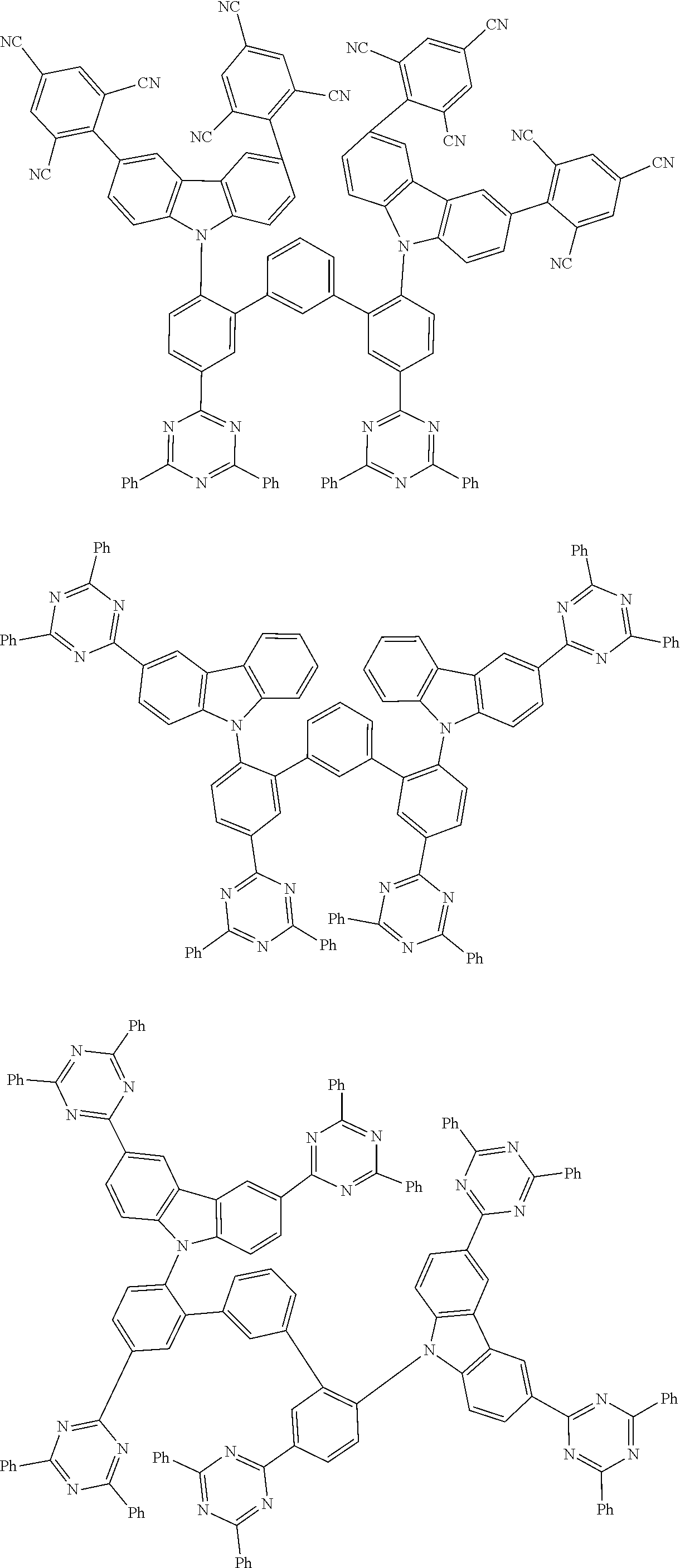
- HPLC-MS: calc.: 1022.38, exp.(neg. ionization): 1021.43 m/z (100%).




Claims (20)


Applications Claiming Priority (3)
| Application Number | Priority Date | Filing Date | Title |
|---|---|---|---|
| DE102018119598 | 2018-08-13 | ||
| DE102018119598.2 | 2018-08-13 | ||
| PCT/EP2019/071208 WO2020035365A1 (en) | 2018-08-13 | 2019-08-07 | Organic molecules for optoelectronic devices |
Publications (2)
| Publication Number | Publication Date |
|---|---|
| US20210399230A1 US20210399230A1 (en) | 2021-12-23 |
| US12035623B2 true US12035623B2 (en) | 2024-07-09 |
Family
ID=67847674
Family Applications (1)
| Application Number | Title | Priority Date | Filing Date |
|---|---|---|---|
| US17/265,776 Active 2041-08-08 US12035623B2 (en) | 2018-08-13 | 2019-08-07 | Organic molecules for optoelectronic devices |
Country Status (4)
| Country | Link |
|---|---|
| US (1) | US12035623B2 (en) |
| EP (1) | EP3837254B1 (en) |
| CN (1) | CN112566908A (en) |
| WO (1) | WO2020035365A1 (en) |
Families Citing this family (1)
| Publication number | Priority date | Publication date | Assignee | Title |
|---|---|---|---|---|
| WO2022034421A1 (en) * | 2020-08-12 | 2022-02-17 | 株式会社半導体エネルギー研究所 | Light emitting device, light emitting apparatus, electronic equipment, and illumination apparatus |
Citations (16)
| Publication number | Priority date | Publication date | Assignee | Title |
|---|---|---|---|---|
| WO2006067976A1 (en) * | 2004-12-24 | 2006-06-29 | Pioneer Corporation | Organic compound, charge-transporting material, and organic electroluminescent element |
| JP2009021336A (en) | 2007-07-11 | 2009-01-29 | Konica Minolta Holdings Inc | Organic electroluminescence element, display device and lighting device |
| JP2010090084A (en) | 2008-10-10 | 2010-04-22 | Chemiprokasei Kaisha Ltd | Novel bis(carbazolylphenyl) derivative, host material, and organic electroluminescent element each employing the same |
| CN101959857A (en) | 2008-03-24 | 2011-01-26 | 新日铁化学株式会社 | Compound for organic electroluminescent device and organic electroluminescent device using the same |
| WO2014091958A1 (en) | 2012-12-10 | 2014-06-19 | コニカミノルタ株式会社 | Material for organic electroluminescent element, organic electroluminescent element, illumination device, and display device |
| WO2014191958A1 (en) | 2013-05-31 | 2014-12-04 | Landauer, Inc. | Geometry layout and filter packaging for system for wireless, motion and position-sensing, integrating radiation sensor for occupational and environmental dosimetry |
| KR20150002072A (en) | 2013-06-28 | 2015-01-07 | (주)피엔에이치테크 | Novel compound for organic electroluminescent device and organic electroluminescent device comprising the same |
| CN105399696A (en) | 2015-12-25 | 2016-03-16 | 上海天马有机发光显示技术有限公司 | Organic electroluminescence compound and organic photoelectric device thereof |
| US20160087218A1 (en) * | 2014-09-19 | 2016-03-24 | Samsung Display Co., Ltd. | Organic light-emitting device |
| US20170141323A1 (en) * | 2015-11-16 | 2017-05-18 | Samsung Electronics Co., Ltd. | Organic light-emitting device |
| JP2017108006A (en) | 2015-12-10 | 2017-06-15 | コニカミノルタ株式会社 | Organic electroluminescent device, display device, and lighting device |
| CN107580594A (en) | 2015-06-17 | 2018-01-12 | 三星Sdi株式会社 | Compound for organic photoelectric device, organic photoelectric device and display device |
| CN107619406A (en) | 2016-07-15 | 2018-01-23 | 吉林奥来德光电材料股份有限公司 | A kind of new carbazole analog derivative and preparation method thereof and application in the devices |
| KR20180020577A (en) | 2016-08-18 | 2018-02-28 | 주식회사 동진쎄미켐 | Novel compound and organic electroluminescent device comprising the same |
| US20190393424A1 (en) * | 2018-06-26 | 2019-12-26 | Samsung Electronics Co., Ltd. | Organic light-emitting device |
| US11548869B2 (en) * | 2017-06-28 | 2023-01-10 | Samsung Display Co., Ltd. | Organic molecules for use in organic optoelectronic devices |
Family Cites Families (2)
| Publication number | Priority date | Publication date | Assignee | Title |
|---|---|---|---|---|
| EP2403028B1 (en) * | 2009-02-27 | 2014-11-12 | Nippon Steel & Sumikin Chemical Co., Ltd. | Organic electroluminescent element |
| KR102050000B1 (en) * | 2016-07-12 | 2019-11-28 | 삼성에스디아이 주식회사 | Compound for organic optoelectronic device, composition for organic optoelectronic device and organic optoelectronic device and display device |
-
2019
- 2019-08-07 CN CN201980053842.4A patent/CN112566908A/en active Pending
- 2019-08-07 US US17/265,776 patent/US12035623B2/en active Active
- 2019-08-07 WO PCT/EP2019/071208 patent/WO2020035365A1/en not_active Ceased
- 2019-08-07 EP EP19762718.5A patent/EP3837254B1/en active Active
Patent Citations (22)
| Publication number | Priority date | Publication date | Assignee | Title |
|---|---|---|---|---|
| WO2006067976A1 (en) * | 2004-12-24 | 2006-06-29 | Pioneer Corporation | Organic compound, charge-transporting material, and organic electroluminescent element |
| JP2009021336A (en) | 2007-07-11 | 2009-01-29 | Konica Minolta Holdings Inc | Organic electroluminescence element, display device and lighting device |
| CN101959857A (en) | 2008-03-24 | 2011-01-26 | 新日铁化学株式会社 | Compound for organic electroluminescent device and organic electroluminescent device using the same |
| US8859109B2 (en) | 2008-03-24 | 2014-10-14 | Nippon Steel & Sumikin Chemical Co., Ltd. | Compound for organic electroluminescent device and organic electroluminescent device using the same |
| JP2010090084A (en) | 2008-10-10 | 2010-04-22 | Chemiprokasei Kaisha Ltd | Novel bis(carbazolylphenyl) derivative, host material, and organic electroluminescent element each employing the same |
| WO2014091958A1 (en) | 2012-12-10 | 2014-06-19 | コニカミノルタ株式会社 | Material for organic electroluminescent element, organic electroluminescent element, illumination device, and display device |
| US9944629B2 (en) | 2012-12-10 | 2018-04-17 | Konica Minolta, Inc. | Material for organic electroluminescent element, organic electroluminescent element, illumination device, and display device |
| WO2014191958A1 (en) | 2013-05-31 | 2014-12-04 | Landauer, Inc. | Geometry layout and filter packaging for system for wireless, motion and position-sensing, integrating radiation sensor for occupational and environmental dosimetry |
| KR20150002072A (en) | 2013-06-28 | 2015-01-07 | (주)피엔에이치테크 | Novel compound for organic electroluminescent device and organic electroluminescent device comprising the same |
| US20160087218A1 (en) * | 2014-09-19 | 2016-03-24 | Samsung Display Co., Ltd. | Organic light-emitting device |
| US10312454B2 (en) | 2015-06-17 | 2019-06-04 | Samsung Sdi Co., Ltd. | Compound for organic optoelectric device, organic optoelectric device and display device |
| EP3312255A1 (en) | 2015-06-17 | 2018-04-25 | Samsung SDI Co., Ltd. | Compound for organic optoelectric device, organic optoelectric device and display device |
| CN107580594A (en) | 2015-06-17 | 2018-01-12 | 三星Sdi株式会社 | Compound for organic photoelectric device, organic photoelectric device and display device |
| US20170141323A1 (en) * | 2015-11-16 | 2017-05-18 | Samsung Electronics Co., Ltd. | Organic light-emitting device |
| JP2017108006A (en) | 2015-12-10 | 2017-06-15 | コニカミノルタ株式会社 | Organic electroluminescent device, display device, and lighting device |
| US20170186962A1 (en) | 2015-12-25 | 2017-06-29 | Shanghai Tianma AM-OLED Co., Ltd. | Organic electroluminescent compound and organic photoelectric apparatus |
| CN105399696A (en) | 2015-12-25 | 2016-03-16 | 上海天马有机发光显示技术有限公司 | Organic electroluminescence compound and organic photoelectric device thereof |
| US10700287B2 (en) | 2015-12-25 | 2020-06-30 | Shanghai Tianma AM-OLED Co., Ltd. | Organic electroluminescent compound and organic photoelectric apparatus |
| CN107619406A (en) | 2016-07-15 | 2018-01-23 | 吉林奥来德光电材料股份有限公司 | A kind of new carbazole analog derivative and preparation method thereof and application in the devices |
| KR20180020577A (en) | 2016-08-18 | 2018-02-28 | 주식회사 동진쎄미켐 | Novel compound and organic electroluminescent device comprising the same |
| US11548869B2 (en) * | 2017-06-28 | 2023-01-10 | Samsung Display Co., Ltd. | Organic molecules for use in organic optoelectronic devices |
| US20190393424A1 (en) * | 2018-06-26 | 2019-12-26 | Samsung Electronics Co., Ltd. | Organic light-emitting device |
Non-Patent Citations (1)
| Title |
|---|
| Office action dated Feb. 15, 2023 in corresponding CN Patent Application No. 201980053842.4, 8pp. |
Also Published As
| Publication number | Publication date |
|---|---|
| US20210399230A1 (en) | 2021-12-23 |
| WO2020035365A1 (en) | 2020-02-20 |
| EP3837254B1 (en) | 2022-10-19 |
| EP3837254A1 (en) | 2021-06-23 |
| CN112566908A (en) | 2021-03-26 |
Similar Documents
| Publication | Publication Date | Title |
|---|---|---|
| US11005048B2 (en) | Organic molecules, in particular for use in optoelectronic devices | |
| US12312338B2 (en) | Organic molecules for use in optoelectronic devices | |
| US12378226B2 (en) | Organic molecules for use in optoelectronic devices | |
| US11021473B2 (en) | Organic molecules for use in organic optoelectronic devices | |
| US11161836B2 (en) | Organic molecules for optoelectronic devices | |
| US10919880B2 (en) | Organic molecules, in particular for use in optoelectronic devices | |
| US12221435B2 (en) | Organic molecules, in particular for use in optoelectronic devices | |
| US20220102636A1 (en) | Organic molecules for optoelectronic devices | |
| US10998504B2 (en) | Organic molecules for use in optoelectronic devices | |
| US11683978B2 (en) | Organic molecules for use in optoelectronic devices | |
| US12421192B2 (en) | Organic molecules for use in optoelectronic devices | |
| US11600783B2 (en) | Organic molecules for use in optoelectronic devices | |
| US11957049B2 (en) | Organic molecules, in particular for use in optoelectronic devices | |
| US12486449B2 (en) | Organic molecules for use in organic optoelectronic devices | |
| US11834437B2 (en) | Organic molecules for optoelectronic devices | |
| US11548869B2 (en) | Organic molecules for use in organic optoelectronic devices | |
| US10978646B2 (en) | Organic molecules for use in optoelectronic devices | |
| US11597719B2 (en) | Organic molecules for use in organic optoelectronic devices | |
| US11393984B2 (en) | Organic molecules for use in organic optoelectronic devices | |
| US20230301186A1 (en) | Organic triazine containing molecules for use in optoelectronic devices | |
| US11472820B2 (en) | Organic molecules for optoelectronic devices | |
| US20240018127A1 (en) | Organic molecules for optoelectronic devices | |
| US11104645B2 (en) | Organic molecules for use in optoelectronic devices | |
| US12098143B2 (en) | Organic molecules for optoelectronic devices | |
| US11882765B2 (en) | Organic molecules for optoelectronic devices |
Legal Events
| Date | Code | Title | Description |
|---|---|---|---|
| AS | Assignment |
Owner name: CYNORA GMBH, GERMANY Free format text: ASSIGNMENT OF ASSIGNORS INTEREST;ASSIGNOR:SEIFERMANN, STEFAN;REEL/FRAME:055211/0825 Effective date: 20210112 |
|
| FEPP | Fee payment procedure |
Free format text: ENTITY STATUS SET TO UNDISCOUNTED (ORIGINAL EVENT CODE: BIG.); ENTITY STATUS OF PATENT OWNER: LARGE ENTITY |
|
| FEPP | Fee payment procedure |
Free format text: ENTITY STATUS SET TO SMALL (ORIGINAL EVENT CODE: SMAL); ENTITY STATUS OF PATENT OWNER: LARGE ENTITY |
|
| STPP | Information on status: patent application and granting procedure in general |
Free format text: DOCKETED NEW CASE - READY FOR EXAMINATION |
|
| AS | Assignment |
Owner name: SAMSUNG DISPLAY CO., LTD., KOREA, REPUBLIC OF Free format text: ASSIGNMENT OF ASSIGNORS INTEREST;ASSIGNOR:CYNORA GMBH;REEL/FRAME:060329/0712 Effective date: 20220527 |
|
| FEPP | Fee payment procedure |
Free format text: ENTITY STATUS SET TO UNDISCOUNTED (ORIGINAL EVENT CODE: BIG.); ENTITY STATUS OF PATENT OWNER: LARGE ENTITY |
|
| STPP | Information on status: patent application and granting procedure in general |
Free format text: NON FINAL ACTION MAILED |
|
| STPP | Information on status: patent application and granting procedure in general |
Free format text: RESPONSE TO NON-FINAL OFFICE ACTION ENTERED AND FORWARDED TO EXAMINER |
|
| STPP | Information on status: patent application and granting procedure in general |
Free format text: NOTICE OF ALLOWANCE MAILED -- APPLICATION RECEIVED IN OFFICE OF PUBLICATIONS |
|
| STPP | Information on status: patent application and granting procedure in general |
Free format text: PUBLICATIONS -- ISSUE FEE PAYMENT RECEIVED |
|
| STPP | Information on status: patent application and granting procedure in general |
Free format text: PUBLICATIONS -- ISSUE FEE PAYMENT VERIFIED |
|
| STCF | Information on status: patent grant |
Free format text: PATENTED CASE |