US12019603B2 - Area allocation device, area allocation method, and non-volatile recording medium - Google Patents
Area allocation device, area allocation method, and non-volatile recording medium Download PDFInfo
- Publication number
- US12019603B2 US12019603B2 US16/338,741 US201716338741A US12019603B2 US 12019603 B2 US12019603 B2 US 12019603B2 US 201716338741 A US201716338741 A US 201716338741A US 12019603 B2 US12019603 B2 US 12019603B2
- Authority
- US
- United States
- Prior art keywords
- information
- submatrix
- processing device
- processing
- submodel
- Prior art date
- Legal status (The legal status is an assumption and is not a legal conclusion. Google has not performed a legal analysis and makes no representation as to the accuracy of the status listed.)
- Active, expires
Links
Images




Classifications
-
- G—PHYSICS
- G06—COMPUTING OR CALCULATING; COUNTING
- G06F—ELECTRIC DIGITAL DATA PROCESSING
- G06F16/00—Information retrieval; Database structures therefor; File system structures therefor
- G06F16/20—Information retrieval; Database structures therefor; File system structures therefor of structured data, e.g. relational data
- G06F16/22—Indexing; Data structures therefor; Storage structures
- G06F16/2228—Indexing structures
- G06F16/2237—Vectors, bitmaps or matrices
-
- G—PHYSICS
- G06—COMPUTING OR CALCULATING; COUNTING
- G06F—ELECTRIC DIGITAL DATA PROCESSING
- G06F12/00—Accessing, addressing or allocating within memory systems or architectures
- G06F12/02—Addressing or allocation; Relocation
- G06F12/0207—Addressing or allocation; Relocation with multidimensional access, e.g. row/column, matrix
-
- G—PHYSICS
- G06—COMPUTING OR CALCULATING; COUNTING
- G06F—ELECTRIC DIGITAL DATA PROCESSING
- G06F16/00—Information retrieval; Database structures therefor; File system structures therefor
- G06F16/20—Information retrieval; Database structures therefor; File system structures therefor of structured data, e.g. relational data
- G06F16/22—Indexing; Data structures therefor; Storage structures
- G06F16/2228—Indexing structures
- G06F16/2264—Multidimensional index structures
-
- G—PHYSICS
- G06—COMPUTING OR CALCULATING; COUNTING
- G06F—ELECTRIC DIGITAL DATA PROCESSING
- G06F17/00—Digital computing or data processing equipment or methods, specially adapted for specific functions
- G06F17/10—Complex mathematical operations
- G06F17/16—Matrix or vector computation, e.g. matrix-matrix or matrix-vector multiplication, matrix factorization
-
- G—PHYSICS
- G06—COMPUTING OR CALCULATING; COUNTING
- G06N—COMPUTING ARRANGEMENTS BASED ON SPECIFIC COMPUTATIONAL MODELS
- G06N20/00—Machine learning
Definitions
- the present invention relates to an area allocation devices and the like that allocates memory area necessary for matrix operation processing.
- NPL 1 describes an example of a method of performing large-scale machine learning in parallel.
- Each processing device gathers operation results obtained by independent processing by using a function called “All Reduce” (a method in which operation processing is executed while referring to data stored in another processing device, and each processing device calculates a same operation result).
- All Reduce a method in which operation processing is executed while referring to data stored in another processing device, and each processing device calculates a same operation result.
- the “All Reduce” function is a function of adding pieces of data of all processing devices within a certain group, and sharing the addition result among all the processing devices within the certain group, for example.
- PTL 1 discloses a recommendation system for recommending an item in a service to a service user.
- the recommendation system selects an item to be recommended to a service user from among items in the service, based on a history on evaluation performed by a user who uses the item in the service, with respect to the item.
- PTL 2 discloses a vector processing unit for executing an operation on two vectors.
- the vector processing unit converts one of the two vectors into a first vector having a data structure in accordance with a sparse vector format, and converts the other vector into a second vector having a data structure in accordance with a dense vector format.
- the vector processing unit executes operation processing to the first vector and the second vector.
- the sparse vector format is a data format for storing only an element being a non-zero value.
- the dense vector format is a data format for storing all elements.
- one of objects of the present invention is to provide an area allocation device and the like which enable to efficiently secure a memory area required for processing to matrix information in terms of a memory volume.
- an area allocation device including:
- an area allocation method including:
- an area allocation program making a computer achieve:
- the object is also achieved by a computer-readable recording medium that records the program.
- An area allocation device and the like according to the present invention are able to efficiently secure a memory area required for processing to matrix information in terms of a memory volume.
- FIG. 1 is a block diagram illustrating a configuration of an information processing system according to a first example embodiment of the present invention.
- FIG. 2 is a sequence diagram illustrating a flow of processing in the information processing system according to the first example embodiment.
- FIG. 3 is a diagram conceptually illustrating one example of matrix information.
- FIG. 4 is a diagram conceptually illustrating one example of processing in a matrix conversion unit.
- FIG. 5 is a diagram conceptually illustrating processing in a gather unit.
- FIG. 6 is a diagram conceptually illustrating processing in a model conversion unit.
- FIG. 7 is a diagram conceptually illustrating submatrix information to be processed in terms of a mini-batch unit.
- FIG. 8 is a diagram conceptually illustrating processing to be executed regarding matrix information (or submatrix information, or compressed matrix information).
- FIG. 9 is a block diagram illustrating a configuration of an information processing system according to a second example embodiment of the present invention.
- FIG. 10 is a flowchart illustrating a flow of processing in the information processing system according to the second example embodiment.
- FIG. 11 is a diagram conceptually illustrating processing of generating whole model information while communicating in accordance with a tree structure.
- FIG. 12 is a diagram conceptually illustrating processing of generating whole model information while communicating in accordance with a tree structure.
- FIG. 13 is a diagram conceptually illustrating processing in the information processing system.
- FIG. 14 is a diagram conceptually illustrating processing in the information processing system.
- FIG. 15 is a diagram conceptually illustrating processing in the information processing system.
- FIG. 16 is a block diagram illustrating a configuration of an information processing system according to a third example embodiment of the present invention.
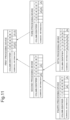
- FIG. 17 is a flowchart illustrating a flow of processing in the information processing system.
- FIG. 18 is a diagram conceptually illustrating processing to be executed when whole model information is processed in parallel in each processing device.
- FIG. 19 is a diagram conceptually illustrating one example of processing of allocating gather processing to processing devices based on a number of processing devices.
- FIG. 20 is a diagram conceptually illustrating processing in the information processing system.
- FIG. 21 is a diagram conceptually illustrating processing in the information processing system.
- FIG. 22 is a block diagram illustrating a configuration of an area allocation device according to a fourth example embodiment of the present invention.
- FIG. 23 is a flowchart illustrating a flow of processing in the area allocation device according to the fourth example embodiment.
- FIG. 24 is a block diagram schematically illustrating a hardware configuration of a calculation processing device capable of achieving an information processing system according to the first to third example embodiments or the an allocation device according to the fourth example embodiments of the present invention.
- FIG. 25 is a diagram conceptually illustrating one example of training information.
- Training information being a target to be learned in machine learning is generally large-scale information, and is represented by using matrix information.
- One example of training information being a learning target in machine learning will be described with reference to FIG. 25 .
- FIG. 25 is a diagram conceptually illustrating one example of training information.
- Training information is information representing whether a user of a certain site has clicked an advertisement displayed in the certain site, for example.
- a site name is indicated in a column direction
- an advertisement name is indicated in a row direction.
- a value e.g., 1
- a predetermined value e.g., 0 (zero) or a null value
- a predetermined value (e.g., 0 (zero) or a null value) is set as a value of an element to be determined by a column representing the site name and a row representing the advertisement name.
- a predetermined value is illustrated by using a null value.
- training information exemplified in FIG. 25 is generated in accordance with a method also called “One Hot Encoding”, for example.
- a predetermined value is 0 (zero) and a value different from the predetermined value is 1.
- these values are not limited to 0 and 1.
- an element storing a predetermined value is referred to as a “zero element”.
- An element storing a value different from the predetermined value is referred to as a “non-zero element”.
- the training information is also referred to as a sparse matrix, since a number of elements having a value “1” is extremely smaller than a number of elements having a value “0”.
- optimizing model information as a basis for calculating a click-through rate for example, values of parameters constituting model information are optimized based on training information exemplified in FIG. 25 , in accordance with a predetermined calculation procedure such as a logistic regression method.
- Optimized model information can be represented by using a numerical array (vector) including values of parameters constituting the model information.
- the vector may be represented as a dense vector (or a dense matrix) in which all values of the parameter constituting the model information are stored.
- a number of elements included in the vector is determined depending on a number of non-zero elements included in training information, for example.
- Model information to be generated based on training information is represented by using a vector including elements by a number of columns included in training information, for example. Therefore, as a number of columns included in training information increases, a number of elements in model information to be generated based on the training information increases.
- training information is decomposed, and a piece of decomposed training information (submatrix information in FIG. 3 ) is allocated to (arranged at) each information processing device.
- processing device an information processing device is simply referred to as a “processing device”.
- Each processing device generates model information (for convenience of explanation, referred to as “submodel information” (exemplified in FIG. 5 )) relating to the piece of decomposed training information, by using the piece of decomposed training information, in accordance with a predetermined calculation procedure.
- model information for convenience of explanation, referred to as “whole model information” (exemplified in FIG. 5 )
- whole model information relating to whole training information
- all model information for convenience of explanation, referred to as “All Reduce” function. Consequently, model information that is optimized regarding whole training information is stored in each processing device.
- each processing device mutually communicates values of parameters constituting the model information, in processing in accordance with an “All Reduce” function. Therefore, since a number of parameters constituting model information increases, as a number of columns included in training information increases, a communication time in an “All Reduce” function increases.
- the inventor of the present application found an issue that even when a parallel processing method used in a numerical simulation and the like is applied to processing in accordance with a processing procedure as described above, it is not necessarily possible to execute high-efficient parallel processing. This issue will be described.
- a non-zero element included in a matrix represents that information allocated to a column associated with a vertical direction where the non-zero element is located, and information allocated to a row associated with a horizontal direction where the non-zero element is located, are associated with each other.
- information allocated to an I-th row (where I is a natural number) and information allocated to an I-th column represent pieces of information relating to same parameters. Therefore, in a numerical simulation, when a row of the matrix is reordered, it is necessary to appropriately reorder a column, in order to maintain consistency of information allocated to a row and a column.
- a processing device for executing processing for each row is determined in advance.
- each processing device executes operation processing to a row allocated to the processing device itself.
- Each processing device is required to secure a memory area for storing a matrix in the processing device itself, based on a number of non-zero columns included in the original matrix (specifically, a whole matrix). Therefore, a memory volume in each processing device is determined depending on a number of non-zero columns included in an original matrix.
- a non-zero element included in a matrix that appears in learning processing as described above is not associated with information allocated to a column associated with a vertical direction where the non-zero element is located, and information allocated to a row associated with a horizontal direction where the non-zero element is located.
- information allocated to an I-th row where I is a natural number
- information allocated to an I-th column are generally different. Therefore, even when a row in a matrix that appears in learning processing is reordered, it is not necessary to reorder a column, in order to maintain consistency of information allocated to a row and a column.
- FIG. 1 is a block diagram illustrating a configuration of the information processing system 101 according to the first example embodiment of the present invention.
- the information processing system 101 includes a worker processing device 102 and a master processing device 103 .
- the worker processing device 102 includes a matrix conversion unit (matrix converter) 104 and a processing unit (processor) 105 .
- the master processing device 103 includes a gather unit (gatherer) 106 and a model conversion unit (model converter) 107 .
- a number of the master processing devices 103 is, for example, one, and a number of the worker processing devices 102 is, for example, at least one.
- the master processing device 103 may have a function included in the worker processing device 102 .
- the matrix conversion unit 104 inputs submatrix information (described later with reference to FIG. 3 ), for example, and generates conversion information (described later with reference to FIG. 4 ) and compressed matrix information (described later with reference to FIG. 4 ) by converting the input information.
- the matrix conversion unit 104 transmits generated conversion information to the master processing device 103 , and further outputs generated compressed matrix information to the processing unit 105 .
- the processing unit 105 inputs compressed matrix information generated by the matrix conversion unit 104 , and model information (hereinafter, referred to as “input model information”) as will be described later in this paragraph.
- the processing unit 105 generates a processing result model (hereinafter, referred to as “output model information” (e.g., submodel information in FIG. 5 )) by executing processing in accordance with a predetermined calculation procedure, with respect to the input compressed matrix information (exemplified in FIG. 4 ) and model information.
- the processing unit 105 transmits generated output model information to the master processing device 103 .
- Output model information is model information representing a relevance between a value included in a row in compressed matrix information (or matrix information), and a value being a prediction target.
- Input model information is information as a basis for which the output model information is calculated.
- Output model information is generated by determining values of parameters included in input model information, for example, in accordance with a predetermined calculation procedure (e.g., a least square method or a logistic regression method).
- a predetermined calculation procedure is not limited to the above-described methods.
- model information is information representing a relevance between input and a value being a prediction target, by using parameters.
- the processing unit 105 generates output model information (e.g., submodel information in FIG. 5 ) by determining values of parameters included in input model information, in accordance with a predetermined calculation procedure, based on input compressed matrix information.
- submodel information represents, for example, a partial calculation result in submatrix information in the procedure for calculating a coefficient of each parameter. For example, when a value of the parameter is calculated by a sum of a plurality of elements included in matrix information (exemplified in FIG. 3 ), a parameter in submodel information represents a sum of elements included in submatrix information (exemplified in FIG. 3 ).
- the gather unit 106 receives conversion information transmitted by the worker processing device 102 and submodel information, gathers the received submodel information in accordance with the conversion information, and thereby, generates whole model information (exemplified in FIG. 5 ) for matrix information (exemplified in FIG. 3 ).
- whole model information (exemplified in FIG. 5 )
- parameters included in model information are optimized in accordance with a predetermined calculation procedure, based on matrix information (exemplified in FIG. 3 ).
- FIG. 3 is a diagram conceptually illustrating one example of matrix information.
- Matrix information is training information as described with reference to FIG. 25 , for example.
- “A” represents a value (e.g., a numerical value other than zero), which is different from a predetermined value.
- a null value in matrix information represents the predetermined value (e.g., zero).
- matrix information and submatrix information are displayed for all values. However, as will be described with reference to FIG. 4 and the like, it is not necessarily required that a predetermined value is stored in the matrix information.
- information allocated to each row represents training information (exemplified in FIG. 25 ) relating to one instance.
- information allocated to each column represents values of parameters (specifically, parameters constituting model information) representing a feature of the instance.
- Matrix information is not limited to the above-described example.
- information allocated to each column may represent training information (exemplified in FIG. 25 ) relating to one instance.
- information allocated to each row may represent values of parameters (specifically, parameters constituting model information) representing a feature of the instance.
- Matrix information (exemplified in FIG. 3 ) is decomposed in a horizontal (row) direction, and processing, as will be described later with reference to FIG. 2 , is executed with respect to a piece of decomposed matrix information (e.g., submatrix information in FIG. 3 ).
- each piece of matrix information decomposed in a horizontal (row) direction is referred to as “submatrix information”.
- processing is allocated to each processing device for the each piece of submatrix information.
- matrix information is decomposed into submatrix information (left side in FIG. 3 ) storing values of elements in first and second rows in the matrix information, and submatrix information (right side in FIG. 3 ) storing values of elements in third and fourth rows in the matrix information.
- model information (submodel information exemplified in FIG. 5 ) to submatrix information is generated in accordance with a predetermined processing procedure
- values of parameters constituting model information to be generated are determined, based on values included in a column in the submatrix information (exemplified in FIG. 3 ). For example, as exemplified in model information in FIG. 3 , when the column includes at least one non-zero element, possibility that a value of a parameter to the column is non-zero is high. However, when the column does not include a non-zero element, a value of a parameter to the column is zero.
- a column including at least one element taking a value different from a predetermined value is referred to as a “target column”.
- a predetermined value zero
- a column including at least one element taking a value different from zero specifically, non-zero
- a non-zero column is one example of a target column.
- model information to be calculated based on the submatrix information includes parameters being non-zero by a number of non-zero columns included in the submatrix information.
- model information to be generated based on submatrix information is referred to as “submodel information”. Further, model information to be generated based on matrix information is referred to as “whole model information”.
- FIG. 4 is a diagram conceptually illustrating one example of processing in the matrix conversion unit 104 .
- “A” to “D” represent values different from a predetermined value.
- a null value in submatrix information (or compressed matrix information) represents a predetermined value (e.g., zero).
- FIG. 4 for aiding understanding, a configuration that submatrix information (or compressed matrix information) includes a memory area storing all values (specifically, “A” to “D”, and a null value) is illustrated. However, it is not necessarily required that the submatrix information (or compressed matrix information) includes a memory area storing the predetermined value.
- submatrix information exemplified in FIG. 4 , for convenience of explanation, a value of each of a row identifier and a column identifier is illustrated.
- the submatrix information may not necessarily include a row identifier or a column identifier.
- the matrix conversion unit 104 inputs submatrix information, and specifies a column identifier identifying a non-zero column among the input submatrix information.
- the matrix conversion unit 104 calculates 1, 4, and 6 regarding submatrix information illustrated in FIG. 4 , for example.
- the matrix conversion unit 104 generates conversion information including the specified column identifier, and compressed matrix information including elements included in the non-zero column.
- the conversion information is information in which a column identifier identifying a non-zero column in the submatrix information, and a column identifier in the compressed matrix information are associated with each other.
- a fourth column in submatrix information, and a second column in the compressed matrix information are associated with each other.
- the matrix conversion unit 104 generates conversion information by focusing on a non-zero column (specifically, a target column). Alternatively, conversion information may be generated by focusing on a column including only an element taking value “zero”. Specifically, processing in the matrix conversion unit 104 is not limited to the above-described processing.
- first, fourth, and sixth columns are non-zero columns.
- the matrix conversion unit 104 specifies the first, fourth, and sixth columns being non-zero columns in submatrix information, and generates conversion information including values (specifically, 1, 4, and 6) designating the specified columns. Further, the matrix conversion unit 104 generates compressed matrix information storing non-zero columns in an order of the first, fourth, and sixth columns.
- values of elements included in zero columns specifically, the second, the third, the fifth, and the seventh columns
- column identifiers specifically, 2, 3, 5, and 7 identifying zero columns are not stored in conversion information.
- the processing unit 105 inputs compressed matrix information (exemplified in FIG. 4 ) generated by the matrix conversion unit 104 , and generates submodel information (exemplified in FIG. 5 ) based on the compressed matrix information by executing processing in accordance with a predetermined processing procedure with respect to the input compressed matrix information.
- a predetermined processing procedure is a logistic regression method
- the processing unit 105 determines parameters constituting submodel information, based on compressed matrix information, by executing processing in accordance with the logistic regression method with respect to the compressed matrix information.
- the processing unit 105 transmits the calculated submodel information to the master processing device 103 .
- FIG. 5 is a diagram conceptually illustrating processing in the gather unit 106 .
- the gather unit 106 receives conversion information transmitted by the matrix conversion unit 104 in each worker processing device 102 , and submodel information transmitted by the processing unit 105 , and generates whole model information, based on the received conversion information and the received submodel information.
- the gather unit 106 receives, for example, two pieces of conversion information, and submodel information calculated based on compressed matrix information relating to the conversion information, as illustrated in FIG. 5 , for example.
- the gather unit 106 specifies a column identifier in matrix information, based on the conversion information, regarding each element in the received submodel information, executes processing (an addition operation and the like) according to a predetermined processing procedure for the each specified column identifier, and thereby, generates whole model information.
- This processing is implementable by using an “All Reduce” function with which communication processing and operation processing are executed.
- processing in the gather unit 106 as described above is also referred to as “gather processing”.
- FIG. 6 is a diagram conceptually illustrating processing in the model conversion unit 107 .
- the model conversion unit 107 generates submodel information based on each piece of compressed matrix information, based on whole model information generated by the gather unit 106 , and conversion information. More specifically, the model conversion unit 107 reads a column identifier included in conversion information relating to each piece of compressed matrix information, reads values in a column identified by the read column identifier among whole model information, and generates submodel information including the read values. Specifically, the submodel information is information as a basis for generating whole model information. When a predetermined processing procedure is processed in parallel, the model conversion unit 107 transmits the generated submodel information to the worker processing device 102 , to which processing for the compressed matrix information is allocated.
- Processing in the information processing system 101 is not necessarily limited to the above-described example.
- processing may be executed in accordance with a “Stochastic Gradient Descent” algorithm.
- each worker processing device 102 decomposes data possessed by the worker processing device itself in terms of a unit called a mini-batch (see FIG. 7 ), and generates submodel information for the each decomposed mini-batch.
- FIG. 7 is a diagram conceptually illustrating submatrix information to be processed in terms of a mini-batch unit.
- submatrix information is illustrated by including all values. However, a value different from a predetermined value is not necessarily required to be stored in the submatrix information (or compressed matrix information).
- submatrix information exemplified in FIG. 7 , for convenience of explanation, a value of each of a row identifier and a column identifier is illustrated.
- the submatrix information may not necessarily include a row identifier or a column identifier.
- processing of generating submatrix information as described above is executed in terms of a mini-batch unit for every two rows.
- the worker processing device 102 that executes processing for the submatrix information generates submodel information to a row identified by each mini-batch identifier in mini-batches identified by a mini-batch identifier “B1”, a mini-batch identifier “B2”, and a mini-batch identifier “B3”.
- the worker processing device 102 generates submatrix information including third and fourth rows in submatrix information, regarding a mini-batch identified by the mini-batch identifier “B2”, for example, and generates conversion information and compressed matrix information (exemplified in FIG. 4 ) to the generated submatrix information.
- the worker processing device 102 generates submodel information based on the compressed matrix information, and transmits, to the master processing device 103 , the conversion information and the submodel information generated for each mini-batch.
- the gather unit 106 receives conversion information and submodel information transmitted by the worker processing device 102 , and executes gather processing of gathering submodel information into whole model information, in accordance with the received conversion information. Thereafter, by executing processing similar to the above-described processing, the gather unit 106 generates submodel information in terms of a mini-batch unit from generated whole model information, based on received conversion information, and transmits the generated submodel information to the worker processing device 102 .
- a mini-batch may be a processing unit including a plurality of rows in submatrix information.
- FIG. 2 is a sequence diagram illustrating a flow of processing in the information processing system 101 according to the first example embodiment.
- the matrix conversion unit 104 specifies a non-zero column among input submatrix information (exemplified in FIG. 4 ), and generates compressed matrix information storing only the specified non-zero column, and conversion information (exemplified in FIG. 4 ) storing a column identifier of the specified non-zero column (Step S 101 ).
- the worker processing device 102 transmits the generated conversion information to the master processing device 103 (Step S 102 ).
- the master processing device 103 receives the conversion information (exemplified in FIG. 4 ) transmitted by the worker processing device 102 (Step S 106 ).
- the processing unit 105 In the worker processing device 102 , the processing unit 105 generates submodel information (exemplified in FIG. 5 ) based on compressed matrix information generated by the matrix conversion unit 104 in accordance with a predetermined processing procedure (Step S 103 ), and transmits the generated submodel information to the master processing device 103 (Step S 104 ).
- the master processing device 103 receives the submodel information (exemplified in FIG. 5 ) transmitted by the worker processing device 102 (Step S 107 ), and generates whole model information (exemplified in FIG. 5 ) by executing gather processing with respect to the received submodel information (Step S 108 ).
- the master processing device 103 generates submodel information (exemplified in FIG. 6 ) based on the compressed matrix information generated in Step S 101 , based on the conversion information received in Step S 106 and the generated whole model information (exemplified in FIG. 6 ) (Step S 109 ), and transmits the generated submodel information to the worker processing device 102 (Step S 110 ).
- the worker processing device 102 receives the submodel information (exemplified in FIG. 6 ) transmitted by the master processing device 103 (Step S 105 ).
- matrix information (or submatrix information, or compressed matrix information) is illustrated as a matrix having a two-dimensionally arranged data structure.
- a data structure may not necessarily be a two-dimensionally arranged data structure.
- FIG. 8 is a diagram conceptually illustrating processing to be executed regarding matrix information (or submatrix information, or compressed matrix information).
- FIG. 8 processing to be executed regarding matrix information (or submatrix information, or compressed matrix information) according to a data structure called a compressed row storage (CRS) format is conceptually illustrated.
- CRS compressed row storage
- a data structure of a CRS format, a coordinated (COO), or the like is one example of a data structure capable of volume-efficiently (memory-efficiently) storing matrix information called a sparse matrix including a large number of non-zero elements.
- value information including a value of a non-zero element among values of elements included in matrix information, index information including a column identifier identifying a column storing a non-zero element in the matrix information, and offset information designating a position corresponding to a delimiter of a row in the matrix information regarding an element of the index information, are stored in a memory or the like.
- submatrix information is matrix information having two rows and seven columns, for example.
- a column identifier is annotated to a column
- a row number is annotated to a row. This does not mean, however, that submatrix information includes a row identifier or a column identifier.
- information for specifying a position of a certain element, which is included in matrix information is represented by a description format being “the (row identifier, column identifier) element”.
- a non-zero value A is stored in the (1, 1) element
- a non-zero value B is stored in the (1, 4) element
- a non-zero value C is stored in the (2, 4) element
- a non-zero value D is stored in the (2, 6) element.
- values of elements other than the four elements are zero.
- value information including non-zero values A, B, C, and D is generated with respect to the submatrix information, and index information including a column identifier designating a column storing the four non-zero elements is generated.
- column identifiers 1, 4, 4, and 6 of the (1, 1) element, the (1, 4) element, the (2, 4) element, and the (2, 6) element storing a non-zero element are stored in index information.
- values stored in the first and second elements respectively represent a column identifier of an element included in the first row among non-zero elements in the submatrix information.
- values stored in the third and fourth elements respectively represent a column identifier of an element included in the second row among non-zero elements in the submatrix information. Therefore, a row identifier in the submatrix information changes between the second and third elements in the index information.
- a value designating a first element representing a leading position of index information is stored in the first element of offset information
- a value designating a third element representing a delimiter between first and second rows of submatrix information in index information is stored in a second element of offset information.
- a memory area for storing information representing whether or not each column in submatrix information is a non-zero column is secured.
- information representing whether or not each column in the submatrix information is a non-zero column is stored in the memory area.
- a column identifier identifying a non-zero column in matrix information is stored in conversion information. For example, since first, fourth, and sixth columns are non-zero columns in submatrix information exemplified in FIGS. 8 , 1 , 4 , and 6 are stored in conversion information.
- the matrix conversion unit 104 generates compressed matrix information storing a value of an element included in a non-zero column in submatrix information.
- elements included in the first, fourth, and sixth columns being non-zero columns are stored in compressed matrix information.
- the matrix conversion unit 104 converts index information of submatrix information into index information of compressed matrix information (hereinafter, referred to as “compressed matrix index information”), based on conversion information. For example, since a value “4” is stored in a second element in index information, and a same value “4” is stored in a first element in conversion information, a value “1” representing the first element is stored in a second element in compressed matrix index information.
- the matrix conversion unit 104 executes processing similar to the above-described processing also regarding another element included in index information. This processing is implementable by a binary search method or the like.
- the matrix conversion unit 104 transmits the generated conversion information to the master processing device 103 .
- the processing unit 105 generates submodel information, based on conversion information generated by the matrix conversion unit 104 , and compressed matrix information having a data structure in accordance with a CRS format. A number of elements (parameters) included in submodel information is same as a number of elements included in conversion information, for example.
- the processing unit 105 transmits the generated submodel information to the master processing device 103 .
- submodel information generated by the worker processing device 102 is submodel information based on compressed matrix information.
- the master processing device 103 receives conversion information and submodel information (exemplified in FIG. 5 ) transmitted by the worker processing device 102 , executes gather processing for the submodel information, based on the received conversion information and the received submodel information, and thereby, generates whole model information (exemplified in FIG. 5 ).
- a number of elements (parameters) included in the whole model information may coincide with a number of non-zero columns included in matrix information, for example.
- the master processing device 103 generates submodel information (exemplified in FIG. 6 ) based on each piece of compressed matrix information, based on conversion information received from each worker processing device 102 and the whole model information (exemplified in FIG. 6 ), by executing processing as described with reference to FIG. 6 , and transmits the generated submodel information to the worker processing device 102 that executes processing for the compressed matrix information.
- the worker processing device 102 receives the submodel information (exemplified in FIG. 6 ) transmitted by the master processing device 103 .
- Processing as described above may be repeatedly executed in accordance with a predetermined calculation procedure, for example until the calculated whole model information converges, or until a predetermined number of repetitions is reached, or the like.
- processing as described above is executed by employing the mini-batch as a processing target.
- whole model information is generated by a communication configuration in which each worker processing device 102 communicates submodel information with the master processing device 103 .
- Communication is not necessarily required to follow the communication configuration.
- a communication configuration may be a configuration in which communication is performed in accordance with a tree structure, as will be described later in a second example embodiment with reference to FIG. 9 and the like.
- a communication configuration may be a configuration in which whole model information is processed in parallel in a plurality of processing devices.
- a configuration for generating whole model information is not limited to the above-described example.
- the information processing system 101 can efficiently secure a memory area required for processing to matrix information in terms of a memory volume.
- a reason for this is that a memory area required for processing relating to compressed matrix information being a processing target is secured in terms of a volume depending on a number of columns for which processing is required.
- the information processing system 101 can efficiently execute processing in a predetermined processing procedure.
- a reason for this is that the information processing system 101 executes gather processing for submodel information in a memory area secured as described above.
- an amount of communication relating to an element (e.g. the above-described zero element) that is not a processing target is reduced between the master processing device 103 and the worker processing device 102 . Consequently, in the information processing system 101 , it is possible to reduce a communication time in gather processing.
- the information processing system 101 it is possible to reduce a time required for processing in accordance with a predetermined processing procedure.
- a reason for this is that it is possible to effectively use a cache memory by executing processing in a memory area secured as described above.
- a volume of the memory area is smaller than a volume required for storing the submatrix information. Therefore, by using the memory area secured as described above, possibility that submodel information is stored in a cache memory is high, and therefore, a cache hit rate improves.
- the matrix conversion unit 104 it is possible to store matrix information with a less memory volume. A reason for this is that only a column necessary for generating submodel information (specifically, a target column including at least one or more elements storing a value different from a predetermined value) is stored.
- conversion information to be provided by the matrix conversion unit 104 includes communication information in communication processing necessary in parallel processing. Including the communication information in the conversion information will be specifically described.
- a predetermined processing procedure is a logistic regression method, for example, it is necessary to execute processing with respect to a column in matrix information. Therefore, when a predetermined processing procedure is a logistic regression method, for example, even in compressed matrix information arranged in each processing device, each processing device is required to gather a calculated value regarding an element included in a column identified by one column identifier. Since a column identifier identifying the column is stored in conversion information, it is possible to determine required communication in a short period, by referring to the conversion information.
- the information processing system 101 it is possible to provide information capable of implementing target processing in a short period.
- a reason for this is that the information processing system 101 provides a processing configuration capable of processing matrix information in parallel.
- a parallel information processing system is able to reduce a time required for processing for the matrix information, by executing the processing in parallel in accordance with an allocation to be determined by the information processing system 101 .
- processing for submatrix information is allocated to one processing device.
- the information processing system 101 may include an allocation unit for allocating, to a processing device, processing for submatrix information (exemplified in FIG. 3 ) generated by decomposing matrix information (exemplified in FIG. 3 ).
- processing in the information processing system 101 will be described by using terms called a row and a column, for convenience.
- a similar advantageous effect is provided by similar processing, even when a row and a column are interchanged.
- processing similarly to the first example embodiment, processing will be described by using terms called a row and a column, for convenience.
- a similar advantageous effect is provided by similar processing, even when a row and a column are interchanged.
- FIG. 9 is a block diagram illustrating a configuration of the information processing system 901 according to the second example embodiment of the present invention.
- the information processing system 901 includes a worker processing device 102 and a master processing device 902 .
- the worker processing device 102 includes a matrix conversion unit (matrix converter) 104 and a processing unit (processor) 105 .
- the master processing device 902 includes a gather unit (gatherer) 106 , a model conversion unit (model converter) 107 , a tree structure generation (determination) unit (tree structure generator) 903 , and a conversion information merge unit (conversion information merger) 904 .
- a number of the master processing devices 902 is, for example, one. However, the master processing device 902 may have a function included in the worker processing device 102 .
- FIG. 11 is a diagram conceptually illustrating processing of generating whole model information, while communicating in accordance with a tree structure.
- “A” mark denotes a non-zero element.
- whole model information includes first to seventh elements. It is assumed that a first processing device calculates submodel information including the second, third, sixth, and seventh elements as non-zero elements. It is assumed that a second processing device calculates submodel information in which the first and fourth elements are non-zero elements. It is assumed that a third processing device calculates submodel information in which the fourth, fifth, and seventh elements are non-zero elements. It is assumed that a fourth processing device calculates submodel information in which the fourth and seventh elements are non-zero elements. It is assumed that a fifth processing device calculates submodel information in which the first to fifth, and seventh elements are non-zero elements. For convenience of explanation, in FIG. 11 , processing is illustrated in a configuration in which each processing device processes whole model information. However, as described above, each processing device executes processing regarding submodel information including only a non-zero element, for example.
- the fourth and fifth processing devices transmit, to the second processing device, submodel information generated in each processing device.
- the second processing device receives submodel information transmitted by the fourth processing device and submodel information transmitted by the fifth processing device, and generates, based on the received two pieces of submodel information and submodel information calculated by the second processing device itself, submodel information in which the three pieces of submodel information are gathered. In this case, gathered submodel information is submodel information in which the first to fifth, and seventh elements are non-zero elements.
- the second processing device transmits generated submodel information to the first processing device.
- the third processing device transmits generated submodel information to the first processing device.
- the first processing device receives the submodel information transmitted by the second processing device and the submodel information transmitted by the third processing device, and generates whole model information, based on the received two pieces of submodel information, and submodel information generated by the first processing device itself.
- a number of non-zero elements included in submodel information generated in the fourth processing device is two.
- the second processing device generates submodel information in which the first to fifth, and seventh elements are non-zero elements, based on received submodel information, and submodel information generated by the second processing device itself. Consequently, a number of non-zero elements included in submodel information generated in the second processing device is six.
- the submodel information is transmitted in a direction opposite to a direction of communication processing executed in gather processing. Specifically, in the example illustrated in FIG. 11 , the first processing device transmits submodel information to the second and third processing devices, and thereafter, the second processing device transmits submodel information to the fourth and fifth processing devices.
- FIG. 12 is a diagram conceptually illustrating processing of generating whole model information, while communicating in accordance with a tree structure.
- the second and fourth processing devices respectively transmit submodel information to the third processing device.
- the third processing device generates, based on pieces of submodel information transmitted by the second and fourth processing devices and submodel information calculated by the third processing device itself, submodel information in which the three pieces of submodel information are gathered, and transmits the generated submodel information to the fifth processing device.
- Processing in which an amount of communication is small is implementable by arranging a processing device for calculating submodel information in which a number of non-zero elements is large near (specifically, at an upper order of) a root node in a tree structure and arranging a processing device for calculating submodel information in which a number of non-zero elements is small near (specifically, at a lower order of) a leaf node in a tree structure.
- a number of non-zero elements included in submodel information is determined depending on a number of non-zero columns in compressed matrix information as a basis for which the submodel information is generated.
- a node other than a root node and a leaf node is referred to as an “intermediate node”.
- a processing device arranged at a parent node of a certain node with respect to a certain processing device arranged at the certain node is referred to as a “parent processing device” of the certain processing device.
- a processing device arranged at a child node of a certain node with respect to a certain processing device arranged at the certain node is referred to as a “child processing device” of the certain processing device.
- a parent processing device of the second processing device is the first processing device.
- child processing devices of the second processing device are the fourth and fifth processing devices.
- a parent processing device of the fourth processing device is the second processing device.
- the fourth processing device has no child processing device.
- FIGS. 13 to 15 are diagrams conceptually illustrating processing in the information processing system 901 .
- each processing device transmits, to a parent processing device 1305 of the processing device, the conversion information 1304 and the submodel information 1310 .
- Each processing device further transmits, to a specification processing device 1301 for determining a communication order of processing devices, the conversion information 1304 generated in the processing device itself.
- a tree structure generation (determination) unit (tree structure generator) 1312 receives conversion information 1311 transmitted by each processing device, and determines a communication order of processing devices, based on a number of elements (size) included in the received conversion information 1311 . In other words, the tree structure generation unit 1312 generates a tree structure 1313 representing a communication order of processing devices.
- the tree structure generation (determination) unit 1312 transmits, to each processing device 1314 , an identifier identifying a parent processing device arranged as a parent node of a node to which the processing device is allocated, and an identifier identifying a child processing device arranged as a child node of the node to which the processing device is allocated.
- Each processing device receives an identifier identifying a parent processing device and an identifier identifying a child processing device, which are transmitted by the specification processing device 1301 .
- each processing device performs communication with a parent processing device of the processing device, or with a child processing device of the processing device, based on these received identifiers.
- a conversion information merge unit (conversion information merger) 1407 receives conversion information 1401 transmitted by a child processing device of the processing device itself, and generates conversion information 1409 including the received conversion information 1401 and conversion information 1402 generated by the processing device itself.
- the conversion information merge unit (conversion information merger) 1407 transmits the generated conversion information 1409 to a parent processing device 1410 of the processing device itself.
- a gather unit (gatherer) 1408 In a processing device arranged at each of an intermediate node and a root node, a gather unit (gatherer) 1408 generates submodel information 1411 after gathering, by gathering conversion information 1403 transmitted by a child processing device of the processing device itself, submodel information 1404 transmitted by a child processing device of the processing device itself, conversion information 1405 generated by the processing device itself, and submodel information 1406 generated by the processing device itself.
- the submodel information 1411 to be generated by the gather unit 1408 in a processing device arranged at the root node is whole model information (specifically, model information in which pieces of submodel information in all processing devices are gathered).
- the gather unit 1408 transmits, to the parent processing device 1410 of the processing device itself, the generated submodel information 1411 .
- submodel information is generated by a model conversion unit 1504 , in an order from a processing device arranged at a root node in the tree structure to a processing device arranged at a lower node in the tree structure.
- the model conversion unit 1504 In a processing device arranged at an intermediate node, the model conversion unit 1504 generates submodel information 1507 being a target to be processed by the processing device itself, based on submodel information 1502 transmitted by a parent processing device of the processing device itself, and conversion information 1503 generated by the processing device itself.
- the model conversion unit 1504 In a processing device arranged at an intermediate node, the model conversion unit 1504 generates submodel information 1506 being a target to be processed by a child processing device of the processing device itself, based on the generated conversion information 1503 and conversion information 1501 received from the child processing device, and transmits the generated submodel information to the child processing device 1505 .
- FIG. 10 is a flowchart illustrating a flow of processing in the information processing system 901 according to the second example embodiment.
- the matrix conversion unit 104 In a processing device arranged at each node within a tree structure, the matrix conversion unit 104 generates compressed matrix information storing a value of an element in a non-zero column among submatrix information, and conversion information representing a correspondence among a column in the compressed matrix information and a column in the submatrix information (Step S 1001 ).
- each processing device transmits the conversion information to a specification processing device as described above (Step S 1002 ).
- the specification processing device receives conversion information transmitted by each processing device, and allocates each processing device from an upper node in a tree structure in a descending order of a number of elements (specifically, a number of non-zero elements) included in conversion information transmitted by the processing device.
- the specification processing device determines a processing order of processing devices, by generating a tree structure representing an order of communication by processing devices in the information processing system 901 (Step S 1003 ).
- the processing device receives conversion information transmitted by a child processing device of the processing device itself (Step S 1004 ), generates conversion information (conversion information after merging) including the received conversion information and conversion information generated by the processing device itself (Step S 1005 ), and transmits generated conversion information to a parent processing device of the processing device itself (Step S 1006 ).
- each processing device generates submodel information based on compressed matrix information allocated to the processing device, based on conversion information (Step S 1007 ).
- a number of elements included in the conversion information, and a number of elements included in the submodel information may be the same.
- each processing device generates the submodel information by executing processing in accordance with a predetermined processing procedure with respect to compressed matrix information.
- the processing device transmits generated submodel information to a parent processing device of the processing device itself (Step S 1008 ).
- the processing device In each processing device arranged at an intermediate node and a root node, the processing device generates submodel information in which submodel information transmitted by a child processing device of the processing device itself and submodel information generated by the processing device itself are gathered, in accordance with conversion information. Specifically, the processing device executes gather processing of gathering submodel information transmitted by a child processing device of the processing device itself and submodel information generated by the processing device itself (Step S 1009 ).
- the model conversion unit 107 in each processing device receives submodel information transmitted by a parent processing device of the processing device itself.
- the model conversion unit 107 generates submodel information being a target to be processed by the processing device itself from the submodel information, in accordance with conversion information generated by the processing device itself.
- model conversion unit 107 generates submodel information being a target to be processed by a child processing device of the processing device itself from the submodel information, in accordance with conversion information transmitted by the child processing device, and transmits the generated submodel information to the child processing device (Step S 1010 ).
- Processing as described above is repeatedly executed in accordance with a method defined in a predetermined processing procedure, for example, until the calculated whole model information converges, until a predetermined number of repetitions is reached, or the like.
- processing is executed in terms of a mini-batch unit
- processing similar to processing as described above is executed regarding conversion information generated in terms of a mini-batch unit.
- the information processing system 901 can efficiently secure a memory area required for processing to matrix information in terms of a volume.
- a reason for this is that a memory area required for processing for compressed matrix information being a processing target is secured in terms of a volume depending on a number of columns for which processing is required, similarly to a reason described in the first example embodiment.
- the information processing system 901 provides an advantageous effect that a time required for processing in accordance with a predetermined processing procedure is further reduced.
- a reason for this is that the information processing system 901 determines a communication order in such a way that a number of non-zero elements to be communicated in communication processing is reduced in accordance with processing as described with reference to FIG. 12 .
- a data volume of compressed matrix information having a small number of columns is smaller than a data volume of compressed matrix information having a large number of columns, an amount of communication is reduced in the information processing system 901 according to the present example embodiment.
- a time required for processing in accordance with a predetermined processing procedure is further reduced.
- FIG. 16 is a block diagram illustrating a configuration of the information processing system 1601 according to the third example embodiment of the present invention.
- the information processing system 1601 includes a worker processing device 102 and a master processing device 1602 .
- the worker processing device 102 includes a matrix conversion unit (matrix converter) 104 and a processing unit (processor) 105 .
- the master processing device 1602 includes a conversion information decomposition unit (conversion information decomposer) 1605 , a model information decomposition unit (model information decomposer) 1603 , a domain decomposition determination unit (domain decomposition determiner) 1604 , a gather unit (gatherer) 106 , and a model conversion unit (model converter) 107 .
- the matrix conversion unit 104 and the processing unit 105 respectively execute processing similar to the processing described in the first example embodiment with reference to FIG. 2 .
- FIG. 20 is a diagram conceptually illustrating processing in the information processing system 1601 .
- processing in a matrix conversion unit (matrix converter) 2002 and a processing unit (processor) 2010 is similar to processing described in the first example embodiment with reference to FIG. 1 .
- a communication destination to which conversion information and submodel information are communicated is not necessarily similar to the processing.
- Each processing device transmits conversion information 2015 to a specification processing device 2005 (or a domain decomposition determination unit (domain decomposition determiner) 2016 ) being a processing device for determining a decomposed domain.
- the domain decomposition determination unit 2016 receives the conversion information 2015 , and determines a decomposed domain 2017 corresponding to allocation to each processing device 2014 in a processing domain relating to the received conversion information 2015 , by executing processing as will be described later with reference to FIGS. 18 and 19 .
- the domain decomposition determination unit 2016 transmits the determined decomposed domain 2017 to each processing device 2014 .
- a conversion information decomposition unit (conversion information decomposer) 2004 receives a decomposed domain 2007 (specifically, the decomposed domain 2017 ) transmitted by the specification processing device 2005 , decomposes conversion information 2003 into a piece of decomposed conversion information 2006 for each processing device, based on the received decomposed domain 2007 , and transmits the piece of decomposed conversion information 2006 to each processing device 2014 .
- a processing result decomposition unit (processing result decomposer) 2012 also decomposes submodel information 2011 , based on the received decomposed domain 2007 (specifically, the decomposed domain 2017 ), and transmits submodel information 2013 in the decomposed domain 2007 to the processing device 2014 to which the processing is allocated.
- FIG. 21 is a diagram conceptually illustrating processing in the information processing system 1601 .
- the gather unit 2106 receives a piece of decomposed conversion information 2102 and a piece of decomposed submodel information 2105 transmitted by another processing device (e.g., processing devices 2101 and 2104 ), and executes gather processing of gathering the received piece of decomposed submodel information 2105 into whole model information. Further, in each processing device, the model conversion unit 2103 reads a value of an element in a domain allocated to each processing device, in accordance with the piece of decomposed conversion information 2102 , and transmits the read value of the element to the processing device (e.g., a processing device 2107 ).
- the processing device e.g., a processing device 2107
- FIG. 18 is a diagram conceptually illustrating processing to be executed when whole model information is processed in parallel in each processing device.
- whole model information includes six elements. It is assumed that processing of gathering first elements (elements 11 , 21 , and 31 ) and second elements (elements 12 , 22 , and 32 ) among whole model information is allocated to a first processing device. It is assumed that processing of gathering third elements (elements 13 , 23 , and 33 ) and fourth elements (elements 14 , 24 , and 34 ) among whole model information is allocated to a second processing device. In this case, it is assumed that processing of gathering fifth elements (elements 15 , 25 , and 35 ) and sixth elements (elements 16 , 26 , and 36 ) among whole model information is allocated to a third processing device.
- the first and third processing devices respectively transmit, to the second processing device, values of the third elements (elements 13 and 33 ) and values of the fourth elements (elements 14 and 34 ).
- the first and second processing devices respectively transmit, to the third processing device, values of the fifth elements (elements 15 and 25 ) and values of the sixth elements (elements 16 and 26 ).
- the second and third processing devices respectively transmit, to the first processing device, values of the first elements (elements 21 and 31 ) and values of the second elements (elements 22 and 32 ).
- Each processing device executes processing of gathering submodel information regarding an element in a processing domain allocated to the processing device itself. Thereafter, each processing device transmits, to another processing device, a value of an element in a processing domain calculated by the processing device itself. By this processing, whole model information is stored in each processing device.
- Processing of gathering submodel information into whole model information, and the like are processing similar to the above-described example embodiments. In the present example embodiment, detailed description of the processing will be omitted.
- FIG. 19 is a diagram conceptually illustrating one example of processing of allocating gather processing to processing devices, based on a number of processing devices. For convenience of explanation, in the example illustrated in FIG. 19 , an element taking zero value is illustrated. However, this does not mean that each processing device processes (or stores) the element taking zero value.
- An amount of calculation (or an amount of communication) in gather processing changes depending on a number of elements being a calculation target in gather processing allocated to each processing device. As the number is larger, the amount of communication (or the amount of calculation) is larger. As the number is smaller, the amount of communication (or the amount of calculation) is smaller.
- each processing device is allocated respectively to each of elements (specifically, elements 11 , 32 , and 23 ) identified by first to third element identifiers, and an element (specifically, element 26 ) identified by a sixth element identifier. It is assumed that three processing devices are allocated to elements (specifically, elements 14 , 24 , and 34 ) identified by fourth element identifiers, and two processing devices are allocated to elements (specifically, elements 15 and 35 ) identified by fifth element identifiers.
- gather processing for elements identified by the first to third element identifiers is allocated to the first processing device, and gather processing for an element identified by the fourth element identifier is allocated to the second processing device. Further, gather processing for elements identified by the fifth to sixth element identifiers is allocated to the third processing device.
- gather processing for elements identified by the fifth to sixth element identifiers is allocated to the third processing device.
- the domain decomposition determination unit 1604 acquires a number of processing devices which process an element identified by an element identifier, for each element identifier in whole model information.
- numbers of processing devices allocated to elements identified by the first to sixth element identifiers are respectively one (element 11 ), one (element 32 ), one (element 23 ), three (elements 14 , 24 , and 34 ), two (elements 15 and 35 ), and one (element 26 ).
- the domain decomposition determination unit 1604 acquires the above-described numbers, based on conversion information generated by each processing device, for example.
- the domain decomposition determination unit 1604 determines allocation in such a way that a number of non-zero elements per processing device is balanced. For example, the domain decomposition determination unit 1604 determines allocation in accordance with processing as will be described later.
- the domain decomposition determination unit 1604 calculates a cumulative value in order regarding a number of processing devices.
- a finally calculated cumulative value (e.g., 9) represents a cumulative value of a number of non-zero elements.
- the domain decomposition determination unit 1604 determines allocation in such a way as to attain a value approximate to the average value in the above-described order.
- calculated values “1, 2, 3, 6, 8, 9” are referred to as a number sequence.
- the domain decomposition determination unit 1604 determines a domain to be allocated to the third processing device being a third processing device as fifth to sixth elements.
- a procedure of calculating allocation is not limited to the above-described procedure.
- FIG. 17 is a flowchart illustrating a flow of processing in the information processing system 1601 .
- the matrix conversion unit 104 In each processing device, the matrix conversion unit 104 generates compressed matrix information (exemplified in FIG. 4 ), among submatrix information (exemplified in FIG. 4 ), storing a value of an element included in a non-zero column, and conversion information (exemplified in FIG. 4 ) representing a relationship among a column identifier identifying a column in the compressed matrix information and a column identifier identifying a column in the matrix information, (Step S 1701 ).
- the matrix conversion unit 104 transmits the generated conversion information (exemplified in FIG. 4 ) to a specification processing device having a function of determining a decomposed domain (Step S 1702 ).
- the domain decomposition determination unit 1604 determines a domain (specifically, a decomposed domain) to which processing is allocated, by executing processing as described with reference to FIG. 17 , for example (Step S 1703 ). Thereafter, the domain decomposition determination unit 1604 decomposes the conversion information into a piece of sub-conversion information for each processing device, based on the determined decomposed domain (Step S 1704 ), and transmits the piece of sub-conversion information to each processing device.
- a domain specifically, a decomposed domain
- Each processing device receives the sub-conversion information transmitted by the specification processing device, and executes processing in accordance with a predetermined processing procedure, with respect to the compressed matrix information and the submodel information, based on the received sub-conversion information (Step S 1705 ).
- Each processing device generates submodel information based on the compressed matrix information, by executing processing in accordance with the predetermined processing procedure.
- Each processing device decomposes the generated submodel information, based on decomposed domain information (e.g., the decomposed domain 2007 in FIG. 20 ), and transmits the piece of decomposed submodel information to a processing device for executing processing for the submodel information.
- Processing of decomposing the submodel information is processing similar to processing of decomposing conversion information.
- a processing device receives submodel information, generates submodel information by gathering the submodel information in accordance with distributed conversion information (Step S 1706 ), and transmits the generated submodel information to each processing device.
- Processing as described above is repeatedly executed in accordance with a method defined in a predetermined processing procedure, for example, until calculated submodel information converges, until a predetermined number of repetitions is reached, or the like.
- processing is executed in terms of a mini-batch unit
- processing similar to processing as described above is executed regarding conversion information generated in terms of a mini-batch unit.
- the information processing system 1601 according to the third example embodiment can efficiently secure a memory area required for processing to matrix information in terms of a volume.
- a reason for this is that a memory area required for processing relating to compressed matrix information being a processing target is secured in terms of a volume depending on a number of columns for which processing is required, similarly to a reason described in the first example embodiment.
- the information processing system 1601 can provide information capable of executing processing to matrix information with high parallel performance.
- the information processing system 1601 equivalently (or substantially equivalently) allocates processing based on a predetermined processing procedure to processing devices.
- gather processing relating to a column included in the group is equivalent (or substantially equivalent). Consequently, for example, the information processing system 1601 allocates the group to one processing device and can achieve highly parallel processing of gather processing.
- Whether to be substantially equivalent can be determined, based on whether a variance value of an amount of processing per an average value of the amount of processing is equal to or less than a certain value (e.g., 0% to 8%).
- FIG. 22 is a block diagram illustrating a configuration of the area allocation device 2201 according to the fourth example embodiment of the present invention.
- the area allocation device 2201 includes an array specification unit (array specifier) 2202 and an area allocation unit (area allocator) 2203 .
- the area allocation device 2201 inputs subarray information being at least a part of array information.
- Subarray information may not be information relating to a value arranged at a consecutive row number among array information, but may be information relating to a value arranged at a discrete row number, for example.
- Array information is matrix information exemplified in FIG. 3 , for example.
- Subarray information is submatrix information exemplified in FIG. 4 , for example.
- array information is two-dimensionally arranged information by a row and a column.
- one of arrays representing a row or a column is referred to as a first array, and the other is referred to as a second array.
- FIG. 23 is a flowchart illustrating a flow of processing in the area allocation device 2201 according to the fourth example embodiment.
- the array specification unit 2202 specifies a target array in which at least one value is different from a predetermined value among values stored in elements arranged in a vertical direction, regarding input subarray information (e.g. submatrix information exemplified in FIG. 4 ), and further specifies an array identifier identifying the specified target array (Step S 2301 ).
- the array specification unit 2202 specifies that at least one value is different from a predetermined value among values stored in elements included in first, fourth, and sixth arrays in subarray information.
- the array specification unit 2202 specifies that the first, fourth, and sixth arrays are specific arrays.
- the array specification unit 2202 specifies, for example, “1”, “4”, and “6” as array identifiers identifying the first, fourth, and sixth arrays.
- An array identifier represents at least either one of a column identifier or a row identifier.
- the area allocation unit 2203 calculates a number of array identifiers specified by the array specification unit 2202 (Step S 2302 ), and secures a memory area having a memory volume depending on the calculated number (Step S 2303 ). For example, when the array specification unit 2202 specifies array identifiers “1”, “4”, and “6”, the area allocation unit 2203 calculates “3” being a number of array identifiers, and secures a memory area (e.g., a memory area for storing three values) depending on the calculated number. In a memory area secured by the area allocation unit 2203 , for example, submodel information (exemplified in FIG. 5 and the like) based on the subarray information is stored.
- the array specification unit 2202 and the area allocation unit 2203 are implementable by a function similar to a function and the like included in the matrix conversion unit 104 ( FIG. 1 ), the matrix conversion unit 1303 ( FIG. 13 ), or the matrix conversion unit 2002 ( FIG. 20 ).
- the area allocation device 2201 is implementable by a function similar to a function and the like included in the information processing system 101 ( FIG. 1 ), the information processing system 901 ( FIG. 9 ), or the information processing system 1601 ( FIG. 16 ).
- the area allocation device 2201 can efficiently secure a memory area required for processing relating to array information in terms of a memory volume.
- a reason for this is that a memory area required for processing relating to compressed array information being a processing target is secured in terms of a volume depending on a number of arrays for which processing is required.
- An array for which processing is required is an array in which at least one value is different from a predetermined value, among values stored in elements arranged in a vertical (column) direction in the compressed array information. Consequently, an information processing system is able to efficiently execute processing in accordance with a predetermined processing procedure, by storing submodel information and the like in a memory area secured by the area allocation device 2201 .
- the area allocation device may be achieved using physically or functionally at least two calculation processing devices. Further, the area allocation device may be achieved as a dedicated device.
- FIG. 24 is a block diagram schematically illustrating a hardware configuration of a calculation processing device capable of achieving the information processing system according to the first to third example embodiments or the area allocation device according to the fourth example embodiments of the present invention.
- a calculation processing device 2420 includes a central processing unit (CPU) 2421 , a memory 2422 , a disk 2423 , a non-transitory recording medium 2424 , and a communication interface (hereinafter, refer to “communication I/F”) 2427 .
- the calculation processing device 2420 may connect an input device 2425 and an output device 2426 .
- the calculation processing device 2420 can execute transmission/reception of information to/from another calculation processing device and a communication device via the communication I/F 2427 .
- the non-transitory recording medium 2424 is, for example, a computer-readable Compact Disc, Digital Versatile Disc.
- the non-transitory recording medium 2424 may be Universal Serial Bus (USB) memory, Solid State Drive or the like.
- USB Universal Serial Bus
- the non-transitory recording medium 2424 allows a related program to be holdable and portable without power supply.
- the non-transitory recording medium 2424 is not limited to the above-described media. Further, a related program can be carried via a communication network by way of the communication I/F 2427 instead of the non-transitory recording medium 2424 .
- the CPU 2421 copies, on the memory 2422 , a software program (a computer program: hereinafter, referred to simply as a “program”) stored in the disk 2423 when executing the program and executes arithmetic processing.
- the CPU 2421 reads data necessary for program execution from the memory 2422 . When display is needed, the CPU 2421 displays an output result on the output device 2426 . When a program is input from the outside, the CPU 2421 reads the program from the input device 2425 .
- the CPU 2421 interprets and executes an information processing program ( FIG. 2 , FIG. 10 , or FIG. 17 ) or an area allocation program ( FIG. 23 ) present on the memory 2422 corresponding to a function (processing) indicated by each unit illustrated in FIG. 1 , FIG. 9 , FIG. 16 , or FIG. 22 described above.
- the CPU 2421 sequentially executes the processing described in each example embodiment of the present invention.
- the present invention can also be made using the area allocation program. Further, it is conceivable that the present invention can also be made using a computer-readable, non-transitory recording medium storing the program.
Landscapes
- Engineering & Computer Science (AREA)
- Theoretical Computer Science (AREA)
- Physics & Mathematics (AREA)
- General Physics & Mathematics (AREA)
- Software Systems (AREA)
- General Engineering & Computer Science (AREA)
- Data Mining & Analysis (AREA)
- Mathematical Physics (AREA)
- Databases & Information Systems (AREA)
- Computing Systems (AREA)
- Medical Informatics (AREA)
- Evolutionary Computation (AREA)
- Computer Vision & Pattern Recognition (AREA)
- Artificial Intelligence (AREA)
- Computational Mathematics (AREA)
- Mathematical Analysis (AREA)
- Mathematical Optimization (AREA)
- Pure & Applied Mathematics (AREA)
- Algebra (AREA)
- Complex Calculations (AREA)
- Information Retrieval, Db Structures And Fs Structures Therefor (AREA)
Abstract
Description
- PTL 1: Japanese Unexamined Patent Application Publication No. 2014-228984
- PTL 2: Japanese Unexamined Patent Application Publication No. 2014-002484
- NPT 1: Alekh Agarwal, et al. A Reliable Effective Terascale Linear Learning System, Journal of Machine Learning Research 15 (2014) PP. 1111-1133
-
- array specification means for specifying array identifiers of target arrays from second arrays included in subarray information for array information, the array information including elements arranged in two dimensions by rows and columns, first arrays representing one of the rows and the columns, the second arrays representing another of the rows and the columns, the target arrays including at least an element taking a value different from a predetermined value, the element being included in the second arrays, the subarray information including information in at least a part of the first arrays; and
- area allocation means for calculating a number of the array identifiers specified by the array specification means and allocating a memory area having a memory volume depending the calculated number.
-
- specifying array identifiers of target arrays from second arrays included in subarray information for array information, the array information including elements arranged in two dimensions by rows and columns, first arrays representing one of the rows and the columns, the second arrays representing another of the rows and the columns, the target arrays including at least an element taking a value different from a predetermined value, the element being included in the second arrays, the subarray information including information in at least a part of the first arrays;
- calculating a number of the specified array identifiers; and allocating a memory area having a memory volume depending the calculated number.
-
- an array specification function for specifying array identifiers of target arrays from second arrays included in subarray information for array information, the array information including elements arranged in two dimensions by rows and columns, first arrays representing one of the rows and the columns, the second arrays representing another of the rows and the columns, the target arrays including at least an element taking a value different from a predetermined value, the element being included in the second arrays, the subarray information including information in at least a part of the first arrays; and an area allocation function for calculating a number of the specified array identifiers and allocating a memory area having a memory volume depending the calculated number.
-
- 101 information processing system
- 102 worker processing device
- 103 master processing device
- 104 matrix conversion unit
- 105 processing unit
- 106 gather unit
- 107 model conversion unit
- 901 information processing system
- 902 master processing device
- 903 tree structure generation unit
- 904 conversion information merge unit
- 1301 specification processing device
- 1303 matrix conversion unit
- 1304 conversion information
- 1305 parent processing device
- 1309 processing unit
- 1310 submodel information
- 1311 conversion information
- 1312 tree structure generation unit
- 1313 tree structure
- 1314 processing device
- 1315 information processing system
- 1401 conversion information
- 1402 conversion information
- 1403 conversion information
- 1404 submodel information
- 1405 conversion information
- 1406 submodel information
- 1407 conversion information merge unit
- 1408 gather unit
- 1409 conversion information
- 1410 parent processing device
- 1411 submodel information
- 1501 conversion information
- 1502 submodel information
- 1503 conversion information
- 1504 model conversion unit
- 1505 child processing device
- 1506 submodel information
- 1507 submodel information
- 1601 information processing system
- 1602 master processing device
- 1603 model information decomposition unit
- 1604 domain decomposition determination unit
- 1605 conversion information decomposition unit
- 2002 matrix conversion unit
- 2003 conversion information
- 2004 conversion information decomposition unit
- 2005 specification processing device
- 2006 decomposed conversion information
- 2007 decomposed domain
- 2010 processing unit
- 2011 submodel information
- 2012 processing result decomposition unit
- 2013 submodel information
- 2014 processing device
- 2015 conversion information
- 2016 domain decomposition determination unit
- 2017 decomposed domain
- 2101 processing device
- 2102 decomposed conversion information
- 2103 model conversion unit
- 2104 processing device
- 2105 decomposed submodel information
- 2106 gather unit
- 2107 processing device
- 2201 area allocation device
- 2202 array specification unit
- 2203 area allocation unit
- 2420 calculation processing device
- 2421 CPU
- 2422 memory
- 2423 disk
- 2424 non-transitory recording medium
- 2425 input device
- 2426 output device
- 2427 communication IF
Claims (9)
Applications Claiming Priority (3)
| Application Number | Priority Date | Filing Date | Title |
|---|---|---|---|
| JP2016-199710 | 2016-10-11 | ||
| JP2016199710 | 2016-10-11 | ||
| PCT/JP2017/036661 WO2018070376A1 (en) | 2016-10-11 | 2017-10-10 | Region-securing device, region-securing method, and recording medium onto which region-securing program has been recorded |
Publications (2)
| Publication Number | Publication Date |
|---|---|
| US20210286789A1 US20210286789A1 (en) | 2021-09-16 |
| US12019603B2 true US12019603B2 (en) | 2024-06-25 |
Family
ID=61906259
Family Applications (1)
| Application Number | Title | Priority Date | Filing Date |
|---|---|---|---|
| US16/338,741 Active 2039-08-05 US12019603B2 (en) | 2016-10-11 | 2017-10-10 | Area allocation device, area allocation method, and non-volatile recording medium |
Country Status (3)
| Country | Link |
|---|---|
| US (1) | US12019603B2 (en) |
| JP (1) | JP6848979B2 (en) |
| WO (1) | WO2018070376A1 (en) |
Families Citing this family (3)
| Publication number | Priority date | Publication date | Assignee | Title |
|---|---|---|---|---|
| KR102555057B1 (en) * | 2018-05-09 | 2023-07-12 | 에스케이하이닉스 주식회사 | Method for formatting weight matrix, accelerator using the formatted weight matrix and system including the same |
| US12008475B2 (en) | 2018-11-14 | 2024-06-11 | Nvidia Corporation | Transposed sparse matrix multiply by dense matrix for neural network training |
| US20220334890A1 (en) * | 2021-04-14 | 2022-10-20 | Nvidia Corporation | Application programming interface to indicate increased resource usage |
Citations (14)
| Publication number | Priority date | Publication date | Assignee | Title |
|---|---|---|---|---|
| JP2006139663A (en) | 2004-11-15 | 2006-06-01 | Ritsumeikan | Method for extracting submatrix data with high density by computer, computer system and computer program thereof |
| US20070198621A1 (en) * | 2006-02-13 | 2007-08-23 | Iu Research & Technology Corporation | Compression system and method for accelerating sparse matrix computations |
| US20110307685A1 (en) * | 2010-06-11 | 2011-12-15 | Song William S | Processor for Large Graph Algorithm Computations and Matrix Operations |
| JP2014002484A (en) | 2012-06-15 | 2014-01-09 | Nippon Telegr & Teleph Corp <Ntt> | Vector arithmetic unit, method, and program |
| US20140298351A1 (en) * | 2013-03-29 | 2014-10-02 | Fujitsu Limited | Parallel operation method and information processing apparatus |
| JP2014228984A (en) | 2013-05-21 | 2014-12-08 | 日本電信電話株式会社 | Recommendation system, recommendation server, recommendation method, and recommendation program |
| US20150067009A1 (en) * | 2013-08-30 | 2015-03-05 | Microsoft Corporation | Sparse matrix data structure |
| US20150113031A1 (en) * | 2013-10-21 | 2015-04-23 | International Business Machines Corporation | Sparsity-driven matrix representation to optimize operational and storage efficiency |
| US20150242484A1 (en) * | 2014-02-27 | 2015-08-27 | Sas Institute Inc. | Sparse Matrix Storage in a Database |
| US20160140084A1 (en) * | 2014-11-14 | 2016-05-19 | Advanced Micro Devices, Inc. | Efficient sparse matrix-vector multiplication on parallel processors |
| US20170017886A1 (en) * | 2015-07-14 | 2017-01-19 | Facebook, Inc. | Compatibility prediction based on object attributes |
| US20170262766A1 (en) * | 2016-03-08 | 2017-09-14 | Linkedin Corporation | Variable grouping for entity analysis |
| US20170286365A1 (en) * | 2014-06-27 | 2017-10-05 | Oracle International Corporation | Approach for more efficient use of computing resources while calculating cross product or its approximation for logistic regression on big data sets |
| US20180293789A1 (en) * | 2015-11-02 | 2018-10-11 | Halliburton Energy Services, Inc. | Three-dimensional geomechanical modeling of casing deformation for hydraulic fracturing treatment design |
-
2017
- 2017-10-10 JP JP2018545002A patent/JP6848979B2/en active Active
- 2017-10-10 US US16/338,741 patent/US12019603B2/en active Active
- 2017-10-10 WO PCT/JP2017/036661 patent/WO2018070376A1/en not_active Ceased
Patent Citations (15)
| Publication number | Priority date | Publication date | Assignee | Title |
|---|---|---|---|---|
| JP2006139663A (en) | 2004-11-15 | 2006-06-01 | Ritsumeikan | Method for extracting submatrix data with high density by computer, computer system and computer program thereof |
| US20070198621A1 (en) * | 2006-02-13 | 2007-08-23 | Iu Research & Technology Corporation | Compression system and method for accelerating sparse matrix computations |
| US20110307685A1 (en) * | 2010-06-11 | 2011-12-15 | Song William S | Processor for Large Graph Algorithm Computations and Matrix Operations |
| JP2014002484A (en) | 2012-06-15 | 2014-01-09 | Nippon Telegr & Teleph Corp <Ntt> | Vector arithmetic unit, method, and program |
| US20140298351A1 (en) * | 2013-03-29 | 2014-10-02 | Fujitsu Limited | Parallel operation method and information processing apparatus |
| JP2014199545A (en) | 2013-03-29 | 2014-10-23 | 富士通株式会社 | Program, parallel operation method, and information processor |
| JP2014228984A (en) | 2013-05-21 | 2014-12-08 | 日本電信電話株式会社 | Recommendation system, recommendation server, recommendation method, and recommendation program |
| US20150067009A1 (en) * | 2013-08-30 | 2015-03-05 | Microsoft Corporation | Sparse matrix data structure |
| US20150113031A1 (en) * | 2013-10-21 | 2015-04-23 | International Business Machines Corporation | Sparsity-driven matrix representation to optimize operational and storage efficiency |
| US20150242484A1 (en) * | 2014-02-27 | 2015-08-27 | Sas Institute Inc. | Sparse Matrix Storage in a Database |
| US20170286365A1 (en) * | 2014-06-27 | 2017-10-05 | Oracle International Corporation | Approach for more efficient use of computing resources while calculating cross product or its approximation for logistic regression on big data sets |
| US20160140084A1 (en) * | 2014-11-14 | 2016-05-19 | Advanced Micro Devices, Inc. | Efficient sparse matrix-vector multiplication on parallel processors |
| US20170017886A1 (en) * | 2015-07-14 | 2017-01-19 | Facebook, Inc. | Compatibility prediction based on object attributes |
| US20180293789A1 (en) * | 2015-11-02 | 2018-10-11 | Halliburton Energy Services, Inc. | Three-dimensional geomechanical modeling of casing deformation for hydraulic fracturing treatment design |
| US20170262766A1 (en) * | 2016-03-08 | 2017-09-14 | Linkedin Corporation | Variable grouping for entity analysis |
Non-Patent Citations (4)
| Title |
|---|
| Agarwal, A. et al., "A Reliable Effective Terascale Linear Learning System", Journal of Machine Learning Research, vol. 15, 2014, pp. 1111-1133 (23 pages). |
| International Search Report, dated Nov. 28, 2017 from the International Bureau in counterpart International application No. PCT/JP2017/036661. |
| Japanese Office Action for JP Application No. 2018-545002 dated Feb. 2, 2021 with English Translation. |
| Written Opinion, dated Nov. 28, 2017 from the International Bureau in counterpart International application No. PCT/JP2017/036661. |
Also Published As
| Publication number | Publication date |
|---|---|
| JP6848979B2 (en) | 2021-03-24 |
| WO2018070376A1 (en) | 2018-04-19 |
| JPWO2018070376A1 (en) | 2019-08-15 |
| US20210286789A1 (en) | 2021-09-16 |
Similar Documents
| Publication | Publication Date | Title |
|---|---|---|
| EP3688680B1 (en) | Algorithm-specific neural network architectures for automatic machine learning model selection | |
| US10984889B1 (en) | Method and apparatus for providing global view information to a client | |
| Neyshabur et al. | NETAL: a new graph-based method for global alignment of protein–protein interaction networks | |
| CN104375824B (en) | Data processing method | |
| Wu et al. | Most parsimonious reconciliation in the presence of gene duplication, loss, and deep coalescence using labeled coalescent trees | |
| Marichelvam | An improved hybrid Cuckoo Search (IHCS) metaheuristics algorithm for permutation flow shop scheduling problems | |
| CN108874529B (en) | Distributed computing system, method, and storage medium | |
| US10528875B1 (en) | Methods and apparatus implementing data model for disease monitoring, characterization and investigation | |
| CN109828836B (en) | Parameter dynamic configuration method for batch streaming computing system | |
| GB2589237A (en) | Machine learning (ML) modeling by DNA computing | |
| CN110929884B (en) | Classification method and device for distributed machine learning optimization based on column division | |
| CN109033439A (en) | The treating method and apparatus of stream data | |
| US20210286789A1 (en) | Area allocation device, area allocation method, and non-volatile recording medium | |
| CN107273204A (en) | Resource allocation methods and device for genetic analysis | |
| US10313457B2 (en) | Collaborative filtering in directed graph | |
| JP7310827B2 (en) | LEARNING DEVICE, LEARNING METHOD, AND PROGRAM | |
| JPWO2019151015A1 (en) | Information processing device and control method | |
| Souravlias et al. | Parallel algorithm portfolios with performance forecasting | |
| Feijão et al. | A tractable variant of the single cut or join distance with duplicated genes | |
| Lutton et al. | Gridvis: Visualisation of island-based parallel genetic algorithms | |
| Basheleishvili | The Algorithm of Selection and Functions Distribution of Multifunctional Personnel-Case when the Number of Functions is Greater than the Number of Personnel | |
| JP6992404B2 (en) | Optimizer, method, and program | |
| Low et al. | Ant colony optimization algorithms for unrelated parallel machine scheduling with controllable processing times and eligibility constraints | |
| Warren et al. | Panaconda: Application of pan-synteny graph models to genome content analysis | |
| Akdemir | Selection of training populations (and other subset selection problems) with an accelerated genetic algorithm (STPGA: an R-package for selection of training populations with a genetic algorithm) |
Legal Events
| Date | Code | Title | Description |
|---|---|---|---|
| AS | Assignment |
Owner name: NEC CORPORATION, JAPAN Free format text: ASSIGNMENT OF ASSIGNORS INTEREST;ASSIGNOR:ARAKI, TAKUYA;REEL/FRAME:048764/0300 Effective date: 20190308 |
|
| STPP | Information on status: patent application and granting procedure in general |
Free format text: NON FINAL ACTION MAILED |
|
| STPP | Information on status: patent application and granting procedure in general |
Free format text: RESPONSE TO NON-FINAL OFFICE ACTION ENTERED AND FORWARDED TO EXAMINER |
|
| STPP | Information on status: patent application and granting procedure in general |
Free format text: FINAL REJECTION MAILED |
|
| STPP | Information on status: patent application and granting procedure in general |
Free format text: RESPONSE AFTER FINAL ACTION FORWARDED TO EXAMINER |
|
| STPP | Information on status: patent application and granting procedure in general |
Free format text: ADVISORY ACTION MAILED |
|
| STPP | Information on status: patent application and granting procedure in general |
Free format text: DOCKETED NEW CASE - READY FOR EXAMINATION |
|
| STPP | Information on status: patent application and granting procedure in general |
Free format text: RESPONSE TO NON-FINAL OFFICE ACTION ENTERED AND FORWARDED TO EXAMINER |
|
| STPP | Information on status: patent application and granting procedure in general |
Free format text: FINAL REJECTION MAILED |
|
| STPP | Information on status: patent application and granting procedure in general |
Free format text: RESPONSE AFTER FINAL ACTION FORWARDED TO EXAMINER |
|
| STPP | Information on status: patent application and granting procedure in general |
Free format text: ADVISORY ACTION MAILED |
|
| STPP | Information on status: patent application and granting procedure in general |
Free format text: DOCKETED NEW CASE - READY FOR EXAMINATION |
|
| STPP | Information on status: patent application and granting procedure in general |
Free format text: NOTICE OF ALLOWANCE MAILED -- APPLICATION RECEIVED IN OFFICE OF PUBLICATIONS |
|
| ZAAB | Notice of allowance mailed |
Free format text: ORIGINAL CODE: MN/=. |
|
| STPP | Information on status: patent application and granting procedure in general |
Free format text: PUBLICATIONS -- ISSUE FEE PAYMENT VERIFIED |
|
| STCF | Information on status: patent grant |
Free format text: PATENTED CASE |