US12010908B2 - Metal-assisted delayed fluorescent emitters employing benzo-imidazo-phenanthridine and analogues - Google Patents

Metal-assisted delayed fluorescent emitters employing benzo-imidazo-phenanthridine and analogues Download PDF

Info

Publication number
US12010908B2
US12010908B2 US17/332,100 US202117332100A US12010908B2 US 12010908 B2 US12010908 B2 US 12010908B2 US 202117332100 A US202117332100 A US 202117332100A US 12010908 B2 US12010908 B2 US 12010908B2
Authority
US
United States
Prior art keywords
mmol
mixture
added
nitrogen
tube
Prior art date
Legal status (The legal status is an assumption and is not a legal conclusion. Google has not performed a legal analysis and makes no representation as to the accuracy of the status listed.)
Active
Application number
US17/332,100
Other versions
US20220376190A1 (en
Inventor
Jian Li
Yunlong Ji
Current Assignee (The listed assignees may be inaccurate. Google has not performed a legal analysis and makes no representation or warranty as to the accuracy of the list.)
Arizona State University Downtown Phoenix campus
Original Assignee
Arizona State University Downtown Phoenix campus
Priority date (The priority date is an assumption and is not a legal conclusion. Google has not performed a legal analysis and makes no representation as to the accuracy of the date listed.)
Filing date
Publication date
Application filed by Arizona State University Downtown Phoenix campus filed Critical Arizona State University Downtown Phoenix campus
Priority to US17/332,100 priority Critical patent/US12010908B2/en
Publication of US20220376190A1 publication Critical patent/US20220376190A1/en
Priority to US18/633,298 priority patent/US20240381755A1/en
Application granted granted Critical
Publication of US12010908B2 publication Critical patent/US12010908B2/en
Assigned to UNITED STATES DEPARTMENT OFENERGY reassignment UNITED STATES DEPARTMENT OFENERGY CONFIRMATORY LICENSE (SEE DOCUMENT FOR DETAILS). Assignors: ARIZONA STATE UNIVERSITY-TEMPE CAMPUS
Active legal-status Critical Current
Anticipated expiration legal-status Critical

Links

Images

Classifications

    • CCHEMISTRY; METALLURGY
    • C07ORGANIC CHEMISTRY
    • C07FACYCLIC, CARBOCYCLIC OR HETEROCYCLIC COMPOUNDS CONTAINING ELEMENTS OTHER THAN CARBON, HYDROGEN, HALOGEN, OXYGEN, NITROGEN, SULFUR, SELENIUM OR TELLURIUM
    • C07F15/00Compounds containing elements of Groups 8, 9, 10 or 18 of the Periodic Table
    • C07F15/0006Compounds containing elements of Groups 8, 9, 10 or 18 of the Periodic Table compounds of the platinum group
    • C07F15/006Palladium compounds
    • CCHEMISTRY; METALLURGY
    • C07ORGANIC CHEMISTRY
    • C07FACYCLIC, CARBOCYCLIC OR HETEROCYCLIC COMPOUNDS CONTAINING ELEMENTS OTHER THAN CARBON, HYDROGEN, HALOGEN, OXYGEN, NITROGEN, SULFUR, SELENIUM OR TELLURIUM
    • C07F15/00Compounds containing elements of Groups 8, 9, 10 or 18 of the Periodic Table
    • C07F15/0006Compounds containing elements of Groups 8, 9, 10 or 18 of the Periodic Table compounds of the platinum group
    • C07F15/0033Iridium compounds
    • CCHEMISTRY; METALLURGY
    • C07ORGANIC CHEMISTRY
    • C07FACYCLIC, CARBOCYCLIC OR HETEROCYCLIC COMPOUNDS CONTAINING ELEMENTS OTHER THAN CARBON, HYDROGEN, HALOGEN, OXYGEN, NITROGEN, SULFUR, SELENIUM OR TELLURIUM
    • C07F15/00Compounds containing elements of Groups 8, 9, 10 or 18 of the Periodic Table
    • C07F15/0006Compounds containing elements of Groups 8, 9, 10 or 18 of the Periodic Table compounds of the platinum group
    • C07F15/0086Platinum compounds
    • CCHEMISTRY; METALLURGY
    • C09DYES; PAINTS; POLISHES; NATURAL RESINS; ADHESIVES; COMPOSITIONS NOT OTHERWISE PROVIDED FOR; APPLICATIONS OF MATERIALS NOT OTHERWISE PROVIDED FOR
    • C09KMATERIALS FOR MISCELLANEOUS APPLICATIONS, NOT PROVIDED FOR ELSEWHERE
    • C09K11/00Luminescent materials, e.g. electroluminescent or chemiluminescent
    • C09K11/06Luminescent materials, e.g. electroluminescent or chemiluminescent containing organic luminescent materials
    • HELECTRICITY
    • H10SEMICONDUCTOR DEVICES; ELECTRIC SOLID-STATE DEVICES NOT OTHERWISE PROVIDED FOR
    • H10KORGANIC ELECTRIC SOLID-STATE DEVICES
    • H10K85/00Organic materials used in the body or electrodes of devices covered by this subclass
    • H10K85/30Coordination compounds
    • H10K85/341Transition metal complexes, e.g. Ru(II)polypyridine complexes
    • HELECTRICITY
    • H10SEMICONDUCTOR DEVICES; ELECTRIC SOLID-STATE DEVICES NOT OTHERWISE PROVIDED FOR
    • H10KORGANIC ELECTRIC SOLID-STATE DEVICES
    • H10K85/00Organic materials used in the body or electrodes of devices covered by this subclass
    • H10K85/30Coordination compounds
    • H10K85/341Transition metal complexes, e.g. Ru(II)polypyridine complexes
    • H10K85/342Transition metal complexes, e.g. Ru(II)polypyridine complexes comprising iridium
    • HELECTRICITY
    • H10SEMICONDUCTOR DEVICES; ELECTRIC SOLID-STATE DEVICES NOT OTHERWISE PROVIDED FOR
    • H10KORGANIC ELECTRIC SOLID-STATE DEVICES
    • H10K85/00Organic materials used in the body or electrodes of devices covered by this subclass
    • H10K85/30Coordination compounds
    • H10K85/341Transition metal complexes, e.g. Ru(II)polypyridine complexes
    • H10K85/346Transition metal complexes, e.g. Ru(II)polypyridine complexes comprising platinum
    • CCHEMISTRY; METALLURGY
    • C09DYES; PAINTS; POLISHES; NATURAL RESINS; ADHESIVES; COMPOSITIONS NOT OTHERWISE PROVIDED FOR; APPLICATIONS OF MATERIALS NOT OTHERWISE PROVIDED FOR
    • C09KMATERIALS FOR MISCELLANEOUS APPLICATIONS, NOT PROVIDED FOR ELSEWHERE
    • C09K2211/00Chemical nature of organic luminescent or tenebrescent compounds
    • C09K2211/10Non-macromolecular compounds
    • C09K2211/1018Heterocyclic compounds
    • C09K2211/1025Heterocyclic compounds characterised by ligands
    • C09K2211/1044Heterocyclic compounds characterised by ligands containing two nitrogen atoms as heteroatoms
    • CCHEMISTRY; METALLURGY
    • C09DYES; PAINTS; POLISHES; NATURAL RESINS; ADHESIVES; COMPOSITIONS NOT OTHERWISE PROVIDED FOR; APPLICATIONS OF MATERIALS NOT OTHERWISE PROVIDED FOR
    • C09KMATERIALS FOR MISCELLANEOUS APPLICATIONS, NOT PROVIDED FOR ELSEWHERE
    • C09K2211/00Chemical nature of organic luminescent or tenebrescent compounds
    • C09K2211/10Non-macromolecular compounds
    • C09K2211/1018Heterocyclic compounds
    • C09K2211/1025Heterocyclic compounds characterised by ligands
    • C09K2211/1074Heterocyclic compounds characterised by ligands containing more than three nitrogen atoms as heteroatoms
    • CCHEMISTRY; METALLURGY
    • C09DYES; PAINTS; POLISHES; NATURAL RESINS; ADHESIVES; COMPOSITIONS NOT OTHERWISE PROVIDED FOR; APPLICATIONS OF MATERIALS NOT OTHERWISE PROVIDED FOR
    • C09KMATERIALS FOR MISCELLANEOUS APPLICATIONS, NOT PROVIDED FOR ELSEWHERE
    • C09K2211/00Chemical nature of organic luminescent or tenebrescent compounds
    • C09K2211/18Metal complexes
    • C09K2211/185Metal complexes of the platinum group, i.e. Os, Ir, Pt, Ru, Rh or Pd
    • HELECTRICITY
    • H10SEMICONDUCTOR DEVICES; ELECTRIC SOLID-STATE DEVICES NOT OTHERWISE PROVIDED FOR
    • H10KORGANIC ELECTRIC SOLID-STATE DEVICES
    • H10K2101/00Properties of the organic materials covered by group H10K85/00
    • H10K2101/10Triplet emission
    • HELECTRICITY
    • H10SEMICONDUCTOR DEVICES; ELECTRIC SOLID-STATE DEVICES NOT OTHERWISE PROVIDED FOR
    • H10KORGANIC ELECTRIC SOLID-STATE DEVICES
    • H10K50/00Organic light-emitting devices
    • H10K50/10OLEDs or polymer light-emitting diodes [PLED]
    • H10K50/11OLEDs or polymer light-emitting diodes [PLED] characterised by the electroluminescent [EL] layers
    • HELECTRICITY
    • H10SEMICONDUCTOR DEVICES; ELECTRIC SOLID-STATE DEVICES NOT OTHERWISE PROVIDED FOR
    • H10KORGANIC ELECTRIC SOLID-STATE DEVICES
    • H10K50/00Organic light-emitting devices
    • H10K50/80Constructional details
    • H10K50/85Arrangements for extracting light from the devices
    • H10K50/854Arrangements for extracting light from the devices comprising scattering means
    • YGENERAL TAGGING OF NEW TECHNOLOGICAL DEVELOPMENTS; GENERAL TAGGING OF CROSS-SECTIONAL TECHNOLOGIES SPANNING OVER SEVERAL SECTIONS OF THE IPC; TECHNICAL SUBJECTS COVERED BY FORMER USPC CROSS-REFERENCE ART COLLECTIONS [XRACs] AND DIGESTS
    • Y02TECHNOLOGIES OR APPLICATIONS FOR MITIGATION OR ADAPTATION AGAINST CLIMATE CHANGE
    • Y02EREDUCTION OF GREENHOUSE GAS [GHG] EMISSIONS, RELATED TO ENERGY GENERATION, TRANSMISSION OR DISTRIBUTION
    • Y02E10/00Energy generation through renewable energy sources
    • Y02E10/50Photovoltaic [PV] energy
    • Y02E10/549Organic PV cells

Definitions

  • This invention relates to metal-assisted delayed fluorescent (MADF) emitters employing benzo-imidazo-phenanthridine and analogues for full color displays and lighting applications.
  • MADF metal-assisted delayed fluorescent
  • Photo-absorbing devices e.g., solar- and photo-sensitive devices
  • photo-emitting devices e.g., organic light-emitting diodes (OLEDs)
  • OLEDs organic light-emitting diodes
  • Photo-absorption and photo-emission e.g., photo-absorption and photo-emission.
  • Metal complexes can be used for many applications, such as emitters for OLEDs.
  • many currently available materials exhibit a number of disadvantages, including poor processing ability, inefficient emission or absorption, and insufficient stability.
  • General Formula IV represents MADF emitters based on cyclic platinum (II) and palladium (II) complexes employing benzo-imidazo-phenanthridine and analogues.
  • N is nitrogen
  • each Ar present independently represents a substituted or unsubstituted aryl, heteroaryl, or N-heterocyclic carbene.
  • Octahedral iridium (III) metal-assisted delayed fluorescent (MADF) emitters employing benzo-imidazo-phenanthridine are represented by General Formulas XIV-XVII.
  • Implementations include a light emitting diode including a complex of General Formulas I-XVII, and a lighting device including such light emitting diode.
  • FIG. 1 depicts a cross-sectional view of an organic light-emitting device.
  • FIG. 2 is an emission spectrum of the metal-assisted delayed fluorescent emitter of Example 3 in tehtrahydro-2-methylfuran at 77K.
  • FIG. 3 is an emission spectrum of the metal-assisted delayed fluorescent emitter of Example 12 in tehtrahydro-2-methylfuran at 77K.
  • FIG. 4 is an emission spectrum of the metal-assisted delayed fluorescent emitter of Example 27 in methylene chloride at room temperature.
  • FIGS. 5 A- 5 C show external quantum efficiency (EQE) versus luminance, EQE versus current density, and an electroluminescent spectrum, respectively, for a light-emitting device including the emitter of Example 46.
  • FIGS. 6 A- 6 C show external quantum efficiency (EQE) versus luminance, EQE versus current density, and an electroluminescent spectrum, respectively, for a light-emitting device including the emitter of Example 46.
  • Cyclometalated Pt (II) and Pd (II) complexes have found wide applications as emitters for OLEDs in recent decades.
  • Metal-assisted delayed fluorescent (MADF) emitters based on Pt (II) and Pd (II) complexes can exhibit both singlet and triplet excitons, resulting in a unity internal quantum efficiency and short lifetimes.
  • MADF emitters can display singlet-triplet energy splitting.
  • MADF emitters based on cyclic platinum (II) and palladium (II) complexes employing benzo-imidazo-phenanthridine and analogues are disclosed.
  • the triplet state consists mostly of the lower energy C ⁇ circumflex over ( ) ⁇ N portion of the molecules which is localized on the benzo-imidazo-phenanthridine (or analogues).
  • the singlet energy can be reduced by extending the conjugation of benzo-imidazo-phenanthridine (or analogues) with no or little energy change of triplet energy.
  • the small energy gap between singlet and triplet allows excitons to be thermally promoted to the singlet state and efficiently emitted via thermally assisted delayed fluorescence (TADF) while the remaining triplet excitons can emit via the available efficient phosphorescent pathway.
  • TADF thermally assisted delayed fluorescence
  • MADF emitters employing benzo-imidazo-phenanthridine and analogues include compounds of General Formulas I-III shown below.
  • R 1 -R 8 examples include:
  • R 1 -R 8 examples include:
  • each Ar present independently represents a substituted or unsubstituted aryl, heteroaryl, or N-heterocyclic carbene, including the following moieties:
  • R 1 , R 2 , R 3 , R 4 , X 1 , and X 2 are as defined herein.
  • MADF emitters based on cyclic platinum (II) and palladium (II) complexes employing benzo-imidazo-phenanthridine and analogues include compounds of General Formula IV shown below.
  • each Ar present independently represents a substituted or unsubstituted aryl, heteroaryl, or N-heterocyclic carbene, where suitable examples of substituents include the following:
  • Ar is independently present or absent, and each Ar present independently represents a substituted or unsubstituted aryl, heteroaryl, or N-heterocyclic carbene.
  • Suitable examples of Ar include the following:
  • MADF emitters based on cyclic platinum (II) and palladium (II) complexes employing benzo-imidazo-phenanthridine and analogues include General Formulas V-XIII.
  • Octahedral iridium (III) metal-assisted delayed fluorescent (MADF) emitters employing benzo-imidazo-phenanthridine are represented by General Formulas XIV-XVII:
  • each of R, R 1 , R 2 , R 3 , R 4 , R 5 , R 6 , R 1′ , and R 4′ is independently absent or present as a single substituent or multiple substituents, valency permitting, and each R, R 1 , R 2 , R 3 , R 4 , R 5 , R 6 , R 1′ , and R 4′ present independently represents deuterium, halogen, hydroxyl, thiol, nitro, cyanide, isocyanide, sulfinyl, mercapto, sulfo, carboxyl, hydrazino; substituted or unsubstituted: aryl, cycloalkyl, cycloalkenyl, heterocyclyl, heteroaryl, alkyl, alkenyl, alkynyl, amino, monoalkylamino, dialkylamino, monoarylamino, diarylamino, alkoxy, aryloxy, haloalkyl, a
  • each of X 1 , X 2 , X 3 , X 4 , Y 1 , Y 2 , Y 3 , Y 4 , Y 5 , Y 6 , and Y 7 is independently present or absent, and each X 1 , X 2 , X 3 , X 4 , Y 1 , Y 2 , Y 3 , Y 4 , Y 5 , Y 6 , and Y 7 present independently represents C, N, Si, O, S, Ge, P, As, Se, B, Al, or Bi, or, valency permitting, CR 7 , SiR 7 , GeR 7 , NR 7 , P ⁇ O, As ⁇ O, B, BR 7 , AlR 7 , Bi ⁇ O, CR 7 R 8 , C ⁇ O, SiR 7 R 8 , GeR 7 R 8 , NR 7 , PR 7 , PR 7 R 8 , R 7 P ⁇ O, AsR 7 , R 7 As ⁇ O,
  • each Ar present independently represents a substituted or unsubstituted aryl, heteroaryl, or N-heterocyclic carbene, and the following chemical moieties:
  • a linking atom or group connects two atoms such as, for example, an N atom and a C atom.
  • a linking atom or group is in one aspect disclosed as L 1 , L 2 , L 3 , etc. herein.
  • the linking atom can optionally, if valency permits, have other chemical moieties attached.
  • an oxygen would not have any other chemical groups attached as the valency is satisfied once it is bonded to two groups (e.g., N and/or C groups).
  • two additional chemical moieties can be attached to the carbon.
  • Suitable chemical moieties include amine, amide, thiol, aryl, heteroaryl, cycloalkyl, and heterocyclyl moieties.
  • cyclic structure or the like terms used herein refer to any cyclic chemical structure which includes, but is not limited to, aryl, heteroaryl, cycloalkyl, cycloalkenyl, heterocyclyl, carbene, and N-heterocyclic carbene.
  • the term “substituted” is contemplated to include all permissible substituents of organic compounds.
  • the permissible substituents include acyclic and cyclic, branched and unbranched, carbocyclic and heterocyclic, and aromatic and nonaromatic substituents of organic compounds.
  • Illustrative substituents include, for example, those described below.
  • the permissible substituents can be one or more and the same or different for appropriate organic compounds.
  • the heteroatoms, such as nitrogen can have hydrogen substituents and/or any permissible substituents of organic compounds described herein which satisfy the valences of the heteroatoms.
  • substitution or “substituted with” include the implicit proviso that such substitution is in accordance with permitted valence of the substituted atom and the substituent, and that the substitution results in a stable compound, e.g., a compound that does not spontaneously undergo transformation such as by rearrangement, cyclization, elimination, etc. It is also contemplated that, in certain aspects, unless expressly indicated to the contrary, individual substituents can be further optionally substituted (i.e., further substituted or unsubstituted).
  • a 1 ”, “A 2 ”, “A 3 ”, “A 4 ” and “A 5 ” are used herein as generic symbols to represent various specific substituents. These symbols can be any substituent, not limited to those disclosed herein, and when they are defined to be certain substituents in one instance, they can, in another instance, be defined as some other substituents.
  • alkyl as used herein is a branched or unbranched saturated hydrocarbon group of 1 to 24 carbon atoms, such as methyl, ethyl, n-propyl, isopropyl, n-butyl, isobutyl, s-butyl, t-butyl, n-pentyl, isopentyl, s-pentyl, neopentyl, hexyl, heptyl, octyl, nonyl, decyl, dode cyl, tetradecyl, hexadecyl, eicosyl, tetracosyl, and the like.
  • the alkyl group can be cyclic or acyclic.
  • the alkyl group can be branched or unbranched.
  • the alkyl group can also be substituted or unsubstituted.
  • the alkyl group can be substituted with one or more groups including, but not limited to, alkyl, cycloalkyl, alkoxy, amino, ether, halide, hydroxy, nitro, silyl, sulfo-oxo, or thiol, as described herein.
  • a “lower alkyl” group is an alkyl group containing from one to six (e.g., from one to four) carbon atoms.
  • alkyl is generally used to refer to both unsubstituted alkyl groups and substituted alkyl groups; however, substituted alkyl groups are also specifically referred to herein by identifying the specific substituent(s) on the alkyl group.
  • halogenated alkyl or “haloalkyl” specifically refers to an alkyl group that is substituted with one or more halide, e.g., fluorine, chlorine, bromine, or iodine.
  • alkoxyalkyl specifically refers to an alkyl group that is substituted with one or more alkoxy groups, as described below.
  • alkylamino specifically refers to an alkyl group that is substituted with one or more amino groups, as described below, and the like.
  • alkyl is used in one instance and a specific term such as “alkylalcohol” is used in another, it is not meant to imply that the term “alkyl” does not also refer to specific terms such as “alkylalcohol” and the like.
  • cycloalkyl refers to both unsubstituted and substituted cycloalkyl moieties
  • the substituted moieties can, in addition, be specifically identified herein; for example, a particular substituted cycloalkyl can be referred to as, e.g., an “alkylcycloalkyl.”
  • a substituted alkoxy can be specifically referred to as, e.g., a “halogenated alkoxy”
  • a particular substituted alkenyl can be, e.g., an “alkenylalcohol,” and the like.
  • the practice of using a general term, such as “cycloalkyl,” and a specific term, such as “alkylcycloalkyl,” is not meant to imply that the general term does not also include the specific term.
  • cycloalkyl as used herein is a non-aromatic carbon-based ring composed of at least three carbon atoms.
  • examples of cycloalkyl groups include, but are not limited to, cyclopropyl, cyclobutyl, cyclopentyl, cyclohexyl, norbornyl, and the like.
  • heterocycloalkyl is a type of cycloalkyl group as defined above, and is included within the meaning of the term “cycloalkyl,” where at least one of the carbon atoms of the ring is replaced with a heteroatom such as, but not limited to, nitrogen, oxygen, sulfur, or phosphorus.
  • the cycloalkyl group and heterocycloalkyl group can be substituted or unsubstituted.
  • the cycloalkyl group and heterocycloalkyl group can be substituted with one or more groups including, but not limited to, alkyl, cycloalkyl, alkoxy, amino, ether, halide, hydroxy, nitro, silyl, sulfo-oxo, or thiol as described herein.
  • Alkoxy also includes polymers of alkoxy groups as just described; that is, an alkoxy can be a polyether such as —OA 1 -OA 2 or —OA 1 -(OA 2 ) a -OA 3 , where “a” is an integer of from 1 to 200 and A 1 , A 2 , and A 3 are alkyl and/or cycloalkyl groups.
  • alkenyl as used herein is a hydrocarbon group of from 2 to 24 carbon atoms with a structural formula containing at least one carbon-carbon double bond.
  • Asymmetric structures such as (A 1 A 2 )C ⁇ C(A 3 A 4 ) are intended to include both the E and Z isomers. This can be presumed in structural formulae herein wherein an asymmetric alkene is present, or it can be explicitly indicated by the bond symbol C ⁇ C.
  • the alkenyl group can be substituted with one or more groups including, but not limited to, alkyl, cycloalkyl, alkoxy, alkenyl, cycloalkenyl, alkynyl, cycloalkynyl, aryl, heteroaryl, aldehyde, amino, carboxylic acid, ester, ether, halide, hydroxy, ketone, azide, nitro, silyl, sulfo-oxo, or thiol, as described herein.
  • groups including, but not limited to, alkyl, cycloalkyl, alkoxy, alkenyl, cycloalkenyl, alkynyl, cycloalkynyl, aryl, heteroaryl, aldehyde, amino, carboxylic acid, ester, ether, halide, hydroxy, ketone, azide, nitro, silyl, sulfo-oxo, or thiol, as described here
  • cycloalkenyl as used herein is a non-aromatic carbon-based ring composed of at least three carbon atoms and containing at least one carbon-carbon double bound, i.e., C ⁇ C.
  • Examples of cycloalkenyl groups include, but are not limited to, cyclopropenyl, cyclobutenyl, cyclopentenyl, cyclopentadienyl, cyclohexenyl, cyclohexadienyl, norbornenyl, and the like.
  • heterocycloalkenyl is a type of cycloalkenyl group as defined above, and is included within the meaning of the term “cycloalkenyl,” where at least one of the carbon atoms of the ring is replaced with a heteroatom such as, but not limited to, nitrogen, oxygen, sulfur, or phosphorus.
  • the cycloalkenyl group and heterocycloalkenyl group can be substituted or unsubstituted.
  • the cycloalkenyl group and heterocycloalkenyl group can be substituted with one or more groups including, but not limited to, alkyl, cycloalkyl, alkoxy, alkenyl, cycloalkenyl, alkynyl, cycloalkynyl, aryl, heteroaryl, aldehyde, amino, carboxylic acid, ester, ether, halide, hydroxy, ketone, azide, nitro, silyl, sulfo-oxo, or thiol as described herein.
  • alkynyl as used herein is a hydrocarbon group of 2 to 24 carbon atoms with a structural formula containing at least one carbon-carbon triple bond.
  • the alkynyl group can be unsubstituted or substituted with one or more groups including, but not limited to, alkyl, cycloalkyl, alkoxy, alkenyl, cycloalkenyl, alkynyl, cycloalkynyl, aryl, heteroaryl, aldehyde, amino, carboxylic acid, ester, ether, halide, hydroxy, ketone, azide, nitro, silyl, sulfo-oxo, or thiol, as described herein.
  • cycloalkynyl as used herein is a non-aromatic carbon-based ring composed of at least seven carbon atoms and containing at least one carbon-carbon triple bound.
  • cycloalkynyl groups include, but are not limited to, cycloheptynyl, cyclooctynyl, cyclononynyl, and the like.
  • heterocycloalkynyl is a type of cycloalkenyl group as defined above, and is included within the meaning of the term “cycloalkynyl,” where at least one of the carbon atoms of the ring is replaced with a heteroatom such as, but not limited to, nitrogen, oxygen, sulfur, or phosphorus.
  • the cycloalkynyl group and heterocycloalkynyl group can be substituted or unsubstituted.
  • the cycloalkynyl group and heterocycloalkynyl group can be substituted with one or more groups including, but not limited to, alkyl, cycloalkyl, alkoxy, alkenyl, cycloalkenyl, alkynyl, cycloalkynyl, aryl, heteroaryl, aldehyde, amino, carboxylic acid, ester, ether, halide, hydroxy, ketone, azide, nitro, silyl, sulfo-oxo, or thiol as described herein.
  • aryl as used herein is a group that contains any carbon-based aromatic group including, but not limited to, benzene, naphthalene, phenyl, biphenyl, phenoxybenzene, and the like.
  • aryl also includes “heteroaryl,” which is defined as a group that contains an aromatic group that has at least one heteroatom incorporated within the ring of the aromatic group. Examples of heteroatoms include, but are not limited to, nitrogen, oxygen, sulfur, and phosphorus.
  • non-heteroaryl which is also included in the term “aryl,” defines a group that contains an aromatic group that does not contain a heteroatom. The aryl group can be substituted or unsubstituted.
  • the aryl group can be substituted with one or more groups including, but not limited to, alkyl, cycloalkyl, alkoxy, alkenyl, cycloalkenyl, alkynyl, cycloalkynyl, aryl, heteroaryl, aldehyde, amino, carboxylic acid, ester, ether, halide, hydroxy, ketone, azide, nitro, silyl, sulfo-oxo, or thiol as described herein.
  • groups including, but not limited to, alkyl, cycloalkyl, alkoxy, alkenyl, cycloalkenyl, alkynyl, cycloalkynyl, aryl, heteroaryl, aldehyde, amino, carboxylic acid, ester, ether, halide, hydroxy, ketone, azide, nitro, silyl, sulfo-oxo, or thiol as described herein.
  • biasing is a specific type of aryl group and is included in the definition of “aryl.”
  • Biaryl refers to two aryl groups that are bound together via a fused ring structure, as in naphthalene, or are attached via one or more carbon-carbon bonds, as in biphenyl.
  • aldehyde as used herein is represented by the formula —C(O)H. Throughout this specification “C(O)” is a short hand notation for a carbonyl group, i.e., C ⁇ O.
  • amine or “amino” as used herein are represented by the formula —NA 1 A 2 , where A 1 and A 2 can be, independently, hydrogen or alkyl, cycloalkyl, alkenyl, cycloalkenyl, alkynyl, cycloalkynyl, aryl, or heteroaryl group as described herein.
  • alkylamino as used herein is represented by the formula —NH(-alkyl) where alkyl is a described herein.
  • Representative examples include, but are not limited to, methylamino group, ethylamino group, propylamino group, isopropylamino group, butylamino group, isobutylamino group, (sec-butyl)amino group, (tert-butyl)amino group, pentylamino group, isopentylamino group, (tert-pentyl)amino group, hexylamino group, and the like.
  • dialkylamino as used herein is represented by the formula —N(-alkyl) 2 where alkyl is a described herein.
  • Representative examples include, but are not limited to, dimethylamino group, diethylamino group, dipropylamino group, diisopropylamino group, dibutylamino group, diisobutylamino group, di(sec-butyl)amino group, di(tert-butyl)amino group, dipentylamino group, diisopentylamino group, di(tert-pentyl)amino group, dihexylamino group, N-ethyl-N-methylamino group, N-methyl-N-propylamino group, N-ethyl-N-propylamino group and the like.
  • carboxylic acid as used herein is represented by the formula —C(O)OH.
  • esters as used herein is represented by the formula —OC(O)A 1 or —C(O)OA 1 , where A 1 can be alkyl, cycloalkyl, alkenyl, cycloalkenyl, alkynyl, cycloalkynyl, aryl, or heteroaryl group as described herein.
  • polyester as used herein is represented by the formula -(A 1 O(O)C-A 2 -C(O)O) a — or -(A 1 O(O)C-A 2 -OC(O)) a —, where A 1 and A 2 can be, independently, an alkyl, cycloalkyl, alkenyl, cycloalkenyl, alkynyl, cycloalkynyl, aryl, or heteroaryl group described herein and “a” is an interger from 1 to 500. “Polyester” is as the term used to describe a group that is produced by the reaction between a compound having at least two carboxylic acid groups with a compound having at least two hydroxyl groups.
  • ether as used herein is represented by the formula A 1 OA 2 , where A 1 and A 2 can be, independently, an alkyl, cycloalkyl, alkenyl, cycloalkenyl, alkynyl, cycloalkynyl, aryl, or heteroaryl group described herein.
  • polyether as used herein is represented by the formula -(A 1 O-A 2 O) a —, where A 1 and A 2 can be, independently, an alkyl, cycloalkyl, alkenyl, cycloalkenyl, alkynyl, cycloalkynyl, aryl, or heteroaryl group described herein and “a” is an integer of from 1 to 500.
  • Examples of polyether groups include polyethylene oxide, polypropylene oxide, and polybutylene oxide.
  • halide or “halo” as used herein refers to the halogens fluorine, chlorine, bromine, and iodine.
  • heterocyclyl refers to single and multi-cyclic non-aromatic ring systems and “heteroaryl as used herein refers to single and multi-cyclic aromatic ring systems: in which at least one of the ring members is other than carbon.
  • the terms includes azetidine, dioxane, furan, imidazole, isothiazole, isoxazole, morpholine, oxazole, oxazole, including, 1,2,3-oxadiazole, 1,2,5-oxadiazole and 1,3,4-oxadiazole, piperazine, piperidine, pyrazine, pyrazole, pyridazine, pyridine, pyrimidine, pyrrole, pyrrolidine, tetrahydrofuran, tetrahydropyran, tetrazine, including 1,2,4,5-tetrazine, tetrazole, including 1,2,3,4-tetrazole and 1,2,4,5-tetrazole, thiadiazole, including, 1,2,3-thiadiazole, 1,2,5-thiadiazole, and 1,3,4-thiadiazole, thiazole, thiophene, triazine, including 1,3,5-tria
  • ketone as used herein is represented by the formula A 1 C(O)A 2 , where A 1 and A 2 can be, independently, an alkyl, cycloalkyl, alkenyl, cycloalkenyl, alkynyl, cycloalkynyl, aryl, or heteroaryl group as described herein.
  • nitro as used herein is represented by the formula —NO 2 .
  • cyanide as used herein is represented by the formula —CN.
  • sil as used herein is represented by the formula —SiA 1 A 2 A 3 , where A 1 , A 2 , and A 3 can be, independently, hydrogen or an alkyl, cycloalkyl, alkoxy, alkenyl, cycloalkenyl, alkynyl, cycloalkynyl, aryl, or heteroaryl group as described herein.
  • sulfonyl is used herein to refer to the sulfo-oxo group represented by the formula —S(O) 2 A 1 , where A 1 can be hydrogen or an alkyl, cycloalkyl, alkenyl, cycloalkenyl, alkynyl, cycloalkynyl, aryl, or heteroaryl group as described herein.
  • a 1 S(O) 2 A 2 is represented by the formula A 1 S(O) 2 A 2 , where A 1 and A 2 can be, independently, an alkyl, cycloalkyl, alkenyl, cycloalkenyl, alkynyl, cycloalkynyl, aryl, or heteroaryl group as described herein.
  • sulfoxide as used herein is represented by the formula A 1 S(O)A 2 , where A 1 and A 2 can be, independently, an alkyl, cycloalkyl, alkenyl, cycloalkenyl, alkynyl, cycloalkynyl, aryl, or heteroaryl group as described herein.
  • thiol as used herein is represented by the formula —SH.
  • R can, independently, possess one or more of the groups listed above.
  • R 1 is a straight chain alkyl group
  • one of the hydrogen atoms of the alkyl group can optionally be substituted with a hydroxyl group, an alkoxy group, an alkyl group, a halide, and the like.
  • a first group can be incorporated within second group or, alternatively, the first group can be pendant (i.e., attached) to the second group.
  • an alkyl group comprising an amino group the amino group can be incorporated within the backbone of the alkyl group.
  • the amino group can be attached to the backbone of the alkyl group.
  • the nature of the group(s) that is (are) selected will determine if the first group is embedded or attached to the second group.
  • a structure of a compound can be represented by a formula:
  • n is typically an integer. That is, R n is understood to represent five independent substituents, R n(a) , R n(b) , R n(c) , R n(d) , R n(e) .
  • independent substituents it is meant that each R substituent can be independently defined. For example, if in one instance R n(a) is halogen, then R n(b) is not necessarily halogen in that instance.
  • R n is referred to as a “single substituent.” In a case where there are two or more R n (e.g., at least R n(a) and R n(b) ) R n is referred to as a “multiple substituents.”
  • R, R 1 , R 2 , R 3 , R 4 , R 5 , R 6 , etc. are made in chemical structures and moieties disclosed and described herein. Any description of R, R 1 , R 2 , R 3 , R 4 , R 5 , R 6 , etc. in the specification is applicable to any structure or moiety reciting R, R 1 , R 2 , R 3 , R 4 , R 5 , R 6 , etc. respectively.
  • OLEDs organic light emitting diodes
  • compositions including one or more compounds disclosed herein.
  • the present disclosure provides light emitting device that include one or more compositions described herein.
  • the present disclosure also provides a photovoltaic device comprising one or more complexes or compositions described herein.
  • the present disclosure also provides a luminescent display device comprising one or more compounds described herein.
  • FIG. 1 depicts a cross-sectional view of an OLED 100 .
  • OLED 100 includes substrate 102 , anode 104 , hole-transporting material(s) (HTL) 106 , light processing material 108 , electron-transporting material(s) (ETL) 110 , and a metal cathode layer 112 .
  • Anode 104 is typically a transparent material, such as indium tin oxide.
  • Light processing material 108 may be an emissive material (EML) including an emitter and a host.
  • EML emissive material
  • any of the one or more layers depicted in FIG. 1 may include indium tin oxide (ITO), poly(3,4-ethylenedioxythiophene) (PEDOT), polystyrene sulfonate (PSS), N,N′-di-1-naphthyl-N,N-diphenyl-1,1′-biphenyl-4,4′diamine (NPD), 1,1-bis((di-4-tolylamino)phenyl)cyclohexane (TAPC), 2,6-Bis(N-carbazolyl)pyridine (mCpy), 2,8-bis(diphenylphosphoryl)dibenzothiophene (PO15), LiF, Al, or a combination thereof.
  • ITO indium tin oxide
  • PEDOT poly(3,4-ethylenedioxythiophene)
  • PSS polystyrene sulfonate
  • NPD N,N′-di-1-naph
  • Light processing material 108 may include one or more compounds of the present disclosure optionally together with a host material.
  • the host material can be any suitable host material known in the art.
  • the emission color of an OLED is determined by the emission energy (optical energy gap) of the light processing material 108 , which can be tuned by tuning the electronic structure of the emitting compounds, the host material, or both.
  • Both the hole-transporting material in the HTL layer 106 and the electron-transporting material(s) in the ETL layer 110 may include any suitable hole-transporter known in the art.
  • Benzo[4,5]imidazo[1,2-f]phenanthridin-7-ol 284.3 mg, 1 mmol, 1.0 eq
  • 2-bromo-9-(pyridin-2-yl)-9H-carbazole (388 mg, 1.2 mmol, 1.2 eq)
  • CuI 38 mg, 0.2 mmol, 0.2 eq
  • picolinic acid 49 mg, 0.4 mmol, 0.4 eq
  • K 3 PO 4 425 mg, 2 mmol, 2.0 eq
  • Benzo[c]benzo[4,5]imidazo[1,2-a][1,8]naphthyridin-7-ol (285 mg, 1 mmol, 1.0 eq), 2-bromo-9-(pyridin-2-yl)-9H-carbazole (388 mg, 1.2 mmol, 1.2 eq), CuI (38 mg, 0.2 mmol, 0.2 eq), picolinic acid (49 mg, 0.4 mmol, 0.4 eq) and K 3 PO 4 (425 mg, 2 mmol, 2.0 eq) were added to a dry Shlenck tube equipped with a magnetic stir bar. The tube was evacuated and backfilled with nitrogen. The evacuation and backfill procedure was repeated for a total of three times.
  • Benzo[c]benzo[4,5]imidazo[1,2-a][1,5]naphthyridin-7-ol 100 mg, 0.35 mmol, 1.0 eq
  • 2-bromo-9-(pyridin-2-yl)-9H-carbazole 136 mg, 0.42 mmol, 1.2 eq
  • CuI 13 mg, 0.07 mmol, 0.2 eq
  • picolinic acid 9 mg, 0.07 mmol, 0.2 eq
  • K 3 PO 4 149 mg, 0.7 mmol, 2.0 eq
  • FIG. 2 shows an emission spectrum of MC3 in tetrahydro-2-methylfuran at 77K.
  • Benzo[c]benzo[4,5]imidazo[1,2-a][1,7]naphthyridin-7-ol 100 mg, 0.35 mmol, 1.0 eq
  • 2-bromo-9-(pyridin-2-yl)-9H-carbazole 136 mg, 0.42 mmol, 1.2 eq
  • CuI 13 mg, 0.07 mmol, 0.2 eq
  • picolinic acid 9 mg, 0.07 mmol, 0.2 eq
  • K 3 PO 4 149 mg, 0.7 mmol, 2.0 eq
  • Benzo[c]benzo[4,5]imidazo[1,2-a][1,6]naphthyridin-7-ol 100 mg, 0.35 mmol, 1.0 eq
  • 2-bromo-9-(pyridin-2-yl)-9H-carbazole 136 mg, 0.42 mmol, 1.2 eq
  • CuI 13 mg, 0.07 mmol, 0.2 eq
  • picolinic acid 9 mg, 0.07 mmol, 0.2 eq
  • K 3 PO 4 149 mg, 0.7 mmol, 2.0 eq
  • Benzo[4,5]imidazo[2,1-a]pyrazino[2,3-c]isoquinolin-7-ol (286 mg, 1 mmol, 1.0 eq), 2-bromo-9-(pyridin-2-yl)-9H-carbazole (388 mg, 1.2 mmol, 1.2 eq), CuI (38 mg, 0.2 mmol, 0.2 eq), picolinic acid (49 mg, 0.4 mmol, 0.4 eq) and K 3 PO 4 (425 mg, 2 mmol, 2.0 eq) were added to a dry Shlenck tube equipped with a magnetic stir bar. The tube was evacuated and backfilled with nitrogen. The evacuation and backfill procedure was repeated for a total of three times.
  • Benzo[4,5]imidazo[2,1-a]pyrimido[4,5-c]isoquinolin-7-ol (286 mg, 1 mmol, 1.0 eq), 2-bromo-9-(pyridin-2-yl)-9H-carbazole (388 mg, 1.2 mmol, 1.2 eq), CuI (38 mg, 0.2 mmol, 0.2 eq), picolinic acid (49 mg, 0.4 mmol, 0.4 eq) and K 3 PO 4 (425 mg, 2 mmol, 2.0 eq) were added to a dry Shlenck tube equipped with a magnetic stir bar. The tube was evacuated and backfilled with nitrogen. The evacuation and backfill procedure was repeated for a total of three times.
  • Benzo[b]benzo[4,5]imidazo[1,2-f]phenanthridin-7-ol (217 mg, 0.65 mmol, 1.0 eq), 2-bromo-9-(pyridin-2-yl)-9H-carbazole (252 mg, 0.78 mmol, 1.2 eq), CuI (25 mg, 0.13 mmol, 0.2 eq), picolinic acid (16 mg, 0.13 mmol, 0.2 eq) and K 3 PO 4 (275 mg, 1.3 mmol, 2.0 eq) were added to a dry Shlenck tube equipped with a magnetic stir bar. The tube was evacuated and backfilled with nitrogen. The evacuation and backfill procedure was repeated for a total of three times.
  • Benzo[c]benzo[4,5]imidazo[1,2-a][1,8]naphthyridin-7-ol 145 mg, 0.51 mmol, 1.0 eq
  • 2-bromo-9-(4-(tert-butyl)pyridin-2-yl)-9H-carbazole 231 mg, 0.61 mmol, 1.2 eq
  • CuI 20 mg, 0.10 mmol, 0.2 eq
  • picolinic acid 13 mg, 0.10 mmol, 0.2 eq
  • K 3 PO 4 217 mg, 1.02 mmol, 2.0 eq
  • Dibenzo[a,c]benzo[4,5]imidazo[1,2-f]phenanthridin-7-ol 384.4 mg, 1 mmol, 1.0 eq
  • 2-(3-bromophenyl)pyridine (281 mg, 1.2 mmol, 1.2 eq)
  • CuI 38 mg, 0.2 mmol, 0.2 eq
  • picolinic acid 49 mg, 0.4 mmol, 0.4 eq
  • K 3 PO 4 425 mg, 2 mmol, 2.0 eq
  • Benzo[4,5]imidazo[1,2-f]phenanthridin-7-ol 284.3 mg, 1 mmol, 1.0 eq
  • 2-(3-bromophenyl)pyridine (281 mg, 1.2 mmol, 1.2 eq)
  • CuI 38 mg, 0.2 mmol, 0.2 eq
  • picolinic acid 49 mg, 0.4 mmol, 0.4 eq
  • K 3 PO 4 425 mg, 2 mmol, 2.0 eq
  • the mixture was stirred in an oil bath at a temperature of 90° C. for 3 days and then cooled down to ambient temperature, diluted with ethyl acetate. The mixture was washed with water three times and then dried over sodium sulfate and filtered. The solvent was removed under reduced pressure, and the residue was purified through column chromatography on silica gel using hexane/ethyl acetate (2:1) as eluent to obtain the desired product ligand L12 as a white solid 306 mg in 70% yield.
  • LC12 (87.4 mg, 0.20 mmol, 1.0 eq), Pd(OAc) 2 (54 mg, 0.24 mmol, 1.2 eq) and n-Bu 4 NBr (6.5 mg, 0.02 mmol, 0.1 eq) were added to a dry pressure tube, which was taken into a glove box and acetic acid (10 mL) was added. The mixture was bubbled with nitrogen for 30 minutes and then the tube was sealed. Then the mixture was heated to reflux in an oil bath and stirred for 2 days, cooled to ambient temperature and the solvent removed.
  • FIG. 3 shows an emission spectrum of MC12 in tetrahydro-2-methylfuran at 77K.
  • Benzo[4,5]imidazo[1,2-f]phenanthridin-7-ol (355 mg, 1.03 mmol, 1.0 eq), 2-(3-bromo-5-(tert-butyl)phenyl)-4-(tert-butyl)pyridine (350 mg, 1.23 mmol, 1.2 eq), CuI (40 mg, 0.21 mmol, 0.2 eq), picolinic acid (25 mg, 0.21 mmol, 0.2 eq) and K 3 PO 4 (437 mg, 2.06 mmol, 2.0 eq) were added to a dry Shlenck tube equipped with a magnetic stir bar. The tube was evacuated and backfilled with nitrogen. The evacuation and backfill procedure was repeated for a total of three times.
  • Benzo[c]benzo[4,5]imidazo[1,2-a][1,5]naphthyridin-7-ol 100 mg, 0.35 mmol, 1.0 eq
  • 9-(3-bromophenyl)-9H-pyrido[2,3-b]indole 136 mg, 0.42 mmol, 1.2 eq
  • CuI 13 mg, 0.07 mmol, 0.2 eq
  • picolinic acid 9 mg, 0.07 mmol, 0.2 eq
  • K 3 PO 4 149 mg, 0.7 mmol, 2.0 eq
  • Benzo[c]benzo[4,5]imidazo[1,2-a][1,5]naphthyridin-7-ol 100 mg, 0.35 mmol, 1.0 eq
  • 2-bromo-9-(4-(tert-butyl)pyridin-2-yl)-9H-carbazole 159 mg, 0.42 mmol, 1.2 eq
  • CuI 13 mg, 0.07 mmol, 0.2 eq
  • picolinic acid 9 mg, 0.07 mmol, 0.2 eq
  • K 3 PO 4 149 mg, 0.7 mmol, 2.0 eq
  • Benzo[4,5]imidazo[1,2-f]phenanthridin-7-ol 284.3 mg, 1 mmol, 1.0 eq
  • 2-bromo-9-(pyridin-2-yl)-9H-carbazole (388 mg, 1.2 mmol, 1.2 eq)
  • CuI 38 mg, 0.2 mmol, 0.2 eq
  • picolinic acid 49 mg, 0.4 mmol, 0.4 eq
  • K 3 PO 4 425 mg, 2 mmol, 2.0 eq
  • Dibenzo[a,c]benzo[4,5]imidazo[1,2-f]phenanthridin-7-ol 384.3 mg, 1 mmol, 1.0 eq
  • 9-(3-bromophenyl)-9H-pyrido[2,3-b]indole 388 mg, 1.2 mmol, 1.2 eq
  • CuI 38 mg, 0.2 mmol, 0.2 eq
  • picolinic acid 49 mg, 0.4 mmol, 0.4 eq
  • K 3 PO 4 425 mg, 2 mmol, 2.0 eq
  • Benzo[4,5]imidazo[1,2-f]phenanthridin-7-ol (1 mmol, 1.0 eq), 7-bromobenzo[4,5]imidazo[1,2-f]phenanthridine (1.2 mmol, 1.2 eq), CuI (38 mg, 0.2 mmol, 0.2 eq), picolinic acid (49 mg, 0.4 mmol, 0.4 eq) and K 3 PO 4 (425 mg, 2 mmol, 2.0 eq) were added to a dry Shlenck tube equipped with a magnetic stir bar. The tube was evacuated and backfilled with nitrogen. The evacuation and backfill procedure was repeated for a total of three times. Then solvent DMSO (10 mL) was added under the protection of nitrogen.
  • the mixture was stirred in an oil bath at a temperature of 90° C. for 3 days and then cooled down to ambient temperature, diluted with ethyl acetate. The mixture was washed with water three times and then dried over sodium sulfate and filtered. The solvent was removed under reduced pressure, and the residue was purified through column chromatography on silica gel using hexane/ethyl acetate (2:1) as eluent to obtain the desired product ligand L18 as a white solid in 40% ⁇ 70% yield.
  • Benzo[c]benzo[4,5]imidazo[1,2-a][1,8]naphthyridin-7-ol (1 mmol, 1.0 eq)
  • 7-bromobenzo[c]benzo[4,5]imidazo[1,2-a][1,8]naphthyridine 1.2 mmol, 1.2 eq
  • CuI 38 mg, 0.2 mmol, 0.2 eq
  • picolinic acid 49 mg, 0.4 mmol, 0.4 eq
  • K 3 PO 4 425 mg, 2 mmol, 2.0 eq
  • Benzo[c]benzo[4,5]imidazo[1,2-a][1,5]naphthyridin-7-ol (1 mmol, 1.0 eq)
  • 7-bromobenzo[c]benzo[4,5]imidazo[1,2-a][1,5]naphthyridine 1.2 mmol, 1.2 eq
  • CuI 38 mg, 0.2 mmol, 0.2 eq
  • picolinic acid 49 mg, 0.4 mmol, 0.4 eq
  • K 3 PO 4 425 mg, 2 mmol, 2.0 eq
  • Benzo[c]benzo[4,5]imidazo[1,2-a][1,7]naphthyridin-7-ol (1 mmol, 1.0 eq)
  • 7-bromobenzo[c]benzo[4,5]imidazo[1,2-a][1,7]naphthyridine 1.2 mmol, 1.2 eq
  • CuI 38 mg, 0.2 mmol, 0.2 eq
  • picolinic acid 49 mg, 0.4 mmol, 0.4 eq
  • K 3 PO 4 425 mg, 2 mmol, 2.0 eq
  • Benzo[c]benzo[4,5]imidazo[1,2-a][1,6]naphthyridin-7-ol (1 mmol, 1.0 eq)
  • 7-bromobenzo[c]benzo[4,5]imidazo[1,2-a][1,6]naphthyridine 1.2 mmol, 1.2 eq
  • CuI 38 mg, 0.2 mmol, 0.2 eq
  • picolinic acid 49 mg, 0.4 mmol, 0.4 eq
  • K 3 PO 4 425 mg, 2 mmol, 2.0 eq
  • Benzo[4,5]imidazo[2,1-a]pyrazino[2,3-c]isoquinolin-7-ol (1 mmol, 1.0 eq), 7-bromobenzo[4,5]imidazo[2,1-a]pyrazino[2,3-c]isoquinoline (1.2 mmol, 1.2 eq), CuI (38 mg, 0.2 mmol, 0.2 eq), picolinic acid (49 mg, 0.4 mmol, 0.4 eq) and K 3 PO 4 (425 mg, 2 mmol, 2.0 eq) were added to a dry Shlenck tube equipped with a magnetic stir bar. The tube was evacuated and backfilled with nitrogen. The evacuation and backfill procedure was repeated for a total of three times.
  • Imidazo[1,2-f]phenanthridin-11-ol 200 mg, 0.85 mmol, 1.0 eq
  • 2-bromo-9-(pyridin-2-yl)-9H-carbazole (359 mg, 1.10 mmol, 1.3 eq)
  • CuI 32 mg, 0.17 mmol, 0.2 eq
  • picolinic acid 21 mg, 0.17 mmol, 0.2 eq
  • K 3 PO 4 356 mg, 1.7 mmol, 2.0 eq
  • Benzo[c]imidazo[1,2-a][1,5]naphthyridin-11-ol (305 mg, 1.30 mmol, 1.0 eq), 2-bromo-9-(pyridin-2-yl)-9H-carbazole (494 mg, 1.56 mmol, 1.2 eq), CuI (50 mg, 0.26 mmol, 0.2 eq), picolinic acid (32 mg, 0.26 mmol, 0.2 eq) and K 3 PO 4 (552 mg, 2.6 mmol, 2.0 eq) were added to a dry Shlenck tube equipped with a magnetic stir bar. The tube was evacuated and backfilled with nitrogen. The evacuation and backfill procedure was repeated for a total of three times.
  • FIG. 4 shows an emission spectrum of MC27 in methylene chloride at room temperature.
  • the tube was evacuated and backfilled with nitrogen. The evacuation and backfill procedure was repeated for a total of three times. Then solvent DMSO (10 mL) was added under the protection of nitrogen. The mixture was stirred in an oil bath at a temperature of 100° C. for 3 days and then cooled down to ambient temperature, diluted with ethyl acetate. The mixture was washed with water three times and then dried over sodium sulfate and filtered. The solvent was removed under reduced pressure, and the residue was purified through column chromatography on silica gel using hexane/ethyl acetate as eluent to obtain the desired product ligand L37 in 50% ⁇ 80% yield.
  • 3-mesitylbenzo[c]imidazo[1,2-a][1,5]naphthyridin-11-ol 300 mg, 0.85 mmol, 1.0 eq
  • 2-bromo-9-(pyridin-2-yl)-9H-carbazole 359 mg, 1.10 mmol, 1.3 eq
  • CuI 32 mg, 0.17 mmol, 0.2 eq
  • picolinic acid 21 mg, 0.17 mmol, 0.2 eq
  • K 3 PO 4 356 mg, 1.7 mmol, 2.0 eq
  • the mixture us stirred in oil bath at a temperature of 90° C. for 3 days and then cooled down to ambient temperature, diluted with ethyl acetate. The mixture was washed with water three times and then dried over sodium sulfate and filtered. The solvent was removed under reduced pressure, and the residue was purified through column chromatography on silica gel using hexane/ethyl acetate (2:1) as eluent to obtain the desired product ligand L43 as a white solid in 72% yield.
  • 3-mesitylimidazo[1,2-f]phenanthridin-11-ol 270 mg, 0.76 mmol, 1.0 eq
  • 11-bromoimidazo[1,2-f]phenanthridine 250 mg, 1.10 mmol, 1.3 eq
  • CuI 29 mg, 0.15 mmol, 0.2 eq
  • picolinic acid (19 mg, 0.15 mmol, 0.2 eq)
  • K 3 PO 4 (323 mg, 1.5 mmol, 2.0 eq) were added to a dry Shlenck tube equipped with a magnetic stir bar. The tube was evacuated and backfilled with nitrogen. The evacuation and backfill procedure was repeated for a total of three times. Then solvent DMSO (10 mL) was added under the protection of nitrogen.
  • the mixture was stirred in an oil bath at a temperature of 90° C. for 3 days and then cooled down to ambient temperature, diluted with ethyl acetate. The mixture was washed with water three times and then dried over sodium sulfate and filtered. The solvent was removed under reduced pressure, and the residue was purified through column chromatography on silica gel using hexane/ethyl acetate as eluent to obtain the desired product ligand L46 as a white solid of 300 mg in 70% yield.
  • FIGS. 5 A- 5 C show external quantum efficiency (EQE) versus luminance, EQE versus current density, and electroluminescent spectrum, respectively, for Device type 1 with MC46.
  • Device type 1 ITO (100 nm)/HATCN (10 nm)/NPD (40 nm)/BCN34 (10 nm)/20% Pt2O2-P2M:mCBP (10 nm)/10% Pt2O2-P2M:mCBP (20 nm)/Balq (10 nm)/BPyTP (40 nm)/Liq (2 nm)/Al (100 nm).
  • Device type 6 A- 6 C show external quantum efficiency (EQE) versus luminance, EQE versus current density, and electroluminescent spectrum, respectively, for Device type 1 with MC46.
  • Device type 2 ITO (100 nm)/HATCN (10 nm)/NPD (40 nm)/BCN34 (10 nm)/10% % Pt2O2-P2M:mCBP (20 nm)/Balq (10 nm)/BPyTP (40 nm)/Liq (2 nm)/AL (100 nm).
  • ITO Indium tin oxide
  • HATCN 1,4,5,8,9,11-hexaazatriphenylenehexacarbonitrile
  • HatCN NPD: N,N′-diphenyl-N,N′-bis(1-naphthyl)-1,1′-biphenyl-4,4′′-diamine
  • BCN34 5,12-diphenyl-5,12-dihydroindolo[3,2-a]carbazole
  • Pt2O2-P2M MC46
  • mCBP 3,3-Di(9H-carbazol-9-yl)biphenyl
  • Balq bis(2-methyl-8-quinolinolato)(biphenyl-4-olato)aluminum
  • BPyTP (2,7-di(2,2′-bipyridin-5-yl)triphenylene); Liq: 8-Quinolinolato lithium
  • Al aluminum.
  • Otf-48 (0.85 mmol, 1.0 eq)
  • 11-bromo-2-mesitylimidazo[1,2-f]phenanthridine (1.10 mmol, 1.3 eq)
  • CuI 32 mg, 0.17 mmol, 0.2 eq
  • picolinic acid 21 mg, 0.17 mmol, 0.2 eq
  • K 3 PO 4 356 mg, 1.7 mmol, 2.0 eq
  • the mixture was stirred in an oil bath at a temperature of 90° C. for 3 days and then cooled down to ambient temperature, diluted with ethyl acetate. The mixture was washed with water three times and then dried over sodium sulfate and filtered. The solvent was removed under reduced pressure, and the residue was purified through column chromatography on silica gel using hexane/ethyl acetate as eluent to obtain the desired product ligand L48 in 30% ⁇ 70% yield.
  • the mixture was stirred in an oil bath at a temperature of 90° C. for 3 days and then cooled down to ambient temperature, diluted with ethyl acetate. The mixture was washed with water three times and then dried over sodium sulfate and filtered. The solvent was removed under reduced pressure, and the residue was purified through column chromatography on silica gel using hexane/ethyl acetate as eluent to obtain the desired product ligand L53 in 30% ⁇ 70% yield.
  • Benzo[c]indolo[1,2-a][1,5]naphthyridin-6-ol (1 mmol, 1.0 eq), 2-bromo-9-(pyridin-2-yl)-9H-carbazole (388 mg, 1.2 mmol, 1.2 eq), CuI (38 mg, 0.2 mmol, 0.2 eq), picolinic acid (49 mg, 0.4 mmol, 0.4 eq) and K 3 PO 4 (425 mg, 2 mmol, 2.0 eq) were added to a dry Shlenck tube equipped with a magnetic stir bar. The tube was evacuated and backfilled with nitrogen. The evacuation and backfill procedure was repeated for a total of three times.
  • Benzo[c]isoindolo[2,1-a][1,5]naphthyridin-6-ol (1 mmol, 1.0 eq), 2-bromo-9-(pyridin-2-yl)-9H-carbazole (388 mg, 1.2 mmol, 1.2 eq), CuI (38 mg, 0.2 mmol, 0.2 eq), picolinic acid (49 mg, 0.4 mmol, 0.4 eq) and K 3 PO 4 (425 mg, 2 mmol, 2.0 eq) were added to a dry Shlenck tube equipped with a magnetic stir bar. The tube was evacuated and backfilled with nitrogen. The evacuation and backfill procedure was repeated for a total of three times.
  • Benzo[c]indolo[1,2-a][1,5]naphthyridin-6-ol (1 mmol, 1.0 eq), 2-bromo-9-(4-(tert-butyl)pyridin-2-yl)-9H-carbazole (1.2 mmol, 1.2 eq), CuI (38 mg, 0.2 mmol, 0.2 eq), picolinic acid (49 mg, 0.4 mmol, 0.4 eq) and K 3 PO 4 (425 mg, 2 mmol, 2.0 eq) were added to a dry Shlenck tube equipped with a magnetic stir bar. The tube was evacuated and backfilled with nitrogen. The evacuation and backfill procedure was repeated for a total of three times.
  • Benzo[c]benzo[4,5]imidazo[1,2-a][1,5]naphthyridin-6-ol 114 mg, 0.4 mmol, 1.0 eq
  • 2-bromo-9-(pyridin-2-yl)-9H-carbazole 156 mg, 0.48 mmol, 1.2 eq
  • CuI 15 mg, 0.08 mmol, 0.2 eq
  • picolinic acid (10 mg, 0.08 mmol, 0.2 eq) and K 3 PO 4 (170 mg, 0.8 mmol, 2.0 eq) were added to a dry Shlenck tube equipped with a magnetic stir bar. The tube was evacuated and backfilled with nitrogen. The evacuation and backfill procedure was repeated for a total of three times.
  • Benzo[c]imidazo[1,2-a][1,5]naphthyridin-10-ol (0.4 mmol, 1.0 eq), 2-bromo-9-(pyridin-2-yl)-9H-carbazole (156 mg, 0.48 mmol, 1.2 eq), CuI (15 mg, 0.08 mmol, 0.2 eq), picolinic acid (10 mg, 0.08 mmol, 0.2 eq) and K 3 PO 4 (170 mg, 0.8 mmol, 2.0 eq) were added to a dry Shlenck tube equipped with a magnetic stir bar. The tube was evacuated and backfilled with nitrogen. The evacuation and backfill procedure was repeated for a total of three times.
  • IrL33 (2.2 mmol, 2.2 eq) and IrCl 3 ⁇ XH 2 O (1.0 mmol, 1.0 eq) were added to a dry Shlenck tube equipped with a magnetic stir bar. The tube was evacuated and backfilled with nitrogen. The evacuation and backfill procedure was repeated for a total of three times. Then 2-ethoxyethanol (30 mL) and H 2 O (10 mL) were added under the protection of nitrogen. The mixture was stirred in an oil bath at a temperature of 110° C. overnight and then cooled down to ambient temperature. The precipitate was filtered and washed with methanol several times to obtain the desired product chlorodimer D33 in 40% ⁇ 80% yield.

Landscapes

  • Chemical & Material Sciences (AREA)
  • Organic Chemistry (AREA)
  • Engineering & Computer Science (AREA)
  • Materials Engineering (AREA)
  • Crystallography & Structural Chemistry (AREA)
  • Inorganic Chemistry (AREA)
  • Electroluminescent Light Sources (AREA)

Abstract

Metal-assisted delayed fluorescent emitters employing benzo-imidazo-phenanthridine and analogues for full color displays and lighting applications.

Description

CROSS-REFERENCE TO RELATED APPLICATIONS
The present application is a continuation of, and claims priority to, U.S. patent application Ser. No. 16/668,010, filed Oct. 30, 2019, now allowed, which in turn is a continuation of U.S. patent application Ser. No. 15/983,680, filed May 18, 2018, now issued as U.S. Pat. No. 10,516,117, and which claims priority under 35 U.S.C. § 119(e) to U.S. Provisional Application Ser. No. 62/508,560, filed May 19, 2017 and U.S. Provisional Application Ser. No. 62/508,782, filed May 19, 2017, all of which are incorporated herein by reference in their entireties.
STATEMENT OF GOVERNMENT INTEREST
This invention was made with government support under DE-EE0007090 awarded by the Department of Energy. The government has certain rights in the invention.
TECHNICAL FIELD
This invention relates to metal-assisted delayed fluorescent (MADF) emitters employing benzo-imidazo-phenanthridine and analogues for full color displays and lighting applications.
BACKGROUND
Compounds capable of absorbing or emitting light can be used in a variety of optical and electro-optical devices, including photo-absorbing devices (e.g., solar- and photo-sensitive devices), photo-emitting devices, organic light-emitting diodes (OLEDs), and devices capable of photo-absorption and photo-emission. Much research has been devoted to the discovery and optimization of organic and organometallic materials for use in optical and electro-optical devices. Metal complexes can be used for many applications, such as emitters for OLEDs. Despite advances in research devoted to optical and electro-optical materials, many currently available materials exhibit a number of disadvantages, including poor processing ability, inefficient emission or absorption, and insufficient stability.
SUMMARY
General Formulas I-III represent MADF emitters based on cyclic platinum (II) and palladium (II) complexes employing benzo-imidazo-phenanthridine and analogues.
Figure US12010908-20240611-C00001

In General Formulas I-III:
    • M is Pt (II) or Pd (II),
    • each of V1-V16, if present, is independently C, N, Si, O, S, Ge, P, As, Se, B, Al, or Bi,
    • each of X1, X2, Y1, Y2, Y3, and Y4 is independently present or absent, and each X1, X2, Y1, Y2, Y3, and Y4 present independently represents C, N, Si, O, S, Ge, P, As, Se, B, Al, or Bi, or if valency permits, each independently represents CR7, SiR7, GeR7, NR7, P═O, As═O, B, BR7, AlR7, Bi═O, CR7R8, C═O, SiR7R8, GeR7R8, NR7, PR7, PR7R8, R7P═O, AsR7, R7As═O, S═O, SO2, Se═O, SeO2, BR7, BR7R8, AlR7, AlR7R8, R7Bi═O, or BiR7,
    • each of L1, L2, L3, and L4 is independently present or absent, and each L1, L2, L3, and L4 present independently represents a substituted or unsubstituted aryl, heteroaryl, or N-heterocyclic carbene, and
    • each of R, R1, R2, R3, R4, R5, R6, R7, and R8 is independently absent or present as a single substituent or multiple substituents, valency permitting, and each R, R1, R2, R3, R4, R5, R6, R7, and R8 present independently represents deuterium, halogen, hydroxyl, thiol, nitro, cyanide, isocyanide, sulfinyl, mercapto, sulfo, carboxyl, hydrazino; substituted or unsubstituted: aryl, cycloalkyl, cycloalkenyl, heterocyclyl, heteroaryl, alkyl, alkenyl, alkynyl, amino, monoalkylamino, dialkylamino, monoarylamino, diarylamino, alkoxy, aryloxy, haloalkyl, aralkyl, ester, alkoxycarbonyl, acylamino, alkoxycarbonylamino, aryloxycarbonylamino, sulfonylamino, sulfamoyl, carbamoyl, alkylthio, ureido, phosphoramide, silyl, polymeric; or any conjugate or combination thereof.
General Formula IV represents MADF emitters based on cyclic platinum (II) and palladium (II) complexes employing benzo-imidazo-phenanthridine and analogues.
Figure US12010908-20240611-C00002

In General Formula IV:
    • M is Pt (II) or Pd (II)
    • X represents a single bond or CR7R8, C═O, SiR7R8, GeR7R8, NR7, PR7, PR7R8, R7P═O, AsR7, R7As═O, O, S, S═O, SO2, Se, Se═O, SeO2, BR7, BR7R8, AlR7, AlR7R8, R7Bi═O, or BiR7,
Figure US12010908-20240611-C00003

each independently represents one of the following chemical moieties:
Figure US12010908-20240611-C00004
Figure US12010908-20240611-C00005
Figure US12010908-20240611-C00006
Figure US12010908-20240611-C00007
Figure US12010908-20240611-C00008
Figure US12010908-20240611-C00009
Figure US12010908-20240611-C00010
Figure US12010908-20240611-C00011
Figure US12010908-20240611-C00012
Figure US12010908-20240611-C00013
Figure US12010908-20240611-C00014
Figure US12010908-20240611-C00015

where:
N is nitrogen,
    • each of V1, V2, V3, V4, V5, and V6, if present, is independently C, N, Si, O, S, Ge, P, As, Se, B, Al, or Bi,
    • each of X1, X2, Y1, Y2, Y3, and Y4 is independently present or absent, and each X1, X2, Y1, Y2, Y3, and Y4 present independently represents C, N, Si, O, S, Ge, P, As, Se, B, Al, or Bi, or valency permitting, CR7, SiR7, GeR7, NR7, P═O, As═O, B, BR7, AlR7, Bi═O, CR7R8, C═O, SiR7R8, GeR7R8, NR7, PR7, PR7R8, R7P═O, AsR7, R7As═O, S═O, SO2, Se═O, SeO2, BR7, BR7R8, AlR7, AlR7R8, R7Bi═O, or BiR7,
    • each of L1, L2, L3, and L4 is independently present or absent, and each L1, L2, L3, and L4 present independently represents a substituted or unsubstituted aryl, heteroaryl, or N-heterocyclic carbene,
    • each of R, R1, R2, R3, R4, R5, R6, R7, and R8 is independently absent or present as a single substituent or multiple substituents, valency permitting, and each R, R1, R2, R3, R4, R5, R6, R7, and R8 present independently represents deuterium, halogen, hydroxyl, thiol, nitro, cyanide, isocyanide, sulfinyl, mercapto, sulfo, carboxyl, hydrazino; substituted or unsubstituted: aryl, cycloalkyl, cycloalkenyl, heterocyclyl, heteroaryl, alkyl, alkenyl, alkynyl, amino, monoalkylamino, dialkylamino, monoarylamino, diarylamino, alkoxy, aryloxy, haloalkyl, aralkyl, ester, alkoxycarbonyl, acylamino, alkoxycarbonylamino, aryloxycarbonylamino, sulfonylamino, sulfamoyl, carbamoyl, alkylthio, ureido, phosphoramide, silyl, polymeric; or any conjugate or combination thereof, and
    • each of
Figure US12010908-20240611-C00016

is independently present or absent, and each Ar present independently represents a substituted or unsubstituted aryl, heteroaryl, or N-heterocyclic carbene.
General Formulas V-XIII represent MADF emitters based on cyclic platinum (II) and palladium (II) complexes employing benzo-imidazo-phenanthridine and analogues.
Figure US12010908-20240611-C00017
Figure US12010908-20240611-C00018

In General Formulas V-XIII,
    • M is Pt (II) or Pd (II),
    • N is nitrogen,
    • each of V1a-V1f, V2a-V2f, V3a-V3f, V4a-V4f, V5a-V5f, and V6a-V6f, if present, is independently N, C, P, O, S, or Si,
    • each of X, X1, X2, X3, and X4 is independently present or absent, and each X, X1, X2, X3, and X4 present independently represents a single bond, CR7R8, C═O, SiR7R8, GeR7R8, NR7, PR7, PR7R8, R7P═O, AsR7, R7As═O, O, S, S═O, SO2, Se, Se═O, SeO2, BR7, BR7R8, AlR7, AlR7R8, R7Bi═O, or BiR7,
    • each of Y1 and Y2 is independently CR, SiR, GeR, N, NR, P, P═O, As, As═O, B, BR, Al, AlR, Bi═O, or Bi,
    • each of L1, L2, L3, and L4 is independently present or absent, and each L1, L2, L3, and L4 present independently represents a substituted or unsubstituted aryl, heteroaryl, or N-heterocyclic carbene,
    • each of R, R1, R2, R3, R4, R5, R6, R7, and R8 is independently absent or present as a single substituent or multiple substituents, valency permitting, and each R, R1, R2, R3, R4, R5, R6, R7, and R8 present independently represents deuterium, halogen, hydroxyl, thiol, nitro, cyanide, isocyanide, sulfinyl, mercapto, sulfo, carboxyl, hydrazino; substituted or unsubstituted: aryl, cycloalkyl, cycloalkenyl, heterocyclyl, heteroaryl, alkyl, alkenyl, alkynyl, amino, monoalkylamino, dialkylamino, monoarylamino, diarylamino, alkoxy, aryloxy, haloalkyl, aralkyl, ester, alkoxycarbonyl, acylamino, alkoxycarbonylamino, aryloxycarbonylamino, sulfonylamino, sulfamoyl, carbamoyl, alkylthio, ureido, phosphoramide, silyl, polymeric; or any conjugate or combination thereof.
Octahedral iridium (III) metal-assisted delayed fluorescent (MADF) emitters employing benzo-imidazo-phenanthridine are represented by General Formulas XIV-XVII.
Figure US12010908-20240611-C00019
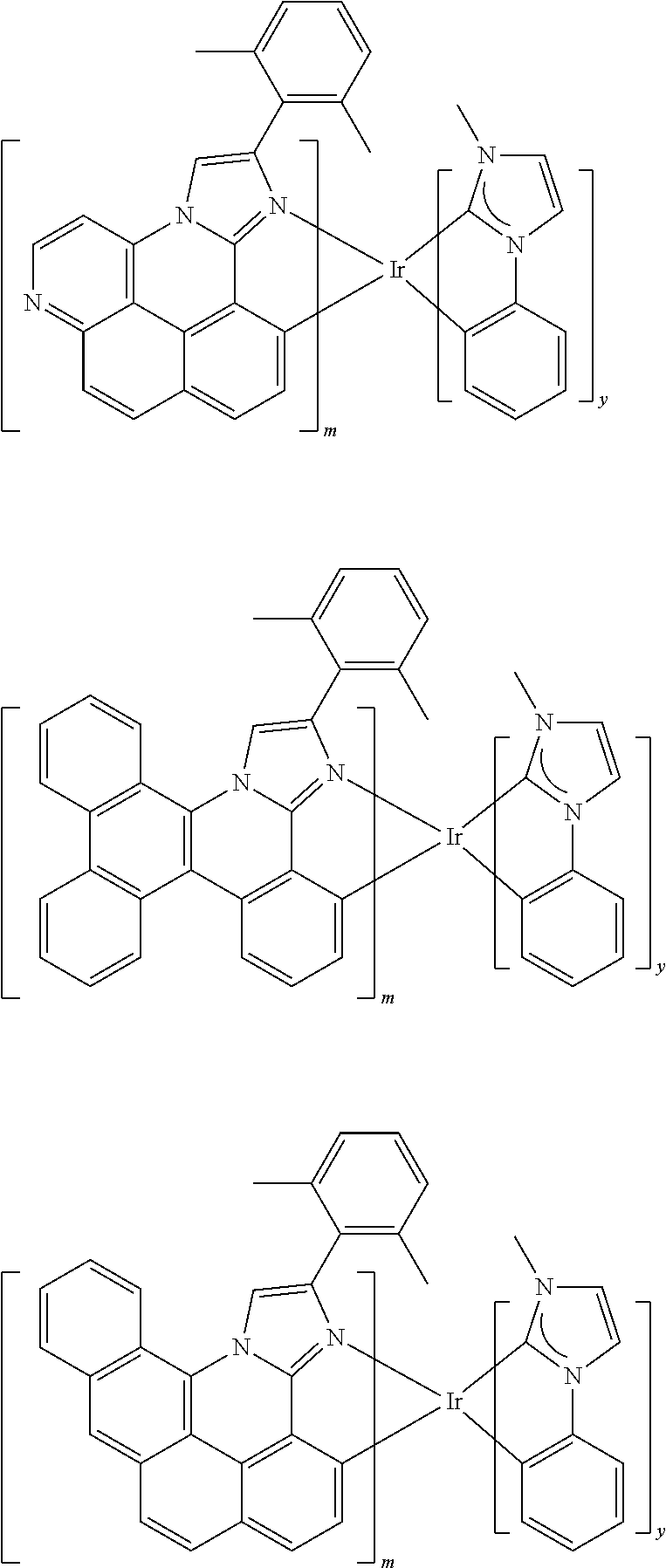
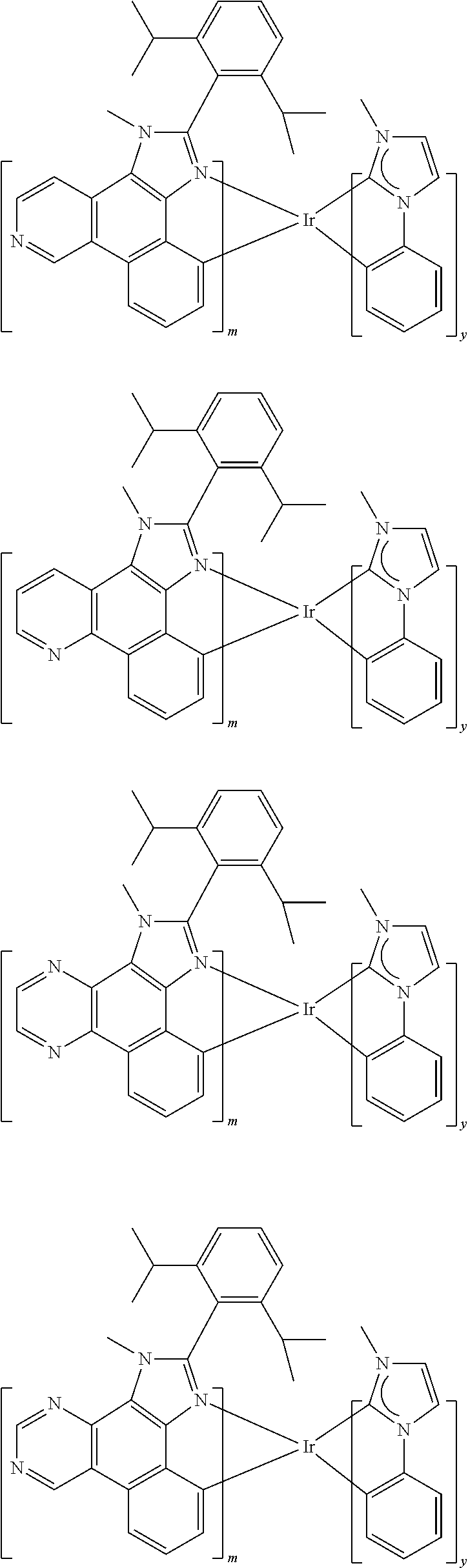
In General Formulas XIV-XVII, y=0, 1, or 2, and m+y=3. For m=3, the moieties can be the same or different. That is, when m=3, the three moieties can be the same, two of the moieties can be the same, or all three of the moieties can be different.
Implementations include a light emitting diode including a complex of General Formulas I-XVII, and a lighting device including such light emitting diode.
These general and specific aspects may be implemented using a device, system or method, or any combination of devices, systems, or methods. The details of one or more embodiments are set forth in the accompanying drawings and the description below. Other features, objects, and advantages will be apparent from the description and drawings, and from the claims.
BRIEF DESCRIPTION OF THE DRAWINGS
FIG. 1 depicts a cross-sectional view of an organic light-emitting device.
FIG. 2 is an emission spectrum of the metal-assisted delayed fluorescent emitter of Example 3 in tehtrahydro-2-methylfuran at 77K.
FIG. 3 is an emission spectrum of the metal-assisted delayed fluorescent emitter of Example 12 in tehtrahydro-2-methylfuran at 77K.
FIG. 4 is an emission spectrum of the metal-assisted delayed fluorescent emitter of Example 27 in methylene chloride at room temperature.
FIGS. 5A-5C show external quantum efficiency (EQE) versus luminance, EQE versus current density, and an electroluminescent spectrum, respectively, for a light-emitting device including the emitter of Example 46.
FIGS. 6A-6C show external quantum efficiency (EQE) versus luminance, EQE versus current density, and an electroluminescent spectrum, respectively, for a light-emitting device including the emitter of Example 46.
DETAILED DESCRIPTION
Cyclometalated Pt (II) and Pd (II) complexes have found wide applications as emitters for OLEDs in recent decades. Metal-assisted delayed fluorescent (MADF) emitters based on Pt (II) and Pd (II) complexes can exhibit both singlet and triplet excitons, resulting in a unity internal quantum efficiency and short lifetimes. Through the judicious design of cyclometalating ligands, MADF emitters can display singlet-triplet energy splitting.
MADF emitters based on cyclic platinum (II) and palladium (II) complexes employing benzo-imidazo-phenanthridine and analogues are disclosed. The triplet state consists mostly of the lower energy C{circumflex over ( )}N portion of the molecules which is localized on the benzo-imidazo-phenanthridine (or analogues). The singlet energy can be reduced by extending the conjugation of benzo-imidazo-phenanthridine (or analogues) with no or little energy change of triplet energy. The small energy gap between singlet and triplet allows excitons to be thermally promoted to the singlet state and efficiently emitted via thermally assisted delayed fluorescence (TADF) while the remaining triplet excitons can emit via the available efficient phosphorescent pathway. This class of emitters is suitable for full color displays and lighting applications.
MADF emitters employing benzo-imidazo-phenanthridine and analogues include compounds of General Formulas I-III shown below.
Figure US12010908-20240611-C00020

In General Formulas I-III:
    • M is Pt (II) or Pd (II),
    • each of V1-V16, if present, is independently C, N, Si, O, S, Ge, P, As, Se, B, Al, or Bi,
    • each of X1, X2, Y1, Y2, Y3, and Y4 is independently present or absent, and each X1, X2, Y1, Y2, Y3, and Y4 present independently represents C, N, Si, O, S, Ge, P, As, Se, B, Al, or Bi, or if valency permits, each independently represents CR7, SiR7, GeR7, NR7, P═O, As═O, B, BR7, AlR7, Bi═O, CR7R8, C═O, SiR7R8, GeR7R8, NR7, PR7, PR7R8, R7P═O, AsR7, R7As═O, S═O, SO2, Se═O, SeO2, BR7, BR7R8, AlR7, AlR7R8, R7Bi═O, or BiR7,
    • each of L1, L2, L3, L4, L5, and L6 is independently present or absent, and each L1, L2, L3, L4, L5, and L6 present independently represents a substituted or unsubstituted aryl, heteroaryl, or N-heterocyclic carbene, and
    • each of R, R1, R2, R3, R4, R5, R6, R7, and R8 is independently absent or present as a single substituent or multiple substituents, valency permitting, and each R, R1, R2, R3, R4, R5, R6, R7, and R8 present independently represents deuterium, halogen, hydroxyl, thiol, nitro, cyanide, isocyanide, sulfinyl, mercapto, sulfo, carboxyl, hydrazino; substituted or unsubstituted: aryl, cycloalkyl, cycloalkenyl, heterocyclyl, heteroaryl, alkyl, alkenyl, alkynyl, amino, monoalkylamino, dialkylamino, monoarylamino, diarylamino, alkoxy, aryloxy, haloalkyl, aralkyl, ester, alkoxycarbonyl, acylamino, alkoxycarbonylamino, aryloxycarbonylamino, sulfonylamino, sulfamoyl, carbamoyl, alkylthio, ureido, phosphoramide, silyl, polymeric; or any conjugate or combination thereof.
Examples of suitable substituents R1-R8 include:
Figure US12010908-20240611-C00021
Figure US12010908-20240611-C00022
Examples of General Formulas I-III are shown below.
Figure US12010908-20240611-C00023
Figure US12010908-20240611-C00024
Figure US12010908-20240611-C00025
Figure US12010908-20240611-C00026
Figure US12010908-20240611-C00027
Figure US12010908-20240611-C00028
Figure US12010908-20240611-C00029
Figure US12010908-20240611-C00030
Figure US12010908-20240611-C00031
Figure US12010908-20240611-C00032
Figure US12010908-20240611-C00033
Figure US12010908-20240611-C00034
Figure US12010908-20240611-C00035
Figure US12010908-20240611-C00036
Figure US12010908-20240611-C00037
Figure US12010908-20240611-C00038
Figure US12010908-20240611-C00039
Figure US12010908-20240611-C00040
Figure US12010908-20240611-C00041
Figure US12010908-20240611-C00042
Figure US12010908-20240611-C00043
Figure US12010908-20240611-C00044
Figure US12010908-20240611-C00045
Figure US12010908-20240611-C00046

In these implementations of General Formulas I-III:
    • M is Pt (II) or Pd (II),
    • N is nitrogen,
    • each of V1-V6, if present, is independently C, N, Si, O, S, Ge, P, As, Se, B, Al, or Bi,
    • each of X1, X2, Y1, Y2, Y3, and Y4 is independently present or absent, and if present, each X1, X2, Y1, Y2, Y3, and Y4 independently represents C, N, Si, O, S, Ge, P, As, Se, B, Al, or Bi, or valency permitting, each independently represents CR7, SiR7, GeR7, NR7, P═O, As═O, B, BR7, AlR7, Bi═O, CR7R8, C═O, SiR7R8, GeR7R8, NR7, PR7, PR7R8, R7P═O, AsR7, R7As═O, S═O, SO2, Se═O, SeO2, BR7, BR7R8, AlR7, AlR7R8, R7Bi═O, or BiR7,
    • each of L1, L2, L3, and L4 is independently present or absent, and each L1, L2, L3, and L4 present independently represents a substituted or unsubstituted aryl, heteroaryl, or N-heterocyclic carbene,
    • each of R, R1, R2, R3, R4, R5, R6, R7, and R8 is independently absent or present as a single substituent or multiple substituents, valency permitting, and each R, R1, R2, R3, R4, R5, R6, R7, and R8 present independently represents deuterium, halogen, hydroxyl, thiol, nitro, cyanide, isocyanide, sulfinyl, mercapto, sulfo, carboxyl, hydrazino; substituted or unsubstituted: aryl, cycloalkyl, cycloalkenyl, heterocyclyl, heteroaryl, alkyl, alkenyl, alkynyl, amino, monoalkylamino, dialkylamino, monoarylamino, diarylamino, alkoxy, aryloxy, haloalkyl, aralkyl, ester, alkoxycarbonyl, acylamino, alkoxycarbonylamino, aryloxycarbonylamino, sulfonylamino, sulfamoyl, carbamoyl, alkylthio, ureido, phosphoramide, silyl, polymeric; or any conjugate or combination thereof.
Examples of suitable substituents R1-R8 include:
Figure US12010908-20240611-C00047
Figure US12010908-20240611-C00048
In the implementations of General Formulas I-III, each of
Figure US12010908-20240611-C00049

is independently present or absent, and each Ar present independently represents a substituted or unsubstituted aryl, heteroaryl, or N-heterocyclic carbene, including the following moieties:
Figure US12010908-20240611-C00050
Figure US12010908-20240611-C00051
Figure US12010908-20240611-C00052
Figure US12010908-20240611-C00053
Figure US12010908-20240611-C00054
Figure US12010908-20240611-C00055
Figure US12010908-20240611-C00056
Figure US12010908-20240611-C00057

in which R1, R2, R3, R4, X1, and X2 are as defined herein.
Compounds of General Formulas I-III are shown below.
Figure US12010908-20240611-C00058
Figure US12010908-20240611-C00059
Figure US12010908-20240611-C00060
Figure US12010908-20240611-C00061
Figure US12010908-20240611-C00062
Figure US12010908-20240611-C00063
Figure US12010908-20240611-C00064
Figure US12010908-20240611-C00065
Figure US12010908-20240611-C00066
Figure US12010908-20240611-C00067
Figure US12010908-20240611-C00068
Figure US12010908-20240611-C00069
Figure US12010908-20240611-C00070
Figure US12010908-20240611-C00071
Figure US12010908-20240611-C00072
Figure US12010908-20240611-C00073
Figure US12010908-20240611-C00074
Figure US12010908-20240611-C00075
Figure US12010908-20240611-C00076
Figure US12010908-20240611-C00077
Figure US12010908-20240611-C00078
Figure US12010908-20240611-C00079
Figure US12010908-20240611-C00080
Figure US12010908-20240611-C00081
Figure US12010908-20240611-C00082
Figure US12010908-20240611-C00083
Figure US12010908-20240611-C00084
Figure US12010908-20240611-C00085
Figure US12010908-20240611-C00086
Figure US12010908-20240611-C00087
Figure US12010908-20240611-C00088
Figure US12010908-20240611-C00089
Figure US12010908-20240611-C00090
Figure US12010908-20240611-C00091
Figure US12010908-20240611-C00092
Figure US12010908-20240611-C00093
Figure US12010908-20240611-C00094
Figure US12010908-20240611-C00095
Figure US12010908-20240611-C00096
Figure US12010908-20240611-C00097
Figure US12010908-20240611-C00098
Figure US12010908-20240611-C00099
Figure US12010908-20240611-C00100
Figure US12010908-20240611-C00101
Figure US12010908-20240611-C00102
Figure US12010908-20240611-C00103
Figure US12010908-20240611-C00104
Figure US12010908-20240611-C00105
Figure US12010908-20240611-C00106
Figure US12010908-20240611-C00107
Figure US12010908-20240611-C00108
Figure US12010908-20240611-C00109
Figure US12010908-20240611-C00110
Figure US12010908-20240611-C00111
Figure US12010908-20240611-C00112
Figure US12010908-20240611-C00113
Figure US12010908-20240611-C00114
Figure US12010908-20240611-C00115
Figure US12010908-20240611-C00116
Figure US12010908-20240611-C00117
Figure US12010908-20240611-C00118
Figure US12010908-20240611-C00119
Figure US12010908-20240611-C00120
Figure US12010908-20240611-C00121
Figure US12010908-20240611-C00122
Figure US12010908-20240611-C00123
Figure US12010908-20240611-C00124
Figure US12010908-20240611-C00125
Figure US12010908-20240611-C00126
Figure US12010908-20240611-C00127
Figure US12010908-20240611-C00128
Figure US12010908-20240611-C00129
Figure US12010908-20240611-C00130
Figure US12010908-20240611-C00131
Figure US12010908-20240611-C00132
Figure US12010908-20240611-C00133
Figure US12010908-20240611-C00134
Figure US12010908-20240611-C00135
Figure US12010908-20240611-C00136
Figure US12010908-20240611-C00137
Figure US12010908-20240611-C00138
Figure US12010908-20240611-C00139
Figure US12010908-20240611-C00140
Figure US12010908-20240611-C00141
Figure US12010908-20240611-C00142
Figure US12010908-20240611-C00143
Figure US12010908-20240611-C00144
Figure US12010908-20240611-C00145
Figure US12010908-20240611-C00146
Figure US12010908-20240611-C00147
Figure US12010908-20240611-C00148
Figure US12010908-20240611-C00149
Figure US12010908-20240611-C00150
Figure US12010908-20240611-C00151
Figure US12010908-20240611-C00152
Figure US12010908-20240611-C00153
Figure US12010908-20240611-C00154
Figure US12010908-20240611-C00155
Figure US12010908-20240611-C00156
Figure US12010908-20240611-C00157
Figure US12010908-20240611-C00158
Figure US12010908-20240611-C00159
Figure US12010908-20240611-C00160
Figure US12010908-20240611-C00161
Figure US12010908-20240611-C00162
Figure US12010908-20240611-C00163
Figure US12010908-20240611-C00164
Figure US12010908-20240611-C00165
Figure US12010908-20240611-C00166
Figure US12010908-20240611-C00167
Figure US12010908-20240611-C00168
Figure US12010908-20240611-C00169
Figure US12010908-20240611-C00170
Figure US12010908-20240611-C00171
Figure US12010908-20240611-C00172
Figure US12010908-20240611-C00173
Figure US12010908-20240611-C00174
Figure US12010908-20240611-C00175
Figure US12010908-20240611-C00176
Figure US12010908-20240611-C00177
Figure US12010908-20240611-C00178
Figure US12010908-20240611-C00179
Figure US12010908-20240611-C00180
Figure US12010908-20240611-C00181
Figure US12010908-20240611-C00182
Figure US12010908-20240611-C00183
Figure US12010908-20240611-C00184
Figure US12010908-20240611-C00185
Figure US12010908-20240611-C00186
Figure US12010908-20240611-C00187
Figure US12010908-20240611-C00188
Figure US12010908-20240611-C00189
Figure US12010908-20240611-C00190
Figure US12010908-20240611-C00191
MADF emitters based on cyclic platinum (II) and palladium (II) complexes employing benzo-imidazo-phenanthridine and analogues include compounds of General Formula IV shown below.
Figure US12010908-20240611-C00192

In General Formula IV:
    • M is Pt (II) or Pd (II)
    • X represents a single bond or CR7R8, C═O, SiR7R8, GeR7R8, NR7, PR7, PR7R8, R7P═O, AsR7, R7As═O, O, S, S═O, SO2, Se, Se═O, SeO2, BR7, BR7R8, AlR7, AlR7R8, R7Bi═O, or BiR7,
Figure US12010908-20240611-C00193

each independently represents one of the following chemical moieties:
Figure US12010908-20240611-C00194
Figure US12010908-20240611-C00195
Figure US12010908-20240611-C00196
Figure US12010908-20240611-C00197
Figure US12010908-20240611-C00198
Figure US12010908-20240611-C00199
Figure US12010908-20240611-C00200
Figure US12010908-20240611-C00201
Figure US12010908-20240611-C00202
Figure US12010908-20240611-C00203
Figure US12010908-20240611-C00204
where:
    • N is nitrogen,
    • each of V1, V2, V3, V4, V5, and V6, if present, is independently C, N, Si, O, S, Ge, P, As, Se, B, Al, or Bi,
    • each of X1, X2, Y1, Y2, Y3, and Y4 is independently present or absent, and each X1, X2, Y1, Y2, Y3, and Y4 present independently represents C, N, Si, O, S, Ge, P, As, Se, B, Al, or Bi, or valency permitting, CR7, SiR7, GeR7, NR7, P═O, As═O, B, BR7, AlR7, Bi═O, CR7R8, C═O, SiR7R8, GeR7R8, NR7, PR7, PR7R8, R7P═O, AsR7, R7As═O, S═O, SO2, Se═O, SeO2, BR7, BR7R8, AlR7, AlR7R8, R7Bi═O, or BiR7,
    • each of L1, L2, L3, and L4 is independently present or absent, and each L1, L2, L3, and L4 present independently represents a substituted or unsubstituted aryl, heteroaryl, or N-heterocyclic carbene,
    • each of R, R1, R2, R3, R4, R5, R6, R7, and R8 is independently absent or present as a single substituent or multiple substituents, valency permitting, and each R, R1, R2, R3, R4, R5, R6, R7, and R8 present independently represents deuterium, halogen, hydroxyl, thiol, nitro, cyanide, isocyanide, sulfinyl, mercapto, sulfo, carboxyl, hydrazino; substituted or unsubstituted: aryl, cycloalkyl, cycloalkenyl, heterocyclyl, heteroaryl, alkyl, alkenyl, alkynyl, amino, monoalkylamino, dialkylamino, monoarylamino, diarylamino, alkoxy, aryloxy, haloalkyl, aralkyl, ester, alkoxycarbonyl, acylamino, alkoxycarbonylamino, aryloxycarbonylamino, sulfonylamino, sulfamoyl, carbamoyl, alkylthio, ureido, phosphoramide, silyl, polymeric; or any conjugate or combination thereof, and
    • each of
Figure US12010908-20240611-C00205

is independently present or absent, and each Ar present independently represents a substituted or unsubstituted aryl, heteroaryl, or N-heterocyclic carbene, where suitable examples of substituents include the following:
Figure US12010908-20240611-C00206
Figure US12010908-20240611-C00207
In A-B and A′-B′, Ar is independently present or absent, and each Ar present independently represents a substituted or unsubstituted aryl, heteroaryl, or N-heterocyclic carbene. Suitable examples of Ar include the following:
Figure US12010908-20240611-C00208
Figure US12010908-20240611-C00209

in which R and R7 are as defined herein.
Compounds of General Formula IV are shown below.
Figure US12010908-20240611-C00210
Figure US12010908-20240611-C00211
Figure US12010908-20240611-C00212
Figure US12010908-20240611-C00213
Figure US12010908-20240611-C00214
Figure US12010908-20240611-C00215
Figure US12010908-20240611-C00216
Figure US12010908-20240611-C00217
MADF emitters based on cyclic platinum (II) and palladium (II) complexes employing benzo-imidazo-phenanthridine and analogues include General Formulas V-XIII.
Figure US12010908-20240611-C00218
Figure US12010908-20240611-C00219

In General Formulas V-XIII:
    • M is Pt (II) or Pd (II),
    • N is nitrogen,
    • each of V1a-V1f, V2a-V2f, V3a-V3f, V4a-V4f, V5a-V5f, and V6a-V6f, if present, is independently N, C, P, O, S, or Si,
    • each of X, X1, X2, X3, and X4 is independently present or absent, and each X, X1, X2, X3, and X4 present independently represents a single bond, CR7R8, C═O, SiR7R8, GeR7R8, NR7, PR7, PR7R8, R7P═O, AsR7, R7As═O, O, S, S═O, SO2, Se, Se═O, SeO2, BR7, BR7R8, AlR7, AlR7R8, R7Bi═O, or BiR7,
    • each of Y1 and Y2 is independently CR, SiR, GeR, N, NR, P, P═O, As, As═O, B, BR, Al, AlR, Bi═O, or Bi,
    • each of L1, L2, L3, and L4 is independently present or absent, and each L1, L2, L3, and L4 present independently represents a substituted or unsubstituted aryl, heteroaryl, or N-heterocyclic carbene,
    • each of R, R1, R2, R3, R4, R5, R6, R7, and R8 is independently absent or present as a single substituent or multiple substituents, valency permitting, and each R, R1, R2, R3, R4, R5, R6, R7, and R8 present independently represents deuterium, halogen, hydroxyl, thiol, nitro, cyanide, isocyanide, sulfinyl, mercapto, sulfo, carboxyl, hydrazino; substituted or unsubstituted: aryl, cycloalkyl, cycloalkenyl, heterocyclyl, heteroaryl, alkyl, alkenyl, alkynyl, amino, monoalkylamino, dialkylamino, monoarylamino, diarylamino, alkoxy, aryloxy, haloalkyl, aralkyl, ester, alkoxycarbonyl, acylamino, alkoxycarbonylamino, aryloxycarbonylamino, sulfonylamino, sulfamoyl, carbamoyl, alkylthio, ureido, phosphoramide, silyl, polymeric; or any conjugate or combination thereof.
Compounds of General Formulas V-XIII include the following.
Figure US12010908-20240611-C00220
Figure US12010908-20240611-C00221
Figure US12010908-20240611-C00222
Figure US12010908-20240611-C00223
Figure US12010908-20240611-C00224
Figure US12010908-20240611-C00225
Figure US12010908-20240611-C00226
Figure US12010908-20240611-C00227
Figure US12010908-20240611-C00228
Figure US12010908-20240611-C00229
Figure US12010908-20240611-C00230
Figure US12010908-20240611-C00231
Figure US12010908-20240611-C00232
Figure US12010908-20240611-C00233
Figure US12010908-20240611-C00234
Figure US12010908-20240611-C00235
Figure US12010908-20240611-C00236
Figure US12010908-20240611-C00237
Figure US12010908-20240611-C00238
Figure US12010908-20240611-C00239
Figure US12010908-20240611-C00240
Figure US12010908-20240611-C00241
Figure US12010908-20240611-C00242
Figure US12010908-20240611-C00243
Figure US12010908-20240611-C00244
Figure US12010908-20240611-C00245
Figure US12010908-20240611-C00246
Figure US12010908-20240611-C00247
Figure US12010908-20240611-C00248
Figure US12010908-20240611-C00249
Figure US12010908-20240611-C00250
Figure US12010908-20240611-C00251
Figure US12010908-20240611-C00252
Figure US12010908-20240611-C00253
Figure US12010908-20240611-C00254
Figure US12010908-20240611-C00255
Figure US12010908-20240611-C00256
Figure US12010908-20240611-C00257
Figure US12010908-20240611-C00258
Figure US12010908-20240611-C00259
Figure US12010908-20240611-C00260
Figure US12010908-20240611-C00261

The substituents in these compounds are as defined herein.
Octahedral iridium (III) metal-assisted delayed fluorescent (MADF) emitters employing benzo-imidazo-phenanthridine are represented by General Formulas XIV-XVII:
Figure US12010908-20240611-C00262

In General Formulas XIV-XVII,
    • N is nitrogen,
    • Ir is iridium,
    • m+y=3, and when m=3, y=0, when m=2, y=1, when m=1, y=2,
    • each n is independently an integer, valency permitting,
    • each
Figure US12010908-20240611-C00263

represents one of the following chemical moieties:
Figure US12010908-20240611-C00264
Figure US12010908-20240611-C00265
each of R, R1, R2, R3, R4, R5, R6, R1′, and R4′ is independently absent or present as a single substituent or multiple substituents, valency permitting, and each R, R1, R2, R3, R4, R5, R6, R1′, and R4′ present independently represents deuterium, halogen, hydroxyl, thiol, nitro, cyanide, isocyanide, sulfinyl, mercapto, sulfo, carboxyl, hydrazino; substituted or unsubstituted: aryl, cycloalkyl, cycloalkenyl, heterocyclyl, heteroaryl, alkyl, alkenyl, alkynyl, amino, monoalkylamino, dialkylamino, monoarylamino, diarylamino, alkoxy, aryloxy, haloalkyl, aralkyl, ester, alkoxycarbonyl, acylamino, alkoxycarbonylamino, aryloxycarbonylamino, sulfonylamino, sulfamoyl, carbamoyl, alkylthio, ureido, phosphoramide, silyl, polymeric; or any conjugate or combination thereof, where the following are examples:
Figure US12010908-20240611-C00266
Figure US12010908-20240611-C00267
each of X1, X2, X3, X4, Y1, Y2, Y3, Y4, Y5, Y6, and Y7 is independently present or absent, and each X1, X2, X3, X4, Y1, Y2, Y3, Y4, Y5, Y6, and Y7 present independently represents C, N, Si, O, S, Ge, P, As, Se, B, Al, or Bi, or, valency permitting, CR7, SiR7, GeR7, NR7, P═O, As═O, B, BR7, AlR7, Bi═O, CR7R8, C═O, SiR7R8, GeR7R8, NR7, PR7, PR7R8, R7P═O, AsR7, R7As═O, S═O, SO2, Se═O, SeO2, BR7, BR7R8, AlR7, AlR7R8, R7Bi═O, or BiR7,
    • each
Figure US12010908-20240611-C00268

is independently present or absent, and each Ar present independently represents a substituted or unsubstituted aryl, heteroaryl, or N-heterocyclic carbene, and the following chemical moieties:
Figure US12010908-20240611-C00269
Figure US12010908-20240611-C00270
Figure US12010908-20240611-C00271
In General Formulas XIV-XVII, for m=3, the moieties can be the same or different. That is, when m=3, the three moieties can be the same, two of the moieties can be the same, or all three of the moieties can be different.
Implementations of General Formulas XIV-XVII include the following:
Figure US12010908-20240611-C00272
Figure US12010908-20240611-C00273
Figure US12010908-20240611-C00274
Figure US12010908-20240611-C00275
Figure US12010908-20240611-C00276
Figure US12010908-20240611-C00277
Figure US12010908-20240611-C00278
Figure US12010908-20240611-C00279
Figure US12010908-20240611-C00280
Figure US12010908-20240611-C00281
Figure US12010908-20240611-C00282
Figure US12010908-20240611-C00283
Figure US12010908-20240611-C00284
Figure US12010908-20240611-C00285
Figure US12010908-20240611-C00286
Figure US12010908-20240611-C00287
Figure US12010908-20240611-C00288
Figure US12010908-20240611-C00289
Figure US12010908-20240611-C00290
Figure US12010908-20240611-C00291
Figure US12010908-20240611-C00292
Figure US12010908-20240611-C00293
Figure US12010908-20240611-C00294
Figure US12010908-20240611-C00295
Figure US12010908-20240611-C00296
Figure US12010908-20240611-C00297
Figure US12010908-20240611-C00298
Figure US12010908-20240611-C00299
Figure US12010908-20240611-C00300
Figure US12010908-20240611-C00301
Figure US12010908-20240611-C00302
Figure US12010908-20240611-C00303
Figure US12010908-20240611-C00304
Figure US12010908-20240611-C00305
Figure US12010908-20240611-C00306
Figure US12010908-20240611-C00307
Figure US12010908-20240611-C00308
Figure US12010908-20240611-C00309
Figure US12010908-20240611-C00310
Figure US12010908-20240611-C00311
Figure US12010908-20240611-C00312
Figure US12010908-20240611-C00313
Figure US12010908-20240611-C00314
Figure US12010908-20240611-C00315
Figure US12010908-20240611-C00316
Figure US12010908-20240611-C00317
Figure US12010908-20240611-C00318
Figure US12010908-20240611-C00319
Figure US12010908-20240611-C00320
Figure US12010908-20240611-C00321
Figure US12010908-20240611-C00322
Figure US12010908-20240611-C00323
Figure US12010908-20240611-C00324
Figure US12010908-20240611-C00325
Figure US12010908-20240611-C00326
Figure US12010908-20240611-C00327
Figure US12010908-20240611-C00328
Figure US12010908-20240611-C00329
Figure US12010908-20240611-C00330
Figure US12010908-20240611-C00331
Figure US12010908-20240611-C00332
Figure US12010908-20240611-C00333
Figure US12010908-20240611-C00334
Figure US12010908-20240611-C00335
Figure US12010908-20240611-C00336
Figure US12010908-20240611-C00337
Figure US12010908-20240611-C00338
Figure US12010908-20240611-C00339
Figure US12010908-20240611-C00340
Figure US12010908-20240611-C00341
Figure US12010908-20240611-C00342
Figure US12010908-20240611-C00343
Figure US12010908-20240611-C00344
Figure US12010908-20240611-C00345
Figure US12010908-20240611-C00346
Figure US12010908-20240611-C00347
Figure US12010908-20240611-C00348
Figure US12010908-20240611-C00349
Figure US12010908-20240611-C00350
Figure US12010908-20240611-C00351
Figure US12010908-20240611-C00352
Figure US12010908-20240611-C00353
Figure US12010908-20240611-C00354
Figure US12010908-20240611-C00355
Figure US12010908-20240611-C00356
Figure US12010908-20240611-C00357
Figure US12010908-20240611-C00358
Figure US12010908-20240611-C00359
Figure US12010908-20240611-C00360
Figure US12010908-20240611-C00361
Figure US12010908-20240611-C00362
Figure US12010908-20240611-C00363
Figure US12010908-20240611-C00364
Figure US12010908-20240611-C00365
Figure US12010908-20240611-C00366
Figure US12010908-20240611-C00367
Figure US12010908-20240611-C00368
Figure US12010908-20240611-C00369
Figure US12010908-20240611-C00370
Figure US12010908-20240611-C00371
Figure US12010908-20240611-C00372
Figure US12010908-20240611-C00373
Figure US12010908-20240611-C00374
Figure US12010908-20240611-C00375
Figure US12010908-20240611-C00376
Figure US12010908-20240611-C00377
Figure US12010908-20240611-C00378
Figure US12010908-20240611-C00379
Figure US12010908-20240611-C00380
Figure US12010908-20240611-C00381
Figure US12010908-20240611-C00382
Figure US12010908-20240611-C00383
Figure US12010908-20240611-C00384
Figure US12010908-20240611-C00385
Figure US12010908-20240611-C00386
Figure US12010908-20240611-C00387
Figure US12010908-20240611-C00388
Figure US12010908-20240611-C00389
Figure US12010908-20240611-C00390
Figure US12010908-20240611-C00391
Figure US12010908-20240611-C00392
Figure US12010908-20240611-C00393
Figure US12010908-20240611-C00394
Figure US12010908-20240611-C00395
Figure US12010908-20240611-C00396
Figure US12010908-20240611-C00397
Figure US12010908-20240611-C00398
Figure US12010908-20240611-C00399
Figure US12010908-20240611-C00400
Figure US12010908-20240611-C00401
Figure US12010908-20240611-C00402
Figure US12010908-20240611-C00403
Figure US12010908-20240611-C00404
Figure US12010908-20240611-C00405
Figure US12010908-20240611-C00406
Figure US12010908-20240611-C00407
Figure US12010908-20240611-C00408
Figure US12010908-20240611-C00409
Figure US12010908-20240611-C00410
Figure US12010908-20240611-C00411
Figure US12010908-20240611-C00412
Figure US12010908-20240611-C00413
Figure US12010908-20240611-C00414
Figure US12010908-20240611-C00415
Figure US12010908-20240611-C00416
Figure US12010908-20240611-C00417
Figure US12010908-20240611-C00418
Figure US12010908-20240611-C00419
Figure US12010908-20240611-C00420
Figure US12010908-20240611-C00421
Figure US12010908-20240611-C00422
Figure US12010908-20240611-C00423
Figure US12010908-20240611-C00424
Figure US12010908-20240611-C00425
Figure US12010908-20240611-C00426
Figure US12010908-20240611-C00427
Figure US12010908-20240611-C00428
Figure US12010908-20240611-C00429
Figure US12010908-20240611-C00430
Figure US12010908-20240611-C00431
Figure US12010908-20240611-C00432
Figure US12010908-20240611-C00433
Figure US12010908-20240611-C00434
Figure US12010908-20240611-C00435
Figure US12010908-20240611-C00436
Figure US12010908-20240611-C00437
Figure US12010908-20240611-C00438
Figure US12010908-20240611-C00439
Figure US12010908-20240611-C00440
Figure US12010908-20240611-C00441
Figure US12010908-20240611-C00442
Figure US12010908-20240611-C00443
Figure US12010908-20240611-C00444
Figure US12010908-20240611-C00445
Figure US12010908-20240611-C00446
Figure US12010908-20240611-C00447
Figure US12010908-20240611-C00448
Figure US12010908-20240611-C00449
Figure US12010908-20240611-C00450
Figure US12010908-20240611-C00451
Figure US12010908-20240611-C00452
Figure US12010908-20240611-C00453
Figure US12010908-20240611-C00454
Figure US12010908-20240611-C00455
Figure US12010908-20240611-C00456
Figure US12010908-20240611-C00457
Figure US12010908-20240611-C00458
Figure US12010908-20240611-C00459
Figure US12010908-20240611-C00460
Figure US12010908-20240611-C00461
Figure US12010908-20240611-C00462
Figure US12010908-20240611-C00463
Figure US12010908-20240611-C00464
Figure US12010908-20240611-C00465
Figure US12010908-20240611-C00466
Figure US12010908-20240611-C00467
Figure US12010908-20240611-C00468
Figure US12010908-20240611-C00469
Figure US12010908-20240611-C00470
Figure US12010908-20240611-C00471
Figure US12010908-20240611-C00472
Figure US12010908-20240611-C00473
Figure US12010908-20240611-C00474
Figure US12010908-20240611-C00475
Figure US12010908-20240611-C00476
Figure US12010908-20240611-C00477
Figure US12010908-20240611-C00478
Figure US12010908-20240611-C00479
Figure US12010908-20240611-C00480
Figure US12010908-20240611-C00481
Figure US12010908-20240611-C00482
Figure US12010908-20240611-C00483
Figure US12010908-20240611-C00484
Figure US12010908-20240611-C00485
Figure US12010908-20240611-C00486
Figure US12010908-20240611-C00487
Figure US12010908-20240611-C00488
Figure US12010908-20240611-C00489
Figure US12010908-20240611-C00490
Figure US12010908-20240611-C00491
Figure US12010908-20240611-C00492
Figure US12010908-20240611-C00493
Figure US12010908-20240611-C00494
Figure US12010908-20240611-C00495
Figure US12010908-20240611-C00496
Figure US12010908-20240611-C00497
Figure US12010908-20240611-C00498
Figure US12010908-20240611-C00499
Figure US12010908-20240611-C00500
Figure US12010908-20240611-C00501
Figure US12010908-20240611-C00502
Figure US12010908-20240611-C00503
Figure US12010908-20240611-C00504
Figure US12010908-20240611-C00505
Figure US12010908-20240611-C00506
Figure US12010908-20240611-C00507
Figure US12010908-20240611-C00508
Figure US12010908-20240611-C00509
Figure US12010908-20240611-C00510
Figure US12010908-20240611-C00511
Figure US12010908-20240611-C00512
Figure US12010908-20240611-C00513
Figure US12010908-20240611-C00514
Figure US12010908-20240611-C00515
Figure US12010908-20240611-C00516
Figure US12010908-20240611-C00517
Figure US12010908-20240611-C00518
Figure US12010908-20240611-C00519
Figure US12010908-20240611-C00520
Figure US12010908-20240611-C00521
Figure US12010908-20240611-C00522
Figure US12010908-20240611-C00523
Figure US12010908-20240611-C00524
Figure US12010908-20240611-C00525
Figure US12010908-20240611-C00526
Figure US12010908-20240611-C00527
Figure US12010908-20240611-C00528
Figure US12010908-20240611-C00529
Figure US12010908-20240611-C00530
Figure US12010908-20240611-C00531
Figure US12010908-20240611-C00532
Figure US12010908-20240611-C00533
Figure US12010908-20240611-C00534
Figure US12010908-20240611-C00535
Figure US12010908-20240611-C00536
Figure US12010908-20240611-C00537
Figure US12010908-20240611-C00538
Figure US12010908-20240611-C00539
Figure US12010908-20240611-C00540
Figure US12010908-20240611-C00541
Figure US12010908-20240611-C00542
Figure US12010908-20240611-C00543
Figure US12010908-20240611-C00544
Figure US12010908-20240611-C00545
Figure US12010908-20240611-C00546
Figure US12010908-20240611-C00547
Figure US12010908-20240611-C00548
Figure US12010908-20240611-C00549
Figure US12010908-20240611-C00550
Figure US12010908-20240611-C00551
Figure US12010908-20240611-C00552
Figure US12010908-20240611-C00553
Figure US12010908-20240611-C00554
Figure US12010908-20240611-C00555
Figure US12010908-20240611-C00556
Figure US12010908-20240611-C00557
Figure US12010908-20240611-C00558
Figure US12010908-20240611-C00559
Figure US12010908-20240611-C00560
Figure US12010908-20240611-C00561
Figure US12010908-20240611-C00562
Figure US12010908-20240611-C00563
Figure US12010908-20240611-C00564
Figure US12010908-20240611-C00565
Figure US12010908-20240611-C00566
Figure US12010908-20240611-C00567
Figure US12010908-20240611-C00568
Figure US12010908-20240611-C00569
Figure US12010908-20240611-C00570
Figure US12010908-20240611-C00571
Figure US12010908-20240611-C00572
Figure US12010908-20240611-C00573
Figure US12010908-20240611-C00574
Figure US12010908-20240611-C00575
Figure US12010908-20240611-C00576
Figure US12010908-20240611-C00577
Figure US12010908-20240611-C00578
Figure US12010908-20240611-C00579
Figure US12010908-20240611-C00580
Figure US12010908-20240611-C00581
Figure US12010908-20240611-C00582
Figure US12010908-20240611-C00583
Figure US12010908-20240611-C00584
Figure US12010908-20240611-C00585
Figure US12010908-20240611-C00586
Figure US12010908-20240611-C00587
Figure US12010908-20240611-C00588
Figure US12010908-20240611-C00589
Figure US12010908-20240611-C00590
Figure US12010908-20240611-C00591
Figure US12010908-20240611-C00592
Figure US12010908-20240611-C00593
Figure US12010908-20240611-C00594
Figure US12010908-20240611-C00595
Figure US12010908-20240611-C00596
Figure US12010908-20240611-C00597
Figure US12010908-20240611-C00598
Figure US12010908-20240611-C00599
Figure US12010908-20240611-C00600
Figure US12010908-20240611-C00601
Figure US12010908-20240611-C00602
Figure US12010908-20240611-C00603
Figure US12010908-20240611-C00604
Figure US12010908-20240611-C00605
Figure US12010908-20240611-C00606
Figure US12010908-20240611-C00607
Figure US12010908-20240611-C00608
Figure US12010908-20240611-C00609
Figure US12010908-20240611-C00610
Figure US12010908-20240611-C00611
Figure US12010908-20240611-C00612
Figure US12010908-20240611-C00613
Figure US12010908-20240611-C00614
Figure US12010908-20240611-C00615
Figure US12010908-20240611-C00616
Figure US12010908-20240611-C00617
Figure US12010908-20240611-C00618
Figure US12010908-20240611-C00619
Figure US12010908-20240611-C00620
Figure US12010908-20240611-C00621
Figure US12010908-20240611-C00622
Figure US12010908-20240611-C00623
Figure US12010908-20240611-C00624
Figure US12010908-20240611-C00625
Figure US12010908-20240611-C00626
Figure US12010908-20240611-C00627
Figure US12010908-20240611-C00628
Figure US12010908-20240611-C00629
Figure US12010908-20240611-C00630
Figure US12010908-20240611-C00631
Figure US12010908-20240611-C00632
Figure US12010908-20240611-C00633
Figure US12010908-20240611-C00634
Figure US12010908-20240611-C00635
Figure US12010908-20240611-C00636
Figure US12010908-20240611-C00637
Figure US12010908-20240611-C00638
Figure US12010908-20240611-C00639
Figure US12010908-20240611-C00640
Figure US12010908-20240611-C00641
Figure US12010908-20240611-C00642
Figure US12010908-20240611-C00643
Figure US12010908-20240611-C00644
Figure US12010908-20240611-C00645
Figure US12010908-20240611-C00646
Figure US12010908-20240611-C00647
Figure US12010908-20240611-C00648
Figure US12010908-20240611-C00649
Figure US12010908-20240611-C00650
Figure US12010908-20240611-C00651
Figure US12010908-20240611-C00652
Figure US12010908-20240611-C00653
Figure US12010908-20240611-C00654
Figure US12010908-20240611-C00655
Figure US12010908-20240611-C00656
Figure US12010908-20240611-C00657
Figure US12010908-20240611-C00658
Figure US12010908-20240611-C00659
Figure US12010908-20240611-C00660
Figure US12010908-20240611-C00661
Figure US12010908-20240611-C00662
Figure US12010908-20240611-C00663
Figure US12010908-20240611-C00664
Figure US12010908-20240611-C00665
Figure US12010908-20240611-C00666
Figure US12010908-20240611-C00667
Figure US12010908-20240611-C00668
Figure US12010908-20240611-C00669
Figure US12010908-20240611-C00670
Figure US12010908-20240611-C00671
As referred to herein, a linking atom or group connects two atoms such as, for example, an N atom and a C atom. A linking atom or group is in one aspect disclosed as L1, L2, L3, etc. herein. The linking atom can optionally, if valency permits, have other chemical moieties attached. For example, in one aspect, an oxygen would not have any other chemical groups attached as the valency is satisfied once it is bonded to two groups (e.g., N and/or C groups). In another aspect, when carbon is the linking atom, two additional chemical moieties can be attached to the carbon. Suitable chemical moieties include amine, amide, thiol, aryl, heteroaryl, cycloalkyl, and heterocyclyl moieties. The term “cyclic structure” or the like terms used herein refer to any cyclic chemical structure which includes, but is not limited to, aryl, heteroaryl, cycloalkyl, cycloalkenyl, heterocyclyl, carbene, and N-heterocyclic carbene.
As used herein, the term “substituted” is contemplated to include all permissible substituents of organic compounds. In a broad aspect, the permissible substituents include acyclic and cyclic, branched and unbranched, carbocyclic and heterocyclic, and aromatic and nonaromatic substituents of organic compounds. Illustrative substituents include, for example, those described below. The permissible substituents can be one or more and the same or different for appropriate organic compounds. For purposes of this disclosure, the heteroatoms, such as nitrogen, can have hydrogen substituents and/or any permissible substituents of organic compounds described herein which satisfy the valences of the heteroatoms. This disclosure is not intended to be limited in any manner by the permissible substituents of organic compounds. Also, the terms “substitution” or “substituted with” include the implicit proviso that such substitution is in accordance with permitted valence of the substituted atom and the substituent, and that the substitution results in a stable compound, e.g., a compound that does not spontaneously undergo transformation such as by rearrangement, cyclization, elimination, etc. It is also contemplated that, in certain aspects, unless expressly indicated to the contrary, individual substituents can be further optionally substituted (i.e., further substituted or unsubstituted).
In defining various terms, “A1”, “A2”, “A3”, “A4” and “A5” are used herein as generic symbols to represent various specific substituents. These symbols can be any substituent, not limited to those disclosed herein, and when they are defined to be certain substituents in one instance, they can, in another instance, be defined as some other substituents.
The term “alkyl” as used herein is a branched or unbranched saturated hydrocarbon group of 1 to 24 carbon atoms, such as methyl, ethyl, n-propyl, isopropyl, n-butyl, isobutyl, s-butyl, t-butyl, n-pentyl, isopentyl, s-pentyl, neopentyl, hexyl, heptyl, octyl, nonyl, decyl, dode cyl, tetradecyl, hexadecyl, eicosyl, tetracosyl, and the like. The alkyl group can be cyclic or acyclic. The alkyl group can be branched or unbranched. The alkyl group can also be substituted or unsubstituted. For example, the alkyl group can be substituted with one or more groups including, but not limited to, alkyl, cycloalkyl, alkoxy, amino, ether, halide, hydroxy, nitro, silyl, sulfo-oxo, or thiol, as described herein. A “lower alkyl” group is an alkyl group containing from one to six (e.g., from one to four) carbon atoms.
Throughout the specification “alkyl” is generally used to refer to both unsubstituted alkyl groups and substituted alkyl groups; however, substituted alkyl groups are also specifically referred to herein by identifying the specific substituent(s) on the alkyl group. For example, the term “halogenated alkyl” or “haloalkyl” specifically refers to an alkyl group that is substituted with one or more halide, e.g., fluorine, chlorine, bromine, or iodine. The term “alkoxyalkyl” specifically refers to an alkyl group that is substituted with one or more alkoxy groups, as described below. The term “alkylamino” specifically refers to an alkyl group that is substituted with one or more amino groups, as described below, and the like. When “alkyl” is used in one instance and a specific term such as “alkylalcohol” is used in another, it is not meant to imply that the term “alkyl” does not also refer to specific terms such as “alkylalcohol” and the like.
This practice is also used for other groups described herein. That is, while a term such as “cycloalkyl” refers to both unsubstituted and substituted cycloalkyl moieties, the substituted moieties can, in addition, be specifically identified herein; for example, a particular substituted cycloalkyl can be referred to as, e.g., an “alkylcycloalkyl.” Similarly, a substituted alkoxy can be specifically referred to as, e.g., a “halogenated alkoxy,” a particular substituted alkenyl can be, e.g., an “alkenylalcohol,” and the like. Again, the practice of using a general term, such as “cycloalkyl,” and a specific term, such as “alkylcycloalkyl,” is not meant to imply that the general term does not also include the specific term.
The term “cycloalkyl” as used herein is a non-aromatic carbon-based ring composed of at least three carbon atoms. Examples of cycloalkyl groups include, but are not limited to, cyclopropyl, cyclobutyl, cyclopentyl, cyclohexyl, norbornyl, and the like. The term “heterocycloalkyl” is a type of cycloalkyl group as defined above, and is included within the meaning of the term “cycloalkyl,” where at least one of the carbon atoms of the ring is replaced with a heteroatom such as, but not limited to, nitrogen, oxygen, sulfur, or phosphorus. The cycloalkyl group and heterocycloalkyl group can be substituted or unsubstituted. The cycloalkyl group and heterocycloalkyl group can be substituted with one or more groups including, but not limited to, alkyl, cycloalkyl, alkoxy, amino, ether, halide, hydroxy, nitro, silyl, sulfo-oxo, or thiol as described herein.
The terms “alkoxy” and “alkoxyl” as used herein to refer to an alkyl or cycloalkyl group bonded through an ether linkage; that is, an “alkoxy” group can be defined as —OA1 where A1 is alkyl or cycloalkyl as defined above. “Alkoxy” also includes polymers of alkoxy groups as just described; that is, an alkoxy can be a polyether such as —OA1-OA2 or —OA1-(OA2)a-OA3, where “a” is an integer of from 1 to 200 and A1, A2, and A3 are alkyl and/or cycloalkyl groups.
The term “alkenyl” as used herein is a hydrocarbon group of from 2 to 24 carbon atoms with a structural formula containing at least one carbon-carbon double bond. Asymmetric structures such as (A1A2)C═C(A3A4) are intended to include both the E and Z isomers. This can be presumed in structural formulae herein wherein an asymmetric alkene is present, or it can be explicitly indicated by the bond symbol C═C. The alkenyl group can be substituted with one or more groups including, but not limited to, alkyl, cycloalkyl, alkoxy, alkenyl, cycloalkenyl, alkynyl, cycloalkynyl, aryl, heteroaryl, aldehyde, amino, carboxylic acid, ester, ether, halide, hydroxy, ketone, azide, nitro, silyl, sulfo-oxo, or thiol, as described herein.
The term “cycloalkenyl” as used herein is a non-aromatic carbon-based ring composed of at least three carbon atoms and containing at least one carbon-carbon double bound, i.e., C═C. Examples of cycloalkenyl groups include, but are not limited to, cyclopropenyl, cyclobutenyl, cyclopentenyl, cyclopentadienyl, cyclohexenyl, cyclohexadienyl, norbornenyl, and the like. The term “heterocycloalkenyl” is a type of cycloalkenyl group as defined above, and is included within the meaning of the term “cycloalkenyl,” where at least one of the carbon atoms of the ring is replaced with a heteroatom such as, but not limited to, nitrogen, oxygen, sulfur, or phosphorus. The cycloalkenyl group and heterocycloalkenyl group can be substituted or unsubstituted. The cycloalkenyl group and heterocycloalkenyl group can be substituted with one or more groups including, but not limited to, alkyl, cycloalkyl, alkoxy, alkenyl, cycloalkenyl, alkynyl, cycloalkynyl, aryl, heteroaryl, aldehyde, amino, carboxylic acid, ester, ether, halide, hydroxy, ketone, azide, nitro, silyl, sulfo-oxo, or thiol as described herein.
The term “alkynyl” as used herein is a hydrocarbon group of 2 to 24 carbon atoms with a structural formula containing at least one carbon-carbon triple bond. The alkynyl group can be unsubstituted or substituted with one or more groups including, but not limited to, alkyl, cycloalkyl, alkoxy, alkenyl, cycloalkenyl, alkynyl, cycloalkynyl, aryl, heteroaryl, aldehyde, amino, carboxylic acid, ester, ether, halide, hydroxy, ketone, azide, nitro, silyl, sulfo-oxo, or thiol, as described herein.
The term “cycloalkynyl” as used herein is a non-aromatic carbon-based ring composed of at least seven carbon atoms and containing at least one carbon-carbon triple bound. Examples of cycloalkynyl groups include, but are not limited to, cycloheptynyl, cyclooctynyl, cyclononynyl, and the like. The term “heterocycloalkynyl” is a type of cycloalkenyl group as defined above, and is included within the meaning of the term “cycloalkynyl,” where at least one of the carbon atoms of the ring is replaced with a heteroatom such as, but not limited to, nitrogen, oxygen, sulfur, or phosphorus. The cycloalkynyl group and heterocycloalkynyl group can be substituted or unsubstituted. The cycloalkynyl group and heterocycloalkynyl group can be substituted with one or more groups including, but not limited to, alkyl, cycloalkyl, alkoxy, alkenyl, cycloalkenyl, alkynyl, cycloalkynyl, aryl, heteroaryl, aldehyde, amino, carboxylic acid, ester, ether, halide, hydroxy, ketone, azide, nitro, silyl, sulfo-oxo, or thiol as described herein.
The term “aryl” as used herein is a group that contains any carbon-based aromatic group including, but not limited to, benzene, naphthalene, phenyl, biphenyl, phenoxybenzene, and the like. The term “aryl” also includes “heteroaryl,” which is defined as a group that contains an aromatic group that has at least one heteroatom incorporated within the ring of the aromatic group. Examples of heteroatoms include, but are not limited to, nitrogen, oxygen, sulfur, and phosphorus. Likewise, the term “non-heteroaryl,” which is also included in the term “aryl,” defines a group that contains an aromatic group that does not contain a heteroatom. The aryl group can be substituted or unsubstituted. The aryl group can be substituted with one or more groups including, but not limited to, alkyl, cycloalkyl, alkoxy, alkenyl, cycloalkenyl, alkynyl, cycloalkynyl, aryl, heteroaryl, aldehyde, amino, carboxylic acid, ester, ether, halide, hydroxy, ketone, azide, nitro, silyl, sulfo-oxo, or thiol as described herein. The term “biaryl” is a specific type of aryl group and is included in the definition of “aryl.” Biaryl refers to two aryl groups that are bound together via a fused ring structure, as in naphthalene, or are attached via one or more carbon-carbon bonds, as in biphenyl.
The term “aldehyde” as used herein is represented by the formula —C(O)H. Throughout this specification “C(O)” is a short hand notation for a carbonyl group, i.e., C═O.
The terms “amine” or “amino” as used herein are represented by the formula —NA1A2, where A1 and A2 can be, independently, hydrogen or alkyl, cycloalkyl, alkenyl, cycloalkenyl, alkynyl, cycloalkynyl, aryl, or heteroaryl group as described herein.
The term “alkylamino” as used herein is represented by the formula —NH(-alkyl) where alkyl is a described herein. Representative examples include, but are not limited to, methylamino group, ethylamino group, propylamino group, isopropylamino group, butylamino group, isobutylamino group, (sec-butyl)amino group, (tert-butyl)amino group, pentylamino group, isopentylamino group, (tert-pentyl)amino group, hexylamino group, and the like.
The term “dialkylamino” as used herein is represented by the formula —N(-alkyl)2 where alkyl is a described herein. Representative examples include, but are not limited to, dimethylamino group, diethylamino group, dipropylamino group, diisopropylamino group, dibutylamino group, diisobutylamino group, di(sec-butyl)amino group, di(tert-butyl)amino group, dipentylamino group, diisopentylamino group, di(tert-pentyl)amino group, dihexylamino group, N-ethyl-N-methylamino group, N-methyl-N-propylamino group, N-ethyl-N-propylamino group and the like.
The term “carboxylic acid” as used herein is represented by the formula —C(O)OH.
The term “ester” as used herein is represented by the formula —OC(O)A1 or —C(O)OA1, where A1 can be alkyl, cycloalkyl, alkenyl, cycloalkenyl, alkynyl, cycloalkynyl, aryl, or heteroaryl group as described herein. The term “polyester” as used herein is represented by the formula -(A1O(O)C-A2-C(O)O)a— or -(A1O(O)C-A2-OC(O))a—, where A1 and A2 can be, independently, an alkyl, cycloalkyl, alkenyl, cycloalkenyl, alkynyl, cycloalkynyl, aryl, or heteroaryl group described herein and “a” is an interger from 1 to 500. “Polyester” is as the term used to describe a group that is produced by the reaction between a compound having at least two carboxylic acid groups with a compound having at least two hydroxyl groups.
The term “ether” as used herein is represented by the formula A1OA2, where A1 and A2 can be, independently, an alkyl, cycloalkyl, alkenyl, cycloalkenyl, alkynyl, cycloalkynyl, aryl, or heteroaryl group described herein. The term “polyether” as used herein is represented by the formula -(A1O-A2O)a—, where A1 and A2 can be, independently, an alkyl, cycloalkyl, alkenyl, cycloalkenyl, alkynyl, cycloalkynyl, aryl, or heteroaryl group described herein and “a” is an integer of from 1 to 500. Examples of polyether groups include polyethylene oxide, polypropylene oxide, and polybutylene oxide.
The term “halide” or “halo” as used herein refers to the halogens fluorine, chlorine, bromine, and iodine.
The term “heterocyclyl,” as used herein refers to single and multi-cyclic non-aromatic ring systems and “heteroaryl as used herein refers to single and multi-cyclic aromatic ring systems: in which at least one of the ring members is other than carbon. The terms includes azetidine, dioxane, furan, imidazole, isothiazole, isoxazole, morpholine, oxazole, oxazole, including, 1,2,3-oxadiazole, 1,2,5-oxadiazole and 1,3,4-oxadiazole, piperazine, piperidine, pyrazine, pyrazole, pyridazine, pyridine, pyrimidine, pyrrole, pyrrolidine, tetrahydrofuran, tetrahydropyran, tetrazine, including 1,2,4,5-tetrazine, tetrazole, including 1,2,3,4-tetrazole and 1,2,4,5-tetrazole, thiadiazole, including, 1,2,3-thiadiazole, 1,2,5-thiadiazole, and 1,3,4-thiadiazole, thiazole, thiophene, triazine, including 1,3,5-triazine and 1,2,4-triazine, triazole, including, 1,2,3-triazole, 1,3,4-triazole, and the like.
The term “hydroxyl” as used herein is represented by the formula —OH.
The term “ketone” as used herein is represented by the formula A1C(O)A2, where A1 and A2 can be, independently, an alkyl, cycloalkyl, alkenyl, cycloalkenyl, alkynyl, cycloalkynyl, aryl, or heteroaryl group as described herein.
The term “azide” as used herein is represented by the formula —N3.
The term “nitro” as used herein is represented by the formula —NO2.
The term “cyanide” as used herein is represented by the formula —CN.
The term “silyl” as used herein is represented by the formula —SiA1A2A3, where A1, A2, and A3 can be, independently, hydrogen or an alkyl, cycloalkyl, alkoxy, alkenyl, cycloalkenyl, alkynyl, cycloalkynyl, aryl, or heteroaryl group as described herein.
The term “sulfo-oxo” as used herein is represented by the formulas —S(O)A1, —S(O)2A1, —OS(O)2A1, or —OS(O)2OA1, where A1 can be hydrogen or an alkyl, cycloalkyl, alkenyl, cycloalkenyl, alkynyl, cycloalkynyl, aryl, or heteroaryl group as described herein. Throughout this specification “S(O)” is a short hand notation for S═O. The term “sulfonyl” is used herein to refer to the sulfo-oxo group represented by the formula —S(O)2A1, where A1 can be hydrogen or an alkyl, cycloalkyl, alkenyl, cycloalkenyl, alkynyl, cycloalkynyl, aryl, or heteroaryl group as described herein. The term “sulfone” as used herein is represented by the formula A1S(O)2A2, where A1 and A2 can be, independently, an alkyl, cycloalkyl, alkenyl, cycloalkenyl, alkynyl, cycloalkynyl, aryl, or heteroaryl group as described herein. The term “sulfoxide” as used herein is represented by the formula A1S(O)A2, where A1 and A2 can be, independently, an alkyl, cycloalkyl, alkenyl, cycloalkenyl, alkynyl, cycloalkynyl, aryl, or heteroaryl group as described herein.
The term “thiol” as used herein is represented by the formula —SH.
“R,” “R1,” “R2,” “R3,” “Rn,” where n is an integer, as used herein can, independently, possess one or more of the groups listed above. For example, if R1 is a straight chain alkyl group, one of the hydrogen atoms of the alkyl group can optionally be substituted with a hydroxyl group, an alkoxy group, an alkyl group, a halide, and the like. Depending upon the groups that are selected, a first group can be incorporated within second group or, alternatively, the first group can be pendant (i.e., attached) to the second group. For example, with the phrase “an alkyl group comprising an amino group,” the amino group can be incorporated within the backbone of the alkyl group. Alternatively, the amino group can be attached to the backbone of the alkyl group. The nature of the group(s) that is (are) selected will determine if the first group is embedded or attached to the second group.
Compounds described herein may contain “optionally substituted” moieties. In general, the term “substituted,” whether preceded by the term “optionally” or not, means that one or more hydrogens of the designated moiety are replaced with a suitable substituent. Unless otherwise indicated, an “optionally substituted” group may have a suitable substituent at each substitutable position of the group, and when more than one position in any given structure may be substituted with more than one substituent selected from a specified group, the substituent may be either the same or different at every position. Combinations of substituents envisioned by this disclosure are preferably those that result in the formation of stable or chemically feasible compounds. In is also contemplated that, in certain aspects, unless expressly indicated to the contrary, individual substituents can be further optionally substituted (i.e., further substituted or unsubstituted).
In some aspects, a structure of a compound can be represented by a formula:
Figure US12010908-20240611-C00672

which is understood to be equivalent to a formula:
Figure US12010908-20240611-C00673

wherein n is typically an integer. That is, Rn is understood to represent five independent substituents, Rn(a), Rn(b), Rn(c), Rn(d), Rn(e). By “independent substituents,” it is meant that each R substituent can be independently defined. For example, if in one instance Rn(a) is halogen, then Rn(b) is not necessarily halogen in that instance. In a case where there is a single Rn (e.g., only Rn(a)), Rn is referred to as a “single substituent.” In a case where there are two or more Rn (e.g., at least Rn(a) and Rn(b)) Rn is referred to as a “multiple substituents.”
Several references to R, R1, R2, R3, R4, R5, R6, etc. are made in chemical structures and moieties disclosed and described herein. Any description of R, R1, R2, R3, R4, R5, R6, etc. in the specification is applicable to any structure or moiety reciting R, R1, R2, R3, R4, R5, R6, etc. respectively.
The compounds disclosed herein are suited for use in a wide variety of devices, including, for example, organic light emitting diodes (OLEDs) for full color displays and lighting applications.
Also disclosed herein are compositions including one or more compounds disclosed herein. The present disclosure provides light emitting device that include one or more compositions described herein. The present disclosure also provides a photovoltaic device comprising one or more complexes or compositions described herein. Further, the present disclosure also provides a luminescent display device comprising one or more compounds described herein.
Compounds described herein can be used in a light emitting device such as an OLED. FIG. 1 depicts a cross-sectional view of an OLED 100. OLED 100 includes substrate 102, anode 104, hole-transporting material(s) (HTL) 106, light processing material 108, electron-transporting material(s) (ETL) 110, and a metal cathode layer 112. Anode 104 is typically a transparent material, such as indium tin oxide. Light processing material 108 may be an emissive material (EML) including an emitter and a host.
In various aspects, any of the one or more layers depicted in FIG. 1 may include indium tin oxide (ITO), poly(3,4-ethylenedioxythiophene) (PEDOT), polystyrene sulfonate (PSS), N,N′-di-1-naphthyl-N,N-diphenyl-1,1′-biphenyl-4,4′diamine (NPD), 1,1-bis((di-4-tolylamino)phenyl)cyclohexane (TAPC), 2,6-Bis(N-carbazolyl)pyridine (mCpy), 2,8-bis(diphenylphosphoryl)dibenzothiophene (PO15), LiF, Al, or a combination thereof.
Light processing material 108 may include one or more compounds of the present disclosure optionally together with a host material. The host material can be any suitable host material known in the art. The emission color of an OLED is determined by the emission energy (optical energy gap) of the light processing material 108, which can be tuned by tuning the electronic structure of the emitting compounds, the host material, or both. Both the hole-transporting material in the HTL layer 106 and the electron-transporting material(s) in the ETL layer 110 may include any suitable hole-transporter known in the art.
EXAMPLES
The following examples are put forth so as to provide those of ordinary skill in the art with a complete disclosure and description of how the compounds, compositions, articles, devices and/or methods claimed herein are made and evaluated, and are intended to be purely exemplary and are not intended to be limiting in scope. Some of these synthetic examples have been performed. Others are based on an understanding of related synthetic procedures and are predictive in nature. Efforts have been made to ensure accuracy with respect to numbers (e.g., amounts, temperature, etc.), but some errors and deviations should be accounted for. Unless indicated otherwise, parts are parts by weight, temperature is in ° C. or is at ambient temperature, and pressure is at or near atmospheric.
Various methods for the preparation method of the compounds described herein are recited in the examples. These methods are provided to illustrate various methods of preparation, but are not intended to limit any of the methods recited herein. Accordingly, one of skill in the art in possession of this disclosure could readily modify a recited method or utilize a different method to prepare one or more of the compounds described herein. The following aspects are only exemplary and are not intended to be limiting in scope. Temperatures, catalysts, concentrations, reactant compositions, and other process conditions can vary, and one of skill in the art, in possession of this disclosure, could readily select appropriate reactants and conditions for a desired complex.
EXAMPLES OF GENERAL FORMULAS I-XIII Example 1
Figure US12010908-20240611-C00674
Benzo[4,5]imidazo[1,2-f]phenanthridin-7-ol (284.3 mg, 1 mmol, 1.0 eq), 2-bromo-9-(pyridin-2-yl)-9H-carbazole (388 mg, 1.2 mmol, 1.2 eq), CuI (38 mg, 0.2 mmol, 0.2 eq), picolinic acid (49 mg, 0.4 mmol, 0.4 eq) and K3PO4 (425 mg, 2 mmol, 2.0 eq) were added to a dry Shlenck tube equipped with a magnetic stir bar. The tube was evacuated and backfilled with nitrogen. The evacuation and backfill procedure was repeated for a total of three times. Then solvent DMSO (10 mL) was added under the protection of nitrogen. The mixture was stirred in an oil bath at a temperature of 90° C. for 3 days and then cooled down to ambient temperature, diluted with ethyl acetate. The mixture was washed with water three times and then dried over sodium sulfate and filtered. The solvent was removed under reduced pressure, and the residue was purified through column chromatography on silica gel using hexane/ethyl acetate as eluent to obtain the desired product ligand L1 in 30%˜70% yield.
Figure US12010908-20240611-C00675
L1 (0.20 mmol, 1.0 eq), Pd(OAc)2 (54 mg, 0.24 mmol, 1.2 eq) and n-Bu4NBr (6.5 mg, 0.02 mmol, 0.1 eq) were added to a dry pressure tube, which was taken into a glove box and acetic acid (10 mL) was added. The mixture was bubbled with nitrogen for 30 minutes and then the tube was sealed. Then the mixture was heated to reflux in an oil bath and stirred for 2 days, cooled to ambient temperature and the solvent removed. Then the solid was purified through column chromatography on silica gel using dichloromethane as eluent to obtain to obtain the desired product MC1 in 10%˜50% yield.
Example 2
Figure US12010908-20240611-C00676
Benzo[c]benzo[4,5]imidazo[1,2-a][1,8]naphthyridin-7-ol (285 mg, 1 mmol, 1.0 eq), 2-bromo-9-(pyridin-2-yl)-9H-carbazole (388 mg, 1.2 mmol, 1.2 eq), CuI (38 mg, 0.2 mmol, 0.2 eq), picolinic acid (49 mg, 0.4 mmol, 0.4 eq) and K3PO4 (425 mg, 2 mmol, 2.0 eq) were added to a dry Shlenck tube equipped with a magnetic stir bar. The tube was evacuated and backfilled with nitrogen. The evacuation and backfill procedure was repeated for a total of three times. Then solvent DMSO (10 mL) was added under the protection of nitrogen. The mixture was stirred in an oil bath at a temperature of 90° C. for 3 days and then cooled down to ambient temperature, diluted with ethyl acetate. The mixture was washed with water three times and then dried over sodium sulfate and filtered. The solvent was removed under reduced pressure, and the residue was purified through column chromatography on silica gel using hexane/ethyl acetate as eluent to obtain the desired product ligand L2 in 30%˜70% yield.
Figure US12010908-20240611-C00677
L2 (0.20 mmol, 1.0 eq), Pd(OAc)2 (54 mg, 0.24 mmol, 1.2 eq) and n-Bu4NBr (6.5 mg, 0.02 mmol, 0.1 eq) were added to a dry pressure tube, which was taken into a glove box and acetic acid (10 mL) was added. The mixture was bubbled with nitrogen for 30 minutes and then the tube was sealed. Then the mixture was heated to reflux in an oil bath and stirred for 2 days, cooled to ambient temperature and the solvent removed. Then the solid was purified through column chromatography on silica gel using dichloromethane as eluent to obtain to obtain the desired product MC2 in 10%˜50% yield.
Example 3
Figure US12010908-20240611-C00678
Benzo[c]benzo[4,5]imidazo[1,2-a][1,5]naphthyridin-7-ol (100 mg, 0.35 mmol, 1.0 eq), 2-bromo-9-(pyridin-2-yl)-9H-carbazole (136 mg, 0.42 mmol, 1.2 eq), CuI (13 mg, 0.07 mmol, 0.2 eq), picolinic acid (9 mg, 0.07 mmol, 0.2 eq) and K3PO4 (149 mg, 0.7 mmol, 2.0 eq) were added to a dry Shlenck tube equipped with a magnetic stir bar. The tube was evacuated and backfilled with nitrogen. The evacuation and backfill procedure was repeated for a total of three times. Then solvent DMSO (5 mL) was added under the protection of nitrogen. The mixture was stirred in an oil bath at a temperature of 90° C. for 3 days and then cooled down to ambient temperature, diluted with ethyl acetate. The mixture was washed with water three times and then dried over sodium sulfate and filtered. The solvent was removed under reduced pressure, and the residue was purified through column chromatography on silica gel using hexane/ethyl acetate as eluent to obtain the desired product ligand L3 as an orange yellow solid 105 mg in 57% yield.
Figure US12010908-20240611-C00679
L3 (95 mg, 0.18 mmol, 1.0 eq), Pd(OAc)2 (43 mg, 0.19 mmol, 1.1 eq) and n-Bu4NBr (6 mg, 0.018 mmol, 0.1 eq) were added to a dry pressure tube, which was taken into a glove box and acetic acid (11 mL) was added. The mixture was bubbled with nitrogen for 30 minutes and then the tube was sealed. Then the mixture was heated to reflux in an oil bath and stirred for 2 days, cooled to ambient temperature and the solvent removed. Then the solid was purified through column chromatography on silica gel using dichloromethane as eluent to obtain the desired product MC3 as a white solid 100 mg in 86% yield. FIG. 2 shows an emission spectrum of MC3 in tetrahydro-2-methylfuran at 77K.
Example 4
Figure US12010908-20240611-C00680
Benzo[c]benzo[4,5]imidazo[1,2-a][1,7]naphthyridin-7-ol (100 mg, 0.35 mmol, 1.0 eq), 2-bromo-9-(pyridin-2-yl)-9H-carbazole (136 mg, 0.42 mmol, 1.2 eq), CuI (13 mg, 0.07 mmol, 0.2 eq), picolinic acid (9 mg, 0.07 mmol, 0.2 eq) and K3PO4 (149 mg, 0.7 mmol, 2.0 eq) were added to a dry Shlenck tube equipped with a magnetic stir bar. The tube was evacuated and backfilled with nitrogen. The evacuation and backfill procedure was repeated for a total of three times. Then solvent DMSO (5 mL) was added under the protection of nitrogen. The mixture was stirred in an oil bath at a temperature of 90° C. for 3 days and then cooled down to ambient temperature, diluted with ethyl acetate. The mixture was washed with water three times and then dried over sodium sulfate and filtered. The solvent was removed under reduced pressure, and the residue was purified through column chromatography on silica gel using hexane/ethyl acetate as eluent to obtain the desired product ligand L4 in 40%˜70% yield.
Figure US12010908-20240611-C00681
L4 (95 mg, 0.18 mmol, 1.0 eq), Pd(OAc)2 (43 mg, 0.19 mmol, 1.1 eq) and n-Bu4NBr (6 mg, 0.018 mmol, 0.1 eq) were added to a dry pressure tube, which was taken into a glove box and acetic acid (11 mL) was added. The mixture was bubbled with nitrogen for 30 minutes and then the tube was sealed. Then the mixture was heated to reflux in an oil bath and stirred for 2 days, cooled to ambient temperature and the solvent removed. Then the solid was purified through column chromatography on silica gel using dichloromethane as eluent to obtain the desired product MC4 in 10%˜50% yield.
Example 5
Figure US12010908-20240611-C00682
Benzo[c]benzo[4,5]imidazo[1,2-a][1,6]naphthyridin-7-ol (100 mg, 0.35 mmol, 1.0 eq), 2-bromo-9-(pyridin-2-yl)-9H-carbazole (136 mg, 0.42 mmol, 1.2 eq), CuI (13 mg, 0.07 mmol, 0.2 eq), picolinic acid (9 mg, 0.07 mmol, 0.2 eq) and K3PO4 (149 mg, 0.7 mmol, 2.0 eq) were added to a dry Shlenck tube equipped with a magnetic stir bar. The tube was evacuated and backfilled with nitrogen. The evacuation and backfill procedure was repeated for a total of three times. Then solvent DMSO (5 mL) was added under the protection of nitrogen. The mixture was stirred in an oil bath at a temperature of 90° C. for 3 days and then cooled down to ambient temperature, diluted with ethyl acetate. The mixture was washed with water three times and then dried over sodium sulfate and filtered. The solvent was removed under reduced pressure, and the residue was purified through column chromatography on silica gel using hexane/ethyl acetate as eluent to obtain the desired product ligand L5 in 40%˜70% yield.
Figure US12010908-20240611-C00683
L5 (9.5 mg, 0.18 mmol, 1.0 eq), Pd(OAc)2 (43 mg, 0.19 mmol, 1.1 eq) and n-Bu4NBr (6 mg, 0.018 mmol, 0.1 eq) were added to a dry pressure tube, which was taken into a glove box and acetic acid (11 mL) was added. The mixture was bubbled with nitrogen for 30 minutes and then the tube was sealed. Then the mixture was heated to reflux in an oil bath and stirred for 2 days, cooled to ambient temperature and the solvent removed. Then the solid was purified through column chromatography on silica gel using dichloromethane as eluent to obtain the desired product MC5 in 10%˜50% yield.
Example 6
Figure US12010908-20240611-C00684
Benzo[4,5]imidazo[2,1-a]pyrazino[2,3-c]isoquinolin-7-ol (286 mg, 1 mmol, 1.0 eq), 2-bromo-9-(pyridin-2-yl)-9H-carbazole (388 mg, 1.2 mmol, 1.2 eq), CuI (38 mg, 0.2 mmol, 0.2 eq), picolinic acid (49 mg, 0.4 mmol, 0.4 eq) and K3PO4 (425 mg, 2 mmol, 2.0 eq) were added to a dry Shlenck tube equipped with a magnetic stir bar. The tube was evacuated and backfilled with nitrogen. The evacuation and backfill procedure was repeated for a total of three times. Then solvent DMSO (10 mL) was added under the protection of nitrogen. The mixture was stirred in an oil bath at a temperature of 90° C. for 3 days and then cooled down to ambient temperature, diluted with ethyl acetate. The mixture was washed with water three times and then dried over sodium sulfate and filtered. The solvent was removed under reduced pressure, and the residue was purified through column chromatography on silica gel using hexane/ethyl acetate as eluent to obtain the desired product ligand L6 in 30%˜70% yield.
Figure US12010908-20240611-C00685
L6 (0.20 mmol, 1.0 eq), Pd(OAc)2 (54 mg, 0.24 mmol, 1.2 eq) and n-Bu4NBr (6.5 mg, 0.02 mmol, 0.1 eq) were added to a dry pressure tube, which was taken into a glove box and acetic acid (10 mL) was added. The mixture was bubbled with nitrogen for 30 minutes and then the tube was sealed. Then the mixture was heated to reflux in an oil bath and stirred for 2 days, cooled to ambient temperature and the solvent removed. Then the solid was purified through column chromatography on silica gel using dichloromethane as eluent to obtain to obtain the desired product MC6 in 10%˜50% yield.
Example 7
Figure US12010908-20240611-C00686
Benzo[4,5]imidazo[2,1-a]pyrimido[4,5-c]isoquinolin-7-ol (286 mg, 1 mmol, 1.0 eq), 2-bromo-9-(pyridin-2-yl)-9H-carbazole (388 mg, 1.2 mmol, 1.2 eq), CuI (38 mg, 0.2 mmol, 0.2 eq), picolinic acid (49 mg, 0.4 mmol, 0.4 eq) and K3PO4 (425 mg, 2 mmol, 2.0 eq) were added to a dry Shlenck tube equipped with a magnetic stir bar. The tube was evacuated and backfilled with nitrogen. The evacuation and backfill procedure was repeated for a total of three times. Then solvent DMSO (10 mL) was added under the protection of nitrogen. The mixture was stirred in an oil bath at a temperature of 90° C. for 3 days and then cooled down to ambient temperature, diluted with ethyl acetate. The mixture was washed with water three times and then dried over sodium sulfate and filtered. The solvent was removed under reduced pressure, and the residue was purified through column chromatography on silica gel using hexane/ethyl acetate as eluent to obtain the desired product ligand L7 in 30%˜70% yield.
Figure US12010908-20240611-C00687
L7 (0.20 mmol, 1.0 eq), Pd(OAc)2 (54 mg, 0.24 mmol, 1.2 eq) and n-Bu4NBr (6.5 mg, 0.02 mmol, 0.1 eq) were added to a dry pressure tube, which was taken into a glove box and acetic acid (10 mL) was added. The mixture was bubbled with nitrogen for 30 minutes and then the tube was sealed. Then the mixture was heated to reflux in an oil bath and stirred for 2 days, cooled to ambient temperature and the solvent removed. Then the solid was purified through column chromatography on silica gel using dichloromethane as eluent to obtain to obtain the desired product MC7 in 10%˜50% yield.
Example 8
Figure US12010908-20240611-C00688
Figure US12010908-20240611-C00689

7-hydroxybenzo[4,5]imidazo[1,2-f]phenanthridine-2,3-dicarbonitrile (334 mg, 1 mmol, 1.0 eq), 2-bromo-9-(pyridin-2-yl)-9H-carbazole (388 mg, 1.2 mmol, 1.2 eq), CuI (38 mg, 0.2 mmol, 0.2 eq), picolinic acid (49 mg, 0.4 mmol, 0.4 eq) and K3PO4 (425 mg, 2 mmol, 2.0 eq) were added to a dry Shlenck tube equipped with a magnetic stir bar. The tube was evacuated and backfilled with nitrogen. The evacuation and backfill procedure was repeated for a total of three times. Then solvent DMSO (10 mL) was added under the protection of nitrogen. The mixture was stirred in an oil bath at a temperature of 90° C. for 3 days and then cooled down to ambient temperature, diluted with ethyl acetate. The mixture was washed with water three times and then dried over sodium sulfate and filtered. The solvent was removed under reduced pressure, and the residue was purified through column chromatography on silica gel using hexane/ethyl acetate as eluent to obtain the desired product ligand L8 in 30%˜70% yield.
Figure US12010908-20240611-C00690
L8 (0.20 mmol, 1.0 eq), Pd(OAc)2 (54 mg, 0.24 mmol, 1.2 eq) and n-Bu4NBr (6.5 mg, 0.02 mmol, 0.1 eq) were added to a dry pressure tube, which was taken into a glove box and acetic acid (10 mL) was added. The mixture was bubbled with nitrogen for 30 minutes and then the tube was sealed. Then the mixture was heated to reflux in an oil bath and stirred for 2 days, cooled to ambient temperature and the solvent removed. Then the solid was purified through column chromatography on silica gel using dichloromethane as eluent to obtain to obtain the desired product MC8 in 10%˜50% yield.
Example 9
Figure US12010908-20240611-C00691
Figure US12010908-20240611-C00692
Benzo[b]benzo[4,5]imidazo[1,2-f]phenanthridin-7-ol (217 mg, 0.65 mmol, 1.0 eq), 2-bromo-9-(pyridin-2-yl)-9H-carbazole (252 mg, 0.78 mmol, 1.2 eq), CuI (25 mg, 0.13 mmol, 0.2 eq), picolinic acid (16 mg, 0.13 mmol, 0.2 eq) and K3PO4 (275 mg, 1.3 mmol, 2.0 eq) were added to a dry Shlenck tube equipped with a magnetic stir bar. The tube was evacuated and backfilled with nitrogen. The evacuation and backfill procedure was repeated for a total of three times. Then solvent DMSO (5 mL) was added under the protection of nitrogen. The mixture was stirred in an oil bath at a temperature of 90° C. for 3 days and then cooled down to ambient temperature, diluted with ethyl acetate. The mixture was washed with water three times and then dried over sodium sulfate and filtered. The solvent was removed under reduced pressure, and the residue was purified through column chromatography on silica gel using hexane/ethyl acetate as eluent to obtain the desired product ligand L9 as a white solid 100 mg in 27% yield.
Figure US12010908-20240611-C00693
7-((9-(pyridin-2-yl)-9H-carbazol-2-yl)oxy)benzo[b]benzo[4,5]imidazo[1,2-f]phenanthridine (80 mg, 0.14 mmol, 1.0 eq), Pd(OAc)2 (37 mg, 0.17 mmol, 1.2 eq) and n-Bu4NBr (5 mg, 0.014 mmol, 0.1 eq) were added to a dry pressure tube, which was taken into a glove box and acetic acid (9 mL) was added. The mixture was bubbled with nitrogen for 30 minutes and then the tube was sealed. Then the mixture was heated to reflux in an oil bath and stirred for 2 days, cooled to ambient temperature and the solvent removed. Then the solid was purified through column chromatography on silica, gel using dichloromethane as eluent to obtain the desired product MC9 as a white solid 60 mg in 63% yield.
Example 10
Figure US12010908-20240611-C00694
Benzo[c]benzo[4,5]imidazo[1,2-a][1,8]naphthyridin-7-ol (145 mg, 0.51 mmol, 1.0 eq), 2-bromo-9-(4-(tert-butyl)pyridin-2-yl)-9H-carbazole (231 mg, 0.61 mmol, 1.2 eq), CuI (20 mg, 0.10 mmol, 0.2 eq), picolinic acid (13 mg, 0.10 mmol, 0.2 eq) and K3PO4 (217 mg, 1.02 mmol, 2.0 eq) were added to a dry Shlenck tube equipped with a magnetic stir bar. The tube was evacuated and backfilled with nitrogen. The evacuation and backfill procedure was repeated for a total of three times. Then solvent DMSO (5 mL) was added under the protection of nitrogen. The mixture was stirred in an oil bath at a temperature of 90° C. for 3 days and then cooled down to ambient temperature, diluted with ethyl acetate. The mixture was washed with water three times and then dried over sodium sulfate and filtered. The solvent was removed under reduced pressure, and the residue was purified through column chromatography on silica gel using hexane/ethyl acetate as eluent to obtain the desired product ligand L10 as an orange yellow solid 185 mg in 63% yield.
Figure US12010908-20240611-C00695
L10 (175 mg, 0.3 mmol, 1.0 eq), Pd(OAc)2 (74 mg, 0.33 mmol, 1.1 eq) and n-Bu4NBr (10 mg, 0.03 mmol, 0.1 eq) were added to a dry pressure tube, which was taken into a glove box and acetic acid (19 mL) was added. The mixture was bubbled with nitrogen for 30 minutes and then the tube was sealed. Then the mixture was heated to reflux in an oil bath and stirred for 2 days, cooled to ambient temperature and the solvent removed. Then the solid was purified through column chromatography on silica gel using dichloromethane as eluent to obtain the desired product MC10 in 10%˜50% yield.
Example 11
Figure US12010908-20240611-C00696
Dibenzo[a,c]benzo[4,5]imidazo[1,2-f]phenanthridin-7-ol (384.4 mg, 1 mmol, 1.0 eq), 2-(3-bromophenyl)pyridine (281 mg, 1.2 mmol, 1.2 eq), CuI (38 mg, 0.2 mmol, 0.2 eq), picolinic acid (49 mg, 0.4 mmol, 0.4 eq) and K3PO4 (425 mg, 2 mmol, 2.0 eq) were added to a dry Shlenck tube equipped with a magnetic stir bar. The tube was evacuated and backfilled with nitrogen. The evacuation and backfill procedure was repeated for a total of three times. Then solvent DMSO (10 mL) was added under the protection of nitrogen. The mixture was stirred in an oil bath at a temperature of 90° C. for 3 days and then cooled down to ambient temperature, diluted with ethyl acetate. The mixture was washed with water three times and then dried over sodium sulfate and filtered. The solvent was removed under reduced pressure, and the residue was purified through column chromatography on silica gel using hexane/ethyl acetate (2:1) as eluent to obtain the desired product ligand L11 as a white solid 350 mg in 65% yield.
Figure US12010908-20240611-C00697
L11 (107.6 mg, 0.20 mmol, 1.0 eq), Pd(OAc)2 (54 mg, 0.24 mmol, 1.2 eq) and n-Bu4NBr (6.5 mg, 0.02 mmol, 0.1 eq) were added to a dry pressure tube was then taken into a glove box and acetic acid (10 mL) was added. The mixture was bubbled with nitrogen for 30 minutes and then the tube was sealed. Then the mixture was heated to reflux in an oil bath and stirred for 2 days, cooled to ambient temperature and removed the solvent. Then the solid was purified through column chromatography on silica gel using dichloromethane as eluent to obtain to obtain the desired product MC11 as a white solid 58 mg in 45% yield.
Example 12
Figure US12010908-20240611-C00698
Benzo[4,5]imidazo[1,2-f]phenanthridin-7-ol (284.3 mg, 1 mmol, 1.0 eq), 2-(3-bromophenyl)pyridine (281 mg, 1.2 mmol, 1.2 eq), CuI (38 mg, 0.2 mmol, 0.2 eq), picolinic acid (49 mg, 0.4 mmol, 0.4 eq) and K3PO4 (425 mg, 2 mmol, 2.0 eq) were added to a dry Shlenck tube equipped with a magnetic stir bar. The tube was evacuated and backfilled with nitrogen. The evacuation and backfill procedure was repeated for a total of three times. Then solvent DMSO (10 mL) was added under the protection of nitrogen. The mixture was stirred in an oil bath at a temperature of 90° C. for 3 days and then cooled down to ambient temperature, diluted with ethyl acetate. The mixture was washed with water three times and then dried over sodium sulfate and filtered. The solvent was removed under reduced pressure, and the residue was purified through column chromatography on silica gel using hexane/ethyl acetate (2:1) as eluent to obtain the desired product ligand L12 as a white solid 306 mg in 70% yield.
Figure US12010908-20240611-C00699
LC12 (87.4 mg, 0.20 mmol, 1.0 eq), Pd(OAc)2 (54 mg, 0.24 mmol, 1.2 eq) and n-Bu4NBr (6.5 mg, 0.02 mmol, 0.1 eq) were added to a dry pressure tube, which was taken into a glove box and acetic acid (10 mL) was added. The mixture was bubbled with nitrogen for 30 minutes and then the tube was sealed. Then the mixture was heated to reflux in an oil bath and stirred for 2 days, cooled to ambient temperature and the solvent removed. Then the solid was purified through column chromatography on silica gel using dichloromethane as eluent to obtain to obtain the desired product MC12 as a white solid 43 mg in 40% yield. FIG. 3 shows an emission spectrum of MC12 in tetrahydro-2-methylfuran at 77K.
Example 13
Figure US12010908-20240611-C00700
Benzo[4,5]imidazo[1,2-f]phenanthridin-7-ol (355 mg, 1.03 mmol, 1.0 eq), 2-(3-bromo-5-(tert-butyl)phenyl)-4-(tert-butyl)pyridine (350 mg, 1.23 mmol, 1.2 eq), CuI (40 mg, 0.21 mmol, 0.2 eq), picolinic acid (25 mg, 0.21 mmol, 0.2 eq) and K3PO4 (437 mg, 2.06 mmol, 2.0 eq) were added to a dry Shlenck tube equipped with a magnetic stir bar. The tube was evacuated and backfilled with nitrogen. The evacuation and backfill procedure was repeated for a total of three times. Then solvent DMSO (10 mL) was added under the protection of nitrogen. The mixture was stirred in an oil bath at a temperature of 90° C. for 3 days and then cooled down to ambient temperature, diluted with ethyl acetate. The mixture was washed with water three times and then dried over sodium sulfate and filtered. The solvent was removed under reduced pressure, and the residue was purified through column chromatography on silica gel using hexane/ethyl acetate as eluent to obtain the desired product ligand L13 as an orange yellow solid 310 mg in 55% yield.
Figure US12010908-20240611-C00701
L13 (66 mg, 0.12 mmol, 1.0 eq), Pd(OAc)2 (32 mg, 0.14 mmol, 1.2 eq) and n-Bu4NBr (4 mg, 0.012 mmol, 0.1 eq) were added to a dry pressure tube, which was taken into a glove box and acetic acid (8 mL) added. The mixture was bubbled with nitrogen for 30 minutes and then the tube was sealed. Then the mixture was heated to reflux in an oil bath and stirred for 2 days, cooled to ambient temperature and the solvent removed. Then the solid was purified through column chromatography on silica gel using dichloromethane as eluent to obtain the desired product MC13 in 10%˜50% yield.
Example 14
Figure US12010908-20240611-C00702
Benzo[c]benzo[4,5]imidazo[1,2-a][1,5]naphthyridin-7-ol (100 mg, 0.35 mmol, 1.0 eq), 9-(3-bromophenyl)-9H-pyrido[2,3-b]indole (136 mg, 0.42 mmol, 1.2 eq), CuI (13 mg, 0.07 mmol, 0.2 eq), picolinic acid (9 mg, 0.07 mmol, 0.2 eq) and K3PO4 (149 mg, 0.7 mmol, 2.0 eq) were added to a dry Shlenck tube equipped with a magnetic stir bar. The tube was evacuated and backfilled with nitrogen. The evacuation and backfill procedure was repeated for a total of three times. Then solvent DMSO (5 mL) was added under the protection of nitrogen. The mixture was stirred in an oil bath at a temperature of 90° C. for 3 days and then cooled down to ambient temperature, diluted with ethyl acetate. The mixture was washed with water three times and then dried over sodium sulfate and filtered. The solvent was removed under reduced pressure, and the residue was purified through column chromatography on silica gel using hexane/ethyl acetate as eluent to obtain the desired product ligand L14 in 30%˜70% yield.
Figure US12010908-20240611-C00703
L14 (95 mg, 0.18 mmol, 1.0 eq), Pd(OAc)2 (43 mg, 0.19 mmol, 1.1 eq) and n-Bu4NBr (6 mg, 0.018 mmol, 0.1 eq) were added to a dry pressure tube, which was taken into a glove box and acetic acid (11 mL) was added. The mixture was bubbled with nitrogen for 30 minutes and then the tube was sealed. Then the mixture was heated to reflux in an oil bath and stirred for 2 days, cooled to ambient temperature and the solvent removed. Then the solid was purified through column chromatography on silica gel using dichloromethane as eluent to obtain the desired product MC14 in 10%-50% yield.
Example 15
Figure US12010908-20240611-C00704
Benzo[c]benzo[4,5]imidazo[1,2-a][1,5]naphthyridin-7-ol (100 mg, 0.35 mmol, 1.0 eq), 2-bromo-9-(4-(tert-butyl)pyridin-2-yl)-9H-carbazole (159 mg, 0.42 mmol, 1.2 eq), CuI (13 mg, 0.07 mmol, 0.2 eq), picolinic acid (9 mg, 0.07 mmol, 0.2 eq) and K3PO4 (149 mg, 0.7 mmol, 2.0 eq) were added to a dry Shlenck tube equipped with a magnetic stir bar. The tube was evacuated and backfilled with nitrogen. The evacuation and backfill procedure was repeated for a total of three times. Then solvent DMSO (5 mL) was added under the protection of nitrogen. The mixture was stirred in an oil bath at a temperature of 90° C. for 3 days and then cooled down to ambient temperature, diluted with ethyl acetate. The mixture was washed with water three times and then dried over sodium sulfate and filtered. The solvent was removed under reduced pressure, and the residue was purified through column chromatography on silica gel using hexane/ethyl acetate as eluent to obtain the desired product ligand L15 in 30%˜70% yield.
Figure US12010908-20240611-C00705
L15 (0.18 mmol, 1.0 eq), Pd(OAc)2 (43 mg, 0.19 mmol, 1.1 eq) and n-Bu4NBr (6 mg, 0.018 mmol, 0.1 eq) were added to a dry pressure tube, which was taken into a glove box and acetic acid (11 mL) was added. The mixture was bubbled with nitrogen for 30 minutes and then the tube was sealed. Then the mixture was heated to reflux in an oil bath and stirred for 2 days, cooled to ambient temperature and the solvent removed. Then the solid was purified through column chromatography on silica gel using dichloromethane as eluent to obtain the desired product MC15 in 10%-50% yield.
Example 16
Figure US12010908-20240611-C00706
Benzo[4,5]imidazo[1,2-f]phenanthridin-7-ol (284.3 mg, 1 mmol, 1.0 eq), 2-bromo-9-(pyridin-2-yl)-9H-carbazole (388 mg, 1.2 mmol, 1.2 eq), CuI (38 mg, 0.2 mmol, 0.2 eq), picolinic acid (49 mg, 0.4 mmol, 0.4 eq) and K3PO4 (425 mg, 2 mmol, 2.0 eq) were added to a dry Shlenck tube equipped with a magnetic stir bar. The tube was evacuated and backfilled with nitrogen. The evacuation and backfill procedure was repeated for a total of three times. Then solvent DMSO (10 mL) was added under the protection of nitrogen. The mixture was stirred in an oil bath at a temperature of 90° C. for 3 days and then cooled down to ambient temperature, diluted with ethyl acetate. The mixture was washed with water three times and then dried over sodium sulfate and filtered. The solvent was removed under reduced pressure, and the residue was purified through column chromatography on silica gel using hexane/ethyl acetate (2:1) as and eluent to obtain the desired product ligand L16 as a white solid 316 mg in 60% yield.
Figure US12010908-20240611-C00707
L16 (105.4 mg, 0.20 mmol, 1.0 eq), Pd(OAc)2 (54 mg, 0.24 mmol, 1.2 eq) and n-Bu4NBr (6.5 mg, 0.02 mmol, 0.1 eq) were added to a dry pressure tube was then taken into a glove box and acetic acid (10 mL) was added. The mixture was bubbled with nitrogen for 30 minutes and then the tube was sealed. Then the mixture was heated to reflux in an oil bath and stirred for 2 days, cooled to ambient temperature and removed the solvent. Then the solid was purified through column chromatography on silica gel using dichloromethane as eluent to obtain to obtain the desired product MC16 as a white solid 52 mg in 40% yield.
Example 17
Figure US12010908-20240611-C00708
Dibenzo[a,c]benzo[4,5]imidazo[1,2-f]phenanthridin-7-ol (384.3 mg, 1 mmol, 1.0 eq), 9-(3-bromophenyl)-9H-pyrido[2,3-b]indole (388 mg, 1.2 mmol, 1.2 eq), CuI (38 mg, 0.2 mmol, 0.2 eq), picolinic acid (49 mg, 0.4 mmol, 0.4 eq) and K3PO4 (425 mg, 2 mmol, 2.0 eq) were added to a dry Shlenck tube equipped with a magnetic stir bar. The tube was evacuated and backfilled with nitrogen. The evacuation and backfill procedure was repeated for a total of three times. Then solvent DMSO (10 mL) was added under the protection of nitrogen. The mixture was stirred in an oil bath at a temperature of 90° C. for 3 days and then cooled down to ambient temperature, diluted with ethyl acetate. The mixture was washed with water three times and then dried over sodium sulfate and filtered. The solvent was removed under reduced pressure, and the residue was purified through column chromatography on silica gel using hexane/ethyl acetate (2:1) as eluent to obtain the desired product ligand L17 as a white solid 352 mg in 56% yield.
Figure US12010908-20240611-C00709
L17 (125.4 mg, 0.20 mmol, 1.0 eq), Pd(OAc)2 (54 mg, 0.24 mmol, 1.2 eq) and n-Bu4NBr (6.5 mg, 0.02 mmol, 0.1 eq) were added to a dry pressure tube was then taken into a glove box and acetic acid (10 mL) was added. The mixture was bubbled with nitrogen for 30 minutes and then the tube was sealed. Then the mixture was heated to reflux in an oil bath and stirred for 2 days, cooled to ambient temperature and removed the solvent. Then the solid was purified through column chromatography on silica gel using dichloromethane as eluent to obtain to obtain the desired product MC17 as a white solid 66 mg in 45% yield.
Example 18
Figure US12010908-20240611-C00710
Benzo[4,5]imidazo[1,2-f]phenanthridin-7-ol (1 mmol, 1.0 eq), 7-bromobenzo[4,5]imidazo[1,2-f]phenanthridine (1.2 mmol, 1.2 eq), CuI (38 mg, 0.2 mmol, 0.2 eq), picolinic acid (49 mg, 0.4 mmol, 0.4 eq) and K3PO4 (425 mg, 2 mmol, 2.0 eq) were added to a dry Shlenck tube equipped with a magnetic stir bar. The tube was evacuated and backfilled with nitrogen. The evacuation and backfill procedure was repeated for a total of three times. Then solvent DMSO (10 mL) was added under the protection of nitrogen. The mixture was stirred in an oil bath at a temperature of 90° C. for 3 days and then cooled down to ambient temperature, diluted with ethyl acetate. The mixture was washed with water three times and then dried over sodium sulfate and filtered. The solvent was removed under reduced pressure, and the residue was purified through column chromatography on silica gel using hexane/ethyl acetate (2:1) as eluent to obtain the desired product ligand L18 as a white solid in 40%˜70% yield.
Figure US12010908-20240611-C00711
L18 (0.20 mmol, 1.0 eq), Pd(OAc)2 (0.24 mmol, 1.2 eq) and n-Bu4NBr (6.5 mg, 0.02 mmol, 0.1 eq) were added to a dry pressure tube was then taken into a glove box and acetic acid (10 mL) was added. The mixture was bubbled with nitrogen for 30 minutes and then the tube was sealed. Then the mixture was heated to reflux in an oil bath and stirred for 2 days, cooled to ambient temperature and removed the solvent. Then the solid was purified through column chromatography on silica gel using dichloromethane as eluent to obtain to obtain the desired product MC18 as a white solid in 10%˜50% yield.
Example 19
Figure US12010908-20240611-C00712
Benzo[c]benzo[4,5]imidazo[1,2-a][1,8]naphthyridin-7-ol (1 mmol, 1.0 eq), 7-bromobenzo[c]benzo[4,5]imidazo[1,2-a][1,8]naphthyridine (1.2 mmol, 1.2 eq), CuI (38 mg, 0.2 mmol, 0.2 eq), picolinic acid (49 mg, 0.4 mmol, 0.4 eq) and K3PO4 (425 mg, 2 mmol, 2.0 eq) were added to a dry Shlenck tube equipped with a magnetic stir bar. The tube was evacuated and backfilled with nitrogen. The evacuation and backfill procedure was repeated for a total of three times. Then solvent DMSO (10 mL) was added under the protection of nitrogen. The mixture was stirred in an oil bath at a temperature of 90° C. for 3 days and then cooled down to ambient temperature, diluted with ethyl acetate. The mixture was washed with water three times and then dried over sodium sulfate and filtered. The solvent was removed under reduced pressure, and the residue was purified through column chromatography on silica gel using hexane/ethyl acetate (2:1) as eluent to obtain the desired product ligand L19 as a white solid in 40%˜70% yield.
Figure US12010908-20240611-C00713
L19 (0.20 mmol, 1.0 eq), Pd(OAc)2 (0.24 mmol, 1.2 eq) and n-Bu4NBr (6.5 mg, 0.02 mmol, 0.1 eq) were added to a dry pressure tube was then taken into a glove box and acetic acid (10 mL) was added. The mixture was bubbled with nitrogen for 30 minutes and then the tube was sealed. Then the mixture was heated to reflux in an oil bath and stirred for 2 days, cooled to ambient temperature and removed the solvent. Then the solid was purified through column chromatography on silica gel using dichloromethane as eluent to obtain to obtain the desired product MC19 as a white solid in 10%˜50% yield.
Example 20
Figure US12010908-20240611-C00714
Benzo[c]benzo[4,5]imidazo[1,2-a][1,5]naphthyridin-7-ol (1 mmol, 1.0 eq), 7-bromobenzo[c]benzo[4,5]imidazo[1,2-a][1,5]naphthyridine (1.2 mmol, 1.2 eq), CuI (38 mg, 0.2 mmol, 0.2 eq), picolinic acid (49 mg, 0.4 mmol, 0.4 eq) and K3PO4 (425 mg, 2 mmol, 2.0 eq) were added to a dry Shlenck tube equipped with a magnetic stir bar. The tube was evacuated and backfilled with nitrogen. The evacuation and backfill procedure was repeated for a total of three times. Then solvent DMSO (10 mL) was added under the protection of nitrogen. The mixture was stirred in an oil bath at a temperature of 90° C. for 3 days and then cooled down to ambient temperature, diluted with ethyl acetate. The mixture was washed with water three times and then dried over sodium sulfate and filtered. The solvent was removed under reduced pressure, and the residue was purified through column chromatography on silica gel using hexane/ethyl acetate (2:1) as eluent to obtain the desired product ligand L20 as a white solid in 40%˜70% yield.
Figure US12010908-20240611-C00715
L20 (0.20 mmol, 1.0 eq), Pd(OAc)2 (0.24 mmol, 1.2 eq) and n-Bu4NBr (6.5 mg, 0.02 mmol, 0.1 eq) were added to a dry pressure tube was then taken into a glove box and acetic acid (10 mL) was added. The mixture was bubbled with nitrogen for 30 minutes and then the tube was sealed. Then the mixture was heated to reflux in an oil bath and stirred for 2 days, cooled to ambient temperature and removed the solvent. Then the solid was purified through column chromatography on silica gel using dichloromethane as eluent to obtain to obtain the desired product MC20 as a white solid in 10%˜50% yield.
Example 21
Figure US12010908-20240611-C00716
Benzo[c]benzo[4,5]imidazo[1,2-a][1,7]naphthyridin-7-ol (1 mmol, 1.0 eq), 7-bromobenzo[c]benzo[4,5]imidazo[1,2-a][1,7]naphthyridine (1.2 mmol, 1.2 eq), CuI (38 mg, 0.2 mmol, 0.2 eq), picolinic acid (49 mg, 0.4 mmol, 0.4 eq) and K3PO4 (425 mg, 2 mmol, 2.0 eq) were added to a dry Shlenck tube equipped with a magnetic stir bar. The tube was evacuated and backfilled with nitrogen. The evacuation and backfill procedure was repeated for a total of three times. Then solvent DMSO (10 mL) was added under the protection of nitrogen. The mixture was stirred in an oil bath at a temperature of 90° C. for 3 days and then cooled down to ambient temperature, diluted with ethyl acetate. The mixture was washed with water three times and then dried over sodium sulfate and filtered. The solvent was removed under reduced pressure, and the residue was purified through column chromatography on silica gel using hexane/ethyl acetate (2:1) as eluent to obtain the desired product ligand L21 as a white solid in 40%˜70% yield.
Figure US12010908-20240611-C00717
L21 (0.20 mmol, 1.0 eq), Pd(OAc)2 (0.24 mmol, 1.2 eq) and n-Bu4NBr (6.5 mg, 0.02 mmol, 0.1 eq) were added to a dry pressure tube was then taken into a glove box and acetic acid (10 mL) was added. The mixture was bubbled with nitrogen for 30 minutes and then the tube was sealed. Then the mixture was heated to reflux in an oil bath and stirred for 2 days, cooled to ambient temperature and removed the solvent. Then the solid was purified through column chromatography on silica gel using dichloromethane as eluent to obtain to obtain the desired product MC21 as a white solid in 10%˜50% yield.
Example 22
Figure US12010908-20240611-C00718
Benzo[c]benzo[4,5]imidazo[1,2-a][1,6]naphthyridin-7-ol (1 mmol, 1.0 eq), 7-bromobenzo[c]benzo[4,5]imidazo[1,2-a][1,6]naphthyridine (1.2 mmol, 1.2 eq), CuI (38 mg, 0.2 mmol, 0.2 eq), picolinic acid (49 mg, 0.4 mmol, 0.4 eq) and K3PO4 (425 mg, 2 mmol, 2.0 eq) were added to a dry Shlenck tube equipped with a magnetic stir bar. The tube was evacuated and backfilled with nitrogen. The evacuation and backfill procedure was repeated for a total of three times. Then solvent DMSO (10 mL) was added under the protection of nitrogen. The mixture was stirred in an oil bath at a temperature of 90° C. for 3 days and then cooled down to ambient temperature, diluted with ethyl acetate. The mixture was washed with water three times and then dried over sodium sulfate and filtered. The solvent was removed under reduced pressure, and the residue was purified through column chromatography on silica gel using hexane/ethyl acetate (2:1) as eluent to obtain the desired product ligand L22 as a white solid in 40%˜70% yield.
Figure US12010908-20240611-C00719
L22 (0.20 mmol, 1.0 eq), Pd(OAc)2 (0.24 mmol, 1.2 eq) and n-Bu4NBr (6.5 mg, 0.02 mmol, 0.1 eq) were added to a dry pressure tube was then taken into a glove box and acetic acid (10 mL) was added. The mixture was bubbled with nitrogen for 30 minutes and then the tube was sealed. Then the mixture was heated to reflux in an oil bath and stirred for 2 days, cooled to ambient temperature and removed the solvent. Then the solid was purified through column chromatography on silica gel using dichloromethane as eluent to obtain to obtain the desired product MC22 as a white solid in 10%˜50% yield.
Example 23
Figure US12010908-20240611-C00720
Benzo[4,5]imidazo[2,1-a]pyrazino[2,3-c]isoquinolin-7-ol (1 mmol, 1.0 eq), 7-bromobenzo[4,5]imidazo[2,1-a]pyrazino[2,3-c]isoquinoline (1.2 mmol, 1.2 eq), CuI (38 mg, 0.2 mmol, 0.2 eq), picolinic acid (49 mg, 0.4 mmol, 0.4 eq) and K3PO4 (425 mg, 2 mmol, 2.0 eq) were added to a dry Shlenck tube equipped with a magnetic stir bar. The tube was evacuated and backfilled with nitrogen. The evacuation and backfill procedure was repeated for a total of three times. Then solvent DMSO (10 mL) was added under the protection of nitrogen. The mixture was stirred in an oil bath at a temperature of 90° C. for 3 days and then cooled down to ambient temperature, diluted with ethyl acetate. The mixture was washed with water three times and then dried over sodium sulfate and filtered. The solvent was removed under reduced pressure, and the residue was purified through column chromatography on silica gel using hexane/ethyl acetate (2:1) as eluent to obtain the desired product ligand L23 as a white solid in 40%˜70% yield.
Figure US12010908-20240611-C00721
L23 (0.20 mmol, 1.0 eq), Pd(OAc)2 (0.24 mmol, 1.2 eq) and n-Bu4NBr (6.5 mg, 0.02 mmol, 0.1 eq) were added to a dry pressure tube was then taken into a glove box and acetic acid (10 mL) was added. The mixture was bubbled with nitrogen for 30 minutes and then the tube was sealed. Then the mixture was heated to reflux in an oil bath and stirred for 2 days, cooled to ambient temperature and removed the solvent. Then the solid was purified through column chromatography on silica gel using dichloromethane as eluent to obtain to obtain the desired product MC23 as a white solid in 10%˜50% yield.
Example 24
Figure US12010908-20240611-C00722
7-hydroxybenzo[4,5]imidazo[1,2-f]phenanthridine-2,3-dicarbonitrile (1 mmol, 1.0 eq), 7-bromobenzo[4,5]imidazo[1,2-f]phenanthridine-2,3-dicarbonitrile (1.2 mmol, 1.2 eq), CuI (38 mg, 0.2 mmol, 0.2 eq), picolinic acid (49 mg, 0.4 mmol, 0.4 eq) and K3PO4 (425 mg, 2 mmol, 2.0 eq) were added to a dry Shlenck tube equipped with a magnetic stir bar. The tube was evacuated and backfilled with nitrogen. The evacuation and backfill procedure was repeated for a total of three times. Then solvent DMSO (10 mL) was added under the protection of nitrogen. The mixture was stirred in an oil bath at a temperature of 90° C. for 3 days and then cooled down to ambient temperature, diluted with ethyl acetate. The mixture was washed with water three times and then dried over sodium sulfate and filtered. The solvent was removed under reduced pressure, and the residue was purified through column chromatography on silica gel using hexane/ethyl acetate (2:1) as eluent to obtain the desired product ligand L24 as a white solid in 40%˜70% yield.
Figure US12010908-20240611-C00723
L24 (0.20 mmol, 1.0 eq), Pd(OAc)2 (0.24 mmol, 1.2 eq) and n-Bu4NBr (6.5 mg, 0.02 mmol, 0.1 eq) were added to a dry pressure tube was then taken into a glove box and acetic acid (10 mL) was added. The mixture was bubbled with nitrogen for 30 minutes and then the tube was sealed. Then the mixture was heated to reflux in an oil bath and stirred for 2 days, cooled to ambient temperature and removed the solvent. Then the solid was purified through column chromatography on silica gel using dichloromethane as eluent to obtain to obtain the desired product MC24 as a white solid in 10%˜50% yield.
Example 25
Figure US12010908-20240611-C00724
Imidazo[1,2-f]phenanthridin-11-ol (200 mg, 0.85 mmol, 1.0 eq), 2-bromo-9-(pyridin-2-yl)-9H-carbazole (359 mg, 1.10 mmol, 1.3 eq), CuI (32 mg, 0.17 mmol, 0.2 eq), picolinic acid (21 mg, 0.17 mmol, 0.2 eq) and K3PO4 (356 mg, 1.7 mmol, 2.0 eq) were added to a dry Shlenck tube equipped with a magnetic stir bar. The tube was evacuated and backfilled with nitrogen. The evacuation and backfill procedure was repeated for a total of three times. Then solvent DMSO (10 mL) was added under the protection of nitrogen. The mixture was stirred in an oil bath at a temperature of 100° C. for 3 days and then cooled down to ambient temperature, diluted with ethyl acetate. The mixture was washed with water three times and then dried over sodium sulfate and filtered. The solvent was removed under reduced pressure, and the residue was purified through column chromatography on silica gel using hexane/ethyl acetate as eluent to obtain the desired product ligand L25 as a light orange solid 350 mg in 86% yield.
Figure US12010908-20240611-C00725
L25 (50 mg, 0.11 mmol, 1.0 eq), K2PtCl4 (48 mg, 0.12 mmol, 1.1 eq) and n-Bu4NBr (3 mg, 0.011 mmol, 0.1 eq) were added to a dry pressure tube, which was taken into a glove box and acetic acid (7 mL) was added. The mixture was bubbled with nitrogen for 30 minutes and then the tube was sealed. Then the mixture was heated to reflux in an oil bath and stirred for 3 days, cooled to ambient temperature and the solvent removed. Then the solid was purified through column chromatography on silica gel using dichloromethane as eluent to obtain the desired product MC25 as a white solid 15 mg in 21% yield.
Example 26
Figure US12010908-20240611-C00726
11-bromobenzo[c]imidazo[1,2-a][1,8]naphthyridine (250 mg, 0.84 mmol, 1.0 eq), 9-(pyridin-2-yl)-9H-carbazol-2-ol (262 mg, 1.01 mmol, 1.2 eq), CuI (32 mg, 0.17 mmol, 0.2 eq), picolinic acid (21 mg, 0.17 mmol, 0.2 eq) and K3PO4 (356 mg, 1.7 mmol, 2.0 eq) were added to a dry Shlenck tube equipped with a magnetic stir bar. The tube was evacuated and backfilled with nitrogen. The evacuation and backfill procedure was repeated for a total of three times. Then solvent DMSO (10 mL) was added under the protection of nitrogen. The mixture was stirred in an oil bath at a temperature of 100° C. for 3 days and then cooled down to ambient temperature, diluted with ethyl acetate. The mixture was washed with water three times and then dried over sodium sulfate and filtered. The solvent was removed under reduced pressure, and the residue was purified through column chromatography on silica gel using hexane/ethyl acetate as eluent to obtain the desired product ligand L26 as a light orange solid 200 mg in 50% yield.
Figure US12010908-20240611-C00727
L26 (140 mg, 0.29 mmol, 1.0 eq), K2PtCl4 (134 mg, 0.32 mmol, 1.1 eq) and n-Bu4NBr (9 mg, 0.030 mmol, 0.1 eq) were added to a dry pressure tube, which was taken into a glove box and acetic acid (20 mL) was added. The mixture was bubbled with nitrogen for 30 minutes and then the tube was sealed. Then the mixture was heated to reflux in an oil bath and stirred for 3 days, cooled to ambient temperature and the solvent removed. Then the solid was purified through column chromatography on silica gel using dichloromethane as eluent to obtain the desired product MC26 as a white solid 65 mg in 33% yield.
Example 27
Figure US12010908-20240611-C00728
Benzo[c]imidazo[1,2-a][1,5]naphthyridin-11-ol (305 mg, 1.30 mmol, 1.0 eq), 2-bromo-9-(pyridin-2-yl)-9H-carbazole (494 mg, 1.56 mmol, 1.2 eq), CuI (50 mg, 0.26 mmol, 0.2 eq), picolinic acid (32 mg, 0.26 mmol, 0.2 eq) and K3PO4 (552 mg, 2.6 mmol, 2.0 eq) were added to a dry Shlenck tube equipped with a magnetic stir bar. The tube was evacuated and backfilled with nitrogen. The evacuation and backfill procedure was repeated for a total of three times. Then solvent DMSO (10 mL) was added under the protection of nitrogen. The mixture was stirred in an oil bath at a temperature of 100° C. for 3 days and then cooled down to ambient temperature, diluted with ethyl acetate. The mixture was washed with water three times and then dried over sodium sulfate and filtered. The solvent was removed under reduced pressure, and the residue was purified through column chromatography on silica gel using hexane/ethyl acetate as eluent to obtain the desired product ligand L27 as a white solid 485 mg in 78% yield.
Figure US12010908-20240611-C00729
L27 (485 mg, 1.02 mmol, 1.0 eq), K2PtCl4 (443 mg, 1.07 mmol, 1.05 eq) and n-Bu4NBr (33 mg, 0.102 mmol, 0.1 eq) were added to a dry pressure tube, which was taken into a glove box and acetic acid (60 mL) was added. The mixture was bubbled with nitrogen for 30 minutes and then the tube was sealed. Then the mixture was heated to reflux in an oil bath and stirred for 3 days, cooled to ambient temperature and the solvent removed. Then the solid was purified through column chromatography on silica gel using dichloromethane as eluent to obtain the desired product MC27 as a white solid 268 mg in 40% yield. FIG. 4 shows an emission spectrum of MC27 in methylene chloride at room temperature.
Example 28
Figure US12010908-20240611-C00730
3-(2,6-diisopropylphenyl)imidazo[1,2-f]phenanthridin-11-ol (0.85 mmol, 1.0 eq), 2-bromo-9-(pyridin-2-yl)-9H-carbazole (359 mg, 1.10 mmol, 1.3 eq), CuI (32 mg, 0.17 mmol, 0.2 eq), picolinic acid (21 mg, 0.17 mmol, 0.2 eq) and K3PO4 (356 mg, 1.7 mmol, 2.0 eq) were added to a dry Shlenck tube equipped with a magnetic stir bar. The tube was evacuated and backfilled with nitrogen. The evacuation and backfill procedure was repeated for a total of three times. Then solvent DMSO (10 mL) was added under the protection of nitrogen. The mixture was stirred in an oil bath at a temperature of 100° C. for 3 days and then cooled down to ambient temperature, diluted with ethyl acetate. The mixture was washed with water three times and then dried over sodium sulfate and filtered. The solvent was removed under reduced pressure, and the residue was purified through column chromatography on silica gel using hexane/ethyl acetate as eluent to obtain the desired product ligand L28 in 50%˜80% yield.
Figure US12010908-20240611-C00731
L28 (1.02 mmol, 1.0 eq), K2PtCl4 (443 mg, 1.07 mmol, 1.05 eq) and n-Bu4NBr (33 mg, 0.102 mmol, 0.1 eq) were added to a dry pressure tube, which was taken into a glove box and acetic acid (60 mL) was added. The mixture was bubbled with nitrogen for 30 minutes and then the tube was sealed. Then the mixture was heated to reflux in an oil bath and stirred for 3 days, cooled to ambient temperature and the solvent removed. Then the solid was purified through column chromatography on silica gel using dichloromethane as eluent to obtain the desired product MC28 in 10%-50% yield.
Example 29
Figure US12010908-20240611-C00732
3-(2,6-diisopropylphenyl)benzo[c]imidazo[1,2-a][1,8]naphthyridin-11-ol (0.85 mmol, 1.0 eq), 2-bromo-9-(pyridin-2-yl)-9H-carbazole (359 mg, 1.10 mmol, 1.3 eq), CuI (32 mg, 0.17 mmol, 0.2 eq), picolinic acid (21 mg, 0.17 mmol, 0.2 eq) and K3PO4 (356 mg, 1.7 mmol, 2.0 eq) were added to a dry Shlenck tube equipped with a magnetic stir bar. The tube was evacuated and backfilled with nitrogen. The evacuation and backfill procedure was repeated for a total of three times. Then solvent DMSO (10 mL) was added under the protection of nitrogen. The mixture was stirred in an oil bath at a temperature of 100° C. for 3 days and then cooled down to ambient temperature, diluted with ethyl acetate. The mixture was washed with water three times and then dried over sodium sulfate and filtered. The solvent was removed under reduced pressure, and the residue was purified through column chromatography on silica gel using hexane/ethyl acetate as eluent to obtain the desired product ligand L29 in 50%˜80% yield.
Figure US12010908-20240611-C00733
L29 (1.02 mmol, 1.0 eq), K2PtCl4 (443 mg, 1.07 mmol, 1.05 eq) and n-Bu4NBr (33 mg, 0.102 mmol, 0.1 eq) were added to a dry pressure tube, which was taken into a glove box and acetic acid (60 mL) was added. The mixture was bubbled with nitrogen for 30 minutes and then the tube was sealed. Then the mixture was heated to reflux in an oil bath and stirred for 3 days, cooled to ambient temperature and the solvent removed. Then the solid was purified through column chromatography on silica gel using dichloromethane as eluent to obtain the desired product MC29 in 10%-50% yield.
Example 30
Figure US12010908-20240611-C00734
3-(2,6-diisopropylphenyl)benzo[c]imidazo[1,2-a][1,5]naphthyridin-11-ol (0.85 mmol, 1.0 eq), 2-bromo-9-(pyridin-2-yl)-9H-carbazole (359 mg, 1.10 mmol, 1.3 eq), CuI (32 mg, 0.17 mmol, 0.2 eq), picolinic acid (21 mg, 0.17 mmol, 0.2 eq) and K3PO4 (356 mg, 1.7 mmol, 2.0 eq) were added to a dry Shlenck tube equipped with a magnetic stir bar. The tube was evacuated and backfilled with nitrogen. The evacuation and backfill procedure was repeated for a total of three times. Then solvent DMSO (10 mL) was added under the protection of nitrogen. The mixture was stirred in an oil bath at a temperature of 100° C. for 3 days and then cooled down to ambient temperature, diluted with ethyl acetate. The mixture was washed with water three times and then dried over sodium sulfate and filtered. The solvent was removed under reduced pressure, and the residue was purified through column chromatography on silica gel using hexane/ethyl acetate as eluent to obtain the desired product ligand L30 in 50%˜80% yield.
Figure US12010908-20240611-C00735
L30 (1.02 mmol, 1.0 eq), K2PtCl4 (443 mg, 1.07 mmol, 1.05 eq) and n-Bu4NBr (33 mg, 0.102 mmol, 0.1 eq) were added to a dry pressure tube, which was taken into a glove box and acetic acid (60 mL) was added. The mixture was bubbled with nitrogen for 30 minutes and then the tube was sealed. Then the mixture was heated to reflux in an oil bath and stirred for 3 days, cooled to ambient temperature and the solvent removed. Then the solid was purified through column chromatography on silica gel using dichloromethane as eluent to obtain the desired product MC30 in 10%-50% yield.
Example 31
Figure US12010908-20240611-C00736
Figure US12010908-20240611-C00737
3-(2,6-diisopropylphenyl)benzo[c]imidazo[1,2-a][1,7]naphthyridin-11-ol (0.85 mmol, 1.0 eq), 2-bromo-9-(pyridin-2-yl)-9H-carbazole (359 mg, 1.10 mmol, 1.3 eq), CuI (32 mg, 0.17 mmol, 0.2 eq), picolinic acid (21 mg, 0.17 mmol, 0.2 eq) and K3PO4 (356 mg, 1.7 mmol, 2.0 eq) were added to a dry Shlenck tube equipped with a magnetic stir bar. The tube was evacuated and backfilled with nitrogen. The evacuation and backfill procedure was repeated for a total of three times. Then solvent DMSO (10 mL) was added under the protection of nitrogen. The mixture was stirred in an oil bath at a temperature of 100° C. for 3 days and then cooled down to ambient temperature, diluted with ethyl acetate. The mixture was washed with water three times and then dried over sodium sulfate and filtered. The solvent was removed under reduced pressure, and the residue was purified through column chromatography on silica gel using hexane/ethyl acetate as eluent to obtain the desired product ligand L31 in 50%˜80% yield.
Figure US12010908-20240611-C00738
L31 (1.02 mmol, 1.0 eq), K2PtCl4 (443 mg, 1.07 mmol, 1.05 eq) and n-Bu4NBr (33 mg, 0.102 mmol, 0.1 eq) were added to a dry pressure tube, which was taken into a glove box and acetic acid (60 mL) was added. The mixture was bubbled with nitrogen for 30 minutes and then the tube was sealed. Then the mixture was heated to reflux in an oil bath and stirred for 3 days, cooled to ambient temperature and the solvent removed. Then the solid was purified through column chromatography on silica gel using dichloromethane as eluent to obtain the desired product MC31 in 10%-50% yield.
Example 32
Figure US12010908-20240611-C00739
Figure US12010908-20240611-C00740
3-(2,6-diisopropylphenyl)benzo[c]imidazo[1,2-a][1,6]naphthyridin-11-ol (0.85 mmol, 1.0 eq), 2-bromo-9-(pyridin-2-yl)-9H-carbazole (359 mg, 1.10 mmol, 1.3 eq), CuI (32 mg, 0.17 mmol, 0.2 eq), picolinic acid (21 mg, 0.17 mmol, 0.2 eq) and K3PO4 (356 mg, 1.7 mmol, 2.0 eq) were added to a dry Shlenck tube equipped with a magnetic stir bar. The tube was evacuated and backfilled with nitrogen. The evacuation and backfill procedure was repeated for a total of three times. Then solvent DMSO (10 mL) was added under the protection of nitrogen. The mixture was stirred in an oil bath at a temperature of 100° C. for 3 days and then cooled down to ambient temperature, diluted with ethyl acetate. The mixture was washed with water three times and then dried over sodium sulfate and filtered. The solvent was removed under reduced pressure, and the residue was purified through column chromatography on silica gel using hexane/ethyl acetate as eluent to obtain the desired product ligand L32 in 50%˜80% yield.
Figure US12010908-20240611-C00741
L32 (1.02 mmol, 1.0 eq), K2PtCl4 (443 mg, 1.07 mmol, 1.05 eq) and n-Bu4NBr (33 mg, 0.102 mmol, 0.1 eq) were added to a dry pressure tube, which was taken into a glove box and acetic acid (60 mL) was added. The mixture was bubbled with nitrogen for 30 minutes and then the tube was sealed. Then the mixture was heated to reflux in an oil bath and stirred for 3 days, cooled to ambient temperature and the solvent removed. Then the solid was purified through column chromatography on silica gel using dichloromethane as eluent to obtain the desired product MC32 in 10%-50% yield.
Example 33
Figure US12010908-20240611-C00742
Figure US12010908-20240611-C00743
3-(2,6-diisopropylphenyl)imidazo[2,1-a]pyrazino[2,3-c]isoquinolin-11-ol (0.85 mmol, 1.0 eq), 2-bromo-9-(pyridin-2-yl)-9H-carbazole (359 mg, 1.10 mmol, 1.3 eq), CuI (32 mg, 0.17 mmol, 0.2 eq), picolinic acid (21 mg, 0.17 mmol, 0.2 eq) and K3PO4 (356 mg, 1.7 mmol, 2.0 eq) were added to a dry Shlenck tube equipped with a magnetic stir bar. The tube was evacuated and backfilled with nitrogen. The evacuation and backfill procedure was repeated for a total of three times. Then solvent DMSO (10 mL) was added under the protection of nitrogen. The mixture was stirred in an oil bath at a temperature of 100° C. for 3 days and then cooled down to ambient temperature, diluted with ethyl acetate. The mixture was washed with water three times and then dried over sodium sulfate and filtered. The solvent was removed under reduced pressure, and the residue was purified through column chromatography on silica gel using hexane/ethyl acetate as eluent to obtain the desired product ligand L33 in 50%˜80% yield.
Figure US12010908-20240611-C00744
L33 (1.02 mmol, 1.0 eq), K2PtCl4 (443 mg, 1.07 mmol, 1.05 eq) and n-Bu4NBr (33 mg, 0.102 mmol, 0.1 eq) were added to a dry pressure tube, which was taken into a glove box and acetic acid (60 mL) was added. The mixture was bubbled with nitrogen for 30 minutes and then the tube was sealed. Then the mixture was heated to reflux in an oil bath and stirred for 3 days, cooled to ambient temperature and the solvent removed. Then the solid was purified through column chromatography on silica gel using dichloromethane as eluent to obtain the desired product MC33 in 10%-50% yield.
Example 34
Figure US12010908-20240611-C00745
Figure US12010908-20240611-C00746
11-(2,6-diisopropylphenyl)imidazo[2,1-a]pyrimido[4,5-c]isoquinolin-7-ol (0.85 mmol, 1.0 eq), 2-bromo-9-(pyridin-2-yl)-9H-carbazole (359 mg, 1.10 mmol, 1.3 eq), CuI (32 mg, 0.17 mmol, 0.2 eq), picolinic acid (21 mg, 0.17 mmol, 0.2 eq) and K3PO4 (356 mg, 1.7 mmol, 2.0 eq) were added to a dry Shlenck tube equipped with a magnetic stir bar. The tube was evacuated and backfilled with nitrogen. The evacuation and backfill procedure was repeated for a total of three times. Then solvent DMSO (10 mL) was added under the protection of nitrogen. The mixture was stirred in an oil bath at a temperature of 100° C. for 3 days and then cooled down to ambient temperature, diluted with ethyl acetate. The mixture was washed with water three times and then dried over sodium sulfate and filtered. The solvent was removed under reduced pressure, and the residue was purified through column chromatography on silica gel using hexane/ethyl acetate as eluent to obtain the desired product ligand L34 in 50%˜80% yield.
Figure US12010908-20240611-C00747
L34 (1.02 mmol, 1.0 eq), K2PtCl4 (443 mg, 1.07 mmol, 1.05 eq) and n-Bu4NBr (33 mg, 0.102 mmol, 0.1 eq) were added to a dry pressure tube, which was taken into a glove box and acetic acid (60 mL) was added. The mixture was bubbled with nitrogen for 30 minutes and then the tube was sealed. Then the mixture was heated to reflux in an oil bath and stirred for 3 days, cooled to ambient temperature and the solvent removed. Then the solid was purified through column chromatography on silica gel using dichloromethane as eluent to obtain the desired product MC34 in 10%-50% yield.
Example 35
Figure US12010908-20240611-C00748
Figure US12010908-20240611-C00749
3-(2,6-diisopropylphenyl)-11-hydroxyimidazo[1,2-f]phenanthridine-6,7-dicarbonitrile (0.85 mmol, 1.0 eq), 2-bromo-9-(pyridin-2-yl)-9H-carbazole (359 mg, 1.10 mmol, 1.3 eq), CuI (32 mg, 0.17 mmol, 0.2 eq), picolinic acid (21 mg, 0.17 mmol, 0.2 eq) and K3PO4 (356 mg, 1.7 mmol, 2.0 eq) were added to a dry Shlenck tube equipped with a magnetic stir bar. The tube was evacuated and backfilled with nitrogen. The evacuation and backfill procedure was repeated for a total of three times. Then solvent DMSO (10 mL) was added under the protection of nitrogen. The mixture was stirred in an oil bath at a temperature of 100° C. for 3 days and then cooled down to ambient temperature, diluted with ethyl acetate. The mixture was washed with water three times and then dried over sodium sulfate and filtered. The solvent was removed under reduced pressure, and the residue was purified through column chromatography on silica gel using hexane/ethyl acetate as eluent to obtain the desired product ligand L35 in 50%˜80% yield.
Figure US12010908-20240611-C00750
L35 (1.02 mmol, 1.0 eq), K2PtCl4 (443 mg, 1.07 mmol, 1.05 eq) and n-Bu4NBr (33 mg, 0.102 mmol, 0.1 eq) were added to a dry pressure tube, which was taken into a glove box and acetic acid (60 mL) was added. The mixture was bubbled with nitrogen for 30 minutes and then the tube was sealed. Then the mixture was heated to reflux in an oil bath and stirred for 3 days, cooled to ambient temperature and the solvent removed. Then the solid was purified through column chromatography on silica gel using dichloromethane as eluent to obtain the desired product MC35 in 10%-50% yield.
Example 36
Figure US12010908-20240611-C00751
Figure US12010908-20240611-C00752
1-(2,6-diisopropylphenyl)benzo[b]imidazo[1,2-f]phenanthridin-5-ol (0.85 mmol, 1.0 eq), 2-bromo-9-(pyridin-2-yl)-9H-carbazole (359 mg, 1.10 mmol, 1.3 eq), CuI (32 mg, 0.17 mmol, 0.2 eq), picolinic acid (21 mg, 0.17 mmol, 0.2 eq) and K3PO4 (356 mg, 1.7 mmol, 2.0 eq) were added to a dry Shlenck tube equipped with a magnetic stir bar. The tube was evacuated and backfilled with nitrogen. The evacuation and backfill procedure was repeated for a total of three times. Then solvent DMSO (10 mL) was added under the protection of nitrogen. The mixture was stirred in an oil bath at a temperature of 100° C. for 3 days and then cooled down to ambient temperature, diluted with ethyl acetate. The mixture was washed with water three times and then dried over sodium sulfate and filtered. The solvent was removed under reduced pressure, and the residue was purified through column chromatography on silica gel using hexane/ethyl acetate as eluent to obtain the desired product ligand L36 in 50%˜80% yield.
Figure US12010908-20240611-C00753
L36 (1.02 mmol, 1.0 eq), K2PtCl4 (443 mg, 1.07 mmol, 1.05 eq) and n-Bu4NBr (33 mg, 0.102 mmol, 0.1 eq) were added to a dry pressure tube, which was taken into a glove box and acetic acid (60 mL) was added. The mixture was bubbled with nitrogen for 30 minutes and then the tube was sealed. Then the mixture was heated to reflux in an oil bath and stirred for 3 days, cooled to ambient temperature and the solvent removed. Then the solid was purified through column chromatography on silica gel using dichloromethane as eluent to obtain the desired product MC36 in 10%-50% yield.
Example 37
Figure US12010908-20240611-C00754
3-(2,6-diisopropylphenyl)benzo[c]imidazo[1,2-a][1,5]naphthyridin-11-ol (0.85 mmol, 1.0 eq), 2-bromo-9-(4-(tert-butyl)pyridin-2-yl)-9H-carbazole (417 mg, 1.10 mmol, 1.3 eq), CuI (32 mg, 0.17 mmol, 0.2 eq), picolinic acid (21 mg, 0.17 mmol, 0.2 eq) and K3PO4 (356 mg, 1.7 mmol, 2.0 eq) were added to a dry Shlenck tube equipped with a magnetic stir bar. The tube was evacuated and backfilled with nitrogen. The evacuation and backfill procedure was repeated for a total of three times. Then solvent DMSO (10 mL) was added under the protection of nitrogen. The mixture was stirred in an oil bath at a temperature of 100° C. for 3 days and then cooled down to ambient temperature, diluted with ethyl acetate. The mixture was washed with water three times and then dried over sodium sulfate and filtered. The solvent was removed under reduced pressure, and the residue was purified through column chromatography on silica gel using hexane/ethyl acetate as eluent to obtain the desired product ligand L37 in 50%˜80% yield.
Figure US12010908-20240611-C00755
L37 (1.02 mmol, 1.0 eq), K2PtCl4 (443 mg, 1.07 mmol, 1.05 eq) and n-Bu4NBr (33 mg, 0.102 mmol, 0.1 eq) were added to a dry pressure tube, which was taken into a glove box and acetic acid (60 mL) was added. The mixture was bubbled with nitrogen for 30 minutes and then the tube was sealed. Then the mixture was heated to reflux in an oil bath and stirred for 3 days, cooled to ambient temperature and the solvent removed. Then the solid was purified through column chromatography on silica gel using dichloromethane as eluent to obtain the desired product MC37 in 10%-50% yield.
Example 38
Figure US12010908-20240611-C00756
3-(2,6-diisopropylphenyl)benzo[c]imidazo[1,2-a][1,5]naphthyridin-11-ol (0.85 mmol, 1.0 eq), 9-(3-bromophenyl)-9H-pyrido[2,3-b]indole (359 mg, 1.10 mmol, 1.3 eq), CuI (32 mg, 0.17 mmol, 0.2 eq), picolinic acid (21 mg, 0.17 mmol, 0.2 eq) and K3PO4 (356 mg, 1.7 mmol, 2.0 eq) were added to a dry Shlenck tube equipped with a magnetic stir bar. The tube was evacuated and backfilled with nitrogen. The evacuation and backfill procedure was repeated for a total of three times. Then solvent DMSO (10 mL) was added under the protection of nitrogen. The mixture was stirred in an oil bath at a temperature of 100° C. for 3 days and then cooled down to ambient temperature, diluted with ethyl acetate. The mixture was washed with water three times and then dried over sodium sulfate and filtered. The solvent was removed under reduced pressure, and the residue was purified through column chromatography on silica gel using hexane/ethyl acetate as eluent to obtain the desired product ligand L38 in 50%˜80% yield.
Figure US12010908-20240611-C00757
L38 (1.02 mmol, 1.0 eq), K2PtCl4 (443 mg, 1.07 mmol, 1.05 eq) and n-Bu4NBr (33 mg, 0.102 mmol, 0.1 eq) were added to a dry pressure tube, which was taken into a glove box and acetic acid (60 mL) was added. The mixture was bubbled with nitrogen for 30 minutes and then the tube was sealed. Then the mixture was heated to reflux in an oil bath and stirred for 3 days, cooled to ambient temperature and the solvent removed. Then the solid was purified through column chromatography on silica gel using dichloromethane as eluent to obtain the desired product MC38 in 10%-50% yield.
Example 39
Figure US12010908-20240611-C00758
L30 (1.02 mmol, 1.0 eq), Pd(OAc)2 (239 mg, 1.07 mmol, 1.05 eq) and n-Bu4NBr (33 mg, 0.102 mmol, 0.1 eq) were added to a dry pressure tube, which was taken into a glove box and acetic acid (60 mL) was added. The mixture was bubbled with nitrogen for 30 minutes and then the tube was sealed. Then the mixture was heated to reflux in an oil bath and stirred for 2 days, cooled to ambient temperature and the solvent removed. Then the solid was purified through column chromatography on silica gel using dichloromethane as eluent to obtain the desired product MC39 in 10%-50% yield.
Example 40
Figure US12010908-20240611-C00759
3-(2,6-dimethylphenyl)benzo[c]imidazo[1,2-a][1,5]naphthyridin-11-ol (0.85 mmol, 1.0 eq), 2-bromo-9-(pyridin-2-yl)-9H-carbazole (359 mg, 1.10 mmol, 1.3 eq), CuI (32 mg, 0.17 mmol, 0.2 eq), picolinic acid (21 mg, 0.17 mmol, 0.2 eq) and K3PO4 (356 mg, 1.7 mmol, 2.0 eq) were added to a dry Shlenck tube equipped with a magnetic stir bar. The tube was evacuated and backfilled with nitrogen. The evacuation and backfill procedure was repeated for a total of three times. Then solvent DMSO (10 mL) was added under the protection of nitrogen. The mixture was stirred in an oil bath at a temperature of 100° C. for 3 days and then cooled down to ambient temperature, diluted with ethyl acetate. The mixture was washed with water three times and then dried over sodium sulfate and filtered. The solvent was removed under reduced pressure, and the residue was purified through column chromatography on silica gel using hexane/ethyl acetate as eluent to obtain the desired product ligand L40 in 50%˜80% yield.
Figure US12010908-20240611-C00760
L40 (1.02 mmol, 1.0 eq), K2PtCl4 (443 mg, 1.07 mmol, 1.05 eq) and n-Bu4NBr (33 mg, 0.102 mmol, 0.1 eq) were added to a dry pressure tube, which was taken into a glove box and acetic acid (60 mL) was added. The mixture was bubbled with nitrogen for 30 minutes and then the tube was sealed. Then the mixture was heated to reflux in an oil bath and stirred for 3 days, cooled to ambient temperature and the solvent removed. Then the solid was purified through column chromatography on silica gel using dichloromethane as eluent to obtain the desired product MC40 in 10%-50% yield.
Example 41
Figure US12010908-20240611-C00761
3-mesitylbenzo[c]imidazo[1,2-a][1,5]naphthyridin-11-ol (300 mg, 0.85 mmol, 1.0 eq), 2-bromo-9-(pyridin-2-yl)-9H-carbazole (359 mg, 1.10 mmol, 1.3 eq), CuI (32 mg, 0.17 mmol, 0.2 eq), picolinic acid (21 mg, 0.17 mmol, 0.2 eq) and K3PO4 (356 mg, 1.7 mmol, 2.0 eq) were added to a dry Shlenck tube equipped with a magnetic stir bar. The tube was evacuated and backfilled with nitrogen. The evacuation and backfill procedure was repeated for a total of three times. Then solvent DMSO (10 mL) was added under the protection of nitrogen. The mixture was stirred in an oil bath at a temperature of 100° C. for 3 days and then cooled down to ambient temperature, diluted with ethyl acetate. The mixture was washed with water three times and then dried over sodium sulfate and filtered. The solvent was removed under reduced pressure, and the residue was purified through column chromatography on silica gel using hexane/ethyl acetate as eluent to obtain the desired product ligand L41 in 75% yield.
Figure US12010908-20240611-C00762
L41 (238 mg, 0.4 mmol, 1.0 eq), K2PtCl4 (174 mg, 0.42 mmol, 1.05 eq) and n-Bu4NBr (13 mg, 0.04 mmol, 0.1 eq) were added to a dry pressure tube, which was taken into a glove box and acetic acid (60 mL) was added. The mixture was bubbled with nitrogen for 30 minutes and then the tube was sealed. Then the mixture was heated to reflux in an oil bath and stirred for 3 days, cooled to ambient temperature and the solvent removed. Then the solid was purified through column chromatography on silica gel using dichloromethane as eluent to obtain the desired product MC41 in 72% yield.
Example 42
Figure US12010908-20240611-C00763
3-(2,4,6-triisopropylphenyl)benzo[c]imidazo[1,2-a][1,5]naphthyridin-11-ol (0.85 mmol, 1.0 eq), 2-bromo-9-(pyridin-2-yl)-9H-carbazole (359 mg, 1.10 mmol, 1.3 eq), CuI (32 mg, 0.17 mmol, 0.2 eq), picolinic acid (21 mg, 0.17 mmol, 0.2 eq) and K3PO4 (356 mg, 1.7 mmol, 2.0 eq) were added to a dry Shlenck tube equipped with a magnetic stir bar. The tube was evacuated and backfilled with nitrogen. The evacuation and backfill procedure was repeated for a total of three times. Then solvent DMSO (10 mL) was added under the protection of nitrogen. The mixture was stirred in an oil bath at a temperature of 100° C. for 3 days and then cooled down to ambient temperature, diluted with ethyl acetate. The mixture was washed with water three times and then dried over sodium sulfate and filtered. The solvent was removed under reduced pressure, and the residue was purified through column chromatography on silica gel using hexane/ethyl acetate as eluent to obtain the desired product ligand L42 in 50%˜80% yield.
Figure US12010908-20240611-C00764
L42 (1.02 mmol, 1.0 eq), K2PtCl4 (443 mg, 1.07 mmol, 1.05 eq) and n-Bu4NBr (33 mg, 0.102 mmol, 0.1 eq) were added to a dry pressure tube, which was taken into a glove box and acetic acid (60 mL) was added. The mixture was bubbled with nitrogen for 30 minutes and then the tube was sealed. Then the mixture was heated to reflux in an oil bath and stirred for 3 days, cooled to ambient temperature and the solvent removed. Then the solid was purified through column chromatography on silica gel using dichloromethane as eluent to obtain the desired product MC42 in 10%-50% yield.
Example 43
Figure US12010908-20240611-C00765
Imidazo[1,2-f]phenanthridin-11-ol (1 mmol, 1.0 eq), 2-(3-bromophenyl)pyridine (281 mg, 1.2 mmol, 1.2 eq), CuI (38 mg, 0.2 mmol, 0.2 eq), picolinic acid (49 mg, 0.4 mmol, 0.4 eq) and K3PO4 (425 mg, 2 mmol, 2.0 eq) were added to a dry Shlenck tube equipped with a magnetic stir bar. The tube was evacuated and backfilled with nitrogen. The evacuation and backfill procedure was repeated for a total of three times. Then solvent DMSO (10 mL) was added under the protection of nitrogen. The mixture us stirred in oil bath at a temperature of 90° C. for 3 days and then cooled down to ambient temperature, diluted with ethyl acetate. The mixture was washed with water three times and then dried over sodium sulfate and filtered. The solvent was removed under reduced pressure, and the residue was purified through column chromatography on silica gel using hexane/ethyl acetate (2:1) as eluent to obtain the desired product ligand L43 as a white solid in 72% yield.
Figure US12010908-20240611-C00766
L43 (0.20 mmol, 1.0 eq), Pd(OAc)2 (54 mg, 0.24 mmol, 1.2 eq) and n-Bu4NBr (6.5 mg, 0.02 mmol, 0.1 eq) were added to a dry pressure tube was then taken into a glove box and acetic acid (10 mL) was added. The mixture was bubbled with nitrogen for 30 minutes and then the tube was sealed. Then the mixture was heated to reflux in an oil bath and stirred for 2 days, cooled to ambient temperature and removed the solvent. Then the solid was purified through column chromatography on silica gel using dichloromethane as eluent to obtain to obtain the desired product MC43 as a white solid in 53% yield.
Example 44
Figure US12010908-20240611-C00767
Imidazo[1,2-f]phenanthridin-11-ol (1 mmol, 1.0 eq). 9-(3-bromophenyl)-9H-pyrido[2,3-b]indole (388 mg, 1.2 mmol, 1.2 eq), CuI (38 mg, 0.2 mmol, 0.2 eq), picolinic acid (49 mg, 0.4 mmol, 0.4 eq) and K3PO4 (425 mg, 2 mmol, 2.0 eq) were added to a dry Shlenck tube equipped with a magnetic stir bar. The tube was evacuated and backfilled with nitrogen. The evacuation and backfill procedure was repeated for a total of three times. Then solvent DMSO (10 mL) was added under the protection of nitrogen. The mixture was stirred in an oil bath at a temperature of 90° C. for 3 days and then cooled down to ambient temperature, diluted with ethyl acetate. The mixture was washed with water three times and then dried over sodium sulfate and filtered. The solvent was removed under reduced pressure, and the residue was purified through column chromatography on silica gel using hexane/ethyl acetate (2:1) as eluent to obtain the desired product ligand L44 as a white solid in 66% yield.
Figure US12010908-20240611-C00768
L44 (0.20 mmol, 1.0 eq), Pd(OAc)2 (54 mg, 0.24 mmol, 1.2 eq) and n-Bu4NBr (6.5 mg, 0.02 mmol, 0.1 eq) were added to a dry pressure tube was then taken into a glove box and acetic acid (10 mL) was added. The mixture was bubbled with nitrogen for 30 minutes and then the tube was sealed. Then the mixture was heated to reflux in an oil bath and stirred for 2 days, cooled to ambient temperature and removed the solvent. Then the solid was purified through column chromatography on silica gel using dichloromethane as eluent to obtain to obtain the desired product MC44 as a white solid in 45% yield.
Example 45
Figure US12010908-20240611-C00769
6,7-dimethylimidazo[1,2-f]phenanthridin-11-ol (0.85 mmol, 1.0 eq), 11-bromo-6,7-dimethylimidazo[1,2-f]phenanthridine (1.10 mmol, 1.3 eq), CuI (32 mg, 0.17 mmol, 0.2 eq), picolinic acid (21 mg, 0.17 mmol, 0.2 eq) and K3PO4 (356 mg, 1.7 mmol, 2.0 eq) were added to a dry Shlenck tube equipped with a magnetic stir bar. The tube was evacuated and backfilled with nitrogen. The evacuation and backfill procedure was repeated for a total of three times. Then solvent DMSO (10 mL) was added under the protection of nitrogen. The mixture was stirred in an oil bath at a temperature of 90° C. for 3 days and then cooled down to ambient temperature, diluted with ethyl acetate. The mixture was washed with water three times and then dried over sodium sulfate and filtered. The solvent was removed under reduced pressure, and the residue was purified through column chromatography on silica gel using hexane/ethyl acetate as eluent to obtain the desired product ligand L45 in 30%˜70% yield.
Figure US12010908-20240611-C00770
L45 (0.11 mmol, 1.0 eq), K2PtCl4 (48 mg, 0.12 mmol, 1.1 eq) and n-Bu4NBr (3 mg, 0.011 mmol, 0.1 eq) were added to a dry pressure tube, which was taken into a glove box and acetic acid (7 mL) was added. The mixture was bubbled with nitrogen for 30 minutes and then the tube was sealed. Then the mixture was heated to reflux in an oil bath and stirred for 3 days, cooled to ambient temperature and the solvent removed. Then the solid was purified through column chromatography on silica gel using dichloromethane as eluent to obtain the desired product MC45 in 10%˜50% yield.
Example 46
Figure US12010908-20240611-C00771
3-mesitylimidazo[1,2-f]phenanthridin-11-ol (270 mg, 0.76 mmol, 1.0 eq), 11-bromoimidazo[1,2-f]phenanthridine (250 mg, 1.10 mmol, 1.3 eq), CuI (29 mg, 0.15 mmol, 0.2 eq), picolinic acid (19 mg, 0.15 mmol, 0.2 eq) and K3PO4 (323 mg, 1.5 mmol, 2.0 eq) were added to a dry Shlenck tube equipped with a magnetic stir bar. The tube was evacuated and backfilled with nitrogen. The evacuation and backfill procedure was repeated for a total of three times. Then solvent DMSO (10 mL) was added under the protection of nitrogen. The mixture was stirred in an oil bath at a temperature of 90° C. for 3 days and then cooled down to ambient temperature, diluted with ethyl acetate. The mixture was washed with water three times and then dried over sodium sulfate and filtered. The solvent was removed under reduced pressure, and the residue was purified through column chromatography on silica gel using hexane/ethyl acetate as eluent to obtain the desired product ligand L46 as a white solid of 300 mg in 70% yield.
Figure US12010908-20240611-C00772
L46 (220 mg, 0.39 mmol, 1.0 eq), K2PtCl4 (190 mg, 0.46 mmol, 1.2 eq) and n-Bu4NBr (13 mg, 0.039 mmol, 0.1 eq) were added to a dry pressure tube, which was taken into a glove box and acetic acid (25 mL) was added. The mixture was bubbled with nitrogen for 30 minutes and then the tube was sealed. Then the mixture was heated to reflux in an oil bath and stirred for 3 days, cooled to ambient temperature and the solvent removed. Then the solid was purified through column chromatography on silica gel using dichloromethane as eluent to obtain the desired product MC46 of 100 mg in 33% yield.
FIGS. 5A-5C show external quantum efficiency (EQE) versus luminance, EQE versus current density, and electroluminescent spectrum, respectively, for Device type 1 with MC46. Device type 1: ITO (100 nm)/HATCN (10 nm)/NPD (40 nm)/BCN34 (10 nm)/20% Pt2O2-P2M:mCBP (10 nm)/10% Pt2O2-P2M:mCBP (20 nm)/Balq (10 nm)/BPyTP (40 nm)/Liq (2 nm)/Al (100 nm). FIGS. 6A-6C show external quantum efficiency (EQE) versus luminance, EQE versus current density, and electroluminescent spectrum, respectively, for Device type 1 with MC46. Device type 2: ITO (100 nm)/HATCN (10 nm)/NPD (40 nm)/BCN34 (10 nm)/10% % Pt2O2-P2M:mCBP (20 nm)/Balq (10 nm)/BPyTP (40 nm)/Liq (2 nm)/AL (100 nm). In Device types 1 and 2: ITO: Indium tin oxide; HATCN: 1,4,5,8,9,11-hexaazatriphenylenehexacarbonitrile; HatCN: NPD: N,N′-diphenyl-N,N′-bis(1-naphthyl)-1,1′-biphenyl-4,4″-diamine; BCN34: 5,12-diphenyl-5,12-dihydroindolo[3,2-a]carbazole; Pt2O2-P2M: MC46; mCBP: 3,3-Di(9H-carbazol-9-yl)biphenyl; Balq: bis(2-methyl-8-quinolinolato)(biphenyl-4-olato)aluminum; BPyTP: (2,7-di(2,2′-bipyridin-5-yl)triphenylene); Liq: 8-Quinolinolato lithium; Al: aluminum.
Example 47
Figure US12010908-20240611-C00773
3-mesitylbenzo[c]imidazo[1,2-a][1,5]naphthyridin-11-ol (0.85 mmol, 1.0 eq), 11-bromoimidazo[1,2-f]phenanthridine (1.10 mmol, 1.3 eq), CuI (32 mg, 0.17 mmol, 0.2 eq), picolinic acid (21 mg, 0.17 mmol, 0.2 eq) and K3PO4 (356 mg, 1.7 mmol, 2.0 eq) were added to a dry Shlenck tube equipped with a magnetic stir bar. The tube was evacuated and backfilled with nitrogen. The evacuation and backfill procedure was repeated for a total of three time. Then solvent DMSO (10 mL) was added under the protection of nitrogen. The mixture was stirred in an oil bath at a temperature of 90° C. for 3 days and then cooled down to ambient temperature, diluted with ethyl acetate. The mixture as washed with water three times and then dried over sodium sulfate and filtered. The solvent was removed under reduced pressure, and the residue was purified through column chromatography on silica gel using hexane/ethyl acetate as eluent to obtain the desired product ligand L47 in 30%˜70% yield.
Figure US12010908-20240611-C00774
L47 (0.11 mmol, 1.0 eq), K2PtCl4 (48 mg, 0.12 mmol, 1.1 eq) and n-Bu4NBr (3 mg, 0.011 mmol, 0.1 eq) were added to a dry pressure tube, which was taken into a glove box and acetic acid (7 mL) was added. The mixture was bubbled with nitrogen for 30 minutes and then the tube was sealed. Then the mixture was heated to reflux in an oil bath and stirred for 3 days, cooled to ambient temperature and the solvent removed. Then the solid was purified through column chromatography on silica gel using dichloromethane as eluent to obtain the desired product MC47 in 10%˜50% yield.
Example 48
Figure US12010908-20240611-C00775
Otf-48 (0.85 mmol, 1.0 eq), 11-bromo-2-mesitylimidazo[1,2-f]phenanthridine (1.10 mmol, 1.3 eq), CuI (32 mg, 0.17 mmol, 0.2 eq), picolinic acid (21 mg, 0.17 mmol, 0.2 eq) and K3PO4 (356 mg, 1.7 mmol, 2.0 eq) were added to a dry Shlenck tube equipped with a magnetic stir bar. The tube was evacuated and backfilled with nitrogen. The evacuation and backfill procedure was repeated for a total of three times. Then solvent DMSO (10 mL) was added under the protection of nitrogen. The mixture was stirred in an oil bath at a temperature of 90° C. for 3 days and then cooled down to ambient temperature, diluted with ethyl acetate. The mixture was washed with water three times and then dried over sodium sulfate and filtered. The solvent was removed under reduced pressure, and the residue was purified through column chromatography on silica gel using hexane/ethyl acetate as eluent to obtain the desired product ligand L48 in 30%˜70% yield.
Figure US12010908-20240611-C00776
L48 (0.11 mmol, 1.0 eq), K2PtCl4 (48 mg, 0.12 mmol, 1.1 eq) and n-Bu4NBr (3 mg, 0.011 mmol, 0.1 eq) were added to a dry pressure tube, which was taken into a glove box and acetic acid (7 mL) was added. The mixture was bubbled with nitrogen for 30 minutes and then the tube was sealed. Then the mixture was heated to reflux in an oil bath and stirred for 3 days, cooled to ambient temperature and the solvent removed. Then the solid was purified through column chromatography on silica gel using dichloromethane as eluent to obtain the desired product MC48 in 10%˜50% yield.
Example 49
Figure US12010908-20240611-C00777
3-mesitylimidazo[1,2-f]phenanthridin-11-ol (0.85 mmol, 1.0 eq), 11-bromobenzo[c]imidazo[1,2-a][1,8]naphthyridine (1.10 mmol, 1.3 eq), CuI (32 mg, 0.17 mmol, 0.2 eq), picolinic acid (21 mg, 0.17 mmol, 0.2 eq) and K3PO4 (356 mg, 1.7 mmol, 2.0 eq) were added to a dry Shlenck tube equipped with a magnetic stir bar. The tube was evacuated and backfilled with nitrogen. The evacuation and backfill procedure was repeated for a total of three times. Then solvent DMSO (10 mL) was added under the protection of nitrogen. The mixture was stirred in an oil bath at a temperature of 90° C. for 3 days and then cooled down to ambient temperature, diluted with ethyl acetate. The mixture was washed with water three times and then dried over sodium sulfate and filtered. The solvent was removed under reduced pressure, and the residue was purified through column chromatography on silica gel using hexane/ethyl acetate as eluent to obtain the desired product ligand L49 in 30%˜70% yield.
Figure US12010908-20240611-C00778
L49 (0.11 mmol, 1.0 eq), K2PtCl4 (48 mg, 0.12 mmol, 1.1 eq) and n-Bu4NBr (3 mg, 0.011 mmol, 0.1 eq) were added to a dry pressure tube, which was taken into a glove box and acetic acid (7 mL) was added. The mixture was bubbled with nitrogen for 30 minutes and then the tube was sealed. Then the mixture was heated to reflux in an oil bath and stirred for 3 days, cooled to ambient temperature and the solvent removed. Then the solid was purified through column chromatography on silica gel using dichloromethane as eluent to obtain the desired product MC49 in 10%˜50% yield.
Example 50
Figure US12010908-20240611-C00779
3-mesitylimidazo[1,2-f]phenanthridin-11-ol (0.85 mmol, 1.0 eq), 11-bromobenzo[c]imidazo[1,2-a][1,5]naphthyridine (1.10 mmol, 1.3 eq), CuI (32 mg, 0.17 mmol, 0.2 eq), picolinic acid (21 mg, 0.17 mmol, 0.2 eq) and K3PO4 (356 mg, 1.7 mmol, 2.0 eq) were added to a dry Shlenck tube equipped with a magnetic stir bar. The tube was evacuated and backfilled with nitrogen. The evacuation and backfill procedure was repeated for a total of three times. Then solvent DMSO (10 mL) was added under the protection of nitrogen. The mixture was stirred in an oil bath at a temperature of 90° C. for 3 days and then cooled down to ambient temperature, diluted with ethyl acetate. The mixture was washed with water three times and then dried over sodium sulfate and filtered. The solvent was removed under reduced pressure, and the residue was purified through column chromatography on silica gel using hexane/ethyl acetate as eluent to obtain the desired product ligand L50 in 30%˜70% yield.
Figure US12010908-20240611-C00780
L50 (0.11 mmol, 1.0 eq), K2PtCl4 (48 mg, 0.12 mmol, 1.1 eq) and n-Bu4NBr (3 mg, 0.011 mmol, 0.1 eq) were added to a dry pressure tube, which was taken into a glove box and acetic acid (7 mL) was added. The mixture was bubbled with nitrogen for 30 minutes and then the tube was sealed. Then the mixture was heated to reflux in an oil bath and stirred for 3 days, cooled to ambient temperature and the solvent removed. Then the solid was purified through column chromatography on silica gel using dichloromethane as eluent to obtain the desired product MC50 in 10%˜50% yield.
Example 51
Figure US12010908-20240611-C00781
3-mesitylimidazo[1,2-f]phenanthridin-11-ol (0.85 mmol, 1.0 eq), 11-bromobenzo[c]imidazo[1,2-a][1,7]naphthyridine (1.10 mmol, 1.3 eq), CuI (32 mg, 0.17 mmol, 0.2 eq), picolinic acid (21 mg, 0.17 mmol, 0.2 eq) and K3PO4 (356 mg, 1.7 mmol, 2.0 eq) were added to a dry Shlenck tube equipped with a magnetic stir bar. The tube was evacuated and backfilled with nitrogen. The evacuation and backfill procedure was repeated for a total of three times. Then solvent DMSO (10 mL) was added under the protection of nitrogen. The mixture was stirred in an oil bath at a temperature of 90° C. for 3 days and then cooled down to ambient temperature, diluted with ethyl acetate. The mixture was washed with water three times and then dried over sodium sulfate and filtered. The solvent was removed under reduced pressure, and the residue was purified through column chromatography on silica gel using hexane/ethyl acetate as eluent to obtain the desired product ligand L51 in 30%˜70% yield.
Figure US12010908-20240611-C00782
L51 (0.11 mmol, 1.0 eq), K2PtCl4 (48 mg, 0.12 mmol, 1.1 eq) and n-Bu4NBr (3 mg, 0.011 mmol, 0.1 eq) were added to a dry pressure tube, which was taken into a glove box and acetic acid (7 mL) was added. The mixture was bubbled with nitrogen for 30 minutes and then the tube was sealed. Then the mixture was heated to reflux in an oil bath and stirred for 3 days, cooled to ambient temperature and the solvent removed. Then the solid was purified through column chromatography on silica gel using dichloromethane as eluent to obtain the desired product MC51 in 10%˜50% yield.
Example 52
Figure US12010908-20240611-C00783
3-mesitylimidazo[1,2-f]phenanthridin-11-ol (0.85 mmol, 1.0 eq), 11-bromobenzo[c]imidazo[1,2-a][1,6]naphthyridine (1.10 mmol, 1.3 eq), CuI (32 mg, 0.17 mmol, 0.2 eq), picolinic acid (21 mg, 0.17 mmol, 0.2 eq) and K3PO4 (356 mg, 1.7 mmol, 2.0 eq) were added to a dry Shlenck tube equipped with a magnetic stir bar. The tube was evacuated and backfilled with nitrogen. The evacuation and backfill procedure was repeated for a total of three times. Then solvent DMSO (10 mL) was added under the protection of nitrogen. The mixture was stirred in an oil bath at a temperature of 90° C. for 3 days and then cooled down to ambient temperature, diluted with ethyl acetate. The mixture was washed with water three times and then dried over sodium sulfate and filtered. The solvent was removed under reduced pressure, and the residue was purified through column chromatography on silica gel using hexane/ethyl acetate as eluent to obtain the desired product ligand L52 in 30%˜70% yield.
Figure US12010908-20240611-C00784
L52 (0.11 mmol, 1.0 eq), K2PtCl4 (48 mg, 0.12 mmol, 1.1 eq) and n-Bu4NBr (3 mg, 0.011 mmol, 0.1 eq) were added to a dry pressure tube, which was taken into a glove box and acetic acid (7 mL) was added. The mixture was bubbled with nitrogen for 30 minutes and then the tube was sealed. Then the mixture was heated to reflux in an oil bath and stirred for 3 days, cooled to ambient temperature and the solvent removed. Then the solid was purified through column chromatography on silica gel using dichloromethane as eluent to obtain the desired product MC52 in 10%˜-50% yield.
Example 53
Figure US12010908-20240611-C00785
Otf-53 (0.85 mmol, 1.0 eq), 3-(2,6-diisopropylphenyl)imidazo[1,2-f]phenanthridin-11-ol (1.10 mmol, 1.3 eq), CuI (32 mg, 0.17 mmol, 0.2 eq), picolinic acid (21 mg, 0.17 mmol, 0.2 eq) and K3PO4 (356 mg, 1.7 mmol, 2.0 eq) were added to a dry Shlenck tube equipped with a magnetic stir bar. The tube was evacuated and backfilled with nitrogen. The evacuation and backfill procedure was repeated for a total of three times. Then solvent DMSO (10 mL) was added under the protection of nitrogen. The mixture was stirred in an oil bath at a temperature of 90° C. for 3 days and then cooled down to ambient temperature, diluted with ethyl acetate. The mixture was washed with water three times and then dried over sodium sulfate and filtered. The solvent was removed under reduced pressure, and the residue was purified through column chromatography on silica gel using hexane/ethyl acetate as eluent to obtain the desired product ligand L53 in 30%˜70% yield.
Figure US12010908-20240611-C00786
L53 (0.11 mmol, 1.0 eq), K2PtCl4 (48 mg, 0.12 mmol, 1.1 eq) and n-Bu4NBr (3 mg, 0.011 mmol, 0.1 eq) were added to a dry pressure tube, which was taken into a glove box and acetic acid (7 mL) was added. The mixture was bubbled with nitrogen for 30 minutes and then the tube was sealed. Then the mixture was heated to reflux in an oil bath and stirred for 3 days, cooled to ambient temperature and the solvent removed. Then the solid was purified through column chromatography on silica gel using dichloromethane as eluent to obtain the desired product MC53 in 10%˜50% yield.
Example 54
Figure US12010908-20240611-C00787
Otf-53 (0.85 mmol, 1.0 eq), 3-(2,6-diisopropylphenyl)benzo[c]imidazo[1,2-a][1,8]naphthyridin-11-ol (1.10 mmol, 1.3 eq), CuI (32 mg, 0.17 mmol, 0.2 eq), picolinic acid (21 mg, 0.17 mmol, 0.2 eq) and K3PO4 (356 mg, 1.7 mmol, 2.0 eq) were added to a dry Shlenck tube equipped with a magnetic stir bar. The tube was evacuated and backfilled with nitrogen. The evacuation and backfill procedure was repeated for a total of three times. Then solvent DMSO (10 mL) was added under the protection of nitrogen. The mixture was stirred in an oil bath at a temperature of 90° C. for 3 days and then cooled down to ambient temperature, diluted with ethyl acetate. The mixture was washed with water three times and then dried over sodium sulfate and filtered. The solvent was removed under reduced pressure, and the residue was purified through column chromatography on silica gel using hexane/ethyl acetate as eluent to obtain the desired product ligand L54 in 30%˜70% yield.
Figure US12010908-20240611-C00788
L54 (0.11 mmol, 1.0 eq), K2PtCl4 (48 mg, 0.12 mmol, 1.1 eq) and n-Bu4NBr (3 mg, 0.011 mmol, 0.1 eq) were added to a dry pressure tube, which was taken into a glove box and acetic acid (7 mL) was added. The mixture was bubbled with nitrogen for 30 minutes and then the tube was sealed. Then the mixture was heated to reflux in an oil bath and stirred for 3 days, cooled to ambient temperature and the solvent removed. Then the solid was purified through column chromatography on silica gel using dichloromethane as eluent to obtain the desired product MC54 in 10%˜50% yield.
Example 55
Figure US12010908-20240611-C00789
Otf-53 (0.85 mmol, 1.0 eq), 3-(2,6-diisopropylphenyl)benzo[c]imidazo[1,2-a][1,5]naphthyridin-11-ol (1.10 mmol, 1.3 eq), CuI (32 mg, 0.17 mmol, 0.2 eq), picolinic acid (21 mg, 0.17 mmol, 0.2 eq) and K3PO4 (356 mg, 1.7 mmol, 2.0 eq) were added to a dry Shlenck tube equipped with a magnetic stir bar. The tube was evacuated and backfilled with nitrogen. The evacuation and backfill procedure was repeated for a total of three times. Then solvent DMSO (10 mL) was added under the protection of nitrogen. The mixture was stirred in an oil bath at a temperature of 90° C. for 3 days and then cooled down to ambient temperature, diluted with ethyl acetate. The mixture was washed with water three times and then dried over sodium sulfate and filtered. The solvent was removed under reduced pressure, and the residue was purified through column chromatography on silica gel using hexane/ethyl acetate as eluent to obtain the desired product ligand L55 in 30%˜70% yield.
Figure US12010908-20240611-C00790
L55 (0.11 mmol, 1.0 eq), K2PtCl4 (48 mg, 0.12 mmol, 1.1 eq) and n-Bu4NBr (3 mg, 0.011 mmol, 0.1 eq) were added to a dry pressure tube, which was taken into a glove box and acetic acid (7 mL) was added. The mixture was bubbled with nitrogen for 30 minutes and then the tube was sealed. Then the mixture was heated to reflux in an oil bath and stirred for 3 days, cooled to ambient temperature and the solvent removed. Then the solid was purified through column chromatography on silica gel using dichloromethane as eluent to obtain the desired product MC55 in 10%˜50% yield.
Example 56
Figure US12010908-20240611-C00791
Otf-53 (0.85 mmol, 1.0 eq), 3-(2,6-diisopropylphenyl)benzo[c]imidazo[1,2-a][1,7]naphthyridin-11-ol (1.10 mmol, 1.3 eq), CuI (32 mg, 0.17 mmol, 0.2 eq), picolinic acid (21 mg, 0.17 mmol, 0.2 eq) and K3PO4 (356 mg, 1.7 mmol, 2.0 eq) were added to a dry Shlenck tube equipped with a magnetic stir bar. The tube was evacuated and backfilled with nitrogen. The evacuation and backfill procedure was repeated for a total of three times. Then solvent DMSO (10 mL) was added under the protection of nitrogen. The mixture was stirred in an oil bath at a temperature of 90° C. for 3 days and then cooled down to ambient temperature, diluted with ethyl acetate. The mixture was washed with water three times and then dried over sodium sulfate and filtered. The solvent was removed under reduced pressure, and the residue was purified through column chromatography on silica gel using hexane/ethyl acetate as eluent to obtain the desired product ligand L56 in 30%˜70% yield.
Figure US12010908-20240611-C00792
L56 (0.11 mmol, 1.0 eq), K2PtCl4 (48 mg, 0.12 mmol, 1.1 eq) and n-Bu4NBr (3 mg, 0.011 mmol, 0.1 eq) were added to a dry pressure tube, which was taken into a glove box and acetic acid (7 mL) was added. The mixture was bubbled with nitrogen for 30 minutes and then the tube was sealed. Then the mixture was heated to reflux in an oil bath and stirred for 3 days, cooled to ambient temperature and the solvent removed. Then the solid was purified through column chromatography on silica gel using dichloromethane as eluent to obtain the desired product MC56 in 10%˜50% yield.
Example 57
Figure US12010908-20240611-C00793
Otf-53 (0.85 mmol, 1.0 eq), 3-(2,6-diisopropylphenyl)benzo[c]imidazo[1,2-a][1,6]naphthyridin-11-ol (1.10 mmol, 1.3 eq), CuI (32 mg, 0.17 mmol, 0.2 eq), picolinic acid (21 mg, 0.17 mmol, 0.2 eq) and K3PO4 (356 mg, 1.7 mmol, 2.0 eq) were added to a dry Shlenck tube equipped with a magnetic stir bar. The tube was evacuated and backfilled with nitrogen. The evacuation and backfill procedure was repeated for a total of three times. Then solvent DMSO (10 mL) was added under the protection of nitrogen. The mixture was stirred in an oil bath at a temperature of 90° C. for 3 days and then cooled down to ambient temperature, diluted with ethyl acetate. The mixture was washed with water three times and then dried over sodium sulfate and filtered. The solvent was removed under reduced pressure, and the residue was purified through column chromatography on silica gel using hexane/ethyl acetate as eluent to obtain the desired product ligand L57 in 30%˜70% yield.
Figure US12010908-20240611-C00794
L57 (0.11 mmol, 1.0 eq), K2PtCl4 (48 mg, 0.12 mmol, 1.1 eq) and n-Bu4NBr (3 mg, 0.011 mmol, 0.1 eq) were added to a dry pressure tube, which was taken into a glove box and acetic acid (7 mL) was added. The mixture was bubbled with nitrogen for 30 minutes and then the tube was sealed. Then the mixture was heated to reflux in an oil bath and stirred for 3 days, cooled to ambient temperature and the solvent removed. Then the solid was purified through column chromatography on silica gel using dichloromethane as eluent to obtain the desired product MC57 in 10%˜50% yield.
Example 58
Figure US12010908-20240611-C00795
Otf-53 (0.85 mmol, 1.0 eq), 3-(2,6-diisopropylphenyl)imidazo[2,1-a]pyrazino[2,3-c]isoquinolin-11-ol (1.10 mmol, 1.3 eq), CuI (32 mg, 0.17 mmol, 0.2 eq), picolinic acid (21 mg, 0.17 mmol, 0.2 eq) and K3PO4 (356 mg, 1.7 mmol, 2.0 eq) were added to a dry Shlenck tube equipped with a magnetic stir bar. The tube was evacuated and backfilled with nitrogen. The evacuation and backfill procedure was repeated for a total of three times. Then solvent DMSO (10 mL) was added under the protection of nitrogen. The mixture was stirred in an oil bath at a temperature of 90° C. for 3 days and then cooled down to ambient temperature, diluted with ethyl acetate. The mixture was washed with water three times and then dried over sodium sulfate and filtered. The solvent was removed under reduced pressure, and the residue was purified through column chromatography on silica gel using hexane/ethyl acetate as eluent to obtain the desired product ligand L58 in 30%˜70% yield.
Figure US12010908-20240611-C00796
L58 (0.11 mmol, 1.0 eq), K2PtCl4 (48 mg, 0.12 mmol, 1.1 eq) and n-Bu4NBr (3 mg, 0.011 mmol, 0.1 eq) were added to a dry pressure tube, which was taken into a glove box and acetic acid (7 mL) was added. The mixture was bubbled with nitrogen for 30 minutes and then the tube was sealed. Then the mixture was heated to reflux in an oil bath and stirred for 3 days, cooled to ambient temperature and the solvent removed. Then the solid was purified through column chromatography on silica gel using dichloromethane as eluent to obtain the desired product MC58 in 10%˜50% yield.
Example 59
Figure US12010908-20240611-C00797
Otf-53 (0.85 mmol, 1.0 eq), 3-(2,6-diisopropylphenyl)-11-hydroxyimidazo[1,2-f]phenanthridine-6,7-dicarbonitrile (1.10 mmol, 1.3 eq), CuI (32 mg, 0.17 mmol, 0.2 eq), picolinic acid (21 mg, 0.17 mmol, 0.2 eq) and K3PO4 (356 mg, 1.7 mmol, 2.0 eq) were added to a dry Shlenck tube equipped with a magnetic stir bar. The tube was evacuated and backfilled with nitrogen. The evacuation and backfill procedure was repeated for a total of three times. Then solvent DMSO (10 mL) was added under the protection of nitrogen. The mixture was stirred in an oil bath at a temperature of 90° C. for 3 days and then cooled down to ambient temperature, diluted with ethyl acetate. The mixture was washed with water three times and then dried over sodium sulfate and filtered. The solvent was removed under reduced pressure, and the residue was purified through column chromatography on silica gel using hexane/ethyl acetate as eluent to obtain the desired product ligand L59 in 30%˜70% yield.
Figure US12010908-20240611-C00798
L59 (0.11 mmol, 1.0 eq), K2PtCl4 (48 mg, 0.12 mmol, 1.1 eq) and n-Bu4NBr (3 mg, 0.011 mmol, 0.1 eq) were added to a dry pressure tube, which was taken into a glove box and acetic acid (7 mL) was added. The mixture was bubbled with nitrogen for 30 minutes and then the tube was sealed. Then the mixture was heated to reflux in an oil bath and stirred for 3 days, cooled to ambient temperature and the solvent removed. Then the solid was purified through column chromatography on silica gel using dichloromethane as eluent to obtain the desired product MC59 in 10%˜50% yield.
Example 60
Figure US12010908-20240611-C00799
5-bromo-2-methylbenzo[f]pyrazolo[1,5-h][1,7]naphthyridine (0.85 mmol, 1.0 eq), 9-(pyridin-2-yl)-9H-carbazol-2-ol (359 mg, 1.10 mmol, 1.3 eq), CuI (32 mg, 0.17 mmol, 0.2 eq), picolinic acid (21 mg, 0.17 mmol, 0.2 eq) and K3PO4 (356 mg, 1.7 mmol, 2.0 eq) were added to a dry Shlenck tube equipped with a magnetic stir bar. The tube was evacuated and backfilled with nitrogen. The evacuation and backfill procedure was repeated for a total of three times. Then solvent DMSO (10 mL) was added under the protection of nitrogen. The mixture was stirred in an oil bath at a temperature of 100° C. for 3 days and then cooled down to ambient temperature, diluted with ethyl acetate. The mixture as washed with water three times and then dried over sodium sulfate and filtered. The solvent was removed under reduced pressure, and the residue was purified through column chromatography on silica gel using hexane/ethyl acetate as eluent to obtain the desired product ligand L60 in 20%-70% yield.
Figure US12010908-20240611-C00800
L60 (0.11 mmol, 1.0 eq), K2PtCl4 (48 mg, 0.12 mmol, 1.1 eq) and n-Bu4NBr (3 mg, 0.011 mmol, 0.1 eq) were added to a dry pressure tube, which was taken into a glove box and acetic acid (7 mL) was added. The mixture was bubbled with nitrogen for 30 minutes and then the tube was sealed. Then the mixture was heated to reflux in an oil bath and stirred for 3 days, cooled to ambient temperature and the solvent removed. Then the solid was purified through column chromatography on silica gel using dichloromethane as eluent to obtain the desired product MC60 in 10%˜50% yield.
Example 61
Figure US12010908-20240611-C00801
5-bromo-2-methylpyrazolo[1,5-h]pyrido[3,2-f][1,7]naphthyridine (0.85 mmol, 1.0 eq), 9-(pyridin-2-yl)-9H-carbazol-2-ol (359 mg, 1.10 mmol, 1.3 eq), CuI (32 mg, 0.17 mmol, 0.2 eq), picolinic acid (21 mg, 0.17 mmol, 0.2 eq) and K3PO4 (356 mg, 1.7 mmol, 2.0 eq) were added to a dry Shlenck tube equipped with a magnetic stir bar. The tube was evacuated and backfilled with nitrogen. The evacuation and backfill procedure was repeated for a total of three times. Then solvent DMSO (10 mL) was added under the protection of nitrogen. The mixture was stirred in an oil bath at a temperature of 100° C. for 3 days and then cooled down to ambient temperature, diluted with ethyl acetate. The mixture was washed with water three times and then dried over sodium sulfate and filtered. The solvent was removed under reduced pressure, and the residue was purified through column chromatography on silica gel using hexane/ethyl acetate as eluent to obtain the desired product ligand L61 in 20%-70% yield.
Figure US12010908-20240611-C00802
L61 (0.11 mmol, 1.0 eq), K2PtCl4 (48 mg, 0.12 mmol, 1.1 eq) and n-Bu4NBr (3 mg, 0.011 mmol, 0.1 eq) were added to a dry pressure tube, which was taken into a glove box and acetic acid (7 mL) was added. The mixture was bubbled with nitrogen for 30 minutes and then the tube was sealed. Then the mixture was heated to reflux in an oil bath and stirred for 3 days, cooled to ambient temperature and the solvent removed. Then the solid was purified through column chromatography on silica gel using dichloromethane as eluent to obtain the desired product MC61 in 10%˜50% yield.
Example 62
Figure US12010908-20240611-C00803
5-bromo-2-methylpyrazolo[1,5-a]pyrido[2,3-c][1,5]naphthyridine (0.85 mmol, 1.0 eq), 9-(pyridin-2-yl)-9H-carbazol-2-ol (359 mg, 1.10 mmol, 1.3 eq), CuI (32 mg, 0.17 mmol, 0.2 eq), picolinic acid (21 mg, 0.17 mmol, 0.2 eq) and K3PO4 (356 mg, 1.7 mmol, 2.0 eq) were added to a dry Shlenck tube equipped with a magnetic stir bar. The tube was evacuated and backfilled with nitrogen. The evacuation and backfill procedure was repeated for a total of three times. Then solvent DMSO (10 mL) was added under the protection of nitrogen. The mixture was stirred in an oil bath at a temperature of 100° C. for 3 days and then cooled down to ambient temperature, diluted with ethyl acetate. The mixture was washed with water three times and then dried over sodium sulfate and filtered. The solvent was removed under reduced pressure, and the residue was purified through column chromatography on silica gel using hexane/ethyl acetate as eluent to obtain the desired product ligand L62 in 20%-70% yield.
Figure US12010908-20240611-C00804
L62 (0.11 mmol, 1.0 eq), K2PtCl4 (48 mg, 0.12 mmol, 1.1 eq) and n-Bu4NBr (3 mg, 0.011 mmol, 0.1 eq) were added to a dry pressure tube, which was taken into a glove box and acetic acid (7 mL) was added. The mixture was bubbled with nitrogen for 30 minutes and then the tube was sealed. Then the mixture was heated to reflux in an oil bath and stirred for 3 days, cooled to ambient temperature and the solvent removed. Then the solid was purified through column chromatography on silica gel using dichloromethane as eluent to obtain the desired product MC62 in 10%˜50% yield.
Example 63
Figure US12010908-20240611-C00805
5-bromo-2-methylpyrazolo[1,5-a]pyrido[2,3-c][1,6]naphthyridine (0.85 mmol, 1.0 eq), 9-(pyridin-2-yl)-9H-carbazol-2-ol (359 mg, 1.10 mmol, 1.3 eq), CuI (32 mg, 0.17 mmol, 0.2 eq), picolinic acid (21 mg, 0.17 mmol, 0.2 eq) and K3PO4 (356 mg, 1.7 mmol, 2.0 eq) were added to a dry Shlenck tube equipped with a magnetic stir bar. The tube was evacuated and backfilled with nitrogen. The evacuation and backfill procedure was repeated for a total of three times. Then solvent DMSO (10 mL) was added under the protection of nitrogen. The mixture was stirred in an oil bath at a temperature of 100° C. for 3 days and then cooled down to ambient temperature, diluted with ethyl acetate. The mixture was washed with water three times and then dried over sodium sulfate and filtered. The solvent was removed under reduced pressure, and the residue was purified through column chromatography on silica gel using hexane/ethyl acetate as eluent to obtain the desired product ligand L63 in 20%-70% yield.
Figure US12010908-20240611-C00806
L63 (0.11 mmol, 1.0 eq), K2PtCl4 (48 mg, 0.12 mmol, 1.1 eq) and n-Bu4NBr (3 mg, 0.011 mmol, 0.1 eq) were added to a dry pressure tube, which was taken into a glove box and acetic acid (7 mL) was added. The mixture was bubbled with nitrogen for 30 minutes and then the tube was sealed. Then the mixture was heated to reflux in an oil bath and stirred for 3 days, cooled to ambient temperature and the solvent removed. Then the solid was purified through column chromatography on silica gel using dichloromethane as eluent to obtain the desired product MC63 in 10%˜50% yield.
Example 64
Figure US12010908-20240611-C00807
5-bromo-2-methylpyrazolo[1,5-a]pyrido[2,3-c][1,7]naphthyridine (0.85 mmol, 1.0 eq), 9-(pyridin-2-yl)-9H-carbazol-2-ol (359 mg, 1.10 mmol, 1.3 eq), CuI (32 mg, 0.17 mmol, 0.2 eq), picolinic acid (21 mg, 0.17 mmol, 0.2 eq) and K3PO4 (356 mg, 1.7 mmol, 2.0 eq) were added to a dry Shlenck tube equipped with a magnetic stir bar. The tube was evacuated and backfilled with nitrogen. The evacuation and backfill procedure was repeated for a total of three times. Then solvent DMSO (10 mL) was added under the protection of nitrogen. The mixture was stirred in an oil bath at a temperature of 100° C. for 3 days and then cooled down to ambient temperature, diluted with ethyl acetate. The mixture was washed with water three times and then dried over sodium sulfate and filtered. The solvent was removed under reduced pressure, and the residue was purified through column chromatography on silica gel using hexane/ethyl acetate as eluent to obtain the desired product ligand L64 in 20%-70% yield.
Figure US12010908-20240611-C00808
L64 (0.11 mmol, 1.0 eq), K2PtCl4 (48 mg, 0.12 mmol, 1.1 eq) and n-Bu4NBr (3 mg, 0.011 mmol, 0.1 eq) were added to a dry pressure tube, which was taken into a glove box and acetic acid (7 mL) was added. The mixture was bubbled with nitrogen for 30 minutes and then the tube was sealed. Then the mixture was heated to reflux in an oil bath and stirred for 3 days, cooled to ambient temperature and the solvent removed. Then the solid was purified through column chromatography on silica gel using dichloromethane as eluent to obtain the desired product MC64 in 10%˜50% yield.
Example 65
Figure US12010908-20240611-C00809
10-bromo-7-methylpyrazino[2,3-f]pyrazolo[1,5-h][1,7]naphthyridine (0.85 mmol, 1.0 eq), 9-(pyridin-2-yl)-9H-carbazol-2-ol (359 mg, 1.10 mmol, 1.3 eq), CuI (32 mg, 0.17 mmol, 0.2 eq), picolinic acid (21 mg, 0.17 mmol, 0.2 eq) and K3PO4 (356 mg, 1.7 mmol, 2.0 eq) were added to a dry Shlenck tube equipped with a magnetic stir bar. The tube was evacuated and backfilled with nitrogen. The evacuation and backfill procedure was repeated for a total of three times. Then solvent DMSO (10 mL) was added under the protection of nitrogen. The mixture was stirred in an oil bath at a temperature of 100° C. for 3 days and then cooled down to ambient temperature, diluted with ethyl acetate. The mixture was washed with water three times and then dried over sodium sulfate and filtered. The solvent was removed under reduced pressure, and the residue was purified through column chromatography on silica gel using hexane/ethyl acetate as eluent to obtain the desired product ligand L65 in 20%-70% yield.
Figure US12010908-20240611-C00810
L65 (0.11 mmol, 1.0 eq), K2PtCl4 (48 mg, 0.12 mmol, 1.1 eq) and n-Bu4NBr (3 mg, 0.011 mmol, 0.1 eq) were added to a dry pressure tube, which was taken into a glove box and acetic acid (7 mL) was added. The mixture was bubbled with nitrogen for 30 minutes and then the tube was sealed. Then the mixture was heated to reflux in an oil bath and stirred for 3 days, cooled to ambient temperature and the solvent removed. Then the solid was purified through column chromatography on silica gel using dichloromethane as eluent to obtain the desired product MC65 in 10%˜50% yield.
Example 66
Figure US12010908-20240611-C00811
5-bromo-2-methylbenzo[f]pyrazolo[1,5-h][1,7]naphthyridine-9,10-dicarbonitrile (0.85 mmol, 1.0 eq), 9-(pyridin-2-yl)-9H-carbazol-2-ol (359 mg, 1.10 mmol, 1.3 eq), CuI (32 mg, 0.17 mmol, 0.2 eq), picolinic acid (21 mg, 0.17 mmol, 0.2 eq) and K3PO4 (356 mg, 1.7 mmol, 2.0 eq) were added to a dry Shlenck tube equipped with a magnetic stir bar. The tube was evacuated and backfilled with nitrogen. The evacuation and backfill procedure was repeated for a total of three times. Then solvent DMSO (10 mL) was added under the protection of nitrogen. The mixture was stirred in an oil bath at a temperature of 100° C. for 3 days and then cooled down to ambient temperature, diluted with ethyl acetate. The mixture was washed with water three times and then dried over sodium sulfate and filtered. The solvent was removed under reduced pressure, and the residue was purified through column chromatography on silica gel using hexane/ethyl acetate as eluent to obtain the desired product ligand L66 in 20%-70% yield.
Figure US12010908-20240611-C00812
L66 (0.11 mmol, 1.0 eq), K2PtCl4 (48 mg, 0.12 mmol, 1.1 eq) and n-Bu4NBr (3 mg, 0.011 mmol, 0.1 eq) were added to a dry pressure tube, which was taken into a glove box and acetic acid (7 mL) was added. The mixture was bubbled with nitrogen for 30 minutes and then the tube was sealed. Then the mixture was heated to reflux in an oil bath and stirred for 3 days, cooled to ambient temperature and the solvent removed. Then the solid was purified through column chromatography on silica gel using dichloromethane as eluent to obtain the desired product MC66 in 10%˜50% yield.
Example 67
Figure US12010908-20240611-C00813
5-bromo-2-methylnaphtho[2,3-f]pyrazolo[1,5-h][1,7]naphthyridine (0.85 mmol, 1.0 eq), 9-(pyridin-2-yl)-9H-carbazol-2-ol (359 mg, 1.10 mmol, 1.3 eq), CuI (32 mg, 0.17 mmol, 0.2 eq), picolinic acid (21 mg, 0.17 mmol, 0.2 eq) and K3PO4 (356 mg, 1.7 mmol, 2.0 eq) were added to a dry Shlenck tube equipped with a magnetic stir bar. The tube was evacuated and backfilled with nitrogen. The evacuation and backfill procedure was repeated for a total of three times. Then solvent DMSO (10 mL) was added under the protection of nitrogen. The mixture was stirred in an oil bath at a temperature of 100° C. for 3 days and then cooled down to ambient temperature, diluted with ethyl acetate. The mixture was washed with water three times and then dried over sodium sulfate and filtered. The solvent was removed under reduced pressure, and the residue was purified through column chromatography on silica gel using hexane/ethyl acetate as eluent to obtain the desired product ligand L67 in 20%-70% yield.
Figure US12010908-20240611-C00814
L67 (0.11 mmol, 1.0 eq), K2PtCl4 (48 mg, 0.12 mmol, 1.1 eq) and n-Bu4NBr (3 mg, 0.011 mmol, 0.1 eq) were added to a dry pressure tube, which was taken into a glove box and acetic acid (7 mL) was added. The mixture was bubbled with nitrogen for 30 minutes and then the tube was sealed. Then the mixture was heated to reflux in an oil bath and stirred for 3 days, cooled to ambient temperature and the solvent removed. Then the solid was purified through column chromatography on silica gel using dichloromethane as eluent to obtain the desired product MC67 in 10%˜50% yield.
Example 68
Figure US12010908-20240611-C00815
5-bromo-2-methylpyrazolo[1,5-a]pyrido[2,3-c][1,5]naphthyridine (0.35 mmol, 1.0 eq), 2-bromo-9-(4-(tert-butyl)pyridin-2-yl)-9H-carbazole (159 mg, 0.42 mmol, 1.2 eq), CuI (13 mg, 0.07 mmol, 0.2 eq), picolinic acid (9 mg, 0.07 mmol, 0.2 eq) and K3PO4 (149 mg, 0.7 mmol, 2.0 eq) were added to a dry Shlenck tube equipped with a magnetic stir bar. The tube was evacuated and backfilled with nitrogen. The evacuation and backfill procedure was repeated for a total of three times. Then solvent DMSO (5 mL) was added under the protection of nitrogen. The mixture was stirred in an oil bath at a temperature of 90° C. for 3 days and then cooled down to ambient temperature, diluted with ethyl acetate. The mixture was washed with water three times and then dried over sodium sulfate and filtered. The solvent was removed under reduced pressure, and the residue was purified through column chromatography on silica gel using hexane/ethyl acetate as eluent to obtain the desired product ligand L68 in 30%˜70% yield.
Figure US12010908-20240611-C00816
L68 (0.11 mmol, 1.0 eq), K2PtCl4 (48 mg, 0.12 mmol, 1.1 eq) and n-Bu4NBr (3 mg, 0.011 mmol, 0.1 eq) were added to a dry pressure tube, which was taken into a glove box and acetic acid (7 mL) was added. The mixture was bubbled with nitrogen for 30 minutes and then the tube was sealed. Then the mixture was heated to reflux in an oil bath and stirred for 3 days, cooled to ambient temperature and the solvent removed. Then the solid was purified through column chromatography on silica gel using dichloromethane as eluent to obtain the desired product MC68 in 10%˜50% yield.
Example 69
Figure US12010908-20240611-C00817
5-bromo-2-methylpyrazolo[1,5-a]pyrido[2,3-c][1,5]naphthyridine (0.85 mmol, 1.0 eq), 3-(9H-pyrido[2,3-b]indol-9-yl)phenol (359 mg, 1.10 mmol, 1.3 eq), CuI (32 mg, 0.17 mmol, 0.2 eq), picolinic acid (21 mg, 0.17 mmol, 0.2 eq) and K3PO4 (356 mg, 1.7 mmol, 2.0 eq) were added to a dry Shlenck tube equipped with a magnetic stir bar. The tube was evacuated and backfilled with nitrogen. The evacuation and backfill procedure was repeated for a total of three times. Then solvent DMSO (10 mL) was added under the protection of nitrogen. The mixture was stirred in an oil bath at a temperature of 100° C. for 3 days and then cooled down to ambient temperature, diluted with ethyl acetate. The mixture was washed with water three times and then dried over sodium sulfate and filtered. The solvent was removed under reduced pressure, and the residue was purified through column chromatography on silica gel using hexane/ethyl acetate as eluent to obtain the desired product ligand L69 in 20%-70% yield.
Figure US12010908-20240611-C00818
L69 (0.11 mmol, 1.0 eq), K2PtCl4 (48 mg, 0.12 mmol, 1.1 eq) and n-Bu4NBr (3 mg, 0.011 mmol, 0.1 eq) were added to a dry pressure tube, which was taken into a glove box and acetic acid (7 mL) was added. The mixture was bubbled with nitrogen for 30 minutes and then the tube was sealed. Then the mixture was heated to reflux in an oil bath and stirred for 3 days, cooled to ambient temperature and the solvent removed. Then the solid was purified through column chromatography on silica gel using dichloromethane as eluent to obtain the desired product MC69 in 10%˜50% yield.
Example 70
Figure US12010908-20240611-C00819
L62 (0.11 mmol, 1.0 eq), Pd(OAc)2 (27 mg, 0.12 mmol, 1.1 eq) and n-Bu4NBr (3 mg, 0.011 mmol, 0.1 eq) were added to a dry pressure tube, which was taken into a glove box and acetic acid (7 mL) was added. The mixture was bubbled with nitrogen for 30 minutes and then the tube was sealed. Then the mixture was heated to reflux in an oil bath and stirred for 2 days, cooled to ambient temperature and the solvent removed. Then the solid was purified through column chromatography on silica gel using dichloromethane as eluent to obtain the desired product MC70 in 10%˜50% yield.
Example 71
Figure US12010908-20240611-C00820
5-bromo-2-methylpyrazolo[1,5-a]pyrido[2,3-c][1,5]naphthyridine (0.85 mmol, 1.0 eq), benzo[c]imidazo[1,2-a][1,5]naphthyridin-11-ol (1.10 mmol, 1.3 eq), CuI (32 mg, 0.17 mmol, 0.2 eq), picolinic acid (21 mg, 0.17 mmol, 0.2 eq) and K3PO4 (356 mg, 1.7 mmol, 2.0 eq) were added to a dry Shlenck tube equipped with a magnetic stir bar. The tube was evacuated and backfilled with nitrogen. The evacuation and backfill procedure was repeated for a total of three times. Then solvent DMSO (10 mL) was added under the protection of nitrogen. The mixture was stirred in an oil bath at a temperature of 100° C. for 3 days and then cooled down to ambient temperature, diluted with ethyl acetate. The mixture was washed with water three times and then dried over sodium sulfate and filtered. The solvent was removed under reduced pressure, and the residue was purified through column chromatography on silica gel using hexane/ethyl acetate as eluent to obtain the desired product ligand L71 in 20%-70% yield.
Figure US12010908-20240611-C00821
L71 (0.11 mmol, 1.0 eq), K2PtCl4 (48 mg, 0.12 mmol, 1.1 eq) and n-Bu4NBr (3 mg, 0.011 mmol, 0.1 eq) were added to a dry pressure tube, which was taken into a glove box and acetic acid (7 mL) was added. The mixture was bubbled with nitrogen for 30 minutes and then the tube was sealed. Then the mixture was heated to reflux in an oil bath and stirred for 3 days, cooled to ambient temperature and the solvent removed. Then the solid was purified through column chromatography on silica gel using dichloromethane as eluent to obtain the desired product MC71 in 10%˜50% yield.
Example 72
Figure US12010908-20240611-C00822
2-bromobenzo[f]pyrrolo[1,2-h][1,7]naphthyridine (0.85 mmol, 1.0 eq), 9-(pyridin-2-yl)-9H-carbazol-2-ol (359 mg, 1.10 mmol, 1.3 eq), CuI (32 mg, 0.17 mmol, 0.2 eq), picolinic acid (21 mg, 0.17 mmol, 0.2 eq) and K3PO4 (356 mg, 1.7 mmol, 2.0 eq) were added to a dry Shlenck tube equipped with a magnetic stir bar. The tube was evacuated and backfilled with nitrogen. The evacuation and backfill procedure was repeated for a total of three times. Then solvent DMSO (10 mL) was added under the protection of nitrogen. The mixture was stirred in an oil bath at a temperature of 100° C. for 3 days and then cooled down to ambient temperature, diluted with ethyl acetate. The mixture was washed with water three times and then dried over sodium sulfate and filtered. The solvent was removed under reduced pressure, and the residue was purified through column chromatography on silica gel using hexane/ethyl acetate as eluent to obtain the desired product ligand L72 in 20%-70% yield.
Figure US12010908-20240611-C00823
L72 (0.11 mmol, 1.0 eq), K2PtCl4 (48 mg, 0.12 mmol, 1.1 eq) and n-Bu4NBr (3 mg, 0.011 mmol, 0.1 eq) were added to a dry pressure tube, which was taken into a glove box and acetic acid (7 mL) was added. The mixture was bubbled with nitrogen for 30 minutes and then the tube was sealed. Then the mixture was heated to reflux in an oil bath and stirred for 3 days, cooled to ambient temperature and the solvent removed. Then the solid was purified through column chromatography on silica gel using dichloromethane as eluent to obtain the desired product MC72 in 10%˜50% yield.
Example 73
Figure US12010908-20240611-C00824
2-bromopyrido[3,2-f]pyrrolo[1,2-h][1,7]naphthyridine (0.85 mmol, 1.0 eq), 9-(pyridin-2-yl)-9H-carbazol-2-ol (359 mg, 1.10 mmol, 1.3 eq), CuI (32 mg, 0.17 mmol, 0.2 eq), picolinic acid (21 mg, 0.17 mmol, 0.2 eq) and K3PO4 (356 mg, 1.7 mmol, 2.0 eq) were added to a dry Shlenck tube equipped with a magnetic stir bar. The tube was evacuated and backfilled with nitrogen. The evacuation and backfill procedure was repeated for a total of three times. Then solvent DMSO (10 mL) was added under the protection of nitrogen. The mixture was stirred in an oil bath at a temperature of 100° C. for 3 days and then cooled down to ambient temperature, diluted with ethyl acetate. The mixture was washed with water three times and then dried over sodium sulfate and filtered. The solvent was removed under reduced pressure, and the residue was purified through column chromatography on silica gel using hexane/ethyl acetate as eluent to obtain the desired product ligand L73 in 20%-70% yield.
Figure US12010908-20240611-C00825
L73 (0.11 mmol, 1.0 eq), K2PtCl4 (48 mg, 0.12 mmol, 1.1 eq) and n-Bu4NBr (3 mg, 0.011 mmol, 0.1 eq) were added to a dry pressure tube, which was taken into a glove box and acetic acid (7 mL) was added. The mixture was bubbled with nitrogen for 30 minutes and then the tube was sealed. Then the mixture was heated to reflux in an oil bath and stirred for 3 days, cooled to ambient temperature and the solvent removed. Then the solid was purified through column chromatography on silica gel using dichloromethane as eluent to obtain the desired product MC73 in 10%˜50% yield.
Example 74
Figure US12010908-20240611-C00826
2-bromopyrido[2,3-c]pyrrolo[1,2-a][1,5]naphthyridine (0.85 mmol, 1.0 eq), 9-(pyridin-2-yl)-9H-carbazol-2-ol (359 mg, 1.10 mmol, 1.3 eq), CuI (32 mg, 0.17 mmol, 0.2 eq), picolinic acid (21 mg, 0.17 mmol, 0.2 eq) and K3PO4 (356 mg, 1.7 mmol, 2.0 eq) were added to a dry Shlenck tube equipped with a magnetic stir bar. The tube was evacuated and backfilled with nitrogen. The evacuation and backfill procedure was repeated for a total of three times. Then solvent DMSO (10 mL) was added under the protection of nitrogen. The mixture was stirred in an oil bath at a temperature of 100° C. for 3 days and then cooled down to ambient temperature, diluted with ethyl acetate. The mixture was washed with water three times and then dried over sodium sulfate and filtered. The solvent was removed under reduced pressure, and the residue was purified through column chromatography on silica gel using hexane/ethyl acetate as eluent to obtain the desired product ligand L74 in 20%-70% yield.
Figure US12010908-20240611-C00827
L74 (0.11 mmol, 1.0 eq), K2PtCl4 (48 mg, 0.12 mmol, 1.1 eq) and n-Bu4NBr (3 mg, 0.011 mmol, 0.1 eq) were added to a dry pressure tube, which was taken into a glove box and acetic acid (7 mL) was added. The mixture was bubbled with nitrogen for 30 minutes and then the tube was sealed. Then the mixture was heated to reflux in an oil bath and stirred for 3 days, cooled to ambient temperature and the solvent removed. Then the solid was purified through column chromatography on silica gel using dichloromethane as eluent to obtain the desired product MC74 in 10%˜50% yield.
Example 75
Figure US12010908-20240611-C00828
2-bromopyrido[2,3-c]pyrrolo[1,2-a][1,6]naphthyridine (0.85 mmol, 1.0 eq), 9-(pyridin-2-yl)-9H-carbazol-2-ol (359 mg, 1.10 mmol, 1.3 eq), CuI (32 mg, 0.17 mmol, 0.2 eq), picolinic acid (21 mg, 0.17 mmol, 0.2 eq) and K3PO4 (356 mg, 1.7 mmol, 2.0 eq) were added to a dry Shlenck tube equipped with a magnetic stir bar. The tube was evacuated and backfilled with nitrogen. The evacuation and backfill procedure was repeated for a total of three times. Then solvent DMSO (10 mL) was added under the protection of nitrogen. The mixture was stirred in an oil bath at a temperature of 100° C. for 3 days and then cooled down to ambient temperature, diluted with ethyl acetate. The mixture was washed with water three times and then dried over sodium sulfate and filtered. The solvent was removed under reduced pressure, and the residue was purified through column chromatography on silica gel using hexane/ethyl acetate as eluent to obtain the desired product ligand L75 in 20%-70% yield.
Figure US12010908-20240611-C00829
L75 (0.11 mmol, 1.0 eq), K2PtCl4 (48 mg, 0.12 mmol, 1.1 eq) and n-Bu4NBr (3 mg, 0.011 mmol, 0.1 eq) were added to a dry pressure tube, which was taken into a glove box and acetic acid (7 mL) was added. The mixture was bubbled with nitrogen for 30 minutes and then the tube was sealed. Then the mixture was heated to reflux in an oil bath and stirred for 3 days, cooled to ambient temperature and the solvent removed. Then the solid was purified through column chromatography on silica gel using dichloromethane as eluent to obtain the desired product MC75 in 10%˜50% yield.
Example 76
Figure US12010908-20240611-C00830
2-bromopyrido[2,3-c]pyrrolo[1,2-a][1,7]naphthyridine (0.85 mmol, 1.0 eq), 9-(pyridin-2-yl)-9H-carbazol-2-ol (359 mg, 1.10 mmol, 1.3 eq), CuI (32 mg, 0.17 mmol, 0.2 eq), picolinic acid (21 mg, 0.17 mmol, 0.2 eq) and K3PO4 (356 mg, 1.7 mmol, 2.0 eq) were added to a dry
Shlenck tube equipped with a magnetic stir bar. The tube was evacuated and backfilled with nitrogen. The evacuation and backfill procedure was repeated for a total of three times. Then solvent DMSO (10 mL) was added under the protection of nitrogen. The mixture was stirred in an oil bath at a temperature of 100° C. for 3 days and then cooled down to ambient temperature, diluted with ethyl acetate. The mixture was washed with water three times and then dried over sodium sulfate and filtered. The solvent was removed under reduced pressure, and the residue was purified through column chromatography on silica gel using hexane/ethyl acetate as eluent to obtain the desired product ligand L76 in 20%-70% yield.
Figure US12010908-20240611-C00831
L76 (0.11 mmol, 1.0 eq), K2PtCl4 (48 mg, 0.12 mmol, 1.1 eq) and n-Bu4NBr (3 mg, 0.011 mmol, 0.1 eq) were added to a dry pressure tube, which was taken into a glove box and acetic acid (7 mL) was added. The mixture was bubbled with nitrogen for 30 minutes and then the tube was sealed. Then the mixture was heated to reflux in an oil bath and stirred for 3 days, cooled to ambient temperature and the solvent removed. Then the solid was purified through column chromatography on silica gel using dichloromethane as eluent to obtain the desired product MC76 in 10%˜50% yield.
Example 77
Figure US12010908-20240611-C00832
10-bromopyrazino[2,3-f]pyrrolo[1,2-h][1,7]naphthyridine (0.85 mmol, 1.0 eq), 9-(pyridin-2-yl)-9H-carbazol-2-ol (359 mg, 1.10 mmol, 1.3 eq), CuI (32 mg, 0.17 mmol, 0.2 eq), picolinic acid (21 mg, 0.17 mmol, 0.2 eq) and K3PO4 (356 mg, 1.7 mmol, 2.0 eq) were added to a dry Shlenck tube equipped with a magnetic stir bar. The tube was evacuated and backfilled with nitrogen. The evacuation and backfill procedure was repeated for a total of three times. Then solvent DMSO (10 mL) was added under the protection of nitrogen. The mixture was stirred in an oil bath at a temperature of 100° C. for 3 days and then cooled down to ambient temperature, diluted with ethyl acetate. The mixture was washed with water three times and then dried over sodium sulfate and filtered. The solvent was removed under reduced pressure, and the residue was purified through column chromatography on silica gel using hexane/ethyl acetate as eluent to obtain the desired product ligand L77 in 20%-70% yield.
Figure US12010908-20240611-C00833
L77 (0.11 mmol, 1.0 eq), K2PtCl4 (48 mg, 0.12 mmol, 1.1 eq) and n-Bu4NBr (3 mg, 0.011 mmol, 0.1 eq) were added to a dry pressure tube, which was taken into a glove box and acetic acid (7 mL) was added. The mixture was bubbled with nitrogen for 30 minutes and then the tube was sealed. Then the mixture was heated to reflux in an oil bath and stirred for 3 days, cooled to ambient temperature and the solvent removed. Then the solid was purified through column chromatography on silica gel using dichloromethane as eluent to obtain the desired product MC77 in 10%˜50% yield.
Example 78
Figure US12010908-20240611-C00834
2-bromobenzo[f]pyrrolo[1,2-h][1,7]naphthyridine-6,7-dicarbonitrile (0.85 mmol, 1.0 eq), 9-(pyridin-2-yl)-9H-carbazol-2-ol (359 mg, 1.10 mmol, 1.3 eq), CuI (32 mg, 0.17 mmol, 0.2 eq), picolinic acid (21 mg, 0.17 mmol, 0.2 eq) and K3PO4 (356 mg, 1.7 mmol, 2.0 eq) were added to a dry Shlenck tube equipped with a magnetic stir bar. The tube was evacuated and backfilled with nitrogen. The evacuation and backfill procedure was repeated for a total of three times. Then solvent DMSO (10 mL) was added under the protection of nitrogen. The mixture was stirred in an oil bath at a temperature of 100° C. for 3 days and then cooled down to ambient temperature, diluted with ethyl acetate. The mixture was washed with water three times and then dried over sodium sulfate and filtered. The solvent was removed under reduced pressure, and the residue was purified through column chromatography on silica gel using hexane/ethyl acetate as eluent to obtain the desired product ligand L78 in 20%-70% yield.
Figure US12010908-20240611-C00835
L78 (0.11 mmol, 1.0 eq), K2PtCl4 (48 mg, 0.12 mmol, 1.1 eq) and n-Bu4NBr (3 mg, 0.011 mmol, 0.1 eq) were added to a dry pressure tube, which was taken into a glove box and acetic acid (7 mL) was added. The mixture was bubbled with nitrogen for 30 minutes and then the tube was sealed. Then the mixture was heated to reflux in an oil bath and stirred for 3 days, cooled to ambient temperature and the solvent removed. Then the solid was purified through column chromatography on silica gel using dichloromethane as eluent to obtain the desired product MC78 in 10%˜50% yield.
Example 79
Figure US12010908-20240611-C00836
3-bromonaphtho[2,3-f]pyrrolo[1,2-h][1,7]naphthyridine (0.85 mmol, 1.0 eq), 9-(pyridin-2-yl)-9H-carbazol-2-ol (359 mg, 1.10 mmol, 1.3 eq), CuI (32 mg, 0.17 mmol, 0.2 eq), picolinic acid (21 mg, 0.17 mmol, 0.2 eq) and K3PO4 (356 mg, 1.7 mmol, 2.0 eq) were added to a dry Shlenck tube equipped with a magnetic stir bar. The tube was evacuated and backfilled with nitrogen. The evacuation and backfill procedure was repeated for a total of three times. Then solvent DMSO (10 mL) was added under the protection of nitrogen. The mixture was stirred in an oil bath at a temperature of 100° C. for 3 days and then cooled down to ambient temperature, diluted with ethyl acetate. The mixture was washed with water three times and then dried over sodium sulfate and filtered. The solvent was removed under reduced pressure, and the residue was purified through column chromatography on silica gel using hexane/ethyl acetate as eluent to obtain the desired product ligand L79 in 20%-70% yield.
Figure US12010908-20240611-C00837
L79 (0.11 mmol, 1.0 eq), K2PtCl4 (48 mg, 0.12 mmol, 1.1 eq) and n-Bu4NBr (3 mg, 0.011 mmol, 0.1 eq) were added to a dry pressure tube, which was taken into a glove box and acetic acid (7 mL) was added. The mixture was bubbled with nitrogen for 30 minutes and then the tube was sealed. Then the mixture was heated to reflux in an oil bath and stirred for 3 days, cooled to ambient temperature and the solvent removed. Then the solid was purified through column chromatography on silica gel using dichloromethane as eluent to obtain the desired product MC79 in 10%˜50% yield.
Example 80
Figure US12010908-20240611-C00838
2-bromopyrido[2,3-c]pyrrolo[1,2-a][1,5]naphthyridine (0.85 mmol, 1.0 eq), 9-(4-(tert-butyl)pyridin-2-yl)-9H-carbazol-2-ol (359 mg, 1.10 mmol, 1.3 eq), CuI (32 mg, 0.17 mmol, 0.2 eq), picolinic acid (21 mg, 0.17 mmol, 0.2 eq) and K3PO4 (356 mg, 1.7 mmol, 2.0 eq) were added to a dry Shlenck tube equipped with a magnetic stir bar. The tube was evacuated and backfilled with nitrogen. The evacuation and backfill procedure was repeated for a total of three times. Then solvent DMSO (10 mL) was added under the protection of nitrogen. The mixture was stirred in an oil bath at a temperature of 100° C. for 3 days and then cooled down to ambient temperature, diluted with ethyl acetate. The mixture was washed with water three times and then dried over sodium sulfate and filtered. The solvent was removed under reduced pressure, and the residue was purified through column chromatography on silica gel using hexane/ethyl acetate as eluent to obtain the desired product ligand L80 in 20%-70% yield.
Figure US12010908-20240611-C00839
L80 (0.11 mmol, 1.0 eq), K2PtCl4 (48 mg, 0.12 mmol, 1.1 eq) and n-Bu4NBr (3 mg, 0.011 mmol, 0.1 eq) were added to a dry pressure tube, which was taken into a glove box and acetic acid (7 mL) was added. The mixture was bubbled with nitrogen for 30 minutes and then the tube was sealed. Then the mixture was heated to reflux in an oil bath and stirred for 3 days, cooled to ambient temperature and the solvent removed. Then the solid was purified through column chromatography on silica gel using dichloromethane as eluent to obtain the desired product MC80 in 10%˜50% yield.
Example 81
Figure US12010908-20240611-C00840
2-bromopyrido[2,3-c]pyrrolo[1,2-a][1,5]naphthyridine (0.85 mmol, 1.0 eq), 9-(3-bromophenyl)-9H-pyrido[2,3-b]indole (359 mg, 1.10 mmol, 1.3 eq), CuI (32 mg, 0.17 mmol, 0.2 eq), picolinic acid (21 mg, 0.17 mmol, 0.2 eq) and K3PO4 (356 mg, 1.7 mmol, 2.0 eq) were added to a dry Shlenck tube equipped with a magnetic stir bar. The tube was evacuated and backfilled with nitrogen. The evacuation and backfill procedure was repeated for a total of three times. Then solvent DMSO (10 mL) was added under the protection of nitrogen. The mixture was stirred in an oil bath at a temperature of 100° C. for 3 days and then cooled down to ambient temperature, diluted with ethyl acetate. The mixture was washed with water three times and then dried over sodium sulfate and filtered. The solvent was removed under reduced pressure, and the residue was purified through column chromatography on silica gel using hexane/ethyl acetate as eluent to obtain the desired product ligand L81 in 20%-70% yield.
Figure US12010908-20240611-C00841
L81 (0.11 mmol, 1.0 eq), K2PtCl4 (48 mg, 0.12 mmol, 1.1 eq) and n-Bu4NBr (3 mg, 0.011 mmol, 0.1 eq) were added to a dry pressure tube, which was taken into a glove box and acetic acid (7 mL) was added. The mixture was bubbled with nitrogen for 30 minutes and then the tube was sealed. Then the mixture was heated to reflux in an oil bath and stirred for 3 days, cooled to ambient temperature and the solvent removed. Then the solid was purified through column chromatography on silica gel using dichloromethane as eluent to obtain the desired product MC81 in 10%˜50% yield.
Example 82
Figure US12010908-20240611-C00842
L74 (0.11 mmol, 1.0 eq), Pd(OAc)2 (0.12 mmol, 1.1 eq) and n-Bu4NBr (3 mg, 0.011 mmol, 0.1 eq) were added to a dry pressure tube, which was taken into a glove box and acetic acid (7 mL) was added. The mixture was bubbled with nitrogen for 30 minutes and then the tube was sealed. Then the mixture was heated to reflux in an oil bath and stirred for 2 days, cooled to ambient temperature and the solvent removed. Then the solid was purified through column chromatography on silica gel using dichloromethane as eluent to obtain the desired product MC82 in 10%˜50% yield.
Example 83
Figure US12010908-20240611-C00843
Benzo[c]indolo[1,2-a][1,5]naphthyridin-6-ol (1 mmol, 1.0 eq), 2-bromo-9-(pyridin-2-yl)-9H-carbazole (388 mg, 1.2 mmol, 1.2 eq), CuI (38 mg, 0.2 mmol, 0.2 eq), picolinic acid (49 mg, 0.4 mmol, 0.4 eq) and K3PO4 (425 mg, 2 mmol, 2.0 eq) were added to a dry Shlenck tube equipped with a magnetic stir bar. The tube was evacuated and backfilled with nitrogen. The evacuation and backfill procedure was repeated for a total of three times. Then solvent DMSO (10 mL) was added under the protection of nitrogen. The mixture was stirred in an oil bath at a temperature of 90° C. for 3 days and then cooled down to ambient temperature, diluted with ethyl acetate. The mixture was washed with water three times and then dried over sodium sulfate and filtered. The solvent was removed under reduced pressure, and the residue was purified through column chromatography on silica gel using hexane/ethyl acetate (2:1) as eluent to obtain the desired product ligand L83 as a white solid in 65% yield.
Figure US12010908-20240611-C00844
L83 (0.20 mmol, 1.0 eq), Pd(OAc)2 (54 mg, 0.24 mmol, 1.2 eq) and n-Bu4NBr (6.5 mg, 0.02 mmol, 0.1 eq) were added to a dry pressure tube was then taken into a glove box and acetic acid (10 mL) was added. The mixture was bubbled with nitrogen for 30 minutes and then the tube was sealed. Then the mixture was heated to reflux in an oil bath and stirred for 2 days, cooled to ambient temperature and removed the solvent. Then the solid was purified through column chromatography on silica gel using dichloromethane as eluent to obtain to obtain the desired product MC83 as a white solid in 35% yield.
Example 84
Figure US12010908-20240611-C00845
Benzo[c]isoindolo[2,1-a][1,5]naphthyridin-6-ol (1 mmol, 1.0 eq), 2-bromo-9-(pyridin-2-yl)-9H-carbazole (388 mg, 1.2 mmol, 1.2 eq), CuI (38 mg, 0.2 mmol, 0.2 eq), picolinic acid (49 mg, 0.4 mmol, 0.4 eq) and K3PO4 (425 mg, 2 mmol, 2.0 eq) were added to a dry Shlenck tube equipped with a magnetic stir bar. The tube was evacuated and backfilled with nitrogen. The evacuation and backfill procedure was repeated for a total of three times. Then solvent DMSO (10 mL) was added under the protection of nitrogen. The mixture was stirred in an oil bath at a temperature of 90° C. for 3 days and then cooled down to ambient temperature, diluted with ethyl acetate. The mixture was washed with water three times and then dried over sodium sulfate and filtered. The solvent was removed under reduced pressure, and the residue was purified through column chromatography on silica gel using hexane/ethyl acetate (2:1) as eluent to obtain the desired product ligand L84 as a white solid in 65% yield.
Figure US12010908-20240611-C00846
L84 (0.20 mmol, 1.0 eq), Pd(OAc)2 (54 mg, 0.24 mmol, 1.2 eq) and n-Bu4NBr (6.5 mg, 0.02 mmol, 0.1 eq) were added to a dry pressure tube was then taken into a glove box and acetic acid (10 mL) was added. The mixture was bubbled with nitrogen for 30 minutes and then the tube was sealed. Then the mixture was heated to reflux in an oil bath and stirred for 2 days, cooled to ambient temperature and removed the solvent. Then the solid was purified through column chromatography on silica gel using dichloromethane as eluent to obtain to obtain the desired product MC84 as a white solid in 35% yield.
Example 85
Figure US12010908-20240611-C00847
Benzo[c]pyrrolo[1,2-a][1,5]naphthyridin-11-ol (1 mmol, 1.0 eq), 2-bromo-9-(pyridin-2-yl)-9H-carbazole (388 mg, 1.2 mmol, 1.2 eq), CuI (38 mg, 0.2 mmol, 0.2 eq), picolinic acid (49 mg, 0.4 mmol, 0.4 eq) and K3PO4 (425 mg, 2 mmol, 2.0 eq) were added to a dry Shlenck tube equipped with a magnetic stir bar. The tube was evacuated and backfilled with nitrogen. The evacuation and backfill procedure was repeated for a total of three times. Then solvent DMSO (10 mL) was added under the protection of nitrogen. The mixture was stirred in an oil bath at a temperature of 90° C. for 3 days and then cooled down to ambient temperature, diluted with ethyl acetate. The mixture was washed with water three times and then dried over sodium sulfate and filtered. The solvent was removed under reduced pressure, and the residue was purified through column chromatography on silica gel using hexane/ethyl acetate (2:1) as eluent to obtain the desired product ligand L85 as a white solid in 65% yield.
Figure US12010908-20240611-C00848
L85 (0.20 mmol, 1.0 eq), Pd(OAc)2 (54 mg, 0.24 mmol, 1.2 eq) and n-Bu4NBr (6.5 mg, 0.02 mmol, 0.1 eq) were added to a dry pressure tube was then taken into a glove box and acetic acid (10 mL) was added. The mixture was bubbled with nitrogen for 30 minutes and then the tube was sealed. Then the mixture was heated to reflux in an oil bath and stirred for 2 days, cooled to ambient temperature and removed the solvent. Then the solid was purified through column chromatography on silica gel using dichloromethane as eluent to obtain to obtain the desired product MC85 as a white solid in 35% yield.
Example 86
Figure US12010908-20240611-C00849
Benzo[c]indolo[1,2-a][1,5]naphthyridin-6-ol (1 mmol, 1.0 eq), 2-bromo-9-(4-(tert-butyl)pyridin-2-yl)-9H-carbazole (1.2 mmol, 1.2 eq), CuI (38 mg, 0.2 mmol, 0.2 eq), picolinic acid (49 mg, 0.4 mmol, 0.4 eq) and K3PO4 (425 mg, 2 mmol, 2.0 eq) were added to a dry Shlenck tube equipped with a magnetic stir bar. The tube was evacuated and backfilled with nitrogen. The evacuation and backfill procedure was repeated for a total of three times. Then solvent DMSO (10 mL) was added under the protection of nitrogen. The mixture was stirred in an oil bath at a temperature of 90° C. for 3 days and then cooled down to ambient temperature, diluted with ethyl acetate. The mixture was washed with water three times and then dried over sodium sulfate and filtered. The solvent was removed under reduced pressure, and the residue was purified through column chromatography on silica gel using hexane/ethyl acetate (2:1) as eluent to obtain the desired product ligand L86 as a white solid in 65% yield.
Figure US12010908-20240611-C00850
L86 (0.20 mmol, 1.0 eq), Pd(OAc)2 (54 mg, 0.24 mmol, 1.2 eq) and n-Bu4NBr (6.5 mg, 0.02 mmol, 0.1 eq) were added to a dry pressure tube was then taken into a glove box and acetic acid (10 mL) was added. The mixture was bubbled with nitrogen for 30 minutes and then the tube was sealed. Then the mixture was heated to reflux in an oil bath and stirred for 2 days, cooled to ambient temperature and removed the solvent. Then the solid was purified through column chromatography on silica gel using dichloromethane as eluent to obtain to obtain the desired product MC86 as a white solid in 35% yield.
Example 87
Figure US12010908-20240611-C00851
Benzo[c]indolo[1,2-a][1,5]naphthyridin-6-ol (1 mmol, 1.0 eq), 9-(3-bromophenyl)-9H-pyrido[2,3-b]indole (388 mg, 1.2 mmol, 1.2 eq), CuI (38 mg, 0.2 mmol, 0.2 eq), picolinic acid (49 mg, 0.4 mmol, 0.4 eq) and K3PO4 (425 mg, 2 mmol, 2.0 eq) were added to a dry Shlenck tube equipped with a magnetic stir bar. The tube was evacuated and backfilled with nitrogen. The evacuation and backfill procedure was repeated for a total of three times. Then solvent DMSO (10 mL) was added under the protection of nitrogen. The mixture was stirred in an oil bath at a temperature of 90° C. for 3 days and then cooled down to ambient temperature, diluted with ethyl acetate. The mixture was washed with water three times and then dried over sodium sulfate and filtered. The solvent was removed under reduced pressure, and the residue was purified through column chromatography on silica gel using hexane/ethyl acetate (2:1) as eluent to obtain the desired product ligand L87 as a white solid in 65% yield.
Figure US12010908-20240611-C00852
L87 (0.20 mmol, 1.0 eq), Pd(OAc)2 (54 mg, 0.24 mmol, 1.2 eq) and n-Bu4NBr (6.5 mg, 0.02 mmol, 0.1 eq) were added to a dry pressure tube was then taken into a glove box and acetic acid (10 mL) was added. The mixture was bubbled with nitrogen for 30 minutes and then the tube was sealed. Then the mixture was heated to reflux in an oil bath and stirred for 2 days, cooled to ambient temperature and removed the solvent. Then the solid was purified through column chromatography on silica gel using dichloromethane as eluent to obtain to obtain the desired product MC87 as a white solid in 35% yield.
Example 88
Figure US12010908-20240611-C00853
Benzo[c]benzo[4,5]imidazo[1,2-a][1,5]naphthyridin-6-ol (114 mg, 0.4 mmol, 1.0 eq), 2-bromo-9-(pyridin-2-yl)-9H-carbazole (156 mg, 0.48 mmol, 1.2 eq), CuI (15 mg, 0.08 mmol, 0.2 eq), picolinic acid (10 mg, 0.08 mmol, 0.2 eq) and K3PO4 (170 mg, 0.8 mmol, 2.0 eq) were added to a dry Shlenck tube equipped with a magnetic stir bar. The tube was evacuated and backfilled with nitrogen. The evacuation and backfill procedure was repeated for a total of three times. Then solvent DMSO (5 mL) was added under the protection of nitrogen. The mixture was stirred in an oil bath at a temperature of 90° C. for 3 days and then cooled down to ambient temperature, diluted with ethyl acetate. The mixture was washed with water three times and then dried over sodium sulfate and filtered. The solvent was removed under reduced pressure, and the residue was purified through column chromatography on silica gel using hexane/ethyl acetate as eluent to obtain the desired product ligand L88 as an orange yellow solid 92 mg in 44% yield.
Figure US12010908-20240611-C00854
L88 (52 mg, 0.09 mmol, 1.0 eq), Pd(OAc)2 (23 mg, 0.10 mmol, 1.1 eq) and n-Bu4NBr (3 mg, 0.01 mmol, 0.1 eq) were added to a dry pressure tube, which was taken into a glove box and acetic acid (10 mL) was added. The mixture was bubbled with nitrogen for 30 minutes and then the tube was sealed. Then the mixture was heated to reflux in an oil bath and stirred for 2 days, cooled to ambient temperature and the solvent removed. Then the solid was purified through column chromatography on silica gel using dichloromethane as eluent to obtain the desired product MC88 in 10%˜50% yield.
Example 89
Figure US12010908-20240611-C00855
Benzo[c]imidazo[1,2-a][1,5]naphthyridin-10-ol (0.4 mmol, 1.0 eq), 2-bromo-9-(pyridin-2-yl)-9H-carbazole (156 mg, 0.48 mmol, 1.2 eq), CuI (15 mg, 0.08 mmol, 0.2 eq), picolinic acid (10 mg, 0.08 mmol, 0.2 eq) and K3PO4 (170 mg, 0.8 mmol, 2.0 eq) were added to a dry Shlenck tube equipped with a magnetic stir bar. The tube was evacuated and backfilled with nitrogen. The evacuation and backfill procedure was repeated for a total of three times. Then solvent DMSO (5 mL) was added under the protection of nitrogen. The mixture was stirred in an oil bath at a temperature of 90° C. for 3 days and then cooled down to ambient temperature, diluted with ethyl acetate. The mixture was washed with water three times and then dried over sodium sulfate and filtered. The solvent was removed under reduced pressure, and the residue was purified through column chromatography on silica gel using hexane/ethyl acetate as eluent to obtain the desired product ligand L89 in 30%˜70% yield.
Figure US12010908-20240611-C00856
L89 (0.09 mmol, 1.0 eq), Pd(OAc)2 (23 mg, 0.10 mmol, 1.1 eq) and n-Bu4NBr (3 mg, 0.01 mmol, 0.1 eq) were added to a dry pressure tube, which was taken into a glove box and acetic acid (10 mL) was added. The mixture was bubbled with nitrogen for 30 minutes and then the tube was sealed. Then the mixture was heated to reflux in an oil bath and stirred for 2 days, cooled to ambient temperature and the solvent removed. Then the solid was purified through column chromatography on silica gel using dichloromethane as eluent to obtain the desired product MC89 in 10%˜50% yield.
Example 90
Figure US12010908-20240611-C00857
Figure US12010908-20240611-C00858
3-(2,6-diisopropylphenyl)benzo[c]imidazo[1,2-a][1,5]naphthyridin-10-ol (0.4 mmol, 1.0 eq), 2-bromo-9-(pyridin-2-yl)-9H-carbazole (156 mg, 0.48 mmol, 1.2 eq), CuI (15 mg, 0.08 mmol, 0.2 eq), picolinic acid (10 mg, 0.08 mmol, 0.2 eq) and K3PO4 (170 mg, 0.8 mmol, 2.0 eq) were added to a dry Shlenck tube equipped with a magnetic stir bar. The tube was evacuated and backfilled with nitrogen. The evacuation and backfill procedure was repeated for a total of three times. Then solvent DMSO (5 mL) was added under the protection of nitrogen. The mixture was stirred in an oil bath at a temperature of 90° C. for 3 days and then cooled down to ambient temperature, diluted with ethyl acetate. The mixture was washed with water three times and then dried over sodium sulfate and filtered. The solvent was removed under reduced pressure, and the residue was purified through column chromatography on silica gel using hexane/ethyl acetate as eluent to obtain the desired product ligand L90 in 30%˜70% yield.
Figure US12010908-20240611-C00859
L90 (0.09 mmol, 1.0 eq), Pd(OAc)2 (23 mg, 0.10 mmol, 1.1 eq) and n-Bu4NBr (3 mg, 0.01 mmol, 0.1 eq) were added to a dry pressure tube, which was taken into a glove box and acetic acid (10 mL) was added. The mixture was bubbled with nitrogen for 30 minutes and then the tube was sealed. Then the mixture was heated to reflux in an oil bath and stirred for 2 days, cooled to ambient temperature and the solvent removed. Then the solid was purified through column chromatography on silica gel using dichloromethane as eluent to obtain the desired product MC90 in 10%˜50% yield.
Example 91
Figure US12010908-20240611-C00860
Otf-91 (0.85 mmol, 1.0 eq), 3-(2,6-diisopropylphenyl)benzo[c]imidazo[1,2-a][1,5]naphthyridin-10-ol (1.10 mmol, 1.3 eq), CuI (32 mg, 0.17 mmol, 0.2 eq), picolinic acid (21 mg, 0.17 mmol, 0.2 eq) and K3PO4 (356 mg, 1.7 mmol, 2.0 eq) were added to a dry Shlenck tube equipped with a magnetic stir bar. The tube was evacuated and backfilled with nitrogen. The evacuation and backfill procedure was repeated for a total of three times. Then solvent DMSO (10 mL) was added under the protection of nitrogen. The mixture was stirred in an oil bath at a temperature of 90° C. for 3 days and then cooled down to ambient temperature, diluted with ethyl acetate. The mixture was washed with water three times and then dried over sodium sulfate and filtered. The solvent was removed under reduced pressure, and the residue was purified through column chromatography on silica gel using hexane/ethyl acetate as eluent to obtain the desired product ligand L91 in 30%˜70% yield.
Figure US12010908-20240611-C00861
L91 (0.11 mmol, 1.0 eq), K2PtCl4 (48 mg, 0.12 mmol, 1.1 eq) and n-Bu4NBr (3 mg, 0.011 mmol, 0.1 eq) were added to a dry pressure tube, which was taken into a glove box and acetic acid (7 mL) was added. The mixture was bubbled with nitrogen for 30 minutes and then the tube was sealed. Then the mixture was heated to reflux in an oil bath and stirred for 3 days, cooled to ambient temperature and the solvent removed. Then the solid was purified through column chromatography on silica gel using dichloromethane as eluent to obtain the desired product MC91 in 10%˜50% yield.
Examples of General Formulas XIV-XVII
Example 92
Figure US12010908-20240611-C00862
Figure US12010908-20240611-C00863
IrL1 (2.2 mmol, 2.2 eq) and IrCl3·XH2O (1.0 mmol, 1.0 eq) were added to a dry Shlenck tube equipped with a magnetic stir bar. The tube was evacuated and backfilled with nitrogen. The evacuation and backfill procedure was repeated for a total of three times. Then 2-ethoxyethanol (30 mL) and H2O (10 mL) were added under the protection of nitrogen. The mixture was stirred in an oil bath at a temperature of 110° C. overnight and then cooled down to ambient temperature. The precipitate was filtered and washed with methanol several times to obtain the desired product chlorodimer D1 in 40%˜80% yield.
Figure US12010908-20240611-C00864
A mixture of ancillary ligand A1 (1.5 mmol, 1.5 eq) and AgPF6 (0.75 mmol, 0.75 eq) was stirred in a solution of 100 mL of acetonitrile at room temperature for 24 h. The solvent was evaporated to dryness under reduced pressure. Then chlorodimer D1 (1.0 mmol, 1.0 eq) and 150 mL of THF were added. The reaction mixture was heated to reflux for 24 h. Then the mixture was cooled to room temperature, and the precipitate was filtered off. The filtrate was evaporated to dryness under reduced pressure, and then purified by column chromatography to obtain the emitter IrC1 in 20%˜60% yield.
Example 93
Figure US12010908-20240611-C00865
IrL2 (2.2 mmol, 2.2 eq) and IrCl3·XH2O (1.0 mmol, 1.0 eq) were added to a dry Shlenck tube equipped with a magnetic stir bar. The tube was evacuated and backfilled with nitrogen. The evacuation and backfill procedure was repeated for a total of three times. Then 2-ethoxyethanol (30 mL) and H2O (10 mL) were added under the protection of nitrogen. The mixture was stirred in an oil bath at a temperature of 110° C. overnight and then cooled down to ambient temperature. The precipitate was filtered and washed with methanol several times to obtain the desired product chlorodimer D2 in 40%˜80% yield.
Figure US12010908-20240611-C00866
A mixture of ancillary ligand A1 (1.5 mmol, 1.5 eq) and AgPF6 (0.75 mmol, 0.75 eq) was stirred in a solution of 100 mL of acetonitrile at room temperature for 24 h. The solvent was evaporated to dryness under reduced pressure. Then chlorodimer D2 (1.0 mmol, 1.0 eq) and 150 mL of THF were added. The reaction mixture was heated to reflux for 24 h. Then the mixture was cooled to room temperature, and the precipitate was filtered off. The filtrate was evaporated to dryness under reduced pressure, and then purified by column chromatography to obtain the emitter IrC2 in 20%˜60% yield.
Example 94
Figure US12010908-20240611-C00867
IrL3 (2.2 mmol, 2.2 eq) and IrCl3·XH2O (1.0 mmol, 1.0 eq) were added to a dry Shlenck tube equipped with a magnetic stir bar. The tube was evacuated and backfilled with nitrogen. The evacuation and backfill procedure was repeated for a total of three times. Then 2-ethoxyethanol (30 mL) and H2O (10 mL) were added under the protection of nitrogen. The mixture was stirred in an oil bath at a temperature of 110° C. overnight and then cooled down to ambient temperature. The precipitate was filtered and washed with methanol several times to obtain the desired product chlorodimer D3 in 40%˜80% yield.
Figure US12010908-20240611-C00868
A mixture of ancillary ligand A1 (1.5 mmol, 1.5 eq) and AgPF6 (0.75 mmol, 0.75 eq) was stirred in a solution of 100 mL of acetonitrile at room temperature for 24 h. The solvent was evaporated to dryness under reduced pressure. Then chlorodimer D3 (1.0 mmol, 1.0 eq) and 150 mL of THF were added. The reaction mixture was heated to reflux for 24 h. Then the mixture was cooled to room temperature, and the precipitate was filtered off. The filtrate was evaporated to dryness under reduced pressure, and then purified by column chromatography to obtain the emitter IrC3 in 20%˜60% yield.
Example 95
Figure US12010908-20240611-C00869
IrL4 (2.2 mmol, 2.2 eq) and IrCl3·XH2O (1.0 mmol, 1.0 eq) were added to a dry Shlenck tube equipped with a magnetic stir bar. The tube was evacuated and backfilled with nitrogen. The evacuation and backfill procedure was repeated for a total of three times. Then 2-ethoxyethanol (30 mL) and H2O (10 mL) were added under the protection of nitrogen. The mixture was stirred in an oil bath at a temperature of 110° C. overnight and then cooled down to ambient temperature. The precipitate was filtered and washed with methanol several times to obtain the desired product chlorodimer D4 in 40%˜80% yield.
Figure US12010908-20240611-C00870
A mixture of ancillary ligand A1 (1.5 mmol, 1.5 eq) and AgPF6 (0.75 mmol, 0.75 eq) was stirred in a solution of 100 mL of acetonitrile at room temperature for 24 h. The solvent was evaporated to dryness under reduced pressure. Then chlorodimer D4 (1.0 mmol, 1.0 eq) and 150 mL of THF were added. The reaction mixture was heated to reflux for 24 h. Then the mixture was cooled to room temperature, and the precipitate was filtered off. The filtrate was evaporated to dryness under reduced pressure, and then purified by column chromatography to obtain the emitter IrC4 in 20%˜60% yield.
Example 96
Figure US12010908-20240611-C00871
IrL5 (2.2 mmol, 2.2 eq) and IrCl3·XH2O (1.0 mmol, 1.0 eq) were added to a dry Shlenck tube equipped with a magnetic stir bar. The tube was evacuated and backfilled with nitrogen. The evacuation and backfill procedure was repeated for a total of three times. Then 2-ethoxyethanol (30 mL) and H2O (10 mL) were added under the protection of nitrogen. The mixture was stirred in an oil bath at a temperature of 110° C. overnight and then cooled down to ambient temperature. The precipitate was filtered and washed with methanol several times to obtain the desired product chlorodimer D5 in 40%˜80% yield.
Figure US12010908-20240611-C00872
A mixture of ancillary ligand A1 (1.5 mmol, 1.5 eq) and AgPF6 (0.75 mmol, 0.75 eq) was stirred in a solution of 100 mL of acetonitrile at room temperature for 24 h. The solvent was evaporated to dryness under reduced pressure. Then chlorodimer D5 (1.0 mmol, 1.0 eq) and 150 mL of THF were added. The reaction mixture was heated to reflux for 24 h. Then the mixture was cooled to room temperature, and the precipitate was filtered off. The filtrate was evaporated to dryness under reduced pressure, and then purified by column chromatography to obtain the emitter IrC5 in 20%˜60% yield.
Example 97
Figure US12010908-20240611-C00873
IrL6 (2.2 mmol, 2.2 eq) and IrCl3·XH2O (1.0 mmol, 1.0 eq) were added to a dry Shlenck tube equipped with a magnetic stir bar. The tube was evacuated and backfilled with nitrogen. The evacuation and backfill procedure was repeated for a total of three times. Then 2-ethoxyethanol (30 mL) and H2O (10 mL) were added under the protection of nitrogen. The mixture was stirred in an oil bath at a temperature of 110° C. overnight and then cooled down to ambient temperature. The precipitate was filtered and washed with methanol several times to obtain the desired product chlorodimer D6 in 40%˜80% yield.
Figure US12010908-20240611-C00874
A mixture of ancillary ligand A1 (1.5 mmol, 1.5 eq) and AgPF6 (0.75 mmol, 0.75 eq) was stirred in a solution of 100 mL of acetonitrile at room temperature for 24 h. The solvent was evaporated to dryness under reduced pressure. Then chlorodimer D6 (1.0 mmol, 1.0 eq) and 150 mL of THF were added. The reaction mixture was heated to reflux for 24 h. Then the mixture was cooled to room temperature, and the precipitate was filtered off. The filtrate was evaporated to dryness under reduced pressure, and then purified by column chromatography to obtain the emitter IrC6 in 20%˜60% yield.
Example 98
Figure US12010908-20240611-C00875
IrL7 (2.2 mmol, 2.2 eq) and IrCl3·XH2O (1.0 mmol, 1.0 eq) were added to a dry Shlenck tube equipped with a magnetic stir bar. The tube was evacuated and backfilled with nitrogen. The evacuation and backfill procedure was repeated for a total of three times. Then 2-ethoxyethanol (30 mL) and H2O (10 mL) were added under the protection of nitrogen. The mixture was stirred in an oil bath at a temperature of 110° C. overnight and then cooled down to ambient temperature. The precipitate was filtered and washed with methanol several times to obtain the desired product chlorodimer D7 in 40%˜80% yield.
Figure US12010908-20240611-C00876
A mixture of ancillary ligand A1 (1.5 mmol, 1.5 eq) and AgPF6 (0.75 mmol, 0.75 eq) was stirred in a solution of 100 mL of acetonitrile at room temperature for 24 h. The solvent was evaporated to dryness under reduced pressure. Then chlorodimer D7 (1.0 mmol, 1.0 eq) and 150 mL of THF were added. The reaction mixture was heated to reflux for 24 h. Then the mixture was cooled to room temperature, and the precipitate was filtered off. The filtrate was evaporated to dryness under reduced pressure, and then purified by column chromatography to obtain the emitter IrC7 in 20%˜60% yield.
Example 99
Figure US12010908-20240611-C00877
IrL8 (2.2 mmol, 2.2 eq) and IrCl3·XH2O (1.0 mmol, 1.0 eq) were added to a dry Shlenck tube equipped with a magnetic stir bar. The tube was evacuated and backfilled with nitrogen. The evacuation and backfill procedure was repeated for a total of three times. Then 2-ethoxyethanol (30 mL) and H2O (10 mL) were added under the protection of nitrogen. The mixture was stirred in an oil bath at a temperature of 110° C. overnight and then cooled down to ambient temperature. The precipitate was filtered and washed with methanol several times to obtain the desired product chlorodimer D8 in 40%˜80% yield.
Figure US12010908-20240611-C00878
A mixture of ancillary ligand A1 (1.5 mmol, 1.5 eq) and AgPF6 (0.75 mmol, 0.75 eq) was stirred in a solution of 100 mL of acetonitrile at room temperature for 24 h. The solvent was evaporated to dryness under reduced pressure. Then chlorodimer D8 (1.0 mmol, 1.0 eq) and 150 mL of THF were added. The reaction mixture was heated to reflux for 24 h. Then the mixture was cooled to room temperature, and the precipitate was filtered off. The filtrate was evaporated to dryness under reduced pressure, and then purified by column chromatography to obtain the emitter IrC8 in 20%˜60% yield.
Example 100
Figure US12010908-20240611-C00879
IrL9 (2.2 mmol, 2.2 eq) and IrCl3·XH2O (1.0 mmol, 1.0 eq) were added to a dry Shlenck tube equipped with a magnetic stir bar. The tube was evacuated and backfilled with nitrogen. The evacuation and backfill procedure was repeated for a total of three times. Then 2-ethoxyethanol (30 mL) and H2O (10 mL) were added under the protection of nitrogen. The mixture was stirred in an oil bath at a temperature of 110° C. overnight and then cooled down to ambient temperature. The precipitate was filtered and washed with methanol several times to obtain the desired product chlorodimer D9 in 40%˜80% yield.
Figure US12010908-20240611-C00880
A mixture of ancillary ligand A1 (1.5 mmol, 1.5 eq) and AgPF6 (0.75 mmol, 0.75 eq) was stirred in a solution of 100 mL of acetonitrile at room temperature for 24 h. The solvent was evaporated to dryness under reduced pressure. Then chlorodimer D9 (1.0 mmol, 1.0 eq) and 150 mL of THF were added. The reaction mixture was heated to reflux for 24 h. Then the mixture was cooled to room temperature, and the precipitate was filtered off. The filtrate was evaporated to dryness under reduced pressure, and then purified by column chromatography to obtain the emitter IrC9 in 20%˜60% yield.
Example 101
Figure US12010908-20240611-C00881
IrL10 (2.2 mmol, 2.2 eq) and IrCl3·XH2O (1.0 mmol, 1.0 eq) were added to a dry Shlenck tube equipped with a magnetic stir bar. The tube was evacuated and backfilled with nitrogen. The evacuation and backfill procedure was repeated for a total of three times. Then 2-ethoxyethanol (30 mL) and H2O (10 mL) were added under the protection of nitrogen. The mixture was stirred in an oil bath at a temperature of 110° C. overnight and then cooled down to ambient temperature. The precipitate was filtered and washed with methanol several times to obtain the desired product chlorodimer D10 in 40%˜80% yield.
Figure US12010908-20240611-C00882
A mixture of ancillary ligand A1 (1.5 mmol, 1.5 eq) and AgPF6 (0.75 mmol, 0.75 eq) was stirred in a solution of 100 mL of acetonitrile at room temperature for 24 h. The solvent was evaporated to dryness under reduced pressure. Then chlorodimer D10 (1.0 mmol, 1.0 eq) and 150 mL of THF were added. The reaction mixture was heated to reflux for 24 h. Then the mixture was cooled to room temperature, and the precipitate was filtered off. The filtrate was evaporated to dryness under reduced pressure, and then purified by column chromatography to obtain the emitter IrC10 in 20%˜60% yield.
Example 102
Figure US12010908-20240611-C00883
IrL11 (2.2 mmol, 2.2 eq) and IrCl3·XH2O (1.0 mmol, 1.0 eq) were added to a dry Shlenck tube equipped with a magnetic stir bar. The tube was evacuated and backfilled with nitrogen. The evacuation and backfill procedure was repeated for a total of three times. Then 2-ethoxyethanol (30 mL) and H2O (10 mL) were added under the protection of nitrogen. The mixture was stirred in an oil bath at a temperature of 110° C. overnight and then cooled down to ambient temperature. The precipitate was filtered and washed with methanol several times to obtain the desired product chlorodimer D11 in 40%˜80% yield.
Figure US12010908-20240611-C00884
A mixture of ancillary ligand A1 (1.5 mmol, 1.5 eq) and AgPF6 (0.75 mmol, 0.75 eq) was stirred in a solution of 100 mL of acetonitrile at room temperature for 24 h. The solvent was evaporated to dryness under reduced pressure. Then chlorodimer D11 (1.0 mmol, 1.0 eq) and 150 mL of THF were added. The reaction mixture was heated to reflux for 24 h. Then the mixture was cooled to room temperature, and the precipitate was filtered off. The filtrate was evaporated to dryness under reduced pressure, and then purified by column chromatography to obtain the emitter IrC11 in 20%˜60% yield.
Example 103
Figure US12010908-20240611-C00885
IrL12 (2.2 mmol, 2.2 eq) and IrCl3·XH2O (1.0 mmol, 1.0 eq) were added to a dry Shlenck tube equipped with a magnetic stir bar. The tube was evacuated and backfilled with nitrogen. The evacuation and backfill procedure was repeated for a total of three times. Then 2-ethoxyethanol (30 mL) and H2O (10 mL) were added under the protection of nitrogen. The mixture was stirred in an oil bath at a temperature of 110° C. overnight and then cooled down to ambient temperature. The precipitate was filtered and washed with methanol several times to obtain the desired product chlorodimer D12 in 40%˜80% yield.
Figure US12010908-20240611-C00886
A mixture of ancillary ligand A1 (1.5 mmol, 1.5 eq) and AgPF6 (0.75 mmol, 0.75 eq) was stirred in a solution of 100 mL of acetonitrile at room temperature for 24 h. The solvent was evaporated to dryness under reduced pressure. Then chlorodimer D12 (1.0 mmol, 1.0 eq) and 150 mL of THF were added. The reaction mixture was heated to reflux for 24 h. Then the mixture was cooled to room temperature, and the precipitate was filtered off. The filtrate was evaporated to dryness under reduced pressure, and then purified by column chromatography to obtain the emitter IrC12 in 20%˜60% yield.
Example 104
Figure US12010908-20240611-C00887
A mixture of ancillary ligand A2 (1.5 mmol, 1.5 eq) and AgPF6 (0.75 mmol, 0.75 eq) was stirred in a solution of 100 mL of acetonitrile at room temperature for 24 h. The solvent was evaporated to dryness under reduced pressure. Then chlorodimer D2 (1.0 mmol, 1.0 eq) and 150 mL of THF were added. The reaction mixture was heated to reflux for 24 h. Then the mixture was cooled to room temperature, and the precipitate was filtered off. The filtrate was evaporated to dryness under reduced pressure, and then purified by column chromatography to obtain the emitter IrC13 in 20%˜60% yield.
Example 105
Figure US12010908-20240611-C00888
IrL2 (2.5 mmol, 5.0 eq) and Ir(acac)3 (0.5 mmol, 1.0 eq) were added to a dry Shlenck tube equipped with a magnetic stir bar. The tube was evacuated and backfilled with nitrogen. The evacuation and backfill procedure was repeated for a total of three times. Then 45 mL of glycerol was added under the protection of nitrogen. The mixture was stirred in an oil bath at a temperature of 240° C. for 3 days. After the mixture was cooled down to ambient temperature, 150 mL of 1M HCl solution was added, and the product was thrice extracted with CH2Cl2. Then the organic extracts were combined, and dried with MgSO4. The mixture was evaporated to dryness under reduced pressure, and then purified by column chromatography to obtain the emitter IrC14 in 5%˜50% yield.
Example 106
Figure US12010908-20240611-C00889
IrL3 (2.5 mmol, 5.0 eq) and Ir(acac)3 (0.5 mmol, 1.0 eq) were added to a dry Shlenck tube equipped with a magnetic stir bar. The tube was evacuated and backfilled with nitrogen. The evacuation and backfill procedure was repeated for a total of three times. Then 45 mL of glycerol was added under the protection of nitrogen. The mixture was stirred in an oil bath at a temperature of 240° C. for 3 days. After the mixture was cooled down to ambient temperature, 150 mL of 1M HCl solution was added, and the product was thrice extracted with CH2Cl2. Then the organic extracts were combined, and dried with MgSO4. The mixture was evaporated to dryness under reduced pressure, and then purified by column chromatography to obtain the emitter IrC15 in 5%˜50% yield.
Example 107
Figure US12010908-20240611-C00890
IrL6 (2.5 mmol, 5.0 eq) and Ir(acac)3 (0.5 mmol, 1.0 eq) were added to a dry Shlenck tube equipped with a magnetic stir bar. The tube was evacuated and backfilled with nitrogen. The evacuation and backfill procedure was repeated for a total of three times. Then 45 mL of glycerol was added under the protection of nitrogen. The mixture was stirred in an oil bath at a temperature of 240° C. for 3 days. After the mixture was cooled down to ambient temperature, 150 mL of 1M HCl solution was added, and the product was thrice extracted with CH2Cl2. Then the organic extracts were combined, and dried with MgSO4. The mixture was evaporated to dryness under reduced pressure, and then purified by column chromatography to obtain the emitter IrC16 in 5%˜50% yield.
Example 108
Figure US12010908-20240611-C00891
IrL7 (2.5 mmol, 5.0 eq) and Ir(acac)3 (0.5 mmol, 1.0 eq) were added to a dry Shlenck tube equipped with a magnetic stir bar. The tube was evacuated and backfilled with nitrogen. The evacuation and backfill procedure was repeated for a total of three times. Then 45 mL of glycerol was added under the protection of nitrogen. The mixture was stirred in an oil bath at a temperature of 240° C. for 3 days. After the mixture was cooled down to ambient temperature, 150 mL of 1M HCl solution was added, and the product was thrice extracted with CH2Cl2. Then the organic extracts were combined, and dried with MgSO4. The mixture was evaporated to dryness under reduced pressure, and then purified by column chromatography to obtain the emitter IrC17 in 5%˜50% yield.
Example 109
Figure US12010908-20240611-C00892
IrL18 (2.2 mmol, 2.2 eq) and IrCl3·XH2O (1.0 mmol, 1.0 eq) were added to a dry Shlenck tube equipped with a magnetic stir bar. The tube was evacuated and backfilled with nitrogen. The evacuation and backfill procedure was repeated for a total of three times. Then 2-ethoxyethanol (30 mL) and H2O (10 mL) were added under the protection of nitrogen. The mixture was stirred in an oil bath at a temperature of 110° C. overnight and then cooled down to ambient temperature. The precipitate was filtered and washed with methanol several times to obtain the desired product chlorodimer D18 in 40%˜80% yield.
Figure US12010908-20240611-C00893
A mixture of ancillary ligand A1 (1.5 mmol, 1.5 eq) and AgPF6 (0.75 mmol, 0.75 eq) was stirred in a solution of 100 mL of acetonitrile at room temperature for 24 h. The solvent was evaporated to dryness under reduced pressure. Then chlorodimer D18 (1.0 mmol, 1.0 eq) and 150 mL of THF were added. The reaction mixture was heated to reflux for 24 h. Then the mixture was cooled to room temperature, and the precipitate was filtered off. The filtrate was evaporated to dryness under reduced pressure, and then purified by column chromatography to obtain the emitter IrC18 in 20%˜60% yield.
Example 110
Figure US12010908-20240611-C00894
IrL19 (2.2 mmol, 2.2 eq) and IrCl3·XH2O (1.0 mmol, 1.0 eq) were added to a dry Shlenck tube equipped with a magnetic stir bar. The tube was evacuated and backfilled with nitrogen. The evacuation and backfill procedure was repeated for a total of three times. Then 2-ethoxyethanol (30 mL) and H2O (10 mL) were added under the protection of nitrogen. The mixture was stirred in an oil bath at a temperature of 110° C. overnight and then cooled down to ambient temperature. The precipitate was filtered and washed with methanol several times to obtain the desired product chlorodimer D19 in 40%˜80% yield.
Figure US12010908-20240611-C00895
A mixture of ancillary ligand A1 (1.5 mmol, 1.5 eq) and AgPF6 (0.75 mmol, 0.75 eq) was stirred in a solution of 100 mL of acetonitrile at room temperature for 24 h. The solvent was evaporated to dryness under reduced pressure. Then chlorodimer D19 (1.0 mmol, 1.0 eq) and 150 mL of THF were added. The reaction mixture was heated to reflux for 24 h. Then the mixture was cooled to room temperature, and the precipitate was filtered off. The filtrate was evaporated to dryness under reduced pressure, and then purified by column chromatography to obtain the emitter IrC19 in 20%˜60% yield.
Example 111
Figure US12010908-20240611-C00896
IrL20 (2.2 mmol, 2.2 eq) and IrCl3·XH2O (1.0 mmol, 1.0 eq) were added to a dry Shlenck tube equipped with a magnetic stir bar. The tube was evacuated and backfilled with nitrogen. The evacuation and backfill procedure was repeated for a total of three times. Then 2-ethoxyethanol (30 mL) and H2O (10 mL) were added under the protection of nitrogen. The mixture was stirred in an oil bath at a temperature of 110° C. overnight and then cooled down to ambient temperature. The precipitate was filtered and washed with methanol several times to obtain the desired product chlorodimer D20 in 40%˜80% yield.
Figure US12010908-20240611-C00897
A mixture of ancillary ligand A1 (1.5 mmol, 1.5 eq) and AgPF6 (0.75 mmol, 0.75 eq) was stirred in a solution of 100 mL of acetonitrile at room temperature for 24 h. The solvent was evaporated to dryness under reduced pressure. Then chlorodimer D20 (1.0 mmol, 1.0 eq) and 150 mL of THF were added. The reaction mixture was heated to reflux for 24 h. Then the mixture was cooled to room temperature, and the precipitate was filtered off. The filtrate was evaporated to dryness under reduced pressure, and then purified by column chromatography to obtain the emitter IrC20 in 20%˜60% yield.
Example 112
Figure US12010908-20240611-C00898
IrL21 (2.2 mmol, 2.2 eq) and IrCl3·XH2O (1.0 mmol, 1.0 eq) were added to a dry Shlenck tube equipped with a magnetic stir bar. The tube was evacuated and backfilled with nitrogen. The evacuation and backfill procedure was repeated for a total of three times. Then 2-ethoxyethanol (30 mL) and H2O (10 mL) were added under the protection of nitrogen. The mixture was stirred in an oil bath at a temperature of 110° C. overnight and then cooled down to ambient temperature. The precipitate was filtered and washed with methanol several times to obtain the desired product chlorodimer D21 in 40%˜80% yield.
Figure US12010908-20240611-C00899
A mixture of ancillary ligand A1 (1.5 mmol, 1.5 eq) and AgPF6 (0.75 mmol, 0.75 eq) was stirred in a solution of 100 mL of acetonitrile at room temperature for 24 h. The solvent was evaporated to dryness under reduced pressure. Then chlorodimer D21 (1.0 mmol, 1.0 eq) and 150 mL of THF were added. The reaction mixture was heated to reflux for 24 h. Then the mixture was cooled to room temperature, and the precipitate was filtered off. The filtrate was evaporated to dryness under reduced pressure, and then purified by column chromatography to obtain the emitter IrC21 in 20%˜60% yield.
Example 113
Figure US12010908-20240611-C00900
IrL22 (2.2 mmol, 2.2 eq) and IrCl3·XH2O (1.0 mmol, 1.0 eq) were added to a dry Shlenck tube equipped with a magnetic stir bar. The tube was evacuated and backfilled with nitrogen. The evacuation and backfill procedure was repeated for a total of three times. Then 2-ethoxyethanol (30 mL) and H2O (10 mL) were added under the protection of nitrogen. The mixture was stirred in an oil bath at a temperature of 110° C. overnight and then cooled down to ambient temperature. The precipitate was filtered and washed with methanol several times to obtain the desired product chlorodimer D22 in 40%˜80% yield.
Figure US12010908-20240611-C00901
A mixture of ancillary ligand A1 (1.5 mmol, 1.5 eq) and AgPF6 (0.75 mmol, 0.75 eq) was stirred in a solution of 100 mL of acetonitrile at room temperature for 24 h. The solvent was evaporated to dryness under reduced pressure. Then chlorodimer D22 (1.0 mmol, 1.0 eq) and 150 mL of THF were added. The reaction mixture was heated to reflux for 24 h. Then the mixture was cooled to room temperature, and the precipitate was filtered off. The filtrate was evaporated to dryness under reduced pressure, and then purified by column chromatography to obtain the emitter IrC22 in 20%˜60% yield.
Example 114
Figure US12010908-20240611-C00902
IrL23 (2.2 mmol, 2.2 eq) and IrCl3·XH2O (1.0 mmol, 1.0 eq) were added to a dry Shlenck tube equipped with a magnetic stir bar. The tube was evacuated and backfilled with nitrogen. The evacuation and backfill procedure was repeated for a total of three times. Then 2-ethoxyethanol (30 mL) and H2O (10 mL) were added under the protection of nitrogen. The mixture was stirred in an oil bath at a temperature of 110° C. overnight and then cooled down to ambient temperature. The precipitate was filtered and washed with methanol several times to obtain the desired product chlorodimer D23 in 40%˜80% yield.
Figure US12010908-20240611-C00903
A mixture of ancillary ligand A1 (1.5 mmol, 1.5 eq) and AgPF6 (0.75 mmol, 0.75 eq) was stirred in a solution of 100 mL of acetonitrile at room temperature for 24 h. The solvent was evaporated to dryness under reduced pressure. Then chlorodimer D23 (1.0 mmol, 1.0 eq) and 150 mL of THF were added. The reaction mixture was heated to reflux for 24 h. Then the mixture was cooled to room temperature, and the precipitate was filtered off. The filtrate was evaporated to dryness under reduced pressure, and then purified by column chromatography to obtain the emitter IrC23 in 20%˜60% yield.
Example 115
Figure US12010908-20240611-C00904
IrL24 (2.2 mmol, 2.2 eq) and IrCl3·XH2O (1.0 mmol, 1.0 eq) were added to a dry Shlenck tube equipped with a magnetic stir bar. The tube was evacuated and backfilled with nitrogen. The evacuation and backfill procedure was repeated for a total of three times. Then 2-ethoxyethanol (30 mL) and H2O (10 mL) were added under the protection of nitrogen. The mixture was stirred in an oil bath at a temperature of 110° C. overnight and then cooled down to ambient temperature. The precipitate was filtered and washed with methanol several times to obtain the desired product chlorodimer D24 in 40%˜80% yield.
Figure US12010908-20240611-C00905
A mixture of ancillary ligand A1 (1.5 mmol, 1.5 eq) and AgPF6 (0.75 mmol, 0.75 eq) was stirred in a solution of 100 mL of acetonitrile at room temperature for 24 h. The solvent was evaporated to dryness under reduced pressure. Then chlorodimer D24 (1.0 mmol, 1.0 eq) and 150 mL of THF were added. The reaction mixture was heated to reflux for 24 h. Then the mixture was cooled to room temperature, and the precipitate was filtered off. The filtrate was evaporated to dryness under reduced pressure, and then purified by column chromatography to obtain the emitter IrC24 in 20%˜60% yield.
Example 116
Figure US12010908-20240611-C00906
A mixture of ancillary ligand A2 (1.5 mmol, 1.5 eq) and AgPF6 (0.75 mmol, 0.75 eq) was stirred in a solution of 100 mL of acetonitrile at room temperature for 24 h. The solvent was evaporated to dryness under reduced pressure. Then chlorodimer D19 (1.0 mmol, 1.0 eq) and 150 mL of THF were added. The reaction mixture was heated to reflux for 24 h. Then the mixture was cooled to room temperature, and the precipitate was filtered off. The filtrate was evaporated to dryness under reduced pressure, and then purified by column chromatography to obtain the emitter IrC25 in 20%˜60% yield.
Example 117
Figure US12010908-20240611-C00907
IrL19 (2.5 mmol, 5.0 eq) and Ir(acac)3 (0.5 mmol. 1.0 eq) were added to a dry Shlenck tube equipped with a magnetic stir bar. The tube was evacuated and backfilled with nitrogen. The evacuation and backfill procedure was repeated for a total of three times. Then 45 mL of glycerol was added under the protection of nitrogen. The mixture was stirred in an oil bath at a temperature of 240° C. for 3 days. After the mixture was cooled down to ambient temperature, 150 mL of 1M HCl solution was added, and the product was thrice extracted with CH2Cl2. Then the organic extracts were combined, and dried with MgSO4. The mixture was evaporated to dryness under reduced pressure, and then purified by column chromatography to obtain the emitter IrC26 in 5%˜50% yield.
Example 118
Figure US12010908-20240611-C00908
IrL20 (2.5 mmol, 5.0 eq) and Ir(acac)3 (0.5 mmol, 1.0 eq) were added to a dry Shlenck tube equipped with a magnetic stir bar. The tube was evacuated and backfilled with nitrogen. The evacuation and backfill procedure was repeated for a total of three times. Then 45 mL of glycerol was added under the protection of nitrogen. The mixture was stirred in an oil bath at a temperature of 240° C. for 3 days. After the mixture was cooled down to ambient temperature, 150 mL of 1M HCl solution was added, and the product was thrice extracted with CH2Cl2. Then the organic extracts were combined, and dried with MgSO4. The mixture was evaporated to dryness under reduced pressure, and then purified by column chromatography to obtain the emitter IrC27 in 5%˜50% yield.
Example 119
Figure US12010908-20240611-C00909
IrL23 (2.5 mmol, 5.0 eq) and Ir(acac)3 (0.5 mmol, 1.0 eq) were added to a dry Shlenck tube equipped with a magnetic stir bar. The tube was evacuated and backfilled with nitrogen. The evacuation and backfill procedure was repeated for a total of three times. Then 45 mL of glycerol was added under the protection of nitrogen. The mixture was stirred in an oil bath at a temperature of 240° C. for 3 days. After the mixture was cooled down to ambient temperature, 150 mL of 1M HCl solution was added, and the product was thrice extracted with CH2Cl2. Then the organic extracts were combined, and dried with MgSO4. The mixture was evaporated to dryness under reduced pressure, and then purified by column chromatography to obtain the emitter IrC28 in 5%˜50% yield.
Example 120
Figure US12010908-20240611-C00910
IrL24 (2.5 mmol, 5.0 eq) and Ir(acac)3 (0.5 mmol, 1.0 eq) were added to a dry Shlenck tube equipped with a magnetic stir bar. The tube was evacuated and backfilled with nitrogen. The evacuation and backfill procedure was repeated for a total of three times. Then 45 mL of glycerol was added under the protection of nitrogen. The mixture was stirred in an oil bath at a temperature of 240° C. for 3 days. After the mixture was cooled down to ambient temperature, 150 mL of 1M HCl solution was added, and the product was thrice extracted with CH2Cl2. Then the organic extracts were combined, and dried with MgSO4. The mixture was evaporated to dryness under reduced pressure, and then purified by column chromatography to obtain the emitter IrC29 in 5%˜50% yield.
Example 121
Figure US12010908-20240611-C00911
IrL30 (2.2 mmol, 2.2 eq) and IrCl3·XH2O (1.0 mmol, 1.0 eq) were added to a dry Shlenck tube equipped with a magnetic stir bar. The tube was evacuated and backfilled with nitrogen. The evacuation and backfill procedure was repeated for a total of three times. Then 2-ethoxyethanol (30 mL) and H2O (10 mL) were added under the protection of nitrogen. The mixture was stirred in an oil bath at a temperature of 110° C. overnight and then cooled down to ambient temperature. The precipitate was filtered and washed with methanol several times to obtain the desired product chlorodimer D30 in 40%˜80% yield.
Figure US12010908-20240611-C00912
A mixture of ancillary ligand A1 (1.5 mmol, 1.5 eq) and AgPF6 (0.75 mmol, 0.75 eq) was stirred in a solution of 100 mL of acetonitrile at room temperature for 24 h. The solvent was evaporated to dryness under reduced pressure. Then chlorodimer D30 (1.0 mmol, 1.0 eq) and 150 mL of THF were added. The reaction mixture was heated to reflux for 24 h. Then the mixture was cooled to room temperature, and the precipitate was filtered off. The filtrate was evaporated to dryness under reduced pressure, and then purified by column chromatography to obtain the emitter IrC30 in 20%˜60% yield.
Example 122
Figure US12010908-20240611-C00913
IrL31 (2.2 mmol, 2.2 eq) and IrCl3·XH2O (1.0 mmol, 1.0 eq) were added to a dry Shlenck tube equipped with a magnetic stir bar. The tube was evacuated and backfilled with nitrogen. The evacuation and backfill procedure was repeated for a total of three times. Then 2-ethoxyethanol (30 mL) and H2O (10 mL) were added under the protection of nitrogen. The mixture was stirred in an oil bath at a temperature of 110° C. overnight and then cooled down to ambient temperature. The precipitate was filtered and washed with methanol several times to obtain the desired product chlorodimer D31 in 40%˜80% yield.
Figure US12010908-20240611-C00914
A mixture of ancillary ligand A1 (1.5 mmol, 1.5 eq) and AgPF6 (0.75 mmol, 0.75 eq) was stirred in a solution of 100 mL of acetonitrile at room temperature for 24 h. The solvent was evaporated to dryness under reduced pressure. Then chlorodimer D31 (1.0 mmol, 1.0 eq) and 150 mL of THF were added. The reaction mixture was heated to reflux for 24 h. Then the mixture was cooled to room temperature, and the precipitate was filtered off. The filtrate was evaporated to dryness under reduced pressure, and then purified by column chromatography to obtain the emitter IrC31 in 20%˜60% yield.
Example 123
Figure US12010908-20240611-C00915
IrL32 (2.2 mmol, 2.2 eq) and IrCl3·XH2O (1.0 mmol, 1.0 eq) were added to a dry Shlenck tube equipped with a magnetic stir bar. The tube was evacuated and backfilled with nitrogen. The evacuation and backfill procedure was repeated for a total of three times. Then 2-ethoxyethanol (30 mL) and H2O (10 mL) were added under the protection of nitrogen. The mixture was stirred in an oil bath at a temperature of 110° C. overnight and then cooled down to ambient temperature. The precipitate was filtered and washed with methanol several times to obtain the desired product chlorodimer D32 in 40%˜80% yield.
Figure US12010908-20240611-C00916
A mixture of ancillary ligand A1 (1.5 mmol, 1.5 eq) and AgPF6 (0.75 mmol, 0.75 eq) was stirred in a solution of 100 mL of acetonitrile at room temperature for 24 h. The solvent was evaporated to dryness under reduced pressure. Then chlorodimer D32 (1.0 mmol, 1.0 eq) and 150 mL of THF were added. The reaction mixture was heated to reflux for 24 h. Then the mixture was cooled to room temperature, and the precipitate was filtered off. The filtrate was evaporated to dryness under reduced pressure, and then purified by column chromatography to obtain the emitter IrC32 in 20%˜60% yield.
Example 124
Figure US12010908-20240611-C00917
IrL33 (2.2 mmol, 2.2 eq) and IrCl3·XH2O (1.0 mmol, 1.0 eq) were added to a dry Shlenck tube equipped with a magnetic stir bar. The tube was evacuated and backfilled with nitrogen. The evacuation and backfill procedure was repeated for a total of three times. Then 2-ethoxyethanol (30 mL) and H2O (10 mL) were added under the protection of nitrogen. The mixture was stirred in an oil bath at a temperature of 110° C. overnight and then cooled down to ambient temperature. The precipitate was filtered and washed with methanol several times to obtain the desired product chlorodimer D33 in 40%˜80% yield.
Figure US12010908-20240611-C00918
A mixture of ancillary ligand A1 (1.5 mmol, 1.5 eq) and AgPF6 (0.75 mmol, 0.75 eq) was stirred in a solution of 100 mL of acetonitrile at room temperature for 24 h. The solvent was evaporated to dryness under reduced pressure. Then chlorodimer D33 (1.0 mmol, 1.0 eq) and 150 mL of THF were added. The reaction mixture was heated to reflux for 24 h. Then the mixture was cooled to room temperature, and the precipitate was filtered off. The filtrate was evaporated to dryness under reduced pressure, and then purified by column chromatography to obtain the emitter IrC33 in 20%˜60% yield.
Example 125
Figure US12010908-20240611-C00919
IrL34 (2.2 mmol, 2.2 eq) and IrCl3·XH2O (1.0 mmol, 1.0 eq) were added to a dry Shlenck tube equipped with a magnetic stir bar. The tube was evacuated and backfilled with nitrogen. The evacuation and backfill procedure was repeated for a total of three times. Then 2-ethoxyethanol (30 mL) and H2O (10 mL) were added under the protection of nitrogen. The mixture was stirred in an oil bath at a temperature of 110° C. overnight and then cooled down to ambient temperature. The precipitate was filtered and washed with methanol several times to obtain the desired product chlorodimer D34 in 40%˜80% yield.
Figure US12010908-20240611-C00920
A mixture of ancillary ligand A1 (1.5 mmol, 1.5 eq) and AgPF6 (0.75 mmol, 0.75 eq) was stirred in a solution of 100 mL of acetonitrile at room temperature for 24 h. The solvent was evaporated to dryness under reduced pressure. Then chlorodimer D34 (1.0 mmol, 1.0 eq) and 150 mL of THF were added. The reaction mixture was heated to reflux for 24 h. Then the mixture was cooled to room temperature, and the precipitate was filtered off. The filtrate was evaporated to dryness under reduced pressure, and then purified by column chromatography to obtain the emitter IrC34 in 20%˜60% yield.
Example 126
Figure US12010908-20240611-C00921
A mixture of ancillary ligand A2 (1.5 mmol, 1.5 eq) and AgPF6 (0.75 mmol, 0.75 eq) was stirred in a solution of 100 mL of acetonitrile at room temperature for 24 h. The solvent was evaporated to dryness under reduced pressure. Then chlorodimer D31 (1.0 mmol, 1.0 eq) and 150 mL of THF were added. The reaction mixture was heated to reflux for 24 h. Then the mixture was cooled to room temperature, and the precipitate was filtered off. The filtrate was evaporated to dryness under reduced pressure, and then purified by column chromatography to obtain the emitter IrC35 in 20%˜60% yield.
Example 127
Figure US12010908-20240611-C00922
IrL31 (2.5 mmol, 5.0 eq) and Ir(acac)3 (0.5 mmol, 1.0 eq) were added to a dry Shlenck tube equipped with a magnetic stir bar. The tube was evacuated and backfilled with nitrogen. The evacuation and backfill procedure was repeated for a total of three times. Then 45 mL of glycerol was added under the protection of nitrogen. The mixture was stirred in an oil bath at a temperature of 240° C. for 3 days. After the mixture was cooled down to ambient temperature, 150 mL of 1M HCl solution was added, and the product was thrice extracted with CH2Cl2. Then the organic extracts were combined, and dried with MgSO4. The mixture was evaporated to dryness under reduced pressure, and then purified by column chromatography to obtain the emitter IrC36 in 5%˜50% yield.
Example 128
Figure US12010908-20240611-C00923
IrL32 (2.5 mmol, 5.0 eq) and Ir(acac)3 (0.5 mmol, 1.0 eq) were added to a dry Shlenck tube equipped with a magnetic stir bar. The tube was evacuated and backfilled with nitrogen. The evacuation and backfill procedure was repeated for a total of three times. Then 45 mL of glycerol was added under the protection of nitrogen. The mixture was stirred in an oil bath at a temperature of 240° C. for 3 days. After the mixture was cooled down to ambient temperature, 150 mL of 1M HCl solution was added, and the product was thrice extracted with CH2Cl2. Then the organic extracts were combined, and dried with MgSO4. The mixture was evaporated to dryness under reduced pressure, and then purified by column chromatography to obtain the emitter IrC37 in 5%˜50% yield.
Example 129
Figure US12010908-20240611-C00924
IrL33 (2.5 mmol, 5.0 eq) and Ir(acac)3 (0.5 mmol, 1.0 eq) were added to a dry Shlenck tube equipped with a magnetic stir bar. The tube was evacuated and backfilled with nitrogen. The evacuation and backfill procedure was repeated for a total of three times. Then 45 mL of glycerol was added under the protection of nitrogen. The mixture was stirred in an oil bath at a temperature of 240° C. for 3 days. After the mixture was cooled down to ambient temperature, 150 mL of 1M HCl solution was added, and the product was thrice extracted with CH2Cl2. Then the organic extracts were combined, and dried with MgSO4. The mixture was evaporated to dryness under reduced pressure, and then purified by column chromatography to obtain the emitter IrC38 in 5%˜50% yield.
Example 130
Figure US12010908-20240611-C00925
IrL34 (2.5 mmol, 5.0 eq) and Ir(acac)3 (0.5 mmol, 1.0 eq) were added to a dry Shlenck tube equipped with a magnetic stir bar. The tube was evacuated and backfilled with nitrogen. The evacuation and backfill procedure was repeated for a total of three times. Then 45 mL of glycerol was added under the protection of nitrogen. The mixture was stirred in an oil bath at a temperature of 240° C. for 3 days. After the mixture was cooled down to ambient temperature, 150 mL of 1M HCl solution was added, and the product was thrice extracted with CH2Cl2. Then the organic extracts were combined, and dried with MgSO4. The mixture was evaporated to dryness under reduced pressure, and then purified by column chromatography to obtain the emitter IrC39 in 5%˜50% yield.
Example 131
Figure US12010908-20240611-C00926
IrL40 (2.2 mmol, 2.2 eq) and IrCl3·XH2O (1.0 mmol, 1.0 eq) were added to a dry Shlenck tube equipped with a magnetic stir bar. The tube was evacuated and backfilled with nitrogen. The evacuation and backfill procedure was repeated for a total of three times. Then 2-ethoxyethanol (30 mL) and H2O (10 mL) were added under the protection of nitrogen. The mixture was stirred in an oil bath at a temperature of 110° C. overnight and then cooled down to ambient temperature. The precipitate was filtered and washed with methanol several times to obtain the desired product chlorodimer D40 in 40%˜80% yield.
Figure US12010908-20240611-C00927
A mixture of ancillary ligand A1 (1.5 mmol, 1.5 eq) and AgPF6 (0.75 mmol, 0.75 eq) was stirred in a solution of 100 mL of acetonitrile at room temperature for 24 h. The solvent was evaporated to dryness under reduced pressure. Then chlorodimer D40 (1.0 mmol, 1.0 eq) and 150 mL of THF were added. The reaction mixture was heated to reflux for 24 h. Then the mixture was cooled to room temperature, and the precipitate was filtered off. The filtrate was evaporated to dryness under reduced pressure, and then purified by column chromatography to obtain the emitter IrC40 in 20%˜60% yield.
Example 132
Figure US12010908-20240611-C00928
IrL41 (2.2 mmol, 2.2 eq) and IrCl3·XH2O (1.0 mmol, 1.0 eq) were added to a dry Shlenck tube equipped with a magnetic stir bar. The tube was evacuated and backfilled with nitrogen. The evacuation and backfill procedure was repeated for a total of three times. Then 2-ethoxyethanol (30 mL) and H2O (10 mL) were added under the protection of nitrogen. The mixture was stirred in an oil bath at a temperature of 110° C. overnight and then cooled down to ambient temperature. The precipitate was filtered and washed with methanol several times to obtain the desired product chlorodimer D41 in 40%˜80% yield.
Figure US12010908-20240611-C00929
A mixture of ancillary ligand A1 (1.5 mmol, 1.5 eq) and AgPF6 (0.75 mmol, 0.75 eq) was stirred in a solution of 100 mL of acetonitrile at room temperature for 24 h. The solvent was evaporated to dryness under reduced pressure. Then chlorodimer D41 (1.0 mmol, 1.0 eq) and 150 mL of THF were added. The reaction mixture was heated to reflux for 24 h. Then the mixture was cooled to room temperature, and the precipitate was filtered off. The filtrate was evaporated to dryness under reduced pressure, and then purified by column chromatography to obtain the emitter IrC41 in 20%˜60% yield.
Example 133
Figure US12010908-20240611-C00930
A mixture of ancillary ligand A2 (1.5 mmol, 1.5 eq) and AgPF6 (0.75 mmol, 0.75 eq) was stirred in a solution of 100 mL of acetonitrile at room temperature for 24 h. The solvent was evaporated to dryness under reduced pressure. Then chlorodimer D41 (1.0 mmol, 1.0 eq) and 150 mL of THF were added. The reaction mixture was heated to reflux for 24 h. Then the mixture was cooled to room temperature, and the precipitate was filtered off. The filtrate was evaporated to dryness under reduced pressure, and then purified by column chromatography to obtain the emitter IrC42 in 20%˜60% yield.
Example 134
Figure US12010908-20240611-C00931
IrL40 (2.5 mmol, 5.0 eq) and Ir(acac)3 (0.5 mmol, 1.0 eq) were added to a dry Shlenck tube equipped with a magnetic stir bar. The tube was evacuated and backfilled with nitrogen. The evacuation and backfill procedure was repeated for a total of three times. Then 45 mL of glycerol was added under the protection of nitrogen. The mixture was stirred in an oil bath at a temperature of 240° C. for 3 days. After the mixture was cooled down to ambient temperature, 150 mL of 1M HCl solution was added, and the product was thrice extracted with CH2Cl2. Then the organic extracts were combined, and dried with MgSO4. The mixture was evaporated to dryness under reduced pressure, and then purified by column chromatography to obtain the emitter IrC43 in 5%˜50% yield.
Example 135
Figure US12010908-20240611-C00932
IrL41 (2.5 mmol, 5.0 eq) and Ir(acac)3 (0.5 mmol, 1.0 eq) were added to a dry Shlenck tube equipped with a magnetic stir bar. The tube was evacuated and backfilled with nitrogen. The evacuation and backfill procedure was repeated for a total of three times. Then 45 mL of glycerol was added under the protection of nitrogen. The mixture was stirred in an oil bath at a temperature of 240° C. for 3 days. After the mixture was cooled down to ambient temperature, 150 mL of 1M HCl solution was added, and the product was thrice extracted with CH2Cl2. Then the organic extracts were combined, and dried with MgSO4. The mixture was evaporated to dryness under reduced pressure, and then purified by column chromatography to obtain the emitter IrC44 in 5%˜50% yield.
Example 136
Figure US12010908-20240611-C00933
IrL45 (2.2 mmol, 2.2 eq) and IrCl3·XH2O (1.0 mmol, 1.0 eq) were added to a dry Shlenck tube equipped with a magnetic stir bar. The tube was evacuated and backfilled with nitrogen. The evacuation and backfill procedure was repeated for a total of three times. Then 2-ethoxyethanol (30 mL) and H2O (10 mL) were added under the protection of nitrogen. The mixture was stirred in an oil bath at a temperature of 110° C. overnight and then cooled down to ambient temperature. The precipitate was filtered and washed with methanol several times to obtain the desired product chlorodimer D45 in 40%˜80% yield.
Figure US12010908-20240611-C00934
A mixture of ancillary ligand A1 (1.5 mmol, 1.5 eq) and AgPF6 (0.75 mmol, 0.75 eq) was stirred in a solution of 100 mL of acetonitrile at room temperature for 24 h. The solvent was evaporated to dryness under reduced pressure. Then chlorodimer D45 (1.0 mmol, 1.0 eq) and 150 mL of THF were added. The reaction mixture was heated to reflux for 24 h. Then the mixture was cooled to room temperature, and the precipitate was filtered off. The filtrate was evaporated to dryness under reduced pressure, and then purified by column chromatography to obtain the emitter IrC45 in 20%˜60% yield.
Example 137
Figure US12010908-20240611-C00935
A mixture of ancillary ligand A2 (1.5 mmol, 1.5 eq) and AgPF6 (0.75 mmol, 0.75 eq) was stirred in a solution of 100 mL of acetonitrile at room temperature for 24 h. The solvent was evaporated to dryness under reduced pressure. Then chlorodimer D45 (1.0 mmol, 1.0 eq) and 150 mL of THF were added. The reaction mixture was heated to reflux for 24 h. Then the mixture was cooled to room temperature, and the precipitate was filtered off. The filtrate was evaporated to dryness under reduced pressure, and then purified by column chromatography to obtain the emitter IrC46 in 20%˜60% yield.
Example 138
Figure US12010908-20240611-C00936
IrL45 (2.5 mmol, 5.0 eq) and Ir(acac)3 (0.5 mmol, 1.0 eq) were added to a dry Shlenck tube equipped with a magnetic stir bar. The tube was evacuated and backfilled with nitrogen. The evacuation and backfill procedure was repeated for a total of three times. Then 45 mL of glycerol was added under the protection of nitrogen. The mixture was stirred in an oil bath at a temperature of 240° C. for 3 days. After the mixture was cooled down to ambient temperature, 150 mL of 1M HCl solution was added, and the product was thrice extracted with CH2Cl2. Then the organic extracts were combined, and dried with MgSO4. The mixture was evaporated to dryness under reduced pressure, and then purified by column chromatography to obtain the emitter IrC47 in 5%˜50% yield.
Example 139
Figure US12010908-20240611-C00937
IrL48 (2.2 mmol, 2.2 eq) and IrCl3·XH2O (1.0 mmol, 1.0 eq) were added to a dry Shlenck tube equipped with a magnetic stir bar. The tube was evacuated and backfilled with nitrogen. The evacuation and backfill procedure was repeated for a total of three times. Then 2-ethoxyethanol (30 mL) and H2O (10 mL) were added under the protection of nitrogen. The mixture was stirred in an oil bath at a temperature of 110° C. overnight and then cooled down to ambient temperature. The precipitate was filtered and washed with methanol several times to obtain the desired product chlorodimer D48 in 40%˜80% yield.
Figure US12010908-20240611-C00938
A mixture of ancillary ligand A1 (1.5 mmol, 1.5 eq) and AgPF6 (0.75 mmol, 0.75 eq) was stirred in a solution of 100 mL of acetonitrile at room temperature for 24 h. The solvent was evaporated to dryness under reduced pressure. Then chlorodimer D48 (1.0 mmol, 1.0 eq) and 150 mL of THF were added. The reaction mixture was heated to reflux for 24 h. Then the mixture was cooled to room temperature, and the precipitate was filtered off. The filtrate was evaporated to dryness under reduced pressure, and then purified by column chromatography to obtain the emitter IrC48 in 20%˜60% yield.
Example 140
Figure US12010908-20240611-C00939
IrL49 (2.2 mmol, 2.2 eq) and IrCl3·XH2O (1.0 mmol, 1.0 eq) were added to a dry Shlenck tube equipped with a magnetic stir bar. The tube was evacuated and backfilled with nitrogen. The evacuation and backfill procedure was repeated for a total of three times. Then 2-ethoxyethanol (30 mL) and H2O (10 mL) were added under the protection of nitrogen. The mixture was stirred in an oil bath at a temperature of 110° C. overnight and then cooled down to ambient temperature. The precipitate was filtered and washed with methanol several times to obtain the desired product chlorodimer D49 in 40%˜80% yield.
Figure US12010908-20240611-C00940
A mixture of ancillary ligand A1 (1.5 mmol, 1.5 eq) and AgPF6 (0.75 mmol, 0.75 eq) was stirred in a solution of 100 mL of acetonitrile at room temperature for 24 h. The solvent was evaporated to dryness under reduced pressure. Then chlorodimer D49 (1.0 mmol, 1.0 eq) and 150 mL of THF were added. The reaction mixture was heated to reflux for 24 h. Then the mixture was cooled to room temperature, and the precipitate was filtered off. The filtrate was evaporated to dryness under reduced pressure, and then purified by column chromatography to obtain the emitter IrC49 in 20%˜60% yield.
Example 141
Figure US12010908-20240611-C00941
IrL50 (2.2 mmol, 2.2 eq) and IrCl3·XH2O (1.0 mmol, 1.0 eq) were added to a dry Shlenck tube equipped with a magnetic stir bar. The tube was evacuated and backfilled with nitrogen. The evacuation and backfill procedure was repeated for a total of three times. Then 2-ethoxyethanol (30 mL) and H2O (10 mL) were added under the protection of nitrogen. The mixture was stirred in an oil bath at a temperature of 110° C. overnight and then cooled down to ambient temperature. The precipitate was filtered and washed with methanol several times to obtain the desired product chlorodimer D50 in 40%˜80% yield.
Figure US12010908-20240611-C00942
A mixture of ancillary ligand A1 (1.5 mmol, 1.5 eq) and AgPF6 (0.75 mmol, 0.75 eq) was stirred in a solution of 100 mL of acetonitrile at room temperature for 24 h. The solvent was evaporated to dryness under reduced pressure. Then chlorodimer D50 (1.0 mmol, 1.0 eq) and 150 mL of THF were added. The reaction mixture was heated to reflux for 24 h. Then the mixture was cooled to room temperature, and the precipitate was filtered off. The filtrate was evaporated to dryness under reduced pressure, and then purified by column chromatography to obtain the emitter IrC50 in 20%˜60% yield.
Example 142
Figure US12010908-20240611-C00943
A mixture of ancillary ligand A2 (1.5 mmol, 1.5 eq) and AgPF6 (0.75 mmol, 0.75 eq) was stirred in a solution of 100 mL of acetonitrile at room temperature for 24 h. The solvent was evaporated to dryness under reduced pressure. Then chlorodimer D50 (1.0 mmol, 1.0 eq) and 150 mL of THF were added. The reaction mixture was heated to reflux for 24 h. Then the mixture was cooled to room temperature, and the precipitate was filtered off. The filtrate was evaporated to dryness under reduced pressure, and then purified by column chromatography to obtain the emitter IrC51 in 20%˜60% yield.
Example 143
Figure US12010908-20240611-C00944
IrL50 (2.5 mmol, 5.0 eq) and Ir(acac)3 (0.5 mmol, 1.0 eq) were added to a dry Shlenck tube equipped with a magnetic stir bar. The tube was evacuated and backfilled with nitrogen. The evacuation and backfill procedure was repeated for a total of three times. Then 45 mL of glycerol was added under the protection of nitrogen. The mixture was stirred in an oil bath at a temperature of 240° C. for 3 days. After the mixture was cooled down to ambient temperature, 150 mL of 1M HCl solution was added, and the product was thrice extracted with CH2Cl2. Then the organic extracts were combined, and dried with MgSO4. The mixture was evaporated to dryness under reduced pressure, and then purified by column chromatography to obtain the emitter IrC52 in 5%˜50% yield.
Only a few implementations are described and illustrated. Variations, enhancements and improvements of the described implementations and other implementations can be made based on what is described and illustrated in this document.

Claims (9)

What is claimed is:
1. A complex represented by General Formula VIII or General Formula XII:
Figure US12010908-20240611-C00945
wherein:
M is Pt (II) or Pd (II),
N is nitrogen,
each of V1a-V1e, V2a-V2c, V3a, V4a-V4c, and V5a-V5d, if present, is independently N or C,
X1 is absent,
X represents CR7R8, SiR7R8, NR7, O, or S,
each of L1 and L2 is independently present or absent, and each L1 and L2 present independently represents a substituted or unsubstituted aryl or heteroaryl,
each of R1, R2, R3, R4, R5, R7, and R8 is independently absent or present as a single substituent or multiple substituents, valency permitting, and each R1, R2, R3, R4, R5, R7, and R8 present independently represents deuterium, halogen, hydroxyl, thiol, nitro, cyanide, isocyanide, sulfinyl, mercapto, sulfo, carboxyl, hydrazino; substituted or unsubstituted: aryl, cycloalkyl, cycloalkenyl, heterocyclyl, heteroaryl, alkyl, alkenyl, alkynyl, amino, monoalkylamino, dialkylamino, monoarylamino, diarylamino, alkoxy, aryloxy, haloalkyl, aralkyl, ester, alkoxycarbonyl, acylamino, alkoxycarbonylamino, aryloxycarbonylamino, sulfonylamino, sulfamoyl, carbamoyl, alkylthio, ureido, phosphoramide, silyl, polymeric; or any conjugate or combination thereof.
2. A light emitting diode comprising the complex of claim 1.
3. A light emitting device comprising the light emitting diode of claim 2.
4. The complex of claim 1 represented by General Formula VIII-(i) or General Formula VIII-(ii):
Figure US12010908-20240611-C00946
wherein:
M is Pt (II) or Pd (II),
N is nitrogen,
each of V1b and V3a, if present, is independently N or C,
X is O, CR7R8, or SiR7R8, wherein, optionally, R7 and R8 may link together to form a fluorene ring,
X1 is absent,
each of L1 and L2 is independently present or absent, and each L1 and L2 present independently represents a substituted or unsubstituted aryl, heteroaryl, or N-heterocyclic carbene,
each R1, R2, R3, R4, R5, R6, R7 and R8 is independently absent or present as a single substituent or multiple substituents, valency permitting, and each R1, R2, R3, R4, R5, R6, R7 and R8 present independently represents deuterium, halogen, hydroxyl, thiol, nitro, cyanide, isocyanide, sulfinyl, mercapto, sulfo, carboxyl, hydrazino; substituted or unsubstituted: aryl, cycloalkyl, cycloalkenyl, heterocyclyl, heteroaryl, alkyl, alkenyl, alkynyl, amino, monoalkylamino, dialkylamino, monoarylamino, diarylamino, alkoxy, aryloxy, haloalkyl, aralkyl, ester, alkoxycarbonyl, acylamino, alkoxycarbonylamino, aryloxycarbonylamino, sulfonylamino, sulfamoyl, carbamoyl, alkylthio, ureido, phosphoramide, silyl, polymeric; or any conjugate or combination thereof.
5. A light emitting diode comprising the complex of claim 4.
6. A light emitting device comprising the light emitting diode of claim 5.
7. The complex of claim 1 represented by General Formula XII-(i) or General Formula XII-(ii):
Figure US12010908-20240611-C00947
wherein:
M is Pt (II) or Pd (II),
N is nitrogen,
X is O, CR7R8, or SiR7R8, wherein, optionally, R7 and R8 may link together to form a fluorene ring,
L1 is present or absent, and each L1 present represents a substituted or unsubstituted aryl or heteroaryl,
each of R1, R2, R3, R4, R5, R7 and R8 is independently absent or present as a single substituent or multiple substituents, valency permitting, and each R1, R2, R3, R4, R5, R7 and R8 present independently represents deuterium, halogen, hydroxyl, thiol, nitro, cyanide, isocyanide, sulfinyl, mercapto, sulfo, carboxyl, hydrazino; substituted or unsubstituted: aryl, cycloalkyl, cycloalkenyl, heterocyclyl, heteroaryl, alkyl, alkenyl, alkynyl, amino, monoalkylamino, dialkylamino, monoarylamino, diarylamino, alkoxy, aryloxy, haloalkyl, aralkyl, ester, alkoxycarbonyl, acylamino, alkoxycarbonylamino, aryloxycarbonylamino, sulfonylamino, sulfamoyl, carbamoyl, alkylthio, ureido, phosphoramide, silyl, polymeric; or any conjugate or combination thereof.
8. A light emitting diode comprising the complex of claim 7.
9. A light emitting device comprising the light emitting diode of claim 8.
US17/332,100 2017-05-19 2021-05-27 Metal-assisted delayed fluorescent emitters employing benzo-imidazo-phenanthridine and analogues Active US12010908B2 (en)

Priority Applications (2)

Application Number Priority Date Filing Date Title
US17/332,100 US12010908B2 (en) 2017-05-19 2021-05-27 Metal-assisted delayed fluorescent emitters employing benzo-imidazo-phenanthridine and analogues
US18/633,298 US20240381755A1 (en) 2017-05-19 2024-04-11 Metal-Assisted Delayed Fluorescent Emitters Employing Benzo-imidazo-phenanthridine and Analogues

Applications Claiming Priority (5)

Application Number Priority Date Filing Date Title
US201762508782P 2017-05-19 2017-05-19
US201762508560P 2017-05-19 2017-05-19
US15/983,680 US10516117B2 (en) 2017-05-19 2018-05-18 Metal-assisted delayed fluorescent emttters employing benzo-imidazo-phenanthridine and analogues
US16/668,010 US11063228B2 (en) 2017-05-19 2019-10-30 Metal-assisted delayed fluorescent emitters employing benzo-imidazo-phenanthridine and analogues
US17/332,100 US12010908B2 (en) 2017-05-19 2021-05-27 Metal-assisted delayed fluorescent emitters employing benzo-imidazo-phenanthridine and analogues

Related Parent Applications (1)

Application Number Title Priority Date Filing Date
US16/668,010 Continuation US11063228B2 (en) 2017-05-19 2019-10-30 Metal-assisted delayed fluorescent emitters employing benzo-imidazo-phenanthridine and analogues

Related Child Applications (1)

Application Number Title Priority Date Filing Date
US18/633,298 Continuation US20240381755A1 (en) 2017-05-19 2024-04-11 Metal-Assisted Delayed Fluorescent Emitters Employing Benzo-imidazo-phenanthridine and Analogues

Publications (2)

Publication Number Publication Date
US20220376190A1 US20220376190A1 (en) 2022-11-24
US12010908B2 true US12010908B2 (en) 2024-06-11

Family

ID=64272491

Family Applications (4)

Application Number Title Priority Date Filing Date
US15/983,680 Active US10516117B2 (en) 2017-05-19 2018-05-18 Metal-assisted delayed fluorescent emttters employing benzo-imidazo-phenanthridine and analogues
US16/668,010 Active US11063228B2 (en) 2017-05-19 2019-10-30 Metal-assisted delayed fluorescent emitters employing benzo-imidazo-phenanthridine and analogues
US17/332,100 Active US12010908B2 (en) 2017-05-19 2021-05-27 Metal-assisted delayed fluorescent emitters employing benzo-imidazo-phenanthridine and analogues
US18/633,298 Pending US20240381755A1 (en) 2017-05-19 2024-04-11 Metal-Assisted Delayed Fluorescent Emitters Employing Benzo-imidazo-phenanthridine and Analogues

Family Applications Before (2)

Application Number Title Priority Date Filing Date
US15/983,680 Active US10516117B2 (en) 2017-05-19 2018-05-18 Metal-assisted delayed fluorescent emttters employing benzo-imidazo-phenanthridine and analogues
US16/668,010 Active US11063228B2 (en) 2017-05-19 2019-10-30 Metal-assisted delayed fluorescent emitters employing benzo-imidazo-phenanthridine and analogues

Family Applications After (1)

Application Number Title Priority Date Filing Date
US18/633,298 Pending US20240381755A1 (en) 2017-05-19 2024-04-11 Metal-Assisted Delayed Fluorescent Emitters Employing Benzo-imidazo-phenanthridine and Analogues

Country Status (1)

Country Link
US (4) US10516117B2 (en)

Families Citing this family (53)

* Cited by examiner, † Cited by third party
Publication number Priority date Publication date Assignee Title
WO2011137429A2 (en) 2010-04-30 2011-11-03 Arizona Board Of Regents Acting For And On Behalf Of Arizona State University Synthesis of four coordinated palladium complexes and their applications in light emitting devices thereof
WO2012162488A1 (en) 2011-05-26 2012-11-29 Arizona Board Of Regents Acting For And On Behalf Of Arizona State University Synthesis of platinum and palladium complexes as narrow-band phosphorescent emitters for full color displays
KR102124227B1 (en) 2012-09-24 2020-06-17 아리조나 보드 오브 리젠츠 온 비하프 오브 아리조나 스테이트 유니버시티 Metal compounds, methods, and uses thereof
WO2014109814A2 (en) 2012-10-26 2014-07-17 Arizona Board Of Regents Acting For And On Behalf Of Arizona State University Metal complexes, methods, and uses thereof
JP6804823B2 (en) * 2013-10-14 2020-12-23 アリゾナ・ボード・オブ・リージェンツ・オン・ビハーフ・オブ・アリゾナ・ステイト・ユニバーシティーArizona Board of Regents on behalf of Arizona State University Platinum complex and device
US10020455B2 (en) 2014-01-07 2018-07-10 Arizona Board Of Regents On Behalf Of Arizona State University Tetradentate platinum and palladium complex emitters containing phenyl-pyrazole and its analogues
US9941479B2 (en) 2014-06-02 2018-04-10 Arizona Board Of Regents On Behalf Of Arizona State University Tetradentate cyclometalated platinum complexes containing 9,10-dihydroacridine and its analogues
US9923155B2 (en) 2014-07-24 2018-03-20 Arizona Board Of Regents On Behalf Of Arizona State University Tetradentate platinum (II) complexes cyclometalated with functionalized phenyl carbene ligands and their analogues
US9502671B2 (en) 2014-07-28 2016-11-22 Arizona Board Of Regents On Behalf Of Arizona State University Tridentate cyclometalated metal complexes with six-membered coordination rings
US9818959B2 (en) 2014-07-29 2017-11-14 Arizona Board of Regents on behlaf of Arizona State University Metal-assisted delayed fluorescent emitters containing tridentate ligands
US10793546B2 (en) 2014-08-15 2020-10-06 Arizona Board Of Regents On Behalf Of Arizona State University Non-platinum metal complexes for excimer based single dopant white organic light emitting diodes
US11329244B2 (en) 2014-08-22 2022-05-10 Arizona Board Of Regents On Behalf Of Arizona State University Organic light-emitting diodes with fluorescent and phosphorescent emitters
US9920242B2 (en) 2014-08-22 2018-03-20 Arizona Board Of Regents On Behalf Of Arizona State University Metal-assisted delayed fluorescent materials as co-host materials for fluorescent OLEDs
US9865825B2 (en) 2014-11-10 2018-01-09 Arizona Board Of Regents On Behalf Of Arizona State University Emitters based on octahedral metal complexes
US10033003B2 (en) 2014-11-10 2018-07-24 Arizona Board Of Regents On Behalf Of Arizona State University Tetradentate metal complexes with carbon group bridging ligands
US9879039B2 (en) 2015-06-03 2018-01-30 Arizona Board Of Regents On Behalf Of Arizona State University Tetradentate and octahedral metal complexes containing naphthyridinocarbazole and its analogues
US11930662B2 (en) 2015-06-04 2024-03-12 Arizona Board Of Regents On Behalf Of Arizona State University Transparent electroluminescent devices with controlled one-side emissive displays
US10158091B2 (en) 2015-08-04 2018-12-18 Arizona Board Of Regents On Behalf Of Arizona State University Tetradentate platinum (II) and palladium (II) complexes, devices, and uses thereof
US10211411B2 (en) 2015-08-25 2019-02-19 Arizona Board Of Regents On Behalf Of Arizona State University Thermally activated delayed fluorescent material based on 9,10-dihydro-9,9-dimethylacridine analogues for prolonging device longevity
US11335865B2 (en) 2016-04-15 2022-05-17 Arizona Board Of Regents On Behalf Of Arizona State University OLED with multi-emissive material layer
US10177323B2 (en) 2016-08-22 2019-01-08 Arizona Board Of Regents On Behalf Of Arizona State University Tetradentate platinum (II) and palladium (II) complexes and octahedral iridium complexes employing azepine functional groups and their analogues
KR102888327B1 (en) 2016-10-12 2025-11-18 아리조나 보드 오브 리젠츠 온 비하프 오브 아리조나 스테이트 유니버시티 Narrow band red phosphorescent tetradentate platinum (ii) complexes
US11183670B2 (en) 2016-12-16 2021-11-23 Arizona Board Of Regents On Behalf Of Arizona State University Organic light emitting diode with split emissive layer
US11708385B2 (en) 2017-01-27 2023-07-25 Arizona Board Of Regents On Behalf Of Arizona State University Metal-assisted delayed fluorescent emitters employing pyrido-pyrrolo-acridine and analogues
US10392387B2 (en) 2017-05-19 2019-08-27 Arizona Board Of Regents On Behalf Of Arizona State University Substituted benzo[4,5]imidazo[1,2-a]phenanthro[9,10-c][1,8]naphthyridines, benzo[4,5]imidazo[1,2-a]phenanthro[9,10-c][1,5]naphthyridines and dibenzo[f,h]benzo[4,5]imidazo[2,1-a]pyrazino[2,3-c]isoquinolines as thermally assisted delayed fluorescent materials
US11101435B2 (en) 2017-05-19 2021-08-24 Arizona Board Of Regents On Behalf Of Arizona State University Tetradentate platinum and palladium complexes based on biscarbazole and analogues
US10516117B2 (en) 2017-05-19 2019-12-24 Arizona Board Of Regents On Behalf Of Arizona State University Metal-assisted delayed fluorescent emttters employing benzo-imidazo-phenanthridine and analogues
US10615349B2 (en) 2017-05-19 2020-04-07 Arizona Board Of Regents On Behalf Of Arizona State University Donor-acceptor type thermally activated delayed fluorescent materials based on imidazo[1,2-F]phenanthridine and analogues
CN111527615B (en) 2017-10-17 2023-10-17 李健 Phosphorescent excimers with preferred molecular orientation as monochromatic emitters for display and lighting applications
US11647643B2 (en) 2017-10-17 2023-05-09 Arizona Board Of Regents On Behalf Of Arizona State University Hole-blocking materials for organic light emitting diodes
US12037348B2 (en) 2018-03-09 2024-07-16 Arizona Board Of Regents On Behalf Of Arizona State University Blue and narrow band green and red emitting metal complexes
US11404653B2 (en) * 2018-06-04 2022-08-02 Universal Display Corporation Organic electroluminescent materials and devices
US12091429B2 (en) 2018-07-16 2024-09-17 Arizona Board Of Regents On Behalf Of Arizona State University Fluorinated porphyrin derivatives for optoelectronic applications
US11878988B2 (en) 2019-01-24 2024-01-23 Arizona Board Of Regents On Behalf Of Arizona State University Blue phosphorescent emitters employing functionalized imidazophenthridine and analogues
US11594691B2 (en) 2019-01-25 2023-02-28 Arizona Board Of Regents On Behalf Of Arizona State University Light outcoupling efficiency of phosphorescent OLEDs by mixing horizontally aligned fluorescent emitters
JP7608358B2 (en) * 2019-04-15 2025-01-06 ユー・ディー・シー アイルランド リミテッド Metal complexes
US20220352540A1 (en) * 2019-09-26 2022-11-03 Guangdong Mic-power New Energy Co., Ltd. Electrode pad for battery roll core, and cylindrical or button battery
US11785838B2 (en) 2019-10-02 2023-10-10 Arizona Board Of Regents On Behalf Of Arizona State University Green and red organic light-emitting diodes employing excimer emitters
US11864458B2 (en) * 2019-10-08 2024-01-02 Universal Display Corporation Organic electroluminescent materials and devices
US12168661B2 (en) 2020-02-21 2024-12-17 Arizona Board Of Regents On Behalf Of Arizona State University Functional materials based on stable chemical structure
US20230006153A1 (en) * 2020-05-14 2023-01-05 Universal Display Corporation Organic electroluminescent materials and devices
CN113683625B (en) 2020-05-19 2025-06-10 亚利桑那州立大学董事会 Metal-assisted delayed fluorescence emitters for organic light emitting diodes
US11945985B2 (en) 2020-05-19 2024-04-02 Arizona Board Of Regents On Behalf Of Arizona State University Metal assisted delayed fluorescent emitters for organic light-emitting diodes
US20220013733A1 (en) * 2020-06-16 2022-01-13 Arizona Board Of Regents On Behalf Of Arizona State University White oleds employing blue fluorescent emitters and orange phosphorescent excimers
US12545678B2 (en) 2020-09-09 2026-02-10 Arizona Board Of Regents On Behalf Of Arizon State University Blue thermally activated delayed fluorescent emitters and hosts based on functionalized imidazolyl groups
US20220073551A1 (en) * 2020-09-09 2022-03-10 Arizona Board Of Regents On Behalf Of Arizona State University Non-planar blue phosphorescent emitters based on functionalized imidazolyl group
US12221455B2 (en) 2020-09-24 2025-02-11 Universal Display Corporation Organic electroluminescent materials and devices
US12528833B2 (en) * 2020-11-18 2026-01-20 Universal Display Corporation Organic electroluminescent materials and devices
CN116547286A (en) * 2020-12-02 2023-08-04 默克专利有限公司 Heterocyclic compounds for organic electroluminescent devices
KR102513833B1 (en) * 2021-02-05 2023-03-23 부산대학교 산학협력단 Novel compound, preparation method thereof and heterocyclic compound using the same
KR20220131398A (en) * 2021-03-17 2022-09-28 삼성디스플레이 주식회사 light emitting element
CN115385909B (en) * 2022-09-23 2023-09-29 江苏师范大学 Method for synthesizing imidazophenanthridine compounds through palladium-copper co-catalysis
CN116425803B (en) * 2023-02-23 2025-08-01 浙江工业大学 Center chiral induced spiro chiral tetradentate metal platinum (II) complex, electronic device and application

Citations (304)

* Cited by examiner, † Cited by third party
Publication number Priority date Publication date Assignee Title
JPS564505U (en) 1979-06-21 1981-01-16
US4769292A (en) 1987-03-02 1988-09-06 Eastman Kodak Company Electroluminescent device with modified thin film luminescent zone
US5451674A (en) 1989-11-08 1995-09-19 British Technology Limited Transition metal azatetrabenzoporphyrins useful as gas sensors
US5641878A (en) 1991-05-15 1997-06-24 Diatron Corporation Porphyrin, azaporphyrin, and related fluorescent dyes free of aggregation and serum binding
US5707745A (en) 1994-12-13 1998-01-13 The Trustees Of Princeton University Multicolor organic light emitting devices
US5844363A (en) 1997-01-23 1998-12-01 The Trustees Of Princeton Univ. Vacuum deposited, non-polymeric flexible organic light emitting devices
WO2000070655A2 (en) 1999-05-13 2000-11-23 The Trustees Of Princeton University Very high efficiency organic light emitting devices based on electrophosphorescence
US6200695B1 (en) 1998-06-26 2001-03-13 Tdk Corporation Organic electroluminescent device
US20010019782A1 (en) 1999-12-27 2001-09-06 Tatsuya Igarashi Light-emitting material comprising orthometalated iridium complex, light-emitting device, high efficiency red light-emitting device, and novel iridium complex
US6303238B1 (en) 1997-12-01 2001-10-16 The Trustees Of Princeton University OLEDs doped with phosphorescent compounds
JP2002010505A (en) 2000-06-16 2002-01-11 Fuji Electric Co Ltd Charge control device
JP2002105055A (en) 2000-09-29 2002-04-10 Fuji Photo Film Co Ltd Method for manufacturing indium complex or its tautomer
US20020068190A1 (en) 2000-09-26 2002-06-06 Akira Tsuboyama Luminescence device and metal coordination compound therefor
US20030062519A1 (en) 2001-10-01 2003-04-03 Semiconductor Energy Laboratory Co., Ltd. Light emitting device, electronic equipment, and organic polarizing film
US20030180574A1 (en) 2002-02-22 2003-09-25 Wen-Yao Huang Efficient organic electroluminescent devices with red fluorescent dopants
US20030186077A1 (en) 2001-12-31 2003-10-02 Chen Jian P. Bis- and tris- (di) benzocarbazole-based materials as hole transport materials for organic light emitting devices
JP2003342284A (en) 2002-05-30 2003-12-03 Canon Inc Metal coordination compound, light emitting element and display device
WO2004003108A1 (en) 2002-07-01 2004-01-08 The University Of Hull Luminescent compositions
WO2004070655A2 (en) 2003-02-04 2004-08-19 Vanderbilt University Apparatus and methods of determining marker orientation in fiducial registration
WO2004085450A2 (en) 2003-03-24 2004-10-07 The University Of Southern California Phenyl-pyrazole complexes of ir
US20040230061A1 (en) 2003-05-16 2004-11-18 Semiconductor Energy Laboratory Co., Ltd. Organometallic complex and light-emitting element containing the same
WO2004108857A1 (en) 2003-06-02 2004-12-16 Fuji Photo Film Co., Ltd. Organic electroluminescent devices and metal complex compounds
JP2005031073A (en) 2003-07-11 2005-02-03 Samsung Electronics Co Ltd GPS correlation peak signal search method and system therefor.
US20050037232A1 (en) 2003-08-14 2005-02-17 Eastman Kodak Company Microcavity oled device
WO2005042444A2 (en) 2003-11-04 2005-05-12 Takasago Perfumery Co Ltd Platinum complex and luminescent element
WO2005042550A1 (en) 2003-10-30 2005-05-12 Merck Patent Gmbh Metal complexes with bipodal ligands
US20050139810A1 (en) 2003-12-04 2005-06-30 Olaf Kuehl Method of doping organic semiconductors with quinone derivatives and 1, 3, 2 - dioxaborine derivatives
US20050170207A1 (en) 2004-02-03 2005-08-04 Bin Ma OLEDs utilizing multidentate ligand systems
JP2005267557A (en) 2004-03-22 2005-09-29 Ntt Docomo Inc Server device
CN1680366A (en) 2005-01-12 2005-10-12 武汉大学 A kind of bidentate ligand and its iridium complex and electrophosphorescent device of iridium complex
JP2005310733A (en) 2003-06-02 2005-11-04 Fuji Photo Film Co Ltd Organic electroluminescent device and complex compound
US20050260446A1 (en) 2004-05-18 2005-11-24 Mackenzie Peter B Cationic metal-carbene complexes
WO2005113704A2 (en) 2004-05-18 2005-12-01 The University Of Southern California Luminescent compounds with carbene ligands
EP1617493A2 (en) 2004-07-08 2006-01-18 Junji Kido Organic devices, organic electroluminescent devices and organic solar cells
US20060024522A1 (en) 2004-05-18 2006-02-02 Thompson Mark E Luminescent compounds with carbene ligands
KR20060011537A (en) 2004-07-30 2006-02-03 주식회사 하이닉스반도체 Device Separation Method of Semiconductor Devices
JP2006047240A (en) 2004-08-09 2006-02-16 National Institute Of Advanced Industrial & Technology Identification method of oligosaccharide
US20060032528A1 (en) 2004-08-10 2006-02-16 Ying Wang Spatially-doped charge transport layers
KR20060015371A (en) 2004-08-14 2006-02-17 윤희찬 Hybrid one-chip data recognition device
US7002013B1 (en) 2004-09-23 2006-02-21 National Tsing Hua University Pt complexes as phosphorescent emitters in the fabrication of organic light emitting diodes
WO2006033440A1 (en) 2004-09-22 2006-03-30 Fujifilm Corporation Organic electroluminescent device
US20060066228A1 (en) 2004-09-28 2006-03-30 Homer Antoniadis Reducing or eliminating color change for microcavity OLED devices
US20060073359A1 (en) 2004-09-27 2006-04-06 Fuji Photo Film Co., Ltd. Light-emitting device
US7037599B2 (en) 2003-02-28 2006-05-02 Eastman Kodak Company Organic light emitting diodes for production of polarized light
US20060094875A1 (en) 2002-11-01 2006-05-04 Hisanori Itoh Platinum complexes
CN1777663A (en) 2003-06-02 2006-05-24 富士胶片株式会社 Organic electroluminescent devices and metal complex compounds
US20060127696A1 (en) 2002-08-24 2006-06-15 Covion Organic Semiconductors Gmbh Rhodium and iridium complexes
US7064228B1 (en) 2005-09-21 2006-06-20 Au Optronics Corp. Spiro silane compound and organic electroluminescent device using the same
WO2006067074A1 (en) 2004-12-23 2006-06-29 Ciba Specialty Chemicals Holding Inc. Electroluminescent metal complexes with nucleophilic carbene ligands
WO2006081780A1 (en) 2005-02-04 2006-08-10 Novaled Ag Dopants for organic semiconductors
JP2006232784A (en) 2005-02-28 2006-09-07 Takasago Internatl Corp Platinum complex and light emitting device
JP2006242080A (en) 2005-03-02 2006-09-14 Denso Corp Abnormality diagnostic device for exhaust gas recirculating device
JP2006242081A (en) 2005-03-02 2006-09-14 Fuji Heavy Ind Ltd Electronically controlled throttle device
US20060210831A1 (en) 2005-03-16 2006-09-21 Fuji Photo Film Co., Ltd Organic electroluminescent element
WO2006098505A1 (en) 2005-03-16 2006-09-21 Fujifilm Corporation Platinum complex compound and organic electroluminescent device
JP2006256999A (en) 2005-03-16 2006-09-28 Fuji Photo Film Co Ltd Organic electroluminescence device
JP2006290988A (en) 2005-04-08 2006-10-26 Takasago Internatl Corp Good solubility iridium complex and organic EL device
WO2006113106A1 (en) 2005-04-13 2006-10-26 Universal Display Corporation Hybrid oled having phosphorescent and fluorescent emitters
WO2006115301A1 (en) 2005-04-25 2006-11-02 Fujifilm Corporation Organic electroluminescent device
WO2006115299A1 (en) 2005-04-25 2006-11-02 Fujifilm Corporation Organic electroluminescent device
US20060255721A1 (en) 2005-04-25 2006-11-16 Fuji Photo Film Co., Ltd. Organic electroluminescent device
JP2006313796A (en) 2005-05-06 2006-11-16 Fuji Photo Film Co Ltd Organic electroluminescence device
JP2006332622A (en) 2005-04-25 2006-12-07 Fujifilm Holdings Corp Organic electroluminescence device
US20060286406A1 (en) 2005-04-25 2006-12-21 Fuji Photo Film Co., Ltd. Organic electroluminescent device
JP2006351638A (en) 2005-06-13 2006-12-28 Fujifilm Holdings Corp Light emitting element
CN1894267A (en) 2003-12-16 2007-01-10 巴塞尔聚烯烃股份有限公司 Monocyclopentadienyl complexes
JP2007019462A (en) 2005-03-16 2007-01-25 Fujifilm Corp Organic electroluminescence device
JP2007031678A (en) 2005-07-29 2007-02-08 Showa Denko Kk Polymer light emitting material and organic electroluminescence device using the polymer light emitting material
JP2007042875A (en) 2005-08-03 2007-02-15 Fujifilm Holdings Corp Organic electroluminescence device
JP2007051243A (en) 2005-08-19 2007-03-01 Konica Minolta Holdings Inc ORGANIC ELECTROLUMINESCENT ELEMENT MATERIAL, ORGANIC ELECTROLUMINESCENT ELEMENT, DISPLAY DEVICE AND LIGHTING DEVICE
JP2007053132A (en) 2005-08-15 2007-03-01 Fujifilm Corp Organic electroluminescence device
JP2007066581A (en) 2005-08-29 2007-03-15 Fujifilm Holdings Corp Organic electroluminescence device
US20070059551A1 (en) 2005-09-14 2007-03-15 Fuji Photo Film Co., Ltd. Composition for organic electroluminescent element, method for manufacturing organic electroluminescent element, and organic electroluminescent element
US20070057630A1 (en) 2005-09-15 2007-03-15 Fuji Photo Film Co., Ltd. Organic electroluminescent element
JP2007073620A (en) 2005-09-05 2007-03-22 Fujifilm Corp Organic electroluminescence device
JP2007073900A (en) 2005-09-09 2007-03-22 Fujifilm Corp Organic electroluminescence device
JP2007073845A (en) 2005-09-08 2007-03-22 Fujifilm Holdings Corp Organic laser oscillator
JP2007080677A (en) 2005-09-14 2007-03-29 Fujifilm Corp Organic electroluminescent device and manufacturing method thereof
WO2007034985A1 (en) 2005-09-21 2007-03-29 Fujifilm Corporation Organic electroluminescent device
JP2007080593A (en) 2005-09-12 2007-03-29 Fujifilm Corp Electrochemiluminescence device
JP2007088105A (en) 2005-09-20 2007-04-05 Fujifilm Corp Organic electroluminescence device
JP2007096259A (en) 2005-04-25 2007-04-12 Fujifilm Corp Organic electroluminescence device
JP2007099765A (en) 2005-09-09 2007-04-19 Sumitomo Chemical Co Ltd Metal complex, light emitting material and light emitting device
JP2007110102A (en) 2005-09-15 2007-04-26 Fujifilm Corp Organic electroluminescence device
WO2007069498A1 (en) 2005-12-14 2007-06-21 Sumitomo Seika Chemicals Co., Ltd. Compound for electroluminescent device and method for producing same
US20070160905A1 (en) 2006-01-11 2007-07-12 Idemitsu Kosan Co., Ltd. Novel imide derivative, material for organic electroluminescent device and organic electroluminescent device using the same
US7268485B2 (en) 2003-10-07 2007-09-11 Eastman Kodak Company White-emitting microcavity OLED device
JP2007258550A (en) 2006-03-24 2007-10-04 Fujifilm Corp Organic electroluminescence device
US7279704B2 (en) 2004-05-18 2007-10-09 The University Of Southern California Complexes with tridentate ligands
US20070252140A1 (en) 2006-03-21 2007-11-01 Michael Limmert Heterocyclic Radical or Diradical, the Dimers, Oligomers, Polymers, Dispiro Compounds and Polycycles Thereof, the Use Thereof, Organic Semiconductive Material and Electronic or Optoelectronic Component
JP2007324309A (en) 2006-05-31 2007-12-13 Fujifilm Corp Organic electroluminescence device
JP2008010353A (en) 2006-06-30 2008-01-17 Seiko Epson Corp Mask manufacturing method, wiring pattern manufacturing method, and plasma display manufacturing method
US20080036373A1 (en) 2006-08-10 2008-02-14 Takasago International Corporation Platinum complex and light-emitting device
US20080054799A1 (en) 2006-09-06 2008-03-06 Fujifilm Corporation Organic electroluminescent element and device
US20080079358A1 (en) 2006-09-29 2008-04-03 Fujifilm Corporation Organic electroluminescent element
JP2008103535A (en) 2006-10-19 2008-05-01 Takasago Internatl Corp Light emitting element
US20080102310A1 (en) 2006-10-27 2008-05-01 Thompson Mark E Materials and architectures for efficient harvesting of singlet and triplet excitons for white light emitting OLEDs
JP2008109103A (en) 2006-09-27 2008-05-08 Fujifilm Corp Organic electroluminescence device
JP2008108617A (en) 2006-10-26 2008-05-08 Fujifilm Corp Organic electroluminescence device
US20080111476A1 (en) 2006-11-09 2008-05-15 Kyung-Hoon Choi Organic light emitting diode including organic layer comprising organic metal complex
JP2008117545A (en) 2006-11-01 2008-05-22 Nix Inc Liquid transmission / reception joint device and fuel cell system including the same
JP2008116343A (en) 2006-11-06 2008-05-22 Sendai Nikon:Kk Absolute encoder
WO2008066195A1 (en) 2006-11-27 2008-06-05 Fujifilm Corporation Organic electroluminescent device and indole derivative
WO2008066196A1 (en) 2006-11-27 2008-06-05 Fujifilm Corporation Organic electroluminescent device and indole derivative
WO2008066192A1 (en) 2006-11-27 2008-06-05 Fujifilm Corporation Organic electroluminescent device
JP2008198801A (en) 2007-02-13 2008-08-28 Fujifilm Corp Organic light emitting device
WO2008101842A1 (en) 2007-02-23 2008-08-28 Basf Se Electroluminescent metal complexes with benzotriazoles
EP1968131A1 (en) 2005-12-27 2008-09-10 Idemitsu Kosan Co., Ltd. Material for organic electroluminescent device and organic electroluminescent device
US20080241589A1 (en) 2007-03-26 2008-10-02 Fujifilm Corporation Organic electroluminescent device
US20080241518A1 (en) 2007-03-26 2008-10-02 Tasuku Satou Organic electroluminescence element
WO2008117889A1 (en) 2007-03-28 2008-10-02 Fujifilm Corporation Organic electroluminescent device
WO2008123540A2 (en) 2007-03-30 2008-10-16 Fujifilm Corporation Organic electroluminescent device
US20080269491A1 (en) 2007-02-13 2008-10-30 Arizona Board Of Regents For And On Behalf Of Arizona State University Organometallic Materials for Optical Emission, Optical Absorption, and Devices Including Organometallic Materials
WO2008131932A1 (en) 2007-04-25 2008-11-06 Lonza Ag Process for the preparation of optically active ethenylphenyl alcohols
JP2008270729A (en) 2007-03-26 2008-11-06 Fujifilm Corp Organic electroluminescence device
JP2008310220A (en) 2007-06-18 2008-12-25 Ricoh Co Ltd Image forming apparatus
US20080315187A1 (en) 2006-12-01 2008-12-25 Bazan Guillermo C Enhancing performance characteristics of organic semiconducting films by improved solution processing
WO2009003455A1 (en) 2007-07-04 2009-01-08 Novaled Ag Quinoid compounds and the use thereof in semiconducting matrix materials, electronic and optoelectronic components
WO2009008277A1 (en) 2007-07-11 2009-01-15 Idemitsu Kosan Co., Ltd. Material for organic electroluminescent element, and organic electroluminescent element
WO2009011327A1 (en) 2007-07-18 2009-01-22 Idemitsu Kosan Co., Ltd. Organic electroluminescent device material and organic electroluminescent device
JP2009016579A (en) 2007-07-04 2009-01-22 Fujifilm Corp Organic electroluminescence device and manufacturing method
JP2009016184A (en) 2007-07-04 2009-01-22 Fujifilm Corp Organic electroluminescence device
US20090026936A1 (en) 2007-07-27 2009-01-29 Tasuku Satou Organic electroluminescence element
US20090026939A1 (en) 2007-07-27 2009-01-29 Masaru Kinoshita Organic electroluminescence element
EP2020694A1 (en) 2006-04-20 2009-02-04 Idemitsu Kosan Co., Ltd. Organic light-emitting device
WO2009017211A1 (en) 2007-07-27 2009-02-05 Fujifilm Corporation Organic electroluminescent device
US20090032989A1 (en) 2001-08-15 2009-02-05 3M Innovative Properties Company Hardenable self-supporting structures and methods
JP2009032977A (en) 2007-07-27 2009-02-12 Fujifilm Corp Organic electroluminescence device
WO2009023667A1 (en) 2007-08-13 2009-02-19 University Of Southern California Organic photosensitive optoelectronic devices with triplet harvesting
EP2036907A1 (en) 2007-09-14 2009-03-18 FUJIFILM Corporation Organic electroluminescence device
JP2009059997A (en) 2007-09-03 2009-03-19 Konica Minolta Holdings Inc Organic electroluminescence element, display device and lighting device
US20090079340A1 (en) 2007-09-25 2009-03-26 Fujifilm Corporation Organic electroluminescence device
JP2009076509A (en) 2007-09-18 2009-04-09 Fujifilm Corp Organic electroluminescence device
US20090126796A1 (en) 2005-04-07 2009-05-21 The Regents Of The University Of California Highly Efficient Polymer Solar Cell by Polymer Self-Organization
US20090136779A1 (en) 2007-11-26 2009-05-28 Chien-Hong Cheng Conjugated compounds containing hydroindoloacridine structural elements, and their use
US20090153045A1 (en) 2007-12-14 2009-06-18 Fujifilm Corporation Platinum complex compound and organic electroluminescence device using the same
US20090167167A1 (en) 2006-06-05 2009-07-02 Idemitsu Kosan Co., Ltd. Organic electroluminescent device and material for organic electroluminescent device
WO2009086209A2 (en) 2007-12-21 2009-07-09 Arizona Board Of Regents For And On Behalf Of Arizona State University Platinum(ii) di(2-pyrazolyl)benzene chloride analogs and uses
US20090205713A1 (en) 2008-02-19 2009-08-20 New Jersey Institute Of Technology Carbon Nanotubes As Charge Carriers In Organic and Hybrid Solar Cells
EP2096690A2 (en) 2008-02-28 2009-09-02 FUJIFILM Corporation Organic electroluminescence device
US20090218561A1 (en) 2008-03-03 2009-09-03 Fujifilm Corporation Organic electroluminescence element
WO2009111299A2 (en) 2008-02-29 2009-09-11 Arizona Board Of Regents For And On Behalf Of Arizona State University Tridentate platinum (ii) complexes
JP2009247171A (en) 2008-03-31 2009-10-22 Jtekt Corp Motor control device and electric power steering device
US20090261721A1 (en) 2008-04-22 2009-10-22 Fujifilm Corporation Organic electroluminescence device, novel platinum complex compound and novel compound capable of being a ligand thereof
US20090267500A1 (en) 2008-04-24 2009-10-29 Fujifilm Corporation Organic electroluminescence device
JP2009266943A (en) 2008-04-23 2009-11-12 Fujifilm Corp Organic field light-emitting element
JP2009267171A (en) 2008-04-25 2009-11-12 Fujifilm Corp Organic electric field light emitting element
JP2009267244A (en) 2008-04-28 2009-11-12 Fujifilm Corp Organic electroluminescent element
JP2009272339A (en) 2008-04-30 2009-11-19 Fujifilm Corp Organic electric field light-emitting element
US7635792B1 (en) 2008-10-14 2009-12-22 General Electric Company 2,5-linked polyfluorenes for optoelectronic devices
US20100000606A1 (en) 2004-03-26 2010-01-07 Thompson Mark E Organic photosensitive devices
WO2010007098A1 (en) 2008-07-16 2010-01-21 Solvay Sa Light-emitting material comprising multinuclear complexes
US20100013386A1 (en) 2006-09-11 2010-01-21 Thompson Mark E Near infrared emitting organic compounds and organic devices using the same
US20100043876A1 (en) 2008-08-20 2010-02-25 Plextronics, Inc. Solvent system
US20100093119A1 (en) 2006-12-26 2010-04-15 Katsuya Shimizu Resin composition for printing plate
WO2010056669A1 (en) 2008-11-11 2010-05-20 Universal Display Corporation Phosphorescent emitters
US20100127246A1 (en) 2007-04-17 2010-05-27 Konica Minolta Holdings, Inc. White organic electroluminescent element and lighting device
US20100147386A1 (en) 2008-11-21 2010-06-17 Plextronics, Inc. Doped interfacial modification layers for stability enhancement for bulk heterojunction organic solar cells
JP2010135689A (en) 2008-12-08 2010-06-17 Fujifilm Corp White organic electroluminescent element
US20100171111A1 (en) 2009-01-07 2010-07-08 Fujifilm Corporation Organic electroluminescent device
US20100171418A1 (en) 2009-01-06 2010-07-08 Fujifilm Corporation Organic electroluminescent device
JP2010171205A (en) 2009-01-22 2010-08-05 Fujifilm Corp Organic electric field light-emitting element
US20100200051A1 (en) 2007-07-25 2010-08-12 Polymers Crc Ltd. Solar cell and method for preparation thereof
US20100204467A1 (en) 2007-07-18 2010-08-12 Cis Bio International Lanthanide (iii) ion complexing compounds, luminescent lanthanide (iii) ion complexes and use thereof as fluorescent labels
WO2010093176A2 (en) 2009-02-13 2010-08-19 Pusan National University Industry-University Cooperation Foundation Iridium complex and organic light-emitting diodes
WO2010105141A2 (en) 2009-03-12 2010-09-16 Arizona Board Of Regents Acting On Behalf Of Arizona University Azaporphyrins and applications thereof
WO2010118026A2 (en) 2009-04-06 2010-10-14 Arizona Board Of Regents Acting For And On Behalf Of Arizona State University Synthesis of four coordinated platinum complexes and their applications in light emitting devices thereof
US20100270540A1 (en) 2007-12-06 2010-10-28 Inktec Co., Ltd. Iridium Complex Containing Carbazole-Substituted Pyridine and Phenyl Derivatives as Main Ligand and Organic Light-Emitting Diodes Containing the Same
US20100288362A1 (en) 2009-05-13 2010-11-18 Hatwar Tukaram K Internal connector for organic electronic devices
US20100297522A1 (en) 2007-09-24 2010-11-25 Acal Energy Limited Redox fuel cell
US20100301315A1 (en) 2009-06-01 2010-12-02 Fujifilm Corporation Organic electroluminescence element
US20100307594A1 (en) 2009-05-21 2010-12-09 Zhengguo Zhu Conjugated Polymers and Their Use in Optoelectronic Devices
US7854513B2 (en) 2006-03-03 2010-12-21 Quach Cang V One-way transparent display systems
US20110049496A1 (en) 2009-08-31 2011-03-03 Fujifilm Corporation Organic electroluminescence device
US20110062858A1 (en) 2006-07-28 2011-03-17 Novaled Ag Oxazole Triplet Emitters for OLED Applications
JP2011071452A (en) 2008-11-13 2011-04-07 Fujifilm Corp Organic electroluminescent element
WO2011064335A1 (en) 2009-11-27 2011-06-03 Cynora Gmbh Functionalized triplet emitters for electro-luminescent devices
US20110132440A1 (en) 2009-11-06 2011-06-09 Nano-C, Inc. Fullerene-functionalized particles, methods for making the same and their use in bulk-heterojunction organic photovoltaic devices
WO2011070989A1 (en) 2009-12-08 2011-06-16 Canon Kabushiki Kaisha Novel iridium complex and organic light-emitting device including the same
WO2011089163A1 (en) 2010-01-20 2011-07-28 Cynora Gmbh Blue light emitter with singlet harvesting effect for use in oleds and other organic‑electronic devices
US20110217544A1 (en) 2008-08-21 2011-09-08 Innova Dynamics, Inc. Enhanced surfaces, coatings, and related methods
WO2011137431A2 (en) 2010-04-30 2011-11-03 Arizona Board Of Regents For And On Behalf Of Arizona State University Synthesis of four coordinated gold complexes and their applications in light emitting devices thereof
WO2011137429A2 (en) 2010-04-30 2011-11-03 Arizona Board Of Regents Acting For And On Behalf Of Arizona State University Synthesis of four coordinated palladium complexes and their applications in light emitting devices thereof
US20120025588A1 (en) 2009-02-23 2012-02-02 Humbert Todd J Seat harness pretensioner
US20120024383A1 (en) 2009-03-25 2012-02-02 Sumitomo Chemical Company, Limited Method for coating and method for manufacturing organic electroluminescent element
US20120039323A1 (en) 2009-04-17 2012-02-16 Panasonic Corporation Apparatus for management of local ip access in a segmented mobile communication system
US8133597B2 (en) 2005-09-06 2012-03-13 Konica Minolta Holdings, Inc. Organic electroluminescent device, display and illuminating device
JP2012074444A (en) 2010-09-28 2012-04-12 Konica Minolta Holdings Inc Material for organic electroluminescent element, organic electroluminescent element, display element, lighting system and metal complex compound
JP2012079895A (en) 2010-09-30 2012-04-19 Fujifilm Corp Organic electroluminescent element
JP2012079898A (en) 2010-09-30 2012-04-19 Fujifilm Corp Organic electroluminescent element
WO2012074909A1 (en) 2010-11-29 2012-06-07 Arizona Board Of Regents Acting For And On Behalf Of Arizona State University Methods for fabricating bulk heterojunctions using solution processing techniques
US20120181528A1 (en) 2009-09-30 2012-07-19 Fujifilm Corporation Material for organic electroluminescence device, and organic electroluminescence device
US20120202997A1 (en) 2009-10-08 2012-08-09 Merck Patent Gmbh Materials for organic electroluminescent devices
US20120199823A1 (en) 2009-10-14 2012-08-09 Basf Se Dinuclear platinum-carbene complexes and the use thereof in oleds
US20120204960A1 (en) 2009-10-30 2012-08-16 Takehito Kato Organic photovoltaic cell and method for manufacturing the same
US20120215001A1 (en) 2011-02-18 2012-08-23 Jian Li Four coordinated platinum and palladium complexes with geometrically distorted charge transfer state and their applications in light emitting devices
WO2012116231A2 (en) 2011-02-23 2012-08-30 Universal Display Corporation Novel tetradentate platinum complexes
US20120264938A1 (en) 2011-04-14 2012-10-18 Jian Li Pyridine-Oxyphenyl Coordinated Iridium (III) Complexes and Methods of Making and Using
JP2012207231A (en) 2006-02-20 2012-10-25 Konica Minolta Holdings Inc Organic electroluminescent element material
US20120273736A1 (en) 2009-12-23 2012-11-01 Merck Patent Gmbh Compositions comprising polymeric binders
JP2012222255A (en) 2011-04-12 2012-11-12 Fujifilm Corp Organic electroluminescent element, material and film for organic electroluminescent element, and manufacturing method for organic electroluminescent element
JP2012231135A (en) 2011-04-12 2012-11-22 Fujifilm Corp Organic electroluminescent element, material for organic electroluminescent element, film, luminescent layer, and manufacturing method of organic electroluminescent element
US20120302753A1 (en) 2011-05-26 2012-11-29 Jian Li Synthesis of platinum and palladium complexes as narrow-band phosphorescent emitters for full color displays
WO2012163471A1 (en) 2011-06-03 2012-12-06 Merck Patent Gmbh Metal complexes
JP2013023500A (en) 2011-07-25 2013-02-04 Universal Display Corp Tetradentate-coordinated platinum complex
US20130048963A1 (en) 2011-08-31 2013-02-28 Universal Display Corporation Cyclometallated Tetradentate Pt (II) Complexes
US20130082245A1 (en) 2011-07-25 2013-04-04 Universal Display Corporation Tetradentate platinum complexes
KR20130043460A (en) 2011-10-20 2013-04-30 에스에프씨 주식회사 Organic metal compounds and organic light emitting diodes comprising the same
US20130168656A1 (en) 2012-01-03 2013-07-04 Universal Display Corporation Cyclometallated tetradentate platinum complexes
US20130172561A1 (en) 2012-01-03 2013-07-04 Universal Display Corporation Synthesis of cyclometallated platinum(ii) complexes
US20130200340A1 (en) 2012-02-02 2013-08-08 Konica Minolta Advanced Layers, Inc. Iridium complex compound, organic electroluminescent element material, organic electroluminescent element, illumination device and display device
WO2013130483A1 (en) 2012-02-27 2013-09-06 Jian Li Microcavity oled device with narrow band phosphorescent emitters
KR101338250B1 (en) 2012-06-07 2013-12-09 삼성디스플레이 주식회사 Display device
US20130341600A1 (en) 2012-06-21 2013-12-26 Universal Display Corporation Phosphorescent emitters
US8617723B2 (en) 2008-03-25 2013-12-31 Merck Patent Gmbh Metal complexes
EP2684932A1 (en) 2012-07-09 2014-01-15 Novaled AG Diarylamino matrix material doped with a mesomeric radialene compound
US20140014931A1 (en) 2010-12-17 2014-01-16 Osram Opto Semiconductors Gmbh Radiation-emitting organic-electronic device and method for the production thereof
US20140014922A1 (en) 2012-07-10 2014-01-16 Universal Display Corporation Phosphorescent emitters containing dibenzo[1,4]azaborinine structure
WO2014016611A1 (en) 2012-07-27 2014-01-30 Imperial Innovations Lmiited Electroluminescent compositions
US20140027733A1 (en) 2012-07-19 2014-01-30 Universal Display Corporation Transition metal complexes containing substituted imidazole carbene as ligands and their application in oleds
US20140042475A1 (en) 2012-08-07 2014-02-13 Electronics And Telecommunications Research Institute Dual display device with vertical structure
WO2014031977A1 (en) 2012-08-24 2014-02-27 Arizona Board Of Regents For And On Behalf Of Arizona State University Metal compounds and methods and uses thereof
US20140073798A1 (en) 2012-08-10 2014-03-13 Jian Li Iridium complexes demonstrating broadband emission through controlled geometric distortion and applications thereof
EP2711999A2 (en) 2012-09-25 2014-03-26 Universal Display Corporation Electroluminescent element
WO2014047616A1 (en) 2012-09-24 2014-03-27 Arizona Board Of Regents For And On Behalf Of Arizona State University Metal compounds, methods, and uses thereof
KR20140052501A (en) 2012-10-24 2014-05-07 엘지디스플레이 주식회사 Method for mnufacturing of blue phosphorescence composition and organic light emittin diode comprising the same
US20140191206A1 (en) 2013-01-04 2014-07-10 Hwan-Hee Cho Organic Light-Emitting Device Having Improved Efficiency Characteristics and Organic Light-Emitting Display Apparatus Including the Same
US8778509B2 (en) 2005-09-01 2014-07-15 Konica Minolta Holdings, Inc. Organic electroluminescence element, display device and lighting device
WO2014109814A2 (en) 2012-10-26 2014-07-17 Arizona Board Of Regents Acting For And On Behalf Of Arizona State University Metal complexes, methods, and uses thereof
US20140203248A1 (en) 2012-05-10 2014-07-24 Boe Technology Group Co., Ltd. Oled display structure and oled display device
US20140326960A1 (en) 2013-05-03 2014-11-06 Samsung Display Co., Ltd. Organic light-emitting diode
US20140364605A1 (en) 2013-06-10 2014-12-11 Jian Li Phosphorescent tetradentate metal complexes having modified emission spectra
US20140374728A1 (en) 2012-01-26 2014-12-25 Universal Display Corporation Phosphorescent organic light emitting devices having a hole transporting cohost material in the emissive region
WO2014208271A1 (en) 2013-06-28 2014-12-31 コニカミノルタ株式会社 Organic electroluminescence element, method for manufacturing same, and organic electroluminescence device
US8933622B2 (en) 2005-05-24 2015-01-13 Pioneer Corporation Organic electroluminescence element
CN104377231A (en) 2014-12-03 2015-02-25 京东方科技集团股份有限公司 Double-faced OLED (organic light-emitting diode) display panel and display device
WO2015027060A1 (en) 2013-08-21 2015-02-26 Arizona Board Of Regents On Behalf Of Arizona State University Phosphorescent tetradentate metal complexes having modified emission spectra
US20150060804A1 (en) 2012-04-12 2015-03-05 Siemens Aktiengesellschaft Organic electronic components having organic superdonors having at least two coupled carbene groups and use thereof as an n-type dopants
US20150069334A1 (en) 2013-09-09 2015-03-12 Universal Display Corporation Iridium/platinum metal complex
US20150105556A1 (en) 2013-10-14 2015-04-16 Jian Li Platinum complexes and devices
CN104576934A (en) 2013-10-16 2015-04-29 海洋王照明科技股份有限公司 White-light OLED (organic light emission diode) device and preparation method thereof
US20150123047A1 (en) 2012-06-06 2015-05-07 Osram Oled Gmbh Main group metal complexes as p-dopants for organic electronic matrix materials
US20150162552A1 (en) 2013-12-09 2015-06-11 Jian Li Stable emitters
US20150194616A1 (en) 2014-01-07 2015-07-09 Jian Li Tetradentate Platinum And Palladium Complex Emitters Containing Phenyl-Pyrazole And Its Analogues
WO2015131158A1 (en) 2014-02-28 2015-09-03 Arizona Board Of Regents On Behalf Of Arizona State University Chiral metal complexes as emitters for organic polarized electroluminescent devices
US20150349279A1 (en) 2014-06-02 2015-12-03 Arizona Board Of Regents On Behalf Of Arizona State University Tetradentate Cyclometalated Platinum Complexes Containing 9,10-Dihydroacridine And Its Analogues
US20150380666A1 (en) 2014-06-26 2015-12-31 Universal Display Corporation Organic electroluminescent materials and devices
US20160028029A1 (en) 2014-07-28 2016-01-28 Arizona Board Of Regents On Behalf Of Arizona State University Tridentate Cyclometalated Metal Complexes with Six-Membered Coordination Rings
US20160028028A1 (en) 2014-07-24 2016-01-28 Arizona Board Of Regents On Behalf Of Arizona State University Tetradentate Platinum (II) Complexes Cyclometalated With Functionalized Phenyl Carbene Ligands And Their Analogues
US20160043331A1 (en) 2014-07-29 2016-02-11 Arizona Board Of Regents On Behalf Of Arizona State University Metal-assisted delayed fluorescent emitters containing tridentate ligands
WO2016025921A1 (en) 2014-08-15 2016-02-18 Arizona Board Of Regents On Behalf Of Arizona State University Non-platinum metal complexes for excimer based single dopant white organic light emitting diodes
WO2016029186A1 (en) 2014-08-22 2016-02-25 Arizona Board Of Regents On Behalf Of Arizona State University Metal-assisted delayed fluorescent materials as co-host materials for fluorescent oleds
WO2016029137A1 (en) 2014-08-22 2016-02-25 Arizona Board Of Regents On Behalf Of Arizona State University Organic light-emitting diodes with fluorescent and phosphorescent emitters
US20160072082A1 (en) 2014-05-08 2016-03-10 Universal Display Corporation Organic electroluminescent materials and devices
US20160133862A1 (en) 2014-11-10 2016-05-12 Arizona Board Of Regents On Behalf Of Arizona State University Tetradentate metal complexes with carbon group bridging ligands
US20160133861A1 (en) 2014-11-10 2016-05-12 Arizona Board Of Regents On Behalf Of Arizona State University Emitters based on octahedral metal complexes
WO2016088354A1 (en) 2014-12-05 2016-06-09 出光興産株式会社 Metal complex compound, material for organic electroluminescent element, composition, organic electroluminescent element, and electronic device
EP3032293A1 (en) 2014-12-09 2016-06-15 LG Electronics Inc. Light conversion film, and backlight unit and display device having the same
US20160181529A1 (en) 2014-12-17 2016-06-23 Universal Display Corporation Organic electroluminescent materials and devices
US20160197285A1 (en) 2015-01-07 2016-07-07 Universal Display Corporation Organic electroluminescent materials and devices
US20160204358A1 (en) 2013-07-02 2016-07-14 Merck Patent Gmbh Polycyclic compounds
US20160359125A1 (en) 2015-06-03 2016-12-08 Arizona Board Of Regents On Behalf Of Arizona State University Tetradentate and octahedral metal complexes containing naphthyridinocarbazole and its analogues
WO2016197019A1 (en) 2015-06-04 2016-12-08 Jian Li Transparent electroluminescent devices with controlled one-side emissive displays
US20160359120A1 (en) 2015-06-02 2016-12-08 Arizona Board Of Regents On Behalf Of Arizona State University Tetradentate metal complexes containing indoloacridine and its analogues
US20170040555A1 (en) 2015-08-04 2017-02-09 Jian Li Tetradentate Platinum (II) and Palladium (II) Complexes, Devices, and Uses Thereof
US20170077420A1 (en) 2015-08-25 2017-03-16 Arizona Board Of Regents On Behalf Of Arizona State University Thermally Activated Delayed Fluorescent Material Based on 9,10-Dihydro-9,9-dimethylacridine Analogues for Prolonging Device Longevity
US9666822B2 (en) 2013-12-17 2017-05-30 The Regents Of The University Of Michigan Extended OLED operational lifetime through phosphorescent dopant profile management
CN106783922A (en) 2016-12-26 2017-05-31 武汉华星光电技术有限公司 Oled display
WO2017117935A1 (en) 2016-01-06 2017-07-13 Boe Technology Group Co., Ltd. Display device and semiconductor device containing the same
US20170301871A1 (en) 2016-04-15 2017-10-19 Arizona Board Of Regents On Behalf Of Arizona State University Oled with multi-emissive material layer
US20170309943A1 (en) 2014-09-15 2017-10-26 Arizona Board Of Regents For And On Behalf Of Arizona State University Ionic liquid catholytes and electrochemical devices containing same
US20180013096A1 (en) 2016-07-07 2018-01-11 Japan Display Inc. Display device and manufacturing method thereof
US20180037812A1 (en) 2015-02-18 2018-02-08 Cambridge Display Technology Limited Organic light emitting polymer comprising light-emitting repeat unit in backbone of polymer and device therewith
US20180053904A1 (en) 2016-08-22 2018-02-22 Arizona Board Of Regents On Behalf Of Arizona State University Tetradentate platinum (ii) and palladium (ii) complexes and octahedral iridium complexes employing azepine functional groups and their analogues
US20180062084A1 (en) 2016-08-29 2018-03-01 Semiconductor Energy Laboratory Co., Ltd. Light-Emitting Element, Light-Emitting Device, Electronic Device, Lighting Device, and Organometallic Complex
WO2018071697A1 (en) 2016-10-12 2018-04-19 Jian Li Narrow band red phosphorescent tetradentate platinum (ii) complexes
US20180175329A1 (en) 2016-12-16 2018-06-21 Arizona Board Of Regents On Behalf Of Arizona State University Organic light emitting diode with split emissive layer
US20180198081A1 (en) 2017-01-11 2018-07-12 Universal Display Corporation Organic electroluminescent materials and devices
WO2018140765A1 (en) 2017-01-27 2018-08-02 Jian Li Metal-assisted delayed fluorescent emitters employing pyrido-pyrrolo-acridine and analogues
US20180230173A1 (en) 2016-12-15 2018-08-16 Universal Display Corporation Organic electroluminescent materials and devices
US20180337349A1 (en) 2017-05-19 2018-11-22 Arizona Board Of Regents On Behalf Of Arizona State University Metal-assisted delayed fluorescent emttters employing benzo-imidazo-phenanthridine and analogues
US20180334459A1 (en) 2017-05-19 2018-11-22 Arizona Board Of Regents On Behalf Of Arizona State University Thermally assisted delayed fluorescent materials with triad-type materials
US20180337350A1 (en) 2017-05-19 2018-11-22 Arizona Board Of Regents On Behalf Of Arizona State University Tetradentate platinum and palladium complexes based on biscarbazole and analogues
US20180337345A1 (en) 2017-05-19 2018-11-22 Arizona Board Of Regents On Behalf Of Arizona State University Donor-acceptor type thermally activated delayed fluorescent materials based on imidazo[1,2-f]phenanthridine and analogues
US20180353771A1 (en) 2015-12-03 2018-12-13 Sabic Global Technologies B.V. Flexible phototherapy device for wound treatment
US20190058137A1 (en) 2017-08-21 2019-02-21 Samsung Display Co., Ltd. Organometallic compound, organic light-emitting device including the organometallic compound, and organic light-emitting apparatus including the organic light-emitting device
US20190119312A1 (en) 2017-06-23 2019-04-25 Universal Display Corporation Organic electroluminescent materials and devices
WO2019079509A2 (en) 2017-10-17 2019-04-25 Jian Li Single-doped white oleds with extraction layer doped with down-conversion red emitters
WO2019079508A2 (en) 2017-10-17 2019-04-25 Jian Li Phosphorescent excimers with preferred molecular orientation as monochromatic emitters for display and lighting applications
WO2019079505A1 (en) 2017-10-17 2019-04-25 Jian Li Hole-blocking materials for organic light emitting diodes
US20190221757A1 (en) 2015-06-26 2019-07-18 Cambridge Display Technology Limited Metal complex and organic light-emitting device
US20190276485A1 (en) 2018-03-09 2019-09-12 Arizona Board Of Regents On Behalf Of Arizona State University Blue and narrow band green and red emitting metal complexes
WO2019236541A1 (en) 2018-06-04 2019-12-12 Jian Li Color tunable hybrid led-oled illumination devices
WO2020018476A1 (en) 2018-07-16 2020-01-23 Jian Li Fluorinated porphyrin derivatives for optoelectronic applications
US20200055885A1 (en) 2015-06-26 2020-02-20 Cambridge Display Techology Limited Metal complex and organic light-emitting device
US20200119289A1 (en) 2018-10-15 2020-04-16 Universal Display Corporation Organic electroluminescent materials and devices
US20200140471A1 (en) 2017-06-23 2020-05-07 Universal Display Corporation Organic electroluminescent materials and devices
US20200239505A1 (en) 2019-01-24 2020-07-30 Arizona Board Of Regents On Behalf Of Arizona State University Blue phosphorescent emitters employing functionalized imidazophenthridine and analogues
US20200243776A1 (en) 2019-01-25 2020-07-30 Arizona Board Of Regents On Behalf Of Arizona State University Light outcoupling efficiency of phosphorescent oleds by mixing horizontally aligned fluorescent emitters
US20200365819A1 (en) 2012-04-13 2020-11-19 Semiconductor Energy Laboratory Co., Ltd. Light-emitting element, light-emitting device, electronic device, and lighting device
US20210095195A1 (en) 2015-02-13 2021-04-01 Universal Display Corporation Organic electroluminescent materials and devices
US20210292351A1 (en) 2020-02-24 2021-09-23 Universal Display Corporation Organic electroluminescent materials and devices
US20210376260A1 (en) 2020-06-02 2021-12-02 Arizona Board Of Regents On Behalf Of Arizona State University Efficient and stable near-infrared oled employing metal complex aggregates as host materials
US20220059786A1 (en) 2012-04-20 2022-02-24 Semiconductor Energy Laboratory Co., Ltd. Light-Emitting Element, Light-Emitting Device, Display Device, Electronic Device, and Lighting Device

Family Cites Families (4)

* Cited by examiner, † Cited by third party
Publication number Priority date Publication date Assignee Title
JPS53120687A (en) 1977-03-30 1978-10-21 Taki Chem Co Ltd Hardener
JPS564505A (en) 1979-06-25 1981-01-17 Hisaka Works Ltd Method of and apparatus for sealing food into pack containers
CN102629664B (en) 2012-01-04 2015-01-07 京东方科技集团股份有限公司 Array substrate and manufacturing method thereof, and display apparatus
JP5971073B2 (en) 2012-10-14 2016-08-17 キョーラク株式会社 Resin sandwich panel and method for manufacturing resin sandwich panel

Patent Citations (519)

* Cited by examiner, † Cited by third party
Publication number Priority date Publication date Assignee Title
JPS564505U (en) 1979-06-21 1981-01-16
US4769292A (en) 1987-03-02 1988-09-06 Eastman Kodak Company Electroluminescent device with modified thin film luminescent zone
US5451674A (en) 1989-11-08 1995-09-19 British Technology Limited Transition metal azatetrabenzoporphyrins useful as gas sensors
US5641878A (en) 1991-05-15 1997-06-24 Diatron Corporation Porphyrin, azaporphyrin, and related fluorescent dyes free of aggregation and serum binding
US5707745A (en) 1994-12-13 1998-01-13 The Trustees Of Princeton University Multicolor organic light emitting devices
US5844363A (en) 1997-01-23 1998-12-01 The Trustees Of Princeton Univ. Vacuum deposited, non-polymeric flexible organic light emitting devices
US6303238B1 (en) 1997-12-01 2001-10-16 The Trustees Of Princeton University OLEDs doped with phosphorescent compounds
US6200695B1 (en) 1998-06-26 2001-03-13 Tdk Corporation Organic electroluminescent device
WO2000070655A2 (en) 1999-05-13 2000-11-23 The Trustees Of Princeton University Very high efficiency organic light emitting devices based on electrophosphorescence
US20010019782A1 (en) 1999-12-27 2001-09-06 Tatsuya Igarashi Light-emitting material comprising orthometalated iridium complex, light-emitting device, high efficiency red light-emitting device, and novel iridium complex
JP2002010505A (en) 2000-06-16 2002-01-11 Fuji Electric Co Ltd Charge control device
US20020068190A1 (en) 2000-09-26 2002-06-06 Akira Tsuboyama Luminescence device and metal coordination compound therefor
US6780528B2 (en) 2000-09-26 2004-08-24 Canon Kabushiki Kaisha Luminescence device and metal coordination compound therefor
JP2002105055A (en) 2000-09-29 2002-04-10 Fuji Photo Film Co Ltd Method for manufacturing indium complex or its tautomer
US20090032989A1 (en) 2001-08-15 2009-02-05 3M Innovative Properties Company Hardenable self-supporting structures and methods
US20030062519A1 (en) 2001-10-01 2003-04-03 Semiconductor Energy Laboratory Co., Ltd. Light emitting device, electronic equipment, and organic polarizing film
US20030186077A1 (en) 2001-12-31 2003-10-02 Chen Jian P. Bis- and tris- (di) benzocarbazole-based materials as hole transport materials for organic light emitting devices
US20030180574A1 (en) 2002-02-22 2003-09-25 Wen-Yao Huang Efficient organic electroluminescent devices with red fluorescent dopants
JP2003342284A (en) 2002-05-30 2003-12-03 Canon Inc Metal coordination compound, light emitting element and display device
WO2004003108A1 (en) 2002-07-01 2004-01-08 The University Of Hull Luminescent compositions
US20060127696A1 (en) 2002-08-24 2006-06-15 Covion Organic Semiconductors Gmbh Rhodium and iridium complexes
US20060094875A1 (en) 2002-11-01 2006-05-04 Hisanori Itoh Platinum complexes
WO2004070655A2 (en) 2003-02-04 2004-08-19 Vanderbilt University Apparatus and methods of determining marker orientation in fiducial registration
US7037599B2 (en) 2003-02-28 2006-05-02 Eastman Kodak Company Organic light emitting diodes for production of polarized light
WO2004085450A2 (en) 2003-03-24 2004-10-07 The University Of Southern California Phenyl-pyrazole complexes of ir
US20040230061A1 (en) 2003-05-16 2004-11-18 Semiconductor Energy Laboratory Co., Ltd. Organometallic complex and light-emitting element containing the same
US20060182992A1 (en) 2003-06-02 2006-08-17 Kazumi Nii Organic electroluminescent devices and metal complex compounds
WO2004108857A1 (en) 2003-06-02 2004-12-16 Fuji Photo Film Co., Ltd. Organic electroluminescent devices and metal complex compounds
JP2005310733A (en) 2003-06-02 2005-11-04 Fuji Photo Film Co Ltd Organic electroluminescent device and complex compound
CN1777663A (en) 2003-06-02 2006-05-24 富士胶片株式会社 Organic electroluminescent devices and metal complex compounds
JP2013048256A (en) 2003-06-02 2013-03-07 Udc Ireland Ltd Organic electroluminescent element and complex compound
CN101667626A (en) 2003-06-02 2010-03-10 富士胶片株式会社 Organic electroluminescent devices and metal complex compounds
JP2005031073A (en) 2003-07-11 2005-02-03 Samsung Electronics Co Ltd GPS correlation peak signal search method and system therefor.
US20050037232A1 (en) 2003-08-14 2005-02-17 Eastman Kodak Company Microcavity oled device
US7268485B2 (en) 2003-10-07 2007-09-11 Eastman Kodak Company White-emitting microcavity OLED device
JP2007519614A (en) 2003-10-30 2007-07-19 メルク パテント ゲーエムベーハー Metal complex with bidental (Bipodal) ligand
WO2005042550A1 (en) 2003-10-30 2005-05-12 Merck Patent Gmbh Metal complexes with bipodal ligands
CN1894269A (en) 2003-10-30 2007-01-10 默克专利有限公司 Metal complexes with bipodal ligands
US20070082284A1 (en) 2003-10-30 2007-04-12 Merck Patent Gmbh Metal complexes with bipodal ligands
WO2005042444A2 (en) 2003-11-04 2005-05-12 Takasago Perfumery Co Ltd Platinum complex and luminescent element
US7442797B2 (en) 2003-11-04 2008-10-28 Takasago International Corporation Platinum complex and light emitting device
KR20060115371A (en) 2003-11-04 2006-11-08 다카사고 고료 고교 가부시키가이샤 Platinum Complexes and Light Emitting Devices
US20070103060A1 (en) 2003-11-04 2007-05-10 Takasago International Corporation Platinum complex and light emitting device
US20050139810A1 (en) 2003-12-04 2005-06-30 Olaf Kuehl Method of doping organic semiconductors with quinone derivatives and 1, 3, 2 - dioxaborine derivatives
CN1894267A (en) 2003-12-16 2007-01-10 巴塞尔聚烯烃股份有限公司 Monocyclopentadienyl complexes
US7332232B2 (en) 2004-02-03 2008-02-19 Universal Display Corporation OLEDs utilizing multidentate ligand systems
US20050170207A1 (en) 2004-02-03 2005-08-04 Bin Ma OLEDs utilizing multidentate ligand systems
JP2005267557A (en) 2004-03-22 2005-09-29 Ntt Docomo Inc Server device
US20100000606A1 (en) 2004-03-26 2010-01-07 Thompson Mark E Organic photosensitive devices
US7655322B2 (en) 2004-05-18 2010-02-02 The University Of Southern California OLEDs utilizing macrocyclic ligand systems
US20050260446A1 (en) 2004-05-18 2005-11-24 Mackenzie Peter B Cationic metal-carbene complexes
WO2005113704A2 (en) 2004-05-18 2005-12-01 The University Of Southern California Luminescent compounds with carbene ligands
US20060024522A1 (en) 2004-05-18 2006-02-02 Thompson Mark E Luminescent compounds with carbene ligands
US7279704B2 (en) 2004-05-18 2007-10-09 The University Of Southern California Complexes with tridentate ligands
EP1617493A2 (en) 2004-07-08 2006-01-18 Junji Kido Organic devices, organic electroluminescent devices and organic solar cells
KR20060011537A (en) 2004-07-30 2006-02-03 주식회사 하이닉스반도체 Device Separation Method of Semiconductor Devices
JP2006047240A (en) 2004-08-09 2006-02-16 National Institute Of Advanced Industrial & Technology Identification method of oligosaccharide
US20060032528A1 (en) 2004-08-10 2006-02-16 Ying Wang Spatially-doped charge transport layers
KR20060015371A (en) 2004-08-14 2006-02-17 윤희찬 Hybrid one-chip data recognition device
EP1808052A1 (en) 2004-09-22 2007-07-18 FUJIFILM Corporation Organic electroluminescent device
WO2006033440A1 (en) 2004-09-22 2006-03-30 Fujifilm Corporation Organic electroluminescent device
US20080001530A1 (en) 2004-09-22 2008-01-03 Toshihiro Ise Organic Electroluminescent Device
US7947383B2 (en) 2004-09-22 2011-05-24 Fujifilm Corporation Organic electroluminescent device
KR20070061830A (en) 2004-09-22 2007-06-14 후지필름 가부시키가이샤 Organic electroluminescent devices
JP2006261623A (en) 2004-09-22 2006-09-28 Fuji Photo Film Co Ltd Organic electroluminescence device
US7002013B1 (en) 2004-09-23 2006-02-21 National Tsing Hua University Pt complexes as phosphorescent emitters in the fabrication of organic light emitting diodes
US20060073359A1 (en) 2004-09-27 2006-04-06 Fuji Photo Film Co., Ltd. Light-emitting device
US20060066228A1 (en) 2004-09-28 2006-03-30 Homer Antoniadis Reducing or eliminating color change for microcavity OLED devices
WO2006067074A1 (en) 2004-12-23 2006-06-29 Ciba Specialty Chemicals Holding Inc. Electroluminescent metal complexes with nucleophilic carbene ligands
CN1680366A (en) 2005-01-12 2005-10-12 武汉大学 A kind of bidentate ligand and its iridium complex and electrophosphorescent device of iridium complex
WO2006081780A1 (en) 2005-02-04 2006-08-10 Novaled Ag Dopants for organic semiconductors
JP2006232784A (en) 2005-02-28 2006-09-07 Takasago Internatl Corp Platinum complex and light emitting device
US20060202197A1 (en) 2005-02-28 2006-09-14 Takasago International Corporation Platinum complex and light-emitting device
JP2006242081A (en) 2005-03-02 2006-09-14 Fuji Heavy Ind Ltd Electronically controlled throttle device
JP2006242080A (en) 2005-03-02 2006-09-14 Denso Corp Abnormality diagnostic device for exhaust gas recirculating device
US20060210831A1 (en) 2005-03-16 2006-09-21 Fuji Photo Film Co., Ltd Organic electroluminescent element
JP2006256999A (en) 2005-03-16 2006-09-28 Fuji Photo Film Co Ltd Organic electroluminescence device
KR20070112465A (en) 2005-03-16 2007-11-26 후지필름 가부시키가이샤 Platinum Complexes and Organic Electroluminescent Devices
JP2006257238A (en) 2005-03-16 2006-09-28 Fuji Photo Film Co Ltd Organic electroluminescence device
JP2007019462A (en) 2005-03-16 2007-01-25 Fujifilm Corp Organic electroluminescence device
US20090128008A1 (en) 2005-03-16 2009-05-21 Fujifilm Corporation Platinum complex compound and organic electroluminescent device
CN101142223A (en) 2005-03-16 2008-03-12 富士胶片株式会社 Platinum complexes and organic electroluminescent devices
EP1919928A1 (en) 2005-03-16 2008-05-14 Fujifilm Corporation Platinum complex compound and organic electroluminescent device
WO2006098505A1 (en) 2005-03-16 2006-09-21 Fujifilm Corporation Platinum complex compound and organic electroluminescent device
US20090126796A1 (en) 2005-04-07 2009-05-21 The Regents Of The University Of California Highly Efficient Polymer Solar Cell by Polymer Self-Organization
JP2006290988A (en) 2005-04-08 2006-10-26 Takasago Internatl Corp Good solubility iridium complex and organic EL device
WO2006113106A1 (en) 2005-04-13 2006-10-26 Universal Display Corporation Hybrid oled having phosphorescent and fluorescent emitters
US20060286406A1 (en) 2005-04-25 2006-12-21 Fuji Photo Film Co., Ltd. Organic electroluminescent device
TW200701835A (en) 2005-04-25 2007-01-01 Fuji Photo Film Co Ltd Organic electroluminescent device
WO2006115301A1 (en) 2005-04-25 2006-11-02 Fujifilm Corporation Organic electroluminescent device
WO2006115299A1 (en) 2005-04-25 2006-11-02 Fujifilm Corporation Organic electroluminescent device
JP2007096259A (en) 2005-04-25 2007-04-12 Fujifilm Corp Organic electroluminescence device
EP1874893A1 (en) 2005-04-25 2008-01-09 Fujifilm Corporation Organic electroluminescent device
EP1874894A1 (en) 2005-04-25 2008-01-09 Fujifilm Corporation Organic electroluminescent device
US20060255721A1 (en) 2005-04-25 2006-11-16 Fuji Photo Film Co., Ltd. Organic electroluminescent device
US20090039768A1 (en) 2005-04-25 2009-02-12 Fujifilm Corporation Organic electroluminescent device
JP2006332622A (en) 2005-04-25 2006-12-07 Fujifilm Holdings Corp Organic electroluminescence device
JP2006313796A (en) 2005-05-06 2006-11-16 Fuji Photo Film Co Ltd Organic electroluminescence device
US20060263635A1 (en) 2005-05-06 2006-11-23 Fuji Photo Film Co., Ltd. Organic electroluminescent device
US7501190B2 (en) 2005-05-06 2009-03-10 Fujifilm Corporation Organic electroluminescent device
US8933622B2 (en) 2005-05-24 2015-01-13 Pioneer Corporation Organic electroluminescence element
JP2006351638A (en) 2005-06-13 2006-12-28 Fujifilm Holdings Corp Light emitting element
JP2007031678A (en) 2005-07-29 2007-02-08 Showa Denko Kk Polymer light emitting material and organic electroluminescence device using the polymer light emitting material
JP2007042875A (en) 2005-08-03 2007-02-15 Fujifilm Holdings Corp Organic electroluminescence device
JP2007053132A (en) 2005-08-15 2007-03-01 Fujifilm Corp Organic electroluminescence device
JP2007051243A (en) 2005-08-19 2007-03-01 Konica Minolta Holdings Inc ORGANIC ELECTROLUMINESCENT ELEMENT MATERIAL, ORGANIC ELECTROLUMINESCENT ELEMENT, DISPLAY DEVICE AND LIGHTING DEVICE
JP2007066581A (en) 2005-08-29 2007-03-15 Fujifilm Holdings Corp Organic electroluminescence device
US8778509B2 (en) 2005-09-01 2014-07-15 Konica Minolta Holdings, Inc. Organic electroluminescence element, display device and lighting device
JP2007073620A (en) 2005-09-05 2007-03-22 Fujifilm Corp Organic electroluminescence device
US8133597B2 (en) 2005-09-06 2012-03-13 Konica Minolta Holdings, Inc. Organic electroluminescent device, display and illuminating device
JP2007073845A (en) 2005-09-08 2007-03-22 Fujifilm Holdings Corp Organic laser oscillator
JP2007099765A (en) 2005-09-09 2007-04-19 Sumitomo Chemical Co Ltd Metal complex, light emitting material and light emitting device
JP2007073900A (en) 2005-09-09 2007-03-22 Fujifilm Corp Organic electroluminescence device
JP2007080593A (en) 2005-09-12 2007-03-29 Fujifilm Corp Electrochemiluminescence device
JP2007080677A (en) 2005-09-14 2007-03-29 Fujifilm Corp Organic electroluminescent device and manufacturing method thereof
JP2007110067A (en) 2005-09-14 2007-04-26 Fujifilm Corp Composition for organic electroluminescent device, method for producing organic electroluminescent device, and organic electroluminescent device
US20070059551A1 (en) 2005-09-14 2007-03-15 Fuji Photo Film Co., Ltd. Composition for organic electroluminescent element, method for manufacturing organic electroluminescent element, and organic electroluminescent element
US20070057630A1 (en) 2005-09-15 2007-03-15 Fuji Photo Film Co., Ltd. Organic electroluminescent element
JP2007110102A (en) 2005-09-15 2007-04-26 Fujifilm Corp Organic electroluminescence device
JP2007088105A (en) 2005-09-20 2007-04-05 Fujifilm Corp Organic electroluminescence device
US7064228B1 (en) 2005-09-21 2006-06-20 Au Optronics Corp. Spiro silane compound and organic electroluminescent device using the same
JP2007088164A (en) 2005-09-21 2007-04-05 Fujifilm Corp Organic electroluminescence device
WO2007034985A1 (en) 2005-09-21 2007-03-29 Fujifilm Corporation Organic electroluminescent device
WO2007069498A1 (en) 2005-12-14 2007-06-21 Sumitomo Seika Chemicals Co., Ltd. Compound for electroluminescent device and method for producing same
EP1968131A1 (en) 2005-12-27 2008-09-10 Idemitsu Kosan Co., Ltd. Material for organic electroluminescent device and organic electroluminescent device
US20070160905A1 (en) 2006-01-11 2007-07-12 Idemitsu Kosan Co., Ltd. Novel imide derivative, material for organic electroluminescent device and organic electroluminescent device using the same
JP2012207231A (en) 2006-02-20 2012-10-25 Konica Minolta Holdings Inc Organic electroluminescent element material
US7854513B2 (en) 2006-03-03 2010-12-21 Quach Cang V One-way transparent display systems
US20120146012A1 (en) 2006-03-21 2012-06-14 Novaled Ag Heterocyclic Radical or Diradical, The Dimers, Oligomers, Polymers, Dispiro Compounds and Polycycles Thereof, the Use Thereof, Organic Semiconductive Material and Electronic or Optoelectronic Component
US20070252140A1 (en) 2006-03-21 2007-11-01 Michael Limmert Heterocyclic Radical or Diradical, the Dimers, Oligomers, Polymers, Dispiro Compounds and Polycycles Thereof, the Use Thereof, Organic Semiconductive Material and Electronic or Optoelectronic Component
JP2007258550A (en) 2006-03-24 2007-10-04 Fujifilm Corp Organic electroluminescence device
EP2020694A1 (en) 2006-04-20 2009-02-04 Idemitsu Kosan Co., Ltd. Organic light-emitting device
JP2007324309A (en) 2006-05-31 2007-12-13 Fujifilm Corp Organic electroluminescence device
US20090167167A1 (en) 2006-06-05 2009-07-02 Idemitsu Kosan Co., Ltd. Organic electroluminescent device and material for organic electroluminescent device
JP2008010353A (en) 2006-06-30 2008-01-17 Seiko Epson Corp Mask manufacturing method, wiring pattern manufacturing method, and plasma display manufacturing method
US20110062858A1 (en) 2006-07-28 2011-03-17 Novaled Ag Oxazole Triplet Emitters for OLED Applications
US20080036373A1 (en) 2006-08-10 2008-02-14 Takasago International Corporation Platinum complex and light-emitting device
JP2008091860A (en) 2006-09-06 2008-04-17 Fujifilm Corp Organic electroluminescence device and display device
US20080054799A1 (en) 2006-09-06 2008-03-06 Fujifilm Corporation Organic electroluminescent element and device
US20100013386A1 (en) 2006-09-11 2010-01-21 Thompson Mark E Near infrared emitting organic compounds and organic devices using the same
JP2008109103A (en) 2006-09-27 2008-05-08 Fujifilm Corp Organic electroluminescence device
JP2008109085A (en) 2006-09-29 2008-05-08 Fujifilm Corp Organic electroluminescence device
US20080079358A1 (en) 2006-09-29 2008-04-03 Fujifilm Corporation Organic electroluminescent element
JP2008103535A (en) 2006-10-19 2008-05-01 Takasago Internatl Corp Light emitting element
JP2008108617A (en) 2006-10-26 2008-05-08 Fujifilm Corp Organic electroluminescence device
WO2008054578A1 (en) 2006-10-27 2008-05-08 The University Of Southern California Materials and architectures for efficient harvesting of singlet and triplet excitons for white light emitting oleds
US20080102310A1 (en) 2006-10-27 2008-05-01 Thompson Mark E Materials and architectures for efficient harvesting of singlet and triplet excitons for white light emitting OLEDs
JP2008117545A (en) 2006-11-01 2008-05-22 Nix Inc Liquid transmission / reception joint device and fuel cell system including the same
JP2008116343A (en) 2006-11-06 2008-05-22 Sendai Nikon:Kk Absolute encoder
US20080111476A1 (en) 2006-11-09 2008-05-15 Kyung-Hoon Choi Organic light emitting diode including organic layer comprising organic metal complex
WO2008066196A1 (en) 2006-11-27 2008-06-05 Fujifilm Corporation Organic electroluminescent device and indole derivative
WO2008066195A1 (en) 2006-11-27 2008-06-05 Fujifilm Corporation Organic electroluminescent device and indole derivative
WO2008066192A1 (en) 2006-11-27 2008-06-05 Fujifilm Corporation Organic electroluminescent device
JP2008160087A (en) 2006-11-27 2008-07-10 Fujifilm Corp Organic electroluminescence device
US20080315187A1 (en) 2006-12-01 2008-12-25 Bazan Guillermo C Enhancing performance characteristics of organic semiconducting films by improved solution processing
US20100093119A1 (en) 2006-12-26 2010-04-15 Katsuya Shimizu Resin composition for printing plate
US20080269491A1 (en) 2007-02-13 2008-10-30 Arizona Board Of Regents For And On Behalf Of Arizona State University Organometallic Materials for Optical Emission, Optical Absorption, and Devices Including Organometallic Materials
JP2008198801A (en) 2007-02-13 2008-08-28 Fujifilm Corp Organic light emitting device
US8106199B2 (en) 2007-02-13 2012-01-31 Arizona Board Of Regents For And On Behalf Of Arizona State University Organometallic materials for optical emission, optical absorption, and devices including organometallic materials
WO2008101842A1 (en) 2007-02-23 2008-08-28 Basf Se Electroluminescent metal complexes with benzotriazoles
JP2008270729A (en) 2007-03-26 2008-11-06 Fujifilm Corp Organic electroluminescence device
US20080241518A1 (en) 2007-03-26 2008-10-02 Tasuku Satou Organic electroluminescence element
US20080241589A1 (en) 2007-03-26 2008-10-02 Fujifilm Corporation Organic electroluminescent device
JP2008270736A (en) 2007-03-26 2008-11-06 Fujifilm Corp Organic electroluminescence device
WO2008117889A1 (en) 2007-03-28 2008-10-02 Fujifilm Corporation Organic electroluminescent device
WO2008123540A2 (en) 2007-03-30 2008-10-16 Fujifilm Corporation Organic electroluminescent device
US20100127246A1 (en) 2007-04-17 2010-05-27 Konica Minolta Holdings, Inc. White organic electroluminescent element and lighting device
WO2008131932A1 (en) 2007-04-25 2008-11-06 Lonza Ag Process for the preparation of optically active ethenylphenyl alcohols
JP2008310220A (en) 2007-06-18 2008-12-25 Ricoh Co Ltd Image forming apparatus
JP2009016184A (en) 2007-07-04 2009-01-22 Fujifilm Corp Organic electroluminescence device
WO2009003455A1 (en) 2007-07-04 2009-01-08 Novaled Ag Quinoid compounds and the use thereof in semiconducting matrix materials, electronic and optoelectronic components
JP2009016579A (en) 2007-07-04 2009-01-22 Fujifilm Corp Organic electroluminescence device and manufacturing method
WO2009008277A1 (en) 2007-07-11 2009-01-15 Idemitsu Kosan Co., Ltd. Material for organic electroluminescent element, and organic electroluminescent element
US20100204467A1 (en) 2007-07-18 2010-08-12 Cis Bio International Lanthanide (iii) ion complexing compounds, luminescent lanthanide (iii) ion complexes and use thereof as fluorescent labels
WO2009011327A1 (en) 2007-07-18 2009-01-22 Idemitsu Kosan Co., Ltd. Organic electroluminescent device material and organic electroluminescent device
US20100200051A1 (en) 2007-07-25 2010-08-12 Polymers Crc Ltd. Solar cell and method for preparation thereof
JP2009032977A (en) 2007-07-27 2009-02-12 Fujifilm Corp Organic electroluminescence device
JP2009032988A (en) 2007-07-27 2009-02-12 Fujifilm Corp Organic electroluminescence device
US20090026936A1 (en) 2007-07-27 2009-01-29 Tasuku Satou Organic electroluminescence element
WO2009017211A1 (en) 2007-07-27 2009-02-05 Fujifilm Corporation Organic electroluminescent device
US20090026939A1 (en) 2007-07-27 2009-01-29 Masaru Kinoshita Organic electroluminescence element
WO2009023667A1 (en) 2007-08-13 2009-02-19 University Of Southern California Organic photosensitive optoelectronic devices with triplet harvesting
JP2009059997A (en) 2007-09-03 2009-03-19 Konica Minolta Holdings Inc Organic electroluminescence element, display device and lighting device
EP2036907A1 (en) 2007-09-14 2009-03-18 FUJIFILM Corporation Organic electroluminescence device
JP2009076509A (en) 2007-09-18 2009-04-09 Fujifilm Corp Organic electroluminescence device
US20100297522A1 (en) 2007-09-24 2010-11-25 Acal Energy Limited Redox fuel cell
US20090079340A1 (en) 2007-09-25 2009-03-26 Fujifilm Corporation Organic electroluminescence device
US20090136779A1 (en) 2007-11-26 2009-05-28 Chien-Hong Cheng Conjugated compounds containing hydroindoloacridine structural elements, and their use
US20100270540A1 (en) 2007-12-06 2010-10-28 Inktec Co., Ltd. Iridium Complex Containing Carbazole-Substituted Pyridine and Phenyl Derivatives as Main Ligand and Organic Light-Emitting Diodes Containing the Same
US20090153045A1 (en) 2007-12-14 2009-06-18 Fujifilm Corporation Platinum complex compound and organic electroluminescence device using the same
JP2009161524A (en) 2007-12-14 2009-07-23 Fujifilm Corp Platinum complex compound and organic electroluminescence device using the same
WO2009086209A2 (en) 2007-12-21 2009-07-09 Arizona Board Of Regents For And On Behalf Of Arizona State University Platinum(ii) di(2-pyrazolyl)benzene chloride analogs and uses
US9082989B2 (en) 2007-12-21 2015-07-14 Arizona Board of Regents for and on behalf of Arizona State Univesity Platinum (II) di (2-pyrazolyl) benzene chloride analogs and uses
US20150018558A1 (en) 2007-12-21 2015-01-15 Arizona Board Of Regents For And On Behalf Of Arizona State University Platinum (II) Di (2-Pyrazolyl) Benzene Chloride Analogs and Uses
US20140066628A1 (en) 2007-12-21 2014-03-06 Arizona Board Of Regents For And On Behalf Of Arizona State University Platinum (II) Di (2-Pyrazolyl) Benzene Chloride Analogs and Uses
US8846940B2 (en) 2007-12-21 2014-09-30 Arizona Board Of Regents For And On Behalf Of Arizona State University Platinum (II) di (2-pyrazolyl) benzene chloride analogs and uses
US20110301351A1 (en) 2007-12-21 2011-12-08 Arizona Board Of Regents For And On Behalf Of Arizona State University Platinum (II) Di (2-Pyrazolyl) Benzene Chloride Analogs and Uses
US20090205713A1 (en) 2008-02-19 2009-08-20 New Jersey Institute Of Technology Carbon Nanotubes As Charge Carriers In Organic and Hybrid Solar Cells
EP2096690A2 (en) 2008-02-28 2009-09-02 FUJIFILM Corporation Organic electroluminescence device
US8669364B2 (en) 2008-02-29 2014-03-11 Arizona Board Of Regents For And On Behalf Of Arizona State University Tridentate platinum (II) complexes
US20150311456A1 (en) 2008-02-29 2015-10-29 Jian Li Tridentate Platinum (II) Complexes
US20130137870A1 (en) 2008-02-29 2013-05-30 Arizona Board Of Regents For And On Behalf Of Arizona State University Tridentate Platinum (II) Complexes
US20140249310A1 (en) 2008-02-29 2014-09-04 Jian Li Tridentate Platinum (II) Complexes
US8389725B2 (en) 2008-02-29 2013-03-05 Arizona Board Of Regents For And On Behalf Of Arizona State University Tridentate platinum (II) complexes
US9203039B2 (en) 2008-02-29 2015-12-01 Arizona Board Of Regents For And On Behalf Of Arizona State University Tridentate platinum (II) complexes
WO2009111299A2 (en) 2008-02-29 2009-09-11 Arizona Board Of Regents For And On Behalf Of Arizona State University Tridentate platinum (ii) complexes
US20110028723A1 (en) 2008-02-29 2011-02-03 Arizona Board Of Regents For And On Behalf Of Arizona State University Tridentate Platinum (II) Complexes
US9076974B2 (en) 2008-02-29 2015-07-07 Arizona Board Of Regents For And On Behalf Of Arizona State University Tridentate platinum (II) complexes
US20090218561A1 (en) 2008-03-03 2009-09-03 Fujifilm Corporation Organic electroluminescence element
US8617723B2 (en) 2008-03-25 2013-12-31 Merck Patent Gmbh Metal complexes
JP2009247171A (en) 2008-03-31 2009-10-22 Jtekt Corp Motor control device and electric power steering device
US20090261721A1 (en) 2008-04-22 2009-10-22 Fujifilm Corporation Organic electroluminescence device, novel platinum complex compound and novel compound capable of being a ligand thereof
JP2009283891A (en) 2008-04-22 2009-12-03 Fujifilm Corp Organic electroluminescence device, novel platinum complex compound and novel compound capable of being ligand thereof
EP2112213A2 (en) 2008-04-22 2009-10-28 FUJIFILM Corporation Organic electroluminescence device, novel platinum complex compound and novel compound capable of being a ligand thereof
JP2009266943A (en) 2008-04-23 2009-11-12 Fujifilm Corp Organic field light-emitting element
US20090267500A1 (en) 2008-04-24 2009-10-29 Fujifilm Corporation Organic electroluminescence device
JP2009267171A (en) 2008-04-25 2009-11-12 Fujifilm Corp Organic electric field light emitting element
JP2009267244A (en) 2008-04-28 2009-11-12 Fujifilm Corp Organic electroluminescent element
JP2009272339A (en) 2008-04-30 2009-11-19 Fujifilm Corp Organic electric field light-emitting element
WO2010007098A1 (en) 2008-07-16 2010-01-21 Solvay Sa Light-emitting material comprising multinuclear complexes
US20100043876A1 (en) 2008-08-20 2010-02-25 Plextronics, Inc. Solvent system
US20110217544A1 (en) 2008-08-21 2011-09-08 Innova Dynamics, Inc. Enhanced surfaces, coatings, and related methods
US7635792B1 (en) 2008-10-14 2009-12-22 General Electric Company 2,5-linked polyfluorenes for optoelectronic devices
US20100141127A1 (en) 2008-11-11 2010-06-10 Universal Display Corporation Phosphorescent emitters
WO2010056669A1 (en) 2008-11-11 2010-05-20 Universal Display Corporation Phosphorescent emitters
JP2011071452A (en) 2008-11-13 2011-04-07 Fujifilm Corp Organic electroluminescent element
US20100147386A1 (en) 2008-11-21 2010-06-17 Plextronics, Inc. Doped interfacial modification layers for stability enhancement for bulk heterojunction organic solar cells
JP2010135689A (en) 2008-12-08 2010-06-17 Fujifilm Corp White organic electroluminescent element
US20100171418A1 (en) 2009-01-06 2010-07-08 Fujifilm Corporation Organic electroluminescent device
US20100171111A1 (en) 2009-01-07 2010-07-08 Fujifilm Corporation Organic electroluminescent device
JP2010171205A (en) 2009-01-22 2010-08-05 Fujifilm Corp Organic electric field light-emitting element
US20110227058A1 (en) 2009-01-22 2011-09-22 Masui Kensuke Organic electroluminescence element
WO2010093176A2 (en) 2009-02-13 2010-08-19 Pusan National University Industry-University Cooperation Foundation Iridium complex and organic light-emitting diodes
US20120025588A1 (en) 2009-02-23 2012-02-02 Humbert Todd J Seat harness pretensioner
US20140148594A1 (en) 2009-03-12 2014-05-29 Jian Li Azaporphyrins And Applications Thereof
US20120108806A1 (en) 2009-03-12 2012-05-03 Jian Li Azaporphyrins and applications thereof
WO2010105141A2 (en) 2009-03-12 2010-09-16 Arizona Board Of Regents Acting On Behalf Of Arizona University Azaporphyrins and applications thereof
US20120024383A1 (en) 2009-03-25 2012-02-02 Sumitomo Chemical Company, Limited Method for coating and method for manufacturing organic electroluminescent element
US20120095232A1 (en) 2009-04-06 2012-04-19 Jian Li Synthesis of four coordinated platinum complexes and their applications in light emitting devices thereof
JP5604505B2 (en) 2009-04-06 2014-10-08 アリゾナ ボード オブ リージェンツ アクティング フォー アンド オン ビハーフ オブ アリゾナ ステイト ユニバーシティ Synthesis of four-coordinate platinum complexes and their application to light-emitting devices
US9550801B2 (en) 2009-04-06 2017-01-24 Arizona Board Of Regents Acting For And On Behalf Of Arizona State University Synthesis of four coordinated platinum complexes and their applications in light emitting devices thereof
EP2417217A2 (en) 2009-04-06 2012-02-15 Arizona Board of Regents, acting for and on behalf of Arizona State University Synthesis of four coordinated platinum complexes and their applications in light emitting devices thereof
US20150318500A1 (en) 2009-04-06 2015-11-05 Jian Li Synthesis of Four Coordinated Platinum Complexes and Their Applications in Light Emitting Devices Thereof
CN102449108A (en) 2009-04-06 2012-05-09 代表亚利桑那州立大学行事的亚利桑那董事会 Synthesis of four coordinated platinum complexes and their applications in light emitting devices thereof
JP2014221807A (en) 2009-04-06 2014-11-27 アリゾナ ボード オブ リージェンツ アクティング フォー アンド オン ビハーフ オブ アリゾナ ステイト ユニバーシティ Synthesis of four coordinated platinum complexes and their applications to light emitting devices
WO2010118026A2 (en) 2009-04-06 2010-10-14 Arizona Board Of Regents Acting For And On Behalf Of Arizona State University Synthesis of four coordinated platinum complexes and their applications in light emitting devices thereof
JP2012522843A (en) 2009-04-06 2012-09-27 アリゾナ ボード オブ リージェンツ アクティング フォー アンド オン ビハーフ オブ アリゾナ ステイト ユニバーシティ Synthesis of four-coordinate platinum complexes and their application to light-emitting devices
US8946417B2 (en) 2009-04-06 2015-02-03 Arizona Board Of Regents Acting For And On Behalf Of Arizona State University Synthesis of four coordinated platinum complexes and their applications in light emitting devices thereof
US20120039323A1 (en) 2009-04-17 2012-02-16 Panasonic Corporation Apparatus for management of local ip access in a segmented mobile communication system
US20100288362A1 (en) 2009-05-13 2010-11-18 Hatwar Tukaram K Internal connector for organic electronic devices
US20100307594A1 (en) 2009-05-21 2010-12-09 Zhengguo Zhu Conjugated Polymers and Their Use in Optoelectronic Devices
US20100301315A1 (en) 2009-06-01 2010-12-02 Fujifilm Corporation Organic electroluminescence element
US20110049496A1 (en) 2009-08-31 2011-03-03 Fujifilm Corporation Organic electroluminescence device
US20120181528A1 (en) 2009-09-30 2012-07-19 Fujifilm Corporation Material for organic electroluminescence device, and organic electroluminescence device
US20120202997A1 (en) 2009-10-08 2012-08-09 Merck Patent Gmbh Materials for organic electroluminescent devices
US20120199823A1 (en) 2009-10-14 2012-08-09 Basf Se Dinuclear platinum-carbene complexes and the use thereof in oleds
US20120204960A1 (en) 2009-10-30 2012-08-16 Takehito Kato Organic photovoltaic cell and method for manufacturing the same
US20110132440A1 (en) 2009-11-06 2011-06-09 Nano-C, Inc. Fullerene-functionalized particles, methods for making the same and their use in bulk-heterojunction organic photovoltaic devices
WO2011064335A1 (en) 2009-11-27 2011-06-03 Cynora Gmbh Functionalized triplet emitters for electro-luminescent devices
WO2011070989A1 (en) 2009-12-08 2011-06-16 Canon Kabushiki Kaisha Novel iridium complex and organic light-emitting device including the same
US20120273736A1 (en) 2009-12-23 2012-11-01 Merck Patent Gmbh Compositions comprising polymeric binders
WO2011089163A1 (en) 2010-01-20 2011-07-28 Cynora Gmbh Blue light emitter with singlet harvesting effect for use in oleds and other organic‑electronic devices
US20170005278A1 (en) 2010-04-30 2017-01-05 Arizona Board Of Regents Acting For And On Behalf Of Arizona State University Synthesis of Four Coordinated Palladium Complexes and Their Applications in Light Emitting Devices Thereof
JP2013525436A (en) 2010-04-30 2013-06-20 アリゾナ ボード オブ リージェンツ アクティング フォー アンド オン ビハーフ オブ アリゾナ ステイト ユニバーシティ Synthesis of tetracoordinated gold complex and its application in light-emitting devices
US20140114072A1 (en) 2010-04-30 2014-04-24 Jian Li Synthesis of four coordinated palladium complexes and their applications in light emitting devices thereof
CN102971396A (en) 2010-04-30 2013-03-13 代表亚利桑那大学的亚利桑那校董会 Synthesis of four coordinated palladium complexes and their applications in light emitting devices thereof
CN102892860A (en) 2010-04-30 2013-01-23 代表亚利桑那大学的亚利桑那校董会 Synthesis of four-coordinated gold complexes and their applications in light-emitting devices
WO2011137431A2 (en) 2010-04-30 2011-11-03 Arizona Board Of Regents For And On Behalf Of Arizona State University Synthesis of four coordinated gold complexes and their applications in light emitting devices thereof
US9382273B2 (en) 2010-04-30 2016-07-05 Arizona Board Of Regents Acting For And On Behalf Of Arizona State University Synthesis of four coordinated palladium complexes and their applications in light emitting devices thereof
US9324957B2 (en) 2010-04-30 2016-04-26 Arizona Board Of Regents On Behalf Of Arizona State University Synthesis of four coordinated gold complexes and their applications in light emitting devices thereof
WO2011137429A2 (en) 2010-04-30 2011-11-03 Arizona Board Of Regents Acting For And On Behalf Of Arizona State University Synthesis of four coordinated palladium complexes and their applications in light emitting devices thereof
US20190312217A1 (en) 2010-04-30 2019-10-10 Arizona Board Of Regents On Behalf Of Arizona State University Synthesis of four coordinated palladium complexes and their applications in light emitting devices thereof
US9755163B2 (en) 2010-04-30 2017-09-05 Arizona Board Of Regents Acting For Or On Behalf Of Arizona State University Synthesis of four coordinated palladium complexes and their applications in light emitting devices thereof
US20180130960A1 (en) 2010-04-30 2018-05-10 Arizona Board Of Regents Acting For And On Behalf Of Arizona State University Synthesis of Four Coordinated Palladium Complexes and Their Applications in Light Emitting Devices Thereof
US20130203996A1 (en) 2010-04-30 2013-08-08 Jian Li Synthesis of Four Coordinated Palladium Complexes and Their Applications in Light Emitting Devices Thereof
US10263197B2 (en) 2010-04-30 2019-04-16 Arizona Board Of Regents Acting For And On Behalf Of Arizona State University Synthesis of four coordinated palladium complexes and their applications in light emitting devices thereof
US20130237706A1 (en) 2010-04-30 2013-09-12 Arizona Board Of Regents Acting For And On Behalf Of Arizona State University Synthesis of Four Coordinated Gold Complexes and Their Applications in Light Emitting Devices Thereof
JP2012074444A (en) 2010-09-28 2012-04-12 Konica Minolta Holdings Inc Material for organic electroluminescent element, organic electroluminescent element, display element, lighting system and metal complex compound
JP2012079895A (en) 2010-09-30 2012-04-19 Fujifilm Corp Organic electroluminescent element
JP2012079898A (en) 2010-09-30 2012-04-19 Fujifilm Corp Organic electroluminescent element
WO2012074909A1 (en) 2010-11-29 2012-06-07 Arizona Board Of Regents Acting For And On Behalf Of Arizona State University Methods for fabricating bulk heterojunctions using solution processing techniques
US20140147996A1 (en) 2010-11-29 2014-05-29 Arizon Board of Regents Acting for and on Behalf Arizona State University Methods for fabricating bulk heterojunctions using solution processing techniques
US9735397B2 (en) 2010-12-17 2017-08-15 Osram Oled Gmbh Radiation-emitting organic-electronic device and method for the production thereof
US20140014931A1 (en) 2010-12-17 2014-01-16 Osram Opto Semiconductors Gmbh Radiation-emitting organic-electronic device and method for the production thereof
US9711742B2 (en) 2011-02-18 2017-07-18 Arizona Board Of Regents Acting For And On Behalf Of Arizona State University Four coordinated platinum and palladium complexes with geometrically distorted charge transfer state and their applications in light emitting devices
WO2012112853A1 (en) 2011-02-18 2012-08-23 Arizona Board Of Regents Acting For And On Behalf Of Arizona State University Four coordinated platinum and palladium complexes with geometrically distorted charge transfer state and their applications in light emitting devices
US8927713B2 (en) 2011-02-18 2015-01-06 Arizona Board Of Regents Four coordinated platinum and palladium complexes with geometrically distorted charge transfer state and their applications in light emitting devices
US20120215001A1 (en) 2011-02-18 2012-08-23 Jian Li Four coordinated platinum and palladium complexes with geometrically distorted charge transfer state and their applications in light emitting devices
US20140330019A1 (en) 2011-02-18 2014-11-06 Jian Li Four Coordinated Platinum and Palladium Complexes with Geometrically Distorted Charge Transfer State and Their Applications in Light Emitting Devices
US9425415B2 (en) 2011-02-18 2016-08-23 Arizona Board Of Regents Acting For And On Behalf Of Arizona State University Four coordinated platinum and palladium complexes with geometrically distorted charge transfer state and their applications in light emitting devices
US20170047533A1 (en) 2011-02-18 2017-02-16 Arizona Board Of Regents Acting For And On Behalf Of Arizona State University Four Coordinated Platinum and Palladium Complexes with Geometrically Distorted Charge Transfer State and Their Applications in Light Emitting Devices
US8816080B2 (en) 2011-02-18 2014-08-26 Arizona Board Of Regents Acting For And On Behalf Of Arizona State University Four coordinated platinum and palladium complexes with geometrically distorted charge transfer state and their applications in light emitting devices
US20150287938A1 (en) 2011-02-18 2015-10-08 Jian Li Four Coordinated Platinum and Palladium Complexes with Geometrically Distorted Charge Transfer State and Their Applications in Light Emitting Devices
US8871361B2 (en) 2011-02-23 2014-10-28 Universal Display Corporation Tetradentate platinum complexes
US20120223634A1 (en) * 2011-02-23 2012-09-06 Universal Display Corporation Novel tetradentate platinum complexes
WO2012116231A2 (en) 2011-02-23 2012-08-30 Universal Display Corporation Novel tetradentate platinum complexes
US20150028323A1 (en) 2011-02-23 2015-01-29 Universal Display Corporation Organic electroluminescent materials and devices
JP2012231135A (en) 2011-04-12 2012-11-22 Fujifilm Corp Organic electroluminescent element, material for organic electroluminescent element, film, luminescent layer, and manufacturing method of organic electroluminescent element
JP2012222255A (en) 2011-04-12 2012-11-12 Fujifilm Corp Organic electroluminescent element, material and film for organic electroluminescent element, and manufacturing method for organic electroluminescent element
TW201249851A (en) 2011-04-14 2012-12-16 Univ Arizona Pyridine-oxyphenyl coordinated iridium (III) complexes and methods of making and using
WO2012142387A1 (en) 2011-04-14 2012-10-18 Arizona Board Of Regents Acting For And On Behalf Of Arizona State University Pyridine-oxyphenyl coordinated iridium (iii) complexes and methods of making and using
US9598449B2 (en) 2011-04-14 2017-03-21 Arizona Board Of Regents Acting For And On Behalf Of Arizona State University Pyridine-oxyphenyl coordinated iridium (III) complexes and methods of making and using
US10414785B2 (en) 2011-04-14 2019-09-17 Arizona Board Of Regents Acting For And On Behalf Of Arizona State University Pyridine-oxyphenyl coordinated iridium (III) complexes and methods of making and using
US20120264938A1 (en) 2011-04-14 2012-10-18 Jian Li Pyridine-Oxyphenyl Coordinated Iridium (III) Complexes and Methods of Making and Using
US20170342098A1 (en) 2011-04-14 2017-11-30 Arizona Board Of Regents Acting For And On Behalf Of Arizona State University Pyridine-Oxyphenyl Coordinated Iridium (III) Complexes and Methods of Making and Using
US20160194344A1 (en) 2011-04-14 2016-07-07 Arizona Board Of Regents Acting For And On Behalf Of Arizona State University Pyridine-Oxyphenyl Coordinated Iridium (III) Complexes and Methods of Making and Using
US9221857B2 (en) 2011-04-14 2015-12-29 Arizona Board Of Regents Acting For And On Behalf Of Arizona State University Pyridine-oxyphenyl coordinated iridium (III) complexes and methods of making and using
US20170373260A1 (en) 2011-05-26 2017-12-28 Arizona Board Of Regents, Acting For And On Behalf Of Arizona State University Synthesis of Platinum and Palladium Complexes as Narrow-Band Phosphorescent Emitters for Full Color Displays
US9238668B2 (en) 2011-05-26 2016-01-19 Arizona Board Of Regents, Acting For And On Behalf Of Arizona State University Synthesis of platinum and palladium complexes as narrow-band phosphorescent emitters for full color displays
US20160197291A1 (en) 2011-05-26 2016-07-07 Arizona Board Of Regents, Acting For And On Behalf Of Arizona State University Synthesis of Platinum and Palladium Complexes as Narrow-Band Phosphorescent Emitters for Full Color Displays
US20200403167A1 (en) 2011-05-26 2020-12-24 Arizona Board Of Regents On Behalf Of Arizonz State University Synthesis of Platinum and Palladium Complexes as Narrow-Band Phosphorescent Emitters for Full Color Displays
TW201307365A (en) 2011-05-26 2013-02-16 Univ Arizona Synthesis of platinum and palladium complexes as narrow-band phosphorescent emitters for full color displays
US9698359B2 (en) 2011-05-26 2017-07-04 Arizona Board Of Regents, Acting For And On Behalf Of Arizona State University Synthesis of platinum and palladium complexes as narrow-band phosphorescent emitters for full color displays
TW201710277A (en) 2011-05-26 2017-03-16 美國亞利桑那州立大學董事會 Synthesis of platinum and palladium complexes as narrow-band phosphorescent emitters for full color displays
WO2012162488A1 (en) 2011-05-26 2012-11-29 Arizona Board Of Regents Acting For And On Behalf Of Arizona State University Synthesis of platinum and palladium complexes as narrow-band phosphorescent emitters for full color displays
US20120302753A1 (en) 2011-05-26 2012-11-29 Jian Li Synthesis of platinum and palladium complexes as narrow-band phosphorescent emitters for full color displays
WO2012163471A1 (en) 2011-06-03 2012-12-06 Merck Patent Gmbh Metal complexes
JP2014520096A (en) 2011-06-03 2014-08-21 メルク パテント ゲーエムベーハー Metal complex
JP2013023500A (en) 2011-07-25 2013-02-04 Universal Display Corp Tetradentate-coordinated platinum complex
US20130082245A1 (en) 2011-07-25 2013-04-04 Universal Display Corporation Tetradentate platinum complexes
US20130048963A1 (en) 2011-08-31 2013-02-28 Universal Display Corporation Cyclometallated Tetradentate Pt (II) Complexes
JP2013053149A (en) 2011-08-31 2013-03-21 Universal Display Corp CYCLOMETALLATED TETRADENTATE Pt (II) COMPLEX
CN103102372A (en) 2011-08-31 2013-05-15 通用显示公司 Cyclometallated Tetradentate Pt(Ⅱ) Complexes
US9493698B2 (en) 2011-08-31 2016-11-15 Universal Display Corporation Organic electroluminescent materials and devices
KR20130043460A (en) 2011-10-20 2013-04-30 에스에프씨 주식회사 Organic metal compounds and organic light emitting diodes comprising the same
US9461254B2 (en) 2012-01-03 2016-10-04 Universal Display Corporation Organic electroluminescent materials and devices
US8987451B2 (en) 2012-01-03 2015-03-24 Universal Display Corporation Synthesis of cyclometallated platinum(II) complexes
US20130172561A1 (en) 2012-01-03 2013-07-04 Universal Display Corporation Synthesis of cyclometallated platinum(ii) complexes
US20130168656A1 (en) 2012-01-03 2013-07-04 Universal Display Corporation Cyclometallated tetradentate platinum complexes
US20140374728A1 (en) 2012-01-26 2014-12-25 Universal Display Corporation Phosphorescent organic light emitting devices having a hole transporting cohost material in the emissive region
US20130200340A1 (en) 2012-02-02 2013-08-08 Konica Minolta Advanced Layers, Inc. Iridium complex compound, organic electroluminescent element material, organic electroluminescent element, illumination device and display device
US9318725B2 (en) 2012-02-27 2016-04-19 Jian Li Microcavity OLED device with narrow band phosphorescent emitters
WO2013130483A1 (en) 2012-02-27 2013-09-06 Jian Li Microcavity oled device with narrow band phosphorescent emitters
US20150008419A1 (en) 2012-02-27 2015-01-08 Jian Li Microcavity oled device with narrow band phosphorescent emitters
US20150060804A1 (en) 2012-04-12 2015-03-05 Siemens Aktiengesellschaft Organic electronic components having organic superdonors having at least two coupled carbene groups and use thereof as an n-type dopants
US20200365819A1 (en) 2012-04-13 2020-11-19 Semiconductor Energy Laboratory Co., Ltd. Light-emitting element, light-emitting device, electronic device, and lighting device
US20220059786A1 (en) 2012-04-20 2022-02-24 Semiconductor Energy Laboratory Co., Ltd. Light-Emitting Element, Light-Emitting Device, Display Device, Electronic Device, and Lighting Device
US20140203248A1 (en) 2012-05-10 2014-07-24 Boe Technology Group Co., Ltd. Oled display structure and oled display device
US20150123047A1 (en) 2012-06-06 2015-05-07 Osram Oled Gmbh Main group metal complexes as p-dopants for organic electronic matrix materials
KR101338250B1 (en) 2012-06-07 2013-12-09 삼성디스플레이 주식회사 Display device
US20130341600A1 (en) 2012-06-21 2013-12-26 Universal Display Corporation Phosphorescent emitters
EP2684932A1 (en) 2012-07-09 2014-01-15 Novaled AG Diarylamino matrix material doped with a mesomeric radialene compound
WO2014009310A1 (en) 2012-07-09 2014-01-16 Novaled Ag Doped organic semiconductive matrix material
JP2014058504A (en) 2012-07-10 2014-04-03 Universal Display Corp Phosphorescence emitter containing dibenzo[1,4]azaborine structure
US20140014922A1 (en) 2012-07-10 2014-01-16 Universal Display Corporation Phosphorescent emitters containing dibenzo[1,4]azaborinine structure
JP2014019701A (en) 2012-07-19 2014-02-03 Universal Display Corp Transition metal complex containing substituted imidazole carbene as ligand, and use thereof in oled
US9059412B2 (en) 2012-07-19 2015-06-16 Universal Display Corporation Transition metal complexes containing substituted imidazole carbene as ligands and their application in OLEDs
US20140027733A1 (en) 2012-07-19 2014-01-30 Universal Display Corporation Transition metal complexes containing substituted imidazole carbene as ligands and their application in oleds
WO2014016611A1 (en) 2012-07-27 2014-01-30 Imperial Innovations Lmiited Electroluminescent compositions
US20140042475A1 (en) 2012-08-07 2014-02-13 Electronics And Telecommunications Research Institute Dual display device with vertical structure
US9312502B2 (en) 2012-08-10 2016-04-12 Arizona Board Of Regents Acting For And On Behalf Of Arizona State University Iridium complexes demonstrating broadband emission through controlled geometric distortion and applications thereof
US20140073798A1 (en) 2012-08-10 2014-03-13 Jian Li Iridium complexes demonstrating broadband emission through controlled geometric distortion and applications thereof
US20150207086A1 (en) 2012-08-24 2015-07-23 Jian Li Metal compounds and methods and uses thereof
WO2014031977A1 (en) 2012-08-24 2014-02-27 Arizona Board Of Regents For And On Behalf Of Arizona State University Metal compounds and methods and uses thereof
US9711741B2 (en) 2012-08-24 2017-07-18 Arizona Board Of Regents On Behalf Of Arizona State University Metal compounds and methods and uses thereof
WO2014047616A1 (en) 2012-09-24 2014-03-27 Arizona Board Of Regents For And On Behalf Of Arizona State University Metal compounds, methods, and uses thereof
US10622571B2 (en) 2012-09-24 2020-04-14 Arizona Board Of Regents For And On Behalf Of Arizona State University Metal compounds, methods, and uses thereof
US9882150B2 (en) 2012-09-24 2018-01-30 Arizona Board Of Regents For And On Behalf Of Arizona State University Metal compounds, methods, and uses thereof
US20150228914A1 (en) 2012-09-24 2015-08-13 Arizona Board Of Regents For And On Behalf Of Arizona State University Metal compounds, methods, and uses thereof
US20200227660A1 (en) 2012-09-24 2020-07-16 Arizona Board Of Regents On Behalf Of Arizona State University Metal Compounds, Methods, and Uses Thereof
US20180226592A1 (en) 2012-09-24 2018-08-09 Arizona Board Of Regents On Behalf Of Arizona State University Metal Compounds, Methods, and Uses Thereof
US9312505B2 (en) 2012-09-25 2016-04-12 Universal Display Corporation Organic electroluminescent materials and devices
US20140084261A1 (en) 2012-09-25 2014-03-27 Universal Display Corporation Electroluminescent element
EP2711999A2 (en) 2012-09-25 2014-03-26 Universal Display Corporation Electroluminescent element
KR20140052501A (en) 2012-10-24 2014-05-07 엘지디스플레이 주식회사 Method for mnufacturing of blue phosphorescence composition and organic light emittin diode comprising the same
WO2014109814A2 (en) 2012-10-26 2014-07-17 Arizona Board Of Regents Acting For And On Behalf Of Arizona State University Metal complexes, methods, and uses thereof
US20180194790A1 (en) 2012-10-26 2018-07-12 Jian Li Metal Complexes, Methods, and Uses Thereof
US20150274762A1 (en) 2012-10-26 2015-10-01 Arizona Board Of Regents Acting For And On Behalf Of Arizona State University Metal complexes, methods, and uses thereof
US20140191206A1 (en) 2013-01-04 2014-07-10 Hwan-Hee Cho Organic Light-Emitting Device Having Improved Efficiency Characteristics and Organic Light-Emitting Display Apparatus Including the Same
US20140326960A1 (en) 2013-05-03 2014-11-06 Samsung Display Co., Ltd. Organic light-emitting diode
US20140364605A1 (en) 2013-06-10 2014-12-11 Jian Li Phosphorescent tetradentate metal complexes having modified emission spectra
US20170331056A1 (en) 2013-06-10 2017-11-16 Arizona Board Of Regents On Behalf Of Arizona State University Phosphorescent tetradentate metal complexes having modified emission spectra
US9673409B2 (en) 2013-06-10 2017-06-06 Arizona Board Of Regents On Behalf Of Arizona State University Phosphorescent tetradentate metal complexes having modified emission spectra
US10211414B2 (en) 2013-06-10 2019-02-19 Arizona Board Of Regents On Behalf Of Arizona State University Phosphorescent tetradentate metal complexes having modified emission spectra
CN104232076A (en) 2013-06-10 2014-12-24 代表亚利桑那大学的亚利桑那校董会 Phosphorescent tetradentate metal complexes with improved emission spectra
US9899614B2 (en) 2013-06-10 2018-02-20 Arizona Board Of Regents On Behalf Of Arizona State University Phosphorescent tetradentate metal complexes having modified emission spectra
JP2014239225A (en) 2013-06-10 2014-12-18 アリゾナ・ボード・オブ・リージェンツ・オン・ビハーフ・オブ・アリゾナ・ステイト・ユニバーシティーArizona Board of Regents on behalf of Arizona State University Fluorescent quadridentate ligand metal complex having modified emission spectrum
US20160285015A1 (en) 2013-06-10 2016-09-29 Arizona Board Of Regents On Behalf Of Arizona State University Phosphorescent tetradentate metal complexes having modified emission spectra
WO2014208271A1 (en) 2013-06-28 2014-12-31 コニカミノルタ株式会社 Organic electroluminescence element, method for manufacturing same, and organic electroluminescence device
US20160204358A1 (en) 2013-07-02 2016-07-14 Merck Patent Gmbh Polycyclic compounds
WO2015027060A1 (en) 2013-08-21 2015-02-26 Arizona Board Of Regents On Behalf Of Arizona State University Phosphorescent tetradentate metal complexes having modified emission spectra
US20150069334A1 (en) 2013-09-09 2015-03-12 Universal Display Corporation Iridium/platinum metal complex
JP2015081257A (en) 2013-10-14 2015-04-27 アリゾナ・ボード・オブ・リージェンツ・オン・ビハーフ・オブ・アリゾナ・ステイト・ユニバーシティーArizona Board of Regents on behalf of Arizona State University Platinum complexes and devices
US9385329B2 (en) 2013-10-14 2016-07-05 Arizona Board of Regents on behalf of Arizona State University and Universal Display Corporation Platinum complexes and devices
US10566553B2 (en) 2013-10-14 2020-02-18 Arizona Board Of Regents On Behalf Of Arizona State University Platinum complexes and devices
US20180301641A1 (en) 2013-10-14 2018-10-18 Arizona Board Of Regents On Behalf Of Arizona State University Platinum complexes and devices
US20200152891A1 (en) 2013-10-14 2020-05-14 Arizona Board Of Regents On Behalf Of Arizona State University Platinum complexes and devices
US20170012224A1 (en) 2013-10-14 2017-01-12 Arizona Board Of Regents Acting For And On Behalf Of Arizona State University Platinum complexes and devices
US9947881B2 (en) 2013-10-14 2018-04-17 Arizona Board Of Regents On Behalf Of Arizona State University Platinum complexes and devices
CN104693243A (en) 2013-10-14 2015-06-10 代表亚利桑那大学的亚利桑那校董事会 Platinum complexes and devices
US20150105556A1 (en) 2013-10-14 2015-04-16 Jian Li Platinum complexes and devices
CN104576934A (en) 2013-10-16 2015-04-29 海洋王照明科技股份有限公司 White-light OLED (organic light emission diode) device and preparation method thereof
US9224963B2 (en) 2013-12-09 2015-12-29 Arizona Board Of Regents On Behalf Of Arizona State University Stable emitters
US20150162552A1 (en) 2013-12-09 2015-06-11 Jian Li Stable emitters
CN105418591A (en) 2013-12-09 2016-03-23 代表亚利桑那大学的亚利桑那校董事会 stable emitter
US9666822B2 (en) 2013-12-17 2017-05-30 The Regents Of The University Of Michigan Extended OLED operational lifetime through phosphorescent dopant profile management
US20150194616A1 (en) 2014-01-07 2015-07-09 Jian Li Tetradentate Platinum And Palladium Complex Emitters Containing Phenyl-Pyrazole And Its Analogues
US10020455B2 (en) 2014-01-07 2018-07-10 Arizona Board Of Regents On Behalf Of Arizona State University Tetradentate platinum and palladium complex emitters containing phenyl-pyrazole and its analogues
US20190013485A1 (en) 2014-01-07 2019-01-10 Arizona Board Of Regents On Behalf Of Arizona State University Tetradentate Platinum And Palladium Complex Emitters Containing Phenyl-Pyrazole And Its Analogues
WO2015131158A1 (en) 2014-02-28 2015-09-03 Arizona Board Of Regents On Behalf Of Arizona State University Chiral metal complexes as emitters for organic polarized electroluminescent devices
US20170069855A1 (en) 2014-02-28 2017-03-09 Arizona Board Of Regents On Behalf Of Arizona State University Chiral metal complexes as emitters for organic polarized electroluminescent devices
US10056567B2 (en) 2014-02-28 2018-08-21 Arizona Board Of Regents On Behalf Of Arizona State University Chiral metal complexes as emitters for organic polarized electroluminescent devices
US20160072082A1 (en) 2014-05-08 2016-03-10 Universal Display Corporation Organic electroluminescent materials and devices
US20150349279A1 (en) 2014-06-02 2015-12-03 Arizona Board Of Regents On Behalf Of Arizona State University Tetradentate Cyclometalated Platinum Complexes Containing 9,10-Dihydroacridine And Its Analogues
US9941479B2 (en) 2014-06-02 2018-04-10 Arizona Board Of Regents On Behalf Of Arizona State University Tetradentate cyclometalated platinum complexes containing 9,10-dihydroacridine and its analogues
US20180226593A1 (en) 2014-06-02 2018-08-09 Arizona Board Of Regents On Behalf Of Arizona State University Tetradentate Cyclometalated Platinum Complexes Containing 9,10-Dihydroacridine And Its Analogues
US20150380666A1 (en) 2014-06-26 2015-12-31 Universal Display Corporation Organic electroluminescent materials and devices
US9923155B2 (en) 2014-07-24 2018-03-20 Arizona Board Of Regents On Behalf Of Arizona State University Tetradentate platinum (II) complexes cyclometalated with functionalized phenyl carbene ligands and their analogues
CN105367605A (en) 2014-07-24 2016-03-02 代表亚利桑那大学的亚利桑那校董事会 Cyclometallated tetradentate platinum(II) complexes and their analogs with functionalized phenylcarbene ligands
US20210091316A1 (en) 2014-07-24 2021-03-25 Arizona Board Of Regents On Behalf Of Arizona State University Tetradentate Platinum (II) Complexes Cyclometalated With Functionalized Phenyl Carbene Ligands And Their Analogues
US20160028028A1 (en) 2014-07-24 2016-01-28 Arizona Board Of Regents On Behalf Of Arizona State University Tetradentate Platinum (II) Complexes Cyclometalated With Functionalized Phenyl Carbene Ligands And Their Analogues
US20180219161A1 (en) 2014-07-24 2018-08-02 Arizona Board Of Regents On Behalf Of Arizona State University Tetradentate Platinum (II) Complexes Cyclometalated With Functionalized Phenyl Carbene Ligands And Their Analogues
US20200006678A1 (en) 2014-07-28 2020-01-02 Arizona Board Of Regents On Behalf Of Arizona State University Tridentate cyclometalated metal complexes with six-membered coordination rings
US9502671B2 (en) 2014-07-28 2016-11-22 Arizona Board Of Regents On Behalf Of Arizona State University Tridentate cyclometalated metal complexes with six-membered coordination rings
US10411202B2 (en) 2014-07-28 2019-09-10 Arizon Board Of Regents On Behalf Of Arizona State University Tridentate cyclometalated metal complexes with six-membered coordination rings
US20160028029A1 (en) 2014-07-28 2016-01-28 Arizona Board Of Regents On Behalf Of Arizona State University Tridentate Cyclometalated Metal Complexes with Six-Membered Coordination Rings
US20170125708A1 (en) 2014-07-28 2017-05-04 Arizona Board Of Regents On Behalf Of Arizona State University Tridentate Cyclometalated Metal Complexes with Six-Membered Coordination Rings
US9985224B2 (en) 2014-07-28 2018-05-29 Arizona Board Of Regents On Behalf Of Arizona State University Tridentate cyclometalated metal complexes with six-membered coordination rings
US20180277777A1 (en) 2014-07-28 2018-09-27 Arizona Board Of Regents On Behalf Of Arizona State University Tridentate Cyclometalated Metal Complexes with Six-Membered Coordination Rings
US9818959B2 (en) 2014-07-29 2017-11-14 Arizona Board of Regents on behlaf of Arizona State University Metal-assisted delayed fluorescent emitters containing tridentate ligands
US20160043331A1 (en) 2014-07-29 2016-02-11 Arizona Board Of Regents On Behalf Of Arizona State University Metal-assisted delayed fluorescent emitters containing tridentate ligands
US20200373505A1 (en) 2014-07-29 2020-11-26 Arizona Board Of Regents On Behalf Of Arizona State University Metal-assisted delayed fluorescent emitters containing tridentate ligands
US20180138428A1 (en) 2014-07-29 2018-05-17 Arizona Board Of Regents On Behalf Of Arizona State University Metal-assisted delayed fluorescent emitters containing tridentate ligands
US20170305881A1 (en) 2014-08-15 2017-10-26 Jian Li Non-platinum metal complexes for excimer based single dopant white organic light emitting diodes
US20210047296A1 (en) 2014-08-15 2021-02-18 Arizona Board Of Regents On Behalf Of Arizona State University Non-platinum metal complexes for excimer based single dopant white organic light emitting diodes
WO2016025921A1 (en) 2014-08-15 2016-02-18 Arizona Board Of Regents On Behalf Of Arizona State University Non-platinum metal complexes for excimer based single dopant white organic light emitting diodes
US20170267923A1 (en) 2014-08-22 2017-09-21 Arizona Board Of Regents On Behalf Of Arizona State University Metal-assisted delayed fluorescent materials as co-host materials for fluorescent oleds
US9920242B2 (en) 2014-08-22 2018-03-20 Arizona Board Of Regents On Behalf Of Arizona State University Metal-assisted delayed fluorescent materials as co-host materials for fluorescent OLEDs
US20180312750A1 (en) 2014-08-22 2018-11-01 Jian Li Metal-assisted delayed fluorescent materials as co-host materials for fluorescent oleds
US20170271611A1 (en) 2014-08-22 2017-09-21 Jian Li Organic light-emitting diodes with fluorescent and phosphorescent emitters
WO2016029186A1 (en) 2014-08-22 2016-02-25 Arizona Board Of Regents On Behalf Of Arizona State University Metal-assisted delayed fluorescent materials as co-host materials for fluorescent oleds
WO2016029137A1 (en) 2014-08-22 2016-02-25 Arizona Board Of Regents On Behalf Of Arizona State University Organic light-emitting diodes with fluorescent and phosphorescent emitters
US20200332185A1 (en) 2014-08-22 2020-10-22 Arizona Board Of Regents On Behalf Of Arizona State University Metal-assisted delayed fluorescent materials as co-host materials for fluorescent oleds
US10294417B2 (en) 2014-08-22 2019-05-21 Arizona Board Of Regents On Behalf Of Arizona State University Metal-assisted delayed fluorescent materials as co-host materials for fluorescent OLEDS
US20190194536A1 (en) 2014-08-22 2019-06-27 Arizona Board Of Regents On Behalf Of Arizona State University Metal-assisted delayed fluorescent materials as co-host materials for fluorescent oleds
US20170309943A1 (en) 2014-09-15 2017-10-26 Arizona Board Of Regents For And On Behalf Of Arizona State University Ionic liquid catholytes and electrochemical devices containing same
US20160133861A1 (en) 2014-11-10 2016-05-12 Arizona Board Of Regents On Behalf Of Arizona State University Emitters based on octahedral metal complexes
US20190067602A1 (en) 2014-11-10 2019-02-28 Arizona Board Of Regents On Behalf Of Arizona State University Emitters based on octahedral metal complexes
US20160133862A1 (en) 2014-11-10 2016-05-12 Arizona Board Of Regents On Behalf Of Arizona State University Tetradentate metal complexes with carbon group bridging ligands
US20180331307A1 (en) 2014-11-10 2018-11-15 Arizona Board Of Regents On Behalf Of Arizona State University Tetradentate Metal Complexes with Carbon Group Bridging Ligands
US9865825B2 (en) 2014-11-10 2018-01-09 Arizona Board Of Regents On Behalf Of Arizona State University Emitters based on octahedral metal complexes
US10033003B2 (en) 2014-11-10 2018-07-24 Arizona Board Of Regents On Behalf Of Arizona State University Tetradentate metal complexes with carbon group bridging ligands
US20180159051A1 (en) 2014-11-10 2018-06-07 Arizona Board Of Regents On Behalf Of Arizona State University Emitters based on octahedral metal complexes
CN104377231A (en) 2014-12-03 2015-02-25 京东方科技集团股份有限公司 Double-faced OLED (organic light-emitting diode) display panel and display device
WO2016088354A1 (en) 2014-12-05 2016-06-09 出光興産株式会社 Metal complex compound, material for organic electroluminescent element, composition, organic electroluminescent element, and electronic device
EP3032293A1 (en) 2014-12-09 2016-06-15 LG Electronics Inc. Light conversion film, and backlight unit and display device having the same
US20160181529A1 (en) 2014-12-17 2016-06-23 Universal Display Corporation Organic electroluminescent materials and devices
US20160197285A1 (en) 2015-01-07 2016-07-07 Universal Display Corporation Organic electroluminescent materials and devices
US20210095195A1 (en) 2015-02-13 2021-04-01 Universal Display Corporation Organic electroluminescent materials and devices
US20180037812A1 (en) 2015-02-18 2018-02-08 Cambridge Display Technology Limited Organic light emitting polymer comprising light-emitting repeat unit in backbone of polymer and device therewith
US20180006246A1 (en) 2015-06-02 2018-01-04 Arizona Board of Regents behalf of Arizona State University Tetradentate metal complexes containing indoloacridine and its analogues
US20160359120A1 (en) 2015-06-02 2016-12-08 Arizona Board Of Regents On Behalf Of Arizona State University Tetradentate metal complexes containing indoloacridine and its analogues
US10056564B2 (en) 2015-06-02 2018-08-21 Arizona Board Of Regents On Behalf Of Arizona State University Tetradentate metal complexes containing indoloacridine and its analogues
US9711739B2 (en) 2015-06-02 2017-07-18 Arizona Board Of Regents On Behalf Of Arizona State University Tetradentate metal complexes containing indoloacridine and its analogues
US10836785B2 (en) 2015-06-03 2020-11-17 Arizona Board Of Regents On Behalf Of Arizona State University Tetradentate and octahedral metal complexes containing naphthyridinocarbazole and its analogues
US20160359125A1 (en) 2015-06-03 2016-12-08 Arizona Board Of Regents On Behalf Of Arizona State University Tetradentate and octahedral metal complexes containing naphthyridinocarbazole and its analogues
US20210024559A1 (en) 2015-06-03 2021-01-28 Arizona Board Of Regents On Behalf Of Arizona State University Tetradentate and octahedral metal complexes containing naphthyridinocarbazole and its analogues
US20170066792A1 (en) 2015-06-03 2017-03-09 Arizona Board Of Regents On Behalf Of Arizona State University Tetradentate and octahedral metal complexes containing naphthyridinocarbazole and its analogues
US20180148464A1 (en) 2015-06-03 2018-05-31 Arizona Board Of Regents On Behalf Of Arizona State University Tetradentate and octahedral metal complexes containing naphthyridinocarbazole and its analogues
US9617291B2 (en) 2015-06-03 2017-04-11 Arizona Board Of Regents On Behalf Of Arizona State University Tetradentate and octahedral metal complexes containing naphthyridinocarbazole and its analogues
US9879039B2 (en) 2015-06-03 2018-01-30 Arizona Board Of Regents On Behalf Of Arizona State University Tetradentate and octahedral metal complexes containing naphthyridinocarbazole and its analogues
WO2016197019A1 (en) 2015-06-04 2016-12-08 Jian Li Transparent electroluminescent devices with controlled one-side emissive displays
US20180166655A1 (en) 2015-06-04 2018-06-14 Jian Li Transparent electroluminescent devices with controlled one-side emissive displays
US20190221757A1 (en) 2015-06-26 2019-07-18 Cambridge Display Technology Limited Metal complex and organic light-emitting device
US20200055885A1 (en) 2015-06-26 2020-02-20 Cambridge Display Techology Limited Metal complex and organic light-emitting device
US20190259963A1 (en) 2015-08-04 2019-08-22 Arizona Board Of Regents On Behalf Of Arizona State University Tetradentate Platinum (II) and Palladium (II) Complexes, Devices, and Uses Thereof
US20170040555A1 (en) 2015-08-04 2017-02-09 Jian Li Tetradentate Platinum (II) and Palladium (II) Complexes, Devices, and Uses Thereof
US10158091B2 (en) 2015-08-04 2018-12-18 Arizona Board Of Regents On Behalf Of Arizona State University Tetradentate platinum (II) and palladium (II) complexes, devices, and uses thereof
US20170077420A1 (en) 2015-08-25 2017-03-16 Arizona Board Of Regents On Behalf Of Arizona State University Thermally Activated Delayed Fluorescent Material Based on 9,10-Dihydro-9,9-dimethylacridine Analogues for Prolonging Device Longevity
US20200075868A1 (en) 2015-08-25 2020-03-05 Arizona Board Of Regents On Behalf Of Arizona State University Thermally Activated Delayed Fluorescent Material Based on 9,10-Dihydro-9,9-dimethylacridine Analogues for Prolonging Device Longevity
US10211411B2 (en) 2015-08-25 2019-02-19 Arizona Board Of Regents On Behalf Of Arizona State University Thermally activated delayed fluorescent material based on 9,10-dihydro-9,9-dimethylacridine analogues for prolonging device longevity
US20180353771A1 (en) 2015-12-03 2018-12-13 Sabic Global Technologies B.V. Flexible phototherapy device for wound treatment
US20180052366A1 (en) 2016-01-06 2018-02-22 Boe Technology Group Co., Ltd Display device and semiconductor device containing the same
WO2017117935A1 (en) 2016-01-06 2017-07-13 Boe Technology Group Co., Ltd. Display device and semiconductor device containing the same
US20170301871A1 (en) 2016-04-15 2017-10-19 Arizona Board Of Regents On Behalf Of Arizona State University Oled with multi-emissive material layer
US20180013096A1 (en) 2016-07-07 2018-01-11 Japan Display Inc. Display device and manufacturing method thereof
US10177323B2 (en) 2016-08-22 2019-01-08 Arizona Board Of Regents On Behalf Of Arizona State University Tetradentate platinum (II) and palladium (II) complexes and octahedral iridium complexes employing azepine functional groups and their analogues
US10566554B2 (en) 2016-08-22 2020-02-18 Arizona Board Of Regents On Behalf Of Arizona State University Tetradentate platinum (II) and palladium (II) complexes and octahedral iridium complexes employing azepine functional groups and their analogues
US20180053904A1 (en) 2016-08-22 2018-02-22 Arizona Board Of Regents On Behalf Of Arizona State University Tetradentate platinum (ii) and palladium (ii) complexes and octahedral iridium complexes employing azepine functional groups and their analogues
US20190109288A1 (en) 2016-08-22 2019-04-11 Arizona Board Of Regents On Behalf Of Arizona State University Tetradentate platinum (ii) and palladium (ii) complexes and octahedral iridium complexes employing azepine functional groups and their analogues
US20180062084A1 (en) 2016-08-29 2018-03-01 Semiconductor Energy Laboratory Co., Ltd. Light-Emitting Element, Light-Emitting Device, Electronic Device, Lighting Device, and Organometallic Complex
WO2018071697A1 (en) 2016-10-12 2018-04-19 Jian Li Narrow band red phosphorescent tetradentate platinum (ii) complexes
US20190367546A1 (en) 2016-10-12 2019-12-05 Jian Li Narrow band red phosphorescent tetradentate platinum (ii) complexes
US20180230173A1 (en) 2016-12-15 2018-08-16 Universal Display Corporation Organic electroluminescent materials and devices
US11183670B2 (en) 2016-12-16 2021-11-23 Arizona Board Of Regents On Behalf Of Arizona State University Organic light emitting diode with split emissive layer
US20180175329A1 (en) 2016-12-16 2018-06-21 Arizona Board Of Regents On Behalf Of Arizona State University Organic light emitting diode with split emissive layer
US20190157352A1 (en) 2016-12-26 2019-05-23 Wuhan China Star Optoelectronics Technology Co., Ltd. Oled display
CN106783922A (en) 2016-12-26 2017-05-31 武汉华星光电技术有限公司 Oled display
US20180198081A1 (en) 2017-01-11 2018-07-12 Universal Display Corporation Organic electroluminescent materials and devices
US10804475B2 (en) 2017-01-11 2020-10-13 Universal Display Corporation Organic electroluminescent materials and devices
US20190389893A1 (en) 2017-01-27 2019-12-26 Jian Li Metal-assisted delayed fluorescent emitters employing pyrido-pyrrolo-acridine and analogues
WO2018140765A1 (en) 2017-01-27 2018-08-02 Jian Li Metal-assisted delayed fluorescent emitters employing pyrido-pyrrolo-acridine and analogues
US20180334459A1 (en) 2017-05-19 2018-11-22 Arizona Board Of Regents On Behalf Of Arizona State University Thermally assisted delayed fluorescent materials with triad-type materials
US20180337345A1 (en) 2017-05-19 2018-11-22 Arizona Board Of Regents On Behalf Of Arizona State University Donor-acceptor type thermally activated delayed fluorescent materials based on imidazo[1,2-f]phenanthridine and analogues
US20200119288A1 (en) 2017-05-19 2020-04-16 Arizona Board Of Regents On Behalf Of Arizona State University Metal-Assisted Delayed Fluorescent Emitters Employing Benzo-imidazo-phenanthridine and Analogues
US20210024526A1 (en) 2017-05-19 2021-01-28 Arizona Board Of Regents On Behalf Of Arizona State University Thermally assisted delayed fluorescent materials with triad-type materials
US20180337349A1 (en) 2017-05-19 2018-11-22 Arizona Board Of Regents On Behalf Of Arizona State University Metal-assisted delayed fluorescent emttters employing benzo-imidazo-phenanthridine and analogues
US20200227656A1 (en) 2017-05-19 2020-07-16 Arizona Board Of Regents On Behalf Of Arizona State University Donor-acceptor type thermally activated delayed fluorescent materials based on imidazo[1,2-f]phenanthridine and analogues
US10392387B2 (en) 2017-05-19 2019-08-27 Arizona Board Of Regents On Behalf Of Arizona State University Substituted benzo[4,5]imidazo[1,2-a]phenanthro[9,10-c][1,8]naphthyridines, benzo[4,5]imidazo[1,2-a]phenanthro[9,10-c][1,5]naphthyridines and dibenzo[f,h]benzo[4,5]imidazo[2,1-a]pyrazino[2,3-c]isoquinolines as thermally assisted delayed fluorescent materials
US11063228B2 (en) * 2017-05-19 2021-07-13 Arizona Board Of Regents On Behalf Of Arizona State University Metal-assisted delayed fluorescent emitters employing benzo-imidazo-phenanthridine and analogues
US20180337350A1 (en) 2017-05-19 2018-11-22 Arizona Board Of Regents On Behalf Of Arizona State University Tetradentate platinum and palladium complexes based on biscarbazole and analogues
US10516117B2 (en) 2017-05-19 2019-12-24 Arizona Board Of Regents On Behalf Of Arizona State University Metal-assisted delayed fluorescent emttters employing benzo-imidazo-phenanthridine and analogues
US20200071330A1 (en) 2017-05-19 2020-03-05 Arizona Board Of Regents On Behalf Of Arizona State University Thermally assisted delayed fluorescent materials with triad-type materials
US20190119312A1 (en) 2017-06-23 2019-04-25 Universal Display Corporation Organic electroluminescent materials and devices
US20200140471A1 (en) 2017-06-23 2020-05-07 Universal Display Corporation Organic electroluminescent materials and devices
US20190058137A1 (en) 2017-08-21 2019-02-21 Samsung Display Co., Ltd. Organometallic compound, organic light-emitting device including the organometallic compound, and organic light-emitting apparatus including the organic light-emitting device
WO2019079509A2 (en) 2017-10-17 2019-04-25 Jian Li Single-doped white oleds with extraction layer doped with down-conversion red emitters
US20200287153A1 (en) 2017-10-17 2020-09-10 Arizona Board Of Regents On Behalf Of Arizona State University Single-doped white oleds with extraction layer doped with down-conversion red emitters
US11594688B2 (en) 2017-10-17 2023-02-28 Arizona Board Of Regents On Behalf Of Arizona State University Display and lighting devices comprising phosphorescent excimers with preferred molecular orientation as monochromatic emitters
WO2019079505A1 (en) 2017-10-17 2019-04-25 Jian Li Hole-blocking materials for organic light emitting diodes
WO2019079508A2 (en) 2017-10-17 2019-04-25 Jian Li Phosphorescent excimers with preferred molecular orientation as monochromatic emitters for display and lighting applications
US20190276485A1 (en) 2018-03-09 2019-09-12 Arizona Board Of Regents On Behalf Of Arizona State University Blue and narrow band green and red emitting metal complexes
WO2019236541A1 (en) 2018-06-04 2019-12-12 Jian Li Color tunable hybrid led-oled illumination devices
WO2020018476A1 (en) 2018-07-16 2020-01-23 Jian Li Fluorinated porphyrin derivatives for optoelectronic applications
US20200119289A1 (en) 2018-10-15 2020-04-16 Universal Display Corporation Organic electroluminescent materials and devices
US20200239505A1 (en) 2019-01-24 2020-07-30 Arizona Board Of Regents On Behalf Of Arizona State University Blue phosphorescent emitters employing functionalized imidazophenthridine and analogues
US20200243776A1 (en) 2019-01-25 2020-07-30 Arizona Board Of Regents On Behalf Of Arizona State University Light outcoupling efficiency of phosphorescent oleds by mixing horizontally aligned fluorescent emitters
US20210292351A1 (en) 2020-02-24 2021-09-23 Universal Display Corporation Organic electroluminescent materials and devices
US20210376260A1 (en) 2020-06-02 2021-12-02 Arizona Board Of Regents On Behalf Of Arizona State University Efficient and stable near-infrared oled employing metal complex aggregates as host materials

Non-Patent Citations (160)

* Cited by examiner, † Cited by third party
Title
Adachi, C. et al., "High-efficiency organic electrophosphorescent devices with tris(2-phenylpyridine)iridium doped into electron-transporting materials", Applied Physics Letters, Aug. 2000, vol. 77, No. 6, pp. 904-906 <DOI:10.1063/1.1306639>.
Ayan Maity et al., "Room-temperature synthesis of cyclometalated iridium(III) complexes; kinetic isomers and reactive functionalities" Chem. Sci., vol. 4, pp. 1175-1181 (2013).
Baldo et al., "Highly Efficient Phosphorescent Emission from Organic Electroluminescent Devices," Nature, vol. 395, Sep. 10, 1998, pp. 151-154.
Baldo et al., "Very high-efficiency green organic light-emitting devices based on electrophosphorescence," Applied Physics Letters, vol. 75, No. 1, Jul. 5, 1999, pp. 4-6.
Baldo et al., "Very High-Efficiency Green Organic Light-Emitting Devices Based on Electrophosphorescence", Appl Phys Lett, 75(3):4-6 (1999).
Baldo, M. et al., "Excitonic singlet-triplet ratio in a semiconducting organic thin film", Physical Review B, Nov. 1999, vol. 60, No. 20, pp. 14422-14428 <DOI: 10.1103/PhysRevB.60.14422>.
Baldo, M. et al., "High-efficiency fluorescent organic light-emitting devices using a phosphorescent sensitizer", Nature, Feb. 2000, vol. 403, pp. 750-753.
Barry O'Brien et al., "High efficiency white organic light emitting diodes employing blue and red platinum emitters," Journal of Photonics for Energy, vol. 4, 2014, pp. 043597-1-8.
Barry O'Brien et al.: White organic light emitting diodes using Pt-based red, green and blue phosphorescent dopants. Proc. SPIE, vol. 8829, pp. 1-6, Aug. 25, 2013.
Berson et al. (2007). "Poly(3-hexylthiophene) fibers for photovoltaic applications," Adv. Funct. Mat., 17, 1377-84.
Bouman et al. (1994). "Chiroptical properties of regioregular chiral polythiophenes," Mol. Cryst. Liq. Cryst., 256, 439-48.
Brian W. D'Andrade et al., "Controlling Exciton Diffusion in Multilayer White Phosphorescent Organic Light Emitting Devices", Adv. Mater., vol. 14, No. 2, Jan. 16, 2002, pp. 147-151.
Bronner; "Dipyrrin based luminescent cyclometallated palladium and platinum complexes", Dalton Trans., 2010, 39, 180-184. DOI: 10.1039/b908424j (Year: 2010) (5 pages).
Brooks, J. et al., "Synthesis and Characterization of Phosphorescent Cyclometalated Platinum Complexes", Inorganic Chemistry, May 2002, vol. 41, No. 12, pp. 3055-3066 <DOI:10.1021/ic0255508>.
Brown, A. et al., "Optical spectroscopy of triplet excitons and charged excitations in poly(p-phenylenevinylene) light-emitting diodes", Chemical Physics Letters, Jul. 1993, vol. 210, No. 1-3, pp. 61-66 <DOI:10.1016/0009-2614(93)89100-V>.
Burroughes, J. et al., "Light-emitting diodes based on conjugated polymers", Nature, Oct. 1990, vol. 347, pp. 539-541.
Campbell et al. (2008). "Low-temperature control of nanoscale morphology for high performance polymer photovoltaics," Nano Lett., 8, 3942-47.
Chen, F. et al., "High-performance polymer light-emitting diodes doped with a red phosphorescent iridium complex", Applied Physics Letters, Apr. 2002 [available online Mar. 2002], vol. 80, No. 13, pp. 2308-2310 <10.1063/1.1462862>.
Chen, X., et al., "Fluorescent Chemosensors Based on Spiroring-Opening of Xanthenes and Related Derivatives", Chemical Reviews, 2012 [available online Oct. 2011], vol. 112, No. 3, pp. 1910-1956 <DOI:10.1021/cr200201z>.
Chew, S. et al: Photoluminescence and electroluminescence of a new blue-emitting homoleptic iridium complex. Applied Phys. Letters; vol. 88, pp. 093510-1-093510-3, 2006.
Chi et al.; Transition-metal phosphors with cyclometalating ligands: fundamentals and applications, Chemical Society Reviews, vol. 39, No. 2, Feb. 2010, pp. 638-655.
Chi-Ming Che et al. "Photophysical Properties and OLEO Applications of Phosphorescent Platinum(II) Schiff Base Complexes," Chem. Eur. J., vol. 16, 2010, pp. 233-247.
Chow; "Strongly Phosphorescent Palladium (II) Complexes of Tetradentate Ligands with Mixed Oxygen, Carbon, and Nitrogen Donor Atoms: Photophysics, Photochemistry, and Applications", Angew. Chem. Int. Ed. 2013, 52, 11775 -11779. DOI: 10.1002/anie.201305590 (Year: 2013) (5 pages).
Christoph Ulbricht et al., "Synthesis and Characterization of Oxetane-Functionalized Phosphorescent Ir(III)-Complexes", Macromol. Chem. Phys. 2009, 210, pp. 531-541.
Coakley et al. (2004). "Conjugated polymer photovoltaic cells," Chem. Mater., 16, 4533-4542.
Colombo, M. et al., "Synthesis and high-resolution optical spectroscopy of bis[2-(2-thienyl)pyridinato-C3, N′](2,2′-bipyridine)iridium(III)", Inorganic Chemistry, Jul. 1993, vol. 32, No. 14, pp. 3081-3087 <DOI:10.1021/ic00066a019>.
D.F. O'Brien et al., "Improved energy transfer in electrophosphorescent devices," Appl. Phys. Lett., vol. 74, No. 3, Jan. 18, 1999, pp. 442-444.
Dan Wang et al., "Carbazole and arylamine functionalized iridium complexes for efficient electro-phosphorescent light-emitting diodes", Inorganica Chimica Acta 370 (2011) pp. 340-345.
D'Andrade, B. et al., "Operational stability of electrophosphorescent devices containing p and n doped transport layers ", Applied Physics Letters, Nov. 2003, vol. 83, No. 19, pp. 3858-3860 <DOI:10.1063/1.1624473>.
Dileep A. K. Vezzu et al., "Highly Luminescent Tetradentate Bis-Cyclometalated Platinum Complexes: Design, Synthesis, Structure, Photophysics, and Electroluminescence Application," Inorg. Chem., vol. 49, 2010, pp. 5107-5119.
Dorwald, Side Reactions in Organic Synthesis 2005, Wiley:VCH Weinheim Preface, pp. 1-15 & Chapter 1, pp. 279-308.
Dorwald; "Side Reactions in Organic Synthesis: A Guide to Successful Synthesis Design," Chapter 1, 2005 Wiley-VCH Verlag Gmbh & Co. KGaA, Wienheim, 32 pages.
Dsouza, R., et al., "Fluorescent Dyes and Their Supramolecular Host/Guest Complexes with Macrocycles in Aqueous Solution", Oct. 2011, vol. 111, No. 12, pp. 7941-7980 <DOI:10.1021/cr200213s>.
Eric Turner et al., "Cyclometalated Platinum Complexes with Luminescent Quantum Yields Approaching 100%," Inorg. Chem., 2013, vol. 52, pp. 7344-7351.
Evan L. Williams et al., "Excimer-Based White Phosphorescent Organic Light Emitting Diodes with Nearly 100% Internal Quantum Efficiency," Adv. Mater., vol. 19, 2007, pp. 197-202.
Finikova,M.A. et al., New Selective Synthesis of Substituted Tetrabenzoporphyris, Doklady Chemistry, 2003, vol. 391, No. 4-6, pp. 222-224.
Fuchs, C. et al., "Enhanced light emission from top-emitting organic light-emitting diodes by optimizing surface plasmon polariton losses", arXiv, submitted Mar. 2015, 11 pages, arXiv:1503.01309.
Fuchs, C. et al., "Enhanced light emission from top-emitting organic light-emitting diodes by optimizing surface plasmon polariton losses", Physical Review B, Dec. 2015, vol. 92, No. 24, pp. 245306-1-245306-10 <DOI:10.1103/PhysRevB.92.245306>.
Galanin et al. Synthesis and Properties of meso-Phenyl-Substituted Tetrabenzoazaporphines Magnesium Complexes. Russian Journal of Organic Chemistry (Translation of Zhurnal Organicheskoi Khimii) (2002), 38(8), 1200-1203.
Galanin et al., meso-Phenyltetrabenzoazaporphyrins and their zinc complexes. Synthesis and spectral properties, Russian Journal of General Chemistry (2005), 75(4), 651-655.
Gather, M. et al., "Recent advances in light outcoupling from white organic light-emitting diodes," Journal of Photonics for Energy, May 2015, vol. 5, No. 1, 057607-1-057607-20 <DOI:10.1117/1.JPE.5.057607>.
Glauco Ponterini et al., "Comparison of Radiationless Decay Processes in Osmium and Platinum Porphyrins," J. Am. Chem. Soc., vol. 105, No. 14, 1983, pp. 4639-4645.
Gong et al., Highly Selective Complexation of Metal lons by the Self-Tuning Tetraazacalixpyridine macrocycles, Tetrahedron, 65(1): 87-92 (2009).
Gottumukkala, V. et al., Synthesis, cellular uptake and animal toxicity of a tetra carboranylphenyl N-tetrabenzoporphyr in, Bioorganic & Medicinal Chemistry, 2006, vol. 14, pp. 1871-1879.
Graf, A. et al., "Correlating the transition dipole moment orientation of phosphorescent emitter molecules in OLEDs with basic material properties", Journal of Materials Chemistry C, Oct. 2014, vol. 2, No. 48, pp. 10298-10304 <DOI:10.1039/c4tc00997e>.
Guijie Li et al., "Efficient and stable red organic light emitting devices from a tetradentate cyclometalated platinum complex," Organic Electronics, 2014, vol. 15 pp. 1862-1867.
Guijie Li et al., "Modifying Emission Spectral Bandwidth of Phosphorescent Platinum(II) Complexes Through Synthetic Control," Inorg. Chem. 2017, 56, 8244-8256.
Guijie Li et al., Efficient and Stable White Organic Light-Emitting Diodes Employing a Single Emitter, Adv. Mater., 2014, vol. 26, pp. 2931-2936.
Hansen (1969). "The universality of the solubility parameter," I & EC Product Research and Development, 8, 2-11.
Hatakeyama, T. et al., "Ultrapure Blue Thermally Activated Delayed Fluorescence Molecules: Efficient HOMO-LUMO Separation by the Multiple Resonance Effect", Advanced Materials, Apr. 2016, vol. 28, No. 14, pp. 2777-2781, <DOI:10.1002/adma.201505491>.
Hirohiko Fukagawa et al., "Highly Efficient and Stable Red Phosphorescent Organic Light-Emitting Diodes Using Platinum Complexes," Adv. Mater., 2012, vol. 24, pp. 5099-5103.
Hoe-Joo Seo et al., "Blue phosphorescent iridium(III) complexes containing carbazole-functionalized phenyl pyridine for organic light-emitting diodes: energy transfer from carbazolyl moieties to iridium(III) cores", RSC Advances, 2011, 1, pp. 755-757.
Holmes, R. et al., "Efficient, deep-blue organic electrophosphorescence by guest charge trapping", Applied Physics Letters, Nov. 2003 [available online Oct. 2003], vol. 83, No. 18, pp. 3818-3820 <DOI:10.1063/1.1624639>.
Huaijun Tang et al., "Novel yellow phosphorescent iridium complexes containing a carbazoleeoxadiazole unit used in polymeric light-emitting diodes", Dyes and Pigments 91 (2011) pp. 413-421.
Imre et al (1996). "Liquid-liquid demixing ffrom solutions of polystyrene. 1. A review. 2. Improved correlation with solvent properties," J. Phys. Chem. Ref. Data, 25, 637-61.
Ivaylo Ivanov et al., "Comparison of the INDO band structures of polyacetylene, polythiophene, polyfuran, and polypyrrole," Synthetic Metals, vol. 116, Issues 1-3, Jan. 1, 2001, pp. 111-114.
J. Park et al., 26 Semicond. Sci. Technol., 1-9 (2011) (Year: 2011).
Jack W. Levell et al., "Carbazole/iridium dendrimer side-chain phosphorescent copolymers for efficient light emitting devices", New J. Chem., 2012, vol. 36, pp. 407-413.
Jan Kalinowski et al., "Light-emitting devices based on organometallic platinum complexes as emitters," Coordination Chemistry Reviews, vol. 255, 2011, pp. 2401-2425.
Jeong et al. (2010). "Improved efficiency of bulk heterojunction poly (3-hexylthiophene): [6,6]-phenyl-C61-butyric acid methyl ester photovoltaic devices using discotic liquid crystal additives," Appl. Phys. Lett.. 96, 183305. (3 pages).
Jeonghun Kwak et al., "Bright and Efficient Full-Color Colloidal Quantum Dot Light-Emitting Diodes Using an Inverted Device Structure," Nano Letters 12, Apr. 2, 2012, pp. 2362-2366.
Ji Hyun Seo et al., "Efficient blue-green organic light-emitting diodes based on heteroleptic tris-cyclometalated iridium (III) complexes". Thin Solid Films, vol. 517, pp. 1807-1810 (2009).
JP2009267244, English Translation from EPO, Nov. 2009, 80 pages.
JP2010135689, English translation from EPO, dated Jun. 2010, 95 pages.
JP4460952 machine translation downloaded from Google patents Dec. 30, 2022.
Kai Li et al., "Light-emitting platinum(II) complexes supported by tetradentate dianionic bis(N-heterocyclic carbene) ligands: towards robust blue electrophosphors," Chem. Sci., 2013, vol. 4, pp. 2630-2644.
Ke Feng et al., "Norbornene-Based Copolymers Containing Platinum Complexes and Bis(carbazolyl)benzene Groups in Their Side-Chains," Macromolecules, vol. 42, 2009, pp. 6855-6864.
Kim et al (2009). "Altering the thermodynamics of phase separation in inverted bulk-heterojunction organic solar cells," Adv. Mater., 21, 3110-15.
Kim et al. (2005). "Device annealing effect in organic solar cells with blends of regioregular poly (3-hexylthiophene) and soluble fullerene," Appl. Phys. Lett. 86, 063502. (3 pages).
Kim, Hy et al., "Crystal Organic Light-Emitting Diodes with Perfectly Oriented Non-Doped Pt-Based Emitting Layer", Advanced Functional Materials, Feb. 2016, vol. 28, No. 13, pp. 2526-2532 <DOI:10.1002/adma.201504451>.
Kim, JJ., "Setting up the new efficiency limit of OLEDs; Abstract" [online], Electrical Engineering-Princeton University, Aug. 2014 [retrieved on Aug. 24, 2016], retrieved from the internet: < URL:http://ee.princeton.edu/events/setting-new-efficiency-limit-oled> 2 pages.
Kim, SY. et al., "Organic Light-Emitting Diodes with 30% External Quantum Efficiency Based on a Horizontally Oriented Emitter", Advanced Functional Materials, Mar. 2013, vol. 23, No. 31, pp. 3896-3900 <DOI:10.1002/adfm.201300104 >.
Korean Office Action (with English translation) for App. No. KR10-2015-0104260, dated Jan. 12, 2022, 12 pages.
Kroon et al. (2008). "Small bandgap olymers for organic solar cells," Polymer Reviews, 48, 531-82.
Kwong, R. et al., "High operational stability of electrophosphorescent devices", Applied Physics Letters, Jul. 2002 [available online Jun. 2002], vol. 81, No. 1, pp. 162-164 <DOI:10.1063/1.1489503>.
Kwon-Hyeon Kim et al., "Controlling Emitting Dipole Orientation with Methyl Substituents on Main Ligand of Iridium Complexes for Highly Efficient Phosphorescent Organic Light-Emitting Diodes", Adv. Optical Mater. 2015, 3, pp. 1191-1196.
Kwon-Hyeon Kim et al., "Crystal Organic Light-Emitting Diodes with Perfectly Oriented Non-Doped Pt-Based Emitting Layer", Adv. Mater. 2016, 28, pp. 2526-2532.
Lamansky, S. et al., "Cyclometalated Ir complexes in polymer organic light-emitting devices", Journal of Applied Physics, Aug. 2002 [available online Jul. 2002], vol. 92, No. 3, pp. 1570-1575 <10.1063/1.1491587>.
Lamansky, S. et al., "Synthesis and Characterization of Phosphorescent Cyclometalated Iridium Complexes", Inorganic Chemistry, Mar. 2001, vol. 40, No. 7, pp. 1704-1711 <DOI:10.1021/ic0008969>.
Lampe, T. et al., "Dependence of Phosphorescent Emitter Orientation on Deposition Technique in Doped Organic Films", Chemistry of Materials, Jan. 2016, vol. 28, pp. 712-715 <DOI:10.1021/acs.chemmater.5b04607>.
Lee et al. (2008). "Processing additives for inproved efficiency from bulk heterojunction solar cells," J. Am. Chem. Soc, 130, 3619-23.
Li et al. (2005). "Investigation of annealing effects and film thickness dependence of polymer solar cells based on poly (3-hexylthiophene)," J. Appl. Phys., 98, 043704. (5 pages).
Li et al. (2007). "Solvent annealing effect in polymer solar cells based on poly(3-hexylthiophene) and methanofullerenes," Adv. Funct. Mater, 17, 1636-44.
Li, J .et al., "Synthesis and characterization of cyclometalated Ir(III) complexes with pyrazolyl ancillary ligands", Polyhedron, Jan. 2004, vol. 23, No. 2-3, pp. 419-428 <DOI:10.1016/j.poly.2003.11.028>.
Li, J., "Efficient and Stable OLEDs Employing Square Planar Metal Complexes and Inorganic Nanoparticles", in DOE SSL R&D Workshop (Raleigh, North Carolina, 2016), Feb. 2016, 15 pages.
Li, J., et al., "Synthetic Control of Excited-State Properties in Cyclometalated Ir(III) Complexes Using Ancillary Ligands", Inorganic Chemistry, Feb. 2005, vol. 44, No. 6, pp. 1713-1727 <DOI:10.1021/ic048599h>.
Liang, et al. (2010). "For the bright future-bulk heterojunction polymer solar cells with power conversion efficiency of 7.4%," Adv. Mater. 22, E135-38.
Lin, TA et al., "Sky-Blue Organic Light Emitting Diode with 37% External Quantum Efficiency Using Thermally Activated Delayed Fluorescence from Spiroacridine-Triazine Hybrid", Advanced Materials, Aug. 2016, vol. 28, No. 32, pp. 6876-6983 <DOI:10.1002/adma.201601675>.
Machine-translated English version of JP 2012/074444 A, Sekine Noboru, Apr. 12, 2012 (Year: 2012) 75 pages.
Maestri et al., "Absorption Spectra and Luminescence Properties of Isomeric Platinum (II) and Palladium (II) Complexes Containing 1,1′-Biphenyldiyl, 2-Phenylpyridine, and 2,2′-Bipyridine as Ligands," Helvetica Chimica Acta, vol. 71, Issue 5, Aug. 10, 1988, pp. 1053-1059.
Marc Lepeltier et al., "Efficient blue green organic light-emitting devices based on a monofluorinated heteroleptic iridium(III) complex," Synthetic Metals, vol. 199, 2015, pp. 139-146.
Markham, J. et al., "High-efficiency green phosphorescence from spin-coated single-layer dendrimer light-emitting diodes", Applied Physics Lettersm Apr. 2002, vol. 80, vol. 15, pp. 2645-2647 <DOI:10.1063/1.1469218>.
Matthew J. Jurow et al., "Understanding and predicting the orientation of heteroleptic phosphors in organic light-emitting materials", Nature Materials, vol. 15, Jan. 2016, pp. 85-93.
Michl, J., "Relationship of bonding to electronic spectra", Accounts of Chemical Research, May 1990, vol. 23, No. 5, pp. 127-128 <DOI:10.1021/ar00173a001>.
Miller, R. et al., "Polysilane high polymers", Chemical Reviews, Sep. 1989, vol. 89, No. 6, pp. 1359-1410 <DOI:10.1021/cr00096a006>.
Morana et al. (2007). "Organic field-effect devices as tool to characterize the bipolar transport in polymer-fullerene blends: the case of P3HT-PCBM," Adv. Funct. Mat., 17, 3274-83.
Moule et al. (2008). "Controlling morphology in Polymer-Fullerene mixtures," Adv. Mater., 20, 240-45.
Murakami; JP 2007324309, English machine translation from EPO, dated Dec. 13, 2007, 89 pages.
Nazeeruddin, M. et al., "Highly Phosphorescence Iridium Complexes and Their Application in Organic Light-Emitting Devices", Journal of the American Chemical Society, Jun. 2003, vol. 125, No. 29, pp. 8790-8797 <DOI:10.1021/ja021413y>.
Nicholas R. Evans et al., "Triplet Energy Back Transfer in Conjugated Polymers with Pendant Phosphorescent Iridium Complexes," J. Am. Chem. Soc., vol. 128, 2006, pp. 6647-6656.
Nillson et al. (2007). "Morphology and phase segregation of spin-casted films of polyfluorene/PCBM Blends," Macromolecules, 40, 8291-8301.
Olynick et al. (2009). "The link between nanoscale feature development in a negative resist and the Hansen solubility sphere," Journal of Polymer Science: Part B: Polymer Physics, 47, 2091-2105.
Peet et al. (2007). "Efficiency enhancement in low-bandgap polymer solar cells by processing with alkane dithiols," Nature Materials, 6, 497-500.
Pivrikas et al. (2008). "Substituting the postproduction treatment for bulk-heterojunction solar cells using chemical additives," Organic Electronics, 9, 775-82.
Pui Keong Chow et al., "Strongly Phosphorescent Palladium(II) Complexes of Tetradentate Ligands with Mixed Oxygen, Carbon, and Nitrogen Donor Atoms: Photophysics, Photochemistry, and Applications," Angew. Chem. Int. Ed. 2013, 52, 11775-11779.
Pui-Keong Chow et al., "Highly luminescent palladium(II) complexes with sub-millisecond blue to green phosphorescent excited states. Photocatalysis and highly efficient PSF-OLEDs," Chem. Sci., 2016, 7, 6083-6098.
Results from SciFinder Compound Search on Dec. 8, 2016. (17 pages).
Rui Zhu et al., "Color tuning based on a six-membered chelated iridium (III) complex with aza-aromatic ligand," Chemistry Letters, vol. 34, No. 12, 2005, pp. 1668-1669.
Russell J. Holmes et al., "Blue and Near-UV Phosphorescence from Iridium Complexes with Cyclometalated Pyrazolyl or N-Heterocyclic Carbene Ligands," Inorganic Chemistry, 2005, vol. 44, No. 22, pp. 7995-8003.
S. Kunic et al., 54th International Symposium ELMAR-2012, 31-35 (2012) (Year: 2012).
Sajoto, T. et al., "Temperature Dependence of Blue Phosphorescent Cyclometalated Ir(III) Complexes", Journal of the American Chemical Society, Jun. 2009, vol. 131, No. 28, pp. 9813-9822 <DOI:10.1021/ja903317w>.
Sakai, Y. et al., "Simple model-free estimation of orientation order parameters of vacuum-deposited and spin-coated amorphous films used in organic light-emitting diodes", Applied Physics Express, Aug. 2015, vol. 8, No. 9, pp. 096601-1-096601-4 <DOI:10.7567/APEX.8.096601>.
Saricifci et al. (1993). "Semiconducting polymerbuckminsterfullerene heterojunctions: diodes photodiodes, and photovoltaic cells," Appl. Phys. Lett., 62, 585-87.
Satake et al., "Interconvertible Cationic and Neutral Pyridinylimidazole n3-Allylpalladium Complexes. Structural Assignment by 1H, 13C, and 15N NMR and X-ray Diffraction", Organometallics, vol. 18, No. 24, 1999, pp. 5108-5111.
Saunders et al. (2008). "Nanoparticle-polymer photovoltaic cells," Advances in Colloid and Interface Science, 138, 1-23.
Senes, A. et al., "Transition dipole moment orientation in films of solution processed fluorescent oligomers: investigating the influence of molecular anisotropy", Journal of Materials Chemistry C, Jun. 2016, vol. 4, No. 26, pp. 6302-6308 <DOI: 10.1039/c5tc03481g>.
Shih-Chun Lo et al. "High-Triplet-Energy Dendrons: Enhancing the Luminescence of Deep Blue Phosphorescent Indium(III) Complexes" J. Am. Chem. Soc., vol. 131, 2009, pp. 16681-16688.
Shin et al. (2010). "Abrupt morphology change upon thermal annealing in Poly(3-hexathiophene)/soluble fullerene blend films for polymer solar cells," Adv. Funct. Mater., 20, 748-54.
Shiro Koseki et al., "Spin-orbit coupling analyses of the geometrical effects on phosphorescence in Ir(ppy)3 and its derivatives", J. Phys. Chem. C, vol. 117, pp. 5314-5327 (2013).
Shizuo Tokito et al. "Confinement of triplet energy on phosphorescent molecules for highly-efficient organic blue-light-emitting devices" Applied Physics Letters, vol. 83, No. 3, Jul. 21, 2003, pp. 569-571.
Stefan Bernhard, "The First Six Years: A Report," Department of Chemistry, Princeton University, May 2008, 11 pages.
Stephen R. Forrest, "The path to ubiquitous and low-cost organic electronic appliances on plastic," Nature, vol. 428, Apr. 29, 2004, pp. 911-918.
Steven C. F. Kui et al., "Robust Phosphorescent Platinum(II) Complexes Containing Tetradentate O^N^C^N Ligands: Excimeric Excited State and Application in Organic White-Light-Emitting Diodes," Chem. Eur. J., 2013, vol. 19, pp. 69-73.
Steven C. F. Kui et al., "Robust phosphorescent platinum(II) complexes with tetradentate O^N^C^N ligands: high efficiency OLEDs with excellent efficiency stability," Chem. Commun., 2013, vol. 49, pp. 1497-1499.
Strouse, G. et al., "Optical Spectroscopy of Single Crystal [Re(bpy)(CO)4](PF6): Mixing between Charge Transfer and Ligand Centered Excited States", Inorganic Chemistry, Oct. 1995, vol. 34, No. 22, pp. 5578-5587 <DOI:10.1021/ic00126a031>.
Supporting Information: Xiao-Chun Hang et al., "Highly Efficient Blue-Emitting Cyclometalated Platinum(II) Complexes by Judicious Molecular Design," Wiley-VCH 2013, 7 pages.
Sylvia Bettington et al. "Tris-Cyclometalated Iridium(III) Complexes of Carbazole(fluorenyl)pyridine Ligands: Synthesis, Redox and Photophysical Properties, and Electrophosphorescent Light-Emitting Diodes" Chemistry: A European Journal, 2007, vol. 13, pp. 1423-1431.
T. Fleetham et al., 25 Advanced Materials, 2573-2576 (2013) (Year: 2013).
Tang, C. et al., "Organic electroluminescent diodes", Applied Physics Letters, Jul. 1987, vol. 51, No. 12, pp. 913-915 <DOI:10.1063/1.98799>.
The claim set of the U.S. Appl. No. 62/444,973, filed Jan. 11, 2017, Lichang Zeng, 36 pages. (Year: 2017).
Tsuoboyama, A. et al., "Homoleptic Cyclometalated Iridium Complexes with Highly Efficient Red Phosphorescence and Application to Organic Light-Emitting Diode", Journal of the American Chemical Society, Sep. 2003, vol. 125, No. 42, pp. 12971-12979 <DOI:10.1021/ja034732d>.
Turro, N., "Modern Molecular Photochemistry" (Sausalito, California, University Science Books, 1991), p. 48. (3 pages).
Tyler Fleetham et al., "Efficient "pure" blue OLEDs employing tetradentate Pt complexes with a narrow spectral bandwidth," Advanced Materials (Weinheim, Germany), Vo. 26, No. 41, 2014, pp. 7116-7121.
Tyler Fleetham et al., "Efficient Red-Emitting Platinum Complex with Long Operational Stability," ACS Appl. Mater. Interfaces 2015, 7, 16240-16246.
Tyler Fleetham, "Phosphorescent Pt(II) and Pd(II) Complexes for Efficient, High-Color-Quality, and Stable OLEDs", 52 pages, Material Science and Engineering, Arizona State University (Year: 2016).
V. Adamovich et al., "High efficiency single dopant white electrophosphorescent light emitting diodes", New J. Chem, vol. 26, pp. 1171-1178. 2002.
V. Thamilarasan et al., "Green-emitting phosphorescent iridium(III) complex: Structural, photophysical and electrochemical properties," Inorganica Chimica Acta, vol. 408, 2013, pp. 240-245.
Vanessa Wood et al., "Colloidal quantum dot light-emitting devices," Nano Reviews 1, Jul. 2010, pp. 5202. (7 pages).
Vezzu, D. et al.: Highly luminescent tridentate platinum complexes featured in fused five-six-membered metallocycle and diminishing quenching. Inorganic Chem., vol. 50 (17), pp. 8261-8273, 2011.
Wang et al. (2010). "The development of nanoscale morphology in polymer: fullerene photovoltaic blends during solvent casting," Soft Matter, 6, 4128-4134.
Wang et al., C(aryl)-C(alkyl) bond formation from Cu(Cl04)2-mediated oxidative cross coupling reaction between arenes and alkyllithium reagents through structurally well-defined Ar—Cu(III) intermediates, Chem Commun, 48: 9418-9420 (2012).
Williams, E. et al., "Excimer Based White Phosphorescent Organic Light□Emitting Diodes with Nearly 100 % Internal Quantum Efficiency", Advanced Materials, Jan. 2007, vol. 19, No. 2, pp. 197-202 <DOI:10.1002/adma.200602174>.
Williams, E. et al., "Organic light-emitting diodes having exclusive near-infrared electrophosphorescence", Applied Physics Letters, Aug. 2006, vol. 89, No. 8, pp. 083506-1-083506-3 <DOI:10.1063/1.2335275>.
Wong. Challenges in organometallic research—Great opportunity for solar cells and OLEDs. Journal of Organometallic Chemistry 2009, vol. 694, pp. 2644-2647.
Xiao-Chu Hang et al., "Highly Efficient Blue-Emitting Cyclometalated Platinum(II) Complexes by Judicious Molecular Design," Angewandte Chemie, International Edition, vol. 52, Issue 26, Jun. 24, 2013, pp. 6753-6756.
Xiaofan Ren et al., "Ultrahigh Energy Gap Hosts in Deep Blue Organic Electrophosphorescent Devices," Chem. Mater., vol. 16, 2004, pp. 4743-4747.
Xin Li et al., "Density functional theory study of photophysical properties of iridium (III) complexes with phenylisoquinoline and phenylpyridine ligands", The Journal of Physical Chemistry C, 2011, vol. 115, No. 42, pp. 20722-20731.
Y. Karzazi, 5 J. Mater. Environ. Sci., 1-12 (2014) (Year: 2014).
Yakubov, L.A. et al., Synthesis and Properties of Zinc Complexes of mesoHexadecyloxy-Substituted Tetrabenzoporphyrin and Tetrabenzoazaporphyrins, Russian Journal of Organic Chemistry, 2008, vol. 44, No. 5, pp. 755-760.
Yang et al. (2005). "Nanoscale morphology of high-performance polymer solar cells," Nano Lett., 5, 579-83.
Yang, X. et al., "Efficient Blue□and White□Emitting Electrophosphorescent Devices Based on Platinum(II) [1,3□Difluoro□4,6□di(2□pyridinyl)benzene] Chloride", Advanced Materials, Jun. 2008, vol. 20, No. 12, pp. 2405-2409 <DOI: 10.1002/adma.200702940>.
Yao et al. (2008). "Effect of solvent mixture on nanoscale phase separation in polymer solar cells," Adv. Funct. Mater., 18, 1783-89.
Yao et al., Cu(Cl04)2-Mediated Arene C—H Bond Halogenations of Azacalixaromatics Using Alkali Metal Halides as Halogen Sources, The Journal of Organic Chemistry, 77(7): 3336-3340 (2012).
Ying Yang et al., "Induction of Circularly Polarized Electroluminescence from an Achiral Light-Emitting Polymer via a Chiral Small-Molecule Dopant," Advanced Materials, vol. 25, Issue 18, May 14, 2013, pp. 2624-2628.
Yu et al. (1995). "Polymer Photovoltaic Cells: Enhanced efficiencies via a network of internal donor-acceptor heterojunctions," Science, 270, 1789-91.
Z Liu et al., "Green and blue-green phosphorescent heteroleptic iridium complexes containing carbazole-functionalized beta-diketonate for non-doped organic light-emitting diodes", Organic Electronics 9 (2008) pp. 171-182.
Z Xu et al., "Synthesis and properties of iridium complexes based 1,3,4-oxadiazoles derivatives", Tetrahedron 64 (2008) pp. 1860-1867.
Zhi-Qiang Zhu et al., "Efficient Cyclometalated Platinum(II) Complex with Superior Operational Stability," Adv. Mater. 29 (2017) 1605002, pp. 1-5.
Zhi-Qiang Zhu et.al., "Harvesting All Electrogenerated Excitons through Metal Assisted Delayed Fluorescent Materials," Adv. Mater. 27 (2015) 2533-2537.
Zhu, W. et al., "Highly efficient electrophosphorescent devices based on conjugated polymers doped with iridium complexes", Applied Physics Letters, Mar. 2002, vol. 80, No. 12, pp. 2045-2047 <DOI:10.1063/1.1461418>.

Also Published As

Publication number Publication date
US20180337349A1 (en) 2018-11-22
US11063228B2 (en) 2021-07-13
US10516117B2 (en) 2019-12-24
US20220376190A1 (en) 2022-11-24
US20240381755A1 (en) 2024-11-14
US20200119288A1 (en) 2020-04-16

Similar Documents

Publication Publication Date Title
US12010908B2 (en) Metal-assisted delayed fluorescent emitters employing benzo-imidazo-phenanthridine and analogues
US12534462B2 (en) Substituted heteroaryls as thermally assisted delayed fluorescent materials
US20230322833A1 (en) Metal-assisted delayed fluorescent emitters employing pyrido-pyrrolo-acridine and analogues
US20250057032A1 (en) Metal-assisted delayed fluorescent emitters containing tridentate ligands
US20240431196A1 (en) Tetradentate Platinum (II) Complexes Cyclometalated With Functionalized Phenyl Carbene Ligands And Their Analogues
US20240196724A1 (en) Emitters based on octahedral metal complexes
US11930698B2 (en) Tetradentate platinum and palladium complex emitters containing phenyl-pyrazole and its analogues
US10930865B2 (en) Tetradentate platinum (II) and palladium (II) complexes, devices, and uses thereof
US11594688B2 (en) Display and lighting devices comprising phosphorescent excimers with preferred molecular orientation as monochromatic emitters
US9502671B2 (en) Tridentate cyclometalated metal complexes with six-membered coordination rings
US20210363420A1 (en) Metal assisted delayed fluorescent emitters for organic light-emitting diodes
US20240191132A1 (en) Metal assisted delayed fluorescent emitters for organic light-emitting diodes

Legal Events

Date Code Title Description
FEPP Fee payment procedure

Free format text: ENTITY STATUS SET TO UNDISCOUNTED (ORIGINAL EVENT CODE: BIG.); ENTITY STATUS OF PATENT OWNER: LARGE ENTITY

STPP Information on status: patent application and granting procedure in general

Free format text: NON FINAL ACTION MAILED

STPP Information on status: patent application and granting procedure in general

Free format text: FINAL REJECTION MAILED

STPP Information on status: patent application and granting procedure in general

Free format text: DOCKETED NEW CASE - READY FOR EXAMINATION

STPP Information on status: patent application and granting procedure in general

Free format text: NON FINAL ACTION MAILED

STPP Information on status: patent application and granting procedure in general

Free format text: RESPONSE TO NON-FINAL OFFICE ACTION ENTERED AND FORWARDED TO EXAMINER

STPP Information on status: patent application and granting procedure in general

Free format text: NOTICE OF ALLOWANCE MAILED -- APPLICATION RECEIVED IN OFFICE OF PUBLICATIONS

STPP Information on status: patent application and granting procedure in general

Free format text: AWAITING TC RESP., ISSUE FEE NOT PAID

STPP Information on status: patent application and granting procedure in general

Free format text: NOTICE OF ALLOWANCE MAILED -- APPLICATION RECEIVED IN OFFICE OF PUBLICATIONS

STPP Information on status: patent application and granting procedure in general

Free format text: PUBLICATIONS -- ISSUE FEE PAYMENT VERIFIED

STCF Information on status: patent grant

Free format text: PATENTED CASE

AS Assignment

Owner name: UNITED STATES DEPARTMENT OFENERGY, DISTRICT OF COLUMBIA

Free format text: CONFIRMATORY LICENSE;ASSIGNOR:ARIZONA STATE UNIVERSITY-TEMPE CAMPUS;REEL/FRAME:068466/0356

Effective date: 20240612