US11999739B2 - Antimicrobials methods of making and using the same - Google Patents
Antimicrobials methods of making and using the same Download PDFInfo
- Publication number
- US11999739B2 US11999739B2 US17/409,286 US202117409286A US11999739B2 US 11999739 B2 US11999739 B2 US 11999739B2 US 202117409286 A US202117409286 A US 202117409286A US 11999739 B2 US11999739 B2 US 11999739B2
- Authority
- US
- United States
- Prior art keywords
- alkyl
- group
- compound
- methyl
- formula
- Prior art date
- Legal status (The legal status is an assumption and is not a legal conclusion. Google has not performed a legal analysis and makes no representation as to the accuracy of the status listed.)
- Active, expires
Links
Images


Classifications
-
- C—CHEMISTRY; METALLURGY
- C07—ORGANIC CHEMISTRY
- C07D—HETEROCYCLIC COMPOUNDS
- C07D487/00—Heterocyclic compounds containing nitrogen atoms as the only ring hetero atoms in the condensed system, not provided for by groups C07D451/00 - C07D477/00
- C07D487/02—Heterocyclic compounds containing nitrogen atoms as the only ring hetero atoms in the condensed system, not provided for by groups C07D451/00 - C07D477/00 in which the condensed system contains two hetero rings
- C07D487/04—Ortho-condensed systems
-
- A—HUMAN NECESSITIES
- A61—MEDICAL OR VETERINARY SCIENCE; HYGIENE
- A61P—SPECIFIC THERAPEUTIC ACTIVITY OF CHEMICAL COMPOUNDS OR MEDICINAL PREPARATIONS
- A61P31/00—Antiinfectives, i.e. antibiotics, antiseptics, chemotherapeutics
-
- A—HUMAN NECESSITIES
- A61—MEDICAL OR VETERINARY SCIENCE; HYGIENE
- A61P—SPECIFIC THERAPEUTIC ACTIVITY OF CHEMICAL COMPOUNDS OR MEDICINAL PREPARATIONS
- A61P31/00—Antiinfectives, i.e. antibiotics, antiseptics, chemotherapeutics
- A61P31/04—Antibacterial agents
Definitions
- This invention relates to antimicrobial compounds, and more particularly to pyrrolo[2,3-d]pyrimidin-2-ones useful for treating, preventing and reducing risk of microbial infections.
- One approach to developing new antimicrobial compounds is to design modulators, for example, inhibitors, of bacterial ribosome function.
- modulators for example, inhibitors
- antimicrobial compounds could interfere with essential processes such as RNA translation and protein synthesis, thereby providing an antimicrobial effect.
- some antibiotic compounds such as erythromycin, clindamycin, and linezolid are known to bind to the ribosome.
- the present disclosure relates generally to the field of antimicrobial compounds and to methods of making and using them. These compounds and tautomers thereof are useful for treating, preventing, reducing the risk of, or delaying the onset of microbial infections in humans and animals.
- the present disclosure also provides pharmaceutically acceptable salts of these compounds and tautomers.
- a pharmaceutical composition comprising a compound of Formula I, or a tautomer thereof or a pharmaceutically acceptable salt of the compound or tautomer, and a pharmaceutically acceptable carrier.
- a method of treating a microbial infection comprising administering to a subject in need thereof an effective amount of a compound of Formula (I) or Formula (II), or a tautomer thereof or a pharmaceutically acceptable salt of the compound or tautomer, or a pharmaceutically acceptable composition as provided herein.
- a method of preventing a microbial infection comprising administering to a subject in need thereof an effective amount of a compound of Formula (I) or Formula (II), or a tautomer thereof or a pharmaceutically acceptable salt of the compound or tautomer, or a pharmaceutically acceptable composition as provided herein.
- a method of reducing the risk of a microbial infection comprising administering to a subject in need thereof an effective amount of a compound of Formula (I) or Formula (II), or a tautomer thereof or a pharmaceutically acceptable salt of the compound or tautomer, or a pharmaceutically acceptable composition as provided herein.
- a method of delaying the onset of a microbial infection comprising administering to a subject in need thereof an effective amount of a compound of Formula (I) or Formula (II), or a tautomer thereof or a pharmaceutically acceptable salt of the compound or tautomer, or a pharmaceutically acceptable composition as provided herein.
- a method of treating a microbial infection comprising administering to a subject in need thereof an effective amount of a compound of Formula (I) or Formula (II), or a tautomer thereof or a pharmaceutically acceptable salt of the compound or tautomer, or a pharmaceutically acceptable composition as provided herein.
- a compound of Formula (I) or Formula (II), or a tautomer thereof or a pharmaceutically acceptable salt of the compound or tautomer in the manufacture of a medicament for treating, preventing, or reducing a microbial infection in a subject.
- a compound of Formula (I) or Formula (II), or a tautomer thereof or a pharmaceutically acceptable salt of the compound or tautomer for use in treating, preventing, or reducing a microbial infection in a subject.
- the disclosure provides methods of synthesizing the foregoing compounds and tautomers thereof, and pharmaceutically acceptable salts of said compounds and tautomers.
- an effective amount of one or more of the compounds or tautomers thereof, or pharmaceutically acceptable salts of said compounds or tautomers can be formulated with a pharmaceutically acceptable carrier for administration to a human or animal for use as antimicrobial agents, particularly as antibacterial agents.
- the compounds of the present disclosure are useful for treating, preventing, reducing the risk of, or delaying the onset of microbial infections or for the manufacture of a medicament for treating, preventing, reducing the risk of, or delaying the onset of microbial infections.
- the compounds or tautomers thereof, or pharmaceutically acceptable salts of said compounds or tautomers or their formulations can be administered, for example, via oral, parenteral, intravenous, otic, ophthalmic, nasal, or topical routes, to provide an effective amount of the compound or tautomer thereof, or pharmaceutically acceptable salt of said compound or tautomer to the human or animal.
- the present disclosure utilizes a structure based drug design approach for discovering and developing new antimicrobial agents.
- This approach starts with a high resolution X-ray crystal of a ribosome to design new classes of antimicrobial compounds having specific chemical structures, ribosome binding characteristics, and antimicrobial activity.
- This structure based drug discovery approach is described in the following publication: Franceschi, F. and Duffy, E. M., “Structure-based drug design meets the ribosome”, Biochemical Pharmacology , vol. 71, pp. 1016-1025 (2006).
- the present disclosure describes new chemical classes of antimicrobial compounds useful for treating bacterial infections in humans and animals. Without being limited by theories, these compounds are believed to inhibit bacterial ribosome function by binding to the ribosome. By taking advantage of these ribosome binding sites, the antimicrobial compounds of the present disclosure can provide better activity, especially against resistant strains of bacteria, than currently available antibiotic compounds.
- the present disclosure therefore fills an important ongoing need for new antimicrobial agents, particularly for antimicrobial agents, having activity against resistant pathogenic bacterial organisms.
- the present disclosure provides a family of compounds or tautomers thereof, that can be used as antimicrobial agents, more particularly as antibacterial agents.
- the present disclosure also includes pharmaceutically acceptable salts of said compounds and tautomers.
- the compounds or tautomers thereof, or pharmaceutically acceptable salts of said compounds or tautomers disclosed herein can have asymmetric centers.
- Compounds or tautomers thereof, or pharmaceutically acceptable salts of said compounds or tautomers of the present disclosure containing an asymmetrically substituted atom can be isolated in optically active or racemic forms. It is well known in the art how to prepare optically active forms, such as by resolution of racemic forms or by synthesis from optically active starting materials. Many geometric isomers of olefins, C ⁇ N double bonds, and the like can also be present in the compounds or tautomers thereof, or pharmaceutically acceptable salts of said compounds or tautomers disclosed herein, and all such stable isomers are contemplated in the present disclosure.
- Cis and trans geometric isomers of the compounds or tautomers thereof, or pharmaceutically acceptable salts of said compounds or tautomers of the present disclosure are described and can be isolated as a mixture of isomers or as separate isomeric forms. All chiral, diastercomeric, racemic, and geometric isomeric forms of a structure are intended, unless specific stereochemistry or isomeric form is specifically indicated. All processes used to prepare compounds or tautomers thereof, or pharmaceutically acceptable salts of said compounds or tautomers of the present disclosure and intermediates made herein are considered to be part of the present disclosure. All tautomers of shown or described compounds are also considered to be part of the present disclosure. Furthermore, the disclosure also includes metabolites of the compounds disclosed herein.
- the disclosure also comprehends isotopically-labeled compounds or tautomers thereof, or pharmaceutically acceptable salts of said compounds or tautomers, which are identical to those recited in formulae of the disclosure, but for the replacement of one or more atoms by an atom having an atomic mass or mass number different from the atomic mass or mass number most commonly found in nature.
- isotopes that can be incorporated into compounds or tautomers thereof, or pharmaceutically acceptable salts of said compounds or tautomers of the disclosure include isotopes of hydrogen, carbon, nitrogen, and fluorine, such as 3 H, 11 C, 14 C, and 18 F.
- the compounds of the present disclosure or tautomers thereof, or pharmaceutically acceptable salts of said compounds or tautomers that contain the aforementioned isotopes and/or isotopes of other atoms are within the scope of the present disclosure.
- Isotopically-labeled compounds or tautomers thereof, or pharmaceutically acceptable salts of said compounds or tautomers of the present disclosure for example, those into which radioactive isotopes such as 3 H and 14 C are incorporated, are useful in drug and/or substrate tissue distribution assays Tritium, i.e., 3 H and carbon-14, i.e., 14 C, isotopes are are particularly preferred due to their ease of preparation and detectability.
- isotopes are particularly useful in PET (positron emission tomography). PET is useful in brain imaging. Further, substitution with heavier isotopes such as deuterium, i.e., 2 H, can afford certain therapeutic advantages resulting from greater metabolic stability, i.e., increased in vivo half-life or reduced dosage requirements and, hence, may be preferred in some circumstances.
- Isotopically labeled compounds or tautomers thereof, or pharmaceutically acceptable salts of said compounds or tautomers having a formula of the disclosed herein can generally be prepared as described in the procedures, Schemes and/or in the Examples disclosed herein, by substituting a non-isotopically labeled reagent with a readily available isotopically labeled reagent. In one embodiment, the compounds or tautomers thereof, or pharmaceutically acceptable salts of said compounds or tautomers disclosed herein are not isotopically labeled.
- any variable e.g., R
- its definition at each occurrence is independent of its definition at every other occurrence.
- R at each occurrence is selected independently from the definition of R.
- substituents and/or variables are permissible, but only if such combinations result in stable compounds within a designated atom's normal valence.
- a chemical structure showing a dotted line representation for a chemical bond indicates that the bond is optionally present.
- a dotted line drawn next to a solid single bond indicates that the bond can be either a single bond or a double bond.
- compounds of the present disclosure, or tautomers thereof, or pharmaceutically acceptable salts of said compounds or tautomers thereof contain nitrogen atoms, these, where appropriate, can be converted to N-oxides by treatment with an oxidizing agent (e.g., meta-chloroperoxybenzoic acid (mCPBA) and/or hydrogen peroxides).
- an oxidizing agent e.g., meta-chloroperoxybenzoic acid (mCPBA) and/or hydrogen peroxides.
- mCPBA meta-chloroperoxybenzoic acid
- hydrogen peroxides hydrogen peroxides
- shown and claimed nitrogen atoms are considered to cover both the shown nitrogen and its N-oxide (N ⁇ O) derivative, as appropriate.
- the present disclosure relates to N-oxides of the compounds or tautomers thereof, or pharmaceutically acceptable salts of said compounds or tautomers disclosed herein.
- One approach to developing improved anti-proliferative and anti-infective agents is to provide modulators (for example, inhibitors) of ribosome function.
- Ribosomes are ribonucleoproteins, which are present in both prokaryotes and eukaryotes. Ribosomes are the cellular organelles responsible for protein synthesis. During gene expression, ribosomes translate the genetic information encoded in a messenger RNA into protein (Garrett et al. (2000) “ The Ribosome: Structure, Function. Antibiotics and Cellular Interactions .” American Society for Microbiology, Washington, D.C.).
- Ribosomes comprise two nonequivalent ribonucleoprotein subunits.
- the larger subunit also known as the “large ribosomal subunit” is about twice the size of the smaller subunit (also known as the “small ribosomal subunit”).
- the small ribosomal subunit binds messenger RNA (mRNA) and mediates the interactions between mRNA and transfer RNA (tRNA) anticodons on which the fidelity of translation depends.
- the large ribosomal subunit catalyzes peptide bond formation, i.e., the peptidyl-transferase reaction of protein synthesis, and includes, at least, three different tRNA binding sites known as the aminoacyl, peptidyl, and exit sites.
- the aminoacyl site or A-site accommodates the incoming aminoacyl-tRNA that is to contribute its amino acid to the growing peptide chain. Also, the A space of the A-site is important.
- the peptidyl site or P-site accommodates the peptidyl-tRNA complex, i.e., the tRNA with its amino acid that is part of the growing peptide chain.
- the exit or E-site accommodates the deacylated tRNA after it has donated its amino acid to the growing polypeptide chain.
- “Isomerism” means compounds that have identical molecular formulae but that differ in the nature or the sequence of bonding of their atoms or in the arrangement of their atoms in space. Isomers that differ in the arrangement of their atoms in space are termed “stereoisomers”. Stereoisomers that are not mirror images of one another are termed “diastereoisomers”, and stereoisomers that are non-superimposable mirror images are termed “enantiomers”, or sometimes optical isomers. A carbon atom bonded to four nonidentical substituents is termed a “chiral center”.
- Chiral isomer means a compound with at least one chiral center.
- a compound with one chiral center has two enantiomeric forms of opposite chirality and may exist either as an individual enantiomer or as a mixture of enantiomers.
- a mixture containing equal amounts of individual enantiomeric forms of opposite chirality is termed a “racemic mixture”.
- a compound that has more than one chiral center has 2 n-1 enantiomeric pairs, where n is the number of chiral centers.
- Compounds with more than one chiral center may exist as either an individual diastereomer or as a mixture of diastereomers, termed a “diastereomeric mixture”.
- a stereoisomer may be characterized by the absolute configuration (R or S) of that chiral center.
- Absolute configuration refers to the arrangement in space of the substituents attached to the chiral center.
- the substituents attached to the chiral center under consideration are ranked in accordance with the Sequence Rule of Cahn, Ingold and Prelog. (Cahn et al, Angew. Chem. Inter. Edit. 1966, 5, 385; errata 511; Cahn et al., Angew. Chem. 1966, 78, 413; Cahn and Ingold, J. Chem. Soc. 1951 (London), 612; Cahn et al., Experientia 1956, 12, 81; Cahn, J., Chem. Educ. 1964, 41, 116).
- “Geometric Isomers” means the diastereomers that owe their existence to hindered rotation about double bonds. These configurations are differentiated in their names by the prefixes cis and trans, or Z and E, which indicate that the groups are on the same or opposite side of the double bond in the molecule according to the Cahn-Ingold-Prelog rules.
- atropic isomers are a type of stereoisomer in which the atoms of two isomers are arranged differently in space. Atropic isomers owe their existence to a restricted rotation caused by hindrance of rotation of large groups about a central bond. Such atropic isomers typically exist as a mixture, however, as a result of recent advances in chromatography techniques, it has been possible to separate mixtures of two atropic isomers in select cases.
- Some compounds of the present disclosure can exist in a tautomeric form which is also intended to be encompassed within the scope of the present disclosure.
- “Tautomers” refers to compounds whose structures differ markedly in the arrangement of atoms, but which exist in easy and rapid equilibrium. It is to be understood that compounds of present disclosure may be depicted as different tautomers. It should also be understood that when compounds have tautomeric forms, all tautomeric forms are intended to be within the scope of the disclosure, and the naming of the compounds does not exclude any tautomeric form.
- the compounds and pharmaceutically acceptable salts of the present disclosure can exist in one or more tautomeric forms, including the enol and imine form and the keto and enamine form, and geometric isomers and mixtures thereof. All such tautomeric forms are included within the scope of the present disclosure. Tautomers exist as mixtures of a tautomeric set in solution. In solid form, usually one tautomer predominates. Even though one tautomer may be described, the present disclosure includes all tautomers of the compounds disclosed herein.
- a tautomer is one of two or more structural isomers that exist in equilibrium and are readily converted from one isomeric form to another. This reaction results in the formal migration of a hydrogen atom accompanied by a shift of adjacent conjugated double bonds. In solutions where tautomerization is possible, a chemical equilibrium of the tautomers can be reached. The exact ratio of the tautomers depends on several factors, including temperature, solvent, and pH. The concept of tautomers that are interconvertible by tautomerizations is called tautomerism.
- Ring-chain tautomerism exhibited by glucose and other sugars, arises as a result of the aldehyde group (—CHO) in a sugar chain molecule reacting with one of the hydroxy groups (—OH) in the same molecule to give it a cyclic (ring-shaped) form.
- Tautomerizations are catalyzed by: Base: 1. deprotonation; 2. formation of a delocalized anion (e.g. an enolate); 3. protonation at a different position of the anion; Acid: 1. protonation, 2. formation of a delocalized cation, 3. deprotonation at a different position adjacent to the cation.
- Base 1. deprotonation; 2. formation of a delocalized anion (e.g. an enolate); 3. protonation at a different position of the anion;
- Acid 1. protonation, 2. formation of a delocalized cation, 3. deprotonation at a different position adjacent to the cation.
- Common tautomeric pairs include: ketone-enol, amide-nitrile, lactam-lactim, amide-imidic acid tautomerism in heterocyclic rings (e.g., in the nucleobases guanine, thymine, and cytosine), amine-enamine and enamine-enamine. Examples below are included for illustrative purposes, and the present disclosure is not limited to the examples:
- substituted means that any one or more hydrogens on the designated atom, usually a carbon, oxygen, or nitrogen atom, is replaced with a selection from the indicated group, provided that the designated atom's normal valency is not exceeded, and that the substitution results in a stable compound.
- a substituent is keto or oxo (i.e., ⁇ O)
- 2 hydrogens on the atom are replaced.
- Ring double bonds as used herein, are double bonds that are formed between two adjacent ring atoms (e.g., C ⁇ C, C ⁇ N, N ⁇ N, etc.).
- alkyl is intended to include both branched and straight-chain saturated aliphatic hydrocarbon groups having the specified number of carbon atoms.
- C 1-4 is intended to include C 1 , C 2 , C 3 , and C 4 .
- C 1-6 alkyl is intended to include C 1 , C 2 , C 3 , C 4 , C 5 , and C 6 alkyl groups and C 1-6 is intended to include C 1 , C 2 , C 3 , C 4 , C 5 , C 6 , C 7 , and C 8 .
- alkyl examples include, but are not limited to, methyl, ethyl, n-propyl, i-propyl, n-butyl, s-butyl, t-butyl, n-pentyl, s-pentyl, n-hexyl, n-heptyl, and n-octyl.
- alkenyl is intended to include hydrocarbon chains of either straight or branched configuration and one or more unsaturated carbon-carbon bonds that can occur in any stable point along the chain, such as ethenyl and propenyl.
- C 2-6 alkenyl is intended to include C 2 , C 3 , C 4 , C 5 , and C 6 alkenyl groups
- C 2-8 alkenyl is intended to include C 2 , C 3 , C 4 , C 5 , C 6 , C 7 , and C 8 .
- alkylene is intended to include moieties which are diradicals, i.e., having two points of attachment.
- a non-limiting example of such alkylene moiety that is a diradical is —CH 2 CH 2 —, i.e., a C 2 alkyl group that is covalently bonded via each terminal carbon atom to the remainder of the molecule.
- the alkylene diradicals are also known as “alkylenyl” radicals.
- Alkylene groups can be saturated or unsaturated (e.g., containing —CH ⁇ CH— or —C ⁇ C— subunits), at one or several positions.
- alkylene groups include 1 to 9 carbon atoms (for example, 1 to 6 carbon atoms, 1 to 4 carbon atoms, or 1 to 2 carbon atoms).
- alkylene groups include, but not limited to, methylene, ethylene, n-propylene, iso-propylene, n-butylene, iso-butylene, sec-butylene, tert-butylene, n-pentylene, iso-pentylene, sec-pentylene and neo-pentylene.
- cycloalkyl is intended to include saturated or unsaturated nonaromatic ring groups, such as cyclopropyl, cyclobutyl, or cyclopentyl.
- C 3-8 cycloalkyl is intended to include C 3 , C 4 , C 5 , C 6 , C 7 , and C 8 cycloalkyl groups.
- Cycloalkyls may include multiple spiro- or fused rings.
- heterocycloalkyl refers to a saturated or unsaturated nonaromatic 3-8 membered monocyclic, 7-12 membered bicyclic (fused, bridged, or spiro rings), or 11-14 membered tricyclic ring system (fused, bridged, or spiro rings) having one or more heteroatoms (such as O, N, S, or Se), unless specified otherwise.
- a heterocycloalkyl group containing a fused aromatic ring can be attached through any ring-forming atom including a ring-forming atom of the fused aromatic ring.
- the heterocycloalkyl is a monocyclic 4-6 membered heterocycloalkyl having 1 or 2 heteroatoms independently selected from nitrogen, oxygen, or sulfur and having one or more oxidized ring members. In some embodiments, the heterocycloalkyl is a monocyclic or bicyclic 4-10 membered heterocycloalkyl having 1, 2, 3, or 4 heteroatoms independently selected from nitrogen, oxygen, or sulfur and having one or more oxidized ring members.
- heterocycloalkyl groups include, but are not limited to, piperidinyl, piperazinyl, pyrrolidinyl, dioxanyl, tetrahydrofuranyl, isoindolinyl, indolinyl, imidazolidinyl, pyrazolidinyl, oxazolidinyl, isoxazolidinyl, triazolidinyl, tetrahyrofuranyl, oxiranyl, azetidinyl, oxetanyl, thietanyl, 1,2,3,6-tetrahydropyridinyl, tetrahydropyranyl, dihydropyranyl, pyranyl, morpholinyl, 1,4-diazepanyl, 1,4-oxazepanyl, 2-oxa-5-azabicyclo[2.2.1]heptanyl, 2,5-diazabicyclo[2.2.1]heptanyl, 2-o
- amine or “amino” refers to unsubstituted —NH 2 unless otherwise specified.
- halo or “halogen” refers to fluoro, chloro, bromo, and iodo substituents.
- haloalkyl include, but are not limited to, trifluoromethyl, trichloromethyl, pentafluoroethyl, and pentachloroethyl.
- haloalkoxy refers to an alkoxy group, as defined herein, which is substituted one or more halogen.
- haloalkoxy groups include, but are not limited to, trifluoromethoxy, difluoromethoxy, pentafluoroethoxy, trichloromethoxy, etc.
- alkoxyl refers to an alkyl group as defined above with the indicated number of carbon atoms attached through an oxygen bridge.
- C 1-6 alkoxy is intended to include C 1 , C 2 , C 3 , C 4 , C 5 , and C 6 alkoxy groups.
- C 1-8 alkoxy is intended to include C 1 , C 2 , C 3 , C 4 , C 5 , C 6 , C 7 , and C 8 alkoxy groups.
- alkoxy examples include, but are not limited to, methoxy, ethoxy, n-propoxy, i-propoxy, n-butoxy, s-butoxy, t-butoxy, n-pentoxy, s-pentoxy, n-heptoxy, and n-octoxy.
- Aryl includes groups with aromaticity, including “conjugated,” or multicyclic systems with at least one aromatic ring and do not contain any heteroatom in the ring structure.
- Aryl may be monocyclic or polycyclic (e.g., having 2, 3 or 4 fused rings).
- C n-m aryl refers to an aryl group having from n to m ring carbon atoms. In some embodiments, aryl groups have from 6 to 10 carbon atoms. In some embodiments, the aryl group is phenyl or naphtyl.
- aromatic heterocycle As used herein, the term “aromatic heterocycle”, “aromatic heterocyclic” or “heteroaryl” ring is intended to mean a stable 5, 6, 7, 8, 9, 10, 11, or 12-membered monocyclic or bicyclic aromatic ring which consists of carbon atoms and one or more heteroatoms, e.g., 1 or 1-2 or 1-3 or 1-4 or 1-5 or 1-6 heteroatoms, independently selected from nitrogen, oxygen, and sulfur.
- bicyclic aromatic heterocyclic or heterocycle or heteroaryl rings only one of the two rings needs to be aromatic (e.g., 2,3-dihydroindole), though both can be (e.g., quinoline).
- the second ring can also be fused or bridged as defined above for heterocycles.
- the nitrogen atom can be substituted or unsubstituted (i.e., N or NR wherein R is H or another substituent, as defined).
- aromatic heterocycles, aromatic heterocyclics or heteroaryls include, but are not limited to, acridinyl, azocinyl, benzimidazolyl, benzofuranyl, benzothiofuranyl, benzothiophenyl, benzoxazolyl, benzoxazolinyl, benzthiazolyl, benztriazolyl, benztetrazolyl, benzisoxazolyl, benzisothiazolyl, benzimidazolinyl, benzooxadiazoly, carbazolyl, 4aH-carbazolyl, carbolinyl, cinnolinyl, furazanyl, imidazolyl, imidazolonyl, 1H-indazolyl, indolizinyl, indolyl, 3H-indolyl, isobenzofuranyl, isochromanyl, isoindazolyl, isoindolyl, iso
- hydroxyalkyl means an alkyl group as defined above, where the alkyl group is substituted with one or more OH groups.
- hydroxyalkyl groups include HO—CH 2 —, HO—CH 2 —CH 2 — and CH 3 —CH(OH)—.
- cyano as used herein means a substituent having a carbon atom joined to a nitrogen atom by a triple bond, i.e., C ⁇ N.
- oxo is means a “ ⁇ O” group.
- the phrase “pharmaceutically acceptable” refers to those compounds or tautomers thereof, or salts thereof, materials, compositions, and/or dosage forms which are, within the scope of sound medical judgment, suitable for use in contact with the tissues of human beings and animals without excessive toxicity, irritation, allergic response, or other problem or complication, commensurate with a reasonable benefit/risk ratio.
- “pharmaceutically acceptable salts” refer to derivatives of the disclosed compounds or tautomers thereof, wherein the parent compound or a tautomer thereof, is modified by making of the acid or base salts thereof of the parent compound or a tautomer thereof.
- pharmaceutically acceptable salts include, but are not limited to, mineral or organic acid salts of basic residues such as amines; alkali or organic salts of acidic residues such as carboxylic acids; and the like.
- the pharmaceutically acceptable salts include the conventional non-toxic salts or the quaternary ammonium salts of the parent compound, or a tautomer thereof, formed, for example, from non-toxic inorganic or organic acids.
- such conventional non-toxic salts include, but are not limited to, those derived from inorganic and organic acids selected from 2-acetoxybenzoic, 2-hydroxyethane sulfonic, acetic, ascorbic, benzene sulfonic, benzoic, bicarbonic, carbonic, citric, edetic, ethane disulfonic, ethane sulfonic, fumaric, glucoheptonic, gluconic, glutamic, glycolic, glycollyarsanilic, hexylresorcinic, hydrabamic, hydrobromic, hydrochloric, hydroiodide, hydroxymaleic, hydroxynaphthoic, isethionic, lactic, lactobionic, lauryl sul
- the pharmaceutically acceptable salts of the present disclosure can be synthesized from the parent compound or a tautomer thereof that contains a basic or acidic moiety by conventional chemical methods.
- such pharmaceutically acceptable salts can be prepared by reacting the free acid or base forms of these compounds or tautomers thereof with a stoichiometric amount of the appropriate base or acid in water or in an organic solvent, or in a mixture of the two; generally, non-aqueous media like ether, ethyl acetate, ethanol, isopropanol, or acetonitrile are preferred. Lists of suitable salts are found in Remington's Pharmaceutical Sciences, 18th ed., Mack Publishing Company, Easton, PA, USA, p. 1445 (1990).
- stable compound and “stable structure” are meant to indicate a compound that is sufficiently robust to survive isolation to a useful degree of purity from a reaction mixture, and formulation into an efficacious therapeutic agent.
- treating means to provide a therapeutic intervention to cure or ameliorate an infection.
- “treating” refers to administering a compound or pharmaceutical composition as provided herein for therapeutic purposes.
- therapeutic treatment refers to administering treatment to a patient already suffering from a disease thus causing a therapeutically beneficial effect, such as ameliorating existing symptoms, ameliorating the underlying metabolic causes of symptoms, postponing or preventing the further development of a disorder, and/or reducing the severity of symptoms that will or are expected to develop.
- preventing means, to completely or almost completely stop an infection from occurring, for example when the patient or subject is predisposed to an infection or at risk of contracting an infection. Preventing can also include inhibiting, i.e., arresting the development, of an infection.
- reducing the risk of means to lower the likelihood or probability of an infection occurring, for example when the patient or subject is predisposed to an infection or at risk of contracting an infection.
- unsaturated refers to compounds having at least one degree of unsaturation (e.g., at least one multiple bond) and includes partially and fully unsaturated compounds.
- the term “effective amount” refers to an amount of a compound or a tautomer thereof, or a pharmaceutically acceptable salt of said compound or tautomer (including combinations of compounds and/or tautomers thereof, and/or pharmaceutically acceptable salts of said compound or tautomer) of the present disclosure that is effective when administered alone or in combination as an antimicrobial agent.
- an effective amount refers to an amount of the compound or tautomer thereof, or a pharmaceutically acceptable salt said compound or tautomer that is present in a composition, a formulation or on a medical device given to a recipient patient or subject sufficient to elicit biological activity, for example, anti-infective activity, such as e.g., anti-microbial activity, anti-bacterial activity, anti-fungal activity, anti-viral activity, or anti-parasitic activity.
- anti-infective activity such as e.g., anti-microbial activity, anti-bacterial activity, anti-fungal activity, anti-viral activity, or anti-parasitic activity.
- prophylactically effective amount means an amount of a compound or a tautomer of said compound or tautomer, or a pharmaceutically acceptable salt of said compound or tautomer (including combinations of compounds and/or tautomers thereof, and/or pharmaceutically acceptable salts thereof), of the present disclosure that is effective prophylactically when administered alone or in combination as an antimicrobial agent.
- a prophylactically effective amount refers to an amount of the compound or tautomer thereof, or a pharmaceutically acceptable salt of said compound or tautomer that is present in a composition, a formulation, or on a medical device given to a recipient patient or subject sufficient to prevent or reduce the risk of an infection due to a surgical procedure or an invasive medical procedure.
- ESBL extended spectrum beta-lactamase.
- KPC Klebsiella pneumoniae carbapenemase.
- ABSSI acute bacterial skin and skin structure infection
- cSSSI complex skin and skin structure infections
- cSSTI complication skin and soft tissue infections
- uCSSSI uncomplicated skin and skin structure infections
- uCSSTI uncomplicated skin and soft tissue infections
- the term “formulae of the disclosure” or “formulae disclosed herein” includes one or more of the Formulae: (I), (Ia), (Ia-1), (Ia-2), (Ib-a), (Ib), (Ia-3), (Ic), (Ic-1), (Id), (Ie), (If), (Ig), (Ie-1), (Ih), (Ii), (Ij), and (Ik).
- the term “compound of the disclosure” or “compound disclosed herein” includes one or more compounds of the formulae of the disclosure or a compound explicitly disclosed herein.
- compositions are described as having, including, or comprising specific components, or where processes are described as having, including, or comprising specific process steps, it is contemplated that compositions of the present disclosure also consist essentially of, or consist of, the recited components, and that the processes of the present disclosure also consist essentially of, or consist of, the recited processing steps. Further, it should be understood that the order of steps or order for performing certain actions are immaterial so long as the invention remains operable. Moreover, two or more steps or actions can be conducted simultaneously.
- the present application provides a compound of Formula (II):
- R 1 is halo. In some embodiments, R 1 is selected from H and fluoro. In some embodiments, R 1 is fluoro. In some embodiments, R 1 is H.
- R 1 is C 1-4 alkoxy.
- R 1 can be methoxy.
- R 2 is selected from H, halo, C 1-4 haloalkyl, and C 1-4 haloalkoxy. In some embodiments, R 2 is halo. In some embodiments, R 2 is C 1-4 haloalkyl in some embodiments, R 2 is C 1-4 haloalkoxy. In some embodiments, R 2 is selected from halo, C 1-4 haloalkyl, and C 1-4 haloalkoxy. In some embodiments, R 2 is selected from H, trifluoromethoxy, trifluoromethyl and chloro. In some embodiments, R 2 is selected from trifluoromethoxy, trifluoromethyl and chloro. In some embodiments, R 2 is trifluoromethoxy. In some embodiments, R 2 is trifluoromethyl. In some embodiments, R 2 is chloro. In some embodiments, R 2 is H.
- R 1 is halo and R 2 is halo.
- R 1 is fluoro and R 2 is chloro.
- R 1 is fluoro and R 2 is trifluoromethoxy.
- R 1 is fluoro and R 2 is trifluoromethyl.
- R 1 is H and R 2 is trifluoromethyl.
- R 1 is H
- R 2 is H
- R 3 is not H
- R 3 is selected from H, C 1-4 haloalkyl, and C(O)OR a1 .
- R 3 is selected from H, C 1-4 haloalkyl, and C(O)C 1-4 alkoxy.
- R 3 is selected from H, trifluoromethyl, and C( ⁇ O)(methoxy).
- R 3 is trifluoromethyl.
- R 3 is C( ⁇ O)(methoxy).
- R 3 is H.
- R 1 is H, R 2 is H, and R 3 is trifluoromethyl. In some embodiments, R 1 is H, R 2 is H, and R 3 is C( ⁇ O)(methoxy).
- W is N.
- W is CR 4 .
- R 4 is selected from H, halo, C 1-6 alkyl, C 1-4 alkoxy, C 1-4 haloalkoxy, S(C 1-4 alkyl), 6-membered heterocycloalkyl, and S(O) 2 C 1-4 alkyl.
- R 4 is selected from halo, C 1-6 alkyl, C 1-4 alkoxy, C 1-4 haloalkoxy, S(C 1-4 alkyl), 6-membered heterocycloalkyl, and S(O) 2 C 1-4 alkyl.
- R 4 is halo.
- R 4 is C 1-4 alkoxy.
- R 4 is C 1-4 haloalkoxy. In some embodiments, R 4 is S(C 1-4 alkyl). In some embodiments, R 4 is 6-membered heterocycloalkyl. In some embodiments, R 4 is S(O) 2 C 1-4 alkyl. In some embodiments, R 4 is selected from H, fluoro, chloro, methylthio, methoxy, methyl, S( ⁇ O) 2 (methyl), trifluoromethoxy, and N-morpholino. In some embodiments, R 4 is selected from fluoro, chloro, methylthio, methoxy, methyl, S( ⁇ O) 2 (methyl), trifluoromethoxy, and N-morpholino. In some embodiments, R 4 is fluoro.
- R 4 is chloro. In some embodiments, R 4 is methylthio. In some embodiments, R 4 is methoxy. In some embodiments, R 4 is methyl. In some embodiments, R 4 is S( ⁇ O) 2 (methyl). In some embodiments, R 4 is trifluoromethoxy. In some embodiments, R 4 is N-morpholino. In some embodiments, R 4 is H. In some embodiments, R 4 is not H.
- R 5 is halo. In some embodiments, R 5 is selected from H and F. In some embodiments, R 5 is F. In some embodiments, R 5 is H.
- R 5 is halo and R 4 is selected from halo, S(C 1-4 alkyl), and 6-membered heterocycloalkyl.
- R 5 is halo, and R 4 is S(C 1-4 alkyl).
- R 5 is fluoro and R 4 is selected from fluoro, methylthio, and N-morpholino.
- R 5 is fluoro and R 4 is methylthio.
- R 5 is fluoro and R 4 is fluoro.
- R 5 is fluoro and R 4 is 6-membered heterocycloalkyl.
- R 5 is halo and R 4 is N-morpholino. In some embodiments, R 5 is fluoro and R 4 is N-morpholino.
- R 6 is selected from H, C 3-5 cycloalkyl, C 2-6 alkenyl, and C 1-6 alkyl optionally substituted with a substituent selected from hydroxyl, C 1-4 alkoxy, S(C 1-4 alkyl), amino, and NH(5-membered heteroaryl).
- R 6 is selected from C 3-5 cycloalkyl, C 2-6 alkenyl, and C 1-6 alkyl optionally substituted with a substituent selected from hydroxyl, C 1-4 alkoxy, S(C 1-4 alkyl), amino, and NH(5-membered heteroaryl).
- R 6 is C 3-5 cycloalkyl.
- R 6 is C 2-6 alkenyl.
- R 6 is C 1-6 alkyl optionally substituted with a substituent selected from hydroxyl, C 1-4 alkoxy, S(C 1-4 alkyl), amino, and NH(5-membered heteroaryl).
- R 6 is selected from H, cyclopropyl, ethenyl, aminomethyl, hydroxymethyl, CH 2 NH-imidazolyl, methylthiomethyl, and methoxymethyl. In some embodiments, R 6 is cyclopropyl. In some embodiments, R 6 is ethenyl. In some embodiments, R 6 is aminomethyl. In some embodiments, R 6 is hydroxymethyl. In some embodiments, R 6 is CH 2 NH-imidazole. In some embodiments, R 6 is methylthiomethyl. In some embodiments, R 6 is methoxymethyl.
- R 6 is selected from cyclopropyl, ethenyl, aminomethyl, hydroxymethyl, CH 2 NH-imidazolyl, methylthiomethyl, and methoxymethyl. In some embodiments, R 6 is H.
- R 7A is selected from H, C 1-6 alkyl, C 1-4 haloalkyl, C 1-4 hydroxyalkyl, and C 2-6 alkenyl. In some embodiments, R 7A is selected from C 1-6 alkyl, C 1-4 haloalkyl, C 1-4 hydroxyalkyl, and C 2-6 alkenyl. In some embodiments, R 7A is C 1-6 alkyl. In some embodiments, R 7A is C 1-4 haloalkyl. In some embodiments, R 7A is C 1-4 hydroxyalkyl. In some embodiments, R 7A is C 2-6 alkenyl.
- R 7A is selected from H, methyl, trifluoromethyl, hydroxymethyl, difluoromethyl, and ethenyl. In some embodiments, R 7A is selected from methyl, trifluoromethyl, hydroxymethyl, difluoromethyl, and ethenyl. In some embodiments, R 7A is methyl. In some embodiments, R 7A is trifluoromethyl. In some embodiments, R 7A is hydroxymethyl. In some embodiments, R 7A difluoromethyl. In some embodiments, R 7A is ethenyl. In some embodiments, R 7A is H.
- R 7A and R 7B together with the carbon atom to which they are attached form oxo. In some embodiments, R 7A and R 7B together with the carbon atom to which they are attached form C 3-6 cyclopropyl.
- R 6 is selected from C 2-6 alkenyl, C 1-6 hydroxyalkyl, and C 1-6 alkylene-NH(5-membered heteroaryl), and R 7A is C 1-6 alkyl.
- R 6 is selected from ethenyl, hydroxymethyl, and CH 2 NH-imidazole, and R 7A is C 1-6 alkyl.
- R 6 is selected from ethenyl and R 7A is methyl.
- R 6 is hydroxymethyl, and R 7A is methyl.
- R 6 is CH 2 NH-imidazole, and R 7A is methyl.
- R 6 is H and R 7A is C 1-6 alkyl.
- R 6 is H and R 7A is methyl.
- the carbon atom to which R 6 is attached is in (S) configuration according to Cahn-Ingold-Prelog nomenclature. In some embodiments, the carbon atom to which R 6 is attached is in (R) configuration according to Cahn-Ingold-Prelog nomenclature. In some embodiments, the stereochemistry at the carbon atom bound to R 6 is as shown below:
- the stereochemistry at the carbon atom bound to R 6 is as shown below:
- the carbon atom to which R 7A is attached is in (S) configuration according to Cahn-Ingold-Prelog nomenclature. In some embodiments, the carbon atom to which R 7A is attached is in (R) configuration according to Cahn-Ingold-Prelog nomenclature.
- the stereochemistry at the carbon atom bound to R 7A is as shown below:
- the stereochemistry at the carbon atom bound to R 7A is as shown below:
- R 6 and R 7A together with the carbon atoms to which they are attached and the X atom connecting the two carbon atoms form a 6-membered heterocycloalkyl containing 1-3 heteroatoms selected from N, O and S, wherein the 6-membered heterocycloalkyl is optionally substituted with a substituent selected from C( ⁇ NH)C 1-6 alkyl, and di(C 1-6 alkyl)amino.
- R 6 and R 7A together with the carbon atoms to which they are attached and the X atom connecting the two carbon atoms form a ring of any one of the following formulae:
- R 6 and R 7A together with the carbon atoms to which they are attached and the X atom connecting the two carbon atoms form a ring of the following formulae:
- R 6 and R 7A together with the carbon atoms to which they are attached and the X atom connecting the two carbon atoms form a ring of any one of the following formulae:
- R 6 and R 7A together with the carbon atoms to which they are attached and the X atom connecting the two carbon atoms form a ring of any one of the following formulae:
- R 6 and R 7A together with the carbon atoms to which they are attached and the X atom connecting the two carbon atoms form a ring of formula:
- R 6 and R 7A together with the carbon atoms to which they are attached and the X atom connecting the two carbon atoms form a ring of formula:
- R 6 and R 7A together with the carbon atoms to which they are attached and the X atom connecting the two carbon atoms form a ring of formula:
- R 6 and R 7A together with the carbon atoms to which they are attached and the X atom connecting the two carbon atoms form a ring of formula:
- R 6 and R 7A together with the carbon atoms to which they are attached and the X atom connecting the two carbon atoms form a ring of any one of the following formulae:
- R 6 and R 7A together with the carbon atoms to which they are attached and the X atom connecting the two carbon atoms form a ring of any one of the following formulae:
- R 6 and R 7A together with the carbon atoms to which they are attached and the X atom connecting the two carbon atoms form a ring of any one of the following formulae:
- X is O. In some embodiments of Formula (I) or Formula (II), X is NR 8 .
- R 8 is selected from H, C 1-6 alkyl, C 1-4 haloalkyl, C 1-4 hydroxyalkyl, C 1-6 alkyl substituted with C 1-6 alkoxy, and C 1-6 alkyl substituted with 5- to 6-membered heteroaryl, wherein the 5- to 6-membered heteroaryl is optionally substituted with one or two C 1-6 alkyl.
- R 8 is C 1-6 alkyl.
- R 8 is C 1-4 haloalkyl.
- R 8 is C 1-4 hydroxyalkyl.
- R 8 is C 1-6 alkyl substituted with C 1-6 alkoxy.
- R 8 is C 1-6 alkyl substituted with 5- to 6-membered heteroaryl, wherein the 5- to 6-membered heteroaryl is optionally substituted with 1, or 2 C 1-6 alkyl.
- R 8 is selected from H, methyl, tert-butyl, 2-fluoroethenyl, 3-fluoropropyl, 2-methoxyethyl, 3-hydroxypropyl, 2-methyl-3-hydroxy-propyl, 2-(pyridinyl)ethyl, 2-(imidazolyl)ethyl, (imidazolyl)methyl, and (oxazolyl)methyl, wherein each pyridinyl, imidazolyl, and oxazolyl is optionally substituted with 1 or 2 methyl.
- R 8 is selected from H, methyl, 3-fluoropropyl, 2-methoxyethyl, 3-hydroxypropyl, 2-(pyridinyl)ethyl, 2-(imidazolyl)ethyl, (imidazolyl)methyl, and (oxazolyl)methyl, wherein each pyridinyl, imidazolyl, and oxazolyl is optionally substituted with 1 or 2 methyl.
- R 8 is selected from any one of the following formulae:
- R 8 is selected from methyl, 3-fluoropropyl, 2-methoxyethyl, and 3-hydroxypropyl. In some embodiments, R 8 is methyl. In some embodiments, R 8 is 3-fluoropropyl. In some embodiments, R 8 is 2-methoxyethyl. In some embodiments, R 8 is 3-hydroxypropyl. In some embodiments, R 8 is H.
- R 9 is selected from H and C 1-6 alkyl. In some embodiments, R 9 is H. In some embodiments, R 9 is C 1-6 alkyl.
- R 9 is methyl. In some embodiments, R 9 is ethyl. In some embodiments, R 9 is n-propyl. In some embodiments, R 9 is i-propyl.
- the carbon atom to which R 9 is attached is in (S) configuration according to Cahn-Ingold-Prelog nomenclature. In some embodiments, the carbon atom to which R 9 is attached is in (R) configuration according to Cahn-Ingold-Prelog nomenclature.
- the stereochemistry at the carbon atom bound to R 9 is as shown below:
- the stereochemistry at the carbon atom bound to R 9 is as shown below:
- R 10 is H. In some embodiments, R 10 is C 2-6 alkenyl. In some embodiments, R 10 is allyl.
- R A is selected from H and methyl. In some embodiments, R A is H.
- L is selected from C 1-6 alkyl, C 1-6 haloalkyl, C 1-6 hydroxyalkyl, C 2-6 alkenyl, and —O(CH 2 CH 2 O)CH 3 , wherein the C 1-6 alkyl is optionally substituted with a substituent selected from C 1-6 alkoxy, and S(C 1-6 alkyl).
- L is selected from C 1-6 alkyl, C 1-6 haloalkyl, C 1-6 hydroxyalkyl, and C 2-6 alkenyl, wherein the C 1-6 alkyl is optionally substituted with a substituent selected from C 1-6 alkoxy, and S(C 1-6 alkyl).
- L is C 1-6 alkyl.
- L is not C 1-6 alkyl.
- L is C 1-6 haloalkyl.
- L is not C 1-6 haloalkyl.
- L is C 1-6 hydroxyalkyl.
- L is C 2-6 alkenyl.
- L is C 1-6 alkyl substituted with C 1-6 alkoxy. In some embodiments, L is C 1-6 alkyl substituted with S(C 1-6 alkyl). In some embodiments, L is selected from C 1-6 hydroxyalkyl, and C 1-6 alkyl substituted with a substituent selected from C 1-6 alkoxy, and S(C 1-6 alkyl). In some embodiments, L is selected from methyl, fluoromethyl, 2,2,2-trifluoroethyl, trichloromethyl, methylthiomethyl, methoxymethyl, hydroxyethyl, ethoxyethyl, and allyl. In some embodiments, L is fluoromethyl.
- L is 2,2,2-trifluoroethyl. In some embodiments, L is trichloromethyl. In some embodiments, L is methylthiomethyl. In some embodiments, L is methoxymethyl. In some embodiments, L is hydroxyethyl. In some embodiments, L is ethoxyethyl. In some embodiments, L is allyl. In some embodiments, L is selected from 2,2,2-trifluoroethyl, trichloromethyl, methylthiomethyl, methoxymethyl, hydroxyethyl, and ethoxyethyl. In some embodiments, L is selected from methylthiomethyl, methoxymethyl, hydroxyethyl, and ethoxyethyl.
- L is methyl. In some embodiments, L is not methyl. In some embodiments, L is not 3-chloropropyl, ethyl, isopropyl, fluoromethyl, or chloromethyl. In some embodiments, L is not 3-chloropropyl, fluoromethyl, or chloromethyl. In some embodiments, L is not ethyl or isopropyl.
- R 11 is selected from H, C 1-6 alkyl, C 3-5 cycloalkyl, C 1-4 haloalkyl, and C 2-6 alkenyl, wherein the C 1-6 alkyl is optionally substituted with a substituent selected from CN, OH, C 1-6 alkoxy, S(C 1-6 alkyl), amino, C(O)NH 2 , and S(O) 2 C 1-6 alkyl.
- R 11 is selected from C 1-6 alkyl, C 3-5 cycloalkyl, C 1-4 haloalkyl, and C 2-6 alkenyl, wherein the C 1-6 alkyl is optionally substituted with a substituent selected from OH, C 1-6 alkoxy, S(O) 2 C 1-6 alkyl, and S(C 1-6 alkyl).
- R 11 is C 1-6 alkyl.
- R 11 is not C 1-6 alkyl.
- R 11 is C 3-5 cycloalkyl.
- R 11 is C 1-4 haloalkyl.
- R 11 is C 2-6 alkenyl.
- R 11 is C 1-6 alkyl substituted with a substituent selected from OH, C 1-6 alkoxy, S(O) 2 C 1-6 alkyl, and S(C 1-6 alkyl). In some embodiments, R 11 is C 1-6 alkyl substituted with C 1-6 alkoxy. In some embodiments, R 11 is selected from C 1-6 alkyl, C 3-5 cycloalkyl, C 2-6 alkenyl, and C 1-6 alkyl substituted with C 1-6 alkoxy.
- R 11 is selected from H, methyl, ethenyl, fluoromethyl, difluoromethyl, trifluoromethyl, hydroxymethyl, methoxymethyl, methylthiomethyl, cyanomethyl, aminomethyl, cyclopropyl, CH 2 S(O) 2 CH 3 , and CH 2 C(O)NH 2 .
- R 11 is methyl. In some embodiments, R 11 is not methyl.
- R 11 is ethenyl.
- R 11 is fluoromethyl. In some embodiments, R 11 is difluoromethyl. In some embodiments, R 11 is trifluoromethyl. In some embodiments, R 11 is hydroxymethyl.
- R 11 is methoxymethyl. In some embodiments, R 11 is methylthiomethyl. In some embodiments, R 11 is cyanomethyl. In some embodiments, R 11 is aminomethyl. In some embodiments, R 11 is cyclopropyl. In some embodiments, R 11 is CH 2 S(O) 2 CH 3 . In some embodiments, R 11 is CH 2 C(O)NH 2 . In some embodiments, R 11 is selected from methyl, ethenyl, CH 2 S(O) 2 CH 3 , methylthiomethyl, fluoromethyl, methoxymethyl, hydroxymethyl, and cyclopropyl. In some embodiments, R 11 is selected from methyl, cyclopropyl, ethenyl, and methoxymethyl.
- the carbon atom to which R 11 is attached is in (S) configuration according to Cahn-Ingold-Prelog nomenclature. In some embodiments, the carbon atom to which R 11 is attached is in (R) configuration according to Cahn-Ingold-Prelog nomenclature.
- the stereochemistry at the carbon atom bound to R 11 is as shown below:
- the stereochemistry at the carbon atom bound to R 11 is as shown below:
- R 12 is selected from H and methyl. In some embodiments, R 12 is methyl. In some embodiments, R 12 is H.
- R 11 and R 12 together with the carbon atom to which they are attached form a cyclopropyl ring.
- R 11 is methyl and R 12 is methyl.
- Rn is selected from H, fluoro, and methyl.
- R 13 is fluoro.
- R 13 is methyl.
- R 13 is H.
- R 14 is selected from H, fluoro, and methyl. In some embodiments, R 14 is fluoro. In some embodiments, R 14 is methyl. In some embodiments, R 14 is H.
- R 13 is fluoro and R 14 is fluoro. In some embodiments, R 13 is methyl and R 14 is methyl.
- R B is selected from H and C( ⁇ NH)CH 3 . In some embodiments, R B is C( ⁇ NH)CH 3 . In some embodiments, R B is H.
- the compounds of Formula (I) or Formula (II) are compounds of Formula (Iaa):
- R 2 is selected from H, OCF 3 , CF 3 and Cl. In some embodiments of Formula (Iaa), R 2 is Cl.
- R 4 is selected from H, methyl, methylthio, and methoxy.
- R 11 is selected from H, methyl, isopropyl, cyclopropyl, and fluoromethyl.
- R 2 is selected from OCF 3 , CF 3 and Cl; R 4 is selected from methylthio and methoxy; and R 11 is selected from methyl, cyclopropyl and fluoromethyl.
- R 2 is Cl; R 4 is selected from methylthio and methoxy; and R 11 is selected from cyclopropyl and methyl.
- R 2 is Cl; R 4 is methylthio; and R 11 is methyl.
- R 2 is Cl; R 4 is methoxy; and R 11 is methyl.
- R 2 is Cl; R 4 is methylthio; and R 11 is cyclopropyl.
- R 2 is Cl; R 4 is methoxy; and R 11 is cyclopropyl.
- the compounds of Formula (I) or Formula (II) are compounds of Formula (Iab):
- R 2 is selected from H, OCF 3 , CF 3 and Cl. In some embodiments of Formula (Iab), R 2 , is Cl.
- R 8 is selected from H, methyl, n-propyl, 3,3,3-trifluoropropyl, 3-fluoropropyl, 2-methoxyethyl, and 3-hydroxypropyl.
- R 8 is selected from n-propyl, 3,3,3-trifluoropropyl, 3-fluoropropyl, and 3-hydroxypropyl.
- R 2 is selected from OCF 3 , CF 3 and Cl; R 8 is selected from 3-fluoropropyl and 3-hydroxypropyl; and R 1 is selected from methyl, cyclopropyl and fluoromethyl.
- R 2 is Cl; R 8 is selected from 3-fluoropropyl and 3-hydroxypropyl; and R 11 is selected from cyclopropyl and methyl.
- R 2 is Cl; R 8 is 3-fluoropropyl; and R 11 is methyl.
- R 2 is Cl; R 8 is 3-hydroxypropyl; and R 11 is methyl.
- R 2 is Cl; R 8 is 3-fluoropropyl, and R 11 is cyclopropyl.
- R 2 is Cl; R 8 is 3-hydroxypropyl; and R 11 is cyclopropyl.
- x indicates a point of attachment to the ring containing the W atom and substituted with R 5 ;
- x indicates a point of attachment to the ring containing the W atom and substituted with R 5 ;
- the compounds of Formula (I) or Formula (II) are compound of Formula (Ia):
- R 1 , R 2 , R 3 , R 4 , R 5 , R 8 , R 9 , R 10 , R 11 , R 12 , R 13 , R 14 , R A , R B , L and W are as described herein.
- the compounds of Formula (I) or Formula (II) are compound of Formula (Ia-1):
- R 1 , R 2 , R 3 , R 5 , R 8 , R 9 , R 10 , R 11 , R 12 , R 13 , R 14 , R A , R B , and L are as described herein.
- the compounds of Formula (I) or Formula (II) are compounds of Formula (Ia-2).
- R 1 , R 2 , R 3 , R 4 , R 5 , R 8 , R 9 , R 10 , R 11 , R 12 , R 13 , R 14 , R A , R B , and L are as described herein.
- the compounds of Formula (I) or Formula (II) are compounds of Formula (Ib-a):
- R 1 , R 2 , R 3 , R 4 , R 5 , R 8 , R 9 , R 11 , and R 12 are as described herein.
- the compounds of Formula (I) or Formula (II) are compounds of Formula (Ib):
- R 1 , R 2 , R 3 , R 4 , R 5 , R 8 , R 9 , R 11 , and R 12 are as described herein.
- the compound of Formula (I) or Formula (II) has Formula (Ia-3):
- R 1 , R 2 , R 3 , R 5 , R 8 , R 9 , R 10 , R 11 , R 12 , R 13 , R 14 , R A , R B , L and W are as described herein.
- the compounds of Formula (I) or Formula (II) are compounds of Formula (Ic):
- R 1 , R 2 , R 3 , R 4 , R 5 , R 9 , R 11 , and R 12 are as described herein.
- the compounds of Formula (I) or Formula (II) are compounds of Formula (Ic-1):
- R 1 , R 2 , R 3 , R 4 , R 5 , R 9 , R 11 , and R 12 are as described herein.
- the compounds of Formula (I) or Formula (II) are compounds of any one of Formulae (Id)-(Ig):
- R 1 , R 2 , R 3 , R 4 , R 5 , R 8 , R 9 , R 10 , R 11 , R 12 , R 13 , R 14 , R A , R B , L and W are as described herein
- the compounds of Formula (I) or Formula (II) are compounds of Formula (Ie-1):
- R 1 , R 2 , R 3 , R 4 , R 5 , R 7A , R 8 , R 9 , R 10 , R 11 , R 12 , R 13 , R 14 , R A , R B , L and W are as described herein.
- the compounds of Formula (I) or Formula (II) are compounds of any one of Formulae (Ih)-(Ik):
- R 1 , R 2 , R 3 , R 4 , R 5 , R 8 , R 9 , R 10 , R 11 , R 12 , R 13 , R 14 , R A , R B , L and W are as described herein.
- the compound of Formula (I) or Formula (II) is not any one of the following compounds:
- the compound of Formula (I) or Formula (II) is not any one of the following compounds:
- the compounds of Formula (I) or Formula (II) are not any of the compounds explicitly disclosed in PCT application No. PCT/US2010/052922 (published as WO 2011/047319), PCT application No. PCT/US2012/032994 (published as WO 2012/173689), PCT application No. PCT/US2014/054869 (published as WO 2015/035426), PCT application No. PCT/US2014/054860 (published as WO 2015/035421); or PCT application No. PCT/US2016/022216.
- a compound of Formula (I) or Formula (II) is not compound 516 disclosed in Table 1 of PCT application No. PCT/US2014/054869 (published as WO 2015/035426). In some embodiments, the compounds of Formula (I) or Formula (II) are not compound 1, 28, 72, 81, 82, 85, 86, 97, 120, 137, 150, or 151 disclosed in Table 1 of PCT application No. PCT/US2016/022216.
- the compound of Formula (I) or Formula (II) is any one of the compounds listed in Table 1, or a tautomer thereof or a pharmaceutically acceptable salt of the compound or tautomer.
- the present disclosure provides any one of compounds listed in Table 1a, or a tautomer thereof or a pharmaceutically acceptable salt of the compound or tautomer.
- the present disclosure provides any one of compounds listed in Table 1b, or a tautomer thereof or a pharmaceutically acceptable salt of the compound or tautomer.
- the present disclosure relates to a compound or a tautomer thereof, or a pharmaceutically acceptable salt of said compound or tautomer that binds the ribosome.
- the ribosome is a bacterial ribosome.
- the present disclosure relates to a pharmaceutical composition
- a pharmaceutical composition comprising a compound disclosed herein, or a tautomer thereof, or a pharmaceutically acceptable salt of said compound or tautomer, and a pharmaceutically acceptable carrier.
- the present disclosure relates to a compound or a tautomer thereof, or a pharmaceutically acceptable salt of said compound or tautomer disclosed herein and a means for delivery.
- the present disclosure relates to a method of treating, preventing, reducing the risk of or delaying the onset of a disease state in a human or animal comprising administering to the human or animal in need thereof an effective amount of a compound disclosed herein, or a tautomer thereof, or a pharmaceutically acceptable salt of said compound or tautomer.
- the present disclosure relates to a method of treating, preventing, reducing the risk of, or delaying the onset of a microbial infection in a human or animal comprising administering to the human or animal an effective amount of a compound disclosed herein, or a tautomer thereof, or a pharmaceutically acceptable salt of said compound or tautomer.
- the present disclosure relates to use of a compound disclosed herein, or a tautomer thereof, or a pharmaceutically acceptable salt of said compound or tautomer, in the manufacture of a medicament for treating, preventing, reducing the risk of, or delaying the onset of, a microbial infection in a human or animal.
- the present disclosure relates to a compound for use in the manufacture of a medicament for treating a microbial infection in a subject, wherein the compound is selected from a compound of the present disclosure, or a tautomer thereof, or a pharmaceutically acceptable salt of said compound or tautomer.
- the present disclosure relates to a compound for use in the manufacture of a medicament for preventing a microbial infection in a subject, wherein the compound is selected from a compound of the present disclosure, or a tautomer thereof, or a pharmaceutically acceptable salt of said compound or tautomer.
- the present disclosure relates to a compound for use in the manufacture of a medicament for reducing the risk of a microbial infection in a subject, wherein the compound is selected from a compound of the present disclosure, or a tautomer thereof, or a pharmaceutically acceptable salt of said compound or tautomer.
- the present disclosure relates to a compound for use in the manufacture of a medicament for delaying the onset of a microbial infection in a subject, wherein the compound is selected from a compound of the present disclosure, or a tautomer thereof, or a pharmaceutically acceptable salt of said compound or tautomer.
- the present disclosure relates to a compound disclosed herein, or a tautomer thereof, or a pharmaceutically acceptable salt of said compound or tautomer, for use in treating, preventing, reducing the risk of, or delaying the onset of a microbial infection in a human or animal.
- the present disclosure relates to a compound disclosed herein, or a tautomer thereof, or a pharmaceutically acceptable salt of said compound or tautomer, for use in treating a microbial infection in a human or animal.
- the present disclosure relates to a compound disclosed herein, or a tautomer thereof, or a pharmaceutically acceptable salt of said compound or tautomer, for use in preventing a microbial infection in a human or animal.
- the present disclosure relates to a compound disclosed herein, or a tautomer thereof, or a pharmaceutically acceptable salt of said compound or tautomer, for use in reducing the risk of a microbial infection in a human or animal.
- the present disclosure relates to a compound disclosed herein, or a tautomer thereof, or a pharmaceutically acceptable salt of said compound or tautomer, for use in delaying the onset of a microbial infection in a human or animal.
- a microbial infection as described herein is caused by one or more microoganisms selected from the group consisting of: Enterococcus faecium, Staphylococcus aureus, Klebsiella pneumoniae, Acinetobacter baumannii, Pseudomonas aeruginosa, Enterobacter species, and Escherichia coli .
- This group of microoganisms can be referred to generally as the ESKAPE pathogens.
- the microbial infection is caused by a microorganism which is resistant to at least one antibacterial.
- the microorganism can be classified as multi-drug resistant or extremely-drug resistant.
- the present disclosure relates to a method of treating, preventing, reducing the risk of, or delaying the onset of a microbial infection in a human or animal comprising administering to the human or animal an effective amount of a compound or a tautomer thereof, or a pharmaceutically acceptable salt of said compound or tautomer, wherein said microbial infection is caused by one or more of the following microorganisms: Acinetobacter spp. ( Acinetobacter baumanni ), Bacteroides distasonis, Bacteroides fragilis, Bacteroides ovatus, Bacteroides thetaiotaomicron, Bacteroides uniformis.
- the present disclosure relates to a method of treating, preventing, reducing the risk of, or delaying the onset of a microbial infection in a human or animal comprising administering to the human or animal an effective amount of a compound or a tautomer thereof, or a pharmaceutically acceptable salt of said compound or tautomer, wherein said infection is caused by or involves one or more microorganisms selected from: Acinetobacter spp.
- Acinetobacter baumanni Bacteroides distasonis, Bacteroides fragilis, Bacteroides ovatus, Bacteroides thetaiotaomicron, Bacteroides uniformis, Bacteroides vulgatus, Citrobacter freundii, Citrobacter koser, Chlamydia trachomatis, Chlamydia psittaci, Chlamydia pneumoniae, Chlamydia pecorum, hlamydia suis, Chlamydia muridarum, Chlamydophila psittaci, Chlamydophila pneumoniae, Chlamydophila pecorum, Clostridium clostridioforme, Clostridium perfringens, Enterobacter aerogenes, Enterobacter cloacae, Enterococcus faecalis, Enterococcus spp., Escherichia coli, Eubacterium
- the present disclosure relates to a method wherein said infection is caused by or involves one or more of aerobic and facultative gram-positive microorganisms selected from: Staphylococcus aureus, Streptococcus pneumoniae, Enterococcus spp., Streptococcus agalactiae, Streptococcus pyogenes , and Staphylococcus epidermidis.
- the present disclosure relates to a method wherein said infection is caused by or involves one or more of aerobic and facultative gram-negative microorganisms selected from: Escherichia coli, Haemophilus influenzae, Klebsiella pneumoniae, Citrobacter freundii, Chlamydia trachomatis, Chlamydia psittaci, Chlamydia pneumoniae, Chlamydia pecorum, hlamydia suis, Chlamydia muridarum, Chlamydophila psittaci, Chlamydophila pneumoniae, Chlamydophila pecorum, Enterobacter aerogenes, Enterobacter cloacae, Morganella morganii, Neisseria gonorrhoeae, Serratia marcescens, Pseudomonas aeruginosa, Acinetobacter baumanni, Moraxella catarrhalis, Proteus
- the present disclosure relates to a method wherein the infection is caused by or involves one or more anaerobic microorganisms: Bacteroides fragilis, Bacteroides distasonis, Bacteroides ovatus, Bacteroides thetaiotaomicron, Bacteroides uniformis, Clostridium clostridioforme, Eubacterium lentum, Peptostreptococcus spp. Porphyromonas asaccharolytica, Prevotella bivia, Bacteroides vulgatus, Clostridium perfringens , and Fusobacterium spp.
- the present disclosure relates to a method, wherein the microorganism Enterococcus spp. is selected from vancomycin susceptible isolate and vancomycin resistant isolate.
- the present disclosure relates to a method wherein the microorganism Escherichia coli is selected from extended spectrum beta-lactamase (ESBL) producing isolate and Klebsiella pneumoniae carbapenemase (KPC) producing isolate.
- ESBL extended spectrum beta-lactamase
- KPC Klebsiella pneumoniae carbapenemase
- the present disclosure relates to a method wherein the microorganism Haemophilus influenzae is a beta-lactamase positive isolate.
- the present disclosure relates to a method wherein the microorganism Klebsiella pneumoniae is selected from extended spectrum beta-lactamase (ESBL) producing isolate and Klebsiella pneumoniae carbapenemase (KPC) producing isolate.
- ESBL extended spectrum beta-lactamase
- KPC Klebsiella pneumoniae carbapenemase
- the present disclosure relates to a method wherein the microorganism Klebsiella oxytoca selected from extended spectrum beta-lactamase (ESBL) producing isolate and Klebsiella pneumoniae carbapenemase (KPC) producing isolate.
- ESBL extended spectrum beta-lactamase
- KPC Klebsiella pneumoniae carbapenemase
- the present disclosure relates to a method wherein the microorganism Staphylococcus aureus is selected from methicillin susceptible isolate and methicillin resistant isolate.
- the present disclosure relates to a method wherein the microorganism Staphylococcus epidermidis is selected from methicillin susceptible isolate and methicillin resistant isolate.
- the present disclosure relates to a method wherein the microorganism Streptococcus pneumoniae is selected from penicillin susceptible isolate and penicillin resistant isolate.
- the present disclosure relates to a method wherein the microorganism Neisseria gonorrhoeae is selected from susceptible and resistant isolates, including, for example, ceftriaxone-resistant, ciprofloxacin-resistant and azithromycin-resistant isolates.
- the present disclosure relates to a method of treating, preventing, reducing the risk of, or delaying the onset of a microbial infection in a human or animal comprising administering to the human or animal an effective amount of a compound or a tautomer thereof, or a pharmaceutically acceptable salt of said compound or tautomer, wherein said microbial infection is caused by or involves one or more microorganisms which are capable of being used as biological weapons, e.g., wherein the one or more microorganisms are selected from Bacillus anthracis and Multi Drug Resistant (MDR) anthracis, Franciscella tularensis, Yersinia pestis, Burkholderia mallei , and Burkholderia pseudomallei.
- MDR Multi Drug Resistant
- the present disclosure pertains, at least in part, to a compound disclosed herein, or a tautomer thereof, or a pharmaceutically acceptable salt of said compound or tautomer, or a pharmaceutical composition thereof, for use in a method of preventing a microbial, e.g., bacterial, infection in a subject, wherein the infection is caused by or involves one or more microorganisms which are capable of being used as biological weapons, e.g., wherein the one or more microorganisms are selected from Bacillus anthracis and Multi Drug Resistant (MDR) anthracis, Franciscella tularensis, Yersinia pestis, Burkholderia mallei , and Burkholderia pseudomallei.
- MDR Multi Drug Resistant
- the present disclosure pertains, at least in part, to a compound disclosed herein, or a tautomer thereof, or a pharmaceutically acceptable salt of said compound or tautomer, or a pharmaceutical composition thereof, for use in a method of reducing the risk of a microbial, e.g., bacterial, infection in a subject, wherein the infection is caused by or involves one or more microorganisms which are capable of being used as biological weapons, e.g., wherein the one or more microorganisms are selected from Bacillus anthracis and Multi Drug Resistant (MDR) anthracis, Franciscella tularensis, Yersinia pestis, Burkholderia mallei , and Burkholderia pseudomallei.
- MDR Multi Drug Resistant
- the present disclosure pertains, at least in part, to a compound disclosed herein, or a tautomer thereof, or a pharmaceutically acceptable salt of said compound or tautomer, or a pharmaceutical composition thereof, for use in a method of delaying the onset of a microbial, e.g., bacterial, infection in a subject, wherein the infection is caused by or involves one or more microorganisms which are capable of being used as biological weapons, e.g., wherein the one or more microorganisms are selected from Bacillus anthracis and Multi Drug Resistant (MDR) anthracis, Franciscella tularensis, Yersinia pestis, Burkholderia mallei , and Burkholderia pseudomallei.
- MDR Multi Drug Resistant
- the present disclosure relates to a method of treating, preventing, reducing the risk of, or delaying the onset of a microbial infection in a human or animal comprising administering to the human or animal an effective amount of a compound disclosed herein, or a tautomer thereof, or a pharmaceutically acceptable salt of said compound or tautomer, or use of a compound disclosed herein, or a tautomer thereof, or a pharmaceutically acceptable salt of said compound or tautomer, in the manufacture of a medicament for treating, preventing, reducing the risk of, or delaying the onset of a microbial infection in a human or animal, wherein the microbial infection is selected from the group consisting of: a skin infection, a Gram positive infection, a Gram negative infection, nosocomial pneumonia, community acquired pneumonia, post-viral pneumonia, hospital acquired pneumonia/ventilator associated pneumonia, a respiratory tract infection such as chronic respiratory tract infection (CRTI), acute pelvic infection, a complicated skin and skin structure infection, a
- the compounds of the present disclosure can be used, for example for the treatment of patients with moderate to severe infections, which may be caused by susceptible isolates of the indicated microorganisms.
- the present disclosure relates to a method of treating, preventing, reducing the risk of, or delaying the onset of a complicated intra-abdominal infection in a human or animal comprising administering to the human or animal an effective amount of a compound disclosed herein, or a tautomer thereof, or a pharmaceutically acceptable salt of said compound or tautomer, or to the use of a compound disclosed herein, or a tautomer thereof, or a pharmaceutically acceptable salt of said compound or tautomer, in the manufacture of a medicament for treating, preventing, reducing the risk of, or delaying the onset of a complicated intra-abdominal infection in a human or animal.
- the complicated intra-abdominal infection is selected from polymicrobial infections such as abscess due to Escherichia coli, Clostridium clostridioforme, Eubacterium lentum, Peptostreptococcus spp., Bacteroides fragilis, Bacteroides distasonis, Bacteroides ovatus, Bacteroides thetaiotaomicron, Bacteroides uniformis, Streptococcus anginosus, Streptococcus constellatus, Enterococcus faecalis, Proteus mirabilis , or Clostridium perfringens.
- polymicrobial infections such as abscess due to Escherichia coli, Clostridium clostridioforme, Eubacterium lentum, Peptostreptococcus spp., Bacteroides fragilis, Bacteroides distasonis, Bacteroides ovatus, Bactero
- the present disclosure relates to a method of treating, preventing, reducing the risk of, or delaying the onset of a complicated skin and skin structure infection (cSSSI, also known as acute bacterial skin and skin structure infections or ABSSSI) in a human or animal comprising administering to the human or animal an effective amount of a compound disclosed herein, or a tautomer thereof, or a pharmaceutically acceptable salt of said compound or tautomer, or to the use of a compound disclosed herein, or a tautomer thereof, or a pharmaceutically acceptable salt of said compound or tautomer, in the manufacture of a medicament for treating, preventing, reducing the risk of, or delaying the onset of a complicated skin and skin structure infection
- cSSSI complex skin and skin structure infection
- the complicated skin and skin structure infection is selected from diabetic foot infections without osteomyelitis due to Staphylococcus aureus (methicillin susceptible and resistant isolates), Streptococcus agalactiae, Streptococcus pyogenes, Escherichia coli, Klebsiella pneumoniae, Proteus mirabilis, Bacteroides fragilis, Peptostreptococcus species, Porphyromonas asaccharolytica , or Prevotella bivia.
- Staphylococcus aureus methicillin susceptible and resistant isolates
- Streptococcus agalactiae Streptococcus pyogenes
- Escherichia coli Klebsiella pneumoniae
- Proteus mirabilis Proteus mirabilis
- Bacteroides fragilis Peptostreptococcus species
- Porphyromonas asaccharolytica or Prevotella bivia.
- the present disclosure relates to a method of treating, preventing, reducing the risk of, or delaying the onset of a community acquired pneumonia (CAP) in a human or animal comprising administering to the human or animal an effective amount of a compound disclosed herein, or a tautomer thereof, or a pharmaceutically acceptable salt of said compound or tautomer, or to the use of a compound disclosed herein, or a tautomer thereof, or a pharmaceutically acceptable salt of said compound or tautomer, in the manufacture of a medicament for treating, preventing, reducing the risk of, or delaying the onset of community acquired pneumonia.
- CAP community acquired pneumonia
- the community acquired pneumonia is due to Streptococcus pneumoniae (penicillin susceptible and resistant isolates) including cases with concurrent bacteremia, Haemophilus influenzae (including beta-lactamase positive isolates), Moraxella catarrhalis , or atypical bacteria like Mycoplasma spp.
- Streptococcus pneumoniae penicillin susceptible and resistant isolates
- Haemophilus influenzae including beta-lactamase positive isolates
- Moraxella catarrhalis or atypical bacteria like Mycoplasma spp.
- the present disclosure relates to a method of treating, preventing, reducing the risk of, or delaying the onset of a complicated urinary tract infection (cUTI) in a human or animal comprising administering to the human or animal an effective amount of a compound disclosed herein, or a tautomer thereof, or a pharmaceutically acceptable salt of said compound or tautomer, or to the use of a compound disclosed herein, or a tautomer thereof, or a pharmaceutically acceptable salt of said compound or tautomer, in the manufacture of a medicament for treating, preventing, reducing the risk of, or delaying the onset of a complicated urinary tract infection.
- cUTI complicated urinary tract infection
- the complicated urinary tract infection is selected from pyelonephritis due to Escherichia coli , concurrent bacteremia, or Klebsiella pneumoniae.
- the present disclosure relates to a method of treating, preventing, reducing the risk of, or delaying the onset of an acute pelvic infection in a human or animal comprising administering to the human or animal an effective amount of a compound disclosed herein, or a tautomer thereof, or a pharmaceutically acceptable salt of said compound or tautomer, or to the use of a compound disclosed herein, or a tautomer thereof, or a pharmaceutically acceptable salt of said compound or tautomer, in the manufacture of a medicament for treating, preventing, reducing the risk of, or delaying the onset of a acute pelvic infection.
- the acute pelvic infection is selected from postpartum endomyometritis, septic abortion and post-surgical gynecologic infections and the infection is due to a microorganism selected from Streptococcus agalactiae, Escherichia coli, Bacteroides fragilis, Porphyromonas asaccharolytica, Peptostreptococcus spp., and Prevotella bivia.
- the present disclosure relates to a method of treating, preventing, reducing the risk of, or delaying the onset of a hospital acquired pneumonia (HAP)/ventilator associated pneumonia (VAP) in a human or animal comprising administering to the human or animal an effective amount of a compound disclosed herein, or a tautomer thereof, or a pharmaceutically acceptable salt of said compound or tautomer, or to the use of a compound disclosed herein, or a tautomer thereof, or a pharmaceutically acceptable salt of said compound or tautomer, in the manufacture of a medicament for treating, preventing, reducing the risk of, or delaying the onset of hospital acquired pneumonia/ventilator associated pneumonia.
- HAP hospital acquired pneumonia
- VAP ventilator associated pneumonia
- the hospital acquired pneumonia/ventilator associated pneumonia is due to a microorganism selected from Streptococcus pneumoniae (penicillin susceptible and resistant isolates), Staphylococcus aureus (methicillin susceptible and resistant isolates), Klebsiella pneumoniae, Pseudomonas aeruginosa, Acinetobacter spp., Stenotrophomonas maltophilia. Haemophilus influenzae (including beta-lactamase positive isolates), and Legionella pneumophilia.
- the compounds or tautomers or pharmaceutically acceptable salts of said compounds or tautomers of the present disclosure may also be useful for the prevention, prophylaxis, or reduction of surgical site infections.
- the compounds or tautomers or pharmaceutically acceptable salts of said compounds or tautomers of the present disclosure are useful following elective colorectal surgery.
- Appropriate specimens for bacteriological examination should be obtained in order to isolate and identify the causative organisms and to determine their susceptibility to the compounds of the present disclosure.
- Therapy with the compounds or tautomers or pharmaceutically acceptable salts of said compounds or tautomers of the present disclosure may be initiated empirically before results of these tests are known; once results become available, antimicrobial therapy should be adjusted accordingly.
- the compounds or tautomers or pharmaceutically acceptable salts of said compounds or tautomers of the present disclosure should be used only to treat or prevent infections that are proven or strongly suspected to be caused by susceptible bacteria.
- culture and susceptibility information are available, they should be considered in selecting or modifying antibacterial therapy. In the absence of such data, local epidemiology and susceptibility patterns may contribute to the empiric selection of therapy.
- the present disclosure relates to a method of treating, preventing, reducing the risk of, or delaying the onset of a microbial infection due to an aerobic or facultative gram-positive microorganism in a human or animal comprising administering to the human or animal an effective amount of a compound disclosed herein, or a tautomer thereof, or a pharmaceutically acceptable salt of said compound or tautomer, or to the use of a compound disclosed herein, or a tautomer thereof, or a pharmaceutically acceptable salt of said compound or tautomer, in the manufacture of a medicament for treating, preventing, reducing the risk of, or delaying the onset of a microbial infection due to an aerobic or facultative gram-positive microorganism.
- the aerobic or facultative gram-positive microorganism is selected from: Staphylococcus aureus (methicillin susceptible and resistant isolates), Streptococcus pneumoniae (penicillin susceptible and resistant isolates), Enterococcus spp. (vancomycin susceptible and resistant isolates), Streptococcus agalactiae, Streptococcus pyogenes, and Staphylococcus epidermidis (methicillin susceptible and resistant isolates).
- the present disclosure relates to a method of treating, preventing, reducing the risk of, or delaying the onset of a microbial infection due to an aerobic and facultative gram-negative microorganism in a human or animal comprising administering to the human or animal an effective amount of a compound disclosed herein, or a tautomer thereof, or a pharmaceutically acceptable salt of said compound or tautomer, or to the use of a compound disclosed herein, or a tautomer thereof, or a pharmaceutically acceptable salt of said compound or tautomer, in the manufacture of a medicament for treating, preventing, reducing the risk of, or delaying the onset of a microbial infection due to an aerobic or facultative gram-positive microorganism.
- the aerobic and facultative gram-negative microorganism is selected from: Escherichia coli [including extended spectrum beta-lactamase (ESBL) and Klebsiella pneumomiae (KPC) producing isolates), Haemophilus influenzae (including Beta-lactamase positive isolates), Klebsiella pneumoniae (including ESBL and KPC producing isolates), Citrobacter freundii, Enterobacter aerogenes, Enterobacter cloacae, Morganella morganii, Serratia marcescens, Pseudomonas aeruginosa, Acinetobacter baumannii, Moraxella catarrhalis, Proteus mirabilis, Citrobacter koseri, Haemophilus parainfluenzae, Klebsiella oxytoca (including ESBL and KPC producing isolates), Proteus vulgaris, Providencia rettgeri , and Providencia stuartii.
- the present disclosure relates to a method of treating, preventing, reducing the risk of, or delaying the onset of a microbial infection due to an anaerobic microorganism in a human or animal comprising administering to the human or animal an effective amount of a compound disclosed herein, or a tautomer thereof, or a pharmaceutically acceptable salt of said compound or tautomer, or to the use of a compound disclosed herein, or a tautomer thereof, or a pharmaceutically acceptable salt of said compound or tautomer, in the manufacture of a medicament for treating, preventing, reducing the risk of, or delaying the onset of a microbial infection due to an anaerobic microorganism.
- the anaerobic microorganism is selected from: Bacteroides fragilis, Bacteroides distasonis, Bacteroides ovatus, Bacteroides thetaiotaomicron, Bacteroides uniformis, Clostridium clostridioforme, Eubacterium lentum, Peptostreptococcus species, Porphyromonas asaccharolytica, Prevotella bivia, Bacteroides vulgates, Clostridium perfringens , and Fusobacterium spp.
- the present disclosure relates to a method of treating or reducing the risk of a microbial infection in a human or animal comprising administering to the human or animal an effective amount of a compound disclosed herein, or a tautomer thereof, or a pharmaceutically acceptable salt of said compound or tautomer, or to the use of a compound disclosed herein, or a tautomer thereof, or a pharmaceutically acceptable salt of said compound or tautomer, in the manufacture of a medicament for treating, preventing, reducing the risk of, or delaying the onset of a microbial infection.
- the microorganism is Legionella pneumophila.
- the microorganism Enterococcus spp. is selected from vancomycin susceptible isolate and vancomycin resistant isolate.
- the microorganism Escherichia coli is selected from extended spectrum beta-lactamase (ESBL) producing isolate and Klebsiella pneumoniae carbapenemase (KPC) producing isolate.
- the microorganism Haemophilus influenzae is a beta-lactamase positive isolate.
- the microorganism Klebsiella pneumoniae is selected from extended spectrum beta-lactamase (ESBL) producing isolate and Klebsiella pneumoniae carbapenemase (KPC) producing isolate.
- the microorganism Klebsiella oxytoca selected from extended spectrum beta-lactamase (ESBL) producing isolate and Klebsiella pneumoniae carbapenemase (KPC) producing isolate.
- the microorganism Staphylococcus aureus is selected from methicillin susceptible isolate and methicillin resistant isolate.
- the microorganism Staphylococcus epidermidis is selected from methicillin susceptible isolate and methicillin resistant isolate.
- the microorganism Streptococcus pneumoniae is selected from penicillin susceptible isolate and penicillin resistant isolate.
- a method or use disclosed herein is a method or use to treat a subject that would be subjected to a surgical or invasive medical procedure Such a subject can be considered to be in need of the methods of treating, reducing the risk of or preventing the infection due to a surgical procedure or an invasive medical procedure. Such a subject can also be considered to be in need of peri-operative prophylaxis.
- the present disclosure relates to a method, use, or compound disclosed herein, wherein the amount of compound or a tautomer thereof, or a pharmaceutically acceptable salt of said compound or tautomer comprises from 0.1 mg to 1500 mg.
- the present disclosure relates to a method, use, or compound disclosed herein wherein the compound, or a tautomer thereof, or a pharmaceutically acceptable salt of said compound or tautomer, is administered otically, ophthalmically, nasally, orally, parenterally, topically, or intravenously.
- the present disclosure relates to a method of synthesizing a compound disclosed herein, or a tautomer thereof, or a pharmaceutically acceptable salt of said compound or tautomer.
- the present disclosure relates to a medical device containing a compound disclosed herein or a tautomer thereof, or a pharmaceutically acceptable salt of said compound or tautomer.
- the device is a stent.
- the compounds of the present disclosure can be synthesized by using art recognized techniques, such as those described in US 2012-0220566, WO 2012/173689, or PCT/US2014/054869, the contents of each of which are incorporated herein by reference in their entireties.
- the compounds thus obtained can be further purified, for example, by flash column chromatography, high performance liquid chromatography, crystallization, or any known purification method.
- Step 1 (S)-( ⁇ )-2-methyl-2-propanesulfinamide (1) and aldehyde (2) are reacted to yield (3).
- the reaction is carried out is a solvent (e.g., dichloromethane).
- the reaction is carried out at a temperature from about 30° C. to about 50° C. (e.g., at 40° C.).
- the reaction is carried out in the presence of a base (e.g., cesium carbonate).
- Step 2 Intermediate (3) is reacted with allyl bromide to obtain (4).
- the reaction is carried out in a solvent (e.g., N—N′-dimethylformamide).
- the reaction is carried out in the presence of activated zinc.
- Step 3 Intermediate (4) is reacted with iodoacrylate (5) to yield (6).
- the reaction is carried out in the presence of a catalyst.
- the catalyst is Pd(PPh 3 ) 4 .
- Step 4 Intermediate (6) is reacted with a base to afford (7).
- the base is cesium carbonate.
- the reaction is carried out in a solvent (e.g., N—N′-dimethylformamide).
- Step 5 Intermediate (7) is reacted with a reducing agent to obtain (8).
- the reducing agent is DIBAL.
- Step 6 Intermediate (8) is reacted with azide-containing reagent to obtain (9).
- the azide-containing reagent is diphenylphosphoryl azide (DPPA).
- the reaction is carried out in the presence of a base (e.g., DBU).
- a base e.g., DBU
- the reaction is carried out at a temperature from about 40° C. to about 120° C. (e.g., at about 80° C.).
- Step 7 Intermediate (9) is treated with an acid (e.g., HCl)) to remove tert-butylsulfinyl auxiliary group.
- the resultant NH-containing intermediate is reacted with a protecting group (e.g., Cbz-Cl) to yield intermediate (10).
- a protecting group e.g., Cbz-Cl
- Step 8 Intermediate (10) is reacted with triphenylphosphine to reduce the azide group.
- the reaction is carried out at a temperature from about 35° C. to about 75° C. (e.g., at about 55° C.).
- the resultant NH 2 -containing intermediate is reacted with a protecting group (e.g., Boc anhydride) to yield (11).
- a protecting group e.g., Boc anhydride
- Step 9 Intermediate (11) is reacted with bispinacolatodiborane to obtain (12).
- the reaction is carried out in the presence of a catalyst (e.g., PdCl 2 (dppf) ⁇ CH 2 Cl 2 ).
- the reaction is carried out in a solvent (e.g., dimethyl sulfoxide (DMSO)).
- a base e.g., potassium acetate.
- Step 10 Intermediate (12) is reacted with 5-iodocytosine to yield the free amine intermediate.
- the reaction is carried out in presence of a catalyst and a ligand (e.g., copper acetate monohydrate and tetramethylehtylenediamine).
- a ligand e.g., copper acetate monohydrate and tetramethylehtylenediamine.
- the free amine intermediate is reacted with a protecting group (e.g., benzoic anhydride) to yield (13).
- a protecting group e.g., benzoic anhydride
- Step 11 Intermediate (13) is reacted with (14) to yield a protected intermediate.
- the reaction is carried out under Sonogashira coupling conditions.
- the reaction is carried in the presence of catalyst (e.g., Pd(PPh 3 ) 4 and CuI) and a ligand (e.g., N—N-diisopropylethylamine).
- catalyst e.g., Pd(PPh 3 ) 4 and CuI
- a ligand e.g., N—N-diisopropylethylamine.
- the protecyted intermediate is hydrolyzed in the presence of an alcohol (e.g., methanol) to yield (15).
- an alcohol e.g., methanol
- Step 12 Intermediate (15) is reacted with an acid (e.g., HCl) to yield (16).
- an acid e.g., HCl
- the reaction is carried out in the presence of Charcoal-siliathiol.
- Step 13 Intermediate (16) is reacted with ethoxyimine (18) to a protected intermediate.
- the reaction is carried out in the presence of diisopropylethyl amine (DIPEA).
- DIPEA diisopropylethyl amine
- the resultant Cbz-protected intermediate was reacted with an acid (e.g., HBr or HBr solution in acetic acid) to yield (17).
- Substituted acetonitrile (19) is reacted with ethanol in the presence of an acid (e.g., HCl) to obtain (18).
- an acid e.g., HCl
- the reaction is carried out 0° C.
- the reaction is carried out in 4N HCl solution in organic solvent (e.g., 1, 4-dioxane).
- Step 1 Alcohol (30) is reacted with an azide-containing reagent to obtain an azide (31).
- the azide-containing reagent is NaN 3 .
- the alcohol (30) is reacted with methanesulfonyl chloride prior to reaction with NaN 3 .
- Step 2 The azide (31) is reacted with triphenylphosphine to reduce the azide group and obtain the free amine-containing intermediate.
- the free-amine containing intermediate is reacted with a protecting group (e.g., Cbz-Cl) to yield (32).
- a protecting group e.g., Cbz-Cl
- Step 3 Alkene (32) is reacted with a boron reagent (e.g., 9-BBN) to obtain a boron intermediate which is further reacted with bromobenzene (33) to yield (34).
- a boron reagent e.g., 9-BBN
- the reaction in carried out in the presence of a catalyst (e.g., Pd(PPh 3 ) 4 ).
- the reaction is carried out at a temperature from about 40° C. to about 80° C. (e.g., about 60° C.).
- Step 4 bromobenzene (34) is reacted with an acetylene reagent (e.g., TMS-acetylene) to yield (14).
- an acetylene reagent e.g., TMS-acetylene
- the reaction is carried out in the presence of a base (e.g., K 2 CO 3 ).
- intermediate 14 can be prepared using methods and procedures analogous to those described in PCT/US2014/054869 and U.S. provisional application 61/875,643, the disclosures of which are incorporated herein by reference in their entireties.
- Compounds designed, selected and/or optimized by methods described above, once produced, can be characterized using a variety of assays known to those skilled in the art to determine whether the compounds have biological activity.
- the molecules can be characterized by conventional assays, including but not limited to those assays described below, to determine whether they have a predicted activity, binding activity and/or binding specificity.
- high-throughput screening can be used to speed up analysis using such assays.
- it can be possible to rapidly screen the molecules disclosed herein for activity, for example, as anti-cancer, anti-bacterial, anti-fungal, anti-parasitic or anti-viral agents.
- it can be possible to assay how the compounds interact with a ribosome or ribosomal subunit and/or are effective as modulators (for example, inhibitors) of protein synthesis using techniques known in the art.
- General methodologies for performing high-throughput screening are described, for example, in Devlin (1998) High Throughput Screening , Marcel Dekker; and U.S. Pat. No. 5,763,263.
- High-throughput assays can use one or more different assay techniques including, but not limited to, those described below.
- SPR surface plasmon resonance
- SPR methodologies measure the interaction between two or more macromolecules in real-time through the generation of a quantum-mechanical surface plasmon.
- One device (BIAcore Biosensor® from Pharmacia Biosensor, Piscataway, N.J.) provides a focused beam of polychromatic light to the interface between a gold film (provided as a disposable biosensor “chip”) and a buffer compartment that can be regulated by the user.
- a 100 nm thick “hydrogel” composed of carboxylated dextran that provides a matrix for the covalent immobilization of analytes of interest is attached to the gold film. When the focused light interacts with the free electron cloud of the gold film, plasmon resonance is enhanced.
- the resulting reflected light is spectrally depleted in wavelengths that optimally evolved the resonance.
- the BIAcore establishes an optical interface which accurately reports the behavior of the generated surface plasmon resonance.
- the plasmon resonance and thus the depletion spectrum
- the plasmon resonance is sensitive to mass in the evanescent field (which corresponds roughly to the thickness of the hydrogel).
- the interaction between the two components can be measured in real time based on the accumulation of mass in the evanescent field and its corresponding effects of the plasmon resonance as measured by the depletion spectrum.
- This system permits rapid and sensitive real-time measurement of the molecular interactions without the need to label either component.
- Fluorescence polarization is a measurement technique that can readily be applied to protein-protein, protein-ligand, or RNA-ligand interactions in order to derive IC 50s and Kds of the association reaction between two molecules.
- one of the molecules of interest is conjugated with a fluorophore. This is generally the smaller molecule in the system (in this case, the compound of interest).
- the sample mixture containing both the ligand-probe conjugate and the ribosome, ribosomal subunit or fragment thereof, is excited with vertically polarized light. Light is absorbed by the probe fluorophores, and re-emitted a short time later. The degree of polarization of the emitted light is measured.
- Polarization of the emitted light is dependent on several factors, but most importantly on viscosity of the solution and on the apparent molecular weight of the fluorophore. With proper controls, changes in the degree of polarization of the emitted light depends only on changes in the apparent molecular weight of the fluorophore, which in-turn depends on whether the probe-ligand conjugate is free in solution, or is bound to a receptor. Binding assays based on FP have a number of important advantages, including the measurement of IC 50s and Kds under true homogenous equilibrium conditions, speed of analysis and amenity to automation, and ability to screen in cloudy suspensions and colored solutions.
- the compound of interest can also be characterized as a modulator (for example, an inhibitor of protein synthesis) of the functional activity of the ribosome or ribosomal subunit.
- a modulator for example, an inhibitor of protein synthesis
- more specific protein synthesis inhibition assays can be performed by administering the compound to a whole organism, tissue, organ, organelle, cell, a cellular or subcellular extract, or a purified ribosome preparation and observing its pharmacological and inhibitory properties by determining, for example, its inhibition constant (IC 50 ) for inhibiting protein synthesis.
- IC 50 inhibition constant
- Incorporation of 3 H leucine or 35 S methionine, or similar experiments can be performed to investigate protein synthesis activity.
- a change in the amount or the rate of protein synthesis in the cell in the presence of a molecule of interest indicates that the molecule is a modulator of protein synthesis.
- a decrease in the rate or the amount of protein synthesis indicates that the molecule is an inhibitor of protein synthesis.
- the compounds can be assayed for anti-proliferative or anti-infective properties on a cellular level.
- the activity of compounds of interest can be assayed by growing the microorganisms of interest in media either containing or lacking the compound. Growth inhibition can be indicative that the molecule can be acting as a protein synthesis inhibitor.
- the activity of the compounds of interest against bacterial pathogens can be demonstrated by the ability of the compound to inhibit growth of defined strains of human pathogens.
- a panel of bacterial strains can be assembled to include a variety of target pathogenic species, some containing resistance mechanisms that have been characterized. Use of such a panel of organisms permits the determination of structure-activity relationships not only in regards to potency and spectrum, but also with a view to obviating resistance mechanisms.
- the translation-only assay for ribosomal protein production uses purified 70S ribosomes, corresponding S100 extracts containing the biological molecules necessary to support protein translation, and mRNA encoding firefly luciferase or another protein reporter.
- the resulting luminescence signal is proportional to protein translation and is determined by a luminescence assay plate reader (i.e. Victor2V Multilabel Reader).
- This assay is performed with varying concentrations of potential translation inhibitors in the assay.
- the resulting data are used to calculate IC50 values of inhibition for the compounds using appropriate software (i.e. MDL Assay Explorer with a one-site competition model of binding).
- the in vitro activity of the compounds of the present disclosure can be determined.
- Antimicrobial testing is typically performed to determine the minimum inhibitory concentration (MIC).
- Minimum inhibitory concentrations (MICs) are determined by the microdilution method in a final volume of 100 ⁇ l according to protocols outlined by The Clinical and Laboratory Standards Institute (CLSI). Performance standards for reference strains are assessed within the same experimental design to maintain quality control. See, for example, Clinical Laboratory Standards Institute: Methods for dilution antimicrobial susceptibility tests for bacteria that grow aerobically M7-A8. Approved Standard-Eighth Edition. Wayne, PA: CLSI; December 2008; and Clinical Laboratory Standards Institute: Performance Standards for Antimicrobial Susceptibility Testing M100-S20; Approved Standard-Twentieth Edition. Wayne, PA: CLSI; June 2010.
- an agar-dilution MIC assay could be run using the following protocol. Pure cultures of isolates to be tested are grown on Chocolate Agar at 35′C to 36.5° C. in a CO 2 enriched (5%) atmosphere for 16-18 hours. Using a cotton applicator or a bacteriologic loop, isolated colonies (or cells from less dense areas of growth on the plate) are suspended in 5 mL saline. The density of the suspension is then adjusted to contain 10 8 colony forming units (CFU)/ml by comparison with a 0.5 McFarland BaSO 4 turbidity standard. This suspension is then diluted in 1:10 in MH broth to give 10 7 CFU/ml.
- CFU colony forming units
- 0.002 mL spots of the bacterial suspension is dispensed onto the surface of the medium, i.e., 104 CFU.
- Each plate of the set of antibiotic containing media plus a plate of Chocolate Agar or GCS medium (as a control to determine that all isolates grew) is inoculated.
- the inoculated plates are air-dried at room temperature for approximately 15 minutes.
- the plates are then inverted and incubated at 35° C. to 36.5° C. in a CO 2 -enriched (5%) atmosphere for 24 hours.
- the plates are then examined for growth.
- bactericidal activity can be determined by time-kill methodology as described by Clinical Laboratory Standards Institute.
- the compounds to be tested are added to test flasks at concentrations of 2 ⁇ -32 ⁇ the MIC (determined, for example, using the assays described herein).
- compounds are diluted in Giolitti Cantoni (GC) broth to a volume of 1 mL at the 25 ⁇ desired final concentration; a flask containing 1 mL of GC broth without compound is prepared as a growth control.
- GC Giolitti Cantoni
- a 0.5 McFarland equivalent is prepared for the test organism, diluted 1.200 in pre-warmed GC broth, and incubated in 5% CO 2 -enriched atmosphere at 35° C. for 30 minutes prior to exposure to the test compound. After the 30-minute pre-incubation, 24 mL is removed and added to each test flask for a final volume of 25 mL. A sample is removed from the growth control flask, diluted in Phosphate Buffered Saline (PBS) and plated on Chocolate Agar (CA) to confirm an inoculum of approximately 5 ⁇ 10 5 CFU/mL.
- PBS Phosphate Buffered Saline
- CA Chocolate Agar
- Samples are then removed from all flasks at 1, 2, 4, 6, 8, and 24 hours, diluted in PBS and plated on CA to determine the number of viable cells in each flask. Plate counts are incubated at 35° C. in 5% CO 2 -enriched atmosphere for 48 hours and colonies are counted. Plate counts are then graphed.
- the antimicrobial and other drug properties of the compounds can further be evaluated in various in vivo mammalian assays, such as a mouse or rat peritonitis infectious models, skin and soft tissue models (often referred to as the thigh model), or a mouse pneumonia model.
- a mouse or rat peritonitis infectious models skin and soft tissue models (often referred to as the thigh model), or a mouse pneumonia model.
- septicemia or organ infection models known to those skilled in the art.
- These efficacy models can be used as part of the evaluation process and can be used as a guide of potential efficacy in humans.
- Endpoints can vary from reduction in bacterial burden to lethality. For the latter endpoint, results are often expressed as a PD 50 value, or the dose of drug that protects 50% of the animals from mortality.
- measurements of inhibition of cytochrome P450 enzymes and phase II metabolizing enzyme activity can also be measured either using recombinant human enzyme systems or more complex systems like human liver microsomes. Further, compounds can be assessed as substrates of these metabolic enzyme activities as well. These activities are useful in determining the potential of a compound to cause drug-drug interactions or generate metabolites that retain or have no useful antimicrobial activity.
- solubility and Caco-2 assays are a cell line from human epithelium that allows measurement of drug uptake and passage through a Caco-2 cell monolayer often growing within wells of a 24-well microtiter plate equipped with a 1 micron membrane. Free drug concentrations can be measured on the basolateral side of the monolayer, assessing the amount of drug that can pass through the intestinal monolayer. Appropriate controls to ensure monolayer integrity and tightness of gap junctions are needed. Using this same system one can get an estimate of P-glycoprotein mediated efflux.
- P-glycoprotein is a pump that localizes to the apical membrane of cells, forming polarized monolayers. This pump can abrogate the active or passive uptake across the Caco-2 cell membrane, resulting in less drug passing through the intestinal epithelial layer. These results are often done in conjunction with solubility measurements and both of these factors are known to contribute to oral bioavailability in mammals. Measurements of oral bioavailability in animals and ultimately in man using traditional pharmacokinetic experiments will determine the absolute oral bioavailability.
- Experimental results can also be used to build models that help predict physical-chemical parameters that contribute to drug-like properties. When such a model is verified, experimental methodology can be reduced, with increased reliance on the model predictability.
- HAP/VAP Target Infection Indication Animal Model of Efficacy
- Streptococcus pneumoniae including multi-drug resistant Streptococcus pneumoniae , H. influenzae , methicillin resistant Staphylococcus aureus (MRSA), and Pseudomonas. aeruginosa )
- cSSSI Efficacy tn mouse model against pathogens of interest (MRSA. K. pneumoniae )
- Sepsis Efficacy in mouse peritonitis model vs. pathogens of interest ( E. coli , K. pneumoniae , E.
- This model is useful to assess the efficacy of compounds of the present disclosure in a Klebsiella pneumoniae 1705966 neutropenic mouse thigh infection model using female ICR (CD-1) mice.
- mice Female ICR (CD-1) Mice, 8 to 9 weeks old, weighting 25-29 g.
- mice/time point were euthanized via CO 2 , and their caudal thigh muscles excised and homogenized.
- the thigh muscles were placed in 5 ml sterile PBS in Stomacher Filter bag and homogenized with MicroBiomaster80 (Brinkmann) for 60 seconds, normal setting and 1:10 dilutions were made per standard protocol in a 96-well plate. Aliquots of 25 ul for each dilution, as well as the homogenate, were plated on blood agar plates and incubated at 35° C. to determine the CFU/mL over the time course. After overnight incubation, colonies were counted.
- Murine peritonitis model E. coli, K. pneumoniae, E. faecalis , MRSA
- This model is used to evaluate the effect of subcutaneous (SC) treatment with compounds of the present disclosure on growth of Escherichia coli ATCC 25922 in a mouse peritonitis model using female Swiss Webster mice.
- SC subcutaneous
- Escherichia coli ATCC 25922 is made by adding 1 ml (4/6/07) stock to 9 ml 0.25% Brewer's Yeast to make (1:10), then 1 ml of the (1:10) will be added to 9 ml 0.25% Brewer's Yeast to make (1:100), then 1 ml of the (1:100) will be added to 9 ml 0.25% Brewer's Yeast to make (1:1000), then 2.5 ml of the (1:1000) will be added to 122.5 ml 0.25% Brewer's Yeast to make (1:50,000), 1 ml/mouse will be inoculated intraperitoneally (IP).
- IP intraperitoneally
- Plasma Blood is collected via cardiac puncture while mouse is under CO 2 narcosis.
- the whole blood sample is placed in heparinized eppendorf tubes and kept on wet ice until centrifuged (4 min @ 14,000 rpm). Plasma is transferred to 96 deep-well block on dry ice and stored at ⁇ 20° C.
- 2 ml of sterile PBS phosphate buffered saline
- the abdomen was gently massaged, and a small incision was made to allow access to the peritoneal cavity.
- the peritoneal wash fluid was collected using sterile technique, serially diluted 1:10, plated on blood agar plates, and incubated overnight at 35° C.
- Spleens were harvested and placed in 1 ml sterile PBS in Stomacher bag and homogenized with MicroBiomaster80 (Brinkmann) for 60 seconds, normal setting and 1:10 dilutions were made. 25 ⁇ l of each dilution, as well as the homogenate, was plated on blood agar plates and incubated at 35° C. to determine the CFU/mL over the time course. After overnight incubation, colonies were counted.
- HAP hospital acquired pneumonia
- VAP ventilation acquired pneumonia
- cUTI complicated urinary tract infections
- compositions and methods of the present disclosure can be practiced by delivering the compounds of the present disclosure using a means for delivery e.g., any suitable carrier.
- a means for delivery e.g., any suitable carrier.
- the dose of active compound, mode of administration and use of suitable carrier will depend upon the intended patient or subject and the targeted microorganism, e.g., the target bacterial organism.
- the formulations, both for human medical use and veterinary use, of compounds according to the present disclosure typically include such compounds in association with a pharmaceutically acceptable carrier.
- the carrier(s) should be “acceptable” in the sense of being compatible with compounds of the present disclosure and not deleterious to the recipient.
- Pharmaceutically acceptable carriers in this regard, are intended to include any and all solvents, dispersion media, coatings, absorption delaying agents, and the like, compatible with pharmaceutical administration.
- Supplementary active compounds (identified or designed according to the disclosure and/or known in the art) also can be incorporated into the compositions.
- some formulations are prepared by bringing the compound into association with a liquid carrier or a finely divided solid carrier or both, and then, if necessary, shaping the product into the desired formulation.
- a pharmaceutical composition of the disclosure should be formulated to be compatible with its intended route of administration.
- Solutions or suspensions can include the following components: a sterile diluent such as water, saline solution, fixed oils, polyethylene glycols, glycerine, propylene glycol or other synthetic solvents; antibacterial agents such as benzyl alcohol or methyl parabens; antioxidants such as ascorbic acid or sodium bisulfite; chelating agents such as ethylenediaminetetraacetic acid; buffers such as acetates, citrates or phosphates and agents for the adjustment of tonicity such as sodium chloride or dextrose.
- the pH can be adjusted with acids or bases, such as hydrochloric acid or sodium hydroxide.
- Formulations for parenteral administration can also include glycocholate for buccal administration, methoxysalicylate for rectal administration, or citric acid for vaginal administration.
- the parenteral preparation can be enclosed in ampoules, disposable syringes or multiple dose vials made of glass or plastic.
- Suppositories for rectal administration also can be prepared by mixing the drug with a non-irritating excipient such as cocoa butter, other glycerides, or other compositions which are solid at room temperature and liquid at body temperatures.
- Formulations also can include, for example, polyalkylene glycols such as polyethylene glycol, oils of vegetable origin, and hydrogenated naphthalenes.
- Formulations for direct administration can include glycerol and other compositions of high viscosity.
- parenteral carriers for these drugs include ethylene-vinyl acetate copolymer particles, osmotic pumps, implantable infusion systems, and liposomes.
- Formulations for inhalation administration can contain as excipients, for example, lactose, or can be aqueous solutions containing, for example, polyoxyethylene-9-lauryl ether, glycocholate and deoxycholate, or oily solutions for administration in the form of nasal drops, or as a gel to be applied intranasally.
- Retention enemas also can be used for rectal delivery.
- Formulations of the present disclosure suitable for oral administration can be in the form of: discrete units such as capsules, gelatin capsules, sachets, tablets, troches, or lozenges, each containing a predetermined amount of the drug; a powder or granular composition; a solution or a suspension in an aqueous liquid or non-aqueous liquid; or an oil-in-water emulsion or a water-in-oil emulsion.
- the drug can also be administered in the form of a bolus, electuary or paste.
- a tablet can be made by compressing or molding the drug optionally with one or more accessory ingredients.
- Compressed tablets can be prepared by compressing, in a suitable machine, the drug in a free-flowing form such as a powder or granules, optionally mixed by a binder, lubricant, inert diluent, surface active or dispersing agent. Molded tablets can be made by molding, in a suitable machine, a mixture of the powdered drug and suitable carrier moistened with an inert liquid diluent.
- Oral compositions generally include an inert diluent or an edible carrier.
- the active compound can be incorporated with excipients.
- Oral compositions prepared using a fluid carrier for use as a mouthwash include the compound in the fluid carrier and are applied orally and swished and expectorated or swallowed.
- Pharmaceutically compatible binding agents, and/or adjuvant materials can be included as part of the composition.
- the tablets, pills, capsules, troches and the like can contain any of the following ingredients, or compounds of a similar nature: a binder such as microcrystalline cellulose, gum tragacanth or gelatin; an excipient such as starch or lactose; a disintegrating agent such as alginic acid, Primogel, or corn starch; a lubricant such as magnesium stearate or Sterotes; a glidant such as colloidal silicon dioxide; a sweetening agent such as sucrose or saccharin; or a flavoring agent such as peppermint, methyl salicylate, or orange flavoring.
- a binder such as microcrystalline cellulose, gum tragacanth or gelatin
- an excipient such as starch or lactose
- a disintegrating agent such as alginic acid, Primogel, or corn starch
- a lubricant such as magnesium stearate or Sterotes
- a glidant such as colloidal silicon dioxide
- compositions suitable for injectable use include sterile aqueous solutions (where water soluble) or dispersions and sterile powders for the extemporaneous preparation of sterile injectable solutions or dispersion.
- suitable carriers include physiological saline, bacteriostatic water, Cremophor ELTM (BASF, Parsippany, NJ) or phosphate buffered saline (PBS). It should be stable under the conditions of manufacture and storage and should be preserved against the contaminating action of microorganisms such as bacteria and fungi.
- the carrier can be a solvent or dispersion medium containing, for example, water, ethanol, polyol (for example, glycerol, propylene glycol, and liquid polyethylene glycol), and suitable mixtures thereof.
- the proper fluidity can be maintained, for example, by the use of a coating such as lecithin, by the maintenance of the required particle size in the case of dispersion and by the use of surfactants.
- isotonic agents for example, sugars, polyalcohols such as mannitol, sorbitol, and sodium chloride in the composition.
- Prolonged absorption of the injectable compositions can be brought about by including in the composition an agent which delays absorption, for example, aluminum monostearate and gelatin.
- Sterile injectable solutions can be prepared by incorporating the active compound in the required amount in an appropriate solvent with one or a combination of ingredients enumerated above, as required, followed by filter sterilization.
- dispersions are prepared by incorporating the active compound into a sterile vehicle which contains a basic dispersion medium and the required other ingredients from those enumerated above.
- methods of preparation include vacuum drying and freeze-drying which yields a powder of the active ingredient plus any additional desired ingredient from a previously sterile-filtered solution thereof.
- Formulations suitable for intra-articular administration can be in the form of a sterile aqueous preparation of the drug that can be in microcrystalline form, for example, in the form of an aqueous microcrystalline suspension.
- Liposomal formulations or biodegradable polymer systems can also be used to present the drug for both intra-articular and ophthalmic administration.
- Formulations suitable for topical administration include liquid or semi-liquid preparations such as liniments, lotions, gels, applicants, oil-in-water or water-in-oil emulsions such as creams, ointments or pastes; or solutions or suspensions such as drops.
- Formulations for topical administration to the skin surface can be prepared by dispersing the drug with a dermatologically acceptable carrier such as a lotion, cream, ointment or soap.
- a dermatologically acceptable carrier such as a lotion, cream, ointment or soap.
- the agent can be dispersed in a liquid tissue adhesive or other substance known to enhance adsorption to a tissue surface.
- tissue-coating solutions such as pectin-containing formulations can be used.
- inhalation of powder (self-propelling or spray formulations) dispensed with a spray can a nebulizer, or an atomizer can be used.
- Such formulations can be in the form of a fine powder for pulmonary administration from a powder inhalation device or self-propelling powder-dispensing formulations.
- self-propelling solution and spray formulations the effect can be achieved either by choice of a valve having the desired spray characteristics (i.e., being capable of producing a spray having the desired particle size) or by incorporating the active ingredient as a suspended powder in controlled particle size.
- the compounds also can be delivered in the form of an aerosol spray from pressured container or dispenser which contains a suitable propellant, e.g., a gas such as carbon dioxide, or a nebulizer.
- Systemic administration also can be by transmucosal or transdermal means.
- penetrants appropriate to the barrier to be permeated are used in the formulation.
- penetrants include, for example, for transmucosal administration, detergents and bile salts.
- Transmucosal administration can be accomplished through the use of nasal sprays or suppositories.
- the active compounds typically are formulated into ointments, salves, gels, or creams.
- the active compounds can be prepared with carriers that will protect the compound against rapid elimination from the body, such as a controlled release formulation, including implants and microencapsulated delivery systems.
- a controlled release formulation including implants and microencapsulated delivery systems.
- Biodegradable, biocompatible polymers can be used, such as ethylene vinyl acetate, polyanhydrides, polyglycolic acid, collagen, polyorthoesters, and polylactic acid.
- Liposomal suspensions can also be used as pharmaceutically acceptable carriers.
- Oral or parenteral compositions can be formulated in dosage unit form for ease of administration and uniformity of dosage.
- Dosage unit form refers to physically discrete units suited as unitary dosages for the subject to be treated; each unit containing a predetermined quantity of active compound calculated to produce the desired therapeutic effect in association with the required pharmaceutical carrier.
- the specification for the dosage unit forms of the disclosure are dictated by and directly dependent on the unique characteristics of the active compound and the therapeutic effect to be achieved, and the limitations inherent in the art of compounding such an active compound for the treatment of individuals.
- administration can be by periodic injections of a bolus, or can be made more continuous by intravenous, intramuscular or intraperitoneal administration from an external reservoir (e.g., an intravenous bag).
- the composition can include the drug dispersed in a fibrinogen-thrombin composition or other bioadhesive.
- the compound then can be painted, sprayed or otherwise applied to the desired tissue surface.
- the drugs can be formulated for parenteral or oral administration to humans or other mammals, for example, in effective amounts, e.g., amounts that provide appropriate concentrations of the drug to target tissue for a time sufficient to induce the desired effect.
- the active compound can be used as part of a transplant procedure, it can be provided to the living tissue or organ to be transplanted prior to removal of tissue or organ from the donor.
- the compound can be provided to the donor host.
- the organ or living tissue can be placed in a preservation solution containing the active compound.
- the active compound can be administered directly to the desired tissue, as by injection to the tissue, or it can be provided systemically, either by oral or parenteral administration, using any of the methods and formulations disclosed herein.
- any commercially available preservation solution can be used to advantage.
- useful solutions known in the art include Collins solution, Wisconsin solution, Belzer solution, Eurocollins solution and lactated Ringer's solution.
- an effective amount of dosage of active compound will be in the range of from about 0.1 to about 100 mg/kg of body weight/day, more preferably from about 1.0 to about 50 mg/kg of body weight/day.
- the amount administered will also likely depend on such variables as the type of surgery or invasive medical procedure, the overall health status of the patient, the relative biological efficacy of the compound delivered, the formulation of the drug, the presence and types of excipients in the formulation, and the route of administration. Also, it is to be understood that the initial dosage administered can be increased beyond the above upper level in order to rapidly achieve the desired blood-level or tissue level, or the initial dosage can be smaller than the optimum.
- Nonlimiting doses of active compound comprise from about 0.1 to about 1500 mg per dose.
- the parent or active moiety of interest is a monocarboxylic acid having a molecular weight of 250
- the monosodium salt of the acid is desired to be delivered to be delivered at the same dosage
- an adjustment is made recognizing that the monosodium salt would have a molecular weight of approximately 272 (i.e., minus 1H or 1.008 atomic mass units and plus 1 Na or 22.99 atomic mass units). Therefore, a 250 mg dosage of the parent or active compound would correspond to about 272 mg of the monosodium salt, which would also deliver 250 mg of the parent or active compound. Said another way, about 272 mg of the monosodium salt would be equivalent to a 250 mg dosage of the parent or active compound.
- Antimicrobial Compound 0.1-1500 total mg of the present disclosure Dextrose, USP 50 mg/ml Sodium citrate, USP 1.60-1.75 mg/ml Citric Acid, USP 0.80-0.90 mg/ml Water, USP q.s
- This formulation for intravenous administration is formulated by heating water for injection to about 60° C. Next the sodium citrate, citric acid and dextrose are added and stirred until dissolved. A solution or aqueous slurry of the antimicrobial compound is added to the previous mixture and stirred until dissolved. The mixture is cooled to 25° C. with stirring. The pH is measured and adjusted if necessary. Lastly the mixture is brought to the desired volume, if necessary, with water for injection. The mixture is filtered, filled into the desired container (vial, syringe, infusion container, etc.), over wrapped and terminally moist heat sterilized.
- This formulation is useful for intravenous administration, either bolus or infusion, to a patient for treating, preventing, reducing the risk of, or delaying the onset of infection.
- This formulation for intravenous administration utilizes 6.5 nM tartaric acid buffer in 5% Dextrose, and has a pH of 4.4. This formulation is useful for intravenous administration, either bolus or infusion, to a patient for treating, preventing, reducing the risk of, or delaying the onset of infection.
- the antimicrobial compound can be provided as a lyophilisate which can be reconstituted before intravenous or intramuscular administration.
- lyophilisate is useful for reconstitution and intravenous administration, either bolus or infusion, to a patient for treating, preventing, reducing the risk of, or delaying the onset of infection.
- Antimicrobial Compound 0.1-1500 of the present disclosure soya lecithin 2250 Sodium cholate 1500
- lyophilisate is useful for reconstitution and intravenous administration, either bolus or infusion, to a patient for treating, preventing, reducing the risk of, or delaying the onset of infection.
- lyophilisate is useful for reconstitution and intravenous administration, either bolus or infusion, to a patient for treating, preventing, reducing the risk of, or delaying the onset of infection.
- the antimicrobial compound (any of the compounds equivalent to the desired delivery strength, e.g., 50 to 1500 mg per tablet) is premixed with 1 ⁇ 3 of the microcrystalline cellulose NF and 1 ⁇ 2 of the anhydrous lactose NF in a ribbon blender for 5 minutes at 20 RPM. To the premix is added the remaining 2 ⁇ 3 of the microcrystalline cellulose NF and the remaining 1 ⁇ 2 of the anhydrous lactose NF. This is blended for 10 minutes at 20 RPM. Croscarmellose sodium is added to the blended powders and mixed for 5 minutes at 20 RPM. Finally the magnesium stearate is added to the mixture by passing through a 90 mesh screen and blended for an additional 5 minutes at 20 RPM. The lubricated mixture is compressed to provide tablets of 500 mg active ingredient.
- These tablets are useful for oral administration to a patient for treating, prevention, reducing the risk of, or delaying the onset of infection.
- Nuclear magnetic resonance (NMR) spectra were obtained on a Bruker Avance 300 or Avance 500 spectrometer, or in some cases a GE-Nicolet 300 spectrometer. Common reaction solvents were either high performance liquid chromatography (HPLC) grade or American Chemical Society (ACS) grade, and anhydrous as obtained from the manufacturer unless otherwise noted. “Chromatography” or “purified by silica gel” refers to flash column chromatography using silica gel (EM Merck, Silica Gel 60, 230-400 mesh) unless otherwise noted.
- the compounds or tautomers thereof, or pharmaceutically acceptable salts of said compounds or tautomers of the present disclosure can be prepared using known chemical transformations adapted to the particular situation at hand.
- Exemplary compounds synthesized in accordance with the disclosure are listed in Table 1, Table 1a, or Table 1b.
- a bolded or dashed bond is shown to indicate a particular stereochemistry at a chiral center, whereas a wavy bond indicates that the substituent can be in either orientation or that the compound is a mixture thereof.
- the compounds of the present disclosure can be prepared, formulated, and delivered as salts. For convenience, the compounds are generally shown without indicating a particular salt form.
- the compounds of the present disclosure can be made using synthetic chemical techniques well known to those of skill in the art.
- Compounds 1-293 may be prepared according to the methods described in Schemes 1-3 and according to the methods and procedures similar to those described for the synthesis of compound 120.
- Compound 120 was synthesized according to the methods described below.
- TFA was exchanged partially with HCl (6N aq., 10 ml) dissolved in ethanol.
- TFA was fully exchanged with HCl (6N aq., 100 ml ⁇ 2 with 100 ml of ethanol each time) and lyophilized to obtain 6.5 g (yield, 48%) of compound 120 as yellow solid.
- the compounds of the present disclosure were tested for antimicrobial activity. These data are presented in Table 2.
- the Compounds 1-293 were run against Escherichia coli (E co/i) strain ATCC25922 and against Staphylococcus aureus ( S. aureus ) 11540 strain using a standard microdilution assay to determine minimum inhibitory concentrations (MICs). The data is presented whereby a “+” indicates that the compound has an MIC value of 16 micrograms/mL or less and a “ ⁇ ” indicates that the compound has an MIC value greater than 16 micrograms/mL.
- the compounds can be assessed against other bacterial organisms and that the presentation of data for activity against Escherichia coli and Staphylococcus aureus are illustrative and in no way is intended to limit the scope of the present disclosure.
- the compounds of the present disclosure can be assayed against a range of other microorganisms depending upon the performance activity desired to be gathered.
- the “+” and “ ⁇ ” representation and the selection of a cutoff value of 16 micrograms/mL is also illustrative and in no way is intended to limit the scope of the present disclosure.
- a “ ⁇ ” is not meant to indicate that the compound necessarily lacks activity or utility, but rather that its MIC value against the indicated microorganism is greater than 16 micrograms/mL.
- the compounds of the present disclosure were tested for safety in a multi-day dosing study in rat. Key parameters that were monitored are bodyweight gain and hematological changes, particularly changes in reticulocyte counts.
- Doses for each compound were variable and were chosen to be at or near the maximum-tolerated dose in rat and were administered once daily via slow intravenous infusion at 10 mg/kg for 10 minutes, for 5 days. Bodyweights were recorded daily for the first 5 days (during the dosing period), then 2 to 3 times per week thereafter.
- MCR-1 is relevant because its activity reduces the negative charge of lipopolysaccharides, potentially affecting binding of poly-basic molecules such as the compounds tested herein, as well as polymyxins.
- marcescens 2 1 — 1 — 1 — — — — — — — — — P. aeruginosa — — — 5 — — 5 5 5 — — — — — A. baumannii 5 — — — — — 5 — — — — — — — E. coli ATCC 25922 and P. aeruginosa ATCC 27853 were controls throughout *numbers in the table refer to the number of each species that exhibit the particular resistance/genotype.
- MICs of the four tested compounds and comparators were determined by CLSI broth microdilution using pre-prepared plates (Trek Diagnostic Systems) (CLSI Approved Standard M7-A10). Carbapenemase and mcr-1 genes were detected by PCR or sequencing. Efflux levels in P. aeruginosa isolates were inferred by interpretive reading of antibiogram data.
- MICs for the 68 Enterobacteriaceae were unimodal, with peaks at 1 mg/L for analogues RX-04A and RX-04B and 2 mg/L for RX-04C and RX-04D ( FIG. 1 ).
- RX-04A the most active of the tested analogues, 67/68 (>98%) MICs were 0.25-2 mg/L.
- MICs were lowest for E. coli and highest for S. marcescens (MICs from 8 to greater than 16 mg/L were seen for one Serratia ).
- MICs of RX-04A for 35/36 (97%) of CPE were within 4-fold of the MIC for E. coli ATCC 25922 ( FIG. 2 ).
- MTC differentials for analogues RX-04B-D were similarly small.
- MIC differentials for analogues RX-04B-D were similarly small. Acquisition of mcr-1 did not raise RX-04 MICs for E. coli DH10B (Table 6).
- RX-04 analogues A-C straddled 1-8 mg/L for the 10 A. baumannii .
- RX-04A had the lowest MICs, with 7/10 values from 1-2 mg/L, D was the least active analogue ( FIG. 4 ) MICs for A. baumannii with OXA-23 carbapenemases were mostly higher than carbapenem-susceptible isolates, but numbers were small and 3/5 OXA-23 isolates belonged to the same lineage (International Clone II; the other 2 were unique pulsotypes).
- RX-04A again was the most active analogue against P. aeruginosa isolates, with MICs from 1-4 mg/L for 19/20 (95%) isolates.
- the four analogues had broad activity against Enterobacteriaceae and non-fermenters.
- RX-04A was the most active analogue with MICs mostly 1-2 mg/L for Enterobacteriaceae and A. baumannii and 1-4 mg/L for P. aeruginosa .
- E. coli was the most susceptible species and S. marcescens the least susceptible.
- MICs for carbapenemase producers and MCR-1 isolates were only 2-4-fold above a highly susceptible control. Acquisition of MCR-1 did not affect susceptibility to these basic molecules, despite affective surface charge.
- RX-04A MICs were not raised in P. aeruginosa isolates with elevated efflux. MICs were slightly raised against multiresistant A. baumannii . Pyrrolocytosines showed promising activity against this challenging collection of multiresistant Gram-negative bacteria.
Landscapes
- Chemical & Material Sciences (AREA)
- Organic Chemistry (AREA)
- Health & Medical Sciences (AREA)
- Chemical Kinetics & Catalysis (AREA)
- Life Sciences & Earth Sciences (AREA)
- General Chemical & Material Sciences (AREA)
- Medicinal Chemistry (AREA)
- Nuclear Medicine, Radiotherapy & Molecular Imaging (AREA)
- Communicable Diseases (AREA)
- Pharmacology & Pharmacy (AREA)
- Oncology (AREA)
- Animal Behavior & Ethology (AREA)
- General Health & Medical Sciences (AREA)
- Public Health (AREA)
- Veterinary Medicine (AREA)
- Pharmaceuticals Containing Other Organic And Inorganic Compounds (AREA)
- Nitrogen Condensed Heterocyclic Rings (AREA)
Abstract
Description

-
- or a tautomer thereof or a pharmaceutically acceptable salt of the compound or tautomer, wherein:
- R1 is selected from H, halo, and C1-4 alkoxy;
- R2 is selected from H, halo, C1-6 alkyl, C1-4 haloalkyl, and ORa1;
- R3 is selected H, C1-6 alkyl, C1-4 haloalkyl, and C(O)ORa1;
- W is selected from N and CR4;
- R4 is selected from H, halo, ORa2, SRa2, 5-6 membered heterocycloalkyl, S(O)2Rb2, C1-6 alkyl, and C2-6 alkenyl, wherein the C1-6 alkyl is optionally substituted with a substituent selected from ORa2;
- R5 is selected from H, halo, C1-6 alkyl, and C2-6 alkenyl, wherein the C1-6 alkyl is optionally substituted with a substituent selected from ORa2;
- R6 is selected from H, C1-6 alkyl, C3-5 cycloalkyl, and C2-6 alkenyl, wherein the C1-6 alkyl is optionally substituted with a substituent selected from ORa3, SRa3, and NRc3Rd3;
- R7A is selected from H, C1-6 alkyl, C1-4 haloalkyl, and C2-6 alkenyl, wherein the C1-6 alkyl is optionally substituted with a substituent selected from ORa3 and SRa3;
- R7B is H; or
- R7A and R7B together with the carbon atom to which they are attached form a group selected from the group consisting of oxo, and C3-6 cycloalkyl; or
- R6 and R7A together with the carbon atoms to which they are attached and the X atom connecting the two carbon atoms form a 5- to 6-membered heterocycloalkyl containing 1-3 heteroatoms selected from N, O and S;
- X is selected from O and NR8;
- R8 is selected from H, C1-6 alkyl, and C1-4 haloalkyl, wherein the C1-6 alkyl is optionally substituted with R8A;
- R8A is selected from ORa3 and 5- to 6-membered heteroaryl, wherein the 5- to 6-membered heteroaryl is optionally substituted with one or two C1-6 alkyl;
- R9 is selected from H, C2-4 alkenyl, C1-4 haloalkyl and C1-4 alkyl optionally substituted with a substituent selected from amino, C1-4 alkoxy, C3-5 cycloalkyl, and 3- to 6-membered heterocycloalkyl;
- R10 is selected from H and C2-6 alkenyl;
- RA is selected from H and C1-6 alkyl;
- L is selected from C1-6 alkyl and C2-6 alkenyl, wherein the C1-6 alkyl is optionally substituted with 1, 2, or 3 substituents independently selected from halo, ORa4, SRa4, and Z;
- R11 is selected from H, C1-6 alkyl, C3-5 cycloalkyl, C1-4 haloalkyl, and C2-6 alkenyl, wherein the C1-6 alkyl is optionally substituted with 1, 2, or 3 substituents independently selected from CN, ORa5, SRa5, C(O)NRc5Rd5, NRc5Rd5, and S(O)2Rb5;
- R12 is selected from H and C1-6 alkyl; or
- R11 and R12 together with the carbon atom to which they are attached form a C3-5 cycloalkyl;
- R13 is selected from H, halo, and C1-6 alkyl;
- R14 is selected from H, halo, and C1-6 alkyl; and
- RB is selected H and C(═NRe5)Rb5; or
- R11 and RB together with the carbon atom to which R11 is attached and the nitrogen atom to which RB is attached form a 5- to 6-membered heterocycloalkyl containing 1-3 heteroatoms selected from N, O and S, wherein the 5- to 6-membered heterocycloalkyl is optionally substituted with oxo;
- each Ra1, Ra2, Ra3, Ra4, Ra5, Rb2, Rb5, Rc3, Rd3, Rc5, and Rd5 is independently selected from H, C1-6 alkyl, C1-4 haloalkyl, and 5-membered heteroaryl; and
- Re5 is selected from H and C1-4 alkyl; and Z is —O(CH2CH2O)CH3.

-
- or a tautomer thereof or a pharmaceutically acceptable salt of the compound or tautomer, wherein:
- R1 is selected from H, halo, and C1-4 alkoxy;
- R2 is selected from H, halo, C1-6 alkyl, C1-4 haloalkyl, and ORa1;
- R3 is selected H, C1-6 alkyl, C1-4 haloalkyl, and C(O)ORa1;
- W is selected from N and CR4;
- R4 is selected from H, halo, ORa2, SRa2, 5-6 membered heterocycloalkyl, S(O)2Rb2, C1-6 alkyl, and C2-6 alkenyl, wherein the C1-6 alkyl is optionally substituted with a substituent selected from ORa2;
- R5 is selected from H, halo, C1-6 alkyl, and C2-6 alkenyl, wherein the C1-6 alkyl is optionally substituted with a substituent selected from ORa2;
- R6 is selected from H, C1-6 alkyl, C3-5 cycloalkyl, and C2-6 alkenyl, wherein the C1-6 alkyl is optionally substituted with a substituent selected from ORa3, SRa3, and NRc3Rd3;
- R7A is selected from H, C1-6 alkyl, C1-4 haloalkyl, and C2-6 alkenyl, wherein the C1-6 alkyl is optionally substituted with a substituent selected from ORa3 and SRa3;
- R7B is H; or
- R7A and R7B together with the carbon atom to which they are attached form a group selected from the group consisting of oxo, and C3-6 cycloalkyl; or
- R6 and R7A together with the carbon atoms to which they are attached and the X atom connecting the two carbon atoms form a 5- to 6-membered heterocycloalkyl containing 1-3 heteroatoms selected from N, O and S;
- X is selected from O and NR8;
- R8 is selected from H, C1-6 alkyl, and C1-4 haloalkyl, wherein the C1-6 alkyl is optionally substituted with R8A;
- R8A is selected from ORa3 and 5- to 6-membered heteroaryl, wherein the 5- to 6-membered heteroaryl is optionally substituted with one or two C1-6 alkyl;
- R9 is selected from H, C2-4 alkenyl, C1-4 haloalkyl and C1-4 alkyl optionally substituted with a substituent selected from amino, C1-4 alkoxy, C3-5 cycloalkyl, and 3- to 6-membered heterocycloalkyl;
- R10 is selected from H and C2-6 alkenyl;
- RA is selected from H and C1-6 alkyl;
- L is selected from C1-6 alkyl and C2-6 alkenyl, wherein the C1-6 alkyl is optionally substituted with 1, 2, or 3 substituents independently selected from halo, ORa4, SRa4, and Z;
- R11 is selected from H, C1-6 alkyl, C3-5 cycloalkyl, C1-4 haloalkyl, and C2-6 alkenyl, wherein the C1-6 alkyl is optionally substituted with 1, 2, or 3 substituents independently selected from CN, ORa5, SRa5, C(O)NRc5Rd5, NRc5Rd5, and S(O)2Rb5;
- R12 is selected from H and C1-6 alkyl; or
- R11 and R12 together with the carbon atom to which they are attached form a C3-5 cycloalkyl;
- R13 is selected from H, halo, and C1-6 alkyl;
- R14 is selected from H, halo, and C1-6 alkyl; and
- RB is selected H and C(═NRe5)Rb5; or
- R11 and RB together with the carbon atom to which R11 is attached and the nitrogen atom to which RB is attached form a 5- to 6-membered heterocycloalkyl containing 1-3 heteroatoms selected from N, O and S, wherein the 5- to 6-membered heterocycloalkyl is optionally substituted with oxo;
- each Ra1, Ra2, Ra3, Ra4, Ra5, Rb2, Rb5, Rc3, Rd3, Rc5, and Rd5 is independently selected from H, C1-6 alkyl, C1-4 haloalkyl, and 5-membered heteroaryl; and
- Re5 is selected from the group consisting of H and C1-4 alkyl.


-
- or a tautomer thereof or a pharmaceutically acceptable salt of the compound or tautomer, wherein:
- R1 is selected from H, halo, and C1-4 alkoxy;
- R2 is selected from H, halo, C1-6 alkyl, C1-4 haloalkyl, and ORa1;
- R3 is selected H, C1-6 alkyl, C1-4 haloalkyl, and C(O)ORa1;
- W is selected from N and CR4;
- R4 is selected from H, halo, ORa2, SRa2, 5-6 membered heterocycloalkyl, S(O)2Rb2, C1-6 alkyl, and C2-6 alkenyl, wherein the C1-6 alkyl is optionally substituted with a substituent selected from ORa2;
- R5 is selected from H, halo, C1-6 alkyl, and C2-6 alkenyl, wherein the C1-6 alkyl is optionally substituted with a substituent selected from ORa2;
- R6 is selected from H, C1-6 alkyl, C3-5 cycloalkyl, and C2-6 alkenyl, wherein the C1-6 alkyl is optionally substituted with a substituent selected from ORa3, SRa3, and NRc3Rd3;
- R7A is selected from H, C1-6 alkyl, C1-4 haloalkyl, and C2-6 alkenyl, wherein the C1-6 alkyl is optionally substituted with a substituent selected from ORa3 and SRa3;
- R7B is H; or
- R7A and R7B together with the carbon atom to which they are attached form a group selected from the group consisting of oxo, and C3-6 cycloalkyl; or
- R6 and R7A together with the carbon atoms to which they are attached and the X atom connecting the two carbon atoms form a 5- to 6-membered heterocycloalkyl containing 1-3 heteroatoms selected from N, O and S;
- X is selected from O and NR8;
- R8 is selected from H, C1-6 alkyl, and C1-4 haloalkyl, wherein the C1-6 alkyl is optionally substituted with R8A;
- R8A is selected from ORa3 and 5- to 6-membered heteroaryl, wherein the 5- to 6-membered heteroaryl is optionally substituted with one or two C1-6 alkyl;
- R9 is selected from H, C2-4 alkenyl, C1-4 haloalkyl and C1-4 alkyl optionally substituted with a substituent selected from amino, C1-4 alkoxy, C3-5 cycloalkyl, and 3- to 6-membered heterocycloalkyl;
- R10 is selected from H and C2-6 alkenyl;
- RA is selected from H and C1-6 alkyl;
- L is selected from C1-6 alkyl and C2-6 alkenyl, wherein the C1-6 alkyl is optionally substituted with 1, 2, or 3 substituents independently selected from halo, ORa4, SRa4, and Z;
- R11 is selected from H, C1-6 alkyl, C3-5 cycloalkyl, C1-4 haloalkyl, and C2-6 alkenyl, wherein the C1-6 alkyl is optionally substituted with 1, 2, or 3 substituents independently selected from CN, ORa5, SRa5, C(O)NRc5Rd5, NRc5Rd5, and S(O)2Rb5;
- R12 is selected from H and C1-6 alkyl; or
- R11 and R12 together with the carbon atom to which they are attached form a C3-5 cycloalkyl;
- R13 is selected from H, halo, and C1-6 alkyl;
- R14 is selected from H, halo, and C1-6 alkyl; and
- RB is selected H and C(═NRe5)Rb5; or
- R11 and RB together with the carbon atom to which R11 is attached and the nitrogen atom to which RB is attached form a 5- to 6-membered heterocycloalkyl containing 1-3 heteroatoms selected from N, O and S, wherein the 5- to 6-membered heterocycloalkyl is optionally substituted with oxo;
- each Ra1, Ra2, Ra3, Ra4, Ra5, Rb2, Rb5, Rc3, Rd3, Rc5, and Rd5 is independently selected from H, C1-6 alkyl, C1-4 haloalkyl, and 5-membered heteroaryl; and
- Re5 is selected from H and C1-4 alkyl; and Z is —O(CH2CH2O)CH3.

-
- or tautomer thereof or a pharmaceutically acceptable salt of the compound or tautomer, wherein:
- R1 is selected from H, halo;
- R2 is selected from H, halo, C1-6 alkyl, C1-4 haloalkyl, and ORa1;
- R3 is selected H, C1-6 alkyl, C1-4 haloalkyl, and C(O)ORa1;
- W is selected from N and CR4;
- R4 is selected from H, halo, C1-6 alkyl, ORa2, SRa2, 5-6 membered heterocycloalkyl, and S(O)2Rb2;
- R5 is selected from H, halo;
- R6 is selected from H, C1-6 alkyl, C3-5 cycloalkyl, and C2-6 alkenyl, wherein the C1-6 alkyl is optionally substituted with a substituent selected from ORa3, SRa3, and NRc3Rd3;
- R7A is selected from H, C1-6 alkyl, C1-4 haloalkyl, and C2-6 alkenyl, wherein the C1-6 alkyl is optionally substituted with a substituent selected from ORa3 and SRa3;
- R7B is H; or
- R7A and R7B together with the carbon atom to which they are attached form a group selected from the group consisting of oxo, and C3-6 cycloalkyl; or
- R6 and R7A together with the carbon atoms to which they are attached and the X atom connecting the two carbon atoms form a 5- to 6-membered heterocycloalkyl containing 1-3 heteroatoms independently selected from N, O and S, wherein the 5- to 6-membered heterocycloalkyl is optionally substituted with a substituent selected from C(═NRe3)Rb3, and NRe3Rd3;
- X is selected from O and NR8;
- R8 is selected from H, C1-6 alkyl, and C1-4 haloalkyl, wherein the C1-6 alkyl is optionally substituted with R8A;
- R8A is selected from 5- to 6-membered heteroaryl, and ORa3, wherein the 5- to 6-membered heteroaryl is optionally substituted with 1, or 2 C1-6 alkyl;
- R9 is selected from H, C2-4 alkenyl, C1-4 haloalkyl and C1-4 alkyl optionally substituted with a substituent selected from amino, C1-4 alkoxy, C3-5 cycloalkyl, and 3- to 6-membered heterocycloalkyl;
- R10 is selected from H and C2-6 alkenyl;
- RA is selected from H and C1-6 alkyl;
- L is selected from C1-6 alkyl and C2-6 alkenyl, wherein the C1-6 alkyl is optionally substituted with 1, 2, or 3 substituents independently selected from halo, ORa4, SRa4, and Z;
- R11 is selected from H, C1-6 alkyl, C3-5 cycloalkyl, C1-4 haloalkyl, and C2-6 alkenyl, wherein the C1-6 alkyl is optionally substituted with 1, 2, or 3 substituents independently selected from CN, ORa5, SRa5, C(O)NRc5Rd5, NRc5Rd5, and S(O)2Rb5;
- R12 is selected from H and C1-6 alkyl; or
- R11 and R12 together with the carbon atom to which they are attached form a C3-5 cycloalkyl;
- R13 is selected from H, halo, and C1-6 alkyl;
- R14 is selected from H, halo, and C1-6 alkyl; and
- RB is selected H and C(═NRe5)Rb5; or
- R11 and RB together with the carbon atom to which R11 is attached and the nitrogen atom to which RB is attached form a 5- to 6-membered heterocycloalkyl containing 1-3 heteroatoms selected from N, O and S, wherein the 5- to 6-membered heterocycloalkyl is optionally substituted with oxo;
- each Ra1, Ra2, Ra3, Ra4, Ra5, Rb2, Rb5, Rc3, Rd3, Rc5, and Rd5 is independently selected from H, C1-6 alkyl, C1-4 haloalkyl, and 5-membered heteroaryl; and
- each Re3 and Re5 is independently selected from H and C1-4 alkyl.

-
- wherein x indicates a point of attachment to the X atom.

-
- wherein x indicates a point of attachment to the X atom.

-
- wherein x indicates a point of attachment to the X atom.

-
- wherein x indicates a point of attachment to the X atom.

-
- wherein any one of the formulae is optionally substituted with C(═NH)C1-6 alkyl, or di(C1-6 alkyl)amino.

-
- wherein x indicates a point of attachment to the ring containing the W atom and substituted with R5.

-
- wherein any one of the formulae is optionally substituted with C(═NH)methyl, or dimethylamino.

-
- wherein any one of the formulae is optionally substituted with C(═NH)methyl, or dimethylamino.


-
- wherein x indicates a point of attachment to the ring containing the W atom and substituted with R5.


-
- wherein x indicates a point of attachment to the ring containing the W atom and substituted with R5.

-
- wherein x indicates a point of attachment to the ring containing the W atom and substituted with R5.

-
- wherein x indicates a point of attachment to the ring containing the W atom and substituted with R5.

-
- wherein x indicates a point of attachment to the ring containing the W atom and substituted with R5.


In Some Embodiments of Formula (I) or Formula (II):
-
- R2 is selected from H, halo, C1-4 haloalkyl, and C1-4 haloalkoxy;
- R3 is selected from H, C1-4 haloalkyl, and C(O)C1-4 alkoxy;
- R4 is selected from H, halo, C1-6 alkyl, C1-4 alkoxy, C1-4 haloalkoxy, S(C1-6 alkyl), 6-membered heterocycloalkyl, and S(O)2 C1-4 alkyl;
- R5 is selected from H and fluoro;
- R6 is selected from H, C3-5 cycloalkyl, C2-6 alkenyl, and C1-6 alkyl optionally substituted with a substituent selected from hydroxyl, C1-4 alkoxy, S(C1-6 alkyl), amino, and NH(5-membered heteroaryl);
- R7A is selected from H, C1-6 alkyl, C1-4 haloalkyl, C1-4 hydroxyalkyl, and C2-6 alkenyl;
- R8 is selected from H, C1-6 alkyl, C1-4 haloalkyl, C1-4 hydroxyalkyl, C1-6 alkyl substituted with C1-6 alkoxy, and C1-6 alkyl substituted with 5- to 6-membered heteroaryl, wherein the 5- to 6-membered heteroaryl is optionally substituted with 1, or 2 C1-6 alkyl;
- R9 is selected from H, methyl, ethyl, n-propyl and i-propyl;
- R10 is selected from H and allyl;
- RA is selected from H and methyl;
- L is selected from C1-6 alkyl, C1-6 haloalkyl, C1-6 hydroxyalkyl, and C2-6 alkenyl, wherein the C1-6 alkyl is optionally substituted with a substituent selected from C1-6 alkoxy, and S(C1-6 alkyl);
- R11 is selected from H, C1-6 alkyl, C3-5cycloalkyl, C1-4 haloalkyl, and C2-6 alkenyl, wherein the C1-6 alkyl is optionally substituted with a substituent selected from CN, OH, C1-6 alkoxy, S(C1-6 alkyl), amino, C(O)NH2, and S(O)2C1-6 alkyl;
- R12 is selected from H and methyl;
- R13 is selected from H, fluoro, and methyl;
- R14 is selected from H, fluoro, and methyl; and
- RB is selected from H and C(═NH)CH3.
In Some Embodiments of Formula (I) or Formula (II): - R2 is selected from H, halo, C1-4 haloalkyl, and C1-4 haloalkoxy;
- R3 is selected from H, C1-4 haloalkyl, and C(O)C1-4 alkoxy;
- R4 is selected from halo, C1-6 alkyl, C1-4 alkoxy, C1-4 haloalkoxy, S(C1-4 alkyl), 6-membered heterocycloalkyl, and S(O)2 C1-4 alkyl;
- R5 is selected from H and fluoro;
- R6 is selected from H, C3-5 cycloalkyl, C2-6 alkenyl, and C1-6 alkyl optionally substituted with a substituent selected from hydroxyl, C1-4 alkoxy, S(C1-4 alkyl), amino, and NH(5-membered heteroaryl);
- R7A is selected from H, C1-6 alkyl, C1-4 haloalkyl, C1-4 hydroxyalkyl, and C2-6 alkenyl;
- R8 is selected from H, C1-6 alkyl, C1-4 haloalkyl, C1-4 hydroxyalkyl, C1-6 alkyl substituted with C1-6 alkoxy, and C1-6 alkyl substituted with 5- to 6-membered heteroaryl, wherein the 5- to 6-membered heteroaryl is optionally substituted with 1, or 2 C1-6 alkyl;
- R9 is selected from H, methyl, ethyl, n-propyl and i-propyl; R10 is selected from H and allyl;
- RA is selected from H and methyl;
- L is selected from C1-6 alkyl, C1-6 haloalkyl, C1-6 hydroxyalkyl, and C2-6 alkenyl, wherein the C1-6 alkyl is optionally substituted with a substituent selected from C1-6 alkoxy, and S(C1-6 alkyl);
- R11 is selected from H, C1-6 alkyl, C3-5 cycloalkyl, C1-4 haloalkyl, and C2-6 alkenyl, wherein the C1-6 alkyl is optionally substituted with a substituent selected from CN, OH, C1-6 alkoxy, S(C1-6 alkyl), amino, C(O)NH2, and S(O)2C1-6 alkyl;
- R12 is selected from H and methyl;
- R3 is selected from H, fluoro, and methyl;
- R14 is selected from H, fluoro, and methyl; and
- RB is selected from H and C(═NH)CH3.
In Some Embodiments of Formula (I) or Formula (II): - R2 is selected from H, halo, C1-4 haloalkyl, and C1-4 haloalkoxy;
- R3 is selected from H, C1-4 haloalkyl, and C(O)C1-4 alkoxy;
- R4 is selected from H, halo, C1-6 alkyl, C1-4 alkoxy, C1-4 haloalkoxy, S(C1-4 alkyl), 6-membered heterocycloalkyl, and S(O)2 C1-4 alkyl;
- R5 is selected from H and fluoro;
- R6 and R7A together with the carbon atoms to which they are attached and the
- X atom connecting the two carbon atoms form a ring of any one of the following formulae:

-
- R8 is selected from H, C1-6 alkyl, C1-4 haloalkyl, C1-4 hydroxyalkyl, C1-6 alkyl substituted with C1-6 alkoxy, and C1-6alkyl substituted with 5- to 6-membered heteroaryl, wherein the 5- to 6-membered heteroaryl is optionally substituted with 1, or 2 C1-6 alkyl;
- R9 is selected from H, methyl, ethyl, n-propyl and i-propyl; R10 is selected from H and allyl,
- RA is selected from H and methyl;
- L is selected from C1-6 alkyl, C1-6 haloalkyl, C1-6 hydroxyalkyl, and C2-6 alkenyl, wherein the C1-6 alkyl is optionally substituted with a substituent selected from C1-6 alkoxy, and S(C1-6 alkyl);
- R11 is selected from H, C1-6 alkyl, C3-5 cycloalkyl, C1-4 haloalkyl, and C2-6 alkenyl, wherein the C1-6 alkyl is optionally substituted with a substituent selected from CN, OH, C1-6 alkoxy, S(C1-6 alkyl), amino, C(O)NH2, and S(O)2C1-6 alkyl;
- R12 is selected from H and methyl;
- R13 is selected from H, fluoro, and methyl;
- R14 is selected from H, fluoro, and methyl; and
- RB is selected from H and C(═NH)CH3.
In Some Embodiments of Formula (I) or Formula (II): - R2 is selected from H, halo, C1-4 haloalkyl, and C1-4 haloalkoxy;
- R3 is selected from H, C1-4 haloalkyl, and C(O)C1-4 alkoxy;
- R4 is selected from halo, C1-6 alkyl, C1-4 alkoxy, C1-4 haloalkoxy, S(C1-4 alkyl), 6-membered heterocycloalkyl, and S(O)2 C1-4 alkyl;
- R5 is selected from H and fluoro;
- R6 and R7A together with the carbon atoms to which they are attached and the
- X atom connecting the two carbon atoms form a ring of any one of the following formulae:

-
- R8 is selected from H, C1-6 alkyl, C1-4 haloalkyl, C1-4 hydroxyalkyl, C1-6 alkyl substituted with C1-6 alkoxy, and C1-6 alkyl substituted with 5- to 6-membered heteroaryl, wherein the 5- to 6-membered heteroaryl is optionally substituted with 1, or 2 C1-6 alkyl;
- R9 is selected from H, methyl, ethyl, n-propyl and i-propyl;
- R10 is selected from H and allyl;
- RA is selected from H and methyl; L is selected from C1-6 alkyl, C1-6 haloalkyl, C1-6 hydroxyalkyl, and C2-6 alkenyl, wherein the C1-6 alkyl is optionally substituted with a substituent selected from C1-6 alkoxy and S(C1-6 alkyl);
- R11 is selected from H, C1-6 alkyl, C3-5 cycloalkyl, C1-4 haloalkyl, and C2-6 alkenyl, wherein the C1-6 alkyl is optionally substituted with a substituent selected from CN, OH, C1-6 alkoxy, S(C1-6 alkyl), amino, C(O)NH2, and S(O)2C1-6 alkyl;
- R12 is selected from H and methyl;
- R13 is selected from H, fluoro, and methyl;
- R14 is selected from H, fluoro, and methyl; and
- RB is selected from H and C(═NH)CH3.
In Some Embodiments of Formula (I) or Formula (II): - R1 is selected from H and fluoro;
- R2 is selected from H, trifluoromethoxy, trifluoromethyl, and chloro;
- R3 is selected from H, trifluoromethyl, and C(═O)(methoxy);
- W is CR4;
- R4 is selected from H, fluoro, chloro, methylthio, methoxy, methyl, S(═O)2(methyl), trifluoromethoxy, and N-morpholino; R5 is selected from H and fluoro;
- R6 is selected from H, cyclopropyl, ethenyl, aminomethyl, hydroxymethyl, CH2NH-imidazole, methylthiomethyl, and methoxymethyl;
- R7A is selected from H, methyl, trifluoromethyl, hydroxymethyl, difluoromethyl, and ethenyl;
- R8 is selected from H, methyl, 3-fluoropropyl, 2-methoxyethyl, 3-hydroxypropyl, 2-(pyridinyl)ethyl, 2-(imidazolyl)ethyl, (imidazolyl)methyl, and (oxazolyl)methyl, wherein each pyridinyl, imidazolyl, and oxazolyl is optionally substituted with 1 or 2 methyl;
- R9 is selected from H and methyl; R10 is selected from H and allyl;
- RA is selected from H and methyl;
- L is selected from methyl, fluoromethyl, 2,2,2-trifluoroethyl, trichloromethyl, methylthiomethyl, methoxymethyl, hydroxyethyl, ethoxyethyl, and allyl; R11 is selected from H, methyl, ethenyl, fluoromethyl, difluoromethyl, trifluoromethyl, hydroxymethyl, methoxymethyl, methylthiomethyl, cyanomethyl, aminomethyl, cyclopropyl, CH2S(O)2CH3, and CH2C(O)NH2;
- R12 is selected from H and methyl;
- R13 is selected from H, fluoro, and methyl;
- R14 is selected from H, fluoro, and methyl; and
- RB is selected from H and C(═NH)CH3.
In Some Embodiments of Formula (I) or Formula (II): - R1 is selected from H and fluoro;
- R2 is selected from H, trifluoromethoxy, trifluoromethyl and chloro;
- R3 is selected from H, trifluoromethyl, and C(═O)(methoxy);
- W is CR4;
- R4 is selected from fluoro, chloro, methylthio, methoxy, methyl, S(═O)2(methyl), trifluoromethoxy, and N-morpholino;
- R5 is selected from H and fluoro;
- R6 is selected from H, cyclopropyl, ethenyl, aminomethyl, hydroxymethyl, CH2NH-imidazole, methylthiomethyl, and methoxymethyl;
- R7A is selected from H, methyl, trifluoromethyl, hydroxymethyl, difluoromethyl, and ethenyl;
- R8 is selected from H, methyl, 3-fluoropropyl, 2-methoxyethyl, 3-hydroxypropyl, 2-(pyridinyl)ethyl, 2-(imidazolyl)ethyl, (imidazolyl)methyl, and (oxazolyl)methyl, wherein each pyridinyl, imidazolyl, and oxazolyl is optionally substituted with 1 or 2 methyl;
- R9 is selected from H and methyl; R10 is selected from H and allyl;
- RA is selected from H and methyl;
- L is selected from methyl, fluoromethyl, 2,2,2-trifluoroethyl, trichloromethyl, methylthiomethyl, methoxymethyl, hydroxyethyl, ethoxyethyl, and allyl;
- R11 is selected from H, methyl, ethenyl, fluoromethyl, difluoromethyl, trifluoromethyl, hydroxymethyl, methoxymethyl, methylthiomethyl, cyanomethyl, aminomethyl, cyclopropyl, CH2S(O)2CH3, and CH2C(O)NH2;
- R12 is selected from H and methyl;
- R13 is selected from H, fluoro, and methyl;
- R14 is selected from H, fluoro, and methyl; and
- RB is selected from H and C(═NH)CH3.
In some embodiments of Formula (I) or Formula (II): - R1 is selected from H and fluoro;
- R2 is selected from H, trifluoromethoxy, trifluoromethyl and chloro;
- R3 is selected from H, trifluoromethyl, and C(═O)(methoxy);
- W is CR4;
- R4 is selected from H, fluoro, chloro, methylthio, methoxy, methyl, S(═O)2(methyl), trifluoromethoxy, and N-morpholino;
- R5 is selected from H and fluoro;
- R6 and R7A together with the carbon atoms to which they are attached and the X atom connecting the two carbon atoms form a ring of any one of the following formulae:

-
- R8 is selected from H, methyl, 3-fluoropropyl, 2-methoxyethyl, 3-hydroxypropyl, 2-(pyridinyl)ethyl, 2-(imidazolyl)ethyl, (imidazolyl)methyl, and (oxazolyl)methyl, wherein each pyridinyl, imidazolyl, and oxazolyl is optionally substituted with 1 or 2 methyl;
- R9 is selected from H, methyl, ethyl, n-propyl and i-propyl;
- R10 is selected from H and allyl;
- RA is selected from H and methyl;
- L is selected from methyl, fluoromethyl, 2,2,2-trifluoroethyl, trichloromethyl, methylthiomethyl, methoxymethyl, hydroxyethyl, ethoxyethyl, and allyl;
- R11 is selected from H, methyl, ethenyl, fluoromethyl, difluoromethyl, trifluoromethyl, hydroxymethyl, methoxymethyl, methylthiomethyl, cyanomethyl, aminomethyl, cyclopropyl, CH2S(O)2CH3, and CH2C(O)NH2;
- R12 is selected from H and methyl,
- R13 is selected from H, fluoro, and methyl;
- R14 is selected from H, fluoro, and methyl; and
- RB is selected from H and C(═NH)CH3.
In some embodiments of Formula (I) or Formula (II): - R1 is selected from H and fluoro;
- R2 is selected from H, trifluoromethoxy, trifluoromethyl and chloro;
- R3 is selected from H, trifluoromethyl, and C(═O)(methoxy);
- W is CR4;
- R4 is selected from fluoro, chloro, methylthio, methoxy, methyl, S(═O)2(methyl), trifluoromethoxy, and N-morpholino;
- R5 is selected from H and fluoro;
- R6 and R7A together with the carbon atoms to which they are attached and the X atom connecting the two carbon atoms form a ring of any one of the following formulae:

-
- R8 is selected from H, methyl, 3-fluoropropyl, 2-methoxyethyl, 3-hydroxypropyl, 2-(pyridinyl)ethyl, 2-(imidazolyl)ethyl, (imidazolyl)methyl, and (oxazolyl)methyl, wherein each pyridinyl, imidazolyl, and oxazolyl is optionally substituted with 1 or 2 methyl;
- R9 is selected from H and methyl;
- R10 is selected from H and allyl;
- RA is selected from H and methyl;
- L is selected from methyl, fluoromethyl, 2,2,2-trifluoroethyl, trichloromethyl, methylthiomethyl, methoxymethyl, hydroxyethyl, ethoxyethyl, and allyl; R11 is selected from H, methyl, ethenyl, fluoromethyl, difluoromethyl, trifluoromethyl, hydroxymethyl, methoxymethyl, methylthiomethyl, cyanomethyl, aminomethyl, cyclopropyl, CH2S(O)2CH3, and CH2C(O)NH2;
- R12 is selected from H and methyl,
- R13 is selected from H, fluoro, and methyl;
- R14 is selected from H, fluoro, and methyl; and
- RB is selected from H and C(═NH)CH3.
In Some Embodiments of Formula (I) or Formula (II): - R1 is fluoro;
- R2 is selected from OCF3, CF3 and Cl;
- R3 is H;
- R4 is selected from H, fluoro, chloro, methylthio, methoxy, and methyl;
- R5 is selected from H and fluoro;
- R6 is selected from H, cyclopropyl, ethenyl, aminomethyl, hydroxymethyl,
- CH2NH-imidazolyl, methylthiomethyl, and methoxymethyl;
- R7A is selected from H, methyl, trifluoromethyl, hydroxymethyl, difluoromethyl, and ethenyl;
- R8 is selected from H, methyl, 3-fluoropropyl, 2-methoxyethyl, 3-hydroxypropyl, 2-(pyridinyl)ethyl, 2-(imidazolyl)ethyl, (imidazolyl)methyl, and (oxazolyl)methyl, wherein each pyridinyl, imidazolyl, and oxazolyl is optionally substituted with 1 or 2 methyl;
- R9 is selected from H and methyl;
- R10 is H;
- RA is H;
- L is selected from methyl, fluoromethyl, 2,2,2-trifluoroethyl, trichloromethyl, methylthiomethyl, methoxymethyl, hydroxyethyl, and ethoxyethyl; R12 is selected from H and methyl; R11 is selected from methyl, cyclopropyl, ethenyl, and methoxymethyl;
- R13 is selected from H, fluoro, and methyl;
- R14 is selected from H, fluoro, and methyl; and
- RB is H.
In Some Embodiments of Formula (I) or Formula (II): - R1 is fluoro;
- R2 is selected from OCF3, CF3 and Cl;
- R3 is H;
- R4 is selected from fluoro, chloro, methylthio, methoxy, and methyl;
- R5 is selected from H and fluoro;
- R6 is selected from H, cyclopropyl, ethenyl, aminomethyl, hydroxymethyl, CH2NH-imidazole, methylthiomethyl, and methoxymethyl;
- R7A is selected from H, methyl, trifluoromethyl, hydroxymethyl, difluoromethyl, and ethenyl;
- R8 is selected from H, methyl, 3-fluoropropyl, 2-methoxyethyl, 3-hydroxypropyl, 2-(pyridinyl)ethyl, 2-(imidazolyl)ethyl, (imidazolyl)methyl, and (oxazolyl)methyl, wherein each pyridinyl, imidazolyl, and oxazolyl is optionally substituted with 1 or 2 methyl;
- R9 is selected from H, methyl, ethyl, n-propyl and i-propyl;
- R10 is H;
- RA is H;
- L is selected from methyl, fluoromethyl, 2,2,2-trifluoroethyl, trichloromethyl, methylthiomethyl, methoxymethyl, hydroxyethyl, and ethoxyethyl;
- R12 is selected from H and methyl;
- R11 is selected from methyl, cyclopropyl, ethenyl, and methoxymethyl;
- R13 is selected from H, fluoro, and methyl;
- R14 is selected from H, fluoro, and methyl, and
- RB is H.
In Some Embodiments of Formula (I) or Formula (II): - R1 is selected from H and halo;
- R2 is selected from H, ORa1, C1-4 haloalkyl and halo;
- R3 is selected from H and C1-4 haloalkyl;
- R4 is selected from H, halo, S(C1-4 alkyl), C1-6 alkoxy, and C1-6 alkyl;
- R5 is selected from H and halo;
- R6 and R7A together with the carbon atoms to which they are attached and the X atom connecting the two carbon atoms form a ring of any one of the following formulae:

-
- wherein x indicates a point of attachment to the ring containing the W atom and substituted with R5;
- R8 is selected from H, C1-6 alkyl, and C1-4 haloalkyl, wherein the C1-6 alkyl is optionally substituted with ORa3;
- R9 is selected from H, methyl, ethyl, n-propyl and i-propyl; R10 is H;
- RA is H;
- L is C1-6 alkyl;
- R11 is selected from selected from C1-6 alkyl, C3-5 cycloalkyl, C1-4 haloalkyl, and C2-6 alkenyl, wherein the C1-6 alkyl is optionally substituted with a substituent selected from OH, C1-6 alkoxy, S(O)2C1-6 alkyl, and S(C1-6 alkyl);
- R12 is H;
- R13 is H;
- R14 is H;
- RB is H; or
- R11 and RB together with the carbon atom to which R11 is attached and the nitrogen atom to which RB is attached form a ring of formula:

In Some Embodiments of Formula (I) or Formula (II):
-
- R1 is selected from H and fluoro;
- R2 is selected from H, OCF3, CF3 and Cl;
- R3 is selected from H and trifluoromethyl;
- R4 is selected from H, fluoro, chloro, methylthio, methoxy, and methyl;
- R5 is selected from H and fluoro;
- R6 and R7A together with the carbon atoms to which they are attached and the X atom connecting the two carbon atoms form a ring of any one of the following formulae:

-
- wherein x indicates a point of attachment to the ring containing the W atom and substituted with R5;
- R8 is selected from H, methyl, 3-fluoropropyl, 2-methoxyethyl, and 3-hydroxypropyl;
- R9 is selected from H and methyl;
- R10 is H;
- RA is H;
- L is methyl;
- R11 is selected from methyl, ethenyl, CH2S(O)2CH3, methylthiomethyl, fluoromethyl, methoxymethyl, hydroxymethyl, and cyclopropyl;
- R12 is H;
- R13 is H; and
- R14 is H.

-
- or a tautomer thereof or a pharmaceutically acceptable salt of the compound or tautomer, wherein:
- R2 is selected from H, halo, C1-4 haloalkyl, and C1-4 haloalkoxy;
- R4 is selected from H, fluoro, methyl, ethyl, n-propyl, isopropyl, methylthio, and methoxy; and
- R11 is selected from H, methyl, ethyl, isopropyl, cyclopropyl, cyclobutyl, cyclopentyl, fluoromethyl, and cyanomethyl.

-
- or a tautomer thereof or a pharmaceutically acceptable salt of the compound or tautomer, wherein:
- R2 is selected from H, halo, C1-4 haloalkyl, and C1-4 haloalkoxy;
- R8 is selected from H, methyl, n-propyl, n-butyl, 2-chloroethyl, 3,3,3-trifluoropropyl, 3-fluoropropyl, 2-methoxyethyl, 2-hydroxypropyl, and 3-hydroxypropyl.
- R11 is selected from H, methyl, ethyl, isopropyl, cyclopropyl, cyclobutyl, cyclopentyl, fluoromethyl, and cyanomethyl.
-
- R1 is selected from H and halo;
- R2 is selected from H, ORa1, C1-4 haloalkyl and halo;
- R3 is selected from H and C1-4 haloalkyl;
- R4 is selected from halo, S(C1-4 alkyl), C1-6 alkoxy, and C1-6 alkyl;
- R5 is selected from H and halo;
- R6 and R7A together with the carbon atoms to which they are attached and the X atom connecting the two carbon atoms form a ring of any one of the following formulae:

-
- wherein x indicates a point of attachment to the ring containing the W atom and substituted with R5;
- R8 is selected from H, C1-6 alkyl, and C1-4 haloalkyl, wherein the C1-6 alkyl is optionally substituted with ORa3;
- R9 is selected from H, methyl, ethyl, n-propyl and i-propyl;
- R10 is H;
- RA is H;
- L is C1-6 alkyl;
- R11 is selected from selected from C1-6 alkyl, C3-5 cycloalkyl, C1-4 haloalkyl, and C2-6 alkenyl, wherein the C1-6 alkyl is optionally substituted with a substituent selected from OH, C1-6 alkoxy, S(O)2C1-6 alkyl, and S(C1-6 alkyl);
- R12 is H;
- R13 is H;
- R14 is H;
- RB is H; or
- R11 and RB together with the carbon atom to which R11 is attached and the nitrogen atom to which RB is attached form a ring of formula:

In some embodiments of Formula (II):
-
- R1 is selected from H and fluoro;
- R2 is selected from H, OCF3, CF3 and Cl;
- R3 is selected from H and trifluoromethyl;
- R4 is selected from fluoro, chloro, methylthio, methoxy, and methyl;
- R5 is selected from H and fluoro;
- R6 and R7A together with the carbon atoms to which they are attached and the X atom connecting the two carbon atoms form a ring of any one of the following formulae:

-
- wherein x indicates a point of attachment to the ring containing the W atom and substituted with R5;
- R8 is selected from H, methyl, 3-fluoropropyl, 2-methoxyethyl, and 3-hydroxypropyl;
- R9 is selected from H and methyl;
- R10 is H;
- RA is H;
- L is methyl;
- R11 is selected from methyl, ethenyl, CH2S(O)2CH3, methylthiomethyl, fluoromethyl, methoxymethyl, hydroxymethyl, and cyclopropyl;
- R12 is H;
- R13 is H;
- R14 is H;
- RB is H; or
- R11 and RB together with the carbon atom to which R11 is attached and the nitrogen atom to which RB is attached form a ring of formula:

In Some Embodiments of Formula (II):
-
- R1 is selected from H and halo;
- R2 is selected from H, halo, C1-4 haloalkyl, and C1-4 haloalkoxy;
- R3 is selected from H and C1-4 haloalkyl;
- R4 is selected from halo, S(C1-4 alkyl), C1-4 alkoxy, and C1-6 alkyl;
- R5 is selected from H and halo;
- R6 and R7A together with the carbon atoms to which they are attached and the X atom connecting the two carbon atoms form a ring of formula:

-
- wherein x indicates a point of attachment to the ring containing the W atom and substituted with R5;
- R8 is selected from H, C1-6 alkyl, C1-4 haloalkyl, C1-4 hydroxyalkyl, C1-6 alkyl substituted with C1-6 alkoxy;
- R9 is selected from H, methyl, ethyl, n-propyl and i-propyl;
- R10 is H;
- RA is H;
- L is C1-6 alkyl;
- R11 is selected from C1-6 alkyl, C3-5 cycloalkyl, C1-4 haloalkyl, and C2-6 alkenyl, wherein the C1-6 alkyl is optionally substituted with a substituent selected from OH, C1-6 alkoxy, S(O)2C1-6 alkyl, and S(C1-6 alkyl)
- R12 is H;
- R3 is H;
- R14 is H; and
- RB is H; or
- R11 and RB together with the carbon atom to which R11 is attached and the nitrogen atom to which RB is attached form a ring of formula:

In Some Embodiments of Formula (II):
-
- R1 is selected from H and fluoro;
- R2 is selected from H, OCF3, CF3 and Cl;
- R3 is selected from H and trifluoromethyl;
- R4 is selected from fluoro, chloro, methylthio, methoxy, and methyl;
- R5 is selected from 1 and fluoro;
- R6 and R7A together with the carbon atoms to which they are attached and the X atom connecting the two carbon atoms form a ring of formula:

-
- wherein x indicates a point of attachment to the ring containing the W atom and substituted with R5;
- R8 is selected from H, methyl, 3-fluoropropyl, 2-methoxyethyl, and 3-hydroxypropyl;
- R9 is selected from H and methyl;
- R10 is H;
- RA is H;
- L is methyl;
- R11 is selected from methyl, ethenyl, CH2S(O)2CH3, methylthiomethyl, fluoromethyl, methoxymethyl, hydroxymethyl, and cyclopropyl;
- R12 is H;
- R13 is H;
- R14 is H; and
- RB is H; or
- R11 and RB together with the carbon atom to which R11 is attached and the nitrogen atom to which RB is attached form a ring of formula:

In Some Embodiments of Formula (II):
-
- R1 is selected from H and halo;
- R2 is selected from H, halo, C1-4 haloalkyl, and C1-4 haloalkoxy;
- R3 is selected from H and C1-4 haloalkyl;
- R4 is selected from H, halo, S(C1-4 alkyl), C1-4 alkoxy, and C1-6 alkyl;
- R5 is selected from 11 and halo;
- R6 and R7A together with the carbon atoms to which they are attached and the X atom connecting the two carbon atoms form a ring of formula:

wherein x indicates a point of attachment to the ring containing the W atom and substituted with R5;
-
- R8 is selected from H, C1-6 alkyl, C1-4 haloalkyl, C1-4 hydroxyalkyl, C1-6 alkyl substituted with C1-6 alkoxy;
- R9 is selected from H, methyl, ethyl, n-propyl and i-propyl;
- R10 is H;
- RA is H;
- L is C1-6 alkyl;
- R11 is selected from C1-6 alkyl, C3-5 cycloalkyl, C1-4 haloalkyl, and C2-6 alkenyl, wherein the C1-6 alkyl is optionally substituted with a substituent selected from OH, C1-6 alkoxy, S(O)2C1-6 alkyl, and S(C1-6 alkyl)
- R12 is H;
- R13 is H;
- R14 is H; and
- RB is H; or
- R11 and RB together with the carbon atom to which R11 is attached and the nitrogen atom to which RB is attached form a ring of formula:

In Some Embodiments of Formula (II):
-
- R1 is selected from H and fluoro;
- R2 is selected from H, OCF3, CF3 and Cl;
- R3 is selected from H and trifluoromethyl;
- R4 is selected from H, fluoro, chloro, methylthio, methoxy, and methyl;
- R5 is selected from H and fluoro;
- R6 and R7A together with the carbon atoms to which they are attached and the X atom connecting the two carbon atoms form a ring of formula:

wherein x indicates a point of attachment to the ring containing the W atom and substituted with R5;
-
- R8 is selected from H, methyl, 3-fluoropropyl, 2-methoxyethyl, and 3-hydroxypropyl;
- R9 is selected from H and methyl;
- R10 is H;
- RA is H;
- L is methyl;
- R11 is selected from methyl, ethenyl, CH2S(O)2CH3, methylthiomethyl, fluoromethyl, methoxymethyl, hydroxymethyl, and cyclopropyl;
- R12 is selected from H;
- R13 is H;
- R14 is H; and
- RB is H; or
- R11 and RB together with the carbon atom to which R11 is attached and the nitrogen atom to which RB is attached form a ring of formula:

In some embodiments, the compounds of Formula (I) or Formula (II) are compound of Formula (Ia):

or a tautomer thereof or a pharmaceutically acceptable salt of the compound or tautomer,
wherein R1, R2, R3, R4, R5, R8, R9, R10, R11, R12, R13, R14, RA, RB, L and W are as described herein.

or a tautomer thereof or a pharmaceutically acceptable salt of the compound or tautomer, wherein R1, R2, R3, R5, R8, R9, R10, R11, R12, R13, R14, RA, RB, and L are as described herein.

or a tautomer thereof or a pharmaceutically acceptable salt of the compound or tautomer,
wherein R1, R2, R3, R4, R5, R8, R9, R10, R11, R12, R13, R14, RA, RB, and L are as described herein.

or a tautomer thereof or a pharmaceutically acceptable salt of the compound or tautomer,
wherein R1, R2, R3, R4, R5, R8, R9, R11, and R12 are as described herein.

or a tautomer thereof or a pharmaceutically acceptable salt of the compound or tautomer,
wherein R1, R2, R3, R4, R5, R8, R9, R11, and R12 are as described herein.

or a tautomer thereof or a pharmaceutically acceptable salt of the compound or tautomer,
wherein R1, R2, R3, R5, R8, R9, R10, R11, R12, R13, R14, RA, RB, L and W are as described herein.

or a tautomer thereof or a pharmaceutically acceptable salt of the compound or tautomer, wherein R1, R2, R3, R4, R5, R9, R11, and R12 are as described herein.

or a tautomer thereof or a pharmaceutically acceptable salt of the compound or tautomer, wherein R1, R2, R3, R4, R5, R9, R11, and R12 are as described herein.

or a tautomer thereof or a pharmaceutically acceptable salt of the compound or tautomer;

or a tautomer thereof or a pharmaceutically acceptable salt of the compound or tautomer;

or a tautomer thereof or a pharmaceutically acceptable salt of the compound or tautomer; and

or a tautomer thereof or a pharmaceutically acceptable salt of the compound or tautomer,
wherein R1, R2, R3, R4, R5, R8, R9, R10, R11, R12, R13, R14, RA, RB, L and W are as described herein

or a tautomer thereof or a pharmaceutically acceptable salt of the compound or tautomer,
wherein R1, R2, R3, R4, R5, R7A, R8, R9, R10, R11, R12, R13, R14, RA, RB, L and W are as described herein.

or a tautomer thereof or a pharmaceutically acceptable salt of the compound or tautomer;

or a tautomer thereof or a pharmaceutically acceptable salt of the compound or tautomer;

or a tautomer thereof or a pharmaceutically acceptable salt of the compound or tautomer; and

or a tautomer thereof or a pharmaceutically acceptable salt of the compound or tautomer,
wherein R1, R2, R3, R4, R5, R8, R9, R10, R11, R12, R13, R14, RA, RB, L and W are as described herein.


is selected from any one the following fragments:

In some embodiments of any one of Formulae described herein, the fragment:

is selected from any one the following fragments:


is selected from any one the following fragments:

In some embodiments of any one of Formulae described herein, the fragment:

In some embodiments of any one of Formulae described herein, the fragment


is selected from any one the following fragments:


or tautomer or a pharmaceutically acceptable salt of the compound or tautomer
| TABLE 1 | ||
| ESI, | ||
| m/z | ||
| # | Structure | [M + H]+ |
| 2 |
 |
612.6 |
| 3 |
 |
579 |
| 4 |
 |
594.7 |
| 6 |
 |
592.7 |
| 7 |
 |
606.7 |
| 8 |
 |
594.7 |
| 9 |
 |
624.27 |
| 10 |
 |
636.32 |
| 11 |
 |
632.6 |
| 12 |
 |
624.7 |
| 13 |
 |
650.6 |
| 14 |
 |
578 |
| 15 |
 |
608.7 |
| 16 |
 |
647.13 |
| 17 |
 |
581 |
| 18 |
 |
582 |
| 19 |
 |
647 |
| 20 |
 |
599 |
| 21 |
 |
665 |
| 22 |
 |
610.6 |
| 23 |
 |
596 |
| 24 |
 |
606.6 |
| 25 |
 |
624.6 |
| 26 |
 |
592.6 |
| 27 |
 |
610.6 |
| 28 |
 |
612.6 |
| 29 |
 |
633.7 |
| 30 |
 |
590.6 |
| 31 |
 |
590.6 |
| 32 |
 |
594.6 |
| 33 |
 |
605.17 |
| 34 |
 |
609.16 |
| 35 |
 |
598.6 |
| 36 |
 |
604.6 |
| 37 |
 |
608.6 |
| 38 |
 |
608.6 |
| 39 |
 |
594.6 |
| 40 |
 |
596.6 |
| 41 |
 |
629.21 |
| 42 |
 |
639.3 |
| 43 |
 |
650.6 |
| 44 |
 |
650.6 |
| 45 |
 |
593.6 |
| 46 |
 |
611.6 |
| 47 |
 |
594.5 |
| 48 |
 |
593.5 |
| 49 |
 |
611.4 |
| 50 |
 |
593.5 |
| 51 |
 |
611.5 |
| 52 |
 |
637.2 |
| 53 |
 |
609.2 |
| 54 |
 |
610.6 |
| 55 |
 |
628.6 |
| 56 |
 |
606.6 |
| 57 |
 |
624.6 |
| 58 |
 |
647.2 |
| 59 |
 |
625.2 |
| 60 |
 |
592 |
| 61 |
 |
600 |
| 62 |
 |
608. |
| 63 |
 |
647.1 |
| 64 |
 |
665.1 |
| 65 |
 |
586.6 |
| 66 |
 |
648.6 |
| 67 |
 |
666.6 |
| 68 |
 |
608.6 |
| 69 |
 |
626.6 |
| 70 |
 |
582.6 |
| 71 |
 |
608.6 |
| 72 |
 |
626.6 |
| 73 |
 |
584.6 |
| 74 |
 |
602.6 |
| 75 |
 |
612.6 |
| 76 |
 |
570 |
| 77 |
 |
588 |
| 78 |
 |
620.6 |
| 79 |
 |
608.5 |
| 80 |
 |
606.4 |
| 81 |
 |
624.4 |
| 82 |
 |
606.2 |
| 83 |
 |
594.5 |
| 84 |
 |
616.4 |
| 85 |
 |
627.7 |
| 86 |
 |
636.5 |
| 87 |
 |
604.4 |
| 88 |
 |
630 |
| 89 |
 |
622.4 |
| 90 |
 |
614.4 |
| 91 |
 |
604.4 |
| 92 |
 |
596.5 |
| 93 |
 |
584 |
| 94 |
 |
602 |
| 95 |
 |
612 |
| 96 |
 |
596.5 |
| 97 |
 |
614.5 |
| 98 |
 |
620.4 |
| 99 |
 |
610.5 |
| 100 |
 |
600.4 |
| 101 |
 |
590.5 |
| 102 |
 |
620.4 |
| 103 |
 |
596.5 |
| 104 |
 |
610.5 |
| 105 |
 |
600.4 |
| 106 |
 |
606.4 |
| 107 |
 |
602.4 |
| 108 |
 |
624.5 |
| 109 |
 |
606.5 |
| 110 |
 |
566.4 |
| 111 |
 |
596.5 |
| 112 |
 |
584 |
| 113 |
 |
600 |
| 114 |
 |
602 |
| 115 |
 |
638.5 |
| 116 |
 |
654.5 |
| 117 |
 |
670.5 |
| 118 |
 |
686.1 |
| 119 |
 |
592.5 |
| 120 |
 |
664.5 |
| 121 |
 |
622.5 |
| 122 |
 |
640.5 |
| 123 |
 |
632.5 |
| 124 |
 |
618.5 |
| 125 |
 |
618 |
| 126 |
 |
656.5 |
| 127 |
 |
628.5 |
| 128 |
 |
650.5 |
| 129 |
 |
660.5 |
| 130 |
 |
620.4 |
| 131 |
 |
578.5 |
| 132 |
 |
582.5 |
| 133 |
 |
598.5 |
| 134 |
 |
608.5 |
| 135 |
 |
628.5 |
| 136 |
 |
600.5 |
| 137 |
 |
624.5 |
| 138 |
 |
594.5 |
| 139 |
 |
628.5 |
| 140 |
 |
614.4 |
| 141 |
 |
628.5 |
| 142 |
 |
614.5 |
| 143 |
 |
604.4 |
| 144 |
 |
590.5 |
| 145 |
 |
578.4 |
| 146 |
 |
590.4 |
| 147 |
 |
604.5 |
| 148 |
 |
596.5 |
| 149 |
 |
604.5 |
| 150 |
 |
610.5 |
| 151 |
 |
608.5 |
| 152 |
 |
610 |
| 153 |
 |
594.5 |
| 154 |
 |
617.5 |
| 155 |
 |
603.4 |
| 156 |
 |
635.5 |
| 157 |
 |
621.5 |
| 158 |
 |
594.5 |
| 159 |
 |
602.4 |
| 160 |
 |
622.5 |
| 161 |
 |
579 |
| 162 |
 |
626 |
| 163 |
 |
630 |
| 164 |
 |
618.5 |
| 165 |
 |
661.7 |
| 166 |
 |
622.6 |
| 167 |
 |
637.2 |
| 168 |
 |
626 |
| 169 |
 |
622.5 |
| 170 |
 |
628.3 |
| 171 |
 |
640.6 |
| 172 |
 |
608.4 |
| 173 |
 |
622.5 |
| 174 |
 |
626.4 |
| 175 |
 |
626.6 |
| 176 |
 |
646.0 |
| 177 |
 |
614.4 |
| 178 |
 |
632.3 |
| 179 |
 |
597 |
| 180 |
 |
646.5 |
| 181 |
 |
664.5 |
| 182 |
 |
650.4 |
| 183 |
 |
610.4 |
| 184 |
 |
622.5 |
| 185 |
 |
727.4 |
| 186 |
 |
628.4 |
| 187 |
 |
608.4 |
| 188 |
 |
614.4 |
| 189 |
 |
596.4 |
| 190 |
 |
656.6 |
| 191 |
 |
674.6 |
| 192 |
 |
593.4 |
| 193 |
 |
644.5 |
| 194 |
 |
686.5 |
| 195 |
 |
672 |
| 196 |
 |
690 |
| 197 |
 |
702 |
| 198 |
 |
718.4 |
| 199 |
 |
702.5 |
| 200 |
 |
638.5 |
| 201 |
 |
656.5 |
| 202 |
 |
684.5 |
| 203 |
 |
672.5 |
| 204 |
 |
626.5 |
| 205 |
 |
644.5 |
| 206 |
 |
634 |
| 207 |
 |
668 |
| 208 |
 |
686 |
| 209 |
 |
656.5 |
| 210 |
 |
668.5 |
| 211 |
 |
652 |
| 212 |
 |
652 |
| 213 |
 |
752 |
| 214 |
 |
722.4 |
| 215 |
 |
710.4 |
| 216 |
 |
740.3 |
| 217 |
 |
718 |
| 218 |
 |
611.3 |
| 219 |
 |
618.7 |
| 220 |
 |
604.4 |
| 221 |
 |
662.7 |
| 222 |
 |
638.8 |
| 223 |
 |
672.8 |
| 224 |
 |
656.8 |
| 225 |
 |
728.6 |
| 226 |
 |
635.3 |
| 227 |
 |
649.2 |
| 228 |
 |
n/a |
| 229 |
 |
n/a |
| 230 |
 |
644.8 |
| 231 |
 |
742 |
| 232 |
 |
606.4 |
| 233 |
 |
756 |
| 234 |
 |
698.4 |
| 235 |
 |
682.4 |
| 236 |
 |
660.7 |
| 237 |
 |
674.5 |
| 238 |
 |
686.8 |
| 239 |
 |
632.5 |
| 240 |
 |
656.4 |
| 241 |
 |
736.4 |
| 242 |
 |
732.4 |
| 243 |
 |
664.6 |
| 244 |
 |
634.4 |
| 245 |
 |
652.4 |
| 246 |
 |
640.4 |
| 247 |
 |
654.4 |
| 248 |
 |
619.4 |
| 249 |
 |
653.5 |
| 250 |
 |
680.85 |
| 251 |
 |
698.84 |
| 252 |
 |
714.84 |
| 253 |
 |
606.4 |
| 254 |
 |
606.4 |
| 255 |
 |
690.4 |
| 256 |
 |
632.4 |
| 257 |
 |
632.4 |
| 258 |
 |
686.5 |
| 259 |
 |
618.4 |
| 260 |
 |
682.1 |
| 261 |
 |
697 |
| 262 |
 |
686 |
| 263 |
 |
700 |
| 264 |
 |
652 |
| 265 |
 |
590.4 |
| 266 |
 |
604.4 |
| 267 |
 |
592.4 |
| 268 |
 |
658.4 |
| 269 |
 |
636.4 |
| 270 |
 |
690.4 |
| 271 |
 |
610.4 |
| 272 |
 |
682.3 |
| 273 |
 |
696.3 |
| 274 |
 |
668.3 |
| 275 |
 |
682.4 |
| 276 |
 |
638.4 |
| 277 |
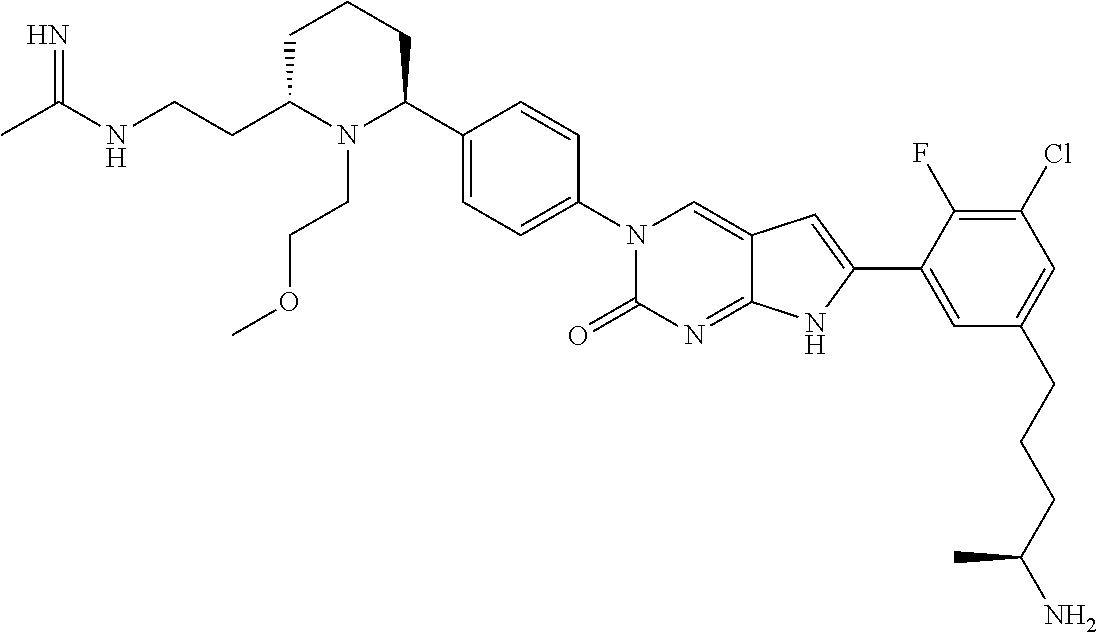 |
650 |
| 278 |
 |
673 |
| 279 |
 |
646.4 |
| 280 |
 |
708.7 |
| 281 |
 |
644.4 |
| 282 |
 |
695 |
| 283 |
 |
606.4 |
| 284 |
 |
670.3 |
| 285 |
 |
670.7 |
| 286 |
 |
698.5 |
| 287 |
 |
608.4 |
| 288 |
 |
700 |
| 289 |
 |
607.4 |
| 290 |
 |
650 |
| 291 |
 |
598.4 |
| 292 |
 |
714 |
| 293 |
 |
668 |
| TABLE 1a | |
| # | Structure |
| 294 |
 |
| 295 |
 |
| 296 |
 |
| 297 |
 |
| 298 |
 |
| 300 |
 |
| 305 |
 |
| 306 |
 |
| 307 |
 |
| 308 |
 |
| 309 |
 |
| 310 |
 |
| 311 |
 |
| 312 |
 |
| 313 |
 |
| 314 |
 |
| 315 |
 |
| 316 |
 |
| TABLE 1b | ||
| ESI, m/z | ||
| # | Structure | [M + H]+ |
| 317 |
 |
626.8 |
| 318 |
 |
626.8 |
| 319 |
 |
640.3 |
| 320 |
 |
652.3 |
| 321 |
 |
666.4 |
| 322 |
 |
700.4 |
| 323 |
 |
690.4 |
| 325 |
 |
670 |
| 326 |
 |
740 |
| 327 |
 |
712 |
| 328 |
 |
686 |
| 329 |
 |
732 |
| 330 |
 |
694 |
| 331 |
 |
698 |
| 332 |
 |
696 |
| 333 |
 |
724 |
| 334 |
 |
678 |
| 335 |
 |
678.5 |
| 336 |
 |
716 |
| 337 |
 |
758 |
| 338 |
 |
742 |
| 339 |
 |
670.5 |
| 340 |
 |
618 4 |
| 341 |
 |
652.3 |
| 342 |
 |
726 |
| 343 |
 |
664 |
| 344 |
 |
710 |
| 346 |
 |
680 |
| 347 |
 |
673.8 |
| 348 |
 |
636 |
| 349 |
 |
698 |
| 350 |
 |
728 |
| 351 |
 |
744 |
| 352 |
 |
620.3 |
| 353 |
 |
666.2 |
| 355 |
 |
682 |
| 356 |
 |
622.3 |
| 357 |
 |
622 1 |
| 358 |
 |
623.3 |
| 360 |
 |
634 |
| 362 |
 |
666 |
| 363 |
 |
578 |
| 364 |
 |
638 |
| 365 |
 |
664 |
| 366 |
 |
664 |
| 369 |
 |
648 |
| 370 |
 |
574.4 |
| 377 |
 |
570.5 |


| Target Infection | |
| Indication | Animal Model of Efficacy |
| HAP/VAP | Efficacy in mouse and/or rat pneumoniae |
| model vs. respiratory tract infection | |
| pathogens of interest (Streptococcus | |
| pneumoniae, including multi-drug resistant | |
| Streptococcus pneumoniae, H. influenzae, | |
| methicillin resistant Staphylococcus | |
| aureus (MRSA), and Pseudomonas. aeruginosa) | |
| cSSSI | Efficacy tn mouse model against pathogens |
| of interest (MRSA. K. pneumoniae) | |
| Sepsis | Efficacy in mouse peritonitis model vs. |
| pathogens of interest (E. coli, K. | |
| pneumoniae, E. Jaecalis, MRSA) | |
| cUTI | Efficacy in mouse model against E. coli, |
| K. pneumoniae and/or MRSA) | |
| Febrile | Efficacy in mouse peritonitis model against |
| neutropenia | A. aureus, S. epidermidis, S. pneumoniae, |
| S. pyogenes, P. aeruginosa | |
Animal Model for Complicated Skin and Skin Structure Infections (cSSSI):
Murine Skin and Soft Tissue Infection Model of Klebsiella pneumoniae 1705966 in Thighs of Neutropenic Female CD-1 Mice
| Final O.D | |||
| Dilution | Initial O.D. | (after ~2 hr. incubation) | |
| 1:10 | 0.135 | 0.424 | |
| 1:100 | 0.014 | 0.215 | |
| 1:1000 | 0.001 | 0.035 | |
Neutropenia is induced by intraperitoneal (I.P.) administration of Cyclophosphamide monohydrate on Day −4 (150 mg/kg) and Day −1 (100 mg/kg).
| Ingredients | Amount | |
| Antimicrobial Compound | 0.1-1500 | total mg | |
| of the present disclosure | |||
| Dextrose, USP | 50 | mg/ml | |
| Sodium citrate, USP | 1.60-1.75 | mg/ml | |
| Citric Acid, USP | 0.80-0.90 | mg/ml |
| Water, USP | q.s | |
| Ingredient | mg per injection vial | |
| Antimicrobial Compound | 01-1500 | |
| of the present disclosure | ||
| Cyclodextrin | 1500 | |
| Ingredient | mg per injection vial | |
| Antimicrobial Compound | 0.1-1500 | |
| of the present disclosure | ||
| soya lecithin | 2250 | |
| Sodium cholate | 1500 | |
| Ingredient | mg per injection vial | |
| Antimicrobial Compound | 0.1-1500 | |
| of the present disclosure | ||
| soya lecithin | 900 | |
| Sodium glycocholate | 540 | |
| Ingredients | Per Tablet | Per 4000 Tablets | ||
| Antimicrobial Compound | 0.1-1500 | mg | 0.4-6000 | g | |
| of the present disclosure | |||||
| Anhydrous Lactose, NF | 110.45 | mg | 441.8 | g | |
| Microcrystalline | 80.0 | mg | 320.0 | g | |
| Cellulose NF | |||||
| Magnesium Stearate | 1.00 | mg | 4.0 | g | |
| Impalpable Powder NF | |||||
| Croscarmellose Sodium | 2.00 | mg | 8.0 | g | |
| NF Type A | |||||


| TABLE 2 | ||
| MIC | MIC | |
| # | S. aureus | E. coli |
| 2 | + | + |
| 3 | + | + |
| 4 | + | + |
| 6 | + | + |
| 7 | + | + |
| 8 | + | + |
| 9 | + | + |
| 10 | + | + |
| 11 | + | − |
| 12 | + | + |
| 13 | − | − |
| 14 | + | + |
| 15 | + | + |
| 16 | + | + |
| 17 | + | + |
| 18 | + | + |
| 19 | + | + |
| 20 | + | + |
| 21 | + | + |
| 22 | + | + |
| 23 | + | + |
| 24 | + | + |
| 25 | + | + |
| 26 | + | + |
| 27 | + | + |
| 28 | + | + |
| 29 | + | + |
| 30 | + | + |
| 31 | + | + |
| 32 | + | + |
| 33 | + | + |
| 34 | + | + |
| 35 | + | + |
| 36 | + | + |
| 37 | + | + |
| 38 | + | + |
| 39 | + | + |
| 40 | + | + |
| 41 | + | + |
| 42 | + | + |
| 43 | + | + |
| 44 | + | − |
| 45 | + | + |
| 46 | + | + |
| 47 | + | + |
| 48 | + | + |
| 49 | + | + |
| 50 | + | + |
| 51 | + | + |
| 52 | + | + |
| 53 | + | + |
| 54 | + | + |
| 55 | + | + |
| 56 | + | + |
| 57 | + | + |
| 58 | + | + |
| 59 | + | + |
| 60 | + | + |
| 61 | + | + |
| 62 | + | + |
| 63 | + | + |
| 64 | + | + |
| 65 | + | + |
| 66 | − | − |
| 67 | − | − |
| 68 | + | + |
| 69 | + | + |
| 70 | + | + |
| 71 | + | + |
| 72 | + | + |
| 73 | + | + |
| 74 | + | + |
| 75 | + | + |
| 76 | + | + |
| 77 | + | + |
| 78 | + | + |
| 79 | + | + |
| 80 | + | + |
| 81 | + | + |
| 82 | + | + |
| 83 | + | + |
| 84 | + | + |
| 85 | + | + |
| 86 | + | + |
| 87 | + | + |
| 88 | + | + |
| 89 | + | + |
| 90 | + | + |
| 91 | + | + |
| 92 | + | + |
| 93 | + | + |
| 94 | + | + |
| 95 | + | + |
| 96 | + | + |
| 97 | + | + |
| 98 | + | + |
| 99 | + | + |
| 100 | + | + |
| 101 | + | + |
| 102 | + | + |
| 103 | + | + |
| 104 | + | + |
| 105 | + | + |
| 106 | + | + |
| 107 | + | + |
| 108 | + | + |
| 109 | + | + |
| 110 | + | + |
| 111 | + | + |
| 112 | + | + |
| 113 | + | + |
| 114 | + | + |
| 115 | + | + |
| 116 | + | + |
| 117 | + | + |
| 118 | + | + |
| 119 | + | + |
| 120 | + | + |
| 121 | + | + |
| 122 | + | + |
| 123 | + | + |
| 124 | + | + |
| 125 | + | + |
| 126 | + | + |
| 127 | + | + |
| 128 | + | + |
| 129 | + | + |
| 130 | + | + |
| 131 | + | + |
| 132 | + | + |
| 133 | + | + |
| 134 | + | + |
| 135 | + | + |
| 136 | + | + |
| 137 | + | + |
| 138 | + | + |
| 139 | + | + |
| 140 | + | + |
| 141 | + | + |
| 142 | + | + |
| 143 | + | + |
| 144 | + | + |
| 145 | + | + |
| 146 | + | + |
| 147 | + | + |
| 148 | + | + |
| 149 | + | + |
| 150 | + | + |
| 151 | + | + |
| 152 | + | + |
| 153 | + | + |
| 154 | + | + |
| 155 | + | + |
| 156 | + | + |
| 157 | + | + |
| 158 | + | + |
| 159 | + | + |
| 160 | + | + |
| 161 | + | + |
| 162 | + | + |
| 163 | + | + |
| 164 | + | + |
| 165 | + | + |
| 166 | + | + |
| 167 | + | + |
| 168 | + | + |
| 169 | + | + |
| 170 | + | + |
| 171 | + | + |
| 172 | + | + |
| 173 | + | + |
| 174 | + | + |
| 175 | + | + |
| 176 | + | + |
| 177 | + | + |
| 178 | + | + |
| 179 | + | + |
| 180 | + | + |
| 181 | + | + |
| 182 | + | + |
| 183 | + | + |
| 184 | + | + |
| 185 | + | + |
| 186 | + | + |
| 187 | + | + |
| 188 | + | + |
| 189 | + | + |
| 190 | + | + |
| 191 | + | + |
| 192 | + | + |
| 193 | + | + |
| 194 | + | + |
| 195 | + | + |
| 196 | + | + |
| 197 | + | + |
| 198 | + | + |
| 199 | + | + |
| 200 | + | + |
| 201 | + | + |
| 202 | + | + |
| 203 | + | + |
| 204 | + | + |
| 205 | + | + |
| 206 | + | + |
| 207 | + | + |
| 208 | + | + |
| 209 | + | + |
| 210 | + | + |
| 211 | + | + |
| 212 | + | + |
| 213 | + | + |
| 214 | + | + |
| 215 | + | + |
| 216 | + | + |
| 217 | + | + |
| 218 | + | + |
| 219 | + | + |
| 220 | + | + |
| 221 | + | + |
| 222 | + | + |
| 223 | + | + |
| 224 | + | + |
| 225 | + | + |
| 226 | + | + |
| 227 | + | + |
| 228 | + | + |
| 229 | + | + |
| 230 | + | + |
| 231 | + | + |
| 232 | + | + |
| 233 | + | + |
| 234 | + | + |
| 235 | + | + |
| 236 | + | + |
| 237 | + | + |
| 238 | + | + |
| 239 | + | + |
| 240 | + | + |
| 241 | + | + |
| 242 | + | + |
| 243 | + | + |
| 244 | + | + |
| 245 | + | + |
| 246 | + | + |
| 247 | + | + |
| 248 | + | + |
| 249 | + | + |
| 250 | + | + |
| 251 | + | + |
| 252 | + | + |
| 253 | + | + |
| 254 | + | + |
| 255 | + | + |
| 256 | + | + |
| 257 | + | + |
| 258 | + | + |
| 259 | + | + |
| 260 | + | + |
| 261 | + | + |
| 262 | + | + |
| 263 | + | + |
| 264 | + | + |
| 265 | + | + |
| 266 | + | + |
| 267 | + | + |
| 268 | + | + |
| 269 | + | + |
| 270 | + | + |
| 271 | + | + |
| 272 | + | + |
| 273 | + | + |
| 274 | + | + |
| 275 | + | + |
| 276 | + | + |
| 277 | + | + |
| 278 | + | + |
| 279 | + | + |
| 280 | + | + |
| 281 | + | + |
| 282 | + | + |
| 283 | + | + |
| 284 | + | + |
| 285 | + | + |
| 286 | + | + |
| 287 | + | + |
| 288 | + | + |
| 289 | + | + |
| 290 | + | + |
| 291 | + | + |
| 292 | + | + |
| 293 | + | + |
| 317 | + | + |
| 318 | + | + |
| 319 | + | + |
| 320 | + | + |
| 321 | + | + |
| 322 | + | + |
| 323 | + | + |
| 325 | + | + |
| 326 | + | + |
| 327 | + | + |
| 328 | + | + |
| 329 | + | + |
| 330 | + | + |
| 331 | + | + |
| 332 | + | + |
| 333 | + | + |
| 334 | + | + |
| 335 | + | + |
| 336 | + | + |
| 337 | + | + |
| 338 | + | + |
| 339 | + | + |
| 340 | + | + |
| 341 | + | + |
| 342 | + | + |
| 343 | + | + |
| 344 | + | + |
| 346 | + | + |
| 347 | + | + |
| 348 | + | + |
| 349 | + | + |
| 350 | + | + |
| 351 | + | + |
| 352 | + | + |
| 353 | + | + |
| 355 | + | + |
| 356 | + | + |
| 357 | + | + |
| 358 | + | + |
| 360 | + | + |
| 362 | + | + |
| 363 | + | + |
| 364 | + | + |
| 365 | + | + |
| 366 | + | + |
| 369 | + | + |
| 370 | + | + |
| 377 | + | + |
| TABLE 3 | |||
| Compound No. | BW | Hematology Result | |
| 23 | + | + |
| 36 | − | − |
| 36 | + | − |
| 50 | + | + |
| 110 | − | − |
| 117 | − | + |
| 119 | − | − |
| 120 | + | + |
| 123 | + | + |
| 127 | + | + |
| 152 | + | + |
| 162 | − | − |
| 182 | − | − |
| 190 | − | − |
| 191 | + | + |
| 196 | + | + |
| 199 | + | − |
| 200 | + | − |
| 249 | + | + |
| 254 | + | + |
| 264 | + | + |
| 290 | + | + |
| 317 | − | − |
| 341 | + | + |
| 360 | + | + |
| TABLE 4 | |
| Compounds Tested | |
 |
RX-04A |
 |
RX-04B |
 |
RX-04C |
 |
RX-04D |
| TABLE 5 |
| Test Panel |
| Resistance mechanism/phenotype* |
| Carbapenem + | ||||||||||||
| cephalosporin | E. coli | DH10B | ||||||||||
| susceptible | Low | Normal | Raised | DH10B | mcr-1 | |||||||
| Species | controls | KPC | SME | MBL | OXA-48 | OXA-23 | efflux | efflux | efflux | MCR-1 | recipient | transformant |
| E. coli | 5 | 5 | — | 5 | 5 | — | — | — | — | 3 | 1 | 1 |
| S. enterica | — | — | — | — | — | — | — | — | — | 11 | — | — |
|
|
5 | 5 | — | 5 | 5 | — | — | — | — | — | — | — |
| Enterobacter spp. | 4 | 2 | — | 1 | 1 | — | — | — | — | — | — | — |
| S. marcescens | 2 | — | 1 | — | 1 | — | — | — | — | — | — | — |
| P. aeruginosa | — | — | — | 5 | — | — | 5 | 5 | 5 | — | — | — |
|
|
5 | — | — | — | — | 5 | — | — | — | — | — | — |
| |
||||||||||||
| *numbers in the table refer to the number of each species that exhibit the particular resistance/genotype. | ||||||||||||
| TABLE 6 |
| MICs of RX04-A-D and colistin for E. coli |
| DH10B and its mcr-1 transformant |
| MIC (mg/L) |
| Strain | RX-04A | RX-04B | RX-04C | RX-04D | COL |
| DH10B Recipient | 0.25 | 0.5 | 0.5 | 1 | 0.25 |
| MCR-1 Transformant | 0.25 | 0.5 | 0.5 | 1 | 4 |
Claims (16)


Priority Applications (1)
| Application Number | Priority Date | Filing Date | Title |
|---|---|---|---|
| US17/409,286 US11999739B2 (en) | 2016-05-06 | 2021-08-23 | Antimicrobials methods of making and using the same |
Applications Claiming Priority (7)
| Application Number | Priority Date | Filing Date | Title |
|---|---|---|---|
| US201662333012P | 2016-05-06 | 2016-05-06 | |
| US201662385722P | 2016-09-09 | 2016-09-09 | |
| US201762444276P | 2017-01-09 | 2017-01-09 | |
| US201762485811P | 2017-04-14 | 2017-04-14 | |
| PCT/US2017/031334 WO2017193016A1 (en) | 2016-05-06 | 2017-05-05 | Antimicrobials and methods of making and using same |
| US201816099071A | 2018-11-05 | 2018-11-05 | |
| US17/409,286 US11999739B2 (en) | 2016-05-06 | 2021-08-23 | Antimicrobials methods of making and using the same |
Related Parent Applications (2)
| Application Number | Title | Priority Date | Filing Date |
|---|---|---|---|
| PCT/US2017/031334 Continuation WO2017193016A1 (en) | 2016-05-06 | 2017-05-05 | Antimicrobials and methods of making and using same |
| US16/099,071 Continuation US11098047B2 (en) | 2016-05-06 | 2017-05-05 | Antimicrobials and methods of making and using same |
Publications (2)
| Publication Number | Publication Date |
|---|---|
| US20220112197A1 US20220112197A1 (en) | 2022-04-14 |
| US11999739B2 true US11999739B2 (en) | 2024-06-04 |
Family
ID=58745372
Family Applications (2)
| Application Number | Title | Priority Date | Filing Date |
|---|---|---|---|
| US16/099,071 Active US11098047B2 (en) | 2016-05-06 | 2017-05-05 | Antimicrobials and methods of making and using same |
| US17/409,286 Active 2037-12-20 US11999739B2 (en) | 2016-05-06 | 2021-08-23 | Antimicrobials methods of making and using the same |
Family Applications Before (1)
| Application Number | Title | Priority Date | Filing Date |
|---|---|---|---|
| US16/099,071 Active US11098047B2 (en) | 2016-05-06 | 2017-05-05 | Antimicrobials and methods of making and using same |
Country Status (7)
| Country | Link |
|---|---|
| US (2) | US11098047B2 (en) |
| EP (1) | EP3452479A1 (en) |
| JP (1) | JP2019515041A (en) |
| CN (1) | CN110312722A (en) |
| CA (1) | CA3023317A1 (en) |
| TW (1) | TW201806954A (en) |
| WO (1) | WO2017193016A1 (en) |
Families Citing this family (6)
| Publication number | Priority date | Publication date | Assignee | Title |
|---|---|---|---|---|
| JP2019515041A (en) * | 2016-05-06 | 2019-06-06 | メリンタ セラピューティクス、 インコーポレイテッドMelinta Therapeutics, Inc. | Antimicrobial agents and methods of making and using the same |
| US20210253589A1 (en) | 2018-06-06 | 2021-08-19 | BioVersys AG | Aminomethylamidine and methylamidine antimicrobial compounds |
| US12152031B2 (en) | 2018-06-06 | 2024-11-26 | BioVersys AG | Biodefense agents |
| WO2020115547A2 (en) | 2018-12-07 | 2020-06-11 | BioVersys AG | Pyrrolo[2,3-d]pyrimidin-2-one antimicrobial compounds |
| EP3911644A1 (en) | 2019-01-16 | 2021-11-24 | Curza Global LLC | Antimicrobial compounds and methods |
| AU2020384885A1 (en) * | 2019-11-13 | 2022-06-09 | Curza Global, Llc | Antimicrobial compounds and methods |
Citations (94)
| Publication number | Priority date | Publication date | Assignee | Title |
|---|---|---|---|---|
| US2624731A (en) | 1953-01-06 | S-phenylpyrimidkn e x derivativesx | ||
| US3673184A (en) | 1970-09-02 | 1972-06-27 | Dainippon Pharmaceutical Co | Certain 2-substituted-5,8-dihydro-5-oxopyrido{8 2,3-d{9 pyrimidine-6-carboxylic acid derivatives |
| US3980781A (en) | 1966-03-31 | 1976-09-14 | Imperial Chemical Industries Limited | Fungicidal composition and method containing 2-amino-pyrimidines |
| US4000138A (en) | 1966-03-31 | 1976-12-28 | Imperial Chemical Industries Limited | Organic compounds and compositions containing them |
| US4361557A (en) | 1980-01-28 | 1982-11-30 | Schering Corporation | 1-Aryl-2-acylamido-3-fluoro-1-propanol acylates, methods for their use as anti-bacterial agents and compositions useful therefor |
| JPS5821681A (en) | 1981-06-16 | 1983-02-08 | ビ−チヤム・グル−プ・ピ−エルシ− | Penicillins, manufacture and medicinal composition |
| JPS5959688A (en) | 1982-08-27 | 1984-04-05 | ルセル―ユクラフ | Imidazol(1,2-a)pyrimidines |
| US4522811A (en) | 1982-07-08 | 1985-06-11 | Syntex (U.S.A.) Inc. | Serial injection of muramyldipeptides and liposomes enhances the anti-infective activity of muramyldipeptides |
| DE3446812A1 (en) | 1984-12-21 | 1986-06-26 | Dr. Karl Thomae Gmbh, 7950 Biberach | NEW IMIDAZO DERIVATIVES, THEIR PRODUCTION AND MEDICINAL PRODUCTS CONTAINING THESE COMPOUNDS |
| EP0339596A2 (en) | 1988-04-29 | 1989-11-02 | Takeda Chemical Industries, Ltd. | Antibiotics TAN-1057 |
| JPH03215488A (en) | 1990-01-12 | 1991-09-20 | Otsuka Pharmaceut Factory Inc | Pyrimidobenzimidazole derivative |
| JPH04153647A (en) | 1990-10-17 | 1992-05-27 | Konica Corp | Novel photographic coupler |
| US5208141A (en) | 1990-10-09 | 1993-05-04 | Konica Corporation | Silver halide color photographic light-sensitive material |
| WO1994026722A1 (en) | 1993-05-12 | 1994-11-24 | E.I. Du Pont De Nemours And Company | Fungicidal fused bicyclic pyrimidinones |
| US5434257A (en) | 1992-06-01 | 1995-07-18 | Gilead Sciences, Inc. | Binding compentent oligomers containing unsaturated 3',5' and 2',5' linkages |
| WO1995029894A1 (en) | 1994-04-28 | 1995-11-09 | The Procter & Gamble Company | Novel quinolone 5-(n-heterosubstituted amino) antimicrobials |
| US5567844A (en) | 1984-02-03 | 1996-10-22 | Zambon S.P.A. | Process for preparing 1-phenyl-2-amino-3-fluoro-1-propanols |
| WO1997001562A1 (en) | 1995-06-26 | 1997-01-16 | Pathogenesis Corporation | Nitroimidazole antibacterial compounds and methods of use thereof |
| JPH09506859A (en) | 1993-09-17 | 1997-07-08 | ギリアード サイエンシーズ,インコーポレイテッド | Pyrimidine derivatives for labeled binding partners |
| JPH10503759A (en) | 1994-07-15 | 1998-04-07 | アイシス・ファーマシューティカルス・インコーポレーテッド | Linked peptide nucleic acid |
| US5763263A (en) | 1995-11-27 | 1998-06-09 | Dehlinger; Peter J. | Method and apparatus for producing position addressable combinatorial libraries |
| US5766855A (en) | 1991-05-24 | 1998-06-16 | Buchardt, Deceased; Ole | Peptide nucleic acids having enhanced binding affinity and sequence specificity |
| WO1998049177A1 (en) | 1997-04-28 | 1998-11-05 | University College Cardiff Consultants Limited | Anti-viral pyrimidine nucleoside analogues |
| WO1999007685A1 (en) | 1997-08-07 | 1999-02-18 | Research Corporation Technologies, Inc. | Antibiotic for methicillin resistant bacteria |
| WO1999024452A2 (en) | 1997-11-07 | 1999-05-20 | Isis Pharmaceuticals, Inc. | Pyrimidine derivatives for labeled binding partners |
| US5958930A (en) | 1991-04-08 | 1999-09-28 | Duquesne University Of The Holy Ghost | Pyrrolo pyrimidine and furo pyrimidine derivatives |
| US6028183A (en) | 1997-11-07 | 2000-02-22 | Gilead Sciences, Inc. | Pyrimidine derivatives and oligonucleotides containing same |
| WO2000012484A1 (en) | 1998-08-27 | 2000-03-09 | Bayer Aktiengesellschaft | Tan-1057 derivatives |
| TW424090B (en) | 1995-08-18 | 2001-03-01 | Nat Science Council | Pyrimidines as folate antimetabolites with selective activity against human brain cancer |
| WO2001030749A1 (en) | 1999-10-28 | 2001-05-03 | New Pharma Research Sweden Ab | Novel compounds |
| EP1113008A1 (en) | 1999-12-29 | 2001-07-04 | Pfizer Products Inc. | 4-oxo-2-ureido-1,4,5,6-tetrahydro-pyrimidine derivatives useful as antibacterial and antiprotozoal agents |
| WO2001060825A1 (en) | 2000-02-17 | 2001-08-23 | Sk Chemicals Co., Ltd. | Pyrrolopyrimidinone derivatives, process of preparation and use |
| WO2002032920A2 (en) | 2000-10-18 | 2002-04-25 | Pharmasset Limited | Modified nucleosides for treatment of viral infections and abnormal cellular proliferation |
| DE10061542A1 (en) | 2000-12-11 | 2002-06-13 | Bayer Ag | New alkanoylamino-pyrimidine derivatives used as antibacterial agents, especially for prevention and control of Staphylococcal infections |
| DE10061538A1 (en) | 2000-12-11 | 2002-06-20 | Bayer Ag | New ureido-substituted dihydropyrimidinone derivatives, useful as broad-spectrum antibacterial agents with strong activity against Gram positive bacteria |
| DE10061537A1 (en) | 2000-12-11 | 2002-06-20 | Bayer Ag | New beta-alanylamino-substituted dihydropyrimidinone derivatives, useful as antibacterial agents with strong activity against Gram positive bacteria, including methicillin-resistant Staphylococcus aureus |
| WO2002048138A1 (en) | 2000-12-14 | 2002-06-20 | The Procter & Gamble Company | Antimicrobial quinolones |
| DE10061541A1 (en) | 2000-12-11 | 2002-06-20 | Bayer Ag | New arylamino-substituted dihydropyrimidinone derivatives, useful as broad-spectrum antibacterial agents with strong activity against Gram positive bacteria |
| WO2002061110A2 (en) | 2001-01-29 | 2002-08-08 | Bio-Rad Laboratories, Inc. | Nucleic acid derivatives |
| WO2002074773A1 (en) | 2001-03-21 | 2002-09-26 | Merck Sharp & Dohme Limited | Imidazo-pyrimidine derivatives as ligands for gaba receptors |
| WO2002097134A2 (en) | 2001-05-25 | 2002-12-05 | Isis Pharmaceuticals, Inc. | Modified peptide nucleic acid |
| US20020193385A1 (en) | 2000-12-15 | 2002-12-19 | Chambers Mark Stuart | Imidazo-pyrimidine derivatives as ligands for gaba receptors |
| WO2003004602A2 (en) | 2001-07-03 | 2003-01-16 | Isis Pharmaceuticals, Inc. | Nuclease resistant chimeric oligonucleotides |
| DE10133277A1 (en) | 2001-07-09 | 2003-01-23 | Bayer Ag | New 2,5-diamino-3,4,5,6-tetrahydro-6-pyrimidinone derivatives useful for treating bacterial infections |
| DE10141271A1 (en) | 2001-08-23 | 2003-03-06 | Bayer Ag | New 3,6-diamino-2,3,4,5-tetrahydro-1,3,5-triazin-2-one derivatives useful as antibacterial agents |
| JP2003155287A (en) | 2001-09-04 | 2003-05-27 | Sumitomo Chem Co Ltd | Imidazo [1,2-a] pyrimidines, their uses and intermediates for their production |
| US20030158403A1 (en) | 2001-07-03 | 2003-08-21 | Isis Pharmaceuticals, Inc. | Nuclease resistant chimeric oligonucleotides |
| WO2003072574A1 (en) | 2002-02-26 | 2003-09-04 | Bayer Healthcare Ag | Piperidine ouracil used as a medicament for treating bacterial infections |
| US20040176390A1 (en) | 2003-03-04 | 2004-09-09 | Pfizer Inc | Novel fused heteroaromatic compounds as transforming growth factor (TGF) inhibitors |
| WO2004080466A1 (en) | 2003-03-07 | 2004-09-23 | Ribapharm Inc. | Cytidine analogs and methods of use |
| WO2005019228A1 (en) | 2003-08-12 | 2005-03-03 | Achillion Pharmaceuticals, Inc. | Isothiazoloquinolones and related compounds as anti-infective agents |
| WO2005037801A1 (en) | 2003-10-21 | 2005-04-28 | Sankyo Company, Limited | Pyrimidine compound |
| US20050153992A1 (en) | 2003-08-26 | 2005-07-14 | Teijin Pharma Limited | Pyrrolopyrimidine thion derivatives |
| JP2005526058A (en) | 2002-03-06 | 2005-09-02 | アストラゼネカ アクチボラグ | Heterocyclic amide derivatives as inhibitors of glycogen phosphorylase |
| WO2006002627A2 (en) | 2004-06-30 | 2006-01-12 | Zgene A/S | Chicken deoxycytidine and deoxyadenosine kinase enzymes and their use |
| US20060014743A1 (en) | 2002-03-08 | 2006-01-19 | Schering-Plough Animal Health Corporation | Methods of preventing bacterial infections with florfenicol-type antibiotics |
| US20060189631A1 (en) | 2003-07-30 | 2006-08-24 | Laboratorios S.A.L.V.A.T., S.A. | Substituted imidazopyrimidines for the prevention and treatment of cancer |
| WO2007014308A1 (en) | 2005-07-27 | 2007-02-01 | Achillion Pharmaceuticals, Inc. | 8-methoxy-9h-isothiazolo[5,4-b]quinoline-3,4-diones and related compounds as anti-infective agents |
| WO2007069923A1 (en) | 2005-12-15 | 2007-06-21 | Industrial Research Limited | Deazapurine analogs of 1'-aza-l-nucleosides |
| WO2007084786A1 (en) | 2006-01-20 | 2007-07-26 | Novartis Ag | Pyrimidine derivatives used as pi-3 kinase inhibitors |
| US20070206054A1 (en) | 2006-03-03 | 2007-09-06 | Fujifilm Corporation | Curable composition, ink composition, inkjet-recording method, and planographic printing plate |
| WO2007101871A1 (en) | 2006-03-08 | 2007-09-13 | Basf Se | Substituted imidazolopyrimidines, method for the production thereof and use thereof for controlling parasitic fungi and agents containing the latter |
| US7282327B2 (en) | 1996-01-23 | 2007-10-16 | Affymetrix, Inc. | Nucleic acid labeling compounds |
| JP2007270087A (en) | 2006-03-31 | 2007-10-18 | Fujifilm Corp | Curable composition, ink composition, ink jet recording method, printed matter, method for producing lithographic printing plate |
| WO2008004796A1 (en) | 2006-07-03 | 2008-01-10 | Sk Chemicals Co., Ltd. | Salts of pyrrolopyrimidinone derivatives and process for preparing the same |
| WO2008030119A1 (en) | 2006-09-07 | 2008-03-13 | Industrial Research Limited | Acyclic amine inhibitors of nucleoside phosphorylases and hydrolases |
| WO2008082440A2 (en) | 2006-08-25 | 2008-07-10 | Emory University | Fluorescent nucleoside analogues |
| WO2008104279A1 (en) | 2007-02-28 | 2008-09-04 | Sanofi-Aventis | Imidazo[1,2-a]azines and their use as pharmaceuticals |
| US20080221095A1 (en) | 2007-03-07 | 2008-09-11 | Christian Gege | Metalloprotease inhibitors containing a heterocyclic moiety |
| JP2008222557A (en) | 2007-03-08 | 2008-09-25 | Kotobuki Seiyaku Kk | Pyrrolo [3,2-d] pyrimidine derivatives and pharmaceutical compositions containing the same as active ingredients |
| US20080255164A1 (en) | 2005-11-15 | 2008-10-16 | Astrazeneca Ab | Novel 2-Aminopyrimidinone Derivatives And Their Use |
| WO2008143729A2 (en) | 2007-02-28 | 2008-11-27 | Rib-X Pharmaceuticals, Inc. | Macrolide compounds and methods of making and using the same |
| WO2008150406A1 (en) | 2007-05-30 | 2008-12-11 | Schering-Plough Ltd. | A process for preparing oxazoline-protected aminodiol compounds useful as intermediates to florfenicol |
| WO2008154642A2 (en) | 2007-06-12 | 2008-12-18 | Achaogen, Inc. | Antibacterial agents |
| WO2008156610A2 (en) | 2007-06-13 | 2008-12-24 | Northeastern University | Antibiotic compounds |
| WO2009074812A1 (en) | 2007-12-13 | 2009-06-18 | Prolysis Ltd | Antibacterial condensed thiazoles |
| CN101535311A (en) | 2006-07-03 | 2009-09-16 | Sk化学株式会社 | Salts of pyrrolopyrimidinone derivatives and process for preparing the same |
| WO2009113828A2 (en) | 2008-03-14 | 2009-09-17 | Cti Bio | Peptide nucleic acid derivatives with good cell penetration and strong affinity for nucleic acid |
| US20100190747A1 (en) | 2009-01-27 | 2010-07-29 | Hideo Suzuki | Fused ring compound and use thereof |
| WO2010101951A1 (en) | 2009-03-02 | 2010-09-10 | Alnylam Pharmaceuticals, Inc. | Nucleic acid chemical modifications |
| WO2011017319A1 (en) | 2009-08-03 | 2011-02-10 | University Of Pittsburgh - Of The Commonwealth System Of Higher Education | Methods of treating disorders associated with protein polymerization |
| WO2011047319A2 (en) | 2009-10-16 | 2011-04-21 | Rib-X Pharmaceuticals, Inc. | Antimicrobial compounds and methods of making and using the same |
| WO2011047323A2 (en) | 2009-10-16 | 2011-04-21 | Rib-X Pharmaceuticals, Inc. | Antimicrobial compounds and methods of making and using the same |
| WO2011045415A2 (en) | 2009-10-15 | 2011-04-21 | Guerbet | New imaging agents and their use for the diagnostic in vivo of neurodegenerative diseases, notably alzheimer's disease and derivative diseases |
| TW201124417A (en) | 2009-10-16 | 2011-07-16 | Rib X Pharmaceuticals Inc | Antimicrobial compounds and methods of making and using the same |
| WO2012125832A2 (en) | 2011-03-15 | 2012-09-20 | Rib-X Pharmaceuticals, Inc. | Antimicrobial agents |
| WO2012173689A2 (en) | 2011-04-15 | 2012-12-20 | Rib-X Pharmaceuticals, Inc. | Antimicrobial compounds and methods of making and using the same |
| WO2015035421A1 (en) | 2013-09-09 | 2015-03-12 | Melinta Therapeutics, Inc. | Antimicrobial compounds and methods of making and using the same |
| WO2015035426A1 (en) | 2013-09-09 | 2015-03-12 | Melinta Therapeutics, Inc. | Antimicrobial compunds and methods of making and using the same |
| US9023843B2 (en) | 2009-10-16 | 2015-05-05 | Melinta Therapeutics, Inc. | Antimicrobial compounds and methods of making and using the same |
| WO2016145417A1 (en) | 2015-03-11 | 2016-09-15 | Melinta Therapeutics, Inc. | Antimicrobial compounds and methods of making and using the same |
| US20210253589A1 (en) * | 2018-06-06 | 2021-08-19 | BioVersys AG | Aminomethylamidine and methylamidine antimicrobial compounds |
| US20210253577A1 (en) * | 2018-06-06 | 2021-08-19 | BioVersys AG | Biodefense agents |
| US11098047B2 (en) * | 2016-05-06 | 2021-08-24 | BioVersys AG | Antimicrobials and methods of making and using same |
Family Cites Families (2)
| Publication number | Priority date | Publication date | Assignee | Title |
|---|---|---|---|---|
| WO2017193023A1 (en) * | 2016-05-06 | 2017-11-09 | Melinta Therapeutics, Inc. | Antimicrobials and methods of making and using same |
| MX2018013545A (en) * | 2016-05-06 | 2019-08-14 | Melinta Therapeutics Inc | Antimicrobials and methods of making and using same. |
-
2017
- 2017-05-05 JP JP2019510572A patent/JP2019515041A/en active Pending
- 2017-05-05 CN CN201780039609.1A patent/CN110312722A/en active Pending
- 2017-05-05 CA CA3023317A patent/CA3023317A1/en not_active Abandoned
- 2017-05-05 WO PCT/US2017/031334 patent/WO2017193016A1/en not_active Ceased
- 2017-05-05 EP EP17724988.5A patent/EP3452479A1/en not_active Withdrawn
- 2017-05-05 US US16/099,071 patent/US11098047B2/en active Active
- 2017-05-08 TW TW106115160A patent/TW201806954A/en unknown
-
2021
- 2021-08-23 US US17/409,286 patent/US11999739B2/en active Active
Patent Citations (125)
| Publication number | Priority date | Publication date | Assignee | Title |
|---|---|---|---|---|
| US2624731A (en) | 1953-01-06 | S-phenylpyrimidkn e x derivativesx | ||
| US3980781A (en) | 1966-03-31 | 1976-09-14 | Imperial Chemical Industries Limited | Fungicidal composition and method containing 2-amino-pyrimidines |
| US4000138A (en) | 1966-03-31 | 1976-12-28 | Imperial Chemical Industries Limited | Organic compounds and compositions containing them |
| US3673184A (en) | 1970-09-02 | 1972-06-27 | Dainippon Pharmaceutical Co | Certain 2-substituted-5,8-dihydro-5-oxopyrido{8 2,3-d{9 pyrimidine-6-carboxylic acid derivatives |
| US4361557A (en) | 1980-01-28 | 1982-11-30 | Schering Corporation | 1-Aryl-2-acylamido-3-fluoro-1-propanol acylates, methods for their use as anti-bacterial agents and compositions useful therefor |
| JPS5821681A (en) | 1981-06-16 | 1983-02-08 | ビ−チヤム・グル−プ・ピ−エルシ− | Penicillins, manufacture and medicinal composition |
| US4522811A (en) | 1982-07-08 | 1985-06-11 | Syntex (U.S.A.) Inc. | Serial injection of muramyldipeptides and liposomes enhances the anti-infective activity of muramyldipeptides |
| JPS5959688A (en) | 1982-08-27 | 1984-04-05 | ルセル―ユクラフ | Imidazol(1,2-a)pyrimidines |
| US5567844A (en) | 1984-02-03 | 1996-10-22 | Zambon S.P.A. | Process for preparing 1-phenyl-2-amino-3-fluoro-1-propanols |
| DE3446812A1 (en) | 1984-12-21 | 1986-06-26 | Dr. Karl Thomae Gmbh, 7950 Biberach | NEW IMIDAZO DERIVATIVES, THEIR PRODUCTION AND MEDICINAL PRODUCTS CONTAINING THESE COMPOUNDS |
| US4971965A (en) | 1988-04-29 | 1990-11-20 | Takeda Chemical Industries, Ltd. | Antibiotics TAN-1057 |
| EP0339596A2 (en) | 1988-04-29 | 1989-11-02 | Takeda Chemical Industries, Ltd. | Antibiotics TAN-1057 |
| JPH03215488A (en) | 1990-01-12 | 1991-09-20 | Otsuka Pharmaceut Factory Inc | Pyrimidobenzimidazole derivative |
| US5208141A (en) | 1990-10-09 | 1993-05-04 | Konica Corporation | Silver halide color photographic light-sensitive material |
| JPH04153647A (en) | 1990-10-17 | 1992-05-27 | Konica Corp | Novel photographic coupler |
| US5958930A (en) | 1991-04-08 | 1999-09-28 | Duquesne University Of The Holy Ghost | Pyrrolo pyrimidine and furo pyrimidine derivatives |
| US5766855A (en) | 1991-05-24 | 1998-06-16 | Buchardt, Deceased; Ole | Peptide nucleic acids having enhanced binding affinity and sequence specificity |
| US5434257A (en) | 1992-06-01 | 1995-07-18 | Gilead Sciences, Inc. | Binding compentent oligomers containing unsaturated 3',5' and 2',5' linkages |
| WO1994026722A1 (en) | 1993-05-12 | 1994-11-24 | E.I. Du Pont De Nemours And Company | Fungicidal fused bicyclic pyrimidinones |
| JPH09506859A (en) | 1993-09-17 | 1997-07-08 | ギリアード サイエンシーズ,インコーポレイテッド | Pyrimidine derivatives for labeled binding partners |
| US5763588A (en) | 1993-09-17 | 1998-06-09 | Gilead Sciences, Inc. | Pyrimidine derivatives for labeled binding partners |
| WO1995029894A1 (en) | 1994-04-28 | 1995-11-09 | The Procter & Gamble Company | Novel quinolone 5-(n-heterosubstituted amino) antimicrobials |
| JPH10503759A (en) | 1994-07-15 | 1998-04-07 | アイシス・ファーマシューティカルス・インコーポレーテッド | Linked peptide nucleic acid |
| WO1997001562A1 (en) | 1995-06-26 | 1997-01-16 | Pathogenesis Corporation | Nitroimidazole antibacterial compounds and methods of use thereof |
| TW424090B (en) | 1995-08-18 | 2001-03-01 | Nat Science Council | Pyrimidines as folate antimetabolites with selective activity against human brain cancer |
| US5763263A (en) | 1995-11-27 | 1998-06-09 | Dehlinger; Peter J. | Method and apparatus for producing position addressable combinatorial libraries |
| US7282327B2 (en) | 1996-01-23 | 2007-10-16 | Affymetrix, Inc. | Nucleic acid labeling compounds |
| WO1998049177A1 (en) | 1997-04-28 | 1998-11-05 | University College Cardiff Consultants Limited | Anti-viral pyrimidine nucleoside analogues |
| JP2001522369A (en) | 1997-04-28 | 2001-11-13 | ユニヴァーシティー・カレッジ・カーディフ・コンサルタンツ・リミテッド | Antiviral pyrimidine nucleoside analogues |
| US6162925A (en) | 1997-08-07 | 2000-12-19 | Research Corporation Tech., Inc. | Antibiotic for methicillin resistant bacteria |
| WO1999007685A1 (en) | 1997-08-07 | 1999-02-18 | Research Corporation Technologies, Inc. | Antibiotic for methicillin resistant bacteria |
| US6110925A (en) | 1997-08-07 | 2000-08-29 | Research Corporation Technologies, Inc. | Antibiotic for methicillin resistant bacteria |
| WO1999024452A2 (en) | 1997-11-07 | 1999-05-20 | Isis Pharmaceuticals, Inc. | Pyrimidine derivatives for labeled binding partners |
| US6028183A (en) | 1997-11-07 | 2000-02-22 | Gilead Sciences, Inc. | Pyrimidine derivatives and oligonucleotides containing same |
| JP2001522860A (en) | 1997-11-07 | 2001-11-20 | アイシス ファーマシューティカルズ インコーポレイテッド | Pyrimidine derivatives for labeled binding partners |
| WO2000012484A1 (en) | 1998-08-27 | 2000-03-09 | Bayer Aktiengesellschaft | Tan-1057 derivatives |
| US6617332B1 (en) | 1998-08-27 | 2003-09-09 | Bayer Aktiengesellschaft | Tan-1057 derivatives |
| US6875764B1 (en) | 1999-10-28 | 2005-04-05 | New Pharma Research Sweden Ab | Urea and thiourea compounds useful for treatment of coccidiosis |
| WO2001030749A1 (en) | 1999-10-28 | 2001-05-03 | New Pharma Research Sweden Ab | Novel compounds |
| US20020016297A1 (en) | 1999-12-29 | 2002-02-07 | Linde Robert G. | 4-oxo-2- ureido-1,4,5,6,-tetrahydro-pyrimidine derivatives |
| EP1113008A1 (en) | 1999-12-29 | 2001-07-04 | Pfizer Products Inc. | 4-oxo-2-ureido-1,4,5,6-tetrahydro-pyrimidine derivatives useful as antibacterial and antiprotozoal agents |
| WO2001060825A1 (en) | 2000-02-17 | 2001-08-23 | Sk Chemicals Co., Ltd. | Pyrrolopyrimidinone derivatives, process of preparation and use |
| WO2002032920A2 (en) | 2000-10-18 | 2002-04-25 | Pharmasset Limited | Modified nucleosides for treatment of viral infections and abnormal cellular proliferation |
| JP2004533406A (en) | 2000-10-18 | 2004-11-04 | フアーマセツト・リミテツド | Modified nucleosides for treating viral infections and abnormal cell proliferation |
| DE10061542A1 (en) | 2000-12-11 | 2002-06-13 | Bayer Ag | New alkanoylamino-pyrimidine derivatives used as antibacterial agents, especially for prevention and control of Staphylococcal infections |
| DE10061538A1 (en) | 2000-12-11 | 2002-06-20 | Bayer Ag | New ureido-substituted dihydropyrimidinone derivatives, useful as broad-spectrum antibacterial agents with strong activity against Gram positive bacteria |
| DE10061537A1 (en) | 2000-12-11 | 2002-06-20 | Bayer Ag | New beta-alanylamino-substituted dihydropyrimidinone derivatives, useful as antibacterial agents with strong activity against Gram positive bacteria, including methicillin-resistant Staphylococcus aureus |
| DE10061541A1 (en) | 2000-12-11 | 2002-06-20 | Bayer Ag | New arylamino-substituted dihydropyrimidinone derivatives, useful as broad-spectrum antibacterial agents with strong activity against Gram positive bacteria |
| WO2002048138A1 (en) | 2000-12-14 | 2002-06-20 | The Procter & Gamble Company | Antimicrobial quinolones |
| US20020193385A1 (en) | 2000-12-15 | 2002-12-19 | Chambers Mark Stuart | Imidazo-pyrimidine derivatives as ligands for gaba receptors |
| JP2004537503A (en) | 2001-01-29 | 2004-12-16 | バイオ−ラッド ラボラトリーズ インコーポレイテッド | Nucleic acid derivatives |
| WO2002061110A2 (en) | 2001-01-29 | 2002-08-08 | Bio-Rad Laboratories, Inc. | Nucleic acid derivatives |
| WO2002074773A1 (en) | 2001-03-21 | 2002-09-26 | Merck Sharp & Dohme Limited | Imidazo-pyrimidine derivatives as ligands for gaba receptors |
| WO2002097134A2 (en) | 2001-05-25 | 2002-12-05 | Isis Pharmaceuticals, Inc. | Modified peptide nucleic acid |
| WO2003004602A2 (en) | 2001-07-03 | 2003-01-16 | Isis Pharmaceuticals, Inc. | Nuclease resistant chimeric oligonucleotides |
| US20030158403A1 (en) | 2001-07-03 | 2003-08-21 | Isis Pharmaceuticals, Inc. | Nuclease resistant chimeric oligonucleotides |
| JP2005504020A (en) | 2001-07-03 | 2005-02-10 | アイシス・ファーマシューティカルス・インコーポレーテッド | Nuclease resistant chimeric oligonucleotide |
| DE10133277A1 (en) | 2001-07-09 | 2003-01-23 | Bayer Ag | New 2,5-diamino-3,4,5,6-tetrahydro-6-pyrimidinone derivatives useful for treating bacterial infections |
| DE10141271A1 (en) | 2001-08-23 | 2003-03-06 | Bayer Ag | New 3,6-diamino-2,3,4,5-tetrahydro-1,3,5-triazin-2-one derivatives useful as antibacterial agents |
| JP2003155287A (en) | 2001-09-04 | 2003-05-27 | Sumitomo Chem Co Ltd | Imidazo [1,2-a] pyrimidines, their uses and intermediates for their production |
| WO2003072574A1 (en) | 2002-02-26 | 2003-09-04 | Bayer Healthcare Ag | Piperidine ouracil used as a medicament for treating bacterial infections |
| US20060100224A1 (en) | 2002-02-26 | 2006-05-11 | Niels Svenstrup | Piperidine ouracil used as a medicament for treating bacterial infections |
| JP2005526058A (en) | 2002-03-06 | 2005-09-02 | アストラゼネカ アクチボラグ | Heterocyclic amide derivatives as inhibitors of glycogen phosphorylase |
| US20060014743A1 (en) | 2002-03-08 | 2006-01-19 | Schering-Plough Animal Health Corporation | Methods of preventing bacterial infections with florfenicol-type antibiotics |
| US20040176390A1 (en) | 2003-03-04 | 2004-09-09 | Pfizer Inc | Novel fused heteroaromatic compounds as transforming growth factor (TGF) inhibitors |
| WO2004080466A1 (en) | 2003-03-07 | 2004-09-23 | Ribapharm Inc. | Cytidine analogs and methods of use |
| US20060189631A1 (en) | 2003-07-30 | 2006-08-24 | Laboratorios S.A.L.V.A.T., S.A. | Substituted imidazopyrimidines for the prevention and treatment of cancer |
| WO2005019228A1 (en) | 2003-08-12 | 2005-03-03 | Achillion Pharmaceuticals, Inc. | Isothiazoloquinolones and related compounds as anti-infective agents |
| US20050153992A1 (en) | 2003-08-26 | 2005-07-14 | Teijin Pharma Limited | Pyrrolopyrimidine thion derivatives |
| KR20060118416A (en) | 2003-08-26 | 2006-11-23 | 데이진 화-마 가부시키가이샤 | Pyrrolopyrimidinone Derivatives |
| CN1871240A (en) | 2003-08-26 | 2006-11-29 | 帝人制药株式会社 | Pyrrolopyrimidine thion derivatives |
| WO2005037801A1 (en) | 2003-10-21 | 2005-04-28 | Sankyo Company, Limited | Pyrimidine compound |
| WO2006002627A2 (en) | 2004-06-30 | 2006-01-12 | Zgene A/S | Chicken deoxycytidine and deoxyadenosine kinase enzymes and their use |
| WO2007014308A1 (en) | 2005-07-27 | 2007-02-01 | Achillion Pharmaceuticals, Inc. | 8-methoxy-9h-isothiazolo[5,4-b]quinoline-3,4-diones and related compounds as anti-infective agents |
| US20080255164A1 (en) | 2005-11-15 | 2008-10-16 | Astrazeneca Ab | Novel 2-Aminopyrimidinone Derivatives And Their Use |
| WO2007069923A1 (en) | 2005-12-15 | 2007-06-21 | Industrial Research Limited | Deazapurine analogs of 1'-aza-l-nucleosides |
| WO2007084786A1 (en) | 2006-01-20 | 2007-07-26 | Novartis Ag | Pyrimidine derivatives used as pi-3 kinase inhibitors |
| US20100249126A1 (en) | 2006-01-20 | 2010-09-30 | Novartis Vaccines And Diagnostics Inc. | Pyrimidine derivatives used as pi-3-kinase inhibitors |
| US20070206054A1 (en) | 2006-03-03 | 2007-09-06 | Fujifilm Corporation | Curable composition, ink composition, inkjet-recording method, and planographic printing plate |
| WO2007101871A1 (en) | 2006-03-08 | 2007-09-13 | Basf Se | Substituted imidazolopyrimidines, method for the production thereof and use thereof for controlling parasitic fungi and agents containing the latter |
| JP2007270087A (en) | 2006-03-31 | 2007-10-18 | Fujifilm Corp | Curable composition, ink composition, ink jet recording method, printed matter, method for producing lithographic printing plate |
| WO2008004796A1 (en) | 2006-07-03 | 2008-01-10 | Sk Chemicals Co., Ltd. | Salts of pyrrolopyrimidinone derivatives and process for preparing the same |
| CN101535311A (en) | 2006-07-03 | 2009-09-16 | Sk化学株式会社 | Salts of pyrrolopyrimidinone derivatives and process for preparing the same |
| WO2008082440A2 (en) | 2006-08-25 | 2008-07-10 | Emory University | Fluorescent nucleoside analogues |
| WO2008030119A1 (en) | 2006-09-07 | 2008-03-13 | Industrial Research Limited | Acyclic amine inhibitors of nucleoside phosphorylases and hydrolases |
| WO2008143729A2 (en) | 2007-02-28 | 2008-11-27 | Rib-X Pharmaceuticals, Inc. | Macrolide compounds and methods of making and using the same |
| WO2008104279A1 (en) | 2007-02-28 | 2008-09-04 | Sanofi-Aventis | Imidazo[1,2-a]azines and their use as pharmaceuticals |
| US20080221095A1 (en) | 2007-03-07 | 2008-09-11 | Christian Gege | Metalloprotease inhibitors containing a heterocyclic moiety |
| JP2008222557A (en) | 2007-03-08 | 2008-09-25 | Kotobuki Seiyaku Kk | Pyrrolo [3,2-d] pyrimidine derivatives and pharmaceutical compositions containing the same as active ingredients |
| WO2008150406A1 (en) | 2007-05-30 | 2008-12-11 | Schering-Plough Ltd. | A process for preparing oxazoline-protected aminodiol compounds useful as intermediates to florfenicol |
| WO2008154642A2 (en) | 2007-06-12 | 2008-12-18 | Achaogen, Inc. | Antibacterial agents |
| WO2008156610A2 (en) | 2007-06-13 | 2008-12-24 | Northeastern University | Antibiotic compounds |
| WO2009074812A1 (en) | 2007-12-13 | 2009-06-18 | Prolysis Ltd | Antibacterial condensed thiazoles |
| WO2009113828A2 (en) | 2008-03-14 | 2009-09-17 | Cti Bio | Peptide nucleic acid derivatives with good cell penetration and strong affinity for nucleic acid |
| US20100190747A1 (en) | 2009-01-27 | 2010-07-29 | Hideo Suzuki | Fused ring compound and use thereof |
| WO2010101951A1 (en) | 2009-03-02 | 2010-09-10 | Alnylam Pharmaceuticals, Inc. | Nucleic acid chemical modifications |
| WO2011017319A1 (en) | 2009-08-03 | 2011-02-10 | University Of Pittsburgh - Of The Commonwealth System Of Higher Education | Methods of treating disorders associated with protein polymerization |
| WO2011045415A2 (en) | 2009-10-15 | 2011-04-21 | Guerbet | New imaging agents and their use for the diagnostic in vivo of neurodegenerative diseases, notably alzheimer's disease and derivative diseases |
| US9023843B2 (en) | 2009-10-16 | 2015-05-05 | Melinta Therapeutics, Inc. | Antimicrobial compounds and methods of making and using the same |
| TWI589294B (en) | 2009-10-16 | 2017-07-01 | 梅林塔療法公司 | Antimicrobial compound and its manufacture and use method |
| TW201124417A (en) | 2009-10-16 | 2011-07-16 | Rib X Pharmaceuticals Inc | Antimicrobial compounds and methods of making and using the same |
| WO2011047319A2 (en) | 2009-10-16 | 2011-04-21 | Rib-X Pharmaceuticals, Inc. | Antimicrobial compounds and methods of making and using the same |
| CN102712647A (en) | 2009-10-16 | 2012-10-03 | Rib-X制药公司 | Antimicrobial compounds and methods of making and using the same |
| US9216979B2 (en) | 2009-10-16 | 2015-12-22 | Melinta Therapeutics, Inc. | Antimicrobial compounds and methods of making and using the same |
| US20180334439A1 (en) | 2009-10-16 | 2018-11-22 | Melinta Therapeutics, Inc. | Antimicrobial Compounds And Methods Of Making And Using The Same |
| WO2011047323A2 (en) | 2009-10-16 | 2011-04-21 | Rib-X Pharmaceuticals, Inc. | Antimicrobial compounds and methods of making and using the same |
| US9573962B2 (en) | 2009-10-16 | 2017-02-21 | Melinta Therapeutics, Inc. | Antimicrobial compounds and methods of making and using the same |
| US20150274752A1 (en) | 2009-10-16 | 2015-10-01 | Melinta Therapeutics, Inc. | Antimicrobial compounds and methods of making and using the same |
| US9193731B2 (en) | 2009-10-16 | 2015-11-24 | Melinta Therapeutics, Inc. | Antimicrobial compounds and methods of making and using the same |
| WO2012125832A2 (en) | 2011-03-15 | 2012-09-20 | Rib-X Pharmaceuticals, Inc. | Antimicrobial agents |
| WO2012173689A2 (en) | 2011-04-15 | 2012-12-20 | Rib-X Pharmaceuticals, Inc. | Antimicrobial compounds and methods of making and using the same |
| US9221827B2 (en) | 2011-04-15 | 2015-12-29 | Melinta Therapeutics, Inc. | Antimicrobial compounds and methods of making and using the same |
| US20160214988A1 (en) | 2013-09-09 | 2016-07-28 | Melinta Therapeutics, Inc. | Antimicrobial Compounds and Methods of Making and Using the Same |
| JP2016529325A (en) | 2013-09-09 | 2016-09-23 | メリンタ セラピューティクス,インコーポレイテッド | Antimicrobial compounds and methods for their production and use |
| US20160220568A1 (en) | 2013-09-09 | 2016-08-04 | Melinta Therapeutics, Inc. | Antimicrobial Compounds and Methods of Making and Using the Same |
| WO2015035426A1 (en) | 2013-09-09 | 2015-03-12 | Melinta Therapeutics, Inc. | Antimicrobial compunds and methods of making and using the same |
| US9937183B2 (en) | 2013-09-09 | 2018-04-10 | Melinta Therapeutics, Inc. | Antimicrobial compounds and methods of making and using the same |
| US10106543B2 (en) * | 2013-09-09 | 2018-10-23 | Melinta Therapeutics, Inc. | Antimicrobial compounds and methods of making and using the same |
| WO2015035421A1 (en) | 2013-09-09 | 2015-03-12 | Melinta Therapeutics, Inc. | Antimicrobial compounds and methods of making and using the same |
| WO2016145417A1 (en) | 2015-03-11 | 2016-09-15 | Melinta Therapeutics, Inc. | Antimicrobial compounds and methods of making and using the same |
| US20180065966A1 (en) | 2015-03-11 | 2018-03-08 | Melinta Therapeutics, Inc. | Antimicrobial Compounds And Methods Of Making And Using The Same |
| US10947237B2 (en) * | 2015-03-11 | 2021-03-16 | BioVersys AG | Antimicrobial compounds and methods of making and using the same |
| US11098047B2 (en) * | 2016-05-06 | 2021-08-24 | BioVersys AG | Antimicrobials and methods of making and using same |
| US20210253589A1 (en) * | 2018-06-06 | 2021-08-19 | BioVersys AG | Aminomethylamidine and methylamidine antimicrobial compounds |
| US20210253577A1 (en) * | 2018-06-06 | 2021-08-19 | BioVersys AG | Biodefense agents |
Non-Patent Citations (221)
| Title |
|---|
| Abdel-Megid, 2000, Nitrogen bridgehead compounds, facile synthesis ofbioactive cyanopyrimido [1,2-a] pyrimidinones, Pharmazie, vol. 55, No. 4, pp. 263-268. |
| Adel-Fattah, et al., 1992, "New synthesis of imidazo [1,2-a]- and pyrimido [1,2-a] pyrimidines", Phosphorus, Sulfur and Silicon and the Related Elements, vol. 70, No. 1, pp. 67-73. |
| Aguilar, et al., 2002, "Toward a library synthesis of the natural di peptide antibiotic TAN 1057 A, B," Molecules. Jun. 30, 2002;7(6):469-474. |
| Anderson, 2003, "The Process of Structure-Based Drug Design," Chemistry & Biology, vol. 10, pp. 787-797. |
| Angelino, et al., 1984, "On the oxidation of N-methyl and N-benzylpyrimidin-2-and-4-ones by rabbit liver aldehyde oxidase," Journal ofheterocyclic chemistry. 1984;21:749-752. |
| Angier, et al., 1961, "Alkylation of 2-amino-4-hydroxypyrimidines with acrylonitrile and with dimethyl sulfate: Two pyrimido [1,2-a] pryimidinediones," Journal of Organic Chemistry, vol. 26, pp. 1891-1895. |
| Anonymous: "U.S. Government Lists of 1-12 Bioterrorism Agents and Diseases," Biosecurity and Biodefense Resource, Jan. 1, 2007, XP055352854, Retrieved from the Internet: URL: https://fas.org/biosecurity/resource/lists.htm [retrieved on Mar. 8, 2017]. |
| Anwar, et al., 2005, "The behaviour of 4-alkoxymethylene-2-phenyl-4H-oxazol-5-one and 4-dimethylaminomethylene-2-phenyl-4H-oxazol-5-one toward nitrogen nucleophiles under microwave heating," Journal of Chemical Research , pp. 29-31. |
| Ausin, et al., 2002, "Synthesis of amino-and guanidino-G-clamp PNA monomers," Organic letters. Nov. 14, 2002;4(23):4073-4075. |
| Australian Examination Report in Australian Application No. 2016266048. |
| Australian Office Action issued in Australian Application No. 2016266048, dated Jun. 26, 2017. |
| Babic, et al., 2006, "What's new in antibiotic resistance? Focus on beta-lactamases," Drug resistance updates. Jun. 30, 2006;9(3):142-156. |
| Bandow, et al., 2003, "Proteomic approach to understanding antibiotic action," Antimicrobial agents and chemotherapy. Mar. 1, 2003;47(3):948-955. |
| Banker, et al, 1996, "Modern Pharmaceutices, 3ed.", Marcel Dekker, New York. 1996, pp. 451 and 596. |
| Bassetti, et al., 2013, "New antibiotics for bad bugs: where are we," Annals Clinical Microbiology Antimicrobials Aug. 28, 2013;12(1):22. |
| Becker, 2013, "Antimicrobial drugs," Anesth Prog. 2013 Fall;60(3): 111-122; quiz 123. |
| Belov, et al., 2004, "First enantioselective synthesis of the novel antiinfective TAN-1057 A via its aminomethyl-substituted dihydropyrimidinone heterocycle," Tetrahedron. Aug. 23, 2004;60(35):7579-7589. |
| Berlinck, 1999, "Natural guanidine derivatives," Natural Product Reports, 16(3):339-365. |
| Boddeker, et al., 2002, "Characterization of a novel antibacterial agent that inhibits bacterial translation," RNA. Sep. 1, 2002;8(09):1120-1128. |
| Bondock, et al., 2007, "Synthesis and antimicrobial activity of some new heterocycles incorporating antipyrine moiety," European Journal of Medicinal Chemistry. Oct. 31, 2008;43(10), pp. 2122-2129. |
| Börjesson, et al., 2009, A Nucleic Acid Base Analog FRET-pair Facilitating Detailed Structural Measurements in Nucleic Acid Containing Systems, Journal of the American Chemical Society, accessed at http://dx.doi.org/10.1021/i806944w, 21 pages. |
| Brackmann, et al., 2005, "Titanium-mediated cyclopropanation of N, N-dibenzylcarboxamides towards functionally substituted 2-(1′-aminocyclopropyl) acetic acidsl," Synthesis, No. 12:2008-2014. |
| Brands, et al., 2002, "Novel antibiotics for the treatment of gram-positive bacterial infections," Journal of medicinal chemistry. Sep. 12, 2002;45(19):4246-4253. |
| Brands, et al., 2003, "Dihydropyrimidinones-A New Class of Anti-Staphylococcal Antibiotics, " Bioorganic & Medicinal Chemistry Letters. Jan. 20, 2003;13(2):241-245. |
| Brands, et al., 2003, "Pyrimidinone antibiotics-heterocyclic analogues with improved antibacterial spectrum," Bioorganic & medicinal chemistry letters. Aug. 18, 2003;13(16):2641-2645. |
| Budesinksy, et al., 1996 "[5-Aryl-pyrimidines. 3. 5-Aryl-isocytosines and 5-aryl-4-thio-isocytosines]," Cesk Farm, 15 (8): 432-437, Oct. 1996. |
| Budesinsky, et al., 1996, Cesko-Slovenska Farmacie (1966), 15(8), 432-7; CA 67:90756, 1967. CAPLUS Abstract provided, 3 pages. |
| Cahn, 1964, "An Introduction to the Sequence Rule: A System for the Specification of Absolute Configuration," J. Chem. Educ. 1964;41(3):116-125. |
| Cahn, et al., 1951, "131. Specification of configuration about quadricovalent asymmetric atoms," Journal of the Chemical Society (Resumed). 1951:612-622. |
| Cahn, et al., 1956, "The specification of asymmetric configuration in organic chemistry," Experientia. Mar. 1, 1956;12 (3):81-94. |
| Cahn, et al., 1966, "Specification of Molecular Chirality" Angew. Chem. Int. Ed. Engl., 5(4):385-415. |
| Canadian Office Action in Application No. 2,777,734, dated Jul. 27, 2018, 6 pages. |
| CAS Registrv No. 1050590-82-3, 1 page, Sep. 19, 2008. |
| CAS Registrv No. 751437-20-4, 1 page, Sep. 24, 2004. |
| CAS Registry No. 104461-93-0, 1 page, Sep. 27, 1986. |
| CAS Registry No. 104461-98-5, 1 page, Sep. 27, 1986. |
| CAS Registry No. 104462-00-2, 1 page, Sep. 27, 1986. |
| CAS Registry No. 104462-09-1, 1 page, Sep. 27, 1986. |
| CAS Registry No. 104462-19-3, 1 page, Sep. 27, 1986. |
| CAS Registry No. 104462-26-2, 1 page, Sep. 27, 1986. |
| CAS Registry No. 1056628-47-7, 1 page, Oct. 3, 2008. |
| CAS Registry No. 1056628-57-9, 2 pages, 2008. |
| CAS Registry No. 1056628-60-4, 2 pages, 2008. |
| CAS Registry No. 144841-25-8, 1 page, Dec. 10, 1992. |
| CAS Registry No. 144841-26-9, 1 page, Dec. 10, 1992. |
| CAS Registry No. 144841-27-0, 1 page, Dec. 10, 1992. |
| CAS Registry No. 144841-28-1, 1 page, Dec. 10, 1992. |
| CAS Registry No. 144841-42-9, 1 page, Dec. 10, 1992. |
| CAS Registry No. 221555-28-8, STN Entrv Date Apr. 22, 1999. |
| CAS Registry No. 359851-13-1, STN Entrv Date Oct. 3, 2001. |
| CAS Registry No. 54535-57-8, 1 page, Nov. 16, 1984. |
| CAS Registry No. 55662-33-4, STN Entry Date Nov. 16, 1984. |
| CAS Registry No. 646521-58-6, "(2R,5R)-N-(benzyloxy)carbonyl-2-[2-(N-benzoylamino)-4-142. oxo-3,4-dihydropyrimidin-5-yl]-4-[(tertbutyl) dimethvlsilvl]oxv-5-[(tert-butvl)dimethvlsilvl]oxvmethvl-aza-cyclopent-3-ene," 3 pages, 2003. |
| CAS Registry No. 646521-61-1, 2 pages, 2003. |
| CAS Registry No. 646521-62-2, "(2R,4S,5R)-2-[2-(N-benzoylamino )-4-oxo-3,4-dihydropyrimidin-5-yl]-4-hydroxy-5-hydroxymethyl pyrrolidine," 3 pages, 2005. |
| CAS Registry No. 646521-63-3, "(2R,4S,5R)-N-[(9-fluorenylmethoxy)carbonyl]-2-[2-(N-benzoylamino)-4-oxo-3,4-dihydropyrimidin-5-yl]-4-hydroxy-5-hydroxymethyl pyrrolidine," 2 pages, 2005. |
| CAS Registry No. 646521-64-4, "(2R,4S,5R)-N-[(9-fluorenylmethoxy)carbonyl]-2-[2-(N-benzoy lamino )-4-oxo-3, 4-dihydropyrimidin-5-y l]-5-[ ( 4, 4 ′-dimethoxy )tripheny lmethy 1 ]-oxymethy 1-4-hvdroxv pyrrolidine," 2 pages, 2005. |
| CAS Registry No. 646521-65-5, 2 pages, Feb. 5, 2004. |
| CAS Registry No. 667411-76-9, "2-benzoylamino-5-[2′-deoxy-3′,5′-bis-O-(tert-butyldimethylsilyl)-˜-D-erythro-ent-2-enofuranosyl]-3Hpyrimidin-4-one," 3 pages, 2003. |
| CAS Registry No. 667411-77-0, "N4-benzoyl-2′-deoxypseudoisocytidine," 3 pages, 2003. |
| CAS Registry No. 667411-78-1, 3 pages, 2003. |
| CAS Registry No. 667411-79-2, 1 page, Mar. 25, 2004. |
| CAS Registry No. 752259-90-8, 1 page, Sep. 27, 2004. |
| CAS Registry No. 845295-22-9, 1 page, Mar. 11, 2005. |
| CAS Registry No. 845295-53-6, 1 page, Mar. 11, 2005. |
| CAS Registry No. 860260-10-2, 1 page, Aug. 15, 2015. |
| Champney, et al., 2001, "TAN-1057 A: A Translational Inhibitor with a Specific Inhibitory Effect on 50S Ribosomal Subunit Formation," Current microbiology. Nov. 1, 2001;43(5):340-345. |
| Chemical Abstracts Accession No. 1967:490756, 3 pages, 1966. |
| Chemical Abstracts Accession No. 1981:498205, 4 pages, 2014. |
| Chemical Abstracts Accession No. 2004:353887, 1 page, 2004. |
| Chinese Examination Report in Chinese Application No. CPCH1660525P, dated Nov. 1, 2017, 10 pages. |
| Chou, et al., 1984, "Quantitative analysis of dose-effect relationships: the combined effects of multiple drugs or enzvme inhibitors," Advances in enzvme relation. Dec. 31, 1984;22:27-55. |
| Chu, 1984, "Acyclopyrimidine C-nucleosides. Synthesis of acyclopseudoisocytidine and its derivatives," J. Heterocyclic Chem., 21: 1621-1624. |
| Chu, et al., 1975, "Nucleosides XCII. A facile synthesis of 5-(˜-d-ribofuranosyl)-isocytosine (\Jlisocytidine)," J Heterocycl Chem., Jan. 1, 1975;12(4):817-818. |
| Chu, et al., 1975, "Nucleosides XCII. A facile synthesis of 5-(˜-d-ribofuranosyl)-isocytosine (Jlisocytidine)," J Heterocycl Chem., Jan. 1, 1975;12(4):817-818. |
| Chu, et al., 1975, Journal of Heterocyclic Chemistry (1975), 12(4), 817-18; CA 83:179473, CAPLUS Abstract provided, 3 pages. |
| Corriere, et al., 2008, "MRSA: An Evolving Pathogen: Disease-A-Month," vol. 54 pp. 751-755, Published 2008. |
| De Cat, et al., 1951 "Heterocyclic derivatives of pyrimidobenzimidazoles. 11", Bulletin des Societes Chimiques Beiges, 60, pp. 69-75. |
| Debaene, et al., 2007, "Expanding the scope of PNA-encoded libraries: divergent synthesis of libraries targeting cysteine, serine and metallo-proteases as well as tyrosine phosphatases," Tetrahedron. Jul. 9, 2007;63(28):6577-6586. |
| Dermer, 1994, "Another anniversarvy for the war on cancer," Nature Biotechnology. Mar. 1, 1994;12(3):320. |
| Dyer, et al., 1962, "Carbamates and Ureas Derived from Amino- and Oxopyrimidines," Journal of Organic Chemistry 27:982-985. |
| European Search Report for Application No. 10824203.3, dated May 31, 2013, 9 pages. |
| European Search Report issued in European Application No. 10824204.1, dated Apr. 17, 2013, 5 pages. |
| European Search Report issued in European Application No. 12756938.2, dated Nov. 20, 2014, 5 pages. |
| European Search Report issued in European Patent Application No. I 0824207.4-1452 dated Jul. 24, 2017, 5 pages. |
| Extended European Search Report in Application No. 16762682.9, dated Jul. 20, 2018, 7 pages. |
| Extended European Search Report in Application No. 18162332.3, dated Aug. 8, 2018, 8 pages. |
| Extended European Search Report in Application No. 18166144.8, dated Oct. 26, 2018, 12 pages. |
| Extended European Search Report issued in Application No. 14841546.6, dated Apr. 28, 2017, 10 pages. |
| Extended European Search Report issued in European Application No. 12799934, dated Aug. 12, 2014, 7 pages. |
| Fattori, et al., 2003, "Drug-eluting stents in vascular intervention," The Lancet. Jan. 18, 2003;361(9353):247-249. |
| Flamm, et al., 2015, "In Vitro Activity of RX-P873 against Enterobacteriaceae, Pseudomonas aemginosa, and Acinetobacter baumanii," Antimicrobial Agents and Chemotherapy, vol. 59, No. 4, pp. 2280-2285. |
| Franceschi, et al., 2006, "Structure-based drug design meets the ribosome," Biochemical pharmacology, Mar. 30, 2006;71(7):1016-1025. |
| Freshney, et al., 1983, "Culture of Animal Cells," A Manual of Basic Technique, Alan R. Liss, Inc., New York, 7 pages. |
| Funabashi, et al., 1993, "A new anti-MRSA dipeptide, TAN-1057 A," Tetrahedron. Jan. 1, 1993;49(1):13-28. |
| Gangjee, et al., 2004, "Synthesis of classical, three-carbon-bridged 5-substituted furo[2,3-d]pyrimidine and 6-substituted pyrrolo[2,3-d]pyrimidine analogues as antifolates," J Med Chem., 47(27):6893-6901, Dec. 30, 2004. |
| Garrett, 2000, "The Ribosome: Structure, Function, Antibiotics and Cellular Interactions, American Society for Microbiology," Washington, D.C. |
| Gnad, et al., 2003, "Synthesis and applications of b-aminocarboxylic acids containing a cyclopropane ring," Chemical reviews. Apr. 9, 2003;103(4):1603-1624. |
| Gold, et al., 1996, "Antimicrobial-drug resistance," New England Journal of Medicine. Nov. 7, 1996;335(19):1445-1453. |
| Golovan, et al., 2010, "Inhibitors of Epstein-Barr Virus Reproduction-Ribonucleosides of 3-Substituted 1,2,4-Triazino [5,6-b] [1,4] Benzothiasines," Mikrobiologichnii Zhurnal, 72(2) ISSN 0201-8462, pp. 36-42. |
| Haberli, et al., 2003, "Pyrrolidino-DNA," Nucleosides Nucleotides Nucleic Acids. May-Aug. 2003;22(5-8):1187-1189. |
| Hanessian, et al., 1996, "On the binding site of quinolone antibacterials. An attempt to probe the Shen model", Bioorganic & Medicinal Chemistry Letters, 6(19), pp. 2333-2338. |
| Hershfield, et al., 2012, "Antibacterial Activity of Novel RX-04 Compounds Against Biodefense Pathogens," Poster F-1522, 52nd ICAAC, 3 pages. |
| Housman, et al., 2011, "In Vitro Evaluation of Novel Compounds against Selected Resistant Pseudomonas aeruginosa Isolates," Antimicrobial Agents and Chemotherapy, pp. 1646-1649. |
| Housman, et al., 2011, "In Vitro Evaluation of Rib-X Novel Compounds Against Selected Resistant Pseudomonas aeruginosa Isolates," Antimicrob. Agents Chemother., 05944, Dec. 27, 2011, 17 pages. |
| Hudson, et al., 2003, "Nucleobase modified peptide nucleic acid," Nucleosides, Nucleotides and Nucleic Acids. Oct. 1, 2003;22(5-8):1029-1033. |
| Hudson, et al., 2004, "Fluorescent 7-deazapurine derivatives from 5-iodocytosine via a tandem crosscoupling-annulation reaction with terminal alkynes," Synlett, 13:2400-2402. |
| Indian Journal of Chemistry, Section B: Organic Chemisrty Including Medicinal Chemistry, 1992, 31B(2), pp. 105-108. |
| International Prelimiary Report on Patentability for PCT/US2010/052928, dated Apr. 17, 2012, 7 pages. |
| International Preliminary Report of Patentability for PCT/US2012/032994, dated Oct. 15, 2013, 8 pages. |
| International Preliminary Report of Patentability for PCT/US2016/02216, dated Sep. 21, 2017, 12 pages. |
| International Preliminary Report on Patentability for PCT/US2010/052922, dated Apr. 17, 2012, 8 pages. |
| International Preliminary Report on Patentability for PCT/US2010/052924, dated Apr. 17, 2012, 6 pages. |
| International Preliminary Report on Patentability for PCT/US2012/029234, dated Sep. 17, 2013, 8 pages. |
| International Preliminary Report on Patentability for PCT/US2014/054860, dated Mar. 15, 2016, 4 pages. |
| International Search Report and Written Opinion for Application No. PCT/US2010/052924, dated Jun. 28, 2011, 10 pages. |
| International Search Report and Written Opinion for Application No. PCT/US2010/052928, dated Jun. 28, 2011, 10 pages. |
| International Search Report and Written Opinion for Application No. PCT/US2012/029234, dated Sep. 12, 2012, 11 pages. |
| International Search Report and Written Opinion for PCT/US2010/052922, dated Jun. 28, 2011, 13 pages. |
| International Search Report and Written Opinion for PCT/US2012/032994, dated Feb. 1, 2013, 12 pages. |
| International Search Report and Written Opinion in PCT/US2014/054860, dated Dec. 8, 2014, 7 pages. |
| International Search Report and Written Opinion in PCT/US2014/054869, dated Oct. 29, 2014, 14 pages. |
| International Search Report and Written Opinion in PCT/US2016/022216, dated Jun. 17, 2016, 19 pages. |
| International Search Report and Written Opinion issued in International Application No. PCT/US2017/031334, dated Jul. 25, 2017, 14 pages. |
| Janeba, et al., 2005, "Synthesis and Biological Evaluation of Acyclic 3-[(2-Hydroxyethoxy) methyl] Analogues of Antiviral Furo-and Pyrrolo [2, 3-d] pyrimidine Nucleosides I," Journal of medicinal chemistry. Jul. 14, 2005;48 (14):4690-4696. |
| Japanese Office Action in Application No. 2016/015912, dated Aug. 27, 2018, 6 pages. |
| Japanese Office Action in Japanese Application No. 2016/540938, dated Jun. 19, 2018, 11 pages. |
| Japanese Office Action in Japanese Application No. 2016-37911, dates Feb. 7, 2017, 17 pages. |
| Japanese Office Action in Japanese Application No. 2017/148521, dated Mar. 27, 2018, 8 pages. |
| Japanese Office Action in Japanese Application No. 2017/148530, dated Mar. 30, 2017, 6 pages. |
| Jokic, et al., 2000 "The synthesis of novel 6,5- and 6,6-membered fused heterocyclic compounds derived from thymine", Nucleosides, Nucleotides & Nucleic Acids, vol. 19, No. 9, pp. 1381-1396. |
| Katayama, et al., 1993, "TAN-1057 AD, new antibiotics with potent antibacterial activity against methicillin-resistant Staphylococcus aureus. Taxonomy, fermentation and biological activity," The Journal of Antibiotics. 46(4):606-613. |
| Kawahara, et al., 2003, "Computer-Aided Molecular Design of Hydrogen Bond Equivalents of Nucleobases: Theoretical Study of Substituent Effects on the Hydrogen Bond Energies of Nucleobase Pairs," European Journal of Organic Chemistry. Jul. 1, 2003, 14:2577-2584. |
| Kint, et al., 2012, "New-found fundamentals of bacterial persistence," Trends in microbiology. Dec. 31, 2012;20 (12):577-585. |
| Kordes, et al., 2005, "Preparation of Cyclopropane Analogues of the Natural AntibioticTAN 1057 A/B," European journal of organic chemistry. Jul. 1, 2005, 14:3008-3016. |
| Kosegi, et al., 1986, JP 61091184; CA: 105:208920, 1986. CAPLUS Abstract provided, 8 pages. |
| Kovigin, et al., 2005, "Izvestiya Vysshikh Uchebnykh Zavedenii, Khimiya i Khimicheskaya Tekhnologiya," 2005, 48 (1), 59-60 (No English Translation). |
| Lamattina, et al., 1988, Synthesis of 2-amino-5-hydroxy-4-pyrimidones and ,6-biheteroaryls using r-nitrophenl 3-bromo-2,2-diethoxpropionate (NPBDP), Tetrahedron, 44(11), pp. 3073-3078. |
| Laufersweiler, et al., 2005, "Synthesis and evaluation of tricyclic pyrrolopyrimidinones as dipeptide mimetics: Inhibition of interleukin-1 b-converting enzyme," Bioorganic & medicinal chemistry letters. Oct. 1, 2005;15 (19):4322-4326. |
| Limburg, et al., 2004, "Ribosomal alterations contribute to bacterial resistance against the dipeptide antibiotic TAN 1057," Antimicrobial agents and chemotherapy_ Feb. 1, 2004;48(2):619-622. |
| Lin et al., 1995 "Tricyclic 2′-deoxycytidine analogs: syntheses and incorporation into oligodeoxynucleotides which have enhanced binding to complementary RNA," Journal of the American Chemical Society. Apr. 1995;II 7(13):3873-3874. |
| Lin et al., 2000, "Assembly of the TAN-1057 A/B heterocycle from a dehydroalanine precursor," Synthesis, 14:2127-2130. |
| Liu et al., 2002, "Recent advances in the stereoselective synthesis of b-amino acids," Tetrahedron. Sep. 30, 2002;58 (40):7991-8035. |
| Lowry, 2003, "Antimicrobial resistance: the example of Staphylococcus aureus," Journal of Clinical Investigation. May 1, 2003;111(9):1265-1273. |
| Lowy, 2003, "Antimicrobial resistance: the example of Staphylococcus aureus," Journal of Clinical Investigation. May 1, 2003;111(9):1265-1273. |
| Lukin et al, 2002, "Rationalizing the strength of hydrogen-bonded complexes. Ab initio HF and DFT studies," The Journal of Physical Chemistry A. Jul. 25, 2002;106(29):6775-6782. |
| Magiorakos et al., 2012, "Multidrug-resistant, extensively drug-resistant and pandrug-resistant bacteria: an international expert proposal for interim standard definitions for acquired resistance," Clinical Microbiology and Infection. Mar. 1, 2012;18(3):268-281. |
| Maguire, 2009, "Inhibition of bacterial ribosome assembly: a suitable drug target?" Microbiology and Molecular Biology Reviews. Mar. 1, 2009;73(1):22-35. |
| Matsuda, et al., 1981, "Nucleosides. 120. Syntheses of 2′-deoxy-y-isocytidine and 2′-deoxy-1-methyl-y-uridine from y-uridine," The Journal of Organic Chemistry. Aug. 1981;46(18):3603-3609. |
| Matsuda, et al., 1981, Journal of Organic Chemistry, 46(18), 3603-9; CA: 95:98205, 1981. CAPLUS Abstract provided, 4 pages. |
| Matteucci, et al., 1996, "Hybridization Properties of Oligonucleotides Bearing a Tricyclic 2′Deoxycytidine Analog Based on a Carbazole Ring System," Tetrahedron Letters, 37(29), pp. 5057-5060. |
| Mayer, et al., 2005, "Synthesis and triplex forming properties of pyrrolidino pseudoisocytidine containing oligodeoxynucleotides," Organic & biomolecular chemistry. 2005;3(9): 1653-1658. |
| Merriam-Webster Definition of Prophylactic, merriam-webster.com/dictionary/prophylactic, printed on May 9, 2017, retrieved on or before May 9, 2017, 13 pages. |
| Mexican Office Action in Mexican Application No. MX/a/2013/012015, dated Sep. 26, 2017, 3 pages. |
| Minami, et al., 1971, "Pyrido[2,3-d] pyrimidine antibacterial agents. I. 8-alkyl-5,8-dihydro-5-oxopyrido[2,3-d]-pryimidine-6-carboxylic acids and related compounds", Chemical & Pharmaceutical Bulletin, vol. 19, No. 7, pp. 1482-1486. |
| Minamoto, et al., 1988, "Syntheses and Alkaline Hydrolyses of 2,2′-Imino- and 2,2′-(Substituted imino)-1-(2′-deoxy-b-D-arabinofuranosy)uracils," J. Chem. Soc. Perkin Trans. I, 2955-2961. |
| Mishra, et al., 2010, "Dry Media Synthesis of Novel Pyrrolo-pyrimidines," Journal of Nepal Chemical Society. 2010;25:83-88. |
| Miyaura, et al., 1979, "A new stereospecific cross-coupling by the palladium-catalyzed reaction of 1-alkenylboranes with 1-alkenyl or 1-alkynyl halides," Tetrahedron Letters. Dec. 31, 1979;20(36):3437-3440. |
| Moellering, 2003, "Linezolid: the first oxazolidinone antimicrobial," Annals of Internal Medicine. Jan. 21, 2003;138 (2): 135-142. |
| Morice, 2003, "A new era in the treatment of coronary disease?" European heart journal. Feb. 1, 2003;24(3):209-211. |
| Morimoto, et al., 2008, "Successful Management of Severe L-Asparaginase-Associated Pancreatits by Continuous Regional Arterial Infusion of Protease Inhibitor and Antibiotic", Cancer, vol. 113, No. 6, pp. 1362-1369. |
| Mosselhi, et al., 2008 "Synthesis and antimicrobial activity of imidazo- and pyrimido [2, 1-f]-theophyllines", Monatshefte fuer Chemie, vol. 139, No. 7, 825-834. |
| Nakamura, et al., 2004, "Transition-Metal-Catalyzed Reactions in Heterocyclic Synthesis," Chem. Rev. 2004, 104, pp. 2127-2198. |
| National Center for Biotechnology Information. Pub Chem Compound Database; CID= 1112068, create date Jul. 10, 2005, 10 pages. |
| National Center for Biotechnology Information. PubChem Compound Database; CID=23522053, create date Dec. 6, 2007, 11 pages. |
| Nett, 2007, "The chemistry of gliding bacteria," Natural product reports. 24(6): 1245-1261. |
| Orner, et al., 2001, "The guanidinium group in molecular recognition: design and synthetic approaches," Journal of Inclusion phenomena and macrocyclic chemistry. Dec. 1, 2001;41: 141-147. |
| Ortega, et al., 2007, "Binding affinities of oligonucleotides and PNAs containing phenoxazine and G-clamp cytosine analogues are unusually sequence-dependent," Organic letters. Oct. 25, 2007;9(22):4503-4506. |
| Otteneder, et al., 2006, "In vivo oxidative metabolism of a major peroxidation-derived NDA adduct, M1dG," PNAS, vol. 103, No. 17, pp. 6665-6669. |
| Palchykovska, et al., 2009, "New 1,2,4-triazine bearing compounds: molecular modeling, synthesis and piotesting," Biopolymers and cell, vol. 25, No. 6, pp. 491-500. |
| Paterson, et al., 2005, "Extended-spectrum b-lactamases: a clinical update," Clinical microbiology reviews. Oct. 1, 2005;18(4):657-686. |
| Perin, et al., 1879, "No. 310—Bipyrimidines, I.—Preparation of 5,5′-Biuraciland and 5,5′-Methylene Biuracil," Chemistry Division of the Army Health Department Research Center, Manuscript,pp. 1877-1880, English Translation. |
| Phillips, 1953, "Reactivity of 5-Bromoisocytosine with Some Amines," Journal of the American Chemical Society. Aug. 1953;75(16):4092. |
| Phillips, 1953, A.P. Journal of the American Chemical Society, 75, 4092; CA 49:42634, 1955. CAPLUS abstract provided, 1 page. |
| Phol, 1908, "Zur Kenntnis des Dicyandiamids," [Investigations from the Organic Chemistry Laboratory of the Technical University of Dresden], Journal for Praktische Chemie., 77(1):533-548, May 14, 1908 [English machine translation], 30 pages. |
| Rajeev, et al., 2002, "High-affinity peptide nucleic acid oligomers containing tricyclic cytosine analogues," Organic letters, Dec. 12, 2002;4(25):4395-4398. |
| Ravin, et al., 1990, "Preformulation," Remington's Phann. Sci., Chapter 75, 1435-1450. |
| Rehm, et al., 2010, "Staphylococcus aureus: methicillin-susceptible S. aureus to methicillin-resistant S. aureus and vancomycin-resistant S. aureus," Clinical Infectious Diseases. Sep. 15, 2010;5l(Supplement 2):SI 76-SI82. |
| Reigan, et al., 2004, "Synthesis and enzymatic evaluation of xanthine oxidase-activated prodrugs based on inhibitors ofthymidine phosphorylase, " Bioorganic & medicinal chemistry letters. Nov. 1, 2004 ;14(21):5247-5250. |
| Remington's Pharmaceutical Sciences, 18th ed. (Mack Publishing Company, 1990) Table of Contents p. xv, and chapter 75 pp. 1435-1450. |
| Rival, et al., 1992, "Synthesis and antibacterial activity of some imidazo[l,2-a]pyrimidine derivatives," Chem Phann Bull (Tokyo)., 40(5):1170-1176, May 1992. |
| Sala, et al., 2004, "Synthesis of racemic 2-hydroxy-4-and 2-hydroxy-5-(hydroxymethyl) cyclohexane pyrimidine C-nucleoside analogues," Collection of Czechoslovak chemical communications, 69(4): 918-932. |
| Sala, et al., 2004, Collection of Czechoslovak Chemical Communications (2004), 69(4), Abstract provided, 918-932; CA: 141:314551, CAPLUS Abstract provided, 3 pages. |
| Sanders, et al., 2004, "Disease-related misassembly of membrane proteins," Annu. Rev. Biophys. Biomol. Struct. Jun. 9, 2004;33 :25-51. |
| Sandrini, et al., 2007, "Deoxyribonucleoside Kinases Activate Nucleoside Antibiotics in Severely Pathogenic Bacteria", Antimicrobial Agents and Chemotherapy, 51(8), pp. 2726-2732. |
| Sato, et al., 1970, Synthesis of 9H-Pyrimido [4,5-b]indole Derivatives1), Yakugaku Zasshi, 90(5), pp. 618-628. |
| Sato, et al., 1978, "A Convenient Route to 5′-Modified Pseudoisocytidines and 2-Thiopseudouridines," Chemistry Letters. 1978;7(11):1297-1300. |
| Sato, et al., 1979, "A stereocontrolled synthesis of C-4′ alkylated pyrimidine C-nucleosides," Tetrahedron Letters, Dec. 31, 1979;20(31):2897-2900. |
| Sato, et al., 1979, Chemistry Letters (1978), (11), 1297-300; CA 90:87793, 1979. CAPLUS Abstract provided, 4 pages. |
| Sato, et al., 1980, Tetrahedron Letters (1979), (31), 2897-900; CA 92:164211, 1980. CAPLUS Abstract provided, 2 pages. |
| Shaffer, 2013, "The challenge of antibiotic-resistant Staphylococcus: lessons from hospital nurseries in the mid-20th century," The Yale journal of biology and medicine. Jun. 2013;86(2):261-270. |
| Singh, 2014, "Confronting the challenges of discovery of novel antibacterial agents," Bioorganic & medicinal chemistry letters. Aug. 15, 2014;24(16):3683-3689. |
| Sniady, et al., 2008, "Zinc-catalyzed cycloisomerizations. Synthesis of substituted furans and furopyrimidine nucleosides," The Journal of organic chemistry. Jul. 3, 2008;73(15):5881-5889. |
| Sokolov, et al., 1998, "Total Synthesis of TAN-1057 A/B, a New Dipeptide Antibiotic from Flexibacter sp. PK-74," European journal of organic chemistry. May 1, 1998;1998(5):777-783. |
| Srivastava, et al., 1976, "Identification of Pyrimidines by Thin-Layer Chromatography," Z. Anal. Chem., 281, 1 page. |
| Stengel, et al., 2009, "Ambivalent Incorporation of the Fluorescent Cytosine Analoues tC and tCo by Human DNA Polymerase a and Klenow Fragment," Biochemisrty, 48(31), pp. 7547-7555. |
| Stoss, et al., 1991, "Novel pyrimidine and pyrimido[l,2-a]pyrimidine derivatives. By-products of a guanidine based thymine synthesis," Journal of Heterocyclic Chemistry, 28(2):231-236, Feb./Mar. 1991. |
| Supplementary European Search Report in European Application No. EP14841940, dated Mar. 8, 2017, 5 pages. |
| Taiwan Office Action in Japanese Application No. 104131806, dated Jul. 4, 2017, 56 pages. |
| Theuretzbacher, et al., 2011, "Update on antibacterial and antifungal drugs—can we master the resistance crisis?" Current opinion in pharmacology. Oct. 31, 2011;11(5):429-432. |
| Thiel, 2004, "Structure-aided drug design's next generation," Nature Biotechnology, vol. 22, No. 5, pp. 513-519. |
| Toutouzas, et al., 2002, "Sirolimus-eluting stents: a review of experimental and clinical findings," Zeitschrift fur Kardiologie. Jul. 1, 2002;91(3):49-57. |
| Tsiodras, et al., 2001, "Linezolid resistance in a clinical isolate of Staphylococcus aureus," The Lancet, Jul. 21, 2001; 358(9277):207-208. |
| U.S. Government Lists of Bioterrorism Agents and Diseases, Biosecurity and Biodefense Resource-Federation of American Scientists, 4 pages, 2007. |
| Wang, 2003, TW 424090; CA: 138:205080. CAPLUS Abstract provided, 1 page. |
| Wang, et al., 2002, "A highly enantioselective hetero-Diels-Alder reaction of aldehydes with Danishefsky's diene catalyzed by chiral titanium (IV) 5, 5′, 6, 6′, 7, 7′, 8, 8′-octahydro-1, 1′-bi-2-naphthol complexes," The Journal of organic chemisrty, Apr. 5, 2002;67(7):2175-2182. |
| Williams, et al., 1998, "Synthesis and antimicrobial evaluation of TAN-1057 A/B analogs," The Journal of antibiotics. 1998;51(2):189-201. |
| Wilson, 2009, "The A-Z of bacterial translation inhibitors. Critical Reviews in Biochemistry and Molecular Biology," Dec. 1, 2009;44(6):393-433. |
| Wojciechowski, 2008, "Fluorescence and hybridization properties of peptide nucleic acid containing a substituted phenylpyrrolocytosine designed to engage guanine with an additional H-bond," Journal of the American Chemical Societv. Aug. 30, 2008;130(38):12574-12575. |
| Wojciechowski, et al., 2008, "A Fmoc/Boc pseudoisocytosine monomer for peptide nucleic acid synthesis," Canadian Journal of Chemistry, 86(11): pp. 1026-1029. |
| Wojciechowski, et al., 2008, "Exceptional Fluorescence and Hybridization Properties of a Phenylpyrrolocytosine in Peptide Nucleic Acid," InNucleic Acids Symposium Series Sep. 1, 2008 (vol. 52, No. 1, pp. 401-402). Oxford University Press. |
| Wojciechowski, et al., 2009, "Peptide nucleic acid containing a meta-substituted phenylpyrrolocytosine exhibits a fluorescence response and increased binding affinity toward RNA," Organic letters. Sep. 29, 2009;II(21):4878-4881. |
| Wolff, 1995, "Burger's Medicinal Chemistry, 5ed, Part I", John Wiley & Sons, pp. 975-977. |
| Xu, et al., 2003, "A new and convergent synthesis for 2, 5-diamino-tetrahydropyrimidones," Tetrahedron letters. Mar. 17, 2003;44(12):2601-2604. |
| Xu, et al., 2011, "SAR studies on dihydropyrimidinone antibiotics," Bioorganic & medicinal chemistry letters. Mar. 5, 2011;21(6):1670-1674. |
| Yuan, et al., 1997, "Total synthesis of the anti methicillin-resistant Staphylococcus aureus peptide antibiotics TAN-1057A-D," Journal of the American Chemical Society. Dec. 10, 1997;119( 49): 11777-11784. |
| Zanatta, et al., 2006, "Synthesis and Characterization of Some Novel 2-(Trifluoromethyl) pyrimido-[1,2-a] benzimidazoles and Pyrimido[1,2-a] benzimidazol-2H)-ones of Biological Interest," Synthesis, No. 14, 2305-2312. |
| Zhang, et al., 2003, "A new approach to the 2, 5-diamino-5, 6-dihydro-IH-pyrimidine-4-one derivatives: synthesis of TAN-1057A/B and analogs," Tetrahedron letters. Jul. 28, 2003;44(31):5871-5873. |
| Zhang, et al., 2007, "A facile construction of the 3, 6-diamino-I, 2, 3, 4-tetrahydropyridine-4-one scaffold: synthesis of N-3 to carbon replacement analog of TAN-1057 A/B," Tetrahedron letters. Apr. 30, 2007; 48( 18) :3273-3275. |
| Zhou, et al., 2008, "Design at the atomic level: design ofbiaryloxazolidinones as potent orally active antibiotics," Bioorg Med Chem Lett., 18(23):6175-6178, Epub Oct. 7, 2008. |
| Zhou, et al., 2008, "Design at the atomic level: generation of novel hybrid biaryloxazolidinones as promising new antibiotics," Bioorg Med Chem Lett., 18(23):6179-6183, Epub Oct. 7, 2008. |
Also Published As
| Publication number | Publication date |
|---|---|
| US20200017504A1 (en) | 2020-01-16 |
| TW201806954A (en) | 2018-03-01 |
| WO2017193016A1 (en) | 2017-11-09 |
| CA3023317A1 (en) | 2017-11-09 |
| US11098047B2 (en) | 2021-08-24 |
| US20220112197A1 (en) | 2022-04-14 |
| JP2019515041A (en) | 2019-06-06 |
| EP3452479A1 (en) | 2019-03-13 |
| CN110312722A (en) | 2019-10-08 |
Similar Documents
| Publication | Publication Date | Title |
|---|---|---|
| US10947237B2 (en) | Antimicrobial compounds and methods of making and using the same | |
| US10815238B2 (en) | Antimicrobial compounds and methods of making and using the same | |
| JP6317669B2 (en) | Antibacterial compounds and methods of making and using the same | |
| US20220112197A1 (en) | Antimicrobials methods of making and using the same | |
| US10815237B2 (en) | Antimicrobials and methods of making and using same | |
| US12297201B2 (en) | Substituted pyrrolo[2,3-d]pyrimidines as antimicrobials | |
| US12234238B2 (en) | Antimicrobial compounds and methods of making and using the same | |
| US10934295B2 (en) | Antimicrobials and methods of making and using same | |
| US12152031B2 (en) | Biodefense agents | |
| US20210253589A1 (en) | Aminomethylamidine and methylamidine antimicrobial compounds | |
| US20240239800A1 (en) | Pyrrolo[2,3-d]pyrimidin-2-one antimicrobial compounds | |
| NZ715818A (en) | Antimicrobial compounds and methods of making and using the same |
Legal Events
| Date | Code | Title | Description |
|---|---|---|---|
| FEPP | Fee payment procedure |
Free format text: ENTITY STATUS SET TO UNDISCOUNTED (ORIGINAL EVENT CODE: BIG.); ENTITY STATUS OF PATENT OWNER: SMALL ENTITY |
|
| FEPP | Fee payment procedure |
Free format text: ENTITY STATUS SET TO SMALL (ORIGINAL EVENT CODE: SMAL); ENTITY STATUS OF PATENT OWNER: SMALL ENTITY |
|
| STPP | Information on status: patent application and granting procedure in general |
Free format text: DOCKETED NEW CASE - READY FOR EXAMINATION |
|
| STPP | Information on status: patent application and granting procedure in general |
Free format text: NON FINAL ACTION MAILED |
|
| AS | Assignment |
Owner name: RIB-X PHARMACEUTICALS, INC., CONNECTICUT Free format text: ASSIGNMENT OF ASSIGNORS INTEREST;ASSIGNOR:BHATTACHARJEE, ASHOKE;REEL/FRAME:065210/0924 Effective date: 20020506 Owner name: RIB-X PHARMACEUTICALS, INC., CONNECTICUT Free format text: ASSIGNMENT OF ASSIGNORS INTEREST;ASSIGNOR:DUFFY, ERIN M.;REEL/FRAME:065210/0812 Effective date: 20010109 Owner name: BIOVERSYS AG, SWITZERLAND Free format text: ASSIGNMENT OF ASSIGNORS INTEREST;ASSIGNORS:MELINTA THERAPEUTICS, INC.;MELINTA SUBSIDIARY CORP.;REEL/FRAME:065211/0408 Effective date: 20190425 Owner name: RIB-X PHARMACEUTICALS, INC., CONNECTICUT Free format text: ASSIGNMENT OF ASSIGNORS INTEREST;ASSIGNOR:IPPOLITO, JOSEPH;REEL/FRAME:065211/0063 Effective date: 20070313 Owner name: RIB-X PHARMACEUTICALS, INC., CONNECTICUT Free format text: ASSIGNMENT OF ASSIGNORS INTEREST;ASSIGNOR:KANYO, ZOLTAN;REEL/FRAME:065211/0129 Effective date: 20070308 Owner name: MELINTA THERAPEUTICS, INC., CONNECTICUT Free format text: CHANGE OF NAME;ASSIGNOR:RIB-X PHARMACEUTICALS, INC.;REEL/FRAME:065237/0862 Effective date: 20131007 |
|
| STPP | Information on status: patent application and granting procedure in general |
Free format text: RESPONSE TO NON-FINAL OFFICE ACTION ENTERED AND FORWARDED TO EXAMINER |
|
| STPP | Information on status: patent application and granting procedure in general |
Free format text: FINAL REJECTION MAILED |
|
| STPP | Information on status: patent application and granting procedure in general |
Free format text: NOTICE OF ALLOWANCE MAILED -- APPLICATION RECEIVED IN OFFICE OF PUBLICATIONS |
|
| STPP | Information on status: patent application and granting procedure in general |
Free format text: PUBLICATIONS -- ISSUE FEE PAYMENT VERIFIED |
|
| STCF | Information on status: patent grant |
Free format text: PATENTED CASE |