US11987232B2 - Method for driving autonomously out of a parked position - Google Patents
Method for driving autonomously out of a parked position Download PDFInfo
- Publication number
- US11987232B2 US11987232B2 US17/767,412 US202017767412A US11987232B2 US 11987232 B2 US11987232 B2 US 11987232B2 US 202017767412 A US202017767412 A US 202017767412A US 11987232 B2 US11987232 B2 US 11987232B2
- Authority
- US
- United States
- Prior art keywords
- vehicle
- signal
- parked
- orientation
- unlock
- Prior art date
- Legal status (The legal status is an assumption and is not a legal conclusion. Google has not performed a legal analysis and makes no representation as to the accuracy of the status listed.)
- Active
Links
Images



Classifications
-
- B—PERFORMING OPERATIONS; TRANSPORTING
- B62—LAND VEHICLES FOR TRAVELLING OTHERWISE THAN ON RAILS
- B62D—MOTOR VEHICLES; TRAILERS
- B62D15/00—Steering not otherwise provided for
- B62D15/02—Steering position indicators ; Steering position determination; Steering aids
- B62D15/027—Parking aids, e.g. instruction means
- B62D15/0285—Parking performed automatically
-
- B—PERFORMING OPERATIONS; TRANSPORTING
- B60—VEHICLES IN GENERAL
- B60W—CONJOINT CONTROL OF VEHICLE SUB-UNITS OF DIFFERENT TYPE OR DIFFERENT FUNCTION; CONTROL SYSTEMS SPECIALLY ADAPTED FOR HYBRID VEHICLES; ROAD VEHICLE DRIVE CONTROL SYSTEMS FOR PURPOSES NOT RELATED TO THE CONTROL OF A PARTICULAR SUB-UNIT
- B60W30/00—Purposes of road vehicle drive control systems not related to the control of a particular sub-unit, e.g. of systems using conjoint control of vehicle sub-units
- B60W30/06—Automatic manoeuvring for parking
-
- B—PERFORMING OPERATIONS; TRANSPORTING
- B60—VEHICLES IN GENERAL
- B60W—CONJOINT CONTROL OF VEHICLE SUB-UNITS OF DIFFERENT TYPE OR DIFFERENT FUNCTION; CONTROL SYSTEMS SPECIALLY ADAPTED FOR HYBRID VEHICLES; ROAD VEHICLE DRIVE CONTROL SYSTEMS FOR PURPOSES NOT RELATED TO THE CONTROL OF A PARTICULAR SUB-UNIT
- B60W60/00—Drive control systems specially adapted for autonomous road vehicles
- B60W60/001—Planning or execution of driving tasks
-
- H—ELECTRICITY
- H04—ELECTRIC COMMUNICATION TECHNIQUE
- H04W—WIRELESS COMMUNICATION NETWORKS
- H04W4/00—Services specially adapted for wireless communication networks; Facilities therefor
- H04W4/30—Services specially adapted for particular environments, situations or purposes
- H04W4/40—Services specially adapted for particular environments, situations or purposes for vehicles, e.g. vehicle-to-pedestrians [V2P]
- H04W4/44—Services specially adapted for particular environments, situations or purposes for vehicles, e.g. vehicle-to-pedestrians [V2P] for communication between vehicles and infrastructures, e.g. vehicle-to-cloud [V2C] or vehicle-to-home [V2H]
-
- B—PERFORMING OPERATIONS; TRANSPORTING
- B60—VEHICLES IN GENERAL
- B60W—CONJOINT CONTROL OF VEHICLE SUB-UNITS OF DIFFERENT TYPE OR DIFFERENT FUNCTION; CONTROL SYSTEMS SPECIALLY ADAPTED FOR HYBRID VEHICLES; ROAD VEHICLE DRIVE CONTROL SYSTEMS FOR PURPOSES NOT RELATED TO THE CONTROL OF A PARTICULAR SUB-UNIT
- B60W2420/00—Indexing codes relating to the type of sensors based on the principle of their operation
- B60W2420/40—Photo, light or radio wave sensitive means, e.g. infrared sensors
- B60W2420/403—Image sensing, e.g. optical camera
-
- B—PERFORMING OPERATIONS; TRANSPORTING
- B60—VEHICLES IN GENERAL
- B60W—CONJOINT CONTROL OF VEHICLE SUB-UNITS OF DIFFERENT TYPE OR DIFFERENT FUNCTION; CONTROL SYSTEMS SPECIALLY ADAPTED FOR HYBRID VEHICLES; ROAD VEHICLE DRIVE CONTROL SYSTEMS FOR PURPOSES NOT RELATED TO THE CONTROL OF A PARTICULAR SUB-UNIT
- B60W2420/00—Indexing codes relating to the type of sensors based on the principle of their operation
- B60W2420/50—Magnetic or electromagnetic sensors
-
- B—PERFORMING OPERATIONS; TRANSPORTING
- B60—VEHICLES IN GENERAL
- B60W—CONJOINT CONTROL OF VEHICLE SUB-UNITS OF DIFFERENT TYPE OR DIFFERENT FUNCTION; CONTROL SYSTEMS SPECIALLY ADAPTED FOR HYBRID VEHICLES; ROAD VEHICLE DRIVE CONTROL SYSTEMS FOR PURPOSES NOT RELATED TO THE CONTROL OF A PARTICULAR SUB-UNIT
- B60W2420/00—Indexing codes relating to the type of sensors based on the principle of their operation
- B60W2420/54—Audio sensitive means, e.g. ultrasound
-
- B—PERFORMING OPERATIONS; TRANSPORTING
- B60—VEHICLES IN GENERAL
- B60W—CONJOINT CONTROL OF VEHICLE SUB-UNITS OF DIFFERENT TYPE OR DIFFERENT FUNCTION; CONTROL SYSTEMS SPECIALLY ADAPTED FOR HYBRID VEHICLES; ROAD VEHICLE DRIVE CONTROL SYSTEMS FOR PURPOSES NOT RELATED TO THE CONTROL OF A PARTICULAR SUB-UNIT
- B60W2556/00—Input parameters relating to data
- B60W2556/45—External transmission of data to or from the vehicle
Definitions
- an autonomously driving system which may assist the driver with parking his vehicle.
- Some autonomously driving systems allow the driver to be outside of the vehicle while the vehicle fully autonomously drives itself in or out of a parked position. Thus, the driver does not need to open any door of the vehicle in the parked position. Because of this, vehicles with such systems can be parked closer together than vehicles without such systems. However, since not all vehicles are equipped with such systems, vehicles will continue to be parked at a regular distance from each other. In this way, the parking space is not used as efficiently as possible.
- the objective of the invention is how to improve the usage of parking space.
- the objective of the invention is met by providing a method and a vehicle according to the independent claims.
- a method for driving autonomously out of a parked position by a vehicle comprising the steps of:
- Each of the mentioned vehicles may be a car, motorbike, van or truck. They may also be a bicycle or a scooter.
- driving autonomously in this document refers to the capability of a vehicle to drive itself, or at least to leave or enter a parked position without a driver inside the car.
- the unlock-signal may be an electromagnetic or acoustic signal used to unlock the central locking system of first vehicle. This system enables the remote locking or unlocking of all or at least one door of the vehicle.
- the signal may be transmitted by a key or a smart device, such as a smartphone.
- the first vehicle may be a vehicle without the capability of driving autonomously. In that case, when the first vehicle is in a parked position, a standard minimum parking distance between this first vehicle and a second vehicle that is going to be parked next to the first vehicle, should be observed. This standard minimum parking distance allows a driver to enter the first vehicle in its parked position. The driver may then drive the first vehicle out its parked position.
- a second vehicle may be unable to park next to the first vehicle because of this standard minimum parking distance to be observed. However, the second vehicle may be able to (temporarily) park out of its parked position, thereby allowing the driver to enter the first vehicle. After the first vehicle has left its parked position (with its drive inside), the second vehicle may drive back to its parked position.
- the standard minimum parking distance needs not to be observed and the first and the second vehicle may be parked more closely to each other.
- step b) comprises:
- the second vehicle may be arranged for detecting the unlock-signal transmitted to the first vehicle.
- a sensor in the second vehicle is activated.
- the sensor may be arranged for detecting electromagnetic, ultrasonic and/or RF signals.
- This unlock-signal or a further unlock-signal may then trigger the first vehicle to transmit a signal.
- This signal may then be detected by the second vehicle and then used to determine the relative positions and/or orientation of the first and the second vehicle.
- the signal may comprise information about the position and/or orientation of the first vehicle (for example comprising GPS information), which may be compared with information about the position and/or orientation of the second vehicle (for example comprising GPS information).
- An advantage of this embodiment is that the second vehicle only drives out of its parked position when (i) the second vehicle is parked next to the first vehicle and (ii) the driver of the first vehicle requires it.
- the senor in the second vehicle is a camera and the signal from the first vehicle is an indicator light signal.
- the sensor in the second vehicle may also comprise multiple cameras directed to one or more directions.
- the position and/or orientation of the first vehicle with respect to the second vehicle may be determined.
- the detected indicator light signals may comprise a code or an information signal, that indicates the position and/or orientation of the first vehicle (for example comprising GPS information).
- An advantage of this embodiment is that the first vehicle uses its standard indicators lights and needs not to be equipped with additional devices.
- the second vehicle that is arranged for autonomously driving and will thus probably have one or more cameras, uses its camera(s) and needs not to be equipped with additional devices.
- the senor in the second vehicle is an electromagnetic signal detector and said signal from said first vehicle is a TPMS (Tire Pressure Monitoring System) signal.
- the sensor in the second vehicle may also comprise multiple electromagnetic signal detectors directed to one or more directions.
- the detected TPMS signals may comprise a code or an information signal, that indicates the position and/or orientation of the first vehicle (for example comprising GPS information).
- An advantage of this embodiment is that the first vehicle uses its standard TPMS sensors and needs not to be equipped with additional devices.
- the sensor in the second vehicle is an ultrasonic detector and the signal from the first vehicle is an ultrasonic park distance signal.
- the sensor in the second vehicle may also comprise multiple ultrasonic detector directed to one or more directions. Based on the intensity and direction of the detected ultrasonic park distance signals, the position and/or orientation of the first vehicle may be determined.
- An advantage of this embodiment is that the first vehicle uses its standard park distance sensors and needs not to be equipped with additional devices.
- step b3) comprises:
- said position and orientation of said first vehicle are determined based on information received by said second vehicle using Vehicle-to-X Communication, preferably from said first vehicle.
- said position and orientation of said first vehicle are determined based on information gathered by sensors of said second vehicle when parking into said second position.
- a vehicle for driving autonomously out of a parked position comprising:
- the vehicle further comprises:
- said determination unit is arranged for i) determining a position and orientation of said first vehicle by said second vehicle, ii) determining a position and orientation of said second vehicle by said second vehicle; and iii) determining whether said first and second vehicle are parked parallelly and directly next to each other, based on said determined position and orientation of said first vehicle and said determined position and orientation of second vehicle.
- said determination unit is arranged for receiving information using Vehicle-to-X Communication, preferably from said first vehicle, for determining said position and orientation of said first vehicle.
- said determination unit comprises sensors for gathering information about the position and orientation of said first vehicle when parking and wherein said determination unit is arranged for determining said position and orientation of said first vehicle based on said gathered information.
- FIGS. 1 a and 1 b shows a schematic overview of a parking situation, in which the invention may be applied
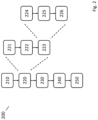
- FIG. 2 shows a schematic overview of an embodiment of the method according to the invention.
- FIG. 3 shows a schematic overview of an embodiment of the vehicle according to the invention.
- FIGS. 1 a and 1 b a schematic overview of a parking situation, in which the invention may be applied, is depicted.
- a vehicle 110 is parked next to vehicle 130 .
- Vehicle 110 and vehicle 130 may be vehicles without the capability of driving autonomously. In that case, these vehicles are not able to leave their parked position without a driver inside the car. Therefore, a standard minimum parking distance d 2 between vehicle 110 and vehicle 130 has been observed. This distance d 2 ensures that the vehicle door 140 may be opened sufficiently wide enough for the driver to enter vehicle 130 .
- Vehicle 120 may be a vehicle with the capability of driving autonomously. It may not be possible to observe the standard minimum parking distance d 2 with respect to vehicle 110 , when parking next to vehicle 110 . An adjusted minimum parking distance d 1 , smaller than distance d 2 , may also be acceptable, if vehicle 120 temporarily leaves its parked position when the driver of vehicle 110 wishes to enter vehicle 110 .
- a driver may express this wish by transmitting an unlock-signal 160 (for example from his car key or his smart phone) to vehicle 110 .
- unlock-signal may be detected by vehicle 110 and by vehicle 120 .
- vehicle 120 When the unlock-signal 160 detected by vehicle 120 is not for unlocking vehicle 110 but for unlocking vehicle 130 , vehicle 120 needs not to temporarily leave its parked position in order to allow the driver to enter its vehicle.
- the unlock-signal 160 it may be determined, for example by vehicle 120 , whether vehicle 120 parked parallelly and directly next to the vehicle for which the unlock-signal was transmitted, i.e. vehicle 110 .
- sensor 340 in vehicle 120 may be activated in response to unlock-signal 160 .
- Sensor 340 is arranged for detecting a signal transmitted by vehicle 110 , in response to unlock-signal 160 or in response to a second or further unlock-signal transmitted by the driver.
- the signal transmitted by vehicle 110 may be an indicator light signal, a TPMS signal, an ultrasonic park distance signal and/or any other electromagnetic signal.
- the signal may also be transmitted using so-called Vehicle-to-X-communication technologies.
- the sensor 340 may be a camera, an electromagnetic signal detector and/or an ultrasonic detector.
- the position and orientation of vehicle 110 with respect to vehicle 120 may be determined and thus whether vehicle 120 parked parallelly and directly next to the vehicle 110 .
- the position and orientation of vehicle 110 with respect to vehicle 120 may be determined on the basis of the direction and/or the intensity of the signal, and/or information comprised in the detected signal, such as a GPS position of vehicle 110 .
- the position and orientation of vehicle 110 with respect to vehicle 120 may have been determined by vehicle 120 when it was being parked next to vehicle 110 using its sensors for autonomous driving.
- sensors for autonomous driving. Examples for such sensors are cameras, LIDAR and/or RADAR devices.
- vehicle 120 When it has been determined that vehicle 120 is not parked parallelly and directly next to the vehicle for which the unlock-signal was intended, vehicle 120 will not autonomously drive out of its parked position (also referred to as the second position), i.e. it will stay in its parked position and continue to monitor whether it detects an unlock-signal.
- vehicle 120 will not autonomously drive out of its parked position (also referred to as the second position), i.e. it will stay in its parked position and continue to monitor whether it detects an unlock-signal.
- vehicle 120 When it has been determined that vehicle 120 is indeed parked parallelly and directly next to the vehicle 110 , vehicle 120 will autonomously drive at least partly out of its parked position, as is depicted in FIG. 1 b . This will allow the driver of vehicle 110 to open door 150 of vehicle 110 , i.e. it will allow the driver to enter his vehicle and to drive his vehicle out of its parked position (also referred to as the first position).
- vehicle 120 may return to its parked position, and thus vehicle 120 will drive autonomously back in its parked position.
- Vehicle 120 may use its sensors for autonomous driving for determining that vehicle 110 has left (at least partly) its parked position.
- FIG. 2 shows a schematic overview of an embodiment of the method 200 for driving autonomously out of a parked position by a vehicle 120 , comprising the steps of:
- FIG. 3 shows a schematic overview of an embodiment of vehicle 120 according to the invention.
- Vehicle 120 may comprise:
- the determination unit 320 may be further arranged for determining whether the first vehicle 110 has left at least partly said first position.
- the autonomous driving unit 330 may be further arranged for driving the second vehicle 120 autonomously back in said second position, when it is determined that the first vehicle 110 has left at least partly said first position.
- the vehicle 120 may comprise a sensor 340 arranged for being activated in response to said unlock-signal 160 and for detecting a signal, transmitted by said first vehicle 110 , in response to said unlock-signal or a further unlock-signal.
- the determination unit 320 may be arranged for determining whether said first and second vehicle are parked parallelly and directly next to each other, based on said detected signal.
- aspects of the present invention may be embodied as a system, device, method or computer program product. Accordingly, aspects of the present invention may take the form of an entirely hardware embodiment, an entirely software embodiment (including firmware, resident software, micro-code, etc.) or an embodiment combining software and hardware aspects that may all generally be referred to herein as a “unit”, “module”, “system”, “device” or “element”.
- aspects of the present invention may be implemented as an algorithm executed by a microprocessor of a computer.
- aspects of the present invention may take the form of a computer program product embodied in one or more computer readable medium(s) having computer readable program code embodied, e.g., stored, thereon.
Landscapes
- Engineering & Computer Science (AREA)
- Transportation (AREA)
- Mechanical Engineering (AREA)
- Automation & Control Theory (AREA)
- Chemical & Material Sciences (AREA)
- Combustion & Propulsion (AREA)
- Human Computer Interaction (AREA)
- Computer Networks & Wireless Communication (AREA)
- Signal Processing (AREA)
- Traffic Control Systems (AREA)
- Lock And Its Accessories (AREA)
Abstract
Description
-
- a) detecting an unlock-signal for unlocking a central locking system of a first vehicle parked at a first position, by a second vehicle parked at a second position;
- b) determining whether said first and second vehicle are parked parallelly and directly next to each other in response to said unlock-signal;
- c) if so, driving the second vehicle autonomously at least partly out of the second position, thereby allowing a driver of the first vehicle to enter the first vehicle and to drive the first vehicle at least partly out of said first position;
- d) determining whether the first vehicle has left at least partly said first position; and,
- e) if so, driving the second vehicle autonomously back in said second position.
-
- b1) activating a sensor in said second vehicle in response to said unlock-signal;
- b2) detecting, by said sensor, a signal, transmitted by said first vehicle, optionally in response to a further unlock-signal; and,
- b3) determining whether said first and second vehicle are parked parallelly and directly next to each other, based on said detected signal.
-
- b3a) determining a position and orientation of said first vehicle by said second vehicle;
- b3b) determining a position and orientation of said second vehicle by said second vehicle; and,
- b3c) determining whether said first and second vehicle are parked parallelly and directly next to each other, based on said determined position and orientation of said first vehicle and said determined position and orientation of said second vehicle,
-
- f) a detector arranged for detecting an unlock-signal for unlocking a central locking system of a first vehicle parked at a first position;
- g) a determination unit arranged for determining whether said first and second vehicle are parked parallelly and directly next to each other in response to said unlock-signal;
- h) an autonomous driving unit for driving the second vehicle autonomously at least partly out of the second position, when it is determined that said first and second vehicle are parked parallelly and directly next to each other,
- wherein said determination unit is further arranged for determining whether the first vehicle has left at least partly said first position; and,
- wherein said autonomous driving unit is further arranged for driving the second vehicle autonomously back in said second position, when it is determined that the first vehicle has left at least partly said first position.
-
- a sensor arranged for being activated in response to said unlock-signal and for detecting a signal, transmitted by said first vehicle, in response to said unlock-signal or a further unlock-signal,
- wherein said determination unit is arranged for determining whether said first and second vehicle are parked parallelly and directly next to each other, based on said detected signal.
-
- said sensor is a camera and said signal from said first vehicle is an indicator light signal; or,
- said sensor is an electromagnetic signal detector and said signal from said first vehicle is a TPMS signal; or,
- said sensor is an ultrasonic detector and said signal from said first vehicle is an ultrasonic park distance signal.
-
- Step 210: detecting an unlock-signal for a first vehicle parked at a first position by a second vehicle parked at a second position;
- Step 220: determining whether said first and second vehicle are parked parallelly and directly next to each other in response to said unlock-signal;
- Step 230: if so, driving the second vehicle autonomously at least partly out of the second position, thereby allowing a driver of the first vehicle to enter the first vehicle and to drive the first vehicle at least partly out of said first position;
- Step 240: determining whether the first vehicle has left at least partly said first position; and,
- Step 250: if so, driving the second vehicle autonomously back in said second position.
- Step 220 may comprise the following steps:
- Step 221: activating a sensor in said second vehicle in response to said unlock-signal;
- Step 222: detecting, by said sensor, a signal, transmitted by said first vehicle in response to said unlock signal or a further unlock-signal; and,
- Step 223: determining whether said first and second vehicle are parked parallelly and directly next to each other, based on said detected signal.
- Step 223 may comprise the following steps:
- Step 224: determining a position and orientation of said first vehicle by said second vehicle;
- Step 225: determining a position and orientation of said second vehicle by said second vehicle; and,
- Step 226: determining whether said first and second vehicle are parked parallelly and directly next to each other, based on said determined position and orientation of said first vehicle and said determined position and orientation of said second vehicle,
-
- a
detector 310 arranged for detecting an unlock-signal 160 for afirst vehicle 110 parked at a first position; - a
determination unit 320 arranged for determining whether said first and second vehicle are parked parallelly and directly next to each other in response to said unlock-signal 160; - an
autonomous driving unit 330 for driving thesecond vehicle 120 autonomously at least partly out of the second position, when it is determined that said first and second vehicle are parked parallelly and directly next to each other,
- a
Claims (14)
Applications Claiming Priority (3)
| Application Number | Priority Date | Filing Date | Title |
|---|---|---|---|
| DE102019215411.5 | 2019-10-08 | ||
| DE102019215411.5A DE102019215411B4 (en) | 2019-10-08 | 2019-10-08 | Procedure for driving out of a parked position autonomously |
| PCT/EP2020/077889 WO2021069392A1 (en) | 2019-10-08 | 2020-10-05 | Method for driving autonomously out of a parked position |
Publications (2)
| Publication Number | Publication Date |
|---|---|
| US20240109531A1 US20240109531A1 (en) | 2024-04-04 |
| US11987232B2 true US11987232B2 (en) | 2024-05-21 |
Family
ID=72752450
Family Applications (1)
| Application Number | Title | Priority Date | Filing Date |
|---|---|---|---|
| US17/767,412 Active US11987232B2 (en) | 2019-10-08 | 2020-10-05 | Method for driving autonomously out of a parked position |
Country Status (5)
| Country | Link |
|---|---|
| US (1) | US11987232B2 (en) |
| EP (1) | EP4041617B1 (en) |
| CN (1) | CN114466775B (en) |
| DE (1) | DE102019215411B4 (en) |
| WO (1) | WO2021069392A1 (en) |
Citations (15)
| Publication number | Priority date | Publication date | Assignee | Title |
|---|---|---|---|---|
| US20090043430A1 (en) | 2006-05-31 | 2009-02-12 | International Business Machines Corporation | Cooperative parking |
| JP2009166612A (en) * | 2008-01-15 | 2009-07-30 | Toyota Motor Corp | Parking assistance device |
| US20140244073A1 (en) | 2011-03-16 | 2014-08-28 | Toyota Jidosha Kabushiki Kaisha | Vehicle including automatic steering portion |
| US20150039173A1 (en) | 2013-07-31 | 2015-02-05 | Here Global B.V. | Method and appratus for causing an adjustment in parking position for vehicles |
| US20150149022A1 (en) | 2015-02-01 | 2015-05-28 | Thomas Danaher Harvey | Methods for dense parking of remotely controlled or autonomous vehicles |
| KR20160056435A (en) | 2014-11-11 | 2016-05-20 | 현대모비스 주식회사 | Apparatus, System and Method for Parking Assist |
| EP3261074A1 (en) | 2016-06-20 | 2017-12-27 | Volvo Car Corporation | Method for autonomous vehicle parking |
| GB2552020A (en) | 2016-07-08 | 2018-01-10 | Jaguar Land Rover Ltd | Apparatus and method for car park optimisation |
| GB2552407A (en) | 2016-07-08 | 2018-01-24 | Jaguar Land Rover Ltd | Apparatus and method for vehicle parking |
| US20180029642A1 (en) | 2015-03-11 | 2018-02-01 | Robert Bosch Gmbh | Method and device for providing an access option to a vehicle interior |
| US20180162384A1 (en) | 2016-12-09 | 2018-06-14 | Hyundai Motor Company | Autonomous parking assist apparatus and method for assisting parking using the same |
| US20180196420A1 (en) | 2017-01-09 | 2018-07-12 | Robert Bosch Gmbh | Method and apparatus for operating a motor vehicle parked at a first position |
| US20180336786A1 (en) * | 2017-05-19 | 2018-11-22 | Ford Global Technologies, Llc | Collision avoidance method and system |
| DE102017116753A1 (en) | 2017-07-25 | 2019-01-31 | Valeo Schalter Und Sensoren Gmbh | Parking with vehicle information of a secondary vehicle |
| CN110239522A (en) * | 2019-05-17 | 2019-09-17 | 浙江吉利控股集团有限公司 | A kind of automatic parking method, device and equipment |
Family Cites Families (5)
| Publication number | Priority date | Publication date | Assignee | Title |
|---|---|---|---|---|
| DE102014220298A1 (en) * | 2014-10-07 | 2016-04-07 | Bayerische Motoren Werke Aktiengesellschaft | Accident avoidance with subsequent traffic during an automated parking process in a transverse parking space |
| DE102014224099A1 (en) * | 2014-11-26 | 2016-06-02 | Robert Bosch Gmbh | Method and device for operating multiple vehicles |
| DE102016009921B4 (en) * | 2016-08-16 | 2018-12-06 | Elektrobit Automotive Gmbh | Technique for communication between a parking space limiting parked vehicle and a vehicle to be parked |
| US10286904B2 (en) * | 2017-06-12 | 2019-05-14 | GM Global Technology Operations LLC | Autonomous vehicle parking methods and systems |
| US10684625B2 (en) * | 2017-08-30 | 2020-06-16 | Robert Bosch Gmbh | Automated parking for virtual parking spot |
-
2019
- 2019-10-08 DE DE102019215411.5A patent/DE102019215411B4/en not_active Withdrawn - After Issue
-
2020
- 2020-10-05 CN CN202080067710.XA patent/CN114466775B/en active Active
- 2020-10-05 WO PCT/EP2020/077889 patent/WO2021069392A1/en not_active Ceased
- 2020-10-05 EP EP20786297.0A patent/EP4041617B1/en active Active
- 2020-10-05 US US17/767,412 patent/US11987232B2/en active Active
Patent Citations (16)
| Publication number | Priority date | Publication date | Assignee | Title |
|---|---|---|---|---|
| US20090043430A1 (en) | 2006-05-31 | 2009-02-12 | International Business Machines Corporation | Cooperative parking |
| JP2009166612A (en) * | 2008-01-15 | 2009-07-30 | Toyota Motor Corp | Parking assistance device |
| US20140244073A1 (en) | 2011-03-16 | 2014-08-28 | Toyota Jidosha Kabushiki Kaisha | Vehicle including automatic steering portion |
| US20150039173A1 (en) | 2013-07-31 | 2015-02-05 | Here Global B.V. | Method and appratus for causing an adjustment in parking position for vehicles |
| KR20160056435A (en) | 2014-11-11 | 2016-05-20 | 현대모비스 주식회사 | Apparatus, System and Method for Parking Assist |
| US20150149022A1 (en) | 2015-02-01 | 2015-05-28 | Thomas Danaher Harvey | Methods for dense parking of remotely controlled or autonomous vehicles |
| US20180029642A1 (en) | 2015-03-11 | 2018-02-01 | Robert Bosch Gmbh | Method and device for providing an access option to a vehicle interior |
| EP3261074A1 (en) | 2016-06-20 | 2017-12-27 | Volvo Car Corporation | Method for autonomous vehicle parking |
| GB2552407A (en) | 2016-07-08 | 2018-01-24 | Jaguar Land Rover Ltd | Apparatus and method for vehicle parking |
| GB2552020A (en) | 2016-07-08 | 2018-01-10 | Jaguar Land Rover Ltd | Apparatus and method for car park optimisation |
| US20180162384A1 (en) | 2016-12-09 | 2018-06-14 | Hyundai Motor Company | Autonomous parking assist apparatus and method for assisting parking using the same |
| US20180196420A1 (en) | 2017-01-09 | 2018-07-12 | Robert Bosch Gmbh | Method and apparatus for operating a motor vehicle parked at a first position |
| DE102017200158A1 (en) | 2017-01-09 | 2018-07-12 | Robert Bosch Gmbh | Method and device for operating a motor vehicle parked at a first position |
| US20180336786A1 (en) * | 2017-05-19 | 2018-11-22 | Ford Global Technologies, Llc | Collision avoidance method and system |
| DE102017116753A1 (en) | 2017-07-25 | 2019-01-31 | Valeo Schalter Und Sensoren Gmbh | Parking with vehicle information of a secondary vehicle |
| CN110239522A (en) * | 2019-05-17 | 2019-09-17 | 浙江吉利控股集团有限公司 | A kind of automatic parking method, device and equipment |
Non-Patent Citations (2)
| Title |
|---|
| International Search Report and Written Opinion dated Jan. 12, 2021 from corresponding International patent application No. PCT/EP2020/077889. |
| Office Action dated Aug. 6, 2020 from corresponding German patent application No. 10 2019 215 411.5. |
Also Published As
| Publication number | Publication date |
|---|---|
| EP4041617B1 (en) | 2023-06-07 |
| CN114466775A (en) | 2022-05-10 |
| EP4041617A1 (en) | 2022-08-17 |
| WO2021069392A1 (en) | 2021-04-15 |
| CN114466775B (en) | 2024-12-13 |
| DE102019215411B4 (en) | 2022-09-29 |
| US20240109531A1 (en) | 2024-04-04 |
| DE102019215411A1 (en) | 2021-04-08 |
Similar Documents
| Publication | Publication Date | Title |
|---|---|---|
| US12214781B2 (en) | Vehicular central monitoring system with central server | |
| US20230254451A1 (en) | Vehicular monitoring system with interior viewing camera and remote communication | |
| US10852741B2 (en) | Using cameras for detecting objects near a vehicle | |
| CN108216214B (en) | Automatic parking assistance device and method for assisting parking using the same | |
| CN105691293B (en) | A kind of automatic control system of automobile steering indicating light and method | |
| CN108928343A (en) | A kind of panorama fusion automated parking system and method | |
| US11097733B2 (en) | Apparatus and method for controlling reverse driving | |
| US20200254931A1 (en) | Vehicle-rendering generation for vehicle display based on short-range communication | |
| CN109703557B (en) | Rear lateral warning device and method for learning driving mode | |
| US10507827B2 (en) | Vehicle backup assistance system | |
| TWI557003B (en) | Image based intelligent security system for vehicle combined with sensor | |
| US9868422B2 (en) | Control apparatus of brake system and method of controlling the same | |
| US20180341259A1 (en) | Driver Assistance System for at Least Semi-Automatically Coupling a Two-Track Motor Vehicle to a Trailer | |
| EP4020405A1 (en) | Road lane condition detection with lane assist for a vehicle using infrared detecting device | |
| CN105015418B (en) | Vehicle-carrying display screen video switching method | |
| KR102113766B1 (en) | System and Method for Providing Black Box Function Using Wire and Wireless Gateway | |
| US12235656B2 (en) | Method for the autonomous operation of a following vehicle in a vehicle train | |
| US20230141584A1 (en) | Apparatus for displaying at least one virtual lane line based on environmental condition and method of controlling same | |
| US20240109531A1 (en) | Method for driving autonomously out of a parked position | |
| JP5506886B2 (en) | Vehicle periphery monitoring device | |
| US20210387635A1 (en) | Vehicle peripheral monitoring apparatus and method thereof | |
| KR102268106B1 (en) | Wireless signal receiving unit, rear sensor for vehicle and method for sensing rear | |
| US20250389748A1 (en) | Method for recording sudden unintended acceleration of a vehicle using a pedal black box and device for performing the method | |
| CN110395181A (en) | Vehicle monitoring system based on Vehicular video terminal | |
| KR20220028939A (en) | Method and apparatus for recoding an image using sound detection |
Legal Events
| Date | Code | Title | Description |
|---|---|---|---|
| FEPP | Fee payment procedure |
Free format text: ENTITY STATUS SET TO UNDISCOUNTED (ORIGINAL EVENT CODE: BIG.); ENTITY STATUS OF PATENT OWNER: LARGE ENTITY |
|
| AS | Assignment |
Owner name: CONTINENTAL AUTOMOTIVE GMBH, GERMANY Free format text: ASSIGNMENT OF ASSIGNORS INTEREST;ASSIGNOR:BIEGER, STEFAN;REEL/FRAME:059698/0183 Effective date: 20220224 |
|
| STPP | Information on status: patent application and granting procedure in general |
Free format text: DOCKETED NEW CASE - READY FOR EXAMINATION |
|
| STPP | Information on status: patent application and granting procedure in general |
Free format text: NOTICE OF ALLOWANCE MAILED -- APPLICATION RECEIVED IN OFFICE OF PUBLICATIONS |
|
| STPP | Information on status: patent application and granting procedure in general |
Free format text: PUBLICATIONS -- ISSUE FEE PAYMENT VERIFIED |
|
| STCF | Information on status: patent grant |
Free format text: PATENTED CASE |
|
| AS | Assignment |
Owner name: CONTINENTAL AUTOMOTIVE TECHNOLOGIES GMBH, GERMANY Free format text: ASSIGNMENT OF ASSIGNORS INTEREST;ASSIGNOR:CONTINENTAL AUTOMOTIVE GMBH;REEL/FRAME:070441/0899 Effective date: 20241211 |