US11970662B2 - Electrochromic element - Google Patents
Electrochromic element Download PDFInfo
- Publication number
- US11970662B2 US11970662B2 US16/941,732 US202016941732A US11970662B2 US 11970662 B2 US11970662 B2 US 11970662B2 US 202016941732 A US202016941732 A US 202016941732A US 11970662 B2 US11970662 B2 US 11970662B2
- Authority
- US
- United States
- Prior art keywords
- group
- electrochromic
- general formula
- compound
- carbon atoms
- Prior art date
- Legal status (The legal status is an assumption and is not a legal conclusion. Google has not performed a legal analysis and makes no representation as to the accuracy of the status listed.)
- Active, expires
Links
Images


Classifications
-
- C—CHEMISTRY; METALLURGY
- C09—DYES; PAINTS; POLISHES; NATURAL RESINS; ADHESIVES; COMPOSITIONS NOT OTHERWISE PROVIDED FOR; APPLICATIONS OF MATERIALS NOT OTHERWISE PROVIDED FOR
- C09K—MATERIALS FOR MISCELLANEOUS APPLICATIONS, NOT PROVIDED FOR ELSEWHERE
- C09K9/00—Tenebrescent materials, i.e. materials for which the range of wavelengths for energy absorption is changed as a result of excitation by some form of energy
- C09K9/02—Organic tenebrescent materials
-
- C—CHEMISTRY; METALLURGY
- C07—ORGANIC CHEMISTRY
- C07C—ACYCLIC OR CARBOCYCLIC COMPOUNDS
- C07C313/00—Sulfinic acids; Sulfenic acids; Halides, esters or anhydrides thereof; Amides of sulfinic or sulfenic acids, i.e. compounds having singly-bound oxygen atoms of sulfinic or sulfenic groups replaced by nitrogen atoms, not being part of nitro or nitroso groups
- C07C313/02—Sulfinic acids; Derivatives thereof
- C07C313/06—Sulfinamides
-
- C—CHEMISTRY; METALLURGY
- C07—ORGANIC CHEMISTRY
- C07F—ACYCLIC, CARBOCYCLIC OR HETEROCYCLIC COMPOUNDS CONTAINING ELEMENTS OTHER THAN CARBON, HYDROGEN, HALOGEN, OXYGEN, NITROGEN, SULFUR, SELENIUM OR TELLURIUM
- C07F9/00—Compounds containing elements of Groups 5 or 15 of the Periodic Table
- C07F9/02—Phosphorus compounds
- C07F9/547—Heterocyclic compounds, e.g. containing phosphorus as a ring hetero atom
- C07F9/553—Heterocyclic compounds, e.g. containing phosphorus as a ring hetero atom having one nitrogen atom as the only ring hetero atom
- C07F9/576—Six-membered rings
- C07F9/58—Pyridine rings
-
- G—PHYSICS
- G02—OPTICS
- G02F—OPTICAL DEVICES OR ARRANGEMENTS FOR THE CONTROL OF LIGHT BY MODIFICATION OF THE OPTICAL PROPERTIES OF THE MEDIA OF THE ELEMENTS INVOLVED THEREIN; NON-LINEAR OPTICS; FREQUENCY-CHANGING OF LIGHT; OPTICAL LOGIC ELEMENTS; OPTICAL ANALOGUE/DIGITAL CONVERTERS
- G02F1/00—Devices or arrangements for the control of the intensity, colour, phase, polarisation or direction of light arriving from an independent light source, e.g. switching, gating or modulating; Non-linear optics
- G02F1/01—Devices or arrangements for the control of the intensity, colour, phase, polarisation or direction of light arriving from an independent light source, e.g. switching, gating or modulating; Non-linear optics for the control of the intensity, phase, polarisation or colour
- G02F1/15—Devices or arrangements for the control of the intensity, colour, phase, polarisation or direction of light arriving from an independent light source, e.g. switching, gating or modulating; Non-linear optics for the control of the intensity, phase, polarisation or colour based on an electrochromic effect
- G02F1/1514—Devices or arrangements for the control of the intensity, colour, phase, polarisation or direction of light arriving from an independent light source, e.g. switching, gating or modulating; Non-linear optics for the control of the intensity, phase, polarisation or colour based on an electrochromic effect characterised by the electrochromic material, e.g. by the electrodeposited material
- G02F1/1516—Devices or arrangements for the control of the intensity, colour, phase, polarisation or direction of light arriving from an independent light source, e.g. switching, gating or modulating; Non-linear optics for the control of the intensity, phase, polarisation or colour based on an electrochromic effect characterised by the electrochromic material, e.g. by the electrodeposited material comprising organic material
-
- G—PHYSICS
- G02—OPTICS
- G02F—OPTICAL DEVICES OR ARRANGEMENTS FOR THE CONTROL OF LIGHT BY MODIFICATION OF THE OPTICAL PROPERTIES OF THE MEDIA OF THE ELEMENTS INVOLVED THEREIN; NON-LINEAR OPTICS; FREQUENCY-CHANGING OF LIGHT; OPTICAL LOGIC ELEMENTS; OPTICAL ANALOGUE/DIGITAL CONVERTERS
- G02F1/00—Devices or arrangements for the control of the intensity, colour, phase, polarisation or direction of light arriving from an independent light source, e.g. switching, gating or modulating; Non-linear optics
- G02F1/01—Devices or arrangements for the control of the intensity, colour, phase, polarisation or direction of light arriving from an independent light source, e.g. switching, gating or modulating; Non-linear optics for the control of the intensity, phase, polarisation or colour
- G02F1/15—Devices or arrangements for the control of the intensity, colour, phase, polarisation or direction of light arriving from an independent light source, e.g. switching, gating or modulating; Non-linear optics for the control of the intensity, phase, polarisation or colour based on an electrochromic effect
- G02F1/1514—Devices or arrangements for the control of the intensity, colour, phase, polarisation or direction of light arriving from an independent light source, e.g. switching, gating or modulating; Non-linear optics for the control of the intensity, phase, polarisation or colour based on an electrochromic effect characterised by the electrochromic material, e.g. by the electrodeposited material
- G02F1/1516—Devices or arrangements for the control of the intensity, colour, phase, polarisation or direction of light arriving from an independent light source, e.g. switching, gating or modulating; Non-linear optics for the control of the intensity, phase, polarisation or colour based on an electrochromic effect characterised by the electrochromic material, e.g. by the electrodeposited material comprising organic material
- G02F1/15165—Polymers
-
- C—CHEMISTRY; METALLURGY
- C09—DYES; PAINTS; POLISHES; NATURAL RESINS; ADHESIVES; COMPOSITIONS NOT OTHERWISE PROVIDED FOR; APPLICATIONS OF MATERIALS NOT OTHERWISE PROVIDED FOR
- C09K—MATERIALS FOR MISCELLANEOUS APPLICATIONS, NOT PROVIDED FOR ELSEWHERE
- C09K2211/00—Chemical nature of organic luminescent or tenebrescent compounds
- C09K2211/10—Non-macromolecular compounds
- C09K2211/1003—Carbocyclic compounds
- C09K2211/1007—Non-condensed systems
-
- C—CHEMISTRY; METALLURGY
- C09—DYES; PAINTS; POLISHES; NATURAL RESINS; ADHESIVES; COMPOSITIONS NOT OTHERWISE PROVIDED FOR; APPLICATIONS OF MATERIALS NOT OTHERWISE PROVIDED FOR
- C09K—MATERIALS FOR MISCELLANEOUS APPLICATIONS, NOT PROVIDED FOR ELSEWHERE
- C09K2211/00—Chemical nature of organic luminescent or tenebrescent compounds
- C09K2211/10—Non-macromolecular compounds
- C09K2211/1018—Heterocyclic compounds
Definitions
- the present disclosure relates to an electrochromic element.
- Electrochromism is a phenomenon where a redox reaction is performed reversibly to reversibly change a color.
- the electrochromism is typically realized by a redox reaction occurred in a structure where an ion-conducting electrolyte layer is formed between a pair of electrodes facing to each other and the space between the electrodes is filled with the electrolyte layer.
- a transparent display element is produced using such an electrochromic element, or when an element having a structure where three coloring layers of cyan (C), magenta (M), and yellow (Y) is produced using the electrochromic element, it is important that the element is constructed using a reduction-type electrochromic material whose neutral state is a transparent state, or an oxidation-type electrochromic material whose neutral state is a transparent state.
- organic electrochromic materials that can be colored in various colors owing to substituents are suitably used.
- the electrochromic material As the electrochromic material, a viologen derivative exhibiting an electrochromic phenomenon has been used, where a neutral state of the viologen derivative is a colorless transparent and coloring of the viologen derivative occurs in a reduced state, etc.
- titanium oxide is preferably used. It has been reported that high optical density or a high contrast ratio can be realized because a layer having an extremely high concentration of a viologen derivative can be formed by using titanium oxide particles are used as bearing particles of the electrochromic compound in a laminate structure.
- a solid layer of a viologen derivative Moreover, excellent response and memory effects can be obtained by forming a solid layer of a viologen derivative, and a resultant element has an advantageous over an electrochromic element including a layer using a liquid or gel obtained by dissolving a viologen derivative in a solvent.
- an electrochromic element for example, disclosed is an electrochromic element using an electrochromic layer, in which a viologen derivative is deposited on conductor or semiconductor nano-structures (see, for example, Japanese Unexamined Patent Application Publication No. 2017-107153).
- a Br ion (Br ⁇ ), a Cl ion (Cl ⁇ ), an I ion (I ⁇ ), an OTf (triflate) ion (OTf ⁇ ), a ClO 4 ion (ClO 4 ⁇ ), a PF 6 ion (PF 6 ⁇ ), and a BF 4 ion (BF 4 ⁇ ) are listed.
- an electrochromic element is also disclosed in Japanese Unexamined Patent Application Publication No. 2008-052172.
- a counter anion of a viologen derivative in the disclosed element a Br ion (Br ⁇ ), a Cl ion (Cl ⁇ ), a ClO 4 ion (ClO 4 ⁇ ), a PF 6 ion (PF 6 ⁇ ), a BF 4 ion (BF 4 ⁇ ), a TFSI ion (C 2 F 6 NO 4 S 2 ⁇ ), and FSI ion (CF 3 SO 3 ⁇ ) are listed.
- the disclosed counter anions are not particularly limited, and as specific examples, only Br ⁇ and Cl ⁇ are disclosed.
- the above-mentioned literatures do not disclose at all how various properties of an element change depending on types of counter anions for use.
- Japanese Translation of PCT International Application Publication No. 2018-508034 discloses an element formed by dissolving a viologen derivative in a solvent to form a gel, followed by laminating the gel.
- Japanese Unexamined Patent Application Publication No. 2017-206499 discloses a structure where a solution of a viologen derivative is sandwiched with electrodes.
- an aryl viologen derivative is disclosed in Japanese Patent No. 6456964.
- an anion of a viologen derivative in the disclosed elements or materials are listed, but the anion for use is not necessarily limited. Particularly, the above-mentioned literatures do not mention a difference in properties depending on a type of an anion for use. Although several specific anions are listed, as described, for example, in Japanese Translation of PCT international Application Publication No. 2002-524762, an anion for use is selected merely by a reason whether the anion is inert to a redox reaction in a device or not.
- an electrochromic element includes a first electrode, a second electrode disposed to face the first electrode with a gap between the first electrode and the second electrode, a first electrochromic layer disposed on or above the first electrode, where the first electrochromic layer includes conductor or semiconductor nano-structures and an electrochromic compound, and an electrolyte layer including an electrolyte, disposed between the first electrochromic layer and the second electrode.
- the electrochromic compound is a compound represented by General Formula 1, and an anion of the electrolyte is a monovalent anion having an oxidaization potential higher than a reduction potential of a dication of General Formula 1 by 3.1 V or greater.
- R 1 and R 2 are each a hydrogen atom, an aryl group having 14 or less carbon atoms, a heteroaryl group having 14 or less carbon atoms, a branched alkyl group having 10 or less carbon atoms, an alkenyl group having 10 or less carbon atoms, a cycloalkyl group having 10 or less carbon atoms, or a functional group that can bond to a hydroxyl group; and R 3 and R 4 are each an alkylene group having from 1 through 10 carbon atoms or an arylene group that may have a substituent and has 12 or less carbon atoms.
- Z is alkylene, cycloalkylene, or a divalent group represented by —R 7 —Y—R 8 (where R 7 and R 8 are each independently a single bond, alkylene, or cycloalkylene, and Y is arylene, cycloalkylene, heteroarylene, arylene-arylene, or arylene-CR′R′′-arylene, with the proviso that R′ and R′′ form a carbon ring group together with a carbon atom to which R′ and R′′ are bonded).
- the alkylene, the cycloalkylene, the arylene, the heteroarylene, and the carbon ring group may be substituted with one or more substituents selected from the group consisting of halogen, alkyl, alkoxy, alkyl thio, hydroxyalkyl, acyloxy, cycloalkyl, aryl, substituted aryl, aryloxy, heteroaryl, and substituted heteroaryl.
- “k” is 0 or 1.
- X ⁇ is a monovalent anion having an oxidation potential higher than a reduction potential of the dication of General Formula 1 by 3.1 V or greater.
- W 2+ is a dication represented by General Formula 2 below.
- o, p, and q are each independently 0 or 1; and A, B, and C are each independently an arylene group that may have a substituent and has from 2 through 20 carbon atoms, or a heterocycle group.
- an electrochromic element includes a first electrode, a second electrode disposed to face the first electrode with a gap between the first electrode and the second electrode, a first electrochromic layer in which an electrochromic compound is deposited on conductor or semiconductor nano-structures, where the first electrochromic layer is disposed on or above the first electrode, and an electrolyte layer disposed between the first electrochromic layer and the second electrode.
- the electrochromic compound is a compound represented by General Formula 1.
- R 1 and R 2 are each a hydrogen atom, an aryl group having 14 or less carbon atoms, a heteroaryl group having 14 or less carbon atoms, a branched alkyl group having 10 or less carbon atoms, an alkenyl group having 10 or less carbon atoms, a cycloalkyl group having 10 or less carbon atoms, or a functional group that can bond to a hydroxyl group; and R 3 and R 4 are each an alkylene group having from 1 through 10 carbon atoms, or an arylene group that may have a substituent and has 12 or less carbon atoms.
- Z is alkylene, cycloalkylene, or a divalent group represented by —R 7 —Y—R 8 (where R 7 and R 8 are each independently a single bond, alkylene, or cycloalkylene, and Y is arylene, cycloalkylene, heteroarylene, arylene-arylene, or arylene-CR′R′′-arylene, with the proviso that R′ and R′′ form a carbon ring group together with a carbon atom to which R′ and R′′ are bonded).
- the alkylene, the cycloalkylene, the arylene, the heteroarylene, and the carbon ring group may be substituted with one or more substituents selected from the group consisting of halogen, alkyl, alkoxy, alkyl thio, hydroxyalkyl, acyloxy, cycloalkyl, aryl, substituted aryl, aryloxy, heteroaryl, and substituted heteroaryl.
- “k” is 0 or 1.
- W 2+ is a dication represented by General Formula 2 below.
- o, p, and q are each independently 0 or 1; and A, B, and C are each independently an arylene group that may have a substituent and has from 2 through 20 carbon atoms, or a heterocycle group.
- FIG. 1 is a schematic view illustrating a structural example of an electrochromic element of the present disclosure.
- a viologen derivative can be used in a solution system without being particularly affected by a type of an anion of the viologen derivative is that a viologen derivative is not actually present as a complex or an ionic couple in a solution system, but the viologen derivative is dissolved in a solvent to cause ionic dissociation and is present as solvated free cations. Therefore, the viologen derivative exhibits the same behaviors as the viologen derivative cation regardless of a type of the original counter ion.
- properties of the viologen derivative are largely influenced by a type of a counter anion in an environment where the viologen derivative is present as an ionic couple or a complex, hardly any solvent or ions are present between molecules of the viologen derivative, or the viologen derivative is present at an extremely high concentration.
- the above-mentioned environment is a state where the viologen derivative is in a solid state, or is born on a carrier.
- one of typical examples thereof is an electrochromic element using an electrochromic layer, in which the viologen derivative is deposited on conductor or semiconductor nano-structures.
- the present inventors have found that a large change in properties of an electrochromic element depending on a counter anion of the viologen derivative is a unique problem associated with an electrochromic element using an electrochromic layer including the viologen derivative and conductor or semiconductor nano-structures.
- the present inventors have diligently researched on a type of a counter anion for a dicatioin of an electrochromic element that has an electrochromic layer including a specific dication (a compound represented by General Formula 1), such as a viologen derivative, and conductor or semiconductor nano-structures. As a result, the present inventors have found that transparency of an electrochromic element in a bleached state changes depending on a type of a counter anion for use.
- a specific dication a compound represented by General Formula 1
- R 1 and R 2 are each a hydrogen atom, an aryl group having 14 or less carbon atoms, a heteroaryl group having 14 or less carbon atoms, a branched alkyl group having 10 or less carbon atoms, an alkenyl group having 10 or less carbon atoms, a cycloalkyl group having 10 or less carbon atoms, or a functional group that can bond to a hydroxyl group; and R 3 and R 4 are each an alkylene group having from 1 through 10 carbon atoms or an arylene group that may have a substituent and has 12 or less carbon atoms.
- Z is alkylene, cycloalkylene, or a divalent group represented by —R 7 —Y—R 8 (where R 7 and R 8 are each independently a single bond, alkylene, or cycloalkylene, and Y is arylene, cycloalkylene, heteroarylene, arylene-arylene, or arylene-CR′R′′-arylene, where R′ and R′′ form a carbon ring group together with a carbon atom to which R′ and R′′ are bonded), where the alkylene, the cycloalkylene, the arylene, the heteroarylene, and the carbon ring group may be substituted with one or more substituents selected from the group consisting of halogen, alkyl, alkoxy, alkyl thio, hydroxyalkyl, acyloxy, cycloalkyl, aryl, substituted aryl, aryloxy, heteroaryl, and substituted heteroaryl.
- “k” is 0 or 1.
- X ⁇ is an ion neutralizing the charge.
- W 2+ is a dication represented by General Formula 2.
- o, p, and q are each independently 0 or 1; and A, B, and C are each independently an arylene group that may have a substituent and has from 2 through 20 carbon atoms, or a heterocycle group.
- having high transparency in a bleached state means that the first electrochromic layer has a low yellow index (YI) value.
- YI yellow index
- high transparency is achieved in a bleached state as long as the YI value of the first electrochromic layer is kept low even through the YI value of the device itself may be high due to a color of the electrode.
- the present disclosure has an object to provide an electrochromic element having high transparency in a bleached state.
- the present disclosure can provide an electrochromic element having high transparency in a bleached state.
- the electrochromic element includes a first electrode 101 , a second electrode 102 , an electrolyte layer 103 , a first electrochromic layer 104 , and a second electrochromic layer 105 .
- an electrochromic element of the present disclosure include the following first embodiment and second embodiment.
- a first embodiment of the electrochromic element of the present disclosure includes a first electrode, a first electrode, a second electrode disposed to face the first electrode with a gap between the first electrode and the second electrode, a first electrochromic layer in which an electrochromic compound is deposited on conductor or semiconductor nano-structures, where the first electrochromic layer is disposed on or above the first electrode, and an electrolyte layer disposed between the first electrochromic layer and the second electrode.
- the electrochromic compound is a compound represented by General Formula 1.
- R 1 and R 2 are each a hydrogen atom, an aryl group having 14 or less carbon atoms, a heteroaryl group having 14 or less carbon atoms, a branched alkyl group having 10 or less carbon atoms, an alkenyl group having 10 or less carbon atoms, a cycloalkyl group having 10 or less carbon atoms, or a functional group that can bond to a hydroxyl group; and R 3 and R 4 are each an alkylene group having from 1 through 10 carbon atoms or an arylene group that may have a substituent and has 12 or less carbon atoms.
- Z is alkylene, cycloalkylene, or a divalent group represented by —R 7 —Y—R 8 (where R 7 and R 8 are each independently a single bond, alkylene, or cycloalkylene, and Y is arylene, cycloalkylene, heteroarylene, arylene-arylene, or arylene-CR′R′′-arylene, where R′ and R′′ form a carbon ring group together with a carbon atom to which R′ and R′′ are bonded), where the alkylene, the cycloalkylene, the arylene, the heteroarylene, and the carbon ring group may be substituted with one or more substituents selected from the group consisting of halogen, alkyl, alkoxy, alkyl thio, hydroxyalkyl, acyloxy, cycloalkyl, aryl, substituted aryl, aryloxy, heteroaryl, and substituted heteroaryl.
- “k” is 0 or 1.
- X ⁇ is a monovalent anion having an oxidation potential higher than a reduction potential of the dication of General Formula 1 by 3.1 V or greater (may be referred to as a “high oxidation potential anion” hereinafter).
- W 2+ is a dication represented by General Formula 2.
- o, p, and q are each independently 0 or 1; and A, B, and C are each independently an arylene group that may have a substituent and has from 2 through 20 carbon atoms, or a heterocycle group.
- the first electrochromic layer is obtained by depositing the electrochromic compound on the conductor or semiconductor nano-structures.
- the high oxidation potential anion is used as an anion of the electrochromic compound, when the electrochromic compound is deposited on the conductor or semiconductor nano-structures to form the first electrochromic layer.
- the electrochromic elements of Examples of the present specification could have low YI values during production of the elements owing to the high oxidation potential anion, and the state of the low YI value was maintained for a long period.
- the electrochromic elements of Comparative Examples of the present specification each had a high YI value during production of the elements owing to the low oxidation potential, and the state of high YI value was maintained for a long period.
- ion exchange between anions in the electrolyte layer and anions in the first electrochromic layer occurs after production of an electrochromic element.
- the degree of the ion exchange is not known, but it is expected that ion exchange occurs at the degree of about 50% or greater. Therefore, ion exchange between the anions included in the electrolyte layer at the time of production of the device and the anions included in the first electrochromic layer at the time of production of the element is performed at a certain degree. Even in the electrochromic elements of Comparative Examples of the present specification, as a result, the anions included in the electrolyte layer are included in the first electrochromic layer after the production of the electrochromic element.
- the high oxidation potential anions were used for forming the electrolyte layer.
- the high oxidation potential anions are present in the first electrochromic layer of the electrochromic element of each Comparative Example after the ion exchange, but the state of the YI value high enough to distinguish from the YI value of each Example was maintained.
- the first electrochromic layer is formed by depositing the electrochromic compound on the conductor or semiconductor nano-structures.
- the notable point is that the high oxidation potential anion is used as an anion of the electrochromic compound, when a first electrochromic layer is formed by depositing the electrochromic compound on the conductor or semiconductor nano-structures.
- the above-described point is particularly notable when anions used for forming an electrolyte layer is not particularly limited.
- a second embodiment of the electrochromic element of the present disclosure includes a first electrode, a second electrode disposed to face the first electrode with a gap between the first electrode and the second electrode, a first electrochromic layer disposed on or above the first electrode, where the first electrochromic layer includes conductor or semiconductor nano-structures and an electrochromic compound, and an electrolytelayer including an electrolyte, disposed between the first electrochromic layer and the second electrode.
- the electrochromic compound is a compound represented by General Formula 1 below.
- An anion of the electrolyte is a monovalent anion having an oxidation potential that is higher than a reduction potential of the dication of General Formula 1 by 3.1 V or greater.
- R 1 and R 2 are each a hydrogen atom, an aryl group having 14 or less carbon atoms, a heteroaryl group having 14 or less carbon atoms, a branched alkyl group having 10 or less carbon atoms, an alkenyl group having 10 or less carbon atoms, a cycloalkyl group having 10 or less carbon atoms, or a functional group that can bond to a hydroxyl group;
- R 3 and R 4 are each an alkylene group having from 1 through 10 carbon atoms or an arylene group that may have a substituent and has 12 or less carbon atoms.
- Z is alkylene, cycloalkylene, or a divalent group represented by —R 7 —Y—R 8 (where R 7 and R 8 are each independently a single bond, alkylene, or cycloalkylene, and Y is arylene, cycloalkylene, heteroarylene, arylene-arylene, or arylene-CR′R′′-arylene, where R′ and R′′ form a carbon ring group together with a carbon atom to which R′ and R′′ are bonded), where the alkylene, the cycloalkylene, the arylene, the heteroarylene, and the carbon ring group may be substituted with one or more substituents selected from the group consisting of halogen, alkyl, alkoxy, alkyl thio, hydroxyalkyl, acyloxy, cycloalkyl, aryl, substituted aryl, aryloxy, heteroaryl, and substituted heteroaryl; and k is 0 or 1.
- X ⁇ is a monovalent anion having an oxidation potential higher than a reduction potential of the dication of General Formula 1 by 3.1 V or greater.
- W 2+ is a dication represented by General Formula 2.
- o, p, and q are each independently 0 or 1; and A, B, and C are each independently an arylene group that may have a substituent and has from 2 through 20 carbon atoms, or a heterocycle group.
- a device having excellent transparency can be obtained even when anions of an electrochromic compound and anions of an electrolyte are ion-exchanged within the device.
- the first electrochromic layer includes conductor or semiconductor nano-structures, and an electrochromic compound on or above the first electrode.
- the first electrochromic layer is not particularly limited and may be appropriately selected depending on the intended purpose, as long as the first electrochromic layer includes conductor or semiconductor nano-structures and the electrochromic compound.
- the first electrochromic layer is preferably an electrochromic layer in a state where the electrochromic compound is deposited on the conductor or semiconductor nano-structures.
- the first electrochromic layer is preferably an electrochromic layer in which the electrochromic compound is deposited on the conductor or semiconductor nano-structures.
- the electrochromic compound of the first electrochromic layer is a compound represented by General Formula 1.
- An anion of an electrolyte in an electrolyte layer including the electrolyte is a monovalent anion having an oxidation potential higher than a reduction potential of the dication in General Formula 1 by 3.1 V or greater.
- the high oxidation potential anion is used as an anion of the electrochromic compound when the electrochromic layer is deposited on the conductor or semiconductor nano-structure to form a first electrochromic layer. It is particularly desirable when anions used for forming an electrolyte layer are not limited.
- an anion of an electrolyte in an electrolyte layer is the high oxidation potential anion.
- anions present in the first electrochromic layer and electrolyte layer are only the anions of high oxidation potential. Even if ion exchange between the anions occurs, therefore, a state of the high oxidation potential anion present in the first electrochromic layer and a state of the high oxidation potential anion present in the electrolyte layer hardly change.
- the electrochromic compound in the first electrochromic layer is a compound represented by General Formula 1 and an anion of the electrolyte is a monovalent anion having an oxidation potential higher than a reduction potential of the dication in General Formula 1 by 3.1 V or greater before or after anion exchange is performed between the first electrochromic layer and the electrolyte layer.
- the electrolyte layer may include the low oxidation potential anion in a trace up to about 10 mol % relative to a total amount of anions
- the first electrochromic layer may include the low oxidation potential anion in a trace up to about 10 mol % relative to a total amount of anions.
- the first electrochromic layer is formed by depositing the electrochromic compound on the conductor or semiconductor nano-structures.
- the first electrochromic layer includes conductor or semiconductor nano-structures, and an electrochromic compound.
- the first electrochromic layer is preferably formed by depositing an electrochromic compound on conductor or semiconductor nano-structures.
- the term “deposited” or “depositing” means a chemically bonded state, such as via a covalent bond and an ionic bond, a physically adsorbed state due to a hydrogen bond or intermolecular forces, or a state where particles or amorphous solids are physically deposited.
- the state of “deposited” or “depositing” is not limited to the above-listed examples.
- the first electrochromic layer As a formation method of the first electrochromic layer, for example, vacuum vapor deposition, sputtering, ion plating, etc., can be used.
- a material of the first electrochromic layer is a material that can be formed by coating
- usable are various printing methods, such as spin coating, casting, microgravure coating, gravure coating, bar coating, roll coating, wire bar coating, dip coating, slit coating, capillary coating, spray coating, nozzle coating, gravure printing, screen printing, flexo printing, offset printing, reverse printing, and inkjet printing.
- a first electrochromic layer in which an electrochromic compound is deposited on conductor or semiconductor nano-structures, can be formed by forming a first electrochromic layer according to the method disclosed in Examples of the present specification.
- the average thickness of the first electrochromic layer is not particularly limited and may be appropriately selected depending on the intended purpose.
- the average thickness thereof is preferably 0.2 ⁇ m or greater but 5.0 ⁇ m or less. When the average thickness thereof is 0.2 ⁇ m or greater, high coloring density can be obtained. When the average thickness thereof is 5.0 ⁇ m or less, a production cost can be kept low, and visibility tends not to deteriorate due to coloring.
- the first electrochromic layer can be formed of a vacuum deposition film, but the first electrochromic layer is preferably formed by applying a particle dispersion paste in view of productivity.
- the first electrochromic layer is disposed on or above the first electrode. Only one layer thereof may be disposed, or two or more layers thereof may be disposed.
- the electrochromic compound may be deposited after forming the conductor or semiconductor nano-structures.
- a formation method of the conductor or semiconductor nano-structure may be the same as the formation method of the first electrochromic layer.
- a deposition method of the electrochromic compound for example, vacuum vapor deposition, sputtering, ion plating, etc., can be used.
- various printing method such as spin coating, casting, microgravure coating, gravure coating, bar coating, roll coating, wire bar coating, dip coating slit coating, capillary coating, spray coating, nozzle coating, gravure printing, screen printing, flexo printing, offset printing, reverse printing, and inkjet printing.
- the conductor or semiconductor nano-structures of the present disclosure are structures having irregularities of nano-scale, such as nano particles, and nano-porous structures.
- a material constituting the conductor or semiconductor nano-structure is preferably metal oxide in view of transparency and conductivity.
- the metal oxide include metal oxides each including, as a main component, titanium oxide, zinc oxide, tin oxide, zirconium oxide, cerium oxide, yttrium oxide, boron oxide, magnesium oxide, strontium titanate, potassium titanate, barium titanate, calcium titanate, calcium oxide, ferrite, hafnium oxide, tungsten oxide, iron oxide, copper oxide, nickel oxide, cobalt oxide, barium oxide, strontium oxide, vanadium oxide, aluminosilicate, calcium phosphate, or aluminosilicate.
- the above-listed metal oxides may be used alone or in combination.
- response speed for coloring and bleaching is excellent when at least one selected from the group consisting of metal oxides, such as titanium oxide, zinc oxide, tin oxide, zirconium oxide, iron oxide, magnesium oxide, indium oxide, and tungsten oxide, or a mixture thereof, is used. Particularly, response speed for coloring and bleaching is excellent when titanium oxide is used.
- metal oxide particles having the average primary particle diameter of 30 nm or less. Light transmittance of metal oxide improves as the particle diameter is smaller.
- a shape thereof giving a large surface area per unit volume (referred to as “specific surface area” hereinafter) is used. Since the metal oxide particles have a large specific surface area, the electrochromic compound is more efficiently born thereon, and a resultant device enables a multi-color display having an excellent display contrast ratio between coloring and bleaching.
- the specific surface area of the nano structure is not particularly limited. For example, the specific surface area thereof is 100 m 2 /g or greater.
- the electrochromic compound of the present disclosure is a compound represented by General Formula 1 below.
- R 1 and R 2 are each a hydrogen atom, an aryl group having 14 or less carbon atoms, a heteroaryl group having 14 or less carbon atoms, a branched alkyl group having 10 or less carbon atoms, an alkenyl group having 10 or less carbon atoms, a cycloalkyl group having 10 or less carbon atoms, or a functional group that can bond to a hydroxyl group; and R 3 and R 4 are each an alkylene group having from 1 through 10 carbon atoms or an arylene group that may have a substituent and has 12 or less carbon atoms.
- Z is alkylene, cycloalkylene, or a divalent group represented by —R 7 —Y—R 8 (where R 7 and R 8 are each independently a single bond, alkylene, or cycloalkylene, and Y is arylene, cycloalkylene, heteroarylene, arylene-arylene, or arylene-CR′R′′-arylene, where R′ and R′′ form a carbon ring group together with a carbon atom to which R′ and R′′ are bonded), where the alkylene, the cycloalkylene, the arylene, the heteroarylene, and the carbon ring group may be substituted with one or more substituents selected from the group consisting of halogen, alkyl, alkoxy, alkyl thio, hydroxyalkyl, acyloxy, cycloalkyl, aryl, substituted aryl, aryloxy, heteroaryl, and substituted heteroaryl; and k is 0 or 1.
- X ⁇ is a monovalent anion having an oxidation potential higher than a reduction potential of the dication of General Formula 1 by 3.1 V or greater.
- W 2+ is a dication represented by General Formula 2.
- o, p, and q are each independently 0 or 1; and A, B, and C are each independently an arylene group that may have a substituent and has from 2 through 20 carbon atoms, or a heterocycle group.
- W 2+ is a site that exhibits an electrochromic function and causes color changes owing to oxidation and reduction of the site.
- R 1 , R 2 , R 3 , R 4 and Z do not contribute to the electrochromic function and also do not hinder the electrochromic function of W 2+ .
- the more preferred embodiment is that at least either R 1 or R 2 is a functional group that can bond to a hydroxyl group.
- the electrochromic compound can be easily deposited on the conductor or semiconductor nano-structures.
- both R 1 and R 2 are each a functional group that can bond to a hydroxyl group. According to the further more preferred embodiment, the bond formed becomes even stronger and therefore the electrochromic compound is less likely to be detached in the element, leading to improved reliability.
- R 1 or R 2 is a functional group that can bond to a hydroxyl group. According to the above-mentioned embodiment, the larger amount of the electrochromic compound can be deposited on the conductor or semiconductor nano-structures, leading to improved coloring density.
- Examples of the functional group that can bond to a hydroxyl group include a phosphonic acid group, a phosphoric acid group, a carboxylic acid group, a sulfonyl group, a silyl group, and a silanol group.
- a phosphonic acid group, a phosphoric acid group, and a carboxylic acid group are preferable, and a phosphonic acid group is more preferable in view of easiness of synthesis, adsorption of the electrochromic compound to bearing particles, and stability of the electrochromic compound.
- silyl group examples include the following alkoxysilyl group.
- R 100 is an alkyl group having from 1 through 4 carbon atoms
- R 101 is an alkoxy group having from 1 through 4 carbon atoms
- n is an integer of from 0 to 2.
- all of R 100 may be identical or different.
- all of OR 101 may be identical or different.
- R 1 or R 2 are preferably a phosphonic acid group, a phosphoric acid group, a carboxylic acid group, a sulfonyl group, a silyl group, or a silanol group in General Formula 1.
- Use of such groups can make a resultant electrochromic compound easily deposited on the conductor or semiconductor nano-structures.
- the bind between the electrochromic compound and the conductor or semiconductor nano-structures is strong, which reduces possibility for the electrochromic compound to detach from the conductor or semiconductor nano-structure in the element, and therefore reliability can be improved, for example, when R 1 and R 2 (i.e., both R 1 and R 2 ) are any of a phosphonic acid group, a phosphoric acid group, a carboxylic acid group, a sulfonyl group, a silyl group, or a silanol group in General Formula 1.
- R 1 or R 2 when one of R 1 or R 2 is any of a phosphonic acid group, a phosphoric acid group, a carboxylic acid group, a sulfonyl group, a silyl group, or a silanol group, and the the other is a hydrogen atom, an aryl group having 14 or less carbon atoms, a heteroaryl group having 14 or less carbon atoms, a branched alkyl group having 10 or less carbon atoms, an alkenyl group having 10 or less carbon atoms, or a cycloalkyl group having 10 or less carbon atoms, the larger amount of the electrochromic compound can be deposited on the conductor or semiconductor nano-structures, and therefore coloring density can be improved.
- the electrochromic compound When the electrochromic compound includes, as a functional group, a phosphonic acid group, a phosphoric acid group, a carboxyl group, or a sulfonyl group, the electrochromic compound can be deposited on the nano-structures more easily.
- the electrochromic compound includes a silyl group, a silanol group, etc.
- the electrochromic compound is deposited via a siloxane bond, and therefore the bond between the electrochromic compound and the nano-structure becomes strong. As a result, a stable electrochromic layer can be obtained.
- the siloxane bond is a chemical bond via a silicon atom and an oxygen atom.
- Examples of the phosphonic acid group include a methyl phosphonic acid group, an ethyl phosphonic acid group, a propyl phosphonic acid group, a hexyl phosphonic acid group, an octyl phosphonic acid group, a decyl phosphonic acid group, a dodecyl phosphonic acid group, an octadecyl phosphonic acid group, a benzyl phosphonic acid group, a phenylethyl phosphonic acid group, a phenylpropyl phosphonic acid group, and a biphenyl phosphonic acid group.
- Examples of the phosphoric acid group include a methyl phosphoric acid group, an ethyl phosphoric acid group, a propyl phosphoric acid group, a hexyl phosphoric acid group, an octyl phosphoric acid group, a decyl phosphoric acid group, a dodecyl phosphoric acid group, an octadecyl phosphoric acid group, a benzyl phosphoric acid group, a phenylethyl phosphoric acid group, a phenylpropyl phosphoric acid group, and a biphenyl phosphoric acid group.
- Examples of the carboxylic acid group include a methyl carboxylic acid group, an ethyl carboxylic acid group, a propyl carboxylic acid group, a hexyl carboxylic acid group, an octyl carboxylic acid group, a decyl carboxylic acid group, a dodecyl carboxylic acid group, an octadecyl carboxylic acid group, a benzyl carboxylic acid group, a phenylethyl carboxylic acid group, a phenylpropyl carboxylic acid group, a biphenyl carboxylic acid group, a 4-propylphenylcarboxylic acid group, and a 4-propylbiphenylcarboxylic acid group.
- sulfonyl group examples include a methylsulfonyl group, an ethylsulfonyl group, a propylsulfonyl group, a hexylsulfonyl group, an octylsulfonyl group, a decylsulfonyl group, a dodecylsulfonyl group, an octadecylsulfonyl group, a benzylsulfonyl group, a phenylethylsulfonyl group, a phenylpropylsulfonyl group, and a biphenylsulfonyl group.
- silyl group examples include a methylsilyl group, an ethylsilyl group, a propylsilyl group, a hexylsilyl group, an octylsilyl group, a decylsilyl group, a dodecylsilyl group, an octadecylsilyl group, a benzylsilyl group, a phenylethylsilyl group, a phenylpropylsilyl group, and a biphenylsilyl group.
- silanol group examples include a methylsilanol group, an ethylsilanol group, a propylsilanol group, a hexylsilanol group, an octylsilanol group, a decylsilanol group, a dodecylsilanol group, an octadecylsilanol group, a benzylsilanol group, a phenylethylsilanol group, a phenylpropylsilanol group, and a biphenylsilanol group.
- Z is preferably selected from the group consisting of C1-C12 alkylene, C3-C7 cycloalkylene, C3-C14 arylene, C5-C10 heteroarylene, (C1-C4 alkylene)-(C3-C14 arylene), (C1-C4 alkylene)-(C3-C14 heteroarylene), (C1-C4 alkylene)-(C3-C14 arylene)-(C1-C4 alkylene), (C1-C4 alkylene)-(C3-C14 heteroarylene)-(C1-C4 alkylene), (C3-C14 arylene)-(C3-C14 arylene), (C1-C4 alkylene)-(C3-C14 arylene)-(C3-C14 arylene), (C1-C4 alkylene)-(C3-C14 arylene)-(C3-C14 arylene)-(C1-C4 alkylene), and (
- the arylene and cycloalkylene group may be each substituted with one or more substituents selected from halogen, C1-C4 alkyl, C1-C4 alkoxy, and C3-C7 cycloalkyl.
- the alkylene group may be substituted with one or more substituents selected from halogen, C3-C14 alkyl, C1-C12 alkoxy, C2-C12 acyloxy, C1-C12 hydroxyalkyl, C3-C12 cycloalkyl, phenyl, phenyloxy, and substituted phenyl.
- the substituted alkylene include —CH 2 (CRaRb)CH 2 —, where Ra and Rb are each independently selected from the group consisting of H, C3-C14 alkyl, C3-C12 cycloalkyl, (cycloalkyl)methyl, aryl, substituted aryl, arylalkyl (e.g., benzyl or phenyl(C2-C7 alkyl)), phenyloxyethyl, substituted arylalkyl, C1-C12 alkoxy, C2-C12 acyloxy, C1-C12 hydroxyalkyl, and C1-C12 alkoxymethyl.
- Ra and Rb are each independently selected from the group consisting of H, C3-C14 alkyl, C3-C12 cycloalkyl, (cycloalkyl)methyl, aryl, substituted aryl, arylalkyl (e.g., benzyl or phenyl(C2-C7 al
- Z is more preferably selected from the group consisting of C1-C12 alkylene, aryl-substituted C1-C12 alkylene, phenylene, naphthylene, (C1-C4 alkylene)-phenylene-(C1-C4 alkylene), (C1-C4 alkylene)-naphthylene-(C1-C4 alkylene) (e.g., naphthylene bis(methylene)), quinoxaline-2,3-diyl, (C1-C4 alkylene)-quinoxaline-2,3-diyl-(C1-C4 alkylene) (e.g., quinoxaline-2,3-diylbis(methylene)), phenylene-phenylene, (C1-C4 alkylene)-phenylene-phenylene-phenylene-(C1-C4 alkylene) and phenylene-fluorenylene-phenylene.
- Z examples include —CH 2 —, —(CH 2 ) 2 ⁇ , —(CH 2 ) 3 ⁇ , —(CH 2 ) 4 ⁇ , —(CH 2 ) 5 ⁇ , —CH 2 —CH(CH 3 )—CH 2 —, —CH 2 —CH(CH 2 phenyl)-CH 2 —, —(CH 2 ) 2 —CH(CH 3 )—CH 2 —, —(CH 2 ) 3 —CH(CH 3 )—CH 2 —, and —(CH 2 ) 2 —CH(CH 3 )—(CH 2 ) 2 —.
- Z in General Formula 1 is preferably any of those represented by the following structural formulae.
- the oxidation potential of X ⁇ of General Formula 1 is higher than a reduction potential of the dication of General Formula 1 by 3.1 V or greater.
- X ⁇ has a monovalent anion having the oxidation potential that is higher than reduction potential of the dication of General Formula 1 by 3.1 V or greater.
- the oxidation potential of X ⁇ is not higher than the reduction potential of the dication of General Formula 1 by 3.1 V or greater, slight coloring may occur in a bleached state of an element, which may reduce transparency of the element.
- the anion and the dication may form a charge transfer (CT) complex and light of a certain wavelength range may be absorbed due to CT transition.
- CT charge transfer
- the absorption wavelength due to the CT transition is longer than 400 nm, namely, the energy level difference between the lowest unoccupied molecular orbital (LUMO) of the anion and the highest occupied molecular orbital (HOMO) of the dication is less than 3.1 eV (i.e., a potential difference between the oxidation potential of the anion and the reduction potential of the dication is less than 3.1 V)
- the electrochromic element is tinted when observed with naked eyes and therefore it is not preferable. In this case, reduction in transmittance especially at a short wavelength range often results in yellowing of an element.
- Examples of X ⁇ achieving a potential difference of 3.1 V or greater between the oxidation potential of the anion and reduction potential of the dication include (FSO 2 ) 2 N ⁇ , (CFSO 2 ) 2 N ⁇ , (CN) 4 B ⁇ , BF 4 ⁇ , CF 3 BF 3 ⁇ , PF 6 ⁇ , ClO 4 ⁇ , (C 2 F 5 SO 2 ) 2 N ⁇ , (C 4 F 9 SO 2 ) 2 N ⁇ , CF 3 SO 3 , C 2 F 5 SO 3 , C 4 F 9 SO 3 , (C 2 F 5 ) 3 PF 3 ⁇ , and (CF 3 SO 2 ) 3 C ⁇ .
- the above-listed examples may be used alone or in combination.
- X ⁇ is at least one selected from the group consisting of (FSO 2 ) 2 N ⁇ , (CF 3 SO 2 ) 2 N ⁇ , (CN) 4 B ⁇ , BF 4 ⁇ , PF 6 ⁇ , and ClO 4 ⁇ .
- the above-listed anions are large enough to easily form a CT complex with a dication, and are stable. Moreover, the above-listed anions are not too large so that sufficient response speed can be obtained. Therefore, an electrochromic element having excellent response as well as excellent transparency can be obtained using any of the above-listed anions.
- X ⁇ is at least one selected from the group consisting of (FSO 2 ) 2 N ⁇ , and (CF 3 SO 2 ) 2 N ⁇ .
- the above-listed anions have especially excellent stability and response, and therefore use of the above-listed anions can achieve an element having improved durability.
- X ⁇ is (CF 3 SO 2 ) 2 N ⁇ (may be referred to as (TFSI) hereinafter). Since (CF 3 SO 2 ) 2 N ⁇ is used, an element that can realize the higher coloring density can be obtained. A mechanism thereof is not clear, but it is considered that a distance between dication molecules or a packing structure thereof when the electrochromic compound is deposited on the nano-structures, or a deposition state, such as a surface state of the conductor or semiconductor nano-structures during the deposition process, may affect the coloring density. It is assumed that the surface state of the conductor or semiconductor nano-structures during the deposition process may change depending on wettability or pH of the electrochromic compound solution when the electrochromic compound solution is applied to the nano-structures.
- the preferred embodiment of the electrochromic compound is that W 2+ in General Formula 1 is represented by Structural Formula 1 below.
- stability of a colored state of the dication improves, and therefore an element having improved reliability can be achieved.
- Another preferred embodiment of the electrochromic compound is that k in General Formula 1 is 0.
- solubility of the electrochromic compound improves, and therefore a large amount of the electrochromic compound can be easily deposited on the conductor or semiconductor nano structures, leading to improvement of coloring density.
- R 3 of General Formula 1 is represented by General Formula 3
- R 4 of General Formula 1 is represented by General Formula 4. According to the above-mentioned embodiments, durability of the electrochromic compound is enhanced, and an element having the higher reliability can be obtained.
- m is 0 or an integer of from 1 through 10.
- n is 0 or an integer of from 1 through 10. The value of m and the value of n may be identical or different.
- electrochromic compound of the present disclosure Specific exemplary compounds of the electrochromic compound of the present disclosure are listed below, but the electrochromic compound is not limited to the following exemplary compounds.
- the confirmation method is a method where the electrochromic element is dismantled to expose the electrochromic layer, the electrochromic layer is washed with a solvent (e.g., water and alcohol), or immersed in a solvent to allow the electrochromic compound to be dissolved in the solvent.
- a solvent e.g., water and alcohol
- heating, or a hydrolysis treatment by adding acid or alkali may be optionally performed in combination.
- the electrochromic compound may be dissolved in the above-described manner after washing the electrochromic layer in advance.
- the type of ion can be identified by analyzing the solution obtained in the above-described manner by ion chromatography.
- the oxidation potential of X ⁇ can be measured according to methods known in the art.
- a measurement method is preferably matched to a measurement method when reduction potential of the electrochromic compound is measured.
- a work electrode, counter electrode, reference electrode, solvent, electrolyte, measuring conditions for used be identical in the both methods.
- the oxidation and reduction potentials are easily measured by cyclic voltammetry because reaction potentials can be compared in the same system.
- a salt using a cation having a high potential window of the oxidation side is used as a counter cation of X ⁇ is prepared, and an oxidation potential of the salt is measured to measure the oxidation potential of X ⁇ .
- the electrochromic element of the present disclosure preferably further includes a second electrochromic layer disposed on or above the second electrode.
- the second electrochromic layer includes a second electrochromic compound.
- the second electrochromic layer including the second electrochromic compound means an embodiment that the second electrochromic compound is present as a constitutional component of a polymer, as well as an embodiment that the second electrochromic compound is present in the second electrochromic layer with maintaining the structure of the second electrochromic compound.
- the second electrochromic layer including the second electrochromic compound means the second electrochromic layer including, as a constitutional component, the second electrochromic compound.
- the second electrochromic layer Since the second electrochromic layer is disposed, the two electrochromic layers are colored and bleached. Therefore, the higher coloring density can be obtained.
- the second electrochromic layer is disposed on or above the second electrode.
- One layer thereof may be disposed, or two or more layers thereof may be disposed.
- the second electrochromic compound is nor particularly limited. Any of electrochromic compounds known in the art can be used as the second electrochromic compound.
- a low-molecular weight organic electrochromic compound e.g., an azobenzene-based compound, an anthraquinone-based compound, a diarylethene-based compound, a dihydroprene-based compound, a styryl-based compound, a styrylspiropyran-based compound, a spirooxazine-based compound, a spirothiopyran-based compound, a thioindigo-based compound, a tetrathiafulvalene-based compound, a terephthalic acid-based compound, a triphenylmethane-based compound, a triphenylamine-based compound, a naphthopyran-based compound, a viologen-based compound, a pyrazoline-based compound, a phenazine-based compound, a phenylenediamine-based compound, a phenoxazine-based compound, a viologen
- the second electrochromic layer more preferably includes a polymer obtained by polymerizing a polymerizable material including a radical-polymerizable compound having a triarylamine skeleton.
- a polymerizable material including a radical-polymerizable compound having a triarylamine skeleton.
- the second electrochromic layer substantially consists of the polymer.
- substantially consists of means that the second electrochromic layer can include components other than the polymer as long as the above-described effect is not adversely affected.
- the second electrochromic layer yet more preferably includes a polymer obtained by polymerizing a polymerizable material including a radical-polymerizable compound having a triarylamine skeleton and a radical-polymerizable compound having a tetraarylbenzidine skeleton.
- a polymerizable material including a radical-polymerizable compound having a triarylamine skeleton and a radical-polymerizable compound having a tetraarylbenzidine skeleton.
- the radical-polymerizable compound having a triarylamine skeleton and the radical-polymerizable compound having a tetraarylbenzidine skeleton are desirable for imparting an electrochromic function using redox reactions occurred at a surface of the second electrode.
- Examples of the radical-polymerizable compound having a triarylamine skeleton include compounds represented by General Formula 5 below.
- R 1 and R 21 are each a monovalent group, and may be identical or different, where at least one of the monovalent groups is a radical-polymerizable functional group.
- each of the monovalent groups in General Formula 6 and General Formula 7 examples include a hydrogen atom, a halogen atom, a hydroxyl group, a nitro group, a cyano group, a carboxyl group, an alkoxycarbonyl group that may have a substituent, an aryloxycarbonyl group that may have a substituent, an alkylcarbonyl group that may have a substituent, an arylcarbonyl group that may have a substituent, an amide group, a monoalkylaminocarbonyl group that may have a substituent, a dialkylaminocarbonyl group that may have a substituent, a monoarylaminocarbonyl group that may have a substituent, a diarylaminocarbonyl group that may have a substituent, a sulfonic acid group, an alkoxysulfonyl group that may have a substituent, an aryloxysulfonyl group that may have a substituent, an al
- an alkyl group, an alkoxy group, a hydrogen atom, an aryl group, an aryloxy group, a halogen atom, an alkenyl group, and an alkynyl group are particularly preferable in view of stable operation.
- Examples of the halogen atom include a fluorine atom, a chlorine atom, a bromine atom, and iodine atom.
- Examples of the alkyl group include a methyl group, an ethyl group, a propyl group, and a butyl group.
- Examples of the aryl group include a phenyl group, and a naphthyl group.
- Examples of the aralkyl group include a benzyl group, a phenethyl group, and a naphthylmethyl group.
- Examples of the alkoxy group include a methoxy group, an ethoxy group, and a propoxy group.
- Examples of the aryloxy group include a phenoxy group, a 1-naphthyloxy group, a 2-naphthyloxy group, a 4-methoxyphenoxy group, and a 4-methylphenoxy group.
- Examples of the heterocyclic group include carbazole, dibenzofuran, dibenzothiophene, oxadiazole, and thiadiazole.
- Examples of a substituent further substituting the substituent include a halogen atom, a nitro group, a cyano group, an alkyl group (e.g., a methyl group, and an ethyl group), an alkoxy group (e.g., a methoxy group, and an ethoxy group), an aryloxy group (e.g., a phenoxy group), an aryl group (e.g., a phenyl group, and a naphthyl group), and an aralkyl group (e.g., a benzyl group, and a phenethyl group).
- a halogen atom e.g., a methyl group, and an ethyl group
- an alkoxy group e.g., a methoxy group, and an ethoxy group
- an aryloxy group e.g., a phenoxy group
- an aryl group e.g
- the radical-polymerizable functional group is not particularly limited as long as the radical-polymerizable functional group is a group that has a carbon-carbon double bond and can undergo radical polymerization.
- Examples of the radical-polymerizable functional group include a 1-substituted ethylene functional group and a 1,1-substituted ethylene functional group presented below.
- Examples of the (1) 1-substituted ethylene functional group include functional groups represented by General Formula (i) below. CH 2 ⁇ CH—X 1 — General Formula (i)
- X 1 is an arylene group that may have a substituent, an alkenylene group that may have a substituent, a —CO— group, a —COO— group, a —CON(R 100 )— group [R 100 is a hydrogen atom, an alkyl group, an aralkyl group, or an aryl group], or a —S— group.
- Examples of the arylene group of General Formula (i) include a phenylene group that may have a substituent, and a naphthylene group.
- Examples of the alkenylene group include an ethenylene group, a propenylene group, and a butenylene group.
- Examples of the alkyl group include a methyl group and an ethyl group.
- Examples of the aralkyl group include a benzyl group, a naphthylmethyl group, and a phenethyl group.
- Examples of the aryl group include a phenyl group and a naphthyl group.
- radical-polymerizable functional group represented by General Formula (i) include a vinyl group, styryl group, a 2-methyl-1,3-butadienyl group, a vinylcarbonyl group, an acryloyl group, an acryloyloxy group, an acryloylamide group, and a vinyl thioether group.
- Examples of the (2) 1,1-substituted ethylene functional group include functional groups represented by General Formula (ii) below. CH 2 ⁇ C(Y)—X 2 — General Formula (ii)
- Y is an alkyl group that may have a substituent, an aralkyl group that may have a substituent, an aryl group that may have a substituent, a halogen atom, a cyano group, a nitro group, an alkoxy group, or a —COOR 101 group
- R 101 may be a hydrogen atom, an alkyl group that may have a substituent, an aralkyl group that may have a substituent, an aryl group that may have a substituent, or CONR 102 R 103 (R 102 and R 103 are each a hydrogen atom, an alkyl group that may have a substituent, an aralkyl group that may have a substituent, or an aryl group that may have a substituent, and R 102 and R 103 may be identical or different)]; and X 2 is a substituent or single bond identical to X 1 of General Formula (i), or an alkylene group, with the provis
- Examples of the aryl group of General Formula (ii) include a phenyl group and a naphthyl group.
- Examples of the alkyl group include a methyl group and an ethyl group.
- Examples of the alkoxy group include a methoxy group and an ethoxy group.
- Examples of the aralkyl group include a benzyl group, a naphthylmethyl group, and a phenethyl group.
- radical-polymerizable functional group represented by General Formula (ii) include an ⁇ -chloroacryloyloxy group, a methacryloyl group, a methacryloyloxy group, an ⁇ -cyanoethylene group, an ⁇ -cyanoacryloyloxy group, an ⁇ -cyanophenylene group, and a methacryloylamino group.
- Examples of a substitute further substituting the substituents of X 1 , X 2 , and Y include a halogen atom, a nitro group, a cyano group, an alkyl group (e.g., a methyl group and an ethyl group), an alkoxy group (e.g., a methoxy group and an ethoxy group), an aryloxy group (e.g., a phenoxy group), an aryl group (e.g., a phenyl group, and a naphthyl group), and an aralkyl group (e.g., a benzyl group, and a phenethyl group).
- a halogen atom e.g., a methyl group and an ethyl group
- an alkoxy group e.g., a methoxy group and an ethoxy group
- an aryloxy group e.g., a phenoxy group
- an acryloyloxy group and a methacryloyloxy group are particularly preferable.
- radical-polymerizable compound having a triarylamine skeleton examples include compounds represented by General Formulae (2-1) to (2-3) below.
- R 27 to R 89 are each a monovalent group and may be identical or different from each other, where at least one of the monovalent groups is a radical-polymerizable functional group.
- Examples of the monovalent groups and the radical-polymerizable functional group include those of General Formula 5.
- the compound represented by General Formula (2-1) is the radical-polymerizable compound having a tetraarylbenzidine skeleton.
- Examples of the exemplary compounds represented by General Formula 5, and General Formulae (2-1) to (2-3) include the exemplary compounds below.
- the radical-polymerizable compound having a triarylamine skeleton and the radical-polymerizable compound having a tetraarylbenzidine skeleton are not limited to the following exemplary compounds.
- the polymerizable material for forming the second electrochromic layer may optionally include another polymerizable compound.
- the above-mentioned another radical-polymerizable compound is different from the radical-polymerizable compound having a triarylamine skeleton. Moreover, the above-mentioned another radical-polymerizable compound is a compound including at least one radical-polymerizable functional group. Examples of the above-mentioned another radical-polymerizable compound include a monofunctional radical-polymerizable compound, a difunctional radical-polymerizable compound, a trifunctional or higher polyfunctional radical-polymerizable compound, a functional monomer, and a radical-polymerizable oligomer. Among the above-listed examples, a difunctional or higher polyfunctional radical-polymerizable compound is particularly preferable.
- a radical-polymerizable functional group of the above-mentioned another radical-polymerizable compound is identical to the radical-polymerizable functional group of the radical-polymerizable compound having a triarylamine skeleton.
- an acryloyloxy group and a methacryloyloxy group are particularly preferable.
- Examples of the monofunctional radical-polymerizable compound include 2-(2-ethoxyethoxy)ethylacrylate, methoxy polyethylene glycol monoacrylate, methoxy polyethylene glycol monomethacrylate, phenoxy polyethylene glycol acrylate, 2-acryloyloxyethylsuccinate, 2-ethylhexylacrylate, 2-hydroxyethylacrylate, 2-hydroxypropylacrylate, tetrahydrofurfurylacrylate, 2-ethylhexylcarbitol acrylate, 3-methoxybutyl acrylate, benzylacrylate, cyclohexyl acrylate, isoamyl acrylate, isobutyl acrylate, methoxy triethylene glycol acrylate, phenoxy tetraethylene glycol acrylate, cetyl acrylate, isostearyl acrylate, stearyl acrylate, and a styrene monomer.
- the above-listed examples
- difunctional radical-polymerizable compound examples include 1,3-butanediol diacrylate, 1,4-butanediol diacrylate, 1,4-butanediol dimethacrylate, 1,6-hexanediol diacrylate, 1,6-hexanediol dimethacrylate, diethylene glycol diacrylate, polyethylene glycol diacrylate, neopentyl glycol diacrylate, EO-modified bisphenol A diacrylate, EO-modified bisphenol F diacrylate, and neopentyl glycol diacrylate.
- the above-listed examples may be used alone or in combination.
- trifunctional or higher radical-polymerizable compound examples include trimethylolpropane triacrylate (TMPTA), trimethylolpropane trimethacrylate, EO-modified trimethylolpropane triacrylate, PO-modified trimethylolpropane triacrylate, caprolactone-modified trimethylolpropane triacrylate, HPA-modified trimethylolpropane trimethacrylate, pentaerythritol triacrylate, pentaerythritol tetraacrylate (PETTA), glycerol triacrylate, ECH-modified glycerol triacrylate, EO-modified glycerol triacrylate, PO-modified glycerol triacrylate, tris(acryloxyethyl)isocyanurate, dipentaerythritol hexaacrylate (DPHA), caprolactone-modified dipentaerythritol hexaacrylate, dipenta
- Examples of the functional monomer include: monomers substituted with a fluorine atom, such as octafluoropentyl acrylate, 2-perfluorooctylethylacrylate, 2-perfluorooctylethylmethacrylate, and 2-perfluoroisononylethylacrylate; vinyl monomers including a polysiloxane group having from 20 through 70 repeating units of siloxane, such as acryloyl polydimethylsiloxane ethyl, methacryloyl polydimethylsiloxane ethyl, acryloyl polydimethylsiloxane propyl, acryloyl polydimethylsiloxane butyl, and diacryloyl polydimethylsiloxane diethyl, disclosed in Japanese Examined Application Publication Nos. 05-60503 and 06-45770; acrylates; and methacrylate.
- radical-polymerizable oligomer examples include an epoxy acrylate-based oligomer, a urethane acrylate-based oligomer, and a polyester acrylate-based oligomer.
- the radical-polymerizable compound having a triarylamine skeleton, or another radical-polymerizable compound that is different from the radical-polymerizable compound having a triarylamine skeleton, or both preferably have two or more radical-polymerizable functional groups in view of formation of a cross-linked product.
- An amount of the radical-polymerizable compound having a triarylamine skeleton is preferably 10% by mass or greater but 100% by mass or less, and more preferably 30% by mass or greater but 90% by mass or less, relative to a total amount of the materials exhibiting an electrochromic function in the polymerizable material.
- an electrochromic function of the second electrochromic layer can be sufficiently exhibited, durability and coloring sensitivity of a resultant device are excellent against repetitive use with application of voltage.
- An electrochromic function is exhibited even when the amount thereof is 100% by mass. In this case, coloring density relative a thickness is the highest. In contrast, however, compatibility to ions required for exchanging charges may be low.
- the amount thereof is more preferably 30% by mass or greater but 90% by mass or less in view of balance between coloring sensitivity and durability against repetitive use.
- the polymerizable material may optionally include a polymerization initiator (e.g., a radical polymerization initiator) in order to efficiently proceed a polymerization reaction of the radical-polymerizable compound having a triarylamine skeleton.
- a polymerization initiator e.g., a radical polymerization initiator
- the polymerization initiator examples include a thermal polymerization initiator and a photopolymerization initiator. In view of polymerization efficiency, the polymerization initiator is preferably a photopolymerization initiator.
- the thermal polymerization initiator is not particularly limited and may be appropriately selected depending on the intended purpose.
- examples of the thermal polymerization initiator include: a peroxide-based initiator, such as 2,5-dimethylhexane-2,5-dihydroperoxide, dicumyl peroxide, benzoyl peroxide, t-butylcumyl peroxide, 2,5-dimethyl-2,5-di(peroxybenzoyl)hexyne-3, di-t-butylperoxide, t-butylhydroperoxide, cumene hydroperoxide, and lauroyl peroxide; and an azo-based initiator, such as azobisisobutyl nitrile, azobiscyclohexane carbonitrile, methyl azobisisobutyrate, azobisisobutylamidine hydrochloride, and 4,4′-azobis-4-cyanovaleric acid.
- a peroxide-based initiator
- the photopolymerization initiator is not particularly limited and may be appropriately selected depending on the intended purpose.
- the photopolymerization initiator include: an acetophenone-based or ketal-based photopolymerization initiator, such as diethoxyacetophenone, 2,2-dimethoxy-1,2-diphenylethan-1-one, 1-hydroxy-cyclohexyl-phenyl-ketone, 4-(2-hydroxyethoxy)phenyl-(2-hydroxy-2-propyl)ketone, 2-benzyl-2-dimethylamino-1-(4-morpholinophenyl)butanone-1, 2-hydroxy-2-methyl-1-phenylpropan-1-one, 2-methyl-2-morpholino(4-methylthiophenyl)propan-1-one, and 1-phenyl-1,2-propanedione-2-(o-ethoxycarbonyl)oxime; benzoin ether-based photopolymerization initiators, such as benzoin, benzoinmethyl ether, benzoine
- photopolymerization initiators examples include ethyl anthraquinone, 2,4,6-trimethylbenzoyldiphenylphosphine oxide, 2,4,6-trimethylbenzoylphenylethoxyphosphine oxide, bis(2,4,6-trimethylbenzoyl)phenylphosphine oxide, bis(2,4-dimethoxybenzoyl)-2,4,4-trimethylpentylphosphine oxide, methylphenylglyoxylic acid ester, 9,10-phenanthrene, acridine-based compounds, triazine-based compounds, and imidazole-based compounds.
- the above-listed examples may be used alone or in combination.
- a compound having an effect of accelerating photopolymerization may be used alone or in combination with the photopolymerizaiton initiator.
- examples of such a compound include triethanolamine, methyl diethanol amine, ethyl 4-dimethylaminobenzoate, isoamyl 4-dimethylaminobenzoate, (2-dimethylamino)ethyl benzoate, and 4,4′-dimethylaminobenzophenone.
- An amount of the polymerization initiator in the polymerizable material for forming the second electrochromic layer is preferably 0.5 parts by mass or greater but 40 parts by mass or less, and more preferably 1 part by mass or greater but 20 parts by mass or less, relative to 100 parts by mass of a total amount of the radical polymerizable compound(s).
- the total amount of the radical-polymerizable compound(s) means a sum of all of the one or more radical-polymerizable compounds included in the polymerizable material.
- the electrolyte layer includes at least an electrolyte.
- the electrolyte is not particularly limited and any of electrolytes known in the art can be used.
- An anion of the electrolyte is preferably a monovalent anion having an oxidation potential higher than a reduction potential of the dication of General Formula 1 by 3.1 V or greater.
- anion examples include (FSO 2 ) 2 N ⁇ , (CF 3 SO 2 ) 2 N ⁇ , (CN) 4 B ⁇ , BF 4 ⁇ , CF 3 BF 3 ⁇ , PF 6 ⁇ , ClO 4 ⁇ , (C 2 F 5 SO 2 ) 2 N ⁇ , (C 4 F 9 SO 2 ) 2 N ⁇ , CF 3 SO 3 , C 2 F 5 SO 3 , C 4 F 9 SO 3 , (C 2 F 5 ) 3 PF 3 ⁇ , and (CF 3 SO 2 ) 3 C ⁇ .
- an electrolyte having any of the above-listed anions can prevent coloring due to a CT transition of the electrochromic compound, when ion exchange between the anion of the electrochromic compound and the anion of the electrolyte occurs inside an electrochromic element. Therefore, an electrochromic element having excellent transparency can be obtained.
- the anion of the electrolyte is more preferably (FSO 2 ) 2 N ⁇ , (CF 3 SO 2 ) 2 N ⁇ , (CN) 4 B ⁇ , BF 4 ⁇ , PF 6 ⁇ , or ClO 4 .
- Use of an electrolyte having any of the above-listed anions can prevent coloring due to a CT transition of the electrochromic compound, when ion exchange between the anion of the electrochromic compound and the anion of the electrolyte occurs inside an electrochromic element.
- the above-listed anions are stable, and not too large so sufficient response speed can be obtained. Therefore, an electrochromic element having excellent response as well as excellent transparency can be obtained.
- a cation of the electrolyte is not particularly limited.
- the electrolyte include: metal ion-based electrolytes, such as Li salt, Na salt, K salt, and Mg salt; imidazole derivatives, such as N, N-dimethylimidazole salt, N, N-methylethylimidazole salt, N, N-methylpropylimidazole salt, N, N-methylbutylimidazole salt, and N, N-allylbutylimidazole salt; pyridinium derivatives, such as N,N-dimethylpyridinium salt, and N,N-methylpropylpyridinium salt; pyrrolidinium derivatives, such as N,N-dimethylpyrrolidinium salt, N-ethyl-N-methylpyrrolidinium salt, N-methyl-N-propylpyrrolidinium salt, N-butyl-N-methylpyrrolidinium salt, N-methyl-N-pentylpyr
- the anion and the cation may be used with any combination.
- the above-listed anions and the above-listed cations may be each used alone or in combination.
- an ionic liquid is preferably used as the electrolyte.
- an organic ionic liquid is preferably used because the organic ionic liquid has a molecular structure, with which the organic ionic liquid is present as a liquid in a wide temperature range including room temperature.
- the electrolyte may be directly dissolved in a photopolymerizable monomer, oligomer, or liquid crystal material.
- the electrolyte is dissolved in a small amount of a solvent, and the resultant solution may be mixed with the photopolymerizable monomer, oligomer, or liquid crystal material.
- solvent examples include propylene carbonate, acetnitrile, ⁇ -butyrolactone, ethylene carbonate, sulfolane, dioxolane, tetrahydrofuran, 2-methyltetrahydrofuran, dimethyl sulfoxide, 1,2-dimethoxyethane, 1,2-ethoxymethoxyethane, polyethylene glycol, alcohols, and mixed solvents thereof.
- the electrolyte layer is not necessarily a low viscous liquid.
- the electrolyte layer may be a gel, crosslinked polymer, or dispersed liquid crystals.
- advantages such as improvement in durability of an element, and improvement in reliability, can be obtained.
- the electrolyte be retained in the polymer resin as the solidification method. As a result, high ion conductivity and solid strength can be obtained.
- the polymer resin is preferably a photocurable resin. Compared to thermal polymerization or formation of a thin film by evaporating a solvent, an element can be produced at a low temperature for a short period of time.
- the average thickness of the electrolyte layer including the electrolyte is not particularly limited and may be appropriately selected depending on the intended purpose.
- the average thickness of the electrolyte layer is preferably 100 nm or greater but 100 ⁇ m or less.
- the average thickness of the electrolyte layer is not particularly limited and may be appropriately selected depending on the intended purpose.
- the average thickness of the electrolyte layer is preferably 0.1 times or greater but 1,000 times or less the average thickness of the first electrochromic layer.
- a material of the first electrode and a material of the second electrode are not particularly limited. Any of conductors typically used can be used.
- a transparent electrode is not particularly limited and may be appropriately selected depending on the intended purpose, as long as a material of the transparent electrode is a transparent material having conductivity.
- the transparent material include inorganic materials, such as tin-doped indium oxide (may be referred to as “ITO”), fluorine-doped tin oxide, antimony-doped tin oxide, and zinc oxide.
- InSnO, GaZnO, SnO, In 2 O 3 , and ZnO are preferable.
- an electrode whose conductivity is improved with maintaining transparency, by forming carbon nanotubes having transparency, or other non-transmittance material having high conductivity (e.g., Au, Ag, Pt, and Cu) into a fine network.
- a thickness of each of the first electrode and the second electrode is adjusted to obtain the electrical resistance value with which a redox reaction of the electrochromic layer is carried out.
- a thickness of each of the first electrode and the second electrode is, for example, 50 nm or greater but 500 nm or less.
- each of the first electrode and the second electrode vacuum vapor deposition, sputtering, ion plating, etc., can be used.
- each of the first electrode and the second electrode is a material that can be formed through coating
- various printing methods such as spin coating, casting, microgravure coating, gravure coating, bar coating, roll coating, wire bar coating, dip coating, slit coating, capillary coating, spray coating, nozzle coating, gravure printing, screen printing, flexo printing, offset printing, reverse printing, and inkjet printing can be used as the production method.
- the electrochromic element of the present disclosure may include other members according to the necessity.
- the above-mentioned other members are not particularly limited and may be appropriately selected depending on the intended purpose. Examples thereof include a support, a sealing material, and a protective layer.
- any of know organic materials or inorganic materials can be used as it is as long as it is a transparent material that can support other layers disposed thereon.
- a glass substrate such as non-alkali glass, borosilicate glass, float glass, and soda-lime glass, can be used.
- a resin substrate of a polycarbonate resin, an acrylic resin, polyethylene, polyvinyl chloride, polyester, an epoxy resin, a melamine resin, a phenol resin, a polyurethane resin, a polyimide resin, etc. may be used as the support.
- a surface of the support may be coated with a transparent insulating layer, an UV cut layer, an anti-reflection layer, etc. in order to enhance water vapor barrier properties, gas barrier properties, and visibility.
- a shape of the support may be a circle, and the shape thereof is not particularly limited.
- a plurality of supports may be laminated for use.
- water vapor barrier properties and gas barrier properties can be enhanced by sandwiching the electrochromic element with a pair of glass substrates.
- the sealing material has a function of sealing side surface of the electrochromic element formed by binding to prevent leakage of the electrolyte, or preventing contamination from unnecessary elements for the electrochromic element to be operated stably, such as moisture or oxygen in the atmosphere.
- the sealing material is not particularly limited.
- a UV-curable resin or a heat-curable resin may be used as the sealing material.
- Specific examples thereof include an acryl-based resin, a urethane-based resin, and an epoxy-based resin.
- a role of the protective layer is to protect the element from external stress or chemicals used during a washing process, to prevent leakage of the electrolyte, or to prevent entry of elements unnecessary for the electrochromic element to be operated stably, such as moisture or oxygen in the atmosphere.
- a thickness of the protective layer is not particularly limited and may be appropriately selected depending on the intended purpose.
- the thickness of the protective layer is preferably 1 ⁇ m or greater but 200 ⁇ m or less.
- a UV-curable resin or a heat-curable resin may be used.
- examples thereof include an acryl-based resin, a urethane-based resin, and an epoxy-based resin.
- the electrochromic element of the present disclosure has excellent transparency
- the electrochromic element can be suitably used, for example, for electrochromic displays, large-scale display panels (e.g., a display panel for displaying stock and share prices), anti-glare mirrors, light-adjusting elements (e.g., light-adjusting glass, a light-adjusting lens, and a light-adjusting film), low-voltage-driven elements (e.g., a touch panel key switches), photoswitches, photomemories, electric paper, and electric album.
- electrochromic displays large-scale display panels (e.g., a display panel for displaying stock and share prices), anti-glare mirrors, light-adjusting elements (e.g., light-adjusting glass, a light-adjusting lens, and a light-adjusting film), low-voltage-driven elements (e.g., a touch panel key switches), photoswitches, photomemories, electric paper, and electric album.
- Octyl viologen dibromide TOKYO CHEMICAL INDUSTRY CO., LTD.
- propylene carbonate a propylene carbonate
- EMIMFSI 1-ethyl-3-methyl-imidazolium bis(fluorosulfonyl)imide
- a glassy carbon electrode was used as a reference electrode, a platinum electrode was used as a counter electrode, and an Ag/Ag+ electrode divided by ion-permeating glass was used as a reference electrode.
- Cyclic voltammetry was performed using a potentiostat to measure reduction potential of the dication of octyl viologen. Note that, the dication of Exemplary Compounds 1-1 to 1-18 and 1-24 to 1-26 all having a common viologen skeleton had the same reduction potential.
- each of Exemplary Compounds 1-19 to 1-23 was dissolved in propylene carbonate so that the amount thereof was to be 0.01 mol/L, and reduction potential of dication was measured in the same manner as described above. As a result, the reduction potentials thereof were lower than the reduction potential of the dication of octyl viologen.
- 1-ethyl-3-methyl-imidazolium bis(trifluoromethanesulfonyl)imide was an anion of Exemplary Compounds 1-2, and 1-8 to 1-34, 1-ethyl-3-methyl-imidazolium tetracyanoborate was used as an anion of Exemplary Compound 1-3, 1-ethyl-3-methyl-imidazolium tetrafluoroborate was used as Exemplary Compound 1-4, 1-butyl-3-methyl-imidazolium hexafluorophosphate was used as an anion of Exemplary Compound 1-5, and tetrabutylammonium perchloride was used as an anion of Exemplary Compound 1-6.
- Each of the anions was dissolved in propyl carbonate so that the amount thereof was to be 0.1 mol/L, and the potential was swept to the side of oxidation to measure oxidation potential of each anion.
- a titanium oxide nanoparticle dispersion liquid (product name: SP210, available from Showa Titanium Co., Ltd., average particle diameter: about 20 nm) was applied on an ITO glass substrate (40 mm ⁇ 40 mm, thickness: 0.7 mm, ITO film thickness: about 100 nm) serving as a first electrode by spin coating, and the dispersion liquid was subjected to annealing for 15 minutes at 120° C., to thereby form a nano-structure semiconductor material formed of a titanium oxide particle film having a thickness of 2.5 ⁇ m.
- a coating liquid that was a mmol % 2,2,3,3-tetrafluoropropanol solution of Exemplary Compound 1-1 was applied by spin coating, and the coating liquid was subjected to annealing for 10 minutes at 120° C., to thereby form a first electrochromic layer having a thickness of 2.5 ⁇ m on the first electrode, where the electrochromic layer included the titanium oxide particles on surfaces of which Exemplary Compound 1-1 was deposited.
- a solution obtained by mixing Exemplary Compound 3-10 having a triarylamine skeleton and Exemplary Compound 3-40 having a tetraarylbenzidine skeleton serving as second electrochromic compounds, BLEMMER AME400 (available from NOF CORPORATION) and BLEMMER ADE400A (available from NOF CORPORATION) serving as other polymerizable compounds, Irgacure184 serving as a polymerization initiator, and 2-butanone serving as a solvent at a mass ratio of (Exemplary Compound 3-10: Exemplary Compound 3-40: AME400: ADE400A: Irgacure184: 2-butanone 3:7:6:4:0.1:80) was applied onto an ITO glass substrate (40 mm ⁇ 40 mm, thickness: 0.7 mm, ITO film thickness: about 100 nm) serving as a second electrode by spin coating, followed by drying. The applied solution was then UV cured in a nitrogen atmosphere, to thereby form a second electrochromic layer having
- BLEMMER AME400 available from NOF CORPORATION
- BLEMMER ADE400A available from NOF CORPORATION
- IRGACURE184 available from BASF
- EMIMFSI 1-ethyl-3-methyl-imidazolium bis(fluorosulfonyl)imide
- the obtained electrolyte solution was weighed and collected using a micropipette by 50 ⁇ L, and was dripped on the ITO glass substrate having the first electrochromic layer.
- the ITO glass substrate having the second electrochromic layer was bonded thereon in a manner that areas for extracting electrodes were secured, to thereby obtain a bonded element.
- the obtained bonded element was irradiated with UV for 60 seconds at 10 mW by means of a UV (wavelength: 250 nm) irradiation device (SPOT CURE, available from USHIO INC.). In the manner as described above, an electrochromic element was produced.
- a UV (wavelength: 250 nm) irradiation device SPOT CURE, available from USHIO INC.
- the average thickness of the electrolyte layer was 30 ⁇ m.
- the transmittance of the produced electrochromic element was measured by USB4000 available from Ocean Optics. Based on the obtained spectrum, a yellow index (YI) was calculated.
- the transmittance of the produced electrochromic element at 610 nm was measured by USB4000 available from Ocean Optics, when charge of 10 mC/cm 2 was applied par unit area of the coloring area. The measurement result is presented in Table 1-1.
- a durability test of the produced electrochromic element was performed for 50 hours at an environmental temperature of 28° C. at a light dose of 250 W/m 2 in a weatherometer SUNTEST CPS+(available from Tokyo Seiki Seisaku-sho, Ltd.) in a state where the electrochromic element was colored by applying a charge of 5 mC/cm 2 per unit area of the coloring area. After the test, the device was bleached. Then, transmittance was measured by means of USB4000 available from Ocean Optics and a yellow index (YI) was calculated from the obtained spectrum. ⁇ YI, which was a value indicating an increased amount of YI from the value thereof before the durability test, was calculated. Note that, the calculation of the yellow index value was performed in the same manner as in the calculation performed in the evaluation of colorless transparency.
- Electrochromic elements were produced and evaluated in the same manner as in Example 1, except that the electrochromic compound and/or the electrolyte was changed as presented in Tables 1-1 to 1-4. The results are presented in Tables 1-1 to 1-4. Note that, the abbreviations of the electrolyte are summarized in Table 2.
- Electrochromic elements were each produced and evaluated in the same manner as in Example 1, except that the electrochromic compound and or the electrolyte was changed as presented in Table 1-4.
- the electrochromic compounds used for Comparative Examples were the following compounds.
- EMIMFSI 1-ethyl-3-methyl-imidazolium bis(fluorosulfonyl)imide
- EMIMTFSI 1-ethyl-3-methyl-imidazolium bis(trifluoromethanesulfonyl)imide
- EMIMBF4 1-ethyl-3-methyl-imidazolium Tetrafluoroborate
- BMIMPF6 1-butyl-3-methyl-imidazolium Hexafluorophosphate
- EMIMTCB 1-ethyl-3-methyl-imidazolium Tetracyanoborate TBAP + PC tetrabutylammonium perchloride (dissolved in propylene carbonate in the amount of 1 mmol/L in use)
- the electrochromic element of the present disclosure had excellent transparency, coloring density, and durability.
- embodiments of the present disclosure are as follows.
- An electrochromic element including:
- a second electrode disposed to face the first electrode with a gap between the first electrode and the second electrode;
- first electrochromic layer disposed on or above the first electrode, where the first electrochromic layer includes conductor or semiconductor nano-structures and an electrochromic compound;
- electrochromic compound is a compound represented by General Formula 1
- an anion of the electrolyte is a monovalent anion having an oxidation potential higher than a reduction potential of a dication of General Formula 1 by 3.1 V or greater
- R 1 and R 2 are each a hydrogen atom, an aryl group having 14 or less carbon atoms, a heteroaryl group having 14 or less carbon atoms, a branched alkyl group having 10 or less carbon atoms, an alkenyl group having 10 or less carbon atoms, a cycloalkyl group having 10 or less carbon atoms, or a functional group that can bond to a hydroxyl group;
- R 3 and R 4 are each an alkylene group having from 1 through 10 carbon atoms or an arylene group that may have a substituent and has 12 or less carbon atoms;
- Z is alkylene, cycloalkylene, or a divalent group represented by —R 7 —Y—R 8 (where R 7 and R 8 are each independently a single bond, alkylene, or cycloalkylene, and Y is arylene, cycloalkylene, heteroarylene, arylene-arylene, or arylene-CR′R′′-arylene
- o, p, and q are each independently 0 or 1; and A, B, and C are each independently an arylene group that may have a substituent and has from 2 through 20 carbon atoms, or a heterocycle group.
- the first electrochromic layer is a first electrochromic layer, in which the electrochromic compound is deposited on the nano-structures.
- An electrochromic element including: a first electrode; a second electrode disposed to face the first electrode with a gap between the first electrode and the second electrode; a first electrochromic layer in which an electrochromic compound is deposited on conductor or semiconductor nano-structures, where the first electrochromic layer is disposed on or above the first electrode; and an electrolyte layer disposed between the first electrochromic layer and the second electrode, wherein the electrochromic compound is a compound represented by General Formula 1,
- R 1 and R 2 are each a hydrogen atom, an aryl group having 14 or less carbon atoms, a heteroaryl group having 14 or less carbon atoms, a branched alkyl group having 10 or less carbon atoms, an alkenyl group having 10 or less carbon atoms, a cycloalkyl group having or less carbon atoms, or a functional group that can bond to a hydroxyl group;
- R 3 and R 4 are each an alkylene group having from 1 through 10 carbon atoms or an arylene group that may have a substituent and has 12 or less carbon atoms;
- Z is alkylene, cycloalkylene, or a divalent group represented by —R 7 —Y—R 8 (where R 7 and R 8 are each independently a single bond, alkylene, or cycloalkylene, and Y is arylene, cycloalkylene, heteroarylene, arylene-arylene, or arylene-CR′R′′-arylene,
- o, p, and q are each independently 0 or 1; and A, B, and C are each independently an arylene group that may have a substituent and has from 2 through 20 carbon atoms, or a heterocycle group.
- the electrolyte layer includes an electrolyte, and an anion of the electrolyte is a monovalent anion having an oxidation potential higher than a reduction potential of a dication of General Formula 1 by 3.1 V or greater.
- ⁇ 5> The electrochromic element according to any one of ⁇ 1>, ⁇ 2>, and ⁇ 4>, wherein the anion of the electrolyte of the electrolyte layer is one or more selected from the group consisting of (FSO 2 ) 2 N ⁇ , (CF 3 SO 2 ) 2 N ⁇ , (CB) 4 B ⁇ , BF 4 ⁇ , PF 6 ⁇ , and ClO 4 ⁇ .
- R 1 or R 2 , or both R 1 and R 2 of General Formula 1 are a phosphonic acid group, a phosphoric acid group, a carboxylic acid group, a sulfonyl group, a silyl group, or a silanol group.
- R 1 and R 2 of General Formula 1 is a phosphonic acid group, a phosphoric acid group, a carboxylic acid group, a sulfonyl group, a silyl group, or a silanol group, and the other is a hydrogen atom, an aryl group having 14 or less carbon atoms, a heteroaryl group having 14 or less carbon atoms, a branched alkyl group having 10 or less carbon atoms, an alkenyl group having 10 or less carbon atoms, or a cycloalkyl group having or less carbon atoms.
- X ⁇ of General Formula 1 is one or more selected from the group consisting of (FSO 2 ) 2 N ⁇ , (CF 3 SO 2 ) 2 N ⁇ , (CN) 4 B ⁇ , BF 4 ⁇ , PF 6 ⁇ , and ClO 4 ⁇ .
- X ⁇ of General Formula 1 is one or more selected from the group consisting of (FSO 2 ) 2 N ⁇ and (CF 3 SO 2 ) 2 N ⁇ .
- m is 0 or an integer of from 1 through 10 in General Formula 3
- n is 0 or an integer of from 1 through 10 in General Formula 4
- m and n may be identical values or different values.
- the second electrochromic layer includes a polymer obtained by polymerizing a polymerizable material including a radical-polymerizable compound having a triarylamine skeleton.
- the polymerizable material further includes a radical-polymerizable compound having a tetraaryl benzidine skeleton.
- the electrochromic element according to any one of ⁇ 1> to ⁇ 16> can solve the various problems existing in the art, and can achieve the object of the present disclosure.
Landscapes
- Chemical & Material Sciences (AREA)
- Organic Chemistry (AREA)
- Physics & Mathematics (AREA)
- Nonlinear Science (AREA)
- Materials Engineering (AREA)
- Engineering & Computer Science (AREA)
- General Physics & Mathematics (AREA)
- Optics & Photonics (AREA)
- Health & Medical Sciences (AREA)
- Life Sciences & Earth Sciences (AREA)
- Biochemistry (AREA)
- General Health & Medical Sciences (AREA)
- Molecular Biology (AREA)
- Electrochromic Elements, Electrophoresis, Or Variable Reflection Or Absorption Elements (AREA)
Abstract
Description


-
- First element: An element, which uses 1 unit of the high oxidation potential anion for forming a first electrochromic layer, and uses a mixture of the high oxidation potential anion and the low oxidation potential anion (a mixture of 50 units: 50 units) for forming an electrolyte layer at the time of production of the element.
- Second element: An element, which uses 1 unit of the low oxidation potential anion for forming a first electrochromic layer, and uses a mixture of the high oxidation potential anion and the low oxidation potential anion (a mixture of 49 units: 51 units) for forming an electrolyte layer at the time of production of the element.

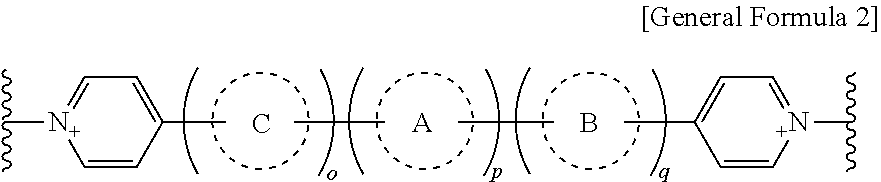


An-Bm [General Formula 5]

CH2═CH—X1— General Formula (i)
CH2═C(Y)—X2— General Formula (ii)


<<Another Polymerizable Compound>>

<Measurement of Oxidation Potential of Anion of Comparative Examples>
| TABLE 1-1 | ||||||
| Second electrochromic compound | ||||||
| tetraaryl | |||||||
| First | triarylamine | bendizine | Coloring | ||||
| electrochromic | Exemplary | Exemplary | Transparency | density | Durability | ||
| compound | Compound No. | Compound No. | Electrolyte | YI | T at 610 nm | ΔYI | |
| Ex. 1 | Exemplary | 3-10 | 3-40 | EMIMFSI | 1.1 | 7.10 | 11.1 |
| Compound 1-1 | |||||||
| Ex. 2 | Exemplary | 3-10 | 3-40 | EMIMFSI | 0.6 | 5.07 | 10.3 |
| Compound 1-2 | |||||||
| Ex. 3 | Exemplary | 3-10 | 3-40 | EMIMFSI | 1.0 | 7.19 | 13.1 |
| Compound 1-3 | |||||||
| Ex. 4 | Exemplary | 3-10 | 3-40 | EMIMFSI | 0.8 | 6.62 | 13.7 |
| Compound 1-4 | |||||||
| Ex. 5 | Exemplary | 3-10 | 3-40 | EMIMFSI | 2.3 | 7.38 | 13.5 |
| Compound 1-5 | |||||||
| Ex. 6 | Exemplary | 3-10 | 3-40 | EMIMFSI | 3.1 | 7.45 | 13.6 |
| Compound 1-6 | |||||||
| Ex. 7 | Exemplary | 3-10 | 3-40 | EMIMFSI | 1.3 | 6.89 | 11.1 |
| Compound 1-7 | |||||||
| Ex. 8 | Exemplary | 3-10 | 3-40 | EMIMFSI | 0.6 | 4.99 | 10.8 |
| Compound 1-8 | |||||||
| Ex. 9 | Exemplary | 3-10 | 3-40 | EMIMTFSI | 1.6 | 7.06 | 10.4 |
| Compound 1-1 | |||||||
| Ex. 10 | Exemplary | 3-10 | 3-40 | EMIMTFSI | 0.8 | 5.17 | 10.5 |
| Compound 1-2 | |||||||
| Ex. 11 | Exemplary | 3-10 | 3-40 | EMIMTFSI | 1.4 | 7.31 | 13.6 |
| Compound 1-3 | |||||||
| Ex. 12 | Exemplary | 3-10 | 3-40 | EMIMTFSI | 1.0 | 6.49 | 13.1 |
| Compound 1-4 | |||||||
| Ex. 13 | Exemplary | 3-10 | 3-40 | EMIMTFSI | 2.0 | 7.16 | 12.8 |
| Compound 1-5 | |||||||
| Ex. 14 | Exemplary | 3-10 | 3-40 | EMIMTFSI | 2.3 | 7.55 | 13.6 |
| Compound 1-6 | |||||||
| Ex. 15 | Exemplary | 3-10 | 3-40 | EMIMTFSI | 1.4 | 6.92 | 11.6 |
| Compound 1-7 | |||||||
| Ex. 16 | Exemplary | 3-10 | 3-40 | EMIMTFSI | 0.7 | 4.98 | 10.7 |
| Compound 1-8 | |||||||
| Ex. 17 | Exemplary | 3-10 | 3-40 | EMIMBF4 | 1.1 | 7.16 | 11.1 |
| Compound 1-1 | |||||||
| Ex. 18 | Exemplary | 3-10 | 3-40 | EMIMBF4 | 0.7 | 5.10 | 11.1 |
| Compound 1-2 | |||||||
| Ex. 19 | Exemplary | 3-10 | 3-40 | BMIMPF6 | 1.6 | 7.01 | 11.1 |
| Compound 1-1 | |||||||
| Ex. 20 | Exemplary | 3-10 | 3-40 | BMIMPF6 | 0.6 | 5.04 | 10.6 |
| Compound 1-2 | |||||||
| Ex. 21 | Exemplary | 3-10 | 3-40 | EMIMTCB | 1.7 | 7.06 | 11.8 |
| Compound 1-1 | |||||||
| Ex. 22 | Exemplary | 3-10 | 3-40 | EMIMTCB | 1.2 | 5.01 | 10.7 |
| Compound 1-2 | |||||||
| Ex. 23 | Exemplary | 3-10 | 3-40 | TBAP + PC | 2.0 | 7.49 | 11.5 |
| Compound 1-1 | |||||||
| Ex. 24 | Exemplary | 3-10 | 3-40 | TBAP + PC | 1.3 | 5.36 | 10.3 |
| Compound 1-2 | |||||||
| Ex. 25 | Exemplary | 3-1 | 3-40 | EMIMTFSI | 0.8 | 5.21 | 10.7 |
| Compound 1-2 | |||||||
| TABLE 1-2 | ||||||
| Second electrochromic compound | ||||||
| tetraaryl | |||||||
| First | triarylamine | bendizine | Coloring | ||||
| electrochromic | Exemplary | Exemplary | Transparency | density | Durability | ||
| compound | Compound No. | Compound No. | Electrolyte | YI | T at 610 nm | ΔYI | |
| Ex. 26 | Exemplary | 3-2 | 3-40 | EMIMTFSI | 0.8 | 5.17 | 10.8 |
| Compound 1-2 | |||||||
| Ex. 27 | Exemplary | 3-3 | 3-40 | EMIMTFSI | 0.7 | 5.09 | 10.4 |
| Compound 1-2 | |||||||
| Ex. 28 | Exemplary | 3-4 | 3-40 | EMIMTFSI | 0.8 | 5.21 | 10.2 |
| Compound 1-2 | |||||||
| Ex. 29 | Exemplary | 3-5 | 3-40 | EMIMTFSI | 0.6 | 5.03 | 10.9 |
| Compound 1-2 | |||||||
| Ex. 30 | Exemplary | 3-6 | 3-40 | EMIMTFSI | 0.9 | 5.07 | 10.2 |
| Compound 1-2 | |||||||
| Ex. 31 | Exemplary | 3-7 | 3-40 | EMIMTFSI | 0.7 | 5.06 | 10.5 |
| Compound 1-2 | |||||||
| Ex. 32 | Exemplary | 3-8 | 3-40 | EMIMTFSI | 0.8 | 5.21 | 10.1 |
| Compound 1-2 | |||||||
| Ex. 33 | Exemplary | 3-9 | 3-40 | EMIMTFSI | 0.8 | 5.11 | 10.6 |
| Compound 1-2 | |||||||
| Ex. 34 | Exemplary | 3-11 | 3-40 | EMIMTFSI | 0.7 | 5.17 | 10.3 |
| Compound 1-2 | |||||||
| Ex. 35 | Exemplary | 3-12 | 3-40 | EMIMTFSI | 0.9 | 5.13 | 10.4 |
| Compound 1-2 | |||||||
| Ex. 36 | Exemplary | 3-13 | 3-40 | EMIMTFSI | 0.8 | 5.04 | 10.8 |
| Compound 1-2 | |||||||
| Ex. 37 | Exemplary | 3-14 | 3-40 | EMIMTFSI | 0.8 | 5.19 | 10.4 |
| Compound 1-2 | |||||||
| Ex. 38 | Exemplary | 3-15 | 3-40 | EMIMTFSI | 1.0 | 5.13 | 10.6 |
| Compound 1-2 | |||||||
| Ex. 39 | Exemplary | 3-16 | 3-40 | EMIMTFSI | 0.6 | 5.19 | 10.3 |
| Compound 1-2 | |||||||
| Ex. 40 | Exemplary | 3-17 | 3-40 | EMIMTFSI | 0.8 | 5.04 | 10.4 |
| Compound 1-2 | |||||||
| Ex. 41 | Exemplary | 3-18 | 3-40 | EMIMTFSI | 0.8 | 5.03 | 10.3 |
| Compound 1-2 | |||||||
| Ex. 42 | Exemplary | 3-19 | 3-40 | EMIMTFSI | 0.7 | 5.08 | 10.8 |
| Compound 1-2 | |||||||
| Ex. 43 | Exemplary | 3-20 | 3-40 | EMIMTFSI | 0.7 | 5.11 | 10.7 |
| Compound 1-2 | |||||||
| Ex. 44 | Exemplary | 3-21 | 3-40 | EMIMTFSI | 0.7 | 5.16 | 10.5 |
| Compound 1-2 | |||||||
| Ex. 45 | Exemplary | 3-22 | 3-40 | EMIMTFSI | 0.8 | 5.08 | 10.6 |
| Compound 1-2 | |||||||
| Ex. 46 | Exemplary | 3-23 | 3-40 | EMIMTFSI | 0.8 | 5.13 | 10.4 |
| Compound 1-2 | |||||||
| Ex. 47 | Exemplary | 3-24 | 3-40 | EMIMTFSI | 0.8 | 5.12 | 10.8 |
| Compound 1-2 | |||||||
| Ex. 48 | Exemplary | 3-25 | 3-40 | EMIMTFSI | 0.7 | 5.05 | 10.3 |
| Compound 1-2 | |||||||
| Ex. 49 | Exemplary | 3-26 | 3-40 | EMIMTFSI | 0.8 | 5.11 | 10.7 |
| Compound 1-2 | |||||||
| Ex. 50 | Exemplary | 3-27 | 3-40 | EMIMTFSI | 0.9 | 5.08 | 10.4 |
| Compound 1-2 | |||||||
| TABLE 1-3 | ||||||
| Second electrochromic compound | ||||||
| tetraaryl | |||||||
| First | triarylamine | bendizine | Coloring | ||||
| electrochromic | Exemplary | Exemplary | Supporting | Transparency | density | Durability | |
| compound | Compound No. | Compound No. | electrolyte | YI | T at 610 nm | ΔYI | |
| Ex. 51 | Exemplary | 3-28 | 3-40 | EMIMTFSI | 0.7 | 5.03 | 10.1 |
| Compound 1-2 | |||||||
| Ex. 52 | Exemplary | 3-29 | 3-40 | EMIMTFSI | 0.8 | 5.05 | 10.3 |
| Compound 1-2 | |||||||
| Ex. 53 | Exemplary | 3-9 | 3-30 | EMIMTFSI | 0.8 | 5.17 | 10.8 |
| Compound 1-2 | |||||||
| Ex. 54 | Exemplary | 3-9 | 3-31 | EMIMTFSI | 0.8 | 5.11 | 10.3 |
| Compound 1-2 | |||||||
| Ex. 55 | Exemplary | 3-9 | 3-32 | EMIMTFSI | 0.8 | 5.16 | 10.9 |
| Compound 1-2 | |||||||
| Ex. 56 | Exemplary | 3-9 | 3-33 | EMIMTFSI | 0.7 | 5.18 | 10.4 |
| Compound 1-2 | |||||||
| Ex. 57 | Exemplary | 3-9 | 3-34 | EMIMTFSI | 1 | 5.09 | 10.7 |
| Compound 1-2 | |||||||
| Ex. 58 | Exemplary | 3-9 | 3-35 | EMIMTFSI | 1.1 | 5.1 | 10.3 |
| Compound 1-2 | |||||||
| Ex. 59 | Exemplary | 3-9 | 3-36 | EMIMTFSI | 1.3 | 5.15 | 11.8 |
| Compound 1-2 | |||||||
| Ex. 60 | Exemplary | 3-9 | 3-37 | EMIMTFSI | 1.1 | 5.12 | 11 |
| Compound 1-2 | |||||||
| Ex. 61 | Exemplary | 3-9 | 3-38 | EMIMTFSI | 1.4 | 5.17 | 11.1 |
| Compound 1-2 | |||||||
| Ex. 62 | Exemplary | 3-9 | 3-39 | EMIMTFSI | 1.2 | 5.19 | 11.2 |
| Compound 1-2 | |||||||
| Ex. 63 | Exemplary | 3-10 | 3-30 | EMIMTFSI | 1.3 | 5.13 | 10.5 |
| Compound 1-2 | |||||||
| Ex. 64 | Exemplary | 3-10 | 3-31 | EMIMTFSI | 1.5 | 5.14 | 10.7 |
| Compound 1-2 | |||||||
| Ex. 65 | Exemplary | 3-10 | 3-32 | EMIMTFSI | 1.6 | 5.13 | 11.5 |
| Compound 1-2 | |||||||
| Ex. 66 | Exemplary | 3-10 | 3-33 | EMIMTFSI | 1.1 | 5.12 | 11.3 |
| Compound 1-2 | |||||||
| Ex. 67 | Exemplary | 3-10 | 3-34 | EMIMTFSI | 1.1 | 5.15 | 11.4 |
| Compound 1-2 | |||||||
| Ex. 68 | Exemplary | 3-10 | 3-35 | EMIMTFSI | 1.4 | 5.16 | 11.4 |
| Compound 1-2 | |||||||
| Ex. 69 | Exemplary | 3-10 | 3-36 | EMIMTFSI | 1.3 | 5.14 | 11.3 |
| Compound 1-2 | |||||||
| Ex. 70 | Exemplary | 3-10 | 3-37 | EMIMTFSI | 1.3 | 5.13 | 10.6 |
| Compound 1-2 | |||||||
| Ex. 71 | Exemplary | 3-10 | 3-38 | EMIMTFSI | 1.4 | 5.17 | 10.8 |
| Compound 1-2 | |||||||
| Ex. 72 | Exemplary | 3-10 | 3-39 | EMIMTFSI | 1.3 | 5.18 | 11.4 |
| Compound 1-2 | |||||||
| Ex. 73 | Exemplary | 3-10 | 3-39 | EMIMTFSI | 0.6 | 5.14 | 10.4 |
| Compound 1-9 | |||||||
| Ex. 74 | Exemplary | 3-10 | 3-39 | EMIMTFSI | 0.7 | 5.12 | 10.8 |
| Compound 1-10 | |||||||
| Ex. 75 | Exemplary | 3-10 | 3-39 | EMIMTFSI | 0.6 | 5.07 | 10.5 |
| Compound 1-11 | |||||||
| TABLE 1-4 | ||||||
| Second electrochromic compound | ||||||
| tetraaryl | |||||||
| First | triarylamine | bendizine | Coloring | ||||
| electrochromic | Exemplary | Exemplary | Supporting | Transparency | density | Durability | |
| compound | Compound No. | Compound No. | electrolyte | YI | T at 610 nm | ΔYI | |
| Ex. 76 | Exemplary | 3-10 | 3-39 | EMIMTFSI | 0.6 | 5.03 | 9.1 |
| Compound 1-12 | |||||||
| Ex. 77 | Exemplary | 3-10 | 3-39 | EMIMTFSI | 0.5 | 5.38 | 9.4 |
| Compound 1-13 | |||||||
| Ex. 78 | Exemplary | 3-10 | 3-39 | EMIMTFSI | 0.7 | 4.91 | 10.3 |
| Compound 1-14 | |||||||
| Ex. 79 | Exemplary | 3-10 | 3-39 | EMIMTFSI | 0.6 | 4.96 | 9.7 |
| Compound 1-15 | |||||||
| Ex. 80 | Exemplary | 3-10 | 3-39 | EMIMTFSI | 0.5 | 4.95 | 10.6 |
| Compound 1-16 | |||||||
| Ex. 81 | Exemplary | 3-10 | 3-39 | EMIMTFSI | 0.5 | 4.73 | 10.1 |
| Compound 1-17 | |||||||
| Ex. 82 | Exemplary | 3-10 | 3-39 | EMIMTFSI | 0.5 | 4.75 | 9.8 |
| Compound 1-18 | |||||||
| Ex. 83 | Exemplary | 3-10 | 3-39 | EMIMTFSI | 0.6 | 7.43 | 11.8 |
| Compound 1-19 | |||||||
| Ex. 84 | Exemplary | 3-10 | 3-39 | EMIMTFSI | 0.6 | 7.18 | 11.1 |
| Compound 1-20 | |||||||
| Ex. 85 | Exemplary | 3-10 | 3-39 | EMIMTFSI | 0.7 | 8.61 | 12.5 |
| Compound 1-21 | |||||||
| Ex. 86 | Exemplary | 3-10 | 3-39 | EMIMTFSI | 0.7 | 5.43 | 12.1 |
| Compound 1-22 | |||||||
| Ex. 87 | Exemplary | 3-10 | 3-39 | EMIMTFSI | 0.7 | 9.52 | 12.7 |
| Compound 1-23 | |||||||
| Ex. 88 | Exemplary | 3-10 | 3-39 | EMIMTFSI | 0.6 | 5.11 | 10.8 |
| Compound 1-24 | |||||||
| Ex. 89 | Exemplary | 3-10 | 3-39 | EMIMTFSI | 0.6 | 5.62 | 11 |
| Compound 1-25 | |||||||
| Ex. 90 | Exemplary | 3-10 | 3-39 | EMIMTFSI | 0.6 | 5.22 | 10.7 |
| Compound 1-26 | |||||||
| Comp. | Comparative | 3-10 | 3-40 | EMIMTFSI | 6.5 | 7.57 | 18.7 |
| Ex. 1 | Compound 1 | ||||||
| Comp. | Comparative | 3-10 | 3-40 | EMIMTFSI | 4.8 | 7.69 | 16.4 |
| Ex. 2 | Compound 2 | ||||||
| Comp. | Comparative | 3-10 | 3-40 | EMIMTFSI | 5.8 | 7.43 | 17.1 |
| Ex. 3 | Compound 3 | ||||||
| TABLE 2 | |
| EMIMFSI | 1-ethyl-3-methyl-imidazolium |
| bis(fluorosulfonyl)imide | |
| EMIMTFSI | 1-ethyl-3-methyl-imidazolium |
| bis(trifluoromethanesulfonyl)imide | |
| EMIMBF4 | 1-ethyl-3-methyl-imidazolium |
| Tetrafluoroborate | |
| BMIMPF6 | 1-butyl-3-methyl-imidazolium |
| Hexafluorophosphate | |
| EMIMTCB | 1-ethyl-3-methyl-imidazolium |
| Tetracyanoborate | |
| TBAP + PC | tetrabutylammonium perchloride |
| (dissolved in propylene carbonate in the amount of 1 | |
| mmol/L in use) | |

where, in General Formula 1, R1 and R2 are each a hydrogen atom, an aryl group having 14 or less carbon atoms, a heteroaryl group having 14 or less carbon atoms, a branched alkyl group having 10 or less carbon atoms, an alkenyl group having 10 or less carbon atoms, a cycloalkyl group having 10 or less carbon atoms, or a functional group that can bond to a hydroxyl group; R3 and R4 are each an alkylene group having from 1 through 10 carbon atoms or an arylene group that may have a substituent and has 12 or less carbon atoms; Z is alkylene, cycloalkylene, or a divalent group represented by —R7—Y—R8 (where R7 and R8 are each independently a single bond, alkylene, or cycloalkylene, and Y is arylene, cycloalkylene, heteroarylene, arylene-arylene, or arylene-CR′R″-arylene, where R′ and R″ form a carbon ring group together with a carbon atom to which R′ and R″ are bonded), where the alkylene, the cycloalkylene, the arylene, the heteroarylene, and the carbon ring group may be substituted with one or more substituents selected from the group consisting of halogen, alkyl, alkoxy, alkyl thio, hydroxyalkyl, acyloxy, cycloalkyl, aryl, substituted aryl, aryloxy, heteroaryl, and substituted heteroaryl; k is 0 or 1; X− is a monovalent anion having an oxidation potential higher than a reduction potential of the dication of General Formula 1 by 3.1 V or greater; and W2+ is the dication represented by General Formula 2,

where, in General Formula 2, o, p, and q are each independently 0 or 1; and A, B, and C are each independently an arylene group that may have a substituent and has from 2 through 20 carbon atoms, or a heterocycle group.
<2> The electrochromic element according to <1>,
wherein the first electrochromic layer is a first electrochromic layer, in which the electrochromic compound is deposited on the nano-structures.
<3> An electrochromic element including:
a first electrode;
a second electrode disposed to face the first electrode with a gap between the first electrode and the second electrode;
a first electrochromic layer in which an electrochromic compound is deposited on conductor or semiconductor nano-structures, where the first electrochromic layer is disposed on or above the first electrode; and
an electrolyte layer disposed between the first electrochromic layer and the second electrode,
wherein the electrochromic compound is a compound represented by General Formula 1,

where, in General Formula 1, R1 and R2 are each a hydrogen atom, an aryl group having 14 or less carbon atoms, a heteroaryl group having 14 or less carbon atoms, a branched alkyl group having 10 or less carbon atoms, an alkenyl group having 10 or less carbon atoms, a cycloalkyl group having or less carbon atoms, or a functional group that can bond to a hydroxyl group; R3 and R4 are each an alkylene group having from 1 through 10 carbon atoms or an arylene group that may have a substituent and has 12 or less carbon atoms; Z is alkylene, cycloalkylene, or a divalent group represented by —R7—Y—R8 (where R7 and R8 are each independently a single bond, alkylene, or cycloalkylene, and Y is arylene, cycloalkylene, heteroarylene, arylene-arylene, or arylene-CR′R″-arylene, where R′ and R″ form a carbon ring group together with a carbon atom to which R′ and R″ are bonded), where the alkylene, the cycloalkylene, the arylene, the heteroarylene, and the carbon ring group may be substituted with one or more substituents selected from the group consisting of halogen, alkyl, alkoxy, alkyl thio, hydroxyalkyl, acyloxy, cycloalkyl, aryl, substituted aryl, aryloxy, heteroaryl, and substituted heteroaryl; k is 0 or 1; X− is a monovalent anion having an oxidation potential higher than a reduction potential of a dication of General Formula 1 by 3.1 V or greater; and W2+ is the dication represented by General Formula 2,

where, in General Formula 2, o, p, and q are each independently 0 or 1; and A, B, and C are each independently an arylene group that may have a substituent and has from 2 through 20 carbon atoms, or a heterocycle group.
<4> The electrochromic element according to <3>,
wherein the electrolyte layer includes an electrolyte, and an anion of the electrolyte is a monovalent anion having an oxidation potential higher than a reduction potential of a dication of General Formula 1 by 3.1 V or greater.
<5> The electrochromic element according to any one of <1>, <2>, and <4>,
wherein the anion of the electrolyte of the electrolyte layer is one or more selected from the group consisting of (FSO2)2N−, (CF3SO2)2N−, (CB)4B−, BF4 −, PF6 −, and ClO4 −.
<6> The electrochromic element according to any one of <1> to <5>, wherein R1 or R2, or both R1 and R2 of General Formula 1 are a phosphonic acid group, a phosphoric acid group, a carboxylic acid group, a sulfonyl group, a silyl group, or a silanol group.
<7> The electrochromic element according to any one of <1> to <6>, Wherein one of R1 and R2 of General Formula 1 is a phosphonic acid group, a phosphoric acid group, a carboxylic acid group, a sulfonyl group, a silyl group, or a silanol group, and the other is a hydrogen atom, an aryl group having 14 or less carbon atoms, a heteroaryl group having 14 or less carbon atoms, a branched alkyl group having 10 or less carbon atoms, an alkenyl group having 10 or less carbon atoms, or a cycloalkyl group having or less carbon atoms.
<8> The electrochromic element according to any one of <1> to <7>, wherein X− of General Formula 1 is one or more selected from the group consisting of (FSO2)2N−, (CF3SO2)2N−, (CN)4B−, BF4 −, PF6 −, and ClO4 −.
<9> The electrochromic element according to any one of <1> to <8>, wherein X− of General Formula 1 is one or more selected from the group consisting of (FSO2)2N− and (CF3SO2)2N−.
<10> The electrochromic element according to any one of <1> to <9>, wherein X− of General Formula 1 is (CF3SO2)2N−.
<11> The electrochromic element according to any one of <1> to <10>, wherein W2+ of General Formula 1 is represented by Structural Formula 1,

<12> The electrochromic element according to any one of <1> to <11>, wherein k of General Formula 1 is 0.
<13> The electrochromic element according to any one of <1> to <12>, wherein R3 of General Formula 1 is represented by General Formula 3, and R4 of General Formula 1 is represented by General Formula 4,

where m is 0 or an integer of from 1 through 10 in General Formula 3, n is 0 or an integer of from 1 through 10 in General Formula 4, and m and n may be identical values or different values.
<14> The electrochromic element according to any one of <1> to <13>, further including:
a second electrochromic layer disposed on or above the second electrode, wherein the electrolyte layer is disposed between the first electrochromic layer and the second electrochromic layer.
<15> The electrochromic element according to <14>,
wherein the second electrochromic layer includes a polymer obtained by polymerizing a polymerizable material including a radical-polymerizable compound having a triarylamine skeleton.
<16> The electrochromic element according to <15>,
wherein the polymerizable material further includes a radical-polymerizable compound having a tetraaryl benzidine skeleton.
Claims (12)


Applications Claiming Priority (4)
| Application Number | Priority Date | Filing Date | Title |
|---|---|---|---|
| JP2019140655 | 2019-07-31 | ||
| JP2019-140655 | 2019-07-31 | ||
| JP2020114998A JP2021026231A (en) | 2019-07-31 | 2020-07-02 | Electrochromic element |
| JP2020-114998 | 2020-07-02 |
Publications (2)
| Publication Number | Publication Date |
|---|---|
| US20210032531A1 US20210032531A1 (en) | 2021-02-04 |
| US11970662B2 true US11970662B2 (en) | 2024-04-30 |
Family
ID=71846327
Family Applications (1)
| Application Number | Title | Priority Date | Filing Date |
|---|---|---|---|
| US16/941,732 Active 2042-09-30 US11970662B2 (en) | 2019-07-31 | 2020-07-29 | Electrochromic element |
Country Status (2)
| Country | Link |
|---|---|
| US (1) | US11970662B2 (en) |
| EP (1) | EP3771736B1 (en) |
Families Citing this family (3)
| Publication number | Priority date | Publication date | Assignee | Title |
|---|---|---|---|---|
| JP7676862B2 (en) | 2021-03-23 | 2025-05-15 | 株式会社リコー | Electrochromic display element |
| CN113103706B (en) * | 2021-03-26 | 2023-03-17 | 珠海光驭科技有限公司 | Electrochromic photonic crystal film and preparation method and application thereof |
| JP7596897B2 (en) * | 2021-03-31 | 2024-12-10 | 株式会社リコー | Electrochromic Device |
Citations (21)
| Publication number | Priority date | Publication date | Assignee | Title |
|---|---|---|---|---|
| JPS6456964U (en) | 1987-10-01 | 1989-04-10 | ||
| US6043355A (en) | 1997-08-04 | 2000-03-28 | Ricoh Company, Ltd. | Phthalocyanine compounds |
| JP2002524762A (en) | 1998-09-08 | 2002-08-06 | バイエル アクチェンゲゼルシャフト | Electrochromic device with yellow filter |
| JP2006518408A (en) | 2003-01-31 | 2006-08-10 | エヌテラ・リミテッド | Electrochromic particles |
| JP2008052172A (en) | 2006-08-28 | 2008-03-06 | Konica Minolta Holdings Inc | Display element |
| US20080266642A1 (en) | 2003-06-20 | 2008-10-30 | The Regents Of The University Of California | Durable electrooptic devices comprising ionic liquids |
| US20150353819A1 (en) | 2014-06-09 | 2015-12-10 | Iglass Technology Llc | Electrochromic composition and electrochromic device using same |
| US20160221949A1 (en) | 2013-09-17 | 2016-08-04 | Essilor International (Compagnie Generale D'optiqu E) | Electrochromic two-core viologen derivatives and optical articles containing them |
| US20160229803A1 (en) | 2015-02-11 | 2016-08-11 | Gentex Corporation | Electrochromic compounds with improved color stability in their radical states |
| WO2016147543A1 (en) | 2015-03-13 | 2016-09-22 | Ricoh Company, Ltd. | Electrochromic compound, electrochromic composition, electrochromic element, and electrochromic dimming element |
| JP2017021327A (en) | 2015-07-10 | 2017-01-26 | キヤノン株式会社 | Electrochromic element |
| WO2017094218A1 (en) | 2015-11-30 | 2017-06-08 | Ricoh Company, Ltd. | Electrochromic element |
| JP2017107153A (en) | 2015-11-30 | 2017-06-15 | 株式会社リコー | Electrochromic element |
| US9688706B2 (en) | 2013-06-27 | 2017-06-27 | Ricoh Company, Ltd. | Electrochromic compound, electrochromic composition, display element, and dimming element |
| US20170235203A1 (en) | 2014-08-08 | 2017-08-17 | Ricoh Company, Ltd. | Electrochromic element and electrochromic dimming element |
| JP2017206499A (en) | 2016-05-12 | 2017-11-24 | キヤノン株式会社 | ORGANIC COMPOUND, ELECTROCHROMIC COMPOUND, AND ELECTROCHROMIC DEVICE HAVING THE SAME, OPTICAL FILTER, LENS UNIT, IMAGING DEVICE, WINDOW MATERIAL |
| EP3268448A1 (en) | 2015-03-13 | 2018-01-17 | Ricoh Company, Ltd. | Electrochromic compound, electrochromic composition, electrochromic element, and electrochromic dimming element |
| US9932522B2 (en) | 2014-07-03 | 2018-04-03 | Ricoh Company, Ltd. | Electrochromic compound, electrochromic composition, display element, and dimming element |
| US20180155321A1 (en) * | 2016-12-07 | 2018-06-07 | Lg Display Co., Ltd. | Viologen compound, and electrolyte, light-transmittance-variable panel and display device including the viologen compound |
| US10093693B2 (en) | 2012-11-01 | 2018-10-09 | Ricoh Company, Ltd. | Electrochromic compound, electrochromic composition, and display element |
| US20190294015A1 (en) | 2018-03-22 | 2019-09-26 | Naoki Ura | Electrochromic display element, optical filter, lens unit, and imaging device |
Family Cites Families (3)
| Publication number | Priority date | Publication date | Assignee | Title |
|---|---|---|---|---|
| JPS5768370A (en) | 1980-10-02 | 1982-04-26 | Dainippon Printing Co Ltd | Method of packing butter, etc. |
| JPS62156172A (en) | 1985-12-27 | 1987-07-11 | Nippon Oil & Fats Co Ltd | Underwater antifouling coating agent |
| JPH0645770B2 (en) | 1986-06-10 | 1994-06-15 | 関西ペイント株式会社 | Antifouling paint composition |
-
2020
- 2020-07-29 EP EP20188455.8A patent/EP3771736B1/en active Active
- 2020-07-29 US US16/941,732 patent/US11970662B2/en active Active
Patent Citations (30)
| Publication number | Priority date | Publication date | Assignee | Title |
|---|---|---|---|---|
| JPS6456964U (en) | 1987-10-01 | 1989-04-10 | ||
| US6043355A (en) | 1997-08-04 | 2000-03-28 | Ricoh Company, Ltd. | Phthalocyanine compounds |
| JP2002524762A (en) | 1998-09-08 | 2002-08-06 | バイエル アクチェンゲゼルシャフト | Electrochromic device with yellow filter |
| US6600589B1 (en) | 1998-09-08 | 2003-07-29 | Bayer Aktiengesellschaft | Electrochromic device with a yellow filter |
| US20090103162A1 (en) | 2002-06-21 | 2009-04-23 | Burrell Anthony K | Durable electrooptic devices comprising ionic liquids |
| JP2006518408A (en) | 2003-01-31 | 2006-08-10 | エヌテラ・リミテッド | Electrochromic particles |
| US20080266642A1 (en) | 2003-06-20 | 2008-10-30 | The Regents Of The University Of California | Durable electrooptic devices comprising ionic liquids |
| JP2008052172A (en) | 2006-08-28 | 2008-03-06 | Konica Minolta Holdings Inc | Display element |
| US20190031694A1 (en) | 2012-11-01 | 2019-01-31 | Toshiya Sagisaka | Electrochromic compound, electrochromic composition, and display element |
| US10093693B2 (en) | 2012-11-01 | 2018-10-09 | Ricoh Company, Ltd. | Electrochromic compound, electrochromic composition, and display element |
| US9688706B2 (en) | 2013-06-27 | 2017-06-27 | Ricoh Company, Ltd. | Electrochromic compound, electrochromic composition, display element, and dimming element |
| US20160221949A1 (en) | 2013-09-17 | 2016-08-04 | Essilor International (Compagnie Generale D'optiqu E) | Electrochromic two-core viologen derivatives and optical articles containing them |
| JP6456964B2 (en) | 2013-09-17 | 2019-01-23 | エシロール・アンテルナシオナル | Electrochromic dinuclear viologen derivatives and optical articles containing them |
| US20150353819A1 (en) | 2014-06-09 | 2015-12-10 | Iglass Technology Llc | Electrochromic composition and electrochromic device using same |
| US9932522B2 (en) | 2014-07-03 | 2018-04-03 | Ricoh Company, Ltd. | Electrochromic compound, electrochromic composition, display element, and dimming element |
| US20170235203A1 (en) | 2014-08-08 | 2017-08-17 | Ricoh Company, Ltd. | Electrochromic element and electrochromic dimming element |
| US20160229803A1 (en) | 2015-02-11 | 2016-08-11 | Gentex Corporation | Electrochromic compounds with improved color stability in their radical states |
| JP2018508034A (en) | 2015-02-11 | 2018-03-22 | ジェンテックス コーポレイション | Electrochromic compounds with improved color stability in the radical state |
| EP3268448A1 (en) | 2015-03-13 | 2018-01-17 | Ricoh Company, Ltd. | Electrochromic compound, electrochromic composition, electrochromic element, and electrochromic dimming element |
| US20180044581A1 (en) | 2015-03-13 | 2018-02-15 | Toshiya Sagisaka | Electrochromic compound, electrochromic composition, electrochromic element, and electrochromic dimming element |
| WO2016147543A1 (en) | 2015-03-13 | 2016-09-22 | Ricoh Company, Ltd. | Electrochromic compound, electrochromic composition, electrochromic element, and electrochromic dimming element |
| JP2017021327A (en) | 2015-07-10 | 2017-01-26 | キヤノン株式会社 | Electrochromic element |
| WO2017094218A1 (en) | 2015-11-30 | 2017-06-08 | Ricoh Company, Ltd. | Electrochromic element |
| EP3384346A1 (en) | 2015-11-30 | 2018-10-10 | Ricoh Company, Ltd. | Electrochromic element |
| US20180314125A1 (en) | 2015-11-30 | 2018-11-01 | Daisuke Goto | Electrochromic element |
| JP2017107153A (en) | 2015-11-30 | 2017-06-15 | 株式会社リコー | Electrochromic element |
| US10634970B2 (en) * | 2015-11-30 | 2020-04-28 | Ricoh Company, Ltd. | Electrochromic element |
| JP2017206499A (en) | 2016-05-12 | 2017-11-24 | キヤノン株式会社 | ORGANIC COMPOUND, ELECTROCHROMIC COMPOUND, AND ELECTROCHROMIC DEVICE HAVING THE SAME, OPTICAL FILTER, LENS UNIT, IMAGING DEVICE, WINDOW MATERIAL |
| US20180155321A1 (en) * | 2016-12-07 | 2018-06-07 | Lg Display Co., Ltd. | Viologen compound, and electrolyte, light-transmittance-variable panel and display device including the viologen compound |
| US20190294015A1 (en) | 2018-03-22 | 2019-09-26 | Naoki Ura | Electrochromic display element, optical filter, lens unit, and imaging device |
Non-Patent Citations (3)
| Title |
|---|
| Extended European Search Report issued Jan. 12, 2021 in corresponding European Patent Application No. 20188455.8, 10 pages. |
| Michael Felderhoff et al, "Molecular Suppression of the Pimerization of Viologens (=4,4′-Bipyridinium Derivatives) Attached to Nanocrystalline Titanium Dioxide Thin-Film Electrodes", Helvetica Chimica Acta, Verlag Helvetica Chimica Acta, vol. 83, No. 1, Jan. 24, 2000, pp. 181-192, XP002554940, ISSN 0018-019X. |
| Office Action issued Jan. 23, 2024 in Japanese Patent Application No. 2020-114998, 6 pages. |
Also Published As
| Publication number | Publication date |
|---|---|
| EP3771736A1 (en) | 2021-02-03 |
| EP3771736B1 (en) | 2023-11-15 |
| US20210032531A1 (en) | 2021-02-04 |
Similar Documents
| Publication | Publication Date | Title |
|---|---|---|
| US10634970B2 (en) | Electrochromic element | |
| JP7435006B2 (en) | Electrochromic device, wearable device, and method for driving an electrochromic device | |
| US11754901B2 (en) | Electrochromic device, wearable device, and method for driving electrochromic device | |
| US10975296B2 (en) | Electrochromic compound, electrochromic composition, and electrochromic element | |
| US11970662B2 (en) | Electrochromic element | |
| US20180044581A1 (en) | Electrochromic compound, electrochromic composition, electrochromic element, and electrochromic dimming element | |
| JP2016045464A (en) | Electrochromic element | |
| JP2016038572A (en) | Electrochromic device and method for producing the same | |
| JP6812635B2 (en) | Electrochromic device and its manufacturing method | |
| EP3177963A1 (en) | Electrochromic element and electrochromic dimming element | |
| JP2020140053A (en) | Electrochromic elements, display elements, dimming elements, electrochromic compositions and cured films | |
| WO2017094218A1 (en) | Electrochromic element | |
| US11370963B2 (en) | Electrochromic compound, electrochromic composition, and electrochromic element | |
| US11859131B2 (en) | Electrochromic compound, electrochromic composition, and electrochromic element | |
| JP6915241B2 (en) | Electrochromic element | |
| JP2018005180A (en) | Electrochromic module, lighting control film, lighting control lens and lighting control glasses | |
| JP6885073B2 (en) | Electrochromic element | |
| JP2018070475A (en) | Electrochromic compound, electrochromic composition, and electrochromic element | |
| JP2021026231A (en) | Electrochromic element | |
| JP6728951B2 (en) | Electrochromic compound, electrochromic composition, and electrochromic device | |
| JP2016222618A (en) | Electrochromic compound, electrochromic composition, and electrochromic display element | |
| JP2021026017A (en) | Electronic device, dimming lens, and dimming glasses |
Legal Events
| Date | Code | Title | Description |
|---|---|---|---|
| AS | Assignment |
Owner name: RICOH COMPANY, LTD., JAPAN Free format text: ASSIGNMENT OF ASSIGNORS INTEREST;ASSIGNORS:KANEKO, FUMINARI;GOTO, DAISUKE;SHINODA, MASATO;AND OTHERS;SIGNING DATES FROM 20200727 TO 20200728;REEL/FRAME:053339/0497 |
|
| FEPP | Fee payment procedure |
Free format text: ENTITY STATUS SET TO UNDISCOUNTED (ORIGINAL EVENT CODE: BIG.); ENTITY STATUS OF PATENT OWNER: LARGE ENTITY |
|
| STPP | Information on status: patent application and granting procedure in general |
Free format text: DOCKETED NEW CASE - READY FOR EXAMINATION |
|
| STPP | Information on status: patent application and granting procedure in general |
Free format text: NON FINAL ACTION MAILED |
|
| STPP | Information on status: patent application and granting procedure in general |
Free format text: RESPONSE TO NON-FINAL OFFICE ACTION ENTERED AND FORWARDED TO EXAMINER |
|
| STPP | Information on status: patent application and granting procedure in general |
Free format text: FINAL REJECTION MAILED |
|
| STPP | Information on status: patent application and granting procedure in general |
Free format text: DOCKETED NEW CASE - READY FOR EXAMINATION |
|
| STPP | Information on status: patent application and granting procedure in general |
Free format text: NOTICE OF ALLOWANCE MAILED -- APPLICATION RECEIVED IN OFFICE OF PUBLICATIONS |
|
| STPP | Information on status: patent application and granting procedure in general |
Free format text: PUBLICATIONS -- ISSUE FEE PAYMENT VERIFIED |
|
| STCF | Information on status: patent grant |
Free format text: PATENTED CASE |