US11953892B2 - Selection support device, selection support method, and storage medium - Google Patents
Selection support device, selection support method, and storage medium Download PDFInfo
- Publication number
- US11953892B2 US11953892B2 US17/830,544 US202217830544A US11953892B2 US 11953892 B2 US11953892 B2 US 11953892B2 US 202217830544 A US202217830544 A US 202217830544A US 11953892 B2 US11953892 B2 US 11953892B2
- Authority
- US
- United States
- Prior art keywords
- work
- lawn
- selection
- lawn mower
- working time
- Prior art date
- Legal status (The legal status is an assumption and is not a legal conclusion. Google has not performed a legal analysis and makes no representation as to the accuracy of the status listed.)
- Active
Links
Images




Classifications
-
- G—PHYSICS
- G06—COMPUTING OR CALCULATING; COUNTING
- G06Q—INFORMATION AND COMMUNICATION TECHNOLOGY [ICT] SPECIALLY ADAPTED FOR ADMINISTRATIVE, COMMERCIAL, FINANCIAL, MANAGERIAL OR SUPERVISORY PURPOSES; SYSTEMS OR METHODS SPECIALLY ADAPTED FOR ADMINISTRATIVE, COMMERCIAL, FINANCIAL, MANAGERIAL OR SUPERVISORY PURPOSES, NOT OTHERWISE PROVIDED FOR
- G06Q50/00—Information and communication technology [ICT] specially adapted for implementation of business processes of specific business sectors, e.g. utilities or tourism
- G06Q50/02—Agriculture; Fishing; Forestry; Mining
-
- G—PHYSICS
- G05—CONTROLLING; REGULATING
- G05B—CONTROL OR REGULATING SYSTEMS IN GENERAL; FUNCTIONAL ELEMENTS OF SUCH SYSTEMS; MONITORING OR TESTING ARRANGEMENTS FOR SUCH SYSTEMS OR ELEMENTS
- G05B19/00—Program-control systems
- G05B19/02—Program-control systems electric
- G05B19/418—Total factory control, i.e. centrally controlling a plurality of machines, e.g. direct or distributed numerical control [DNC], flexible manufacturing systems [FMS], integrated manufacturing systems [IMS] or computer integrated manufacturing [CIM]
- G05B19/41865—Total factory control, i.e. centrally controlling a plurality of machines, e.g. direct or distributed numerical control [DNC], flexible manufacturing systems [FMS], integrated manufacturing systems [IMS] or computer integrated manufacturing [CIM] characterised by job scheduling, process planning, material flow
- G05B19/4187—Total factory control, i.e. centrally controlling a plurality of machines, e.g. direct or distributed numerical control [DNC], flexible manufacturing systems [FMS], integrated manufacturing systems [IMS] or computer integrated manufacturing [CIM] characterised by job scheduling, process planning, material flow by tool management
-
- G—PHYSICS
- G05—CONTROLLING; REGULATING
- G05B—CONTROL OR REGULATING SYSTEMS IN GENERAL; FUNCTIONAL ELEMENTS OF SUCH SYSTEMS; MONITORING OR TESTING ARRANGEMENTS FOR SUCH SYSTEMS OR ELEMENTS
- G05B19/00—Program-control systems
- G05B19/02—Program-control systems electric
- G05B19/18—Numerical control [NC], i.e. automatically operating machines, in particular machine tools, e.g. in a manufacturing environment, so as to execute positioning, movement or co-ordinated operations by means of program data in numerical form
- G05B19/406—Numerical control [NC], i.e. automatically operating machines, in particular machine tools, e.g. in a manufacturing environment, so as to execute positioning, movement or co-ordinated operations by means of program data in numerical form characterised by monitoring or safety
- G05B19/4065—Monitoring tool breakage, life or condition
-
- G—PHYSICS
- G05—CONTROLLING; REGULATING
- G05B—CONTROL OR REGULATING SYSTEMS IN GENERAL; FUNCTIONAL ELEMENTS OF SUCH SYSTEMS; MONITORING OR TESTING ARRANGEMENTS FOR SUCH SYSTEMS OR ELEMENTS
- G05B19/00—Program-control systems
- G05B19/02—Program-control systems electric
- G05B19/418—Total factory control, i.e. centrally controlling a plurality of machines, e.g. direct or distributed numerical control [DNC], flexible manufacturing systems [FMS], integrated manufacturing systems [IMS] or computer integrated manufacturing [CIM]
- G05B19/4183—Total factory control, i.e. centrally controlling a plurality of machines, e.g. direct or distributed numerical control [DNC], flexible manufacturing systems [FMS], integrated manufacturing systems [IMS] or computer integrated manufacturing [CIM] characterised by data acquisition, e.g. workpiece identification
-
- G—PHYSICS
- G06—COMPUTING OR CALCULATING; COUNTING
- G06Q—INFORMATION AND COMMUNICATION TECHNOLOGY [ICT] SPECIALLY ADAPTED FOR ADMINISTRATIVE, COMMERCIAL, FINANCIAL, MANAGERIAL OR SUPERVISORY PURPOSES; SYSTEMS OR METHODS SPECIALLY ADAPTED FOR ADMINISTRATIVE, COMMERCIAL, FINANCIAL, MANAGERIAL OR SUPERVISORY PURPOSES, NOT OTHERWISE PROVIDED FOR
- G06Q10/00—Administration; Management
- G06Q10/06—Resources, workflows, human or project management; Enterprise or organisation planning; Enterprise or organisation modelling
- G06Q10/063—Operations research, analysis or management
- G06Q10/0631—Resource planning, allocation, distributing or scheduling for enterprises or organisations
-
- G—PHYSICS
- G06—COMPUTING OR CALCULATING; COUNTING
- G06Q—INFORMATION AND COMMUNICATION TECHNOLOGY [ICT] SPECIALLY ADAPTED FOR ADMINISTRATIVE, COMMERCIAL, FINANCIAL, MANAGERIAL OR SUPERVISORY PURPOSES; SYSTEMS OR METHODS SPECIALLY ADAPTED FOR ADMINISTRATIVE, COMMERCIAL, FINANCIAL, MANAGERIAL OR SUPERVISORY PURPOSES, NOT OTHERWISE PROVIDED FOR
- G06Q10/00—Administration; Management
- G06Q10/20—Administration of product repair or maintenance
-
- G—PHYSICS
- G07—CHECKING-DEVICES
- G07C—TIME OR ATTENDANCE REGISTERS; REGISTERING OR INDICATING THE WORKING OF MACHINES; GENERATING RANDOM NUMBERS; VOTING OR LOTTERY APPARATUS; ARRANGEMENTS, SYSTEMS OR APPARATUS FOR CHECKING NOT PROVIDED FOR ELSEWHERE
- G07C5/00—Registering or indicating the working of vehicles
- G07C5/008—Registering or indicating the working of vehicles communicating information to a remotely located station
-
- G—PHYSICS
- G07—CHECKING-DEVICES
- G07C—TIME OR ATTENDANCE REGISTERS; REGISTERING OR INDICATING THE WORKING OF MACHINES; GENERATING RANDOM NUMBERS; VOTING OR LOTTERY APPARATUS; ARRANGEMENTS, SYSTEMS OR APPARATUS FOR CHECKING NOT PROVIDED FOR ELSEWHERE
- G07C5/00—Registering or indicating the working of vehicles
- G07C5/08—Registering or indicating performance data other than driving, working, idle, or waiting time, with or without registering driving, working, idle or waiting time
- G07C5/0841—Registering performance data
-
- G—PHYSICS
- G05—CONTROLLING; REGULATING
- G05B—CONTROL OR REGULATING SYSTEMS IN GENERAL; FUNCTIONAL ELEMENTS OF SUCH SYSTEMS; MONITORING OR TESTING ARRANGEMENTS FOR SUCH SYSTEMS OR ELEMENTS
- G05B2219/00—Program-control systems
- G05B2219/30—Nc systems
- G05B2219/31—From computer integrated manufacturing till monitoring
- G05B2219/31325—Machine selection support, use of database
-
- G—PHYSICS
- G05—CONTROLLING; REGULATING
- G05B—CONTROL OR REGULATING SYSTEMS IN GENERAL; FUNCTIONAL ELEMENTS OF SUCH SYSTEMS; MONITORING OR TESTING ARRANGEMENTS FOR SUCH SYSTEMS OR ELEMENTS
- G05B2219/00—Program-control systems
- G05B2219/30—Nc systems
- G05B2219/45—Nc applications
- G05B2219/45106—Used in agriculture, tree trimmer, pruner
-
- G—PHYSICS
- G07—CHECKING-DEVICES
- G07C—TIME OR ATTENDANCE REGISTERS; REGISTERING OR INDICATING THE WORKING OF MACHINES; GENERATING RANDOM NUMBERS; VOTING OR LOTTERY APPARATUS; ARRANGEMENTS, SYSTEMS OR APPARATUS FOR CHECKING NOT PROVIDED FOR ELSEWHERE
- G07C2205/00—Indexing scheme relating to group G07C5/00
- G07C2205/02—Indexing scheme relating to group G07C5/00 using a vehicle scan tool
Definitions
- the present invention relates to a technique for supporting selection of a work machine to be used for work.
- a landscaper that performs work in a wide range of work fields selects and uses a work machine to be used for the day from among a large number of work machines.
- the selection of the work machine is biased, the maintenance or replacement timing of the work machine varies, which causes a burden of management.
- a selection support device that supports selection of a work machine to be used for work from among a plurality of work machines, the selection support device comprising: a history information acquisition unit configured to acquire history information on a use history of each work machine; a specifying unit configured to specify a degree of use of each work machine based on the history information; and a selection unit configured to preferentially select a work machine with a small degree of use as a work machine to be used for work.
- FIG. 1 is an explanatory diagram illustrating an example of selection support
- FIG. 2 is a block diagram of a selection support system
- FIG. 3 A is a diagram illustrating an example of history information
- FIG. 3 B is a diagram illustrating an example of work machine information
- FIG. 4 is a flowchart illustrating a processing example of the system
- FIG. 5 A is a diagram illustrating an example of number-of-work machines instruction information included in a proposal request
- FIG. 5 B is a diagram illustrating a display example of a selection result
- FIG. 5 C is a diagram illustrating a display example of estimation results of a maintenance timing and a replacement timing
- FIG. 6 A is a diagram illustrating an example of weighting
- FIG. 6 B is a diagram illustrating an example of weighting
- FIG. 7 A is a diagram illustrating an example of a mode selection screen
- FIG. 7 B is a flowchart illustrating a processing example of the system
- FIG. 8 A is a diagram illustrating an example of a plurality of selection patterns in accordance with work information
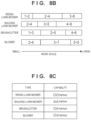
- FIG. 8 B is a diagram illustrating an example of selecting a number of work machines in accordance with a work scale
- FIG. 8 C is a diagram illustrating an example of the work machine information
- FIG. 9 is a flowchart illustrating another processing example of the system.
- FIG. 10 A is a diagram illustrating an example of a work area
- FIG. 10 B is a diagram illustrating an example of the plurality of selection patterns in accordance with the work information
- FIG. 11 is a flowchart illustrating another processing example of the system.
- FIG. 12 A is a block diagram when a mobile terminal is used as a selection support device.
- FIGS. 12 B and 12 C are flowcharts illustrating a processing example.
- FIG. 1 is an explanatory diagram illustrating an example of selection support according to the present invention.
- a supervisor 110 of the contractor who performs the lawn mowing work selects a work machine to be used in work on the work field WA from among work machines 101 to 104 stored and managed in a base (warehouse) 100 by the contractor.
- the selected work machine is transported to the work field WA using a truck and the like and used for work.
- the work machine 101 is a riding lawn mower, and the work machine 102 is a walking lawn mower.
- the work machine 103 is a brushcutter, and the work machine 104 is a blower.
- the supervisor 110 selects one work machine 101 , two work machines 102 , one work machine 103 , and two work machines 104 as the work machines to be used for the work field WA.
- the plurality of work machines 101 to 104 is stored in the base 100 .
- the number of work machines to be managed is large. It is easier to manage the work machines 101 to 104 when the maintenance timing and the replacement timing (timing for buying a replacement) coincide for each type. For example, in a case where 20 work machines 102 (walking lawn mowers) are managed, it is possible to reduce a burden of office processing associated with replacement by collectively replacing all the 20 work machines. However, the use frequencies of the work machines do not necessarily coincide with each other. Therefore, the maintenance timing and the replacement timing are different for each work machine, and it is difficult to perform collective processing.
- leveling of use of work machines is supported for each type of work machines. Accordingly, the maintenance timing and the replacement timing of the same type of work machine can be made uniform.
- FIG. 2 is a block diagram of a selection support system 1 .
- the system 1 includes a selection support server 2 that is a server computer and a mobile terminal 3 that is a portable computer.
- the selection support server 2 is a selection support device that supports selection of a work machine to be used for work.
- the selection support server 2 includes a processing unit 21 , a storage unit 22 , and a communication unit 23 .
- the processing unit 21 is a processor represented by a CPU, and executes a program stored in the storage unit 22 .
- the storage unit 22 is a storage device such as a semiconductor memory (RAM, ROM, etc.) or a hard disk.
- the program stored in the storage unit 22 may be distributed in a storage medium such as a CD-ROM and installed in the selection support server 2 .
- the communication unit 23 includes a wired or wireless communication interface capable of communicating with the mobile terminal 3 via a communication network.
- the storage unit 22 stores various types of data in addition to a program executed by the processing unit 21 .
- the storage unit 22 includes a database 22 a as various data. An example of the information accumulated in the database 22 a will be described later.
- the mobile terminal 3 is a communication terminal such as a smartphone used by the supervisor 110 .
- the mobile terminal 3 includes a processing unit 31 , a storage unit 32 , a communication unit 33 , a display unit 34 , an input unit 35 , and a communication unit 36 .
- the processing unit 31 is a processor represented by a CPU, and executes a program stored in the storage unit 32 .
- the storage unit 32 is a storage device such as a semiconductor memory (RAM, ROM, etc.).
- the storage unit 32 stores an application program that receives the selection support service in the present embodiment. This application program may be downloaded from the selection support server 2 , or may be distributed in a storage medium such as a CD-ROM and installed in the mobile terminal 3 .
- the communication unit 33 includes a wireless communication device capable of communicating with the selection support server 2 via a communication network.
- the display unit 34 is an electronic image display device, and is, for example, a liquid crystal display device.
- the input unit 35 is a device that accepts an input of a user (supervisor 110 ).
- the display unit 34 and the input unit 35 constitute a touch panel display in the present embodiment.
- the communication unit 36 includes a near field wireless communication device capable of performing near field wireless communication with a measuring instrument 4 .
- the measuring instrument 4 is provided in each of the work machines 101 to 104 , and automatically measures the working time of the work machine.
- the communication unit 36 can acquire information on the working time from the measuring instrument 4 by wireless communication after the working of the work machines 101 to 104 .
- the measuring instrument 4 includes a communication circuit that transmits the working time to the communication unit 36 in response to a request from the communication unit 36 .
- An identifier (“ID” to be described later) for specifying each work machine is set in each work machine, and the communication circuit transmits the working time together with this identifier.
- the measuring instrument 4 may be a measuring instrument using a known measurement principle.
- the measuring instrument 4 may include a sensor that detects vibration, and measure a time during which vibration is detected as a working time.
- the measuring instrument 4 may include a sensor that detects a current supplied to a motor included in the work machine, and measure a time during which the current is detected as a working time.
- the measuring instrument 4 may include a sensor that detects whether a main power supply included in the work machine is ON or OFF, and may measure a time when the main power supply is ON as a working time.
- FIGS. 3 A and 3 B illustrate an example of information accumulated in the database 22 a
- FIG. 3 A illustrates an example of history information
- FIG. 3 B illustrates an example of work machine information.
- the supervisor 110 registers the history information and the basic information of the work machine information using the mobile terminal 3 .
- the administrator of the selection support server 2 may perform registration by hearing from the supervisor 110 and the like.
- the history information is information on a use history of each of the work machines 101 to 104 .
- the “ID” is an identifier for individually specifying each of the work machines 101 to 104 .
- the alphabetical character in the beginning of the ID represents the type of the work machine, and “A” is a riding lawn mower, “B” is a walking lawn mower, “C” is a brushcutter, and “D” is a blower.
- the “degree of use” is information indicating the degree to which the work machine has been used so far.
- the “degree of use” is the cumulative working time so far, and for example, the cumulative working time of the riding lawn mower with “ID” of A01 is 100 hours.
- the “frequency” indicates a working time per unit period from the start of use of the work machine until now.
- the “frequency” is the working time per day, and its computing equation is the cumulative working time/the number of days from the start of use of the work machine.
- Various types of information are accumulated in “others”. For example, a use start date of the work machine, a degree of use at the previous maintenance, information on whether or not the work machine is currently selected as the work machine to be used for work, and the like are accumulated.
- the work machine information is information serving as a guide for the maintenance timing and the replacement timing for each type of work machine.
- the maintenance timing and the replacement timing are specified by the working time.
- the maintenance timing is defined as a maintenance cycle time, and in a case where this is specified as 50 hours, maintenance such as replacement of a consumable part is recommended every 50 hours.
- the replacement time is specified as 500 hours in the cumulative working time as the replacement timing, when the cumulative working time reaches 500 hours, the replacement is recommended.
- FIG. 4 is a flowchart illustrating a processing example of the system 1 , and illustrates a processing example executed by the processing unit 21 of the selection support server 2 and the processing unit 31 of the mobile terminal 3 .
- the supervisor 110 activates the application program of the mobile terminal 3 and transmits a proposal request related to selection of a work machine to be used for work from the mobile terminal 3 to the selection support server 2 (S 1 ).
- the proposal request includes information on the type and number of work machines necessary for work.
- FIG. 5 A illustrates one such example.
- the supervisor 110 selects the type and the number of necessary work machines in accordance with the scale of the work field WA, and designates the type and the number in the proposal request.
- the selection support server 2 receives and accepts the proposal request from the mobile terminal 3 (S 11 ), and acquires information on the type and number of work machines necessary for work.
- the selection support server 2 acquires history information from the database 22 a .
- the selection support server 2 refers to the history information to specify the degree of use of each work machine of the type related to the current proposal request.
- the selection support server 2 compares the degree of use of each work machine specified in S 13 for each type of work machine, and selects a recommended work machine for each type of work machine. In the case of the present embodiment, a work machine with a small degree of use is preferentially selected as a work machine to be used for work.
- the work machine with the smallest degree of use is selected in order.
- the riding lawn mower with “ID” of A03 is selected.
- the riding lawn mower with the “ID” of A03 is selected, and then the riding lawn mower with the “ID” of A01 is selected.
- the work machine is arbitrarily selected from work machines that fall below the average value of the degree of use.
- the riding lawn mower with the “ID” of A03 or the riding lawn mower with the “ID” of A01 is selected. In this case, which one of A03 and A01 is selected may be a lottery.
- the selection support server 2 notifies the mobile terminal 3 of the selection result in S 14 .
- the notification here is performed, for example, by transmitting information indicating the ID of the selected work machine to the mobile terminal 3 .
- FIG. 5 B is a diagram illustrating a display example of the display unit 34 .
- an ID of a work machine recommended to be used is illustrated for each type of work machine.
- the supervisor 110 can obtain a selection reference of the work machine to be used for work by this display. If the supervisor 110 selects the work machine to be used for work according to the selection result of the selection support server 2 , the use of the same type of work machines can be leveled. Therefore, the selection support server 2 can support leveling of use of work machines.
- the supervisor 110 collects information on the working time of the work machine used for the work. Specifically, by wireless communication between the mobile terminal 3 and the measuring instrument 4 of each work machine used for work, the supervisor 110 takes in the ID of the work machine and the information on the working time measured by the measuring instrument 4 into the mobile terminal 3 , and instructs the mobile terminal 3 to transmit the information to the selection support server 2 .
- the mobile terminal 3 transmits the use result to the selection support server 2 .
- the use result includes the ID of each work machine used for work and information on the working time measured by the measuring instrument 4 .
- the selection support server 2 acquires (receives) the use result from the mobile terminal 3 .
- the selection support server 2 updates the history information in the database 22 a based on the use result acquired in S 16 . In this update, the working time is added to the degree of use for the work machine with the ID indicated in the use result. For example, in the example of FIG. 3 A , when the riding lawn mower with the “ID” of A03 is used for 5 hours, the “degree of use” is updated from 90 to 95. The “frequency” of all the work machines is also updated.
- the selection support server 2 estimates the maintenance timing and the replacement timing for each work machine and each type of work machine based on the updated history information and the work machine information ( FIG. 3 B ).
- the maintenance timing and the replacement timing for each work machine are estimated by, for example, the following computing equation.
- Maintenance timing ⁇ maintenance cycle time ⁇ (degree of use ⁇ degree of use at previous maintenance) ⁇ frequency
- Replacement timing (replacement time ⁇ degree of use) ⁇ frequency
- the maintenance timing and the replacement timing for each type of work machine are average values of the maintenance timing and the replacement timing for each type of work machine.
- the selection support server 2 notifies the mobile terminal 3 of the estimation result in S 18 .
- the notification here is performed, for example, by transmitting information indicating the maintenance timing and the replacement timing to the mobile terminal 3 .
- FIG. 5 C is a diagram illustrating a display example of the display unit 34 .
- the next maintenance timing and the replacement timing which are the estimation results of the selection support server 2 , are illustrated for each type of work machine.
- the supervisor 110 can obtain a reference serving as a guide for the maintenance timing or replacement timing of the work machine, and can utilize the reference for the future operation of the work machine.
- the mobile terminal 3 When the supervisor 110 selects the “individual check” button during the display, the mobile terminal 3 requests the selection support server 2 for an individual maintenance timing and replacement timing for each work machine, and by return, the selection support server 2 transmits the individual maintenance timing and replacement timing for each work machine to the mobile terminal 3 .
- the mobile terminal 3 displays the received information on the display unit 34 . Accordingly, the supervisor 110 can also obtain a reference serving as a guide for the individual maintenance timing and replacement timing of the work machine.
- the cumulative working time is exemplified as the “degree of use”, but different indexes may be used. However, since the cumulative working time is a main guide for the maintenance timing or the replacement timing, it is preferable that the cumulative working time is an index that increases as the cumulative working time increases.
- FIG. 6 A is a diagram illustrating an example of weighting.
- the weighting value varies depending on the state of the work field.
- the weighting is set to 1.0 (no increase or decrease).
- the work machine wears and deteriorates even in the same working time. Therefore, when the state of the work field is rough, the weighting is set to 1.2 (increase).
- Examples of the rough land include a work field where turf maintenance has been rarely performed, a work field with many undulations, and a work field with many obstacles (rocks and artifacts).
- the weighting is set to 0.9 (decrease).
- Examples of the good land include a work field where turf maintenance is periodically performed and a flat work field.
- the type of the state of the work field may be selected by the supervisor 110 .
- the supervisor 110 may designate the type of the current state of the work field.
- the type of the state of the work field may be selected by the selection support server 2 .
- the relationship between the image of the work field and the degree of wear or the degree of deterioration of the work machine that has worked on the work field is learned by the artificial intelligence (machine learning), and the learning result is stored in the database 22 a to be usable.
- the type of the state of the work field may be discriminated using the learning result from the current image of the work field provided by the supervisor 110 .
- FIG. 6 B is a diagram illustrating another example of weighting.
- the weighting value varies depending on the work attitude of the worker (or the group of workers) who has performed the work.
- the weighting is set to 1.0 (no increase or decrease).
- the weighting is set to 1.1 (slightly increased).
- the weighting is set to 1.3 (increase).
- the type of work attitude may be selected by the supervisor 110 .
- the supervisor 110 may designate the type of attitude of the worker who has performed the current work.
- the work machine with a small degree of use is preferentially selected as the work machine to be used for work.
- it may be advantageous to first use out the work machine with a large degree of use For example, in a case where two of the three riding lawn mowers in FIG. 3 A have a degree of use of around 80, the remaining one has a degree of use of around 400, and the replacement time is 500 hours, it is advantageous to use out the riding lawn mower with a degree of use of around 400 and replace it with a new riding lawn mower.
- FIG. 7 A is a display example of a mode selection screen on the display unit 34 of the mobile terminal 3 .
- a “leveling mode” button and a “use-out mode” button are displayed.
- the leveling mode is a mode for preferentially selecting a work machine with a small degree of use as the work machine to be used for work described in the first embodiment.
- the use-out mode is a mode for preferentially selecting a work machine with a large degree of use as a work machine to be used for work.
- FIG. 7 B is a flowchart illustrating a processing example of the system 1 related to mode selection.
- a mode selection request for requesting processing in the mode selected by the supervisor 110 is transmitted from the mobile terminal 3 to the selection support server 2 in S 21 .
- the selection support server 2 receives and accepts the mode selection request from the mobile terminal 3 (S 31 ), and sets the selection criteria of the mode (leveling mode or use-out mode) requested by the mode selection request as the selection criteria of the recommended work machine in S 32 .
- the work machine with a small degree of use is preferentially selected when the recommended work machine is selected in S 14 in FIG. 4
- the use-out mode is set, the work machine with a large degree of use is preferentially selected when the recommended work machine is selected in S 14 in FIG. 4 .
- the supervisor 110 designates the type and the number of necessary work machines. However, in the proposal request in S 1 , the supervisor 110 may designate the work information and select the type and the number of necessary work machines on the side of the selection support server 2 .
- FIG. 8 A is an explanatory diagram illustrating one such example.
- FIG. 9 is a flowchart illustrating a processing example of the system 1 in the present embodiment instead of the example of FIG. 4 , and processing different from that in FIG. 4 will be described.
- the work scale is designated as the work information.
- the work scale here is the work area (1.5 ha) of the work field WA.
- the supervisor 110 designates the work scale when making the proposal request in S 1 .
- the selection support server 2 acquires work information (work scale).
- the selection support server 2 first selects the type and number of work machines to be used for work. This selection can be selected according to a predetermined rule as exemplified in FIG. 8 B , for example. In the illustrated example, the size of the work scale and the number of work machines for each type of work machine suitable at that time are illustrated. Such rules are created in accordance with past work results and stored in the database 22 a.
- Machine learning may be used to select the type and number of work machines to be used for work.
- the relationship between the work scale of the work field and the type and number of the work machines that have worked on the work field is learned by the artificial intelligence, and the learning result is stored in the database 22 a to be usable. Then, the type and number of work machines may be selected using the learning result from the information on the current work scale provided by the supervisor 110 .
- the degree of use of each work machine is compared, and the recommended work machine is selected for each type of work machine from the viewpoint of the degree of use.
- pattern 1 and pattern 2 are selected as selection examples of the recommended work machine.
- Each pattern indicates an ID of the recommended work machine for each type of the use machine.
- pattern 1 there are two riding lawn mowers and two walking lawn mowers.
- pattern 2 there are two walking lawn mowers, but there is one riding lawn mower.
- the selection support server 2 estimates the working time for each pattern in S 41 .
- the estimated working time for each pattern is also illustrated. In the case of pattern 1 , the estimated working time is about 2 hours, and in the case of pattern 2 , the estimated working time is about 3 hours and 30 minutes.
- the working time can be estimated by storing information indicating the capability of the work machine in the database 22 a in advance and computing the working time with reference to the information.
- the information indicating the capability of the work machine can be a part of the work machine information ( FIG. 3 B ).
- FIG. 8 C is a diagram illustrating an example of information indicating the capability of the work machine. In the illustrated example, the workable area of the work machine per unit time is specified for each type of work machine.
- the estimated working time of each pattern in FIG. 8 A can be computed from the type and number of the selected work machines and the information in FIG. 8 C .
- information of the pattern 1 and the pattern 2 illustrated in FIG. 8 A is sent to the mobile terminal 3 as a selection result of S 15 .
- the supervisor 110 can compare and examine the pattern 1 and the pattern 2 and select a work machine to be used for work. For example, in the case of pattern 1 , there is an advantage that the working time is short. In addition, in the case of pattern 2 , there is an advantage that the number of riding lawn mowers is small.
- two types of patterns are exemplified as selection examples of the recommended work machine, but three or more types of patterns may be generated, or conversely, only one type of pattern may be generated and the working time may be estimated.
- the work scale in particular, the work area is exemplified as the work information, but the work information is not limited to this.
- the work information may be information for each work area of the work field WA.
- FIGS. 10 A and 10 B are explanatory diagrams, and FIG. 11 is a flowchart illustrating a processing example of the system 1 in the present embodiment instead of the example of FIG. 4 , and processing different from that in FIG. 4 will be described.
- the work field WA is partitioned into two work areas R 1 and R 2 .
- the supervisor 110 designates the type and the number of necessary work machines for each work area, and designates work information.
- Work information is individually set in each of the work areas R 1 and R 2 .
- the work information here is a working time.
- the selection support server 2 acquires work information (working time) together with the type and the number of necessary work machines.
- the selection support server 2 selects the recommended work machine for each work area with reference to the work information and the degree of use.
- a work machine with a small degree of use is preferentially selected as a work machine to be used for work in the work area R 1 having a long working time. Accordingly, the degree of use of the work machine can be leveled.
- the riding lawn mowers with IDs of A02 and A03 are selected in the work area R 1
- the riding lawn mower with the ID of A01 is selected in the work area R 2 .
- the riding lawn mower of A01 with the largest degree of use is allocated to the work area R 2 having a short working time
- the riding lawn mowers of A02 and A03 with the small degrees of use are allocated to the work area R 1 having a long working time.
- a work machine with a large degree of use is preferentially selected as a work machine to be used for work in the work area R 1 having a long working time.
- the mobile terminal 3 is notified of information on the recommended work machine for each work area illustrated in FIG. 10 B as a selection result of S 15 . If the supervisor 110 selects the work machine to be used for work according to the selection result of the selection support server 2 , the use of the same type of work machines can be leveled.
- the mobile terminal 3 collects information on the working time of the work machine used for work from the measuring instrument 4 and transmits the collected information to the selection support server 2 (S 4 , S 16 ) has been described.
- the mobile terminal 3 may not be interposed, and information (use result) on the ID of the work machine and the working time may be directly transmitted from the measuring instrument 4 to the selection support server 2 when the work of the work machine is completed, and collected in the selection support server 2 .
- the work result of the work machine not having the wide area wireless communication function may be temporarily transmitted to the work machine having the wide area wireless communication function by the near field wireless communication function, and may be transmitted from the work machine to the selection support server 2 .
- a server-client system including the selection support server 2 and the mobile terminal 3 has been exemplified as the system 1 .
- processing similar to that of the system 1 can be realized by the mobile terminal 3 , and the mobile terminal 3 can be used as the selection support device.
- FIG. 12 A is a block diagram of the mobile terminal 3 according to the present embodiment. The difference from the example of FIG. 2 is that the mobile terminal 3 includes a database 32 a corresponding to the above database 22 a.
- FIGS. 12 B and 12 C are flowcharts illustrating an example of processing executed by the processing unit 31 of the mobile terminal 3 according to the present embodiment.
- the processing of FIG. 12 B relates to the selection processing of the recommended work machine, and is substantially the same as the processing of S 11 to S 15 of the selection support server 2 illustrated in FIG. 4 .
- a proposal request from the supervisor 110 is accepted.
- the supervisor 110 inputs information on the type and number of work machines necessary for work from the input unit 35 and makes a proposal request.
- the mobile terminal 3 acquires information on the type and number of work machines necessary for work.
- the mobile terminal 3 acquires the history information from the database 32 a .
- the mobile terminal 3 refers to the history information to specify the degree of use of each work machine of the type related to the current proposal request.
- the mobile terminal 3 compares the degree of use of each work machine specified in S 53 for each type of work machine, and selects a recommended work machine for each type of work machine.
- the mobile terminal 3 displays the selection result of S 54 on the display unit 34 .
- the supervisor 110 can obtain a selection reference of the work machine to be used for work by this display. If the supervisor 110 selects the work machine to be used for work according to the selection result, the use of the same type of work machines can be leveled. Therefore, the mobile terminal 3 can support leveling of use of work machines.
- FIG. 12 C relates to the processing after the completion of the work, and is substantially the same as the processing of S 16 to S 19 of the selection support server 2 illustrated in FIG. 4 .
- the work machine used for the work returns to the base 100 .
- the supervisor 110 collects information on the working time of the work machine used for the work.
- the mobile terminal 3 acquires the ID of the work machine and the information on the working time measured by the measuring instrument 4 into the mobile terminal 3 by wireless communication with the measuring instrument 4 of each work machine used for work.
- the mobile terminal 3 updates the history information in the database 32 a based on the acquired use result. The “frequency” of all the work machines is also updated.
- the mobile terminal 3 estimates the maintenance timing and the replacement timing for each work machine and each type of work machine based on the updated history information and the work machine information ( FIG. 3 B ).
- the mobile terminal 3 displays the estimation result on the display unit 34 . With this display, the supervisor 110 can obtain a reference serving as a guide for the maintenance timing or replacement timing of the work machine, and can utilize the reference for the future operation of the work machine.
- the present embodiment can be combined with at least one of the second to fifth embodiments.
- the mobile terminal 3 includes the database 32 a , but instead, various types of information such as history information may be acquired by communication as necessary from the database 22 a of the server corresponding to the selection support server 2 .
- the lawn mowing work is exemplified as the work contents in the work field WA, but the work contents and the type of the corresponding work machine are not limited to this, and the present invention can be applied to various works such as road work and site work, for example, various works such as snow removal work, agricultural work, pavement work, and park and road cleaning work.
- the working time of each work machine is measured by the measuring instrument 4 , but a supervisor or a worker may measure the working time and input the working time to the mobile terminal 3 .
- the above embodiments disclose at least the following selection support device, selection support method, storage medium, and program.
- the selection support device of the embodiment is a selection support device ( 2 , 3 ) that supports selection of a work machine to be used for work from among a plurality of work machines, the selection support device comprising:
- the degree of use is a cumulative working time of the work machine.
- the degree of use is an index that increases as a cumulative working time of the work machine increases.
- the selection support device of the embodiment comprises a work information acquisition unit (S 11 ,S 51 ) configured to acquire work information of a plurality of work areas, wherein
- the work information includes information on a working time
- the selection support device of the embodiment comprises a work information acquisition unit (S 11 ,S 51 ) configured to acquire work information on a work field; and
- the selection unit selects a plurality of patterns of work machines to be used for work
- the selection unit :
- the user can select a method for selecting a work machine suitable for leveling the use of a plurality of work machines and a method for selecting a work machine suitable for first using out a work machine with a large degree of use.
- the selection support device of the embodiment comprises an estimation unit (S 18 ,S 63 ) configured to estimate a replacement timing of each work machine based on the history information.
- the plurality of work machines are the same type of work machine.
- the selection support method of the embodiment is a selection support method that supports selection of a work machine to be used for work from among a plurality of work machines, the selection support method comprising:
- the storage medium of the embodiment is a storage medium that stores a program for causing a computer to execute a selection support method that supports selection of a work machine to be used for work from among a plurality of work machines, the selection support method comprising:
- the program of the embodiment is a program for causing a computer to execute a selection support method that supports selection of a work machine to be used for work from among a plurality of work machines, the selection support method comprising:
Landscapes
- Engineering & Computer Science (AREA)
- Business, Economics & Management (AREA)
- Physics & Mathematics (AREA)
- General Physics & Mathematics (AREA)
- Human Resources & Organizations (AREA)
- Quality & Reliability (AREA)
- Manufacturing & Machinery (AREA)
- Automation & Control Theory (AREA)
- Strategic Management (AREA)
- Economics (AREA)
- Tourism & Hospitality (AREA)
- General Business, Economics & Management (AREA)
- Theoretical Computer Science (AREA)
- Marketing (AREA)
- Entrepreneurship & Innovation (AREA)
- General Engineering & Computer Science (AREA)
- Operations Research (AREA)
- Human Computer Interaction (AREA)
- Development Economics (AREA)
- Animal Husbandry (AREA)
- Marine Sciences & Fisheries (AREA)
- Mining & Mineral Resources (AREA)
- Health & Medical Sciences (AREA)
- General Health & Medical Sciences (AREA)
- Primary Health Care (AREA)
- Agronomy & Crop Science (AREA)
- Life Sciences & Earth Sciences (AREA)
- Game Theory and Decision Science (AREA)
- Educational Administration (AREA)
- Management, Administration, Business Operations System, And Electronic Commerce (AREA)
Abstract
Description
Maintenance timing={maintenance cycle time−(degree of use−degree of use at previous maintenance)}÷frequency
Replacement timing=(replacement time−degree of use)÷frequency
-
- a history information acquisition unit (S13,S53) configured to acquire history information on a use history of each work machine;
- a specifying unit (S13,S53) configured to specify a degree of use of each work machine based on the history information; and
- a selection unit (S14,S54) configured to preferentially select a work machine with a small degree of use as a work machine to be used for work.
-
- the selection unit selects a work machine to be used for work in each work area based on the work information and the degree of use.
-
- the selection unit preferentially selects a work machine with a small degree of use as a work machine to be used for work in a work area having a long working time.
-
- an estimation unit (S41) configured to estimate a working time when a work in the work field is performed by the work machine selected by the selection unit.
-
- the estimation unit estimates the working time for each pattern of the plurality of patterns.
-
- preferentially selects a work machine with a small degree of use as a work machine to be used for work when a user selects a first selection mode; and
- preferentially selects a work machine with a large degree of use as a work machine to be used for work when a user selects a second selection mode.
-
- acquiring (S12,S52) history information on a use history of each work machine;
- specifying (S13,S53) a degree of use of each work machine based on the history information; and
- preferentially selecting (S14,S54) a work machine with a small degree of use as a work machine to be used for work.
-
- acquiring (S12,S52) history information on a use history of each work machine;
- specifying (S13,S53) a degree of use of each work machine based on the history information; and
- preferentially selecting (S14,S54) a work machine with a small degree of use as a work machine to be used for work.
-
- acquiring (S12,S52) history information on a use history of each work machine;
- specifying (S13,S53) a degree of use of each work machine based on the history information; and
- preferentially selecting (S14,S54) a work machine with a small degree of use as a work machine to be used for work.
Claims (10)
Applications Claiming Priority (2)
| Application Number | Priority Date | Filing Date | Title |
|---|---|---|---|
| JP2021098130A JP7642450B2 (en) | 2021-06-11 | 2021-06-11 | Selection support device, selection support method, and program |
| JP2021-098130 | 2021-06-11 |
Publications (2)
| Publication Number | Publication Date |
|---|---|
| US20220397890A1 US20220397890A1 (en) | 2022-12-15 |
| US11953892B2 true US11953892B2 (en) | 2024-04-09 |
Family
ID=84192158
Family Applications (1)
| Application Number | Title | Priority Date | Filing Date |
|---|---|---|---|
| US17/830,544 Active US11953892B2 (en) | 2021-06-11 | 2022-06-02 | Selection support device, selection support method, and storage medium |
Country Status (3)
| Country | Link |
|---|---|
| US (1) | US11953892B2 (en) |
| JP (1) | JP7642450B2 (en) |
| DE (1) | DE102022114515A1 (en) |
Families Citing this family (2)
| Publication number | Priority date | Publication date | Assignee | Title |
|---|---|---|---|---|
| WO2023018808A1 (en) * | 2021-08-11 | 2023-02-16 | Oshkosh Corporation | Work equipment utilization monitoring system and method |
| WO2025220189A1 (en) * | 2024-04-18 | 2025-10-23 | 株式会社Fuji | Market system and ordering promotion method |
Citations (3)
| Publication number | Priority date | Publication date | Assignee | Title |
|---|---|---|---|---|
| US20040260470A1 (en) * | 2003-06-14 | 2004-12-23 | Rast Rodger H. | Conveyance scheduling and logistics system |
| US20190265749A1 (en) * | 2016-07-28 | 2019-08-29 | Fuji Corporation | Work device and time-measuring method of work device |
| JP2020195316A (en) | 2019-05-31 | 2020-12-10 | 松山株式会社 | Work time measurement system for agricultural implement |
Family Cites Families (5)
| Publication number | Priority date | Publication date | Assignee | Title |
|---|---|---|---|---|
| JP2002099598A (en) * | 2000-09-21 | 2002-04-05 | Komatsu Ltd | Machine and mechanical part residual value calculation system and residual value calculation method |
| JP2002163576A (en) * | 2000-11-24 | 2002-06-07 | Kobelco Contstruction Machinery Ltd | Method and device for control operation of rental machine |
| JP2005196399A (en) * | 2004-01-06 | 2005-07-21 | Hitachi Constr Mach Co Ltd | Construction machine management system, management method, management program, and computer-readable recording medium recording the management program |
| EP4446501A3 (en) * | 2017-03-22 | 2025-02-19 | Sumitomo Heavy Industries, LTD. | Shovel, and management device and support device for shovels |
| JP2020046791A (en) * | 2018-09-18 | 2020-03-26 | Telexistence株式会社 | Reservation device and reservation method and reservation system |
-
2021
- 2021-06-11 JP JP2021098130A patent/JP7642450B2/en active Active
-
2022
- 2022-06-02 US US17/830,544 patent/US11953892B2/en active Active
- 2022-06-09 DE DE102022114515.8A patent/DE102022114515A1/en active Pending
Patent Citations (3)
| Publication number | Priority date | Publication date | Assignee | Title |
|---|---|---|---|---|
| US20040260470A1 (en) * | 2003-06-14 | 2004-12-23 | Rast Rodger H. | Conveyance scheduling and logistics system |
| US20190265749A1 (en) * | 2016-07-28 | 2019-08-29 | Fuji Corporation | Work device and time-measuring method of work device |
| JP2020195316A (en) | 2019-05-31 | 2020-12-10 | 松山株式会社 | Work time measurement system for agricultural implement |
Also Published As
| Publication number | Publication date |
|---|---|
| JP2022189513A (en) | 2022-12-22 |
| DE102022114515A1 (en) | 2022-12-15 |
| US20220397890A1 (en) | 2022-12-15 |
| JP7642450B2 (en) | 2025-03-10 |
Similar Documents
| Publication | Publication Date | Title |
|---|---|---|
| US20220397890A1 (en) | Selection support device, selection support method, and storage medium | |
| EP3757929B1 (en) | Control device for sharing service, control method, and program | |
| KR100885864B1 (en) | Mobile system management system | |
| US8694454B2 (en) | Methods, apparatus and systems for generating, updating and executing a vegetation control plan | |
| US20210248537A1 (en) | Skill evaluation system, skill evaluation method, and recording medium | |
| US20170349058A1 (en) | Fleet management system for outdoor power equipment | |
| DE112009000957B4 (en) | Navigation device and adaptive-controlled communication system | |
| JP2004171127A (en) | Field work support method and system and recording medium | |
| CN110276467B (en) | Logistics scheduling method, logistics scheduling server and logistics scheduling system | |
| WO2020203170A1 (en) | Skill information presentation system and skill information presentation method | |
| US12265374B2 (en) | Job selection system and job selection method | |
| US20240020638A1 (en) | Systems and software for state-based monitoring and control of powered devices | |
| JP2019125117A (en) | Management device and program | |
| JP2022036524A (en) | Work management system, work management method, and work management program | |
| KR101785972B1 (en) | Managing system and method for work statue and results based on computer | |
| US20110258252A1 (en) | Personal task planning with automatic task discovery | |
| EP3937101A1 (en) | Skill evaluation system and skill evaluation method | |
| US20220164754A1 (en) | Skill information presentation system and skill information presentation method | |
| JP2020027348A (en) | Information processing apparatus, information processing method, and program | |
| JP7699984B2 (en) | Agricultural management support method, agricultural management support system, and agricultural management support program | |
| JP2020021413A (en) | Contribution degree estimation device | |
| KR20180007360A (en) | Golf course control system and method based on location information | |
| KR20220105896A (en) | Server for Managing Agricultural Working Vehicle and Method for Providing Management Service of Agricultural Working Vehicle | |
| US12271207B2 (en) | Method for controlling a plurality of robots for environment maintenance | |
| JP2019185382A (en) | Battery replacement charge determination system |
Legal Events
| Date | Code | Title | Description |
|---|---|---|---|
| FEPP | Fee payment procedure |
Free format text: ENTITY STATUS SET TO UNDISCOUNTED (ORIGINAL EVENT CODE: BIG.); ENTITY STATUS OF PATENT OWNER: LARGE ENTITY |
|
| STPP | Information on status: patent application and granting procedure in general |
Free format text: DOCKETED NEW CASE - READY FOR EXAMINATION |
|
| AS | Assignment |
Owner name: HONDA MOTOR CO., LTD., JAPAN Free format text: ASSIGNMENT OF ASSIGNORS INTEREST;ASSIGNORS:HIRAKAWA, MEGUMI;MURATA, SATOSHI;SAKAGUCHI, SOTA;AND OTHERS;SIGNING DATES FROM 20220524 TO 20220602;REEL/FRAME:063154/0031 |
|
| STPP | Information on status: patent application and granting procedure in general |
Free format text: NON FINAL ACTION MAILED |
|
| STPP | Information on status: patent application and granting procedure in general |
Free format text: RESPONSE TO NON-FINAL OFFICE ACTION ENTERED AND FORWARDED TO EXAMINER |
|
| STPP | Information on status: patent application and granting procedure in general |
Free format text: NOTICE OF ALLOWANCE MAILED -- APPLICATION RECEIVED IN OFFICE OF PUBLICATIONS |
|
| STPP | Information on status: patent application and granting procedure in general |
Free format text: PUBLICATIONS -- ISSUE FEE PAYMENT VERIFIED |
|
| STCF | Information on status: patent grant |
Free format text: PATENTED CASE |