US11940407B2 - Micro-sensor for detecting chemical species and associated manufacturing method - Google Patents

Micro-sensor for detecting chemical species and associated manufacturing method Download PDF

Info

Publication number
US11940407B2
US11940407B2 US17/044,205 US201917044205A US11940407B2 US 11940407 B2 US11940407 B2 US 11940407B2 US 201917044205 A US201917044205 A US 201917044205A US 11940407 B2 US11940407 B2 US 11940407B2
Authority
US
United States
Prior art keywords
microsensor
dielectric layer
active layer
silicon
nanometers
Prior art date
Legal status (The legal status is an assumption and is not a legal conclusion. Google has not performed a legal analysis and makes no representation as to the accuracy of the status listed.)
Active, expires
Application number
US17/044,205
Other versions
US20210132002A1 (en
Inventor
Bruno Ghyselen
Current Assignee (The listed assignees may be inaccurate. Google has not performed a legal analysis and makes no representation or warranty as to the accuracy of the list.)
Soitec SA
Original Assignee
Soitec SA
Priority date (The priority date is an assumption and is not a legal conclusion. Google has not performed a legal analysis and makes no representation as to the accuracy of the date listed.)
Filing date
Publication date
Application filed by Soitec SA filed Critical Soitec SA
Assigned to SOITEC reassignment SOITEC ASSIGNMENT OF ASSIGNORS INTEREST (SEE DOCUMENT FOR DETAILS). Assignors: GHYSELEN, BRUNO
Publication of US20210132002A1 publication Critical patent/US20210132002A1/en
Application granted granted Critical
Publication of US11940407B2 publication Critical patent/US11940407B2/en
Active legal-status Critical Current
Adjusted expiration legal-status Critical

Links

Images

Classifications

    • GPHYSICS
    • G01MEASURING; TESTING
    • G01NINVESTIGATING OR ANALYSING MATERIALS BY DETERMINING THEIR CHEMICAL OR PHYSICAL PROPERTIES
    • G01N27/00Investigating or analysing materials by the use of electric, electrochemical, or magnetic means
    • G01N27/26Investigating or analysing materials by the use of electric, electrochemical, or magnetic means by investigating electrochemical variables; by using electrolysis or electrophoresis
    • G01N27/403Cells and electrode assemblies
    • G01N27/414Ion-sensitive or chemical field-effect transistors, i.e. ISFETS or CHEMFETS
    • G01N27/4148Integrated circuits therefor, e.g. fabricated by CMOS processing
    • BPERFORMING OPERATIONS; TRANSPORTING
    • B01PHYSICAL OR CHEMICAL PROCESSES OR APPARATUS IN GENERAL
    • B01LCHEMICAL OR PHYSICAL LABORATORY APPARATUS FOR GENERAL USE
    • B01L3/00Containers or dishes for laboratory use, e.g. laboratory glassware; Droppers
    • B01L3/50Containers for the purpose of retaining a material to be analysed, e.g. test tubes
    • B01L3/502Containers for the purpose of retaining a material to be analysed, e.g. test tubes with fluid transport, e.g. in multi-compartment structures
    • B01L3/5027Containers for the purpose of retaining a material to be analysed, e.g. test tubes with fluid transport, e.g. in multi-compartment structures by integrated microfluidic structures, i.e. dimensions of channels and chambers are such that surface tension forces are important, e.g. lab-on-a-chip
    • B01L3/502715Containers for the purpose of retaining a material to be analysed, e.g. test tubes with fluid transport, e.g. in multi-compartment structures by integrated microfluidic structures, i.e. dimensions of channels and chambers are such that surface tension forces are important, e.g. lab-on-a-chip characterised by interfacing components, e.g. fluidic, electrical, optical or mechanical interfaces
    • HELECTRICITY
    • H01ELECTRIC ELEMENTS
    • H01LSEMICONDUCTOR DEVICES NOT COVERED BY CLASS H10
    • H01L21/00Processes or apparatus adapted for the manufacture or treatment of semiconductor or solid state devices or of parts thereof
    • H01L21/02Manufacture or treatment of semiconductor devices or of parts thereof
    • H01L21/04Manufacture or treatment of semiconductor devices or of parts thereof the devices having potential barriers, e.g. a PN junction, depletion layer or carrier concentration layer
    • H01L21/18Manufacture or treatment of semiconductor devices or of parts thereof the devices having potential barriers, e.g. a PN junction, depletion layer or carrier concentration layer the devices having semiconductor bodies comprising elements of Group IV of the Periodic Table or AIIIBV compounds with or without impurities, e.g. doping materials
    • H01L21/30Treatment of semiconductor bodies using processes or apparatus not provided for in groups H01L21/20 - H01L21/26
    • H01L21/302Treatment of semiconductor bodies using processes or apparatus not provided for in groups H01L21/20 - H01L21/26 to change their surface-physical characteristics or shape, e.g. etching, polishing, cutting
    • H01L21/306Chemical or electrical treatment, e.g. electrolytic etching
    • H01L21/30604Chemical etching
    • HELECTRICITY
    • H01ELECTRIC ELEMENTS
    • H01LSEMICONDUCTOR DEVICES NOT COVERED BY CLASS H10
    • H01L21/00Processes or apparatus adapted for the manufacture or treatment of semiconductor or solid state devices or of parts thereof
    • H01L21/70Manufacture or treatment of devices consisting of a plurality of solid state components formed in or on a common substrate or of parts thereof; Manufacture of integrated circuit devices or of parts thereof
    • H01L21/71Manufacture of specific parts of devices defined in group H01L21/70
    • H01L21/76Making of isolation regions between components
    • H01L21/762Dielectric regions, e.g. EPIC dielectric isolation, LOCOS; Trench refilling techniques, SOI technology, use of channel stoppers
    • H01L21/7624Dielectric regions, e.g. EPIC dielectric isolation, LOCOS; Trench refilling techniques, SOI technology, use of channel stoppers using semiconductor on insulator [SOI] technology
    • H01L21/76251Dielectric regions, e.g. EPIC dielectric isolation, LOCOS; Trench refilling techniques, SOI technology, use of channel stoppers using semiconductor on insulator [SOI] technology using bonding techniques
    • H01L21/76254Dielectric regions, e.g. EPIC dielectric isolation, LOCOS; Trench refilling techniques, SOI technology, use of channel stoppers using semiconductor on insulator [SOI] technology using bonding techniques with separation/delamination along an ion implanted layer, e.g. Smart-cut, Unibond
    • BPERFORMING OPERATIONS; TRANSPORTING
    • B01PHYSICAL OR CHEMICAL PROCESSES OR APPARATUS IN GENERAL
    • B01LCHEMICAL OR PHYSICAL LABORATORY APPARATUS FOR GENERAL USE
    • B01L2200/00Solutions for specific problems relating to chemical or physical laboratory apparatus
    • B01L2200/12Specific details about manufacturing devices
    • H01L29/16
    • H01L29/161
    • H01L29/20
    • H01L29/2003
    • HELECTRICITY
    • H10SEMICONDUCTOR DEVICES; ELECTRIC SOLID-STATE DEVICES NOT OTHERWISE PROVIDED FOR
    • H10DINORGANIC ELECTRIC SEMICONDUCTOR DEVICES
    • H10D62/00Semiconductor bodies, or regions thereof, of devices having potential barriers
    • H10D62/80Semiconductor bodies, or regions thereof, of devices having potential barriers characterised by the materials
    • H10D62/83Semiconductor bodies, or regions thereof, of devices having potential barriers characterised by the materials being Group IV materials, e.g. B-doped Si or undoped Ge
    • HELECTRICITY
    • H10SEMICONDUCTOR DEVICES; ELECTRIC SOLID-STATE DEVICES NOT OTHERWISE PROVIDED FOR
    • H10DINORGANIC ELECTRIC SEMICONDUCTOR DEVICES
    • H10D62/00Semiconductor bodies, or regions thereof, of devices having potential barriers
    • H10D62/80Semiconductor bodies, or regions thereof, of devices having potential barriers characterised by the materials
    • H10D62/83Semiconductor bodies, or regions thereof, of devices having potential barriers characterised by the materials being Group IV materials, e.g. B-doped Si or undoped Ge
    • H10D62/832Semiconductor bodies, or regions thereof, of devices having potential barriers characterised by the materials being Group IV materials, e.g. B-doped Si or undoped Ge being Group IV materials comprising two or more elements, e.g. SiGe
    • HELECTRICITY
    • H10SEMICONDUCTOR DEVICES; ELECTRIC SOLID-STATE DEVICES NOT OTHERWISE PROVIDED FOR
    • H10DINORGANIC ELECTRIC SEMICONDUCTOR DEVICES
    • H10D62/00Semiconductor bodies, or regions thereof, of devices having potential barriers
    • H10D62/80Semiconductor bodies, or regions thereof, of devices having potential barriers characterised by the materials
    • H10D62/85Semiconductor bodies, or regions thereof, of devices having potential barriers characterised by the materials being Group III-V materials, e.g. GaAs
    • HELECTRICITY
    • H10SEMICONDUCTOR DEVICES; ELECTRIC SOLID-STATE DEVICES NOT OTHERWISE PROVIDED FOR
    • H10DINORGANIC ELECTRIC SEMICONDUCTOR DEVICES
    • H10D62/00Semiconductor bodies, or regions thereof, of devices having potential barriers
    • H10D62/80Semiconductor bodies, or regions thereof, of devices having potential barriers characterised by the materials
    • H10D62/85Semiconductor bodies, or regions thereof, of devices having potential barriers characterised by the materials being Group III-V materials, e.g. GaAs
    • H10D62/8503Nitride Group III-V materials, e.g. AlN or GaN

Definitions

  • the present disclosure relates to the field of microsensors for detecting chemical species in ionic form that are present in a fluid. It relates, in particular, to a microsensor comprising an ion-sensitive field-effect transistor and comprising integrated microfluidic channels for transporting the fluid.
  • ISFET Ion-sensitive field-effect transistors
  • the gate of the transistor is placed in contact with the chemical solution to be analyzed; the chemical species present in the solution modify the electrochemical potential in the vicinity of the gate, and may thus influence the current circulating between the drain and the source of the transistor.
  • the conduction characteristics of the ISFET are therefore capable of changing as a function of the concentration of the ions in contact with the gate.
  • the conventional approach involves bringing the chemical solution into contact with the gate of the transistor (or with the gate oxide), at the front face of the transistor, i.e., in the active region of the component, where sensitive elements of the transistor are formed (source electrode, drain electrode, metal contacts, etc.)
  • sensitive elements of the transistor source electrode, drain electrode, metal contacts, etc.
  • local encapsulation layers are used to insulate these elements from the chemical solution, infiltrations may be the cause of premature wear or failure of the transistor.
  • the formation of such encapsulation layers further complicates the production process.
  • document WO 00/51180 proposes the formation of an ISFET on an SOI (silicon on insulator) substrate, then the formation of an insulating support layer on the front face of the transistor and finally the partial or complete removal of the silicon substrate to expose the oxide layer of the SOI; the oxide layer is then placed in contact with the chemical solution.
  • This approach avoids bringing the front face of the transistor into contact with a chemical solution and therefore prevents risks of infiltration.
  • it has the drawback of carrying out a step of removing, by etching, several hundreds of microns of the silicon substrate. This removal may be aggressive for the active layer (silicon surface layer of the SOI) and the sensitive elements of the transistor.
  • the present disclosure aims to overcome all or some of the aforementioned drawbacks, and relates to a microsensor for chemical analysis, based on a field-effect transistor, and to the associated fabrication process.
  • the present disclosure relates to a microsensor for detecting ions in a fluid, comprising:
  • the present disclosure also relates to a process for fabricating a microsensor for detecting ions in a fluid, comprising:
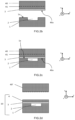
  • FIGS. 1 a and 1 b present microsensors in accordance with the present disclosure
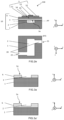
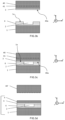
  • FIGS. 2 a to 2 e and 3 a to 3 d present steps of the process for fabricating a microsensor in accordance with the present disclosure.
  • the same references in the figures might be used for elements of the same type.
  • the figures are schematic representations which, for the sake of legibility, are not to scale.
  • the thicknesses of the layers along the z-axis are not to scale with respect to their lateral dimensions along the x- and y-axes; and the relative thicknesses of the layers with respect to one another are not necessarily respected in the figures.
  • the present disclosure relates to a microsensor 100 for detecting ions in a fluid.
  • the microsensor 100 comprises a structure 10 comprising an active layer 4 , positioned on a dielectric layer 3 , itself positioned on a support substrate 1 ( FIG. 1 a ).
  • the active layer 4 is intended to contain and/or support at least one microelectronic component, in particular, a field-effect transistor (FET).
  • FET field-effect transistor
  • the active layer 4 may be based on a single material or may include several layers of different materials.
  • the active layer 4 is formed of at least one semiconductor material selected from silicon, silicon-germanium, germanium, III-V compounds (arsenides, phosphides, nitrides, etc.) And it has a thickness between a few nanometers and a few hundreds of nanometers.
  • the support substrate 1 may be based on a semiconductor or an insulating material, such as silicon, germanium, silicon carbide, gallium arsenide, indium phosphide, sapphire or glass.
  • the support substrate 1 is formed of silicon.
  • the structure 10 further comprises at least one buried cavity 2 , formed in the support substrate 1 and positioned beneath the dielectric layer 3 . A portion of the surface 3 a of the dielectric layer 3 adjacent the buried cavity 2 is, therefore, free.
  • the microsensor 100 also comprises a field-effect transistor 5 (also referred to herein as “FET 5 ”) formed in and on the active layer 4 of the structure 10 . It has a source 51 , a drain 52 , an active region 54 between the source 51 and the drain 52 , and a gate 53 positioned above the active region 54 .
  • the active region 54 is formed in the active layer 4 , it comprises a conduction channel in which the current is capable of flowing, between the source 51 and the drain 52 , when the field-effect transistor 5 is in an on-state.
  • the gate 53 is positioned on the insulating layer 55 (gate oxide), which separates it from the active layer 4 .
  • the active layer 4 is thin.
  • it could have a thickness of 15 nm.
  • the field-effect transistor 5 is advantageously produced according to conventional CMOS technology in and on the active layer 4 ; it is, for example, of MOSFET type and operates in fully depleted mode.
  • the field-effect transistor 5 is advantageously produced according to FDSOI (fully depleted SOI) architecture.
  • the field-effect transistor 5 maybe of HEMT (high electron mobility transistor) type.
  • An FET transistor for the chemical detection of ions must be very sensitive.
  • the threshold voltage of the transistor must preferably be sensitive to the variation of the electrochemical potential in the vicinity of the gate, to detect as precisely as possible a variation in concentration of ions in the solution brought into contact with the gate.
  • An FET 5 in “fully depleted” mode of the microsensor 100 produced on an active layer 4 , in particular, made of silicon, and a dielectric layer 3 , have features perfectly suitable for this application.
  • the gate 53 is produced substantially plum with the buried cavity 2 and all or some of the active region 54 is located above the buried cavity 2 .
  • the buried cavity 2 is intended to receive the fluid to be analyzed and to bring it into contact with the dielectric layer 3 .
  • the buried cavity 2 could have lateral dimensions (in the (x, y) plane in the figures) between around 100 nanometers and a few tens of microns and a depth (along the z axis in the figures) between a few tens of nanometers and a few hundreds of microns.
  • a buried cavity 2 could have a width (along the y axis in the figures) of around 150 nm, a length (along the x axis in the figures) of around 500 nm and a depth on the order of 150 nm.
  • the dielectric layer 3 is formed of at least one insulating material selected from silicon dioxide, silicon nitride, an oxynitride, hafnium oxide (HfO 2 ), alumina (Al 2 O 3 ), tantalum oxide (Ta 2 O 5 ) or a stack of layers of these materials.
  • the dielectric layer 3 has a thickness of between a few angstroms and a few tens of nanometers.
  • the ions present in the fluid will modify the electrochemical potential at the surface 3 a of the dielectric layer 3 .
  • the FET 5 then operates with a dual gate: the upper gate 53 , which may be biased at a certain potential and the lower chemical gate, the potential of which (at the surface 3 a of the dielectric layer 3 ) is influenced by the presence and the concentration of the ions of the fluid contained in the buried cavity 2 .
  • the insulating material of the dielectric layer 3 is selected as a function of the type of ions to be detected in the fluid.
  • the buried cavity 2 comprises a constriction 2 a in the vicinity of the dielectric layer 3 ; at this constriction 2 a , the cavity 2 has lateral dimensions corresponding substantially to the dimensions of the gate 53 .
  • the buried cavity 2 further comprises a flared portion 2 b in its deeper zone. This flared portion 2 b promotes the circulation of the fluid.
  • the constriction 2 a having reduced lateral dimensions, promotes the mechanical strength of the stack of dielectric and active layers 3 , 4 positioned on top of the buried cavity 2 and may simplify the fabrication of the structure 10 and/or of the microsensor 100 .
  • a buried cavity 2 could have, at the constriction 2 a , a width (along the y axis) of around 100 nm, a length (along the x axis) of around 200 nm, and at the flared portion 2 b , a width (along they axis) of around 1000 nm, a length (along the x axis) of around 2000 nm. It could furthermore have a depth of the order of 500 nm.
  • the (at least one) buried cavity 2 is connected to a network of buried channels 20 formed in the support substrate 1 , in order to continuously or periodically transport the fluid.
  • the network comprises a fluid inlet 21 and a fluid outlet 22 ( FIG. 2 e ).
  • An external pumping system makes it possible to circulate the fluid in the network of buried channels 20 , in order to convey it into the buried cavity 2 .
  • the fluid is removed from the buried cavity 2 by pumping or flushed from the buried cavity 2 by injecting a rinsing solution into the network of buried channels 20 .
  • the present disclosure also relates to a process for fabricating the microsensor 100 for detecting ions in a fluid.
  • the fabrication process comprises a first step of providing a structure 10 comprising an active layer 4 , positioned on a dielectric layer 3 , itself positioned on a support substrate 1 .
  • the structure 10 comprises at least one buried cavity 2 , formed in the support substrate 1 and positioned beneath the dielectric layer 3 .
  • this first step includes the formation, on a first face 1 a of the support substrate 1 , of the (at least one) buried cavity 2 , by etching ( FIG. 2 a ).
  • a masking layer (not represented) is deposited on the first face 1 a and removed locally at the locations intended to be etched in order to form the buried cavity (or cavities) 2 .
  • the network of buried channels 20 communicating with the buried cavity 2 is preferably produced at the same time.
  • the support substrate 1 comprises an intermediate layer 6 at the first face 1 a thereof.
  • the buried cavity (or cavities) 2 and the network of buried channels 20 are formed in the intermediate layer 6 .
  • the intermediate layer 6 is preferably formed of at least one insulating material selected from silicon dioxide, silicon nitride, an oxynitride, hafnium oxide (HfO 2 ), alumina (Al 2 O 3 ), tantalum oxide (Ta 2 O 5 ) or a stack of layers of these materials.
  • a buried cavity 2 could have lateral dimensions (in the (x, y) plane in the figures) between around 100 nanometers and a few tens of microns and a depth (along the z axis in the figures) between a few tens of nanometers and a few hundreds of microns.
  • the buried channels 20 could have dimensions in similar ranges.
  • the first step of the process comprises the provision of a donor substrate 40 , having a first face 40 a and comprising a dielectric layer 3 ( FIGS. 2 b , 3 b ).
  • the dielectric layer 3 may be produced by thermal growth or by deposition, depending on the nature of the material(s) forming it and depending on the nature of the donor substrate 40 .
  • the dielectric layer 3 is preferably formed of at least one insulating material selected from silicon dioxide, silicon nitride, an oxynitride, hafnium oxide (HfO 2 ), alumina (Al 2 O 3 ), tantalum oxide (Ta 2 O 5 ) or a stack of layers of these materials.
  • the donor substrate 40 is preferably formed of at least one semiconductor material selected from silicon, silicon-germanium, germanium, III-V compounds (arsenides, phosphides, nitrides, etc.).
  • the active layer 4 In order to form the active layer 4 from the donor substrate 40 , use will preferably be made of a transfer process especially suitable for thin to very thin layers and that provides a good layer thickness uniformity and a very good crystalline and surface quality.
  • the SMART CUT® process may be used.
  • Light species hydrogen and/or helium
  • the joining of the first face 1 a of the support substrate 1 comprising the buried cavity (or cavities) 2 and the network of buried channels 20 , to the first face 40 a of a donor substrate 40 comprising a dielectric layer 3 is then carried out ( FIGS. 2 c , 3 c ).
  • the buried cavity 2 and the network of buried channels 20 are thus buried in the joined structure.
  • the joining is carried out by direct bonding, molecular adhesion of the two surfaces brought into contact.
  • the principle of molecular adhesion which is well known in the prior art, will not be described in further detail here. Note that a very good surface finish (cleanness, low roughness, etc.) of the substrates to be joined is required, in order to obtain a good final quality of the structure 10 .
  • the first step of the process comprises the thinning of the donor substrate 40 , so as to form the active layer 4 .
  • the separation at the fragile buried layer 41 may take place during a heat treatment, for example, between 250° C. and 550° C., and/or under mechanical stress. This separation makes it possible, on the one hand, to form the structure 10 comprising the active layer 4 positioned on the dielectric layer 3 , itself positioned on the support substrate 1 , and, on the other hand, to form a residual donor substrate 40 ′ ( FIGS. 2 d , 3 d ).
  • Finishing steps for example, thermal oxidation, thermal smoothing, or others are applied to the separated surface of the active layer 4 , so as to give it the required quality (in terms of thickness, uniformity, crystalline quality, roughness, defectivity) for the subsequent production of the FET transistors.
  • the fabrication process comprises a second step of producing a field-effect transistor 5 having a source 51 , a drain 52 , an active region 54 formed in the active layer 4 and extending between the source 51 and the drain 52 .
  • the transistor 5 also comprises a gate 53 positioned above the active region 54 , plumb with the (at least one) cavity 2 ( FIG. 2 e ).
  • the alignment between the cavity 2 and the gate 53 of the transistor 5 could be easily achieved by using the alignment marks produced during the formation of the cavity 2 and the channels 20 on the support substrate 1 .
  • each cavity 2 has a dimension, in the (x, y) plane, of less than 1000 nm or even of less than 200 nm, it being possible for the other dimension to range up to a few tens of microns ( FIG. 2 e ).
  • the smallest dimension (width) is along the source 51 -drain 52 axis (y axis in the figures).
  • the largest dimension (length) preferably corresponds to the width of the active region 54 , i.e., to the size of the source 51 , drain 52 and gate 53 electrodes (along the x axis in the figures).
  • Such a configuration of the buried cavity 2 in the (x, y) plane is favorable to the mechanical strength of the stack portions of active layer 4 and dielectric layer 3 that are suspended above the buried cavity 2 .
  • the cavity (or cavities) 2 and the network of channels 20 , produced in the support substrate 1 could be filled by a sacrificial material.
  • the production of the structure 10 and of the transistor 5 of the microsensor 100 is carried out even though the cavities 2 are filled with the material.
  • a step of etching in the active layer 4 and the dielectric layer 3 makes it possible to access the cavity (cavities) 2 and channels 20 ; the sacrificial material is chemically etched in order to empty the cavity (cavities) 2 and channels 20 , an encapsulation layer protecting the sensitive elements on the front face of the transistor 5 .
  • the sacrificial material is selected so that it is preferably attacked by the chemical etching, compared to the support substrate 1 and the dielectric layer 3 .
  • the microsensor 100 may comprise several field-effect transistors 5 , in particular, for increasing the effectiveness of processing the electrical signal expressing the detection of ions.
  • These transistors 5 may share, for example, one and the same lower chemical gate (at the surface 3 a of the dielectric layer 3 ) positioned on one and the same cavity 2 in order to improve the sensitivity of the microsensor 100 .
  • the microsensor 100 comprises at least one cavity 2 and a network of integrated channels 20 , buried beneath an FET 5 ; the latter is configured to operate with an upper gate 53 and lower chemical gate (at the surface 3 a of the dielectric layer 3 ) the electrochemical potential of which is influenced by the presence and the concentration of chemical species in the cavity 2 .
  • the presence of the cavity (cavities) 2 and network of channels 20 in the support substrate 1 of the structure 10 used for the production of the transistor 5 avoids the deep etching steps of the prior art for exposing the dielectric layer after the formation of the transistor.
  • the microsensor 100 may be used for the detection of chemical species in ionic form in a gaseous or liquid fluid.
  • applications could be found in the field of gas detection or else of biological sensors for the detection of analytes in solution or the measurement of pH.

Landscapes

  • Chemical & Material Sciences (AREA)
  • Engineering & Computer Science (AREA)
  • Health & Medical Sciences (AREA)
  • Microelectronics & Electronic Packaging (AREA)
  • Chemical Kinetics & Catalysis (AREA)
  • Life Sciences & Earth Sciences (AREA)
  • General Health & Medical Sciences (AREA)
  • Physics & Mathematics (AREA)
  • Analytical Chemistry (AREA)
  • Computer Hardware Design (AREA)
  • General Physics & Mathematics (AREA)
  • Molecular Biology (AREA)
  • Electrochemistry (AREA)
  • Biochemistry (AREA)
  • Immunology (AREA)
  • Pathology (AREA)
  • Manufacturing & Machinery (AREA)
  • Condensed Matter Physics & Semiconductors (AREA)
  • Power Engineering (AREA)
  • Dispersion Chemistry (AREA)
  • Hematology (AREA)
  • Clinical Laboratory Science (AREA)
  • General Chemical & Material Sciences (AREA)
  • Thin Film Transistor (AREA)
  • Investigating Or Analyzing Materials By The Use Of Electric Means (AREA)
  • Element Separation (AREA)
  • Insulated Gate Type Field-Effect Transistor (AREA)

Abstract

A microsensor for detecting ions in a fluid, comprises: a field-effect transistor having a source, a drain, an active region between the source and the drain, and a gate disposed above the active region, an active layer, in which the active region is formed, a dielectric layer positioned beneath the active layer, a support substrate disposed under the dielectric layer and comprising at least one buried cavity located plumb with the gate of the field-effect transistor in order to receive the fluid.

Description

CROSS-REFERENCE TO RELATED APPLICATIONS
This application is a national phase entry under 35 U.S.C. § 371 of International Patent Application PCT/FR2019/050610, filed Mar. 19, 2019, designating the United States of America and published in French as International Patent Publication WO 2019/186027 A1 on Oct. 3, 2019, which claims the benefit under Article 8 of the Patent Cooperation Treaty to French Patent Application Serial No. 1852783, filed Mar. 30, 2018.
TECHNICAL FIELD
The present disclosure relates to the field of microsensors for detecting chemical species in ionic form that are present in a fluid. It relates, in particular, to a microsensor comprising an ion-sensitive field-effect transistor and comprising integrated microfluidic channels for transporting the fluid.
BACKGROUND
Field-effect transistors (FET) initially devoted to the field of the electronics of circuits have rapidly been extended to new application areas in the field of chemical analysis. Ion-sensitive field-effect transistors (ISFETs) are, in particular, known. In the microsensors based on ISFETs, the gate of the transistor is placed in contact with the chemical solution to be analyzed; the chemical species present in the solution modify the electrochemical potential in the vicinity of the gate, and may thus influence the current circulating between the drain and the source of the transistor. The conduction characteristics of the ISFET are therefore capable of changing as a function of the concentration of the ions in contact with the gate.
In general, in a microsensor based on an ISFET transistor, the conventional approach involves bringing the chemical solution into contact with the gate of the transistor (or with the gate oxide), at the front face of the transistor, i.e., in the active region of the component, where sensitive elements of the transistor are formed (source electrode, drain electrode, metal contacts, etc.) Even though local encapsulation layers are used to insulate these elements from the chemical solution, infiltrations may be the cause of premature wear or failure of the transistor. Moreover, the formation of such encapsulation layers further complicates the production process.
Alternatively, document WO 00/51180 proposes the formation of an ISFET on an SOI (silicon on insulator) substrate, then the formation of an insulating support layer on the front face of the transistor and finally the partial or complete removal of the silicon substrate to expose the oxide layer of the SOI; the oxide layer is then placed in contact with the chemical solution. This approach avoids bringing the front face of the transistor into contact with a chemical solution and therefore prevents risks of infiltration. However, it has the drawback of carrying out a step of removing, by etching, several hundreds of microns of the silicon substrate. This removal may be aggressive for the active layer (silicon surface layer of the SOI) and the sensitive elements of the transistor.
In the case of a partial etching of the silicon substrate, solely plumb with the gate, another difficulty arises from the required alignment between the front face and the rear face of the SOI substrate.
In the case of complete etching of the silicon substrate, it is necessary to form channels for transporting and confining the solution plumb with the gate, which may also pose problems of alignment.
BRIEF SUMMARY
The present disclosure aims to overcome all or some of the aforementioned drawbacks, and relates to a microsensor for chemical analysis, based on a field-effect transistor, and to the associated fabrication process.
The present disclosure relates to a microsensor for detecting ions in a fluid, comprising:
    • a field-effect transistor having a source, a drain, an active region between the source and the drain, and a gate positioned above the active region,
    • an active layer in which the active region is formed,
    • a dielectric layer positioned beneath the active layer, and
    • a support substrate, positioned beneath the dielectric layer and comprising at least one buried cavity, located plumb with the gate of the transistor, to receive the fluid.
According to other advantageous and non-limiting features of the disclosure, which may be implemented alone or in any technically feasible combination:
    • the buried cavity is connected to a network of buried channels formed in the support substrate, for transporting the fluid;
    • the active layer has a thickness between a few nanometers and a few hundreds of nanometers;
    • the dielectric layer has a thickness between a few angstroms and a few tens of nanometers;
    • the active layer is formed of at least one semiconductor material selected from silicon, silicon-germanium, germanium, III-V compounds (arsenides, phosphides, nitrides);
    • the dielectric layer is formed of at least one insulating material selected from silicon dioxide, silicon nitride, an oxynitride, hafnium oxide (HfO2), alumina (Al2O3), tantalum oxide (Ta2O5) or a stack of layers of these materials;
    • the active layer is made of silicon and the transistor is produced according to an FDSOI architecture;
    • the cavity has lateral dimensions of between around 100 nanometers and a few tens of microns and a depth of between a few tens of nanometers and a few hundreds of microns;
    • the cavity comprises a constriction in the vicinity of the dielectric layer and a flared portion in a deeper zone of the support substrate.
The present disclosure also relates to a process for fabricating a microsensor for detecting ions in a fluid, comprising:
    • providing a structure comprising an active layer, positioned on a dielectric layer, itself positioned on a support substrate; the structure comprising at least one buried cavity, formed in the support substrate and positioned beneath the dielectric layer;
    • producing a field-effect transistor having a source, a drain, an active region formed in the active layer and extending between the source and the drain, and a gate positioned above the active region, plumb with the cavity.
According to other advantageous and non-limiting features of the present disclosure, which may be implemented alone or in any technically feasible combination:
    • the provision of the structure comprises:
      • forming, on a first face of the support substrate, at least one cavity, by etching,
      • joining the first face of the support substrate to a first face of a donor substrate comprising the dielectric layer,
      • thinning the donor substrate, so as to form the active layer.
    • the thinning of the donor substrate comprises:
      • prior to joining, implanting light species in the donor substrate, at the first face thereof, in order to form a fragile buried layer;
      • after joining, separating at the fragile buried layer, in order to form on the one hand the structure comprising the active layer positioned on the dielectric layer, itself positioned on the support substrate, and on the other hand a residual donor substrate.
BRIEF DESCRIPTION OF THE DRAWINGS
Other features and advantages of the present disclosure will become apparent from the following detailed description, with reference to the accompanying figures, in which:
FIGS. 1 a and 1 b present microsensors in accordance with the present disclosure;
FIGS. 2 a to 2 e and 3 a to 3 d present steps of the process for fabricating a microsensor in accordance with the present disclosure.
DETAILED DESCRIPTION
In the description, the same references in the figures might be used for elements of the same type. The figures are schematic representations which, for the sake of legibility, are not to scale. In particular, the thicknesses of the layers along the z-axis are not to scale with respect to their lateral dimensions along the x- and y-axes; and the relative thicknesses of the layers with respect to one another are not necessarily respected in the figures.
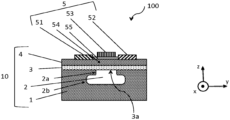
The present disclosure relates to a microsensor 100 for detecting ions in a fluid. The microsensor 100 comprises a structure 10 comprising an active layer 4, positioned on a dielectric layer 3, itself positioned on a support substrate 1 (FIG. 1 a ). The active layer 4 is intended to contain and/or support at least one microelectronic component, in particular, a field-effect transistor (FET). Furthermore, the active layer 4 may be based on a single material or may include several layers of different materials.
Advantageously, the active layer 4 is formed of at least one semiconductor material selected from silicon, silicon-germanium, germanium, III-V compounds (arsenides, phosphides, nitrides, etc.) And it has a thickness between a few nanometers and a few hundreds of nanometers.
The support substrate 1 may be based on a semiconductor or an insulating material, such as silicon, germanium, silicon carbide, gallium arsenide, indium phosphide, sapphire or glass. Preferably, the support substrate 1 is formed of silicon.
The structure 10 further comprises at least one buried cavity 2, formed in the support substrate 1 and positioned beneath the dielectric layer 3. A portion of the surface 3 a of the dielectric layer 3 adjacent the buried cavity 2 is, therefore, free.
The microsensor 100 also comprises a field-effect transistor 5 (also referred to herein as “FET 5”) formed in and on the active layer 4 of the structure 10. It has a source 51, a drain 52, an active region 54 between the source 51 and the drain 52, and a gate 53 positioned above the active region 54. The active region 54 is formed in the active layer 4, it comprises a conduction channel in which the current is capable of flowing, between the source 51 and the drain 52, when the field-effect transistor 5 is in an on-state. The gate 53 is positioned on the insulating layer 55 (gate oxide), which separates it from the active layer 4.
Preferably, the active layer 4 is thin. For example, it could have a thickness of 15 nm. In case of an active layer 4 made of silicon, the field-effect transistor 5 is advantageously produced according to conventional CMOS technology in and on the active layer 4; it is, for example, of MOSFET type and operates in fully depleted mode. The field-effect transistor 5 is advantageously produced according to FDSOI (fully depleted SOI) architecture.
In the case of an active layer 4 made of III-V material, the field-effect transistor 5 maybe of HEMT (high electron mobility transistor) type.
An FET transistor for the chemical detection of ions must be very sensitive. In particular, the threshold voltage of the transistor must preferably be sensitive to the variation of the electrochemical potential in the vicinity of the gate, to detect as precisely as possible a variation in concentration of ions in the solution brought into contact with the gate.
An FET 5 in “fully depleted” mode of the microsensor 100, produced on an active layer 4, in particular, made of silicon, and a dielectric layer 3, have features perfectly suitable for this application.
According to the disclosure, the gate 53 is produced substantially plum with the buried cavity 2 and all or some of the active region 54 is located above the buried cavity 2.
The buried cavity 2 is intended to receive the fluid to be analyzed and to bring it into contact with the dielectric layer 3. The buried cavity 2 could have lateral dimensions (in the (x, y) plane in the figures) between around 100 nanometers and a few tens of microns and a depth (along the z axis in the figures) between a few tens of nanometers and a few hundreds of microns. By way of example, a buried cavity 2 could have a width (along the y axis in the figures) of around 150 nm, a length (along the x axis in the figures) of around 500 nm and a depth on the order of 150 nm.
Advantageously, the dielectric layer 3 is formed of at least one insulating material selected from silicon dioxide, silicon nitride, an oxynitride, hafnium oxide (HfO2), alumina (Al2O3), tantalum oxide (Ta2O5) or a stack of layers of these materials. The dielectric layer 3 has a thickness of between a few angstroms and a few tens of nanometers.
The ions present in the fluid will modify the electrochemical potential at the surface 3 a of the dielectric layer 3. The FET 5 then operates with a dual gate: the upper gate 53, which may be biased at a certain potential and the lower chemical gate, the potential of which (at the surface 3 a of the dielectric layer 3) is influenced by the presence and the concentration of the ions of the fluid contained in the buried cavity 2.
The insulating material of the dielectric layer 3 is selected as a function of the type of ions to be detected in the fluid.
According to one advantageous embodiment, illustrated in FIG. 1 b , the buried cavity 2 comprises a constriction 2 a in the vicinity of the dielectric layer 3; at this constriction 2 a, the cavity 2 has lateral dimensions corresponding substantially to the dimensions of the gate 53. The buried cavity 2 further comprises a flared portion 2 b in its deeper zone. This flared portion 2 b promotes the circulation of the fluid. It is also noted that the constriction 2 a, having reduced lateral dimensions, promotes the mechanical strength of the stack of dielectric and active layers 3, 4 positioned on top of the buried cavity 2 and may simplify the fabrication of the structure 10 and/or of the microsensor 100.
By way of example, a buried cavity 2 according to this embodiment could have, at the constriction 2 a, a width (along the y axis) of around 100 nm, a length (along the x axis) of around 200 nm, and at the flared portion 2 b, a width (along they axis) of around 1000 nm, a length (along the x axis) of around 2000 nm. It could furthermore have a depth of the order of 500 nm.
Advantageously, the (at least one) buried cavity 2 is connected to a network of buried channels 20 formed in the support substrate 1, in order to continuously or periodically transport the fluid. The network comprises a fluid inlet 21 and a fluid outlet 22 (FIG. 2 e ). An external pumping system makes it possible to circulate the fluid in the network of buried channels 20, in order to convey it into the buried cavity 2. After the measurement, the fluid is removed from the buried cavity 2 by pumping or flushed from the buried cavity 2 by injecting a rinsing solution into the network of buried channels 20.
The present disclosure also relates to a process for fabricating the microsensor 100 for detecting ions in a fluid.
The fabrication process comprises a first step of providing a structure 10 comprising an active layer 4, positioned on a dielectric layer 3, itself positioned on a support substrate 1. The structure 10 comprises at least one buried cavity 2, formed in the support substrate 1 and positioned beneath the dielectric layer 3.
According to one advantageous embodiment, this first step includes the formation, on a first face 1 a of the support substrate 1, of the (at least one) buried cavity 2, by etching (FIG. 2 a ). As is conventionally done during lithography and etching steps, a masking layer (not represented) is deposited on the first face 1 a and removed locally at the locations intended to be etched in order to form the buried cavity (or cavities) 2. The network of buried channels 20 communicating with the buried cavity 2 is preferably produced at the same time.
According to variants illustrated in FIGS. 3 a and 3 a ′, the support substrate 1 comprises an intermediate layer 6 at the first face 1 a thereof. The buried cavity (or cavities) 2 and the network of buried channels 20 are formed in the intermediate layer 6. The intermediate layer 6 is preferably formed of at least one insulating material selected from silicon dioxide, silicon nitride, an oxynitride, hafnium oxide (HfO2), alumina (Al2O3), tantalum oxide (Ta2O5) or a stack of layers of these materials.
A buried cavity 2 could have lateral dimensions (in the (x, y) plane in the figures) between around 100 nanometers and a few tens of microns and a depth (along the z axis in the figures) between a few tens of nanometers and a few hundreds of microns. The buried channels 20 could have dimensions in similar ranges.
Still according to the advantageous embodiment, the first step of the process comprises the provision of a donor substrate 40, having a first face 40 a and comprising a dielectric layer 3 (FIGS. 2 b, 3 b ). The dielectric layer 3 may be produced by thermal growth or by deposition, depending on the nature of the material(s) forming it and depending on the nature of the donor substrate 40. The dielectric layer 3 is preferably formed of at least one insulating material selected from silicon dioxide, silicon nitride, an oxynitride, hafnium oxide (HfO2), alumina (Al2O3), tantalum oxide (Ta2O5) or a stack of layers of these materials. The donor substrate 40 is preferably formed of at least one semiconductor material selected from silicon, silicon-germanium, germanium, III-V compounds (arsenides, phosphides, nitrides, etc.).
In order to form the active layer 4 from the donor substrate 40, use will preferably be made of a transfer process especially suitable for thin to very thin layers and that provides a good layer thickness uniformity and a very good crystalline and surface quality.
For example, the SMART CUT® process may be used. Light species (hydrogen and/or helium) are then implanted in the donor substrate 40, at the first face 40 a thereof, so as to form a fragile buried layer 41 (FIGS. 2 b, 3 b ).
The joining of the first face 1 a of the support substrate 1 comprising the buried cavity (or cavities) 2 and the network of buried channels 20, to the first face 40 a of a donor substrate 40 comprising a dielectric layer 3 is then carried out (FIGS. 2 c, 3 c ). The buried cavity 2 and the network of buried channels 20 are thus buried in the joined structure.
Advantageously, the joining is carried out by direct bonding, molecular adhesion of the two surfaces brought into contact. The principle of molecular adhesion, which is well known in the prior art, will not be described in further detail here. Note that a very good surface finish (cleanness, low roughness, etc.) of the substrates to be joined is required, in order to obtain a good final quality of the structure 10.
Still according to the advantageous embodiment, the first step of the process comprises the thinning of the donor substrate 40, so as to form the active layer 4.
The separation at the fragile buried layer 41 may take place during a heat treatment, for example, between 250° C. and 550° C., and/or under mechanical stress. This separation makes it possible, on the one hand, to form the structure 10 comprising the active layer 4 positioned on the dielectric layer 3, itself positioned on the support substrate 1, and, on the other hand, to form a residual donor substrate 40′ (FIGS. 2 d, 3 d ).
Finishing steps (for example, thermal oxidation, thermal smoothing, or others) are applied to the separated surface of the active layer 4, so as to give it the required quality (in terms of thickness, uniformity, crystalline quality, roughness, defectivity) for the subsequent production of the FET transistors.
The fabrication process comprises a second step of producing a field-effect transistor 5 having a source 51, a drain 52, an active region 54 formed in the active layer 4 and extending between the source 51 and the drain 52. The transistor 5 also comprises a gate 53 positioned above the active region 54, plumb with the (at least one) cavity 2 (FIG. 2 e ). The alignment between the cavity 2 and the gate 53 of the transistor 5 could be easily achieved by using the alignment marks produced during the formation of the cavity 2 and the channels 20 on the support substrate 1.
Conventional methods for producing transistors based on CMOS technology will be able to be used.
Advantageously, each cavity 2 has a dimension, in the (x, y) plane, of less than 1000 nm or even of less than 200 nm, it being possible for the other dimension to range up to a few tens of microns (FIG. 2 e ). The smallest dimension (width) is along the source 51-drain 52 axis (y axis in the figures). The largest dimension (length) preferably corresponds to the width of the active region 54, i.e., to the size of the source 51, drain 52 and gate 53 electrodes (along the x axis in the figures). Such a configuration of the buried cavity 2 in the (x, y) plane is favorable to the mechanical strength of the stack portions of active layer 4 and dielectric layer 3 that are suspended above the buried cavity 2.
According to a variant of the fabrication process, the cavity (or cavities) 2 and the network of channels 20, produced in the support substrate 1, could be filled by a sacrificial material. The production of the structure 10 and of the transistor 5 of the microsensor 100 is carried out even though the cavities 2 are filled with the material. Finally, after the FET 5 is produced, a step of etching in the active layer 4 and the dielectric layer 3 makes it possible to access the cavity (cavities) 2 and channels 20; the sacrificial material is chemically etched in order to empty the cavity (cavities) 2 and channels 20, an encapsulation layer protecting the sensitive elements on the front face of the transistor 5. The sacrificial material is selected so that it is preferably attacked by the chemical etching, compared to the support substrate 1 and the dielectric layer 3.
According to one particular embodiment, the microsensor 100 may comprise several field-effect transistors 5, in particular, for increasing the effectiveness of processing the electrical signal expressing the detection of ions. These transistors 5 may share, for example, one and the same lower chemical gate (at the surface 3 a of the dielectric layer 3) positioned on one and the same cavity 2 in order to improve the sensitivity of the microsensor 100.
The microsensor 100 comprises at least one cavity 2 and a network of integrated channels 20, buried beneath an FET 5; the latter is configured to operate with an upper gate 53 and lower chemical gate (at the surface 3 a of the dielectric layer 3) the electrochemical potential of which is influenced by the presence and the concentration of chemical species in the cavity 2. The presence of the cavity (cavities) 2 and network of channels 20 in the support substrate 1 of the structure 10 used for the production of the transistor 5, avoids the deep etching steps of the prior art for exposing the dielectric layer after the formation of the transistor. The joining of additional substrates or the carrying out of micromachining operations subsequent to the production of the transistor, to form reservoirs and channels for transporting the fluid to be analyzed, is no longer necessary owing to the structure 10 with buried cavity (cavities) 2 supporting the microsensor 100 of the present disclosure.
The microsensor 100 according to the present disclosure may be used for the detection of chemical species in ionic form in a gaseous or liquid fluid. By way of example, applications could be found in the field of gas detection or else of biological sensors for the detection of analytes in solution or the measurement of pH.
Of course, the present disclosure is not limited to the embodiments and examples described and embodiment variants may be introduced thereinto without departing from the scope of the invention as defined by the claims.
Claims (17)

The invention claimed is:
1. A microsensor for detecting ions in a fluid, comprising:
a field-effect transistor having a source, a drain, an active region between the source and the drain, and a gate positioned above the active region;
an active layer in which the active region is formed;
a dielectric layer positioned beneath the active layer; and
a support substrate positioned beneath the dielectric layer and comprising at least one buried cavity, located plumb with the gate of the field-effect transistor to receive the fluid, the at least one buried cavity comprising a constriction in a vicinity of the dielectric layer and a flared portion in a deeper zone of the support substrate.
2. The microsensor of claim 1, wherein the at least one buried cavity is connected to a network of buried channels formed in the support substrate for transporting the fluid.
3. The microsensor of claim 2, wherein the active layer has a thickness between a few nanometers and a few hundred nanometers.
4. The microsensor of claim 3, wherein the dielectric layer has a thickness between a few ångströms and a few tens of nanometers.
5. The microsensor of claim 4, wherein the active layer is formed of at least one semiconductor material selected from silicon, silicon-germanium, germanium, and III-V compounds (arsenides, phosphides, and nitrides).
6. The microsensor of claim 5, wherein the dielectric layer comprises at least one insulating material selected from among silicon dioxide, silicon nitride, an oxynitride, hafnium oxide (HfO2), alumina (Al2O3), tantalum oxide (Ta2O5) or a stack of layers of these materials.
7. The microsensor of claim 6, wherein the active layer comprises silicon and the field-effect transistor has a fully depleted silicon-on-insulator (FDSOI) architecture.
8. The microsensor of claim 7, wherein the at least one buried cavity has lateral dimensions of between around 100 nanometers and a few tens of microns and a depth of between a few tens of nanometers and a few hundred microns.
9. A process for fabricating a microsensor for detecting ions in a fluid, the process comprising:
providing a structure comprising an active layer positioned on a dielectric layer, the dielectric layer positioned on a support substrate, the structure comprising at least one buried cavity formed in the support substrate and positioned beneath the dielectric layer;
joining a first face of the support substrate to a first face of a donor substrate comprising the dielectric layer; and
producing a field-effect transistor having a source, a drain, an active region formed in the active layer and extending between the source and the drain, and a gate positioned above the active region, plumb with the at least one buried cavity.
10. The fabrication process of claim 9, wherein providing the structure further comprises:
forming, on the first face of the support substrate, the at least one buried cavity by etching; and
thinning the donor substrate so as to form the active layer.
11. The fabrication process of claim 10, wherein thinning the donor substrate comprises:
prior to joining, implanting light species in the donor substrate at the first face thereof to form a fragile buried layer; and
after joining, separating the donor substrate at the fragile buried layer to form the structure comprising the active layer positioned on the dielectric layer, the dielectric layer positioned on the support substrate, and a residual donor substrate.
12. The microsensor of claim 1, wherein the active layer has a thickness between a few nanometers and a few hundred nanometers.
13. The microsensor of claim 1, wherein the dielectric layer has a thickness between a few ångströms and a few tens of nanometers.
14. The microsensor of claim 1, wherein the active layer is formed of at least one semiconductor material selected from silicon, silicon-germanium, germanium, and III-V compounds (arsenides, phosphides, and nitrides).
15. The microsensor of claim 1, wherein the dielectric layer comprises at least one insulating material selected from among silicon dioxide, silicon nitride, an oxynitride, hafnium oxide (HfO2), alumina (Al2O3), tantalum oxide (Ta2O5) or a stack of layers of these materials.
16. The microsensor of claim 1, wherein the active layer comprises silicon and the field-effect transistor has an FDSOI architecture.
17. The microsensor of claim 1, wherein the at least one buried cavity has lateral dimensions of between around 100 nanometers and a few tens of microns and a depth of between a few tens of nanometers and a few hundred microns.
US17/044,205 2018-03-30 2019-03-19 Micro-sensor for detecting chemical species and associated manufacturing method Active 2041-05-10 US11940407B2 (en)

Applications Claiming Priority (3)

Application Number Priority Date Filing Date Title
FR1852783 2018-03-30
FR1852783A FR3079616B1 (en) 2018-03-30 2018-03-30 MICRO-SENSOR FOR DETECTING CHEMICAL SPECIES AND ASSOCIATED MANUFACTURING PROCESS
PCT/FR2019/050610 WO2019186027A1 (en) 2018-03-30 2019-03-19 Micro-sensor for detecting chemical species and associated manufacturing method

Publications (2)

Publication Number Publication Date
US20210132002A1 US20210132002A1 (en) 2021-05-06
US11940407B2 true US11940407B2 (en) 2024-03-26

Family

ID=62684890

Family Applications (1)

Application Number Title Priority Date Filing Date
US17/044,205 Active 2041-05-10 US11940407B2 (en) 2018-03-30 2019-03-19 Micro-sensor for detecting chemical species and associated manufacturing method

Country Status (7)

Country Link
US (1) US11940407B2 (en)
EP (1) EP3775862B1 (en)
KR (1) KR102813268B1 (en)
CN (1) CN111971552B (en)
FR (1) FR3079616B1 (en)
TW (1) TWI794449B (en)
WO (1) WO2019186027A1 (en)

Cited By (1)

* Cited by examiner, † Cited by third party
Publication number Priority date Publication date Assignee Title
US12339247B2 (en) 2022-04-07 2025-06-24 Globalfoundries U.S. Inc. Field effect transistor with buried fluid-based gate and method

Families Citing this family (5)

* Cited by examiner, † Cited by third party
Publication number Priority date Publication date Assignee Title
CN111415993B (en) * 2020-03-16 2023-11-21 中国科学院微电子研究所 A multi-media detection sensor and its production method
FR3115278B1 (en) * 2020-10-16 2024-02-16 Soitec Silicon On Insulator Membrane transfer process
CN113333042B (en) * 2021-06-21 2022-04-22 太原理工大学 Microfluidic chip for nucleic acid detection and method for making the same
US20230105338A1 (en) * 2021-10-05 2023-04-06 Globalfoundries U.S. Inc. Contact-free biosensor
US12491511B2 (en) * 2022-06-21 2025-12-09 Globalfoundries U.S. Inc. Microfluidic channel structure and method

Citations (14)

* Cited by examiner, † Cited by third party
Publication number Priority date Publication date Assignee Title
EP0893827A1 (en) 1997-07-25 1999-01-27 Motorola Semiconducteurs S.A. Electronic device and method for forming a membrane for an electronic device
WO2000051180A1 (en) 1999-02-26 2000-08-31 Dynamics Research Corporation Silicon-on-insulator sensor having silicon oxide sensing surface, and manufacturing method therefor
WO2000051136A1 (en) 1999-02-25 2000-08-31 Nycomed Amersham Plc Medical tools and devices with improved ultrasound visibility
US20050212016A1 (en) 2004-03-23 2005-09-29 Fujitsu Limited On-chip integrated detector for analyzing fluids
TW201013179A (en) 2008-09-23 2010-04-01 Univ Nat Chiao Tung Sensing element, manufacturing method and detecting system thereof
US20110227043A1 (en) 2010-03-19 2011-09-22 International Business Machines Corporation Graphene sensor
US8241998B2 (en) * 2007-01-16 2012-08-14 Soitec Method of producing an SOI structure with an insulating layer of controlled thickness
US20140106494A1 (en) * 2012-10-15 2014-04-17 International Business Machines Corporation Dual-gate bio/chem sensor
TW201435340A (en) 2013-03-14 2014-09-16 Taiwan Semiconductor Mfg Biological field effect transistor, manufacturing method thereof and biochip
US20150014752A1 (en) 2013-07-12 2015-01-15 International Business Machines Corporation Thin body fet nanopore sensor for sensing and screening biomolecules
US20160187288A1 (en) * 2014-12-31 2016-06-30 International Business Machines Corporation Nanofluid sensor with real-time spatial sensing
US9679897B1 (en) * 2016-04-04 2017-06-13 International Business Machines Corporation High density nanofluidic structure with precisely controlled nano-channel dimensions
US20180097076A1 (en) * 2016-09-30 2018-04-05 International Business Machines Corporation Fully depleted soi device for reducing parasitic back gate capacitance
US20180238827A1 (en) * 2013-03-14 2018-08-23 Taiwan Semiconductor Manufacturing Co., Ltd. Backside Sensing BioFET with Enhanced Performance

Family Cites Families (5)

* Cited by examiner, † Cited by third party
Publication number Priority date Publication date Assignee Title
FR2672158B1 (en) * 1991-01-24 1993-04-09 Commissariat Energie Atomique SENSOR FOR THE DETECTION OF CHEMICAL SPECIES OR PHOTONS USING A FIELD EFFECT TRANSISTOR.
US7659172B2 (en) * 2005-11-18 2010-02-09 International Business Machines Corporation Structure and method for reducing miller capacitance in field effect transistors
KR101772639B1 (en) * 2009-10-16 2017-08-29 가부시키가이샤 한도오따이 에네루기 켄큐쇼 Semiconductor device
CN102376769B (en) * 2010-08-18 2013-06-26 中国科学院微电子研究所 Ultra-thin body transistor and manufacturing method thereof
JP6691234B2 (en) * 2016-07-22 2020-04-28 ヒューレット−パッカード デベロップメント カンパニー エル.ピー.Hewlett‐Packard Development Company, L.P. Substrate assembly and related methods

Patent Citations (14)

* Cited by examiner, † Cited by third party
Publication number Priority date Publication date Assignee Title
EP0893827A1 (en) 1997-07-25 1999-01-27 Motorola Semiconducteurs S.A. Electronic device and method for forming a membrane for an electronic device
WO2000051136A1 (en) 1999-02-25 2000-08-31 Nycomed Amersham Plc Medical tools and devices with improved ultrasound visibility
WO2000051180A1 (en) 1999-02-26 2000-08-31 Dynamics Research Corporation Silicon-on-insulator sensor having silicon oxide sensing surface, and manufacturing method therefor
US20050212016A1 (en) 2004-03-23 2005-09-29 Fujitsu Limited On-chip integrated detector for analyzing fluids
US8241998B2 (en) * 2007-01-16 2012-08-14 Soitec Method of producing an SOI structure with an insulating layer of controlled thickness
TW201013179A (en) 2008-09-23 2010-04-01 Univ Nat Chiao Tung Sensing element, manufacturing method and detecting system thereof
US20110227043A1 (en) 2010-03-19 2011-09-22 International Business Machines Corporation Graphene sensor
US20140106494A1 (en) * 2012-10-15 2014-04-17 International Business Machines Corporation Dual-gate bio/chem sensor
TW201435340A (en) 2013-03-14 2014-09-16 Taiwan Semiconductor Mfg Biological field effect transistor, manufacturing method thereof and biochip
US20180238827A1 (en) * 2013-03-14 2018-08-23 Taiwan Semiconductor Manufacturing Co., Ltd. Backside Sensing BioFET with Enhanced Performance
US20150014752A1 (en) 2013-07-12 2015-01-15 International Business Machines Corporation Thin body fet nanopore sensor for sensing and screening biomolecules
US20160187288A1 (en) * 2014-12-31 2016-06-30 International Business Machines Corporation Nanofluid sensor with real-time spatial sensing
US9679897B1 (en) * 2016-04-04 2017-06-13 International Business Machines Corporation High density nanofluidic structure with precisely controlled nano-channel dimensions
US20180097076A1 (en) * 2016-09-30 2018-04-05 International Business Machines Corporation Fully depleted soi device for reducing parasitic back gate capacitance

Non-Patent Citations (7)

* Cited by examiner, † Cited by third party
Title
Chen et al., Fabrication of a Graphene Field Effect Transistor Array on Microchannels for Ethanol Sensing, Applied Surface Science, vol. 258, Issue 6, (Jan. 1, 2012), pp. 1971-1975.
Chinese 2nd Office Action for Application No. 201980023245.7 dated Feb. 3, 2023, 6 pages.
Chinese First Office Action For Application No. 201980023245.7 dated Sep. 22, 2022, 11 pages.
French Search Report for Application No. 1852783 dated Aug. 9, 2018, 2 pages.
International Search Report for International Application No. PCT/FR2019/050610 dated Jun. 13, 2019, 3 pages.
International Written Opinion for International Application No. PCT/FR2019/050610 dated Jun. 13, 2019, 6 pages.
Taiwan Office Action for Application No. 11120691010 dated Jul. 13, 2022.

Cited By (1)

* Cited by examiner, † Cited by third party
Publication number Priority date Publication date Assignee Title
US12339247B2 (en) 2022-04-07 2025-06-24 Globalfoundries U.S. Inc. Field effect transistor with buried fluid-based gate and method

Also Published As

Publication number Publication date
TW201942959A (en) 2019-11-01
EP3775862B1 (en) 2022-04-06
FR3079616B1 (en) 2021-02-12
KR20200136954A (en) 2020-12-08
CN111971552A (en) 2020-11-20
WO2019186027A1 (en) 2019-10-03
TWI794449B (en) 2023-03-01
US20210132002A1 (en) 2021-05-06
CN111971552B (en) 2023-06-09
EP3775862A1 (en) 2021-02-17
FR3079616A1 (en) 2019-10-04
KR102813268B1 (en) 2025-05-28

Similar Documents

Publication Publication Date Title
US11940407B2 (en) Micro-sensor for detecting chemical species and associated manufacturing method
US11099152B2 (en) Backside CMOS compatible BioFET with no plasma induced damage
KR100522622B1 (en) Method of manufacturing semiconductor device
US20040124439A1 (en) Semiconductor device having a hollow region and method of manufacturing the same
US9714914B2 (en) CMOS compatible biofet
US20210325339A1 (en) Biosensor Devices and Methods of Forming the Same
KR100740159B1 (en) An evaluation method of a semiconductor device, a manufacturing method of the semiconductor device, and a semiconductor wafer
US9746442B2 (en) Switched-capacitor biosensor device
Baek et al. Addressable nanowire field-effect-transistor biosensors with local backgates
US10768138B2 (en) Protecting a substrate region during fabrication of a FET sensor
US6558990B1 (en) SOI substrate, method of manufacture thereof, and semiconductor device using SOI substrate
US20070026584A1 (en) Dielectric isolated body biasing of silicon on insulator
Duarte et al. Fabrication and Electrical Characterization of ISFET for H 2 O 2 sensing
US7414290B2 (en) Double gate transistor, method of manufacturing same, and system containing same
WO2011049428A1 (en) Inverted isfet
WO2008068692A1 (en) Method of manufacturing a semiconductor sensor device and semiconductor sensor device obtained with such method
WO2011148602A1 (en) Sensor chip and sensor device using same
Rigante et al. Integrated finfet based sensing in a liquid environment
Lim et al. Fabrication of 3-dimensional structure of metal oxide semiconductor field effect transistor embodied in the convex corner of the silicon micro-fluidic channel
KR20240054171A (en) Ion-sensitive field effect transistor above microfluidic cavity for ion detection and identification

Legal Events

Date Code Title Description
FEPP Fee payment procedure

Free format text: ENTITY STATUS SET TO UNDISCOUNTED (ORIGINAL EVENT CODE: BIG.); ENTITY STATUS OF PATENT OWNER: LARGE ENTITY

AS Assignment

Owner name: SOITEC, FRANCE

Free format text: ASSIGNMENT OF ASSIGNORS INTEREST;ASSIGNOR:GHYSELEN, BRUNO;REEL/FRAME:055776/0001

Effective date: 20210303

STPP Information on status: patent application and granting procedure in general

Free format text: APPLICATION DISPATCHED FROM PREEXAM, NOT YET DOCKETED

STPP Information on status: patent application and granting procedure in general

Free format text: DOCKETED NEW CASE - READY FOR EXAMINATION

STPP Information on status: patent application and granting procedure in general

Free format text: NON FINAL ACTION MAILED

STPP Information on status: patent application and granting procedure in general

Free format text: RESPONSE TO NON-FINAL OFFICE ACTION ENTERED AND FORWARDED TO EXAMINER

STPP Information on status: patent application and granting procedure in general

Free format text: NOTICE OF ALLOWANCE MAILED -- APPLICATION RECEIVED IN OFFICE OF PUBLICATIONS

STPP Information on status: patent application and granting procedure in general

Free format text: PUBLICATIONS -- ISSUE FEE PAYMENT VERIFIED

STCF Information on status: patent grant

Free format text: PATENTED CASE