US11938468B2 - Catalyst system for producing cyclic carbonates and method related thereto - Google Patents

Catalyst system for producing cyclic carbonates and method related thereto Download PDF

Info

Publication number
US11938468B2
US11938468B2 US17/206,080 US202117206080A US11938468B2 US 11938468 B2 US11938468 B2 US 11938468B2 US 202117206080 A US202117206080 A US 202117206080A US 11938468 B2 US11938468 B2 US 11938468B2
Authority
US
United States
Prior art keywords
range
silica
bicl
iodide
support
Prior art date
Legal status (The legal status is an assumption and is not a legal conclusion. Google has not performed a legal analysis and makes no representation as to the accuracy of the status listed.)
Active, expires
Application number
US17/206,080
Other versions
US20210346877A1 (en
Inventor
Taradon Piromchart
Valerio D'Elia
Current Assignee (The listed assignees may be inaccurate. Google has not performed a legal analysis and makes no representation or warranty as to the accuracy of the list.)
PTT Exploration and Production PCL
Original Assignee
PTT Exploration and Production PCL
Priority date (The priority date is an assumption and is not a legal conclusion. Google has not performed a legal analysis and makes no representation as to the accuracy of the date listed.)
Filing date
Publication date
Application filed by PTT Exploration and Production PCL filed Critical PTT Exploration and Production PCL
Priority to US17/206,080 priority Critical patent/US11938468B2/en
Assigned to PTT EXPLORATION AND PRODUCTION PUBLIC COMPANY LIMITED reassignment PTT EXPLORATION AND PRODUCTION PUBLIC COMPANY LIMITED ASSIGNMENT OF ASSIGNORS INTEREST (SEE DOCUMENT FOR DETAILS). Assignors: PIROMCHART, Taradon, D'ELIA, Valerio
Publication of US20210346877A1 publication Critical patent/US20210346877A1/en
Application granted granted Critical
Publication of US11938468B2 publication Critical patent/US11938468B2/en
Active legal-status Critical Current
Adjusted expiration legal-status Critical

Links

Images

Classifications

    • BPERFORMING OPERATIONS; TRANSPORTING
    • B01PHYSICAL OR CHEMICAL PROCESSES OR APPARATUS IN GENERAL
    • B01JCHEMICAL OR PHYSICAL PROCESSES, e.g. CATALYSIS OR COLLOID CHEMISTRY; THEIR RELEVANT APPARATUS
    • B01J31/00Catalysts comprising hydrides, coordination complexes or organic compounds
    • B01J31/02Catalysts comprising hydrides, coordination complexes or organic compounds containing organic compounds or metal hydrides
    • B01J31/0277Catalysts comprising hydrides, coordination complexes or organic compounds containing organic compounds or metal hydrides comprising ionic liquids, as components in catalyst systems or catalysts per se, the ionic liquid compounds being used in the molten state at the respective reaction temperature
    • B01J31/0292Catalysts comprising hydrides, coordination complexes or organic compounds containing organic compounds or metal hydrides comprising ionic liquids, as components in catalyst systems or catalysts per se, the ionic liquid compounds being used in the molten state at the respective reaction temperature immobilised on a substrate
    • B01J31/0295Catalysts comprising hydrides, coordination complexes or organic compounds containing organic compounds or metal hydrides comprising ionic liquids, as components in catalyst systems or catalysts per se, the ionic liquid compounds being used in the molten state at the respective reaction temperature immobilised on a substrate by covalent attachment to the substrate, e.g. silica
    • BPERFORMING OPERATIONS; TRANSPORTING
    • B01PHYSICAL OR CHEMICAL PROCESSES OR APPARATUS IN GENERAL
    • B01JCHEMICAL OR PHYSICAL PROCESSES, e.g. CATALYSIS OR COLLOID CHEMISTRY; THEIR RELEVANT APPARATUS
    • B01J31/00Catalysts comprising hydrides, coordination complexes or organic compounds
    • B01J31/02Catalysts comprising hydrides, coordination complexes or organic compounds containing organic compounds or metal hydrides
    • B01J31/0234Nitrogen-, phosphorus-, arsenic- or antimony-containing compounds
    • B01J31/0255Phosphorus containing compounds
    • B01J31/0267Phosphines or phosphonium compounds, i.e. phosphorus bonded to at least one carbon atom, including e.g. sp2-hybridised phosphorus compounds such as phosphabenzene, the other atoms bonded to phosphorus being either carbon or hydrogen
    • B01J31/0268Phosphonium compounds, i.e. phosphine with an additional hydrogen or carbon atom bonded to phosphorous so as to result in a formal positive charge on phosphorous
    • BPERFORMING OPERATIONS; TRANSPORTING
    • B01PHYSICAL OR CHEMICAL PROCESSES OR APPARATUS IN GENERAL
    • B01JCHEMICAL OR PHYSICAL PROCESSES, e.g. CATALYSIS OR COLLOID CHEMISTRY; THEIR RELEVANT APPARATUS
    • B01J31/00Catalysts comprising hydrides, coordination complexes or organic compounds
    • B01J31/26Catalysts comprising hydrides, coordination complexes or organic compounds containing in addition, inorganic metal compounds not provided for in groups B01J31/02 - B01J31/24
    • BPERFORMING OPERATIONS; TRANSPORTING
    • B01PHYSICAL OR CHEMICAL PROCESSES OR APPARATUS IN GENERAL
    • B01JCHEMICAL OR PHYSICAL PROCESSES, e.g. CATALYSIS OR COLLOID CHEMISTRY; THEIR RELEVANT APPARATUS
    • B01J21/00Catalysts comprising the elements, oxides, or hydroxides of magnesium, boron, aluminium, carbon, silicon, titanium, zirconium, or hafnium
    • B01J21/06Silicon, titanium, zirconium or hafnium; Oxides or hydroxides thereof
    • B01J21/08Silica
    • BPERFORMING OPERATIONS; TRANSPORTING
    • B01PHYSICAL OR CHEMICAL PROCESSES OR APPARATUS IN GENERAL
    • B01JCHEMICAL OR PHYSICAL PROCESSES, e.g. CATALYSIS OR COLLOID CHEMISTRY; THEIR RELEVANT APPARATUS
    • B01J23/00Catalysts comprising metals or metal oxides or hydroxides, not provided for in group B01J21/00
    • B01J23/16Catalysts comprising metals or metal oxides or hydroxides, not provided for in group B01J21/00 of arsenic, antimony, bismuth, vanadium, niobium, tantalum, polonium, chromium, molybdenum, tungsten, manganese, technetium or rhenium
    • B01J23/18Arsenic, antimony or bismuth
    • BPERFORMING OPERATIONS; TRANSPORTING
    • B01PHYSICAL OR CHEMICAL PROCESSES OR APPARATUS IN GENERAL
    • B01JCHEMICAL OR PHYSICAL PROCESSES, e.g. CATALYSIS OR COLLOID CHEMISTRY; THEIR RELEVANT APPARATUS
    • B01J31/00Catalysts comprising hydrides, coordination complexes or organic compounds
    • B01J31/02Catalysts comprising hydrides, coordination complexes or organic compounds containing organic compounds or metal hydrides
    • B01J31/0234Nitrogen-, phosphorus-, arsenic- or antimony-containing compounds
    • B01J31/0235Nitrogen containing compounds
    • B01J31/0239Quaternary ammonium compounds
    • BPERFORMING OPERATIONS; TRANSPORTING
    • B01PHYSICAL OR CHEMICAL PROCESSES OR APPARATUS IN GENERAL
    • B01JCHEMICAL OR PHYSICAL PROCESSES, e.g. CATALYSIS OR COLLOID CHEMISTRY; THEIR RELEVANT APPARATUS
    • B01J31/00Catalysts comprising hydrides, coordination complexes or organic compounds
    • B01J31/02Catalysts comprising hydrides, coordination complexes or organic compounds containing organic compounds or metal hydrides
    • B01J31/0277Catalysts comprising hydrides, coordination complexes or organic compounds containing organic compounds or metal hydrides comprising ionic liquids, as components in catalyst systems or catalysts per se, the ionic liquid compounds being used in the molten state at the respective reaction temperature
    • B01J31/0278Catalysts comprising hydrides, coordination complexes or organic compounds containing organic compounds or metal hydrides comprising ionic liquids, as components in catalyst systems or catalysts per se, the ionic liquid compounds being used in the molten state at the respective reaction temperature containing nitrogen as cationic centre
    • B01J31/0279Catalysts comprising hydrides, coordination complexes or organic compounds containing organic compounds or metal hydrides comprising ionic liquids, as components in catalyst systems or catalysts per se, the ionic liquid compounds being used in the molten state at the respective reaction temperature containing nitrogen as cationic centre the cationic portion being acyclic or nitrogen being a substituent on a ring
    • BPERFORMING OPERATIONS; TRANSPORTING
    • B01PHYSICAL OR CHEMICAL PROCESSES OR APPARATUS IN GENERAL
    • B01JCHEMICAL OR PHYSICAL PROCESSES, e.g. CATALYSIS OR COLLOID CHEMISTRY; THEIR RELEVANT APPARATUS
    • B01J31/00Catalysts comprising hydrides, coordination complexes or organic compounds
    • B01J31/02Catalysts comprising hydrides, coordination complexes or organic compounds containing organic compounds or metal hydrides
    • B01J31/0277Catalysts comprising hydrides, coordination complexes or organic compounds containing organic compounds or metal hydrides comprising ionic liquids, as components in catalyst systems or catalysts per se, the ionic liquid compounds being used in the molten state at the respective reaction temperature
    • B01J31/0298Catalysts comprising hydrides, coordination complexes or organic compounds containing organic compounds or metal hydrides comprising ionic liquids, as components in catalyst systems or catalysts per se, the ionic liquid compounds being used in the molten state at the respective reaction temperature the ionic liquids being characterised by the counter-anions
    • BPERFORMING OPERATIONS; TRANSPORTING
    • B01PHYSICAL OR CHEMICAL PROCESSES OR APPARATUS IN GENERAL
    • B01JCHEMICAL OR PHYSICAL PROCESSES, e.g. CATALYSIS OR COLLOID CHEMISTRY; THEIR RELEVANT APPARATUS
    • B01J31/00Catalysts comprising hydrides, coordination complexes or organic compounds
    • B01J31/02Catalysts comprising hydrides, coordination complexes or organic compounds containing organic compounds or metal hydrides
    • B01J31/12Catalysts comprising hydrides, coordination complexes or organic compounds containing organic compounds or metal hydrides containing organo-metallic compounds or metal hydrides
    • B01J31/121Metal hydrides
    • B01J35/12
    • BPERFORMING OPERATIONS; TRANSPORTING
    • B01PHYSICAL OR CHEMICAL PROCESSES OR APPARATUS IN GENERAL
    • B01JCHEMICAL OR PHYSICAL PROCESSES, e.g. CATALYSIS OR COLLOID CHEMISTRY; THEIR RELEVANT APPARATUS
    • B01J35/00Catalysts, in general, characterised by their form or physical properties
    • B01J35/20Catalysts, in general, characterised by their form or physical properties characterised by their non-solid state
    • B01J35/27Catalysts, in general, characterised by their form or physical properties characterised by their non-solid state in a liquid or molten state
    • BPERFORMING OPERATIONS; TRANSPORTING
    • B01PHYSICAL OR CHEMICAL PROCESSES OR APPARATUS IN GENERAL
    • B01JCHEMICAL OR PHYSICAL PROCESSES, e.g. CATALYSIS OR COLLOID CHEMISTRY; THEIR RELEVANT APPARATUS
    • B01J37/00Processes, in general, for preparing catalysts; Processes, in general, for activation of catalysts
    • B01J37/04Mixing
    • BPERFORMING OPERATIONS; TRANSPORTING
    • B01PHYSICAL OR CHEMICAL PROCESSES OR APPARATUS IN GENERAL
    • B01JCHEMICAL OR PHYSICAL PROCESSES, e.g. CATALYSIS OR COLLOID CHEMISTRY; THEIR RELEVANT APPARATUS
    • B01J37/00Processes, in general, for preparing catalysts; Processes, in general, for activation of catalysts
    • B01J37/08Heat treatment
    • CCHEMISTRY; METALLURGY
    • C07ORGANIC CHEMISTRY
    • C07FACYCLIC, CARBOCYCLIC OR HETEROCYCLIC COMPOUNDS CONTAINING ELEMENTS OTHER THAN CARBON, HYDROGEN, HALOGEN, OXYGEN, NITROGEN, SULFUR, SELENIUM OR TELLURIUM
    • C07F7/00Compounds containing elements of Groups 4 or 14 of the Periodic Table
    • C07F7/02Silicon compounds
    • C07F7/08Compounds having one or more C—Si linkages
    • C07F7/18Compounds having one or more C—Si linkages as well as one or more C—O—Si linkages
    • C07F7/1804Compounds having Si-O-C linkages
    • BPERFORMING OPERATIONS; TRANSPORTING
    • B01PHYSICAL OR CHEMICAL PROCESSES OR APPARATUS IN GENERAL
    • B01JCHEMICAL OR PHYSICAL PROCESSES, e.g. CATALYSIS OR COLLOID CHEMISTRY; THEIR RELEVANT APPARATUS
    • B01J2231/00Catalytic reactions performed with catalysts classified in B01J31/00
    • B01J2231/30Addition reactions at carbon centres, i.e. to either C-C or C-X multiple bonds
    • B01J2231/34Other additions, e.g. Monsanto-type carbonylations, addition to 1,2-C=X or 1,2-C-X triplebonds, additions to 1,4-C=C-C=X or 1,4-C=-C-X triple bonds with X, e.g. O, S, NH/N
    • BPERFORMING OPERATIONS; TRANSPORTING
    • B01PHYSICAL OR CHEMICAL PROCESSES OR APPARATUS IN GENERAL
    • B01JCHEMICAL OR PHYSICAL PROCESSES, e.g. CATALYSIS OR COLLOID CHEMISTRY; THEIR RELEVANT APPARATUS
    • B01J31/00Catalysts comprising hydrides, coordination complexes or organic compounds
    • B01J31/02Catalysts comprising hydrides, coordination complexes or organic compounds containing organic compounds or metal hydrides
    • B01J31/0277Catalysts comprising hydrides, coordination complexes or organic compounds containing organic compounds or metal hydrides comprising ionic liquids, as components in catalyst systems or catalysts per se, the ionic liquid compounds being used in the molten state at the respective reaction temperature
    • B01J31/0278Catalysts comprising hydrides, coordination complexes or organic compounds containing organic compounds or metal hydrides comprising ionic liquids, as components in catalyst systems or catalysts per se, the ionic liquid compounds being used in the molten state at the respective reaction temperature containing nitrogen as cationic centre
    • B01J31/0281Catalysts comprising hydrides, coordination complexes or organic compounds containing organic compounds or metal hydrides comprising ionic liquids, as components in catalyst systems or catalysts per se, the ionic liquid compounds being used in the molten state at the respective reaction temperature containing nitrogen as cationic centre the nitrogen being a ring member
    • B01J31/0284Catalysts comprising hydrides, coordination complexes or organic compounds containing organic compounds or metal hydrides comprising ionic liquids, as components in catalyst systems or catalysts per se, the ionic liquid compounds being used in the molten state at the respective reaction temperature containing nitrogen as cationic centre the nitrogen being a ring member of an aromatic ring, e.g. pyridinium
    • CCHEMISTRY; METALLURGY
    • C07ORGANIC CHEMISTRY
    • C07DHETEROCYCLIC COMPOUNDS
    • C07D317/00Heterocyclic compounds containing five-membered rings having two oxygen atoms as the only ring hetero atoms
    • C07D317/08Heterocyclic compounds containing five-membered rings having two oxygen atoms as the only ring hetero atoms having the hetero atoms in positions 1 and 3
    • C07D317/10Heterocyclic compounds containing five-membered rings having two oxygen atoms as the only ring hetero atoms having the hetero atoms in positions 1 and 3 not condensed with other rings
    • C07D317/32Heterocyclic compounds containing five-membered rings having two oxygen atoms as the only ring hetero atoms having the hetero atoms in positions 1 and 3 not condensed with other rings with hetero atoms or with carbon atoms having three bonds to hetero atoms with at the most one bond to halogen, e.g. ester or nitrile radicals, directly attached to ring carbon atoms
    • C07D317/34Oxygen atoms
    • C07D317/36Alkylene carbonates; Substituted alkylene carbonates

Definitions

  • This invention relates to a catalyst system for producing cyclic carbonates, and a method for preparation of the cyclic carbonates by using the catalyst system.
  • Carbon dioxide (CO 2 ) emissions such as from industrial processes and fuel combustion, are becoming a serious problem worldwide because such emissions are considered a primary driver of climate change.
  • CO 2 Carbon dioxide
  • Legislators around the globe have started to set limitations on the unrestricted release of CO 2 in the atmosphere.
  • Cyclic carbonates are one of those because they can be easily produced from the cycloaddition of CO 2 to epoxides under mild conditions.
  • Cyclic carbonates are at the center of a multibillion USD market that involves polycarbonates, glycols, and polyesters.
  • CO 2 is kinetically and thermodynamically stable, thus it requires a large amount of energy to transform CO 2 into other chemicals, including cyclic carbonates.
  • a promising approach is to develop effective catalysts that allow for higher conversion of CO 2 at lower temperatures.
  • Cyclic carbonates are produced from CO 2 by cycloaddition reaction to epoxides.
  • catalyst systems exist to carry out such reaction, however, very few of such systems are capable of operating using impure CO 2 under ambient or moderate pressure (0.1 to 1 MPa).
  • the ability to capture CO 2 from gas mixtures is advantageous as it can be easily applied with flue gas and is therefore commercially attractive for cyclic carbonate production.
  • said catalysts include a bimetallic aluminum (salen) complex disclosed in Energy Environ. Sci., 2010, 3, 212-215 which is used for cyclic carbonate production with CO 2 having moisture and NOx as impurities in CO 2 .
  • said complex has a very high molecular weight and its preparation involves several synthetic steps because of the elaborated structure of organic framework-coordinating aluminum atoms.
  • U.S. Pat. No. 9,586,926 B2 disclosed a method for producing cyclic carbonate from carbonation of epoxide by CO 2 .
  • the method is performed via a homogeneous catalyst system comprising a pre-catalyst selected from YCl 3 , Y 2 O 3 , Y(NO 3 ) 3 , ScCl 2 , or LaCl 3 and a co-catalyst selected from tetrabutylammonium bromide, 4-dimethylaminopyridine, or bis(triphenylphosphine) iminium chloride at a mole ratio in the range of 1:1 to 1:2.
  • the catalytic activity of this system with impure or diluted CO 2 is relatively low under ambient conditions.
  • Monteiro, et. al. (Applied Catalysis A: General (2017), 544 (25), 46-54) disclosed a catalyst system comprising 1-methyl-3-(3-trimethoxysilylpropyl) imidazolium chloride ionic liquid catalyst supported on titanate nanotubes (TNT) or nanowires (TNW) as a pre-catalyst and ZnBr 2 as a co-catalyst for synthesizing cyclic carbonates. Although selectivity of the catalyst to CO 2 is high, this catalyst was not applied for the conversion of impure or diluted CO 2 .
  • the present invention is intended to provide a catalyst system for the conversion of CO 2 and epoxides to cyclic carbonates under mild conditions using pure and impure CO 2 having a high catalytic activity and being cost-effective.
  • the present invention provides a catalyst system for producing cyclic carbonates from carbon dioxide (CO 2 ) and epoxide-based compounds comprising: a pre-catalyst, which is BiCl 3 having amounts in the range from 5 to 10% by weight of silica support;
  • silica (SiO 2 ) support a silica (SiO 2 ) support.
  • the present invention relates to a method for preparation of a catalyst system of this invention comprising steps of:
  • the present invention relates to a method for preparation of a catalyst system of this invention comprising steps of:
  • the present invention relates to a method for producing cyclic carbonates, which comprises reacting epoxide-based compounds with carbon dioxide in the presence of a catalyst system comprising:
  • said method is performed using the concentration of the catalyst system in the range of about 0.1 to 20 mol % relative to the epoxide-based compounds; at a pressure of carbon dioxide in the range of about 1 to 100 bar; a temperature in the range of about 10 to 200° C.; and a reaction time in the range of about 1 to 8 hours.
  • FIG. 1 1 H-NMR spectrum of 1-methyl-3-(3-(trimethoxysilyl)propyl)-1H-imidazol-3-ium bromide.
  • FIG. 2 1 H-NMR spectrum of 1-methyl-3-(3-(trimethoxysilyl)propyl)-1H-imidazol-3-ium iodide.
  • FIG. 3 FT-IR spectrum of 1-methyl-3-(3-(trimethoxysilyl)propyl)-1H-imidazol-3-ium iodide supported on SiO2.
  • FIG. 4 1 H-NMR spectrum of propylene carbonate obtained from the catalyst according to the present invention.
  • the present invention provides a catalyst system for producing cyclic carbonates with cost-effectiveness and high catalytic activity for conversion of CO 2 and epoxide-based compounds to cyclic carbonates. Also, the present invention provides a method of making the cyclic carbonates by using the catalyst system with mild conditions using pure and impure CO 2 . Details of the present invention can be elucidated according to the specification as follows.
  • Equipment, apparatus, methods, or chemicals mentioned here means equipment, apparatus, processes, or chemicals commonly operated or used by those skilled in the art, unless explicitly stated otherwise that they are equipment, apparatus, methods, or chemicals specifically used in this invention.
  • compositions and/or processes disclosed and claimed are aimed to include aspects of the invention from actions, operation, modifications, or changing of any parameters without performing significantly different experiments from this invention, and obtaining similar objects with the same utilities and results of the present invention according to persons skilled in the art although without mention of the claims specifically. Therefore, substitution or similar objects to the present invention including minor modifications or changes which can be clearly seen by persons skilled in the art should be considered within the scope, spirit, and concept of the invention as appended claims.
  • the present invention provides a catalyst system for producing cyclic carbonates comprising:
  • a pre-catalyst which is BiCl 3 having amounts in the range from 5 to 10% by weight of silica support;
  • silica (SiO 2 ) support a silica (SiO 2 ) support.
  • Y is iodide (I ⁇ ).
  • the compound having the formula (I) is selected from 1-methyl-3-(3-(trimethoxysilyl)propyl)-1H-imidazol-3-ium iodide or N,N,N-trimethyl-3-(trimethoxysilyl)propan-1-aminium iodide.
  • this invention relates to a use of the catalyst system of the invention for producing cyclic carbonates from CO 2 and epoxide-based compounds.
  • the present invention relates to a method for preparation of a catalyst system of this invention comprising steps of:
  • the mole ratio between the silane compound and N-methylimidazole is in the range of about 2:1 to 1:2.
  • the organic solvent is an aromatic hydrocarbon solvent.
  • the organic solvent is toluene.
  • contacting the pre-catalyst with the metal oxide obtained from step (b) may be performed by, for example, a dipping method, an impregnation method, a solid state reaction method, or the like, and among them, a solid state reaction method, such as grinding, mulling, or ball milling techniques is preferred because the operation is simple and offers excellent productivity.
  • the present invention provides a method for preparation of a catalyst system according to the present invention comprising steps of:
  • organic solvent is selected from an aromatic hydrocarbon solvent.
  • the organic solvent is toluene.
  • contacting the pre-catalyst with the metal oxide obtained from step (b) may be prepared by, for example, a dipping method, an impregnation method, a solid state reaction method, or the like, and among them, a solid state reaction method, such as grinding, mulling, or ball milling techniques is preferred because the operation is simple and offers excellent productivity.
  • the present invention provides a method for producing cyclic carbonates from the reaction of carbon dioxide and epoxide-based compounds comprising reacting epoxide-based compounds with carbon dioxide in the presence of a catalyst system having:
  • a pre-catalyst which is BiCl 3 having amounts in the range from 5 to 10% by weight of silica support;
  • the concentration of the catalyst system is in the range of about 0.5 to 10 mol % relative to the epoxide-based compounds.
  • the pressure of carbon dioxide is in the range of about 1 to 10 bar.
  • the temperature is in the range of about 60 to 120° C.
  • reaction time is in a range of about 2 to 4 hours.
  • Y is iodide (I ⁇ ).
  • the compound having the formula (I) is selected from 1-methyl-3-(3-(trimethoxysilyl)propyl)-1H-imidazol-3-ium iodide or N,N,N-trimethyl-3-(trimethoxysilyl)propan-1-aminium iodide.
  • N-Methylimidazole about 5 mL
  • (3-bromopropyl) trimethoxysilane about 11.65 mL
  • the obtained mixture was washed with diethyl ether several times, and dried under a vacuum for about 24 hours.
  • the resulting N-3-(3-trimethoxysilylpropyl)-3-methyl imidazolium bromide was a brownish viscous liquid.
  • the structure of the product was identified by 1 H-NMR in DMSO-d6 as shown in FIG. 1 .
  • N-Methylimidazole about 5 mL
  • (3-iodopropyl) trimethoxysilane about 11.65 mL
  • the obtained mixture was washed with diethyl ether several times, and dried under vacuum for about 24 hours.
  • the resulting N-3-(3-trimethoxysilylpropyl)-3-methyl imidazolium iodide was a brown viscous liquid.
  • the structure of the product was identified by 1 H-NMR in DMSO-d6 as shown in FIG. 2 .
  • SiO 2 was functionalized with 1-methyl-3-(3-(trimethoxysilyl)propyl)-1H-imidazol-3-ium iodide.
  • Silica about 4 g was suspended in toluene (about 25 mL.) N-3-(3-trimethoxysilylpropyl)-3-methyl imidazolium iodide (about 2.5 mL) dissolved in toluene was then added. After stirring the mixture for about 48 hours at about 110° C., the silica was allowed to settle down. The supernatant solution was separated by centrifugation and the modified silica was washed with toluene several times prior to being dried for about 24 hours in vacuum.
  • the FT-IR spectrum of the prepared catalyst ( FIG. 3 ) showed several signals corresponding to the presence of organic species with aromatic character on the surface as seen from the signals in the 2890 to 3151 cm ⁇ 1 region and in the 1450 to 1630 cm ⁇ 1 region.
  • the presence of organic species loaded on the support was identified by the following elemental analysis: C (14.05%); H (2.65%); N (3.83%).
  • SiO 2 was functionalized with N,N,N-trimethyl-3-(trimethoxysilyl)propan-1-aminium iodide followed by quaternarization of the amine with methyl iodide.
  • SiO 2 (about 4 g) was suspended in toluene (about 25 mL).
  • N-3-(3-trimethoxysilylpropyl)-3-dimethylamine (about 2.5 mL) dissolved in toluene was then added. After stirring the mixture for about 48 hours at about 110° C., the silica was allowed to settle down.
  • the supernatant solution was separated by centrifugation and the modified silica was washed with toluene several times prior to being dried for about 24 hours in a vacuum.
  • the resultant functionalized silica was further reacted with methyl iodide in DMF in the dark for about 2 hours to obtain quaternary ammonium salt. This step was repeated twice to ensure the formation of quaternarized amine.
  • the supernatant solution was separated by centrifugation and the modified silica was washed with toluene several times prior to being dried for about 24 hours in vacuum.
  • the loading of the pre-catalyst was carried out in the glove box. About 5 wt % and 10 wt % of metal of pre-catalyst with respect to the weight of silica was loaded on the functionalized supports. BiCl 3 , as a pre-catalyst, was ground with the support through a manual mechanical grinding process. The mixture of modified silica support and pre-catalyst was ground for about 2 hours in the glove box and used as such.
  • Cyclic carbonates were synthesized using the catalysts of the present invention to test their catalytic activity.
  • the synthesis was carried out in a 75 mL autoclave under inert atmosphere (glove box).
  • the catalysts of the present invention (about 0.5 to 1 g) and propylene oxide (about 5 mL, 71.4 mmol) were added to the autoclave equipped with a magnetic stir bar.
  • the reactions were initialized with addition of 10 bar CO 2 (CO 2 at a concentration of about 50% and about 100% were used).
  • the autoclave was set in an oil-bath at about 60° C. and about 80° C. and stirred at about 500 rpm. After about 3 hours, the vessel was allowed to cool to room temperature in a water bath.
  • the crude reaction mixture sample was collected for 1 H NMR.
  • the studied catalysts were N,N,N-trimethyl-3-(trimethoxysilyl)propan-1-aminium iodide and BiCl 3 supported on SiO 2 (SiNMe 2 -MeI—BiCl 3 ), and 1-methyl-3-(3-(trimethoxysilyl)propyl)-1H-imidazol-3-ium iodide and BiCl 3 supported on SiO 2 (Si-ImI-BiCl 3 ).
  • Si-ImI-BiCl 3 10/80 100 92 7 Si-ImI-BiCl 3 10/80 50 76 8 Si-ImI-BiCl 3 10/60 50 76 9 Si—Nme 2 —MeI—BiCl 3 10/80 100 100 10 Si—Nme 2 —MeI—BiCl 3 10/80 50 78 11 Si—Nme 2 —MeI—BiCl 3 10/60 100 79 12 Si—Nme 2 —MeI—BiCl 3 10/60 50 79 13 Recyclability Si—Nme 2 —MeI—BiCl 3 10/80 50 83 14 study Si—Nme 2 —MeI—BiCl 3 10/80 50 70 (1st reuse) 15 Si—Nme 2 —MeI—BiCl 3 10/80 50 62 (2nd reuse)

Landscapes

  • Chemical & Material Sciences (AREA)
  • Organic Chemistry (AREA)
  • Engineering & Computer Science (AREA)
  • Materials Engineering (AREA)
  • Chemical Kinetics & Catalysis (AREA)
  • Inorganic Chemistry (AREA)
  • Physics & Mathematics (AREA)
  • Thermal Sciences (AREA)
  • Catalysts (AREA)
  • Low-Molecular Organic Synthesis Reactions Using Catalysts (AREA)
  • Polyesters Or Polycarbonates (AREA)
  • Organic Low-Molecular-Weight Compounds And Preparation Thereof (AREA)

Abstract

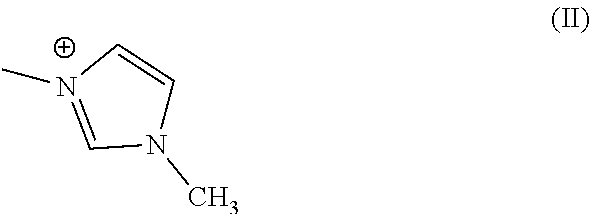
The present invention provides a catalyst system for producing cyclic carbonates comprising:a pre-catalyst, which is BiCl3 having amounts in the range from 5 to 10% by weight of silica support;a compound having formula (I)wherein:Y is selected from bromide (Br−) or iodide (I−);R1, R2, and R3 are methyl group or R1, R2, and R3 are taken together to form a heteroaryl ring having formula (II)anda silica (SiO2) support.

Description

CROSS-REFERENCE TO RELATED APPLICATIONS
This application is a continuation of and claims priority to International Application No. PCT/TH2019/000042, filed on Sep. 18, 2019, titled “Catalyst System for Producing Cyclic Carbonates and Method Related Thereto,” which claims priority to U.S. Provisional Application No. 62/732,987 filed on Sep. 18, 2018, all of which are incorporated by reference in their entirety for all purposes.
FIELD OF INVENTION
This invention relates to a catalyst system for producing cyclic carbonates, and a method for preparation of the cyclic carbonates by using the catalyst system.
BACKGROUND OF INVENTION
Carbon dioxide (CO2) emissions, such as from industrial processes and fuel combustion, are becoming a serious problem worldwide because such emissions are considered a primary driver of climate change. According to the Global Energy & CO2 Status Report 2017 launched by the International Energy Agency (IEA), global energy-related CO2 emissions reached a historic high of 32.5 gigatonnes. Legislators around the globe have started to set limitations on the unrestricted release of CO2 in the atmosphere. Among approaches to solve the problem, the chemical transformation of CO2 into high value chemicals has attracted considerable attention in recent years. Cyclic carbonates are one of those because they can be easily produced from the cycloaddition of CO2 to epoxides under mild conditions. Cyclic carbonates are at the center of a multibillion USD market that involves polycarbonates, glycols, and polyesters. However, CO2 is kinetically and thermodynamically stable, thus it requires a large amount of energy to transform CO2 into other chemicals, including cyclic carbonates. As such, a promising approach is to develop effective catalysts that allow for higher conversion of CO2 at lower temperatures.
Cyclic carbonates are produced from CO2 by cycloaddition reaction to epoxides. Several catalyst systems exist to carry out such reaction, however, very few of such systems are capable of operating using impure CO2 under ambient or moderate pressure (0.1 to 1 MPa). The ability to capture CO2 from gas mixtures is advantageous as it can be easily applied with flue gas and is therefore commercially attractive for cyclic carbonate production. Examples of said catalysts include a bimetallic aluminum (salen) complex disclosed in Energy Environ. Sci., 2010, 3, 212-215 which is used for cyclic carbonate production with CO2 having moisture and NOx as impurities in CO2. However, said complex has a very high molecular weight and its preparation involves several synthetic steps because of the elaborated structure of organic framework-coordinating aluminum atoms.
U.S. Pat. No. 9,586,926 B2 disclosed a method for producing cyclic carbonate from carbonation of epoxide by CO2. The method is performed via a homogeneous catalyst system comprising a pre-catalyst selected from YCl3, Y2O3, Y(NO3)3, ScCl2, or LaCl3 and a co-catalyst selected from tetrabutylammonium bromide, 4-dimethylaminopyridine, or bis(triphenylphosphine) iminium chloride at a mole ratio in the range of 1:1 to 1:2. However, the catalytic activity of this system with impure or diluted CO2 is relatively low under ambient conditions.
Monteiro, et. al. (Applied Catalysis A: General (2017), 544 (25), 46-54) disclosed a catalyst system comprising 1-methyl-3-(3-trimethoxysilylpropyl) imidazolium chloride ionic liquid catalyst supported on titanate nanotubes (TNT) or nanowires (TNW) as a pre-catalyst and ZnBr2 as a co-catalyst for synthesizing cyclic carbonates. Although selectivity of the catalyst to CO2 is high, this catalyst was not applied for the conversion of impure or diluted CO2.
Therefore, there is a need to develop a new generation of catalytic systems to produce cyclic carbonates from CO2, especially by using diluted and/or impure CO2 sources, under mild conditions with high catalytic activity and high selectivity. Accordingly, the present invention is intended to provide a catalyst system for the conversion of CO2 and epoxides to cyclic carbonates under mild conditions using pure and impure CO2 having a high catalytic activity and being cost-effective.
SUMMARY OF THE INVENTION
In one embodiment, the present invention provides a catalyst system for producing cyclic carbonates from carbon dioxide (CO2) and epoxide-based compounds comprising: a pre-catalyst, which is BiCl3 having amounts in the range from 5 to 10% by weight of silica support;
a compound having the formula (I)
Figure US11938468-20240326-C00003
wherein:
    • Y is selected from bromide (Br) or iodide (I);
    • R1, R2, and R3 are methyl group or R1, R2, and R3 are taken together to form a heteroaryl ring having formula (II)
Figure US11938468-20240326-C00004

and
a silica (SiO2) support.
In another embodiment of the invention, the present invention relates to a method for preparation of a catalyst system of this invention comprising steps of:
    • (a) refluxing silane compound having the formula (III) with N-methylimidazole in an organic solvent at a temperature in the range of about 100 to 150° C. for about 12 to 72 hours, wherein a mole ratio between silane compound and N-methylimidazole is in the range of about 5:1 to about 1:5 to obtain compound (I) according to the present invention;
Figure US11938468-20240326-C00005
wherein:
    • A is selected from bromide (Br) or iodide (I);
    • (b) refluxing the mixture of the compound (I) obtained from step (a) and silica (SiO2) support in an organic solvent at a temperature in the range of about 100 to 200° C. for about 5 to 50 hours, wherein the concentration of compound (I) is in the range of about 5 to 15% v/v and the concentration of silica (SiO2) support is in the range of about 10 to 20% w/v; and
    • (c) contacting BiCl3 with the silica support obtained from step (b) for about 1 to 5 hours, wherein a concentration of BiCl3 is in the range of about 5 to about 10% by weight of the silica support.
In another embodiment of the invention, the present invention relates to a method for preparation of a catalyst system of this invention comprising steps of:
    • (a) refluxing the mixture of N-3-(3-trimethoxysilylpropyl)-3-dimethylamine and silica (SiO2) support in an organic solvent at a temperature in the range of about 100 to 200° C. for about 5 to 50 hours, wherein the concentration of N-3-(3-trimethoxysilylpropyl)-3-dimethylamine is in the range of about 5 to 15% v/v and the concentration of silica (SiO2) support is in the range of about 10 to 20% w/v; and;
    • (b) mixing the product obtained from step (a) with an methyl iodide in an organic solvent at a temperature in the range of about 100 to 150° C. for about 12 to 72 hours, wherein the mole ratio between N-3-(3-trimethoxysilylpropyl)-3-dimethylamine and methyl iodide is in the range of about 5:1 to 1:5; and
    • (c) contacting BiCl3 with the silica support obtained from step (b) for about 1 to 5 hours, wherein the concentration of BiCl3 is in the range of about 5 to 10% by weight of the silica support.
In another embodiment of the invention, the present invention relates to a method for producing cyclic carbonates, which comprises reacting epoxide-based compounds with carbon dioxide in the presence of a catalyst system comprising:
    • a pre-catalyst, which is BiCl3 having amounts in the range from 5 to 10% by weight of silica support;
a compound having the formula (I)
Figure US11938468-20240326-C00006
where:
    • X and Y is selected from bromide (Br) or iodide (I)
    • R1, R2, and R3 are methyl group or R1, R2, and R3 are taken together to form a heteroaryl ring having formula (II)
Figure US11938468-20240326-C00007

and
a silica (SiO2) support
wherein said method is performed using the concentration of the catalyst system in the range of about 0.1 to 20 mol % relative to the epoxide-based compounds; at a pressure of carbon dioxide in the range of about 1 to 100 bar; a temperature in the range of about 10 to 200° C.; and a reaction time in the range of about 1 to 8 hours.
BRIEF DESCRIPTION OF THE DRAWING
FIG. 1 . 1H-NMR spectrum of 1-methyl-3-(3-(trimethoxysilyl)propyl)-1H-imidazol-3-ium bromide.
FIG. 2 . 1H-NMR spectrum of 1-methyl-3-(3-(trimethoxysilyl)propyl)-1H-imidazol-3-ium iodide.
FIG. 3 . FT-IR spectrum of 1-methyl-3-(3-(trimethoxysilyl)propyl)-1H-imidazol-3-ium iodide supported on SiO2.
FIG. 4 . 1H-NMR spectrum of propylene carbonate obtained from the catalyst according to the present invention.
DETAILED DESCRIPTION OF THE INVENTION
The present invention provides a catalyst system for producing cyclic carbonates with cost-effectiveness and high catalytic activity for conversion of CO2 and epoxide-based compounds to cyclic carbonates. Also, the present invention provides a method of making the cyclic carbonates by using the catalyst system with mild conditions using pure and impure CO2. Details of the present invention can be elucidated according to the specification as follows.
Technical terms or scientific terms used herein have definitions as understood by those having an ordinary skill in the art, unless stated otherwise.
Equipment, apparatus, methods, or chemicals mentioned here means equipment, apparatus, processes, or chemicals commonly operated or used by those skilled in the art, unless explicitly stated otherwise that they are equipment, apparatus, methods, or chemicals specifically used in this invention.
The use of the singular or plural nouns with the term “comprising” in the claims or in the specification refers to “one” and also “one or more,” “at least one,” and “one or more than one.”
All compositions and/or processes disclosed and claimed are aimed to include aspects of the invention from actions, operation, modifications, or changing of any parameters without performing significantly different experiments from this invention, and obtaining similar objects with the same utilities and results of the present invention according to persons skilled in the art although without mention of the claims specifically. Therefore, substitution or similar objects to the present invention including minor modifications or changes which can be clearly seen by persons skilled in the art should be considered within the scope, spirit, and concept of the invention as appended claims.
Throughout this application, the term “about” is used to indicate that any value presented herein may potentially vary or deviate. Such variation or deviation may result from errors of apparatus, methods used in calculation, or from individual operator implementing apparatus or methods. These include variations or deviations caused by changes of the physical properties.
Following is a detailed description of the invention without any intention to limit the scope of the invention.
According to one embodiment of the invention, the present invention provides a catalyst system for producing cyclic carbonates comprising:
a pre-catalyst, which is BiCl3 having amounts in the range from 5 to 10% by weight of silica support;
a compound having the formula (I)
Figure US11938468-20240326-C00008
wherein:
    • Y is selected from bromide (Br) or iodide (I)
    • R1, R2, and R3 are methyl group or R1, R2, and R3 are taken together to form a heteroaryl ring having formula (II)
Figure US11938468-20240326-C00009

and
a silica (SiO2) support.
In another exemplary embodiment, Y is iodide (I).
In a preferred exemplary embodiment, the compound having the formula (I) is selected from 1-methyl-3-(3-(trimethoxysilyl)propyl)-1H-imidazol-3-ium iodide or N,N,N-trimethyl-3-(trimethoxysilyl)propan-1-aminium iodide.
In another embodiment of the invention, this invention relates to a use of the catalyst system of the invention for producing cyclic carbonates from CO2 and epoxide-based compounds.
In another embodiment of the invention, the present invention relates to a method for preparation of a catalyst system of this invention comprising steps of:
    • (a) refluxing silane compound having formula (III) with N-methylimidazole in an organic solvent at a temperature of 100 to 150° C. for 12 to 72 hours, wherein the mole ratio between the silane compound and N-methylimidazole is in the range of 5:1 to 1:5 to obtain compound (I) according to this invention;
Figure US11938468-20240326-C00010
wherein:
    • A is selected from bromide (Br) or iodide (I);
    • (b) refluxing the mixture of the compound (I) obtained from step (a) and silica (SiO2) support in an organic solvent at a temperature in the range of about 100 to 200° C. for about 5 to 50 hours, wherein the concentration of compound (I) is in the range of about 5 to 15% v/v and the concentration of silica (SiO2) support is in the range of about 10 to 20% w/v; and
    • (c) contacting BiCl3 with the silica support obtained from step (b) for about 1 to 5 hours, wherein the concentration of BiCl3 is in the range of about 5 to 10% by weight of the silica support.
In another exemplary embodiment, the mole ratio between the silane compound and N-methylimidazole is in the range of about 2:1 to 1:2.
In another exemplary embodiment, the organic solvent is an aromatic hydrocarbon solvent.
In a preferred exemplary embodiment, the organic solvent is toluene.
In one embodiment, according to step (c), contacting the pre-catalyst with the metal oxide obtained from step (b) may be performed by, for example, a dipping method, an impregnation method, a solid state reaction method, or the like, and among them, a solid state reaction method, such as grinding, mulling, or ball milling techniques is preferred because the operation is simple and offers excellent productivity.
In another embodiment of the invention, the present invention provides a method for preparation of a catalyst system according to the present invention comprising steps of:
    • (a) refluxing the mixture of N-3-(3-trimethoxysilylpropyl)-3-dimethylamine and silica (SiO2) support in an organic solvent at a temperature in the range of about 100 to 200° C. for about 5 to 50 hours, wherein the concentration of N-3-(3-trimethoxysilylpropyl)-3-dimethylamine is in the range of about 5 to 15% v/v and the concentration of silica (SiO2) support is in the range of about 10 to 20% w/v; and;
    • (b) mixing the product obtained from step (a) with an methyl iodide in an organic solvent at a temperature in the range of about 100 to 150° C. for about 12 to 72 hours, wherein the mole ratio between N-3-(3-trimethoxysilylpropyl)-3-dimethylamine and methyl iodide is in the range of about 5:1 to 1:5; and
    • (c) contacting BiCl3 with the silica support obtained from step (b) for about 1 to 5 hours, wherein the concentration of BiCl3 is in the range of about 5 to 10% by weight of the silica support.
In another exemplary embodiment, wherein the organic solvent is selected from an aromatic hydrocarbon solvent.
In a preferred exemplary embodiment, the organic solvent is toluene.
In one embodiment, according to step (c), contacting the pre-catalyst with the metal oxide obtained from step (b) may be prepared by, for example, a dipping method, an impregnation method, a solid state reaction method, or the like, and among them, a solid state reaction method, such as grinding, mulling, or ball milling techniques is preferred because the operation is simple and offers excellent productivity.
In another embodiment of the invention, the present invention provides a method for producing cyclic carbonates from the reaction of carbon dioxide and epoxide-based compounds comprising reacting epoxide-based compounds with carbon dioxide in the presence of a catalyst system having:
a pre-catalyst, which is BiCl3 having amounts in the range from 5 to 10% by weight of silica support;
a compound having the formula (I)
Figure US11938468-20240326-C00011
where:
    • Y is selected from bromide (Br) or iodide (I);
    • R1, R2, and R3 are methyl group or R1, R2, and R3 are taken together to form a heteroaryl ring having formula (II)
Figure US11938468-20240326-C00012

and
a silica (SiO2) support
    • wherein said method is performed using a concentration of the catalyst system that is in the range of 0.1 to 20 mol % relative to the epoxide-based compounds; at a pressure of carbon dioxide in the range of 1 to 100 bar; a temperature in the range of 10 to 200° C.; and a reaction time in the range of 1 to 8 hours.
In a preferred exemplary embodiment, the concentration of the catalyst system is in the range of about 0.5 to 10 mol % relative to the epoxide-based compounds.
In a preferred exemplary embodiment, the pressure of carbon dioxide is in the range of about 1 to 10 bar.
In a preferred exemplary embodiment, the temperature is in the range of about 60 to 120° C.
In a preferred exemplary embodiment, the reaction time is in a range of about 2 to 4 hours.
In another exemplary embodiment, Y is iodide (I).
In a preferred exemplary embodiment, the compound having the formula (I) is selected from 1-methyl-3-(3-(trimethoxysilyl)propyl)-1H-imidazol-3-ium iodide or N,N,N-trimethyl-3-(trimethoxysilyl)propan-1-aminium iodide.
Hereafter, examples of the invention are shown without any purpose to limit any scope of the invention.
Example
Chemicals and Consumables
All chemicals were purchased from commercial sources and used as received. Early transition metal halides were stored and handled inside a glovebox. Metal-free compounds were stored in chemical cabinets and used without further precautions. Silica supports used for the preparation of the heterogeneous bismuth catalyst were thermally treated at about 150° C. in an oven before use to remove traces of moisture. Pure and diluted CO2 (CO2 at a concentration of 50% in air) were received in metal cylinders and dosed via regulator.
Synthesis of 1-methyl-3-(3-(trimethoxysilyl)propyl)-1H-imidazol-3-ium bromide
Figure US11938468-20240326-C00013
The mixture of N-Methylimidazole (about 5 mL) and (3-bromopropyl) trimethoxysilane (about 11.65 mL) in dry toluene was refluxed for about 48 hours in an inert atmosphere. The obtained mixture was washed with diethyl ether several times, and dried under a vacuum for about 24 hours. The resulting N-3-(3-trimethoxysilylpropyl)-3-methyl imidazolium bromide was a brownish viscous liquid. The structure of the product was identified by 1H-NMR in DMSO-d6 as shown in FIG. 1 .
Synthesis of 1-methyl-3-(3-(trimethoxysilyl)propyl)-1H-imidazol-3-ium iodide
Figure US11938468-20240326-C00014
A mixture of N-Methylimidazole (about 5 mL) and (3-iodopropyl) trimethoxysilane (about 11.65 mL) in dry toluene was refluxed for about 48 hours in an inert atmosphere. The obtained mixture was washed with diethyl ether several times, and dried under vacuum for about 24 hours. The resulting N-3-(3-trimethoxysilylpropyl)-3-methyl imidazolium iodide was a brown viscous liquid. The structure of the product was identified by 1H-NMR in DMSO-d6 as shown in FIG. 2 .
Functionalization of SiO2 with Ionic Liquid
Figure US11938468-20240326-C00015
SiO2 was functionalized with 1-methyl-3-(3-(trimethoxysilyl)propyl)-1H-imidazol-3-ium iodide. Silica (about 4 g) was suspended in toluene (about 25 mL.) N-3-(3-trimethoxysilylpropyl)-3-methyl imidazolium iodide (about 2.5 mL) dissolved in toluene was then added. After stirring the mixture for about 48 hours at about 110° C., the silica was allowed to settle down. The supernatant solution was separated by centrifugation and the modified silica was washed with toluene several times prior to being dried for about 24 hours in vacuum.
The FT-IR spectrum of the prepared catalyst (FIG. 3 ) showed several signals corresponding to the presence of organic species with aromatic character on the surface as seen from the signals in the 2890 to 3151 cm−1 region and in the 1450 to 1630 cm−1 region. The presence of organic species loaded on the support was identified by the following elemental analysis: C (14.05%); H (2.65%); N (3.83%).
Figure US11938468-20240326-C00016
Additionally, SiO2 was functionalized with N,N,N-trimethyl-3-(trimethoxysilyl)propan-1-aminium iodide followed by quaternarization of the amine with methyl iodide. SiO2 (about 4 g) was suspended in toluene (about 25 mL). N-3-(3-trimethoxysilylpropyl)-3-dimethylamine (about 2.5 mL) dissolved in toluene was then added. After stirring the mixture for about 48 hours at about 110° C., the silica was allowed to settle down. The supernatant solution was separated by centrifugation and the modified silica was washed with toluene several times prior to being dried for about 24 hours in a vacuum. The resultant functionalized silica was further reacted with methyl iodide in DMF in the dark for about 2 hours to obtain quaternary ammonium salt. This step was repeated twice to ensure the formation of quaternarized amine. The supernatant solution was separated by centrifugation and the modified silica was washed with toluene several times prior to being dried for about 24 hours in vacuum.
Pre-Catalyst Loading on the Modified SiO2
The loading of the pre-catalyst was carried out in the glove box. About 5 wt % and 10 wt % of metal of pre-catalyst with respect to the weight of silica was loaded on the functionalized supports. BiCl3, as a pre-catalyst, was ground with the support through a manual mechanical grinding process. The mixture of modified silica support and pre-catalyst was ground for about 2 hours in the glove box and used as such.
Synthesis of Cyclic Carbonates Using Autoclave with Pure and Diluted CO2
Cyclic carbonates were synthesized using the catalysts of the present invention to test their catalytic activity. The synthesis was carried out in a 75 mL autoclave under inert atmosphere (glove box). The catalysts of the present invention (about 0.5 to 1 g) and propylene oxide (about 5 mL, 71.4 mmol) were added to the autoclave equipped with a magnetic stir bar. The reactions were initialized with addition of 10 bar CO2 (CO2 at a concentration of about 50% and about 100% were used). The autoclave was set in an oil-bath at about 60° C. and about 80° C. and stirred at about 500 rpm. After about 3 hours, the vessel was allowed to cool to room temperature in a water bath. The crude reaction mixture sample was collected for 1H NMR.
For isolation of pure propylene carbonate, the reaction mixture was filtered, and unreacted propylene oxide was evaporated by a rotary evaporator. The propylene carbonate obtained from the reaction was identified by 1H-NMR in CDCl3 (FIG. 4 ).
From Table 1, the initial studies on heterogeneous catalysts were carried out at about 60 and 80° C. and 10 bar CO2 pressure using either pure CO2 or diluted CO2 at a concentration of about 50%. The studied catalysts were N,N,N-trimethyl-3-(trimethoxysilyl)propan-1-aminium iodide and BiCl3 supported on SiO2 (SiNMe2-MeI—BiCl3), and 1-methyl-3-(3-(trimethoxysilyl)propyl)-1H-imidazol-3-ium iodide and BiCl3 supported on SiO2 (Si-ImI-BiCl3). Before running catalytic activity tests with the metal containing catalysts, the catalytic efficiency of the metal-free functionalized supports (entries 1 to 4) were studied. Of note, the metal-free functionalized supports showed a moderate to good catalytic activity in the cycloaddition of CO2 to propylene oxide. However, this catalytic activity in all entries was improved by the presence of BiCl3. The catalytic activity in the presence of metal was improved about 10 to 20% compared to the absence of metal. A comparison between entries 5 and 6 suggested that the metal loading could be reduced to about 5% by weight without a minimal difference in catalytic activity. The reaction condition at about 80° C. and about 10 bar using pure CO2 with 10% metal loading of SiNMe2-MeI—BiCl3 (entry 9) provided the highest reaction yields with a completion of CO2 conversion in about 3 hours. Reducing the temperature to about 60° C., with pure or diluted CO2 (concentration of about 50%) led to slightly lower conversion. Using the diluted CO2 led to a decrease of the reaction yield when operating at about 80° C., however, at about 60° C., the yields of the reactions using pure CO2 and the diluted CO2 were similar. SiNMe2-MeI—BiCl3 was recovered after the catalytic run and reused for two additional consecutive cycles. The results showed that the catalyst was recyclable with a progressive loss of catalytic activity. This might probably be due to the exposition of the catalyst to air and/or to losses of material occurring when recycling the catalyst.
TABLE 1
Catalytic activity of the catalyst.
Pressure (bar)/ CO2 % Conversion
temperature concentration of CO2
Entry Type of catalyst Catalyst system (° C.) (%) (at about 3 hours)
1 modified support Si-ImI 10/80 100 82
2 without pre- Si-ImI 10/60 50 52
3 catalyst loading Si—Nme2MeI 10/80 100 81
4 Si—Nme2MeI 10/60 50 74
5 5% wt. metal Si-ImI-BiCl 3 10/80 100 90
6 10% wt. metal Si-ImI-BiCl 3 10/80 100 92
7 Si-ImI-BiCl 3 10/80 50 76
8 Si-ImI-BiCl 3 10/60 50 76
9 Si—Nme2—MeI—BiCl 3 10/80 100 100
10 Si—Nme2—MeI—BiCl 3 10/80 50 78
11 Si—Nme2—MeI—BiCl 3 10/60 100 79
12 Si—Nme2—MeI—BiCl 3 10/60 50 79
13 Recyclability Si—Nme2—MeI—BiCl 3 10/80 50 83
14 study Si—Nme2—MeI—BiCl 3 10/80 50 70
(1st reuse)
15 Si—Nme2—MeI—BiCl 3 10/80 50 62
(2nd reuse)
According to the good catalytic activity of SiNMe2-MeI—BiCl3 and Si-ImI-BiCl3, further studies and optimization by varying temperature and pressure using the diluted CO2 (concentration of about 50%) were carried out as shown in Table 2.
The data in Table 2 showed that increasing the temperature from about 80° C. to about 120° C. for Si—NMe2-MeI—BiCl3 led to an increase of yield, however, the conversions of CO2 between at about 80° C. and at about 100 to 120° C. were not much different. The pressure caused a small effect on the catalytic performance as the data in Table 2 showed that nearly complete conversion of C02 could be obtained even at about 5 bar C02 pressure. Table 4 (Entry 5) showed that at about 60° C. and about 7 bar CO2 pressure were the mildest condition to achieve CO2 conversion with a high yield (93%). When using Si-ImI-BiCl3, the most interesting observation was that CO2 conversion did not generally increase with the temperature, but generally decreased, especially when the temperature rose from about 100 to 120° C. This might be because the vaporization of propylene oxide while increasing temperature could reduce the contact between the substrate and the catalyst. This observation was supported by the fact that the conversion decreased when the temperature increased from about 100 to 120° C. at the CO2 pressure of about 5 bar (Table 2, Entries 23 and 24), since this condition favored propylene oxide evaporation.
TABLE 2
Catalytic activity of the prepared catalyst
system under several reaction conditions.
%
Pressure CO2 Conversion
(bar)/ concen- of CO2
temperature tration (at about
Entry Catalyst system (° C.) (%) 3 hours)
1 Si—Nme2—MeI—BiCl3 10/60  50 79
2 Si—Nme2—MeI—BiCl3 10/80  50 83
3 Si—Nme2—MeI—BiCl3 10/100 50 100
4 Si—Nme2—MeI—BiCl3 10/120 50 100
5 Si—Nme2—MeI—BiCl3 7/60 50 93
6 Si—Nme2—MeI—BiCl3 7/80 50 93
7 Si—Nme2—MeI—BiCl3  7/100 50 100
8 Si—Nme2—MeI—BiCl3  7/120 50 100
9 Si—Nme2—MeI—BiCl3 5/80 50 87
10 Si—Nme2—MeI—BiCl3 5/80 50 87
11 Si—Nme2—MeI—BiCl3 5/60 50 100
12 Si—Nme2—MeI—BiCl3 5/60 50 100
13 Si-ImI-BiCl3 10/60  50 76
14 Si-ImI-BiCl3 10/80  50 100
15 Si-ImI-BiCl3 10/100 50 96
16 Si-ImI-BiCl3 10/120 50 100
17 Si-ImI-BiCl3 7/60 50 99
18 Si-ImI-BiCl3 7/80 50 93
19 Si-ImI-BiCl3  7/100 50 93
20 Si-ImI-BiCl3  7/120 50 68
21 Si-ImI-BiCl3 5/60 50 87
22 Si-ImI-BiCl3 5/80 50 96
23 Si-ImI-BiCl3  5/100 50 61
24 Si-ImI-BiCl3  5/120 50 35
As a person skilled in the art will readily appreciate, the above description is meant as an illustration of implementation of the principles this invention. This description is not intended to limit the scope or application of this invention in that the invention is susceptible to modification, variation, and change, without departing from the spirit of this invention, as defined in the following claims.
BEST MODE OF THE INVENTION
Best mode of the invention is as provided in the description of the invention.

Claims (19)

The invention claimed is:
1. A catalyst system for producing cyclic carbonates comprising:
a pre-catalyst, which is BiCl3 having amounts in the range from 5 to 10% by weight of silica support;
a compound having formula (I)
Figure US11938468-20240326-C00017
wherein:
Y is selected from bromide (Br) or iodide (I);
R1, R2, and R3 are methyl group or R1,R2, and R3 are taken together to form a heteroaryl ring having formula (II)
Figure US11938468-20240326-C00018
and
a silica (SiO2) support.
2. The catalyst system according to claim 1, wherein Y is iodide (I).
3. The catalyst system according to claim 1, wherein the compound having formula (I) is selected from 1-methyl-3-(3 -(trimethoxysilyl)propyl)-1H-imidazol-3-ium iodide or N,N,N-trim ethyl-3-(trimethoxysilyl)propan-1-aminium iodide.
4. A method for preparation of a catalyst system for producing cyclic carbonates according to claim 1 comprising steps of:
(a) refluxing a silane compound having formula (III) with N-methylimidazole in an organic solvent at a temperature of 100 to 150° C. for 12 to 72 hours, wherein the mole ratio between the silane compound and N-methylimidazole is in the range of 5:1 to 1:5 to obtain compound (I) according to claim 1;
Figure US11938468-20240326-C00019
wherein:
A is selected from bromide (Br) or iodide (I);
(b) refluxing the mixture of the compound (I) obtained from step (a) and silica (SiO2) support in an organic solvent at a temperature in the range of 100 to 200° C. for 5 to 50 hours, wherein the concentration of compound (I) is in the range of 5 to 15% v/v and the concentration of silica (SiO2) support is in the range of 10 to 20% w/v; and
(c) contacting BiCl3 with the silica support obtained from step (b) for 1 to 5 hours, wherein the concentration of BiCl3 is in the range of 5 to 10% by weight of the silica support.
5. The method according to claim 4, wherein the mole ratio between the silane compound and N-methylimidazole is in the range of 2:1 to 1:2.
6. The method according to claim 4, wherein the organic solvent is an aromatic hydrocarbon solvent.
7. The method according to claim 6 wherein the organic solvent is toluene.
8. The method according to claim 4, wherein step (c) is performed using a solid state reaction method.
9. A method for preparation of a catalyst system for producing cyclic carbonates according to claim 1 comprising steps of:
(a) refluxing the mixture of N-3-(3-trimethoxysilylpropyl)-3-dimethylamine silica (SiO2) support in an organic solvent at 100 to 200° C. for 5 to 50 hours, wherein the concentration of N-3-(3-trimethoxysilylpropyl)-3-dimethylamine is in the range of 5 to 15% v/v and the concentration of silica (SiO2) support is in the range of 10 to 20% w/v; and;
(b) mixing the product obtained from step (a) with an methyl iodide in an organic solvent at a temperature of 100 to 150° C. for 12 to 72 hours, wherein the mole ratio between N-3-(3-trimethoxysilylpropyl)-3-dimethylamine and methyl iodide is in the range of 5:1 to 1:5; and
(c) contacting BiCl3 with the silica support obtained from step (b) for 1 to 5 hours, wherein the concentration of BiCl3 is in the range of 5 to 10% by weight of the silica support.
10. The method according to claim 9, wherein the organic solvent is selected from an aromatic hydrocarbon solvent.
11. The method according to claim 10 wherein the organic solvent is toluene.
12. The method according to claim 9, wherein step (c) is performed using a solid state reaction method.
13. A method for producing cyclic carbonates from the reaction of carbon dioxide and epoxide-based compounds which comprises reacting epoxide-based compounds with carbon dioxide in the presence of a catalyst system comprising:
a pre-catalyst, which is BiCl3 having amounts in the range from 5 to 10% by weight of silica support;
a compound having formula (I)
Figure US11938468-20240326-C00020
and
a silica (SiO2) support
where:
Y is selected from bromide (Br) or iodide (I);
R1, R2, and R3 are methyl group or R1,R2, and R3 are taken together to form a heteroaryl ring having formula (II)
Figure US11938468-20240326-C00021
wherein said method is performed using a concentration of the catalyst system in the range of 0.1 to 20 mol% relative to the epoxide-based compounds; at a pressure of carbon dioxide in the range of 1 to 100 bar; a temperature in the range of 10 to 200° C.; and a reaction time in the range of 1-8 hours.
14. The method according to claim 13, wherein the concentration of the catalyst system is in the range of 0.5 to 10 mol % relative to the epoxide-based compounds.
15. The method according to claim 13, wherein the pressure of carbon dioxide is in the range of 1 to 10 bar.
16. The method according to claim 13, wherein the temperature is in the range of 60 to 120° C.
17. The method according to claim 13, wherein the reaction time is in the range of 2 to 4 hours.
18. The method according to claim 13, wherein Y is iodide (I).
19. The method according to claim 13, wherein the compound having formula (I) is selected from 1-methyl-3-(3-(trimethoxysilyl)propyl)-1H-imidazol-3-ium iodide or N,N,N-trimethyl-3-(trimethoxysilyl)propan-1-aminium iodide.
US17/206,080 2018-09-18 2021-03-18 Catalyst system for producing cyclic carbonates and method related thereto Active 2040-08-28 US11938468B2 (en)

Priority Applications (1)

Application Number Priority Date Filing Date Title
US17/206,080 US11938468B2 (en) 2018-09-18 2021-03-18 Catalyst system for producing cyclic carbonates and method related thereto

Applications Claiming Priority (3)

Application Number Priority Date Filing Date Title
US201862732987P 2018-09-18 2018-09-18
PCT/TH2019/000042 WO2020060499A1 (en) 2018-09-18 2019-09-18 Catalyst system for producing cyclic carbonates and method related thereto
US17/206,080 US11938468B2 (en) 2018-09-18 2021-03-18 Catalyst system for producing cyclic carbonates and method related thereto

Related Parent Applications (1)

Application Number Title Priority Date Filing Date
PCT/TH2019/000042 Continuation WO2020060499A1 (en) 2018-09-18 2019-09-18 Catalyst system for producing cyclic carbonates and method related thereto

Publications (2)

Publication Number Publication Date
US20210346877A1 US20210346877A1 (en) 2021-11-11
US11938468B2 true US11938468B2 (en) 2024-03-26

Family

ID=69187883

Family Applications (2)

Application Number Title Priority Date Filing Date
US17/206,077 Active 2040-11-25 US11938467B2 (en) 2018-09-18 2021-03-18 Catalyst system for producing cyclic carbonates and method related thereto
US17/206,080 Active 2040-08-28 US11938468B2 (en) 2018-09-18 2021-03-18 Catalyst system for producing cyclic carbonates and method related thereto

Family Applications Before (1)

Application Number Title Priority Date Filing Date
US17/206,077 Active 2040-11-25 US11938467B2 (en) 2018-09-18 2021-03-18 Catalyst system for producing cyclic carbonates and method related thereto

Country Status (8)

Country Link
US (2) US11938467B2 (en)
EP (2) EP3852921B1 (en)
JP (2) JP7480154B2 (en)
KR (2) KR102588583B1 (en)
CN (2) CN112912176B (en)
MY (2) MY200835A (en)
SA (2) SA521421512B1 (en)
WO (2) WO2020060498A1 (en)

Families Citing this family (3)

* Cited by examiner, † Cited by third party
Publication number Priority date Publication date Assignee Title
CN112495431B (en) * 2020-11-24 2022-02-11 中国科学院过程工程研究所 A method for the mild catalytic synthesis of cyclic carbonate by multisite ionic liquid
CN114917955B (en) * 2022-06-06 2023-11-10 辽宁大学 A nitrogen-containing MOFs material and its application in catalyzing low-concentration CO2 cycloaddition reactions
KR20240016885A (en) 2022-07-29 2024-02-06 명지대학교 산학협력단 Catalyst for producing cyclic carbonate from carbon dioxide and method for producing cyclic carbonate using the same

Citations (2)

* Cited by examiner, † Cited by third party
Publication number Priority date Publication date Assignee Title
US20150119584A1 (en) * 2013-10-24 2015-04-30 Industrial Technology Research Institute Cayalyst system and manufacturing method of cyclic carbonate by the same
US20160145234A1 (en) * 2013-07-19 2016-05-26 National Institute Of Advanced Industrial Science And Technology Method for producing cyclic carbonate

Family Cites Families (13)

* Cited by examiner, † Cited by third party
Publication number Priority date Publication date Assignee Title
US2773070A (en) * 1952-10-31 1956-12-04 Jefferson Chem Co Inc Catalytic process for producing alkylene carbonates
CN1189246C (en) * 2002-11-26 2005-02-16 大连理工大学 High activity catalyzer utilized to synthesize cyclic carbonate
WO2012066545A2 (en) * 2010-11-16 2012-05-24 Yissum Research Development Company Of The Hebrew University Of Jerusalem Ltd. Bismuth oxyhalide compounds useful as photocatalysts
WO2012139994A1 (en) * 2011-04-13 2012-10-18 Basf Se Process for coupling epoxides and carbon dioxide
CN102775378B (en) * 2011-12-20 2015-10-28 湖南大学 A kind of solvent-free process for catalytic synthesis of cyclic carbonate
CN102838583A (en) * 2012-09-10 2012-12-26 南昌航空大学 Method for preparing cyclic carbonate by using functionalized quaternary phosphonium salt ionic liquid
CN105377827A (en) 2013-07-09 2016-03-02 阿卜杜拉国王科技大学 Method for producing alkylene carbonate and method for converting CO2
CN103447091B (en) * 2013-09-05 2016-03-30 中国科学院长春应用化学研究所 The method of four tooth pyridine radicals schiff base metal complexes, its preparation method and cyclic carbonate
BR112016014012B1 (en) * 2013-12-20 2021-01-05 Saudi Basic Industries Corporation catalyst system for polymerization of an olefin, comprising a compound, process for preparing said system and uses of the compound
CN105080613A (en) * 2014-05-14 2015-11-25 中国石油化工股份有限公司 Catalyst for preparation of ethylene carbonate and preparation method of ethylene carbonate
US10005859B2 (en) * 2014-06-02 2018-06-26 Sabic Global Technologies B.V. Procatalyst for polymerization of olefins
JP6765098B2 (en) 2016-07-14 2020-10-07 国立研究開発法人産業技術総合研究所 Magnetic nanoparticles immobilized imidazolium hydrogen carbonate
CN106732770B (en) * 2016-12-02 2019-11-08 太原理工大学 Catalyst and method for converting CO2 to cyclic carbonates under mild conditions

Patent Citations (2)

* Cited by examiner, † Cited by third party
Publication number Priority date Publication date Assignee Title
US20160145234A1 (en) * 2013-07-19 2016-05-26 National Institute Of Advanced Industrial Science And Technology Method for producing cyclic carbonate
US20150119584A1 (en) * 2013-10-24 2015-04-30 Industrial Technology Research Institute Cayalyst system and manufacturing method of cyclic carbonate by the same

Non-Patent Citations (4)

* Cited by examiner, † Cited by third party
Title
A.S. Aquino et al.: "Rationalizing the role of the anion in CO 2 capture and conversion using imidazolium-based ionic liquid modified mesoporous silica", RSC Advances, vol. 5, No. 79, Jul. 22, 2015, pp. 64220-64227.
Aquino et al., RSC Advances, (2015), 5(79), p. 64220-64227. *
International Search Report and Written Opinion dated Mar. 6, 2020 in connection with International Application No. PCT/TH2019/000042, 10 pages.
Rafik Rajjak Shaikh et al.: "Catalytic Strategies for the Cycloaddition of Pure, Diluted, and Waste CO 2 to Epoxides under Ambient Conditions", ACS Catalysis, vol. 8, No. 1, Jan. 5, 2018, 32 pages.

Also Published As

Publication number Publication date
CN112912176B (en) 2023-11-17
SA521421512B1 (en) 2024-02-21
US11938467B2 (en) 2024-03-26
MY200835A (en) 2024-01-17
EP3852921B1 (en) 2023-06-07
MY201737A (en) 2024-03-15
US20210346877A1 (en) 2021-11-11
JP7480154B2 (en) 2024-05-09
KR102588584B1 (en) 2023-10-12
JP2022501426A (en) 2022-01-06
CN113164940B (en) 2023-09-29
KR20210057803A (en) 2021-05-21
KR20210057804A (en) 2021-05-21
WO2020060498A1 (en) 2020-03-26
US20210205798A1 (en) 2021-07-08
KR102588583B1 (en) 2023-10-12
EP3852921A1 (en) 2021-07-28
JP2022501192A (en) 2022-01-06
JP7500576B2 (en) 2024-06-17
CN113164940A (en) 2021-07-23
EP3852920B1 (en) 2022-09-07
SA521421511B1 (en) 2024-02-21
WO2020060499A1 (en) 2020-03-26
EP3852920A1 (en) 2021-07-28
EP3852921C0 (en) 2023-06-07
CN112912176A (en) 2021-06-04

Similar Documents

Publication Publication Date Title
US11938468B2 (en) Catalyst system for producing cyclic carbonates and method related thereto
Jiang et al. Cycloaddition of epoxides and CO 2 catalyzed by bisimidazole-functionalized porphyrin cobalt (III) complexes
Bivona et al. A polyhedral oligomeric silsesquioxane-based catalyst for the efficient synthesis of cyclic carbonates
Han et al. Silica grafted imidazolium-based ionic liquids: efficient heterogeneous catalysts for chemical fixation of CO 2 to a cyclic carbonate
Wu et al. Chemical fixation of CO 2 into cyclic carbonates catalyzed by bimetal mixed MOFs: the role of the interaction between Co and Zn
Kim et al. Synthesis of dimethyl carbonate from ethylene carbonate and methanol using immobilized ionic liquid on amorphous silica
JP6011867B2 (en) Dendrimer-immobilized nitrogen-containing heterocyclic carbene-gold complex
US20130035497A1 (en) Method of manufacturing cyclic carbonate from carbon dioxide
Akbari et al. Heterogenization of a green homogeneous catalyst: Synthesis and characterization of imidazolium ionene/Br–Cl–@ SiO2 as an efficient catalyst for the cycloaddition of CO2 with epoxides
Guo et al. Catalytic coupling of CO2 and epoxides by lignin-based catalysts: A combined experimental and theoretical study
CN113072517A (en) Synthetic method of five-membered oxygen heterocyclic compound
JP7782695B2 (en) Immobilized zinc complex having guanidine ligand, method for producing same, and method for producing cyclic carbonate using same
US20090306401A1 (en) Method For The Production of 5-Fluoro-1,3-Dialkyl-1H-Pyrazol-4-Carbonyl Fluorides
Müllerová et al. Organoclays with carbosilane dendrimers containing ammonium or phosphonium groups
JPWO2020060499A5 (en)
WO2021246485A1 (en) Carbamate production method, carbamate ester production method, and urea derivative production method
JPH07291959A (en) Fluorine-containing cyclic carbonate
JP2021191742A (en) Method for producing carbamic acid ester
CN117447438B (en) A method for preparing cyclic carbonate compounds
Kossev et al. Preparation of 4-hydroxy-methyl-1, 3-dioxolan-2-one under phase transfer catalysis conditions
CN117258838B (en) Catalyst for preparing ethylene sulfite and preparation method of ethylene sulfite
CN109761954A (en) Preparation method of dithiocyclic carbonate compounds
JP3861973B2 (en) Method for producing fluorine-containing organosilicon compound
CN114364661A (en) Mechanical redox reaction using piezoelectric material and manufacturing method using the same
JP2011184336A (en) Method for producing dimer

Legal Events

Date Code Title Description
FEPP Fee payment procedure

Free format text: ENTITY STATUS SET TO UNDISCOUNTED (ORIGINAL EVENT CODE: BIG.); ENTITY STATUS OF PATENT OWNER: LARGE ENTITY

AS Assignment

Owner name: PTT EXPLORATION AND PRODUCTION PUBLIC COMPANY LIMITED, THAILAND

Free format text: ASSIGNMENT OF ASSIGNORS INTEREST;ASSIGNORS:PIROMCHART, TARADON;D'ELIA, VALERIO;SIGNING DATES FROM 20210329 TO 20210330;REEL/FRAME:057348/0243

STPP Information on status: patent application and granting procedure in general

Free format text: DOCKETED NEW CASE - READY FOR EXAMINATION

STPP Information on status: patent application and granting procedure in general

Free format text: RESPONSE TO NON-FINAL OFFICE ACTION ENTERED AND FORWARDED TO EXAMINER

STPP Information on status: patent application and granting procedure in general

Free format text: NON FINAL ACTION MAILED

STPP Information on status: patent application and granting procedure in general

Free format text: RESPONSE TO NON-FINAL OFFICE ACTION ENTERED AND FORWARDED TO EXAMINER

STPP Information on status: patent application and granting procedure in general

Free format text: NOTICE OF ALLOWANCE MAILED -- APPLICATION RECEIVED IN OFFICE OF PUBLICATIONS

STPP Information on status: patent application and granting procedure in general

Free format text: PUBLICATIONS -- ISSUE FEE PAYMENT VERIFIED

STCF Information on status: patent grant

Free format text: PATENTED CASE