US11873356B2 - Curable composition and cured product thereof - Google Patents
Curable composition and cured product thereof Download PDFInfo
- Publication number
- US11873356B2 US11873356B2 US17/041,776 US201917041776A US11873356B2 US 11873356 B2 US11873356 B2 US 11873356B2 US 201917041776 A US201917041776 A US 201917041776A US 11873356 B2 US11873356 B2 US 11873356B2
- Authority
- US
- United States
- Prior art keywords
- group
- curable composition
- compound
- cured product
- polymerizable unsaturated
- Prior art date
- Legal status (The legal status is an assumption and is not a legal conclusion. Google has not performed a legal analysis and makes no representation as to the accuracy of the status listed.)
- Active, expires
Links
Classifications
-
- C—CHEMISTRY; METALLURGY
- C08—ORGANIC MACROMOLECULAR COMPOUNDS; THEIR PREPARATION OR CHEMICAL WORKING-UP; COMPOSITIONS BASED THEREON
- C08F—MACROMOLECULAR COMPOUNDS OBTAINED BY REACTIONS ONLY INVOLVING CARBON-TO-CARBON UNSATURATED BONDS
- C08F212/00—Copolymers of compounds having one or more unsaturated aliphatic radicals, each having only one carbon-to-carbon double bond, and at least one being terminated by an aromatic carbocyclic ring
- C08F212/02—Monomers containing only one unsaturated aliphatic radical
- C08F212/04—Monomers containing only one unsaturated aliphatic radical containing one ring
- C08F212/14—Monomers containing only one unsaturated aliphatic radical containing one ring substituted by heteroatoms or groups containing heteroatoms
- C08F212/22—Oxygen
-
- H—ELECTRICITY
- H10—SEMICONDUCTOR DEVICES; ELECTRIC SOLID-STATE DEVICES NOT OTHERWISE PROVIDED FOR
- H10W—GENERIC PACKAGES, INTERCONNECTIONS, CONNECTORS OR OTHER CONSTRUCTIONAL DETAILS OF DEVICES COVERED BY CLASS H10
- H10W74/00—Encapsulations, e.g. protective coatings
- H10W74/40—Encapsulations, e.g. protective coatings characterised by their materials
- H10W74/47—Encapsulations, e.g. protective coatings characterised by their materials comprising organic materials, e.g. plastics or resins
-
- C—CHEMISTRY; METALLURGY
- C08—ORGANIC MACROMOLECULAR COMPOUNDS; THEIR PREPARATION OR CHEMICAL WORKING-UP; COMPOSITIONS BASED THEREON
- C08F—MACROMOLECULAR COMPOUNDS OBTAINED BY REACTIONS ONLY INVOLVING CARBON-TO-CARBON UNSATURATED BONDS
- C08F212/00—Copolymers of compounds having one or more unsaturated aliphatic radicals, each having only one carbon-to-carbon double bond, and at least one being terminated by an aromatic carbocyclic ring
- C08F212/34—Monomers containing two or more unsaturated aliphatic radicals
- C08F212/36—Divinylbenzene
-
- C—CHEMISTRY; METALLURGY
- C08—ORGANIC MACROMOLECULAR COMPOUNDS; THEIR PREPARATION OR CHEMICAL WORKING-UP; COMPOSITIONS BASED THEREON
- C08G—MACROMOLECULAR COMPOUNDS OBTAINED OTHERWISE THAN BY REACTIONS ONLY INVOLVING UNSATURATED CARBON-TO-CARBON BONDS
- C08G59/00—Polycondensates containing more than one epoxy group per molecule; Macromolecules obtained by polymerising compounds containing more than one epoxy group per molecule using curing agents or catalysts which react with the epoxy groups
- C08G59/18—Macromolecules obtained by polymerising compounds containing more than one epoxy group per molecule using curing agents or catalysts which react with the epoxy groups ; e.g. general methods of curing
- C08G59/40—Macromolecules obtained by polymerising compounds containing more than one epoxy group per molecule using curing agents or catalysts which react with the epoxy groups ; e.g. general methods of curing characterised by the curing agents used
- C08G59/4007—Curing agents not provided for by the groups C08G59/42 - C08G59/66
- C08G59/4014—Nitrogen containing compounds
- C08G59/4042—Imines; Imides
-
- C—CHEMISTRY; METALLURGY
- C08—ORGANIC MACROMOLECULAR COMPOUNDS; THEIR PREPARATION OR CHEMICAL WORKING-UP; COMPOSITIONS BASED THEREON
- C08G—MACROMOLECULAR COMPOUNDS OBTAINED OTHERWISE THAN BY REACTIONS ONLY INVOLVING UNSATURATED CARBON-TO-CARBON BONDS
- C08G59/00—Polycondensates containing more than one epoxy group per molecule; Macromolecules obtained by polymerising compounds containing more than one epoxy group per molecule using curing agents or catalysts which react with the epoxy groups
- C08G59/18—Macromolecules obtained by polymerising compounds containing more than one epoxy group per molecule using curing agents or catalysts which react with the epoxy groups ; e.g. general methods of curing
- C08G59/40—Macromolecules obtained by polymerising compounds containing more than one epoxy group per molecule using curing agents or catalysts which react with the epoxy groups ; e.g. general methods of curing characterised by the curing agents used
- C08G59/42—Polycarboxylic acids; Anhydrides, halides or low molecular weight esters thereof
- C08G59/4223—Polycarboxylic acids; Anhydrides, halides or low molecular weight esters thereof aromatic
-
- C—CHEMISTRY; METALLURGY
- C08—ORGANIC MACROMOLECULAR COMPOUNDS; THEIR PREPARATION OR CHEMICAL WORKING-UP; COMPOSITIONS BASED THEREON
- C08G—MACROMOLECULAR COMPOUNDS OBTAINED OTHERWISE THAN BY REACTIONS ONLY INVOLVING UNSATURATED CARBON-TO-CARBON BONDS
- C08G63/00—Macromolecular compounds obtained by reactions forming a carboxylic ester link in the main chain of the macromolecule
-
- C—CHEMISTRY; METALLURGY
- C08—ORGANIC MACROMOLECULAR COMPOUNDS; THEIR PREPARATION OR CHEMICAL WORKING-UP; COMPOSITIONS BASED THEREON
- C08G—MACROMOLECULAR COMPOUNDS OBTAINED OTHERWISE THAN BY REACTIONS ONLY INVOLVING UNSATURATED CARBON-TO-CARBON BONDS
- C08G73/00—Macromolecular compounds obtained by reactions forming a linkage containing nitrogen with or without oxygen or carbon in the main chain of the macromolecule, not provided for in groups C08G12/00 - C08G71/00
- C08G73/06—Polycondensates having nitrogen-containing heterocyclic rings in the main chain of the macromolecule
- C08G73/10—Polyimides; Polyester-imides; Polyamide-imides; Polyamide acids or similar polyimide precursors
-
- C—CHEMISTRY; METALLURGY
- C08—ORGANIC MACROMOLECULAR COMPOUNDS; THEIR PREPARATION OR CHEMICAL WORKING-UP; COMPOSITIONS BASED THEREON
- C08G—MACROMOLECULAR COMPOUNDS OBTAINED OTHERWISE THAN BY REACTIONS ONLY INVOLVING UNSATURATED CARBON-TO-CARBON BONDS
- C08G73/00—Macromolecular compounds obtained by reactions forming a linkage containing nitrogen with or without oxygen or carbon in the main chain of the macromolecule, not provided for in groups C08G12/00 - C08G71/00
- C08G73/06—Polycondensates having nitrogen-containing heterocyclic rings in the main chain of the macromolecule
- C08G73/10—Polyimides; Polyester-imides; Polyamide-imides; Polyamide acids or similar polyimide precursors
- C08G73/12—Unsaturated polyimide precursors
-
- C—CHEMISTRY; METALLURGY
- C08—ORGANIC MACROMOLECULAR COMPOUNDS; THEIR PREPARATION OR CHEMICAL WORKING-UP; COMPOSITIONS BASED THEREON
- C08G—MACROMOLECULAR COMPOUNDS OBTAINED OTHERWISE THAN BY REACTIONS ONLY INVOLVING UNSATURATED CARBON-TO-CARBON BONDS
- C08G73/00—Macromolecular compounds obtained by reactions forming a linkage containing nitrogen with or without oxygen or carbon in the main chain of the macromolecule, not provided for in groups C08G12/00 - C08G71/00
- C08G73/06—Polycondensates having nitrogen-containing heterocyclic rings in the main chain of the macromolecule
- C08G73/10—Polyimides; Polyester-imides; Polyamide-imides; Polyamide acids or similar polyimide precursors
- C08G73/16—Polyester-imides
-
- H01L23/29—
-
- H—ELECTRICITY
- H05—ELECTRIC TECHNIQUES NOT OTHERWISE PROVIDED FOR
- H05K—PRINTED CIRCUITS; CASINGS OR CONSTRUCTIONAL DETAILS OF ELECTRIC APPARATUS; MANUFACTURE OF ASSEMBLAGES OF ELECTRICAL COMPONENTS
- H05K1/00—Printed circuits
- H05K1/02—Details
- H05K1/03—Use of materials for the substrate
-
- H—ELECTRICITY
- H10—SEMICONDUCTOR DEVICES; ELECTRIC SOLID-STATE DEVICES NOT OTHERWISE PROVIDED FOR
- H10W—GENERIC PACKAGES, INTERCONNECTIONS, CONNECTORS OR OTHER CONSTRUCTIONAL DETAILS OF DEVICES COVERED BY CLASS H10
- H10W74/00—Encapsulations, e.g. protective coatings
- H10W74/10—Encapsulations, e.g. protective coatings characterised by their shape or disposition
-
- H—ELECTRICITY
- H10—SEMICONDUCTOR DEVICES; ELECTRIC SOLID-STATE DEVICES NOT OTHERWISE PROVIDED FOR
- H10W—GENERIC PACKAGES, INTERCONNECTIONS, CONNECTORS OR OTHER CONSTRUCTIONAL DETAILS OF DEVICES COVERED BY CLASS H10
- H10W74/00—Encapsulations, e.g. protective coatings
- H10W74/40—Encapsulations, e.g. protective coatings characterised by their materials
-
- H—ELECTRICITY
- H05—ELECTRIC TECHNIQUES NOT OTHERWISE PROVIDED FOR
- H05K—PRINTED CIRCUITS; CASINGS OR CONSTRUCTIONAL DETAILS OF ELECTRIC APPARATUS; MANUFACTURE OF ASSEMBLAGES OF ELECTRICAL COMPONENTS
- H05K1/00—Printed circuits
- H05K1/02—Details
- H05K1/03—Use of materials for the substrate
- H05K1/0313—Organic insulating material
-
- H—ELECTRICITY
- H05—ELECTRIC TECHNIQUES NOT OTHERWISE PROVIDED FOR
- H05K—PRINTED CIRCUITS; CASINGS OR CONSTRUCTIONAL DETAILS OF ELECTRIC APPARATUS; MANUFACTURE OF ASSEMBLAGES OF ELECTRICAL COMPONENTS
- H05K1/00—Printed circuits
- H05K1/02—Details
- H05K1/03—Use of materials for the substrate
- H05K1/0313—Organic insulating material
- H05K1/032—Organic insulating material consisting of one material
- H05K1/0346—Organic insulating material consisting of one material containing N
-
- H—ELECTRICITY
- H05—ELECTRIC TECHNIQUES NOT OTHERWISE PROVIDED FOR
- H05K—PRINTED CIRCUITS; CASINGS OR CONSTRUCTIONAL DETAILS OF ELECTRIC APPARATUS; MANUFACTURE OF ASSEMBLAGES OF ELECTRICAL COMPONENTS
- H05K1/00—Printed circuits
- H05K1/02—Details
- H05K1/03—Use of materials for the substrate
- H05K1/0313—Organic insulating material
- H05K1/0353—Organic insulating material consisting of two or more materials, e.g. two or more polymers, polymer + filler, + reinforcement
- H05K1/0373—Organic insulating material consisting of two or more materials, e.g. two or more polymers, polymer + filler, + reinforcement containing additives, e.g. fillers
Definitions
- the present invention relates to a curable composition to be cured to provide a cured product excellent in heat resistance and dielectric properties, a cured product of the curable composition, a printed wiring board, a semiconductor sealing material, and a build-up film obtained using the curable composition.
- an invention relating to a resin composition containing (A) an epoxy resin, (B) an active ester compound, (C) a smear-suppressing component, and (D) an inorganic filler is provided (for example, see Patent Literature 1).
- the resin composition is characterized in that predetermined amounts of the active ester compound (B), the smear-suppressing component (C), and the inorganic filler (D) are contained based on 100% by mass of a non-volatile component in the resin composition and that the smear-suppressing component (C) is formed of rubber particles.
- Patent Literature 1 states that a cured product obtained from the resin composition can achieve a low dielectric loss tangent. It is also stated that a smear (resin residue) in a via hole after the cured product is subjected to drilling processing and then roughing treatment can be reduced.
- the active ester compound (B) described in Patent Literature 1 is a compound that has one or more active ester groups in one molecule and that reduces the dielectric loss tangent of the cured product of the resin composition.
- Patent Literature 1 states that the use of the active ester compound enables a reduction in the dielectric loss tangent of a cured product to be obtained. However, it has been found that such a cured product may not always have sufficient heat resistance.
- the present invention provides a curable composition containing an aromatic ester compound (A) and a maleimide compound (B), the aromatic ester compound (A) being represented by structural formula (1):
- each R 1 is a polymerizable unsaturated bond-containing substituent, each 1 is 0 or 1
- each R 2 is any of an alkyl group, an alkoxy group, an alkyloxycarbonyl group, an alkylcarbonyloxy group, and a halogen atom
- each m is 0 or an integer of 1 to 5
- n is 2 or 3, provided that at least one polymerizable unsaturated bond-containing substituent is contained in one molecule as a substituent on Ar 1 or as R 1
- a cured product thereof a printed wiring board, a semiconductor sealing material, and a build-up film obtained using the curable composition.
- a curable composition to be cured to provide a cured product excellent in heat resistance and dielectric properties, a cured product obtained from the curable composition, a printed wiring board, a semiconductor sealing material, and a build-up film obtained using the curable composition.
- the aromatic ester compound (A) used in the present invention is represented by structural formula (1):
- each R 1 is a polymerizable unsaturated bond-containing substituent, each 1 is 0 or 1
- each R 2 is any of an alkyl group, an alkoxy group, an alkyloxycarbonyl group, an alkylcarbonyloxy group, and a halogen atom
- each m is 0 or an integer of 1 to 5
- n is 2 or 3, provided that at least one polymerizable unsaturated bond-containing substituent is contained in one molecule as a substituent on Ar 1 or as R 1 ).
- the aromatic ester compound (A) is a liquid at ordinary temperature (25° C.) or has a softening point in the range of 40° C. to 200° C., from the viewpoint of achieving better handleability when adjusted as a curable composition described below, and a better balance between the heat resistance and the dielectric properties of a cured product thereof.
- Ar 1 in structural formula (1) is a substituted or unsubstituted aromatic ring group preferably having 3 to 30 carbon atoms.
- n in structural formula (1) is 2 or 3; thus, two or three hydrogen atoms of the aromatic ring of the aromatic ring group are each replaced with the structural moiety in the brackets in structural formula (1).
- aromatic ring group examples include, but are not particularly limited to, a group in which two or three hydrogen atoms are removed from an aromatic compound, such as a group in which two or three hydrogen atoms are removed from a monocyclic aromatic compound, e.g., benzene, furan, pyrrole, thiophene, imidazole, pyrazole, oxazole, isoxazole, thiazole, isothiazole, pyridine, pyrimidine, pyridazine, pyrazine, or triazine, and a group in which two or three hydrogen atoms are removed from a fused aromatic compound, e.g., naphthalene, anthracene, phenalene, phenanthrene, quinoline, isoquinoline, quinazoline, phthalazine, pteridine, coumarin, indole, benzimidazole, benzofuran, or acridine.
- the aromatic ring group may be obtained from a combination of two or more of these aromatic compounds.
- aromatic ring assembly compound such as biphenyl, binaphthalene, bipyridine, bithiophene, phenylpyridine, phenylthiophene, terphenyl, diphenylthiophene, or quaterphenyl
- two or three hydrogen atoms are removed from an aromatic compound linked with an alkylene, such as diphenylmethane, diphenylethane, 1,1-diphenylethane, 2,2-diphenylpropane, naphthylphenylmethane, triphenylmethane, dinaphthylmethane, dinaphthylpropane, phenylpyridylmethane, fluorene, or diphenylcyclopentane.
- an aromatic ring assembly compound such as biphenyl, binaphthalene, bipyridine, bithiophene, phenyl
- Ar 1 is preferably a group in which two or three hydrogen atoms are removed from a substituted or unsubstituted benzene ring or naphthalene ring, more preferably a group in which two or three hydrogen atoms are removed from a substituted or unsubstituted benzene ring, because a cured product having better dielectric properties is obtained.
- Ar 1 the aromatic ring group
- Ar 1 may have a substituent.
- the “substituent on the aromatic ring group” refers to a group that substitutes for at least one hydrogen atom of the aromatic ring of the aromatic ring group.
- Specific examples of the substituent on the aromatic ring group include, but are not particularly limited to, alkyl groups, alkoxy groups, alkyloxycarbonyl groups, alkylcarbonyloxy groups, and a halogen atom.
- alkyl groups include, but are not particularly limited to, a methyl group, an ethyl group, a propyl group, an isopropyl group, a n-butyl group, an isobutyl group, a sec-butyl group, a tert-butyl group, a n-pentyl group, an isopentyl group, a tert-pentyl group, a neopentyl group, a 1,2-dimethylpropyl group, a n-hexyl group, an isohexyl group, and a cyclohexyl group.
- alkoxy groups include, but are not particularly limited to, a methoxy group, an ethoxy group, a propoxy group, an isopropoxy group, a butoxy group, a pentyloxy group, and a hexyloxy group.
- alkyloxycarbonyl groups include, but are not particularly limited to, a methyloxycarbonyl group, an ethyloxycarbonyl group, a propyloxycarbonyl group, an isopropyloxycarbonyl group, a butyloxycarbonyl group, a n-butyloxycarbonyl group, an isobutyloxycarbonyl group, a sec-butyloxycarbonyl group, and a tert-butyloxycarbonyl group.
- alkylcarbonyloxy groups include, but are not particularly limited to, a methylcarbonyloxy group, an ethylcarbonyloxy group, a propylcarbonyloxy group, an isopropylcarbonyloxy group, a butylcarbonyloxy group, a n-butylcarbonyloxy group, an isobutylcarbonyloxy group, a sec-butylcarbonyloxy group, and a tert-butylcarbonyloxy group.
- halogen atom examples include a fluorine atom, a chlorine atom, a bromine atom, and an iodine atom.
- Ar 1 may have a polymerizable unsaturated bond-containing substituent.
- Specific examples of the polymerizable unsaturated bond-containing substituent include alkenyl groups and alkynyl groups.
- alkenyl groups include, but are not particularly limited to, a vinyl group, an allyl group, a propenyl group, an isopropenyl group, a 1-propenyl group, a 1-butenyl group, a 2-butenyl group, a 3-butenyl group, a 1-hexenyl group, a 2-hexenyl group, a 3-hexenyl group, a 4-hexenyl group, a 5-hexenyl group, a 1-octenyl group, a 2-octenyl group, a 1-undecenyl group, a 1-pentaundecenyl group, a 3-pentadecenyl group, a 7-pentadecenyl group, a 1-octadecenyl group, a 2-octadecenyl group, a cyclopentenyl group, a cyclohexenyl group, a
- alkynyl groups include, but are not particularly limited to, an ethynyl group, a propargyl group, a 1-butynyl group, a 2-butynyl group, a 3-butynyl group, a 3-pentynyl group, a 4-pentynyl group, and a 1,3-butadiynyl group.
- the polymerizable unsaturated bond-containing substituent may further have a substituent.
- the “substituent on the polymerizable unsaturated bond-containing substituent” refers to a group that substitutes for at least one hydrogen atom of the polymerizable unsaturated bond-containing substituent.
- Specific examples of the substituent on the polymerizable unsaturated bond-containing substituent include alkyloxycarbonyl groups, alkylcarbonyloxy groups, and a halogen atom. Examples of the alkyloxycarbonyl groups, the alkylcarbonyloxy groups, and the halogen atom include those described above.
- the polymerizable unsaturated bond-containing substituent is preferably a substituted or unsubstituted alkenyl group having 2 to 30 carbon atoms, more preferably a substituted or unsubstituted alkenyl group having 2 to 10 carbon atoms, still more preferably a substituted or unsubstituted alkenyl group having 2 to 5 carbon atoms, particularly preferably a vinyl group, an allyl group, a propenyl group, an isopropenyl group, a 1-propenyl group, a 1-butenyl group, a 2-butenyl group, a 3-butenyl group, or a 1,3-butadienyl group, most preferably an allyl group, a propenyl group, an isopropenyl group, or a 1-propenyl group.
- Preferred examples of the structure of Ar 1 include those represented by formulae (2-1) to (2-17) below.
- each “*” represents a position where it binds to “—C(O)OAr 2 ”. Note that each “-*” may bind to any position of a corresponding one of the aromatic rings.
- Ar 1 is preferably represented by any of formulae (2-1) to (2-11), more preferably formulae (2-1), (2-2), (2-6), (2-7), and (2-9), even more preferably formulae (2-1), (2-2), (2-6), and (2-7).
- Ar 1 is preferably represented by (2-1) or (2-2).
- Ar 1 is preferably represented by (2-6) or (2-7).
- At least one hydrogen atom of the aromatic ring of each of formulae (2-1) to (2-17) may be replaced with the polymerizable unsaturated bond-containing group.
- Each R 1 in structural formula (1) represents a polymerizable unsaturated bond-containing substituent.
- Specific examples of the polymerizable unsaturated bond-containing substituent include alkenyl groups and alkynyl groups.
- alkenyl groups include, but are not particularly limited to, a vinyl group, an allyl group, a propenyl group, an isopropenyl group, a 1-propenyl group, a 1-butenyl group, a 2-butenyl group, a 3-butenyl group, a 1-hexenyl group, a 2-hexenyl group, a 3-hexenyl group, a 4-hexenyl group, a 5-hexenyl group, a 1-octenyl group, a 2-octenyl group, a 1-undecenyl group, a 1-pentaundecenyl group, a 3-pentadecenyl group, a 7-pentadecenyl group, a 1-octadecenyl group, a 2-octadecenyl group, a cyclopentenyl group, a cyclohexenyl group, a
- alkynyl groups include, but are not particularly limited to, an ethynyl group, a propargyl group, a 1-butynyl group, a 2-butynyl group, a 3-butynyl group, a 3-pentynyl group, a 4-pentynyl group, and a 1,3-butadiynyl group.
- the polymerizable unsaturated bond-containing substituent may further have a substituent.
- the “substituent on the polymerizable unsaturated bond-containing substituent” refers to a group that substitutes for at least one hydrogen atom of the polymerizable unsaturated bond-containing substituent.
- Specific examples of the substituent on the polymerizable unsaturated bond-containing substituent include alkyloxycarbonyl groups, alkylcarbonyloxy groups, and a halogen atom. Examples of the alkyloxycarbonyl groups, the alkylcarbonyloxy groups, and the halogen atom include those described above.
- the polymerizable unsaturated bond-containing substituent is preferably a substituted or unsubstituted alkenyl group having 2 to 30 carbon atoms, more preferably a substituted or unsubstituted alkenyl group having 2 to 10 carbon atoms, still more preferably a substituted or unsubstituted alkenyl group having 2 to 5 carbon atoms, particularly preferably a vinyl group, an allyl group, a propenyl group, an isopropenyl group, a 1-propenyl group, a 1-butenyl group, a 2-butenyl group, a 3-butenyl group, or a 1,3-butadienyl group, most preferably an allyl group, a propenyl group, an isopropenyl group, or a 1-propenyl group.
- Each 1 in structural formula (1) is 0 or 1. At least one 1 is preferably 1 in one molecule. In particular, when no polymerizable unsaturated bond-containing substituent is present on Ar 1 in structural formula (1), at least one 1 in one molecule is 1. All 1's are particularly preferably 1 because the curable composition has excellent curability and provides a cured product further excellent in heat resistance and dielectric properties.
- each R 1 in structural formula (1) is not particularly limited.
- Each R 1 may be bonded to any carbon atom of a corresponding one of the benzene rings.
- each R 1 is preferably bonded to the ortho-position with respect to the carbon atom to which the (Ar 1 COO) group is bonded because the curable composition provides a cured product further excellent in heat resistance and dielectric properties. That is, the aromatic ester compound (A) is more preferably represented by structural formula (1-1):
- each R 1 is a polymerizable unsaturated bond-containing substituent
- each R 2 is any of an alkyl group, an alkoxy group, an alkyloxycarbonyl group, an alkylcarbonyloxy group, a halogen atom
- each m is 0 or an integer of 1 to 4, and n is 2 or 3).
- Each R 2 in structural formula (1) is any of an alkyl group, an alkoxy group, an alkyloxycarbonyl group, an alkylcarbonyloxy group, and a halogen atom.
- Examples of the alkyl group, the alkoxy group, the alkyloxycarbonyl group, the alkylcarbonyloxy group, and the halogen atom include those described above.
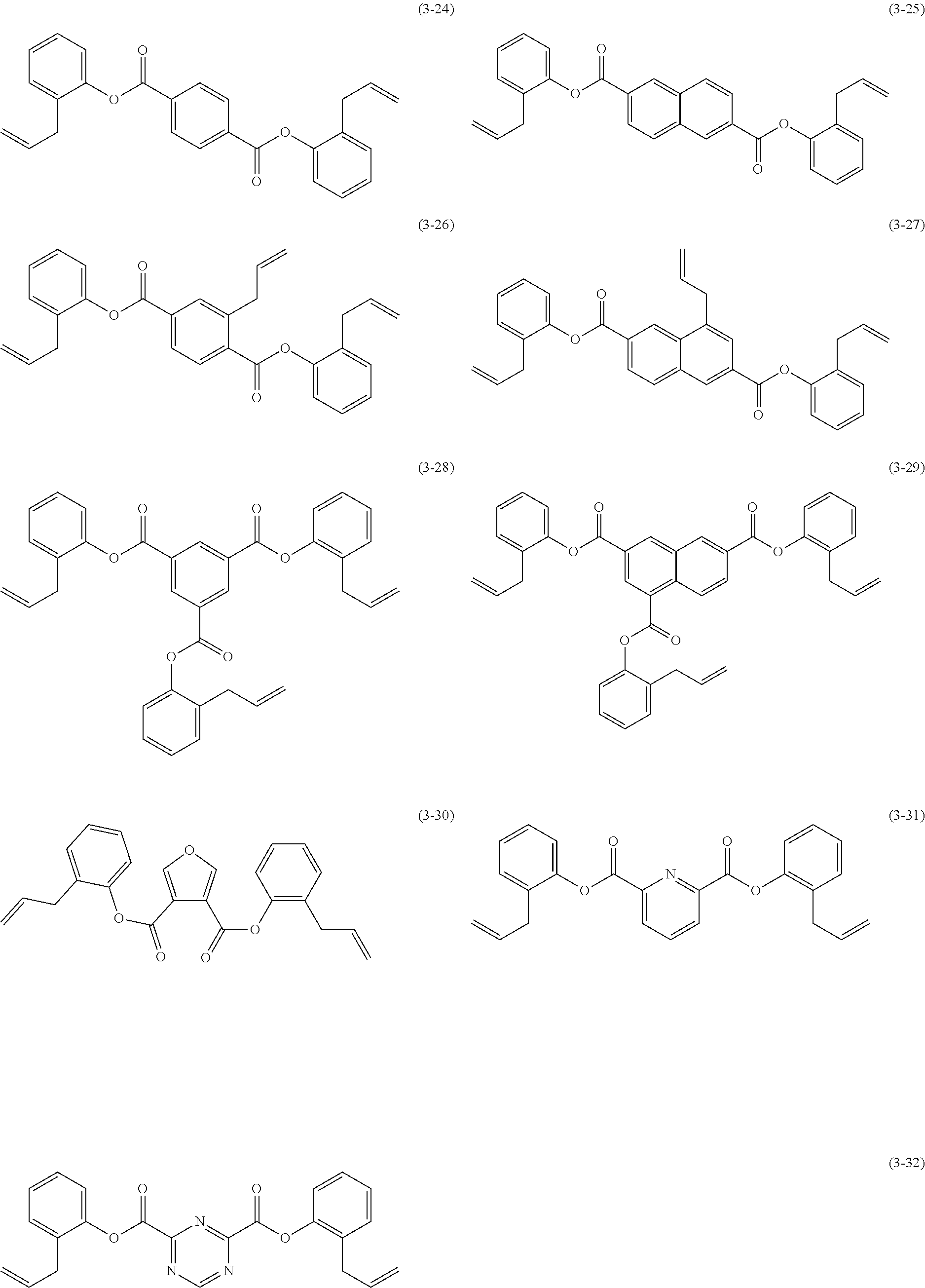
- aromatic ester compound (A) represented by structural formula (1) examples include, but are not particularly limited to, compounds represented by chemical formulae (3-1) to (3-32) below.
- the aromatic ester compound (A) is preferably represented by any of chemical formulae (3-1) to (3-6), (3-12) to (3-15), (3-18) to (3-20), and (3-22) to (3-32), more preferably chemical formulae (3-1) to (3-3), (3-12), (3-13), (3-18) to (3-20), and (3-22) to (3-29), even more preferably chemical formulae (3-1), (3-2), (3-12), (3-13), (3-19), (3-20), (3-24), (3-25), and (3-28), particularly preferably chemical formulae (3-1), (3-2), (3-12), (3-13), and (3-19).
- a method for producing the aromatic ester compound (A) is not particularly limited.
- the aromatic ester compound (A) can be produced by an appropriate known method.
- the method according to an embodiment for producing the aromatic ester compound (A) includes a step of reacting a polycarboxylic acid compound having the aromatic ring group represented by Ar 1 in structural formula (1) or its derivative with a phenolic compound corresponding to the benzene ring structural moiety in structural formula (1).
- the polycarboxylic acid compound or its derivative has a substituted or unsubstituted aromatic ring group.
- Examples of the “derivative of the polycarboxylic acid compound” include acid halides of carboxylic acids.
- the number of carbon atoms in the aromatic ring group is preferably in the range of 3 to 30.
- aromatic ring group and the substituent on the aromatic ring group are the same as those described above.
- polycarboxylic acid compound or its derivative examples include compounds represented by chemical formulae (4-1) to (4-15) below.
- each R 1 is a hydroxy group or a halogen atom.
- Each R 2 is a polymerizable unsaturated bond-containing substituent. The polymerizable unsaturated bond-containing substituent is the same as described above.
- Each p is 2 or 3.
- Each q is 0 or an integer of 1 or more, preferably 0 or 1 to 3, more preferably 0 or 1, even more preferably 0.
- the positions of the substituents on the aromatic rings in the foregoing chemical formulae are illustrated on the same aromatic ring for convenience.
- R 1 OC and R 2 may be bonded to different benzene rings. The numbers of these substituents in one molecule are p and q.
- polycarboxylic acid compound or its derivative examples include, but are not particularly limited to, benzenedicarboxylic acids, such as isophthalic acid, terephthalic acid, 5-allylisophthalic acid, and 2-allylterephthalic acid; benzenetricarboxylic acids, such as trimellitic acid and 5-allyltrimellitic acid; naphthalenedicarboxylic acids, such as naphthalene-1,5-dicarboxylic acid, naphthalene-2,3-dicarboxylic acid, naphthalene-2,6-dicarboxylic acid, naphthalene-2,7-dicarboxylic acid, 3-allylnaphthalene-1,4-dicarboxylic acid, and 3,7-diallylnaphthalene-1,4-dicarboxylic acid; pyridinetricarboxylic acids, such as 2,4,5-pyridinetricarboxylic acid; triazinecarboxylic acids, such as 1,
- the polycarboxylic acid compound or its derivative is preferably benzenedicarboxylic acid or benzenetricarboxylic acid, more preferably isophthalic acid, terephthalic acid, isophthaloyl chloride, terephthaloyl chloride, 1,3,5-benzenetricarboxylic acid, or 1,3,5-benzenetricarbonyl trichloride, even more preferably isophthaloyl chloride, terephthaloyl chloride, or 1,3,5-benzenetricarbonyl trichloride.
- polycarboxylic acid compounds or their derivatives may be used alone or in combination of two or more.
- phenolic compound examples include compounds represented by chemical formulae (5-1) to (5-5) below.
- each R 2 is a polymerizable unsaturated bond-containing substituent.
- the polymerizable unsaturated bond-containing substituent is the same as described above.
- Each q is 0 or 1.
- a raw material having no polymerizable unsaturated bond-containing substituent is used as a substituent on the aromatic ring of the polycarboxylic acid compound or its derivative and where a single phenolic compound is used as a raw material
- the phenolic compound in which q is 1 needs to be used.
- a mixture of multiple phenolic compounds are used as a raw material, at least one of them needs to be a compound in which q is 1.
- the phenolic compound include, but are not particularly limited to, allylphenols, such as 2-allylphenol, 3-allylphenol, 4-allylphenol, 4-methyl-2-allylphenol, 6-methyl-2-allylphenol, and eugenol; propenylphenols, such as 2-(1-propenyl)phenol and isoeugenol; butenylphenols, such as 2-(3-butenyl)phenol and 2-(1-ethyl-3-butenyl)phenol; and long-chain alkenylphenols, such as cardanol.
- the phenolic compound is preferably allylphenol, more preferably 2-allylphenol, 4-methyl-2-allylphenol, or 6-methyl-2-allylphenol, even more preferably 2-allylphenol.
- the phenolic compounds described above may be used alone or in combination of two or more.
- the amounts of the polycarboxylic acid compound or its derivative and the phenolic compound used are not particularly limited.
- the ratio by mole of the amount by mole of carboxy groups and/or their derivative groups (for example, acyl halide groups) of the polycarboxylic acid compound or its derivative to the amount by mole of hydroxy groups of the phenolic compound [(carboxy groups and/or their derivative groups)/(hydroxy groups)] is preferably 0.8 to 3.0, more preferably 0.9 to 2.0, even more preferably 1.0 to 1.2.
- the reaction conditions are not particularly limited. A known method can be employed as appropriate.
- the pH during the reaction is preferably, but not particularly limited to, 11 or more.
- the adjustment of the pH can be performed by the use of an acid, such as hydrochloric acid, sulfuric acid, nitric acid, or acetic acid, or a base, such as sodium hydroxide, potassium hydroxide, calcium hydroxide, or ammonia.
- the reaction temperature is preferably, but not particularly limited to, 20° C. to 100° C., more preferably 40° C. to 80° C.
- the reaction pressure is more preferably, but not particularly limited to, atmospheric pressure.
- the reaction time is preferably, but not particularly limited to, 0.5 to 10 hours, more preferably 1 to 5 hours.
- the maleimide compound (B) used in the present invention may be a compound having a maleimide group in its molecule.
- the remaining specific structure is not particularly limited, and various compounds can be used.
- a compound having two or more maleimide groups in its molecule is preferred because of excellent curability of the curable composition and excellent heat resistance and dielectric properties of the cured product.
- Specific examples thereof include a bismaleimide compound having two maleimide groups in one molecule and a polymaleimide compound having three or more maleimide groups in one molecule.
- the maleimide compound (B) may be used alone or in combination of two or more.
- bismaleimide compound examples include compounds represented by structural formula (6) below:
- each R 3 is any of a hydrogen atom, an aliphatic hydrocarbon group, or a halogen atom, and multiple R 3 's present in the formula may be the same or different).
- Each R 3 in structural formula (6) is any of a hydrogen atom, an aliphatic hydrocarbon group, and a halogen atom.
- the aliphatic hydrocarbon group include alkyl groups, such as a methyl group, an ethyl group, a propyl group, a butyl group, a pentyl group, and a hexyl group; cycloalkyl groups, such as a cyclohexyl group; and polymerizable unsaturated bond-containing groups, such as a vinyl group, an allyl group, a propenyl group, an isopropenyl group, and a 1-propenyl group.
- the halogen atom include a fluorine atom, a chlorine atom, a bromine atom, an iodine atom.
- X in structural formula (6) is not particularly limited and may be any structural moiety.
- X is preferably an aromatic ring-containing structural moiety because the resulting curable composition provides a cured product having further excellent heat resistance and dielectric properties.
- aromatic ring-containing structural moiety include those represented by any of structural formulae (X-1) to (X-10):
- each R 4 is independently any of a polymerizable unsaturated bond-containing group, an alkyl group, an alkoxy group, a halogen atom, an aryl group, and an aralkyl group
- each R 5 is any of a hydrogen atom, an alkyl group, a halogenated alkyl group, and a halogen atom
- each Y is any of an alkylene group, a halogenated alkylene group, a carbonyl group, a carbonyloxy group, a sulfonyl group, an oxygen atom, and a sulfur atom
- multiple Y's present in formula (X-4) may be the same or different
- each Z is a carbon atom or a nitrogen atom
- Z in formula (X-8) is, however, a carbon atom
- each i is 0 or an integer of 1 to 4
- 1 is 0 or an integer of 1 to 6
- each m is 0 or an integer of 1 to 5
- R 4 in structural formulae (X-1) to (X-10) is any of a polymerizable unsaturated bond-containing group, an alkyl group, an alkoxy group, a halogen atom, an aryl group, and an aralkyl group.
- Examples of the polymerizable unsaturated bond in the polymerizable unsaturated bond-containing group include a carbon-carbon double bond and a carbon-carbon triple bond.
- polymerizable unsaturated bond-containing group having a carbon-carbon double bond examples include a vinyl group, a vinyloxy group, a (meth)allyl group, a (meth)allyloxy group, a 1-propenyl group, a 1-butenyl group, a 2-butenyl group, a 3-butenyl group, a 1-hexenyl group, a 2-hexenyl group, a 3-hexenyl group, a 4-hexenyl group, a 5-hexenyl group, a 1-octenyl group, 2-octenyl group, a 1-undecenyl group, a 1-pentadecenyl group, a 3-pentadecenyl group, a 7-pentadecenyl group, a 1-octadecenyl group, a 2-octadecenyl group, a cyclopentenyl group, a cyclohe
- the group having a carbon-carbon triple bond examples include an ethynyl group, a propargyl group, a 1-butynyl group, a 2-butynyl group, a 3-butynyl group, a 3-pentynyl group, a 4-pentynyl group, and a 1,3-butadiynyl group.
- alkyl group examples include alkyl groups, such as a methyl group, an ethyl group, a propyl group, a butyl group, a pentyl group, and a hexyl group; and cycloalkyl groups, such as a cycloalkyl group.
- alkoxy group examples include a methoxy group, an ethoxy group, a propyloxy group, and a butoxy group.
- halogen atom examples include a fluorine atom, a chlorine atom, and a bromine atom.
- aryl group examples include a phenyl group, a naphthyl group, an anthryl group, and structural moieties in which these aromatic nuclei are each substituted with, for example, the polymerizable unsaturated bond-containing group, an alkyl group, an alkoxy group, or a halogen atom.
- aralkyl group examples include a benzyl group, a phenylethyl group, a naphthylmethyl group, a naphthylethyl group, and structural moieties in which these aromatic nuclei are each substituted with, for example, the polymerizable unsaturated bond-containing group, an alkyl group, an alkoxy group, or a halogen atom.
- R 4 is preferably any of a vinyl group, a vinyloxy group, a (meth)allyl group, a (meth)allyloxy group, an alkyl group having 1 to 4 carbon atoms, an alkoxy group having 1 to 4 carbon atoms, a halogen atom, and an aralkyl group having a polymerizable unsaturated bond-containing group because the resulting cured product is excellent in heat resistance and dielectric properties.
- Each Y in structural formulae (X-3) and (X-4) is any of an alkylene group, a halogenated alkylene group, a carbonyl group, a carbonyloxy group, a sulfonyl group, an oxygen atom, and a sulfur atom.
- the number of carbon atoms in each of the alkylene group and the halogenated group is preferably, but not particularly limited to, in the range of 1 to 4.
- j in structural formula (X-2) is j 2 or 3.
- k in structural formula (X-4) is 2 or 3.
- Each R 5 in structural formulae (X-6) and (X-7) is any of a hydrogen atom, an alkyl group, a halogenated alkyl group, and a halogen atom.
- the number of carbon atoms in each of the alkyl group and the halogenated alkyl group is preferably, but not particularly limited to, in the range of 1 to 4.
- maleimide compound (B) examples include compounds represented by structural formulae (6-1) to (6-19) below.
- polymaleimide compound having three or more maleimide groups in one molecule include compounds represented by any of structural formulae (7-1) to (7-3) below.
- each R 3 is any of a hydrogen atom, an aliphatic hydrocarbon group, and a halogen atom
- multiple R 3 present in each of the formulae may be the same or different
- each R 4 is independently any of a polymerizable unsaturated bond-containing substituent, an alkyl group, an alkoxy group, a halogen atom, an aryl group, and an aralkyl group
- each i is 0 or an integer of 1 to 4
- o is 0 or an integer of 1 to 3
- each V is any of an alkylene group having 1 to 4 carbon atoms, an arylmethylene group, an alkylenearylenealkylene group, an alkylenebiphenylenealkylene group, a cycloalkylene group, an oxygen atom, a sulfur atom, and a carbonyl group
- R 5 is any of a hydrogen atom, an alkyl group, a halogenated alkyl group, and a halogen atom
- maleimide compounds (B) commercially available compounds may be used as they are.
- BMI series for example, BMI-1000, 2000, 2300, 3000, 4000, 6000, 7000, 8000, and TMH
- BMI, BMI-70, BMI-80, and so forth available from K ⁇ I Chemical Industry Co., Ltd.
- B1109, N1971, B4807, P0778, P0976 available from Tokyo Chemical Industry Co., Ltd.
- maleimide compounds (B) the above-described bismaleimide compounds are preferred from the viewpoint of, for example, the curability and viscosity of the curable composition and the heat resistance and dielectric properties of the cured product.
- a maleimide compound in which X in structural formula (6) is any of structural formulae (X-1) to (X-4) is preferred, and a maleimide compound in which X is (X-3) or (X-4) is more preferred.
- the mixing proportions of the aromatic ester compound (A) and the maleimide compound (B) are not particularly limited and are appropriately adjusted in accordance with, for example, desired performance of a cured product.
- the maleimide compound (B) is preferably used in an amount of 10 to 300 parts by mass, more preferably 20 to 200 parts by mass based on 100 parts by mass of the aromatic ester compound (A) because the curable composition provides a cured product having an excellent balance between the heat resistance and the dielectric properties.
- the curable composition according to the present invention may contain other components in addition to the aromatic ester compound (A) and the maleimide compound (B). Examples of other components will be described below. Other components that can be contained in the curable composition according to the present invention are not limited to those exemplified below. Components other than those may be contained.
- resin components include, but are not particularly limited to, polyester resins other than the aromatic ester compound (A), imide resins other than the maleimide compound (B), epoxy resins, phenolic resins, amine compounds, imidazole compounds, acid anhydride, cyanate ester resins, benzoxazine resins, triazine-containing cresol novolac resins, cyanic ester resins, styrene-maleic anhydride resins, ally group-containing resins, such as diallyl bisphenol and triallyl isocyanurate, polyphosphate esters, phosphoric ester-carbonate copolymers, polyphenylene ether resins, and polybutadiene resins. These other resins may be used alone or in combination of two or more.
- the composition may contain a solvent.
- the solvent has, for example, the function of adjusting the viscosity of the composition.
- the solvent include, but are not particularly limited to, ketones, such as acetone, methyl ethyl ketone, and cyclohexanone; esters, such as ethyl acetate, butyl acetate, cellosolve acetate, propylene glycol monomethyl ether acetate, and carbitol acetate; carbitols, such as cellosolve and butyl carbitol; aromatic hydrocarbons, such as toluene and xylene; and amides, such as dimethylformamide, dimethylacetamide, and N-methylpyrrolidone. These solvents may be used alone or in combination of two or more.
- ketones such as acetone, methyl ethyl ketone, and cyclohexanone
- esters such as ethyl acetate, butyl acetate, cellosolve acetate, propylene glycol monomethyl ether acetate, and carbitol acetate
- the amount of the solvent used is preferably 10% to 80% by mass, more preferably 20% to 70% by mass based on the total mass of the curable composition.
- the amount of the solvent used is 10% or more by mass, good handleability is provided, which is preferred.
- the amount of the solvent used is 80% or less by mass, good impregnation properties with another base material are provided, which is preferred.
- the composition may contain an additive.
- the additive include curing accelerators, flame retardants, and fillers.
- curing accelerators examples include, but are not particularly limited to, phosphorus-based curing accelerators, amine-based curing accelerators, imidazole-based curing accelerators, guanidine-based curing accelerators, urea-based curing accelerators, peroxides, and azo compounds.
- Examples of the phosphorus-based curing accelerators include, organic phosphine compounds, such as triphenylphosphine, tributylphosphine, tri(p-tolyl)phosphine, diphenylcyclohexylphosphine, and tricyclohexylphosphine; organic phosphite compounds, such as trimethyl phosphite and triethyl phosphite; and phosphonium salts, such as ethyltriphenylphosphonium bromide, benzyltriphenylphosphonium chloride, butylphosphonium tetraphenylborate, tetraphenylphosphonium tetraphenylborate, tetraphenylphosphonium tetra-p-tolylborate, triphenylphosphine-triphenylborane, tetraphenylphosphonium thiocyanate, tetrapheny
- amine-based curing accelerators examples include triethylamine, tributylamine, N,N-dimethyl-4-aminopyridine (DMAP), 2,4,6-tris(dimethylaminomethyl)phenol, 1,8-diazabicyclo[5,4,0]-undecene-7 (DBU), and 1,5-diazabicyclo[4,3,0]-nonene-5 (DBN).
- DMAP N,N-dimethyl-4-aminopyridine
- DBU 1,8-diazabicyclo[5,4,0]-undecene-7
- DBN 1,5-diazabicyclo[4,3,0]-nonene-5
- imidazole-based curing accelerators examples include 2-methylimidazole, 2-undecylimidazole, 2-heptadecylimidazole, 1,2-dimethylimidazole, 2-ethyl-4-methylimidazole, 2-phenylimidazole, 2-phenyl-4-methylimidazole, 1-benzyl-2-methylimidazole, 1-benzyl-2-phenylimidazole, 1-cyanoethyl-2-methylimidazole, 1-cyanoethyl-2-undecylimidazole, 1-cyanoethyl-2-ethyl-4-methylimidazole, 1-cyanoethyl-2-phenylimidazole, 1-cyanoethyl-2-undecylimidazolium trimellitate, 1-cyanoethyl-2-phenylimidazolium trimellitate, an isocyanuric acid adduct of 2-phenylimidazole, 2-phenyl
- guanidine-based curing accelerators examples include dicyandiamide, 1-methylguanidine, 1-ethylguanidine, 1-cyclohexylguanidine, 1-phenylguanidine, dimethylguanidine, diphenylguanidine, trimethylguanidine, tetramethylguanidine, pentamethylguanidine, 1,5,7-triazabicyclo[4.4.0]dec-5-ene, 7-methyl-1,5,7-triazabicyclo[4.4.0]dec-5-ene, 1-methylbiguanide, 1-ethylbiguanide, 1-butylbiguanide, 1-cyclohexylbiguanide, 1-allybiguanide, and 1-phenylbiguanide.
- urea-based curing accelerators examples include 3-phenyl-1,1-dimethylurea, 3-(4-methylphenyl)-1,1-dimethylurea, chlorophenylurea, 3-(4-chlorophenyl)-1,1-dimethylurea, and 3-(3,4-dichlorophenyl)-1,1-dimethylurea.
- peroxides and the azo compounds examples include benzoyl peroxide, p-chlorobenzoyl peroxide, di-tert-butyl peroxide, diisopropyl peroxycarbonate, di-2-ethylhexyl peroxycarbonate, and azobisisobutyronitrile.
- 2-ethyl-4-methylimidazole or dimethylaminopyridine is preferably used.
- the amount of the curing accelerator used is preferably 0.01 to 5 parts by mass, more preferably 0.1 to 3 based on 100 parts by mass of the resin solid content of the curable composition.
- the amount of the curing accelerator used is 0.01 parts or more by mass, good curability is obtained, which is preferred.
- the amount of the curing accelerator used is 5 parts or less by mass, good formability is obtained, which is preferred.
- flame retardants examples include, but are not particularly limited to, inorganic phosphorus-based flame retardants, organic phosphorus-based flame retardants, and halogen-containing flame retardants.
- inorganic phosphorus-based flame retardants include, but are not particularly limited to, red phosphorus; ammonium phosphates, such as ammonium phosphate monobasic, ammonium phosphate dibasic, ammonium phosphate tribasic, and ammonium polyphosphate; and phosphoramide.
- organic phosphorus-based flame retardants include, but are not particularly limited to, phosphoric esters, such as methyl acid phosphate, ethyl acid phosphate, isopropyl acid phosphate, dibutyl phosphate, monobutyl phosphate, butoxyethyl acid phosphate, 2-ethylhexyl acid phosphate, bis(2-ethylhexyl)phosphate, monoisodecyl acid phosphate, lauryl acid phosphate, tridecyl acid phosphate, stearyl acid phosphate, isostearyl acid phosphate, oleyl acid phosphate, butyl pyrophosphate, tetracosyl acid phosphate, ethylene glycol acid phosphate, and (2-hydroxyethyl) methacrylate acid phosphate; diphenylphosphines, such as 9,10-dihydro-9-oxa-10-phosphaphenanthrene-10-oxide and
- halogen-containing flame retardants include, but are not particularly limited to, brominated polystyrene, bis(pentabromophenyl)ethane, tetrabromobisphenol A bis(dibromopropyl ether), 1,2-bis(tetrabromophthalimide), 2,4,6-tris(2,4,6-tribromophenoxy)-1,3,5-triazine, and tetrabromophthalic acid.
- the amount of the flame retardant used is preferably 0.1 to 50 parts by mass, more preferably 1 to 30 based on 100 parts by mass of the resin solid content of the curable composition.
- the amount of the flame retardant used is 0.1 parts or more by mass, flame retardancy can be imparted, which is preferred.
- the amount of the flame retardant used is 50 parts or less by mass, flame retardancy can be imparted while maintaining the dielectric properties, which is preferred.
- fillers examples include organic fillers and inorganic fillers.
- the fillers have, for example, the functions of improving elongation and mechanical strength.
- organic fillers examples include, but are not particularly limited to, polyamide particles.
- inorganic fillers include, but are not particularly limited to, silica, alumina, glass, cordierite, silicon oxide, barium sulfate, barium carbonate, aluminum hydroxide, magnesium hydroxide, calcium carbonate, magnesium carbonate, magnesium oxide, boron nitride, aluminum nitride, manganese nitride, aluminum borate, strontium carbonate, strontium titanate, calcium titanate, magnesium titanate, bismuth titanate, titanium oxide, zirconium oxide, barium titanate, barium zirconate titanate, barium zirconate, calcium zirconate, zirconium phosphate, zirconium phosphate tungstate, talc, clay, mica powder, zinc oxide, hydrotalcite, boehmite, and carbon black.
- silica is preferably used.
- examples of silica that can be used include amorphous silica, fused silica, crystalline silica, synthetic silica, and hollow silica.
- the fillers described above may be surface-treated as needed.
- a surface treatment agent that can be used in this case include, but are not particularly limited to, aminosilane-based coupling agents, epoxysilane-based coupling agents, mercaptosilane-based coupling agents, silane-based coupling agents, organosilazane compounds, and titanate-based coupling agents.
- Specific examples of the surface treatment agents include 3-glycidoxypropyltrimethoxysilane, 3-mercaptopropyltrimethoxysilane, 3-aminopropyltriethoxysilane, N-phenyl-3-aminopropyltrimethoxysilane, and hexamethyldisilazane.
- the average particle size of each of the fillers is preferably, but is not particularly limited to, 0.01 to 10 m, more preferably 0.03 to 5 m, even more preferably 0.05 to 3 ⁇ m.
- the “particle size” refers to the maximum distance between two points on the outline of a particle.
- the “average particle size” refers to a value obtained by a method including measuring the particle sizes of freely-selected 100 particles on one screen in an image with a scanning electron microscope (SEM) and calculating the average value thereof.
- the amount of the filler used is preferably 0.5 to 95 parts by mass, more preferably 5 to 80 parts by mass based on 100 parts by mass of the resin solid content of the curable composition.
- the amount of the filler used is 0.5 parts or more by mass, low thermal expansion can be provided, which is preferred.
- the amount of the filler used is 95 parts or less by mass, a good balance between characteristics and formability is provided, which is preferred.
- a cured product obtained by curing the curable composition containing the aromatic ester compound (A) and the maleimide compound (B) is provided.
- the aromatic ester compound (A) described above has a polymerizable unsaturated bond-containing substituent and thus can be polymerized by itself to provide a cured product.
- the cured product may contain the curing agent, the additive, the curing accelerator, and so forth as needed.
- the aromatic ester compound (A) itself has a low dielectric loss tangent; hence, the resulting cured product thereof has a low dielectric loss tangent and higher heat resistance.
- the cured product can be used for electronic material applications, such as semiconductor package substrates, printed wiring boards, build-up adhesive films, and semiconductor sealing materials. Additionally, it can also be used for applications, such as adhesives and paints.
- the heating temperature for heat curing is preferably, but not particularly limited to, 150° C. to 300° C., more preferably 175° C. to 250° C.
- the aromatic ester compound (A-1) represented by the following structural formula.
- the aromatic ester compound (A-1) had an ester equivalent of 199 g/eq., an allyl equivalent of 199 g/eq, and an E-type viscosity of 6,000 mPa ⁇ s (25° C.).
- a resin (hydroxyl equivalent: 165 g/eq., softening point: 85° C.) obtained by the polyaddition reaction of dicyclopentadiene and phenol, 72 g of 1-naphthol, and 630 g of toluene were charged. The contents were dissolved while the system was reduced in pressure and filled with nitrogen. Next, 152 g of isophthaloyl chloride was added thereto and dissolved while the system was reduced in pressure and filled with nitrogen.
- Each of the curable compositions was poured into a mold measuring 11 cm ⁇ 9 cm ⁇ 2.4 mm and molded with a pressing machine at 150° C. for 60 minutes, then at 175° C. for 90 minutes, and then at 200° C. for 90 minutes.
- the molded article was removed from the mold and further cured at 230° C. for 4 hours to provide a cured product.
- test piece having a width of 5 mm and a length of 54 mm was cut out from the 2.4-mm-thick cured product obtained above.
- the test piece was subjected to dynamic mechanical analysis (DMA) using a rectangular tension method with an RSA II solid viscoelasticity measuring instrument, available from Rheometric Scientific, to measure the temperature at which the maximum change in elastic modulus (the maximum rate of change of tan ⁇ ) was obtained as a glass transition temperature.
- DMA dynamic mechanical analysis
- the measurement conditions were as follows: a frequency of 1 Hz and a rate of temperature increase of 3° C./min.
- the cured product obtained above was vacuum-dried by heating at 105° C. for 2 hours and then stored in a room at a temperature of 23° C. and a humidity of 50% for 24 hours to provide a test piece.
- the dielectric loss tangent of the test piece was measured at 1 GHz by a resonant cavity method with an “E8362C network analyzer”, available from Agilent Technologies, Inc.
Landscapes
- Chemical & Material Sciences (AREA)
- Health & Medical Sciences (AREA)
- Chemical Kinetics & Catalysis (AREA)
- Medicinal Chemistry (AREA)
- Polymers & Plastics (AREA)
- Organic Chemistry (AREA)
- Engineering & Computer Science (AREA)
- Microelectronics & Electronic Packaging (AREA)
- Emergency Medicine (AREA)
- Addition Polymer Or Copolymer, Post-Treatments, Or Chemical Modifications (AREA)
- Structures Or Materials For Encapsulating Or Coating Semiconductor Devices Or Solid State Devices (AREA)
- Compositions Of Macromolecular Compounds (AREA)
Abstract
Description

(where in the formula, Ar1 is a substituted or unsubstituted aromatic ring group, each R1 is a polymerizable unsaturated bond-containing substituent, each 1 is 0 or 1, each R2 is any of an alkyl group, an alkoxy group, an alkyloxycarbonyl group, an alkylcarbonyloxy group, and a halogen atom, each m is 0 or an integer of 1 to 5, and n is 2 or 3, provided that at least one polymerizable unsaturated bond-containing substituent is contained in one molecule as a substituent on Ar1 or as R1), a cured product thereof, a printed wiring board, a semiconductor sealing material, and a build-up film obtained using the curable composition.

(where in the formula, Ar1 is a substituted or unsubstituted aromatic ring group, each R1 is a polymerizable unsaturated bond-containing substituent, each 1 is 0 or 1, each R2 is any of an alkyl group, an alkoxy group, an alkyloxycarbonyl group, an alkylcarbonyloxy group, and a halogen atom, each m is 0 or an integer of 1 to 5, and n is 2 or 3, provided that at least one polymerizable unsaturated bond-containing substituent is contained in one molecule as a substituent on Ar1 or as R1).


(where in the formula, Ar1 is a substituted or unsubstituted aromatic ring group, each R1 is a polymerizable unsaturated bond-containing substituent, each R2 is any of an alkyl group, an alkoxy group, an alkyloxycarbonyl group, an alkylcarbonyloxy group, a halogen atom, each m is 0 or an integer of 1 to 4, and n is 2 or 3).




(where in the formula, X is a divalent organic group, each R3 is any of a hydrogen atom, an aliphatic hydrocarbon group, or a halogen atom, and multiple R3's present in the formula may be the same or different).


[where in the formulae, each R4 is independently any of a polymerizable unsaturated bond-containing group, an alkyl group, an alkoxy group, a halogen atom, an aryl group, and an aralkyl group, each R5 is any of a hydrogen atom, an alkyl group, a halogenated alkyl group, and a halogen atom, each Y is any of an alkylene group, a halogenated alkylene group, a carbonyl group, a carbonyloxy group, a sulfonyl group, an oxygen atom, and a sulfur atom, multiple Y's present in formula (X-4) may be the same or different, each Z is a carbon atom or a nitrogen atom, Z in formula (X-8) is, however, a carbon atom, each i is 0 or an integer of 1 to 4, 1 is 0 or an integer of 1 to 6, each m is 0 or an integer of 1 to 5, n is 0 or an integer of 1 to 7, each o is 0 or an integer of 1 to 3, j and k is each an integer of 2 or more, and the binding sites and the positions of the substituents on the naphthalene rings may be any of the carbon atoms constituting the naphthalene rings].


(where in the formulae, each R3 is any of a hydrogen atom, an aliphatic hydrocarbon group, and a halogen atom, multiple R3 present in each of the formulae may be the same or different, each R4 is independently any of a polymerizable unsaturated bond-containing substituent, an alkyl group, an alkoxy group, a halogen atom, an aryl group, and an aralkyl group, each i is 0 or an integer of 1 to 4, o is 0 or an integer of 1 to 3, each V is any of an alkylene group having 1 to 4 carbon atoms, an arylmethylene group, an alkylenearylenealkylene group, an alkylenebiphenylenealkylene group, a cycloalkylene group, an oxygen atom, a sulfur atom, and a carbonyl group, R5 is any of a hydrogen atom, an alkyl group, a halogenated alkyl group, and a halogen atom, Z is a carbon atom or a nitrogen atom, t is an integer of 2 or more, and p is an integer of 3 to 6).

-
- Maleimide compound (B-1): 4,4′-diphenylmethane bismaleimide (“BMI-1000”, available from Daiwakasei Industry Co., Ltd., maleimide equivalent: 179 g/eq.)
- Epoxy resin: bisphenol A-type epoxy resin (“EPICLON 850S”, available from DIC Corporation, epoxy equivalent: 188 g/eq.)
Production of Cured Product
| TABLE 1 | ||
| Comparative | ||
| Example 1 | example 1 | |
| Aromatic ester compound (A-1) [parts by mass] | 52.7 | |
| Aromatic ester compound (A′) [parts by mass] | 54.3 | |
| Maleimide compound (B-1) [parts by mass] | 47.4 | |
| Epoxy resin [parts by mass] | 45.7 | |
| Dimethylaminopyridine [parts by mass] | 0.5 | |
| Dicumyl peroxide [parts by mass] | 1 | |
| Heat resistance | 350° C. or | 157° C. |
| higher | ||
| Dielectric loss tangent | 0.0038 | 0.0080 |
Claims (5)


Applications Claiming Priority (3)
| Application Number | Priority Date | Filing Date | Title |
|---|---|---|---|
| JP2018064717 | 2018-03-29 | ||
| JP2018-064717 | 2018-03-29 | ||
| PCT/JP2019/010505 WO2019188332A1 (en) | 2018-03-29 | 2019-03-14 | Curable composition and cured product thereof |
Publications (2)
| Publication Number | Publication Date |
|---|---|
| US20210032383A1 US20210032383A1 (en) | 2021-02-04 |
| US11873356B2 true US11873356B2 (en) | 2024-01-16 |
Family
ID=68061486
Family Applications (1)
| Application Number | Title | Priority Date | Filing Date |
|---|---|---|---|
| US17/041,776 Active 2041-02-03 US11873356B2 (en) | 2018-03-29 | 2019-03-14 | Curable composition and cured product thereof |
Country Status (6)
| Country | Link |
|---|---|
| US (1) | US11873356B2 (en) |
| JP (1) | JP6940833B2 (en) |
| KR (1) | KR102524881B1 (en) |
| CN (1) | CN111918890B (en) |
| TW (1) | TWI794454B (en) |
| WO (1) | WO2019188332A1 (en) |
Families Citing this family (3)
| Publication number | Priority date | Publication date | Assignee | Title |
|---|---|---|---|---|
| JP7014006B2 (en) * | 2018-03-29 | 2022-02-15 | Dic株式会社 | Curable composition and its cured product |
| CN111777541B (en) * | 2020-06-30 | 2022-11-11 | 艾蒙特成都新材料科技有限公司 | high-Tg low-dielectric active ester curing agent, preparation method and application |
| CN118994875A (en) * | 2024-08-02 | 2024-11-22 | 台光电子材料(黄石)有限公司 | Resin composition and its products |
Citations (12)
| Publication number | Priority date | Publication date | Assignee | Title |
|---|---|---|---|---|
| JPH048444B2 (en) | 1985-08-31 | 1992-02-17 | ||
| EP0489691A2 (en) * | 1990-12-05 | 1992-06-10 | Ciba-Geigy Ag | Tetraallylesters as coreactants for bismaleimides |
| JP2002012650A (en) | 2000-06-30 | 2002-01-15 | Dainippon Ink & Chem Inc | Epoxy resin composition for low dielectric materials |
| JP2004210936A (en) | 2002-12-27 | 2004-07-29 | Tdk Corp | Prepreg, cured sheet-like resin and laminate |
| US20050003199A1 (en) | 2002-12-27 | 2005-01-06 | Tdk Corporation | Resin composition, cured resin, sheet-like cured resin, laminated body, prepreg, electronic parts and multilayer boards |
| JP2010090238A (en) | 2008-10-07 | 2010-04-22 | Ajinomoto Co Inc | Epoxy resin composition |
| JP2016074849A (en) | 2014-10-08 | 2016-05-12 | 太陽インキ製造株式会社 | Dry film, cured product, and printed wiring board |
| JP2016156019A (en) | 2012-05-31 | 2016-09-01 | 味の素株式会社 | Resin composition |
| CN106700073A (en) | 2016-12-03 | 2017-05-24 | 苏州大学 | Modified bismaleimide resin and preparation method thereof |
| CN106977717A (en) * | 2017-04-26 | 2017-07-25 | 黑龙江省科学院石油化学研究院 | A kind of ester group compound containing alkenyl and preparation method thereof and the bimaleimide resin using its modification |
| WO2018008415A1 (en) | 2016-07-06 | 2018-01-11 | Dic株式会社 | Curable composition and cured product thereof |
| WO2018098832A1 (en) * | 2016-12-03 | 2018-06-07 | 苏州大学张家港工业技术研究院 | Bismaleimide resin and method for preparation thereof |
Family Cites Families (5)
| Publication number | Priority date | Publication date | Assignee | Title |
|---|---|---|---|---|
| JP5233710B2 (en) * | 2008-02-12 | 2013-07-10 | 三菱瓦斯化学株式会社 | Resin composition, prepreg and metal foil-clad laminate |
| JP6301173B2 (en) * | 2014-03-28 | 2018-03-28 | 新日鉄住金化学株式会社 | Curable resin composition, cured product thereof, composite material |
| JP6025952B1 (en) * | 2015-11-11 | 2016-11-16 | エア・ウォーター株式会社 | Vinyl benzylated phenol compound, method for producing vinyl benzylated phenol compound, active ester resin, method for producing active ester resin, thermosetting resin composition, cured product of thermosetting resin composition, interlayer insulating material, Prepreg and method for producing prepreg |
| US11548977B2 (en) * | 2017-06-21 | 2023-01-10 | Dic Corporation | Active ester resin and composition and cured product using the same |
| US11407708B2 (en) * | 2017-06-21 | 2022-08-09 | Dic Corporation | Active ester compound and composition and cured product obtained using the same |
-
2019
- 2019-03-14 US US17/041,776 patent/US11873356B2/en active Active
- 2019-03-14 WO PCT/JP2019/010505 patent/WO2019188332A1/en not_active Ceased
- 2019-03-14 KR KR1020207027916A patent/KR102524881B1/en active Active
- 2019-03-14 CN CN201980023343.0A patent/CN111918890B/en active Active
- 2019-03-14 JP JP2020509890A patent/JP6940833B2/en active Active
- 2019-03-22 TW TW108109967A patent/TWI794454B/en active
Patent Citations (14)
| Publication number | Priority date | Publication date | Assignee | Title |
|---|---|---|---|---|
| JPH048444B2 (en) | 1985-08-31 | 1992-02-17 | ||
| EP0489691A2 (en) * | 1990-12-05 | 1992-06-10 | Ciba-Geigy Ag | Tetraallylesters as coreactants for bismaleimides |
| JPH059236A (en) | 1990-12-05 | 1993-01-19 | Ciba Geigy Ag | Tetraallyl ester as coreactant with bismaleimide |
| JP2002012650A (en) | 2000-06-30 | 2002-01-15 | Dainippon Ink & Chem Inc | Epoxy resin composition for low dielectric materials |
| JP2004210936A (en) | 2002-12-27 | 2004-07-29 | Tdk Corp | Prepreg, cured sheet-like resin and laminate |
| US20050003199A1 (en) | 2002-12-27 | 2005-01-06 | Tdk Corporation | Resin composition, cured resin, sheet-like cured resin, laminated body, prepreg, electronic parts and multilayer boards |
| JP2010090238A (en) | 2008-10-07 | 2010-04-22 | Ajinomoto Co Inc | Epoxy resin composition |
| JP2016156019A (en) | 2012-05-31 | 2016-09-01 | 味の素株式会社 | Resin composition |
| JP2016074849A (en) | 2014-10-08 | 2016-05-12 | 太陽インキ製造株式会社 | Dry film, cured product, and printed wiring board |
| WO2018008415A1 (en) | 2016-07-06 | 2018-01-11 | Dic株式会社 | Curable composition and cured product thereof |
| CN106700073A (en) | 2016-12-03 | 2017-05-24 | 苏州大学 | Modified bismaleimide resin and preparation method thereof |
| WO2018098832A1 (en) * | 2016-12-03 | 2018-06-07 | 苏州大学张家港工业技术研究院 | Bismaleimide resin and method for preparation thereof |
| US20200062903A1 (en) * | 2016-12-03 | 2020-02-27 | Soochow University | Modified bismaleimide resin and preparation method thereof |
| CN106977717A (en) * | 2017-04-26 | 2017-07-25 | 黑龙江省科学院石油化学研究院 | A kind of ester group compound containing alkenyl and preparation method thereof and the bimaleimide resin using its modification |
Non-Patent Citations (3)
| Title |
|---|
| Haoyu et al. Polymer 50 (2009) 1414-1422 (Year: 2009). * |
| International Search Report dated Jun. 18, 2019, issued for PCT/JP2019/010505. |
| Varma et al. Die Angewandte Makromolekulare Chemie 184, 7-18 (Year: 1991). * |
Also Published As
| Publication number | Publication date |
|---|---|
| TWI794454B (en) | 2023-03-01 |
| WO2019188332A1 (en) | 2019-10-03 |
| JPWO2019188332A1 (en) | 2021-03-11 |
| TW201942167A (en) | 2019-11-01 |
| CN111918890A (en) | 2020-11-10 |
| KR20200128093A (en) | 2020-11-11 |
| CN111918890B (en) | 2023-07-07 |
| KR102524881B1 (en) | 2023-04-25 |
| US20210032383A1 (en) | 2021-02-04 |
| JP6940833B2 (en) | 2021-09-29 |
Similar Documents
| Publication | Publication Date | Title |
|---|---|---|
| JP7010288B2 (en) | Active ester resin and compositions and cured products using it | |
| JP7068668B2 (en) | Active ester compound and composition and cured product using it | |
| CN111936526B (en) | Curable composition and cured product thereof | |
| US20210032383A1 (en) | Curable composition and cured product thereof | |
| US11901249B2 (en) | Curable composition and cured product thereof | |
| CN114671764A (en) | Ester compounds and their applications | |
| JP7057905B2 (en) | Curable composition and its cured product | |
| JP7014006B2 (en) | Curable composition and its cured product |
Legal Events
| Date | Code | Title | Description |
|---|---|---|---|
| AS | Assignment |
Owner name: DIC CORPORATION, JAPAN Free format text: ASSIGNMENT OF ASSIGNORS INTEREST;ASSIGNORS:YAMOTO, KAZUHISA;SATOU, YUTAKA;HAYASHI, KOJI;SIGNING DATES FROM 20200908 TO 20200910;REEL/FRAME:053889/0460 |
|
| FEPP | Fee payment procedure |
Free format text: ENTITY STATUS SET TO UNDISCOUNTED (ORIGINAL EVENT CODE: BIG.); ENTITY STATUS OF PATENT OWNER: LARGE ENTITY |
|
| STPP | Information on status: patent application and granting procedure in general |
Free format text: APPLICATION DISPATCHED FROM PREEXAM, NOT YET DOCKETED |
|
| STPP | Information on status: patent application and granting procedure in general |
Free format text: DOCKETED NEW CASE - READY FOR EXAMINATION |
|
| STPP | Information on status: patent application and granting procedure in general |
Free format text: NON FINAL ACTION MAILED |
|
| STPP | Information on status: patent application and granting procedure in general |
Free format text: RESPONSE TO NON-FINAL OFFICE ACTION ENTERED AND FORWARDED TO EXAMINER |
|
| STPP | Information on status: patent application and granting procedure in general |
Free format text: FINAL REJECTION MAILED |
|
| STPP | Information on status: patent application and granting procedure in general |
Free format text: RESPONSE AFTER FINAL ACTION FORWARDED TO EXAMINER |
|
| STPP | Information on status: patent application and granting procedure in general |
Free format text: NOTICE OF ALLOWANCE MAILED -- APPLICATION RECEIVED IN OFFICE OF PUBLICATIONS |
|
| STPP | Information on status: patent application and granting procedure in general |
Free format text: PUBLICATIONS -- ISSUE FEE PAYMENT RECEIVED |
|
| STPP | Information on status: patent application and granting procedure in general |
Free format text: PUBLICATIONS -- ISSUE FEE PAYMENT VERIFIED |
|
| STCF | Information on status: patent grant |
Free format text: PATENTED CASE |