US11856463B2 - Resource reservation for multiple sidelinks - Google Patents
Resource reservation for multiple sidelinks Download PDFInfo
- Publication number
- US11856463B2 US11856463B2 US17/111,222 US202017111222A US11856463B2 US 11856463 B2 US11856463 B2 US 11856463B2 US 202017111222 A US202017111222 A US 202017111222A US 11856463 B2 US11856463 B2 US 11856463B2
- Authority
- US
- United States
- Prior art keywords
- sidelink
- resource
- wireless communication
- pssch
- communication device
- Prior art date
- Legal status (The legal status is an assumption and is not a legal conclusion. Google has not performed a legal analysis and makes no representation as to the accuracy of the status listed.)
- Active, expires
Links
Images






Classifications
-
- H—ELECTRICITY
- H04—ELECTRIC COMMUNICATION TECHNIQUE
- H04W—WIRELESS COMMUNICATION NETWORKS
- H04W28/00—Network traffic management; Network resource management
- H04W28/16—Central resource management; Negotiation of resources or communication parameters, e.g. negotiating bandwidth or QoS [Quality of Service]
- H04W28/26—Resource reservation
-
- H—ELECTRICITY
- H04—ELECTRIC COMMUNICATION TECHNIQUE
- H04L—TRANSMISSION OF DIGITAL INFORMATION, e.g. TELEGRAPHIC COMMUNICATION
- H04L5/00—Arrangements affording multiple use of the transmission path
- H04L5/003—Arrangements for allocating sub-channels of the transmission path
- H04L5/0053—Allocation of signalling, i.e. of overhead other than pilot signals
-
- H—ELECTRICITY
- H04—ELECTRIC COMMUNICATION TECHNIQUE
- H04L—TRANSMISSION OF DIGITAL INFORMATION, e.g. TELEGRAPHIC COMMUNICATION
- H04L5/00—Arrangements affording multiple use of the transmission path
- H04L5/003—Arrangements for allocating sub-channels of the transmission path
- H04L5/0053—Allocation of signalling, i.e. of overhead other than pilot signals
- H04L5/0055—Physical resource allocation for ACK/NACK
-
- H—ELECTRICITY
- H04—ELECTRIC COMMUNICATION TECHNIQUE
- H04L—TRANSMISSION OF DIGITAL INFORMATION, e.g. TELEGRAPHIC COMMUNICATION
- H04L5/00—Arrangements affording multiple use of the transmission path
- H04L5/0091—Signalling for the administration of the divided path, e.g. signalling of configuration information
- H04L5/0094—Indication of how sub-channels of the path are allocated
-
- H—ELECTRICITY
- H04—ELECTRIC COMMUNICATION TECHNIQUE
- H04W—WIRELESS COMMUNICATION NETWORKS
- H04W28/00—Network traffic management; Network resource management
- H04W28/02—Traffic management, e.g. flow control or congestion control
- H04W28/0278—Traffic management, e.g. flow control or congestion control using buffer status reports
-
- H—ELECTRICITY
- H04—ELECTRIC COMMUNICATION TECHNIQUE
- H04W—WIRELESS COMMUNICATION NETWORKS
- H04W72/00—Local resource management
- H04W72/02—Selection of wireless resources by user or terminal
-
- H—ELECTRICITY
- H04—ELECTRIC COMMUNICATION TECHNIQUE
- H04W—WIRELESS COMMUNICATION NETWORKS
- H04W72/00—Local resource management
- H04W72/12—Wireless traffic scheduling
- H04W72/1263—Mapping of traffic onto schedule, e.g. scheduled allocation or multiplexing of flows
-
- H—ELECTRICITY
- H04—ELECTRIC COMMUNICATION TECHNIQUE
- H04W—WIRELESS COMMUNICATION NETWORKS
- H04W72/00—Local resource management
- H04W72/20—Control channels or signalling for resource management
-
- H—ELECTRICITY
- H04—ELECTRIC COMMUNICATION TECHNIQUE
- H04L—TRANSMISSION OF DIGITAL INFORMATION, e.g. TELEGRAPHIC COMMUNICATION
- H04L5/00—Arrangements affording multiple use of the transmission path
- H04L5/0001—Arrangements for dividing the transmission path
- H04L5/0003—Two-dimensional division
- H04L5/0005—Time-frequency
- H04L5/0007—Time-frequency the frequencies being orthogonal, e.g. OFDM(A) or DMT
-
- H—ELECTRICITY
- H04—ELECTRIC COMMUNICATION TECHNIQUE
- H04L—TRANSMISSION OF DIGITAL INFORMATION, e.g. TELEGRAPHIC COMMUNICATION
- H04L5/00—Arrangements affording multiple use of the transmission path
- H04L5/003—Arrangements for allocating sub-channels of the transmission path
- H04L5/0044—Allocation of payload; Allocation of data channels, e.g. PDSCH or PUSCH
-
- H—ELECTRICITY
- H04—ELECTRIC COMMUNICATION TECHNIQUE
- H04L—TRANSMISSION OF DIGITAL INFORMATION, e.g. TELEGRAPHIC COMMUNICATION
- H04L67/00—Network arrangements or protocols for supporting network services or applications
- H04L67/01—Protocols
- H04L67/12—Protocols specially adapted for proprietary or special-purpose networking environments, e.g. medical networks, sensor networks, networks in vehicles or remote metering networks
-
- H—ELECTRICITY
- H04—ELECTRIC COMMUNICATION TECHNIQUE
- H04L—TRANSMISSION OF DIGITAL INFORMATION, e.g. TELEGRAPHIC COMMUNICATION
- H04L67/00—Network arrangements or protocols for supporting network services or applications
- H04L67/01—Protocols
- H04L67/133—Protocols for remote procedure calls [RPC]
-
- H—ELECTRICITY
- H04—ELECTRIC COMMUNICATION TECHNIQUE
- H04W—WIRELESS COMMUNICATION NETWORKS
- H04W16/00—Network planning, e.g. coverage or traffic planning tools; Network deployment, e.g. resource partitioning or cells structures
- H04W16/14—Spectrum sharing arrangements between different networks
-
- H—ELECTRICITY
- H04—ELECTRIC COMMUNICATION TECHNIQUE
- H04W—WIRELESS COMMUNICATION NETWORKS
- H04W72/00—Local resource management
- H04W72/04—Wireless resource allocation
- H04W72/044—Wireless resource allocation based on the type of the allocated resource
- H04W72/0446—Resources in time domain, e.g. slots or frames
-
- H—ELECTRICITY
- H04—ELECTRIC COMMUNICATION TECHNIQUE
- H04W—WIRELESS COMMUNICATION NETWORKS
- H04W72/00—Local resource management
- H04W72/20—Control channels or signalling for resource management
- H04W72/23—Control channels or signalling for resource management in the downlink direction of a wireless link, i.e. towards a terminal
-
- H—ELECTRICITY
- H04—ELECTRIC COMMUNICATION TECHNIQUE
- H04W—WIRELESS COMMUNICATION NETWORKS
- H04W76/00—Connection management
- H04W76/10—Connection setup
- H04W76/14—Direct-mode setup
Definitions
- This application relates to wireless communication systems, and more particularly to a sidelink user equipment (UE) reserving resources for multiple sidelinks.
- UE user equipment
- a wireless multiple-access communications system may include a number of base stations (BSs), each simultaneously supporting communications for multiple communication devices, which may be otherwise known as user equipment (UE).
- BSs base stations
- UE user equipment
- NR next generation new radio
- LTE long term evolution
- NR next generation new radio
- 5G 5 th Generation
- LTE long term evolution
- NR next generation new radio
- NR is designed to provide a lower latency, a higher bandwidth or a higher throughput, and a higher reliability than LTE.
- NR is designed to operate over a wide array of spectrum bands, for example, from low-frequency bands below about 1 gigahertz (GHz) and mid-frequency bands from about 1 GHz to about 6 GHz, to high-frequency bands such as millimeter wave (mmWave) bands.
- GHz gigahertz
- mmWave millimeter wave
- NR is also designed to operate across different spectrum types, from licensed spectrum to unlicensed and shared spectrum. Spectrum sharing enables operators to opportunistically aggregate spectrums to dynamically support high-bandwidth services. Spectrum sharing can extend the benefit of NR technologies to operating entities that may not have access to a licensed spectrum.
- a BS may communicate with a UE in an uplink direction and a downlink direction.
- Sidelink was introduced in LTE to allow a UE to send data to another UE without tunneling through the BS and/or an associated core network.
- the LTE sidelink technology had been extended to provision for device-to-device (D2D) communications, vehicle-to-everything (V2X) communications, and/or cellular vehicle-to-everything (C-V2X) communications.
- D2D device-to-device
- V2X vehicle-to-everything
- C-V2X cellular vehicle-to-everything
- NR may be extended to support sidelink communications for D2D, V2X, and/or C-V2X over a dedicated spectrum, a licensed spectrum, and/or an unlicensed spectrum.
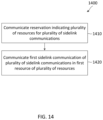
- a method of wireless communication includes communicating, by a first wireless communication device with a second wireless communication device, a reservation indicating a plurality of reserved resources for a plurality of sidelink communications; and communicating, by the first wireless communication device with a third wireless communication device, a first sidelink communication of the plurality of sidelink communications using a first resource of the plurality of reserved resources.
- an apparatus includes a transceiver configured to communicate, with a second wireless communication device, a reservation indicating a plurality of reserved resources for a plurality of sidelink communications; and communicate, with a third wireless communication device, a first sidelink communication of the plurality of sidelink communications using a first resource of the plurality of reserved resources.
- a non-transitory computer-readable medium having program code recorded thereon includes code for causing a first wireless communication device to communicate, with a second wireless communication device, a reservation indicating a plurality of reserved resources for a plurality of sidelink communications; and code for causing the first wireless communication device to communicate, with a third wireless communication device, a first sidelink communication of the plurality of sidelink communications using a first resource of the plurality of reserved resources.
- an apparatus includes means for communicating, with a second wireless communication device, a reservation indicating a plurality of reserved resources for a plurality of sidelink communications; and means for communicating, with a third wireless communication device, a first sidelink communication of the plurality of sidelink communications using a first resource of the plurality of reserved resources.
- FIG. 1 illustrates a wireless communication network according to some aspects of the present disclosure.
- FIG. 2 illustrates a radio frame structure according to some aspects of the present disclosure.
- FIG. 3 illustrates a wireless communication network that provisions for sidelink communications according to some aspects of the present disclosure.
- FIG. 4 A illustrates a physical sidelink control channel (PSCCH)/physical sidelink shared channel (PSSCH) multiplexing configuration according to some aspects of the present disclosure.
- PSCCH physical sidelink control channel
- PSSCH physical sidelink shared channel
- FIG. 4 B illustrates a PSCCH/PSSCH multiplexing configuration according to some aspects of the present disclosure.
- FIG. 4 C illustrates a PSCCH/PSSCH multiplexing configuration according to some aspects of the present disclosure.
- FIG. 4 D illustrates a PSCCH/PSSCH multiplexing configuration according to some aspects of the present disclosure.
- FIG. 5 is a block diagram of a user equipment (UE) according to some aspects of the present disclosure.
- FIG. 6 is a block diagram of an exemplary base station (BS) according to some aspects of the present disclosure.
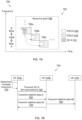
- FIG. 7 A illustrates a sidelink resource reservation for multiple sidelinks according to some aspects of the present disclosure.
- FIG. 7 B is a signaling diagram illustrating a sidelink communication method according to some aspects of the present disclosure.
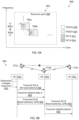
- FIG. 8 A illustrates a sidelink resource reservation for multiple sidelinks according to some aspects of the present disclosure.
- FIG. 8 B is a signaling diagram illustrating a sidelink communication method according to some aspects of the present disclosure.
- FIG. 9 A illustrates a sidelink resource reservation for multiple sidelinks according to some aspects of the present disclosure.
- FIG. 9 B is a signaling diagram illustrating a sidelink communication method according to some aspects of the present disclosure.
- FIG. 10 A illustrates a sidelink resource reservation for multiple sidelinks according to some aspects of the present disclosure.
- FIG. 10 B is a signaling diagram illustrating a sidelink communication method according to some aspects of the present disclosure.
- FIG. 11 A illustrates a sidelink resource reservation for multiple sidelinks according to some aspects of the present disclosure.
- FIG. 11 B is a signaling diagram illustrating a sidelink communication method according to some aspects of the present disclosure.
- FIG. 12 A illustrates a sidelink communication scenario according to some aspects of the present disclosure.
- FIG. 12 B is a flow diagram of a sidelink communication method according to some aspects of the present disclosure.
- FIG. 13 A illustrates a sidelink communication scenario according to some aspects of the present disclosure.
- FIG. 13 B is a flow diagram of a sidelink communication method according to some aspects of the present disclosure.
- FIG. 14 is a flow diagram of a sidelink communication method according to some aspects of the present disclosure.
- wireless communications systems also referred to as wireless communications networks.
- the techniques and apparatus may be used for wireless communication networks such as code division multiple access (CDMA) networks, time division multiple access (TDMA) networks, frequency division multiple access (FDMA) networks, orthogonal FDMA (OFDMA) networks, single-carrier FDMA (SC-FDMA) networks, LTE networks, Global System for Mobile Communications (GSM) networks, 5th Generation (5G) or new radio (NR) networks, as well as other communications networks.
- CDMA code division multiple access
- TDMA time division multiple access
- FDMA frequency division multiple access
- OFDMA orthogonal FDMA
- SC-FDMA single-carrier FDMA
- LTE Long Term Evolution
- GSM Global System for Mobile Communications
- 5G 5th Generation
- NR new radio
- An OFDMA network may implement a radio technology such as evolved UTRA (E-UTRA), Institute of Electrical and Electronics Engineers (IEEE) 802.11, IEEE 802.16, IEEE 802.20, flash-OFDM and the like.
- E-UTRA evolved UTRA
- IEEE Institute of Electrical and Electronics Engineers
- GSM Global System for Mobile communications
- LTE long term evolution
- UTRA, E-UTRA, GSM, UMTS and LTE are described in documents provided from an organization named “3rd Generation Partnership Project” (3GPP), and cdma2000 is described in documents from an organization named “3rd Generation Partnership Project 2” (3GPP2).
- 3GPP 3rd Generation Partnership Project
- 3GPP long term evolution LTE
- LTE long term evolution
- the 3GPP may define specifications for the next generation of mobile networks, mobile systems, and mobile devices.
- the present disclosure is concerned with the evolution of wireless technologies from LTE, 4G, 5G, NR, and beyond with shared access to wireless spectrum between networks using a collection of new and different radio access technologies or radio air interfaces.
- 5G networks contemplate diverse deployments, diverse spectrum, and diverse services and devices that may be implemented using an OFDM-based unified, air interface.
- further enhancements to LTE and LTE-A are considered in addition to development of the new radio technology for 5G NR networks.
- the 5G NR will be capable of scaling to provide coverage (1) to a massive Internet of things (IoTs) with a ultra-high density (e.g., ⁇ 1 M nodes/km 2 ), ultra-low complexity (e.g., ⁇ 10 s of bits/sec), ultra-low energy (e.g., ⁇ 10+ years of battery life), and deep coverage with the capability to reach challenging locations; (2) including mission-critical control with strong security to safeguard sensitive personal, financial, or classified information, ultra-high reliability (e.g., ⁇ 99.9999% reliability), ultra-low latency (e.g., ⁇ 1 ms), and users with wide ranges of mobility or lack thereof; and (3) with enhanced mobile broadband including extreme high capacity (e.g., ⁇ 10 Tbps/km 2 ), extreme data rates (e.g., multi-Gbps rate, 100+ Mbps user experienced rates), and deep awareness with advanced discovery and optimizations.
- IoTs Internet of things
- ultra-high density e.g., ⁇ 1 M nodes
- the 5G NR may be implemented to use optimized OFDM-based waveforms with scalable numerology and transmission time interval (TTI); having a common, flexible framework to efficiently multiplex services and features with a dynamic, low-latency time division duplex (TDD)/frequency division duplex (FDD) design; and with advanced wireless technologies, such as massive multiple input, multiple output (MIMO), robust millimeter wave (mmWave) transmissions, advanced channel coding, and device-centric mobility.
- TTI numerology and transmission time interval
- subcarrier spacing may occur with 15 kHz, for example over 5, 10, 20 MHz, and the like bandwidth (BW).
- BW bandwidth
- subcarrier spacing may occur with 30 kHz over 80/100 MHz BW.
- the subcarrier spacing may occur with 60 kHz over a 160 MHz BW.
- subcarrier spacing may occur with 120 kHz over a 500 MHz BW.
- the scalable numerology of the 5G NR facilitates scalable TTI for diverse latency and quality of service (QoS) requirements. For example, shorter TTI may be used for low latency and high reliability, while longer TTI may be used for higher spectral efficiency.
- QoS quality of service
- 5G NR also contemplates a self-contained integrated subframe design with UL/downlink scheduling information, data, and acknowledgement in the same subframe.
- the self-contained integrated subframe supports communications in unlicensed or contention-based shared spectrum, adaptive UL/downlink that may be flexibly configured on a per-cell basis to dynamically switch between UL and downlink to meet the current traffic needs.
- an aspect disclosed herein may be implemented independently of any other aspects and that two or more of these aspects may be combined in various ways.
- an apparatus may be implemented or a method may be practiced using any number of the aspects set forth herein.
- such an apparatus may be implemented or such a method may be practiced using other structure, functionality, or structure and functionality in addition to or other than one or more of the aspects set forth herein.
- a method may be implemented as part of a system, device, apparatus, and/or as instructions stored on a computer readable medium for execution on a processor or computer.
- an aspect may comprise at least one element of a claim.
- Sidelink communications refers to the communications among user equipment devices (UEs) without tunneling through a base station (BS) and/or a core network.
- Sidelink communication can be communicated over a physical sidelink control channel (PSCCH) and a physical sidelink shared channel (PSSCH).
- PSCCH and PSSCH are analogous to a physical downlink control channel (PDCCH) and a physical downlink shared channel (PDSCH) in downlink (DL) communication between a BS and a UE.
- the PSCCH may carry sidelink control information (SCI) and the PSSCH may carry sidelink data (e.g., user data).
- SCI sidelink control information
- PSSCH may carry sidelink data (e.g., user data).
- Each PSCCH is associated with a corresponding PSSCH, where SCI in a PSCCH may carry reservation and/or scheduling information for sidelink data transmission in the associated PSSCH.
- SCI in a PSCCH may carry reservation and/or scheduling information for sidelink data transmission in the associated PSSCH.
- a transmitting UE may initiate SCI and sidelink data transmission to a peer or receiving UE.
- the transmitting UE is responsible for selecting resources for the sidelink transmission, for example, by performing channel sensing.
- a sidelink resource is a time-frequency resource including one or more resource elements.
- a sidelink resource may include a number of subcarriers in frequency and a number of symbols, a number of mini-slots 208 , or a number of slots 202 in time.
- a first UE may reserve multiple sidelink resources and may transmit first SCI indicating a reservation for the multiple reserved sidelink resources.
- the first SCI may indicate an assignment of each reserved resource (e.g., one or more resource elements).
- the first SCI may indicate a first reserved resource of the multiple reserved resources assigned for transmission by the first UE to a second UE and may indicate a second reserved resource of the multiple reserved resources assigned for transmission by the second UE to the first UE or to a third UE different from the first UE.
- the first UE may transmit sidelink data to the second UE using the first reserved resource and the second UE may subsequently transmit sidelink data to the first UE or the third UE using the second reserved resource.
- the second UE may transmit second SCI (in the PSCCH of the second resource) before transmitting sidelink data in the second resource.
- the second SCI may repeat the reservation for the second resource.
- the second UE may duplicate the first SCI in the PSCCH of the second resource.
- SCI may also carry sidelink acknowledgement/negative-acknowledgement (ACK/NACK) feedback, scheduling request (SR), buffer status report (BSR), and/or a resource release indication.
- ACK/NACK sidelink acknowledgement/negative-acknowledgement
- SR scheduling request
- BSR buffer status report
- a resource release indication if a sidelink UE detects a reserved resource is released, the sidelink UE may use the released resource for transmission.
- a sidelink UE detects a reservation indicating multiple reserved resources, but does not detect a sidelink UE assigned to a reserved resource indicating a transmission in the reserved resource, the sidelink UE may reclaim the resource for transmission, for example, based on a spatial reuse.
- a sidelink UE may transmit in a resource of a multi-resource reservation when there is no reservation detected from a UE reserving the multi-resource reservation and there is no transmission indication detected from the UE assigned to the resource.
- aspects of the present disclosure can provide several benefits. For example, the reservation of multiple sidelink resources for multiple sidelinks instead of each transmitting UE performing channel sensing and reserving a resource for its own transmission can potentially reduce latency, and thus may be beneficial for ultra-reliable low-latency communication (URLLC). Additionally, the inclusion of a resource release indication in SCI allows a sidelink UE to release an unused reserved sidelink resource and allows another sidelink UE to transmit in the resource that may otherwise by wasted. Thus, the disclosed embodiments can improve resource utilization efficiency. Further, the reclaiming of a reserved resource based on a spatial reuse can further improve resource utilization efficiency.
- URLLC ultra-reliable low-latency communication
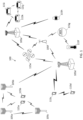
- FIG. 1 illustrates a wireless communication network 100 according to some aspects of the present disclosure.
- the network 100 may be a 5G network.
- the network 100 includes a number of base stations (BSs) 105 (individually labeled as 105 a , 105 b , 105 c , 105 d , 105 e , and 105 f ) and other network entities.
- a BS 105 may be a station that communicates with UEs 115 and may also be referred to as an evolved node B (eNB), a next generation eNB (gNB), an access point, and the like.
- eNB evolved node B
- gNB next generation eNB
- Each BS 105 may provide communication coverage for a particular geographic area.
- the term “cell” can refer to this particular geographic coverage area of a BS 105 and/or a BS subsystem serving the coverage area, depending on the context in which the term is used.
- a BS 105 may provide communication coverage for a macro cell or a small cell, such as a pico cell or a femto cell, and/or other types of cell.
- a macro cell generally covers a relatively large geographic area (e.g., several kilometers in radius) and may allow unrestricted access by UEs with service subscriptions with the network provider.
- a small cell such as a pico cell, would generally cover a relatively smaller geographic area and may allow unrestricted access by UEs with service subscriptions with the network provider.
- a small cell such as a femto cell, would also generally cover a relatively small geographic area (e.g., a home) and, in addition to unrestricted access, may also provide restricted access by UEs having an association with the femto cell (e.g., UEs in a closed subscriber group (CSG), UEs for users in the home, and the like).
- ABS for a macro cell may be referred to as a macro BS.
- ABS for a small cell may be referred to as a small cell BS, a pico BS, a femto BS or a home BS.
- the BSs 105 d and 105 e may be regular macro BSs, while the BSs 105 a - 105 c may be macro BSs enabled with one of three dimension (3D), full dimension (FD), or massive MIMO.
- the BSs 105 a - 105 c may take advantage of their higher dimension MIMO capabilities to exploit 3D beamforming in both elevation and azimuth beamforming to increase coverage and capacity.
- the BS 105 f may be a small cell BS which may be a home node or portable access point.
- ABS 105 may support one or multiple (e.g., two, three, four, and the like) cells.
- the network 100 may support synchronous or asynchronous operation.
- the BSs may have similar frame timing, and transmissions from different BSs may be approximately aligned in time.
- the BSs may have different frame timing, and transmissions from different BSs may not be aligned in time.
- the UEs 115 are dispersed throughout the wireless network 100 , and each UE 115 may be stationary or mobile.
- a UE 115 may also be referred to as a terminal, a mobile station, a subscriber unit, a station, or the like.
- a UE 115 may be a cellular phone, a personal digital assistant (PDA), a wireless modem, a wireless communication device, a handheld device, a tablet computer, a laptop computer, a cordless phone, a wireless local loop (WLL) station, or the like.
- PDA personal digital assistant
- WLL wireless local loop
- a UE 115 may be a device that includes a Universal Integrated Circuit Card (UICC).
- a UE may be a device that does not include a UICC.
- UICC Universal Integrated Circuit Card
- the UEs 115 that do not include UICCs may also be referred to as IoT devices or internet of everything (IoE) devices.
- the UEs 115 a - 115 d are examples of mobile smart phone-type devices accessing network 100 .
- a UE 115 may also be a machine specifically configured for connected communication, including machine type communication (MTC), enhanced MTC (eMTC), narrowband IoT (NB-IoT) and the like.
- MTC machine type communication
- eMTC enhanced MTC
- NB-IoT narrowband IoT
- the UEs 115 e - 115 h are examples of various machines configured for communication that access the network 100 .
- the UEs 115 i - 115 k are examples of vehicles equipped with wireless communication devices configured for communication that access the network 100 .
- a UE 115 may be able to communicate with any type of the BSs, whether macro BS, small cell, or the like.
- a lightning bolt e.g., communication links indicates wireless transmissions between a UE 115 and a serving BS 105 , which is a BS designated to serve the UE 115 on the downlink (DL) and/or uplink (UL), desired transmission between BSs 105 , backhaul transmissions between BSs, or sidelink transmissions between UEs 115 .
- the BSs 105 a - 105 c may serve the UEs 115 a and 115 b using 3D beamforming and coordinated spatial techniques, such as coordinated multipoint (CoMP) or multi-connectivity.
- the macro BS 105 d may perform backhaul communications with the BSs 105 a - 105 c , as well as small cell, the BS 105 f .
- the macro BS 105 d may also transmits multicast services which are subscribed to and received by the UEs 115 c and 115 d .
- Such multicast services may include mobile television or stream video, or may include other services for providing community information, such as weather emergencies or alerts, such as Amber alerts or gray alerts.
- the BSs 105 may also communicate with a core network.
- the core network may provide user authentication, access authorization, tracking, Internet Protocol (IP) connectivity, and other access, routing, or mobility functions.
- IP Internet Protocol
- At least some of the BSs 105 (e.g., which may be an example of a gNB or an access node controller (ANC)) may interface with the core network through backhaul links (e.g., NG-C, NG-U, etc.) and may perform radio configuration and scheduling for communication with the UEs 115 .
- the BSs 105 may communicate, either directly or indirectly (e.g., through core network), with each other over backhaul links (e.g., X1, X2, etc.), which may be wired or wireless communication links.
- backhaul links e.g., X1, X2, etc.
- the network 100 may also support mission critical communications with ultra-reliable and redundant links for mission critical devices, such as the UE 115 e , which may be a drone. Redundant communication links with the UE 115 e may include links from the macro BSs 105 d and 105 e , as well as links from the small cell BS 105 f .
- Other machine type devices such as the UE 115 f (e.g., a thermometer), the UE 115 g (e.g., smart meter), and UE 115 h (e.g., wearable device) may communicate through the network 100 either directly with BSs, such as the small cell BS 105 f , and the macro BS 105 e , or in multi-step-size configurations by communicating with another user device which relays its information to the network, such as the UE 115 f communicating temperature measurement information to the smart meter, the UE 115 g , which is then reported to the network through the small cell BS 105 f .
- BSs such as the small cell BS 105 f , and the macro BS 105 e
- another user device which relays its information to the network
- the UE 115 f communicating temperature measurement information to the smart meter
- the UE 115 g which is then reported to the network through the small cell BS 105 f .
- the network 100 may also provide additional network efficiency through dynamic, low-latency TDD/FDD communications, such as V2V, V2X C-V2X communications between a UE 115 i , 115 j , or 115 k and other UEs 115 , and/or vehicle-to-infrastructure (V2I) communications between a UE 115 i , 115 j , or 115 k and a BS 105 .
- V2V vehicle-to-infrastructure
- the network 100 utilizes OFDM-based waveforms for communications.
- An OFDM-based system may partition the system BW into multiple (K) orthogonal subcarriers, which are also commonly referred to as subcarriers, tones, bins, or the like. Each subcarrier may be modulated with data.
- the subcarrier spacing between adjacent subcarriers may be fixed, and the total number of subcarriers (K) may be dependent on the system BW.
- the system BW may also be partitioned into subbands. In other instances, the subcarrier spacing and/or the duration of TTIs may be scalable.
- the BSs 105 can assign or schedule transmission resources (e.g., in the form of time-frequency resource blocks (RB)) for downlink (DL) and uplink (UL) transmissions in the network 100 .
- DL refers to the transmission direction from a BS 105 to a UE 115
- UL refers to the transmission direction from a UE 115 to a BS 105 .
- the communication can be in the form of radio frames.
- a radio frame may be divided into a plurality of subframes or slots, for example, about 10. Each slot may be further divided into mini-slots. In a FDD mode, simultaneous UL and DL transmissions may occur in different frequency bands.
- each subframe includes a UL subframe in a UL frequency band and a DL subframe in a DL frequency band.
- UL and DL transmissions occur at different time periods using the same frequency band.
- a subset of the subframes (e.g., DL subframes) in a radio frame may be used for DL transmissions and another subset of the subframes (e.g., UL subframes) in the radio frame may be used for UL transmissions.
- each DL or UL subframe may have pre-defined regions for transmissions of reference signals, control information, and data.
- Reference signals are predetermined signals that facilitate the communications between the BSs 105 and the UEs 115 .
- a reference signal can have a particular pilot pattern or structure, where pilot tones may span across an operational BW or frequency band, each positioned at a pre-defined time and a pre-defined frequency.
- a BS 105 may transmit cell specific reference signals (CRSs) and/or channel state information-reference signals (CSI-RSs) to enable a UE 115 to estimate a DL channel.
- CRSs cell specific reference signals
- CSI-RSs channel state information-reference signals
- a UE 115 may transmit sounding reference signals (SRSs) to enable a BS 105 to estimate a UL channel.
- Control information may include resource assignments and protocol controls.
- Data may include protocol data and/or operational data.
- the BSs 105 and the UEs 115 may communicate using self-contained subframes.
- a self-contained subframe may include a portion for DL communication and a portion for UL communication.
- a self-contained subframe can be DL-centric or UL-centric.
- a DL-centric subframe may include a longer duration for DL communication than for UL communication.
- a UL-centric subframe may include a longer duration for UL communication than for UL communication.
- the network 100 may be an NR network deployed over a licensed spectrum.
- the BSs 105 can transmit synchronization signals (e.g., including a primary synchronization signal (PSS) and a secondary synchronization signal (SSS)) in the network 100 to facilitate synchronization.
- the BSs 105 can broadcast system information associated with the network 100 (e.g., including a master information block (MIB), remaining system information (RMSI), and other system information (OSI)) to facilitate initial network access.
- MIB master information block
- RMSI remaining system information
- OSI system information
- the BSs 105 may broadcast the PSS, the SSS, and/or the MIB in the form of synchronization signal block (SSBs) over a physical broadcast channel (PBCH) and may broadcast the RMSI and/or the OSI over a physical downlink shared channel (PDSCH).
- PBCH physical broadcast channel
- PDSCH physical downlink shared channel
- a UE 115 attempting to access the network 100 may perform an initial cell search by detecting a PSS from a BS 105 .
- the PSS may enable synchronization of period timing and may indicate a physical layer identity value.
- the UE 115 may then receive a SSS.
- the SSS may enable radio frame synchronization, and may provide a cell identity value, which may be combined with the physical layer identity value to identify the cell.
- the PSS and the SSS may be located in a central portion of a carrier or any suitable frequencies within the carrier.
- the UE 115 may receive a MIB.
- the MIB may include system information for initial network access and scheduling information for RMSI and/or OSI.
- the UE 115 may receive RMSI and/or OSI.
- the RMSI and/or OSI may include radio resource control (RRC) information related to random access channel (RACH) procedures, paging, control resource set (CORESET) for physical downlink control channel (PDCCH) monitoring, physical UL control channel (PUCCH), physical UL shared channel (PUSCH), power control, and SRS.
- RRC radio resource control
- the UE 115 can perform a random access procedure to establish a connection with the BS 105 .
- the random access procedure may be a four-step random access procedure.
- the UE 115 may transmit a random access preamble and the BS 105 may respond with a random access response.
- the random access response (RAR) may include a detected random access preamble identifier (ID) corresponding to the random access preamble, timing advance (TA) information, a UL grant, a temporary cell-radio network temporary identifier (C-RNTI), and/or a backoff indicator.
- ID detected random access preamble identifier
- TA timing advance
- C-RNTI temporary cell-radio network temporary identifier
- the UE 115 may transmit a connection request to the BS 105 and the BS 105 may respond with a connection response.
- the connection response may indicate a contention resolution.
- the random access preamble, the RAR, the connection request, and the connection response can be referred to as message 1 (MSG 1 ), message 2 (MSG 2 ), message 3 (MSG 3 ), and message 4 (MSG 4 ), respectively.
- the random access procedure may be a two-step random access procedure, where the UE 115 may transmit a random access preamble and a connection request in a single transmission and the BS 105 may respond by transmitting a random access response and a connection response in a single transmission.
- the UE 115 and the BS 105 can enter a normal operation stage, where operational data may be exchanged.
- the BS 105 may schedule the UE 115 for UL and/or DL communications.
- the BS 105 may transmit UL and/or DL scheduling grants to the UE 115 via a PDCCH.
- the scheduling grants may be transmitted in the form of DL control information (DCI).
- the BS 105 may transmit a DL communication signal (e.g., carrying data) to the UE 115 via a PDSCH according to a DL scheduling grant.
- the UE 115 may transmit a UL communication signal to the BS 105 via a PUSCH and/or PUCCH according to a UL scheduling grant.
- the BS 105 may communicate with a UE 115 using HARQ techniques to improve communication reliability, for example, to provide a URLLC service.
- the BS 105 may schedule a UE 115 for a PDSCH communication by transmitting a DL grant in a PDCCH.
- the BS 105 may transmit a DL data packet to the UE 115 according to the schedule in the PDSCH.
- the DL data packet may be transmitted in the form of a transport block (TB). If the UE 115 receives the DL data packet successfully, the UE 115 may transmit a HARQ ACK to the BS 105 .
- TB transport block
- the UE 115 may transmit a HARQ NACK to the BS 105 .
- the BS 105 may retransmit the DL data packet to the UE 115 .
- the retransmission may include the same coded version of DL data as the initial transmission.
- the retransmission may include a different coded version of the DL data than the initial transmission.
- the UE 115 may apply soft-combining to combine the encoded data received from the initial transmission and the retransmission for decoding.
- the BS 105 and the UE 115 may also apply HARQ for UL communications using substantially similar mechanisms as the DL HARQ.
- the network 100 may operate over a system BW or a component carrier (CC) BW.
- the network 100 may partition the system BW into multiple BWPs (e.g., portions).
- a BS 105 may dynamically assign a UE 115 to operate over a certain BWP (e.g., a certain portion of the system BW).
- the assigned BWP may be referred to as the active BWP.
- the UE 115 may monitor the active BWP for signaling information from the BS 105 .
- the BS 105 may schedule the UE 115 for UL or DL communications in the active BWP.
- a BS 105 may assign a pair of BWPs within the CC to a UE 115 for UL and DL communications.
- the BWP pair may include one BWP for UL communications and one BWP for DL communications.
- the network 100 may operate over a shared channel, which may include shared frequency bands and/or unlicensed frequency bands.
- the network 100 may be an NR-unlicensed (NR-U) network operating over an unlicensed frequency band.
- NR-U NR-unlicensed
- the BSs 105 and the UEs 115 may be operated by multiple network operating entities.
- the BSs 105 and the UEs 115 may employ a listen-before-talk (LBT) procedure to monitor for transmission opportunities (TXOPs) in the shared channel.
- LBT listen-before-talk
- TXOPs transmission opportunities
- a TXOP may also be referred to as channel occupancy time (COT).
- COT channel occupancy time
- a transmitting node may perform an LBT prior to transmitting in the channel.
- the transmitting node may proceed with the transmission.
- the transmitting node may refrain from transmitting in the channel.
- An LBT can be based on energy detection or signal detection.
- the LBT results in a pass when signal energy measured from the channel is below a threshold. Conversely, the LBT results in a failure when signal energy measured from the channel exceeds the threshold.
- the LBT results in a pass when a channel reservation signal (e.g., a predetermined preamble signal) is not detected in the channel.
- a channel reservation signal e.g., a predetermined preamble signal
- an LBT may be in a variety of modes.
- An LBT mode may be, for example, a category 4 (CAT4) LBT or a category 2 (CAT2) LBT.
- a CAT2 LBT refers to an LBT without a random backoff period.
- a CAT4 LBT refers to an LBT with a random backoff and a variable contention window (CW).
- CW variable contention window
- the network 100 may provision for sidelink communications to allow a UE 115 to communicate with another UE 115 without tunneling through a BS 105 and/or the core network.
- a transmitting UE 115 may select a resource from a resource pool for sidelink transmission, for example, based on channel sensing. For instance, the UE 115 may monitor the resource pool for SCI from other sidelink UEs 115 and may determine that a resource is available when no SCI is detected. After selecting the resource, the transmitting UE 115 may transmit SCI (e.g., in a PSCCH of the selected resource) indicating a reservation for the selected resource and/or scheduling information for the sidelink transmission.
- SCI e.g., in a PSCCH of the selected resource
- the transmitting UE 115 may subsequently transmit sidelink data (e.g., in a PSSCH of the selected resource) to a peer or receiving UE 115 according to the scheduling information.
- a receiving UE is understood to be a UE that receives data (e.g., over a PSSCH) from another UE in a sidelink communication
- a transmitting UE is understood to be a UE that transmits data (e.g., over a PSSCH) to another UE in a sidelink communication.
- a single UE may be both a receiving UE and a transmitting UE.
- a UE may be a receiving UE and in a later sidelink communication the same UE may be a transmitting UE, or vice versa.
- a sidelink transmitting UE 115 may reserve multiple resources for communications over multiple sidelinks (e.g., the sidelinks 351 , 352 , and 354 ) by one or more other UEs 115 in addition to sidelink transmissions by the UE 115 itself. Additionally, a UE 115 may release an unused reserved resource to allow another sidelink UE 115 to reclaim the unused resources for sidelink transmissions. Further, a UE 115 may opportunistically reclaim a resource reserved for another UE 115 based on a spatial reuse. Mechanisms for reserving resources for multiple sidelink communications and reclaiming reserved resources for sidelink communication are described in greater detail herein.
- FIG. 2 is a timing diagram illustrating a radio frame structure 200 according to some aspects of the present disclosure.
- the radio frame structure 200 may be employed by BSs such as the BSs 105 and UEs such as the UEs 115 in a network such as the network 100 for communications.
- the BS may communicate with the UE using time-frequency resources configured as shown in the radio frame structure 200 .
- the x-axes represent time in some arbitrary units and the y-axes represent frequency in some arbitrary units.
- the radio frame structure 200 includes a radio frame 201 .
- the duration of the radio frame 201 may vary depending on the aspects. In an example, the radio frame 201 may have a duration of about ten milliseconds.
- the radio frame 201 includes M number of slots 202 , where M may be any suitable positive integer. In an example, M may be about 10.
- Each slot 202 includes a number of subcarriers 204 in frequency and a number of symbols 206 in time.
- the number of subcarriers 204 and/or the number of symbols 206 in a slot 202 may vary depending on the aspects, for example, based on the channel bandwidth, the subcarrier spacing (SCS), and/or the CP mode.
- One subcarrier 204 in frequency and one symbol 206 in time forms one resource element (RE) 212 for transmission.
- a resource block (RB) 210 is formed from a number of consecutive subcarriers 204 in frequency and a number of consecutive symbols 206 in time.
- a BS may schedule a UE (e.g., UE 115 in FIG. 1 ) for UL and/or DL communications at a time-granularity of slots 202 or mini-slots 208 .
- Each slot 202 may be time-partitioned into K number of mini-slots 208 .
- Each mini-slot 208 may include one or more symbols 206 .
- the mini-slots 208 in a slot 202 may have variable lengths. For example, when a slot 202 includes N number of symbols 206 , a mini-slot 208 may have a length between one symbol 206 and (N ⁇ 1) symbols 206 .
- a mini-slot 208 may have a length of about two symbols 206 , about four symbols 206 , or about seven symbols 206 .
- the BS may schedule UE at a frequency-granularity of a resource block (RB) 210 (e.g., including about 12 subcarriers 204 ).
- RB resource block
- FIG. 3 illustrates an example of a wireless communication network 300 that provisions for sidelink communications according to embodiments of the present disclosure.
- the network 300 may be similar to the network 100 .
- the network 300 may use a radio frame structure similar to radio frame structure 200 for communication.
- FIG. 3 illustrates one BSs 305 and five UEs 315 (shown as 315 a , 315 b , 315 c , 315 d , and 315 e ) for purposes of simplicity of discussion, though it will be recognized that embodiments of the present disclosure may scale to any suitable number of UEs 315 and/or BSs 305 (e.g., the about 3, 3, 6, 7, 8, or more).
- the BS 305 and the UEs 315 may be similar to the BSs 105 and the UEs 115 , respectively.
- the BSs 305 and the UEs 315 may communicate over the same spectrum.
- some of the UEs 315 may communicate with each other in peer-to-peer communications.
- the UE 315 a may communicate with the UE 315 b over a sidelink 351
- the UE 315 c may communicate with the UE 315 d over another sidelink 352
- the UE 315 d may communicate with the UE 315 e over yet another sidelink 354 .
- the sidelinks 351 , 352 , and 354 are unicast bidirectional links.
- Some of the UEs 315 may also communicate with the BS 305 in a UL direction and/or a DL direction via communication links 353 .
- the UE 315 a , 315 b , and 315 c are within a coverage area 310 of the BS 305 , and thus may be in communication with the BS 305 .
- the UE 315 d and UE 315 e are outside the coverage area 310 , and thus may not be in direct communication with the BS 305 .
- the UE 315 c may operate as a relay for the UE 315 d and/or UE 315 e to reach the BS 305 .
- some of the UEs 315 are associated with vehicles (e.g., similar to the UEs 115 i - k ) and the communications over the sidelinks 351 and/or 352 may be C-V2X communications.
- C-V2X communications may refer to communications between vehicles and any other wireless communication devices in a cellular network.
- FIGS. 4 A- 4 D illustrates various PSCCH/PSSCH multiplexing configurations for sidelink communication.
- the PSCCH/PSSCH multiplexing configurations 430 , 440 , 450 , and 460 may be employed by BSs such as the BSs 105 and 305 and/or UEs such as the UEs 115 and/or 315 in a network such as the networks 100 and/or 300 .
- the UEs may communicate with each other over sidelinks (e.g., the sidelinks 351 and 352 ) using resources configured as shown in the configuration 430 , 440 , 450 , or 460 .
- the x-axes represent time in some arbitrary units
- the y-axes represent frequency in some arbitrary units.
- FIG. 4 A illustrates a PSCCH/PSSCH multiplexing configuration 430 according to some aspects of the present disclosure.
- a PSSCH 410 and a PSCCH 420 are time-multiplexed in a sidelink resource 406 .
- the sidelink resource may span a frequency band 402 and a time duration 404 .
- the sidelink resource 406 may have a transmission structure similar to the structure shown in FIG. 2 discussed above.
- the sidelink resource 406 may include a number of subcarriers 204 in frequency and a number of symbols 206 , a number of mini-slots 208 , or a number of slots 202 in time.
- the frequency band 402 may be within a licensed band.
- the frequency band 402 may be within a shared radio frequency band in a shared spectrum or an unlicensed spectrum. In some instances, the frequency band 402 may be within a 5 gigahertz (GHz) band or a 6 GHz band and may be shared among multiple network operating entities and/or multiple radio access technologies (RATs).
- GHz gigahertz
- RATs radio access technologies
- FIG. 4 B illustrates a PSCCH/PSSCH multiplexing configuration 440 according to some aspects of the present disclosure.
- the configuration 440 is substantially similar to the configuration 430 , where the PSSCH 410 is time-multiplexed with the PSCCH 420 .
- the PSCCH 420 may occupy a narrower bandwidth than the PSSCH 410 .
- FIG. 4 C illustrates a PSCCH/PSSCH multiplexing configuration 450 according to some aspects of the present disclosure.
- the PSSCH 410 and the PSCCH 420 are frequency-multiplexed in the sidelink resource 406 .
- FIG. 4 D illustrates a PSCCH/PSSCH multiplexing configuration 460 according to some aspects of the present disclosure.
- the PSSCH 410 and the PSCCH 420 are multiplexed in time and frequency in the sidelink resource 406 .
- the configuration 460 may be suitable for sidelink transmissions that use cyclic-prefix-OFDM (CP-OFDM) waveforms.
- CP-OFDM cyclic-prefix-OFDM
- a network may utilize any of the PSCCH/PSSCH multiplexing configurations 430 , 440 , 450 , or 460 for sidelink communication.
- the PSCCH/PSSCH multiplexing configuration Prior to a sidelink communication, the PSCCH/PSSCH multiplexing configuration, the starting symbol (e.g., the symbols 206 ), the number of symbols, and/or the number of subcarriers (e.g., the subcarriers 204 ) for a PSSCH 410 and/or the number of symbols and the number of subcarriers for a PSCCH 420 are known to all UEs (e.g., in the UEs 115 and 315 ) in the network, for example, based on a pre-configuration by the BS.
- the PSCCH 420 is associated with the PSSCH 410 .
- the PSCCH 420 may carry SCI indicating scheduling information for sidelink data carried in the corresponding PSSCH 410 .
- a resource 406 may also include a physical sidelink feedback channel (PSFCH), for example, time-multiplexed with the PSCCH 420 and PSCCH 420 .
- the PSFCH may be used to carry HARQ ACK/NACKs when a sidelink communication utilizes HARQ.
- a transmitting UE may initiate the sidelink transmission by transmitting SCI in a PSCCH 420 (of a resource 406 ) indicating scheduling information for sidelink data in the corresponding PSSCH 410 .
- the scheduling information may indicate time and/or frequency resources in the PSSCH 410 where sidelink data is to be transmitted.
- the scheduling information may indicate transmission parameters, such as a MCS level and/or a DMRS pattern, to be used for transmitting the sidelink data.
- a receiving UE may monitor for SCI in the PSCCH 420 and receive sidelink data based on detected SCI. The receiving UE may determine whether the receiving UE is the intended destination based on a destination ID included in the sidelink data.
- a BS may determine sidelink resources (e.g., for PSCCH 420 , PSSCH 410 , and PSFCH) for a transmitting UE.
- the BS determines a sidelink resource on behalf of the transmitting UE.
- the BS may transmit a dynamic grant (e.g., via PDCCH DCI) to the transmitting UE.
- the dynamic sidelink grant may indicate the sidelink resource.
- the transmitting UE may transmit SCI in the PSCCH 420 to indicate a sidelink data resources (in the PSSCH 410 ) to a receiving UE.
- a transmitting UE may determine sidelink resources instead of a BS.
- sidelink UEs may be preconfigured with a resource pool for sidelink operations.
- a resource pool is a set of resources that are allocated for sidelink communications.
- the resource pool includes a plurality of resource elements (e.g., time-frequency resources).
- the set of resources of the resource pool may include contiguous resource blocks, non-contiguous resource blocks, or a combination thereof.
- resources may be indicated as particular RBs (e.g., RBs 210 ), time resources may be indicated as one or more slots (e.g., slots 202 , mini-slots 208 , etc.), frequency resources may be indicated as a subband or subchannel, or the resources can be indicated differently.
- the resource pool may include a number of sidelink resources similar to the resources 406 arranged as shown in the configuration 430 , 440 , 450 , or 460 of FIG. 4 A, 4 B, 4 C , or 4 D, respectively.
- the time and frequency resource locations of the PSCCH 420 are known based on a selected PSCCH/PSSCH multiplexing configuration (e.g., the configurations 430 , 440 , 450 , and 460 ).
- a transmitting UE may perform channel sensing in the PSCCH 420 regions of the resource pool, for example, by monitoring and decoding SCIs transmitted by other sidelink UEs. Based on the SCI monitoring and decoding, the transmitting UE may determine whether a sidelink resource 406 is being used by another sidelink UE and how long and/or in which subband a sidelink UE may occupy a sidelink resource 406 . The transmitting UE may also perform sidelink channel measurements to determine interference in the sidelink resources 406 within the resource pool.
- the transmitting UE may select a resource 406 from the resource pool for a sidelink communication based on the monitoring and/or channel measurements.
- the selected resource 406 may be a resource with a minimal amount of interference among resources in the resource pool as seen by the transmitting UE.
- the sidelink communication may be an initial transmission or a retransmission, for example, when using HARQ as discussed above.
- a sidelink transmitting UE is responsible for reserving or selecting sidelink resources for its own transmissions to a peer or receiving UE.
- the present disclosure provides techniques to extend sidelink resource reservation to multiple sidelinks, where a first sidelink UE (e.g., the UE 315 c of FIG. 3 ) may reserve multiple resources for transmission to a second sidelink UE (e.g., the UE 315 d of FIG. 3 ) and for transmission from the second sidelink UE back to the first sidelink UE or to a third sidelink UE (e.g., the UE 315 e of FIG. 3 ).
- the multiple sidelink resource reservation can reduce communication latency, for example, to facilitate URLLC.
- FIG. 5 is a block diagram of an exemplary UE 500 according to some aspects of the present disclosure.
- the UE 500 may be a UE 115 discussed above in FIG. 1 or a UE 315 of FIG. 3 .
- the UE 500 may include a processor 502 , a memory 504 , a sidelink communication module 508 , a transceiver 510 including a modem subsystem 512 and a radio frequency (RF) unit 514 , and one or more antennas 516 .
- RF radio frequency
- the processor 502 may include a central processing unit (CPU), a digital signal processor (DSP), an application specific integrated circuit (ASIC), a controller, a field programmable gate array (FPGA) device, another hardware device, a firmware device, or any combination thereof configured to perform the operations described herein.
- the processor 502 may also be implemented as a combination of computing devices, e.g., a combination of a DSP and a microprocessor, a plurality of microprocessors, one or more microprocessors in conjunction with a DSP core, or any other such configuration.
- the memory 504 may include a cache memory (e.g., a cache memory of the processor 502 ), random access memory (RAM), magnetoresistive RAM (MRAM), read-only memory (ROM), programmable read-only memory (PROM), erasable programmable read only memory (EPROM), electrically erasable programmable read only memory (EEPROM), flash memory, solid state memory device, hard disk drives, other forms of volatile and non-volatile memory, or a combination of different types of memory.
- the memory 504 includes a non-transitory computer-readable medium.
- the memory 504 may store, or have recorded thereon, instructions 506 .
- the instructions 506 may include instructions that, when executed by the processor 502 , cause the processor 502 to perform the operations described herein with reference to the UEs 115 in connection with aspects of the present disclosure, for example, aspects of FIGS. 1 - 3 , 4 A- 4 D, 7 A- 7 B, 8 A- 8 B, 9 A- 9 B, 10 A- 10 B, 11 A- 11 B, 12 A- 12 B, 13 A- 13 B, and 14 .
- Instructions 506 may also be referred to as program code.
- the program code may be for causing a wireless communication device to perform these operations, for example by causing one or more processors (such as processor 502 ) to control or command the wireless communication device to do so.
- instructions and “code” should be interpreted broadly to include any type of computer-readable statement(s).
- the terms “instructions” and “code” may refer to one or more programs, routines, sub-routines, functions, procedures, etc.
- “Instructions” and “code” may include a single computer-readable statement or many computer-readable statements.
- the sidelink communication module 508 may be implemented via hardware, software, or combinations thereof.
- the sidelink communication module 508 may be implemented as a processor, circuit, and/or instructions 506 stored in the memory 504 and executed by the processor 502 .
- the sidelink communication module 508 can be integrated within the modem subsystem 512 .
- the sidelink communication module 508 can be implemented by a combination of software components (e.g., executed by a DSP or a general processor) and hardware components (e.g., logic gates and circuitry) within the modem subsystem 512 .
- the sidelink communication module 508 may be used for various aspects of the present disclosure, for example, aspects of FIGS. 1 - 3 , 4 A- 4 D, 7 A- 7 B, 8 A- 8 B, 9 A- 9 B, 10 A- 10 B, 11 A- 11 B, 12 A- 12 B, 13 A- 13 B, and 14 .
- the UE 500 may function as a transmitting UE reserving multiple resources for multiple sidelinks.
- the sidelink communication module 508 is configured to reserve multiple sidelink resources, transmit first SCI indicating a reservation for the multiple reserved sidelink resources.
- the first SCI may indicate an assignment of each reserved resource.
- a sidelink resource can include one or more resource elements that span a certain frequency and a certain time. Accordingly, each reserved resource can include one or more resource elements.
- the first SCI may indicate a first reserved resource (e.g., one or more resource elements) of the multiple reserved resources assigned for transmission by the UE 500 to a second UE and may indicate a second reserved resource (e.g., one or more resource elements) of the multiple reserved resources assigned for transmission by the second UE to the UE 500 or to another UE.
- the sidelink communication module 508 is configured to transmit sidelink data to the second UE using the first reserved resource.
- the sidelink communication module 508 is configured to receive, from a BS (e.g., the BSs 105 and/or 305 ), a configuration (e.g., time and frequency locations for resources usable for sidelinks) for a resource pool for sidelink communication, store the configuration information in the memory 504 , perform channel sensing according to the resource pool configuration information, and select the multiple sidelink resources from the resource pool based on the channel sensing.
- a BS e.g., the BSs 105 and/or 305
- a configuration e.g., time and frequency locations for resources usable for sidelinks
- the UE 500 may be a UE assigned with a resource from a multi-resource reservation.
- the sidelink communication module 508 is configured to monitor for SCI, detect a multi-resource reservation from another UE reserving a resource for the UE 500 , transmit sidelink data using the reserved resource.
- the sidelink communication module 508 is configured to transmit SCI repeating an indication of the resource reserved for the UE 500 prior to the sidelink data transmission.
- the sidelink communication module 508 is configured to transmit SCI repeating the entire multi-resource reservation (e.g., indicating all resources reserved by the multi-resource reservation.
- the sidelink communication module 508 is configured to include an HARQ ACK/NACK, an SR, and/or a BSR in SCI.
- the HARQ ACK/NACK may be a feedback for previous sidelink data received by the UE 500 .
- the SR and/or BSR may be a resource request for transmission over a sidelink.
- the SR and/or BSR may be a request for transmitting over a sidelink to the UE that reserved the multi-resource reservation.
- the SR and/or BSR may indicate that the request is for transmitting a UE different from the UE that reserved the multi-resource reservation.
- the sidelink communication module 508 is configured to monitor for SCI indicating a release indication for a reserved resource and transmit in the resource upon detecting a release of the resource. In some aspects, the sidelink communication module 508 is configured to monitor for SCI indicating a multi-resource reservation (reserving multiple resources for multiple sidelinks) and for SCI indicating a transmission in a reserved resource, and reclaim the resource for transmission if no SCI indicating a transmission in the reserved resource is detected.
- the sidelink communication module 508 is configured to refrain from transmitting in a resource if SCI including a multi-resource reservation indicating the resource is detected (from the reserving UE) or SCI indicating a transmission in the resource is detected (from the UE assigned to the resource by the multi-resource reservation).
- SCI including a multi-resource reservation indicating the resource is detected (from the reserving UE) or SCI indicating a transmission in the resource is detected (from the UE assigned to the resource by the multi-resource reservation).
- the transceiver 510 may include the modem subsystem 512 and the RF unit 514 .
- the transceiver 510 can be configured to communicate bi-directionally with other devices, such as the BSs 105 .
- the modem subsystem 512 may be configured to modulate and/or encode the data from the memory 504 and/or the sidelink communication module 508 according to a modulation and coding scheme (MCS), e.g., a low-density parity check (LDPC) coding scheme, a turbo coding scheme, a convolutional coding scheme, a polar coding scheme, a digital beamforming scheme, etc.
- MCS modulation and coding scheme
- LDPC low-density parity check
- the RF unit 514 may be configured to process (e.g., perform analog to digital conversion or digital to analog conversion, etc.) modulated/encoded data (e.g., PSCCH, PSSCH, PSFCH, SCI, HARQ ACK/NACK, BSR, SR, resource release indication) from the modem subsystem 512 (on outbound transmissions) or of transmissions originating from another source such as a UE 115 or a BS 105 .
- the RF unit 514 may be further configured to perform analog beamforming in conjunction with the digital beamforming. Although shown as integrated together in transceiver 510 , the modem subsystem 512 and the RF unit 514 may be separate devices that are coupled together at the UE 115 to enable the UE 115 to communicate with other devices.
- the RF unit 514 may provide the modulated and/or processed data, e.g. data packets (or, more generally, data messages that may contain one or more data packets and other information), to the antennas 516 for transmission to one or more other devices.
- the antennas 516 may further receive data messages transmitted from other devices.
- the antennas 516 may provide the received data messages for processing and/or demodulation at the transceiver 510 .
- the transceiver 510 may provide the demodulated and decoded data (e.g., resource pool configuration, RRC configuration) to the sidelink communication module 508 for processing.
- the antennas 516 may include multiple antennas of similar or different designs in order to sustain multiple transmission links.
- the RF unit 514 may configure the antennas 516 .
- the transceiver 510 is configured to communicate, with a second wireless communication device, a reservation indicating a plurality of reserved resources for a plurality of sidelink communication and communicate, with a third wireless communication device, a first sidelink communication of the plurality of sidelink communications using a first resource of the plurality of reserved resources, for example, by coordinating with the sidelink communication module 508 .
- the first resource may include a subset of the plurality of reserved resources (e.g., one or more resource elements from the plurality of reserved resources).
- the UE 500 can include multiple transceivers 510 implementing different RATs (e.g., NR and LTE).
- the UE 500 can include a single transceiver 510 implementing multiple RATs (e.g., NR and LTE).
- the transceiver 510 can include various components, where different combinations of components can implement different RATs.
- FIG. 6 is a block diagram of an exemplary BS 600 according to some aspects of the present disclosure.
- the BS 600 may be a BS 105 in the network 100 as discussed above in FIG. 1 .
- the BS 600 may include a processor 602 , a memory 604 , a sidelink configuration module 608 , a transceiver 610 including a modem subsystem 612 and a RF unit 614 , and one or more antennas 616 . These elements may be in direct or indirect communication with each other, for example via one or more buses.
- the processor 602 may have various features as a specific-type processor. For example, these may include a CPU, a DSP, an ASIC, a controller, a FPGA device, another hardware device, a firmware device, or any combination thereof configured to perform the operations described herein.
- the processor 602 may also be implemented as a combination of computing devices, e.g., a combination of a DSP and a microprocessor, a plurality of microprocessors, one or more microprocessors in conjunction with a DSP core, or any other such configuration.
- the memory 604 may include a cache memory (e.g., a cache memory of the processor 602 ), RAM, MRAM, ROM, PROM, EPROM, EEPROM, flash memory, a solid state memory device, one or more hard disk drives, memristor-based arrays, other forms of volatile and non-volatile memory, or a combination of different types of memory.
- the memory 604 may include a non-transitory computer-readable medium.
- the memory 604 may store instructions 606 .
- the instructions 606 may include instructions that, when executed by the processor 602 , cause the processor 602 to perform operations described herein, for example, aspects of FIGS.
- Instructions 606 may also be referred to as code, which may be interpreted broadly to include any type of computer-readable statement(s) as discussed above with respect to FIG. 5 .
- the sidelink configuration module 608 may be implemented via hardware, software, or combinations thereof.
- the sidelink configuration module 608 may be implemented as a processor, circuit, and/or instructions 606 stored in the memory 604 and executed by the processor 602 .
- the sidelink configuration module 608 can be integrated within the modem subsystem 612 .
- the sidelink configuration module 608 can be implemented by a combination of software components (e.g., executed by a DSP or a general processor) and hardware components (e.g., logic gates and circuitry) within the modem subsystem 612 .
- the sidelink configuration module 608 may be used for various aspects of the present disclosure, for example, aspects of FIGS. 1 - 3 , 4 A- 4 D, 7 A- 7 B, 8 A- 8 B, 9 A- 9 B, 10 A- 10 B, and 11 A- 11 B .
- the sidelink configuration module 608 is configured to allocate a resource pool for sidelink communications, transmits a configuration to a UE (e.g., by the UEs 115 , 315 , and/or 500 ) to indicate the resource pool configuration (e.g., time and/or frequency locations of resources in the pool).
- a UE e.g., by the UEs 115 , 315 , and/or 500
- the resource pool configuration e.g., time and/or frequency locations of resources in the pool.
- the transceiver 610 may include the modem subsystem 612 and the RF unit 614 .
- the transceiver 610 can be configured to communicate bi-directionally with other devices, such as the UEs 115 and/or 500 and/or another core network element.
- the modem subsystem 612 may be configured to modulate and/or encode data according to a MCS, e.g., a LDPC coding scheme, a turbo coding scheme, a convolutional coding scheme, a polar coding scheme, a digital beamforming scheme, etc.
- the RF unit 614 may be configured to process (e.g., perform analog to digital conversion or digital to analog conversion, etc.) modulated/encoded data (e.g., sidelink resource pool configuration, sidelink grants) from the modem subsystem 612 (on outbound transmissions) or of transmissions originating from another source such as a UE 115 and/or UE 500 .
- the RF unit 614 may be further configured to perform analog beamforming in conjunction with the digital beamforming.
- the modem subsystem 612 and/or the RF unit 614 may be separate devices that are coupled together at the BS 105 to enable the BS 105 to communicate with other devices.
- the RF unit 614 may provide the modulated and/or processed data, e.g. data packets (or, more generally, data messages that may contain one or more data packets and other information), to the antennas 616 for transmission to one or more other devices. This may include, for example, transmission of information to complete attachment to a network and communication with a camped UE 115 or 500 according to some aspects of the present disclosure.
- the antennas 616 may further receive data messages transmitted from other devices and provide the received data messages for processing and/or demodulation at the transceiver 610 .
- the transceiver 610 may provide the demodulated and decoded data (e.g., sidelink CQI, sidelink channel sensing information, HARQ ACK/NACK, BSR) to the sidelink configuration module 608 for processing.
- the antennas 616 may include multiple antennas of similar or different designs in order to sustain multiple transmission links.
- the transceiver 610 is configured to, transmit sidelink grant to a sidelink receiving UE, receive sidelink channel information, sidelink BSRs, and/or sidelink ACK/NACK from the sidelink receiving UE, for example, by coordinating with the sidelink configuration module 608 .
- the BS 600 can include multiple transceivers 610 implementing different RATs (e.g., NR and LTE).
- the BS 600 can include a single transceiver 610 implementing multiple RATs (e.g., NR and LTE).
- the transceiver 610 can include various components, where different combinations of components can implement different RATs.
- FIG. 7 A will be discussed in relation to FIG. 7 B to illustrate a sidelink communication scheme 700 .
- the scheme 700 may be employed by UEs such as the UEs 115 , 315 , and/or 500 in a network such as the networks 100 and 300 .
- a sidelink transmitting UE may reserve multiple sidelink resources for its own transmission and for transmissions by one or more other UEs over one or more other sidelinks (e.g., the sidelinks 351 , 352 , and/or 354 ) as shown in the scheme 700 .
- the sidelinks 351 , 352 , and/or 354 are examples of FIGS.
- a UE 715 a corresponds to a sidelink transmitting UE that selects or reserves multiple sidelink resources, which may be used by the UE 715 a to transmit to a peer or receiving UE 715 b and for the UE 715 b to transmit to the UE 715 a and/or another UE 715 c .
- the UEs 715 a , 715 b , and 715 c are substantially similar to the UEs 115 , 315 , and/or 500 .
- the UEs 715 a , 715 b , and 715 c may correspond to the UEs 315 c , 315 d , and 315 e , respectively.
- a sidelink transmitting UE may reserve resources sequentially for K number of UEs, denoted as UE i+1 to UE i+K , where K may be 1, 2, 3 or more.
- the UE i reserves one or more resources for the UE i to transmit to a UE i+1 , one or more resources for a UE i+1 to transmit to a UE i+2 , one or more resources for a UE i+2 to transmit to a UE i+3 , and so on.
- FIG. 7 A illustrates a resource reservation 702 for multiple sidelinks according to some aspects of the present disclosure.
- the x-axis represents time in some arbitrary units
- the y-axis represents frequency in some arbitrary units.
- time resources include one or more symbols (which can be grouped in slots or mini-slots)
- frequency resources include one or more subcarriers (which can be grouped in subbands or subchannels) as discussed in relation to FIG. 2 .
- the resource reservation 702 is illustrated using the PSCCH/PSSCH multiplexing configuration 460 of FIG. 4 D and uses the same reference numerals as in FIG. 4 D .
- FIG. 7 B is a signaling diagram illustrating a sidelink communication method 704 according to some aspects of the present disclosure.
- the method 704 may be implemented among the sidelink UEs 715 a , 715 b , and 715 c .
- the method 704 includes a number of enumerated steps, but embodiments of the method 704 may include additional steps before, after, and in between the enumerated steps. In some aspects, one or more of the enumerated steps may be omitted or performed in a different order.
- the UE 715 a determines multiple sidelink resources for transmission to the UE 715 b and for the UE 715 b to transmit to the UE 715 a and/or the UE 715 c .
- the UE 715 a may select multiple resource 706 a , 706 b , and 706 c (shown in FIG. 7 A ) similar to the resources 406 from a resource pool 708 .
- the resource pool 708 may include a number of resources similar to the resource 706 .
- the resource pool 708 may be preconfigured, for example, by a BS (e.g., the BSs 105 , 305 , and/or 600 ) while the UE 715 a is within a coverage of the BS.
- the UE 715 a may store configuration information related to the resource pool 708 in a memory, such as the memory 504 . While FIG. 7 A illustrates the resource pool 708 in a continuous time-frequency region, the resource pool 708 may include resources distributed in time and/or frequency. Additionally, while FIG.
- the reserved resources 706 a , 706 b , and 706 c may be located at any suitable time-frequency locations within the resource pool 708 .
- the UE 715 a may select the resources 706 a , 706 b , and 706 c by performing channel sensing and/or measurements on the resource pool, for example, on a per subchannel or subband 402 basis.
- the UE 715 a may perform the sensing in each subband 402 a , 402 c , and 402 c based on monitoring and/or decoding of SCIs transmitted by other UEs in the PSCCH region of the resource pool as discussed above.
- the UE 715 a may receive a signal from each frequency band 402 a , 402 b , and 402 c , perform blind decoding in the PSCCH region to determine whether an SCI is detected from the signal.
- the UE 715 a may reserve the resource 706 a for transmission to the UE 715 b and may reserve the resources 706 b and 706 c for transmissions by the UE 715 b .
- the UE 715 a may utilize one or more components, such as the processor 502 , the sidelink communication module 508 , the transceiver 510 , the modem 512 , and the one or more antennas 516 , to perform channel sensing, channel measurements, and/or reserve the sidelink resource 706 .
- some sidelink communications may have a higher service priority than other sidelink communications.
- the UE 715 a may disregard reservations for lower priority services. In other words, when a resource is reserved for a low-priority service, the UE 715 a may override the low-priority reservation and reserve the resource.
- the UE 715 a transmits SCI A indicating the reservations for the resources 706 a , 706 b , and 706 c .
- the UE 715 a may transmit SCI A as shown in FIG. 7 A , where the SCI A is shown as SCI A 712 carried in a PSCCH 420 of the resource 706 a and indicating the reserved resources 706 a , 706 b , and 706 c as shown by the dotted arrows.
- the SCI A 712 may indicate whether a reserved resource 706 a , 706 b , 706 c is reserved for transmission by the UE 715 a or for transmission by the UE 715 b or whether all reserved resources 706 a , 706 b , 706 c are reserved for the UE 715 a .
- the SCI A 712 may indicate a total M number of reservations. In the illustrated example of FIG. 7 A , the SCI A 712 may indicate a total of 3 reservations. In some other aspects, the SCI A 712 may indicate a total number of subchannels reserved for the multiple reservations.
- the UE 715 a may assign each resource 706 a , 706 b , 706 c to a particular sidelink (e.g., the sidelinks 351 , 352 , and/or 354 ) and the SCI A 712 may indicate the link assignment for each resource 706 a , 706 b , 706 c .
- the SCI A 712 may indicate reserved resources per sidelink.
- the SCI A may indicate that the resource 706 a is reserved for transmission by the UE 715 a to the UE 715 b , the resource 706 b is reserved for transmission by the UE 715 b to the UE 715 a , and the resource 706 c is reserved for transmission by the UE 715 b to the UE 715 c .
- the UE 715 a may utilize one or more components, such as the processor 502 , the sidelink communication module 508 , the transceiver 510 , the modem 512 , and the one or more antennas 516 , to transmit the SCI A 712 .
- the SCI A 712 be part of a two-staged SCI, where the SCI A 712 is a first stage SCI.
- a first stage SCI may be carried in a PSCCH 420 and may include information related to channel sensing.
- the first stage SCI may indicate resource reservations, for instance, time slots or time intervals and/or frequency subchannels where the reserved resources are located and/or a periodicity of the reserved resource.
- other UEs may decode the first stage SCI and determine whether a resource is reserved or available based on the first stage SCI.
- a second stage SCI may be transmitted in a PSSCH 410 to indicate transmission parameters that are related to the transmission in the PSSCH 410 .
- the second stage SCI may be encoded using a polar code.
- the second stage SCI may be demodulated and/or decoded based on a PSSCH DMRS carried in the PSSCH.
- the UE 715 a transmits sidelink data A to the UE 715 b in the PSSCH 410 of the resource 706 a based on the SCI A 712 .
- the UE 715 a may transmit a second stage SCI in the PSSCH of the resource 706 a .
- the second stage SCI may indicate transmission parameters, such as a MCS, used for transmitting the sidelink data.
- the UE 715 a may utilize one or more components, such as the processor 502 , the sidelink communication module 508 , the transceiver 510 , the modem 512 , and the one or more antennas 516 , to transmit the sidelink data to the UE 715 b.
- the processor 502 the sidelink communication module 508 , the transceiver 510 , the modem 512 , and the one or more antennas 516 , to transmit the sidelink data to the UE 715 b.
- the UE 715 b transmits sidelink data B 1 to the UE 715 a in the PSSCH 410 of the resource 706 b .
- the UE 715 b may monitor for SCI and detect the SCI A 712 .
- the UE 715 b may decode the SCI A 712 .
- the UE 715 b may receive sidelink data A from the UE 715 a based on the decoded SCI A 712 .
- the UE 715 b may transmit sidelink data B 1 to the UE 715 a using the resource 706 b based on the SCI A 712 indicating the resource 706 b reserved for the UE 715 b to transmit to the UE 715 a .
- the UE 715 b may determine transmission parameters (e.g., MCS) for the sidelink data B 1 and may indicate the transmission parameters to the UE 715 a , for example, via a stage two SCI in the PSSCH 410 of the resource 706 b .
- MCS transmission parameters
- the UE 715 b may utilize one or more components, such as the processor 502 , the sidelink communication module 508 , the transceiver 510 , the modem 512 , and the one or more antennas 516 , to receive the SCI A 712 , perform blind decoding to recover sidelink resource reservation information carried by SCI A 712 , receive the sidelink data A in the resource 706 a based on the resource reservation information, and transmit the sidelink data B 1 using the resource 706 resource reservation information.
- the processor 502 the sidelink communication module 508 , the transceiver 510 , the modem 512 , and the one or more antennas 516 .
- the UE 715 b transmits sidelink data B 2 to the UE 715 c in the PSSCH 410 of the resource 706 c .
- the UE 715 b may determine that the SCI A 712 includes a reservation for the resource 706 c for the UE 715 b transmit to the UE 715 c .
- the UE 715 b may transmit the sidelink data B 2 using substantially similar mechanisms as in the step 750 .
- a BS may configure a resource usage pattern for using the resources 706 reserved by the UE 715 a .
- the BS may indicate that the resource 706 a is for is for transmission from the UE 715 a to the UE 715 b , the resource 706 b is for is for transmission from the UE 715 b to the UE 715 c , and the resource 706 c is for is for transmission from the UE 715 b to the UE 715 c .
- the BS may indicate that every other reserved resource is for transmission from the UE 715 a to the UE 715 b .
- the BS may determine the resource usage pattern based on traffic pattern or traffic needs at the UEs 715 a , 715 b , and/or 715 c known by the BS or predicted by the BS. In some aspects, the BS may indicate the reserved resources and/or the resource usage pattern to the UE 715 a , 715 b , and/or 715 c via RRC configurations.
- the scheme 700 assumes that the UE 715 c may detect and decode the SCI A 712 transmitted by the UE 715 a and thus may be aware of the reservation of the resource 706 c for the sidelink data B 2 from the UE 715 b . However, in some instances, the UE 715 c may be able to detect and decode transmission from the UE 715 b , but may not be able to detect and/or decode transmission from the UE 715 c . Accordingly, in some aspects, the UE 715 b may repeat at least some of the reservation information received from the SCI A 712 to facilitate channel sensing and/or detection at the UE 715 c as discussed below.
- FIG. 8 A will be discussed in relation to FIG. 8 B to illustrate a sidelink communication scheme 800 .
- the scheme 800 may be employed by UEs such as the UEs 115 , 315 , and/or 500 in a network such as the networks 100 and 300 .
- a sidelink transmitting UE may reserve multiple sidelink resources for its own transmission and for transmissions by one or more other UEs over a sequence of one or more other sidelinks (e.g., the sidelinks 351 , 352 , and/or 354 ) and a peer UE may repeat the indication of at least some of the reservations as shown in the scheme 800 .
- the scheme 800 is discussed using a similar sidelink communication scenario among sidelink UEs 715 a , 715 b , and 715 c as in FIG. 7 B .
- FIG. 8 A illustrates a resource reservation 802 for multiple sidelinks according to some aspects of the present disclosure.
- the x-axis represents time in some arbitrary units
- the y-axis represents frequency in some arbitrary units.
- time resources include one or more symbols (which can be grouped in slots or mini-slots)
- frequency resources include one or more subcarriers (which can be grouped in subbands or subchannels).
- the resource reservation 802 is described using the same resource pool structure as in FIG. 7 A , and may use the same reference numerals as in FIG. 7 A for simplicity's sake.
- FIG. 8 B is a signaling diagram illustrating a sidelink communication method 804 according to some aspects of the present disclosure.
- the method 804 may be implemented among the sidelink UEs 715 a , 715 b , and 715 c . As illustrated, the method 804 includes a number of enumerated steps, but embodiments of the method 804 may include additional steps before, after, and in between the enumerated steps. In some aspects, one or more of the enumerated steps may be omitted or performed in a different order.
- the UE 715 a and the UE 715 b can detect each other's transmissions as shown by the checkmark.
- the UE 715 b and the UE 715 c can detect each other's transmissions as shown by the checkmark.
- the UE 715 c and the UE 715 a may not detect each other's transmissions as shown by the cross symbol. Accordingly, in the method 804 , the UE 715 b may transmit SCI repeating a resource reservation to be used for sidelink transmission to the UE 715 c.
- the method 804 includes features similar to the method 704 in many respects. For example, steps 720 , 730 , 740 , and 760 are similar to steps 820 , 830 , 840 , and 860 , respectively. Accordingly, for sake of brevity, details of those steps will not be repeated here.
- the UE 715 a determines multiple sidelink resources for transmission to the UE 715 b and for the UE 715 b to transmit to the UE 715 c . For instance, the UE 715 a reserves the resource 706 a for transmission from the UE 715 a to the UE 715 b and the resource 706 b for transmission from the UE 715 b to the UE 715 c as shown in FIG. 8 A .
- the UE 715 a transmits sidelink data A to the UE 715 b in the PSSCH 410 of resource 706 a.
- the UE 715 b transmits SCI B repeating the reservation for the resource 706 b , which may be subsequently used for transmission to the UE 715 c .
- the UE 715 a may transmit SCI B as shown in FIG. 8 A , where the SCI B is shown as SCI B 814 carried in a PSCCH 420 of the resource 706 b and indicating the reserved resource 706 b as shown by the dotted arrow.
- the UE 715 b may echo or duplicate all the reservations indicated by the SCI A 812 received from the UE 715 a .
- the SCI B 814 may indicate the reservations for the resources 706 a and the resource 706 b .
- the repeated transmission or indication of the reservation for the resource 706 b by the UE 715 b enables the UE 715 c to detect the reservation, that may otherwise be missed by the UE 715 c .
- the UE 715 b may utilize one or more components, such as the processor 502 , the sidelink communication module 508 , the transceiver 510 , the modem 512 , and the one or more antennas 516 , to generate SCI B 814 by including the reservation for the resource 706 b indicated by the SCI A 812 and transmit the SCI B 812 to the UE 715 c.
- the SCI B 814 may be a first stage SCI of a two-staged SCI.
- the UE 715 b may transmit a second stage SCI in the PSSCH 410 of the resource 706 b to indicate scheduling information (e.g., MCS) to be used for sidelink data transmission in the resource 706 b.
- scheduling information e.g., MCS
- the UE 715 b transmits sidelink data B to the UE 715 c in the PSSCH 410 of resource 706 b according to the scheduling information.
- the UE 715 c may utilize one or more components, such as the processor 502 , the sidelink communication module 508 , the transceiver 510 , the modem 512 , and the one or more antennas 516 , to receive the SCI B 814 , perform blind decoding to recover sidelink resource reservation information carried by SCI B 814 , receive the sidelink data B in the resource 706 b based on the resource reservation information.
- FIG. 9 A will be discussed in relation to FIG. 9 B to illustrate a sidelink communication scheme 900 .
- the scheme 900 may be employed by UEs such as the UEs 115 , 315 , and/or 500 in a network such as the networks 100 and 300 .
- a sidelink transmitting UE may reserve multiple sidelink resources for its own transmission and for transmissions by one or more other UEs over one or more other sidelinks (e.g., the sidelinks 351 , 352 , and/or 354 ) and may additionally reserve resources for sidelink feedbacks (e.g., HARQ AKC/NACK) as shown in the scheme 900 .
- the scheme 900 is discussed using a similar sidelink communication scenario among sidelink UEs 715 a , 715 b , and 715 c as in FIG. 7 B .
- FIG. 9 A illustrates a resource reservation 902 for multiple sidelinks according to some aspects of the present disclosure.
- the x-axis represents time in some arbitrary units
- the y-axis represents frequency in some arbitrary units.
- time resources include one or more symbols (which can be grouped in slots or mini-slots)
- frequency resources include one or more subcarriers (which can be grouped in subbands or subchannels).
- the resource reservation 902 is similar to the resource reservation 802 in FIG. 8 A .
- FIG. 9 B is a signaling diagram illustrating a sidelink communication method 904 according to some aspects of the present disclosure.
- the method 904 may be implemented among the sidelink UEs 715 a , 715 b , and 715 c . As illustrated, the method 904 includes a number of enumerated steps, but embodiments of the method 904 may include additional steps before, after, and in between the enumerated steps. In some aspects, one or more of the enumerated steps may be omitted or performed in a different order.
- the method 904 includes features similar to the method 804 in many respects. For example, steps 920 , 930 , 940 , and 960 are similar to steps 820 , 830 , 840 , and 860 , respectively. Accordingly, for sake of brevity, details of those steps will not be repeated here. Please refer to the corresponding descriptions above. However, the method 904 allows an HARQ ACK/NACK to be included in an SCI transmission.
- the UE 715 a transmits SCI A (shown as SCI A 912 in FIG. 9 A ).
- the SCI A 912 may indicate the reservations for the resources 706 a and 706 b and may additionally indicate a PSFCH reservation for the UE 715 b to feedback a HARQ ACK/NACK for a subsequent sidelink data A transmission from the UE 715 at step 940 .
- the SCI A 912 may indicate that the HARQ ACK/NACK may be carried by SCI in the resource 706 b.
- the UE 715 b transmits SCI B (shown as SCI B 914 in FIG. 9 A ) in the PSCCH 420 of the resource 706 b .
- the SCI B 914 may be a first stage SCI of a two-staged SCI.
- the SCI B 914 may be received by the UE 715 a and the UE 715 c as shown by the arrows to the UE 715 a and UE 715 c , respectively.
- the SCI B 914 may indicate a HARQ ACK/NACK for the sidelink data A in addition to repeating the reservation for the resource 706 b for a subsequent sidelink transmission to the UE 715 c .
- the UE 715 b may generate a HARQ ACK if the sidelink data A is received and decoded successfully.
- the UE 715 b may generate a HARQ NACK if the UE 715 b fails to decode the sidelink data A.
- the HARQ ACK/NACK may be a single bit indicating a 1 for ACK or a 0 for NACK.
- the HARQ ACK/NACK may be a sequence selected from a HARQ ACK/NACK codebook.
- the UE 715 b may utilize one or more components, such as the processor 502 , the sidelink communication module 508 , the transceiver 510 , the modem 512 , and the one or more antennas 516 , to generate a HARQ ACK/NACK for the sidelink data A and generate the SCI B 914 based on the HARQ ACK/NACK and the reservation for the resource 706 b.
- the UE 715 b transmits sidelink data B to the UE 715 c in the PSSCH 410 of resource 706 b.
- the UE 715 a may subsequently reserve another resource for a retransmission of the sidelink data A. Conversely, if the SCI B 914 indicates an ACK, the UE 715 a may subsequently reserve a resource for a new transmission (e.g., a new TB).
- a new transmission e.g., a new TB
- FIG. 10 A will be discussed in relation to FIG. 10 B to illustrate a sidelink communication scheme 1000 .
- the scheme 1000 may be employed by UEs such as the UEs 115 , 315 , and/or 500 in a network such as the networks 100 and 300 .
- a sidelink transmitting UE may reserve multiple sidelink resources for its own transmission and for transmissions by one or more other UEs over one or more other sidelinks (e.g., the sidelinks 351 , 352 , and/or 354 ) and may additionally reserve resources for sidelink SRs as shown in the scheme 1000 .
- the scheme 1000 is discussed using a similar sidelink communication scenario among sidelink UEs 715 a , 715 b , and 715 c as in FIG. 7 B .
- FIG. 10 A illustrates a resource reservation 1002 for multiple sidelinks according to some aspects of the present disclosure.
- the x-axis represents time in some arbitrary units
- the y-axis represents frequency in some arbitrary units.
- time resources include one or more symbols (which can be grouped in slots or mini-slots)
- frequency resources include one or more subcarriers (which can be grouped in subbands or subchannels).
- the resource reservation 1002 is similar to the resource reservation 802 and 902 .
- FIG. 10 B is a signaling diagram illustrating a sidelink communication method 1004 according to some aspects of the present disclosure.
- the method 1004 may be implemented among the sidelink UEs 715 a , 715 b , and 715 c . As illustrated, the method 1004 includes a number of enumerated steps, but embodiments of the method 1004 may include additional steps before, after, and in between the enumerated steps. In some aspects, one or more of the enumerated steps may be omitted or performed in a different order.
- the method 1004 includes features similar to the method 804 in many respects.
- steps 1020 , 1030 , 1040 , and 1060 are similar to steps 820 , 830 , 840 , and 830 , respectively. Accordingly, for sake of brevity, details of those steps will not be repeated here. Please refer to the corresponding descriptions above.
- the method 1004 allows an SR to be included in an SCI transmission.
- the UE 715 a transmits SCI A (shown as SCI A 1012 in FIG. 10 A ).
- the SCI A 1012 may indicate the reservations for the resources 706 a and 706 b and may additionally indicate a reservation for the UE 715 b to transmit an SR or BSR.
- the SCI A 912 may indicate that the SR or BSR may be carried by SCI in the resource 706 b.
- the UE 715 b transmits SCI B (shown as SCI B 1014 in FIG. 10 A ) in the PSCCH 420 of the resource 706 b .
- the SCI B 1014 may be a first stage SCI of a two-staged SCI.
- the SCI B 1014 may be received by the UE 715 a and the UE 715 c as shown by the arrows to the UE 715 a and UE 715 c , respectively.
- the SCI B 1014 may indicate an SR or a BSR in addition to repeating the reservation for the resource 706 b for a subsequent sidelink transmission to the UE 715 c .
- the UE 715 b may determine that the resource 706 b may not be sufficient for carrying all sidelink data to the UE 715 c , and thus the UE 715 b may indicate an SR in the SCI B 1014 . Additionally or alternatively, the UE 715 b may determine that there is data ready for transmission to the UE 715 a , and thus may indicate an SR or a BSR in the SCI B 1014 . In some instances, the SCI B 1014 may indicate an SR for each sidelink using a single bit, where a bit value of 1 may indicate an SR is enabled (e.g., requesting for resource) and a bit value of 0 may indicate an SR is disabled (e.g., no request for resource).
- the SCI B 1014 may indicate a BSR for each sidelink, where the BSR may indicate an amount of data ready for transmission.
- the UE 715 b may utilize one or more components, such as the processor 502 , the sidelink communication module 508 , the transceiver 510 , the modem 512 , and the one or more antennas 516 , to generate one or more SRs or BSRs based on whether there is additional data ready for transmission to the UE 715 a and/or the UE 715 c and generate the SCI B 1014 based on the SRs or BSRs and the reservation for the resource 706 b.
- the UE 715 b transmits sidelink data B to the UE 715 c in the PSSCH 410 of resource 706 b.
- the SCI B 1014 may include an SR or a BSR indicating there is no data for transmission in the resource 706 b , and thus the resource 706 b may return to the UE 715 a.
- FIG. 11 A will be discussed in relation to FIG. 11 B to illustrate a sidelink communication scheme 1100 .
- the scheme 1100 may be employed by UEs such as the UEs 115 , 315 , and/or 500 in a network such as the networks 100 and 300 .
- a sidelink transmitting UE may reserve multiple sidelink resources for its own transmission and for transmissions by one or more other UEs over one or more other sidelinks (e.g., the sidelinks 351 , 352 , and/or 354 ) and may additionally indicate a release of a reserved resource as shown in the scheme 1100 .
- the scheme 1100 is discussed using a similar sidelink communication scenario among sidelink UEs 715 a , 715 b , and 715 c as in FIG. 7 B .
- FIG. 11 A illustrates a resource reservation 1102 for multiple sidelinks according to some aspects of the present disclosure.
- the x-axis represents time in some arbitrary units
- the y-axis represents frequency in some arbitrary units.
- time resources include one or more symbols (which can be grouped in slots or mini-slots)
- frequency resources include one or more subcarriers (which can be grouped in subbands or subchannels).
- the resource reservation 1102 is similar to the resource reservation 802 in FIG. 8 A .
- FIG. 11 B is a signaling diagram illustrating a sidelink communication method 1004 according to some aspects of the present disclosure.
- the method 1104 may be implemented among the sidelink UEs 715 a , 715 b , and 715 c . As illustrated, the method 1104 includes a number of enumerated steps, but embodiments of the method 1104 may include additional steps before, after, and in between the enumerated steps. In some aspects, one or more of the enumerated steps may be omitted or performed in a different order.
- the method 1104 includes features similar to the method 804 in many respects.
- steps 1120 , 1130 , and 1140 are similar to steps 820 , 830 , and 840 , respectively. Accordingly, for sake of brevity, details of those steps will not be repeated here. Please refer to the corresponding descriptions above.
- the method 1104 additionally illustrate techniques for releasing a reserved sidelink resource and/or reclaiming a released sidelink resource.
- the UE 715 a transmits SCI A (shown as SCI A 1112 in FIG. 11 A ). Similar to the SCI A 812 , the SCI A 1112 may indicate that the resource 706 a is reserved for transmission from the UE 715 a to the UE 715 b and the resource 706 b is reserved for transmission from the UE 715 b to the UE 715 c . In some aspects, the SCI A 1112 may also indicate whether the UE 715 b may release the resource 706 b if the UE 715 b has no data for transmission.
- the UE 715 b transmits SCI B (shown as SCI B 1114 in FIG. 10 A ) in the PSCCH 420 of the resource 706 b to indicate a release of the resource 706 b reserved for the UE 715 b .
- the UE 715 b may determine that there is no data ready for transmission to the UE 715 c , and thus may release the reserved resource 706 b .
- the SCI B 1114 may indicate the release of the reserved resource 706 b by using a single bit, where a bit value of 0 may indicate that the resource 706 b is released and a bit value of 1 may indicate that the resource 706 b is not released.
- the UE 715 b may utilize one or more components, such as the processor 502 , the sidelink communication module 508 , the transceiver 510 , the modem 512 , and the one or more antennas 516 , to transmit SCI B 1114 including a bit indicating that the reserved resource 706 is released.
- the SCI B 1114 may be a first stage SCI of a two-staged SCI.
- the UE 715 c transmit sidelink data C to the UE 715 b or any other sidelink UE using the released resource 706 b .
- the UE 715 c may utilize one or more components, such as the processor 502 , the sidelink communication module 508 , the transceiver 510 , the modem 512 , and the one or more antennas 516 , to monitor for SCI in the PSCCH 420 of the resource 706 b , detect the SCI B 1114 from the monitoring, determine that the SCI B 1114 indicating the released resource 706 b , and transmit the sidelink data C using the released resource 706 b.
- the SCI B 1114 may indicate all released resources.
- the UE 715 a may have reserved two resources 706 for transmission to the UE 715 b , but may use only one of the reserved resources 706 and release the other resource 706 .
- the UE 715 b may indicate the resource 706 released by the UE 715 a and the UE 715 b .
- a transmitting UE 1 may reserve resources sequentially for K number of UEs, denoted as UE 1+1 to UE i+K , where K may be 2, 3 or more.
- the UE 1 reserves a resource for a UE i+1 to transmit to a UE i+2 , a resource for a UE i+2 to transmit to a UE i+3 , and so on.
- a UE j where j is between 1 and K, may indicate resource(s) released by the UE j or resource(s) released by all UEs from UE i 1 to UE j-1 .
- the released resource(s) may be reclaimed by any UE detecting an indication of the released resource.
- FIG. 12 A will be discussed in relation to FIG. 12 B to illustrate a sidelink communication scheme 1200 .
- the scheme 1200 may be employed by UEs such as the UEs 115 , 315 , and/or 500 in a network such as the networks 100 and 300 .
- a sidelink UE may reclaim a reserved resource for sidelink communication as shown in the scheme 1200 .
- FIG. 12 A illustrates a sidelink communication scenario 1202 according to some aspects of the present disclosure.
- the scenario 1202 includes sidelink UEs 1215 a , 1215 b , and 1215 c .
- the sidelink UEs 1215 may be similar to the UEs 115 , 315 , 500 , and/or 715 .
- the sidelink UE 1215 a may be correspond to the transmitting UE 715 a that reserves multiple resources (e.g., the resources 406 and/or 706 ) for multiple sidelinks as shown in the schemes 700 , 800 , 900 , 1000 , and/or 1100 discussed above with respect to FIGS. 7 , 8 , 9 , 10 , and/or 11 , respectively.
- multiple resources e.g., the resources 406 and/or 706
- the UE 1215 a may reserve two resources, a resource A (e.g., the resource 706 a ) for transmission by the UE 1215 a and a resource B (e.g., the resource 706 b ) for transmission by the UE 1215 b .
- the UE 1215 c may detect a transmission from the UE 1215 a as shown by the checkmark, but may not detect a transmission from the UE 1215 b as shown by the cross symbol.
- FIG. 12 B is a flow diagram of a sidelink communication method 1204 according to some aspects of the present disclosure.
- the method 1204 can be implemented by the UE 1215 c .
- the UE 1215 c may utilize one or more components, such as the processor 502 , the memory 504 , the sidelink communication module 508 , the transceiver 510 , the modem 512 , and the one or more antennas 516 , to execute the steps of method 1204 .
- the method 1204 includes a number of enumerated steps, but aspects of the method 1204 may include additional steps before, after, and in between the enumerated steps. In some aspects, one or more of the enumerated steps may be omitted or performed in a different order.
- the UE 1215 c determines whether SCI (e.g., the SCIs 712 , 812 , 814 . 912 , 914 , 1012 , 1014 , 1112 , and/or 1114 ) indicating a transmission in the reserved resource B is detected from the UE 1215 a and/or the UE 1215 b .
- SCI e.g., the SCIs 712 , 812 , 814 . 912 , 914 , 1012 , 1014 , 1112 , and/or 1114
- the UE 1215 a may transmit SCI in the PSCCH (e.g., the PSCCH 420 ) of the resource A to indicate a reservation for the resource A and the resource B and the UE 1215 b may transmit SCI in the PSCCH of the resource B to indicate the reservation for the resource B as discussed above in the schemes 800 , 900 , and 1000 .
- PSCCH e.g., the PSCCH 420
- the UE 1215 b may transmit SCI in the PSCCH of the resource B to indicate the reservation for the resource B as discussed above in the schemes 800 , 900 , and 1000 .
- the UE 1215 c may utilize one or more components, such as the processor 502 , the sidelink communication module 508 , the transceiver 510 , the modem 512 , and the one or more antennas 516 , to monitor for SCI in the PSCCH of the resource A and the resource B, determine whether SCI indicating a transmission in the resource B is detected in the PSCCH of the resource A or the resource B.
- the processor 502 the sidelink communication module 508 , the transceiver 510 , the modem 512 , and the one or more antennas 516 .
- the UE 1215 c If the UE 1215 c detects SCI indicating a transmission in the reserved resource B is detected from the UE 1215 a or the UE 1215 b , the UE 1215 c proceeds to block 1240 .
- the UE 1215 c refrains from transmitting in the resource in response to detecting SCI indicating a transmission in the reserved resource B.
- the UE 1215 c may not transmit in the resource B as long as the UE 1215 c detects SCI indicating a transmission in the resource B irrespective of whether the detected SCI is from UE 1215 a (reserving the resource B) or UE 1215 b (assigned with the reserved resource B). Accordingly, in the scenario 1202 , the UE 1215 c may not reclaim the resource B for transmission.
- the UE 1215 c proceeds to block 1230 .
- the UE 1215 c reclaims the released resource B for transmission.
- the UE 1215 c may utilize one or more components, such as the processor 502 , the sidelink communication module 508 , the transceiver 510 , the modem 512 , and the one or more antennas 516 , to transmit sidelink data using the resource B.
- FIG. 13 A will be discussed in relation to FIG. 13 B to illustrate a sidelink communication scheme 1300 .
- the scheme 1300 may be employed by UEs such as the UEs 115 , 315 , and/or 500 in a network such as the networks 100 and 300 .
- a sidelink UE may reclaim a reserved resource for sidelink communication as shown in the scheme 1300 .
- FIG. 13 A illustrates a sidelink communication scenario 1302 according to some aspects of the present disclosure.
- the scenario 1302 is similar to the scenario 1202 shown in FIG. 12 .
- the UE 1215 a may reserve two resources, a resource A (e.g., the resource 706 a ) for transmission by the UE 1215 a and a resource B (e.g., the resource 706 b ) for transmission by the UE 1215 b.
- a resource A e.g., the resource 706 a
- a resource B e.g., the resource 706 b
- FIG. 13 B is a flow diagram of a sidelink communication method 1304 according to some aspects of the present disclosure.
- the method 1304 can be implemented by the UE 1215 c .
- the UE 1215 c may utilize one or more components, such as the processor 502 , the memory 504 , the sidelink communication module 508 , the transceiver 510 , the modem 512 , and the one or more antennas 516 , to execute the steps of method 1204 .
- the method 1304 includes a number of enumerated steps, but aspects of the method 1304 may include additional steps before, after, and in between the enumerated steps. In some aspects, one or more of the enumerated steps may be omitted or performed in a different order.
- the UE 1215 c detects SCI (e.g., the SCIs 712 , 812 , 814 . 912 , 914 , 1012 , 1014 , 1112 , and/or 1114 ) from UE 1215 a reserving the resource B, for example, using similar mechanisms as described in block 1220 .
- SCI e.g., the SCIs 712 , 812 , 814 . 912 , 914 , 1012 , 1014 , 1112 , and/or 1114
- the UE 1215 determines whether SCI indicating a transmission in the reserved resource B is detected from the UE 1215 b , for example, using similar mechanisms as described in block 1220 .
- the UE 1215 c If the UE 1215 c detects SCI indicating a transmission in the reserved resource B is detected from the UE 1215 b , the UE 1215 c proceeds to block 1340 . At block 1240 , the UE 1215 c refrains from transmitting in the resource in response to detecting SCI indicating a transmission in the reserved resource B.
- the UE 1215 c If the UE 1215 c does not detect any SCI from the UE 1215 b a transmission in the reserved resource B, the UE 1215 c proceeds to block 1330 .
- the UE 1215 c reclaims the released resource B for transmission. For instance, the UE 1215 c transmits sidelink data in the reclaimed resource B.
- the method 1300 differs from the method 1200 by allowing the UE 1215 c to reclaim the reserved resource B for transmission if the UE 1215 c does not detect SCI from the UE 1215 b assigned to the reserved resource.
- the UE 1215 c may reclaim the reserved resource B based on a spatial reuse of the reserved resource B.
- FIG. 14 is a flow diagram of a sidelink communication method 1400 according to some aspects of the present disclosure. Aspects of the method 1400 can be executed by a computing device (e.g., a processor, processing circuit, and/or other suitable component) of a wireless communication device or other suitable means for performing the steps.
- a wireless communication device such as the UE 115 , 315 , 500 , 715 , and/or 1215 may utilize one or more components, such as the processor 502 , the memory 504 , the sidelink communication module 508 , the transceiver 510 , the modem 512 , and the one or more antennas 516 , to execute the steps of method 1400 .
- the method 1400 may employ similar mechanisms as in the schemes 700 , 800 , 900 , 1000 , 1100 , 1200 , and/or 1300 discussed above with respect to FIGS. 7 A- 7 B, 8 A- 8 B, 9 A- 9 B, 10 A- 10 B, 11 A- 11 B, 12 A- 12 B , and/or 13 A- 13 B, respectively.
- the method 1400 includes a number of enumerated steps, but aspects of the method 1400 may include additional steps before, after, and in between the enumerated steps. In some aspects, one or more of the enumerated steps may be omitted or performed in a different order.
- a first wireless communication device communicates, with a second wireless communication device, a reservation indicating a plurality of resources (e.g., the sidelink resources 406 and/or 706 ) for a plurality of sidelink communications (e.g., sidelink data).
- the plurality of resources reserved for the plurality of sidelink communications are sidelink resources (each including one or more resource elements) as discussed above with reference to FIGS. 4 A- 4 D, 7 A- 7 B, 8 A- 8 B, 9 A- 9 B, 10 A- 10 B, 11 A- 11 B, 12 A- 12 B , and/or 13 A- 13 B.
- the first wireless communication device may utilize one or more components, such as the processor 502 , the sidelink communication module 508 , the transceiver 510 , the modem 512 , and the one or more antennas 516 , to communicate the reservation indicating the plurality of resource for the plurality of sidelink communications.
- the processor 502 the sidelink communication module 508 , the transceiver 510 , the modem 512 , and the one or more antennas 516 , to communicate the reservation indicating the plurality of resource for the plurality of sidelink communications.
- the reservation indicates the plurality of resources in a plurality of subchannels (e.g., the subbands 402 a , 402 b , 402 c ). In some aspects, the reservation indicates an assignment of a first resource (e.g., one or more resource elements) to the first sidelink communication and an assignment of a second resource (e.g., one or more resource elements) of the plurality of resources to a second sidelink communication of the plurality of sidelink communications.
- a first resource e.g., one or more resource elements
- a second resource e.g., one or more resource elements
- the first wireless communication device communicates, with a third wireless communication device, a first sidelink communication of the plurality of sidelink communications using the first resource of the plurality of resources.
- the first wireless communication device may utilize one or more components, such as the processor 502 , the sidelink communication module 508 , the transceiver 510 , the modem 512 , and the one or more antennas 516 , to communicating the first sidelink communication.
- the first wireless communication device may correspond to the transmitting UE 715 a or the UE 1215 a reserving the plurality of resources and the second wireless communication device may correspond to the UE 715 b , 715 c , 1215 b , or 1215 c . Accordingly, the first wireless communication may select the plurality resources, for example, from a resource pool as discussed above in scheme 700 , and transmit the reservation to the second wireless communication device. In some aspects, the first wireless communication may transmit SCI (e.g., the SCI 712 , 812 , 912 , 1012 , and/or 1112 ) indicating the reservation.
- SCI e.g., the SCI 712 , 812 , 912 , 1012 , and/or 1112
- the second wireless communication device may correspond to the transmitting UE 715 a or the UE 1215 a reserving the plurality of resources and the first wireless communication device may correspond to the UE 715 b , 715 c , 1215 b , or 1215 c . Accordingly, the first wireless communication may receive the reservation from the second wireless communication device.
- the block 1420 may include transmitting, by the first wireless communication device to the third wireless communication device, the first sidelink communication in the first resource.
- the third wireless communication device corresponds to the second wireless communication device. In some aspects, the third wireless communication device is different than the second wireless communication device.
- the first wireless communication device may further transmit, second SCI indicating at least the first resource indicated by the first SCI, for example, as discussed in the schemes 800 with reference to FIGS. 8 A- 8 B .
- the second SCI may indicate an HARQ ACK/NACK as discussed in the scheme 900 with reference to FIGS. 9 A- 9 B .
- the second SCI may indicate an SR or a BSR as discussed in the scheme 1000 with reference to FIGS. 10 A- 10 B .
- the first wireless communication device may transmit, an indication indicating that there is no sidelink transmission in a second resource of the plurality of resources reserved for the first wireless communication device, for example, as discussed in the scheme 1100 with reference to FIGS. 11 A- 11 B .
- the method of wireless communication includes communicating, by a first wireless communication device with a second wireless communication device, a reservation indicating a plurality of resources for a plurality of sidelink communications.
- the method of wireless communication also includes communicating, by the first wireless communication device with a third wireless communication device, a first sidelink communication of the plurality of sidelink communications using a first resource of the plurality of resources.
- the method may also include one or more of the following features.
- the method may include where the reservation indicates the plurality of resources in a plurality of subchannels.
- the reservation indicates an assignment of the first resource to the first sidelink communication and an assignment of a second resource of the plurality of resources to a second sidelink communication of the plurality of sidelink communications.
- the communicating the reservation includes transmitting, by the first wireless communication device to the second wireless communication device, sidelink control information (SCI) indicating the reservation.
- the communicating the reservation includes receiving, by the first wireless communication device from the second wireless communication device, first sidelink control information (SCI) indicating the reservation.
- the communicating the first sidelink communication includes transmitting, by the first wireless communication device to the third wireless communication device, the first sidelink communication in the first resource.
- the third wireless communication device corresponds to the second wireless communication device.
- the third wireless communication device is different than the second wireless communication device.
- the method may include transmitting, by the first wireless communication device, second SCI indicating at least the first resource indicated by the first SCI.
- the method may include transmitting, by the first wireless communication device, second SCI repeating the reservation indicated by the first SCI.
- the communicating the first sidelink communication includes receiving, by the first wireless communication device from the third wireless communication device, the first sidelink communication; and the method further includes transmitting, by the first wireless communication device, second SCI indicating an acknowledgement/negative-acknowledgement ACK/NACK) for the first sidelink communication.
- the method may include transmitting, by the first wireless communication device, second SCI indicating at least one of a scheduling request (SR) or a buffer status report (BSR) based on the reservation.
- the method may include transmitting, by the first wireless communication device, an indication indicating that there is no sidelink transmission in a second resource of the plurality of resources reserved for the first wireless communication device.
- the method may include receiving, by the first wireless communication device, an indication indicating that there is no sidelink transmission in at least a second resource of the plurality of resources; and transmitting, by the first wireless communication device, a repeat of the indication.
- the method may include detecting, by the first wireless communication device, an indication indicating that there is no sidelink transmission in a reserved resource; and transmitting, by the first wireless communication device, a sidelink communication using the reserved resource in response to the detecting.
- the method may include detecting, by the first wireless communication device, an indication of a fourth wireless communication device reserving a second resource; and refraining, by the first wireless communication device, from transmitting in the second resource in response to the detecting.
- the method may include detecting, by the first wireless communication device, an indication of a fourth wireless communication device reserving a second resource; monitoring, by the first wireless communication device, for a transmission in the second resource in response to the detecting; and transmitting, by the first wireless communication device, a sidelink communication using the second resource in response to a determination that no transmission is detected in the second resource from the monitoring.
- an apparatus including a transceiver configured to communicate, with a second wireless communication device, a reservation indicating a plurality of resources for a plurality of sidelink communications; and communicate, with a third wireless communication device, a first sidelink communication of the plurality of sidelink communications using a first resource of the plurality of resources.
- the apparatus may also include one or more of the following features.
- the apparatus may include where the reservation indicates the plurality of resources in a plurality of subchannels.
- the reservation indicates an assignment of the first resource to the first sidelink communication and an assignment of a second resource of the plurality of resources to a second sidelink communication of the plurality of sidelink communications.
- the transceiver configured to communicate the reservation is configured to transmit, to the second wireless communication device, sidelink control information (SCI) indicating the reservation.
- the transceiver configured to communicate the reservation is configured to receive, from the second wireless communication device, first sidelink control information (SCI) indicating the reservation.
- the transceiver configured to communicate the first sidelink communication is configured to transmit, to the third wireless communication device, the first sidelink communication in the first resource.
- the third wireless communication device corresponds to the second wireless communication device.
- the third wireless communication device is different than the second wireless communication device.
- the transceiver is further configured to transmit second SCI indicating at least the first resource indicated by the first SCI.
- the transceiver is further configured to transmit second SCI repeating the reservation indicated by the first SCI.
- the transceiver configured to communicate the first sidelink communication is configured to receive, from the third wireless communication device, the first sidelink communication; and the transceiver is further configured to transmit second SCI indicating an acknowledgement/negative-acknowledgement ACK/NACK) for the first sidelink communication.
- the transceiver is further configured to transmit second SCI indicating at least one of a scheduling request (SR) or a buffer status report (BSR) based on the reservation.
- SR scheduling request
- BSR buffer status report
- the transceiver is further configured to transmit an indication indicating that there is no sidelink transmission in a second resource of the plurality of resources reserved for the apparatus.
- the transceiver is further configured to receive an indication indicating that there is no sidelink transmission in at least a second resource of the plurality of resources; and transmit a repeat of the indication.
- the transceiver is further configured to transmit a sidelink communication using the reserved resource in response to the detection.
- the apparatus may include a processor configured to detect an indication of a fourth wireless communication device reserving a second resource; and refrain from transmitting in the second resource in response to the detection.
- the transceiver is further configured to transmit a sidelink communication using the second resource in response to a determination that no transmission is detected in the second resource from the monitoring.
- Non-transitory computer-readable medium having program code recorded thereon.
- the non-transitory computer-readable medium includes code for causing a first wireless communication device to communicate, with a second wireless communication device, a reservation indicating a plurality of resources for a plurality of sidelink communications.
- the non-transitory computer-readable medium also includes code for causing the first wireless communication device to communicate, with a third wireless communication device, a first sidelink communication of the plurality of sidelink communications using a first resource of the plurality of resources.
- the non-transitory computer-readable medium may also include one or more of the following features.
- the non-transitory computer-readable medium may include where the reservation indicates the plurality of resources in a plurality of subchannels.
- the reservation indicates an assignment of the first resource to the first sidelink communication and an assignment of a second resource of the plurality of resources to a second sidelink communication of the plurality of sidelink communications.
- the code for causing the first wireless communication device to communicate the reservation is configured to transmit, to the second wireless communication device, sidelink control information (SCI) indicating the reservation.
- the code for causing the first wireless communication device to communicate the reservation is configured to receive, from the second wireless communication device, first sidelink control information (SCI) indicating the reservation.
- the code for causing the first wireless communication device to communicate the first sidelink communication is configured to transmit, to the third wireless communication device, the first sidelink communication in the first resource.
- the third wireless communication device corresponds to the second wireless communication device.
- the third wireless communication device is different than the second wireless communication device.
- the non-transitory computer-readable medium may include code for causing the first wireless communication device to transmit second SCI indicating at least the first resource indicated by the first SCI.
- the non-transitory computer-readable medium may include code for causing the first wireless communication device to transmit second SCI repeating the reservation indicated by the first SCI.
- the code for causing the first wireless communication device to communicate the first sidelink communication is configured to receive, from the third wireless communication device, the first sidelink communication; and the program code may include code for causing the first wireless communication device to transmit second SCI indicating an acknowledgement/negative-acknowledgement ACK/NACK) for the first sidelink communication.
- the non-transitory computer-readable medium may include code for causing the first wireless communication device to transmit second SCI indicating at least one of a scheduling request (SR) or a buffer status report (BSR) based on the reservation.
- SR scheduling request
- BSR buffer status report
- the non-transitory computer-readable medium may include code for causing the first wireless communication device to transmit an indication indicating that there is no sidelink transmission in a second resource of the plurality of resources reserved for the first wireless communication device.
- the non-transitory computer-readable medium may include code for causing the first wireless communication device to receive an indication indicating that there is no sidelink transmission in at least a second resource of the plurality of resources; and code for causing the first wireless communication device to transmit a repeat of the indication.
- the non-transitory computer-readable medium may include code for causing the first wireless communication device to detect an indication indicating that there is no sidelink transmission in a reserved resource, code for causing the first wireless communication device to transmit a sidelink communication using the reserved resource in response to the detection.
- the non-transitory computer-readable medium may include code for causing the first wireless communication device to detect an indication of a fourth wireless communication device reserving a second resource; and code for causing the first wireless communication device to refrain from transmitting in the second resource in response to the detection.
- the non-transitory computer-readable medium may include code for causing the first wireless communication device to detect an indication of a fourth wireless communication device reserving a second resource; code for causing the first wireless communication device to monitor for a transmission in the second resource in response to the detection; and code for causing the first wireless communication device to transmit a sidelink communication using the second resource in response to a determination that no transmission is detected in the second resource from the monitoring.
- the apparatus may also include one or more of the following features.
- the apparatus may include where the reservation indicates the plurality of resources in a plurality of subchannels.
- the reservation indicates an assignment of the first resource to the first sidelink communication and an assignment of a second resource of the plurality of resources to a second sidelink communication of the plurality of sidelink communications.
- the means for communicating the reservation is configured to transmit, to the second wireless communication device, sidelink control information (SCI) indicating the reservation.
- the means for communicating the reservation is configured to receive, from the second wireless communication device, first sidelink control information (SCI) indicating the reservation.
- the means for communicating the first sidelink communication is configured to transmit, to the third wireless communication device, the first sidelink communication in the first resource.
- the third wireless communication device corresponds to the second wireless communication device.
- the third wireless communication device is different than the second wireless communication device.
- the apparatus may include means for transmitting second SCI indicating at least the first resource indicated by the first SCI.
- the apparatus may include means for transmitting second SCI repeating the reservation indicated by the first SCI.
- the means for communicating the first sidelink communication is configured to receive, from the third wireless communication device, the first sidelink communication; and the apparatus may include means for transmitting second SCI indicating an acknowledgement/negative-acknowledgement ACK/NACK) for the first sidelink communication.
- the apparatus may include means for transmitting second SCI indicating at least one of a scheduling request (SR) or a buffer status report (BSR) based on the reservation.
- SR scheduling request
- BSR buffer status report
- the apparatus may include means for transmitting an indication indicating that there is no sidelink transmission in a second resource of the plurality of resources reserved for the apparatus.
- the apparatus may include means for receiving an indication indicating that there is no sidelink transmission in at least a second resource of the plurality of resources; and means for transmitting a repeat of the indication.
- the apparatus may include means for detecting an indication indicating that there is no sidelink transmission in a reserved resource, means for transmitting a sidelink communication using the reserved resource in response to the detection.
- the apparatus may include means for detecting an indication of a fourth wireless communication device reserving a second resource; and means for refraining from transmitting in the second resource in response to the detection.
- the apparatus may include means for detecting an indication of a fourth wireless communication device reserving a second resource; means for monitoring for a transmission in the second resource in response to the detection; and means for transmitting a sidelink communication using the second resource in response to a determination that no transmission is detected in the second resource from the monitoring.
- Information and signals may be represented using any of a variety of different technologies and techniques.
- data, instructions, commands, information, signals, bits, symbols, and chips that may be referenced throughout the above description may be represented by voltages, currents, electromagnetic waves, magnetic fields or particles, optical fields or particles, or any combination thereof.
- a general-purpose processor may be a microprocessor, but in the alternative, the processor may be any conventional processor, controller, microcontroller, or state machine.
- a processor may also be implemented as a combination of computing devices (e.g., a combination of a DSP and a microprocessor, multiple microprocessors, one or more microprocessors in conjunction with a DSP core, or any other such configuration).
- the functions described herein may be implemented in hardware, software executed by a processor, firmware, or any combination thereof. If implemented in software executed by a processor, the functions may be stored on or transmitted over as one or more instructions or code on a computer-readable medium. Other examples and implementations are within the scope of the disclosure and appended claims. For example, due to the nature of software, functions described above can be implemented using software executed by a processor, hardware, firmware, hardwiring, or combinations of any of these. Features implementing functions may also be physically located at various positions, including being distributed such that portions of functions are implemented at different physical locations.
- “or” as used in a list of items indicates an inclusive list such that, for example, a list of [at least one of A, B, or C] means A or B or C or AB or AC or BC or ABC (i.e., A and B and C).
Landscapes
- Engineering & Computer Science (AREA)
- Signal Processing (AREA)
- Computer Networks & Wireless Communication (AREA)
- Quality & Reliability (AREA)
- Mobile Radio Communication Systems (AREA)
Abstract
Description
Claims (23)
Priority Applications (4)
| Application Number | Priority Date | Filing Date | Title |
|---|---|---|---|
| US17/111,222 US11856463B2 (en) | 2019-12-06 | 2020-12-03 | Resource reservation for multiple sidelinks |
| EP20828815.9A EP4070598A1 (en) | 2019-12-06 | 2020-12-04 | Resource reservation for multiple sidelinks |
| CN202080079135.5A CN114731626B (en) | 2019-12-06 | 2020-12-04 | Resource reservation for multiple side links |
| PCT/US2020/063180 WO2021113560A1 (en) | 2019-12-06 | 2020-12-04 | Resource reservation for multiple sidelinks |
Applications Claiming Priority (2)
| Application Number | Priority Date | Filing Date | Title |
|---|---|---|---|
| US201962945037P | 2019-12-06 | 2019-12-06 | |
| US17/111,222 US11856463B2 (en) | 2019-12-06 | 2020-12-03 | Resource reservation for multiple sidelinks |
Publications (2)
| Publication Number | Publication Date |
|---|---|
| US20210176669A1 US20210176669A1 (en) | 2021-06-10 |
| US11856463B2 true US11856463B2 (en) | 2023-12-26 |
Family
ID=76210390
Family Applications (1)
| Application Number | Title | Priority Date | Filing Date |
|---|---|---|---|
| US17/111,222 Active 2040-12-08 US11856463B2 (en) | 2019-12-06 | 2020-12-03 | Resource reservation for multiple sidelinks |
Country Status (4)
| Country | Link |
|---|---|
| US (1) | US11856463B2 (en) |
| EP (1) | EP4070598A1 (en) |
| CN (1) | CN114731626B (en) |
| WO (1) | WO2021113560A1 (en) |
Cited By (1)
| Publication number | Priority date | Publication date | Assignee | Title |
|---|---|---|---|---|
| US20220210779A1 (en) * | 2020-12-24 | 2022-06-30 | Samsung Electronics Co., Ltd. | Method and device for supporting sidelink multi-antenna transmission in wireless communication system |
Families Citing this family (17)
| Publication number | Priority date | Publication date | Assignee | Title |
|---|---|---|---|---|
| WO2021091352A1 (en) * | 2019-11-08 | 2021-05-14 | 엘지전자 주식회사 | Method and device for selecting sl transmission resource in nr v2x |
| US11576156B2 (en) | 2020-02-25 | 2023-02-07 | Qualcomm Incorporated | Techniques for relaying resource reservation information on a sidelink |
| US12452838B2 (en) * | 2020-04-10 | 2025-10-21 | Qualcomm Incorporated | Techniques for using physical resource blocks (PRBS) in a sidelink resource pool |
| EP4138500A4 (en) * | 2020-04-13 | 2024-04-10 | Hyundai Motor Company | Method and apparatus for sidelink communication using reserved resources in communication system |
| KR102939501B1 (en) * | 2020-05-14 | 2026-03-17 | 애플 인크. | Sidelink physical layer procedures |
| US12177841B2 (en) * | 2020-10-02 | 2024-12-24 | Qualcomm Incorporated | Resource partitioning for sidelink |
| WO2022077332A1 (en) * | 2020-10-15 | 2022-04-21 | Apple Inc. | Methods and apparatus for inter-ue coordinated resource allocation in wireless communication |
| US20230422345A1 (en) * | 2020-10-22 | 2023-12-28 | Sony Group Corporation | Methods, communications devices and infrastructure equipment |
| US12207232B2 (en) * | 2021-04-16 | 2025-01-21 | Qualcomm Incorporated | Resource allocations to source user equipment from a user equipment in a hop |
| US20230025259A1 (en) * | 2021-07-22 | 2023-01-26 | Samsung Electronics Co., Ltd. | Method and apparatus for sidelink resource allocation in unlicensed spectrum |
| WO2023015426A1 (en) * | 2021-08-10 | 2023-02-16 | Qualcomm Incorporated | Unified signaling to support user equipment coordination for sidelink |
| US20240276524A1 (en) * | 2021-08-31 | 2024-08-15 | Qualcomm Incorporated | Reserved resources for sidelink control information |
| WO2023184556A1 (en) * | 2022-04-02 | 2023-10-05 | Nokia Shanghai Bell Co., Ltd. | Enhancement scheme of psfch transmission for nr sidelink communication in unlicensed spectrum |
| US20250294590A1 (en) * | 2022-06-17 | 2025-09-18 | Qualcomm Incorporated | Resource reservation techniques for sidelink communications |
| CN119631555A (en) * | 2022-08-03 | 2025-03-14 | 高通股份有限公司 | Preemption of sidelink resources in unlicensed bands |
| WO2024033815A1 (en) * | 2022-08-08 | 2024-02-15 | Lenovo (Singapore) Pte. Ltd. | Indicating reserved sidelink resources in sidelink control information |
| WO2024173024A1 (en) * | 2023-02-17 | 2024-08-22 | Qualcomm Incorporated | Releasing out-of-cot reservations in sidelink |
Citations (9)
| Publication number | Priority date | Publication date | Assignee | Title |
|---|---|---|---|---|
| WO2016163972A1 (en) * | 2015-04-08 | 2016-10-13 | Intel Corporation | Control signaling mechanisms for enhanced device-to-device (d2d) |
| US20190239264A1 (en) * | 2018-01-30 | 2019-08-01 | Hyundai Motor Company | Method for transmitting and receiving control information including configuration information for transmission and reception in communication system supporting vehicle-to-everything communication and apparatus for the same |
| US20200236655A1 (en) * | 2019-01-20 | 2020-07-23 | Qualcomm Incorporated | Control forwarding techniques for wireless communications |
| US20200260472A1 (en) * | 2019-02-12 | 2020-08-13 | Lenovo (Singapore) Pte. Ltd. | Method and apparatus for communicating two stage sidelink control information |
| US20200322939A1 (en) * | 2019-04-02 | 2020-10-08 | Huawei Technologies Co., Ltd. | Higher layer assisted resource configuration for sidelink configured grant transmission |
| US20210105104A1 (en) * | 2019-10-04 | 2021-04-08 | Huawei Technologies Co., Ltd. | Devices and methods of signaling for resource selection and reservation in sidelink transmission |
| US20210219268A1 (en) * | 2018-08-09 | 2021-07-15 | Convida Wireless, Llc | Resource management for 5g ev2x |
| US20210314962A1 (en) * | 2018-08-03 | 2021-10-07 | Telefonaktiebolaget Lm Ericsson (Publ) | Reference signal management for sidelink radio transmission |
| US20210392618A1 (en) * | 2018-10-05 | 2021-12-16 | Idac Holding, Inc. | Autonomous low latency communication |
Family Cites Families (3)
| Publication number | Priority date | Publication date | Assignee | Title |
|---|---|---|---|---|
| CN109792721B (en) * | 2016-08-09 | 2022-04-15 | 松下电器(美国)知识产权公司 | Improved radio resource selection and sensing for V2X transmissions |
| US10716134B2 (en) * | 2018-02-15 | 2020-07-14 | Qualcomm Incorporated | Coexistence between user equipment with shared resource pool |
| EP3550905A1 (en) * | 2018-04-03 | 2019-10-09 | IDAC Holdings, Inc. | Resource pool sharing between network scheduled ue and autonomous scheduled ue transmissions |
-
2020
- 2020-12-03 US US17/111,222 patent/US11856463B2/en active Active
- 2020-12-04 CN CN202080079135.5A patent/CN114731626B/en active Active
- 2020-12-04 EP EP20828815.9A patent/EP4070598A1/en active Pending
- 2020-12-04 WO PCT/US2020/063180 patent/WO2021113560A1/en not_active Ceased
Patent Citations (9)
| Publication number | Priority date | Publication date | Assignee | Title |
|---|---|---|---|---|
| WO2016163972A1 (en) * | 2015-04-08 | 2016-10-13 | Intel Corporation | Control signaling mechanisms for enhanced device-to-device (d2d) |
| US20190239264A1 (en) * | 2018-01-30 | 2019-08-01 | Hyundai Motor Company | Method for transmitting and receiving control information including configuration information for transmission and reception in communication system supporting vehicle-to-everything communication and apparatus for the same |
| US20210314962A1 (en) * | 2018-08-03 | 2021-10-07 | Telefonaktiebolaget Lm Ericsson (Publ) | Reference signal management for sidelink radio transmission |
| US20210219268A1 (en) * | 2018-08-09 | 2021-07-15 | Convida Wireless, Llc | Resource management for 5g ev2x |
| US20210392618A1 (en) * | 2018-10-05 | 2021-12-16 | Idac Holding, Inc. | Autonomous low latency communication |
| US20200236655A1 (en) * | 2019-01-20 | 2020-07-23 | Qualcomm Incorporated | Control forwarding techniques for wireless communications |
| US20200260472A1 (en) * | 2019-02-12 | 2020-08-13 | Lenovo (Singapore) Pte. Ltd. | Method and apparatus for communicating two stage sidelink control information |
| US20200322939A1 (en) * | 2019-04-02 | 2020-10-08 | Huawei Technologies Co., Ltd. | Higher layer assisted resource configuration for sidelink configured grant transmission |
| US20210105104A1 (en) * | 2019-10-04 | 2021-04-08 | Huawei Technologies Co., Ltd. | Devices and methods of signaling for resource selection and reservation in sidelink transmission |
Non-Patent Citations (3)
| Title |
|---|
| Interdigital., et al., "NR Sidelink Resource Allocation Mechanism for Mode 2", 3GPP Draft, 3GPP TSG RAN WG1 #97, R1-1907094 NR Sidelink Resource Allocation Mechanism for Mode 2_FINAL, 3rd Generation Partnership Project (3GPP), Mobile Competence Centre, 650, Route Des Lucioles, F-06921 Sophia-Antipo vol. RAN WG1, No. Reno, USA, May 13, 2019-May 17, 2019, May 13, 2019 (May 13, 2019), XP051728540, 6 Pages, Retrieved from the Internet: URL: http://www.3gpp.org/ftp/Meetings%5F3GPP%5FSYNC/RAN1/Docs/R1%2D1907094%2Ezip, [retrieved on May 13, 2019], Reservation based scheme, p. 3, paragraph 2.3.1—p. 4, Section 1-3. |
| International Search Report and Written Opinion—PCT/US2020/063180—ISA/EPO dated Mar. 12, 2021. |
| NTT DoCoMo., et al., "NR Sidelink Resource Allocation Mechanism Mode 2", 3GPP TSG RAN WG1 #98, 3GPP Draft; R1-1909187, NR Sidelink Resource Allocation Mechanism Mode 2, 3rd Generation Partnership Project (3GPP), Mobile Competence Centre; 650, Route Des Lucioles; F-06921 Sophia-Antipolis Cedex vol. RAN WG1, No. Prague, Czech Rep; Aug. 26, 2019-Aug. 30, 2019, Aug. 17, 2019 (Aug. 17, 2019), 7 Pages, XP051765792, Retrieved from the Internet: URL: http://www.3gpp.org/ftp/tsg_ran/WG1_RL1/TSGR1_98/Docs/R1-1909187.zip [retrieved on Aug. 17, 2019] Figures 1, 2 Sections 1-3. |
Cited By (2)
| Publication number | Priority date | Publication date | Assignee | Title |
|---|---|---|---|---|
| US20220210779A1 (en) * | 2020-12-24 | 2022-06-30 | Samsung Electronics Co., Ltd. | Method and device for supporting sidelink multi-antenna transmission in wireless communication system |
| US12156212B2 (en) * | 2020-12-24 | 2024-11-26 | Samsung Electronics Co., Ltd | Method and device for supporting sidelink multi-antenna transmission in wireless communication system |
Also Published As
| Publication number | Publication date |
|---|---|
| CN114731626B (en) | 2026-02-17 |
| CN114731626A (en) | 2022-07-08 |
| EP4070598A1 (en) | 2022-10-12 |
| WO2021113560A1 (en) | 2021-06-10 |
| US20210176669A1 (en) | 2021-06-10 |
Similar Documents
| Publication | Publication Date | Title |
|---|---|---|
| US11677519B2 (en) | Waveform design for sidelink in new radio-unlicensed (NR-U) | |
| US12295035B2 (en) | Cyclic prefix (CP) extension in channel occupancy time (COT) sharing for sidelink communication | |
| US11672034B2 (en) | Channel occupancy time (COT) sharing for sidelink | |
| US20210176669A1 (en) | Resource reservation for multiple sidelinks | |
| US20210136783A1 (en) | Reversed sidelink communication initiated by receiving user equipment | |
| US11304229B2 (en) | Constraints on no listen-before-talk (LBT) transmission during uplink/downlink (UL/DL) switches | |
| US12250683B2 (en) | Time division duplex (TDD) slot format configuration indication for sidelink communications | |
| US20230171807A1 (en) | Multiple starting points in relation to a channel occupancy time (cot) for sidelink communication | |
| US20210105744A1 (en) | Physical sidelink feedback channel (psfch) negotiation | |
| WO2021223072A1 (en) | Slot or mini-slot bundling for sidelink communication in a wireless communications network | |
| US12507281B2 (en) | Channel occupancy time sharing for frame-based equipment | |
| US12628159B2 (en) | Uplink transmission repetition with multiple transport blocks | |
| US20230114450A1 (en) | Channel state information collection in physical sidelink channels | |
| US12022509B2 (en) | Channel occupancy time resource reservation and selection for new radio sidelink communications | |
| US11792793B2 (en) | Reduced downlink control information (DCI) feedback for semi-persistent scheduling (SPS) | |
| EP4458078A1 (en) | Simultaneous single-bit and multi-bit physical sidelink feedback channel (psfch) communication | |
| US11910390B2 (en) | Uplink (UL) transmission capability | |
| US12336000B2 (en) | Continuous transmission for new radio-unlicensed (NR-U) uplink | |
| US20210250932A1 (en) | Uplink operation for frequency-hopping user equipment (ue) | |
| US20240276524A1 (en) | Reserved resources for sidelink control information | |
| US12634941B2 (en) | Dynamic indication of uplink transmission parameters via configured grant-UCI (CG-UCI) | |
| US12457618B2 (en) | Resource block set allocation for dynamic uplink communications in new radio-unlicensed (NR-U) | |
| CN115516986B (en) | For uplink communication verification in frame-based device mode in New Radio - Unlicensed (NR-U) | |
| US20230362938A1 (en) | Dynamic indication of uplink transmission parameters via configured grant-uci (cg-uci) |
Legal Events
| Date | Code | Title | Description |
|---|---|---|---|
| FEPP | Fee payment procedure |
Free format text: ENTITY STATUS SET TO UNDISCOUNTED (ORIGINAL EVENT CODE: BIG.); ENTITY STATUS OF PATENT OWNER: LARGE ENTITY |
|
| STPP | Information on status: patent application and granting procedure in general |
Free format text: APPLICATION DISPATCHED FROM PREEXAM, NOT YET DOCKETED |
|
| AS | Assignment |
Owner name: QUALCOMM INCORPORATED, CALIFORNIA Free format text: ASSIGNMENT OF ASSIGNORS INTEREST;ASSIGNORS:FAKOORIAN, SEYED ALI AKBAR;SUN, JING;XUE, YISHENG;AND OTHERS;SIGNING DATES FROM 20201207 TO 20201216;REEL/FRAME:056029/0815 |
|
| STPP | Information on status: patent application and granting procedure in general |
Free format text: DOCKETED NEW CASE - READY FOR EXAMINATION |
|
| AS | Assignment |
Owner name: QUALCOMM INCORPORATED, CALIFORNIA Free format text: ASSIGNMENT OF ASSIGNORS INTEREST;ASSIGNORS:FAKOORIAN, SEYED ALI AKBAR;SUN, JING;XUE, YISHENG;AND OTHERS;SIGNING DATES FROM 20201207 TO 20201216;REEL/FRAME:057699/0546 |
|
| STPP | Information on status: patent application and granting procedure in general |
Free format text: NON FINAL ACTION MAILED |
|
| STPP | Information on status: patent application and granting procedure in general |
Free format text: RESPONSE TO NON-FINAL OFFICE ACTION ENTERED AND FORWARDED TO EXAMINER |
|
| STPP | Information on status: patent application and granting procedure in general |
Free format text: FINAL REJECTION MAILED |
|
| STPP | Information on status: patent application and granting procedure in general |
Free format text: ADVISORY ACTION MAILED |
|
| STPP | Information on status: patent application and granting procedure in general |
Free format text: DOCKETED NEW CASE - READY FOR EXAMINATION |
|
| STPP | Information on status: patent application and granting procedure in general |
Free format text: NON FINAL ACTION MAILED |
|
| STPP | Information on status: patent application and granting procedure in general |
Free format text: RESPONSE AFTER FINAL ACTION FORWARDED TO EXAMINER |
|
| STPP | Information on status: patent application and granting procedure in general |
Free format text: DOCKETED NEW CASE - READY FOR EXAMINATION |
|
| STPP | Information on status: patent application and granting procedure in general |
Free format text: NOTICE OF ALLOWANCE MAILED -- APPLICATION RECEIVED IN OFFICE OF PUBLICATIONS |
|
| STPP | Information on status: patent application and granting procedure in general |
Free format text: PUBLICATIONS -- ISSUE FEE PAYMENT VERIFIED |
|
| STCF | Information on status: patent grant |
Free format text: PATENTED CASE |