US11787472B2 - Powered ride-on vehicle - Google Patents
Powered ride-on vehicle Download PDFInfo
- Publication number
- US11787472B2 US11787472B2 US16/993,524 US202016993524A US11787472B2 US 11787472 B2 US11787472 B2 US 11787472B2 US 202016993524 A US202016993524 A US 202016993524A US 11787472 B2 US11787472 B2 US 11787472B2
- Authority
- US
- United States
- Prior art keywords
- vehicle
- selector
- dance
- movement
- time
- Prior art date
- Legal status (The legal status is an assumption and is not a legal conclusion. Google has not performed a legal analysis and makes no representation as to the accuracy of the status listed.)
- Active, expires
Links
- 230000000994 depressogenic effect Effects 0.000 claims description 65
- 238000005516 engineering process Methods 0.000 description 33
- 230000006870 function Effects 0.000 description 5
- 230000009471 action Effects 0.000 description 4
- 230000003247 decreasing effect Effects 0.000 description 3
- 238000000034 method Methods 0.000 description 3
- 241001050985 Disco Species 0.000 description 2
- 230000008901 benefit Effects 0.000 description 2
- 230000000694 effects Effects 0.000 description 2
- ZINJLDJMHCUBIP-UHFFFAOYSA-N ethametsulfuron-methyl Chemical compound CCOC1=NC(NC)=NC(NC(=O)NS(=O)(=O)C=2C(=CC=CC=2)C(=O)OC)=N1 ZINJLDJMHCUBIP-UHFFFAOYSA-N 0.000 description 2
- 230000004048 modification Effects 0.000 description 2
- 238000012986 modification Methods 0.000 description 2
- 239000011435 rock Substances 0.000 description 2
- 230000004397 blinking Effects 0.000 description 1
- 230000008859 change Effects 0.000 description 1
- 230000007812 deficiency Effects 0.000 description 1
- 238000011161 development Methods 0.000 description 1
- 230000001795 light effect Effects 0.000 description 1
- 238000012545 processing Methods 0.000 description 1
- 238000011160 research Methods 0.000 description 1
- 238000009987 spinning Methods 0.000 description 1
- 230000007704 transition Effects 0.000 description 1
Images



Classifications
-
- B—PERFORMING OPERATIONS; TRANSPORTING
- B62—LAND VEHICLES FOR TRAVELLING OTHERWISE THAN ON RAILS
- B62D—MOTOR VEHICLES; TRAILERS
- B62D11/00—Steering non-deflectable wheels; Steering endless tracks or the like
- B62D11/02—Steering non-deflectable wheels; Steering endless tracks or the like by differentially driving ground-engaging elements on opposite vehicle sides
- B62D11/04—Steering non-deflectable wheels; Steering endless tracks or the like by differentially driving ground-engaging elements on opposite vehicle sides by means of separate power sources
-
- B—PERFORMING OPERATIONS; TRANSPORTING
- B60—VEHICLES IN GENERAL
- B60K—ARRANGEMENT OR MOUNTING OF PROPULSION UNITS OR OF TRANSMISSIONS IN VEHICLES; ARRANGEMENT OR MOUNTING OF PLURAL DIVERSE PRIME-MOVERS IN VEHICLES; AUXILIARY DRIVES FOR VEHICLES; INSTRUMENTATION OR DASHBOARDS FOR VEHICLES; ARRANGEMENTS IN CONNECTION WITH COOLING, AIR INTAKE, GAS EXHAUST OR FUEL SUPPLY OF PROPULSION UNITS IN VEHICLES
- B60K7/00—Disposition of motor in, or adjacent to, traction wheel
- B60K7/0007—Disposition of motor in, or adjacent to, traction wheel the motor being electric
-
- B—PERFORMING OPERATIONS; TRANSPORTING
- B60—VEHICLES IN GENERAL
- B60K—ARRANGEMENT OR MOUNTING OF PROPULSION UNITS OR OF TRANSMISSIONS IN VEHICLES; ARRANGEMENT OR MOUNTING OF PLURAL DIVERSE PRIME-MOVERS IN VEHICLES; AUXILIARY DRIVES FOR VEHICLES; INSTRUMENTATION OR DASHBOARDS FOR VEHICLES; ARRANGEMENTS IN CONNECTION WITH COOLING, AIR INTAKE, GAS EXHAUST OR FUEL SUPPLY OF PROPULSION UNITS IN VEHICLES
- B60K1/00—Arrangement or mounting of electrical propulsion units
- B60K1/02—Arrangement or mounting of electrical propulsion units comprising more than one electric motor
-
- B—PERFORMING OPERATIONS; TRANSPORTING
- B60—VEHICLES IN GENERAL
- B60L—PROPULSION OF ELECTRICALLY-PROPELLED VEHICLES; SUPPLYING ELECTRIC POWER FOR AUXILIARY EQUIPMENT OF ELECTRICALLY-PROPELLED VEHICLES; ELECTRODYNAMIC BRAKE SYSTEMS FOR VEHICLES IN GENERAL; MAGNETIC SUSPENSION OR LEVITATION FOR VEHICLES; MONITORING OPERATING VARIABLES OF ELECTRICALLY-PROPELLED VEHICLES; ELECTRIC SAFETY DEVICES FOR ELECTRICALLY-PROPELLED VEHICLES
- B60L15/00—Methods, circuits, or devices for controlling the traction-motor speed of electrically-propelled vehicles
- B60L15/20—Methods, circuits, or devices for controlling the traction-motor speed of electrically-propelled vehicles for control of the vehicle or its driving motor to achieve a desired performance, e.g. speed, torque, programmed variation of speed
-
- B—PERFORMING OPERATIONS; TRANSPORTING
- B60—VEHICLES IN GENERAL
- B60L—PROPULSION OF ELECTRICALLY-PROPELLED VEHICLES; SUPPLYING ELECTRIC POWER FOR AUXILIARY EQUIPMENT OF ELECTRICALLY-PROPELLED VEHICLES; ELECTRODYNAMIC BRAKE SYSTEMS FOR VEHICLES IN GENERAL; MAGNETIC SUSPENSION OR LEVITATION FOR VEHICLES; MONITORING OPERATING VARIABLES OF ELECTRICALLY-PROPELLED VEHICLES; ELECTRIC SAFETY DEVICES FOR ELECTRICALLY-PROPELLED VEHICLES
- B60L50/00—Electric propulsion with power supplied within the vehicle
- B60L50/50—Electric propulsion with power supplied within the vehicle using propulsion power supplied by batteries or fuel cells
- B60L50/60—Electric propulsion with power supplied within the vehicle using propulsion power supplied by batteries or fuel cells using power supplied by batteries
-
- B—PERFORMING OPERATIONS; TRANSPORTING
- B62—LAND VEHICLES FOR TRAVELLING OTHERWISE THAN ON RAILS
- B62D—MOTOR VEHICLES; TRAILERS
- B62D1/00—Steering controls, i.e. means for initiating a change of direction of the vehicle
- B62D1/02—Steering controls, i.e. means for initiating a change of direction of the vehicle vehicle-mounted
- B62D1/04—Hand wheels
-
- B—PERFORMING OPERATIONS; TRANSPORTING
- B62—LAND VEHICLES FOR TRAVELLING OTHERWISE THAN ON RAILS
- B62D—MOTOR VEHICLES; TRAILERS
- B62D15/00—Steering not otherwise provided for
- B62D15/02—Steering position indicators ; Steering position determination; Steering aids
- B62D15/021—Determination of steering angle
- B62D15/023—Determination of steering angle by measuring on the king pin
-
- B—PERFORMING OPERATIONS; TRANSPORTING
- B62—LAND VEHICLES FOR TRAVELLING OTHERWISE THAN ON RAILS
- B62D—MOTOR VEHICLES; TRAILERS
- B62D6/00—Arrangements for automatically controlling steering depending on driving conditions sensed and responded to, e.g. control circuits
- B62D6/007—Arrangements for automatically controlling steering depending on driving conditions sensed and responded to, e.g. control circuits adjustable by the driver, e.g. sport mode
-
- G—PHYSICS
- G05—CONTROLLING; REGULATING
- G05D—SYSTEMS FOR CONTROLLING OR REGULATING NON-ELECTRIC VARIABLES
- G05D1/00—Control of position, course, altitude or attitude of land, water, air or space vehicles, e.g. using automatic pilots
- G05D1/0011—Control of position, course, altitude or attitude of land, water, air or space vehicles, e.g. using automatic pilots associated with a remote control arrangement
-
- G—PHYSICS
- G07—CHECKING-DEVICES
- G07C—TIME OR ATTENDANCE REGISTERS; REGISTERING OR INDICATING THE WORKING OF MACHINES; GENERATING RANDOM NUMBERS; VOTING OR LOTTERY APPARATUS; ARRANGEMENTS, SYSTEMS OR APPARATUS FOR CHECKING NOT PROVIDED FOR ELSEWHERE
- G07C5/00—Registering or indicating the working of vehicles
- G07C5/02—Registering or indicating driving, working, idle, or waiting time only
- G07C5/06—Registering or indicating driving, working, idle, or waiting time only in graphical form
-
- B—PERFORMING OPERATIONS; TRANSPORTING
- B60—VEHICLES IN GENERAL
- B60K—ARRANGEMENT OR MOUNTING OF PROPULSION UNITS OR OF TRANSMISSIONS IN VEHICLES; ARRANGEMENT OR MOUNTING OF PLURAL DIVERSE PRIME-MOVERS IN VEHICLES; AUXILIARY DRIVES FOR VEHICLES; INSTRUMENTATION OR DASHBOARDS FOR VEHICLES; ARRANGEMENTS IN CONNECTION WITH COOLING, AIR INTAKE, GAS EXHAUST OR FUEL SUPPLY OF PROPULSION UNITS IN VEHICLES
- B60K1/00—Arrangement or mounting of electrical propulsion units
- B60K1/04—Arrangement or mounting of electrical propulsion units of the electric storage means for propulsion
- B60K2001/0405—Arrangement or mounting of electrical propulsion units of the electric storage means for propulsion characterised by their position
- B60K2001/0438—Arrangement under the floor
-
- B—PERFORMING OPERATIONS; TRANSPORTING
- B60—VEHICLES IN GENERAL
- B60K—ARRANGEMENT OR MOUNTING OF PROPULSION UNITS OR OF TRANSMISSIONS IN VEHICLES; ARRANGEMENT OR MOUNTING OF PLURAL DIVERSE PRIME-MOVERS IN VEHICLES; AUXILIARY DRIVES FOR VEHICLES; INSTRUMENTATION OR DASHBOARDS FOR VEHICLES; ARRANGEMENTS IN CONNECTION WITH COOLING, AIR INTAKE, GAS EXHAUST OR FUEL SUPPLY OF PROPULSION UNITS IN VEHICLES
- B60K7/00—Disposition of motor in, or adjacent to, traction wheel
- B60K2007/0038—Disposition of motor in, or adjacent to, traction wheel the motor moving together with the wheel axle
-
- B—PERFORMING OPERATIONS; TRANSPORTING
- B60—VEHICLES IN GENERAL
- B60L—PROPULSION OF ELECTRICALLY-PROPELLED VEHICLES; SUPPLYING ELECTRIC POWER FOR AUXILIARY EQUIPMENT OF ELECTRICALLY-PROPELLED VEHICLES; ELECTRODYNAMIC BRAKE SYSTEMS FOR VEHICLES IN GENERAL; MAGNETIC SUSPENSION OR LEVITATION FOR VEHICLES; MONITORING OPERATING VARIABLES OF ELECTRICALLY-PROPELLED VEHICLES; ELECTRIC SAFETY DEVICES FOR ELECTRICALLY-PROPELLED VEHICLES
- B60L2200/00—Type of vehicles
- B60L2200/20—Vehicles specially adapted for children, e.g. toy vehicles
-
- B—PERFORMING OPERATIONS; TRANSPORTING
- B60—VEHICLES IN GENERAL
- B60L—PROPULSION OF ELECTRICALLY-PROPELLED VEHICLES; SUPPLYING ELECTRIC POWER FOR AUXILIARY EQUIPMENT OF ELECTRICALLY-PROPELLED VEHICLES; ELECTRODYNAMIC BRAKE SYSTEMS FOR VEHICLES IN GENERAL; MAGNETIC SUSPENSION OR LEVITATION FOR VEHICLES; MONITORING OPERATING VARIABLES OF ELECTRICALLY-PROPELLED VEHICLES; ELECTRIC SAFETY DEVICES FOR ELECTRICALLY-PROPELLED VEHICLES
- B60L2220/00—Electrical machine types; Structures or applications thereof
- B60L2220/40—Electrical machine applications
- B60L2220/46—Wheel motors, i.e. motor connected to only one wheel
-
- B—PERFORMING OPERATIONS; TRANSPORTING
- B60—VEHICLES IN GENERAL
- B60L—PROPULSION OF ELECTRICALLY-PROPELLED VEHICLES; SUPPLYING ELECTRIC POWER FOR AUXILIARY EQUIPMENT OF ELECTRICALLY-PROPELLED VEHICLES; ELECTRODYNAMIC BRAKE SYSTEMS FOR VEHICLES IN GENERAL; MAGNETIC SUSPENSION OR LEVITATION FOR VEHICLES; MONITORING OPERATING VARIABLES OF ELECTRICALLY-PROPELLED VEHICLES; ELECTRIC SAFETY DEVICES FOR ELECTRICALLY-PROPELLED VEHICLES
- B60L2240/00—Control parameters of input or output; Target parameters
- B60L2240/10—Vehicle control parameters
- B60L2240/24—Steering angle
-
- B—PERFORMING OPERATIONS; TRANSPORTING
- B60—VEHICLES IN GENERAL
- B60L—PROPULSION OF ELECTRICALLY-PROPELLED VEHICLES; SUPPLYING ELECTRIC POWER FOR AUXILIARY EQUIPMENT OF ELECTRICALLY-PROPELLED VEHICLES; ELECTRODYNAMIC BRAKE SYSTEMS FOR VEHICLES IN GENERAL; MAGNETIC SUSPENSION OR LEVITATION FOR VEHICLES; MONITORING OPERATING VARIABLES OF ELECTRICALLY-PROPELLED VEHICLES; ELECTRIC SAFETY DEVICES FOR ELECTRICALLY-PROPELLED VEHICLES
- B60L2250/00—Driver interactions
-
- B—PERFORMING OPERATIONS; TRANSPORTING
- B60—VEHICLES IN GENERAL
- B60Y—INDEXING SCHEME RELATING TO ASPECTS CROSS-CUTTING VEHICLE TECHNOLOGY
- B60Y2200/00—Type of vehicle
- B60Y2200/80—Other vehicles not covered by groups B60Y2200/10 - B60Y2200/60
- B60Y2200/81—Toys
-
- G05D2201/0214—
-
- Y—GENERAL TAGGING OF NEW TECHNOLOGICAL DEVELOPMENTS; GENERAL TAGGING OF CROSS-SECTIONAL TECHNOLOGIES SPANNING OVER SEVERAL SECTIONS OF THE IPC; TECHNICAL SUBJECTS COVERED BY FORMER USPC CROSS-REFERENCE ART COLLECTIONS [XRACs] AND DIGESTS
- Y02—TECHNOLOGIES OR APPLICATIONS FOR MITIGATION OR ADAPTATION AGAINST CLIMATE CHANGE
- Y02T—CLIMATE CHANGE MITIGATION TECHNOLOGIES RELATED TO TRANSPORTATION
- Y02T10/00—Road transport of goods or passengers
- Y02T10/60—Other road transportation technologies with climate change mitigation effect
- Y02T10/70—Energy storage systems for electromobility, e.g. batteries
-
- Y—GENERAL TAGGING OF NEW TECHNOLOGICAL DEVELOPMENTS; GENERAL TAGGING OF CROSS-SECTIONAL TECHNOLOGIES SPANNING OVER SEVERAL SECTIONS OF THE IPC; TECHNICAL SUBJECTS COVERED BY FORMER USPC CROSS-REFERENCE ART COLLECTIONS [XRACs] AND DIGESTS
- Y02—TECHNOLOGIES OR APPLICATIONS FOR MITIGATION OR ADAPTATION AGAINST CLIMATE CHANGE
- Y02T—CLIMATE CHANGE MITIGATION TECHNOLOGIES RELATED TO TRANSPORTATION
- Y02T10/00—Road transport of goods or passengers
- Y02T10/60—Other road transportation technologies with climate change mitigation effect
- Y02T10/72—Electric energy management in electromobility
Definitions
- the present disclosure generally relates to a powered vehicle, and in particular, to a battery-powered ride-on vehicle with standard drive, spin drive and dance drive capabilities.
- the disclosed subject technology relates to a ride-on vehicle that has various drive modes and dance modes.
- the disclosed technology further relates to a powered ride-on vehicle comprising: a frame supported by a first drive wheel, a second drive wheel and at least one non-driven support wheel; a first motor connected to the first drive wheel; a second motor connected to the second drive wheel; a steering wheel supported by the frame; a plurality of movement selectors and a dance selector; a steering sensor operably connected to the steering wheel to obtain an output of the angular location of the steering wheel; and, one or more controllers operably electrically connected to the first and second motors, the plurality of movement selectors, the dance selector, and the steering wheel sensor, wherein the controllers operate to manipulate the motors to cause movements of the vehicle for a set period of time upon depression of one of the plurality of movement selectors independent of the output obtained by the steering sensor, and wherein the controllers operate to manipulate the motors to cause dance movements of the vehicle for a set period of time upon depression of the dance selector independent of an output obtained by the steering sensor.
- the disclosed technology further relates to a powered ride-on vehicle comprising: a frame supported by a first drive wheel, a second drive wheel and at least one non-driven support wheel; a first motor connected to the first drive wheel; a second motor connected to the second drive wheel; a steering wheel supported by the frame; a dance selector connected to the steering wheel; and, one or more controllers operably electrically connected to the first and second motors and the dance selector, wherein the controllers operate to manipulate the motors to cause dance movements of the vehicle for a set period of time upon depression of the dance selector, wherein the dance movements of the vehicle are choreographed in at least four different dances, and wherein the controllers operates to manipulate the motors to cycle through the at least four different dances based on subsequent depression of the dance selector.
- the disclosed technology further relates to a powered ride-on vehicle comprising: a frame supported by a first drive wheel, a second drive wheel and at least one non-driven support wheel; a first motor connected to the first drive wheel; a second motor connected to the second drive wheel; a steering wheel supported by the frame; a plurality of movement selectors connected to the steering wheel; and, one or more controllers operably electrically connected to the first and second motors and the plurality of movement selectors, wherein the controllers operate to manipulate the motors to cause movements of the vehicle for a set period of time upon depression of one of the plurality of movement selectors independent of an angular location of the steering wheel, wherein depression of each different one or more plurality of movement selectors operate to cause a different movement of the vehicle for the set period of time independent of the angular location of the steering wheel, and wherein when one of the plurality of movement selectors is depressed, the one or more controllers operate to cause the motors to move the vehicle for a set period of time independent of
- the disclosed technology further relates to a powered ride-on wherein different movements of the vehicle are effected for another set period of time upon subsequent depression of the dance selector or one of the movement selectors prior to the expiration of the set period of time.
- the disclosed technology further relates to a powered ride-on vehicle wherein the plurality of movement selectors and the dance selector are connected to the steering wheel.
- the disclosed technology further relates to a powered ride-on vehicle further comprising a go selector connected to the steering wheel, wherein the controllers are further operably connected to the go selector, and wherein the controllers operate to manipulate the motors to cause the vehicle to move forward, left or right for a period of time that the go selector is depressed depending on the output of the steering sensor.
- the disclosed technology further relates to a powered ride-on vehicle wherein the at least one non-driven support wheel is a caster.
- the disclosed technology further relates to a powered ride-on vehicle wherein when one of the plurality of movement selectors or the dance selector is depressed, the controllers operate to cause the motors to move the vehicle for a set period of time independent of the output of the steering sensor until either the set period of time elapses, another of the plurality of movement selectors or the dance selector is depressed, a go selector is depressed, or until the selector that was depressed is no longer depressed and at least two cycles of the set period of time have elapsed.
- the disclosed technology further relates to a powered ride-on vehicle wherein the motors will stop moving the vehicle after the set period of time elapses and none of the plurality of movement selectors, a go selector or the dance selector has been depressed prior to the expiration of the set period of time, and if the selector that was depressed is still not depressed when the set period of time expires.
- the disclosed technology further relates to a powered ride-on vehicle wherein a first of the plurality of movement selectors operates, when depressed and in cooperation with the controllers, to cause the motors to move the vehicle in a left spin for a set period of time independent of the output of the steering sensor.
- the disclosed technology further relates to a powered ride-on vehicle wherein the motors will move the vehicle in a left spin for another set period of time, independent of the output of the steering sensor, if the first of the plurality of movement selectors is maintained depressed when the set period of time elapses.
- the disclosed technology further relates to a powered ride-on vehicle wherein the motors will stop moving the vehicle after the set period of time elapses and none of the plurality of movement selectors, go selector or the dance selector has been depressed prior to the expiration of the set period of time.
- the disclosed technology further relates to a powered ride-on vehicle wherein the controllers operate to manipulate the motors to cause a different dance movement of the vehicle upon subsequent depression of the dance selector independent of an output obtained by the steering sensor.
- the disclosed technology further relates to a powered ride-on vehicle wherein the controllers operate to manipulate the motors to cycle through at least four different dance movements based on subsequent depression of the dance selector.
- the disclosed technology further relates to a powered ride-on vehicle wherein the controllers operate to light the specific depressed movement selector of the plurality of movement selectors or the dance selector, during the set period of time, or until a different one of the plurality of movement selectors or the dance selector is selected if done prior to the expiration of the set period of time.
- the disclosed technology further relates to a powered ride-on vehicle further comprising a light strip associated with a windshield of the vehicle, and wherein the controllers operate to light the light strip for the set period of time after one of the plurality of movement selectors or the dance selector is depressed, or for another set period of time if a different one of the plurality of movement selectors or the dance selector is depressed if done prior to the expiration of the set period of time.
- the disclosed technology further relates to a powered ride-on vehicle further comprising a speaker connected to the vehicle, and wherein the controller operates to play music through the speaker during the first period of time, or until a different one of the plurality of movement selectors or the dance selector is selected if done prior to the expiration of the first period of time.
- the disclosed technology further relates to a powered ride-on vehicle further comprising a wireless receiver operably electrically connected to the controllers, and a remote control having an input member and a wireless transmitter for sending signals to the one or more controllers of the vehicle, wherein the vehicle can be operated in two modes of operation, including a child only drive mode and a full remote drive mode, and wherein the controller switches between the two modes of operation in real time based on signals received from the remote control.
- the disclosed technology further relates to a powered ride-on vehicle wherein one or more of the controllers will operate to repeat the same dance if the dance selector is depressed for the entirety of the set period of time of the dance.
- the disclosed technology further relates to a powered ride-on vehicle wherein one or more of the controllers will operate to transition to a next of the at least four dances if the dance selector is depressed again after a specific dance has started.
- the disclosed technology further relates to a powered ride-on vehicle wherein one or more of the controllers will operate different music during each dance of the vehicle.
- the disclosed technology further relates to a powered ride-on vehicle further comprising a plurality of movement selectors connected to the steering wheel, the plurality of movement selectors operably electrically connected to the one or more controllers, and the one or more controllers operating to manipulate the motors to cause different movements of the vehicle for a set period of time upon depression of one of the plurality of movement selectors independent of an angular position of the steering wheel.
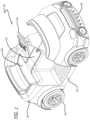
- FIG. 1 is a front top perspective view of a powered ride-on vehicle according to one embodiment.
- FIG. 2 is a front bottom perspective of a powered ride-on vehicle according to one embodiment.
- FIG. 3 is a schematic of a powered ride-on vehicle according to one embodiment.
- FIG. 4 is an embodiment of a steering wheel for a powered ride-on vehicle according to one embodiment.
- FIG. 5 is top plan view of the powered ride-on vehicle according to one embodiment showing the go mode drive function.
- FIG. 6 is top plan view of the powered ride-on vehicle according to one embodiment showing the left spin mode drive function.
- FIG. 7 is top plan view of the powered ride-on vehicle according to one embodiment showing the right spin mode drive function.
- FIG. 8 is top plan view of the powered ride-on vehicle schematically showing a portion of the electrical system according to one embodiment.
- FIG. 9 is a view of a remote control for the powered ride-on vehicle according to one embodiment.
- the powered ride-on vehicle is a ride-on vehicle that is preferably used by children and adolescents, but in alternate embodiments may be used by larger individuals, such as adults.
- the powered vehicle 10 may include a frame 12 supported by a pair of drive wheels 14 and preferably one or more non-drive or follower wheels 18 .
- the drive wheels 14 are provided at the rear portion 16 of the frame 12
- the follower wheels 18 are provided at the forward portion 20 of the frame 12
- the drive wheels 14 may be at the forward portion 20 of the frame 12
- the follower wheels 18 may be provided at the rear portion 16 of the frame 12
- the follower wheels 18 may preferably be caster-type wheels.
- the vehicle 10 also preferably includes a seat 22 to support the rider, a steering wheel 24 , and one or more motors 28 .
- two motors 28 are provided.
- a first motor 28 is provided to independently drive one of the drive wheels 14
- a second motor 28 is provided to independently drive the other of the drive wheels 14 .
- the drive motors 28 may be connected to the frame 12 and underneath the seat 22 as shown in FIG. 8 .
- the steering wheel 24 may have a plurality of buttons as shown in FIGS. 4 - 8 .
- a battery 30 which may be a series of rechargeable battery cells, is provided.
- the battery is a 6 volt rechargeable battery that is charged by connecting a charger to a charge port 37 .
- the vehicle 10 may also include an on/off switch 32 for the overall vehicle 10 . Further, in an alternate embodiment, the vehicle 10 may be controlled remotely in one or more aspects, and thus a remote control 34 and remote control receiver 35 may also be provided.
- the battery 30 may be stored under a center counsel 21 or the seat 22 , and accessed by pivoting either the center counsel 21 or the seat 22 upwardly or removing the seat.
- the battery 30 preferably supplies current to the motors 28 to have the motors 28 rotate the drive wheels 14 to drive the vehicle 10 .
- the vehicle 10 also preferably has one or more controllers 42 , such as a microcontroller or MCU 42 .
- the vehicle 10 has a controller 42 associated with a motor controller 44 to control the motors 28 (the controller 42 and motor controller 44 may be an integrated component in and referred to merely as a “controller”), and the vehicle may also have a controller 42 associated with a circuit board in the steering wheel 24 for controlling various items such as lights in the selector buttons, a light strip, etc.
- the “controller” does not specifically need to be a microcontroller or a microcontroller and a motor controller, and may include different and/or additional or fewer electrical components to accomplish the control functions described herein.
- the one or more controllers 42 are operably electrically connected to the first and second motors 28 , the plurality of movement selectors (the “spin right” selector 52 , “spin left” selector 54 , “move forward and backward” dance selector 58 , and “rotate side-to-side” dance selector 60 ), the “dance” selector 56 , the “go” selector 50 , the steering wheel sensor 64 , the battery 30 , the speaker 48 , the lights 46 , the on/off switch 32 , the radio control receiver module 35 , the charge port 37 , etc.
- the plurality of movement selectors the “spin right” selector 52 , “spin left” selector 54 , “move forward and backward” dance selector 58 , and “rotate side-to-side” dance selector 60 .
- the vehicle 10 can preferably be operated in one of three different modes: (1) full drive mode; (2) spin drive mode; and, (3) dance drive mode. Additionally an emergency stop mode is also provided for safety purposes. In one embodiment, the mode is changed based on the different selectors that are engaged or depressed on the steering wheel 24 .
- the vehicle 10 includes lights 46 that light up and music that plays during movement of the vehicle 10 .
- the top of the vehicle housing may have a LED light string 46 that lights up when the vehicle 10 moves due to any of the operator actions for movement of the vehicle 10 as described herein.
- the LED light string may have lights that can vary in brightness and color.
- the vehicle 10 has at least one speaker 48 that plays music as controlled by one or more of the vehicle controllers 42 .
- the speaker 48 including fake speakers, may have lights 46 as well, for example, around the perimeter of the speaker 48 .
- the brightness of the lights 46 varies with the volume of the music being played through the speakers 48 .
- the lights 46 turn on and off, blink, etc. with the music to create an exciting user experience for the user, especially when the user is a small child.
- the selectors may have lights 46 associated therewith that light up, turn on and off, blink, etc., when the music is played and/or when the vehicle 10 is operated to move.
- the steering wheel 24 does not control steering of the non-drive or follower wheels 18 , rather a variety of signals are sent to the microcontroller(s) 42 to control drive power to the two drive wheels 14 .
- signals include, in different drive modes, but are not limited to, a signal from a sensor 64 , such as a potentiometer associated with the steering wheel 24 , a signal from one or more of the specific selectors on the steering wheel 24 that is engaged or depressed by the user, as signal from a remote control 34 (as described herein) or a remote control receiver module 35 , a signal from the battery 30 , a signal from the on/off switch 32 , etc.
- a sensor 64 such as a potentiometer associated with the steering wheel 24
- a signal from one or more of the specific selectors on the steering wheel 24 that is engaged or depressed by the user as signal from a remote control 34 (as described herein) or a remote control receiver module 35
- a signal from the battery 30 a signal from the on
- the steering wheel 24 has a plurality of selectors, including a “go” selector 50 , which in one embodiment may be a “go” button 50 , a “spin right” selector 52 , a “spin left” selector 54 , a “dance” selector 56 , a “move forward and backward” dance selector 58 , and a “rotate side-to-side” dance selector 60 .
- a “go” selector 50 which in one embodiment may be a “go” button 50
- a “spin right” selector 52 a “spin left” selector 54 , a “dance” selector 56 , a “move forward and backward” dance selector 58 , and a “rotate side-to-side” dance selector 60
- the “spin right” selector 52 , “spin left” selector 54 , “move forward and backward” dance selector 58 , and “rotate side-to-side” dance selector 60 may
- a sensor 64 is provided for and/or operably connected to the steering wheel 24 to determine the angular orientation or location of the steering wheel 24 relative to the zero position of the steering wheel 24 and to provide an output of the angular location of the steering wheel 24 .
- the sensor 64 is angle sensor, potentiometer or equivalent sensor, such as an encoder, absolute encoder, 3 position switch, 5 position switch, etc.
- stops are provided for the steering wheel 24 to limit rotation of the steering wheel 24 in both the left turn and right turn orientations. For example, as shown in FIG.
- the sensor 64 may send an analog or digital signal to one or more of the controllers 42 .
- the signals sent from the sensor 64 typically correspond to the rotation of the steering wheel 24 between the left turn stop 66 and the right turn stop 68 .
- the driver can operate the vehicle 10 in three modes: (1) full drive mode; (2) spin drive mode; and, (3) dance drive mode.
- full drive mode the driver holds down the “go” selector 50 .
- the controller 42 sends a signal to the motor controller 44 to have a current provided to the appropriate motors 28 for the drive wheels 14 based on the signal received from the sensor 64 in the steering wheel 24 of the angular orientation of the steering wheel 24 .
- any of the selectors 50 , 52 , 54 , 56 , 58 or 60 are engaged or depressed (note that the terms engaged and depressed with respect to actuation of the selectors are used interchangeably herein and have the same meaning with respect to operation of the vehicle and the specific selector) that specific selector will light up and remain lit while engaged or depressed by the user, or for a predetermined period of time, or they may blink on and off with associated music for a period of time.
- the vehicle will play music for the entirety of time when that specific selector is engaged or for a predetermined set period of time or until a different selector is engaged or depressed.
- the steering sensor 64 sends a signal to one or more of the controllers 42 indicating that the angular position of the steering wheel 24 to adjust current to the motors 28 to change the power output of each motor 28 .
- the steering wheel 24 when the steering wheel 24 is turned left, to make the vehicle 10 turn left power to the left motor 28 is decreased while the right motor 28 stays fully powered. By maintaining the right motor at full power and decreasing power to the left motor 28 the vehicle 10 will turn left. Further, the more the steering wheel 24 is turned left, less power will be delivered to the left motor 28 , and the more aggressive the left turn will be.
- the music plays and the lights 46 in the light strip light up and/or blink for the entire period of time that the “go” selector 50 is depressed.
- the brightness and/or blinking of the lights in the light strip 46 may correspond to an amplitude and beat of the music.
- the controllers 42 when any of the selectors other than the go selector is depressed (i.e., the dance selector or any of the movement selectors), the controllers 42 operate to manipulate the motors 28 to cause movements of the vehicle 10 for a set period of time independent of the output obtained by the steering sensor. Put another way, in one embodiment the location or movement of the steering wheel has no effect on the movement of the vehicle 10 when any of the movement selectors or the dance selector is depressed.
- the vehicle 10 can also effectuate a spin when the “spin right” selector 52 (as shown in FIG. 7 ) or the “spin left” selector 54 (as shown in FIG. 6 ) on the steering wheel 24 is engaged.
- spin mode i.e., when the “spin right” selector 52 or the “spin left” selector 54 is engaged
- one motor 28 may be fully powered forward (i.e., that motor receives a full forward voltage) while the other motor 28 may be fully powered in reverse (i.e., that motor 28 receives a full reverse voltage).
- the motor controller will send a max 6V forward signal to the one motor, and a max 6V reverse signal to the other motor (note that while a 6V battery has been described, other power sources, including other size batteries may be utilized). This can be done for a left spin or a right spin depending on which of the “spin right” selector 52 or the “spin left” selector 54 is engaged. In one embodiment, engagement of a spin selector 52 or 54 will cause the vehicle 10 to spin for approximately four seconds, or until another selector is depressed if depressed prior to the four second period. However, if the user holds down the spin selector the vehicle 10 may continue to spin for multiple four second cycles, such as, for example, four cycles.
- engagement of the spin causes 180° rotation of the vehicle 10 . Accordingly, as shown in FIG. 7 , when the “spin right” selector 52 is engaged the vehicle 10 will spin clockwise 180°. And, as shown in FIG. 6 , when the “spin left” selector 54 is engaged the vehicle 10 will spin counterclockwise 180°.
- the vehicle may automatically rotate for the full cycle time period (as long as another selector is not subsequently depressed during the cycle time period).
- the vehicle 10 may ramp to a stop.
- the music plays and the lights 46 in the light strip light up and/or blink for the entire set cycle period of time that the vehicle 10 is in “spin left” or “spin right” mode, unless another selector is subsequently depressed.
- that selector will light up and/or blink for the entire period of time that the vehicle 10 is conducting its spin move.
- a specific song or music may be associated and played with each different selector 52 , 54 .
- a second set cycle period of time will being automatically and the movement will continue for that set cycle period of time and may continue for multiple cycles, such as four cycles if the selector is maintained as depressed.
- the vehicle 10 can also effectuate one of a plurality of dances in dance mode by moving in a variety of directions and speeds in succession, sometimes rather rapidly, as if the vehicle 10 were dancing.
- both motors 28 may be powered forward for a period of time, then both motors 28 may be powered in reverse for a period of time, then both motors 28 may be powered forward for a period of time, and again both motors 28 may be powered in reverse for a period of time, thereby effectuating a forward and backward dance move.
- the vehicle 10 may move forward for X/Y seconds, then backwards for X/Y seconds, and this will be repeated for the Y number of moves during the X number of seconds.
- the music plays and the lights 46 light up and/or blink for the entire period of time that the vehicle 10 is in the “move forward and backward” dance mode. Additionally, when the “move forward and backward” dance selector 58 is engaged, that selector 58 will light up or blink for the entire period of time that the vehicle 10 is conducting its dance move.
- this dance movement will end and the selected movement, music and lights associated with that selector will start.
- the depressed selector is held down for the entire duration of the cycle, the specific movement will continue for multiple cycles, such as four cycles.
- a specific song or music may be associated and played following depression of dance selector 52 .
- the vehicle 10 can also effectuate a dance in dance mode by moving side to side in succession, sometimes rather rapidly, as if the vehicle 10 were dancing.
- the vehicle 10 has a “move side-to-side” dance selector 60 on the steering wheel 24 .
- the controller 42 operates to effectuate the motors 28 in alternate spin modes.
- the motors 28 may be operated to spin the vehicle 10 clockwise for a set period of time (i.e., a cycle) or for a specific angular movement, such as 20°, then the motors 28 may be operated to spin the vehicle 10 counterclockwise for a period of time or for a specific angular movement, such as 20°, then the motors 28 may again be operated to spin the vehicle 10 clockwise for a period of time or for a specific angular movement, such as 20°, and finally the motors 28 may be operated to spin the vehicle 10 counterclockwise again for a period of time or for a specific angular movement, such as 20°, thereby effectuating a side-to-side dance movement of the vehicle.
- a set period of time i.e., a cycle
- the motors 28 may be operated to spin the vehicle 10 counterclockwise for a period of time or for a specific angular movement, such as 20°
- the motors 28 may again be operated to spin the vehicle 10 clockwise for a period of time
- the vehicle 10 may spin counterclockwise for X/Y seconds, then clockwise for X/Y seconds, and this will be repeated for the Y number of moves during the X number of seconds.
- the music plays and the lights 46 light up and/or blink for the entire period of time that the vehicle 10 is in the “move side-to-side” dance mode. Additionally, when the “move side-to-side” dance selector 60 is engaged, that selector 60 will light up or blink for the entire period of time that the vehicle 10 is conducting its dance move.
- this dance movement will end and the selected movement, music and lights associated with that selector will start.
- the depressed selector is held down for the entire duration of the cycle, the specific movement will continue for multiple cycles, such as four cycles.
- a specific song or music may be associated and played following depression of dance selector 54 .
- the vehicle 10 can also effectuate a variety of dances with different dance “moves” for the vehicle 10 in each dance by having the user select the “dance” selector 56 on the steering wheel 24 .
- multiple dances such as five for example, may be preprogrammed in one or more of the controllers 42 , and when the “dance” selector 56 is contacted by the user the next dance in the controller queue will be conducted by the vehicle 10 .
- dance 1 is conducted when the dance selector 56 is depressed
- dance 2 will be conducted by the vehicle 10 .
- Different dances could be a country dance to country music, a hip hop dance to hip hop music, a rock dance to rock music, salsa dance to salsa music, disco dance to disco music, etc.
- Different dances will require different movement of the vehicle, different music being played by the vehicle, and different light effects by the vehicle.
- X seconds such as 8 seconds.
- the dance selector 56 will light up or blink for 8 seconds, and music will be played for 8 seconds.
- the additional lights 46 on the vehicle such as the light strip, will light up to the music for 8 seconds.
- the one or more controllers 46 will operate the motors 28 to move forward and right for X/16 seconds, then backward and left for X/16 seconds, then forward and right for X/16 seconds, then backward and left for X/16 seconds, then forward and left for X/16 seconds, then backward and right for X/16 seconds, then forward and left for X/16 seconds, then backward and right for X/16 seconds, and these will repeat until the full set time period cycle has completed.
- the next dance in the queue will be conducted when the dance selector 56 is engaged next. However, if the dance selector 56 is held down for the entire duration of the dance cycle, the specific dance will continue or repeat for multiple cycles, such as four cycles.
- a specific song or music may be associated and played with a specific dance in the queue following depression of dance selector 56 . Additionally, if a different selector is depressed during a dance, the dance will end and the movements, music and lights associated with that selector will begin.
- specific music and light actions will be associated with each selector, and with each dance of the dance selector 56 .
- the use may be able to program additional dances into the controller 46 of the vehicle.
- the controller 46 may be able to generate new dances using a randomizing function.
- the user may be able to connect a device, wirelessly or wired, such as a MP3 player to the controller 46 of the vehicle 10 to have music played through the speakers of the vehicle 10 , and the controller 46 may create dances based on the music being played from the MP3 player.
- the vehicle may be able to teach the user different dances. For example, the vehicle 10 , through its speakers, will say “spin left”, and the user will push the spin left selector and get feedback from the vehicle, etc.
- the vehicle 10 includes a Standby Mode and a Sleep Mode.
- Standby Mode is when the vehicle is ON, and it is waiting for a user to operate the vehicle through manipulation of one or more of the selector buttons.
- Sleep Mode is engaged when the vehicle is ON, but after a period of time, such as, for example, ten minutes, no selectors are depressed such that there is inactivity for a set period of time, the controllers will enter the Sleep Mode to draw significantly less current from the batteries than when the vehicle is in Standby Mode.
- a period of time such as, for example, ten minutes
- no selectors are depressed such that there is inactivity for a set period of time
- the controllers will enter the Sleep Mode to draw significantly less current from the batteries than when the vehicle is in Standby Mode.
- One example of the vehicle entering Sleep Mode is when the user is operating the vehicle such that it is ON, but then the user leaves the vehicle but forgets to turn the vehicle OFF. This provides for much less drain on the battery in such circumstances.
- a volume select switch (not shown) is provided for the vehicle.
- the volume select switch is a simple on/off switch specifically for volume so that a user can operate the vehicle either with the sounds (volume on) or without sounds (volume off).
- the volume select switch is a three-way switch that allows for full sound volume on, sound volume off, and lower volume on.
- a remote control 34 and wireless receiver 35 are provided.
- the wireless receiver 35 is operably electrically connected to the controllers 42 .
- the remote control 34 may have a plurality of input members, such as forward, left, right, and reverse buttons 41 , a spin left button 43 , a spin right button 45 , a dance selector button 47 , and an emergency stop button 49 .
- the remote control 34 may also have a wireless transmitter for sending signals to the one or more controllers of the vehicle via the wireless receiver 35 in the vehicle 10 .
- the vehicle 10 can be operated in two modes of operation, including a child only drive mode and a full remote drive mode.
- the controllers of the vehicle switch between the two modes of operation in real time based on signals received from the remote control.
- the vehicle will operate in full remote drive mode and actuation of selectors, etc. on the vehicle will not have an effect on the operation of the vehicle.
- the vehicle will be operated by actuation of the selectors, etc. on the vehicle.
- the phrase “at least one of” preceding a series of items, with the terms “and” or “or” to separate any of the items, modifies the list as a whole, rather than each member of the list (i.e., each item).
- the phrase “at least one of” does not require selection of at least one item; rather, the phrase allows a meaning that includes at least one of any one of the items, and/or at least one of any combination of the items, and/or at least one of each of the items.
- phrases “at least one of A, B, and C” or “at least one of A, B, or C” each refer to only A, only B, or only C; any combination of A, B, and C; and/or at least one of each of A, B, and C.
- phrases such as an aspect, the aspect, another aspect, some aspects, one or more aspects, an implementation, the implementation, another implementation, some implementations, one or more implementations, an embodiment, the embodiment, another embodiment, some embodiments, one or more embodiments, a configuration, the configuration, another configuration, some configurations, one or more configurations, the subject technology, the disclosure, the present disclosure, other variations thereof and alike are for convenience and do not imply that a disclosure relating to such phrase(s) is essential to the subject technology or that such disclosure applies to all configurations of the subject technology.
- a disclosure relating to such phrase(s) may apply to all configurations, or one or more configurations.
- a disclosure relating to such phrase(s) may provide one or more examples.
- a phrase such as an aspect or some aspects may refer to one or more aspects and vice versa, and this applies similarly to other foregoing phrases.
Landscapes
- Engineering & Computer Science (AREA)
- Transportation (AREA)
- Mechanical Engineering (AREA)
- Chemical & Material Sciences (AREA)
- Combustion & Propulsion (AREA)
- Power Engineering (AREA)
- Physics & Mathematics (AREA)
- General Physics & Mathematics (AREA)
- Sustainable Development (AREA)
- Sustainable Energy (AREA)
- Life Sciences & Earth Sciences (AREA)
- Aviation & Aerospace Engineering (AREA)
- Radar, Positioning & Navigation (AREA)
- Remote Sensing (AREA)
- Automation & Control Theory (AREA)
- Steering Controls (AREA)
Abstract
Description
Claims (17)
Priority Applications (1)
| Application Number | Priority Date | Filing Date | Title |
|---|---|---|---|
| US16/993,524 US11787472B2 (en) | 2019-08-16 | 2020-08-14 | Powered ride-on vehicle |
Applications Claiming Priority (2)
| Application Number | Priority Date | Filing Date | Title |
|---|---|---|---|
| US201962887734P | 2019-08-16 | 2019-08-16 | |
| US16/993,524 US11787472B2 (en) | 2019-08-16 | 2020-08-14 | Powered ride-on vehicle |
Publications (2)
| Publication Number | Publication Date |
|---|---|
| US20210046975A1 US20210046975A1 (en) | 2021-02-18 |
| US11787472B2 true US11787472B2 (en) | 2023-10-17 |
Family
ID=74568138
Family Applications (1)
| Application Number | Title | Priority Date | Filing Date |
|---|---|---|---|
| US16/993,524 Active 2041-08-15 US11787472B2 (en) | 2019-08-16 | 2020-08-14 | Powered ride-on vehicle |
Country Status (2)
| Country | Link |
|---|---|
| US (1) | US11787472B2 (en) |
| WO (1) | WO2021034667A1 (en) |
Cited By (4)
| Publication number | Priority date | Publication date | Assignee | Title |
|---|---|---|---|---|
| US20230158415A1 (en) * | 2021-11-24 | 2023-05-25 | Honda Motor Co., Ltd. | Ride on toy vehicle |
| US20240024793A1 (en) * | 2021-06-21 | 2024-01-25 | Jimmy Lee Roark | Battery operated low rider ride on toys |
| USD1041573S1 (en) * | 2024-04-12 | 2024-09-10 | Fuju Wang | Ride-on toy car |
| USD1041574S1 (en) * | 2024-04-12 | 2024-09-10 | Fuju Wang | Ride-on toy car |
Families Citing this family (6)
| Publication number | Priority date | Publication date | Assignee | Title |
|---|---|---|---|---|
| DE102018209704A1 (en) * | 2018-06-15 | 2019-12-19 | Bayerische Motoren Werke Aktiengesellschaft | Means of transportation and device for issuing a request to take over vehicle guidance |
| US11605134B2 (en) | 2019-08-01 | 2023-03-14 | Patty, Llc | Self-optimizing, multi-channel, cognitive virtual benefits product field underwriter and customer service representative |
| US12243081B2 (en) | 2019-08-01 | 2025-03-04 | Patty, Llc | System and method for presenting one or more products to a user via a virtual assistant |
| CN116513078A (en) * | 2023-05-24 | 2023-08-01 | 博泰车联网(南京)有限公司 | Vehicle control method, electronic device, and computer-readable storage medium |
| US12254279B1 (en) | 2024-05-23 | 2025-03-18 | Honesty Innovations Holdings, Llc | Dynamic resource allocation of large language model deployments for conversational interface |
| USD1090717S1 (en) | 2024-10-29 | 2025-08-26 | MVN Entertainment, L.P. | Convertible ride-on toy |
Citations (5)
| Publication number | Priority date | Publication date | Assignee | Title |
|---|---|---|---|---|
| US7344430B2 (en) | 2005-05-12 | 2008-03-18 | Hasty Christopher M | Remote/occupant controlled toy vehicle |
| US8141668B2 (en) | 1999-02-05 | 2012-03-27 | Mattel, Inc. | Children's ride-on vehicle |
| EP2937840A2 (en) * | 2014-04-25 | 2015-10-28 | MAN Truck & Bus AG | Driving time display in a commercial vehicle, in particular in a driver's cab of a commercial vehicle |
| US20180099230A1 (en) * | 2016-10-11 | 2018-04-12 | Radio Flyer Inc. | Powered ride-on vehicle |
| WO2018183347A1 (en) | 2017-03-27 | 2018-10-04 | Pacific Cycle, Llc | Interactive ride-on toy apparatus |
-
2020
- 2020-08-14 US US16/993,524 patent/US11787472B2/en active Active
- 2020-08-14 WO PCT/US2020/046374 patent/WO2021034667A1/en not_active Ceased
Patent Citations (5)
| Publication number | Priority date | Publication date | Assignee | Title |
|---|---|---|---|---|
| US8141668B2 (en) | 1999-02-05 | 2012-03-27 | Mattel, Inc. | Children's ride-on vehicle |
| US7344430B2 (en) | 2005-05-12 | 2008-03-18 | Hasty Christopher M | Remote/occupant controlled toy vehicle |
| EP2937840A2 (en) * | 2014-04-25 | 2015-10-28 | MAN Truck & Bus AG | Driving time display in a commercial vehicle, in particular in a driver's cab of a commercial vehicle |
| US20180099230A1 (en) * | 2016-10-11 | 2018-04-12 | Radio Flyer Inc. | Powered ride-on vehicle |
| WO2018183347A1 (en) | 2017-03-27 | 2018-10-04 | Pacific Cycle, Llc | Interactive ride-on toy apparatus |
Non-Patent Citations (2)
| Title |
|---|
| "Best 12v Jeep out there!! ," accessed online at: shorturl.at/wxBCR (available at least as early as Aug. 14, 2020). |
| International Search Report and Written Opinion issued to PCT/US20/46374, dated Nov. 30, 2020 (10 pages). |
Cited By (5)
| Publication number | Priority date | Publication date | Assignee | Title |
|---|---|---|---|---|
| US20240024793A1 (en) * | 2021-06-21 | 2024-01-25 | Jimmy Lee Roark | Battery operated low rider ride on toys |
| US20230158415A1 (en) * | 2021-11-24 | 2023-05-25 | Honda Motor Co., Ltd. | Ride on toy vehicle |
| US12285700B2 (en) * | 2021-11-24 | 2025-04-29 | Honda Motor Co., Ltd. | Ride on toy vehicle |
| USD1041573S1 (en) * | 2024-04-12 | 2024-09-10 | Fuju Wang | Ride-on toy car |
| USD1041574S1 (en) * | 2024-04-12 | 2024-09-10 | Fuju Wang | Ride-on toy car |
Also Published As
| Publication number | Publication date |
|---|---|
| US20210046975A1 (en) | 2021-02-18 |
| WO2021034667A1 (en) | 2021-02-25 |
Similar Documents
| Publication | Publication Date | Title |
|---|---|---|
| US11787472B2 (en) | Powered ride-on vehicle | |
| US9289694B2 (en) | Toy skateboard | |
| US9162153B1 (en) | Toy vehicle with an adjustable DC-DC switch | |
| US9994116B2 (en) | Dual charge ride-on vehicle | |
| US20180148120A1 (en) | Balancing vehicle | |
| US10245520B2 (en) | Powered ride-on vehicle | |
| EP1221336B1 (en) | Interactive toy vehicle adapted to hold a toy character | |
| CN208297968U (en) | A kind of perambulator control display system | |
| DK2937120T3 (en) | Toy vehicle with a touch reaction | |
| CN201426977Y (en) | Toy car simulation steering wheel and toy car remotely controlled by the same | |
| CN204347474U (en) | A kind of electric unicycle intelligent control system | |
| CN105955278A (en) | Head-swinging type balancing puppet based on electric wheelbarrow |
Legal Events
| Date | Code | Title | Description |
|---|---|---|---|
| FEPP | Fee payment procedure |
Free format text: ENTITY STATUS SET TO UNDISCOUNTED (ORIGINAL EVENT CODE: BIG.); ENTITY STATUS OF PATENT OWNER: SMALL ENTITY |
|
| FEPP | Fee payment procedure |
Free format text: ENTITY STATUS SET TO SMALL (ORIGINAL EVENT CODE: SMAL); ENTITY STATUS OF PATENT OWNER: SMALL ENTITY |
|
| AS | Assignment |
Owner name: RADIO FLYER INC., ILLINOIS Free format text: ASSIGNMENT OF ASSIGNORS INTEREST;ASSIGNORS:ZEMSKOV, IGOR;GREENBERG, DANIEL;REEL/FRAME:053593/0459 Effective date: 20200824 |
|
| STPP | Information on status: patent application and granting procedure in general |
Free format text: DOCKETED NEW CASE - READY FOR EXAMINATION |
|
| STPP | Information on status: patent application and granting procedure in general |
Free format text: NON FINAL ACTION MAILED |
|
| STPP | Information on status: patent application and granting procedure in general |
Free format text: RESPONSE AFTER FINAL ACTION FORWARDED TO EXAMINER |
|
| STPP | Information on status: patent application and granting procedure in general |
Free format text: NOTICE OF ALLOWANCE MAILED -- APPLICATION RECEIVED IN OFFICE OF PUBLICATIONS |
|
| STPP | Information on status: patent application and granting procedure in general |
Free format text: PUBLICATIONS -- ISSUE FEE PAYMENT VERIFIED |
|
| STCF | Information on status: patent grant |
Free format text: PATENTED CASE |
|
| AS | Assignment |
Owner name: THE RADIO FLYER COMPANY, ILLINOIS Free format text: CERTIFICATE OF CONVERSION;ASSIGNOR:RADIO FLYER INC.;REEL/FRAME:067370/0315 Effective date: 20240311 |