US11780866B2 - Organometallic compound, organic light-emitting device including organometallic compound, and diagnostic composition including organometallic compound - Google Patents
Organometallic compound, organic light-emitting device including organometallic compound, and diagnostic composition including organometallic compound Download PDFInfo
- Publication number
- US11780866B2 US11780866B2 US17/032,120 US202017032120A US11780866B2 US 11780866 B2 US11780866 B2 US 11780866B2 US 202017032120 A US202017032120 A US 202017032120A US 11780866 B2 US11780866 B2 US 11780866B2
- Authority
- US
- United States
- Prior art keywords
- group
- substituted
- compound
- formula
- salt
- Prior art date
- Legal status (The legal status is an assumption and is not a legal conclusion. Google has not performed a legal analysis and makes no representation as to the accuracy of the status listed.)
- Active, expires
Links
Images


Classifications
-
- C—CHEMISTRY; METALLURGY
- C07—ORGANIC CHEMISTRY
- C07F—ACYCLIC, CARBOCYCLIC OR HETEROCYCLIC COMPOUNDS CONTAINING ELEMENTS OTHER THAN CARBON, HYDROGEN, HALOGEN, OXYGEN, NITROGEN, SULFUR, SELENIUM OR TELLURIUM
- C07F15/00—Compounds containing elements of Groups 8, 9, 10 or 18 of the Periodic Table
- C07F15/0006—Compounds containing elements of Groups 8, 9, 10 or 18 of the Periodic Table compounds of the platinum group
- C07F15/0033—Iridium compounds
-
- G—PHYSICS
- G01—MEASURING; TESTING
- G01N—INVESTIGATING OR ANALYSING MATERIALS BY DETERMINING THEIR CHEMICAL OR PHYSICAL PROPERTIES
- G01N21/00—Investigating or analysing materials by the use of optical means, i.e. using sub-millimetre waves, infrared, visible or ultraviolet light
- G01N21/62—Systems in which the material investigated is excited whereby it emits light or causes a change in wavelength of the incident light
- G01N21/63—Systems in which the material investigated is excited whereby it emits light or causes a change in wavelength of the incident light optically excited
- G01N21/64—Fluorescence; Phosphorescence
-
- G—PHYSICS
- G01—MEASURING; TESTING
- G01N—INVESTIGATING OR ANALYSING MATERIALS BY DETERMINING THEIR CHEMICAL OR PHYSICAL PROPERTIES
- G01N33/00—Investigating or analysing materials by specific methods not covered by groups G01N1/00 - G01N31/00
- G01N33/48—Biological material, e.g. blood, urine; Haemocytometers
- G01N33/50—Chemical analysis of biological material, e.g. blood, urine; Testing involving biospecific ligand binding methods; Immunological testing
- G01N33/58—Chemical analysis of biological material, e.g. blood, urine; Testing involving biospecific ligand binding methods; Immunological testing involving labelled substances
- G01N33/582—Chemical analysis of biological material, e.g. blood, urine; Testing involving biospecific ligand binding methods; Immunological testing involving labelled substances with fluorescent label
-
- H—ELECTRICITY
- H10—SEMICONDUCTOR DEVICES; ELECTRIC SOLID-STATE DEVICES NOT OTHERWISE PROVIDED FOR
- H10K—ORGANIC ELECTRIC SOLID-STATE DEVICES
- H10K50/00—Organic light-emitting devices
- H10K50/10—OLEDs or polymer light-emitting diodes [PLED]
- H10K50/11—OLEDs or polymer light-emitting diodes [PLED] characterised by the electroluminescent [EL] layers
- H10K50/12—OLEDs or polymer light-emitting diodes [PLED] characterised by the electroluminescent [EL] layers comprising dopants
-
- H—ELECTRICITY
- H10—SEMICONDUCTOR DEVICES; ELECTRIC SOLID-STATE DEVICES NOT OTHERWISE PROVIDED FOR
- H10K—ORGANIC ELECTRIC SOLID-STATE DEVICES
- H10K85/00—Organic materials used in the body or electrodes of devices covered by this subclass
- H10K85/30—Coordination compounds
- H10K85/341—Transition metal complexes, e.g. Ru(II)polypyridine complexes
- H10K85/342—Transition metal complexes, e.g. Ru(II)polypyridine complexes comprising iridium
-
- C—CHEMISTRY; METALLURGY
- C07—ORGANIC CHEMISTRY
- C07B—GENERAL METHODS OF ORGANIC CHEMISTRY; APPARATUS THEREFOR
- C07B2200/00—Indexing scheme relating to specific properties of organic compounds
- C07B2200/05—Isotopically modified compounds, e.g. labelled
-
- C—CHEMISTRY; METALLURGY
- C09—DYES; PAINTS; POLISHES; NATURAL RESINS; ADHESIVES; COMPOSITIONS NOT OTHERWISE PROVIDED FOR; APPLICATIONS OF MATERIALS NOT OTHERWISE PROVIDED FOR
- C09K—MATERIALS FOR MISCELLANEOUS APPLICATIONS, NOT PROVIDED FOR ELSEWHERE
- C09K11/00—Luminescent, e.g. electroluminescent, chemiluminescent materials
- C09K11/06—Luminescent, e.g. electroluminescent, chemiluminescent materials containing organic luminescent materials
-
- C—CHEMISTRY; METALLURGY
- C09—DYES; PAINTS; POLISHES; NATURAL RESINS; ADHESIVES; COMPOSITIONS NOT OTHERWISE PROVIDED FOR; APPLICATIONS OF MATERIALS NOT OTHERWISE PROVIDED FOR
- C09K—MATERIALS FOR MISCELLANEOUS APPLICATIONS, NOT PROVIDED FOR ELSEWHERE
- C09K2211/00—Chemical nature of organic luminescent or tenebrescent compounds
- C09K2211/14—Macromolecular compounds
- C09K2211/1408—Carbocyclic compounds
- C09K2211/1425—Non-condensed systems
-
- C—CHEMISTRY; METALLURGY
- C09—DYES; PAINTS; POLISHES; NATURAL RESINS; ADHESIVES; COMPOSITIONS NOT OTHERWISE PROVIDED FOR; APPLICATIONS OF MATERIALS NOT OTHERWISE PROVIDED FOR
- C09K—MATERIALS FOR MISCELLANEOUS APPLICATIONS, NOT PROVIDED FOR ELSEWHERE
- C09K2211/00—Chemical nature of organic luminescent or tenebrescent compounds
- C09K2211/14—Macromolecular compounds
- C09K2211/1408—Carbocyclic compounds
- C09K2211/1433—Carbocyclic compounds bridged by heteroatoms, e.g. N, P, Si or B
-
- C—CHEMISTRY; METALLURGY
- C09—DYES; PAINTS; POLISHES; NATURAL RESINS; ADHESIVES; COMPOSITIONS NOT OTHERWISE PROVIDED FOR; APPLICATIONS OF MATERIALS NOT OTHERWISE PROVIDED FOR
- C09K—MATERIALS FOR MISCELLANEOUS APPLICATIONS, NOT PROVIDED FOR ELSEWHERE
- C09K2211/00—Chemical nature of organic luminescent or tenebrescent compounds
- C09K2211/14—Macromolecular compounds
- C09K2211/1441—Heterocyclic
- C09K2211/145—Heterocyclic containing oxygen as the only heteroatom
-
- C—CHEMISTRY; METALLURGY
- C09—DYES; PAINTS; POLISHES; NATURAL RESINS; ADHESIVES; COMPOSITIONS NOT OTHERWISE PROVIDED FOR; APPLICATIONS OF MATERIALS NOT OTHERWISE PROVIDED FOR
- C09K—MATERIALS FOR MISCELLANEOUS APPLICATIONS, NOT PROVIDED FOR ELSEWHERE
- C09K2211/00—Chemical nature of organic luminescent or tenebrescent compounds
- C09K2211/14—Macromolecular compounds
- C09K2211/1441—Heterocyclic
- C09K2211/1466—Heterocyclic containing nitrogen as the only heteroatom
-
- C—CHEMISTRY; METALLURGY
- C09—DYES; PAINTS; POLISHES; NATURAL RESINS; ADHESIVES; COMPOSITIONS NOT OTHERWISE PROVIDED FOR; APPLICATIONS OF MATERIALS NOT OTHERWISE PROVIDED FOR
- C09K—MATERIALS FOR MISCELLANEOUS APPLICATIONS, NOT PROVIDED FOR ELSEWHERE
- C09K2211/00—Chemical nature of organic luminescent or tenebrescent compounds
- C09K2211/18—Metal complexes
- C09K2211/185—Metal complexes of the platinum group, i.e. Os, Ir, Pt, Ru, Rh or Pd
-
- H—ELECTRICITY
- H10—SEMICONDUCTOR DEVICES; ELECTRIC SOLID-STATE DEVICES NOT OTHERWISE PROVIDED FOR
- H10K—ORGANIC ELECTRIC SOLID-STATE DEVICES
- H10K2101/00—Properties of the organic materials covered by group H10K85/00
- H10K2101/10—Triplet emission
-
- H—ELECTRICITY
- H10—SEMICONDUCTOR DEVICES; ELECTRIC SOLID-STATE DEVICES NOT OTHERWISE PROVIDED FOR
- H10K—ORGANIC ELECTRIC SOLID-STATE DEVICES
- H10K50/00—Organic light-emitting devices
- H10K50/10—OLEDs or polymer light-emitting diodes [PLED]
- H10K50/11—OLEDs or polymer light-emitting diodes [PLED] characterised by the electroluminescent [EL] layers
Definitions
- the present disclosure relates to an organometallic compound, an organic light-emitting device including the organometallic compound, and a diagnostic composition including the organometallic compound.
- OLEDs Organic light-emitting devices
- OLEDs are self-emission devices which produce full-color images.
- OLEDs have wide viewing angles and exhibit excellent driving voltage and response speed characteristics.
- OLEDs include an anode, a cathode, and an organic layer between the anode and the cathode and including an emission layer.
- a hole transport region may be between the anode and the emission layer, and an electron transport region may be between the emission layer and the cathode.
- Holes provided from the anode may move toward the emission layer through the hole transport region, and electrons provided from the cathode may move toward the emission layer through the electron transport region.
- the holes and the electrons recombine in the emission layer to produce excitons. These excitons transit from an excited state to a ground state to thereby generate light.
- light-emitting compounds e.g., phosphorescence-emitting compounds
- an organometallic compound an organic light-emitting device including the organometallic compound, and a diagnostic composition including the organometallic compound.
- an organometallic compound is represented by Formula 1.
- an organic light-emitting device includes a first electrode, a second electrode, and an organic layer disposed between the first electrode and the second electrode and including an emission layer, the organic layer including at least one organometallic compound represented by Formula 1.
- the organometallic compound included in the emission layer may serve as a dopant.
- a diagnostic composition may include at least one organometallic compound represented by Formula 1.
- the FIGURE is a schematic cross-sectional view of an organic light-emitting device according to an embodiment.
- relative terms such as “lower” or “bottom” and “upper” or “top,” may be used herein to describe one element's relationship to another element as illustrated in the FIGURES It will be understood that relative terms are intended to encompass different orientations of the device in addition to the orientation depicted in the FIGURES
- the exemplary term “lower,” can therefore, encompasses both an orientation of “lower” and “upper,” depending on the particular orientation of the FIGURE
- the device in one of the FIGURES is turned over, elements described as “below” or “beneath” other elements would then be oriented “above” the other elements
- the exemplary terms “below” or “beneath” can, therefore, encompass both an orientation of above and below.
- “About” or “approximately” as used herein is inclusive of the stated value and means within an acceptable range of deviation for the particular value as determined by one of ordinary skill in the art, considering the measurement in question and the error associated with measurement of the particular quantity (i.e., the limitations of the measurement system). For example, “about” can mean within one or more standard deviations, or within 30%, 20%, 10% or 5% of the stated value.
- Exemplary embodiments are described herein with reference to cross section illustrations that are schematic illustrations of idealized embodiments As such, variations from the shapes of the illustrations as a result, for example, of manufacturing techniques and/or tolerances, are to be expected Thus, embodiments described herein should not be construed as limited to the particular shapes of regions as illustrated herein but are to include deviations in shapes that result, for example, from manufacturing. For example, a region illustrated or described as flat may, typically, have rough and/or nonlinear features Moreover, sharp angles that are illustrated may be rounded Thus, the regions illustrated in the FIGURES are schematic in nature and their shapes are not intended to illustrate the precise shape of a region and are not intended to limit the scope of the present claims.
- an organometallic compound may be represented by Formula 1: M(L 1 ) n1 (L 2 ) n2 .
- Formula 1 M(L 1 ) n1 (L 2 ) n2 .
- M may be a transition metal
- M may be a first-row transition metal, a second-row transition metal, or a third-row transition metal.
- M may be iridium (Ir), platinum (Pt), osmium (Os), titanium (Ti), zirconium (Zr), hafnium (Hf), europium (Eu), terbium (Tb), thulium (Tm), or rhodium (Rh).
- M may be Ir, Pt, Os, or Rh.
- M may be iridium (Ir).
- L 1 in Formula 1 may be a ligand represented by Formula 2
- L 2 may be a ligand represented by Formula 3:
- Formulae 2 and 3 may each be understood by referring to the descriptions thereof provided herein.
- n1 and n2 in Formula 1 may respectively indicate the number of L 1 (s) and L 2 (s), and n1 and n2 may each independently be 1 or 2.
- n1 is 2
- two L 1 (s) may be identical to or different from each other
- n2 is 2
- two L 2 (s) may be identical to or different from each other.
- the sum of n1 and n2 may be 3.
- L 1 and L 2 in Formula 1 may be different from each other. That is, the organometallic compound represented by Formula 1 may be a heteroleptic complex.
- Y 11 may be N, and Y 12 may be C.
- ring CY 1 and ring CY 1 may each independently be a C 1 -C 30 heterocyclic group
- ring CY 2 and ring CY 12 may each independently be a C 5 -C 30 carbocyclic group or a C 1 -C 30 heterocyclic group
- Ring CY 1 and ring CY 1 may respectively be the lowest unoccupied molecular orbital (LUMO) parts in the ligands represented by Formulae 2 and 3
- ring CY 12 may respectively be the highest occupied molecular orbital (HOMO) parts in the ligands represented by Formulae 2 and 3.
- LUMO lowest unoccupied molecular orbital
- HOMO highest occupied molecular orbital
- ring CY 1 and ring CY 1 may each independently be an azaindole group, an azabenzoborole group, an azabenzophosphole group, an azaindene group, an azabenzosilole group, an azabenzogermole group, an azabenzothiophene group, an azabenzoselenophene group, an azabenzofuran group, an azacarbazole group, an azadibenzoborole group, an azadibenzophosphole group, an azafluorene group, an azadibenzosilole group, an azadibenzogermole group, an azadibenzothiophene group, an azadibenzoselenophene group, an azadibenzofuran group, an azadibenzothiophene 5-oxide group, an aza-9H-fluoren-9-one group, an azadibenzothiophene 5,
- ring CY 2 and ring CY 12 may each independently be a cyclopentene group, a cyclohexene group, a benzene group, a naphthalene group, an anthracene group, a phenanthrene group, a triphenylene group, a pyrene group, a chrysene group, a cyclopentadiene group, a 1,2,3,4-tetrahydronaphthalene group, a thiophene group, a furan group, an indole group, a borole group, a silole group, a germole group, a phosphole group, a selenophene group, a benzoborole group, a benzophosphole group, an indene group, a benzosilole group, a benzogermole group, a benzothiophene group, a benzoselenophene group,
- ring CY 1 and ring CY 1 may each independently be a pyridine group, a pyrimidine group, a pyrazine group, a pyridazine group, a triazine group, a quinoline group, an isoquinoline group, a quinoxaline group, a quinazoline group, a phenanthroline group, a 5,6,7,8-tetrahydroisoquinoline group, or a 5,6,7,8-tetrahydroquinoline group
- ring CY 2 and ring CY 12 may each independently be a benzene group, a naphthalene group, an anthracene group, a phenanthrene group, a triphenylene group, a pyrene group, a chrysene group, a 1,2,3,4-tetrahydronaphthalene group, a thiophene group, a furan group, an indole group
- ring CY 1 and ring CY 11 may each independently be a pyridine group, a pyrimidine group, a pyrazine group, a pyridazine group, a triazine group, a quinoline group, an isoquinoline group, a quinoxaline group, a quinazoline group, a 5,6,7,8-tetrahydroisoquinoline group, or a 5,6,7,8-tetrahydroquinoline group, and ring CY 2 and ring CY 12 may each independently be a benzene group, a naphthalene group, or a 1,2,3,4-tetrahydronaphthalene group.
- ring CY 1 and ring CY 11 may each be a pyridine group, and ring CY 2 and ring CY 12 may be a benzene group.
- X 21 may be O, S, Se, N(R 28 ), C(R 28 )(R 29 ), or Si(R 28 )(R 29 ).
- X 21 may be O or S.
- R 1 , R 2 , R 28 , R 29 , Z 1 , and Z 2 may each independently be deuterium, —F, —Cl, —Br, —I, —SF 5 , a hydroxyl group, a cyano group, a nitro group, an amino group, an amidino group, a hydrazine group, a hydrazone group, a carboxylic acid group or a salt thereof, a sulfonic acid group or a salt thereof, a phosphoric acid group or a salt thereof, a substituted or unsubstituted C 1 -C 60 alkyl group, a substituted or unsubstituted C 2 -C 60 alkenyl group, a substituted or unsubstituted C 2 -C 60 alkynyl group, a substituted or unsubstituted C 1 -C 60 alkoxy group, a substituted or unsubstituted C 6 -
- R 1 , R 2 , R 28 , R 29 , Z 1 , and Z 2 may each independently be:
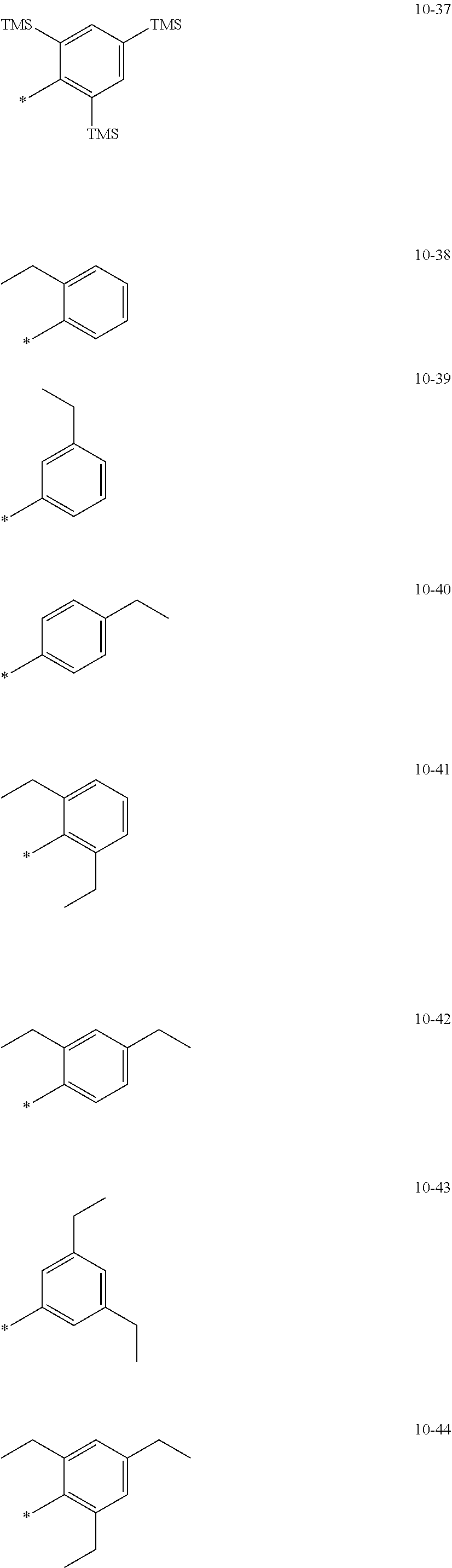
- R 1 , R 2 , R 28 , R 29 , Z 1 , and Z 2 may each independently be deuterium, —F, —CH 3 , —CD 3 , —CD 2 H, —CDH 2 , —CF 3 , —CF 2 H, —CFH 2 , a C 1 -C 10 alkenyl group, a C 1 -C 10 alkoxy group, a group represented by one of Formulae 9-1 to 9-39, a group represented by one of Formulae 9-1 to 9-39 in which at least one hydrogen is substituted with deuterium, a group represented by one of Formulae 9-1 to 9-39 in which at least one hydrogen is substituted with —F, a group represented by one of Formulae 10-1 to 10-112, a group represented by one of Formulae 10-1 to 10-112 in which at least one hydrogen is substituted with deuterium, a group represented by one of Formulae 10-1 to 10-112 in which at least one hydrogen is substituted with deuterium,
- * may indicate a binding site to an adjacent atom
- “Ph” represents a phenyl group
- “TMS” represents a trimethylsilyl group
- “TMG” represents a trimethylgermyl group.
- the “group represented by Formulae 9-1 to 9-39 in which at least one hydrogen is substituted with deuterium” may be, for example, a group represented by one of Formulae 9-501 to 514:
- the “group represented by Formulae 9-1 to 9-39 in which at least one hydrogen is substituted with —F” may be, for example, a group represented by one of Formulae 9-701 to 710:
- the “group represented by Formulae 10-1 to 10-112 in which at least one hydrogen is substituted with deuterium” and the “group represented by Formulae 10-201 to 10-350 in which at least one hydrogen is substituted with deuterium” may each be, for example, a group represented by one of Formulae 10-501 to 553:
- the “group represented by Formulae 10-1 to 10-112 in which at least one hydrogen is substituted with —F” and the “group represented by Formulae 10-201 to 10-350 in which at least one hydrogen is substituted with —F” may each be, for example, a group represented by one of Formulae 10-601 to 617:
- a1, a2, and d1 may respectively indicate the number of R 1 (s), R 2 (s), and Z 1 (s), and a1, a2, and d1 each independently be an integer from 0 to 10.
- a1 is 2 or greater, at least two R 1 (s) may be identical to or different from each other, when a2 is 2 or greater, at least two R 2 (s) may be identical to or different from each other, and when d1 is 2 or greater, at least two Z 1 (s) may be identical to or different from each other.
- a1, a2, and d1 may each independently be 0, 1, 2, 3, 4, 5, or 6.
- the sum of a1 and a2 may be 1 or greater. That is, the ligand represented by Formula 2 may be substituted with at least one selected from R 1 and R 2 (in the present specification, R 1 and R 2 may not each be hydrogen). In some embodiments, the sum of a1 and a2 may be an integer from 1 to 5.
- d2 in Formula 3 may indicate the number of Z 2 (s), and d2 may be an integer from 1 to 10. When d2 is 2 or greater, at least two Z 2 (s) may be identical to or different from each other. That is, ring CY 12 in Formula 3 may be substituted with at least one Z 2 (in the present specification, Z 2 may not be hydrogen). In some embodiments, d2 may be an integer from 1 to 5.
- a2 and d2 may each independently be 1, 2, or 3.
- d1 may be 0, 1, or 2 and d2 may be 1, 2, 3, or 4.
- the organometallic compound represented by Formula 1 may include at least one deuterium.
- the organometallic compound represented by Formula 1 may include a group represented by —Si(Q 3 )(Q 4 )(Q 5 ), a group represented by —Ge(Q 3 )(Q 4 )(Q 5 ), or any combination thereof.
- At least two selected from R 1 (s) may optionally be linked to each other to form a C 5 -C 30 carbocyclic group unsubstituted or substituted with at least one R 10a or a C 1 -C 30 heterocyclic group unsubstituted or substituted with at least one R 10a
- at least two selected from R 2 (s) may optionally be linked to each other to form a C 5 -C 30 carbocyclic group unsubstituted or substituted with at least one R 10a or a C 1 -C 30 heterocyclic group unsubstituted or substituted with at least one R 10a
- at least two selected from Z 1 (s) may optionally be linked to each other to form a C 5 -C 30 carbocyclic group unsubstituted or substituted with at least one R 10a or a C 1 -C 30 heterocyclic group unsubstituted or substituted with at least one R 10a
- * and *′ in Formulae 2 and 3 may each indicate a binding site to M in Formula 1.
- the sum of a1 and d1 may be 1, 2, or 3.
- ring CY 1 in Formula 2 may be a group represented by one of Formulae CY1-1 to CY1-19:
- *′ may indicate a binding site to M in Formula 1
- *′′ may indicate a binding site to an adjacent benzo group.
- Formula 2 may be a group represented by one of Formulae CY2-1 to CY2-6:
- X 21 and ring CY 2 may each be understood by referring to the descriptions thereof provided herein, * may indicate a binding site to M in Formula 1, and*′′ may indicate a binding site to ring CY 1 in Formula 2.
- Formula 2 may be a group represented by one of Formulae CY2(1) to CY2(22):
- X 21 may be understood by referring to the description thereof provided herein
- R 21 to R 26 may each be understood by referring to the description of R 2 provided herein
- * may indicate a binding site to M in Formula 1
- *′′ may indicate a binding site to ring CY1 in Formula 2.
- ring CY 11 in Formula 3 may be a group represented by one of Formulae CY11-1 to CY11-31, and/or
- Formula 3 may be a group represented by one of Formulae CY11(1) to CY11(18):
- Y 12 may be understood by referring to the description thereof provided herein
- Z 11 to Z 14 may each be understood by referring to the description of Z 1 provided herein
- * may indicate a binding site to M in Formula 1
- *′′ may indicate a binding site to an adjacent atom in Formula 3.
- Formula 3 may be a group represented by one of Formulae CY12(1) to CY12(17):
- Y 12 may be understood by referring to the description thereof provided herein
- Z 21 to Z 24 may each be understood by referring to the description of Z 2 provided herein
- *′ may indicate a binding site to M in Formula 1
- *′′ may indicate a binding site to an adjacent atom in Formula 3.
- the organometallic compound represented by Formula 1 may be of Compounds 1 to 296:
- L 1 may be a ligand represented by Formula 2
- L 2 may be a ligand represented by Formula 3, wherein R 1 , R 2 , R 28 , R 29 , Z 1 , and Z 2 in Formulae 2 and 3 may respectively be understood by referring to the descriptions of R 1 , R 2 , R 28 , R 29 , Z 1 , and Z 2 provided herein and may each not be hydrogen.
- the sum of a1 and a2 may be 1 or greater. That is, the ligand represented by Formula 2 may be substituted with at least one R 1 , R 2 , or any combination thereof (in the present specification, R 1 and R 2 may not each be hydrogen). Accordingly, an electron withdrawing group and/or an electron donating group may be introduced into the ligand represented by Formula 2.
- an electronic device e.g., an organic light-emitting device, including the organometallic compound represented by Formula 1 may emit light having excellent colorimetric purity and show effects of reducing a driving voltage.
- d2 in Formula 3 may indicate the number of Z 2 (s), and d2 may be an integer from 1 to 10. That is, since d2 is not 0, ring CY 12 in Formula 3 may be substituted with at least one Z 2 (in the present specification, Z 2 may not be hydrogen).
- the organometallic compound represented by Formula 1 may be reduced and result in reduction in intermolecular stacking of the organometallic compound represented by Formula 1.
- the organometallic compound may emit light which may prevent spectrum broadening and have an improved full width at half maximum (FWHM). Therefore, when the organometallic compound represented by Formula 1 is used, an electronic device (e.g., an organic light-emitting device) with high quality may be manufactured.
- an electronic device e.g., an organic light-emitting device
- a “saturated cyclic group (e.g., a non-aromatic cyclic group)” may not be included in the list of R 1 , R 2 , R 28 , R 29 , Z 1 , and Z 2 . That is, the ligand included in Formula 1 may not include a “saturated cyclic group (e.g., a non-aromatic cyclic group)” as a substituent.
- various side effects e.g., ligand exchanging
- process stability of an organic light-emitting device may be secured.
- the HOMO energy level, LUMO energy level, energy band gap, and S 1 and T 1 energy levels of some of the organometallic compounds represented by Formula 1 were evaluated by using Gaussian 09 that performs molecular structure optimizations according to density functional theory (DFT) at a degree of B3LYP. The results thereof are shown in Table 1.
- DFT density functional theory
- the organometallic compound represented by Formula 1 was found to have suitable electrical characteristics for use as a dopant in an electronic device, e.g., an organic light-emitting device.
- a method of synthesizing the organometallic compound represented by Formula 1 may be apparent to one of ordinary skill in the art by referring to Synthesis Examples provided herein.
- an organic light-emitting device may include a first electrode; a second electrode; and an organic layer disposed between the first electrode and the second electrode and including an emission layer, the organic layer including at least one organometallic compound represented by Formula 1.
- the organic light-emitting device has an organic layer including the organometallic compound represented by Formula 1, the organic light-emitting device may have a low driving voltage, high external quantum efficiency, long lifespan, and low roll-off ratio.
- the organometallic compound represented by Formula 1 may be used with a pair of electrodes of an organic light-emitting device.
- the organometallic compound represented by Formula 1 may be included in the emission layer.
- the organometallic compound may serve as a dopant and the emission layer may further include a host (that is, an amount of the organometallic compound represented by Formula 1 may be smaller than that of the host).
- the emission layer may emit red light or green light, e.g., red light or green light having a maximum emission wavelength of about 500 nanometers (nm) or longer, e.g., about 500 nm to about 650 nm.
- the expression the “(organic layer) includes at least one organometallic compound” may be construed as meaning the “(organic layer) may include one organometallic compound of Formula 1 or two different organometallic compounds of Formula 1”.
- Compound 1 may only be included in the organic layer as an organometallic compound.
- Compound 1 may be included in the emission layer of the organic light-emitting device.
- Compounds 1 and 2 may be included in the organic layer as organometallic compounds.
- Compounds 1 and 2 may both be included in the same layer (for example, both Compounds 1 and 2 may be included in the emission layer).
- the first electrode may be an anode, which is a hole injection electrode
- the second electrode may be a cathode, which is an electron injection electrode
- the first electrode may be a cathode, which is an electron injection electrode
- the second electrode may be an anode, which is a hole injection electrode.
- the first electrode may be an anode
- the second electrode may be a cathode
- the organic layer may further include a hole transport region disposed between the first electrode and the emission layer and an electron transport region disposed between the emission layer and the second electrode, wherein the hole transport region may include a hole injection layer, a hole transport layer, an electron blocking layer, a buffer layer, or a combination thereof
- the electron transport region may include a hole blocking layer, an electron transport layer, an electron injection layer, or a combination thereof.
- organic layer refers to a single and/or a plurality of layers between the first electrode and the second electrode in an organic light-emitting device.
- the “organic layer” may include not only organic compounds but also organometallic complexes including metals.
- the FIGURE illustrates a schematic cross-sectional view of an organic light-emitting device 10 according to an embodiment.
- the organic light-emitting device 10 may include a first electrode 11 , an organic layer 15 , and a second electrode 19 , which may be sequentially layered in this stated order.
- a substrate may be additionally disposed under the first electrode 11 or on the second electrode 19 .
- the substrate may be a conventional substrate used in organic light-emitting devices, e.g., a glass substrate or a transparent plastic substrate, each having excellent mechanical strength, thermal stability, transparency, surface smoothness, ease of handling, and water repellency.
- the first electrode 11 may be formed by depositing or sputtering, onto the substrate, a material for forming the first electrode 11 .
- the first electrode 11 may be an anode.
- the material for forming the first electrode 11 may be selected from materials with a high work function for easy hole injection.
- the first electrode 11 may be a reflective electrode, a semi-transmissive electrode, or a transmissive electrode.
- the material for forming the first electrode 11 may be selected from indium tin oxide (ITO), indium zinc oxide (IZO), tin oxide (SnO 2 ), and zinc oxide (ZnO).
- the material for forming the first electrode 11 may be a metal, such as magnesium (Mg), aluminum (Al), aluminum-lithium (Al—Li), calcium (Ca), magnesium-indium (Mg—In), or magnesium-silver (Mg—Ag).
- a metal such as magnesium (Mg), aluminum (Al), aluminum-lithium (Al—Li), calcium (Ca), magnesium-indium (Mg—In), or magnesium-silver (Mg—Ag).
- the first electrode 11 may have a single-layered structure or a multi-layered structure including a plurality of layers. In some embodiments, the first electrode 11 may have a triple-layered structure of ITO/Ag/ITO, but embodiments are not limited thereto.
- the organic layer 15 may be on the first electrode 11 .
- the organic layer 15 may include a hole transport region, an emission layer, and an electron transport region.
- the hole transport region may be between the first electrode 11 and the emission layer.
- the hole transport region may include a hole injection layer, a hole transport layer, an electron blocking layer, a buffer layer, or a combination thereof.
- the hole transport region may include a hole injection layer only or a hole transport layer only. In some embodiments, the hole transport region may include a hole injection layer and a hole transport layer which are sequentially stacked on the first electrode 11 . In some embodiments, the hole transport region may include a hole injection layer, a hole transport layer, and an electron blocking layer, which are sequentially stacked on the first electrode 11 .
- the hole injection layer may be formed on the first electrode 11 by using one or more suitable methods, such as vacuum deposition, spin coating, casting, and Langmuir-Blodgett (LB) deposition.
- suitable methods such as vacuum deposition, spin coating, casting, and Langmuir-Blodgett (LB) deposition.
- the vacuum deposition may be performed at a deposition temperature in a range of about 100° C. to about 500° C., at a vacuum pressure in a range of about 10 ⁇ 8 torr to about 10 ⁇ 3 torr, and at a deposition rate in a range of about 0.01 Angstroms per second (A/sec) to about 100 ⁇ /sec, though the conditions may vary depending on a compound that is used as a hole injection material and a structure and thermal properties of a desired hole injection layer, but conditions for the vacuum deposition are not limited thereto.
- the spin coating may be performed at a coating rate in a range of about 2,000 revolutions per minute (rpm) to about 5,000 rpm, and at a temperature in a range of about 80° C. to 200° C., to facilitate removal of a solvent after the spin coating, though the conditions may vary depending on a compound that is used as a hole injection material and a structure and thermal properties of a desired hole injection layer, but conditions for the spin coating are not limited thereto.
- the conditions for forming a hole transport layer and an electron blocking layer may be inferred from the conditions for forming the hole injection layer.
- the hole transport region may include m-MTDATA, TDATA, 2-TNATA, NPB, p-NPB, TPD, spiro-TPD, spiro-NPB, methylated-NPB, TAPC, HMTPD, 4,4′,4′′-tris(N-carbazolyl)triphenylamine (TCTA), polyaniline/dodecylbenzenesulfonic acid (PANI/DBSA), poly(3,4-ethylenedioxythiophene)/poly(4-styrenesulfonate) (PEDOT/PSS), polyaniline/camphor-sulfonic acid (PANI/CSA), polyaniline/poly(4-styrene sulfonate) (PANI/PSS), a compound represented by Formula 201, a compound represented by Formula 202, or any combination thereof:
- Ar 101 and Ar 102 may each independently be a phenylene group, a pentalenylene group, an indenylene group, a naphthylene group, an azulenylene group, a heptalenylene group, an acenaphthylene group, a fluorenylene group, a phenalenylene group, a phenanthrenylene group, an anthracenylene group, a fluoranthenylene group, a triphenylenylene group, a pyrenylene group, a chrysenylenylene group, a naphthacenylene group, a picenylene group, a perylenylene group, or a pentacenylene group, each unsubstituted or substituted with deuterium, —F, —Cl, —Br, —I, a hydroxyl group, a cyano group, a nitro group,
- xa and xb may each independently be an integer from 0 to 5. In some embodiments, xa and xb may each independently be an integer from 0 to 2. In some embodiments, xa may be 1, and xb may be 0, but embodiments are not limited thereto.
- R 101 to R 108 , R 111 to R 119 , and R 121 to R 124 may each independently be:
- R 109 may be a phenyl group, a naphthyl group, an anthracenyl group, or a pyridinyl group, each unsubstituted or substituted with deuterium, —F, —Cl, —Br, —I, a hydroxyl group, a cyano group, a nitro group, an amino group, an amidino group, a hydrazine group, a hydrazone group, a carboxylic acid group or a salt thereof, a sulfonic acid group or a salt thereof, a phosphoric acid group or a salt thereof, a C 1 -C 20 alkyl group, a C 1 -C 20 alkoxy group, a phenyl group, a naphthyl group, an anthracenyl group, a pyridinyl group, or any combination thereof.
- the compound represented by Formula 201 may be represented by Formula 201A:
- R 101 , R 111 , R 112 , and R 109 may respectively be understood by referring to the descriptions of R 101 , R 111 , R 112 , and R 109 provided herein.
- the hole transport region may include one of Compounds HT1 to HT20 or any combination thereof:
- the thickness of the hole transport region may be in a range of about 100 (Angstroms) ⁇ to about 10,000 ⁇ , and in some embodiments, about 100 ⁇ to about 1,000 ⁇ .
- the thickness of the hole injection layer may be in a range of about 100 ⁇ to about 10,000 ⁇ , and in some embodiments, about 100 ⁇ to about 1,000 ⁇ , and the thickness of the hole transport layer may be in a range of about 50 ⁇ to about 2,000 ⁇ , and in some embodiments, about 100 ⁇ to about 1,500 ⁇ .
- excellent hole transport characteristics may be obtained without a substantial increase in driving voltage.
- the hole transport region may include a charge generating material as well as the aforementioned materials, to improve conductive properties of the hole transport region.
- the charge generating material may be substantially homogeneously or non-homogeneously dispersed in the hole transport region.
- the charge generating material may include, for example, a p-dopant.
- the p-dopant may be a quinone derivative, a metal oxide, a compound containing a cyano group, or any combination thereof, but embodiments are not limited thereto.
- the p-dopant may be a quinone derivative, such as tetracyanoquinodimethane (TCNQ), a 2,3,5,6-tetrafluoro-tetracyano-1,4-benzoquinonedimethane (F4-TCNQ), or F6-TCNNQ; a metal oxide, such as a tungsten oxide or a molybdenum oxide; a compound containing a cyano group, such as Compound HT-D1; or any combination thereof:
- the hole transport region may further include a buffer layer.
- the buffer layer may compensate for an optical resonance distance depending on a wavelength of light emitted from the emission layer to improve the efficiency of an organic light-emitting device.
- a material for forming the electron blocking layer may be selected from the materials for forming a hole transport region and host materials described herein, but embodiments are not limited thereto.
- mCP described herein may be used for forming the electron blocking layer.
- An emission layer may be formed on the hole transport region by using one or more suitable methods, such as vacuum deposition, spin coating, casting, or LB deposition.
- suitable methods such as vacuum deposition, spin coating, casting, or LB deposition.
- vacuum deposition and coating conditions for forming the emission layer may be generally similar to those conditions for forming a hole injection layer, though the conditions may vary depending on a compound that is used.
- the emission layer may include a host and a dopant, and the dopant may include the organometallic compound represented by Formula 1.
- the host may include TPBi, TBADN, ADN (also known as “DNA”), CBP, CDBP, TCP, mCP, Compound H50, Compound H51, Compound H52, or any combination thereof:
- the emission layer may be patterned into a red emission layer, a green emission layer, and/or a blue emission layer.
- the emission layer may have a structure in which the red emission layer, the green emission layer, and/or the blue emission layer are layered to emit white light.
- the structure of the emission layer may vary.
- an amount of the dopant may be from about 0.01 parts to about 15 parts by weight based on about 100 parts by weight of the host, but embodiments are not limited thereto.
- the thickness of the emission layer may be in a range of about 100 ⁇ to about 1,000 ⁇ , and in some embodiments, about 200 ⁇ to about 600 ⁇ . When the thickness of the emission layer is within any of these ranges, improved luminescence characteristics may be obtained without a substantial increase in driving voltage.
- an electron transport region may be formed on the emission layer.
- the electron transport region may include a hole blocking layer, an electron transport layer, an electron injection layer, or a combination thereof.
- the electron transport region may have a hole blocking layer/an electron transport layer/an electron injection layer structure or an electron transport layer/an electron injection layer structure, but embodiments are not limited thereto.
- the electron transport layer may have a single-layered structure or a multi-layered structure including two or more different materials.
- the conditions for forming a hole blocking layer, an electron transport layer, and an electron injection layer may be inferred based on the conditions for forming the hole injection layer.
- the hole blocking layer may include, for example, at least of BCP, Bphen, BAlq, or any combination thereof:
- the thickness of the hole blocking layer may be in a range of about 20 ⁇ to about 1,000 ⁇ , and in some embodiments, about 30 ⁇ to about 300 ⁇ . When the thickness of the hole blocking layer is within any of these ranges, excellent hole blocking characteristics may be obtained without a substantial increase in driving voltage.
- the electron transport layer may include BCP, Bphen, TPBi, Alq 3 , BAlq, TAZ, NTAZ, or any combination thereof:
- the thickness of the electron transport layer may be in a range of about 100 ⁇ to about 1,000 ⁇ , and in some embodiments, about 150 ⁇ to about 500 ⁇ . When the thickness of the electron transport layer is within any of these ranges, excellent electron transport characteristics may be obtained without a substantial increase in driving voltage.
- the electron transport layer may further include a material containing metal, in addition to the materials described above.
- the material containing metal may include a Li complex.
- the Li complex may include, e.g., Compound ET-D1 or Compound ET-D2:
- the electron transport region may include an electron injection layer that facilitates electron injection from the second electrode 19 .
- the electron injection layer may include LiF, NaCl, CsF, Li 2 , BaO, or any combination thereof.
- the thickness of the electron injection layer may be in a range of about 1 ⁇ to about 100 ⁇ , for example, about 3 ⁇ to about 90 ⁇ . When the thickness of the electron injection layer is within any of these ranges, excellent electron injection characteristics may be obtained without a substantial increase in driving voltage.
- the second electrode 19 may be on the organic layer 15 .
- the second electrode 19 may be a cathode.
- a material for forming the second electrode 19 may be a material with a relatively low work function, such as a metal, an alloy, an electrically conductive compound, and a mixture thereof. Examples of the material for forming the second electrode 19 may include lithium (Li), magnesium (Mg), aluminum (AI), aluminum-lithium (Al—Li), calcium (Ca), magnesium-indium (Mg—In), and magnesium-silver (Mg—Ag).
- ITO or IZO may be used to form a transmissive second electrode 19 to manufacture a top emission light-emitting device.
- the material for forming the second electrode 19 may vary.
- a diagnostic composition may include at least one organometallic compound represented by Formula 1.
- the diagnostic efficiency of the diagnostic composition that includes the organometallic compound represented by Formula 1 may be excellent.
- the diagnostic composition may be applied in various ways, such as in a diagnostic kit, a diagnostic reagent, a biosensor, or a biomarker.
- C 1 -C 60 alkyl group refers to a linear or branched saturated aliphatic hydrocarbon monovalent group having 1 to 60 carbon atoms.
- C 1 -C 60 alkylene group refers to a divalent group having the same structure as the C 1 -C 60 alkyl group.
- Examples of the C 1 -C 60 alkyl group, the C 1 -C 20 alkyl group, and/or the C 1 -C 10 alkyl group as used herein may include a methyl group, an ethyl group, an n-propyl group, an iso-propyl group, an n-butyl group, a sec-butyl group, an isobutyl group, a tert-butyl group, an n-pentyl group, a tert-pentyl group, a neopentyl group, an isopentyl group, a sec-pentyl group, a 3-pentyl group, a sec-isopentyl group, an n-hexyl group, an iso-hexyl group, a sec-hexyl group, a tert-hexyl group, an n-heptyl group, an iso-heptyl group, a sec-hept
- C 1 -C 60 alkoxy group refers to a monovalent group represented by —OA 101 (wherein A 101 is a C 1 -C 1 alkyl group).
- Examples of the C 1 -C 60 alkoxy group, the C 1 -C 20 alkoxy group, or the C 1 -C 10 alkoxy group as used herein may include a methoxy group, an ethoxy group, a propoxy group, a butoxy group, or a pentoxy group.
- C 2 -C 60 alkenyl group refers to a group formed by placing at least one carbon-carbon double bond in the middle or at the terminus of the C 2 -C 60 alkyl group. Examples thereof include an ethenyl group, a propenyl group, and a butenyl group.
- C 2 -C 60 alkenylene group refers to a divalent group having the same structure as the C 2 -C 60 alkenyl group.
- C 2 -C 60 alkynyl group refers to a group formed by placing at least one carbon-carbon triple bond in the middle or at the terminus of the C 2 -C 60 alkyl group. Examples thereof include an ethenyl group and a propenyl group.
- C 2 -C 60 alkynylene group refers to a divalent group having the same structure as the C 2 -C 60 alkynyl group.
- C 3 -C 10 cycloalkyl group refers to a monovalent monocyclic saturated hydrocarbon group including 3 to 10 carbon atoms.
- C 3 -C 10 cycloalkylene group refers to a divalent group having the same structure as the C 3 -C 10 cycloalkyl group.
- Examples of the C 3 -C 10 cycloalkyl group as used herein may include a cyclopropyl group, a cyclobutyl group, a cyclopentyl group, a cyclohexyl group, a cycloheptyl group, a cyclooctyl group, an adamantanyl group, a bicyclo[1.1.1]pentyl group, a bicyclo[2.1.1]hexyl group, a bicyclo[2.2.1]heptyl group (a norbornanyl group), or a bicyclo[2.2.2]octyl group.
- C 1 -C 10 heterocycloalkyl group refers to a monovalent monocyclic group including at least one N, O, P, Si, B, Se, Ge, Te, S, or any combination thereof as a ring-forming atom and 1 to 10 carbon atoms.
- C 1 -C 10 heterocycloalkylene group refers to a divalent group having the same structure as the C 1 -C 10 heterocycloalkyl group.
- Examples of the C 1 -C 10 heterocycloalkyl group as used herein may include a silolanyl group, a silinanyl group, a tetrahydrofuranyl group, a tetrahydro-2H-pyranyl group, or a tetrahydrothiophenyl group.
- C 3 -C 10 cycloalkenyl group refers to a monovalent monocyclic group that has 3 to 10 carbon atoms and at least one carbon-carbon double bond in its ring, wherein the molecular structure as a whole is non-aromatic. Examples thereof include a cyclopentenyl group, a cyclohexenyl group, and a cycloheptenyl group.
- C 3 -C 10 cycloalkenylene group refers to a divalent group having the same structure as the C 3 -C 10 cycloalkenyl group.
- C 2 -C 10 heterocycloalkenyl group refers to a monovalent monocyclic group including at least one N, O, P, Si, B, Se, Ge, Te, S, or any combination thereof as a ring-forming atom, 2 to 10 carbon atoms, and at least one double bond in its ring.
- Examples of the C 2 -C 10 heterocycloalkenyl group include a 2,3-dihydrofuranyl group and a 2,3-dihydrothiophenyl group.
- C 1 -C 10 heterocycloalkylene group refers to a divalent group having the same structure as the C 1 -C 10 heterocycloalkyl group.
- C 6 -C 60 aryl group refers to a monovalent group having a carbocyclic aromatic system having 6 to 60 carbon atoms.
- C 6 -C 60 arylene group refers to a divalent group having a carbocyclic aromatic system having 6 to 60 carbon atoms. Examples of the C 6 -C 60 aryl group include a phenyl group, a naphthyl group, an anthracenyl group, a phenanthrenyl group, a pyrenyl group, and a chrysenyl group.
- the C 6 -C 60 aryl group and the C 6 -C 60 arylene group each include a plurality of rings, the plurality of rings may be fused to each other.
- C 7 -C 60 alkyl aryl group refers to a C 6 -C 60 aryl group substituted with at least one C 1 -C 60 alkyl group.
- C 1 -C 60 heteroaryl group refers to a monovalent group having a heterocyclic aromatic system having at least one N, O, P, Si, B, Se, Ge, Te, S, or any combination thereof as a ring-forming atom and 1 to 60 carbon atoms.
- C 1 -C 60 heteroarylene group refers to a divalent group having a heterocyclic aromatic system having at least one heteroatom selected from N, O, P, Si, B, Se, Ge, Te, S, or any combination thereof as a ring-forming atom and 1 to 60 carbon atoms.
- Examples of the C 1 -C 60 heteroaryl group include a pyridinyl group, a pyrimidinyl group, a pyrazinyl group, a pyridazinyl group, a triazinyl group, a quinolinyl group, and an isoquinolinyl group.
- the C 1 -C 60 heteroaryl group and the C 1 -C 60 heteroarylene group each include a plurality of rings, the plurality of rings may be fused to each other.
- C 2 -C 60 alkyl heteroaryl group refers to a C 1 -C 60 heteroaryl group substituted with at least one C 1 -C 60 alkyl group.
- C 6 -C 60 aryloxy group as used herein is represented by —OA 102 (wherein A 102 is the C 6 -C 60 aryl group).
- C 6 -C 60 arylthio group as used herein is represented by —SA 103 (wherein A 103 is the C 6 -C 60 aryl group).
- C 1 -C 60 alkylthio group as used herein is represented by —SA 104 (wherein A 104 is the C 1 -C 60 alkyl group).
- monovalent non-aromatic condensed polycyclic group refers to a monovalent group that has two or more condensed rings and only carbon atoms (e.g., the number of carbon atoms may be in a range of 8 to 60) as ring-forming atoms, wherein the molecular structure as a whole is non-aromatic.
- Examples of the monovalent non-aromatic condensed polycyclic group include a fluorenyl group.
- divalent non-aromatic condensed polycyclic group refers to a divalent group having substantially the same structure as the monovalent non-aromatic condensed polycyclic group.
- the term “monovalent non-aromatic condensed heteropolycyclic group” as used herein refers to a monovalent group that has two or more condensed rings and a heteroatom of N, O, P, Si, B, Se, Ge, Te, S, or any combination thereof and carbon atoms (e.g., the number of carbon atoms may be in a range of 1 to 60) as ring-forming atoms, wherein the molecular structure as a whole is non-aromatic.
- Examples of the monovalent non-aromatic condensed heteropolycyclic group include a carbazolyl group.
- divalent non-aromatic condensed heteropolycyclic group refers to a divalent group having substantially the same structure as the monovalent non-aromatic condensed heteropolycyclic group.
- C 5 -C 30 carbocyclic group refers to a saturated or unsaturated cyclic group including 5 to 30 carbon atoms only as ring-forming atoms.
- the C 5 -C 30 carbocyclic group may be a monocyclic group or a polycyclic group.
- Examples of the “C 5 -C 30 carbocyclic group (unsubstituted or substituted with at least one R 10a )” may include an adamantane group, a norbornene group, a bicyclo[1.1.1]pentane group, a bicyclo[2.1.1]hexane group, a bicyclo[2.2.1]heptane group (a norbornane group), a bicyclo[2.2.2]octane group, a cyclopentane group, a cyclohexane group, a cyclohexene group, a benzene group, a naphthalene group, an anthracene group, a phenanthrene group, a triphenylene group, a pyrene group, a chrysene group, a 1,2,3,4-tetrahydronaphthalene group, a cyclopentadiene group, a silole group, or
- C 1 -C 30 heterocyclic group refers to saturated or unsaturated cyclic group including 1 to 30 carbon atoms and at least one N, O, P, Si, B, Se, Ge, Te, S, or any combination thereof as ring-forming atoms.
- the C 1 -C 30 heterocyclic group may be a monocyclic group or a polycyclic group.
- the C 1 -C 30 heterocyclic group may be a monocyclic group or a polycyclic group.
- Examples of the “C 1 -C 30 heterocyclic group (unsubstituted or substituted with at least one R 10a )” may include a thiophene group, a furan group, a pyrrole group, a silole group, a borole group, a phosphole group, a selenophene group, a germole group, a benzothiophene group, a benzofuran group, an indole group, an indene group, a benzosilole group, a benzoborole group, a benzophosphole group, a benzoselenophene group, a benzogermole group, a dibenzothiophene group, a dibenzofuran group, a carbazole group, a dibenzosilole group, a dibenzoborole group, a dibenzophosphole group, a dibenzoselenophene group, a dibenzogermole group
- fluorinated C 1 -C 60 alkyl group (or fluorinated C 1 -C 20 alkyl group or the like)”, “fluorinated C 3 -C 10 cycloalkyl group”, “fluorinated C 1 -C 60 heterocycloalkyl group”, and “fluorinated phenyl group” as used herein may respectively be a C 1 -C 60 alkyl group (or C 1 -C 20 alkyl group or the like), C 3 -C 10 cycloalkyl group, a C 1 -C 10 heterocycloalkyl group, and a phenyl group, each substituted with at least one fluoro group (—F).
- fluorinated C 1 alkyl group i.e., a fluorinated methyl group
- fluorinated C 1 alkyl group may include —CF 3 , —CF 2 H, and —CFH 2 .
- the “fluorinated C 1 -C 60 alkyl group (or fluorinated C 1 -C 20 alkyl group or the like)”, “fluorinated C 3 -C 10 cycloalkyl group”, “fluorinated C 1 -C 60 heterocycloalkyl group”, or “fluorinated phenyl group” may respectively be: i) a fully fluorinated C 1 -C 60 alkyl group (or fully fluorinated C 1 -C 20 alkyl group or the like), fully fluorinated C 3 -C 10 cycloalkyl group, fully fluorinated C 1 -C 60 heterocycloalkyl group, or fully fluorinated phenyl group, in which all hydrogen atoms are substituted with
- deuterated C 1 -C 60 alkyl group (or deuterated C 1 -C 20 alkyl group or the like)”, “deuterated C 3 -C 10 cycloalkyl group”, “deuterated C 1 -C 10 heterocycloalkyl group”, and “deuterated phenyl group” as used herein may respectively be a C 1 -C 60 alkyl group (or C 1 -C 20 alkyl group or the like), C 3 -C 10 cycloalkyl group, a C 1 -C 10 heterocycloalkyl group, and a phenyl group, each substituted with at least one deuterium.
- Examples of the “deuterated C 1 alkyl group i.e., a deuterated methyl group” may include —CD 3 , —CD 2 H, and —CDH 2 .
- Examples of the “deuterated C 3 -C 10 cycloalkyl group” may include Formula 10-501.
- the “deuterated C 1 -C 60 alkyl group (or deuterated C 1 -C 20 alkyl group or the like)”, “deuterated C 3 -C 10 cycloalkyl group”, “deuterated C 1 -C 10 heterocycloalkyl group”, or “deuterated phenyl group” may respectively be: i) a fully deuterated C 1 -C 60 alkyl group (or fully deuterated C 1 -C 20 alkyl group or the like), fully deuterated C 3 -C 10 cycloalkyl group, fully deuterated C 1 -C 10 heterocycloalkyl group, or fully deuterated phenyl group, in which all hydrogen atoms are substituted with deuterium atoms, or ii) a partially deuterated C 1 -C 60 alkyl group (or partially deuterated C 1 -C 20 alkyl group or the like), partially deuterated C 3 -C 10 cycloalkyl group, partially deuterated C
- the “(C 1 -C 20 alkyl)‘X’ group” refers to a ‘X’ group substituted with at least one C 1 -C 20 alkyl group.
- the “(C 1 -C 20 alkyl)C 3 -C 10 cycloalkyl group” as used herein refers to a C 3 -C 10 cycloalkyl group substituted with at least one C 1 -C 20 alkyl group
- the “(C 1 -C 20 alkyl)phenyl group” as used herein refers to a phenyl group substituted with at least one C 1 -C 20 alkyl group.
- Examples of the (C 1 alkyl)phenyl group may include a toluyl group.
- Q 1 to Q 9 , Q 11 to Q 19 , Q 21 to Q 29 , and Q 31 to Q 39 may each independently be: hydrogen; deuterium; —F; —Cl; —Br; —I; a hydroxyl group; a cyano group; a nitro group; an amidino group; a hydrazine group; a hydrazone group; a carboxylic acid group or a salt thereof; a sulfonic acid group or a salt thereof; a phosphoric acid group or a salt thereof; a C 1 -C 60 alkyl group unsubstituted or substituted with deuterium, a C 1 -C 60 alkyl group, a C 6 -C 0 aryl group, or any combination thereof; a C 2 -C 60 alkenyl group; a C 2 -C 60 alkynyl group; a C 1 -C 60 alkoxy group; a C 3 -C 10 cycl
- Compound 1-2 was synthesized in substantially the same manner as in Synthesis of Compound 1-2 in Synthesis Example 1, except that Compound 1-1 was used instead of Compound 12-1.
- Compound 1-3 was synthesized in substantially the same manner as in Synthesis of Compound 12-3 in Synthesis Example 1, except that Compound 1-2 was used instead of Compound 12-2.
- Compound 1 was synthesized in substantially the same manner as in Synthesis of Compound 12 in Synthesis Example 1, except that Compound 1-3 and Compound 1-4 were used instead of Compound 12-3 and Compound 12-4, respectively (yield: 11%).
- Compound 2-2 was synthesized in substantially the same manner as in Synthesis of Compound 12-2 in Synthesis Example 1, except that Compound 2-1 was used instead of Compound 12-1.
- Compound 2-3 was synthesized in substantially the same manner as in Synthesis of Compound 12-3 in Synthesis Example 1, except that Compound 2-2 was used instead of Compound 12-2.
- Compound 2 was synthesized in substantially the same manner as in Synthesis of Compound 12 in Synthesis Example 1, except that Compound 2-3 and Compound 2-4 were used instead of Compound 12-3 and Compound 12-4, respectively (yield: 60%).
- Compound 3-2 was synthesized in substantially the same manner as in Synthesis of Compound 12-2 in Synthesis Example 1, except that Compound 3-1 was used instead of Compound 12-1.
- Compound 3-3 was synthesized in substantially the same manner as in Synthesis of Compound 12-3 in Synthesis Example 1, except that Compound 3-2 was used instead of Compound 12-2.
- Compound 3 was synthesized in substantially the same manner as in Synthesis of Compound 12 in Synthesis Example 1, except that Compound 3-3 and Compound 3-4 were used instead of Compound 12-3 and Compound 12-4, respectively (yield: 58%).
- Compound 4-2 was synthesized in substantially the same manner as in Synthesis of Compound 12-2 in Synthesis Example 1, except that Compound 4-1 was used instead of Compound 12-1.
- Compound 4-3 was synthesized in substantially the same manner as in Synthesis of Compound 12-3 in Synthesis Example 1, except that Compound 4-2 was used instead of Compound 12-2.
- Compound 4 was synthesized in substantially the same manner as in Synthesis of Compound 12 in Synthesis Example 1, except that Compound 4-3 and Compound 4-4 were used instead of Compound 12-3 and Compound 12-4, respectively (yield: 62%).
- Compound 5-2 was synthesized in substantially the same manner as in Synthesis of Compound 12-2 in Synthesis Example 1, except that Compound 5-1 was used instead of Compound 12-1.
- Compound 5-3 was synthesized in substantially the same manner as in Synthesis of Compound 12-3 in Synthesis Example 1, except that Compound 5-2 was used instead of Compound 12-2.
- Compound 5 was synthesized in substantially the same manner as in Synthesis of Compound 12 in Synthesis Example 1, except that Compound 5-3 and Compound 4-4 were used instead of Compound 12-3 and Compound 12-4, respectively (yield: 48%).
- Compound 6-2 was synthesized in substantially the same manner as in Synthesis of Compound 12-2 in Synthesis Example 1, except that Compound 6-1 was used instead of Compound 12-1.
- Compound 6-3 was synthesized in substantially the same manner as in Synthesis of Compound 12-3 in Synthesis Example 1, except that Compound 6-2 was used instead of Compound 12-2.
- Compound 6 was synthesized in substantially the same manner as in Synthesis of Compound 12 in Synthesis Example 1, except that Compound 6-3 and Compound 4-4 were used instead of Compound 12-3 and Compound 12-4, respectively (yield: 56%).
- Compound 7-2 was synthesized in substantially the same manner as in Synthesis of Compound 12-2 in Synthesis Example 1, except that Compound 7-1 was used instead of Compound 12-1.
- Compound 7-3 was synthesized in substantially the same manner as in Synthesis of Compound 12-3 in Synthesis Example 1, except that Compound 7-2 was used instead of Compound 12-2.
- Compound 7 was synthesized in substantially the same manner as in Synthesis of Compound 12 in Synthesis Example 1, except that Compound 7-3 and Compound 4-4 were used instead of Compound 12-3 and Compound 12-4, respectively (yield: 49%).
- Compound 8-2 was synthesized in substantially the same manner as in Synthesis of Compound 12-2 in Synthesis Example 1, except that Compound 4-4 was used instead of Compound 12-1.
- Compound 8-3 was synthesized in substantially the same manner as in Synthesis of Compound 12-3 in Synthesis Example 1, except that Compound 8-2 was used instead of Compound 12-2.
- Compound 8 was synthesized in substantially the same manner as in Synthesis of Compound 12 in Synthesis Example 1, except that Compound 8-3 and Compound 5-1 were used instead of Compound 12-3 and Compound 12-4, respectively (yield: 50%).
- Compound 9-2 was synthesized in substantially the same manner as in Synthesis of Compound 12-2 in Synthesis Example 1, except that Compound 9-1 was used instead of Compound 12-1.
- Compound 9-3 was synthesized in substantially the same manner as in Synthesis of Compound 12-3 in Synthesis Example 1, except that Compound 9-2 was used instead of Compound 12-2.
- Compound 9 was synthesized in substantially the same manner as in Synthesis of Compound 12 in Synthesis Example 1, except that Compound 9-3 and Compound 4-4 were used instead of Compound 12-3 and Compound 12-4, respectively (yield: 48%).
- Compound 11 was synthesized in substantially the same manner as in Synthesis of Compound 12 in Synthesis Example 1, except that Compound 2-3 and Compound 10-4 were used instead of Compound 12-3 and Compound 12-4, respectively (yield: 63%).
- Compound 13-2 was synthesized in substantially the same manner as in Synthesis of Compound 12-2 in Synthesis Example 1, except that Compound 13-1 was used instead of Compound 12-1.
- Compound 13-3 was synthesized in substantially the same manner as in Synthesis of Compound 12-3 in Synthesis Example 1, except that Compound 13-2 was used instead of Compound 12-2.
- Compound 13 was synthesized in substantially the same manner as in Synthesis of Compound 12 in Synthesis Example 1, except that Compound 13-3 and Compound 13-4 were used instead of Compound 12-3 and Compound 12-4, respectively (yield: 54%).
- 2-TNATA was vacuum-deposited on the anode to form a hole injection layer having a thickness of 600 ⁇
- NPB 4,4′-bis[N-(1-naphthyl)-N-phenylamino]biphenyl
- CBP host
- Compound 1 dopant
- BCP was vacuum-deposited on the emission layer to form a hole blocking layer having a thickness of 50 ⁇ .
- Alq 3 was vacuum-deposited on the hole blocking layer to form an electron transport layer having a thickness of 350 ⁇ .
- LiF was vacuum-deposited on the electron transport layer to form an electron injection layer having a thickness of 10 ⁇ .
- Mg and Ag were co-deposited on the electron injection layer at a weight ratio of 90:10 to form a cathode having a thickness of 120 ⁇ , thereby completing the manufacture of an organic light-emitting device.
- Organic light-emitting devices were manufactured in substantially the same manner as in Example 1, except that the compounds shown in Table 2 were used instead of Compound 1 as a dopant in the formation of an emission layer.
- the driving voltage, maximum value of external quantum efficiency (Max EQE), roll-off ratio, maximum emission wavelength of electroluminance (EL) spectrum, and lifespan (LT 97 ) of each organic light-emitting device manufactured in Examples 1 to 13 and Comparative Examples A, B, and C were evaluated. The results thereof are shown in Table 2.
- a Keithley 2400 current voltmeter and a luminance meter (Minolta Cs-1000A) were used in the evaluation.
- the lifespan (LT 97 ) refers to time required for the initial luminance of 3,500 nit of the organic light-emitting device to reduce by 97%.
- the organic light-emitting device of Examples 1 to 13 were found to have improved driving voltage, improved external quantum efficiency, improved roll-off ratio, and improved lifespan characteristics, as compared with the organic light-emitting devices of Comparative Examples A, B, and C.
- the organometallic compound may have a high spin density and a high radiative decay rate.
- an electronic device e.g., an organic light-emitting device, including the organometallic compound may have improved driving voltage, improved external quantum efficiency, improved roll-off ratio, and improved lifespan characteristics.
- a diagnostic composition including the organometallic compound may have a high diagnostic efficiency, because the organometallic compound is excellent in phosphorescent emission characteristics.
Landscapes
- Chemical & Material Sciences (AREA)
- Organic Chemistry (AREA)
- Engineering & Computer Science (AREA)
- Health & Medical Sciences (AREA)
- Life Sciences & Earth Sciences (AREA)
- Materials Engineering (AREA)
- Immunology (AREA)
- Physics & Mathematics (AREA)
- Inorganic Chemistry (AREA)
- Crystallography & Structural Chemistry (AREA)
- Pathology (AREA)
- Molecular Biology (AREA)
- Urology & Nephrology (AREA)
- Hematology (AREA)
- Biomedical Technology (AREA)
- Analytical Chemistry (AREA)
- Biochemistry (AREA)
- General Health & Medical Sciences (AREA)
- General Physics & Mathematics (AREA)
- Food Science & Technology (AREA)
- Biotechnology (AREA)
- Medicinal Chemistry (AREA)
- Nuclear Medicine, Radiotherapy & Molecular Imaging (AREA)
- Cell Biology (AREA)
- Microbiology (AREA)
- Optics & Photonics (AREA)
- Electroluminescent Light Sources (AREA)
- Luminescent Compositions (AREA)
Abstract
M(L1)n1(L2)n2 Formula 1
-
- wherein, in Formula 1, M, L1, L2, n1 and n2 may each be understood by referring to the descriptions thereof provided herein.
Description
M(L1)n1(L2)n2 Formula 1
-
- wherein, in Formula 1,
- M is a transition metal,
- L1 is a ligand represented by Formula 2,
- L2 is a ligand represented by Formula 3,
- n1 and n2 are each 1 or 2, and the sum of n1 and n2 is 3,
- L1 is different from L2,

-
- wherein, in Formulae 2 and 3,
- Y11 is N, and Y12 is C,
- ring CY1 and ring CY11 are each independently a C1-C30 heterocyclic group,
- ring CY2 and ring CY12 are each independently a C5-C30 carbocyclic group or a C1-C30 heterocyclic group,
- X21 is O, S, Se, N(R28), C(R28)(R29), or Si(R28)(R29),
- R1, R2, R28, R29, Z1, and Z2 are each independently deuterium, —F, —Cl, —Br, —I, —SF5, a hydroxyl group, a cyano group, a nitro group, an amino group, an amidino group, a hydrazine group, a hydrazone group, a carboxylic acid group or a salt thereof, a sulfonic acid group or a salt thereof, a phosphoric acid group or a salt thereof, a substituted or unsubstituted C1-C60 alkyl group, a substituted or unsubstituted C2-C60 alkenyl group, a substituted or unsubstituted C2-C60 alkynyl group, a substituted or unsubstituted C1-C60 alkoxy group, a substituted or unsubstituted C6-C30 unsaturated carbocyclic group, a substituted or unsubstituted C2-C30 unsaturated heterocyclic group, —N(Q1)(Q2), —Si(Q3)(Q4)(Q5), —Ge(Q3)(Q4)(Q5), —B(Q6)(Q7), —P(═O)(Q8)(Q9), or —P(Q8)(Q9),
- a1, a2, and d1 are each independently an integer from 0 to 10, wherein, when a1 is 2 or greater, at least two R1(s) may be identical to or different from each other, when a2 is 2 or greater, at least two R2(s) may be identical to or different from each other, and when d1 is 2 or greater, at least two Z1(s) may be identical to or different from each other,
- the sum of a1 and a2 is 1 or greater,
- d2 is an integer from 1 to 10, wherein, when d2 is 2 or greater, at least two Z2(s) are identical to or different from each other,
- at least two selected from a plurality of R1(s) are optionally linked to form a C5-C30 carbocyclic group unsubstituted or substituted with at least one R10a or a C1-C30 heterocyclic group unsubstituted or substituted with at least one R10a,
- at least two selected from a plurality of R2(s) are optionally linked to form a C5-C30 carbocyclic group unsubstituted or substituted with at least one R10a or a C1-C30 heterocyclic group unsubstituted or substituted with at least one R10a,
- at least two selected from a plurality of Z1(s) are optionally linked to form a C5-C30 carbocyclic group unsubstituted or substituted with at least one R10a or a C1-C30 heterocyclic group unsubstituted or substituted with at least one R10a,
- at least two selected from a plurality of Z2(s) are optionally linked to form a C5-C30 carbocyclic group unsubstituted or substituted with at least one R10a or a C1-C30 heterocyclic group unsubstituted or substituted with at least one R10a,
- at least two selected from R1(s), R2(s), Z1(s), and Z2(s) are optionally linked to form a C5-C30 carbocyclic group unsubstituted or substituted with at least one R10a or a C1-C30 heterocyclic group unsubstituted or substituted with at least one R10a,
- R10a is understood by referring to the description of R1 provided herein,
- * and *′ may each indicate a binding site to M in Formula 1, and
- a substituent of the substituted C1-C60 alkyl group, the substituted C2-C60 alkenyl group, the substituted C2-C60 alkynyl group, the substituted C1-C60 alkoxy group, the substituted C6-C30 unsaturated carbocyclic group, and the substituted C2-C30 unsaturated heterocyclic group is:
- deuterium, —F, —Cl, —Br, —I, —CD3, —CD2H, —CDH2, —CF3, —CF2H, —CFH2, a hydroxyl group, a cyano group, a nitro group, an amidino group, a hydrazine group, a hydrazone group, a carboxylic acid group or a salt thereof, a sulfonic acid group or a salt thereof, a phosphoric acid group or a salt thereof, a C1-C60 alkyl group, a C2-C60 alkenyl group, a C2-C60 alkynyl group, or a C1-C60 alkoxy group,
- a C1-C60 alkyl group, a C2-C60 alkenyl group, a C2-C60 alkynyl group, or a C1-C60 alkoxy group, each substituted with deuterium, —F, —Cl, —Br, —I, —CD3, —CD2H, —CDH2, —CF3, —CF2H, —CFH2, a hydroxyl group, a cyano group, a nitro group, an amidino group, a hydrazine group, a hydrazone group, a carboxylic acid group or a salt thereof, a sulfonic acid group or a salt thereof, a phosphoric acid group or a salt thereof, a C6-C30 unsaturated carbocyclic group, a C2-C30 unsaturated heterocyclic group, —N(Q11)(Q12), —Si(Q13)(Q14)(Q15), —Ge(Q13)(Q14)(Q15), —B(Q16)(Q17), —P(═O)(Q18)(Q19), —P(Q18)(Q19), or any combination thereof,
- a C6-C30 unsaturated carbocyclic group or a C2-C30 unsaturated heterocyclic group, each unsubstituted or substituted with deuterium, —F, —Cl, —Br, —I, —CD3, —CD2H, —CDH2, —CF3, —CF2H, —CFH2, a hydroxyl group, a cyano group, a nitro group, an amidino group, a hydrazine group, a hydrazone group, a carboxylic acid group or a salt thereof, a sulfonic acid group or a salt thereof, a phosphoric acid group or a salt thereof, a C1-C60 alkyl group, a C2-C60 alkenyl group, a C2-C60 alkynyl group, a C1-C60 alkoxy group, a C6-C30 unsaturated carbocyclic group, a C2-C30 unsaturated heterocyclic group, —N(Q21)(Q22), —Si(Q23)(Q24)(Q25), —Ge(Q23)(Q24)(Q25), —B(Q26)(Q27), —P(═O)(Q28)(Q29), —P(Q28)(Q29), or any combination thereof,
- —N(Q31)(Q32), —Si(Q33)(Q34)(Q35), —Ge(Q33)(Q34)(Q35), —B(Q36)(Q37), —P(═O)(Q38)(Q39), or —P(Q38)(Q39), or
- any combination thereof,
- wherein Q1 to Q9, Q11 to Q19, Q21 to Q29, and Q31 to Q39 are each independently hydrogen, deuterium, —F, —Cl, —Br, —I, a hydroxyl group, a cyano group, a nitro group, an amidino group, a hydrazine group, a hydrazone group, a carboxylic acid group or a salt thereof, a sulfonic acid group or a salt thereof, a phosphoric acid group or a salt thereof, a C1-C60 alkyl group unsubstituted or substituted with deuterium, a C1-C60 alkyl group, a C6-C60 aryl group, or any combination thereof, a C2-C60 alkenyl group, a C2-C60 alkynyl group, a C1-C60 alkoxy group, or a C6-C30 unsaturated carbocyclic group or C2-C30 unsaturated heterocyclic group, each unsubstituted or substituted with deuterium, a C1-C60 alkyl group, a C6-C60 aryl group, or any combination thereof.
M(L1)n1(L2)n2. Formula 1

-
- deuterium, —F, —Cl, —Br, —I, a hydroxyl group, a cyano group, a nitro group, an amino group, an amidino group, a hydrazine group, a hydrazone group, a carboxylic acid group or a salt thereof, a sulfonic acid group or a salt thereof, a phosphoric acid group or a salt thereof, —SF5, a C1-C20 alkyl group, a C1-C20 alkenyl group, or a C1-C20 alkoxy group;
- a C1-C20 alkyl group, a C1-C20 alkenyl group, or a C1-C20 alkoxy group, each substituted with deuterium, —F, —Cl, —Br, —I, —CD3, —CD2H, —CDH2, —CF3, —CF2H, —CFH2, a hydroxyl group, a cyano group, a nitro group, an amino group, an amidino group, a hydrazine group, a hydrazone group, a carboxylic acid group or a salt thereof, a sulfonic acid group or a salt thereof, a phosphoric acid group or a salt thereof, a C1-C10 alkyl group, a phenyl group, a (C1-C20 alkyl)phenyl group, a biphenyl group, a terphenyl group, a naphthyl group, a pyridinyl group, a pyrimidinyl group, or any combination thereof;
- a phenyl group, a (C1-C20 alkyl)phenyl group, a biphenyl group, a terphenyl group, a naphthyl group, a fluorenyl group, a phenanthrenyl group, an anthracenyl group, a fluoranthenyl group, a triphenylenyl group, a pyrenyl group, a chrysenyl group, a pyrrolyl group, a thiophenyl group, a furanyl group, an imidazolyl group, a pyrazolyl group, a thiazolyl group, an isothiazolyl group, an oxazolyl group, an isoxazolyl group, a pyridinyl group, a pyrazinyl group, a pyrimidinyl group, a pyridazinyl group, an isoindolyl group, an indolyl group, an indazolyl group, a purinyl group, a quinolinyl group, an isoquinolinyl group, a benzoquinolinyl group, a quinoxalinyl group, a quinazolinyl group, a cinnolinyl group, a carbazolyl group, a phenanthrolinyl group, a benzimidazolyl group, a benzofuranyl group, a benzothiophenyl group, an isobenzothiazolyl group, a benzoxazolyl group, an isobenzoxazolyl group, a triazolyl group, a tetrazolyl group, an oxadiazolyl group, a triazinyl group, a dibenzofuranyl group, a dibenzothiophenyl group, a benzocarbazolyl group, a dibenzocarbazolyl group, an imidazopyridinyl group, an imidazopyrimidinyl group, an azacarbazolyl group, an azadibenzofuranyl group, or an azadibenzothiophenyl group, each unsubstituted or substituted with deuterium, —F, —Cl, —Br, —I, —CD3, —CD2H, —CDH2, —CF3, —CF2H, —CFH2, a hydroxyl group, a cyano group, a nitro group, an amino group, an amidino group, a hydrazine group, a hydrazone group, a carboxylic acid group or a salt thereof, a sulfonic acid group or a salt thereof, a phosphoric acid group or a salt thereof, a C1-C20 alkyl group, a deuterated C2-C20 alkyl group, a C1-C20 alkoxy group, a phenyl group, a (C1-C20 alkyl)phenyl group, a biphenyl group, a terphenyl group, a naphthyl group, a fluorenyl group, a phenanthrenyl group, an anthracenyl group, a fluoranthenyl group, a triphenylenyl group, a pyrenyl group, a chrysenyl group, a pyrrolyl group, a thiophenyl group, a furanyl group, an imidazolyl group, a pyrazolyl group, a thiazolyl group, an isothiazolyl group, an oxazolyl group, an isoxazolyl group, a pyridinyl group, a pyrazinyl group, a pyrimidinyl group, a pyridazinyl group, an isoindolyl group, an indolyl group, an indazolyl group, a purinyl group, a quinolinyl group, an isoquinolinyl group, a benzoquinolinyl group, a quinoxalinyl group, a quinazolinyl group, a cinnolinyl group, a carbazolyl group, a phenanthrolinyl group, a benzimidazolyl group, a benzofuranyl group, a benzothiophenyl group, an isobenzothiazolyl group, a benzoxazolyl group, an isobenzoxazolyl group, a triazolyl group, a tetrazolyl group, an oxadiazolyl group, a triazinyl group, a dibenzofuranyl group, a dibenzothiophenyl group, a benzocarbazolyl group, a dibenzocarbazolyl group, an imidazopyridinyl group, an imidazopyrimidinyl group, an azacarbazolyl group, an azadibenzofuranyl group, an azadibenzothiophenyl group, or any combination thereof; or
- —N(Q1)(Q2), —Si(Q3)(Q4)(Q5), —Ge(Q3)(Q4)(Q5), —B(Q6)(Q7), —P(═O)(Q8)(Q9), or —P(Q8)(Q9),
- wherein Q1 to Q9 may each independently be:
- deuterium, —F, —CH3, —CD3, —CD2H, —CDH2, —CH2CH3, —CH2CD3, —CH2CD2H, —CH2CDH2, —CHDCH3, —CHDCD2H, —CHDCDH2, —CHDCD3, —CD2CD3, —CD2CD2H, —CD2CDH2, —CF3, —CF2H, —CFH2, —CH2CF3, —CH2CF2H, —CH2CFH2, —CHFCH3, —CHFCF2H, —CHFCFH2, —CHFCF3, —CF2CF3, —CF2CF2H, or —CF2CFH2; or
- an n-propyl group, an iso-propyl group, an n-butyl group, a sec-butyl group, an isobutyl group, a tert-butyl group, an n-pentyl group, a tert-pentyl group, a neopentyl group, an isopentyl group, a sec-pentyl group, a 3-pentyl group, a sec-isopentyl group, a phenyl group, a biphenyl group, or a naphthyl group, each unsubstituted or substituted with deuterium, —F, a C1-C10 alkyl group, a phenyl group, or any combination thereof.




-
- i) a1 may be 0, and a2 may be 1 or 2,
- ii) a1 may be 1 or 2, and a2 may be 0, or
- iii) a1 may be 1 or 2, and a2 may be 1 or 2.


in Formula 2 may be a group represented by one of Formulae CY2-1 to CY2-6:


in Formula 2 may be a group represented by one of Formulae CY2(1) to CY2(22):


-
- ring CY12 in Formula 3 may be a group represented by one of Formulae CY12-1 to CY12-31:


-
- Y11 and Y12 may respectively be understood by referring to the descriptions of Y11 and Y12 provided herein,
- X31 may be O, S, N(Z18), C(Z18)(Z19), or Si(Z18)(Z19),
- X41 may be O, S, N(Z28), C(Z28)(Z29), or Si(Z28)(Z29),
- Z18 and Z19 may each be understood by referring to the descriptions of Z1 provided herein,
- Z28 and Z29 may each be understood by referring to the descriptions of Z2 provided herein,
- * and *′ in Formulae CY11-1 to CY11-31 and CY12-1 to CY12-31 may each indicate a binding site to M in Formula 1, and *″ indicates a binding site to an adjacent atom in Formula 3.

in Formula 3 may be a group represented by one of Formulae CY11(1) to CY11(18):


in Formula 3 may be a group represented by one of Formulae CY12(1) to CY12(17):


| TABLE 1 | |||||
| Com- | Energy | S1 energy | T1 energy | ||
| pound | HOMO | LUMO | band gap | level | level |
| No. | (eV) | (eV) | (eV) | (eV) | (eV) |
| 1 | −4.832 | −1.231 | 3.601 | 2.831 | 2.504 |
| 2 | −4.716 | −1.165 | 3.551 | 2.835 | 2.485 |
| 3 | −4.677 | −1.111 | 2.566 | 2.868 | 2.508 |
| 4 | −4.663 | −1.118 | 3.545 | 2.807 | 2.477 |
| 5 | −4.732 | −1.168 | 3.564 | 2.844 | 2.484 |
| 6 | −4.700 | −1.158 | 3.542 | 2.818 | 2.475 |
| 7 | −4.772 | −1.248 | 3.524 | 2.826 | 2.489 |
| 8 | −4.791 | −1.256 | 3.536 | 2.837 | 2.496 |
| 9 | −4.673 | −1.196 | 3.477 | 2.812 | 2.532 |


-
- hydrogen, deuterium, —F, —Cl, —Br, —I, a hydroxyl group, a cyano group, a nitro group, an amino group, an amidino group, a hydrazine group, a hydrazone group, a carboxylic acid group or a salt thereof, a sulfonic acid group or a salt thereof, a phosphoric acid group or a salt thereof, a C1-C10 alkyl group (e.g., a methyl group, an ethyl group, a propyl group, a butyl group, pentyl group, or a hexyl group), or a C1-C10 alkoxy group (e.g., a methoxy group, an ethoxy group, a propoxy group, a butoxy group, or a pentoxy group);
- a C1-C10 alkyl group or a C1-C10 alkoxy group, each unsubstituted or substituted with deuterium, —F, —Cl, —Br, —I, a hydroxyl group, a cyano group, a nitro group, an amino group, an amidino group, a hydrazine group, a hydrazone group, a carboxylic acid group or a salt thereof, a sulfonic acid group or a salt thereof, a phosphoric acid group or a salt thereof, or any combination thereof; or
- a phenyl group, a naphthyl group, an anthracenyl group, a fluorenyl group, or a pyrenyl group, each unsubstituted or substituted with deuterium, —F, —Cl, —Br, —I, a hydroxyl group, a cyano group, a nitro group, an amino group, an amidino group, a hydrazine group, a hydrazone group, a carboxylic acid group or a salt thereof, a sulfonic acid group or a salt thereof, a phosphoric acid group or a salt thereof, a C1-C10 alkyl group, a C1-C10 alkoxy group, or any combination thereof.


-
- deuterium, —F, —Cl, —Br, —I, —CD3, —CD2H, —CDH2, —CF3, —CF2H, —CFH2, a hydroxyl group, a cyano group, a nitro group, an amidino group, a hydrazine group, a hydrazone group, a carboxylic acid group or a salt thereof, a sulfonic acid group or a salt thereof, a phosphoric acid group or a salt thereof, a C1-C60 alkyl group, a C2-C60 alkenyl group, a C2-C60 alkynyl group, or a C1-C60 alkoxy group;
- a C1-C60 alkyl group, a C2-C60 alkenyl group, a C2-C60 alkynyl group, or C1-C60 alkoxy group, each substituted with deuterium, —F, —Cl, —Br, —I, —CD3, —CD2H, —CDH2, —CF3, —CF2H, —CFH2, a hydroxyl group, a cyano group, a nitro group, an amidino group, a hydrazine group, a hydrazone group, a carboxylic acid group or a salt thereof, a sulfonic acid group or a salt thereof, a phosphoric acid group or a salt thereof, a C3-C10 cycloalkyl group, a C1-C10 heterocycloalkyl group, a C3-C10 cycloalkenyl group, a C2-C10 heterocycloalkenyl group, a C6-C60 aryl group, a C7-C60 alkyl aryl group, a C6-C60 aryloxy group, a C6-C60 arylthio group, a C1-C60 heteroaryl group, a C2-C60 alkyl heteroaryl group, a monovalent non-aromatic condensed polycyclic group, a monovalent non-aromatic condensed heteropolycyclic group, —N(Q11)(Q12), —Si(Q13)(Q14)(Q15), —B(Q16)(Q17), —P(═O)(Q18)(Q19), —P(Q18)(Q19), or any combination thereof;
- a C3-C10 cycloalkyl group, a C1-C10 heterocycloalkyl group, a C3-C10 cycloalkenyl group, a C2-C10 heterocycloalkenyl group, a C6-C60 aryl group, a C7-C60 alkyl aryl group, a C6-C60 aryloxy group, a C6-C60 arylthio group, a C1-C60 heteroaryl group, a C2-C60 alkyl heteroaryl group, a monovalent non-aromatic condensed polycyclic group, or a monovalent non-aromatic condensed heteropolycyclic group;
- a C3-C10 cycloalkyl group, a C1-C10 heterocycloalkyl group, a C3-C10 cycloalkenyl group, a C2-C10 heterocycloalkenyl group, a C6-C60 aryl group, a C7-C60 alkyl aryl group, a C6-C60 aryloxy group, a C6-C60 arylthio group, a C1-C60 heteroaryl group, a C2-C60 alkyl heteroaryl group, a monovalent non-aromatic condensed polycyclic group, or a monovalent non-aromatic condensed heteropolycyclic group, each substituted with deuterium, —F, —Cl, —Br, —I, —CD3, —CD2H, —CDH2, —CF3, —CF2H, —CFH2, a hydroxyl group, a cyano group, a nitro group, an amidino group, a hydrazine group, a hydrazone group, a carboxylic acid group or a salt thereof, a sulfonic acid group or a salt thereof, a phosphoric acid group or a salt thereof, a C1-C60 alkyl group, a C2-C60 alkenyl group, a C2-C60 alkynyl group, a C1-C60 alkoxy group, a C3-C10 cycloalkyl group, a C1-C10 heterocycloalkyl group, a C3-C10 cycloalkenyl group, a C2-C10 heterocycloalkenyl group, a C6-C60 aryl group, a C7-C60 alkyl aryl group, a C6-C60 aryloxy group, a C6-C60 arylthio group, a C1-C60 heteroaryl group, a C2-C60 alkyl heteroaryl group, a monovalent non-aromatic condensed polycyclic group, a monovalent non-aromatic condensed heteropolycyclic group, —N(Q21)(Q22), —Si(Q23)(Q24)(Q25), —B(Q26)(Q27), —P(═O)(Q28)(Q29), —P(Q28)(Q29), or any combination thereof;
- —N(Q31)(Q32), —Si(Q33)(Q34)(Q35), —B(Q36)(Q37), —P(═O)(Q38)(Q39), or —P(Q38)(Q39); or
- any combination thereof.


Roll-off ratio={1−(efficiency (at 3,500 nit)/maximum luminescence efficiency)}×100% Equation 20
| TABLE 2 | |||||||
| Maximum | |||||||
| Dopant in | emission | ||||||
| emission layer | Driving | Max | Roll-off | wavelength | LT97 (hr) | ||
| Compound No. | voltage (V) | EQE (%) | ratio (%) | (nm) | (at 3500 nit) | ||
| Example 1 | 1 | 4.74 | 22.2 | 10 | 533 | 165 |
| Example 2 | 2 | 4.63 | 20.3 | 9 | 535 | 157 |
| Example 3 | 3 | 4.59 | 20.4 | 7 | 531 | 159 |
| Example 4 | 4 | 4.56 | 21.1 | 4 | 539 | 161 |
| Example 5 | 5 | 4.62 | 21.5 | 5 | 537 | 163 |
| Example 6 | 6 | 4.60 | 20.8 | 7 | 538 | 158 |
| Example 7 | 7 | 4.50 | 22.1 | 8 | 535 | 157 |
| Example 8 | 8 | 4.66 | 22.4 | 8 | 534 | 160 |
| Example 9 | 9 | 4.65 | 20.8 | 7 | 535 | 150 |
| Example 10 | 10 | 4.60 | 21.6 | 7 | 528 | 162 |
| Example 11 | 11 | 4.66 | 22.5 | 9 | 524 | 155 |
| Example 12 | 12 | 4.51 | 20.9 | 10 | 531 | 165 |
| Example 13 | 13 | 4.72 | 21.8 | 8 | 527 | 151 |
| Comparative | A | 5.8 | 16.1 | 18 | 531 | 134 |
| Example A | ||||||
| Comparative | B | 5.6 | 15.2 | 16 | 534 | 146 |
| Example B | ||||||
| Comparative | C | 5.4 | 15.8 | 10 | 529 | 120 |
| Example C | ||||||


Claims (18)
M(L1)n1(L2)n2 Formula 1


Priority Applications (1)
| Application Number | Priority Date | Filing Date | Title |
|---|---|---|---|
| US18/224,772 US20230374049A1 (en) | 2019-11-25 | 2023-07-21 | Organometallic compound, organic light-emitting device including organometallic compound, and diagnostic composition including organometallic compound |
Applications Claiming Priority (2)
| Application Number | Priority Date | Filing Date | Title |
|---|---|---|---|
| KR1020190152230A KR20210063747A (en) | 2019-11-25 | 2019-11-25 | Organometallic compound, organic light emitting device including the same and a composition for diagnosing including the same |
| KR10-2019-0152230 | 2019-11-25 |
Related Child Applications (1)
| Application Number | Title | Priority Date | Filing Date |
|---|---|---|---|
| US18/224,772 Continuation US20230374049A1 (en) | 2019-11-25 | 2023-07-21 | Organometallic compound, organic light-emitting device including organometallic compound, and diagnostic composition including organometallic compound |
Publications (2)
| Publication Number | Publication Date |
|---|---|
| US20210155647A1 US20210155647A1 (en) | 2021-05-27 |
| US11780866B2 true US11780866B2 (en) | 2023-10-10 |
Family
ID=73497554
Family Applications (2)
| Application Number | Title | Priority Date | Filing Date |
|---|---|---|---|
| US17/032,120 Active 2041-04-23 US11780866B2 (en) | 2019-11-25 | 2020-09-25 | Organometallic compound, organic light-emitting device including organometallic compound, and diagnostic composition including organometallic compound |
| US18/224,772 Pending US20230374049A1 (en) | 2019-11-25 | 2023-07-21 | Organometallic compound, organic light-emitting device including organometallic compound, and diagnostic composition including organometallic compound |
Family Applications After (1)
| Application Number | Title | Priority Date | Filing Date |
|---|---|---|---|
| US18/224,772 Pending US20230374049A1 (en) | 2019-11-25 | 2023-07-21 | Organometallic compound, organic light-emitting device including organometallic compound, and diagnostic composition including organometallic compound |
Country Status (3)
| Country | Link |
|---|---|
| US (2) | US11780866B2 (en) |
| EP (1) | EP3825320A1 (en) |
| KR (2) | KR20210063747A (en) |
Families Citing this family (9)
| Publication number | Priority date | Publication date | Assignee | Title |
|---|---|---|---|---|
| KR102863058B1 (en) * | 2020-04-29 | 2025-09-19 | 삼성전자주식회사 | Organometallic compound, organic light emitting device including the same and electronic apparatus including the organic light emitting device |
| EP3912983B1 (en) * | 2020-05-21 | 2023-11-15 | Samsung Electronics Co., Ltd. | Organometallic compound, organic light-emitting device including organometallic compound, and electronic apparatus including organic light-emitting device |
| US12310229B2 (en) | 2020-05-21 | 2025-05-20 | Samsung Electronics Co., Ltd. | Organometallic compound, organic light-emitting device including organometallic compound, and electronic apparatus including organic light-emitting device |
| US20220407020A1 (en) * | 2021-04-23 | 2022-12-22 | Universal Display Corporation | Organic electroluminescent materials and devices |
| CN116535443B (en) * | 2022-01-25 | 2025-08-01 | 北京夏禾科技有限公司 | Organic electroluminescent material and device thereof |
| WO2023190219A1 (en) * | 2022-03-30 | 2023-10-05 | キヤノン株式会社 | Organic metal complex, and organic light-emitting element, display device, imaging device, electronic equipment, lighting device, and mobile object each containing organic metal complex |
| JP7809585B2 (en) * | 2022-05-02 | 2026-02-02 | キヤノン株式会社 | Metal complex and organic light-emitting device |
| KR20240007522A (en) * | 2022-07-08 | 2024-01-16 | 엘지디스플레이 주식회사 | Organometallic compounds and organic light emitting diode comprising the same |
| EP4328285A1 (en) * | 2022-08-25 | 2024-02-28 | Beijing Summer Sprout Technology Co., Ltd. | Organic electroluminescent material and device thereof |
Citations (27)
| Publication number | Priority date | Publication date | Assignee | Title |
|---|---|---|---|---|
| EP1238981A2 (en) | 2001-03-08 | 2002-09-11 | Canon Kabushiki Kaisha | Metal coordination compound, luminescence device and display apparatus |
| US20090236974A1 (en) * | 2005-04-14 | 2009-09-24 | Konica Minolta Holdings, Inc. | Organic electroluminescent device, display and illuminating device |
| US20100244004A1 (en) | 2009-03-23 | 2010-09-30 | Universal Display Corporation | Heteroleptic iridium complex |
| US20130119354A1 (en) * | 2011-11-15 | 2013-05-16 | Universal Display Corporation | Heteroleptic iridium complex |
| US8709615B2 (en) | 2011-07-28 | 2014-04-29 | Universal Display Corporation | Heteroleptic iridium complexes as dopants |
| US8795850B2 (en) | 2011-05-19 | 2014-08-05 | Universal Display Corporation | Phosphorescent heteroleptic phenylbenzimidazole dopants and new synthetic methodology |
| KR20150034333A (en) | 2013-09-26 | 2015-04-03 | 롬엔드하스전자재료코리아유한회사 | Organic electroluminescent device |
| KR20150045295A (en) | 2013-10-18 | 2015-04-28 | 롬엔드하스전자재료코리아유한회사 | Organic electroluminescent device |
| KR20150134371A (en) | 2013-03-20 | 2015-12-01 | 바스프 에스이 | White organic light-emitting device |
| CN105111243A (en) | 2015-08-27 | 2015-12-02 | 江西冠能光电材料有限公司 | Light-emitting metal iridium complex and organic electroluminescence device prepared from same |
| CN105461756A (en) | 2015-12-09 | 2016-04-06 | 江苏三月光电科技有限公司 | Phosphorescent iridium complex serving as OLED (organic light emitting diode) doping material |
| US20160111665A1 (en) * | 2014-10-17 | 2016-04-21 | Samsung Display Co., Ltd. | Organic light-emitting device |
| KR20160046295A (en) | 2014-10-17 | 2016-04-28 | 삼성디스플레이 주식회사 | Organic light emitting device |
| US20160155962A1 (en) | 2014-11-28 | 2016-06-02 | Samsung Electronics Co., Ltd. | Organometallic compound and organic light-emitting device including the same |
| KR20160064955A (en) | 2014-11-28 | 2016-06-08 | 삼성전자주식회사 | Organometallic compound and organic light emitting device including the same |
| KR101744248B1 (en) | 2016-09-06 | 2017-06-07 | 주식회사 엘지화학 | Organic light emitting device |
| KR20180020878A (en) | 2016-08-19 | 2018-02-28 | 주식회사 엘지화학 | Novel organometallic compound and organic light emitting device comprising the same |
| US20180076393A1 (en) | 2016-09-14 | 2018-03-15 | Universal Display Corporation | Organic electroluminescent materials and devices |
| US9954180B2 (en) | 2010-08-20 | 2018-04-24 | Universal Display Corporation | Bicarbazole compounds for OLEDs |
| CN108948098A (en) | 2018-08-02 | 2018-12-07 | 瑞声科技(南京)有限公司 | A kind of metal complex and its application with benzo cycloalkane ligand |
| CN109970809A (en) | 2017-12-27 | 2019-07-05 | 江苏三月光电科技有限公司 | A kind of metal iridium complex and its application |
| KR20190088025A (en) | 2018-01-17 | 2019-07-25 | 주식회사 엘지화학 | Novel compound and organic light emitting device comprising the same |
| WO2019143153A1 (en) | 2018-01-17 | 2019-07-25 | 주식회사 엘지화학 | Novel compound and organic light emitting device using same |
| US20190296251A1 (en) | 2018-03-23 | 2019-09-26 | Luminescence Technology Corporation | Iridium complex and organic electroluminescence device using the same |
| WO2019221484A1 (en) | 2018-05-14 | 2019-11-21 | 주식회사 엘지화학 | Organometallic compound and organic light emitting diode comprising same |
| US20190355917A1 (en) | 2013-03-20 | 2019-11-21 | Udc Ireland Limited | Organic Electroluminescent Element And Novel Iridium Complex |
| US20200287143A1 (en) * | 2017-11-10 | 2020-09-10 | Lg Chem, Ltd. | Organometallic compound and organic light emitting device comprising same |
-
2019
- 2019-11-25 KR KR1020190152230A patent/KR20210063747A/en not_active Ceased
-
2020
- 2020-09-25 US US17/032,120 patent/US11780866B2/en active Active
- 2020-11-19 EP EP20208566.8A patent/EP3825320A1/en active Pending
-
2023
- 2023-07-21 US US18/224,772 patent/US20230374049A1/en active Pending
-
2024
- 2024-10-22 KR KR1020240145233A patent/KR20240156340A/en not_active Ceased
Patent Citations (34)
| Publication number | Priority date | Publication date | Assignee | Title |
|---|---|---|---|---|
| EP1238981A2 (en) | 2001-03-08 | 2002-09-11 | Canon Kabushiki Kaisha | Metal coordination compound, luminescence device and display apparatus |
| US6921915B2 (en) | 2001-03-08 | 2005-07-26 | Canon Kabushiki Kaisha | Metal coordination compound, luminescence device and display apparatus |
| US20090236974A1 (en) * | 2005-04-14 | 2009-09-24 | Konica Minolta Holdings, Inc. | Organic electroluminescent device, display and illuminating device |
| US20140159028A1 (en) | 2009-03-23 | 2014-06-12 | Universal Display Corporation | Heteroleptic iridium complexes as dopants |
| US20100244004A1 (en) | 2009-03-23 | 2010-09-30 | Universal Display Corporation | Heteroleptic iridium complex |
| US9184397B2 (en) | 2009-03-23 | 2015-11-10 | Universal Display Corporation | Heteroleptic iridium complexes as dopants |
| US9954180B2 (en) | 2010-08-20 | 2018-04-24 | Universal Display Corporation | Bicarbazole compounds for OLEDs |
| US8795850B2 (en) | 2011-05-19 | 2014-08-05 | Universal Display Corporation | Phosphorescent heteroleptic phenylbenzimidazole dopants and new synthetic methodology |
| US8709615B2 (en) | 2011-07-28 | 2014-04-29 | Universal Display Corporation | Heteroleptic iridium complexes as dopants |
| US20130119354A1 (en) * | 2011-11-15 | 2013-05-16 | Universal Display Corporation | Heteroleptic iridium complex |
| US9193745B2 (en) | 2011-11-15 | 2015-11-24 | Universal Display Corporation | Heteroleptic iridium complex |
| KR20150134371A (en) | 2013-03-20 | 2015-12-01 | 바스프 에스이 | White organic light-emitting device |
| US20190355917A1 (en) | 2013-03-20 | 2019-11-21 | Udc Ireland Limited | Organic Electroluminescent Element And Novel Iridium Complex |
| KR20150034333A (en) | 2013-09-26 | 2015-04-03 | 롬엔드하스전자재료코리아유한회사 | Organic electroluminescent device |
| KR20150045295A (en) | 2013-10-18 | 2015-04-28 | 롬엔드하스전자재료코리아유한회사 | Organic electroluminescent device |
| KR20160046295A (en) | 2014-10-17 | 2016-04-28 | 삼성디스플레이 주식회사 | Organic light emitting device |
| US20160111665A1 (en) * | 2014-10-17 | 2016-04-21 | Samsung Display Co., Ltd. | Organic light-emitting device |
| US20160155962A1 (en) | 2014-11-28 | 2016-06-02 | Samsung Electronics Co., Ltd. | Organometallic compound and organic light-emitting device including the same |
| KR20160064955A (en) | 2014-11-28 | 2016-06-08 | 삼성전자주식회사 | Organometallic compound and organic light emitting device including the same |
| CN105111243A (en) | 2015-08-27 | 2015-12-02 | 江西冠能光电材料有限公司 | Light-emitting metal iridium complex and organic electroluminescence device prepared from same |
| CN105461756A (en) | 2015-12-09 | 2016-04-06 | 江苏三月光电科技有限公司 | Phosphorescent iridium complex serving as OLED (organic light emitting diode) doping material |
| KR20180020878A (en) | 2016-08-19 | 2018-02-28 | 주식회사 엘지화학 | Novel organometallic compound and organic light emitting device comprising the same |
| US20190006590A1 (en) | 2016-09-06 | 2019-01-03 | Lg Chem, Ltd. | Organic light emitting device |
| KR101744248B1 (en) | 2016-09-06 | 2017-06-07 | 주식회사 엘지화학 | Organic light emitting device |
| US20180076393A1 (en) | 2016-09-14 | 2018-03-15 | Universal Display Corporation | Organic electroluminescent materials and devices |
| US20200287143A1 (en) * | 2017-11-10 | 2020-09-10 | Lg Chem, Ltd. | Organometallic compound and organic light emitting device comprising same |
| CN109970809A (en) | 2017-12-27 | 2019-07-05 | 江苏三月光电科技有限公司 | A kind of metal iridium complex and its application |
| KR20190088025A (en) | 2018-01-17 | 2019-07-25 | 주식회사 엘지화학 | Novel compound and organic light emitting device comprising the same |
| WO2019143153A1 (en) | 2018-01-17 | 2019-07-25 | 주식회사 엘지화학 | Novel compound and organic light emitting device using same |
| US20200212318A1 (en) | 2018-01-17 | 2020-07-02 | Lg Chem, Ltd. | Novel compound and organic light emitting device comprising the same |
| US20190296251A1 (en) | 2018-03-23 | 2019-09-26 | Luminescence Technology Corporation | Iridium complex and organic electroluminescence device using the same |
| WO2019221484A1 (en) | 2018-05-14 | 2019-11-21 | 주식회사 엘지화학 | Organometallic compound and organic light emitting diode comprising same |
| KR20190130513A (en) | 2018-05-14 | 2019-11-22 | 주식회사 엘지화학 | Organometallic compounds and organic light emitting device comprising the same |
| CN108948098A (en) | 2018-08-02 | 2018-12-07 | 瑞声科技(南京)有限公司 | A kind of metal complex and its application with benzo cycloalkane ligand |
Non-Patent Citations (15)
| Title |
|---|
| Anastasia I. Solomatina, et al., Dibenzothiophene-platinated complexes: probing the effect of ancillary ligands on the photophysical performance, The Royal Society of Chemistry 2017, Dalton Trans., 46, 3895-3905. |
| English Abstract of CN 105111243. |
| English Abstract of CN 105461756. |
| English Abstract of KR 10-2015-0034333. |
| English Abstract of KR 10-2015-0045295. |
| English Abstract of KR 10-2018-0020878. |
| English Abstract of KR 10-2019-0130513. |
| English Translation of Office Action dated Jul. 13, 2023, issued in corresponding KR Patent Application No. 10-2019-0152230, 19 pp. |
| Extended European Search Report dated Apr. 26, 2021, issued in EP Patent Application No. 20208566.8, 7 pp. |
| Hidetaka Tsujimoto, et al., Photoluminescentpropertiesofheterolepticcyclometalatedplatinum(II) complexesbearing1,3-bis(3,4-dibutoxyphenyl)propane-1,3-dionateasan ancillary ligand, Journal of Luminescence 130 (2010) 217-221. |
| Hidetaka Tsujimoto, et al., Pure red electroluminescence from novel heteroleptic cyclometalated platinum(II) emitters embedded in polyvinylcarbazole, Synthetic Metals 160 (2010) 615-620. |
| Mie Tanaka, et al., Electronic Structures of Platinum(II) Complexes with 2-Arylpyridine and 1,3-Diketonate Ligands: A Relativistic Density Functional Study on Photoexcitation and Phosphorescent Properties, American Chemical Society, J. Phys. Chem. C 2014, 118, 12443-12449. |
| Office Action dated Jul. 13, 2023, issued in corresponding KR Patent Application No. 10-2019-0152230, 15 pp. |
| Tatsuya Shigehiro, et al., Photo- and Electroluminescence from 2-(Dibenzo[b,d]furan-4-yl)pyridine-Based Heteroleptic Cyclometalated Platinum(II) Complexes: Excimer Formation Drastically Facilitated by an Aromatic Diketonate Ancillary Ligand, J. Phys. Chem. C 2013, 117, 532-542. |
| Tian-Yi Li, et al., N-Heterocyclic Carbenes: Versatile Second Cyclometalated Ligands for Neutral Iridium(III) Heteroleptic Complexes, Inorg Chem. 2015, 54, 161-173. |
Also Published As
| Publication number | Publication date |
|---|---|
| KR20210063747A (en) | 2021-06-02 |
| US20210155647A1 (en) | 2021-05-27 |
| US20230374049A1 (en) | 2023-11-23 |
| KR20240156340A (en) | 2024-10-29 |
| EP3825320A1 (en) | 2021-05-26 |
Similar Documents
| Publication | Publication Date | Title |
|---|---|---|
| US20230371359A1 (en) | Organometallic compound, organic light-emitting device including the same, and electronic apparatus including the organic light-emitting device | |
| US11780867B2 (en) | Organometallic compound, organic light-emitting device including the organometallic compound, and diagnostic composition including the organometallic compound | |
| US11780866B2 (en) | Organometallic compound, organic light-emitting device including organometallic compound, and diagnostic composition including organometallic compound | |
| US12378468B2 (en) | Organometallic compound, organic light-emitting device including the same and electronic apparatus including the organic light-emitting device | |
| US20250169350A1 (en) | Organometallic compound, organic light-emitting device including the same and electronic apparatus including the organic light-emitting device | |
| US11569460B2 (en) | Organometallic compound, organic light-emitting device including organometallic compound, and diagnostic composition including organometallic compound | |
| US12310229B2 (en) | Organometallic compound, organic light-emitting device including organometallic compound, and electronic apparatus including organic light-emitting device | |
| US12247039B2 (en) | Organometallic compound, organic light-emitting device including organometallic compound and electronic apparatus including the organic light-emitting device | |
| US12101995B2 (en) | Organometallic compound, organic light-emitting device including the same, and electronic apparatus including the organic light-emitting device | |
| US12291540B2 (en) | Organometallic compound, organic light-emitting device including the same, and electronic apparatus including the organic light-emitting device | |
| US12428436B2 (en) | Organometallic compound, organic light- emitting device including the same, and electronic apparatus including the organic light- emitting device | |
| US20220310940A1 (en) | Organometallic compound, organic light-emitting device including the same, and electronic apparatus including the organic light-emitting device | |
| US20220402952A1 (en) | Organometallic compound, organic light-emitting device including the same, and electronic apparatus including the organic light-emitting device | |
| US12178116B2 (en) | Organometallic compound, organic light-emitting device including the same, and electronic apparatus including the organic light-emitting device | |
| US20210122774A1 (en) | Organometallic compound, organic light-emitting device including the same, and diagnostic composition including the organometallic compound | |
| US11937496B2 (en) | Organometallic compound, organic light-emitting device including the same, and electronic apparatus including the organic light-emitting device | |
| US20240334823A1 (en) | Organometallic compound, organic light-emitting device including organometallic compound, and electronic apparatus including organic light-emitting apparatus | |
| US20230363273A1 (en) | Light-emitting device and electronic apparatus including the same | |
| US20230363272A1 (en) | Light-emitting device and electronic apparatus including the same | |
| US20230157152A1 (en) | Organometallic compound, light-emitting device including the same, and electronic apparatus including the light-emitting device | |
| US20230085905A1 (en) | Light-emitting device and electronic apparatus including same | |
| US12221454B2 (en) | Organometallic compound, organic light-emitting device including the same, and electronic apparatus including the organic light-emitting device | |
| US12371612B2 (en) | Organometallic compound, organic light-emitting device including organometallic compound, and electronic apparatus including organic light-emitting device | |
| US20230397487A1 (en) | Organometallic compound, organic light-emitting device including the same, and electronic apparatus including the organic light-emitting device | |
| US12520653B2 (en) | Light-emitting device and electronic apparatus including the same |
Legal Events
| Date | Code | Title | Description |
|---|---|---|---|
| AS | Assignment |
Owner name: SAMSUNG ELECTRONICS CO., LTD., KOREA, REPUBLIC OF Free format text: ASSIGNMENT OF ASSIGNORS INTEREST;ASSIGNORS:LEE, SUNYOUNG;KWAK, YOONHYUN;KIM, JUHYUN;AND OTHERS;REEL/FRAME:053890/0749 Effective date: 20200603 |
|
| FEPP | Fee payment procedure |
Free format text: ENTITY STATUS SET TO UNDISCOUNTED (ORIGINAL EVENT CODE: BIG.); ENTITY STATUS OF PATENT OWNER: LARGE ENTITY |
|
| AS | Assignment |
Owner name: SAMSUNG ELECTRONICS CO., LTD., KOREA, REPUBLIC OF Free format text: CORRECTIVE ASSIGNMENT TO CORRECT THE ASSIGNOR: JUNGIN LEE PREVIOUSLY RECORDED ON REEL 053890 FRAME 0749. ASSIGNOR(S) HEREBY CONFIRMS THE ASSIGNMENT OF ASSIGNORS INTEREST;ASSIGNORS:LEE, SUNYOUNG;KWAK, YOONHYUN;KIM, JUHYUN;AND OTHERS;REEL/FRAME:054314/0535 Effective date: 20200603 |
|
| STPP | Information on status: patent application and granting procedure in general |
Free format text: APPLICATION DISPATCHED FROM PREEXAM, NOT YET DOCKETED |
|
| STPP | Information on status: patent application and granting procedure in general |
Free format text: DOCKETED NEW CASE - READY FOR EXAMINATION |
|
| STPP | Information on status: patent application and granting procedure in general |
Free format text: NON FINAL ACTION MAILED |
|
| STPP | Information on status: patent application and granting procedure in general |
Free format text: RESPONSE TO NON-FINAL OFFICE ACTION ENTERED AND FORWARDED TO EXAMINER |
|
| STPP | Information on status: patent application and granting procedure in general |
Free format text: NOTICE OF ALLOWANCE MAILED -- APPLICATION RECEIVED IN OFFICE OF PUBLICATIONS |
|
| STPP | Information on status: patent application and granting procedure in general |
Free format text: PUBLICATIONS -- ISSUE FEE PAYMENT VERIFIED |
|
| STCF | Information on status: patent grant |
Free format text: PATENTED CASE |