US11732926B2 - Solarhearth passive solar heating system - Google Patents

Solarhearth passive solar heating system Download PDF

Info

Publication number
US11732926B2
US11732926B2 US17/369,668 US202117369668A US11732926B2 US 11732926 B2 US11732926 B2 US 11732926B2 US 202117369668 A US202117369668 A US 202117369668A US 11732926 B2 US11732926 B2 US 11732926B2
Authority
US
United States
Prior art keywords
heating system
passive solar
solar heating
heat exchange
exchange chamber
Prior art date
Legal status (The legal status is an assumption and is not a legal conclusion. Google has not performed a legal analysis and makes no representation as to the accuracy of the status listed.)
Active, expires
Application number
US17/369,668
Other versions
US20220011015A1 (en
Inventor
Allison L. Newsome
Current Assignee (The listed assignees may be inaccurate. Google has not performed a legal analysis and makes no representation or warranty as to the accuracy of the list.)
Individual
Original Assignee
Individual
Priority date (The priority date is an assumption and is not a legal conclusion. Google has not performed a legal analysis and makes no representation as to the accuracy of the date listed.)
Filing date
Publication date
Application filed by Individual filed Critical Individual
Priority to US17/369,668 priority Critical patent/US11732926B2/en
Publication of US20220011015A1 publication Critical patent/US20220011015A1/en
Application granted granted Critical
Publication of US11732926B2 publication Critical patent/US11732926B2/en
Active legal-status Critical Current
Adjusted expiration legal-status Critical

Links

Images

Classifications

    • FMECHANICAL ENGINEERING; LIGHTING; HEATING; WEAPONS; BLASTING
    • F24HEATING; RANGES; VENTILATING
    • F24HFLUID HEATERS, e.g. WATER OR AIR HEATERS, HAVING HEAT-GENERATING MEANS, e.g. HEAT PUMPS, IN GENERAL
    • F24H7/00Storage heaters, i.e. heaters in which the energy is stored as heat in masses for subsequent release
    • F24H7/02Storage heaters, i.e. heaters in which the energy is stored as heat in masses for subsequent release the released heat being conveyed to a transfer fluid
    • F24H7/04Storage heaters, i.e. heaters in which the energy is stored as heat in masses for subsequent release the released heat being conveyed to a transfer fluid with forced circulation of the transfer fluid
    • FMECHANICAL ENGINEERING; LIGHTING; HEATING; WEAPONS; BLASTING
    • F24HEATING; RANGES; VENTILATING
    • F24SSOLAR HEAT COLLECTORS; SOLAR HEAT SYSTEMS
    • F24S20/00Solar heat collectors specially adapted for particular uses or environments
    • F24S20/60Solar heat collectors integrated in fixed constructions, e.g. in buildings
    • F24S20/61Passive solar heat collectors, e.g. operated without external energy source
    • FMECHANICAL ENGINEERING; LIGHTING; HEATING; WEAPONS; BLASTING
    • F24HEATING; RANGES; VENTILATING
    • F24SSOLAR HEAT COLLECTORS; SOLAR HEAT SYSTEMS
    • F24S60/00Arrangements for storing heat collected by solar heat collectors
    • F24S60/10Arrangements for storing heat collected by solar heat collectors using latent heat
    • FMECHANICAL ENGINEERING; LIGHTING; HEATING; WEAPONS; BLASTING
    • F24HEATING; RANGES; VENTILATING
    • F24SSOLAR HEAT COLLECTORS; SOLAR HEAT SYSTEMS
    • F24S70/00Details of absorbing elements
    • F24S70/10Details of absorbing elements characterised by the absorbing material
    • F24S70/12Details of absorbing elements characterised by the absorbing material made of metallic material
    • FMECHANICAL ENGINEERING; LIGHTING; HEATING; WEAPONS; BLASTING
    • F24HEATING; RANGES; VENTILATING
    • F24SSOLAR HEAT COLLECTORS; SOLAR HEAT SYSTEMS
    • F24S70/00Details of absorbing elements
    • F24S70/20Details of absorbing elements characterised by absorbing coatings; characterised by surface treatment for increasing absorption
    • F24S70/25Coatings made of metallic material
    • FMECHANICAL ENGINEERING; LIGHTING; HEATING; WEAPONS; BLASTING
    • F24HEATING; RANGES; VENTILATING
    • F24SSOLAR HEAT COLLECTORS; SOLAR HEAT SYSTEMS
    • F24S70/00Details of absorbing elements
    • F24S70/60Details of absorbing elements characterised by the structure or construction
    • FMECHANICAL ENGINEERING; LIGHTING; HEATING; WEAPONS; BLASTING
    • F24HEATING; RANGES; VENTILATING
    • F24SSOLAR HEAT COLLECTORS; SOLAR HEAT SYSTEMS
    • F24S80/00Details, accessories or component parts of solar heat collectors not provided for in groups F24S10/00-F24S70/00
    • F24S80/60Thermal insulation
    • F24S80/65Thermal insulation characterised by the material
    • FMECHANICAL ENGINEERING; LIGHTING; HEATING; WEAPONS; BLASTING
    • F24HEATING; RANGES; VENTILATING
    • F24SSOLAR HEAT COLLECTORS; SOLAR HEAT SYSTEMS
    • F24S20/00Solar heat collectors specially adapted for particular uses or environments
    • F24S20/60Solar heat collectors integrated in fixed constructions, e.g. in buildings
    • F24S20/66Solar heat collectors integrated in fixed constructions, e.g. in buildings in the form of facade constructions, e.g. wall constructions
    • YGENERAL TAGGING OF NEW TECHNOLOGICAL DEVELOPMENTS; GENERAL TAGGING OF CROSS-SECTIONAL TECHNOLOGIES SPANNING OVER SEVERAL SECTIONS OF THE IPC; TECHNICAL SUBJECTS COVERED BY FORMER USPC CROSS-REFERENCE ART COLLECTIONS [XRACs] AND DIGESTS
    • Y02TECHNOLOGIES OR APPLICATIONS FOR MITIGATION OR ADAPTATION AGAINST CLIMATE CHANGE
    • Y02BCLIMATE CHANGE MITIGATION TECHNOLOGIES RELATED TO BUILDINGS, e.g. HOUSING, HOUSE APPLIANCES OR RELATED END-USER APPLICATIONS
    • Y02B10/00Integration of renewable energy sources in buildings
    • Y02B10/20Solar thermal
    • YGENERAL TAGGING OF NEW TECHNOLOGICAL DEVELOPMENTS; GENERAL TAGGING OF CROSS-SECTIONAL TECHNOLOGIES SPANNING OVER SEVERAL SECTIONS OF THE IPC; TECHNICAL SUBJECTS COVERED BY FORMER USPC CROSS-REFERENCE ART COLLECTIONS [XRACs] AND DIGESTS
    • Y02TECHNOLOGIES OR APPLICATIONS FOR MITIGATION OR ADAPTATION AGAINST CLIMATE CHANGE
    • Y02EREDUCTION OF GREENHOUSE GAS [GHG] EMISSIONS, RELATED TO ENERGY GENERATION, TRANSMISSION OR DISTRIBUTION
    • Y02E10/00Energy generation through renewable energy sources
    • Y02E10/40Solar thermal energy, e.g. solar towers

Definitions

  • This invention generally relates to systems for collecting solar energy, and more particularly, to passive solar heating systems.
  • passive solar building design windows, walls, and floors are made to collect, store, reflect, and distribute solar energy in the form of heat in the winter and disperse solar heat in the summer.
  • This invention is a passive solar design because, unlike active solar heating systems, it does not involve the use of mechanical and electrical devices. Doerr, Passive Solar Simplified, 1st ed. (CreateSpace Independent Publishing Platform 2012).
  • the scientific basis for passive solar building design has developed from a combination of climatology, thermodynamics, fluid mechanics/natural convection, and human thermal comfort.
  • the advantages of passive solar building design are well-recognized by those of skill in the building construction art.
  • the invention provides a SolarHearth, a passive solar heating system (“the SolarHearth system”) that has both ornamental and useful features.
  • a passive solar heating system comprises a heat exchange chamber having a display window and including an insulated framework, a work of art contained inside the insulated framework, and elements for the collection of solar heat.
  • the system also includes an air plenum operably connected to the heat exchange chamber, the air plenum including at least one intake vent, an exhaust vent, and at least one duct connecting the at least one intake vent to the heat exchange chamber, the at least one duct configured to conduct air flow from the at least one intake vent to the heat exchange chamber.
  • a passive solar heating system comprises a heat exchange chamber having a display window and including an insulated framework, a work of art contained inside the insulated framework and being configured to create a passive solar environment that creates a natural vacuum; and means for moving air through the heat exchange chamber.
  • a passive solar heating system comprises a heat exchange chamber having a display window and including: an insulated framework and an aluminum sculpture contained inside the insulated framework; and an air plenum operably connected to the heat exchange chamber.
  • the air plenum includes at least one intake vent, an exhaust vent, and at least one duct connecting the at least one intake vent to the heat exchange chamber, the at least one duct configured to conduct air flow from the at least one intake vent to the heat exchange chamber.
  • FIG. 1 is a conceptual illustration showing the front view of the SolarHearth system of the present invention, including the heat exchange chamber (display window).
  • the grey color shows the air plenum.
  • FIG. 2 is a conceptual illustration showing the side view of the SolarHearth system of the present invention, including the heat exchange chamber (display window).
  • the grey color shows the air plenum.
  • FIG. 3 is a conceptual illustration showing the rear view of the SolarHearth system of the present invention, including the exhaust vent and two intake vents.
  • the grey color shows the air plenum.
  • FIG. 4 is a conceptual illustration showing the air flow in the SolarHearth system of the present invention.
  • FIG. 4 is a rear view of air plenum, showing the flow of air from the intake vent, up and into the heat exchange chamber, and then up and out the exhaust vent. The grey color shows the air plenum.
  • FIG. 5 is a conceptual illustration showing the air flow in the SolarHearth system of the present invention.
  • FIG. 5 is a rear view of air plenum, showing the flow of air from the intake vent, up and into the heat exchange chamber, and then up and out the exhaust vent. The grey color shows the air plenum.
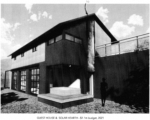
  • FIG. 6 is a photograph showing a heat exchange chamber (display window) situated above the windows of a brick building.
  • FIG. 7 is a photograph showing a heat exchange chamber (display window) situated between the windows of a brick building.
  • FIG. 8 is a photograph showing a heat exchange chamber (display window) with fern fern-shaped fractal design.
  • FIG. 9 is a photograph showing a section of a heat exchange chamber (display window) with the fern-shaped fractal design.
  • FIG. 10 is a photograph showing the construction of a wooden component of an air plenum, aluminum construction material in the background.
  • FIG. 11 is a photograph showing the construction of a wooden component of an air plenum, with the inventor in the background to show the scale of the air plenum.
  • FIG. 12 is a schematic illustration showing the SolarHearth system of the present invention installed in a house.
  • FIG. 13 is a top perspective view of an alternate version of the heat exchange chamber shown in FIG. 8 .
  • FIG. 14 is a top perspective view of another alternate version of the heat exchange chamber shown in FIG. 8 .
  • FIG. 15 is an industrial sketch showing the front view of the heat exchange chamber shown in FIG. 1 and FIG. 8 .
  • FIG. 16 is an industrial sketch showing the side view of the heat exchange chamber shown in FIG. 2 .
  • FIG. 17 is an industrial sketch showing a top view of the heat exchange chamber shown in FIG. 1 and FIG. 8 .
  • FIG. 18 is an industrial sketch showing an alternative top view of the heat exchange chamber shown in FIG. 1 and FIG. 8 .
  • the inventor has calculated that one SolarHearth passive solar heating system unit of approximately 8′ ⁇ 6′ ⁇ 24′′ in size provides an estimated financial savings during the cold winter months (e.g., those experienced in Rhode Island, USA) of ⁇ $50 per month ( ⁇ USD50/month in 2018 USD, or the equivalent in other currencies).
  • the SolarHearth passive solar heating system draws heat off of the building and upwards, creating an upward thermal cooling convection.
  • the SolarHearth system in addition to being beautiful, is useful for those of skill in the building construction art who want to construct or rehabilitate buildings to meet energy efficiency standards.
  • the Passivhaus standard is a rigorous, voluntary standard for energy efficiency that reduces a building's environmental footprint and results in ultra-low energy buildings that require little energy for space heating or cooling. See, “Definition of Passive House.” PassivHaustagung.de. See also, Gröndahl & Gates, “The Secrets of a Passive House.” The New York Times, (Sep. 25, 2010); and Zeller, Jr., “Beyond Fossil Fuels: Can We Build in a Brighter Shade of Green?”. The New York Times, p. BU1 (Sep.
  • MINERGIE-P MINERGIE-P
  • Minergie-Standard Minergie.ch. Passivhaus standards also exist in the United States. See, “PHIUS+2015: Passive Building Standard—North America”.www.phius.org.
  • Duct is a tube, channel, or canal through which a gas (such as cold or heated air) or liquid moves.
  • Heat transfer relationship means that the heat storage element is placed in sufficient thermal contact to an element with which it is in such a relationship to transfer heat to that element.
  • the heat may be transferred to the element by any suitable means, such as by convection, conduction or forced heat transfer, e.g., fans moving heated air throughout the building.
  • “Plenum” or “air plenum” has the definition known to those in the building construction arts, being a separate space providing pathways for airflows for heating, ventilation, and air-conditioning (collectively “HVAC”). See, Thomas, “What is plenum?” TechTarget (Sep. 21, 2005).
  • the SolarHearth system includes a sculpture whose form follows the function and principals of thermosyphon in that it uses a method of passive heat exchange based on natural convection found in the science of passive solar heating and thermal chimneys. Various embodiments of the SolarHearth system are described below.
  • the SolarHearth system includes a work of art (e.g., a sculpture) that can be mounted, e.g., on the south side exterior wall of a building, to bring warmed air into the building.
  • the SolarHearth system comprises (a) an air plenum, with ducts for the flow of air from an intake vent, up and into a heat exchange chamber, and then up and out an exhaust vent, and (b) a heat exchange chamber.
  • the heat exchange chamber includes a display window, and the display window includes a work of art (e.g., a sculpture) contained inside an insulated framework (e.g., of wood glazed with Plexiglass).
  • an exemplary embodiment of the SolarHearth system 10 includes a heat exchange chamber and display window 12 having a passive solar work of art (e.g., a sculpture) that is installed within the inside and outside of an exterior wall of a building.
  • the sculpture is made of one or more aluminum materials.
  • the aluminum sculpture is made of aluminum repoussé sheet metal, aluminum screen and aluminum hollow tubing installed behind a transparent glazed surface. Thin-gauged aluminum is used because it transfers heat, rather than holding it, allowing the air to be quickly heated by the metal and moved through the heat chamber.
  • the passive solar sculpture is not shown in FIG. 1 or 2 , but is shown in other figures, as discussed below.
  • the aluminum sculpture is designed to create a passive solar environment that creates a natural vacuum that allows cool air to be sucked into the lower section of the solar heater where it immediately starts to warm. The hot air rises and such air continues to be heated until the top is reached, where it travels back into the building's interior space (i.e., one or more rooms). This natural cycle allows the air to circulate and transfers the solar heated air into the building's interior space.
  • the SolarHearth system 10 further includes an air plenum 14 that can be incorporated into the exterior wall of the building (see FIGS. 1 , 2 , 10 and 11 ).
  • the plenum 14 includes a front surface 14 a and an opposite, rear surface 14 b, ducts 15 , an exhaust vent 16 , side intake vents 18 a, 18 b in communication with the ducts 15 , and a central intake vent 20 that is also in communication with the ducts 15 and is configured to direct air into the heat exchange chamber and display window 12 and out of the exhaust vent 16 (see FIGS. 3 - 5 ).
  • the SolarHearth system 10 constitutes a “double trap”, wherein the plenum 14 allows cool air to enter from an interior room/space (i.e., of a house or other building space) via its side intake vents 18 a, 18 b, where it passes upwards through the ducts 15 and the central intake vent 20 and into the heat exchange chamber and display window 12 and its exterior aluminum sculpture (represented by arrows C). Hot air then travels back through the heat exchange chamber and display window 12 and sculpture (represented by arrows H), through the exhaust vent 1 $ at the top of the plenum 14 , and re-enters the interior room as added heat.
  • the plenum 14 is located directly behind the solar sculpture/heat exchange chamber and display window 12 and is, therefore, the back/rear component of the SolarHearth system 10 .
  • the SolarHearth system 10 generates heat when the sun is striking the exterior glazed aluminum of the aluminum sculpture.
  • the plenum 12 that is incorporated into the exterior building wall stops the flow of cold air into the room, In the summer, when the temperature outside is hot, the plenum 12 will not allow hot air to enter.
  • the SolarHearth system 10 can vary in size. In various embodiments, the SolarHearth system 10 can have sizes ranging from 2′ ⁇ 2′ to the size of any existing building's wall.
  • the SolarHearth system 10 is advantageously incorporated into a wall of a building that faces south or southwest (see FIGS. 6 and 7 ).
  • FIG. 6 shows the heat exchange chamber (display window) 12 situated above the windows W of a brick building.
  • FIG. 7 shows the heat exchange chamber (display window) 12 situated between the windows W of a brick building.
  • the air can enter the SolarHearth system 10 may be as cold as 5° F. and increase to as much as 150° F. after having passed through the glazed aluminum sculpture and re-entering a room through the plenum.
  • the invention provides a method of making a passive solar heating system (i.e., the SolarHearth system) whereby those of skill in the building construction art can remove the work of art from the insulated box and replace with a new work of art (e.g., sculpture design).
  • a passive solar heating system i.e., the SolarHearth system
  • the invention provides a method of making a passive solar heating system whereby those of skill in the building construction arts construct the passive solar heating system (i.e., the SolarHearth system) from materials selected from the group consisting of aluminum sheet, aluminum screen, rivets, wire, eye hooks, wood, plexiglass, insulation (including thermal cork insulation (i.e., black insulation), which is formaldehyde-free charcoal-burnt brown cork) and high-heat metal dye colors.
  • the aluminum sheet has a thickness of about 0.02 mm.
  • Alcohol Metal Dyes are commercially available, e.g., from STEELF/X (Utah, USA).
  • Thermal cork insulation i.e., black insulation
  • K-Flex Youngsville, N.C., USA
  • formaldehyde-fee/non-toxic is commercially available, e.g., from K-Flex (Youngsville, N.C., USA) and formaldehyde-fee/non-toxic.
  • the passive solar heating system comprises one or more fans.
  • a quiet, low turbulence fan is commercially from AC Infinity CLOUDLINE T6, Quiet 6′′ Inline Duct Fan with Temperature Humidity Controller-Ventilation Exhaust Fan for Heating Cooling Booster.
  • the invention provides a method of making a passive solar heating system whereby those of skill in the building construction arts construct the passive solar heating system from materials selected from the group consisting of black powder-coated aluminum frame, 3′′ ⁇ 10′′ powdered aluminum, and curving polycarbon.
  • the invention provides a method of making a passive solar heating system (i.e., the SolarHearth system) whereby those of skill in the construction arts can use metal dyes in deep purple, greens, and blues to obtain maximum beauty in the aluminum artwork.
  • a passive solar heating system i.e., the SolarHearth system
  • metal dyes are applied, brushed onto repousse aluminum interior imagery.
  • the translucent quality of the metal dyes also allows for the beauty of the silver color of the repousse aluminum metal to be seen, and the artworks surface detail highlighted.
  • the invention provides a method of making a passive solar heating system (i.e., the SolarHearth system), whereby those of skill in the building construction art use thermal cork insulation when constructing such a system.
  • a passive solar heating system i.e., the SolarHearth system
  • thermal cork insulation when constructing such a system.
  • Formaldehyde-free charcoal burnt cork is used for insulation, as it is sustainable, renewable and non-toxic.
  • the charcoal burnt cork insulation is fastened using aluminum spikes, thereby eliminating the use of glue or any other adhesives.
  • the inventor has further discovered that glues, adhesives, solders, or other similar materials obstruct the transfer of heat gain released from the aluminum imagery in addition to being broken down by the sunlight. Accordingly, in a seventh embodiment, the work of art in the heat exchange chamber is completely aluminum and fastened together by a riveting method. All of the aluminum sculptural imagery is fastened together by aluminum rivets. By using aluminum rivets, surface area for solar capture is added, keeping the flow of warmed/heated air uninterrupted.
  • the invention provides a method of making whereby those of skill in the building construction arts can build the passive solar heating system (i.e., the SolarHearth system) in different formats to complement the building to which the system is attached (e.g., square, rectangular, triangle, or oval).
  • the passive solar heating system i.e., the SolarHearth system
  • the steps of the method depend on the shapes of the format, oval, square, rectangle, etc. There must be an intake at the bottom drawing air from inside an interior up through the heat chamber and an intake at the top, drawing heated air back into an interior room. In the format were horizontal rather than vertical it would require several intakes at the bottom and top to draw air through it across a horizontal design.
  • aluminum is formed (through the use of biomimicry) in fern-shaped designs and used as a framework.
  • ferns have an ancient fractal design for solar capture. See, Thekkekara & Gu, “Bioinspired fractal electrodes for solar energy storages.” Sci. Rep. 7, 45585; doi: 10.1038/srep45585 (2017).
  • other artistic imagery is added to the overall design. See FIG. 8 , FIG. 9 and FIG. 13 .
  • an aluminum screen is hung for solar capture in between the layers of the repousse sheet metal artwork.
  • the overall design and use of aluminum rivets for all attachments assure solar capture and thermal heat gain as the colder air moves from bottom to the top of the sculpture.
  • the inventor has taken readings on sunny days, about once a week, to record the temperature outside in the environment and the temperature inside the SolarHearth system. On one day in February 2019 in Rhode Island, USA, for example, the temperature outside in the early afternoon was 28° F., while inside the SolarHearth system the temperature was 127° F.
  • FIGS. 12 - 18 show alternate embodiments of the SolarHearth system that includes a heat exchange chamber and display window 12 having a passive solar sculpture that inhabits the inside and outside of an exterior wall of a building, but do not include a plenum.
  • air coming into the system is moved by one or more fans and pipe vents.
  • the SolarHearth system draws cooler air from an interior space through a bottom vent. Air is drawn vertically, heated in the passive solar heat chamber, and drawn back inside, whereupon an adjoining room/space is heated by the passive solar energy.
  • the thermal cork insulation insulates for optimum heat
  • the aluminum repousse imagery absorbs trapped heat and transfers
  • the Plexiglass i.e., of the insulated framework
  • the metal dyes darken the aluminum imagery for increased heat absorption and heat transfer from the metal back into the air that is then drawn through the heated-up metal plenum/back into the room.
  • One or more fans may alternatively be used to draw the air.

Landscapes

  • Engineering & Computer Science (AREA)
  • Physics & Mathematics (AREA)
  • Thermal Sciences (AREA)
  • Chemical & Material Sciences (AREA)
  • Combustion & Propulsion (AREA)
  • Mechanical Engineering (AREA)
  • General Engineering & Computer Science (AREA)
  • Life Sciences & Earth Sciences (AREA)
  • Sustainable Development (AREA)
  • Sustainable Energy (AREA)
  • Building Environments (AREA)

Abstract

The invention provides a SolarHearth, a passive solar heating system that includes a work of art that can be mounted on a building, to bring warmed air into the building. The system includes a heat exchange chamber having a display window that contains the work of art, and is is configured to create a passive solar environment to create a natural vacuum. The system further includes means for moving air through the heat exchange chamber, such as an air plenum or fans.

Description

CROSS REFERENCE TO RELATED APPLICATION
This application claims benefit from U.S. Provisional Patent Application Ser. No. 63/049,283 filed Jul. 8, 2021 which is incorporated by reference in its entirety.
FIELD OF THE INVENTION
This invention generally relates to systems for collecting solar energy, and more particularly, to passive solar heating systems.
BACKGROUND OF THE INVENTION
In passive solar building design, windows, walls, and floors are made to collect, store, reflect, and distribute solar energy in the form of heat in the winter and disperse solar heat in the summer. This invention is a passive solar design because, unlike active solar heating systems, it does not involve the use of mechanical and electrical devices. Doerr, Passive Solar Simplified, 1st ed. (CreateSpace Independent Publishing Platform 2012). The scientific basis for passive solar building design has developed from a combination of climatology, thermodynamics, fluid mechanics/natural convection, and human thermal comfort. The advantages of passive solar building design are well-recognized by those of skill in the building construction art. See, Bill McKibben, founder of 350.org, “Why wouldn't you want a passive solar house?” (review of Doerr, Passive Solar Simplified). See also, Janine Benyus, co-founder, The Biomimicry Institute, Biomimicry.org, “When we look at what is truly sustainable, the only real model that has worked over long periods of time is the natural world.” See further, U.S. Department of Energy (DOE) Oak Ridge National Laboratory (ORNL) Buildings Technology, “Three Decades Of Passive Solar Heating and Cooling Lessons Learned.” Thermal Performance of the Exterior Envelopes of Whole Buildings Tenth International Conference (2007).
To further advance the concept of passive solar building design, there should be an incorporation of both logic and beauty in passive solar architecture. Wright & Andrejko, Passive solar architecture: logic and beauty (Van Nostrand Reinhold Company, 1982). A beautiful passive solar building design that is small enough passively heat and cool a relatively smaller living space will encourage consumers of limited means to adopt passive solar heating. Accordingly, there is a continuing need in the building construction art for a beautiful passive solar heating system.
SUMMARY OF THE INVENTION
The invention provides a SolarHearth, a passive solar heating system (“the SolarHearth system”) that has both ornamental and useful features.
According to one embodiment of the invention, a passive solar heating system comprises a heat exchange chamber having a display window and including an insulated framework, a work of art contained inside the insulated framework, and elements for the collection of solar heat. The system also includes an air plenum operably connected to the heat exchange chamber, the air plenum including at least one intake vent, an exhaust vent, and at least one duct connecting the at least one intake vent to the heat exchange chamber, the at least one duct configured to conduct air flow from the at least one intake vent to the heat exchange chamber.
According to another embodiment of the invention, a passive solar heating system comprises a heat exchange chamber having a display window and including an insulated framework, a work of art contained inside the insulated framework and being configured to create a passive solar environment that creates a natural vacuum; and means for moving air through the heat exchange chamber.
According to yet another embodiment of the invention, a passive solar heating system comprises a heat exchange chamber having a display window and including: an insulated framework and an aluminum sculpture contained inside the insulated framework; and an air plenum operably connected to the heat exchange chamber. The air plenum includes at least one intake vent, an exhaust vent, and at least one duct connecting the at least one intake vent to the heat exchange chamber, the at least one duct configured to conduct air flow from the at least one intake vent to the heat exchange chamber.
These and other features, aspects, and advantages of the present invention will become better understood with reference to the following description, appended claims, and accompanying drawings.
BRIEF DESCRIPTION OF THE DRAWINGS
To further clarify the above and other advantages and features of the present invention, a more particular description of the invention will be rendered by reference to specific embodiments thereof which are illustrated in the appended drawings. It is appreciated that these drawings depict only typical embodiments of the invention and are therefore not to be considered limiting of its scope. Further, the features of the drawings are not shown to scale.
FIG. 1 is a conceptual illustration showing the front view of the SolarHearth system of the present invention, including the heat exchange chamber (display window). The grey color shows the air plenum.
FIG. 2 is a conceptual illustration showing the side view of the SolarHearth system of the present invention, including the heat exchange chamber (display window). The grey color shows the air plenum.
FIG. 3 is a conceptual illustration showing the rear view of the SolarHearth system of the present invention, including the exhaust vent and two intake vents. The grey color shows the air plenum.
FIG. 4 is a conceptual illustration showing the air flow in the SolarHearth system of the present invention. FIG. 4 is a rear view of air plenum, showing the flow of air from the intake vent, up and into the heat exchange chamber, and then up and out the exhaust vent. The grey color shows the air plenum.
FIG. 5 is a conceptual illustration showing the air flow in the SolarHearth system of the present invention. FIG. 5 is a rear view of air plenum, showing the flow of air from the intake vent, up and into the heat exchange chamber, and then up and out the exhaust vent. The grey color shows the air plenum.
FIG. 6 is a photograph showing a heat exchange chamber (display window) situated above the windows of a brick building.
FIG. 7 is a photograph showing a heat exchange chamber (display window) situated between the windows of a brick building.
FIG. 8 is a photograph showing a heat exchange chamber (display window) with fern fern-shaped fractal design.
FIG. 9 is a photograph showing a section of a heat exchange chamber (display window) with the fern-shaped fractal design.
FIG. 10 is a photograph showing the construction of a wooden component of an air plenum, aluminum construction material in the background.
FIG. 11 is a photograph showing the construction of a wooden component of an air plenum, with the inventor in the background to show the scale of the air plenum.
FIG. 12 is a schematic illustration showing the SolarHearth system of the present invention installed in a house.
FIG. 13 is a top perspective view of an alternate version of the heat exchange chamber shown in FIG. 8 .
FIG. 14 is a top perspective view of another alternate version of the heat exchange chamber shown in FIG. 8 .
FIG. 15 is an industrial sketch showing the front view of the heat exchange chamber shown in FIG. 1 and FIG. 8 .
FIG. 16 is an industrial sketch showing the side view of the heat exchange chamber shown in FIG. 2 .
FIG. 17 is an industrial sketch showing a top view of the heat exchange chamber shown in FIG. 1 and FIG. 8 .
FIG. 18 is an industrial sketch showing an alternative top view of the heat exchange chamber shown in FIG. 1 and FIG. 8 .
INDUSTRIAL APPLICABILITY
The inventor has calculated that one SolarHearth passive solar heating system unit of approximately 8′×6′×24″ in size provides an estimated financial savings during the cold winter months (e.g., those experienced in Rhode Island, USA) of ˜$50 per month (˜USD50/month in 2018 USD, or the equivalent in other currencies). During the summer months (e.g., those experienced in Rhode Island, USA), the SolarHearth passive solar heating system draws heat off of the building and upwards, creating an upward thermal cooling convection.
The SolarHearth system, in addition to being beautiful, is useful for those of skill in the building construction art who want to construct or rehabilitate buildings to meet energy efficiency standards. The Passivhaus standard is a rigorous, voluntary standard for energy efficiency that reduces a building's environmental footprint and results in ultra-low energy buildings that require little energy for space heating or cooling. See, “Definition of Passive House.” PassivHaustagung.de. See also, Gröndahl & Gates, “The Secrets of a Passive House.” The New York Times, (Sep. 25, 2010); and Zeller, Jr., “Beyond Fossil Fuels: Can We Build in a Brighter Shade of Green?”. The New York Times, p. BU1 (Sep. 26, 2010). A similar standard, MINERGIE-P, is used in Switzerland. See, “Minergie-Standard.” Minergie.ch. Passivhaus standards also exist in the United States. See, “PHIUS+2015: Passive Building Standard—North America”.www.phius.org.
BEST MODE FOR CARRYING OUT THE INVENTION
Definitions
“About” has the lay definition meaning approximately the value as stated, encompassing measurement errors that would be made by a lay person.
“Duct” is a tube, channel, or canal through which a gas (such as cold or heated air) or liquid moves.
“Heat transfer relationship” means that the heat storage element is placed in sufficient thermal contact to an element with which it is in such a relationship to transfer heat to that element. The heat may be transferred to the element by any suitable means, such as by convection, conduction or forced heat transfer, e.g., fans moving heated air throughout the building.
“Plenum” or “air plenum” has the definition known to those in the building construction arts, being a separate space providing pathways for airflows for heating, ventilation, and air-conditioning (collectively “HVAC”). See, Thomas, “What is plenum?” TechTarget (Sep. 21, 2005).
Detailed Description of the Preferred Embodiments
The SolarHearth system includes a sculpture whose form follows the function and principals of thermosyphon in that it uses a method of passive heat exchange based on natural convection found in the science of passive solar heating and thermal chimneys. Various embodiments of the SolarHearth system are described below.
In a first embodiment, the SolarHearth system includes a work of art (e.g., a sculpture) that can be mounted, e.g., on the south side exterior wall of a building, to bring warmed air into the building. The SolarHearth system comprises (a) an air plenum, with ducts for the flow of air from an intake vent, up and into a heat exchange chamber, and then up and out an exhaust vent, and (b) a heat exchange chamber. The heat exchange chamber includes a display window, and the display window includes a work of art (e.g., a sculpture) contained inside an insulated framework (e.g., of wood glazed with Plexiglass).
Referring now to FIGS. 1 and 2 , an exemplary embodiment of the SolarHearth system 10 includes a heat exchange chamber and display window 12 having a passive solar work of art (e.g., a sculpture) that is installed within the inside and outside of an exterior wall of a building. In various embodiments, the sculpture is made of one or more aluminum materials. In one embodiment, the aluminum sculpture is made of aluminum repoussé sheet metal, aluminum screen and aluminum hollow tubing installed behind a transparent glazed surface. Thin-gauged aluminum is used because it transfers heat, rather than holding it, allowing the air to be quickly heated by the metal and moved through the heat chamber. For the sake of clarity, the passive solar sculpture is not shown in FIG. 1 or 2 , but is shown in other figures, as discussed below.
The aluminum sculpture is designed to create a passive solar environment that creates a natural vacuum that allows cool air to be sucked into the lower section of the solar heater where it immediately starts to warm. The hot air rises and such air continues to be heated until the top is reached, where it travels back into the building's interior space (i.e., one or more rooms). This natural cycle allows the air to circulate and transfers the solar heated air into the building's interior space.
The SolarHearth system 10 further includes an air plenum 14 that can be incorporated into the exterior wall of the building (see FIGS. 1, 2, 10 and 11 ). The plenum 14 includes a front surface 14 a and an opposite, rear surface 14 b, ducts 15, an exhaust vent 16, side intake vents 18 a, 18 b in communication with the ducts 15, and a central intake vent 20 that is also in communication with the ducts 15 and is configured to direct air into the heat exchange chamber and display window 12 and out of the exhaust vent 16 (see FIGS. 3-5 ).
Referring now to FIGS. 4 and 5 , the SolarHearth system 10 constitutes a “double trap”, wherein the plenum 14 allows cool air to enter from an interior room/space (i.e., of a house or other building space) via its side intake vents 18 a, 18 b, where it passes upwards through the ducts 15 and the central intake vent 20 and into the heat exchange chamber and display window 12 and its exterior aluminum sculpture (represented by arrows C). Hot air then travels back through the heat exchange chamber and display window 12 and sculpture (represented by arrows H), through the exhaust vent 1$ at the top of the plenum 14, and re-enters the interior room as added heat. The plenum 14 is located directly behind the solar sculpture/heat exchange chamber and display window 12 and is, therefore, the back/rear component of the SolarHearth system 10.
The SolarHearth system 10 generates heat when the sun is striking the exterior glazed aluminum of the aluminum sculpture. When the sun goes down, and the outside temperature starts to drop, the plenum 12 that is incorporated into the exterior building wall stops the flow of cold air into the room, In the summer, when the temperature outside is hot, the plenum 12 will not allow hot air to enter.
At cooler temperatures (i.e., during the night), cool air accumulates in the trap formed by the plenum 14, and warm air in the plenum 14 rises to the top of the trap formed by the plenum 14, thereby preventing a reverse flow.
The SolarHearth system 10 can vary in size. In various embodiments, the SolarHearth system 10 can have sizes ranging from 2′×2′ to the size of any existing building's wall. The SolarHearth system 10 is advantageously incorporated into a wall of a building that faces south or southwest (see FIGS. 6 and 7 ). FIG. 6 shows the heat exchange chamber (display window) 12 situated above the windows W of a brick building. FIG. 7 shows the heat exchange chamber (display window) 12 situated between the windows W of a brick building.
The air can enter the SolarHearth system 10 may be as cold as 5° F. and increase to as much as 150° F. after having passed through the glazed aluminum sculpture and re-entering a room through the plenum.
In a second embodiment, the invention provides a method of making a passive solar heating system (i.e., the SolarHearth system) whereby those of skill in the building construction art can remove the work of art from the insulated box and replace with a new work of art (e.g., sculpture design).
In a third embodiment, the invention provides a method of making a passive solar heating system whereby those of skill in the building construction arts construct the passive solar heating system (i.e., the SolarHearth system) from materials selected from the group consisting of aluminum sheet, aluminum screen, rivets, wire, eye hooks, wood, plexiglass, insulation (including thermal cork insulation (i.e., black insulation), which is formaldehyde-free charcoal-burnt brown cork) and high-heat metal dye colors. In one exemplary embodiment, the aluminum sheet has a thickness of about 0.02 mm.
Alcohol Metal Dyes are commercially available, e.g., from STEELF/X (Utah, USA). Thermal cork insulation (i.e., black insulation) is commercially available, e.g., from K-Flex (Youngsville, N.C., USA) and formaldehyde-fee/non-toxic.
In a fourth embodiment, the passive solar heating system comprises one or more fans. As a non-limiting example, a quiet, low turbulence fan is commercially from AC Infinity CLOUDLINE T6, Quiet 6″ Inline Duct Fan with Temperature Humidity Controller-Ventilation Exhaust Fan for Heating Cooling Booster.
Other commercially available materials that those of skill in the building construction arts can advantageously use to construct the passive solar heating system. In one embodiment, the invention provides a method of making a passive solar heating system whereby those of skill in the building construction arts construct the passive solar heating system from materials selected from the group consisting of black powder-coated aluminum frame, 3″×10″ powdered aluminum, and curving polycarbon.
The inventor has discovered that not all of the aluminum sculptural artwork needs to be painted black for optimum heat absorption and transfer of heat gain. Accordingly, in a fifth embodiment, the invention provides a method of making a passive solar heating system (i.e., the SolarHearth system) whereby those of skill in the construction arts can use metal dyes in deep purple, greens, and blues to obtain maximum beauty in the aluminum artwork. In this method, metal dyes are applied, brushed onto repousse aluminum interior imagery. The translucent quality of the metal dyes also allows for the beauty of the silver color of the repousse aluminum metal to be seen, and the artworks surface detail highlighted.
The inventor has also discovered that the use of thermal cork insulation for heat absorption, instead of painting the surface black for heat absorption, advantageously eliminates the generation of odor or fumes when the air in the SolarHearth system is heated during the operation thereof. Accordingly, in a sixth embodiment, the invention provides a method of making a passive solar heating system (i.e., the SolarHearth system), whereby those of skill in the building construction art use thermal cork insulation when constructing such a system. Formaldehyde-free charcoal burnt cork is used for insulation, as it is sustainable, renewable and non-toxic. The charcoal burnt cork insulation is fastened using aluminum spikes, thereby eliminating the use of glue or any other adhesives.
The inventor has further discovered that glues, adhesives, solders, or other similar materials obstruct the transfer of heat gain released from the aluminum imagery in addition to being broken down by the sunlight. Accordingly, in a seventh embodiment, the work of art in the heat exchange chamber is completely aluminum and fastened together by a riveting method. All of the aluminum sculptural imagery is fastened together by aluminum rivets. By using aluminum rivets, surface area for solar capture is added, keeping the flow of warmed/heated air uninterrupted.
In an eighth embodiment, the invention provides a method of making whereby those of skill in the building construction arts can build the passive solar heating system (i.e., the SolarHearth system) in different formats to complement the building to which the system is attached (e.g., square, rectangular, triangle, or oval).
The steps of the method depend on the shapes of the format, oval, square, rectangle, etc. There must be an intake at the bottom drawing air from inside an interior up through the heat chamber and an intake at the top, drawing heated air back into an interior room. In the format were horizontal rather than vertical it would require several intakes at the bottom and top to draw air through it across a horizontal design.
In a ninth embodiment, aluminum is formed (through the use of biomimicry) in fern-shaped designs and used as a framework. Those of skill in the building construction arts can form the aluminum according to such designs. Ferns have an ancient fractal design for solar capture. See, Thekkekara & Gu, “Bioinspired fractal electrodes for solar energy storages.” Sci. Rep. 7, 45585; doi: 10.1038/srep45585 (2017). Upon this framework, other artistic imagery is added to the overall design. See FIG. 8 , FIG. 9 and FIG. 13 .
In a tenth embodiment, an aluminum screen is hung for solar capture in between the layers of the repousse sheet metal artwork. The overall design and use of aluminum rivets for all attachments assure solar capture and thermal heat gain as the colder air moves from bottom to the top of the sculpture.
Data. The inventor has taken readings on sunny days, about once a week, to record the temperature outside in the environment and the temperature inside the SolarHearth system. On one day in February 2019 in Rhode Island, USA, for example, the temperature outside in the early afternoon was 28° F., while inside the SolarHearth system the temperature was 127° F.
OTHER EMBODIMENTS
FIGS. 12-18 show alternate embodiments of the SolarHearth system that includes a heat exchange chamber and display window 12 having a passive solar sculpture that inhabits the inside and outside of an exterior wall of a building, but do not include a plenum. In such alternate embodiments, air coming into the system is moved by one or more fans and pipe vents. The SolarHearth system draws cooler air from an interior space through a bottom vent. Air is drawn vertically, heated in the passive solar heat chamber, and drawn back inside, whereupon an adjoining room/space is heated by the passive solar energy.
In various embodiments, the thermal cork insulation insulates for optimum heat, the aluminum repousse imagery absorbs trapped heat and transfers, and the Plexiglass (i.e., of the insulated framework) traps the heat. The metal dyes darken the aluminum imagery for increased heat absorption and heat transfer from the metal back into the air that is then drawn through the heated-up metal plenum/back into the room. One or more fans may alternatively be used to draw the air.
The contents of all references cited herein are incorporated by reference in their entireties. In case of conflict, this application, including any definitions herein, will control.
Having thus described in detail preferred embodiments of the present invention, other embodiments will be evident to those of ordinary skill in the art. The foregoing detailed description is illustrative and not restrictive. The spirit and scope of the present invention are not limited to the above examples but are encompassed by the following claims.
Claims (20)

I claim:
1. A passive solar heating system, comprising:
a heat exchange chamber having a display window and including:
an insulated framework,
a work of art contained inside the insulated framework, and
elements for the collection of solar heat; and
an air plenum operably connected to the heat exchange chamber, the air plenum including:
at least one intake vent,
an exhaust vent, and
at least one duct connecting the at least one intake vent to the heat exchange chamber, the at least one duct configured to conduct air flow from the at least one intake vent to the heat exchange chamber.
2. The passive solar heating system of claim 1, wherein the air plenum is disposed directly behind the display window.
3. The passive solar heating system of claim 1, wherein the work of art is removable.
4. The passive solar heating system of claim 1, wherein the work of art is a sculpture.
5. The passive solar heating system of claim 1, wherein the work of art is constructed of aluminum.
6. The passive solar heating system of claim 5, wherein the aluminum is colored with metal dyes.
7. The passive solar heating system of claim 1, wherein the system has a shape selected from the group consisting of square, rectangular, triangle, and oval.
8. The passive solar heating system of claim 1, wherein the elements for the collection of solar heat are fern-shaped.
9. The passive solar heating system of claim 1, wherein the insulated framework is insulated with charcoal burnt cork insulation.
10. A passive solar heating system comprising:
a heat exchange chamber having a display window and including:
an insulated framework,
a work of art contained inside the insulated framework and being configured to create a passive solar environment that creates a natural vacuum; and
means for moving air through the heat exchange chamber.
11. The passive solar heating system of claim 10, wherein the air-moving means includes an air plenum operably connected to the heat exchange chamber.
12. The passive solar heating system of claim 11, wherein the air plenum includes:
at least one intake vent,
an exhaust vent, and
at least one duct connecting the at least one intake vent to the heat exchange chamber, the at least one duct configured to conduct air flow from the at least one intake vent to the heat exchange chamber.
13. The passive solar heating system of claim 11, wherein the air plenum is disposed directly behind the display window.
14. The passive solar heating system of claim 10, wherein the air-moving means includes at least one fan.
15. The passive solar heating system of claim 10, wherein the work of art is removable.
16. The passive solar heating system of claim 10, wherein the work of art is a sculpture.
17. The passive solar heating system of claim 10, wherein the work of art is constructed of aluminum.
18. The passive solar heating system of claim 17, wherein the aluminum sculpture incorporates aluminum rivets, whereby air flow through the aluminum sculpture is uninterrupted.
19. A passive solar heating system, comprising:
a heat exchange chamber having a display window and including:
an insulated framework, and
an aluminum sculpture contained inside the insulated framework; and
an air plenum operably connected to the heat exchange chamber, the air plenum including:
at least one intake vent,
an exhaust vent, and
at least one duct connecting the at least one intake vent to the heat exchange chamber, the at least one duct configured to conduct air flow from the at least one intake vent to the heat exchange chamber.
20. The passive solar heating system of claim 19, wherein the aluminum sculpture incorporates aluminum rivets, whereby air flow through the aluminum sculpture is uninterrupted.
US17/369,668 2020-07-08 2021-07-07 Solarhearth passive solar heating system Active 2042-01-13 US11732926B2 (en)

Priority Applications (1)

Application Number Priority Date Filing Date Title
US17/369,668 US11732926B2 (en) 2020-07-08 2021-07-07 Solarhearth passive solar heating system

Applications Claiming Priority (2)

Application Number Priority Date Filing Date Title
US202063049283P 2020-07-08 2020-07-08
US17/369,668 US11732926B2 (en) 2020-07-08 2021-07-07 Solarhearth passive solar heating system

Publications (2)

Publication Number Publication Date
US20220011015A1 US20220011015A1 (en) 2022-01-13
US11732926B2 true US11732926B2 (en) 2023-08-22

Family

ID=79172328

Family Applications (1)

Application Number Title Priority Date Filing Date
US17/369,668 Active 2042-01-13 US11732926B2 (en) 2020-07-08 2021-07-07 Solarhearth passive solar heating system

Country Status (1)

Country Link
US (1) US11732926B2 (en)

Citations (1)

* Cited by examiner, † Cited by third party
Publication number Priority date Publication date Assignee Title
KR102227997B1 (en) * 2019-06-10 2021-03-15 이만숙 Hybrid heating system and control method fused with heat pump system and solar light by solar and air heat

Patent Citations (1)

* Cited by examiner, † Cited by third party
Publication number Priority date Publication date Assignee Title
KR102227997B1 (en) * 2019-06-10 2021-03-15 이만숙 Hybrid heating system and control method fused with heat pump system and solar light by solar and air heat

Non-Patent Citations (1)

* Cited by examiner, † Cited by third party
Title
KR102227997B1 (Translation) (Year: 2021). *

Also Published As

Publication number Publication date
US20220011015A1 (en) 2022-01-13

Similar Documents

Publication Publication Date Title
Linn Kinetic architecture: design for active envelopes
Maerefat et al. Natural cooling of stand-alone houses using solar chimney and evaporative cooling cavity
Schittich Solar architecture: strategies, visions, concepts
US4128204A (en) Inhabitable enclosure and methods relating thereto
Saroglou et al. A study of different envelope scenarios towards low carbon high-rise buildings in the Mediterranean climate-can DSF be part of the solution?
Cuzminschi et al. Innovative thermo-solar air heater
CN106803735A (en) Shutter type photovoltaic thermal-arrest wall
US4197993A (en) Dwellings equipped with natural air conditioning installations
US4111359A (en) Dwellings equipped with natural airconditioning installations
Butera Glass architecture: is it sustainable
US11732926B2 (en) Solarhearth passive solar heating system
Medici The Trombe Wall during the 1970s: technological device or architectural space? Critical inquiry on the Trombe Wall in Europe and the role of architectural magazines
Emdadi et al. Evaporative passive cooling designs for buildings
Loonen Overview of 100 climate adaptive building shells
TWM330451U (en) Modulized solar air circulation conditioner
CN201850965U (en) Magnetic stripe type washable solar air-conditioning air exchanging window
Haase et al. Design considerations for double-skin facades in hot and humid climates
CN2523822Y (en) Cored-slab walls
JPH11201522A (en) Natural energy use and heat recovery type external light combined use air supply and exhaust system
CN204703462U (en) Building interior printing opacity air-exchanging structure
Kumar et al. Review on solar chimney in natural ventilation
CN211146804U (en) A solar roof ventilation device
CN218353561U (en) Warm-keeping and lighting building greenhouse structure
CN215106362U (en) Double-layer curtain wall for both winter and summer based on solar energy
JPS58214745A (en) solar heating equipment

Legal Events

Date Code Title Description
FEPP Fee payment procedure

Free format text: ENTITY STATUS SET TO UNDISCOUNTED (ORIGINAL EVENT CODE: BIG.); ENTITY STATUS OF PATENT OWNER: MICROENTITY

FEPP Fee payment procedure

Free format text: ENTITY STATUS SET TO SMALL (ORIGINAL EVENT CODE: SMAL); ENTITY STATUS OF PATENT OWNER: MICROENTITY

Free format text: ENTITY STATUS SET TO MICRO (ORIGINAL EVENT CODE: MICR); ENTITY STATUS OF PATENT OWNER: MICROENTITY

STPP Information on status: patent application and granting procedure in general

Free format text: DOCKETED NEW CASE - READY FOR EXAMINATION

STPP Information on status: patent application and granting procedure in general

Free format text: PUBLICATIONS -- ISSUE FEE PAYMENT VERIFIED

STCF Information on status: patent grant

Free format text: PATENTED CASE