US11725316B2 - Cloth, cloth product and method for producing the cloth product - Google Patents
Cloth, cloth product and method for producing the cloth product Download PDFInfo
- Publication number
- US11725316B2 US11725316B2 US16/547,830 US201916547830A US11725316B2 US 11725316 B2 US11725316 B2 US 11725316B2 US 201916547830 A US201916547830 A US 201916547830A US 11725316 B2 US11725316 B2 US 11725316B2
- Authority
- US
- United States
- Prior art keywords
- cloth
- thermally fusible
- melting point
- region
- fibers
- Prior art date
- Legal status (The legal status is an assumption and is not a legal conclusion. Google has not performed a legal analysis and makes no representation as to the accuracy of the status listed.)
- Active, expires
Links
- 239000004744 fabric Substances 0.000 title claims abstract description 186
- 238000004519 manufacturing process Methods 0.000 title claims description 10
- 239000000835 fiber Substances 0.000 claims abstract description 95
- 238000002844 melting Methods 0.000 claims abstract description 54
- 230000008018 melting Effects 0.000 claims abstract description 54
- 230000004927 fusion Effects 0.000 claims abstract description 28
- 229920000728 polyester Polymers 0.000 claims description 37
- 238000004043 dyeing Methods 0.000 claims description 18
- 238000010438 heat treatment Methods 0.000 claims description 15
- 238000001035 drying Methods 0.000 claims description 7
- 230000000877 morphologic effect Effects 0.000 claims description 2
- 238000000034 method Methods 0.000 abstract description 28
- 239000000047 product Substances 0.000 description 32
- 239000011162 core material Substances 0.000 description 17
- QQVIHTHCMHWDBS-UHFFFAOYSA-N isophthalic acid Chemical compound OC(=O)C1=CC=CC(C(O)=O)=C1 QQVIHTHCMHWDBS-UHFFFAOYSA-N 0.000 description 14
- 229920000139 polyethylene terephthalate Polymers 0.000 description 12
- 239000005020 polyethylene terephthalate Substances 0.000 description 12
- 239000000306 component Substances 0.000 description 9
- 239000008358 core component Substances 0.000 description 8
- 238000003825 pressing Methods 0.000 description 7
- 239000011347 resin Substances 0.000 description 6
- 229920005989 resin Polymers 0.000 description 6
- 239000003795 chemical substances by application Substances 0.000 description 4
- 238000009940 knitting Methods 0.000 description 4
- 239000000203 mixture Substances 0.000 description 4
- -1 polyethylene terephthalate Polymers 0.000 description 4
- 239000002759 woven fabric Substances 0.000 description 4
- 239000000986 disperse dye Substances 0.000 description 3
- 239000002270 dispersing agent Substances 0.000 description 3
- 230000000694 effects Effects 0.000 description 3
- 230000000873 masking effect Effects 0.000 description 3
- 239000000463 material Substances 0.000 description 3
- 239000002243 precursor Substances 0.000 description 3
- RTZKZFJDLAIYFH-UHFFFAOYSA-N Diethyl ether Chemical compound CCOCC RTZKZFJDLAIYFH-UHFFFAOYSA-N 0.000 description 2
- WSFSSNUMVMOOMR-UHFFFAOYSA-N Formaldehyde Chemical compound O=C WSFSSNUMVMOOMR-UHFFFAOYSA-N 0.000 description 2
- XEEYBQQBJWHFJM-UHFFFAOYSA-N Iron Chemical compound [Fe] XEEYBQQBJWHFJM-UHFFFAOYSA-N 0.000 description 2
- WNLRTRBMVRJNCN-UHFFFAOYSA-N adipic acid Chemical compound OC(=O)CCCCC(O)=O WNLRTRBMVRJNCN-UHFFFAOYSA-N 0.000 description 2
- 125000000129 anionic group Chemical group 0.000 description 2
- WERYXYBDKMZEQL-UHFFFAOYSA-N butane-1,4-diol Chemical compound OCCCCO WERYXYBDKMZEQL-UHFFFAOYSA-N 0.000 description 2
- 238000005520 cutting process Methods 0.000 description 2
- 238000010586 diagram Methods 0.000 description 2
- 239000000975 dye Substances 0.000 description 2
- 238000009998 heat setting Methods 0.000 description 2
- 238000002074 melt spinning Methods 0.000 description 2
- 238000012986 modification Methods 0.000 description 2
- 230000004048 modification Effects 0.000 description 2
- 238000000465 moulding Methods 0.000 description 2
- 239000004745 nonwoven fabric Substances 0.000 description 2
- 238000009958 sewing Methods 0.000 description 2
- 239000004753 textile Substances 0.000 description 2
- 238000005406 washing Methods 0.000 description 2
- VGGSQFUCUMXWEO-UHFFFAOYSA-N Ethene Chemical compound C=C VGGSQFUCUMXWEO-UHFFFAOYSA-N 0.000 description 1
- 239000005977 Ethylene Substances 0.000 description 1
- DGAQECJNVWCQMB-PUAWFVPOSA-M Ilexoside XXIX Chemical compound C[C@@H]1CC[C@@]2(CC[C@@]3(C(=CC[C@H]4[C@]3(CC[C@@H]5[C@@]4(CC[C@@H](C5(C)C)OS(=O)(=O)[O-])C)C)[C@@H]2[C@]1(C)O)C)C(=O)O[C@H]6[C@@H]([C@H]([C@@H]([C@H](O6)CO)O)O)O.[Na+] DGAQECJNVWCQMB-PUAWFVPOSA-M 0.000 description 1
- 239000000654 additive Substances 0.000 description 1
- 230000000996 additive effect Effects 0.000 description 1
- 235000011037 adipic acid Nutrition 0.000 description 1
- 239000001361 adipic acid Substances 0.000 description 1
- 239000001000 anthraquinone dye Substances 0.000 description 1
- 125000003118 aryl group Chemical group 0.000 description 1
- 239000000987 azo dye Substances 0.000 description 1
- 239000002131 composite material Substances 0.000 description 1
- 239000007859 condensation product Substances 0.000 description 1
- 238000011109 contamination Methods 0.000 description 1
- 230000014509 gene expression Effects 0.000 description 1
- 230000001771 impaired effect Effects 0.000 description 1
- 229910052742 iron Inorganic materials 0.000 description 1
- 239000007788 liquid Substances 0.000 description 1
- 238000002156 mixing Methods 0.000 description 1
- 229920001778 nylon Polymers 0.000 description 1
- 239000003002 pH adjusting agent Substances 0.000 description 1
- 238000002360 preparation method Methods 0.000 description 1
- 229910052708 sodium Inorganic materials 0.000 description 1
- 239000011734 sodium Substances 0.000 description 1
- 238000009987 spinning Methods 0.000 description 1
- 239000000126 substance Substances 0.000 description 1
- BDHFUVZGWQCTTF-UHFFFAOYSA-M sulfonate Chemical compound [O-]S(=O)=O BDHFUVZGWQCTTF-UHFFFAOYSA-M 0.000 description 1
- QAOWNCQODCNURD-UHFFFAOYSA-N sulfuric acid Substances OS(O)(=O)=O QAOWNCQODCNURD-UHFFFAOYSA-N 0.000 description 1
- 239000004094 surface-active agent Substances 0.000 description 1
- XLYOFNOQVPJJNP-UHFFFAOYSA-N water Substances O XLYOFNOQVPJJNP-UHFFFAOYSA-N 0.000 description 1
- 238000003466 welding Methods 0.000 description 1
Images




Classifications
-
- D—TEXTILES; PAPER
- D04—BRAIDING; LACE-MAKING; KNITTING; TRIMMINGS; NON-WOVEN FABRICS
- D04H—MAKING TEXTILE FABRICS, e.g. FROM FIBRES OR FILAMENTARY MATERIAL; FABRICS MADE BY SUCH PROCESSES OR APPARATUS, e.g. FELTS, NON-WOVEN FABRICS; COTTON-WOOL; WADDING ; NON-WOVEN FABRICS FROM STAPLE FIBRES, FILAMENTS OR YARNS, BONDED WITH AT LEAST ONE WEB-LIKE MATERIAL DURING THEIR CONSOLIDATION
- D04H1/00—Non-woven fabrics formed wholly or mainly of staple fibres or like relatively short fibres
- D04H1/40—Non-woven fabrics formed wholly or mainly of staple fibres or like relatively short fibres from fleeces or layers composed of fibres without existing or potential cohesive properties
- D04H1/54—Non-woven fabrics formed wholly or mainly of staple fibres or like relatively short fibres from fleeces or layers composed of fibres without existing or potential cohesive properties by welding together the fibres, e.g. by partially melting or dissolving
-
- D—TEXTILES; PAPER
- D04—BRAIDING; LACE-MAKING; KNITTING; TRIMMINGS; NON-WOVEN FABRICS
- D04H—MAKING TEXTILE FABRICS, e.g. FROM FIBRES OR FILAMENTARY MATERIAL; FABRICS MADE BY SUCH PROCESSES OR APPARATUS, e.g. FELTS, NON-WOVEN FABRICS; COTTON-WOOL; WADDING ; NON-WOVEN FABRICS FROM STAPLE FIBRES, FILAMENTS OR YARNS, BONDED WITH AT LEAST ONE WEB-LIKE MATERIAL DURING THEIR CONSOLIDATION
- D04H3/00—Non-woven fabrics formed wholly or mainly of yarns or like filamentary material of substantial length
- D04H3/08—Non-woven fabrics formed wholly or mainly of yarns or like filamentary material of substantial length characterised by the method of strengthening or consolidating
- D04H3/14—Non-woven fabrics formed wholly or mainly of yarns or like filamentary material of substantial length characterised by the method of strengthening or consolidating with bonds between thermoplastic yarns or filaments produced by welding
-
- D—TEXTILES; PAPER
- D04—BRAIDING; LACE-MAKING; KNITTING; TRIMMINGS; NON-WOVEN FABRICS
- D04B—KNITTING
- D04B1/00—Weft knitting processes for the production of fabrics or articles not dependent on the use of particular machines; Fabrics or articles defined by such processes
- D04B1/22—Weft knitting processes for the production of fabrics or articles not dependent on the use of particular machines; Fabrics or articles defined by such processes specially adapted for knitting goods of particular configuration
- D04B1/24—Weft knitting processes for the production of fabrics or articles not dependent on the use of particular machines; Fabrics or articles defined by such processes specially adapted for knitting goods of particular configuration wearing apparel
-
- D—TEXTILES; PAPER
- D04—BRAIDING; LACE-MAKING; KNITTING; TRIMMINGS; NON-WOVEN FABRICS
- D04H—MAKING TEXTILE FABRICS, e.g. FROM FIBRES OR FILAMENTARY MATERIAL; FABRICS MADE BY SUCH PROCESSES OR APPARATUS, e.g. FELTS, NON-WOVEN FABRICS; COTTON-WOOL; WADDING ; NON-WOVEN FABRICS FROM STAPLE FIBRES, FILAMENTS OR YARNS, BONDED WITH AT LEAST ONE WEB-LIKE MATERIAL DURING THEIR CONSOLIDATION
- D04H1/00—Non-woven fabrics formed wholly or mainly of staple fibres or like relatively short fibres
- D04H1/40—Non-woven fabrics formed wholly or mainly of staple fibres or like relatively short fibres from fleeces or layers composed of fibres without existing or potential cohesive properties
- D04H1/54—Non-woven fabrics formed wholly or mainly of staple fibres or like relatively short fibres from fleeces or layers composed of fibres without existing or potential cohesive properties by welding together the fibres, e.g. by partially melting or dissolving
- D04H1/558—Non-woven fabrics formed wholly or mainly of staple fibres or like relatively short fibres from fleeces or layers composed of fibres without existing or potential cohesive properties by welding together the fibres, e.g. by partially melting or dissolving in combination with mechanical or physical treatments other than embossing
-
- D—TEXTILES; PAPER
- D10—INDEXING SCHEME ASSOCIATED WITH SUBLASSES OF SECTION D, RELATING TO TEXTILES
- D10B—INDEXING SCHEME ASSOCIATED WITH SUBLASSES OF SECTION D, RELATING TO TEXTILES
- D10B2501/00—Wearing apparel
- D10B2501/04—Outerwear; Protective garments
-
- D—TEXTILES; PAPER
- D10—INDEXING SCHEME ASSOCIATED WITH SUBLASSES OF SECTION D, RELATING TO TEXTILES
- D10B—INDEXING SCHEME ASSOCIATED WITH SUBLASSES OF SECTION D, RELATING TO TEXTILES
- D10B2501/00—Wearing apparel
- D10B2501/06—Details of garments
Definitions
- the present invention relates to cloth, cloth product and a method of producing the cloth product.
- thermoly fusible yarn is fused or melted by heat-setting processing to provide, for example, an anti-fray function to the cloth (for example, Patent Document 1).
- Patent Document 1 Japanese Unexamined Patent Application Publication No. 2008-150749
- the processed single cloth Since the above heat-setting process is performed over the entire surface of the cloth, the processed single cloth has substantially uniform properties over the entire surface area. Unfortunately, this fact greatly limits the use or application of a single piece of cloth. That is, even if such a single cloth is used, a cloth product having a variety of designs cannot be obtained.
- the present invention provides a cloth including a thermally fusible fibers and fibers having a higher melting point than the thermally fusible fibers in a predetermined ratio thereof, wherein the cloth has a first region and a second region having a higher degree of fusion than the first region.
- the “cloth” in the present invention is referred to also as textile and includes woven or non-woven fabric and knitted fabric in the technical conception.
- the thermally fusible fiber is composed of a core portion and a sheath portion and that the sheath is made of a resin having a melting point lower than that of the core portion and covers the outer periphery of the core portion.
- the cloth of the present invention can be produced by a method for producing a cloth, comprising the steps of; providing a cloth comprising thermally fusible fibers and fibers having a higher melting point than the thermally fusible fibers at a predetermined ratio thereof (providing or preparing step), and heating a predetermined region of the cloth to increase the degree of thermal fusion thereof compared to other regions (thermal fusion step).
- the thermal fusion fiber is composed of a core portion and a sheath portion and that the sheath portion is made of a resin having a melting point lower than that of the core portion and covers the outer periphery of the core portion.
- the cloth and the method of producing the cloth of the present invention having such a configuration, since the degree of fusion (in other words, melt or fusion bonding or welding) is different in the first region and the second region, it is possible to provide a single cloth having different properties depending on the region.
- degree of fusion in other words, melt or fusion bonding or welding
- the predetermined region of the cloth is heated (heat-pressed) while the other regions are masked. Additionally or alternatively, it is preferred that in the thermal fusion step, the predetermined region of the cloth is heated while the other regions are folded on an opposite side of a surface to be thermally fused in the predetermined region.
- a heat press machine or a heat setter may be used for the thermal fusion, and in particular, a special tool such as a die is not required, so that the thermal fusion can be easily carried out.
- the present invention also provides a cloth product comprising the above cloth (i.e. a body comprising the above cloth), wherein the second region is positioned in a region requiring greater strength than other regions.
- cloth products include, for example, bag and clothing.
- the second region is a portion located on the outer surface.
- the second region is a portion corresponding to at least one of a collar, a body side portion (a boundary portion between a front body and a back body), a yoke, a pocket, a skirt, a front stand, a front end, a tab, a belt, and a belt loop.
- these portions are heat-set by the thermal fusion to form (three-dimensional) structural arrangements (shapes) in the respective cloth products, providing morphological stability, dimensional stability, and texture (feel, touch) fixation.
- the method for producing a cloth of the present invention further includes a dyeing step for dyeing the cloth and/or a drying step for drying the cloth, at a temperature lower than the melting point of the thermally fusible fiber.
- the present invention further provides a method of producing a cloth product from the cloth of the present invention described above.
- the method of producing a cloth product includes the method of producing a cloth of the present invention, comprising the steps of; providing a cloth comprising thermally fusible fibers and fibers having a higher melting point than the thermally fusible fibers at a predetermined ratio thereof, and heating a predetermined region of the cloth to increase the degree of thermal fusion thereof compared to other regions.
- the method of producing a cloth product further includes the steps of: forming a cloth product from the cloth by cutting, sewing, folding or combining to form a precursor (precursor producing step), and heating a predetermined region of the precursor (thermal fusion step).
- the method may include a thermal fusion step in which a predetermined region of the cloth prepared in the preparation step is heated, and a final process in which a cloth product is formed from the cloth after the thermal fusion step by cutting, sewing, folding or combining.
- FIGS. 1 (A) and 1 (B) are schematic views of a thermally fusible fiber (thermally fusible yarn) 3 used in an embodiment of the present invention.
- FIG. 2 is a view showing an example of a cloth 1 in which thermally fusible fibers (thermally fusible yarns) 3 are knitted.
- FIG. 3 is a schematic diagram showing an example of the clothing 10 according to the first embodiment.
- FIGS. 4 (A) and 4 (B) are exploded views of the cloth 1 constituting the front body 11 and back body 13 bodies of the clothing 10 of FIG. 3 .
- FIGS. 5 (A) and 5 (B) are explanatory views of a step of thermally fusing the portions 15 A and 15 B corresponding to the collar portion 15 in the clothing 10 of FIG. 3 .
- FIG. 6 is a schematic diagram showing an example of the bag 20 according to the second embodiment.
- FIG. 7 shows the bag 20 of FIG. 6 in a folded state.
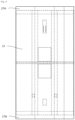
- FIG. 8 is an exploded view of the cloth comprising the body of the bag 20 of FIG. 6 .
- FIG. 9 is an explanatory view of a step of thermally fusing the portions 27 A and 27 B corresponding to the mouth portion 27 of the bag 20 in the cloth 1 of FIG. 8 .
- FIG. 10 is an explanatory view of a step of thermally fusing the portion 21 A corresponding to the outer surface of the bag 20 in the cloth 1 of FIG. 8 .
- the cloth 1 used in the embodiment of the present invention will be described.
- a knitted fabric is described as an example of the cloth 1
- a woven fabric or a non-woven fabric may be used as the cloth 1 .
- the present invention can be applied to cloths including fabrics and textiles in general.
- the cloth 1 includes, for example, as shown in FIG. 2 , a predetermined ratio of thermally fusible fibers (thermally fusible yarns) 3 and other fibers (other yarns) 5 having a higher melting point than the thermally fusible fibers 3 .
- the mixing ratio of the thermally fusible fibers 3 and the other fibers 5 will be described later.
- the structure and composition of the thermally fusible fiber 3 will be described.
- the thermally fusible fiber 3 is a composite filament having a core-sheath structure composed of a core portion 3 A and a sheath portion 3 B.
- the sheath portion 3 B is made of a resin having a melting point lower than that of the core portion 3 A, and covers the outer periphery of the core portion 3 A.
- the thermally fusible fibers 3 adhere to each other or to other fibers to be bonded (fixed), as illustrated in FIG. 1 (B) .
- the thermally fusible fiber 3 can retain its strength even after the fusion bonding.
- the sheath 3 B preferably has a melting point lower than the melting point of the core 3 A by 20° C. or more, and more preferably by 30° C. or more. That is, the melting point of the sheath 3 B is lower than the melting point of the core 3 A at least by 20° C., and more preferably at least by 30° C.
- the thermally fusible fiber 3 of the embodiment of the present invention has a core-sheath structure, it is generally produced by a melt spinning method.
- the core component constituting the core portion 3 A is polyester
- the sheath component constituting the sheath portion 3 B is a low melting point polyester.
- the polyester as the core component is not particularly limited as long as the effect of the present invention is not impaired, and may have a composition that does not deteriorate melt spinning operability with the sheath component, and may be, for example, a homopolyester or a copolymerized polyester.
- the melting point of the core component may be 210° C. or more, and more preferably 220° C. or more, for example, when the melting point of the low melting polyester is 190° C.
- the material of the core 3 A other types of polyester may be employed, or resins other than polyester may be employed.
- the core component is a copolymerized polyester
- its intrinsic viscosity is in the high viscosity range of 0.66 to 0.90, in particular, the intrinsic viscosity is in the high viscosity range of 0.68 to 0.85.
- high viscosity PET polyethylene terephthalate
- the low melting point polyester which is a sheath component constituting the sheath 3 B, is not particularly limited as long as it does not impair the effects of the present invention, and may have a melting point lower than that of the polyester of the core component of the present invention by 20° C. or more, preferably 30° C. or more.
- copolymerized polyesters obtained by copolymerizing isophthalic acid, adipic acid, 1,4-butanediol, and the like can be exemplified.
- polyester obtained by copolymerizing isophthalic acid is preferable
- PET obtained by copolymerizing isophthalic acid is particularly preferable.
- isophthalic acid copolymerized PET it is preferable to copolymerize 20 to 40 mol % with respect to the sheath component from the viewpoint of spinning operability and cost.
- Suitable combinations of the core component and the sheath component include a combination of homo-PET and isophthalic acid copolymerized PET, a combination of high viscosity copolymerized PET and isophthalic acid copolymerized PET, and the like. Among them, the combination of the high viscosity copolymerized PET and the isophthalic acid copolymerized PET is more preferable in that the strength of the fiber or yarn can be sufficiently maintained.
- the material of the sheath 3 B other types of polyester may be used, or resins other than polyester may be used.
- the melting point of the sheath component is 190° C.
- the low melting point polyester constituting the sheath 3 B is fused or melted to form monofilament (single yarn) from multifilament as shown in FIG. 1 (B) , for example.
- the fineness of the thermally fusible fiber 3 having such a composition can be appropriately selected according to the desired properties such as strength, hardness, and texture of a cloth or a cloth product, and may be, for example, in the range of 20 to 300 dT (decitex).
- the thermal shrinkage ratio of the thermally fusible fibers 3 is 10% or less so that the cloth or the cloth product is not excessively shrunk and distorted when heat-set is carried out by heating process such as heat pressing.
- thermally fusible fiber 3 there is a low melting point core-sheath structure filament available under the trade name (registered trademark) of “Bellcouple” by KB Seiren Co., Ltd.
- the other fiber 5 is made of a resin such as polyester, for example.
- the polyester used as the other fiber 5 has a melting point higher than the melting point of the low melting point polyester constituting the sheath component of the sheath 3 B of the thermally fusible fiber 3 .
- the polyesters of the other fibers 5 may be the same as the core components of the core 3 A of the thermal fusion fibers 3 above-mentioned above.
- the fineness of the polyester constituting the other fiber 5 may be in the range of, for example, 20 to 300 dT (decitex), and the melting point of the polyester constituting the other fiber 5 is, for example, 210° C. or more, preferably 220° C. or more, and more preferably 225° C. or more.
- the other fibers in the present invention are not limited to the polyester having the above composition, fineness and melting point as long as they have a melting point higher than the melting point of the above-mentioned low melting point polyester.
- the other fibers may be one type of fibers or a plurality of types of fibers.
- the thermally fusible fibers (thermally fusible yarns) 3 are knitted uniformly when viewed in terms of cloth piece per unit area. That is, one in several lines per unit area is a thermally fusible fiber (thermally fusible yarn).
- the thermally fusible yarn 3 is woven as the warp yarn and/or the weft yarn uniformly in the woven fabric. That is, one in several is a thermally fusible yarn per unit area.
- the ratio of the thermally fusible fibers 3 to the other fibers 5 in the cloth 1 may be appropriately set in accordance with properties such as thickness, strength, hardness, etc. required for the cloth product to which the cloth 1 is applied. For example, in an embodiment of the present invention, considering that the cloth 1 is applied to the clothing 10 and the bag 20 , the ratio of the number of the thermally fusible fibers 3 to the number of the other fibers 5 is substantially 1:1. When the cloth 1 is a knitted fabric, the one-loop configuration is knitted with thermally fusible fibers 3 and other fibers 5 .
- the ratio of the thermally fusible fibers 3 to the other fibers 5 is expressed in terms of weight, about 40 to 80% by weight of the cloth 1 is the thermally fusible fibers 3 and the remaining is other fibers 5 (total 100% by weight).
- the present invention is not limited to this ratio.
- the low melting point polyester which is a sheath component included in the thermal fusion yarn 3
- the low melting point polyester starts thermal fusion or melting at a temperature lower than the set melting point of the thermal fusion yarn 3 .
- the inventors have found that in the case of the thermal fusion yarn 3 having a melting point of, for example, 190° C., the sheath 3 B starts to fuse or melt at 120° C. to 130° C., and the sheath 3 B starts to fuse or melt to a greater degree when the heat processing temperature exceeds 150° C.
- the temperatures of 130° C. and 150° C. correspond to the temperatures in the dyeing step and the subsequent drying step of the cloth 1 , respectively.
- the cloth 1 containing the thermally fusible yarn 3 in a proportion of about 50 to 70% by weight as in the embodiment of the present invention is not so hard, but the cloth 1 containing the thermally fusible yarn 3 in a proportion of 100% by weight hardens remarkably after the dyeing step and the drying step. Regardless of the ratio of the thermally fusible yarns 3 , when the heating temperature reaches 190° C., the sheath 3 B is almost completely fused or melted, and the cloth 1 becomes the hardest state that is supposed to be.
- the above-described properties of the thermally fusible yarn 3 are utilized to cure or harden certain areas of the cloth 1 more than other areas.
- the cloth 1 containing the thermally fusible fibers 3 at a predetermined ratio is prepared, and heat processing is carried out on a predetermined region (second region) of the cloth 1 , thereby increasing the degree of fusion of the sheath portion 3 B more than other regions (first region).
- the cloth 1 thus produced consequently has a region (first region) in which the degree of fusion of the sheath 3 B is relatively low and a region (second region) in which the degree of fusion of the sheath 3 B is relatively high.
- the method of the heating can be changed depending on the degree of curing or hardening required, the thickness of the cloth 1 , the type of the intended cloth product, and the like.
- the cloth 1 may be heat-pressed while being partially covered with a thick felt.
- the exposed portion of the cloth 1 can be cured by heat, and at the same time, curing of the remaining portion can be inhibited. Since this method can easily prepare tools, the initial cost is low, and it can cope with a variety of products and a small-volume production.
- the jersey cloth (knitted fabric) including the thermally fusible yarn 3 is heated as described above, the heated portion has a texture like a woven fabric.
- the single cloth 1 there are a region (not heat-processed region) having the followability or flexibility as in the jersey fabric and a region (heat-processed region) having the stable shape, and the availability of the cloth 1 is expanded.
- the cloth may be subjected to a dyeing step prior to the heat processing, and the dyeing step is carried out, for example, as follows.
- a pretreatment it is preferable to carry out washing using water or a surfactant to remove oil content and dirt from the cloth.
- a method of passing the cloth through a dyeing bath may be employed, and various dyeing machines such as a Wins dyeing machine and a liquid flow dyeing machine may be used as the dyeing machine.
- a variety of dyes can be used for dyeing, and the type thereof is not particularly limited, but a disperse dye is preferable from the viewpoint of dyeability to polyester fibers.
- a disperse dye for example, an azo or anthraquinone dye can be used.
- a leveling agent for example, a nonionic leveling agent (for example, an alkylphenol oxidized ethylene additive type) or a special anionic leveling agent (for example, an ether type nonionic sulfuric acid ester type) may be used.
- a dispersant for example, an anionic dispersant (for example, a formalin condensation product of sodium aromatic sulfonate) may be used.
- the dyeing bath is then heated to about 130° C. under a high pressure and the cloth is immersed in the dyeing bath at about 130° C. for about 30 minutes. Thereafter, as a post-treatment, reduction washing is carried out to remove unfixed dye and contamination adhering to the cloth, and then the cloth is dried. Drying may be accomplished, for example, by placing the cloth in an atmosphere at about 160° C.
- each step of the method of producing a cloth or a cloth product of the present invention satisfies the following relational expressions (1) and (2) relating to temperature conditions.
- T2 ⁇ T3 ⁇ T5 (2) wherein, T1 is the dyeing temperature of the cloth, T2 is the drying temperature of cloth, T3 is the melting point of the thermally fusible fiber 3 constituting the cloth, T5 is the melting point of the other fibers 5 constituting the cloth, and the units of T1, T2, T3 and T5 are ° C.
- a core material is not separately required to form a frame as a cloth product, and therefore, the width of the product design can be widened.
- a clothing and a bag will be given as examples of cloth products using the cloth 1 as a material.
- the cloth according to the present invention is not limited to the clothing and the bag but can be applied to all of cloth products in general.
- a clothing 10 according to Embodiment 1 of the present invention will be described.
- a sleeveless shirt as shown in FIG. 3 is taken up.
- the present invention is also applicable to other types of clothing, such as jackets, one-piece dress, pants, trousers, etc.
- the clothing 10 includes a front body 11 and a back body 13 as shown in FIG. 3 .
- the clothing 10 has a collar 15 and may further include parts such as buttons and pockets.
- at least the front body 11 and the back body 13 are made of cloth 1 .
- Such a clothing 10 can be produced by the following step.
- knitted fabrics containing 40% to 60% by weight of thermally fusible yarn 3 is used as cloths 1 for the front body 11 and the back body 13 shown in FIGS. 4 (A) and (B).
- the other yarn 5 other than the thermally fusible yarn 3 is, for example, a polyester fiber such as polyethylene terephthalate.
- the other yarn 5 may comprises, for example, 84 decitex 48 filaments, 56 decitex 36 filaments, 56 decitex 36 filaments, 84 decitex 36 filaments, 100 decitex 48 filaments or 56 decitex 48 filaments and may have a melting point of, for example, 225° C.
- the other yarn 5 may be a crimped yarn.
- a knitting method of the cloth 1 for example, jersey knitting is used, and in particular, a single Denbigh stitch (warp knitted fabric) is adopted as shown in FIG. 2 .
- the thermally fusible yarn 3 is employed to form a portion called Denbigh, and this Denbigh is one per unit area.
- this type of cloth is thinner and lighter compared to the double Denbigh knitted cloth described in embodiment 2.
- the cloth 1 is cut and the front body 11 and the back body 13 as in FIGS. 4 (A) and (B) are prepared.
- the dotted-dashed line indicates a folding line and the broken line indicates a seam, respectively.
- the front body 11 and the back body 13 are masked with a thick felt F.
- the masking is carried out to prevent the body from being cured and hardened by heating process.
- a predetermined portion other than the collar portion 15 for example, a body side portion (a boundary portion between the front body and the back body), a yoke, a pocket, a skirt, a front stand, a front end, a tab, a belt, a belt loop, or the like can be hardened.
- masking may be carried out so that the predetermined portion is also exposed.
- the front body 11 and the back body 13 covered with the felt F are heat-pressed to cure the portions 15 A and 15 B corresponding to the collar 15 . Thereafter, parts such as facings, buttons, pockets, and the like are sewn if applicable, and the front body 11 and the back body 13 are further sewn to complete the clothing 10 as shown in FIG. 3 .
- a tote bag as shown in FIG. 6 is taken as an example of the bag 20 , but the present invention is also applicable to other types of bags such as, for example, a rucksack.
- the bag 20 includes a main body 21 and a handle 23 as shown in FIG. 6 .
- the bag 20 may also have additional parts, such as inner pockets.
- the bag 20 When used for storing an object, the bag 20 can hold the form of a container as shown in FIG. 6 . On the contrary, when any object is not stored, the bag 20 can be folded as shown in FIG. 7 to be compactly carried. At least the main body 21 of the bag 20 is made of cloth 1 . Such a bag 20 can be produced by the following step.
- the cloth 1 for the body of the bag 20 shown in FIG. 6 a knitted fabric in which 60% by weight to 80% by weight of the thermally fusible yarn 3 is admixed is used.
- the other yarn 5 other than the thermally fusible yarn 3 is made of, for example, a polyester fiber such as polyethylene terephthalate.
- the other yarn 5 may comprises, for example, 84 decitex 48 filaments, 56 decitex 36 filaments, 56 decitex 36 filaments, 84 decitex 36 filaments, 100 decitex 48 filaments or 56 decitex 48 filaments and may have a melting point of, for example, 225° C.
- the other yarn 5 may be a crimped yarn.
- a knitting method of the cloth 1 for example, jersey knitting is used, and in particular, a double Denbigh stitch is adopted.
- the thermally fusible yarn 3 is employed for the Denbigh, and this Denbigh is twice as large as the single Denbigh stitch.
- this type of cloth finishes thicker (heavier) compared to the single Denbigh stitch cloth described in embodiment 1.
- the cloth 1 as described above is prepared for the main body 21 of the bag 20 , and the cloth 1 is cut into a substantially rectangular shape as shown in FIG. 8 .
- a dotted-dashed line indicates a folding line
- a broken line indicates a seam.
- parts such as a handle 23 , a belt 25 , a bottoming cloth (not shown), and a pocket (not shown) are prepared.
- the portions 27 A and 27 B corresponding to the mouth portion 27 of the main body 21 are exposed, and the other portions are covered with the felt F. This is masking for preventing the portion of the main body 21 other than the mouth portion 27 from being cured and hardened by heating.
- the portion of the cloth 1 covered with the felt F is heat-pressed, and the portions 27 A and 27 B corresponding to the mouth portion 27 are cured.
- the bottoming cloth (not shown) and the handle 23 may be cured by heating.
- the press may be set to have a temperature of, for example, 185° C. for 60 seconds on one side.
- the pressure of the press may be appropriately set in accordance with a desired degree of curing.
- the main body 21 is pressed with an iron or the like along the dashed-dotted line in FIG. 8 to make folds. Then, other parts such as a bottoming cloth and pockets are sewn to the main body 21 , and both sides and the bottom of the main body 21 are sewn. Then, as shown in FIG. 10 , the outer surface 21 A is formed on the main body 21 .
- the press may be set to have a temperature of, for example, 185° C. for 60 seconds. At the time of heat-pressing, in order to eliminate unevenness of the press due to a difference in thickness depending on a portion of the main body 21 , it is preferable to carry out the pressing in a state in which thick paper is inserted between the press machine and the main body 21 .
- parts such as the handle 23 and the belt 25 are attached to the main body 21 , thereby completing the bag 20 .
- a molding die having a shape corresponding to a portion to be heated (a mold having a shape of a heating surface) and press the mold on to a portion to be heated.
- this method is suitable for mass production because it takes a considerable cost to produce a molding die.
- This method can be used alone or in combination with the pressing process with the masked cloth 1 and/or the pressing process with the folded cloth 1 .
- low melting point polyester is employed as the sheath component of the thermally fusible fiber 3 , but it is also possible to use a thermally fusible fiber employing low melting point polyester as the core component. That is, it is possible to produce a cloth by using a thermally fusible fiber in which the melting point of the sheath portion is higher than the melting point of the core portion by a predetermined temperature (e.g., 20° C.) or more, and to produce a cloth product (clothing, bag, etc.) including the cloth.
- a predetermined temperature e.g. 20° C.
- polyester fibers are used as the other fibers (other yarns) 5 , but chemical fibers (for example, nylon fibers) other than polyester fibers or natural fibers can be used.
- the other fibers (other yarns) 5 may be thermally fusible fibers having a higher melting point than the thermally fusible fibers 3 or thermally fusible fibers having a lower degree of melting.
Landscapes
- Engineering & Computer Science (AREA)
- Textile Engineering (AREA)
- Mechanical Engineering (AREA)
- Treatment Of Fiber Materials (AREA)
- Woven Fabrics (AREA)
- Purses, Travelling Bags, Baskets, Or Suitcases (AREA)
- Knitting Of Fabric (AREA)
Abstract
Description
T1<T3<T5 (1)
T2<T3<T5 (2)
wherein, T1 is the dyeing temperature of the cloth, T2 is the drying temperature of cloth, T3 is the melting point of the thermally
-
- 1 . . . cloth,
- 3 . . . Thermally fusible fiber (thermally fusible yarn),
- 3A . . . Core,
- 3B . . . sheath,
- 5 . . . Other fiber (other yarn)
- 10 . . . Clothing,
- 15 . . . collar,
- 20 . . . bag,
- 21 . . . Main body,
- 27 . . . mouth,
- F . . . Felt.
Claims (5)
Priority Applications (1)
| Application Number | Priority Date | Filing Date | Title |
|---|---|---|---|
| US17/748,256 US11859323B2 (en) | 2018-07-04 | 2022-05-19 | Cloth, cloth product and method for producing the cloth product |
Applications Claiming Priority (3)
| Application Number | Priority Date | Filing Date | Title |
|---|---|---|---|
| JP2018127832 | 2018-07-04 | ||
| JP2018-155799 | 2018-08-22 | ||
| JP2018155799A JP6668424B2 (en) | 2018-07-04 | 2018-08-22 | Fabric, fabric product, and method of manufacturing fabric product |
Related Child Applications (1)
| Application Number | Title | Priority Date | Filing Date |
|---|---|---|---|
| US17/748,256 Continuation US11859323B2 (en) | 2018-07-04 | 2022-05-19 | Cloth, cloth product and method for producing the cloth product |
Publications (2)
| Publication Number | Publication Date |
|---|---|
| US20200063305A1 US20200063305A1 (en) | 2020-02-27 |
| US11725316B2 true US11725316B2 (en) | 2023-08-15 |
Family
ID=69169402
Family Applications (2)
| Application Number | Title | Priority Date | Filing Date |
|---|---|---|---|
| US16/547,830 Active 2041-02-07 US11725316B2 (en) | 2018-07-04 | 2019-08-22 | Cloth, cloth product and method for producing the cloth product |
| US17/748,256 Active US11859323B2 (en) | 2018-07-04 | 2022-05-19 | Cloth, cloth product and method for producing the cloth product |
Family Applications After (1)
| Application Number | Title | Priority Date | Filing Date |
|---|---|---|---|
| US17/748,256 Active US11859323B2 (en) | 2018-07-04 | 2022-05-19 | Cloth, cloth product and method for producing the cloth product |
Country Status (3)
| Country | Link |
|---|---|
| US (2) | US11725316B2 (en) |
| JP (1) | JP6668424B2 (en) |
| DE (1) | DE102019212582A1 (en) |
Families Citing this family (1)
| Publication number | Priority date | Publication date | Assignee | Title |
|---|---|---|---|---|
| JP7366453B2 (en) * | 2022-03-31 | 2023-10-23 | 富士レース産業株式会社 | Manufacturing method of three-dimensional knitted fabric |
Citations (6)
| Publication number | Priority date | Publication date | Assignee | Title |
|---|---|---|---|---|
| JP2008150749A (en) | 2006-12-19 | 2008-07-03 | Gunze Ltd | Garments |
| JP2011106074A (en) * | 2009-11-20 | 2011-06-02 | Seiren Co Ltd | Woven fabric |
| US20120279260A1 (en) * | 2011-05-04 | 2012-11-08 | Nike, Inc. | Knit Component Bonding |
| US20130108831A1 (en) * | 2010-07-07 | 2013-05-02 | 3M Innovative Properties Company | Patterned air-laid nonwoven electret fibrous webs and methods of making and using same |
| US20130260104A1 (en) * | 2012-04-03 | 2013-10-03 | Nike, Inc. | Yarns, Threads, And Textiles Incorporating A Thermoplastic Polymer Material |
| JP2016160546A (en) * | 2015-02-27 | 2016-09-05 | 岡本株式会社 | COMPOSITE FIBER STRUCTURE, PROCESS FOR PRODUCING THE SAME, AND FIBER PRODUCT USING COMPOSITE FIBER STRUCTURE |
Family Cites Families (4)
| Publication number | Priority date | Publication date | Assignee | Title |
|---|---|---|---|---|
| JP4383135B2 (en) * | 2003-09-09 | 2009-12-16 | 竹中繊維株式会社 | Fiber fitting with a hardened area |
| JP2008007625A (en) * | 2006-06-29 | 2008-01-17 | Teijin Fibers Ltd | Low melting point polyester composition improved in moist heat resistance |
| JP4882107B2 (en) * | 2007-05-25 | 2012-02-22 | クラレトレーディング株式会社 | Elastic fabric |
| JP5688240B2 (en) * | 2010-07-01 | 2015-03-25 | 旭化成せんい株式会社 | Small round knitted fabric |
-
2018
- 2018-08-22 JP JP2018155799A patent/JP6668424B2/en active Active
-
2019
- 2019-08-22 US US16/547,830 patent/US11725316B2/en active Active
- 2019-08-22 DE DE102019212582.4A patent/DE102019212582A1/en active Granted
-
2022
- 2022-05-19 US US17/748,256 patent/US11859323B2/en active Active
Patent Citations (6)
| Publication number | Priority date | Publication date | Assignee | Title |
|---|---|---|---|---|
| JP2008150749A (en) | 2006-12-19 | 2008-07-03 | Gunze Ltd | Garments |
| JP2011106074A (en) * | 2009-11-20 | 2011-06-02 | Seiren Co Ltd | Woven fabric |
| US20130108831A1 (en) * | 2010-07-07 | 2013-05-02 | 3M Innovative Properties Company | Patterned air-laid nonwoven electret fibrous webs and methods of making and using same |
| US20120279260A1 (en) * | 2011-05-04 | 2012-11-08 | Nike, Inc. | Knit Component Bonding |
| US20130260104A1 (en) * | 2012-04-03 | 2013-10-03 | Nike, Inc. | Yarns, Threads, And Textiles Incorporating A Thermoplastic Polymer Material |
| JP2016160546A (en) * | 2015-02-27 | 2016-09-05 | 岡本株式会社 | COMPOSITE FIBER STRUCTURE, PROCESS FOR PRODUCING THE SAME, AND FIBER PRODUCT USING COMPOSITE FIBER STRUCTURE |
Non-Patent Citations (2)
| Title |
|---|
| Machine translation of JP2011106074 (Year: 2011). * |
| Machine translation of JP2016160546, Osamu et al. (Year: 2016). * |
Also Published As
| Publication number | Publication date |
|---|---|
| US20200063305A1 (en) | 2020-02-27 |
| JP6668424B2 (en) | 2020-03-18 |
| JP2020012221A (en) | 2020-01-23 |
| US20220275548A1 (en) | 2022-09-01 |
| DE102019212582A1 (en) | 2020-02-27 |
| US11859323B2 (en) | 2024-01-02 |
Similar Documents
| Publication | Publication Date | Title |
|---|---|---|
| US20180195217A1 (en) | Environmentally friendly non-bleed polyester fabric and method of manufacturing the same | |
| CN107429452A (en) | The stuetch fabrics that can easily shape including low-melting fiber | |
| LT4633B (en) | Elastic interlining | |
| US6057253A (en) | Reinforcing base fabric for a shirt collar or an analogous piece | |
| US11859323B2 (en) | Cloth, cloth product and method for producing the cloth product | |
| US5898941A (en) | Collar with a reinforcing base fabric | |
| US6250116B1 (en) | Textile support for reinforcing a shirt collar or similar piece | |
| US3725954A (en) | Method of manufacturing garment collars or lapels | |
| JP2000345417A (en) | Method of forming irregularities on clothes fabric | |
| US20060150610A1 (en) | Yarns spun from olefin and cotton fibers and products made therefrom | |
| WO2007034730A1 (en) | Moldable interlining cloth for clothes | |
| JP6761686B2 (en) | Hollow spun yarn and woven fabric or knitted fabric using it and its manufacturing method | |
| JP2007056377A (en) | Fabric for seat belt | |
| KR20060018187A (en) | Wicks and textile products and how to attach them to textile products | |
| JPH01266246A (en) | Production of material for hat | |
| CN220703955U (en) | Jacquard fabric with breathable and comfortable velvet feeling | |
| JP4110453B2 (en) | High-strength polyamide yarn for airbags | |
| KR200372991Y1 (en) | Interlining and woven fabrics | |
| EP0145168B1 (en) | A method of forming and dyeing cushion articles | |
| JP2008069488A (en) | Interlining cloth | |
| JPH044140A (en) | Laminated cloth and manufacture of molded body composed of same cloth | |
| JPH0523591B2 (en) | ||
| JPH07109601A (en) | Upper garment | |
| CN119497771A (en) | Knitted product and method for producing the same | |
| US3139912A (en) | Collar having thermoplastic "gut" yarn |
Legal Events
| Date | Code | Title | Description |
|---|---|---|---|
| AS | Assignment |
Owner name: KABUSHIKI KAISHA MIYAKE DESIGN JIMUSHO, JAPAN Free format text: ASSIGNMENT OF ASSIGNORS INTEREST;ASSIGNORS:YAMAMOTO, SACHIKO;KAWAHARA, SEN;SIGNING DATES FROM 20190813 TO 20190820;REEL/FRAME:050134/0441 |
|
| FEPP | Fee payment procedure |
Free format text: ENTITY STATUS SET TO UNDISCOUNTED (ORIGINAL EVENT CODE: BIG.); ENTITY STATUS OF PATENT OWNER: LARGE ENTITY |
|
| STPP | Information on status: patent application and granting procedure in general |
Free format text: DOCKETED NEW CASE - READY FOR EXAMINATION |
|
| STPP | Information on status: patent application and granting procedure in general |
Free format text: NON FINAL ACTION MAILED |
|
| STPP | Information on status: patent application and granting procedure in general |
Free format text: RESPONSE TO NON-FINAL OFFICE ACTION ENTERED AND FORWARDED TO EXAMINER |
|
| STPP | Information on status: patent application and granting procedure in general |
Free format text: FINAL REJECTION MAILED |
|
| STPP | Information on status: patent application and granting procedure in general |
Free format text: ADVISORY ACTION MAILED |
|
| STPP | Information on status: patent application and granting procedure in general |
Free format text: RESPONSE AFTER FINAL ACTION FORWARDED TO EXAMINER |
|
| STPP | Information on status: patent application and granting procedure in general |
Free format text: NON FINAL ACTION MAILED |
|
| STPP | Information on status: patent application and granting procedure in general |
Free format text: RESPONSE TO NON-FINAL OFFICE ACTION ENTERED AND FORWARDED TO EXAMINER |
|
| STPP | Information on status: patent application and granting procedure in general |
Free format text: FINAL REJECTION MAILED |
|
| STPP | Information on status: patent application and granting procedure in general |
Free format text: PUBLICATIONS -- ISSUE FEE PAYMENT RECEIVED |
|
| STPP | Information on status: patent application and granting procedure in general |
Free format text: PUBLICATIONS -- ISSUE FEE PAYMENT VERIFIED |
|
| STCF | Information on status: patent grant |
Free format text: PATENTED CASE |