US11701434B2 - Tertiary amino lipidated cationic peptides for nucleic acid delivery - Google Patents
Tertiary amino lipidated cationic peptides for nucleic acid delivery Download PDFInfo
- Publication number
- US11701434B2 US11701434B2 US17/347,498 US202117347498A US11701434B2 US 11701434 B2 US11701434 B2 US 11701434B2 US 202117347498 A US202117347498 A US 202117347498A US 11701434 B2 US11701434 B2 US 11701434B2
- Authority
- US
- United States
- Prior art keywords
- tertiary amino
- cationic peptide
- lipidated
- amino lipidated
- lipid
- Prior art date
- Legal status (The legal status is an assumption and is not a legal conclusion. Google has not performed a legal analysis and makes no representation as to the accuracy of the status listed.)
- Active
Links
Images


Classifications
-
- A—HUMAN NECESSITIES
- A61—MEDICAL OR VETERINARY SCIENCE; HYGIENE
- A61K—PREPARATIONS FOR MEDICAL, DENTAL OR TOILETRY PURPOSES
- A61K48/00—Medicinal preparations containing genetic material which is inserted into cells of the living body to treat genetic diseases; Gene therapy
- A61K48/0008—Medicinal preparations containing genetic material which is inserted into cells of the living body to treat genetic diseases; Gene therapy characterised by an aspect of the 'non-active' part of the composition delivered, e.g. wherein such 'non-active' part is not delivered simultaneously with the 'active' part of the composition
- A61K48/0025—Medicinal preparations containing genetic material which is inserted into cells of the living body to treat genetic diseases; Gene therapy characterised by an aspect of the 'non-active' part of the composition delivered, e.g. wherein such 'non-active' part is not delivered simultaneously with the 'active' part of the composition wherein the non-active part clearly interacts with the delivered nucleic acid
- A61K48/0041—Medicinal preparations containing genetic material which is inserted into cells of the living body to treat genetic diseases; Gene therapy characterised by an aspect of the 'non-active' part of the composition delivered, e.g. wherein such 'non-active' part is not delivered simultaneously with the 'active' part of the composition wherein the non-active part clearly interacts with the delivered nucleic acid the non-active part being polymeric
-
- A—HUMAN NECESSITIES
- A61—MEDICAL OR VETERINARY SCIENCE; HYGIENE
- A61K—PREPARATIONS FOR MEDICAL, DENTAL OR TOILETRY PURPOSES
- A61K9/00—Medicinal preparations characterised by special physical form
- A61K9/10—Dispersions; Emulsions
- A61K9/127—Synthetic bilayered vehicles, e.g. liposomes or liposomes with cholesterol as the only non-phosphatidyl surfactant
-
- A—HUMAN NECESSITIES
- A61—MEDICAL OR VETERINARY SCIENCE; HYGIENE
- A61K—PREPARATIONS FOR MEDICAL, DENTAL OR TOILETRY PURPOSES
- A61K31/00—Medicinal preparations containing organic active ingredients
- A61K31/185—Acids; Anhydrides, halides or salts thereof, e.g. sulfur acids, imidic, hydrazonic or hydroximic acids
- A61K31/19—Carboxylic acids, e.g. valproic acid
- A61K31/195—Carboxylic acids, e.g. valproic acid having an amino group
- A61K31/197—Carboxylic acids, e.g. valproic acid having an amino group the amino and the carboxyl groups being attached to the same acyclic carbon chain, e.g. gamma-aminobutyric acid [GABA], beta-alanine, epsilon-aminocaproic acid or pantothenic acid
- A61K31/198—Alpha-amino acids, e.g. alanine or edetic acid [EDTA]
-
- A—HUMAN NECESSITIES
- A61—MEDICAL OR VETERINARY SCIENCE; HYGIENE
- A61K—PREPARATIONS FOR MEDICAL, DENTAL OR TOILETRY PURPOSES
- A61K31/00—Medicinal preparations containing organic active ingredients
- A61K31/70—Carbohydrates; Sugars; Derivatives thereof
- A61K31/7088—Compounds having three or more nucleosides or nucleotides
- A61K31/7105—Natural ribonucleic acids, i.e. containing only riboses attached to adenine, guanine, cytosine or uracil and having 3'-5' phosphodiester links
-
- A—HUMAN NECESSITIES
- A61—MEDICAL OR VETERINARY SCIENCE; HYGIENE
- A61K—PREPARATIONS FOR MEDICAL, DENTAL OR TOILETRY PURPOSES
- A61K47/00—Medicinal preparations characterised by the non-active ingredients used, e.g. carriers or inert additives; Targeting or modifying agents chemically bound to the active ingredient
- A61K47/06—Organic compounds, e.g. natural or synthetic hydrocarbons, polyolefins, mineral oil, petrolatum or ozokerite
- A61K47/08—Organic compounds, e.g. natural or synthetic hydrocarbons, polyolefins, mineral oil, petrolatum or ozokerite containing oxygen, e.g. ethers, acetals, ketones, quinones, aldehydes, peroxides
- A61K47/10—Alcohols; Phenols; Salts thereof, e.g. glycerol; Polyethylene glycols [PEG]; Poloxamers; PEG/POE alkyl ethers
-
- A—HUMAN NECESSITIES
- A61—MEDICAL OR VETERINARY SCIENCE; HYGIENE
- A61K—PREPARATIONS FOR MEDICAL, DENTAL OR TOILETRY PURPOSES
- A61K47/00—Medicinal preparations characterised by the non-active ingredients used, e.g. carriers or inert additives; Targeting or modifying agents chemically bound to the active ingredient
- A61K47/06—Organic compounds, e.g. natural or synthetic hydrocarbons, polyolefins, mineral oil, petrolatum or ozokerite
- A61K47/24—Organic compounds, e.g. natural or synthetic hydrocarbons, polyolefins, mineral oil, petrolatum or ozokerite containing atoms other than carbon, hydrogen, oxygen, halogen, nitrogen or sulfur, e.g. cyclomethicone or phospholipids
-
- A—HUMAN NECESSITIES
- A61—MEDICAL OR VETERINARY SCIENCE; HYGIENE
- A61K—PREPARATIONS FOR MEDICAL, DENTAL OR TOILETRY PURPOSES
- A61K47/00—Medicinal preparations characterised by the non-active ingredients used, e.g. carriers or inert additives; Targeting or modifying agents chemically bound to the active ingredient
- A61K47/50—Medicinal preparations characterised by the non-active ingredients used, e.g. carriers or inert additives; Targeting or modifying agents chemically bound to the active ingredient the non-active ingredient being chemically bound to the active ingredient, e.g. polymer-drug conjugates
- A61K47/51—Medicinal preparations characterised by the non-active ingredients used, e.g. carriers or inert additives; Targeting or modifying agents chemically bound to the active ingredient the non-active ingredient being chemically bound to the active ingredient, e.g. polymer-drug conjugates the non-active ingredient being a modifying agent
- A61K47/54—Medicinal preparations characterised by the non-active ingredients used, e.g. carriers or inert additives; Targeting or modifying agents chemically bound to the active ingredient the non-active ingredient being chemically bound to the active ingredient, e.g. polymer-drug conjugates the non-active ingredient being a modifying agent the modifying agent being an organic compound
- A61K47/543—Lipids, e.g. triglycerides; Polyamines, e.g. spermine or spermidine
-
- A—HUMAN NECESSITIES
- A61—MEDICAL OR VETERINARY SCIENCE; HYGIENE
- A61K—PREPARATIONS FOR MEDICAL, DENTAL OR TOILETRY PURPOSES
- A61K48/00—Medicinal preparations containing genetic material which is inserted into cells of the living body to treat genetic diseases; Gene therapy
-
- A—HUMAN NECESSITIES
- A61—MEDICAL OR VETERINARY SCIENCE; HYGIENE
- A61K—PREPARATIONS FOR MEDICAL, DENTAL OR TOILETRY PURPOSES
- A61K9/00—Medicinal preparations characterised by special physical form
- A61K9/0012—Galenical forms characterised by the site of application
- A61K9/0019—Injectable compositions; Intramuscular, intravenous, arterial, subcutaneous administration; Compositions to be administered through the skin in an invasive manner
-
- A—HUMAN NECESSITIES
- A61—MEDICAL OR VETERINARY SCIENCE; HYGIENE
- A61K—PREPARATIONS FOR MEDICAL, DENTAL OR TOILETRY PURPOSES
- A61K9/00—Medicinal preparations characterised by special physical form
- A61K9/10—Dispersions; Emulsions
- A61K9/127—Synthetic bilayered vehicles, e.g. liposomes or liposomes with cholesterol as the only non-phosphatidyl surfactant
- A61K9/1271—Non-conventional liposomes, e.g. PEGylated liposomes or liposomes coated or grafted with polymers
- A61K9/1272—Non-conventional liposomes, e.g. PEGylated liposomes or liposomes coated or grafted with polymers comprising non-phosphatidyl surfactants as bilayer-forming substances, e.g. cationic lipids or non-phosphatidyl liposomes coated or grafted with polymers
-
- A—HUMAN NECESSITIES
- A61—MEDICAL OR VETERINARY SCIENCE; HYGIENE
- A61K—PREPARATIONS FOR MEDICAL, DENTAL OR TOILETRY PURPOSES
- A61K9/00—Medicinal preparations characterised by special physical form
- A61K9/48—Preparations in capsules, e.g. of gelatin, of chocolate
- A61K9/50—Microcapsules having a gas, liquid or semi-solid filling; Solid microparticles or pellets surrounded by a distinct coating layer, e.g. coated microspheres, coated drug crystals
- A61K9/51—Nanocapsules; Nanoparticles
- A61K9/5107—Excipients; Inactive ingredients
- A61K9/5123—Organic compounds, e.g. fats, sugars
-
- A—HUMAN NECESSITIES
- A61—MEDICAL OR VETERINARY SCIENCE; HYGIENE
- A61K—PREPARATIONS FOR MEDICAL, DENTAL OR TOILETRY PURPOSES
- A61K9/00—Medicinal preparations characterised by special physical form
- A61K9/48—Preparations in capsules, e.g. of gelatin, of chocolate
- A61K9/50—Microcapsules having a gas, liquid or semi-solid filling; Solid microparticles or pellets surrounded by a distinct coating layer, e.g. coated microspheres, coated drug crystals
- A61K9/51—Nanocapsules; Nanoparticles
- A61K9/5107—Excipients; Inactive ingredients
- A61K9/513—Organic macromolecular compounds; Dendrimers
- A61K9/5146—Organic macromolecular compounds; Dendrimers obtained otherwise than by reactions only involving carbon-to-carbon unsaturated bonds, e.g. polyethylene glycol, polyamines, polyanhydrides
-
- C—CHEMISTRY; METALLURGY
- C07—ORGANIC CHEMISTRY
- C07K—PEPTIDES
- C07K2/00—Peptides of undefined number of amino acids; Derivatives thereof
-
- C—CHEMISTRY; METALLURGY
- C07—ORGANIC CHEMISTRY
- C07K—PEPTIDES
- C07K5/00—Peptides containing up to four amino acids in a fully defined sequence; Derivatives thereof
- C07K5/04—Peptides containing up to four amino acids in a fully defined sequence; Derivatives thereof containing only normal peptide links
- C07K5/10—Tetrapeptides
-
- C—CHEMISTRY; METALLURGY
- C07—ORGANIC CHEMISTRY
- C07K—PEPTIDES
- C07K5/00—Peptides containing up to four amino acids in a fully defined sequence; Derivatives thereof
- C07K5/04—Peptides containing up to four amino acids in a fully defined sequence; Derivatives thereof containing only normal peptide links
- C07K5/10—Tetrapeptides
- C07K5/1002—Tetrapeptides with the first amino acid being neutral
- C07K5/1005—Tetrapeptides with the first amino acid being neutral and aliphatic
- C07K5/1008—Tetrapeptides with the first amino acid being neutral and aliphatic the side chain containing 0 or 1 carbon atoms, i.e. Gly, Ala
-
- C—CHEMISTRY; METALLURGY
- C07—ORGANIC CHEMISTRY
- C07K—PEPTIDES
- C07K7/00—Peptides having 5 to 20 amino acids in a fully defined sequence; Derivatives thereof
- C07K7/04—Linear peptides containing only normal peptide links
- C07K7/06—Linear peptides containing only normal peptide links having 5 to 11 amino acids
-
- C—CHEMISTRY; METALLURGY
- C07—ORGANIC CHEMISTRY
- C07K—PEPTIDES
- C07K7/00—Peptides having 5 to 20 amino acids in a fully defined sequence; Derivatives thereof
- C07K7/04—Linear peptides containing only normal peptide links
- C07K7/08—Linear peptides containing only normal peptide links having 12 to 20 amino acids
-
- A—HUMAN NECESSITIES
- A61—MEDICAL OR VETERINARY SCIENCE; HYGIENE
- A61K—PREPARATIONS FOR MEDICAL, DENTAL OR TOILETRY PURPOSES
- A61K47/00—Medicinal preparations characterised by the non-active ingredients used, e.g. carriers or inert additives; Targeting or modifying agents chemically bound to the active ingredient
- A61K47/06—Organic compounds, e.g. natural or synthetic hydrocarbons, polyolefins, mineral oil, petrolatum or ozokerite
- A61K47/28—Steroids, e.g. cholesterol, bile acids or glycyrrhetinic acid
-
- A—HUMAN NECESSITIES
- A61—MEDICAL OR VETERINARY SCIENCE; HYGIENE
- A61K—PREPARATIONS FOR MEDICAL, DENTAL OR TOILETRY PURPOSES
- A61K47/00—Medicinal preparations characterised by the non-active ingredients used, e.g. carriers or inert additives; Targeting or modifying agents chemically bound to the active ingredient
- A61K47/30—Macromolecular organic or inorganic compounds, e.g. inorganic polyphosphates
- A61K47/42—Proteins; Polypeptides; Degradation products thereof; Derivatives thereof, e.g. albumin, gelatin or zein
-
- B—PERFORMING OPERATIONS; TRANSPORTING
- B82—NANOTECHNOLOGY
- B82Y—SPECIFIC USES OR APPLICATIONS OF NANOSTRUCTURES; MEASUREMENT OR ANALYSIS OF NANOSTRUCTURES; MANUFACTURE OR TREATMENT OF NANOSTRUCTURES
- B82Y5/00—Nanobiotechnology or nanomedicine, e.g. protein engineering or drug delivery
-
- C—CHEMISTRY; METALLURGY
- C07—ORGANIC CHEMISTRY
- C07K—PEPTIDES
- C07K14/00—Peptides having more than 20 amino acids; Gastrins; Somatostatins; Melanotropins; Derivatives thereof
- C07K14/001—Peptides having more than 20 amino acids; Gastrins; Somatostatins; Melanotropins; Derivatives thereof by chemical synthesis
Definitions
- the present disclosure relates to tertiary amino lipidated and/or PEGylated cationic peptide compounds and, more specifically, to tertiary amino lipidated and/or PEGylated peptoids, and complexes thereof for nucleic acid delivery.
- the present disclosure also provides methods for preparing complexes thereof comprising one or more of the tertiary amino lipidated and/or PEGylated cationic peptides with polyanionic compounds, such as nucleic acids, and methods for delivering polyanionic compounds to cells.
- Cationic peptoid-phospholipid conjugate constructs also known as lipitoids, are one such class of agents developed to encapsulate polyanionic nucleic acids and stabilize the nucleic acids against nucleases in vivo, while also facilitating uptake of the polynucleotides into the cell and their subsequent release into the cytosol.
- Lipitoids such as Lipitoid 1 (shown in FIG. 1 ), have shown themselves to be efficient and non-immunogenic vehicles for complexation with and endocellular delivery of nucleic acids, such as plasmid DNA (pDNA) and short-interfering RNA (siRNA).
- nucleic acids having differing base pair lengths, strand numbers, and conformations, etc.
- lipitoids have shown success for improving uptake of a variety of nucleic acids
- existing lipitoid constructs have been largely focused on delivery of certain types of polynucleotides, e.g., pDNA and siRNA, and may not necessarily be as effective for promoting the endocellular uptake of others, e.g., messenger RNA (mRNA).
- mRNA messenger RNA
- lipitoid constructs that are optimized for a particular nucleic acid type
- complexes of the lipitoid-nucleic acid may still suffer from further complications in vivo, including, for example, particle stability and aggregation.
- particle stability and aggregation As such, to date, no therapeutic using lipitoids has been approved for use in humans.
- nucleic acids in particular mRNA
- the present disclosure provides lipitoids based upon an alternative conjugation methodology for the lipids and even for PEGylation that has greater adaptability to overcome the difficulties encountered with other forms of lipitoids.
- a tertiary amino lipidated and/or PEGylated cationic peptide compound of formula (I) or a salt thereof is provided:
- the tertiary amino lipidated and/or PEGylated cationic peptide compound has at least one of n or s is nonzero. In certain embodiments of this aspect, the tertiary amino lipidated and/or PEGylated cationic peptide compound comprises a block of N-lipidated amino acid residues, wherein at least one of n and s is at least 2, at least 3, or at least 4, optionally, 2, 3, or 4.
- each R 3 is independently C 4 -C 22 -alkyl or C 4 -C 22 -alkenyl, and wherein the C 4 -C 22 -alkenyl is optionally mono- or poly-unsaturated.
- a further embodiment of this aspect includes tertiary amino lipidated and/or PEGylated cationic peptide compounds of the present disclosure, wherein each R 3 is is independently C 8 -C 12 alkyl.
- each R 3 is independently selected from the group consisting of 2-ethylhex-1-yl, caproyl, oleyl, stearyl, linoleyl, myristyl, and lauryl.
- each R 5 is independently selected from:
- each neutral spacer moiety R 4 is independently a C 1 -C 4 -alkyl substituted by cycloalkyl, heterocyclylalkyl, alkylaryl, arylalkyl, alkylheteroaryl, heteroarylalkyl, alkoxy, alkoxyalkyl, or hydroxyalkyl, wherein each cycloalkyl, heterocyclylalkyl, alkylaryl, arylalkyl, alkylheteroaryl, heteroarylalkyl, alkoxy, alkoxyalkyl, or hydroxyalkyl is optionally substituted with one or more substituents —OH, halo, or alkoxy.
- each neutral spacer moiety R 4 is independently selected from the group consisting of:
- each neutral spacer moiety R 4 is
- each lipid moiety R 4 is independently C 4 -C 22 -alkyl or C 4 -C 22 -alkenyl, and wherein the C 4 -C 22 -alkenyl is optionally mono- or poly-unsaturated.
- each lipid moiety R 4 is a C 6 -C 18 alkyl or C 6 -C 18 alkenyl.
- each lipid moiety R 4 is C 8 -C 12 alkyl.
- each lipid moiety R 4 is a C 10 -alkyl, such as n-decyl.
- each lipid moiety R 4 is independently selected from the group consisting of 2-ethylhex-1-yl, caproyl oleyl, stearyl, linoleyl, myristyl, and lauryl.
- the tertiary amino lipidated and/or PEGylated cationic peptide compound comprises a cationic domain comprising at least two amino acid residues having R 5 cationic moieties and wherein each of the at least two cationic amino acid residues within the cationic domain are separated by at least one amino acid residue having a neutral spacer or lipid moiety R 4 .
- the tertiary amino lipidated and/or PEGylated cationic peptide compounds comprises at least one trimer subunit -R cation -R neutral -R neutral , and wherein R cation is an amino acid residue comprising a cationic moiety R 5 and each R neutral is an amino acid residue comprising a neutral spacer moiety R 4 .
- each cationic moiety R 5 is
- each u is independently an integer from 20 to 200, optionally from 30 to 50; and when m is an integer from 4 to 10, each u is independently an integer from 2 to 10.
- each v is independently an integer from 30 to 50; and when t is an integer from 4 to 10, each v is independently an integer from 2 to 10.
- m is 1, and u is an integer from 40 to 45; and/or or t is 1, and v is an integer from 40 to 45.
- R a and R b are independently selected from the group consisting of —H and —CH 3 .
- R a and R b are —H.
- Another aspect of the disclosure provides tertiary amino lipidated and PEGylated peptide compounds of formula (I) or salts thereof:
- the polyanionic compound comprises a nucleic acid.
- the nucleic acid is an mRNA encoding a polypeptide.
- the nucleic acid is an mRNA encoding a protein.
- the complex comprises at least one of the tertiary amino lipidated and/or PEGylated cationic peptide and the nucleic acid at a mass ratio of between 0.5:1 and 50:1.
- the complex comprises: the one or more tertiary amino lipidated and/or PEGylated cationic peptide compounds, a nucleic acid, a phospholipid, a structural lipid, and a PEG lipid.
- the complex further comprises one or more small molecule active agents or drug substances.
- Still another aspect of this disclosure provides methods of delivering polyanionic compounds to a cell comprising contacting the cell with the complex of the preceding aspect in any and all of its various embodiments.
- the contacting is by endocytosis.
- the cell is contacted in vivo or in vitro.
- the cell expresses the polypeptide after being contacted with the complex.
- the cell expresses the protein after being contacted with the complex.
- An additional aspect of this disclosure provides methods of forming the complexes of the aspect relating to complexes and any and all of its various embodiments, by contacting the tertiary amino lipidated and/or PEGylated cationic peptide compound with the polyanionic compound.
- the complexes are formed by contacting a solution comprising the tertiary amino lipidated and/or PEGylated cationic peptide compound with a solution comprising the polyanionic compound.
- FIGS. 2 A- 2 F show tertiary amino lipidated cationic peptoids generally.
- FIG. 2 A shows the generalized structure for the tertiary amino lipidated peptoids.
- FIG. 2 B shows an exemplary tertiary amino lipidated cationic peptoid.
- FIG. 2 C shows exemplary lipid monomers.
- FIG. 2 D shows exemplary cationic monomers.
- FIG. 2 E shows exemplary spacer monomers and a polyethylene glycol monomer.
- FIG. 2 F shows exemplary tertiary amino lipidated cationic peptoid compound 8.
- FIGS. 3 A- 3 E show an exemplary process for preparing tertiary amino lipidated and/or PEGylated cationic peptide compounds via sequential addition of amino acid residues in the solid-phase.
- FIG. 3 A shows the generalized acylation reaction of a resin-bound secondary amine to acylating agent bromoacetic acid.
- FIG. 3 B shows the reaction of the resulting acylation product with a suitable amine via nucleophilic displacement to produce the corresponding N-substituted amino acid residue.
- FIG. 3 C and FIG. 3 D show successive iterations of the acylation and nucleophilic displacement reactions to produce the desired resin-bound cationic peptide compound.
- FIG. 3 E shows cleavage of the cationic peptide compound from the solid resin support to provide the free peptide.
- FIG. 4 depicts a graph of the average bioluminescence (RLU) results as measured for HeLa cells in vitro treated with tertiary amino lipidated peptoid compounds 1-18 individually complexed with firefly luciferase (Fluc) mRNA at peptoid:mRNA mass ratios of 2:1, 3.5:1, 5:1 and 7.5:1.
- RLU average bioluminescence
- FIG. 5 shows a graph of mean bioluminescence (RLU) observed in HeLa cells in vitro treated with multicomponent lipid formulations containing Lipitoid 1 or one of a selection of amino lipidated peptoid compounds of the present disclosure.
- RLU mean bioluminescence
- Lipitoid 1 or the selected amino lipidated peptoid compound were combined with cholesterol, 1,2-dioleoyl-sn-glycero-3-phosphoethanolamine (DOPE), and 2-dimyristoyl-rac-glycero-3-methoxypolyethylene glycol-2000 (DMG-PEG2000) at three mass ratios (50:16:32:2, 63:0:35:2 and 42:23:33:2) and further mixed with firefly luciferase (Fluc) mRNA at either a peptoid:mRNA mass ratio of 7:1 or 10:1, to provide the test formulations.
- DOPE 1,2-dioleoyl-sn-glycero-3-phosphoethanolamine
- DMG-PEG2000 2-dimyristoyl-rac-glycero-3-methoxypolyethylene glycol-2000
- Fluc firefly luciferase
- FIGS. 6 A- 6 B show the in vitro expression of Fluc mRNA in HeLa cells treated with multicomponent lipid formulations of amino lipidated peptoids with cholesterol, DOPE and DMG-PEG2000 at a peptoid:cholesterol:DOPE:DMG-PEG2000 mass ratio of 41:23:33:3 and a peptoid:mRNA mass ratio of 10:1.
- FIG. 6 A and FIG. 6 B show the mean bioluminescence observed in the HeLa cells treated with the formulations 1-36 ( FIG. 6 A ) and 37-72 ( FIG. 6 B ).
- FIGS. 7 A- 7 B show the in vivo expression of Fluc mRNA in Balb/c mice treated with subcutaneous administration of multicomponent lipid formulations of amino lipidated peptoids with cholesterol, DOPE and DMG-PEG2000 at a peptoid:cholesterol:DOPE:DMG-PEG2000 mass ratio of 41:23:33:3 and a peptoid:mRNA mass ratio of 10:1.
- FIG. 7 A and FIG. 7 B show the mean bioluminescence observed 6 hours after administration s with the formulations 1-36 ( FIG. 7 A ) and 37-72 ( FIG. 7 B ).
- the present disclosure provides N-substituted cationic peptide compounds, and compositions and complexes thereof for delivery of nucleic acids and other polyanionic species into cells. More specifically, the present disclosure is directed to cationic peptide compounds comprising one or more amino acid residues at or near the N- and/or C-terminus that are N-substituted with lipid moieties and/or (oligo- and/or poly)ethylene glycol moieties to facilitate efficient complexation and endocellular delivery of messenger RNA (mRNA) and other polynucleotides.
- mRNA messenger RNA
- the tertiary amino lipidated and/or PEGylated cationic peptide compounds of the present disclosure not only replace the phospholipid component of the lipitoid conjugate with N-lipidated amino acid residues at or near the N- and C-termini of the peptide but further allow for multiple lipid moieties along the backbone of the peptide as well as incorporation of oligo- and/or polyethylene glycol moieties.
- lipid moieties and/or oligo- and polyethylene glycol moieties along the oligopeptide backbone of the compounds described herein leads to improved complexation with nucleic acids and, thus also, cellular uptake of the nucleic acids as compared to prior lipitoid constructs containing a single terminal phospholipid or other lipid moieties.
- Alkenyl refers to an unsaturated linear or branched univalent hydrocarbon chain or combination thereof, having at least one site of olefinic unsaturation (i.e., having at least one moiety of the formula C ⁇ C) and having the number of carbon atoms designated (i.e., C 2 -C 10 means two to ten carbon atoms).
- the alkenyl group may be in “cis” or “trans” configurations, or alternatively in “E” or “Z” configurations.
- Particular alkenyl groups are those having 2 to 20 carbon atoms (a “C 2 -C 20 alkenyl”), having 2 to 8 carbon atoms (a “C 2 -C 8 alkenyl”), having 2 to 6 carbon atoms (a “C 2 -C 6 alkenyl”), or having 2 to 4 carbon atoms (a “C 2 -C 4 alkenyl”).
- alkenyl examples include, but are not limited to, groups such as ethenyl (or vinyl), prop-1-enyl, prop-2-enyl (or allyl), 2-methylprop-1-enyl, but-1-enyl, but-2-enyl, but-3-enyl, buta-1,3-dienyl, 2-methylbuta-1,3-dienyl, homologs and isomers thereof, and the like.
- alkyl refers to and includes saturated linear and branched univalent hydrocarbon structures and combination thereof, having the number of carbon atoms designated (i.e., C 1 -C 10 means one to ten carbons). Particular alkyl groups are those having 1 to 20 carbon atoms (a “C 1 -C 20 alkyl”).
- alkyl groups are those having 1 to 8 carbon atoms (a “C 1 -C 8 alkyl”), 3 to 8 carbon atoms (a “C 3 -C 8 alkyl”), 1 to 6 carbon atoms (a “C 1 -C 6 alkyl”), 1 to 5 carbon atoms (a “C 1 -C 5 alkyl”), or 1 to 4 carbon atoms (a “C 1 -C 4 alkyl”).
- alkyl examples include, but are not limited to, groups such as methyl, ethyl, n-propyl, isopropyl, n-butyl, t-butyl, isobutyl, sec-butyl, homologs and isomers of, for example, n-pentyl, n-hexyl, n-heptyl, n-octyl, and the like.
- Alkylene refers to the same residues as alkyl, but having bivalency. Particular alkylene groups are those having 1 to 6 carbon atoms (a “C 1 -C 6 alkylene”), 1 to 5 carbon atoms (a “C 1 -C 5 alkylene”), 1 to 4 carbon atoms (a “C 1 -C 4 alkylene”) or 1 to 3 carbon atoms (a “C 1 -C 3 alkylene”). Examples of alkylene include, but are not limited to, groups such as methylene (—CH 2 —), ethylene (—CH 2 CH 2 —), propylene (—CH 2 CH 2 CH 2 —), butylene (—CH 2 CH 2 CH 2 CH 2 —), and the like.
- Alkynyl refers to an unsaturated linear or branched univalent hydrocarbon chain or combination thereof, having at least one site of acetylenic unsaturation (i.e., having at least one moiety of the formula C ⁇ C) and having the number of carbon atoms designated (i.e., C 2 -C 10 means two to ten carbon atoms).
- Particular alkynyl groups are those having 2 to 20 carbon atoms (a “C 2 -C 20 alkynyl”), having 2 to 8 carbon atoms (a “C 2 -C 8 alkynyl”), having 2 to 6 carbon atoms (a “C 2 -C 6 alkynyl”), or having 2 to 4 carbon atoms (a “C 2 -C 4 alkynyl”).
- alkynyl examples include, but are not limited to, groups such as ethynyl (or acetylenyl), prop-1-ynyl, prop-2-ynyl (or propargyl), but-1-ynyl, but-2-ynyl, but-3-ynyl, homologs and isomers thereof, and the like.
- aryl refers to and includes polyunsaturated aromatic hydrocarbon groups.
- Aryl may contain additional fused rings (e.g., from 1 to 3 rings), including additionally fused aryl, heteroaryl, cycloalkyl, and/or heterocyclyl rings.
- the aryl group contains from 6 to 14 annular carbon atoms. Examples of aryl groups include, but are not limited to, phenyl, naphthyl, biphenyl, and the like.
- Carbonyl refers to the group C ⁇ O.
- Complex as used herein includes any chemical association between two or more molecules, which may be mediated by ionic interactions, hydrogen bonding, van der Waals interactions, metal-ligand coordination, other chemical forces, and combinations of one or more of the foregoing.
- the complexes may form higher order structures including, for example, polyplexes, coacervate complexes, nanocomplexes, nanoparticles, and microparticles.
- cycloalkyl refers to and includes cyclic univalent hydrocarbon structures, which may be fully saturated, mono- or polyunsaturated, but which are non-aromatic, having the number of carbon atoms designated (e.g., C 1 -C 10 means one to ten carbons). Cycloalkyl can consist of one ring, such as cyclohexyl, or multiple rings, such as adamantly, but excludes aryl groups. A cycloalkyl comprising more than one ring may be fused, spiro or bridged, or combinations thereof. A preferred cycloalkyl is a cyclic hydrocarbon having from 3 to 13 annular carbon atoms.
- a more preferred cycloalkyl is a cyclic hydrocarbon having from 3 to 8 annular carbon atoms (a “C 3 -C 8 cycloalkyl”).
- cycloalkyl include, but are not limited to, cyclopropyl, cyclobutyl, cyclopentyl, cyclohexyl, cyclohexenyl, 3-cyclohexenyl, cycloheptyl, norbornyl, and the like.
- Halo or “halogen” refers to elements of the Group 17 series having atomic number 9 to 85. Preferred halo groups include fluoro, chloro, bromo and iodo. Where a residue is substituted with more than one halogen, it may be referred to by using a prefix corresponding to the number of halogen moieties attached, e.g., dihaloaryl, dihaloalkyl, trihaloaryl etc. refer to awl and alkyl substituted with two (“di”) or three (“tri”) halo groups, which may be but are not necessarily the same halo; thus 4-chloro-3-fluorophenyl is within the scope of dihaloaryl.
- perhaloalkyl An alkyl group in which each hydrogen is replaced with a halo group is referred to as a “perhaloalkyl.”
- a preferred perhaloalkyl group is trifluoroalkyl (—CF 3 ).
- perhaloalkoxy refers to an alkoxy group in which a halogen takes the place of each H in the hydrocarbon making up the alkyl moiety of the alkoxy group.
- An example of a perhaloalkoxy group is trifluoromethoxy (—OCF 3 ).
- heteroaryl refers to and includes unsaturated aromatic cyclic groups having from 1 to 10 annular carbon atoms and at least one annular heteroatom, including but not limited to heteroatoms such as nitrogen, oxygen and sulfur, wherein the nitrogen and sulfur atoms are optionally oxidized, and the nitrogen atom(s) are optionally quaternized.
- a heteroaryl group can be attached to the remainder of the molecule at an annular carbon or at an annular heteroatom.
- Heteroaryl may contain additional fused rings (e.g., from 1 to 3 rings), including additionally fused aryl, heteroaryl, cycloalkyl, and/or heterocyclyl rings. Examples of heteroaryl groups include, but are not limited to, pyridyl, pyrimidyl, thiophenyl, furanyl, thiazolyl, and the like.
- heterocycle refers to a saturated or an unsaturated non-aromatic group having from 1 to 10 annular carbon atoms and from 1 to 4 annular heteroatoms, such as nitrogen, sulfur or oxygen, and the like, wherein the nitrogen and sulfur atoms are optionally oxidized, and the nitrogen atom(s) are optionally quaternized.
- a heterocyclyl group may have a single ring or multiple condensed rings, but excludes heteroaryl groups.
- a heterocycle comprising more than one ring may be fused, Spiro or bridged, or any combination thereof. In fused ring systems, one or more of the fused rings can be aryl or heteroaryl.
- heterocyclyl groups include, but are not limited to, tetrahydropyranyl, dihydropyranyl, piperidinyl, piperazinyl, pyrrolidinyl, thiazolinyl, thiazolidinyl, tetrahydrofuranyl, tetrahydrothiophenyl, 2,3-dihydrobenzo[b]thiophen-2-yl, 4-amino-2-oxopyrimidin-1(2H)-yl, and the like.
- Oxo refers to the moiety ⁇ O.
- Thiocarbonyl refers to the group C ⁇ S.
- Optionally substituted unless otherwise specified means that a group may be unsubstituted or substituted by one or more (e.g., 1, 2, 3, 4 or 5) of the substituents listed for that group in which the substituents may be the same of different.
- an optionally substituted group has one substituent.
- an optionally substituted group has two substituents.
- an optionally substituted group has three substituents.
- an optionally substituted group has four substituents.
- an optionally substituted group has 1 to 2, 2 to 5, 3 to 5, 2 to 3, 2 to 4, 3 to 4, 1 to 3, 1 to 4 or 1 to 5 substituents.
- substituted refers to the replacement of one or more hydrogen atoms of a moiety with a monovalent or divalent radical. “Optionally substituted” indicates that the moiety may be substituted or unsubstituted. Suitable substituent groups include, for example, hydroxyl, nitro, amino (e.g., —NH 2 or dialkyl amino), imino, cyano, halo (such as F, Cl, Br, I), haloalkyl (such as —CCl 3 or —CF 3 ), thio, sulfonyl, thioamido, amidino, imidino, oxo, oxamidino, methoxamidino, imidino, guanidino, sulfonamido, carboxyl, formyl, alkyl, alkoxy, alkoxy-alkyl, alkylcarbonyl, alkylcarbonyloxy (—OCOR), aminocarbonyl, aryl
- the optionally substituted moiety is optionally substituted only with select radicals, as described.
- the above groups e.g., alkyl groups
- the above groups are optionally substituted with, for example, alkyl (e.g., methyl or ethyl), haloalkyl (e.g., —CCl 3 , —CH 2 CHCl 2 or —CF 3 ), cycloalkyl (e.g., —C 3 H 5 , —C 4 H 7 , —C 5 H 9 ), amino (e.g., —NH 2 or dialkyl amino), alkoxy (e.g., methoxy), heterocycloalkyl (e.g., as morpholine, piperazine, piperidine, azetidine), hydroxyl, and/or heteroaryl (e.g., oxazolyl).
- alkyl e.g., methyl or ethyl
- haloalkyl e.
- a substituent group is itself optionally substituted. In some embodiments, a substituent group is not itself substituted.
- the group substituted onto the substitution group can be, for example, carboxyl, halo, nitro, amino, cyano, hydroxyl, alkyl, alkenyl, alkynyl, alkoxy, aminocarbonyl, —SR, thioamido, —SO 3 H, —SO 2 R or cycloalkyl, where R is any suitable group, e.g., a hydrogen or alkyl.
- the tertiary amino lipidated and/or PEGylated cationic peptide compounds of the present disclosure are peptide chains comprising N-substituted amino acid residues.
- the tertiary amino lipidated and/or PEGylated cationic peptide compounds of the present disclosure comprise an oligopeptide backbone, wherein the oligopeptide backbone comprises repeating subunits of N-substituted cationic amino acid residues optionally interleaved with N-substituted neutral (“spacer”) and/or lipid amino acid residues.
- the oligopeptide backbone is further capped at the N- and/or C-terminus by amino acid residues that are N-substituted with lipid moieties (“N-lipidated”) and/or N-substituted with oligoethylene glycol and/or polyethylene glycol (“N-PEGylated”).
- the tertiary amino lipidated and/or PEGylated cationic peptide compound may be characterized by a total number of amino acid residues present in the peptide compound, wherein each amino acid residue is represented by the general structure —(NR—CR a R b —C(O)) ⁇ .
- the total number of amino acid residues is between 2 and 40 amino acid residues, between 2 and 30 amino acid residues, between 3 and 25 amino acid residues, between 5 and 20 amino acid residues, or between 7 and 15 amino acid residues.
- the tertiary amino lipidated and/or PEGylated cationic peptide compound comprises between 5 and 20 amino acid residues.
- the total number of amino acid residues is the sum of m, n, s, t, and [r ⁇ (o+p+q)].
- the tertiary amino lipidated and/or PEGylated cationic peptide compound has a net zero charge or a net positive charge. In certain embodiments wherein the tertiary amino lipidated and/or PEGylated cationic peptide compound is a tertiary amino lipidated cationic peptide compound, the tertiary amino lipidated cationic peptide compound has a net positive charge of at least +1.
- the cationic peptide compound has a net zero charge (i.e., is charge neutral) or a net positive charge.
- the cationic peptide compound has a net positive charge of +1. In certain embodiments, the tertiary amino lipidated and/or PEGylated cationic peptide compound has a net positive charge of (r ⁇ p)+.
- the amino acid residues of the cationic peptide compounds described herein are N-substituted variants of naturally-occurring amino acids or non-naturally occurring amino acids, wherein the carbon side chains are represented by R a and R b .
- the amino acid residues may be present in either D- or L-configurations.
- substitution of the N-position of amino acid residues may restrict free rotation of the amide bond.
- the tertiary amino lipidated and/or PEGylated cationic peptide compounds of the present disclosure may also exist in various rotational isomeric conformations (rotamers).
- each R a and each R b are independently a side chain moiety found on naturally- or non-naturally-occurring amino acids.
- naturally-occurring amino acid refers to Gly, Ala, Val, Leu, Ile, Ser, Thr, Cys, Met, Asp, Glu, Asn, Gln, Lys, Arg, Phe, Tyr, His, or Trp.
- non-naturally-occurring amino acid refers to amino acids typically not found in nature, including, for example, D-isomers of naturally-occurring amino acids, 2-aminoadipic acid, 2-aminobutyric acid, norvaline, norleucine, and ornithine.
- each R a and R b are independently —H, —CH 3 , or
- each R a and each R b are independently —H or C 1 -C 4 -alkyl. In certain embodiments, each R a and each R b are independently —H or CH 3 . In other embodiments, R a and R b are —H. In embodiments wherein R a and R b are —H, the tertiary amino lipidated and/or PEGylated cationic peptide compounds may also be referred to as N-lipidated and/or PEGylated polyglycine compounds or N-lipidated and/or PEGylated peptoid compounds. In certain embodiments, each R a and each R b is independently —H, C 1 -C 4 -alkyl, or a side chain moiety found on a naturally- or non-naturally-occurring amino acid.
- the tertiary amino lipidated and/or PEGylated cationic peptide compounds may be useful for complexation with polyanionic compounds, such as nucleic acids, and for the delivery of such polyanionic compounds into cells.
- the tertiary amino lipidated and/or PEGylated cationic peptide compounds of the present disclosure comprise an oligopeptide backbone of repeating subunits of N-substituted cationic amino acid residues optionally interleaved with N-substituted neutral spacer amino acid residues and/or N-lipidated amino acid residues, as shown in the fragment of formula (I) below:
- the cationic amino acid residues in the repeating subunits of the oligopeptide backbone confer positive charge to the compounds of the present disclosure, which allows for favorable electrostatic interaction with and charge neutralization of polyanionic species like nucleic acids.
- the interleaving of neutral or lipidated amino acid residues in between the cationic residues allows for greater control over the spatial distribution of positive charge throughout the tertiary amino lipidated and/or PEGylated cationic peptide compounds, which enables improved complexation of the cationic peptide compounds to polyanionic species having specific lengths, charge distributions and/or conformations.
- r represents the number of repeating subunits of cationic and neutral and/or lipidated amino acid residues in the tertiary amino lipidated and/or PEGylated cationic peptide compound. In some embodiments, r is an integer from 1 to 25. In certain embodiments, r is an integer from 1 to 20. In other embodiments, r is an integer from 1 to 15. In some embodiments, r is an integer from 1 to 5. In certain embodiments, r is an integer from 2 to 4.
- each subunit r may or may not strictly be identical to the other subunits within the entire tertiary amino lipidated and/or PEGylated cationic peptide compound.
- each subunit r may comprise cationic amino acid residues, and optionally also neutral and/or lipidated amino acid residues, that are independently chosen with respect to the cationic and neutral and/or lipidated amino acid residues present in other subunits.
- Each repeating subunit of the tertiary amino lipidated and/or PEGylated cationic peptide compounds of the present disclosure comprises at least one cationic amino acid residue.
- the cationic amino acid residues provide the positive charge that enables the peptide compounds described herein to form electrostatic complexes with nucleic acids or other polyanionic compounds, by interaction with negative charges on the nucleic acids or polyanionic compounds. Complexation of nucleic acids partially or fully shields the negative charge of the nucleic acid and facilitates transport through the lipid membrane of cells and into the cell interior.
- Each cationic amino acid residue comprises a cationic moiety R 5 at the N-position. It should be recognized that each cationic moiety R 5 may not only be independently selected within the repeating subunit of the cationic peptide compounds but also throughout the oligopeptide backbone.
- a cationic moiety as described herein may be a substituent that has a stable, net positive charge at physiologically relevant pH ranges.
- physiological pH is at least about 5.5 and typically at least about 6.0. More typically, physiological pH is at least about 6.5. Usually, physiological pH is less than about 8.5 and typically less than about 8.0. More typically, physiological pH is less than about 7.5.
- a cationic moiety may be characterized, for example, by a threshold pK a value for a functional group present in the moiety that is sufficient to produce a positive charge at physiological pH.
- the cationic moiety has a pK a value of at least 7.5.
- the cationic moiety has a pK a between physiological pH and a more acidic pH, for example pH 4.5-5.5.
- substituents with multiple independent pK a values are used.
- the tertiary amino lipidated and/or PEGylated cationic peptide compounds described herein may comprise multiple cationic moieties along the oligopeptide backbone in close proximity to one another.
- the protonated or deprotonated state of certain cationic moieties may influence the pK a values of other cationic moieties in close proximity.
- the pK a of a particular cationic moiety in the cationic peptide compounds described herein may be altered with respect to its pK a value as measured in isolation.
- tertiary amino lipidated and/or PEGylated cationic peptide compounds of the present disclosure enable these cationic peptide compounds, and any complexes thereof, to respond with high sensitivity to variations in physiological pH.
- the sensitivity of these compounds and their complexes to changes in physiological pH may be important for facilitating delivery and release of nucleic acids into the cytosol following endosomal transport (endosome compartment pH ⁇ 4.5 to 5.5).
- Cationic, or positively charged, moieties may include, for example, nitrogen-based substituents, such as those containing the following functional groups: amino, guanidino, hydrazido, and amidino. These functional groups can be either aromatic, saturated cyclic, or aliphatic.
- each R 5 is independently aminoalkyl, alkylaminoalkyl, aminoalkylaminoakyl, guanidinoalkyl, N-heterocyclylalkyl, or N-heteroaryl. In other embodiments, each R 5 is independently
- each R 5 is independently aryl-N-(2-aminoethyl)-2-aminoethyl-N-(2-aminoethyl)-2-aminoethyl-N-(2-aminoethyl)-2-aminoethyl-N-(2-aminoethyl)-2-aminoethyl-N-(2-aminoethyl)-2-aminoe
- a cationic residue is the terminal residue of the entire peptide compound
- additional cationic moieties R 5 which are which are not compatible with the synthesis or deprotection conditions (such as acid-labile linkers) or for which a suitable protecting group strategy is not available (e.g. polyamines) may be utilized.
- the cationic moiety R 5 of the terminal cationic residue is a polyamine.
- the polyamine is
- the polyamine is selected from the group consisting of
- the cationic moiety R 5 of the terminal cationic residue is a hydroxyalkyl, a hydroxyether, an alkoxyalkyl, or a hydroxylheteroalkyl. In certain embodiments, the cationic moiety R 5 of the terminal cationic residue is
- the cationic moiety R 5 of the terminal cationic residue is
- an unsubstituted nitrogen atom in the peptide chain may also serve as an ionizable cationic moiety under physiological conditions.
- the cationic moiety R 5 is a hydrogen atom.
- the cationic amino acid residues may be optionally interleaved with neutral spacer amino acid residues, possessing a neutral spacer moiety at the N-position.
- the neutral amino acid residues may be useful to modulate the spatial distribution of the positive charge in the tertiary amino lipidated and/or PEGylated cationic peptide compounds for improved electrostatic interactions with the polyanionic compounds, including polynucleotides, to be complexed with the cationic peptide compounds.
- a neutral amino acid residue may present on either N- or C-terminal end of the cationic amino acid residue as one or more R 4 groups.
- the corresponding o and/or q for each neutral spacer moiety present represent the respective numbers of neutral spacer residues bonded to the N- and C-terminal ends of the cationic amino acid residue(s) within the subunit r.
- each o is independently an integer 0, 1, or 2.
- each q is independently an integer 0, 1, or 2.
- Each neutral spacer amino acid residue comprises a neutral spacer moiety R 4 at the N-position.
- each neutral spacer moiety R 4 is independently selected within the repeating subunit of the cationic peptide compounds as well as amongst the repeating subunits r of the oligopeptide backbone.
- neutral spacer moieties may include any substituents that are neutral, or have zero net charge, at physiologically relevant pH ranges.
- each neutral moiety R 4 is independently a C 1 -C 4 -alkyl substituted by cycloalkyl, heterocyclylalkyl, alkylaryl, arylalkyl, alkylheteroaryl, heteroarylalkyl, alkoxy, alkoxyalkyl, or hydroxyalkyl, wherein each cycloalkyl, heterocyclylalkyl, alkylaryl, arylalkyl, alkylheteroaryl, heteroarylalkyl, alkoxy, alkoxyalkyl, or hydroxyalkyl is optionally substituted with one or more substituents —OH, halo, or alkoxy.
- each neutral spacer moiety R 4 is independently selected from the group consisting of:
- each neutral spacer moiety R 4 is independently selected from:
- N-lipidated amino acid residues possessing a lipid moiety at the N-position, may also optionally be interleaved with the cationic (and optional neutral spacer) amino acid residues.
- the tertiary amino lipidated and/or PEGylated cationic peptide compound comprises N-lipidated amino acid residues
- the tertiary amino lipidated and/or PEGylated cationic peptide compound is N-lipidated.
- the N-lipidated amino acid residues within the oligopeptide backbone may be useful to modulate the spatial distribution of the positive charge in the tertiary amino lipidated and/or PEGylated cationic peptide compounds as well as augment their lipophilicity for improved encapsulation of polyanionic materials and endocellular delivery.
- the spacing of lipids along the peptoid backbone may also influence the lipid fluidity/crystallinity which is known to influence cellular uptake and endosomal release.
- the N-lipidated amino acid residue may present on either N- or C-terminal end or both ends of the cationic amino acid residue as one or more R 4 groups.
- the corresponding o and/or q for each lipid moiety present may also represent the respective numbers of lipidated residues bonded to the N- and C-terminal ends of the cationic amino acid residue(s) within the subunit r.
- each o is independently an integer 0, 1, or 2.
- each q is independently an integer 0, 1, or 2.
- Each N-lipidated amino acid residue comprises a lipid moiety R 4 at the N-position.
- each lipid moiety R 4 is independently selected within the repeating subunit of the cationic peptide compounds as well as amongst the repeating subunits r of the oligopeptide backbone.
- Suitable lipid moieties may include, for example, optionally substituted branched or straight chain aliphatic moieties, or optionally substituted moieties derived from natural lipid compounds, including fatty acids, sterols, and isoprenoids.
- the lipid moieties may include branched or straight chain aliphatic moieties having from about 6 to about 50 carbon atoms or from about 10 to about 50 carbon atoms, optionally comprising one or more heteroatoms, and optionally comprising one or more double or triple bonds (i.e., saturated or mono- or poly-unsaturated).
- the lipid moieties may include optionally substituted aliphatic, straight chain or branched moieties, each hydrophobic tail independently having from about 8 to about 30 carbon atoms or from about 6 to about 30 carbon atoms.
- the lipid moieties may include, for example, aliphatic carbon chains derived from fatty acids and fatty alcohols.
- each lipid moiety R 4 is independently C 8 -C 24 -alkyl or C 8 -C 24 -alkenyl, wherein the C 8 -C 24 -alkenyl is optionally mono- or poly-unsaturated.
- each lipid moiety R 4 is a C 6 -C 18 alkyl or C 6 -C 18 alkenyl.
- each lipid moiety R 4 is C 8 -C 12 alkyl.
- each lipid moiety R 4 is a C 10 -alkyl, such as n-decyl.
- each lipid moiety R 4 is independently selected from the group consisting of 2-ethylhex-1-yl, caproyl, oleyl, stearyl, linoleyl, myristyl, and lauryl.
- each lipid moiety R 4 is independently
- each lipid moiety R 4 is independently a lipid of the formula
- R 8 is a branched or straight chain aliphatic moieties having from about 6 to about 50 carbon atoms or from about 10 to about 50 carbon atoms, optionally comprising one or more heteroatoms, and optionally comprising one or more double or triple bonds.
- each lipid moiety R 4 is independently
- Natural lipid moieties employed in the practice of the present invention can be derived from, for example, phospholipids, glycerides (such as di- or tri-glycerides), glycosylglycerides, sphingolipids, ceramides, and saturated and unsaturated sterols, isoprenoids, and other like natural lipids.
- lipid moieties may include lipophilic carbocyclic or aromatic groups such as optionally substituted aryl, cycloalkyl, cycloalkylalkyl, or arylalkyl moieties, including for example naphthalenyl or ethylbenzyl, or lipids comprising ester functional groups including, for example, sterol esters and wax esters.
- the lipid moiety R 4 is
- the tertiary amino lipidated and/or PEGylated cationic peptide compounds of the present disclosure may comprise particular sequences or arrangements of the cationic, neutral spacer, and lipidated amino acid residues with respect to one another, which can be described similar to the various classifications of linear copolymers (random, block, alternating, periodic, stereoblock, etc.).
- the amino acid residues may be arranged in random sequences, in alternating sequences or block sequences. It should be understood that the representations of R cation and R neutral are equivalent to amino acid residues comprising a cationic moiety R 5 and neutral moiety R 4 , respectively.
- the generic moiety R lipid may be understood to include both amino acid residues having a lipid moiety R 4 and lipid moiety R 3 , depending upon the position of the N-lipidated residue in the tertiary amino lipidated and/or PEGylated cationic peptide compounds.
- R cation -R neutral -R cation -R neutral may be represented by R cation -R neutral -R cation -R neutral , or R neutral -R cation -R neutral -R cation .
- Some examples of a block sequence may be represented by R cation -R cation -R cation -R neutral -R neutral -R neutral , R neutral -R neutral -R neutral -R cation -R cation -R cation , R cation -R cation -R cation -R lipid -R lipid -R lipid , or R lipid -R lipid -R lipid -R cation -R cation -R cation -R cation .
- the cationic moieties, neutral spacer moieties and lipidated moieties may be arranged in block sequences and alternating sequences for different repeating subunit segments within the overall oligopeptide compound.
- there may be repeating motifs of larger oligomer units, such as R cation -R neutral -R neutral -R cation -R neutral -R neutral within the cationic peptide compound.
- the cationic peptide compound may comprise a block of N-lipidated residues combined with a block of alternating cationic and neutral residues.
- the tertiary amino lipidated and/or PEGylated cationic peptides of the present disclosure comprise at least one cationic amino acid residue having a cationic moiety R 5 .
- the backbone of the tertiary amino lipidated and/or PEGylated cationic peptide compound comprises a “cationic domain” or “cationic block”.
- the cationic domain may be understood broadly as a segment of sequential amino acid residues within the oligopeptide chain having a plurality of cationic moieties R 5 , e.g., at least two cationic residues.
- the tertiary amino lipidated and/or PEGylated cationic peptide compound comprises a cationic domain wherein the cationic domain comprises at least two, at least three or at least four cationic amino acid residues.
- the cationic domain may include, for example, a block of amino acid residues having a plurality of R 5 cationic moieties in a contiguous, linear sequence (e.g., R 5 R 5 R 5 or R cation R cation R cation ).
- the tertiary amino lipidated and/or PEGylated cationic peptide compound comprises a “cationic domain”, wherein the tertiary amino lipidated and/or PEGylated cationic peptide compound comprises at least two, at least three, or at least four contiguous amino acid residues having R 5 cationic moieties.
- the “cationic domain” may include a block of adjacent amino acid residues wherein the plurality of cationic residues feature additional non-cationic (i.e., neutral or lipidated) residues spaced in between two cationic residues, such that none of the cationic residues within the block and directly bonded to another cationic residue.
- the tertiary amino lipidated and/or PEGylated cationic peptide compound comprises a “cationic domain”, wherein the cationic domain comprises at least two cationic amino acid residues having a cationic moiety R 5 , and wherein each of the at least two cationic amino acid residues within the cationic domain are separated by at least one or at least two amino acid residues having a neutral spacer or lipid moiety R 4 .
- the non-cationic residues are interleaved at regularly spaced intervals of uniform length between two cationic residues within the cationic domain.
- the cationic domain may be described as a domain comprising repeating (dimer, trimer, tetramer, etc.) subunits. These subunits may include but are not limited to —R cation R neutral , -R cation R neutral R neutral , -R cation R lipid , —R cation R lipid R lipid , -R cation R neutral R lipid -, or -R cation R lipid R neutral .
- the non-cationic residues are interspersed between two cationic residues within the cationic domain with varying numbers of non-cationic residues between each pair of cationic residues.
- each pair of cationic residues are independently separated by at least one non-cationic residue.
- each R 5 is
- each cationic moiety R 5 is
- each cationic moiety R 5 is
- the tertiary amino lipidated and/or PEGylated cationic peptide comprises a cationic domain comprising one or more trimer -R cation R neutral R neutral -, each cationic moiety R 5 is
- the tertiary amino lipidated and/or PEGylated cationic peptide compounds of the present disclosure may comprise one or more different cationic moieties (R cation1 , R cation2 , R cation3 , etc.), one or more different neutral spacer moieties (R neutral1 , R neutral2 , R neutral3 , etc.), and or one or more different lipid moieties (R lipid1 , R lipid2 , R lipid3 , etc.).
- R lipid1 , R lipid2 , R lipid3 , etc. may comprise one or more different cationic moieties (R cation1 , R cation2 , R cation3 , etc.), one or more different neutral spacer moieties (R neutral1 , R neutral2 , R neutral3 , etc.), and or one or more different lipid moieties (R lipid1 , R lipid2 , R lipid3 , etc.).
- the cationic, neutral spacer, and lipid moieties which may be present in random, alternating or block sequences as generally described above, may also be present in particular sequences of individual cationic moieties, neutral moieties, and lipid moieties within a larger block or alternating structural motif.
- residues may include but are not limited to the following: R cation1 R neutral1 R neutral1 R lipid1 R cation1 R neutral1 R neutral1 R lipid1 R cation1 R neutral1 R neutral1 , R cation1 R neutral1 R neutral1 R cation1 R neutral1 R neutral1 R lipid1 R lipid1 , R lipid1 R cation1 R neutral1 R lipid1 R cation1 R neutral1 R neutral1 R lipid1 R lipid1 , R lipid1 R cation1 R neutral1 R lipid1 R cation1 R neutral1 -R lipid2 R cation2 R neutral2 R lipid2 R cation2 R neutral2 , R lipid1 R lipid2 R lipid3 R lipid4 R neutral1 R neutral2 R cation1 R neutral1 R neutral2 R lipid1 R lipid2 R lipid3 R lipid4 , or R lipid1 R lipid2 R lipid1 R lipid2 R cation1 R neutral1 R
- the oligopeptide backbone principally comprises amino acid residues having a side chain moiety found on naturally- or non-naturally-occurring amino acids (R a and R b ) with cationic, neutral spacer, or lipid moieties at the N-positions (R 4 and R 5 ).
- the R a , R b , R 4 , and R 5 groups of the tertiary amino lipidated and/or PEGylated cationic peptide compounds of the present disclosure may further comprise reactive linker groups that can be used to covalently bond to a therapeutic agent and/or targeting element, such as a small molecule or antibody.
- These additional functionalities may also comprise cationic groups which are not compatible with the synthesis or deprotection conditions (such as acid-labile linkers) or for which a suitable protecting group strategy is not available (e.g. polyamines).
- the reactive group(s) can, for example, be appended to an existing side chain R a and/or R b or to the cationic moiety at R 5 , neutral spacer or lipid moiety at R 4 at the N-position through chemical methods known in the art.
- R a , R b , R 4 , or R 5 group with the desired reactive moiety is commercially obtainable as the corresponding free amine, the corresponding free amine can be incorporated during the general synthesis of peptide chain (e.g., during submonomer synthesis).
- the tertiary amino lipidated and/or PEGylated cationic peptide comprises one or more amino acid residues comprising a reactive group or linker group.
- Suitable reactive groups may include but are not limited to esters, amides, isocyanates, thiols or “click” chemistry compatible moieties (e.g., azido, alkynyl).
- the present disclosure further provides a tertiary amino lipidated and/or PEGylated cationic peptide compound, wherein the peptide compound is covalently bound, or conjugated, to a therapeutic agent and/or targeting element.
- the therapeutic agent and/or targeting element is a small molecule, a peptide sequence, an antibody or an antibody fragment, an aptamer, a mono- or oligo-saccharide (e.g., galactose), or a glycan.
- Linker groups or linkages that are sensitive to or labile under certain physiological conditions environments may be useful to enable targeted delivery to certain organs or cells followed by selective release of the therapeutic agent and/or polyanionic material in(to) the cell.
- labile linkages may also promote elimination and clearance of the tertiary amino lipidated and/or PEGylated cationic compounds from the cell (or organ, or whole body) following delivery of polyanionic material.
- the linker group is selected such that the covalent bond between the tertiary amino lipidated and/or PEGylated cationic peptide compound and the therapeutic agent or targeting element is hydrolytically labile, chemically labile, pH labile, photolabile, thermally labile, or enzymatically cleavable.
- the tertiary amino lipidated and/or PEGylated cationic peptide compounds of the present disclosure comprise an oligopeptide backbone that is capped at its N- and/or C-terminus by amino acid residues that are N-substituted with lipid moieties (“N-lipidated”) and/or N-substituted with oligoethylene glycol and/or polyethylene glycol (“N-PEGylated”).
- N-lipidation of the cationic peptide compounds confers favorable lipophilicity to the compounds as well as any complexes formed between the compounds and polyanionic species.
- N-PEGylation provides greater control over particle formation and aggregation in vivo.
- the terminal amino and carboxylic acid moieties of the N- and C-terminus may be further capped with protecting end groups.
- the tertiary amino lipidated and/or PEGylated cationic peptide compounds of the present disclosure may comprise amino acid residues that are N-lipidated and/or N-PEGylated.
- the cationic peptide compounds provided herein comprise at least one amino acid residue that is N-lipidated or N-PEGylated.
- the tertiary amino lipidated and/or PEGylated cationic peptide compound is a tertiary amino lipidated cationic peptide compound.
- the tertiary amino lipidated and/or PEGylated cationic peptide compound is a tertiary amino PEGylated cationic peptide compound.
- the tertiary amino lipidated and/or PEGylated cationic peptide compounds of the present disclosure comprise both N-lipidated and N-PEGylated amino acid residues.
- the tertiary amino lipidated and/or PEGylated cationic peptide compound is a tertiary amino lipidated and PEGylated cationic peptide compound.
- the tertiary amino lipidated and/or PEGylated cationic peptide compounds may comprise amino acid residues at the N-terminus and/or the C-terminus, wherein the amino acid residues are N-substituted with a lipid moiety, or “N-lipidated”.
- N-lipidated N-substituted with a lipid moiety
- the increased lipophilicity of the cationic peptide compounds enhances their affinity for hydrophobic environments, such as the lipid bilayer of the cell membrane, thus increasing the propensity of the tertiary amino lipidated and/or PEGylated cationic peptide compounds, and any complexes thereof with polyanionic compounds, to be transported into the cell.
- the tertiary amino lipidated and/or PEGylated cationic peptide compound is N-lipidated. In some embodiments, the tertiary amine lipidated and/or PEGylated cationic peptide compounds of the present disclosure comprise N-lipidated amino acid residues at the N-terminus. In other embodiments, the tertiary amine lipidated and/or PEGylated cationic peptide compounds of the present disclosure comprise N-lipidated amino acid residues at the C-terminus. In certain embodiments, the tertiary amine lipidated and/or PEGylated cationic peptide compounds of the present disclosure comprise N-lipidated amino acid residues at the N- and C-termini.
- the number of N-lipidated amino acid residues at the N-terminus of the cationic peptide compounds described herein is represented by n. In other embodiments, the number of N-lipidated amino acid residues at the N-terminus of the cationic peptide compounds described herein is represented by s.
- n is an integer from 0 to 8. In certain embodiments, n is an integer from 0 to 5. In other embodiments, n is an integer 0, 1, 2, 3, 4, 5, 6, or 7. In yet other embodiments, n is an integer 1, 2, 3, or 4. In some embodiments, s is an integer from 0 to 8. In certain embodiments, s is an integer from 0 to 5. In other embodiments, s is an integer 0, 1, 2, 3, 4, 5, 6, or 7. In still other embodiments, s is an integer 1, 2, 3, or 4. In some embodiments wherein the tertiary amino lipidated and/or PEGylated cationic peptide compound is N-lipidated, at least one of n or s is nonzero. In some embodiments, n is nonzero. In other embodiments, s is nonzero. In certain embodiments, both n and s are nonzero.
- the tertiary amino lipidated and/or PEGylated cationic peptide compound comprises a block of N-lipidated residues, or “N-lipid block” wherein the tertiary amino lipidated and/or PEGylated cationic peptide comprises at least two, at least three, or at least four N-lipidated residues adjacent to one another (e.g., R lipid R lipid R lipid ).
- the tertiary amino lipidated and/or PEGylated cationic peptide compound comprises a block of N-lipidated residues, wherein n is at least 2, at least 3, or at least 4.
- the tertiary amino lipidated and/or PEGylated cationic peptide compound comprises a block of N-lipidated residues wherein s is at least 2, at least 3, or at least 4.
- the N-lipidated amino acid residues in the tertiary amino lipidated and/or PEGylated cationic peptides of the present disclosure are N-substituted with lipid moieties R 3 .
- Lipid moieties of the present disclosure may include hydrophobic or lipophilic moieties that are neutral (i.e., having no charge or a net charge of zero).
- the lipid moieties of the tertiary amino lipidated and/or PEGylated cationic compounds described herein may be either naturally or synthetically derived.
- Each R 3 is independently a lipid moiety, which may be the same or different. In some embodiments, each R 3 is the same. In other embodiments, each R 3 is different.
- N-lipidated amino acid residues may be especially useful for improving complexation with and delivery of nucleic acids.
- the tertiary amino lipidated and/or PEGylated cationic compounds comprise a set of mixed N-lipidated amino acid residues having one of two different lipid moieties R 3a and R 3b
- the N-lipidated amino acid residues may be arranged on either N- or C-terminus in an alternating or block sequences.
- an alternating sequence of N-lipidated amino acid residues may be represented by R 3a -R 3b -R 3a -R 3b or R 3b -R 3a -R 3b -R 3a .
- a block sequence may be represented by R 3a -R 3a -R 3b -R 3b or R 3b -R 3b -R 3a -R 3a .
- the sequence of N-lipidated amino acid residues may be ordered at random. It should be recognized that the above examples of sequences or arrangements of two N-lipidated amino acid residues are not intended to be limiting.
- the tertiary amino lipidated and/or PEGylated cationic peptide compounds of the present disclosure may comprise two or more different lipid moieties of R 3 , which may be present in random, alternating or block sequences as generally described above.
- the lipid moieties may include branched or straight chain aliphatic moieties having from about 6 to about 50 carbon atoms or from about 10 to about 50 carbon atoms, optionally comprising one or more heteroatoms, and optionally comprising one or more double or triple bonds (i.e., saturated or mono- or poly-unsaturated).
- the lipid moieties may include optionally substituted aliphatic, straight chain or branched moieties, each hydrophobic tail independently having from about 8 to about 30 carbon atoms or from about 6 to about 30 carbon atoms.
- the lipid moieties may include, for example, aliphatic carbon chains derived from fatty acids and fatty alcohols.
- each R 3 is independently C 8 -C 24 -alkyl or C 8 -C 24 -alkenyl, wherein the C 8 -C 24 -alkenyl is optionally mono- or poly-unsaturated.
- each R 3 is a C 6 -C 18 alkyl or C 6 -C 18 alkenyl.
- each R 3 is C 8 -C 12 alkyl.
- each R 3 is a C 10 -alkyl, such as n-decyl.
- each R 3 is independently selected from the group consisting of 3-ethylhex-1-yl, caprylyl, caproyl, oleyl, stearyl, linoleyl, myristyl, and lauryl. In other embodiments, each R 3 is independently selected from the group consisting of oleyl, stearyl, linoleyl, myristyl, and lauryl.
- each R 3 is independently
- R 8 is a branched or straight chain aliphatic moieties having from about 6 to about 50 carbon atoms or from about 10 to about 50 carbon atoms, optionally comprising one or more heteroatoms, and optionally comprising one or more double or triple bonds.
- each R 3 is independently
- Natural lipid moieties employed in the practice of the present invention can be derived from, for example, phospholipids, glycerides (such as di- or tri-glycerides), glycosylglycerides, sphingolipids, ceramides, and saturated and unsaturated sterols, isoprenoids, and other like natural lipids.
- lipid moieties may include lipophilic carbocyclic or aromatic groups such as optionally substituted aryl, cycloalkyl, cycloalkylalkyl, or arylalkyl moieties, including for example naphthalenyl or ethylbenzyl, or lipids comprising ester functional groups including, for example, sterol esters and wax esters.
- the lipid moiety R 4 is
- the tertiary amino lipidated and/or PEGylated cationic peptides of the present disclosure may comprise capping amino acid residues at the N- and/or C-terminus which are N-substituted by oligomers or polymers of ethylene glycol, that is, N-substituted with oligoethylene glycol and/or polyethylene glycol.
- the incorporation of oligo- and/or polyethylene glycol moieties into the tertiary amino lipidated and/or PEGylated cationic peptide compounds described herein may facilitate particle stability of complexes formed with nucleic acids and prevent particle aggregation in vivo.
- PEGylated is used herein to describe cationic peptide compounds comprising terminal amino acid residues which may be N-substituted with oligoethylene glycol, or polyethylene glycol, or a combination thereof.
- the tertiary amino lipidated and/or PEGylated cationic peptide compounds provided herein are N-PEGylated.
- the tertiary amino lipidated and/or PEGylated cationic peptide compound comprises N-PEGylated amino acid residues at the N-terminus, as shown in the fragment of Formula (I) below:
- m represents the number of N-PEGylated amino acid residues at the N-terminus
- each R 2 is independently an ethylene glycol moiety of the formula —CH 2 CH 2 O(CH 2 CH 2 O) u R 2a , wherein R 2a is —H or C 1 -C 4 -alkyl.
- R 2a is —CH 3 , or CH 2 CH 3 .
- R 2a is —H.
- R 2a is —CH 3 .
- R 2a is —CH 2 CH 3 .
- R 2a is —CH 2 CH 3 .
- m is an integer from 0 to 10, an integer from 0 to 3, or an integer from 4 to 10.
- each u is independently an integer from 2 to 200, an integer 2 to 100, an integer from 2 to 50, an integer from 50 to 200, an integer from 50 to 100, an integer from 100 to 200, or an integer from 150 to 200.
- t represents the number of N-PEGylated amino acid residues at the N-terminus
- each R 6 is independently an ethylene glycol moiety of the formula —CH 2 CH 2 O(CH 2 CH 2 O) v R 6a , wherein R 6a is —H or C 1 -C 4 -alkyl.
- R 6a is —H, —CH 3 , or CH 2 CH 3 .
- R 6a is —H.
- R 6a is —CH 3 .
- R 6a is —CH 2 CH 3 .
- t is an integer from 0 to 3, and each v is an integer from 30 to 50. In certain embodiments, t is an integer from 0 to 3, and v is an integer from 40 to 45. In still yet other embodiments, t is 1, and v is an integer from 40 to 45. In other embodiments, t is an integer from 4 to 10, and each v is an integer from 2 to 10. In certain embodiments, t is an integer from 4 to 10, and v is an integer from 2 to 5. In still yet other embodiments, t is an integer from 7 to 10, and v is 3.
- the tertiary amino lipidated and/or PEGylated cationic peptide compounds of the present disclosure may comprise amino acid residues that are N-lipidated and/or N-PEGylated.
- the cationic peptide compounds provided herein comprise at least one amino acid residue that is N-lipidated or N-PEGylated.
- at least one of m, n, s, or t is nonzero.
- the tertiary amino lipidated and/or PEGylated cationic peptide compound is a tertiary amino lipidated cationic peptide compound wherein at least one of n and s is nonzero. In certain embodiments, both n and s are nonzero. In still certain embodiments, the tertiary amino lipidated and/or PEGylated cationic peptide compound of formula (I) is a tertiary amino lipidated cationic peptide compound of formula (Ia):
- n and s are nonzero, and wherein R 1 , R 3 , R 4 , R 5 , R 7 , R a , R b , o, p, q, and r are as defined for formula (I). In certain embodiments of the compound of formula (Ia), both n and s are nonzero.
- the tertiary amino lipidated and/or PEGylated cationic peptide compound is a tertiary amino PEGylated cationic peptide compound wherein at least one of m and t is nonzero. In certain embodiments, both m and t are nonzero. In other embodiments, the tertiary amino lipidated and/or PEGylated cationic peptide compound of formula (I) is a tertiary amino PEGylated cationic peptide compound of formula (Ib):
- the tertiary amino lipidated and/or PEGylated cationic peptide compound is a tertiary amino lipidated and PEGylated cationic peptide compound
- at least one of m and t is nonzero and at least one of n and s is nonzero.
- the tertiary amino lipidated and/or PEGylated cationic peptide compound of formula (I) is a tertiary amino lipidated and PEGylated cationic peptide compound of formula (Ic):
- the tertiary amino lipidated and/or PEGylated cationic peptide compounds of the present disclosure may also comprise N-substituted amino acid residues having other neutral shielding polymers or moieties at the N- or C-terminus that provide a similar shielding effect as N-PEGylated residues.
- N-substituted amino acid residues having other neutral shielding polymers or moieties at the N- or C-terminus that provide a similar shielding effect as N-PEGylated residues.
- These may include such examples as hydroxylalkyls, hyaluronic acid, polysaccharides, polyphosphates and polyphosphoesters, poly(vinyl pyrrolidone), polyols, hydrophilic polypeptides, or other synthetic hydrophilic polymers.
- the tertiary amino lipidated and/or PEGylated cationic peptide compound comprises a protecting or end capping group R 1 at the N-terminal residue.
- R 1 is —H, alkyl, alkylaryl, —COR 1a , —CH 2 —COR 1a , a cationic moiety, a lipid moiety, or an oligoethylene glycol or polyethylene glycol moiety, wherein R 1a is —H, —OH, alkyl, aryl, alkylaryl, —O-alkyl, —O-alkylaryl, or a lipid moiety.
- R 1 is —H, alkyl, alkylaryl, —COR 1a , or a lipid moiety, wherein R 1a is —H, —OH, alkyl, aryl, alkylaryl, —O-alkyl, or —O-alkylaryl. In certain embodiments wherein R 1 is a lipid moiety, the lipid moiety is not a phospholipid. In still other embodiments wherein R 1 is alkyl or —COR 1a wherein R 1a is alkyl, the alkyl is optionally substituted by —OH or halo.
- the tertiary amino lipidated and/or PEGylated cationic peptide compound comprises a protecting or end capping group R 7 at the C-terminal residue.
- R 7 is —H, alkyl, acyl, —OH, —OR 7a , —NH 2 , —NHR 7a , a cationic moiety, a lipid moiety, or an oligoethylene glycol or polyethylene glycol moiety, wherein R 7a is alkyl, acyl, or a lipid moiety.
- R 7 is —H, alkyl, acyl, —OH, —OR 7a , —NH 2 , —NHR 7a , or a lipid moiety, wherein R 7a is alkyl, acyl, or a lipid moiety. In certain embodiments wherein R 7 is a lipid moiety, the lipid moiety is not a phospholipid.
- R 1 and/or R 7 of the tertiary amino lipidated and/or PEGylated cationic peptide independently comprises one or more reactive linker groups.
- Suitable reactive groups may include but are not limited to esters, amides, isocyanates, thiols or “click” chemistry compatible moieties (e.g., azido, alkynyl).
- Reactive linker groups may in turn be used to covalently bind other useful compounds, including targeting elements or therapeutic agents, to the peptide compound.
- the tertiary amino lipidated and/or PEGylated cationic peptide compound is covalently bound, or conjugated, to a therapeutic agent and/or targeting element.
- the therapeutic agent and/or targeting element is a small molecule, an antibody or an antibody fragment.
- the polyamine is selected from the group consisting of
- linker groups or linkages that are sensitive to or labile under certain physiological conditions environments may facilitate targeted delivery poly anionic material to specific cells and improve certain pharmacokinetic properties such as elimination.
- the linker group is selected such that the covalent bond between the tertiary amino lipidated and/or PEGylated cationic peptide compound and the therapeutic agent or targeting element is hydrolytically labile, chemically labile, pH labile, photolabile, thermally labile, or enzymatically cleavable.
- provided herein are methods of preparing the tertiary amino lipidated and/or PEGylated cationic peptide compounds described herein.
- the compounds of the present invention can be synthesized by both solid-phase and solution-phase methods.
- An exemplary method for preparing N-substituted peptides, including the tertiary amino lipidated and/or PEGylated cationic peptide compounds described herein, by solid-phase synthesis is discussed below and shown in FIGS. 3 A- 3 E .
- a solid resin support having a terminal secondary amine is provided at the beginning of the synthesis.
- An acylating agent is added to the terminal secondary amine with a suitable peptide coupling reagent and solvent to form an amide bond between the terminal secondary amine and the acylating agent.
- the acylating agent is preferably an acetylating agent.
- the acylating agent comprises at least two suitable leaving groups to facilitate amidation and subsequent amination at the ⁇ -carbon.
- the acylating agent is a haloacetic acid. In other embodiments, the acylating agent is bromoacetic acid.
- FIG. 3 B the acylation product produced in FIG. 3 A is reacted with the desired substituted primary or secondary amine to provide the corresponding N-substituted terminal amino acid residue.
- the selected primary or secondary amine displaces a leaving group, such as bromine in bromoacetic acid, on the ⁇ -carbon to produce the corresponding amination product.
- the method of preparing the tertiary amino lipidated and/or PEGylated cationic peptide compound as described herein may further comprise protection and deprotection steps to prevent any undesired reactions with reactive moieties in the peptide chain over the course of the successive amidation/amination reactions.
- protecting groups R p may be added to the side chains at the ⁇ -carbon(s) and/or N-substituent(s) anywhere along the peptide compounds described herein during synthesis.
- Suitable protecting groups R p may include any protecting groups known in the art, particularly those that are suitable for peptide synthesis in orthogonal protection schemes, such as Boc/Bzl or Fmoc/tBu.
- end groups at the N- and C-termini (R 1 and R 7 ) as well as functionalization of end groups and/or side chains of amino acid residues (R a , R b , R 4 , R 5 ) along the oligopeptide backbone can be carried out by methods known in the art.
- a person having ordinary skill in the art would recognize that the selection of suitable methods and the timing of the additional functionalization step(s) relative to the overall solid-phase synthesis will depend upon the end groups and/or linker groups to be added, as well as compatibility of said methods with other moieties and/or protecting groups present on the peptide compounds.
- the desired peptide compound is cleaved from the solid resin support ( FIG. 3 E ) under suitable reaction conditions, such as acidic conditions including hydrochloric acid, hydrobromic acid, or trifluoroacetic acid, depending upon any protection scheme utilized in the synthesis as described above. Cleavage of the tertiary amino lipidated and/or PEGylated cationic peptide compound from the solid resin support produces the corresponding free cationic peptide compound in solution.
- suitable reaction conditions such as acidic conditions including hydrochloric acid, hydrobromic acid, or trifluoroacetic acid
- the tertiary amino lipidated and/or PEGylated cationic peptide compound may exist in the corresponding acid salt form.
- the tertiary amino lipidated and/or PEGylated cationic peptide compound is a salt form thereof.
- the salt form is an acid addition salt.
- the salt of the tertiary amino lipidated and/or PEGylated cationic peptide compound is a hydrochloride salt (hydrochloric acid addition salt), a hydrobromide salt (hydrobromic acid addition salt, or a trifluoroacetate salt (trifluoroacetic acid addition salt).
- the salt of the tertiary amino lipidated and/or PEGylated cationic peptide compound is a trifluoroacetic acid addition salt, or trifluoroacetate salt, of the tertiary amino lipidated and/or PEGylated cationic peptide compound.
- the acid addition salt form of the tertiary amino lipidated and/or PEGylated cationic peptide compound may be further modified via methods in the art (e.g., ion exchange) in order to obtain one or more pharmaceutically acceptable salt forms.
- pharmaceutically acceptable indicates that the substance or composition must be compatible chemically and/or toxicologically, with the other ingredients comprising a formulation, and/or the subject to which/whom the formulation is being administered.
- pharmaceutically acceptable acid addition salt may include but is not limited to those pharmaceutically acceptable salts formed with inorganic acids such as hydrochloric acid, hydrobromic acid, hydroiodic acid, sulfuric acid, nitric acid, carbonic acid, phosphoric acid, and organic acids selected from aliphatic, cycloaliphatic, aromatic, aryl-aliphatic, heterocyclic, carboxylic, and sulfonic classes of organic acids such as formic acid, acetic acid, propionic acid, gluconic acid, lactic acid, pyruvic acid, oxalic acid, maleic acid, malonic acid, succinic acid, fumaric acid, tartaric acid, citric acid, aspartic acid, ascorbic acid, glutamic acid, benzoic acid, phenylacetic acid, methanesulfonic acid “mesylate”, ethanesulfonic acid, p-toluenesulfonic acid, and salicyclic acid.
- inorganic acids such as hydro
- tertiary amino lipidated and/or PEGylated cationic peptide compounds of the present disclosure may be useful for complexation with one or more polyanionic compounds, such as nucleic acids.
- the complexes of tertiary amino lipidated and/or PEGylated cationic peptide compounds with the polyanionic compounds may be used to deliver the polyanionic compounds to the cell interior with improved efficiency as compared to complexes formed with other polycationic constructs, such as Lipitoid 1.
- the nucleic acids may be recombinantly produced or chemically synthesized molecules.
- a nucleic acid may be single-stranded, double-stranded, triple stranded, and quadruple stranded as well as in more complicated three-dimensional forms including single and double stranded regions.
- the length of the nucleic acid may vary.
- the nucleic acid is mRNA
- the mRNA may have from 100 to 10,000 nucleotide units, or from 1,000 to 3,000 nucleotide units.
- the nucleic acid is DNA
- the DNA may have from 5,000 bp to 20,000 bp, or about 10,000 bp.
- the combined delivery of two or more particular nucleic acids together may be especially useful for therapeutic applications.
- the one or more polyanionic compounds includes a combination of sgRNA (single guide RNA) as a CRISPR sequence and mRNA encoding Cas9.
- the nucleic acids may also be complexed with proteins such as with the CRISPR/Cas9 ribonucleoprotein complex.
- the one or more polyanionic compounds may include anionic or polyanionic compounds that are not nucleic acids. Suitable anionic compounds may include but are not limited to proteins, polyphosphates, or heparins. In some embodiments, the one or more polyanionic compounds comprises one or more proteins. In one embodiments, the one or more polyanionic compounds comprises Cas9 protein. In other embodiments, the one or more polyanionic compounds comprises polyphosphates. In yet other embodiments, the one or more polyanionic compounds comprises heparins or other glycosaminoglycan derivatives.
- the tertiary amino lipidated and/or PEGylated cationic peptides are especially suited to carry and deliver polyanionic cargoes into cells, it should be acknowledged that the tertiary amino lipidated and/or PEGylated cationic peptide compounds described herein may also be utilized to form complexes with other non-anionic agents or cargoes (including hydrophobic compounds) for delivery into cells.
- cargoes may include but are not limited to, for example, one or more small molecule active agents or drug substances (as a standalone therapeutic or in combination with another agent, such as a nucleic acid) and/or immunological adjuvants.
- the complexes described herein comprise endosomal escape modulators, TLR agonists, and chemotherapeutics.
- the complexes of the present disclosure comprise adjuvants or immune co-stimulators.
- the complex comprises immunological adjuvants selected from the group consisting of CpG oligodeoxynucleotides (ODNs), lipopolysaccharides (LPS), and any combinations thereof.
- the complexes described herein may be characterized by the ratio of the number cationic groups on the tertiary amino lipidated and/or PEGylated cationic peptide to the number of anionic phosphate groups on the nucleic acid.
- the complex comprises the tertiary amino lipidated and/or PEGylated cationic peptide and the nucleic acid at a cation: anion charge ratio of between 0.5:1 and 50:1, between 0.5:1 and 20:1, between 0.5:1 and 10:1, between 0.5:1 and 5:1, between 1:1 and 20:1, between 1:1 and 10:1, between 1:1 and 5:1, between 2:1 and 20:1, between 2:1 and 10:1, or between 2:1 and 5:1.
- the complex comprises the tertiary amino lipidated and/or PEGylated cationic peptide and the nucleic acid at a cation: anion charge ratio of between 2:1 and 5:1. In still yet other embodiments, the complex comprises the tertiary amino lipidated and/or PEGylated cationic peptide and the nucleic acid at a cation: anion charge ratio of 3:1.
- the complexes described herein may be characterized by the relative mass ratio of the tertiary amino lipidated and/or PEGylated cationic peptide compound to the polyanionic compound(s) and/or other cargoes in the complex.
- Mass ratios of the components in the complex can be readily calculated based upon the known concentrations and volumes of stock solutions of each component used in preparing the complex.
- mass ratios may provide a more accurate representation of the relative amounts of tertiary amino lipidated and/or PEGylated cationic peptide compound to the overall cargo than cation:anion charge ratios, which do not account for non-anionic material.
- the complex comprises the tertiary amino lipidated and/or PEGylated cationic peptide and one or more polyanionic compounds and/or non-anionic compounds at a mass ratio of between 0.5:1 and 50:1, between 0.5:1 and 20:1, between 0.5:1 and 10:1, between 0.5:1 and 5:1, between 1:1 and 20:1, between 1:1 and 10:1, between 1:1 and 5:1, between 2:1 and 20:1, between 2:1 and 10:1, or between 2:1 and 5:1.
- the complex comprises the tertiary amino lipidated and/or PEGylated cationic peptide and the one or more polyanionic compounds and/or non-anionic compounds at a mass ratio of between 2:1 and 5:1.
- the complex comprises the tertiary amino lipidated and/or PEGylated cationic peptide and the one or more polyanionic compounds and/or non-anionic compounds at a mass ratio of 3:1.
- the complex comprises a nucleic acid
- the complex comprises the tertiary amino lipidated and/or PEGylated cationic peptide and the nucleic acid at a mass ratio of between 0.5:1 and 50:1, between 0.5:1 and 20:1, between 0.5:1 and 10:1, between 0.5:1 and 5:1, between 1:1 and 20:1, between 1:1 and 10:1, between 1:1 and 5:1, between 2:1 and 20:1, between 2:1 and 10:1, or between 2:1 and 5:1.
- the complex comprises the tertiary amino lipidated and/or PEGylated cationic peptide and the nucleic acid at a mass ratio of between 2:1 and 5:1.
- the complex comprises the tertiary amino lipidated and/or PEGylated cationic peptide and the nucleic acid at a mass ratio of 3:1.
- the complexes of the present disclosure will comprise at least one tertiary amino lipidated and/or PEGylated cationic peptide compound of formula (I) or a salt thereof complexed with at least one polyanionic compound or other suitable cargo compound.
- the complexes described herein may comprise one or more tertiary amino lipidated and/or PEGylated cationic peptide compounds of formula (I).
- the use of mixtures and combinations of multiple cationic peptide compounds of the present disclosure in a single complex may enable the preparation of formulations tailored for specific pharmacokinetic and pharmacodynamics properties. Pharmacokinetic and pharmacodynamics properties of relevance may include but are not limited to biodistribution, immunogenicity, formulation stability, encapsulation percentage, transfection efficiency, plasma half-life, etc. Different combinations of these properties may be required for different applications.
- the complex may comprise a combination of one or more tertiary amino lipidated and/or PEGylated cationic peptide compounds which are cation-rich with one or more tertiary amino lipidated and/or PEGylated cationic peptide compounds which are highly lipidated.
- a combination could confer improved delivery of polyanionic compounds by providing greater charge stabilization (via the cation-rich peptide compounds) along with greater lipophilic shielding (by virtue of the lipidated peptide compounds).
- the individual amounts of each of the individual tertiary amino lipidated and/or PEGylated cationic peptide compounds may be adjusted to achieve the desired properties.
- the complex may include further components in addition to the tertiary amino lipidated and/or PEGylated cationic peptide compound and polyanionic compound.
- compositions comprising complexes, wherein the complexes comprise one or more polyanionic compounds and three or more lipid components.
- the complexes comprise one or more polyanionic compounds, one or more tertiary amino lipidated and/or cationic peptide compounds, and two or more other lipid components.
- compositions and complexes comprising one or more tertiary amino lipidated and/or cationic peptide compounds, with one or more polyanionic compounds and/or non-anionic compounds further comprise two or more lipid components (such as the phospholipids, structural lipids, and/or shielding lipids (e.g., PEG lipids) described herein), the compositions may be described as a lipid formulation. In certain embodiments wherein the composition comprises two or more lipid components, the lipid composition may be described as a multicomponent lipid formulation or composition.
- the composition comprises a lipid nanoparticle.
- the composition may be characterized as a lipid nanoparticle (LNP) composition.
- the multicomponent lipid compositions and complexes therein may comprise other lipid components including structural lipids, phospholipids and shielding lipids.
- the additional lipid components described herein provide physical structure and stability to the complex of the cationic peptide compounds and poly anionic material that facilitate their administration in solution and promote the uptake of the complexes into the cell.
- compositions of the present disclosure comprise complexes of one or more polyanionic compounds, and lipid components, wherein the lipid components comprise optionally one or more structural lipids; one or more phospholipids, one or more shielding lipids, and one or more tertiary amino lipidated and/or PEGylated cationic peptide compounds of formula (I) or salts thereof.
- compositions of the present disclosure comprise complexes of one or more polyanionic compounds, and lipid components, wherein the lipid components comprise one or more phospholipids, one or more shielding lipids, and one or more tertiary amino lipidated and/or PEGylated cationic peptide compounds of formula (I) or salts thereof.
- the compositions comprise complexes of one or more polyanionic compounds, and lipid components, wherein the lipid components comprise one or more structural lipids; one or more phospholipids, one or more shielding lipids, and one or more tertiary amino lipidated and/or PEGylated cationic peptide compounds of formula (I) or salts thereof.
- the complex comprises: a tertiary amino lipidated and/or PEGylated cationic peptide, a nucleic acid, a phospholipid, optionally a structural lipid, and a PEG lipid.
- the complex comprises a tertiary amino lipidated and/or PEGylated cationic peptide, a nucleic acid, a phospholipid, optionally a structural lipid, and a PEG lipid
- the complex is a lipid nanoparticle (LNP) or an amphipathic nanoparticle (ANP).
- the complex comprises a tertiary amino lipidated and/or PEGylated cationic peptide, a nucleic acid, a phospholipid, a structural lipid and a PEG lipid. In other embodiments, the complex comprises a tertiary amino lipidated and/or PEGylated cationic peptide, a nucleic acid, a phospholipid, and a PEG lipid.
- Phospholipids may be incorporated into the complexes and compositions of the present disclosure. Phospholipids provide further stabilization to complexes in solution as well as facilitate cell endocytosis, by virtue of their amphipathic character and ability to disrupt the cell membrane.
- the compositions provided herein comprises complexes comprising one or more phospholipids as lipid components.
- the one or more phospholipids comprise one or more zwitterionic phospholipids.
- the phospholipid is selected from the group consisting of 1,2-dilinoleoyl-sn-glycero-3-phosphocholine (DLPC), 1,2-dimyristoyl-sn-glycero-phosphocholine (DMPC), 1,2-dioleoyl-sn-glycero-3-phosphocholine (DOPC), 1,2-dipalmitoyl-sn-glycero-3-phosphocholine (DPPC), 1,2-distearoyl-sn-glycero-3-phosphocholine (DSPC), 1,2-diundecanoyl-sn-glycero-phosphocholine (DUPC), 1-palmitoyl-2-oleoyl-sn-glycero-3-phosphocholine (POPC), 1,2-di-O-octadecenyl-sn-glycero-3-phosphocholine (18:0 Diether PC), 1-oleoyl-2-cholesterylhemisuccinoyl-DLPC), 1,
- the amphipathic attributes provided by the phospholipids to facilitate the disruption of the cellular membrane for endocytosis may be alternatively provided by zwitterionic lipids that are not phospholipids.
- the compositions comprise complexes comprising one or more zwitterionic lipids that are not phospholipids.
- the comprises comprise complexes comprising one or more phospholipids, one or more zwitterionic lipids, or any combinations thereof.
- Structural lipids may be used as described herein to confer physical stability to the complexes of the polyanionic compounds within the multicomponent compositions, and enhance lipophilic character of the complexes to promote binding and endocytosis with the target cells.
- the compositions of the present disclosure comprise complexes comprising optionally one or more structural lipids as lipid components.
- the compositions comprise complexes comprising one or more structural lipids.
- Suitable structural lipids for the compositions and complexes of the present disclosure may include but are not limited to sterols.
- the structural lipid is selected from the group consisting of cholesterol, fecosterol, sitosterol, ergosterol, campesterol, stigmasterol, brassicasterol, tomatidine, ursolic acid, alpha-tocopherol, and mixtures thereof.
- the structural lipid is cholesterol.
- compositions and complexes provided herein do not contain structural lipids, but still exhibit very good delivery efficiency. In certain other embodiments, the compositions and complexes provided herein do not contain structural lipids. As described herein, the complexes and compositions of the present disclosure may further include one or more shielding lipids. Shielding lipids, such as PEGylated lipids or PEG lipids, may provide an additional layer of charge neutralization to the one or more tertiary amino lipidated and/or PEGylated cationic peptide compounds as countercharge to the one or more polyanionic compounds and prevent clearance by the cellular phagocytic processes. In some embodiments, the compositions provided herein comprises complexes comprising one or more shielding lipids as lipid components.
- the shielding lipid is a PEG lipid.
- the PEG lipid is selected from the group consisting of a PEG-modified phosphatidylethanolamine, a PEG-modified phosphatidic acid, a PEG-modified ceramide, a PEG-modified dialkylamine, a PEG-modified diacylglycerol, a PEG-modified dialkylglycerol, and mixtures thereof.
- the PEG lipid is a PEG-modified phosphatidylethanol selected from the group consisting of PEG-modified DSPE (DSPE-PEG), PEG-modified DPPE (DPPE-PEG), and PEG-modified DOPE (DOPE-PEG).
- the PEG lipid is selected from the group consisting of dimyristoylglycerol-polyethylene glycol (DMG-PEG), distearoylglycerol-polyethylene glycol (DSG-PEG), dipalmitoylglycerol-polyethylene glycol (DPG-PEG), and dioleoylglycerol-polyethylene glycol (DOG-PEG).
- the PEG lipid is DMG-PEG.
- the PEG chain has a molecular weight between 350 and 6,000 g/mol, between 1,000 and 5,000 g/mol, or between 2,000 and 5,000 g/mol.
- the PEG chain of the PEG lipid has a molecular weight of about 350 g/mol, 500 g/mol, 600 g/mol, 750 g/mol, 1,000 g/mol, 2,000 g/mol, 3,000 g/mol, 5,000 g/mol, or 10,000 g/mol.
- the PEG chain of the PEG lipid has a molecular weight of about 500 g/mol, 750 g/mol, 1,000 g/mol, 2,000 g/mol or 5,000 g/rmol.
- the PEGylated lipid is dimyristoylglycerol-polyethylene glycol 2000 (DMG-PEG 2000).
- the one or more PEG lipids comprise a tertiary amino PEGylated cationic peptide compounds of formula (I) comprising at least one oligo- or polyethylene glycol moiety.
- the tertiary amino lipidated and/or PEGylated cationic peptide compounds of formula (I) of the present disclosure may serve not only as lipidated cationic peptide compounds for charge neutralization but also as suitable shielding lipids to stabilize the cationic compound-polyanionic compound complex. It should be recognized that tertiary amino PEGylated cationic peptide compounds of formula (I) may be combined with other tertiary amino lipidated and/or PEGylated cationic peptide compounds of formula (I).
- the PEG lipid is a tertiary amino lipidated and/or PEGylated cationic peptide compound of formula (I) as described herein, wherein at least one of m and t is nonzero (i.e., N-PEGylated).
- the PEG lipid is a tertiary amino lipidated and/or PEGylated cationic peptide compound of formula (I) wherein mm and t are independently an integer from 0 to 10, and wherein at least one of m and t is nonzero.
- the PEG lipid is a tertiary amino PEGylated cationic peptide compound of formula (Ib).
- the PEG lipid is a tertiary amino lipidated and PEGylated cationic compound of formula (Ic).
- the PEG chain has a molecular weight between 350 and 6,000 g/mol, between 1,000 and 5,000 g/mol, or between 2,000 and 5,000 g/mol.
- the PEG chain of the tertiary amino lipidated and PEGylated cationic peptide compound has a molecular weight of about 350 g/mol, 500 g/mol, 600 g/mol, 750 g/mol, 1,000 g/mol, 2,000 g/mol, 3,000 g/mol, or 5,000 g/mol. In certain other embodiments, the PEG chain of the PEG lipid has a molecular weight of about 500 g/mol, 750 g/mol, 1,000 g/mol, 2,000 g/mol or 5,000 g/rmol.
- tertiary amino lipidated and/or PEGylated cationic peptide compounds of formula (I) may comprise several short oligoethylene glycol moieties in lieu of fewer longer polyethylene glycol moieties and provide similar particle stabilization to the complex.
- the PEG lipid is an N-PEGylated cationic peptide compound of formula (I)
- tertiary amino lipidated and/or PEGylated cationic peptide compound comprises at least one ethylene glycol moiety R 2 of the formula —CH 2 CH 2 O(CH 2 CH 2 O) u R 2a , wherein each R 2a is independently —H or C 1 -C 4 -alkyl.
- m is an integer from 0 to 10
- ti is independently an integer from 2 to 200.
- t is an integer from 0 to 10
- each v is independently an integer from 2 to 200.
- the PEG lipid is a tertiary amino lipidated and/or PEGylated cationic peptide compound of formula (I) as described herein, wherein at least one of m and t is nonzero and at least one of n and s is nonzero (i.e., N-lipidated).
- N-lipidated i.e., N-lipidated
- the N-PEGylated cationic peptide compound of formula (I) is also N-lipidated
- at least one of n and s is nonzero.
- the sum of n and s is at least 1, 2, 3, or 4.
- s is 4.
- n is 4.
- compositions of the present disclosure comprise complexes comprising one or more poly anionic compounds, and lipid components, wherein the lipid components comprise one or more tertiary amino lipidated and/or PEGylated cationic peptide compounds, one or more phospholipids, one or more shielding lipids, and optionally one or more structural lipids.
- the physical properties of the complexes and compositions described herein may be influenced by the particular selection of lipid components for a given poly anionic compound as well as by the quantities of each component within the complexes and compositions.
- the lipid components within the complexes and compositions thereof may be characterized by the mass percentages of the lipid components (alone or in combination) with respect to mass of the total lipid components present and/or mass ratios of individual lipid components with respect to one another.
- compositions of the present disclosure are characterized by the mass percentages of the lipid components present.
- the total mass or weight of the lipid components is the sum of the individual masses of any tertiary amino lipidated and/or PEGylated cationic peptide compounds, any structural lipids, any phospholipids, and any shielding lipids present.
- compositions and complexes therein comprise 40-80% w/w one or more tertiary amino lipidated and/or PEGylated cationic peptide compounds of formula (I) or salts thereof of the total weight of the lipid components. In certain variations, the compositions and complexes therein comprise 40-70% w/w one or more tertiary amino lipidated and/or PEGylated cationic peptide compounds of formula (I) or salts thereof of the total weight of the lipid components.
- compositions comprising complexes may optionally include one or more structural lipids.
- the compositions and complexes therein comprise 0-25% w/w one or more structural lipids of the total weight of the lipid components.
- the compositions and complexes therein comprise 0-25% w/w cholesterol of the total weight of the lipid components.
- compositions and complexes as described herein also comprise one or more phospholipids.
- the compositions and complexes therein comprise 10-60% w/w one or more phospholipids of the total weight of the lipid components.
- the compositions and complexes therein comprises 20-40% w/w one or more phospholipids of the total weight of the lipid components.
- the compositions and complexes therein comprise 10-60% w/w 1,2-dioleoyl-sn-glycero-3-phosphoethanolamine (DOPE) of the total weight of the lipid components.
- the compositions and complexes therein comprise 20-40% w/w 1,2-dioleoyl-sn-glycero-3-phosphoethanolamine (DOPE) of the total weight of the lipid components.
- compositions and complexes therein comprise one or more shielding lipids. In some embodiments, the compositions and complexes therein comprise 1-5% one or more shielding lipids of the total weight of the lipid components. In certain embodiments, the compositions and complexes therein comprise 1-5% one or more PEG lipids of the total weight of the lipid components. In still other embodiments, the compositions and complexes therein comprise 1-5% 1,2-dimyristoyl-rac-glycero-3-methoxypolyethylene glycol (DMG-PEG) of the total weight of the lipid components.
- DMG-PEG 1,2-dimyristoyl-rac-glycero-3-methoxypolyethylene glycol
- compositions and complexes therein of the present disclosure comprise 40-80% w/w one or more tertiary amino lipidated and/or PEGylated cationic peptide compounds of formula (I) or salts thereof; 0-25% w/w cholesterol; 10-60% w/w DOPE; and 1-5% DMG-PEG2000 of the total weight of the lipid components.
- compositions and complexes therein of the present disclosure comprise 40-70% w/w one or more tertiary amino lipidated and/or PEGylated cationic peptide compounds of formula (I) or salts thereof; 0-25% w/w cholesterol; 20-40% w/w DOPE; and 1-5% DMG-PEG2000 of the total weight of the lipid components.
- the complex comprises a tertiary amino lipidated and/or PEGylated cationic peptide compound, a nucleic acid, a phospholipid, a PEG lipid, and optionally also a structural lipid
- the complex may be characterized by the mass ratio of the individual components to each other, or a mass ratio of one or more components to the one or more other components.
- compositions and complexes of the present disclosure may be described by a first mass ratio of the tertiary amino lipidated and/or PEGylated cationic peptide compound to the phospholipid to the structural lipid (if present) to the shielding lipid and a second mass ratio of the tertiary amino lipidated and/or PEGylated cationic peptide compound to nucleic acid.
- compositions and complexes provided herein may be described by a mass ratio of the total lipid components to nucleic acid, wherein the total lipid components include any tertiary amino lipidated and/or PEGylated cationic peptide compounds, structural lipids, phospholipids, and shielding lipids present.
- the complexes and compositions of the present disclosure can be characterized by mass ratios of individual components to one another.
- the complexes of the present disclosure comprise one or more phospholipids and optionally one or more structural lipids.
- the composition can be characterized by the mass ratio of the one or more structural lipids to the one or more phospholipids.
- the mass ratio of the one or more structural lipids, when present, to the one or more phospholipids in between 0.5:1 and 2:1.
- the composition comprises cholesterol and DOPE
- the mass ratio of cholesterol to DOPE is between 0.5:1 and 2:1.
- the complexes comprising a tertiary amino lipidated and/or PEGylated cationic peptide, a nucleic acid, a phospholipid, optionally a structural lipid, and a PEG lipid may be characterized by the mass percentages and/or mass ratios.
- the complex may be characterized by the mass ratio of the individual components to each other, or a mass ratio of one or more components to the one or more other components.
- the complexes of the present disclosure may be described by a first mass ratio of the tertiary amino lipidated and/or PEGylated cationic peptide to the phospholipid to the structural lipid to the PEG lipid and a second mass ratio of the tertiary amino lipidated and/or PEGylated cationic peptide to nucleic acid.
- the quantity of polyanionic compounds within the complexes, and therefore also the compositions may be characterized in a number of ways.
- the compositions and complexes described herein may be characterized by the ratio of the number cationic groups on the tertiary amino lipidated and/or PEGylated cationic peptide compounds to the number of anionic phosphate groups on the nucleic acid.
- the complex comprises the tertiary amino lipidated and/or PEGylated cationic peptide compound and the nucleic acid at a cation: anion charge ratio of between 0.5:1 and 50:1, between 0.5:1 and 20:1, between 0.5:1 and 10:1, between 0.5:1 and 5:1, between 1:1 and 20:1, between 1:1 and 10:1, between 1:1 and 5:1, between 2:1 and 20:1, between 2:1 and 10:1, or between 2:1 and 5:1.
- the complex comprises the tertiary amino lipidated and/or PEGylated cationic peptide compound and the nucleic acid at a cation: anion charge ratio of between 2:1 and 5:1.
- the complex comprises the tertiary amino lipidated and/or PEGylated cationic peptide compound and the nucleic acid at a cation: anion charge ratio of 3:1.
- the complexes and compositions comprising the complexes described herein may be characterized by the relative mass ratio of the tertiary amino lipidated and/or PEGylated cationic peptide compound(s) to the polyanionic compound(s) and/or other cargoes in the complex.
- Mass ratios of the components in the complex can be readily calculated based upon the known concentrations and volumes of stock solutions of each component used in preparing the complex.
- mass ratios may provide a more accurate representation of the relative amounts of tertiary amino lipidated and/or PEGylated cationic peptide compound to the overall cargo than cation:anion charge ratios, which do not account for non-anionic material.
- the complex comprises the one or more tertiary amino lipidated and/or PEGylated cationic peptide compounds and one or more polyanionic compounds and/or non-anionic compounds at a mass ratio of between 0.5:1 and 50:1, between 0.5:1 and 20:1, between 0.5:1 and 10:1, between 0.5:1 and 5:1, between 1:1 and 20:1, between 1:1 and 10:1, between 1:1 and 5:1, between 2:1 and 20:1, between 2:1 and 10:1, or between 2:1 and 5:1.
- the complex comprises the one or more tertiary amino lipidated and/or PEGylated cationic peptide compounds and the one or more polyanionic compounds and/or non-anionic compounds at a mass ratio of between 2:1 and 5:1. In still yet other embodiments, the complex comprises the one or more tertiary amino lipidated and/or PEGylated cationic peptide compounds and the one or more polyanionic compounds and/or non-anionic compounds at a mass ratio of 3:1.
- the complex comprises a nucleic acid
- the complex comprises the tertiary amino lipidated and/or PEGylated cationic peptide compound and the nucleic acid at a mass ratio of between 0.5:1 and 50:1, between 0.5:1 and 20:1, between 0.5:1 and 10:1, between 0.5:1 and 5:1, between 1:1 and 20:1, between 1:1 and 10:1, between 1:1 and 5:1, between 2:1 and 20:1, between 2:1 and 10:1, or between 2:1 and 5:1.
- the complex comprises the tertiary amino lipidated and/or PEGylated cationic peptide compound and the nucleic acid at a mass ratio of between 2:1 and 5:1.
- the complex comprises the tertiary amino lipidated and/or PEGylated cationic peptide compound and the nucleic acid at a mass ratio of 3:1.
- the amount of polyanionic compounds present in the complexes and compositions thereof may be characterized by a mass ratio of the lipid components (1 tertiary amino lipidated and/or PEGylated cationic peptide compound, phospholipid, shielding lipid, and structural lipid if present) to the one or more polyanionic compounds.
- the mass ratio of the lipid components to the one or more polyanionic compounds is between 0.5:1 and 50:1, between 0.5:1 and 20:1, between 0.5:1 and 10:1, between 0.5:1 and 5:1, between 1:1 and 20:1, between 1:1 and 10:1, between 1:1 and 5:1, between 2:1 and 25:1, between 2:1 and 20:1, between 2:1 and 10:1, or between 2:1 and 5:1.
- the mass ratio of the lipid components to the one or more polyanionic compounds is between 5:1 and 10:1 or between 6:1 and 7:1.
- Additional components may also be added to the complexes to facilitate high encapsulation of polyanionic cargoes and/or targeted, controlled release thereof.
- additional components may include, for example, polymers and surface-active components.
- the complexes described herein comprise surface-active components, such as targeting ligands, stabilizing agents, and/or surfactants.
- the present disclosure provides for formulations comprising the complexes described herein.
- the formulations as described herein encompass mixtures of stock solutions used to prepare the complexes herein as well as purified pharmaceutical formulations to be used for administration. It should be understood that the formulations comprising the complexes of the present disclosure will necessarily also comprise the components present in the complexes as described herein.
- the formulation is a solution, a suspension, a colloidal suspension, a spray, or an aerosol. In other embodiments, the formulation is a lipid complex formulation. In some embodiments, the formulation is an enteral formulation, a parenteral formulation or a topical formulation. In some embodiments, the formulation is an injectable formulation, such as an intravenous formulation, a subcutaneous formulation, an intramuscular formulation, an intradermal formulation, an intraocular formulation, or an intrathecal formulation. In other embodiments, the formulation is an oral formulation. In still other embodiments, the formulation is a mucosal formulation, including for example a nasal formulation, an intra-anal formulation, a buccal formulation, or an intravaginal formulation, etc.
- the formulations provided herein may comprise one or more tertiary amino lipidated and/or PEGylated cationic peptide compounds of formula (I) with one or more polyanionic compounds and/or non-anionic compounds.
- tertiary amino lipidated and/or PEGylated cationic peptides and the one or more polyanionic compounds and/or non-anionic compounds it should be recognized that other components may be included in the formulations to adjust their pharmacokinetic and pharmacodynamic properties.
- the complex may include further components useful for delivery of nucleic acid cargoes and other compounds to cells.
- Such components may include but are not limited to those which together form, for example, solid lipid nanoparticles (LNPs) or other comparable supercomplexes or delivery systems (e.g., hybrid lipid-polymer nanoparticles).
- the formulation comprises a tertiary amino lipidated and/or PEGylated cationic peptide, a nucleic acid, a phospholipid, a structural lipid, and a PEG lipid.
- the formulation comprises a lipid nanoparticle.
- the components used in preparing the complexes and formulations of the present disclosure, as well as the process parameters for making said complexes or formulations may be adapted depending upon whether the complexes and/or formulations are intended for immediate use (“just-in-time”) or will be placed in storage for future use.
- considerations for storage may include the temperature at which the complexes and/or formulations are kept (e.g., at room temperature, at 4° C., at ⁇ 20° C., at ⁇ 78° C.) and the duration of storage.
- Suitable excipients may include but are not limited to those which facilitate administration or improve storage stability (e.g., cryoprotectant).
- the formulations described herein may comprise pharmaceutically acceptable excipients, such as carriers, solvents, dispersants, diluents, fillers, stabilizers, preservatives, etc.
- the present disclosure provides a method of forming the complexes as described herein, comprising contacting the tertiary amino lipidated and/or PEGylated cationic peptide compound with the polyanionic compound.
- the present disclosure provides a method for preparing a formulation comprising a tertiary amino lipidated and/or PEGylated cationic peptide compound and polyanionic compound, wherein the polyanionic compound is a nucleic acid, comprises contacting a solution comprising the tertiary amino lipidated and/or PEGylated cationic peptide compound with a solution comprising the polyanionic compound to provide the formulation.
- Additional components in the complex and/or formulation such as lipid components to form lipid nanoparticles, polymers, surface-active agents, or excipients may be admixed and combined with the tertiary amino lipidated and/or PEGylated cationic peptide in water or water miscible organic solvent prior to or after mixing of the tertiary amino lipidated and/or PEGylated cationic peptide with the polyanionic compound.
- parameters for mixing the components of the complexes and/or formulations which may influence the final complex or formulation may include but are not limited to order of mixing, temperature of mixing, mixing speed/rate, flow rate, concentrations of stock solutions, mass ratio of components (e.g., peptide:cargo), and solvents.
- the tertiary amino lipidated and/or PEGylated cationic peptide compounds, their complexes with polyanionic compounds and formulations thereof facilitate the delivery of polyanionic compounds to cells, particularly endocellular environments.
- the peptide compounds, their complexes with polyanionic cargoes and formulations thereof may find use in a number of clinical applications as well as research applications.
- the delivery of a polyanionic compound to a cell may be used for clinical applications such as those related to prophylactic, diagnostic, and/or therapeutic methods.
- suitable clinical applications may include vaccination, cancer immunotherapy, protein replacement therapy, and/or in vivo gene editing, ex vivo cell therapy transfection, ex vivo stem cell induction.
- Methods of delivering a polyanionic compound to a cell may also be useful for research or non-clinical applications, including for biological assays and reagents.
- the method of delivering a polyanionic compound to a cell comprises contacting the cell with a complex comprising a tertiary amino lipidated and/or PEGylated cationic peptide compound and the polyanionic compound.
- the method of delivering a polyanionic compound to a cell comprises contacting the cell with a formulation comprising a tertiary amino lipidated and/or PEGylated cationic peptide compound and the polyanionic compound.
- the contacting is by endocytosis.
- the methods of delivering a polyanionic compound to a cell comprise contacting the cell with a complex comprising a tertiary amino lipidated and/or PEGylated cationic peptide compound and the polyanionic compound, wherein the cell is contacted in vitro, ex vivo, or in vivo.
- the methods of delivering a polyanionic compound to a cell comprise contacting the cell with a formulation comprising a tertiary amino lipidated and/or PEGylated cationic peptide compound and the polyanionic compound, wherein the cell is contacted in vitro, ex vivo, or in vivo.
- the cell is a HeLa cell.
- the complex or formulation of the present disclosure are administered to a mammalian subject.
- a mammalian subject may include but is not limited to a human or a mouse subject.
- the cell is obtained from a human or mouse subject.
- the complexes and formulations as described herein may be administered by injection.
- the complexes and formulations as described herein may be administered by injection (intravenous (IV), subcutaneous (SC), intramuscular (IM), intrathecal.)
- the complexes and formulations are administered by intravenous (IV), subcutaneous (SC), intramuscular (IM) or intrathecal injection.
- the complexes and formulations as described herein are administered by bolus injection or intravenous infusion.
- the complexes and formulations of the present disclosure are administered by nasal or oral inhalation.
- the complexes and formulations described herein are administered orally. In still other embodiments wherein the cell is contacted in vivo, the complexes and formulations are administered via absorption into the mucous membrane (including topical, intra-anal, buccal, intravaginal, etc.).
- the methods of the present disclosure comprise administering the complex or formulation at a dose of 0.0001 mg/kg to about 10 mg/kg of body weight.
- FIGS. 2 B- 2 E provide some of the exemplary substituents of the primary amines at R 2 , R 3 , R 4 , R 5 , and R 6 to prepare the tertiary amino lipidated and/or PEGylated cationic peptide compounds of the present disclosure.
- Fmoc-Rink amide resin is used as the solid support.
- the Fmoc group on the resin is deprotected with 20% (v/v) piperidine-dimethylformamide (DMF).
- the amino resin is then amidated with bromoacetic acid. This is followed by amination of the ⁇ -carbon by nucleophilic displacement of the bromide with a primary amine. The two steps are successively repeated to produce the desired cationic peptide sequence.
- washing of the resin refers to the addition of a wash solvent (usually DMF or dimethylsulfoxide (DMSO)) to the resin, agitating the resin so that a uniform slurry is obtained, followed by thorough draining of the solvent from the resin. Solvents are removed by vacuum filtration through the fritted bottom of the reaction vessel until the resin appeared dry. In all the syntheses, resin slurries are agitated via bubbling argon up through the bottom of the fritted vessel.
- a wash solvent usually DMF or dimethylsulfoxide (DMSO)
- the deblocked amine is then acylated by adding bromoacetic acid in DMF to the resin followed by N,N-diisoprooplycarbodiimide (DIC) in DMF ( FIG. 3 A ). This solution is agitated for 30 minutes at room temperature and then drained. This step is repeated a second time. The resin is then washed with DMF twice and DMSO once. This is one completed reaction cycle.
- DIC N,N-diisoprooplycarbodiimide
- the acylated resin is treated with the desired primary or secondary amine to undergo nucleophilic displacement at the bromine leaving group on the ⁇ -carbon ( FIG. 3 B ). This acylation/displacement cycle is repeated ( FIG. 3 C ) until the desired peptide sequence is obtained ( FIG. 3 D ).
- the resin is washed with 1 mL 95% TFA.
- the combined filtrates are then lyophilized three times from 1:1 acetonitrile:water.
- the lyophilized peptide ( FIG. 3 E ) is redissolved in absolute ethanol at a concentration of 5 mg/mL or in DMSO at a concentration of 10 mg/mL.
- the redissolved crude peptide is purified by preparative HPLC.
- the purified peptide is characterized by LC-MS analysis.
- Amino lipidated polyglycine compounds (“peptoids”) were synthesized by the submonomer method described above in Example 1 with bromoacetic acid and N,N′-diisopropylcarbodiimide (DIC).
- DIC N,N′-diisopropylcarbodiimide
- Polystyrene-supported MBHA Fmoc-protected Rink amide 200 mg representative scale, 0.64 mmol/g loading, Protein Technologies
- resin was used as a solid support.
- For bromoacetylation resin was combined with a 1:1 mixture of 2 M bromoacetic acid and 2M N,N′-diisopropylcarbodiimide (DIC) for 5 minutes. Amine displacement was carried out using a 1M solution of amine in DMF for 1 hour.
- crude peptoids were cleaved from resin using 5 mL of a mixture of 95:2.5:2.5 trifluoroacetic acid (TFA):water:triisopropylsilane for 40 minutes at room temperature. Resin was removed by filtration and the filtrate concentrated using a Biotage V10 evaporator. The crude peptoids were further concentrated by lyophilization from a 25% solution of MeCN in water. Purity and identity were assayed with a Waters Acquity UPLC system with Acquity Diode Array UV detector and Waters SQD2 mass spectrometer on a Waters Acquity UPLC Peptide BEH C4 Column over a 5-95% gradient.
- TFA trifluoroacetic acid
- Table 1A shows representative amino lipidated peptoid compounds 1-72 prepared by the method described in Example 2.
- the mass spectra contained several distributions of peaks due to the polydispersity of the PEG moiety (average molecular weight 2000 g/mol) attached to the peptoid.
- the mass-to-charge ratio peak reported for these amino lipidated and PEGylated peptoid compounds is the central value of the MH 2 2+ distribution of peaks, with an effective monomer separation ⁇ ⁇ 22 m/z (—OCH 2 CH 2 —, ethylene glycol molecular weight 44 g/mol).
- the tertiary amino lipidated and/or PEGylated cationic peptide compound is dissolved in anhydrous ethanol at a concentration of 0.5 mg/mL (for in vitro experiments) or 5 mg/mL (for in vivo experiments).
- the resulting solutions are stable at room temperature, but should be stored at ⁇ 20° C.
- the nucleic acid cargo is dissolved in DNAse or RNAse-free water at a final concentration of 0.2 mg/mL (for in vitro experiments) or 1 mg/mL (for in vivo experiments). These solutions should be stored at ⁇ 20° C. or at ⁇ 78° C. for longer time periods.
- the tertiary amino lipidated and/or PEGylated cationic peptide compound is mixed by pipetting with nucleic acid at a mass ratio between approximately 1:1 (peptide compound:cargo) and 20:1.
- tertiary amino lipidated and/or PEGylated cationic peptide compounds and cargo are diluted in ethanol and acidic buffer (PBS adjusted to pH 5.5 with 0.1 M HCl) respectively to a volume ratio of 1:3 and to target a final cargo concentration of approximately 0.05 mg/mL to 0.2 mg/mL.
- the exemplary amino lipidated cationic peptoids 1-36 described in Example 2 were combined with firefly luciferase (Flue) mRNA to form nanoparticle compositions to be evaluated for therapeutic and/or prophylactic purposes in vitro or in vivo.
- the formulations were prepared according to the protocol of Example 3 and mixed by simple pipetting.
- the mRNA/peptoid formulation at a 5:1 mass ratio of peptoid:cargo were evaluated by dynamic light scattering (DLS) in order to determine the volume average particle size/diameter (nm) of the mRNA/peptoid complex and the size polydispersity index (PDI) within the formulation.
- the percentage of mRNA encapsulation for each formulation of the exemplary compounds were determined by fluorescence of the Qubit RNA HS (Invitrogen) dye before and after lysis of particles by Triton X-100. The results are shown in Table 2 below.
- the efficacy of mRNA/amino lipidated peptoid formulations was evaluated in vitro based on their ability to deliver the firefly luciferase (Fluc) reporter gene to cultured cells.
- the amino lipidated cationic peptoids 1-36 of Example 2 were individually combined with Fluc mRNA at a 5:1 w/w ratio, and the resulting particles were added to cultured HeLa cells at a dose of 100 ng/well (in 100 ⁇ L total volume).
- the resulting luciferase expression (RLU) was measured by a luminescence plate reader after 6 hours and 24 hours of treatment. Table 3 below shows the observed luciferase expression for the Fluc mRNA/amino lipidated peptoid formulations at the two time points.
- Luciferase Expression Compound 6 h 24 h 1 1.22E+02 4.00E+01 2 2.35E+02 1.35E+02 3 2.27E+02 2.99E+02 4 1.96E+02 1.13E+02 5 9.60E+01 5.36E+02 6 4.30E+01 3.60E+01 7 6.45E+03 9.71E+03 8 1.10E+04 1.33E+04 9 1.52E+02 8.57E+01 10 1.88E+03 7.01E+02 11 1.15E+03 1.22E+03 12 4.04E+02 5.71E+02 13 3.67E+00 9.67E+00 14 3.20E+01 1.43E+01 15 3.93E+01 1.90E+01 16 7.33E+00 1.67E+01 17 6.84E+02 5.63E+02 18 5.74E+02
- lipid formulations having different mass percentages of lipid components were prepared using cholesterol, 1,2-dioleoyl-sn-glycero-3-phosphoethanolamine (DOPE), and 2-dimyristoyl-rac-glycero-3-methoxypolyethylene glycol-2000 (DMG-PEG2000) relative to the amino lipidated peptoid (peptoid:cholesterol:DOPE:DMG-PEG2000, 50:165:32:2, 63:0:35:2 and 42:23:33:2).
- DOPE 1,2-dioleoyl-sn-glycero-3-phosphoethanolamine
- DMG-PEG2000 2-dimyristoyl-rac-glycero-3-methoxypolyethylene glycol-2000
- Each of the base formulations of the amino lipidated peptoids were then combined with mRNA at mass ratios of 7:1 or 10:1 (peptoid:cargo).
- the compositions of the six lipid formulations evaluated in this example are illustrated in Table 4 below. Formulations using Lipitoid 1 in place of the amino lipidated cationic peptoid compounds were prepared at the same mass percentages in Table 4 for comparison.
- HeLa cells were seeded at 10,000 wells in 100 ⁇ L DMEM containing 10% FBS and 1% penicillin/streptomycin, 18 hours prior to treatment and left to adhere. Immediately prior to transfection, media was replaced with 100 ⁇ L fresh serum-containing DMEM.
- Fluc mRNA for transfection experiments was prepared in-house using standard in vitro transcription (IVT) methods.
- mRNA Formulation Lipid mixtures were prepared according to the above stated ratios using master stocks of the amino lipidated peptoids (compounds 2, and 6-18) or Lipitoid 1 (5 mg/mL in ethanol), cholesterol (5 mg/mL), 1,2-dioleoyl-sn-glycero-3-phosphoethanolamine (DOPE, 5 mg/mL), and 2-dimyristoyl-rac-glycero-3-methoxypolyethylene glycol-2000 (DMG-PEG2000, 0.5 mg/mL). To account for remaining volume (and adjust the effective ratio of total lipid to mRNA), 100% ethanol was added.
- DOPE 1,2-dioleoyl-sn-glycero-3-phosphoethanolamine
- DMG-PEG2000 2-dimyristoyl-rac-glycero-3-methoxypolyethylene glycol-2000
- FIG. 5 depicts a bar chart of the observed mean bioluminescence (RLU) for each of the lipid formulations.
- Example 6 The protocol as described in Example 6 was utilized for the full panel evaluation of multicomponent lipid formulations amino lipidated peptoids 1-72. Briefly, HeLa cells were treated with the formulations for 6 hours (50 ng Fluc mRNA per well), after which time the media was replaced with fresh DMEM. Prior to imaging, 10 ⁇ L of a 30 mg/mL solution of D-Luciferin was added to each well, followed by an incubation for 10 minutes at 37° C. After this time, the luminescence of the entire plate was measured using a SpectraMax iD3 plate reader (Molecular Devices). The observed mean luminescence (RLU) for amino lipidated peptoid compounds 1-72 are shown in FIG. 6 A (compounds 1-36) and FIG. 6 B (compounds 37-72). All treatments were performed in triplicate and values expressed as the average.
- RLU mean luminescence
- Multicomponent lipid formulations comprising amino lipidated peptoids 1-72 with Fluc mRNA (2 ⁇ g, cholesterol, 1,2-dioleoyl-sn-glycero-3-phosphoethanolamine (DOPE), and 2-dimyristoyl-rac-glycero-3-methoxypolyethylene glycol-2000 (DMG-PEG2000) were prepared at a mass ratio of peptoid:cholesterol:DOPE:DMG-PEG2000 of 41:23:33:3 and a peptoid:Fluc mRNA ratio of 10:1.
- the formulations were administered at a dose of 0.1 mg/kg via a tail-vein injection (approximately 2 ⁇ g Fluc mRNA/dose), and the resulting bioluminescence was quantified after 6 hours.
- FIGS. 7 A and 7 B show the in vivo whole body expression of Fluc in the test mice quantified as mean bioluminescence (RLU).
Landscapes
- Health & Medical Sciences (AREA)
- Chemical & Material Sciences (AREA)
- Life Sciences & Earth Sciences (AREA)
- Medicinal Chemistry (AREA)
- General Health & Medical Sciences (AREA)
- Public Health (AREA)
- Animal Behavior & Ethology (AREA)
- Epidemiology (AREA)
- Veterinary Medicine (AREA)
- Pharmacology & Pharmacy (AREA)
- Molecular Biology (AREA)
- Engineering & Computer Science (AREA)
- Organic Chemistry (AREA)
- Biochemistry (AREA)
- Genetics & Genomics (AREA)
- Biophysics (AREA)
- Bioinformatics & Cheminformatics (AREA)
- Proteomics, Peptides & Aminoacids (AREA)
- Optics & Photonics (AREA)
- Biomedical Technology (AREA)
- Physics & Mathematics (AREA)
- Nanotechnology (AREA)
- Biotechnology (AREA)
- Dispersion Chemistry (AREA)
- Chemical Kinetics & Catalysis (AREA)
- General Chemical & Material Sciences (AREA)
- Oil, Petroleum & Natural Gas (AREA)
- Inorganic Chemistry (AREA)
- Dermatology (AREA)
- Medicinal Preparation (AREA)
- Medicines That Contain Protein Lipid Enzymes And Other Medicines (AREA)
- Peptides Or Proteins (AREA)
- Pharmaceuticals Containing Other Organic And Inorganic Compounds (AREA)
- Micro-Organisms Or Cultivation Processes Thereof (AREA)
- Organic Low-Molecular-Weight Compounds And Preparation Thereof (AREA)
Abstract
Description

- wherein:
- m is an integer from 0 to 10;
- n is an integer from 0 to 5;
- s is an integer from 0 to 5;
- t is an integer from 0 to 10;
- wherein at least one of m, n, s, and t is nonzero;
- r is an integer from 1 to 20;
- each o is independently an
integer - each q is independently an
integer - each p is independently an
integer - R1 is —H, alkyl, alkylaryl, —COR1a or a lipid moiety,
- wherein R1a is —H, —OH, alkyl, aryl, alkylaryl, —O-alkyl, or —O-alkylaryl;
- each R2 is independently an ethylene glycol moiety of the formula
- —CH2CH2O(CH2CH2O)uCH3, and wherein each u is independently an integer from 2 to 200;
- each R3 is independently a lipid moiety;
- each R4 is independently a neutral spacer moiety or a lipid moiety;
- each R5 is independently a cationic moiety;
- each R6 is independently an ethylene glycol moiety of the formula
- —CH2CH2O(CH2CH2O)vCH3, and wherein each v is independently an integer from 2 to 200;
- R7 is —H, alkyl, acyl, —OH, —OR7a, —NH2, —NHR7a, or a lipid moiety, wherein R7a is alkyl, acyl, or a lipid moiety; and
- each Ra and Rb are independently —H, C1-C4-alkyl, or a side chain moiety found on a naturally- or non-naturally-occurring amino acid.
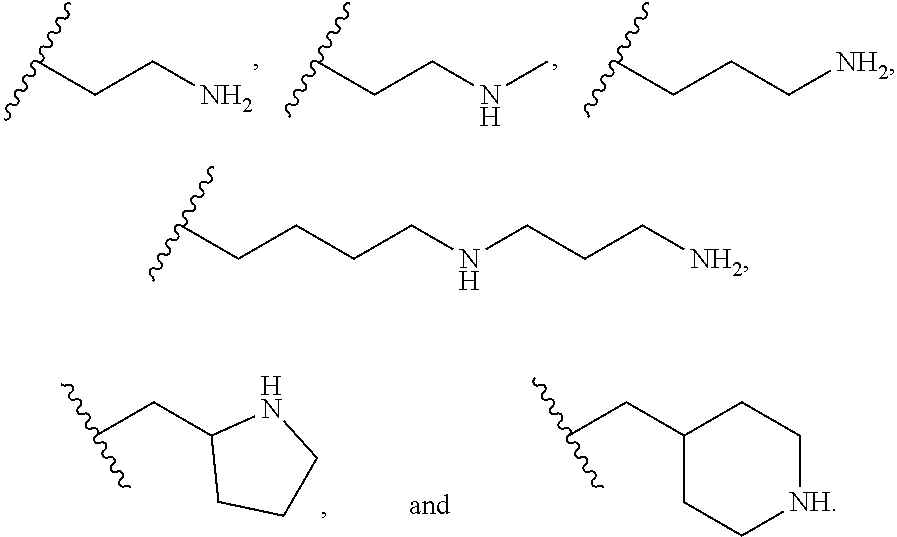
In certain embodiments, each R5 is


In certain embodiments of any of the foregoing embodiments, each neutral spacer moiety R4 is

In some embodiments of this aspect, which may be combined with any one or more of the previous embodiments, each lipid moiety R4 is independently C4-C22-alkyl or C4-C22-alkenyl, and wherein the C4-C22-alkenyl is optionally mono- or poly-unsaturated. In some embodiments, each lipid moiety R4 is a C6-C18 alkyl or C6-C18 alkenyl. In certain embodiments, each lipid moiety R4 is C8-C12 alkyl. In still other embodiments, each lipid moiety R4 is a C10-alkyl, such as n-decyl. In other embodiments of this aspect, which may be combined with either or both of the previous embodiments, each lipid moiety R4 is independently selected from the group consisting of 2-ethylhex-1-yl, caproyl oleyl, stearyl, linoleyl, myristyl, and lauryl.

and each neutral spacer moiety R4 is


- wherein:
- m is an integer from 0 to 10;
- n is an integer from 0 to 5;
- s is an integer from 0 to 10;
- t is an integer from 0 to 5;
- wherein at least one of m and t is nonzero, and wherein at least one of n and s is nonzero;
- r is an integer from 1 to 20;
- each o is independently an
integer - each q is independently an
integer - each p is independently an
integer - R1 is —H, alkyl, alkylaryl, —COR1a or a lipid moiety,
- wherein R1a is —H, —OH, alkyl, aryl, alkylaryl, —O-alkyl, or —O-alkylaryl;
- each R2 is independently an ethylene glycol moiety of the formula
- —CH2CH2O(CH2CH2O)uCH3, and wherein each u is independently an integer from 2 to 200;
- each R3 is independently a lipid moiety;
- each R4 is independently a neutral spacer moiety or a lipid moiety;
- each R5 is independently a cationic moiety;
- each R6 is independently an ethylene glycol moiety of the formula
- —CH2CH2O(CH2CH2O)vCH3, and wherein each v is independently an integer from 2 to 200;
- R7 is —H, alkyl, acyl, —OH, —OR7a, —NH2, —NHR7a, or a lipid moiety, wherein R7a is alkyl, acyl, or a lipid moiety; and
- each Ra and Rb are independently —H, C1-C4-alkyl, or a side chain moiety found on a naturally- or non-naturally-occurring amino acid. As applicable, this aspect of the disclosure also includes the various embodiments of the first aspect.


In still other embodiments, each R5 is


In certain embodiments, the polyamine is selected from the group consisting of


In certain embodiments, each neutral spacer moiety R4 is

Lipid Moieties

In still yet other embodiments which may be combined with any of the preceding embodiments, each lipid moiety R4 is independently a lipid of the formula

wherein R8 is a branched or straight chain aliphatic moieties having from about 6 to about 50 carbon atoms or from about 10 to about 50 carbon atoms, optionally comprising one or more heteroatoms, and optionally comprising one or more double or triple bonds. In certain embodiments, each lipid moiety R4 is independently


Structural Motifs

In other embodiments wherein the tertiary amino lipidated and/or PEGylated cationic peptide comprises a cationic domain, each cationic moiety R5 is

and each neutral spacer moiety is

In certain embodiments wherein the tertiary amino lipidated and/or PEGylated cationic peptide comprises a cationic domain comprising one or more dimer or trimer subunits, each cationic moiety R5 is

and each neutral spacer moiety is

In still other embodiments, the tertiary amino lipidated and/or PEGylated cationic peptide comprises a cationic domain comprising one or more trimer -RcationRneutralRneutral-, each cationic moiety R5 is

and each neutral spacer moiety is


In still yet other embodiments which may be combined with any of the preceding embodiments, each R3 is independently a lipid of the formula

wherein R8 is a branched or straight chain aliphatic moieties having from about 6 to about 50 carbon atoms or from about 10 to about 50 carbon atoms, optionally comprising one or more heteroatoms, and optionally comprising one or more double or triple bonds. In certain embodiments, each R3 is independently


Ethylene Glycol Moieties

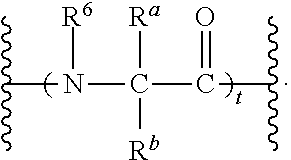

wherein at least one of n and s is nonzero, and wherein R1, R3, R4, R5, R7, Ra, Rb, o, p, q, and r are as defined for formula (I). In certain embodiments of the compound of formula (Ia), both n and s are nonzero.


In certain embodiments, the polyamine is selected from the group consisting of


| TABLE 1A | ||
| | Compound Structure | |
| 1 |
 |
| 2 |
 |
| 3 |
 |
| 4 |
 |
| 5 |
 |
| 6 |
 |
| 7 |
 |
| 8 |
 |
| 9 |
 |
| 10 |
 |
| 11 |
 |
| 12 |
 |
| 13 |
 |
| 14 |
 |
| 15 |
 |
| 16 |
 |
| 17 |
 |
| 18 |
 |
| 19 |
 |
| 20 |
 |
| 21 |
 |
| 22 |
 |
| 23 |
 |
| 24 |
 |
| 25 |
 |
| 26 |
 |
| 27 |
 |
| 28 |
 |
| 29 |
 |
| 30 |
 |
| 31 |
 |
| 32 |
 |
| 33 |
 |
| 34 |
 |
| 35 |
 |
| 36 |
 |
| 37 |
 |
| 38 |
 |
| 39 |
 |
| 40 |
 |
| 41 |
 |
| 42 |
 |
| 43 |
 |
| 44 |
 |
| 45 |
 |
| 46 |
 |
| 47 |
 |
| 48 |
 |
| 49 |
 |
| 50 |
 |
| 51 |
 |
| 52 |
 |
| 53 |
 |
| 54 |
 |
| 55 |
 |
| 56 |
 |
| 57 |
 |
| 58 |
 |
| 59 |
 |
| 60 |
 |
| 61 |
 |
| 62 |
 |
| 63 |
 |
| 64 |
 |
| 65 |
 |
| 66 |
 |
| 67 |
 |
| 68 |
 |
| 69 |
 |
| 70 |
 |
| 71 |
 |
| 72 |
 |
| TABLE 1B | |||
| Compound | Predicted Molecular | Retention | |
| # | Weight (g/mol) | Time (min) | m/z (MH+) |
| 1 | 1623.15 | 4.43 | 1623.9 |
| 2 | 1679.26 | 4.76 | 1680.11 |
| 3 | 1735.37 | 5.03 | 1736.2 |
| 4 | 1915.53 | 4.97 | 1916.2 |
| 5 | 1903.69 | 5.88 | 1904.3 |
| 6 | 1481.94 | 4.17 | 1482.9 |
| 7 | 1876.58 | 5.32 | 1877.26 |
| 8 | 2073.91 | 5.62 | 2074.3 |
| 9 | 834.2 | 4.54 | 834.8 |
| 10 | 1256.73 | 4.67 | 1257.7 |
| 11 | 2101.79 | 4.78 | 2103.3 |
| 12 | 2524.32 | 4.81 | 2524.5 |
| 13 | 1195.65 | 4.13 | 1196 |
| 14 | 712.04 | 3.43 | 712.7 |
| 15 | 912.28 | 3.23 | 912.87 |
| 16 | 1312.76 | 3.17 | 1313.2 |
| 17 | 1679.26 | 4.6 | 1680.1 |
| 18 | 1679.26 | 4.62 | 1680.1 |
| 19 | 2271.23 | 5.96 | 2271.57 |
| 20 | 1848.7 | 6.02 | 1849.21 |
| 21 | 2693.76 | 5.88 | 2694.1 |
| 22 | 2468.55 | 6.2 | 2469.62 |
| 23 | 2665.87 | 6.42 | 2666.7 |
| 24 | 2017.8 | 5.41 | 2018.02 |
| 25 | 2115.99 | 5.63 | 2116.41 |
| 26 | 2552.54 | 5.58 | 2553.77 |
| 27 | 1721.34 | 4.76 | 1721.81 |
| 28 | 2115.99 | 5.58 | 2116.4 |
| 29 | 2552.54 | 5.52 | 2552.81 |
| 30 | 1721.34 | 4.7 | 1722.11 |
| 31 | 2236.18 | 5.54 | 2236.66 |
| 32 | 2712.8 | 5.46 | 2713.72 |
| 33 | 1841.54 | 4.64 | 1842.2 |
| 34 | 2194.1 | 5.65 | 2194.43 |
| 35 | 2656.7 | 5.6 | 2656.74 |
| 36 | 1799.46 | 4.79 | 1800.27 |
| 37 | 927.25 | 6.06 | 928.8 |
| 38 | 1349.78 | 5.98 | 1351.8 |
| 39 | 1772.31 | 5.87 | 1774.1 |
| 40 | 1716.2 | 5.66 | 1718.1 |
| 41 | 906.44 | 5.39 | 908 |
| 42 | 920.47 | 5.36 | 921.6 |
| 43 | 921.45 | 5.62 | 922.9 |
| 44 | 977.56 | 5.23 | 978 |
| 45 | 1046.67 | 5.16 | 1047.7 |
| 46 | 1034.66 | 5.23 | 1035.1 |
| 47 | 971.52 | 5.39 | 972.6 |
| 48 | 2859.78 | 5.61 | 1408.8 (MH2 +2, |
| (average) | distribution, δ = 22.06) | ||
| 49 | 1328.97 | 5.51 | 1330 |
| 50 | 1343 | 5.43 | 1343.9 |
| 51 | 1343.98 | 5.62 | 1345 |
| 52 | 1400.09 | 5.35 | 1401.1 |
| 53 | 1469.2 | 5.33 | 1470.2 |
| 54 | 1457.19 | 5.38 | 1457.3 |
| 55 | 1394.04 | 5.42 | 1395.1 |
| 56 | 3282.31 | 5.63 | 1664.2 (MH2 +2, |
| (average) | distribution, δ = 22.08) | ||
| 57 | 1751.5 | 5.51 | 1752.3 |
| 58 | 1765.53 | 5.48 | 1766.4 |
| 59 | 1766.51 | 5.61 | 1767.3 |
| 60 | 1822.62 | 5.4 | 1824.4 |
| 61 | 1891.73 | 5.38 | 1892.5 |
| 62 | 1879.72 | 5.42 | 1880.5 |
| 63 | 1816.57 | 5.47 | 1817.3 |
| 64 | 3704.84 | 5.59 | 1408.8 (MH2 +2, |
| (average) | distribution, δ = 22.04) | ||
| 65 | 1695.39 | 5.21 | 1697.2 |
| 66 | 1709.42 | 5.23 | 1710.3 |
| 67 | 1710.4 | 5.36 | 1711.3 |
| 68 | 1766.51 | 5.14 | 1767.3 |
| 69 | 1835.62 | 5.12 | 1836.4 |
| 70 | 1823.61 | 5.17 | 1823.4 |
| 71 | 1760.47 | 5.22 | 1761.2 |
| 72 | 3648.73 | 5.37 | 1803.0 (MH2 +2, |
| (average) | distribution, δ = 22.06) | ||
| TABLE 2 | |||||
| Compound | Size (nm) | Size | % Encapsulation | ||
| 1 | 356.9 | 0.047 | 90.1 | ||
| 2 | 150 | 0.128 | 100.3 | ||
| 3 | 255.3 | 0.247 | 95.9 | ||
| 4 | 326.7 | 0.191 | 99.0 | ||
| 5 | 364.7 | 0.308 | 88.3 | ||
| 6 | 448.6 | 0.348 | 92.4 | ||
| 7 | 296.7 | 0.177 | 88.4 | ||
| 8 | 234 | 0.077 | 82.5 | ||
| 9 | 367.9 | 0.122 | 73.9 | ||
| 10 | 157 | 0.009 | 92.6 | ||
| 11 | 354.9 | 0.038 | 87.8 | ||
| 12 | 224.4 | 0.211 | 86.5 | ||
| 13 | 822.6 | 0.447 | 90.4 | ||
| 14 | 554 | 0.233 | 77.3 | ||
| 15 | 1064 | 1 | 76.9 | ||
| 16 | 1486 | 1 | 85.4 | ||
| 17 | 472.8 | 0.37 | 90.3 | ||
| 18 | 593 | 0.762 | 88.5 | ||
| 19 | 276 | 0.158 | 70.9 | ||
| 20 | 326.6 | 0.37 | 72.2 | ||
| 21 | 386.5 | 0.174 | 65.4 | ||
| 22 | 748.2 | 0.538 | 65.4 | ||
| 23 | NA | NA | 3.9 | ||
| 24 | 161 | 0.135 | 87.0 | ||
| 25 | 773.3 | 0.021 | 8.4 | ||
| 26 | NA | NA | 35.7 | ||
| 27 | 438.7 | 0.606 | 50.9 | ||
| 28 | 308 | 0.085 | 52.0 | ||
| 29 | 343.4 | 0.237 | 24.8 | ||
| 30 | 282.8 | 0.455 | 8.4 | ||
| 31 | 348.5 | 0.404 | 35.7 | ||
| 32 | 247.5 | 0.274 | 50.9 | ||
| 33 | 435.7 | 0.048 | 82.0 | ||
| 34 | 348.4 | 0.295 | 58.0 | ||
| 35 | 359.8 | 0.486 | 38.0 | ||
| 36 | 374.4 | 0.127 | 71.5 | ||
| NA = Sample was unsuitable for DLS measurement | |||||
| TABLE 3 |
| In vitro expression of firefly luciferase (Fluc) following treatment with |
| representative Fluc mRNA/amino lipidated peptoid formulations |
| Luciferase Expression (RLU) |
| Compound | 6 h | 24 h |
| 1 | 1.22E+02 | 4.00E+01 |
| 2 | 2.35E+02 | 1.35E+02 |
| 3 | 2.27E+02 | 2.99E+02 |
| 4 | 1.96E+02 | 1.13E+02 |
| 5 | 9.60E+01 | 5.36E+02 |
| 6 | 4.30E+01 | 3.60E+01 |
| 7 | 6.45E+03 | 9.71E+03 |
| 8 | 1.10E+04 | 1.33E+04 |
| 9 | 1.52E+02 | 8.57E+01 |
| 10 | 1.88E+03 | 7.01E+02 |
| 11 | 1.15E+03 | 1.22E+03 |
| 12 | 4.04E+02 | 5.71E+02 |
| 13 | 3.67E+00 | 9.67E+00 |
| 14 | 3.20E+01 | 1.43E+01 |
| 15 | 3.93E+01 | 1.90E+01 |
| 16 | 7.33E+00 | 1.67E+01 |
| 17 | 6.84E+02 | 5.63E+02 |
| 18 | 5.74E+02 | 8.49E+02 |
| 19 | 8.20E+03 | 1.09E+04 |
| 20 | 9.91E+03 | 1.55E+04 |
| 21 | 3.45E+03 | 1.24E+04 |
| 22 | 6.63E+01 | 6.77E+01 |
| 23 | 5.60E+01 | 9.47E+01 |
| 24 | 1.79E+04 | 3.43E+04 |
| 25 | 3.93E+02 | 2.07E+03 |
| 26 | 5.00E+00 | 1.07E+01 |
| 27 | 9.88E+02 | 7.40E+02 |
| 28 | 9.59E+02 | 4.97E+03 |
| 29 | 1.64E+03 | 6.72E+03 |
| 30 | 2.79E+03 | 1.29E+04 |
| 31 | 5.84E+02 | 2.93E+03 |
| 32 | 4.25E+02 | 2.00E+03 |
| 33 | 4.61E+03 | 1.14E+04 |
| 34 | 1.95E+03 | 2.71E+03 |
| 35 | 1.22E+03 | 1.60E+03 |
| 36 | 9.34E+03 | 7.78E+03 |
| TABLE 4 | |
| Formulation/Mass Percentage | |
| Component | A | B | C | D | E | F |
| Peptoid (or Lipitoid 1) | 50 | 63 | 42 | 50 | 63 | 42 |
| |
16 | 0 | 23 | 16 | 0 | 23 |
| |
32 | 35 | 33 | 32 | 35 | 33 |
| DMG- |
2 | 2 | 2 | 2 | 2 | 2 |
| Mass ratio of peptoid to | 7:1 | 7:1 | 7:1 | 10:1 | 10:1 | 10:1 |
| mRNA | ||||||
Claims (28)


Priority Applications (1)
| Application Number | Priority Date | Filing Date | Title |
|---|---|---|---|
| US17/347,498 US11701434B2 (en) | 2018-09-28 | 2021-06-14 | Tertiary amino lipidated cationic peptides for nucleic acid delivery |
Applications Claiming Priority (5)
| Application Number | Priority Date | Filing Date | Title |
|---|---|---|---|
| US201862738717P | 2018-09-28 | 2018-09-28 | |
| US201962885036P | 2019-08-09 | 2019-08-09 | |
| PCT/US2019/053655 WO2020069442A1 (en) | 2018-09-28 | 2019-09-27 | Tertiary amino lipidated cationic peptides for nucleic acid delivery |
| US202117279508A | 2021-03-24 | 2021-03-24 | |
| US17/347,498 US11701434B2 (en) | 2018-09-28 | 2021-06-14 | Tertiary amino lipidated cationic peptides for nucleic acid delivery |
Related Parent Applications (2)
| Application Number | Title | Priority Date | Filing Date |
|---|---|---|---|
| PCT/US2019/053655 Continuation WO2020069442A1 (en) | 2018-09-28 | 2019-09-27 | Tertiary amino lipidated cationic peptides for nucleic acid delivery |
| US17/279,508 Continuation US20210324002A1 (en) | 2018-09-28 | 2019-09-27 | Tertiary amino lipidated cationic peptides for nucleic acid delivery |
Publications (2)
| Publication Number | Publication Date |
|---|---|
| US20210371458A1 US20210371458A1 (en) | 2021-12-02 |
| US11701434B2 true US11701434B2 (en) | 2023-07-18 |
Family
ID=69952323
Family Applications (4)
| Application Number | Title | Priority Date | Filing Date |
|---|---|---|---|
| US17/279,460 Abandoned US20210322575A1 (en) | 2018-09-28 | 2019-09-27 | Lipid nanoparticle formulations comprising lipidated cationic peptide compounds for nucleic acid delivery |
| US17/279,508 Abandoned US20210324002A1 (en) | 2018-09-28 | 2019-09-27 | Tertiary amino lipidated cationic peptides for nucleic acid delivery |
| US17/347,539 Active US11446394B2 (en) | 2018-09-28 | 2021-06-14 | Lipid nanoparticle formulations comprising lipidated cationic peptide compounds for nucleic acid delivery |
| US17/347,498 Active US11701434B2 (en) | 2018-09-28 | 2021-06-14 | Tertiary amino lipidated cationic peptides for nucleic acid delivery |
Family Applications Before (3)
| Application Number | Title | Priority Date | Filing Date |
|---|---|---|---|
| US17/279,460 Abandoned US20210322575A1 (en) | 2018-09-28 | 2019-09-27 | Lipid nanoparticle formulations comprising lipidated cationic peptide compounds for nucleic acid delivery |
| US17/279,508 Abandoned US20210324002A1 (en) | 2018-09-28 | 2019-09-27 | Tertiary amino lipidated cationic peptides for nucleic acid delivery |
| US17/347,539 Active US11446394B2 (en) | 2018-09-28 | 2021-06-14 | Lipid nanoparticle formulations comprising lipidated cationic peptide compounds for nucleic acid delivery |
Country Status (14)
| Country | Link |
|---|---|
| US (4) | US20210322575A1 (en) |
| EP (2) | EP3856146A4 (en) |
| JP (2) | JP7430713B2 (en) |
| KR (2) | KR20210068093A (en) |
| CN (2) | CN112805294A (en) |
| AU (2) | AU2019347774A1 (en) |
| BR (2) | BR112021004929A2 (en) |
| CA (2) | CA3110914A1 (en) |
| IL (2) | IL281135B2 (en) |
| MX (2) | MX2021003421A (en) |
| MY (1) | MY204458A (en) |
| SG (2) | SG11202102163SA (en) |
| WO (2) | WO2020069445A1 (en) |
| ZA (2) | ZA202101376B (en) |
Families Citing this family (18)
| Publication number | Priority date | Publication date | Assignee | Title |
|---|---|---|---|---|
| US20210322575A1 (en) * | 2018-09-28 | 2021-10-21 | Nutcracker Therapeutics, Inc. | Lipid nanoparticle formulations comprising lipidated cationic peptide compounds for nucleic acid delivery |
| CN114555130A (en) * | 2019-08-09 | 2022-05-27 | 胡桃钳医疗公司 | Lipidated cationic peptide-PEG compositions for nucleic acid delivery |
| BR112022021380A2 (en) * | 2020-04-22 | 2022-12-06 | Nutcracker Therapeutics Inc | MESSENGER RNA NANOPARTICLES FOR TREATMENT |
| NL2026825B1 (en) | 2020-08-07 | 2022-04-05 | Nutcracker Therapeutics Inc | Multicomponent delivery system for polyanionic cargo compound delivery |
| US20230293706A1 (en) | 2020-08-07 | 2023-09-21 | Nutcracker Therapeutics, Inc. | Multicomponent Delivery Systems for Polyanionic Cargo Compound Delivery |
| IL303434A (en) * | 2020-12-07 | 2023-08-01 | Tufts College | Lipidoid compositions and methods of use thereof |
| WO2022235923A2 (en) * | 2021-05-05 | 2022-11-10 | Arcturus Therapeutics, Inc. | Peptide-lipid conjugates |
| US20240307526A1 (en) | 2021-08-06 | 2024-09-19 | Nutcracker Therapeutics, Inc. | Compositions comprising hydroxyethyl-capped cationic peptoids |
| NL2029057B1 (en) | 2021-08-06 | 2023-02-21 | Nutcracker Therapeutics Inc | Compositions comprising hydroxyethyl-capped cationic peptoids |
| CN114778712B (en) * | 2022-03-21 | 2023-06-02 | 天津键凯科技有限公司 | Polyethylene glycol lipid and detection method for lipid nanoparticle content containing same |
| EP4584278A1 (en) | 2022-09-09 | 2025-07-16 | Nutcracker Therapeutics, Inc. | 2-aminopropane-1,3-diol-capped cationic peptoids for nucleic acid delivery |
| CN121752579A (en) | 2023-06-29 | 2026-03-27 | 胡桃夹子治疗公司 | Ethyl modified RNA caps and methods of use |
| KR20250036032A (en) * | 2023-09-05 | 2025-03-13 | 한국생명공학연구원 | Nucleic acids Delivery System Using Lipid Nano Particle |
| WO2025137277A1 (en) | 2023-12-19 | 2025-06-26 | Nutcracker Therapeutics, Inc. | Degradable peptoids |
| US20250381150A1 (en) | 2024-03-08 | 2025-12-18 | Genzyme Corporation | Lipid nanoparticles |
| WO2026003582A2 (en) | 2024-06-27 | 2026-01-02 | Axelyf ehf. | Lipids and lipid nanoparticles |
| WO2026030375A2 (en) | 2024-07-30 | 2026-02-05 | Genzyme Corporation | Lipid nanoparticles and methods of manufacture and use thereof |
| WO2026142951A1 (en) | 2024-12-23 | 2026-07-02 | Genzyme Corporation | Pharmaceutical system |
Citations (41)
| Publication number | Priority date | Publication date | Assignee | Title |
|---|---|---|---|---|
| US6191115B1 (en) | 1998-08-12 | 2001-02-20 | Abbott Laboratories | C-terminus modified heptapeptide LHRH analogs |
| US6534484B1 (en) | 1995-06-07 | 2003-03-18 | Inex Pharmaceuticals Corp. | Methods for encapsulating plasmids in lipid bilayers |
| US6586410B1 (en) | 1995-06-07 | 2003-07-01 | Inex Pharmaceuticals Corporation | Lipid-nucleic acid particles prepared via a hydrophobic lipid-nucleic acid complex intermediate and use for gene transfer |
| US20030203865A1 (en) | 2001-04-30 | 2003-10-30 | Pierrot Harvie | Lipid-comprising drug delivery complexes and methods for their production |
| US6858225B2 (en) | 1997-05-14 | 2005-02-22 | Inex Pharmaceuticals Corporation | Lipid-encapsulated polyanionic nucleic acid |
| WO2005060697A2 (en) | 2003-12-19 | 2005-07-07 | Chiron Corporation | Cell transfecting formulations of small interfering rna, related compositions and methods of making and use |
| US20110053829A1 (en) | 2009-09-03 | 2011-03-03 | Curevac Gmbh | Disulfide-linked polyethyleneglycol/peptide conjugates for the transfection of nucleic acids |
| US7901708B2 (en) | 2002-06-28 | 2011-03-08 | Protiva Biotherapeutics, Inc. | Liposomal apparatus and manufacturing methods |
| US20110230397A1 (en) | 2006-08-09 | 2011-09-22 | Maria Vincenza Carriero | Peptides having pharmacological activity for treating disorders associated with altered cell migration, such as cancer |
| US8058069B2 (en) | 2008-04-15 | 2011-11-15 | Protiva Biotherapeutics, Inc. | Lipid formulations for nucleic acid delivery |
| WO2012000104A1 (en) | 2010-06-30 | 2012-01-05 | Protiva Biotherapeutics, Inc. | Non-liposomal systems for nucleic acid delivery |
| US20140142044A1 (en) | 2011-04-12 | 2014-05-22 | The United States of America, as represented by the Secretary, Department of Health & Human Servic | Peptide mimetic ligands of polo-like kinase 1 polo box domain and methods of use |
| US9035039B2 (en) | 2011-12-22 | 2015-05-19 | Protiva Biotherapeutics, Inc. | Compositions and methods for silencing SMAD4 |
| US9062021B2 (en) | 2010-06-04 | 2015-06-23 | Sirna Therapeutics, Inc. | Low molecular weight cationic lipids for oligonucleotide delivery |
| US9446132B2 (en) | 2012-03-27 | 2016-09-20 | Sima Therapeutics, Inc. | Diether based biodegradable cationic lipids for siRNA delivery |
| US9579338B2 (en) | 2011-11-04 | 2017-02-28 | Nitto Denko Corporation | Method of producing lipid nanoparticles for drug delivery |
| US9687448B2 (en) | 2012-12-07 | 2017-06-27 | Alnylam Pharmaceuticals, Inc. | Nucleic acid lipid particle formulations |
| US9758795B2 (en) | 2009-11-04 | 2017-09-12 | The University Of British Columbia | Nucleic acid-containing lipid particles and related methods |
| US9872900B2 (en) | 2014-04-23 | 2018-01-23 | Modernatx, Inc. | Nucleic acid vaccines |
| US9878042B2 (en) | 2009-07-01 | 2018-01-30 | Protiva Biotherapeutics, Inc. | Lipid formulations for delivery of therapeutic agents to solid tumors |
| WO2018064755A1 (en) | 2016-10-03 | 2018-04-12 | Precision Nanosystems Inc. | Compositions for transfecting resistant cell types |
| WO2018107061A1 (en) | 2016-12-09 | 2018-06-14 | Board Of Regents, The University Of Texas System | Hybrid exosomal-polymeric (hexpo) nano-platform for delivery of rnai therapeutics |
| US10143758B2 (en) | 2009-12-01 | 2018-12-04 | Translate Bio, Inc. | Liver specific delivery of messenger RNA |
| US10300018B2 (en) | 2015-07-22 | 2019-05-28 | Nitto Denko Corporation | Compositions and methods for nanoparticle lyophile forms |
| US20190216730A1 (en) | 2012-06-08 | 2019-07-18 | Translate Bio, Inc. | Pulmonary delivery of mrna to non-lung target cells |
| US10358647B2 (en) | 2015-12-13 | 2019-07-23 | Nitto Denko Corporation | siRNA structures for high activity and reduced off target |
| US10799602B2 (en) | 2013-08-21 | 2020-10-13 | Curevac Ag | Method for increasing expression of RNA-encoded proteins |
| US10808252B2 (en) | 2014-06-24 | 2020-10-20 | Aptatargets, S.L. | Aptamers specific for TLR-4 and uses thereof |
| EP2833869B1 (en) | 2012-04-04 | 2020-10-28 | Samyang Biopharmaceuticals Corporation | Method of preparing composition for delivering an anionic drug |
| US10822368B2 (en) | 2013-03-14 | 2020-11-03 | Translate Bio, Inc. | Ribonucleic acids with 4′-thio-modified nucleotides and related methods |
| US10821186B2 (en) | 2008-11-10 | 2020-11-03 | Arbutus Biopharma Corporation | Lipids and compositions for the delivery of therapeutics |
| US10829760B2 (en) | 2010-10-22 | 2020-11-10 | Olix Pharmaceuticals, Inc. | Nucleic acid molecules inducing RNA interference, and uses thereof |
| US10844377B2 (en) | 2017-06-23 | 2020-11-24 | University Of Massachusetts | Two-tailed self-delivering siRNA |
| US10864162B2 (en) | 2012-06-19 | 2020-12-15 | Massachusetts Institute Of Technology | Mass production and size control of nanoparticles through controlled microvortices |
| EP2871178B1 (en) | 2012-07-06 | 2020-12-23 | Kyowa Kirin Co., Ltd. | Cationic lipid |
| US10888626B2 (en) | 2011-06-08 | 2021-01-12 | Translate Bio, Inc. | Lipid nanoparticle compositions and methods for mRNA delivery |
| EP3569711B1 (en) | 2014-12-15 | 2021-02-03 | Dicerna Pharmaceuticals, Inc. | Ligand-modified double-stranded nucleic acids |
| EP2155351B1 (en) | 2007-06-04 | 2021-02-17 | Pressure Biosciences, Inc. | Pressure-enhanced extraction and partitioning of molecules |
| US10933127B2 (en) | 2015-10-22 | 2021-03-02 | Modernatx, Inc. | Betacoronavirus mRNA vaccine |
| US10941395B2 (en) | 2014-06-10 | 2021-03-09 | Massachusetts Institute Of Technology | Method for gene editing |
| US10940207B2 (en) | 2016-11-10 | 2021-03-09 | Translate Bio, Inc. | Ice-based lipid nanoparticle formulation for delivery of mRNA |
Family Cites Families (6)
| Publication number | Priority date | Publication date | Assignee | Title |
|---|---|---|---|---|
| JP4652648B2 (en) | 1999-08-27 | 2011-03-16 | ノバルティス バクシンズ アンド ダイアグノスティックス,インコーポレーテッド | Chimeric antisense oligonucleotides and cell transfection formulations thereof |
| AU2004257373B2 (en) * | 2003-07-16 | 2011-03-24 | Arbutus Biopharma Corporation | Lipid encapsulated interfering RNA |
| WO2009132131A1 (en) * | 2008-04-22 | 2009-10-29 | Alnylam Pharmaceuticals, Inc. | Amino lipid based improved lipid formulation |
| EP2350296A4 (en) * | 2008-11-17 | 2013-04-03 | Enzon Pharmaceuticals Inc | BRANCHED CATIONIC LIPIDS FOR NUCLEIC ACID DELIVERY SYSTEM |
| WO2017100154A1 (en) * | 2015-12-07 | 2017-06-15 | Purdue Research Foundation | Inhibitors for proliferating cell nuclear antigen and uses |
| US20210322575A1 (en) * | 2018-09-28 | 2021-10-21 | Nutcracker Therapeutics, Inc. | Lipid nanoparticle formulations comprising lipidated cationic peptide compounds for nucleic acid delivery |
-
2019
- 2019-09-27 US US17/279,460 patent/US20210322575A1/en not_active Abandoned
- 2019-09-27 AU AU2019347774A patent/AU2019347774A1/en not_active Abandoned
- 2019-09-27 IL IL281135A patent/IL281135B2/en unknown
- 2019-09-27 BR BR112021004929-0A patent/BR112021004929A2/en not_active IP Right Cessation
- 2019-09-27 KR KR1020217012769A patent/KR20210068093A/en not_active Ceased
- 2019-09-27 MX MX2021003421A patent/MX2021003421A/en unknown
- 2019-09-27 JP JP2021517802A patent/JP7430713B2/en active Active
- 2019-09-27 JP JP2021517865A patent/JP7418419B2/en active Active
- 2019-09-27 US US17/279,508 patent/US20210324002A1/en not_active Abandoned
- 2019-09-27 MX MX2021003420A patent/MX2021003420A/en unknown
- 2019-09-27 WO PCT/US2019/053661 patent/WO2020069445A1/en not_active Ceased
- 2019-09-27 KR KR1020217012768A patent/KR20210068092A/en not_active Ceased
- 2019-09-27 SG SG11202102163SA patent/SG11202102163SA/en unknown
- 2019-09-27 WO PCT/US2019/053655 patent/WO2020069442A1/en not_active Ceased
- 2019-09-27 CA CA3110914A patent/CA3110914A1/en active Pending
- 2019-09-27 CA CA3111476A patent/CA3111476A1/en active Pending
- 2019-09-27 MY MYPI2021001653A patent/MY204458A/en unknown
- 2019-09-27 CN CN201980062070.0A patent/CN112805294A/en active Pending
- 2019-09-27 EP EP19864088.0A patent/EP3856146A4/en not_active Withdrawn
- 2019-09-27 EP EP19866196.9A patent/EP3856757A4/en active Pending
- 2019-09-27 BR BR112021005815-0A patent/BR112021005815A2/en not_active IP Right Cessation
- 2019-09-27 SG SG11202102164PA patent/SG11202102164PA/en unknown
- 2019-09-27 CN CN201980062278.2A patent/CN112789031B/en not_active Expired - Fee Related
- 2019-09-27 AU AU2019351268A patent/AU2019351268A1/en not_active Abandoned
-
2021
- 2021-02-26 ZA ZA2021/01376A patent/ZA202101376B/en unknown
- 2021-03-03 ZA ZA2021/01465A patent/ZA202101465B/en unknown
- 2021-03-19 IL IL281653A patent/IL281653A/en unknown
- 2021-06-14 US US17/347,539 patent/US11446394B2/en active Active
- 2021-06-14 US US17/347,498 patent/US11701434B2/en active Active
Patent Citations (53)
| Publication number | Priority date | Publication date | Assignee | Title |
|---|---|---|---|---|
| US6534484B1 (en) | 1995-06-07 | 2003-03-18 | Inex Pharmaceuticals Corp. | Methods for encapsulating plasmids in lipid bilayers |
| US6586410B1 (en) | 1995-06-07 | 2003-07-01 | Inex Pharmaceuticals Corporation | Lipid-nucleic acid particles prepared via a hydrophobic lipid-nucleic acid complex intermediate and use for gene transfer |
| US6858225B2 (en) | 1997-05-14 | 2005-02-22 | Inex Pharmaceuticals Corporation | Lipid-encapsulated polyanionic nucleic acid |
| US7341738B2 (en) | 1997-05-14 | 2008-03-11 | The University Of British Columbia | Lipid-encapsulated polyanionic nucleic acid |
| US6191115B1 (en) | 1998-08-12 | 2001-02-20 | Abbott Laboratories | C-terminus modified heptapeptide LHRH analogs |
| US20030203865A1 (en) | 2001-04-30 | 2003-10-30 | Pierrot Harvie | Lipid-comprising drug delivery complexes and methods for their production |
| US9504651B2 (en) | 2002-06-28 | 2016-11-29 | Protiva Biotherapeutics, Inc. | Lipid compositions for nucleic acid delivery |
| US7901708B2 (en) | 2002-06-28 | 2011-03-08 | Protiva Biotherapeutics, Inc. | Liposomal apparatus and manufacturing methods |
| WO2005060697A2 (en) | 2003-12-19 | 2005-07-07 | Chiron Corporation | Cell transfecting formulations of small interfering rna, related compositions and methods of making and use |
| US20110230397A1 (en) | 2006-08-09 | 2011-09-22 | Maria Vincenza Carriero | Peptides having pharmacological activity for treating disorders associated with altered cell migration, such as cancer |
| EP2155351B1 (en) | 2007-06-04 | 2021-02-17 | Pressure Biosciences, Inc. | Pressure-enhanced extraction and partitioning of molecules |
| US9364435B2 (en) | 2008-04-15 | 2016-06-14 | Protiva Biotherapeutics, Inc. | Lipid formulations for nucleic acid delivery |
| US8058069B2 (en) | 2008-04-15 | 2011-11-15 | Protiva Biotherapeutics, Inc. | Lipid formulations for nucleic acid delivery |
| US8492359B2 (en) | 2008-04-15 | 2013-07-23 | Protiva Biotherapeutics, Inc. | Lipid formulations for nucleic acid delivery |
| US10821186B2 (en) | 2008-11-10 | 2020-11-03 | Arbutus Biopharma Corporation | Lipids and compositions for the delivery of therapeutics |
| US9878042B2 (en) | 2009-07-01 | 2018-01-30 | Protiva Biotherapeutics, Inc. | Lipid formulations for delivery of therapeutic agents to solid tumors |
| US20110053829A1 (en) | 2009-09-03 | 2011-03-03 | Curevac Gmbh | Disulfide-linked polyethyleneglycol/peptide conjugates for the transfection of nucleic acids |
| US9758795B2 (en) | 2009-11-04 | 2017-09-12 | The University Of British Columbia | Nucleic acid-containing lipid particles and related methods |
| US20190032087A1 (en) | 2009-11-04 | 2019-01-31 | The University Of British Columbia | Nucleic acid-containing lipid particles and related methods |
| US20190192690A1 (en) | 2009-12-01 | 2019-06-27 | Translate Bio, Inc. | Liver specific delivery of messenger rna |
| EP3318248B1 (en) | 2009-12-01 | 2019-04-10 | Translate Bio, Inc. | Delivery of mrna for the augmentation of proteins and enzymes in human genetic diseases |
| US10143758B2 (en) | 2009-12-01 | 2018-12-04 | Translate Bio, Inc. | Liver specific delivery of messenger RNA |
| US9062021B2 (en) | 2010-06-04 | 2015-06-23 | Sirna Therapeutics, Inc. | Low molecular weight cationic lipids for oligonucleotide delivery |
| WO2012000104A1 (en) | 2010-06-30 | 2012-01-05 | Protiva Biotherapeutics, Inc. | Non-liposomal systems for nucleic acid delivery |
| US9518272B2 (en) | 2010-06-30 | 2016-12-13 | Protiva Biotherapeutics, Inc. | Non-liposomal systems for nucleic acid delivery |
| US9404127B2 (en) | 2010-06-30 | 2016-08-02 | Protiva Biotherapeutics, Inc. | Non-liposomal systems for nucleic acid delivery |
| US10829760B2 (en) | 2010-10-22 | 2020-11-10 | Olix Pharmaceuticals, Inc. | Nucleic acid molecules inducing RNA interference, and uses thereof |
| US20140142044A1 (en) | 2011-04-12 | 2014-05-22 | The United States of America, as represented by the Secretary, Department of Health & Human Servic | Peptide mimetic ligands of polo-like kinase 1 polo box domain and methods of use |
| US10888626B2 (en) | 2011-06-08 | 2021-01-12 | Translate Bio, Inc. | Lipid nanoparticle compositions and methods for mRNA delivery |
| US9579338B2 (en) | 2011-11-04 | 2017-02-28 | Nitto Denko Corporation | Method of producing lipid nanoparticles for drug delivery |
| US9035039B2 (en) | 2011-12-22 | 2015-05-19 | Protiva Biotherapeutics, Inc. | Compositions and methods for silencing SMAD4 |
| US9446132B2 (en) | 2012-03-27 | 2016-09-20 | Sima Therapeutics, Inc. | Diether based biodegradable cationic lipids for siRNA delivery |
| EP2833869B1 (en) | 2012-04-04 | 2020-10-28 | Samyang Biopharmaceuticals Corporation | Method of preparing composition for delivering an anionic drug |
| EP2858679B1 (en) | 2012-06-08 | 2021-02-24 | Translate Bio, Inc. | Pulmonary delivery of mrna to non-lung target cells |
| US20190216730A1 (en) | 2012-06-08 | 2019-07-18 | Translate Bio, Inc. | Pulmonary delivery of mrna to non-lung target cells |
| US10864162B2 (en) | 2012-06-19 | 2020-12-15 | Massachusetts Institute Of Technology | Mass production and size control of nanoparticles through controlled microvortices |
| EP2871178B1 (en) | 2012-07-06 | 2020-12-23 | Kyowa Kirin Co., Ltd. | Cationic lipid |
| US9687448B2 (en) | 2012-12-07 | 2017-06-27 | Alnylam Pharmaceuticals, Inc. | Nucleic acid lipid particle formulations |
| US10822368B2 (en) | 2013-03-14 | 2020-11-03 | Translate Bio, Inc. | Ribonucleic acids with 4′-thio-modified nucleotides and related methods |
| US20210009629A1 (en) | 2013-03-14 | 2021-01-14 | Translate Bio, Inc. | Ribonucleic acids with 4'-thio-modified nucleotides and related methods |
| US10799602B2 (en) | 2013-08-21 | 2020-10-13 | Curevac Ag | Method for increasing expression of RNA-encoded proteins |
| US9872900B2 (en) | 2014-04-23 | 2018-01-23 | Modernatx, Inc. | Nucleic acid vaccines |
| US10941395B2 (en) | 2014-06-10 | 2021-03-09 | Massachusetts Institute Of Technology | Method for gene editing |
| US10808252B2 (en) | 2014-06-24 | 2020-10-20 | Aptatargets, S.L. | Aptamers specific for TLR-4 and uses thereof |
| EP3569711B1 (en) | 2014-12-15 | 2021-02-03 | Dicerna Pharmaceuticals, Inc. | Ligand-modified double-stranded nucleic acids |
| US10300018B2 (en) | 2015-07-22 | 2019-05-28 | Nitto Denko Corporation | Compositions and methods for nanoparticle lyophile forms |
| US10933127B2 (en) | 2015-10-22 | 2021-03-02 | Modernatx, Inc. | Betacoronavirus mRNA vaccine |
| US10358647B2 (en) | 2015-12-13 | 2019-07-23 | Nitto Denko Corporation | siRNA structures for high activity and reduced off target |
| WO2018064755A1 (en) | 2016-10-03 | 2018-04-12 | Precision Nanosystems Inc. | Compositions for transfecting resistant cell types |
| US10940207B2 (en) | 2016-11-10 | 2021-03-09 | Translate Bio, Inc. | Ice-based lipid nanoparticle formulation for delivery of mRNA |
| US20200069594A1 (en) | 2016-12-09 | 2020-03-05 | Board Of Regents, The University Of Texas System | Hybrid exosomal-polymeric (hexpo) nano-platform for delivery of rnai therapeutics |
| WO2018107061A1 (en) | 2016-12-09 | 2018-06-14 | Board Of Regents, The University Of Texas System | Hybrid exosomal-polymeric (hexpo) nano-platform for delivery of rnai therapeutics |
| US10844377B2 (en) | 2017-06-23 | 2020-11-24 | University Of Massachusetts | Two-tailed self-delivering siRNA |
Non-Patent Citations (11)
| Title |
|---|
| Akinc et al., Nature Biotechnol., 2008, 26: 561-569. * |
| Chongsriwatana et al., Antimicrobial agents and Chemotherapy, 2011, 55: 417-420. * |
| Felgner, JBC, 1994, 269: 2550-2561. * |
| Figliozzi et al., Methods Enzymol., 1996, 267: 437-447. * |
| Hashemi, AAPS PharmSciTech 2015, 16: 1002-10012. * |
| Kauffman et al., J. Control. Rel., 2016, 240: 227-234. * |
| Kowalski, et al. "Delivering the Messenger: Advances in Technologies for Therapeutic mRNA Delivery", Molecular Therapy, ePub Feb. 2019, 27(4), pp. 710-728. |
| Lobo et al., Structure/Function Analysis of Peptoid/Lipitoid:DNA Complexes, Journal of Pharmaceutical Sciences, 2003, 92(9), 1905-1918. |
| Simon et al., Peptoids: a modular approach to drug discovery, Proc. Natl. Acad. Sci. USA, 1992, 89, 9367-9371. |
| Utku et al., A Peptidomimetic SiRNA Transfection Reagent for Highly Effective Gene Silencing, Molecular BioSystems, 2006, 2(6-7), 312-317. |
| Zugates et al., Bioconjugate Chem., 2007, 18: 1887-1896. * |
Also Published As
Similar Documents
| Publication | Publication Date | Title |
|---|---|---|
| US11446394B2 (en) | Lipid nanoparticle formulations comprising lipidated cationic peptide compounds for nucleic acid delivery | |
| US20240246898A1 (en) | Cationic lipids for nucleic acid delivery and preparation thereof | |
| JP7657773B2 (en) | Lipidated cationic peptide-PEG compositions for nucleic acid delivery - Patent Application 20070123333 | |
| CN102027043A (en) | Biodegradable cross-linked branched poly (alkylene imines) | |
| EP4306126A1 (en) | Vaccine composition for preventing sars-cov-2 | |
| KR20240159310A (en) | Lipid nanoparticle compositions using novel ionizable lipids | |
| TWI876778B (en) | Cycloalkane-based lipid compound for delivering nucleic acid and lipid nanoparticle comprising the same | |
| JP2001515060A (en) | New lipopolyamines, their preparation and application | |
| KR20240076588A (en) | Amino acid-lipid binding compound for nucleic acid delivery and lipid nanoparticles comprising the same | |
| HK40050963B (en) | Lipid nanoparticle formulations comprising lipidated cationic peptide compounds for nucleic acid delivery | |
| HK40050963A (en) | Lipid nanoparticle formulations comprising lipidated cationic peptide compounds for nucleic acid delivery | |
| HK40050965A (en) | Tertiary amino lipidated cationic peptides for nucleic acid delivery | |
| RU2844549C1 (en) | Lipid particles for delivering nucleic acids to mammalian cells and use thereof | |
| RU2836309C1 (en) | Cationic lipid for delivery of nucleic acids into mammalian cells, method for production thereof and use thereof | |
| Patel | Development of Amino Acid-Modified Drug Delivery Systems for RNA Delivery in Cancer Therapeutics | |
| WO2026060495A1 (en) | Ionisable lipids | |
| WO2026060493A1 (en) | Ionisable lipids |
Legal Events
| Date | Code | Title | Description |
|---|---|---|---|
| FEPP | Fee payment procedure |
Free format text: ENTITY STATUS SET TO UNDISCOUNTED (ORIGINAL EVENT CODE: BIG.); ENTITY STATUS OF PATENT OWNER: SMALL ENTITY |
|
| AS | Assignment |
Owner name: NUTCRACKER THERAPEUTICS, INC., CALIFORNIA Free format text: ASSIGNMENT OF ASSIGNORS INTEREST;ASSIGNOR:MCKINLAY, COLIN JAMES;REEL/FRAME:056568/0068 Effective date: 20210415 |
|
| FEPP | Fee payment procedure |
Free format text: ENTITY STATUS SET TO SMALL (ORIGINAL EVENT CODE: SMAL); ENTITY STATUS OF PATENT OWNER: SMALL ENTITY |
|
| STPP | Information on status: patent application and granting procedure in general |
Free format text: NON FINAL ACTION MAILED |
|
| STPP | Information on status: patent application and granting procedure in general |
Free format text: NON FINAL ACTION MAILED |
|
| STPP | Information on status: patent application and granting procedure in general |
Free format text: RESPONSE TO NON-FINAL OFFICE ACTION ENTERED AND FORWARDED TO EXAMINER |
|
| STPP | Information on status: patent application and granting procedure in general |
Free format text: FINAL REJECTION MAILED |
|
| STPP | Information on status: patent application and granting procedure in general |
Free format text: RESPONSE AFTER FINAL ACTION FORWARDED TO EXAMINER |
|
| STPP | Information on status: patent application and granting procedure in general |
Free format text: ADVISORY ACTION MAILED |
|
| STPP | Information on status: patent application and granting procedure in general |
Free format text: DOCKETED NEW CASE - READY FOR EXAMINATION |
|
| STCF | Information on status: patent grant |
Free format text: PATENTED CASE |
|
| STCF | Information on status: patent grant |
Free format text: PATENTED CASE |
|
| CC | Certificate of correction | ||
| AS | Assignment |
Owner name: MEDICI THERAPEUTICS, INC., MASSACHUSETTS Free format text: ASSIGNMENT OF ASSIGNORS INTEREST;ASSIGNOR:NUTCRACKER THERAPEUTICS, INC.;REEL/FRAME:074407/0450 Effective date: 20260205 |