US11683982B2 - Organic compound having excellent thermal resistance property and luminescent property, organic light emitting diode and organic light emitting device having the compound - Google Patents

Organic compound having excellent thermal resistance property and luminescent property, organic light emitting diode and organic light emitting device having the compound Download PDF

Info

Publication number
US11683982B2
US11683982B2 US16/711,015 US201916711015A US11683982B2 US 11683982 B2 US11683982 B2 US 11683982B2 US 201916711015 A US201916711015 A US 201916711015A US 11683982 B2 US11683982 B2 US 11683982B2
Authority
US
United States
Prior art keywords
group
halogen
aromatic ring
alkyl
alkyl amino
Prior art date
Legal status (The legal status is an assumption and is not a legal conclusion. Google has not performed a legal analysis and makes no representation as to the accuracy of the status listed.)
Active, expires
Application number
US16/711,015
Other versions
US20200194685A1 (en
Inventor
Jun-Yun KIM
Tae-Ryang Hong
Joong-Hwan YANG
Wan-Pyo Hong
Jin-Joo Kim
Hong-Sik Yoon
Current Assignee (The listed assignees may be inaccurate. Google has not performed a legal analysis and makes no representation or warranty as to the accuracy of the list.)
LG Chem Ltd
LG Display Co Ltd
Original Assignee
LG Chem Ltd
LG Display Co Ltd
Priority date (The priority date is an assumption and is not a legal conclusion. Google has not performed a legal analysis and makes no representation as to the accuracy of the date listed.)
Filing date
Publication date
Application filed by LG Chem Ltd, LG Display Co Ltd filed Critical LG Chem Ltd
Publication of US20200194685A1 publication Critical patent/US20200194685A1/en
Application granted granted Critical
Publication of US11683982B2 publication Critical patent/US11683982B2/en
Active legal-status Critical Current
Adjusted expiration legal-status Critical

Links

Images

Classifications

    • H01L51/0072
    • CCHEMISTRY; METALLURGY
    • C07ORGANIC CHEMISTRY
    • C07DHETEROCYCLIC COMPOUNDS
    • C07D405/00Heterocyclic compounds containing both one or more hetero rings having oxygen atoms as the only ring hetero atoms, and one or more rings having nitrogen as the only ring hetero atom
    • C07D405/14Heterocyclic compounds containing both one or more hetero rings having oxygen atoms as the only ring hetero atoms, and one or more rings having nitrogen as the only ring hetero atom containing three or more hetero rings
    • CCHEMISTRY; METALLURGY
    • C07ORGANIC CHEMISTRY
    • C07DHETEROCYCLIC COMPOUNDS
    • C07D409/00Heterocyclic compounds containing two or more hetero rings, at least one ring having sulfur atoms as the only ring hetero atoms
    • C07D409/14Heterocyclic compounds containing two or more hetero rings, at least one ring having sulfur atoms as the only ring hetero atoms containing three or more hetero rings
    • CCHEMISTRY; METALLURGY
    • C09DYES; PAINTS; POLISHES; NATURAL RESINS; ADHESIVES; COMPOSITIONS NOT OTHERWISE PROVIDED FOR; APPLICATIONS OF MATERIALS NOT OTHERWISE PROVIDED FOR
    • C09KMATERIALS FOR MISCELLANEOUS APPLICATIONS, NOT PROVIDED FOR ELSEWHERE
    • C09K11/00Luminescent, e.g. electroluminescent, chemiluminescent materials
    • C09K11/06Luminescent, e.g. electroluminescent, chemiluminescent materials containing organic luminescent materials
    • H01L51/0073
    • H01L51/0074
    • HELECTRICITY
    • H10SEMICONDUCTOR DEVICES; ELECTRIC SOLID-STATE DEVICES NOT OTHERWISE PROVIDED FOR
    • H10KORGANIC ELECTRIC SOLID-STATE DEVICES
    • H10K50/00Organic light-emitting devices
    • HELECTRICITY
    • H10SEMICONDUCTOR DEVICES; ELECTRIC SOLID-STATE DEVICES NOT OTHERWISE PROVIDED FOR
    • H10KORGANIC ELECTRIC SOLID-STATE DEVICES
    • H10K50/00Organic light-emitting devices
    • H10K50/10OLEDs or polymer light-emitting diodes [PLED]
    • H10K50/11OLEDs or polymer light-emitting diodes [PLED] characterised by the electroluminescent [EL] layers
    • HELECTRICITY
    • H10SEMICONDUCTOR DEVICES; ELECTRIC SOLID-STATE DEVICES NOT OTHERWISE PROVIDED FOR
    • H10KORGANIC ELECTRIC SOLID-STATE DEVICES
    • H10K85/00Organic materials used in the body or electrodes of devices covered by this subclass
    • H10K85/60Organic compounds having low molecular weight
    • H10K85/631Amine compounds having at least two aryl rest on at least one amine-nitrogen atom, e.g. triphenylamine
    • H10K85/633Amine compounds having at least two aryl rest on at least one amine-nitrogen atom, e.g. triphenylamine comprising polycyclic condensed aromatic hydrocarbons as substituents on the nitrogen atom
    • HELECTRICITY
    • H10SEMICONDUCTOR DEVICES; ELECTRIC SOLID-STATE DEVICES NOT OTHERWISE PROVIDED FOR
    • H10KORGANIC ELECTRIC SOLID-STATE DEVICES
    • H10K85/00Organic materials used in the body or electrodes of devices covered by this subclass
    • H10K85/60Organic compounds having low molecular weight
    • H10K85/649Aromatic compounds comprising a hetero atom
    • H10K85/652Cyanine dyes
    • HELECTRICITY
    • H10SEMICONDUCTOR DEVICES; ELECTRIC SOLID-STATE DEVICES NOT OTHERWISE PROVIDED FOR
    • H10KORGANIC ELECTRIC SOLID-STATE DEVICES
    • H10K85/00Organic materials used in the body or electrodes of devices covered by this subclass
    • H10K85/60Organic compounds having low molecular weight
    • H10K85/649Aromatic compounds comprising a hetero atom
    • H10K85/657Polycyclic condensed heteroaromatic hydrocarbons
    • HELECTRICITY
    • H10SEMICONDUCTOR DEVICES; ELECTRIC SOLID-STATE DEVICES NOT OTHERWISE PROVIDED FOR
    • H10KORGANIC ELECTRIC SOLID-STATE DEVICES
    • H10K85/00Organic materials used in the body or electrodes of devices covered by this subclass
    • H10K85/60Organic compounds having low molecular weight
    • H10K85/649Aromatic compounds comprising a hetero atom
    • H10K85/657Polycyclic condensed heteroaromatic hydrocarbons
    • H10K85/6572Polycyclic condensed heteroaromatic hydrocarbons comprising only nitrogen in the heteroaromatic polycondensed ring system, e.g. phenanthroline or carbazole
    • HELECTRICITY
    • H10SEMICONDUCTOR DEVICES; ELECTRIC SOLID-STATE DEVICES NOT OTHERWISE PROVIDED FOR
    • H10KORGANIC ELECTRIC SOLID-STATE DEVICES
    • H10K85/00Organic materials used in the body or electrodes of devices covered by this subclass
    • H10K85/60Organic compounds having low molecular weight
    • H10K85/649Aromatic compounds comprising a hetero atom
    • H10K85/657Polycyclic condensed heteroaromatic hydrocarbons
    • H10K85/6574Polycyclic condensed heteroaromatic hydrocarbons comprising only oxygen in the heteroaromatic polycondensed ring system, e.g. cumarine dyes
    • HELECTRICITY
    • H10SEMICONDUCTOR DEVICES; ELECTRIC SOLID-STATE DEVICES NOT OTHERWISE PROVIDED FOR
    • H10KORGANIC ELECTRIC SOLID-STATE DEVICES
    • H10K85/00Organic materials used in the body or electrodes of devices covered by this subclass
    • H10K85/60Organic compounds having low molecular weight
    • H10K85/649Aromatic compounds comprising a hetero atom
    • H10K85/657Polycyclic condensed heteroaromatic hydrocarbons
    • H10K85/6576Polycyclic condensed heteroaromatic hydrocarbons comprising only sulfur in the heteroaromatic polycondensed ring system, e.g. benzothiophene
    • CCHEMISTRY; METALLURGY
    • C09DYES; PAINTS; POLISHES; NATURAL RESINS; ADHESIVES; COMPOSITIONS NOT OTHERWISE PROVIDED FOR; APPLICATIONS OF MATERIALS NOT OTHERWISE PROVIDED FOR
    • C09KMATERIALS FOR MISCELLANEOUS APPLICATIONS, NOT PROVIDED FOR ELSEWHERE
    • C09K2211/00Chemical nature of organic luminescent or tenebrescent compounds
    • C09K2211/10Non-macromolecular compounds
    • C09K2211/1018Heterocyclic compounds
    • CCHEMISTRY; METALLURGY
    • C09DYES; PAINTS; POLISHES; NATURAL RESINS; ADHESIVES; COMPOSITIONS NOT OTHERWISE PROVIDED FOR; APPLICATIONS OF MATERIALS NOT OTHERWISE PROVIDED FOR
    • C09KMATERIALS FOR MISCELLANEOUS APPLICATIONS, NOT PROVIDED FOR ELSEWHERE
    • C09K2211/00Chemical nature of organic luminescent or tenebrescent compounds
    • C09K2211/10Non-macromolecular compounds
    • C09K2211/1018Heterocyclic compounds
    • C09K2211/1025Heterocyclic compounds characterised by ligands
    • C09K2211/1029Heterocyclic compounds characterised by ligands containing one nitrogen atom as the heteroatom
    • CCHEMISTRY; METALLURGY
    • C09DYES; PAINTS; POLISHES; NATURAL RESINS; ADHESIVES; COMPOSITIONS NOT OTHERWISE PROVIDED FOR; APPLICATIONS OF MATERIALS NOT OTHERWISE PROVIDED FOR
    • C09KMATERIALS FOR MISCELLANEOUS APPLICATIONS, NOT PROVIDED FOR ELSEWHERE
    • C09K2211/00Chemical nature of organic luminescent or tenebrescent compounds
    • C09K2211/10Non-macromolecular compounds
    • C09K2211/1018Heterocyclic compounds
    • C09K2211/1025Heterocyclic compounds characterised by ligands
    • C09K2211/1088Heterocyclic compounds characterised by ligands containing oxygen as the only heteroatom
    • CCHEMISTRY; METALLURGY
    • C09DYES; PAINTS; POLISHES; NATURAL RESINS; ADHESIVES; COMPOSITIONS NOT OTHERWISE PROVIDED FOR; APPLICATIONS OF MATERIALS NOT OTHERWISE PROVIDED FOR
    • C09KMATERIALS FOR MISCELLANEOUS APPLICATIONS, NOT PROVIDED FOR ELSEWHERE
    • C09K2211/00Chemical nature of organic luminescent or tenebrescent compounds
    • C09K2211/10Non-macromolecular compounds
    • C09K2211/1018Heterocyclic compounds
    • C09K2211/1025Heterocyclic compounds characterised by ligands
    • C09K2211/1092Heterocyclic compounds characterised by ligands containing sulfur as the only heteroatom
    • H01L2251/552
    • H01L51/5016
    • H01L51/5028
    • H01L51/5044
    • HELECTRICITY
    • H10SEMICONDUCTOR DEVICES; ELECTRIC SOLID-STATE DEVICES NOT OTHERWISE PROVIDED FOR
    • H10KORGANIC ELECTRIC SOLID-STATE DEVICES
    • H10K2101/00Properties of the organic materials covered by group H10K85/00
    • H10K2101/10Triplet emission
    • HELECTRICITY
    • H10SEMICONDUCTOR DEVICES; ELECTRIC SOLID-STATE DEVICES NOT OTHERWISE PROVIDED FOR
    • H10KORGANIC ELECTRIC SOLID-STATE DEVICES
    • H10K2101/00Properties of the organic materials covered by group H10K85/00
    • H10K2101/30Highest occupied molecular orbital [HOMO], lowest unoccupied molecular orbital [LUMO] or Fermi energy values
    • HELECTRICITY
    • H10SEMICONDUCTOR DEVICES; ELECTRIC SOLID-STATE DEVICES NOT OTHERWISE PROVIDED FOR
    • H10KORGANIC ELECTRIC SOLID-STATE DEVICES
    • H10K2101/00Properties of the organic materials covered by group H10K85/00
    • H10K2101/40Interrelation of parameters between multiple constituent active layers or sublayers, e.g. HOMO values in adjacent layers
    • HELECTRICITY
    • H10SEMICONDUCTOR DEVICES; ELECTRIC SOLID-STATE DEVICES NOT OTHERWISE PROVIDED FOR
    • H10KORGANIC ELECTRIC SOLID-STATE DEVICES
    • H10K50/00Organic light-emitting devices
    • H10K50/10OLEDs or polymer light-emitting diodes [PLED]
    • H10K50/11OLEDs or polymer light-emitting diodes [PLED] characterised by the electroluminescent [EL] layers
    • H10K50/12OLEDs or polymer light-emitting diodes [PLED] characterised by the electroluminescent [EL] layers comprising dopants
    • H10K50/121OLEDs or polymer light-emitting diodes [PLED] characterised by the electroluminescent [EL] layers comprising dopants for assisting energy transfer, e.g. sensitization
    • HELECTRICITY
    • H10SEMICONDUCTOR DEVICES; ELECTRIC SOLID-STATE DEVICES NOT OTHERWISE PROVIDED FOR
    • H10KORGANIC ELECTRIC SOLID-STATE DEVICES
    • H10K50/00Organic light-emitting devices
    • H10K50/10OLEDs or polymer light-emitting diodes [PLED]
    • H10K50/11OLEDs or polymer light-emitting diodes [PLED] characterised by the electroluminescent [EL] layers
    • H10K50/125OLEDs or polymer light-emitting diodes [PLED] characterised by the electroluminescent [EL] layers specially adapted for multicolour light emission, e.g. for emitting white light
    • H10K50/13OLEDs or polymer light-emitting diodes [PLED] characterised by the electroluminescent [EL] layers specially adapted for multicolour light emission, e.g. for emitting white light comprising stacked EL layers within one EL unit
    • H10K50/131OLEDs or polymer light-emitting diodes [PLED] characterised by the electroluminescent [EL] layers specially adapted for multicolour light emission, e.g. for emitting white light comprising stacked EL layers within one EL unit with spacer layers between the electroluminescent layers

Definitions

  • the present disclosure relates to an organic compound, and more specifically, to an organic compound having enhanced thermal resistance and luminescent property, an organic light emitting diode and an organic light emitting device including the compound.
  • an organic light emitting diode has come into the spotlight as a display device replacing rapidly a liquid crystal display device (LCD).
  • OLED organic light emitting diode
  • an electron injection electrode i.e., cathode
  • a hole injection electrode i.e., anode
  • the OLED can be formed as a thin film less than 2000 ⁇ and implement unidirectional or bidirectional images as electrode configurations.
  • OLED can be formed even on a flexible transparent substrate such as a plastic substrate so that OLED can implement a flexible or foldable display with ease.
  • the OLED can be driven at a lower voltage of 10 V or less.
  • the OLED has relatively lower power consumption for driving compared to plasma display panel and inorganic electroluminescent devices, and color purity thereof is very high.
  • a triplet energy level of a phosphorescent host should be higher than a triplet energy level of the phosphorescent material in order to prevent triplex exciton energy of the phosphorescent material from transferring to the phosphorescent host. Because organic aromatic compounds have drastically reduced triplet energy level as its conjugation structure is increased or its aromatic rings are fused, organic materials which can be used as phosphorescent host is much limited.
  • the present disclosure is directed to an organic compound, an organic light emitting diode and an organic light emitting device including the organic compounds that can reduce one or more of the problems due to the limitations and disadvantages of the related art.
  • An object of the present disclosure is to provide an organic compound that enhances its thermal resistance and that can prevent exciton energy from being quenched as non-emission.
  • Another object of the present disclosure is to provide an organic light emitting diode and an organic light emitting device improving their luminous efficiency and luminous lifetime.
  • the present disclosure provides an organic compound having the following Chemical Formula 1:
  • the present disclosure provides an organic light emitting diode (OLED) that comprises a first electrode; a second electrode facing the first electrode; and at least one emitting unit disposed between the first and second electrodes and including an emitting material layer, wherein the emitting material layer comprises the above organic compound.
  • OLED organic light emitting diode
  • the present disclosure provides an organic light emitting device that comprises a substrate and the OLED disposed over the substrate, as described above.
  • FIG. 1 is a schematic cross-sectional view illustrating an organic light emitting display device of the present disclosure
  • FIG. 2 is a schematic cross-sectional view illustrating an organic light emitting diode in accordance with an exemplary embodiment of the present disclosure
  • FIG. 3 is a schematic diagram illustrating luminous mechanism of the delayed fluorescent material in an EML in accordance with an exemplary embodiment of the present disclosure
  • FIG. 4 is a schematic diagram illustrating luminous mechanism by energy level bandgap between luminous materials in accordance with an exemplary embodiment of the present disclosure
  • FIG. 5 is a schematic cross-sectional view illustrating an organic light emitting diode in accordance with another exemplary embodiment of the present disclosure
  • FIG. 6 is a schematic diagram illustrating luminous mechanism by energy level bandgap among luminous materials in accordance with another exemplary embodiment of the present disclosure
  • FIG. 7 is a schematic cross-sectional view illustrating an organic light emitting diode in accordance with another exemplary embodiment of the present disclosure.
  • FIG. 8 is a schematic diagram illustrating luminous mechanism by energy level bandgap among luminous materials in accordance with another exemplary embodiment of the present disclosure.
  • FIG. 9 is a schematic cross-sectional view illustrating an organic light emitting diode in accordance with another exemplary embodiment of the present disclosure.
  • FIG. 10 is a schematic diagram illustrating luminous mechanism by energy level bandgap among luminous materials in accordance with another exemplary embodiment of the present disclosure.
  • FIG. 11 is a schematic cross-section view illustrating an organic light emitting diode in accordance with another exemplary embodiment of the present disclosure.
  • An organic compound applied in an organic light emitting diode should have excellent luminous properties and maintain stable properties during driving the diode.
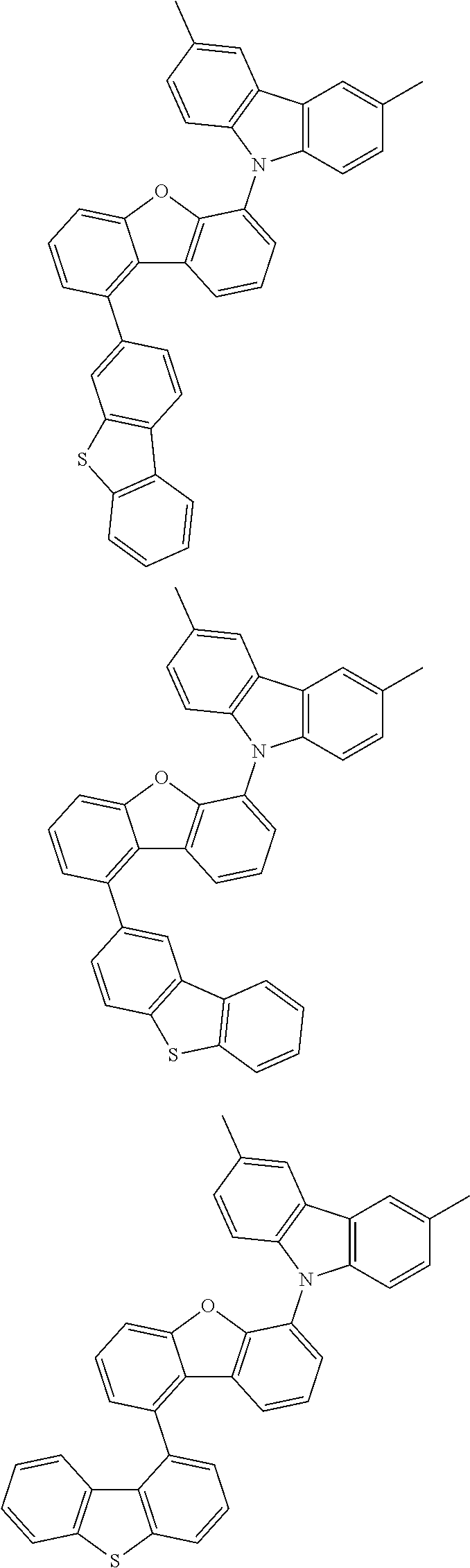
  • An organic compound of the present disclosure includes a carbazolyl moiety and a dibenzofuranyl or dibenzothiophenyl moiety each of which is linked to a central fused hetero aromatic core asymmetrically so that the compound has excellent thermal resistant property and luminous property.
  • the organic compound of the present disclosure may have the following structure of Chemical Formula 1:
  • unsubstituted means that hydrogen atom is bonded, and in this case hydrogen atom includes protium, deuterium and tritium.
  • substituted may include, but is not limited to, C 1 ⁇ C 20 alkyl group unsubstituted or substituted with halogen, C 1 ⁇ C 20 alkoxy group unsubstituted or substituted with halogen, halogen, cyano group, —CF 3 , hydroxyl group, carboxyl group, carbonyl group, amino group, C 1 ⁇ C 20 alkyl amino group, C 5 ⁇ C 30 aryl amino group, C 4 ⁇ C 30 hetero aryl amino group, nitro group, hydrazyl group, sulfonyl group, C 5 ⁇ C 30 alkyl silyl group, C 5 ⁇ C 30 alkoxy silyl group, C 3 ⁇ C 30 cycloalkyl silyl group, C 5 ⁇ C 30 aryl silyl group, C 4 ⁇ C 30 hetero aryl silyl group, C 5 ⁇ C 30 aryl group and C 4 ⁇ C 30 hetero
  • the alkyl group may be linear or branched C 1 ⁇ C 20 alkyl group, and preferably linear or branched C 1 ⁇ C 10 alkyl group.
  • hetero described in “hetero aromatic ring”, “hetero aromatic group”, “hetero alicyclic ring”, “hetero cyclic alkyl group”, “hetero aryl group”, “hetero aralkyl group”, “hetero aryloxyl group”, “hetero aryl amino group”, “hetero arylene group”, “hetero aralkylene group”, “hetero aryloxylene group”, and the likes means that at least one carbon atoms, for example 1 to 5 carbon atoms, forming such aromatic or alicyclic rings are substituted with at least one hetero atoms selected from the group consisting of N, O, S and combinations thereof.
  • the organic compound of the present disclosure includes a carbazolyl moiety (having R 1 to R 2 groups), and at least two dibenzofuranyl and/or dibenzothiophenyl moieties (having X and Y groups).
  • the central dibenzofuranyl/dibenzothiophenyl moiety (having X group) linked to the carbazolyl moiety will be refereed as “a first dibenzofuranyl/dibenzothiophenyl moiety” and the side dibenzofuranyl/dibenzothiophenyl moiety (having Y group) linked to the first dibenzofuranyl/dibenzothiophenyl moiety will be referred as “a second dibenzofuranyl/dibenzothiophenyl moiety”.
  • the organic compound having the structure of Chemical Formulae 1 and 2 may have a bi-polar property.
  • each of R 1 to R 8 in Chemical Formulae 1 and 2 may be independently hydrogen, deuterium or tritium, respectively.
  • each of R 1 to R 8 in Chemical Formulae 1 and 2 may be independently halogen, cyano group, nitro group, linear or branched C 1 ⁇ C 20 alkyl group and/or C 1 ⁇ C 20 alkoxy group, preferably C 1 ⁇ C 10 alkoxy group, respectively.
  • each of R 1 to R 8 in Chemical Formulae 1 and 2 may be independently aromatic or hetero aromatic group such as C 5 ⁇ C 30 aryl group or C 4 ⁇ C 30 hetero aryl group, respectively.
  • the aromatic or hetero aromatic groups substituted to each of R 1 to R 8 may be unsubstituted or substituted with a group selected from the group consisting of halogen, cyano group, nitro group, C 1 ⁇ C 20 alkyl group, C 1 ⁇ C 20 alkoxy group, C 1 ⁇ C 20 alkyl amino group and combination thereof.
  • each of R 1 to R 8 may independently be, but is not limited to, unfused or fused aryl group such as phenyl, biphenyl, terphenyl, naphthyl, anthracenyl, pentalenyl, indenyl, indeno-indenyl, heptaleneyl, biphenylenyl, indacenyl, phenalenyl, phenanthrenyl, benzo-phenanthrenyl, dibenzo-phenanthrenyl, azulenyl, pyreneyl, fluoranthenyl, triphenylenyl, chrysenyl, tetraphenyl, tetracenyl, pleiadenyl, picenyl, pentaphenyl, pentacenyl, fluorenyl, indeno-fluorenyl or s
  • aryl group such as phenyl, biphenyl, terphenyl
  • each of R 1 to R 8 may independently be, but is not limited to, unfused or fused hetero aryl group such as pyrrolyl, pyridinyl, pyrimidinyl, pyrazinyl, pyridazinyl, triazinyl, tetrazinyl, imidazolyl, pyrazolyl, indolyl, iso-indolyl, indazolyl, indolizinyl, pyrrolizinyl, carbazolyl, benzo-carbazolyl, dibenzo-carbazolyl, indolo-carbazolyl, indeno-carbazolyl, benzofuro-carbazolyl, benzothieno-carbazolyl, quinolinyl, iso-quinolinyl, phthalazinyl, quinoxalinyl, cin
  • each of R 1 to R 8 is aryl or hetero aryl group
  • the aryl or hetero aryl group may consist of 1 to 3 aromatic or hetero aromatic rings.
  • the number of the aromatic or hetero aromatic rings constituting each of R 1 to R 8 is increased, the conjugated structure within the entire organic compound becomes excessively long, so that the bandgap of the organic compound may be excessively reduced.
  • each of R 1 to R 8 may independently be, but is not limited to, phenyl, biphenyl, pyrrolyl, triazinyl, imidazolyl, pyrazolyl, pyridinyl, pyrazinyl, pyrimidinyl, pyridazinyl, furanyl, benzo-furanyl, dibenzo-furanyl, thiophenyl, benzo-thiophenyl, dibenzo-thiophenyl or carbazolyl, respectively.
  • adjacent two groups among R 1 to R 5 or adjacent two groups among R 7 and R 8 may form fused a C 5 ⁇ C 20 fused aromatic ring or a C 4 ⁇ C 20 fused hetero aromatic ring.
  • Each of the fuse C 5 ⁇ C 20 fused aromatic ring or a C 4 ⁇ C 20 fused hetero aromatic ring may be unsubstituted or substituted with a group selected from group consisting of halogen, cyano group, nitro group, C 1 ⁇ C 20 alkyl group, C 1 ⁇ C 20 alkoxy group, C 1 ⁇ C 20 alkyl amino group and combination thereof.
  • the organic compound having the structure of Chemical Formulae 1 and 2 may have an energy level bandgap proper for an emitting material layer of an OLED.
  • the fused aromatic ring and the fused hetero aromatic ring may consist of 1 to 3, preferably 1 or 2 aromatic or hetero aromatic ring.
  • adjacent two groups among R 1 to R 5 or adjacent two groups among R 7 and R 8 forms fused aromatic or hetero aromatic ring.
  • the fused aromatic or hetero aromatic ring may be, but is not limited to, a fused aryl ring such as a fused phenyl ring and/or a fused naphthyl ring, or a fused hetero aryl ring such as a fused pyridyl ring, a fused pyrimidyl ring and/or a fused carbazolyl ring.
  • the carbazolyl moiety in Chemical Formula 1 may form, but is not limited to, a benzo-carbazolyl moiety, a dibenzo-carbazolyl moiety, a benzofuro-carbazolyl moiety, a benzothieno-carbazolyl moiety, an indeno-carbazolyl moiety, an indolo-carbazolyl moiety and the likes.
  • the adjacent two groups among each of R 3 to R 8 , which constitutes the first dibenzofuranyl/dibenzothiophenyl moiety, and the adjacent two groups among each of R 7 and R 8 , which constitutes the second dibenzofuranyl/dibenzothiophenyl moiety form a fused aromatic ring or a fused hetero aromatic ring
  • the second dibenzofuranyl/dibenzothiophenyl moiety may form, but is not limited to, a fused aryl ring such as a fused phenyl ring and/or a fused naphthyl ring, or a fused hetero aryl ring such as a fused pyridyl ring, a fused pyrimidyl ring and/or a fused carbazolyl ring.
  • the first and second dibenzofuranyl/dibenzothiophenyl moieties may form, but is not limited to, a pyrido-dibenzofuranyl moiety, a pyrido-dibenzothiophenyl moiety, an indeno-dibenzofuranyl moiety, an indeno-dibenzothiophenyl moiety, an indolo-dibenzofuranyl moiety, an indolo-dibenzothiophenyl moiety and the likes.
  • the organic compound having the structured of Chemical Formulae 1 and 2 includes the carbazolyl moiety having p-type property as well as dibenzofuranyl/dibenzothiophenyl moieties having n-type property, the organic compound has excellent affinity to the holes as well as electrons. Accordingly, when the organic compound having the structure of Chemical Formulae 1 and 2 is applied an emitting material layer (EML), a recombination zone where holes and electros form an exciton is located in the middle of the EML, not in an interface between the EML and an electron transport layer (ETL) or a hole blocking layer (HBL).
  • EML emitting material layer
  • HBL hole blocking layer
  • the organic compound having the structure of Chemical Formulae 1 and 2 includes the carbazolyl moiety and dibenzofuranyl/dibenzothiophenyl moieties, each of which has a central 5-membered ring connected to both sides of 6-membered rings. Since the carbazolyl moiety as well as the dibenzofuranyl/dibenzothiophenyl has a rigid conformational structure, the organic compound having the structure of Chemical Formulae 1 and 2 may have an excellent thermal resistance property. Accordingly, the organic compound having the structure of Chemical Formulae 1 and 2 is not deteriorated by Joule's heat generated in driving an OLED. Therefore, the organic compound having the structure of Chemical Formulae 1 and 2 can be applied to the OLED, and thereby realizing excellent luminous efficiency and improving luminous lifetime of the OLED by preventing the OLED from being deteriorated.
  • the organic compound having the structure of Chemical Formulae 1 and 2 multiple dibenzofuranyl/dibenzothiophenyl moieties, each of which has a central 5-membered ring connected to both sides of 6-membered rings. Accordingly, the organic compound having the structured of Chemical Formulae 1 and 2 may have a highest occupied molecular orbital (HOMO) energy level and a lowest unoccupied molecular orbital (LUMO) energy level suitable for use as luminous material, for example, as a host in the EML.
  • HOMO highest occupied molecular orbital
  • LUMO lowest unoccupied molecular orbital
  • the driving voltage of the OLED may be lowered to reduce the power consumption. Accordingly, the stress applied to the OLED owing to the increase in driving voltage is reduced, thereby improving luminous efficiency and the luminous lifetime of the OLED.
  • the organic compound having the structure of Chemical Formula 1 and 2 may have an excited state singlet energy level, but is not limited to, equal to or higher than about 2.9 eV and an excited state triplet energy level, but is not limited to, equal to or higher than about 2.8 eV.
  • the organic compound having the structure of Chemical Formulae 1 and 2 may have a HOMO energy level, but is not limited to, between about ⁇ 5.0 and about ⁇ 6.5 eV, and preferably between about ⁇ 5.5 and about ⁇ 6.2 eV, and have a LUMO energy level, but is not limited to, between about ⁇ 1.5 and about ⁇ 3.0 eV, and preferably between about ⁇ 1.7 and about ⁇ 2.5.
  • the organic compound having the structure of Chemical Formulae 1 and 3 may have an energy level bandgap (Eg) between the HOMO energy level and the LUMO energy level, but is not limited to, between about 3.0 and about 4.0 eV, and preferably between about 3.0 and about 3.5 eV.
  • Eg energy level bandgap
  • the organic compound having the structure of Chemical Formula 1 and 2 may be an organic compound having the following structure of Chemical Formula 3 or 4:
  • organic compound having the structure of Chemical Formulae 1 and 3 may have any one of the following structure of Chemical Formula 5:
  • organic compound having the structure of Chemical Formulae 1, 2 and 4 may have any one of the structures of Chemical Formula 6:
  • the organic compound having the structure of any one in Chemical Formulae 3 to 6 includes the carbazolyl moiety linked to the central first dibenzofuranyl/dibenzothiophenyl moiety and having p-type property, and the second dibenzofuranyl/dibenzothiophenyl moiety linked to the first dibenzofuranyl/dibenzothiophenyl moiety and having n-type property, and the carbazolyl moiety and the second dibenzofuranyl/dibenzothiophenyl moiety are linked to the first dibenzofuranyl/dibenzothiophenyl moiety asymmetrically.
  • each of the carbazolyl moiety having p-type property and the second dibenzofuranyl/dibenzothiophenyl moiety having n-type property is respectively bonded to an asymmetrical position in respective side benzene ring constituting the first dibenzofuranyl/dibenzothiophenyl moiety, so that the organic compound having the structure of anyone in Chemical Formulae 3 to 6 may exhibit more amorphous property so as to improve extremely its heat resistance. Accordingly, the crystallization caused by Joule's heat in driving the OLED is prevented, and the structure of the OLED is not destroyed.
  • the organic compound having the structure of anyone in Chemical Formulae 1 to 6 includes the carbazolyl moiety and dibenzofuranyl/dibenzothiophenyl moieties, each of which includes two benzene rings, the organic compound has a HOMO energy level and a LUMO energy level proper for use as the host in the EML.
  • the organic compound when used together with a delayed fluorescent material and optionally a fluorescent material in the EML, it is possible to transfer exciton energy to the fluorescent material without energy loss during the emission process.
  • the organic compound having the structure of anyone in Chemical Formulae 1 to 6 can be used as the host in the EML of the OLED to enhance luminous efficiency, to lower driving voltage and to improve the luminous lifetime of the OLED.
  • the organic compound having the structure of anyone in Chemical Formulae 1 to 6 is used as the host in the EML, it is possible to minimize exciton quenching owing to an interaction between the exciton in the host and a peripheral polaron and to prevent the luminous lifetime of the OLED being lowered due to electro-oxidation and photo-oxidation.
  • the organic compound having the structure of anyone in Chemical Formulae 1 to 6 has excellent heat resistance property and a large energy level bandgap and high triplet energy level. Accordingly, when the organic compound having the structure of anyone in Chemical Formulae 1 to 6 is used as the host in the EML, the organic compound can transfer efficiently exciton energy to the fluorescent material so that the OLED may have enhanced luminous efficiency. In addition, the organic compound in the EML is not deteriorated by heat, so that the OLED having a long lifetime and excellent color purity can be realized.
  • the organic compound having the structure of anyone in Chemical Formulae 1 to 6 has enhanced thermal resistance property and luminous property.
  • the organic compound having the structure of anyone in Chemical Formulae 1 to 6 may be applied to an emitting material layer of an organic light emitting diode so as to implement high color purity and enhance luminous efficiency of the diode.
  • the organic light emitting diode of the present disclosure may be applied to an organic light emitting device such as an organic light emitting display device and an organic light emitting illumination device. An organic light emitting display device will be explained.
  • FIG. 1 is a schematic cross-sectional view of an organic light emitting display device in accordance with an exemplary embodiment of the present disclosure.
  • the organic light emitting display device 100 includes a substrate 102 , a thin-film transistor Tr on the substrate 102 , and an organic light emitting diode 200 connected to the thin film transistor Tr.
  • the substrate 102 may include, but is not limited to, glass, thin flexible material and/or polymer plastics.
  • the flexible material may be selected from the group, but is not limited to, polyimide (PI), polyethersulfone (PES), polyethylenenaphthalate (PEN), polyethylene terephthalate (PET), polycarbonate (PC) and combination thereof.
  • PI polyimide
  • PES polyethersulfone
  • PEN polyethylenenaphthalate
  • PET polyethylene terephthalate
  • PC polycarbonate
  • a buffer layer 104 may be disposed over the substrate 102 , and the thin film transistor Tr is disposed over the buffer layer 104 .
  • the buffer layer 104 may be omitted.
  • a semiconductor layer 110 is disposed over the buffer layer 104 .
  • the semiconductor layer 110 may include, but is not limited to, oxide semiconductor materials.
  • a light-shield pattern may be disposed under the semiconductor layer 110 , and the light-shield pattern can prevent light from being incident toward the semiconductor layer 110 , and thereby, preventing the semiconductor layer 110 from being deteriorated by the light.
  • the semiconductor layer 110 may include, but is not limited to, polycrystalline silicon. In this case, opposite edges of the semiconductor layer 110 may be doped with impurities.
  • a gate insulating layer 120 formed of an insulating material is disposed on the semiconductor layer 110 .
  • the gate insulating layer 120 may include, but is not limited to, an inorganic insulating material such as silicon oxide (SiO x ) or silicon nitride (SiN x ).
  • a gate electrode 130 made of a conductive material such as a metal is disposed over the gate insulating layer 120 so as to correspond to a center of the semiconductor layer 110 . While the gate insulating layer 120 is disposed over a whole area of the substrate 102 in FIG. 1 , the gate insulating layer 120 may be patterned identically as the gate electrode 130 .
  • the interlayer insulating layer 140 formed of an insulating material is disposed on the gate electrode 130 with covering over an entire surface of the substrate 102 .
  • the interlayer insulating layer 140 may include, but is not limited to, an inorganic insulating material such as silicon oxide (SiO x ) or silicon nitride (SiN x ), or an organic insulating material such as benzocyclobutene or photo-acryl.
  • the interlayer insulating layer 140 has first and second semiconductor layer contact holes 142 and 144 that expose both sides of the semiconductor layer 110 .
  • the first and second semiconductor layer contact holes 142 and 144 are disposed over opposite sides of the gate electrode 130 with spacing apart from the gate electrode 130 .
  • the first and second semiconductor layer contact holes 142 and 144 are formed within the gate insulating layer 120 in FIG. 1 .
  • the first and second semiconductor layer contact holes 142 and 144 are formed only within the interlayer insulating layer 140 when the gate insulating layer 120 is patterned identically as the gate electrode 130 .
  • a source electrode 152 and a drain electrode 154 are disposed on the interlayer insulating layer 140 .
  • the source electrode 152 and the drain electrode 154 are spaced apart from each other with respect to the gate electrode 130 , and contact both sides of the semiconductor layer 110 through the first and second semiconductor layer contact holes 142 and 144 , respectively.
  • the semiconductor layer 110 , the gate electrode 130 , the source electrode 152 and the drain electrode 154 constitute the thin film transistor Tr, which acts as a driving element.
  • the thin film transistor Tr in FIG. 1 has a coplanar structure in which the gate electrode 130 , the source electrode 152 and the drain electrode 154 are disposed over the semiconductor layer 110 .
  • the thin film transistor Tr may have an inverted staggered structure in which a gate electrode is disposed under a semiconductor layer and a source and drain electrodes are disposed over the semiconductor layer.
  • the semiconductor layer may comprise amorphous silicon.
  • a gate line and a data line which cross each other to define a pixel region, and a switching element, which is connected to the gate line and the data line is, may be further formed in the pixel region.
  • the switching element is connected to the thin film transistor Tr, which is a driving element.
  • a power line is spaced apart in parallel from the gate line or the data line, and the thin film transistor Tr may further include a storage capacitor configured to constantly keep a voltage of the gate electrode for one frame.
  • the organic light emitting display device 100 may include a color filter for absorbing a part of the light emitted from the organic light emitting diode 200 .
  • the color filter may absorb a light of specific wavelength such as red (R), green (G) or blue (B). In this case, the organic light emitting display device 100 can implement full-color through the color filter.
  • the color filter may be disposed on the interlayer insulating layer 140 with corresponding to the organic light emitting diode 200 .
  • the color filter may be disposed over the organic light emitting diode 200 , that is, a second electrode 220 .
  • a passivation layer 160 is disposed on the source and drain electrodes 152 and 154 over the whole substrate 102 .
  • the passivation layer 160 has a flat top surface and a drain contact hole 162 that exposes the drain electrode 154 of the thin film transistor Tr. While the drain contact hole 162 is disposed on the second semiconductor layer contact hole 154 , it may be spaced apart from the second semiconductor layer contact hole 154 .
  • the organic light emitting diode 200 includes a first electrode 210 that is disposed on the passivation layer 160 and connected to the drain electrode 154 of the thin film transistor Tr.
  • the organic light emitting diode 200 further includes an emitting unit 230 as an emission layer and a second electrode 220 each of which is disposed sequentially on the first electrode 210 .
  • the first electrode 210 is disposed in each pixel region.
  • the first electrode 210 may be an anode and include a conductive material having a relatively high work function value.
  • the first electrode 210 may include, but is not limited to, a transparent conductive material such as indium tin oxide (ITO), indium zinc oxide (IZO), indium tin zinc oxide (ITZO), tin oxide (SnO), zinc oxide (ZnO), indium cerium oxide (ICO), aluminum doped zinc oxide (AZO), and the likes.
  • a reflective electrode or a reflective layer may be disposed under the first electrode 210 .
  • the reflective electrode or the reflective layer may include, but is not limited to, aluminum-palladium-copper (APC) alloy.
  • a bank layer 170 is disposed on the passivation layer 160 in order to cover edges of the first electrode 210 .
  • the bank layer 170 exposes a center of the first electrode 210 .
  • An emitting unit 230 is disposed on the first electrode 210 .
  • the emitting unit 230 may have a mono-layered structure of an emitting material layer.
  • the emitting unit 230 may have a multiple-layered structure of a hole injection layer, a hole transport layer, an electron blocking layer, an emitting material layer, a hole blocking layer, an electron transport layer and/or an electron injection layer (See, FIGS. 2 , 5 , 7 , 9 and 11 ).
  • the organic light emitting diode 200 may have one emitting unit 230 .
  • the organic light emitting diode 200 may have multiple emitting units 230 to form a tandem structure.
  • the emitting unit 230 includes an organic compound having the structure of anyone in Chemical Formulae 1 to 6.
  • the organic compound having the structure of anyone in Chemical Formulae 1 to 6 may be used as a host of an emitting material layer which may further includes at least one dopant.
  • the second electrode 220 is disposed over the substrate 102 above which the emitting unit 230 is disposed.
  • the second electrode 220 may be disposed over a whole display area and may include a conductive material with a relatively low work function value compared to the first electrode 210 .
  • the second electrode 220 may be a cathode.
  • the second electrode 220 may include, but is not limited to, aluminum (Al), magnesium (Mg), calcium (Ca), silver (Au), alloy thereof or combination thereof such as aluminum-magnesium alloy (Al—Mg).
  • an encapsulation film 180 may be disposed over the second electrode 220 in order to prevent outer moisture from penetrating into the organic light emitting diode 200 .
  • the encapsulation film 180 may have, but is not limited to, a laminated structure of a first inorganic insulating film 182 , an organic insulating film 184 and a second inorganic insulating film 186 .
  • the emitting unit 230 of the OLED 200 includes the organic compound having the structure of anyone in Chemical Formulae 1 to 6, as described above. Since the organic compound has excellent thermal resistant property and luminous property, the OLED 200 can enhance its luminous efficiency and luminous lifetime and lower its driving voltage so as to reduce its consumption power by applying the organic compound having the structure of anyone in Chemical Formulae 1 to 6 into the emitting unit 230 .
  • FIG. 2 is a schematic cross-sectional view illustrating an organic light emitting diode having a single-layered EML in accordance with an exemplary embodiment of the present disclosure.
  • the organic light emitting diode (OLED) 300 in accordance with the first embodiment of the present disclosure includes first and second electrodes 310 and 320 facing each other, an emitting unit 330 as an emission layer disposed between the first and second electrodes 310 and 320 .
  • the emitting unit 330 include a hole injection layer (HIL) 340 , a hole transport layer (HTL) 350 , an emitting material layer (EML) 360 , an electron transport layer (ETL) 370 and an electron injection layer (EIL) 380 each of which is laminated sequentially from the first electrode 310 .
  • the emitting unit 330 may further include a first exciton blocking layer, i.e. an electron blocking layer (EBL) 355 disposed between the HTL 350 and the EML 360 and/or a second exciton blocking layer, i.e. a hole blocking layer (HBL) 375 disposed between the EML 360 and the ETL 370 .
  • EBL electron blocking layer
  • the first electrode 310 may be an anode that provides a hole into the EML 560 .
  • the first electrode 310 may include, but is not limited to, a conductive material having a relatively high work function value, for example, a transparent conductive oxide (TCO).
  • TCO transparent conductive oxide
  • the first electrode 110 may include, but is not limited to, ITO, IZO, ITZO, SnO, ZnO, ICO, AZO, and the likes.
  • the second electrode 320 may be a cathode that provides an electron into the EML 560 .
  • the second electrode 320 may include, but is not limited to, a conductive material having a relatively low work function values, i.e., a highly reflective material such as Al, Mg, Ca, Ag, alloy thereof, combination thereof, and the likes.
  • the HIL 340 is disposed between the first electrode 310 and the HTL 350 and improves an interface property between the inorganic first electrode 310 and the organic HTL 350 .
  • the HIL 340 may include, but is not limited to, 4,4′4′′-Tris(3-methylphenylamino)triphenylamine (MTDATA), 4,4′,4′′-Tris(N,N-diphenyl-amino)triphenylamine (NATA), 4,4′,4′′-Tris(N-(naphthalene-1-yl)-N-phenyl-amino)triphenylamine (1T-NATA), 4,4′,4′′-Tris(N-(naphthalene-2-yl)-N-phenyl-amino)triphenylamine (2T-NATA), Copper phthalocyanine (CuPc), Tris(4-carbazoyl-9-yl-phenyl)amine (TCTA), N,N′-Dipheny
  • the HTL 350 is disposed adjacently to the EML 360 between the first electrode 310 and the EML 360 .
  • the HTL 350 may include, but is not limited to, N,N′-Diphenyl-N,N′-bis(3-methylphenyl)-1,1′-biphenyl-4,4′-diamine (TPD), NPB, 4,4′-bis(N-carbazolyl)-1,1′-biphenyl (CBP), Poly[N,N′-bis(4-butylphenyl)-N,N′-bis(phenyl)-benzidine] (Poly-TPD), Poly[(9,9-dioctylfluorenyl-2,7-diyl)-co-(4,4′-(N-(4-sec-butylphenyl)diphenylamine))] (TFB), Di-[4-(N,N-di-p-tolyl-phenyl
  • each of the HIL 340 and the HTL 350 may be laminated with a thickness of, but is not limited to, about 5 nm to about 200 nm, and preferably about 5 nm to about 100 nm.
  • the EML 360 may include a host doped with a dopant.
  • the EML 360 may include a host (a first host) doped with a dopant (a first dopant).
  • a host a first host
  • a dopant a first dopant
  • the organic compound having the structure of anyone in Chemical Formulae 1 to 6 may be used the host in the EML 360 .
  • the EML 360 may emit light of red color, green color or blue color. The configuration and energy levels among the luminous materials will be explained in more detail.
  • the ETL 370 and the EIL 380 are laminated sequentially between the EML 360 and the second electrode 320 .
  • the ETL 370 may include a material having high electron mobility so as to provide electrons stably with the EML 360 by fast electron transportation.
  • the ETL 370 may include, but is not limited to, oxadiazole-based compounds, triazole-based compounds, phenanthroline-based compounds, benzoxazole-based compounds, benzothiazole-based compounds, benzimidazole-based compounds, triazine-based compounds, and the likes.
  • the ETL 370 may include, but is not limited to, tris-(8-hydroxyquinoline aluminum (Alq 3 ), 2-biphenyl-4-yl-5-(4-t-butylphenyl)-1,3,4-oxadiazole (PBD), spiro-PBD, lithium quinolate (Liq), 1,3,5-Tris(N-phenylbenzimidazol-2-yl)benzene (TPBi), Bis(2-methyl-8-quinolinolato-N1,O8)-(1,1′-biphenyl-4-olato)aluminum (BAlq), 4,7-diphenyl-1,10-phenanthroline (Bphen), 2,9-Bis(naphthalene-2-yl)4,7-diphenyl-1,10-phenanthroline (NBphen), 2,9-Dimethyl-4,7-diphenyl-1,10-phenathroline (BCP), 3-(4-Biphenyl)-4-
  • the EL 380 is disposed between the second electrode 320 and the ETL 370 , and can improve physical properties of the second electrode 320 and therefore, can enhance the life span of the OLED 300 .
  • the EL 380 may include, but is not limited to, an alkali halide such as LiF, CsF, NaF, BaF 2 and the likes, and/or an organic metal compound such as lithium benzoate, sodium stearate, and the likes.
  • each of the ETL 370 and the EL 380 may be laminated with a thickness of, but is not limited to, about 10 nm to about 100 nm.
  • the OLED 300 in accordance with this embodiment of the present disclosure has at least one exciton blocking layer disposed adjacently to the EML 360 .
  • the OLED 300 of the exemplary embodiment includes the EBL 355 between the HTL 350 and the EML 360 so as to control and prevent electron transfers.
  • the EBL 355 may include, but is not limited to, TCTA, Tris[4-(diethylamino)phenyl]amine, N-(biphenyl-4-yl)-9,9-dimethyl-N-(4-(9-phenyl-9H-carbazol-3-yl)phenyl)-9H-fluorene-2-amine, TAPC, MTDATA, 1,3-bis(carbazol-9-yl)benzene (mCP), 3,3′-bis(N-carbazolyl)-1,1′-biphenyl (mCBP), CuPc, N,N′-bis[4-(bis(3-methylphenyl)amino)phenyl]-N,N′-diphenyl-[1,1′-biphenyl]-4,4′-di
  • the OLED 300 further includes the HBL 375 as a second exciton blocking layer between the EML 360 and the ETL 370 so that holes cannot be transferred from the EML 360 to the ETL 370 .
  • the HBL 375 may include, but is not limited to, oxadiazole-based compounds, triazole-based compounds, phenanthroline-based compounds, benzoxazole-based compounds, benzothiazole-based compounds, benzimidazole-based compounds, and triazine-based compounds.
  • the HBL 375 may include a compound having a relatively low HOMO energy level compared to the emitting material in EML 360 .
  • the HBL 375 may include, but is not limited to, BCP, BAlq, Alq 3 , PBD, spiro-PBD, Liq, Bis-4,5-(3,5-di-3-pyridylphenyl)-2-methylpyrimidine (B3PYMPM), Bis[2-(diphenylphosphine)phenyl] ether oxide (DPEPO, 9-(6-(9H-carbazol-9-yl)pyridine-3-yl)-9H-3,9′-bicarbazole and combination thereof.
  • the EML 360 of the OLED 360 in accordance with the first embodiment of the present disclosure include a host, i.e. the organic compound having the structure of anyone in Chemical Formulae 1 to 6, and a dopant having a delayed fluorescent property (T dopant).
  • T dopant a dopant having a delayed fluorescent property
  • the OLED 300 can improve its luminous efficiency and its luminous lifetime and lower its driving voltage.
  • An Organic Light Emitting Diode emits light as holes injected from the anode and electrons injected from the cathode are combined to form excitons in EML and then unstable excited state excitons return to a stable ground state.
  • OLED Organic Light Emitting Diode
  • a singlet exciton of a paired spin and a triplet exciton of an unpaired spin are produced by a ratio of 1:3 by spin arrangements. Only the singlet exciton among the excitons can be involved in emission process in case of fluorescent materials. Accordingly, the OLED may exhibit luminous efficiency by maximum 5% in case of using the common fluorescent material.
  • phosphorescent materials use different luminous mechanism of converting both singlet excitons and triplet exciton into light.
  • the phosphorescent materials can convert singlet excitons into triplet excitons through intersystem crossing (ISC). Therefore, it is possible to enhance luminous efficiency in case of applying the phosphorescent materials that use both the singlet excitons and the triplet excitons during the luminous process compared to the fluorescent materials.
  • ISC intersystem crossing
  • prior art blue phosphorescent materials exhibit too low color purity to apply with the display device and exhibit very short luminous lifetime, and therefore, they have not been used in commercial display devices.
  • a delayed fluorescent material which can solve the limitations accompanied by the prior art fluorescent dopants and the phosphorescent dopants, has been developed recently.
  • Representative delayed fluorescent material is a thermally-activated delayed fluorescent (TADF) material. Since the delayed fluorescent material generally has both an electron donor moiety and an electron acceptor moiety within its molecular structure, it can be converted to an intramolecular charge transfer (ICT) state. In case of using the delayed fluorescent material as a dopant, it is possible to use both the excitons of singlet energy level S 1 and the excitons of triplet energy level T 1 during the emission process.
  • TADF thermally-activated delayed fluorescent
  • FIG. 3 is a schematic diagram illustrating a luminous mechanism of the delayed fluorescent material in an EML in accordance with another exemplary embodiment of the present disclosure.
  • both the excitons of singlet energy level S 1 TD and the excitons of triplet energy level T 1 TD in the delayed fluorescent material can move to an intermediate energy level state, i.e. ICT state, and then the intermediate stated excitons can be transferred to a ground state (S 0 ; S 1 ⁇ ICT ⁇ T 1 ). Since the excitons of singlet energy level S 1 TD as well as the excitons of triplet energy level T 1 TD in the delayed fluorescent material is involved in the emission process, the delayed fluorescent material can improve luminous efficiency.
  • both the HOMO and the LUMO are widely distributed over the whole molecule within the common fluorescent material, it is not possible to inter-convert between the single energy level and the triplet energy level within it (selection rule).
  • the delayed fluorescent material which can be converted to ICT state, has little orbital overlaps between HOMO and LUMO, there is little interaction between the HOMO state molecular orbital and the LUMO state molecular orbital in the state where dipole moment is polarized within the delayed fluorescent material.
  • CT band charge transfer band
  • the delayed fluorescent material since the delayed fluorescent material has the electron acceptor moiety spacing apart from the electron donor moiety within the molecule, it exists as a polarized state having a large dipole moment within the molecule.
  • the interaction between HOMO molecular orbital and LUMO molecular orbital becomes little in the state where the dipole moment is polarized, both the triplet energy level excitons and the singlet energy level excitons can be converted to ICT state. Accordingly, the excitons of triplet energy level T 1 as well as the excitons of singlet energy level S 1 can be involved in the emission process.
  • the delayed fluorescent material may have 100% internal quantum efficiency in theory.
  • the delayed fluorescent material must have an energy level bandgap ⁇ E ST TD equal to or less than about 0.3 eV, for example, from about 0.05 to about 0.3 eV, between the singlet energy level S 1 TD and the triplet energy level T 1 TD so that exciton energy in both the singlet energy level and the triplet energy level can be transferred to the ICT state.
  • the material having little energy level bandgap between the singlet energy level S 1 TD and the triplet energy level T 1 TD can exhibit common fluorescence in which the excitons of singlet energy level S 1 TD can be transferred to the ground state S 0 , as well as delayed fluorescence with Reverser Inter System Crossing (RISC) in which the excitons of triplet energy level T 1 TD can be transferred upwardly to the excitons of single energy level S 1 TD , and then the exciton of singlet energy level S 1 TD transferred from the triplet energy level T 1 TD can be transferred to the ground state S 0 .
  • RISC Reverser Inter System Crossing
  • the delayed fluorescent material can realize identical quantum efficiency as the prior art phosphorescent material including heavy metal because the delayed fluorescent material can obtain luminous efficiency up to 100% in theory.
  • the host for implementing the delayed fluorescence can induce triplet exciton energy generated at the delayed fluorescent material to be involved in the luminous process without quenching as a non-emission. In order to induce such exciton energy transfer, energy levels among the host and the delayed fluorescent material should be adjusted.
  • FIG. 4 is a schematic diagram illustrating luminous mechanism by energy level bandgap between luminous materials in accordance with an exemplary embodiment of the present disclosure.
  • each of an excited state singlet energy level S 1 H and an excited state triplet energy level T 1 H of the host should be higher than each of an excited state singlet energy level S 1 TD and an excited state triple energy level T 1 TD of the host having the delayed fluorescent property, respectively.
  • the excited triplet energy level T 1 H of the host may be higher than the excited state triplet energy level T 1 TD of the dopant by at least about 0.2 eV.
  • the excitons of the triplet state level T 1 TD of the dopant can be reversely transferred to the excited state triplet energy level T 1 H of the host, which cannot utilize triplet exciton energy. Accordingly, the excitons of the triplet state level T 1 TD of the dopant having the delayed fluorescent property may be quenched as a non-emission and the triplet state excitons of the dopant cannot be involved in the emission.
  • the dopant (TD) must have an energy level bandgap ⁇ E ST TD between the excited stated singlet energy level S 1 TD and the excited state triplet energy level T 1 TD equal to or less than about 0.3 eV, for example between about 0.05 and about 0.3 eV, in order to realize delayed fluorescence (See, FIG. 3 ).
  • ) between a LUMO energy level (LUMO H ) of the host and a LUMO energy level (LUMO TD ) of the dopant may be equal to or less than about 0.5 eV, for example, between about 0.1 eV to about 0.5 eV. In this case, the charges can be transported efficiently from the host to the first dopant and thereby enhancing an ultimate luminous efficiency.
  • an energy level bandgap (Eg H ) between the HOMO energy level (HOMO H ) and the LUMO energy level (LUMO H ) of the host may be larger than an energy level bandgap (Eg TD ) between the HOMO energy level (HOMO TD ) and the LUMO energy level (LUMO TD ) of the dopant.
  • the HOMO energy level (HOMO H ) of the host is deeper or lower than the HOMO energy level (HOMO TD ) of the dopant
  • the LUMO energy level (LUMO H ) of the host is shallower or higher than the LUMO energy level (LUMO TD ) of the dopant.
  • the organic compound having the structure of anyone in Chemical Formulae 1 to 6 includes the carbazolyl moiety having p-type property, and the second dibenzofuranyl/dibenzothiophenyl moiety having n-type property, and the carbazolyl moiety and the second dibenzofuranyl/dibenzothiophenyl moiety are linked to the first dibenzofuranyl/dibenzothiophenyl moiety asymmetrically.
  • the organic compound having the structure of anyone in Chemical Formulae 1 to 6 may exhibit more amorphous property so as to improve extremely its heat resistance. Accordingly, the crystallization caused by Joule's heat in driving the OLED is prevented, and the structure of the OLED is not destroyed.
  • the organic compound having the structure of anyone in Chemical Formulae 1 to 6 includes the carbazolyl moiety and dibenzofuranyl/dibenzothiophenyl moieties, each of which includes two benzene rings, the organic compound has a HOMO energy level and a LUMO energy level proper for use as the host in the EML 360 .
  • the organic compound is used together with a delayed fluorescent material and optionally a fluorescent material in the EML, it is possible to transfer exciton energy to the fluorescent material without energy loss during the emission process.
  • the organic compound having the structure of anyone in Chemical Formulae 1 to 6 when used as the host in the EML 360 of the OLED 300 , it is possible to minimize exciton quenching owing to an interaction between the exciton in the host and a peripheral polaron and to prevent the luminous lifetime of the OLED being lowered due to electro-oxidation and photo-oxidation. Also, the organic compound has excellent thermal resistance property and high triplet energy level and large energy level bandgap between the HOMO energy level and the LUMO energy level. When the organic compound having the structure of anyone in Chemical Formulae 1 to 6 is used as the host in the EML 360 , the OLED 300 can enhance its luminous efficiency due to efficient exciton energy transfer from the host to the dopant. In addition, the OLED 300 can realize high color purity and long luminous lifetime as the damage to the luminous materials in the EML 360 is reduced.
  • the dopant in the EML 360 may emit light of red color, green color or blue color.
  • the dopant may have an excited state singlet energy level (S 1 TD ), but is not limited to, between about 2.7 and about 2.75 eV and an excited state triplet energy level (T 1 TD ), but is not limited to, between about 2.4 and about 2.5 eV in order to implement luminescence level applicable to a display device.
  • Delayed fluorescent materials which can be used as the dopant, may have the HOMO energy level (HOMO TD ), but is not limited to, between about ⁇ 5.0 and about ⁇ 6.0 eV, and preferably between about ⁇ 5.0 and about ⁇ 5.5, the LUMO energy level (LUMO TD ), but is not limited to, between about ⁇ 2.5 and about ⁇ 3.5 eV, and preferably between about ⁇ 2.5 and about ⁇ 3.0 eV, and the energy level bandgap (Egm) between those HOMO and LUMO energy levels (HOMO TD and LUMO TD ) may be, but is not limited to, between about 2.2 and about 3.0 eV, and preferably between about 2.4 and about 2.8 eV.
  • HOMO TD HOMO energy level
  • LUMO energy level LUMO energy level
  • Egm energy level bandgap
  • the organic compound having the structure of anyone in Chemical Formulae 1 to 6 may have the HOMO energy level (HOMO H ), but is not limited to, between about ⁇ 5.0 and about ⁇ 6.5 eV, and preferably between about ⁇ 5.5 and about ⁇ 6.2, the LUMO energy level (LUMO H ), but is not limited to, between about ⁇ 1.5 and about ⁇ 3.0 eV, and preferably between about ⁇ 1.5 and about ⁇ 2.5 eV, and the energy level bandgap (Eg H ) between those HOMO and LUMO energy levels (HOMO H and LUMO H ) may be, but is not limited to, between about 3.0 and about 4.0 eV, and preferably between about 3.0 and about 3.5 eV.
  • HOMO H HOMO energy level
  • LUMO H LUMO energy level
  • a delayed fluorescent material that can be used the dopant in the EML 360 may include an any one having the following structure of Chemical 7.
  • the dopant as a delayed fluorescent material in the EML 360 may include, but is not limited to, 10-(4-(4,6-diphenyl-1,3,5-triazin-2-yl)phenyl)-9,9-dimethyl-9,10-dihydroacridine (DMAC-TRZ), 10,10′-(4,4′-sulfonylbis(4,1-phenylene))bis(9,9-dimethyl-9,10-dihydroacridine) (DMAC-DPS), 10-phenyl-10H,10′H-spiro[acridine-9,9′-anthracen]-10′-one (ACRSA), 3,6-dibenzoyl-4,5-di(1-methyl-9-phenyl-9H-carbazoyl)-2-ethynylbenzonitrile (Cz-VPN), 9,9′,9′′-(5-(4,6-diphenyl-1,3,5-triazin-2-
  • the EML 360 may include the dopant of about 1 to about 70% by weight, preferably of about 10 to about 50% by weight, and more preferably of about 20 to about 50% by weight.
  • the EML 360 may be laminated with a thickness of, but is not limited to, about 10 nm to about 200 nm, preferably about 20 nm to about 100 nm, and more preferably about 30 nm to about 50 nm.
  • FIG. 5 is a schematic cross-sectional view illustrating an organic light emitting diode in accordance with another exemplary embodiment of the present disclosure.
  • the OLED 300 A according to the second embodiment of the present disclosure includes first and second electrodes 310 and 320 facing each other and an emitting unit 330 a disposed between the first and second electrodes 310 and 320 .
  • the emitting unit 330 a as an emission layer includes a HIL 340 , a HTL 350 , an EML 360 a , an ETL 370 and an ETL 380 each of which is laminated sequentially over the first electrode 310 .
  • the emitting unit 330 a may further include a first exciton blocking layer, i.e. an EBL 355 disposed between the HTL 350 and the EML 360 a and/or a second exciton blocking layer, i.e. a HBL 375 disposed between the EML 360 a and the ETL 370 .
  • the emitting unit 330 a may have the same configurations and materials as the emitting unit 330 in FIG. 2 except the EML 360 a.
  • the EML 360 a may include a host (a first host), a first dopant and a second dopant.
  • the first dopant may be a delayed fluorescent dopant (T dopant; TD) and the second dopant may be a fluorescent dopant (F dopant; FD).
  • T dopant TD
  • F dopant FD
  • the organic compound having the structure of anyone in Chemical Formulae 1 to 6 may be used as the host.
  • the OLED 300 A can implement hyper-fluorescence enhancing its luminous efficiency by adjusting energy levels among the luminous materials, i.e. the host and the dopants.
  • an EML When an EML includes only the dopant which has the delayed fluorescent property and has the structure of anyone in Chemical Formula 7, the EML may implement high internal quantum efficiency as the prior art phosphorescent materials including heavy metals because the dopant can exhibit 100% internal quantum efficiency in theory.
  • additional charge transfer transition CT transition
  • delayed fluorescent material utilizes the triplet exciton energy as well as the singlet exciton energy in the luminous process with rotating each moiety within its molecular structure, which results in twisted internal charge transfer (TICT).
  • TTI twisted internal charge transfer
  • the EML 360 a further includes the second dopant, which may be a fluorescent or phosphorescent material, in order to prevent the color purity and luminous lifetime from being reduced in case of using only the delayed fluorescent materials.
  • the triplet exciton energy of the first dopant (T dopant), which may be the delayed fluorescent material, is converted to the singlet exciton energy of its own by RISC mechanism, then the converted singlet exciton energy of the first dopant can be transferred to the second dopant (F dopant), which may be the fluorescent or phosphorescent material, in the same EML 360 a by Dexter energy transfer mechanism, which transfer exciton energies depending upon wave function overlaps among adjacent molecules by inter-molecular electron exchanges and exciton diffusions.
  • the EML 360 a includes the host which is the organic compound having the structure of anyone in Chemical Formulae 1 to 6, the first dopant (T dopant) which may be the organic compound having the structure of anyone in Chemical Formula 7 and having the delayed fluorescent property and the second dopant (F dopant) which may be the fluorescent or phosphorescent material, it is necessary to adjust properly energy levels amount those luminous materials.
  • FIG. 6 is a schematic diagram illustrating luminous mechanism by energy level bandgap among luminous materials in accordance with another exemplary embodiment of the present disclosure.
  • An energy level bandgap between an excited state singlet energy level S 1 TD and an excited state triplet energy level T 1 TD of the first dopant (T dopant) may be equal to or less than about 0.3 eV in order to realize the delayed fluorescence.
  • each of an excited state singlet energy level S 1 H and an excited state triplet energy level T 1 H of the host is higher than each of the excited state singlet energy level S 1 TD and the excited state triplet energy level T 1 TD of the first dopant, respectively.
  • the excited state triplet energy level T 1 H of the host may be higher than the excited state triplet energy level T 1 TD of the first dopant by at least about 0.2 eV. Moreover, the excited state triplet energy level T 1 TD of the first dopant is higher than an excited state triplet energy level T 1 FD of the second dopant. In one exemplary embodiment, the excited state singlet energy level S 1 TD of the first dopant may be higher than an excited state singlet energy level S 1 FD of the second dopant as a fluorescent material.
  • ) between a HOMO energy level (HOMO H ) of the host and a HOMO energy level (HOMO TD ) of the first dopant or an energy level bandgap (
  • the host may include the organic compound having the structure of anyone in Chemical Formulae 1 to 6 and the first dopant may include, but is not limited to, the organic compound having the structure of anyone in Chemical Formula 7.
  • the second dopant may include, but is not limited to, DMAC-TRZ, DMAC-DPS, ACRSA, Cz-VPN, TcZTrz, DczTrz, DDczTrz, CC2BP, BDPCC-TPTA, BCC-TPTA, DMOC-DPS, DPCC-TPTA, Phen-TRZ, Cab-Ph-TRZ, 4CzIPN, 4CZFCN, 10-(4-(4,6-diphenyl-1,3,5-triazin-2-yl)phenyl)-10H-spiro[acridine-9,9′-xanthene] and/or SpiroAC-TRZ.
  • the exciton energy should be effectively transferred from the first dopant as the delayed fluorescent material to the second dopant as the fluorescent or phosphorescent material in order to implement hyper-fluorescence.
  • energy transfer efficiency from the delayed fluorescent material to the fluorescent or phosphorescent material an overlap between an emission spectrum of the delayed fluorescent material and an absorption spectrum of the fluorescent or phosphorescent material can be considered.
  • a fluorescent or phosphorescent material having an absorption spectrum with overlapping area with an emission spectrum of the first dopant may be used as the second dopant in order to transfer exciton energy efficiently from the first dopant to the second dopant.
  • the fluorescent material as the second dopant may have, but is not limited to, quinolino-acridine core.
  • the second dopant having the quinolino-acridine core may include 5,12-dimethylquinolino[2,3-b]acridine-7,14(5H, 12H)-dione (S 1 : 2.3 eV; T 1 : 2.0 eV; LUMO: ⁇ 3.0 eV; HOMO: ⁇ 5.4 eV), 5,12-diethylquinolino[2,3-b]acridine-7,14(5H, 12H)-dione (S 1 : 2.3 eV; T 1 : 2.2 eV; LUMO: ⁇ 3.0 eV; HOMO: ⁇ 5.4 eV), 5,12-dibutyl-3,10-difluoroquinolino[2,3-b]acridine-7,14(5H, 12H)
  • the fluorescent material as the second dopant may include, but is not limited to, 1,1,7,7-tetramethyl-2,3,6,7-tetrahydro-1H,5H-benzo[ij]quinolizin-9-yl)ethenyl]-4H-pyran-4-ylidene ⁇ propanedinitrile (DCJTB; S 1 : 2.3 eV; T 1 : 1.9 eV; LUMO: ⁇ 3.1 eV; HOMO: ⁇ 5.3 eV).
  • metal complexes which can emit light of red, green or blue color may be used as the second dopant.
  • the weight ratio of the host may be larger than the weight ratio of the first and second dopants in the EML 360 a , and the weight ratio of the first dopant may be larger than the weight ratio of the second dopant.
  • the weight ratio of the host is larger than the weight ratio of the first dopant and the weight ratio of the first dopant is larger than the weight ratio of the second dopant.
  • exciton energy can be sufficiently transferred from the first dopant to the second dopant by a Dexter energy transfer mechanism.
  • the EML 360 a includes the host of about 60 to about 75% by weight, the first dopant of about 20 to about 40% by weight and the second dopant of about 0.1 to about 5% by weight.
  • FIG. 7 is a schematic cross-sectional view illustrating an organic light emitting diode having a double-layered EML in accordance with another exemplary embodiment of the present disclosure.
  • the OLED 400 in accordance with an exemplary third embodiment of the present disclosure includes first and second electrodes 410 and 420 facing each other and an emitting unit 430 as an emission layer disposed between the first and second electrodes 410 and 420 .
  • the emitting unit 430 includes an HIL 440 , an HTL 450 , and EML 460 , an ETL 470 and an EIL 480 each of which is laminated sequentially over the first electrode 410 .
  • the emitting unit 430 may further include an EBL 455 as a first exciton blocking layer disposed between the HTL 450 and the EML 460 , and/or an HBL 475 as a second exciton blocking layer disposed between the EML 460 and the ETL 470 .
  • the first electrode 410 may be an anode and may include, but is not limited to, a conductive material having a relatively large work function values such as ITO, IZO, SnO, ZnO, ICO, AZO, and the likes.
  • the second electrode 420 may be a cathode and may include, but is not limited to, a conductive material having a relatively small work function values such as Al, Mg, Ca, Ag, alloy thereof or combination thereof.
  • the HIL 440 is disposed between the first electrode 410 and the HTL 450 .
  • the HIL 440 may include, but is not limited to, MTDATA, NATA, 1T-NATA, 2T-NATA, CuPc, TCTA, NPB(NPD), HAT-CN, TDAPB, PEDOT/PSS and/or N-(biphenyl-4-yl)-9,9-dimethyl-N-(4-(9-phenyl-9H-carbazol-3-yl)phenyl)-9H-fluoren-2-amine.
  • the HIL 440 may be omitted in compliance with the structure of the OLED 400 .
  • the HTL 450 is disposed adjacently to the EML 460 between the first electrode 410 and the EML 460 .
  • the HTL 450 may include, but is not limited to, aromatic amine compounds such as TPD, NPD(NPB), CBP, poly-TPD, TFB, TAPC, N-(biphenyl-4-yl)-9,9-dimethyl-N-(4-(9-phenyl-9H-carbazol-3-yl)phenyl)-9H-fluoren-2-amine and/or N-(biphenyl-4-yl)-N-(4-(9-phenyl-9H-carbazol-3-yl)phenyl)biphenyl-4-amine.
  • aromatic amine compounds such as TPD, NPD(NPB), CBP, poly-TPD, TFB, TAPC, N-(biphenyl-4-yl)-9,9-dimethyl-N-(4-(9-phenyl-9H-carbazol
  • the EML 460 includes a first EML (EML 1 ) 462 and a second EML (EML 2 ) 464 .
  • the EML 1 462 is disposed between the EBL 455 and the HBL 475 and the EML 2 464 is disposed between the EML 1 462 and the HBL 475 .
  • One of the EML 1 462 and the EML 2 464 includes a first dopant (T dopant) having a delayed fluorescent property, for example, an organic compound having the structure of anyone in Chemical Formula 7, the other of the EML 1 462 and the EML 2 464 includes a second dopant as a fluorescent or phosphorescent material.
  • T dopant a first dopant having a delayed fluorescent property
  • the ETL 470 is disposed between the EML 460 and the EIL 480 .
  • the ETL 470 may include, but is not limited to, oxadiazole-based compounds, triazole-based compounds, phenanthroline-based compounds, benzoxazole-based compounds, benzothiazole-based compounds, benzimidazole-based compounds, triazine-based compounds, and the likes.
  • the ETL 470 may include, but is not limited to, Alq 3 , PBD, spiro-PBD, Liq, TPBi, BAlq, Bphen, NBphen, BCP, TAZ, NTAZ, TpPyPB, TmPPPyTz, PFNBr and/or TPQ.
  • the EIL 480 is disposed between the second electrode 420 and the ETL 470 .
  • the EL 480 may include, but is not limited to, an alkali halide such as LiF, CsF, NaF, BaF 2 and the likes, and/or an organic metal compound such as lithium benzoate, sodium stearate, and the likes.
  • the EBL 455 is disposed between the HTL 450 and the EML 460 for controlling and preventing electron transportations between the HTL 450 and the EML 460 .
  • the EBL 455 may include, but is not limited to, TCTA, Tris[4-(diethylamino)phenyl]amine, N-(biphenyl-4-yl)-9,9-dimethyl-N-(4-(9-phenyl-9H-carbazol-3-yl)phenyl)-9H-fluorene-2-amine, TAPC, MTDATA, mCP, mCBP, CuPc, DNTPD, TDAPB, 2,8-bis(9-phenyl-9H-carbazol-3-yl)dibenzo[b,d]thiophene and/or 3,6-bis(N-carbazolyl)-N-phenyl-carbazole.
  • the HBL 475 is disposed between the EML 460 and the ETL 470 for preventing hole transportations between the EML 460 and the ETL 470 .
  • the HBL 475 may include, but is not limited to, oxadiazole-based compounds, triazole-based compounds, phenanthroline-based compounds, benzoxazole-based compounds, benzothiazole-based compounds, benzimidazole-based compounds, and triazine-based compounds.
  • the HBL 475 may include a compound having a relatively low HOMO energy level compared to the emitting material in EML 660 .
  • the HBL 675 may include, but is not limited to, BCP, BAlq, Alq 3 , PBD, spiro-PBD, Liq, B3PYMPM, DPEPO, 9-(6-(9H-carbazol-9-yl)pyridine-3-yl)-9H-3,9′-bicarbazole and combination thereof.
  • the EML 1 462 includes a first host and a first dopant, which is a delayed fluorescent material and the EML 464 includes a second host and a second dopant, which is a fluorescent or phosphorescent material.
  • the EML 1 462 includes the first host which is the organic compound having the structure of anyone in Chemical Formulae 1 to 6 and the first dopant which is the delayed fluorescent material.
  • An energy level bandgap ( ⁇ E ST TD ) between the excited state singlet energy level S 1 TD and the excited state triplet energy level T 1 TD of the first dopant is very small ( ⁇ E ST TD is equal to or less than about 0.3 eV; See, FIG. 3 ) so that triplet exciton energy of the first dopant can be transferred to the singlet exciton energy of its own by RISC mechanism. While the first dopant has high internal quantum efficiency, but it has poor color purity due to its wide FWHM (full-width half maximum).
  • the EML 2 464 may include the second host and the second dopant as a fluorescent material. While the second dopant as a fluorescent material has advantage of color purity due to its narrow FWHM, but its internal quantum efficiency is low because its triplet exciton cannot be involved in a luminous process.
  • the singlet exciton energy and the triplet exciton energy of the first dopant, which has the delayed fluorescent property, in the EML 1 462 can be transferred to the second dopant, which may be the fluorescent or phosphorescent material, in the EML 2 464 disposed adjacently to the EML 1 462 by FRET (Forster resonance energy transfer) mechanism, which transfers energy non-radially through electrical fields by dipole-dipole interactions. Accordingly, the ultimate emission occurs in the second dopant within the EML 2 464 .
  • FRET Formster resonance energy transfer
  • the triplet exciton energy of the first dopant is converted to the singlet exciton energy of its own in the EML 1 462 by RISC mechanism. Then, the converted singlet exciton energy of the first dopant is transferred to the singlet exciton energy of the second dopant because the excited state singlet energy level S 1 TD of the first dopant is higher than the excited state singlet energy level S 1 FD of the second dopant (See, FIG. 8 ).
  • the second dopant in the EML 2 464 can emit light using the triplet exciton energy as well as the singlet exciton energy.
  • the exciton energy which is generated at the first dopant as the delayed fluorescent material in the EML 1 462 , is transferred from the first dopant to the second dopant in the EML 2 464 , a hyper-fluorescence can be realized.
  • the first dopant only acts as transferring energy to the second dopant.
  • Substantial light emission is occurred in the EML 2 464 including the second dopant which is the fluorescent or phosphorescent dopant and has a narrow FWHM. Accordingly, the OLED 400 can enhance its quantum efficiency and improve its color purity due to narrow FWHM.
  • Each of the EML 1 462 and the EML 2 464 includes the first host and the second host, respectively.
  • the exciton energies generated at the first and second hosts should be transferred to the first dopant as the delayed fluorescent material to emit light. It is necessary to adjust energy levels among the luminous materials in order to realize a hyper-fluorescence.
  • FIG. 8 is a schematic diagram illustrating luminous mechanism by energy level bandgap among luminous materials in accordance with another exemplary embodiment of the present disclosure.
  • each of excited state singlet energy levels S 1 H1 and S 1 H2 and excited state triplet energy levels T 1 H1 and T 1 H2 of the first and second hosts should be higher than each of the excited state singlet energy level S 1 TD and the excited state triplet energy level T 1 TD of the first dopant as the delayed fluorescent material, respectively.
  • the triplet exciton of the first dopant may be reversely transferred to the excited state triplet energy levels T 1 H1 and T 1 H2 of the first and second hosts, which cannot utilize triplet exciton energy. Accordingly, the excitons of the triplet state level T 1 TD of the first dopant may be quenched as a non-emission and the triplet state excitons of the first dopant cannot be involved in the emission.
  • each of the excited state triplet energy levels T 1 H1 and T 1 H2 of the first and second hosts may be higher than the excited state triplet energy level T 1 TD of the first dopant by at least about 0.2 eV.
  • the excited state singlet energy level S 1 H2 of the second host is higher than an excited state singlet energy level S 1 FD of the second dopant.
  • the singlet exciton energy generated at the second host can be transferred to the excited singlet energy level S 1 FD of the second dopant.
  • the EML 460 it is necessary for the EML 460 to implement high luminous efficiency and color purity as well as to transfer exciton energy efficiently from the first dopant, which is converted to ICT complex state by RISC mechanism in the EML 1 462 , to the second dopant which is the fluorescent or phosphorescent material in the EML 2 464 .
  • the excited state triplet energy level T 1 TD of the first dopant is higher than an excited state triplet energy level T 1 FD of the second dopant.
  • the excited state singlet energy level S 1 TD of the first dopant may be higher than an excited state singlet energy level S 1 FD of the second dopant as a fluorescent material.
  • the energy level bandgap between the excited state singlet energy level S 1 TD and the excited state triplet energy level T 1 TD of the first dopant may be equal to or less than about 0.3 eV.
  • ) between a LUMO energy level (LUMO H ) of the first and/or second hosts and a LUMO energy level (LUMO TD ) of the first dopant may be equal to or less than about 0.5 eV.
  • the first host and the second host may be the same or different from each other.
  • each of the first host and the second host may independently include the organic compound having the structure of anyone in Chemical Formulae 1 to 6.
  • the first dopant may include, but is not limited to, the organic compound having the structure of anyone in Chemical Formula 7.
  • the second dopant may include, but is not limited to, DMAC-TRZ, DMAC-DPS, ACRSA, Cz-VPN, TcZTrz, DczTrz, DDczTrz, CC2BP, BDPCC-TPTA, BCC-TPTA, DMOC-DPS, DPCC-TPTA, Phen-TRZ, Cab-Ph-TRZ, 4CzIPN, 4CZFCN, 10-(4-(4,6-diphenyl-1,3,5-triazin-2-yl)phenyl)-10H-spiro[acridine-9,9′-xanthene] and/or SpiroAC-TRZ.
  • the second dopant may have narrow FWHM and have luminous spectrum having large overlapping area with the absorption spectrum of the first dopant.
  • the second dopant may include, but is not limited to, an organic compound having a quinolino-acridine core such as 5,12-dimethylquinolino[2,3-b]acridine-7,14(5H, 12H)-dione, 12-diethylquinolino[2,3-b]acridine-7,14(5H, 12H)-dione, 5,12-dibutyl-3,10-difluoroquinolino[2,3-b]acridine-7,14(5H, 12H)-dione, 5,12-dibutyl-3,10-bis(trifluoromethyl)quinolino[2,3-b]acridine-7,14(5H, 12H)-dione, 5,12-dibutyl-2,3,9,10-tetrafluoroquino
  • each of the first and second hosts in the EML 1 462 or the EML 2 464 may have more weight ratio than the first dopant and the second dopant in the same EMLs 462 and 464 , respectively.
  • the weight ratio of the first dopant in the EML 1 462 may be larger than the weight ratio of the second dopant in the EML 2 464 . In this case, it is possible to transfer enough energy from the first dopant in the EML 1 462 to the second dopant in the EML 2 464 .
  • the EML 1 462 may include the first dopant of, but is not limited to, about 1 to about 70% by weigh, preferably about 10 to about 50% by weight, and preferably about 20 to about 50% by weight.
  • the weight ratio of the second host may be larger than the weight ratio of the second dopant in the EML 2 464 .
  • the EML 2 464 may include the second host, but is not limited to, about 90 to about 99% by weight, and preferably about 95 to about 99% by weight, and the second dopant, but is not limited to, about 1 to about 10% by weight, and preferably about 1 to about 5% by weight.
  • Each of the EML 1 462 and the EML 2 464 may be laminated with a thickness of, but is not limited to, about 5 nm to about 100 nm, preferably about 10 nm to about 30 nm, and more preferably about 10 nm to about 20 nm.
  • the second host which is included in the EML 2 464 together with the second dopant, may be the same material as the HBL 475 .
  • the EML 2 464 may have a hole blocking function as well as an emission function.
  • the EML 2 464 can act as a buffer layer for blocking holes.
  • the HBL 475 may be omitted where the EML 2 464 may be a hole blocking layer as well as an emitting material layer.
  • the second host may be the same material as the EBL 455 .
  • the EML 2 464 may have an electron blocking function as well as an emission function.
  • the EML 2 464 can act as a buffer layer for blocking electrons.
  • the EBL 455 may be omitted where the EML 2 464 may be an electron blocking layer as well as an emitting material layer.
  • FIG. 9 is a schematic cross-sectional view illustrating an organic light emitting diode having a triple-layered EML in accordance with another exemplary embodiment of the present disclosure.
  • an OLED 500 in accordance with the fourth embodiment of the present disclosure includes first and second electrodes 510 and 520 facing each other and an emitting unit 530 as an emission layer disposed between the first and second electrodes 510 and 520 .
  • the emitting unit 530 includes an HIL 540 , an HTL 550 , and EML 560 , an ETL 570 and an EL 580 each of which is laminated sequentially over the first electrode 510 .
  • the emitting unit 530 may further include an EBL 555 as a first exciton blocking layer disposed between the HTL 550 and the EML 560 , and/or an HBL 575 as a second exciton blocking layer disposed between the EML 560 and the ETL 570 .
  • the first electrode 510 may be an anode and may include, but is not limited to, a conductive material having a relatively large work function values such as ITO, IZO, SnO, ZnO, ICO, AZO, and the likes.
  • the second electrode 520 may be a cathode and may include, but is not limited to, a conductive material having a relatively small work function values such as Al, Mg, Ca, Ag, alloy thereof or combination thereof.
  • the HL 540 is disposed between the first electrode 510 and the HTL 550 .
  • the HIL 540 may include, but is not limited to, MTDATA, NATA, 1T-NATA, 2T-NATA, CuPc, TCTA, NPB(NPD), HAT-CN, TDAPB, PEDOT/PSS and/or N-(biphenyl-4-yl)-9,9-dimethyl-N-(4-(9-phenyl-9H-carbazol-3-yl)phenyl)-9H-fluoren-2-amine.
  • the HL 540 may be omitted in compliance with the structure of the OLED 500 .
  • the HTL 550 is disposed adjacently to the EML 560 between the first electrode 510 and the EML 560 .
  • the HTL 550 may include, but is not limited to, aromatic amine compounds such as TPD, NPD(NPB), CBP, poly-TPD, TFB, TAPC, N-(biphenyl-4-yl)-9,9-dimethyl-N-(4-(9-phenyl-9H-carbazol-3-yl)phenyl)-9H-fluoren-2-amine and/or N-(biphenyl-4-yl)-N-(4-(9-phenyl-9H-carbazol-3-yl)phenyl)biphenyl-4-amine.
  • aromatic amine compounds such as TPD, NPD(NPB), CBP, poly-TPD, TFB, TAPC, N-(biphenyl-4-yl)-9,9-dimethyl-N-(4-(9-phenyl-9H-carbazol
  • the EML 560 includes a first EML (EML 1 ) 562 , a second EML (EML 2 ) 564 and a third EML (EML 3 ) 566 .
  • the EML 1 562 is disposed between the EBL 555 and the HBL 575
  • the EML 2 564 is disposed between the EBL 555 and the EML 1 562
  • the EML 3 566 is disposed between the EML 1 562 and the HBL 575 .
  • the configuration and energy levels among the luminous materials in the EML 560 will be explained in more detail below.
  • the ETL 570 is disposed between the EML 560 and the EIL 580 .
  • the ETL 570 may include, but is not limited to, oxadiazole-based compounds, triazole-based compounds, phenanthroline-based compounds, benzoxazole-based compounds, benzothiazole-based compounds, benzimidazole-based compounds, triazine-based compounds, and the likes.
  • the ETL 570 may include, but is not limited to, Alq 3 , PBD, spiro-PBD, Liq, TPBi, BAlq, Bphen, NBphen, BCP, TAZ, NTAZ, TpPyPB, TmPPPyTz, PFNBr and/or TPQ.
  • the EIL 580 is disposed between the second electrode 520 and the ETL 570 .
  • the EL 580 may include, but is not limited to, an alkali halide such as LiF, CsF, NaF, BaF 2 and the likes, and/or an organic metal compound such as lithium benzoate, sodium stearate, and the likes.
  • the EBL 555 is disposed between the HTL 550 and the EML 560 for controlling and preventing electron transportations between the HTL 550 and the EML 560 .
  • the EBL 555 may include, but is not limited to, TCTA, Tris[4-(diethylamino)phenyl]amine, N-(biphenyl-4-yl)-9,9-dimethyl-N-(4-(9-phenyl-9H-carbazol-3-yl)phenyl)-9H-fluorene-2-amine, TAPC, MTDATA, mCP, mCBP, CuPc, DNTPD, TDAPB, 2,8-bis(9-phenyl-9H-carbazol-3-yl)dibenzo[b,d]thiophene and/or 3,6-bis(N-carbazolyl)-N-phenyl-carbazole.
  • the HBL 575 is disposed between the EML 560 and the ETL 570 for preventing hole transportations between the EML 560 and the ETL 570 .
  • the HBL 575 may include, but is not limited to, oxadiazole-based compounds, triazole-based compounds, phenanthroline-based compounds, benzoxazole-based compounds, benzothiazole-based compounds, benzimidazole-based compounds, and triazine-based compounds.
  • the HBL 575 may include a compound having a relatively low HOMO energy level compared to the emitting material in EML 660 .
  • the HBL 675 may include, but is not limited to, BCP, BAlq, Alq 3 , PBD, spiro-PBD, Liq, B3PYMPM, DPEPO, 9-(6-(9H-carbazol-9-yl)pyridine-3-yl)-9H-3,9′-bicarbazole and combination thereof.
  • the EML 1 562 includes a first dopant (T dopant) having a delayed fluorescent property.
  • Each of the EML 2 564 and the EML 3 566 includes a second dopant (a first fluorescent or phosphorescent dopant, F dopant 1) and a third dopant (a second fluorescent or phosphorescent dopant).
  • Each of the EML 1 562 , EML 2 564 and EML 3 566 further includes a first host, a second host and a third host, respectively.
  • the singlet energy as well as the triplet energy of the first dopant, which is the delayed fluorescent material, in the EML 1 562 can be transferred to the second and third dopants (the first and second fluorescent or phosphorescent dopants) each of which is included in the EML 2 564 and EML 3 566 disposed adjacently to the EML 1 562 by FRET energy transfer mechanism. Accordingly, the ultimate emission occurs in the second and third dopants in the EML 2 564 and the EML 3 566 .
  • the triplet exciton energy of the first dopant is converted to the singlet exciton energy of its own in the EML 1 562 by RISC mechanism, then the singlet exciton energy of the first dopant is transferred to the singlet exciton energy of the second and third dopants because the excited state singlet energy level S 1 TD of the first dopant is higher than the excited state singlet energy levels S 1 FD1 and S 1 FD2 of the second and third dopants (See, FIG. 10 ).
  • the singlet exciton energy of the first dopant in the EML 1 562 is transferred to the second and third dopants in the EML 2 564 and the EML 3 566 which is disposed adjacently to the EML 1 562 by FRET mechanism.
  • the second and third dopants in the EML 2 564 and EML 3 566 can emit light using the singlet exciton energy and the triplet exciton energy derived from the first dopant.
  • Each of the second and third dopants may have narrower FWHM compared to the first dopant.
  • the exciton energy which is generated at the first dopant as the delayed fluorescent material in the EML 1 562
  • the second and third dopants in the EML 2 564 and the EML 3 566 a hyper-fluorescence can be realized.
  • the first dopant only acts as transferring energy to the second and third dopants.
  • the EML 1 562 including the first dopant is not involved in the ultimate emission process.
  • each of the second and third dopants may have an emission wavelength range having a large overlapping area with an absorption wavelength range of the first dopant.
  • FIG. 10 is a schematic diagram illustrating luminous mechanism by energy level bandgap among luminous materials in accordance with another exemplary embodiment of the present disclosure.
  • each of excited state singlet energy levels S 1 H1 , S 1 H2 and S 1 H3 and excited state triplet energy levels T 1 H1 , T 1 H2 and T 1 H3 of the first to third hosts should be higher than each of the excited state singlet energy level S 1 TD and the excited state triplet energy level T 1 TD of the first dopant as the delayed fluorescent material, respectively.
  • the triplet exciton of the first dopant may be reversely transferred to the excited state triplet energy levels T 1 H1 , T 1 H2 and T 1 H3 of the first to third hosts, which cannot utilize triplet exciton energy. Accordingly, the excitons of the triplet state level T 1 TD of the first dopant may be quenched as a non-emission and the triplet state excitons of the first dopant cannot be involved in the emission.
  • each of the excited state triplet energy levels T 1 H1 , T 1 H2 and T 1 H3 of the first to third hosts may be higher than the excited state triplet energy level T 1 TD of the first dopant by at least about 0.2 eV.
  • the EML 560 it is necessary for the EML 560 to implement high luminous efficiency and color purity as well as to transfer exciton energy efficiently from the first dopant, which is converted to ICT complex state by RISC mechanism in the EML 1 562 , to the second and third dopants each of which is the fluorescent or phosphorescent material in the EML 2 564 and the EML 3 566 .
  • the excited state triplet energy level T 1 TD of the first dopant in the EML 1 562 is higher than each of excited state triplet energy levels T 1 FD1 and T 1 FD2 of the second and third dopants.
  • the excited state singlet energy level S 1 TD of the first dopant may be higher than each of excited state singlet energy levels S 1 FD1 and S 1 FD2 of the second and third dopants as fluorescent material.
  • each of the excited singlet energy levels S 1 H2 and S 1 H3 of the second and third hosts may be higher than each of the excited state singlet energy levels S 1 FD1 and S 1 FD2 of the second and third dopants, respectively.
  • the energy level bandgap between the excited state singlet energy level S 1 TD and the excited state triplet energy level T 1 TD of the first dopant may be equal to or less than about 0.3 eV in order to implement a delayed fluorescence.
  • ) between a HOMO energy level (HOMO H ) of the first to third hosts and a HOMO energy level (HOMO TD ) of the first dopant may be equal to or less than about 0.5 eV.
  • Each of the EML 1 562 , the EML 2 564 and the EML 3 566 may include the first host, the second host and the third host, respectively.
  • each of the first to third hosts may be the same or different from each other.
  • each of the first to third hosts may independently include the organic compound having the structure of anyone in Chemical Formulae 1 to 6.
  • the first dopant may include, but is not limited to, the organic compound having the structure of anyone in Chemical Formula 7.
  • the first dopant may include, but is not limited to, DMAC-TRZ, DMAC-DPS, ACRSA, Cz-VPN, TcZTrz, DczTrz, DDczTrz, CC2BP, BDPCC-TPTA, BCC-TPTA, DMOC-DPS, DPCC-TPTA, Phen-TRZ, Cab-Ph-TRZ, 4CzIPN, 4CZFCN, 10-(4-(4,6-diphenyl-1,3,5-triazin-2-yl)phenyl)-10H-spiro[acridine-9,9′-xanthene] and/or SpiroAC-TRZ.
  • each of the second and third dopants may have narrow FWHM and have luminous spectrum having large overlapping area with the absorption spectrum of the first dopant.
  • each of the second and third dopants may independently include, but is not limited to, an organic compound having a quinolino-acridine core such as 5,12-dimethylquinolino[2,3-b]acridine-7,14(5H, 12H)-dione, 12-diethylquinolino[2,3-b]acridine-7,14(5H, 12H)-dione, 5,12-dibutyl-3,10-difluoroquinolino[2,3-b]acridine-7,14(5H, 12H)-dione, 5,12-dibutyl-3,10-bis(trifluoromethyl)quinolino[2,3-b]acridine-7,14(5H, 12H)-dione, 5,12-dibutyl-2,3,9,
  • each of the second and third hosts in the EML 2 564 and the EML 3 566 may have weigh ratio equal to or more than the weight ratio of the second and third dopants within the same EMLs.
  • the weight ratio of the first dopant in the EML 1 562 may be more than the weight ratio of the second and third dopants in the EML 2 564 and the EML 3 566 . In this case, it is possible to transfer enough exciton energy from the first dopant in the EML 1 562 to the second and third dopants in the EML 2 564 and the EML 3 566 through FRET energy transfer mechanism.
  • the EML 1 562 may include the first dopant of about 1 to about 70% by weight, preferably about 10 to about 50% by weight, and more preferably about 20 to about 50% by weight.
  • Each weight ratio of the second and thirds hosts may be larger than each weight ratio of the second and third dopants in the EML 2 564 and the EML 3 566 .
  • each of the EML 2 564 and EML 3 566 may include the second or third host, but is not limited to, about 90 to about 99% by weight, and preferably about 95 to about 99% by weight, and the second or third dopant, but is not limited to, about 1 to about 10% by weight, and preferably about 1 to about 5% by weight.
  • the EML 1 562 may be laminated with a thickness of, but is not limited to, about 2 to about 100 nm, preferably about 2 to about 30 nm, and preferably about 2 to about 20 nm.
  • Each of the EML 2 564 and the EML 3 566 may be laminated with a thickness of, but is not limited to, about 5 nm to about 100 nm, preferably about 10 nm to about 30 nm, and more preferably about 10 nm to about 20 nm.
  • the second host which is included in the EML 2 564 together with the second dopant, may be the same material as the EBL 555 .
  • the EML 2 564 may have an electron blocking function as well as an emission function.
  • the EML 2 564 can act as a buffer layer for blocking electrons.
  • the EBL 555 may be omitted where the EML 2 564 may be an electron blocking layer as well as an emitting material layer.
  • the third host which is included in the EML 3 566 together with the third dopant, may be the same material as the HBL 575 .
  • the EML 3 566 may have a hole blocking function as well as an emission function.
  • the EML 3 566 can act as a buffer layer for blocking holes.
  • the HBL 575 may be omitted where the EML 3 566 may be an electron blocking layer as well as an emitting material layer.
  • the second host in the EML 2 564 may be the same material as the EBL 555 and the third host in the EML 3 566 may be the same material as the HBL 575 .
  • the EML 2 564 may have an electron blocking function as well as an emission function
  • the EML 3 566 may have a hole blocking function as well as an emission function.
  • each of the EML 2 564 and the EML 3 566 can act as a buffer layer for blocking electrons or hole, respectively.
  • the EBL 555 and the HBL 575 may be omitted where the EML 2 564 may be an electron blocking layer as well as an emitting layer and the EML 3 566 may be a hole blocking layer as well as an emitting material layer.
  • FIG. 11 is a cross-sectional view illustrating an organic light emitting diode in accordance with still another embodiment of the present disclosure.
  • the OLED 600 in accordance with the fifth embodiment of the present disclosure includes first and second electrodes 610 and 620 facing each other, a first emitting unit 630 as a first emission layer disposed between the first and second electrodes 610 and 620 , a second emitting unit 730 as a second emission layer disposed between the first emitting unit 630 and the second electrode 620 , and a charge generation layer 800 disposed between the first and second emitting units 630 and 730 .
  • the first electrode 610 may be an anode and include, but is not limited to, a conductive material having a relatively large work function values.
  • the first electrode 610 may include, but is not limited to, ITO, IZO, SnO, ZnO, ICO, AZO, and the likes.
  • the second electrode 620 may be a cathode and may include, but is not limited to, a conductive material having a relatively small work function values such as Al, Mg, Ca, Ag, alloy thereof or combination thereof.
  • Each of the first and second electrodes 610 and 620 may be laminated with a thickness of, but is not limited to, about 30 to about 300 nm.
  • the first emitting unit 630 includes a HIL 640 , a first HTL (a lower HTL) 650 , a lower EML 660 and a first ETL (a lower ETL) 670 .
  • the first emitting unit 630 may further include a first EBL (a lower EBL) 655 disposed between the first HTL 650 and the lower EML 660 and/or a first HBL (a lower HBL) 675 disposed between the lower EML 660 and the first ETL 670 .
  • the second emitting unit 730 includes a second HTL (an upper HTL) 750 , an upper EML 760 , a second ETL (an upper ETL) 770 and an EIL 780 .
  • the second emitting unit 730 may further include a second EBL (an upper EBL) 755 disposed between the second HTL 750 and the upper EML 760 and/or a second HBL (an upper HBL) 775 disposed between the upper EML 760 and the second ETL 770 .
  • At least one of the lower EML 660 and the upper EML 760 may include the organic compound having the structure of anyone in Chemical Formulae 1 to 6 and emit green (G) light.
  • one of the lower and upper EMLs 660 and 760 may emit green (G) light, and the other of the lower and upper EMLs 660 and 760 may emit blue (B) and/or red (R) light.
  • one of the lower and upper EMLs 660 and 760 may emit blue (B) light and the other of the lower and upper EMLs 660 and 760 may emit green (G), red (R), red-green (RG) or yellow-green (YG).
  • the OLED 600 where the lower EML 660 emits green light and includes the organic compound having the structure of anyone in Chemical Formulae 1 to 6 and the upper EML 760 emits blue and/or red lights, will be explained.
  • the HIL 640 is disposed between the first electrode 610 and the first HTL 650 and improves an interface property between the inorganic first electrode 610 and the organic first HTL 650 .
  • the HIL 640 may include, but is not limited to, MTDATA, NATA, 1T-NATA, 2T-NATA, CuPc, TCTA, NPB(NPD), HAT-CN, TDAPB, PEDOT/PSS and/or N-(biphenyl-4-yl)-9,9-dimethyl-N-(4-(9-phenyl-9H-carbazol-3-yl)phenyl)-9H-fluoren-2-amine.
  • the HIL 640 may be omitted in compliance with a structure of the OLED 600 .
  • Each of the first and second HTLs 650 and 750 may independently include, but is not limited to, TPD, NPD(NPB), CBP, poly-TPD, TFB, TAPC, N-(biphenyl-4-yl)-9,9-dimethyl-N-(4-(9-phenyl-9H-carbazol-3-yl)phenyl)-9H-fluoren-2-amine and/or N-(biphenyl-4-yl)-N-(4-(9-phenyl-9H-carbazol-3-yl)phenyl)biphenyl-4-amine.
  • Each of the HIL 640 and the first and second HTLs 650 and 750 may be laminated with a thickness of, but is not limited to, about 5 nm to about 200 nm, and preferably about 5 nm to about 100 nm.
  • Each of the first and second ETLs 670 and 770 facilitates electron transportations in the first emitting unit 630 and the second emitting unit 730 , respectively.
  • Each of the first and second ETLs 670 and 770 may independently include, but is not limited to, oxadiazole-based compounds, triazole-based compounds, phenanthroline-based compounds, benzoxazole-based compounds, benzothiazole-based compounds, benzimidazole-based compounds, triazine-based compounds, and the likes, respectively.
  • each of the first and second ETLs 670 and 770 may independently include, but is not limited to, Alq 3 , PBD, spiro-PBD, Liq, TPBi, BAlq, Bphen, NBphen, BCP, TAZ, NTAZ, TpPyPB, TmPPPyTz, PFNBr and/or TPQ, respectively.
  • the EIL 780 is disposed between the second electrode 620 and the second ETL 770 , and can improve physical properties of the second electrode 620 and therefore, can enhance the life span of the OLED 600 .
  • the EIL 780 may include, but is not limited to, an alkali halide such as LiF, CsF, NaF, BaF 2 and the likes, and/or an organic metal compound such as lithium benzoate, sodium stearate, and the likes.
  • each of the first and second EBLs 655 and 755 may independently include, but is not limited to, TCTA, Tris[4-(diethylamino)phenyl]amine, N-(biphenyl-4-yl)-9,9-dimethyl-N-(4-(9-phenyl-9H-carbazol-3-yl)phenyl)-9H-fluorene-2-amine, TAPC, MTDATA, mCP, mCBP, CuPc, DNTPD, TDAPB, 2,8-bis(9-phenyl-9H-carbazol-3-yl)dibenzo[b,d]thiophene and/or 3,6-bis(N-carbazolyl)-N-phenyl-carbazole, respectively.
  • TCTA Tris[4-(diethylamino)phenyl]amine
  • Each of the first and second HBLs 675 and 775 may independently include, but is not limited to, oxadiazole-based compounds, triazole-based compounds, phenanthroline-based compounds, benzoxazole-based compounds, benzothiazole-based compounds, benzimidazole-based compounds, and triazine-based compounds.
  • each of the first and second HBLs 675 and 775 may independently include, but is not limited to, BCP, BAlq, Alq 3 , PBD, spiro-PBD, Liq, B3PYMPM, DPEPO, 9-(6-(9H-carbazol-9-yl)pyridine-3-yl)-9H-3,9′-bicarbazole and combination thereof, respectively.
  • the upper EML 760 when the upper EML 760 emits red light, the upper EML 760 may be, but is not limited to, a phosphorescent material layer including a host such as CBP and the likes and at least one dopant selected from the group consisting of PIQIr(acac) (bis(1-phenylisoquinoline)acetylacetonate iridium), PQIr(acac) (bis(1-phenylquinoline)acetylacetonate iridium), PQIr (tris(1-phenylquinoline)iridium) and PtOEP (octaethylporphyrin platinum).
  • PIQIr(acac) bis(1-phenylisoquinoline)acetylacetonate iridium
  • PQIr(acac) bis(1-phenylquinoline)acetylacetonate iridium
  • PQIr tris(1-phenyl
  • the upper EML 760 may be a fluorescent material layer including PBD:Eu(DMB)3(phen), perylene and/or their derivatives.
  • the upper EML 760 may emit red light having, but is not limited to, emission wavelength ranges of about 600 nm to about 650 nm.
  • the upper EML 760 when the upper EML 760 emits blue light, the upper EML 760 may be, but is not limited to, a phosphorescent material layer including a host such as CBP and the likes and at least one iridium-based dopant.
  • the upper EML 760 may be a fluorescent material layer including anyone selected from the group consisting of spiro-DPVBi, spiro-CBP, distrylbenzene (DSB), distrylarylene (DSA), PFO-based polymers and PPV-based polymers.
  • the upper EML 760 may emit light of sky-blue color or deep blue color as well as blue color. In this case, the upper EML 760 may emit red light having, but is not limited to, emission wavelength ranges of about 440 nm to about 480 nm.
  • the second emitting unit 730 may have double-layered EML 760 , for example, a blue emitting material layer and a red emitting material layer, in order to enhance luminous efficiency of the red light.
  • the upper EML 760 may emit light having, but is not limited to, emission wavelength ranges of about 440 nm to about 650 nm.
  • the charge generation layer (CGL) 800 is disposed between the first emitting unit 630 and the second emitting unit 730 .
  • the CGL 800 include an N-type CGL 810 disposed adjacently to the first emitting unit 630 and a P-type CGL 820 disposed adjacently to the second emitting unit 730 .
  • the N-type CGL 810 injects electrons into the first emitting unit 630 and the P-type CGL 820 injects holes into the second emitting unit 730 .
  • the N-type CGL 810 may be a layer doped with an alkali metal such as Li, Na, K and/or Cs and/or an alkaline earth metal such as Mg, Sr, Ba and/or Ra.
  • a host used in the N-type CGL 810 may include, but is not limited to, an organic compound such as Bphen or MTDATA.
  • the alkali metal or the alkaline earth metal may be doped by about 0.01 wt % to about 30 wt %.
  • the P-type CGL 820 may include, but is not limited to, an inorganic material selected from the group consisting of tungsten oxide (WO x ), molybdenum oxide (MoO x ), beryllium oxide (Be 2 O 3 ), vanadium oxide (V 2 O 5 ) and combination thereof, and/or an organic material selected from the group consisting of NPD, HAT-CN, 2,3,5,6-Tetrafluoro-7,7,8,8-tetracyanoquinodimethane (F4TCNQ), TPD, N,N,N′,N′-Tetranaphthalenyl-benzidine (TNB), TCTA, N,N′-dioctyl-3,4,9,10-perylenedicarboximide (PTCDI-C8) and combination thereof.
  • an inorganic material selected from the group consisting of tungsten oxide (WO x ), molybdenum oxide (MoO x ), beryllium oxide (Be 2 O 3
  • the lower EML 660 includes a first EML (EML 1 ) 662 disposed between the first EBL 655 and the first HBL 675 , a second EML (EML 2 ) 664 disposed between the first EBL 655 and the EML 1 662 and a third EML (EML 3 ) 666 disposed between the EML 1 662 and the first HBL 675 .
  • the EML 1 662 includes a first dopant (T dopant) which is a delayed fluorescent material.
  • Each of the EML 2 664 and the EML 3 666 includes a second dopant (a first F dopant) and a third dopant (a second F dopant) each of which is a fluorescent or phosphorescent material, respectively.
  • Each of the EML 1 662 , the EML 2 664 and the EML 3 666 includes a first host, a second host and a third host, respectively.
  • the singlet exciton energy as well as the triplet exciton energy of the first dopant in the EML 1 662 can be transferred to the second and third dopants each of which is included in the EML 2 664 and EML 3 666 disposed adjacently to the EML 1 662 by FRET energy transfer mechanism. Accordingly, the ultimate emission occurs in the second and third dopants in the EML 2 664 and the EML 3 666 .
  • the triplet exciton energy of the first dopant is converted to the singlet exciton energy of its own in the EML 1 662 by RISC mechanism, then the singlet exciton energy of the first dopant is transferred to the singlet exciton energy of the second and third dopants because the excited state singlet energy level S 1 TD of the first fluorescent dopant is higher than each of the excited state singlet energy levels S 1 FD1 and S 1 FD2 of the second and third dopants (See, FIG. 10 ).
  • the second and third dopants in the EML 2 664 and EML 3 666 can emit light using the singlet exciton energy and the triplet exciton energy derived from the first dopant. Since the second and third dopants have relatively narrow FWHM as compared with the first dopant, the OLED 600 can enhance its luminous efficiency and color purity.
  • Each of the EML 1 662 , the EML 2 664 and the EML 3 666 includes the first host, the second host and the third host, respectively.
  • each of the first to third hosts may be the same or different from each other.
  • each of the first to third hosts may include the organic compound having the structure of anyone in Chemical Formulae 1 to 6.
  • the first dopant may include, but is not limited to, the organic compound having the structure of anyone in Chemical Formula 7.
  • the first dopant may include, but is not limited to, DMAC-TRZ, DMAC-DPS, ACRSA, Cz-VPN, TcZTrz, DczTrz, DDczTrz, CC2BP, BDPCC-TPTA, BCC-TPTA, DMOC-DPS, DPCC-TPTA, Phen-TRZ, Cab-Ph-TRZ, 4CzIPN, 4CZFCN, 10-(4-(4,6-diphenyl-1,3,5-triazin-2-yl)phenyl)-10H-spiro[acridine-9,9′-xanthene] and/or SpiroAC-TRZ.
  • each of the second and third dopants may have narrow FWHM and have luminous spectrum having large overlapping area with the absorption spectrum of the first dopant.
  • each of the second and third dopants may independently include, but is not limited to, an organic compound having a quinolino-acridine core such as 5,12-dimethylquinolino[2,3-b]acridine-7,14(5H, 12H)-dione, 12-diethylquinolino[2,3-b]acridine-7,14(5H, 12H)-dione, 5,12-dibutyl-3,10-difluoroquinolino[2,3-b]acridine-7,14(5H, 12H)-dione, 5,12-dibutyl-3,10-bis(trifluoromethyl)quinolino[2,3-b]acridine-7,14(5H, 12H)-dione, 5,12-dibutyl-2,3,9,
  • the energy levels among the first to third hosts and the first to third dopant are the same as described in FIG. 10 .
  • each of the second and third hosts in the EML 2 664 and the EML 3 666 may have weigh ratio equal to or more than the weight ratio of the second and third dopants within the same EMLs.
  • the weight ratio of the first dopant in the EML 1 662 may be more than the weight ratio of the second and third dopants in the EML 2 664 and the EML 3 666 . In this case, it is possible to transfer enough exciton energy from the first dopant in the EML 1 662 to the second and third dopants in the EML 2 664 and the EML 3 666 through FRET energy transfer mechanism.
  • the second host which is included in the EML 2 664 together with the second dopant, may be the same material as the first EBL 655 .
  • the EML 2 664 may have an electron blocking function as well as an emission function.
  • the EML 2 664 can act as a buffer layer for blocking electrons.
  • the first EBL 555 may be omitted where the EML 2 664 may be an electron blocking layer as well as an emitting material layer.
  • the third host which is included in the EML 3 666 together with the third dopant, may be the same material as the first HBL 675 .
  • the EML 3 666 may have a hole blocking function as well as an emission function.
  • the EML 3 666 can act as a buffer layer for blocking holes.
  • the first HBL 675 may be omitted where the EML 3 666 may be an electron blocking layer as well as an emitting material layer.
  • the second host in the EML 2 662 may be the same material as the first EBL 655 and the third host in the EML 3 666 may be the same material as the first HBL 675 .
  • the EML 2 664 may have an electron blocking function as well as an emission function
  • the EML 3 666 may have a hole blocking function as well as an emission function.
  • each of the EML 2 664 and the EML 3 666 can act as a buffer layer for blocking electrons or hole, respectively.
  • the first EBL 655 and the first HBL 675 may be omitted where the EML 2 664 may be an electron blocking layer as well as an emitting layer and the EML 3 666 may be a hole blocking layer as well as an emitting material layer.
  • the lower EML 660 may have a single-layered structure as illustrated in FIGS. 2 and 5 .
  • the lower EML 660 may include a host and a first dopant which may be a delayed fluorescent material, or a host, a first dopant which may be a delayed fluorescent material and a second dopant which may be a fluorescent or phosphorescent material.
  • the lower EML 660 may have a double-layered structure as illustrated in FIG. 7 .
  • the lower EML 660 may include a first EML and a second EML.
  • the first EML may include a first host and a first dopant which may be a delayed fluorescent material
  • the second EML may include a second host and a second dopant which may be a fluorescent or phosphorescent material.
  • an OLED of the present disclosure may further include a third emitting unit disposed between the second emitting unit 730 and the second electrode 620 and a second CGL disposed between the second emitting unit 730 and the third emitting unit.
  • at least one of the first emitting unit 630 , the second emitting unit 730 and the third emitting unit may include the organic compound having the structure of anyone in Chemical Formulae 1 to 6 as the host.
  • each of Compounds 1, 3, 4, 7, 8 and 10 showed an adequate HOMO energy level, LUMO energy level and energy level bandgap as used luminous material in an emitting layer. Also, each of Compounds 1, 3, 4, 7, 8 and 10 showed a high triplet energy level as used a host. Considering the triplet energy levels of the Compounds, it was found that the use of those compounds in combination with a delayed fluorescent material was suitable for exciton energy transfer so that good luminous efficiency was implemented while reducing the non-emission quenching. Also, it was confirmed that the glass transition temperature, melting point and evaporation temperature of those compounds were high, which indicates that those compounds has excellent thermal resistance.
  • An organic light emitting diode was fabricated using Compound 1 synthesized in the Synthesis Example 1 as a host in an emitting material layer (EML).
  • An ITO (including reflective layer) attached glass substrate with 40 mm ⁇ 40 mm ⁇ 0.5 mm was ultrasonically cleaned with isopropyl alcohol, acetone and distilled water for 5 minutes and then dried in an oven at 100° C.
  • the cleaned substrate was treated with O 2 plasma in a vacuum for 2 minutes and transferred to a deposition chamber in order to deposit other layers on the substrate.
  • An organic layer was deposited by evaporation by a heated boat under 10 7 torr in the following order. The deposition rate of the organic layer was set to 1 ⁇ /s.
  • HIL hole injection layer
  • HTL hole transport layer
  • EBL electron blocking layer
  • EML emitting material layer
  • HBL hole blocking layer
  • ETL electron transport layer
  • EIL electron injection layer
  • a capping layer (CPL) was deposited over the cathode and the device was encapsulated by glass.
  • the OLED was transferred from the deposition chamber to a dry box for film formation, followed by encapsulation using UV-curable epoxy and a moisture getter.
  • the manufactured organic light emitting diode had an emission area of 9 mm 2 .
  • An organic light emitting diode was manufactured as the same process and the same materials as Example 1, except using Compound 3 (Example 2), Compound 4 (Example 3), Compound 7 (Example 4), Compound 8 (Example 5) and Compound 10 (Example 6) as the host in place of Compound 1 in the EML.
  • An organic light emitting diode was manufactured as the same process and the same materials as Example 1, except using mCBP (Ref. 1) as the host in place of Compound 1 in the EML.
  • Each of the organic light emitting diode fabricated in Examples 1 to 6 and Comparative Example 1 was connected to an external power source, and luminous properties for all the diodes were evaluated using a constant current source (KEITHLEY) and a photometer PR650 at room temperature.
  • driving voltage (V), current efficiency (cd/A), power efficiency (lm/W), color coordinates and time period until the luminescence is reduced to 95% at 3000 nit (T 95 ) at a current density of 10 mA/cm 2 of the light emitting diodes of Examples 1 to 6 and Comparative Example 1 were measured. The results thereof are shown in the following Table 2.
  • the OLED including the organic compounds as the host in the EML of the Examples reduced its driving voltage up to 14.3%, and improved its current efficiency up to 29.9%, power efficiency up to 43.4%, EQE up to 12.3% and T 95 up to 180%. It was confirmed that the OLED can lower its driving voltage and improve its luminous efficiency and luminous lifetime by applying the organic compounds of the present disclosure.
  • An organic light emitting diode was manufactured as the same process and the same materials as Example 1 except mixing Compound 1 as the host and 4CzIPN as the delayed fluorescent material with 50:50 by weight ratio in place of 70:30 by weight ratio.
  • An organic light emitting diode was manufactured as the same process and the same materials as Example 7, except using Compound 3 (Example 8), Compound 7 (Example 9) and Compound 8 (Example 10) as the host in place of Compound 1 in the EML.
  • An organic light emitting diode was manufactured as the same process and the same materials as Example 1, except using the following Ref. 2 compound (Ref 2) and Ref. 3 compound (Ref. 3) as the host in place of Compound 1 in the EML.
  • Luminous properties including maximum electroluminescence wavelength (EL ⁇ max ) for each of the organic light emitting diode fabricated in Examples 7 to 10 and Comparative Examples 2 and 3 were measured by repeating the same process as Experimental Example 2. The measurement results are shown in the following Table 3.
  • the OLED including the organic compounds as the host in the EML of the Examples reduced its driving voltage up to 12.7%, and improved its current efficiency up to 3.0%, power efficiency up to 12.7%, EQE up to 5.5% and T 95 up to 150%. It was confirmed that the OLED can lower its driving voltage and improve its luminous efficiency and luminous lifetime by applying the organic compounds of the present disclosure. Taking the results of Experimental Examples 2 and 3 together, an organic light emitting device such as an organic light emitting display device having reduced power consumption and improved luminous efficiency and luminous lifetime can be realized by using the organic light emitting diode to which the organic compound of the present disclosure is applied.

Landscapes

  • Chemical & Material Sciences (AREA)
  • Organic Chemistry (AREA)
  • Engineering & Computer Science (AREA)
  • Materials Engineering (AREA)
  • Physics & Mathematics (AREA)
  • Spectroscopy & Molecular Physics (AREA)
  • Optics & Photonics (AREA)
  • Electroluminescent Light Sources (AREA)

Abstract

An organic compound including a carbazolyl moiety having a p-type property, a dibenzofuranyl or dibenzothiophenyl moiety having an n-type property and further substituted with a dibenzofuranyl or dibenzothiophenyl moiety is disclosed. An organic light emitting diode and an organic light emitting device including the organic compound are also disclosed. The organic compound has excellent thermal resistance and a high energy level due to the combination of fused hetero aromatic rings. Therefore, the organic light emitting diode and the organic light emitting device including the organic compound show excellent luminous efficiency and an improved luminous lifetime.

Description

CROSS-REFERENCE TO RELATED APPLICATIONS
This application claims the benefit under 35 U.S.C. § 119(a) of Korean Patent Application No. 10-2018-0161946, filed in Republic of Korea on Dec. 14, 2018, which is incorporated herein by reference in its entirety.
BACKGROUND Technical Field
The present disclosure relates to an organic compound, and more specifically, to an organic compound having enhanced thermal resistance and luminescent property, an organic light emitting diode and an organic light emitting device including the compound.
Description of the Related Art
Among the flat display devices used widely in present, an organic light emitting diode (OLED) has come into the spotlight as a display device replacing rapidly a liquid crystal display device (LCD). In the OLED, when electrical charges are injected into an emission layer between an electron injection electrode (i.e., cathode) and a hole injection electrode (i.e., anode), electrical charges are combined to be paired, and then emit light as the combined electrical charges are disappeared.
The OLED can be formed as a thin film less than 2000 Å and implement unidirectional or bidirectional images as electrode configurations. In addition, OLED can be formed even on a flexible transparent substrate such as a plastic substrate so that OLED can implement a flexible or foldable display with ease. Moreover, the OLED can be driven at a lower voltage of 10 V or less. Besides, the OLED has relatively lower power consumption for driving compared to plasma display panel and inorganic electroluminescent devices, and color purity thereof is very high.
Since only singlet excitons in the prior art common fluorescent material can be involved in luminous process, luminous efficiency of the common fluorescent material is low. On the contrary, the prior art phosphorescent material in which triplet excitons as well as singlet excitons participate in the luminous process showed high luminous efficiency compared to the common fluorescent material. However, since metal complex as a representative phosphorescent material has a short luminous lifetime, its commercial application has been limited.
Particularly, a triplet energy level of a phosphorescent host should be higher than a triplet energy level of the phosphorescent material in order to prevent triplex exciton energy of the phosphorescent material from transferring to the phosphorescent host. Because organic aromatic compounds have drastically reduced triplet energy level as its conjugation structure is increased or its aromatic rings are fused, organic materials which can be used as phosphorescent host is much limited.
BRIEF SUMMARY
Accordingly, the present disclosure is directed to an organic compound, an organic light emitting diode and an organic light emitting device including the organic compounds that can reduce one or more of the problems due to the limitations and disadvantages of the related art.
An object of the present disclosure is to provide an organic compound that enhances its thermal resistance and that can prevent exciton energy from being quenched as non-emission.
Another object of the present disclosure is to provide an organic light emitting diode and an organic light emitting device improving their luminous efficiency and luminous lifetime.
Additional features and advantages of the disclosure will be set forth in the description which follows, and in part will be apparent from the description, or may be learned by practice of the disclosure. The objectives and other advantages of the disclosure will be realized and attained by the structure particularly pointed out in the written description and claims hereof as well as the appended drawings.
According to an aspect, the present disclosure provides an organic compound having the following Chemical Formula 1:
Figure US11683982-20230620-C00001
    • wherein each of R1 to R4 is independently protium, deuterium, tritium, halogen, cyano group, nitro group, C1˜C20 alkyl group, C1˜C20 alkoxy group, C1˜C20 alkyl amino group, C5˜C30 aryl group unsubstituted or substituted with a group selected from the group consisting of halogen, cyano group, nitro group, C1˜C20 alkyl group, C1˜C20 alkoxy group, C1˜C20 alkyl amino group and combinations thereof, or C4˜C30 hetero aryl group unsubstituted or substituted with a group selected from the group consisting of halogen, cyano group, nitro group, C1˜C20 alkyl group, C1˜C20 alkoxy group, C1˜C20 alkyl amino group and combinations thereof, or two adjacent groups selected from R1 to R4 form a C5˜C20 fused aromatic ring or a C4˜C20 fused hetero aromatic ring, wherein each of the C5˜C20 fused aromatic ring and the C4˜C20 fused hetero aromatic ring is unsubstituted or substituted with a group selected from the group consisting of halogen, cyano group, nitro group, C1˜C20 alkyl group, C1˜C20 alkoxy group, C1˜C20 alkyl amino group and combinations thereof, respectively, each of a and b is independently an integer of 1 to 4; c is an integer of 1 to 3, and d is an integer of 1 or 2; one of R5 and R6 is a substituent having the following structure of Chemical Formula 2, when R5 is not the substituent having the structure of Chemical Formula 2, R5 is identical as R4, and when R6 is not the substituent having the structure of Chemical Formula 2, R6 is protium, deuterium, tritium, halogen, cyano group, nitro group, C1˜C20 alkyl group, C1˜C20 alkoxy group, C1˜C20 alkyl amino group, C5˜C30 aryl group unsubstituted or substituted with a group selected from the group consisting of halogen, cyano group, nitro group, C1˜C20 alkyl group, C1˜C20 alkoxy group, C1˜C20 alkyl amino group and combinations thereof, or C4˜C30 hetero aryl group unsubstituted or substituted with a group selected from the group consisting of halogen, cyano group, nitro group, C1˜C20 alkyl group, C1˜C20 alkoxy group, C1˜C20 alkyl amino group and combination thereof; and X is oxygen (O) or sulfur (S);
Figure US11683982-20230620-C00002
    • wherein each of R7 and R8 is independently protium, deuterium, tritium, halogen, cyano group, nitro group, C1˜C20 alkyl group, C1˜C20 alkoxy group, C1˜C20 alkyl amino group, C5˜C30 aryl group unsubstituted or substituted with a group selected from the group consisting of halogen, cyano group, nitro group, C1˜C20 alkyl group, C1˜C20 alkoxy group, C1˜C20 alkyl amino group and combinations thereof, or C4˜C30 hetero aryl group unsubstituted or substituted with a group selected from the group consisting of halogen, cyano group, nitro group, C1˜C20 alkyl group, C1˜C20 alkoxy group, C1˜C20 alkyl amino group and combinations thereof, or R7 and R8 form a C5˜C20 fused aromatic ring or a C4˜C20 fused hetero aromatic ring, wherein each of the C5˜C20 fused aromatic ring and a C4˜C20 fused hetero aromatic ring is unsubstituted or substituted with a group selected from the group consisting of halogen, cyano group, nitro group, C1˜C20 alkyl group, C1˜C20 alkoxy group, C1˜C20 alkyl amino group and combinations thereof, respectively; e is an integer of 1 to 3 and f is an integer of 1 to 4; Y is oxygen (O) or sulfur (S).
According to another aspect, the present disclosure provides an organic light emitting diode (OLED) that comprises a first electrode; a second electrode facing the first electrode; and at least one emitting unit disposed between the first and second electrodes and including an emitting material layer, wherein the emitting material layer comprises the above organic compound.
According to still another aspect, the present disclosure provides an organic light emitting device that comprises a substrate and the OLED disposed over the substrate, as described above.
It is to be understood that both the foregoing general description and the following detailed description are examples and are explanatory and are intended to provide further explanation of the disclosure as claimed.
BRIEF DESCRIPTION OF THE SEVERAL VIEWS OF THE DRAWINGS
The accompanying drawings, which are included to provide a further understanding of the disclosure, are incorporated in and constitute a part of this specification, illustrate implementations of the disclosure and together with the description serve to explain the principles of embodiments of the disclosure.
FIG. 1 is a schematic cross-sectional view illustrating an organic light emitting display device of the present disclosure;
FIG. 2 is a schematic cross-sectional view illustrating an organic light emitting diode in accordance with an exemplary embodiment of the present disclosure;
FIG. 3 is a schematic diagram illustrating luminous mechanism of the delayed fluorescent material in an EML in accordance with an exemplary embodiment of the present disclosure;
FIG. 4 is a schematic diagram illustrating luminous mechanism by energy level bandgap between luminous materials in accordance with an exemplary embodiment of the present disclosure;
FIG. 5 is a schematic cross-sectional view illustrating an organic light emitting diode in accordance with another exemplary embodiment of the present disclosure;
FIG. 6 is a schematic diagram illustrating luminous mechanism by energy level bandgap among luminous materials in accordance with another exemplary embodiment of the present disclosure;
FIG. 7 is a schematic cross-sectional view illustrating an organic light emitting diode in accordance with another exemplary embodiment of the present disclosure;
FIG. 8 is a schematic diagram illustrating luminous mechanism by energy level bandgap among luminous materials in accordance with another exemplary embodiment of the present disclosure;
FIG. 9 is a schematic cross-sectional view illustrating an organic light emitting diode in accordance with another exemplary embodiment of the present disclosure;
FIG. 10 is a schematic diagram illustrating luminous mechanism by energy level bandgap among luminous materials in accordance with another exemplary embodiment of the present disclosure; and
FIG. 11 is a schematic cross-section view illustrating an organic light emitting diode in accordance with another exemplary embodiment of the present disclosure.
DETAILED DESCRIPTION
Reference will now be made in detail to aspects of the disclosure, examples of which are illustrated in the accompanying drawings.
Organic Compound
An organic compound applied in an organic light emitting diode should have excellent luminous properties and maintain stable properties during driving the diode. An organic compound of the present disclosure includes a carbazolyl moiety and a dibenzofuranyl or dibenzothiophenyl moiety each of which is linked to a central fused hetero aromatic core asymmetrically so that the compound has excellent thermal resistant property and luminous property. The organic compound of the present disclosure may have the following structure of Chemical Formula 1:
Figure US11683982-20230620-C00003
    • In Chemical Formula 1, each of R1 to R4 is independently protium, deuterium, tritium, halogen, cyano group, nitro group, C1˜C20 alkyl group, C1˜C20 alkoxy group, C1˜C20 alkyl amino group, C5˜C30 aryl group unsubstituted or substituted with a group selected from the group consisting of halogen, cyano group, nitro group, C1˜C20 alkyl group, C1˜C20 alkoxy group, C1˜C20 alkyl amino group and combinations thereof, or C4˜C30 hetero aryl group unsubstituted or substituted with a group selected from the group consisting of halogen, cyano group, nitro group, C1˜C20 alkyl group, C1˜C20 alkoxy group, C1˜C20 alkyl amino group and combinations thereof. Or two adjacent groups selected from among R1 to R4 form a C5˜C20 fused aromatic ring or a C4˜C20 fused hetero aromatic ring, wherein each of the C5˜C20 fused aromatic ring and the C4˜C20 fused hetero aromatic ring is unsubstituted or substituted with a group selected from the group consisting of halogen, cyano group, nitro group, C1˜C20 alkyl group, C1˜C20 alkoxy group, C1˜C20 alkyl amino group and combinations thereof, respectively. Each of a and b is independently an integer of 1 to 4, c is an integer of 1 to 3, and d is an integer of 1 or 2. One of R5 and R6 is a substituent having the following structure of Chemical Formula 2, when R5 is not the substituent having the structure of Chemical Formula 2, R5 is identical as R4, and when R6 is not the substituent having the structure of Chemical Formula 2, R6 is protium, deuterium, tritium, halogen, cyano group, nitro group, C1˜C20 alkyl group, C1˜C20 alkoxy group, C1˜C20 alkyl amino group, C5˜C30 aryl group unsubstituted or substituted with a group selected from the group consisting of halogen, cyano group, nitro group, C1˜C20 alkyl group, C1˜C20 alkoxy group, C1˜C20 alkyl amino group and combinations thereof, or C4˜C30 hetero aryl group unsubstituted or substituted with a group selected from the group consisting of halogen, cyano group, nitro group, C1˜C20 alkyl group, C1˜C20 alkoxy group, C1˜C20 alkyl amino group and combination thereof. X is oxygen (O) or sulfur (S).
Figure US11683982-20230620-C00004
    • In Chemical Formula 2, each of R7 and R8 independently is protium, deuterium, tritium, halogen, cyano group, nitro group, C1˜C20 alkyl group, C1˜C20 alkoxy group, C1˜C20 alkyl amino group, C5˜C30 aryl group unsubstituted or substituted with a group selected from the group consisting of halogen, cyano group, nitro group, C1˜C20 alkyl group, C1˜C20 alkoxy group, C1˜C20 alkyl amino group and combinations thereof, or C4˜C30 hetero aryl group unsubstituted or substituted with a group selected from the group consisting of halogen, cyano group, nitro group, C1˜C20 alkyl group, C1˜C20 alkoxy group, C1˜C20 alkyl amino group and combinations thereof. Or R7 and R8 form a C5˜C20 fused aromatic ring or a C4˜C20 fused hetero aromatic ring, wherein each of the C5˜C20 fused aromatic ring and the C4˜C20 fused hetero aromatic ring is unsubstituted or substituted with a group selected from the group consisting of halogen, cyano group, nitro group, C1˜C20 alkyl group, C1˜C20 alkoxy group, C1˜C20 alkyl amino group and combinations thereof, respectively. e is an integer of 1 to 3 and f is an integer of 1 to 4. Y is oxygen (O) or sulfur (S).
As used herein, the term “unsubstituted” means that hydrogen atom is bonded, and in this case hydrogen atom includes protium, deuterium and tritium.
The substituent as used herein the term “substituted” may include, but is not limited to, C1˜C20 alkyl group unsubstituted or substituted with halogen, C1˜C20 alkoxy group unsubstituted or substituted with halogen, halogen, cyano group, —CF3, hydroxyl group, carboxyl group, carbonyl group, amino group, C1˜C20 alkyl amino group, C5˜C30 aryl amino group, C4˜C30 hetero aryl amino group, nitro group, hydrazyl group, sulfonyl group, C5˜C30 alkyl silyl group, C5˜C30 alkoxy silyl group, C3˜C30 cycloalkyl silyl group, C5˜C30 aryl silyl group, C4˜C30 hetero aryl silyl group, C5˜C30 aryl group and C4˜C30 hetero aryl group. As an example, when each of R1 to R6 is independently substituted with alkyl group, the alkyl group may be linear or branched C1˜C20 alkyl group, and preferably linear or branched C1˜C10 alkyl group.
As used herein, the term “hetero” described in “hetero aromatic ring”, “hetero aromatic group”, “hetero alicyclic ring”, “hetero cyclic alkyl group”, “hetero aryl group”, “hetero aralkyl group”, “hetero aryloxyl group”, “hetero aryl amino group”, “hetero arylene group”, “hetero aralkylene group”, “hetero aryloxylene group”, and the likes means that at least one carbon atoms, for example 1 to 5 carbon atoms, forming such aromatic or alicyclic rings are substituted with at least one hetero atoms selected from the group consisting of N, O, S and combinations thereof.
As represented by Chemical Formulae 1 and 2, the organic compound of the present disclosure includes a carbazolyl moiety (having R1 to R2 groups), and at least two dibenzofuranyl and/or dibenzothiophenyl moieties (having X and Y groups). Hereinafter, the central dibenzofuranyl/dibenzothiophenyl moiety (having X group) linked to the carbazolyl moiety will be refereed as “a first dibenzofuranyl/dibenzothiophenyl moiety” and the side dibenzofuranyl/dibenzothiophenyl moiety (having Y group) linked to the first dibenzofuranyl/dibenzothiophenyl moiety will be referred as “a second dibenzofuranyl/dibenzothiophenyl moiety”.
Since the carbazolyl moiety has a p-type property due to its excellent bonding ability with holes, and the first and second dibenzofuranyl/dibenzothiophenyl moieties have an n-type property due to their relatively better bonding abilities with electrons. Therefore, the organic compound having the structure of Chemical Formulae 1 and 2 may have a bi-polar property.
In one exemplary embodiment, each of R1 to R8 in Chemical Formulae 1 and 2 may be independently hydrogen, deuterium or tritium, respectively. In another exemplary embodiment, each of R1 to R8 in Chemical Formulae 1 and 2 may be independently halogen, cyano group, nitro group, linear or branched C1˜C20 alkyl group and/or C1˜C20 alkoxy group, preferably C1˜C10 alkoxy group, respectively.
In still another exemplary embodiment, each of R1 to R8 in Chemical Formulae 1 and 2 may be independently aromatic or hetero aromatic group such as C5˜C30 aryl group or C4˜C30 hetero aryl group, respectively. The aromatic or hetero aromatic groups substituted to each of R1 to R8 may be unsubstituted or substituted with a group selected from the group consisting of halogen, cyano group, nitro group, C1˜C20 alkyl group, C1˜C20 alkoxy group, C1˜C20 alkyl amino group and combination thereof.
As an example, when each of R1 to R8 is C5˜C30 aryl group, each of R1 to R8 may independently be, but is not limited to, unfused or fused aryl group such as phenyl, biphenyl, terphenyl, naphthyl, anthracenyl, pentalenyl, indenyl, indeno-indenyl, heptaleneyl, biphenylenyl, indacenyl, phenalenyl, phenanthrenyl, benzo-phenanthrenyl, dibenzo-phenanthrenyl, azulenyl, pyreneyl, fluoranthenyl, triphenylenyl, chrysenyl, tetraphenyl, tetracenyl, pleiadenyl, picenyl, pentaphenyl, pentacenyl, fluorenyl, indeno-fluorenyl or spiro-fluorenyl.
In an alternative embodiment, when each of R1 to R8 is C4˜C30 hetero aryl group, each of R1 to R8 may independently be, but is not limited to, unfused or fused hetero aryl group such as pyrrolyl, pyridinyl, pyrimidinyl, pyrazinyl, pyridazinyl, triazinyl, tetrazinyl, imidazolyl, pyrazolyl, indolyl, iso-indolyl, indazolyl, indolizinyl, pyrrolizinyl, carbazolyl, benzo-carbazolyl, dibenzo-carbazolyl, indolo-carbazolyl, indeno-carbazolyl, benzofuro-carbazolyl, benzothieno-carbazolyl, quinolinyl, iso-quinolinyl, phthalazinyl, quinoxalinyl, cinnolinyl, quinazolinyl, quinozolinyl, quinolizinyl, benzo-quinazolinyl, benzo-quinoxalinyl, acridinyl, phenanthrolinyl, perimidinyl, phenanthridinyl, pteradinyl, cinnolinyl, naphthyridinyl, furanyl, pyranyl, oxazinyl, oxazolyl, oxadiazolyl, triazolyl, dioxinyl, benzo-furnnyl, dibenzo-furanyl, thiopyranyl, xanthenyl, chromenyl, iso-chromenyl, thioazinyl, thiophenyl, benzo-thiophenyl, dibenzo-thiophenyl, difuro-pyrazinyl, benzofuro-dibenzo-furanyl, benzothieno-benzo-thiophenyl, benzothieno-dibenzo-furanyl, benzothieno-benzo-furanyl, benzothieno-dibenzo-furanyl or N-substituted spiro-fluorenyl.
In one exemplary embodiment, when each of R1 to R8 is aryl or hetero aryl group, the aryl or hetero aryl group may consist of 1 to 3 aromatic or hetero aromatic rings. When the number of the aromatic or hetero aromatic rings constituting each of R1 to R8 is increased, the conjugated structure within the entire organic compound becomes excessively long, so that the bandgap of the organic compound may be excessively reduced. As an example, when each of R1 to R8 is aromatic or hetero aromatic group, each of R1 to R8 may independently be, but is not limited to, phenyl, biphenyl, pyrrolyl, triazinyl, imidazolyl, pyrazolyl, pyridinyl, pyrazinyl, pyrimidinyl, pyridazinyl, furanyl, benzo-furanyl, dibenzo-furanyl, thiophenyl, benzo-thiophenyl, dibenzo-thiophenyl or carbazolyl, respectively.
In another exemplary embodiment, adjacent two groups among R1 to R5 or adjacent two groups among R7 and R8 may form fused a C5˜C20 fused aromatic ring or a C4˜C20 fused hetero aromatic ring. Each of the fuse C5˜C20 fused aromatic ring or a C4˜C20 fused hetero aromatic ring may be unsubstituted or substituted with a group selected from group consisting of halogen, cyano group, nitro group, C1˜C20 alkyl group, C1˜C20 alkoxy group, C1˜C20 alkyl amino group and combination thereof. In this case, the organic compound having the structure of Chemical Formulae 1 and 2 may have an energy level bandgap proper for an emitting material layer of an OLED. In one exemplary embodiment, the fused aromatic ring and the fused hetero aromatic ring may consist of 1 to 3, preferably 1 or 2 aromatic or hetero aromatic ring.
As described above, adjacent two groups among R1 to R5 or adjacent two groups among R7 and R8 forms fused aromatic or hetero aromatic ring. As an example, when adjacent two groups among each R1 and R2, which constitute a carbazolyl moiety, form a fused aromatic or hetero aromatic ring, the fused aromatic or hetero aromatic ring may be, but is not limited to, a fused aryl ring such as a fused phenyl ring and/or a fused naphthyl ring, or a fused hetero aryl ring such as a fused pyridyl ring, a fused pyrimidyl ring and/or a fused carbazolyl ring.
As an example, when adjacent two groups among each of R1 to R2, which constitutes the carbazolyl moiety, independently form a fused aromatic or hetero aromatic ring, the carbazolyl moiety in Chemical Formula 1 may form, but is not limited to, a benzo-carbazolyl moiety, a dibenzo-carbazolyl moiety, a benzofuro-carbazolyl moiety, a benzothieno-carbazolyl moiety, an indeno-carbazolyl moiety, an indolo-carbazolyl moiety and the likes.
In another embodiment, when the adjacent two groups among each of R3 to R8, which constitutes the first dibenzofuranyl/dibenzothiophenyl moiety, and the adjacent two groups among each of R7 and R8, which constitutes the second dibenzofuranyl/dibenzothiophenyl moiety, form a fused aromatic ring or a fused hetero aromatic ring, the second dibenzofuranyl/dibenzothiophenyl moiety may form, but is not limited to, a fused aryl ring such as a fused phenyl ring and/or a fused naphthyl ring, or a fused hetero aryl ring such as a fused pyridyl ring, a fused pyrimidyl ring and/or a fused carbazolyl ring.
As an example, when the adjacent two groups among each of R3 to R5 and/or the adjacent two groups among each of R7 and R8 independently form a fused aromatic or hetero aromatic ring, the first and second dibenzofuranyl/dibenzothiophenyl moieties may form, but is not limited to, a pyrido-dibenzofuranyl moiety, a pyrido-dibenzothiophenyl moiety, an indeno-dibenzofuranyl moiety, an indeno-dibenzothiophenyl moiety, an indolo-dibenzofuranyl moiety, an indolo-dibenzothiophenyl moiety and the likes.
Since the organic compound having the structured of Chemical Formulae 1 and 2 includes the carbazolyl moiety having p-type property as well as dibenzofuranyl/dibenzothiophenyl moieties having n-type property, the organic compound has excellent affinity to the holes as well as electrons. Accordingly, when the organic compound having the structure of Chemical Formulae 1 and 2 is applied an emitting material layer (EML), a recombination zone where holes and electros form an exciton is located in the middle of the EML, not in an interface between the EML and an electron transport layer (ETL) or a hole blocking layer (HBL).
In addition, the organic compound having the structure of Chemical Formulae 1 and 2 includes the carbazolyl moiety and dibenzofuranyl/dibenzothiophenyl moieties, each of which has a central 5-membered ring connected to both sides of 6-membered rings. Since the carbazolyl moiety as well as the dibenzofuranyl/dibenzothiophenyl has a rigid conformational structure, the organic compound having the structure of Chemical Formulae 1 and 2 may have an excellent thermal resistance property. Accordingly, the organic compound having the structure of Chemical Formulae 1 and 2 is not deteriorated by Joule's heat generated in driving an OLED. Therefore, the organic compound having the structure of Chemical Formulae 1 and 2 can be applied to the OLED, and thereby realizing excellent luminous efficiency and improving luminous lifetime of the OLED by preventing the OLED from being deteriorated.
Moreover, the organic compound having the structure of Chemical Formulae 1 and 2 multiple dibenzofuranyl/dibenzothiophenyl moieties, each of which has a central 5-membered ring connected to both sides of 6-membered rings. Accordingly, the organic compound having the structured of Chemical Formulae 1 and 2 may have a highest occupied molecular orbital (HOMO) energy level and a lowest unoccupied molecular orbital (LUMO) energy level suitable for use as luminous material, for example, as a host in the EML. As an example, when the organic compound is used together with a delayed fluorescent material in the EML, the driving voltage of the OLED may be lowered to reduce the power consumption. Accordingly, the stress applied to the OLED owing to the increase in driving voltage is reduced, thereby improving luminous efficiency and the luminous lifetime of the OLED.
In one exemplary embodiment, the organic compound having the structure of Chemical Formula 1 and 2 may have an excited state singlet energy level, but is not limited to, equal to or higher than about 2.9 eV and an excited state triplet energy level, but is not limited to, equal to or higher than about 2.8 eV. In addition, the organic compound having the structure of Chemical Formulae 1 and 2 may have a HOMO energy level, but is not limited to, between about −5.0 and about −6.5 eV, and preferably between about −5.5 and about −6.2 eV, and have a LUMO energy level, but is not limited to, between about −1.5 and about −3.0 eV, and preferably between about −1.7 and about −2.5. Further, the organic compound having the structure of Chemical Formulae 1 and 3 may have an energy level bandgap (Eg) between the HOMO energy level and the LUMO energy level, but is not limited to, between about 3.0 and about 4.0 eV, and preferably between about 3.0 and about 3.5 eV.
In one exemplary embodiment, the organic compound having the structure of Chemical Formula 1 and 2 may be an organic compound having the following structure of Chemical Formula 3 or 4:
Figure US11683982-20230620-C00005
    • In Chemical Formula 3, each of R11 to R14 and R17 to R18 is independently protium, deuterium, tritium, halogen, cyano group, nitro group, C1˜C20 alkyl group, C1˜C20 alkoxy group, C1˜C20 alkyl amino group, C5˜C30 aryl group or C4˜C30 hetero aryl group. Or two adjacent groups selected from R11 to R14 and R17 to R18 form a C5˜C20 fused aromatic ring or a C4˜C20 fused hetero aromatic ring. R16 is protium, deuterium, tritium, halogen, cyano group, nitro group, C1˜C20 alkyl group, C1˜C20 alkoxy group, C1˜C20 alkyl amino group, C5˜C30 aryl group or C4˜C30 hetero aryl group. Each of a, b, c, d, e, f, X and Y is identical as defined in Chemical Formulae 1 and 2.
Figure US11683982-20230620-C00006
    • In Chemical Formula 4, each of R11 to R15 and R17 to R18 is independently protium, deuterium, tritium, halogen, cyano group, nitro group, C1˜C20 alkyl group, C1˜C20 alkoxy group, C1˜C20 alkyl amino group, C5˜C30 aryl group or C4˜C30 hetero aryl group. Or two adjacent groups selected from R11 to R15 and R17 to R18 form a C5˜C20 fused aromatic ring or a C4˜C20 fused hetero aromatic ring; R16 is protium, deuterium, tritium, halogen, cyano group, nitro group, C1˜C20 alkyl group, C1˜C20 alkoxy group, C1˜C20 alkyl amino group, C5˜C30 aryl group or C4˜C30 hetero aryl group. Each of a, b, c, d, e, f, X and Y is identical as defined in Chemical Formulae 1 and 2.
Particularly, the organic compound having the structure of Chemical Formulae 1 and 3 may have any one of the following structure of Chemical Formula 5:
Figure US11683982-20230620-C00007
Figure US11683982-20230620-C00008
Figure US11683982-20230620-C00009
Figure US11683982-20230620-C00010
Figure US11683982-20230620-C00011
Figure US11683982-20230620-C00012
Figure US11683982-20230620-C00013
Figure US11683982-20230620-C00014
Figure US11683982-20230620-C00015
Figure US11683982-20230620-C00016
Figure US11683982-20230620-C00017
Figure US11683982-20230620-C00018
Figure US11683982-20230620-C00019
Figure US11683982-20230620-C00020
Figure US11683982-20230620-C00021
Figure US11683982-20230620-C00022
Figure US11683982-20230620-C00023
Figure US11683982-20230620-C00024
Figure US11683982-20230620-C00025
Figure US11683982-20230620-C00026
Figure US11683982-20230620-C00027
Figure US11683982-20230620-C00028
Figure US11683982-20230620-C00029
Figure US11683982-20230620-C00030
Figure US11683982-20230620-C00031
Figure US11683982-20230620-C00032
Figure US11683982-20230620-C00033
Figure US11683982-20230620-C00034
Figure US11683982-20230620-C00035
Figure US11683982-20230620-C00036
Figure US11683982-20230620-C00037
Figure US11683982-20230620-C00038
Figure US11683982-20230620-C00039
Figure US11683982-20230620-C00040
Figure US11683982-20230620-C00041
Figure US11683982-20230620-C00042
Figure US11683982-20230620-C00043
Figure US11683982-20230620-C00044
Figure US11683982-20230620-C00045
Figure US11683982-20230620-C00046
Figure US11683982-20230620-C00047
Figure US11683982-20230620-C00048
Figure US11683982-20230620-C00049
Figure US11683982-20230620-C00050
Figure US11683982-20230620-C00051
Figure US11683982-20230620-C00052
Figure US11683982-20230620-C00053
Figure US11683982-20230620-C00054
Figure US11683982-20230620-C00055
Figure US11683982-20230620-C00056
Figure US11683982-20230620-C00057
Figure US11683982-20230620-C00058
Figure US11683982-20230620-C00059
Figure US11683982-20230620-C00060
Figure US11683982-20230620-C00061
Figure US11683982-20230620-C00062
Figure US11683982-20230620-C00063
Figure US11683982-20230620-C00064
Figure US11683982-20230620-C00065
Figure US11683982-20230620-C00066
Figure US11683982-20230620-C00067
Figure US11683982-20230620-C00068
Figure US11683982-20230620-C00069
Figure US11683982-20230620-C00070
Figure US11683982-20230620-C00071
Figure US11683982-20230620-C00072
Figure US11683982-20230620-C00073
Figure US11683982-20230620-C00074
Figure US11683982-20230620-C00075
Figure US11683982-20230620-C00076
Figure US11683982-20230620-C00077
Figure US11683982-20230620-C00078
Figure US11683982-20230620-C00079
Figure US11683982-20230620-C00080
Figure US11683982-20230620-C00081
Figure US11683982-20230620-C00082
Figure US11683982-20230620-C00083
Figure US11683982-20230620-C00084
Figure US11683982-20230620-C00085
Figure US11683982-20230620-C00086
Figure US11683982-20230620-C00087
Figure US11683982-20230620-C00088
Figure US11683982-20230620-C00089
Figure US11683982-20230620-C00090
Figure US11683982-20230620-C00091
Figure US11683982-20230620-C00092
Figure US11683982-20230620-C00093
Figure US11683982-20230620-C00094
Figure US11683982-20230620-C00095
Figure US11683982-20230620-C00096
In another alternative embodiment, the organic compound having the structure of Chemical Formulae 1, 2 and 4 may have any one of the structures of Chemical Formula 6:
Figure US11683982-20230620-C00097
Figure US11683982-20230620-C00098
Figure US11683982-20230620-C00099
Figure US11683982-20230620-C00100
Figure US11683982-20230620-C00101
Figure US11683982-20230620-C00102
Figure US11683982-20230620-C00103
Figure US11683982-20230620-C00104
Figure US11683982-20230620-C00105
Figure US11683982-20230620-C00106
Figure US11683982-20230620-C00107
Figure US11683982-20230620-C00108
Figure US11683982-20230620-C00109
Figure US11683982-20230620-C00110
Figure US11683982-20230620-C00111
Figure US11683982-20230620-C00112
Figure US11683982-20230620-C00113
Figure US11683982-20230620-C00114
Figure US11683982-20230620-C00115
Figure US11683982-20230620-C00116
Figure US11683982-20230620-C00117
Figure US11683982-20230620-C00118
Figure US11683982-20230620-C00119
Figure US11683982-20230620-C00120
Figure US11683982-20230620-C00121
Figure US11683982-20230620-C00122
Figure US11683982-20230620-C00123
Figure US11683982-20230620-C00124
Figure US11683982-20230620-C00125
Figure US11683982-20230620-C00126
Figure US11683982-20230620-C00127
Figure US11683982-20230620-C00128
Figure US11683982-20230620-C00129
Figure US11683982-20230620-C00130
Figure US11683982-20230620-C00131
Figure US11683982-20230620-C00132
Figure US11683982-20230620-C00133
Figure US11683982-20230620-C00134
Figure US11683982-20230620-C00135
Figure US11683982-20230620-C00136
Figure US11683982-20230620-C00137
Figure US11683982-20230620-C00138
Figure US11683982-20230620-C00139
Figure US11683982-20230620-C00140
Figure US11683982-20230620-C00141
Figure US11683982-20230620-C00142
Figure US11683982-20230620-C00143
Figure US11683982-20230620-C00144
Figure US11683982-20230620-C00145
Figure US11683982-20230620-C00146
Figure US11683982-20230620-C00147
Figure US11683982-20230620-C00148
Figure US11683982-20230620-C00149
Figure US11683982-20230620-C00150
Figure US11683982-20230620-C00151
Figure US11683982-20230620-C00152
Figure US11683982-20230620-C00153
Figure US11683982-20230620-C00154
Figure US11683982-20230620-C00155
Figure US11683982-20230620-C00156
Figure US11683982-20230620-C00157
Figure US11683982-20230620-C00158
Figure US11683982-20230620-C00159
Figure US11683982-20230620-C00160
Figure US11683982-20230620-C00161
Figure US11683982-20230620-C00162
Figure US11683982-20230620-C00163
Figure US11683982-20230620-C00164
Figure US11683982-20230620-C00165
Figure US11683982-20230620-C00166
Figure US11683982-20230620-C00167
Figure US11683982-20230620-C00168
Figure US11683982-20230620-C00169
Figure US11683982-20230620-C00170
Figure US11683982-20230620-C00171
Figure US11683982-20230620-C00172
Figure US11683982-20230620-C00173
Figure US11683982-20230620-C00174
Figure US11683982-20230620-C00175
Figure US11683982-20230620-C00176
Figure US11683982-20230620-C00177
Figure US11683982-20230620-C00178
Figure US11683982-20230620-C00179
Figure US11683982-20230620-C00180
Figure US11683982-20230620-C00181
Figure US11683982-20230620-C00182
Figure US11683982-20230620-C00183
Figure US11683982-20230620-C00184
Figure US11683982-20230620-C00185
Figure US11683982-20230620-C00186
Figure US11683982-20230620-C00187
Figure US11683982-20230620-C00188
Figure US11683982-20230620-C00189
Figure US11683982-20230620-C00190
Figure US11683982-20230620-C00191
The organic compound having the structure of any one in Chemical Formulae 3 to 6 includes the carbazolyl moiety linked to the central first dibenzofuranyl/dibenzothiophenyl moiety and having p-type property, and the second dibenzofuranyl/dibenzothiophenyl moiety linked to the first dibenzofuranyl/dibenzothiophenyl moiety and having n-type property, and the carbazolyl moiety and the second dibenzofuranyl/dibenzothiophenyl moiety are linked to the first dibenzofuranyl/dibenzothiophenyl moiety asymmetrically.
In other words, each of the carbazolyl moiety having p-type property and the second dibenzofuranyl/dibenzothiophenyl moiety having n-type property is respectively bonded to an asymmetrical position in respective side benzene ring constituting the first dibenzofuranyl/dibenzothiophenyl moiety, so that the organic compound having the structure of anyone in Chemical Formulae 3 to 6 may exhibit more amorphous property so as to improve extremely its heat resistance. Accordingly, the crystallization caused by Joule's heat in driving the OLED is prevented, and the structure of the OLED is not destroyed.
Moreover, since the organic compound having the structure of anyone in Chemical Formulae 1 to 6 includes the carbazolyl moiety and dibenzofuranyl/dibenzothiophenyl moieties, each of which includes two benzene rings, the organic compound has a HOMO energy level and a LUMO energy level proper for use as the host in the EML. Particularly, when the organic compound is used together with a delayed fluorescent material and optionally a fluorescent material in the EML, it is possible to transfer exciton energy to the fluorescent material without energy loss during the emission process.
In other words, the organic compound having the structure of anyone in Chemical Formulae 1 to 6 can be used as the host in the EML of the OLED to enhance luminous efficiency, to lower driving voltage and to improve the luminous lifetime of the OLED. As an example, when the organic compound having the structure of anyone in Chemical Formulae 1 to 6 is used as the host in the EML, it is possible to minimize exciton quenching owing to an interaction between the exciton in the host and a peripheral polaron and to prevent the luminous lifetime of the OLED being lowered due to electro-oxidation and photo-oxidation.
Moreover, the organic compound having the structure of anyone in Chemical Formulae 1 to 6 has excellent heat resistance property and a large energy level bandgap and high triplet energy level. Accordingly, when the organic compound having the structure of anyone in Chemical Formulae 1 to 6 is used as the host in the EML, the organic compound can transfer efficiently exciton energy to the fluorescent material so that the OLED may have enhanced luminous efficiency. In addition, the organic compound in the EML is not deteriorated by heat, so that the OLED having a long lifetime and excellent color purity can be realized.
[Organic Light Emitting Diode and Device]
The organic compound having the structure of anyone in Chemical Formulae 1 to 6 has enhanced thermal resistance property and luminous property. The organic compound having the structure of anyone in Chemical Formulae 1 to 6 may be applied to an emitting material layer of an organic light emitting diode so as to implement high color purity and enhance luminous efficiency of the diode. The organic light emitting diode of the present disclosure may be applied to an organic light emitting device such as an organic light emitting display device and an organic light emitting illumination device. An organic light emitting display device will be explained. FIG. 1 is a schematic cross-sectional view of an organic light emitting display device in accordance with an exemplary embodiment of the present disclosure.
As illustrated in FIG. 1 , the organic light emitting display device 100 includes a substrate 102, a thin-film transistor Tr on the substrate 102, and an organic light emitting diode 200 connected to the thin film transistor Tr.
The substrate 102 may include, but is not limited to, glass, thin flexible material and/or polymer plastics. For example, the flexible material may be selected from the group, but is not limited to, polyimide (PI), polyethersulfone (PES), polyethylenenaphthalate (PEN), polyethylene terephthalate (PET), polycarbonate (PC) and combination thereof. The substrate 102, over which the thin film transistor Tr and the organic light emitting diode 200 are arranged, form an array substrate.
A buffer layer 104 may be disposed over the substrate 102, and the thin film transistor Tr is disposed over the buffer layer 104. The buffer layer 104 may be omitted.
A semiconductor layer 110 is disposed over the buffer layer 104. In one exemplary embodiment, the semiconductor layer 110 may include, but is not limited to, oxide semiconductor materials. In this case, a light-shield pattern may be disposed under the semiconductor layer 110, and the light-shield pattern can prevent light from being incident toward the semiconductor layer 110, and thereby, preventing the semiconductor layer 110 from being deteriorated by the light. Alternatively, the semiconductor layer 110 may include, but is not limited to, polycrystalline silicon. In this case, opposite edges of the semiconductor layer 110 may be doped with impurities.
A gate insulating layer 120 formed of an insulating material is disposed on the semiconductor layer 110. The gate insulating layer 120 may include, but is not limited to, an inorganic insulating material such as silicon oxide (SiOx) or silicon nitride (SiNx).
A gate electrode 130 made of a conductive material such as a metal is disposed over the gate insulating layer 120 so as to correspond to a center of the semiconductor layer 110. While the gate insulating layer 120 is disposed over a whole area of the substrate 102 in FIG. 1 , the gate insulating layer 120 may be patterned identically as the gate electrode 130.
An interlayer insulating layer 140 formed of an insulating material is disposed on the gate electrode 130 with covering over an entire surface of the substrate 102. The interlayer insulating layer 140 may include, but is not limited to, an inorganic insulating material such as silicon oxide (SiOx) or silicon nitride (SiNx), or an organic insulating material such as benzocyclobutene or photo-acryl.
The interlayer insulating layer 140 has first and second semiconductor layer contact holes 142 and 144 that expose both sides of the semiconductor layer 110. The first and second semiconductor layer contact holes 142 and 144 are disposed over opposite sides of the gate electrode 130 with spacing apart from the gate electrode 130. The first and second semiconductor layer contact holes 142 and 144 are formed within the gate insulating layer 120 in FIG. 1 . Alternatively, the first and second semiconductor layer contact holes 142 and 144 are formed only within the interlayer insulating layer 140 when the gate insulating layer 120 is patterned identically as the gate electrode 130.
A source electrode 152 and a drain electrode 154, each of which is made of a conductive material such as a metal, are disposed on the interlayer insulating layer 140. The source electrode 152 and the drain electrode 154 are spaced apart from each other with respect to the gate electrode 130, and contact both sides of the semiconductor layer 110 through the first and second semiconductor layer contact holes 142 and 144, respectively.
The semiconductor layer 110, the gate electrode 130, the source electrode 152 and the drain electrode 154 constitute the thin film transistor Tr, which acts as a driving element. The thin film transistor Tr in FIG. 1 has a coplanar structure in which the gate electrode 130, the source electrode 152 and the drain electrode 154 are disposed over the semiconductor layer 110. Alternatively, the thin film transistor Tr may have an inverted staggered structure in which a gate electrode is disposed under a semiconductor layer and a source and drain electrodes are disposed over the semiconductor layer. In this case, the semiconductor layer may comprise amorphous silicon.
Although not shown in FIG. 1 , a gate line and a data line, which cross each other to define a pixel region, and a switching element, which is connected to the gate line and the data line is, may be further formed in the pixel region. The switching element is connected to the thin film transistor Tr, which is a driving element. Besides, a power line is spaced apart in parallel from the gate line or the data line, and the thin film transistor Tr may further include a storage capacitor configured to constantly keep a voltage of the gate electrode for one frame.
In addition, the organic light emitting display device 100 may include a color filter for absorbing a part of the light emitted from the organic light emitting diode 200. For example, the color filter may absorb a light of specific wavelength such as red (R), green (G) or blue (B). In this case, the organic light emitting display device 100 can implement full-color through the color filter.
For example, when the organic light emitting display device 100 is a bottom-emission type, the color filter may be disposed on the interlayer insulating layer 140 with corresponding to the organic light emitting diode 200. Alternatively, when the organic light emitting display device 100 is a top-emission type, the color filter may be disposed over the organic light emitting diode 200, that is, a second electrode 220.
A passivation layer 160 is disposed on the source and drain electrodes 152 and 154 over the whole substrate 102. The passivation layer 160 has a flat top surface and a drain contact hole 162 that exposes the drain electrode 154 of the thin film transistor Tr. While the drain contact hole 162 is disposed on the second semiconductor layer contact hole 154, it may be spaced apart from the second semiconductor layer contact hole 154.
The organic light emitting diode 200 includes a first electrode 210 that is disposed on the passivation layer 160 and connected to the drain electrode 154 of the thin film transistor Tr. The organic light emitting diode 200 further includes an emitting unit 230 as an emission layer and a second electrode 220 each of which is disposed sequentially on the first electrode 210.
The first electrode 210 is disposed in each pixel region. The first electrode 210 may be an anode and include a conductive material having a relatively high work function value. For example, the first electrode 210 may include, but is not limited to, a transparent conductive material such as indium tin oxide (ITO), indium zinc oxide (IZO), indium tin zinc oxide (ITZO), tin oxide (SnO), zinc oxide (ZnO), indium cerium oxide (ICO), aluminum doped zinc oxide (AZO), and the likes.
In one exemplary embodiment, when the organic light emitting display device 100 is a top-emission type, a reflective electrode or a reflective layer may be disposed under the first electrode 210. For example, the reflective electrode or the reflective layer may include, but is not limited to, aluminum-palladium-copper (APC) alloy.
In addition, a bank layer 170 is disposed on the passivation layer 160 in order to cover edges of the first electrode 210. The bank layer 170 exposes a center of the first electrode 210.
An emitting unit 230 is disposed on the first electrode 210. In one exemplary embodiment, the emitting unit 230 may have a mono-layered structure of an emitting material layer. Alternatively, the emitting unit 230 may have a multiple-layered structure of a hole injection layer, a hole transport layer, an electron blocking layer, an emitting material layer, a hole blocking layer, an electron transport layer and/or an electron injection layer (See, FIGS. 2, 5, 7, 9 and 11 ). In one embodiment, the organic light emitting diode 200 may have one emitting unit 230. Alternatively, the organic light emitting diode 200 may have multiple emitting units 230 to form a tandem structure. The emitting unit 230 includes an organic compound having the structure of anyone in Chemical Formulae 1 to 6. As an example, the organic compound having the structure of anyone in Chemical Formulae 1 to 6 may be used as a host of an emitting material layer which may further includes at least one dopant.
The second electrode 220 is disposed over the substrate 102 above which the emitting unit 230 is disposed. The second electrode 220 may be disposed over a whole display area and may include a conductive material with a relatively low work function value compared to the first electrode 210. The second electrode 220 may be a cathode. For example, the second electrode 220 may include, but is not limited to, aluminum (Al), magnesium (Mg), calcium (Ca), silver (Au), alloy thereof or combination thereof such as aluminum-magnesium alloy (Al—Mg).
In addition, an encapsulation film 180 may be disposed over the second electrode 220 in order to prevent outer moisture from penetrating into the organic light emitting diode 200. The encapsulation film 180 may have, but is not limited to, a laminated structure of a first inorganic insulating film 182, an organic insulating film 184 and a second inorganic insulating film 186.
The emitting unit 230 of the OLED 200 includes the organic compound having the structure of anyone in Chemical Formulae 1 to 6, as described above. Since the organic compound has excellent thermal resistant property and luminous property, the OLED 200 can enhance its luminous efficiency and luminous lifetime and lower its driving voltage so as to reduce its consumption power by applying the organic compound having the structure of anyone in Chemical Formulae 1 to 6 into the emitting unit 230.
FIG. 2 is a schematic cross-sectional view illustrating an organic light emitting diode having a single-layered EML in accordance with an exemplary embodiment of the present disclosure. As illustrated in FIG. 2 , the organic light emitting diode (OLED) 300 in accordance with the first embodiment of the present disclosure includes first and second electrodes 310 and 320 facing each other, an emitting unit 330 as an emission layer disposed between the first and second electrodes 310 and 320. In one exemplary embodiment, the emitting unit 330 include a hole injection layer (HIL) 340, a hole transport layer (HTL) 350, an emitting material layer (EML) 360, an electron transport layer (ETL) 370 and an electron injection layer (EIL) 380 each of which is laminated sequentially from the first electrode 310. Alternatively, the emitting unit 330 may further include a first exciton blocking layer, i.e. an electron blocking layer (EBL) 355 disposed between the HTL 350 and the EML 360 and/or a second exciton blocking layer, i.e. a hole blocking layer (HBL) 375 disposed between the EML 360 and the ETL 370.
The first electrode 310 may be an anode that provides a hole into the EML 560. The first electrode 310 may include, but is not limited to, a conductive material having a relatively high work function value, for example, a transparent conductive oxide (TCO). In an exemplary embodiment, the first electrode 110 may include, but is not limited to, ITO, IZO, ITZO, SnO, ZnO, ICO, AZO, and the likes.
The second electrode 320 may be a cathode that provides an electron into the EML 560. The second electrode 320 may include, but is not limited to, a conductive material having a relatively low work function values, i.e., a highly reflective material such as Al, Mg, Ca, Ag, alloy thereof, combination thereof, and the likes.
The HIL 340 is disposed between the first electrode 310 and the HTL 350 and improves an interface property between the inorganic first electrode 310 and the organic HTL 350. In one exemplary embodiment, the HIL 340 may include, but is not limited to, 4,4′4″-Tris(3-methylphenylamino)triphenylamine (MTDATA), 4,4′,4″-Tris(N,N-diphenyl-amino)triphenylamine (NATA), 4,4′,4″-Tris(N-(naphthalene-1-yl)-N-phenyl-amino)triphenylamine (1T-NATA), 4,4′,4″-Tris(N-(naphthalene-2-yl)-N-phenyl-amino)triphenylamine (2T-NATA), Copper phthalocyanine (CuPc), Tris(4-carbazoyl-9-yl-phenyl)amine (TCTA), N,N′-Diphenyl-N,N′-bis(1-naphthyl)-1,1′-biphenyl-4,4″-diamine (NPB; NPD), 1,4,5,8,9,11-Hexaazatriphenylenehexacarbonitrile (Dipyrazino[2,3-f:2′3′-h]quinoxaline-2,3,6,7,10,11-hexacarbonitrile; HAT-CN), 1,3,5-tris[4-(diphenylamino)phenyl]benzene (TDAPB), poly(3,4-ethylenedioxythiphene)polystyrene sulfonate (PEDOT/PSS) and/or N-(biphenyl-4-yl)-9,9-dimethyl-N-(4-(9-phenyl-9H-carbazol-3-yl)phenyl)-9H-fluoren-2-amine. The HIL 340 may be omitted in compliance with a structure of the OLED 300.
The HTL 350 is disposed adjacently to the EML 360 between the first electrode 310 and the EML 360. In one exemplary embodiment, the HTL 350 may include, but is not limited to, N,N′-Diphenyl-N,N′-bis(3-methylphenyl)-1,1′-biphenyl-4,4′-diamine (TPD), NPB, 4,4′-bis(N-carbazolyl)-1,1′-biphenyl (CBP), Poly[N,N′-bis(4-butylphenyl)-N,N′-bis(phenyl)-benzidine] (Poly-TPD), Poly[(9,9-dioctylfluorenyl-2,7-diyl)-co-(4,4′-(N-(4-sec-butylphenyl)diphenylamine))] (TFB), Di-[4-(N,N-di-p-tolyl-amino)-phenyl]cyclohexane (TAPC), N-(biphenyl-4-yl)-9,9-dimethyl-N-(4-(9-phenyl-9H-carbazol-3-yl)phenyl)-9H-fluoren-2-amine and/or N-(biphenyl-4-yl)-N-(4-(9-phenyl-9H-carbazol-3-yl)phenyl)biphenyl-4-amine.
In one exemplary embodiment, each of the HIL 340 and the HTL 350 may be laminated with a thickness of, but is not limited to, about 5 nm to about 200 nm, and preferably about 5 nm to about 100 nm.
The EML 360 may include a host doped with a dopant. In this exemplary embodiment, the EML 360 may include a host (a first host) doped with a dopant (a first dopant). For example, the organic compound having the structure of anyone in Chemical Formulae 1 to 6 may be used the host in the EML 360. The EML 360 may emit light of red color, green color or blue color. The configuration and energy levels among the luminous materials will be explained in more detail.
The ETL 370 and the EIL 380 are laminated sequentially between the EML 360 and the second electrode 320. The ETL 370 may include a material having high electron mobility so as to provide electrons stably with the EML 360 by fast electron transportation.
In one exemplary embodiment, the ETL 370 may include, but is not limited to, oxadiazole-based compounds, triazole-based compounds, phenanthroline-based compounds, benzoxazole-based compounds, benzothiazole-based compounds, benzimidazole-based compounds, triazine-based compounds, and the likes.
As an example, the ETL 370 may include, but is not limited to, tris-(8-hydroxyquinoline aluminum (Alq3), 2-biphenyl-4-yl-5-(4-t-butylphenyl)-1,3,4-oxadiazole (PBD), spiro-PBD, lithium quinolate (Liq), 1,3,5-Tris(N-phenylbenzimidazol-2-yl)benzene (TPBi), Bis(2-methyl-8-quinolinolato-N1,O8)-(1,1′-biphenyl-4-olato)aluminum (BAlq), 4,7-diphenyl-1,10-phenanthroline (Bphen), 2,9-Bis(naphthalene-2-yl)4,7-diphenyl-1,10-phenanthroline (NBphen), 2,9-Dimethyl-4,7-diphenyl-1,10-phenathroline (BCP), 3-(4-Biphenyl)-4-phenyl-5-tert-butylphenyl-1,2,4-triazole (TAZ), 4-(Naphthalen-1-yl)-3,5-diphenyl-4H-1,2,4-triazole (NTAZ), 1,3,5-Tri(p-pyrid-3-yl-phenyl)benzene (TpPyPB), 2,4,6-Tris(3′-(pyridin-3-yl)biphenyl-3-yl)1,3,5-triazine (TmPPPyTz), Poly[9,9-bis(3′-(N,N-dimethyl)-N-ethylammonium)-propyl)-2,7-fluorene]-alt-2,7-(9,9-dioctylfluorene)] (PFNBr) and/or tris(phenylquinoxaline) (TPQ).
The EL 380 is disposed between the second electrode 320 and the ETL 370, and can improve physical properties of the second electrode 320 and therefore, can enhance the life span of the OLED 300. In one exemplary embodiment, the EL 380 may include, but is not limited to, an alkali halide such as LiF, CsF, NaF, BaF2 and the likes, and/or an organic metal compound such as lithium benzoate, sodium stearate, and the likes.
As an example, each of the ETL 370 and the EL 380 may be laminated with a thickness of, but is not limited to, about 10 nm to about 100 nm.
When holes are transferred to the second electrode 320 via the EML 360 and/or electrons are transferred to the first electrode 310 via the EML 360, the luminous lifetime and the luminous efficiency of the OLED 300 may be reduced. In order to prevent those phenomena, the OLED 300 in accordance with this embodiment of the present disclosure has at least one exciton blocking layer disposed adjacently to the EML 360.
For example, the OLED 300 of the exemplary embodiment includes the EBL 355 between the HTL 350 and the EML 360 so as to control and prevent electron transfers. In one exemplary embodiment, the EBL 355 may include, but is not limited to, TCTA, Tris[4-(diethylamino)phenyl]amine, N-(biphenyl-4-yl)-9,9-dimethyl-N-(4-(9-phenyl-9H-carbazol-3-yl)phenyl)-9H-fluorene-2-amine, TAPC, MTDATA, 1,3-bis(carbazol-9-yl)benzene (mCP), 3,3′-bis(N-carbazolyl)-1,1′-biphenyl (mCBP), CuPc, N,N′-bis[4-(bis(3-methylphenyl)amino)phenyl]-N,N′-diphenyl-[1,1′-biphenyl]-4,4′-diamine (DNTPD), TDAPB, 2,8-bis(9-phenyl-9H-carbazol-3-yl)dibenzo[b,d]thiophene, and/or 3,6-bis(N-carbazolyl)-N-phenyl-carbazole.
In addition, the OLED 300 further includes the HBL 375 as a second exciton blocking layer between the EML 360 and the ETL 370 so that holes cannot be transferred from the EML 360 to the ETL 370. In one exemplary embodiment, the HBL 375 may include, but is not limited to, oxadiazole-based compounds, triazole-based compounds, phenanthroline-based compounds, benzoxazole-based compounds, benzothiazole-based compounds, benzimidazole-based compounds, and triazine-based compounds.
For example, the HBL 375 may include a compound having a relatively low HOMO energy level compared to the emitting material in EML 360. The HBL 375 may include, but is not limited to, BCP, BAlq, Alq3, PBD, spiro-PBD, Liq, Bis-4,5-(3,5-di-3-pyridylphenyl)-2-methylpyrimidine (B3PYMPM), Bis[2-(diphenylphosphine)phenyl] ether oxide (DPEPO, 9-(6-(9H-carbazol-9-yl)pyridine-3-yl)-9H-3,9′-bicarbazole and combination thereof.
As described schematically above, the EML 360 of the OLED 360 in accordance with the first embodiment of the present disclosure include a host, i.e. the organic compound having the structure of anyone in Chemical Formulae 1 to 6, and a dopant having a delayed fluorescent property (T dopant). When the EML 360 includes the dopant having the delayed fluorescent property, the OLED 300 can improve its luminous efficiency and its luminous lifetime and lower its driving voltage.
An Organic Light Emitting Diode (OLED) emits light as holes injected from the anode and electrons injected from the cathode are combined to form excitons in EML and then unstable excited state excitons return to a stable ground state. Theoretically, when electrons meet holes to form exciton, a singlet exciton of a paired spin and a triplet exciton of an unpaired spin are produced by a ratio of 1:3 by spin arrangements. Only the singlet exciton among the excitons can be involved in emission process in case of fluorescent materials. Accordingly, the OLED may exhibit luminous efficiency by maximum 5% in case of using the common fluorescent material.
In contrast, phosphorescent materials use different luminous mechanism of converting both singlet excitons and triplet exciton into light. The phosphorescent materials can convert singlet excitons into triplet excitons through intersystem crossing (ISC). Therefore, it is possible to enhance luminous efficiency in case of applying the phosphorescent materials that use both the singlet excitons and the triplet excitons during the luminous process compared to the fluorescent materials. However, prior art blue phosphorescent materials exhibit too low color purity to apply with the display device and exhibit very short luminous lifetime, and therefore, they have not been used in commercial display devices.
A delayed fluorescent material, which can solve the limitations accompanied by the prior art fluorescent dopants and the phosphorescent dopants, has been developed recently. Representative delayed fluorescent material is a thermally-activated delayed fluorescent (TADF) material. Since the delayed fluorescent material generally has both an electron donor moiety and an electron acceptor moiety within its molecular structure, it can be converted to an intramolecular charge transfer (ICT) state. In case of using the delayed fluorescent material as a dopant, it is possible to use both the excitons of singlet energy level S1 and the excitons of triplet energy level T1 during the emission process.
The luminous mechanism of the delayed fluorescent material will be explained with referring to FIG. 3 , which is a schematic diagram illustrating a luminous mechanism of the delayed fluorescent material in an EML in accordance with another exemplary embodiment of the present disclosure. As illustrated in FIG. 3 , both the excitons of singlet energy level S1 TD and the excitons of triplet energy level T1 TD in the delayed fluorescent material can move to an intermediate energy level state, i.e. ICT state, and then the intermediate stated excitons can be transferred to a ground state (S0; S1→ICT←T1). Since the excitons of singlet energy level S1 TD as well as the excitons of triplet energy level T1 TD in the delayed fluorescent material is involved in the emission process, the delayed fluorescent material can improve luminous efficiency.
Because both the HOMO and the LUMO are widely distributed over the whole molecule within the common fluorescent material, it is not possible to inter-convert between the single energy level and the triplet energy level within it (selection rule). In contrast, since the delayed fluorescent material, which can be converted to ICT state, has little orbital overlaps between HOMO and LUMO, there is little interaction between the HOMO state molecular orbital and the LUMO state molecular orbital in the state where dipole moment is polarized within the delayed fluorescent material. As a result, the changes of spin states of electrons does not have an influence on other electrons, and a new charge transfer band (CT band) that does not follow the selection rule is formed in the delayed fluorescent material.
In other words, since the delayed fluorescent material has the electron acceptor moiety spacing apart from the electron donor moiety within the molecule, it exists as a polarized state having a large dipole moment within the molecule. As the interaction between HOMO molecular orbital and LUMO molecular orbital becomes little in the state where the dipole moment is polarized, both the triplet energy level excitons and the singlet energy level excitons can be converted to ICT state. Accordingly, the excitons of triplet energy level T1 as well as the excitons of singlet energy level S1 can be involved in the emission process.
In case of driving the diode that includes the delayed fluorescent material, 25% excitons of singlet energy level S1 TD and 75% excitons of triplet energy level T1 TD are converted to ICT state by heat or electrical field, and then the converted excitons transfer to the ground state S0 with luminescence. Therefore, the delayed fluorescent material may have 100% internal quantum efficiency in theory.
The delayed fluorescent material must have an energy level bandgap ΔEST TD equal to or less than about 0.3 eV, for example, from about 0.05 to about 0.3 eV, between the singlet energy level S1 TD and the triplet energy level T1 TD so that exciton energy in both the singlet energy level and the triplet energy level can be transferred to the ICT state. The material having little energy level bandgap between the singlet energy level S1 TD and the triplet energy level T1 TD can exhibit common fluorescence in which the excitons of singlet energy level S1 TD can be transferred to the ground state S0, as well as delayed fluorescence with Reverser Inter System Crossing (RISC) in which the excitons of triplet energy level T1 TD can be transferred upwardly to the excitons of single energy level S1 TD, and then the exciton of singlet energy level S1 TD transferred from the triplet energy level T1 TD can be transferred to the ground state S0.
The delayed fluorescent material can realize identical quantum efficiency as the prior art phosphorescent material including heavy metal because the delayed fluorescent material can obtain luminous efficiency up to 100% in theory. The host for implementing the delayed fluorescence can induce triplet exciton energy generated at the delayed fluorescent material to be involved in the luminous process without quenching as a non-emission. In order to induce such exciton energy transfer, energy levels among the host and the delayed fluorescent material should be adjusted.
FIG. 4 is a schematic diagram illustrating luminous mechanism by energy level bandgap between luminous materials in accordance with an exemplary embodiment of the present disclosure. As illustrated schematically in FIG. 4 , each of an excited state singlet energy level S1 H and an excited state triplet energy level T1 H of the host should be higher than each of an excited state singlet energy level S1 TD and an excited state triple energy level T1 TD of the host having the delayed fluorescent property, respectively. For example, the excited triplet energy level T1 H of the host may be higher than the excited state triplet energy level T1 TD of the dopant by at least about 0.2 eV.
As an example, when the excited state triplet energy level T1 H of the host is not higher enough than the excited state triplet energy levels T1 TD of the dopant, which may be a delayed fluorescent material, the excitons of the triplet state level T1 TD of the dopant can be reversely transferred to the excited state triplet energy level T1 H of the host, which cannot utilize triplet exciton energy. Accordingly, the excitons of the triplet state level T1 TD of the dopant having the delayed fluorescent property may be quenched as a non-emission and the triplet state excitons of the dopant cannot be involved in the emission.
The dopant (TD) must have an energy level bandgap ΔEST TD between the excited stated singlet energy level S1 TD and the excited state triplet energy level T1 TD equal to or less than about 0.3 eV, for example between about 0.05 and about 0.3 eV, in order to realize delayed fluorescence (See, FIG. 3 ).
In addition, it is necessary to adjust properly HOMO energy levels and LUMO energy levels of the host and the dopant, which may be the fluorescent material. For example, it is preferable that an energy level bandgap (|HOMOH−HOMOTD|) between a HOMO energy level (HOMOH) of the host and a HOMO energy level (HOMOTD) of the dopant, or an energy level bandgap (|LUMOH−LUMOTD|) between a LUMO energy level (LUMOH) of the host and a LUMO energy level (LUMOTD) of the dopant may be equal to or less than about 0.5 eV, for example, between about 0.1 eV to about 0.5 eV. In this case, the charges can be transported efficiently from the host to the first dopant and thereby enhancing an ultimate luminous efficiency.
Moreover, an energy level bandgap (EgH) between the HOMO energy level (HOMOH) and the LUMO energy level (LUMOH) of the host may be larger than an energy level bandgap (EgTD) between the HOMO energy level (HOMOTD) and the LUMO energy level (LUMOTD) of the dopant. As an example, the HOMO energy level (HOMOH) of the host is deeper or lower than the HOMO energy level (HOMOTD) of the dopant, and the LUMO energy level (LUMOH) of the host is shallower or higher than the LUMO energy level (LUMOTD) of the dopant.
The organic compound having the structure of anyone in Chemical Formulae 1 to 6 includes the carbazolyl moiety having p-type property, and the second dibenzofuranyl/dibenzothiophenyl moiety having n-type property, and the carbazolyl moiety and the second dibenzofuranyl/dibenzothiophenyl moiety are linked to the first dibenzofuranyl/dibenzothiophenyl moiety asymmetrically. The organic compound having the structure of anyone in Chemical Formulae 1 to 6 may exhibit more amorphous property so as to improve extremely its heat resistance. Accordingly, the crystallization caused by Joule's heat in driving the OLED is prevented, and the structure of the OLED is not destroyed. Moreover, because the organic compound having the structure of anyone in Chemical Formulae 1 to 6 includes the carbazolyl moiety and dibenzofuranyl/dibenzothiophenyl moieties, each of which includes two benzene rings, the organic compound has a HOMO energy level and a LUMO energy level proper for use as the host in the EML 360. Particularly, when the organic compound is used together with a delayed fluorescent material and optionally a fluorescent material in the EML, it is possible to transfer exciton energy to the fluorescent material without energy loss during the emission process.
In other words, when the organic compound having the structure of anyone in Chemical Formulae 1 to 6 is used as the host in the EML 360 of the OLED 300, it is possible to minimize exciton quenching owing to an interaction between the exciton in the host and a peripheral polaron and to prevent the luminous lifetime of the OLED being lowered due to electro-oxidation and photo-oxidation. Also, the organic compound has excellent thermal resistance property and high triplet energy level and large energy level bandgap between the HOMO energy level and the LUMO energy level. When the organic compound having the structure of anyone in Chemical Formulae 1 to 6 is used as the host in the EML 360, the OLED 300 can enhance its luminous efficiency due to efficient exciton energy transfer from the host to the dopant. In addition, the OLED 300 can realize high color purity and long luminous lifetime as the damage to the luminous materials in the EML 360 is reduced.
In one exemplary embodiment, when the organic compound having the structure of anyone in Chemical Formulae 1 to 6 is used as the host in the EML 360, a delayed fluorescent material having proper energy levels compared to the host may be used the dopant in the EML 360. For example, the dopant may emit light of red color, green color or blue color. As an example, the dopant may have an excited state singlet energy level (S1 TD), but is not limited to, between about 2.7 and about 2.75 eV and an excited state triplet energy level (T1 TD), but is not limited to, between about 2.4 and about 2.5 eV in order to implement luminescence level applicable to a display device.
Delayed fluorescent materials, which can be used as the dopant, may have the HOMO energy level (HOMOTD), but is not limited to, between about −5.0 and about −6.0 eV, and preferably between about −5.0 and about −5.5, the LUMO energy level (LUMOTD), but is not limited to, between about −2.5 and about −3.5 eV, and preferably between about −2.5 and about −3.0 eV, and the energy level bandgap (Egm) between those HOMO and LUMO energy levels (HOMOTD and LUMOTD) may be, but is not limited to, between about 2.2 and about 3.0 eV, and preferably between about 2.4 and about 2.8 eV. The organic compound having the structure of anyone in Chemical Formulae 1 to 6 may have the HOMO energy level (HOMOH), but is not limited to, between about −5.0 and about −6.5 eV, and preferably between about −5.5 and about −6.2, the LUMO energy level (LUMOH), but is not limited to, between about −1.5 and about −3.0 eV, and preferably between about −1.5 and about −2.5 eV, and the energy level bandgap (EgH) between those HOMO and LUMO energy levels (HOMOH and LUMOH) may be, but is not limited to, between about 3.0 and about 4.0 eV, and preferably between about 3.0 and about 3.5 eV.
In one exemplary embodiment, a delayed fluorescent material that can be used the dopant in the EML 360 may include an any one having the following structure of Chemical 7.
Figure US11683982-20230620-C00192
Figure US11683982-20230620-C00193
Figure US11683982-20230620-C00194
Figure US11683982-20230620-C00195
Figure US11683982-20230620-C00196
Figure US11683982-20230620-C00197
Figure US11683982-20230620-C00198
Figure US11683982-20230620-C00199
Figure US11683982-20230620-C00200
Figure US11683982-20230620-C00201
Figure US11683982-20230620-C00202
Figure US11683982-20230620-C00203
Figure US11683982-20230620-C00204
Figure US11683982-20230620-C00205
Figure US11683982-20230620-C00206
Figure US11683982-20230620-C00207
Figure US11683982-20230620-C00208
Figure US11683982-20230620-C00209
Figure US11683982-20230620-C00210
In another exemplary embodiment, the dopant as a delayed fluorescent material in the EML 360 may include, but is not limited to, 10-(4-(4,6-diphenyl-1,3,5-triazin-2-yl)phenyl)-9,9-dimethyl-9,10-dihydroacridine (DMAC-TRZ), 10,10′-(4,4′-sulfonylbis(4,1-phenylene))bis(9,9-dimethyl-9,10-dihydroacridine) (DMAC-DPS), 10-phenyl-10H,10′H-spiro[acridine-9,9′-anthracen]-10′-one (ACRSA), 3,6-dibenzoyl-4,5-di(1-methyl-9-phenyl-9H-carbazoyl)-2-ethynylbenzonitrile (Cz-VPN), 9,9′,9″-(5-(4,6-diphenyl-1,3,5-triazin-2-yl)benzene-1,2,3-triyl) tris(9H-carbazole) (TcZTrz), 9,9′-(5-(4,6-diphenyl-1,3,5-triazin-2-yl)-1,3-phenylene)bis(9H-carbazole) (DczTrz), 9,9′,9″,9′″-((6-phenyl-1,3,5-triazin-2,4-diyl)bis(benzene-5,3,1-triyl))tetrakis(9H-carbazole) (DDczTrz), bis(4-(9H-3,9′-bicarbazol-9-yl)phenyl)methanone (CC2BP), 9′-[4-(4,6-diphenyl-1,3,5-triazin-2-yl)phenyl]-3,3″,6,6″-tetraphenyl-9,3′:6′,9″-ter-9H-carbazole (BDPCC-TPTA), 9′-[4-(4,6-diphenyl-1,3,5-triazin-2-yl)phenyl]-9,3′:6′,9″-ter-9H-carbazole (BCC-TPTA), 9,9′-(4,4′-sulfonylbis(4,1-phenylene))bis(3,6-dimethoxy-9H-carbazole) (DMOC-DPS), 9-(4-(4,6-diphenyl-1,3,5-triazin-2-yl)phenyl)-3′,6′-diphenyl-9H-3,9′-bicarbazole (DPCC-TPTA), 10-(4,6-diphenyl-1,3,5-triazin-2-yl)-10H-phenoxazine (Phen-TRZ), 9-(4-(4,6-diphenyl-1,3,5-triazin-2-yl)phenyl)-9H-carbazole (Cab-Ph-TRZ), 1,2,3,5-Tetrakis(3,6-carbazol-9-yl)-4,6-dicyanobenzene (4CzIPN), 2,3,4,6-tetra(9H-carbazol-9-yl)-5-fluorobenzonitrile (4CZFCN), 10-(4-(4,6-diphenyl-1,3,5-triazin-2-yl)phenyl)-10H-spiro[acridine-9,9′-xanthene] and/or 10-(4-(4,6-diphenyl-1,3,5-triazin-2-yl)phenyl)-10H-spiro[acridine-9,9′-fluorene] (SpiroAC-TRZ).
When the EML 360 includes the host and the dopant having the delayed fluorescent property, the EML 360 may include the dopant of about 1 to about 70% by weight, preferably of about 10 to about 50% by weight, and more preferably of about 20 to about 50% by weight. The EML 360 may be laminated with a thickness of, but is not limited to, about 10 nm to about 200 nm, preferably about 20 nm to about 100 nm, and more preferably about 30 nm to about 50 nm.
In the above first embodiment, the EML 360 includes only one dopant having the delayed fluorescent property. Unlike that embodiment, the EML may include plural dopants having different luminous properties. FIG. 5 is a schematic cross-sectional view illustrating an organic light emitting diode in accordance with another exemplary embodiment of the present disclosure. As illustrated in FIG. 5 , the OLED 300A according to the second embodiment of the present disclosure includes first and second electrodes 310 and 320 facing each other and an emitting unit 330 a disposed between the first and second electrodes 310 and 320.
In one exemplary embodiment, the emitting unit 330 a as an emission layer includes a HIL 340, a HTL 350, an EML 360 a, an ETL 370 and an ETL 380 each of which is laminated sequentially over the first electrode 310. Alternatively, the emitting unit 330 a may further include a first exciton blocking layer, i.e. an EBL 355 disposed between the HTL 350 and the EML 360 a and/or a second exciton blocking layer, i.e. a HBL 375 disposed between the EML 360 a and the ETL 370. The emitting unit 330 a may have the same configurations and materials as the emitting unit 330 in FIG. 2 except the EML 360 a.
The EML 360 a may include a host (a first host), a first dopant and a second dopant. The first dopant may be a delayed fluorescent dopant (T dopant; TD) and the second dopant may be a fluorescent dopant (F dopant; FD). In this case, the organic compound having the structure of anyone in Chemical Formulae 1 to 6 may be used as the host. When the EML 360 a includes the delayed fluorescent dopant and the fluorescent dopant, The OLED 300A can implement hyper-fluorescence enhancing its luminous efficiency by adjusting energy levels among the luminous materials, i.e. the host and the dopants.
When an EML includes only the dopant which has the delayed fluorescent property and has the structure of anyone in Chemical Formula 7, the EML may implement high internal quantum efficiency as the prior art phosphorescent materials including heavy metals because the dopant can exhibit 100% internal quantum efficiency in theory. However, because of the bond formation between the electron acceptor and the electron donor and sterical twists within the delayed fluorescent material, additional charge transfer transition (CT transition) is caused thereby, so that the delayed fluorescent materials show emission spectra having very broad FWHM in the course of emission, which results in poor color purity. In addition, delayed fluorescent material utilizes the triplet exciton energy as well as the singlet exciton energy in the luminous process with rotating each moiety within its molecular structure, which results in twisted internal charge transfer (TICT). As a result, a luminous lifetime of an OLED including only the delayed fluorescent materials may be reduced owing to weakening of molecular bonding forces among the delayed fluorescent materials.
In the second embodiment, the EML 360 a further includes the second dopant, which may be a fluorescent or phosphorescent material, in order to prevent the color purity and luminous lifetime from being reduced in case of using only the delayed fluorescent materials. The triplet exciton energy of the first dopant (T dopant), which may be the delayed fluorescent material, is converted to the singlet exciton energy of its own by RISC mechanism, then the converted singlet exciton energy of the first dopant can be transferred to the second dopant (F dopant), which may be the fluorescent or phosphorescent material, in the same EML 360 a by Dexter energy transfer mechanism, which transfer exciton energies depending upon wave function overlaps among adjacent molecules by inter-molecular electron exchanges and exciton diffusions.
When the EML 360 a includes the host which is the organic compound having the structure of anyone in Chemical Formulae 1 to 6, the first dopant (T dopant) which may be the organic compound having the structure of anyone in Chemical Formula 7 and having the delayed fluorescent property and the second dopant (F dopant) which may be the fluorescent or phosphorescent material, it is necessary to adjust properly energy levels amount those luminous materials.
FIG. 6 is a schematic diagram illustrating luminous mechanism by energy level bandgap among luminous materials in accordance with another exemplary embodiment of the present disclosure. An energy level bandgap between an excited state singlet energy level S1 TD and an excited state triplet energy level T1 TD of the first dopant (T dopant) may be equal to or less than about 0.3 eV in order to realize the delayed fluorescence. In addition, each of an excited state singlet energy level S1 H and an excited state triplet energy level T1 H of the host is higher than each of the excited state singlet energy level S1 TD and the excited state triplet energy level T1 TD of the first dopant, respectively. As an example, the excited state triplet energy level T1H of the host may be higher than the excited state triplet energy level T1 TD of the first dopant by at least about 0.2 eV. Moreover, the excited state triplet energy level T1 TD of the first dopant is higher than an excited state triplet energy level T1 FD of the second dopant. In one exemplary embodiment, the excited state singlet energy level S1 TD of the first dopant may be higher than an excited state singlet energy level S1 FD of the second dopant as a fluorescent material.
In addition, an energy level bandgap (|HOMOH−HOMOTD|) between a HOMO energy level (HOMOH) of the host and a HOMO energy level (HOMOTD) of the first dopant, or an energy level bandgap (|LUMOH−LUMOTD|) between a LUMO energy level (LUMOH) of the host and a LUMO energy level (LUMOTD) of the first dopant may be equal to or less than about 0.5 eV.
For example, the host may include the organic compound having the structure of anyone in Chemical Formulae 1 to 6 and the first dopant may include, but is not limited to, the organic compound having the structure of anyone in Chemical Formula 7. Alternatively, the second dopant may include, but is not limited to, DMAC-TRZ, DMAC-DPS, ACRSA, Cz-VPN, TcZTrz, DczTrz, DDczTrz, CC2BP, BDPCC-TPTA, BCC-TPTA, DMOC-DPS, DPCC-TPTA, Phen-TRZ, Cab-Ph-TRZ, 4CzIPN, 4CZFCN, 10-(4-(4,6-diphenyl-1,3,5-triazin-2-yl)phenyl)-10H-spiro[acridine-9,9′-xanthene] and/or SpiroAC-TRZ.
The exciton energy should be effectively transferred from the first dopant as the delayed fluorescent material to the second dopant as the fluorescent or phosphorescent material in order to implement hyper-fluorescence. With regard to energy transfer efficiency from the delayed fluorescent material to the fluorescent or phosphorescent material, an overlap between an emission spectrum of the delayed fluorescent material and an absorption spectrum of the fluorescent or phosphorescent material can be considered. As an example, a fluorescent or phosphorescent material having an absorption spectrum with overlapping area with an emission spectrum of the first dopant may be used as the second dopant in order to transfer exciton energy efficiently from the first dopant to the second dopant.
In one exemplary embodiment, the fluorescent material as the second dopant may have, but is not limited to, quinolino-acridine core. As an example, the second dopant having the quinolino-acridine core may include 5,12-dimethylquinolino[2,3-b]acridine-7,14(5H, 12H)-dione (S1: 2.3 eV; T1: 2.0 eV; LUMO: −3.0 eV; HOMO: −5.4 eV), 5,12-diethylquinolino[2,3-b]acridine-7,14(5H, 12H)-dione (S1: 2.3 eV; T1: 2.2 eV; LUMO: −3.0 eV; HOMO: −5.4 eV), 5,12-dibutyl-3,10-difluoroquinolino[2,3-b]acridine-7,14(5H, 12H)-dione (S1: 2.2 eV; T1: 2.0 eV; LUMO: −3.1 eV; HOMO: −5.5 eV), 5,12-dibutyl-3,10-bis(trifluoromethyl)quinolino[2,3-b]acridine-7,14(5H, 12H)-dione (S1: 2.2 eV; T1: 2.0 eV; LUMO: −3.1 eV; HOMO: −5.5 eV), 5,12-dibutyl-2,3,9,10-tetrafluoroquinolino[2,3-b]acridine-7,14(5H, 12H)-dione (S1: 2.0 eV; T1: 1.8 eV; LUMO: −3.3 eV; HOMO: −5.5 eV).
In addition, the fluorescent material as the second dopant may include, but is not limited to, 1,1,7,7-tetramethyl-2,3,6,7-tetrahydro-1H,5H-benzo[ij]quinolizin-9-yl)ethenyl]-4H-pyran-4-ylidene}propanedinitrile (DCJTB; S1: 2.3 eV; T1: 1.9 eV; LUMO: −3.1 eV; HOMO: −5.3 eV). Moreover, metal complexes which can emit light of red, green or blue color may be used as the second dopant.
In one exemplary embodiment, the weight ratio of the host may be larger than the weight ratio of the first and second dopants in the EML 360 a, and the weight ratio of the first dopant may be larger than the weight ratio of the second dopant. In an alternative embodiment, the weight ratio of the host is larger than the weight ratio of the first dopant and the weight ratio of the first dopant is larger than the weight ratio of the second dopant. When the weight ratio of the first dopant is larger than the weight ratio of the second dopant, exciton energy can be sufficiently transferred from the first dopant to the second dopant by a Dexter energy transfer mechanism. As an example, the EML 360 a includes the host of about 60 to about 75% by weight, the first dopant of about 20 to about 40% by weight and the second dopant of about 0.1 to about 5% by weight.
The OLEDs 300 and 300A in accordance with the previous embodiments have a single-layered EML. Alternatively, an OLED in accordance with the present disclosure may include multiple-layered EML. FIG. 7 is a schematic cross-sectional view illustrating an organic light emitting diode having a double-layered EML in accordance with another exemplary embodiment of the present disclosure.
As illustrated in FIG. 7 , the OLED 400 in accordance with an exemplary third embodiment of the present disclosure includes first and second electrodes 410 and 420 facing each other and an emitting unit 430 as an emission layer disposed between the first and second electrodes 410 and 420.
In one exemplary embodiment, the emitting unit 430 includes an HIL 440, an HTL 450, and EML 460, an ETL 470 and an EIL 480 each of which is laminated sequentially over the first electrode 410. In addition, the emitting unit 430 may further include an EBL 455 as a first exciton blocking layer disposed between the HTL 450 and the EML 460, and/or an HBL 475 as a second exciton blocking layer disposed between the EML 460 and the ETL 470.
As described above, the first electrode 410 may be an anode and may include, but is not limited to, a conductive material having a relatively large work function values such as ITO, IZO, SnO, ZnO, ICO, AZO, and the likes. The second electrode 420 may be a cathode and may include, but is not limited to, a conductive material having a relatively small work function values such as Al, Mg, Ca, Ag, alloy thereof or combination thereof.
The HIL 440 is disposed between the first electrode 410 and the HTL 450. The HIL 440 may include, but is not limited to, MTDATA, NATA, 1T-NATA, 2T-NATA, CuPc, TCTA, NPB(NPD), HAT-CN, TDAPB, PEDOT/PSS and/or N-(biphenyl-4-yl)-9,9-dimethyl-N-(4-(9-phenyl-9H-carbazol-3-yl)phenyl)-9H-fluoren-2-amine. The HIL 440 may be omitted in compliance with the structure of the OLED 400.
The HTL 450 is disposed adjacently to the EML 460 between the first electrode 410 and the EML 460. The HTL 450 may include, but is not limited to, aromatic amine compounds such as TPD, NPD(NPB), CBP, poly-TPD, TFB, TAPC, N-(biphenyl-4-yl)-9,9-dimethyl-N-(4-(9-phenyl-9H-carbazol-3-yl)phenyl)-9H-fluoren-2-amine and/or N-(biphenyl-4-yl)-N-(4-(9-phenyl-9H-carbazol-3-yl)phenyl)biphenyl-4-amine.
The EML 460 includes a first EML (EML1) 462 and a second EML (EML2) 464. The EML1 462 is disposed between the EBL 455 and the HBL 475 and the EML2 464 is disposed between the EML1 462 and the HBL 475. One of the EML1 462 and the EML2 464 includes a first dopant (T dopant) having a delayed fluorescent property, for example, an organic compound having the structure of anyone in Chemical Formula 7, the other of the EML1 462 and the EML2 464 includes a second dopant as a fluorescent or phosphorescent material. The configuration and energy levels among the luminous materials in the EML 460 will be explained in more detail below.
The ETL 470 is disposed between the EML 460 and the EIL 480. In one exemplary embodiment, the ETL 470 may include, but is not limited to, oxadiazole-based compounds, triazole-based compounds, phenanthroline-based compounds, benzoxazole-based compounds, benzothiazole-based compounds, benzimidazole-based compounds, triazine-based compounds, and the likes. As an example, the ETL 470 may include, but is not limited to, Alq3, PBD, spiro-PBD, Liq, TPBi, BAlq, Bphen, NBphen, BCP, TAZ, NTAZ, TpPyPB, TmPPPyTz, PFNBr and/or TPQ.
The EIL 480 is disposed between the second electrode 420 and the ETL 470. In one exemplary embodiment, the EL 480 may include, but is not limited to, an alkali halide such as LiF, CsF, NaF, BaF2 and the likes, and/or an organic metal compound such as lithium benzoate, sodium stearate, and the likes.
The EBL 455 is disposed between the HTL 450 and the EML 460 for controlling and preventing electron transportations between the HTL 450 and the EML 460. As an example, The EBL 455 may include, but is not limited to, TCTA, Tris[4-(diethylamino)phenyl]amine, N-(biphenyl-4-yl)-9,9-dimethyl-N-(4-(9-phenyl-9H-carbazol-3-yl)phenyl)-9H-fluorene-2-amine, TAPC, MTDATA, mCP, mCBP, CuPc, DNTPD, TDAPB, 2,8-bis(9-phenyl-9H-carbazol-3-yl)dibenzo[b,d]thiophene and/or 3,6-bis(N-carbazolyl)-N-phenyl-carbazole.
The HBL 475 is disposed between the EML 460 and the ETL 470 for preventing hole transportations between the EML 460 and the ETL 470. In one exemplary embodiment, the HBL 475 may include, but is not limited to, oxadiazole-based compounds, triazole-based compounds, phenanthroline-based compounds, benzoxazole-based compounds, benzothiazole-based compounds, benzimidazole-based compounds, and triazine-based compounds. As an example, the HBL 475 may include a compound having a relatively low HOMO energy level compared to the emitting material in EML 660. The HBL 675 may include, but is not limited to, BCP, BAlq, Alq3, PBD, spiro-PBD, Liq, B3PYMPM, DPEPO, 9-(6-(9H-carbazol-9-yl)pyridine-3-yl)-9H-3,9′-bicarbazole and combination thereof.
In the exemplary third embodiment, the EML1 462 includes a first host and a first dopant, which is a delayed fluorescent material and the EML 464 includes a second host and a second dopant, which is a fluorescent or phosphorescent material.
The EML1 462 includes the first host which is the organic compound having the structure of anyone in Chemical Formulae 1 to 6 and the first dopant which is the delayed fluorescent material. An energy level bandgap (ΔEST TD) between the excited state singlet energy level S1 TD and the excited state triplet energy level T1 TD of the first dopant is very small (ΔEST TD is equal to or less than about 0.3 eV; See, FIG. 3 ) so that triplet exciton energy of the first dopant can be transferred to the singlet exciton energy of its own by RISC mechanism. While the first dopant has high internal quantum efficiency, but it has poor color purity due to its wide FWHM (full-width half maximum).
On the contrary, the EML2 464 may include the second host and the second dopant as a fluorescent material. While the second dopant as a fluorescent material has advantage of color purity due to its narrow FWHM, but its internal quantum efficiency is low because its triplet exciton cannot be involved in a luminous process.
However, in this exemplary embodiment, the singlet exciton energy and the triplet exciton energy of the first dopant, which has the delayed fluorescent property, in the EML1 462 can be transferred to the second dopant, which may be the fluorescent or phosphorescent material, in the EML2 464 disposed adjacently to the EML1 462 by FRET (Forster resonance energy transfer) mechanism, which transfers energy non-radially through electrical fields by dipole-dipole interactions. Accordingly, the ultimate emission occurs in the second dopant within the EML2 464.
In other words, the triplet exciton energy of the first dopant is converted to the singlet exciton energy of its own in the EML1 462 by RISC mechanism. Then, the converted singlet exciton energy of the first dopant is transferred to the singlet exciton energy of the second dopant because the excited state singlet energy level S1 TD of the first dopant is higher than the excited state singlet energy level S1 FD of the second dopant (See, FIG. 8 ). The second dopant in the EML2 464 can emit light using the triplet exciton energy as well as the singlet exciton energy.
As the exciton energy, which is generated at the first dopant as the delayed fluorescent material in the EML1 462, is transferred from the first dopant to the second dopant in the EML2 464, a hyper-fluorescence can be realized. In this case, the first dopant only acts as transferring energy to the second dopant. Substantial light emission is occurred in the EML2 464 including the second dopant which is the fluorescent or phosphorescent dopant and has a narrow FWHM. Accordingly, the OLED 400 can enhance its quantum efficiency and improve its color purity due to narrow FWHM.
Each of the EML1 462 and the EML2 464 includes the first host and the second host, respectively. The exciton energies generated at the first and second hosts should be transferred to the first dopant as the delayed fluorescent material to emit light. It is necessary to adjust energy levels among the luminous materials in order to realize a hyper-fluorescence. FIG. 8 is a schematic diagram illustrating luminous mechanism by energy level bandgap among luminous materials in accordance with another exemplary embodiment of the present disclosure.
As illustrated in FIG. 8 , each of excited state singlet energy levels S1 H1 and S1 H2 and excited state triplet energy levels T1 H1 and T1 H2 of the first and second hosts should be higher than each of the excited state singlet energy level S1 TD and the excited state triplet energy level T1 TD of the first dopant as the delayed fluorescent material, respectively.
For example, when each of the excited triplet energy levels T1 H1 and T1 H2 of the first and second hosts is not high enough than the excited state triplet energy level T1 TD of the first dopant, the triplet exciton of the first dopant may be reversely transferred to the excited state triplet energy levels T1 H1 and T1 H2 of the first and second hosts, which cannot utilize triplet exciton energy. Accordingly, the excitons of the triplet state level T1 TD of the first dopant may be quenched as a non-emission and the triplet state excitons of the first dopant cannot be involved in the emission. As an example, each of the excited state triplet energy levels T1 H1 and T1 H2 of the first and second hosts may be higher than the excited state triplet energy level T1 TD of the first dopant by at least about 0.2 eV.
The excited state singlet energy level S1 H2 of the second host is higher than an excited state singlet energy level S1 FD of the second dopant. In this case, the singlet exciton energy generated at the second host can be transferred to the excited singlet energy level S1 FD of the second dopant.
In addition, it is necessary for the EML 460 to implement high luminous efficiency and color purity as well as to transfer exciton energy efficiently from the first dopant, which is converted to ICT complex state by RISC mechanism in the EML1 462, to the second dopant which is the fluorescent or phosphorescent material in the EML2 464. In order to realize such an OLED 400, the excited state triplet energy level T1 TD of the first dopant is higher than an excited state triplet energy level T1 FD of the second dopant. In one exemplary embodiment, the excited state singlet energy level S1 TD of the first dopant may be higher than an excited state singlet energy level S1 FD of the second dopant as a fluorescent material.
In one exemplary embodiment, the energy level bandgap between the excited state singlet energy level S1 TD and the excited state triplet energy level T1 TD of the first dopant may be equal to or less than about 0.3 eV. In addition, an energy level bandgap (|HOMOH−HOMOT|) between a HOMO energy level (HOMOH) of the first and/or second hosts and a HOMO energy level (HOMOTD) of the first dopant, or an energy level bandgap (|LUMOH−LUMOTD|) between a LUMO energy level (LUMOH) of the first and/or second hosts and a LUMO energy level (LUMOTD) of the first dopant may be equal to or less than about 0.5 eV.
When the luminous materials do not satisfy the required energy levels as described above, exciton energies are quenched at the first and second dopants or exciton energies cannot transferred efficiently from the host to the dopants, so that OLED 400 may have reduced quantum efficiency.
The first host and the second host may be the same or different from each other. For example, each of the first host and the second host may independently include the organic compound having the structure of anyone in Chemical Formulae 1 to 6. In one exemplary embodiment, the first dopant may include, but is not limited to, the organic compound having the structure of anyone in Chemical Formula 7. In an alternative embodiment, the second dopant may include, but is not limited to, DMAC-TRZ, DMAC-DPS, ACRSA, Cz-VPN, TcZTrz, DczTrz, DDczTrz, CC2BP, BDPCC-TPTA, BCC-TPTA, DMOC-DPS, DPCC-TPTA, Phen-TRZ, Cab-Ph-TRZ, 4CzIPN, 4CZFCN, 10-(4-(4,6-diphenyl-1,3,5-triazin-2-yl)phenyl)-10H-spiro[acridine-9,9′-xanthene] and/or SpiroAC-TRZ.
The second dopant may have narrow FWHM and have luminous spectrum having large overlapping area with the absorption spectrum of the first dopant. As an example, the second dopant may include, but is not limited to, an organic compound having a quinolino-acridine core such as 5,12-dimethylquinolino[2,3-b]acridine-7,14(5H, 12H)-dione, 12-diethylquinolino[2,3-b]acridine-7,14(5H, 12H)-dione, 5,12-dibutyl-3,10-difluoroquinolino[2,3-b]acridine-7,14(5H, 12H)-dione, 5,12-dibutyl-3,10-bis(trifluoromethyl)quinolino[2,3-b]acridine-7,14(5H, 12H)-dione, 5,12-dibutyl-2,3,9,10-tetrafluoroquinolino[2,3-b]acridine-7,14(5H, 12H)-dione, DCJTB and any metal complexes which can emit light of red, green or blue color.
In one exemplary embodiment, each of the first and second hosts in the EML1 462 or the EML2 464 may have more weight ratio than the first dopant and the second dopant in the same EMLs 462 and 464, respectively. In addition, the weight ratio of the first dopant in the EML1 462 may be larger than the weight ratio of the second dopant in the EML2 464. In this case, it is possible to transfer enough energy from the first dopant in the EML1 462 to the second dopant in the EML2 464.
As an example, the EML1 462 may include the first dopant of, but is not limited to, about 1 to about 70% by weigh, preferably about 10 to about 50% by weight, and preferably about 20 to about 50% by weight.
The weight ratio of the second host may be larger than the weight ratio of the second dopant in the EML2 464. As an example, the EML2 464 may include the second host, but is not limited to, about 90 to about 99% by weight, and preferably about 95 to about 99% by weight, and the second dopant, but is not limited to, about 1 to about 10% by weight, and preferably about 1 to about 5% by weight.
Each of the EML1 462 and the EML2 464 may be laminated with a thickness of, but is not limited to, about 5 nm to about 100 nm, preferably about 10 nm to about 30 nm, and more preferably about 10 nm to about 20 nm.
When the EML2 464 is disposed adjacently to the HBL 475 in one exemplary embodiment, the second host, which is included in the EML2 464 together with the second dopant, may be the same material as the HBL 475. In this case, the EML2 464 may have a hole blocking function as well as an emission function. In other words, the EML2 464 can act as a buffer layer for blocking holes. In one embodiment, the HBL 475 may be omitted where the EML2 464 may be a hole blocking layer as well as an emitting material layer.
When the EML2 464 is disposed adjacently to the EBL 455 in another exemplary embodiment, the second host may be the same material as the EBL 455. In this case, the EML2 464 may have an electron blocking function as well as an emission function. In other words, the EML2 464 can act as a buffer layer for blocking electrons. In one embodiment, the EBL 455 may be omitted where the EML2 464 may be an electron blocking layer as well as an emitting material layer.
An OLED having a triple-layered EML will be explained. FIG. 9 is a schematic cross-sectional view illustrating an organic light emitting diode having a triple-layered EML in accordance with another exemplary embodiment of the present disclosure.
As illustrated in FIG. 9 , an OLED 500 in accordance with the fourth embodiment of the present disclosure includes first and second electrodes 510 and 520 facing each other and an emitting unit 530 as an emission layer disposed between the first and second electrodes 510 and 520.
In one exemplary embodiment, the emitting unit 530 includes an HIL 540, an HTL 550, and EML 560, an ETL 570 and an EL 580 each of which is laminated sequentially over the first electrode 510. In addition, the emitting unit 530 may further include an EBL 555 as a first exciton blocking layer disposed between the HTL 550 and the EML 560, and/or an HBL 575 as a second exciton blocking layer disposed between the EML 560 and the ETL 570.
As described above, the first electrode 510 may be an anode and may include, but is not limited to, a conductive material having a relatively large work function values such as ITO, IZO, SnO, ZnO, ICO, AZO, and the likes. The second electrode 520 may be a cathode and may include, but is not limited to, a conductive material having a relatively small work function values such as Al, Mg, Ca, Ag, alloy thereof or combination thereof.
The HL 540 is disposed between the first electrode 510 and the HTL 550. The HIL 540 may include, but is not limited to, MTDATA, NATA, 1T-NATA, 2T-NATA, CuPc, TCTA, NPB(NPD), HAT-CN, TDAPB, PEDOT/PSS and/or N-(biphenyl-4-yl)-9,9-dimethyl-N-(4-(9-phenyl-9H-carbazol-3-yl)phenyl)-9H-fluoren-2-amine. The HL 540 may be omitted in compliance with the structure of the OLED 500.
The HTL 550 is disposed adjacently to the EML 560 between the first electrode 510 and the EML 560. The HTL 550 may include, but is not limited to, aromatic amine compounds such as TPD, NPD(NPB), CBP, poly-TPD, TFB, TAPC, N-(biphenyl-4-yl)-9,9-dimethyl-N-(4-(9-phenyl-9H-carbazol-3-yl)phenyl)-9H-fluoren-2-amine and/or N-(biphenyl-4-yl)-N-(4-(9-phenyl-9H-carbazol-3-yl)phenyl)biphenyl-4-amine.
The EML 560 includes a first EML (EML1) 562, a second EML (EML2) 564 and a third EML (EML3) 566. The EML1 562 is disposed between the EBL 555 and the HBL 575, the EML2 564 is disposed between the EBL 555 and the EML1 562 and the EML3 566 is disposed between the EML1 562 and the HBL 575. The configuration and energy levels among the luminous materials in the EML 560 will be explained in more detail below.
The ETL 570 is disposed between the EML 560 and the EIL 580. In one exemplary embodiment, the ETL 570 may include, but is not limited to, oxadiazole-based compounds, triazole-based compounds, phenanthroline-based compounds, benzoxazole-based compounds, benzothiazole-based compounds, benzimidazole-based compounds, triazine-based compounds, and the likes. As an example, the ETL 570 may include, but is not limited to, Alq3, PBD, spiro-PBD, Liq, TPBi, BAlq, Bphen, NBphen, BCP, TAZ, NTAZ, TpPyPB, TmPPPyTz, PFNBr and/or TPQ.
The EIL 580 is disposed between the second electrode 520 and the ETL 570. In one exemplary embodiment, the EL 580 may include, but is not limited to, an alkali halide such as LiF, CsF, NaF, BaF2 and the likes, and/or an organic metal compound such as lithium benzoate, sodium stearate, and the likes.
The EBL 555 is disposed between the HTL 550 and the EML 560 for controlling and preventing electron transportations between the HTL 550 and the EML 560. As an example, The EBL 555 may include, but is not limited to, TCTA, Tris[4-(diethylamino)phenyl]amine, N-(biphenyl-4-yl)-9,9-dimethyl-N-(4-(9-phenyl-9H-carbazol-3-yl)phenyl)-9H-fluorene-2-amine, TAPC, MTDATA, mCP, mCBP, CuPc, DNTPD, TDAPB, 2,8-bis(9-phenyl-9H-carbazol-3-yl)dibenzo[b,d]thiophene and/or 3,6-bis(N-carbazolyl)-N-phenyl-carbazole.
The HBL 575 is disposed between the EML 560 and the ETL 570 for preventing hole transportations between the EML 560 and the ETL 570. In one exemplary embodiment, the HBL 575 may include, but is not limited to, oxadiazole-based compounds, triazole-based compounds, phenanthroline-based compounds, benzoxazole-based compounds, benzothiazole-based compounds, benzimidazole-based compounds, and triazine-based compounds. As an example, the HBL 575 may include a compound having a relatively low HOMO energy level compared to the emitting material in EML 660. The HBL 675 may include, but is not limited to, BCP, BAlq, Alq3, PBD, spiro-PBD, Liq, B3PYMPM, DPEPO, 9-(6-(9H-carbazol-9-yl)pyridine-3-yl)-9H-3,9′-bicarbazole and combination thereof.
The EML1 562 includes a first dopant (T dopant) having a delayed fluorescent property. Each of the EML2 564 and the EML3 566 includes a second dopant (a first fluorescent or phosphorescent dopant, F dopant 1) and a third dopant (a second fluorescent or phosphorescent dopant). Each of the EML1 562, EML2 564 and EML3 566 further includes a first host, a second host and a third host, respectively.
In accordance with this embodiment, the singlet energy as well as the triplet energy of the first dopant, which is the delayed fluorescent material, in the EML1 562 can be transferred to the second and third dopants (the first and second fluorescent or phosphorescent dopants) each of which is included in the EML2 564 and EML3 566 disposed adjacently to the EML1 562 by FRET energy transfer mechanism. Accordingly, the ultimate emission occurs in the second and third dopants in the EML2 564 and the EML3 566.
In other words, the triplet exciton energy of the first dopant is converted to the singlet exciton energy of its own in the EML1 562 by RISC mechanism, then the singlet exciton energy of the first dopant is transferred to the singlet exciton energy of the second and third dopants because the excited state singlet energy level S1 TD of the first dopant is higher than the excited state singlet energy levels S1 FD1 and S1 FD2 of the second and third dopants (See, FIG. 10 ). The singlet exciton energy of the first dopant in the EML1 562 is transferred to the second and third dopants in the EML2 564 and the EML3 566 which is disposed adjacently to the EML1 562 by FRET mechanism.
The second and third dopants in the EML2 564 and EML3 566 can emit light using the singlet exciton energy and the triplet exciton energy derived from the first dopant. Each of the second and third dopants may have narrower FWHM compared to the first dopant. As the exciton energy, which is generated at the first dopant as the delayed fluorescent material in the EML1 562, is transferred to the second and third dopants in the EML2 564 and the EML3 566, a hyper-fluorescence can be realized. In this case, the first dopant only acts as transferring energy to the second and third dopants. The EML1 562 including the first dopant is not involved in the ultimate emission process. Substantial light emission is occurred in the EML2 564 and in the EML3 566 each of which includes the second dopant and the third dopant with a narrow FWHM. Accordingly, the OLED 500 can enhance its quantum efficiency and improve its color purity due to narrow FWHM. As an example, each of the second and third dopants may have an emission wavelength range having a large overlapping area with an absorption wavelength range of the first dopant.
In this case, it is necessary to adjust properly energy levels among the hosts and the dopants in the EML1 562, the EML2 564 and the EML3 566. FIG. 10 is a schematic diagram illustrating luminous mechanism by energy level bandgap among luminous materials in accordance with another exemplary embodiment of the present disclosure.
As illustrated in FIG. 10 , each of excited state singlet energy levels S1 H1, S1 H2 and S1 H3 and excited state triplet energy levels T1 H1, T1 H2 and T1 H3 of the first to third hosts should be higher than each of the excited state singlet energy level S1 TD and the excited state triplet energy level T1 TD of the first dopant as the delayed fluorescent material, respectively.
For example, when each of the excited triplet energy levels T1 H1, T1 H2 and T1 H3 of the first to third hosts is not high enough than the excited state triplet energy level T1 TD of the first dopant, the triplet exciton of the first dopant may be reversely transferred to the excited state triplet energy levels T1 H1, T1 H2 and T1 H3 of the first to third hosts, which cannot utilize triplet exciton energy. Accordingly, the excitons of the triplet state level T1 TD of the first dopant may be quenched as a non-emission and the triplet state excitons of the first dopant cannot be involved in the emission. As an example, each of the excited state triplet energy levels T1 H1, T1 H2 and T1 H3 of the first to third hosts may be higher than the excited state triplet energy level T1 TD of the first dopant by at least about 0.2 eV.
In addition, it is necessary for the EML 560 to implement high luminous efficiency and color purity as well as to transfer exciton energy efficiently from the first dopant, which is converted to ICT complex state by RISC mechanism in the EML1 562, to the second and third dopants each of which is the fluorescent or phosphorescent material in the EML2 564 and the EML3 566. In order to realize such an OLED 500, the excited state triplet energy level T1 TD of the first dopant in the EML1 562 is higher than each of excited state triplet energy levels T1 FD1 and T1 FD2 of the second and third dopants. In one exemplary embodiment, the excited state singlet energy level S1 TD of the first dopant may be higher than each of excited state singlet energy levels S1 FD1 and S1 FD2 of the second and third dopants as fluorescent material.
Moreover, the exciton energy, which is transferred from the first dopant to each of the second and third dopants, should not be transferred to the second and third hosts in order to realize efficient light emission. As an example, each of the excited singlet energy levels S1 H2 and S1 H3 of the second and third hosts may be higher than each of the excited state singlet energy levels S1 FD1 and S1 FD2 of the second and third dopants, respectively. In one exemplary embodiment, the energy level bandgap between the excited state singlet energy level S1 TD and the excited state triplet energy level T1 TD of the first dopant may be equal to or less than about 0.3 eV in order to implement a delayed fluorescence.
In addition, an energy level bandgap (|HOMOH−HOMOTD|) between a HOMO energy level (HOMOH) of the first to third hosts and a HOMO energy level (HOMOTD) of the first dopant, or an energy level bandgap (|LUMOH−LUMOTD|) between a LUMO energy level (LUMOH) of the first to third hosts and a LUMO energy level (LUMOTD) of the first dopant may be equal to or less than about 0.5 eV.
Each of the EML1 562, the EML2 564 and the EML3 566 may include the first host, the second host and the third host, respectively. For example, each of the first to third hosts may be the same or different from each other. For Example, each of the first to third hosts may independently include the organic compound having the structure of anyone in Chemical Formulae 1 to 6. In one exemplary embodiment, the first dopant may include, but is not limited to, the organic compound having the structure of anyone in Chemical Formula 7. In an alternative embodiment, the first dopant may include, but is not limited to, DMAC-TRZ, DMAC-DPS, ACRSA, Cz-VPN, TcZTrz, DczTrz, DDczTrz, CC2BP, BDPCC-TPTA, BCC-TPTA, DMOC-DPS, DPCC-TPTA, Phen-TRZ, Cab-Ph-TRZ, 4CzIPN, 4CZFCN, 10-(4-(4,6-diphenyl-1,3,5-triazin-2-yl)phenyl)-10H-spiro[acridine-9,9′-xanthene] and/or SpiroAC-TRZ.
Each of the second and third dopants may have narrow FWHM and have luminous spectrum having large overlapping area with the absorption spectrum of the first dopant. As an example, each of the second and third dopants may independently include, but is not limited to, an organic compound having a quinolino-acridine core such as 5,12-dimethylquinolino[2,3-b]acridine-7,14(5H, 12H)-dione, 12-diethylquinolino[2,3-b]acridine-7,14(5H, 12H)-dione, 5,12-dibutyl-3,10-difluoroquinolino[2,3-b]acridine-7,14(5H, 12H)-dione, 5,12-dibutyl-3,10-bis(trifluoromethyl)quinolino[2,3-b]acridine-7,14(5H, 12H)-dione, 5,12-dibutyl-2,3,9,10-tetrafluoroquinolino[2,3-b]acridine-7,14(5H, 12H)-dione, DCJTB and any metal complexes which can emit light of red, green or blue color.
In one exemplary embodiment, each of the second and third hosts in the EML2 564 and the EML3 566 may have weigh ratio equal to or more than the weight ratio of the second and third dopants within the same EMLs. The weight ratio of the first dopant in the EML1 562 may be more than the weight ratio of the second and third dopants in the EML2 564 and the EML3 566. In this case, it is possible to transfer enough exciton energy from the first dopant in the EML1 562 to the second and third dopants in the EML2 564 and the EML3 566 through FRET energy transfer mechanism.
As an example, the EML1 562 may include the first dopant of about 1 to about 70% by weight, preferably about 10 to about 50% by weight, and more preferably about 20 to about 50% by weight. Each weight ratio of the second and thirds hosts may be larger than each weight ratio of the second and third dopants in the EML2 564 and the EML3 566. As an example, each of the EML2 564 and EML3 566 may include the second or third host, but is not limited to, about 90 to about 99% by weight, and preferably about 95 to about 99% by weight, and the second or third dopant, but is not limited to, about 1 to about 10% by weight, and preferably about 1 to about 5% by weight.
The EML1 562 may be laminated with a thickness of, but is not limited to, about 2 to about 100 nm, preferably about 2 to about 30 nm, and preferably about 2 to about 20 nm. Each of the EML2 564 and the EML3 566 may be laminated with a thickness of, but is not limited to, about 5 nm to about 100 nm, preferably about 10 nm to about 30 nm, and more preferably about 10 nm to about 20 nm.
When the EML2 564 is disposed adjacently to the EBL 555 in one exemplary embodiment, the second host, which is included in the EML2 564 together with the second dopant, may be the same material as the EBL 555. In this case, the EML2 564 may have an electron blocking function as well as an emission function. In other words, the EML2 564 can act as a buffer layer for blocking electrons. In one embodiment, the EBL 555 may be omitted where the EML2 564 may be an electron blocking layer as well as an emitting material layer.
When the EML3 566 is disposed adjacently to the HBL 575 in another exemplary embodiment, the third host, which is included in the EML3 566 together with the third dopant, may be the same material as the HBL 575. In this case, the EML3 566 may have a hole blocking function as well as an emission function. In other words, the EML3 566 can act as a buffer layer for blocking holes. In one embodiment, the HBL 575 may be omitted where the EML3 566 may be an electron blocking layer as well as an emitting material layer.
In still another exemplary embodiment, the second host in the EML2 564 may be the same material as the EBL 555 and the third host in the EML3 566 may be the same material as the HBL 575. In this embodiment, the EML2 564 may have an electron blocking function as well as an emission function, and the EML3 566 may have a hole blocking function as well as an emission function. In other words, each of the EML2 564 and the EML3 566 can act as a buffer layer for blocking electrons or hole, respectively. In one embodiment, the EBL 555 and the HBL 575 may be omitted where the EML2 564 may be an electron blocking layer as well as an emitting layer and the EML3 566 may be a hole blocking layer as well as an emitting material layer.
In the above embodiments, the OLED having only one emitting unit is described. Unlike the above embodiment, the OLED may have multiple emitting units so as to form a tandem structure. FIG. 11 is a cross-sectional view illustrating an organic light emitting diode in accordance with still another embodiment of the present disclosure.
As illustrated in FIG. 11 , the OLED 600 in accordance with the fifth embodiment of the present disclosure includes first and second electrodes 610 and 620 facing each other, a first emitting unit 630 as a first emission layer disposed between the first and second electrodes 610 and 620, a second emitting unit 730 as a second emission layer disposed between the first emitting unit 630 and the second electrode 620, and a charge generation layer 800 disposed between the first and second emitting units 630 and 730.
As mentioned above, the first electrode 610 may be an anode and include, but is not limited to, a conductive material having a relatively large work function values. As an example, the first electrode 610 may include, but is not limited to, ITO, IZO, SnO, ZnO, ICO, AZO, and the likes. The second electrode 620 may be a cathode and may include, but is not limited to, a conductive material having a relatively small work function values such as Al, Mg, Ca, Ag, alloy thereof or combination thereof. Each of the first and second electrodes 610 and 620 may be laminated with a thickness of, but is not limited to, about 30 to about 300 nm.
The first emitting unit 630 includes a HIL 640, a first HTL (a lower HTL) 650, a lower EML 660 and a first ETL (a lower ETL) 670. The first emitting unit 630 may further include a first EBL (a lower EBL) 655 disposed between the first HTL 650 and the lower EML 660 and/or a first HBL (a lower HBL) 675 disposed between the lower EML 660 and the first ETL 670.
The second emitting unit 730 includes a second HTL (an upper HTL) 750, an upper EML 760, a second ETL (an upper ETL) 770 and an EIL 780. The second emitting unit 730 may further include a second EBL (an upper EBL) 755 disposed between the second HTL 750 and the upper EML 760 and/or a second HBL (an upper HBL) 775 disposed between the upper EML 760 and the second ETL 770.
At least one of the lower EML 660 and the upper EML 760 may include the organic compound having the structure of anyone in Chemical Formulae 1 to 6 and emit green (G) light. As an example, one of the lower and upper EMLs 660 and 760 may emit green (G) light, and the other of the lower and upper EMLs 660 and 760 may emit blue (B) and/or red (R) light. Alternatively, one of the lower and upper EMLs 660 and 760 may emit blue (B) light and the other of the lower and upper EMLs 660 and 760 may emit green (G), red (R), red-green (RG) or yellow-green (YG). Hereinafter, the OLED 600, where the lower EML 660 emits green light and includes the organic compound having the structure of anyone in Chemical Formulae 1 to 6 and the upper EML 760 emits blue and/or red lights, will be explained.
The HIL 640 is disposed between the first electrode 610 and the first HTL 650 and improves an interface property between the inorganic first electrode 610 and the organic first HTL 650. In one exemplary embodiment, the HIL 640 may include, but is not limited to, MTDATA, NATA, 1T-NATA, 2T-NATA, CuPc, TCTA, NPB(NPD), HAT-CN, TDAPB, PEDOT/PSS and/or N-(biphenyl-4-yl)-9,9-dimethyl-N-(4-(9-phenyl-9H-carbazol-3-yl)phenyl)-9H-fluoren-2-amine. The HIL 640 may be omitted in compliance with a structure of the OLED 600.
Each of the first and second HTLs 650 and 750 may independently include, but is not limited to, TPD, NPD(NPB), CBP, poly-TPD, TFB, TAPC, N-(biphenyl-4-yl)-9,9-dimethyl-N-(4-(9-phenyl-9H-carbazol-3-yl)phenyl)-9H-fluoren-2-amine and/or N-(biphenyl-4-yl)-N-(4-(9-phenyl-9H-carbazol-3-yl)phenyl)biphenyl-4-amine. Each of the HIL 640 and the first and second HTLs 650 and 750 may be laminated with a thickness of, but is not limited to, about 5 nm to about 200 nm, and preferably about 5 nm to about 100 nm.
Each of the first and second ETLs 670 and 770 facilitates electron transportations in the first emitting unit 630 and the second emitting unit 730, respectively. Each of the first and second ETLs 670 and 770 may independently include, but is not limited to, oxadiazole-based compounds, triazole-based compounds, phenanthroline-based compounds, benzoxazole-based compounds, benzothiazole-based compounds, benzimidazole-based compounds, triazine-based compounds, and the likes, respectively. As an example, each of the first and second ETLs 670 and 770 may independently include, but is not limited to, Alq3, PBD, spiro-PBD, Liq, TPBi, BAlq, Bphen, NBphen, BCP, TAZ, NTAZ, TpPyPB, TmPPPyTz, PFNBr and/or TPQ, respectively.
The EIL 780 is disposed between the second electrode 620 and the second ETL 770, and can improve physical properties of the second electrode 620 and therefore, can enhance the life span of the OLED 600. In one exemplary embodiment, the EIL 780 may include, but is not limited to, an alkali halide such as LiF, CsF, NaF, BaF2 and the likes, and/or an organic metal compound such as lithium benzoate, sodium stearate, and the likes.
As an example, each of the first and second EBLs 655 and 755 may independently include, but is not limited to, TCTA, Tris[4-(diethylamino)phenyl]amine, N-(biphenyl-4-yl)-9,9-dimethyl-N-(4-(9-phenyl-9H-carbazol-3-yl)phenyl)-9H-fluorene-2-amine, TAPC, MTDATA, mCP, mCBP, CuPc, DNTPD, TDAPB, 2,8-bis(9-phenyl-9H-carbazol-3-yl)dibenzo[b,d]thiophene and/or 3,6-bis(N-carbazolyl)-N-phenyl-carbazole, respectively.
Each of the first and second HBLs 675 and 775 may independently include, but is not limited to, oxadiazole-based compounds, triazole-based compounds, phenanthroline-based compounds, benzoxazole-based compounds, benzothiazole-based compounds, benzimidazole-based compounds, and triazine-based compounds. As an example, each of the first and second HBLs 675 and 775 may independently include, but is not limited to, BCP, BAlq, Alq3, PBD, spiro-PBD, Liq, B3PYMPM, DPEPO, 9-(6-(9H-carbazol-9-yl)pyridine-3-yl)-9H-3,9′-bicarbazole and combination thereof, respectively.
In one exemplary embodiment, when the upper EML 760 emits red light, the upper EML 760 may be, but is not limited to, a phosphorescent material layer including a host such as CBP and the likes and at least one dopant selected from the group consisting of PIQIr(acac) (bis(1-phenylisoquinoline)acetylacetonate iridium), PQIr(acac) (bis(1-phenylquinoline)acetylacetonate iridium), PQIr (tris(1-phenylquinoline)iridium) and PtOEP (octaethylporphyrin platinum). Alternatively, the upper EML 760 may be a fluorescent material layer including PBD:Eu(DMB)3(phen), perylene and/or their derivatives. In this case, the upper EML 760 may emit red light having, but is not limited to, emission wavelength ranges of about 600 nm to about 650 nm.
In another exemplary embodiment, when the upper EML 760 emits blue light, the upper EML 760 may be, but is not limited to, a phosphorescent material layer including a host such as CBP and the likes and at least one iridium-based dopant. Alternatively, the upper EML 760 may be a fluorescent material layer including anyone selected from the group consisting of spiro-DPVBi, spiro-CBP, distrylbenzene (DSB), distrylarylene (DSA), PFO-based polymers and PPV-based polymers. The upper EML 760 may emit light of sky-blue color or deep blue color as well as blue color. In this case, the upper EML 760 may emit red light having, but is not limited to, emission wavelength ranges of about 440 nm to about 480 nm.
In one exemplary embodiment, the second emitting unit 730 may have double-layered EML 760, for example, a blue emitting material layer and a red emitting material layer, in order to enhance luminous efficiency of the red light. In this case, the upper EML 760 may emit light having, but is not limited to, emission wavelength ranges of about 440 nm to about 650 nm.
The charge generation layer (CGL) 800 is disposed between the first emitting unit 630 and the second emitting unit 730. The CGL 800 include an N-type CGL 810 disposed adjacently to the first emitting unit 630 and a P-type CGL 820 disposed adjacently to the second emitting unit 730. The N-type CGL 810 injects electrons into the first emitting unit 630 and the P-type CGL 820 injects holes into the second emitting unit 730.
As an example, the N-type CGL 810 may be a layer doped with an alkali metal such as Li, Na, K and/or Cs and/or an alkaline earth metal such as Mg, Sr, Ba and/or Ra. For example, a host used in the N-type CGL 810 may include, but is not limited to, an organic compound such as Bphen or MTDATA. The alkali metal or the alkaline earth metal may be doped by about 0.01 wt % to about 30 wt %.
The P-type CGL 820 may include, but is not limited to, an inorganic material selected from the group consisting of tungsten oxide (WOx), molybdenum oxide (MoOx), beryllium oxide (Be2O3), vanadium oxide (V2O5) and combination thereof, and/or an organic material selected from the group consisting of NPD, HAT-CN, 2,3,5,6-Tetrafluoro-7,7,8,8-tetracyanoquinodimethane (F4TCNQ), TPD, N,N,N′,N′-Tetranaphthalenyl-benzidine (TNB), TCTA, N,N′-dioctyl-3,4,9,10-perylenedicarboximide (PTCDI-C8) and combination thereof.
The lower EML 660 includes a first EML (EML1) 662 disposed between the first EBL 655 and the first HBL 675, a second EML (EML2) 664 disposed between the first EBL 655 and the EML1 662 and a third EML (EML3) 666 disposed between the EML1 662 and the first HBL 675. The EML1 662 includes a first dopant (T dopant) which is a delayed fluorescent material. Each of the EML2 664 and the EML3 666 includes a second dopant (a first F dopant) and a third dopant (a second F dopant) each of which is a fluorescent or phosphorescent material, respectively. Each of the EML1 662, the EML2 664 and the EML3 666 includes a first host, a second host and a third host, respectively.
In this case, the singlet exciton energy as well as the triplet exciton energy of the first dopant in the EML1 662 can be transferred to the second and third dopants each of which is included in the EML2 664 and EML3 666 disposed adjacently to the EML1 662 by FRET energy transfer mechanism. Accordingly, the ultimate emission occurs in the second and third dopants in the EML2 664 and the EML3 666.
In other words, the triplet exciton energy of the first dopant is converted to the singlet exciton energy of its own in the EML1 662 by RISC mechanism, then the singlet exciton energy of the first dopant is transferred to the singlet exciton energy of the second and third dopants because the excited state singlet energy level S1 TD of the first fluorescent dopant is higher than each of the excited state singlet energy levels S1 FD1 and S1 FD2 of the second and third dopants (See, FIG. 10 ).
The second and third dopants in the EML2 664 and EML3 666 can emit light using the singlet exciton energy and the triplet exciton energy derived from the first dopant. Since the second and third dopants have relatively narrow FWHM as compared with the first dopant, the OLED 600 can enhance its luminous efficiency and color purity.
Each of the EML1 662, the EML2 664 and the EML3 666 includes the first host, the second host and the third host, respectively. For example, each of the first to third hosts may be the same or different from each other. As an example, each of the first to third hosts may include the organic compound having the structure of anyone in Chemical Formulae 1 to 6. In one exemplary embodiment, the first dopant may include, but is not limited to, the organic compound having the structure of anyone in Chemical Formula 7. In an alternative embodiment, the first dopant may include, but is not limited to, DMAC-TRZ, DMAC-DPS, ACRSA, Cz-VPN, TcZTrz, DczTrz, DDczTrz, CC2BP, BDPCC-TPTA, BCC-TPTA, DMOC-DPS, DPCC-TPTA, Phen-TRZ, Cab-Ph-TRZ, 4CzIPN, 4CZFCN, 10-(4-(4,6-diphenyl-1,3,5-triazin-2-yl)phenyl)-10H-spiro[acridine-9,9′-xanthene] and/or SpiroAC-TRZ.
Each of the second and third dopants may have narrow FWHM and have luminous spectrum having large overlapping area with the absorption spectrum of the first dopant. As an example, each of the second and third dopants may independently include, but is not limited to, an organic compound having a quinolino-acridine core such as 5,12-dimethylquinolino[2,3-b]acridine-7,14(5H, 12H)-dione, 12-diethylquinolino[2,3-b]acridine-7,14(5H, 12H)-dione, 5,12-dibutyl-3,10-difluoroquinolino[2,3-b]acridine-7,14(5H, 12H)-dione, 5,12-dibutyl-3,10-bis(trifluoromethyl)quinolino[2,3-b]acridine-7,14(5H, 12H)-dione, 5,12-dibutyl-2,3,9,10-tetrafluoroquinolino[2,3-b]acridine-7,14(5H, 12H)-dione, DCJTB and any metal complexes which can emit light of red, green or blue color.
In this case, the energy levels among the first to third hosts and the first to third dopant are the same as described in FIG. 10 .
In one exemplary embodiment, each of the second and third hosts in the EML2 664 and the EML3 666 may have weigh ratio equal to or more than the weight ratio of the second and third dopants within the same EMLs. The weight ratio of the first dopant in the EML1 662 may be more than the weight ratio of the second and third dopants in the EML2 664 and the EML3 666. In this case, it is possible to transfer enough exciton energy from the first dopant in the EML1 662 to the second and third dopants in the EML2 664 and the EML3 666 through FRET energy transfer mechanism.
When the EML2 664 is disposed adjacently to the first EBL 655 in one exemplary embodiment, the second host, which is included in the EML2 664 together with the second dopant, may be the same material as the first EBL 655. In this case, the EML2 664 may have an electron blocking function as well as an emission function. In other words, the EML2 664 can act as a buffer layer for blocking electrons. In one embodiment, the first EBL 555 may be omitted where the EML2 664 may be an electron blocking layer as well as an emitting material layer.
When the EML3 666 is disposed adjacently to the first HBL 675 in another exemplary embodiment, the third host, which is included in the EML3 666 together with the third dopant, may be the same material as the first HBL 675. In this case, the EML3 666 may have a hole blocking function as well as an emission function. In other words, the EML3 666 can act as a buffer layer for blocking holes. In one embodiment, the first HBL 675 may be omitted where the EML3 666 may be an electron blocking layer as well as an emitting material layer.
In still another exemplary embodiment, the second host in the EML2 662 may be the same material as the first EBL 655 and the third host in the EML3 666 may be the same material as the first HBL 675. In this embodiment, the EML2 664 may have an electron blocking function as well as an emission function, and the EML3 666 may have a hole blocking function as well as an emission function. In other words, each of the EML2 664 and the EML3 666 can act as a buffer layer for blocking electrons or hole, respectively. In one embodiment, the first EBL 655 and the first HBL 675 may be omitted where the EML2 664 may be an electron blocking layer as well as an emitting layer and the EML3 666 may be a hole blocking layer as well as an emitting material layer.
In an alternative embodiment, the lower EML 660 may have a single-layered structure as illustrated in FIGS. 2 and 5 . In this case, the lower EML 660 may include a host and a first dopant which may be a delayed fluorescent material, or a host, a first dopant which may be a delayed fluorescent material and a second dopant which may be a fluorescent or phosphorescent material.
In another alternative embodiment, the lower EML 660 may have a double-layered structure as illustrated in FIG. 7 . In this case, the lower EML 660 may include a first EML and a second EML. The first EML may include a first host and a first dopant which may be a delayed fluorescent material, and the second EML may include a second host and a second dopant which may be a fluorescent or phosphorescent material.
In another exemplary embodiment, an OLED of the present disclosure may further include a third emitting unit disposed between the second emitting unit 730 and the second electrode 620 and a second CGL disposed between the second emitting unit 730 and the third emitting unit. In this case, at least one of the first emitting unit 630, the second emitting unit 730 and the third emitting unit may include the organic compound having the structure of anyone in Chemical Formulae 1 to 6 as the host.
Synthesis Example 1: Synthesis of Compound 5
(1) Synthesis of Intermediate 1-1
Figure US11683982-20230620-C00211
10 g (40.65 mmol) of 4-bromo dibenzofuran, 5.1 g (20.32 mmol) of iodine and 6.6 g (20.32 mmol) of phenyl diacetate were placed into a mixed solvent of 150 mL of acetic acid and 150 mL of acetic anhydride under nitrogen atmosphere, three drops of sulfuric acid was added into the solution with drop-wise, and then the solution was stirred for 10 hours at room temperature. After reaction was completed, ethyl acetate was added into the mixed solution, then the solution was washed with water to separate an aqueous layer form an organic layer. The organic layer was placed into anhydrous magnesium sulfate and then the organic solution was stirred again. The organic solution was filtered with a silica pad, concentrated under reduced pressure and then purified by column chromatography to give intermediate 1-1 (yield: 65%).
(2) Synthesis of Intermediate 1-2
Figure US11683982-20230620-C00212
9.8 g (26.35 mmol) of intermediate 1-1, 6.15 g (28.99 mmol) of dibenzo[b,d]furan-4-yl-boronic acid and 2 mol % of tetrakis(triphenylphosphine) palladium (0) (Pd(PPh3)4) were placed into 80 mL of tetrahydrofuran (THF) and 7.3 g (52.70 mmol) of potassium carbonate dissolved in 40 mL of water mixed with the THF solution, and then the mixed solution was stirred for 12 hours at 80° C. After reaction was completed, the mixed solution was cooled down to room temperature to separate an aqueous layer and an organic layer. The organic layer was placed into anhydrous magnesium sulfate and then the organic solution was stirred again. The organic solution was filtered with a silica pad, concentrated under reduced pressure and then purified by column chromatograph to give 6.5 g (yield: 60%) of intermediate 1-2.
(3) Synthesis of Compound 1
Figure US11683982-20230620-C00213
6.5 g (15.79 mmol) of intermediate 1-2, 2.6 g (15.78 mmol) of 9H-carbazole, 1 mol % of bis(tri-tert-butylphosphine) palladium (0) (Pd(t-Bu3P)2) and 1.8 g (18.94 mmol) of sodium tert-butoxide was added into 50 mL of toluene, and then the solution was stirred for 12 hours at 110° C. After reaction was completed, the solution was cooled down to room temperature and then filtered with a silica pad to remove impurity. The filtered solution was washed with water to separate an aqueous layer form an organic layer. The organic layer was placed into anhydrous magnesium sulfate and then the organic solution was stirred again. The organic solution was filtered with a silica pad, concentrated under reduced pressure and then purified by column chromatography to give 4.96 g (yield: 63%) of Compound 1. MS: [M+H]+=500.
Synthesis Example 2: Synthesis of Compound 2
Figure US11683982-20230620-C00214
Synthetic process was performed in the same manner as in the synthesis of the Compound 1 except that 6 g (14.56 mmol) of intermediate 1-2 and 3.5 g (14.56 mmol) of 2-phenyl-9H-carbazole were used as reactants to give 5.1 g (yield: 61%) of Compound 2. MS: [M+H]+=576.
Synthesis Example 3: Synthesis of Compound 3
(1) Synthesis of Intermediate 3-1
Figure US11683982-20230620-C00215
Synthetic process was performed in the same manner as in the synthesis of the intermediate 1-2 except that 9.8 g (25.35 mmol) of intermediate 1-1 and 6.15 g (28.99 mmol) of dibenzo[b,d]furan-1-yl-boronic acid were used as reactants to give 6.2 g (yield: 52%) of Intermediate 3-1.
(2) Synthesis of Compound 3
Figure US11683982-20230620-C00216
Synthetic process was performed in the same manner as in the synthesis of the Compound 1 except that 6.2 g (15.05 mmol) of intermediate 3-1 and 2.5 g (15.05 mmol) of 9H-carbazole were used as reactants to give 4.9 g (yield: 65%) of Compound 3. MS: [M+H]+=500
Synthesis Example 4: Synthesis of Compound 4
(1) Synthesis of Intermediate 4-1
Figure US11683982-20230620-C00217
Synthetic process was performed in the same manner as in the synthesis of the intermediate 1-2 except that 6 g (16.14 mmol) of intermediate 1-1 and 3.96 g (17.75 mmol) of dibenzo[b,d]thiophen-2-yl-boronic acid were used as reactants to give 4.4 g (yield: 63%) of Intermediate 4-1.
(2) Synthesis of Compound 4
Figure US11683982-20230620-C00218
Synthetic process was performed in the same manner as in the synthesis of the Compound 1 except that 4.4 g (10.28 mmol) of intermediate 4-1 and 1.7 g (10.28 mmol) of 9H-carbazole were used as reactants to give 5.3 g (yield: 66%) of Compound 4. MS: [M+H]+=516.
Synthesis Example 5: Synthesis of Compound 5
(1) Synthesis of Intermediate 5-1
Figure US11683982-20230620-C00219
10 g (38.18 mmol) of 4-bromo dibenzothiophen, 4.8 g (19.09 mmol) of iodine and 6.2 g (19.09 mmol) of phenyl diacetate were placed into a mixed solvent of 150 mL of acetic acid and 150 mL of acetic anhydride under nitrogen atmosphere, three drops of sulfuric acid was added into the solution with drop-wise, and then the solution was stirred for 10 hours at room temperature. After reaction was completed, ethyl acetate was added into the mixed solution, then the solution was washed with water to separate an aqueous layer from an organic layer. The organic layer was placed into anhydrous magnesium sulfate and then the organic solution was stirred again. The organic solution was filtered with a silica pad, concentrated under reduced pressure and then purified by column chromatography to give 7.8 g (yield: 53%) of intermediate 5-1.
(2) Synthesis of Intermediate 5-2
Figure US11683982-20230620-C00220
7.8 g (18.22 mmol) of intermediate 5-1, 4.3 g (20.05 mmol) of dibenzo[b,d]furan-4-yl-boronic acid and 2 mol % of Pd(PPh3)4 were placed into 80 mL of tetrahydrofuran (THF) and 5.0 g (35.44 mmol) of potassium carbonate dissolved in 30 mL of water mixed with the THF solution, and then the mixed solution was stirred for 12 hours at 80° C. After the reaction was completed, the mixed solution was cooled down to room temperature to separate an aqueous layer and an organic layer. The organic layer was placed into anhydrous magnesium sulfate and then the organic solution was stirred again. The organic solution was filtered with a silica pad, concentrated under reduced pressure and then purified by column chromatograph to give 4.8 g (yield: 61%) of intermediate 5-2.
(3) Synthesis of Compound 5
Figure US11683982-20230620-C00221
5.2 g (11.22 mmol) of intermediate 5-2, 1.9 g (11.22 mmol) of 9H-carbazole, 1 mol % of Pd(t-Bu3P)2 and 1.3 g (13.46 mmol) of sodium tert-butoxide was added into 30 mL of toluene, and then the solution was stirred for 12 hours at 110° C. After reaction was completed, the solution was cooled down to room temperature and then filtered with a silica pad to remove impurity. The filtered solution was washed with water to separate an aqueous layer form an organic layer. The organic layer was placed into anhydrous magnesium sulfate and then the organic solution was stirred again. The organic solution was filtered with a silica pad, concentrated under reduced pressure and then purified by column chromatography to give 3.4 g (yield: 58%) of Compound 6. MS: [M+H]+=516.
Synthesis Example 6: Synthesis of Compound 6
Figure US11683982-20230620-C00222
Synthetic process was performed in the same manner as in the synthesis of the Compound 5 except that 5.2 g (18.69 mmol) of intermediate 5-2 and 3.6 g (18.69 mmol) of 3,6-dimethyl-9H-carbazole were used as reactants to give 5.9 g (yield: 59%) of Compound 6. MS: [M+H]+=544.
Synthesis Example 7: Synthesis of Compound 7
(1) Synthesis of Intermediate 7-1
Figure US11683982-20230620-C00223
10 g (34.02 mmol) of 1-iodo dibenzofuran and 2.7 g (17.01 mmol) of bromine were placed into 140 mL of chloroform under nitrogen atmosphere, and then the solution was stirred for 30 minutes at −40° C. After reaction was completed, sodium bisulfate aqueous solution was added into the solution to separate an aqueous layer from an organic layer. The organic layer was placed into anhydrous magnesium sulfate and then the organic solution was stirred again. The organic solution was filtered with a silica pad, concentrated under reduced pressure and then purified by column chromatography to give 4.4 g (yield: 35%) of Intermediate 7-1.
(2) Synthesis of Intermediate 7-2
Figure US11683982-20230620-C00224
4.4 g (11.83 mmol) of intermediate 7-1, 2.8 g (13.01 mmol) of dibenzo[b,d]furan-4-yl-boronic acid and 2 mol % of (Pd(PPh3)4) were placed into 30 mL of tetrahydrofuran (THF) and 3.27 g (23.66 mmol) of potassium carbonate dissolved in 15 mL of water mixed with the THF solution, and then the mixed solution was stirred for 12 hours at 80° C. After reaction was completed, the mixed solution was cooled down to room temperature to separate an aqueous layer and an organic layer. The organic layer was placed into anhydrous magnesium sulfate and then the organic solution was stirred again. The organic solution was filtered with a silica pad, concentrated under reduced pressure and then purified by column chromatograph to give 2.9 g (yield: 60%) of intermediate 7-2.
(3) Synthesis of Compound 7
Figure US11683982-20230620-C00225
2.9 g (7.04 mmol) of intermediate 7-2, 1.2 g (7.04 mmol) of 9H-carbazole, 1 mol % of Pd(t-Bu3P)2 and 0.8 g (8.45 mmol) of sodium tert-butoxide was added into 20 mL of toluene, and then the solution was stirred for 12 hours at 110° C. After reaction was completed, the solution was cooled down to room temperature and then filtered with a silica pad to remove impurity. The filtered solution was washed with water to separate an aqueous layer form an organic layer. The organic layer was placed into anhydrous magnesium sulfate and then the organic solution was stirred again. The organic solution was filtered with a silica pad, concentrated under reduced pressure and then purified by column chromatography to give 2.3 g (yield: 65%) of Compound 7. MS: [M+H]+=500.
Synthesis Example 8: Synthesis of Compound 8
(1) Synthesis of Intermediate 8-1
Figure US11683982-20230620-C00226
Synthetic process was performed in the same manner as in the synthesis of the intermediate 7-2 except that 6.0 g (16.14 mmol) of intermediate 7-1 and 3.70 g (17.75 mmol) of dibenzo[b,d]furan-1-yl-boronic acid were used as reactants to give 3.9 g (yield: 60%) of Intermediate 8-1.
(2) Synthesis of Compound 8
Figure US11683982-20230620-C00227
Synthetic process was performed in the same manner as in the synthesis of the Compound 7 except that 3.9 g (9.47 mmol) of intermediate 8-1 and 1.6 g (9.47 mmol) of 9H-carbazole were used as reactants to give 2.7 g (yield: 58%) of Compound 8. MS: [M+H]+=500.
Synthesis Example 9: Synthesis of Compound 9
Figure US11683982-20230620-C00228
Synthetic process was performed in the same manner as in the synthesis of the Compound 7 except that 6.0 g (14.56 mmol) of intermediate 7-2 and 2.8 g (14.56 mmol) of 9H-carbazole-3-carbonitrile were used as reactants to give 4.7 g (yield: 62%) of Compound 9. MS: [M+H]=525.
Synthesis Example 10: Synthesis of Compound 10
(1) Synthesis of Intermediate 10-1
Figure US11683982-20230620-C00229
10 g (32.26 mmol) of 1-iodo dibenzothiophene and 2.7 g (16.13 mmol) of bromine were placed into 140 mL of chloroform under nitrogen atmosphere, and then the solution was stirred for 30 minutes at −40° C. After reaction was completed, sodium bisulfate aqueous solution was added into the solution to separate an aqueous layer from an organic layer. The organic layer was placed into anhydrous magnesium sulfate and then the organic solution was stirred again. The organic solution was filtered with a silica pad, concentrated under reduced pressure and then purified by column chromatography to give 3.8 g (yield: 31%) of Intermediate 10-1.
(2) Synthesis of Intermediate 10-2
Figure US11683982-20230620-C00230
3.8 g (9.80 mmol) of intermediate 10-1, 2.3 g (13.01 mmol) of dibenzo[b,d]furan-4-yl-boronic acid and 2 mol % of (Pd(PPh3)4) were placed into 30 mL of tetrahydrofuran (THF) and 2.7 g (19.60 mmol) of potassium carbonate dissolved in 15 mL of water mixed with the THF solution, and then the mixed solution was stirred for 12 hours at 80° C. After reaction was completed, the mixed solution was cooled down to room temperature to separate an aqueous layer and an organic layer. The organic layer was placed into anhydrous magnesium sulfate and then the organic solution was stirred again. The organic solution was filtered with a silica pad, concentrated under reduced pressure and then purified by column chromatograph to give 2.6 g (yield: 63%) of intermediate 10-2.
(3) Synthesis of Compound 10
Figure US11683982-20230620-C00231
2.6 g (6.07 mmol) of intermediate 10-2, 1.0 g (6.07 mmol) of 9H-carbazole, 1 mol % of Pd(t-Bu3P)2 and 0.7 g (7.26 mmol) of sodium tert-butoxide was added into 20 mL of toluene, and then the solution was stirred for 12 hours at 110° C. After reaction was completed, the solution was cooled down to room temperature and then filtered with a silica pad to remove impurity. The filtered solution was washed with water to separate an aqueous layer form an organic layer. The organic layer was placed into anhydrous magnesium sulfate and then the organic solution was stirred again. The organic solution was filtered with a silica pad, concentrated under reduced pressure and then purified by column chromatography to give 1.8 g (yield: 59%) of Compound 10. MS: [M+H]+=516.
Synthesis Example 11: Synthesis of Compound 11
(1) Synthesis of Intermediate 11-1
Figure US11683982-20230620-C00232
Synthetic process was performed in the same manner as in the synthesis of the intermediate 10-2 except that 6.0 g (15.47 mmol) of intermediate 10-1 and 3.60 g (17.02 mmol) of dibenzo[b,d]furan-1-yl-boronic acid were used as reactants to give 3.8 g (yield: 59%) of Intermediate 11-1.
(2) Synthesis of Compound 11
Figure US11683982-20230620-C00233
Synthetic process was performed in the same manner as in the synthesis of the Compound 10 except that 3.8 g (8.88 mmol) of intermediate 11-1 and 1.5 g (8.88 mmol) of 9H-carbazole were used as reactants to give 2.9 g (yield: 64%) of Compound 11. MS: [M+H]+=516.
Experimental Example 1: Measurement of Physical Properties of Organic Compound
Physical properties for the Compound 1, 3, 4, 3, 4, 7, 8 and 10 were evaluated. Particularly, HOMO energy level, LUMO energy level, wavelength of Maximum Photoluminescence (PL λmax), glass transition temperature (Tg), melting point (Tm), thermal decomposition temperature (Td), evaporation temperature (Evap.), and triplet energy level (T1) for each of the compounds were evaluated. For the comparison, physical properties for mCBP, which is used as a reference host in the following Comparative Examples, were also evaluated. The measurement results are indicated in the following Table 1.
TABLE 1
Luminescence Properties of Organic Compound
HOMO* LUMO* PL-λmax* Td−1 % Evap. T1*
Compound (eV) (eV) (nm) Tg(° C.) Tm(° C.) (° C.) (° C.) (eV)
mCBP −5.90 −2.28 350 98 270 332 Melt, 290 2.89
Compound 1 −5.81 −2.16 344 116 337 Melt, 270 2.87
Compound 3 −5.80 −2.32 362 132 376 Melt, 290 2.82
Compound 4 −5.82 −2.30 372 135 379 Melt, 310 2.88
Compound 7 −5.87 −2.41 370 110 361 Melt, 300 2.88
Compound 8 −5.85 2.25 357 120 333 Melt, 290 2.89
Compound 10 −5.90 2.37 351 129 344 Melt, 310 2.85
*HOMO: Film (100 nm/ITO) by AC3;
*LUMO: Calculated from film absorption edge;
*PL: Film (100 nm/ITO) by Horiba Jobin Yvon, solution(toluene) by FP-8600;
*T1: Calculated by Gaussian ED-DFT(time-dependent density functional theory), solution(toluene) by FP-8600;
Tg, Tm: by TA Q100;
Td: by TA Q500
As indicated by Table 1, each of Compounds 1, 3, 4, 7, 8 and 10 showed an adequate HOMO energy level, LUMO energy level and energy level bandgap as used luminous material in an emitting layer. Also, each of Compounds 1, 3, 4, 7, 8 and 10 showed a high triplet energy level as used a host. Considering the triplet energy levels of the Compounds, it was found that the use of those compounds in combination with a delayed fluorescent material was suitable for exciton energy transfer so that good luminous efficiency was implemented while reducing the non-emission quenching. Also, it was confirmed that the glass transition temperature, melting point and evaporation temperature of those compounds were high, which indicates that those compounds has excellent thermal resistance.
Example 1: Fabrication of Organic Light Emitting Diode (OLED)
An organic light emitting diode was fabricated using Compound 1 synthesized in the Synthesis Example 1 as a host in an emitting material layer (EML). An ITO (including reflective layer) attached glass substrate with 40 mm×40 mm×0.5 mm was ultrasonically cleaned with isopropyl alcohol, acetone and distilled water for 5 minutes and then dried in an oven at 100° C. The cleaned substrate was treated with O2 plasma in a vacuum for 2 minutes and transferred to a deposition chamber in order to deposit other layers on the substrate. An organic layer was deposited by evaporation by a heated boat under 107 torr in the following order. The deposition rate of the organic layer was set to 1 Å/s.
A hole injection layer (HIL) (HAT-CN; 7 nm); a hole transport layer (HTL) (NPB, 55 nm); an electron blocking layer (EBL) (mCBP; 150 Å); an emitting material layer (EML) (Compound 1 (host): 4CzIPN (delayed fluorescent material)=70:30 by weigh ratio; 35 nm); a hole blocking layer (HBL) (B3PYMPM; 10 nm); an electron transport layer (ETL) (TPBi; 20 nm); an electron injection layer (EIL) (LiF; 0.8 nm); and a cathode (Al; 100 nm).
And then, a capping layer (CPL) was deposited over the cathode and the device was encapsulated by glass. After deposition of the emissive layer and the cathode, the OLED was transferred from the deposition chamber to a dry box for film formation, followed by encapsulation using UV-curable epoxy and a moisture getter. The manufactured organic light emitting diode had an emission area of 9 mm2.
Examples 2-6: Fabrication of OLED
An organic light emitting diode was manufactured as the same process and the same materials as Example 1, except using Compound 3 (Example 2), Compound 4 (Example 3), Compound 7 (Example 4), Compound 8 (Example 5) and Compound 10 (Example 6) as the host in place of Compound 1 in the EML.
Comparative Example 1: Manufacture of OLED
An organic light emitting diode was manufactured as the same process and the same materials as Example 1, except using mCBP (Ref. 1) as the host in place of Compound 1 in the EML.
Experimental Example 2: Measurement of Luminous Properties of OLED
Each of the organic light emitting diode fabricated in Examples 1 to 6 and Comparative Example 1 was connected to an external power source, and luminous properties for all the diodes were evaluated using a constant current source (KEITHLEY) and a photometer PR650 at room temperature. In particular, driving voltage (V), current efficiency (cd/A), power efficiency (lm/W), color coordinates and time period until the luminescence is reduced to 95% at 3000 nit (T95) at a current density of 10 mA/cm2 of the light emitting diodes of Examples 1 to 6 and Comparative Example 1 were measured. The results thereof are shown in the following Table 2.
TABLE 2
Luminous Properties of OLED
EQE
Sample V cd/A lm/W (%) CIE(x) CIE(y) T95
Ref. 1 4.82 45.5 29.7 15.4 0.342 0.597 200
Example 1 4.28 49.3 36.2 14.4 0.355 0.590 448
Example 2 4.53 59.1 40.9 17.2 0.364 0.587 560
Example 3 4.45 51.0 36.0 17.3 0.361 0.595 510
Example 4 4.18 56.7 42.6 16.6 0.350 0.592 476
Example 5 4.13 53.8 40.9 15.7 0.357 0.578 504
Example 6 4.42 49.2 34.9 16.7 0.361 0.588 466
As indicated in Table 2, compared with the OLED including mCBP as the host in the EML of the Comparative Example 1, the OLED including the organic compounds as the host in the EML of the Examples reduced its driving voltage up to 14.3%, and improved its current efficiency up to 29.9%, power efficiency up to 43.4%, EQE up to 12.3% and T95 up to 180%. It was confirmed that the OLED can lower its driving voltage and improve its luminous efficiency and luminous lifetime by applying the organic compounds of the present disclosure.
Example 7: Fabrication OLED
An organic light emitting diode was manufactured as the same process and the same materials as Example 1 except mixing Compound 1 as the host and 4CzIPN as the delayed fluorescent material with 50:50 by weight ratio in place of 70:30 by weight ratio.
Examples 8-10: Fabrication of OLED
An organic light emitting diode was manufactured as the same process and the same materials as Example 7, except using Compound 3 (Example 8), Compound 7 (Example 9) and Compound 8 (Example 10) as the host in place of Compound 1 in the EML.
Comparative Examples 2-3: Manufacture of OLED
An organic light emitting diode was manufactured as the same process and the same materials as Example 1, except using the following Ref. 2 compound (Ref 2) and Ref. 3 compound (Ref. 3) as the host in place of Compound 1 in the EML.
[Reference Compound]
Figure US11683982-20230620-C00234
Experimental Example 3: Measurement of Luminous Properties of OLED
Luminous properties including maximum electroluminescence wavelength (EL λmax) for each of the organic light emitting diode fabricated in Examples 7 to 10 and Comparative Examples 2 and 3 were measured by repeating the same process as Experimental Example 2. The measurement results are shown in the following Table 3.
TABLE 3
Luminous Properties of OLED
EQE λmax
Sample V cd/A lm/W (%) (nm) CIE(x) CIE(y) T95
Ref. 2 4.34 52.48 38.02 16.35 532 0.35 0.56 80
Ref. 3 4.73 52.85 35.13 16.01 532 0.36 0.56 90
Example 7 4.23 51.36 38.14 16.03 532 0.36 0.56 160
Example 8 4.39 50.61 36.24 15.80 536 0.35 0.56 200
Example 9 4.13 52.11 39.60 16.27 536 0.35 0.56 170
Example 10 4.45 54.04 38.17 16.87 532 0.35 0.56 180
As indicated in Table 3, compared with the OLED including the compounds as the host in the EML of the Comparative Examples 2 and 3, the OLED including the organic compounds as the host in the EML of the Examples reduced its driving voltage up to 12.7%, and improved its current efficiency up to 3.0%, power efficiency up to 12.7%, EQE up to 5.5% and T95 up to 150%. It was confirmed that the OLED can lower its driving voltage and improve its luminous efficiency and luminous lifetime by applying the organic compounds of the present disclosure. Taking the results of Experimental Examples 2 and 3 together, an organic light emitting device such as an organic light emitting display device having reduced power consumption and improved luminous efficiency and luminous lifetime can be realized by using the organic light emitting diode to which the organic compound of the present disclosure is applied.
While the present disclosure has been described with reference to exemplary embodiments and examples, these embodiments and examples are not intended to limit the scope of the present disclosure. Rather, it will be apparent to those skilled in the art that various modifications and variations can be made in the present disclosure without departing from the spirit or scope of the invention. Thus, it is intended that the present disclosure cover the modifications and variations of the present disclosure provided they come within the scope of the appended claims and their equivalents.
The various embodiments described above can be combined to provide further embodiments. All of the U.S. patents, U.S. patent application publications, U.S. patent applications, foreign patents, foreign patent applications and non-patent publications referred to in this specification and/or listed in the Application Data Sheet are incorporated herein by reference, in their entirety. Aspects of the embodiments can be modified, if necessary to employ concepts of the various patents, applications and publications to provide yet further embodiments.
These and other changes can be made to the embodiments in light of the above-detailed description. In general, in the following claims, the terms used should not be construed to limit the claims to the specific embodiments disclosed in the specification and the claims, but should be construed to include all possible embodiments along with the full scope of equivalents to which such claims are entitled. Accordingly, the claims are not limited by the disclosure.

Claims (22)

The invention claimed is:
1. An organic compound having the following Chemical Formula 1:
Figure US11683982-20230620-C00235
wherein each of R1 and R2 is independently protium, deuterium, tritium, halogen, cyano group, nitro group, methyl, C1˜C20 alkoxy group, C1˜C20 alkyl amino group, C5˜C30 aryl group unsubstituted or substituted with a group selected from the group consisting of halogen, cyano group, nitro group, C1˜C20 alkyl group, C1˜C20 alkoxy group, C1˜C20 alkyl amino group and combinations thereof, or C4˜C30 hetero aryl group unsubstituted or substituted with a group selected from the group consisting of halogen, cyano group, nitro group, C1˜C20 alkyl group, C1˜C20 alkoxy group, C1˜C20 alkyl amino group and combinations thereof, or two adjacent groups selected from R1 to R2 form a C5˜C20 fused aromatic ring or a C4˜C20 fused hetero aromatic ring, wherein each of the C5˜C20 fused aromatic ring and the C4˜C20 fused hetero aromatic ring is unsubstituted or substituted with a group selected from the group consisting of halogen, cyano group, nitro group, C1˜C20 alkyl group, C1˜C20 alkoxy group, C1˜C20 alkyl amino group and combinations thereof, respectively, each of a and b is independently an integer of 1 to 4;
each of R3 and R4 is independently protium, deuterium, tritium, halogen, cyano group, nitro group, C1˜C20 alkoxy group, C1˜C20 alkyl amino group, C5˜C30 aryl group unsubstituted or substituted with a group selected from the group consisting of halogen, cyano group, nitro group, C1˜C20 alkyl group, C1˜C20 alkoxy group, C1˜C20 alkyl amino group and combinations thereof, or C4˜C30 hetero aryl group unsubstituted or substituted with a group selected from the group consisting of halogen, cyano group, nitro group, C1˜C20 alkyl group, C1˜C20 alkoxy group, C1˜C20 alkyl amino group and combinations thereof, or two adjacent groups selected from R3 to R4 form a C5˜C20 fused aromatic ring or a C4˜C20 fused hetero aromatic ring, wherein each of the C5˜C20 fused aromatic ring and the C4˜C20 fused hetero aromatic ring is unsubstituted or substituted with a group selected from the group consisting of halogen, cyano group, nitro group, C1˜C20 alkyl group, C1˜C20 alkoxy group, C1˜C20 alkyl amino group and combinations thereof, respectively; each of c is an integer of 1 to 3, and each of d is an integer of 1 or 2;
one of R5 and R6 is a substituent having the following structure of Chemical Formula 2, when R5 is not the substituent having the structure of Chemical Formula 2, R5 is identical as R4, and when R6 is not the substituent having the structure of Chemical Formula 2, R6 is protium, deuterium, tritium, halogen, cyano group, nitro group, C1˜C20 alkoxy group, C1˜C20 alkyl amino group, C5˜C30 aryl group unsubstituted or substituted with a group selected from the group consisting of halogen, cyano group, nitro group, C1˜C20 alkyl group, C1˜C20 alkoxy group, C1˜C20 alkyl amino group and combinations thereof, or C4˜C30 hetero aryl group unsubstituted or substituted with a group selected from the group consisting of halogen, cyano group, nitro group, C1˜C20 alkyl group, C1˜C20 alkoxy group, C1˜C20 alkyl amino group and combination thereof; and X is oxygen (O) or sulfur (S);
Figure US11683982-20230620-C00236
wherein each of R7 and R8 is independently protium, deuterium, tritium, halogen, cyano group, nitro group, C1˜C20 alkyl group, C1˜C20 alkoxy group, C1˜C20 alkyl amino group, C5˜C30 aryl group unsubstituted or substituted with a group selected from the group consisting of halogen, cyano group, nitro group, C1˜C20 alkyl group, C1˜C20 alkoxy group, C1˜C20 alkyl amino group and combinations thereof, or C4˜C30 hetero aryl group unsubstituted or substituted with a group selected from the group consisting of halogen, cyano group, nitro group, C1˜C20 alkyl group, C1˜C20 alkoxy group, C1˜C20 alkyl amino group and combinations thereof, or R7 and R8 form a C5˜C20 fused aromatic ring or a C4˜C20 fused hetero aromatic ring, wherein each of the C5˜C20 fused aromatic ring and the C4˜C20 fused hetero aromatic ring is unsubstituted or substituted with a group selected from the group consisting of halogen, cyano group, nitro group, C1˜C20 alkyl group, C1˜C20 alkoxy group, C1˜C20 alkyl amino group and combinations thereof, respectively; e is an integer of 1 to 3 and f is an integer of 1 to 4; Y is oxygen (O) or sulfur (S).
2. The organic compound of claim 1, wherein the organic compound has the following structure of Chemical Formula 3:
Figure US11683982-20230620-C00237
wherein each of R11 and R12 is independently protium, deuterium, tritium, halogen, cyano group, nitro group, methyl, C1˜C20 alkoxy group, C1˜C20 alkyl amino group, C5˜C30 aryl group or C4˜C30 hetero aryl group, or two adjacent groups of R11 to R12 form a C5˜C20 fused aromatic ring or a C4˜C20 fused hetero aromatic ring;
wherein each of R17 and R18 is independently protium, deuterium, tritium, halogen, cyano group, nitro group, C1˜C20 alkyl group, C1˜C20 alkoxy group, C1˜C20 alkyl amino group, C5˜C30 aryl group or C4˜C30 hetero aryl group, or two adjacent groups of R17 to R18 form a C5˜C20 fused aromatic ring or a C4˜C20 fused hetero aromatic ring;
R16 is protium, deuterium, tritium, halogen, cyano group, nitro group, C1˜C20 alkoxy group, C1˜C20 alkyl amino group, C5˜C30 aryl group or C4˜C30 hetero aryl group;
each of a, b and f is independently an integer of 1 to 4, and e is an integer of 1 to 3;
X is oxygen (O) or sulfur (S) and Y is oxygen (O) or sulfur (S);
each of R13 and R14 is independently protium, deuterium, tritium, halogen, cyano group, nitro group, C1˜C20 alkoxy group, C1˜C20 alkyl amino group, C5˜C30 aryl group or C4˜C30 hetero aryl group, or two adjacent groups selected from R13 and R14 form a C5˜C20 fused aromatic ring or a C4˜C20 fused hetero aromatic ring; and
c is an integer of 1 to 3, and d is an integer of 1 or 2.
3. The organic compound of claim 1, wherein the organic compound has the following structure of Chemical Formula 4:
Figure US11683982-20230620-C00238
wherein each of R11 and R12 is independently protium, deuterium, tritium, halogen, cyano group, nitro group, methyl, C1˜C20 alkoxy group, C1˜C20 alkyl amino group, C5˜C30 aryl group or C4˜C30 hetero aryl group, or two adjacent groups of R11 to Ria form a C5˜C20 fused aromatic ring or a C4˜C20 fused hetero aromatic ring;
wherein each of R17 and R18 is independently protium, deuterium, tritium, halogen, cyano group, nitro group, C1˜C20 alkyl group, C1˜C20 alkoxy group, C1˜C20 alkyl amino group, C5˜C30 aryl group or C4˜C30 hetero aryl group, or two adjacent groups of R17 to R18 form a C5˜C20 fused aromatic ring or a C4˜C20 fused hetero aromatic ring;
R15 is protium, deuterium, tritium, halogen, cyano group, nitro group, C1˜C20 alkoxy group, C1˜C20 alkyl amino group, C5˜C30 aryl group or C4˜C30 hetero aryl group; each of a, b and f is independently an integer of 1 to 4, and e is an integer of 1 to 3; X is oxygen (O) or sulfur (S) and Y is oxygen (O) or sulfur (S);
each of R13 and R14 is independently protium, deuterium, tritium, halogen, cyano group, nitro group, C1˜C20 alkoxy group, C1˜C20 alkyl amino group, C5˜C30 aryl group or C4˜C30 hetero aryl group, or two adjacent groups selected from R13 to R14 form a C5˜C20 fused aromatic ring or a C4˜C20 fused hetero aromatic ring;
c is an integer of 1 to 3, and d is an integer of 1 or 2.
4. The organic compound of claim 1, wherein the organic compound has one of the following structures of Chemical Formula 5:
Figure US11683982-20230620-C00239
Figure US11683982-20230620-C00240
Figure US11683982-20230620-C00241
Figure US11683982-20230620-C00242
Figure US11683982-20230620-C00243
Figure US11683982-20230620-C00244
Figure US11683982-20230620-C00245
Figure US11683982-20230620-C00246
Figure US11683982-20230620-C00247
Figure US11683982-20230620-C00248
Figure US11683982-20230620-C00249
Figure US11683982-20230620-C00250
Figure US11683982-20230620-C00251
Figure US11683982-20230620-C00252
Figure US11683982-20230620-C00253
Figure US11683982-20230620-C00254
Figure US11683982-20230620-C00255
Figure US11683982-20230620-C00256
Figure US11683982-20230620-C00257
Figure US11683982-20230620-C00258
Figure US11683982-20230620-C00259
Figure US11683982-20230620-C00260
Figure US11683982-20230620-C00261
Figure US11683982-20230620-C00262
Figure US11683982-20230620-C00263
Figure US11683982-20230620-C00264
Figure US11683982-20230620-C00265
Figure US11683982-20230620-C00266
Figure US11683982-20230620-C00267
Figure US11683982-20230620-C00268
Figure US11683982-20230620-C00269
Figure US11683982-20230620-C00270
Figure US11683982-20230620-C00271
Figure US11683982-20230620-C00272
Figure US11683982-20230620-C00273
Figure US11683982-20230620-C00274
Figure US11683982-20230620-C00275
Figure US11683982-20230620-C00276
Figure US11683982-20230620-C00277
Figure US11683982-20230620-C00278
Figure US11683982-20230620-C00279
Figure US11683982-20230620-C00280
Figure US11683982-20230620-C00281
Figure US11683982-20230620-C00282
Figure US11683982-20230620-C00283
Figure US11683982-20230620-C00284
Figure US11683982-20230620-C00285
Figure US11683982-20230620-C00286
Figure US11683982-20230620-C00287
Figure US11683982-20230620-C00288
Figure US11683982-20230620-C00289
Figure US11683982-20230620-C00290
Figure US11683982-20230620-C00291
Figure US11683982-20230620-C00292
Figure US11683982-20230620-C00293
Figure US11683982-20230620-C00294
Figure US11683982-20230620-C00295
Figure US11683982-20230620-C00296
Figure US11683982-20230620-C00297
Figure US11683982-20230620-C00298
Figure US11683982-20230620-C00299
Figure US11683982-20230620-C00300
Figure US11683982-20230620-C00301
Figure US11683982-20230620-C00302
Figure US11683982-20230620-C00303
Figure US11683982-20230620-C00304
Figure US11683982-20230620-C00305
Figure US11683982-20230620-C00306
Figure US11683982-20230620-C00307
Figure US11683982-20230620-C00308
Figure US11683982-20230620-C00309
Figure US11683982-20230620-C00310
Figure US11683982-20230620-C00311
Figure US11683982-20230620-C00312
Figure US11683982-20230620-C00313
Figure US11683982-20230620-C00314
Figure US11683982-20230620-C00315
Figure US11683982-20230620-C00316
Figure US11683982-20230620-C00317
Figure US11683982-20230620-C00318
Figure US11683982-20230620-C00319
Figure US11683982-20230620-C00320
Figure US11683982-20230620-C00321
Figure US11683982-20230620-C00322
Figure US11683982-20230620-C00323
Figure US11683982-20230620-C00324
Figure US11683982-20230620-C00325
Figure US11683982-20230620-C00326
Figure US11683982-20230620-C00327
Figure US11683982-20230620-C00328
Figure US11683982-20230620-C00329
5. The organic compound of claim 1, wherein the organic compound has one of the following structures of Chemical Formula 6:
Figure US11683982-20230620-C00330
Figure US11683982-20230620-C00331
Figure US11683982-20230620-C00332
Figure US11683982-20230620-C00333
Figure US11683982-20230620-C00334
Figure US11683982-20230620-C00335
Figure US11683982-20230620-C00336
Figure US11683982-20230620-C00337
Figure US11683982-20230620-C00338
Figure US11683982-20230620-C00339
Figure US11683982-20230620-C00340
Figure US11683982-20230620-C00341
Figure US11683982-20230620-C00342
Figure US11683982-20230620-C00343
Figure US11683982-20230620-C00344
Figure US11683982-20230620-C00345
Figure US11683982-20230620-C00346
Figure US11683982-20230620-C00347
Figure US11683982-20230620-C00348
Figure US11683982-20230620-C00349
Figure US11683982-20230620-C00350
Figure US11683982-20230620-C00351
Figure US11683982-20230620-C00352
Figure US11683982-20230620-C00353
Figure US11683982-20230620-C00354
Figure US11683982-20230620-C00355
Figure US11683982-20230620-C00356
Figure US11683982-20230620-C00357
Figure US11683982-20230620-C00358
Figure US11683982-20230620-C00359
Figure US11683982-20230620-C00360
Figure US11683982-20230620-C00361
Figure US11683982-20230620-C00362
Figure US11683982-20230620-C00363
Figure US11683982-20230620-C00364
Figure US11683982-20230620-C00365
Figure US11683982-20230620-C00366
Figure US11683982-20230620-C00367
Figure US11683982-20230620-C00368
Figure US11683982-20230620-C00369
Figure US11683982-20230620-C00370
Figure US11683982-20230620-C00371
Figure US11683982-20230620-C00372
Figure US11683982-20230620-C00373
Figure US11683982-20230620-C00374
Figure US11683982-20230620-C00375
Figure US11683982-20230620-C00376
Figure US11683982-20230620-C00377
Figure US11683982-20230620-C00378
Figure US11683982-20230620-C00379
Figure US11683982-20230620-C00380
Figure US11683982-20230620-C00381
Figure US11683982-20230620-C00382
Figure US11683982-20230620-C00383
Figure US11683982-20230620-C00384
Figure US11683982-20230620-C00385
Figure US11683982-20230620-C00386
Figure US11683982-20230620-C00387
Figure US11683982-20230620-C00388
Figure US11683982-20230620-C00389
Figure US11683982-20230620-C00390
Figure US11683982-20230620-C00391
Figure US11683982-20230620-C00392
Figure US11683982-20230620-C00393
Figure US11683982-20230620-C00394
Figure US11683982-20230620-C00395
Figure US11683982-20230620-C00396
Figure US11683982-20230620-C00397
Figure US11683982-20230620-C00398
Figure US11683982-20230620-C00399
Figure US11683982-20230620-C00400
Figure US11683982-20230620-C00401
Figure US11683982-20230620-C00402
Figure US11683982-20230620-C00403
Figure US11683982-20230620-C00404
Figure US11683982-20230620-C00405
Figure US11683982-20230620-C00406
Figure US11683982-20230620-C00407
Figure US11683982-20230620-C00408
Figure US11683982-20230620-C00409
Figure US11683982-20230620-C00410
Figure US11683982-20230620-C00411
Figure US11683982-20230620-C00412
Figure US11683982-20230620-C00413
Figure US11683982-20230620-C00414
Figure US11683982-20230620-C00415
6. An organic light emitting diode, comprising:
a first electrode;
a second electrode facing the first electrode;
at least one emitting unit disposed between the first and second electrodes,
wherein the at least one emitting unit comprises an emitting material layer, and
wherein the emitting material layer comprises an organic compound having the following structure of Chemical Formula 1:
Figure US11683982-20230620-C00416
wherein each of R1 to R4 is independently protium, deuterium, tritium, halogen, cyano group, nitro group, C1˜C20 alkyl group, C1˜C20 alkoxy group, C1˜C20 alkyl amino group, C5˜C30 aryl group unsubstituted or substituted with a group selected from the group consisting of halogen, cyano group, nitro group, C1˜C20 alkyl group, C1˜C20 alkoxy group, C1˜C20 alkyl amino group and combinations thereof, or C4˜C30 hetero aryl group unsubstituted or substituted with a group selected from the group consisting of halogen, cyano group, nitro group, C1˜C20 alkyl group, C1˜C20 alkoxy group, C1˜C20 alkyl amino group and combinations thereof, or two adjacent groups selected from R1 to R4 form a C5˜C20 fused aromatic ring or a C4˜C20 fused hetero aromatic ring, wherein each of the C5˜C20 fused aromatic ring and the C4˜C20 fused hetero aromatic ring is unsubstituted or substituted with a group selected from the group consisting of halogen, cyano group, nitro group, C1˜C20 alkyl group, C1˜C20 alkoxy group, C1˜C20 alkyl amino group and combinations thereof, respectively, each of a and b is independently an integer of 1 to 4; c is an integer of 1 to 3, and d is an integer of 1 or 2; one of R5 and R6 is a substituent having the following structure of Chemical Formula 2, when R5 is not the substituent having the structure of Chemical Formula 2, R5 is identical as R4, and when R6 is not the substituent having the structure of Chemical Formula 2, R6 is protium, deuterium, tritium, halogen, cyano group, nitro group, C1˜C20 alkyl group, C1˜C20 alkoxy group, C1˜C20 alkyl amino group, C5˜C30 aryl group unsubstituted or substituted with a group selected from the group consisting of halogen, cyano group, nitro group, C1˜C20 alkyl group, C1˜C20 alkoxy group, C1˜C20 alkyl amino group and combinations thereof, or C4˜C30 hetero aryl group unsubstituted or substituted with a group selected from the group consisting of halogen, cyano group, nitro group, C1˜C20 alkyl group, C1˜C20 alkoxy group, C1˜C20 alkyl amino group and combinations thereof; and X is oxygen (O) or sulfur (S);
Figure US11683982-20230620-C00417
wherein each of R7 and R8 is independently protium, deuterium, tritium, halogen, cyano group, nitro group, C1˜C20 alkyl group, C1˜C20 alkoxy group, C1˜C20 alkyl amino group, C5˜C30 aryl group unsubstituted or substituted with a group selected from the group consisting of halogen, cyano group, nitro group, C1˜C20 alkyl group, C1˜C20 alkoxy group, C1˜C20 alkyl amino group and combinations thereof, or C4˜C30 hetero aryl group unsubstituted or substituted with a group selected from the group consisting of halogen, cyano group, nitro group, C1˜C20 alkyl group, C1˜C20 alkoxy group, C1˜C20 alkyl amino group and combinations thereof, or adjacent two groups among R7 and R8 form a C5˜C20 fused aromatic ring or a C4˜C20 fused hetero aromatic ring, wherein each of the C5˜C20 fused aromatic ring and the C4˜C20 fused hetero aromatic ring is unsubstituted or substituted with a group selected from the group consisting of halogen, cyano group, nitro group, C1˜C20 alkyl group, C1˜C20 alkoxy group, C1˜C20 alkyl amino group and combinations thereof, respectively; e is an integer of 1 to 3 and f is an integer of 1 to 4; Y is oxygen (O) or sulfur (S),
wherein the emitting material layer comprises a host and a first dopant, and the host comprises the organic compound, and
wherein an energy level bandgap between an excited state single energy level (S1 TD) and an excited state triplet energy level (T1 TD) of the first dopant is equal to or less than about 0.3 eV.
7. The organic light emitting diode of claim 6, wherein the organic compound has the following structure of Chemical Formula 3:
Figure US11683982-20230620-C00418
wherein each of R11 to R14 and R17 to R18 is independently protium, deuterium, tritium, halogen, cyano group, nitro group, C1˜C20 alkyl group, C1˜C20 alkoxy group, C1˜C20 alkyl amino group, C5˜C30 aryl group or C4˜C30 hetero aryl group, or two adjacent groups selected from R11 to R14 and R17 to R18 form a C5˜C20 fused aromatic ring or a C4˜C20 fused hetero aromatic ring; R16 is protium, deuterium, tritium, halogen, cyano group, nitro group, C1˜C20 alkyl group, C1˜C20 alkoxy group, C1˜C20 alkyl amino group, C5˜C30 aryl group or C4˜C30 hetero aryl group; each of a to f, X is oxygen (O) or sulfur (S) and Y is oxygen (O) or sulfur (S).
8. The organic light emitting diode of claim 6, wherein the organic compound has the following structure of Chemical Formula 4:
Figure US11683982-20230620-C00419
wherein each of R11 to R15 and R17 to R18 is independently protium, deuterium, tritium, halogen, cyano group, nitro group, C1˜C20 alkyl group, C1˜C20 alkoxy group, C1˜C20 alkyl amino group, C5˜C30 aryl group or C4˜C30 hetero aryl group, or two adjacent groups selected from R11 to R15 and R17 to R18 form a C5˜C20 fused aromatic ring or a C4˜C20 fused hetero aromatic ring; R16 is protium, deuterium, tritium, halogen, cyano group, nitro group, C1˜C20 alkyl group, C1˜C20 alkoxy group, C1˜C20 alkyl amino group, C5˜C30 aryl group or C4˜C30 hetero aryl group; each of a to f, X is oxygen (O) or sulfur (S) and Y is oxygen (O) or sulfur (S).
9. The organic light emitting diode of claim 6, wherein the emitting material layer further comprises a second dopant.
10. The organic light emitting diode of claim 9, wherein an excited state triplet energy level (T1 TD) of the first dopant is lower than an excited state triplet energy level (T1 H) of the host and an excited state singlet energy level (S1 TD) of the first dopant is higher than an excited state singlet energy level (S1 FD) of the second dopant.
11. The organic light emitting diode of claim 6, wherein the emitting material layer comprises a first emitting material layer disposed between the first and second electrodes and a second emitting material layer disposed between the first electrode and the first emitting material layer or between the first emitting material layer and the second electrode, and wherein the first emitting material layer comprises the organic compound.
12. The organic light emitting diode of claim 11, wherein the first emitting material layer comprises a first host and a first dopant, and wherein the first host comprises the organic compound.
13. The organic light emitting diode of claim 12, wherein the second emitting material layer comprises a second host and a second dopant, wherein an excited state singlet energy level (S1 TD) of the first dopant is higher than an excited state singlet energy level (S1 FD) of the second dopant.
14. The organic light emitting diode of claim 11, wherein the emitting material layer further comprises a third emitting material layer disposed oppositely to the second emitting material layer with respect to the first emitting material layer.
15. The organic light emitting diode of claim 14, wherein the first emitting material layer comprises a first host and a first dopant, the second emitting material layer comprises a second host and a second dopant and the third emitting material layer includes a third host and a third dopant, and wherein the first host comprises the organic compound.
16. The organic light emitting diode of claim 15, wherein an excited state singlet energy level (S1 TD) of the first dopant is higher than each of excited state singlet energy levels (S1 FD1 and S1 FD2) of the second and third dopants, respectively.
17. The organic light emitting diode of claim 6, wherein the at least one emitting unit comprises a first emitting unit disposed between the first and second electrodes and a second emitting unit disposed between the first emitting unit and the second electrode, wherein the first emitting unit comprises a lower emitting material layer, wherein the second emitting unit comprise an upper emitting material layer, and wherein at least one of the lower emitting material layer and the upper emitting material layer comprises the organic compound, and the organic light emitting diode further comprises a charge generation layer disposed between the first and second emitting units.
18. An organic light emitting device, comprising:
a substrate; and
the organic light emitting diode according to claim 6 disposed over the substrate.
19. An organic light emitting diode, comprising:
a first electrode;
a second electrode facing the first electrode;
at least one emitting unit disposed between the first and second electrodes,
wherein the at least one emitting unit comprises an emitting material layer, and
wherein the emitting material layer comprises an organic compound having the following structure of Chemical Formula 1:
Figure US11683982-20230620-C00420
wherein each of R1 and R2 is independently protium, deuterium, tritium, halogen, cyano group, nitro group, methyl, C1˜C20 alkoxy group, C1˜C20 alkyl amino group, C5˜C30 aryl group unsubstituted or substituted with a group selected from the group consisting of halogen, cyano group, nitro group, C1˜C20 alkyl group, C1˜C20 alkoxy group, C1˜C20 alkyl amino group and combinations thereof, or C4˜C30 hetero aryl group unsubstituted or substituted with a group selected from the group consisting of halogen, cyano group, nitro group, C1˜C20 alkyl group, C1˜C20 alkoxy group, C1˜C20 alkyl amino group and combinations thereof, or two adjacent groups selected from R1 to R2 form a C5˜C20 fused aromatic ring or a C4˜C20 fused hetero aromatic ring, wherein each of the C5˜C20 fused aromatic ring and the C4˜C20 fused hetero aromatic ring is unsubstituted or substituted with a group selected from the group consisting of halogen, cyano group, nitro group, C1˜C20 alkyl group, C1˜C20 alkoxy group, C1˜C20 alkyl amino group and combinations thereof, respectively, each of a and b is independently an integer of 1 to 4;
each of R3 and R4 is independently protium, deuterium, tritium, halogen, cyano group, nitro group, C1˜C20 alkoxy group, C1˜C20 alkyl amino group, C5˜C30 aryl group unsubstituted or substituted with a group selected from the group consisting of halogen, cyano group, nitro group, C1˜C20 alkyl group, C1˜C20 alkoxy group, C1˜C20 alkyl amino group and combinations thereof, or C4˜C30 hetero aryl group unsubstituted or substituted with a group selected from the group consisting of halogen, cyano group, nitro group, C1˜C20 alkyl group, C1˜C20 alkoxy group, C1˜C20 alkyl amino group and combinations thereof, or two adjacent groups selected from R3 to R4 form a C5˜C20 fused aromatic ring or a C4˜C20 fused hetero aromatic ring, wherein each of the C5˜C20 fused aromatic ring and the C4˜C20 fused hetero aromatic ring is unsubstituted or substituted with a group selected from the group consisting of halogen, cyano group, nitro group, C1˜C20 alkyl group, C1˜C20 alkoxy group, C1˜C20 alkyl amino group and combinations thereof, respectively; each of c is an integer of 1 to 3, and each of d is an integer of 1 or 2;
one of R5 and R6 is a substituent having the following structure of Chemical Formula 2, when R5 is not the substituent having the structure of Chemical Formula 2, R5 is identical as R4, and when R6 is not the substituent having the structure of Chemical Formula 2, R6 is protium, deuterium, tritium, halogen, cyano group, nitro group, C1˜C20 alkoxy group, C1˜C20 alkyl amino group, C5˜C30 aryl group unsubstituted or substituted with a group selected from the group consisting of halogen, cyano group, nitro group, C1˜C20 alkyl group, C1˜C20 alkoxy group, C1˜C20 alkyl amino group and combinations thereof, or C4˜C30 hetero aryl group unsubstituted or substituted with a group selected from the group consisting of halogen, cyano group, nitro group, C1˜C20 alkyl group, C1˜C20 alkoxy group, C1˜C20 alkyl amino group and combinations thereof; and X is oxygen (O) or sulfur (S);
Figure US11683982-20230620-C00421
wherein each of R7 and R8 is independently protium, deuterium, tritium, halogen, cyano group, nitro group, C1˜C20 alkyl group, C1˜C20 alkoxy group, C1˜C20 alkyl amino group, C5˜C30 aryl group unsubstituted or substituted with a group selected from the group consisting of halogen, cyano group, nitro group, C1˜C20 alkyl group, C1˜C20 alkoxy group, C1˜C20 alkyl amino group and combinations thereof, or C4˜C30 hetero aryl group unsubstituted or substituted with a group selected from the group consisting of halogen, cyano group, nitro group, C1˜C20 alkyl group, C1˜C20 alkoxy group, C1˜C20 alkyl amino group and combinations thereof, or adjacent two groups among R7 and R8 form a C5˜C20 fused aromatic ring or a C4˜C20 fused hetero aromatic ring, wherein each of the C5˜C20 fused aromatic ring and the C4˜C20 fused hetero aromatic ring is unsubstituted or substituted with a group selected from the group consisting of halogen, cyano group, nitro group, C1˜C20 alkyl group, C1˜C20 alkoxy group, C1˜C20 alkyl amino group and combinations thereof, respectively; e is an integer of 1 to 3 and f is an integer of 1 to 4; Y is oxygen (O) or sulfur (S).
20. The organic light emitting diode of 19, wherein the organic compound has the following structure of Chemical Formula 3:
Figure US11683982-20230620-C00422
wherein each of R11 and R12 is independently protium, deuterium, tritium, halogen, cyano group, nitro group, methyl, C1˜C20 alkoxy group, C1˜C20 alkyl amino group, C5˜C30 aryl group or C4˜C30 hetero aryl group, or two adjacent groups selected of R11 to R12 form a C5˜C20 fused aromatic ring or a C4˜C20 fused hetero aromatic ring;
wherein each of R17 and R18 is independently protium, deuterium, tritium, halogen, cyano group, nitro group, C1˜C20 alkyl group, C1˜C20 alkoxy group, C1˜C20 alkyl amino group, C5˜C30 aryl group or C4˜C30 hetero aryl group, or two adjacent groups of R17 to R18 form a C5˜C20 fused aromatic ring or a C4˜C20 fused hetero aromatic ring;
R16 is protium, deuterium, tritium, halogen, cyano group, nitro group, C1˜C20 alkoxy group, C1˜C20 alkyl amino group, C5˜C30 aryl group or C4˜C30 hetero aryl group;
each of a, b and f is independently an integer of 1 to 4, and e is an integer of 1 to 3;
X is oxygen (O) or sulfur (S) and Y is oxygen (O) or sulfur (S);
each of R13 and R14 is independently protium, deuterium, tritium, halogen, cyano group, nitro group, C1˜C20 alkoxy group, C1˜C20 alkyl amino group, C5˜C30 aryl group or C4˜C30 hetero aryl group, or two adjacent groups selected from R13 and R14 form a C5˜C20 fused aromatic ring or a C4˜C20 fused hetero aromatic ring; and
c is an integer of 1 to 3, and d is an integer of 1 to 2.
21. The organic light emitting diode of claim 19, wherein the organic compound has the following structure of Chemical Formula 4:
Figure US11683982-20230620-C00423
wherein each of R11 and R12 is independently protium, deuterium, tritium, halogen, cyano group, nitro group, methyl, C1˜C20 alkoxy group, C1˜C20 alkyl amino group, C5˜C30 aryl group or C4˜C30 hetero aryl group, or two adjacent groups of R11 to R12 form a C5˜C20 fused aromatic ring or a C4˜C20 fused hetero aromatic ring;
wherein each of R17 and R18 is independently protium, deuterium, tritium, halogen, cyano group, nitro group, C1˜C20 alkyl group, C1˜C20 alkoxy group, C1˜C20 alkyl amino group, C5˜C30 aryl group or C4˜C30 hetero aryl group, or two adjacent groups selected from of R17 to R18 form a C5˜C20 fused aromatic ring or a C4˜C20 fused hetero aromatic ring; R15 is protium, deuterium, tritium, halogen, cyano group, nitro group, C1˜C20 alkyl group, C1˜C20 alkoxy group, C1˜C20 alkyl amino group, C5˜C30 aryl group or C4˜C30 hetero aryl group; each of a, b and f is independently an integer of 1 to 4, and e is an integer of 1 to 3; X is oxygen (O) or sulfur (S) and Y is oxygen (O) or sulfur (S);
each of R13 and R14 is independently protium, deuterium, tritium, halogen, cyano group, nitro group, C1˜C20 alkoxy group, C1˜C20 alkyl amino group, C5˜C30 aryl group or C4˜C30 hetero aryl group, or two adjacent groups selected from R13 to R14 form a C5˜C20 fused aromatic ring or a C4˜C20 fused hetero aromatic ring;
c is an integer of 1 to 3, and d is an integer of 1 or 2.
22. The organic light emitting diode of claim 19, wherein the emitting material layer comprises a host and a first dopant, and wherein the host comprises the organic compound.
US16/711,015 2018-12-14 2019-12-11 Organic compound having excellent thermal resistance property and luminescent property, organic light emitting diode and organic light emitting device having the compound Active 2041-07-13 US11683982B2 (en)

Applications Claiming Priority (2)

Application Number Priority Date Filing Date Title
KR10-2018-0161946 2018-12-14
KR1020180161946A KR102645609B1 (en) 2018-12-14 2018-12-14 Organic compounds having enhanced thermal resistance and luminescent property, organic light emitting diode and organic light emitting device having the compounds

Publications (2)

Publication Number Publication Date
US20200194685A1 US20200194685A1 (en) 2020-06-18
US11683982B2 true US11683982B2 (en) 2023-06-20

Family

ID=71073011

Family Applications (1)

Application Number Title Priority Date Filing Date
US16/711,015 Active 2041-07-13 US11683982B2 (en) 2018-12-14 2019-12-11 Organic compound having excellent thermal resistance property and luminescent property, organic light emitting diode and organic light emitting device having the compound

Country Status (3)

Country Link
US (1) US11683982B2 (en)
KR (1) KR102645609B1 (en)
CN (1) CN111320614B (en)

Families Citing this family (6)

* Cited by examiner, † Cited by third party
Publication number Priority date Publication date Assignee Title
US11856853B2 (en) 2019-12-03 2023-12-26 Lg Display Co., Ltd. Organic compound, organic light emitting diode and organic light emitting device including the compound
KR102887462B1 (en) * 2020-09-11 2025-11-17 엘지디스플레이 주식회사 Organic light emitting diode and organic light emitting device including the same
KR102761072B1 (en) * 2020-12-01 2025-02-05 엘티소재주식회사 Heterocyclic compound, organic light emitting device comprising same, composition for organic layer of organic light emitting device and manufacturing method of organic light emitting device
KR102791024B1 (en) * 2020-12-09 2025-04-02 주식회사 엘지화학 Organic light emitting device
KR102824659B1 (en) * 2020-12-24 2025-06-23 엘지디스플레이 주식회사 Light Emitting Device and Light Emitting Display Device
JP7722697B2 (en) 2021-11-02 2025-08-13 株式会社Kyulux Compound, composition, host material and organic light-emitting device

Citations (9)

* Cited by examiner, † Cited by third party
Publication number Priority date Publication date Assignee Title
WO2011052250A1 (en) 2009-10-26 2011-05-05 コニカミノルタホールディングス株式会社 Organic electroluminescent element, organic electroluminescent element material, display device, and lighting device
JP2012049518A (en) 2010-07-27 2012-03-08 Konica Minolta Holdings Inc Material for organic electroluminescent element, compound, organic electroluminescent element, display device, and luminaire
JP2013145811A (en) 2012-01-13 2013-07-25 Konica Minolta Inc Organic electroluminescent element, display device, and lighting device
WO2013114966A1 (en) 2012-02-02 2013-08-08 コニカミノルタ株式会社 Iridium complex compound, material for organic electroluminescence element, organic electroluminescence element, lighting device, and display device
WO2013168534A1 (en) 2012-05-09 2013-11-14 コニカミノルタ株式会社 Organic electroluminescence element, production method for organic electroluminescence element, display device, and illumination device
WO2014163083A1 (en) 2013-04-05 2014-10-09 コニカミノルタ株式会社 Coating liquid for forming light emitting layer, organic electroluminescent element, method for manufacturing organic electroluminescent element, and lighting/display device
JP2016207954A (en) * 2015-04-28 2016-12-08 コニカミノルタ株式会社 Organic electroluminescent element and organic electroluminescent element material
KR102170390B1 (en) 2018-07-25 2020-10-27 주식회사 엘지화학 Multicyclic compound and organic light emitting device comprising the same
KR102352349B1 (en) 2018-12-10 2022-01-18 주식회사 엘지화학 Compound and organic light emitting device comprising the same

Patent Citations (9)

* Cited by examiner, † Cited by third party
Publication number Priority date Publication date Assignee Title
WO2011052250A1 (en) 2009-10-26 2011-05-05 コニカミノルタホールディングス株式会社 Organic electroluminescent element, organic electroluminescent element material, display device, and lighting device
JP2012049518A (en) 2010-07-27 2012-03-08 Konica Minolta Holdings Inc Material for organic electroluminescent element, compound, organic electroluminescent element, display device, and luminaire
JP2013145811A (en) 2012-01-13 2013-07-25 Konica Minolta Inc Organic electroluminescent element, display device, and lighting device
WO2013114966A1 (en) 2012-02-02 2013-08-08 コニカミノルタ株式会社 Iridium complex compound, material for organic electroluminescence element, organic electroluminescence element, lighting device, and display device
WO2013168534A1 (en) 2012-05-09 2013-11-14 コニカミノルタ株式会社 Organic electroluminescence element, production method for organic electroluminescence element, display device, and illumination device
WO2014163083A1 (en) 2013-04-05 2014-10-09 コニカミノルタ株式会社 Coating liquid for forming light emitting layer, organic electroluminescent element, method for manufacturing organic electroluminescent element, and lighting/display device
JP2016207954A (en) * 2015-04-28 2016-12-08 コニカミノルタ株式会社 Organic electroluminescent element and organic electroluminescent element material
KR102170390B1 (en) 2018-07-25 2020-10-27 주식회사 엘지화학 Multicyclic compound and organic light emitting device comprising the same
KR102352349B1 (en) 2018-12-10 2022-01-18 주식회사 엘지화학 Compound and organic light emitting device comprising the same

Also Published As

Publication number Publication date
KR20200073602A (en) 2020-06-24
CN111320614B (en) 2023-11-03
CN111320614A (en) 2020-06-23
KR102645609B1 (en) 2024-03-07
US20200194685A1 (en) 2020-06-18

Similar Documents

Publication Publication Date Title
US11588113B2 (en) Organic light emitting diode and organic light emitting device having the same
US11800732B2 (en) Organic light emitting diode and organic light emitting device having the same
US11456427B2 (en) Organic light emitting diode and organic light emitting device having the same
US11895915B2 (en) Organic light emitting diode and organic light emitting device having the same
US11515485B2 (en) Organic light emitting diode and organic light emitting device having the same
US11401268B2 (en) Organic compound having improved luminescent properties, organic light emitting diode and organic light emitting device having the compound
US11683982B2 (en) Organic compound having excellent thermal resistance property and luminescent property, organic light emitting diode and organic light emitting device having the compound
US11655219B2 (en) Organic compound, organic light emitting diode and organic light emitting device including the compound
US11844275B2 (en) Organic compound, organic light emitting diode and organic light emitting deice including the organic compound
US11641776B2 (en) Organic compound, organic light emitting diode and organic light emitting device having the compound
US11492330B2 (en) Organic compound, and organic light-emitting diode and organic light-emitting device having the compound
US12171144B2 (en) Organic compound, organic light emitting diode and organic light emitting device including the organic compound
US11820761B2 (en) Organic compound, organic light emitting diode and organic light emitting device including the organic compound
US11856853B2 (en) Organic compound, organic light emitting diode and organic light emitting device including the compound
US11678573B2 (en) Organic compound, organic light-emitting diode and organic light-emitting device containing the compound
US11420979B2 (en) Organic compound, organic light emitting diode and organic light emitting device having the compound
US12527218B2 (en) Organic compound, organic light emitting diode and organic light emitting device including the organic compound
US12029113B2 (en) Organic compound having improved luminescent properties, organic light emitting diode and organic light emitting device including the organic compound
US12065455B2 (en) Organic compound, organic light emitting diode and organic light emitting device including the compound
US20220077402A1 (en) Organic compound, organic light emitting diode and organic light emitting device including the organic compound

Legal Events

Date Code Title Description
FEPP Fee payment procedure

Free format text: ENTITY STATUS SET TO UNDISCOUNTED (ORIGINAL EVENT CODE: BIG.); ENTITY STATUS OF PATENT OWNER: LARGE ENTITY

AS Assignment

Owner name: LG CHEM, LTD., KOREA, REPUBLIC OF

Free format text: ASSIGNMENT OF ASSIGNORS INTEREST;ASSIGNORS:KIM, JUN-YUN;HONG, TAE-RYANG;YANG, JOONG-HWAN;AND OTHERS;SIGNING DATES FROM 20191030 TO 20191113;REEL/FRAME:051269/0982

Owner name: LG DISPLAY CO., LTD., KOREA, REPUBLIC OF

Free format text: ASSIGNMENT OF ASSIGNORS INTEREST;ASSIGNORS:KIM, JUN-YUN;HONG, TAE-RYANG;YANG, JOONG-HWAN;AND OTHERS;SIGNING DATES FROM 20191030 TO 20191113;REEL/FRAME:051269/0982

STPP Information on status: patent application and granting procedure in general

Free format text: DOCKETED NEW CASE - READY FOR EXAMINATION

STPP Information on status: patent application and granting procedure in general

Free format text: NON FINAL ACTION MAILED

STPP Information on status: patent application and granting procedure in general

Free format text: RESPONSE TO NON-FINAL OFFICE ACTION ENTERED AND FORWARDED TO EXAMINER

STPP Information on status: patent application and granting procedure in general

Free format text: FINAL REJECTION MAILED

STPP Information on status: patent application and granting procedure in general

Free format text: FINAL REJECTION MAILED

STPP Information on status: patent application and granting procedure in general

Free format text: DOCKETED NEW CASE - READY FOR EXAMINATION

STPP Information on status: patent application and granting procedure in general

Free format text: NOTICE OF ALLOWANCE MAILED -- APPLICATION RECEIVED IN OFFICE OF PUBLICATIONS

STCF Information on status: patent grant

Free format text: PATENTED CASE