US11679292B2 - Cationic surfactant foam stabilizing composition - Google Patents
Cationic surfactant foam stabilizing composition Download PDFInfo
- Publication number
- US11679292B2 US11679292B2 US17/789,175 US202017789175A US11679292B2 US 11679292 B2 US11679292 B2 US 11679292B2 US 202017789175 A US202017789175 A US 202017789175A US 11679292 B2 US11679292 B2 US 11679292B2
- Authority
- US
- United States
- Prior art keywords
- cationic surfactant
- subscript
- foam
- composition
- siloxane
- Prior art date
- Legal status (The legal status is an assumption and is not a legal conclusion. Google has not performed a legal analysis and makes no representation as to the accuracy of the status listed.)
- Active, expires
Links
Classifications
-
- C—CHEMISTRY; METALLURGY
- C11—ANIMAL OR VEGETABLE OILS, FATS, FATTY SUBSTANCES OR WAXES; FATTY ACIDS THEREFROM; DETERGENTS; CANDLES
- C11D—DETERGENT COMPOSITIONS; USE OF SINGLE SUBSTANCES AS DETERGENTS; SOAP OR SOAP-MAKING; RESIN SOAPS; RECOVERY OF GLYCEROL
- C11D1/00—Detergent compositions based essentially on surface-active compounds; Use of these compounds as a detergent
- C11D1/38—Cationic compounds
- C11D1/645—Mixtures of compounds all of which are cationic
-
- A—HUMAN NECESSITIES
- A62—LIFE-SAVING; FIRE-FIGHTING
- A62D—CHEMICAL MEANS FOR EXTINGUISHING FIRES OR FOR COMBATING OR PROTECTING AGAINST HARMFUL CHEMICAL AGENTS; CHEMICAL MATERIALS FOR USE IN BREATHING APPARATUS
- A62D1/00—Fire-extinguishing compositions; Use of chemical substances in extinguishing fires
- A62D1/0071—Foams
-
- A—HUMAN NECESSITIES
- A62—LIFE-SAVING; FIRE-FIGHTING
- A62C—FIRE-FIGHTING
- A62C99/00—Subject matter not provided for in other groups of this subclass
- A62C99/0009—Methods of extinguishing or preventing the spread of fire by cooling down or suffocating the flames
- A62C99/0036—Methods of extinguishing or preventing the spread of fire by cooling down or suffocating the flames using foam
-
- C—CHEMISTRY; METALLURGY
- C11—ANIMAL OR VEGETABLE OILS, FATS, FATTY SUBSTANCES OR WAXES; FATTY ACIDS THEREFROM; DETERGENTS; CANDLES
- C11D—DETERGENT COMPOSITIONS; USE OF SINGLE SUBSTANCES AS DETERGENTS; SOAP OR SOAP-MAKING; RESIN SOAPS; RECOVERY OF GLYCEROL
- C11D1/00—Detergent compositions based essentially on surface-active compounds; Use of these compounds as a detergent
- C11D1/38—Cationic compounds
- C11D1/40—Monoamines or polyamines; Salts thereof
-
- C—CHEMISTRY; METALLURGY
- C11—ANIMAL OR VEGETABLE OILS, FATS, FATTY SUBSTANCES OR WAXES; FATTY ACIDS THEREFROM; DETERGENTS; CANDLES
- C11D—DETERGENT COMPOSITIONS; USE OF SINGLE SUBSTANCES AS DETERGENTS; SOAP OR SOAP-MAKING; RESIN SOAPS; RECOVERY OF GLYCEROL
- C11D1/00—Detergent compositions based essentially on surface-active compounds; Use of these compounds as a detergent
- C11D1/38—Cationic compounds
- C11D1/62—Quaternary ammonium compounds
Definitions
- the present disclosure relates generally to foam compositions and, more specifically, to a foam stabilizing composition, an aqueous film-forming foam composition comprising the same, and a methods of preparing and using the same.
- surfactants and surfactant compositions are known in the art and are utilized in myriad end use applications and environments.
- surfactants and surfactant compositions are utilized in numerous industrial, commercial, home care, and personal care formulations.
- surfactants and surfactant compositions are commonly utilized in the preparation of a wide variety of surface treatments and coating compositions, e.g. to influence the characteristics of the compositions themselves as well as to provide surface effects to substrates threated with such surface treatment/coating compositions.
- polyfluoroalkyl-based surfactants and compositions thereof have been widely employed in industrial compositions as fume suppressants and etching additives, in surface treatments for imparting water and oil repellency to the surface of articles such as carpeting, upholstery, apparel, textiles, etc., as well as in many commercial products such as cleaning compositions, waxes, sealants, and foams.
- polyfluoroalkyl-based surfactants have been utilized in numerous conventional aqueous film-forming foams (AFFFs), which have previously enjoyed widespread use in preventing, containing, and/or extinguishing fires.
- AFFFs aqueous film-forming foams
- polyfluoroalkyl-based surfactants have been shown to decompose or otherwise degrade under environmental conditions to give numerous fluorochemicals, some of which have been found to be environmentally persistent due to many of the desired properties of such compounds that resulted in their wide-spread use (e.g. high chemical resistance, wide chemical compatibility, high lipophobicity, etc.).
- polyfluoroalkyl-based surfactants are increasingly being phased out of production and use, leading to many widely utilized surfactants and surfactant compositions becoming unavailable for continued use.
- the present disclosure provides a foam stabilizing composition.
- the foam stabilizing composition comprises (A) a siloxane cationic surfactant and (B) an organic cationic surfactant.
- the siloxane cationic surfactant (A) has the general formula (I): [Z 1 -D 1 -N(Y) a (R) 2 ⁇ a ] +y [X ⁇ x ] n (I), wherein Z 1 is a siloxane moiety; D 1 is a divalent linking group; R is H or an unsubstituted hydrocarbyl group having from 1 to 4 carbon atoms; each Y has formula -D-NR 1 3 +, where D is a divalent linking group and each R 1 is independently an unsubstituted hydrocarbyl group having from 1 to 4 carbon atoms; subscript a is 1 or 2; 1 ⁇ y ⁇ 3; X is an anion; subscript n is 1, 2, or 3; and 1 ⁇ x ⁇ 3, with the proviso that (
- the organic cationic surfactant (B) has the general formula (II): [Z 2 -D 2 -N(Y) b (R) 2 ⁇ b ] +y [X ⁇ x ] n (II), wherein Z 2 is an unsubstituted hydrocarbyl group; D 2 is a covalent bond or a divalent linking group; subscript b is 1 or 2; and each R, Y, superscript y, X, subscript n, and superscript x is independently selected and as defined above.
- the present disclosure also provides a method of preparing the foam stabilizing composition.
- the present disclosure further provides an aqueous film-forming foam (AFFF) comprising the foam stabilizing composition, and methods relating to preparing and using the same.
- AFFF aqueous film-forming foam
- a foam stabilizing composition (the “composition”) is provided.
- the composition may be utilized in foam compositions (i.e., foams), including aqueous foaming compositions, expanded foam compositions, concentrated foam compositions and/or foam concentrates, etc., which may be formulated and/or utilized in diverse end-use applications.
- foam compositions i.e., foams
- aqueous foaming compositions expanded foam compositions
- concentrated foam compositions and/or foam concentrates etc.
- the composition may be utilized in an aqueous film-forming foam (AFFF) or similar foaming composition suitable for use in extinguishing, suppressing, and/or preventing fire.
- AFFF aqueous film-forming foam
- the composition comprises (A) a siloxane cationic surfactant and (B) an organic cationic surfactant.
- siloxane cationic surfactant (A) and organic cationic surfactant (B) are described in turn below, along with additional/optional components that may be utilized in the composition, which may be individually referred to herein as “component (A)”, “component (B)”, etc., respectively, and collectively as the “components” of the composition.
- component (A) of the composition is a siloxane cationic surfactant, i.e., a complex comprising a cationic organosilicon compound charge-balanced with a counter ion.
- the siloxane cationic surfactant (A) comprises a siloxane moiety and one or more quaternary ammonium moieties, and conforms to general formula (I): [Z 1 -D 1 -N(Y) a (R) 2 ⁇ a ] +y [X ⁇ x ] n (I), wherein Z 1 is a siloxane moiety; D 1 is a divalent linking group; R is H or an unsubstituted hydrocarbyl group having from 1 to 4 carbon atoms; each Y has formula -D-NR 1 3 +, where D is a divalent linking group and each R 1 is independently an unsubstituted hydrocarbyl group having from 1 to 4 carbon atoms; subscript a is 1 or
- Z 1 represents a siloxane moiety.
- the siloxane moiety Z 1 comprises a siloxane and is otherwise not particularly limited.
- siloxanes comprise an inorganic silicon-oxygen-silicon group (i.e., —Si—O—Si—), with organosilicon and/or organic side groups attached to the silicon atoms.
- siloxanes may be represented by the general formula ([R x i SiO (4 ⁇ i)/2 ] h ) j (R x ) 3 ⁇ j Si—, where subscript i is independently selected from 1, 2, and 3 in each moiety indicated by subscript h, subscript h is at least 1, subscript j is 1, 2, or 3, and each R x is independently selected from hydrocarbyl groups, alkoxy and/or aryloxy groups, and siloxy groups.
- Hydrocarbyl groups suitable for R x include monovalent hydrocarbon moieties, as well as derivatives and modifications thereof, which may independently be substituted or unsubstituted, linear, branched, cyclic, or combinations thereof, and saturated or unsaturated.
- unsubstituted describes hydrocarbon moieties composed of carbon and hydrogen atoms, i.e., without heteroatom substituents.
- substituted describes hydrocarbon moieties where either at least one hydrogen atom is replaced with an atom or group other than hydrogen (e.g.
- suitable hydrocarbyl groups may comprise, or be, a hydrocarbon moiety having one or more substituents in and/or on (i.e., appended to and/or integral with) a carbon chain/backbone thereof, such that the hydrocarbon moiety may comprise, or be, an ether, an ester, etc.
- Linear and branched hydrocarbyl groups may independently be saturated or unsaturated and, when unsaturated, may be conjugated or nonconjugated.
- Cyclic hydrocarbyl groups may independently be monocyclic or polycyclic, and encompass cycloalkyl groups, aryl groups, and heterocycles, which may be aromatic, saturated and nonaromatic and/or non-conjugated, etc. Examples of combinations of linear and cyclic hydrocarbyl groups include alkaryl groups, aralkyl groups, etc.
- hydrocarbon moieties suitably for use in or as the hydrocarbyl group include alkyl groups, aryl groups, alkenyl groups, alkynyl groups, halocarbon groups, and the like, as well as derivatives, modifications, and combinations thereof.
- alkyl groups include methyl, ethyl, propyl (e.g. iso-propyl and/or n-propyl), butyl (e.g. isobutyl, n-butyl, tert-butyl, and/or sec-butyl), pentyl (e.g.
- aryl groups include phenyl, tolyl, xylyl, naphthyl, benzyl, dimethyl phenyl, and the like, as well as derivatives and modifications thereof, which may overlap with alkaryl groups (e.g. benzyl) and aralkyl groups (e.g. tolyl, dimethyl phenyl, etc.).
- alkenyl groups include vinyl, allyl, propenyl, isopropenyl, butenyl, isobutenyl, pentenyl, heptenyl, hexenyl, cyclohexenyl groups, and the like, as well as derivatives and modifications thereof.
- halocarbon groups include halogenated derivatives of the hydrocarbon moieties above, such as halogenated alkyl groups (e.g. any of the alkyl groups described above, where one or more hydrogen atoms is replaced with a halogen atom such as F or Cl), aryl groups (e.g.
- halogenated alkyl groups include fluoromethyl, 2-fluoropropyl, 3,3,3-trifluoropropyl, 4,4,4-trifluorobutyl, 4,4,4,3,3-pentafluorobutyl, 5,5,5,4,4,3,3-heptafluoropentyl, 6,6,6,5,5,4,4,3,3-nonafluorohexyl, and 8,8,7,7-pentafluorooctyl, 2,2-difluorocyclopropyl, 2,3-difluorocyclobutyl, 3,4-difluorocyclohexyl, 3,4-difluoro-5-methylcycloheptyl, chloromethyl, chloropropyl, 2-dichlorocyclopropyl, 2,3-dichlorocyclopentyl,
- Alkoxy and aryloxy groups suitable for R x include those having the general formula —OR xi , where R xi is one of the hydrocarbyl groups set forth above with respect to R x .
- alkoxy groups include methoxy, ethoxy, propoxy, butoxy, benzyloxy, and the like, as well as derivatives and modifications thereof.
- aryloxy groups include phenoxy, tolyloxy, pentafluorophenoxy, and the like, as well as derivatives and modifications thereof.
- Suitable siloxy groups suitable for R x include [M], [D], [T], and [Q] units, which, as understood in the art, each represent structural units of individual functionality present in siloxanes, such as organosiloxanes and organopolysiloxanes. More specifically, [M] represents a monofunctional unit of general formula R xii 3 SiO 1/2 ; [D] represents a difunctional unit of general formula R xii 2 SiO 2/2 ; [T] represents a trifunctional unit of general formula R xii SiO 3/2 ; and [Q] represents a tetrafunctional unit of general formula SiO 4/2 , as shown by the general structural moieties below:
- each R xii is independently a monovalent or polyvalent substituent.
- substituents suitable for each R xii are not limited, and may be monoatomic or polyatomic, organic or inorganic, linear or branched, substituted or unsubstituted, aromatic, aliphatic, saturated or unsaturated, and combinations thereof.
- each R xii is independently selected from hydrocarbyl groups, alkoxy and/or aryloxy groups, and siloxy groups.
- each R xii may independently be a hydrocarbyl group of formula —R xi or an alkoxy or aryloxy group of formula —OR xi , where R xi is as defined above, or a siloxy group represented by any one, or combination, of [M], [D], [T], and/or [Q] units described above.
- the siloxane moiety Z 1 may be linear, branched, or combinations thereof, e.g. based on the number and arrangement of [M], [D], [T], and/or [Q] siloxy units present therein. When branched, the siloxane moiety Z 1 may minimally branched or, alternatively, may be hyperbranched and/or dendritic.
- the siloxane moiety Z 1 is a branched siloxane moiety having the formula —Si(R 3 ) 3 , wherein at least one R 3 is —OSi(R 4 ) 3 and each other R 3 is independently selected from R 2 and —OSi(R 4 ) 3 , where each R 4 is independently selected from R 2 , —OSi(R 5 ) 3 , and —[OSiR 2 2 ] m OSiR 2 3 .
- each R 5 is independently selected from R 2 , —OSi(R 6 ) 3 , and —[OSiR 2 2 ] m OSiR 2 3
- each R 6 is independently selected from R 2 and —[OSiR 2 2 ] m OSiR 2 3 .
- R 2 is an independently selected substituted or unsubstituted hydrocarbyl group, such as any of those described above with respect to R x
- each subscript m is individually selected such that 0 ⁇ m ⁇ 100 (i.e., in each selection where applicable).
- each R 3 is selected from R 2 and —OSi(R 4 ) 3 , with the proviso that at least one R 3 is of formula —OSi(R 4 ) 3 .
- at least two of R 3 are of formula —OSi(R 4 ) 3 .
- each R 3 is of formula —OSi(R 4 ) 3 . It will be appreciated that a greater number of R 3 being —OSi(R 4 ) 3 increases the level of branching in the siloxane moiety Z 1 .
- the silicon atom to which each R 3 is bonded is a T siloxy unit.
- R 3 when two of R 3 are of formula OSi(R 4 ) 3 , the silicon atom to which each R 3 is bonded is a [D] siloxy unit.
- R 3 when R 3 is of formula —OSi(R 4 ) 3 , and when R 4 is of formula —OSi(R 5 ) 3 , further siloxane bonds and branching are present in the siloxane moiety Z 1 .
- R 5 is of formula —OSi(R 6 ) 3 .
- each subsequent R 3+n moiety in the siloxane moiety Z 1 can impart a further generation of branching, depending on the particular selections thereof.
- R 4 can be of formula —OSi(R 5 ) 3
- R 5 can be of formula —OSi(R 6 ) 3
- further branching attributable to [T] and/or [Q] siloxy units may be present in the siloxane moiety Z 1 (i.e., beyond those of other substituents/moieties described above).
- Each R 4 is selected from R 2 , —OSi(R 5 ) 3 , and —[OSiR 2 2 ] m OSiR 2 3 , where 0 ⁇ m ⁇ 100.
- further branching can be present in the siloxane moiety Z 1 .
- each —OSi(R 4 ) 3 moiety i.e., each R 3 of formula —OSi(R 4 ) 3
- each R 3 when each R 3 is —OSi(R 4 ) 3 , and when each R 4 is R 2 , then each R 3 can be written as —OSiR 2 3 (i.e., an [M] siloxy unit).
- the siloxane moiety Z 1 includes a [T] siloxy unit bonded to group D in formula (I), which [T] siloxy unit is capped by three [M] siloxy units.
- R 4 when of formula —[OSiR 2 2 ] m OSiR 2 3 , R 4 includes optional [D] siloxy units (i.e., those siloxy units in each moiety indicated by subscript m) as well as an [M] siloxy unit (i.e., represented by OSiR 2 3 ).
- each R 3 when each R 3 is of formula —OSi(R 4 ) 3 and each R 4 is of formula —[OSiR 2 2 ] m OSiR 2 3 , then each R 3 includes a [Q] siloxy unit.
- each R 3 is of formula —OSi([OSiR 2 2 ] m OSiR 2 3 ) 3 , such that when each subscript m is 0, each R 3 is a [Q] siloxy unit endcapped with three [M] siloxy units. Likewise, when subscript m is greater than 0, each R 3 includes a linear moiety (i.e., a diorganosiloxane moiety) with a degree of polymerization being attributable to subscript m.
- each R 4 can also be of formula —OSi(R 5 ) 3 .
- further branching can be present in the siloxane moiety Z 1 depending a selection of R 5 .
- each R 5 is selected from R 2 , —OSi(R 6 ) 3 , and —[OSiR 2 2 ] m OSiR 2 3 , where each R 6 is selected from R 2 and —[OSiR 2 2 ] m OSiR 2 3 , and where each subscript m is defined above.
- Subscript m is from (and including) 0 to 100, alternatively from 0 to 80, alternatively from 0 to 60, alternatively from 0 to 40, alternatively from 0 to 20, alternatively from 0 to 19, alternatively from 0 to 18, alternatively from 0 to 17, alternatively from 0 to 16, alternatively from 0 to 15, alternatively from 0 to 14, alternatively from 0 to 13, alternatively from 0 to 12, alternatively from 0 to 11, alternatively from 0 to 10, alternatively from 0 to 9, alternatively from 0 to 8, alternatively from 0 to 7, alternatively from 0 to 6, alternatively from 0 to 5, alternatively from 0 to 4, alternatively from 0 to 3, alternatively from 0 to 2, alternatively from 0 to 1, alternatively is 0.
- each subscript m is 0, such that the siloxane moiety Z 1 is tree from D siloxy units.
- each of R 2 , R 3 , R 4 , R 5 , and R 6 are independently selected.
- the descriptions above relating to each of these substituents is not meant to mean or imply that each substituent is the same. Rather, any description above relating to R 4 , for example, may relate to only one R 4 or any number of R 4 in the siloxane moiety Z 1 , and so on.
- different selections of R 2 , R 3 , R 4 , R 5 , and R 6 can result in the same structures.
- R 3 is —OSi(R 4 ) 3
- R 4 is —OSi(R 5 ) 3
- R 5 is R 2
- R 3 can be written as —OSi(OSiR 2 3 ) 3
- R 3 is —OSi(R 4 ) 3
- each R 4 is —[OSiR 2 2 ] m OSiR 2 3
- R 3 can be written as —OSi(OSiR 2 3 ) 3 when subscript m is 0.
- these particular selections result in the same final structure for R 3 , based on different selections for R 4 .
- any proviso of limitation on final structure of the siloxane moiety Z 1 is to be considered met by an alternative selection that results in the same structure required in the proviso.
- each R 2 is an independently selected alkyl group. In some such embodiments, each R 2 is an independently selected alkyl group having from 1 to 10, alternatively from 1 to 8, alternatively from 1 to 6, alternatively from 1 to 4, alternatively from 1 to 3, alternatively from 1 to 2 carbon atom(s).
- each subscript m is 0 and each R 2 is methyl, and the siloxane moiety Z 1 has one of the following structures (i)-(iv):
- D 1 a divalent linking group.
- the divalent linking group D 1 is not particularly limited.
- divalent linking group D 1 is selected from divalent hydrocarbon groups. Examples of such hydrocarbon groups include divalent forms of the hydrocarbyl and hydrocarbon groups described above, such as any of those set forth above with respect to R x . As such, it will be appreciated that suitable hydrocarbon groups for the divalent linking group D 1 may be substituted or unsubstituted, and linear, branched, and/or cyclic.
- divalent linking group D 1 comprises, alternatively is a linear or branched alkyl and/or alkylene group.
- divalent linking group D 1 comprises, alternatively is, a C 1 -C 18 hydrocarbon moiety, such as a linear hydrocarbon moiety having the formula —(CH 2 ) d —, where subscript d is from 1 to 18.
- subscript d is from 1 to 16, such as from 1 to 12, alternatively from 1 to 10, alternatively from 1 to 8, alternatively from 1 to 6, alternatively from 2 to 6, alternatively from 2 to 4.
- subscript d is 3, such that divalent linking group D 1 comprises a propylene (i.e., a chain of 3 carbon atoms).
- each unit represented by subscript d is a methylene unit, such that linear hydrocarbon moiety may be defined or otherwise referred to as an alkylene group. It will also be appreciated that each methylene group may independently be unsubstituted and unbranched, or substituted (e.g. with a hydrogen atom replaced with a non-hydrogen atom or group) and/or branched (e.g. with a hydrogen atom replaced with an alkyl group).
- divalent linking group D 1 comprises, alternatively is, an unsubstituted alkylene group. In other embodiments, divalent linking group D 1 comprises, alternatively is, a substituted hydrocarbon group, such as a substituted alkylene group.
- divalent linking group D 1 typically comprises a carbon backbone having at least 2 carbon atoms and at least one heteroatom (e.g. O, N, S, etc.), such that the backbone comprises an ether moiety, amine moiety, etc.
- heteroatom e.g. O, N, S, etc.
- divalent linking group D 1 comprises, alternatively is, an amino substituted hydrocarbon group (i.e., a hydrocarbon comprising a nitrogen-substituted carbon chain/backbone).
- the divalent linking group D 1 is an amino substituted hydrocarbon having formula -D 3 -N(R 7 )-D 3 -, such that the siloxane cationic surfactant (A) may be represented by the following formula: [Z 1 -D 3 -N(R 7 )-D 3 -N(Y) a (R) 2 ⁇ a ] +y [X ⁇ x ] n , where each D 3 is an independently selected divalent linking group, Z 1 is as defined and described above, R 7 is Y or H, and each Y, R, subscript a, X, superscript y, superscript x, and subscript n is as defined above and described below.
- each D 3 of the amino substituted hydrocarbon divalent linking group is independently selected.
- each D 3 comprises an independently selected alkylene group, such as any of those described above with respect to divalent linking group D 1 .
- each D 3 is independently selected from alkylene groups having from 1 to 8 carbon atoms, such as from 2 to 8, alternatively from 2 to 6, alternatively from 2 to 4 carbon atoms.
- each D 3 is propylene (i.e., —(CH 2 ) 3 —).
- one or both D 3 may be, or comprise, another divalent linking group (i.e., aside from the alkylene groups described above).
- each D 3 may be substituted or unsubstituted, linear or branched, and various combinations thereof.
- R 7 of the amino substituted hydrocarbon is H or quaternary ammonium moiety Y (i.e., of formula -D-NR 1 3 +, as set forth above).
- R 7 H such that the siloxane cationic surfactant (A) may be represented by the following formula: [Z 1 -D 3 -NH-D 3 -N(Y) a (R) 2 ⁇ a ] +y [X ⁇ x ] n , where each D 3 and Z 1 is as defined and described above and each Y, R, subscript a, X, superscript y, superscript x, and subscript n is as defined above and described below.
- superscript y is 1 or 2, controlled by subscript a. More particularly, the number of quaternary ammonium moieties Y will be controlled by subscript a as 1 or 2, providing a total cationic charge of +1 or +2, respectively. Accordingly, in such embodiments, superscript x will also be 1 or 2, such that the siloxane cationic surfactant (A) will be charge balanced.
- the number of quaternary ammonium moieties will include the Y of R 7 as well as the 1 or 2 quaternary ammonium moiety Y controlled by subscript a, providing a total cationic charge of +2 or +3, respectively.
- superscript x will be 1, 2, or 3, such that the siloxane cationic surfactant (A) will be charge balanced.
- R 7 is Y and the siloxane moiety Z 1 is the branched siloxane moiety described above, such that the siloxane cationic surfactant (A) may be represented by the following formula: [(R 3 ) 3 Si-D 3 -N(-D-NR 1 3 + )-D 3 -N(-D-NR 1 3 + ) a (R) 2 ⁇ a ] +y [X ⁇ x ] n , where each D 3 and R 3 is as defined and described above, and each D, R, R 1 , subscript a, X, superscript y, superscript x, and subscript n is as defined above and described below.
- Subscript a is 1 or 2. As will be appreciated by those of skill in the art, subscript a indicates whether the quaternary ammonium-substituted amino moiety of the siloxane cationic surfactant (A) represented by subformula —N(Y) a (R) 2 ⁇ a has one or two of quaternary ammonium groups Y (i.e., the group of subformula (-D-NR 1 3 + ). Likewise, as each such quaternary ammonium groups Y, subscript a also indicates the number of counter anions (i.e., number of anions X, as described below) required to balance out the cationic charge from the quaternary ammonium groups Y indicated by moieties a.
- subscript a is 1, and the siloxane cationic surfactant (A) has the following formula: [Z 1 -D 1 -N(R)-D-NR 1 3 ] +y [X ⁇ x ] n , where Z 1 and D 1 are as defined and described above, and each D, R, R 1 , X, superscript y, superscript x, and subscript n is as defined above and described below.
- the siloxane cationic surfactant (A) may comprise a mixture of cationic molecules that correspond to formula (I) but are different from one another (e.g. with respect to subscript a).
- Each R independently represents H or an unsubstituted hydrocarbyl group having from 1 to 4 carbon atoms, when present (e.g. when subscript a is 1).
- R is H.
- R an alkyl group having from 1 to 4 carbon atoms, such as from 1 to 3, alternatively from 1 to 2 carbon atom(s).
- R may be a methyl group, an ethyl group, a propyl group (e.g. an n-propyl or iso-propyl group), or a butyl group (e.g. an n-butyl, sec-butyl, iso-butyl, or tert-butyl group).
- each R is methyl.
- Each R 1 represents an independently selected unsubstituted hydrocarbyl group having from 1 to 4 carbon atoms.
- each R 1 is independently selected from alkyl groups having from 1 to 4 carbon atoms, such as from 1 to 3, alternatively from 1 to 2 carbon atom(s).
- each R 1 is typically selected from methyl groups, ethyl groups, propyl groups (e.g. n-propyl and iso-propyl groups), and butyl group (e.g. n-butyl, sec-butyl, iso-butyl, and tert-butyl groups).
- each R 1 is the same as each other R 1 in the cationic surfactant.
- each R 1 is methyl or ethyl. In specific embodiments, each R 1 is methyl.
- linking group D represents an independently selected divalent linking group (“linking group D”).
- linking group D is selected from substituted and unsubstituted divalent hydrocarbon groups.
- hydrocarbon groups include divalent forms of the hydrocarbyl and hydrocarbon groups described above, such as any of those set forth above with respect to R x , D 1 , and D 3 .
- suitable hydrocarbon groups for use in or as linking group D may be linear or branched, and may be the same as or different from any other divalent linking group.
- linking group D comprises an alkylene group, such as one of those described above with respect to divalent linking group D 1 .
- linking group D comprises an alkylene group having from 1 to 8 carbon atoms, such as from 1 to 6, alternatively from 2 to 6, alternatively from 2 to 4 carbon atoms.
- the alkylene group of linking group D is unsubstituted. Examples of such alkylene groups include methylene groups, ethylene groups, propylene groups, butylene groups, etc.
- linking group D comprises, alternatively is, a substituted hydrocarbon group, such as a substituted alkylene group.
- linking group D typically comprises a carbon backbone having at least 2 carbon atoms, and at least one heteroatom (e.g. O) in the backbone or bonded to one of the carbon atoms thereof (e.g. as a pendant substituent).
- linking group D comprises a hydroxyl-substituted hydrocarbon having formula -D′-CH(—(CH 2 ) e —OH)-D′-, where each D′ is independently a covalent bond or a divalent linking group, and subscript e is 0 or 1.
- At least one D′ typically comprises an independently selected alkylene group, such as any of those described above.
- each D′ is independently selected from alkylene groups having from 1 to 8 carbon atoms, such as from 1 to 6, alternatively from 1 to 4, alternatively from 1 to 2 carbon atoms.
- each D′ is methylene (i.e., —CH 2 —).
- one or both D′ may be, or comprise, another divalent linking group (i.e., aside from the alkylene groups described above).
- each linking group D is an independently selected hydroxypropylene group (i.e., where each D′ is an independently selected from the covalent bond and methylene, with the provisos that at least one D′ is the covalent bond when subscript e is 1, and each D′ is methylene when subscript e is 0). Accordingly, in some such embodiments, each linking group D is independently of one of the following formulas:
- siloxane moiety Z 1 is the branched siloxane moiety
- divalent linking group D is the amino substituted hydrocarbon where each D 3 is propylene and R 7 is H, subscript a is 1, R is H, each linking group D is a (2-hydroxy)propylene group, each R 1 is methyl, and X is a monoanion, such that the siloxane cationic surfactant (A) has the following formula:
- each R 3 is as defined and described above, and each X is as defined above and described below.
- the siloxane cationic surfactant (A) is configured the same as described immediately above, but with R 7 being the quaternary ammonium moiety Y, such that the siloxane cationic surfactant (A) has the following formula:
- each R 3 is as defined and described above, and each X is as defined above and described below.
- Each X is an anion having a charge represented by superscript x. Accordingly, as will be understood by those of skill in the art, X is not particularly limited and may be any anion suitable for ion-pairing/charge-balancing one or more cationic quaternary ammonium moieties Y. As such, each X may be an independently selected monoanion or polyanion (e.g. dianion, etc.), such that one X may be sufficient to counterbalance two or more cationic quaternary ammonium moieties Y.
- the number of anions X (i.e., subscript n) will be readily selected based on the number of cationic quaternary ammonium moieties Y and the charge of X selected (i.e., superscript x).
- each anion X is independently selected from monoanions that are unreactive the other moieties of the cationic surfactant.
- suitable anions include conjugate bases of medium and strong acids, such as halide ions (e.g. chloride, bromide, iodide, fluoride), sulfates (e.g. alkyl sulfates, etc.), sulfonates (e.g. triflates, benzyl or other aryl sulfonates, etc.), and the like, as well as derivatives, modifications, and combinations thereof.
- halide ions e.g. chloride, bromide, iodide, fluoride
- sulfates e.g. alkyl sulfates, etc.
- sulfonates e.g. triflates, benzyl or other aryl sulfonates, etc.
- anions may also be utilized, such as phosphates, nitrates, organic anions such as carboxylates (e.g. acetates), and the like, as well as derivatives, modifications, and combinations thereof.
- derivatives of such anions include polyanionic compounds comprising two or more functional groups for which the above examples are named.
- mono and/or polyanions of polycarboxylates e.g. citric acid, etc. are encompassed by the anions above.
- anions include tosylate anions, bis(trifluoromethanesulfonyl)imide anions, bis(fluorosulfonyl)imide anions, hexafluorophosphate anions, tetrafluoroborate anions, and the like, as well as derivatives, modifications, and combinations thereof.
- each anion X is an inorganic anion having one to three valences.
- examples of such anions include monoanions such as chlorine, bromine, iodine, aryl sulfonates having six to 18 carbon atoms, nitrates, nitrites, and borate anions, dianions such as sulfate and sulfite, and trianions such as phosphate.
- each X is a halide anion. In some such embodiments, each X is chloride (i.e., Cl ⁇ ).
- the siloxane cationic surfactant (A) may comprise a combination or two or more different siloxane cationic surfactants represented by general formula (I) above that differ in at least one property such as structure, molecular weight, degree of branching, silicon and/or carbon content, number of cationic quaternary ammonium groups Y (e.g. when subscript a represents an average value), etc.
- the siloxane cationic surfactant (A) may be utilized in any amount in the composition, depending on the form of the composition prepared, a desired use thereof, other components present therein, etc. For example, one of skill in the art will appreciate that, when the composition is formulated as a concentrate, the siloxane cationic surfactant (A) will be present in higher relative amounts as compared to non-concentrated forms (e.g. aqueous film-forming foam compositions). As such, the siloxane cationic surfactant (A) may be present in the composition in any amount, such as an amount of from 0.001 to 60 wt. %, based on the total weight of the composition (i.e., wt./wt.).
- the composition comprises the siloxane cationic surfactant (A) in an amount sufficient to provide an end-use composition (i.e., any fully formulated composition comprising the foam stabilizing composition ready for a use) with from 0.01 to 1 wt. % of the siloxane cationic surfactant (A), based on the total weight of the end-use composition (i.e., an active amount of component (A) of from 0.01 to 1 wt. %).
- component (A) is utilized in an active amount of from 0.05 to 1 wt.
- % such as from 0.1 to 0.9, alternatively from 0.1 to 0.7, alternatively from 0.1 to 0.5, alternatively from 0.1 to 0.4, alternatively from 0.15 to 0.4, alternatively from 0.2 to 0.4 wt. %, based on the total weight of the composition, or an end-use composition comprising the same.
- component (B) of the composition is an organic cationic surfactant, i.e., a complex comprising a cationic quaternary organoammonium compound charge-balanced with a counter ion.
- the organic cationic surfactant (B) comprises a hydrocarbon moiety and one or more quaternary ammonium moieties, and conforms to general formula (II): [Z 2 -D 2 -N(Y) b (R) 2 ⁇ b ] +y [X ⁇ x ] n (II), wherein Z 2 is an unsubstituted hydrocarbyl group; D 2 is a covalent bond or a divalent linking group; subscript b is 1 or 2; and each R, Y, superscript y, X, subscript n, and superscript x is independently selected and as defined above.
- each R, Y, superscript y, X, subscript n, and superscript x is independently selected and as defined above with respect to the siloxane cationic surfactant (A).
- siloxane cationic surfactant (A) As such, while specific selections are exemplified below with regard to these variables in formula (II) representing the organic cationic surfactant (B), it will be appreciated that such selections are not limiting, but rather that all description of R, Y, superscript y, X, subscript n, and superscript x, as well as variables thereof (e.g. divalent linking group D of quaternary ammonium moieties Y, groups D and subscripts e of divalent linking groups D, etc.).
- Z 2 is an unsubstituted hydrocarbyl group, and is otherwise not particularly limited.
- suitable such hydrocarbyl moieties include the unsubstituted monovalent hydrocarbon moieties described above with respect to R x .
- the hydrocarbyl moiety Z 2 may comprise, alternatively may be, linear, branched, cyclic, or combinations thereof.
- the hydrocarbyl group Z 2 may comprise aliphatic unsaturation, including ethylenic and/or acetylenic unsaturation (i.e., C—C double and/or triple bonds, otherwise known as alkenes and alkynes, respectively).
- the hydrocarbyl group Z 2 may comprise but one such unsaturated group or, alternatively, may comprise more than one unsaturated group, which may be nonconjugated, or conjugated (e.g. when the hydrocarbyl moiety Z 2 comprises a diene, a ene-yne, diyne, etc.) and/or aromatic (e.g. when the hydrocarbyl moiety Z 2 comprises a phenyl group, benzyl group, etc.).
- the hydrocarbyl moiety Z 2 is an unsubstituted hydrocarbyl moiety having from 5 to 20 carbon atoms.
- the hydrocarbyl moiety Z 2 comprises, alternatively is, an alkyl group.
- Suitable alkyl groups include saturated alkyl groups, which may be linear, branched, cyclic (e.g. monocyclic or polycyclic), or combinations thereof.
- alkyl groups include those having the general formula C f H 2f ⁇ 2g+1 , where subscript f is from 5 to 20 (i.e., the number of carbon atoms present in the alkyl group), subscript g is the number of independent rings/cyclic loops, and at least one carbon atom designated by subscript f is bonded to group D 2 in general formula (II) above.
- Examples of linear and branched isomers of such alkyl groups include those having the general formula C f H 2f+1 , where subscript f is as defined above and at least one carbon atom designated by subscript f is bonded to group D 2 in general formula (II) above.
- Examples of monocyclic alkyl groups include those having the general formula C f H 2f ⁇ 1 , where subscript f is as defined above and at least one carbon atom designated by subscript f is bonded to group D 2 in general formula (II) above.
- alkyl groups include pentyl groups, hexyl groups, heptyl groups, octyl groups, nonyl groups, decyl groups, undecyl groups dodecyl groups, tridecyl groups, tetradecyl groups, pentadecyl groups, hexadecyl groups, heptadecyl groups, octadecyl groups, nonadecyl groups, and eicosyl groups, including linear, branched, and/or cyclic isomers thereof.
- pentyl groups encompass n-pentyl (i.e., a linear isomer) and cyclopentyl (i.e., a cyclic isomer), as well as branched isomers such as isopentyl (i.e., 3-methylbutyl), neopentyl (i.e., 2,2-dimethylpropy), tert-pentyl (i.e., 2-methylbutan-2-yl), sec-pentyl (i.e., pentan-2-yl), sec-isopentyl (i.e., 3-methylbutan-2-yl) etc.), 3-pentyl (i.e., pentan-3-yl), and active pentyl (i.e., 2-methylbutyl).
- branched isomers such as isopentyl (i.e., 3-methylbutyl), neopentyl (i.e., 2,2-dimethylpropy), tert-
- the hydrocarbyl moiety Z 2 comprises, alternatively is, an unsubstituted linear alkyl group of formula —(CH 2 ) f-1 CH 3 , where subscript f is from 5 to 20 as described above.
- the hydrocarbyl moiety Z 2 is such an unsubstituted linear alkyl group, where subscript f is from 7 to 19, such that the hydrocarbyl moiety Z 2 is an unsubstituted linear alkyl group having from 6 to 18 carbon atoms.
- subscript b is 7, 9, 11, or 13, such that the hydrocarbyl moiety Z 2 is an unsubstituted linear alkyl group having 6, 8, 10, or 12 carbon atoms, respectively.
- Subscript b is 1 or 2.
- subscript b indicates whether the quaternary ammonium-substituted amino moiety of the organic cationic surfactant (B) represented by subformula —N(Y) b (R) 2 ⁇ b has one or two of quaternary ammonium groups Y (i.e., the group of subformula (-D-NR 1 3 +).
- subscript b also indicates the number of counter anions (i.e., number of anions X, as described below) required to balance out the cationic charge from the quaternary ammonium groups Y indicated by moieties b.
- the organic cationic surfactant (B) may comprise a mixture of cationic molecules that correspond to formula (II) but are different from one another (e.g. with respect to subscript b).
- D 2 represents a covalent bond or a divalent linking group.
- D 2 may be referred to more particularly as the “covalent bond D 2 ” or “divalent linking group D 2 ”, e.g. when D 2 is the covalent bond or the divalent linking group, respectively. Both selections are described and illustrated in certain embodiments below.
- D 2 is the covalent bond (i.e., the organic cationic surfactant (B) comprises the covalent bond D 2 ), such that hydrocarbyl moiety Z 2 is bonded directly to the amino N atom.
- the organic cationic surfactant (B) may be represented by the following formula: [Z 2 —N(Y) b (R) 2 ⁇ b ] +y [X ⁇ x ] n , where each Z 2 , Y, R, X, subscript b, superscript y, superscript x, and subscript n are as defined and described above.
- the hydrocarbyl moiety Z 2 is an alkyl group bonded directly to the amino N atom of the organic cationic surfactant (B), such that the organic cationic surfactant (B) has the following formula: [(C f H 2f+1 )—N(Y) b (R) 2 ⁇ b ] +y [X ⁇ x ] n , where subscript b, subscript f, Y, R, X, superscript y, superscript x, and subscript n are as defined and described above.
- subscript f is from 6 to 18, such as from 6 to 14, alternatively from 6 to 12.
- D 2 is the divalent linking group bond (i.e., the organic cationic surfactant (B) comprises the divalent linking group D 2 ).
- the divalent linking group D 1 is not particularly limited, and is generally selected from the same groups described above with respect to divalent linking group D 1 . Accordingly, divalent linking group D 2 is typically selected from divalent hydrocarbon groups. Examples of such hydrocarbon groups include divalent forms of the hydrocarbyl and hydrocarbon groups described above, such as any of those set forth above with respect to R x .
- suitable hydrocarbon groups for the divalent linking group D 2 may be substituted or unsubstituted, linear, branched, and/or cyclic, and the same or different from any other linking group in the organic cationic surfactant (B) and/or the siloxane cationic surfactant (A).
- divalent linking group D 2 comprises, alternatively is a linear or branched alkyl and/or alkylene group.
- divalent linking group D 2 comprises, alternatively is, a C 1 -C 18 hydrocarbon moiety, such as the linear hydrocarbon moiety having the formula —(CH 2 ) d —, defined above with respect to D 1 (i.e., where subscript d is from 1 to 18).
- subscript d is from 1 to 16, such as from 1 to 12, alternatively from 1 to 10, alternatively from 1 to 8, alternatively from 1 to 6, alternatively from 2 to 6, alternatively from 2 to 4.
- subscript d is 3, such that divalent linking group D 2 comprises a propylene (i.e., a chain of 3 carbon atoms).
- each alkyl and/or alkylene group suitable for D 2 may independently be unsubstituted and unbranched, or substituted and/or branched.
- divalent linking group D 2 comprises, alternatively is, an unsubstituted alkylene group.
- divalent linking group D 2 comprises, alternatively is, a substituted hydrocarbon group, such as a substituted alkylene group.
- divalent linking group D 2 typically comprises a carbon backbone having at least 2 carbon atoms and at least one heteroatom (e.g. O, N, S, etc.), such that the backbone comprises an ether moiety, amine moiety, etc.
- divalent linking group D 2 comprises, alternatively is, an amino substituted hydrocarbon group (i.e., a hydrocarbon comprising a nitrogen-substituted carbon chain/backbone).
- the divalent linking group D 2 is an amino substituted hydrocarbon having formula -D 4 -N(R 8 )-D 4 -, such that the organic cationic surfactant (B) may be represented by the following formula: [Z 2 -D 4 -N(R 8 )-D 4 -N(Y) b (R) 2 ⁇ b ] +y [X ⁇ x ] n , where each D 4 is an independently selected divalent linking group, R 8 is Y or H, and each Z 2 , Y, R, subscript b, X, superscript y, superscript x, and subscript n is as defined and described above.
- each D 4 of the amino substituted hydrocarbon divalent linking group is independently selected.
- each D 4 comprises an independently selected alkylene group, such as any of those described above with respect to divalent linking group D 3 of the siloxane cationic surfactant (A).
- each D 4 is independently selected from alkylene groups having from 1 to 8 carbon atoms, such as from 2 to 8, alternatively from 2 to 6, alternatively from 2 to 4 carbon atoms.
- each D 4 is propylene (i.e., —(CH 2 ) 3 —).
- one or both D 4 may be, or comprise, another divalent linking group (i.e., aside from the alkylene groups described above).
- each D 4 may be substituted or unsubstituted, linear or branched, and various combinations thereof.
- R 8 of the amino substituted hydrocarbon is H or quaternary ammonium moiety Y (i.e., of formula -D-NR 1 3 +, as set forth above).
- R 8 H such that the organic cationic surfactant (B) may be represented by the following formula: [Z 2 -D 4 -NH-D 4 -N(Y) b (R) 2 ⁇ b ] +y [X ⁇ x ] n , where each Z 2 , D 4 , Y, R, subscript b, X, superscript y, superscript x, and subscript n is as defined and described above.
- superscript y is 1 or 2, controlled by subscript b. More particularly, the number of quaternary ammonium moieties Y will be controlled by subscript b as 1 or 2, providing a total cationic charge of +1 or +2, respectively. Accordingly, in such embodiments, superscript x will also be 1 or 2, such that the organic cationic surfactant (B) will be charge balanced.
- the number of quaternary ammonium moieties will include the Y of R 8 as well as the 1 or 2 quaternary ammonium moiety Y controlled by subscript b, providing a total cationic charge of +2 or +3, respectively.
- superscript x will be 1, 2, or 3, such that the organic cationic surfactant (B) will be charge balanced.
- subscript b is 1 and X is monoanionic, such that the organic cationic surfactant (B) has the following formula:
- each Z 2 , D 4 , R, R 1 , and X is as defined and described above.
- D 2 is the covalent bond
- Z 2 is the linear alkyl group
- subscript b is 1
- R is H
- each linking group D is a (2-hydroxy)propylene group
- each R 1 is methyl
- X is a monoanion, such that the organic cationic surfactant (B) has the following formula:
- Z 2 is a linear alkyl group having from 3 to 13 carbon atoms
- D 2 the divalent linking group and the divalent linking group D 2 is the amino substituted hydrocarbon where each D 4 is propylene and R 8 is H, subscript b is 1, R is H, each linking group D is a (2-hydroxy)propylene group, each R 1 is methyl, and X is a monoanion, such that the organic cationic surfactant (B) has the following formula:
- organic cationic surfactant (B) is configured the same as described immediately above, but with R 8 being the quaternary ammonium moiety Y, such that the organic cationic surfactant (B) has the following formula:
- each anion X of the organic cationic surfactant (B) is an inorganic anion having one to three valences.
- examples of such anions include monoanions such as chlorine, bromine, iodine, aryl sulfonates having six to 18 carbon atoms, nitrates, nitrites, and borate anions, dianions such as sulfate and sulfite, and trianions such as phosphate.
- each X is a halide anion. In some such embodiments, each X is chloride (i.e., Cl ⁇ ).
- the organic cationic surfactant (B) may comprise a combination or two or more different siloxane cationic surfactants represented by general formula (II) above that differ in at least one property such as structure, molecular weight, degree of branching, silicon and/or carbon content, number of cationic quaternary ammonium groups Y (e.g. when subscript b represents an average value), etc.
- the organic cationic surfactant (B) may be utilized in any amount in the composition, depending on the form of the composition prepared, a desired use thereof, other components present therein, etc. For example, one of skill in the art will appreciate that, when the composition is formulated as a concentrate, the organic cationic surfactant (B) will be present in higher relative amounts as compared to non-concentrated forms (e.g. aqueous film-forming foam compositions). As such, the organic cationic surfactant (B) may be present in the composition in any amount, such as an amount of from 0.001 to 60 wt. %, based on the total weight of the composition (i.e., wt./wt.).
- the composition comprises the organic cationic surfactant (B) in an amount sufficient to provide an end-use composition (i.e., any fully formulated composition comprising the foam stabilizing composition ready for a use) with from 0.01 to 1 wt. % of the organic cationic surfactant (B), based on the total weight of the end-use composition (i.e., an active amount of organic cationic surfactant (B) of from 0.01 to 1 wt. %).
- component (B) is utilized in an active amount of from 0.05 to 1 wt.
- % such as from 0.1 to 1, alternatively from 0.1 to 0.9, alternatively from 0.1 to 0.7, alternatively from 0.2 to 0.7, alternatively from 0.2 to 0.5 wt. %, based on the total weight of the composition, or an end-use composition comprising the same.
- each of the siloxane cationic surfactant (A) and the organic cationic surfactant (B) is independently selected, and thus each variable in formulas (I) and (II), even where representing the same group/moiety and/or having the same definition, is independently selected.
- the siloxane cationic surfactant (A) and the organic cationic surfactant (B) are configured in a similar manner with respect to one or more variables in in formulas (I) and (II).
- each R 1 of the siloxane cationic surfactant (A) and the organic cationic surfactant (B) is methyl.
- each D of the siloxane cationic surfactant (A) and the organic cationic surfactant (B) is independently a hydroxypropylene group of one of the following formulas:
- each anion X of the siloxane cationic surfactant (A) and the organic cationic surfactant (B) is the same.
- each X of the siloxane cationic surfactant (A) and the organic cationic surfactant (B) is a halide anion, alternatively is chloride (Cl ⁇ ).
- the composition comprises a siloxane cationic surfactant (A) having one of the following formulas (A-i)-(A-vii):
- organic cationic surfactant (B) having one of the following formulas (B-i)-(B-iii):
- the relative amounts of the siloxane cationic surfactant (A) and the organic cationic surfactant (B) utilized in the composition vary, e.g. based upon the particular siloxane cationic surfactant (A) selected, the particular organic cationic surfactant (B) selected, whether another component is utilized in the composition, etc.
- the siloxane cationic surfactant (A) and the organic cationic surfactant (B) are utilized in a ratio of from 10:1 to 1:10, such as from 8:1 to 1:8, alternatively from 6:1 to 1:6, alternatively from 4:1 to 1:4, alternatively from 2:1 to 1:2, alternatively 1:1 (A):(B).
- the composition may comprise an excess of component (B) in relation to component (A), such that the siloxane cationic surfactant (A) and the organic cationic surfactant (B) are utilized in a weight ratio (i.e., wt./wt.) of from less than 1:1 (A):(B), such as from 1:1.1 to 1:10, alternatively from 1:1.5 to 1:10, alternatively from 1:2 to 1:10, alternatively from 1:3 to 1:10, alternatively from 1:4 to 1:10, alternatively from 1:5 to 1:10 (A):(B).
- wt./wt. weight ratio
- the composition may comprise an excess of component (A) in relation to component (B), such that the siloxane cationic surfactant (A) and the organic cationic surfactant (B) are utilized in a weight ratio (i.e., wt./wt.) of from greater than 1:1 (A):(B), such as from 1.1:1 to 10:1, alternatively from 1.5:1 to 10:1, alternatively from 2:1 to 10:1, alternatively from 2:1 to 8:1, alternatively from 2:1 to 6:1, alternatively from 2:1 to 5:1 (A):(B). It will be appreciated, however, that ratios outside of the specific ranges above may also be utilized.
- one of the siloxane cationic surfactant (A) and organic cationic surfactant (B) is utilized in a gross excess of the other (e.g. in an amount of ⁇ 5, alternatively ⁇ 10, alternatively ⁇ 15, alternatively ⁇ 20, times amount of the other).
- the composition may comprise a carrier vehicle (e.g. a solvent, diluent, dispersant, etc.).
- a carrier vehicle e.g. a solvent, diluent, dispersant, etc.
- the carrier vehicle will be selected based on the particular components (A) and (B) selected, as well as any other components utilized in the composition and/or to be combined with the composition (i.e., in an end-use composition).
- Carrier vehicles are known in the art, and generally comprise solvents, fluids, oils, and the like, as well as combinations thereof.
- solvents include aqueous solvents, organic solvents, and combinations thereof.
- aqueous solvents include water and polar and/or charged (i.e., ionic) solvents compatible with water.
- organic solvents include those comprising an alcohol, such as methanol, ethanol, isopropanol, butanol, and n-propanol; a ketone, such as acetone, methylethyl ketone, and methyl isobutyl ketone; an aromatic hydrocarbon, such as benzene, toluene, and xylene; an aliphatic hydrocarbon, such as heptane, hexane, and octane; a glycol ether, such as propylene glycol methyl ether, dipropylene glycol methyl ether, propylene glycol n-butyl ether, propylene glycol n-propyl ether, and ethylene glycol n-butyl ether;
- polar organic solvents generally compatible with water include methanol, ethanol, 1-propanol, 2-propanol, 2-methyl-2-propanol, 2-butanone, tetrahydrofuran, acetone, and combinations thereof.
- Examples of fluids include organic fluids, silicone fluids, and combinations thereof.
- Organic fluids typically comprise an organic oil including a volatile and/or semi-volatile hydrocarbon, ester, and/or ether.
- General examples of such organic fluids include volatile hydrocarbon oils, such as C 6 -C 16 alkanes, C 8 -C 16 isoalkanes (e.g. isodecane, isododecane, isohexadecane, etc.), C 8 -C 16 branched esters (e.g. isohexyl neopentanoate, isodecyl neopentanoate, etc.), and the like, as well as derivatives, modifications, and combinations thereof.
- volatile hydrocarbon oils such as C 6 -C 16 alkanes, C 8 -C 16 isoalkanes (e.g. isodecane, isododecane, isohexadecane, etc.), C 8 -C
- organic fluids include aromatic hydrocarbons, aliphatic hydrocarbons, alcohols having more than 3 carbon atoms, aldehydes, ketones, amines, esters, ethers, glycols, glycol ethers, alkyl halides, aromatic halides, and combinations thereof.
- Hydrocarbons include isododecane, isohexadecane, Isopar L (C 11 -C 13 ), Isopar H (C 11 -C 12 ), hydrogenated polydecene.
- Ethers and esters include isodecyl neopentanoate, neopentylglycol heptanoate, glycol distearate, dicaprylyl carbonate, diethylhexyl carbonate, propylene glycol n-butyl ether, ethyl-3 ethoxypropionate, propylene glycol methyl ether acetate, tridecyl neopentanoate, propylene glycol methylether acetate (PGMEA), propylene glycol methylether (PGME), octyldodecyl neopentanoate, diisobutyl adipate, diisopropyl adipate, propylene glycol dicaprylate/dicaprate, octyl ether, octyl palmitate, and combinations thereof.
- PMEA propylene glycol methylether acetate
- PGME propylene glycol
- Silicone fluids typically comprise a low viscosity and/or volatile siloxane.
- silicone fluids include those including a low viscosity organopolysiloxane, a volatile methyl siloxane, a volatile ethyl siloxane, a volatile methyl ethyl siloxane, or the like, or combinations thereof.
- silicone fluids typically have a viscosity at 25° C. in the range of 1 to 1,000 mm 2 /sec.
- silicone fluids include hexamethylcyclotrisiloxane, octamethylcyclotetrasiloxane, decamethylcyclopentasiloxane, dodecamethylcyclohexasiloxane, octamethyltrisiloxane, decamethyltetrasiloxane, dodecamethylpentasiloxane, tetradecamethylhexasiloxane, hexadeamethylheptasiloxane, heptamethyl-3- ⁇ (trimethylsilyl)oxy) ⁇ trisiloxane, hexamethyl-3,3, bis ⁇ (trimethylsilyl)oxy ⁇ trisiloxane pentamethyl ⁇ (trimethylsilyl)oxy ⁇ cyclotrisiloxane as well as polydimethylsiloxanes, polyethylsiloxanes, polymethylethylsiloxanes, polymethylphenylsiloxanes, polydiphen
- the carrier vehicle comprises an ionic liquid.
- ionic liquids include anion-cation combinations.
- the anion is selected from alkyl sulfate-based anions, tosylate anions, sulfonate-based anions, bis(trifluoromethanesulfonyl)imide anions, bis(fluorosulfonyl)imide anions, hexafluorophosphate anions, tetrafluoroborate anions, and the like
- the cation is selected from imidazolium-based cations, pyrrolidinium-based cations, pyridinium-based cations, lithium cation, and the like.
- the ionic liquids typically include 1-butyl-1-methylpyrrolidinium bis(trifluoromethanesulfonyl)imide, 1-methyl-1-propylpyrrolidinium bis-(trifluoromethanesulfonyl)imide, 3-methyl-1-propylpyridinium bis(trifluoromethanesulfonyl)imide, N-butyl-3-methylpyridinium bis(trifluoromethanesulfonyl)imide, 1-methyl-1-propylpyridinium bis(trifluoromethanesulfonyl)imide, diallyldimethylammonium bis(trifluoromethanesulfonyl)imide, methyltrioctylammonium bis(trifluoromethanesulfonyl)imide, 1-butyl-3-methylimidazolium bis(trifluoromethanesulf
- the composition comprises (C) a solvent.
- the solvent (C) may facilitate introduction of certain components into the composition, mixing and/or homogenization of the components, etc.
- the particular solvent (C) will be selected based on the solubility of components (A) and (B) and/or other components utilized in the composition, the volatility (i.e., vapor pressure) of the solvent, the end-use of the composition, etc.
- the solubility refers to the solvent (C) being sufficient to dissolve and/or disperse components (A) and (B) to form a homogenous composition.
- solvents for use in the composition may generally be selected from any of the carrier vehicles described above suitable for fluidizing and/or dissolving components (A) and (B), or another component of the composition.
- solvents may be utilized in the composition, such organic solvents will typically be removed before utilizing the composition, or an end-use composition comprising the same, especially if the organic solvents are flammable.
- the solvent (C) is an aqueous solvent, and comprises, alternatively consists essentially of, alternatively is, water.
- the water is not particularly limited.
- purified water such as distilled water and ion exchanged water, saline, a phosphoric acid buffer aqueous solution, and the like, or combinations and/or modifications thereof, can be used.
- the solvent (C) comprises water and at least one other solvent (i.e., a co-solvent), such as a water-miscible solvent. Examples of such co-solvents may include any of the water miscible carrier vehicles described above.
- co-solvents include glycerol, sorbitol, ethylene glycol, propylene glycol, hexylene glycol, polyethylene glycol (PEG), ethers of diethylene and dipropylene glycols (e.g. methyl, ethyl, propyl, and butyl ethers, etc.), and the like, as well as derivatives, modifications, and combinations thereof.
- the amount of solvent (C) utilized is not limited, and depend on various factors, including the type of solvent selected, the amount and type of components (A) and (B) employed, the form of the composition (i.e., whether a concentrate, intermediate, or end-use composition), etc.
- the amount of solvent (C) utilized may range from 0.1 to 99.9 wt. %, based on the total weight of the composition, or the total combined weights of components (A), (B), and (C). In some embodiments, the solvent (C) is utilized in an amount of from 50 to 99.9 wt.
- % such as from 60 to 99.9, alternatively of from 70 to 99.9, alternatively of from 80 to 99.9, alternatively of 90 to 99.9, alternatively of from 95 to 99.9, alternatively of from 98 to 99.9, alternatively of from 98.5 to 99.9, alternatively of from 98.5 to 99.7, alternatively of from 98.7 to 99.7 wt. %, based on the combined weights of components (A), (B), and (C).
- the upper limits of these ranges generally reflect the active amounts of components (A) and (B) utilized (i.e., in an end-use composition). As such, amounts outside these ranges may also be utilized.
- the siloxane cationic surfactant (A) and the organic cationic surfactant (B) may be used alone (i.e., neat or in combination with the solvent (C)), together with at least one auxiliary component, or as an auxiliary to at least one other component, optionally in the presence of one of more additives (e.g. agents, adjuvants, ingredients, modifiers, etc.).
- the composition further comprises one or more additional components, such as one or more additives. It is to be appreciated that such additives may be classified under different terms of art and just because an additive is classified under such a term does not mean that it is thusly limited to that function.
- additives may be present in a particular component of the composition, or instead may be incorporated when forming the composition.
- the composition may comprise any number of additives, e.g. depending on the particular type and/or function of the same in the composition.
- the composition may comprise one or more additive components comprising, alternatively consisting essentially of, alternatively consisting of: (D) a surfactant (i.e., other than components (A) and (B)); (E) a rheology modifier; (F) a pH control agent; and (G) a foam enhancer.
- a surfactant i.e., other than components (A) and (B)
- E a rheology modifier
- F a pH control agent
- G a foam enhancer.
- the composition further comprises the surfactant (D).
- the surfactant (D) is a surfactant other than the cationic surfactants of components (A) and (B), and is otherwise not particularly limited.
- the surfactant (D) may comprise one or more anionic, cationic, nonionic, and/or amphoteric surfactants, such as any one or more of those described below.
- the surfactant (C) is selected to impart, alter, and/or facilitate certain properties of the composition and/or an end-use composition comprising the same, such as compatibility, foamability, foam stability, foam spreading and/or drainage (e.g. vapor sealing/containment), etc.
- the surfactant (D) is selected from water soluble surfactants.
- the surfactant (D) comprises, alternatively is, an ionic surfactant.
- anionic surfactants include carboxylates (sodium 2-(2-hydroxyalkyloxy)acetate)), amino acid derivatives (N-acylglutamates, N-acylgly-cinates or acylsarcosinates), alkyl sulfates, alkyl ether sulfates and oxyethylenated derivatives thereof, sulfonates, isethionates and N-acylisethionates, taurates and N-acyl N-methyltaurates, sulfosuccinates, alkylsulfoacetates, phosphates and alkyl phosphates, polypeptides, anionic derivatives of alkyl polyglycoside (acyl-D-galactoside uronate), and fatty acid soaps, alkali metal sulforicinates, sulfonated g
- the surfactant (D) comprises, alternatively is, a cationic surfactant.
- cationic surfactants include various fatty acid amines and amides and their derivatives, and the salts of the fatty acid amines and amides.
- aliphatic fatty acid amines examples include dodecylamine acetate, octadecylamine acetate, and acetates of the amines of tallow fatty acids, homologues of aromatic amines having fatty acids such as dodecylanalin, fatty amides derived from aliphatic diamines such as undecylimidazoline, fatty amides derived from aliphatic diamines such asundecylimidazoline, fatty amides derived from disubstituted amines such as oleylaminodiethylamine, derivatives of ethylene diamine, quaternary ammonium compounds and their salts which are exemplified by tallow trimethyl ammonium chloride, dioctadecyldimethyl ammonium chloride, didodecyldimethyl ammonium chloride, dihexadecyl ammonium chloride, alkyltrimethylammonium
- the surfactant (D) comprises, alternatively is, a nonionic surfactant.
- nonionic surfactants include polyoxyethylene alkyl ethers (such as, lauryl, cetyl, stearyl or octyl), polyoxyethylene alkylphenol ethers, polyoxyethylene lauryl ethers, polyoxyethylene sorbitan monoleates, polyoxyethylene alkyl esters, polyoxyethylene sorbitan alkyl esters, polyethylene glycol, polypropylene glycol, diethylene glycol, ethoxylated trimethylnonanols, polyoxyalkylene glycol modified polysiloxane surfactants, polyoxyalkylene-substituted silicones (rake or ABn types), silicone alkanolamides, silicone esters, silicone glycosides, dimethicone copolyols, fatty acid esters of polyols, for instance sorbitol and glyceryl mono-, di-, trifluoryl
- the surfactant (D) comprises, alternatively is, an amphoteric surfactant.
- amphoteric surfactants include amino acid surfactants, betaine acid surfactants, trimethylnonyl polyethylene glycol ethers and polyethylene glycol ether alcohols containing linear alkyl groups having from 11 to 15 carbon atoms, such as 2,6,8-trimethyl-4-nonyloxypolyethylene oxyethanol (6 EO) (sold as Tergitol® TMN-6 by OSi Specialties, A Witco Company, Endicott, N.Y.), 2,6,8-trimethyl-4-nonyloxypolyethylene oxyethanol (10 EO) (sold as Tergitol® TMN-10 by OSi Specialties, A Witco Company, Endicott, N.Y.), alkylene-oxypolyethylene oxyethanol (C 11-15 secondary alkyl, 9 EO) (sold as Tergitol®15-S-9 by OSi Specialties, A Witco Company, End
- Trycol alkali metal salts of dialkyl sulfosuccinates available from American Cyanamid Company, Wayne, N.J. under the general tradename Aerosol, polyethoxylated quaternary ammonium salts and ethylene oxide condensation products of the primary fatty amines (available from Armak Company, Chicago, Ill.
- Ethoquad Ethoquad, Ethomeen, or Arquad
- polyoxyalkylene glycol modified polysiloxanes N-alkylamidobetaines and derivatives thereof, proteins and derivatives thereof, glycine derivatives, sultaines, alkyl polyaminocarboxylates and alkylamphoacetates, and the like, as well as derivatives, modifications, and combinations thereof.
- surfactants may also be obtained from other suppliers under different tradenames.
- the surfactant (D) may be included in the composition are varying concentrations, e.g. depending on the particular form thereof, the particular surfactant(s) selected for the surfactant (D), the loading/active amounts of components (A) and/or (B), etc.
- the surfactant (D) is utilized in an amount of from greater than 0 to 10, alternatively from 0.01 to 5, alternatively from 0.01 to 3 wt. %, based on the total weight of the composition, or an end-use composition comprising the same.
- the composition further comprises the rheology modifier (E).
- the rheology modifier (E) is not particularly limited, and is generally selected to alter the viscosity, flow property, and/or a foaming property (i.e., foam-forming ability and/or foam stability) of the composition, or an end-use composition comprising the same.
- the rheology modifier (E) is not particular limited, and may comprise a thickener, stabilizer, viscosity modifier, thixotropic agent, etc., or combinations thereof, which will be generally selected from natural or synthetic thickening compounds.
- the rheology modifier (E) comprises one or more water soluble and/or water compatible thickening compounds (e.g. water-soluble organic polymers, etc.).
- Examples of compounds suitable for use in or as the rheology modifier (E) include acrylamide copolymers, acrylate copolymers and salts thereof (e.g. sodium polyacrylates, etc.), celluloses (e.g. methylcelluloses, methylhydroxypropylcelluloses, hydroxyethylcelluloses, hydroxypropylcelluloses, polypropylhydroxyethylcelluloses, carboxymethylcelluloses, etc.), starches (e.g. starch, hydroxyethylstarch, etc.), polyoxyalkylenes (e.g. PEG, PPG, PEG/PPG copolymers, etc.), carbomers, alginates (e.g. sodium alginate), various gums (e.g.
- arabic gums cassia gums, carob gums, scleroglucan gums, xanthan gums, gellan gums, rhamsan gums, karaya gums, carrageenan gums, guar gums, etc.
- cocamide derivatives e.g. cocamidopropyl betaines, etc.
- medium to long-chain alkyl and/or fatty alcohols e.g. cetearyl alcohol, stearyl alcohol, etc.
- gelatin e.g. fructose, glucose, PEG-120 methyl glucose diolate, etc.
- the composition comprises the pH control agent (F).
- the pH control agent (F) is not particular limited, and may comprise or be any compound suitable for modifying or adjusting the pH of the composition and/or maintaining (e.g. regulating) the pH of the composition in a particular range.
- the pH control agent (F) comprises, alternatively is a pH modifier (e.g. an acid and/or a base), a pH buffer, or a combination thereof, such as any one or more of those described below.
- acids generally include mineral acids (e.g. hydrochloric acid, phosphoric acid, sulfuric acid, etc.), organic acids (e.g. citric acid, etc.), and the like, as well as derivatives, modifications, and combinations thereof.
- bases generally include alkali metal hydroxides (e.g. sodium hydroxide, potassium hydroxide, etc.), carbonates (e.g. alkali metal carbonate salts such as sodium carbonate, etc.), phosphates, and the like, as well as derivatives, modifications, and combinations thereof.
- the pH control agent (F) comprises, alternatively is, the pH buffer.
- Suitable pH buffers are not particularly limited, and may comprise, alternatively may be, any buffering compound capable of adjusting the pH of the composition and/or maintaining (e.g. regulating) the pH of the composition in a particular range.
- examples of suitable buffers and buffering compounds may overlap with certain pH modifiers, including those described above, due to the overlap in functions between the additives.
- the pH buffer and the pH modifier may be independently or collectively selected in view of each other.
- suitable pH buffers are selected from buffering compounds that include an acid, a base, or a salt (e.g. comprising the conjugate base/acid of an acid/base).
- buffering compounds generally include alkali metal hydroxides (e.g. sodium hydroxide, potassium hydroxide, etc.), carbonates (e.g. sesquicarbonates, alkali metal carbonate salts such as sodium carbonate, etc.), borates, silicates, phosphates, imidazoles, citric acid, sodium citrate, and the like, as well as derivatives, modifications, and combinations thereof.
- alkali metal hydroxides e.g. sodium hydroxide, potassium hydroxide, etc.
- carbonates e.g. sesquicarbonates, alkali metal carbonate salts such as sodium carbonate, etc.
- borates silicates, phosphates, imidazoles, citric acid, sodium citrate, and the like, as well as derivatives, modifications, and combinations thereof.
- the some pH buffers include cit
- buffering compounds suitable for use in or as the pH buffer of the pH control agent (F) include ethylenediaminetetraacetic acids (e.g. disodium EDTA, etc.), triethanolamines (e.g. tris(2-hydroxyethyl)amine, etc.), citrates and other polycarboxylic acid-based compounds, and the like, as well as derivatives, modifications, and combinations thereof.
- the composition comprises the foam enhancer (G).
- foam enhancer (G) Particular compounds/compositions suitable for use in or as the foam enhancer (G) are not limited, and generally include those capable of imparting, enhancing, and or modifying a foaming property (e.g. foamability, foam stability, foam drainage, foam spreadability, foam density, etc.) of the composition, or an end-use composition comprising the same.
- foaming property e.g. foamability, foam stability, foam drainage, foam spreadability, foam density, etc.
- foam enhancer (G) may overlap with those described herein with respect to other additives/components of the composition.
- the foam enhancer (G) comprises a stabilizing agent selected from electrolytes (e.g. alkali metal and/or alkaline earth salts of various anions, such as chloride, borate, citrate, and/or sulfate salts of sodium, potassium, calcium, and/or magnesium, aluminum chlorohydrates, etc.), polyelectrolytes (e.g. hyaluronic acid salts, such as sodium hyaluronates, etc.), polyols (e.g. glycerine, propylene glycols, butylene glycols, sorbitols), hydrocolloids, and the like, as well as derivatives, modifications, and combinations thereof.
- electrolytes e.g. alkali metal and/or alkaline earth salts of various anions, such as chloride, borate, citrate, and/or sulfate salts of sodium, potassium, calcium, and/or magnesium, aluminum chlorohydrates, etc.
- polyelectrolytes e
- the foam enhancer (G) comprises a saccharide compound, i.e., a compound comprising at least one saccharide moiety.
- saccharide i.e., a compound comprising at least one saccharide moiety.
- saccharide may be used synonymously with the term “carbohydrate” under general circumstances, and terms like “sugar” under more specific circumstances.
- saccharide compounds for use in or as the foam enhancer (G).
- suitable saccharide compounds may include, alternatively may be, any compound comprising a moiety that can be described as a saccharide, carbohydrate, sugar, starch, cellulose, and the like, or a derivative or modification thereof, or combinations thereof.
- any combination of more than one saccharide moiety in the saccharide compounds may be described more descriptive terms.
- the term “polysaccharide” may be used synonymously with the term “glycoside,” where both terms generally refer to a combination of more than one saccharide moiety (e.g. where the combination of saccharide moieties are linked together via glycosidic linkage(s) and collectively form a glycoside moiety).
- starch and “cellulose” may be used to refer to such combinations of saccharide moieties under specific circumstances (e.g. when a combination of more than one saccharide moiety in the saccharide compound conforms to the structure known in the art as a “starch” or a “cellulose”, etc.).
- saccharide compounds suitable for use in or as the foam enhancer (G) may include compounds, or compounds comprising at least one moiety, conventionally referred to as a monosaccharide and/or sugar (e.g. pentoses (i.e., furanoses), such as riboses, xyloses, arabinoses, lyxoses, fructoses, etc., and hexoses (i.e., pyranoses), such as glucoses, galactoses, mannoses, guloses, idoses, taloses, alloses, altroses, etc.), a disaccharide (e.g.
- sucroses, lactoses, maltoses, trehaloses, etc. an oligosaccharide (e.g. malto-oligosaccharides, such as maltodextrins, arafinoses, stachyoses, fructooligosaccharides, etc.), a polysaccharide (e.g. celluloses, hemicelluloses, pectins, glycogens, hydrocolloids, starches such as amyloses, amylopectins, etc.), or the like, or a combination thereof.
- an oligosaccharide e.g. malto-oligosaccharides, such as maltodextrins, arafinoses, stachyoses, fructooligosaccharides, etc.
- a polysaccharide e.g. celluloses, hemicelluloses, pectins, glycogens, hydrocolloids, starches such as amyloses, amylopec
- foam enhancers suitable for use in or as the foam enhancer (G) are known in the art.
- the foam enhancer (G) may comprise a polymeric stabilizer, such as those comprising a polyacrylic acid salt, a modified starch, a partially hydrolyzed protein, a polyethyleneimine, a polyvinyl resin, a polyvinyl alcohol, a polyacrylamids, a carboxyvinyl polymer, or combinations thereof.
- the foam enhancer (G) may comprise a thickener, such as those comprising one or more gums (e.g.
- xanthan gum collagen, galactomannans, starches, starch derivatives and/or hydrolysates, cellulose derivatives (e.g. methyl cellulose, hydroxypropylcellulose, hydroxyethyl cellulose, hydroxypropyl methyl cellulose, etc.), colloidal silicic acids, polyvinyl alcohols, vinylpyrrolidone-vinylacetate-copolymers, polyethylene glycols, polypropylene glycols, or the like, or a derivative, modification, or combination thereof.
- cellulose derivatives e.g. methyl cellulose, hydroxypropylcellulose, hydroxyethyl cellulose, hydroxypropyl methyl cellulose, etc.
- colloidal silicic acids polyvinyl alcohols, vinylpyrrolidone-vinylacetate-copolymers, polyethylene glycols, polypropylene glycols, or the like, or a derivative, modification, or combination thereof.
- the composition may comprise one or more additional components/additives, i.e., other than those described above, which are known in the art and will be selected based on the particular components utilized in the composition and a desired end-use thereof.
- the composition may comprise: a filler; a filler treating agent; a surface modifier; a binder; a compatibilizer; a colorant (e.g. a pigment, dye, etc.); an anti-aging additive; a flame retardant; a corrosion inhibitor; a UV absorber; an anti-oxidant; a light-stabilizer; a heat stabilizer; and the like, as well as derivatives, modifications, and combinations thereof.
- composition may be prepared by combining components (A) and (B), as well as any optional components (e.g. components (C)-(G) described above), in any order of addition, optionally with a master batch, and optionally under mixing.
- any optional components e.g. components (C)-(G) described above
- the composition is prepared by pre-mixing component (A) with an optional component to prepare an intermediate composition that is subsequently combined with component (B) to prepare the composition.
- the composition is prepared by pre-mixing component (B) with an optional component to prepare an intermediate composition that is subsequently combined with component (A) to prepare the composition.
- component (A) is combined with the pH control agent (F) to prepare a siloxane cationic surfactant composition, which is subsequently combined with component (B) to prepare the composition.
- the pH control agent (F) is a mineral acid (e.g.
- component (B) is combined with the pH control agent (F) to prepare an organic cationic surfactant composition, which is subsequently combined with component (A) (e.g. independently, in the form of the siloxane cationic surfactant composition, etc.) to prepare the composition.
- the pH control agent (F) is a mineral acid (e.g.
- the pH control agent (F) may comprise multiple functions, such as to adjust the pH of one or more individual components of the composition, to buffer one or more intermediate compositions, and/or to modify, control, and/or buffer the pH of the composition by itself or in combination with one or more other components.
- the composition may be prepared as a concentrate, e.g. via combining components (A) and (B), optionally together with any of components (D)-(G), with minimal or no amount of component (C).
- the composition when formulated for dilution, may comprise a predominate amount of component (C) (e.g. >50, alternatively>75, alternatively>90 wt. %, based on the total weight of the composition), and still be defined as a concentrate.
- the foam stabilizing composition may be formulated as a foam-forming composition (e.g. via diluting a concentrated of the composition, as described above) or utilized as an additive to prepare a foam-forming composition (e.g. via combining the foam stabilizing composition with a base formulation, i.e., a formulation comprising foaming agents, solvents/carriers, additives, etc.).
- a base formulation i.e., a formulation comprising foaming agents, solvents/carriers, additives, etc.
- the foaming composition can be prepared by providing water (e.g. as an active flow from a hose, pipe, etc., or in a reaction vessel/reactor), optionally combined with one or more foam additives, and combining the foam stabilizing composition with the water (e.g. as a pre-formed mixture, via addition individual components (A), (B), (C), etc.).
- the foam-forming composition comprising the foam stabilizing composition once prepared, may be aerated or otherwise expanded (e.g. via foaming equipment, application to an aerated water stream/flow, etc.) to form a foam composition (i.e., a “foam”).
- a foam composition i.e., a “foam”.
- the foam prepared with the foam stabilizing composition is suitable for use in various applications.
- the composition may be utilized in an aqueous film-forming foam (AFFF), or similar such foam, which may be utilized in extinguishing, suppressing, and/or preventing fire.
- foams prepared therewith may be used for extinguishing fires involving chemicals with low boiling points, high vapor pressures, and/or limited aqueous solubility (e.g. gasoline, organic solvents, etc.), which are typically extremely flammable and/or difficult to maintain/extinguish.
- a fire may be extinguished by contacting the fire with foam (e.g.
- the foam may be utilized to secure chemicals (e.g. from a spill or leak thereof) to limit vapor leak and/or ignition, by the applying the foam to the top of the spill/leak, or otherwise forming the foam thereon.
- chemicals e.g. from a spill or leak thereof
- 3-aminopropyltris(trimethylsiloxy)silane (6.34 g), glycidyltrimethylammonium chloride (4.09 g; 72.7% solution in water), ethanol (5.50 g), and HCl (0.66 g; 0.1N) are mixed in a 1 oz vial and stirred on a 60° C. heating block to give a mixture, which turns clear within ⁇ 9 minutes.
- the mixture is stirred for 1 hour and 40 minutes, then pH Control Agent (F1) (3.10 g) is added and the solution stirred at RT for 1 hour to give a composition comprising a siloxane cationic surfactant (Si4-QUAB; 47.1% concentration).
- 3-aminopropyltris(trimethylsiloxy)silane (6.35 g), glycidyltrimethylammonium chloride (6.01 g; 1.5 eq.; 72.7% solution in water), ethanol (5.86 g), and HCl (1.5 g; 0.1N) are mixed in a 1 oz vial and stirred on a 60° C. heating block to give a mixture, which turns clear within ⁇ 15 minutes.
- the mixture is stirred for 1 hour and 40 minutes, then pH Control Agent (F1) (3.09 g) is added and the solution stirred at RT for 1 hour to give a composition comprising a siloxane cationic surfactant (Si4-(QUAB) 1.5 ; adjusted to 40% concentration with water).
- 1,1,1,3,5,5,5-Heptamethyltrisiloxane (255 g) is charged to a 500 mL 4-neck flask equipped with a thermal couple, mechanical stirrer, and water-cooled condenser adapted to a N 2 bubbler.
- Tris(pentafluorophenyl)borane (BCF; 50 ppm) is then added to the flask.
- 3-chloropropylmethyldimethoxysilane (96.3 g, Gelest, Inc.) and BCF (150 ppm) are mixed in an addition funnel to form a catalyzed mixture, which is then slowly added into the flask over 30 minutes while an ice water bath is used to remove heat and control the pot temperature to below 30° C.
- the mixture is then stirred for 1 hour at room temperature, at which time 1 H NMR indicates that conversion is >99%.
- the mixture is then concentrated with a rotary evaporator (110° C.; 1 torr; 30 minutes) to give a first intermediate (Si7PrCl).
- the top layer is then removed via syringe, filtered through a syringe filter (2.0 ⁇ m) into a flask, and stripped via simple distillation (60° C. and ⁇ 20 mmHg) to remove heptane and give a second intermediate (“Si7-PDA”).
- Si7-PDA (2.18 g), glycidyltrimethylammonium chloride (0.88 g; 1.5 eq.; 72.7% solution in water), ethanol (3.00 g), and HCl (0.08 g; 0.1N) are mixed in a 1 oz vial and stirred on a 50° C. heating block to give a mixture, which turns clear immediately.
- the mixture is stirred for 3 hours, then pH Control Agent (F1) (1.12 g) is added and the solution stirred at RT for 1 hour to give a composition comprising a siloxane cationic surfactant (Si7-PDA-(QUAB) 1.5 ; 39.3 wt. % concentration).
- 1-hexylamine (2.82 g), glycidyltrimethylammonium chloride (6.21 g; 72.7% solution in water), ethanol (5.02 g), and HCl (1.35 g; 0.1N) are mixed in a 1 oz vial and stirred on a 60° C. heating block to give a mixture, which turns clear within ⁇ 2 minutes.
- the mixture is stirred for 2.5 hours, then pH Control Agent (F1) (4.69 g) is added and the solution stirred at RT for 1 hour to give a composition comprising a cationic surfactant (C6-QUAB; 36.7% concentration).
- 1-octylamine (3.60 g), glycidyltrimethylammonium chloride (6.21 g; 72.7% solution in water), ethanol (5.04 g), and HCl (1.35 g; 0.1N) are mixed in a 1 oz vial and stirred on a 60° C. heating block to give a mixture, which turns clear within ⁇ 3 minutes.
- the mixture is stirred for 2.5 hours, then pH Control Agent (F1) (4.76 g) is added and the solution stirred at RT for 1 hour to give a composition comprising a cationic surfactant (C8-QUAB; 38.6 wt. % concentration).
- 1-decylamine (4.38 g), glycidyltrimethylammonium chloride (6.19 g; 72.7% solution in water), ethanol (5.00 g), and HCl (1.35 g; 0.1N) are mixed in a 1 oz vial and stirred on a 60° C. heating block to give a mixture, which turns clear within ⁇ 4 minutes.
- the mixture is stirred for 2.5 hours, then pH Control Agent (F1) (4.72 g) is added and the solution stirred at RT for 1 hour to give a composition comprising a cationic surfactant (C10-QUAB; 40.8 wt. % concentration).
- a foam stabilizing composition is prepared by combining together a Siloxane Cationic Surfactant (A) and an Organic Cationic Surfactant (B).
- a Siloxane Cationic Surfactant (A), an Organic Cationic Surfactant (B), and optionally a pH Control Agent (F), a Surfactant (D), and/or a Foam Enhancer (G) are combined with and diluted in a Solvent (C) in a sample vial to give a foam stabilizing composition, which may be visually analyzed to assess appearance.
- a foam is prepared by aerating a foam stabilizing composition.
- a foam stabilizing composition is prepared in a sample vial according to Preparation Procedure 1 above. The sample vial is then shaken for ⁇ 5 sec to prepare a foam, which may be visually analyzed to assess relative foam amount and thickness.
- a 10 mL sample vial is charged with heptane ( ⁇ 3 g) and placed uncapped on a heating block stable at 35° C. for 15 min.
- a sample of foam ( ⁇ 3 cm) prepared according to Preparation Procedure 2 above is then transferred via pipette onto the heated heptane to give a foam layer.
- a timer is started upon completion of the foam transfer, and stopped once the foam layer is broken, dissolved, or popped, and the time recorded provided as the 35° C. Foam Stability over Heptane of the foam sampled.
- Foam Analysis 1 above is performed using a heating block stable at 60° C.
- the time for the given foam layer to become broken, dissolved, or popped is recorded as the 60° C.
- foam stabilizing compositions are prepared according to Preparation Procedure 1 above using Siloxane Cationic Surfactant (A1), Organic Cationic Surfactant (B1), Solvent (C1), and, optionally, various additive components. Particular components and parameters of Examples 1-12 are set forth in Tables 2-3 below.
- the foam stabilizing compositions are then utilized in the preparation of various foams according to Preparation Procedure 2 above, and the resulting foams analyzed for stability over volatile organic solvent according to Analysis Procedure 1 above.
- the results of the analyses are set forth in Table 4 below.
- the exemplary compositions provide good foam performance and stability (e.g. see Example 1), which may be further enhanced with addition of various additive components including another surfactants (e.g. see Example 5), a sugar or other carbohydrate foam enhancers (e.g. see Examples 7-11), and a buffer (e.g. see Example 12).
- another surfactants e.g. see Example 5
- a sugar or other carbohydrate foam enhancers e.g. see Examples 7-11
- a buffer e.g. see Example 12
- foam stabilizing compositions are prepared according to Preparation Procedure 1 above using Siloxane Cationic Surfactant (A1), Solvent (C1), and various Organic Cationic Surfactants (B).
- the foam stabilizing compositions are then utilized in the preparation of various foams according to Preparation Procedure 2 above, and the resulting foams analyzed for stability over volatile organic solvent according to Analysis Procedure 1 above.
- the results of the analyses are set forth in Table 5 below, along with particular components and parameters of Examples 13-16.
- the exemplary compositions provide good foam performance and stability using various Organic Cationic Surfactants (B) (e.g. see Examples 13-16), with particular combinations of Siloxane Cationic Surfactants (A) and Organic Cationic Surfactants (B) providing additional stability benefits (e.g. see Example 15).
- B Organic Cationic Surfactants
- foam stabilizing compositions are prepared according to Preparation Procedure 1 above using Organic Cationic Surfactant (B1), Solvent (C1), and various Siloxane Cationic Surfactants (A).
- B1 Organic Cationic Surfactant
- C1 Solvent
- A various Siloxane Cationic Surfactants
- the foam stabilizing compositions are then utilized in the preparation of various foams according to Preparation Procedure 2 above, and the resulting foams analyzed for stability over volatile organic solvent according to Analysis Procedure 2 above.
- the results of the analyses are set forth in Table 6 below, along with particular components and parameters of Examples 17-19.
- Comparative Examples 1-3 Comparative Foam Compositions and Foams
- foam compositions are prepared according to Preparation Procedure 1 above using Solvent (C1) and various Siloxane Cationic Surfactants (A), without any addition of an Organic Cationic Surfactant (B).
- the foam compositions are then utilized in the preparation of various foams, if foamable, according to Preparation Procedure 2 above, and the resulting foams analyzed for stability over volatile organic solvent according to Analysis Procedure 2 above.
- the results of the analyses are set forth in Table 6 below, along with particular components and parameters of Comparative Examples 1-3.
- the exemplary compositions provide good foam performance and stability using various Siloxane Cationic Surfactants (A) (e.g. see Examples 17-19). Moreover, as compared with foam compositions containing only one cationic surfactant (e.g. see Comparative Examples 1-3), the exemplary compositions using combinations of Siloxane Cationic Surfactants (A) and Organic Cationic Surfactants (B) providing greatly enhanced stability to foams prepared therewith (e.g. see Examples 17-19).
- foam stabilizing compositions are prepared according to Preparation Procedure 1 above using varying amounts of Siloxane Cationic Surfactant (A1) and Organic Cationic Surfactant (B2) in Solvent (C1).
- the foam stabilizing compositions are then utilized in the preparation of various foams according to Preparation Procedure 2 above, and the resulting foams analyzed for stability over volatile organic solvent according to Analysis Procedure 2 above.
- the results of the analyses are set forth in Table 7 below, along with particular parameters of Examples 20-29.
- the exemplary compositions provide good foam performance and stability using various ratios of Siloxane Cationic Surfactants (A) and Organic Cationic Surfactants (B) (e.g. see examples 20-29).
- Loadings of Siloxane Cationic Surfactant (A) of at least 0.2 wt. % in the stabilizing compositions provide additional stability benefits to foams prepared therewith (e.g. see Examples 21-29).
- any ranges and subranges relied upon in describing various embodiments of the present invention independently and collectively fall within the scope of the appended claims, and are understood to describe and contemplate all ranges including whole and/or fractional values therein, even if such values are not expressly written herein.
- One of skill in the art readily recognizes that the enumerated ranges and subranges sufficiently describe and enable various embodiments of the present invention, and such ranges and subranges may be further delineated into relevant halves, thirds, quarters, fifths, and so on.
- a range “of from 0.1 to 0.9” may be further delineated into a lower third, i.e., from 0.1 to 0.3, a middle third, i.e., from 0.4 to 0.6, and an upper third, i.e., from 0.7 to 0.9, which individually and collectively are within the scope of the appended claims, and may be relied upon individually and/or collectively and provide adequate support for specific embodiments within the scope of the appended claims.
- a range such as “at least,” “greater than,” “less than,” “no more than,” and the like, it is to be understood that such language includes subranges and/or an upper or lower limit.
- a range of “at least 10” inherently includes a subrange of from at least 10 to 35, a subrange of from at least 10 to 25, a subrange of from 25 to 35, and so on, and each subrange may be relied upon individually and/or collectively and provides adequate support for specific embodiments within the scope of the appended claims.
- an individual number within a disclosed range may be relied upon and provides adequate support for specific embodiments within the scope of the appended claims.
- a range “of from 1 to 9” includes various individual integers, such as 3, as well as individual numbers including a decimal point (or fraction), such as 4.1, which may be relied upon and provide adequate support for specific embodiments within the scope of the appended claims.
Landscapes
- Chemical & Material Sciences (AREA)
- Business, Economics & Management (AREA)
- Emergency Management (AREA)
- Chemical Kinetics & Catalysis (AREA)
- General Chemical & Material Sciences (AREA)
- Public Health (AREA)
- Health & Medical Sciences (AREA)
- Life Sciences & Earth Sciences (AREA)
- Engineering & Computer Science (AREA)
- Oil, Petroleum & Natural Gas (AREA)
- Wood Science & Technology (AREA)
- Organic Chemistry (AREA)
- Silicon Polymers (AREA)
- Detergent Compositions (AREA)
- Emulsifying, Dispersing, Foam-Producing Or Wetting Agents (AREA)
Abstract
Description
[Z1-D1-N(Y)a(R)2−a]+y[X−x]n (I),
wherein Z1 is a siloxane moiety; D1 is a divalent linking group; R is H or an unsubstituted hydrocarbyl group having from 1 to 4 carbon atoms; each Y has formula -D-NR1 3+, where D is a divalent linking group and each R1 is independently an unsubstituted hydrocarbyl group having from 1 to 4 carbon atoms; subscript a is 1 or 2; 1≤y≤3; X is an anion; subscript n is 1, 2, or 3; and 1≤x≤3, with the proviso that (x*n)=y. The organic cationic surfactant (B) has the general formula (II):
[Z2-D2-N(Y)b(R)2−b]+y[X−x]n (II),
wherein Z2 is an unsubstituted hydrocarbyl group; D2 is a covalent bond or a divalent linking group; subscript b is 1 or 2; and each R, Y, superscript y, X, subscript n, and superscript x is independently selected and as defined above.
[Z1-D1-N(Y)a(R)2−a]+y[X−x]n (I),
wherein Z1 is a siloxane moiety; D1 is a divalent linking group; R is H or an unsubstituted hydrocarbyl group having from 1 to 4 carbon atoms; each Y has formula -D-NR1 3+, where D is a divalent linking group and each R1 is independently an unsubstituted hydrocarbyl group having from 1 to 4 carbon atoms; subscript a is 1 or 2; 1≤y≤3; X is an anion; subscript n is 1, 2, or 3; and 1≤x≤3, with the proviso that (x*n)=y.


[Z1-D3-N(R7)-D3-N(Y)a(R)2−a]+y[X−x]n,
where each D3 is an independently selected divalent linking group, Z1 is as defined and described above, R7 is Y or H, and each Y, R, subscript a, X, superscript y, superscript x, and subscript n is as defined above and described below.
[Z1-D3-NH-D3-N(Y)a(R)2−a]+y[X−x]n,
where each D3 and Z1 is as defined and described above and each Y, R, subscript a, X, superscript y, superscript x, and subscript n is as defined above and described below. In such embodiments, as will be appreciated from the further description below, superscript y is 1 or 2, controlled by subscript a. More particularly, the number of quaternary ammonium moieties Y will be controlled by subscript a as 1 or 2, providing a total cationic charge of +1 or +2, respectively. Accordingly, in such embodiments, superscript x will also be 1 or 2, such that the siloxane cationic surfactant (A) will be charge balanced.
[Z1-D3-NY-D3-N(Y)a(R)2−a]+y[X−x]n,
where each D3 and Z1 is as defined and described above and each Y, R, subscript a, X, superscript y, superscript x, and subscript n is as defined above and described below. In such embodiments, y=a+1, such that superscript y is 2 or 3. More particularly, the number of quaternary ammonium moieties will include the Y of R7 as well as the 1 or 2 quaternary ammonium moiety Y controlled by subscript a, providing a total cationic charge of +2 or +3, respectively. Accordingly, in such embodiments, superscript x will be 1, 2, or 3, such that the siloxane cationic surfactant (A) will be charge balanced.
[(R3)3Si-D3-N(-D-NR1 3 +)-D3-N(-D-NR1 3 +)a(R)2−a]+y[X−x]n,
where each D3 and R3 is as defined and described above, and each D, R, R1, subscript a, X, superscript y, superscript x, and subscript n is as defined above and described below.
[Z1-D1-N(R)-D-NR1 3]+y[X−x]n,
where Z1 and D1 are as defined and described above, and each D, R, R1, X, superscript y, superscript x, and subscript n is as defined above and described below.
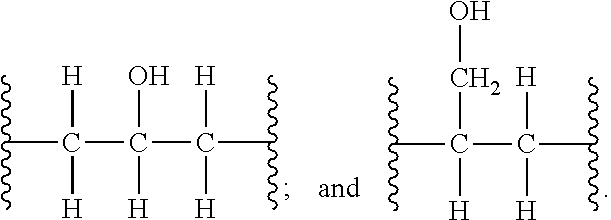

where each R3 is as defined and described above, and X is as defined above and described below. In other embodiments, the siloxane cationic surfactant (A) is configured the same as described immediately above, but with subscript a=2, such that the siloxane cationic surfactant (A) has the following formula:

where each R3 is as defined and described above, and each X is as defined above and described below. In other embodiments, the siloxane cationic surfactant (A) is configured the same as described immediately above, but with R7 being the quaternary ammonium moiety Y, such that the siloxane cationic surfactant (A) has the following formula:

where each R3 is as defined and described above, and each X is as defined above and described below. In yet other embodiments, the siloxane cationic surfactant (A) is configured the same as described immediately above, but with subscript a=1 and R being H, such that the siloxane cationic surfactant (A) has the following formula:

where each R3 is as defined and described above, and each X is as defined above and described below.
[Z2-D2-N(Y)b(R)2−b]+y[X−x]n (II),
wherein Z2 is an unsubstituted hydrocarbyl group; D2 is a covalent bond or a divalent linking group; subscript b is 1 or 2; and each R, Y, superscript y, X, subscript n, and superscript x is independently selected and as defined above.
[Z2—N(Y)b(R)2−b]+y[X−x]n,
where each Z2, Y, R, X, subscript b, superscript y, superscript x, and subscript n are as defined and described above. In some such embodiments, the hydrocarbyl moiety Z2 is an alkyl group bonded directly to the amino N atom of the organic cationic surfactant (B), such that the organic cationic surfactant (B) has the following formula:
[(CfH2f+1)—N(Y)b(R)2−b]+y[X−x]n,
where subscript b, subscript f, Y, R, X, superscript y, superscript x, and subscript n are as defined and described above. In some such embodiments, subscript f is from 6 to 18, such as from 6 to 14, alternatively from 6 to 12.
[Z2-D4-N(R8)-D4-N(Y)b(R)2−b]+y[X−x]n,
where each D4 is an independently selected divalent linking group, R8 is Y or H, and each Z2, Y, R, subscript b, X, superscript y, superscript x, and subscript n is as defined and described above.
[Z2-D4-NH-D4-N(Y)b(R)2−b]+y[X−x]n,
where each Z2, D4, Y, R, subscript b, X, superscript y, superscript x, and subscript n is as defined and described above. In such embodiments, as will be appreciated from the further description below, superscript y is 1 or 2, controlled by subscript b. More particularly, the number of quaternary ammonium moieties Y will be controlled by subscript b as 1 or 2, providing a total cationic charge of +1 or +2, respectively. Accordingly, in such embodiments, superscript x will also be 1 or 2, such that the organic cationic surfactant (B) will be charge balanced.
[Z2-D4-NY-D4-N(Y)b(R)2−b]+y[X−x]n,
where each Z2, D4, Y, R, subscript b, X, superscript y, superscript x, and subscript n is as defined and described above. In such embodiments, y=b+1, such that superscript y is 2 or 3. More particularly, the number of quaternary ammonium moieties will include the Y of R8 as well as the 1 or 2 quaternary ammonium moiety Y controlled by subscript b, providing a total cationic charge of +2 or +3, respectively. Accordingly, in such embodiments, superscript x will be 1, 2, or 3, such that the organic cationic surfactant (B) will be charge balanced. For example, in some such embodiments, subscript b is 1 and X is monoanionic, such that the organic cationic surfactant (B) has the following formula:

where each Z2, D4, R, R1, and X is as defined and described above. In other such embodiments, the organic cationic surfactant (B) is configured as described immediately above, but with b=2, such that the organic cationic surfactant (B) has the following formula:

where each Z2, D4, R, R1, and X is as defined and described above.

where subscript f is from 5 to 17 (e.g. from 5 to 11, alternatively from 5 to 9), and X is as defined and described above. In other embodiments, the organic cationic surfactant (B) is configured the same as described immediately above, but with subscript b=2, such that the organic cationic surfactant (B) has the following formula:

where each X is as defined above and described below.

where subscript f and X are as defined and described above. In other embodiments, the organic cationic surfactant (B) is configured the same as described immediately above, but with subscript b=2, such that the organic cationic surfactant (B) has the following formula:

where subscript f and each X are as defined and described above. In other embodiments, the organic cationic surfactant (B) is configured the same as described immediately above, but with R8 being the quaternary ammonium moiety Y, such that the organic cationic surfactant (B) has the following formula:

where subscript f and each X are as defined and described above. In yet other embodiments, the organic cationic surfactant (B) is configured the same as described immediately above, but with subscript b=1 and R being H, such that the organic cationic surfactant (B) has the following formula:

where subscript f and each X are as defined and described above.

In these or other embodiments, each anion X of the siloxane cationic surfactant (A) and the organic cationic surfactant (B) is the same. For example, in some such embodiments, each X of the siloxane cationic surfactant (A) and the organic cationic surfactant (B) is a halide anion, alternatively is chloride (Cl−).

and an organic cationic surfactant (B) having one of the following formulas (B-i)-(B-iii):

| TABLE 1 |
| Components and Materials Utilized |
| Component | Description |
| Siloxane C.S. (A1) | Si4-QUAB; a siloxane cationic surfactant prepared according to Preparation Example 1 below, having the following formula:  |
| Siloxane C.S. (A2) | Si4-(QUAB)1.5; a siloxane cationic surfactant prepared according to Preparation Example 2 below, having the following formula:  |
| Siloxane C.S. (A3) | Si7-PDA-(QUAB)1.5; a siloxane cationic surfactant prepared according to Preparation Example 3 below, having the following formula:  |
| Organic C.S. (B1) | C6-QUAB; an organic cationic surfactant prepared according to Preparation Example 4 below, having the following formula:  |
| Organic C.S. (B2) | C8-QUAB; an organic cationic surfactant prepared according to Preparation Example 5 below, having the following formula:  |
| Organic C.S. (B3) | C10-QUAB; an organic cationic surfactant prepared according to Preparation Example 6 below, having the following formula:  |
| Solvent (C1) | Water |
| Surfactant (D1) | C8-10 alkyl polyglycosides nonionic surfactant |
| Surfactant (D2) | Sodium decyl ethoxy sulphate anionic surfactant |
| Surfactant (D3) | Sodium Lauroamphoacetate amphoteric surfactant |
| Surfactant (D4) | N,N-dimethylhydroxyethyl cellulose cationic surfactant |
| Surfactant (D5) | Coco-glucoside nonionic surfactant |
| pH Control Agent (F1) | 2N hydrochloric acid (HCl) |
| pH Control Agent (F2) | Bis(2-hydroxyethyl)amino-tris(hydroxymethyl)methane (BIS-TRIS) |
| buffer | |
| Foam Enhancer (G1) | Lactose monohydrate |
| Foam Enhancer (G2) | Brown sugar |
| Foam Enhancer (G3) | Starch |
| Foam Enhancer (G4) | Xanthan gum |
| Foam Enhancer (G5) | Dextrose |


| TABLE 2 |
| Components and Parameters of Examples 1-6 |
| Component | Ex. 1 | Ex. 2 | Ex. 3 | Ex. 4 | Ex. 5 | Ex. 6 |
| Siloxane C.S. (A1) (wt. %): | 0.3 | 0.3 | 0.3 | 0.3 | 0.3 | 0.3 |
| Organic C.S. (B1) (wt. %): | 0.5 | 0.5 | 0.5 | 0.5 | 0.5 | 0.5 |
| Surfactant (D): | N/A | D1 | D2 | D3 | D4 | D5 |
| Amount (D) (wt. %): | — | 0.5 | 0.5 | 0.5 | 0.5 | 0.5 |
| Foam Enhancer (G): | N/A | N/A | N/A | N/A | N/A | N/A |
| Amount (G) (wt. %): | — | — | — | — | — | — |
| pH Control Agent (F): | N/A | N/A | N/A | N/A | N/A | N/A |
| Amount (F) (wt. %): | — | — | — | — | — | — |
| TABLE 3 |
| Components and Parameters of Examples 7-12 |
| Component | Ex. 7 | Ex. 8 | Ex. 9 | Ex. 10 | Ex. 11 | Ex. 12 |
| Siloxane C.S. (A1) | 0.3 | 0.3 | 0.3 | 0.3 | 0.3 | 0.3 |
| (wt. %): | ||||||
| Organic C.S. (B1) | 0.5 | 0.5 | 0.5 | 0.5 | 0.5 | 0.5 |
| (wt. %): | ||||||
| Surfactant (D): | N/A | N/A | N/A | N/A | N/A | N/A |
| Amount (D) (wt. %): | — | — | — | — | — | — |
| Foam Enhancer (G): | G1 | G2 | G3 | G4 | G5 | N/A |
| Amount (G) (wt. %): | 0.5 | 0.5 | 0.5 | 0.5 | 0.5 | — |
| pH Control Agent (F): | N/A | N/A | N/A | N/A | N/A | F2 |
| Amount (F) (wt. %): | — | — | — | — | — | 0.5 |
| TABLE 4 |
| Foam Analysis Results of Examples 1-12 |
| Example | Foam Performance | 35° C. Foam Stability (min.) | ||
| Ex. 1 | Good | 27 | ||
| Ex. 2 | Good | 2 | ||
| Ex. 3 | Poor | N/A | ||
| Ex. 4 | Good | 2 | ||
| Ex. 5 | Less foam; thick | 58 | ||
| Ex. 6 | Good | 4 | ||
| Ex. 7 | Good | 49 | ||
| Ex. 8 | Good | 38 | ||
| Ex. 9 | Good | 38 | ||
| Ex. 10 | Less foam; very thick | >180 | ||
| Ex. 11 | Good | 40 | ||
| Ex. 12 | Good | 30 | ||
| TABLE 5 |
| Components, Parameters, and Results of Examples 13-16 |
| Component | Ex. 13 | Ex. 14 | Ex. 15 | Ex. 16 |
| Siloxane C.S. (A): | A1 | A1 | A1 | A1 |
| Amount (A) (wt. %): | 0.3 | 0.3 | 0.3 | 0.3 |
| Organic C.S. (B) (wt. %): | B1 | B1 | B2 | B3 |
| Amount (B) (wt. %): | 0.5 | 0.5 | 0.5 | 0.5 |
| 35° C. Foam Stability (min.): | 27 | 20 | 74 | 37 |
| TABLE 6 |
| Components, Parameters, and Results of Examples 17-19 and Comparative |
| Examples 1-3 |
| Comp. | Comp. | Comp. | ||||
| Component | Ex. 17 | Ex. 1 | Ex. 18 | Ex. 2 | Ex. 19 | Ex. 3 |
| Siloxane C.S. (A): | A1 | A1 | A2 | A2 | A3 | A3 |
| Amount (A) (wt. %): | 0.3 | 0.3 | 0.3 | 0.3 | 0.3 | 0.3 |
| Organic C.S. (B) (wt. %): | B2 | N/A | B2 | N/A | B2 | N/A |
| Amount (B) (wt. %): | 0.5 | — | 0.5 | — | 0.5 | — |
| 60° C. Foam Stability (min.:sec.): | 21:38 | 4:51 | 31:58 | 14:00 | 1:21 | N/A |
| TABLE 7 |
| Parameters and Results of Examples 20-29 |
| Siloxane | Organic | Ratio | 60° C. Foam | ||
| Exam- | C.S. A1 | C.S. B2 | A1: | Stability | |
| ple | (wt. %) | (wt. %) | B2 | Appearance | (min.) |
| Ex. 20 | 0.1 | 0.2 | 0.5 | Clear | 5 |
| Ex. 21 | 0.3 | 0.2 | 1.5 | Slightly Hazy | 19 |
| Ex. 22 | 0.5 | 0.2 | 2.5 | Hazy | 20 |
| Ex. 23 | 0.7 | 0.2 | 3.5 | Hazy | 19 |
| Ex. 24 | 0.9 | 0.2 | 4.5 | Hazy | 18 |
| Ex. 25 | 0.2 | 0.1 | 2 | Clear | 12 |
| Ex. 26 | 0.2 | 0.3 | 0.67 | Clear | 16 |
| Ex. 27 | 0.2 | 0.5 | 0.4 | Slightly Hazy | 14 |
| Ex. 28 | 0.2 | 0.7 | 0.29 | Slightly Hazy | 7.5 |
| Ex. 29 | 0.2 | 0.9 | 0.22 | Slightly Hazy | 17 |
Claims (18)
[Z1-D1-N(Y)a(R)2−a]+y[X−x]n (I),
[Z2-D2-N(Y)b(R)2−b]+y[X−x]n (II),


Priority Applications (1)
| Application Number | Priority Date | Filing Date | Title |
|---|---|---|---|
| US17/789,175 US11679292B2 (en) | 2019-12-30 | 2020-12-22 | Cationic surfactant foam stabilizing composition |
Applications Claiming Priority (3)
| Application Number | Priority Date | Filing Date | Title |
|---|---|---|---|
| US201962955145P | 2019-12-30 | 2019-12-30 | |
| PCT/US2020/066605 WO2021138147A1 (en) | 2019-12-30 | 2020-12-22 | Cationic surfactant foam stabilizing composition |
| US17/789,175 US11679292B2 (en) | 2019-12-30 | 2020-12-22 | Cationic surfactant foam stabilizing composition |
Publications (2)
| Publication Number | Publication Date |
|---|---|
| US20230095031A1 US20230095031A1 (en) | 2023-03-30 |
| US11679292B2 true US11679292B2 (en) | 2023-06-20 |
Family
ID=74181381
Family Applications (1)
| Application Number | Title | Priority Date | Filing Date |
|---|---|---|---|
| US17/789,175 Active 2040-12-22 US11679292B2 (en) | 2019-12-30 | 2020-12-22 | Cationic surfactant foam stabilizing composition |
Country Status (5)
| Country | Link |
|---|---|
| US (1) | US11679292B2 (en) |
| EP (1) | EP4085123B1 (en) |
| JP (1) | JP7615149B2 (en) |
| CN (1) | CN115003784B (en) |
| WO (1) | WO2021138147A1 (en) |
Families Citing this family (7)
| Publication number | Priority date | Publication date | Assignee | Title |
|---|---|---|---|---|
| US11439858B1 (en) | 2019-08-14 | 2022-09-13 | Dieter R. Berndt | Fire extinguisher and method |
| CN117597173A (en) * | 2021-07-07 | 2024-02-23 | 美国陶氏有机硅公司 | Foam stabilizing composition comprising silicone cationic surfactant and colloidal silica |
| JP2024529261A (en) * | 2021-07-07 | 2024-08-06 | ダウ シリコーンズ コーポレーション | Preparation of Foam Stabilizing Compositions Comprising Siloxane Cationic Surfactant, Cationic Surfactant, and Metal Salt |
| EP4456988A1 (en) * | 2021-12-31 | 2024-11-06 | Dow Silicones Corporation | Foam stabilizing composition for fluorine-free firefighting foams |
| US20250229117A1 (en) * | 2022-01-27 | 2025-07-17 | Tyco Fire Products Lp | Firefighting composition with quaternary functional copolymer |
| CN116764156A (en) * | 2022-03-11 | 2023-09-19 | 中国石油化工股份有限公司 | Fluorine-free composition with fire extinguishing function and method for preparing fluorine-free fire extinguishing agent |
| CN120059705B (en) * | 2023-11-28 | 2026-01-27 | 中国石油化工股份有限公司 | A cationic and anionic surfactant, a foam system, its preparation method, and its application in enhanced oil recovery. |
Citations (7)
| Publication number | Priority date | Publication date | Assignee | Title |
|---|---|---|---|---|
| US3677347A (en) | 1969-12-22 | 1972-07-18 | Union Carbide Corp | Method of extinguishing fires and compositions therefor containing cationic silicone surfactants |
| US4149978A (en) | 1977-07-12 | 1979-04-17 | The Procter & Gamble Company | Textile treatment composition |
| EP0043622A1 (en) | 1980-01-07 | 1982-01-13 | THE PROCTER & GAMBLE COMPANY | Fabric softening composition |
| US20050164900A1 (en) | 2000-08-28 | 2005-07-28 | The Procter & Gamble Company | Fabric care and perfume compositions and systems comprising cationic silicones and methods employing same |
| US20080196908A1 (en) | 2005-03-01 | 2008-08-21 | Schaefer Ted H | Fire Fighting Foam Concentrate |
| US7569155B2 (en) | 2001-12-07 | 2009-08-04 | Solberg Scandinavian A/S | Aqueous foaming composition |
| EP3328977A1 (en) | 2015-07-31 | 2018-06-06 | Unilever NV | Hard surface treatment composition |
Family Cites Families (7)
| Publication number | Priority date | Publication date | Assignee | Title |
|---|---|---|---|---|
| JPH0686467B2 (en) * | 1988-12-09 | 1994-11-02 | 信越化学工業株式会社 | Cationic silicone surfactant |
| CA2068124A1 (en) * | 1991-05-24 | 1992-11-25 | Daniel J. Halloran | Optically clear hair care compositions containing amino-functional silicone microemulsions |
| US20030211618A1 (en) * | 2001-05-07 | 2003-11-13 | Patel Gordhandhai Nathalal | Color changing steam sterilization indicator |
| US7902293B2 (en) * | 2003-05-16 | 2011-03-08 | Dow Corning Corporation | Method of preparing emulsions containing elastomeric silanes and siloxanes having quaternary ammonium groups |
| JP5549433B2 (en) * | 2010-07-05 | 2014-07-16 | 日東紡績株式会社 | Water-soluble polymer compound, method for producing the same, and surface treatment agent containing the same |
| CN106622013A (en) * | 2016-12-30 | 2017-05-10 | 安徽艾蒂贝生物有限公司 | High-wettability-and-dispersity compound surfactant |
| EP3556441A1 (en) | 2018-04-17 | 2019-10-23 | ImerTech SAS | Fire suppressant foam forming compositions, precursors, their uses and methods of making them |
-
2020
- 2020-12-22 JP JP2022538155A patent/JP7615149B2/en active Active
- 2020-12-22 WO PCT/US2020/066605 patent/WO2021138147A1/en not_active Ceased
- 2020-12-22 EP EP20839525.1A patent/EP4085123B1/en active Active
- 2020-12-22 CN CN202080094445.4A patent/CN115003784B/en active Active
- 2020-12-22 US US17/789,175 patent/US11679292B2/en active Active
Patent Citations (7)
| Publication number | Priority date | Publication date | Assignee | Title |
|---|---|---|---|---|
| US3677347A (en) | 1969-12-22 | 1972-07-18 | Union Carbide Corp | Method of extinguishing fires and compositions therefor containing cationic silicone surfactants |
| US4149978A (en) | 1977-07-12 | 1979-04-17 | The Procter & Gamble Company | Textile treatment composition |
| EP0043622A1 (en) | 1980-01-07 | 1982-01-13 | THE PROCTER & GAMBLE COMPANY | Fabric softening composition |
| US20050164900A1 (en) | 2000-08-28 | 2005-07-28 | The Procter & Gamble Company | Fabric care and perfume compositions and systems comprising cationic silicones and methods employing same |
| US7569155B2 (en) | 2001-12-07 | 2009-08-04 | Solberg Scandinavian A/S | Aqueous foaming composition |
| US20080196908A1 (en) | 2005-03-01 | 2008-08-21 | Schaefer Ted H | Fire Fighting Foam Concentrate |
| EP3328977A1 (en) | 2015-07-31 | 2018-06-06 | Unilever NV | Hard surface treatment composition |
Non-Patent Citations (4)
| Title |
|---|
| International Search Report for PCT/US2020/066605 dated May 20, 2021, 4 pages. |
| Schmaucks, G., et al. "Effect of siloxanyl groups on the interfacial behavior of quaternary ammonium compounds." Langmuir 8.7 (1992): 1724-1730. |
| Shishatskiy et al. "Quaternary ammonium membrane materials for CO2 separation" Journal of Membrane Science, 2010, 359, 44-53. (Year: 2010). * |
| Snow, Steven A. "Synthesis, characterization, stability, aqueous surface activity, and aqueous solution aggregation of the novel, cationic siloxane surfactants (Me3SiO) 2Si (Me)—(CH2) 3+ NMe2 (CH2) 2OR X-(R=hydrogen, acetyl, N-phenylcarbamyl; X=chloride, bromide, iodide, nitrate, methyl sulfate)." Langmuir 9.2 (1993): 424-430. |
Also Published As
| Publication number | Publication date |
|---|---|
| CN115003784A (en) | 2022-09-02 |
| JP7615149B2 (en) | 2025-01-16 |
| CA3162993A1 (en) | 2021-07-08 |
| JP2023512409A (en) | 2023-03-27 |
| EP4085123A1 (en) | 2022-11-09 |
| US20230095031A1 (en) | 2023-03-30 |
| CN115003784B (en) | 2025-04-29 |
| EP4085123B1 (en) | 2023-12-20 |
| WO2021138147A1 (en) | 2021-07-08 |
Similar Documents
| Publication | Publication Date | Title |
|---|---|---|
| US11679292B2 (en) | Cationic surfactant foam stabilizing composition | |
| CN104379674B (en) | Organic polysiloxane emulsion composition | |
| EP3178916A1 (en) | Defoaming agent for liquid detergent | |
| KR20130060296A (en) | Aqueous mixtures comprising aminoalkyl-containing polyorganosiloxanes and silicone resins | |
| EP1184422A1 (en) | Method of making microemulsions constituted by a silicone oil component and an amine functional polysiloxane component | |
| US20250152986A1 (en) | Foam stabilizing composition for fluorine-free firefighting foams | |
| US20240278055A1 (en) | Foam stabilizing composition including a siloxane cationic surfactant and colloidal silica | |
| CA3162993C (en) | Cationic surfactant foam stabilizing composition | |
| US20130116381A1 (en) | Process For Making Polysiloxane Emulsions | |
| US20240207664A1 (en) | Preparation and use of a foam stabilizing composition including a silane surfactant | |
| CN105434190A (en) | Organic silicone surfactant, preparation method thereof and application thereof to cosmetics | |
| US7462669B2 (en) | Cationic emulsion composition of high polymeric organosiloxane and preparation thereof | |
| JP6957747B2 (en) | Aqueous emulsion of oxamide ester functionalized organopolysiloxane | |
| US20240198157A1 (en) | Preparation of a foam stabilizing composition including a siloxane cationic surfactant and a metal salt | |
| KR102477498B1 (en) | Oil in water typed silicon elastomer and the Manufacturing method thereof | |
| KR101904548B1 (en) | Hair Conditioning Composition | |
| KR20030047791A (en) | Oil-in-water-type organopolysiloxane emulsion |
Legal Events
| Date | Code | Title | Description |
|---|---|---|---|
| FEPP | Fee payment procedure |
Free format text: ENTITY STATUS SET TO UNDISCOUNTED (ORIGINAL EVENT CODE: BIG.); ENTITY STATUS OF PATENT OWNER: LARGE ENTITY |
|
| AS | Assignment |
Owner name: DOW SILICONES CORPORATION, MICHIGAN Free format text: ASSIGNMENT OF ASSIGNORS INTEREST;ASSIGNORS:LIU, NANGUO;WENZLICK, ZACHARY;HARKNESS, BRIAN;AND OTHERS;SIGNING DATES FROM 20200211 TO 20200214;REEL/FRAME:060446/0147 Owner name: DOW GLOBAL TECHNOLOGIES LLC, MICHIGAN Free format text: ASSIGNMENT OF ASSIGNORS INTEREST;ASSIGNOR:DORVEL, BRIAN;REEL/FRAME:060330/0326 Effective date: 20200212 |
|
| STCF | Information on status: patent grant |
Free format text: PATENTED CASE |