US11647945B2 - Evaluating apparatus and non-transitory computer readable medium storing program - Google Patents
Evaluating apparatus and non-transitory computer readable medium storing program Download PDFInfo
- Publication number
- US11647945B2 US11647945B2 US16/197,743 US201816197743A US11647945B2 US 11647945 B2 US11647945 B2 US 11647945B2 US 201816197743 A US201816197743 A US 201816197743A US 11647945 B2 US11647945 B2 US 11647945B2
- Authority
- US
- United States
- Prior art keywords
- user
- threshold
- state
- patient
- sleeping
- Prior art date
- Legal status (The legal status is an assumption and is not a legal conclusion. Google has not performed a legal analysis and makes no representation as to the accuracy of the status listed.)
- Active, expires
Links
- 230000000694 effects Effects 0.000 claims abstract description 48
- 238000001514 detection method Methods 0.000 claims description 7
- 238000012545 processing Methods 0.000 description 50
- 230000033001 locomotion Effects 0.000 description 11
- 238000004891 communication Methods 0.000 description 9
- 238000000034 method Methods 0.000 description 9
- 230000006870 function Effects 0.000 description 8
- 230000000241 respiratory effect Effects 0.000 description 7
- 238000010586 diagram Methods 0.000 description 6
- 230000036544 posture Effects 0.000 description 5
- 230000029058 respiratory gaseous exchange Effects 0.000 description 5
- 230000007704 transition Effects 0.000 description 4
- 230000001133 acceleration Effects 0.000 description 3
- 230000008859 change Effects 0.000 description 3
- 238000013461 design Methods 0.000 description 3
- 238000005516 engineering process Methods 0.000 description 3
- 230000008569 process Effects 0.000 description 3
- 201000010099 disease Diseases 0.000 description 2
- 208000037265 diseases, disorders, signs and symptoms Diseases 0.000 description 2
- 230000005484 gravity Effects 0.000 description 2
- 238000004519 manufacturing process Methods 0.000 description 2
- 230000033764 rhythmic process Effects 0.000 description 2
- 230000035945 sensitivity Effects 0.000 description 2
- 208000012661 Dyskinesia Diseases 0.000 description 1
- LFQSCWFLJHTTHZ-UHFFFAOYSA-N Ethanol Chemical compound CCO LFQSCWFLJHTTHZ-UHFFFAOYSA-N 0.000 description 1
- 208000013738 Sleep Initiation and Maintenance disease Diseases 0.000 description 1
- 230000008901 benefit Effects 0.000 description 1
- 238000004422 calculation algorithm Methods 0.000 description 1
- 238000004364 calculation method Methods 0.000 description 1
- 238000004590 computer program Methods 0.000 description 1
- 238000007796 conventional method Methods 0.000 description 1
- 238000006073 displacement reaction Methods 0.000 description 1
- 230000002349 favourable effect Effects 0.000 description 1
- 230000010365 information processing Effects 0.000 description 1
- 206010022437 insomnia Diseases 0.000 description 1
- 230000007774 longterm Effects 0.000 description 1
- 238000005259 measurement Methods 0.000 description 1
- 238000010295 mobile communication Methods 0.000 description 1
- 238000012986 modification Methods 0.000 description 1
- 230000004048 modification Effects 0.000 description 1
- 230000017311 musculoskeletal movement, spinal reflex action Effects 0.000 description 1
- 230000003287 optical effect Effects 0.000 description 1
- 230000000737 periodic effect Effects 0.000 description 1
- 239000004065 semiconductor Substances 0.000 description 1
- 239000007787 solid Substances 0.000 description 1
- 238000013403 standard screening design Methods 0.000 description 1
- 230000002123 temporal effect Effects 0.000 description 1
Images




Classifications
-
- A—HUMAN NECESSITIES
- A61—MEDICAL OR VETERINARY SCIENCE; HYGIENE
- A61B—DIAGNOSIS; SURGERY; IDENTIFICATION
- A61B5/00—Measuring for diagnostic purposes; Identification of persons
- A61B5/48—Other medical applications
- A61B5/4806—Sleep evaluation
- A61B5/4809—Sleep detection, i.e. determining whether a subject is asleep or not
-
- A—HUMAN NECESSITIES
- A61—MEDICAL OR VETERINARY SCIENCE; HYGIENE
- A61B—DIAGNOSIS; SURGERY; IDENTIFICATION
- A61B5/00—Measuring for diagnostic purposes; Identification of persons
- A61B5/48—Other medical applications
- A61B5/4806—Sleep evaluation
- A61B5/4812—Detecting sleep stages or cycles
-
- A—HUMAN NECESSITIES
- A61—MEDICAL OR VETERINARY SCIENCE; HYGIENE
- A61B—DIAGNOSIS; SURGERY; IDENTIFICATION
- A61B5/00—Measuring for diagnostic purposes; Identification of persons
- A61B5/68—Arrangements of detecting, measuring or recording means, e.g. sensors, in relation to patient
- A61B5/6887—Arrangements of detecting, measuring or recording means, e.g. sensors, in relation to patient mounted on external non-worn devices, e.g. non-medical devices
- A61B5/6892—Mats
-
- A—HUMAN NECESSITIES
- A61—MEDICAL OR VETERINARY SCIENCE; HYGIENE
- A61B—DIAGNOSIS; SURGERY; IDENTIFICATION
- A61B5/00—Measuring for diagnostic purposes; Identification of persons
- A61B5/103—Measuring devices for testing the shape, pattern, colour, size or movement of the body or parts thereof, for diagnostic purposes
- A61B5/11—Measuring movement of the entire body or parts thereof, e.g. head or hand tremor or mobility of a limb
- A61B5/1113—Local tracking of patients, e.g. in a hospital or private home
-
- A—HUMAN NECESSITIES
- A61—MEDICAL OR VETERINARY SCIENCE; HYGIENE
- A61B—DIAGNOSIS; SURGERY; IDENTIFICATION
- A61B5/00—Measuring for diagnostic purposes; Identification of persons
- A61B5/103—Measuring devices for testing the shape, pattern, colour, size or movement of the body or parts thereof, for diagnostic purposes
- A61B5/11—Measuring movement of the entire body or parts thereof, e.g. head or hand tremor or mobility of a limb
- A61B5/1113—Local tracking of patients, e.g. in a hospital or private home
- A61B5/1115—Monitoring leaving of a patient support, e.g. a bed or a wheelchair
-
- A—HUMAN NECESSITIES
- A61—MEDICAL OR VETERINARY SCIENCE; HYGIENE
- A61B—DIAGNOSIS; SURGERY; IDENTIFICATION
- A61B5/00—Measuring for diagnostic purposes; Identification of persons
- A61B5/103—Measuring devices for testing the shape, pattern, colour, size or movement of the body or parts thereof, for diagnostic purposes
- A61B5/11—Measuring movement of the entire body or parts thereof, e.g. head or hand tremor or mobility of a limb
- A61B5/1118—Determining activity level
-
- A—HUMAN NECESSITIES
- A61—MEDICAL OR VETERINARY SCIENCE; HYGIENE
- A61B—DIAGNOSIS; SURGERY; IDENTIFICATION
- A61B5/00—Measuring for diagnostic purposes; Identification of persons
- A61B5/72—Signal processing specially adapted for physiological signals or for diagnostic purposes
- A61B5/7271—Specific aspects of physiological measurement analysis
- A61B5/7278—Artificial waveform generation or derivation, e.g. synthesizing signals from measured signals
-
- A—HUMAN NECESSITIES
- A61—MEDICAL OR VETERINARY SCIENCE; HYGIENE
- A61B—DIAGNOSIS; SURGERY; IDENTIFICATION
- A61B5/00—Measuring for diagnostic purposes; Identification of persons
- A61B5/72—Signal processing specially adapted for physiological signals or for diagnostic purposes
- A61B5/7271—Specific aspects of physiological measurement analysis
- A61B5/7282—Event detection, e.g. detecting unique waveforms indicative of a medical condition
Definitions
- the present embodiment relates to an evaluating apparatus and a non-transitory computer readable medium storing a program.
- FIG. 1 is a diagram for explaining the evaluating system in a first embodiment
- FIG. 2 is a diagram for explaining a configuration of the evaluating system in the first embodiment
- FIG. 3 is a diagram for explaining parameters in the first embodiment
- FIG. 4 is a diagram for explaining a configuration of the evaluating system in view of another aspect in the first embodiment
- FIG. 5 is a flowchart for explaining processing how to evaluate state of a target person in the first embodiment
- FIG. 6 is a flowchart for explaining processing whether the target person starts falling asleep or not in the first embodiment
- FIG. 7 A to FIG. 7 B are diagrams for explaining effects of the first embodiment
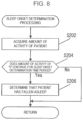
- FIG. 8 is a flowchart for explaining processing whether the target person starts falling asleep or not in a second embodiment
- FIG. 9 is a diagram for explaining effects of the second embodiment.
- FIG. 10 is a flowchart for explaining processing how to evaluate state of the target person in a third embodiment
- FIG. 11 is a flowchart for explaining processing how to evaluate state of a target person in a fourth embodiment.
- FIG. 12 is a flowchart for explaining processing how to evaluate state of a target person in a fifth embodiment.
- one aspect of the present application is an evaluating apparatus including a detector configured to detect a biological signal of a user; and a controller configured to: calculate an amount of activity of the user from the biological signal, determine whether the user is sleeping during a first period by comparing the amount of activity with a low threshold, and determine whether the user is sleeping during a second period after the first period by comparing the amount of activity with a high threshold (the high threshold is set in accordance with a determination condition), the low threshold being lower than the high threshold.
- High and low mean with respect to each other.
- the apparatus can include a further detector configured to detect physically presence of the user in a bed or to detect that the user is in a recumbent position, wherein the controller begins the first period upon positive detection by the further detector, and upon a determination during the first period that the user is sleeping, the controller ends the first period and begins the second period.
- a further detector configured to detect physically presence of the user in a bed or to detect that the user is in a recumbent position, wherein the controller begins the first period upon positive detection by the further detector, and upon a determination during the first period that the user is sleeping, the controller ends the first period and begins the second period.
- the controller can also end the first period and begin the second period when, during the first period it has not been determined that the user has fallen asleep for a determination time period.
- the controller can also determine, during the second period, whether the user is awake for a duration, and end second period upon a determination that the user has been awake for the duration.
- the controller restarts the first period upon ending the second period and again determines whether the user is sleeping by comparing the amount of activity with the low threshold.
- the controller determines that the user has fallen asleep when the calculated amount of activity is continuously substantially 0 for a third time period.
- the controller determines whether the user is sleeping by comparing the amount of activity with a middle threshold which is greater than the low threshold and which is smaller than the high.
- an evaluating apparatus includes a detector configured to detect a biological signal of a user, a controller configured to calculate an amount of activity of the user from the biological signal, calculate a first value from the amount of activity of the user, determine a state of the user as awake if the first value exceeds a first threshold and a magnitude of the biological signal is greater than or equal to a first amount, determine the state of the user as sleeping if the first value is equal to or less than the first threshold and the magnitude of the biological signal is greater than or equal to the first amount, determine the state of the user as awake if the first value exceeds a second threshold, which is smaller than the first threshold, and a magnitude of the biological signal is less than the first amount, and determine the state of the user as sleeping if the first value is equal to or less than the second threshold and the magnitude of the biological signal is less than the first amount.
- Another aspect of the application is a non-transitory computer readable medium having stored thereon a program for causing a microprocessor to execute at least the following, acquiring a biological signal of a user, calculating an amount of activity of the user from the biological signal, determining whether the user is sleeping during a first period by comparing the amount of activity with a low threshold, and determining whether the user is sleeping during a second period after the first period by comparing the amount of activity with a high threshold, the low threshold being lower than the high threshold.
- the terms “component,” “system” and the like are intended to refer to, or comprise, a computer-related entity or an entity related to an operational apparatus with one or more specific functionalities, wherein the entity can be either hardware, a combination of hardware and software, software, or software in execution.
- a component may be, but is not limited to being, a process running on a processor, a processor, an object, an executable, a thread of execution, computer-executable instructions, a program, and/or a computer.
- an application running on a server and the server can be a component.
- One or more components may reside within a process and/or thread of execution and a component may be localized on one computer and/or distributed between two or more computers. In addition, these components can execute from various computer readable media having various data structures stored thereon. The components may communicate via local and/or remote processes such as in accordance with a signal having one or more data packets (e.g., data from one component interacting with another component in a local system, distributed system, and/or across a network such as the Internet with other systems via the signal).
- a signal having one or more data packets (e.g., data from one component interacting with another component in a local system, distributed system, and/or across a network such as the Internet with other systems via the signal).
- a component can be an apparatus with specific functionality provided by mechanical parts operated by electric or electronic circuitry, which is operated by a software application or firmware application executed by a processor, wherein the processor can be internal or external to the apparatus and executes at least a part of the software or firmware application.
- a component can be an apparatus that provides specific functionality through electronic components without mechanical parts, the electronic components can comprise a processor therein to execute software or firmware that confers at least in part the functionality of the electronic components. While various components have been illustrated as separate components, it will be appreciated that multiple components can be implemented as a single component, or a single component can be implemented as multiple components, without departing from example embodiments.
- the various embodiments can be implemented as a method, apparatus or article of manufacture using standard programming and/or engineering techniques to produce software, firmware, hardware or any combination thereof to control a computer to implement the disclosed subject matter.
- article of manufacture as used herein is intended to encompass a computer program accessible from any computer-readable (or machine-readable) device or computer-readable (or machine-readable) storage/communications media.
- computer readable storage media can comprise, but are not limited to, magnetic storage devices (e.g., hard disk, floppy disk, magnetic strips), optical disks (e.g., compact disk (CD), digital versatile disk (DVD)), smart cards, and flash memory devices (e.g., card, stick, key drive).
- magnetic storage devices e.g., hard disk, floppy disk, magnetic strips
- optical disks e.g., compact disk (CD), digital versatile disk (DVD)
- smart cards e.g., card, stick, key drive
- example and exemplary are used herein to mean serving as an instance or illustration. Any embodiment or design described herein as “example” or “exemplary” is not necessarily to be construed as preferred or advantageous over other embodiments or designs. Rather, use of the word example or exemplary is intended to present concepts in a concrete fashion.
- the term “or” is intended to mean an inclusive “or” rather than an exclusive “or”. That is, unless specified otherwise or clear from context, “X employs A or B” is intended to mean any of the natural inclusive permutations.
- Embodiments described herein can be exploited in substantially any wireless communication technology, comprising, but not limited to, wireless fidelity (Wi-Fi), global system for mobile communications (GSM), universal mobile telecommunications system (UMTS), worldwide interoperability for microwave access (WiMAX), enhanced general packet radio service (enhanced GPRS), third generation partnership project (3GPP) long term evolution (LTE), third generation partnership project 2 (3GPP2) ultra mobile broadband (UMB), high speed packet access (HSPA), Z-Wave, Zigbee and other 802.XX wireless technologies and/or legacy telecommunication technologies.
- Wi-Fi wireless fidelity
- GSM global system for mobile communications
- UMTS universal mobile telecommunications system
- WiMAX worldwide interoperability for microwave access
- enhanced GPRS enhanced general packet radio service
- third generation partnership project (3GPP) long term evolution (LTE) third generation partnership project 2 (3GPP2) ultra mobile broadband (UMB)
- HSPA high speed packet access
- Z-Wave Zigbe
- the system 1 includes a detector 3 placed between a bed 10 and a mattress 20 , and a processor 5 for processing some algorithm based on values output from the detector 3 .
- the detector 3 and the processor 5 constitute a system which can output biological information and which evaluates states of the target person.
- the detector 3 detects vibration (vibration produced from a human body) from a biological signal of the patient P. Then, biological information of the patient P is calculated on the basis of the detected vibration. In the present embodiment, it is possible to output and display the calculated biological information (for example, a respiration rate, a heart rate and an amount of activity).
- the system may be integrally formed by a storage unit (i.e., a non-transitory electronic memory), a display, and the detector 3 .
- the processor 5 may be a general-purpose apparatus, the processor 5 is not limited to an information processing apparatus such as a computer and may be configured with an apparatus such as, for example, a tablet and a smartphone.
- the target person may be an ailing person or a person who needs care. Further, the target person may be a healthy person who does not need care, an elderly person, a child, a disabled person or an animal which is not a person.
- the detector 3 is made in a sheet shape. Even if the detector 3 is placed between the bed 10 and the mattress 20 , because the detector 3 can be used without providing a feeling of strangeness (i.e., physical discomfort) to the patient P, it is possible to measure a biological information in bed for a long period. That is, biological information, or the like, is acquired as a state of the patient P when the patient P is lying on the bed.
- a position or a posture of the patient P on a bed 10 with the detector 3 .
- a posture of the patient P on the mattress 20 is a recumbent position or a seated position, or it is possible to determine at which position on the mattress 20 the patient is sleeping or in which direction the patient faces.
- the detector 3 only has to be able to acquire a biological signal (such as body motion, respiratory movement and ballistocardiogram) of the patient P.
- a biological signal such as body motion, respiratory movement and ballistocardiogram
- a heart rate and a respiration rate can be calculated on the basis of body vibration
- the detector 3 may be implemented by, for example, a smartphone, a tablet, or the like, placed on the bed 10 with a built-in acceleration sensor, or the like.
- the system 1 includes the detector 3 and the processor 5 , and each functional unit other than the biological signal acquiring unit 110 may be implemented by either one of the detector 3 and the processor 5 .
- the system 1 includes a control unit 100 , a biological signal acquiring unit 110 , a calculating unit 120 , a determining unit 130 , a patient state acquiring unit 140 , a storage unit 150 , an input unit 160 and an output unit 170 .
- the control unit 100 controls operation of the entire system 1 .
- the control unit 100 corresponds to, for example, a control apparatus such as a CPU (Central Processing Unit).
- the control unit 100 performs various kinds of processing by reading out and executing various kinds of programs stored in the storage unit 150 (which corresponds to, for example, a non-transitory electronic memory apparatus).
- control unit 100 operates for the whole system, as will be described later in FIG. 4 , the control unit 100 can be respectively provided at the detector 3 and/or the processor 5 .
- the biological signal acquiring unit 110 acquires a biological signal of the patient P.
- the biological signal acquiring unit 110 comprises a sensor apparatus which detects pressure changes, and with which body vibration, which is one type of the biological signal, is.
- the acquired biological signal is processed respectively at the calculating unit 120 , the determining unit 130 and the patient state acquiring unit 140 .
- the biological signal acquiring unit 110 may, for example, comprise a pressure sensor which acquires body vibration of the patient, or a load sensor which acquires a changed biological signal based on a changed position which is center of gravity of the patient. Further, the biological signal acquiring unit 110 may, for example, comprise a microphone, e.g., in place of the pressure sensor, to acquire a biological signal on the basis of sound picked up by the microphone. Still further, the biological signal acquiring unit 110 may, for example, comprise a microwave, a laser speckle sensor, or the like, to acquire a biological signal on the basis of displacement of a body of the patient P or bedclothes. Further, the biological signal acquiring unit 110 may, for example, comprise an acceleration sensor or a gravity sensor to acquire a biological signal. In this manner, it is only necessary that a biological signal can be acquired using one of the methods.
- the calculating unit 120 calculates a biological information of the patient P.
- a respiratory component and a heartbeat component from the body motion (body vibration) acquired by the biological signal acquiring unit 110 and obtain a respiration rate and a heart rate on the basis of a respiratory interval and an R-R interval.
- the calculating unit 120 functions as an activity amount calculating unit in the case where an amount of activity is calculated as the biological information.
- the determining unit 130 is a functional unit for determining a state of the patient. For example, a state of the patient is determined on the basis of the biological signal acquired by the biological signal acquiring unit 110 .
- the state may be determined as an “awake” state or a “sleeping” state, or further, the “sleeping” state may be determined as a “REM sleeping” state or a “non-REM sleeping” state. That is, the state may indicate a depth of sleeping. If “REM sleeping” state may be divided into a plurality of states like a first “REM sleeping” state and a second “REM sleeping” state, the “sleeping” state may include the first “REM sleeping” state and the second “REM sleeping” state.
- non-REM sleeping” state may be divided into a plurality of states like a first “non-REM sleeping” state and a second “non-REM sleeping” state
- the “sleeping” state may include the plurality of states like a first “non-REM sleeping” state and a second “non-REM sleeping” state. Further, it is also possible to determine the state of the patient P from combination of the biological information calculated at the calculating unit 120 and change of the biological signal.
- the patient state acquiring unit 140 acquires a state of the patient P.
- the state of the patient P which indicates whether the patient P is in the bed 10 is acquired from the biological signal acquired by the biological signal acquiring unit 110 , a load sensor, or the like, separately provided at the bed 10 .
- a state of the patient P which indicates postures of the patient P (e.g. whether or not the patient P is lying down, is sitting on the mattress 20 , sitting on the edge of the mattress 20 or the like) on the basis of the biological signal (for example, body vibration data) acquired by the biological signal acquiring unit 110 .
- the biological signal for example, body vibration data
- the state of the patient P which indicates whether the patient P is in the bed 10 is acquired at the patient state acquiring unit 140 , that state may be determined also by the determining unit 130 .
- the storage unit 150 stores various kinds of data and programs for operation of the system 1 .
- the control unit 100 implements various kinds of functions by reading out and executing the programs stored in the storage unit 150 .
- the storage unit 150 is configured with a semiconductor memory (for example, an SSD (Solid State Drive), an SD card (registered trademark)), a magnetic disk apparatus (for example, an HDD (Hard Disk Drive)), or the like.
- the storage unit 150 may be a built-in storage apparatus or a detachable external storage apparatus.
- the storage unit 150 may be a storage area of an electronic non-transitory memory of an external server serving as cloud storage.
- the storage unit 150 stores biological information data 152 , patient state data 154 and a parameter table 156 .
- the biological information data 152 is the biological information calculated by the calculating unit 120 on the basis of the biological signal (body motion) acquired by the biological signal acquiring unit 110 .
- the storage unit 150 may store a respiration rate, a heart rate, an amount of activity and body motion as necessary. Further, the storage unit 150 may store other information (for example, a respiratory problem index based on fluctuation in a respiratory amplitude, or the like, a periodic body motion index based on periodicity of the body motion) if the information is a biological information which can be calculated by the calculating unit 120 .
- the patient state data 154 is a state of the patient P.
- the storage unit 150 stores the state whether the patient P is “sleeping” or “awake” determined by the determining unit 130 , or state whether the patient P is in the bed 10 acquired by the patient state acquiring unit 140 . Further, the storage unit 150 may also store information indicating the depth of sleeping such as the “REM sleeping” state and the “non-REM sleeping” state, and the storage unit 150 may also store states of postures or positions of the patient P such as “sitting” and a “lateral position” on the mattress 20 .
- the parameter table 156 is a table in which various kinds of parameters are stored.
- a threshold for determining the state of the patient for example, “1.0”
- a first time period for determining whether the patient falls asleep for example, “6 minutes”
- a second time period for determining whether the patient falls asleep for example, “20 minutes”
- a time period for determining whether the patient wakes up for example, “6 minutes”.
- the calculating unit 120 , the determining unit 130 , and the patient state acquiring unit 140 may be implemented by software.
- the control unit 100 implements each function by reading out and executing software (programs) stored in the storage unit 150 . That is, the control unit 100 functions as each component by software being executed.
- control unit 100 functions as the determining unit 130 which determines whether the patient falls asleep by executing a program that implements the flowchart described in FIG. 6 .
- the processing may be a single program or may be executed as subroutine of other programs.
- control unit 100 may function as an activity amount calculating unit which calculates an amount of activity as the biological information.
- the detector 3 includes a control unit 300 , a biological signal acquiring unit 320 which is a sensor, a storage unit 330 and a communication unit 390 .
- control unit 300 includes a calculating unit 310 by executing software (programs) stored in the storage unit 330 .
- the calculating unit 310 calculates a biological information on the basis of the biological signal acquired at the biological signal acquiring unit 320 .
- the calculated biological information is stored in biological information data 340 , or transmitted to the processor 5 via the communication unit 390 .
- the biological signal acquired at the biological signal acquiring unit 320 can be also transmitted to the processor 5 via the communication unit 390 .
- the detector 3 may sequentially or periodically transmit the biological information to the processor 5 .
- the biological signal acquiring unit 320 corresponds to the acquiring unit 110 in FIG. 2
- the calculating unit 310 corresponds to the calculating unit 120 in FIG. 2
- the communication unit 390 is, for example, a communication interface which can be connected to a network (for example, a LAN/a WAN).
- the processor 5 includes a control unit 500 , a storage unit 530 , an input unit 540 , an output unit 550 and a communication unit 590 .
- the processor 5 receives the biological information and the biological signal from the detector 3 via the communication unit 590 .
- the received biological information is stored in biological information data 532 .
- the control unit 500 includes a determining unit 510 or a patient state acquiring unit 520 by executing software (programs) stored in the storage unit 530 .
- the determining unit 510 determines the state of the patient P on the basis of the received biological information and biological signal.
- the patient state acquiring unit 520 acquires a state of the patient which indicates whether the patient P is in the bed 10 on the basis of the received biological information and biological signal.
- the states of the patient are stored in patient state data 534 .
- the determining unit 510 corresponds to the determining unit 130 in FIG. 2 .
- the patient state acquiring unit 520 corresponds to the patient state acquiring unit 140 in FIG. 2 .
- the input unit 540 corresponds to the input unit 160 in FIG. 2 .
- the output unit 550 corresponds to the output unit 170 in FIG. 2 .
- the storage unit 530 corresponds to the storage unit 150 in FIG. 2 .
- the control unit 100 determines whether or not the patient goes to bed (step S 102 ).
- the patient state acquiring unit 140 determines that the patient P has gone to bed by detecting that the patient P is physically in the bed 10 or by detecting a state of the posture of the patient P indicative that the patient is going to bed (for example, that the patient is in a “recumbent position”), and determines that the patient has gone to bed as of the time of such detection.
- the control unit 100 changes the threshold stored in the storage unit 530 from a first threshold to a second threshold (step S 104 ).
- the threshold is a threshold for determining whether the patient is in a “sleeping” state or in an “awake” state.
- the threshold in a default case, i.e., when the patient is sleeping, the threshold is set at the first threshold (value “1” in FIG. 3 for example corresponds to the first threshold), whereas, in the time period right after the detection that the patient has just gone to bed, during which time period the control unit 100 is making a determination as to whether the patient has fallen asleep, the threshold is the second threshold which is smaller than the first threshold. If the first threshold is set at “1” in FIG. 3 for example, the second threshold is preferably equal to or less than “0.5”, and is “0.05” in the present embodiment.
- control unit 100 is more likely to determine the patient's state as the “awake” state rather than the “sleeping” state because the second threshold, which is in effect during this time, is smaller than the first threshold which will be in effect during sleep.
- This threshold setting is made so as to prevent the “awake” state from being erroneously determined as the “sleeping” state, because the patient during that period right after the determination of “goes to bed” usually does not move although the patient is still in the “awake” state. Therefore, the control unit 100 uses the second threshold during that period right after the determination of “goes to bed” up until the patient is determined to have fallen asleep.
- the determining unit 130 executes processing to determine whether the patient P is the “awake” state or the “sleeping” state (step S 106 ). For example, the determining unit 130 determines the state of the patient on the basis of the amount of activity detected in a given certain time range.
- the determining unit 130 determines a state of the patient at the time A 0 by utilizing an amount of activity A ⁇ 4 four minutes before, to an amount of activity A +2 two minutes later.
- the determining unit 130 decides the state of the patient as the “awake” state if the determination value D is equal to or greater than the threshold (the first threshold or the second threshold depending on the time period as discussed above), and determines the state of the patient as the “sleeping” state if the determination value D is less than the threshold.
- step S 106 the second threshold “0.05” is set as the threshold, and the state of the patient is determined as the “awake” state if the determination value is equal to or greater than “0.05”.
- step S 108 it is determined whether or not the patient has fallen asleep through processing described in FIG. 6 (step S 108 ).
- the processing returns to step S 106 .
- the processing in the step 108 in FIG. 5 will be described with reference to FIG. 6 .
- the processing is processing for determining whether or not the patient has fallen asleep. While various kinds of definition of whether or not the patient has fallen asleep are used, most simply, the period which the patient has fallen asleep can be defined as a period between a time a light is turned off or the patient goes to bed and a time the state of patient is determined as a “sleeping” state for the first time.
- step S 152 the state of the patient P is acquired. Subsequently, in the case where the state of the patient P is the “sleeping” state, it is determined that the patient has fallen asleep (step S 154 : Yes ⁇ step S 156 ). Note that a result that the patient has fallen asleep may be reflected using, for example, a flag, or an attribute of a state of the patient may be provided.
- control unit 100 may simply determine that the patient has fallen asleep.
- the state of patient is the “sleeping” state
- it is determined that the patient has fallen asleep it may be determined that the patient has fallen asleep in the case where the state of the patient is continuously determined as the “sleeping” state a plurality of times. For example, it may be determined that the patient has fallen asleep in the following cases.
- the control unit 100 may determine the patient has fallen asleep if the state is determined as the “sleeping” state for the first time under the condition that the “sleeping” state will continues for equal to or longer than a predetermined time period (for example, 3 minutes, 5 minutes, 10 minutes).
- a predetermined time period for example, 3 minutes, 5 minutes, 10 minutes.
- the “sleeping” state is determined from the biological information in a stepwise manner including a plurality of stages
- the control unit 100 may determine the patient has fallen asleep if the state is determined as the “sleeping” state for the first time in at least one of stages. However, in the case where the stage of sleeping is stage 1, start of the stage 1 is determined as sleep onset under the condition that the stage continuously transitions to one of stage 2, stage 3 and REM. (3) a period in which the state is determined as one of stages of sleeping for the first time is determined as sleep onset. However, in the case where the stage of sleeping is stage 1, start of the stage 1 is determined as sleep onset under the condition that the stage 1 or subsequent stage 2, stage 3 and REM continues for equal to or longer than a predetermined time period (for example, 3 minutes, 5 minutes, 10 minutes).
- a predetermined time period for example, 3 minutes, 5 minutes, 10 minutes.
- a period in which the state is determined as one of stages of sleeping 2 and 3 , and REM for the first time is determined as sleep onset.
- a period in which the state is determined as one of stages of sleeping 2 and 3 , and REM for the first time is determined as sleep onset.
- start of the stage 2 is determined as sleep onset under the condition that the stage 2 or subsequent stage 3 and REM continues for equal to or longer than a predetermined time period (for example, 3 minutes, 5 minutes, 10 minutes).
- the threshold is changed from the second threshold to the first threshold (step S 110 ). That is, because the patient has fallen asleep and the state of the patient P transitions to the “sleeping” state, the sleep determination threshold is changed to the first threshold which is greater than the second threshold.
- the determining unit 130 determines the state whether the patient P is “sleeping” or “awake” as usual.
- the determining unit 130 executes the processing for determining the state whether the patient P is “sleeping” or “awake” (step S 112 ).
- the threshold is set at the first threshold (for example, “1.0”).
- step S 104 the control unit 100 continuously detects that the patient P is “awake” for equal to or longer than the time period for determining whether the patient wakes up which is described in FIG. 3 , the processing transitions back to the processing in step S 104 , and the control unit 100 executes the processing of step S 104 which uses the second threshold as discussed above (step S 114 : Yes ⁇ step S 104 ).
- the time period for determining whether the patient wakes up may be set at “6 minutes” in FIG. 3 .
- control unit 100 performs the processing of step S 104 again in the case where the “awake” state is continuously detected as the state of the patient for “6 minutes” or in the case where the status of the patient P where the patient is not in the bed is continuously detected for “1 minute”. By this means, it is possible to determine an appropriate the status of the patient P even after the patient has awakened after having been asleep.
- step S 112 which uses the first threshold as discussed above (step S 114 : No ⁇ step S 112 ).
- control unit 100 becomes unable to determine the state of the patient during the above-described processing (for example, the biological signal is no longer acquired, where the patient is not in the bed is detected, operation is cancelled by the patient/operator, or the like), the present processing may be finished.
- the present embodiment it is possible to make setting so that the state of the patient when the patient starts falling asleep is less likely to be determined as the “sleeping” state than in other periods. By this means, it becomes possible to appropriately determine the state of the patient.
- the control unit 100 immediately after the patient goes to bed, while the control unit 100 is determining whether the patient has fallen asleep, the control unit 100 is more likely to determine the patient's state as the “awake” state rather than the “sleeping” state because the second threshold, which is in effect during this time, is smaller than the first threshold which will be in effect during sleep.
- FIGS. 7 A and 7 B are graphs illustrating time periods until the patient is in the “sleeping” state (from the time when the patient goes to bed until the time when the patient is in the “sleeping” state).
- a horizontal axis indicates time periods (minutes) determined using PSG (polysomnogram), and a vertical axis indicates time periods (minutes) determined by a non-wearable apparatus utilizing the sensor described in the present embodiment.
- FIG. 7 A is a graph in the case where the threshold is set at “1”
- FIG. 7 B is a graph in the case where the threshold is set at “0.05”.
- the values largely differ between time period determined by the case using the PSG and time period determined by the case using the non-wearable apparatus. That is, the time period determined by the non-wearable apparatus is shorter than the time period determined using the PSG, which means time period determined by the non-wearable apparatus is likely to be determined shorter than actual period that the patient starts falling asleep.
- the control unit 100 determines the state of the patient using timings when the state of patient is determined as a “sleeping” state for the first time. In the present embodiment, an amount of activity is utilized for determining whether the patient has fallen asleep.
- FIG. 8 shows a processing for determining whether or not the patient has fallen asleep of this embodiment.
- Other configuration and processing are the same as the first embodiment.
- the determining unit 130 detects an amount of activity of the patient P (step S 202 ). The determining unit 130 then determines that the patient has fallen asleep in the case where the amount of activity of substantially “0” continues for a time period for determining whether the patient wakes up (step S 204 : Yes).
- the time period is a time period in which it is determined that the patient has fallen asleep in the case where the activity amount is continuously substantially “0” (that is, while the activity amount is preferably “0”, also including a case, for example, the activity amount is substantially “0”).
- the time for determining whether the patient wakes up is a value stored in the parameter table 156 , and, while, in the present embodiment, the time period is set at “6 minutes”, the time period only has to be a time period from “5 minutes” to “10 minutes”.
- FIG. 9 is a graph illustrating time period until the patient is in a “sleeping” state.
- a horizontal axis indicates the time period (minutes) determined by the PSG (polysomnogram), and a vertical axis indicates the time period (minutes) determined by a non-wearable apparatus which utilizes the sensor described in the present embodiment.
- first embodiment and the second embodiment may be combined and applied. That is, two timings at which it is determined that the patient has fallen asleep in the first embodiment, and at which it is determined that the patient has fallen asleep in the second embodiment are obtained.
- an earlier timing at which it is determined that the patient has fallen asleep may be utilized as a timing at which the patient has fallen asleep, and processing of returning the threshold to the normal first threshold may be performed. Further, a state of the patient in a period from when determination is performed with the first threshold until when the state of the patient is determined as the sleeping state with the second threshold may be determined as a “transition state from awake to sleeping” separately from normal awake and sleeping states.
- FIG. 10 shows a flowchart for explaining processing how to evaluate state of the patient in the second embodiment.
- the third embodiment is an embodiment in which the threshold is returned to the normal first threshold in the case where sleep onset of the patient is not determined in the processing of step S 108 .
- the present embodiment will be described as an embodiment in which the processing in FIG. 5 in the first embodiment is replaced with the processing in FIG. 10 . Note that this can similarly apply to the second embodiment.
- step S 108 in the case where it is not determined that the patient has fallen asleep (step S 108 : No), the control unit 100 determines whether or not it is not determined that the patient has fallen asleep for a second time period (step S 302 ).
- the second time period is a threshold for a time period in which it is not determined that the patient has fallen asleep.
- the control unit 100 returns the threshold from the second threshold to the first threshold in the case where the second time period has elapsed.
- control unit 100 changes the threshold to the first threshold (step S 302 : Yes ⁇ step S 110 ).
- the second time period has elapsed since the patient goes to bed (awakens)
- normal processing of determining whether the patient is the sleeping state or the awake state In the case where the second time period has elapsed since the patient goes to bed (awakens), normal processing of determining whether the patient is the sleeping state or the awake state.
- the second time period is stored in the parameter table 156 , and, while, in a case of the present embodiment, the second time period is, for example, set at “20 minutes”, the second time period may be from “10 minutes” to “30 minutes”.
- the second time period for example, a maximum value or an average time period of subjective time period to sleep onset of the patient may be stored, or the second time period may be changed in accordance with a disease condition. For example, in a case of insomnia or depression, because the patient little moves upon sleep onset and the state is likely to be determined as the “sleeping” state, so that time period to sleep onset is underestimated, it can be considered that the second time period is set longer.
- the state is scarcely determined as the “sleeping” state.
- the fourth embodiment is an embodiment in which, in the case where sleep onset of the patient is not determined in the processing step S 108 , conditions, or the like, for determining sleep onset are changed by changing each parameter.
- each parameter value is changed (step S 302 : No ⁇ step S 402 ). Note that, in the case where this processing is applied to FIG. 5 in the first embodiment, the step S 302 becomes unnecessary.
- a method for changing parameter values there can be the following methods.
- the period for determining whether patient has fallen asleep is shortened. For example, the time period is changed from “6 minutes” to “3 minutes”.
- the threshold for determining whether the patient falls asleep is changed.
- the threshold is changed from “0.05” to “0.1”. That is, the threshold is changed to a third threshold which is smaller than the first threshold and which is greater than the second threshold.
- the threshold is changed in a stepwise manner. For example, the threshold is changed to “0.25” when 15 minutes have elapsed since the patient goes to bed, changed to “0.5” when 30 minutes have elapsed since the patient goes to bed, changed to “0.75” when 45 minutes have elapsed since the patient goes to bed, and changed to “1” when one hour has elapsed since the patient goes to bed. That is, a stepwise threshold is utilized as the third threshold.
- these parameter values may be changed for each patient.
- the parameter values may be determined on the basis of history of disease, age, time, and a sleep state until time for bed.
- a fifth embodiment will be described in FIG. 12 .
- determination of the sleep state in the sleep onset period has been described. Because the patient does not move in the sleep onset period, and the state is likely to be determined as the sleeping state, setting is made so that the state is determined as awake by changing the threshold.
- a case where input to the sensor is small will be described as an environment where the state of the patient is likely to be determined as sleeping. This case tends to occur, for example, in the case where the patient is in a seated position or sitting square on the bed, or in the case where the patient is located away from the sensor on the bed.
- the present embodiment can solves the trouble.
- the present embodiment will be described as an embodiment in which the processing in FIG. 5 in the first embodiment is replaced with the processing in FIG. 12 . Note that this can similarly apply to other embodiments.
- step S 502 it is determined whether or not a biological signal value (signal strength) when the patient is at rest, acquired by the acquiring unit 110 is less than a predetermined signal threshold (step S 502 ).
- the processing step S 112 is executed (step S 502 : No ⁇ step S 112 ). Note that, in the case where a largest biological signal value detected by the biological signal acquiring unit when the patient is at rest is respiratory movement, signal strength in a frequency domain corresponding to the respiratory movement is used for comparison with the signal threshold.
- the threshold is changed to the second threshold (step S 502 : Yes ⁇ step S 104 ). Then, the processing step S 106 is executed, and, in the case where the biological signal value (signal strength) becomes equal to or greater than the signal threshold, the threshold is changed to the first threshold (step S 106 ⁇ step S 504 : Yes ⁇ step S 110 ).
- the processing step S 112 is executed with the normal threshold.
- the threshold is changed to a threshold with which the state of the patient is less likely to be determined as the sleeping state.
- the sixth embodiment is an embodiment in which a plurality of thresholds for determining whether the patient falls asleep can be set in accordance with a sleep environment, or the like, of the patient.
- the threshold is changed to the second threshold.
- a plurality of values (parameters) to be set as the second threshold and a value to be set may be changed in accordance with determination conditions such as, for example, time for bed and a state of the patient (for example, the patient has lack of sleep, has got a nap, has drank alcohol, or the like).
- a low threshold a threshold with which the state is less likely to be determined as sleeping
- a high threshold a threshold with which the state is likely to be determined as sleeping
- the biological information is output from the processor 5 on the basis of the result output from the detector 3
- the detector 3 may perform all calculation.
- a terminal apparatus for example, a smartphone, a tablet and a computer
- the above-described processing may be executed on the server side by the biological information being uploaded to the server from the detector 3 .
- the detector 3 may be implemented by an apparatus such as a smartphone in which, for example, an acceleration sensor and a vibration sensor are incorporated.
- a program running at each apparatus in the present embodiment is a program of controlling a CPU, or the like, (a program for causing a computer to function) to execute the functions of the above-described embodiments.
- Information handled at these apparatuses is temporarily accumulated in a temporal storage apparatus (for example, a RAM) upon the processing, and, then, stored in a storage apparatus such as various kinds of ROMs, HDDs and SSDs, and read out, corrected and written by the CPU as necessary.
- the program is distributed to the market, it is possible to distribute the program stored in a portable recording medium, or forward the program to a server computer connected via a network such as the Internet.
- a server computer connected via a network such as the Internet.
- the storage apparatus of the server computer is, of course, also included in the present invention.
Landscapes
- Health & Medical Sciences (AREA)
- Life Sciences & Earth Sciences (AREA)
- Engineering & Computer Science (AREA)
- Animal Behavior & Ethology (AREA)
- Public Health (AREA)
- Pathology (AREA)
- Physics & Mathematics (AREA)
- Biomedical Technology (AREA)
- Heart & Thoracic Surgery (AREA)
- Medical Informatics (AREA)
- Molecular Biology (AREA)
- Surgery (AREA)
- Veterinary Medicine (AREA)
- General Health & Medical Sciences (AREA)
- Biophysics (AREA)
- Anesthesiology (AREA)
- Measurement Of The Respiration, Hearing Ability, Form, And Blood Characteristics Of Living Organisms (AREA)
- Physiology (AREA)
- Measuring And Recording Apparatus For Diagnosis (AREA)
- Dentistry (AREA)
- Oral & Maxillofacial Surgery (AREA)
- Artificial Intelligence (AREA)
- Computer Vision & Pattern Recognition (AREA)
- Psychiatry (AREA)
- Signal Processing (AREA)
Abstract
Description
(3) a period in which the state is determined as one of stages of sleeping for the first time is determined as sleep onset. However, in the case where the stage of sleeping is
(4) a period in which the state is determined as one of stages of sleeping 2 and 3, and REM for the first time is determined as sleep onset.
(5) a period in which the state is determined as one of stages of sleeping 2 and 3, and REM for the first time is determined as sleep onset. However, start of the stage 2 is determined as sleep onset under the condition that the stage 2 or
(3) The threshold is changed in a stepwise manner. For example, the threshold is changed to “0.25” when 15 minutes have elapsed since the patient goes to bed, changed to “0.5” when 30 minutes have elapsed since the patient goes to bed, changed to “0.75” when 45 minutes have elapsed since the patient goes to bed, and changed to “1” when one hour has elapsed since the patient goes to bed. That is, a stepwise threshold is utilized as the third threshold.
Claims (10)
Applications Claiming Priority (3)
| Application Number | Priority Date | Filing Date | Title |
|---|---|---|---|
| JP2017-235409 | 2017-12-07 | ||
| JPJP2017-235409 | 2017-12-07 | ||
| JP2017235409A JP6932630B2 (en) | 2017-12-07 | 2017-12-07 | Sleep state determination device and program |
Publications (2)
| Publication Number | Publication Date |
|---|---|
| US20190175103A1 US20190175103A1 (en) | 2019-06-13 |
| US11647945B2 true US11647945B2 (en) | 2023-05-16 |
Family
ID=66734345
Family Applications (1)
| Application Number | Title | Priority Date | Filing Date |
|---|---|---|---|
| US16/197,743 Active 2040-01-20 US11647945B2 (en) | 2017-12-07 | 2018-11-21 | Evaluating apparatus and non-transitory computer readable medium storing program |
Country Status (3)
| Country | Link |
|---|---|
| US (1) | US11647945B2 (en) |
| JP (1) | JP6932630B2 (en) |
| CN (1) | CN109893091B (en) |
Families Citing this family (9)
| Publication number | Priority date | Publication date | Assignee | Title |
|---|---|---|---|---|
| US11344228B2 (en) * | 2018-05-02 | 2022-05-31 | Wernher Ovalle | Patient monitoring device and system |
| JP7345345B2 (en) * | 2019-10-11 | 2023-09-15 | 株式会社ジャムコ | Aircraft seats and seat management systems |
| EP4051091B1 (en) * | 2019-10-31 | 2023-08-02 | ResMed Sensor Technologies Limited | Systems for insomnia screening and management |
| CN114760917A (en) * | 2019-12-04 | 2022-07-15 | 积水化学工业株式会社 | State determination method, state determination device, state determination system, state determination program, and recording medium |
| JP7457625B2 (en) * | 2020-10-07 | 2024-03-28 | パラマウントベッド株式会社 | bed system |
| CN112401838B (en) * | 2020-11-16 | 2023-07-14 | 上海创功通讯技术有限公司 | Method for detecting sleep state by wearable device and wearable device |
| NL2028690B1 (en) * | 2021-07-09 | 2023-01-16 | Momo Medical Holding B V | Monitoring device, assembly of said monitoring device with a support, and monitoring system |
| JP7795329B2 (en) * | 2021-11-11 | 2026-01-07 | 株式会社デンソーテン | Determination device, work system, determination method, and determination program |
| US12274558B2 (en) * | 2022-03-10 | 2025-04-15 | Bitsensing Inc. | Device, method and computer program for analysis of sleep time using radar |
Citations (14)
| Publication number | Priority date | Publication date | Assignee | Title |
|---|---|---|---|---|
| JPH0595914A (en) | 1991-10-07 | 1993-04-20 | Matsushita Electric Ind Co Ltd | Biological information processing device and its monitoring device |
| JP2001061797A (en) | 1999-08-26 | 2001-03-13 | Matsushita Electric Works Ltd | Fall-asleep judgment device |
| US20050209512A1 (en) * | 2004-03-16 | 2005-09-22 | Heruth Kenneth T | Detecting sleep |
| US20050234314A1 (en) * | 2004-03-30 | 2005-10-20 | Kabushiki Kaisha Toshiba | Apparatus for and method of biotic sleep state determining |
| US20080033304A1 (en) | 2006-07-19 | 2008-02-07 | Yousufali Dalal | Sleep state detection |
| US20100030118A1 (en) * | 2006-12-08 | 2010-02-04 | Daikin Industries, Ltd. | Sleep Determination Apparatus |
| US20130226010A1 (en) * | 2012-02-23 | 2013-08-29 | Tanita Corporation | Blood pressure measurement apparatus and blood pressure measurement method |
| US20140266787A1 (en) * | 2006-05-12 | 2014-09-18 | Bao Tran | Mobile wireless appliance |
| JP2014233487A (en) | 2013-06-03 | 2014-12-15 | アイシン精機株式会社 | Sleep determination apparatus and sleep determination method |
| US20150164238A1 (en) * | 2013-12-16 | 2015-06-18 | Blue Ocean Laboratories, Inc. | Mattress health monitoring |
| JP2015150034A (en) | 2014-02-12 | 2015-08-24 | セイコーエプソン株式会社 | Sleep state determination device, sleep state determination method, and sleep state determination system |
| JP2016067811A (en) | 2014-10-01 | 2016-05-09 | セイコーエプソン株式会社 | Biological information detection system, biological information detection apparatus, and biological information detection system control method |
| US9420973B1 (en) | 2013-04-01 | 2016-08-23 | Alon Konchitsky | Apparatus, device and method for validating electrocardiogram |
| US20170094046A1 (en) * | 2015-09-30 | 2017-03-30 | Apple Inc. | Adjusting alarms based on sleep onset latency |
-
2017
- 2017-12-07 JP JP2017235409A patent/JP6932630B2/en active Active
-
2018
- 2018-10-10 CN CN201811180016.XA patent/CN109893091B/en active Active
- 2018-11-21 US US16/197,743 patent/US11647945B2/en active Active
Patent Citations (14)
| Publication number | Priority date | Publication date | Assignee | Title |
|---|---|---|---|---|
| JPH0595914A (en) | 1991-10-07 | 1993-04-20 | Matsushita Electric Ind Co Ltd | Biological information processing device and its monitoring device |
| JP2001061797A (en) | 1999-08-26 | 2001-03-13 | Matsushita Electric Works Ltd | Fall-asleep judgment device |
| US20050209512A1 (en) * | 2004-03-16 | 2005-09-22 | Heruth Kenneth T | Detecting sleep |
| US20050234314A1 (en) * | 2004-03-30 | 2005-10-20 | Kabushiki Kaisha Toshiba | Apparatus for and method of biotic sleep state determining |
| US20140266787A1 (en) * | 2006-05-12 | 2014-09-18 | Bao Tran | Mobile wireless appliance |
| US20080033304A1 (en) | 2006-07-19 | 2008-02-07 | Yousufali Dalal | Sleep state detection |
| US20100030118A1 (en) * | 2006-12-08 | 2010-02-04 | Daikin Industries, Ltd. | Sleep Determination Apparatus |
| US20130226010A1 (en) * | 2012-02-23 | 2013-08-29 | Tanita Corporation | Blood pressure measurement apparatus and blood pressure measurement method |
| US9420973B1 (en) | 2013-04-01 | 2016-08-23 | Alon Konchitsky | Apparatus, device and method for validating electrocardiogram |
| JP2014233487A (en) | 2013-06-03 | 2014-12-15 | アイシン精機株式会社 | Sleep determination apparatus and sleep determination method |
| US20150164238A1 (en) * | 2013-12-16 | 2015-06-18 | Blue Ocean Laboratories, Inc. | Mattress health monitoring |
| JP2015150034A (en) | 2014-02-12 | 2015-08-24 | セイコーエプソン株式会社 | Sleep state determination device, sleep state determination method, and sleep state determination system |
| JP2016067811A (en) | 2014-10-01 | 2016-05-09 | セイコーエプソン株式会社 | Biological information detection system, biological information detection apparatus, and biological information detection system control method |
| US20170094046A1 (en) * | 2015-09-30 | 2017-03-30 | Apple Inc. | Adjusting alarms based on sleep onset latency |
Non-Patent Citations (2)
| Title |
|---|
| Kushida et al., "Comparison of actigraphic, polysmonographic, and subjective assessment of sleep parameters in sleep-disordered patients," 2001, Elsevier, Sleep Medicine 2, 389-396 (Year: 2001). * |
| Kushida, et al., "Comparison of actigraphic, polysomnographic, and subjective assessment of sleep parameters in sleep-disordered patients," Sep. 2001, Sleep Medicine, vol. 2, Issue 5, pp. 389-396 (Year: 2001). * |
Also Published As
| Publication number | Publication date |
|---|---|
| US20190175103A1 (en) | 2019-06-13 |
| JP2019098068A (en) | 2019-06-24 |
| CN109893091B (en) | 2022-08-19 |
| CN109893091A (en) | 2019-06-18 |
| JP6932630B2 (en) | 2021-09-08 |
Similar Documents
| Publication | Publication Date | Title |
|---|---|---|
| US11647945B2 (en) | Evaluating apparatus and non-transitory computer readable medium storing program | |
| US10398378B2 (en) | Sleep monitoring system | |
| US12171686B2 (en) | Motorized bedding system and application software | |
| CN103415248B (en) | Sleep evaluation device and sleep evaluation method | |
| US11547298B2 (en) | Abnormality determination apparatus and non-transitory computer readable medium storing program | |
| US11717209B2 (en) | Abnormality determination apparatus and non-transitory computer readable medium storing program used for the same | |
| JP2016501565A (en) | Electronic switch to control the device according to the sleep stage | |
| JP6518056B2 (en) | Sleep state determination device, sleep state determination method and program | |
| CN109924961A (en) | Attitude adjusting method, device, terminal and the storage medium of nursing bed | |
| CN113164089A (en) | Quantifying embedded PPG signal-to-noise ratio definition to exploit regulation of PPG signal quality on wearable devices | |
| JP6127739B2 (en) | Sleep state determination device | |
| JP6517647B2 (en) | Doze detection system | |
| JP6661173B2 (en) | Sleep / wake determination system | |
| JP7198165B2 (en) | Sleep evaluation device and determination device | |
| US10847010B2 (en) | Method, mobile device and system for optimizing wake-up alarm for two or more persons | |
| TWI816104B (en) | Electronic device and method for detecting apnea | |
| JP2014061174A (en) | On-bed determination device | |
| JP5442318B2 (en) | Apparatus for analyzing load data, control method and program for the apparatus | |
| JP2014233487A (en) | Sleep determination apparatus and sleep determination method | |
| JP7084526B2 (en) | Terminal device, output method and computer program | |
| WO2022005605A1 (en) | Using personalized physiological parameters for sleep/wake detection | |
| JP2022159825A (en) | Biological state determination device, biological state determination method, and biological state determination program | |
| KR102610943B1 (en) | System for Providing Sleep Solution by using AI | |
| CN116055914B (en) | Control method and device of intelligent bed, electronic equipment and storage medium | |
| JP7688593B2 (en) | Determination device and program |
Legal Events
| Date | Code | Title | Description |
|---|---|---|---|
| AS | Assignment |
Owner name: PARAMOUNT BED CO., LTD., JAPAN Free format text: ASSIGNMENT OF ASSIGNORS INTEREST;ASSIGNORS:KOGURE, TAKAMASA;INOUE, TOMOKO;SIGNING DATES FROM 20181025 TO 20181031;REEL/FRAME:047617/0489 |
|
| FEPP | Fee payment procedure |
Free format text: ENTITY STATUS SET TO UNDISCOUNTED (ORIGINAL EVENT CODE: BIG.); ENTITY STATUS OF PATENT OWNER: LARGE ENTITY |
|
| STPP | Information on status: patent application and granting procedure in general |
Free format text: DOCKETED NEW CASE - READY FOR EXAMINATION |
|
| STPP | Information on status: patent application and granting procedure in general |
Free format text: RESPONSE TO NON-FINAL OFFICE ACTION ENTERED AND FORWARDED TO EXAMINER |
|
| STPP | Information on status: patent application and granting procedure in general |
Free format text: NON FINAL ACTION MAILED |
|
| STPP | Information on status: patent application and granting procedure in general |
Free format text: RESPONSE TO NON-FINAL OFFICE ACTION ENTERED AND FORWARDED TO EXAMINER |
|
| STPP | Information on status: patent application and granting procedure in general |
Free format text: FINAL REJECTION MAILED |
|
| STPP | Information on status: patent application and granting procedure in general |
Free format text: RESPONSE AFTER FINAL ACTION FORWARDED TO EXAMINER |
|
| STPP | Information on status: patent application and granting procedure in general |
Free format text: ADVISORY ACTION MAILED |
|
| STPP | Information on status: patent application and granting procedure in general |
Free format text: DOCKETED NEW CASE - READY FOR EXAMINATION |
|
| STPP | Information on status: patent application and granting procedure in general |
Free format text: NON FINAL ACTION MAILED |
|
| STPP | Information on status: patent application and granting procedure in general |
Free format text: RESPONSE TO NON-FINAL OFFICE ACTION ENTERED AND FORWARDED TO EXAMINER |
|
| STPP | Information on status: patent application and granting procedure in general |
Free format text: FINAL REJECTION MAILED |
|
| STPP | Information on status: patent application and granting procedure in general |
Free format text: RESPONSE AFTER FINAL ACTION FORWARDED TO EXAMINER |
|
| STPP | Information on status: patent application and granting procedure in general |
Free format text: ADVISORY ACTION MAILED |
|
| STPP | Information on status: patent application and granting procedure in general |
Free format text: DOCKETED NEW CASE - READY FOR EXAMINATION |
|
| STPP | Information on status: patent application and granting procedure in general |
Free format text: NON FINAL ACTION MAILED |
|
| STCF | Information on status: patent grant |
Free format text: PATENTED CASE |